December 31, 2007
2007 Books Read
(in the order in which I finished them, understanding that very often I read many books at the same time). I count re-read books, by the way. I'll include links to any posts or book excerpts I might have done for each book. I'll keep the commentary to a minimum. (And for those book-freaks interested - here's my list from 2006 and also 2005)
First book read - a favorite of mine since I was in high school:

1. Tale of Two Cities by Charles Dickens
One of my favorite books of all time.
2. Spielberg, Truffaut and Me: An Actor's Diary , by Bob Balaban
3. Gulliver's Travels, by Jonathan Swift
4. Imperial Grunts, by Robert Kaplan
(I just got his new one, too - his continuing series on the US military - haven't read that new one yet, though). I'm a Robert Kaplan fan from way back when - before it was COOL to read him. I read The Arabists, for God's sake.
5. Blue Blood, by Edward Conlon.
Written by a New York cop. A memoir, I guess - he's an IrishAmerican New York cop - early 30s. It's about his family, all cops - but also it's really just about the JOB itself. I consider this book a must-read even though it's about 4 chapters too long. He's a fantastic writer, and the whole thing is totally eye-opening. Oh, and let me say this: If you do read it, and find it lagging a bit near the end - make sure you do not miss his chapter on September 11 and what it was like for him. Not to be missed. I mention it briefly here.
6. Mediterranean Winter - by Robert Kaplan.
Have I mentioned that I'm a big Robert Kaplan fan? Here he reminisces about his travels as a young man (and at other times in his life) thru the Mediterranean. A travelogue.
7. The Soul of Iran, by Afshin Molavi.
Wonderful book. I'm kind of an Iran addict. I have more books about Iran on my shelves than any other country. Molavi is American - of Iranian descent ... and he went back to Iran a couple times in the last years to see what's going on there. Not just a political book, but a beautifully rendered piece of memoir-writing, a look at a deep and vibrant culture. He visits Internet cafes, goes to bootleg-booze parties, talks to people, visits Mossadeq's shrine, chats up people - talks about poetry, and websites, and music ... it's a chatty book. I loved it.
8. Eats, Shoots & Leaves: The Zero Tolerance Approach to Punctuation , by Lynne Truss.
First of all, she is a woman after my heart. I adore her. Who knew that a book about commas would make me guffaw like a hyena in public places?? READ IT.
9. Scoop by Evelyn Waugh.
I had to put it down and wipe tears of laughter from my eyes. I could no longer continue. A spoof on journalism, particularly foreign journalists ... I haven't done any big posts on it yet - but I will. What a joy. Within 10 pages I thought, Wow. Okay. This book might be the funniest book I have ever read in my life.
10. Darfur: A Short History of a Long War, by Julie Flint and Alex de Waal.
Good times, good times.
11. Dead Father's Club, by Matt Haig.
Emily sent me this book and I am forever grateful to her. I have since sent it on to my sister Jean. It's one of the best books I read this year.
12. The Zanzibar Chest: A Story of Life, Love, and Death in Foreign Lands , by Aidan Hartley.
A journalist who grew up in Africa. It's a book about Africa - which is why I bought it - but more than that, it's a book about being a reporter. Horror stories (literally - he was in Somalia) - revolutions, the life of a foreign journalist ... He's a wonderful writer. Part memoir, part reportage. Highly recommended - very glad I picked it up.
13. Murder in Amsterdam: The Death of Theo van Gogh and the Limits of Tolerance, by Ian Baruma.
Again, good times, good times.
14. George Washington, by James MacGregor Burns and Susan Dunn.
The first in the American Presidents Series - which I am now collecting. They haven't even completed the series yet - but I'm buying them up in order. This was the first one. (Well, duh. It's about George Washington, of course it's the first one.)
15. The Carpet Wars: From Kabul to Baghdad: A Ten-Year Journey Along Ancient Trade Routes, by Christopher Kremmer
I can't say enough good things about this book. It's my kind of book, that's all. I eat this crap up. Central Asia? The Silk Road? Trade routes? The Khyber Pass? Please. Where do I sign up.
I excerpt it here in this big post about Rumi, the Sufi poet
16. Five Days in London: May 1940 by John Lucaks
When England hung in the balance. When, nay, all of Western civilization hung in the balance! For five days in 1940! Quick read, good book. Isn't quite as awesome and ground-breaking as Lucaks thinks it is, though.
17. Do Androids Dream Of Electric Sheep?, by Philip K. Dick
FINALLY I read this book. Well worth the wait.
Excerpt here (and great discussion in the comments)
18. 1776, by David McCullough
Great.
19. The Rage and the Pride, Orianna Falacci
I love her. A fire-breathing dragon. Rest in peace. You deserve it.
20. We Need To Talk About Kevin by Lionel Shriver
(or, as Allison referred to it: Kevin's Got Issues.) A truly terrifying novel about the mother of a kid who murders a bunch of people at his school. COULD NOT PUT IT DOWN.
I mention it briefly here
21. Self-Help, by Lorrie Moore
A modern master of the short story. Words can't express how much I love her writing.
22. Glimpses of the Devil : A Psychiatrist's Personal Accounts of Possession, Exorcism, and Redemption by M. Scott Peck
Scott Peck goes off the deep end, using his brilliant People of the Lie as his launching-pad. He performs exorcisms, and writes about it. It's kind of wacko. He frankly sounds insane. But it's interesting nonetheless.
23. Orson Welles: Volume 1: Road to Xanadu by Simon Callow
Brilliant. In-depth. Well-written. It's a must-read for Welles fans. Can't WAIT for part 3!
24. The Final Solution: A Story of Detection by Michael Chabon
25. Sugar and Other Stories by AS Byatt (which launched me into a massive Byatt BINGE, as you will see)
A short-story collection, her first. Deep, rich, wonderful - she's one of my favorite writers.
Here's an excerpt from one of the stories - my favorite in the collection
26. Elements: Stories of Fire and Ice, by AS Byatt
Another short story collection. Terrific. Each story (duh) has to do with either fire or ice. And each story also has, as its inspiration, a work of art - a painting, an artifact, what have you. She's so creative, I love her.
An excerpt from I think my favorite story in the collection
27. The Matisse Stories, by AS Byatt
Each one of these stories uses a painting from Matisse as its launching pad. More wonderful-ness.
Excerpt from one of the stories - the one that packed the biggest punch for me
28. The Djinn in the Nightingale's Eye, by AS Byatt
One of Byatt's main influences is Arabian Nights, and these fantastical fairy-tales show that.
Excerpt from the title story - perhaps my favorite short story she has ever written
29. Little Black Book of Stories by AS Byatt
Her most recent collection, if I'm not mistaken. Creepy excellent stories.
Excerpt from the eerily frightening and bizarre opening story
30. Never Let Me Go by Kazuo Ishiguro
A novel that haunted me for days after I put it down.
Here was my response to it AS I was reading it
31. Veronica, by Mary Gaitskill
A novel by Mary Gaitskill, her latest - she's one of my favorite writers. A bleak tale about a fashion model who befriends a woman dying of AIDS. But it's about so much more. Gaitskill, never a happy writer, doesn't pull her punches. I think she's better at short stories - she seriously has a skill in that type of story that is beyond reproach - there's nobody better. But still: you'd be hard pressed to find writing that's as good as in Veronica.
Here was my original post after I read it
A huge post I wrote on Gaitskill
32. The Pursuit of Alice Thrift by Elinor Lipman
Lipman's a wonderful author, I read all her books. She's highly under-rated and I think the book designs she is given, in all their chick-lit shorthand, doesn't serve her. She's very successful, though - so I guess I don't have to worry about her. I just know that people would probably be turned off by the book design - and all I can say is: she's a funny, insightful, weird, original, wonderful writer. I'm a huge fan. Just gave And Then She Found Me, by Lipman, to Siobhan for Christmas.
33. Billy Budd, by Herman Melville
I HAD to re-read it - because I despised it so much in high school I felt the need to re-visit it. Love Moby Dick. Still not wacky about Billy Budd. It's too black and white. And Billy Budd isn't an interesting character at all. The "bad guy" is the most interesting and he's not in it enough. A morality tale, of course, sure I get it. Whatever. Yawn.
A post that includes some words on Moby Dick
34. Bridge to Terabithia by Katherine Paterson
Cried when I first read it as a kid. Cry every time I re-read it. Cried this last time. Unbelievable book.
35. Harry Potter and the Deathly Hallows, by JK Rowling
Read it in 5 days. Guess it left me a bit disappointed. Didn't like the ending AT ALL. Lots about it was great, of course. But I didn't like how she put all the exposition into one chapter at the very end, where all was explained - over the course of 5 pages. It just didn't satisfy me. Still love the whole series, though. But whatever. My favorite of the series is Order of the Phoenix.
36. The End of the Affair, by Graham Greene
Blew me away. If you haven't read it, all I can say is: do yourself a favor. Read the damn thing.
37. Travels with Herodotus, by Ryszard Kapuscinski
Published posthumously. A memoir. Sort of. But you know Kapuscinski - or if you've read him you know - you couldn't ever really pin him down. He wasn't really about the facts. He was about the experience underneath the facts - and if the facts got muddled or lost, who cares? I think I've made my feelings about him as a writer perfectly clear - he's got his own category after all - his books rank among my all-time favorites ... but I have to say, Travels with Herodotus really lagged. Perhaps he was ill when he was writing it. Every time he went back to Herodotus I almost groaned out loud. No, I don't want Herodotus - I want more of YOU! But oh well, that wasn't the book he wanted to write. Rest in peace, you complex, brilliant, contradictory, wonderful writer.
38. Leopold and Loeb: Trial of the Century, by Hal Higdon.
Now we're moving into the beginning of the Dean Stockwell mania. I had just seen Compulsion (post about the movie here). Needed to know more. Good book. Not as good as Compulsion, though, which I read soon after.
39. Nature Boy: Unauthorized Biography of Dean Stockwell, by M. L. Zambrana
Obsession reaching its height. It must have been - because this book sucked. Nevertheless, I read it. Of course I did!
40. Compulsion, by Meyer Levin
The fictionalized account of the Leopold and Loeb murders that the film was based on. A superior book. Psychologically astute, gripping ... unafraid to delve into the relationship between the two boys, and how it manifested ... wonderful character studies ... Good stuff.
41. Game of Shadows: Barry Bonds, BALCO, and the Steroids Scandal that Rocked Professional Sports, by Mark Fainaru-Wada and Lance Williams
Couldn't put it down. Read it in 24 hours.
42. Twinkle Twinkle, Little Star: And Don't Have Sex or Take the Car by Dick Moore
I read this book long ago, because I basically wanted to be Margaret O'Brien or a kid actor in the studio system. I yearned to be Shirley Temple. Found this book in the library and I have had it ever since. Naturally I had to re-read it because Dean Stockwell figures quite large in the book. Dickie Moore (child star) goes back and interviews as many child actors he could find about their experiences. It's a wonderful book, actually - gives a great 3-dimensional picture of it. Some of them loved it, some hated it.
Some excerpts from the book involving Dean Stockwell and Errol Flynn
43. The Force of Reason by Oriana Fallaci
See comments about her above. Read this book in, like, 2 hours. You can't put it down.
44. Orson Welles: Vol 2: Hello Americans by Simon Callow
Volume 2 of his unbelievable biography of Orson Welles. One more volume to go - it has yet to be published. I cannot express how amazing these books are. I'd consider them definitive.
45. Bleak House, by Charles Dickens
Holy Mary Mother of God. It took me about 3 months to finish this book. But boy, was it worth it. I haven't even begun to process that novel. Stunning.
And now, when I think of Bleak House, I'll always think of that woman in the beret
46. The Road, by Cormac McCarthy
I still can't really think about this book. I mention it briefly here but it's still not really a book I want to discuss or linger over.
47. The Gathering by Anne Enright
Posted about it here
48. Born Standing Up, by Steve Martin
This is definitely one of my favorite books of the year. It's his memoir of his years as a stand-up comedian. Not-to-be-missed. It's also definitely one of the best actor autobiographies I've ever read.
49. Eichmann in Jerusalem: A Report on the Banality of Evil, by Hannah Arendt
Good times, good times.
It's also very important to read this book on the Eichmann trial with the accompanying strains of Britney Spears and Backstreet Boys as background music.
50. By the Lake, by John McGahern
Posted about it here
Excerpt here
Excerpt here
51. Rereadings: Seventeen writers revisit books they love, edited by Anne Fadiman
Wonderful. A great book for any big reader.
52. Dubliners, by James Joyce
In the daily book excerpt thing, I ended up reading the whole collection again. Stunning, as always. It always seems like a new book, no matter how many times I read it. It grows WITH me. Or I grow with it. Who knows.
53. The Black Dahlia Files: The Mob, the Mogul, and the Murder That Transfixed Los Angeles by Donald Wolfe
What can I say. Color me obsessed. I find it pretty convincing - way more convincing than Hodel's book from a couple years ago which stated that his father was the killer.
54. Stargirl, by Jerry Spinelli
Jean gave this to me for Christmas. She's been talking about it for a while now - because she loves teaching it to her class. It's a young adult novel. I read it in a day, and totally fell in love with it - texting Jean all the way thru. And I gasped (literally! Out loud!) at the last sentence. Wonderful book.
55. John Adams, by John Patrick Diggins.
Second in the American Presidents Series. (Duh. Cause John Adams was the 2nd president). Despite Diggins' penchant for using modern terms such as "racial profiling" and things like that (a true pet peeve of mine)- this was a terrific book, and focused intensely on what were really the political differences between Adams, Jefferson and Hamilton - in-depth. Some of the differences were actual, others imagined. Diggins really digs into this stuff. Other books do, too - but since these are such small books, condensed really - I enjoyed the format. It was very focused.
And ...
DRUMROLL PLEASE
As of 11:25 pm on Dec. 31:
56. Master & Commander, by Patrick O'Brian
I can't even begin to respond to the book now - I'm delirious from having read over 300 pages in 24 hours. But I loved it - loved every single stinkin' page. Now I have to read the whole series.
Happy new year. My fingers are going to fall off from typing.
Two examples of friends telling me to shut up
Kate and I were howling about this the other night.
Example 1:
I was babbling at Mitchell about Freedom Jam, and how they came to my high school, and how cool it was, and how Tom Caffey - of said Freedom Jam - found his name on my blog and emailed me 25 years after the fact to thank me for my support. Mitchell and I were driving, in Rhode Island, and I was so excited about this story - and Mitchell listened, silently. Totally supportive and into it, by the way ... but he finally had to speak up. It went like this:
Me: "So ... when I was in high school - a 'rock group' called Freedom Jam came to an assembly and performed - and for a couple days there was Freedom Jam mania in school - I was all about Freedom Jam!! I was so into it! I featured Freedom Jam in a Diary Friday and whaddya know - Tom Caffey, the keyboardist of Freedom Jam emailed me - and he said ..."
Mitchell: (a quick interjection, when he could get a word in edgewise) "Stop saying Freedom Jam."
Example 2.
Talking with Kate the other night, I said the following phrase, "He needs to make an honest woman out of her" about 5 times. In a row. The phrase was included in almost every sentence I said. Kate listened, patiently, totally involved, whatever, but, like Mitchell before her, she had to speak up.
Me: (for the fifth time) "He needs to make an honest woman out of her!"
Kate: "Please don't say that again."
There are probably more examples of this but these are my 2 favorites. I love my friends.
"Stop saying Freedom Jam."
Like - he couldn't bear it. If he heard me say those 2 words one more time, his head was going to explode. Also, he said it so calmly and quietly. Not like he was pleading or exasperated. Just a calm quiet order. "Stop saying Freedom Jam."
2007 Year in Pictures
I bought a camera (with Allison's help) in March. So here are (and yes I will finish Master & Commander - I'm almost done - and fell asleep holding the book in my hand. Yeah.) ... some of the photos (many of the photos) I have taken this year. Some I've posted on the blog before, some I haven't ... but it's been kind of cool to scroll through and take a look at all the photos, memories coming up, etc. I'll post with little to no commentary ... just a montage of images from 2007, a year which has pretty much sucked. It's been a big year, though. Tons of upheaval. My life at this moment looks very little like it looked at this time last year. That is good. And I hope it's even MORE so true next year. Let there be little to no resemblance next year at this time to my life right now! God willing!
Hope you like the pictures. I have enjoyed going thru them all.

2007 Year in Pictures
Futuristic security desk, midtown Manhattan.


2007 Year in Pictures
Kinda hot, in a dirty-sexy-boy kinda way, although he's not my type at all. To see my type, please see photo labeled "Fleet Week". Thank you.


2007 Year in Pictures
Boys playing basketball in my neighborhood at night, Manhattan gleaming in the background


2007 Year in Pictures
The White Horse Tavern, Greenwich Village, NY. Where Dylan Thomas apparently spoke his last words: "I've just had 18 whiskeys. I think that's the record."


2007 Year in Pictures
Revolutionar War-era soldier browsing through 9/11 exhibit, NY Historical Society


2007 Year in Pictures
Gee, that's a tough choice you're presenting me with there, bub. Kinda like "cake or death".


2007 Year in Pictures
One of my favorite movies of the year - which I wrote about here and which launched my Stallone obsession.

December 30, 2007
The real question is:
... can I finish Master & Commander by tomorrow night, midnight - in order to "get it in" to my Books Read This Year list, which, naturally, I will post in full, cause I'm geeky like that. I'm 110 pages into Master & Commander ... and I know I am the last person on the planet, to the far end of the world, who has NOT read these books ... and I feel like a drug addict right now. I not only will read this book - but I will read ALL of the aubrey-maturin books and I will join the vast Patrick O'Brian Fanatic Family. Amazing!!! But still. Can I read 300 pages by tomorrow? And also go see Charlie Wilson's War tonight and have a margarita? And also put the finishing touches (FINALLY) on my long-delayed Quantum Leap recap post, episode 3? I'm also not feeling well, and slept most of the day so far - very unusual for me. And I'd also been working on my review of Daisy Kenyon which I saw before Christmas at a screening - in preparation for the upcoming Otto Preminger retrospective - the review should go up next week, I'll provide a link. I've been busy. So I'm already "behind" with Master & Commander. Love love loving it, though! Will it or will it not make it onto the 2007 list? How will we all deal with the unbelievable suspense?? At least I don't have 4 books to go - like Ted does - you can do it, Ted!! Keep it up! I have already surpassed my numerical goal I put for myself - one book a week ... and I managed to read that much even with Bleak House which took me 3 months to complete. So wish me luck. Master & Commander. 300 pages to go. But need to make time for Charlie Wilson's War. And alcohol. And Quantum Leap. I can do it!
The Books: "A Portrait of the Artist as a Young Man" (James Joyce)
Next book on my adult fiction shelves:
 A Portrait of the Artist as a Young Man - by James Joyce. Now I'll excerpt from Chapter 3.
Chapter 3 was tough to get through my first time reading it. It felt endless. But in my re-readings, it was not so tough - and it's actually one of my favorite chapters. The linchpin of the novel. It's also the mid-point. We have two chapters to go after this - so Stephen Dedalus (and his soul and his conscience - which is the main focus of this chapter) hangs in the balance. Chapter 2 ends with the kiss from the prostitute. We can only assume (and we learn later) that the kiss leads to other things eventually. Joyce frequented prostitutes in Dublin as a young man, before he met Nora. And he was wracked with guilt about it, and also furious that he should feel any guilt at all. Was not lust a bodily function? Why should shame be attached to it? But there was shame, and so he led that dual life for a while - forced upon many young men of that time, who had no possibility for any other outlets. Stephen Dedalus, in Chapter 3, is in high school. Chapter 2 was the development of the body, the "lower" self - and in Chapter 3, he deals with the repercussions. A weekend retreat is announced at the school. The majority of the chapter is the priest's sermon at the retreat. That's what feels endless. You get none of what Stephen is thinking, sitting in the pew - at least not at first - you just get the sermon. It is a frightful sermon, eloquent and terrifying. It is about hell. And the mortal sins we must be aware of. The priest knows he is talking to a bunch of teenage boys, so his focus is on lust. How there is nothing worse than a lost soul. How far away from God, from redemption. The sermon goes on for 20 pages at least. Once I got into the rhythm of the thing, and stopped looking for narration or plot (that's one of the main struggles with reading Joyce ... you just have to keep giving UP ... surrender, surrender ... stop waiting for him to go where YOU want him to go ... go where HE wants you to go ...) the whole thing becomes hypnotic. I've been on weekend retreats. Post-Vatican II weekend retreats, it is true ... but there are similarities between my experience and Stephen's. It is a time when all you are required to do is pay attention to your soul. And to the afterlife, and to what God has in store for you. It's not a particularly angry fiery sermon - he's not an evangelistic Bible-thumper - it has a definite Catholic vibe to it, intellectual, and rigorous. Jesuit in nature. He pleads with the boys to think about what they are doing. To resist temptation, etc. etc. Stephen is finally allowed to go home, and the horror awakens in him. It is the birth of his conscience - one of the most essential parts of being a human being, not to mention an artist. Conscience equals consciousness in this case. Once you become conscious of what you are doing, conscience is not long to follow. Stephen is, of course, afraid of hell. The Church still holds great sway over him. It is not until a later chapter - when Stephen gives his own sermon, of a sorts, about "beauty" - that he really escapes the ties that bind. "Beauty" is his religion. Beauty. Art. Aesthetics. It is a great shift in thinking, and to Joyce - getting out from under the shadow of the Church was as important a step as being born. It is hard to understand how oppressive religion can be here in this country, which is (thankfully) secular. There is no state religion. In Ireland that was not the case. I can't remember who used the term "priest-ridden" in regards to Ireland - it might have been Joyce himself - but it's definitely true. It was one of the reasons Joyce felt like he could not breathe in Ireland. His relationship to Catholicism was always a complex one - I suppose that's true of most thinking Catholics - and while there was great rage, there was also great love and respect. Both things going on at the same time. He writes about being a Catholic in a way that I completely understand. He was a true believer. Only a former true believer, who has since strayed from the faith, can write the way he does. True believers are usually terrible advocates for their own faith. They're dogmatic, certain, completely unquestioning, close-minded, unambiguous, and in general - if you DON'T believe what they believe - they come off looking like lunatics who have checked their brain at the door. But those who have questioned, grappled, wrestled, left the faith - for good reasons ... often are the best expressers of what the faith is really all about. Nobody writes about a Catholic mass like Joyce. That's what the excerpt below is about. After the retreat, Stephen comes home, in what can be only described as a state of hysteria. He has sinned. He has slept with prostitutes. He masturbates. He cannot live with himself. His soul is on the rack. And that's what confession is for, mate.
Stephen is developing. The fluidity of the earlier chapters does not exist here. The main thrust of the entire chapter is somebody else's words - the priest. The body, slowly, is being left behind. At one point, he loses awareness of where he even is - in space and place. He is going into the realms of the mind. Not an altogether pleasant sensation, especially when one is convinced one is in a state of mortal sin.
EXCERPT FROM A Portrait of the Artist as a Young Man - by James Joyce - Chapter 3.
When evening had fallen he left the house and the first touch of the damp dark air and the noise of the door as it closed behind him made ache again his conscience, lulled by prayer and tears. Confess! Confess! It was not enough to lull the conscience with a tear and a prayer. He had to kneel before the minister of the Holy Ghost and tell over his hidden sins truly and repentantly. Before he heard again the footboard of the housedoor trail over the threshold as it opened to let him in, before he saw again the table in the kitchen set for supper he would have knelt and confessed. It was quite simple.
The ache of conscience ceased and he walked onward swiftly through the dark streets. There were so many flagstones on the footpath of that street and so many streets in that city and so many cities in the world. Yet eternity had no end. He was in mortal sin. Even once was a mortal sin. It could happen in an instant. But how so quickly? By seeing or by thinking of seeing. The eyes see the thing, without having wished first to see. Then in an instant it happens. But does that part of the body understand or what? The serpent, the most subtle beast of the field. It must understand when it desires in one instant and then prolongs its own desire instant after instant, sinfully. It feels and understands and desires. What a horrible thing! Who made it to be like that, a bestial part of the body able to understand bestially and desire bestially? Was that then he or an inhuman thing moved by a lower soul than his soul? His soul sickened at the thought of a torpid snaky life feeding itself out of the tender marrow of his life and fattening upon the slime of lust. O why was that so? O why?
He cowered in the shadow of the thought, abashing himself in the awe of God Who had made all things and all men. Madness. Who could think such a thought? And, cowering in darkness and abject, he prayed mutely to his angel guardian to drive away with his sword the demon that was whispering to his brain.
The whisper ceased and he knew then clearly that his own soul had sinned in thought and word and deed wilfully through his own body. Confess! He had to confess every sin. How could he utter in words to the priest what he had done? Must, must. Or how could he explain without dying of shame? Or how could he have done such things without shame? A madman, a loathsome madman! Confess! O he would indeed to be free and sinless again! Perhaps the priest would know. O dear God!
He walked on and on through illlit streets, fearing to stand still for a moment lest it might seem that he held back from what awaited him, fearing to arrive at that towards which he still turned with longing. How beautiful must be a soul in the state of grace when God looked upon it with love!
Frowsy girls sat along the curbstones before their baskets. Their dark hair hung trailed over their brows. They were not beautiful to see as they crouched in the mire. But their souls were seen by God; and if their souls were in a state of grace they were radiant to see: and God loved them, seeing them.
A wasting breath of humiliation blew bleakly over his soul to think of how he had fallen, to feel that those souls were dearer to God than his. The wind blew over him and passed on to the myriads and myriads of other souls on whom God's favour shone now more and now less, stars now brighter and now dimmer, sustained and failing. And the glimmering souls passed away, sustained and failing, merged in a moving breath. One soul was lost; a tiny soul: his. It flickered once and went out, forgotten, lost. The end: black cold void waste.
Consciousness of place came ebbing back to him slowly over a vast tract of time unlit, unfelt, unlived. The squalid scene composed itself around him; the common accents, the burning gasjets in the shops, odours of fish and spirits and wet sawdust, moving men and women. An old woman was about to cross the street, an oilcan in her hand. He bent down and asked her was there a chapel near.
-- A chapel, sir? Yes, sir. Church Street chapel.
-- Church?
She shifted the can to her other hand and directed him: and, as she held out her reeking withered right hand under its fringe of shawl, he bent lower towards her, saddened and soothed by her voice.
-- Thank you.
-- You are quite welcome, sir.
The candles on the high altar had been extinguished but the fragrance of incense still floated down the dim nave. Bearded workmen with pious faces were guiding a canopy out through a sidedoor, the sacristan aiding them with quiet gestures and words. A few of the faithful still lingered, praying before one of the sidealtars or kneeling in the benches near the confessionals. He approached timidly and knelt at the last bench in the body, thankful for the peace and silence and fragrant shadow of the church. The board on which he knelt was narrow and worn and those who knelt near him were humble followers of Jesus. Jesus too had been born in poverty and had worked in the shop of a carpenter, cutting boards and planing them, and had first spoken of the kingdom of God to poor fishermen, teaching all men to be meek and humble of heart.
He bowed his head upon his hands, bidding his heart to be meek and humble that he might be like those who knelt beside him and his prayer as acceptable as theirs. He prayed beside them but it was hard. His soul was foul with sin and he dared not ask forgiveness with the simple trust of those whom Jesus, in the mysterious ways of God, had called first to His side, the carpenters, the fishermen, poor and simple people following a lowly trade, handling and shaping the wood of trees, mending their nets with patience.
A tall figure came down the aisle and the penitents stirred: and at the last moment, glancing up swiftly, he saw a long grey beard and the brown habit of a capuchin. The priest entered the box and was hidden. Two penitents rose and entered the confessional at either side. The wooden slide was drawn back and the faint murmur of a voice troubled the silence.
His blood began to murmur in his veins, murmuring like a sinful city summoned from its sleep to hear its doom. Little flakes of fire fell and powdery ashes fell softly, alighting on the houses of men. They stirred, waking from sleep, troubled by the heated air.
All That Jazz: a couple words in praise of Erzsebet Foldi
First of all: A great post about the opening sequence. He really breaks it down, why it's so damn good.
I love All That Jazz. I saw it when I was a kid, at Edwards Hall up on campus - I have no idea why I was allowed to go - my parents must not have known what it was about, or how dark and sexual it was, and I am not sure what on earth I could have gotten out of it at the time - I was quite an innocent - most of it went over my head. I remember being scared of the strippers tormenting the young kid, I remember not understanding at ALL the complicated relationships he had with the women in his life ... It all seemed a bit ikky, frankly, like: why doesn't he get married?? What is he DOING? I was 12 years old. But I became obSESSED with the film. The dancing, yes - and the look at backstage on Broadway - what auditions are like, etc. - the movie has a gritty you-are-there feel to it that I found totally intoxicating. Also, there's a young girl in it - his daughter. She is also a dancer, she loves her daddy, she has a couple of funny numbers, she's the only innocent thing in the movie. And she was my "way in" that first time I saw it. Not him, not Ann Reinking, none of the grown-ups. It was the little girl in the leotard. As far as I was concerned, she was the lead of the film. I became obsessed with her. I even remember her name: Erzsebet Foldi ... that name was so magical to me. Of COURSE she was in a movie. Her name was Erzsebet Foldi!! What ELSE was she gonna do? I wanted to know how she got in the movie, who was she, did she go to school, what was her life like ... I wanted to dance around in that apartment in the movie, carrying a battered top hat. It's funny: I see the movie now, and it's a pretty bleak freakin' picture. The sheer joy of movement remains the same - but the overwhelming feeling of the film is desperation, darkness, and despair. (Like the stand-up keeps joking about in his routine we keep seeing through the film.) I see a lot more there ... now that I'm an adult, and know a bit more about the world. The compromises we make, and the compromises we refuse to make. How messy love can be. How great it can be. What sex is like. How we hurt each other. How we hurt ourselve. All of that stuff that really MAKES the movie ... went completely over my head when I first saw it. But that girl dancing around in her black leotard ... that sweet-faced girl scolding her father, watching him work, lying on the floor doing her homework ... Man. I understood HER. I even wrote a couple of short stories starring Erzsebet Foldi, just to deal with my obsession. I imagined myself into her life - and to be honest, it wasn't Erzsebet Foldi's life - not really - it was the life of the character in the MOVIE I was really interested in. So I tried to fill out the details. I think I still have some of those stories somewhere. Dingy rehearsal halls, the brash and grime of New York, dance bags, battered upright pianos ... that's the world I wanted to live in. Thanks, Erzsebet Foldi. All That Jazz was your only movie. I loved you! In a small way, watching her performance in that film opened up my eyes a bit. Because we were the same age. Her life was nothing like mine. Yet she seemed happy and normal and like we could be friends. She didn't think her life was weird. There are many different ways to live, not just one. The glimpse of her life in that film was one that attracted me enormously. It scared me, too - because none of it was familiar. Why wasn't anyone married?? (etc.) But it called to me. And since I was focused on Erzsebet Foldi, and not the adults ... it seemed like an okay world to me. It was subversive, yes ... these were not normal citizens, they were artists, freaks. And I wanted to be one of them. And that was going to be okay.

Below is the clip that launched the 1000 ships of my imagination. Love it!!!
December 29, 2007
3 similar actor stories
My archives suck - and it is my goal in 2008 to find a way to make my archives more easily searchable (for myself as well). I came across this old post I wrote a bazillion years ago, in the midst of my Cary Grant mania (which persists to this day) ... and although the post has nothing to do with Cary, it calls to mind those fever-struck months when he took over my whole damn life.
I like to dig things out of the archives for those who may be new to me, and those who, yeah, have LIVES and don't want to spend 2.7 months going through my messy archives for stuff that might interest them. I really do want to have a major reorganization of my site - since I have an audience of many different stripes ... so that the actor-freaks can find what they want, and the George Washington freaks are not left high and dry, and the James Joyce fanatics feel tended to, etc.
But anyhoo. Here's an old post I wrote, with 3 stories that still (and probably always will) please me.
One story stars Clark Gable. One stars Robert Duvall. And one stars Gary Cooper. Three different actors, three different acting styles and "methods" - but it's basically the same story.
I find these stories, put together, very illuminating. And we could probably add to this list indefinitely. But here are three to start off with:

1. Clark Gable
I was looking through Arthur Miller's autobiography Timebends this morning. Long stretches of that book are so deadly dull you want to commit Harry Carey immediately ... but then there are brief excerpts of such insight that it wipes out the rest of the sanctimonious ya-ya-yawn. It's his descriptions of actors I find most interesting (duh) - and also his insights into Marilyn Monroe. Anyway - he devotes many many pages to the famously difficult shoot of The Misfits - which he wrote, for Marilyn (he had a serious savior complex with her ... I suppose every man wanted to save her). Marilyn was a wreck, their marriage was falling apart, she suffered from chronic insomnia, there were many many issues with this shoot. Shooting was shut down for a month, while Marilyn was hospitalized. Etc. Clark Gable, John Huston, Montgomery Clift, Eli Wallach - an all-star cast - just sat around in the Nevada desert, on FULL SALARY, waiting for Marilyn to return.
There's the background.
Arthur Miller had written the part of the aging cowboy who falls in love with the girl for Clark Gable - he never could imagine anyone else in the part. It took some convincing to get Gable to agree to sign on. Gable didn't understand the script. He didn't get it. (If you see the movie, you'll see that Gable had a point!!) So Gable invited Miller to come over, and explain the script to him. Miller acknowledges that he was always really bad at that - he never could "pitch" his stuff to anyone. But he decided to give it a shot.
The first thing Gable said to him was, "This is a Western ... right? It's supposed to be a Western? But ... it's not like any Western I've ever heard of."
Miller thought about this and then replied, "It's kind of an Eastern Western."
Gable took this in, and then howled with laughter. That was all he needed to hear. He signed on immediately.
I could talk about The Misfits all day. But I won't. The REAL story I wanted to tell is about the last shot of the film - which was also the last shot they actually did during the film-shoot.
It speaks volumes about the genius of certain actors (all the greats - hands down - they've all got this) ... It also, to me, says that actors, experienced film actors I mean, know their shit. They know that camera as well as the camera-man, as well as the guy who BUILT the camera. They know the lighting equipment as well as the lighting designer. They KNOW how to do their job.
I'll let Arthur Miller tell the story. He admitted that he was very naive about film-making - He knew how to write PLAYS, but the literal-ness of movies, and the craft of movie actors as opposed to stage actors was new to him.
The final shot was also the closing scene of the picture. Langland [Gable] stops his truck so Roslyn [Monroe] can untie his dog, which was left behind while the mustangs were being rounded up. It was a studio process shot done in Los Angeles; a filmed track in the desert rolled away through the truck's back window, coming to a stop when Marilyn jumped out to go to the dog. Gable was supposed to watch her with a mounting look of love in his eyes, but I noticed only a very slight change in his expression from where I stood beside the camera, hardly ten feet away."Cut! Fine! Thanks, Clark; thanks, Marilyn." [John] Huston was brisk and businesslike now, in effect refusing any sentimental backward look; hardly lingering, he said he had to be off to work with the film editor.
I asked Gable if he thought he had shown sufficient expression in the final shot. He was surprised. "You have to watch the eyes. Movie acting is all up here" -- he drew a rectangle around his eyes with his finger. "You can't overdo because it's being magnified hundreds of times on the theatre screen."
He turned out to be right, as I was relieved to see in the rushes of the scene; he had simply intensified an affectionate look that was undetectable a few feet away in the studio.

2. Robert Duvall
Dennis Hopper came and did a seminar at my school. He was hilarious, irreverent, funny, WACKO, and very very articulate. He talked about directing Robert Duvall in Colors - the LA gang movie with Sean Penn. Hopper thinks that Duvall is the best American actor working today, and I can't say I disagree, although Jeff Bridges certainly gives him a run for his money.
So Hopper said he was surprised to see how different it was to DIRECT him, as opposed to sitting in a movie theatre, watching him magnified up on the screen. Robert Duvall's acting is so alive, so powerful, so DEEP - Hopper was expecting THAT guy to show up. But there was Duvall, soft-spoken, quiet, humble ... and Hopper couldn't SEE that anything was happening. He didn't trust that Duvall knew that camera better than HE did ... he wanted to SEE the acting.
Hopper said that he was directing one important scene - where Duvall had to be flipping through a wad of money. Apparently, Duvall was supposed to be pissed as he did this (was it pay-off money? Dirty cop money? Something like that). In the next scene, Duvall's character had to storm into the cop's locker room and shove Sean Penn up against the locker - and give him HELL. So you needed to see the set-up of Duvall's anger in the flipping-through-money scene.
But Hopper, standing by the camera, watching Duvall - from three feet away - couldn't see it. Duvall didn't seem to be DOING anything. He was just flipping through the money. There was no sense of growing anger, of violence, of rage ... Why the hell wasn't Duvall acting? Hopper shot the scene a couple of times - he was almost intimidated by Duvall, didn't want to go up to the guy and give him acting notes, but he still didn't understand why Duvall's anger wasn't showing.
But then - later that night - when Hopper watched the rushes from the day's shoot - Duvall's skill and brilliance became clear. Hopper felt like an idiot. (After all, he's an actor too). He watched Duvall flipping through the money - and whatever it was he saw in Duvall's face it was a small thing, a tightening of the lips, the way Duvall held his hands around the money ... a tiny look in his eyes - which would have been completely invisible from 2 feet away ...
When Hopper looked at the rushes, what had seemed dull and uninteresting suddenly pulsed with violence and potential. The next scene (Duvall shoving Penn up against the lockers) made TOTAL sense. Hopper could see that Duvall was ready to bust.
Now an actor on stage obviously could not get away with that. You have to SHOW that stuff - you can't just tighten your lips, and change the expression in your eyes - Nobody will SEE it.
But these guys - Gable, Duvall - understood the medium better than their own directors.

3. Gary Cooper
There isn't just one story illustrating this point for Gary Cooper. Director after director after director told the same story:
"His performances seemed dull - when you were standing in the same room with him. He seemed passive. Very very boring. And then you would watch the rushes later that night, and it was the most powerful acting you'd ever seen."
Howard Hawks has said that he watched the crucial monologue in Sergeant York, watched Cooper do it, as he stood on the sidelines, and wondered what he was missing. When he saw the rushes later, he realized that he wasn't missing anything. It was all there.
By the end of his career, directors were no longer shocked or worried on the first days of shooting. They no longer thought: "Jesus, this guy is dead in the water, a drippy noodle ... where the hell is the ACTING?" The directors understood by then that Gary Cooper knew his job better than they did - and all they needed to do was wait for the daily rushes. They knew that Gary Cooper was turning in a great performance, even though they couldn't see it yet.
CODA: another great story about Cooper - my favorite. And with many of these stories they may be apocryphal, but I love them anyway
Gary Cooper (I think his name was actually Frank) had grown up in Montana, on a ranch ... but had also spent 10 years as a child in England ... his formative years. Somehow, as a young man, he ended up in California. Perhaps looking for work? Not sure. If he had ambitions to be a great actor, he wasn't behaving in that way. He met up with two good friends who were strolling down the street in full Western garb. They told him that you could make good money as an extra in cowboy movies. If you could ride a horse, looked good in chaps ... you might make some cash, and you might get a shot at the big time!
This was in the early 1920s.
So I guess Cooper started being an extra on Westerns. A faceless nobody. Just the same as the tons of other young hopeful cowboy-types in Hollywood at the time. However, what made him different (in a way ) was that women fell over for him like ninepins. And very early on - a couple of different actresses noticed this tall lean very very shy cowboy-extra - and tried to help him out, tried to push his career along. They became patronesses, almost. All women. The dude had major sex appeal, and yet was often so shy he could barely get the words out, and he blushed like a schoolboy. (Of course, this made the women go even more nuts over him ... and a couple of them became DETERMINED that even if they couldn't get this guy into bed, they would try to advance his career.) One woman, in particular - who was an actress, very successful, had a huge crush on him - and basically forced directors to look at him, forced the publicity department of the studios to consider him ... etc.
But still - he wasn't an actor. He was a fill-in, a guy who looked good in chaps and a cowboy hat and could ride a horse.
In 1926, he was on location (as an extra) with The Winning of Barbara Worth - directed by Henry King. Again, he was an extra. He had no lines. He was one of the faceless ranch hands.
Meanwhile: some OTHER actor, a "real" actor, had been cast in a very small but very important part. He only had one scene. However, this actor (whoever he was) didn't show up for the shoot - maybe it was scheduling problems, not sure, but he was negotiating with the studio ...
Henry King (the director), on location, finally decided he couldn't wait any longer for the other actor to show up, and offered the role to the untried Gary Cooper.
All Gary Cooper had to do was knock on the door of the cabin. The woman inside would open the door, and he would collapse inside, from exhaustion. That was the part.
Long afterwards, when he was asked about Cooper, Henry King would describe the first day of shooting with this unknown kid who had never acted before. It also just so happens that Sam Goldwyn himself had come out on location that day, to check up on how things were going.
Henry King said that, while the crew was setting up the lights, etc., he pulled Gary Cooper aside and kept saying to him: "Look, just remember that your character is tired ... you are so tired ... You have been riding for days ... Tired, tired, tired ... When that door opens, I need to see a man who is licked ... who can barely stand ... tired, tired, tired..."
King said that he OVER explained it to Gary Cooper (I mean, obviously, Gary Cooper knows what the word "tired" means), but King didn't think Gary Cooper was an actor. Maybe Gary Cooper didn't yet think that Gary Cooper was an actor. Who knows.
King said that whenever he had a 5 minute break, a 10 minute break, he'd come back over to Gary Cooper's side, and whisper "Tired, tired, tired ..."
Sam Goldwyn saw how much attention the director was giving this glorified EXTRA, and grumbled about it - "Am I paying you so that you can give an extra acting lessons?"
King protested, "The kid isn't an actor ... I've got to explain to him what he has to do ..."
Anyway - finally the time came to shoot the scene. It was an interior shot - You would hear Gary Cooper's knock on the door ... the woman would open the door... and he would fall inside. A simple scene.
Action!
The scene began - a bit of dialogue - blah blah blah -
Then came, at the door, the TIREDEST most weary knock anyone had ever heard. King said that you could barely hear the knock. It was as though the person knocking did not even have the strength to lift his hand up high enough to knock properly. (Obviously ... this "extra" knew how to act - he went for it, he went for tiredness 110%.)
Anyway. After this weary timid knock, the door was opened ... and there was this kid - who right up to the moment before shooting the scene was a tall young lean handsome cowboy. But the door opened on an absolute wreck of a man. King said, "He had become, in the 30 seconds hidden behind that door, a completely different man. A sad sack." Gary Cooper took one step forward, and then collapsed onto the floor ... completely gracefully, completely naturally ... It looked as though his legs just could not hold him up anymore. The cameraman, realizing that some DAMN FINE ACTING was going on, had the presence of mind to follow Cooper as best as he could.
King said that 2 seconds after he called "Cut", Sam Goldwyn called him over. Sam Goldwyn could be quite terrifying. Especially when he was really really calm. Which he was in this moment.
Goldwyn murmured, "You say that kid's not an actor?"
King said, "He was an extra until this morning."
Goldwyn replied, "Henry, that kid is the greatest goddamn actor I have ever seen in my life."
Coda to the Coda:
The scene was cut from the film because it was felt Cooper unwittingly upstaged Ronald Colman, the star of the film. Even with one tiny moment, Cooper blew them all out of the water. Born to be a star.
When one has "Photo Booth" on one's laptop ...
then one is never truly lonely.
Here is just a fragment of the photos I have taken of myself since I got this laptop. Am I vain? No, not really. Especially when reflecting upon the sometimes-hideous photos below. But I do like to play dress-up. Still. It's nice to have a camera around for those moments, on rainy mornings, when I put on a goofy hat and glasses and suddenly become another person, all by myself in my apartment.

This character had some serious psychological problems.

Be afraid. Be very afraid.

A brave smile from a character obviously dealing with, uhm, some physical challenges.

I enjoy it when I enter the panel of a comic book.

(The Nana!!!)

A pretentious asshole. Takes herself WAY too seriously!

Back off! I'm about to blow!!!

My 700 dollar haircut, from the side.

Harassed by the paparazzi.

I'm basically just showing off the fact that I have finally, at long last, grown my nails.

My Wings of the Dove bitch.

What price beauty.

James Joyce. He is everywhere.
Speaking of "Portrait of the Artist":
 Today is also the book's birthday!! That's a picture of Joyce as a college student, an "artist as a young man". Portrait of the Artist As a Young Man had been serialized by Ezra Pound in The Egoist - in 1914, 15 - but today is the day it was published as a whole, in 1916.
April 27 Old father, old artificer, stand me now and ever in good stead.
The Dubliners had already been published - and very controversial they were - not embraced by his own country of course (it hit too close to home) - I don't think they were even published in Ireland, come to think of it - but it was Portrait of the Artist which really firmed up his reputation as a writer. Then, naturally, 1922 brought the world Ulysses which changed everything - with that book Joyce, according to TS Eliot, "killed the 19th century". Portrait is a huge accomplishment in and of itself, and it is best to look at it outside of the influence of Ulysses - because Ulysses is one of those things that casts such a long shadow in every direction - it's hard to see anything clearly. It's like trying to appreciate the other playwrights during Shakespeare's time (everyone besides Marlowe, I mean - one can appreciate Marlowe fully, even when he's standing next to Shakespeare - but everyone else just wilts and becomes about half an inch tall). How does one get Shakespeare out of the way in order to appreciate the lesser accomplishments of his contemporaries? It's very difficult. Kinda like that great quote from Bing Crosby, no slouch himself, on his contemporary Frank Sinatra: "Frank [Sinatra] is a singer who comes along once in a lifetime, but why did he have to come along in my lifetime?" Ulysses has the same effect - not just on Joyce's other writing, but on all other writers writing at that time (and they all knew it AS it was happening. Ulysses came out and it was like a bomb went off - the reverberations felt the world around).
I love Portrait of the Artist. I have read it many times, and each time I come to it I find something new. It's one of those books you can grow up with. At times in my life I find Stephen Dedalus frustrating. At other times I find him exciting, illuminating. It seems like the book changes with me. I also feel like I will never get to the bottom of the book. It's much more of a straight narrative than Ulysses or Finnegans Wake - but it still has a lot of mystery in it. It's not nonsensical - it's not mysterious for the sake of being mysterious - it's just that it's a deep deep pool. Joyce was a genius, after all. His mind didn't work like everyone else's.
Here is an excerpt from the masterful Ellman biography of Joyce:
To write A Portrait of the Artist as a Young Man Joyce plunged back into his own past, mainly to justify, but also to expose it. The book's pattern, as he explained to Stanislaus, is that we are what we were; our maturity is an extension of our childhood, and the courageous boy is father of the arrogant young man. But in searching for a way to convert the episodic Stephen Hero into A Portrait of the Artist, Joyce hit upon a principle of structure which reflected his habits of mind as extremely as he could wish. The work of art, like a mother's love, must be achieved over the greatest obstacles, and Joyce, who had been dissatisfied with his earlier work as too easily done, now found the obstacles in the form of a most complicated pattern.This is hinted at in his image of the creative process. As far back as his paper on Mangan, Joyce said that the poet takes into the vital center of his life "the life that surrounds it, flinging it abroad again amid planetary music." He repeated this image in Stephen Hero, then in Portrait of the Artist developed it more fully. Stephen refers to the making of literature as "the phenomenon of artistic conception, artistic gestation and artistic reproduction," and then describes the progression from lyrical to epical and to dreamatic art:
The simplest epical form is seen emerging out of lyrical literature when the artist prolongs and broods upon himself as the center of an epical event and this form progresses till the center of emotional gravity is equidistant from the artist himself and from others. The narrative is no longer purely personal. The personality of the artist passes into the narration itself, flowing round and round the persons and the action like a vital sea ... The dramatic form is reached when the vitality which has flowed and eddied round each person fills every person with such vital force that he or she assumes a proper and intangible esthetic life ... The mystery of esthetic like that of material creation is accomplished.This creator is not only male but female; Joyce goes on to borrow an image of Flaubert by calling him a "god", but he is also a goddess. Within his womb creatures come to life. Gabriel the seraph comes to the Virgin's chamber and, as Stephen says, "In the virgin womb of the imagination, the word is made flesh."
Ellman goes on to discuss Joyce's structural choices for this book - much of it tied up with the fact that Nora (his wife) was pregnant at the time of writing:
His brother records that in the first draft of Portrait, Joyce thought of a man's character as developing "from an embryo" with constant traits. Joyce acted upon this theory with characteristic thoroughness, and his subsequent interest in the process of gestation, as conveyed to Stanislaus during Nora's first pregnancy, expressed a concern that was literary as well as anatomical. His decision to rewrite Stephen Hero as Portrait in five chapters occurred appropriately just after Lucia's birth. For A Portrait of the Artist as a Young Man is in fact the gestation of a soul, and in the metaphor Joyce found his new principle of order. The book begins with Stephen's father and, just before the ending, it depicts the hero's severance from his mother. From the start the soul is surrounded by liquids, urine, slime, seawater, amniotic tides, "drops of water" (as Joyce says at the end of the first chapter) "falling softly in the brimming bowl." The atmosphere of biological struggle is necessarily dark and melancholy until the light of life is glimpsed. In the first chapter the foetal soul is for a few pages only slightly individualized, the organism responds only to the most primitive sensory impressions, then the heart forms and musters its affections, the being struggles towards some unspecified, uncomprehended culmination, it is flooded in ways it cannot understand or control, it gropes wordlessly toward sexual differentiation. In the third chapter shame floods Stephen's whole body as conscience develops; the lower bestial nature is put by. Then at the end of the fourth chapter the soul discovers the goal towards which it has been mysteriously proceeding -- the goal of life. It must swim no more but emerge into air, the new metaphor being flight. The final chapter shows the soul, already fully developed, fattening itself for its journey until at last it is ready to leave. In the last few pages of the book, Stephen's diary, the soul is released from its confinement, its individuality is complete, and the style shifts with savage abruptness.
If you go back and read the book again (or if you haven't read it - and are reading it for the first time), keep in mind the underlying structure. It's subtle - it's all done through metaphor, imagery, and language - but it's there. The development of the soul is never described - it is experienced. Through Joyce's language choices. This is one of Joyce's main contributions to literature as we know it. No other writer even comes close to accomplishing what he did - although everyone imitates him. But Joyce was imitating no one. He had many influences - his sense of the tide of literature is encyclopedic - but he knew he was breaking with the past. He didn't break with the past just to break with the past, or because he thought the past was worthless. He wrote the best way he knew how. He said later, "With me, the thought is always simple." And this is true in the stories of Dubliners, and its true in the "gibberish" of Finnegans Wake. The structure may be complex, and it usually is with Joyce - but "the thought is always simple". Literature was old, tired, and language itself had no meaning. Joyce got in there WITH the language - and made it do what he needed it to do. Shakespeare did the same thing. Chaucer did the same thing. This is the level we're at here: Writers who didn't just accept language as it is. Writers who, through their own work, catapulted language to another level. We cannot think about the English language without talking about Shakespeare. Or Chaucer. Joyce, with his status as an Irishman, had a lot of feelings about all of this - because the English language was imposed upon his country. It wasn't imposed on him personally - he grew up speaking English - but it was imposed on his ancestors, and he had internalized that cultural disconnect. Most writers who come from countries who were colonized have these feelings about language - it's a very interesting dialogue. If he COULD express himself fully - it would have to be in some OTHER kind of language (which is where Finnegans Wake came from, basically. Huge simplification - but that was what he was working on there. Making a language that would express him. Making a language that was natural for him.) Language ITSELF needed an overhaul. Again - you can count the writers on one hand who actually have this sense - and who are actually genius enough to pull it off. Joyce, being a genius, rebelled. He rebelled against that tradition. He didn't rebel against it by ignoring Shakespeare, or the King James Bible, or all of the great influences on the English language. No. He accepted that tradition, and he took from it what he felt would help him. But he never forgot that English was NOT, in fact, his "native" language.
This is most clearly defined in the famous "tundish" scene from Portrait - which again, I'll get to in my excerpts.
In the meantime: here's a taste of the famous scene:
-- To return to the lamp, he said, the feeding of it is also a nice problem. You must choose the pure oil and you must be careful when you pour it in not to overflow it, not to pour in more than the funnel can hold.-- What funnel? asked Stephen.
-- The funnel through which you pour the oil into your lamp.
-- That? said Stephen. Is that called a funnel? Is it not a tundish?
-- What is a tundish?
-- That. The funnel.
-- Is that called a tundish in Ireland? asked the dean. I never heard the word in my life.
-- It is called a tundish in Lower Drumcondra, said Stephen, laughing, where they speak the best English.
-- A tundish, said the dean reflectively. That is a most interesting word. I must look that word up. Upon my word I must.
Back to Ellman's analysis of the development of Portrait:
The sense of the soul's development as like that of an embryo not only helped Joyce to the book's imagery, but also encouraged him to work and rework the original elements in the process of gestation. Stephen's growth proceeds in waves, in accretions of flesh, in particularization of needs and desires, around and around but always ultimately forward. The episodic framework of Stephen Hero was renounced in favor of a group of scenes radiating backwards and forwards.1 In the new first chapter Joyce had three clusters of sensations: his earliest memories of infancy, his sickness at Clongowes (probably indebted like the ending of "The Dead" to rheumatic fever in Trieste), and his pandying at Father Daly's hands. Under these he subsumed chains of related mometns, with the effect of three fleshings in time rather than of a linear succession of events. The sequence became primarily one of layers rather than of years.In this process other human beings are not allowed much existence except as influences upon the soul's development or features of it. The same figures appear and reappear, the schoolboy Heron for example, each time in an altered way to suggest growth in the soul's view of them. E--- C---, a partner in childhood games, becomes the object of Stephen's adolescent love poems; the master at Clongowes reappears as the preacher of the sermons at Belvedere.2 The same words, "Apologise", "admit", "maroon", "green", "cold", "warm," "wet", and the like, keep recurring with new implications. The book moves from rudimentary meanings to more complex ones, as in the conceptions of the call and the fall. Stephen, in the first chapter fascinated by unformed images, is next summoned by the flesh and then by the church, the second chapter ending with a prostitute's lingual kiss, the third with his reception of the Host upon his tongue. The soul that has been enraptured by body in the second chapter and by spirit in the third (both depicted in sensory images) then hears the call of art and life, which encompass both without bowing before either, in the fourth chapter; the process is virtually compete. Similarly the fall into sin, at first a terror, gradually becomes an essential part of the discovery of self and life.
Now Stephen, his character still recomposing the same elements, leaves the Catholic priesthood behind him to become "a priest of eternal imagination, transmuting the daily bread of experience into the radiant body of everlasting life." Having listened to sermons on ugliness in the third chapter, he makes his own sermons on beauty in the last. The Virgin is transformed into the girl wading on the strand, symbolizing a more tangible reality. In the last two chapters, to suit his new structure, Joyce minimizes Stephen's physical life to show the dominance of his mind, which has accepted but subordinated physical things. The soul is ready now, it throws off its sense of imprisonment, its melancholy, its no longer tolerable conditions of lower existence, to be born.
1 It is a technique which William Faulkner was to carry even further in the opening section of The Sound and the Fury, where the extreme disconnection finds its justification, not, as in Joyce, in the haze of childhood memory, but in the blur of an idiot's mind. Faulkner, when he wrote his book, had read Dubliners and A Portrait; he did not read Ulysses until a year later, in 1930, but he knew about it from excerpts and from the conversation of friends. He has said that he considered himself the heir of Joyce in his methods in The Sound and the Fury. Among the legacies may be mentioned the stopped clock in the last chapter of A Portrait and in the Quentin section.
2 In both these instances Joyce changed the actual events. His freedom of recomposition is displayed also in the scene in the physics classroom in Portrait, where he telescopes two lectures, one on electricity and one on mechanics, which as Professor Felix Hackett remembers, took place months apart. Moynihan's whispered remark, inspired by the lecturer's discussion of ellipsoidal balls, "Chase me, ladies, I'm in the cavalry!" was in fact made by a young man named Kinahan on one of these occasions. In the same way, as JF Byrne points out in Silent Years, the long scene with the deean of studies in A Portrait happened not to Joyce but to him; he told it to Joyce and was later displeased to discover how his innocent description of Father Darlington lighting a fire had been converted into a reflection of Stephen's strained relations with the church.
Happy birthday, Portrait of the Artist as a Young Man. Joyce, old father, old artificer, we are forever in your debt.
The Books: "A Portrait of the Artist as a Young Man" (James Joyce)
Next book on my adult fiction shelves:
A Portrait of the Artist as a Young Man - by James Joyce. Now I'll excerpt from Chapter 2.
The movement of Chapter 2 is one of upheaval, change. Young boyhood is now a distant memory - Stephen is in his early teens. He is no longer at Clongowes. His family has sold their property - and have moved to Dublin. Stephen is dismayed at Dublin. He finds it gloomy, and a restlessness overcomes him. He takes long walks ("wanderings") - where he tries to either shake off his uneasiness, or try to get to the heart of what is wrong. The unconsciousness of being a child is gone. Stephen looks back on his life, and feels the gap between then and now. He is in another school - a much more rowdy school than Clongowes, although still Jesuit-run. He has a group of friends and rivals. Girls suddenly come into the picture. Stephen becomes obsessed with one girl. This is the awakening of the "beast" - meaning: lust.
Joyce was tormented by lust, and he writes about it with feverish accuracy. The other boys tease him about his crush, and Stephen is baffled by this. He doesn't find there to be anything funny at all about girls, and the feelings they arouse in him. The chapter ends with him, on one of his wanderings, encountering a prostitute, who comes over to him and kisses him on the cheek. It seems almost like Ireland is hellbent on separating its citizens from their natural impulses. Perhaps civilization in general is hellbent on such a thing - but Joyce has a big problem with that. He doesn't like hypocrisy, and he hates piety and self-righteousness. He wants to be able to just BE with other people. Stephen does, too. Dublin alienates him completely.
Stephen has moments during his walks when he looks back over his life ... seeing it as a whole ... the years at Clongowes, the death of Parnell, the geometry lessons ... and now that he has made the break with boyhood, he trembles on the edge of a precipice.
There's a marvelous scene with his father - the two of them have taken a trip back out into the country, not sure why - but it's just the two of them, Simon and Stephen Dedalus. Simon reminisces about something to Stephen, telling him a long story - and he almost begins to weep at the end of it. Stephen, listening to his dad, suddenly has an eerie detached sensation - like he has pulled back from everything, and is looking DOWN - on himself, on life, on all of humanity. It is the birth of awareness. It's a profound moment. Stephen keeps saying to himself: "I am Stephen Dedalus. I am walking with my father Simon Dedalus. We are in Cork." Just listing of facts. "Names". It is like the very prosaic nature of life suddenly seems distinct, amazing, singular. Stephen is becoming himself.
The amniotic-fluid prose of the first chapter is no more. But we are still in a vast stream-of-consciousness narrative.
Stephen is involved in a school play - and during the play he begins to go back over some memories - and we are catapulted back in time, to his first year at the new school - and then brought back to the present - and then back into memories ... It's how life is, sometimes. You can be walking down the street, but your mind is back in the 2nd grade. Stephen is starting to be able to connect the dots of his life. He still is under the power of his parents and the church and his teachers - but he is beginning to disengage. This is the birth of the artist.
I chose the excerpt below because it has to do with writing. Stephen writes an essay for school, which causes a great controversy. Joyce said, much later in his life, something along the lines of, "I have discovered that I cannot write without offending people." Joyce was a controversial man from the very beginning. He had unorthodox ideas. He had unorthodox literary idols. He broke from the pack. Ireland is a very conformist country - perhaps something about being an island nation ... but also because of its very culture - the Catholic Church and the manner of education ... Joyce never fit in with all of that. I'm not sure he even tried. Stephen worked hard on his essay. It meant a lot to him. And suddenly, he is put in the position of having to defend it - to the teachers as well as to his fellow classmates, who sniff out the difference in Dedalus, and try to crush it. It reminds me a bit of the character of Edmund in Long Day's Journey, who spends all his time reading modern authors, mostly French - people his father degrades as atheists and terrible poets. According to James Tyrone, Shakespeare is the only true author. He truly fears for his son's soul, that it will be corrupted by reading such "filth". The same vibe is true here in Portrait, when the literary canon was much more set than it is now. There is an orthodoxy. Stephen bucks up against it. He loses some of the battles - because he doesn't realize the rules yet ... but this sort of assertion of self, of opinion, of TASTE ... is one of the most important developments of any serious artist. What you LIKE reveals who you ARE. And if someone tries to take that away from you, that person is attacking your identity, your very self. These are not "just" books and authors to Joyce. They are the breath of life. Stephen has found himself connected, emotionally, to Byron - he writes poems for his crush in the style of Byron ... To Stephen, Byron is a genius. Byron, however, was not "approved" of in the canon. So you'll see what happens below.
Like I said in my other post: Joyce is not re-inventing the wheel with this book. It is a coming-of-age story. I Am the Cheese, Catcher in the Rye, The Pigman - all of these books are in the Portrait of the Artist continuum. But it is in the manner of the writing that Joyce makes his mark. And not just the writing ... he's not just a beautiful prose writer ... it's the IDEAS he makes the reader confront that truly elevates him. He's an intellectual novelist. We'll get to that later in Ulysses - one of my favorite chapters in Ulysses is the long "Scylla and Charybdis" chapter - when Stephen Dedalus and his friends sit in the National Library, talking about Shakespeare, arguing about Hamlet and Prospero. When I recently read Will of the World, the author references this chapter in Ulysses repeatedly. It makes you take another look at Shakespeare, it really does. And any author who can do that - without ruining his story, or turning it into a pamphlet, or somehow academic - has my highest regard!
We are back in a memory here. Stephen is thinking back on his "heretical" essay and the argument with his friends. So at the end, we come back to the present.
Okay - so here's the excerpt.
EXCERPT FROM A Portrait of the Artist as a Young Man - by James Joyce.
It was towards the close of his first term in the college when he was in number six. His sensitive nature was still smarting under the lashes of an undivined and squalid way of life. His soul was still disquieted and cast down by the dull phenomenon of Dublin. He had emerged from a two years' spell of revery to find himself in the midst of a new scene, every event and figure of which affected him intimately, disheartened him or allured and, whether alluring or disheartening, filled him always with unrest and bitter thoughts. All the leisure which his school life left him was passed in the company of subversive writers whose gibes and violence of speech set up a ferment in his brain before they passed out of it into his crude writings.
The essay was for him the chief labour of his week and every Tuesday, as he marched home to the school, he read his fate in the incidents of the way, pitting himself against some figure ahead of him and quickening his pace to outstrip it before a certain goal was reached or planting his steps scrupulously in the spaces of the patchwork of the footpath and telling himself that he would be first and not first in the weekly essay.
On a certain Tuesday the course of his triumphs was rudely broken. Mr Tate, the English master, pointed his finger at him and said bluntly:
-- This fellow has heresy in his essay.
A hush fell on the class. Mr Tate did not break it but dug with his hand between his crossed thighs while his heavily starched linen creaked about his neck and wrists. Stephen did not look up. It was a raw spring morning and his eyes were still smarting and weak. He was conscious of failure and of detection, of the squalor of his own mind and home, and felt against his neck the raw edge of his turned and jagged collar.
A short loud laugh from Mr Tate set the class more at ease.
-- Perhaps you didn't know that, he said.
-- Where? asked Stephen.
Mr Tate withdrew his delving hand and spread out the essay.
-- Here. It's about the Creator and the soul. Rrm ... rrm ... rrm ... Ah! without a possibility of ever approaching nearer. That's heresy.
Stephen murmured:
-- I meant without a possibility of ever reaching.
It was a submission and Mr Tate, appeased, folded up the essay and passed it across to him, saying:
-- O ... Ah! ever reaching. That's another story.
But the class was not so soon appeased. Though nobody spoke to him of the affair after class he could feel about him a vague general malignant joy.
A few nights after this public chiding he was walking with a letter along the Drumcondra Road when he heard a voice cry:
-- Halt!
He turned and saw three boys of his own class coming towards him in the dusk. It was Heron who had called out and, as he marched forward between his two attendants, he cleft the air before him with a thin cane, in time to their steps. Boland, his friend, marched beside him, a large grin on his face, while Nash came on a few steps behind, blowing from the pace and wagging his great red head.
As soon as the boys had turned into Clonliffe Road together they began to speak about books and writers, saying what books they were reading and how many books there were in their fathers' bookcases at home. Stephen listened to them in some wonderment for Boland was the dunce and Nash the idler of the class. In fact after some talk about their favourite writers Nash declared for Captain Marryat who, he said, was the greatest writer.
-- Fudge! said Heron. Ask Dedlaus. Who is the greatest writer, Dedalus.
Stephen noted the mockery in the question and said:
-- Of prose do you mean?
-- Yes.
-- Newman, I think.
-- Is it Cardinal Newman? asked Boland.
-- Yes, answered Stephen.
The grin broadened on Nash's freckled face as he turned to Stephen and said:
-- And do you like Cardinal Newman, Dedalus?
-- O, many say that Newman has the best prose style, Heron said to the other two in explanation. Of course he's not a poet.
-- And who is the best poet, Heron? asked Boland.
-- Lord Tennyson, of course, answered Heron.
-- O, yes, Lord Tennyson, said Nash. We have all his poetry at home in a book.
At this Stephen forgot the silent vows he had been making and burst out:
-- Tennyson a poet! Why, he's only a rhymester!
-- O, get out! said Heron. Everyone knows that Tennyson is the greatest poet.
-- And who do you think is the greatest poet? asked Boland, nudging his neighbour.
-- Byron, of course, answered Stephen.
Heron gave the lead and all three joined in a scornful laugh.
-- What are you laughing at? asked Stephen.
-- You, said Heron. Byron the greatest poet! He's only a poet for uneducated people.
-- He must be a fine poet! said Boland.
-- You may keep your mouth shut, said Stephen, turning on him boldly. All you know about poetry is what you wrote up on the slates in the yard and were going to be sent to the loft for.
Boland, in fact, was said to have written on the slates in the yard a couplet about a classmate of his who often rode home from the college on a pony:
As Tyson was riding into Jerusalem
He fell and hurt his Alex Kafoozelum.
This thrust put the two lieutenants to silence but Heron went on:
-- In any cae Byron was a heretic and immoral too.
-- I don't care what he was, cried Stephen hotly.
-- You don't care whether he was a heretic or not? said Nash.
-- What do you know about it? shouted Stephen. You never read a line of anything in your life except a trans or Boland either.
-- I know that Byron was a bad man, said Boland.
-- Here, catch hold of this heretic, Heron called out.
In a moment Stephen was a prisoner.
-- Tate made you buck up the other day, Heron went on, about the heresy in your essay.
-- I'll tell him tomorrow, said Boland.
-- Will you? said Stephen. You'd be afraid to open your lips.
-- Afraid?
-- Ay. Afraid of your life.
-- Behave yourself! cried Heron, cutting at Stephen's legs with his cane.
It was the signal for their onset. Nash pinioned his arms behind while Boland seized a long cabbage stump which was lying in the gutter. Struggling and kicking under the cuts of the cane and the blows of the knotty stump Stephen was borne back against a barbed wire fence.
-- Admit that Byron was no good.
-- No.
-- Admit.
-- No.
-- Admit.
-- No. No.
At last after a fury of plunges he wrenched himself free. His tormentors set off towards Jones's Road, laughing and jeering at him, while he, torn and flushed and panting, stumbled after them half blinded with tears, clenching his fists madly and sobbing.
While he was still repeating the Confiteor amid the indulgent laughter of his hearers and while the scenes of that malignant episode were still passing sharply and swiftly before his mind he wondered why he bore no malice now to those who had tormented him. All the memory of it called forth no anger from him. All the descriptions of fierce love and hatred which he had met in books had seemed to him therefore unreal. Even that night as he stumbled homewards along Jones's Road he had felt that some power was divesting him of that suddenwoven anger as easily as a fruit is divested of its soft ripe peel.
Tallulah
Some amazing ones there. I like the one of her opening at The Sands with the star-studded audience - and I like her toasting what looks like the paparazzi in a cavernous hotel room - but I think my favorite is her, in a quiet moment during a recording session, sitting at the piano.
December 28, 2007
And now for Judy's "Man That Got Away"
Jesus Mary and Joseph. That's all I have to say.
Judy Garland, singing "The Man That Got Away" in the film Star is Born (clip below the fold).
Minute 3:04 to 3:17 is seriously beyond words. I'm all goosebumpy and freaked out. Watch her one gesture when she sings "But fools will be fools" ... it's startling in its subtlety and quietness ... its honesty and introspection ... because the rest of it is just so OUT there - singing for her was a full-body experience. And this is what people mean when they talk about the "musicianship" of people like Garland, or Sinatra or Dean Martin or Ella Fitzgerald. They didn't just have good voices, and stand up on stage singing. They understood music, intuitively. They knew how to use their voices, first of all - and that's very important - but they understood music on a broader level, a higher-up level - that today's pop stars (for the most part) cannot even come close to approaching. Judy, for all intents and purposes, is just standing there - in the clip below ... but my God, isn't she doing so much more than that?? Not only is she living the song, and pouring her experience into her voice (and that takes skill) ... but she is part of the band. That's why I love this clip, in particular -and love that scene from the movie. Surrounded by jazz musicians afterhours in a smoky club, it makes the point: Garland's voice is just another instrument in the band. It's part of the whole. She's not just the girl in front of the band, she's one of them, she's a trumpet, a flute, a piano. Watch how she deals with the musicians, grinning at one who has a little solo, working with them, leading them, following them - it is an organic group experience that can only come from deep intellectual (on an almost unconscious level) understanding. Garland probably couldn't describe what she was doing. She doesn't need to. The proof is in the result. She's a maestro.
Also: one take. One take only. Unbelievable.
Speaking of "The Man That Got Away" ....
Check out Audra McDonald singing it. (Clip below). And check out her ACTING. Something happens to her - inside - at around the 3 minute point ... just watch her face, and where it goes. She's a phenom. I was lucky enough to recently see her in action in 110 In the Shade and I can attest to the fact that she's truly one of a kind onstage. I mean, there's the undeniable fact of her instrument. There's that. Gal's got some major pipes. But to connect that with subtle deep heartfelt acting ... that is no easy task. It cannot be taught. My cousin Kerry has it too. Alex has it. My friend Kate has it. Judy Garland, of course, had it. At the beginning of the clip below - if you turned down the sound, and watched the start of the song - you might not even know she's singing - her manner is so natural, so easy, so ... thoughtful. You can see that she is working out the lyrics. She is discovering what to say next ... even though it's all plotted out for her beforehand.
Enjoy. This woman is something else.
Happy birthday to:
 Gulag Archipelago, by Aleksandr Solzhenitsyn. It was published on this day in France in 1973. He had won the Nobel Prize in 1970. Arrest followed the publicaiton of Gulag Archipelago, and years of exile ... and eventual triumph and vindication ... but still. So many horrors. Ted and I recently had a conversation about this book. I think it's on his list to-be-read this next year. We both are a bit insane right now - trying to read SHORT books as the end of the year approaches - so that we can add books to our have-read-list for the year. Meaningless competition - but fun. Anyway, I read Gulag Archipelago years ago, every damn word of it. It's huge, obviously - a huge book - but once you pick it up, it's hard to put down. The prose is compulsively read-able. Once you start, you cannot stop. You cannot believe the detail he goes into. The intellect on this guy. (Here's more information on him.) The years and years of imprisonment ... honing his skills of observation to such a devastating degree that he is able to lay out the entire system, brick by brick by brick ... how it actually worked, not just physically - but psychologically. It's a truly stunning achievement, one of the most important books of the 20th century, certainly - if not ever. You want to know how things work? Even if it seems insane from the outside? This is the book to read. Here's an excerpt and some of my blather on the book. And my observations here are relevant too, I think. Where there is silence ... there is horror. Untold, unspoken, unshared. But the silence is louder than a scream. Solzhenitsyn spoke out of the silence, the institutional silence - the silence of exile and imprisonment - of hidden wars and famines, while the world looked the other way. Silence. Czeslaw Milosz, Polish poet who grew up under Communism - and eventually won the Nobel Prize - said during his Nobel Prize speech: "In a room where people unanimously maintain a conspiracy of silence, one word of truth sounds like a pistol shot." Solzhenitsyn was that pistol shot. His accomplishment with Gulag Archipelago still cannot be touched.
The Shining: book to film comparison
I'm a huge Stephen King fan - but to my taste, the best adaptations of his books are:
The Dead Zone, Stand By Me (adapted from Stephen King's novella "The Body") and The Shawshank Redemption (adapted from his novella "Rita Hayworth and the Shawshank Redemption)
I love all of King's stuff (well, maybe not Rose Madder) - but I think there are problems adapting his more terrifying stuff to the screen. The book It is one of my favorite books of all time - literally, ever - and I couldn't bear to watch the mini-series. I was too scared that it would LIMIT the book (a sensation that Jonathan covers in his post). How could the monster "It" ever be more frightening than what I saw in my own mind? The book lives in my memory banks in such vivid completeness that I didn't want to muck with it by seeing a director's interpretation of it - and the special effects just couldn't measure up to what lived, horrifyingly, in my mind. Same with The Stand, another masterpiece.
Anyway: go check out Jonathan's great post!
Phoebe Cates
A really lovely tribute to her. Surprisingly moving. Amazing how sometimes people become important to us ... maybe not the major stars of the day, or the Oscar winners ... but someone who, when we look back, we can see our whole lives. Someone we associate with simpler times, innocence, simple enjoyment. Or maybe an actor/performance that came along at the right time, giving you a message of hope, whatever. Something that comes to you before you get cynical. I have those loves, too. Ralph Macchio is one, but there are so many more.
Christmas in the colonies
A couple excerpts from Col. Jeduthan Baldwin's diary - along with commentary - on the always-wonderful Boston 1775.
"And why can we not have an American bank?"
Excerpt from an enormous letter written by Alexander Hamilton to James Duane in the midst of the Revolutionary War. Hamilton is 25 years old, and years away from becoming Secretary of the Treasury. Years away from his formation-of-the-bank extravaganza. Yet he is already (of course) pondering the issues, grappling with the inefficiency of the current system. He wrote this letter in 1780 - 7 years before the Constitutional Convention - long before the convention was even thought of ... the Articles of Confederation were the law of the land ... but here in this letter Hamilton is already sensing that things need to change. The letter is incredible. It's quoted at length in various Hamilton biographies - but it sure is worth it to go and read the whole thing. When you think of the circumstances under which the letter was written - Hamilton, camped out in the middle of a war, working his ass off for Washington, handling all of Washington's correspondence as well - not to mention courting Elizabeth Schuyler - it is even more amazing. The intellectual energy of the man. Surely he had more than 24 hours in a day. And this letter to Duane (which went through many drafts) was written on the same day as a bunch of other letters ... this was not the ONLY thing he wrote that day. It's over 6000 words. Extraordinary. Oh, and the last 2 times I have posted on Founding Fathers, I have gotten snotty condescending responses from the usual suspects. Please. If you want to discuss this stuff, be civil, for God's sake. And also: give me some credit. I read. Don't assume I haven't read the books you have, and that's why my opinion is different than yours. I probably have read the books you have. I'm a serious student of this stuff. I don't understand the condescension. I've been at this blogging thing for years now, and I still have a couple regulars who pat-pat me on the head and treat me like a dimwit. I know. Poor boys. It's so upsetting that Sheila dares to have an opinion, and dares to speak like she knows what she's talking about. What is this world coming to. I may come to a different conclusion than you, based on my own reading and study. But does that mean I'm stupid and that's why you talk to me in such an insulting way? What kind of isolated world do you live in if that is your response to a different opinion? Just adjust your tone, boys. Or I won't play with you at all. Sorry for the rant. I do try to keep such tangents out of my writing, since I know that the writing suffers. You see other bloggers all the time engaging with their critics through whatever they write. You know, the people who start every sentence with: "I know that there are those who disagree ..." or "I don't care what you bozos think, but ..." It's a trap I have fallen into myself. I used to write about Joyce with a defensive manner - because I had had so many rude people be whiny bitches when I would post about him. But over the past year, I stopped that. And I am happy with the result. Because I am not writing for the critics. Some people are - and that's cool for them ... but I'm not. It's not that kind of blog. More and more, I am getting the audience I WANT ... but it just so happens that I've had snotty condescension happen when I've posted about Founding Fathers - not across the board, just enough to make me go: Oh for Christ's sake, why do you use that tone with me? It's not like I'm a raving idiot lunatic. I write about their ideas. I post excerpts. I read books. I know the sources, I read them all. Engage with me on that level, or don't engage at all!
Here's just one excerpt of the mammoth letter:
And why can we not have an American bank? Are our monied men less enlightened to their own interest or less enterprising in the pursuit? I believe the fault is in our government which does not exert itself to engage them in such a scheme. It is true, the individuals in America are not very rich, but this would not prevent their instituting a bank; it would only prevent its being done with such ample funds as in other countries. Have they not sufficient confidence in the government and in the issue of the cause? Let the Government endeavour to inspire that confidence, by adopting the measures I have recommended or others equivalent to them. Let it exert itself to procure a solid confederation, to establish a good plan of executive administration, to form a permanent military force, to obtain at all events a foreign loan. If these things were in a train of vigorous execution, it would give a new spring to our affairs; government would recover its respectability and individuals would renounce their diffidence.The object I should propose to myself in the first instance from a bank would be an auxiliary mode of supplies; for which purpose contracts should be made between Government and the bank on terms liberal and advantageous to the latter. Everything should be done in the first instance to encourage the bank; after it gets well established it will take care of itself and government may make the best terms it can for itself....
A bank of this kind even in its commencement would answer the most valuable purposes to government and to the proprietors; in its progress the advantages will exceed calculation. It will promote commerce by furnishing a more extensive medium which we greatly want in our circumstances. I mean a more extensive valuable medium. We have an enormous nominal one at this time; but it is only a name.
In the present unsettled state of things in this country, we can hardly draw inferences from what has happened in others, otherwise I should be certain of the success of this scheme; but I think it has enough in its favour to be worthy of trial.
I have only skimmed the surface of the different subjects I have introduced. Should the plans recommended come into contemplation in earnest and you desire my further thoughts, I will endeavour to give them more form and particularity. I am persuaded a solid confederation a permanent army a reasonable prospect of subsisting it would give us treble consideration in Europe and produce a peace this winter.
If a Convention is called the minds of all the states and the people ought to be prepared to receive its determinations by sensible and popular writings, which should conform to the views of Congress. There are epochs in human affairs, when novelty even is useful. If a general opinion prevails that the old way is bad, whether true or false, and this obstructs or relaxes the operation of the public service, a change is necessary if it be but for the sake of change. This is exactly the case now. 'Tis an universal sentiment that our present system is a bad one, and that things do not go right on this account. The measure of a Convention would revive the hopes of the people and give a new direction to their passions, which may be improved in carrying points of substantial utility. The Eastern states have already pointed out this mode to Congress; they ought to take the hint and anticipate the others.
A phenom, this dude. "I have only skimmed the surface..." Ha! I grapple with his ideas myself, going this way, that - seeing his points, recoiling from others ... There's something about all of "these guys" that demand engagement. Just ENGAGE. Read their words and engage with them. See what comes up. See what you gravitate towards, and what you back off from. And also see how two things, two seemingly contradictory things, can be going on at the same time. That's why the primary sources of all of "these guys" - in the middle of a conflict - are so invaluable. It's a fight that goes on and on. The disagreement is built into the system. It's not perfect. But what it does do is ensure that the dialogue will continue. And I love these documents for that.
Music
I bought some second-hand music yesterday. 6 albums for 30 bucks. I'm like a kid in a candy store.
 I found the old double-album Eagles Live that I used to have on cassette - and is my favorite Eagles album. It's the one with Seven Bridges Road leading off the second side ... and it also has a live version of Wasted Time that is as good as it gets. I am not a huge Eagles fan - but I'm an enormous fan of this particular album.
 I bought There Goes Rhymin' Simon - one of my favorite Paul Simon albums from when I was a kid. It starts off with "Kodachrome", a song I have always loved. But for me, the highpoint of the album - is "One Man's Ceiling Is Another Man's Floor". LOVE that song and I am so glad it is back in my life now.
 I bought Hot - by Squirrel Nut Zippers. I just love that damn band. It makes me want to have an inappropriate love affair and smoke long cigarettes and stay out all night, clicking on my heels home through the dawn light, tripping over the cobblestones. Or maybe I'd take the elevated train home back to Brooklyn, wearing a little hat with a veil. I'm a spinsterish librarian having a hot sex affair with a raggedy jazz musician and I meet him at dingy clubs in the Village to listen to him play. I don't know - a whole world suggests itself to me when I listen to Squirrel Nut Zippers. Wonderful stuff.
 I bought "Welcome to the Drama Club" - by Everclear, one of my favorite bands. I guess I realized that I don't have enough Everclear. Their lyrics!! And his voice just kills me - it's a great one. Man, when he gets angry? God, it gives me goosebumps - he sings with such openness and passion.
 I bought "So-Called Chaos" by the overanalytic sometimes-annoying yet enjoyable nonetheless Alanis Morissette. I find her phrasing ridiculous, it makes no sense - she'll add syllables just to make the damn song scan - like you have to do with Shakespeare - you know, she'll say "I have form-ED an attachment" or whatever. Form-ed, Alanis? Why don't you find another word that fits the damn melody that YOU WROTE??? I am annoyed. Yet I also love. I find some of her stuff really exciting.
 And lastly - I bought Rufus Wainwright's album of his live concert at Carnegie Hall - where he recreated Judy Garland's spectacular concert at the same venue ... her album is one of the most successful live albums of all time. I blithered about Rufus's project here. I love him so much already - and I love him just for the IDEA of the project. And now to hear it? I listened to it last night and at certain points found tears streaming down my face. I found myself crying during the overture, mkay? Just the concept of what Rufus did ... his love and bizarre mix of self-confidence and humility ... he wasn't trying to imitate her ... It was a tribute TO her. The biggest tribute a fanboy could make. And he wasn't doing it alone in his room, lip synching to the album. He was on the same damn stage Judy had stood on, triumphantly. Singing the same songs in the same order. My God. The balls. His rendition of "The Man That Got Away" doesn't QUITE give Judy run for her money ... nothing can compare to what the hell she does when she sings that song ... but still. I put my head in my hands last night as I listened to Rufus wail: "And where's he goooooooooone toooooooooooo?" and cried. I just want to squeeze him so tight in thanks for doing such an album ... I want to squeeze him until he cries out for mercy. Love love love. Pure love. Rufus singing "Zing! Went the Strings"? Have I died and gone to heaven?
The Books: "A Portrait of the Artist as a Young Man" (James Joyce)
Next book on my adult fiction shelves:
A Portrait of the Artist as a Young Man - by James Joyce
Joyce's first novel. A book in 5 chapters. I'll excerpt from each of the chapters - since the parts are all so important to the whole. It's interesting that he called this "Portrait" - when it seems like "Journey" would be more applicable - there is a very clear sense of movement in the book, even in the long so-called stagnant sections, like the Jesuit retreat. What Joyce is showing is how one becomes an artist. Where it comes from. What steps along the way have brought Stephen Dedalus to the incredible last sentence: "Old father, old artificer, stand me now and in ever good stead"? Stephen Dedalus is headed for exile. He is obviously James Joyce's alter ego. And he is also the "star" of Ulysses which takes up (give or take a couple months) where Portrait left off. Stephen Dedalus is a young Irish boy, and the "portrait" we get of him is multi-faceted, and subjective. There is no one way to become an artist. This is what happened to Stephen, this is HIS way.
One of the things that was so arresting about this book when it first came out was its stream-of-conscious narration, and its faithful rendering of what the world seems like from the inside. Meaning: from the inside of Stephen Dedalus. It is not so much his literal experience that we are getting. It is his experience, and experience mainly comes to us through the five senses. Marcel Proust also went at his narration in this manner. It is not literal. The point is not to describe. The point is to render into words life's subjective journey, from the perspective of one particular individual. We are not outside of Stephen Dedalus looking in. Joyce is behind the eyeballs of his narrator. What he gets, we get. If it's beyond comprehension to Dedalus, then it is beyond comprehension to us.
The first chapter is Dedalus' journey as a young boy, a small child. So the language is simple and kind of incantatory ... not an adult's perspective at all. Things happen that are beyond his comprehension, things in the adult world. We see them, but we only get snippets - we don't get the whole picture. If it were a film, it would be filmed from Dedalus' perspective as a 3 foot tall child, staring at the knees of the adults, overhearing fragments, going off into his dream world, trying to understand. The first sentence of the book launches us into Dedalus' childhood mind:
Once upon a time and a very good time it was there was a moocow coming down along the road and this moocow that was coming down along the road met a nicens little boy named baby tuckoo ...His father told him that story: his father looked at him through a glass: he had a hairy face.
Blunt language, things seen not literally but figuratively. Or perhaps that's wrong. Perhaps what Joyce is getting at is just how literal chidren are. They do not interpret. They do not deal in subtleties. His father "looked at him through a glass" - glasses? Yes, but Stephen does not have a word for glasses. He just has the sensation, the image of his father looking "at him through a glass".
The thing about Joyce is: he is so imitated now, he is such a reference point - that sometimes it is difficult to see just how influential all of this really was. Stream-of-conscious stuff is almost cliche now. It's funny, though: you read his imitators, even the good ones - and then you go back and read Portrait and you once again realize that nobody can touch Joyce. Still.
Joyce said (and I think this quote is awesome, and goes a long way towards explaining Joyce's attitude, and his "way in" to writing): "Why all this fuss and bother about the mystery of the unconscious? What about the mystery of the conscious? What do they know about that?"
His work does not delve into the unconscious. He is interested in "the mystery of the conscious" - what it is like, what it is actually like, to be alive.
Samuel Beckett said, of Joyce: "Joyce's work is not about the thing, it is the thing itself."
The majority of writers write "about the thing". No slam on them. Writing that is "about the thing" is very often fantastic, and it is what we are accustomed to. But to read Joyce is to burrow down into the very heart of what language actually is. And you no longer feel that a book has to be ABOUT anything ... Joyce's books ARE "the thing itself". He was always a nutcase about language anyway - I suppose anyone who lives in a country whose language was stomped out of existence by an outside force has that relationship to language. (Derek Walcott, West Indian poet, is eloquent on this matter ... but there are countless examples). Joyce said, "I'd like a language which is above all languages, a language to which all will do service. I cannot express myself in English without enclosing myself in a tradition."
These are explosive issues.
Language becomes a political tool, language becomes a weapon, a symbol ... all of that postmodern Edward Said stuff ... Why can't you just write in English, bub? Isn't English good enough for you? There were morons who took that approach to him then, and there are morons who look at him in that way now, too. Well, no, English was NOT good enough for Joyce - and that attitude eventually brought him to Finnegans Wake, a book that took him 17 years to write, a book written in ... well, it's certainly not English (although if you read it out loud, it's amazing how much sense it really makes). Joyce created his own language, one that was more appropriate to what he wanted to express. English had been imposed on him (or - on Ireland), let's not forget. It was not HIS. If the Irish had been left alone, who knows what their language would have developed into. These are issues that make up academia today, the voices of those who had been colonized - even if it had been generations before. What was done to language - especially languages that had been wiped out - affects not just how we speak, but how we see things. It is difficult for an English-speaker, one who grew up in, say, England, to understand the issues here. When Joyce writes in English, he is writing in "the language of the oppressor" (it is hard to write about all of this without using the obnoxious lingo. Joyce could do it - but I can't!!) It happens whether he is conscious of it or not. He cannot write in English without "enclosing" himself "in a tradition". Is this the tradition of his choice? Nope. It was imposed from the outside. Long before Joyce was born, but obviously - he has inherited those battles. Joyce was not really a political kind of guy, but in this case, he was as political as they come. He wrote, "To me, an Irish safety pin is more important than an English epic." Can't get more unambiguous than that.
The scene in Portrait where Stephen talks to the English professor about the word "tundish" lays it all out. It may be invisible to modern-day eyes and ears, or maybe it's just invisible (at first) to those of us who speak English as a native, and never have had to grapple with nationalistic cultural issues merely from the language we have grown up with. The "tundish" scene, taken in and of itself, and seen in the right context, can explain the terrorism of the North. It's that big a deal. (And please don't misunderstand: I did not say "EXCUSE" the terrorism of the North. I said "explain". Thanks for working on your reading comprehension.) What happens to a people when their language is destroyed. Systematically.
Like I said before, Joyce didn't write pamphlets and his books are not propaganda. He is writing from within. If you're not looking for the clues, then the subtlety of the "tundish" scene might go over your head. But it is very very important: not just to Ireland as a whole, but (more essentially) to Stephen Dedalus' development as an artist. - Joyce is doing two things at once there. In order to be an artist, you must speak with your own voice. Everybody knows that. But if the language you speak was imposed on you, and not just imposed - but if there is a history of violence and death behind that imposed language - then where does that leave you as an artist? Seamus Heaney writes about this, lots of people write about this.
The "tundish" scene is, rightly, the most famous of all of the famous parts of this story. It is where Joyce (without really indicating that that is what he is doing) takes the gloves off. But his interest in it is personal, and that is what elevates it from propaganda, or a Joycean version of "Brits go home". Joyce said: "Ireland remains the brain of the United Kingdom. The British, judiciously practical and ponderous, furnish the over-stuffed stomach of humanity with a perfect gadget -- the water closet. The Irish, condemned to express themselves in a language not their own, have stamped on it the mark of their own genius and compete for glory with the civilized nations. This is then called English literature." Ouch. Joyce said it himself ... that he would like a language that is above all languages. He dreamt of it. He worked on it. He filled notebooks with symbols and so-called gibberish. He was trying to imagine his way into the most proper expression of his thoughts, his soul, his experience. And in order to do so, he had to shed his mind of English. English was not HIS language.
An example of this is the following anecdote: Joyce tutored two young women in English, while living in Zurich. He read to them from Ulysses. He did this to demonstrate to the girls that English was also inadequate at times.
The girls asked him: "Aren't there enough words in English?"
Joyce replied: "Yes, there are enough, but they aren't the right ones."
So basically, Joyce was a genius. I mean, that's obvious. But within the man were multiple contradictions, and it is this that elevates his art to something transcendent, consistently mysterious and challenging. Frank McCourt wrote:
Joyce's work has liberated many an artist while his life stands as a lesson for all of us. He suffered greatly: the growing failure of his eyes, the growing madness of his daughter. All his days he skirmished for pennies and fought pitched battles for his art. He was a family man, fiercely tribal, and we must not forget he was driven by love.Did he love Ireland? As the squirrel loves the nut.
Did he love Catholicism? Imagine his work without it.
"We must not forget he was driven by love." Amen.
Okay, so let's get back to Portrait.
In the book it is clear that in order to become an artist, Stephen Dedalus must shed the influences of family, religion, and culture (in this case, Irish-ness). There's an episodic feel to the book - because life often feels that way. We don't look back over our life's journey and see a linear narrative. We jump around in time. Events rise up from the depths, fully three-dimensional - only to be submerged again. We are 6 years old, and then next thing we know we are 9 years old. This is the structure of the book. Joyce is interested in the development of Stephen Dedalus' soul.
Stephen, at the beginning of the book, is a small child - at the mercy of adult events. There is a sense of victimization almost - how things happen that a child cannot comprehend. How a child has no power. Suddenly, you find yourself in a boarding school. Because the adults in your life have chosen that school, and so that is where you must go. But the memory of being in the bosom of your family is still warm and fresh. Where did that go? Oh well, it's gone now ... here I am, in the present moment, dealing with the sensations and experiences of my new environs ... A child doesn't often stop to question these things. Perhaps they throw tantrums, a true sign that they are aware of their own powerlessness, aware of the fact that they have NO agency ... choices are made FOR them.
In the beginning of the book - Stephen Dedalus is still in thrall to his family. To Ireland. To the Catholic Church. He has inherited his tradition, without choosing it or questioning it. As the book moves on, and as Dedalus grows up, he begins to question things, and examine the influences that have made up his life. Is the Catholic Church the one true religion? How do I feel about my family? How do I feel about Ireland? How do I feel about the way I am educated? Who am I REALLY? Joyce is not inventing the wheel, in terms of plot. It's a typical coming-of-age story. Nothing new there. But it is in the manner of expression that Joyce breaks all the rules, and makes other books and writers seem pale, insubstantial.
Another thing that is so amazing about this book is its autobiographical thrust. Joyce was not "creating" anything. He was expressing what it was like for him. He was imagining himself back into his past selves, on a journey of discovery. So Joyce, although a master already, was also learning. It was always about process for Joyce, which is why his publishers and powerful writer friends were often driven to distraction - by the delays, and how long it took for him to write anything. He was not on a schedule. Finnegans Wake took him 17 years and he was still working on it right up to publication (the poor publishers. They'd send him a draft copy and it would come back covered in corrections. MINUTE corrections. A comma could change everything.) To someone who is not a genius, this kind of meticulous insanity looked, well, insane and annoying. Why do you agonize over commas, Jimmy? Well, because he was James Joyce, that's why, and not some run-of-the-mill writer who was a good boy and played by the rules, played well with others. He followed his own star. Such people are often misunderstood by those who are not geniuses.
There is nothing about Joyce's work that is not deeply personal. Every sentence that is in each book needs to be there. He worked and worked and worked at these things. He didn't go off into a Kerouac-ian trance, spouting out gibberish that he felt came from the music of the spheres, or whatever. He wasn't spontaneous at all. He was a craftsman. He was OCD probably. He was obsessive. Everything he did was pored over, agonized about - worked on. The fact that the books are so damn powerful is a testament to his gift as a writer.
You definitely feel the artist at work - Joyce himself never takes a back seat. He's a showoff, a showman. He glories in language, in the fact that he can do this. But all of it has a purpose. All of it is intentional.
The scope and impact of the books are astonishing, to this day. T.S. Eliot, after reading Ulysses, stated, "He has killed the 19th century." Indeed he did. He didn't do so out of a contempt for all those who went before. He wasn't like that. It was just that he was trying to encompass ALL of experience into his work, and he did so in a way that was new, and startling. He is still new and startling. I'll never be done with him. Never.
Richard Ellmann, in his magesterial biography of James Joyce, writes about Portrait:
The book begins with Stephen's father and, just before the ending, it depicts the hero's severance from his mother. From the start the soul is surrounded by liquids, urine, slime, seawater, amniotic tides, "drops of water" (as Joyce says at the end of the first chapter) "falling softly in the brimming bowl." The atmosphere of biological struggle is necessarily dark and melancholy until the light of life is glimpsed. In the first chapter the foetal soul is for a few pages only slightly individualized, the organism responds only to the most primitive sensory impressions, then the heart forms and musters its affections, the being struggles towards some unspecified, uncomprehended culmination, it is flooded in ways it cannot understand or control, it gropes wordlessly toward sexual differentiation. In the third chapter shame floods Stephen's whole body as conscience develops; the lower bestial nature is put by. Then at the end of the fourth chapter the soul discovers the goal towards which it has been mysteriously proceeding - the goal of life. It must swim no more but emerge into air, the new metaphor being flight. The final chapter shows the soul, already fully developed, fattening itself for its journey until at last it is ready to leave. In the last few pages of the book, Stephen's diary, the soul is released from its confinement, its individuality is complete, and the style shifts with savage abruptness.
As always, Joyce works on multiple interwoven levels - the metaphoric, the literal events that change the course, the imagery changes - the beginning of the book is all dark and liquidy - with dark greens and reds, the water of Ireland, a womblike place. Stephen is not developed. And by the end - we no longer have an outside narratory - we just read Stephen's diary, and he is preparing his exile. He is Icarus. Putting on his wings. He has shed the ties that bind - the ties of family, Ireland, and Catholicism. He is now free. Free to create. To write. The ending of the book is a launch-pad. Stephen propelling himself up, up, up ... into Ulysses, the next book. Stephen (Joyce) could never have written Ulysses if he had not openly grappled with who he was, his soul's journey and structure, and how such immutable things as family/God/education/culture ... have limited him, defined him. Gone, gone, gone, begone ... Stephen has become an artist.
Ellmann writes:
The book moves from rudimentary meanings to more complex ones, as in the conception of the call and the fall. Stephen, in the first chapter fascinated by unformed images, is next summoned by the flesh and then by the church, the second chapter ending with a prostitute's lingual kiss, the third with his reception of the Host upon his tongue. The soul that has been enraptured by body in the second chapter and by spirit in the third (both depicted in sensory images) then hears the call of art and life, which encompass both without bowing before either, in the fourth chapter; the process is virtually complete. Similarly the fall into sin, at first a terror, gradually becomes an essential part of the discovery of self and life.Now Stephen, his character still recomposing the same elements, leaves the Catholic priesthood behind him to become "a priest of eternal imagination, transmuting the daily bread of experience into the radiant body of everlasting life." Having listened to sermons on ugliness in the third chapter, he makes his own sermons on beauty in the last. The Virgin is transformed into the girl waiting on the strand, symbolizing a more tangible reality. In the last two chapters, to suit his new structure, Joyce minimizes Stephen's physical life to show the dominance of his mind, which has accepted but subordinated physical things. The soul is ready now, it throws off its sense of imprisonment, its melancholy, its no longer tolerable conditions of lowr existence, to be born.
So here's an excerpt from the first chapter of Portrait. Stephen is away at Clongowes, a Jesuit-run boarding school. He cannot really understand what is happening to him. He is a small child. He becomes sick and goes to the infirmary. And it is there that he hears the sudden wails outside. Parnell is dead. As a child, Stephen cannot understand the implications - although he knows the name Parnell - having heard it round the supper table. But the vision he gets - of overwhelming grief and loss - is precocious. The sensitivity of children to outside events. Parnell comes up later (as he always does in Joyce's work - excerpt here) - and a huge argument about him takes place at the supper table - with pros and cons, and patriots and skeptics - accusations, loyalty questioned, etc ... Joyce lays it all out. The issues of the Irish people. Marvelous. If you want to understand the history of Ireland, you cannot leave Joyce out of the picture. You would do well to read history books, too, but Joyce writes about history from the inside.
Here's the excerpt. The reference to "Dante" is interesting: "Dante" is the name of Stephen's aunt - who becomes important later, in reference to Parnell. The associations here are primitive - Parnell = Dante, in Stephen's childlike mind. I also find it interesting that names like "Dedalus" and "Dante" abound here. They are not "Fitzpatrick" and "O'Flaherty". Joyce is reaching back - to antiquity, to the middle ages ... for his important names ... resisting enclosing himself in that "tradition" that is meaningless to him. The names are always clues with Joyce. Also: look for the clue of impending exile - it's already there - the desire to leave, to get away, to travel ... even though the boy does not yet understand his own soul's wishes.
Needless to say, since Stephen Dedalus here is feverish and sick - the prose is feverish and sick as well. Weak impressions, the mind unhinged - wandering from place to place - the way things ARE when you have a fever. Again: Joyce does not describe. He inhabits.
His writing is not "about the thing" - it is the thing itself.
EXCERPT FROM A Portrait of the Artist as a Young Man - by James Joyce
That was the infirmary. He was sick then. Had they written home to tell his mother and father? But it would be quicker for one of the priests to go himself to tell them. Or he would write a letter for the priest to bring.
Dear Mother
I am sick. I want to go home. Please come and take me home. I am in the infirmary.
Your fond son,
Stephen
How far away they were! There was cold sunlight outside the window. He wondered if he would die. You could die just the same on a sunny day. He might die before his mother came. Then he would have a dead mass in the chapel like the way the fellows had told him it was when Little had died. All the fellows would be at the mass, dressed in black, all with sad faces. Wells too would be there but no fellow would look at him. The rector would be there in a cope of black and gold and there would be tall yellow candles on the altar and round the catafalque. And they would carry the coffin out of the chapel slowly and he would be buried in the little graveyard of the community off the main avenue of limes. And Wells would be sorry then for what he had done. And the bell would toll slowly.
He could hear the tolling. He said over to himself the song that Brigid had taught him.
Dingdong! The castle bell!
Farewell, my mother!
Bury me in the old churchyard
Beside my eldest brother.
My coffin shall be black,
Six angels at my back,
Two to sing and two to pray
And two to carry my soul away.
How beautiful and sad that was! How beautiful the words were where they said Bury me in the old churchyard! A tremor passed over his body. How sad and how beautiful! He wanted to cry quietly but not for himself: for the words, so beautiful and sad, like music. The bell! The bell! Farewell! O farewell!
The cold sunlight was weaker and Brother Michael was standing at his bedside with a bowl of beeftea. He was glad for his mouth was hot and dry. He could hear them playing on the playgrounds. And the day was going on in the college just as if he were there.
Then Brother Michael was going away and the fellow out of third of grammar told him to be sure and come back and tell him all the news in the paper. He told Stephen that his name was Athy and that his father kept a lot of racehorses that were spiffing jumpers and that his father would give a good tip to Brother Michael any time he wanted it because Brother Michael was very decent and always told him the news out of the paper they got every day up in the castle. There was every kind of news in the paper: accidents, shipwrecks, sports and politics.
-- Now it is all about politics in the paper, he said. Do your people talk about that too?
-- Yes, Stephen said.
-- Mine too, he said.
Then he thought for a moment and said:
-- You have a queer name, Dedalus, and I have a queer name too, Athy. My name is the name of a town. Your name is like Latin.
Then he asked:
-- Are you good at riddles?
Stephen answered:
-- Not very good.
Then he said:
-- Can you answer me this one? Why is the county Kildare like the leg of a fellow's breeches?
Stephen thought what could be the answer and then said:
-- I give it up.
-- Because there is a thigh in it, he said. Do you see the joke? Athy is the town in the county Kildare and a thigh is the other thigh.
-- O, I see, Stephen said.
-- That's an old riddle, he said.
After a moment he said:
-- I say!
-- What? asked Stephen.
-- You know, he said, you can ask that riddle another way?
-- Can you? said Stephen.
-- The same riddle, he said. Do you know the other way to ask it?
-- No, said Stephen.
-- Can you not think of the other way? he said.
He looked at Stephen over the bedclothes as he spoke. Then he lay back on the pillow and said:
-- There is another way but I won't tell you what it is.
Why did he not tell it? His father, who kept the racehorses, must be a magistrate too like Saurin's father and Nasty Roche's father. He thought of his own father, of how he sang songs while his mother played and of how he always gave him a shilling when he asked for sixpence and he felt sorry for him that he was not a magistrate like the other boys' fathers. Then why was he sent to that place with them? But his father had told him that he would be no stranger there because his granduncle had presented an address to the liberator there fifty years before. You could know the people of that time by their old dress. It seemed to him a solemn time: and he wondered if that was the time when the fellows in Clowngoes wore blue coats with brass buttons and yellow waistcoats and caps of rabbit-skin and drank beer like grownup people and kept greyhounds of their own to course the hares with.
He looked at the window and saw that the daylight had grown weaker. There would be cloudy grey light over the playgrounds. There was no noise on the playgrounds. The class must be doing the themes or perhaps Father Arnall was reading a legend out of the book.
It was queer that they had not given him any medicine. Perhaps Brother Michael would bring it back when he came. They said you got stinking stuff to drink when you were in the infirmary. But he felt better now than before. It would be nice getting better slowly. You could get a book then. There was a book in the library about Holland. There were lovely foreign names in it and pictures of strangelooking cities and ships. It made you feel so happy.
How pale the light was at the window! But that was nice. The fire rose and fell on the wall. It was like waves. Someone had put coal on and he heard voices. They were talking. It was the noise of the waves. Or the waves were talking among themselves as they rose and fell.
He saw the sea of waves, long dark waves rising and falling, dark under the moonless night. A tiny light twinkled at the pierhead where the ship was entering: and he saw a multitude of people gathered by the waters' edge to see the ship that was entering the harbour. A tall man stood on the deck, looking out towards the flat dark land: and by the light at the pierhead he saw his face, the sorrowful face of Brother Michael.
He saw him lift his hand towards the people and heard him say in a loud voice of sorrow over the waters:
-- He is dead. We saw him lying upon the catalfaque.
A wail of sorrow went up from the people.
-- Parnell! Parnell! He is dead!
They fell upon their knees, moaning in sorrow.
And he saw Dante in a maroon velvet dress and with a green velvet mantle hanging from her shoulders walking proudly and silently past the people who knelt by the water's edge.
December 26, 2007

Family
-- stopping by the hospital on my way out of New York to see my cousin - who had just had an operation. His wife was there (I feel silly calling her "his wife" - she's a member of our family, for God's sake, and has been for years) - and also my uncle ... an anxious time, a scary family time, so it was so so good to see everyone, to listen, to talk, to laugh, a quiet morning spent basking in the glow of those I love.
-- my parents. My God, my parents. I hover over them lovingly at all times. Even when I am not with them.
-- my sister Jean. Her dog Hudson. Jean and I lying in bed in the upstairs room laughing so long and so loud about that Diary Friday that tears streamed down our faces.
-- my sister Siobhan. Playing the piano, waiting anxiously for her gifts to arrive via postal service. Cooking her amazing brussel sprouts dish and also a yummy cranberry pie. Wrestling with Hudson on the floor. And then, when we were watching The Muppet Movie, poor Hudson was lying next to her, wagging his tail right in her face, batting her with it, oblivious in his joy and contentment to how obnoxious he was being. Siobhan brought her old VHS tape of The Muppet Family Christmas, and we watched it, howling with laughter at poor Miss Piggy, trying to push her snow-bound taxi out of a drift, her snout getting angry and downturned, as the mud poured over her. It was great to see how much Cashel enjoyed it, too. His shoulders shaking with laughter about the Muppets falling on the ice-patch on the doorway ... and he KEPT laughing about Miss Piggy shouting up at the cab driver, in her gutteral tough-dame voice, "GUN IT."
-- my brother Brendan. Devouring the book on The Replacements that he got for Christmas. He read it in less than 24 hours. Brendan: taking care of things, being a good dad, a good son, a good brother. The way he listens. The way he shares.
-- Cashel. Being a good boy. Opening his presents and giving presents. Writing a note to Santa, leaving Fig Newtons and carrots. Cashel explaining to us at the dinner table that World of Warcraft is "highly addictive". He made a comic book for all of us. He's an amazing artist.
-- Jean and I driving up to the "cousin brunch", a yearly tradition - otherwise known as DA BRUNCH. My Aunt Geddy hosts it every year and as many cousins as possible from my mother's side of the family converge. Uncle Timmy was there, wearing a cross between a Santa hat and court jester hat. He also had on bulky snow pants in case any of the children present wanted to go sledding. Doug ... God, it is always so so good to see Doug, too. My cousins truly light up my life and I look forward to seeing them whenever possible. Owen is engaged - hooray! Kathleen, Lisa, Kelly, Jay, Meredith, Cecily, Owen ... and all of the multiple children of the cousins, all of whom have increasingly complex Gaelic names. It sounds like an old-school County Mayo gathering, to hear my cousins round up their own children. Quote of the day came from my aunt, who recently had her music played at Carnegie Hall, and who just finished a stint teaching bell-ringing at a middle school: "I have discovered that not only do I hate bell-ringing as a musical form, but I hate bell-ringers." hahahahaha SO GOOD to see everyone. Lisa, as always, making Jean and me laugh like lunatics. Rob was sorely missed - but he was at home with their youngest. Rob is so nuts that it is dangerous to sit near him at serious family functions. Oh, and as we left - my aunt (who hates bell ringers) followed us out to our car, and handed us a wine bottle, saying, "We made this beach plum cordial for you. It is completely un-drinkable. Merry Christmas!" Jean tried it later and said that she thought it wasn't so bad!!
-- Jean and I had to leave DA BRUNCH early - to race into Boston - to see my cousin Kerry in her last performance of Irving Berlin's White Christmas at the Wang. We were sad to leave the gathering but excited about seeing Kerry in action. This is her third (is that right, Kerry? Or am I missing a year?) year doing this show - and we were thrilled to get to go see it. Jean and I got to the theatre, found our seats ... and 5 minutes later were shocked and excited to see our aunt (Kerry's mother) coming to sit down in the seat right next to us. What a surprise! We sat there, in the buzz and hubbub of the SPECTACULAR theatre - catching up with our aunt - sharing news, listening, talking ... it was all wonderful and very Christmas-y. In this tough time, a rough time for us all ... I do feel very buoyed up by the love of family. Surrounding us. In the same way that we have all surrounded our cousin in the hospital, buoying him up. It's a blessing, it truly is. I just KNOW we are being thought of.
-- And Kerry!!!! Holy mackerel. First of all, the show itself is a wonder. They have multiple companies ... Kerry's done the show in Boston twice, and in St. Paul once. If you ever see that it's coming your way, do yourself a favor and SEE IT. Kerry played Betty (the Rosemary Clooney part) - and she gave me goosebumps. Her big dramatic number in the second act - where she's wearing a black velvet dress - was truly spectacular - I think I held my breath the whole way thru - and Jean and I just huddled together in awe and love, beaming up how proud we were of our amazing cousin. Afterwards, Kerry took us (and about 48 people from her hometown who were also there that night) on a tour backstage - which was as large as a football stadium. It still was barely big enough to contain all of us following Kerry around - but it was awesome - to see the amount of work that goes into the production. We only got to spend about 2 seconds with Kerry because we had to get back home ... Kerry was going out to a bar to watch the Patriots game, and oh how we wanted to join her! But still: what a wonderful job, a wonderful show. I murmured to Jean during the show, when the soldiers came out to pay tribute to their general, "Okay, are we about to get patriotic now? Because I seriously cannot TAKE IT if they do!" And of course they did, and there were salutes, and there was a teary-eyed yet macho general, and please, I wept, and made a general spectacle of myself. Christmas AND patriotism? Put a fork in me, Sheila's done. Jean and I screamed and hollered for Kerry when she came out to take her bow. Pride! Bursting out of our chests!
-- Phone calls thru Christmas day. Family. Talked with my uncle - the one I had seen only the day before - and told him about sitting next to my aunt (his wife!) at Kerry's show. Good news about my cousin. He is home. We are all very thankful.
-- Hudson got a squeaky toy for Christmas. He could not have been happier. He is such a good dog.
-- I gave everybody the NESN DVD of the Red Sox 2007 season - so we all watched that. And re-lived it. Screaming at the same old spots. Raving about Jacoby. Ranting about Gagne (seriously, the vitriol we feel towards that man - people almost get violent). How much we love Padroia (little Buddy) - and Papelbon doing air guitar wearing a kilt. What?? Later on Christmas Day, I was watching NESN and they were playing Faith Rewarded - and Jean, Pat and I watched it. The moment before Dave Roberts' steal ... the steal of the century ... Pat said, "God. I have goosebumps!" I did too. And we all know how it turned out.
-- Mum brought home a Charlie Brown Christmas tree on Christmas Eve. The Advent Police of our town won't arrest us!! We trimmed the tree together, the old cardboard box of ornaments taken out - all the painted macaroni ornaments of our childhood, taken out year after year. The old-school star on top. It looked really nice, even though the tree was really little. It was very sweet. I put my iPod in my parents stereo and played the Rat Pack Christmas CD that Mr. Bingley sent to me last year. A fire in the grate. I hadn't gotten out of my pajamas all day.
-- Last night, my 2 sisters and I (and Hudson) all slept in the same bed. We had to lie there, flat and solemn, like mummies in a tomb. It was hysterical. But we got a good 8 hours.
-- Cashel did a magic trick with his Christmas magic top hat he got. It was quite impressive.
-- Oh, and my mother - bless her heart - had been working hard on a gift for my most recent birthday. She had put out a call to all family members to send her memories, anecdotes, whatever - about me ... via email. She had received them all and pasted them into a composition notebook - the black and white kind, the kind I use for my journals. So my God, it was like This Is Your Life reading all of that. Aunts, uncles, cousins - my cousin Emma, my cousin Susan - Cecily - Matt - Mike ... all of their memories about me - It's almost too much to deal with. I haven't even processed half of what I read, it was so intense. It was a bombardment of love.
-- A huge box arrived for me. What could it be? Took it inside - to find that my cousin Mike had sent me 5 books he picked up at a second-hand bookstore - books he found that he thought I might like. Patricia Neal's autobiography (hoo yah!), a biography of Laurette Taylor, Cheryl Crawford's autobiography, "Oak Leaves and Lavendar" by Sean O'Casey and lastly: The Sean O'Casey Reader - edited by the great Brooks Atkinson. I was SO touched that my cousin Mike would think of me and send me such things. I have been dying to read Neal's book, in particular. Mike: you're the best!!! It was a great capper to an intense family-focused Christmas week.
Christmas in Vietnam
A wonderful series of photos. I particularly like the dudes at the POW camp cooking Christmas dinner - but they're all great photos. Check out Phyllis Diller's green Peter Pan boots!!
The sweater
It was 7:30 a.m. and I got off my bus at Port Authority into the crisp wet New York morning. I was walking south on 8th Avenue, and while it didn't have as much foot traffic as it would mid-day, it was still rather busy.
There are always so many people on the streets in New York that it makes you believe in emanating energy forces, which could be seen via infrared light if you wanted to. People moving to, fro ... crazy people leaving a wide berth around them - the give and take of sidewalk traffic ... angry energy bumping into gentle energy bumping into efficient energy bumping into dead-end energy. As long as everyone keeps moving, keeps on their own path ... the system works. And sometimes, smack-dab in the middle of the converging energy forces, something will occur - something big and bright and sharp and unambiguous ... that will attract everyone, no matter what kind of aura they are projecting. A car crash will do it. A lost crying child will do it (I've seen huge crowds suddenly become one at the sight of a terrified child who lost grip of his mother's hand ... "What's your mom look like, son?" "Where were they going? It's okay ... we'll find her ... don't you worry ...").
And that crisp wet morning, a man's epileptic fit did it.
I approached the corner of 40th and 8th, and my infrared sensors picked up on something ahead. The individualistic energy of the streets had somehow coalesced. I could see sharp movement, people moving with purpose towards a focal point - and then I saw him: a pudgy black man, in a grey suit, lying on the sidewalk, a huge gash on his forehead from the fall ... and he was thrashing about in a seizure. Bloody foam was coming out of his mouth. He must have just gone down when I got there, because the convergence of the crowd-energy was in progress - rather than already completed.
Standing over him was a gentleman in a full sheikh's robe, complete with flowing keffiyeh. He was on his cellphone. The sheikh was obviously in the middle of calling 911. His voice was brisk, businesslike, no-nonsense. "We're in front of the Payless on 8th Avenue and 40th. I believe the man is epileptic."
At that moment, a woman ran up - she had been approaching from the south side of the street - and perhaps her energy that morning had been daydreamlike, or agitated, or calm - but at the sight of the crisis, she was all business - she came running over, shouted out to no one in particular, just announcing her arrival and her profession, "I'M A NURSE." She knelt on the sidewalk, and began ministering to the man. The sheikh informed her, "The ambulance is on the way ... " The nurse put her hand on the prone man's face, feeling for a pulse - trying to stabilize his movements.
A small crowd had gathered. People were giving advice, murmuring to one another in concern, everyone knows someone who has epilepsy. The sheikh went out into the bus-lane, peering down 8th Avenue for sight of an ambulance. It was obvious he felt responsible. Not for the man having a seizure, but for making sure he would be all right, and on his way to a hospital - since he was obviously the first one who found him.
And at that moment, a young guy walked up to the crowd. He was probably 23, 24 years old. He didn't stand there and gawk for long - he was on his way by, glanced down - he must have noticed that the nurse was trying to hold the man's head up - and, without thinking or hesitating, the young guy pulled off his sweater and knelt down, placing it in a rolled-up ball beneath the man's head ... onto the filthy rain-wet sidewalk, stained with the man's blood from where he fell. The man's mouth gushed blood and foam out onto the young guy's sweater - and young guy stood back, to give the nurse room to do what she had to do. His sweater was donated, to provide comfort to a fallen stranger.
I only stopped to watch the scene for about 15 seconds before moving on - there was nothing I could do to help - but in that time, I saw three people - who were on their way to a busy day, different backgrounds, different gifts - converge on one point of emergency, and do what needed to be done to help. As I walked off, I could hear the sirens of the ambulance approaching.
The 911 call and the nurse's attention were important. You just hope if you go down in the middle of a crowded street that two people like them will be around.
But for me, it was the gift of the sweater that was the true heroism I saw that morning. I'll never forget that young guy. And how he didn't hesitate.
December 25, 2007
Christmas Day In the Morning - by Pearl S. Buck

(Amazon link to beautiful illustrated copy of this story. And merry Christmas, everyone.)
Christmas Day in the Morning - by Pearl S. Buck
He waked suddenly and completely. It was four o'clock, the hour at which his father had always called him to get up and help with the milking. Strange how the habits of his youth clung to him still. Fifty years ago, and his father had been dead for thirty years, and yet he waked at four o'clock in the morning. He had trained himself to turn over and go to sleep, but this morning, because it was Christmas, he did not try to sleep.
He slipped back in time, as he did so easily nowadays. He was 15 years old and still on his father's farm. He loved his father. He had not known it until one day a few days before Christmas, when he overheard what his father was saying to his mother.
"Mary, I hate to call Rob in the mornings. He's growing so fast and he needs his sleep. If you could see how he sleeps when I go in to wake him up! I wish I could manage alone."
"Well, you can't, Adam." His mother's voice was brisk. "Besides, he isn't a child anymore. It's time he took his turn."
"Yes," his father said slowly. "But I sure do hate to wake him."
When he heard these words, something in him woke: his father loved him! He had never thought of it before, taking for granted the tie of their blood. Neither his father nor his mother talked about loving their children - they had no time for such things. There was always so much to do on a farm.
Now that he knew his father loved him, there would be no more loitering in the mornings and having to be called again. He got up after that, stumbling with sleep, and pulled on his clothes, his eyes tight shut, but he got up.
And then on the night before Christmas, that year when he was 15, he lay for a few minutes thinking about the next day. They were poor, and most of the excitement was in the turkey they had raised themselves and in the mince pies his mother made. His sisters sewed presents and his mother and father always bought something he needed, not only a warm jacket, maybe, but something more, such as a book. And he saved and bought them each something too.
He wished, that Christmas when he was 15, he had a better present for his father. As usual, he had gone to the ten-cent store and bought a tie. It had seemed nice enough until he lay thinking the night before Christmas, and then he wished that he had heard his father and mother talking in time for him to save for something better.
He lay on his side, his head supported by his elbow, and looked out of his attic window. The stars were bright, much brighter than he ever remembered seeing them, and one was so bright he wondered if it were really the star of Bethlehem.
"Dad," he had once asked when he was a little boy, "what is a stable?"
"It's just a barn," his father had replied, "like ours."
Then Jesus had been born in a barn, and to a barn the shepherds and the Wise Men had come, bringing their Christmas gifts!
The thought stuck him like a silver dagger. Why should he not give his father a special gift, too, out there in the barn?
He could get up early, earlier than four o'clock, and he could creep into the barn and get all the milking done. He'd do it alone, milk and clean up, and then when his father went in to start the milking, he'd see it all done. And he would know who had done it.
At a quarter to three, he got up and put on his clothes. He crept downstairs, careful of the creaky boards, and let himself out. The big star hung lower over the barn roof, a reddish gold. The cows looked at him, sleepy and surprised.
"So, boss," he whispered. They accepted him placidly, and he fetched some hay for each cow and then got the milking pail and big milk cans.
He had never milked alone before, but it seemed almost easy. He kept thinking about his father's surprise. His father would come in and call him, saying that he would get things started while Rob was getting dressed. He'd go to the barn, open the door, and then he'd go to get the two big empty milk cans. But they wouldn't be waiting or empty; they'd be standing in the milk house, filled.
The task went more easily than he had ever known it to before. Milking for once was not a chore. It was something else, a gift to his father who loved him. He finished, the two milk cans were full, and he covered them and closed the milk-house door carefully, making sure of the latch. He put the stool in its place by the door and hung up the clean milk pail. Then he went out of the barn and barred the door behind him.
Back in his room, he had only a minute to pull off his clothes in the darkness and jump into bed, for he heard his father up. He put the covers over his head to silence his quick breathing. The door opened.
"Rob!" his father called. "We have to get up, son, even if it is Christmas."
"Aw-right," he said sleepily.
"I'll go on out," his father said. "I'll get things started."
The door closed and he lay still, laughing to himself. In just a few minutes his father would know. His dancing heart was ready to jump from his body.
The minutes were endless - ten, fifteen, he did not know how many - and he heard his father's footsteps again. The door opened and he lay still.
"Rob!"
"Yes, Dad--"
His father was laughing, a queer sobbing sort of a laugh. "Thought you'd fool me, did you?" His father was standing beside his bed, feeling for him, pulling away the covers.
"It's Christmas, Dad!"
He found his father and clutched him in a great hug. He felt his father's arms go around him. It was dark, and they could not see each other's faces.
"Son, I thank you. Nobody ever did a nicer thing--"
"Oh, Dad, I want you to know -- I do want to be good!" The words broke from him of their own will. He did not know what to say. His heart was bursting with love.
"Well, I reckon I can go back to bed and sleep," his father said after a moment. "No, hark-- The little ones are waked up. Come to think of it, son, I've never seen you children when you first saw the Christmas tree. I was always in the barn."
He got up and pulled on his clothes again, and they went down to the Christmas tree, and soon the sun was creeping up to where the star had been.
Oh, what a Christmas, and how his heart had nearly burst again with shyness and pride as his father told his mother and made the younger children listen about how he, Rob, had got up all by himself.
"The best Christmas gift I ever had, and I'll remember it, son, every year on Christmas morning, so long as I live."
They had both remembered it, and now that his father was dead he remembered it alone, that blessed Christmas dawn when, alone with the cows in the barn, he had made his first gift of true love.
December 22, 2007
Winter Solstice
In keeping with the Irish-based content this last week, here's a post I do every winter solstice.
Today is the winter solstice which makes me think of a lot of things - the winter solstice parties we had in college and stuff like that, but mainly it makes me think of Newgrange, a place I have been to numerous times (I have a picture on my fridge of me and Jean at Newgrange - taken by Siobhan). I wrote a little piece on what it's like to go on a tour there.
The whole "winter solstice event" at Newgrange is something I have always wanted to do - even though it's nigh on impossible to get a ticket, and you have to do a "solstice draw", like a lottery - to see if you'll be able to be one of the lucky few. And of course since it's Ireland in December, there is no guarantee that there will even be sun on that day. But when there is? Magic. Goosebump-magic.
On the tour of Newgrange, when you are in the inner chamber, they turn off all the lights - and do a recreation of what it would look like if you were there on the sunrise at winter solstice. But to see it with the actual sun? As the people who built the mysterious structure would have seen it? Now that would be something.
Newgrange is a passage tomb north of Dublin. There are quite a few other passage tombs up there, but Newgrange is the biggest and most famous. You've probably seen photos of the rocks inside that are covered with spirals. Who knows why these ancient people were into spirals - but it's psychedelic and arresting to see. The spirals are everywhere. You go into the inner chamber via a small narrow passageway - with earthen floor - and the path gently slopes up (a very important element in the winter solstice miracle. The mathematical and astronomical sophistication of the ancients is something to stand in awe before.) So what happened on the winter solstice is: when you are inside the inner chamber (and there are indentations all around - with big scooped-out spaces - nobody knows what was done there - were they graves of important community members? Nobody knows) - But anyway, it's pitch black in there. And on the winter solstice, when the sun rises (and it's not a rainy or misty day, etc.) - slow rays of light creep thru the open passage door - and crawl up the path (if the path were not on an incline, this miracle would not work) - and then when the rays reach the inner chamber, the whole thing is FLOODED with light. Light literally pours into the darkness. It pours UP the path, ray by ray ... and then reaches the inner chamber and everything bursts into visibility. How did they know? Why did they build it? What were they doing? It's an amazing place. Being at Newgrange is like being in the presence of the Pyramids or Stone henge or any of those other monolithic structures filled with sophistication and symbols and ancient wisdom ... and to see the rays of sun slowly illuminate the entire chamber, hidden deep within the earth ... Just makes you feel all humble and awestruck and quiet.
And every winter solstice crowds of people gather at Newgrange - from all over the world. Only a lucky few get spots in the inner chamber - where you can probably fit 15 people, maybe 20. You have to draw slots - and there are waiting lists of years to get those spots. But many people just camp out on the chilly grass in front of the passage tomb, to watch the sun rise from there. How amazing it would be, though, to be one of the folks inside. To watch the sun fill up the earthen chamber ... just like the ancients did. Must be amazing!
Here are some pictures from past winter solstices at Newgrange:

That's from within the inner corridor that slopes upward into the chamber. When the sun first peeks over the horizon - the sun rays pierce through the main door like a laser. Unbelievable.
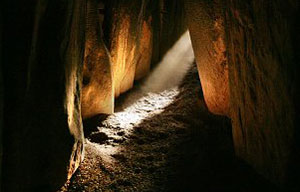
Slowly, as the sun rises - the rays continue to flood forward - going around slight curves, slowly rising up the corridor ... Eventually the inner chamber floods with light as bright as day. It's incredible.
And here's a view of Newgrange from the outside, winter solstice 2002.
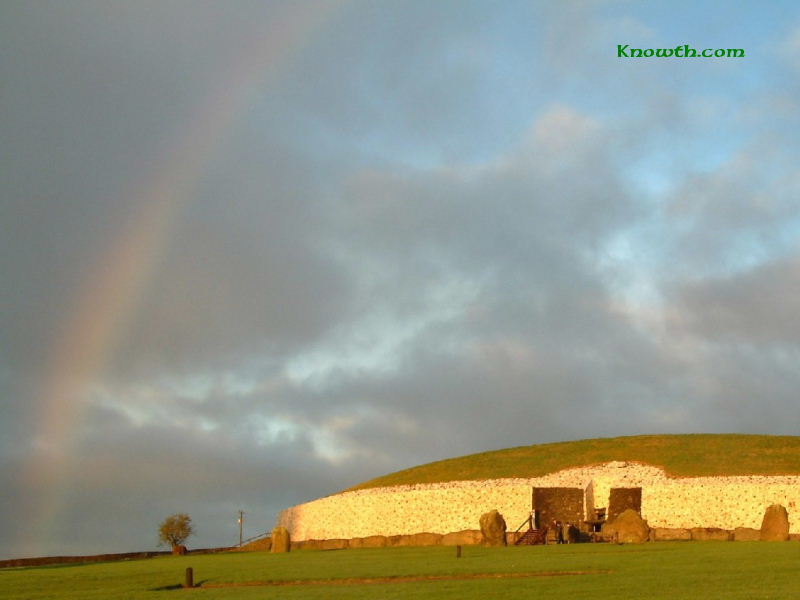
Happy solstice everyone!
And here are 101 facts about Newgrange.
December 21, 2007
Diary Friday
This is a re-post. I thought, in honor of all the Joyce posts recently, I thought I'd go back and find a Diary Friday entry that had to do with Dublin. Sadly, it's a mortifying experience to read as well as re-live. I am 14 years old here. We have been in Ireland for forever at this point. I did my schoolwork in various B&B rooms throughout the countryside. I was at the height of horrid adolescence- I find these terrible, TERRIBLE I tell you! We had flown into the Shannon airport - and spent the majority of time on the west of Ireland. So to arrive in a city just thrilled me no end. I was such a snob.
IRELAND
We started off for Dublin and I am SO excited!!! I CAN'T WAIT!!!!! YIPPEE!!! [Ed: I do not believe there is a font large enough to imitate what that looks like in my journal. Continue.] The drive was long but FINALLY WE CAME INTO THE CITY!!!! [See previous note.] Oh, I love the city! It was exactly like New York but with no skyscrapers. The traffic was terrible, but it gave us plenty of time to look around. People - kids - everyone was out - trillions of college kids. [I believe my rapture here is due to the fact that we had spent so much time out in the Wild West, and I had so had it with seeing Abbeys and monasteries. I'm guessing here, but I think that's what's going on here.]
Dad pointed out Trinity College and St. Stephen's Green. We finally found a place to park, we paid the parking meter, and walked off for St. Stephen's. Mum said it was gorgeous. We walked down the sidewalk looking at everything.
I saw the most incredible punk couple [Ha. I was ALL ABOUT being "punk" - only it was such a watered-down American version as to have absolutely nothing to do with the "real thing". So I felt like, whenever I saw kids with mohawks and safety pins and stuff - IN IRELAND - I was confronted with the genesis of the movement.] She had safety pins through her hand, earrings in her nose, and a bleached mohawk.
When we went through the iron gates into the green, it was -- oh, it was so so beautiful. All shady with all the college kids lying around sleeping, and we came to a stream with mallards and Siobhan immediately sat down to watch. There was a gazebo beside the stream (not as nice as the one in Adare BY FAR.) [Ha ha. Listen to me. Judging the gazebos.] I passed around it, trying to find an opening in the wooden fence so I could get in, and I tripped on a MICROSCOPIC iron stake and fell on my face. [Damn, I hate those microscopic iron stakes.] A whole group of jerky girls started to roar with laughter but some college guy helped me up. OH, I was so so so embarrassed! [Ehm, I'm embarrassed right now, reading about my own embarrassment.] I still blush thinking about it. How dorky I must have looked. It's awful.
We walked along the stream and we came into another part of the park - a sunny stretch of grass with a big fountain and flower gardens. I wish I was a poet so I could put it into words! [And then I proceed to put it into words anyway.] Rows of yellow tulips with small violet flowers in front. Red and orange tulips arranged with velvety maroon flowers weaving in and out. They were just incredible. I have never seen so many perfect gorgeous flowers in my life. Some yellow ones, pink tulips - I could have looked at them all day.
We sat by the fountain. Siobhan wanted to take a swim.
We got up again and walked on the winding path past three roaring crying ladies and then went down a lane with trees overarching us and college kids lying on blankets with books. [I am shaking with laughter right now. Who were the "three roaring crying ladies"?? Were they roaring with laughter, I hope? I don't think they just staggered down the path in St. Stephen's Green, roaring with sobs in public. ]
When we neared the gate leading out into the big hustle-bustle city, Siobhan didn't want to go. But she was good about it. [Oh, little Siobhan! She was four!!] When we came out we decided to find a place to have lunch. We hadn't found a B&B yet, but we were all starving. We found a coffee shop that looked relatively normal on the outside. Well, I took my tray with two raisin scones on it, and stared down the stairs. When I came to the bottom I came out into a plush, dim, orange-tinted room with one of those silver balls of light twirling around and bar stools and mirrors on all the walls and low tables and couches and strange lights flashing!!! I went, "OH MY GOD." I was in shock. I was in a bar! [My innocence touches me, weirdly.]
We slowly sat down on a maroon velvet couch by a low table with three bar stools. It was so dim in there, it was hard to see. Siobhan kept saying, "I can't see my food!" [The image of Siobhan is killing me here!!] My scones were delicious although I picked out all the raisins. [HAHAHA]
It was all rather bizarre and I was glad to get out of there.
While Mum took Jean and Siobhan to the bathroom, me, Dad and Bren crossed the street to watch a cricket game. It was really strange and they wore white dickies [HA! Dickies! ], and vests, and everything! When Mum, Jean, and Siobhan came out, we walked around for a while and passed the college and Mum told me about the Book of Kells.
When we got back to our car, we got in and went off to find a B&B. It was the most maddening search. There just didn't seem to be one single B&B in all of Dublin. I swear, we drove around for an hour and a half, and Dad went to the outskirts of Dublin and I didn't want to stay there! No city!!! [I think what I mean by "no city" is exactly the opposite. I wanted to stay IN the city. Hmm. I am sure I was a huge brat during the search. I can feel it in the prose. Sorry, Mum and Dad. ] We still couldn't find one and we were all getting extremely bored and tired.
I was getting worried because the big Eurovision song contest was on tonight at 8:00 and I didn't want to miss it although it was only like 4:30. [This is so hilarious. Jean?? "Dah after dah"? My sister Jean and I were absolutely OBSESSED with the Eurovision song contest.]
Well. Heave a sigh! [Uhm - who ya' talkin' to, Sheila?] We finally found one!! The Oslo House, a big brick B&B on a nice residential street not far from Phoenix Park. And Dad said it's not a far bus ride into Dublin at all. [To appease his bratty teenage daughter who wanted to be among the "punk" people in the city.] And the B&B seems really nice and I have my own huge double bed all to myself! What luxury!
We hung around for a while. I read so much History that I got bags under my eyes. (Slight exaggeration). [Ha. Thanks for letting us know that, you 13 year old girl.]
After a while, we decided to walk down to Phoenix Park. Mum said that it was like Central Park, in that it was huge. It was huge and it was gorgeous - at least the tiny bit I saw of it. There was a playground that Siobhan adored [Again - the image of Siobhan on this trip is killing me!], and when she finished see-sawing, we went up these stone steps (shady) lined with vines, trees, and big bushes, and we came out to a hill with a house on it, surrounded by trees. We walked past that and came out to an ENORMOUS FIELD scattered with benches and amazing flower arrangements. [Uh oh. Here we go again.] Tulips of this lemon yellow color I have never seen before and pink and orange tulips, and yellow flowers that almost shined. It was so beautiful.
The sun was just going down and Mum and Dad got into a conversation with this weird guy. I went down to look at the swans. Oh, they were gorgeous. This proud father glided around the pond, and the mother sat on her eggs on this huge nest. We pet this cute black dog, and we went down to the zoo but it wasn't opened so we came back and Mum bought me some new batteries. Isn't she wonderful? [Mum. I apologize for how many times I needed you to "get batteries" for me. I was clearly a lunatic and should have been in an institution. I was fixated on batteries. I am crying with laughter right now. I am "roaring and crying" perhaps?]
When we got home, I did some more homework and then we watched the contest and I taped it. It was terrific!
[Now here's the deal with the Eurovision Song Contest. Countries from - duh - all over Europe are represented. Music groups from all over the feckin' place compete. Some of them speak English, but most do not. Hence - most of the songs that Jean and I loved were not sung in English, and yet we got to know the sound of the lyrics anyway, and would sing along pphonetically in our gibberish-sounding made-up version of Greek, or German, or whatever. So that should explain the bizarre next paragraph.]
My favorite songs are Mona ya Guppy from Cypress and Dah after Dah from Sweden. I also liked One Step Further (England) and En Beyshen Freeden (Germany). Germany won and I was thrilled. The girl was 17 and she was so happy!!! [And so began my life-long love of awards shows of any kind. Bring 'em on. Wish I could see award shows every day.] The song means "A Little Peace" and it was really touching. She sang it again in 7 languages, and everyone clapped whenever she switched languages. Shivers ran up and down my back!
I always feel like crying whenever someone has people cheering for them. [This is why I still love awards shows. And the Olympics. I still "feel like crying whenever someone has people cheering for them".] I cried at Charles and Di's wedding when they came out on the balcony. I couldn't help it! [Sheila, you could have helped it if you tried.]
It was a terrific night and day.
The Books: "Dubliners" - 'The Dead' (James Joyce)
Next book on my adult fiction shelves:
 Dubliners - by James Joyce - excerpt from the final story in the collection: "The Dead".

Still from John Huston's film adaptation of "The Dead", the snow is general all over Ireland
The story never loses its power. To describe the plot of it doesn't do it justice, and I also agonized over an excerpt - because it's the ENDING that packs the punch - but the punch wouldn't exist without all that came before. It's important, too, to look at "The Dead" in context of the rest of the collection - which is also marvelous - but "The Dead" feels like a symphony and makes the other stories seem like practice runs, a pianist doing scales. "The Dead" can also be seen (since it is the last story) as the launching pad into the novels. Joyce wrote 3 novels: Portrait of the Artist as a Young Man, Ulysses, and Finnegans Wake - and while Dubliners is marvelous, it doesn't prepare you at all for the ground-breaking quality of the novels - except for "The Dead". "The Dead" is where you know, okay - this Joyce fellow is somethin' ELSE. The fact that he was so young when he wrote the thing is astonishing in and of itself - and that's another part of "The Dead" that interests me: where Joyce was at in his development when he wrote it. He wanted to stick it to Ireland, that is true. He wanted to rub his fellow countrymen's noses in it. "The Dead" is different, though. It's like he draws back the veil over his own heart, and love pours out of it. It's not a pleasant process, because along with that love comes grief, and loss ... but the collection would not have the same power if "The Dead" were not in it. Bitchy gossipy observations are all well and good, and many a novelist has made use of such things to great success. Joyce could have been one of them. But no, he had other things in mind. It's like a quick-flash jujitsu move at the end of the book. It's like Bob Dylan going electric. If you think you know him, if you think you have him pinned down, if you think you have classified and labeled him correctly: you are wrong wrong wrong. Because look at THIS. Joyce was conscious of this, highly conscious. At some point, during the writing of the collection, he felt that maybe he was being too harsh on Ireland - that maybe the harshness, taken as a whole, did not serve the book - and also did not truly express what was in his heart. He wrote, in a letter:
I have often confessed to you surprise that there should be anything exceptional in my writing and it is only at moments when I leave down somebody else's book that it seems to me not so unlikely after all. Sometimes thinking of Ireland it seems to me that I have been unnecessarily harsh. I have reproduced (in Dubliners at least) none of the attraction of the city for I have never felt at my ease in any city since I left it except in Paris. I have not reproduced its ingenuous insularity and its hospitality. The latter 'virtue' so far as I can see does not exist elsewhere in Europe. I have not been just to its beauty: for it is more beautiful naturally in my opinion than what I have seen of England, Switzerland, France, Austria, or Italy. And yet I know how useless these reflections are. For were I to rewrite the book as G.R. suggests 'in another sense' (where the hell does he get the meaningless phrases he uses) I am sure I should find again what you call the Holy Ghost sitting in the ink-bottle and the perverse devil of my literary conscience sitting on the hump of my pen. And after all Two Gallants - with the Sunday crowds and the harp in Kildare Street and Lenehan - is an Irish landscape.
Another element of "The Dead" is Joyce's relationship to his wife, Nora. Nora was a Galway girl (just like Mrs Conroy in "The Dead") - and had had a love affair back in her youth - where a young man stood outside her window in the rain, and then died of pneumonia later. Joyce knew about this event - and it always kind of haunted him, because it somehow made it seem like he, Joyce, was indistinct to Nora. It made him jealous to think that Nora could still be moved by what had happened in her past, with another man. Richard Ellmann, in his biography of Joyce, devotes an entire chapter to "The Dead" - and the background thereof, how all of these different strands came together to make Joyce write it the way he did. Joyce said, much later in life, that every woman in his stories was Nora - he didn't know any other women, basically - and could only write about her. She fascinated him, and he stole from her, her lack of punctuation in her letters (think of Molly's run-on sentence - 40 pages worth - at the end of Ulysses) - her Galways roughness, her tone of voice, how she was ... all of that was pilfered from his wife, and you see it come up time and time again. James and Nora were in Rome for about 6 months - in 1906, 1907 .. and Joyce's experience of Rome - with its ancient ruins abutting up against modern buildings - also became another strand that would make up "The Dead" - how one can be dead at the same time that one is alive. How consciousness of mortality can change what it feels to actually be alive: it is possible to be in both states at once (as Gabriel experiences so devastatingly at the end of "The Dead"). Gabriel, up until the revelatory last 2 pages of the story, has been - for all intents and purposes - a good man, a good husband - a bit stuffy, perhaps - self-conscious - but he tries to do the right thing. He carves the goose gallantly, he dances with Miss Ivors - he works hard on his speech that he wants to give at the party ... he's not a buffoon or an idiot. We don't get the sense that something is MISSING in Gabriel Conroy - until the end. Then we realize that what he was missing was consciousness. Now he has it. The story of his wife's failed love back in Galway (same story as Nora's) - has launched him into life. And at the very same moment he is acutely aware of his own life, he becomes even more aware of how death approaches - as death approaches us all. We are all becoming "shades". His consciousness becomes telescopic - and moves over the snowy Irish landscape - moving 'westward' - he sees the fields, he sees the "mutinous Shannon waves" (meaning: west) - he sees the country cemetery where his wife's lover is buried ... Gabriel, in his sense of loss in regards to his wife, has - for the first time - become connected to all of mankind. He is now in connection with others. What we all share is that we will all die. And for the first time Gabriel really feels the pain of that. He feels the pain of his wife, lying asleep in bed - tears in his eyes - for the love that she once lost.
One of the other things going on in this story - which may be a bit too local for American readers (or anyone not Irish, I suppose): the feeling of west vs. east in that country, which still exists, on some level, today. The west represents rural life, the east is the rush and bustle of Dublin. At the time of Joyce's writing of the story, the Irish Revival was in full swing - and the Irish began to look "west" to see who they really were. It seemed that the rural folk had been lost in the shuffle, the rural folk still spoke Irish - they were untouched by British oppression, there was something that still survived out there in the west that those in Dublin have lost. So people like Yeats and Synge wrote about the west. It was almost political in nature. A reverting to a time before the British. Irish language schools started popping up, and people started traveling out to the Aran Islands, and Galway, etc. - as a way to reclaim a bit of their lost history. Synge - the playwright - took Yeats's advice to "go west, young man" - and lived out on the Aran Islands (wrote a wonderful memoir about it too) - and from that experience of the untouched peasantry of Ireland - began to write his plays that would make his name. And cause riots in Dublin. Story here.
So what does that have to do with "The Dead". Joyce was never big on the Irish Revival. He didn't go for that stuff. His whole thing was to get AWAY from Ireland. (Gabriel, in the story, has that, too - instead of vacationing in Ireland, he takes cycling tours through Germany, etc. He has no interest in exploring his own country. Which is amazing, later - when Gabriel's imagination breaks free and begins to float over Ireland - seeing the snow falling on hill, dale, monuments, cemeteries, waves ... Internally, he is now "visiting" his country - for the very first time.) Joyce places a character at the party - a Miss Ivors. She represent the Irish nationalists. She chides Conroy for publishing his book reviews in a non-Irish magazine. He thinks literature should not be political. She couldn't disagree more, and calls him a "West Briton". This discombobbles him completely. She asks him if he wants to come out to Aran with a group of friends ... he says no, he prefers to vacation "on the continent". Miss Ivors can't let it go. "What - your own country isn't good enough for you?" She's rude. Gabriel has a hard time dealing with her - he feels attacked and humiliated ... like no matter what he says she will never accept it. She leaves the party early - and says goodbye to the crowd in Irish ... Beannacht libh! she cries, and then she's off. The Irish language, in that context, is a weapon. A way to shame the others. Miss Ivors is basically saying, I am more Irish than any of you ... why aren't YOU all speaking in Irish??
Joyce had contempt for such provincial issues - and felt that Irish people's dedication to their own country was just another way to keep themselves down. The point was not to go west, and romanticize their own peasantry - who lived in poverty - and spoke a dead language ... The point was to get the hell OUT so you could have a chance.
But! But. Joyce never stops there. In "The Dead" he presents all of those issues - it's all there - Gabriel feels a bit superior to the rest of the party, and wonders if he should re-word his speech so that everyone will 'get' it. He chooses a Robert Browning quote to start it all off and questions this choice. He wonders if he should choose another quote. (Notice that he doesn't choose an Irish poet to start things off. Gabriel sees himself as continental - he takes pride in that - which is what Miss Ivors senses, and sets about to pierce through that pride) Despite the fact that his wife is actually FROM the "west" of Ireland - they have never gone back to visit Galway together. Gabriel just has no interest in 'seeing' the countryside, and having some Irish Renaissance experience out there. It seems silly to him.
But by the end of the story, what has happened to Gabriel is nothing short of a complete transformation. In a matter of moments, he sees it all. He sees that his wife never really loved him. He sees that he has never loved anyone as much as Michael Furey loved his wife when she was a young girl - Michael Furey who died for love of her by standing out in the rain all night beneath her window. Gabriel sees his own pomposity, and silliness - and avoids looking at himself in the mirror, for shame. He realizes that his tenderness and lust towards his wife, through the end of the party - was misguided. He felt that her attitude and soft manner were to do with him - when what it really was was that she was catapulted back into the past, with Michael Furey. He, for the first time, feels his own isolation from his fellow man. But again, Joyce does not stop there. In the last 3 or 4 paragraphs of the story, Gabriel - by realizing his own alone-ness, his own failures as a man - joins the human race for the first time. He is connected to all. To Michael Furey, to his sweet Aunt Julia, to his sleeping wife - Instead of feeling jealous about her old affair, he looks down on her sleeping form, and finds himself in tears - imagining what it must have been like for her. But again, Joyce does not stop there. He then launches us up - up - into the atmosphere - and Gabriel looks down on all. As though he is already a 'shade'. And where does Gabriel go? Where does he HAVE to go? "Westward". There is no other direction. "The time had come for him to set out on his journey westward." What a sentence. What a mysterious sentence. It is as though Gabriel had had this date from the beginning - only he had no awareness of it. But now he knows. It is "westward" he must go. And so, in the truly stunning last paragraph of the story, he floats out west - through the snow - which is "general all over Ireland" - looking down on the landscape - the fields and waves and dales of the west he had always scorned. And what does he feel? But love. A "swoon" of it.
For me, that last paragraph feels like a swoon - with its uncanny repetition of words ("falling") - it takes on the tone of a prayer, a mantra.
Ellmann writes in his biography of Joyce:
In its lyrical, melancholy acceptance of all that life and death offer, 'The Dead' is a linchpin in Joyce's work. There is that basic situation of cuckoldry, real or putative, which is to be found throughout. There is the special Joycean collation of specific detail raised to rhythmical intensity. The final purport of the story, the mutual dependency of living and dead, is something that he meditated a good deal from his early youth. He had expressed it first in his essay on Mangan in 1902, when he spoke already of the union in the great memory of death along with life; even then he had begun to learn like Gabriel that we are all Romes, our new edifices reared beside, and even joined with, ancient monuments. In Dubliners he developed this idea. The interrelationship of dead and living is the theme of the first story in Dubliners [excerpt here] as well as of the last; it is also the theme of 'A Painful Case' [excerpt here], but an even closer parallel to 'The Dead' is the story, 'Ivy Day in the Committee Room' [excerpt here]. This was in one sense an answer to his university friends who mocked his remark that death is the most beautiful form of life by saying that absence is the highest form of presence. Joyce did not think either idea absurd. What binds 'Ivy Day' to 'The Dead' is that in both stories the central agitation derives from a character who never appears, who is dead, absence. Joyce wrote Stanislaus that Anatole France had given the idea for both stories. There may be other sources in France's works, but a possible one is 'The Procurator of Judaea'. In it Pontius Pilate reminisces with a friend about the days when he was procurator in Judaea, and describes the events of his time with Roman reason, calm, and elegance. Never once does he, or his friend, mention the person we expect him to discuss, the founder of Christianity, until at the end the friend asks if Pontius Pilate happens to remember someone of the name of Jesus, from Nazareth, and the veteran administrator replies, "Jesus? Jesus of Nazareth? I cannot call him to mind." The story is overshadowed by the person whom Pilate does not recall; without him the story would not exist. Joyce uses a similar method in 'Ivy Day' with Parnell and in 'The Dead' with Michael Furey....
That Joyce at the age of twenty-five and -six should have written this story ought not to seem odd. Young writers reach their greatest eloquence in dwelling upon the horror of middle age and what follows it. But beyond this proclivity which he shared with others, Joyce had a special reason for writing the story of 'The Dead' in 1906 and 1907. In his own mind he had thoroughly justified his flight from Ireland; but he had not decided the question of where he would fly to. In Trieste and Rome he had learned what he had unlearned in Dublin, to be a Dubliner. As he had written his brother from Rome with some astonishment, he felt humiliated when anyone attacked his "impoverished country". 'The Dead' is his first song of exile.
I agonized over what to excerpt. I feel the ending of the story is somewhat sacred - and although very famous I didn't feel right in excerpting it separated from the whole. I thought then that I would excerpt the moment when the party starts to break up. It's gone well. Gabriel puts on his overcoat. He and his wife are staying in a nearby hotel. Snow is falling - "newspapers say snow is general all over Ireland". Which is already odd, somewhat uncanny. Ireland is not known as a snow-bound nation. It brings a feeling of cold and paralysis to the scene. Gabriel looks up the stairs and sees his wife standing there, in silhouette. She appears frozen. She is listening to something. Someone is playing the piano in an upper room and it has caught her attention. Gabriel is suddenly struck by the vision of his wife. They have two kids together, they've been married a long time ... and suddenly: he SEES her. The devastation that comes later, when he realizes that what she was thinking about in that moment had nothing to do with him ... has not arisen yet. Gabriel stares up at his wife. Watch, too, how Gabriel - an intellectual, a book-reviewer, turns his wife into an inanimate object - he immediately begins to see her as a work of art - and wishes he could paint her - capture her. Meanwhile (we find this out later) - Gabriel's wife is struck dumb by the playing of an old Irish song ... which reminds her of her dead lover. She stands, frozen ... and from that moment on, the past has got her. Gabriel does not perceive this. He feels that she is suddenly in the present. He cannot wait to be alone with her, to touch her, make love. It is Gabriel's tragedy that they have actually never been further apart than in that moment when he sees her at the top of the stairs.
And that's the end of my posts on Dubliners. I will be sorry to move on.
EXCERPT FROM Dubliners - by James Joyce - "The Dead".
Gabriel had not gone to the door with the others. He was in a dark part of the hall gazing up the staircase. A woman was standing near the top of the first flight, in the shadow also. He could not see her face but he could see the terracotta and salmonpink panels of her skirt which the shadow made appear black and white. It was his wife. She was leaning on the banisters, listening to something. Gabriel was surprised at her stillness and strained his ear to listen also. But he could hear little save the noise of laughter and dispute on the front steps, a few chords struck on the piano and a few notes of a man's voice singing.
He stood still in the gloom of the hall, trying to catch the air that the voice was singing and gazing up at his wife. There was grace and mystery in her attitude as if she were a symbol of something. He asked himself what is a woman standing on the stairs in the shadow, listening to distant music, a symbol of. If he were a painter he would paint her in that attitude. Her blue felt hat would show off the bronze of her hir against the darkness and the dark panels of her skirt would show off the light ones. Distant Music he would call the picture if he were a painter.
The hall-door was closed, and Aunt Kate, Aunt Julia and Mary Jane came down the hall, still laughing.
-- Well, isn't Freddy terrible? said Mary Jane. He's really terrible.
Gabriel said nothing but pointed up the stairs to where his wife was standing. Now that the hall-door was closed the voice and the piano could be heard more clearly. Gabriel held up his hand for them to be silent. The song seemed to be in the old Irish tonality and the singer seemed uncertain both of his words and of his voice. The voice, made plaintive by distance and by the singer's hoarseness, faintly illuminated the cadence of the air with words expressing grief:
O, the rain falls on my heavy locks
And the dew wets my skin,
My babe lies cold ...
-- O, exclaimed Mary Jane. It's Bartell D'Arcy singing and he wouldn't sing all the night. O, I'll get him to sing a song before he goes.
-- O do, Mary Jane, said Aunt Kate.
Mary Jane brushed past the others and ran to the staircase but before she reached it the singing stopped and the piano was closed abruptly.
-- O, what a pity! she cried. Is he coming down, Gretta?
Gabriel heard his wife answer yes and saw her come down towards them. A few steps behind her were Mr Bartell D'Arcy and Miss O'Callaghan.
-- O, Mr D'Arcy, cried Mary Jane, it's downright mean of you to break off like that when we were all in raptures listening to you.
-- I have been at him all the evening, said Miss O'Callaghan, and Mrs Conroy too and he told us he had a dreadful cold and couldn't sing.
-- O, Mr D'Arcy, said Aunt Kate, now that was a great fib to tell.
-- Can't you see that I'm as hoarse as a crow? said Mr D'Arcy roughly.
He went into the pantry hastily and put on his overcoat. The others, taken aback by his rude speech, could find nothing to say. Aunt Kate wrinkled her brows and made signs to the others to drop the subject. Mr D'Arcy stood swathing his neck carefully and frowning.
-- It's the weather, said Aunt Julia, after a pause.
-- Yes, everybody has colds, said Aunt Kate readily, everybody.
-- They say, said Mary Jane, we haven't had snow like it for thirty years; and I read this morning in the newspapers that the snow is general all over Ireland.
-- I love the look of snow, said Aunt Julia sadly.
-- So do I, said Miss O'Callaghan. I think Christmas is never really Christmas unless we have the snow on the ground.
-- But poor Mr D'Arcy doesn't like the snow, said Aunt Kate, smiling.
Mr D'Arcy came from the pantry, fully swathed and buttoned, and in a repentant tone told them the history of his cold. Everyone gave him advice and said it was a great pity and urged him to be very careful of his throat in the night air. Gabriel watched his wife who did not join in the conversation. She was standing right under the dusty fanlight and the flame of the gas lit up the rich bronze of her hair which he had seen her drying at the fire a few days before. She was in the same attitude and seemed unaware of the talk about her. At last she turned towards them and Gabriel saw that there was colour on her cheeks and that her eyes were shining. A sudden tide of joy went leaping out of his heart.
-- Mr D'Arcy, she said, what is the name of that song you were singing?
-- It's called The Lass of Aughrim, said Mr D'Arcy, but I couldn't remember it properly. Why? Do you know it?
-- The Lass of Aughrim, she repeated. I couldn't think of the name.
EXCERPTS FROM 'DUBLINERS'
The Sisters
An Encounter
Araby
Eveline
After the Race
Two Gallants
The Boarding House
A Little Cloud
Counterparts
Clay
A Painful Case
Ivy Day in the Committee Room
A Mother
Grace
December 20, 2007
Nativity on West Houston Street
... seen here.
Weird - I just went to St. Anthony's today. I'm never down that way, but today I was. It's a church I love, even though it's a madhouse, and a bit too noisy and crazy - with coins clinking to light candles and people wandering around, etc. I like it in the mid-day on a weekday, like today. And I also wanted to visit their bizarrely overblown Nativity which stretches an entire block. A beautiful shining morning, windy and brisk. So it's just funny that that is the daily photo today on that wonderful site!
Megan adds to the game:
I find these fascinating for some reason. Miniatures. Gold nuggets at the bottom of a sieve.
Capella has added hers as well.
These are so interesting. Like entire movies - or trailers to movies ... you get the idea of it, the sense, an echo ... but very little information. I'm loving them. Even when the paragraphs obviously express pain.
Chicago's 'hoods
A map I am totally engrossed in right now. "Lakeview" is also known as "Boys Town" (or at least it was when I lived there) - the gay area, that's where my first apartment was. Very cool map - reminds me of the awesome illustrations for Ellen Raskin's book The Mysterious Disappearance of Leon (I mean Noel) - a childhood favorite (excerpt here). The drawings are spectacular - I can't find any online, dammit - but if you've read the book you'll know what I'm talking about: people are made up of big swoopy letters, that somehow come together to form a person - and each person has different words, to signify their interests, defining characteristics, etc. Hard to explain - but very much like that cool Chicago map, with letters big and small, curling up and curving in upon one another, in order to accommodate the outer border.
This morning:
I will be spending at the Film Forum at a press screening, in the presence (ghostly, but still there) of Otto Preminger, Joan Crawford, and Henry Fonda.

Can't wait. I love the randomness of life sometimes. New experiences, the unknown ... it's great.
The Books: "Dubliners" - 'Grace' (James Joyce)
Next book on my adult fiction shelves:
Dubliners - by James Joyce - excerpt from the second to last story in the collection: "Grace".
"Grace" ends with the words: "I will set right my accounts". And that launches us into the majestic last story of the collection - a true setting-right of accounts - "The Dead". "Grace" is (except for "The Dead") the longest story in Dubliners - and it feels like the most complex (but again, we haven't gotten to "The Dead" yet.) Once you realize what Joyce is doing in "Grace", the title of the story becomes of highest importance. Grace? You have got to be kidding me. With these idiots? They mean well, but they're ignorant. Joyce's anger at the Catholic Church is behind all of this - but, like the master he already is (at 23 years of age) - he doesn't ever state his anger outright. It's implied. In some sense, you would need to know Catholic dogma to get some of the points made in this story - it certainly would help. Again, there are online glossaries that could help anyone make his way through the story. Misinformation passed on, things misquoted, totally untrue stories passed on as true ... The thing with Joyce is, and this is key: take NOTHING at face value. You'll miss the whole point. Not only will you miss the whole point, but you might even be lulled into making the mistake of thinking: "There's nothing going on in this story at all." I had a Shakespeare teacher say to the class once, "If you think a line isn't bawdy, it's because you haven't worked it out yet." Same with Joyce.
In "Grace" - a drunk man falls down the stairs outside a pub. He cuts his mouth open, and a big brou-haha ensues. A constable is called. Who is this man? Who is he with? Eventually, a gentleman appears who knows the man - and he escorts the man home. The man is Mr. Kernan - he's a salesman who truly believes in the dignity of his profession. (The fact that he is such a true believer in business - and not in the Catholic creed - says it all). He has a wife and kids. He was a Protestant but he converted to Catholicism at his marriage. His wife is long-suffering. He is a drinker. He spends no time at home. He wastes all their money. And at this point, he's been drinking non-stop for 3 or 4 days.
A group of Mr. Kernan's colleagues - who want to help him out - come up with a little plan ... and they spring it on him one day, when they all visit his sick-room, where he is recovering from his fall down the stairs. There's going to be a Catholic retreat for businessmen - how to live in the world, but not be worldly ... and they're all going to go ... Mr. Kernan should come too! They know his skepticism and his anger towards the church (totally justified, in Joyce's mind) - but they think it would be good for him. Mrs. Kernan is in on this little intervention. She's not hugely religious - but she certainly believes. The main part of "Grace" takes place around Mr. Kernan's sick-bed. The men sit, and drink whiskey, and chat ... the talk turns to religion. They try to convince Mr. Kernan that he should come to the retreat - they're all going - he should come too! But they all tread carefully - not wanting to scare him away or make it seem like an intervention. Mr. Kernan is scornful.
But eventually he agrees to come to the retreat. He likes the priest - a big red-faced man who is "worldly". He relates. The story ends with all of the men in the church, Mr. Kernan included, listening to Father Purdon give a sermon on how Jesus must have felt about businessmen, and how to live your life out in the corrupt world - and what Jesus would have wanted.
You don't have to be a Catholic to see what a bastardization of Scriptures this is - and that Father Purdon is "worldly" indeed. The flock sits there, passive and submissive, listening to the dreck from the pulpit -
Joyce is doing mutiple things at once here. It's a complicated story - and I was quite edified by the end-notes I have in my copy, and also reading some online analyses of the story. According to Joyce, the Catholic Church in Ireland is the root of all the problems that country has (well, that and the British - and the little problem of the Irish language). The Catholic Church places submission at a premium (the men sitting Mr. Kernan's room discuss the tale of the two bishops who went against "papal infallibility" - one of them was an Irishman - who refused to believe in the infallibility of the pope - and then, at the last minute, stood up and shouted "Credo!") Okay. So. The men in the story relate this as a GOOD story, a story of how wonderful the Irish bishop was - to submit so readily and so suddenly - it was a mark of his great faith. And the greatness of the Irish priesthood in general. Joyce does not slide any snark into this - you don't feel his editorial hand at all, you just need to get the symbolism behind all of this, and know that Joyce thinks all of this is BOLLOCKS. The Irish priest who resisted papal infallibility was RIGHT - and everything that is wrong in Ireland can be traced back to an entire populace forced to say "Credo!" over and over. That's how bitter Joyce is. Joyce had great respect for the Jesuits (as becomes apparent even more in Portrait) - and knew the creed inside and out. It was what it did to people he did not like. The hypocrisy. The priests talking-down to the populace - the priests "dumbing down" Jesus in order to make him seem relevant to a bunch of worldly businessmen ... Joyce has nothing but contempt for all of that.
And his contempt is in the story - it's just hidden so well. His contempt is in the title. Grace. To be found at such a cynical retreat as that one? Not likely.
There's more going on here than I am even discussing - and probably a ton that I can't even see, because I don't have the right context. But "Grace" is a mini-novel. It does not have just one thruline - we get multiple perspectives - it's intellectual, emotional, spiritual - and it poses questions - like all great books do. Joyce has his opinions on the answers ... but he just poses the question. If you are seeking "grace", the last place you will find it is in the Catholic Church. Ireland hated him for this. He was not forgiven.
It is time to "set right" his accounts. This is the deep breath before we go into "The Dead"
Here's an excerpt.
EXCERPT FROM Dubliners - by James Joyce - "Grace".
The gentlemen drank from their glasses, set the glasses again on the table and paused. Then Mr Cunningham turned towards Mr Power and said casually:
-- On Thursday night, you said, Jack?
-- Thursday, yes, said Mr Power.
-- Righto! said Mr Cunningham promptly.
-- We can meet in M'Auley's, said Mr M'Coy. That'll be the most convenient place.
-- But we mustn't be late, said Mr Power earnestly, because it is sure to be crammed to the doors.
-- We can meet at half-seven, said Mr M'Coy.
-- Righto! said Mr Cunningham.
-- Half-seven at M'Auley's be it!
There was a short silence. Mr Kernan waited to see whether he would be taken into his friends' confidence. Then he asked:
-- What's in the wind?
-- O, it's nothing, said Mr Cunningham. It's only a little matter that we're arranging about for Thursday.
-- The opera, is it? said Mr Kernan.
-- No, no, said Mr Cunningham in an evasive tone, it's just a little ... spiritual matter.
-- O, said Mr Kernan.
There was silence again. Then Mr Power said, pointblank:
-- To tell you the truth, Tom, we're going to make a retreat.
-- Yes, that's it, said Mr Cunningham. Jack and I and M'Coy here - we're all going to wash the pot.
He uttered the metaphor with a certain homely energy and, encouraged by his own voice, proceeded:
-- You see, we may as well all admit we're a nice collection of scoundrels, one and all. I say, one and all, he added with gruff charity and turning to Mr Power, Own up now!
-- I own up, said Mr Power.
-- And I own up, said Mr M'Coy.
-- So we're going to wash the pot together, said Mr Cunningham.
A thought seemed to strike him. He turned suddenly to the invalid and said:
-- Do you know what, Tom, has just occurred to me? You might join in and we'd have a four-handed reel.
-- Good idea, said Mr Power. The four of us together.
Mr Kernan was silent. The proposal conveyed very little meaning in his mind but, understanding that some spiritual agencies were about to concern themselves on his behalf, he thought he owed it to his dignity to show a stiff neck. He took no part in the conversation for a long while but listened, with an air of calm enmity, while his friends discussed the Jesuits.
-- I haven't such a bad opinion of the Jesuits, he said, intervening at length. They're an educated order. I believe they mean well too.
-- They're the grandest order in the Church, Tom, said Mr Cunningham, with enthusiasm. The General of the Jesuits stands next to the Pope.
-- There's no mistake about it, said Mr M'Coy, if you want a thing well done and no flies about it you go to a Jesuit. They're the boyos have influence. I'll tell you a case in point ...
-- The Jesuits are a fine body of men, said Mr Power.
-- It's a curious thing, said Mr Cunningham, about the Jesuit Order. Every other order of the Church had to be reformed at some time or other but the Jesuit Order was never once reformed. It never fell away.
-- Is that so? asked Mr M'Coy.
-- That's a fact, said Mr Cunningham. That's history.
-- Look at their church, too, said Mr Power. Look at the congregation they have.
-- The Jesuits cater for the upper classes, said Mr M'Coy.
-- Of course, said Mr Power.
-- Yes, said Mr Kernan. That's why I have a feeling for them. It's some of those secular priests, ignorant, bumptious -
-- They're all good men, said Mr Cunningham, each in his own way. The Irish priesthood is honoured all the world over.
-- O yes, said Mr Power.
-- Not like some of the other priesthoods on the continent, said Mr M'Coy, unworthy of the name.
-- Perhaps you're right, said Mr Kernan, relenting.
-- Of course I'm right, said Mr Cunningham. I haven't been in the world all this time and seen most sides of it without being a judge of character.
The gentlemen drank again, one following another's example. Mr Kernan seemed to be weighing something in his mind. He was impressed. He had a high opinion of Mr Cunningham as a judge of character and as a reader of faces. He asked for particulars.
-- O, it's just a retreat, you know, said Mr Cunningham. Father Purdon is giving it. It's for business men, you know.
-- He won't be too hard on us, Tom, said Mr Power persuasively.
-- Father Purdon? Father Purdon? said the invalid.
-- O, you must know him, Tom, said Mr Cunningham, stoutly. Fine jolly fellow! He's a man of the world like ourselves.
-- Ah ... yes. I think I know him. Rather red face; tall.
-- That's the man.
-- And tell me, Martin ... is he a good preacher?
-- Mmmno ... It's not exactly a sermon, you know. It's just a kind of a friendly talk, you know, in a common-sense way.
Mr Kernan deliberated. Mr M'Coy said:
-- Father Tom Burke, that was the boy!
-- O, Father Tom Burke, said Mr Cunningham, that was a born orator. Did you ever hear him, Tom?
-- Did I ever hear him! said the invalid, nettled. Rather! I heard him ....
-- And yet they say he wasn't much of a theologian, said Mr Cunningham.
-- Is that so? said Mr M'Coy.
-- O, of course, nothing wrong, you know. Only sometimes, they say, he didn't preach what was quite orthodox.
-- Ah! ... he was a splendid man, said Mr M'Coy.
-- I heard him once, Mr Kernan continued. I forget the subject of his discourse now. Crofton and I were in the back of the ... pit, you know ... the -
-- The body, said Mr Cunningham.
-- Yes, in the back near the door. I forget now what ... O yes, it was on the Pope, the late Pope. I remember it well. Upon my word it was magnificent, the style of the oratory. And his voice! God! hadn't he a voice! The Prisoner of the Vatican, he called him. I remember Crofton saying to me when we came out -
-- But he's an Orangeman, Crofton, isn't he? said Mr Power.
-- 'Course he is, said Mr Kernan, and a damned decent Orangeman too. We went into Butler's in Moore Street - faith, I was genuinely moved, tell you the God's truth - and I remember well his very words. Kernan, he said, we worship at different altars, he said, but our belief is the same. Struck me as very well put.
-- There's a good deal in that, said Mr Power. There used always be crowds of Protestants in the chapel when Father Tom was preaching.
-- There's not much difference between us, said Mr M'Coy. We both believe in -
He hesitated for a moment.
-- ... in the Redeemer. Only they don't believe in the Pope and in the mother of God.
-- But, of course, said Mr Cunningham quietly and effectively, our religion is the religion, the old, original faith.
-- Not a doubt of it, said Mr Kernan warmly.
December 19, 2007
Snow
More snowy screenshots at Six Martinis!
I have included two of my own below. They're both from the same movie, Penny Serenade.
Here's the monster-post I wrote about Penny Serenade, a movie I truly love.
Happy birthday, Poor Richard

On this day in history, December 19, 1732, Benjamin Franklin's Poor Richard's Almanack was born - and the first issue published. Franklin included all the information that almanacs normally provide - sun rise, sun set, eclipses, weather predictions, yadda yadda. But it was also one of those small things (or - not so small - but let's just say that Richard's Almanack couldn't have done it on its own) that made the colonies feel more like a community. The colonies did things for themselves. They were under the crown, but that feeling of being separate from the crown started very early - and the almanac - with its listing of court dates, and town meetings, and church meetings, etc. - was part of that. It helped foster that. It helped spread information.
Benjamin Franklin wrote in his autobiography:
In 1732 I first published my almanac, under the name of Richard Saunders; it was continued by me about twenty-five years and commonly called "Poor Richard's Almanac". I endeavored to make it both entertaining and useful, and it accordingly came to be in such demand that I reaped considerable profit from it, vending annually near ten thousand. And observing that it was generally read, scarce any neighborhood in the province being without it, I considered it as a proper vehicle for conveying instruction among the common people, who bought scarcely any other books. I therefore filled all the little spaces that occurred between the remarkable days in the calendar with proverbial sentences, chiefly such as inculcated industry and frugality as the means of procuring wealth, and thereby securing virtue; it being more difficult for a man in want to act always honestly, as, to use here one of those proverbs, it is hard for an empty sack to stand upright.These proverbs, which contained the wisdom of many ages and nations, I assembled and formed into a connected discourse prefixed to the almanac of 1757 as the harangue of a wise old man to the people attending an auction. The bringing all these scattered counsels thus into a focus enabled them to make greater impression. The piece, being universally approved, was copied in all the newspapers of the American continent, reprinted in Britain on a large sheet of paper to be stuck up in houses; two translations were made of it in France, and great numbers bought by the clergy and gentry to distribute gratis among their poor parishioners and tenants. In Pennsylvania, as it discouraged useless expense in foreign superfluities, some thought it had its share of influence in producing that growing plenty of money which was observable for several years after its publication.
I remember my grandmother, Mummy Gina, had a huge illustrated Richard's Almanack at her house that we loved to page through as kids . I can still see some of the illustrations in my mind. I remember very well the illustration for the proverb about visitors being like fish (they start to stink after a couple of days).
I love this website. Ha!!! Especially in light of the whole key on the kite thing.
Some of the proverbs from the almanac (he freely admitted that he did not invent many of these - they were passed down, or he would put his own humorous spin on them):
Keep your eyes wide open before marriage, half shut afterwards.
After three days men grow weary, of a wench, a guest, and weather rainy.
Three may keep a secret, if two of them are dead.
Early to bed and early to rise, makes a man healthy, wealthy, and wise.
Plough deep while sluggards sleep and you shall have corn to sell and to keep.
Have you something to do tomorrow? Do it today
There are no gains without pains.
The noblest question in the world is: What good may I do in it?
H.W. Brands writes, in his biography of Benjamin Franklin (The First American):
Gazette readers intrigued enough to buy the bound version (priced at three shillings sixpence per dozen, obviously intended for resale) or the broadsheet edition (two shillings sixpence the dozen) were introduced to Richard Sauncers, Philomath - a standard honorific for almanac-makers - by Saunders himself. "Courteous Reader, I might in this place attempt to gain thy favour by declaring that I write almanacks with no other view than the public good; but in this I should not be sincere, and men are nowadays too wise to be deceived in pretenses how specious soever." Like the printer Franklin apologizing for the advertisement that gave offense to certain customers, Saunders confessed to monetary motives. "The plain truth of the matter is, I am excessive poor, and my wife, good woman, is, I tell her, excessive proud. She cannot bear, she says, to sit spinning in her shift of tow while I do nothing but gaze at the stars, and has threatened to burn all my books and rattling-traps (as she calls my instruments) if I do not make some profitable use of them for the good of my family. The printer has offered me some considerable share of the profits, and I have thus begun to comply with my Dame's desire."
Hahahahahahaha
More from The First American:
As was apparent to the least attentive reader, Franklin thoroughly enjoyed adopting the guise of Richard Saunders. Where Franklin the businessman had to be circumspect careful not to offend, Saunders the almanacker could be outrageous - indeed, the more outrageous the better. Franklin as Franklin often had to hide his gifts to avoid inspiring envy; Franklin as Saunders could flaunt his wit, erudition, and general brilliance. In time - as his position in the community grew more secure - Franklin would no longer require Richard Saunders; till then the alter ego helped keep him sane.Readers enjoyed Poor Richard as much as Franklin did. Copies were out the door by the single and the gross. In one year John Peter Zenger of New York (lately the defendant in a celebrated libel trial) took eighteen dozen in a batch, then another sixteen dozen. Louis Timothee (who now generally went by Lewis Timothy [more on him here) in South Carolina ordered twenty-five dozen; Thomas Fleet in Boston also took twenty-five dozen. James Franklin's widow, Ann, in Newport bought one thousand. These numbers hardly made Poor Richard the bestselling almanac in America; where Poor Richard sold an average of about ten thousand per year, Nathaniel Ames's Astronomical Diary sold five to six times as many. But Poor Richard had a unique persona, and it developed a loyal readership.
While readers may have come for the quarrels Franklin provoked, they stayed for the advice he dispensed - and the way he dispensed it. Every almanac offered pearls of wisdom on personal conduct and related matters of daily life; that the pearls had been retrieved from other oysters bothered no one except perhaps the owners of those other oysters, who in any event had no recourse in the absencew of applicable copyright law. The trick for writers like Franklin was to polish the pearls and set them distinctively; in this he had no peer. What came to be called "the sayings of Poor Richard" first surfaced as filler on the calendar pages of the almanac the limitations of space, together with Franklin's inherent economy, taught him to distill each message to its morsel. "Great talkers, little doers" broke no philosophical ground, but for pith it trumped nearly every alternative. "Hunger never saw bad bread"; "Light purse, heavy heart"; "Industry need not wish"; and "Gifts burst rocks" fell into the same category.
Sometimes succinctness yielded - slightly - to sauciness. "Neither a fortress nor a maidenhead will hold out long after they begin to parley." "Marry your son when you will but your daughter when you can." "Tell a miser he's rich, and a woman she's old, you'll get no money of one nor kindness of t'other." "Prythee isn't Miss Cloe's a comical case?/She lends out her tail, and she borrows her face." "The greatest monarch on the proudest throne is obliged to sit upon his own arse." "Force shits upon reason's back."
Poor Richard's Almanack is still in print today. Extraordinary.
The Books: "Dubliners" - 'A Mother' (James Joyce)
Next book on my adult fiction shelves:
Dubliners - by James Joyce - excerpt from the thirteenth story in the collection: "A Mother". I have heard this story referred to as "comic relief" - there are two stories left to go in Dubliners - after this one - as serious as they come - so perhaps to balance it out, Joyce put in "A Mother", a domestic on-the-surface tale of a woman pushed to the edges of rage at being treated unfairly. I don't know if I would call "A Mother" "comic relief" - but it certainly does act like a breather, a bit of a break, shall we say - in the tragedy - before plunging into the depths in the last two stories. "A Mother" can be read without any glossary nearby. You need no perspective, no context in order to understand it. It could be published in The New Yorker today, no problem. What you see is what you get in this particular case - and that's rarely true with Joyce.
Mrs. Kearney is a woman of great accomplishments (for a woman of her day and age, I mean - and for a woman in Ireland). She makes things happen. She heads up committees, she knows how to get people to do things for her, to get things done. She was an excellent student as a young girl - kind of icy in her manners - so it was thought that she would never get married. But she did - to a man older than she - and from the way Joyce paints the picture, it is a good match. She is a good wife. They have a daughter, Kathleen - who, at the time of the story, is 18 years old. Mrs. Kearney makes sure her daughter has a good education, and music lessons ... and also (and this is interesting) the Irish Revival is going on (the first time Joyce mentions such a thing) - and Irish language classes start popping up, Irish cultural festivals - people start to put Irish words into their speech - In its way, it is a small (and probably meaningless) act of rebellion. The Irish language had been destroyed (Ahem) - and so the Irish Revival movement (which went on when Joyce was a young man), even though it was cultural in nature - had political overtones. Language is ALWAYS political - and Joyce understood that better than anyone. The most famous scene in Portait is Stephen's encounter with the professor in the empty classroom - where they discuss the word "tundish". I'll get to that later. But language is political. By saying goodbye to one another in Irish, by peppering Irish words into their speech - the Irish were asserting the freedom of their souls, their own culture ... Whether or not it had any effect is not the realm of "A Mother". Mrs. Kearney is wrapped up in the Irish Revival. Kathleen, her daughter, is made to take Irish language classes, as well as all of her other classes. You get the sense that Mrs. Kearney - an obviously intelligent woman of great organizational skills - could have been a Chairperson of the Board in another time, a CEO, a headmistress - something. But in her time, in her place ... those skills are kind of at odds with what is expected of her. So she is an organizational fiend in the Irish Revival movement. There's a lot of thwarted energy in Mrs. Kearney.
Things come to a head when a series of four concerts is planned, and she engages her daughter Kathleen to be the accompanist. Joyce was a tenor - and he performed in many of these concerts in Dublin before de-camping to Europe. He apparently had a beautiful voice. The scenes in the concert hall ring so true because Joyce had lived them. Kathleen Kearney is a nonentity in this story - her mother completely runs her life - and she signs a contract with the organizer of the concerts, that Kathleen will be paid such and such a fee for the four concerts. Mrs. Kearney helps organize the whole thing - she helps put together the programs, she helps with the order of each night - who sings first, who recites next ... she understands that such nights need a balance. She is highly involved.
I'm not sure if Joyce was, in his way, criticizing the Irish Revival movement, but he certainly is saying something here about it. The concerts do not go well. Nobody shows up the first night. Mrs. Kearney, hovering backstage, begins to feel uneasy. It is not going to be the glittering night of success she had imagined. Things are dingy. The few audience members are unruly, grubby. The organizers of the concert decide to cancel the next night - and move all of the performers to the big Saturday night concert. This is when Mrs. Kearney goes over the edge. Her daughter had signed a contract for four concerts. She will be paid for four concerts - even if only two concerts occur.
She begins to lose her shit. She tries to track down who is in charge of payment. But she gets the run-around. People do not treat her well. She feels she should be given more consideration, seeing as she was so helpful in organizing everything. Where would they be without her?? But she cannot get a straight answer out of anyone, in regards to her daughter's contract.
You suddenly realize that Dublin is an amateur town. In Berlin, her daughter would be paid properly! Do you think London would treat their artistes in such a horrible way? Nobody else seems to care ... Mrs. Kearney is blazingly alone in her disappointment and rage. Everyone around her seems apathetic.
Things come to a climax at the Saturday night performance. The first act happens. There's a packed house. Finally, one of the organizers comes up to Mrs. Kearney backstage and hands her some money for her daughter - telling her she will be paid the rest after the show. But it's already short. They are short-changing her daughter. Mrs. Kearney, who has been slowly building up to a huge rage (you really feel for this woman, even though she is kind of silly and you want to shout at her, "CHILLAX!") suddenly pulls her daughter from the second act. Her daughter will not play for the artistes in the second act until she is paid in full. This causes an enormous embarrassing brou-haha - the audience gets restless, the singers stand around backstage, waiting ... and you get the sense that Mrs. Kearney, in one night, loses her social standing in Dublin. For good. You get her point - she is being treated unfairly - but she is also over-reacting, to some degree. This goes back to the whole "Dublin is a town of amateurs" critique. Mrs. Kearney, to truly be who she is, needs to not be in Dublin, where her great powers of organization cannot be appreciated. Instead, she is suddenly seen as a loony-tunes. Kathleen is mortified. The organizer of the concert has finally had it with Mrs. Kearney and says, "Fine - Kathleen will NOT play for the second act - we consider her contract broken - and we have someone else who can play for the second act ..." A second accompanist goes onstage, and Mrs. Kearney hears the piano start up - and that is the end for her. She has been replaced. Her daughter is dispensable. The way Joyce describes Mrs. Kearney's disintegration over the course of the story is devastating. She begins it as a calm cool collected woman, sure of her place in the world, confident. At the end, she is a ragged mess, full of such rage that other people become afraid of her.
Although I have just described the plot, there is another level to all of this. Joyce felt that Dublin paralyzed its occupants. There is no room to maneuver. Anyone who has any excellence, or eccentricities ... is doomed. One becomes paralyzed. Joyce felt that he couldn't love Nora properly - in Ireland. They had to leave. He felt that people couldn't "touch each other" in Ireland. Not just sexually, although that was a huge issue for him. He meant souls touching ... he meant communion of souls. Mrs. Kearney had thought all along that she was fine, that her world suited her ... and in a matter of 4 days everything falls apart for her. The lie she has been living is revealed.
Here's an excerpt. (Interesting coincidence that Mrs Kearney respects her husband "as she respected the General Post Office" - considering what was to come in 1916.)
EXCERPT FROM Dubliners - by James Joyce - "A Mother".
The concert on Thursday night was better attended but Mrs Kearney saw at once that the house was filled with paper. The audience behaved indecorously as if the concert were an informal dress rehearsal. Mr Fitzpatrick seemed to enjoy himself; he was quite unconscious that Mrs Kearney was taking angry note of his conduct. He stood at the edge of the screen, from time to time jutting out his head and exchanging a laugh with two friends in the corner of the balcony. In the course of the evening Mrs Kearney learned that the Friday concert was to be abandoned and that the Committee was going to move heaven and earth to secure a bumper house on Saturday night. When she heard this she sought out Mr Holohan. She buttonholed him as he was limping out quickly with a glass of lemonade for a young lady and asked him was it true. Yes, it was true.
-- But, of course, that doesn't alter the contract, she said. The contract was for four concerts.
Mr Holohan seemed to be in a hurry; he advised her to speak to Mr Fitzpatrick. Mrs Kearney was now beginning to be alarmed. She called Mr Fitzpatrick away from his screen and told him that her daughter had signed for four concerts and that, of course, according to the terms of the contract, she should receive the sum originally stipulated for whether the society gave the four concerts or not. Mr Fitzpatrick, who did not catch the point at issue very quickly, seemed unable to resolve the difficulty and said that he would bring the matter before the Committee. Mrs Kearney's anger began to flutter in her cheek and she had all she could do to keep from asking:
-- And who is the Cometty, pray?
But she knew that it would not be ladylike to do that: so she was silent.
Little boys were sent out into the principal streets of Dublin early on Friday morning with bundles of handbills. Special puffs appeared in all the evening papers reminding the music-loving public of the treat which was in store for it on the following evening. Mrs Kearney was somewhat reassured but she thought well to tell her husband part of her suspicions. He listened carefully and said that perhaps it would be better if he went with her on Saturday night. She agreed. She respected her husband in the same way as she respected the General Post Office, as something large, secure and fixed; and though she knew the small number of his talents she appreciated his abstract value as a male. She was glad that he had suggested coming with her. She thought her plans over.
The night of the grand concert came. Mrs Kearney, with her husband and daughter, arrived at the Antient Concert Rooms three-quarters of an hour before the time at which the concert was to begin. By ill luck it was a rainy evening. Mrs Kearney placed her daughter's clothes and music in charge of her husband and went all over the building looking for Mr Holohan or Mr Fitzpatrick. She could find neither. She asked the stewards was any member of the Committee in the hall and, after a great deal of trouble, a steward brought out a little woman named Miss Beirne to whom Mrs Kearney explained that she wanted to see one of the secretaries. Miss Beirne expected them any minute and asked could she do anything. Mrs Kearney looked searchingly at the oldish face which was screwed into an expression of trustfulness and enthusiasm and answered:
-- No, thank you!
The little woman hoped they would have a good house. She looked out at the rain until the melancholy of the wet street effaced all the trustfulness and enthusiasm from her twisted features. Then she gave a little sigh and said:
-- Ah, well! We did our best, the dear knows.
December 18, 2007
Lawrence Welk ... and Bobby Burgess
An incredible piece of writing from my dear friend Alex. I need Part II NOW!!
The Books: "Dubliners" - 'Ivy Day In the Committee Room' (James Joyce)
Next book on my adult fiction shelves:
Dubliners - by James Joyce - excerpt from the twelfth story in the collection: "Ivy Day In the Committee Room".
A story made up almost entirely of dialogue, this one is a toughie. Just go with it. Assume that you don't need to know everything ... you'll get enough of it to understand it. It's about local Irish politics - and because we are dependent on the characters for explication, much of it is in shorthand - and you can easily get lost. A glossary does help - and you can find such things online on insane Joyce sites.
A couple things are clear: a group of men gather in "The Committee Room" on a rainy day. Municipal elections are coming up. A couple of them are canvassing for votes for Richard Tierney (an odd coincidence: he is referred to as "Tricky Dick" throughout). You don't get the sense that the canvassers are totally in love with what they are doing - they are not true believers for Tierney. A couple guys show up who are not enamored at all with Tierney - and it is suspected that they might be spies for the other side - a guy named Crogan. The conversation comes fast and furious - lots of Irish slang. People are called "shoneens", "Mushas", "Wishas" - you get the idea of such terms, but it does help to know what they are. Again, if you google "Ivy Day in the Committee Room" you will find more information than you probably ever wanted. Discussions occur. Arguments. Should they be gratified or not that Edward ("the German monarch" of England) plans on coming to Ireland? When Queen Victoria never set foot on the place? Or should they take an attitude like, "Feck HIM."? What does Tierney say about it? Doesn't he run on a nationalist campaign? One of the things about Joyce that I love is that here we are - with, at times, a 6-way conversation - many of times you don't get the information of who said what ... but if you pay attention, you know who is speaking. They all have different voices. You also can get the speaker due to their political views - their impatience with certain ideals, etc. But make no mistake: this is a rigorous read. It demands a lot. Probably not from Irish people, since all of this is an intimate part of their own history - but for Americans certainly. It's a local political skirmish. With no narrative, no narrator. We are eavesdropping. These guys are gossips. You get the sense of the small-mindedness and almost boredom in the room ... even though politics are important and who is in charge is important. The second someone leaves the room, everybody starts to talk about him - and it's never flattering. Father Keon shows up - a kind of sad sack of a guy, whose priestly collar is hidden under the collar of his coat ... he's gossiped about - is he a real priest? Nobody thinks so. They think he just walks around wearing the outfit.
To add to all of this - it is Ivy Day. Which, again, might not mean anything to us. It probably doesn't. But all of the men, regardless of political affiliation or attitude, is wearing a little ivy-leaf pin on their lapel. It's mentioned again and again. "Ivy Day" is the day commemorating Charles Stewart Parnell's death. People apparently flocked to Parnell's funeral, wearing sprigs of ivy on their lapels. Parnell: the great martyred hero to the Irish (or, one of the many great martyred heroes). A very important man to Joyce - you will see this come up in Portrait of the Artist very clearly. Parnell was the head of the Irish Nationalists, and became, himself, a symbol of the need and desire for Irish independence. He fought for Home Rule. He lost power, though, because of a sex scandal - he was having an affair with a married woman. And so Parnell - the great white hope of Irish independence - was driven out of office on a rail, basically. Joyce never forgave his countrymen for that. And with Parnell's absence, Irish independence was pushed back decades. At least that's how many people saw it. Parnell is still a compelling and contradictory character to the Irish - he haunts the imagination still. He is a symbol of all of the "what ifs" in the Irish national conversation. He is idealized, for sure - but that's part of the point of "Ivy Day in the Committee Room". Here are all of these guys, gossiping and bitching about the upcoming election - with two uninspiring characters running for office ... and they're all wearing ivy-pins on their lapels ... a memory of days gone by when leaders were exciting, inspiring, important. (Again: NONE of this is said in the narrative - it's all implied.) The canvassers hide out from the rain in the Committee Room, and basically bitch about when they are going to get paid for their work for the election. Would they have worked for Parnell for free? You get the sense that something died in Ireland when Parnell died. (That's what comes up again in Portrait.) Parnell, and the loss of him, was a national tragedy. And now all they had were mediocrities running for office - guys who are excited to GREET the stupid English king when he comes ... kow-towing to the British ... would Parnell have done such a thing? These are unanswerable questions, and you can see folks still arguing about it in the excerpt below - Parnell was not, in any way shape or form , universally loved. But he dominated the landscape. He was a true "leader" in that respect. You had to set yourself up either in opposition or align yourself with him ... because he controlled the conversation. In "Ivy Day" you can see how the nationalists and conservatives are far more willing to compromise their beliefs - because they would rather win than not win. The definition of mediocrity. I suppose the point is we just don't know what Parnell "would have done" had he lived on. But the spectre of him looms over any Irish political conversation. He haunts this story.
The real fight here seems to be between the nationalists (those interested in Irish independence) and the conservatives (those in favor of maintaining connections with the British) ... but none of the men seem to have energy for it. They talk about the working man, and fenians - arguing over this and that, the Irish talking-points ... showing apathy more than anything else ... but the gleaming ivy-leaf pins they all wear tells a different story.
To understand Joyce, you must understand Parnell. The story ends with one of the men reciting a poem he had written for Parnell. He recites it in honor of Ivy Day. The irony is probably not lost on any of the men present: the leaders of days gone by had a greatness that Tricky Dick can't even aspire to. It was a question of character, of hope, of moral fiber. Where has all that gone in Ireland? The men sit and listen to the poem - and many of them are much moved.
A story written in the true vernacular of Dublin, Joyce catapults us into the middle of the action. He keeps it local, provincial. But it makes me think of Thomas Hardy's wonderful comment (and he, too, often had critics who said he was "provincial" or too local): "A certain provincialism is invaluable. It is the essence of individuality, and is largely made up on that crude enthusiams without which no great thoughts are thought, no great deeds done."
This was Joyce's own favorite story in the collection (which is telling).
Here's an excerpt.
EXCERPT FROM Dubliners - by James Joyce - "Ivy Day In the Committee Room".
-- Hello, Crofton! said Mr Henchy to the fat man. Talk of the devil ...
-- Where did the boose come from? asked the young man. Did the cows calve?
-- O, of course, Lyons spots the drink first thing! said Mr O'Connor, laughing.
-- Is that that way you chaps canvass, said Mr Lyons, and Crofton and I out in the cold and rain looking for votes?
-- Why, blast your soul, said Mr Henchy, I'd get more votes in five minutes than you two'd get in a week.
-- Open two bottles of stout, Jack, said Mr O'Connor.
-- How can I? said the old man, when there's no corkscrew?
-- Wait now, wait now! said Mr Henchy, getting up quickly. Did you ever see this little trick?
He took two bottles from the table and, carrying them to the fire, put them on the hob. Then he sat down again by the fire and took another drink from his bottle. Mr Lyons sat on the edge of the table, pushed his hat towards the nape of his neck and began to swing his legs.
-- Which is my bottle? he asked.
-- This lad, said Mr Henchy.
Mr Crofton sat down on a box and looked fixedly at the other bottle on the hob. He was silent for two reasons. The first reason, sufficient in itself, was that he had nothing to say; the second reason was that he considered his companions beneath him. He had been a canvasser for Wilkins, the Conservative, but when the Conservatives had withdrawn their man and, choosing the lesser of two evils, given their support to the Nationalist candidate, he had been engaged to work for Mr Tierney.
In a few minutes an apologetic Pok! was heard as the cork flew out of Mr Lyons' bottle. Mr Lyons jumped off the table, went to the fire, took his bottle and carried it back to the table.
-- I was just telling them, Crofton, said Mr Henchy, that we got a good few votes to-day.
-- Who did you get? asked Mr Lyons.
-- Well, I got Parkes for one, and I got Atkinson for two, and I got Ward of Dawson Street. Fine old chap he is, too - regular old toff, old Conservative. But isn't your candidate a Nationalist? said he. He's a respectable man, said I. He's in favour of whatever will benefit this country. He's a big ratepayer, I said. He has extensive house property in the city and three places of business and isn't it to his own advantage to keep down the rates? He's a prominent and respected citizen, said I, and a Poor Law Guardian, and he doesn't belong to any party, good, bad, or indifferent. That's the way to talk to 'em.
-- And what about the address to the King? said Mr Lyons, after drinking and smacking his lips.
-- Listen to me, said Mr Henchy. What we want in this country, as I said to old Ward, is capital. The King's coming here will mean an influx of money into this country. The citizens of Dublin will benefit by it. Look at all the factories down by the quays there, idle! Look at all the money there is in the country if we only worked the old industries, the mills, the shipbuilding yards and factories. It's capital we want.
-- But look here, John, said Mr O'Connor. Why should we welcome the King of England? Didn't Parnell himself ...
-- Parnell, said Mr Henchy, is dead. Now, here's the way I look at it. here's this chap come to the throne after his old mother keeping him out of it till the man was grey. He's a man of the world, and he means well by us. He's a jolly fine decent fellow, if you ask me, and no damn nonsense about him. He just says to himself: The old one never went to see these wild Irish. By Christ, I'll go myself and see what they're like. And are we going to insult the man when he comes over here on a friendly visit? Eh? Isn't that right, Crofton?
Mr Crofton nodded his head.
-- But after all now, said Mr Lyons argumentatively, King Edward's life, you know, is not the very ...
-- Let bygones be bygones, said Mr Henchy. I admire the man personally. He's just an ordinary knockabout like you and me. He's fond of his glass of grog and he's a bit of a rake, perhaps, and he's a good sportsman. Damn it, can't we Irish play fair?
-- That's all very fine, said Mr Lyons. But look at the case of Parnell now.
-- In the name of God, said Mr Henchy, where's the analogy between the two cases?
-- What I mean, said Mr Lyons, is we have our ideals. Why, now, would we welcome a man like that? Do you think now after what he did Parnell was a fit man to lead us? And why, then, would we do it for Edward the Seventh?
-- This is Parnell's anniversary, said Mr O'Connor, and don't let us stir up any bad blood. We all respect him, now that he's dead and gone - even the Conservatives, he added, turning to Mr Crofton.
Pok! The tardy cork flew out of Mr Crofton's bottle. Mr Crofton got up from his box and went to the fire. As he returned with his capture he said in a deep voice:
-- Our side of the house respects him because he was a gentleman.
-- Right you are, Crofton! said Mr Henchy fiercely. He was the only man that could keep that bag of cats in order. Down, ye dogs! Lie down, ye curs! That's the way he treated them. Come in, Joe! Come in! he called out, catching sight of Mr Hynes in the doorway.
Mr Hynes came in slowly.
-- Open another bottle of stout, Jack, said Mr Henchy. O, I forgot, there's no corkscrew! Here, show me one here and I'll put it at the fire.
The old man handed him another bottle and he placed it on the hob.
-- Sit down, Joe, said Mr O'Connor, we're just talking about the Chief.
-- Ay, ay! said Mr Henchy.
Mr Hynes sat on the side of the table near Mr Lyons but said nothing.
-- There's one of them, anyhow, said Mr Henchy, that didn't renege him. By God, I'll say for you, Joe! No, by God, you stuck to him like a man!
EXCERPTS FROM 'DUBLINERS'
The Sisters
An Encounter
Araby
Eveline
After the Race
Two Gallants
The Boarding House
A Little Cloud
Counterparts
Clay
A Painful Case
December 17, 2007
Entire relationships encapsulated in a paragraph
1. He cooked me some kind of goulash involving beets. He took my feet in his lap and we listened to NPR. Calm cave-like silence broken only by the wash of cold rain on the window.
2. "God, that's so weird. I just mentioned that song to you - and now it's playing on the radio! Isn't that so weird??" "Not weird at all. Sheer coincidence." "Thanks for the sunshine, pal." "Who loves ya, baby."
3. On our first date, we went to Ear Inn, drank beer, and played hangman on the white-paper tablecloths. He also drew me a cartoon about the Masons - their journey across the sea, their trajectory. I can still see the little figures on the tablecloth. Irish musicians were playing jigs. He didn't kiss me that night. But it was something to look forward to.
4. He got annoyed when I would be clumsy, or roll his eyes when I tripped. Our kitchen had dizzying black-and-white tile. I got dressed up for Easter and this confused him.
5. Suddenly, out of nowhere, I was inconsolable. My sobs heaved through the tiny house. He drew me a bath, letting hot water fill up the old-fashioned claw-footed tub. I was pacing like a caged animal, sobbing. He didn't say anything, but gently put me in the bath. I became passive, quiet, calm. My face was puffy. He put the top of the toilet seat down, sat beside me and read out loud to me from Peter Manso's biography of Marlon Brando.
6. He used to be a Chippendale dancer. On our first date, he took me to the Music Box Theatre on Southport. We saw a documentary about AIDS.
7. He took a nap during his brother's wedding reception, abandoning me with all of the strangers, I knew no one. I went up to visit him. He lay on a couch in an upper room, in his tux, so asleep I thought he might have died. He was black-haired, gorgeous and Italian. I sat by him as he slept, the party raging downstairs, the Macarena emanating through the floorboards, and put my hand on his forehead. It was burning hot.
8. The cast-iron gates of Ranelagh gleamed black in the rain. He walked me back to my house from the ridiculous disco we had just been ensconced in, shouting at each other over the music, about politics and Sweden and police states and journalism and the EU. I was leaving Ireland in 2 days, so this was it. It was over. We turned onto my block, and he said, "Aw, aren't these gates lovely?" I said, "They remind me of 'The Dead'." He stopped in his tracks, gave me a look - a look I had already come to know so well - and said, openly, "You. You understand me. You understand us."
9. His cheeks glowed in the cold, as we walked through the snowy bird sanctuary, and occasionally he would gently take my hand to lead me across an icy patch, or to guide me towards something he wanted me to see. The next day, in school, he ignored me, acted as though none of it had even happened.
Awesome blog:
Obsessive Consumption: What Did You Buy Today? - daily drawings. Hard to explain - just go visit. I adore it.
My friend Phil
My old old friend Phil - who has just re-entered my life spontaneously - after years of no contact. We spoke on the phone last week, and it was just so damn awesome to hear his voice. We have had crazy adventures together. I spoke to him and remembered my younger self, who she was, what she was capable of. So I'm really excited ... Phil just set up a blog. He's a "spaz", apparently (well, I knew that!!). And so he's called it The Spaz Papers. I adore "The Mamet Game" and want to play it at my earliest convenience. (And make sure you watch the truly insane video he made. I am particularly fond of the neighborly wave he gives at the end.)

A building ...
that contains a whole life. "You were the warm refuge where I felt my very best, most open self." I love that.
The Books: "Dubliners" - 'A Painful Case' (James Joyce)
Next book on my adult fiction shelves:
Dubliners - by James Joyce - excerpt from the eleventh story in the collection: "A Painful Case".
We're more than halfway through Dubliners now, and in this story - In reading "A Painful Case", I can feel the approach of "The Dead" for the first time, from the other end of the collection. We're moving towards it. The stories get more and more sophisticated - as we get deeper in. "A Painful Case" is just that - painful - to me, it's the most painful so far of the collection. (But again, we haven't gotten to The Dead yet - but it's like Joyce is working up to it. I can feel it.) The spectre of loneliness that becomes so acute, so transcendent and universal in "The Dead" is begun here. Well, it was begun earlier in the collection too - I'm thinking of "Eveline", in particular - maybe "Araby". These are also stories of isolation, thwarted desire ... but again, with "A Painful Case", Joyce slices deeper, he opens his meaning wider - to a more universal place. He's beginning to make himself clear (actually, he's been clear all along ... it's just that he has concealed it from us, luring us into the maze of Dublin further and further - until he thinks we're ready for what will be revealed in "The Dead"). That's the seductive thing about Dubliners - and why it's important (for the first time) to read the stories in order. You read "Eveline" (excerpt here), and it's a story of a girl who has a chance to get out of Ireland, to be married, to grow up, to be free. To see the world, see new things, strike out on an adventure ... never to return. And she refuses the opportunity. You get the sense (in a muted way - Joyce doesn't hit the nail right on the head like he does in "A Painful Case") that in turning her back on this particular love - Frank - who wants her to marry him and move to Argentina- in saying "No" to him - she is choosing the course of the rest of her life. There will not be 100 other opportunities to get married. Hope is low. She knows she is choosing alone-ness by refusing him. The story would be quite different if you felt that, oh well - that one didn't work out - but surely she'll be a happily married woman sooner rather than later! Joyce doesn't let us off the hook. In "A Painful Case", he is even more overt than in "Eveline".
Mr. James Duffy is a clerk in a bank. He lives in a suburb of Dublin - one he has chosen on purpose because it is not as grubby and mean as other suburbs. He lives an orderly life of solitude. Joyce goes to great pains to tell us how his room is set up - its neatness, its spareness. He has a bookshelf where the books are organized by weight (I would have such a hard time with that, seeing as I have 5000 books - how would I find anything??) He has a full collection of Wordsworth's poems on the bottom shelf (heaviest book) - and he has the Maynooth Catechism on the top shelf (lightest book). I can't back up my theory but, hmmm, literature is the heaviest (meaning: most substantial) and the catechism is so light it has to be on the top shelf? Joyce is tricky. In 2 pages, Joyce sets up Mr. Duffy's life - so that the transformation by the end is devastating. He, like Stephen Dedalus in Portrait of the Artist moves out of unknowingness, unconsciousness - into consciousness - and it is not always a pleasant rite of passage. It is like, in the tragedy, Mr. Duffy becomes alive - for the first time - but being alive means being aware of your own loneliness. If only one could stay unconscious! Joyce doesn't just indict Ireland here - but the whole human race. The lives of quiet desperation. Why must life be so damn sad. (It's quite Irish of him to think that way.)
Mr. Duffy does the same thing every day. Goes to work. Has lunch at a pub. Comes home. Goes for long walks on the outskirts of the city (he seems to think Dublin is a pit of vice ... wants to avoid temptation.) He has no friends. His family lives a ways out of Dublin, and he visits them on holidays or when one of them dies. Occasionally he goes to the opera - and that is his only "vice". You don't get the sense (like in 'A Little Cloud' - excerpt here) that Mr. Duffy pulses with unhappiness of thwarted longings. You don't feel like Mr. Duffy aches to escape, like so many of the other Dubliners Joyce has introduced us to. Mr. Duffy moves through life, doing what is most comfortable - living life on a narrow path, never questioning or yearning for more.
Then he meets Mrs. Sinico. She is a married woman with a nearly grown daughter. Her husband is a sea captain who is never home. They meet at the Rotunda - and Mrs. Sinico strikes up a conversation with Mr. Duffy, spontaneously. Duffy finds himself chatting with her, and noticing, in particular, her eyes - how the iris is, their color, the movement of them, the expression. Joyce never says "He is attracted to Mrs. Sinico" (yeah, because he's a good writer, Sheila, okay??) - but he doesn't have to spell it out. He is drawn to this woman. He runs into her again. He asks if she would like to go for a walk. They start to meet up, on occasion, and go for long walks together. Her husband doesn't mind - in fact he endorses these meetings, thinking that Mr. Duffy is interested in asking his daughter's hand for marriage. The long walks which stand in for dates is reminiscent of Joyce's own courtship of Nora Barnacle in 1904. Dublin back then was similar to, oh, Saudi Arabia. Men and women did not meet out. There was no culture of dating. In order to be alone with Nora, Joyce had to walk with her - and so that's what they did. For 4 months until, one day, they decided to run away together. Which they did, to Europe ... and they were pretty much (with only a couple months here and there) never apart from one another ever again. But it all began with long meandering (mostly silent) walks through Dublin.
One day, Mrs. Sinico invites him to her house. Her husband is off on one of his frequent journeys. They sit by the fire. Mr. Duffy begins to feel things bubbling up ... not just lust, but a sense that he is with a kindred spirit. A woman he could share himself with, a woman who would admire him, revere him ... someone he could read to, share intellectual things with ... a whole soul-connection thing happens as they sit there together. Joyce is brilliant here - he tells us just what we need to know - while leaving much unsaid). Like "Clay" (excerpt here), the narration is from Mr. Duffy's point of view - we only know what he knows ... yet Joyce also employs some distance from Mr. Duffy - it's third-person, but limited. We do not know what Mrs. Sinico thinks or feels. She is a married woman. What is she doing? Who is she? We don't know because Mr. Duffy does not know. But suddenly, as they sit there by the fire, she impulsively reaches out, grabs his hand, and presses it against her cheek.
This is such an openly passionate gesture that Mr. Duffy is shocked, and recoils. Is this a Madonna/Whore thing? Maybe partly. As long as she can be his fantasy companion, the perfect listener and partner ... he can love her. But the second she becomes a real woman with real needs, he shies away. Mr. Duffy escapes - and avoids her for a week. He is disturbed. Finally, he asks to meet with her - and he breaks things off. She seems to take it fine - but then when he walks her to the train she starts trembling so violently that he thinks she might pass out. He sees her off.
Then come the chilling words: 'Four years passed.'
Joyce is making sure of things here. He is digging the grave. Mr. Duffy's life is changeless - there is something in him that cannot be touched (at least not at this point). We're moving towards an image of death here ... and once mortality enters the picture - hers and his - everything changes. This story is not so much about Ireland - as about all of us. There have been times of my life when - if a biographer was writing a book about me - he would have to say, "Two years passed." Times when nothing of any importance happens. But ... if we were always aware of the approach of death ... wouldn't we behave differently? Wouldn't we NEVER give a biographer an opportunity to write, "Four years passed"?? That is the human dilemma. The human condition.
Oh, and just a bit of Joycean internal symbolism here: colors are very important to Joyce. They mean everything. He brings this to full fruition in Ulysses - where every section can be categorized according to color (if you know what you're looking for). To Joyce, green always means one thing. Blue always has the same meaning. And to Joyce - brown is the color of death. Decay. Any time anything is brown in Joyce - prick up your ears. Look for death. It's THERE. For example, in 'Clay' - where Maria unknowingly picks clay during a Halloween game, signifying her impending death - Maria goes out to the party - and her raincoat is brown. She is happy for it, because the rain is coming down ... but the fact that it is brown should be important to any serious reader. If it were a green raincoat, there would be some hope perhaps. Or a blue one. But brown? No way. Anyway, 'A Painful Case' is full of brown. Brown is everywhere. In his room - his beer he drinks - his face is even brown.
So. 4 years pass. And one day, during his lunch, Mr. Duffy is reading the newspaper and he comes across an article about an inquest that just went on at the coroner's office in Dublin. A woman had been hit and killed by a train. Had she jumped in front of it on purpose? Was the train at fault? How fast was the train going? Etc. Joyce employs a brilliant device - harking back to the letter-writing novels of the 19th century ... and also predicting the post-modern style of books: we read the whole newspaper article. We don't get Mr. Duffy's response to it - not at first ... we know he has read something upsetting, we can tell in his behavior ... and then we read the whole article. An investigation has gone on about the woman who died. She is, of course, Mrs. Sinico. It is apparent, although no ruling was made, that it was a suicide. In the last 2 years, her behavior had become "intemperate", causing much concern to her family. She would go out at night in search of drink. Her daughter was much worried about her, and what would happen to her.
Mr. Duffy reads this sad sad tale - and basically his whole life falls apart. He goes through every response imaginable. He is stunned. Then comes anger and disgust - that he had considered giving his heart to such a ridiculous woman, a drunkard, a loser. Had he thought she worthy of him? Thank GOD he had the presence of mind to turn her away! But then, of course, other things start to happen to him. He begins to feel sad for her, how sad she must have been, how difficult her life must have been - long separations from her husband ... Once he realizes how lonely SHE must have been - he, for the first time, realizes his own loneliness. His suffering is acute. Because he knows, now, he will be alone forever. That was his chance. For human connection, for souls meeting. It's over. It will never return.
It's a devastating story, truly sophisticated in its structure - a mini-masterpiece.
Here's an excerpt. Normally I avoid posting an excerpt which is either the climax or the ending of a story/book. But in this case, I'm going to make an exception - because it's so important to understand the development of Joyce as a writer and creator. What he is doing here - as he describes Mr. Duffy's thought process in the wake of reading the newspaper article - is predicting the genius sweep of Ulysses. The germ of it is here. The sureness of his prose, the freedom with which he follows Mr. Duffy's ups and downs, the precise observations about the human soul ... it's all here. Joyce was 23, 24 years old when he wrote this. How is that possible?
EXCERPT FROM Dubliners - by James Joyce - "A Painful Case".
Mr. Duffy raised his eyes from the paper and gazed out of his window on the cheerless evening landscape. The river lay quiet beside the empty distillery and from time to time a light appeared in some house on the Lucan road. What an end! The whole narrative of her death revolted him and it revolted him to think that he had ever spoken to her of what he held sacred. The threadbare phrases, the inane expressions of sympathy, the cautious words of a reporter won over to conceal the details of a commonplace vulgar death attacked his stomach. Not merely had she degraded herself; she had degraded him. He saw the squalid tract of her vice, miserable and malodorous. His soul's companion! He thought of the hobbling wretches whom he had seen carrying cans and bottles to be filled by the barman. Just God, what an end! Evidently she had been unfit to live, without any strength of purpose, an easy prey to habits, one of the wrecks on which civilisation has been reared. But that she could have sunk so low! Was it possible he had deceived himself so utterly about her? He remembered her outburst of that night and interpreted it in a harsher sense than he had ever done. He had no difficulty now in approving of the course he had taken.
As the light failed and his memory began to wander he thought her hand touched his. The shock which had first attacked his stomach was now attacking his nerves. He put on his overcoat and hat quickly and went out. The cold air met him on the threshold; it crept into the sleeves of his coat. When he came to the public-house at Chapelizod Bridge he went in and ordered a hot punch.
The proprietor served him obsequiously but did not venture to talk. There were five or six working-men in the shop discussing the value of a gentleman's estate in County Kildare. They drank at intervals from their huge pint tumblers and smoked, spitting often on the floor and sometimes dragging the sawdust over their spits with their heavy boots. Mr. Duffy sat on his stool and gazed at them, without seeing or hearing them. After a while they went out and he called for another punch. He sat a long time over it. The shop was very quiet. The proprietor sprawled on the counter reading the Herald and yawning. Now and again a tram was heard swishing along the lonely road outside.
As he sat there, living over his life with her and evoking alternately the two images in which he now conceived her, he realised that she was dead, that she had ceased to exist, that she had become a memory. He began to feel ill at ease. He asked himself what else could he have done. He could not have carried on a comedy of deception with her; he could not have lived with her openly. He had done what seemed to him best. How was he to blame? Now that she was gone he understood how lonely her life must have been, sitting night after night alone in that room. his life would be lonely too until he, too, died, ceased to exist, became a memory - if anyone remembered him.
It was after nine o'clock when he left the shop. The night was cold and gloomy. He entered the Park by the first gate and walked along under the gaunt trees. He walked through the bleak alleys where they had walked four years before. She seemed to be near him in the darkness. At moments he seemed to feel her voice touch his ear, her hand touch his. he stood still to listen. Why had he withheld life from her? Why had he sentenced her to death? He felt his moral nature falling to pieces.
When he gained the crest of the Magazine Hill he halted and looked along the river towards Dublin, the lights of which burned redly and hospitably in the cold night. He looked down the slope and, at the base, in the shadow of the wall of the Park, he saw some human figures lying. Those venal and furtive loves filled him with despair. He gnawed the rectitude of his life; he felt that he had been outcast from love's feast. One human being had seemed to love him and he had denied her life and happiness: he had sentenced her to ignominy, a death of shame. He knew that the prostrate creatures down by the wall were watching him and wished him gone. No one wanted him; he was outcast from life's feast. He turned his eyes to the grey gleaming river, winding along towards Dublin. Beyond the river he saw a goods train winding out of Kingsbridge Station, like a worm with a fiery head winding through the darkness, obstinately and laboriously. It passed slowly out of sight; but still he heard in his ears the laborious drone of the engine reiterating the syllables of her name.
He turned back the way he had come, the rhythm of the engine pounding in his ears. He began to doubt the reality of what memory told him. He halted under a tree and allowed the rhythm to die away. He could not feel her near him in the darkness nor her voice touch his ear. He waited for some minutes listening. He could hear nothing: the night was perfectly silent. He listened again: perfectly silent. He felt that he was alone.
EXCERPTS FROM 'DUBLINERS'
The Sisters
An Encounter
Araby
Eveline
After the Race
Two Gallants
The Boarding House
A Little Cloud
Counterparts
Clay
December 16, 2007
Today In History: Dec. 16, 1773

On November 28, 1773, the Dartmouth sailed into port in Boston. It was full of tea. There had already been trouble in Philadelphia when the tea ship had tried to unload its cargo. A ship had been blown away from the port in New York by a storm. A confrontation was imminent.
Late November, early December, 1773, broadsides distributed throughout Boston:
Friends! Brethren! Countrymen! The worst of plagues, the detested TEA ... is now arrived in this harbor. The hour of destruction, or manly opposition to the machinations of tyranny, stares you in the face. Every friend to his country, to himself and posterity ... is now called upon ... to make a united and successful resistance to this last, worst, and most destructive measure of administration.
Samuel Adams spearheaded the campaign to fire up the populace, sending out broadsides - the Sons of Liberty posted armed guards around the wharf, to make sure that that tea was not unloaded.
Abigail Adams wrote to Mercy Warren on December 5:
The Tea that bainfull weed is arrived. Great and I hope effectual opposition has been made to the landing of it. The proceedings of our Citizens have been united spirited and firm. The flame is kindled and like lightning it catches from Soul to Soul. I tremble when I think what must be the direfull consequences. And in this Town must the Scene of action lay, my Heart beats at every Whistle I hear, and I dare not openly express half my fears.
On December 16, 1773 a town meeting was called at the Old South Meeting House - the meeting was run by Samuel Adams. The three tea ships sat in the harbor, full of cargo - not allowed to unload, not allowed to leave. A message was sent to Thomas Hutchinson, Lieutenant Governor of Massachusetts - who had continuously refused the ships to leave the harbor until they had unloaded, or until the duties were paid. The meeting raged on about "that bainfull weed" in the harbor. A messenger returned with word from Hutchinson: Clearance for the tea ships is refused. Catherine Drinker-Bowen writes in her wonderful book John Adams and the American Revolution what happened next:
Sam Adams read the message, then addressed the people briefly: "This meeting can do nothing more to save the country," he said. The words were a signal to the crowd outside. Instantly a warwhoop was heard, and the general shout, "To the docks!" Several hundred men, most of them disguised by prearrangement in Indian paint and feathers, headed north for Griffin's wharf, boarded the three ships and dumped three hundred and forty-two chests of tea into the Harbor.Not a life was lost, not a man hurt, no drop of blood was shed. In the moonlight a vast crowd assembled on the dock, watched almost in silence while the "Mohawks" did their work. The stillness was extraordinary; the crash of hatchets could plainly be heard across the line of water, and occasional perspiring grunts as men tipped the heavy boxes over the bulwarks. Admiral Montagu's two frigates lay in the outer Harbor, but the tide was on the ebb and they did not try to approach. None of the "Mohawks" kept so much as a fistful of tea to himself; one or two who tried it were quickly and summarily dissuaded. When morning came, tea marked the edge of high tide on beaches as far south as Nantasket ... One Mohawk, it was true, found his shoes full of tea when he got home; he put a little of it in a jar as a souvenir.
John Adams wrote in his diary on December 17, 1773:
Last Night 3 cargoes of Bohea Tea were emptied into the Sea. This Morning a Man of War sails. This is the most magnificent Movement of all. There is a Dignity, a Majesty, a Sublimity, in this last Effort of the Patriots, that I greatly admire. The People should never rise, without doing something to be remembered - something notable and striking. This Destruction of the Tea is so bold, so daring, so firm, intrepid, and inflexible, and it must have important Consequences, and so lasting, that I can't but consider it as an Epocha in History... Many persons wish that as many dead carcasses were floating in the harbor, as there are chests of tea. What measures will the ministry take? Will they punish us? How? By quartering troops upon us? by annulling our charter? by laying on more duties? by restraining our trade? By sacrifice of individuals? or how?
Alexander Hamilton (John Adams's future nemesis) had just begun school at King's College in New York (a British bastion of power). The Boston Tea Party galvanized him (according to reports from his friends). He was already becoming political - and although opposed to mob rule, in principle (he had a dread of riots and anarchy) - thought that the tea party was a splendid gesture. Robert Troup, Hamilton's good friend in college, later remembered, "The first political piece which [Hamilton] wrote was on the destruction of the tea at Boston in which he aimed to show that the destruction was both necessary and politic."
Almost a year to the day after the Tea Party itself, Hamilton published his first major political work - on December 15, 1774 - A Full Vindication of the Measures of Congress - a blistering and brilliant response to the grumblings about the "traitors" who had met in Philadelphia that fall. Hamilton is still a teenager here, not even 20 years old yet. He referenced the Tea Party in this 35 page attack:
But some people try to make you believe, we are disputing about the foolish trifle of three pence duty upon tea. They may as well tell you, that black is white. Surely you can judge for yourselves. Is a dispute, whether the Parliament of Great-Britain shall make what laws, and impose what taxes they please upon us, or not; I say, is this a dispute about three pence duty upon tea? The man that affirms it, deserves to be laughed at.It is true, we are denying to pay the duty upon tea; but it is not for the value of the thing itself. It is because we cannot submit to that, without acknowledging the principle upon which it is founded, and that principle is a right to tax us in all cases whatsoever. ...
But being ruined by taxes is not the worst you have to fear. What security would you have for your lives? How can any of you be sure you would have the free enjoyment of your religion long? would you put your religion in the power of any set of men living? Remember civil and religious liberty always go together, if the foundation of the one be sapped, the other will fall of course.
Call to mind one of our sister colonies, Boston. Reflect upon the situation of Canada, and then tell me whether you are inclined to place any confidence in the justice and humanity of the parliament. The port of Boston is blocked up, and an army planted in the town. An act has been passed to alter its charter, to prohibit its assemblies, to license the murder of its inhabitants, and to convey them from their own country to Great Britain, and to be tried for their lives. What was all this for? Just because a small number of people, provoked by an open and dangerous attack upon their liberties, destroyed a parcel of Tea belonging to the East India Company. It was not public but private property they destroyed. It was not the act of the whole province, but the act of a part of the citizens; instead of trying to discover the perpetrators, and commencing a legal prosecution against them; the parliament of Great Britain interfered in an unprecedented manner, and inflicted a punishment upon a whole province, "untried, unheard, unconvicted of any crime." This may be justice, but it looks so much like cruelty, that a man of a humane heart would be more apt to call it by the latter, than the former name.
Not bad for a college student. He signed it "A Friend to America". It made a huge sensation when it was published in the New York Evening Post. I'm proud of my dead boyfriend.
On December 31, 1773, Samuel Adams wrote to a friend, in regards to the "tea party" and how it affected the citizenry:
You cannot imagine the height of joy that sparkles in the eyes and animates the [faces] as well as the hearts of all [Bostonians].
Admiral John Montagu of the British Navy called out to the "Mohawks" as they did their damage: "Well, boys, you've had a fine, pleasant evening for your Indian caper. But mind, he who dances must pay the fiddler." One of the Mohawks shouted back, "Oh, never mind, Admiral. Just come out here, if you please, and we'll settle the bill in two minutes!"
Following the tea party, a broadside was widely released - containing a song/poem written about the tea party. It is speculated (in the biography I have of Sam Adams) that he had a hand in writing it. Sounds like his high-energy blazing style.
TEA, DESTROYED BY INDIANS
YE GLORIOUS SONS OF FREEDOM, brave and bold,
That has flood forth ---- fair LIBERTY to hold;
Though you were INDIANS, come from distant shores,
Like MEN you acted --- not like savage Moors.
CHORUS
Our LIBERTY, and LIFE is now invaded,
And FREEDOM's brightest CHARMS are darkly shaded:
But we will STAND --- and think it noble mirth,
To DART the man that dare oppress the Earth.
Bostonian's SONS keep up your Courage good,
Or Dye, like Martyrs, in fair Free-born Blood.
How grand the Scene! --- (No Tyrant shall oppose)
The TEA is sunk in spite of all our foes.
A NOBLE SIGHT -- to see th' accursed TEA
Mingled with MUD -- and ever for to be;
For KING and PRINCE shall know that we are FREE.
Bostonian's SONS keep up your Courage good,
Or Dye, like Martyrs, in fair Free-born Blood.
Must we be still --- and live on Blood-bought Ground,
And not oppose the Tyrants cursed found?
We Scorn the thought -- our views are well refin'd
We Scorn those slavish shackles of the Mind,
"We've Souls that were not made to be confin'd."
Bostonian's SONS keep up your Courage good,
Or Dye, like Martyrs, in fair Free-born Blood.
Could our Fore-fathers rise from their cold Graves,
And view their Land, with all their Children SLAVES;
What would they say! how would their Spirits rend,
And, Thunder-strucken, to their Graves descend.
Bostonian's SONS keep up your Courage good,
Or Dye, like Martyrs, in fair Free-born Blood.
Let us with hearts of steel now stand the task.
Throw off all darksome ways, nor wear a Mask.
Oh! may our noble Zeal support our frame,
And brand all Tyrants with eternal SHAME.
Bostonian's SONS keep up your Courage good,
And sink all Tyrants in their GUILTY BLOOD.
On December 31, 1773, the Boston Gazette printed a message for the New Year from Samuel Adams:
To all Nations under Heaven, know ye, that the PEOPLE of the AMERICAN WORLD are Millions strong - countless Legions compose their ARMY OF FREEMEN ... AMERICA now stands with the Scale of JUSTICE in one Hand, and the Sword of VENGEANCE in the other ... Let the Britons fear to do any more so wickedly as they have done, for the HERCULEAN ARM of this NEW WORLD is lifted up - and Woe be to them on whom it falls! -- At the Beat of the Drum, she can call five Hundred thousand of her SONS to ARMS ... Therefore, ye that are wise, make Peace with her, take Shelter under her Wings, that ye may shine by the Reflection of her Glory.May the NEW YEAR shine propitious on the NEW WORLD - and VIRTUE and LIBERTY reign here without a Foe, until rolling Years shall measure Time no more.
Boston 1775 has lots of great content about the Boston Tea Party.
References:
Benson Bobrick, Angel in the Whirlwind
John & Abigail Adams, The Book of Abigail and John
Dennis Fradin, Samuel Adams: The Father of American Independence
Catherine Drinker-Bowen, John Adams and the American Revolution
Ron Chernow, Alexander Hamilton
Alexander Hamilton, Library of America: Hamilton: Writings
Wow.
Legends, indeed. Richard Ellmann's biography of James Joyce is a towering achievement, a highwater-mark in the art of biography. Why bother write another bio of Joyce after that?? Of course people still do - but they all need to contend with that book first. It's like Gerald Clarke's biography of Capote. You can write more about him, you can try to write another biography - and good luck with that. Good luck with coming out from under Clarke's shadow.
The Books: "Dubliners" - 'Clay' (James Joyce)
Next book on my adult fiction shelves:
Dubliners - by James Joyce - excerpt from the tenth story in the collection: "Clay".
A wee story, 5 pages long - deceptively simple and light. I remember not getting it at all the first time I read it. It's called "Clay". Where's the clay?? Well, the clay is there all right - but in typical Joycean style, he doesn't name it, and - because he doesn't name it - it becomes omnipresent. At least it did for me - once I knew what Joyce was up to. It's not even that opaque - but the story does require work from the reader - in the way that the other stories, up until this part in the collection, do not. It's like Ulysses. Once you know his structure, once you know what Joyce is DOING ... the book is perfectly clear. And not only clear, but fun!
On the surface, 'Clay' is the story of a woman who goes to a party on Halloween. She seems like a lovely woman, with a great spirit - although life is difficult for her. She laughs a lot - and Joyce continuously mentions that the tip of her nose almost touches the tip of her chin when she laughs. It's a bit heartbreaking, that image. She is excited for the party. She has a hard life - she was a nursemaid, and now she works in a laundry in Dublin. Most of the other women who work at the laundry are alcoholics and prostitutes. Maria (our heroine) is very religious - and was at first frightened to work in the laundry because it's a Protestant-run establishment ... but it turns out that the Protestants aren't so bad after all. Maria has no family. But she has kept in touch with Joe - a man whom she took care of when he was a little boy. Joe invites her out to his house for special occasions - he has kids, a nice wife ... and Maria loves to be included in the family circle. It makes her feel sad that Joe is no longer on speaking terms with Alphy - his brother, whom Maria also took care of. But life is not perfect. On this particular Halloween Eve, Maria finishes up her work at the laundry - she got the night off, so she can go spend it with Joe and his family. She is so excited she almost forgets that there is an early mass the next morning. She goes out shopping to buy nuts and plum-cake for the kids. She gets on the tram, and has an interaction with a "colonel-looking gentleman" (again, with the British presence in these stories) - which baffles her so much that she leaves the plum-cake on the train. It's not that anything weird happens - it's that he's so nice to her, gives up his seat, chats with her - that she gets disoriented. She arrives at Joe's. It's a nice warm family scene. Maria is included. She is very upset about losing the cake on the train - but Joe assures her it's all right. They have some wine. They play Irish games with the kids, for Halloween. One of the games involves someone being blindfolded and brought up to a table where she has to choose an object blindly - and each object has significance, in traditional Irish games. There's water, a ring, a prayer-book ... and then a lump of clay (but again: the clay is never named, or even mentioned). I imagine if you choose the ring then that means you will be married soon, if you choose the prayer-book it means you will enter the priesthood/convent within the year ... choosing water means long life, and choosing clay means impending death. (I only know all this because I Googled traditional Halloween games in Ireland, mkay? If you DON'T know these things, you could probably guess - but Joyce does, indeed, make you guess. There's an internal symbolism going on here that does not reach the surface).
Maria, though, does not seem to get it. She doesn't understand the game. She reaches out, blindfolded, and feels her fingers touch something wet. She doesn't know what it is - and Joyce doesn't help us out by saying, "she touched something ... it was clay ... but Maria didn't realize it ..." or some other such narrative aid. The narration of this story is totally Maria's - we only know what she knows. It's not first-person - it's third-person - but with no omniscence. So if Maria doesn't know it, we don't either. Joyce, in showing Maria's lack of knowledge of things, is criticizing the education system in Ireland - which seemed to have a vested interest in keeping the populace ignorant. He was big on that. Maria is a Catholic, of course - and the church runs her life - another thing that Joyce despised about his home country. Everything is about mass, and Protestants vs. Catholics - and setting the alarm for the Holy Day of Obligation the next day - Joyce doesn't overtly judge - because, of course, the story is from Maria's point of view. But that's part of his strategy. Once you see what he is doing, it's ALL you can see. Maria, on the tram, is intimidated by the "colonel-looking gentleman" who is kind to her - she is so discombobbled by it that she leaves a package behind on the train. This is what the oppressor does to the oppressed ... and the oppressor, in this case, has Maria's consent! Maria doesn't even KNOW she is oppressed - and to Joyce, that is the worst thing about it.
Maria chooses clay during the game. She is blindfolded. Nobody says anything when she touches the clay. She wonders what it is. Joe's wife says something to the young girls - like "get rid of that - put it back in the garden ..." She's "cross". It's like Death has just entered. A breath of mortality. The clay (which is never named) is taken away - and Maria is given the prayer-book instead. Maria doesn't seem to realize what has happened. Death is imminent. She clings to the prayer-book instead.
A vicious story, when you get the symbolism.
Oh yes - and the story ends with Joe asking Maria to sing a song, just like she used to do when he was little. She does. She is so nervous she sings the first verse twice - but nobody seems to mind. The song she sings is an aria from Bohemian Girl - an opera - popular at the time ... and back in the story 'Eveline' (excerpt here) - it is mentioned that Frank, Eveline's lover, takes her to see Bohemian Girl on a date. Nothing is accidental with Joyce - there are no coincidences. If you think there is a connection - there probably is. And there are probably way more levels of connection than you can even discern. He's not a "to the naked eye" kind of writer. The first thing I see is that the very title of the opera - Bohemian Girl - is a comment on the dead-end life Ireland offers its young people. Not just men (although Joyce is primarily concerned with men) but women. You couldn't be a Bohemian Girl in Ireland. There are no options for freedom, or an unconventional life. It is a church-bound priest-ridden nation, supersititious and small-minded ... and in order to escape the ties that bind, you must leave. Joyce makes it seem impossible to even live freely within your OWN mind ... People like Little Chandler, in 'A Little Cloud' (excerpt here) - tries to escape through poetry ... but it's not good enough. Reality is too stifling. So Eveline, in 'Eveline', dreams of Argentina - and being a free and married woman there, away from the ties of family and culture. But at the last minute, she can't leave. She can't. It has too great a hold on her. So now - some stories later - we encounter Maria, a woman who works in a laundry, is unmarried, and dependent on kindly friends to open their homes to her on holidays. Is Joyce perhaps saying (by connecting the two stories with "Bohemian Girl") that Eveline - a young vibrant person at the time of the story - in choosing to stay in Ireland - eventually will become Maria? That that will be her only option? I wouldn't put it past Joyce to make such a comparison.
Why does Maria sing an aria from "Bohemian Girl" and not a hymn or something religious? Joyce is suggesting something deeper here, something more haunting and terrible.
Here's an excerpt.
EXCERPT FROM Dubliners - by James Joyce - "Clay".
But wasn't Maria glad when the women had finished their tea and the cook and the dummy had begun to clear away the tea-things! She went into her little bedroom and, remembering that the next morning was a mass morning, changed the hand of the alarm from seven to six. Then she took off her working skirt and her house-boots and laid her best skirt out on the bed and her tiny dress-boots beside the foot of the bed. She changed her blouse too and, as she stood before the mirror, she thought of how she used to dress for mass on Sunday morning when she was a young girl; and she looked with quaint affection at the diminutive body which she had so often adorned. In spite of its years she found it a nice tidy little body.
When she got outside the streets were shining with rain and she was glad of her old brown raincloak. The tram was full and she had to sit on the little stool at the end of the car, facing all the people, with her toes barely touching the floor. She arranged in her mind all she was going to do and thought how much better it was to be independent and to have your own money in your pocket. She hoped they would have a nice evening. She was sure they would but she could not help thinking what a pity it was Alphy and Joe were not speaking. They were always falling out now but when they were boys together they used to be the best of friends: but such was life.
She got out of her tram at the Pillar and ferreted her way quickly among the crowds. She went into Downes's cakeshop but the shop was so full of people that it was a long time before she could get herself attended to. She bought a dozen of mixed penny cakes, and at last came out of the shop laden with a big bag. Then she thought what else she would buy: she wanted to buy something really nice. They would be sure to have plenty of apples and nuts. It was hard to know what to buy and all she could think of was cake. She decided to buy some plumcake but Downes's plumcake had not enough almond icing on top of it so she went over to a shop in Henry Street. Here she was a long time in suiting herself and the stylish young lady behind the counter, who was evidently a little annoyed by her, asked her was it wedding-cake she wanted to buy. That made Maria blush and smile at the young lady, but the young lady took it all very seriously and finally cut a thick slice of plumcake, parcelled it up and said:
-- Two-and-four, please.
She thought she would have to stand in the Drumcondra tram because none of the young men seemed to notice her but an elderly gentleman made room for her. He was a stout gentleman and he wore a brown hard hat; he had a square red face and a greyish moustache. Maria thought he was a colonel-looking gentleman and she reflected how much more polite he was than the young men who simply stared straight before them. The gentleman began to chat with her about Hallow Eve and the rainy weather. He supposed the bag was full of good things for the little ones and said it was only right that the youngsters should enjoy themselves while they were young. Maria agreed with him and favoured him with demure nods and hems. He was very nice with her, and when she was getting out at the Canal Bridge she thanked him and bowed, and he bowed to her and raised his hat and smiled agreeably; and while she was going up along the terrace, bending her tiny head under the rain, she thought how easy it was to know a gentleman even when he has a drop taken.
"The Year It Got Personal"
The wonderful Annie Frisbie (who is also The Superfast Reader- one of my favorite book blogs out there) has a not-to-be-missed essay on the writer's strike at House Next Door.
The wind is blowing
something fierce. I made a pot of coffee. And I've been up for a couple of hours - sitting in bed - with books spread out around me:
-- Chernow's biography of Alexander Hamilton
-- Willard Sterne Randall's biography of Alexander Hamilton
-- my Library of America copy of The Federalist Papers
-- my Library of America copy of Hamilton's writings
-- my Library of America copy of Washington's writings
I read and cross-reference. Every sentence leads to a tangent. I track down original sources. I read the entire thing as opposed to an excerpt in the books. For example, when Hamilton was a teenager - he wrote a letter to his (deadbeat) father describing a devastating hurricane that had hit the West Indies. His father happened to show it to the Reverend Hugh Knox (one of Hamilton's first elderly-gentlemen mentors) - who was so impressed with the writing, and the power of description - that he sent it to the Royal Danish Gazette - the local paper - where it was printed (excerpt here). It caused a sensation - who wrote it? Who is that boy? Etc. Hamilton's family was already relatively notorious in that small world - due to his illegitimacy, and the mounting personal tragedies ... but with his letter about the hurricane, Hamilton became "famous" in another way. For his power of writing, and his precocious ability with his pen. It got him quite a bit of attention - men in power who wanted to help this young brilliant boy with no prospects - and it was that letter that launched the series of events that would get Hamilton out of the West Indies and up to New York, to get a college education. Anyway, it's a famous letter. Most books about Hamilton publish excerpts of it only, to give you a taste for it (they always include the "Oh! vile worm!" section because it is so frantic and so overblown. He is so angry at God, it seems - the world is a dreadful dark and random place. Is this a teenage boy who wrote this??) The good thing about the Library of America collections (of which I have many - most of the important ones anyway) is you get to read the whole thing, not just an excerpt. So I've been going back and forth, as my whim takes me ... reading the whole hurricane letter, or the whole of his famous letter to his friend Edward Stevens which ends with "In short I wish there was a War", etc. I'm lovin' my primary source library on this windy freezing morning.
December 15, 2007


A snowstorm clusterfuck
Beth's story. It's a snowstorm, and a tale of broken windshield wipers. Beth's such a good writer ... It's a story we've all experienced in some shape or form (uhm, I recently had the worst drive of my entire life - trying to leave New York and reach Connecticut - I descended into a Dante's inferno of hell for eight straight hours) - but even though it's a story we all share, Beth's way of telling it was fantastic, I thought. Sorry it was such a hell, Beth - but damn, girl, you can write.
December 14, 2007
Skyline Montage
I've had my camera since March, I think. My street is a dead-end with a fantastic view of Manhattan. Every day it looks different. I never walk out my front door without glancing to my right, and seeing what mood the city is in. Light, clouds, fog, mist ... never ever the same.
Here's a montage of shots since I got my camera. Different times of day, different seasons. To me, it's obvious the ones that are wintry - as opposed to summery ... something about the light or something. I'm just obsessed with my view. When I move, I will MISS that view.


Today in History: December 14, 1799
George Washington died on December 14, 1799.
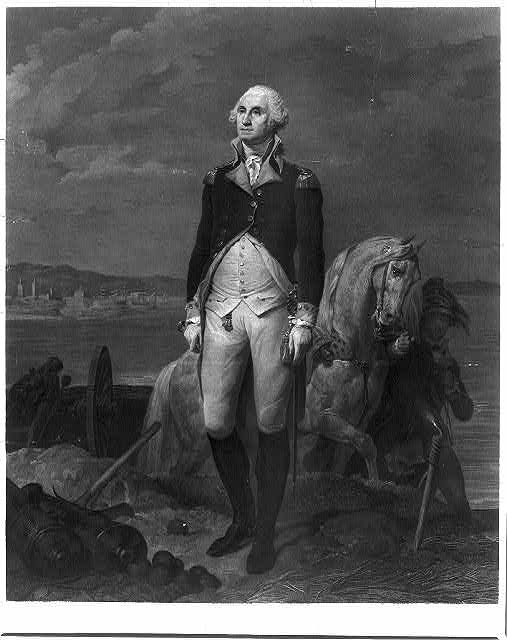
Here is a mish-mash of quotes, excerpts, etc.
Gouverneur Morris said, upon the death of this great man:
It is a question, previous to the first meeting, what course shall be pursued. Men of decided temper, who, devoted to the public, overlooked prudential considerations, thought a form of government should be framed entirely new. But cautious men, with whom popularity was an object, deemed it fit to consult and comply with the wishes of the people. AMERICANS! -- let the opinion then delivered by the greatest and best of men, be ever present to your remembrance. He was collected within himself. His countenance had more than usual solemnity -- His eye was fixed, and seemed to look into futurity. 'It is (said he)too probable that no plan we propose will be adopted. Perhaps another dreadful conflict is to be sustained. If to please the people, we offer what we ourselves disapprove, how can we afterwards defend our work? Let us raise a standard to which the wise and the honest can repair. The event is in the hand of God.'--this was the patriot voice of WASHINGTON; and this the constant tenor of his conduct.
George Washington is the standard-bearer - as much as he probably would not have wanted that role. But we cannot choose our own destiny. Destiny chose him. He was a deeply private man - perhaps the most private of all of our Founding Fathers. Adams and Jefferson always waxed rhapsodic about how much they wanted to "retire" and be simple farmers again - they had the pastoral fantasy that most men had at that time. And yet - once they were home, wandering through the turnip fields or whatever, they were always firing off letters to those in the thick of things, trying to keep up to date, manipulate events, and it was rare that the retirements "stuck". Adams and Jefferson, much more than Washington, were truly political animals. But Washington - when you read biographies of him, or you read his letters - you truly get the sense that he was very reluctantly a public man. Once he realized his duty - he did it - without much complaining - but he paid an enormous price, in terms of his personal life. He sacrificed his personal happiness for the good of the country. He knew he could not turn down the role that Destiny offered him. He may have yearned for Mount Vernon ... but it was not up to HIM to say: "You know what? This whole Leadership thing is not for me." I deeply admire him for that (and for many other things - but mainly for that). The union of this new nation was, for a while, tied up in the figure of George Washington. He was a symbolic figure DURING his lifetime. It was hard for him to accept that - he wasn't into all of that - There's that great story of Napoleon saying, in regards to Washington, "Has he crowned himself yet?" I am paraphrasing - but Napoleon was SHOCKED that Washington, with all he accomplished, did not just elect himself Leader of the new country. After all, that's what Napoleon would have done (and did!)
When George Washington was elected (unanimously) by the First Continental Congress to be Commander in Chief (this was in June, 1775) - here was the brief acceptance he made:
"Lest some unlucky event should happen unfavorable to my reputation, I beg it may be remembered by every gentleman in the room, that I this day declare, with the utmost sincerity, I do not think myself equal to the command."
On June 18, 1775, Washington sat down and wrote the following to his wife, Martha:
My Dearest: I now sit down to write to you on a subject which fills me with inexpressible concern, and this concern is greatly aggravated and increased when I reflect upon the uneasiness I know it will give you. It has been determined in Congress that the whole army raised for the defence of the American cause shall be put under my care, and that it is necessary for me to proceed immediately to Boston to take upon me the command of it.You may believe me, my dear Patsy, when I assure you, in the most solemn manner, that, so far from seeking this appointment, I have used every endeavour in my power to avoid it, not only from my unwillingness to part with you and the family, but from a consciousness of its being a trust too great for my capacity, and that I should enjoy more real happiness in one month with you at home than I have the most distant prospect of finding abroad, if my stay were to be seven times seven years.
But as it has been a kind of destiny that has thrown me upon this service, I shall hope that my undertaking is designed to answer some good purpose.
I sometimes get the sense with Adams and Jefferson that their yearning for their respective homes was a bit of a pose. Men at that time were not supposed to want power. But I never quite believe either of them when they say (over and over and over again): "I just want to be a private man - home with my garden and my wife ..." Yeah, boys, we got it. You want to go home. Then why don't you, hmmmmm?? Methinks you would perish if you weren't at the center of events, but who am I to talk.
But with Washington I never get the sense that that was a pose. He truly could not stand being away from his home. And yet his sense of duty overrode his personal concerns.
Abigail Adams first met Washington in 1774, and wrote to her husband:
You had prepared me to entertain a favorable opinion of him, but I thought the half was not told me. Dignity with ease and complacency, the gentleman and the soldier look agreeably blended in him. Modesty marks every line and feature of his face.
Here's something Washington said which I have pondered often - we are so fortunate to have had such a GROUP of men at our beginnings as a nation - If we had had only ONE of them we would have been in trouble. But all together as a group? Powerful.
Men may speculate as they will, they may talk of patriotism; they may draw a few examples from current story - but whoever builds upon it as a sufficient basis for conducting a long and bloody war will find themselves deceived in the end - For a long time it may of itself push men to action, to bear much, to encounter difficulties, but it will not endure unassisted by Interest.
A-frickin-men, George.
Now THAT is a practical mindset. His whole involvement in the Revolutionary cause began because of practical concerns. He was a farmer, a plantation owner - and the British sapped him dry with taxes, and levies, and limitations on where he could purchase things. He began a course, very early on, of trying to become self-sufficient, separating himself from the British economically - the stories of what he did, how he adjusted his farming practices, etc. - are fascinating. He wasn't all fired up with passion, or "Let's blow the bastards up!" He, as a personal private man, a landowner, felt hampered by the British, and they were directly affecting HIM and his INCOME. That was where it began for George Washington. Not some lofty Jeffersonian phrase about the "pursuit of happiness" (although God bless Jefferson for that.) Pursuit of happiness my EYE - how about those taxes??
On November 25, 1783: George Washington "took back" New York.
The peace treaty had been signed a year before, France had pledged support and recognition of the new United States, but the redcoats remained in New York, waiting for their written orders from London. George Washington vowed that he would not go home, he would not break up his army, until every last redcoat had left.
Nov. 25 was that momentous day - the day the American troops marched back into town, after the departure of the British.
The exhausted army marched the long way downtown, through what was now a war-ravaged New York City. People lined the streets, throwing laurels in front of Washington's horse, screaming, crying ... a huge display of emotion and reverence that made the typically humble Washington feel uncomfortable.
A woman in the crowd that day wrote the following in her diary:
We had been accustomed for a long time to military display in all the finish and finery of [British] garrison life. The troops just leaving us were as if equipped for a show and with their scarlet uniforms and burnished arms made a brilliant display. The troops that marched in, on the contrary, were ill-clad and weather-beaten and made a forlorn appearance. But then, they were our troops and as I looked at them and thought upon all they had done and suffered for us, my heart and my eyes were full.
George Washington wrote the following on the eve of his inauguration in 1789:
It is said that every man has his portion of ambition. I may have mine, I suppose, as well as the rest, but if I know my own heart, my ambition would not lead me into public life; my only ambition is to do my duty in this world as well as I am capable of performing it, and to merit the good opinion of all good men.
The following story may be just a rumor handed down over the years, but it is one of my favorites. Franklin was in France, and word came to France of the decisive (and shocking) American victory (1781). Franklin attended a diplomatic dinner shortly thereafter - and, of course, everyone was discussing the defeat of the British, and the victory of America.
The French foreign minister stood, and toasted Louis XVI, "To his Majesty, Louis the Sixteenth, who, like the moon, fills the earth with a soft, benevolent glow."
The British ambassador rose and said, "To George the Third, who, like the sun at noonday, spreads his light and illumines the world."
Franklin rose (reportedly) and countered, "I cannot give you the sun or the moon, but I give you George Washington, General of the armies of the United States, who, like Joshua of old, commanded both the sun and the moon to stand still, and both obeyed."
George Washington's last words were, apparently:
"I feel myself going. I thank you for your attentions; but I pray you to take no more trouble about me. Let me go off quietly. I cannot last long."
For me - the most telling part of that, the most revealing is: "I thank you for your attentions; but I pray you to take no more trouble about me."
How very ... Washington-ish of him.
Diary Friday
Christmas of my junior year in high school.
DECEMBER 24
[Beside the date, I have written a star with emanating beams coming out of it. Bethlehem, etc.]Finally I am getting into the Christmas spirit. I've been a drip these past few days. When we decorated our tree, I just couldn't get into it. [Ah, adolescence] I haven't been "into it" until today. I feel so excited. Tomorrow is Christmas!
And Diary, I swear. It is a blizzard outside. There's more than an inch of snow! Today I went over Mere's. The minute I stepped out of the car I was pelted madly with snowballs from all sides. They all exploded in my ears. I just stood there. I must have looked pretty pitiful just standing there, face like an albino, because all of a sudden I was surrounded by Mere, Jayne and Dolores -
Oh my God it is snowing so hard! I can hardly see the trees outside and everything across the street is covered in a veil of snow. Wow!
Anyway, all of them cooing "Ooohhh!" they took me into the house where Jayne gave me her presents. One was this lavendar stationary sprinkled with little purple stars and in one corner is this golden moon with a profile - it's so pretty! lNow I don't have to write her letters to her on ugly yellow-lined paper and - Diary - are you sitting? [Can a diary sit?] - a lifesize poster of The Police. It's gorgeous! I can't wait to hang it up.
After that, we all trooped outside where we commenced what turned out to be an hour long snowball fight. Me and Jayne against Mere and Dolores. I am awful in snowball fights but it was so fun! Dolores once slipped and fell - splat - face forward into the snow. I doubt I've laughed that hard in a long time - it will be a timeless image. Then we switched partners - Me and Mere against Jayne and Dolores. It was so fun. Mere and I would huddle in conspiracy - in the end, we surrendered. Mere had been hit in the ear 3 times!
We went inside. I could not feel my toes. Mere ran around to get slippers for everyone. It was so cozy. Mrs. W. made us all chicken and star soup. I kept staring out the window. It was coming down so thickly! It was then that I started feeling Christmasy and all toasty warm inside.
See, every Christmas Eve there's a gathering on the D's lawn - all these families come, everyone sings Christmas carols - then Santa comes and hands out presents. After that, everyone goes into the D's for food. Chicken wings, pizza, crackers, dip - The Hodges are always there. Anyway, I got home - it was madly blizzarding outside. We all bundled up and went to the D's. Already it was dark, but God it was freezing. I mean, biting chilling cold with a sharp wind blowing little icy bits - Santa was late, so the whole circle was jumping up and down, chattering out carols. It was so nice - just a little group of people under the starry sky in the snow - if only it hadn't been so freezing! Finally Santa arrived, all red and white - he sat in the chair to give out gifts. He took so long [Damn that Santa!] Everyone was so cold. I felt mildly ridiculous as I walked up to get my gift. I mean, I was the oldest one there. After Katy and I got our presents, we both ran into the house. I immediately changed into my hightops. My present was one of those magic 8-balls - they were quite the fad a million years ago. I didn't know they were still manufactured! Of course, Kate and I sat around it asking it, "Does David love Sheila? Will he dance with her?" Etc. More than half the answers came out: Most definitely No.
Maybe I should ponder this over. [Yeah, I'm thinkin' you should.]
Then we came home. We always exchange the family gifts Christmas Eve - the ones the kids have bought for each other and Mum and Dad. I couldn't WAIT to see everyone open their presents. Oh yeah, I got Brendan his much desired hockey puck. He really wanted one. I love my family. I love everyone so much. I hope they can tell, even though I don't show it. [Uhm ....... Sheila? Maybe you should, uhm, show it? Just a suggestion] Mum says she can tell but I sure don't give her much to go by. And Dad. I'm getting misty-eyed now just thinking about him.
Brendan. Brendan and me have gotten so close thse past few months. I have the most hysterical brother in the world. Whatever he does now makes me laugh. Brendan gave me a little box with a painting on it that looks to me like a Renoir. Everyone knows I love little knick-knacks. And his card! Okay, last night: I honestly thought I was going to vomit I was laughing so hard. I had to run from Brendan to escape. Okay, there's this really stupid show on called Boone, about a country farm boy in the 50s who wants to be a rock singer. Really really stupid. Brendan spent about an hour making fun of it. He's like, "Everyone's so stereo-typed. The stern but righteous father. All he ever says is, 'Boone ------ go to school.' It's like, 'Oh, Dad, I'm in trouble! What do I do?' 'Go to school.'" But the funniest thing is - before a commercial break - they always say "Boone will continue in a moment" and they show a picture of Boone - he's playing his guitar - and then they freeze him as he finishes in this Elvis pose. Brendan kept imitating that pose until I thought I was going to die from laughing so hard. I went to the bathroom at one point, and when I came out Brendan was standing right there in the doorway - in the Elvis pose. My Lord, I never thought something would ever strike me that funny. And - Brendan said, "Also, why did they name him Boone? They should have named him Beaver. Leave it to Boone." When he said "Leave it to Boone", that was the breaking point for me - I ran up the stairs to my room laughing so hard I thought my lungs would burn up - and Brendan was chasing me, doing the Elvis pose on each step.
So. That's the preface. Brendan's card is a hand-drawn picture of Boone: loafers, rolled-up jeans, Argyle sweater, guitar - in the Elvis pose - and he's saying, "Leave it to me!" I am hanging it on my wall.
Siobhan gave me a little metal box with a painting of a huge mansion on it - it looks like the Brideshead Revisited house. Jean gave me a beautiful painted parrot. Siobhan is so so so cute. I gave those two some stickers - they're both in the midst of sticker mania - they have sticker collections and sticker books - I loved loved loved seeing Siobhan's cute little face light up when she opened hers. She was smiling as she spread them all out to look at each one - she said, "Thank you, Sheila!" but it wasn't in a "dutiful" way and I felt so warm and happy inside. The same when Jean opened hers.
And when Mum and Dad opened theirs!! This is the first year I've had enough money to buy them things so I was really psyched. And I was worried because Mum doesn't like me to spent money on her [which is so hysterical, considering my gift for her probably cost 10 bucks - IF THAT] but I wanted to. Mum opened hers first - she has laryngitis now and can only croak to be heard. But she started taking out the tissue and she smiled her "Mum" smile [I'm in tears right now as I type this] and croaked, "It seems to have a handle!" Then she took out her mug and her jaw just fell - her mug looked so beautiful to me. I think she was really happy. She admired it and kissed me. Dad's present was exactly the same size so he was saying, "Hmm, I wonder what it could be!" He really liked his too. He said, "You know, I really do need one!" [More tears. God bless parents.] Dad said, "It seems like we're the only family who doesn't have a nice supply of mugs." Mum croaked, "Yes, we have to do with tin baby cups and plastic Red Sox glasses." Immediately, Mum went out to pour coffee in both of them - Dad kept looking at the paintings on his mug - I think they really did like that.
Oh, I'd love to be a professional gift-giver! I love it so much!!! I like it better than getting!
I'd better go to bed now or Santa's not goign to come.
Oh yeah, wait - I was a little 'worried' (if that's the word) that Siobhan didn't believe in Santa. She's so grown-up in most other ways and I want her to believe in him as long as she can. I believed in him until I was about 10!! [Yeah, well, you're retarded.] Anyway, suddenly when we were all sitting happily with our gifts, Siobhan stood up - looking really worried and said, palms outstretched, "There are so many presents under the tree." (Ones from relatives/godparents) "How is Santa gonna fit anymore?" Oh, I wanted to run over to her and squeeze and squeeze her!
We put out milk and cookies of course and she was so eager, rushing around in her feety pajamas, arranging the plate on the mantle.
Oh, she's too cute for words! YAY!!
Thank you, God, Thank you for blessing me. I keep trying to be worthy of your love. I hope someday I can be!!
The Books: "Dubliners" - 'Counterparts' (James Joyce)
Next book on my adult fiction shelves:
Dubliners - by James Joyce - excerpt from the ninth story in the collection: "Counterparts".
Wow, this story makes me uncomfortable to read. The part of me that hates the thought that I am in "trouble", that I have made a mistake, that someone doesn't like me ... all of that is stirred up when I read "Counterparts". Farrington, the lead character, is not at all sympathetic - and the story ends with him beating his child, who screams in fear - so no, I don't like Farrington ... but still, his predicament, his problem is one that is quite human, one we all share. He has been blunted down by the disappointmens of life - which put him into a state of nearly-constant smouldering rage ... and also, there's the drink. Joyce is sooooo good at suggesting Farrington's need for alcohol. Farrington's "thirst". It's not just something Farrington likes to do, or wants to do. It's something he cannot resist. And things go wrong because of it ... he is messing up ROYALLY because of his "thirst" ... but still, the thirst remains. Also where Joyce is wonderful is in suggesting that Farrington has turned drinking into this romantic undertaking - that has very little to do with reality. It's like Farrington thinks of a drink - and he sees a warm pub, and loud voices, the clink of glasses, camaraderie ... THAT is what he yearns for the most. Perhaps we could call it connection with his fellow man. But every time he does go and get an ACTUAL drink in the story - it is never like what he sees in his imagination. He has no money. He has already tapped out the bartenders, who have very little patience for him. And so he is perpetually disappointed in his search. He keeps looking for something ... that glow, that warm glow he remembers ... not realizing that it's already gone too far for him to find that glow ever again.
Farrington works as a clerk, copying out documents. He is bad at his job. The story opens with him being in trouble with the boss. Farrington cannot set his nose to any task ... because the spectre of that night's drinking binge looms in his head, a fantastic and beckoning castle ... and so he can never concentrate properly. You can tell that this is a theme, because everyone is already angry with him when the story begins.
He has to finish a certain document by 5. He only has an hour until 5 ... but the need for a drink becomes so acute that he pops out of the office to the pub and has a quick drink. Which, naturally, doesn't help at all - and only makes him even more behind in his work.
He goes out with a bunch of men after work - they drink - Farrington has money issues - he pawned his watch in order to have enough for drinks that night ... there's drunkenness ... there's an arm-wrestling match that Farrington loses, and he can't let it go ...
Farrington is a beaten dog. A growling beaten dog. He goes home to an empty cold house. Where is his wife? She stepped out to church. His son goes to warm up some dinner for him - and Farrington - already in a rage about EVERYTHING - goes after his son with his belt. The story ends with the son pleading with his father not to beat him, and that he will say a "Hail Mary" if only his father won't beat him ...
A violent and bleak story. Unlike the other stories leading up to this one, there is no possibility of escape for Farrington. He doesn't dream of Argentina or America or London. He can't. He can barely get through the day. His escape is in the bottle.
One other thing I noticed: All of the names of the people in the office - Farrington's boss and higher-ups - Crosby, Higgins, Miss Parker - are all distinctly British. Farrington goes out to a pub, and a very fashionable lady whom he had been admiring from afar, brushes by his chair, and says "Pardon" in a noticeably "London" accent. Farrington's drinking buddies - O'Halloran, Nosey Flynn, etc. - are almost caricatures of Irish names. As Farrington staggers drunkenly through Dublin, he passes by the British army barracks in the middle of the city. Joyce does not pull his punches - although the clues may be subtle, and noticeable only to those who are looking for them. Ireland, in this story, feels like an occupied country. Farrington's boss is British. The lady he admires in the pub is British. The British are everywhere. Again, Joyce doesn't ever made a big obvious deal over this. It's all in the NAMES. Joyce puts the blame firmly on the shoulders of the British - of what has happened to Ireland and Irish men.
And let's not forget the Catholic Church either which certainly does not escape the condemnation of James Joyce. Farrington comes home, drunk, angry. His wife is out at church. He beats his son, who offers up a Hail Mary in order to get the beating to stop. Joyce sure isn't parroting the line, "Oh, look what a solace our faith is to us." Faith is useless to that little boy. The church is useless to its people, who suffer under occupation, and have no way out. Joyce left the faith, obviously (and one of the ways Nora threatened him - when it seemed like he would never return to her in Trieste - was to tell him she was going to baptise their son Giorgio. Joyce came home right-quick. Don't you DARE baptise our son!) - and Portrait of the Artist goes into this in a much more detailed manner - where Stephen Dedalus must shed the influences of country, religion, language, family - in order to become an artist. The whole Catholic chapter is one of my favorites in that extraordinary book, but I'll get to that later.
Here's an excerpt. I wanted to choose an excerpt that showed Farrington's yearning for a drink and how Joyce writes about that. Here it is.
EXCERPT FROM Dubliners - by James Joyce - "Counterparts".
The man returned to the lower office and sat down again at his desk. He stared intently at the incomplete phrase: In no case shall the said Bernard Bodley be ... and thought how strange it was that the last three words began with the same letter. The chief clerk began to hurry Miss Parker, saying she would never have the letters typed in time for post. The man listened to the clicking of the machine for a few minutes and then set to work to finish his copy. But his head was not clear and his mind wandered away to the glare and rattle of the public-house. It was a night for hot punches. He struggled on with his copy, but when the clock struck five he had still fourteen pages to write. Blast it! He couldn't finish it in time. He longed to execrate aloud, to bring his fist down on something violently. He was so enraged that he wrote Bernard Bernard instead of Bernard Bodley and had to begin again on a clean sheet.
He felt strong enough to clear out the whole office singlehanded. His body ached to do something, to rush out and revel in violence. All the indignities of his life enraged him ... Could he ask the cashier privately for an advance? No, the cashier was no good, no damn good: he wouldn't give an advance ... He knew where he would meet the boys: Leonard and O'Halloran and Nosey Flynn. The barometer of his emotional nature was set for a spell of riot.
His imagination had so abstracted him that his name was called twice before he answered Mr. Alleyn and Miss Delacour were standing outside the counter and all the clerks had turned round in anticipation of something. The man got up from his desk. Mr. Alleyne began a tirade of abuse, saying that two letters were missing. The man answered that he knew nothing about them, that he had made a faithful copy. The tirade continued.. It was so bitter and violent that the man could hardly restrain his fist from descending upon the head of the manikin before him.
-- I know nothing about any other two letters, he said stupidly.
-- You -- know -- nothing. Of course you know nothing, said Mr. Alleyne. Tell me, he added, glancing first for approval to the lady beside him, do you take me for a fool? Do you think me an utter fool?
The man glanced from the lady's face to the little egg-shaped head and back again; and, almost before he was aware of it, his tongue had found a felicitous moment:
-- I don't think, sir, he said, that that's a fair question to put to me.
There was a pause in the very breathing of the clerks. Everyone was astounded (the author of the witticism no less than his neighbours) and Miss Delacour, who was a stout amiable person, began to smile broadly. Mr. Alleyne flushed to the hue of a wild rose and his mouth twitched with a dwarf's passion. He shook his fist in the man's face till it seemed to vibrate like the knob of some electric machine:
-- You impertinent ruffian! You impertinent ruffian! I'll make short work of you! Wait till you see! You'll apologise to me for your impertinence or you'll quit the office instanter! You'll quit this, I'm telling you, or you'll apologise to me!
December 13, 2007
By the Lake (or: That They May Face the Rising Sun) - by John McGahern
 John McGahern will probably be most remembered for Amongst Women, a novel that ranks up there with one of the best books I have ever read. He died last year (here's what I wrote about him then), and his last novel is called (at least in the States) By the Lake. The rhythm of it is slow, pre-modern almost. There's a mention of a television in one scene, and I felt a jolt - having forgotten about the existence of television for a bit while reading it. McGahern was always known as a rural writer. His landscape was rural Ireland, and the quiet lives lived there. Quiet, but intense. There is no real story in By the Lake, no plot, no big finishes, no climactic moments. It is the story of a group of people in a town in Ireland, who live around a lake. They are mostly in their 50s, 60s - approaching retirement. It's a rural community, many of the folks are still primarily farmers - but the modern world impinges. Some of them have freelance writing jobs, and have to fly to London for interviews. All of them have children who have moved on, who live in cities elsewhere. We meet them, we gossip with them, we watch the seasons change. It's a slow story (with sudden searing moments of realization), it's a slow stroll around the shores of the lake ... through summer, fall, winter, spring. Things happen. John Quinn gets married. His wife leaves him after one day. Brou-haha ensues. The Shah (a fascinating character - excerpt here) decides to finally sell his very successful business to his silent partner, Frank Dolan. A sign that perhaps mortality approaches. Everyone wonders how the Shah will feel - when he is not in charge?? Jimmy Joe McKiernan is the resident political in the town. He did time in Long Kesh, was on hunger strike. He passes out copies of An Phoblacht to townsfolk. He owns a bar, and 2 detectives sit outside it - all day, every day. Just in case. The violence of the North seems so far removed from the simple quiet life lived on these farms, and Ruttledge - who is probably the main character, if there has to be a main character - does not approve of violence, and does not approve of the aims of the IRA, the Provisionals or anyone else. In another book there would be perhaps a confrontation, a big one, between these two Irelands. The ones in the South who think, "Look, the North has to work out their own problems ... leave us out of it." And the ones in the South who think, "As long as our brethren up there are not free, then none of us are free." These are two very real currents in Irish life, and it's brushed upon in the book - but gently, easily ... as just another bit of the picture. It's not the main event. It's the main event to Jimmy Joe McKiernan, but not to Ruttledge. When the two men find themselves alone together near the end of the book - their conversation, as it is rendered by McGahern, is a masterpiece. I wish I could write that well.
Other things happen. Jamesie, the town gossip, and his wife Mary - worry about their aimless son Johnny - who has moved to London and appears to have become a bum. They get so nervous on his visits home that they barely enjoy seeing him. Patrick Ryan, the sleek almost malevolent handyman - travels around the country, job to job, leaving his farm at home to go to riot. He offers to help build a shed for Ruttledge, and it has stood half unfinished for a year now, maybe more. They keep saying they're going to get to it. And etc.
There is so much more - details, stories told, you get to know the rhythms of the auctions - how the cattle is sold, the competition between neighbors in regards to their livestock, how contemptuous the dealers are when they realize Jamesie's sheep have not just been raised for slaughter, but pampered and loved. It makes their job harder if the sheep have expectations of KINDNESS. "Fuckin' pets," growl the dealers.
I knew going into the book that it was plot-less. My dad had raved about it to me - he's a huge McGahern fan. McGahern spent most of his life, as a writer, very little known outside of his native Ireland- although he's a huge favorite there, and any book compiled by Irish newspapers surveying Irish people about their favorite authors - John McGahern always tops the list. Amongst Women was an international success (my God, what a book) - and By the Lake was as well. He began to be known on a wider scale just at the end of his life. Here's a post I wrote about him - with some good links, and good excerpts from other people about him.
Since I knew going in not to expect any big plot or story - I didn't spend the book waiting for something to happen. Just relax. Relax. Get into the time-span of these people. Leave your own. I love it that Jamesie and Mary's house are filled with clocks that all tell the wrong time, and are always bonging out the time at the incorrect hour. At the end of the book, after they have both suffered a grievous loss - they get the clocks fixed. There's a marvelous scene with a clockmaker - a guy in crutches, who sounds like he has cerebral palsy - who obviously takes great pride in his work, in a gentle specfic way - recognizes that the clocks they own are antiques, works of art ... and promises them he will get them all in sync. Jamesie, Mary, Ruttledge and Kate sit in the kitchen and listen, quietly, as all the clocks go off at the same time. Because of how McGahern has slowly set up this world, and has slowed US down - as audience members ... it is a truly profound moment.
By the Lake was originally published in Great Britain with the name That They May Face the Rising Sun, a superior title if you ask me. By the Lake could be anything although it also fits the book... The lake is another character in the novel, its moods, how it informs the characters, how they love it, feel trapped by it ... whatever. But That They May Face the Rising Sun is a goosebump worthy title. By the Lake is descriptive. That They May Face the Rising Sun is majestic, poetic, and speaks to a more universal truth. It cuts deeper into the heart of what McGahern was writing about, and it doesn't become clear until the last 30 pages why that is the title. So McGahern makes you wait, for clarity. He makes you wait to realize why the book is called that. And it comes out in one sentence. One sentence. Spoken over a freshly dug grave by Patrick Ryan. "That they may face the rising sun."
Magnificent.
I understand titles are often changed, for different audiences and sensibilities. It makes sense, I don't have an opinion about it one way or the other.
But in this particular case, I hope the American publishers will not mind if I join the readers across the pond, and call it That They May Face the Rising Sun. It elevates the book, transcends it ... after pages of farming and carpentry and glasses of whiskey after Mass and time passing and things happening or not happening ... life is passing, life is passing, that is all ... after all of that: Resurrection.
Because the rest of the book is so down to earth - (and isn't so much of our lives down to earth? We do laundry, we have drinks with friends, we shovel snow) - so prosaic and realistic ... such a sudden vision of transcendence slices right through you. Like the ending of Our Town when Emily realizes her life has passed ... and it is only now that it is over that she can really love it.
Wonderful book. I will miss reading it. My life has been intense this past month, with outside events and crises - I feel ragged, forgetful, am prone to crying jags, and have started oversleeping (a truly bizarre development, and can only be attributed to anxiety) ... With all of that going on, I have loved visiting That They May Face the Rising Sun every day, even in its saddest moments. I have loved slowing my steps down to match the pace of that world John McGahern so beautifully described.
Christmas Carol:
A guided tour. Wonderful observations, I love the point about feeling Dickens' need to keep going, (in regards to the briefly mentioned detail about Marley's gaping lolling jaw - a detail not referenced again). God, he was good. And the quote about seeing him perform brought tears to my eyes.
Snow
It's snowing here! Woke up to the crackle of falling bits of ice against my window. Kinda beautiful.
Six Martinis has continued with images of snow, screenshots from films - and other images. I find the whole thing beautiful, love checking in and reveling in the images.
... and much much more!
Vista
Like the edge of the earth.

We are driving away from Dean Stockwell. It's a sad moment for me. How can I separate myself from him?? How can I BEAR it?
But look at that sky!
Do you think I scared Dean Stockwell, looking - as I do here in this photo I took before we left for his exhibit - like a Unabomber wannabe?

Sheila: "Yo. Dean-o. Love your work, bro."
Dean: "Stay away from me, please. You scare me."
The Books: "Dubliners" - 'A Little Cloud' (James Joyce)
Next book on my adult fiction shelves:
Dubliners - by James Joyce - excerpt from the eighth story in the collection: "A Little Cloud".
One of the most suffocating and overtly miserable stories in the collection. Even I, the reader, feels suffocated - because Little Chandler, the "hero" of this story is kind of a pathetic chap, you can immediately see he's full of illusions (delusions) that have no basis in reality - and it's hard to get behind him, and root for him. Because you know it's hopeless. Not just because Dublin offers nothing to its people - and Chandler can't have the life he wants THERE, he would have to leave. But because Little Chandler himself is a timid unimaginative kind of silly man ... and having a life of greatness and interest and romance is not in the cards for him. Even if he lived in Paris and went to the Moulin Rouge every night. His constitution, his emotional makeup - is that of a deeply conventional fearful cautious person. That's the deal, Chandler. You are never going to frolic with dancers in Berlin, you are never going to publish a book of poetry that will get mild critical acclaim. Nope. Not because you are not worthy ... but because you don't have it in you. You just don't.
So reading the story is kind of unpleasant. It has some of my favorite writing in it, in the collection.
Little Chandler is 32. He lives in Dublin with his wife and baby. He is an uptight rigid conservative guy - who also has a dreamy streak, or maybe it would be best to call it a rebellious streak. He bucks against the limitations of his life and wonders if there is anything more. Who is he? Does he have anything to offer the world? He loves poetry. His wife doesn't like it. So he reads poetry by himself. He wonders if he could ever write a poem? But he's so bound by convention he can't see himself out of the dead end.
An old friend, Gallaher, had gone to London 8 years before - had fled Ireland under shady monetary circumstances. But now he has returned for a visit, all flushed with success. He's a journalist, and comes back - all BMOC. Little Chandler meets up with him at a bar - the kind of bar frequented by the elite of Dublin, a place Little Chandler feels intimidated. Chandler is a bit of a priss, much is made (by Joyce) about his neatness, his little teeth, his neat fingernails, his combed mustache ... He doesn't drink all that much. He is easily shocked by things. He meets up with Gallaher - who is doing a big show of how great it is to be back, but also bragging about the fleshpots of Europe, and bragging about Paris, etc. He seems to echo Little Chandler's nagging suspicion that in order to do anything with your life you must leave Ireland.
However - in this story - unlike the stories preceding it, where leaving Ireland is seen in a purely romantic (and also necessary) way - 'A Little Cloud', for the first time in the collection, raises the possibility that maybe leaving Ireland is NOT the only answer. Or - maybe when you leave Ireland, life is NOT automatically better and happier and more successful. Because Gallaher does seem happier and freer - but he's also rude, and braggadocious, and ... completely unlikable. So ... leaving Ireland did not transform him into some elegant gentleman - the way Chandler would imagine ... The bad qualities of Gallaher which were already apparent 8 years before have just intensified in his exile. Joyce is starting to move away from the earlier stories of the collection - where the outlook is mainly from a child/adolescent narrator - who looks at the ships in the quays and automatically assumes that everyone on them is happier than those in Ireland - because they don't live there, they get to leave. Places like America and Norway are suffused with romance and glow in the earlier stories ... but now, here, in 'A Little Cloud' - we are in adulthood, we are now faced with the fact that having such illusions (delusions) about leaving Ireland is babyish. What seems to matter, in the end, for all of us - is character. Do you have it, or do you not? What do you want? How do you make something of your life, regardless of where you live?
Chandler leaves his encounter with Gallaher, all worked up and nervous. He feels trapped. He goes home, and takes care of his crying baby while his wife steps out - and he's all twisted up in his head. He tries to recite some Byron, but the wailing baby interrupts his mood. Then, for the first time, we feel rage coming up in Chandler. He wonders why he married his wife - a prim little prissy woman (very much like himself). He thinks about the slutty women Gallaher bragged about - the German women, Jewish women - and wonders why he chose such a rigid little lady. (Dude, you couldn't handle a free-spirited woman if you tried!) His wife comes home, and sees the crying baby - and immediately blames her husband for it. "What did you do?" She scoops up the baby - completely cutting him out of the picture ... and Chandler is perceptive enough to have seen the hatred in her eyes, in that small moment. He is ashamed, remorseful, full of longing, sadness ... and that is how the story ends.
Good times, good times.
There's an echo here of what happened in 'After the Race' (excerpt here - where Jimmy gets swindled at a card game by a bunch of sophisticated Europeans. Jimmy is out of his league. He wants to be sophisticated, he feels better about himself because he is hanging out with Europeans as opposed to Irishmen - he thinks that makes him better than others. But we can see, as readers, that just because these folks are European - they aren't necessarily "better". They're more jaded, perhaps more carefree ... but not being from Ireland is not necessarily the be-all end-all of existence. Joyce begins to hint in that story that the problem might NOT be Ireland itself, but something else - something more individual, personal.
He brings that to fruition in 'A Little Cloud'. Gallaher is an asshole. It doesn't matter that he's lived abroad. And Little Chandler is a prude who has to walk the straight and narrow, and sadly - dreams of being a poetic romantic soul. Never gonna happen, Chandler. Doesn't matter if you change your geographical setting. You're still gonna be a little bore. It ain't IRELAND holding you down, bub.
Oh, and naturally: Joyce writes about Chandler with insight and compassion. He doesn't have contempt for him. He SEES him.
Here's an excerpt. Chandler is walking thru Dublin to meet Gallaher. Thoughts begin to emerge ... things bubbling up.
EXCERPT FROM Dubliners - by James Joyce - "A Little Cloud".
Little Chandler quickened his pace. For the first time in his life he felt himself superior to the people he passed. For the first time his soul revolted against the dull inelegance of Capel Street. There was no doubt about it: if you wanted to succeed you had to go away. You could do nothing in Dublin. As he crossed Grattan Bridge he looked down the river towards the lower quays and pitied the poor stunted houses. They seemed to him a band of tramps, huddled together along the river-banks, their old coats covered with dust and soot, stupefied by the panorama of sunset and waiting for the first chill of night to bid them arise, shake themselves and begone. He wondered whether he could write a poem to express his idea. Perhaps Gallaher might be able to get it into some London paper for him. Could he write something original? He was not sure what idea he wished to express but the thought that a poetic moment had touched him took life within him like an infant hope. He stepped onward bravely.
Every step brought him nearer to London, farther from his own sober inartistic life. A light began to tremble on the horizon of his mind. He was not so old - thirty-two. His temperament might be said to be just at the point of maturity. There were so many different moods and impressions that he wished to express in verse. He felt them within him. He tried to weigh his soul to see if it was a poet's soul. Melancholy was the dominant note of his temperament, he thought, but it was a melancholy tempered by recurrences of faith and resignation and simple joy. If he could give expression to it in a book of poems perhaps men would listen. He would never be popular: he saw that. He could not sway the crowd but he might appeal to a little circle of kindred minds. The English critics, perhaps, would recognise him as one of the Celtic school by reason of the melancholy tone of his poems; besides that, he would put in allusions. He began to invent sentences and phrases from the notices which his book would get. Mr Chandler has the gift of easy and graceful verse ... A wistful sadness pervades these poems ... The Celtic note. It was a pity his name was not more Irish-looking. Perhaps it would be better to insert his mother's name before the surname: Thomas Malone Chandler, or better still. T. Malone Chandler. He would speak to Gallaher about it.
He pursued his revery so ardently that he passed his street and had to turn back. As he came near Corless's his former agitation began to overmaster him and he halted before the door in indecision. Finally he opened the door and entered.
Man, it's true, isn't it?
... that "quack-quack is just sloppy"?
"Quack-quack is just sloppy" is a universal truth.
Can't stop laughing about that story.
December 12, 2007
What the Internet is ...
... and what it can do.
Trish writes to an anonymous visitor to her site,"You’re not alone. I’ve been there." She writes that to the visitor based only on the search term that she saw in her traffic report. She has no idea if the visitor stayed - the visitor had not left a comment. But Trish saw the Search term, and posted THAT to the person out there in the wilderness, who had come to her site ... looking for something ... hope, connection, information, solidarity, understanding.
Just sit for a second and contemplate how amazing that is. Yes, it's amazing, too, that the "anonymous visitor" eventually identifies herself in the comments section - but even before that: to say to someone you have never met, and may never meet, "You're not alone. I've been there."
THAT is the Internet at its best.
Actually, screw the Internet. That is humanity at its very best.
Thank you, Trish. For your example.
Life-size icon in a white dress
Marilyn Monroe. Nice commentary - also cool photo, huh? I love that weird hand-chair right next to her.
Relevant clip from Seven Year Itch below:
I find Seven Year Itch rather nasty, actually - and it makes me feel uncomfortable to watch it. Like I feel uncomfortable at the vicious homophobia in Adam's Rib, or the little tap-dancing black children in Affair to Remember. I just have to murmur to myself, "Different time, different time ..." and enjoy the movie anyway. Seven Year Itch has a twisted sexual psychology to it - a hatred of HER, in particular - which makes me sad and angry - but Marilyn comes out of it smelling like a rose, even though the movie seems determined to humiliate her.
It's not like Some Like It Hot which shows off her sexiness in a more fun-loving way, not so hateful ... Yes, she's babealicious in a way that could sink ships and make men crash their cars. I'm not saying to treat her like she's NORMAL ... she obviously isn't ... but don't try to humiliate that lovely shining creature. Just kneel down in worship, and submit. That's all you can do.
In Seven Year Itch she slips from from the grasping fingers of the nasty-minded people who want to shame her, who look eagerly at her face waiting to see her defeat - and gives a charming sweet innocent performance anyway. That's guts.
Arthur Miller said: "I thought she had the potential for being a great performer if she were given the right stuff to do. And if you look at the stuff she did do, it's amazing that she created any impression at all because most of it was very primitive. And the fact that people remember these parts from these films is amazing ... She was committed to these parts as though they were real people, not cardboard cutouts."
Another relevant quote, I think, comes from Peter Bogdonavich - and I think of Seven year Itch when I read this:
The year before her much-speculated-over death at thirty-six (rumors of presidential involvement, etc.), playwright Clifford Odets told me that she used to come over to his house and talk, but that the only times she seemed to him really comfortable were when she was with his two young children and their large poodle. She relaxed with them, felt no threat. With everyone else, Odets said, she seemed nervous, intimidated, frightened. When I repeated to Miller this remark about her with children and animals, he said, "Well, they didn't sneer at her."
Even in a film that sneers at her, she shines. She's adorable. She eludes capture. She is loved.
Allison! Check it out!

Julie Christie, Gordon Pinsent "Away From Her"
Julie Christie won Best Actress for Away From Her in the New York Film Critics Circle awards.
I just saw the film recently at Allison's DEMAND (wrote about it here) ... so I'm excited for Christie, I think the recognition is well-deserved - it's a terrific performance (and Pinsent is KILLER. That face!!).
Here's a hot photo of Christie in her heyday. There was always something quietly centered about her, don't you think? She seemed to know who she was, or something. I know, who am I to say that - but I'm just talking about her performances. Someone with that kind of beauty - often doesn't radiate self-knowledge, and calm interior smarts - even if they HAVE these things ... It's like we (and they) cannot see past the surface. Beauty is a strange and disorienting thing. But Christie always seemed to have a hold of herself ... there's a calmness to her, a girlishness too - her smiles in Away From Her, the sudden mischievousness of her wide grin - are heartbreaking, because you can see the woman she once was, before the fog descended upon her.
Here's the blithering post I wrote about Don't Look Now, a while back, starring Donald Sutherland and Julie Christie.
From "By the Lake" - by John McGahern
... which I am loving. I got sidetracked by Hannah Arendt for a bit - but I finished that last night, and now I'm back. Here's an excerpt from this slow beautifully rendered elegiac book:
They were discussing the sale and transfer of the business. As he listened to the two voices he was so attached to and thought back to the afternoon, the striking of the clocks, the easy, pleasant company, the walk round the shore, with a rush of feeling he felt that this must be happiness. As soon as the thought came to him, he fought it back, blaming the whiskey. The very idea was as dangerous as presumptive speech: happiness could not be sought or worried into being, or even fully grasped; it should be allowed its own slow pace so that it passes unnoticed, if it ever comes at all.
Paris, Texas
More screenshots. The movie looks so good, it's hard to believe that it also is so good ... as a story. It's not just pretty pictures, or arresting images - with no purpose. It all adds up. The beauty in the landscape, the lighting - seeps into the feel of the film, it has to do with the characters ... their feelings of isolation, loneliness, smallness. There are so many scenes where a character is faced with a surreal image - the giant brontosaurus by the highway, the massive wall murals behind the brothel, even just the damn sky out there ... All the elements of the landscape inform how the characters navigate their lives. This is true of most of us - as humans - even if we aren't aware of it. It feels different to walk down the street in a small town in the Texas panhandle than it does to trip down the hills of San Francisco. It doesn't just affect our senses - meaning: what we LOOK at is different - it affects us inside. Paris, Texas, without making a big deal about it, shows this. Landscape as character, identity, plot, motivation. Hard to describe, but if you've seen the movie you'll know what I'm talking about.


And then of course:

This post isn't just about Stockwell, but it's going in the Stockwell Category, anyway, just for organization's sake.
June 18, 1775
 Letter from Abigail Adams to John Adams:
Dearest FriendThe Day; perhaps the decisive Day is come on which the fate of America depends. My bursting Heart must find vent at my pen. I have just heard that our dear Friend Dr. Warren is no more but fell gloriously fighting for his Country - saying better to die honourably in the field than ignominiously hang upon the Gallows. Great is our Loss. He has distinguished himself in every engagement, by his courage and fortitude, by animating the Soldiers and leading them on by his own example. A particular account of these dreadful, but I hope Glorious Days will be transmitted to you, no doubt in the exactest manner.
The race is not to the swift, nor the battle to the strong, but the God of Israel is he that giveth strength and power unto his people. Trust in him at all times, ye people pour out your hearts before him. God is a refuge for us. -- Charlestown is laid in ashes. The Battle began upon our intrenchments upon Bunker Hill, a Saturday morning about 3 o'clock and has not ceased yet and tis now 3 o'clock Sabbeth afternoon.
Tis expected they will come out over the Neck to night, and a dreadful Battle must ensue. Almighty God cover the heads of our Country men, and be a shield to our Dear Friends. How [many ha]ve fallen we know not - the constant roar of the cannon is so [distre]ssing that we can not Eat, Drink or Sleep. May we be supported and sustaind in the dreadful conflict. I shall tarry here till tis thought unsafe by my Friends, and then I have secured myself a retreat at your Brothers who has kindly offered me part of his house. I cannot compose myself to write any further at present. I will add more as I hear further.
July 1st, 1774
 Excerpt from letter of John Adams to his wife Abigail:
Dr. Gardiner arrived here to day, from Boston, brings us News of a Battle at the Town Meeting, between Whigs and Tories, in which the Whiggs after a Day and an Halfs obstinate Engagement were finally victorious by two to one. He says the Tories are preparing a flaming Protest.I am determined to be cool, if I can; I have suffered such Torments in my Mind, heretofore, as have almost overpowered my Constitution, without any Advantage: and now I will laugh and be easy if I can, let the Conflict of Parties, terminate as it will - let my own Estate and Interest suffer what it will. Nay whether I stand high or low in the Estimation of the World, so long as I keep a Conscience void of Offence towards God and Man. And thus I am determined by the Will of God, to do, let what will become of me or mine, my Country, or the World.
I shall arouse myself ere long I believe, and exert an Industry, a Frugality, a hard Labour, that will serve my family, if I cant serve my Country. I will not lie down and die in Despair. If I cannot serve my Children by the Law, I will serve them by Agriculture, by Trade, by some Way, or other. I thank God I have a Head, an Heart and Hands which if once fully exerted alltogether, will succeed in the World as well as those of the mean spirited, low minded, fawning obsequious scoundrells who have long hoped, that my Integrity would be an Obstacle in my Way, and enable them to out strip me in the Race.
But what I want in Comparison of them, of Villany and servility, I will make up in Industry and Capacity. If I dont they shall laugh and triumph.
I will not willingly see Blockheads, whom I have a Right to despise, elevated above me, and insolently triumphing over me. Nor shall Knavery, through any Negligence of mine, get the better of Honesty, nor Ignorance of Knowledge, nor Folly of Wisdom, nor Vice of Virtue.
I must intreat you, my dear Partner in all the Joys and Sorrow, Prosperity and Adversity of my Life, to take a Part with me in the Struggle. I pray God for your Health - intreat you to rouse your whole Attention to the Family, the stock, the Farm, the Dairy. Let every Article of Expence which can possibly be spared be retrench'd. Keep the Hands attentive to their Business, and [let] the most prudent Measures of every kind be adopted and pursued with Alacrity and Spirit.
I am &c.,
John Adams
December 11, 2007
Uhm ... wow. That parking lot is empty.
I cannot explain why looking at the following two photos I took with my cell phone makes me laugh out loud. I know my blog is all private-jokey these days, like I'm writing in code, so, whatever, sorry - lots going on that I'm not talking about - I cannot explain why the surrounding situation is so outrageously funny and insane and horrible that I guffaw (and wince in horror) just thinking about it - I have tried to write about it but ... so far, I can't find the right words.
In sum, I seriously can't even BEGIN to tell the story of these two cars ... but I post the photos nonetheless because I need the laugh.


A post in praise of one of my all-time faves:
Luis Guzman. Go read!
I agree: Like the character actors of yore, Luis Guzman makes a movie better just by being in it. I am particularly in love with his turn in Punch Drunk Love (one of the un-mentioned moments in the script, a bit of behavior, is when Luis Guzman suddenly shows up for his job wearing a suit. It speaks VOLUMES. A book could be written about that simple gesture - seen below. Wonderful performance.)

Luis Guzman in "Punch-Drunk Love"
But he's always good. Always always always.
The Books: "Dubliners" - 'The Boarding House' (James Joyce)
Next book on my adult fiction shelves:
Dubliners - by James Joyce - excerpt from the seventh story in the collection: "The Boarding House". Another story that highlights the suffocation of Dublin, the rigid morality that Joyce found so oppressive, the gossip, the hypocrisy. A simple tale: Mrs. Mooney runs a boarding house in Dublin. She had been married to a guy who basically went to the dogs the minute Mrs. Mooney's father died. He took to drink, and one night he got violent with her. So Mrs. Mooney left, got permission from her priest to get a separation - and custody of the kids -and set herself up in business. She's a practical woman. Joyce describes her face as "florid" which has all kinds of connotations, none of them good. Being practical is fine - but in the context of this story it is not. She runs a boarding house - and you can tell it's kind of a free and easy place, filled with bachelors and artists. She has two children - one of whom is a daughter, about 17 years of age. It's not really an appropriate atmosphere for children - but somehow Joyce suggests that Mrs. Mooney doesn't mind that, and she also - let's just say this: Polly, her daughter, hangs out with the men who live there - and Mrs. Mooney looks the other way, thinking that maybe one of them will step up to the plate, and take Polly off her hands. So ... morality is a relative concept to Mrs. Mooney. Her daughter begins an affair with Mr. Dolan, one of the men in the house. Everyone knows about it. Dublin is a small gossipy place, you can't hide anything. Mrs. Mooney, who sees all, does not intervene. At least not at first. She is setting a trap for Mr. Dolan. Mrs. Mooney knows that Mr. Dolan has no intention of marrying her daughter (the Mooneys don't have the best reputation - due to the drunkard of a father, etc.) - but she waits, waits ... until she senses that the affair between the two has grown physical. She doesn't intervene BEFORE then, with her teenaged daughter - as you might think she would ... she waits until it has already happened. And THEN makes her move. Reparations must be made. Mr. Dolan must marry Polly. He has sullied Polly's honor, and he must marry her.
Mrs. Mooney scares me. She's written in almost a grotesque way. Mrs. Mooney SELLS Polly to Mr. Dolan - who really doesn't want her, although he has enjoyed their affair. But he, on some level, is embarrassed by Polly - her bad grammar, and also her kind of shady family. What will his friends say? His family?
Mr. Dolan is no match for Mrs. Mooney.
Here's an excerpt.
EXCERPT FROM Dubliners - by James Joyce - "The Boarding House".
It was not altogether his fault that it had happened. He remembered well, with the curious patient memory of the celibate, the first casual caresses her dress, her breath, her fingers had given him. Then late one night as he was undressing for bed she had tapped at his door, timidly. She wanted to relight her candle at his for hers had been blown out by a gust. It was her bath night. She wore a loose open combing-jacket of printed flannel. Her white instep shone in the opening of her furry slippers and the blood glowed warmly behind her perfumed skin. From her hands and wrists too as she lit and steadied her candle a faint perfume arose.
On nights when he came in very late it was she who warmed up his dinner. He scarcely knew what he was eating, feeling her beside him alone, at night, in the sleeping house. And her thoughtfulness! If the night was anyway cold or wet or windy there was sure to be a little tumbler of punch ready for him. Perhaps they could be happy together ...
They used to go upstairs together on tiptoe, each with a candle, and on the third landing exchange reluctant good-nights. They used to kiss. He remembered well her eyes, the touch of her hand and his delirium ...
But delirium passes. He echoed her phrase, applying it to himself: What am I to do? The instinct of the celibate warned him to hold back. But the sin was there; even his sense of honour told him that reparation must be made for such a sin.
While he was sitting with her on the side of the bed Mary came to the door a nd said that the missus wanted to see him in the parlour. He stood up to put on his coat and waistcoat, more helpless than ever. When he was dressed he went over to her to comfort her. It would be all right, never fear. He left her crying on the bed and moaning softly: O my God!
Speaking of Cagney ...
George M. Cohan overlooks the chaos and color of Times Square. He is, as of now, surrounded by construction - which makes him seem even more mythological.


"Miss Adorable ..."
 Here is the NY Times review of My Dearest Friend, the newest edition of the correspondence of John and Abigail Adams. It's nice to see that this edition goes further out in time, whereas earlier editions stop when the family is reunited in London in 1784. Once the family is together, they obviously do not need to write letters to one another. However - obviously there were still separations following 1784 - long ones, too! My Dearest Friend includes letters between them throughout the rest of their lives, which I am very excited to read.
December 10, 2007
It's Alexander Hamilton's world ...
We're just living in it ... or are we? Interesting thoughts, I can't get enough. Follow the links.
Happy birthday to the Belle of Amherst!
Emily Dickinson was born on this day in 1830. It is not known why she withdrew from society so completely. Theories abound. Books have been written. But the mystery remains. What we have are her poems. A wide interior life lived in one room. Extraordinary.
In the poem below, we could read whatever we want into it, it's not "clear" - who is "You" - it would depend on where you are at in your life, the answer. You could read it as being addressed to God. I read this poem and I think of him. It's not really a pleasant thing to think about it, so long after the thing is done. But it happened. I have moved on. It was years ago. But the experience has marked me. And something about the line here: "Because you saturated Sight / And I had no more Eyes / For sordid excellence / As paradise" reminds me of how I felt about him. He saturated Sight.
640
I cannot live with You --
It would be Life --
And Life is over there --
Behind the Shelf
The Sexton keeps the Key to --
Putting up
Our Life -- His Porcelain --
Like a Cup --
Discarded of the Housewife --
Quaint -- or Broke --
A newer Sevres pleases --
Old Ones crack --
I could not die -- with You --
For One must wait
To shut the Other's Gaze down --
You -- could not --
And I -- Could I stand by
And see You -- freeze --
Without my Right of Frost --
Death's privilege?
Nor could I rise -- with You --
Because Your Face
Would put out Jesus' --
That New Grace
Glow plain -- and foreign
On my homesick Eye --
Except that You than He
Shone close by --
They'd judge Us -- How --
For You -- served Heaven -- You know,
Or sought to--
I could not --
Because You saturated Sight --
And I had no more Eyes
For sordid excellence
As Paradise
And were You lost, I would be --
Though My Name
Rang loudest
On the Heavenly fame --
And were You -- saved --
And I -- condemned to be
Where You were not --
That self -- were Hell to Me --
So We must meet apart --
You there -- I -- here --
With just the Door ajar
That Oceans are -- and Prayer --
And that White Sustenance --
Despair --

Quotes and excerpts below about Emily Dickinson, in honor of her birthday.
"She is the spider, not the fly." -- Alison Brackenbury
"Her relationship to books , to literary preedent and example, was similar. She was no ransacker and devourer of libraries. Like Lincoln, she knew relatively few volumes but knew them deeply. As a girl she attended Amherst Academy and also Mount Holyoke Female Seminary, a few miles distant, during her seventeenth year, but school gave her neither intellectual nor social satisfactions to compensate for the reassuring intimacy of home and family she keenly missed. The standard works she knew best and drew on most commonly for allusions and references in her poetry and vivid letters were the classic myths, the Bible, and Shakespeare. Among the English Romantics, she valued John Keats especially; among her Englishc ontemporaries she was particularly attracted by the Brontes, the Brownings, Alfred, Lord Tennyson, and George Eliot. None of these, however, can be said to have influenced her literary practice significantly. Indeed, not the least notable quality of her poetry is its dazzling originality. Thoreau and Emerson, especially the latter, as we know from her letters, were perhaps her most important contemporary American intellectual resources, though their liberal influence seems always to have been tempered by the legacy of a conservative Puritanism best expressed in the writings of Jonathan Edwards. Her chief prosodic and formal model was the commonly used hymnals of the times with their simple patterns of meter and rhyme." -- Norton Anthology of American Literature
"No great poet has written so much bad verse as Emily Dickinson ..." -- Richard Chase
"When I state myself, as the Representative of the Verse -- it does not mean -- me -- but a supposed person." -- Emily Dickinson to Thomas Wentworth Higginson
"Dear friend,
I congratulate you.
Disaster endears beyond Fortune --
E. Dickinson"
-- letter written to a friend after the friend's house had burned down
"Throughout her life ED was especially sensitive to such occasions." -- Emily Dickinson's editor, commenting on a poem Dickinson wrote on the 4th anniversary of Charlotte Bronte's death
"Whitman, Dickinson and Melville seem to me the best poets of the nineteenth century here in America." -- Randall Jarrell
"The language is not literary. It enacts heard experience. Kinsmen, unexpectedly met, chatting late into the night from their different places: it brings beauty and truth into intimate focus. Strange: These are the same great terms of Keats's 'cold pastoral'." -- Michael Schmidt
"Her coy and oddly childish poems of nature and female friendship are products of a time when one of the careers open to women was perpetual childhood." -- Richard Chase
"I never read his book - but was told that he was disgraceful." -- Emily Dickinson on Walt Whitman
"My Mother does not care for thought." -- Emily Dickinson to Thomas Wentworth Higginson
"I am growing very handsome indeed!" -- Emily Dickinson, age 14
"More than any other poet, Emily Dickinson seemed to tell me that the intense inner event, the personal and psychological, was inseparable from the universal; that there was a range for psychological poetry beyond mere self-expression." -- Adrienne Rich
"We have the legend, but the crucial facts in the recorded life are absent. Dickinson's reticence seems part of her poetical strategy: if we could assign the poems to specific emotional events, we would ground them. As it is, they are a miracle and a mystery of language." -- Michael Schmidt, "Lives of the Poets"
"Her wit is accuracy." -- Alison Brackenbury
"Immense in scale and oratorical in tone, this amazing short poem [Safe In Their Alabaster Chambers] departs from Dickinson's usual four-line stanza format, based on sturdy Protestant hymn measure. The first five-line stanza rolls out in a single, thrilling sentence, delivered in the magesterial public voice of a sermon or eulogy. Its as if the poem's disturbing theme - the dead and their defeated hopes - can barely be contained by traditional structure." -- Camille Paglia, "Break, Blow, Burn"
"Are you too deeply occupied to say if my verse is alive? The mind is so near itself it cannot see distinctly, and I have none to ask." -- Emily Dickinson to Thomas Higginson, 1862
"She sewed her poems into little books and put them away, one after another, in a box, where after her death her sister found them, nine hundred poems "tied together with twine" in "sixty volumes." And it's not an untenable theory that the beloved whom she mourns, departed, may be Christ, the soul's lover, rather than a particular man -- or a particular woman." -- Michael Schmidt
"Emily, you wretch! No more of this nonsense! I've traveled all the way from Springfield to see you. Come down at once." -- Samuel Bowles, shouting up the stairs at Emily. Emily finally did come down.
"A step like a pattering child's in entry & in glided a little plain woman with two smooth bands of reddish hair & a face a little like Belle Dove's; not plainer - with no good feature - in a very plain & exquisitely clean white pique & blue net worsted shawl. She came to me with two day lilies which she put in a sort of childlike way into my hand & said 'These are my introduction' in a soft frightened breathless childlike voice -- & added under her breathe Forgive me if I am frightened; I never see strangers & hardly know what I say -- but she talked soon & thenceforward continuously -- & deferentially -- sometimes stopping to ask me to talk instead of her -- but readily recommencing...I never was with any one who drained my nerve power so much. Without touching her, she drew from me. I am glad not to live near her." -- Thomas Wentworth Higginson
Joseph Cornell, American artist, who specialized in making boxes - built boxes for Emily Dickinson. Her ghost haunts those boxes (of course even more so when you know which ones are the "Emily boxes"). But he didn't build them as gifts FOR Emily Dickinson (who, of course, was long dead). He built them as spaces that she might inhabit. He was "preparing a place" for her. That's why so many of the Emily boxes are empty. With open windows. Which is interesting, too. He always wanted to make sure that Emily had a way to escape.
Here is the most famous box he made for Emily Dickinson. It is called "Towards the Blue Peninsula":

Haunting, isn't it?
I can feel her presence in that box. It's like she just left, via the window, but an afterimage remains.
Cagney
He's one of my favorites. A couple years ago, I did a James Cagney appreciation day, because i'm a huge geek. Here are the posts.
My 2 all-time favorite Cagney moments:
-- his death scene in The Roaring Twenties - he makes it into a tragic ballet - all in one long take. The way that guy moved!
-- the scene where he freaks out in prison about his mother dying in White Heat. (Here's the trailer for 'White Heat')
Michael told me a cool story about the filming of that scene. "Just follow me."
December 9, 2007
Don Quixote
A gorgeous montage. My fingers itch to TOUCH that beautiful book.
Happy birthday, John Milton!

I am a baffled and awe-inspired fan. I think he has the kind of genius that is best not talked about too much. Just leave it be. Don't try to ask why, or HOW ... (I can't help it: HOW????????) Just accept that in this day and age of mortal man, giants still walk the earth on occasion. JUST ACCEPT IT. Every now and then, once every three or four centuries, a giant walks the earth. DEAL.
Milton was born on this day in 1608. He went to Oxford for a bit - but ended up leaving - and studied, basically, ALL OF HUMAN NATURE AND HISTORY AND MANKIND on his own. The depth and breadth of his work, and his inquiry, is remarkable. I find myself in a state of blank wordlessness here. Men like John Milton are so rare that you only need a couple fingers on one hand to count their like.
I guess, on a personal note, my own terror of going blind (it's not a "fear" - that is way too mild a word - I wake up screaming from nightmares because of it on a regular basis) makes me feel a strange fearful kinship with John Milton who went blind, and had to dictate his great works to others. He dictated Paradise Lost to his daughter.
What?
Honestly. I go blank. I can't speak.
There are some people who seem to be vessels of a higher being. Whatever you want to call it. You could tie them up, and throw them in a basement for 75 years, and they would STILL scratch out their epic on the basement wall. This is something that cannot be easily explained. It just is.
I'll just end with a poem that ranks among my favorites of all time. My fear of losing my sight is so deep and so profound that it is hard to even admit to, because I feel like it will come true. Milton stands before me, as a beacon - of someone this happened to - and yet he persevered. But oh. To live in darkness. To have the world of Paradise Lost in your head ... and to have to wait ... to WAIT ... as someone else takes it down in dictation ... is terrifying.
And so .... echoing this terrifying image of having to WAIT while your head is crammed full of Paradise Lost I'll end with Milton's sonnet to his own blindness.
Sonnet XIX: On His Blindness
When I consider how my light is spent,
Ere half my days, in this dark world and wide,
And that one talent which is death to hide
Lodged with me useless, though my soul more bent
To serve therewith my Maker, and present
My true account, lest He returning chide,
"Doth God exact day-labour, light denied?"
I fondly ask; But patience, to prevent
That murmur, soon replies "God doth not need
Either man's work or his own gifts. Who best
Bear His mild yoke, they serve Him best. His state
Is kingly: thousands at His bidding speed
And post o'er land and ocean without rest;
They also serve who only stand and wait."
Here's the post I put together about Milton for National Poetry Month.
Because I'm feeling a bit raw this morning ...
... due to the fact that I've had a helluva weekend, which I cannot (yet) figure out how to write about ...
Here's a mee-mee. I got it from Ted.
FOUR JOBS I'VE HAD
Through high school and most of college I worked at a pizza joint called Pit 'n Patio. It is, sadly, no longer there. It was a 2 second walk away from the beach in Rhode Island, family-owned - and everyone who worked there was vaguely insane (including myself). They sold beer, too - so most of my job was carding the underage surf brats who'd walk in and try to buy alcohol. The pizzas were awesome, though - and they had a system of how to order that the staff had to memorize - which was intensely confusing the first couple days - but now, even though it's been almost 20 years since I worked there, I still remember that pepperoni is "4". So: PFO 4. That's a "pepperoni pizza for one". Etc. After work, the staff would close down - and have a pizza and a pitcher of beer, and then occasionally walk down to the beach and go skinny dipping. Great job.
The best job I ever had was doing "celebrity chats" for AOL. This is because I type as fast as a person speaks. This was also in the heyday of the internet, before the big ol' bubble burst - so I was paid 40 bucks an hour for these chats. I would go to an empty office - and some celebrity would show up - usually with his whole entourage ... and then the chat would start, and questions would start coming in from the AOL members - I'd ask celeb the question, he/she would answer - and I'd type away whatever they said. It was such a weird job - because sometimes the chat would happen at 10 o'clock at night ... or 9 o'clock in the morning ... It was never the same. The very best gig I got was sitting backstage at Comic Relief - and running a chat with all of the performers - throughout the show. They'd go onstage, do their bit - come backstage - stop by my area - I'd announce to the chatroom: "We have Will Ferrell here, ladies and gentlemen! Any questions?" Questions would fly, I'd ask the celeb the question - they'd answer - It was so fun, because the comedians were all so funny and sweet. The best part was when the Upright Citizens Brigade stopped by to chat. I have many friends in common with those people - due to my past in Chicago, and the fact that my main flame during those years was an improviser at the same club where Upright Citizens was born. Amy Poehler (who was not famous yet - this was right after UCB moved to New York) is a dear friend of a very good friend of mine. Amy sat down next to me after they did their thing onstage - she was hyped up, kinda nervous (you know, there were massive stars all around - this was a big moment for her!) - she whispered to me, "Okay ... so what do I do? I'm nervous ..." I said, "No biggie - the morons in the chat room will ask stupid questions - and you just answer and I'll type." She nodded, as though she were about to start a military campaign. "Got it." Then - I couldn't resist - I said, "Rachel H. is a good friend of mine ..." Amy suddenly looked at me, clear-eyed, excited - like: what??? In the middle of that chaos, a friendly name, one of her dear friends? She said, "No way!!! Oh my God!" She got all emotional, "Who are you?" "I used to live in Chicago. Rachel and I were in a couple shows together ..." Amy literally snuggled up next to me, saying, "Rachel!!!". hahahahaha On the verge of becoming a star, freaked out. We then did the chat, and it was so hilarious - Amy said something to me like, "It's so comforting to me to hear the click-click of your little keyboard. I feel very relaxed right now." hahahaha I don't know - most of the famous celebrities there had been famous for a long time, so they're used to it. Fame, I mean. She was on the verge of it, and kind of freaking out ... but suddenly this AOL chat person "remembers her when" and brings up a name of a person she loves ... It was awesome. It was my most favorite job ever.
I was an editorial assistant at the University of Pennsylvania Press, based in Philadelphia (of course). I had an office. I was 22 years old. I would organize the editorial luncheons, where all the editors would sit and chat about the projects for that week. I would organize the author manuscripts. It was a bleak time for me. I shiver when I think of the cold white winter light coming through my office window.
I was a page at the local public library when I was in high school. It was my first job. I worked a couple of hours a week, after school - and my best friend J. had the same job. We would put books away, check books out. Wonderful job. The little stone building next door to the library was the archives of the town - with historical documents stored in there going back to the early 1700s. George Washington slept there. I love that. I worked in a place where George sat around having Revolutionary War meetings. It's quite a propos.
FOUR PLACES I'VE LIVED
I lived in Boston for a summer. We had an apartment in Beacon Hill. I worked in a gourmet grocery. My boyfriend was an intern at a huge corporate law firm. It was a terrible summer. I love Boston. I'd love to live there when I was in a better frame of mind.
I lived in Chicago for 4 years. One of the best times of my life - well, actually, it was the best of times, it was the worst of times. But I look back on it fondly. My first apartment was a one-room place on Melrose, a block away from the lake. Then Mitchell moved to town and we got an apartment together on Ashland (an apartment we never really moved into ... things were still in boxes when we moved out, a year later). Then we got our best apartment - a place on Wayne Street, behind the Musicbox Theatre on Southport. We had a third roommate - and it was a beautiful place. This was the apartment where my crazy flame (mentioned in the answer about my old jobs) would crawl through my bedroom window at 3 o'clock in the morning, scaring me so much on occasion that I would almost wet the bed.
I lived in San Francisco for 2 months. Another horrible time I barely remember. I remember the books I was reading at that time more than the actual time there. I was reading Lives of the Saints by Nancy Lemann, and The Colorist by Susan Daitch. I bought the books at a little bookstore over the Golden Gate Bridge - I don't even know where we were ... but I remember the layout of the store - and I don't know why those 2 books called to me, but they did. San Fran was where I put Charley Manson up the chimney.
I lived in Hoboken for 9 years. I lived with my dear friend Jen that entire time. Amazing how well we worked as roommates. Unbelievable. We lived in 3 separate apartments. We went through September 11th there. My cat Sammy was still alive (bless his little furry heart) and lived with us the whole time. Sitting on top of my head as I watched television, wrapping his tail around my neck, purring so loudly that I couldn't hear the television.
FOUR PLACES I'VE BEEN ON HOLIDAY
Ireland
Ireland
Ireland
Ireland
Yeah, I guess I need to branch out, huh? Montenegro, here I come.
FOUR FAVORITE FOODS
Yummy cheeses
Chips and salsa
Good bread
McNuggets
FOUR PLACES I'D RATHER BE
Glendalough, in the Wicklow Mountains. On a windy night, the lichen-covered huge Celtic crosses leaning to and fro in the graveyard, the rushing stream coming at me like a roar through the night. Then going into the toasty warm pub at the lodge, and having a Guinness, and playing pool with the locals.
Sitting outside at Cafe Avanti on Southport in Chicago - with Mitchell, and David, and Maria and Jackie, and all the other Chicago friends ... nursing a cup of coffee for 2 hours, talking, nowhere to go, no responsibilities, just friendship, open and free.
North Dakota, on a rainy-yet-sunny day - rain on the horizon, sun where I am - miles and miles of visibility, forking lightning in the distance, sweeping rain clouds, dark wet fields, lonely gas stations - neon gleaming through the grey. Bleak, fragrant, transcendent landscape, makes me feel larger than I am, and also smaller. North Dakota is like outer space that way: you feel minute, and you also feel huge.
Sitting in Beth and Tom's backyard, around the bar near the pool - having wine with my dear friends - they're all there: Beth, Michele, Betsy, Mere ... the night is cool, we're all spraying Off on our legs like maniacs - there's food, we dip our feet in the pool, hours and hours spent ... just enjoying each other's company.
December 8, 2007
Schmap New York
A photo I took has been chosen for the fourth edition of the online Schmap New York Guide. I'm pretty psyched, just got a note from the editor about it.
Here's the photo. (It's the one of the Walter Kerr Theatre). I liked the image myself because you can only see a tiny bit of the marquee - and then there was a woman hanging out on the balcony of the theatre - probably someone who worked there, a costume mistress, a prop person ... just having a little break. Anyway, it's cool, I'm psyched. (This is the full size image)

Cary and Sophia
God, look at this photo. Look at his body language! And hers!
December 7, 2007
Shy ... but not really
I can be quite shy. (Cue Carrie's spit-take in Belfast. I said it to her, completely seriously, when we were visiting her - I said, "To be honest, I'm really quite shy ..." and she laughed IN MY FACE. hahahaha) No, but seriously. I can be very shy. It takes me a while to warm up, socially. Since I have been blogging, however, I have found a comfort zone with meeting new people - I don't know, maybe it's because I feel "public" now. People read me. People show up and read and comment. They email me. I've met many bloggers - people I now consider dear friends. And there was no warm-up period with these people. We just got right to it. There are those I have still not met (yes, I'm looking at YOU, Lisa, I'm looking at YOU, Tracey) whom I feel like ... once we do meet, we'll just cut to the chase. We're already friends ... know what I mean? It's wonderful. And so far - meeting folks I've befriended on the Internet - has been only a joy. I haven't been "duped" once. I also haven't met someone in this context where I think: "Hmm. They are NOTHING like their writing." When I met Emily for the first time, I recognized her immediately. Not just her face - but her whole personality. She was the same as her writing.
All of this is to say that yesterday I finally met Matt Zoller Seitz - he invited me to a screening of There Will Be Blood - the movie is 3 hours long, and it was a press screening, so - you know - it was pretty plush, man. THAT'S the way to see a movie. And then we went out to a diner and had some coffee and some lunch - and talked like maniacs. Again, you can cut to the chase, because you already KNOW them (not really - but you know what you need to know in order to just launch into a monologue at them ... They read you, you read them ... you have a basis to begin.) We talked about writing - I asked him about editing, how he edits ... we talked about Burt Lancaster and Jack Black and Hitchcock and his site - and mine (Matt: "You seem to have a good group of commenters." Me: "Yeah, well I delete a lot of comments." Matt burst into laughter. hahahaha Yup. I'm a dictator.) - we also, of course, talked a lot about the movie we had just seen, and Paul Thomas Anderson's work, in general. I'll write more about the film when I get my thoughts together, when I find my "way in" - as I told Matt.
Anyway, I guess I need to re-think that whole "I'm shy" thing. In some cases I'm shy. I'm not good at small talk. I bore easily. I also have a hard time NOT saying what I think, even if it might be awkward or not the right time/place. This can make for some bizarre moments, and this is why "dating" for me has never really worked. You need to have SOME tolerance for small talk!! But when I have met the people I have already gotten to know online ... there's no need for small talk. There is a basis for connection already. You can just get right to it.
It's totally cool.
Diary Friday
This is a repeat Diary Friday. And there's an update (unbelievably) to the story. I'll post it as a note at the end of the entry.
Every so often I come across an entry that is too good not to share ... but is so embarrassing (even more so than usual) that I hesitate. HOWEVER. In an earlier Diary Friday, a discussion ensued among my group of friends about this one day that a "rock group" came and played at an assembly - it was some Don't Do Drugs assembly - and this "rock group" (gotta put the quotations there) was part of that propaganda onslaught. We all lost our minds - and then that very night, they put on a concert in our gym - a rock concert. We all went (except for Betsy, sadly). Anyway- we could not remember the name of the damn "rock group" - and Betsy finally came up with it: Freedom Jam.
My entry describing the Freedom Jam rock concert is so mortifying that even I, with my love of self-exposure, find it nearly unbearable to read. I'm in my sophomore year of high school.
But here we go.
I give to you:
FREEDOM JAM!
TUESDAY
[written across the top of this page are the words FREEDOM JAM in massive massive letters]
LORD WHAT A DAY! NO FRENCH TEST CAUSE OF AN ASSEMBLY. WAIT TILL YOU HEAR ABOUT THE ASSEMBLY! [This is like a wartime telegraph. Lord what a day Stop. No French test Stop ...]
OK, it wasn't just a normal assembly. It was a CONCERT from a rock group - Freedom Jam. [Even my language there shows that I have no idea what I'm talking about. "a concert FROM a rock group"? What?]
Oh God!
I was in study first period, and I heard them rehearsing. I mean, they were REAL ROCK. [I am so sorry. I just ... I have nothing to say ...] I ran in there and got a good seat. The whole place filled up and kids had to sit on the floor. The whole set-up was all these speakers and microphones and synthesizers and a big yellow drum set up high. Then Josh Lott came out [Josh Lott!! He was so HOT!] and everybody screamed. This boy is a senior with the most incredible face, an even more incredible body, and he wears plaid pants. He's a freak. He's not conceited though. In fact, he is a National Merit scholar. He just stood there - adorably - waiting for us to finish, and he made a speech about the band and ended by yelling, "HERE'S FREEDOM JAM!" [This is so damn hysterical. It's like U2 came to our school or something.] The whole place screeched and I felt shivers as the guys ran out and immediately began to play. It was fabulous!! Smashing drums and guitars ... and the keyboards player. Oh my Lord. I'll tell you about him later. [Oh God. Please don't.]
They were excellent. All of them were about college age. There was a black lead singer, two white guitarists, a drummer [and here I wrote a little heart. Yes. A small heart.] and a piano player [another heart, this one much bigger.] All were good-looking and they sounded like a real rock group! [Holy crap. How awful!!! Why didn't I say "band"? Why did I say "group"? It's so geeky!!!]
They played some Ozzy and they played Loverboy [bwahahahahaha] and Men at Work. Piano player did harmony. I loved how he played. The lead guy wore olive drab, one guitarist had frizzy hair and woire this black suit with a holster [excuse me? A holster?], the other wore this red, white and blue soldier suit, the drummer wore a sailor middy [I am laughing out loud at all of this - THE DRUMMER WORE A SAILOR MIDDY? WTF? Is he Little Orphan Annie???] and the keyboard -- oh my heart. He was really small and lithe, and he had blonde hair and the most CUTE face. He was so small! And he wore a red, white and blue striped vest, white shirt, a red, white and blue garter on one arm [oh God, member that look??], black bow tie, black pants, and Darryl Hall sneakers. [The outfits are killing me.] I swear, I couldn't take my eyes off of him.
After they sang, they talked and stuff, and did some skits [Oh man.] pertaining to music throughout America's history. They started off in 1776 and turned all of these patriotic tunes into rock songs. They were hilarious. Then, they went through the Civil War, WWI, the 20s, the 30s, 40s, 50s ... the lead guy did Elvis. Oh God! He had on this white glittery suit with spangles and a belt with a HUGE belt buckle, and this guitar with Elvis all over it, and he did the most hysterical things with his hips and eyes. [I am shaking with laughter. "So do you like that guy?" "Ah, whatever. He's all hips and eyes."] And he pointed to Heidi in the audience and made her stand up (she was so red) and point at him (she was laughing so hard) and he started to sing, "You Ain't Nothin' But a Hound Dog!" and she dropped right back in her seat! The 60s - "She Loves You Yeah Yeah Yeah" - I particular remember that the keyboards (Tom Caffey) was very cute in this. Oh, and when they got up to present, the drummer, who was also gorgeous, sang "Even the Nights Are Better" [Oh man - that song!!] and he took Heather Cavanagh out of the audience and up onto the stage with him and she was in hysterics as he was singing this romantic song to her, and he fell on his knee before her and (her face was red) she sat on his knee and he gave her a sweet kiss on the cheek. [You probably couldn't get away with that now. Some overly-sensitive kid would claim that she was "traumatized" or "sexually harassed". I do think the "ain't nothin' but a hound dog" thing is kinda mean, though. Come to think of it. If they had picked me to stand up - and I felt so ugly and fat ANYWAY - and to be called out like that? It would have been awful. I don't think I would have sued the school, though. Okay. Onward.]
They were such great musicians and I can tell that they really care about each other. [Omigod.] AND- drumroll - during one of the songs, this is honestly true, I swear to the Lord, I was sitting there, chin in my hands, just watching Tom Caffey - Just watching him. And I guess he felt my eyes on him [Uhm ... he was on stage ... he had 800 pairs of eyes on him ... I almost wanted to cut this next part out, because it's just too awful - but here we go.] so he looked over at me, and THEN - he leaned on his elbows, put his chin in his hands, and stared back at me. Imitating me. [Oh wow. I remember that now. I FLIPPED OUT. He had called me out, personally. Thrilling!!] This is the honest-to-goodness truth. I tell you, I died! I went crazy!
After that, I was even more in love, and he kept looking over at me, as he was pounding away on the keys, and smiling at me. I was really brave once, and waved.
And at the end, they each talked to us and he finished with this touching speech about freedom. These guys are no space-outs. No way. [Did you walk into the assembly assuming they would be space-outs? I'm confused.] He talked about feeling proud of America - not just in times of crisis, like with the Iranian hostages - but always. But he talked about how when the crisis is over - like with Iran - the feeling of togetherness goes away, the spirit goes away. He also talked about name-calling. He said, "It strips away people's freedom. Names like 'nigger, honkie, spic ...' " [Wow. Again. You could never get away with this now.] Some kids in the back started laughing when he said those words, and he went, "Yeah, you may laugh now, but it's not funny. Not really." Mr. Hodge said to me later that teachers and parents can't make speeches like that to us because we know them so well. We just roll our eyes. But a rock group can and does make more of an impression. Not only were those guys talented, funny and gorgeous - they also really stand for something special and sacred. I love every one of them. They deserve to become stars.
And tomorrow night they're giving a REAL ROCK CONCERT and I am going! They said they could come down and meet us and I really want to meet Tom Caffey. What a day!
WHAT A DAY! After that, I could not think about anything else.
WEDNESDAY
I went to the concert. I'm crying. How can I put it into words?I brought my camera, my tape recorder. [hahahahaha] And, after - Tom Caffey signed my dollar and shook my hand. He was standing up on a chair, and I went over and said, "Can you sign my dollar?" [After his patriotic speech, you ask him to deface our nation's currency??] He grinned at me, took it, and said seriously, "Yes. I will sign your dollar." Then he gave it back to me and I, in a fit of bravery, "Oh, could you shake my hand?" And oh Diary, he took my hand and squeezed it.
Oh Lord, it HURTS! MY HEART. I shouldn't do this to myself.
I got some great pictures - we sat down, and suddenly all the lights went out, it was pitch-black and when the lights flashed on, THERE THEY ALL WERE AT THEIR INSTRUMENTS! We all were screaming so loud! The music was louder. I'm practically deaf now. My ears are still ringing.
I got a great picture of Tom at his keyboards. [Oh yeah, we're on a first name basis now] Let's see. He had on a blue and white striped tight T shirt, blue handkerchiefs around his wrists [hahahahaha], tight black leather pants, white leg warmers and Darryl Hall sneakers. [That is absolutely hilarious. Leg warmers]
And Rick, the lead guy, made a speech and he said, "Y'know, people think that it's cool to have drugs, drink, whatever. But we want to let you know that the show you just saw, and yesterday morning's show, has been totally done without the use of alcohol or drugs. You don't need to do all that to have a great time." We all just screamed so loud! (Well. Except for a few spacey dorks)
Diary, I honestly don't know how to say what is going on inside me. I want to laugh, sing, make out with someone, scream, dance, but most of all cry. I get so emotionally worked up. They all just seemed so nice ... as guys, as a group, as people ...
They said they would come back to SK and I swear - no matter where I am - I'm gonna come back to see them. [I can see it now ... I'm walking along the Great Wall of China when my cell phone rings. I answer. "Sheila ... just wanted to let you know ... Freedom Jam will be playing tomorrow at SK ..." I immediately leap off the Great Wall and run to the nearest airport to get myself home.]
I can't even write what I'm feeling now. It has something to do with boys. And wanting a boy in my life. I have each image of the last two days etched in my brain forever!!!!!!!!!!!!!!!!!!!!!!!!!!!!!!!!
UPDATE, December 7, 2007:
Last year, I checked my email ... and saw the name "Tom Caffey" in my Inbox. It sounded vaguely familiar ... do I know him? Who is it? Opened it up ... to find a beautiful email of thanks from FREAKIN' TOM CAFFEY OF FREEDOM JAM ... 24 years after the fact. His sister (Charlotte Caffey - yeah, THAT Charlotte Caffey) had somehow come across my post - maybe she had Googled her brother's name or something ... read my old Diary Friday (the thought of a Go-Go reading my blog is honestly just too much for me to deal with) ... and passed it on to her brother. And so Tom Caffey emailed me, and we corresponded for a bit ... and he was absolutely lovely. He said he found it strangely emotional to read my Diary Friday - even though it was funny as well. You know, he was a young musician at the time (and he's still friends with his fellow group members) - and he said it was nice to know that what they did was so appreciated (even though it's insane, the way I wrote about them.) I seriously reverted to my high school age when I saw he had emailed me. The keyboardist from Freedom Jam emailed me!!! Nearly a quarter of a CENTURY after the show they did, once upon a time, in the gym at my high school. The Internet is pretty damn cool.
The "Cathedral of Commerce" ...
Yeah, it's one of my favorite buildings in New York, too. (Make sure you read the text over there, too!! It's always worth it, I always learn something.)
Fans of "Slap Shot":
(and if you're not a fan? What the hell is wrong with you?):
Anyway, you have to read this.
Today in History:
And below - is something I found last year, and posted - I've posted it again.
And here is a cool fact about my home state, little Rhode Island:
There is only one newspaper in the United States that comes out on Sunday afternoon, (as opposed to Sunday morning) and that is the local paper for Westerly, (a small town in Rhode Island), called The Westerly Sun.
Because The Westerly Sun comes out at the odd time of 3 pm on Sunday - it was the only newspaper in the entire country to report the bombing of Pearl Harbor, on Sunday, Dec. 7, 1941 - on the day it actually happened.
It is a teeny little local newspaper ... and it was the FIRST and ONLY one on that day of days. Not like people didn't hear the news all over the world on the radio, etc., - but still. I am picturing that tiny clapboard newspaper office in Westerly, off route 1 ... with a couple folks working there ... putting the front page together on that historic awful day.
December 6, 2007
In Dean Stockwell news:
... fans of Paris, Texas had best buy a copy NOW .
It's a classic film, what a shame - hopefully it will soon be picked up so that it can be available to newer generations of viewers.


Speaking of Paris, Texas - if you're a fan - then go here to Nostalgia Kinky - and keep scrolling. There's a Paris, Texas extravaganza going on there right now.
saltpeter ... pins ...
I'm thrilled - going to see this tomorrow night. One of my favorite musicals of all time ... and the last time I saw it, live, was at a small barn playhouse in New Hampshire - during the bicentennial year (that seemed to go on forever ... for those of you who remember 1976 as vividly as I do. Like: is it 1977 yet??? One can only take so much red white and blue. That bicentennial year was nuts!! But I do remember seeing 1776 ... and a family friend played John Adams ... and it was one of the best shows I had ever seen, and I was only 9 years old.)
I cannot WAIT to see it again. I'm dying from my own anticipation.
Come ye cool cool conservative men
The likes of which may never be seen again
We have land, cash in hand
Self-command, future planned
Fortune flies, society survives
In neatly ordered lives with well-endowered wives
We sing hosanna, hosanna
To our breeding and our banner
We are cool
With all the great songs in 1776 that one is, perhaps, my favorite. (Obviously.)
I am going to weep. I am already prepared.
Pumpgirl ... and Rocky Balboa
Review of a play I really want to see. Its reputation precedes it. Interesting comments there about Ireland, and also what is going on over there right now, in terms of plays, and playwrights. It's no secret that Ireland is, once again, ruling the roost theatrically - and have been for the last 10 years or so. Beauty Queen was the start of it - although Brian Friel, of course, has been a huge success here and elsewhere forever. Conor McPherson, Martin McDonough - these guys are awesome. It's nice to see a female playwright getting her due as well, in the midst of that macho atmosphere. Additionally: Geraldine Hughes - a wonderful actress, with a round gleaming-eyed face - a face you just LOVE - is getting marvelous reviews. She played the woman in Rocky Balboa - not really a love interest, but a friend, someone who befriends Rocky ... I didn't even know she was Irish then, her American accent was so good. And the casting of her was perfect - it was wonderful that Stallone hadn't cast a "name" in that part. I think some of it had to do with budget, that film was made on shoestrings, and they probably couldn't afford anyone bigger ... but because of that, because she was a new face - with no associations attached to it - we could just focus on the story and the performances. My thoughts on that film are here. Loved every second of it. And a big part of the appeal was in Hughes' performance - and also the performance of the kid who played her son (what a face!!). Best scene in the movie was when Rocky takes the sullen kid out - and they go to the dog pound to pick up a new dog for Rocky. The thing about Stallone is - he's so good at this acting thing that it's not commented on much. I don't know, I think people think he's just "being himself". Which is malarkey. If you've ever seen an interview with Stallone, then you know how articulate he is, how almost ... elegant he is, in his manners and demeanor. So no. Dude is NOT Rocky Balboa. It does him a GREAT disservice to dismiss him as just "playing himself". The dynamic between Stallone and Hughes is subtle, kind, and open. In true Stallone fashion, he sets her up powerfully for the audience. We LOVE her. It's NOT just about Stallone, and his performance - he has always surrounded himself with powerful secondary characters, who can raise him up, and add to the reality of the movies. Anyway, I loved Rocky Balboa, as you can see. I'm eager to see Pumpgirl, and to watch the beautiful Geraldine Hughes at work again.
The Books: "Dubliners" - 'Two Gallants' (James Joyce)
Next book on my adult fiction shelves:
Dubliners - by James Joyce - excerpt from the sixth story in the collection: "Two Gallants". Another story where nothing much really happens ... yet worlds are suggested within worlds. It's a bit dizzying, too - in true Joyce fashion - a style he will use again and again, most notably in Ulysses - where characters wander the streets of Dublin, and the place names and streets come at you fast and furious - you could seriously track every character's progress, you could walk through Dublin, with the book open - and follow it like a road map. Dubliners is full of place names and streets - never more so than in "Two Gallants". He walked down the block, took a left, crossed Grafton Street, etc. etc. It's obsessive. It calls attention to itself. What is Joyce doing here? Why is he so insistent on that level of specificity? Of something so mundane? It seems to me that it was one of the ways he tried to make his stories seem real. It also was, in a twisted way, an homage to Dublin - there was that one comment he made, I think about Ulysses, that if Dublin burned to the ground, he would hope it could be resurrected exactly as it was - merely from the information in his books. Something like that. Well, you sure could do that with "Two Gallants" - a 6 page story with a circuitous route in it. You notice that Lenehan - the moocher, the guy with nowhere to go - pretty much ends up where he started. If you know Dublin (even a bit, like i do - I can picture a lot of these places in my head - the corner of St. Stephen's Green, etc.) - then you can get a sense of where he's going - and it's a big circle. Lenehan ain't going nowhere. But that's the structure of a lot of these stories - "After the Race", "Eveline" ... it appears that a journey is being taken, and ground is being covered, but the characters always end up where they started. Dublin as maze? Dublin as dead end.
I wonder if "gallants" is ironic. To me, "gallant" connotes a kind of grace, and social ease. But these two guys do not have that. So I wonder if "gallant" had a different connotation back then, or if Joyce is joking about it ... like: this is the best that Ireland can produce, in the way of "gallants". It seems rather Joycean to have a bit of wordplay, even in the title, but I'm not sure. Corley and Lenehan - two "gallants" - stroll around Dublin on a Sunday twilight. Corley is in the midst of telling a story to Lenehan - about how he picked up this girl, and he's been "seeing" her. It's clear, though, from the details given - that she is a prostitute - who also works as a housekeeper (a "slavey"). There are even discussions of birth control - Corley was afraid "she'd get in the family way" - but apparently there are no worries on that score - "she's up to the dodge." Pretty bold stuff for early 1900s Catholic Ireland. Corley bitches about other girls he's seen - and how he has to take them out, and buy them chocolates, and what does he get for it? Nothing! Might as well just pay for sex, because you'd be paying women ANYway, might as well get something out of it. Corley talks about some of those other girls - how only got "something" out of one of them! Lenehan refuses to believe this - Corley says casually that there had been other men before him, he wasn't her first. Lenehan now knows Corley is lying! Etc. Etc. The two gallants wander a circular path, talking in this manner - I can't believe it's a coincidence either that all of this is taking place on a Sunday. Knowing Joyce's feelings about the Catholic Church, it would be like him to make this lecherous sexual conversation occur on a holy day.
Corley is going to meet his girl. It becomes clear that he is up to something - and Lenehan is in on it. Some kind of scam - Lenehan wonders if the girl is up for it? I remember thinking, when I first read the story, that it seemed like Corley was going to "share" his girl with Lenehan - and all it would take would be for Corley to arrange it. That's what I thought was going on. Lenehan - kind of a bum, a wanderer, a mooch - has lonely visions in his head of one day having a home, and a fire to sit by, and maybe a woman there, too. He's 31 years old. Will that ever happen? From what we see of his personality, the odds of that are pretty slim.
Corley meets up with his girl, outside the house where she is a servant. Lenehan watches from across the street, and then follows them, shadily, as they walk away. Corley and Lenehan have a plan to meet up at 10 on a certain street corner. Lenehan, once he loses track of the two, is on his own. You can feel how adrift he is. He stops by a shop and has some peas and a ginger beer. He wanders, this way, that - until the appointed meeting time. (The street where they have chosen to meet up, by the way, is a dead end. Ha ha. Joyce knew what he was doing.)
Corley appears again, with the girl - he drops her off at the house where she works. She goes inside via the basement door - and reappears at the front door a bit later, and hands something to Corley - before going back inside. Corley goes to meet Lenehan with a weird little smile on his face, Lenehan eagerly asks if it all came off, their little plot - and Corley opens his hand, to show a gleaming gold coin. She obviously had stolen it from the house where she works.
Kind of a depressing little story, and all the people are rather nasty. There's a beautiful moment, during their wanderings, where they pass by a harp player - on the street, playing an Irish tune. The harp - a symbol of Ireland - it's on their 5 cent coins - it's everywhere. And most of the places Corley and Lenehan pass by (except for the harpist) are symbols of Protestant Dublin - like Trinity College, and other places. Bastions of the ruling power. This is all done really subtly - and you'd have to know the symbolism to get that level of the story, you'd have to know what Trinity College means and has meant to Ireland - its huge walls, sitting smack in the middle of the city - filled with Protestants. Anyway, it seems to me that Joyce here is being bitchy and QUITE clear about what he thinks has gone wrong, and what IS wrong. The harp player, lonely, begging for money on the street, etc.
Corley is the son of a police chief. Yet here he is canoodling with prostitutes, and engaging in petty crime. And why? It seems just for the hell of it. Corley isn't really wanting for money.
Dublin: nowhere to go, nowhere to be ... young men, "gallants", just wandering around, on a Sunday evening ... with nothing to do but get in trouble. The women are up to no good either.
"Two Gallants", seen in the day and age in which it was written, is a shocking story. And the obsessive naming of streets and corners and landmarks adds to what was probably shocking about it. It feels like it could be from a newspaper story. It's giving details, evidence ... saying: "This really happened". Joyce doesn't let anyone off the hook.
Here's an excerpt from the conversation between the "two gallants".
Excerpt from Dubliners - by James Joyce - "Two Gallants"
Lenehan offered his friend a cigarette. As the two young men walked on through the crowd Corley occasionally turned to smile at some of the passing girls but Lenehan's gaze was fixed on the large faint moon circled with a double halo. He watched earnestly the passing of the grey web of twilight across its face. At length he said:
-- Well ... tell me, Corley, I suppose you'll be able to pull it off all right, eh?
Corley closed one eye expressively as an answer.
-- Is she game for that? asked Lenehan dubiously. You can never know women.
-- She's all right, said Corley. I know the way to get around her, man. She's a bit gone on me.
-- You're what I call a gay Lothario, said Lenehan. And the proper kind of a Lothario, too!
A shade of mockery relieved the servility of his manner. To save himself he had the habit of leaving his flattery open to the interpretation of raillery. But Corley had not a subtle mind.
-- There's nothing to touch a good slavey, he affirmed. Take my tip for it.
-- By one who has tried them all, said Lenehan.
-- First I tried to go with girls, you know, said Corley, unbosoming; girls off the South Circular. I used to take them out, man, on the tram somewhere and pay the tram or take them to a band or a play at the theatre or buy them chocolates and sweets or something that way. I used to spend money on them right enough, he added, in a convincing tone, as if he were conscious of being disbelieved.
But Lenehan could well believe it; he nodded gravely.
-- I know that game, he said, and it's a mug's game.
-- And damn the thing I ever got out of it, said Corley.
-- Ditto here, said Lenehan.
-- Only off of one of them, said Corley.
He moistened his upper lip by running his tongue along it. The recollection brightened his eyes. He too gazed at the pale disc of the moon, now nearly veiled, and seemed to meditate.
-- She was ... a bit of all right, he said regretfully.
He was silent again. Then he added:
-- She's on the turf now. I saw her driving down Earl Street one night with two fellows with her on a car.
-- I suppose that's your doing, said Lenehan.
-- There was others at her before me, said Corley philosophically.
This time Lenehan was inclined to disbelieve. He shook his head to and fro and smiled.
-- You know you can't kid me, Corley, he said.
-- Honest to God! said Corley. Didn't she tell me herself?
Lenehan made a tragic gesture.
-- Base betrayer! he said.
As they passed along the railings of Trinity College, Lenehan skipped out into the road and peered up at the clock.
-- Twenty after, he said.
-- Time enough, said Corley. She'll be there all right. I always let her wait a bit.
Lenehan laughed quietly.
-- Ecod! Corley, you know how to take them, he said.
-- I'm up to all their little tricks, Corley confessed.
-- But tell me, said Lenehan again, are you sure you can bring it off all right? You know it's a ticklish job. They're damn close on that point. Eh? ... What?
His bright, small eyes searched his companion's face for reassurance. Corley swung his head to and fro as if to toss aside an insistent insect, and his brows gathered.
-- I'll put it off, he said. Leave it to me, can't you?
Lenehan said no more. He did not wish to ruffle his friend's temper, to be sent to the devil and told that his advice was not wanted. A little tact was necessary. But Corley's brow was soon smooth again. His thoughts were running another way.
-- She's a fine decent tart, he said, with appreciation; that's what she is.
December 5, 2007
Speaking of snow ...
It's snowing now here.
A cool series of snowy images from various sources at Six Martinis:
Still from Chess Player, 1927 - beautiful
Snow Days - stills from Gold Diggers
The skyline again
This time ... the skyline on the morning of the first snow, all shrouded in fog and snowy air and etc. The snow didn't last long - it's all gone now - but for a while that day it was, you know, winter!!

Book by its cover
A fanTASTIC website about book design and illustration... I've barely scratched the surface of it, but already I have found two things I am in love with:
These illustrations just call to me, for some reason. Beautiful. It's from the limited edition book by Los Angeles artist Ami Tallman called There Weren’t Many Girls Around, So We Dated Ideologies. This Left Us Always on the Brink of War. We Often Discussed That a Likely Result of Battle Would Have Been More Girls to Go Around Amongst the Survivors, but We Quibbled Rather Than Acted, & Slept Alone in Our Cold Beds Dreaming of Glory. You got that?? I just love that art, though - it really speaks to me.
And then this book - which would have absolutely OBSESSED me as a child. What a great idea!
Okay three ... check out these images!
That snowball fight
Israel Trask's eyewitness account. Famous story, obviously - one I never get tired of.
December 4, 2007
Urban Agony
In the apartment below me: "Rocky Mountain High" at top volume.
In the apartment to my right: non-stop vacuuming
In the apartment above: raucous violent sex
I can deal with these things on a one-on-one basis ... the John Denver on Sunday mornings, the vacuuming on Saturday afternoons, the sex every night like clockwork (I'm so happy for that couple! They obviously click to an alarming degree. It's amazing they are even able to hold down jobs at this point.) But to have all 3 apartments going at full-volume all at once? I feel like I'm in a lunatic asylum!! I need to start making some noise. Maybe blast some Metallica, just to keep up with the Jones-es.
There seems to be a theme:
Here's Michele's very funny post on the REAL Rudolph.
Which, of course, reminded me of my friend Emily (no, not THAT Emily - another Emily - this one's from college!) - so I'll post that story in a minute - but first, I went back into archives to search for that Emily story. And in my search, I found a link to Tracey's hilarious break-down of Rudolph - with such lines as: "Head Elf is clearly a rage-aholic." and "Donner, Rudolph’s dad, is an abusive ass." and "Clarice, Rudoph’s would-be lover, wears a Minnie Mouse bow on her head in the middle of the frozen tundra. I have never understood that." and "Look, “Charlie-in-the-Box,” don’t be such a blubbering baby." Go read the whole thing.
And I also came across a link Curly's laugh-out-loud funny post (I am still crying over here about Mrs. Brady) about what you can learn from TV Christmas specials. I'm dying. Lines like:
How come nobody kicked the shit out of Albert in 'Twas the Night Before Christmas? Dude, if some asshole pissed off Santa by writing a letter on my behalf claiming Santa was a "fraudulent myth," I'd calculate the value of my Christmas list and then take it out of his ass. I don't care that he fixed the Santa clock. Albert was a total douche bag.I beg of you to go read the whole thing.
Okay. Back to Emily. I've told this story, but it bears telling again.
In college, I was hanging out with Mitchell and a couple of other friends. We were in Mitchell's beach house "down the line" - a rickety shack where we had some of our most insane cast parties. ("Down the line" basically meant you lived in a shack on the beach with your nusto friends, as opposed to in the dorms where there were things like RAs, and stuff like that. Living "down the line" was everyone's goal in college! I lived "down the line" as well. In a kitten-ridden hellhole of runaways.)
So - it was Christmastime. A couple of us had hung out, ordered pizza, whatever - and then we all watched Rudolph on television. We were all 19, 20, but we watched it as raptly as if we were 6.
A couple of words on Emily before the story itself. Emily was a very good friend. And here are the bullet points in regards to Emily:
-- She was from the Dominican Republic
-- She grew up on the streets of Providence, Rhode Island (NOT the nice part of the city)
-- She was in a gang - and they had a name like the Dragon Bitches, or something like that.
-- She was a math whiz, genius-level.
-- She ended up getting into college - through her math scores
-- She was the only minority female in the engineering department. Almost the only female at all, come to think of it. (There was a moment at the bursar's office when the lady behind the desk, finding out that Emily was Dominican, said, "Em'ly. I did not know you wasn't a Negro student." Negro? Negro?? The woman did not mean ANY harm -although I know that is hard to believe - and Emily didn't take offense - she had a high-tuned instinct for comedy ... and that bursar lady's innocent comment was funny. The shortened way she said Emily - clipping off the middle syllable - the weird "wasn't" as opposed to "weren't" and then NEGRO??? Come on. Comedy GOLD. Emily did imitations of the poor woman for 4 years straight. I'd ask Emily some random question about her schedule, or what she did over the weekend, and she'd give me a piercing concerned look and ask, "She'la. You did not know I wasn't a Ne-gro student?" The joke never died - we're still laughing about it.)
-- She had a huge mohawk
-- She had a passion for African dance
-- She wore tiny tartan kilts, ripped black tights, and huge stomping motorcycle boots
-- She chain-smoked.
So ... put all that together ... what do you have? Emily. Oh, and add onto that. Emily had:
-- a huge laugh
-- a warm heart
-- a no-bullshit attitude towards friendship - she was as loyal as the day was long - but you do NOT want to mess with her
Here's one Emily anecdote. Brooke - another girl in our crowd of friends - mentioned something about the Catholic girl's school she had gone to in Providence - let's call it St. Marks. Emily's face lit up when she heard the name. Sincerely. She had heard of it, she looked happy about it. And she said, "I used to throw bricks at the girls from St. Marks!" She said it in a kindly nostalgic way. Like: ohhh, those were the days, member when I threw bricks at you??
Emily is now getting her doctorate. The university where she is also has a strong African dance company. She spends her days drowning in mathematics and African dance. But back in the day, she was throwing bricks at the girls from the Catholic school. Wearing a jacket with Dragon Bitches From Hell on the back of it.
So that's Emily. I just need to set it up because what ended up happening on the Rudolph night was even funnier because it was EMILY who said it. The tattooed Mohawked ex-gang member. With a calculator in her pocket.
We lay around in the living room watching Rudolph. Nobody spoke. We were LIVING the Christmas special.
Then comes the devastating scene where we realize Santa's coldness - and how he basically shuns Rudolph from polite society. He won't let Rudolph join in the reindeer games - he won't even let him hang OUT with the other reindeer!! The red nose is something to be ashamed of. It implicates the entire North Pole venture. Donner has produced a freak. All must be shunned. Santa must get rid of Rudolph as quickly as possible. Somehow, I took all of this in stride as a child - I just accepted that Santa was kind of an asshole - but suddenly, in this particular viewing, with Emily and Mitchell, it seemed unbeLIEVably unfair.
I didn't say anything about this injustice. I just thought it to myself.
And Emily, sprawled out on the couch, a cigarette dangling from her lips, an ashtray piled high with butts propped on her stomach, her legs with their ripped black fishnets hooked up over the back of the couch, said in a flat dry tone, with dead matter-of-fact eyes, "Santa is a racist motherfuckah."
There was a brief pause, as we all nodded seriously, agreeing with her - we were pissed at Santa too ... she had voiced the unsaid vibe in the room ... but then we all looked at Emily - the mohawk, the scary gang tattooes, the cigarette - she was our friend - but we suddenly saw her EXTERIOR ... we all looked at each other ... and just LOST IT.
We lost it so bad that we missed the rest of Rudolph pretty much. We could not get it back, we could not come down. It just kept being hilarious to us. It HURT. Because she truly MEANT it ... she wasn't saying it to be funny, she wasn't saying it in a tone of "ooh, aren't I funny" mock outrage ... she wasn't even outraged at all, come to think of it. She was just flatly stating the facts. We could not stop laughing. Emily was laughing so riotously that she thought she would asphyxiate - she had to go outside and get some air, walk around the frosty yard, howling to the moon with laughter.
Beauty:
Both posts on Trouble in Paradise:
1. Roger Broders travel advertisements - those colors!
and
Love this quote:
"If you want the girl next door, go next door." -- Joan Crawford
You tell 'em, Joan!

I finally saw Sudden Fear this past year, after Alex bitching at me for 2 years straight about what a loser I was for not having seen it. Here's my post on it. If you haven't seen it: seriously, do yourself a favor and rent it. It's Crawford's master class in the old-school style of acting. She is unbeLIEVable.
Freezing dawn
Early early this morning, I bundled up - didn't even get dressed - flannel pjs all the way - put on my sneakers, thick socks, a scarf, my down coat - and went outside with ye olde camera. I don't know - just had a feeling that something amazing was going on. The sky outside my window was dark dark blue, there was a high wind ... but I just sensed the sunrise (hidden to me, at my window) was not to be missed. It took me about half an hour to get warmed up again.
I have not touched these up at all. This is what I saw. So glad I followed thru on the impulse to leave my toasty bed, with its toasty comforter - and tromp through the frigid outdoors in my pajamas - because that was a damn fine sunrise.


The Books: "Dubliners" - 'After the Race' (James Joyce)
Next book on my adult fiction shelves:
Dubliners - by James Joyce - excerpt from the fifth story in the collection: "After the Race". With this story, Joyce moves the collection out of the realm of childhood and adolescence - and moves into young adulthood. If I'm not mistaken, there is an unbroken progression in this manner right up to the elegiac last story, with the wings of death beating over it. I would imagine that it is this type of story ("After the Race", I mean) that would have so disturbed George Bernard Shaw when he read it. The picture of what Ireland has to offer its young men is not a pretty one. And Shaw knew, personally, the aimlessness of most young men in Dublin - nothing to do but get into trouble, pretty much. And this in a Catholic country! It would be hard to look at "After the Race" now and be truly shocked by it, so much has changed - adolescence lasts longer, we expect young people to make mistakes now - etc. etc. But back then, it was as though James Joyce was telling a family secret, with stories such as this one. How dare he?? He didn't go along with the Irish Renaissance of the time, either - which romanticized certain aspects of Irish life, the whole Celtic twilight thing. Joyce was like fuck THAT. But then - of course - with 'The Dead' - the last story in the collection - he turns all of this around, a mirror image of all the rest. With its closing telescopic vision of the snow falling over the countryside ... and its haunting never really explained line "The time had come for him to set out on his journey westward." Multiple layers of meaning there. Moving towards death, sure - but there was also, at the time, a romanticization of the west of Ireland, its supposedly untouched peasantry, the Irish language, the purity of the life out there (Synge went out to live on the Aran Islands, to get closer to the "real" Irish) - and to some degree that romanticization still exists today, although I would say that most Irish folks nowadays don't worry about it too much or think about it too much. You know, they're a modern country, they have other issues, whatever - like all nations. But in Joyce's time, in Irish literature - it was allll about "the west". Look to "the west" to see who we REALLY are. If you want to write authentically about Ireland, you have to write about "the west", etc. etc. Joyce never wrote about "the west" - and this book is obviously called "The Dubliners" for a reason. He's a city boy. He writes about the meanderings of urban people, not peasants or country folk. In "The Dead" - something else starts to happen. Gabriel's wife (based on Joyce's own love - Nora Barnacle, from Galway - a Western Irish girl if ever there was one) is from the "west" - she had fled to Dublin to get away from the memories, etc. But the end of the story reverses time a bit ... and it is as though we are high above the land, looking down upon it, the snow covering the fields ... and we are moving west ... at last. Ah, it's glorious. Such a glorious story.
In "After the Race" - we see what sorts of entertainment are available to young men in Dublin. There's a motor-car race - that starts in the country and comes into Dublin. One of the cars - owned by a couple of Frenchmen - is the one we are concerned with. There are 4 passengers in this motorcar - the 2 Frenchmen (and because they come from Europe - or, let's just say - NOT Ireland) - are suffused with mystic importance, as though they know something that the ordinary Irishman can never know. There's a serious inferiority complex at work here, that makes my heart ache. I want to tell Jimmy to not do that to himself, or his countrymen ... to not feel LESS THAN just because he's Irish ... but he can't help it. For generations, Irish people looked at their homeland as something they needed to get away from. For opportunities, etc. If you were from somewhere ELSE, you obviously had a leg-up on the regular old Irishman. Okay, and then there are 2 other people in the car - a Hungarian (great character, hysterical) - and Jimmy, the lone Irishman. These four have become connected through various channels - they're friends, of a sort - and about to become business partners. Jimmy's father is proud of Jimmy, and they have invested in the motor-car business of the Frenchmen ... But somehow the effect of reading the story is that all of this is rather tenuous. Jimmy isn't confident of himself - he's all puffed up with vanity because he's seen hanging around with the Frenchmen - he enjoys the envious (so he thinks) gazes of his fellow Dubliners ... The whole point for him is to elevate himself above the masses. Since there's a drunken conversation about politics at the end of the story - I imagine that there are nationalistic issues at play here as well. It's not just that Jimmy is insecure and wants his new friends to like him. It's that he's IRISH, and he feels better about himself when he's hanging out with "continentals" than with his own peeps. This is not a stretch, I don't think - I think that's part of what Joyce is writing about here, and why the story is a mini-tragedy. Not a sweeping elegiac tragedy - like "The Dead" - but a small portrait of a nation's inferiority complex ... and how Jimmy, in trying to keep up with his European friends, loses big.
Here's an excerpt.
Excerpt from Dubliners - by James Joyce - "After the Race".
Rapid motion through space elates one; so does notoriety; so does the possession of money. These were three good reasons for Jimmy's excitement. He had been seen by many of his friends that day in the company of these Continentals. At the control Segouin had presented him to one of the French competitors and, in answer to his confused murmur of compliment, the swarthy face of the driver had disclosed a line of shining white teeth. It was pleasant after that honour to return to the profane world of spectators amid nudges and significant looks. Then as to money - he really had a great sum under his control. Segouin, perhaps, would not think it a great sum but Jimmy who, in spite of temporary errors, was at heart the inheritor of solid instincts knew well with what difficulty it had been got together. This knowledge had previously kept his bills within the limits of reasonable recklessness and, if he had been so conscious of the labour latent in money when there had been question merely of some freak of the higher intelligence, how much more so now when he was about to stake the greater part of his substance! It was a serious thing for him.
Of course, the investment was a good one and Segouin had managed to give the impression that it was by a favour of friendship the mite of Irish money was to be included in the capital of the concern. Jimmy had a respect for his father's shrewdness in business matters and in this case it had been his father who had first suggested the investment; money to be made in the motor business, pots of money. Moreover Segouin had the unmistakeable air of wealth. Jimmy set out to translate into days' work that lordly car in which he sat. How smoothly it ran. In what style they had come careering along the country roads! The journey laid a magical finger on the genuine pulse of life and gallantly the machinery of human nerves strove to answer the bounding courses of the swift blue animal.
They drove down Dame Street. The street was busy with unusual traffic, loud with the horns of motorists and the gongs of impatient tram-drivers. Near the Bank Segouin drew up and Jimmy and his friend alighted. A little knot of people collected on the footpath to pay homage to the snorting motor. The party was to dine together that evening in Segouin's hotel and, meanwhile, Jimmy and his friend, who was staying with him, were to go home to dress. The car steered out slowly for Grafton Street while the two young men pushed their way through the knot of gazers. They walked northward with a curious feeling of disappointment in the exercise, while the city hung its pale globes of light above them in a haze of summer evening.
December 3, 2007
5 for the day:
Dean Stockwell - by yours truly, a monster post I've been working on for a week.

(For those of you coming over here from House Next Door - here's all my Dean Stockwell content, if you're interested.)
December 2, 2007
Where is my deus ex machina, dammit?
I just had a moment, trying to parallel park on my dead-end street, amidst the snowbanks, when I actually felt that I could not survive it. It wasn't going to work. I needed a deus ex machina. A car was coming at me from one way. Waiting. Okay, so that's pressure. Then, worse, a car came at me from the opposite way - from the driveway at the end of my street. Also waiting. Again: pressure. I honestly had a moment, full of confusion, agony, and self-hatred, where I thought: "I canNOT do this." I looked for someone to save me. The space was so narrow - my maneuverability was NIL - and I had a two-pronged firing squad staring at me with high beams. I talked outloud to myself throughout. "No ... No ... i cannot ... whatdayawantmetodo??? I can't move ... I can't ... oh ... okay ... back up a bit ... but ... God ... no ... how close am I to that hummer ... shit ... okay ... back up ... try again ..." It was a timewarp of devastation. I may never recover emotionally. However, my car is now parked.
It reminds me of one of my favorite moments from my trip to Ireland with Allison. Not THE favorite moment (because that slot is already taken) ... but it's up there!! We were driving along the southern coast. We took turns ... being driver and navigator. At this point in our journey - Allison was driver, and I was navigator. I can't even remember where we were, actually - but it was a one-street town - literally - a curvy road going over a bridge, with a couple of shops and pubs on the other side ... and maybe we were hoping to stay in the town, can't remember ... but I got out and ran into the B&B on the curve - and Allison, handling the stick-shift in-the-left-lane car ... tried to back up and pull into the parking lot. She stalled. Remember ... the stickshift is on the lefthand side ... huge brain adjustment ... and she couldn't make it happen ... she couldn't get it into gear ... back up ... turn ... and get into the parking lot. Most of this happened while I was inside, checking on rates and vacancies, etc. REMINDER: when I say one-street town, I am not exaggerating. It was one road, with a wee curve in it ... over a bridge ... and that was the town. Allison struggled, cars coming from that way and also this way ... stopped, waiting ... stretching over the bridge, and stretching off into the town ... waiting for this crazy American driver to figure it out. (Irish people, that particular week, were immune to shock at crazy American drivers.) The emotional pressure was tremendous. (I missed all this.) She did teeny 3 point turns ... she stalled ... she jerked forward ... (and Allison is not a bad driver ... but the combination of stick-shift-on-left-side, driving-on-left-side ... and teeny medieval road with lines of traffic on either side ... sunk her).
She stalled. For the 10th time.
Oh, and let me tell you the most amazing part of this story: NOBODY BEEPED AT HER.
Not ONE person beeped in annoyance. Everyone just waited ... patiently ... knowing that the poor American girl was just trying to figure it out ... no need to get wrapped up in rage about it ...
I loved that. That's when you know you're in Ireland. When not ONE person beeps at you in a moment like that.
And Allison finally gave up. I love her for this. She got out of the car and basically shouted, in the vicinity of both waiting lines of cars... "I cannot do this! I cannot!" Shouting at the lined-up cars, throwing herself on the mercy of the Irish court of public opinion.
And a man - a friendly big burly man (God bless him, I love him forever ... for how he treated Allison, with such kindness and practical assistance ... and how he did not judge ... he just fixed it ...) got out of HIS car ... came over, asked her what the trouble was, she explained ... panicked ... and he was calm as could be ... "No worries, girl ... do ya mind if I drive your car? I'll park it over there ... okay?" He gets in, had to push the seat back to accommodate his girth ... jams it into gear, does a perfect little 3 point turn - zip, back, over, zip ... and pulls into the wee parking lot of the gift shop across from the B&B.
No biggie.
I love him for his attitude. Allison looked for kindness in her fellow man ... in a moment of panic and need ... and found it.
A typical Sheila story
Sitting on the bus yesterday. It was the first really cold night we've had. My packages surrounding me: tea lights, oil fragrances for my diffuser thingie that I am addicted to, also a car fragrance thing for my car (Yankee Candle: Lemon Lavendar scent).
iPod playing Backstreet Boys. BLARING Backstreet Boys. "Everybody (Backstreet's Back)", to be specific. I can barely hold myself back from leaping up and dancing in the aisles. You know ... that cockatoo bird was moved to dance to the song ... and so am I.
Nose in a book: Hannah Arendt's Eichmann in Jerusalem: A Report on the Banality of Evil.
I can listen to Backstreet Boys as I read about the Holocaust. I see no problem here.
I curled up in bed last night and watched Notting Hill for, oh, the 5000th time. It never pales. I don't know why. It's a simple pleasure for me. It's a tossup between Notting Hill and About a Boy (another favorite). They just satisfy. They do not challenge ... they satisfy. Most of the time I'm in the mood for a challenge. But when I'm not? Let's watch Notting Hill or About a Boy. True, Dean Stockwell is not in either of these films ... but that's a forgivable lapse in judgment on the part of the directors.
After finishing Notting Hill, I read some more of Hannah Arendt's book ... while listening to Britney Spears' "In the Zone" (I think that "Toxic" is pretty much the highpoint of what is now, obviously, her sadly short career. Great song). Again. Britney Spears. Holocaust. Makes perfect sense.
Woke up to the first snow.
The Books: "Dubliners" - 'Eveline' (James Joyce)
Next book on my adult fiction shelves:
Dubliners - by James Joyce - excerpt from the fourth story in the collection: "Eveline".
Another story in the collection that has exile as its theme. The only way to be happy, apparently, and free - is to leave Ireland. But as is apparent in "Eveline" - leaving is not an easy choice. As Eveline is a young woman - who is planning to run off to Buenos Aires with a young man, a sailor - whose name is Frank. There is nothing really keeping her in Ireland - except the ties of family and culture - her mother is dead (and on her deathbed she said to Eveline: "Keep the family together ...") - her two brothers are grown-up and gone - and her father ... well. She's kind of afraid of her father. She's too old now to be beaten by him, and he never did hit her that much - he saved THAT brand of love for his sons ... but she is still afraid of him. He dominates her choices, tells her to never see that Frank sailor person again, etc. She sits at her window - for the majority of the story (which is only 4 pages long) .... and the boat is sailing that afternoon ... and she goes over her choices, her mind going this way, that way ... On the brink of leaving Ireland, she suddenly sees her life in a different light, a more forgiving light ... her life isn't THAT bad here, etc. It's not that she's waffling. It is that this is truly a difficult choice. At that time, if you move to Argentina from Ireland - you'll probably never go home again. You can't leap on a flight and go home once a year, visit the old soil, etc. It's over. Say goodbye. You will never see this place again. Eveline grapples. It also doesn't sound like her love for Frank is of the sweeping soulmate variety. He represents escape and adult womanhood ... it's not like she's so in love with him it hurts, or that she loves him so much she MUST be with him ... It's that her life in Ireland is made up of doing for others, and drudgery, and dull colors, and "odour of ashpits" - and for her whole life she's been dying for a way out. Frank represents that. Joyce makes Ireland seem pretty bleak ... that's one of the reasons why Irish publishers and Irish people in general balked at the book. They got their backs up. Joyce's reply to all that was: "It is not my fault that the odour of ashpits and old weeds and offal hangs round my stories. I seriously believe that you will retard the course of civilization in Ireland by preventing the Irish people from having one good look at themselves in my nicely polished looking-glass."
Until the last moment of the story, you think she will get on that boat with Frank. But she can't. She just can't. Ties of home and Ireland are too strong.
And - as with all of these stories - the last sentence packs a huge punch. Frank stands calling to her from the ship, devastated that she won't come. She stares up at him and her face "gave no sign of love or farewell or recognition."
Shivers. That's some cold shite right there. It's almost like once she decides to stay (even though it feels like the decision is made FOR her, it comes from a primal place - not in the intellect) - it's apparent that she never meant to leave anyway. The whole Frank thing, the whole grappling thing ... it's as though it never happened. Snap. Done.
Here's an excerpt - the opening of the story. You can feel the sense of impending change from the very beginning: new houses going up at the end of the street, where she used to play ... brick houses ... different ...
Excerpt from Dubliners - by James Joyce - "Eveline".
She sat at the window watching the evening invade the avenue. Her head was leaned against the window curtains and in her nostrils was the odour of dusty cretonne. She was tired.
Few people passed. The man out of the last home passed on his way home; she heard his footsteps clacking along the concrete pavement and afterwards crunching on the cinder path before the new red houses. One time there used to be a field there in which they used to play every evening with other people's children. Then a man from Belfast bought the field and built houses in it - not like their little brown houses but bright brick houses with shining roofs. The children of the avenue used to play together in that field - the Devines, the Waters, the Dunns, little Keogh the cripple, she and her brothers and sisters. Ernest, however, never played: he was too grownup. Her father used often to hunt them in out of the field with his blackthorn stick; but usually little Keogh used to keep nix and call out when he saw her father coming. Still they seemed to have been rather happy then. Her father was not so bad then; and besides, her mother was alive. That was a long time ago; she and her brothers and sisters were all grown up; her mother was dead. Tizzie Dunn was dead, too, and the Waters had gone back to England. Everything changes. Now she was going to go away like the others, to leave her home.
Home! She looked round the room, reviewing all its familiar objects which she had dusted once a week for so many years, wondering where on earth all the dust came from. Perhaps she would never see again those familiar objects from which she had never dreamed of being divided. And yet during all those years she had never found out the name of the priest whose yellowing photograph hung on the wall above the broken harmonium beside the coloured print of the promises made to Blessed Margaret Mary Alacoque. He had been a school friend of her father. Whenever he showed the photograph to a visitor her father used to pass it with a casual word:
-- He is in Melbourne now.
December 1, 2007
Buildings and colors
A montage.

Central Park South building, NYC

Ivy on Edwards Hall, URI

Regal Cinemas, 42nd and 8th, NYC

Protest wall, Belfast, Northern Ireland

The Playpen, 8th Avenue, NYC

Lehman Brothers, 50th and 7th, NYC

Stucco house, my neighborhood

Back of Roseland, 53rd (I think) - in between 7th and 8th, NYC

Carnegie Deli, across from Carnegie Hall, NYC

Dark green storefront, Soho, NYC

My favorite roof in Manhattan, midtown
The Golden Age of the American Video Game Arcade
Essay by Ernie Hilbert that has sent my own memories spinning out, unfurling. Too much to excerpt or even comment on ... just go read the whole thing. If you grew up in the 70s and early 80s, I can't imagine that his essay wouldn't have deep and powerful resonance for you.
For example:
It is instructive to think back a quarter century or so. I can only just remember playing Pong (1972, Atari, though I would not twist the paddles until at least 1977) while sprawled on the yellow shag pile at a friend’s house, around the time I first saw Star Wars at the drive-in movie theater. By the time I was ten, I had played Space Invaders (1978, Taito) and Pac Man (1980, Namco) in the back room of the local 7-11 convenience mart, which went out of business and was replaced by a 6-12 (I am not making this up). I also enjoyed the more whimsical games like Q-Bert (1983, Gottlieb) and Donkey Kong (1981, Nintendo), which produced the long-legged franchise of the Mario Brothers, largely via the later home system). Video games were not yet a legitimate business. There was something sordid about the whole enterprise.
And observations such as:
While trolling through my own bleary memories of zapping and zoning out to beams of colored light, I recovered something that might speak to the entire suburban experience, at least as it existed for some of us. My games of choice scrolled from top to bottom on the screen. Powerless to move my vessel in any other direction, I dreamed of breaking free and exploring. I would invariably master a game and then—while dutifully glued to the screen—begin imagining what was happening off-screen, in the rest of the game universe. We were permitted to see excruciatingly little of the worlds we were so intent on pummeling and blasting, so these untouched fields to the left and right of the screen developed an incredible allure. Who knew what challenges waited?
But oh, so much more. Go forth and read the whole thing.
His essay is included in a collection called Gamers: Writers, Artists, and Programmers on the Pleasures of Pixels, edited by Shanna Compton
Evel Knievel
Here's his famous jump over Snake River Canyon. And I remember this.
Tribute video with some great footage
Huge part of my childhood (and I am obviously not alone - not alone at all).
Rest in peace.
"I was aware that Joan Crawford was a white lady..."
A wonderful post in praise of James Baldwin. I had not read that passage about his love for and identification with Bette Davis ... I find it very moving: "perhaps I could find a way to use my strangeness..." Did he ever.
Dylan Thomas, Gilgamesh, and Auden
Mental Multivitamin muses on all three - one leads to the other leads to the other. I love her, don't you? You are, indeed, a force with which to be reckoned.
The Books: "Dubliners" - 'Araby' (James Joyce)
Next book on my adult fiction shelves:
Dubliners - by James Joyce - excerpt from the third story in the collection: "Araby". I read this story in high school - and I remember (weird what sticks in your brain) that during my first semester in college I had to write a paper for English about a short story I had already read - and I chose 'Araby' - Not sure why, but I did. And I also remember (I'm sure because I wrote about it in my journal at the time - that's the only way I remember things) staying up all night in the fluorescent-lit common room of my horrible all-girls dorm and writing my paper. I remember it was one of the first times in my academic paper-writing experience where I felt that I actually had an IDEA, my own idea about the story - and I could back it up with textual proof. And the idea itself actually interested me - and so I felt that I could write about it interestingly. You know how so often in college you're writing papers about something just because you have to? And there's a kind of drudgery to that kind of writing - but I had some kind of breakthrough with my 'Araby' paper. It's not that it wrote itself - but I felt like I was articulating something about the story that meant something to me ... and I was able to do so without just rambling on aimlessly - because Mr. Crothers, my 10th grade English teacher, had taught me how to write a paper. I knew how to set it up. Anyway, I got an A on the paper - my first "A" in a college setting, and I remember being really proud of that.
My idea was all about blindness, and light and dark - as I recall - the main symbolic themes of the story. The theme of blindness comes up again and again - it's even in the first sentence: "North Richmond Street, being blind ..." But of course Joyce is referring to another kind of blindness.
One of my things with Araby, though, is that I so FEEL for that little kid (I was just talking with my dad about this yesterday) - you WANT him to succeed, and get to the fair, and buy a gift for the girl and all to be well. You don't get the sense that he's a little puff-puff snot, or an obnoxious vain personality ... He seems kind of sweet and sensitive. So the last sentence of the story - with its rage and self-hatred - is almost painful for me to read. Like; no no no don't feel bad about YOURSELF because you couldn't get to the fair on time! I want to save that little boy from years of trouble!! No need to hate yourSELF! Maybe I'm thinking about Cashel hating himself, seeing Cashel in that setting - I don't know - it's just painful to think of that little kid in Araby turning his sights on himself with such contempt.
But I know I did such things as a child myself.
And events in childhood do have an effect, and sometimes leaves a groove that lasts forever. We are forever marked. It may not make much sense to the adult world ... what we see as little problems, or things that should pass ... are tremendously important to children. Like this story. I have to say - when I look back on that event, one of the things I remember is "white-hot shame" coursing through my veins. I felt duped, I felt that I had been stupid and naive. I was 9 years old. I did not forgive myself for being duped. I stuffed that shame far far down and pretended everything was okay - and I never looked back (until deciding to write about it a bazillion years later). I blamed mySELF for that failed "flying up" ceremony. I didn't sit there philosophically and think, "Well, nobody told me we wouldn't get real wings ... it's an honest mistake ... no need to freak ..." I internalized it ALL, and I looked around - and saw that nobody ELSE was disappointed, nobody else had thought the wings would be real - only I did - stupid little dope Sheila. Childhood is intense, man. Woah.
'Araby' is another 5 page story - simple, direct, powerful. A little boy lives with his aunt and uncle in Dublin. He has a good friend - another little boy - who has an older sister. She's probably 15, 16 - and our narrator is always SUPER aware of her. Perhaps he's not a little boy, maybe he's on the verge of adolescence himself ... it's not made clear. Anyway, she walks by his house - and he goes to the window to watch (and enjoy) her movements. Does he have a crush? Maybe. It's not made clear. It's all in the senses - nothing intellectual or cerebral. Like he has an encounter with her on the stairway at the friend's house - and all he is aware of is her bracelets, and her ankles, and the softness of her - She seems like the most beautiful creature who has ever lived.
There's a fair in Dublin - or maybe it's more a bazaar - it's made to sound rather mystical and mysterious - it's referred to as "Araby" - and narrator says to girl, casually, "I'll bring you something from Araby."
The casual tone he takes belies the fact that this is not an empty promise to him - it is his entire reason for living. It is the most important thing ever, like a sacrament. He will bring her something from Araby. I am just seeing, in my head right now, someone Cashel's age making such a promise - and how important promises are to children. Adults promise things all the time, and never follow through. Children learn NOT to believe when someone says "I promise ..." So it's intense, it's meaningful.
Then - through a series of mishaps and ... well, basically realizing that his uncle didn't MEAN it when he said, "I promise I'll take you down to Araby after such and such ..." and it gets too late, and his uncle hasn't shown up - and there's a quiet desperation here ... He SAID he would bring her something from Araby! What if he doesnt succeed??
I'm writing about this haunting story very badly (where is that A paper from college??) - all I can say is, it's amazing - one of the best parts of the collection. Painful. Symbolically rich. Gives the reader a feeling of being a helpless observer.
Oh, a funny thing from my conversation with my dad about Dubliners - we were chatting about the different stories (dad just re-read it last year) - and talking about how good it all is, how precise, and perfect each story is - the order of the stories, how one goes to the other, etc. How good Joyce is. But then, as dad said, you get to 'The Dead' - the last story in the collection - and it makes all the rest seem almost like bad stories. Like: where the hell did THAT come from?
That's why I say: read the collection in order, if you want to pick it up and haven't encountered it yet.
Okay, so here's an excerpt from the painful perfect little story 'Araby':
Excerpt from Dubliners - by James Joyce - "Araby".
When the short days of winter came dusk fell before we had well eaten our dinners. When we met in the street the houses had grown sombre. The space of sky above us was the colour of ever-changing violet and towards it the lamps of the street lifted their feeble lanterns. The cold air stung us and we played till our bodies glowed. Our shouts echoed in the silent street. The career of our play brought us through the dark muddy lanes behind the houses where we ran the gantlet of the rough tribes from the cottages, to the back doors of the dark dripping gardens where odours arose from the ashpits, to the dark odorous stables where a coachman smoothed and combed the horse or shook music from the buckled harness. When we returned to the street light from the kitchen windows had filled the areas. If my uncle was seen turning the corner we hid in the shadow until we had seen him safely housed. Or if Mangan's sister came out on the doorstep to call her brother in to his tea, we watched her from our shadow peer up and down the street. We waited to see whether she would remain or go in and, if she remained, we left our shadow and walked up to Mangan's steps resignedly. She was waiting for us, her figure defined by the light from the half-opened door. Her brother always teased her before he obeyed and I stood by the railings looking at her. Her dress swung and she moved her body and the soft rope of her hair tossed from side to side.
Every morning I lay on the floor in the front parlour watching her door. The blind was pulled down to within an inch of the sash so that I could not be seen. When she came out on the doorstep my heart leaped. I ran to the hall, seized my books and followed her. I kept her brown figure always in my eye and, when we came near the point at which our ways diverged, I quickened my pace and passed her. This happened morning after morning. I had never spoken to her, except for a few casual words, and yet her name was like a summons to all my foolish blood.
Her image accompanied me even in places the most hostile to romance. On Saturday evenings when my aunt went marketing I had to go to carry some of the parcels. We walked through the flaring streets, jostled by drunken men and bargaining women, amid the curses of labourers, the shrill litanies of shop-boys who stood on guard by the barrels of pigs' cheeks, the nasal chanting of street-singers, who sang a come-all-you about O'Doovan Rossa, or a ballad about the troubles in our native land. These noises converged in a single sensation of life for me: I imagined that I bore my chalice safely through a throng of foes. Her name sprang to my lips at moments in strange prayers and praises which I myself did not understand. My eyes were often full of tears (I could not tell why) and at times a flood from my heart seemed to pour itself out into my bosom. I thought little of the future. I did not know whether I would ever speak to her or not or, if I spoke to her, how I could tell her of my confused adoration. But my body was like a harp and her words and gestures were like fingers running upon the wires.