January 31, 2008
Acting Chekhov: a compilation of quotes.
 All excerpts below from The Actor's Chekhov : Nikos Psacharopoulos and the Company of the Williamstown Theatre Festival, on the Plays of Anton Chekhov - a book I just adore. It's extensive interviews with all of the actors who were "regulars" at the Williamstown theatre festival (conceived by the fiery Greek Nikos Psacharopoulos) - they were known for their brilliant Chekhov interpretations - with actors such as Blythe Danner, Christopher Walken, Austin Pendleton, Olympia Dukakis - major heavy hitters. Blythe Danner and her daughter Gwyneth Paltrow actually did a production of The Seagull there about 10 years ago - before Paltrow really hit it huge - and Paltrow has talked about how she basically grew up at Williamstown, playing on the lawn while her mother rehearsed, moving her dolls around silently during rehearsal, etc. Kind of wild that she would get to go back there and perform with her mother. Lovely. It's a production I wish I had seen. Frank Langella was a big Williamstown actor - and it was like a family. They would go back summer after summer, sometimes doing the same plays - alternating roles, etc. Anyway, Nikos is now dead - and The Actor's Chekhov is a series of interviews with Nikos and also with all of his "regulars". It's a real actor's book for actors - but hopefully non-actors will get a lot out of it too.
Nikos was all about PROCESS.
Acting Chekhov: "long runs of plays"
Nikos Psacharopoulos:
Actors only ever go wrong in long runs of plays because they haven't found that unfinished part of themselves to filter through whatever role they're playing every night. Find that one unfinished thing in you, which is informed by the circumstances of the play, and you'll never go wrong.
Acting Chekhov: Plums
Interview with Olympia Dukakis:
Something very interesting happened the first time I did Paulina in The Sea Gull. She comes to them in the third act, and says, "Here are the plums for the journey." And when I was researching it I thought, why is she giving him plums for the journey? It always seemed like she was a batty person! And then I began reading what it was like to go on a journey then. There was a long time on the train, it was very difficult, the food was very bad, people would get diarrhea, constipation. And when I read that I knew what it was! Bowel movements! So, I mean, I could play that! That's something that's a private thing, you don't announce it to everyone. I mean, if I came up to you and you were going on a trip and I said, "Here's some Ex-Lax," I wouldn't make a big announcement! I would try to be confidential about it. So that helped me with how the moment should be acted. But even then, I thought the audience doesn't know this, they don't know that that's what plums are about. The line should be prunes! An audience will know prunes.Now the word in the text is plums, there's no getting around it, the specific literal translation was "plums". At least that's what I was told again and again by Kevin McCarthy. Because Kevin had been in that production with Mira Rostova, he considered himself the big Chekhov expert among us. He didn't think it should be changed. As usual I didn't go up to Nikos and say, "Listen, I think we should change this, blah blah blah." I just did it one day in rehearsal. Nikos fell over with laughter! … Kevin was apoplectic. But I felt – it's not the specific word, that's true, but this is the spirit of it, this is what's intended, this is what Chekhov wants the audience to know the woman is doing …
Nikos waited till Kevin had given me my scolding and left the room and then he came over and said, "Keep it in."
Acting Chekhov: Intuition
Interview with AUSTIN PENDLETON
JEAN HACKETT: But playing Tusenbach in Three Sisters was different. You mentioned that with that role, you came to a real breakthrough in your work. What was that all about?AUSTIN PENDLETON: Well, first of all – this was something I always thought Nikos (Psacharopoulos) was wonderful at with people he knew and loved and who loved him. When we did Three Sisters – that was a summer – it was the most painful summer, I think, of my life, so far. Emotionally speaking, I was an open wound walking around up there. Some very painful things in my life that summer. And of course Tusenbach is a character who is in perpetual pain.
And Nikos … Now let me try to find exactly the words for this, because it's a very exact, specific thing. Nikos, as I intuited at the time, knew everything, internally, that was going on with me. I intuited this, but then I much later found out, indirectly, that in fact he actually did know. But he never said a word about it. He just created a rehearsal atmosphere where you knew he wanted everything from you. He wanted you to bring in everything that was going on and he wanted it working in that rehearsal room. So, first of all, I came in with all this – woundedness – it was all with me, in the rehearsal room. And then Nikos immediately put me on to how active Tusenbach is. And what I saw – I say I "saw" but it wasn't really an intellectual process. The realization happened somewhere in the body, although I don't know where, but it happened. But what I saw was that Tusenbach was a person who converted his pain, he converted all of his great pain into – an appetite for joy.
I sat that, very early on, from the things that Nikos was guiding me to. And, as I said, on top of everything else, I knew that Nikos knew what was going on with me personally, although he never said a word about it. He had that with people he liked and trusted … He would never ever say anything, never presume really, to talk about your life with you, but you knew he knew. And you knew that you were not only being given permission to bring it into rehearsal, but you were being urged to. And through all of this, through all the spoken and unspoken things between us, he got me into the perception that Tusenbach turns his pain into an appetite for joy.
JEAN: And wouldn't you say that's the play too?
AUSTIN: Exactly. Once that alignment took place, I was incapable of not being in the moment in that play.
Acting Chekhov: "in mourning for my life"
Olympia Dukakis:
I remember my brother and I came to New York when I was in college and saw The Sea Gull with Maureen Stapleton as Masha. That was the one with Mira Rostova as Nina. And in this production, when Nina said to Trigorin, "Do you think I ought to be an actress," people in the audience, more than one, yelled, "No!" Unbelievable!But in that production, Stapleton was, like, on the edge. I still remember the very first cross she made across the proscenium, trailed by Medvedenko, just barely enduring him, and finally he says the line, "Why do you always wear black?" And she says, "I'm in mourning for my life." She said this like: "Oh my God, I've got this creep following me, asking me questions!" You could see that it was funny, but underneath there was a motor running, the clock was running here. Time is running out on these people.
Acting Chekhov: efficiency
Nikos Psacharopoulos:
I think somebody must have told actors that being efficient is great. When they come into an audition they change shirts and open bags and move chairs and readjust – all these things that are totally unnecessary … I love somebody to come in and do it with a sense of … not a sense of efficiency, but a sense of proportion, to just stand up there and use themselves in the best possible way.
Acting Chekhov: courage
Interview with Roberta Maxwell:
I learned how to be very courageous from – Mr. Psacharopoulos. On the opening night – after the first preview of The Greeks, he said to me, "You didn't let that speech go." Big speech! "Let it go! Let it go!" I said, "I can't. I'm afraid." He said, "Let it go tomorrow night." I said, "I can't. there are going to be critics out front tomorrow night. I can't." He said, "If you're going to fail, fail trying to be successful. Don't fail because you're too scared to be successful."
Acting Chekhov: "smash something"
Interview with Laila Robins:
[Christopher Walken] did something wonderful in that scene [in Ivanov]. Sasha has a line: "Exactly, that's just what you need, to break something, smash something." And Chris did this brilliant thing where he then took a pencil and broke it in half. When she says "break something" I feel that Sasha means for him to throw a vase or a chair or something like that! But Chris just did this little, impotent gesture which was so hilarious. And then his next line is, "You're funny." I felt every night when Chris said, "You're funny," it was really heartfelt. It was like he was looking at my terror as an actress and saying, "You're funny!"
Acting Chekhov: Being moody ...
Nikos Psacharopoulos:
In a Greek play it's not that there is a peculiar kind of delivery, it is that somebody's pain is so great that they cry out: "Oooooooooooh!" rather than "Oh!" … The feeling should be exaggerated in order to meet the form. … Do not try to "show" what you think the play is all about by doing something with your acting that comments on the "form" of the material. Do not try to be poetic with Shakespeare, do not try to be lyrical with Williams, do not try to be expressionistic with Brecht and, please, do not try to be moody with Chekhov!
Acting Chekhov: "dramatically effective"
Anton Chekhov:
The demand is made that the hero and the heroine should be dramatically effective. But in life people do not shoot themselves, or hang themselves, or fall in love, or deliver themselves of clever sayings every minute. They spend most of their time eating, drinking, or running after woman or men, or talking nonsense. It is therefore necessary that this should be shown on the stage.
Acting Chekhov: "Don't be afraid to say you're wrong."
I think this is one of my favorite anecdotes of all time. I've posted it on my blog before, but it's too good to leave out now.
Interview with PETER HUNT:
When you hit your head on a wall, back up and go another direction. Don't be afraid to say you're wrong.My favorite example of that is the Our Town story. Nikos [Psacharapolus] was directing, and Thornton Wilder himself was playing the Stage Manager. For some reason he and I struck up a friendship, and one day we were standing and talking, and Nikos burst out of the rehearsal room and came up to Thornton and said, "The scene isn't working." And Thornton Wilder said, "What? The scene isn't working?" Nikos said, "Yeah, George and Emily, they're on the ladder, doing the homework scene." And Thornton said, "What's wrong with it?" And Nikos said, "It doesn't work." And Thornton said, "What are you talking about, it's a Pulitzer-Prize winning play, it works!" And Nikos said, "It's not working. They're up there, I'm playing all the values, they're in love, he's in love with her, they want to get married – but it's not working." Thornton's jaw drops to the floor and he says, "My lord, what are you doing? It's very simple! He's stupid and she's smart, and if he doesn't get the algebra questions for tomorrow's homework, he's going to flunk. THAT'S IT." And Nikos said, "But Thornton, it's a love scene!" And Thornton said, "That's for the audience to decide." And Nikos said, "Got it!" And he rips open the door to the rehearsal room and yells, "Everything we worked on is off! You're dumb, you're smart! Play it!"
Acting Chekhov: "Imagine things."
Intreview with Nikos Psacharopoulos:
Imagine things. Imagine many more things. Imagine that the water you drink is awful, that the house is hot, imagine that the sheets are smelly, imagine that the house has an echo, imagine there's a big nail, your mother put it underneath, so that you can be stepping on nails all the time. You know? Deal sufficiently with the underlying imaginary circumstances. It's kind of interesting. In life, some people do it, they believe they're always persecuted. I think you should get persecuted on stage, or you should be wooed when you're on stage. … I think you have to allow that paranoia and program for paranoia. Create problems for yourself. … Make your own blocks. If you put a chair in front of the door, there will be something so interesting about opening that goddamn door. Have your props messed up so you can't really reach them. Get something on your hands and have nothing to wipe them with.
Acting Chekhov: Walken as Ivanov
Wish I had seen Walken do Ivanov.
JEAN HACKETT: What was the process with Ivanov?CHRISTOPHER WALKEN: I loved doing that. I'd like to do that again, actually. It's a much better evening than it's given credit for.
JEAN: What happens with that man? It seems like he starts from a place of complete despair and then just goes lower and lower.
WALKEN: Yeah, but, I mean, he's so funny. There's a scene in it where I think he stands on stage and doesn't speak for about 15 minutes. The party scene in the second act. He says nothing, he just stands there and watches everybody. And I used to get a lot of laughs in that scene. He's so ridiculous!
I saw Walken in The Seagull in Central Park - and he was awesome. Small part - Kevin Kline played the real lead - but Walken wandered through the action, punctuating the scenes with lines - that always sounded thrown away ... not punchlines, but he ALWAYS got a laugh. He was great.
Hot, hot, hot
Two hot dudes. Bogarde's smile lines are melting my kneecaps. (Speaking of Night Porter and Charlotte Rampling ... )
Scenes from a sleepover
Tattooed goddesses getting ready for bed. Cameo by Checkerboard.
Checkerboard is a black and white cloth hippo who has been in our lives, as friends, since we were 10 years old. He originally was Betsy's. He says one thing: "BEP." And sometimes he intersperses "Bep" with his own name. As in: "BEP. CheckerboardBEP." With his huge red-cloth hippo mouth gaping wide. In the month following 9/11 - when all of my friends back in Rhode Island had considered airlifting themselves down into the city in order to extract me from the madness - Betsy decided that I shouldn't have to go it alone. So she gave me a freakin' care package the next time I saw her - a delicate gift bag, with tissue paper emanating from it in a girlie type manner ... I opened it carefully - got one glimpse of Checkerboard - lying in a bed of tissue paper - and nearly LOST it. I have had him ever since - but I think if one of my friends was in dire need I would have to pass Checkerboard along (and you know what, I am now thinking of the radiator that smashed Mere's toe ... and Beth's MS ... perhaps you two could have used a Checkerboard gift bag at that time?) My bad. I promise not to HOARD Checkerboard Bep to myself in the future. In tough times, we all could use a Checkerboard.


The Pan Am globe
The wonderful CW of the former No Such Blog (one of my faves) is back blogging again - and he's a Pan Am "geek" of the highest order (to me, that is the ultimate compliment. No pressure or anything, but I still think CW needs to write THE book on Pan Am. I've told him so myself. The guy is encyclopedic in his knowledge and curiosity on the topic - it's awesome!). Here's a post he just wrote on Juan Trippe's globe.
Will Ferrell: "James Joyce spent a lot of his life living outside of Ireland. I too have spent a lot of time living outside of Ireland."
Congrats to Will Ferrell - latest recipient of the James Joyce award. Now, honestly, you have to read the article - check out the OUTFIT he wore to accept the award. I'm howling!! And his comments on Joyce ("As I perused my leatherbound volumes of 'Ulysses,' 'Finnegans Wake,' 'Dubliners,' 'Portrait of the Artist as a Young Man,' standing in my mahogany library, a lot of feelings ran across my mind. Like: 'Damn, I should have read these books.' ") have already made my day and it's not even 8 a.m. yet.
The Books: "It" (Stephen King)
Next book on my adult fiction shelves:
It by Stephen King
 I consider It to be a masterpiece. Not just King's greatest book - but a great American novel, period. I've only read it once - it was such a workout that I feel I need to be ready to face it again. It was that powerful. The characters are emblazoned in my mind - and they live on - like all great fictional characters. You cannot tell me that Anne Shirley does not live, on some alternate plane. Or Jay Gatsby. Or Captain Ahab. These people have a life beyond the pages. They are larger than the authors who created them. I'm not putting It on the level of Moby Dick, but I am saying that those main characters - Beverly, Stanley, Richie, Bill, the others ... BREATHE. They do not feel like "creations". Many big important authors have beautiful writing - but cannot create people who LIVE. (To my mind, Don DeLillo is in this category. I think you would be hard pressed to find contemporary writing that is better than that in Underworld - excerpt here - but I can't remember one character from that book. I mean, I sort of can - but not in the same way as - the cousins in Kavalier and Clay, or the entire family in Geek Love. The specificity of personality - and the impression that these people are ALIVE - is very very difficult. And Stephen King, at his best, is better than almost anyone.)
The book is sweeping in its scope. Terrifying in its particulars. I actually read the main showdown in the sewer canals with a hand over my eyes, trying to block the pictures King was putting in my head. And I still can't block it. We all know the form that the monster takes, and frankly I do not want to discuss it any more. Not if I want to sleep tonight. It would test the strongest person to face something like that ... and the fact that it is these 6 misfit kids - and then later, these 6 misfit adults - who are "called" to conquer "It" ... it's a perfect scenario, a classic one from literature: the quest, the hero who is not "ready" - not prepared - and yet who must fight. King is not re-inventing the wheel here. He inhabits those ancient genres with a freshness and delight that makes them seem new. I love him for it. He's a hugely well-read man - at the end of his wonderful book On Writing, he lists books he thinks are essential - not just to writers, but to anyone. And the list runs the gamut. Sci-fi, classics, modern literature, noir-stuff ... It's a broad and beautiful look at the landscape of literature, its peaks and valleys, its many different forms. His understanding of what makes a good book is top-notch. In It he pulls out all the stops.
Why I love this book so much is that it works on every level it needs to work. There is no skimping. The horror is horrifying. It's one of the scariest books I've ever read. (Although I think "The Mist" is his scariest story of all). Pennywise the clown stalks my dreams. That kind of gleeful anarchist cruelty is what makes up totalitarian societies everywhere. There is not just a smile-less insistence on cruelty. There is a JOY in crushing your enemies. Pennywise, with his terrible puns, and his crooning focus on the children of Derry, is the worst possible enemy. Because he is inhuman. He does not "feel". There is no reasoning with such a monster. King gives "It" an eternal life. We see the land of the town, Derry - from a prehistoric standpoint - with pterodactyls flying, and ferns and bushes overrunning everything - and suddenly something plummets to the earth - from the atmosphere. It is "It". "It" has been there that long. Waiting, biding its time, gaining in strength ... and so King makes the case that the horrors of the world, the everyday horrors -murder, child abductions, racist persecution - come from "outside" us. "It" is behind it all.
But the book also works on the most personal human level. I wrote before in my post on "The Body" that King is a master at writing about childhood, and what it is LIKE, from that perspective. It is the ultimate in childhood-friendship novels. I mean, think of the last sentence of the book. Or - if you don't know it by heart, like I do - then go pick up your copy and look it up. I can barely think of it without getting a lump in my throat. It's a great great book - because of the friendships it describes, and how it (he) captures what it is like, to be 11 years old ... in the 1950s, hanging out with your friends ... and then, as so often happens ... losing touch ... not just with your friends, but losing touch with who you used to be - the best part of yourself ... What happens to us when our childhood friends disappear? Those friends we chose before we knew who we were. They're the ones who have the keys. They are the ones who really KNOW you. Your husband, wife, children ... know the adult you. They know you once life has gotten to you, beaten you down a bit, shaved off the rough edges, made you a bit more small. But those who knew you when you were 11 actually know YOU. This is the realm King is in here. And it's explicit. The horror these 6 faced when they were 11 has since subsided. They have moved on. They are all now adults. Many of them have blocked out completely what they experienced back then. They are married, some are famous, some are deeply unhappy ... the demons that haunted them as children (familial, and actual) have manifested itself in adult terms: addiction, spousal abuse, etc. And then one day. Mike - the only one who stayed behind in Derry - realizes that it's "starting up again". And so he starts to make some calls. To his old childhood friends. They must return, for the final battle. It is only THEY who can do it.
God, King is good here. Because he really captures what it is like to be unconscious - to be in a state of total forgetting - and then, in one fell swoop, to have all of the armor of oblivion ripped away ... leaving you standing cold and exposed, with no protective barrier between you and the past. Answering Mike's call will rock their worlds - affect their marriages, their careers ... they have no idea how long it will take. But they all (except one) answer the call.
It's a fucking great book.
And I agonized a bit over what to excerpt - there's so much that's good here. And decided, what the hell. Let's excerpt the beginning. Because I challenge anyone to read the following excerpt and NOT want to read on.
EXCERPT FROM It by Stephen King
The terror, which would not end for another twenty-eight years - if it ever did end - began, so far as I know or can tell, with a boat made from a sheet of newspaper floating down a gutter swollen with rain.
The boat bobbed, listed, righted itself again, dived bravely through treacherous whirlpools, and continued on its way down Witcham Street toward the traffic light which marked the intersection of Witcham and Jackson. The three vertical lenses on all sides of the traffic light were dark this afternoon in the fall of 1957, and the houses were all dark, too. There had been steady rain for a week now, and two days ago the winds had come as well. Most sections of Derry had lost their power then, and it was not back on yet.
A small boy in a yellow slicker and red galoshes ran cheerfully along beside the newspaper boat. The rain had not stopped, but it was finally slackening. It tapped on the yellow hood of the boy's slicker, sounding to his ears like rain on a shed roof ... a comfortable, almost cozy sound. The boy in the yellow slicker was George Denbrough. He was six. His brother William, known to most of the kids at Derry Elementary School (and even to the teachers, who would never have used the nickname to his face) as Stuttering Bill, was at home, hacking out the last of a nasty case of influenza. In that autumn of 1957, eight months before the real horrors began, and twenty-eight years before the final showdown, Stuttering Bill was ten years old.
Bill had made the boat beside which George now ran. He had made it sitting up in bed, his back propped against a pile of pillows, while their mother played Fur Elise on the piano in the parlor and rain swept restlessly against his bedroom window.
About three-quarters of the way down the block as one headed toward the intersection and the dead traffic light, Witcham Street was blocked to motor traffic by smudgepots and four orange sawhorses. Stencilled across each of the horses was DERRY DEPT. OF PUBLIC WORKS. Beyond them, the rain had spilled out of gutters clogged with branches and rocks and big sticky piles of autumn leaves. The water had first pried fingerholds in the paving and then snatched whole greedy handfuls - all of this by the third day of the rains. By noon of the fourth day, big chunks of the street's surface were boating through the intersection of Jackson and Witcham like miniature white-water rafts. By that time, many people in Derry had begun to make nervous jokes about arks. The Public Works Department had managed to keep Jackson Street open, but Witcham was impassable from the sawhorses all the way to the center of town.
But everyone agreed, the worst was over. The Kenduskeag Stream had crested just below its banks in the Barrens and bare inches below the concrete sides of the Canal which channelled it tightly as it passed through downtown. Right now a gang of men - Zack Denbrough, George's and Bill's father, among them - were removing the sandbags they had thrown up the day before with such panicky haste. Yesterday overflow and expensive flood damage had seemed almost inevitable. God knew it had happened before - the flooding in 1931 had been a disaster which had cost millions of dollars and almost two dozen lives. That was a long time ago, but there were still enough people around who remembered it to scare the rest. One of the flood victims had been found twenty-five miles east, in Bucksport. The fish had eaten this unfortunate gentleman's eyes, three of his fingers, his penis, and most of his left foot. Clutched in what remained of his hands had been a Ford steering wheel.
Now, though, the river was receding, and when the new Bangor Hydro dam went in upstream, the river would cease to be a threat. Or so said Zack Denbrough, who worked for Bangor Hydroelectric. As for the rest - well, future floods could take care of themselves. The thing was to get through this one, to get the power back on, and then to forget it. In Derry such forgetting of tragedy and disaster was allmost an art, as Bill Denbrough would come to discover in the course of time.
George paused just beyond the sawhorses at the edge of a deep ravine that had been cut through the tar surface of Witcham Street. This ravine ran on an almost exact diagonal. It ended on the far side of the street, roughly forty feet farther down the hill from where he now stood, on the right. He laughed aloud - the sound of solitary, childish glee a bright runner in that gray afternoon - as a vagary of the flowing water took his paper boat into a scale-model rapids which had been formed by the break in the tar. The urgent water had cut a channel which ran along the diagonal, and so his boat travelled from one side of Witcham Street to the other, the current carrying it so fast that George had to sprint to keep up with it. Water sprayed out from beneath his galoshes in muddy sheets. Their buckles made a jolly jingling as George Denbrough ran toward his strange death. And the feeling which filled him at that moment was clear and simple love for his brother Bill ... love and a touch of regret that Bill couldn't be here to see this and be a part of it. Of course he would try to describe it to Bill when he got home, but he knew he wouldn't be able to make him see it, the way Bill would have been able to make him see it if their positions had been reversed. Bill was good at reading and writing, but even at his age George was wise enough to know that wasn't the only reason why Bill got all A's on his report cards, or why his teachers liked his compositions so well. Telling was only part of it. Bill was good at seeing.
The boat nearly whistled along the diagonal channel, just a page torn from the Classified section of the Derry News, but now George imagined it as a PT boat in a war movie, like the ones he sometimes saw down at the Derry Theater with Bill at Saturday matinees. A war picture with John Wayne fighting the Japs. The prow of the newspaper boat threw sprays of water to either side as it rushed along, and then it reached the gutter on the left side of Witcham Street. A fresh streamlet rushed over the break in the tar at this point, creating a fairly large whirlpool, and it seemed to him that the boat must be swamped and capsize. It leaned alarmingly, and then George cheered as it righted itself, turned, and went racing on down toward the intersection. George sprinted to catch up. Over his head, a grim gust of October wind rattled the trees, now almost completely unburdened of their freight of colored leaves by the storm, which had been this year a reaper of the most ruthless sort.
January 30, 2008
Tough Day Tally
A mixture of things will happen this evening.
Let's tally it all up.
Reading a chapter of my Thomas Jefferson biography
+
listening to Robbie Williams' "Escapology" (love it love it love it)
+
sipping on scotch and soda
+
cooking my chicken goulash dish
+
watching my documentary about Apollo 13
+
downloading my new "Death Proof" soundtrack
+
writing erotica in my journal
+
doing 2 loads of laundry
=
Comfort Food.
I can barely wait. It sounds so prosaic. And it is. And I am ever so grateful to Allison for our sleepover last night - it was wonderful - JUST what the doctor ordered ... and now I feel ready to go home. I love my "plan". Heaven on earth.
Real Housewives of Orange County: a running commentary from last night
"I really like Lauri. She seems totally down to earth."
"I know! Me too! It's so weird, too, because she has had so much work done on her face - she LOOKS so fake - but she really seems the most REAL of all of them."
"I can't stand Quinn."
"She's a nightmare. If I were dating her, I would run the other way."
"I can't stand Billy."
"Yeah, me neither ... but still - he seems kind of smart ..."
"I liked how he handled Quinn during that religious conversation. He seemed like he has a good head on his shoulders."
"Tamra looks like shit. What the hell did she do to her face?"
"She used to have cheekbone contours - where did those go?"
"Vicki is nuts."
"I mean, the screaming ... it's like - hon, let Briana be happy about the car without screaming in her face about how happy she should be."
"I love Briana."
"Yeah, she seems normal."
"Can you imagine being a Playboy Playmate and then gaining 20 pounds and having your husband not talk to you anymore?"
"Colton is a serial killer in the making."
"I hope Lauri and George last forever."
"He seems, weirdly, like a really nice guy - doesn't he?"
"Yes! I think he really does love her."
"They hate Jo because she's young."
"Also, she's made it outside the gates."
"Wow, that speech was really trite."
"The crystals are a bit over the top."
"I mean, it's her third marriage - I think it's a bit much."
"I have to say: I'm taking Vicki's side on this one. If some weird fan of the show was living in my house - and he moved in while I was on vacation? I'd be a little creeped out."
"Well, let's remember. Even though Vicki is nuts - she is successful. She's an amazingly successful businesswoman. You gotta admire that."
"Slade is the biggest dick who ever walked the planet."
"I can't stand Slade."
"Her music is just awful."
"Look at her cleavage. I mean, honestly. Isn't that a bit much?"
"She's a nightmare."
"I love Lauri. There's something really real about her."
"The thing is - Lauri's not vulgar. All of those other women are vulgar - but she's not like that."
"She's the kind of woman who really needs to be married."
"Three times."
"I like Kara. She's kind of cute."
"She also seems like one of the only kids who actually has her act together. She was Valedictorian, she's going to college. All the rest are ... seriously, look at that platinum hair."
"I don't mind Tammy."
"Nah, she's okay."
"I hope Quinn doesn't come back next season."
"You can tell the other women don't like her. Look at how they're looking at her."
"Jeana makes me sad. I don't know - there's a real sadness there, a flatness to her voice."
"Tamra's son is just a fucking loser."
"What a mamma's boy, too!"
"Like he wants to start at the executive level in whatever job he has. He's so spoiled!"
"I do have hopes for Lauri."
"George seems like a good guy."
"I hope it works out for her."
Then. Lights out. We lay in bed, quietly. Darkness. No talking for about 10 minutes.
Then:
"I think it's sad that Jeana invited Frank into her life."
And then:
HOWLING laughter.
January 29, 2008
Relishing your rightness
This post is a must-read. Thank you SO much, Marisa, for linking to it.
My whole heart and soul just says YES to something like that, in response.
How inspirational, how difficult, how beautiful. It's a very challenging post ... and I love it for that reason.
To those who are new to me (and others, too, what the hell) some thoughts on the journey of my blog and those who "relish their own rightness" below:
I have lots of thoughts about it - that struggle has played itself out on my blog from time to time - since when I started my blog I was one who (for my own reasons - we all have our reasons) 'relished my rightness'. I started my blog in 2002, when I was very angry about a lot of things. Naturally, I attracted a lot of angry people as readers. Which was great at the time. It was energizing and validating.
I've got a terrible temper, and I'm a good writer. It can make for some explosive reading.
But I found it, eventually, to be not just an unpleasant way to live - but actually dangerous for my wellbeing. I use the word "toxic", and I mean it quite literally.
It soon became a huge problem - and it continues to this day - not as bad as it was before, since I regularly ban people now, delete comments, etc. - but it STILL is a problem. I don't see that kind of disconnect on other personal sites (that's key. My site is PERSONAL. I make no bones about it, and don't pretend to be an "important" blogger) So with other personal sites, it seems the readership reflects the blogger. You know, if there's a blogger who is some Carrie Bradshaw-type girl writing about her dates in Manhattan - she, in general, does not attract people who are in a rage at single city girls. She doesn't attract hordes of angry family-values types lecturing her on her slutty ways. She may get drivebys in that manner - if someone else links to her and she gets a bunch of newbies commenting - but in general, she will attract a readership of those who accept her way of life - maybe they are single, maybe they are not - but they love living vicariously through her, maybe they like her writing, they find her an interesting person to visit every day. What I'm trying to say is: She doesn't attract a readership who don't agree with the very basics of her life. She can just write, freely. But the majority of my readership at first - (it's much more balanced out now, thank God - but that was only because I worked to get a more balanced audience) thought actors were stupid - thought the books I talked about were "snooty" - they thought obsessing about the movies or the Oscars was stupid - they didn't agree with how I spent my free time, basically. Or I would write a post like this and have a misogynist (and he was a regular - not a driveby!) show up and rail at me about how stupid women are and how THAT POST is why I was single.
The hostility in his response took my breath away. Naturally, I deleted the comment. Lots of people disagree with that policy of mine, but I'm totally cool with it. He then emailed me, whining that someone had "stolen" his email and left that comment. What? Oh, really, big tough guy who thinks WOMEN are the stupid ones? Did someone STEAL your email? Now, on the flipside: I get that some people would have a strong reaction to a post like that. I really do. I get that people don't like emotionality, or hearing about someone who is upset and beside themselves with despair. But his immediate reaction of pointing-fingers at me - when I was just working something out in my head, trying to write down an experience that really changed me - showed that there was a huge disconnect between me and a lot of the folks who showed up every day. I knew my story had rocked him. I mean, I know that. He had read the whole thing, mind you. It takes about 20 minutes to read. And he stuck with it. And then felt the need to tell me how stupid I was, and how of COURSE I was single if I was that unstable. I get that people's buttons are pushed. But I am more interested in having readers who can say, "You know what ... my buttons were really pushed reading that ... I wonder why ... Maybe it's because - blah blah blah [share own personal story]". To some people, leaving a comment like that on a blog would be unheard of. Where is the position then? Where is the opinion, the STANCE?
And so this was not on the level of someone disagreeing with my opinion on Forrest Gump (although that happened, too) This was on the level of them not thinking that movies were worth discussing at all. You know, I'd write an "elegy" for Marlon Brando, and someone would show up and say, "Big Famous Politician/Statesman died last year and didn't get NEARLY this much press." But ... but ... I'm writing about Brando. I'm not "the media". I'm just one girl writing about what interests me. You are misunderstanding the entire point of my blog. This was on the level of them thinking that I was, basically, an irritating companion. And again, that's fine. I find lots of people irritating. I just don't read their blogs!
Something seriously had to change. A purge, if you will. I wasn't feeling "free" on my own blog - because the "relishing their rightness" crowd was too loud (they're always the loudest).
I can certainly go there, on occasion - meaning: oh hell yes, I have my "righteous" side. But I will not, I refuse to, LIVE there. (Reading Scott Peck's People of the Lie was a total revelation for me, in this regard. Wow. Highly recommended - almost frighteningly so. Speaking of which - it's funny - if you take a look at the comments to that post I just linked to, you'll get an idea of what I was dealing with at the time. Many of those people at the start of the thread no longer comment here - but once Bryan and CW and Chai-rista and David and peteb started taking over the conversation, later, we could actually TALK. We could actually DISCUSS the issues in a deep and personal way. Great conversation! But before then, it was a struggle with people who LED with their biases and opinions - you could barely get past the fact that the article I mentioned was in The New York Times - that IMMEDIATELY discounted it for these people - you can see it clearly. So they were actually proving Scott Peck's point better than I ever could, but we'll leave that for another day.)
And so it takes work for me to NOT go there. I have to be on point with myself, I have to really be vigilant. I have to be careful of what I let influence me, and who I let close to me. Not because I don't want to change - but because I'm sensitive, frankly. I personally can't hang around people who are negative all the time. Because the temptation is too great for me to wallow there with them ... and then the quality of life just plummets. I cannot afford that.
Because I could be the most righteous queen-bitch of them all. But what a miserable way to live. All I can do is keep writing the way I want to write - and write for the audience I want (rather than write defensively for the righteous crowd, anticipating what they will say and coming up with counter-arguments- which is what happened at first, and my writing suffered) ... and also protect my turf.
I wrote a post about plagiarism once - and two people immediately focused on my 4th grade teacher and what a moron she was for not recognizing the plagiarized words ... which comPLETELY missed the point of the post, the deeper point ... and it was because those were people who need to be right, who relish their rightness, who have a hard time just talking about things withOUT being positional, and black/white. It HAD to be someone's fault, SOMEONE had to be stupid ... and so by veering off into that tangent (which many people would never do - because they are, like myself, interested in another kind of conversation - more contemplative, more willing to discuss and listen - those are the readers I want) - but anyway, by veering off into that tangent, they missed the point - and any time I get the sense that someone is "relishing their rightness", I have to put a stop to it.
On the blog, as I switched the focus, back to who I really am - which is someone who loves to obsess about things, and celebrate things - once the rage crisis had passed - it became apparent that many people could not follow me. They were too into being "right" all the time. Or not even ... it was that "relishing their rightness" was WHO these people WERE. It's in them - it's not something they DO, it's just who they were. So even if I was chatting about the Oscars, or James Joyce - that same tone would come through in my comments section. It was so inappropriate for me, and who I am - and the people I choose to spend my time with. I remember Mental Multivitamin saying in one of her marvelous Shakespeare posts:
I'd rather discuss Hamlet than attempt to persuade someone of Shakespeare's value.
Amen. But I found myself in the bizarre position of not being able to write about what I wanted to write about - without having people question the VALUE of what I was talking about. I would rather discuss Marlon Brando than attempt to persuade someone of Marlon Brando's value.
I don't care if you disagree about my opinion on Forrest Gump. That's actually fun. But if you think it's a waste of time to even talk about movies in a serious way ... and if you condescend to the entire craft of it and those who revere it ... then no. There is no place for you here. I STILL get this, though - I STILL struggle with it. However, now I just delete the comments. I've had it. I've been getting more of the kind of readership I really want, so that's cool.
It is not so much that I never think I'm right - I obviously do ... but the kind of "rightness" she describes in that post - is what I'm talking about. People who do that - constantly (and it doesn't matter what the topic - these people show up on my blog, relishing their rightness - spouting their grievances, whatever it is - EVERYTHING brings up the same response in them) - people who do that actually occur to me as a virus. That's what it feels like. Talk about "wrongness". My spirit just does NOT want to let them in. I have boundaries. I have barriers up. Not so much because I am convinced that they are wrong and I am right ... but because I recognize myself in that posturing self-righteousness. I recnognize myself in their ranting/railing "everyone's stupid" monologues. I could go there.
I choose not to. And sometimes it takes all the strength that I have - and I certainly would have probably tried to claw that guy's eyes out at the ATM if he spoke to me like that.
But again: I think she's interested in making a deeper point, a point about how we live - how we encounter others - and how we struggle with our own feelings of being right, and not just being right - but RELISHING in the rightness.
That's what makes me uncomfortable, too - and why I can't give that mindset an inch on my site. Because it's not just a discussion of the mistakes of others - which I actually really like to do - Alex and Mitchell and I have had long interesting conversations about, say, Lindsay Lohan and Britney Spears ... we're really interested in what the hell is going on with those girls ...
But no. What it usually becomes is a mob scene of people RELISHING their own rightness. Looking for someone to point the finger at - it's gotta be SOMEONE'S fault. And that, to me, has the ugliness of the crowd in "The Lottery", and nope, I ain't participating.
And so that post I linked to way up above - has really REALLY spoken to me today. I haven't written this post all that well - because I'm just trying to get my thoughts down as they come ... but it had a huge impact. I really needed to hear it.
Yes, yes, yes.
The Books: "Different Seasons" 'The Body' (Stephen King)
Next book on my adult fiction shelves:
Different Seasons by Stephen King
 "The Body" is the third novella in King's collection and, of course, it was made into Stand By Me (God bless you, River Phoenix! How you are missed!! DAMMIT) If people stay away from King because "they don't like horror novels" - I think that is such a shame - and I say that as a person who doesn't read horror novels, generally. But I read Carrie in high school (after seeing the film) and I was hooked - and I am so grateful. Because he is a wonderful writer. I think he's almost (not quite) but almost on the level of Mark Twain - in terms of writing about children - from THEIR level. It's not an easy feat- but King shines in that regard, above many of his peers. The way he evokes the rules of children, and how intense the friendships can be (especially little boys - like in "The Body") is absolutely exquisite. And another thing that King does here - that he does also in It, which I consider a masterpiece - is he writes from the perspective of an adult, looking back on childhood ... and yeah, lots of writers do that ... but without putting a keen of sadness and nostalgia in my heart, like King does. I read "The Body" and my heart literally aches. For youth, for summer vacation, for playing outside in the twilight, for being 4 feet tall, for the intensity of those times. Children have a three-dimensional experience, even though they are not adults yet. They have tough times, they grapple with universal themes, they struggle, they have moments of calm, they have insight ... but they are also 11 years old. King, when he writes about looking back, lets that sadness and loss flow through his writing, and it's just absolutely gorgeous. It is unbearable at points, because of this. Yes, there are monsters, and danger, and terror ... but the real heart of the thing (and it's in the last sentence of It) is remembering, with love, the friends you had before you knew who you were, the friends you made before life got to you ... the people you CHOSE as your companions when you were a kid. Those are important choices. And sometimes we never make such friends again. That's what "The Body" is all about, too.
Beautiful story. Four little boys - all misfits, for different reasons - hang out in their treehouse, playing cards, smoking cigarettes, fighting, talking. They hear a rumor - that out in the woods - there is a dead body. Nobody has discovered it yet. So they make a plan - to lie to their parents (those who have parents who care) and trek out into the woods to see the body. They will have to sleep in the woods one night. It will be an adventure.
How much of an adventure they could not know when they set out.
The narrator is writing the story - it's first person - and he's looking back on it, as an adult. He is now a writer. So the story is interspersed with his published works - so we can see how he has used the stuff of his life (the pie-eating contest, etc.) to create a career as a fiction writer. But this ... this story of "The Body" ... he has never written before. So there are times when the prose palpitates with emotionality, you'll see what I mean in the excerpt below - which is, hands down, some of my favorite writing of King's ever, in all of his books.
If you don't know what happens ... I beg you to read "The Body". Even if you've already seen Stand By Me. It's something else - a really special piece of work.
Here's an excerpt. I chose it because it stands out for me - in the whole of the story - as something singular, unconnected to other events ... and also because I have had similar moments in my life, nearly identical as a matter of fact - and King, who is known for writing about big gestures - running, killing, screaming - is PERFECT here - in the tiniest of moments. King understands that all of life can be encapsulated in such a moment. That often it is not the BIG things that stay in our mind ... it's the small. Like the time on the L platform in Chicago, when a thunderstorm was brewing, and there was purple lightning, and I know I was really really sad about something - although I can't remember what - and there were 2 little kids blowing bubbles nearby and so the translucent bubbles filled the air, gyrating around my head because of the wind. I don't remember the BIG things surrounding that moment ... but the sensory details are intact. And that means something to me. I don't discount the importance of such moments, even though they do not change the world.
That's what King is describing here. LOVE it.
EXCERPT FROM Different Seasons by Stephen King - The Body
The others slept heavily through the rest of the night. I was in and out, dozing, waking, dozing again. The night was far from silent; I heard the triumphant screech-squawk of a pouncing owl, the tiny cry of some small animal perhaps about to be eaten, a larger something blundering wildly through the undergrowth. Under all of this, a steady tone, were the crickets. There were no more screams. I doze and woke, woke and dozed, and I suppose if I had been discovered standing such a slipshod watch in Le Dio, I probably would have been courtmartialed and shot.
I snapped more solidly out of my last doze and became aware that something was different It took a moment or two to figure it out: although the moon was down, I could see my hands resting on my jeans. My watch said quarter to five. It was dawn.
I stood, hearing my spine crackle, walked two dozen feet away from the limped-together bodies of my friends, and pissed into a clump of sumac. I was starting to shake the night-willies; I could feel them sliding away. It was a fine feeling.
I scrambled up the cinders to the railroad tracks and sat on one of the rails, idly chucking cinders between my feet, in no hurry to wake the others. At that precise moment the new day felt too good to share.
Morning came on apace. The noise of the crickets began to drop, and the shadows under the trees and bushes evaporated like puddles after a shower. The air had that peculiar lack of taste that presages the latest hot day in a famous series of hot days. Birds that had maybe cowered all night just as we had done now began to twitter self-importantly. A wren landed on top of the deadfall from which we had taken our firewood, preened itself, and then flew off.
I don't know how long I sat there on the rail, watching the purple steal out of the sky as noiselessly as it had stolen in the evening before. Long enough for my butt to start complaining anyway. I was about to get up when I looked to my right and saw a deer standing in the railroad bed not ten yards from me.
My heart went up into my throat so high that I think I could have put my hand in my mouth and touched it. My stomach and genitals filled with a hot dry excitement. I didn't move. I couldn't have moved if I had wanted to. Her eyes weren't brown, but a dark, dusty black - the kind of velvet you see backgrounding jewelry displays. Her small ears were scuffed suede. She looked serenely at me, head slightly lowered in what I took for curiosity, seeing a kid with his hair in a sleep-scarecrow of whirls and many-tined cowlicks, wearing jeans with cuff and a brown khaki shirt with the elbows mended and the collar turned up in the hoody tradition of the day. What I was seeing was some sort of gift, something given with a carelessness that was appalling.
We looked at each other for a long time ... I think it was a long time. Then she turned and walked off to the other side of the tracks, white bobtail flipping insouciantly. She found grass and began to crop. I couldn't believe it. She had begun to crop. She didn't look back at me and didn't need to; I was frozen solid.
Then the rail started to thrum under my ass and bare seconds later the doe's head came up, cocked back toward Castle Rock. She stood there, her branch-black nose working on the air, coaxing it a little. Then she was gone in three gangling leaps, vanishing into the woods with no sound but one rotted branch, which broke with a sound like a track ref's starter-gun.
I sat there, looking mesmerized at the spot where she had been, until the actual sound of the freight came up through the stillness. Then I skidded back down the bank to where the others were sleeping.
The freighter's slow, loud passage woke them up, yawning and scratching. There was some funny, nervous talk about "the case of the screaming ghost," as Chris called it, but not as much as you might imagine. In daylight it seemed more foolish than interesting - almost embarrassing. Best forgotten.
It was on the tip of my tongue to tell them about the deer, but I ended up not doing it. That was one thing I kept to myself. I've never spoken or written of it until just now, today. And I have to tell you that it seems a lesser thing written down, damn near inconsequential. But for me it was the best part of that trip, the cleanest part, and it was a moment I found myself returning to, almost helplessly, when there was trouble in my life - my first day in the bush in Vietnam, and this fellow walked into the clearing where we were with his hand over his nose and when he took his hand away there was no nose there because it had been shot off; the time the doctor told us our youngest son might be hydrocephalic (he turned out just to have an oversized head, thank God); the long, crazy weeks before my mother died. I would find my thoughts turning back to that morning, the scuffed suede of her ears, the white flash of her tail. But eight hundred million Red Chinese don't give a shit, right? The most important things are the hardest to say, because words diminish them. It's hard to make strangers care about the good things in your life.
January 28, 2008
"I have supp'd full with horrors; Direness, familiar to my slaughterous thoughts Cannot once start me."

A wonderful article about Patrick Stewart, who is coming to New York in February and March - in a production of Macbeth which ran to sold-out houses last year on the West End (Kate - was this the production where you, in your ancien regime costume, and white curly powdered wig, tried to peek in on the rehearsal, only to be busted totally by the stage manager: "Uhm, yeah. You totally aren't allowed in here." I love that story) - Stewart's "Macbeth" got him some of the best reviews of his career.
But the article is an overview of his whole career. Terrific. The bit about him lecturing the cast of
Lots of wonderful things in the essay though - the anecdote at the end - of him walking through the night, saying "the role" of Macbeth out loud to himself, making realizations, connections ... Goosebumps.
Patrick Stewart says, in regards to working on Shakespeare:
"And that is part of the greatness of this dramatist, that he taps into something which is entirely human. You feel him reaching out his hand and saying to you as an actor, ‘Come on, it’s easier than you think.’ ”
I have tickets to the production at the end of February - and I'm psyched to see it.
A montage of lovelies - and some words on Martha Vickers
God, the outfits and hair ... not to mention the cars and radiators and pianos of days gone by. I just love all that stuff.
I was very much taken by the beautiful shot of Martha Vickers (who was so damn unforgettable and creepy as the sociopathic thumb-sucking nymphomaniac - how on earth did THAT get by the censors?? - in The Big Sleep). 
Speaking of Martha Vickers - there's a really cute story about her and the filming of The Big Sleep - I came across it first, I think, Howard Hawks: The Grey Fox of Hollywood. (I think I also came across it in a couple of Bogart biographies - the story was told by multiple people - all of whom witnessed it, so I guess we can assume that something along these lines occurred). I just love everyone involved in the following anecdote:
Hawks had an idea for one of the scenes - where Marlowe (Bogart) comes into the house, and finds her sitting, all dressed up in the empty house - drugged out, sexed up - He can immediately tell that obviously some kind of porno photo shoot had been going on. And Marlowe comes upon her, she is high on drugs, and completely out of it. Anyway, Hawks had an idea for this scene (which ended up not making it into the movie - no wonder, with the censorship of the day!): He wanted Vickers to simulate an orgasm, as she sat there, looking up at Bogart.
He asked her to do so. He gave her this piece of direction in front of Bogart, Regis Toomey (who plays the DA - wonderful stolid character actor), and a couple of other people, members of the crew, etc.
Hawks said, "Sweetheart, what we want here is for you to simulate that you're having an orgasm."
Martha Vickers asked, "What's an orgasm?"
Nobody spoke. Nobody knew what to do. They all just stood there, awkward as hell, stunned to silence. These three men, Hawks, Bogart, and Toomey - standing there with a teenage actress - who was asking them (in all innocence) what an orgasm was. Dead silence. Hawks called a 10-minute break, I mean - what else could you do - and pulled Toomey aside. He asked Toomey to please go and explain to "Miss Vickers" what an orgasm was.
Toomey, who apparently was a good-natured fellow, and also the product of a strict Irish Catholic upbringing, gamely went over to Martha and calmly explained to her what an orgasm was. (Wish I could have been a fly on the wall for that one.)
Toomey said later to Bogart, "The girl didn't know anything. I asked, 'Are you a virgin?' 'Uh yes.' 'Do you know what an orgasm is? Mr. Hawks wants you to be having an orgasm here.' 'No, I don't know what it is.' 'You don't know what an orgasm is?' 'No.' And so, dammit, I explained to her what an orgasm was. And she got the idea all right. Howard liked the scene very much."
After that, it became a huge joke. Hawks would say to Toomey, "If I ever have to explain an orgasm again to anyone, I am calling on you." And Bogie would laugh and laugh like a madman.

Clip from The Big Sleep below. Seriously: this young actress who led a protected innocent life - gives a HELL of a performance.
Today in History: January 28, 1939
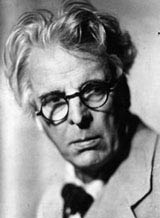
William Butler Yeats died (thanks for the heads up, Ms. Baroque). And, of course, Yeats makes me think of my father. My first published piece in The Sewanee Review was about the Yeats-dad continuum.
From memory now! And when I hear this poem, in my head - I always hear the recitation from the Clancy Brothers Carnegie Hall album.
THE HOST OF THE AIR
O'Driscoll drove with a song
The wild duck and the drake
From the tall and the tufted reeds
Of the drear Heart Lake.
And he saw how the reeds grew dark
At the coming of night-tide,
And dreamed of the long dim hair
Of Bridget his bride.
He heard while he sang and dreamed
A piper piping away,
And never was piping so sad,
And never was piping so gay.
And he saw young men and young girls
Who danced on a level place,
And Bridget his bride among them,
With a sad and a gay face.
The dancers crowded about him
And many a sweet thing said,
And a young man brought him red wine
And a young girl white bread.
But Bridget drew him by the sleeve
Away from the merry bands,
To old men playing at cards
With a twinkling of ancient hands.
The bread and the wine had a doom,
For these were the host of the air;
He sat and played in a dream
Of her long dim hair.
He played with the merry old men
And thought not of evil chance,
Until one bore Bridget his bride
Away from the merry dance.
He bore her away in his arms,
The handsomest young man there,
And his neck and his breast and his arms
Were drowned in her long dim hair.
O'Driscoll scattered the cards
And out of his dream awoke:
Old men and young men and young girls
Were gone like a drifting smoke;
But he heard high up in the air
A piper piping away,
And never was piping so sad,
And never was piping so gay.
To those of you who know that Clancy Brothers album - you'll know the special-ness of that recording.
The O'Malley children were made to memorize Yeats' epitaph as part of our weekly allowance ritual. Say Yeats' epitaph, get a dime!! When we visited his grave in Ireland, as kids, we all felt kind of amazed that ... it was REAL. That the epitaph we had been rattling off since we were toddlers actually existed out in the world.
More in honor of this great poet - one of my favorites - below the jump. A couple years ago, I read his complete works - sitting backstage during the run of a play - when I wasn't onstage acting. I had about 40 minutes before my scene - came on, did my scene - and then there was another half-hour before curtain call. So I huddled backstage wearing my jeweled bifocals and my birkenstocks, and read Yeats. It was a fascinating experience - I know many of his big poems almost by heart, the famous ones - but it's nothing compared to reading his work - from beginning to end. You watch an artist burst forth at a certain point - almost fully formed. You've read his younger work, you've seen its beauty (but also its sentimentality - its Celtic twilight "twee" lament ... and nothing - NOTHING - can prepare you for the poet who would eventually write "Sailing to Byzantium" and "Among Schoolchildren").
Here's a biography of Yeats, Nobel prize winner in 1923.
Yeats, as a poet, has always been one of my favorites (even with the "cloud-pale eyelids" balderdash of his early stuff), but what truly inspires me is his work in Irish theatre, and the creation of the Abbey. An amazing story. His Nobel lecture was on the Irish Dramatic Movement. I wrote a big long post about his nurturing of John Synge, author of Playboy of the Western World. Synge, as a young man, was a floundering artist bohemian type - until Yeats got a hold of him, and told him to go stay on the Aran Islands for a while, to discover the real Irish people. The result? A revolution in Irish theatre.
Gabriel Fallon, an actor at the Abbey, describes the dress rehearsal of Sean O'Casey's Juno and the Paycock in his book Sean O'Casey, The Man I Knew - a wonderful theatrical anecdote:
We could make nothing of the reading of Juno and the Paycock as it was called. It seemed to be a strange baffling mixture of comedy and tragedy; and none of us could say, with any certainty, whether or not it would stand up on the stage.The dress rehearsal would be held at 5 p.m. on March 2, Sunday. I arrived at the theatre at 4:30 p.m., and found the author there before me looking rather glum and wondering if a rehearsal would take place ... Gradually the players filed in and went to their dressing-rooms. Lennox Robinson arrived shortly before 5 o'clock and was followed by Yeats and Lady Gregory. The curtain rose about 5:36 p.m. so far as I could see and hear while waiting for my cue in the wings the rehearsal seemed to be proceeding smoothly. As soon as I had finished my part of Bentham at the end of the second act I went down into the stalls and sat two seats behind the author. Here for the first time I had an opportunity of seeing something of the play from an objective point of view. I was stunned by the tragic quality of the third act which the magnificent playing of Sara Allgood made almost unbearable. But it was the blistering irony of the final scene which convinced me that this man sitting two seats in front of me was a dramatist of genius, one destined to be spoken of far beyond the confines of the Abbey Theatre ...
We watched the act move on, the furniture removers come and go, the ominous entry of the IRA men, the dragging of Johnny to summary execution, the stilted scene between Jerry Devine and Mary Boyle, and then as with the ensnaring slow impetus of a ninth great wave Allgood's tragic genius rose to an unforgettable climax and drowned the stage in sorrow. How surely was the very butt and sea-mark of tragedy! But suddenly the curtain rises again: are Fitzgerald and McCormick fooling, letting off steam after the strain of rehearsal? Nothing of the kind; for we in the stalls are suddenly made to freeze in our seats as a note beyond tragedy, a blistering flannel-mouthed irony sears its maudlin way across the stage and slowly drops an exhausted curtain on a world disintegrating in 'chassis'.
I sat there stunned. So, indeed, as far as I could see, did Robinson, Yeats, and Lady Gregory. Then Yeats ventured an opinion. He said that the play, particularly in the final scene, reminded him of a Dostoevsky novel. Lady Gregory turned to him and said, "You know, Willie, you never read a novel by Dostoevsky." And she promised to amend this deficiency by sending him a copy of The Idiot. I turned to O'Casey and found I could only say to him, "Magnificent, Sean, magnificent."
I had a conversation once with the doppelganger about "greatest poems of the 20th century" and we discussed Sailing to Byzantium, Among Schoolchildren, and The Second Coming. We said any list of "greatest poems of the 20th century" that DIDN'T include at least one of those poems was not a list to be taken seriously in the slightest. "The Second Coming" is quoted (and mis-appropriated, more often than not) and quoted again ... by people who want to use it for their own ends. It's a dark ominous crystal ball. The best "use" of it, to my mind, is in the deleted scene in Nixon, with Sam Waterston playing Dick Helms, director of the CIA. Written in 1919 - when the world had already become familiar with horror - a horror of a kind never before seen on earth - the poem predicts the chaos of the 20th century.
"The Second Coming"
Turning and turning in the widening gyre
The falcon cannot hear the falconer;
Things fall apart; the centre cannot hold;
Mere anarchy is loosed upon the world,
The blood-dimmed tide is loosed, and everywhere
The ceremony of innocence is drowned;
The best lack all conviction, while the worst
Are full of passionate intensity.
Surely some revelation is at hand;
Surely the Second Coming is at hand.
The Second Coming! Hardly are those words out
When a vast image out of Spiritus Mundi
Troubles my sight: somewhere in sands of the desert
A shape with lion body and the head of a man,
A gaze blank and pitiless as the sun,
Is moving its slow thighs, while all about it
Reel shadows of the indignant desert birds.
The darkness drops again; but now I know
That twenty centuries of stony sleep
Were vexed to nightmare by a rocking cradle,
And what rough beast, its hour come round at last,
Slouches towards Bethlehem to be born?
Jesusmaryandjoseph.
Seamus Heaney wrote a marvelous essay on Yeats a while back (the link no longer works, but I have the hard copy) - in which he wrote:
Conquest, difficulty, labour: these terms indicate the nature of Yeats's creative disposition. From the start, he was enamoured of Blake's conviction that energy is eternal delight, yet the development of his own thought brought him more and more to the conclusion that conflict was the inescapable condition of being human. So, as his art matured and the articulation of his beliefs became more clarified and forceful, Yeats's poems typically conveyed a sensation of certitude achieved by great effort and of contradictions quelled. Poems in which the defiant self is pitted against hostile or disabling conditions - "An Irish Airman Foresees his Death", "September 1913", "Meditations in Time of Civil War"- are complemented by poems that read like discharges of pure, self-possessed energy, poems from which the accidental circumstances have been excluded so that all that remains is the melody and stamina of resurgent spirit - "The Cold Heaven", "Byzantium", "Long-legged Fly".

Of course, there is also the Maud Gonne factor that must be considered. I read some funny quote somewhere (can't remember where) that said: "Any biography of Yeats would have to have in every chapter the following words: 'And he proposed marriage yet again to Maud Gonne'." What do you wanta bet that Maud Gonne had "cloud-pale eyelids"?
Heaney writes, in that same essay:
nd all the while, of course, there was Maud Gonne, "high and solitary and most stern" according to one of the poems about her, "foremost among those I would hear praised" according to another, and "the troubling of my life" according to a famous sentence in his Autobiographies. The passion she inspired - and as readers we experience it more as creative power than erotic need - made her a figure of primary poetic radiance, a Dublin Beatrice, an archetype as much as a daily presence. Nevertheless, Yeats's poetry, his politics and his involvement with the occult received an extra charge of intensity from her day to day reality in his life, and when she appeared in the title role of his subversive play Cathleen Ni Houlihan (1902), another kind of maturity was achieved.
Heartbreak. Enduring heartbreak and loss.
Some quotes from Mr. Yeats:
"I hate journalists. There is nothing in them but tittering jeering emptiness. They have all made what Dante calls the Great Refusal. The shallowest people on the ridge of the earth."
"Irish poets, learn your trade, sing whatever is well made, scorn the sort now growing up all out of shape from toe to top."
"The worst thing about some men is that when they are not drunk they are sober."
"Words are always getting conventionalized to some secondary meaning. It is one of the works of poetry to take the truants in custody and bring them back to their right senses."
"Do not wait to strike till the iron is hot; but make it hot by striking."
"And say my glory was I had such friends."
Yes. That last one really moves me - it's from one of his poems. I feel the same way about my life, and my friends.
Words to live by:
Never give all the heart
Never give all the heart, for love
Will hardly seem worth thinking of
To passionate women if it seem
Certain, and they never dream
That it fades out from kiss to kiss;
For everything that's lovely is
But a brief, dreamy. Kind delight.
O never give the heart outright,
For they, for all smooth lips can say,
Have given their hearts up to the play.
And who could play it well enough
If deaf and dumb and blind with love?
He that made this knows all the cost,
For he gave all his heart and lost.
I also love love LOVE his poem to Jonathan Swift where he writes: "Imitate him if you dare."
Swift's Epitaph
Swift has sailed into his rest;
Savage indignation there
Cannot lacerate his breast.
Imitate him if you dare,
World-besotted traveller; he
Served human liberty.
Speaking of epitaphs, you can't get any better or more eloquent than Auden's stunning poem in memory of Yeats:
In Memory of W.B. Yeats
by Auden
I
He disappeared in the dead of winter:
The brooks were frozen, the airports almost deserted,
And snow disfigured the public statues;
The mercury sank in the mouth of the dying day.
What instruments we have agree
The day of his death was a dark cold day.
Far from his illness
The wolves ran on through the evergreen forests,
The peasant river was untempted by the fashionable quays;
By mourning tongues
The death of the poet was kept from his poems.
But for him it was his last afternoon as himself,
An afternoon of nurses and rumours;
The provinces of his body revolted,
The squares of his mind were empty,
Silence invaded the suburbs,
The current of his feeling failed; he became his admirers.
Now he is scattered among a hundred cities
And wholly given over to unfamiliar affections,
To find his happiness in another kind of wood
And be punished under a foreign code of conscience.
The words of a dead man
Are modified in the guts of the living.
But in the importance and noise of to-morrow
When the brokers are roaring like beasts on the floor of the Bourse,
And the poor have the sufferings to which they are fairly accustomed,
And each in the cell of himself is almost convinced of his freedom,
A few thousand will think of this day
As one thinks of a day when one did something slightly unusual.
What instruments we have agree
The day of his death was a dark cold day.
II
You were silly like us; your gift survived it all:
The parish of rich women, physical decay,
Yourself. Mad Ireland hurt you into poetry.
Now Ireland has her madness and her weather still,
For poetry makes nothing happen: it survives
In the valley of its making where executives
Would never want to tamper, flows on south
From ranches of isolation and the busy griefs,
Raw towns that we believe and die in; it survives,
A way of happening, a mouth.
III
Earth, receive an honoured guest:
William Yeats is laid to rest.
Let the Irish vessel lie
Emptied of its poetry.
In the nightmare of the dark
All the dogs of Europe bark,
And the living nations wait,
Each sequestered in its hate;
Intellectual disgrace
Stares from every human face,
And the seas of pity lie
Locked and frozen in each eye.
Follow, poet, follow right
To the bottom of the night,
With your unconstraining voice
Still persuade us to rejoice;
With the farming of a verse
Make a vineyard of the curse,
Sing of human unsuccess
In a rapture of distress;
In the deserts of the heart
Let the healing fountain start,
In the prison of his days
Teach the free man how to praise.
And lastly, a poem that has great personal meaning for me - especially today- a sad upsetting day for me:
The wild swans at Coole
The trees are in their autumn beauty,
The woodland paths are dry,
Under the October twilight the water
Mirrors a still sky;
Upon the brimming water among the stones
Are nine-and-fifty Swans.
The nineteenth autumn has come upon me
Since I first made my count;
I saw, before I had well finished,
All suddenly mount
And scatter wheeling in great broken rings
Upon their clamorous wings.
I have looked upon those brilliant creatures,
And now my heart is sore.
All's changed since I, hearing at twilight,
The first time on this shore,
The bell-beat of their wings above my head,
Trod with a lighter tread.
Unwearied still, lover by lover,
They paddle in the cold
Companionable streams or climb the air;
Their hearts have not grown old;
Passion or conquest, wander where they will,
Attend upon them still.
But now they drift on the still water,
Mysterious, beautiful;
Among what rushes will they build,
By what lake's edge or pool
Delight men's eyes when I awake some day
To find they have flown away?
SOME QUOTES
"My poetry is generally written out of despair. Like Balzac, I see increasing commonness everywhere, and like Balzac I know no one who shares the premises from which I work." -- Yeats
"On the third night Yeats addressed the audience before the curtain rose. If anyone had anything to say against the piece they would be welcomed at a debate which he would be glad to arrange in the theatre at some other time. He was interrupted several times. He asked the interrupters to at least listen to the play so that they would know what it was they were objecting to." -- Maire Nic Shiubhlaigh's description of Yeats trying to handle the riots that were happening in response to Synge's "Playboy of the Western World" - a play being put on at the Abbey Theatre
"In 1875 Yeats entered the Godolphin School in Hammersmith and visited Ireland during the longer school vacations, when he stayed with the Pollexfens in County Sligo. An early poetic impulse was to change the name of his toy yacht from Sunbeam to Moonbeam. It was a decisive act." -- Michael Schmidt, "Lives of the Poets
"I thought we might bring the halves together if we had a national literature that made Ireland beautiful in the memory, and yet had been freed of provincialism by an exacting criticism, a European pose." -- Yeats
"This is not the huge competence of Auden, at play in the toy shop of poetic form, but mastery, the possession of a unique rhetoric for use on a real but limited range of themes. It is a mastery so complete that it can occlude the genuinely problematic, ride over the potholes of nonsense without even sensing them. Late in life he recognizes the evasiveness of his symbols, the tendency of his verse to turn away or inward, and in the concentrated intensity of the late poems he tries to remedy this. But he has an imperfect sense of generality; he is willing to plump out a truism as truth. As his mastery increases, his art becomes less truthful. But his main concern is not - until the later poems, and even there in an attenuated spirit - truth, but the house of myth and legend, where he can become a principal tenant, where it is his voice we hear casting the spell, and where real men are reduced - or, in his mind, enlarged - to masks, figures and types useful to myth, regardless of the human reality they had." -- Michael Schmidt, "Lives of the Poets"
"All literature created out of a conscious political aim in the long run crates weakness by creating a habit of unthinking obedience. Literature created for its own sake, for some eternal spiritual need, can be used for politics. Dante is said to have unified Italy. The more unconscious the creation, the more powerful." -- Yeats
"Sex and death are the only things that can interest a serious mind." -- Yeats
"His mastery seems almost excessive." -- Richard Ellmann
"... a strained and unworkable allegory about a young man and a sphinx on a rock in the sea (how did they get there? what did they eat? and so on; people think such criticisms very prosaic, but common-sense is never out of place anywhere ...) but still containing fine lines and vivid imagery." - Gerard Manley Hopkins, after reading some of Yeats' first published verses
"Irish poets, learn your trade, sing whatever is well made, scorn the sort now growing up all out of shape from toe to top." -- Yeats
"Yeats's 'The Second Coming' has gained in prophetic power with each decade of the twentieth and now twenty-first century, from the rise of fascism and nuclear warfare to the proliferation of international terrorism. It expresses the melancholy realizatino that man, yearningly drawn to the divine, will never fully escape his bestial ancestry. The poem is modernistically unrhymed, though the first stanza plays with shadowy off-rhymes: 'gyre' / 'falconer' / 'everywhere'; 'hold' / 'world' / 'drowned'. It is structured instead by dramatic visuals and emblematic choreography. There are two main movements: a huge, expanding circle (the ascending falcon) and an arrowlike, linear track (the beast bound for Bethlehem). Then two smaller ones: a pendulum arc (the rocking cradle) and an exploding pinwheel (the reeling desert birds). Ideas have become design, starkly juxtaposed with the murky turbulence of elemental forces - storm, flood, drought. Hence the poem, with its horror movie finale, is as hybrid as the sphinx, who represents our buried impulses, vestiges of a past that keeps turning into the future." -- Camille Paglia, "Break, Blow, Burn"
"The heavy voluptuous splendour of much of his work has yet a ghostliness as of the palace made magically of leaves. Even his heroes and beautiful women are aware of this ... He never leaves us, any more than Crashaw, content with the glory alone. It calls our attention to a spirit behind and beyond, heaping high lovely, invisible things that it may show the greater beauty that can survive their crumbling into dust." -- Edward Thomas, 1909
"The worst thing about some men is that when they are not drunk they are sober." -- Yeats
"In London he was active in literature and politics. One particular event in 1889 proved crucial: he met and fell in love with the fiery Republican who haunted him for the rest of his days, Maud Gonne. His biography, from 1889 until Maud Gonne's marriage, is punctuated by the statement, 'Yeats proposed to Maud Gonne.'" -- Michael Schmidt, "Lives of the Poets"
"Words are always getting conventionalized to some secondary meaning. It is one of the works of poetry to take the truants in custody and bring them back to their right senses." -- Yeats
" 'The best lack all conviction, while the worst / Are full of passionate intensity': these famous lines are Yeats's anguished formulation of what seems to be an eternal principle of politics (7-8). When 'the center cannot hold,' neither consensus nor compromise is possible. Public debate shifts to the extremes or is overtaken by violence, which blocks incremental movement toward reciprocity and conciliation. Moderate views are 'drowned' out (as by the bloody tide) in strident partisanship or fanaticism. The phrase 'passionate intensity' suggests that, for the late Romantic Yeats, eros diverted from the personal to the political turns into a distorted lust for power. The second stanza opens in doubt and confusion: 'Surely some revelation is at hand; / Surely the Second Coming is at hand. / The Second Coming!'' (9-11). We are hearing either one voice echoing its own shocked phrases or many voices in public tumult. The book of Revelation lists the dreadful omens heralding doomsday, when Jesus will return and unlock the secrets of history. But in Yeats's poem, Christ's promised glory is overshadowed by a monstrous apparition from antiquity. The poet is seized by an electrifying vision: 'a vast image out of Spiritus Mundi / Troubles my sight'. It's a collective memory, crystallizing from the repository of world myths (12-13). ("Spiritus Mundi" is Yeats's mystical term for "soul of the universe".) We witness the resurrection of the pagan era, whose barbarism mirrors that of the war-torn twentieth century. Yeats sees no evidence of moral evolution over two millennia of Christianity." -- Camille Paglia, "Break, Blow, Burn"
"I once got Yeats down to bed-rock on these subjects and we talked for hours. He had been talking rather wildly about the after life. Finally I asked him: 'What do you believe happens to us immediately after death?' He replied, 'After a person dies, he does not realize that he is dead.' I: 'In what state is he?' W.B.Y.: 'In some half-conscious state.' I said: 'Like the period between waking and sleeping?' W.B.Y.: 'Yes.' I: 'How long does this state last?' W.B.Y.: 'Perhaps some twenty years.' 'And after that,' I asked, 'what happens next?' He replied, 'Again a period which is Purgaotry. The length of that period depends upon the sins of the man when he was upon this earth.' And then again I asked: 'And after that?' I do not remember his actual words, but he spoke of the return of the soul to God. I said, 'Well, it seems to me that you are hurrying us back into the great arms of the Roman Catholic Church.' He was of course an Irish Protestant. I was bold to ask him, but his only retort was his splendid laugh." -- Lady Dorothy Wellesley
"It is an entirely new thing -- neither what they eye sees nor the ear hears, but what the rambling mind thinks and imagines from moment to moment. He has certainly surpassed in intensity any novelist of our time." -- Yeats on James Joyce's "Ulysses"
"For Yeats, there was something both enviable and exemplary about the enlargement of vision and the consequent histrionic equanimity which Shakespeare's heroes and heroines attain at the moment of their death, 'carried beyond feeling into the aboriginal ice.' He wanted people in real life to emulate or at least to internalize the fortitude and defiance thus manifested in tragic art." -- Seamus Heaney, 1990
"Give up Paris, you will never create anything by reading Racine, and Arthur Symons will always be a better critic of French literature. Go to the Arran Islands. Live there as if you were one of the people themselves; express a life that has never found expression." -- Yeats's advice to John Synge
"The first spectre of the new generation has appeared. His name is Joyce. I have suffered from him and I would like you to suffer." -- George Russell in a letter to Yeats, 1902
Cast a cold eye
On life on death
Horseman pass by
-- Yeats's epitaph
Imitate him if you dare.
The dark side of celebrity crushes
I'm so psyched that my friend Ted finally saw Scorsese's King of Comedy. I had been raving about it to Ted a couple weeks ago ... so I was very interested to hear his response. Excruciating is a pretty good descriptor, I think.
The Books: "Different Seasons" 'Apt Pupil' (Stephen King)
Next book on my adult fiction shelves:
Different Seasons by Stephen King
The second novella in this collection is called "Apt Pupil" and it was also made into a film (rest in peace, Brad Renfro - always thought he was a nice young actor, sad). A young kid becomes overwhelmingly convinced that his elderly next-door neighbor is a Nazi war criminal in hiding. The kid has become obsessed with the Holocaust - it haunts his dreams, he can't stop thinking about it ... it grabs hold of him and never lets go. I remember my first encounter with the Holocaust - and how difficult it was to get my mind around it. The sheer numbers stun you - because you don't even know what "6 million" even looks like - it's hard to picture that many people all at once. The kid befriends his next-door neighbor - but it's more like he insinuates himself into his life, because he wants to get closer to the Holocaust, and he believes this man was one of the perpetrators against the crime of humanity. Some of the details of the story are lost to me, it's been a long time - but basically, the kid goes off the deep end. He becomes convinced that the homeless people lying around their city, under bridges, etc., - need to be killed. The riff-raff of the world ... the world needs a cleansing. So he begins his mission. Like a one-man wrecking ball. I can't remember much else about it ... but I remember being captivated by it when I first read it ... and King just has this way of describing the "series of events" that leads up to a catharsis/confrontation ... so that there is no doubt in your mind the horror that is underneath it all. He just takes you through it step by step (and yeah, sometimes his "steps" could be edited down - he takes 3 pages for what could be one paragraph) ... but I don't mind that so much. I definitely don't mind it if the person is a good writer - and King is great. To me, the best thing about him is (because I'm not into genre fiction, not in the slightest) - his interest is always in what happens to a person when he or she is confronted with horror. Whether it be a crazy clown in the sewer ... or the fact of the Holocaust ... King is interested primarily in the psychological. And so am I. That's why I find him not just fun to read ... but a bit addictive. I want to get inside other people's psychologies as well. And King is all about that.
I remember the following excerpt - parts of it almost word for word, it made that much of an impression on me when I first read it.
Watch how King powerfully sets up the kid's obsession. How the obsession leads to murder and madness will have to wait ... but here King is setting the stage. He's so so good that way.
EXCERPT FROM Different Seasons by Stephen King - Apt Pupil
He remembered in the fifth grade, before Careers Day, how Mrs. Anderson (all the kids called her Bugs because of her big front teeth) had talked to them about what she called finding YOUR GREAT INTEREST.
'It comes all at once," Bugs Anderson had rhapsodized. You see something for the first time, and right away you know you have found YOUR GREAT INTEREST. It's like a key turning in a lock. Or falling in love for the first time. That's why Careers Day is so important, children - it may be the day on which you find YOUR GREAT INTEREST." And she had gone on to tell them about her own GREAT INTEREST, which turned out not to be teaching fifth grade but collecting nineteenth-century postcards.
Todd had thought Mrs. Anderson was full of bullshit at the time, but that day in Foxy's garage, he remembered what she had said and wondered if maybe she hadn't been right after all.
The Santa Anas had been blowing that day, and to the east there were brush-fires. He remembered the smell of burning, hot and greasy. He remembered Foxy's crewcut, and the flakes of Butch Wax clinging to the front of it. He remembered everything.
"I know there's comics here someplace," Foxy had said. His mother had a hangover and had kicked them out of the house for making too much noise. "Neat ones. They're Westerns mostly, but there's some Turok, Son of Stone and --"
"What are those?" Todd asked, pointing at the bulging cardboard cartons under the stairs.
"Ah, they're no good," Foxy said. "True war stories, mostly. Boring."
"Can I look at some?"
"Sure. I'll find the comics."
But by the time fat Foxy Pegler found them, Todd no longer wanted to read comics. He was lost. Utterly lost.
It's like a key turning in a lock. Or falling in love for the first time.
It had been like that. He had known about the war, of course - not the stupid one going on now, where the Americans had gotten the shit kicked out of them by a bunch of gooks in black pajamas - but World War II. He knew that the Americans wore round helmets with net on them and the krauts wore sort of square ones. He knew that the Americans won most of the battles and that the Germans had invented rockets near the end and shot them from Germany onto London. He had even known something about the concentration camps.
The difference between all of that and what he found in the magazines under the stairs in Foxy's garage was like the difference between being told about germs and then actually seeing them in a microscope, squirming around and alive.
Here was Ilse Koch. Here were crematoriums with thick doors standing open on their soot-clotted hinges. Here were officers in SS uniforms and prisoners in striped uniforms. The smell of the old pulp magazines was like the smell of the brush-fires burning out of control on the east of Santa Donato, and he could feel the old paper crumbling against the pads of his fingers, and he turned the pages, no longer in Foxy's garage but caught somewhere crosswire in time, trying to cope with the idea that they had really done those things, that somebody had really done those things, and that somebody had let them do those things, and his hand began to ache with a mixture of revulsion and excitement, and his eyes were hot and strained, but he read on, and from a column of print beneath a picture of tangled bodies at a place called Dachau, this figure jumped out at him:
And he thought: Somebody goofed there, somebody added a zero or two, that's twice as many people as there are in L.A.! But then, in another magazine (the cover of this one showed a woman chained to a wall while a guy in a Nazi uniform approached her with a poker in his hand and a grin on his face), he saw it again:
His headache got worse. His mouth went dry. Dimly, from some distance, he heard Foxy saying he had to go in for supper. Todd asked Foxy if he could stay here in the garage and read while Foxy ate. Foxy gave him a look of mild puzzlement, shrugged, and said sure. And Todd read, hunched over the boxes of the old true war magazines, until his mother called and asked if he was ever going to go home.
Like a key turning in a lock.
All the magazines said it was bad, what had happened. But all the stories were continued at the back of the book, and when you turned to those pages, the words saying it was bad were surrounded by ads, and these ads sold German knives and belts and helmets as well as Magic Trusses and Guaranteed Hair Restorer. These ads sold German flags emblazoned with swastikas and Nazi Lugers and a game called Panzer Attack as well as correspondence lessons and offers to make you rich selling elevator shoes to short men. They said it was bad, but it seemed like a lot of people must not mind.
Like falling in love.
Oh yes, he remembered that day very well. He remembered everything about it - a yellowing pin-up calendar for a defunct year on the back wall, the oil-stain on the cement floor, the way the magazines had been tied together with orange twine. He remembered how his headache had gotten a little worse each time he thought of that incredible number,
He remembered thinking: I want to know about everything that happened in those places. Everything. And I want to know which is more true - the words, or the ads they put beside the words.
He remembered Bugs Anderson as he at last pushed the boxes back under the stairs and thought: She was right. I've found my GREAT INTEREST.
January 27, 2008
What did we do this weekend?
You know, the usual. Spent 5 hours in a tattoo parlor on St. Mark's Place. Tattoos received by all (well, not by me, but then I already have one. Actually, Betsy already has three - but she got another one). I was there for moral support. The rest of the time was spent involving various alcoholic beverages, much conversation, so many blow-up mattresses in my apartment that we could have been airborne with a single gust of wind, my overflowing toilet and Michele suddenly becoming McGyver (in a velvet jacket and silk scarf) fixing it ... and also peeling off the various bandages to stare at and take photos of all of the tattooes.
Oh, and we also partook in a ukelele festival.
So yeah. It was a well-rounded weekend. Thanks, Beans - thanks, Liz - for your awesome tattoo artistry!

Mere being worked on by "Beans". We loved Beans. He was fascinated by Meredith's half-amputated toe and a little bit in love with it. "This might sound really weird - but can I touch it?" She laughed and said sure, so he gently touched her stub, marveling at it. They had a humorous discussion about painting a fake nail on the "stub" ... and he made her promise that should she ever decide to do it, she would let HIM do it. "Seriously, I would give you a huge deal on the price ... just promise me you'll let me do it." Mere said, "You could add it to your portfolio." "Absolutely!" We loved Beans.
Oh, and Beans - respectfully, declined to do Betsy's tattoo. For the funniest reason!! We were all guffawing about it. "Yeah, Liz can do that one," he said. See if you can guess which one he wouldn't do.

Browsing. Michele's feet.

Beth, browsing.

All my friends belly-up to the counter, browsing.

Beth getting worked on by Liz. We were like, "How ya doin' Beth?" Beth responds, "It's not as bad as childbirth!" Also, we were reminding each other, "Yeah, so, Beth has MS. I think she can handle a little tattoo needle!!"

Michele, browsing.

The walls.
The results! And I've thrown in my almost 20 year old one for good measure:


The Books: "Different Seasons" 'Rita Hayworth and the Shawshank Redemption' (Stephen King)
Next book on my adult fiction shelves:
Different Seasons by Stephen King
A book of four novellas, Different Seasons contains some of my favorite of all of Stephen King's writing (and I'm a huge fan). Each novella represents a different season, and some of these stories pack such a huge punch. None of them are "horror" stories, although there is most certainly psychological horror at times. The first story in the collection comes under the heading "Hope Springs Eternal" - and that is, most definitely, the them of "Rita Hayworth and the Shawshank Redemption" - adapted into the film Shawshank Redemption, probably the most successful (in terms of long-lasting impact) of all of the adaptations of King's work. Shawshank Redemption will be watched by generations to come, long after the rest of us are dust. It's just that kind of movie. And not to be a snot, but whatever - wouldn't be the first time - I prefer the written story. It's just how King describes stuff ... it's the way he can rise goosebumps on my flesh without ever having a zombie emerge, or an evil dog, or monsters in the sewers. He's great there as well - but in my opinion, he is at the top of his game (and anyone else's game) with "Rita Hayworth and the Shawshank Redemption" - the now well-known (thanks for the movie) story of Andy Dufresne - wrongly accused murderer and accountant - who spends decades of his life in jail - decades - digging a secret tunnel out, using his Rita Hayworth poster as a cover-up. It's not just the story of "hope springs eternal" that is so moving - it's the characters King introduces to us ... the way he describes prison life, not just from a phyical standpoint but - way more important - from the psychological standpoint. What happens to hope when a man becomes an "institutional man". What happens to free will, and thinking for oneself? Andy Dufresne knows he cannot beat the system. It has already beaten him. But - unlike most of his counterparts - he never ever becomes "institutionalized" - and that, to me, is King's main interest in the story. King, even with all the horror and dark imaginings, is - at his very core- an optimist. He loves people. He loves the human race, and what it is capable of at its very best. Ultimately, he sees the good. But we are only at our very best when faced with extraordinary obstacles. Andy Dufresne is not a Rambo-type guy. He's an accountant. A quiet stealthy man, with a great poker face ... who never ever stops thinking, thinking, thinking ... and not just thinking ... but saving the very part of himself, the uninstitutionalized part, the part that has dreams and plans for the future - to himself. Nobody can get in there with him, and nobody - for the most part - even knows that it is there. Everyone can sense, from the warden on down, that Andy Dufresne is an interesting character. But nobody could ever have guessed that all those long years - from the 50s to the 70s - when he was in his cell, with his chess pieces, that he was not just planning his escape in his mind - but working on it practically, inch by inch. When he breaks out, everyone is blown away. Andy? That guy?? But when you look back on it - as our beautiful narrator does - it all makes sense. Of course someone like that - methodical, anal, quiet, cards held close to his chest - would construct the perfect escape. And never ever let on what he was up to. The man had nerves of steel. Ice water in his veins. And THATS what interests Stephen King: who IS that? What kind of guy could endure in such silence? Taking such enormous risks? Dufresne could have lost all. Many many times. But - and here a little bit of luck comes into play - his cell was never searched unexpectedly - he was never busted ... but besides the luck factor, Dufresne just kept going. And perhaps we will never know what it was like for him. Where his mind went, those long long nights, as he chipped away at the rock walls of the prison. Dufresne was in the zone. The practical zone. Not a pipe dream. No. But an actual plan. It's an awesome story, and I never get sick of it.
One of the best parts of the story is that it is NOT told by an omniscent narrator - who can tell us: "And here's how it REALLY went." And it is NOT told by Dufresne, who can inform us, "Here is what it was like for me." It's told by his fellow inmate - Red. Who cannot give us the whole story - much of it is only speculation: "here is what it must have been like ... I bet that THIS is how it happened ..." and it adds such a goosebump factor to the entire novella, because, in the end, we really can't know. All we know is: one day Andy Dufresne was in his cell, and the next day - he had vanished into thin air.
The uncertainty of Red's voice here, the way it sounds as though he is working it out for himself, pondering Andy's experience - without really knowing the answer ... is part of the success of the book. It's that tone - and if you've read it, you will know what I mean. Morgan Freeman embodied it perfectly (so much of the movie is in voiceover - and thank God. It's just right for that particular film) ... but here you can see how it is written. To my ear, it couldn't be better.
Here's an excerpt.
EXCERPT FROM Different Seasons by Stephen King - 'Rita Hayworth and the Shawshank Redemption
Then one day, very late in the spring - perhaps around October of 1987 - the long-time hobby suddenly turned into something else. One night while he was in the hole up to his waist with Raquel Welch hanging down over his ass, the pick end of his rock-hammer must have suddenly sunk into concrete past the hilt.
He would have dragged some chunks of concrete back, but maybe he heard others falling down into that shaft, bouncing back and forth, clinking off that standpipe. Did he know by then that he was going to come upon that shaft, or was he totally surprised? I don't know. He might have seen the prison blueprints by then or he might not have. If not, you can be damned sure he found a way to look at them not long after.
All at once he must have realized that, instead of just playing a game, he was playing for high stakes ... in terms of his own life and his own future, the highest. Even then he couldn't have known for sure, but he must have had a pretty good idea because it was right around then that he talked to me about Zihuatenejo for the first time. All of a sudden, instead of just being a toy, that stupid hole in the wall became his master - if he knew about the sewer-pipe at the bottom, and that it led under the outer wall, it did, anyway.
He'd had the key under the rock in Buxton to worry about for years. Bow he had to worry that some eager-beaver new guard would look behind his poster and expose the whole thing, or that he would get another cellmate, or that he would, after all those years, suddenly be transferred. He had all those things on his mind for the next eight years. All I can say is that he must have been one of the coolest men who ever lived. I would have gone completely nuts after a while, living with all that uncertainty. But Andy just went on playing the game.
He had to carry the probability of discovery for another eight years - the probability of it, you might say, because no matter how carefully he stacked the cards in his favor, as an inmate of a state prison, he just didn't have that many to stack ... and the gods had been kind of him for a very long time; some nineteen years.
The most ghostly irony I can think of would have been if he had been offered a parole. Can you imagine it? Three days before the parolee is actually released, he is transferred into the light security wing to undergo a complete physical and a battery of vocational tests. While he's there, his old cell is completely cleaned out. Instead of getting his parole, Andy would have gotten a long turn downstairs in solitary, followed by some more time upstairs ... but in a different cell.
If he broke into the shaft in 1967, how come he didn't escape until 1975?
I don't know for sure - but I can advance some pretty good guesses.
First, he would have become more careful than ever. He was too smart to just push ahead at flank speed and try to get out in eight months, or even in eighteen. He must have gone on widening the opening on the crawlspace a little at a time. A hole as big as a teacup by the time he took his New Year's Eve drink that year. A hole as big as a dinner-plate by the time he took his birthday drink in 1968. As big as a serving-tray by the time the 1969 baseball season opened.
For a time I thought it should have gone much faster than it apparently did - after he broke through, I mean. It seemed to me that, instead of having to pulverize the crap and take it out of his cell in the cheater gadgets I have described, he could simply let it drop down the shaft. The length of time he took makes me believe that he didn't dare do that. He might have decided that the noise would arouse someone's suspicions. Or, if he knew about the sewer-pipe, as I believe he must have, he would have been afraid that a falling chunk of concrete would break it before he was ready, screwing up the cellblock sewage system and leading to an investigation. And an investigation, needless to say, would lead to ruin.
Still and all, I'd guess that, by the time Nixon was sworn in for his second term, the hole would have been wide enough for him to wriggle through ... and probably sooner than that. Andy was a small guy.
Why didn't he go then?
That's where my educated guesses run out, folks; from this point they become progressively wilder. One possibility is that the crawlspace itself was clogged with crap and he had to clear it out. But that wouldn't account for all the time. So what was it?
I think that maybe Andy got scared.
I've told you as well as I can how it is to be an institutional man. At first you can't stand those four walls, then you get so you can abide them, then you get so you accept them ... and then, as your body and your mind and your spirit adjust to life on an HO scale, you get to love them. You are told when to eat, when you can write letters, when you can smoke. If you're at work in the laundry or the plate-shop, you're assigned five minutes of each hour when you can go to the bathroom. For thirty-five years, my time was twenty-five minutes after the hour, and after thirty-five years, that's the only time I ever felt the need to take a piss or have a crap: twenty-five minutes past the hour. And if for some reason I couldn't go, the need would pass at thirty after, and come back at twenty-five past the next hour.
I think Andy may have been wrestling with that tiger - that institutional syndrome - and also with the bulking fears that all of it might have been for nothing.
How many nights must he have lain awake under his poster, thinking about that sewer line, knowing that the one chance was all he'd ever get? The blueprints might have told him how big the pipe's bore was, but a blueprint couldn't tell him what it would be like inside that pipe - if he would be able to breathe without choking, if the rats were big enough and mean enough to fight instead of retreating ... and a blueprint couldn't've told him what he'd find at the end of the pipe, when and if he got there. Here's a joke even funnier than the parole would have been: Andy breaks into the sewer-line, crawls through five hundred yards of choking, shit-smelling darkness, and comes up against a heavy-gauge mesh screen at the end of it all. Ha, ha, very funny.
That would have been on his mind. And if the long shot actually came in and he was able to get out, would he be able to get some civilian clothes and get away from the vicinity of the prison undetected? Last of all, suppose he got out of the pipe, got away from Shawshank before the alarm was raised, got to Buxton, overturned the right rock ... and found nothing beneath? Not necessarily something so dramatic as arriving at the right field and discovering that a highrise apartment building had been erected on the spot, or that it had been turned into a supermarket parking lot. It could have been that some little kid who liked rocks noticed that piece of volcanic glass, turned it over, saw the deposit-box key, and took both it and the rock back to his room as souvenirs. Maybe a November hunter kicked the rock, left the key exposed, and a squirrel or a crow with a liking for bright shiny things had taken it away. Maybe there had been spring floods one year, breaching the wall, washing the key away. Maybe anything.
So I think - wild guess or not - that Andy just froze in place for a while. After all, you can't lose if you don't bet. What did he have to lose, you ask? His library, for one thing. The poison peace of institutional life, for another. Any future chance to grab his safe identity.
But he finally did it, just as I have told you. He tried ... and, my! Didn't he succeed in spectacular fashion? You tell me.
But did he get away, you ask? What happened after? What happened when he got to that meadow and turned over that rock ... always assuming the rock was still there?
I can't describe that scene for you, because this institutional man is still in this institution, and expects to be for years to come.
But I'll tell you this. Very late in the summer of 1975, on September 15th, to be exact, I got a postcard which had been mailed from the tiny town of McNary, texas. That town is on the American side of the border, directly across from El Porvenir. The message side of the card was totally blank. But I know. I know it in my heart as surely as I know that we're all going to die somebody.
McNary was where he crossed. McNary, Texas.
January 26, 2008
The Books: "Up the Down Staircase" (Bel Kaufman)
Next book on my adult fiction shelves:
Up the Down Staircase by Bel Kaufman.
 I read this laugh-out-loud funny book about a woman who goes to teach in an inner city school when I was a kid. I read it because my cousin Susan, who was a year older than myself, and basically the coolest and most admirable person alive to me was reading it (and yes, if she had jumped off a bridge, I would have too) - her guffaws of laughter made me intrigued. She had to be about 13, so I was 12. I remember reading it and there was one section, in particular, which made me laugh so hard that I still remember it, years later, almost word for word. The book is not written with a narrative. There are series of conversations with her students, where she tries to get them under control (no small feat) - they refer to her as 'teach', they speak many languages, none of them very well, they are ghetto kids, and full of mischief and bullshit. The book also shows, beautifully, the overwhelming bureaucracy of high schools - all of the inter-office memos are printed (some of them are hilarious) - and the notes passed back and forth between teachers - Sylvia Barrett (our lead character's name) trying to get her sea legs in this new environment, which feels more like a correctional facility than a high school. We get to know the students through their compositions that they write for her (and one of these was the thing that made me laugh so loud I had to stop reading the book, just to give myself a break). There's a side plot where a young girl student falls in love with a male teacher - and writes him a passionate badly-spelled illiterate love letter. He doesn't know what to do, so he gives it back to her - with all of her mistakes corrected, as though it's just a regular paper. She responds by throwing herself out the window. She doesn't die, but much brou-haha ensues. I love the structure of the book - it almost feels like you are rifling through a teacher's desk drawers, at the end of a school year. Baffled notes go out by Sylvia ... who is trying to learn the system, as well as teach these kids (and you just fall in love with these kids, even the criminals-in-the-making - they're just all awesome) ... and you watch (through these "found objects") how Sylvia, over the course of the year, with much hard work, gains the kids' respect ... and figures out how to teach them.
An awesome book - if you haven't read it, all I can say is - do yourself a favor. It's got it all. Oh, and if you're a teacher - you REALLY have to read it!! You seriously will snort with laughter, and there are moments that are so poignant (I love teacher stories anyway) where you feel like you might cry. The breakthroughs are small ... it's not like Sylvia discovers a Dominican Einstein in her rowdy class ... but she does figure out how not just to talk to them on their level, but to raise them up as well. To hear their responses to, say, Huck Finn, in their essays - seriously, you have to read it. You will CRY with laughter.
Wonderful book.
Here are some of the students essays, from early on in the year. She has an anonymous drop-box in her room ... and she will assign the kids a question to be answered ... sometimes it's general, like, "How do you like my teaching? What can I do to improve?" to more specific, like the following excerpt. I chose this excerpt because I think it's a nice segue from all of the Ulysses posts I've been doing. (And the comment involving "the round person" makes me laugh out loud)
EXCERPT FROM Up the Down Staircase by Bel Kaufman
ENGLISH 33 SS
ANSWER BRIEFLY:
WHY DO WE STUDY THE MYTHS AND THE ODYSSEY?
Because we want to talk like cultured people. At a party would you like it if some one mentioned a Greek God and you didn't know him. You would be embarrased.
_______________________________
We study myths like Orpheum & his girl friend because it takes place in the Greek Underground. We want to know how our civilization got that way.
_______________________________
Myths are everywhere. Many everyday things like thunder are based on myths. It helps increase our vocabulery in words like Volcanno and By Jove! and to gain experience for future behavior.
_______________________________
The reason we study it is because it shows the kind of writing they went in for in days of Yore. If this isn't the right answer well I don't know.
_______________________________
The Odessye I've just read helped me an awful lot in my life.
_______________________________
We study myths to learn what it was like to live in the golden age with all the killings.
_______________________________
I'm sure there are many reasons why we study these things but I missed it due to absence. I brought a note.
_______________________________
We study myths so we may comprehend in a superior fashion the origines of many idiocyncracies of our language throughout the decades, constant references to mythologic occurances have spawned such sparking gems as Jumping Jupiter. By acquaintance with sundry gods and their female counterparts one might discover the birthplaces of such phrases of which we speak.
_______________________________
Diana ruled the moon and fell in love once with a mortal and because of its outcome she never again did so.
_______________________________
If it wasnt for Myths where would Shakesper be today?
_______________________________
Well, for students going to colledge even if they don't go to colledge everybody needs a certain amount of literature in their background.
_______________________________
To me the "Odyssey" was just another Ethan Frome or Silas Marner.
_______________________________
It's hard to avoid reading because every wheres we go reading is there.
_______________________________
My own opinion is that I hated the Odessey.
_______________________________
I dont know why we read them but I can tell about it. Pyramid and Thisbe are next door neighbors who like Romeo and Juliette were caused to die by their parents. They saw each other thru a hole in the wall. After a while they couldnt stand it and decided not to meet by the hole any more. So they met by a tree. Thisbe runs away at the sight of a lady lion who's mouth is dripping blood. She dropped a clothe which the lady liion only picked up and thats all. Pyramid walks over and sees the clothe full of blood. He became agrieved and slewed himself. She then walks over and seeing her lover laying on the ground she couldnt stand the sight of him and likewise slewed herself. The blood of them both joined and changed the white flower to purple. How beautiful is love.
_______________________________
It develops our
(not finished)
_______________________________
We dove deeply into the Odessey to get what we can out of it. I think it's valuable to us. It's very difficult to understand the English of before.
_______________________________
Mythology is studied in the school system because most of us come from it.
_______________________________
My opinion about the Oddysey is ridiculous. I don't want to hear about some one's troubles.
_______________________________
The reason we study mythology is to gain tolerance for others even if they don't deserve it.
_______________________________
I didn't know we'd have a quizz on it so didn't study for it, but I imagine we read it to be a round person.
_______________________________
What you may call it felt that the people of the earth should have fire and he stole it from Olympus and took it to earth. He was then punished by being tied to a mountain top and have his liver eaten out every day by a Vultur.
_______________________________
Once a person studies myth's they look on life a little different. I know I do.
_______________________________
Why do we study the Odyssy? Because everybody in high school at one time or another read it and now we have to read it because it's our turn.
_______________________________
The Trojan horse was used as a spy of today. Gods were used as dictators and Penelpe still walks the streets of modern society.
_______________________________
If the odessy is of no value to me its probably because I didnt put myself into it to begin with.
_______________________________
Just about all myths are based on Love and that is why.
_______________________________
We read myths for learning about the gods and godesses and their affairs.
_______________________________
We read it because it's a classicle.
January 25, 2008
Speaking of Molly Bloom
(oh were we? Well, actually, yes we were - haven't you been paying attention? Oh wait ... yes - Nightfly was listening!! Yay!) ... and speaking of the famous last passage of Ulysses:
yes when I put the rose in my hair like the Andalusian girls used or shall I wear a red yes and how he kissed me under the Moorish wall and I thought well as well him as another and then I asked him with my eyes to ask again yes and then he asked me would I yes to say yes my mountain flower and first I put my arms around him yes and drew him down to me so he could feel my breasts all perfume yes and his heart was going like mad and yes I said yes I will Yes
I was walking in my neighborhood on a chill bright morning and saw a sign in a window and wondered: "Hmmm. Does Molly Bloom live there?"

I think I met my husband today.
I just spoke to him on the phone, and it was a business call, but the rapport was startling, and so was his Irish accent. My research has begun. I need to enlist spies (which I have already done) to find out his situation and to also report back to me on the essentials. Like, what he looks like, and if he has a ring on his finger. If he's in any way, shape or form blurpy (blurpy addendum here) - and if I find out that he plays soccer on the weekends in Central Park, then the man can just consider himself tagged by my stun-gun and give up any possibility of escape.
Let the madness begin.
I love my husband!!!!
Diary Friday
Here's an excerpt from my travel journal, of our time in Ireland as a family. I am 13 years old. I find this first excerpt hysterical. I am in IRELAND, and here is what I choose to write about. Look at how I launch right in to my main concerns. I am in a foreign land for the first time, and I obviously have my priorities straight.
WESTPORT, IRELAND
These are some of the fashions here: tight jeans and black and gold leather pumps, grey pinstriped blazers, tube tops, jackets that go below the hips, mini-skirts (black velvet), dotted white tights, red velvet crushed boots, Adidas sneakers, tight-tight-tight spray-painted-on jeans are EVERYWHERE. No one has baggies. [Ed: I am assuming that I am talking about baggie jeans here, which were all the rage in the States at this time.] They also love bobby socks here, especially with mini skirts. [Oh my God - do you remember that look??] No one has top siders or loafers. [That whole preppy thing was OUT OF CONTROL at my school. I never got into it, so I am sure the lack of top siders on the Emerald Isle was quite a relief.] The girls wear maroon, silver, yellow leather pumps. They seem to be very influenced by the English [Ed: Uhm... what, Sheila? You're 13. What are you talking about??]. All that punk stuff started in England, and it seems to be very big here too. Tight jeans are the thing to wear here. White sneakers (yippee) are also popular. Minidresses too, like I've seen in Seventeen. All the girls wear kilts, bobby socks, and black leather Mary Janes shined like a mirror.
[Ed: You may wonder why I shrieked "yippee" about white sneakers. Here is the RIDICULOUS reason, from another journal entry at this time. And yes, Blackie Parrish is involved.]
ACHILL ISLAND, IRELAND
The towns over here are not towns. [Now now Sheila, they are to the Irish. Just because they seem different to YOU!] Just villages on hills, with like one store and a butcher. The people seem really nice, though. Two boys on bikes literally led us to our B&B. This B&B is called Connaught House. CONNAUGHT, MUNSTER, LEINSTER, ULSTER, MEATH. [Ed: Ahem. We were made to memorize these place-names as tots in order to get our allowances.]
My room has a wonderful view of fields, little houses, and then the ocean. There are lots of peat bogs here, and we might be able to cut some peat!!!!!!! [Wow. How's it goin' there, geek?] Soon we're going downtown to look around. But I don't feel like it because I am SO COLD!!!!! IT'S FREEZING!!!!!
Later:
The walk was ok. It certainly warmed me up. We saw a field of sheep and the babies were the cutest things I have ever seen. All white, with black heads. Siobhan "baaahed" at them all. [Siobhan was 4. The image of her, in Ireland, is a favorite family memory.]
We might go to church tonight but I don't want to because everyone here dresses up SO much for church and all I have is this plaid skirt that looks like it comes from the 50s. [Beth? I bet you will remember that skirt.] And all the girls wear Mary Janes and I only have my saddle shoes. [Saddle shoes? What are you, Lucy Van Pelt?]
I wonder how Mere and Betsy and Beth and Kate are. OH I MISS THEM SO MUCH!!!!!
Just thinking about living on this island makes me sick. [My God, Sheila!! Up till now you've seemed enthusiastic! Why the change?.] No t.v., one school, not knowing about fashions. [This from a girl wearing saddle shoes in the early 1980s. I am so sorry, lovely people of Achill Island, for my judgment.] All they have here is Irish knit sweaters and skirts. I mean, clothes aren't everything but I want to know something about what is in and what isn't. [This is awful. I considered not posting that last paragraph, due to my mortification]
Our house has the most WONDERFUL living room [I sound schizophrenic. Achill Island BAD, oh wait a minute Achill Island GOOD] with a fire, the softest fur rug in front of it and a HUGE tv. [Hm. I seem to recall you mentioning in the paragraph above this one that the people on the island didn't HAVE tv. Hmmm.] We watched "David Copperfield" all afternoon, and now we are going for a drive up a mountain. This is a very mountainous island.
The old couple who own the B&B are so nice. The old man is so funny, so nice. He said to my father that he looked like Kojak from behind. He has been to America and he said that the sand in Florida was so hot that you could "fry a rasher on it". He also asked us if Rhode Island was very close to Houston!!
[For some reason, the first line of this next entry made me laugh OUT LOUD when I was reading it this morning.]
ACHILL ISLAND, THURSDAY
Last night we watched "Father Damien - the Leper Priest" on TV with Ken Howard. [HAHAHA What???? However - member Ken Howard? The white shadow? Loved him.] He is SO good. I had already seen the movie before though. [That's the kicker. I had seen FATHER DAMIEN - THE LEPER PRIEST twice???]
Today we are going to visit a man's peat bog, and then we are going to look up some old crosses, etc.
I washed my hair this morning, and washed my face, and rubbed in face cream and put on mascara. [Extremely important to list my morning skin ritual, apparently.]
I am getting really sick of the same old breakfast every day. But Dad says that there is this coffee shop in Dublin called Bewley's or something where they sell delicious donuts and jelly pastries, etc. [Sniff, sniff. Bewley's ... one of my favorite pitstops ... now no more ...] My mouth is watering already!
Tomorrow we're going to church.
I should have brought my curling iron.
Flashes of light
A cool montage of movie stills. What a great idea! I have a couple moments that come immediately to mind - mainly a moment near the end of Fearless, when the plane is going down.
Go, S. Epatha Merkerson!!!
"I'm 53 years old ... and this is the first time I have ever been offered a lead role." -- from S. Epatha Merkerson's Golden Globe speech for Lackawanna Blues.
I am thrilled to see that she has come back to Broadway in William Inge's haunting play Come Back, Little Sheba ... and I was almost nervous for her. I get weird like that. I get invested in someone's career, as though I am their personal agent or manager. I just think she's so good, and I love her. And imagining her in that part!!! How fascinating! The childlike sad little woman, living in her fantasy world ... what a tragic piece of work. I read the play when I was a teenager, and almost resisted it. I resisted the hopelessness, the unbelievable sadness of that world, that woman. So to picture S. Epatha Merkerson - such a strong woman, an intelligent woman - in that role gave me goosebumps. I was filled with hope ... that she would be fantastic.
The review of Little Sheba just came out and I have cried all the way thru reading it. I must see it. And thankfully, it's in New York City - not Kathmandu, so I can actually see it!

The review opens with:
Sometimes, when she stops the restless chatter with which she fills her days and lets the silence take over, Lola Delaney seems to be staring at nothing in the deeply felt revival of “Come Back, Little Sheba,” which opened Thursday night at the Biltmore Theater. Yet as S. Epatha Merkerson portrays this housebound wife of an alcoholic, in a performance that stops the heart, her gaze is anything but empty.In those moments Ms. Merkerson’s face is devoid of expression, except for her eyes. In them you read, with a clarity that scalds, thoughts that Lola would never admit she is thinking. Because if she did, there would really be no reason for her to keep on living.
The marvel of Ms. Merkerson’s performance in this revitalizing production of a play often dismissed as a soggy period piece is how completely and starkly she allows us to see what Lola sees. Conveying everything while seeming to do nothing is no mean feat — a rare accomplishment expected, perhaps, from seasoned stage stars like Vanessa Redgrave (in “The Year of Magical Thinking”) or Lois Smith (in the recent revival of “The Trip to Bountiful”).
This is so so exciting.
I just mentioned over on Marisa's post about community theatre that Broadway sometimes lags behind community and local theatre - in its resistance to inter-racial casting. In college departments or small towns, it is normal to see blacks playing siblings of whites, etc. - because it's a small pool of actors and everyone must be cast. It gives a nice egalitarian feel to it. Professional opera has gone that route - so if you have the voice, you get the part - regardless of race. But you still don't see that much on Broadway. You get all-black casts of classic white scripts ... but you rarely see that kind of creative casting. Recently, I saw 110 In the Shade, with the marvelous Audra McDonald in the lead role. It's written for a white woman, but again, that doesn't matter. And the character has 2 brothers, and a father. One brother was black, one was white, and the father was played by the fantastic John Cullum (who is white). And it wasn't mentioned, or lingered over - it wasn't a "gimmick" - it was just accepted. I found that SO refreshing. It's about time!! Come Back Little Sheba has gone that route as well, and I'm very pleased to hear it. There is no reason why Romeo couldn't be played by a black man, or Stanley Kowalski being black to a white Blanche or vice versa ... The fact that the marriage in Little Sheba is an inter-racial marriage (and Doc is played by Kevin Anderson - a fine actor) definitely adds some oomph to the script - some layers that might not otherwise be there, although if you know the story - it would TOTALLY make sense. Again, it just makes me happy to see that kind of imaginative production, not limiting itself in terms of its casting. Good for them.
And listen to this excerpt from the review:
[Kevin Anderson's] scalpel-edged viciousness in that scene means that Doc wounds Lola with surgical exactness. And Ms. Merkerson responds with an abjectness that makes you want to rush the stage and intervene. All through the play, Lola has had the air of someone expecting to be rebuffed, put down, hit or sent packing, whether cozying up to Doc or making nice with her supremely competent neighbor (Brenda Wehle, excellent).Her compulsive chattiness on all subjects — including Little Sheba, the dog that disappeared from her life as completely and inexplicably as her youth — is obviously for keeping at bay the fears that steal up on her when it’s quiet. Ms. Merkerson and this production make sure that even when Lola is talking a blue streak, we also always hear the unspeakable gray silence that lies beneath.
Wow.
And Ms. Merkerson responds with an abjectness that makes you want to rush the stage and intervene.
God. If only all plays could make us respond in such visceral ways. I love it when I want to leap into the middle of the action, and try to save/divert/help ... That's the mark of a damn good play, and some awesome performances.
Go, S. Epatha Merkerson. Here's the review again. I'm so there.
The Books: "Finnegans Wake" (James Joyce)
Next book on my adult fiction shelves:
Finnegans Wake by James Joyce.
 Joseph Campbell wrote, in regards to Finnegans Wake, "If our society should go to smash tomorrow (which, as Joyce implies, it may) one could find all the pieces, together with the forces that broke them, in Finnegans Wake." James Joyce worked on this, his last book, for 17 years. For many years during that time it was just known as Work in Progress. Because of the atomic bomb of Ulysses, people were, naturally, anxious to the point of apoplexy to see what Joyce would come up with next. The book cannot be said to be written in English - not strictly - although it's amazing how much sense it does make, if you surrender to it. The entire book is made up of puns, word association games, interweaving webs of connections - He said that since Ulysses, except for that last episode, was a "daytime" book, this one was going to be "nocturnal". It takes on the qualities of a dream. Where things can be nonsensical and yet logical at the same time. The entire thing is, apparently, a dream of our lead - if you can call him that - Earwicker. Joyce incorporated over 70 languages into the book - and, naturally, there are great "keys" out there, that track down all of Joyce's influences. There are sections in Polynesian, Dutch, Lithuanian - and many many more. Joyce's interest (obsession) in language was the main driving force here. I'm not sure that he felt this, specifically, but to me, one of the feelings I get from this extraordinary book (that starts mid-sentence, and also ends mid-sentence) is that we are all one. All languages come from the same pot. We all influence one another. There are no barriers. They may seem real (the barriers) ... but if you poke holes in them, you'll start to see the back and forth flow. This also goes along wtih the river imagery that makes up such a huge part of the book. The book is not strictly about anything - in the same way that you can't really point to the "plot" of Ulysses. Joyce was never into the usual structures. He wrote the book from 1922 to 1939 - a very rough patch in his life. His eyesight got worse, he had numerous operations - and there were times when he lost his sight completely. Hard to imagine. But I think it makes so much sense that his books, his mature books anyway - have so much to do with the SOUND of things, rather than the LOOK. Finnegans Wake is musical. It's actually a lot of fun, once you let go of your normal expectations. And that's what Joyce requires. It's like a big puzzle ... you feel like a rock star when you understand a paragraph, and can recognize 2 or 3 of the references. There's a little something for everyone here: ancient history, modern literature, psychoanalysis, Irish politics - it is truly a "catholic" book, in many respects.
I can't remember where I found this, I think it was on the auction block last year - Thornton Wilder's personal copy of Finnegans Wake - here is just one of the pages:

Joyce corresponded with Swiss writer Jacques Mercanton during the writing of the book and in one of his letters he says:
You are not Irish ... and the meaning of some passages will perhaps escape you. But you are Catholic, so you will recognize this or that allusion. You don't play cricket; this word may mean nothing to you. But you are a musician, so you will feel at ease in this passage. When my Irish friends come to visit me in Paris, it is not the philosophical subtleties of the book that amuse them, but my recollection of O'Connell's top hat.
Finnegans Wake is definitely the most consciously crafted book of the 20th century. There are stories of final drafts being sent back to Joyce from the printer, and him huddling over them, marking them up. Someone asked him, "What are you doing??" Joyce answered, "Removing commas."
The thing about a genius - like Van Gogh or Mozart - is that they must do what they must do. They must follow their genius - IT leads THEM. For the most part, it is not comprehensible to us mere mortals why they do what they must do. We reap the rewards in the results they come up with - although often we are still faced with incomprehension: like; WHY? Joyce himself said, mid-way through the writing of Finnegans Wake, "I confess that it is an extremely tiresome book but it is the only book which I am able to write at present." I am in awe of such certainty. Nora, his wife, looking at the gibberish pages, the ciphers, the codes, said, "Why don't you write books people can read?"
Now this type of work may not seem to be for everybody - although Joyce felt it was his most accessible work. Of course the general public was better educated back then - and you could assume certain things about what people knew. People knew about Waterloo, people knew about Brutus and Caesar - etc. That's not so much the case now. But still: Finnegans Wake is actually a lot of fun, even though it's a challenge. I read much of it out loud when I first read it - and that definitely helps. Again, nothing happens - although characters, of a sort, do emerge. Anna Livia Plurabelle, Earwicker - their sons. But the point is not literal. It is a dream-space, and Joyce was interested in re-creating a dream-space. Associations flowing, the mind let off the hook of consciousness. The characters do not remain static - they morph, transform, become animals, parabolae, rivers, whatever ... like Ovid's Metamorphosis. Nothing is stuck. Everything flows into everything else. A truly Joycean point of view.
The flipside to Nora's humorous comment I mentioned earlier is that years later, after Joyce's death, Nora was often interviewed about her famous husband, and all of the questions were usually about Ulysses. Nora was not a big reader, she liked romance novels, basically - which is so perfect that she would be married to Jimmy. Not a literary woman, at all. But one of her comments in these interviews shows that there was a deeply insightful person in there - someone who knew her husband was up to something that nobody else was. She said, "What's all this talk about Ulysses? Finnegans Wake is the important book."
I think the rough Galway girl might be onto something.
My favorite comment about Finnegans Wake comes from Samuel Beckett:
You cannot complain that this stuff is not written in English. It is not written at all. It is not to be read. It is to be looked at and listened to. His writing is not about something. It is that something itself.
Here's an excerpt from the 8th chapter - the "Anna Livia Plurabelle" chapter - which is woven through with the names of almost every river on the planet (sometimes written in such puns that you have to untwist the language to see what he means).
EXCERPT FROM Finnegans Wake by James Joyce.
Well, you know or don’t you kennet or haven’t I told you every telling has a taling and that’s the he and the she of it. Look, look, the dusk is growing! My branches lofty are taking root. And my cold cher’s gone ashley. Fieluhr? Filou! What age is at? It saon is late. ’Tis endless now senne eye or erewone last saw Waterhouse’s clogh. They took it asunder, I hurd thum sigh. When will they reassemble it? O, my back, my back, my bach! I’d want to go to Aches-les-Pains. Pingpong! There’s the Belle for Sexaloitez! And Concepta de Send-us-pray! Pang! Wring out the clothes! Wring in the dew! Godavari, vert the showers! And grant thaya grace! Aman. Will we spread them here now? Ay, we will. Flip! Spread on your bank and I’ll spread mine on mine. Flep! It’s what I’m doing. Spread! It’s churning chill. Der went is rising. I’ll lay a few stones on the hostel sheets. A man and his bride embraced between them. Else I’d have sprinkled and folded them only. And I’ll tie my butcher’s apron here. It’s suety yet. The strollers will pass it by. Six shifts, ten kerchiefs, nine to hold to the fire and this for the code, the convent napkins, twelve, one baby’s shawl. Good mother Jossiph knows, she said. Whose head? Mutter snores? Deataceas! Wharnow are alle her childer, say? In kingdome gone or power to come or gloria be to them farther? Allalivial, allalluvial! Some here, more no more, more again lost alla stranger. I’ve heard tell that same brooch of the Shannons was married into a family in Spain. And all the Dunders de Dunnes in Markland’s Vineland beyond Brendan’s herring pool takes number nine in yangsee’s hats. And one of Biddy’s beads went bobbing till she rounded up lost histereve with a marigold and a cobbler’s candle in a side strain of a main drain of a manzinahurries off Bachelor’s Walk. But all that’s left to the last of the Meaghers in the loup of the years prefixed and between is one kneebuckle and two hooks in the front. Do you tell me. that now? I do in troth. Orara por Orbe and poor Las Animas! Ussa, Ulla, we’re umbas all! Mezha, didn’t you hear it a deluge of times, ufer and ufer, respund to spond? You deed, you deed! I need, I need! It’s that irrawaddyng I’ve stoke in my aars. It all but husheth the lethest zswound. Oronoko! What’s your trouble? Is that the great Finnleader himself in his joakimono on his statue riding the high hone there forehengist? Father of Otters, it is himself! Yonne there! Isset that? On Fallareen Common? You’re thinking of Astley’s Amphitheayter where the bobby restrained you making sugarstuck pouts to the ghostwhite horse of the Peppers. Throw the cobwebs from your eyes, woman, and spread your washing proper! It’s well I know your sort of slop. Flap! Ireland sober is Ireland stiff Lord help you, Maria, full of grease, the load is with me! Your prayers. I sonht zo! Madammangut! Were you lifting your elbow, tell us, glazy cheeks, in Conway’s Carrigacurra canteen? Was I what, hobbledyhips? Flop! Your rere gait’s creakorheuman bitts your butts disagrees. Amn’t I up since the damp tawn, marthared mary allacook, with Corrigan’s pulse and varicoarse veins, my pramaxle smashed, Alice Jane in decline and my oneeyed mongrel twice run over, soaking and bleaching boiler rags, and sweating cold, a widow like me, for to deck my tennis champion son, the laundryman with the lavandier flannels? You won your limpopo limp fron the husky hussars when Collars and Cuffs was heir to the town and your slur gave the stink to Carlow. Holy Scamander, I sar it again! Near the golden falls. Icis on us! Seints of light! Zezere! Subdue your noise, you hamble creature! What is it but a blackburry growth or the dwyergray ass them four old codgers owns. Are you meanam Tarpey and Lyons and Gregory? I meyne now, thank all, the four of them, and the roar of them, that draves that stray in the mist and old Johnny MacDougal along with them. Is that the Poolbeg flasher beyant, pharphar, or a fireboat coasting nyar the Kishtna or a glow I behold within a hedge or my Garry come back from the Indes? Wait till the honeying of the lune, love! Die eve, little eve, die! We see that wonder in your eye. We’ll meet again, we’ll part once more. The spot I’ll seek if the hour you’ll find. My chart shines high where the blue milk’s upset. Forgivemequick, I’m going! Bubye! And you, pluck your watch, forgetmenot. Your evenlode. So save to jurna’s end! My sights are swimming thicker on me by the shadows to this place. I sow home slowly now by own way, moyvalley way. Towy I too, rathmine.
Ah, but she was the queer old skeowsha anyhow, Anna Livia, trinkettoes! And sure he was the quare old buntz too, Dear Dirty Dumpling, foostherfather of fingalls and dotthergills. Gammer and gaffer we’re all their gangsters. Hadn’t he seven dams to wive him? And every dam had her seven crutches. And every crutch had its seven hues. And each hue had a differing cry. Sudds for me and supper for you and the doctor’s bill for Joe John. Befor! Bifur! He married his markets, cheap by foul, I know, like any Etrurian Catholic Heathen, in their pinky limony creamy birnies and their turkiss indienne mauves. But at milkidmass who was the spouse? Then all that was was fair. Tys Elvenland! Teems of times and happy returns. The seim anew. Ordovico or viricordo. Anna was, Livia is, Plurabelle’s to be. Northmen’s thing made southfolk’s place but howmulty plurators made eachone in person? Latin me that, my trinity scholard, out of eure sanscreed into oure eryan! Hircus Civis Eblanensis! He had buckgoat paps on him, soft ones for orphans. Ho, Lord! Twins of his bosom. Lord save us! And ho! Hey? What all men. Hot? His tittering daughters of. Whawk?
Can’t hear with the waters of. The chittering waters of. Flittering bats, fieldmice bawk talk. Ho! Are you not gone ahome? What Thom Malone? Can’t hear with bawk of bats, all thim liffeying waters of. Ho, talk save us! My foos won’t moos. I feel as old as yonder elm. A tale told of Shaun or Shem? All Livia’s daughtersons. Dark hawks hear us. Night! Night! My ho head halls. I feel as heavy as yonder stone. Tell me of John or Shaun? Who were Shem and Shaun the living sons or daughters of? Night now! Tell me, tell me, tell me, elm! Night night! Telmetale of stem or stone. Beside the rivering waters of, hitherandthithering waters of. Night!
January 24, 2008
Charlotte Rampling

I think I first saw Charlotte Rampling in Angel Heart, her one hauntingly weird scene, with the piano keys, her quiet intense voice, the clinking of her spoon against the side of the cup. Her eyes, man. Her eyes. They can be creepy, or sad, but always intense.
She's my kind of actress. Fearless. Un-pin-down-able. A survivor. Doesn't seem to give a fuck.
Still resisting classification and limitations.
But it was 1974's The Night Porter (with Dirk Bogarde opposite) that cemented my belief that she - along with Gena Rowlands - was the scariest, the most unpredictable, most courageous actress of her generation. You don't cuddle up to Charlotte Rampling. You don't warm to Gena Rowlands. Actresses like those two are scary. Raw meat, on display. Flayed, whipped, beaten by life. Clinging with ripped fingernails to some ledge, laughing hysterically and wildly as they hang over the abyss. Their cover-ups are jagged, incomplete, their pain long-lasting, inseparable from the look behind their eyes.
All can do as an audience member is sit back, shut the hell up, stop judging, stop wondering why they are so DIFFERENT from other actresses (where is the clean-up, where is the resolution, where is the "moral"??), and let yourself be overwhelmed by them. Frightened by them. "Holeeee shit."
Still from The Night Porter, below - and a clip of its most famous (and, actually, least controversial) scene:

Strangely beautiful
A lovely post - I totally agree. And look at the light in that picture! I have driven through that area myself on many many occasions - and found it "strangely beautiful" in an industrialized dehumanized almost De Chirico way ... especially at dawn or sunset, when the light is stark, clear, and long.
"a magnificent, soulful talent"

Heath Ledger in "Lords of Dogtown"
Kim Morgan has a tribute post up - she's such a good writer. Excerpt:
After his boss [in Lords of Dogtown] orders him to finish a surfboard for some kid, the past lord dutifully, but bitterly, complies. Glumly sitting down, Skip [Ledger] slowly perks up to the lovely opening of Rod Stewart's "Maggie May." Pounding to that infectious double drum beat preceding Stewart's passionate "Wake up, Maggie, I think I got something to say to you," Skip, in a flash of understated joy and release, turns up the radio and sings along. Ledger is so in the moment and so naturally bittersweet that in mere seconds, he makes one remember just how much those little things in life can affect you -- those times or sensations that either make you crash hard or for one wonderful, ephemeral moment, lift you higher.
I'm having a hard time wrapping my mind around this one, I really am.
The Books: "Ulysses" - the Penelope episode (James Joyce)
Next book on my adult fiction shelves:
 Ulysses - by James Joyce.
So here's where we are at so far:
1. (TELEMACHIA)
Episode 1: The Telemachus Episode
Episode 2: The Nestor Episode
Episode 3: The Proteus episode
2. (THE ODYSSEY)
Episode 4: The Calypso Episode
Episode 5: The Lotus Eaters Episode
Episode 6: The Hades Episode
Episode 7: The Aeolus Episode
Episode 8: The Lestrygonians Episode
Episode 9: The Scylla and Charybdis Episode
Episode 10: The Wandering Rocks Episode
Episode 11: The Sirens Episode
Episode 12: The Cyclops Episode
Episode 13: The Nausicaa Episode
Episode 14: The Oxen of the Sun Episode
Episode 15: The Circe Episode
3. (THE NOSTOS)
Episode 16: The Eumaeus Episode
Episode 17: The Ithaca Episode
TS Eliot wrote, of Ulysses, and this episode (the last in the book) in particular: "How could anyone write again after achieving the immense prodigy of the last chapter?"
I want to take a second to talk about Joyce's impetus for writing the book, not to mention the fact that he chose to place the events of the one day in the book on June 16, 1904. Richard Ellmann in his biography of James Joyce describes what happened to Joyce himself on June 16, 1904:
The experience of love was almost new to him in fact, though he had often considered it in imagination. A transitory interest in his cousin Katsy Murray had been followed by the stronger, but unexpressed and unrequited, interest in Mary Sheehy. He shocked Stanlislaus [Joyce's brother] a little by quoting with approval a remark of a Dublin wit, 'Woman is an animal that micturates once a day, defecates once a week, menstruates once a month and parturiates once a year.' Yet tenderness was as natural to him as coarseness, and secretly he dreamed of falling in love with someone he did not know, a gentle lady, the flower of many generations, to whom he should speak in the ceremonious accents of Chamber Music.Instead, on June 10, 1904, Joyce was walking down Nassau Street in Dublin when he caught sight of a tall, good-looking young woman, auburn-haired, walking with a proud stride. When he spoke to her she answered pertly enough to allow the conversation to continue. She took him, with his yachting cap, for a sailor, and from his blue eyes thought for a moment he might be Swedish.
Joyce found she was employed at Finn's Hotel, a slightly exalted rooming house, and her lilting speech confessed that she was from Galway City. She had been born there, to parents who lived in Sullivan's Lane, on March 21, 1884. Her name was a little comic, Nora Barnacle, but this too might be an omen of felicitous adhesion. (As Joyce's father was to say when he heard much later her last name was Barnacle, 'She'll never leave him.') After some talk it was agreed they should meet in front of Sir William Wilde's house at the turning of Merrion Square on June 14. But Nora Barnacle failed to appear, and Joyce sent her a note in some dejection:
60 Shelbourne Road
I may be blind. I looked for a long time at a head of reddish-brown hair and decided it was not yours. I went home quite dejected. I would like to make an appointment but it might not suit you. I hope you will be kind enough to make one with me -- if you have not forgotten me!
James A. Joyce 15 June 1904
The appointment was made, and for the evening of June 16, when they went walking at Ringsend, and then arranged to meet again.
To set Ulysses on this date was Joyce's most eloquent if indirect tribute to Nora, a recognition of the determining effect upon his life of his attachment to her. On June 16, as he would afterwards realize, he entered into relation with the world around him and left behind him the loneliness he had felt since his mother's death. He would tell her later, "You made me a man." June 16 was the sacred day that divided Stephen Dedalus, the insurgent youth, from Leopold Bloom, the complaisant husband.
Many many years later, after Joyce's death, Nora - his wife and partner since that day in 1904, was asked by a reporter what other writers she thought were good. Her reply: "Sure, if you've been married to the greatest writer in the world, you don't remember all the little fellows."
Joyce and Nora had their first "date" on June 16, 1904 - a date which consisted of walking around Dublin (it wasn't a time when men and women really dated - certainly not in Ireland) - and there was probably some kind of sexual encounter between them (Joyce references it obliquely, from time to time.) A couple of months passed, the relationship intensifying - and Joyce began to grow desperate to leave Ireland. He applied for a job in Europe -with the Berlitz school - and began to be convinced that Nora had to come with him. They had to be together. They could not live freely in Ireland. On September 16, 1904 - shortly before his departure date, he wrote a letter to Nora which still, for me, trembles with passion as I read it:
"When I was waiting for you last night I was even more restless. It seemed to me that I was fighting a battle with every religious and social force in Ireland for you and that I had nothing to rely on but myself. There is no life here -- no naturalness or honesty. People live together in the same houses all their lives and at the end they are as far apart as ever ... The fact that you can choose to stand beside me in this way in my hazardous life fills me with great pride and joy ... Allow me, dearest Nora, to tell you how much I desire that you should share any happiness that may be mine and to assure you of my great respect for that love of yours which it is my wish to deserve and to answer."
When it came time for him to leave, she jumped ship with him. They left a wake of scandal and debt behind them - Yeats bailed him out financially, Joyce's brother was trying to sell his books for more cash ... and of course, he and Nora did not get married ... so it was an unbelievable scandal. James and Nora did eventually get married - in 1930 - and that was long after they had had two kids, and had spent almost 20 years together as a couple. It's a great love story. Chaotic, and very much their own. Joyce was a jealous man ... and jealous of Nora's affections for other men. He wondered if he were distinct to her. One of the things that really bothered him was her use of pronouns. She would say "he" and that "he" could mean anyone - him, another man, her father, a man from her past ... It made him feel like men all blended together into one being, for her ... that nobody "stood out", nobody was "named". Joyce uses this in Molly's monologue in this last episode - where sometimes it is a struggle to figure out which person she is talking about. She refers to her husband, Leopold, as "Poldy" - but more often than not, he's just "he". And Blazes Boylan is also just "he". She does not distinguish. She does in her heart - she's comparing and contrasting the two constantly ... but her language remains opaque. Joyce found this fascinating, infuriating, and very very female. So he used it. After the book came out, Nora was asked if she were the model for Molly Bloom. Her answer was blunt: "I'm not -- she was much fatter."
How much do I love Nora Joyce.
The Penelope episode is 40 pages long, and I think it only has 5 sentences in it. I actually went through once, trying to locate the periods. For the most part, it is a run-on sentence. Molly lies in bed, Leopold lies next to her - and she thinks out loud. About her life, her men, her rendesvous with her lover, her dead son ... but more than that: it is the ruminations of an insomniac, frayed by sleep, letting her mind off the hook that it needs to be on during the conscious daytime ... and going from topic to topic ... memories coming up, receding ... Molly is hugely witty. She has a healthy contempt for people ... she's not at all a romantic. She thinks men are rather silly. She thinks women are silly, too - but the silliness of men affects her more personally. She compares Boylan's fucking to Bloom's fucking ... you know, Joyce's worst nightmare (many men's worst nightmare) ... but she's not a vicious person. She's just truthful. The chapter is the only time in the book when a character is alone ... with herself ... and the darkness. The rest of the book is highly social - interactions with the human race left and right. But here, now, 3 a.m. ... it is dark, and Molly lies in the dark, unselfconsciously being with herself and her thoughts. It's a shockingly open look at womanhood - taking it off its pedestal, certainly. She muses in an annoyed way about how chamber pots are obviously created with men in mind ... because they're not convenient for women. She muses about her period (which has at that moment). The cramps, etc. You know ... this kind of stuff was just not talked about back then! And Joyce isn't talking about it in a grossed-out way, or anything ... It's just simple and truthful. In the same way that a man, lying in a tub, looks down at his penis, and contemplates it ... and other men would understand that, and know they have done such things ... the mystique of the genitalia does not exist in such casual moments. We deal with our private parts on a daily basis, it's not big deal. It's a big deal when we want to SHARE ye olde private parts ... but when you're taking a bath, or strolling around naked in a non-sexual context ... it's just another body part. Well, the same is true for women as well - and Joyce shows that, by putting us inside Molly's head. This is rather revolutionary, if you look at the literature of the time. And because there is no narrator in the Penelope episode - we are 100% inside Molly's head - Joyce makes a demand on us, the reader: If you judge Molly, or if you say "Ewwww", even to yourself, at some of the things she thinks about - then you are missing so much. You are missing not just her humanity, but your own.
Joyce said he wanted to end the book with the most positive word in the English language - which gives you some idea of his thoughts on the book as a whole. It's a comedy.
And Molly - who has been unseen and yet omnipresent thru the entire book - suddenly takes center stage. We have been totally on Bloom's side throughout ... why is she cheating on him? Why is she making him a cuckold? She is shaming him! Is she a whore? I don't LIKE her.
But then. She takes over the book. Joyce lets HER end the book - which seriously, is so amazing when you think about it. The ascendancy of the female ... the real female: not the whore of The Circe episode, not the sweet virgin of The Nausicaa episode ... but the wife. The human being. The flawed human being ... who loves Leopold Bloom, and whose heart has broken since he distanced himself from her following the death of their son. She is a vibrant funny philosophical woman, with much forgiveness towards menfolk (even with her sharp observations about how unfair much of life is for women) - she lies in bed, and aches for her marriage. Aches for the Bloom who had made love to her on the hills at Howth (a memory that he has already shared with us, the reader) ... She remembers how his mouth felt, and her breasts, and the way the rhododendrons were ... It is the sweetest most loving memory she has.
I don't want to really say anymore - because the episode is, in a weird way, even with all its bathroom humor, bodily functions, casual marriage-bed behavior ... it's quite delicate. It's a run-on sentence. You have to work hard to make sense of it and find the punctuation on your own. I've read it out loud ... and it's much much easier when you read it aloud. The sentences, even without periods and commas, just fall into place.
In The Odyssey, Odysseus has returned home and has killed all of Penelope's suitors. And at first, Penelope does not even recognize her husband. She only believes it is him when he describes their bed to her.
The voice of Molly, in this chapter, is not rambling, or incoherent. But it has something in it of a doubling-back, a word-assocation - puns leading to other thoughts, jokes made to herself ... sudden swoops of romanticism, punctuated by menstrual cramps. So: she is everything. She becomes - oddly enough - the entire human race, in all its messiness, beauty, pettiness, and physical limitations. But her voice itself is hypnotic, almost scary at first ... we are so deeply inside her, and up until this point in the book we have only heard things about her, and judged her behavior ... and Joyce does not prepare us for what happens in the last episode. He does not set us up carefully so we will be 'ready'. He throws us in. here: swim.
Joyce felt that women were, essentially, wild. Their bodies were wild ... way more out of control than men's - they bled, they had babies, their bellies swelled and fell ... Men were much more static, linear. Women ebbed and flowed. That was why 'they" could not use proper punctuation. Their thoughts did not line up neatly, into grammatical structures.
Molly is most commonly compared to Chaucer's Wife of Bath, with her great mix of sadness and laughter. Joyce, by letting her end the book, gives the Blooms, in a way, their only shot at saving their marriage. Bloom, with his idiosyncrasies, his insecurities, is a tough man to live with. Molly knows that well. But she accepts them, even if she makes fun behind his back or to herself - because that's what marriage is all about. He sleeps with his head at the foot of the bed, so his feet are beisde her face. That's weird. But that's what he likes. He's almost kicked her teeth out in his sleep ... but she accepts it, even though he's a weirdo. There are numerous examples in her long speech, of moments like that ... where we see Bloom in a completely different light ... because it's her perspective. She reminsices about making love with him - and thru the book we have just read, he's seemed so passive, and ... impotent, basically. So to have her raving in her memory about their great fucking in the past ... redeems Bloom so much. We realize (and it's one of the most important realizations a human being can ever have) that we have under-estimated Bloom. We have judged him on too little information. In the same way that Molly now needs to be taken into consideration in a differnt way. We have had all kinds of opinions about her, and about women who cheat on their husbands. This needs to be re-examined.
But Joyce doesn't stop to intellectualize any of this - mainly because Molly never would.
We just lie there, in bed with her, and follow the torrent of her thoughts.
I just can't bring myself to excerpt the final and famous last paragraph ... it really needs to be saved, for when it is in context with the whole.
But here's an excerpt from earlier in her monologue.
James Joyce wrote, in a letter to his brother Stanislaus:
Don't you think there is a certain resemblance betwen the mystery of the Mass and what I am trying to do? I mean that I am trying ... to give people some kind of intellectual pleasure or spiritual enjoyment by converting the bread of everyday life into something that has a permanent artistic life of its own ... for their mental, moral, and spiritual uplift.
And so you have, Jimmy. And thanks. Thanks to everyone who has read these excerpts, and commented and emailed me about them.
EXCERPT FROM Ulysses - by James Joyce - the Penelope episode
yes because he couldnt possibly do without it that long so he must do it somewhere and the last time he came on my bottom when was it the night Boylan gave my hand a great squeeze going along by the Tolka in my hand there steals another I just pressed the back of his like that with my thumb to squeeze back singing the young May Moon shes beaming love because he has an idea about him and me hes not such a fool he said Im dining out and going to the Gaiety though Im not going to give him the satisfaction in any case God knows hes change in a way not to be always and ever wearing the same old hat unless] paid some nicelooking boy to do it since I cant do it myself a young boy would like me Id confuse him a little alone with him if we were Id let him see my garters the new ones and make him turn red looking at him seduce him I know what boys feel with that down on their cheek doing that frigging drawing out the thing by the hour question and answer would you do this that and the other with the coalman yes with a bishop yes I would because I told him about some Dean or Bishop was sitting beside me in the jews Temples gardens when I was knitting that woollen thing a stranger to Dublin what place was it and so on about the monuments and he tired me out with statues encouraging him making him worse than he is who is in your mind now tell me who are you thinking of who is it tell me his name who tell me who the German Emperor is it yes imagine Im him think of him can you feel him trying to make a whore of me what he never will he ought to give it up now at this age of his life simply ruination for any woman and no satisfaction in it pretending to like it till ( he comes and then finish it off myself anyway and it makes your lips pale anyhow its done now once and for all with all the talk of the world about it people make its only the first time after that its just the ordinary do it and think no more about it why cant you kiss a man without going and marrying him first you sometimes love to wildly when you feel that way so nice all over you you cant help yourself I wish some man or other would take me sometime when hes there and kiss me in his arms theres nothing like a kiss long and hot down to your soul almost paralyses you then I hate that confession when I used to go to Father Corrigan he touched me father and what harm if he did where and I said on the canal bank like a fool but whereabouts on your person my child on the leg behind high up was it yes rather high up was it where you sit down yes O Lord couldnt he say bottom right out and have done with it what has that got to do with it and did you whatever way he put it I forget no father and I always think of the real father what did he want to know for when I already confessed it to God he had a nice fat hand the palm moist always I wouldnt mind feeling it neither would he Id say by the bullneck in his horsecollar I wonder did he know me in the box I could see his face he couldnt see mine of course hed never turn or let on still his eyes were red when his father died theyre lost for a woman of course must be terrible when a man cries let alone them Id like to be embraced by one in his vestments and the smell of incense off him like the pope besides theres no danger with a priest if youre married hes too careful about himself then give something to H H the pope for a penance I wonder was he satisfied with me one thing I didnt like his slapping me behind going away so familiarly in the hall though I laughed Im not a horse or an ass am I I suppose he was thinking of his father I wonder is he awake thinking of me or dreaming am I in it who gave him that flower he said he bought he smelt of some kind of drink not whisky or stout or perhaps the sweety kind of paste they stick their bills up with some liquor Id like to sip those richlooking green and yellow expensive drinks those stagedoor johnnies drink with the opera hats I tasted one with my finger dipped out of that American that had the squirrel talking stamps with father he had all he could do to keep himself from falling asleep after the last time we took the port and potted meat it had a fine salty taste yes because I felt lovely and tired myself and fell asleep as sound as a top the moment I popped straight into bed till that thunder woke me up as if the world was coming to an end God be merciful to us I thought the heavens were coming down about us to punish when I blessed myself and said a Hail Mary like those awful thunderbolts in Gibraltar and they come and tell you theres no God what could you do if it was running and rushing about nothing only make an act of contrition the candle I lit that evening in Whitefriars street chapel for the month of May see it brought its luck though hed scoff if he heard because he never goes to church mass or meeting he says your soul you have no soul inside only grey matter because he doesnt know what it is to have one yes when I lit the lamp yes because he must have come 3 or 4 times with that tremendous big red brute of a thing he has I thought the vein or whatever the dickens they call it was going to burst though his nose is not so big after I took off all my things with the blinds down after my hours dressing and perfuming and combing it like iron or some kind of a thick crowbar standing all the time he must have eaten oysters I think a few dozen he was in great singing voice no I never in all my life felt anyone had one the size of that to make you feel full up he must have eaten a whole sheep after whats the idea making us like that with a big hole in the middle of us like a Stallion driving it up into you because thats all they want out of you with that determined vicious look in his eye I had to halfshut my eyes still he hasnt such a tremendous amount of spunk in him when I made him pull it out and do it on me considering how big it is so much the better in case any of it wasnt washed out properly the last time I let him finish it in me nice invention they made for women for him to get all the pleasure but if someone gave them a touch of it themselves theyd know what I went through with Milly nobody would believe cutting her teeth too and Mina Purefoys husband give us a swing out of your whiskers filling her up with a child or twins once a year as regular as the clock always with a smell of children off her the one they called budgers or something like a nigger with a shock of hair on it Jesusjack the child is a black the last time I was there a squad of them falling over one another and bawling you couldnt hear your ear supposed to be healthy not satisfied till they have us swollen out like elephants or I dont know what supposing I risked having another not off him though still if he was married I m sure hed have a fine strong child but I dont know Poldy has more spunk in him yes thatd be awfully jolly
January 23, 2008
Book questions!
I got this from Ted!
Which book do you irrationally cringe away from reading, despite seeing only positive reviews?
Strangely enough, I cringed from reading Harry Potter. Chalk it up to my contrarian nature. If there is a unanimous clarion call about anything, I usually get suspicious ... and many times it is warranted. Tuesdays with Morrie is the most obvious and infuriating example. But I finally caved, and read Harry Potter and the Sorceror's Stone (a couple years after it came out) and immediately went out and bought the rest of the series, and read it all the way thru. Loved it.
Oh, and I still haven't read any of Zadie Smith's books, despite the universally awesome reviews. I have been told repeatedly by literally everyone on the planet that I HAVE to read them, and I suppose I will - but on my own good time, thankyouverymuch. Not because there was a 2 page spread in every newspaper from here to Timbuktu, featuring her gorgeous mug. I know I'm being unfair, but that's the nature of the question, which uses the word "irrational".
And weirdly (and this one gives me a shiver, at the thought of not reading it) - everyone and their mother, including Jesus Christ our Lord, begged me to read The Shipping News when it first came out. My mom and dad would barely ask me, "How are you?" on our weekly phone calls (I was living in Chicago at the time) - before demanding feverishly, "Have you read The Shipping News yet???" They were not the only ones. People who knew me seemed to have a vested interest in me reading that book. So I, contrarian, refused. It got to be almost comedic when Great Lost Love told me the book he had read on his vacation: The Shipping News. We were in a dingy hallway in the basement of some club, and he couldn't stop talking about the book. "Have you read it?" I was already annoyed. "No," I said, flatly. And by this point, we were, frankly, telepathic, so we said the following two sentences at the same time. I said, mockingly, "I know! I have to read it!!!" as he said, "You have to read it!!" That shut him up a bit, he got nervous, and then said awkwardly, "Well. You do. It really reminds me of you. But I won't tell you why. I sat on the beach in Florida thru my whole vacation reading that book, thinking of you." Well, now I'm REALLY not going to read it!! The saddest thing was - when everything fell apart between us - that was the first book I turned to. I needed to know ... why did he think of me when he read it? Would it somehow illuminate why this had gone so spectacularly wrong? Of course it didn't. And I cried the entire way thru the book. My copy still has crinkly pages (I am not exaggerating) from where my tears fell. It is now one of my favorite books ever written. A book that belongs to my HEART.
And I still don't know why it reminded him of me. By the time I read it, it was too late to ask.
If you could bring three characters to life for a social event (afternoon tea, a night of clubbing, perhaps a world cruise), who would they be and what would the event be?
There may be some problems with the following event, due to inviting three alpha males, but I will take my chances:
I would like to sit in a quiet pub with Nelson Denoon (from Mating), Claude Collier (from Lives of the Saints) and Sydney Carton (from Tale of Two Cities) and talk like maniacs - about history, sex, philosophy, politics ... Nelson and Sydney, I believe, would be awesome in this regard. Claude Collier probably couldn't care less - and would busy himself trying to feel me up under the table and feeding quarters into the jukebox. He would spill his drink in Carton's lap and apologize profusely for the rest of the night. He would smoke 2 packs of cigarettes. Nelson and Sydney would busy themselves with conversation, and I would participate FULLY ... yet still I would enjoy Claude trying to hold my hand under the table, or him nuzzling my neck as I make some important point about socialism to the other two.
And I would probably end up sleeping with all three. They;'re all so alpha, they wouldn't have a problem with that. Or maybe they would LATER, but they wouldn't have any passive-aggressive whiny-boy nonsense in the moment.
(Borrowing shamelessly from the Thursday Next series by Jasper Fforde): you are told you can’t die until you read the most boring novel on the planet. While this immortality is great for awhile, eventually you realise it’s past time to die. Which book would you expect to get you a nice grave?
I'd pick up any book by Nicholas Sparks, read one paragraph, and immediately keel over. Dead.
Come on, we’ve all been there. Which book have you pretended, or at least hinted, that you’ve read, when in fact you’ve been nowhere near it?
I was in an argument once, and yes, I was drunk, so? But I didn't just "hint" that I had read Das Kapital, I stated it FIRMLY. And I totally won the argument. Yes, flying under false colors, but who cares when you need to WIN?
As an addition to the last question, has there been a book that you really thought you had read, only to realise when you read a review about it/go to ‘reread’ it that you haven’t? Which book?
For 20 years, I knew I had read Moby Dick because I remember it being assigned for summer reading before my sophomore years. But nothing stuck. I re-read it in 2003, had remembered almost none of it - and now it's one of my favorite books of all time.
But that's not really the question. I actually can't think of a situation where I THOUGHT I had read a book when I actually hadn't. I keep copious notes on what I read, you know.
You’re interviewing for the post of Official Book Advisor to some VIP (who’s not a big reader). What’s the first book you’d recommend and why? (if you feel like you’d have to know the person, go ahead of personalise the VIP)
The World According to Garp. No question.
A good fairy comes and grants you one wish: you will have perfect reading comprehension in the foreign language of your choice. Which language do you go with?
This is very hard. My first choice is Russian, for many reasons. Many of my favorite books are by Russian authors, but I can only read them in translation.
But second choice would have to be Arabic. I learned a little bit of Arabic for a play I was involved in - I played Gertrude Bell - I took some of my lines to my local deli in midtown - run by guys from Lebanon - they knew me, they knew how I liked my coffee, and they liked me. I showed them my lines in Arabic - and they taught it to me. I put them on tape. It was brilliant. Morning rush-hour, everyone jostling to get their breakfast sandwich - and I have Ahmed in the back corner, having him read me my script, in Arabic, into my tape recorder. I love those guys! It's a very weird language, and has no relationship to anything even coming CLOSE to a "romance language" - and it's like you have to develop another muscle to even speak it ... but I loved it. There is great poetry in Arabic, and I would love to read many of their great works of literature in the original.
Third choice would be Farsi. I love Persian poetry dearly ... but again, I know I'm not getting the full effect reading it in translation. I went to a Persian poetry reading once at the Bowery Poetry Club - one of my favorite nights I've ever had in this fair city - and all of these people were leaping up and declaiming their favorite poems - BY HEART - in Farsi, and the responses of the crowd, the unanimous applause - sometimes the entire crowd (I was the only non-Iranian there - a bunch of my Iranian friends brought me) would start to chant out the words together. It reminded me of Bloomsday celebrations I've gone to where readings from Ulysses are done - and the last "paragraph" of Molly's monologue is known by heart by every Irishman/woman there - and they all start to shout it out, together.
A mischievious fairy comes and says that you must choose one book that you will reread one a year for the rest of your life (you can read other books as well). Which book would you pick?
Probably Hopeful Monsters, by Nicholas Mosley. I will never. EVER. get to the bottom of that book. God help me when I reach it in my daily book excerpt series. I don't even know what to say about that book.
I know that the book blogging community, and its various challenges, have pushed my reading borders. What’s one bookish thing you ‘discovered’ from book blogging (maybe a new genre, or author, or new appreciation for cover art-anything)?
In the last week, I have finally (FINALLY) picked up Shirley Jacksons We Have Always Lived In The Castle - thanks, mainly, to Annie at Superfast Reader. I had heard much about this before - but the only Jackson I have read is the one we all have read "The Lottery" - and I am not kidding: within one paragraph of We Have Always Lived In the Castle I experienced something which is quite familiar to me when I start to read something absolutely awesome: I start to get nervous. I spoke out loud (and I was on the bus): "Oh God. This is so good." It was Annie's numerous mentions of this book (and Jackson) which made me pick it up.
That good fairy is back for one final visit. Now, she’s granting you your dream library! Describe it. Is everything leatherbound? Is it full of first edition hardcovers? Pristine trade paperbacks? Perhaps a few favourite authors have inscribed their works? Go ahead-let your imagination run free.
First of all: the bookshelves are in the walls themselves. That is very important. It is ALREADY a library - just from the structure of the room. Not one I have had to make myself. And there is more than enough space for all my books. I have room to spare. It's not overly neat - I'm not into that - I like a bit of clutter: books piled up on tables, etc. It's cozy. There is a fireplace. There is an enormous upholstered chair, cozy and huge, where I can curl up, my feet under me. There is a huge wooden table - NOT a desk - but a table like you would find in a French country-house - or in a monastery - plain and wide and long - where I can spread out all my books, if I'm working on something. Nothing to impede me, no barriers to where I can go. Long heavy velvet curtains on the window. NO television. And the main thing is: the shelves go to the ceiling - I need a stepladder to reach the top ... and all of the shelves are dark wood, and are built into the walls. Books everywhere you look.
Consider yourselves tagged (but with absolutely no pressure):
Annie
Lisa
Marisa
Tracey
Ricki
Jonathan - maybe on one of your non-film blogs?? But again: no pressure.
Cara
Reviewing community theatre

For some reason, this marvelous essay by John Barry, a freelance writer in Baltimore, about reviewing local community theatre has brought tears to my eyes!! But it goes on a journey first - and I found myself laughing out loud, too - in recognition - and appreciation. And by the end, it really packs a punch. Yes, yes, yes.
And I loved this part, too:
The people on stage were policemen, computer programmers, starry-eyed sophomores, retired schoolteachers. The plays weren't classics, but they weren't exactly cutting-edge: Broadway standbys (Art), comic dramas (Fuddy Meers), zany madcap farces (Lend Me a Tenor!), and musicals, musicals, musicals. And Sondheim.My readership changed. I was no longer writing for potential theatergoers, people looking for my advice on whether to shell out for tickets. I wasn't even being read by the actors in the plays. I was being read by their best friends and close relatives. And they knew who I was. They knew where I lived. And they knew when I screwed up the names: Thanks for the review and glad you found the show enjoyable. Just a couple of little points...The "stern taskmaster" you describe is actually Florindo, played by Chris Hickle.
hahahahaha God, that is so right ON. But Barry is after a deeper truth, a deeper experience - and it's (for me) at the moment when he recalls a bad review he got 20 years ago ... that I realized: Wow. This essay is not going where I thought it would. Wonderful. (Here's the link to it again) It's one of the best essays I have read in a long long time.
Update:
Marisa's great post on this topic.
Inside Bókin
An essay about the bookstore in Reykjavik where Bobby Fischer hung out during the last years of his life.
The Books: "Ulysses" - the Ithaca episode (James Joyce)
Next book on my adult fiction shelves:
Ulysses - by James Joyce.
So here's where we are at so far:
1. (TELEMACHIA)
Episode 1: The Telemachus Episode
Episode 2: The Nestor Episode
Episode 3: The Proteus episode
2. (THE ODYSSEY)
Episode 4: The Calypso Episode
Episode 5: The Lotus Eaters Episode
Episode 6: The Hades Episode
Episode 7: The Aeolus Episode
Episode 8: The Lestrygonians Episode
Episode 9: The Scylla and Charybdis Episode
Episode 10: The Wandering Rocks Episode
Episode 11: The Sirens Episode
Episode 12: The Cyclops Episode
Episode 13: The Nausicaa Episode
Episode 14: The Oxen of the Sun Episode
Episode 15: The Circe Episode
Episode 16: The Eumaeus Episode
This episode, the Ithaca episode, was Joyce's favorite in the whole book - and I find that very illuminating. Kinda like how "Ivy Day in the Committee Room" was his favorite story in Dubliners. Not the obvious one ... but the one that many people, to this day, find confusing, difficult ... and yet ultimately so rewarding once you crack the code. The Ithaca episode is as though we, the reader, are suddenly circling the earth - in a satellite - listening in on a conversation from thousands and thousands of miles below. It's omniscent. Or kind of like an inter-galactic lecture hour. At first it's tough-going, reading the episode ... but once I got the hang of it, it became one of my favorites in the book, too. One of the things that is often missed about Joyce, because of his reputation as the most important author of the 20th century, is how funny and ultimately silly he is. He's not interested in big world-shaking moments. There's not a ONE in any of his books. He's not interested in making a statement about "How We Live Now". He couldn't be less interested in the generalized "we" of the human race. He's more microscopic than that. There is great wit in Joyce. Great silliness. And it can be seen most clearly in this chapter, where we are catapulted out into space, staring down, way way down, on Bloom and Dedalus, stumbling home to Bloom's house at 2 in the morning. Because wouldn't any conversation seem a bit silly if you were out in the cold reaches of space, listening in on it?
What is happening here is that Joyce is cataloging what is said - in an omniscent professor-ish tone ... and cataloging the similiarities and differences between Bloom and Dedalus, our two heroes. Or anti-heroes, as the case may be.
And the omniscent voice asks questions. And another omniscent voice answers. And it's as detailed as it can be - as minute as it can be ... and yet we never stop having the sense that we're on a space station, or on a far-away star ... staring down at earth, at the puny humans doing their thing, wandering, drinking, eating, talking ... what on EARTH are those pipsqueaks going on about? You'll see what I mean when you read the excerpt.
Bloom takes him inside and makes him a cup of cocoa. They sit in the kitchen talking about ... God, every topic in the book.
It's hypnotic, the language ... and extremely technical, almost like you're in a physics lecture, or a biology lecture ... something scientific. Yet what is being discussed is the human animal and the ups and downs on a specific conversation taking place at 2 a.m. on June 17, 1904. The omniscent lecturing voice - cataloging all of the topics covered, summing up the relationship being formed down on earth - gives us an odd sense of how important we are. It's that thing that you can get when you try to contemplate the vastness of space. Sometimes it makes you feel infinitesimally small. And sometimes it can make you feel transcendent, and miraculous ... that life has even formed, and flourished. Jodie Foster, in her monologue at the end of Contact expresses that perfectly:
I had an experience. I can't prove it, I can't even explain it, but everything that I know as a human being, everything that I am tells me that it was real! I was given something wonderful, something that changed me forever. A vision ... of the universe, that tells us, undeniably, how tiny, and insignificant and how ... rare, and precious we all are! A vision that tells us that we belong to something that is greater then ourselves, that we are *not*, that none of us are alone! I wish... I could share that... I wish, that everybody, if only for one... moment, could feel... that awe, and humility, and hope. But... That continues to be my wish.
Tiny and insignificant and also rare and precious.
That's the realm we are in in the Ithaca episode.
The Ithaca episode in The Odyssey involves Odysseus' return home to Ithaca - where he slays all of Penelope's suitors. Hmmm. So Bloom has returned. After a long day. Molly has had a rendesvous with a lover. But we are no longer back in ancient Greece, where the rules are clear. Bloom does not kill Blazes Boylan. He passively thinks about divorce, maybe he'll have to go that route ... we're in the 20th century now. The rules are different. Bloom also is the kind of guy who can't help but see the other side of things. And so, in a weird way, he even understands why Molly has strayed. He sees her point. Bloom is (and has been) passive. He is sad, yes, he loves Molly ... but no suitors will be slayed. He will figure out what to do later. In the meantime, there is Dedalus to consider. Maybe he could sleep on the couch ... would Molly mind?
But it's not to be. Dedalus, after his cocoa, does end up leaving, and making his way home ... and Bloom reluctantly crawls upstairs and gets into bed with Molly. There is an imprint of a man;s body in the sheets - showing where Blazes Boyland had lain that day. Bloom and Molly sleep head to feet ... Bloom puts his head at the foot of the bed, next to Molly's feet (in the next chapter, Molly ruminates ruefully about how he has almost kicked her teeth out on occasion, in his sleep).
A couple of more notes on the language:
Not only is it like a question and answer session - but it's even more reminiscent (to Catholics, anyway) of the catechism - and Joyce loads the episode with religious language. It's just a conversation between two drunk men. But in Joyce's world view - even with his contempt of organized religion - it is THERE that God can be seen, felt, experienced. Joyce was a humanist. A Renaissance man. Man is the center. God is in man. Anyone who looks elsewhere is just an ignorant sheep.
There's another level here, too: Of all the episodes in the book, this is the one that could be called "objective". We're looking thru a telescope AND a microscope - at the same time. Bloom is about to face the pain of getting in bed with his wife, whom he fears he has lost (we realize in the next episode that all is NOT lost - but Bloom doesn't know that). So the objective language reminds me of the painful scene in Taxi Driver when Travis Bickle (Robert Deniro) calls up Cybill Shepherd and asks her out on another date, after their tragic one - where he takes her to a porno movie. She obviously doesn't want anything to do with him anymore, so in this phone conversation - and we only hear his side of it - she turns him down. But Scorsese does an interesting thing with his camera as Travis hears the news that she has said "No". He slowly pulls back, down the corridor, away from Travis, at the pay phone ... until Travis is quite small ... and then Scorsese pulls his camera around a corner, so we can't even see Travis anymore. We hear his voice, soft and solemn, but we no longer see him. The effect on me, the audience member, is even more acute than if we were in deep closeup seeing Travis' rejected face. It's almost like the pain Travis feels is so deep that Scorsese needs to give him privacy ... let him be, let him be. So the objective voice in Ithaca, is almost a protective measure against Bloom's devastation. It is the only way he (and we) can face the pain of the destruction of his marriage. Bloom is so upset that Joyce gives him his privacy, and pulls his "camera" way way way back ... to make him small, to leave him alone ... It's a fascinating device and works extremely well, I think. We have Bloom's memories of the death of his son here as well - a tragedy. But the quiet omniscent voice just keeps asking questions: "What was his first response to the death of Rudolph Bloom?" The equally omniscent voice answers - in a cataloging scientific way ... which is a shield against the devastation. Don't we do that sometimes when we are truly grieving? Joan Didion, in her marvelous book The Year of Magical Thinking, about her year following the death of her husband, is all about that sort of nonsensical cataloging and overly rational thinking that can follow in the wake of true and eternal loss. I have to do this, this, this and this ... and I will be safe. Well, no you won't. We are never safe. But grief is not rational. It is, in a horrible way, "magical".
Joyce even goes intergalactic - at the point that Dedalus departs. Dedalus leaves and there are stars above - 'celestial signs' - it is almost as though Stephen leaves, via a pathway of stars. As he departs, the church bells ring - another indication of Joyce's religious outlook. The entire episode has the feeling of a Latin mass. The intoned questions, the intoned answering of the flock ... only here we are with just two men, on Eccles Street in Dublin, talking about food, and drink, and life ... urinating together in the garden ... a sort of communion.
It is only now that Bloom is really ready to be home. To go upstairs to his Penelope (Molly), and let the day - the long long day he has just had - recede.
Who knows what tomorrow will bring.
Here's an excerpt. Have fun with it. It's not normal language, but what he describes is quite prosaic, as you will see. But to Joyce, nothing was prosaic. That is one of the reasons why I love him so much, why he is such (to me) an emotional writer, passionate and beautiful, with a love of his fellow man that is unparalleled in modern literature.
Just so you can decipher what is going on here: Bloom takes Dedalus into his kitchen. He lights a candle (like the beginning of a mass). He fills the kettle with water, and puts it on to boil. It is 2, 3 in the morning.
And not to sway you one way or another, but I think Joyce's long description of water in the following excerpt is one of the most brilliant passages in the whole book. And the last line of the excerpt I have chosen shows Bloom's ultimate humanism, something that is difficult for many of us to LIVE, let alone comprehend. To not live in bitterness, to not hold grudges, to "be the better person" - and for REAL - without looking for anything in return ... Perhaps Bloom, earlier in the day, would not have perceived this in himself. But now he does, ministering to Stephen. He does, because it's so late, and he's near-sleep - and certain things, certain uglinesses fall away, when we are so close to unconsciousness. The Ithaca episode could only happen in the middle of the night.
EXCERPT FROM Ulysses - by James Joyce - the Ithaca episode
Did the man reappear elsewhere?
Alter a lapse of four minutes the glimmer of his candle was discernible through the semitransparent semicircular glass fanlight over the halldoor. The halldoor turned gradually on its hinges. In the open space of the doorway the man reappeared without his hat, with his candle.
Did Stephen obey his sign?
Yes, entering softly, he helped to close and chain the door and followed softly along the hallway the man's back and listed feet and lighted candle past a lighted crevice of doorway on the left and carefully down a turning staircase of more than five steps into the kitchen of Bloom's house.
What did Bloom do?
He extinguished the candle by a sharp expiration of breath upon its flame, drew two spoonseat deal chairs to the hearthstone, one for Stephen with its back to the area window, the other for himself when necessary, knelt on one knee, composed in the grate a pyre of crosslaid resintipped sticks and various coloured papers and irregular polygons of best Abram coal at twentyone shillings a ton from the yard of Messrs Flower and M'Donald of 14 D'Olier street, kindled it at three projecting points of paper with one ignited lucifer match, thereby releasing the potential energy contained in the fuel by allowing its carbon and hydrogen elements to enter into free union with the oxygen of the air.
Of what similar apparitions did Stephen think?
Of others elsewhere in other times who, kneeling on one knee or on two, had kindled fires for him, of Brother Michael in the infirmary of the college of the Society of Jesus at Clongowes Wood, Sallins, in the county of Kildare: of his father, Simon Dedalus, in an unfurnished room of his first residence in Dublin, number thirteen Fitzgibbon street: of his godmother Miss Kate Morkan in the house of her dying sister Miss Julia Morkan at 15 Usher's Island: of his mother Mary, wife of Simon Dedalus, in the kitchen of number twelve North Richmond street on the morning of the feast of Saint Francis-Xavier 1898: of the dean of studies, Father Butt, in the physics' theatre of university College, 16 Stephen's green, north: of his sister Dilly (Delia) in his father's house in Cabra.
What did Stephen see on raising his gaze to the height of a yard from the fire towards the opposite wall?
Under a row of five coiled spring housebells a curvilinear rope, stretched between two holdfasts athwart across the recess beside the chimney pier, from which hung four smallsized square handkerchiefs folded unattached consecutively in adjacent rectangles and one pair of ladies' grey hose with lisle suspendertops and feet in their habitual position clamped by three erect wooden pegs two at their outer extremities and the third at their point of junction.
What did Bloom see on the range?
On the right (smaller) hob a blue enamelled saucepan: on the left (larger) hob a black iron kettle.
What did Bloom do at the range?
He removed the saucepan to the left hob, rose and carried the iron kettle to the sink in order to tap the current by turning the faucet to let it flow.
Did it flow?
Yes. From Roundwood reservoir in county Wicklow of a cubic capacity of 2,400 million gallons, percolating through a subterranean aqueduct of filter mains of single and double pipeage constructed at an initial plant cost of #5 per linear yard by way of the Dargle, Rathdown, Glen of the Downs and Callowhill to the 26 acre reservoir at Stillorgan, a distance of 22 statute miles, and thence, through a system of relieving tanks, by a gradient of 250 feet to the city boundary at Eustace bridge, upper Leeson street, though from prolonged summer drouth and daily supply of 12 1/2 million gallons the water had fallen below the sill of the overflow weir for which reason the borough surveyor and waterworks engineer, Mr Spencer Harty, C.E., on the instructions of the waterworks committee, had prohibited the use of municipal water for purposes other than those of consumption (envisaging the possibility of recourse being had to the importable water of the Grand and Royal canals as in 1893) particularly as the South Dublin Guardians, notwithstanding their ration of 15 gallons per day per pauper supplied through a 6 inch meter, had been convicted of a wastage of 20,000 gallons per night by a reading of their meter on the affirmation of the law agent of the corporation, Mr Ignatius Rice, solicitor, thereby acting to the detriment of another section of the public, selfsupporting taxpayers, solvent, sound.
What in water did Bloom, waterlover, drawer of water, watercarrier returning to the range, admire?
Its universality: its democratic equality and constancy to its nature in seeking its own level: its vastness in the ocean of Mercator's projection: its umplumbed profundity in the Sundam trench of the Pacific exceeding 8,000 fathoms: the restlessness of its waves and surface particles visiting in turn all points of its seaboard: the independence of its units: the variability of states of sea: its hydrostatic quiescence in calm: its hydrokinetic turgidity in neap and spring tides: its subsidence after devastation: its sterility in the circumpolar icecaps, arctic and antarctic: its climatic and commercial significance: its preponderance of 3 to 1 over the dry land of the globe: its indisputable hegemony extending in square leagues over all the region below the subequatorial tropic of Capricorn: the multisecular stability of its primeval basin: its luteofulvous bed: Its capacity to dissolve and hold in solution all soluble substances including billions of tons of the most precious metals: its slow erosions of peninsulas and downwardtending promontories: its alluvial deposits: its weight and volume and density: its imperturbability in lagoons and highland tarns: its gradation of colours in the torrid and temperate and frigid zones: its vehicular ramifications in continental lakecontained streams and confluent oceanflowing rivers with their tributaries and transoceanic currents: gulfstream, north and south equatorial courses: its violence in seaquakes, waterspouts, artesian wells, eruptions, torrents, eddies, freshets, spates, groundswells, watersheds, waterpartings, geysers, cataracts, whirlpools, maelstroms, inundations, deluges, cloudbursts: its vast circumterrestrial ahorizontal curve: its secrecy in springs, and latent humidity, revealed by rhabdomantic or hygrometric instruments and exemplified by the hole in the wall at Ashtown gate, saturation of air, distillation of dew: the simplicity of its composition, two constituent parts of hydrogen with one constituent part of oxygen: its healing virtues: its buoyancy in the waters of the Dead Sea: its persevering penetrativeness in runnels, gullies, inadequate dams, leaks on shipboard: its properties for cleansing, quenching thirst and fire, nourishing vegetation: its infallibility as paradigm and paragon: its metamorphoses as vapour, mist, cloud, rain, sleet, snow, hail: its strength in rigid hydrants: its variety of forms in loughs and bays and gulfs and bights and guts and lagoons and atolls and archipelagos and sounds and fjords and minches and tidal estuaries and arms of sea: its solidity in glaciers, icebergs, icefloes: its docility in working hydraulic millwheels, turbines, dynamos, electric power stations, bleachworks, tanneries, scutchmills: its utility in canals, rivers, if navigable, floating and graving docks: its potentiality derivable from harnessed tides or watercourses falling from level to level: its submarine fauna and flora (anacoustic, photophobe) numerically, if not literally, the inhabitants of the globe: its ubiquity as constituting 90% of the human body: the noxiousness of its effluvia in lacustrine marshes, pestilential fens, faded flowerwater, stagnant pools in the waning moon.
Having set the halffilled kettle on the now burning coals, why did he return to the stillflowing tap?
To wash his soiled hands with a partially consumed tablet of Barrington's lemonflavoured soap, to which paper still adhered (bought thirteen hours previously for fourpence and still unpaid for), in fresh cold neverchanging everchanging water and dry them, face and hands, in a long redbordered holland cloth passed over a wooden revolving roller.
What reason did Stephen give for declining Bloom's offer?
That he was hydrophobe, hating partial contact by immersion or total by submersion in cold water (his last bath having taken place in the month of October of the preceding year), disliking the aqueous substances of glass and crystal, distrusting aquacities of thought and language.
What impeded Bloom from giving Stephen counsels of hygiene and prophylactic to which should be added suggestions concerning a preliminary wetting of the head and contraction of the muscles with rapid splashing of the face and neck and thoracic and epigastric region in case of sea or river bathing, the parts of the human anatomy most sensitive to cold being the nape, stomach, and thenar or sole of foot?
The incompatibility of aquacity with the erratic originality of genius.
What additional didactic counsels did he similarly repress?
Dietary: concerning the respective percentage of protein and caloric energy in bacon, salt ling and butter, the absence of the former in the lastnamed and the abundance of the latter in the firstnamed.
Which seemed to the host to be the predominant qualities of his guest?
Confidence in himself, an equal and opposite power of abandonment and recuperation.
What concomitant phenomenon took place in the vessel of liquid by the agency of fire?
The phenomenon of ebullition. Fanned by a constant updraught of ventilation between the kitchen and the chimneyflue, ignition was communicated from the faggots of precombustible fuel to polyhedral masses of bituminous coal, containing in compressed mineral form the foliated fossilised decidua of primeval forests which had in turn derived their vegetative existence from the sun, primal source of heat (radiant), transmitted through omnipresent luminiferous diathermanous ether. Heat (convected), a mode of motion developed by such combustion, was constantly and increasingly conveyed from the source of calorification to the liquid contained in the vessel, being radiated through the uneven unpolished dark surface of the metal iron, in part reflected, in part absorbed, in part transmitted, gradually raising the temperature of the water from normal to boiling point, a rise in temperature expressible as the result of an expenditure of 72 thermal units needed to raise I pound of water from 50° to 212° Fahrenheit.
What announced the accomplishment of this rise in temperature?
A double falciform ejection of water vapour from under the kettlelid at both sides simultaneously.
For what personal purpose could Bloom have applied the water so boiled?
To shave himself.
What advantages attended shaving by night?
A softer beard: a softer brush if intentionally allowed to remain from shave to shave in its agglutinated lather: a softer skin if unexpectedly encountering female acquaintances in remote places at incustomary hours: quiet reflections upon the course of the day: a cleaner sensation when awaking after a fresher sleep since matutinal noises, premonitions and perturbations, a clattered milkcan, a postman's double knock, a paper read, reread while lathering, relathering the same spot, a shock, a shoot, with thought of aught he sought though fraught with nought might cause a faster rate of shaving and a nick on which incision plaster with precision cut and humected and applied adhered which was to be done.
Why did absence of light disturb him less than presence of noises?
Because of the surety of the sense of touch in his firm full masculine feminine passive active hand.
What quality did it (his hand) possess but with what counteracting influence?
The operative surgical quality but that he was reluctant to shed human blood even when the end justified the means, preferring in their natural order, heliotherapy, psychophysicotherapeutics, osteopathic surgery.
What lay under exposure on the lower middle and upper shelves of the kitchen dresser opened by Bloom?
On the lower shelf five vertical breakfast plates, six horizontal breakfast saucers on which rested inverted breakfast cups, a moustachecup, uninverted, and saucer of Crown Derby, four white goldrimmed eggcups, and open shammy purse displaying coins, mostly copper, and a phial of aromatic violet comfits. On the middle shelf a chipped eggcup containing pepper, a drum of table salt, four conglomerated black olives in oleaginous paper, an empty pot of Plumtree's potted meat, an oval wicker basket bedded with fibre and containing one Jersey pear, a halfempty bottle of William Gilbey and Co's white invalid port, half disrobed of its swathe of coralpink tissue paper, a packet of Epps's soluble cocoa, five ounces of Anne Lynch's choice tea at 2/- per lb. in a crinkled leadpaper bag, a cylindrical canister containing the best crystallised lump sugar, two onions, one the larger, Spanish, entire, the other, smaller, Irish, bisected with augmented surface and more redolent, a jar of Irish Model Dairy's cream, a jug of brown crockery containing a noggin and a quarter of soured adulterated milk, converted by heat into water, acidulous serum and semisolidified curds, which added to the quantity subtracted for Mr Bloom's and Mrs Fleming's breakfasts made one imperial pint, the total quantity originally delivered, two cloves, a halfpenny and a small dish containing a slice of fresh ribsteak. On the upper shelf a battery of jamjars of various sizes and proveniences.
What attracted his attention lying on the apron of the dresser?
Four polygonal fragments of two lacerated scarlet betting tickets, numbered 887, 886.
What reminiscences temporarily corrugated his brow?
Reminiscences of coincidences, truth stranger than fiction, preindicative of the result of the Gold Cup flat handicap, the official and definitive result of which he had read in the Evening Telegraph, late pink edition, in the cabman's shelter, at Butt bridge.
Where had previous intimations of the result, effected or projected, been received by him?
In Bernard Kiernan's licensed premises 8, 9 and 10 Little Britain street: in David Byrne's licensed premises, 14 Duke street: in O'Connell street lower, outside Graham Lemon's when a dark man had placed in his hand a throwaway (subsequently thrown away), advertising Elijah, restorer of the church in Zion: in Lincoln place outside the premises of F. W. Sweny and Co (Limited) dispensing chemists, when, when Frederick M. (Bantam) Lyons had rapidly and successively requested, perused and restituted the copy of the current issue of the Freeman's Journal and National Press which he had been about to throw away (subsequently thrown away), he had proceeded towards the oriental edifice of the Turkish and Warm Baths, 11 Leinster street, with the light of inspiration shining in his countenance and bearing in his arms the secret of the race, graven in the language of prediction.
What qualifying considerations allayed his perturbations?
The difficulties of interpretation since the significance of any event followed its occurrence as variably as the acoustic report followed the electrical discharge and of counterestimating against an actual loss by failure to interpret the total sum of possible losses proceeding originally from a successful interpretation.
His mood?
He had not risked, he did not expect, he had not been disappointed, he was satisfied.
What satisfied him?
To have sustained no positive loss. To have brought a positive gain to others. Light to the gentiles.
January 22, 2008
Heath Ledger, 1979 - 2008

I thought his performance in Brokeback Mountain was an iconic performance - strong, silent, a real throwback to another kind of male character (Josh Brolin in No Country For Old Men is a more recent example). The silent stoic Marlboro Man, with hidden depths. When he let it out, it was raw, jagged, ugly. Not because the emotions themselves were ugly, but because he was so unused to expressing that side of him that it came out like an explosion, messy and heart-cracking. The way he kissed Gyllenhaal against the wall during their reunion is an example. It was so violent and ferocious, you couldn't tell if it was a punch and a kiss.
It is one of the more visceral performances of recent memory. You could smell the nicotine on the edges of his fingers, you could smell his sweat. This was not a man who spoke much, felt comfortable speaking ... and any time he did open his mouth to speak, it was as though the vocal cords took a while to realize: "Oh ... we're doing this now? We're talking?"
Gyllenhaal was good - but there were times when I remembered he was an actor, and it pulled me out of it a bit.
I never ever had that thought with Ledger. And I remember, too, his couple of scenes in Monster's Ball, another deeply portrayed kind of awkward guy, not used to speaking much - and given the right circumstances that character would probably be an awesome husband, partner ... But as it was, he was relegated to isolation, stoic silence.
A quiet (maybe shy) tough silent guy, a throwback perhaps, bulked up against feeling or vulnerability, meeting life with a clenched fist ... but oh, if you could just pry that hand open, what a generous soul you would find. That, to me, is who Ledger was onscreen. But then you would see him in interviews, and he seemed so slight physically - there were times I wouldn't even know that that was the same guy - he had such a presence when he was acting, he always looked totally different on the red carpet, or in interviews. His physicality in real life looked delicate, slim, slender, almost Orlando Bloom-ish. He was a sensitive guy, with lovely manners.
It made me realize that, yeah, he was acting in Brokeback. He did a helluva job.
Watch him sit and think in Brokeback. It's my favorite kind of film performance - spare, clear, emotional, visual, it's all in the eyes.
I'm really shocked and sad.

Rest in peace.
Share your thoughts about him at House Next Door.
And here at Edward's.
Jim Emerson has a very moving tribute up. It begins:
Rare is the performance that can honestly be called a "revelation," but that's what it felt like to watch Heath Ledger in "Brokeback Mountain." Not only did he bring iconic life and nuance to the existential loneliness of Ennis Del Mar, a taciturn but complex (and conflicted) character, but for such mature work to spring from the teen-idol star of "10 Things I Hate About You" and "A Knight's Tale" was... well, revelatory itself -- the astonishing revelation of a suddenly, fully developed actor who, in the superficial juvenile parts he'd played previously, had given little indication he was capable of such moving depth and clarity. Ledger emerged as if from a cocoon, gleaming with promise and flexing his wings.
Brendon at My Five Year Plan has a post which brought tears to my eyes.
Marisa shares her thoughts. That's one of my favorite moments in the film, too Marisa. Ouch.
Robbie at Reverseblog has a post up about Brokeback, and why that performance was so crucial.
If Brokeback’s pain proved exquisite for some and unbearably raw for others, odds are it was all because of Ennis’s internalized anguish, his disparity between how he felt and how he was told to act opening up a chasm within him too great to bridge.
I just re-watched Brokeback Mountain. I'm really sad about this one.
Bogart in "In a Lonely Place"
In a Lonely Place has been coming up quite a bit lately - here's one of the posts - and now Kim Morgan has written a typically insightful review of the film (and my favorite Bogart performance). It's Peter Bogdonavich's favorite as well (one of the best portrayals of Hollywood screenwriters and the challenges they face that I can think of - it's up there with Sunset Boulevard. It feels realler than Sunset Boulevard, which takes on a Gothic melodramatic aspect - quite appropriate to the film). But In a Lonely Place is raw, with a couple of scenes that border on intensely uncomfortable for the viewer. Realistic in its portrayal of the isolation and bitterness of the writer - and it's equally astonishing because it's Bogart playing the guy. He's never been so intense.
Here's an excerpt from Morgan's review:
Ray, whose pictures like Rebel Without a Cause, Bigger Than Life, and On Dangerous Ground all contemplate a man's lonely, often horrifying position in his world, is in archetypal mode with In a Lonely Place. Much like the protagonists in Ray's other films, Dixon is not a loser (like so many characters in noir), but rather a talent who would be productive if not for the obstacles in his way, including his own neurotic, repressed, enraged self.
I can be kind of evangelical about the movie. Here's what I wrote about it. I just have such high regard for it, and Bogart's work in particular.
Anyway, go read Kim Morgan's review.
having a camera ...
... at times can make you really open your eyes. For example, I walk by a particular building almost every day. It's almost a block long, and kind of falling apart - there's a garage door entrance where I think you can buy used car parts every other Thursday or something like that - but other than that, it's just a big concrete wall, an old warehouse I thought.
But then I noticed an image/carving on the side of the buildng - and realized what the building was, once upon a time. I LOVE moments like that!! Ghosts.
(Photo below.)

Quelle Chanson, Non? - by Brendan O'Malley
NOTE FROM SHEILA: I asked my brother Brendan, who is a wonderful writer, to recount in words an experience he had in France - something I remember him telling me, in vivid detail at the time (it was years ago) ... and I have never forgotten it. Not just because it's a great story, but because of how Brendan told it. He made me feel like I was there. And beyond that: I could get the importance of the moment - not just because I was a huge fan of the band in question as well, but because I knew Brendan, and I knew his journey with music, which was always quite singular and his own (up until this point, I mean). Brendan covered a bit of that in the essay he wrote about The Replacements. Anyway, I was going to tell the following story myself - but then thought: no no no, have Bren write it. So I asked him. And a couple days later I received the essay, which I have since read no less than 10 times. And I still feel the hugeness of the moment, for my brother.
And more than that: I just love how he tells the damn story. (I mean: "two-headed hydra of searing punk rock, The Replacements and Husker Du")? Come on. It's just awesome. Also I love his description of one band: "took on ‘important’ issues like racism, sexism, and ‘the-world-doesn’t-understand-our-mohawks-ism’." hahahaha
Enjoy. Whether or not you feel the same passion for the bands Brendan mentions is irrelevant. That's not what this is about. I think we all can relate to such a story as the one below, those of us who are passionate about art, music, writing, movies - whatever ... those moments when the top of your head blows off as you realize what has not just become possible, but what already IS possible because it's already happened.
My brother describes just such a moment as that.
Quelle Chanson, Non?
by Brendan O'Malley
My fifth year of college (!) was spent abroad in Orleans, France at L’Universite d’Orleans. Up until that point, I’d lived in Rhode Island all my life. From the time I was 15 until that year my main contact with the world outside of Little Rhody was through various punk rock bands.
This is what ’83 to ’91 looked like for me…
7Seconds were from out West and toured relentlessly, singing melodic breakneck hardcore punk that thematically took on ‘important’ issues like racism, sexism, and ‘the-world-doesn’t-understand-our-mohawks-ism’.
Minor Threat were from D.C. and not as upbeat as 7Seconds. They were more attuned to the forces that lay behind the ills of society and therefore less inclined to sing passionately about being able to change it. They later morphed into Fugazi, another of my all-time favs.
The Midwest was represented by a two-headed hydra of searing punk rock, The Replacements and Husker Du. The Replacements were the ill-advised Thursday night booze-off before a big test and Husker Du was the all-night study session for a political science exam that devolves into a meth-fueled rage against some machine.
All these bands were connected to other lesser lights. Before the internet, there was DIY (Do It Yourself) punk rock. They started their own record labels, they printed their own LP’s, they drew their own posters. They toured the country in vans sleeping on the couches of their biggest fans.
Rolling Stone didn’t write about them, radio wouldn’t touch them with an any length foot pole, MTV was already in the business of creating megastars, and the majority of the public winced at anything that was LOUD. I vividly remember playing a Replacements song for a friend of mine in high school. This guy was a musician, a guitar player who liked heavy metal for Pete’s sake, but he simply COULD NOT HEAR THE SONG. All he heard was noise.
This scene would be replayed throughout the late ‘80’s for me, both in high school and in my first few years in college. I had my circle of like-minded friends. There were four of us. Tom, Justin, Joe, moi. We were occasionally a band, but more often than not we were intense spectators. To be a fan of this music meant a certain level of danger. Concerts were rag-tag affairs in which the crowd threw itself against itself as ferociously as possible. There were violent elements who were attracted to this kind of freedom and we often found ourselves rescuing punk maidens from slam-dance circles and avenging uncalled for elbows with punches. Skinheads, completely missing the point, weren’t dancing so much as they were trolling for conflict. Depending on our mood, we either gave it to them or didn’t.
Outside the shows this underground element would collide with ‘normal’ American life. The leeriness of capitalism was astounding. The feeling of ‘us vs. them’ was overwhelming. Restaurants would refuse to serve you. Store owners would deny you their products. Business owners would REFUSE YOUR MONEY. I could romanticize that whole aspect as having added some level of enjoyment, but to be honest, it just sucked. I had thousands of ‘what is the deal with THAT’ conversations with my co-conspirators. The justifications we concocted on behalf of our oppressors could never quite be pinned down into any certain set of criteria. Suffice it to say, we were, by definition, outsiders.
Did this status affect my view of said mainstream? In other words, was I as much of a douchebag to the world as the world was a douchebag to me? Of course not. I bought ‘Thriller’ like everyone else. I rocked out to Van Halen’s ‘Runnin’ With The Devil’. I lusted over Sade. I never cared for Madonna, but I didn’t SPIT at people who did. I even had some classic rock in the collection. My tastes ran towards punk rock but I could appreciate Duran Duran, perhaps the weirdest boy band ever. And Prince was from Minneapolis like my other two favorite bands. What wasn’t there to like about Prince?
But my open-mindedness was definitely not reciprocated. For some reason the music that meant the most to me was not just disliked, it was seen as a threat.
So, college happened in there somewhere. In between punk rock concerts, I did a ton of plays at the wonderful University of Rhode Island theater department. I had a series of disastrous relationships and abused alcohol. I HAD A BLAST.
I kept three majors. Theater, English, and French. My youthful enjoyment of Inspector Clouseau had improbably turned into a major. Thus everything about my French studies seemed vaguely comedic to me. The opportunity to live in France for a year was going to be a laugh riot. I’d completed 4 full years of college and only needed 9 credits to graduate. 5 classes per semester equals 15 credits, so you do the math. Over the course of my two semesters in France, I only needed to do less than one semester of work. France was in trouble, people.
That summer wasn’t exactly a victory lap of an exit. I got Lyme’s Disease and went through a horrific breakup. I left the country an emotional wreck and very unhealthy. In fact, I took the last of my antibiotics right before I got on the plane, hoping they’d done their work. I invested in an expensive CD Walkman and a small set of speakers. I brought two notebooks of CD’s with me, perhaps 20 of my favorites.
My first couple of months in France were primarily recuperative. I went to classes with my other Foreign Exchange students, I ate pleasant dinners with my host family, I went to every movie in town to get used to listening to French when I didn’t have to respond. I read in my little dorm room. I ate the same meal twice a day at the cafeteria. Slowly the language unfurled itself to me and social situations became bearable.
Two of my American friends had joined a local American football team and made some French friends. This was what I was after. Instead of hanging out with my classmates, other non-French speaking foreigners, I began hanging out primarily with French people. But America was about to reach out to me.
The campus of L’Universite d’Orleans is a 20 minute bus ride outside of the city of Orleans. We all began to spend far more time in the city and very little on campus. On one of these excursions, we stopped in at FNAC. FNAC (said as one word by the French, hilarious) was the French version of Tower Records. In a ‘holy shit I feel old’ side note, Tower recently disappeared off of the face of the planet.
I’d been in France a couple of months and I’d yet to buy any music, preferring instead to start smoking. So I wasn’t all that into going to FNAC, to be honest. I loitered, looking at French chicks.
And then a song came on over the in-store stereo system.
I AM NOT EXAGGERATING ANYTHING THAT FOLLOWS.
My memory of this moment is like one of those long unbroken movie shots…the camera starts up in the very highest corner of the store. The song begins and slowly the camera begins to swoop, capturing the silly French fashions, the funny haircuts, the multi colored crazily buttoned jackets, the pointy shoes, late ‘80’s American culture reappropriated back to Europe and funneled inappropriately into Mass Appeal. The focus of the shot narrows in on the face of an obviously American post-teen. As the music builds, the camera nears his face as his mouth opens, his toes tap, his head bounces. He is obviously AMAZED at this sound. The sound obliterates everything else.
The camera stays in close up. The song ends. The next voice you hear you have to try to imagine a little bit. Do you remember the morning rock DJ in your town? Do you remember the inherent utter hyperbole in their speech? Now cross that with Inspector Clouseau…
‘Eh, mes amis, quelle chanson, non? C’etait le Number One des Etats Unis, la nouvelle son de…”
Interjection: Did I just hear him say that was the Number One song in the United States? When I flew out of Logan Airport, the number one song was ‘(Everything I Do) I Do It for You’ by Bryan Adams. It had just replaced ‘Rush Rush’ by Paula Abdul. Those were the big hits of the summer. Think about that for a second.
Cut back to gape-mouthed post-teen…
“…la nouvelle son de Nirvana! Smells Like Teen Spirit de l’album Nevermind.”
Dropping the camera metaphor, I could barely believe what I’d been hearing. I tore over to the Rock section and found Nirvana. Sold out. I had heard of them after they put out their ‘Bleach’ album in 1989 but I hadn’t bought the album and knew very little about them. I was almost angry. That song was Number One??? What the hell was going on back there???? I turn my back for one second and all of a sudden everyone can handle loud music??? Not only can they handle it, but it is THE MOST POPULAR SONG IN THE COUNTRY????
I seriously thought about getting on a plane and flying back to the States.
Imagine you work for a political candidate, Mr. So-and-so. You’ve been tirelessly campaigning for years. You’ve poured your heart and soul into a race that people seem ambivalent about at best. By some fluke, you are on a deserted island when the actual voting takes place. Your isolation makes you wonder what ever compelled you to get involved in politics in the first place. A plane flies overhead. Instead of rescuing you, it drops a newspaper on your head. The headline says, “So-and-So Elected in a Landslide!”
I’d spent the better part of ten years catching flak for how loud and out of control my tastes were, how what I liked was actually an affront to decent American consumerism, and that such a horrific assault on art and sound was everything that was wrong with the youth of today.
Bryan Adams was considered a ROCK STAR. Huey Lewis (god love ‘im) was a ROCK STAR. Now, I have nothing against either of these guys, but…come on. ROCK STARS? I don’t think so. Rock stars scare people. David Bowie is a ROCK STAR. Mick Jagger is a ROCK STAR. They scared people! They might even have slept together just to show the world they could do whatever they wanted! ROCK STARS change how people view the world.
I have never felt such a sensation of vertigo as I did that day in that French record store. One listen of that song and I knew that NOTHING would be the same when I got back to America. Name another song that could truthfully make such a claim.
One final note. I only got 8 credits and had to take another class when I got back Stateside. C’est la vie!
January 21, 2008
Being mean to Rocky Balboa

Freezing cold twilight. I was waiting for the bus. I was alone. A guy was also in the area, and he was in the process of painting a sign up on the wall of a new Thai restaurant. As I approached the busstop, I saw him take notice of me, and watch me. I rolled my eyes internally. I am a "crazy magnet" - David and I have talked about this before, and my absolute impatience with crazies who try to involve themselves in my life. I am mean, blunt, and dead-eyed. This is from my long experience - since I was a little kid - of having the crazies be attracted to me. My visits to New York as a child always involved bums - walking right up TO ME - personally - even though I was with my aunt and her friends ... and trying to talk to me, or - in one case - showing me his penis. Hey, thanks, you fucking lunatic! I'm 10 years old! Thanks for scarring me for life, douchebag. So. I am not forgiving or kind to such people, because for some reason - they are drawn to me, and I have to draw the line. David laughs at me when this happens when we're together. One dude recently, when we were out together, dropped his cane near us - and he was obviously a drunk, and he dropped his cane - looked up at us - and I just knew we would never be rid of the guy if I let it go any further. I looked away, and kept talking to David - as David (nicer man that he is) picked up the drunk's cane and handed it back to him. David was howling later - because as he handed the guy his cane, he could feel (as you can) that the guy wanted to join us ... he was looking for his "in" - and my blatant unfriendliness turned him off. You gotta be brutal with these people, especially in a city like this - where they are EVERYWHERE. It may sound cold, and it is. But crazies love me. They gravitate towards me, and if I didn't keep my barrier up - they'd never leave me alone.
So, as I walked to the busstop I saw the crazy guy immediately decide that I was his new best friend. He started dancing on the sidewalk ... grinning at me, hoping I would be amused. I was like: GodDAMMIT, crazy. No. I'm just waiting for the goddamn bus. Don't involve me in your bullshit.
You get accosted by enough crazies, you lose your compassion. Let somebody else be compassionate. I'm no Mother Teresa. I'm just trying to catch the bus.
He started talking to me, as I stood there. He was a lean hard muscular guy, with a handsome brutal face - big obviously once-broken nose - and a huge smile. He didn't seem harmful, but you know. I don't walk around looking for conversation. I'm minding my own business.
His monologue to me went as follows:
"What are the chances of us meeting ever again? There's no chance! Because I'm never here! I'm just here to paint the wall ... so it's really weird, don't you think? That you and me would meet like this? You're probably married, right? No, don't tell me. Don't tell me. Let me keep my dreams, okay? What's your name? You can even LIE to me ... just give me a name ... anything! What's your name?"
I tried to stave him off, and I was openly annoyed.
"Why?" I said. "Why do you want my name? I'm just waiting for the bus."
"Come on! You can give me a name ... even if it's not real. I can tell by your eyes that you're a good person. Pretty green eyes."
The guy had Tourette's of the emotions.
And to be honest, I could tell by HIS eyes that he was not a bad person. Just a bit insistent, and ... I just get sick of the crazies, that's all. But as he kept rambling like that, I found it hard to be as mean as I wanted to be. I did say at one point, "What do you WANT from me?" and he recoiled physically - holding out his hands at me - like: "I mean no harm ... I mean no harm ..."
"I'm just waiting for the bus," I said, exhausted ... not just from this encounter but from ALL encounters with people who accost me, for no reason. It happens all the time. And more than once they have said it's because of my eyes. Well, I can't help my eyes!! My EYES may be nice (although I think that is debatable), but I am NOT.
But he kept talking. "What do you think my name is? Come on, guess. You can guess - I'd love to hear what you think ..."
Something in me caved - and I realized that he seemed vaguely familiar. Who does he remind me of? That kind of chatter, friendly chatter ... not picking up on 'stay away' cues ... but continuing on?
So I finally answered him. "Is your name Rocky Balboa?"
He burst out laughing and then began to dance around me, boxing, throwing punches at me, playfully. The guy was a nut. But he obviously liked my name for him.
"I'm Rocky Balboa!" he said.
I said, still keeping up that barrier - because honestly, the guy was pushy - can't give these people an inch, not if you're me with my eyes ... they'll never ever leave you alone then - so I said, "You remind me of Rocky Balboa. And ..." I suddenly realized something, and it had to do with his smile, and his ultimate friendliness - however annoying it was - and so I added, "It's a compliment. Rocky Balboa is a great character."
He put his cold hand over his nose, self-consciously - "Is it because of my nose?"
"No, no, it's not because of your nose."
"So come on. Come on. What's your name. Do you live around here? Are you married? Don't answer that. You think we could ever see each other again?"
Now that I had clocked him as Rocky Balboa, I could not see him as anything else. And I thought of Rocky, and someone being mean to Rocky ... Nope. Maybe YOU could be mean to Rocky Balboa, but I do not have the heart for it. I can't do it. The guy obviously had a good heart. He was using himself in a comedic way ... and yes, he was invading my space - but not too much. At one point - he stepped about 3 feet away from me and said, "Okay - look. I ain't getting too close. Are you comfortable with me being over here?"
I succumbed completely. "Yes. Just stay right there. I'm comfortable now."
"Good, good. So come on - gimme a name."
James Joyce floated thru my mind. "Molly," I replied.
He knew I was lying and gave me a shrewd yet pleased look. "Molly, huh?"
"Yeah. Molly."
"You know, I know that's not your name ... but I really like it. I'm horrible with names ... but I will remember that name. I'll remember you, Molly. That's a nice name."
"It is a nice name."
"I'm never lonely, do you know that?"
It came out of nowhere. But I can see that a guy like that, a guy like Rocky Balboa, would never be lonely - because he talks to himself and he amuses himself. He is, ultimately, a positive human being, with a humanist approach to his fellow man.
I AM lonely. So I said, "You're really lucky."
"Yeah! You know? I just talk to people, and I do my stuff - and I'm just not lonely. Hey, you wanna see what i'm working on? This is a new restaurant - you know, some Chinese food or shit - and I have to paint over that old sign - and put up a new one ... I guess it'll look good, I don't know ... The weird thing is - I'll probably never see you again. I am NEVER here ... this is the first time ... you live around here, Molly?"
The bus was coming. He stood back even further from me - to give me my space (again) - his jeans covered in paint, his hands cold and red, his nose big and beautiful and crooked ... and he said, "I hope you have a nice day, Molly. You've got some pretty eyes."
I was totally disarmed. This never happens. It doesn't even happen with my boyfriends, let alone total crazy strangers. But he was Rocky Balboa.
I said, "Nice to meet you."
And weirdly, I meant it.
I got on the bus, paid my fare, and sat down. As the bus pulled away, I saw Rocky Balboa, alone on the twilit sidewalk, grinning up at me, and dancing around like a crazy person, throwing punches at an imaginary punching bag. It was his way of saying good-bye.
I smiled the rest of the ride.
I still maintain that the crazies of the world must be kept at bay, since they seem to have an unnatural attraction to me.
But if you meet Rocky Balboa on a deserted freezing sidewalk, it will be YOUR loss if you don't give him the time of day.
The Books: "Ulysses" - the Eumaeus episode (James Joyce)
Next book on my adult fiction shelves:
Ulysses - by James Joyce.
So here's where we are at so far:
1. (TELEMACHIA)
Episode 1: The Telemachus Episode
Episode 2: The Nestor Episode
Episode 3: The Proteus episode
2. (THE ODYSSEY)
Episode 4: The Calypso Episode
Episode 5: The Lotus Eaters Episode
Episode 6: The Hades Episode
Episode 7: The Aeolus Episode
Episode 8: The Lestrygonians Episode
Episode 9: The Scylla and Charybdis Episode
Episode 10: The Wandering Rocks Episode
Episode 11: The Sirens Episode
Episode 12: The Cyclops Episode
Episode 13: The Nausicaa Episode
Episode 14: The Oxen of the Sun Episode
Episode 15: The Circe Episode
As I mentioned in the last post - Circe is the final episode of the "Odyssey" section of the book. Its hallucinogenic Jean Genet-esque style - of role-playing, transformation, descendence into bestiality, sexual fantasy, unsure of what is real and what is not - is where the Odyssey itself ends. Bloom and Dedalus must go through that - in order to be allowed to return. Because, of course, in Homer's epic - the "odyssey" is just a series of challenges, thrown into the path of Odysseus ... on his way home. Whirlpools, monsters, shipwrecks ... It is the ultimate story of eternal return. What is one thing we all, as a human race, have in common? Well, we're all human, of course - and that is no small thing. It may SEEM like other people are from a different species altogether, due to cultural differences, language differences - but that is just a problem of perception on our end, a fear of what is different or strange. We are all human. So there's that. And then: what is one of the driving forces of humanity - a force that expresses itself sometimes in great horrors like war, genocide, refugee camps? The need for a HOME. Fighting for your home, trying to get home, trying to clear an entire country of people so you can make it home ... whatever. Great tragedies and great triumphs are all under this umbrella. Homer's epic expresses this human drive, and taps into what is most ... uhm ... human. About all of us. Times change, eras move on, progress occurs ... but throughout history, people have loved, and strived, and missed their loved ones, and yearned for the quiet home surrounded by family. Even the galloping Mongol hordes probably had a nice matted-haired wife at home, in an animal-skin yurt, keeping the goat milk warm. And men (because historically, it's the men who go off, and the women who stay) need to either earn the right to go home, or fight for their lives in order to remove obstacles to home. It's never easy. We all have our "whirlpools" to struggle against, on whatever journey we are on. Even if we already live at home, and do not gallop with a Mongol horde ... we have these obstacles to ease, comfort, a feeling of belonging. The journey does not have to be far. The journey can be internal as well.
No wonder Joyce - with his themes of exile, and separation - was so obsessed with The Odyssey. It was his life. He had to leave Ireland in order to live the kind of life he wanted. But his gaze was always turned back to the homeland. He was a "continental", through and through. He spoke many languages, he lived in Trieste, Paris, elsewhere ... moving his family from place to place. He only returned to Ireland once or twice after the original departure. Amazing. But it wasn't like he left and never looked back. All he did was look back. Not one of his stories or novels takes place in any other nation than Ireland. He did not write of the ex-pat community on the Left Bank, or the multi-lingual world he lived in in Trieste. It was Ireland. And only Ireland.
All of this is to say: The final section of Ulysses is a three-episode section - a mirror-image of The Telemachia - the 3-section part that opens the book. In The Telemachia, we follow Stephen Dedalus through his morning ... from home to the beach ... getting ready to begin the journey of the day. And now, in The Nostos (or "return") - the final 3-part section - Bloom and Dedalus are now together, it is 1, 2 o'clock in the morning ... and it is time to slowly make their way home. Bloom to his sleeping wife - and Dedalus to the tower on the outskirts of London where he lives with his dissipated buddies.
The Eumaeus episode, which we are now in, takes place after the psychedelic visit to the brothel, described in the encyclopedic Circe episode. Bloom has rescued Dedalus from the whores, Dedalus has cut his hand - and he had a freak-out at the brothel, where he saw his dead mother's face in the ceiling, and tried to crash down the chandelier. Bloom intervened on his behalf. All of Dedalus' friends have disappeared ... so now Bloom and Dedalus are together. It's late late at night - 1 a.m. Instead of going straight home - or saying goodbye to one another and separating ... they decide to go take the edge off of their drunken states of mind - and get a cup of coffee, a bite to eat. They go to a cabman's shelter in Dublin - which also doubles as a coffeehouse, an all-night venue (which, even today, is rare in Dublin. It's not a 24-hour kind of town). The coffeehouse is full of "cabmen" off-duty. Bloom and Dedalus sit there, amongst the cabmen, and talk. For the first time, really.
One thing to make clear: Joyce, in a funny way, is not a romantic. Even though he was obviously a positive person. For example, in regards to Molly's famous run-on sentence that ends the book -he said, "I wanted to end the book on the positive word in the English language." ("Yes.") But the meeting of Bloom and Dedalus is NOT about kindred spirits, or finally finding someone who understands ... it is pretty clear that after this particular day, Bloom and Dedalus will go their separate ways. They will not become lifelong friends. There is too much of a gap between them. Joyce does not make them merge. Which is fascinating - because, in a way, that is what we, the readers, are looking for. After all that, after that whole day ... shouldn't they have a sense of recognition towards one another? Like: "you are what I have been searching for"? Joyce does not go that way, at least not explicitly. The Eumaeus episode is NOT about "mutual understanding" - as a matter of fact, it is just the opposite. It is about MISunderstanding. The language of the episode is fractured, fragmentary, lots of run-on sentences that trail off with no resolution. This is a brilliant mode for this episode which happens at 1 in the morning, when everyone is exhausted, still drunk, and yet unwilling to go home yet. The sharpness of thought in, say, the Scylla and Charybdis episode, is not in evidence at all here. Bloom and Dedalus talk, but exhaustion threatens to fog up the clarity. They discuss religion, different languages ... and in each case, Bloom and Dedalus are not on the same page. Ironically, Bloom sees Dedalus as an orthodox Catholic, whether he believes in the dogma of the church or not. We have seen Dedalus' disdain for organized religion - but regardless: Bloom's perception is that Dedalus is devout. Dedalus tries to talk about his ideas of God and simplicity to Bloom - but Bloom is not an intellectual. He is also not an artist. He just can't understand what Dedalus is talking about. And that would be a huge gulf between the two men. Bloom deals much more with reality - and what is right in front of his nose. Dedalus, with his broken glasses, and his bad eyesight - cannot, physically, even SEE what is right in front of his nose. So his mind is unleashed, far-flying, Icarus with his wings. Bloom is earthbound. It's a gulf that will not be crossed.
Bloom and Dedalus talk about politics and Ireland. Bloom is a socialist, and dreams of an Ireland where the workers are paramount. He does not realize that in saying so he is excluding the intellectual non-worker Dedalus from the new world order. Or at least he doesn't realize it immediately. Bloom (as we have seen in other episodes - primarily The Cyclops episode) can be a bit of a know-it-all. He pontificates on the way things should be, he knows the answers ... he lectures others, without realizing that blanket statements are fine if they remain ideas - but when you try to put them into practice, you'll run into trouble, like despotism, dictatorship, bigotry. Bloom realizes his mistake and tries to reassure Dedalus that "poets" would also be considered workers in his dream Socialist state. But it's too late. Again, that is a gulf between them that cannot be crossed. Dedalus doesn't care about politics - at least not in a practical way - and he doesn't care about the fate of Ireland. Or, let's say: he is not personally invested in Ireland - since he feels that Ireland is not personally invested in him.
At the start of the episode, as Bloom and Dedalus approach the coffeehouse, they run into Corley - a drunken mess of a man (who is one of the "stars" in Joyce's story "Two Gallants" from Dubliners - that's another thing: Ulysses is full of the same characters we met in Dubliners and Portrait - which is indicative of how claustrophobic Joyce found Irish society - where everyone knows everyone. You can't get away with ANYthing in Ireland. Reinvention is impossible). Anyway, they run into Corley - and chat with him - and Dedalus mentions to him that there is a position open at Deasy's school - and maybe Corley would like the job. We realize, even though he did not give notice in The Nestor episode - that Stephen will be leaving that job. He has already decided to decamp. He's done. Again, we don't know at one point during the day Dedalus made that decision - but by 1 a.m., it's final.
Bloom, meanwhile, has no idea of this - and begins to almost fantasize about how Dedalus will fit into his life. It's a bit self-serving (but that's okay - we're all self-serving). He thinks that maybe Dedalus could help him get published. Dedalus is also a tenor (just like Joyce was) - and Bloom has a dream of starting an opera company in Dublin (perhaps to impress Molly, perhaps to stick it to Molly's lover Blazes Boylan) - and perhaps Dedalus could be of help in that venture.
So again: misunderstanding is the key to the Eumaeus episode. And not bitter misunderstanding, as we saw in the Cyclops episode - it's more of a common human failing. We see what we want to see. We assume that other human beings will be on the same page as us ... and when they behave in ways that do not "fit" with our preconceptions - we are baffled. But that is OUR failing, not the other person's. Bloom thinks the friendship with Stephen will continue past June 16-17. It obviously will not.
In the meantime, though, they are together. Bloom thinks he will take Stephen home with him, at least just for the night. It's so late, and Bloom is concerned at the thought of drunken cut-hand Stephen trying to make his way back out to Sandymount, where he lives. Bloom worries that maybe Molly will not like having a houseguest. Bloom feels protective of Stephen - at the same time that he feels Stephen will be of use to him. Again, very human.
The connection with The Odyssey is: Odysseus meets Eumaeus, a swineherd - in his return to Ithaca. And then, first order of the day, Odysseus joins up with Telemachus to kill all of Penelope's suitors - who have clustered around her during his absence. An obvious parallel with Bloom's anxiety about Molly's unfaithfulness. Can he slay Blazes Boylan?
Oh, another really really interesting thing they talk about in this episode is Parnell - the man who haunts Ireland (almost to this day). The great hope ... who was murdered ... and discredited because of an extramarital affair. For years, the rumor was that Parnell had NOT died and that the coffin said to be carrying him was full of rocks. This goes along with the Christ-like feeling that you get when Parnell is discussed. Will Parnell "return"? Ireland waits. The void left by Parnell was never filled. They are still waiting for him, for a savior. Now we know, from the first chapter of Portrait how Parnell's death affected Stephen. We also remember Joyce's story "Ivy Day in the Committee Room", from Dubliners - a vision of post-Parnell Irish politics, and their hollow cynical quality. Parnell is the key to so much. He's not only one of the keys to understanding Dedalus, but he's also crucial to our understanding of Bloom. Bloom, as we know, feels impotent when it comes to his wife. It wasn't always that way, and he has wonderful memories of their intimacy in their early courtship and marriage. But that has long since passed. Parnell, who risked all to have an affair with the married Kitty O'Shea (wife of a Captain) - is seen as a virile reckless sexual hero. Kinda akin to Alexander Hamilton, who had the same risk-taking masculine energy, when it came to politics and when it came to sex. So Bloom, in talking of Parnell, has an uneasy feeling ... as though Parnell somehow threatens him ... who could resist a Parnell? What woman would turn that down? Blazes Boylan, her lover, is also seen as a virile stallion. Bloom cannot compete. Captain O'Shea decided to ignore his wife's infidelity - and stay with her ... and Kitty O'Shea agreed to denounce Parnell ... leaving Parnell undefended. The parallels are clear. Bloom, as much as he wishes to be a sexual athlete, is not. He is Captain O'Shea, a man willing to look the other way as his wife screws someone else.
The cabman's shelter is full of noise and talk ... the kind of conversations you hear between drunk men (no women) at around 1 a.m. They argue, but they are too tired to fight. So the arguments are fine, because it will never go too far. But there's a leftover hallucinatory feel here - the kind of surreal vision you get when you are over-tired. Another important character here is the sailor in the shelter - who has not been home in 7 years, I think - and he is nervous that his wife will not recognize him, or that she will have completely moved on in his absence.
Dublin, in the Eumaeus episode, seems frayed, unconnected to reality, and intensely depressing.
It's time for Bloom and Dedalus to move on, to the final leg of their journey.
Here's an excerpt from the Eumaeus episode. The sailor is pontificating on the glory of Ireland, and how Irish men should stay home and develop their country. Stephen, naturally, has his own feelings about that. It is as though his consciousness has already departed. Anyway, watch how the episode meanders ... it's intellectually rigorous, but everyone's exhausted, and nerves are frayed. (Just had to get that in there ... because the Eumaeus episode is the "nervous system", in Joyce's iconography. We have been moving throughout the body, for the entire novel - each episode representing another function, or system - and now, at the very end of the day ... we are in the nerves themselves. It's not relaxing. Synapses fire - sometimes misfire ... it's all connected.)
The excerpt ends with one of my favorite lines in the whole book.
EXCERPT FROM Ulysses - by James Joyce - The Eumaeus episode
Skin-the-Goat, assuming he was he, evidently with an axe to grind, was airing his grievances in a forcible-feeble philippic anent the natural resources of Ireland, or something of that sort, which he described in his lengthy dissertation as the richest country bar none on the face of God's earth, far and away superior to England, with coal in large quantities, six million pounds' worth of pork exported every year, ten millions between butter and eggs, and all the riches drained out of it by England levying taxes on the poor people that paid through the nose always, and gobbling up the best meat in the market, and a lot more surplus steam in the same vein. Their conversation accordingly became general and all agreed that that was a fact. You could grow any mortal thing in Irish soil, he stated, and there was Colonel Everard down there in Cavan growing tobacco. Where would you find anywhere the like of Irish bacon? But a day of reckoning, he stated crescendo with no uncertain voice - thoroughly monopolising all the conversation - was in store for mighty England, despite her power of pelf on account of her crimes. There would be a fall and the greatest fall in history. The Germans and the Japs were going to have their little lookin, he affirmed. The Boers were the beginning of the end. Brummagem England was toppling already and her downfall would be Ireland, her Achilles heel, which he explained to them about the vulnerable point of Achilles, the Greek hero - a point his auditors at once seized as he completely gripped their attention by showing the tendon referred to on his boot. His advice to every Irishman was: stay in the land of your birth and work for Ireland and live for Ireland. Ireland, Parnell said, could not spare a single one of her sons.
Silence all round marked the termination of his finale. The impervious navigator heard these lurid tidings undismayed.
-- Take a bit of doing, boss, retaliated that rough diamond palpably a bit peeved in response to the foregoing truism.
To which cold douche, referring to downfall and so on, the keeper concurred but nevertheless held to his main view.
-- Who's the best troops in the army? the grizzled old veteran irately interrogated. And the best jumpers and racers? And the best admirals and generals we've got? Tell me that.
-- The Irish for choice, retorted the cabby like Campbell, facial blemishes apart.
-- That's right, the old tarpaulin corroborated. The Irish catholic peasant. He's the backbone of our empire. You know Jem Mullins?
While allowing him his individual opinions, as every man, the keeper added he cared nothing for any empire, ours or his, and considered no Irishman worthy of his salt that served it. Then they began to have a few irascible words, when it waxed hotter, both, needless to say, appealing to the listeners who followed the passage of arms with interest so long as they didn't indulge in recriminations and come to blows.
From inside information extending over a series of years Mr Bloom was rather inclined to poohpooh the suggestion as egregious balderdash for, pending that consummation devoutly to be or not to be wished for, he was fully cognisant of the fact that their neighbours across the channel, unless they were much bigger fools than he took them for, rather concealed their strength than the opposite. It was quite on a par with the quixotic idea in certain quarters that in a hundred million years the coal seam of the sister island would be played out and if, as time went On, that turned Out to be how the cat jumped all he could personally say on the matter was that as a host of contingencies, equally relevant to the issue, might occur ere then it was highly advisable in the interim to try to make the most of both countries, even though poles apart. Another little interesting point, the amours of whores and chummies, to put it in common parlance, reminded him Irish soldiers had as often fought for England as against her, more so, in fact. And now, why? So the scene between the pair of them, the licensee of the place, rumoured to be or have been Fitzharris, the famous invincible, and the other, obviously bogus, reminded him forcibly as being on all fours with the confidence trick, supposing, that is, it was prearranged, as the lookeron, a student of the human soul, if anything, the others seeing least of the game. And as for the lessee or keeper, who probably wasn't the other person at all, he (Bloom) couldn't help feeling, and most properly, it was better to give people like that the goby unless you were a blithering idiot altogether and refuse to have anything to do with them as a golden rule in private life and their felonsetting, there always being the offchance of a Dannyman coming forward and turning queen's evidence - or king's now - like Denis or Peter Carey, an idea he utterly repudiated. Quite apart from that, he disliked those careers of wrongdoing and crime on principle. Yet, though such criminal propensities had never been an inmate of his bosom in any shape or form, he certainly did feel, and no denying it (while inwardly remaining what he was), a certain kind of admiration for a man who had actually brandished a knife, cold steel, with the courage of his political convictions though, personally, he would never be a party to any such thing, off the same bat as those love vendettas of the south - have her or swing for her - when the husband frequently, after some words passed between the two concerning her relations with the other lucky mortal (the man having had the pair watched), inflicted fatal injuries on his adored one as a result of an alternative postnuptial liaison by plunging his knife into her until it just struck him that Fitz, nicknamed Skin-the-Goat, merely drove the car for the actual perpetrators of the outrage and so was not, if he was reliably informed, actually party to the ambush which, in point of fact, was the plea some legal luminary saved his skin on. In any case that was very ancient history by now and as for our friend, the pseudo Skin-the-etcetera, he had transparently outlived his welcome. He ought to have either died naturally or on the scaffold high. Like actresses, always farewell - positively last performance then come up smiling again. Generous to a fault, of course, temperamental, no economising or any idea of the sort, always snapping at the bone for the shadow. So similarly he had a very shrewd suspicion that Mr Johnny Lever got rid of some #. s. d. in the course of his perambulations round the docks in the congenial atmosphere of the Old Ireland tavern, come back to Erin and so on. Then as for the others, he had heard not so long before the same identical lingo, as he told Stephen how he simply but effectually silenced the offender.
He took umbrage at something or other, that much injured but on the whole eventempered person declared, I let slip. He called me a jew, and in a heated fashion, offensively. So I, without deviating from plain facts in the least, told him his God, I mean Christ, was a jew too, and all his family, like me, though in reality I'm not. That was one for him. A soft answer turns away wrath. He hadn't a word to say for himself as everyone saw. Am I not right?
He turned a long you are wrong gaze on Stephen of timorous dark pride at the soft impeachment, with a glance also of entreaty for he seemed to glean in a kind of a way that it wasn't all exactly .
-- Ex quibus, Stephen mumbled in a noncommittal accent, their two or four eyes conversing, Christus or Bloom his name is, or, after all, any other, secundum carnem.
-- Of course, Mr Bloom proceeded to stipulate, you must look at both sides of the question. It is hard to lay down any hard and fast rules as to right and wrong but room for improvement all round there certainly is though every country, they say, our own distressful included, has the government it deserves. But with a little goodwill all round. It's all very fine to boast of mutual superiority but what about mutual equality? I resent violence or intolerance in any shape or form. It never reaches anything or stops anything. A revolution must come on the due instalments plan. It's a patent absurdity on the face of it to hate people because they live round the corner and speak another vernacular, so to speak.
-- Memorable bloody bridge battle and seven minutes' war, Stephen assented, between Skinner's alley and Ormond market.
-- Yes, Mr Bloom thoroughly agreed, entirely endorsing the remark, that was overwhelmingly right and the whole world was overwhelmingly full of that sort of thing.
-- You just took the words out of my mouth, he said. A hocuspocus of conflicting evidence that candidly you couldn't remotely.
All those wretched quarrels, in his humble opinion, stirring up bad blood - bump of combativeness or gland of some kind, erroneously supposed to be about a punctilio of honour and a flag - were very largely a question of the money question which was at the back of everything, greed and jealousy, people never knowing when to stop.
-- They accuse - remarked he audibly. He turned away from the others, who probably... and spoke nearer to, so as the others... in case they...
-- Jews, he softly imparted in an aside in Stephen's ear, are accused of ruining. Not a vestige of truth in it, I can safely say. History - would you be surprised to learn? - proves up to' the hilt Spain decayed when the Inquisition hounded the jews out and England prospered when Cromwell, an uncommonly able ruffian, who, in other respects, has much to answer for, imported them. Why? Because they are practical and are proved to be so. I don't want to indulge in any... because you know the standard works on the subject, and then, orthodox as you are... But in the economic, not touching religion, domain, the priest spells poverty. Spain again, you saw in the war, compared with goahead America. Turks, it's in the dogma. Because if they didn't believe they'd go straight to heaven when they die they'd try to live better - at least, so I think. That's the juggle on which the p.p.'s raise the wind on false pretences. I'm, he resumed, with dramatic force, as good an Irishman as that rude person I told you about at the outset and I want to see everyone, concluded he, all creeds and classes pro rata having a comfortable tidysized income, in no niggard fashion either, something in the neighbourhood of #300 per annum. That's the vital issue at stake and it's feasible and would be provocative of friendlier intercourse between man and man. At least that's my idea for what it's worth. I call that patriotism. Ubi patria, as we learned a small smattering of in our classical day in Alma Mater, vita bene. Where you can live well, the sense is, if you work.
Over his untasteable apology for a cup of coffee, listening to this synopsis of things in general, Stephen stared at nothing in particular. He could hear, of course, all kinds of words changing colour like those crabs about Ringsend in the morning, burrowing quickly into all colours of different sorts of the same sand where they had a home somewhere beneath or seemed to. Then he looked up and saw the eyes that said or didn't say the words the voice he heard said - if you work.
-- Count me out, he managed to remark, meaning to work.
The eyes were surprised at this observation, because as he, the person who owned them pro. tem. observed, or rather, his voice speaking did: All must work, have to, together.
-- I mean, of course, the other hastened to affirm, work in the widest possible sense. Also literary labour, not merely for the kudos of the thing. Writing for the newspapers which is the readiest channel nowadays. That's work too. Important work. After all, from the little I know of you, after all the money expended on your education, you are entitled to recoup yourself and command your price. You have every bit as much right to live by your pen in pursuit of your philosophy as the peasant has. What? You both belong to Ireland, the brain and the brawn. Each is equally important.
-- You suspect, Stephen retorted with a sort of a half laugh, that I may be important because I belong to the faubourg Saint Patrice called Ireland for short.
-- I would go a step farther, Mr Bloom insinuated.
-- But I suspect, Stephen interrupted, that Ireland must be important because it belongs to me.
-- What belongs? queried Mr Bloom, bending, fancying he was perhaps under some misapprehension. Excuse me. Unfortunately I didn't catch the latter portion. What was it you?...
Stephen, patently crosstempered, repeated and shoved aside his mug of coffee, Or whatever you like to call it, none too politely, adding:
-- We can't change the country. Let us change the subject.
Music and the brain
Ted - neuroscientist, opera director/teacher, theatre director, voracious reader, and my dear friend of many years - reviews Oliver Sacks' latest book. Fascinating! I'm excited to hear more.
January 20, 2008
Anyone want to lend me a private jet ...
... so I can get to London ASAP and see these two productions? It actually hurts not to be able to see the productions in person. I can feel the excitement of them thru the reviewer's prose.
First we have Othello, with current theatrical superstar Chiwetel Ejiofor as Othello and Ewan McGregor as Iago.

It hurts just thinking about it.
Ejiofor made a huge splash in The Seagull last year, with Kristin Scott Thomas - which was yet another production where I moaned how much it hurt to not be able to see it - not that I could have gotten tickets anyway.
On Ejiofor as Othello:
His intensely human Othello is a major achievement. It ranks among the handful of truly great Shakespearean performances I’ve seen.
Ache.
Under these conditions Mr. Ejiofor takes us to a realm we too rarely visit at the theater: the innermost recesses of the human heart, in this case a heart torn apart by despair and rage. The beauty of Othello’s great speeches and the grandeur of the role’s conception can seduce actors into stultifying oratory or empty posturing. But there is not a single hollow or grandiose note in Mr. Ejiofor’s performance.
GodDAMMIT.
Mr. McGregor’s fine Iago has been somewhat overshadowed by Mr. Ejiofor’s achievement — some critics have dismissed it as a shallow interpretation — but this Iago too is scaled to the close dimensions of the theater. Here he is not a figure of glistening intellect and Machiavellian complexity but simply an ambitious, offended man subject to the same base instincts many are heir to: envy, a taste for mischief and malice, and the same sexual jealousy he recognizes in Othello.Mr. McGregor’s piercing blue eyes glint like lit-up jewels in the crepuscular dimness of the production. His magnetism and charm match up terrifically with Mr. Ejiofor’s. For once the amity and trust Othello extends to this deceptive figure does not seem a gaping character flaw but a natural affinity.
I am in tears of rage right now that I will not see this production.
Not to mention the Much Ado that is also going on right now - one of my favorites of all of Shakespeare's plays.

On the unusual choice of casting middle-aged actors ( Simon Russell Beale and Zoë Wanamaker) as Beatrice and Benedick:
Love, it would seem, has long since passed these two by. Has their acid humor caused the opposite sex to give them a wide berth? Or has the pride born of years of solitude carved hardness into their hearts and sharpened the edges of their wits?If nothing else, it has left both with a fondness for the consolations of drink. In the early scenes of the production, insightfully directed by Nicholas Hytner, the National’s artistic director, Ms. Wanamaker’s Beatrice grows looser of tongue and feistier of spirit under the influence of an ever-present goblet of red wine. But her quicksilver mood swings also descend into sad reflection...
The hallmark of both Mr. Russell Beale’s and Ms. Wanamaker’s performances is a limpid human truth that it requires an assured technique to achieve in Shakespeare. As opera singers must train rigorously to forget the little folds in their throats and disappear into a character onstage, so great Shakespearean actors have behind them years of repertory work and scholarly attention to the intricacy of Shakespeare’s language.
Marvelous. And yet horrible because an ocean is between me and IT.
Here's the review, again, in The Times.
More reviews:
Here is John Lahr's review of Othello in "The New Yorker"
Moor or less perfect - the review of Othello in The Daily Mail
Review of Much Ado in The Independent: "These two actors bring a fantastic, unforced chemistry to the sparring, emotionally defensive relationship between Shakespeare's witty, reluctant lovers. Looking like soulmates as if by natural selection, both of them are unconventionally attractive, dumpy, highly intelligent, and verbally gifted oddballs. And they're at an age where they can show that the pair no longer have all the time in the world. Making waspish wisecracks, Wanamaker's Beatrice has become the family comedienne to hide the melancholy which it is clear they haven't even noticed."
Fantastic interpretation.
I will live it vicariously. And resentfully. Because geographical distance should be made illegal.
January 19, 2008
Meeting of the minds
A still (below the fold) from the filmed interview of Kurt Russell and Herb Brooks, in preparation for the film Miracle - the story of the 1980 Olympic hockey team, which of course - as all my regulars (I sound like an old whore) all know - is a story of which I never tire. I mean, good Lord, obviously!! Russell (along with Gavin O'Connor, the director, and others) were in a hotel conference room in Los Angeles, asking Herb Brooks a bazillion questions. The interview can be seen in the DVD extras, and is a must-see, as far as I'm concerned. Not just the film - but all of the extras as well.
But I'm also of the mindset that Kurt Russell's portrayal of Herb Brooks was one of the most under-sung under-praised over-looked unfairly ignored all-time GREAT performances of the last 20, 30 years. I don't use the term "great" lightly. What Russell did in that film qualifies, 100 times over.
BraVO.


February 22, 1980

Re-creation of February 22, 1980
Unbelievable performance. Impeccably meticulous, and yet emotional in a primal way. A combination like that (meticulous and primal) is as rare as they come (think Brando, think Streep, think Wayne) ... that's the level Kurt Russell was at in his portrayal of Herb Brooks. (More of my thoughts on his performance here.)


RIP Bobby Fischer
"When you play Bobby, it is not a question of whether you win or lose. It is a question of whether you survive."
-- Boris Spassky

“It was Bobby Fischer who had, single-handedly, made the world recognize that chess on its highest level was as competitive as football, as thrilling as a duel to the death, as aesthetically satisfying as a fine work of art, as intellectually demanding as any form of human activity." - Harold C. Schonberg
Memories and reflections from those who knew him.
The last anecdote - told by Edward Rothstein - is my favorite.
I held out for about 30 moves, and when I resigned, it was with flags flying and bands playing “The Stars and Stripes Forever.” I went down with honors. The game took about 15 minutes, of which 14 were mine.
Here's Fischer playing Fidel Castro:

A couple years ago, I read Bobby Fischer Goes to War: How the Soviets Lost the Most Extraordinary Chess Match of All Time , the story of his famous chess match against Spassky which took on (like the 1980 hockey game in the Olympics) the feeling of the entire Cold War, being fought on another kind of battlefield.
Here's an excerpt (I highly recommend the book):
The most interesting phenomenon about Fischer, however, is not the effect chess had on him, but the effect chess had on his opponents, destroying their morale, making them feel that they were in the grip of an alien hostile force to his powers there was no earthly answer ... Fischer appeared to his opponents to function like a micro-chip driven automaton. He analyzed positions with amazing rapidity; his opponent always lagged behind on the clock...Nor did Fischer appear to be governed by any psychologically predetermined system or technique. Take just one example, the twenty-second move of game seven against Tigran Petrosian in the 1971 Candidates match. Who else but Fischer would have exchanged his knight for the bishop? To give up an active knight for a weak bishop was inconceivable; it seemed to violate a basic axiom of the game, to defy all experience. Yet, as Fischer proved, it was absolutely the right decision, transforming an edge into another ultimately winning advantage.Human chess players can often feel insecure in open, complex positions because a part of them dreads the unknown. Thus they avoid exposing their king because they worry that, like a general trapped in no-man's-land, this most vital of pieces will inevitably be caught in the crossfire. Common sense and knowledge born of history tells them that this is so. An innate pessimism harries them, nagging away, warning them off the potentially hazardous move. Not Fischer. If he believed his opponent could not capitalize on an unshielded king, if he could foresee no danger, then he would permit it to stand brazenly, provocatively unguarded.
Faced with Fischer's extraordinary coolness, his opponents assurance would begin to disintegrate. A Fischer move, which at first glance looked weak, would be reassessed. It must have a deep master plan behind it, undetectable by mere mortals (more often than not, they were right, it did). The US grandmaster Robert Byrne labeled the phenomenon "Fischer-fear". Grandmasters would wilt, their suits would crumple, sweat would glisten on their brows, panic would overwhelm their nervous systems. Errors would creep in. Calculations would go awry. There was talk among grandmasters that Fischer hypnotized his opponents, that he undermined their intellectual powers with a dark, mystic, insidious force. Time after time, in long matches, Fischer's opponents would suffer a psychosomatic collapse. Fischer managed to induce migraines, the common cold, flu, high blood pressure, and exhaustion, to which he himself was mostly resistant. He liked to joke that he had never beaten a healthy opponent...
In Reykjavik to cover the match, the novelist Arthur Koestler famously coined the neologism "mimophant" to describe Fischer. "A mimophant is a hybrid species: a cross between a mimosa and an elephant. A member of this species is sensitive like a mimosa where his own feelings are concerned and thick-skinned like an elephant trampling over the feelings of others."
There is no doubt that, like a psychopath, Fischer enjoyed that feeling of complete power over his opponent. Like a psychopath, he had no moral compunction about using his power.

Here is a lengthy obit in the New York Times. Well worth reading.
Excerpt:
The 1964 tournament also produced another of his legendary games, this one against the grandmaster Robert Byrne.“It was one of his brilliant counterattacks,” recalled Mr. Byrne, who would go on to become the chess columnist for The New York Times. “He was playing Black, and he made a deep sacrifice, so deep that I did not understand it. It was a very profound combination, very beautiful.”
Mr. Byrne ended up resigning the game while he was still materially ahead. The result was so unusual that it confounded grandmasters analyzing the games for spectators.
Frank Brady, Fischer's biographer, wrote:
[Fischer] empathizes with the position of the moment with such intensity that one feels that a defect in his game, such as a backward pawn or an ill-placed knight, causes him almost physical, and certainly psychical pain. Fischer would become the pawn if he could, or if it would help his position, marching himself rank-by-rank to the ultimate promotion square. In these moments at the board, Fischer is chess.
"I don't believe in psychology. I believe in good moves," said Bobby Fischer to The Washington Post, on the eve of the Spassky match - when he was asked if it were true that he was "on edge".
Here's a photo from the Boris Spassky / Bobby Fischer match, 1972.

Here's an excerpt from Bobby Fischer Goes to War, describing a moment in the first game of the Spassky/Fischer match in Iceland:
Then, on move twenty-nine, Fischer did the unthinkable Picking up the remaining black bishop in the long fingers of his right hand, balancing it with his thumb, index, and middle fingers, he stretched out his arm and in one movement plucked off the rook pawn with his two smaller fingers while installing the bishop in its place.This was inexplicable. In playing Bxh2 - bishop takes the king rook pawn - Fischer had fallen into a standard trap. At first glance, the undefended white rook pawn looks as though it can be safely pinched by the black bishop. At second glance, one sees that if the pawn is taken, white's knight's pawn will be advanced one square, leaving the black bishop helplessly stranded. White can capture it with nonchalant ease. Even for the average club player, the recognition of such a danger is instinctive.
Fischer was the chess machine who did not commit errors. That was part of his aura, part of the "Bobby Fischer" legend, a key to his success. Newspapers reported a gasp of surprise spreading through the auditorium. Spassky, who had trained himself not to betray emotion, looked momentarily startled. Those who have analyzed the match were equally dumbfounded. "When I saw Bobby play the move," wrote Golombek, "I could hardly believe my eyes. He had played so sensibly and competently up to now that I first of all thought there was something deep I had overlooked; but no matter how I stared at the board I could find no way out." Nor could Robert Byrne and Ivo Nei, who analyze the game in their book on the match: "This move must be stamped as an outright blunder." The British chess player and writer C.H. O'D. Alexander's verdict is similar: "Unbelievable. By accurate play Fischer had established an obviously drawn position ... now he makes a beginner's blunder." A television pundit on the US Channel 13 reckoned it would go down as one of the great gaffes of all time. The Los Angeles Times thought it could be explained only as a "rare miscalculation by the American genius." In Moscow, the correspondent for the Soviet state newspaper Izvestia, Yuri Ponomarenko, located the move's source in sheer greed. Bondarevskii commented that the move was "a vivid example to smash the myth of [Fischer] as a computer." Anatoli Karpov, the twenty-one-year-old Soviet star in the making, had a psychological theory involving both players: Spassky was afraid of the American and had sought to prove to himself that he could always draw with the white pieces. Fischer, annoyed, attempted to disprove this. "So he sacrificed a piece without rhyme or reason."
Years later, in twenty pages of exhaustive analysis, British grandmaster Jonathan Speelman concluded that even after Fischer captured the h pawn, totally accurate play could have earned him a draw. And to be charitable to Fischer, perhaps he recognized this intuitively. But that is hardly an explanation. For such a gambit had only a downside, offering no chance of victory. At best, with extreme care, it gave him the same result - a draw - that he could have achieved without any effort at all - indeed, probably simply by asking for one.
The game was adjourned after five hours, with Fischer's position in a hopeless mess.
Given this description of just one move during the match, it is not surprising that Arthur Koestler (blistering critic of Stalinist Russia - although once a Communist himself - journalist, novelist, all-around brilliant Orwellian thinker) - who covered the Spassky/Fischer match - wrote of his experience: "Funny to be a war correspondent again after all these years."
Miguel Najdorf, Argentianian grandmaster, said of Fischer: "Fischer wants to enter history alone."
And so he has.

A fascinating complex infuriating individual. Rest in peace.
More:
Jeff shares his memories of 1972, and what that match meant to him and his friends.
The Books: "Ulysses" - the Circe episode (James Joyce)
Next book on my adult fiction shelves:
Ulysses - by James Joyce.
So here's where we are at so far:
1. (TELEMACHIA)
Episode 1: The Telemachus Episode
Episode 2: The Nestor Episode
Episode 3: The Proteus episode
2. (THE ODYSSEY)
Episode 4: The Calypso Episode
Episode 5: The Lotus Eaters Episode
Episode 6: The Hades Episode
Episode 7: The Aeolus Episode
Episode 8: The Lestrygonians Episode
Episode 9: The Scylla and Charybdis Episode
Episode 10: The Wandering Rocks Episode
Episode 11: The Sirens Episode
Episode 12: The Cyclops Episode
Episode 13: The Nausicaa Episode
Episode 14: The Oxen of the Sun Episode
Circe casts a spell over Odyseeus' crew and turns them all into pigs (Odysseus is not there - the crew have been invited to her home for dinner, and she poisons their meal and then waves her magic wand: Oink Oink). Circe's dad is Helios, the son god (which is obviously connected to the Oxen of the Sun episode) ... she lives on the island of Aeaea. Her home is surrounded by lions and other fierce animals, and she has the ability to turn her enemies into something else. She's also an expert on herbs, drugs of every kind (which could possibly explain the acid-trip energy of the Circe chapter!) One of the men had escaped, because he suspected all was not right in the state of Denmark - and ran off to tell Odysseus what had happened. Hermes gives Odysseus some advice before he tries to charge the castle to rescue his men: he gave him an herb to help him resist the potion Circe had given all the other men. He also told him to draw his sword as though he wanted to fight Circe. Circe would then want to sleep with him - because she was just that kinda gal. Hermes told Odysseus to always be wary of her, even if they did become lovers (which they did) - and to always be on his guard - because she could take his manhood away, she was that potentially awful. But Circe ends up, after a year of them living together as lovers, helping him on his journey home.
You can KIND of see the connection with the Circe episode - there's one point (if I recall correctly) that Bloom is tranformed into a pig, and I am sure there are many others. The episode begins after the men's time at the maternity hospital - and they all head over to "Nighttown", the red-light district. They go to Bella's brothel, on Tyrone Street, en masse. Dedalus, at this point, is not strictly aware of the fact that Bloom is now following him, to keep an eye on him.
But before I go further, I have to just mention the style of this particular episode, because it can't be denied - and it's hard to talk about the writing without acknowledging the extraordinary crazy style it's written in. It's written like a play. We get stage directions in italics (sometimes the stage directions go on for over a page) - and we get dialogue. Nothing internal. Because the form is in a play, a performance of some kind - all kinds of supposedly unreal things can (and do) happen. Kisses take the form of birds. Clocks actually talk and have lines. People from the past appear as literal apparitions. Paddy Dignam (dead, as we know) has a role. The climax of the episode is when Stephen's dead mother appears to him in the ceiling - and he goes batshit crazy, swinging his walking stick at the chandelier, trying to banish the image. It is not clear what is real, what is unreal. It's all one. It's like a drug trip. If you do hallucinogenic drugs, it's not LIKE the walls are breathing in and out. The walls are ACTUALLY breathing in and out. That's the world we are in here. Bloom is on a mission to save Stephen. He can sense Stephen's pain - and he also knows Stephen is wasted, so therefore he is vulnerable to the treachery of the whores, who could steal his money, etc. Bloom tries to make it clear that he is not there for himself. But it ends up not mattering. Bella (or Bello - as she is also called) is the mistress of the house, the main whore. It's her joint. So she emerges ... and hones in on Bloom (when you read the book, look for all the references to pigs and hogs. They're everywhere). She begins to break Bloom down - psychologically, bringing forth all of his sexual fantasies. They become real. It is all about debasement, Bloom groveling on the floor before the female, licking her boots, etc. It's shocking, all of it. Bloom has been so (pun intended) buttoned up for the whole book - except for his confrontation with the Citizen ... so to see him completely undone and transformed into a sniveling masochistic slave-boy - is totally disorienting, and it's meant to be so.
The connection with the Circe episode in The Odyssey seems clear - although perhaps once removed. There is a fear that un-leashed sexuality will turn us into animals. Literally. Not metaphorically. And so the human race has a great investment in limiting the expression of sex, so that it never goes as far as that. Keep it domesticated, keep it in marriage, keep it safe. We are NOT animals. We are above them. Joyce, in the Circe episode, shows the foolishness of such thinking, however understandable. Sex is, by definition, animalistic. And fantasies shows us who we are. Dreams show us who we are. Joyce needed to show Bloom's inner life - in a way that Bloom could never do himself. So he placed Bloom in this phantasmagorical brothel, where he's under a spell, where inanimate objects have voices, where nymphs sing in a chorus, etc. - so that we can see his inner life, his deepest desires. Masochistic, he yearns for a sadist. He has a vague sense of guilt about everything (perhaps dating back to the death of his son) - and so sexually, he wants to grovel, and beg and plead for forgiveness. Bella, like all good whores, knows how to bring it out of him. She sees it, senses it, and goes for it. There is a catharsis in being debased - and again, if you don't have that sexual proclivity you might find this utterly baffling. And maybe even threatening or gross. Perhaps in Bloom's conscious mind, he is grossed out by himself, that he wants these things, that debasement brings sexual satisfaction. That is certainly not a socially acceptable position to take, and the powers-that-be who want to domesticate sex - will never ever go for such a thing. So the Circe episode (which, I think, might be the longest in the entire book) - brings that which is socially feared - out into the open. It's almost scary, because nothing here is really real. For example, at one point - one of the whores refers to Mr. Bloom as "ma'amsir". A blend of the two sexes. I don't even have to tell you the response many have to such "blending". (I'm sure Alex could fill you in! Ironically, and perfectly - Alex played Bella in a production of Ulysses in Chicago - and our very first conversation - outside of our blogs, I mean - was a phone converstaion where she grilled me about Ulysses, in preparation for playing her role. It's one of my sadnesses that I did not get to see that production!! I'm sure she was brilliant!) But Joyce, in his imagination, and his heart - feels that we are all a bit of both sexes. The fear of merging is intense with some people ... they assert "this is what woman is", "this is what man is" ... and sadly (for them, I mean - since they;'re the ones who seem tormented by the thought that people are having sex in ways which they do not approve) many of us do not live by those rules.
And so we think we know Bloom. But then we realize: Wow. We don't know him at all. (This is a great point to make, though. The judgmental attitude towards other people's sex lives and what form it takes- needs to always be confronted, and at least questioned. Because we all do it - judge, I mean. Much of it comes from fear. Some of it comes from blatant incomprehension, like: 'Wow. You're into that?? That doesn't appeal to me at ALL.' And that's cool - as long as you have the humility to realize that your way is not the only way ... But at some point, on our journey thru life - as we grow older, and gain experience - we realize that you just never know what goes on behind closed doors ...you realize that those two 50 year old prim and proper American Gothic-looking people may have the hottest most subversive sex behind closed doors ... and you just never know. So lose the superior attitude. Lose the judgment. Lose all of it.)
We know Bloom's thoughts, his dietary likes and dislikes, the way he kisses, the way he walks, we know his speech patterns now, we know he's a bit clumsy ... we know he has hidden depths of strength and anger ... but we don't know everything. We realize in this chapter how important fantasy is ... and how human beings are made of their fantasies, wishes, desires, unfulfilled longings, haunting memories ... all of those ephemeral things that can take on a reality even more solid than that which is actually real. The last moment of the Circe episode is horrifying, since we have already been prepared for it. Bloom, after his catharsis of sexual debasement with Bella, gets a vision of his dead son Rudy. Is that a dagger I see before me. It is a hallucination, but it is, at the same time, completely real.
It's devastating. It echoes Stephen's devastation at seeing his mother's face in the ceiling of the brothel. That which remains unresolved in our psyches, will come back to haunt us, in greater and more hallucinatory forms. Man, I've experienced that in my own life, with various things. Things I have not dealt with, or healed (however uncompletely) will morph into ... almost a movie-monster in my head, something to be battled, or just flat out feared. Run!! Run!!
The Circe episode - which is a romp and a half, I tell you ... ends with a fight out on the sidewalk. Bloom has rescued Stephen from the clutches of the whores, and has also rescued him from the damage he did to the chandelier. Bloom has also exorcised a couple of demons - which is not a pleasant experience, all in all ... but groveling around in front of Bella for nigh on 15 pages. You feel like you need to take a break after the Circe episode, with its acid-trip images, its fantastical settings, its insistence that nothing is real. You yearn for something solid, something known and set in stone ... it's disorienting. Sex, I suppose, is also disorienting. Or has the potential to be so. Especially if, like Bloom, the main fantasies are never expressed. I'm not just talking about sexual fantasies - although Joyce was big on that ... but the grief over his son's death, the horror of guilt he feels ... all of that has been pushed so far down that when it emerges, here, it takes on dreadful proportions.
Circe is also a very funny chapter, even with its dark underbelly. The language reminds me a bit of Jean Genet's plays - with their violent imagery, the precise articulation of horrors and desire, the feeling of explosiveness running thru everything ... and also just a general subversive milieu. People in Genet's plays are the so-called freaks of the world: the sadists, the masochists, the sex slaves, the dominatrix-es, the whipping boys, the drug addicts and street urchins. There is a level of society where fantasies are meant to be acted out. There are a bazillion websites devoted to such things. But then when you read, oh, Glamour magazine, or some un-subversive magazine - the emotionally tortured questions like, "My husband wants me to dress up as a French maid ... Is that okay? Or is it weird that he would want that? What's the matter with me as myself?" Now, I am NOT making fun of people who find fantasies threatening or scary. They ARE threatening and scary. Because they require of us a dissolution of our everyday and well-known public personality. And that is, in general, terrifying. A common question in women's magazines is: "I have a fantasy of being raped. I'm really disturbed by that ... does it mean I want to be raped?" There is a discomfort with blending the fantasy world with the real world. And rightly so - because those who cannot disconnect the fantasy from the real are called mentally ill. HOWEVER. "Acting out" fantasies can be quite cathartic and awesome. And yes, scary, at the same time. So - there are those who want to delve into that stuff, and act stuff out, and dress up, and whatever ... this kind of lifestyle will probably never be socially acceptable to what is known as the "vanilla" crowd (and that's okay by me. What's the fun of being subversive if the mainstream gives its stamp of approval?) ... So Bloom, who is full of sexual anxiety about his wife - can he satisfy her, can he live up to Blazes Boylan ... wants to give up all of that power, wants to surrender completely to the female ... that is his how his sexuality truly expresses itself (but it can only come out under the influence of the whorehouse. What Bloom goes through in the Circe episode is probably 100% new to him. Which is why it's so disorienting and potentially terrifying.)
Joyce was not at all a libertine. He was a one-woman man, and stayed with the same woman for, what, 40 years or something like that. He was quite conservative in many ways, and was a family man. Granted, an insane-genius family man perpetually in mounds of debt ... but you know, there are stories of all the ex-pats in Paris, whooping it up at some table - drinking, going nuts, having affairs, etc. ... and over in the corner sat the Joyce family - mom, dad, 2 little kids - having dinner (that they couldn't afford), and drinking white wine. In a funny way, Joyce - who was the biggest rebel of them all, to the point that he couldn't even live in Ireland - was more conventional than all the other writers living in Europe at that time. BUT. And this is important. Because we know of James' and Nora's "dirty letters" (as they are referred to) - we know the vibrancy and activity of their sex life - as well as Joyce's fantasies, and what was desirable to him, etc. I'm not saying this to gross out the TMI set (although, Jesus, anyone who chirps "TMI" at the least provocation is going to have a helluva time with Joyce, who didn't have a TMI bone in his body) ... But anyway, I'm only referring to the "dirty letters" to point out that James and Nora were quite domesticated (in their ex-pat living-on-nothing way) - they were a pair, they traveled together, they had 2 kids, they were messy housekeepers. All relatively normal compared to the experiences of other writers living abroad at that time. James and Nora weren't rolling around in a garret, having 20 lovers and menage a trois experiences every other weekend. But behind closed doors? James and Nora were filthy!! They were open, sexy, dirty, sharing fantasies, Nora sent him her underwear thru the mail - you know, your basic stuff. But to look at them? You'd never guess. Joyce could never have been a husband to a woman who judged that side of him, the dirty-minded side. And who knows, maybe Nora did find him nuts on some level ... and found his fantasies boring or tiresome. But she played along. She did not get snippety, prissy, or judge-y about what he wanted in the sack. I can't imagine Joyce being able to deal with a neat ladylike little lady, domesticated in her DNA. Nope. Nora was a bit wild. And really, you never can guess about another human being. You would probably be wrong. In the same way we have been wrong about Bloom.
Joyce is the ultimate humanist.
Here's an excerpt. This is from the beginning of the incredibly long encounter between Bloom and Bella (or Bello - she is known as both). Bella sets out to dominate him, break him down. He transforms from male to female, from human to animal ... Under her spell. Bloom - Leopold Bloom - the man we feel we know - is suddenly female, and submissive - like he's the narrator in Story of O or something. Or he's Sleeping Beauty in Anne Rice's erotic trilogy - a slave on display, sexually, in the middle of the market square. It's wild! Also: there's the sense that he - Bloom - is on trial (Bello says to him, at one point, referencing Blazes Boylan: "He's no eunuch." Ouch!). This is an ongoing theme through the chapter: Bloom's guilt and shame about all kinds of things - coming to the surface - and being put before the world in a court of law. So human, I have felt that way myself. Oh, and look for the pig references.
Oh and notice the random reference to the "secondbest bed" - a wonderful looping back to the theme of Shakespeare, Hamlet, and fatherlessness - which is, in reality, the TRUE driving force of this scene. Bloom has come to the brothel to save Stephen from being taken advantage of. And Bloom gets caught in Circe's (Bella's) spell ... and his catharsis is enormous, the debasement and humiliation he has felt all day pouring forth in a sexual fantasy which is really quite gross ... but it's his ... and it serves his purpose ... And Stephen, drunk, is confronted by the ghost of his mother ... and goes so apeshit that he is thrown out of the brothel. Bloom follows. He is a guardian angel. He is the father to the son. He assumes that role - as he becomes fully Man again.
Wild stuff.
Ack, sorry - one last thing: The Circe episode - which is almost 200 pages long - is the last episode in the Odyssey section of the book (see breakdown above). After this, we are in the Nostos ("return") section - the mirror-image of the Telemachia at the beginning ... The Nostos is also 3 episodes long, and involves Bloom's return home. Finally.
But it isn't until Bloom has turned himself inside out in the hallucinatory world of the brothel ... that he is ready to head home to his wife, to his life, to himself. He must "go there" first, before he can return.
EXCERPT FROM Ulysses - by James Joyce - the Circe episode
(Bella raises her gown slightly and, steadying her pose, lifts to the edge of a chair a plump buskined hoof and a full pastern, silksocked. Bloom, stifflegged ageing, bends over her hoof and with gentle fingers draws out and in her laces.)
(He knots the lace. Bella places her foot on the floor. Bloom raises his head. Her heavy face, her eyes strike him in mid-brow. His eyes grow dull, darker and pouched, his nose thickens.)
(With a piercing epileptic cry she sinks on all fours, grunting, snuffling, rooting at his feet, then lies, shamming dead with eyes shut tight, trembling eyelids, bowed upon the ground in the attitude of most excellent master.)
(Bloom creeps under the sofa and peers out through the fringe.)
(He twists her arm. Bloom squeaks, turning turtle.)
(The brothel cook, Mrs Keogh, wrinkled, greybearded, in a greasy bib, men's grey and green socks and brogues, flour-smeared, a rollingpin stuck with raw pastry in her bare red arm and hand, appears at the door.)
(Mute inhuman faces throng forward, leering, vanishing, gibbering, Eooloohoom. Poldy Hock, Bootlaces a penny, cassidy's hag, blind stripling, Larry Rhinoceros, the girl, the woman, the whore, the other the... )
(He lifts his arms. His bangle bracelets fall.)
(Dillon's lacquey rings his handbell.)
(Old Sleepy Hollow calls over the wold.)
(Milly Bloom, fairhaired, greenvested, slimsandalled, her bluescab in the seawind simply swirling, breaks from the arms of her lover and calls, her young eyes wonderwide.)
(Bloom clenches his fists and crawls forward, a bowie knife between his teeth.)
(He bites his thumb.)
(He weeps tearlessly.)
(Bloom, broken, closely veiled for the sacrifice, sobs, his face to the earth. The passing bell is heard. Darkshawled figures of the circumcised, in sackcloth and ashes, stand by the wailing wall. M. Shulomowitz, Joseph Goldwater Moses Herzog, Harris Rosenberg, M. Moisel, J. Citron, Minnie Watchman, 0. Mastiansky, the Reverend Leopold Abramovitz, Chazen. With swaying arms they wail in pneuma over the recreant Bloom.)
(From the suttee pyre the flame of gum camphire ascends. The pall of incense smoke screens and disperses. Out of her oak frame a nymph with hair unbound, lightly clad in teabrown art colours, descends from her grotto and passing under interlacing yews, stands over Bloom.)
January 18, 2008
Happy birthday, Archie Leach!

Today is Cary Grant's birthday. So unfurling below are a ton of quotes, anecdotes, excerpts - about my favorite actor of all time!
Archie Leach day: Cary Grant's streetcar
Cary Grant and Peter Bogdonavich were very good friends, despite the age difference, and also their wildly different ways of handling celebrity status.
Cary Grant kept as low a profile as he possibly could, and did his best to avoid scandal and bad publicity. He kept his personal life as hidden as he was able, although inevitably people were interested in his marriages, divorces, etc. But he never willingly opened up his personal life to the tabloids.
Peter Bogdonavich, while certainly an incredible director, kind of went off the deep end with the personal publicity- and he courted it (during his romance to Cybill Shepherd). Shepherd broke up his marriage (to his long-time creative partner - many people credited much of his success to her - so it wasn't just an anonymous wife he dumped. She was a part of the industry, people knew her, respected her, worked with her ... Bogdonavich made a lot of enemies when he dumped her). So Cybill Shepherd (barely out of her teenage years) had an aura of "the other woman" around her through the whole thing, and scandal swirled about the pair, and there they were - out at every party, at every awards show, grinning, and gushing, and laughing at the camera.
Cary Grant, with his sense of propriety, etc., thought it was unseemly. While Bogdonavich and Shepherd were doing the talk-show circuit, and flaunting their happiness, Cary Grant pulled Bogdonavich aside and said something like: "Peter, nobody cares that you are happy. Stop telling everyone how in love you are and how happy you are. It will make people hate you, because in general, people are NOT in love and people are NOT happy." And very soon, that publicity onslaught crashed, and inverted, and Bogdonavich sunk down into a morass of his own making, when the circumstances of his life went catastrophically bad. (The whole Dorothy Stratten thing. Awful.)
Bogdonavich related this story much later in his life, saying that only with time passing could he realize how right Grant was. Grant always held stuff back from the public, knowing how fickle the public was, and how easily tired the public got. Grant was completely open and available in his acting, and then was reserved and withdrawn about his private life.
Cary Grant stuck by Bogdonavich through his troubles, and at one point, Grant shared with Bogdonavich an analogy he came up with for how Hollywood operated. I love it. And I also love the very end of it. Typical Cary Grant humility.
Check it out:
Becoming a movie star is something like getting on a streetcar. Actors and actresses are packed in like sardines.When I arrived in Hollywood, Carole Lombard, Gary Cooper, Marlene Dietrich, Warner Baxter, Greta Garbo, Fred Astaire, and others were crammed onto the car. A few stood, holding tightly to leather straps to avoid being pushed aside. Others were firmly seated in the center of the car. They were the big stars. At the front, new actors and actresses pushed and shoved to get aboard. Some made it and slowly moved toward the center.
When a new "star" came aboard, an old one had to be edged out the rear exit. The crowd was so big you were pushed right off. There was room for only so many and no more.
One well-known star, Adolphe Menjou, was constantly being pushed off the rear. He would pick himself up, brush himself off, and run to the front to fight his way aboard again. In a short time he was back in the center only to be pushed off once more. This went on for years. He never did get to sit down.
It took me quite a while to reach the center. When I did make it, I remained standing. I held on to that leather strap for dear life. Then Warner Baxter fell out the back, and I got to sit down.
When Gregory Peck got on, it was Ronald Colman who fell off.
The only man who refused to budge was Gary Cooper. Gary was firmly seated in the center of the car. He just leaned back, stuck those long legs of his out in the aisle, and tripped everyone who came along.
When Joan Fontaine got on, she stood right in front of me and held on to one of those leather straps. I naturally got to my feet, giving her my seat. Joan sat down and got an Academy Award!
HA!
Archie Leach day: the Howard Hawks woman
Howard Hawks directed Only Angels Have Wings in 1939, and To Have and Have Not in 1944. In between he directed His Girl Friday, Sergeant York, Ball of Fire, and Air Force. In these films, he was still working on the male-female dynamic, what he saw, what he looked for, what he loved about women, the kind of men he admired ... searching for the perfect woman. His tastes were very specific, and now we can even call them "Hawksian".
Many of the ideas about all of this were touched upon in Only Angels Have Wings - but in To Have and Have Not - all of that stuff takes center stage. Hawks has gotten clearer about what he wants, and clearer about how to EXPRESS all of it.
Only Angels Have Wings feels a little bit like a rough draft of To Have and Have Not.
In both films, Hawks has the lead female character say to the lead male character:
"I'm hard to get. All you have to do is ask me."
Same exact line. The line is deceptively simple. There's a lot going on there. It seems, at first, that what it SHOULD say is: "I'm not hard to get. All you have to do is ask me." But it doesn't, it says "I'm hard to get." Which makes a much deeper kind of sense.
Jean Arthur (as Bonnie Lee in Only Angels Have Wings) finds herself in love with the Cary Grant character (Geoff Carter) - but he's so independent, so macho, and he says over and over, like a mantra: "I'd never ask a woman to do anything!" that Jean Arthur is left twisting in the wind. He's obviously interested in her, they kiss a couple of times, they have major sexual tension ... but he makes a big point of showing her:- You are free to come and go at any time. I will never ask you to do ANYTHING! Which is all well and good, but Jean Arthur is tormented trying to play by his rules, trying to hold herself back, trying to be all tough-guy and nonchalant about him ... when she's obviously crazy about the guy. Finally, by the end of the film, Bonnie has practically fallen apart (in a comedic way, though - Jean Arthur is beautiful!! So funny!) and she decides: "Fine. If he won't point-blank ASK me to stay on here with him, then I am GONE. I will take the next boat out." When Cary Grant finds out she's leaving, he gets - of course - kind of cranky about it - like: I didn't think she'd actually BEHAVE that freely!! Very funny. After all his boasting and bragging ("I'd never ask a woman to do anything!!") - he looks suspiciously crestfallen when Jean Arthur decides to leave, and he says something to her, tentatively, like, "Why don't we flip a coin to see if you stay or not?"
By that point, she has had it. Here's the tension of the moment, captured:
She throws her head back and says, angry, but with tears: "I'm hard to get, Geoff. All you have to do is ask me."
He ignores this, it's a hurried scene, people pulling him every which way ... he's about to run off and fly the mail-plane ... so he needs to go ... He ignores her tears, takes out a coin, says, "Heads you stay, tails you go!" - flips it, looks at it, exclaims happily, "It's Heads! You stay!!" He hands her the coin, gives her a huge juicy kiss on the mouth, orders her: "Keep that coffee warm!" (his way of saying: "Don't get on that boat, I want you to be here when I get back") and dashes out the door, leaving her stunned, and HURT.
Until she looks down at the coin. The coin has a head on both sides. No tails. So no matter which way it fell, she would be staying. That is the closest Geoff Carter will ever come to asking anything of anyone. This huge goofy happy grin breaks across Jean Arthur's face ... it's very funny. Moving too, in a weird way.
There is an almost identical situation in To Have and Have Not, only with different characters. Steve and Slim (Bogie and Bacall) have this INSANE sexual tension ("You know how to whistle, don't you, Steve? You just put your lips together and blow..." Mmmmmm) ... but Steve is very independent (in a typical Bogart "I stick my neck out for nobody" way) - and, finally, in this film, Howard Hawks had found a heroine to match his hero. A woman AS independent and AS free as the man.
In Only Angels Have Wings, Jean Arthur has to learn the ropes the hard way, she has to get burnt, she has to lose the guy, she has to realize, the hard way, that typical female games will not work with him.
But in To Have and Have Not, from the second Lauren Bacall appears ("Anybody got a match?") - we can see that this is a different kind of woman altogether. Her voice is low, and un-girlish, she never seems perturbed, she's got that insolent little grin on her face - the same way Bogie does. Slim would never crumple into a million pieces because of the imperturbability of Geoff Carter. Geoff Carter would be mince-meat in her insolent hands. What Carter is really looking for is not total independence, but a woman who can really "handle" it, a woman who can really go the distance with him. Slim appears, beats Bogart at his own game, Bogart has met his match.
Slim is stuck in Martinique, with no money to get out. (Similar situation to Bonnie being stranded down in Peru, or wherever it was that Angels took place)
Steve (Bogart) - perhaps afraid that he will fall in love with this woman - buys her a plane ticket out of there. Both of these men push these women away, not because they don't need them, but because they fear they need them too much. (Hence, the red-hot sexiness of the performances. It's sexy because everyone's fighting with themselves about their own desires ... I don't know why that is sexy, but it is. Perhaps it's only when human beings are faced with obstacles, either inner or outer, can they truly come alive. And that's sexy.)
Slim, during their conversation about whether or not she should leave, is trying to get a sense of where Steve is coming from. Slim is no dumb girlie-girl woman. She's talking to him - she keeps asking him - "Do you want me to go? Do you want me to stay?" (But not in a needy way, of course. She's calmer than that.)
Finally, Slim says, flat-out, "I'm hard to get, Steve. All you have to do is ask me."
Funny - the way Bacall says it gives it a bit of a different spin. There's a bit more self-knowledge behind it, perhaps. Jean Arthur is saying it out of hurt, and out of self-protection, although it is sincere enough. Like: "I am not gonna sit around panting at your heel, Mister. I'm hard to get. All you have to do is ask me."
Slim says it more like - she's giving Steve a helpful tip on how to seduce her.
Like - "You want to get into my skivvies? Here's the deal. I'm hard to get. All you have to do is ask me."
I think, too, that these women are looking for these men to step up to the plate and state their intentions. Worthy sparring partner.
Because Geoff Carter and Steve are who they are, it's not that simple. Something in them resists declaring themselves. Also, something in them so believes in man's essential freedom, that they yearn for a woman equally as free. Make your OWN choice, sister, why are you waiting for me to do all the work??
So there they are - the male, the female - across a divide - sparring about all of this - beautifully - and at the ends of these films, these issues are STILL unresolved, to some degree.
Carter DOESN'T ask Bonnie to stay. Slim tricks Steve and "misses" her flight out of Martinique ... she refuses to disappear. The men and women still circle each other, warily, but with desire as well. Always with desire.
Hence: Drama. Sexual tension. People NOT getting what they want (which is always far more interesting to watch than people getting what they want).
"I'm hard to get. All you have to do is ask me."
Much to ponder in that one simple line. Obviously Howard Hawks thought so, too - otherwise why would he have used it twice?
Only Angels Have Wings is my favorite of all of Grant's movies. He has never been better.
Archie Leach day: Billy Wilder's fantasy movie
Billy Wilder had a fantasy of the ultimate movie he wanted to do, starring Cary Grant (he and Grant never worked together - even though Wilder never gave up hope. They were friends. Grant seems made for Wilder pictures ... but it never happened). Wilder had the entire fantasy-movie shot in his head. And Cary Grant, because he was Cary Grant, never would have grown out of the part, even though he was 60 years old. He was always a leading man.
So anyway, here is the first 10 minutes of Billy Wilder's dream-movie, the movie he always wanted to do, but never did, starring Cary Grant:
-- It takes place during the Crusades.
-- There is a long sweeping shot through the muddy streets of a medieval town. Something is obviously about to happen, much activity.
-- A series of shots of the men of the town putting on coats of armor. Buckling up, raising flags, putting on helmets, getting the swords ready ... Okay. So we get the picture. The men are going off to the Crusade.
-- Another series of shots ... showing the men of the town locking their wives into chastity belts. They all have huge keys, their wives are crying, pleading not to be locked up, also not to go away ... but the men are firm. Their wife must be protected! She must be locked up! So a series of shots ... throughout the town ... lock, lock, lock, lock, lock, lock, lock. (You got it? A montage.)
-- Then, leaving their crying locked-up wives behind them, the men all leap onto their horses and, holding up flags and swords and shields, gallop out of town.
-- The camera follows the horses through the town, the galloping, the mud flying ... and as the horses pass by, out of frame, the camera rests on a small storefront. Unassuming. Medieval. And on a small sign by the door are the words: "Locksmith". And the camera slowly pans by the window, and we see the locksmith at work at his table inside. The locksmith is Cary Grant.
Archie Leach day: 5 favorite moments
Here are 5 of my favorite Cary Grant acting moments in films: This list is in no way definitive:
1. Bringing Up Baby - The nightclub scene - when he slips on the olive dropped by Katherine Hepburn and his feet fly out from under him, and down he goes, crushing his top hat under his ass. I guffaw every time I see it.
2. Philadelphia Story - the great 2-way scene between Grant and Jimmy Stewart when Stewart shows up at his house wasted in the middle of the night. I especially love when Jimmy Stewart hiccups, and Cary Grant says, "Excuse me." That moment was improvised.
3. Notorious - the last scene (my post about it here). Cary Grant's acting has never been better. Especially the look on his face when he holds her and says, "I was a fat-headed guy full of pain." Such understatement, but so pained.
4. Holiday - er ... practically the whole movie. It's one of my favorites. I love his lonely little one-on-one scene with Hepburn up in that attic room, when they dance, and banter, and skirt around the sexual tension ... Beautiful work. He's beautiful in that movie.
5. Only Angels Have Wings - the first scene when he and Jean Arthur are alone, in the empty juke joint, at 1 in the morning. The sexual tension and repartee in that scene are out of this world. Out of context it might not read as well as seeing it - but they have the following exchange. She says, as he pours her a drink, "When are you going to get some sleep?" He says, "After your boat sails." (It has already been established that her boat is sailing at 4 a.m.) Cary Grant makes "after your boat sails" sound positively primal.

Ack! But where's His Girl Friday?? And North by Northwest? So much more!!
Archie Leach day: "Me jujitsu too!"

The Awful Truth has been described as a "tuning fork" for other comedies, and it's obvious why. The tone of this film is so light, so crazed, so assured - the laughs come like clockwork - you know you are in great hands.
You can see the set-ups for disaster and comedy a mile away, but instead of the plot feeling predictable, you just start to get excited, like: "Oh God, this is gonna be bad ... how are they gonna get out of this one??" You watch with ghoulish delight as other people's lives fall apart spectacularly.
Apparently, Cary Grant and Irene Dunne both wanted to walk off the picture. They had no script. Leo McCarey, the director, would walk onto the set every morning, and say stuff like, "Okay, so you come through that door, call the dog, and .... just stand over there ... and we'll see how it goes." They had no script. Cary Grant wrote an 8-page letter to the head of production at Columia, Harry Cohn, and he entitled it: "WHAT IS WRONG WITH THIS PICTURE".
But eventually - Cary Grant saw that McCarey had a method to his madness, that his approach WASN'T random, and that he was asking the actors to trust the craziness of the situation, rather than trying to control it. Grant and Dunne, after commiserating with one another miserably about how insecure they felt, finally succumbed to the process - and thank God they did.
Half of the film is improvised. Which is so amazing, because it is so freakin' funny. Like - laugh-out-loud funny. And it's subtle behavioral humor for the most part:
-- Irene Dunne playing piano as Ralph Bellamy sings "Home on the Range" very very very badly. Her FACE.
-- Cary Grant's little mannerisms, that go on throughout EVERY SCENE, in a private running commentary. His "tsk tsk tsk", and "Hmm", he always seems to be muttering to himself about the events around him. It's hilarious. Even when he's not the focus of the scene, he has 5,000 things going on with him.
-- When Irene Dunne breaks into laughter during a recital where she is singing - she sees Cary Grant fall off his chair in the back of the room - she's singing - and ... hard to explain ... but she laughs ... ON KEY ... and then somehow finishes the song. For me, it was the funniest moment in the movie (clip below - the fall comes about 3 minutes in. And just watch Irene Dunne laughing ... on key. I adore it so much!)
-- The woman who played Irene Dunne's Aunt Patsy ... This woman was a comedic genius. She hit a home-run with every one of her jokes. "Here's your diploma." I still can't stop laughing about her deadpan reading of that line.
The Awful Truth is about a married couple, who are obviously crazy about each other, but who fight all the time. He's suspicious that she's cheating on him, she's suspicious he's cheating on her. She seems to have more reason to be suspicious than he does. (After all, the first scene is Cary Grant lying underneath a sunlamp at his athletic club, trying to get a tan quickly, in order to convince his wife he had actually been in Florida for the past week like he told her - he says to his buddy, "Of course I lie to her - I don't want her to be embarrassed!").
He has a lot of "broad-minded" ideas about marriage - that the couples should keep having separate fun, not be so conventional, not get all caught up in having to be together all the time - (he has a big monologue about it: "The road to Reno is paved with suspicion...") However, he can't actually LIVE with a "broad-minded" marriage, and actually - HE just wants to have fun, but SHE can't start gallivanting about with other men - THAT isn't cool with him, and so when he thinks she's having an affair, due to some screwball misunderstanding, he flips OUT.
They decide to get divorced. They begin to fight for custody of their dog, Mr. Smith (the same dog Cary Grant chased around in Bringing up Baby). Both get involved with other people. And both start campaigns to mess up the new romances of the other.
Hilarity ensues.
Cary Grant has one pratfall (in the clip) which is one of the funniest things I have ever seen. You KNOW it's coming, but you still are not fully prepared for the funny. He falls once, and then the fall just keeps going and going and going ... and of course, he is in a situation where he is supposed to be very very quiet. It's riotous. You just LOVE him. I LOVE him for giving me joy like that.
And the last scene is rightly famous. They are (for various and sundry lunatic reasons, involving a crashed car, a busted-up dinner party, and rides on motorcycles) stuck out at her Aunt Patsy's house in the country, and their divorce is going to be final at midnight. She goes to bed in one room, he goes to bed in another room - both of them wearing borrowed pajamas. The sexual tension is huge. You are dying for them to make up, to kiss, something!!
A couple of screwball things happen - and he finally stands there in her doorway, staring at her - she's lying in bed, he looks ridiculous in his borrowed nightshirt - and they start to try to talk about their marriage, and where it went wrong, but basically what is REALLY going on, is that he is trying to figure out a way to say to her: "Can I get in that bed with you?"
It's even more amazing to look at the dialogue in this last scene, knowing that most of it is improvised. No wonder the two of them loved to work together so well. They're so in tune with one another. It's like a dance.
Here's a snippet of that exchange. The entire thing is done with desperate seriousness. That's why it's so funny:
Jerry: I told you we'd have trouble with this...In a half an hour, we'll no longer be 'Mr. and Mrs.' Funny, isn't it?
Lucy: Yes, it's funny that everything's the way it is on account of the way you feel.
Jerry: Huh?
Lucy: Well, I mean if you didn't feel the way you do, things wouldn't be the way they are, would they? Well, I mean things could be the same if things were different.
Jerry: But things are the way you made them.
Lucy: Oh no. No, things are the way you think I made them. I didn't make them that way at all. Things are just the same as they always were, only you're the same as you were, too, so I guess things will never be the same again...You're all confused, aren't you?
Jerry: Uh-huh. Aren't you?
Lucy: No.
Jerry: Well, you should be, because you're wrong about things being different because they're not the same. Things are different, except in a different way. You're still the same, only I've been a fool. Well, I'm not now. So, as long as I'm different, don't you think that, well, maybe things could be the same again? Only a little different, huh?
(I believe the spirit of this confusing conversation is also the inspiration for another one of the exchanges in What's Up Doc. She says glumly to him, "I know I'm different, I know. But from now on, I'm gonna try to be the same." He asks, "Same as what?" She says, "Same as people who aren't different.")
What started out as an annoyance to Cary Grant (the fact that there was no script, not really) ended up being the thing, the element, that shot him (and his career) off into the stratosphere. It was after The Awful Truth that Cary Grant became "important".
It's interesting: sometimes the things we resist most ferociously (in this case, improvisation) is EXACTLY what we need to do in order to succeed, fulfill our destinies, etc.
Other actors freeze up, or start to behave in highly conventional (read: BORING) ways when they don't know what they're doing, when they don't have a script. Their imaginations aren't fluid, they're too afraid that they're going to look foolish. Well, as we know, Cary Grant had no fear of looking foolish - that was part of his appeal. Improvisation is a gift and Cary Grant had it. He was, obviously, not just a funny man because the SCRIPTS he got were funny - he obviously was a funny man in real life, he had a relatively comedic outlook on things, and this was the first film where he really got to let that loose.
His fear at the beginning of the shoot ended up being a blessing: He just had to leap off that cliff, and stop trying to control everything.
Miracles of comedy followed. Zany, wacko, and still funny today.
Amazingly - everyone was nominated for Oscars except for Cary Grant. This is the price he paid for making it look so easy!!
Watch this movie and then watch Notorious and you'll realize: damn, this guy is without peers.
Archie Leach day: improvising with Jimmy Stewart
I love this story.
Jimmy Stewart says in re: Philadelphia Story:
I play a writer who falls in love with Katharine Hepburn. The night before her wedding I have a little too much to drink. This gives me the courage to go and talk to Cary, who's playing her ex-husband. So I go to Cary's house and knock on the door. It's obvious I've had too much to drink, but he lets me in.It was time to do the scene, and Cary said, "George, why don't we just go ahead? If you don't like it, we'll do it again." So, without a rehearsal or anything, we started the scene. As I was talking, it hit me that I'd had too much to drink. So, as I explained things to Cary, I hiccuped. In answer to the hiccup, Cary said -- out of the clear blue sky -- "Excuse me." Well, I sort of said, "Ummm?" It was very difficult for me to keep a straight face, because his ad-libbed response had been so beautifully done ... Cary had an almost perfect humor.
Watch that scene again. It's the first take. You can almost see Jimmy Stewart lose it at Grant's improvisation - but he keeps it together. Brilliant acting, from both of them.
Archie Leach day: The Awful Truth
That's a scene from The Awful Truth. Sylvia Scarlett was the first inkling of the success that was to come - but the movie itself was a flop. The Awful Truth was an enormous success and it made Cary Grant a huge star.
Garson Kanin says:
The Awful Truth was enormously successful, and the studio was eager to come up with a second picture for Cary and Irene [Dunne]. Leo McCarey had a contract with the studio but, for complicated business reasons, did not want to direct. He asked me if I would like to do it. And of course, I was delighted. They were both big stars, very able, and full of personality. They had developed instinctively a fascinating team rapport -- something that cannot be directed, written, or inspired.
Irene Dunne said:
I loved working with Cary -- every minute of it. Between takes he was so amusing with his cockney stories. I was his best audience. I laughed and laughed and laughed. The more I laughed, the more he went on.
Garson Kanin remembers the My Favorite Wife shoot:
Cary was not one of those movie stars who gets out there just because he's handsome and has a flair for playing one key or another. He worked very hard. I remember that indelibly. Almost more than any other quality was his seriousness about his work. He was always prepared; he always knew his part, his lines, and the scene. And he related very well to the other players. He took not only his own part seriously; he took the whole picture seriously. He'd come and look at the rushes every evening. No matter how carefree and easygoing he seemed in the performance, in reality he was a serious man, an exceptionally concentrated man. And extremely intelligent, too. Still, he played far more on instinct than he did on intellect. I don't recall him ever intellectually discussing a role or a scene or a picture or a part. He trusted his own instincts, which had worked for him so well. He just polished that up and used it.
Archie Leach day: "You must be laughed at."
Cary Grant said:
Comedy holds the greatest risk for an actor, and laughter is the reward. You must be laughed at. You know right away that you're a flop if no one laughs. An actor in a drama doesn't get that kind of immediate feedback. Unless it's a great tearjerker, you can't tell how you're doing. People think it's easy to get a laugh. It's not. There's a story about a dying actor who was asked how it felt to die, and he said, "Dying's easy; comedy's hard."I liked making comedy films even though there was little flexibility. Your timing had to be modified for the screen. Since a laugh rolling up the aisles of a big city movie theatre took longer than one bouncing off the walls of a tiny rural vaudeville house, you had to time what you thought would please all audiences. And you had to think about theatre audiences because the film crews don't laugh. They are too busy doing their own jobs."
Archie Leach day: "He suddenly seemed liberated."
That's Cary Grant in his breakthrough part - Monkley the Cockney con-artist in George Cukor's Sylvia Scarlett.
Random quotes about this weird little film which was a flop - but which changed Cary Grant's life:
Katharine Hepburn: "That was really the beginning for Cary. George Cukor had seen him and thought he was wonderful. George told me, 'We're going to have this unknown fella, but he's absolutely great. Cary was grateful to George for that."
Cary Grant: "Sylvia Scarlett was my breakthrough. It permitted me to play a character I knew. Thanks to George Cukor. He let me play it the way I thought it should be played because he didn't know who the character was."
Hepburn, again: "He was the only reason to see Sylvia Scarlett. It was a terrible picture but he was wonderful in it. He was very secure in his work. And God, he was fun. He had a tremendous vitality. He was heavier and huskier then. I liked the way he looked when he had that chunky, slightly pudgy face."
George Cukor, director: "Sylvia Scarlett was the first time Cary felt the ground under his feet as an actor. He suddenly seemed liberated. It was very exhilarating to see."
Wonderful film. It's not awful - sorry, Hepburn - you're wrong. Grant is, indeed, the reason to see it - but as a whole: I find the film haunting, bizarre, unclassifiable, and completely ahead of its time.
It's also GREAT to see Cary Grant so unplugged.
Archie Leach day: "Bowlegged."
The Fox talent scout saw Archie Leach's screen test and was distinctly unimpressed. Wrote on the sheet of paper:
"Bowlegged. Neck is too thick."
This is right up there with the notes written on Fred Astaire's first screen test: "Bald. Can't act. Can dance a little."
Archie Leach day: Playing himself
Here are Cary Grant's words on "playing himself" (I find it annoying how critics - and people who aren't actors and know nothing about acting - seem to think that's an insult. "He's just playing himself!") Yeah? So?
"Playing yourself" truthfully is one of the most difficult things an actor can do. Many of them canNOT do it - and that's fine, it's not a skill every actor needs to have. But the ones who do have it? The John Waynes? The Clark Gables? The Humphrey Bogarts? You mean to tell me you think there's something "less" about those guys because they played themselves? You're ignorant and you don't know what you're talking about. If I tried to pontificate with expertise on topics about which I know nothing, like hedge funds or genetics or brain surgery, then you can bet that I would be called on my bullshit. "Playing yourself" is not an insult, nor is it easy.
Here's Grant:
To play yourself -- your true self -- is the hardest thing in the world. Watch people at a party. They're playing themselves ... but nine out of ten times the image they adopt for themselves is the wrong one.In my earlier career I patterned myself on a combination of Englishmen -- AE Matthews, Noel Coward, and Jack Buchanan, who impressed me as a character actor. He always looked so natural. I tried to copy men I thought were sophisticated and well dressed like Douglas Fairbanks or Cole Porter. And Freddie Lonsdale, the British playwright, always had an engaging answer for everything.
I cultivated raising one eyebrow and tried to imitate those who put their hands in their pockets with a certain amount of ease and nonchalance. But at times, when I put my hand in my trouser pocket with what I imagined was great elegance, I couldn't get the blinking thing out again because it dripped from nervous perspiration!
I guess to a certain extent I did eventually become the characters I was playing. I played at someone I wanted to be until I became that person. Or he became me.
His process sounds so self-conscious, doesn't it ... so NOT natural. THINKING about how he was going to put his hand in his pocket, IMITATING guys he thought were suave ... and yet, the end result, finally, was total naturalness. He became that guy better than those he was imitating, if that makes sense.
How many times have you seen someone who is basically POSING their way through their life? You know? And maybe it started out that way with Mr. Grant ... he wanted to APPEAR relaxed, hoping that that would relax him INSIDE. And eventually, it worked. I mean ... nobody lights a cigarette, comes through a door, takes off his jacket, kisses a girl ... with as much naturalness as he does.
And yet ... he created "that guy" from scratch.
Amazing.
Archie Leach day: on being the straight man in comedy
Cary Grant met George Burns back in his vaudeville days, when he would go on tour as an acrobat, or with stand-up comedians. He said that one of the greatest influences on him was George Burns. Cary Grant would stand backstage and study what it was that made George funny, how he did it. It was quite technical. Grant studied timing, the way laughs came, how you had to pause, etc.
Cary Grant reminisced about George and Gracie:
I watched him and Gracie ever night I could when they were at the Palace. For their opening night five of us got together and chipped in five dollars apiece and bought them twenty-five dollars' worth of flowers, a princely sum in those days. I asked George when we should have the usher bring up the flowers, and he said, "After the third encore!" Now, that's confidence! George is an absolute genius ... timing his laughs with that cigar. He's brilliant."
And about that cigar. Here's what George Burns had to say about THAT. Now ... here's the deal. He's talking about something magical, he's talking about TALENT ... Like, any Joe Schmoe could follow George Burns' instructions below. Sure. Sounds simple. But to have it be so funny that you basically have sell-out shows for 40 years? That can't be taught.
What is timing? Timing is this. You're working with somebody. When the people laugh, I smoke. When they stop laughing, I stop smoking and I ask the questions. I talk. So what's so great about timing? If I talk while the people are laughing, they'd have to put me away. So I use the cigar. It works for me.
Love that. "It works for me." Uh, yeah, George, I would say it did.
Cary Grant had started to get cast as "the straight man" in these vaudevillian touring acts. The "straight man" to the comic. The straight man's job is basically to set up the jokes by asking the questions. That's how Cary Grant studied all of these fantastically funny people.
Cary Grant had more to say about Burns.
George was a straight man, the one who would make the act work. The straight man says the plant line, such as "Who was that man I saw with?" and the comic answers it: "Oh, that was not a man, that was my uncle." He doesn't move while that line is said. That's the comedy line. The laugh goes up and up in volume and cascades down. As soon as it's getting a little quiet, the straight man talks into it, and the comic answers it. And up goes the laugh again.
George Burns read Cary Grant's words on being a "straight man" and he had this to say:
Now, that's one way of being a straight man. Another way is to do nothing. Gracie and I worked together for forty years. I said to Gracie, 'How is your brother?' And Gracie talked for forty years.
Archie Leach day: "the fine art of pantomime"
Here is Cary Grant's description of what he learned touring the English provinces with the tumbling troupe, when he was 13, 14.
He learned lessons that he used in his acting - years later, when he was a huge star. And of course, he was always famous for his acrobatics.
Touring the English provinces with the troupe, I grew to appreciate the fine art of pantomime. No dialogue was used in our act and each day, on a bare stage, we learned not only dancing, tumbling, and stilt-walking under the expert tuition of Bob Pender, but also how to convey a mood or meaning without words. How to establish communication silently with an audience, using the minimum of movement and expression; how best immediately and precisely to effect an emotional response -- a laugh or, sometimes, a tear. The greatest pantomimists of our day have been able to induce both at once. Charles Chaplin, Cantinflas, Marcel Marceau, Jacques Tati, Fernandel, and England's Richard Herne. And in bygone years, Grock, the Lupino family, Bobby Clark, and the unforgettable tramp cyclist Joe Jackson; and currently Danny Kaye, Red Skelton, Sid Caesar, and even Jack Benny with his slow, calculated reactions.Surprisingly, Hitchcock is one of the most subtle pantomimists of them all.
Archie Leach day: the Hippodrome

Cary Grant describes being a little kid (named Archie Leach) and having his chemistry teacher (a sort of mentor to him) take him to see the acts at the Bristol Hippodrome. This was a revelation to the young Archie Leach. He lived a poverty-struck narrow life, in the slums of Bristol. But when he went "backstage" - he saw another world entirely - a world where class distinctions blurred (something very attractive to him until the end of his life):
The Saturday matinee was in full swing when I arrived backstage; and there I suddenly found my inarticulate self in a dazzling land of smiling, jostling people wearing and not wearing all sorts of costumes and doing all sorts of clever things. And that's when I knew! What other life could there be but that of an actor? They happily traveled and toured. They were classless, cheerful, and carefree. They gaily laughed, lived, and loved.
Archie Leach day: Grant's mother
From Evenings with Cary Grant - the story of Grant's mother, which obviously had an enormous and long-lasting impact on Grant:
In 1913 Grant's mother disappeared. One day she was there squabbling as usual with Elias. The next day she was gone. When she didn't return, he naturally asked why. He was told his mother had gone for a rest at a nearby resort. Grant thought this unusual but accepted it. As the weeks went by, however, he realized that she was not coming back at all. There was no further discussion of her absence. Henry Gris describes Grant's bewilderment: "Cary told me it wasn't until many years later that he realized the depth of his guilt complex about his mother's disappearance. He believed he was the subject of his parents' many bitter quarrels."By the time he learned his mother had been committed to a sanitorium for the mentally ill, following a nervous breakdown, Grant was an adult.
Cary Grant: I was not to see my mother again for more than twenty years, by which time my name was changed and I was a full-grown man living in America, thousands of miles away in California. I was known to most people of the world by sight and by name, yet not to my mother.
Archie Leach day: Archie Leach
From Evenings with Cary Grant:
His parents named him Archibald Alexander. Vicar EW Oakden baptized the child in the Episcopal faith on February 8, 1904, in the Horfield parish church. His baptismal certificate (which Grant said was lost in a Bristol fire during World War I) identified it as Alexander. Nonetheless, it was a child called Archie Leach who would become a man known as Cary Grant and achieve international fame.Possibly because Grant himself had a lasting affection for his original appellation (he even named one of his dogs, a Sealyham terrier, Archie Leach), the public has long been aware that Cary Grant started out life as Archie. When he ad-libbed lines in His Girl Friday and Gunga Din referring to Archie Leach, they were inside jokes the audience understood. And when John Cleese played "Archie Leach" in A Fish Called Wanda, it was an homage to a beloved thespian.
Archie Leach day: warm sun ....
"I first saw the light of day -- or rather the dark of night -- around 1:00 a.m. on a cold January morning, in a suburban stone house which, lacking modern heating conveniences, kept only one step ahead of freezing by means of small coal fires in small bedroom fireplaces; and ever since, I've persistently arranged to spend every possible moment where the sun shines warmest."
-- Cary Grant
Picture above: Archie Leach at five years of age.
The Books: "Ulysses" - the Oxen of the Sun episode (James Joyce)
Next book on my adult fiction shelves:
Ulysses - by James Joyce.
So here's where we are at so far:
1. (TELEMACHIA)
Episode 1: The Telemachus Episode
Episode 2: The Nestor Episode
Episode 3: The Proteus episode
2. (The Odyssey)
Episode 4: The Calypso Episode
Episode 5: The Lotus Eaters Episode
Episode 6: The Hades Episode
Episode 7: The Aeolus Episode
Episode 8: The Lestrygonians Episode
Episode 9: The Scylla and Charybdis Episode
Episode 10: The Wandering Rocks Episode
Episode 11: The Sirens Episode
Episode 12: The Cyclops Episode
Episode 13: The Nausicaa Episode
Gotta be honest. The Oxen of the Sun episode is the only episode in the chapter that I actually don't feel qualified to read. It seems beyond me. Like much of Finnegans Wake is beyond me, just because I am not a (cunning) linguist - and I do not know the derivations of words (or, not ALL of them anyway!) ... and I feel like if I DID, maybe I would "see" more. The Oxen of the Sun is tough. It is hard. I had to force myself to keep going. Eventually, a vague "plot" emerged - but the language itself was such a barrier, for me ... to even see what was going on on the simplest level. (Naturally, that is Joyce's whole point - which I'll get to in a minute) Very early on in Oxen of the Sun, I realized: Nope. 98% of this is going over my head. No idea. My dad gave me some clues as to what Joyce was up to (which, again, I'll talk about it a minute) ... and, to me, knowing what Joyce was up to has NEVER been more crucial than with Oxen of the Sun. But still: I still didn't feel "qualified" ... I knew that most of Joyce's cleverness was way over my head on this one.
I'll just tell the bare bones of the plot of this chapter - because seriously, the plot is the least important thing going on in Oxen of the Sun.
Leopold Bloom has thought, a couple times through his day, about Mina Purefoy - the wife of a friend, who has been in labor at the National Maternity Hospital for three days. Bloom is concerned about her, wonders how on earth she is bearing it, amazed at the ferocity and animal-like endurance of women. It's now about 10 o'clock at night ... Bloom has finished his walk on the beach, and now heads back to the center of town. He plans on stopping by the hospital - where he knows his friend will be - to see how he (and she, of course) are doing. When he arrives, he sees that he was not the only one with that idea, and the waiting room is full of many of the characters we have seen throughout the day. And: Stephen Dedalus is one of them. At last: the two are in the same space. Dedalus has been out drinking with his buddies, and they are all rowdy, and loud - making jokes about everything, puns, whatever - being kind of annoying, actually. Bloom realizes, somehow, that Dedalus is a bit lost - there's a recognition thing that goes on for Bloom here, even though he does not really know Stephen (his eavesdropping on Stephen's "lecture" about Shakespeare in the library notwithstanding). He thinks Stephen's hanging out with the wrong crowd, basically - and needs some guidance. He decides to join Stephen's group - in order to keep an eye on him. A very fatherly thing to do. And Bloom would know, since he knows Simon Dedalus (Stephen's father) - as well as having overheard Stephen's discourse on Hamlet, the fatherless prince of Denmark - that Stephen really needs a father. Mulligan and Stephen get into some kind of scuffle - and Stephen hurts his hand. The baby is born. All is well. Bloom and Dedalus walk out onto the street (all of Stephen's friends have headed off to "Nighttown" - the red light district of Dublin ... and there's a thunderstorm. Stephen literally cowers in fear. (Joyce was immobilized by thunderstorms, hiding, trembling - they completely undid him.) Stephen, who made a big show of not believing in God earlier in the book - seems to suddenly fear the wrath of God (Stephen, too, throughout the book, is haunted by the fact that he refused to pray at his dying mother's bedside. He would not get on his knees before a God he did not believe. But that choice haunts him. Mulligan teases him about it. It's obviously something Stephen cannot forgive himself for.)
Okay. So that's what happens. But man, the FORM Joyce chooses is the most challenging in the book. More than any other episode, it predicts where he will go in Finnegans Wake.
Let's look at it.
Because it takes place in a maternity hospital (and Dublin, at that time, had awesome facilities for women giving birth ... for such a poor country, their maternity hospitals were excellent): we can probably guess what bodily function correlates to this episode. So because of that: he has structured the episode in nine sections. You can feel how the language changes from section to section. The nine months of gestation for a human baby. The development of the fetus into a baby. Things fusing, merging, separating ... that whole speeded-up film you saw in Health class of development: that's what Joyce is doing in the language here. It begins on the simplest level and grows more and more complex (naturally. This makes sense.) So keep that in mind when you read the episode. Even if you're like: "DUDE. This is gibberish!" It's actually not.
But the OTHER thing Joyce is doing ... (since the development of the baby moves it from unthinking tiny amoeba to a being with consciousness and the potential for great complex thinking ... ) is - along with the 9 months of human pregnancy - moving us through the 9 phases/developments of the English language. Another kind of gestation. Joyce was obsessed with language (obviously). You have to be able to make it through the kind of Beowulf-ish sections ... and then suddenly segue into a Gothic melodrama language ... It's tough going. Just saying. And because I am not familiar with how the English language developed - I mean, I basically know: Chaucer! Shakespeare! ... I could only guess at what he was doing half the time. The beginning of the episode is written in what almost sounds like Latin. It's English, but it doesn't sound like English. Then there's Old English. And language imitating John Bunyan. Language imitating Charles Lamb (who wrote essays about childhood: so Joyce uses him as the model for Bloom's going back into the past, thinking about his childhood, and other things). Again, you'd have to even know who the hell Charles Lamb WAS to get what Joyce is up to. (I looked all this up as I read the chapter. And thankfully, my own personal library is extensive enough - with poetry going back to medieval times, that I could look stuff up if I needed to. And, uhm, yeah. I did.) And then ... moving on thru the episode ... we go through an Arthurian section, a sort of Guinevere and Lancelot-type language - courtly, formal, we see knights and forests, etc. (But we're always still in the Maternity hospital - let's not forget that. Joyce turns Bloom into a knight, basically ... showing up on a courtly visit. Etc.) Once the baby is born, we move into sentimental cooing language, reminiscent of some of Dickens. The mother and babe, idealized, perfect, happy (unrealistic), etc. So we're getting at least closer to our own age, the language is getting a bit more recognizable. No more of this Beowulf Everyman shit!! Joyce is making fun of the idealized view of women and childbirth - he knew it was a lot of work, and blood, and howling, and sometimes horror. So the "oh, the baby coos at the mother's breast" language of the 1800s is his way of making fun of it. Then, later, we move into the 19th century Gothic melodrama style - Mulligan telling the story of Haines and the black panther (which will be a recurring image for Joyce - it shows up again in Finnegans Wake. As Mulligan talks - listen to the language: "Which of us did not feel his flesh creep?" "In vain! His spectre stalks me. Dope is my only hope ... Ah! Destruction! The black panther!" Melodrama. Late 19th century - moving towards the 20th century now. And the episode ends - with all the men heading off to Nighttown - and the language at the end of the episode is all Dublin slang, nearly incomprehensible. Like Cockney slang. It is English, but it is another language entirely. The modern day: with its fracturing, its messiness ... the grand sweep of the history of the English language being lost in the shuffle. Joyce was obsessed with derivations. Tracing puns/jokes/words back into antiquity - trying to dig deeper meaning out of everything. You know ... when you know that the word "disaster" has, as its Latin derivation, the two words: "dis" meaning "separation from" and "aster" meaning "stars" ... it gives you a whole new understanding of what disaster really means. Joyce took stuff like that to a whole other level, twisting and turning himself down into the ground, looking for more, grubbing around for more meaning, tracing slang back to Beowulf. What is this English language? What is it? The slang at the end of Oxen of the Sun, in a way, is prophetic. The breakdown of culture and language that has continued apace through the 20th century. The connection to the past severed, leaving the Dublin youths rambling around, talking in ugly slang.
Anyway, it's a rigorous episode. Don't give up.
Just know that Joyce is doing three things:
1. Describing Bloom and Dedalus' meeting, at last.
2. Taking us thru the 9 months of pregnancy
3. Taking us thru the 9 phases of development in the English language - past to present
Oh, and actually: he's doing 4 things. Because he's also making connections, of course, with The Odyssey. In The Oxen of the Sun episode in The Odyssey - Odysseus' men kill the cattle of the sun god Helios. (The first couple paragraphs of "Oxen of the Sun" calls upon the sun god, in numerous puns. Look for them.) Helios is pissed and kills them all, except for Odysseus. In Ulysses we know (because lots of people have been talking about it all day) - that the cattle in Ireland are suffering from foot and mouth disease. The cows are going to be slaughtered in England. Lots of brou-haha about this.
On even another level (sorry, it's just endless): Joyce uses this episode to contemplate life and death. Birth. The process of birth. The forming of life. The episode takes place in a hospital, a sterile environment. Dedalus and his buddies make ribald jokes about sex, which Bloom does not appreciate. Buck Mulligan, especially, seems to trumpet the joys of sex without love, or commitment. Casual sex, I guess you'd say. Joyce didn't "believe" in birth control - he didn't think you should get in the way of life. So Mulligan's joking is seen as in poor taste (Joyce has been gunning for Mulligan from the beginning) - and there are tons of jokes/puns about condoms (look for all of them! Even in the Beowulf sections! Condoms are everywhere in this chapter about birth. And let's not forget: Ireland is a Catholic country. Birth control is a huge hot-topic there - and continues to be so.) Preventing life was against nature, Joyce thought. He had complex feelings about masturbation, too - which we saw in the last episode - and it comes up again here. Bloom "wasted" his seed on himself ... seen as (also) a big no-no. Jesus, you can't please any of these people, can you.
Nobody's the lead in Oxen of the Sun. There is no "point of view" - we aren't with Bloom, or with Stephen. We are somewhere else. We follow the development in the womb, and we also follow the development of the English language - from something simple and rough to something overwrought and complex - to something fracturing apart into slang.
And that's what's happening here. It's rigorous, make no mistake. And most of it, like I said, I wasn't even qualified to understand. Brilliant, though - you can feel the brilliance. Joyce is so far beyond any of his contemporaries in what he is attempting here ... it is not wholly successful, but that matters not at all. Because the attempt is STILL so far beyond what anyone has ever accomplished before or since. It's breathtaking. It's like listening to The Goldberg Variations. At first the theme is clear, you can hear it. Then it disappears ... but no, it doesn't. It is still there. Just in reverse. Or a third down. Or in the left hand. Until finally ... it re-emerges as what we recognize from the start. It has gone through a morphing process - and only a very very good ear (one who knows what to look for) could hear it, as it changes. "Oh ... that's the theme ... there it is. It sounds nothing like it did in the beginning ... but that's it."
Joyce is on that level here.
Okay, so here's an excerpt. I'm gonna choose an excerpt that starts in Joyce's Old English - and we can watch as it morphs into the chivalrous medieval English.
EXCERPT FROM Ulysses - by James Joyce - the Oxen of the Sun episode
Before born babe bliss had. Within womb won he worship. Whatever in that one case done commodiously done was. A couch by midwives attended with wholesome food reposeful cleanest swaddles as though forthbringing were now done and by wise foresight set: but to this no less of what drugs there is need and surgical implements which are pertaining to her case not omitting aspect of all very distracting spectacles in various latitudes by our terrestrial orb offered together with images, divine and human, the cogitation of which by sejunct females is to tumescence conducive or eases issue in the high sunbright wellbuilt fair home of mothers when, ostensibly far gone and reproductitive, it is come by her thereto to lie in, her term up.
Some man that wayfaring was stood by housedoor at night's oncoming. Of Israel's folk was that man that on earth wandering far had fared. Stark ruth of man his errand that him lone led till that house.
Of that house A. Horne is lord. Seventy beds keeps he there teeming mothers are wont that they lie for to thole and bring forth bairns hale so God's angel to Mary quoth. Watchers they there walk, white sisters in ward sleepless. Smarts they still sickness soothing: in twelve moons thrice an hundred. Truest bedthanes they twain are, for Horne holding wariest ward.
In ward wary the watcher hearing come that man mild-hearted eft rising with swire ywimpled to him her gate wide undid. Lo, levin leaping lightens in eyeblink Ireland's westward welkin! Full she dread that God the Wreaker all mankind would fordo with water for his evil sins. Christ's rood made she on breastbone and him drew that he would rathe infare under her thatch. That man her will wotting worthful went in Horne's house.
Loth to irk in Horne's hall hat holding the seeker stood. On her stow he ere was living with dear wife and lovesome daughter that then over land and seafloor nine year had long outwandered. Once her in townhithe meeting he to her bow had not doffed. Her to forgive now he craved with good ground of her allowed that that of him swiftseen face, hers, so young then had looked. Light swift her eyes kindled, bloom of blushes his word winning.
As her eyes then ongot his weeds swart therefor sorrow she feared. Glad after she was that ere adread was. Her he asked if O'Hare Doctor tidings sent from far coast and she with grameful sigh him answered that O'Hare Doctor in heaven was. Sad was the man that word to hear that him so heavied in bowels ruthful. All she there told him, ruing death for friend so young, algate sore unwilling God's rightwiseness to withsay. She said that he had a fair sweet death through God His goodness with masspriest to be shriven, holy housel and sick men's oil to his limbs. The man then right earnest asked the nun of which death the dead man was died and the nun answered him and said that he was died in Mona island through bellycrab three year agone come Childermas and she prayed to God the Allruthful to have his dear soul in his undeathliness. He heard her sad words, in held hat sad staring. So stood they there both awhile in wanhope, sorrowing one with other.
Therefore, everyman, look to that last end that is thy death and the dust that gripeth on every man that is born of woman for as he came naked forth from his mother's womb so naked shall he wend him at the last for to go as he came.
The man that was come into the house then spoke to the nursingwoman and he asked her how it fared with the woman that lay there in childbed. The nursingwoman answered him and said that that woman was in throes now full three days and that it would be a hard birth unneth to bear but that now in a little it would be. She said thereto that she had seen many births of women but never was none so hard as was that woman's birth. Then she set it forth all to him that time was had lived nigh that house. The man hearkened to her words for he felt with wonder women's woe in the travail that they have of motherhood and he wondered to look on her face that was a young face for any man to see but yet was she left after long years a handmaid. Nine twelve bloodflows chiding her childless.
And whiles they spake the door of the castle was opened and there nighed them a mickle noise as of many that sat there at meat. And there came against the place as they stood a young learning knight yclept Dixon. And the traveller Leopold was couth to him sithen it had happed that they had had ado each with other in the house of misericord where this learning knight lay by cause the traveller Leopold came there to be healed for he was sore wounded in his breast by a spear wherewith a horrible and dreadful dragon was smitten him for which he did do make a salve of volatile salt and chrism as much as he might suffice. And he said now that he should go into that castle for to make merry with them that were there. And the traveller Leopold said that he should go otherwhither for he was a man of cautels and a subtle. Also the lady was of his avis and reproved the learning knight though she trowed well that the traveller had said thing that was false for his subtility. But the learning knight would not hear say nay nor do her mandement ne have him in aught contrarious to his list and he said how it was a marvellous castle. And the traveller Leopold went into the castle for to rest him for a space being sore of limb after many marches environing in divers lands and sometimes venery.
And in the castle was set a board that was of the birchwood of Finlandy and it was upheld by four dwarfmen of that country but they durst not move for enchantment. And on this board were frightful swords and knives that are made in a great cavern by swinking demons out of white flames that they fix in the horns of buffalos and stags that there abound marvellously. And there were vessels that are wrought by magic of Mahound out of seasand and the air by a warlock with his breath that he blares into them like to bubbles. And full fair cheer and rich was on the board that no wight could devise a fuller ne richer. And there was a vat of silver that was moved by craft to open in the which lay strange fishes withouten heads though misbelieving men nie that this be possible thing without they see it natheless they are so. And these fishes lie in an oily water brought there from Portugal land because of the fatness that therein is like to the juices of the olive press. And also it was marvel to see in that castle how by magic they make a compost out of fecund wheat kidneys out of Chaldee that by aid of certain angry spirits that they do into it swells up wondrously like to a vast mountain. And they teach the serpents there to entwine themselves up on long sticks out of the ground and of the scales of these serpents they brew out a brewage like to mead.
And the learning knight let pour for childe Leopold a draught and halp thereto the while all they that were there drank every each. And childe Leopold did up his beaver for to pleasure him and took apertly somewhat in amity for he never drank no manner of mead which he then put by and anon full privily he voided the more part in his neighbour glass and his neighbour wist not of his wile. And he sat down in that castle with them for to rest him there awhile. Thanked be Almighty God.
This meanwhile this good sister stood by the door and begged them at the reverence of Jesu our alther liege lord to leave their wassailing for there was above one quick with child a gentle dame, whose time hied fast. Sir Leopold heard on the upfloor cry on high and he wondered what cry that it was whether of child or woman and I marvel, said he, that it be not come or now. Meseems it dureth overlong. And he was ware and saw a franklin that hight Lenehan on that side the table that was older than any of the tother and for that they both were knights virtuous in the one emprise and eke by cause that he was elder he spoke to him full gently. But, said he, or it be long too she will bring forth by God His bounty and have joy of her childing for she hath waited marvellous long. And the franklin that had drunken said, Expecting each moment to be her next. Also he took the cup that stood tofore him for him needed never none asking nor desiring of him to drink and, Now drink, said he, fully delectably, and he quaffed as far as he might to their both's health for he was a passing good man of his lustiness. And sir Leopold that was the goodliest guest that ever sat in scholars' hall and that was the meekest man and the kindest that ever laid husbandly hand under hen and that was the very truest knight of the world one that ever did minion service to lady gentle pledged him courtly in the cup. Woman's woe with wonder pondering.
January 17, 2008
Strangely moving
Not just the photo - which is certainly extraordinary - but the comment thread (comments on that site go from bottom to top - so start at the bottom). I feel close to tears for some reason, reading Alex's polite query and the equally polite responses.
Geek squad, GO FORTH!
Okay, so this is kind of embarrassing ... and I have no idea how it came about - but my blog was nominated for Best Geek Blog in the Bloggers Choice Awards. You have to sign up at the site to vote - it takes you 2 seconds. I'm not telling you to go and vote. I am just presenting you with the information you need to make a decision.
Oh! Turns out I also was nominated for Best Blog About Stuff.
Again. No pressure. Just linkage.
Farewell, Playpen
I'm kind of sad. One of my favorite old buildings devoted to smut on 8th Avenue has been torn down. It seems like it happened overnight. The building was there one day, and on the next day - the whole end of the block became a huge vacant lot. I'm strangely sad. (I actually have an extremely amusing memory attached to the Playpen, which perhaps I will someday share. It is sort of a part 2 to this story ... I know ... How could there be a Part 2 to THAT? Well, there was. And it involves Hunter, the Playpen, and revenge. But I'll tell that story another day)
It was such an awesome-looking building - totally old-school New York - with neat details, a cool arched front, and of course, the sign. There's a reason why much of the film industry is moving to Toronto for their New York street scenes (besides the cheapness factor, I mean). Because New York streets are starting to not look like New York anymore. It's turning into a line of generic mini-malls, everywhere you look.
Thankfully, one day at around 7:00 in the morning I took a picture of the Playpen - so glad I thought to do it because now it's gonna be a Gap or a Starbucks or something totally boring.
Anyway. Rest in peace Playpen. Buildings like you - and the strangely subversive energy it adds to the entire city - is one of the reasons I wanted to move to New York, ever since the Dark Ages. I'll miss you.

Post for Bren, re: The Replacements
Jeremy at the wonderful Moon in the Gutter has a post up about The Replacements - and he links to an article discussing "Pleased to Meet Me" - "one of the best albums of the eighties or any other decade you care to name." Follow the links!!
Related:
Here's the essay my brother wrote about The Replacements. Such good writing, Bren. I just read it again and got goosebumps, yet again, at the last couple of lines.
Wow.
No wonder Rudolph Valentino was, according to IMDB: "Considered to be the first male sex symbol of the cinema during the silent era."
Happy birthday to Ben Franklin

I have only a few years to live and I am resolved to devote them to the work that my fellow citizens deem proper for me; or speaking as old-clothes dealers do of a remnant of goods, 'You shall have me for what you please.' --Benjamin Franklin to Benjamin Rush, before leaving for France in 1776
Ben Franklin was born on this day in 1706. His accomplishments make me feel like a teeny homunculit or an unproductive one-celled organism. I read his lifestory and just think: But ... but ... how ... how ... how (How-ARD. Howard!) ... What a mind. What curiosity. What humor. Of all of the Founding Fathers, he seems the most human to me. Even though what he managed to do in his life is almost super-human. And any ONE of those things (the almanac, the kite, the Declaration of Independence, his sojourn in Paris) would have been enough to put him in the history books forever. But all of it? It's unbelievable. But still - even with all of that - somehow he seems the most ... accessible. Perhaps because he wrote a pamphlet about farts. Because of his almanac, and how funny it is. Perhaps because beneath all of it - you sense a man who LIVED. He was brilliant, of course - but ... he also seemed to be very much of this earth. He liked to drink, play cards, read, flirt ... His intelligence was of a wide scope. He inquired about everything. That is a mark of true intelligence: can you admit how much you DON'T know?
Every year I commemorate the day that the Library Company opened - which is one of my favorite stories of Franklin's life - the creation of that library, still a library today. Awe-inspiring.
Things he invented, investigated, developed - electricity, bifocals, the fire department in Philadelphia, the glass armonica, the list goes on and on. Wind-surfing across a pond, etc. Love the guy!!
I love this - I found this on the Library of Congress website. In response to the Stamp Act - which impacted Franklin's newspaper (and all newspapers) because it had to be printed on stamped paper - Franklin printed the following, on November 7, 1765. No date, no masthead, no page numbers.
Ben Franklin said, "A man wrapped up in himself makes a very small bundle." Reminds me of Henry Miller's great quote: "Develop interest in life as you see it, in people, things, literature, music - the world is so rich, simply throbbing with rich treasures, beautiful souls and interesting people. Forget yourself."
That, to me, describes Benjamin Franklin.
Happy birthday, Ben!
Update: I knew Alex had written a fun tribute to him last year. Just tracked it down!
More Ben Franklin posts:
Paul Johnson's discussion of the writing of the Declaration
Ben Franklin: "I cannot give you the sun ..."
Science and the Founding Fathers
Benson Bobrick on the signing of the Declaration
Excerpt from Franklin's wonderful autobiography
Excerpt from HW Brands' The First American
The Books: "Ulysses" - the Nausicaa episode (James Joyce)
Next book on my adult fiction shelves:
Ulysses - by James Joyce.
So here's where we are at so far:
1. (TELEMACHIA)
Episode 1: The Telemachus Episode
Episode 2: The Nestor Episode
Episode 3: The Proteus episode
2. (The Odyssey)
Episode 4: The Calypso Episode
Episode 5: The Lotus Eaters Episode
Episode 6: The Hades Episode
Episode 7: The Aeolus Episode
Episode 8: The Lestrygonians Episode
Episode 9: The Scylla and Charybdis Episode
Episode 10: The Wandering Rocks Episode
Episode 11: The Sirens Episode
Episode 12: The Cyclops Episode
It's now a couple of hours after the Cyclops episode. Mr. Bloom has gone to dinner with the Dignam family (who are grieving the loss of Paddy, buried just that day), and afterwards he goes for a walk on the beach. To clear his mind, to shake off the gloom of the Dignams as well as the bad memory of the run-in with The Citizen (the Cyclops). Not to mention the fact that he still is hesitant to go home to his wife. Molly had her rendesvous with Blazes Boylan a couple hours earlier ... and Bloom just can't face it, the obvious-ness of the adultery ... He wanders around, avoiding the return home. He is on the same beach where Stephen went for a walk in The Proteus Episode. So there's a mirror-image thing going on here ... Bloom walking in Stephen's footprints, basically. Which I think is important because it will be in the next episode - the encyclopedic and sometimes very confusing Oxen of the Sun episode - that Stephen and Bloom finally meet, and merge. After Oxen of the Sun, Bloom and Stephen are together for the rest of the night. But in this episode, the Nausicaa episode, Bloom is still isolated, alone.
As he walks on the beach, he sees a couple of young women - who have younger siblings with them, babies and toddlers. One of the women (she's really just a girl - in her late teens) in particular catches his eye. Her name is Gerty. It's now almost dusk, and Roman candles are fizzing through the air (kind of an orgasmic type of motion ... which goes with the theme of the chapter - as a matter of fact, there's all kinds of big arcs that show up in Nausicaa ... meaning: the actual shape of arcs - have fun finding them all! There are a ton - those arcs are there to reflect what is going on physiologically with Bloom). So anyway, Bloom hangs back, and observes Gerty, drinking her in with his eyes. Gerty eventually realizes she is being watched, and begins to toy with him. Pulling her skirt up a bit to reveal her stocking, etc. She is an innocent Irish woman, a good girl ... but wise in the ways of men. Up until now, Molly (unseen, and feared, and gossiped about everywhere) is really the only female of any import in the book. And we haven't met her yet. But we judge her, we have feelings about her, we have preconceived notions, etc. Gerty, in her way, predicts the last episode - with Molly's run-on sentence, as she lies in bed, thinking and waiting for her husband to return. We have been wrong, oh so wrong, about Molly ... even though she is no saint. Joyce was not a typical madonna/whore type guy ... and certainly quite untraditional in his relationship with Nora (his wife). His understanding of women came from Nora, and Nora alone (he admitted this himself). And Nora, like all women, like all people really - but we're concerned with women here - is a mixed bag: sinner, saint, fallible, human. Not an IMAGE in a NICHE in a church - but a living breathing person with a will of her own. In Ulysses women are the unknowable "Other" - almost like a foreign race of beings to the men who want to fuck them ... they are not real, they are not three-dimensional, they do not have thoughts and logic and reality - in the way men do. They are images. Let's not forget that Ireland is a Catholic country, where Mary is revered often more than Christ is. All women become versions of the Virgin Mary (which happens at the end of the 4th chapter in Portrait as well). Joyce was very well aware of the contradictions women faced, which was one of the reasons why he couldn't live in Ireland with Nora, where the rules were too strict. He didn't care about housekeeping, gentility, the way things "should" be, traditional gender roles - any of that. But they couldn't live that way in Ireland. After all, they lived together without getting married for - what - 20 years? They had 2 kids together. They eventually got married - but that was in the 1930s - long after the beginning of their relationship, in 1904. He could not accept the rules of the game, and Nora was a willing partner in this. A rough Galway girl, she said later in her life, "You can't imagine what it was like for me to be thrown into the life of this man." I want to be clear: Joyce was not particularly more enlightened than anybody else, and Nora - throughout their lives together - still remained a kind of mystery to him. There was something about women he could never understand, or get inside ... who WAS Nora? He wrote a letter to her early on, something like, "I want to know your most secret thoughts ..." He wanted to inhabit her. Not just because he loved her, which he obviously did - but because it was good for his art. He stole from her, repeatedly. She was the only woman he ever could write about. And because he did not keep her at arms length - because they did not have a "traditional" relationship (read their sexy letters and you'll see what I mean. It's an early 20th century version of phone sex) - Joyce had no illusions about women being a different species than men. He knew Nora masturbated, he knew she had times of the month when she was "in heat", etc. etc. Women were still entirely mysterious ... and Joyce was all about getting inside of other people's heads, and experiences. But women were not on a pedestal ... he did not judge their sex drives, their desires ... It sometimes might have intimidated him ... but he was more curious about it, than threatened.
So Gerty's purity (represented by the church bells ringing, and the almost spiritual nature of her beauty), on the one hand, is real. It's not a put-on, or an act. But - and this is very important - Gerty's wise-woman showing-her-stockings-to-Bloom is ALSO real. Both things - the madonna and the whore - can exist in the same person. Gerty pre-figures Molly, Gerty prepares us for Molly. There are men, to this day, who must separate out the madonna and the whore. Life can be a torment for them (and Joyce shows the torment of the men in his books who suffer from such a thing). Bloom does, in a way. Dedalus certainly does. In a country where a VIRGIN is the most revered woman in the land ... you're gonna have those problems.
The Nausicaa episode is in two parts, basically. The first part is Gerty's alone. We are not even aware that Bloom is hiding behind a rock, spying on her. But we learn, later, that what we see - is Bloom's perception of her. The first part is written in the florid over-emotional almost trembling on the verge of parody - prose of a sentimental novel. Maybe Bloom had peeked into Sweets of Sin, the book he was bringing home to Molly ... and that was what inspired him. It's a worked-up prose, it over-explains everything: the colors, Gerty's outfit, the sights and sounds of the dusk .. all of it in an overwrought kind of writing. It's hysterical - to see Joyce, big serious writer man, parody that type of fiction. Harlequin Romance stuff. But, as always, Joyce is onto something. When we are "in love" - or struck dumb by someone's beauty ... often our experience is exactly like a Harlequin. Bloom sees Gerty as a vision (again: the female is not quite real) ... and when she lifts up her stocking? That is the equivalent of a girl showing her breasts to the crowd at Mardi Gras. It is shocking, and completely overt ... takes Bloom totally by surprise (because we slowly become aware of him ... as Gerty realizes she is being watched). Gerty sees a man over there ... watching her ... and he has his hands in his pockets, and she knows why. Instead of tittering with fright and coy pleasure, the way a female stereotype would - she instead, slowly lifts up her skirt to the knee ... to show him her translucent calf. She knows what will happen next, and she stands there - like a statue - holding up her skirt, watching the Roman candles go off (I mean, come on, that's as obvious as the train careening into the tunnel at the end of North by Northwest). What all of this signifies is that Bloom, peeking out from behind the dunes or whereever he is hiding - masturbates, finally. He had been holding it in all day, a day full of anxiety, and sexual worry. He stares at Gerty's calf and masturbates. Gerty knows that that is what he is doing, even though she is a virgin, like all good Irish girls should be ... and she is not grossed out, or freaked out. She stands there, in the pose, until she senses he is done. And then she - and her sister - and her younger siblings - move on. And out of our story forever.
Pretty extraordinary.
Joyce thought Irish women were the most beautiful fascinating women in the world. He did not like sophistication, he did not like intellectuals (especially women) ... he liked girls like Gerty. Like Nora. Like Molly. (all the same person, basically). He had many "dirty" thoughts, which - being who he was - tormented him. The old Catholic upbringing won't disappear overnight. He had gone to prostitutes. He was disturbed, in general, by masturbation. He did it, but he didn't feel GOOD about it. And he needed a woman who could understand that about him. Who could be kind and forgiving about his "dirtiness". And, boy, did he find it in Nora, huh??
Second part of the episode has Mr. Bloom, post-orgasm, sitting in the sand on the beach, and we are inside his head ... and follow his thoughts, here and there. He's tired, spent ... there's obviously a correlation between "spilling his seed" and the fact that his son had died ... should that seed be saved to perpetuate his race? Isn't it a crime, then, to masturbate? A selfish act? Bloom finds his mind wandering. He thinks of women he has known ... he remembers, yet again, making love to Molly on the hills at Howth, with the rhododendrons ... he remembers the beauty of love fulfilled. Of man and woman together. But now, of course, his memories are tinged with sadness because all of that has changed, and it seems like he has lost it forever.
The episode ends with the church bell ringing across the water. The bell goes "Cuckoo! Cuckoo!" A mocking reminder of Bloom's cuckolded state.
Oh, and parallels to The Odyssey: Odysseus's ship is washed ashore in the kingdom of the Phaeacians - and Princess Nausicaa comes down to the shore with a gaggle of girlfriends, to wash their clothes - and comes across Odysseus sleeping there. She throws a ball at him, to wake him up. Nausicaa is a dream-type of woman: obviously domestic, because she's a princess, but she's doing her own laundry, basically ... and she also treats Odysseus, who is naked, with kindness and friendliness - bringing him up to the palace (or whatever) to get food, clothes, etc. She's HELPFUL.
Just like Gerty ... is HELPFUL to Bloom in this episode.
It's all wonderfully naughty. This chapter was probably one of the reasons why the book was banned for years. It's fine if we see men being naughty. But to have a woman - who is, at times, compared to the Virgin Mary - be naughty ... and be un-conflicted about it, un-worried ... to show her understanding of sex, and how okay she is with it ... Oh no no no, that totally breaks the rules. It's always when we get to the topic of Womanhood that things get tricky. So thank you, Joyce. For shattering some of that nonsense. It is the WORLD who has put women in the position of Madonna or whore ... and Joyce lets women be both. At the same time. Revolutionary.
Here's an excerpt. This is when Gerty becomes aware that Bloom is staring at her. Notice the lush language, the over-explanation of everything ... and also the mix of the sensual and the religious - they are side by side. Oh, and if you feel like it: look for the arc-shape. It shows up here, repeatedly.
EXCERPT FROM Ulysses - by James Joyce - the Nausicaa episode
Through the open window of the church the fragrant incense was wafted and with it the fragrant names of her who was conceived without stain of original sin, spiritual vessel, pray for us, honourable vessel, pray for us, vessel of singular devotion, pray for us, mystical rose. And careworn hearts were there and toilers for their daily bread and many who had erred and wandered, their eyes wet with contrition but for all that bright with hope for the reverend father Hughes had told them what the great saint Bernard said in his famous prayer of Mary, the most pious Virgin's intercessory power that it was not recorded in any age that those who implored her powerful protection were ever abandoned by her.
The twins were now playing again right merrily for the troubles of childhood are but as fleeting summer showers. Cissy played with baby Boardman till he crowed with glee, clapping baby hands in air. Peep she cried behind the hood of the pushcar and Edy asked where was Cissy gone and then Cissy popped up her head and cried ah! and, my word, didn't the little chap enjoy that! And then she told him to say papa.
-- Say papa, baby. Say pa pa pa pa pa pa pa.
And baby did his level best to say it for he was very intelligent for eleven months everyone said and big for his age and the picture of health, a perfect little bunch of love, and he would certainly turn out to be something great, they said.
-- Hajajajahaja.
Cissy wiped his little mouth with the dribbling bib and wanted him to sit up properly, and say pa pa pa but when she undid the strap she cried out, holy saint Denis, that he was possing wet and to double the half blanket the other way under him. Of course his infant majesty was most obstreperous at such toilet formalities and he let everyone know it:
-- Habaa baaaahabaaa baaaa.
And two great big lovely big tears coursing down his cheeks. It was all no use soothering him with no, nono, baby, no and telling him about the geegee and where was the puffpuff but Ciss, always readywitted, gave him in his mouth the teat of the suckingbottle and the young heathen was quickly appeased.
Gerty wished to goodness they would take their squalling baby home out of that and not get on her nerves no hour to be out and the little brats of twins. She gazed out towards the distant sea. It was like the paintings that man used to do on the pavement with all the coloured chalks and such a pity too leaving them there to be all blotted out, the evening and the clouds coming out and the Bailey light on Howth and to hear the music like that and the perfume of those incense they burned in the church like a kind of waft. And while she gazed her heart went pitapat. Yes, it was her he was looking at and there was meaning in his look. His eyes burned into her as though they would search her through and through, read her very soul. Wonderful eyes they were, superbly expressive, but could you trust them? People were so queer. She could see at once by his dark eyes and his pale intellectual face that he was a foreigner, the image of the photo she had of Martin Harvey, the matinée idol, only for the moustache which she preferred because she wasn't stagestruck like Winny Rippingham that wanted they two to always dress the same on account of a play but she could not see whether he had an aquiline nose or a slightly retroussé from where he was sitting. He was in deep mourning, she could see that, and the story of a haunting sorrow was written on his face. She would have given worlds to know what it was. He was looking up so intently, so still and he saw her kick the ball and perhaps he could see the bright steel buckles of her shoes if she swung them like that thoughtfully with the toes down. She was glad that something told her to put on the transparent stockings thinking Reggy Wylie might be out but that was far away. Here was that of which she had so often dreamed. It was he who mattered and there was joy on her face because she wanted him because she felt instinctively that he was like no-one else. The very heart of the girlwoman went out to him, her dreamhusband, because she knew on the instant it was him. If he had suffered, more sinned against than sinning, or even, even, if he had been himself a sinner, a wicked man, she cared not. Even if he was a protestant or methodist she could convert him easily if he truly loved her. There were wounds that wanted healing with heartbalm. She was a womanly woman not like other flighty girls, unfeminine, he had known, those cyclists showing off what they hadn't got and she just yearned to know all, to forgive all if she could make him fall in love with her, make him forget the memory of the past. Then mayhap he would embrace her gently, like a real man, crushing her soft body to him, and love her, his ownest girlie, for herself alone.
Refuge of sinners. Comfortress of the afflicted. Ora pro nobis. Well has it been said that whosoever prays to her with faith and constancy can never be lost or cast away: and fitly is she too a haven of refuge for the afflicted because of the seven dolours which transpierced her own heart. Gerty could picture the whole scene in the church, the stained glass windows lighted up, the candles, the flowers and the blue banners of the blessed Virgin's sodality and Father Conroy was helping Canon O'Hanlon at the altar, carrying things in and out with his eyes cast down. He looked almost a saint and his confession-box was so quiet and clean and dark and his hands were just like white wax and if ever she became a Dominican nun in their white habit perhaps he might come to the convent for the novena of Saint Dominic. He told her that time when she told him about that in confession crimsoning up to the roots of her hair for fear he could see, not to be troubled because that was only the voice of nature and we were all subject to nature s laws, he said, in this life and that that was no sin because that came from the nature of woman instituted by God, he said, and that Our Blessed Lady herself said to the archangel Gabriel be it done unto me according to Thy Word. He was so kind and holy and often and often she thought and thought could she work a ruched teacosy with embroidered floral design for him as a present or a clock but they had a clock she noticed on the mantelpiece white and gold with a canary bird that came out of a little house to tell the time the day she went there about the flowers for the forty hours' adoration because it was hard to know what sort of a present to give or perhaps an album of illuminated views of Dublin or some place.
The exasperating little brats of twins began to quarrel again and Jacky threw the ball out towards the sea and they both ran after it. Little monkeys common as ditchwater. Someone ought to take them and give them a good hiding for themselves to keep them in their places, the both of them. And Cissy and Edy shouted after them to come back because they were afraid the tide might come in on them and be drowned.
-- Jacky! Tommy!
Not they! What a great notion they had! So Cissy said it was the very last time she'd ever bring them out. She jumped up and called them and she ran down the slope past him, tossing her hair behind her which had a good enough colour if there had been more of it but with all the thingamerry she was always rubbing into it she couldn't get it to grow long because it wasn't natural so she could just go and throw her hat at it. She ran with long gandery strides it was a wonder she didn't rip up her skirt at the side that was too tight on her because there was a lot of the tomboy about Cissy Caffrey and she was a forward piece whenever she thought she had a good opportunity to show off and just because she was a good runner she ran like that so that he could see all the end of her petticoat running and her skinny shanks up as far as possible. It would have served her just right if she had tripped up over something accidentally on purpose with her high crooked French heels on her to make her look tall and got a fine tumble. Tableau! That would have been a very charming exposé for a gentleman like that to witness.
Queen of angels, queen of patriarchs, queen of prophets, of all saints, they prayed, queen of the most holy rosary and then Father Conroy handed the thurible to Canon O'Hanlon and he put in the incense and censed the Blessed Sacrament and Cissy Caffrey caught the two twins and she was itching to give them a ringing good clip on the ear but she didn't because she thought he might be watching but she never made a bigger mistake in all her life because Gerty could see without looking that he never took his eyes off of her and then Canon O'Hanlon handed the thurible back to Father Conroy and knelt down looking up at the Blessed Sacrament and the choir began to sing Tantum ergo and she just swung her foot in and out in time as the music rose and fell to the Tantumer gosa cramen tum. Three and eleven she paid for those stockings in Sparrow's of George's street on the Tuesday, no the Monday before Easter and there wasn't a brack on them and that was what he was looking at, transparent, and not at her insignificant ones that had neither shape nor form (the cheek of her!) because he had eyes in his head to see the difference for himself.
Cissy came up along the strand with the two twins and their ball with her hat anyhow on her to one side after her run and she did look a streel tugging the two kids along with the flimsy blouse she bought only a fortnight before like a rag on her back and bit of her petticoat hanging like a caricature. Gerty just took off her hat for a moment to settle her hair and a prettier, a daintier head of nutbrown tresses was never seen on a girl's shoulders, a radiant little vision, in sooth, almost maddening in its sweetness. You would have to travel many a long mile before you found a head of hair the like of that. She could almost see the swift answering flush of admiration in his eyes that set her tingling in every nerve. She put on her hat so that she could see from underneath the brim and swung her buckled shoe faster for her breath caught as she caught the expression in his eyes. He was eyeing her as a snake eyes its prey. Her woman's instinct told her that she had raised the devil in him and at the thought a burning scarlet swept from throat to brow till the lovely colour of her face became a glorious rose.
January 16, 2008
Jackass McGee comes to my party. Hilarity ensues. *
A number of years ago I went on a bunch of dates with a guy. I will refer to him as Jackass McGee.
We traveled in the same circles, and he had approached me a couple of times after events (plays I was in, or plays where we both showed up in the audience) - and he had a strange shyness that bordered on pathological (my friend Kate said he reminded her of Laura from Glass Menagerie) - but could also be interpreted as deep interest in me. Whatever. I was never quite sure if he was "into" me - I knew he was into me as an actress, and had got me involved in a couple of really cool projects (he's very successful) - but romantically? I never could really tell.
We went out a bunch of times. I don't know (in retrospect) what I really saw in him - although he could be nice, and stuff -he was very weird, socially. Awkward to the point of being pre-verbal. You wanted to soothe him through social moments (See? Kate was right!).
What I remember about our dates (and none of this is linear - it's just the fragments that remain from a particularly blurry time in my life) is as follows:
-- the first time we went out he invited me to an art opening at a gallery. The day of the date I had raging diarrhea and almost considered canceling. I put in an emergency call to my friend Jen - like: "what should I do????" She gave me a bullet-point list of things I needed to eat, and pronto ... that would stop the ... nightmare I was in, basically. Anyway, that's the FIRST thing that comes to mind when I think of Jackass McGee: That I went through that first date not eating a thing (not being coy - like most women - but because I didn't know what the hell that piece of sushi or that tiny bacon-roll hors d'oevres would do to my stomach!) , sipping nervously on club soda ... fearful that all hell would break out at any moment. But Jen's list of Binding Things to Eat worked! Yay! But still. Kind of an anxious date.
-- I remember he used to drive me home - he lived in Manhattan, so he'd drive me back to Jersey - and he had a tiny car, and he drove like an absolute fucking maniac. 95 miles an hour thru the Lincoln Tunnel at 2 in the morning. I am not exaggerating. 95 miles an hour. It was so transparent ... but I was a kinder woman back then, and cut him some slack. It was also exhilarating, let me not lie. I loved going that fast. It was awesome! Also it meant we didn't have to sit around having awkward silences, which was what was going on on the rest of our dates.
-- We went to go see my brother in a play - and Jackass McGee was wearing bamboo sandals or something like that, I honestly can't remember the details. I was talking with my brother later about Jackass McGee, and I said something along the lines of, "I am a bit concerned about his passivity on our dates." And Bren replied, "I am more concerned about those sandals."
-- Jen noticed that his fly, more often than not, was always down. She said she thought it was a very bad sign. "Anyone who is that oblivious on such a consistent degree to zipping up his fly is probably a bad lover." Which I think is kind of brilliant logic. I never stuck around long enough with Jackass McGee to find out if what she said was true or not ... but I still remember that comment, as clear as day.
-- We went out for pizza with a bunch of other people and a waiter, walking behind my chair, accidentally bonked me on the back of my head with a huge pizza tray. It hurt so much that I felt like crying - and had a huge egg the next day ... but it was also MORTIFYING - the resounding sound my head made against that damn pan ... it was like it echoed and reverberated through the streets of New York. I felt awkward, clumsy, ashamed, and as though I was somehow to blame.
-- Kate and I went to go see him in a play (which was absolutely atrocious) and started laughing so hard at the beginning of the (supposedly deadly serious) second act that we both thought we would have to get up and leave the theatre. I can't even remember what we were laughing about, but we were literally shaking and crying. Small theatre, too. We still talk about how bad that play was.
-- I went to Ireland in the middle of all of this, and through my separation ... suddenly became obsessed with Jackass. I don't know. I'm not a good "dater", I know this about myself, and there I was in Ireland, using my international phone card in the middle of a brown rocky field in County Mayo, calling my voice mail to see if he had left a message. I also added his name to the grafitti in a smoky pub outside of Galway. I'm honestly not sure why, so please don't ask me to explain.
-- That's pretty much all I remember about dating him. We probably went out, all told, 7 times. And I DO remember that he started blowing me off. Not calling me back for days, not calling me when he said he would, blowing me off last minute, etc. etc. - all that kind of crazy-making behavior. I suffered in silence. I'm not a stalker kind of girl, but I certainly was really hurt, and just WILTED about it all. I can't remember the timing of all of this - my dates with him were in the autumn, I know that because of the final nail in the coffin - which was the Christmas party that I threw that year.
In retrospect, the story is so funny and still provides hilarity for my group of friends.
"Do you remember when Jackass McGee showed up at that party???"
Many of the important details are lost. I must have invited him. But I am sure that I would have invited him in "happier" times, ie: before he started blowing me off. I was living with Jen at the time - and we invited all our dear friends, for a night of hilarity, food, wine, and celebration. It was at our small rickety apartment - so it was vaguely informal, but you certainly had to be invited. It was not a come-one come-all thing. It was dear friends, and dudes we were dating. But I can't remember how the invite happened. But SUFFICE IT TO SAY: the thing between us was definitely still "up in the air" when the Christmas party happened. Not that we needed to have a big talk about commitment or anything like that, it certainly was not that serious between us ... but ... were we dating? Or not? It was the uncertainty of it - not to mention the being blown-off - that bugged me. It wasn't like it was MONTHS had gone by, and we were no longer "dating" and I was like, whatevs, sure, come to my party. No. I know at least THAT much.
SO.
The party is going on. I am having a blast with my friends. Our apartment looks beautiful. We have a little Christmas tree up, and a menorah as well - we have hung up stars, put candles in the windows - and have MOUNDS of food and wine in the kitchen. Homemade stuff, store-bought stuff. Lights low, surrounded by dear friends ... it was totally awesome. A great mix, too - we had grad school friends mixing with work friends ... people who didn't know each other ... It was just a magical party.
Jackass McGee did not enter my mind at all. I don't think I even thought he would come. I can only surmise this from my stunned response when he showed up. I had invited him before he started blowing me off (at least I think so) ... but anyway. He wasn't expected.
Two or maybe three hours into the party - the doorbell rings.
Wow! A latecomer! Who could it be??
Tipsy on red wine, I click-clacked in my heels down the ghetto-ass staircase of the hovel we were living in ... and opened the door. Jackass McGee stood there, beaming at me. And ... he had brought a date.
I honestly don't think he was a cruel or malicious person. But the CLUELESSNESS of such behavior makes me stunned, to this day. What were you THINKING, Jackass??
Poor thing. She had no idea what was going on, and was actually quite sweet and oblivious. She was also probably 22 years old, with big platinum ringlets, and a boobalicious dress. So. Okay. Got it. She didn't know that I had been kinda sorta dating that guy up to about 2 weeks ago. He had invited her, and she was probably thrilled to be on a date with him ... it must have been a very confusing night for her, poor girl.
I did my best with the introductions ... "Hi! Oh! You're his date? Ohhhh ... wow! uhm ... yeah! Nice to meet you!"
Jackass McGee stood to the side, beaming with happiness at the introduction.
Then I led the two of them upstairs, and I literally could not WAIT to bring them in to my circle of dear friends (all of whom, of course, were totally up to date on the Jackass situation, and knew everything about him). I wasn't devastated or anything like that - just kind of stunned at the balls of his action ... and also thrilled, in a ghoulish spectator-at-the-Coliseum way, to watch my friends' faces when I introduced Jackass McGee AND HIS FREAKIN' DATE.
I am laughing out loud now remembering the responses. Nobody was overtly mean, nothing like that. But they all kept shooting me alarmed enraged glances ... or pulled me aside saying, "He brought her as his date? What the FUCK is his problem??" My friend Elena, who was just so awesome and so funny, shook hands with the two of them, perfectly friendly, but I could see the steam coming out of her nostrils. Steam of rage.
So the party then took on a very surreal atmosphere. Jackass McGee and his date stood in the kitchen ... and tried to talk to people, and be social ... and people were kind of playing along, being polite certainly - but in general - his arrival had totally thrown ALL of us into a stunned state, as though we all were suffering from mild head injuries. We weren't angry - and I wasn't either -at least not at first ...
Like I said. Poor girl with the platinum curls. She was perfectly nice, not too bright, sweet, and we all did our best to include her. But make no mistake. Jackass McGee was subtly shunned.
They left a couple hours later. "Bye! Bye! Thanks for coming! Bye!"
Once they were thankfully gone - the few remaining friends, who all were going to sleep over, our core group - went NUTS. We sat in the kitchen, and went totally insane. It was all we could talk about. We could not stop talking about it. We dissected it like lunatics. We hashed it out, laughed so hard we WEPT, then got angry, then went back into dissection mode ... We whipped ourselves into a frenzy. It was more hilarity than rage - it was just that we had all been holding so much back for the couple of hours that those two were at our party ... so when they left, we all went nuts.
And my favorite moment was Elena - sitting on the kitchen floor in her pajamas, glass of wine nearby - candlelight flickering on the red walls behind her ... Elena is gorgeous, she looks like Juliana Marguiles - and she was just OUTRAGED by the whole thing (I am laughing out loud) - and she finally said, in a tone of almost despair, "You know what the worst thing about all of this is? He is not even AWARE of how angry I am at him!"
And we all just lost it. Rolling around laughing. Like to Elena, the "worst" part was that he didn't know that "she" (whom he didn't even really know) was angry with him. It was so self-involved and so beautiful I wanted to hug her. It was important to her that Jackass McGee realize how angry SHE was at him. Never mind what Sheila's feelings are - ELENA was mad!!
Needless to say, Jackass McGee and I never went out again. The Christmas party debacle broke the spell completely. It was such a relief! We still are occasionally involved in projects together, and I've seen him since, and it's all quite friendly. I seriously can't even remember that we dated at all. I just thought of this story this morning and knew I had to write it down.
And I laugh sometimes, almost embarrassed, thinking Oh my Gosh, somewhere on the west of Ireland his name is emblazoned on a bathroom wall ... joining all the Seans and Liams and Michaels ...
You must always THINK before you deface property. Will this blow over in a month? Will he bring a curly-cued wide-eyed blonde to your party in a couple of weeks? Will he be clueless to a degree that even now seems unprecedented - and should probably be studied, on the local and federal level?
So: THINK before you declare that you love him 4 EVA on the walls of some random bar outside of Galway.
Mkay?
* with a nod to Tucker Max
The NY burlesque scene
Linus' photos detailing the NY burlesque scene are hypnotic to me. I mean, the guy is a fantastic photographer anyway - but I particularly love the burlesque ones, and look forward to new additions.
Zodiac
 I'm late to the party - I just saw the film for the first time - and I think it was the best film from 2007.
Larry has a terrific review of the DVD's special features. Larry is one of the reasons I finally rented Zodiac - I had just flat out missed it when it was in the theatre, and Larry's multiple posts on it really sparked my curiosity. And this post, by Kim Morgan, tipped me over the edge. Also, I have that thing where I am obsessed with serial killers, and forensic detective work. It's just one of my things. I love blood stains and fingerprints and clues and hard work to put it all together. I love crusty old cops, and hardened dedicated detectives with nicotine-stained fingers. The film is spectacularly successful in all that it sets out to do.
Larry writes:
The added scene I like the most is one showing the difficulty of obtaining a search warrant for Arthur Leigh Allen's trailer. It dovetails with the movie's great theme of the drudgery of police work. Not the way it is portrayed on most TV shows and in cop movies: the exploding building, the car chase, the pithy one-liners, the too-easy apprehension of the perp. Here, Fincher focuses on the blind alleys, the long waits, the endless frustrations, the failures to communicate. And as Dargis and others have said: The thinking, the talking. It's what makes "Zodiac" stand out: It's all about the hunt, not the capture.
Go read Larry's post. And see Zodiac, if you haven't already.
The poster image above, by the way, is the original version - before they added the floating heads of Ruffalo, Gyllenhall and Robert Downey Jr. I think it's FAR more effective (and scary) without the floating heads - and is certainly one of the most evocative movie posters I've ever seen.
The Books: "Ulysses" - the Cyclops episode (James Joyce)
Next book on my adult fiction shelves:
Ulysses - by James Joyce.
So here's where we are at so far:
1. (TELEMACHIA)
Episode 1: The Telemachus Episode
Episode 2: The Nestor Episode
Episode 3: The Proteus episode
2. (The Odyssey)
Episode 4: The Calypso Episode
Episode 5: The Lotus Eaters Episode
Episode 6: The Hades Episode
Episode 7: The Aeolus Episode
Episode 8: The Lestrygonians Episode
Episode 9: The Scylla and Charybdis Episode
Episode 10: The Wandering Rocks Episode
Episode 11: The Sirens Episode
The action moves now to a tavern - it's around 5 p.m. I found this entire chapter opaque, until - again - my dad came to the rescue.
Suddenly, we have a brand-new narrator - and he is speaking in the first-person - and he is not Leopold Bloom, and he is not Stephen Dedalus - and he appears to be regaling a group of his friends with a tale of what had happened in the Tavern earlier that day. Totally confusing - who is this new speaker? He's telling a story about a man referred to as "The Citizen", an angry loquacious bombastic Irish patriot. Our brand-new chatty Kathy narrator tells his friends the story about a run-in between The Citizen and Leopold Bloom, who has stopped by for a drink. Things get ugly. It's anti-Semitic. Openly so - that which has been beneath the surface in many of the episodes is now out in the open. Not to mention the fact, that Bloom knows that everyone knows he is a cuckold. That knowledge is out in the open, too. So he is scorned and ridiculed - and The Citizen tells him he doesn't think he's Irish at all (even though Bloom was born in Ireland, and is also a 'citizen'). This is a highly political chapter.
However: the whole thing is told in the voice of someone else - saying to his friends at the pub later that night: "So let me told you what I saw today!!" He has a very distinctive voice, too - one of his phrases is "says I" - whenever he has spoken. Because he was part of the conversation with The Citizen and Bloom, he uses "says I" in almost every line of his story.
The writing of this episode is actually totally clear - it's in a slang vernacular, Irish, but also very everyday language - not "literary". So it wasn't that I didn't understand what was happening ... it's that I didn't know what Joyce was DOING. Why the new voice? What was its purpose?
I didn't get it at ALL. So I held the book out to my dad and said, "What the HELL is going on here?"
He took one look at the page and said, "It's the Cyclops episode."
Er ... my dad didn't even have a chance to read any of it - he didn't have time, he just glanced at the page. So I said, "How do you know that?" (Or perhaps I should say, "says I")
Dad held the book out to me and said, "Look at how many times the word 'I' appears on every page."
I looked at the page - and suddenly all I saw was the letter "I". Little vertical slash marks all across the pages ... I I I I I I I I I (eye eye eye eye eye eye eye eye) Cyclops' eye is built into the text itself. (And remember: it is not labeled in the actual book as "Cyclops episode". You know it's a new section because of how the text breaks up, and the change in style ... but you have to figure out where you are in Homer's epic - and there are guides and "keys" you can use ... which could be quite helpful. Or you could just call my dad. Or me, now, too.) But when I saw the plethora of "I"s across the page, I got goosebumps.
It all unfolded before me. Sense came. I got the music, I got the sense of it.
The episode is the parallel to the monstrous CYCLOPS episode. And so - the episode in Joyce's book is filled with 'I'. Also: that's the reason it's written in the first-person.
"says I, says I, says I..."
And it is true: once you know the sense, the reasoning - you can tell just by looking at the page which episode you are in.
There are also, interspersed with our first-person tale, long discourses on old medieval and earlier knights, warriors, gladiators ... an obvious connection between the patriots of old, and the patriots of today.
The Citizen - old windbag - hostile - is the Cyclops. He's a broken old patriot, living on the glories from the past - No one can tell him anything, he brooks no opposition, he is always right. Out of this Irish patriotic vibe comes his sudden verbal attack on Leopold Bloom, sitting nearby. Bloom insists that although he is a Jew, his country is Ireland, because he was born here. The Citizen is based upon Michael Cusack, an Irish nationalist who was behind the big Gaelic sports movement in Ireland during the Irish Revival - as a way to separate itself from England. We already know how Joyce feels about such things, and he pours all of that into the characterization of The Citizen (as seen through our new narrator's eyes). In The Odyssey, Odysseus and his men are trapped in a cave by the Cyclops - a giant cannibal from Greek myth. The pub in this episode becomes the cave. And Bloom (who is there with a bunch of other characters from earlier - at the funeral - Martin Cunningham and others) becomes Odysseus - trapped in the evil gaze of this Irish patriot who refuses to believe that this Jew is also Irish. What does a JEW know about nationhood? In The Odyssey - Odysseus and the men escape. Odysseus got the Cyclops drunk - and then blinded him by shoving a hot stake through the Cyclops' one eye. The long hot stake is important to remember (and also it might be helpful to read Ulysses with a Cliff Notes version of The Odyssey nearby - or hell, the whole damn thing if you can deal with it ... but I sat there with the Cliff Notes version. As I moved through Ulysses, and would get to a new episode - I'd go to my Cliff Notes, and see what the next episode in Homer's epic was. I'd read the brief description of the events - and then read the brief listing of all the themes and leitmotifs and symbols in each episode ... and then keep all that in mind when I went back to Ulysses. There are so many connections to be made that I am sure I only got one or two levels - and Greek scholars would obviously see so much more. But still: it is helpful. Because - if you read the Cyclops episode - you will see the overwhelming number of references to long thin objects (which, obviously, is the stake Odysseus used against the Cyclops). Joyce, naturally, is not LITERALLY putting Bloom with a LITERAL Cyclops. No. But he weaves it into the writing. We hear of telescopes, and cigars, and erections - a ton more ... If you haven't read the book, and you want to - have fun with finding all of the connections, because there are a million. The stake used to blind the Cyclops is in the text, hidden - but there. Marvelous. And at the end of the episode in The Odyssey - the Cyclops, enraged, throws a boulder after Odysseus and his men as they run away. At the end of the episode in Ulysses, the Patriot, enraged at Bloom having the gall to just get up and walk away - who does he think he is?? - throws a biscuit tin after him, narrowly missing him.
Joyce is a genius. I love his genius - because he seemed to have a lot of fun with it. He's not a morbid guy, or a self-involved guy - not a navel-gazer at all - even though he is one of the most personal writers who has ever lived. He has FUN with his own talent for writing. You can really see that in the Cyclops episode. The long thin hard objects which make up the bulk of the chapter are also, of course, phallic ... because Bloom's cuckolded state is well-known ... and very much on his mind.
Now to the levels of the Cyclops himself: It is no accident that Joyce has made the Cyclops a raging Fenian. Such people, such politicized people, have blinders on - and can only see, so to speak, with one eye. There is ONE way, ONE way to think ... The Citizen is "blind" to any other opinions. He also hates England so much that it blinds him to his own hypocrisy. The Citizen is intellectually and spiritually blind. Joyce hated people like that. The Citizen's response to Leopold Bloom is grotesque. It's blatant bigotry. It is as though if you only have one eye ... all you can see is the stereotype. I'm reading a book about Stalin now - and the "Kulaks" were Enemy #1 for a while - they must be destroyed (even though economically - there really were no such thing as "kulaks".) The kulaks were so demonized that they were not even thought of as people. Even the children. They were referred to as "vermin". To have the potential to see other human beings in such a distorted light is one of the ugliest parts of human nature. I see it with many people in politics - example is those who refer to "the left" with contempt and disgust ... their rhetoric is full of strawmen and dehumanizing generalizations - that I honestly don't know WHO these people are referring to. It's identity politics at its worst: a group made to seem not human. Enemies. And it doesn't have to be acted upon - that's the thing with dehumanization. It's in the language itself. So The Citizen cannot even see, first of all, that Leopold Bloom is a human being. He is just a stereotype - in The Citizen's one-eye. Bloom: a Jew. The Jews piggyback on other nations ... they wander and have no home of their own. They push in where they are not wanted. The Irish are a homogenous people. What the hell is HE doing here? Bloom, at first, tries to be polite and ignore the attack - but eventually, he cannot. And he asserts himself in the argument, standing up to The Citizen, who - in the end - even with all his big rhetoric about Irish Renaissances - is just a bigot. That's all. (Reminds me of the guy who wrote to me so amazed that I was a woman - since I wrote so well!! He couldn't believe it! As far as he was concerned, all women writers were shit. He used the phrase "Fried Green Tomatoes" a lot, as though that is the book all women writers should be judged by. Not Jane Eyre. Not Middlemarch. Not Wuthering Heights. Not Pride and Prejudice. Fried Green Tomatoes. He said to me, and it was amazing - because he was so OPENLY a douche-bag, which was awesome - since he walked right into my trap: "You must think I'm a Neanderthal! haha" I wrote back, "Nah. Just a good old-fashioned bigot." Then I gave him a reading list. Funny: I never heard from him again. But that guy had dehumanized women to such a degree that he couldn't even SEE how wrong he was, on every count, how his own bigotry kept him from living in the light of truth ... women were THIS, he had decided.)
The Cyclops episode has a feeling of gloom and violence in it. It takes place in a bar - just like the Sirens episode - but the Sirens episode, with its airy language, and its 'bronzegold' imagery ... makes the bar seem like a sunny lively place - quite a different environment from the dark cave-like pub of The Cyclops episode, where it is clear that people are, basically, raging alcoholics, first of all ... People are not just drinking and singing in a jolly manner. They are on a binge. Bloom walks into this atmosphere, mild-mannered Bloom - and the contrast is great between him and the others. Bloom tries to temper some of the conversation - with his more humanistic outlook. Like The Citizen going off on the English treatment of her sailors, and how cruel it all is. Bloom says that navy discipline is the same everywhere. Ahhhh, it reminds me of comments I used to make on blogs - before I got the rules of the game. There was one time on one particular site when everyone was going OFF on The Vagina Monologues - just ranting and raving about the downfall of society, and blah blah-dee-blah. I'm not into the downfall of society viewpoint anyway, I think it's deeply stupid and ahistorical. I'm also not wacky about The Vagina Monologues myself, but I know they have helped a lot of people (I read one of Eve Ensler's books) - so I made the huge mistake of saying (in a totally polite way - not an attack): "I read this one anecdote from a woman who saw the Vagina Monologues ... and her life had changed ... " or whatever. Not trying to be contrary - but it's a blog I read regularly (or, I don't anymore, not after the treatment I got on that day) - and the response was VICIOUS, almost animalistic: as in: that which is different must not just be shunned, but killed. Especially from this one fucking bitch - who made her comment into a personal attack on me and any sexuality that wasn't identical to hers. No compassion with those who have struggled in ways that she has not. Zero. It's pathetic, when you think about it - her response to a different opinion was an attack of that nature? What a weird little world she lives in! Fragile, actually. A house of cards. Especially because this was about sexuality. I have my opinions on politics, but when it comes to sex? I know in my heart it is all personal, and I can only speak for myself. I know that her behavior is typical (at least I know it now) - and most blogs have a homogenous readership, and everyone complains about the same things, in the same tone ... and they are all "safe" from outside opinion that might not be in lockstep with theirs. And I made my comment in a really moderate tone. Just a, "Yeah, what you say might be true ... but there is another side to it ..." I was a semi-regular on that blog. It wasn't a 'driveby' comment. What I did not realize was that to these people there is only ONE side. Cyclops-es, every last one of them.
So Bloom's mild-mannered comment about discipline being the same everywhere, and England being no worse than other nations in that regard - is seen as treachery, plain and simple. Especially since it's from the JEW. But Bloom - when attacked (the Cyclops starts grilling him about "nationhood" - "Do you know what a nation is?", etc.) finally fights back. He is Irish AND he is Jewish. He stands his ground. You want to cheer for him (especially because he has seemed so passive thru the other chapters). The issue of "race" is involved - as it usually is in Europe (especially) - when speaking of nationhood. And Bloom, for really the first time, trumpets his Jewishness, and the persecution of the Jews thru the centuries - and yes, he is a part of that race. And, as is obvious, from the exchange he is having at "this very instant" - the persecution continues.
Go, Bloom!!!
Here's an excerpt.
Oh, and The Cyclops episode is also famous for its almost two-page list of names ... every Bloomsday celebration I've ever gone to has had SOMEONE read that out ... and it is surprising how hilarious it is, when you hear it all together. I describe one such Bloomsday celebration here.
The episode is hard to excerpt - since it's so much of a whole ... but I'll start with when we first meet the citizen. Notice how he is rubbing his eye in our first glimpse of him. And also, look for all the "I"s.
EXCERPT FROM Ulysses - by James Joyce - the Cyclops episode
So we turned into Barney Kiernan's and there sure enough was the citizen up in the corner having a great confab with himself and that bloody mangy mongrel, Garryowen, and he waiting for what the sky would drop in the way of drink.
There he is, says I, in his gloryhole, with his cruiskeen lawn and his load of papers, working for the cause.
The bloody mongrel let a grouse out of him would give you the creeps. Be a corporal work of mercy if someone would take the life of that bloody dog. I'm told for a fact he ate a good part of the breeches off a constabulary man in Santry that came round one time with a blue paper about a licence.
-- Stand and deliver, says he.
-- That's all right, citizen, says Joe. Friends here.
-- Pass, friends, says he.
Then he rubs his hand in his eye and says he:
-- What's your opinion of the times?
Doing the rapparee and Rory of the hill. But, begob, Joe was equal to the occasion.
-- I think the markets are on a rise, says he, sliding his hand down his fork.
So begob the citizen claps his paw on his knee and he says:
-- Foreign wars is the cause of it.
And says Joe, sticking his thumb in his pocket:
-- It's the Russians wish to tyrannise.
-- Arrah, give over your bloody codding, Joe, says I, I've a thirst on me I wouldn't sell for half a crown.
-- Give it a name, citizen, says Joe.
-- Wine of the country, says he.
-- What's yours? says Joe.
-- Ditto MacAnaspey, says I...
-- Three pints, Terry, says Joe. And how's the old heart, citizen? says he.
-- Never better, a chara, says he. What Garry? Are we going to win? Eh?
And with that he took the bloody old towser by the scruff of the neck and, by Jesus, he near throttled him.
The figure seated on a large boulder at the foot of a round tower was that of a broadshouldered deepchested stronglimbed frankeyed redhaired freely freckled shaggybearded wide-mouthed largenosed longheaded deepvoiced barekneed brawnyhanded hairylegged ruddyfaced sinewyarmed hero. From shoulder to shoulder he measured several ells and his rocklike mountainous knees were covered, as was likewise the rest of his body wherever visible, with a strong growth of tawny prickly hair in hue and toughness similar to the mountain gorse (Ulex Europeus). The widewinged nostrils, from which bristles of the same tawny hue projected, were of such capaciousness that within their cavernous obscurity the field-lark might easily have lodged her nest. The eyes in which a tear and a smile strove ever for the mastery were of the dimensions of a goodsized cauliflower. A powerful current of warm breath issued at regular intervals from the profound cavity of his mouth while in rhythmic resonance the loud strong hale reverberations of his formidable heart thundered rumblingly causing the ground, the summit of the lofty tower and the still loftier walls of the cave to vibrate and tremble.
He wore a long unsleeved garment of recently flayed oxhide reaching to the knees in a loose kilt and this was bound about his middle by a girdle of plaited straw and rushes. Beneath this he wore trews of deerskin, roughly stitched with gut. His nether extremities were encased in high Balbriggan buskins dyed in lichen purple, the feet being shod with brogues of salted cowhide laced with the windpipe of the same beast. From his girdle hung a row of seastones which dangled at every movement of his portentous frame and on these were graven with rude yet striking art the tribal images of many Irish heroes and heroines of antiquity, Cuchulin, Conn of hundred battles, Niall of nine hostages, Brian of Kincora, the Ardri Malachi, Art MacMurragh, Shane O'Neill, Father John Murphy, Owen Roe, Patrick Sarsfield, Red Hugh O'Donnell, Red Jim MacDermott, Soggarth Eoghan O'Growney, Michael Dwyer, Francy Higgins, Henry Joy M'Cracken, Goliath, Horace Wheatley, Thomas Conneff, Peg Woffington, the Village Blacksmith, Captain Moonlight, Captain Boycott, Dante Alighieri, Christopher Columbus, S. Fursa, S. Brendan, Marshal Mac-Mahon, Charlemagne, Theobald Wolfe Tone, the Mother of the Maccabees, the Last of the Mohicans, the Rose of Castille, the Man for Galway, The Man that Broke the Bank at Monte Carlo, The Man in the Gap, The Woman Who Didn't, Benjamin Franklin, Napoleon Bonaparte, John L. Sullivan, Cleopatra, Savourneen Deelish, Julius Caesar, Paracelsus, sir Thomas Lipton, William Tell, Michelangelo, Hayes, Muhammad, the Bride of Lammermoor, Peter the Hermit, Peter the Packer, Dark Rosaleen, Patrick W. Shakespeare, Brian Confucius, Murtagh Gutenberg, Patricio Velasquez, Captain Nemo, Tristan and Isolde, the first Prince of Wales, Thomas Cook and Son, the Bold Soldier Boy, Arrah na Pogue, Dick Turpin, Ludwig Beethoven, the Colleen Bawn, Waddler Healy, Angus the Culdee, Dolly Mount, Sidney Parade, Ben Howth, Valentine Greatrakes, Adam and Eve, Arthur Wellesley, Boss Croker, Herodotus, Jack the Giantkiller, Gautama Buddha, Lady Godiva, The Lily of Killarney, Balor of the Evil Eye, the Queen of Sheba, Acky Nagle, Joe Nagle, Alessandro Volta, Jeremiah O'Donovan Rossa, Don Philip O'Sullivan Beare. A couched spear of acuminated granite rested by him while at his feet reposed a savage animal of the canine tribe whose stertorous gasps announced that he was sunk in uneasy slumber, a supposition confirmed by hoarse growls and spasmodic movements which his master repressed from time to time by tranquillising blows of a mighty cudgel rudely fashioned out of paleolithic stone.
So anyhow Terry brought the three pints Joe was standing and begob the sight nearly left my eyes when I saw him land out a quid. O, as true as I'm telling you. A goodlooking sovereign.
-- And there's more where that came from, says he.
-- Were you robbing the poorbox, Joe? says I.
-- Sweat of my brow, says Joe. 'Twas the prudent member gave me the wheeze.
-- I saw him before I met you, says I, sloping around by Pill lane and Greek street with his cod's eye counting up all the guts of the fish.
Who comes through Michan's land, bedight in sable armour? O'Bloom, the son of Rory: it is he. Impervious to fear is Rory's son: he of the prudent soul.
-- For the old woman of Prince's street, says the citizen, the subsidised organ. The pledgebound party on the floor of the house. And look at this blasted rag, says he. Look at this, says he. The Irish Independent, if you please, founded by Parnell to be the workingman's friend. Listen to the births and deaths in the Irish all for Ireland Independent and I'll thank you and the marriages.
And he starts reading them out:
-- Gordon, Barnfield Crescent, Exeter; Redmayne of Iffley, Saint Anne's on Sea, the wife of William T. Redmayne, of a son. How's that, eh? Wright and Flint, Vincent and Gillett to Rotha Marion daughter of Rosa and the late George Alfred Gillett, 179 Clapham Road, Stockwell, Playwood and Ridsdale at Saint Jude's Kensington by the very reverend Dr Forrest, Dean of Worcester, eh? Deaths. Bristow, at Whitehall lane, London: Carr, Stoke Newington, of gastritis and heart disease: Cockburn, at the Moat house, Chepstow.
-- I know that fellow, says Joe, from bitter experience.
-- Cockburn. Dimsey, wife of Davie Dimsey, late of the admiralty: Miller, Tottenham, aged eightyfive: Welsh, June 12, at 35 Canning Street, Liverpool, Isabella Helen. How's that for a national press, eh, my brown son? How's that for Martin Murphy, the Bantry jobber?
-- Ah, well, says Joe, handing round the boose. Thanks be to God they had the start of us. Drink that, citizen.
-- I will, says he, honourable person.
-- Health, Joe, says I. And all down the form.
Ah! Owl! Don't be talking! I was blue mouldy for the want of that pint. Declare to God I could hear it hit the pit of my stomach with a click.
January 15, 2008
Ethel Merman
 A not-to-be-missed post: "They Say She Was Wonderful: Ethel Merman at 100". N.P. Thompson analyzes two recent biographies of Merman, and discusses (and he's right on, as far as I'm concerned) Merman's particular appeal (and her challenges). Seriously, it's a must-read.
Here's just one excerpt:
[Brian] Kellow is nicely attuned to the soft/tough dichotomy in Merman. Here was a woman capable of sympathizing with her friend Judy Garland’s illness, yet blind to her own daughter’s needs. “Sensitivity and anguish she didn’t understand and therefore she gave it nothing,” states granddaughter Barbara Geary, by way of explaining how Merman could foot the psychiatric bills for Ethel, Jr., while not quite seeing the 25-year-old’s instability as a danger signal. On August 23, in the Summer of Love, Ethel Levitt Geary, having relocated from the nervous clime of LA to the bucolic-sounding Green Mountain Falls, Colorado, invited her two, young, non-custodial children to spend a holiday with her, and as they slept, she slipped away in a fatal mix of tranquilizers and vodka, much in the manner of her late father. Three weeks after Geary’s “unintentional suicide,” Merman had courage enough to appear on The Ed Sullivan Show, singing Gordon Jenkins’s “This is All I Ask.” It was, Kellow writes, “one of the most tender, emotionally connected performances she had ever given…a study in heartbreak.” Kellow doesn’t quote from the lyrics, relying on us to know them. Her choice of this song, at the death of a child, seems not just an exploration of despair, it’s an admission of failure on some level.Children everywhere, when you shoot at bad men,
Shoot at me
Take me to that strange, enchanted land
Grown-ups seldom understand
Great stuff: Read the whole post.
In praise of Avalon
A wonderful review of one of my favorite movies.
I haven't seen it in years. Mitchell made me see it.
I think one of my favorite moments is Joan Plowright (God, is she good!) - saying in her thick accent, in a deadpan tone, "An elephant just walked by the window." If I recall correctly, her family thinks she is speaking metaphorically, with immigrant wisdom ... as though it means something else, something mysterious and profound. But then she reiterates, "No. An elephant just walked by the window." And they look outside, and an elephant is strolling down the middle of the street. hahahaha
A really deep elegiac film, something that pierces right through you: family, nostalgia, loss ... a world disappearing before our eyes.
Wonderful film.
The Books: "Ulysses" - the Sirens episode (James Joyce)
Next book on my adult fiction shelves:
Ulysses - by James Joyce.
So here's where we are at so far:
1. (TELEMACHIA)
Episode 1: The Telemachus Episode
Episode 2: The Nestor Episode
Episode 3: The Proteus episode
2. (The Odyssey)
Episode 4: The Calypso Episode
Episode 5: The Lotus Eaters Episode
Episode 6: The Hades Episode
Episode 7: The Aeolus Episode
Episode 8: The Lestrygonians Episode
Episode 9: The Scylla and Charybdis Episode
Episode 10: The Wandering Rocks Episode
Awesome chapter - one of my favorites to read (once I figured out what was going on. Of course.)
So now we're at about 3:30 pm on June 16, 1904 ... each episode represents (roughly) an hour of time. At 3:30 the Ormond Hotel bar opens (which is where much of the action takes place). This is the hour of Blazes Boylans' rendesvous with Molly Bloom. Leopold, tormented by this thought, walks through Dublin, carrying the smutty book Sweets of Sin that he bought in the last chapter - to bring home to his wife - an irony that is too painful to even acknowledge. As an act of defiance, perhaps, Bloom stops off at a stationary store and buys a card - he plans on writing to Martha (the woman he is considering having an affair with).
First of all: there is the obvious connection with the Homeric epic: the sirens, as most people know, were mermaids - whose beautiful alluring songs would drive sailors to smash their ships onto the rocks ... in order to get closer to the music. The sirens: beautiful. Deadly. Odysseus makes his men put wax in their ears, but he feels he must hear the song. So he has his men tie him up and order them to totally ignore anything he says as he listens to the music.
There are multiple connections with this in Joyce's chapter - and I'm sure I'm only getting one or two levels. But here's my take: First of all: this is the hour of Blazes Boylans' rendesvous with Molly Bloom - a siren herself, luring not only Boylan but also Bloom, into danger. The danger and threat of sex and females, in general (which is so interesting to me - considering how the book ends ... with Molly, and Molly alone). We have heard so much about her, she has grown in stature and grotesquerie in our minds ... and then, we get to hang out with her ... alone, and private ... and who she is is not at all who she is thought to be. But I am getting ahead of myself.
But there are more sirens in this chapter. Bloom walks by the Ormond Hotel - a place with a bar and a singing room (like most Irish establishments in those days). The two barmaids chatter away, and call out to Bloom as he walks by. They are sirens, too. Bloom, after going to the stationary store, sees a poster of a mermaid (duh) and then catches a glimpse of Blazes Boylan ... and decides to follow him. Boylan goes into the Ormond Hotel, his love-hour with Molly Bloom completed. Bloom follows him inside. Bloom sits in the dining room area, and listens to the singing and joking going on at the bar - and he is acutely isolated from all of that. People sing - Bloom hears snippets of the lyrics - which all, of course, correspond to what is happening in his life. Joyce is never explicit - you have to figure it out - but the songs sung in that bar are VERY interesting, in terms of their history and meaning in Irish life. And how they connect to Joyce's book. I'll get to that in a minute. Simon Dedalus, Stephen's father, is there - drunk, and singing.
One of the things I think it is important to interject here, which I realize I haven't said yet: all of this, the way I am describing it, perhaps makes Bloom sound like a wet noodle type of guy. A self-pitying passive drip. There is that element to him - he feels impotent, and helpless, indeed. He doesn't know what to do. But he also balances that out (or Joyce does) with Bloom's decency as a human being, his common sense approach to things (we see this in many of his encounters) - and also his utter lack of black-and-white thinking. Which is partly why he got into this mess. A black-and-white fellow would NEVER go through what Bloom went through on June 16 ... he wouldn't allow it. His idea of how life should go would NEVER include grappling with the issues Bloom grapples with on that day: what it means to be a father, a husband, a lover ... what it means to be a Jew ... etc. Bloom, though, cannot help but see the other side of every argument. This is his main appeal as a human being, and also his main "flaw" (although it's not a flaw - it's just that many of his problems arise from his balanced way of looking at things). This becomes totally clear in the scary Cyclops chapter, when Bloom has the run-in with "The Citizen" - an Irish type which is totally familiar to anyone who knows anything about Ireland: the loud "patriot", unwilling to compromise, a social bore, who lives in a world where there is only ONE way to look at things, and anyone who deviates is to be crushed. Bloom avoids that kind of thing like the plague. Irish politics are vicious, in general (I guess like politics most everywhere) - and the hot-button issues require complete agreement or disagreement. So. I'm just saying that all of the episodes - with Bloom walking around, basically waiting for his wife to sleep with Blazes Boylan so that he can eventually go home ... may give the impression that Bloom is not a sympathetic character, that he is weak. But that's not right. He is certainly troubled. He has lost his son. His father committed suicide. He is losing his wife. He is trying to stay afloat financially (the whole "Keyes" advertisement thing shows that). He is doing the best he can with the cards he has been dealt. You kind of love him, even though there are times when you want him to challenge Blazes Boylan to a duel or something. But Bloom is under no obligation to behave in the way we want him to behave. If we judge him, then perhaps - like Shaw said - we should look in the mirror, rather than pointing the finger at Bloom's inadequacies. Often, strong anti-reactions like that come from recognition, and a refusal to even admit that it is recognition, and there is no place for such thought processes while reading Ulysses. Now, that is a very human thing - we all do it. We all want to be thought well of, we all want to be perceived that we are good, and moral and whatever. So to have that threatened, or to have someone (Joyce) suggest that possibly we are not looking deeply enough ... that possibly there is more of Bloom in us than we want to admit ... can be quite disorienting. If you're willing to let that stuff duke it out inside of you as you read the book, then I can guarantee you will get more out of it. That was my experience anyway. I kept getting frustrated with Bloom, as I read the book the first time. Like: DUDE. Just TELL Molly you love her - punch Boylan in the nose - and go home and fuck Molly like you've never fucked her before - she's DYING for it - what is your problem??? But as the book went on, I realized what I was reacting to - was my own proclivity for passivity, or fatalistic thinking ... my own feelings of defeat in the face of emotional challenges ... my own desire to avoid a big fat fight and also - my almost pathological need to never be hurt again. No. I will NEVER be hurt again. (I know this is illogical - But humans aren't always logical. The book brought all of that to the forefront for me, as I wandered around with Bloom ... he was pushing these buttons, and at first I blamed HIM - but slowly - since the book is so long - I started to recognize myself more and more, the parts of myself I do not love, the parts of myself I am ashamed of - and do not like to share ... They're ALL there in Bloom. And once I made that kind of uncomfortable adjustment ... the book was so much more rewarding, and also extremely redemptive. Almost spiritual in nature - because it connects all of us - in our shared humanity. Nobody is exempt. Nobody.)
Back to the episode. Bloom has a bit of dinner - as the rowdy singing continues in the other room - and he tries to write a letter to Martha ... but he doesn't sign it. As the lyrics of the songs emanate out towards him, he goes into a trance almost (sirens) ... and begins to realize that Molly is the only woman he will ever love. Come hell or high water, Blazes Boylan or no.
The episode ends with Bloom taking a walk and he passes by an antique store - where the words of the martyred Irish patriot Robert Emmet are seen in the window. Bloom reads the words, and as he reads them, he farts. Satisfyingly. That is the end of the episode. Hysterical. But of course Joyce was working on multiple levels here. The glorious Irish martyrs are for the idealistic, the black-and-white people of the world. Bloom cannot "go there" - and because of that, because he farts as he reads the martyred man's words, he is basically the hope for all of humanity. hahaha But seriously. Joyce was highly suspicious of political rhetoric - it seemed to him quite empty ... and a symbol of all that was dangerous and stuck in Ireland national life. Those who resist the call of martyrdom, who do not swoon into a daze at the thought of Irish blood being shed for the cause ... represent hope for ALL of us.
Now let me talk a bit about the style of the chapter. Because we're in the 'sirens' episode - there is music mixed with speech - and it's seamless. Joyce does not narrate anything here ... it is a completely aural chapter. That's why it seems daunting at first, because it doesn't even seem to be written in English. And, strictly, it's not. It's written in SOUND ... the way music seems when it is heard from another room - the way the chattering barmaids' conversation ebbs and flows in your (Bloom's) consciousness ... There is a blind beggar who shows up, and the tapping of his cane is omnipresent through the entire chapter. Tap. Tap. Tap. The episode reads like a musical score. It is how sounds ACTUALLY occur to us when we are in a busy social environment ... The music heard is woven into the other sounds ... and all blend together into a whole, a symphony, with many instruments. Joyce treats the entire episode like a piece of music, introducing a ton of aural themes in the first two pages ... themes which recur throughout the episode, sometimes the tap - tap- tapping takes precedence over other sounds - sometimes Simon Dedalus singing surges into the foreground - sometimes the barmaids chattering are the main theme ... So it's best to read this episode as though it is a piece of music.
Oh, and it's worth mentioning - that one of the songs sung by Simon Dedalus is "Tis the Last Rose of Summer" - a song I grew up with myself. One of those sad "four green fields" type of songs - so typical to the Irish. The tragic tales of domination, war, martyrdom, romantic yearning for the past, etc. Another song sung is "The Croppy Boy" - an Irish ballad commemorating the 1798 rebellion against the British. Joyce doesn't ever hit the nail on the head - and I suppose you would have to know the history of these songs - to get Joyce's deeper meaning, but that's part of the fun of it. Joyce is, in a way, setting the stage for the Cyclops episode - when Irish politics move fiercely to the forefront, in a most terrifying way. But here he does it subtly - and breaks it up into fragments ... so the songs just seem to be sounds, fragments of sounds Bloom hears from the other room ... sounds he takes personally (for various reasons) - since he is in that contemplative state when the entire world seems to be reflecting your own personal experience. But on a higher level, yet again Joyce is making his points about the STUCK nature of Irish cultural life, the always looking backwards (1798? Come on now ... let's look forwards, please), and the glorification of death and martyrdom ... something which Joyce, with his fierce love of life, could never get behind.
I think that's enough. That's mainly the chapter. Which, as you will see below, is written in a language that is not entirely English. This is the opening of the excerpt. And believe it or not, once you succumb to the style, it becomes quite easy actually (it's easier to read and comprehend than the Scylla and Charybdis episode - and also some of the later episodes) ... watch how the aural themes are introduced here - all at once. Then, once Joyce has established them, he pulls back - and lets the actual TUNE begin. Peppering the rest of the episode with the themes he has already set up.
Brilliant.
EXCERPT FROM Ulysses - by James Joyce - the Sirens episode
Bronze by gold heard the hoofirons, steelyrining imperthnthn thnthnthn.
Chips, picking chips off rocky thumbnail, chips. Horrid! And gold flushed more.
A husky fifenote blew.
Blew. Blue bloom is on the
Gold pinnacled hair.
A jumping rose on satiny breasts of satin, rose of Castille.
Trilling, trilling: I dolores.
Peep! Who's in the... peepofgold?
Tink cried to bronze in pity.
And a call, pure, long and throbbing. Longindying call.
Decoy. Soft word. But look! The bright stars fade. O rose! Notes chirruping answer. Castille. The morn is breaking.
Jingle jingle jaunted jingling.
Coin rang. Clock clacked.
Avowal. Sonnez. I could. Rebound of garter. Not leave thee. Smack. La cloche! Thigh smack. Avowal. Warm. Sweetheart, goodbye!
Jingle. Bloo.
Boomed crashing chords. When love absorbs. War! War! The tympanum.
A sail! A veil awave upon the waves.
Lost. Throstle fluted. All is lost now.
Horn. Hawhorn.
When first he saw. Alas!
Full tup. Full throb.
Warbling. Ah, lure! Alluring.
Martha! Come!
Clapclop. Clipclap. Clappyclap.
Goodgod henev erheard inall.
Deaf bald Pat brought pad knife took up.
A moonlight nightcall: far: far.
I feel so sad. P. S. So lonely blooming.
Listen!
The spiked and winding cold seahorn. Have you the? Each and for other plash and silent roar.
Pearls: when she. Liszt's rhapsodies. Hissss.
You don't?
Did not: no, no: believe: Lidlyd. With a cock with a carra.
Black.
Deepsounding. Do, Ben, do.
Wait while you wait. Hee hee. Wait while you hee.
But wait!
Low in dark middle earth. Embedded ore.
Naminedamine. All gone. All fallen.
Tiny, her tremulous fernfoils of maidenhair.
Amen! He gnashed in fury.
Fro. To, fro. A baton cool protruding.
Bronzelydia by Minagold.
By bronze, by gold, in oceangreen of shadow. Bloom. Old Bloom.
One rapped, one tapped with a carra, with a cock.
Pray for him! Pray, good people!
His gouty fingers nakkering.
Big Benaben. Big Benben.
Last rose Castille of summer left bloom I feel so sad alone. Pwee! Little wind piped wee.
True men. Lid Ker Cow De and Doll. Ay, ay. Like you men. Will lift your tschink with tschunk.
Fff! Oo!
Where bronze from anear? Where gold from afar? Where hoofs?
Rrrpr. Kraa. Kraandl.
Then, not till then. My eppripfftaph. Be pfrwritt.
Done.
Begin!
Bronze by gold, Miss Douce's head by Miss Kennedy's head, over the crossblind of the Ormond bar heard the viceregal hoofs go by, ringing steel.
-- Is that her? asked Miss Kennedy.
Miss Douce said yes, sitting with his ex, pearl grey and eau de Nil.
-- Exquisite contrast, Miss Kennedy said.
When all agog Miss Douce said eagerly:
-- Look at the fellow in the tall silk.
-- Who? Where? gold asked more eagerly.
-- In the second carriage, Miss Douce's wet lips said, laughing in the sun. He's looking. Mind till I see.
She darted, bronze, to the backmost corner, flattening her face against the pane in a halo of hurried breath.
Her wet lips tittered:
-- He's killed looking back.
She laughed:
-- O wept! Aren't men frightful idiots?
With sadness.
Miss Kennedy sauntered sadly from bright light, twining a loose hair behind an ear. Sauntering sadly, gold no more, she twisted twined a hair. Sadly she twined in sauntering gold hair behind a curving ear.
-- It's them has the fine times, sadly then she said.
A man.
Bloowho went by by Moulang's pipes, bearing in his breast the sweets of sin, by Wine's antiques in memory bearing sweet sinful words, by Carroll's dusky battered plate, for Raoul.
The boots to them, them in the bar, them barmaids came. For them unheeding him he banged on the counter his tray of chattering china. And
-- There's your teas, he said.
Miss Kennedy with manners transposed the teatray down to an upturned lithia crate, safe from eyes, low.
-- What is it? loud boots unmannerly asked.
-- Find out, Miss Douce retorted, leaving her spyingpoint.
-- Your beau, is it?
A haughty bronze replied:
-- I'll complain to Mrs de Massey on you if I hear any more of your impertinent insolence.
-- I mperthnthn thnthnthn, bootsnout sniffed rudely, as he retreated as she threatened as he had come.
Bloom.
On her flower frowning Miss Douce said:
-- Most aggravating that young brat is. If he doesn't conduct himself I'll wring his ear for him a yard long.
Ladylike in exquisite contrast.
-- Take no notice, Miss Kennedy rejoined.
She poured in a teacup tea, then back in the teapot tea. They cowered under their reef of counter, waiting on footstools, crates upturned, waiting for their teas to draw. They pawed their blouses, both of black satin, two and nine a yard, waiting for their teas to draw, and two and seven.
Yes, bronze from anear, by gold from afar, heard steel from anear, hoofs ring from afar, and heard steelhoofs ringhoof ringsteel.
-- Am I awfully sunburnt?
Miss Bronze unbloused her neck.
-- No, said Miss Kennedy. It gets brown after. Did you try the borax with the cherry laurel water?
Miss Douce halfstood to see her skin askance in the barmirror gildedlettered where hock and claret glasses shimmered and in their midst a shell.
-- And leave it to my hands, she said.
-- Try it with the glycerine, Miss Kennedy advised.
Bidding her neck and hands adieu Miss Douce
-- Those things only bring out a rash, replied, reseated. I asked that old fogey in Boyd's for something for my skin.
Miss Kennedy, pouring now fulldrawn tea, grimaced and prayed:
-- O, don't remind me of him for mercy'sake!
-- But wait till I tell you, Miss Douce entreated.
Sweet tea Miss Kennedy having poured with milk plugged both two ears with little fingers.
-- No, don't, she cried.
-- I won't listen, she cried.
But Bloom?
Miss Douce grunted in snuffy fogey's tone:
-- For your what? says he.
Miss Kennedy unplugged her ears to hear, to speak: but said, but prayed again:
-- Don't let me think of him or I'll expire. The hideous old wretch! That night in the Antient Concert Rooms.
She sipped distastefully her brew, hot tea, a sip, sipped sweet tea.
-- Here he was, Miss Douce said, cocking her bronze head three quarters, ruffling her nosewings. Hufa! Hufa!
Shrill shriek of laughter sprang from Miss Kennedy's throat. Miss Douce huffed and snorted down her nostrils that quivered imperthnthn like a shout in quest.
-- O! shrieking, Miss Kennedy cried. Will you ever forget bis goggle eye?
Miss Douce chimed in in deep bronze laughter, shouting:
-- And your other eye!
Bloowhose dark eye read Aaron Figatner's name. Why do I always think Figather? Gathering figs I think. And Prosper Loré's huguenot name. By Bassi's blessed virgins Bloom's dark eyes went by. Bluerobed, white under, come to me. God they believe she is: or goddess. Those today. I could not see. That fellow spoke. A student. After with Dedalus' son. He might be Mulligan. All comely virgins. That brings those rakes of fellows in: her white.
By went his eyes. The sweets of sin. Sweet are the sweets.
Of sin.
In a giggling peal young goldbronze voices blended, Douce with Kennedy your other eye. They threw young heads back, bronze gigglegold, to let freefly their laughter, screaming, your other, signals to each Other, high piercing notes.
Ah, panting, sighing. Sighing, ah, fordone their mirth died down.
Miss Kennedy lipped her cup again, raised, drank a sip and giggle-giggled. Miss Douce, bending again over the teatray, ruffled again her nose and rolled droll fattened eyes. Again Kennygiggles, stooping her fair pinnacles of hair, stooping, her tortoise napecomb showed, spluttered out of her mouth her tea, choking in tea and laughter, coughing with choking, crying:
-- O greasy eyes! Imagine being married to a man like that, she cried. With his bit of beard!
Douce gave full vent to a splendid yell, a full yell of full woman, delight, joy, indignation.
-- Married to the greasy nose! she yelled.
Shrill, with deep laughter, after bronze in gold, they urged each other to peal after peal, ringing in changes, bronzegold goldbronze, shrilldeep, to laughter after laughter: And then laughed more. Greasy I knows. Exhausted, breathless their shaken heads they laid, braided and pinnacled by glossycombed, against the counterledge. All flushed (O!), panting, sweating (O!), all breathless.
Married to Bloom, to greaseaseabloom.
-- O saints above! Miss Douce said, sighed above her jumping rose. I wished I hadn't laughed so much. I feel all wet.
-- O, Miss Douce! Miss Kennedy protested. You horrid thing!
And flushed yet more (you horrid!), more goldenly.
January 14, 2008
DeNiro in the 1980s
A not-to-be-missed post by Jeremy at Moon in the Gutter.
Great work! I was especially interested by your observation that something "broke" in DeNiro after his work in the Once Upon a Time in America - and that he was never quite the same again. Very interesting thoughts. (Here's my post on that butchered masterpiece.) And I'm glad to see King of Comedy getting some love. Taxi Driver Shmaxi Driver, I think Rupert Pupkin is DeNiro's most chilling and brilliant creation. Recently, I was raving to my friend Ted about it - he hasn't seen it and I was basically begging him to - and just thinking about the scene with Rupert in the basement surrounded by lifesize cardboard cutouts - is enough to make me want to commit myself into a mental institution for the weekend.

BRILLIANT acting. And absolutely different from anything else he had ever done (or has done since).
Thanks so much for your post.
Glamorous montage
A typically fantastic montage of photos.
So much to look at, so many impressions.
Dorothy Lamour's outfit is to die for. I must have it. Head to toe. I must.
Carole Lombard was one of the most beautiful women in the world.
The "backstage" photo for Show People is so evocative to me. Another time, another world ... that has now passed away. It also reminds me of Sylvia Scarlett. See what I mean:

Terrible grainy image! But suffice it to say: that's Cary Grant on the far left, in the Pierrot outfit - and Katharine Hepburn on the far right - dressed up as a boy.
Showfolk!
I love Buster with all the dogs.
BeBe Daniels never fails to stun me with how beautiful she is. I love the one with the wishbone.
Oh, I forgot to mention
I saw a huge fight take place in the middle of Times Square last week. It was totally awesome. I wish it would have gone on for 10 minutes, as opposed to 10 seconds. It was especially awesome because I was not involved, and could just sit back and gawk at the whole thing, gleefully. It was around rush-hour, and cars, naturally, try to get away with as much as possible (not an easy task with the throngs of tourists and just plain old people like myself filling the streets and crosswalks). So a car came thru a yellow light - and naturally pedestrians are already moving across the crosswalk - and the car, which then got stopped by the line of traffic, was in the middle of the crosswalk. No biggie - although it can be enraging, because then it screws up the flow of pedestrians and sometimes you are forced to walk out into the traffic-ridden avenue in order to get around the stopped car. Like if you had slowed and stopped at yellow, maybe this wouldn't have happened to you! One guy, wearing an iPod (this all became clear later) - was annoyed however and hit the back of the car as he passed by - an action which is somewhat questionable, and yet one with which I sympathize (I have almost been killed by cars trying to get away with something ... running yellow lights at top speed, then having to slam on the brakes because, duh, you're in the city, and there's another light 10 feet away ... I have shouted at cars/cabs who have pulled such shit. "WAIT YOUR TURN, ASSWIPE!" is an example of my eloquent comments of protest in such a situation. Or, you could just go with Dustin Hoffman's famous line: "I'M WALKING HERE. I'M WALKING HERE." He hit the cab as well in that scene - so it's a common phenomenon. I have hit cabs on the trunk who nearly run me down - and are then caught in a crosswalk. Damn straight I have. You don't almost kill me and not hear my feelings about it).
So. Onward. iPod guy hits car. Moves on to the sidewalk. And then suddenly: oh boy, was it ON. I was walking right there - and suddenly I heard something clatter to the ground - one of the guys in the car had leapt out, after realizing some guy had hit the back of their car - and chased after him, knocking his iPod out of his ears, onto the sidewalk. Big loud New York accent, "HIT MY CAR AGAIN, ASSHOLE. HIT MY CAR AGAIN." Another guy got out of the car (because they were, of course, stopped in traffic. Duh. You're trapped in the middle of the crosswalk and that's your own damn fault, bro. Not saying the guy should have hit your car, he obviously shouldn't have - but to be a whiny little bitch when it was YOU who were driving like an asshole is a bit rich.) So the other guy got out and swaggered over - the guy with the iPod, who probably (like the rest of us) had been in his own zone, was totally stunned by the attack - He didn't come up with a comeback - but he wasn't given any time, because yelling dude gave him a huge push in the chest, and iPod guy stumbled backward. Now a small crowd had gathered, of which I was one. Some passerby picked up the fallen iPod - so it wouldn't be trampled - Guy kept yelling, "NO, SERIOUSLY. I WANT YOU TO HIT MY CAR AGAIN." iPod guy said, "Fuck you." and walked away. Which I thought was totally awesome. Guy yelled after him, "NO! NO! FUCK YOU!"
The whole thing was over in 10 seconds.
It was absolutely awesome. Kind of cathartic, actually. I felt like they had been worthy foes. Guy with car was enraged that someone would touch his car, and rightly so. His attack was spectacular. I loved his directness. iPod Guy was awesome, too - because many of us have been in his position - feeling dominated and run down by cars - and I myself have no mercy for such drivers, especially if they are fucking up MY life ... but also his "Fuck you" at the end was marvelous. Just marvelous. And Guy with car shouting, feverishly: "NO! NO! FUCK YOU!" was the best. Like: no no no you are not gonna get the last word - fuck YOU!
The whole thing was very very run-of-the-mill. I wonder what stuff like that looks like to outsiders. Bit the locals are all like, "Oh, look. A fight. Let me stop and watch, but also keep my distance. Oh, look. The fight's over. Okay, on my way." And it's totally forgotten in a block and a half. But we all, in some subtle way, feel better. Because we police ourselves. As I have mentioned before in numerous posts. It is not that New Yorkers are ruder than other people - I actually think the opposite is true. New Yorkers are actually some of the nicest most welcoming friendly people you ever meet. If you're a tourist, ask a New Yorker for directions. Watch what happens. You will be unable to extricate yourself from the conversation because the New Yorker will be so helpful. They will OVER-explain the subway system ... they will walk you to the correct entrance, etc. I have done it myself. So no. New Yorkers aren't rude. It's the opposite. We are obsessed with proper etiquette and group-dynamics and cooperation. We are obsessed. It's like we're one big kindergarten class. Learning how to wait your turn, and stand in line, and do the give and take ... New Yorkers are so on top of each other, that rudeness (and selfishness - like cutting in line, or racing thru yellow lights despite the fact that pedestrians will be crossing) is not tolerated at all. We correct one another (and not always in a nice way - no, because there are just too damn many of us - so if you stand stock-still in the middle of a crowded sidewalk without getting out of the way of foot traffic, expect one of us to stay, "Yo. Don't be a douche. Move to the side." And yet, mark my words, the 19th century translation of that comment is: "A true gentlemen would never impede the perambulations of his fellow gentlemen.") There are too many people here to stand on ceremony ... the social order is so fragile with such a population, that anything threatens to ruin it, and crash us all into chaos. The cops can't do ALL the work. We have to pick up the slack. What if EVERYONE stood stock-still in the middle of the sidewalk, regardless of the fact that people needed to get by, and everyone was moving as one? What would happen then? It'd be anarchy! It's fine if you need to stop and check your subway map or take a phone call - just move out of the way. Cooperate with the rest of the group, or you will HEAR about it). We scold one another, as though we are all one big extended family. Aunt Margaret saying to her sister's kids, "No, no, you don't get to just grab like that. Say 'please' and then maybe you'll get what you need." And it's accepted that Aunt Margaret is allowed to discipline her sister's kids. New Yorkers discipline each other. We HAVE to. And then balance is restored. Like it was restored last week in Times Square - with the chorus of "Fuck yous" between those two gentlemen. Nobody got hurt. But feelings were aired - rudeness (on both sides) was punished ... and all will recover emotionally, and move on accordingly.
Awesome.
The Books: "Ulysses" - the Wandering Rocks episode (James Joyce)
Next book on my adult fiction shelves:
Ulysses - by James Joyce.
So here's where we are at so far:
1. (TELEMACHIA)
Episode 1: The Telemachus Episode
Episode 2: The Nestor Episode
Episode 3: The Proteus episode
2. (The Odyssey)
Episode 4: The Calypso Episode
Episode 5: The Lotus Eaters Episode
Episode 6: The Hades Episode
Episode 7: The Aeolus Episode
Episode 8: The Lestrygonians Episode
Episode 9: The Scylla and Charybdis Episode
This one, again, was a tough one to get into ... until I figured out what Joyce is doing. The Wandering Rocks episode is Joyce at his "trickiest". We have just passed "Scylla and Charybdis" - which is the halfway mark of the book (see the tricky structure there, too? Scylla and Charybdis is one of the most challenging episodes in Ulysses - which reflects the challenge that Odysseus himself must face - in order to continue on his journey. So the structure of the book actually reflects the phases of the journey itself.) So now that we have passed the halfway mark (there are 18 episodes in the book - we are now on episode 10) ... Joyce employs all the tricks in the book, to keep us uneasy, to make us feel that we actually DON'T know what's going on ... even though we, the reader, may be so proud of ourselves for having "made it" through Scylla and Charybdis. Joyce is like: "Not so fast."
Wandering Rocks is like a panorama shot of Dublin. We do a slow pan through the streets. We follow the paths of many different Dubliners - and it may be confusing at first, because the episode opens with the meanderings of a certain Father Conmee - he suddenly seems like he's the "star" - who the hell is he? But after 2 pages - his episode stops (for the time being) - and someone else comes to the forefront. There are people we have met before: Buck Mulligan, the Dedalus family - but there are others: a one-legged sailor, Blazes Boylan, Patrick Dignam (the son of the deceased Paddy Dignam) ... and way more. It appears that all of the denizens of Dublin are out and about ... and Joyce swoops in with his camera onto one group, follows them for a bit, pulls back and then hones in on another group. It's a panorama AND a montage. It is also one of the chapters which obsessively details the streets of Dublin. Joyce wrote this chapter with a map of Dublin before him. You can tell. I read in some online critical essay that one especially insane Bloomsday celebrator - followed the path of the one-legged sailor in the episode - and he even gave himself a limp, so it would be realistic - and apparently, the timing of the sailor's episode (when he reached the corner, when he got to the shop, how long it took to cross the street) was spot-on. Joyce was autistic that way.
Characters we met before in Portrait of the Artist as well as Dubliners show up in this episode. Father Conmee was a priest at Clongowes, where Dedalus went to school as a young boy. He is now, if not defrocked - then definitely out of the priesthood.
I remember first reading this chapter and feeling like it was an enormous puzzle. Or some kind of tricky word game that I was trying to figure out. It feels like Joyce is throwing down clues ... but more often than not, he leads you in the wrong direction on purpose (an obvious comment on his feelings about life in Ireland). For example, we keep running into the same guys - who are wearing "sandwich boards", advertising a pub or something like that. And just the way Joyce writes about them - make them seem mysterious, and like the letters on the sandwich board mean something else ... there are clues to be had there. I'm not remembering exactly what it all MEANS ... but the feeling of the chapter is one of movement (which makes sense - given the title of the episode) and unfinished events. We don't stay long enough with one person to get any resolution.
And Bloom and Dedalus are omnipresent. We see members of Dedalus' family - his sister, I think ... trying to sell Stephen's books to a pawn shop, because the family is in such dire straits. The mother is dead, the father is a drunk. We also see Blazes Boylan - Molly Bloom's lover - he is getting ready for his rendesvous with Molly. There are solicitors, blind people, secretaries ... Bloom himself is in the episode, and he is going to "rent" a book to bring home to Molly - it's called Sweets of Sin - it's obviously a steamy romance novel (this becomes important later - in The Nausikaa episode and elsewhere) ... but the implications are clear (at least we think they are). Bloom, being cuckolded almost as we speak, is getting a book called Sweets of Sin for his adulterous wife ... meanwhile, we get to know Blazes Boylan a bit in this chapter, as he banters with his secretary. Like I said, the episode is, uhm, episodic ... and yet the over-arching feel of it is a panorama: DUBLIN.
There are many more enigmas here I'm probably not getting ... some of the clues are in the source-material, The Odyssey: Odysseus was told that in order to get home he either had to navigate through "the wandering rocks" (especially treacherous - and thought, as well, to be an optical illusion) - or navigate between Scylla and Charybdis. Odysseus, as we remember, chooses Scylla and Charybdis (the episode we just passed through). So ... what are we doing in The Wandering Rocks then?? It is as though Joyce is laughing at us, because he knows what he is doing - and we are trying to guess. The "whirlpool" of the former chapter - with its complex navigations through Stephen's thoughts about Hamlet - has now been passed. The Wandering Rocks, with its placement in the book, is a "pause" - an interlude ... before plunging into the last 9 episodes. It's fractured: we don't follow just Bloom anymore ... we, at alternate moments, are inside everyone in Dublin. And Joyce, being the great humanist that he was, judges no one - although many of the people he writes about are buffoons, or egomaniacs ... But he seems to accept them as they are. There is no "ideal world" for Joyce, no utopia. Dublin is what it is. Here it is.
By starting the episode with the wanderings of Father Conmee - Joyce is obviously bookending the episode with his feeling that the Roman Catholic Church is everything that is wrong with Dublin. It has held its citizens in thrall, keeping them in place, like good passive little sheep. And the episode ends (brilliantly) with the Earl of Dudley driving through Dublin in his carriage, passing by everyone we just saw - only now they come to him, in a blur ... because he is moving faster. So Joyce's other bookend is the English. Ireland has two problems: the church and the English.
Navigating through Dublin is no easy matter - like navigating through the Wandering Rocks themselves. Joyce appears to topload this episode with false leads, incorrect information, fragmentary clues that we think we understand - only to realize we have been wrong. It's all part of the journey. If one becomes over-confident in a journey, then we know that things will not go well for them. Time and time again, through history, we have seen this. Legends, myths ... about hubris, etc. So yay, we have made it halfway through the book. We even made it through the long long Scylla and Charybdis chapter - which challenged our minds, made us squint with thought, made us pick up Shakespeare alongside Ulysses to double-check some of Stephen's theories ... we have worked HARD. In "The Wandering Rocks", Joyce tells us: Good for you. But don't be over-confident. You still have a long way to go.
Joyce fractures his narrative - and now shares it with all of Dublin. We follow one path, we join another, sometimes the paths merge for a bit, before separating, we look up at windows, then we are inside the room, then we are down on the street again, navigating, cruising this way, that way ... meeting (and getting inside) every person we meet.
Here's an excerpt. Oh, and even this clunky description I've just written could probably give you a good idea about what part/function of the human body we are now "in".
EXCERPT FROM Ulysses - by James Joyce - the Wandering Rocks episode
Mr Bloom turned over idly pages of The Awful Disclosures of Maria Monk, then of Aristotle's Masterpiece. Crooked botched print. Plates: infants cuddled in a ball in bloodred wombs like livers of slaughtered cows. Lots of them like that at this moment all over the world. All butting with their skulls to get out of it. Child born every minute somewhere. Mrs Purefoy.
He laid both books aside and glanced at the third: Tales of the Ghetto by Leopold von Sacher Masoch.
-- That I had, he said, pushing it by.
The shopman let two volumes fall on the counter.
-- Them are two good ones, he said.
Onions of his breath came across the counter out of his ruined mouth. He bent to make a bundle of the other books, hugged them against his unbuttoned waistcoat and bore them off behind the dingy curtain.
On O'Connell bridge many persons observed the grave deportment and gay apparel of Mr Denis J. Maginni, professor of dancing &c.
Mr Bloom, alone, looked at the titles. Fair Tyrants by James Lovebirch. Know the kind that is. Had it? Yes.
He opened it. Thought so.
A woman's voice behind the dingy curtain. Listen: The man.
No: she wouldn't like that much. Got her it once.
He read the other title: Sweets of Sin. More in her line. Let us see.
He read where his finger opened.
-- All the dollarbills her husband gave her were spent in the stores on wondrous gowns and costliest frillies. For him! For Raoul!
Yes. This. Here. Try.
-- Her mouth glued on his in a luscious voluptuous kiss while his hands felt for the opulent curves inside her déshabillé.
Yes. Take this. The end.
-- You are late, he spoke hoarsely, eyeing her with a suspicious glare. The beautiful woman threw off her sabletrimmed wrap, displaying her queenly shoulders and heaving embonpoint. An imperceptible smile played round her perfect lips as she turned to him calmly.
Mr Bloom read again: The beautiful woman.
Warmth showered gently over him, cowing his flesh. Flesh yielded amid rumpled clothes. Whites of eyes swooning up. His nostrils arched themselves for prey. Melting breast ointments (for him! For Raoul!). Armpits' oniony sweat. Fishgluey slime (her heaving embonpoint!). Feel! Press! Crushed! Sulphur dung of lions!
Young! Young!
An elderly female, no more young, left the building of the courts of chancery, king's bench, exchequer and common pleas, having heard in the lord chancellor's court the case in lunacy of Potterton, in the admiralty division the summons, exparte motion, of the owners of the Lady Cairns versus the owners of the barque Mona, in the court of appeal reservation of judgment in the case of Harvey versus the Ocean Accident and Guarantee Corporation.
Phlegmy coughs shook the air of the bookshop, bulging out the dingy curtains. The shopman's uncombed grey head came out and his unshaven reddened face, coughing. He raked his throat rudely, spat phlegm on the floor. He put his boot on what he had spat, wiping his sole along it and bent, showing a rawskinned crown, scantily haired.
Mr Bloom beheld it.
Mastering his troubled breath, he said:
-- I'll take this one.
The shopman lifted eyes bleared with old rheum.
-- Sweets of Sin, he said, tapping on it. That's a good one.
**
The lacquey by the door of Dillon's auctionrooms shook his handbell twice again and viewed himself in the chalked mirror of the cabinet.
Dilly Dedalus, listening by the curbstone, heard the beats of the bell, the cries of the auctioneer within. Four and nine. Those lovely curtains. Five shillings. Cosy curtains. Selling new at two guineas. Any advance on five shillings? Going for five shillings.
The lacquey lifted his handbell and shook it:
-- Barang!
Bang of the lastlap bell spurred the halfmile wheelmen to their sprint. J. A. Jackson, W. E. Wylie, A. Munro and H. T. Gahan, their stretched necks wagging, negotiated the curve by the College Library.
Mr Dedalus, tugging a long moustache, came round from Williams's row. He halted near his daughter.
-- It's time for you, she said.
-- Stand up straight for the love of the Lord Jesus, Mr Dedalus said. Are you trying to imitate your uncle John the cornetplayer, head upon shoulders? Melancholy God!
Dilly shrugged her shoulders. Mr Dedalus placed his hands on them and held them back.
-- Stand up straight, girl, he said. You'll get curvature of the spine. Do you know what you look like?
He let his head sink suddenly down and forward, hunching his shoulders and dropping his underjaw.
-- Give it up, father, Dilly said. All the people are looking at you.
Mr Dedalus drew himself upright and tugged again at his moustache.
-- Did you get any money? Dilly asked.
-- Where would I get money? Mr Dedalus said. There is no-one in Dublin would lend me fourpence.
-- You got some, Dilly said, looking in his eyes.
-- How do you know that? Mr Dedalus asked, his tongue in his cheek.
Mr Kernan, pleased with the order he had booked, walked boldly along James's street.
-- I know you did, Dilly answered. Were you in the Scotch house now?
-- I was not then, Mr Dedalus said, smiling. Was it the little nuns taught you to be so saucy? Here.
He handed her a shilling.
-- See if you can do anything with that, he said.
-- I suppose you got five, Dilly said. Give me more than that.
-- Wait awhile, Mr Dedalus said threateningly. You're like the rest of them, are you? An insolent pack of little bitches since your poor mother died. But wait awhile. You'll all get a short shrift and a long day from me. Low blackguardism! I'm going to get rid of you. Wouldn't care if I was stretched out stiff. He's dead. The man upstairs is dead.
He left her and walked on. Dilly followed quickly and pulled his coat.
-- Well, what is it? he said, stopping.
The lacquey rang his bell behind their backs.
-- Barang!
-- Curse your bloody blatant soul, Mr Dedalus cried, turning on him.
The lacquey, aware of comment, shook the lolling clapper of his bell but feebly:
-- Bang!
Mr Dedalus stared at him.
-- Watch him, he said. It's instructive. I wonder will he allow us to talk.
-- You got more than that, father, Dilly said.
-- I'm going to show you a little trick, Mr Dedalus said. I'll leave you all where Jesus left the jews. Look, that's all I have. I got two shillings from Jack Power and I spent twopence for a shave for the funeral.
He drew forth a handful of copper coins nervously.
-- Can't you look for some money somewhere? Dilly said.
Mr Dedalus thought and nodded.
-- I will, he said gravely. I looked all along the gutter in O'Connell street. I'll try this one now.
-- You're very funny, Dilly said, grinning.
-- Here, Mr Dedalus said, handing her two pennies. Get a glass of milk for yourself and a bun or a something. I'll be home shortly.
He put the other coins in his pocket and started to walk on.
The viceregal cavalcade passed, greeted by obsequious policemen, out of Parkgate.
-- I'm sure you have another shilling, Dilly said.
The lacquey banged loudly.
Mr Dedalus amid the din walked off, murmuring to himself with a pursing mincing mouth:
-- The little nuns! Nice little things! O, sure they wouldn't do anything! O, sure they wouldn't really! Is it little sister Monica!
January 13, 2008
Poor Sheila's Almanac
-- We've had a couple of days of unseasonably warm mild weather. It has sucked. 65 degrees? Go to hell.
-- Cold snap coming in tonight. And I know I sound like Pa Ingalls but I swear that I can smell snow before it comes. Smells like snow. It's not just that the air is cold ... it's that something else is coming. Plenty of time it's cold and you know it won't snow.
-- I hope it snows.
-- Went for a walk on Boulevard East tonight. Mooned about, staring at the city I love so well - and it was catching the last dying gleams of sunset, so there were some spectacular effects.
-- And above: you realize why some writers (I think Lucy Maud Montgomery uses it quite a bit) refers to wintry clouds as "ranks of clouds". That's what was happening in the sky. Ranks of dark heavy clouds ... overlapping each other ... moving in. There was a clear sunset, but the ranks approached. It was so beautiful!
-- And so windy that all of the flags along the memorial parks (Hamilton Park, dontcha know, but all the others) - were standing straight out, full-sail into the wind. Cold! It was totally exhilarating.
-- One of the things I love about where I live (and when I think of moving, I actually get a pang of anxiety about not having this at my fingertips anymore) - is having that skyline ever-present, visible whenever you look east - sometimes just the tip-top of the Empire State Building - but it's always there. I'm obsessed with the city, and I always have been, and I am so thankful that I live in a place where I am outside the city - and can actually see it as a whole. I can look from Battery Park to Washington Heights. I never get sick of it.
-- Despite the cold wind and the fact that night was falling, the park was packed. It always is. That's another wonderful thing about where I live. It's a place where families go and hang out in parks to watch the sunset ... and it's a really nice community feeling. Every day almost a couple gets married and has their wedding photos taken in Hamilton Park, with the backdrop of the city shimmering like Oz. A bride and groom were out there tonight, her veil standing literally straight out behind her, because the wind was so strong.
-- As the sun set, the gleam left the buildings, and they subsided into more prosaic shadows. But man. That "magic hour". You can't believe what the skyline looks like! It lasts for, oh, 15 minutes - TOPS. You have to catch it at juuust the right moment - and everything leaps into fiery redness, becomes translucent, optical illusions reflecting the sunset - it's so stunning.
-- Once "magic hour" ended, I walked down to the southern end of the street to visit Alexander Hamilton. To wish him a happy birthday. You can see his bust in stark silhouette as you approach - perched on the edge of what looks like an abyss of air. It's just so ... pleasing to me. The beauty and right-ness (for me) of where I live right now.
-- I've lived here since 2003 ("the end of an era"), but I'm still not "over" it. I mean, I'm "over it" - but I'm not "over" the views at the end of my street, and the pleasing aesthetics of Boulevard East. It makes me happy for community planning, and nice sidewalks, and old-fashioned lampposts - that work ... and war memorials, and nice cast-iron benches where you can sit on to rest ... and plenty of platforms with unobstructed views of the city ... It's just an awesome stretch of road.
-- And yeah. I can still smell snow.
Some pics (of course) of my walk below the jump.
Magic Hour gleam

The park

Bust of Alexander Hamilton, and the sweep of New York harbor - the "ranks of clouds" ... I don't know. I think this one came out pretty darn good.

Happy birthday, AH.
Speaking of photos
I was an uploading maniac this morning. If you're interested, here's my Flickr page. Old photos, scanned-in photos, photos I took yesterday (took another walk in the freezing dawn a couple days ago - got some aweeeeeesome shots of my fair city). Anyway, there it is. And I'm kind of OCD about my "sets" (seen on the right-hand side when you click into my photo page) - some of the sets are huge ... but I like it that way. You know, I have a set for "flags", or "leaves", or "Manhattan" ... some are more specific, but I do like the montage-y effect of other more generalized sets.
Last Tuesday night
Presented without further comment, because honestly, it needs no explanation.
His eyeball.

My eyeball.

The Books: "Ulysses" - the Scylla and Charybdis episode (James Joyce)
Next book on my adult fiction shelves:
Ulysses - by James Joyce.
So here's where we are at so far:
1. (TELEMACHIA)
Episode 1: The Telemachus Episode
Episode 2: The Nestor Episode
Episode 3: The Proteus episode
2. (The Odyssey)
Episode 4: The Calypso Episode
Episode 5: The Lotus Eaters Episode
Episode 6: The Hades Episode
Episode 7: The Aeolus Episode
Episode 8: The Lestrygonians Episode
I'm scared to talk about this episode. I don't feel learned enough. All I can say is: it is a FEAST for the mind. Not so much the soul ... but the mind. It is a rigorous intellectual chapter - with theoretical arguments about aesthetics, Shakespeare, the Irish Literary Revival, poetry, and on and on. I can't even begin to scratch the surface of what is going on here - I've read it once, and I still feel like I barely got it - although this chapter, above all chapters, is COVERED in my notes and underlines. It's barely readable anymore.
Here are some of my notes in the margins, maybe they'll interest you:
-- John Eglinton, AE: experts, pundits
-- rock: stable life in Stratford
-- whirlpool: Plato, mysticism, London
-- Shakespeare lost his 11 year old son Hamnet. Bloom's son Rudy died at 11 days.
-- Stephen is the spiritual son of Bloom and Shakespeare
-- Stephen looking for an older woman - like Anne H. - to initiate him. "And my turn? When? Come!"
-- Stephen not included in list of Irish literary hopefuls. Usurped by others.
-- Entelechy (Aristotle) - "having the end within itself" - like Ellen Burstyn: "The entelechy of an acorn is a giant oak"
-- Stephen tries to show them he's an intellectual. He is obviously insecure. They are all easily distracted.
I think if a reader did not know any of Shakespeare's plays - then this chapter would feel as though it were written in Sanskrit or something. You really do need to get the references to Hamlet, Richard III, King Lear ... and at least be able to call up some image of what those plays were about. It seems like none of this would be at ALL clear without a rudimentary grasp of all of that.
It's a long chapter, and it took me a while to get what was going on. I mean, I knew what was going on: Stephen Dedalus sits in the National Library with a bunch of his friends, and they argue about Shakespeare, and Stephen puts forth his theory of Hamlet, and also Shakespeare himself. That's the "plot". Leopold Bloom makes an appearance - he has come to the Library to look up the image of the two crossed keys, mentioned in the Aeolus Episode. This is the first time Bloom and Dedalus are in the same space. At first, Bloom is just referred to ... he was seen looking at a statue in the lobby, and peeking to see if it had an anus. Poor Bloom. He's a local clown (at least that's how he is treated). And then, at the end of the chapter - as Dedalus leaves the library - he realizes someone is behind him, and it is Bloom. They still do not meet. But Stephen's discourses on Shakespeare and Hamlet throughout the chapter - and that he feels that one of Shakespeare's main themes is "fatherlessness" ... clues us in to what is really going on here. Stephen's real father is no father. Stephen has left the church - so that spiritual father is no more for him, either. He reflects upon his name - Dedalus (just like he does in Portrait of the Artist) ... and he even uses the words "fabulous artificer" - like he does in Portrait. Dedalus and Icarus, father and son ... should he take his father's wings and fly? That means he risks burning up, falling to his death. The father stays behind. But it is the father who is the artist.
Anyway, I'm writing about all of this in a clunky way which does NOT do the genius of this chapter justice. This is our first glimpse of Stephen since early in the day (the three episodes that make up the Telemachia, the beginning of the book). Since then, we have been strictly in Bloom's world, although there is some overlap (not coincidentally - with Stephen's father Simon). It is now that Stephen truly ENTERS. He makes an impression - and that is his whole point. He sees his discourse on Shakespeare as a performance. He sits with 5 contemporaries - including Buck Mulligan (from the first chapter) - 5 men who are writers, critics, librarians - people with whom Stephen, as a budding artist, is in competition. But they don't even consider him a worthy competitor - they do not consider him at all. For example, there's going to be a gathering that night - of many of the new poets. Stephen is not even invited.
The early years of the 20th century in Ireland - the years of Yeats and Synge and Lady Gregory and others - were a time of great upheaval and growth in Irish literature. It was a "revival". Perhaps Ireland, at least in its literature, was removing the yoke of English dominance. This is why folks like Yeats and Synge focused on the 'west' of Ireland (I go into that a bit in my post on 'The Dead'). Yeats advised Synge, a young playwright, to go out to the Aran Islands, in the Atlantic - off the west coast of Ireland - to see the 'real' Irish. Not the city people, but the rough peasants who still spoke Irish, and who were (presumably) "untouched". It was a romantic movement - like most such movements are. And many people in Ireland were uninterested in the West - they wanted to be modern, to join the damn world ... and they did not buy the whole movement. The response to Synge's play Playboy of the Western World shows that clearly. The audience rioted. It's now known as "The Playboy Riots" (wrote about it here). Joyce didn't go for all that stuff, and although Yeats had been an important patron of Joyce's early on (very important) ... it was "continental" folks and ex-pats - like Ezra Pound - who really became his champion, when it mattered. He thought the Irish Revival was hogwash. I don't want to put words in his mouth - but the fact that he left Ireland, and never returned ... and wrote his books in "exile" ... shows his feelings about the possibility of creating great literature in Ireland. Now of course, Joyce did not go live on the continent - and write books about Paris, and Berlin, and Rome. He wrote about Ireland. It was his obsession. He could write of nothing else. But he was decidedly NOT part of the "Irish Revival" which, in 1904 - the year that Ulysses takes place - was in full swing.
All of this is discussed in the Scylla and Charybdis episode - who are the poets who matter, who is the "voice" of the Irish. John Eglinton (a real person in real life) is one of the people talking with Stephen and he says, in regards to Irish literature (this is early on in the episode):
-- Our young Irish bards, John Eglinton censured, have yet to create a figure which the world will set beside Saxon Shakespeare's Hamlet though I admire him, as old Ben did, on this side idolatry.
This is on the 2nd page of the episode. So Shakespeare makes his entrance early in the episode. (And in the first episode of the Telemachia, Buck Mulligan says something to Stephen like: "I know you've been working a lot on Shakespeare - you'll have to tell me your theories on him someday." So it is in this chapter that Dedalus takes up that challenge.)
And then there is a long conversation between the 5 men (Stephen doesn't contribute) about the future of Irish poetry. Now, it is so obvious that Stephen - known to be a writer already - is not included in the list. He's not even invited to the gathering that night. He is, just like Bloom, an outsider. An exile in his own country. It is not that his friends are mean to him. It is just that he is not considered a "playa". For example, the conversation about Irish poets goes like this:
Our national epic has yet to be written, Dr Sigerson says. Moore is the man for it. A knight of the rueful countenance here in Dublin. With a saffron kilt? O'Neill Russell? O, yes, he must speak the grand old tongue. And his Dulcinea? James Stephens is doing some clever sketches. We are becoming important, it seems.
Stephen, who already considers himself an artist, is noticeably left out of all of this. Nobody turns to him and says, "You - Dedalus - are a contender to write 'our national epic'." So his impromptu lecture in this chapter is one way that he asserts himself, sets himself apart from the pack, and makes his voice heard. I'm not even sure he believes all that he says - it is a performance-art piece, basically. He has their attention - even though much of the commentary thrown back at him is either joking, mocking, or argumentative.
Oh, and to the Odyssey correlation: It's probably the most famous episode of Homer's epic, and "Scylla and Charybdis" has entered the layman's lexicon. Between a rock and a hard place, etc. Scylla is a 6-headed monster (quick note: Stephen and his 5 friends in the Library ... they make up the hydra??) and Charybdis is a whirlpool. Odysseus must pass between the two. Not an easy task. The connections are apparent, once you look at the chapter in light of Homer's episode: Stephen is against the grain of the "whirlpool" of Irish literary thought. It is a vast sucking space, and all must participate in it - or be forever thought of as an outsider. A.E. (one of the guys in the library) is the main advocate of the other position - he IS the whirlpool. His real-life counterpart (and most of Joyce's characters have real-life counterparts - the guy names names - he's the Eminem of his day. ha) is George Russell - a poet who was into the mystical Irish thing, which translated into nationalism. That was the whole thing. Succumbing to the poetry of the west, and its untouched peasantry, their language, their ways ... was the way to "be Irish". Joyce thought that was bollocks, obviously. Why romanticize that which is backwards? Let's look forwards: to the new. Let's look beyond nationalism, for God's sake. The irony, of course, is that Joyce is now so associated with Irish-ness that he's on their currency. I wonder how he would feel about that. It's not that he hated Ireland. Oh, no. It's all he wrote about. It had broken his heart. It was his home. He thought much of the culture was backwards, rigid, and anti-human. He hated the dominance of the priests. But in a way ... his pleas for the future, and for progress, predicts the Ireland of today. Anyway, back to the episode. A.E. is a Platonist, as well. Stephen resists the pull of that, and thinks Aristotle is the way to go. The sharp intellectual mind, the argumentative reasoning, the way he deals with his opponents.
The main thrust of the chapter, however, is Stephen's theories on Shakespeare. Anyone trying to plumb the depths of Shakespeare would do well to read this chapter. It's a goldmine. A.E. objects to any biographical questioning of Shakespeare - his private life should remain private - and only his plays should be considered. Stephen disagrees. Shakespeare had a son who died. His name was Hamnet. In the first production of Hamlet, Shakespeare, an actor as well, played the ghost of Hamlet's father. And famous actor Richard Burbage played Hamlet, to Shakespeare's ghost. So ... in a twisted Freudian sense ... Shakespeare played himself. The father speaking to his dead son ... speaking of his wife's faithlessness (Stephen takes this idea and runs with it). If Shakespeare was Hamlet's father (and Stephen believes he was - with the Hamnet/Hamlet connection) ... then Gertrude, and her treachery, must be Anne Hathaway. It's a leap - but no worse than other leaps made by other scholars (and it is definitely borne out in the plot of Hamlet. It makes sense.) The fatherlessness of Hamlet is the main drive of the play. He must have revenge. Stephen looks into this, considering the question of Anne - Shakespeare's mysterious wife - to whom Shakespeare famously left his "second-best bed" in his will. Why his "second-best bed"? Books have been written about it. Scholars have spent their entire lives trying to figure that out. Was it some kind of dis? An insult from beyond the grave? Especially since it was a "bed" - where sex and marriage take place. Stephen thinks it was a "dis" - as many other scholars do (although Emily Byrd Starr, in Lucy Maud Montgomery's "Emily series" takes a more optimistic view: Perhaps that was the bed that Anne liked best). Stephen thinks Anne, an older woman, had betrayed Shakespeare ... or cheated on him ... in their long separations, while Shakespeare was in London and she back in Stratford. This is not idle sallacious thinking: many others have trod that path. This idea of woman's treachery loops us back to Leopold Bloom, and his fear that his wife Molly is being unfaithful. In fact, someone snickers, "Cuckold! Cuckold!" in this chapter - which Bloom, hiding behind a column eavesdropping, might take personally. We don't know if he takes it personally, but given the fact that he thinks all of Dublin is laughing at him behind his back - it's not a stretch. Shakespeare is a mystery, very little is known of his life ... we are left with bare bones ... and so we project onto him, we read into things, we are tormented by what we do NOT know ... even though, my God, do we even need to know? After all, look at the plays - not to mention the sonnets! That is the point of one of Stephen's adversaries: who CARES about Anne Hathaway? Knowing the truth about Shakespeare's life does nothing towards analysis. Stephen, at least in his performance in the episode, disagrees. Stephen's theories are borne up in the texts of the plays (of course, opposing theories are as well - that's what's so brilliant about Shakespeare. Ultimately, he resists being nailed down.)
Stephen sets up his thesis in typical Jesuit manner (described by St. Ignatius Loyola, founder of the Jesuits). Loyola thought that novices to the faith should be required to "picture" the actual physical reality of the famous spiritual scenes - what the Virgin Mary was wearing, etc. He makes you enter that world ... there is no other way to look at it. All else is just fantasy, ego, theory. Faith must be grounded in what is real. Stephen uses this form of lecture in his discourse on Shakespeare. It is one of the most living-breathing analyses of the man that I have ever read (and I'm not alone. Stephen Greenblatt, in his marvelous book Will in the World says, of this chapter: "Women he won to him," says Stephen Dedalus, James Joyce's alter ego in Ulysses, in one of the greatest meditations on Shakespeare's marriage, "tender people, a whore of Babylon, ladies of justice, bully tapsters' wives. Fox and geese. And in New Place a slack dishonoured body that once was comely, once as sweet, as fresh as cinnamon, now her leaves falling, all, bare, frightened of the narrow grave and unforgiven.") Holy shite, is all I have to say. And this goes on for pages on end.
It will make you want to pick up Hamlet immediately, and read it with "Scylla and Charybdis" in mind.
Someone in the crowd mentions a mistake Shakespeare made in one of his plays.
Stephen responds with one of the most famous lines in the entirety of Ulysses:
A man of genius makes no mistakes. His errors are volitional and are the portals of discovery.
I am not saying I am a genius ... but I will say that often in my life, when I have been "stuck", especially artistically ... I have thought of that line. To be a perfectionist is detrimental to the pursuit of art, in many ways. To be so afraid to make a mistake can paralyze one. If I can see my "mistakes" as not mistakes at all ... but possible "portals of discovery" ... God, what freedom there is in that!
As usual, I haven't even scratched the surface of all of the connections here. The chapter, as far as I'm concerned, is a mini-masterpiece. It can stand alone, while many of the other chapters cannot.
Joyce saw Ulysses as the story of two men, yes - Bloom and Dedalus. And, through them, it was also the story of two races: Jewish and Irish.
But he also saw the movement of the book as a journey through the human body. Each episode has its parallel in human physiology. It's not all that difficult to figure out: Joyce leaves tons of clues. (SPOILER ALERT: If you are planning on reading Ulysses, and you would prefer to figure the structure and physiological symbols out on your own - like I did - then skip this next paragraph. But if you want a mini-guide through the dark forest, and are okay with knowing some of the secrets, feel free to read on - It won't ruin the fun, there are still clues I haven't found ... it's a deep complex book, and there is always more to discover about it ... So, it's up to you:) The Calypso Episode is the kidneys. All you need to do is look at the breakfast Bloom eats, and it's right there in front of you. The first paragraph ends with the line: "Most of all he liked grilled mutton kidneys which gave to his palate a fine tang of faintly scented urine." Mmkay. Sentences like that are why Virginia Woolf was grossed out by him. HOWEVER. If you get past the grossness: the function of the kidneys, of course, is to reprocess stuff ... which eventually becomes urine. I'm not a doctor, but I know that that's basically what they do. So the "urine" reference there is quite deliberate. On a deeper analogical level, the "reprocessing" that has to occur in order to keep the body balanced ... is reflected in much of the action of Joyce's episode. Bloom has a long day ahead of him. And he is clogged up with worry about his wife. A good breakfast must be had. And a nice bowel movement as well. Ready to meet the day. The Lotus Eaters episode is obviously the genitals - the last image of the chapter has Bloom submerged in a bath, staring down at his limp penis: "the limp father of thousands". It is here that we get to understand Bloom's sexual anxiety about his wife. In The Hades episode - we move to the heart. The carriages move through Dublin to the graveyard -- crossing over 4 rivers (which have their counterparts in The Odyssey as well) - but it's also the 4 atriums/ventricles of the heart. The carriages - with all the men inside... travel through "the heart" of Dublin. And etc. You see what's going on. And Hades is the chapter about death. The heart stops when you die. So the heart is the main indicator of life itself. The Aeolus episode - with its connection in The Odyssey to the bag of winds ... is the lungs. Wheezing, pumping (like the printing presses in the newspaper office) ... the lungs, with their power of breath, allow us to speak. Therefore everyone in that episode is a big ol' windbag. The Lestrygonians episode is obvious (well, all of them are - if you know what you're looking for - it's actually kind of fun to find all the bread crumbs he leaves for us, the reader, through the forest). It's a chapter full of swallowing. Everyone is eating, sucking, swallowing, chewing ... so we have moved into the esophagus in Lestrygonians. Bloom is disgusted by all that he sees - the chewing, swallowing, gulping, of the Dublin masses. And then there's a line (but all the chapters are full of tricky little puns like these - the connections go to the core): "Saint Patrick converted him to Christianity. Couldn't swallow it all however." The clues are all there. It's fun to find them. And if you THINK it's a pun, it probably is. And if you think it's NOT a pun, then it means you haven't worked it out yet. I had a great Shakespeare acting teacher, who said the same thing to the class, about Shakespeare's bawdiness: "If you think a line isn't bawdy - it's because you haven't worked it out yet." So now we come to Scylla and Charybdis: with its long intellectual discussion. It is, obviously, the brain (which is why it is so potentially ridiculous that poor Bloom was seen peeking at the anus of a statue - as Stephen intellectually whips his opponents) Stephen is the brainiac. Bloom is earth-bound completely. How will these two connect? It seems they would be in total opposition. Bloom is concerned by earthly things. He would never enter into a discussion on Shakespeare and the Irish literary revival. He is too worried about his wife cheating on him.
But the "fatherlessness" that Stephen harps on - when it comes to Shakespeare and Hamnet/Hamlet ... is the deepest theme of the entire book.
Wow. I'm going to stop writing now.
Here's an excerpt. Buck Mulligan is a late arrival to the group. He sees Bloom lurking the Library. The conversation about Shakespeare is already in full swing. So he has to get caught up. But as is obvious, he really doesn't take much seriously. There is a question, too, about his sexuality - which is rather intriguing. Again, papers have been written on such things. So I won't cover that here.
Naturally, because it's a discussion of Shakespeare's plays - parts of the episode are written like a script.
And I love the jujitsu move of Dedalus at the very end of his lengthy discourse.
It's classic Joyce.
EXCERPT FROM Ulysses - by James Joyce - the Scylla and Charybdis episode
-- Gentle Will is being roughly handled, gentle Mr Best said gently.
-- Which Will? gagged sweetly Buck Mulligan. We are getting mixed.
-- The will to live, John Eglinton philosophised, for poor Ann, Will's widow, is the will to die.
-- Requiescat! Stephen prayed.
What of all the will to do?
It has vanished long ago...
-- She lies laid out in stark stiffness in that secondbest bed, the mobled queen, even though you prove that a bed in those days was as rare as a motor car is now and that its carvings were the wonder of seven parishes. In old age she takes up with gospellers (one stayed at New Place and drank a quart of sack the town paid for but in which bed he slept it skills not to ask) and heard she had a soul. She read or had read to her his chapbooks preferring them to the Merry Wives and, loosing her nightly waters on the jordan, she thought over Hooks and Eyes for Believers' Breeches and The most Spiritual Snuffbox to Make the Most Devout Souls Sneeze. Venus had twisted her lips in prayer. Agenbite of inwit: remorse of conscience. It is an age of exhausted whoredom groping for its god.
-- History shows that to be true, inquit Eglintonus Chronolologos. The ages succeed one another. But we have it on high authority that a man's worst enemies shall be those of his own house and family. I feel that Russell is right. What do we care for his wife and father? I should say that only family poets have family lives. Falstaff was not a family man. I feel that the fat knight is his supreme creation.
Lean, he lay back. Shy, deny thy kindred, the unco guid. Shy supping with the godless, he sneaks the cup. A sire in Ultonian Antrim bade it him. Visits him here on quarter days. Mr Magee, sir, there's a gentleman to see you. Me? Says he's your father, sir. Give me my Wordsworth. Enter Magee Mor Matthew, a rugged rough rugheaded kern, in strossers with a buttoned codpiece, his nether stocks bemired with clauber of ten forests, a wand of wilding in his hand.
Your own? He knows your old fellow. The widower.
Hurrying to her squalid deathlair from gay Paris on the quayside I touched his hand. The voice, new warmth, speaking. Dr Bob Kenny is attending her. The eyes that wish me well. But do not know me.
-- A father, Stephen said, battling against hopelessness, is a necessary evil. He wrote the play in the months that followed his father's death. If you hold that he, a greying man with two marriageable daughters, with thirtyfive years of life, nel mezzo del cammin di nostra vita, with fifty of experience, is the beardless undergraduate from Wittenberg then you must hold that his seventyyear old mother is the lustful queen. No. The corpse of John Shakespeare does not walk the night. From hour to hour it rots and rots. He rests, disarmed of fatherhood, having devised that mystical estate upon his son. Boccaccio's Calandrino was the first and last man who felt himself with child. Fatherhood, in the sense of conscious begetting, is unknown to man. It is a mystical estate, an apostolic succession, from only begetter to only begotten. On that mystery and not on the madonna which the cunning Italian intellect flung to the mob of Europe the church is founded and founded irremovably because founded, like the world, macro- and microcosm, upon the void. Upon incertitude, upon unlikelihood. Amor matris, subjective and objective genitive, may be the only true thing in life. Paternity may be a legal fiction. Who is the father of any son that any son should love him or he any son?
What the hell are you driving at?
I know. Shut up. Blast you! I have reasons.
Amplius. Adhuc. Iterum. Postea.
Are you condemned to do this?
-- They are sundered by a bodily shame so steadfast that the criminal annals of the world, stained with all other incests and bestialities, hardly record its breach. Sons with mothers, sires with daughters, lesbic sisters, loves that dare not speak their name, nephews with grandmothers, jailbirds with keyholes, queens with prize bulls. The sun unborn mars beauty: born, he brings pain, divides affection, increases care. He is a male: his growth is his father's decline, his youth his father's envy, his friend his father's enemy.
In rue Monsieur-le-Prince I thought it.
-- What links them in nature? An instant of blind rut. Am I father? If I were?
Shrunken uncertain hand.
-- Sabellius, the African, subtlest heresiarch of all the beasts of the field, held that the Father was Himself His Own Son. The bulldog of Aquin, with whom no word shall be impossible, refutes him. Well: if the father who has not a son be not a father can the son who has not a father be a son? When Rutlandbaconsouthamptonshakespeare or another poet of the same name in the comedy of errors wrote Hamlet he was not the father of his own son merely but, being no more a son, he was and felt himself the father of all his race, the father of his own grandfather, the father of his unborn grandson who, by the same token, never was born for nature, as Mr Magee understands her, abhors perfection.
Eglintoneyes, quick with pleasure, looked up shybrightly. Gladly glancing, a merry puritan, through the twisted eglantine.
Flatter. Rarely. But Flatter.
-- Himself his own father, Sonmulligan told himself. Wait. I am big with child. I have an unborn child in my brain. Pallas Athena! A play! The play's the thing! Let me parturiate!
He clasped his paunchbrow with both birthaiding hands.
-- As for his family, Stephen said, his mother's name lives in the forest of Arden. Her death brought from him the scene with Volumnia in Coriolanus. His boyson's death is the deathscene of young Arthur in King John. Hamlet, the black prince, is Hamnet Shakespeare. Who the girls in The Tempest, in Pericles, in Winter's Tale are we know. Who Cleopatra, fleshpot of Egypt, and Cressid and Venus are we may guess. But there is another member of his family who is recorded.
-- The plot thickens, John Eglinton said.
The quaker librarian, quaking, tiptoed in, quake, his mask, quake, with haste, quake, quack.
Door closed. Cell. Day.
They list. Three. They.
I you he they.
Come, mess.
(Laughter.)
Then outspoke medical Dick
To his comrade medical Davy...
(Laughter.)
Both satisfied. I too.
Don't tell them he was nine years old when it was quenched.
And from her arms.
Wait to be wooed and won. Ay, meacock. Who will woo you?
Read the skies. Autontimerumenos. Bonus Stephanoumenos. Where's your configuration? Stephen, Stephen, cut the bread even. S. D.: sua donna. Già: di lui. Gelindo risolve di non amar. S. D.
-- What is that, Mr Dedalus? the quaker librarian asked. Was it a celestial phenomenon?
-- A star by night, Stephen said, a pillar of the cloud by day.
What more's to speak?
Stephen looked on his hat, his stick, his boots.
Stephanos, my crown. My sword. His boots are spoiling the shape of my feet. Buy a pair. Holes in my socks. Handkerchief too.
-- You make good use of the name, John Eglinton allowed. Your own name is strange enough. I suppose it explains your fantastical humour.
Me, Magee and Mulligan.
Fabulous artificer, the hawklike man. You flew. Whereto? Newhaven-Dieppe, steerage passenger. Paris and back. Lapwing. Icarus. Pater, ait. Seabedabbled, fallen, weltering. Lapwing you are. Lapwing he.
Mr Best's eagerquietly lifted his book to say:
-- That's very interesting because that brother motive, don't you know, we find also in the old Irish myths. Just what you say. The three brothers Shakespeare. In Grimm too, don't you know, the fairytales. The third brother that marries the sleeping beauty and wins the best prize.
Best of Best brothers. Good, better, best.
The quaker librarian springhalted near.
-- I should like to know, he said, which brother you... I understand you to suggest there was misconduct with one of the brothers... But perhaps I am anticipating?
He caught himself in the act: looked at all: refrained.
An attendant from the doorway called:
-- Mr Lyster! Father Dineen wants...
-- O! Father Dineen! Directly.
Swiftly rectly creaking rectly rectly he was rectly gone.
John Eglinton touched the foil.
-- Come, he said. Let us hear what you have to say of Richard and Edmund. You kept them for the last, didn't you?
-- In asking you to remember those two noble kinsmen nuncle Richie and nuncle Edmund, Stephen answered, I feel I am asking too much perhaps. A brother is as easily forgotten as an umbrella.
Lapwing.
Where is your brother? Apothecaries' hall. My whetstone. Him, then Cranly, Mulligan: now these. Speech, speech. But act. Act speech. They mock to try you. Act. Be acted on.
Lapwing.
I am tired of my voice, the voice of Esau. My kingdom for a drink.
On.
-- You will say those names were already in the chronicles from which he took the stuff of his plays. Why did he take them rather than others? Richard, a whoreson crookback, misbegotten, makes love to a widowed Ann (what's in a name?), woos and wins her, a whoreson merry widow. Richard the conqueror, third brother, came after William the conquered. The other four acts of that play hang limply from that first. Of all his kings Richard is the only king unshielded by Shakespeare's reverence, the angel of the world. Why is the underplot of King Lear in which Edmund figures lifted out of Sidney's Arcadia and spatchcocked on to a Celtic legend older than history?
-- That was Will's way, John Eglinton defended. We should not now combine a Norse saga with an excerpt from a novel by George Meredith. Que voulez-vous? Moore would say. He puts Bohemia on the seacoast and makes Ulysses quote Aristotle.
-- Why? Stephen answered himself. Because the theme of the false or the usurping or the adulterous brother or all three in one is to Shakespeare, what the poor is not, always with him. The note of banishment, banishment from the heart, banishment from home, sounds uninterruptedly from The Two Gentlemen of Verona onward till Prospero breaks his staff, buries it certain fathoms in the earth and drowns his book. It doubles itself in the middle of his life, reflects itself in another, repeats itself, protasis, epitasis, catastasis, catastrophe. It repeats itself again when he is near the grave, when his married daughter Susan, chip of the old block, is accused of adultery. But it was the original sin that darkened his understanding, weakened his will and left in him a strong inclination to evil. The words are those of my lords bishops of Maynooth: an original sin and, like original sin, committed by another in whose sin he too has sinned. It is between the lines of his last written words, it is petrified on his tombstone under which her four bones are not to be laid. Age has not withered it. Beauty and peace have not done it away. It is in infinite variety everywhere in the world he has created, in Much Ado about Nothing, twice in As you like It, in The Tempest, in Hamlet, in Measure for Measure, and in all the other plays which I have not read.
He laughed to free his mind from his mind's bondage. Judge Eglinton summed up.
-- The truth is midway, he affirmed. He is the ghost and the prince. He is all in all.
-- He is, Stephen said. The boy of act one is the mature man of act five. All in all. In Cymbeline, in Othello he is bawd and cuckold. He acts and is acted on. Lover of an ideal or a perversion, like José he kills the real Carmen. His unremitting intellect is the hornmad Iago ceaselessly willing that the moor in him shall suffer.
-- Cuckoo! Cuckoo! Cuck Mulligan clucked lewdly. O word of fear!
Dark dome received, reverbed.
-- And what a character is Iago! undaunted John Eglinton exclaimed. When all is said Dumas fils (or is it Dumas père?) is right. After God Shakespeare has created most.
-- Man delights him not nor woman neither, Stephen said. He returns after a life of absence to that spot of earth where he was born, where he has always been, man and boy, a silent witness and there, his journey of life ended, he plants his mulberrytree in the earth. Then dies. The motion is ended. Gravediggers bury Hamlet pére and Hamlet fils. A king and a prince at last in death, with incidental music. And, what though murdered and betrayed, bewept by all frail tender hearts for, Dane or Dubliner, sorrow for the dead is the only husband from whom they refuse to be divorced. If you like the epilogue look long on it: prosperous Prospero, the good man rewarded, Lizzie, grandpa's lump of love, and nuncle Richie, the bad man taken off by poetic justice to the place where the bad niggers go. Strong curtain. He found in the world without as actual what was in his world within as possible. Maeterlinck says: If Socrates leave his house today he will find the sage seated on his doorstep. If Judas go forth tonight it is to Judas his steps will tend. Every life is many days, day after day. We walk through ourselves, meeting robbers, ghosts, giants, old men, young men, wives, widows, brothers-in-love. But always meeting ourselves. The playwright who wrote the folio of this world and wrote it badly (He gave us light first and the sun two days later), the lord of things as they are whom the most Roman of catholics call dio boia, hangman god, is doubtless all in all in all of us, ostler and butcher, and would be bawd and cuckold too but that in the economy of heaven, foretold by Hamlet, there are no more marriages, glorified man, an androgynous angel, being a wife unto himself.
-- Eureka! Buck Mulligan cried. Eureka!
Suddenly happied he jumped up and reached in a stride John Eglinton's desk.
-- May I? he said. The Lord has spoken to Malachi.
He began to scribble on a slip of paper.
Take some slips from the counter going out.
-- Those who are married, Mr Best, douce herald, said, all save one, shall live. The rest shall keep as they are.
He laughed, unmarried, at Eglinton Johannes, of arts a bachelor.
Unwed, unfancied, ware of wiles, they fingerponder nightly each his variorum edition of The Taming of the Shrew.
-- You are a delusion, said roundly John Eglinton to Stephen. You have brought us all this way to show us a French triangle. Do you believe your own theory?
-- No, Stephen said promptly.
January 12, 2008
The Books: "Ulysses" - the Lestrygonians episode (James Joyce)
Next book on my adult fiction shelves:
Ulysses - by James Joyce.
So here's where we are at so far:
1. (TELEMACHIA)
Episode 1: The Telemachus Episode
Episode 2: The Nestor Episode
Episode 3: The Proteus episode
2. (The Odyssey)
Episode 4: The Calypso Episode
Episode 5: The Lotus Eaters Episode
Episode 6: The Hades Episode
Episode 7: The Aeolus Episode
In The Odyssey the Lestrygonians are a tribe of cannibals who gobble up many of Odysseus' crew. Joyce (as I mentioned somewhere before) had concentric circles of meaning woven into his book - each "episode" is completely different in style, tone, structure - than the others. The content fits the form, and vice versa. Each episode has a corresponding color, body part, and other elements ... you can find these "keys" online if you're interested in reading the book that way. You don't NEED them, but sometimes it does help. I think I said this before - but the thing about Ulysses is this: Yes. Its reputation precedes it. It is daunting. You even look at the pages and it seems incomprehensible. You don't see normal sentences and paragraph breaks. It seems like a big cloudy mystery and only YEARS of study will help you enjoy it. This is one of the problems with being a "big important book". Other huge important authors suffer from the same thing, only never so much as Joyce. People feel they need to be "ready" to tackle Ulysses. I know I felt that way.
But then one day, I just picked it up and started. I did no research beforehand (although I'd read Dubliners, Portrait - and had also read Ellmann's biography of Joyce - but I didn't go online and read essays about the book, and how to read it, and what it "means") ... I just struggled through, and occasionally called my dad for some enlightenment. "What the HELL is he talking about here??" I'd read him a passage. The book is 800 pages long. My dad would immediately recognize the passage and say, "Oh. Okay. You're in the Hades episode. Everything is about death." The light would break over me. "Ohhh. Okay. Got it." The book does not reveal itself in one reading, obviously - I have only read it once, and I do want to read it again, because I am sure I will be much more relaxed the second time ... not so concerned about what it "means". But again, I did no research, or preliminary studying - I just started. There were times when Joyce's intent was opaque to me - I couldn't get to it ... but I knew that it was ME that was the problem, not him. I mean, you can just sense that. It reminds me of Faulkner's quote about Ulysses - and how you should approach it as an illiterate Baptist minister approaches the Old Testament - with faith. Now lots of people have resentment about this kind of thing, and get all uppity and defensive about Joyce, and other "hard" authors. Those people used to show up on my site all the time, and make whiny defensive comments ... It's almost like they resented that someone else had decided that this book was "great" - and NO they weren't going to read it, and WHY does a book have to be so hard? A book doesn't have to be HARD to be GOOD ... and this is just another example of the snotty Northeast elite telling the rest of us what we SHOULD do ...(you see how those conversations always went. I can't believe I had so many regulars who would show up and say shit like that - like: dude, do you realize what blog you're reading? Don't bring your "ain't much for fancy book-learning'" resentment on this site! Look at what I write about! And I'm not writing about it because The New Yorker tells me that this book is good. Don't insult me. I'm writing about Joyce because I love him. Go away.) Joyce can, indeed, be rather annoying - and many of his contemporaries were like: Bro. We're all writers. Chillax with your OCD self. Katherine Mansfield was baffled by him - by all of his symbols and meanings and secret stuff ... She didn't like that. Virginia Woolf was very unimpressed. She was grossed out by him, too. Joyce is not an "intellectual' writer, believe it or not, although he was a genius. He was obsessed with the body. Nothing should be left out. Woolf was disgusted. George Bernard Shaw was disgusted ... and yet he also felt that maybe he was disgusted because he felt recognized. Perhaps he shouldn't judge Joyce. Perhaps he should look in the mirror. Henry Miller, believe it or not, with his books full of "cunts" and "pricks", was grossed out and called the book "masturbation". But then Hemingway wrote, "Joyce has written a goddamn wonderful book." The responses to it goes across the board.
So Joyce has always prompted fierce debates. The early 20th century was a great time for literature - the old forms breaking apart, new forms arising - many people were already moving away from the typical 19th century structure of novels ... it's just that Joyce went so much further, and his results were so much better that all the other writers around him were gobsmacked. He, Mr. Blind Irishman, was working on THAT? Gertrude Stein was openly envious, and announced that SHE had done what Joyce did - only twenty years before. Yeah but Gertie, if nobody READ the thing, then it doesn't matter! Anyway, the debates themselves are fascinating - and I love them. It's like Joyce threw down the gauntlet. So whatever happened afterwards HAD to include him. Ulysses was that kind of book.
So all of this surrounds the book to this day, and can make you afraid to pick it up. If I don't know all that ... will I be totally confused??
One of the things I think is important is to remember Joyce's funny comment: "on my honour as a gentleman, there is not one serious word in it."
I think he was exaggerating just a bit - but there is a lot of truth to what he says.
I think it would be wonderful if someone reading my blog decided to pick up Ulysses because of these posts. That's one of the reasons I'm spending so much time on it. Not to be evangelical about it ... but it's obviously a book I love very much ... and I was also afraid of it, and intimidated ... but once I started it was a romp like no other.
Let's go back to Lestrygonians. A complex chapter. There's a lot going on here - and a lot of information is imparted that will be quite important later on. The writing itself, though, is ... impressionistic, almost. There is no outside eye, it is Bloom's detailing of his moment-to-moment experience ... It is how the world seems to him. So thoughts are fragmented, there are very few full sentences ... snatches of conversation are overheard ... and they obviously mean much to Bloom ... but can we decipher it? Can we successfully enter into Bloom's mind so that we know what is happening with him? Joyce doesn't ever write about big dramatic cathartic moments ... I can't think of one in any of his books. Catharsis, yes - or, shall we say, realizations ... gaining deeper understandings ... or losing faith entirely. Those moments, yes. But Joyce was way more fascinated by the everyday. You can look at a bar of soap and remember your entire life. You can hear snippets of conversation all around you on a busy street - and if you're in a certain mood - it can seem like it is all about you. Joyce wrote in a letter to his brother Stanislaus:
Do you see that man who has just skipped out of the way of the tram? Consider, if he had been run over, how significant every act of his would at once become. I don't mean for the police inspector. I mean for anybody who knew him. And his thoughts, for anybody that could know them. It is my idea of the significance of trivial things that I want to give the two or three unfortunate wretches who may eventually read me.
"The significance of trivial things."
That is what Joyce is ALL ABOUT.
Bare bones of this episode: It's around 1 p.m. (remember - the whole book takes place in one 24-hour period). Bloom has finished up at the newspaper offices. It's time for some lunch (remember: cannibals). Because the "Lestrygonians episode" in The Odyssey is so disgusting ... so, too, is this episode. It's all about consumption, digestion, bodily functions, chewing, dribbling, masticating, swallowing ... etc. Bloom refuses to go into one pub because he glances in and everyone there seems so slobbish and gross, they are chowing down, and they look disgusting to Bloom. He then finds a quiet "moral pub" where he can have a glass of wine and a cheese sandwich in peace. But Bloom gets no peace at all on this particular day. Mainly because he is haunted by the thought that his wife Molly is cheating on him ... and the hour of her suspected rendesvous with Blazes Boylan, her lover, is approaching. Bloom tries not to think about it. But he can't help it.
We get more information about their marriage in this chapter. 10 years before, their son Rudy had died. And since then the marriage has not been the same. They have not had sex (at least not completely) since Rudy died. Bloom has been pulling out - which kind of torments him. He knows he has not been satisfying Molly ... but the fear of childbirth is also there (another element in this chapter is that a friend's wife has been in labor for 3 days ... this will come up later...) So ... there's an interrupted-intimacy thing going on between Bloom and his wife ... he feels like they have totally lost touch with one another. And he doesn't know what to do about it. In this chapter, he does reminisce about the good and beautiful times they once had (which will then be echoed in the famous final passage of the book, Molly's "yes I said yes I will yes", etc.) Bloom knew that Molly had had lovers before him. And that was never really an issue (another example of Bloom's humanistic approach to life, his decency) - but now it is an issue - because they have grown apart, and he really fears losing her. But he feels impotent and helpless. This is why he imagines that everyone on the street is talking about him. He hears some priest talking about "Blood of the Lamb" - and at the first syllable: "Bloo ...." Bloom assumes that HE is being discussed. Bloom is paranoid and miserable, aware of his outsider status, and watching the clock compulsively, imagining what is going on with his wife in that moment.
There's a lot more in the chapter - a ton more - but that's the gist of it. The main images are one of digestion and swallowing. The disgusting nature of the human body. Flesh un-redeemed.
Here's an excerpt. Just go with it. Maybe read it out loud - sometimes that helped me. The sense is often in the SOUND. A strange concept, but that's what Joyce was all about. This chapter predicts the entirety of Finnegans Wake, in its language. Oh, and notice how - as Bloom has his glass of wine ... it mellows him out, softens him ... gives him that particular wine-buzz that can be so wonderful if you don't overdo it. Joyce reflects that experience (he was a wine-drinker) in his writing. He never spells it out. You get it thru the sound, the images, the sensory elements. And this episode has, for me, the saddest line in the book:
Me. And me now.
Ouch.
EXCERPT FROM Ulysses - by James Joyce - the Lestrygonians Episode
Wine soaked and softened rolled pith of bread mustard a moment mawkish cheese. Nice wine it is. Taste it better because I'm not thirsty. Bath of course does that. Just a bite or two. Then about six o'clock I can. Six, six. Time will be gone then. She...
Mild fire of wine kindled his veins. I wanted that badly. Felt so off colour. His eyes unhungrily saw shelves of tins, sardines, gaudy lobsters' claws. All the odd things people pick up for food. Out of shells, periwinkles with a pin, off trees, snails out of the ground the French eat, out of the sea with bait on a hook. Silly fish learn nothing in a thousand years. If you didn't know risky putting anything into your mouth. Poisonous berries. Johnny Magories. Roundness you think good. Gaudy colour warns you off. One fellow told another and so on. Try it on the dog first. Led on by the smell or the look. Tempting fruit. Ice cones. Cream. Instinct. Orangegroves for instance. Need artificial irrigation. Bleibtreustrasse. Yes but what about oysters? Unsightly like a clot of phlegm. Filthy shells. Devil to open them too. Who found them out? Garbage, sewage they feed on. Fizz and Red bank oysters. Effect on the sexual. Aphrodis. He was in the Red bank this morning. Was he oyster old fish at table. Perhaps he young flesh in bed. No. June has no ar no oysters. But there are people like tainted game. Jugged hare. First catch your hare. Chinese eating eggs fifty years old, blue and green again. Dinner of thirty courses. Each dish harmless might mix inside. Idea for a poison mystery. That archduke Leopold was it? No. Yes, or was it Otto one of those Habsburgs? Or who was it used to eat the scruff off his own head? Cheapest lunch in town. Of course, aristocrats. Then the others copy to be in the fashion. Milly too rock oil and flour. Raw pastry I like myself. Half the catch of oysters they throw back in the sea to keep up the price. Cheap. No one would buy. Caviare. Do the grand. Hock in green glasses. Swell blowout. Lady this. Powdered bosom pearls. The élite. Crème de la crème. They want special dishes to pretend they're. Hermit with a platter of pulse keep down the stings of the flesh. Know me come eat with me. Royal sturgeon. High sheriff, Coffey, the butcher, right to venisons of the forest from his ex. Send him back the half of a cow. Spread I saw down in the Master of the Rolls' kitchen area. Whitehatted chef like a rabbi. Combustible duck. Curly cabbage à la duchesse de Parme. Just as well to write it on the bill of fare so you can know what you've eaten too many drugs spoil the broth. I know it myself. Dosing it with Edwards' desiccated soup. Geese stuffed silly for them. Lobsters boiled alive: Do ptake some ptarmigan. Wouldn't mind being a waiter in a swell hotel. Tips, evening dress, halfnaked ladies. May I tempt you to a little more filleted lemon sole, miss Dubedat? Yes, do bedad. And she did bedad. Huguenot name I expect that. A miss Dubedat lived in Killiney I remember. Du, de la, French. Still it's the same fish, perhaps old Micky Hanlon of Moore street ripped the guts out of making money, hand over fist, finger in fishes' gills, can't write his name on a cheque, think he was painting the landscape with his mouth twisted. Moooikill A Aitcha Ha. Ignorant as a kish of brogues, worth fifty thousand pounds.
Stuck on the pane two flies buzzed, stuck.
Glowing wine on his palate lingered swallowed. Crushing in the winepress grapes of Burgundy. Sun's heat it is. Seems to a secret touch telling me memory. Touched his sense moistened remembered. Hidden under wild ferns on Howth. Below us bay sleeping sky. No sound. The sky. The bay purple by the Lion's head. Green by Drumleck. Yellowgreen towards Sutton. Fields of undersea, the lines faint brown in grass, buried cities. Pillowed on my coat she had her hair, earwigs In the heather scrub my hand under her nape, you'll toss me all. O wonder! Coolsoft with ointments her hand touched me, caressed: her eyes upon me did not turn away. Ravished over her I lay, full lips full open, kissed her mouth. Yum. Softly she gave me in my mouth the seedcake warm and chewed. Mawkish pulp her mouth had mumbled sweet and sour with spittle. Joy: I ate it: joy. Young life, her lips that gave me pouting. Soft, warm, sticky grumjelly lips. Flowers her eyes were, take me, willing eyes. Pebbles fell. She lay still. A goat. No-one. High on Ben Howth rhododendrons a nannygoat walking surefooted, dropping currants. Screened under ferns she laughed warmfolded. Wildly I lay on her, kissed her; eyes, her lips, her stretched neck, beating, woman s breasts full in her blouse of nun's veiling, fat nipples upright. Hot I tongued her. She kissed me. I was kissed. All yielding she tossed my hair. Kissed, she kissed me.
Me. And me now.
Stuck, the flies buzzed.
January 11, 2008
Directors
Looking thru this montage made me really happy. Everyone busy, working, creating. Face after face after face. Well done.
Special Ops is glad ...
... that it is raining.
... that this week is almost over. Enough, already. (Except for Avenue Q. Special Ops is tremendously grateful for having escaped a bit into the wonderful Avenue Q) Special Ops feels that the week she has had actually shows on her face.
... that she has an engrossing book of Stalin to take up her time and mental energy. The revolution is breaking out now in St. Petersberg. It's awesome reading and Special Ops is taking notes. In her special "Stalin notebook". Special Ops realizes she's a little bit crazy. But her information on Stalin must be collated and collected in one place. For future use. You know. Like this.
... that she has nothing to do tonight but go home and recover from this week - which has felt like it was actually 10 years long.
... that there is thunder in the sky.
Happy birthday to my dead boyfriend - Alexander Hamilton

Photo by me, that's near my house
On this day, in 1755, Alexander Hamilton was born in the British West Indies. Happy birthday to one of the most compelling (to me anyway) founding fathers that we have. He was illegitimate (or - as John Adams called him: "the bastard brat of a Scotch pedlar")- his illegitimacy was a stain on his birth he strove to wipe away for the rest of his short life.
Hamilton:
Take mankind in general, they are vicious - their passions may be operated upon. Take mankind as they are, and what are they governed by? Their passions. There may be in every government a few choice spirits, who may act from more worthy motives [but] one great error is that we suppose mankind more honest than they are. Our prevailing passions are ambition and interest. Wise government should avail itself of those passions, to make them subservient to the public good.
Hamilton's also the one who said, at the end of his 6-hour long speech at the Constitutional Convention: "Decision is true wisdom." This is part of the reason why he is one of the most important members of that founding generation - but it is also the reason that people found him terrifying. Abigail Adams warned her husband, "That man is another Bonaparte."
There is a contradictory dynamic within him that I find so compelling.
Hamilton would be number 1 on my geeky historical freebie list, as well as on my: "People From The Past I would Like To Have At My Perfect Dinner Party" list.
Also. He's a bit hot.

Rowr.
Here's a skit I wrote, imagining our first fateful meeting. I do not know if you could be geekier than I am.
Here's a big post I wrote a while back about one of my pet obsessions: the election of 1800. Some awesome information there about this man. Nobody was neutral about him. He was a polarizing kind of guy.
A couple years ago, the New York Historical Society had a massive Alexander Hamilton exhibit and Bill McCabe and I went - it was so so terrific. It was one of those events in New York when I was so excited to see all of it that I actually felt a bit nervous. You know what really got me? His DESK. I love actual objects ... the stuff historical figures actually touched, used ... He sat at that desk ...Here's a re-cap of our trip to the museum. Bill said something funny like, "I think this might be the first time I've gone to an exhibit like this where I'm with someone who knows MORE than I do about the topic." Hahahaha. History geeks - unite!!

The following is a letter the 17-year-old Alexander Hamilton wrote to his father, describing the hurricane that hit St. Croix on August 31, 1772 - one of the worst in the recorded history of the island. A couple of days later, Hamilton showed a copy of this letter to Reverend Knox (a very important person in the story of Alexander Hamilton - a real father figure to the boy.) Knox was so impressed with the prose that he arranged to have it published in the "Gazette". The letter was so well-received that Knox set the wheels in motion to send Hamilton to the colonies, so that he could get a college-level education. This move changed Hamilton's life. Here is the letter. It's riveting:
It began at dusk, at North, and raged very violently 'till ten o'clock. Then ensued a sudden and unexpected interval, which lasted about an hour. Meanwhile the wind was shifting 'round to the southwest ... it returned with redoubled fury and continued so 'till near three o'clock in the morning. Good God! What horror and destruction. It's impossible for me to describe or you to form any idea of it. It seemed as if a total dissolution of nature was taking place. The roaring of the sea and wind, fiery meteors flying about it in the air, the prodigious glare of almost perpetual lightning, the crash of the falling houses, and the ear-piercing shrieks of the distressed were sufficient to strike astonishment into angels.A great part of the buildings throughout the island are leveled to the ground, almost all the rest very much shattered, several persons killed and numbers utterly ruined, whole families running about the streets unknowing where to find a place of shelter; the sick exposed to the keenness of the water and air without a bed to lie upon or a dry covering to their bodies; and our harbors entirely bare. In a word, misery, in all its hideous shapes, spread over the whole face of the country ...
As to my reflections and feelings on this frightful and melancholy ocassion ...
Where now, oh! vile worm, is all thy boasted fortitude and resolution? What is become of thine arrogance and self-sufficiency? Why dost thou tremble and stand aghast? How humble, how helpless, how contemptible you now appear. And for why? The jarring of elements -- the discord of clouds? Oh! impotent presumptuous fool! Death comes rushing on in triumph, veiled in a mantle of tenfold darkness ... On his right hand sits destruction, hurling the winds and belching forth flames: calamity on his left threatening famine, disease and distress of all kinds. And oh! thou wretch, look still a little further. See the gulf of eternal misery open. There mayest thou shortly plunge -- the just reward of thy vileness. Alas! whither canst thou fly? Where hide thyself?
Uhm ... I look at my Diary Friday entries - written when I was 17 ... and ... er ... I hide my head in shame.

This is from a letter Alexander Hamilton wrote in 1780.
No wise statesman will reject the good from an apprehension of the ill. The truth is, in human affairs, there is no good, pure and unmixed. Every advantage has two sides, and wisdom consists in availing ourselves of the good and guarding as much as possible against the bad...A national debt, if it is not excessive, will be to us a national blessing. It will be powerful cement of our union. It will also create a necessity for keeping up taxation to such a degree which, without being oppressive, will be a spur to industry.
"A national debt, if it is not excessive, will be to us a national blessing." Ah. They are just words. But they went over like a BOMB exploding through the colonies. WHAT IS HE SAYING? WHAT IS HE TALKING ABOUT? IS HE THE DEVIL?
Alexander Hamilton made a six hour speech at the Constitutional Convention ... People scrawled down notes of it, because he spoke without notes (except when he laid out his plan for the Government), so whatever we have of that speech is from those notes. How I wish I had been in that room. It was a rousing call to a strong central government, a rousing call for the states to give up their power and their identities - to submerge themselves into America. This obviously did not go over well in some quarters. Another delegate to the Congress described Hamilton as "praised by everybody but supported by none". Anyway, here are some excerpts from his 6-hour speech in Philadlelphia, 1787.
All the passion we see, of avarice, ambition, interest, which govern most individuals and all public bodies, fall into the current of the states and do not flow into the stream of the general national government ... How then are all these evils to be avoided? Only by such a complete sovereignty in the general government as will turn all the strong principles and passions to its side.
In the context of the time, it is not surprising at all that people hated Hamilton, and thought he spoke treasonously. They had just thrown OFF the yoke of a monarch who had "complete sovereignty" ... and now Hamilton wanted to put the yoke on again?? This was heresy to this brand new nation.
More:
In every community where industry is encouraged, there will be a division of it into the few and the many. Hence, separate interests will arise. There will be debtors and creditors. Give all power to the many, they will oppress the few. Give all power to the few, they will oppress the many. Both, therefore, ought to have power, that each may defend itself against the other.
Hamilton read aloud from his notes - and what HE proposed as the set-up for the national government is basically what we have to this day (except for the "executive for life" thing.)
I think he went way too far out with some of his ideas - but that was his role, historically. I see him in that context. You always need someone like that - someone to be imaginative, bold, to push the boundaries OUT. He, as an immigrant, was not attached to any one state, in his loyalty. He stands out, because of this. His ideas were bold and new and there was literally no pause between thought and action with this guy (and that's why he got into so much trouble.) But great men usually have such a fatal flaw in their makeup. If they didn't have that, they wouldn't be great at all.
It reminds me of that great EM Forster quote: "Don't start with proportion. Only prigs do that." I believe in my heart that Hamilton was the most far-seeing of all of our founding fathers. He saw the world we live in now. I don't know how he did, but he did. They all still lived in an agrarian society, where land was power and prestige. Jefferson couldn't really imagine any other kind of world. Hamilton did and could imagine it. He saw ahead to the industrial revolution. He knew our society's set-up would change drastically ... and he wanted the economy to be flexible enough to deal with those changes. Most of the commentary at the time from his contemporaries (all brilliant men in their own right) is all along the lines of: "Alexander Hamilton is frightening." "Hamilton is dangerous and must be stopped." Etc.
I think he was way ahead of his time, almost as though he had dropped in from the future - and people like that always meet resistance.

Here is the ringing first paragraph of Federalist 1, written by Alexander Hamilton, published on October 27, 1787, in the "New York Independent Journal" - the first of 85 essays (written by Alexander Hamilton mostly, but James Madison wrote Federalist 10 - maybe the most famous of all of them, and John Jay contributed 5 essays). The purpose of this onslaught was to put the case for the Constitution before the New York public for its review. Here is the first paragraph of the first essay:
After a full experience of the insufficiency of the existing federal government, you are invited to deliberate upon a new Constitution for the United States of America. The subject speaks its own importance, comprehending in its consequences nothing less than the existence of the UNION, the safety and welfare of the parts of which it is composed, the fate of an empire in many respects the most interesting in the world.
Uhm, yeah. That prose would have gotten MY attention - as I scanned the "For Sale" ads for ladies hats and buggy whips surrounding it.
Alexander Hamilton, as Secretary of Treasury, put forth a monumental report to Congress calling for a national bank (this is something he had been pondering for years). He wanted it to be run by private citizens, and not the government. The bank had the power to issue paper money - the federal government should not have that power. Hamilton opposed the government running the printing presses to produce money. He wanted it to be separate, entirely. A quote from his report:
The wisdom of the government will be shown in never trusting itself with the use of so seducing and dangerous and expedient.
Brilliant.
The following anecdote (and quote) is pretty much why people were terrified of Alexander Hamilton, and felt that he should be stopped. To give you the proper context: he was answering criticism from his former Federalist Paper collaborator James Madison that this proposed Bank of America was un-constitutional. Hamilton had asked for a federal charter for the bank, Madison said there was nothing in the Constitution saying that the government should fund corporations. Hamilton pointed out that the last article of the Constitution - the one about Congress being able to make "all laws which shall be necessary and proper" - He said that that article was sufficient evidence that a charter would be constitutional.
BUT - the way Hamilton summed it all up was not calculated to assuage his enemies who feared his lust for power. He wrote:
Wherever the end is required, the means are authorized.
Gotcha, Machiavelli. Thanks for sharing. Then he went on:
If the end be clearly comprehended within any of the specified powers, and if the measure have an obvious relation to that end, and is not forbidden by any particular provision of the Constitution, it may safely be deemed to come within the compass of the national authority.
Fascinating - the story of the turbulent national debate about Hamilton's financial plan for the country is amazing. I've read about it from all sides: Hamilton's side, of course - but then John Adams' analysis of it, his letters to his wife, Jefferson's side of it, Washington's side of it ... - If you don't know all the ins and outs of this debate, I highly recommend you go back and check it out, read a biography of Hamilton, read his financial essays ... Truly an incredible time in our nation's history.
And about that duel. Hamilton had I guess what you could call a death-wish. I don't know if I want to diagnose him - but the thought of a "glorious" death permeates his personal letters. There are times when he is so cynical about his fellow man (due, probably, to his horrific upbringing) that he wants to end it all. Much of what happened to him came out of this death-wish ... there are times when he behaves in an absolutely incomprehensible manner - as though he WANTS to go down. As though, with all of his brilliance and intellectual power - he knew he would have a short life. He was involved in a sex scandal. He behaved with reckless abandon. He wrote a paper on John Adams, when Adams was president - which basically said that Adams was mentally incompetent, and not fit for office. It is a blistering attack, and so wrongheaded that you gasp at Hamilton's self-destructiveness. It was the death knell for his career. His makeup was such that he followed his impulses - and when he was on? BOY, was he on. Nobody has ever been so on in their lives! But when he messed up? He messed up big. His battle with Burr was fierce and long-standing. Honor was a huge deal to Hamilton. Maybe because of his illegitimacy, his sorry-ass beginnings ... he was very very sensitive to any slight. He felt disrespected by Washington - there is one famous incident where Hamilton kept Washington waiting for 5 minutes, because he had to talk to somebody else - and Washington was very angry and publicly told Hamilton so. Hamilton was so insulted by this (and obviously, his resentment had been growing - he wanted to see ACTION in the war, not just sit and be a clerk, and write 150 letters a day) that he asked to be released from his duties immediately. It was a total breach for him. He could not be insulted. If you insulted him by throwing a tiny arrow his way, he would respond with 25 cannon balls. He was, uhm, touchy. He had the presence of mind though, at least early in his career, to know that Washington (and what he stood for) was very important to America, and the union - so he wanted to keep his personal feelings out of it ... He was very concerned, when he left Washington's employ, that the real reasons be kept private (he mentions this in a couple of letters). Washington's image as a universally beloved leader was more important than Hamilton airing his grievances against the man. Later in life, though, Hamilton was unable to hold his personal feelings back, in such situations ... and more often than not, he would make his feelings public. This was not a casual thing for him. Honor, and his integrity, and his character - his very NAME - was something to be defended to the death. It HAD to be that way.
On July 10, 1804, Alexander Hamilton wrote the following letter to his wife Eliza:
My beloved Eliza Mrs. Mitchel is the person in the world to whom as a friend I am under the greatest Obligations. I have not hitherto done my duty to her. But resolved to repair my omission as much as possible, I have encouraged her to come to this Country and intend, if it shall be in my power to render the Evening of her days comfortable. But if it shall please God to put this out of my power and to inable you hereafter to be of service to her, I entreat you to do it and to treat her with the tenderness of a Sister.This is my second letter.
The Scruples of a Christian have determined me to expose my own life to any extent rather than subject my self to the guilt of taking the life of another. This must increase my hazards & redoubles my pangs for you. But you had rather I should die innocent than live guilty. Heaven can preserve me and I humbly hope will but in the contrary event I charge you to remember that you are a Christian. God's Will be done. The will of a merciful God must be good.
Once more Adieu My Darling darling Wife
AH
Tuesday Evening 10 oClock
Joseph Ellis, in his wonderful book Founding Brothers, opens the book with the story of the duel between Hamilton and Aaron Burr on the riverside plain of Weehawken. (You know, down the street from where I live. Life is beautiful. There's an Alexander Hamilton Park right down the street from me. Love that.) Ellis approaches the duel with a forensic eye - there is still a mystery at the heart of what happened on that day.

Joseph Ellis closes his chapter on The Duel with these words:
Oliver Wendell Holmes once observed that "a great man represents a strategic point in the campaign of history, and part of his greatness consists of his being there." Both Burr and Hamilton thought of themselves as great men who happened to come of age at one of those strategic points in the campaign of history called the American revolutionary era. By the summer of 1804, history had pretty much passed them by. Burr had alienated Jefferson and the triumphant Republican party by his disloyalty as a vice president and had lost by a landslide in his bid to become a Federalist governor of New York. Hamilton had not held national office for nine years and the Federalist cause he had championed was well on its way to oblivion. Even in his home state of New York, the Federalists were, as John Quincy Adams put it, "a minority, and of that minority, only a minority were admirers and partisans of Mr. Hamilton." Neither man had much of a political future.But by being there beneath the plains of Weehawken for their interview, they managed to make a dramatic final statement about the time of their time. Honor mattered because character mattered. And character mattered because the fate of the American experiment with republican government still required virtuous leaders to survive. Eventually, the United States might develop into a nation of laws and established institutions capable of surviving corrupt or incompetent public officials. But it was not there yet. It still required honorable and virtuous leaders to endure. Both Burr and Hamilton came to the interview because they wished to be regarded as part of such company.

And finally, here is an excerpt from Ron Chernow's magesterial biography of Alexander Hamilton:
Few figures in American history aroused such visceral love or loathing as Alexander Hamilton. To this day, he seems trapped in a crude historical cartoon that pits "Jeffersonian democracy" against "Hamiltonian aristocracy." For Jefferson and his followers, wedded to their vision of an agrarian Eden, Hamilton was the American Mephistopheles, the proponent of such devilish contrivances as banks, factories, and stock exchanges. They demonized him as a slavish pawn of the British Crown, a closet monarchist, a Machiavellian intriguer, a would-be Caesar. Noah Webster contended that Hamilton's "ambition, pride, and overbearing temper" had destined him "to be the evil genius of this country." Hamilton's powerful vision of American nationalism, with states subordinate to a strong central government and led by a vigorous executive branch, aroused fears of a reversion to royal British ways. His seeming solicitude for the rich caused critics to portray him as a snobbish tool of plutocrats who was contemptuous of the masses. For another group of naysayers, Hamilton's unswerving faith in a professional military converted him into a potential despot. "From the first to the last words he wrote," concluded historian Henry Adams, "I read always the same Napoleonic kind of adventuredom." Even some Hamilton admirers have been unsettled by a faint tincture of something foreign in this West Indian transplant; Woodrow Wilson grudgingly praised Hamilton as "a very great man, ut not a great American." Yet many distinguished commentators have echoed Eliza Hamilton's lament that justice has not been done to her Hamilton/ He has tended to lack the glittering multivolumed biographies that have burnished the fame of other founders. The British statesman Lord Bryce singled out Hamilton as the one founding father who had not received his due from posterity. In The American Commonwealth, he observed, "One cannot note the disappearance of this brilliant figure, to Europeans the most interesting in the early history of the Republic, without the remark that his countrymen seem to have never, either in his lifetime or afterwards, duly recognized is splendid gifts." During the robust era of Progressive Republicanism, marked by brawny nationalism and energetic government, Theodore Roosevelt took up the cudgels and declared Hamilton "the most brilliant American statesman who ever lived, possessing the loftiest and keenest intellect of his time." His White House successor, William Howard Taft, likewise embracedf Hamilton as "our greatest constructive statesman." In all probability, Alexander Hamilton is the foremost political figure in American history who never attained the presidency, yet he probably had a much deeper and more lasting impact than many who did.Hamilton was the supreme double threat among the founding fathers, at once thinker and doer, sparkling theoretician and masterful executive. He and James Madison were the prime movers behind the summoning of the Constitutional Convention and the chief authors of that classic gloss on the national charter, The Federalist, which Hamilton supervised. As the first treasury secretary and principal architect of the new government, Hamilton took constitutional principles and infused them with expansive life, turning abstractions into institutional realities. He had a pragmatic mind that minted comprehensive programs. In contriving the smoothly running machinery of a modern nation-state - including a budget system, a funded debt, a tax system, a central bank, a customs service, and a coast guard - and justifying them in some of America's most influential state papers, he set a high-water mark for administrative competence that has never been equaled. If Jefferson provided the essential poetry of American political discourse, Hamilton established the prose of American statecraft. No other founder articulated such a clear and prescient vision of America's future political, military, and economic strength or crafted such ingenious mechanisms to bind the nationa together.
Hamilton's crowded years as treasury secretary scarcely exhaust the epic story of his short life, which was stuffed with high drama. From his illegitimate birth on Nevis to his bloody downfall in Weehawken, Hamilton's life was so tumultuous that only an audacious novelist could have dreamed it up. He embodied an enduring archetype: the obscure immigrant who comes to America, re-creates himself, and succeeds despite a lack of proper birth and breeding. The saga of his metamorphosis from an anguished clerk on St. Croix to the reigning presence in George Washington's cabinet offers both a gripping personal story and a panoramic view of the formative years of the republic. Except for Washington, nobody stood closer to the center of American politics from 1776 to 1800 or cropped up at more turning points. More than anyone else, the omnipresent Hamilton galvanized, inspired, and scandalized the newborn nation, serving as the flash point for pent-up conflicts of class, geography, race, religion, and ideology. His contemporaries often seemed defined by how they reacted to the political gauntlets that he threw down repeatedly with such defiant panache.
Hamilton was an exuberant genius who performed at a fiendish pace and must have produced the maximum number of words that a human being can scratch out in forty-nine years. If promiscuous with his political opinions, however, he was famously reticent about his private life, especially his squalid Caribbean boyhood. No other founder had to grapple with such shame and misery, and his early years have remained wrapped in more mystery than those of any other major American statesman. While not scanting his vibrant intellectual life, I have tried to gather anecdotal material that will bring this cerebral man to life as both a public and a private figure. Charming and impetuous, romantic and witty, dashing and headstrong, Hamilton offers the biographer an irresistible psychological study. For all his superlative mental gifts, he was afflicted with a touchy ego that made him querulous and fatally combative. He never outgrew the stigma of his illegitimacy, and his exquisite tact often gave way to egregious failures of judgment that left even his keenest admirers aghast. If capable of numerous close friendships, he also entered into titanic feuds with Jefferson, Madison, Adams, Monroe, and Burr.
The magnitude of Hamilton's feats as treasury secretary has overshadowed many other facets of his life: clerk, college student, youthful poet, essayist, artillery captain, wartime adjutant to Washington, battlefield hero, congressman, abolitionist, Bank of New York founder, state assemblyman, member of the Constitutional Convention and New York Ratifying Convention, orator, lawyer, polemicist, educator, patron saint of the New York Evening Post, foreign-policy theorist, and major general in the army. Boldly uncompromising, he served as catalyst for the emergence of the first political parties and as the intellectual fountainhead for one of them, the Federalists. He was a pivotal force in four consecutive presidential elections and defined much of America's political agenda during the Washington and Adams administrations, leaving copious commentary on virtually every salient issue of the day.
A complex man - to be studied, discussed, fought about, celebrated ... He is still relevant.

The Books: "Ulysses" - the Aeolus episode (James Joyce)
Next book on my adult fiction shelves:
Ulysses - by James Joyce.
So here's where we are at so far:
1. (TELEMACHIA)
Episode 1: The Telemachus Episode
Episode 2: The Nestor Episode
Episode 3: The Proteus episode
2. (The Odyssey)
Episode 4: The Calypso Episode
Episode 5: The Lotus Eaters Episode
Episode 6: The Hades Episode
A complicated (on its surface) chapter. Thank God I had my dad as a tutor. I said, "Okay, so what is going on here?" He looked at the page - and could tell, just by the LOOK of it - what chapter I was in (Joyce is one of the few writers you can do that with). He said, "Okay, so that's the Aeolus chapter. It's in the newspaper office - and that's why the text is full of headlines. It's also about wind. So everyone's a windbag." The Aeolus episode in The Odyssey involves Odysseus being given a bag full of any wind that might push him in the wrong direction. He is in sight of his home ... so the danger of returning is great. But his men (of course) are curious and open up the bag. Winds burst forth and they are blown off course. So once you know that, and once you know that Joyce is writing the entire chapter in the style of a newspaper - then you can settle in, and just enjoy. But before then? What the heck?? But like I keep quoting, Joyce said, "With me, the thought is always simple." I have read all of Joyce's stuff, even Finnegans Wake, and I can say that he is right on the money. The structure is complex, the analogies and layers and connections go deep into the core - some of which you, the reader, will NEVER get (this is why people spend their lives studying this writer) ... but the thought itself is always simple. So once you "find your way in" - (and, from my experience, each episode in Ulysses requires a bit of work from me - as a reader - to do that) it's not just easy-going, but fun, and interesting.
The Aeolus episode is all talk talk talk talk talk ... to embody all of that wind in The Odyssey. Much of this has to do with very specific moments in Irish history - so you might have to do a bit of Wikipedia-ing, just to know what they're talking about. Because even though Joyce changes some of the names, all of these are real people. The Italian who was on the city council - like Bloom, an outsider ... yet he had assimilated to a degree that he was politically powerful. Joyce calls the Italian "Nanetti" - but his real name was Joseph Patrick. There is also much talk about the famous Phoenix Park murders - as well as a speech given the night before about Ireland - a speech that all the men mock. This is all based on real events.
But let me just talk about the plot of the episode. It's about noon. Dignam's funeral, from the last episode, is over. All of the men are dropped off in the heart of Dublin. Bloom has an errand to run. He sells advertisements, for a living - so he stops off at the offices of The Weekly Freeman and National Press . The Evening Telegraph is in the same building - so we have to wonder if this is the episode where Stephen and Leopold will finally meet - because, if we remember, in the Nestor episode - Mr. Deasy, the headmaster of the school where Stephen works, asks Stephen if he could drop off some of his writing at the newspaper when he goes into Dublin. And Stephen mentions The Evening Telegraph. But this episode is not where they meet. Bloom stands in the newspaper office - and over the course of the chapter - the overwhelming feeling we get is his isolation from the others. Joyce pulls no punches about his countrymen in this chapter. Everyone is living in the past, first of all - obsessing about the Phoenix Park murders which had happened 20 years before - and also getting all the facts wrong (this, again, you'd have to know the facts to get the misinformation that everyone is spreading) - and those who "run" the country are gasbags, plain and simple. Gasbags who live in the past. Bloom, a decent man, trying to do his best - is seen as the only person in the room with any integrity - yet he is roundly ignored, and also mocked. When he leaves, a couple kids follow him, imitating his walk - and one of the dudes in the newspaper office pretends to play a mazurka as Bloom exits. He is a total outsider. He is not treated with respect. The entire chapter involves a controversy with the ad he is trying to place, the "Keyes advertisment". Nanetti says fine, cool - but it has to run for 3 months. Bloom mentions that Keyes wants the image changed - to two crossed-keys - an image that Keyes had seen in a Kilkenny paper or something. Bloom says he will go to the National Library to track the image down (this will be the famous Scylla and Charybdis character - when Stephen and Leopold are finally in the same place at the same time - although they still do not meet). Bloom tries to call Keyes from the telegraph office, to see if the 3-month run would be okay by him. The guys from the funeral (Simon Dedalus, Lenehan, and all the others) are there - and it's crowded - and Bloom gets pushed around, hit by the door, etc. It is as though he is not actually there. The men do not perceive him as taking up space (the ultimate in disrespect). Again, there seems to be a joshing mocking hard-edged tone to the banter of the Irish (which is certainly true) - and Bloom doesn't have that sensibility at all. He is much more literal. And also - I don't know - sensitive. We never get inside Bloom's head here - when you read the excerpt below - you'll see how it is written - it's all huge newspaper headlines, and the constant chatter in the offices. You have to really listen carefully to see what is going on.
But Joyce's deeper point is made. Bloom (or Odysseus) is in sight of his home, obviously - but he cannot go back ... his wife is having a rendesvous with her lover Blazes Boylan ... at least this is what he suspects ... and so he must stay away. But the winds have been let out of the bag. All the guys in the office - talking, talking, talking ... act as a windy force, pushing Bloom backwards.
There are two separate and complete parts of this chapter (perhaps like our two lungs?): Bloom in the newspaper office - and then all of the gentlemen from the funeral, sitting in a pub, talking. The two parts are irrevocably connected - one informs the other, one contradicts the other ... we go back and forth, back and forth, and everyone's talking, fast and furious, and we just have to keep up.
Bloom is treated like a buffoon (even though, as we get to know him, we realize he is anything but). He gets Keyes on the phone. Keyes says he will renew for 2 months, not 3. The editor treats Bloom like shit. To his face. The gloves coming off - the hostility underneath the Irish hospitality coming out.
The speech all the Irishmen reference - was one given by John Taylor - and it was about the revival of the Irish language. The Irish men mock the speech, with its romanticizing of Ireland ... not realizing that they are part of the problem. They are just as caught in the past as Taylor is. Joyce, naturally, is making larger points throughout all of this. Ireland is not a free country. It is oppressed by England - and most of its problems can be traced back to that. The Irish language issue - which is such a hot topic (to some people to this day) was one that Joyce was interested in - and he wrote a lot about it. His obsession with language was such that he ended up creating his own - in Finnegans Wake. Some of the men say that Ireland needs a Messiah - someone to lead them to the Promised Land (a reference to the exodus, which is totally ironic - since they are dissing the one Jew in their midst) ... Bloom, a true hope for the future of the nation (in his decency, his detachment from the past, his intelligence) ... is completely ignored and mocked. The Irish wouldn't know the Messiah if it came up and bit them on the arse. This is Joyce's view.
Okay, so I think I've talked enough. I'm a windy gasbag myself! There's a ton in this chapter I still do not understand - you feel like you need an encylopedia right by you, or a volume of Irish history - in order to get all the references, but that's part of the fun.
Oh, and a bit of symbolism: Bloom is trying to get an advertisement placed for "Keyes", a tea merchant. Keyes wants to have an image of two crossed keys on his ad - this is what Bloom goes off to the National Library later, to find. The two crossed keys: Stephen and Leopold? Crossing paths? Also, the symbolism itself of a key: it will open locked doors, it will let you in ... Stephen (we know this from the Telemachia) and Bloom are both outside the regular grind and bustle of Irish life. They do not fit. They are exiled - internally. What is the "key", for both of them? Is it each other?
Now remember: the episode takes place in a newspaper office. And it's about wind (talk). So that's the style in which Joyce wrote it. Are you ready? Here we go!
EXCERPT FROM Ulysses - by James Joyce - the Aeolus episode
WITH UNFEIGNED REGRET IT IS WE ANNOUNCE THE DISSOLUTION OF A MOST RESPECTED DUBLIN BURGESS
Hynes here too: account of the funeral probably. Thumping thump. This morning the remains of the late Mr Patrick Dignam. Machines. Smash a man to atoms if they got him caught. Rule the world today. His machineries are pegging away too. Like these, got out of hand: fermenting. Working away, tearing away. And that old grey rat tearing to get in.
HOW A GREAT DAILY ORGAN IS TURNED OUT
Mr Bloom halted behind the foreman's spare body, admiring a glossy crown.
Strange he never saw his real country. Ireland my country. Member for College green. He boomed that workaday worker tack for all it was worth. It's the ads ad side features sell a weekly not the stale news in the official gazette. Queen Anne is dead. Published by authority in the year one thousand and. Demesne situate in the townland of Rosenallis, barony of Tinnachinch. To all whom it may concern schedule pursuant to statute showing return of number of mules and jennets exported from Ballina. Nature notes. Cartoons. Phil Blake's weekly Pat and Bull story. Uncle' Toby's page for tiny tots. Country bumpkin's queries. Dear Mr Editor, what is a good cure for flatulence? I'd like that part. Learn a lot teaching others. The personal note M.A. P. Mainly all pictures. Shapely bathers on golden strand. World's biggest balloon. Double marriage of sisters celebrated. Two bridegrooms laughing heartily at each other. Cuprani too, printer. More Irish than the Irish.
The machines clanked in threefour time. Thump, thump, thurap. Now if he got paralysed there and no one knew how to stop them they'd clank on and on the same, print it over and over and up and back. Monkeydoodle the whole thing. Want a cool head.
-- Well, get it into the evening edition, councillor, Hynes said.
Soon be calling him my lord mayor. Long John is backing him they say.
The foreman, without answering, scribbled press on a corner of the sheet and made a sign to a typesetter. He handed the sheet silently over the dirty glass screen.
-- Right: thanks, Hynes said moving off.
Mr Bloom stood in his way.
-- If you want to draw the cashier is just going to lunch, he said, pointing backward with his thumb.
-- Did you? Hynes asked.
-- Mm, Mr Bloom said. Look sharp and you'll catch him.
-- Thanks, old man, Hynes said. I'll tap him too.
He hurried on eagerly towards the Freeman's Journal.
Three bob I lent him in Meagher's. Three weeks. Third hint.
WE SEE THE CANVASSER AT WORK
Mr Bloom laid his cutting on Mr Nannetti's desk.
-- Excuse me, councillor, he said. This ad, you see. Keyes, you remember.
Mr Nannetti considered the cutting a while and nodded.
-- He wants it in for July, Mr Bloom said.
He doesn't hear it. Nannan. Iron nerves.
The foreman moved his pencil towards it.
-- But wait, Mr Bloom said. He wants it changed. Keyes, you see. He wants two keys at the top.
Hell of a racket they make. Maybe he understands what I.
The foreman turned round to hear patiently and, lifting an elbow, began to scratch slowly in the armpit of his alpaca jacket.
-- Like that, Mr Bloom said, crossing his forefingers at the top.
Let him take that in first.
Mr Bloom, glancing sideways up from the cross he had made, saw the foreman's sallow face, think he has a touch of jaundice, and beyond the obedient reels feeding in huge webs of paper. Clank it. Clank it. Miles of it unreeled. What becomes of it after? O, wrap up meat, parcels: various uses, thousand and one things.
Slipping his words deftly into the pauses of the clanking he drew swiftly on the scarred-woodwork.
HOUSE OF KEY(E)S
-- Like that, see. Two crossed keys here. A circle. Then here the name Alexander Keyes, tea, wine and spirit merchant. So on.
Better not teach him his own business.
-- You know yourself, councillor, just what he wants. Then round the top in leaded: the house of keys. You see? Do you think that's a good idea?
The foreman moved his scratching hand to his lower ribs and scratched there quietly.
-- The idea, Mr Bloom said, is the house of keys. You know, councillor, the Manx parliament. Innuendo of home rule. Tourists, you know, from the isle of Man. Catches the eye, you see. Can you do that?
I could ask him perhaps about how to pronounce that voglio. But then if he didn't know only make it awkward for him. Better not.
-- We can do that, the foreman said. Have you the design?
-- I can get it, Mr Bloom said. It was in a Kilkenny paper. He has a house there too. I'll just run out and ask him. Well, you can do that and just a little par calling attention. You know the usual. High class licensed premises. Longfelt want. So on.
The foreman thought for an instant.
-- We can do that, he said. Let him give us a three months' renewal.
A typesetter brought him a limp galleypage. He began to check it silently. Mr Bloom stood by, hearing the loud throbs of cranks, watching the silent typesetters at their cases.
ORTHOGRAPHICAL
Want to be sure of his spelling. Proof fever. Martin Cunningham forgot to give us his spellingbee conundrum this morning. It is amusing to view the unpar one ar alleled embarra two ars is it? double ess ment of a harassed pedlar while gauging au the symmetry of a peeled pear under a cemetery wall. Silly, isn't it? Cemetery put in of course on account of the symmetry.
I could have said when he clapped on his topper. Thank you. I ought to have said something about an old hat or something. No, I could have said. Looks as good as new now. See his phizthen.
Sllt. The nethermost deck of the first machine jogged forwards its flyboard with slit the first batch of quirefolded papers. Sllt. Almost human the way it sllt to call attention. Doing its level best to speak. That door too slit creaking, asking to be shut. Everything speaks in its own way. Sllt.
I laughed, I cried

Siobhan and I went to Avenue Q last night - she had bought me tickets for my birthday - so nice!! Siobhan saw it when it first came out and raved about it.
My God, it is SUCH a fun show. But for some reason, tears rolled down my face throughout. But I had a huge smile on my face. It was THAT kind of a joyful experience.
I'm still re-living it in my mind. There were some seriously laughoutloud moments - I mean, the whole concept is hysterical: actors holding huge puppets - and the actors themselves are visible, but they are acting "through" their puppets - which are of the awesome Jim Henson Sesame Street variety. And there were times (actually, most of the time) I would totally forget that there was a human being actor standing RIGHT THERE, doing the voices ... and I'd be staring at the huge puppet face, like IT was the one who was really alive and speaking.
Especially Rod. The closeted gay puppet. I loved Rod so much that it hurt. Siobhan and I were howling afterwards about the scene when he's in "therapy" with Christmas Eve - the Japanese landlord on their block on Avenue Q - and he's lying with his head in her lap - his big square blue head, with its round green button nose ... and the actor (who was unbelievable - he had two parts - that show must be such a workout for him - not one second of rest) - the actor is sitting right there, manipulating the puppet, talking in "Rod's voice - but it was kind of a serious scene, so the entire audience (and it was a sold out show) was totally quiet, watching the scene. Rapt. Like Siobhan said, when we were howling later, "Like ... everyone was just transFIXED ... by a PUPPET ..." We totally forgot that "Rod" was not real. Rod is totally real. He is a character.
But the whole thing was great. A truly joyful ridiculous and moving experience. I love that something like that is not only on Broadway, but is a smash hit.
January 10, 2008
Special Ops is full of hate ...
 ... and so she is especially proud of the fact that someone reached her site by Googling the phrase: "I hate Michelle Kwan."
Special Ops does too. Welcome to the dark side, anonymous Googler.
Even just looking at that photo of Kwan makes Special Ops angry.
Great comments section in that old post, too - although there are (of course) a couple of humorless literal-minded people who show up, people who never seem to get into the SPIRIT of any given discussion (The best humorless uppity comment is: "are you going to criticize Sasha Cohen, too, or does she have special rights??" Some people are literally too sensitive to live.). Special Ops, with her cold logical heart, and her undying love of the Winter Olympics, felt that a general catharsis of Kwan-hatred was needed, so she took the risk that she would be misunderstood and despised.
Because this is what Special Ops is all about.
Risks, and hatred.
Five Easy Pieces
Larry's thoughts on it. I love how he opens:
What is it about the face of Karen Black? It's like a car accident you can't turn away from. If you ever wonder why the '70s was a golden era of filmmaking, one reason might be because it was loose and open enough to allow a true oddity like Karen Black and her eyeballs to become a star.
Amen, and pass the mustard plaster.
Jim Emerson wrote a piece I loved on the riveting (and perfect) last shot of Five Easy Pieces - not to be missed. He NAILS what it is that is so hauntingly right about that last shot.
And a little self-linkage never hurt anyone. My László Kovács montage.
Looping back to the point: Go read Larry's piece.
Welcome to the Lucy Maud Montgomery Walk-In Clinic
Me: Croup? What the hell IS croup? All I know about it is from books! Like .... (long pause, as I tried to remember the various 'croup' episodes from literature.)
Kate: Anne of Green Gables. I mean, do I need to break out the ipecac?
The second Kate said the word 'ipecac', the whole episode came shrieking back - and I love her for filling in the blanks for me. Of course Kate had to go further and say, "And once I do break out the ipecac, will the snotty Mrs. Barry let me be friends with her beloved daughter again, even though I DID get her drunk on what I thought was raspberry cordial?"
That's a whole post in and of itself. Curing sicknesses through remedies we find in books. Mustard plasters was another big one for LM Montgomery. Wine was a cure-all, as was a bit of brandy. You could set up an entire practice called The Louisa May Alcott Medical Clinic, based on the stuff in her books. Or a Jane Austen Emergency Room. "Hi. I'm feeling very feverish." "Step right this way. One moment, please. I need to prepare the leeches."
Etc.
But the main point of writing this is to say that I love Kate.
The Books: "Ulysses" - the Hades episode (James Joyce)
Next book on my adult fiction shelves:
Ulysses - by James Joyce.
So here's where we are at so far:
1. (TELEMACHIA)
Episode 1: The Telemachus Episode
Episode 2: The Nestor Episode
Episode 3: The Proteus episode
2. (The Odyssey)
Episode 4: The Calypso Episode
Episode 5: The Lotus Eaters Episode
It's around 11 a.m. Local Dublin men gather in carriages, to go to Paddy Dignam's funeral. They go to mass, and then to the gravesite. Or, in Odyssey terms: they enter Hades, and then leave it again. The stink of death permeates the entire chapter (so even if you DIDN'T know it was 'the Hades episode' - and none of the episodes are labeled) you probably would be able to figure it out. There's so much going on here that I can't even begin to break it all down - but here, off the top of my head - are some of the major themes and concepts:
-- Bloom travels in a carriage with a group of other men - one of whom is Simon Dedalus (Stephen's father). So the paths of Stephen and Leopold are ALMOST meeting here. Dedalus seems like a rather dry and ... uninspiring sort of person.
-- Joyce begins to really pound home Bloom's isolation from the others here. Is it because he is a Jew? That's part of it. It's not so much open anti-Semitism that keeps the men from dealing with him as an equal. It's more that ... the entire culture and mindset is different ... there is a gap that cannot be crossed. They make blunder after blunder - because they do not take him into consideration. LIke one of the guys makes a statement about suicide and how it is the worst thing to have in a family. It is only later that the guy realizes what a faux pas that was - Bloom's father committed suicide. Bloom is, indeed, kind of a nonentity here (to the men, and also - we think - to his wife). He is ANTI-matter. It is easy to forget he is there. There are jokes made about Blazes Boylan - the guy Bloom suspects is having an affair with his wife. The Jewish thing is definitely a barrier - but there's more going on than that. Joyce always felt that the culture/emotional makeup of the Jewish people and the Irish people were similar, nearly identical. But here - in this scene - it's like they are different species.
-- Bloom's view of death is different from theirs. He makes a comment that Dignam's type of death (sudden) can be seen as a blessing. All the other men - Catholics - are horrified, and barely understand what he's saying. To die suddenly, if you are a Roman Catholic, when you do not have a chance to make your last confession - is the WORST possible kind of death. You could die in a state of unforgiven mortal sin!! What the hell is Bloom talking about??
-- But let me also say: the men do not treat Bloom with suspicion, or anti-Semitism (like "the Citizen" does in the later Cyclops chapter - who makes no bones about it: You - JEW - do not belong here.) The men are kind, good-natured - they don't MEAN to make blunders around Bloom ... it's just that it's easy to forget he's there, and it's easy to forget that he is not, actually, one of them. Identity politics, and all that. They mutter to each other behind his back, "How could I have said that thing about suicide? I didn't mean it!" They mean well. Ireland is (or was) a homogenous society. So stuff like that is bound to happen.
-- Connections with Hades are everywhere. The carriages cross 4 rivers to get to the graveyard (Dodder, Grand Canal, Liffey, Royal Canal). A direct parallel to the four rivers of the Greek Hades. Oh, and the priest who does the funeral mass is compared to a dog - so, you know, Cerberus. I am sure there are more. Greek scholars would pick up on a reference every other sentence, I am sure - but I'm no expert. Those are just the major things that pop out. And when they leave the graveyard, in their carriages, the line is:
The gates glimmered in front: still open. Back to the world again. Enough of this place.
Time to return from the underworld.
There's lots of conversation in this episode - the men in the carriage, chatting, on the trip to the graveyard. At the same time, we are also inside of Leopold Bloom, staring out the window ... taking note of all the things he sees as they pass by. Like I said earlier, images of death abound in this chapter. Gloom, decay, etc. It's death without resurrection, I can tell you that! Bloom thinks of the body as a series of organs. He references the heart as a "pump", I think - somewhere in this chapter. He is part of the group - because he lives in Ireland and always has. But his sort of secular humanist mindset is something they do not understand. They treat him kindly, like I said ... but he is definitely a different sort of animal, as far as they are concerned.
Here's an excerpt. Watch how we're inside Bloom here, taking note of everything that passes by.
EXCERPT FROM Ulysses - by James Joyce - the Hades episode
-- Dunphy's, Mr Power announced as the carriage turned right.
Dunphy's corner. Mourning coaches drawn up drowning their grief. A pause by the wayside. Tiptop position for a pub. Expect we'll pull up here on the way back to drink his health. Pass round the consolation. Elixir of life.
But suppose now it did happen. Would he bleed if a nail say cut him in the knocking about? He would and he wouldn't, I suppose. Depends on where. The circulation stops. Still some might ooze out of an artery. It would be better to bury them in red: a dark red.
In silence they drove along Phibsborough road. An empty hearse trotted by, coming from the cemetery: looks relieved.
Crossguns bridge: the royal canal.
Water rushed roaring through the sluices. A man stood on his dropping barge between clamps of turf. On the towpath by the lock a slacktethered horse. Aboard of the Bugabu.
Their eyes watched him. On the slow weedy waterway he had floated on his raft coastward over Ireland drawn by a haulage rope past beds of reeds, over slime, mud-choked bottles, carrion dogs. Athlone, Mullingar, Moyvalley, I could make a walking tour to see Milly by the canal. Or cycle down. Hire some old crock, safety. Wren had one the other day at the auction but a lady's. Developing waterways. James M'Cann's hobby to row me o'er the ferry. Cheaper transit. By easy stages. Houseboats. Camping out. Also hearses. To heaven by water. Perhaps I will without writing. Come as a surprise, Leixlip, Clonsilla. Dropping down, lock by lock to Dublin. With turf from the midland bogs. Salute. He lifted his brown strawhat, saluting Paddy Dignam.
They drove on past Brian Boroimhe house. Near it now.
-- I wonder how is our friend Fogarty getting on, Mr Power said.
-- Better ask Tom Kernan, Mr Dedalus said.
-- How is that? Martin Cunningham said. Left him weeping I suppose.
-- Though lost to sight, Mr Dedalus said, to memory dear.
The carriage steered left for Finglas road.
The stonecutter's yard on the right. Last lap. Crowded on the spit of land silent shapes appeared, white, sorrowful, holding out calm hands, knelt in grief, pointing. Fragments of shapes, hewn. In white silence: appealing. The best obtainable. Thos. H. Dennany, monumental builder and sculptor.
Passed.
On the curbstone before Jimmy Geary the sexton's an old tramp sat, grumbling, emptying the dirt and stones out of his huge dustbrown yawning boot. After life's journey.
Gloomy gardens then went by, one by one: gloomy houses.
Mr Power pointed.
-- That is where Childs was murdered, he said. The last house.
-- So it is, Mr Dedalus said. A gruesome case. Seymour Bushe got him off. Murdered his brother. Or so they said.
-- The crown had no evidence, Mr Power said.
-- Only circumstantial, Martin Cunningham said. That's the maxim of the law. Better for ninetynine guilty to escape than for one innocent person to be wrongfully condemned.
They looked. Murderer's ground. It passed darkly. Shuttered, tenantless, unweeded garden. Whole place gone to hell. Wrongfully condemned. Murder. The murderer's image in the eye of the murdered. They love reading about it. Man's head found in a garden. Her clothing consisted of. How she met her death. Recent outrage. The weapon used. Murderer is still at large. Clues. A shoelace. The body to be exhumed. Murder will out.
Cramped in this carriage. She mightn't like me to come that way without letting her know. Must be careful about women. Catch them once with their pants down. Never forgive you after. Fifteen.
The high railings of Prospects rippled past their gaze. Dark poplars, rare white forms. Forms more frequent, white shapes thronged amid the trees, white forms and fragments streaming by mutely, sustaining vain gestures on the air.
January 9, 2008
Ireland as a "winner"
Okay, so do you see this unintentionally funny sign? Check it out and then come back here.
There's so much about it that I find amusing:
-- First of all: the "probably" ... like ... what a vote of confidence! That's a professionally printed sign! And even then they are not quite sure about their greatness as a team. The "probably" cracks me up and just strikes me as so Irish.
-- And then the equally uncertain quotation marks around the word "best" - which gives the whole sign a snarky rolling-eyes quality that I am SURE is not intentional. They want to sound enthusiastic - but instead they sound sarcastic and jeering.
It's hysterical.
Like, imagine the sign said in a joking sneer. Put special emphasis on "probably". Do air quotes around "best". I mean, that's how the sign actually reads! I could get into this and how my interpretation of the main issue with the dismaying level of quotation mark misuse is that people think (somehow) that quotation marks mean italics. And so they use them for EMPHASIS.
But I will leave that for another post. Tangents begone.
Why I am even writing about all of this is that the sign - and what it ends up saying (as opposed to what the sign-makers really WANT it to say) reminds me of one of my favorite stories. It's from one of my jaunts to Ireland. I think it's rather profound, and the small anecdote is expressive of an entire culture - like, you can almost point to it and say: "THERE. THAT is what I am talking about!" ... but I prefer to just let the anecdote stand for itself. It was a pure and beautiful moment. And my sisters and I are still laughing about it.
I call it:
Losing in Ireland
The doors of the crazy Donnybrook pub burst open, letting in at least twenty ravaging guys, coming from the rugby game. I stand beside one of them at the bar, waiting for the harassed bartender to take notice of us. This guy's hand is bleeding, wrapped up in a handkerchief. He has an enormous devilish smile on his face and a cracked tooth. Others have black eyes. Cut lips. They pour liquor down their throats. They smash their mugs onto the bar. They make out with random girls, who laugh, and shove them away. They light each other's cigarettes, and laugh uproariously. Some of them have the colors of the Irish flag painted on their faces.
My sisters and I watch the spectacle of testosterone, huddled in our corner.
A manic conga line forms and cuts a path through the pub.
Jean turns to the little elfish guy named Brian who has become our new best friend. "So I guess Ireland won, huh?" she says as the conga line rages by.
Brian replies casually, "Oh no, we lost."
We gape at him, turning wordlessly to stare at the unmistakably nationalistic ecstasy, ricocheting down the whiskey-soaked conga line. We scan the fanatical expressions on the green, white, and orange faces. We then glance back at Brian, full of silent questions.
He shrugs. "It was a moral victory."
Biopics
An awesome post about "seven refreshingly off-kilter biopics". Some of my favorites are there, and a couple that I haven't seen. I love her writing, man. I just eat it up. Great stuff. (If you just scan the post to see what movies she picked - and skip the commentary - you're missing out, big-time.)
Special Ops goes to bed with Stalin
Last night Special Ops fell asleep holding her biography of Stalin open in her hand, with her pen poised over the page.
Special Ops woke up at 3 a.m. and found herself in this odd statue-esque pose, as though at any moment, even in her sleep, she might feel the need to write down some notes on the Mensheviks, or underline some great Robert Conquest sentence to add to her Special Ops files ... and it's better to be always ready for such an emergency. Falling asleep while reading a novel, or a book of poetry is one thing. But falling asleep clutching a biography of Stalin is strictly Special Ops territory.
Under-rated movies: #15 KWIK STOP; Directed by Michael Gilio


You probably haven't seen this film because even though it was highly decorated - it did not receive distribution. Roger Ebert championed it, and included it in his Overlooked Film Festival of 2002 - it won the best director award at the Buenos Aires Int'l Film Festival, and a jury prize at the St. Louis Int'l Film Festival. What does a guy have to do to get distribution?? The wonderful Charles Taylor (and no, I don't just love him because he calls this film "genius" and sticks up for it) breaks down what he thinks is wrong with the whole system here. He uses Kwik Stop as the primary example of what has happened to so-called "independent" film-making in this country, and he makes a pretty strong case. The fact that Kwik Stop garnered so much attention - internationally as well as domestically - not to mention being praised to the hilt by Roger Ebert, the most well-known film critic in the United States (his review here) - mattered little in the system as it stands. And there's something seriously wrong with that. Thankfully, it has been released on DVD so anyone can see it now ... but without anyone even knowing what it is, how does it stand a chance?
And that's why I'm here.

Kwik Stop is not re-inventing the wheel, but it has much to recommend it: an insightful script that has tons of surprises - you think it's going one way and then, it most decidedly does NOT, fantastic acting by the 4 leads (and everyone else in the film), luscious Paris Texas-esque cinematography (I mentioned the similarity here), a fondness for its characters, despite their flaws - a willingness to go for the big gestures (none of this obsession with "kitchen-sink reality" stuff - which can often make a film feel cautious and safe) - and characters who seem to be mysteries even to themselves ... There's so much going on here, and it is mainly successful in all that it sets out to do - so it is well worth a look!
I feel I should disclose before going any further that Michael Gilio (writer, director, lead actor) is an ex-boyfriend of mine, and we're still really good friends. I certainly hope you will not discount my opinion because of this fact; Kwik Stop is a special and rare little film, and deserves to be seen.
Filmed in 18 days in Chicago, Kwik Stop tells the story, mainly, of DiDi (played beautifully by Lara Phillips), a teenage runaway, and Mike (or “Lucky” – the ridiculous stage name he has given himself – played by Michael Gilio). They meet out in front of a Kwik Stop, on the industrial and bleak outskirts of Chicago. She has nowhere to go, and it seems, at first, like he has major places to go (although we see him shoplifting toothpaste at the Kwik Stop). He informs her, within 2 seconds of talking to her, that he is on his way to Hollywood, to be an actor. The genius of this film is that it immediately holds Lucky’s dreams to be suspect. We know, somehow, that Mike’s goals (sorry, can’t validate your stupid stage name, bro) are a lot of smoke and mirrors. But HE believes. And strongly. So okay, fine, we watch him lie, and talk a big game … and wonder what will come of it. Gilio, as director, does not hold Mike, his character (uhm, that he is playing) in contempt. There’s something weirdly vulnerable about the guy. It’s not easy to immediately brush him off as just another stupid dreamer that we can laugh at and roll our eyes over his naivete. More is going on here than meets the eye.
Charles Taylor writes in his essay on Kwik Stop:
It's easy to get fooled by the surface of Kwik Stop—the semi-deadpan tone to some scenes; the debt to road-movie iconography—you think that you've seen its like before. It takes a while to realize that this is a road movie in which nobody goes anywhere—at least nowhere they want to go. That may sound like a hipster device for defusing audience expectation à la early Jim Jarmusch (or, as Jarmusch did, making fun of having any expectations at all), but in Gilio the ironist is trumped by the romantic humanist. Kwik Stop doesn't deny the dreariness of its settings: the diners, convenience stores, sleazy bars, seedy hotel rooms trying not to look seedy. Yet, Gilio never makes you feel as if you're trapped in the dinginess. He can see the tacky beauty of a mirrored ball above a motel bed or a mobile of stars and planets above a makeshift crib. Gilio refuses to ridicule his characters for dreaming of the stars. He's one of those rare directors who can call his characters on the lies they tell themselves and still show them affection.
DiDi immediately sets her sights on Mike, and invites herself to come along to Hollywood with him. He agrees, reluctantly at first - trying to keep his cool and his power - saying, "Are you ready to leave NOW? Because I'm leaving NOW."
Ebert writes, in his review:
At this point, maybe 10 minutes into the story, we think we know more or less where the movie is going: It'll be a road picture. We are dead wrong. "Kwik Stop," which never quite gets out of town, blindsides us with unexpected humor and sadness, and is one of the unsung treasures of recent independent filmmaking.

Off the two strangers go, headed for Hollywood (which, even the way they both say it in the movie, you can tell it isn't a real place to them, it's more of an idea, a mythical mirage on the horizon). The whole first half-hour of the movie is filmed like this: the two are in a dream-state, the kind of dream-state we are in when we first meet someone new. Everything seems beautiful, magical (the motel room they stop in has a glimmering disco ball and rotating stars of light on the wall) ... It feels like a road movie, in the grand tradition of road movies. But what would a road movie be like when the characters neeeeever quite get out of town? Not because there are physical or actual obstacles ... but because there are emotional obstacles, holding them back? This is the territory we are in with Kwik Stop, but Gilio doesn't play his hand too early in the script (I am laughing at myself ... calling him "Gilio" but anyway: let's just TRY to be professional here!) And slowly, as the mysterious scenes unfold - scenes that never bring us from A to B, scenes that never tell us ALL that we need to know ... we realize that we aren't in a road movie at all. There are the same highways, and sunsets, and motels ... but nobody is going anywhere. What are the references? Badlands, for sure, and others ... but if we are expecting the young lovers to go on a killing spree, we are also sorely mistaken.
A key scene is when DiDi and Mike (after breaking into a house to steal some money for their road trip) stop off at a diner on their way out of town. This is almost an HOUR into the film ... so we already know this is no regular journey. Mike says, after they rob the house, "I'm hungry - you hungry? Let's go get something to eat." They go to a diner.
I'll let Ebert comment on this scene, because he says it better:
Mike takes Didi to a diner for a meal, where a waitress named Ruthie (Karin Anglin) greets them with a strangely skewed attitude. Watch the way Gilio introduces mystery into the scene and then resolves it, getting humor out of both the mystery and the solution. The diner scene suggests strangeness deep in Mike's character: He doesn't need to go to Los Angeles since he stars in his own drama, and doubles back to be sure he hasn't lost his audience.

Kwik Stop is not about its plot, although things do happen. Kwik Stop is really about the dramas we create for ourselves ... especially when we are young. It's almost like adventures are only as good as their obstacles. Without obstacles, where is the drama, the struggle, the Henry Miller-esque thrashing about? (The character of Mike idolizes Henry Miller and Tropic of Cancer). Ruthie (Mike's girlfriend - played beautifully by Karin Anglin) wants none of this drama, she's in love with Mike, she does not understand his callous behavior. Wasn't he supposed to be gone? Why is he still in town?
There's a mirror-effect in the differnt story-lines. We have four main characters: Mike, DiDi, Ruthie, and Emil - a sad-sack drunk DiDi befriends in a dive bar (fantastic actor, Rich Komenich). Scenes repeat themselves, from couple to couple, only with different energies, the characters at different points ... DiDi and Mike have a meandering conversation when they are stoned, in the magical disco-ball ratty motel. He wants to be an actor, it is the only thing that has ever mattered. As they talk, stars of light circle over their faces:

Dreams made manifest and shimmering just by talking about them!
Later, Ruthie and Mike (who obviously - you can tell - had a deep relationship, of real substance) talk about dreams, too. She's more practical, but in a way, she's even MORE of a dreamer than DiDi, because she is willing to let the love of her life walk away, if it means he's going for his dreams. She thinks he's awesome. You get that, in scene after scene. She knows him better than DiDi does, so his bullshit is treated with firmness and yet also tenderness. The true price of actually being KNOWN by someone. She does not belittle him. Or emasculate him. But when he's cruel to her, as he often is? She lets him have it.

But the little lies he's telling to himself, the bullshit he surrounds himself with - in order to "armor up" and face the world ... she leaves that alone. She doesn't tear him down. (And he is throwing the big-talking bullshit at DiDi from the first scene - I mean, the guy's license plate is HOT SHOT, mkay? It's like "all talk no action" with this dude. But Ruthie is gentle with this side of Mike. It's very interesting to watch.)
But Gilio allows the mystery to remain. What IS driving Lucky? We can talk about it (and everyone I know who has seen the movie has to talk about it afterwards, feverishly - taking sides, putting forth theories, going back and forth) - and we can surmise ... we can judge, too, and we do. But Gilio doesn't.

There are a million moments that I love in this film:
The dryly humorous guy who works at the bus station - we see him twice. He nails his two scenes, they are lovely bookends.
I love the music.
Emil's visit to DiDi in "juvie", when he tells her all that he has lost. I love the sickly green light on his face, and his palpable suffering in his eyes.

I love the moment when Mike takes Ruthie out to a movie (you know, because he never quite leaves town) and starts to bitch about how the actor playing the lead role was terrible. You can tell that Mike is smart, he knows what makes a good movie, he has good taste ... but what does he do with it? Ruthie believes in him, but she's no dummy. She asks him, "Okay, so how would you have played the scene?" And then Mike does the scene, all serious actor-man, with gesturing cigarette, and serious eyes ... and it has the funniest mixture of bullshit and charm. Maybe it's just because I know so many actors, and this is how we talk ... there's a familiarity to that kind of lingo ... we're not assholes, you know. We understand the craft itself ... and to outsiders we sound ridiculous, but from the inside, we are not ridiculous at all. And Ruthie's response to Mike's "acting" is lovely, you get why the two were a couple. She doesn't laugh in his face at his big movie-star moment (on a sidewalk, outside a movie theatre) - she supports him. Even when he's showing off his acting chops in potentially laughable moments like this:

It takes a strong loving woman to look at something like that and not burst into laughter. Like: dude. Are you for real??
Notice - there's a glimmering star there, too - but it's different. There's a sadness in this scene. Because Ruthie knows, somehow, that she doesn't "have" him. And will she ever? Where IS he?
The effectiveness of the film, however, is not in its plot, or in its resolution. It is in the journey itself. It is in the memories it brings up in me, the audience member: of being young, and foolish, full of dreams, not based on reality at all.
Charles Taylor says again:
The interchanges between Gilio and Phillips, and later between Phillips and Rich Komenich as the alcoholic widower Emil, are amazing. They have the humor and melancholy of people standing next to one another yet communicating via crossed wires. Gilio is sensitive to the rhythms of performance, allowing his actors space and time to develop scenes, and smart enough to treat himself as just one part of the show. Phillips, who can scrunch up her face like a kid or look weary beyond her years, gives one of the most accomplished and unheralded performances of the last 10 years. By all rights, Didi should be annoying, with her sudden bursts of energy and the self-conscious little-girl squeal that sometimes creeps into her voice. As Phillips plays her, we can sense the brains behind her Betty Boop affect. You know she's going to wise up soon, and you can sense how she's trying to delay that inevitability. And, as Emil, Rich Komenich uses his bulk as the baggage of sorrow, and nothing is sadder than the smile that occasionally lights up his face. It puts the rest of his existence—a good man killing himself by increments—into relief.
Nobody's a realist here. It's a world of dreams deferred. And, when you get right down to it, it's a road movie. That never gets off the road. Everyone's a tiny bit crazy. But you love them anyway. They are not crazy because Gilio thinks that makes them interesting, or quirky. They're crazy because dreamers are often a little bit crazy. And men who have had their dreams shattered, like Emil, are often crazy. Hope is a strange thing in the world of Kwik Stop. It's not that different from fantasy. And yet the characters are not framed in a tragic way, a la Requiem for a Dream, another movie about dreamers. These characters, in Kwik Stop, are filmed with fondness, and a kind of baffled affection. We wonder why they do what they do sometimes. But it's not all that essential to know the answer ... it's far more interesting to just watch it all unfold.
Kwik Stop should have been seen by a larger audience. It deserved better.


More in my Under-rated Movies Series:
This post covers 5: Ball of Fire, Only Angels Have Wings, Dogfight, Zero Effect and Manhattan Murder Mystery
January 8, 2008
Special Ops goes to lunch
So Special Ops is my nickname. As I have mentioned. I thought it mainly had to do with the initials of my name. You know. S.O.
But I think my outfit and casual reading material tells the real story.

I'll go to the grave with my state secrets.
Hmm. It reminds me of someone.

We are, as always, in cahoots.
"It was as if every one of us in the audience had been plugged into one another."
 Excerpt from The ABCs of Love, by Sarah Salway. I read this novel in its entirety last night when I couldn't sleep - and just loved it. I picked it up because of Ted's post on her 2nd novel Tell Me Everything - which sparked my interest - I loved the writing. The ABCs of Love is written in snippets - and it's done alphabetically. We have "entries", like a dictionary or a thesaurus - multiple entries per letter of the alphabet - and over the entirety of the book, a story emerges. This might seem like a gimmick, and it is - to some degree - but her writing is so interesting and clear that I found myself swept away by it. I also laughed out loud at a couple of points - and that's always good, in my book. I'm eager to read her second novel now.
Here's an excerpt - from the "H" section of the book (oh, and after each entry she cross-references with other entries, like an index - and sometimes they are touching, other times hilarious - like the beginning of a relationship is cross-referenced with the entry titled "Endings", etc.)
Excerpt:
horror moviesThe only horror movie I have ever enjoyed was one that I went to with Sally. When we first started earning money, we'd go up to London to spend the day shopping and sometimes fit in an early film. One day, I wanted to go and see a rerun of The Sound of Music in Leicester Square, but somehow Sally got the wrong tickets and we ended up in the cinema next door.
Sally wouldn't let me leave straightaway, although she promised I could if I really, really hated the film, but I'd have to go home on my own. She also said she'd hold my hand if I got scared. The heroine was a beautiful female photographer who saw death through her camera lens. Eventually, the murderer she watched came after her in real life.
Something funny happened in the cinema that night. It was as if every one of us in the audience had been plugged into one another. The film can't have been that scary, but we all screamed as one, clung to complete strangers, and at the end, when the murderer was climbing up the stairs to kill the photographer, we all started shouting at her to "Turn around and get the gun" at the top of our voices. It was exhilarating. When the film finally ended, all of us were laughing in our seats, none of us seemed to have the energy to move, and the cinema bars were full with people who wanted to talk about what had just happened.
Sally and I giggled for the whole of the train journey home, and when I woke up the next morning, I knew that something wonderful had happened. I'd been part of something. I felt a deep sense of anticlimax for a long time afterward.
See also Danger; God; Sculpture; Why?
Kundera interviews Joyce??
I adore this post - about a random Google search term (and if you're not reading her site on a regular basis, I ask you: what on earth is your problem?) The bit about her uncle giving an autograph is classic!!
A look at "The Apostle"
Joe Valdez (a blogger who is new to me - but I'm loving his site) reviews Robert Duvall's The Apostle. Valdez gives the background of Duvall's journey to get the film made - much of which I knew - but I did not know the detail of Duvall's accountant stepping up to the plate (sniff!!)
The Books: "Ulysses" - the Lotus Eaters episode (James Joyce)
Next book on my adult fiction shelves:
Ulysses - by James Joyce.
So here's where we are at so far:
1. (TELEMACHIA)
Episode 1: The Telemachus Episode
Episode 2: The Nestor Episode
Episode 3: The Proteus episode
2. (The Odyssey)
Episode 4: The Calypso Episode
We are now at Episode 4 (the Lotus-eaters episode). In The Odyssey Homer and his men come to the land of the lotus-eaters. The lotus-eaters offer the men food (flowers) that somehow causes them to forget the journey they are on. Kinda like the poppy field in Wizard of Oz. Some of the men do eat the flowers and have to be dragged off by Odysseus and others who resist. It's like you eat the flower and boom - you are deep in a dream-state, stoned out of your mind, no ambition or drive or direction left.
So it's interesting that here - in this chapter - we first see (at least in this book, it shows up quite a bit in Dubliners) Joyce's obsessive chronicling of the streets of Dublin. He walked here, took a left, went in the store there, walked across the street to THAT store ... all totally accurate, a map of Dublin encapsulated in his words. This is why on Bloomsday people can wander around Dublin, holding copies of Ulysses in their hands, following in Leopold Bloom's footsteps. Anyway, it's interesting that the thrust of the chapter is ... movement, direction, a journey ... because the lotus-eaters, in their kindness and helpfulness, try to stop the journey of the men. Not out of any malevolent impulse - but because they have these awesome flowers, they taste good, they make you feel good ... try them, try them!! The journey Leopold Bloom takes, in this chapter, has a circuitous feel to it. He is, actually, going somewhere - but it feels like he is on a treadmill. He has some errands to do - he is going to go to the public baths - and eventually he is going to Dignam's funeral. But Joyce, obviously, felt like Ireland was a trap ... Ireland itself was the land of the lotus-eaters. If you have a journey to go on, Ireland will make it her business to keep you at home. By any means necessary. Guilt, or ... by hospitality - which Ireland has in spades. It's known for its hospitality (that becomes a big thing in "The Dead"). The lotus-eaters, to Joyce, were the Catholic Church - which had basically put the entire nation under a spell. And of course - sex ... which could not be expressed in an open or a natural way in such a rigid country. So Irish people are slaves to sex, and the repression thereof ... and all of that makes them go into a collective coma. Not trained (by their church, by education) to question things, or rebel ... they circle the streets of Dublin in a trance.
Hence - the dreamy clip-clop almost surreal prose of this particular chapter. It's dizzying. You can't keep track of where Leopold Bloom is going ... you hear what he hears - snippets, fragments of conversation on the street - which, taken out of context, lose their meaning ... You get fragments of his thought process - he is worried about his wife, and jealous ... he thinks about their daughter Milly - but at the same time, he can't complete a thought. It's all broken up. This is what Ireland (land of the lotus-eaters) does to its sons.
The last image in the episode is of Leopold Bloom submerging himself under the water in the public baths:
his navel, bud of flesh: and saw the dark tangled curls of his bush floating, floating hair of the stream around the limp father of thousands, a languid floating flower.
As always, in this book, there are multiple levels of meaning here. Obviously, he's staring down at his "limp" penis - and that gives an image of impotence, passivity. He's fearful of his wife cuckolding him. He feels like he cannot satisfy her. (None of this in the text explicitly - it's all in the image - that image at the end of the chapter tells us all we need to know). Also, his penis being "the limp father of thousands" calls up the ancient history of the Jews, the chosen people, the exodus ... additionally, the "flower" itself has multiple meanings, and I'm only scratching the surface here. Most obviously, is the lotus-eaters who try to offer Odysseus and his men flowers that will make them forget their journey. In the chapter he goes to a chemist's to pick up some lotion for Molly and is bewildered and bedazzled by the array of products (most of which have flower-like components, or began as some sort of plant form). He is dazed. This is Bloom's version of the Lotus-eaters episode ... the soap he sniffs, the chloroform he looks at ... these are all the lotus-eater flowers being offered to him.
The chapter is so deep and detailed I know I'm not getting most of it - and some of it isn't coming back to me. Bloom also references (in his head) Hamlet - which prefigures Stephen's long discourse on Hamlet in the Scylla and Charybdis Episode - far in the future. Bloom already has Hamlet (with his themes of passivity, frustration, impotence, powerlessness, and fatherlessness) on his brain. Bloom's father committed suicide.
Bloom's main wish is to escape. Escape the responsibilities of being a husband ... he is considering having an affair himself (with a woman named Martha - Biblical connotations up the wazoo there, figure it out for yourself) - but that, too, is too much responsibility. He wants oblivion. The fact that he contemplates the gelded horses in the streets - and wonders if perhaps they are not happier that way ... his ruminations on Hamlet (that Hamlet might have been a woman) ... his thoughts about eunuchs in the Catholic Church ...
All roads lead to sex.
Sometimes it's best not to talk about Joyce too much. It all starts to sound academic and pretentious. When the reading itself could not be further from that! The reading launches you into the REAL world ... of smells, and impulses, and fragments of thoughts, and what we overheard, what we see, our sex drive, our losses ... life, basically.
Here's an excerpt. There's no narrator here. We clip-clop along inside Bloom's head, the world jostling before us through his eyeballs. We see what he sees, hear what he hears - nothing less, nothing more.
EXCERPT FROM Ulysses - by James Joyce - the Lotus-eaters Episode
He tore the flower gravely from its pinhold smelt its almost no smell and placed it in his heart pocket. Language of flowers. They like it because no-one can hear. Or a poison bouquet to strike him down. Then, walking slowly forward, he read the letter again, murmuring here and there a word. Angry tulips with you darling manflower punish your cactus if you don't please poor forgetmenot how I long violets to dear roses when we soon anemone meet all naughty nightstalk wife Martha's perfume. Having read it all he took it from the newspaper and put it back in his sidepocket.
Weak joy opened his lips. Changed since the first letter. Wonder did she write it herself. Doing the indignant: a girl of good family like me, respectable character. Could meet one Sunday after the rosary. Thank you: not having any. Usual love scrimmage. Then running round corners. Bad as a row with Molly. Cigar has a cooling effect. Narcotic. Go further next time. Naughty boy: punish: afraid of-words, of course. Brutal, why not? Try it anyhow. A bit at a time.
Fingering still the letter in his pocket he drew the pin out of it. Common pin, eh? He threw it on the road. Out of her clothes somewhere: pinned together. Queer the number of pins they always have. No roses without thorns.
Flat Dublin voices bawled in his head. Those two sluts that night in the Coombe, linked together in the rain.
O, Mary lost the pin of her drawers.
She didn't know what to do
To keep it up
To keep it up.
It? Them. Such a bad headache. Has her roses probably. Or sitting all day typing. Eyefocus bad for stomach nerves. What perfume does your wife use? Now could you make out a thing like that?
To keep it up.
Martha, Mary. I saw that picture somewhere I forget now old master or faked for money. He is sitting in their house, talking. Mysterious. Also the two sluts in the Coombe would listen.
To keep it up.
Nice kind of evening feeling. No more wandering about. Just loll there: quiet dusk: let everything rip. Forget. Tell about places you have been, strange customs. The other one, jar on her head, was getting the supper: fruit, olives, lovely cool water out of the well stonecold like the hole in the wall at Ashtown. Must carry a paper goblet next time I go to the trottingmatches. She listens with big dark soft eyes. Tell her: more and more: all. Then a sigh: silence. Long long long rest.
Going under the railway arch he took out the envelope, tore it swiftly in shreds and scattered them towards the road. The shreds fluttered away, sank in the dank air: a white flutter then all sank.
Henry Flower. You could tear up a cheque for a hundred pounds in the same way. Simple bit of paper. Lord Iveagh once cashed a sevenfigure cheque for a million in the bank of Ireland. Shows you the money to be made out of porter. Still the other brother lord Ardilaun has to change his shirt four times a day, they say. Skin breeds lice or vermin. A million pounds, wait a moment. Twopence a pint, fourpence a quart, eightpence a gallon of porter, no, one and fourpence a gallon of porter. One and four into twenty: fifteen about. Yes, exactly. Fifteen millions of barrels of porter.
What am I saying barrels? Gallons. About a million barrels all the same.
An incoming train clanked heavily above his head, coach after coach. Barrels bumped in his head: dull porter slopped and churned inside. The bungholes sprang open and a huge dull flood leaked out, flowing together, winding through mudflats all over the level land, a lazy pooling swirl of liquor bearing along wideleaved flowers of its froth.
He had reached the open backdoor of All Hallows. Stepping into the porch he doffed his hat, took the card from his pocket and tucked it again behind the leather headband. Damn it. I might have tried to work M'Coy for a pass to Mullingar.
Same notice on the door. Sermon by the very reverend John Conmee S. J. on saint Peter Claver and the African mission. Save China's millions. Wonder how they explain it to the heathen Chinee. Prefer an ounce of opium. Celestials. Rank heresy for them. Prayers for the conversion of Gladstone they had too when he was almost unconscious. The protestants the same. Convert Dr. William J. Walsh D. D. to the true religion. Buddha their god lying on his side in the museum. Taking it easy with hand under his cheek. Josssticks burning. Not like Ecce Homo. Crown of thorns and cross. Clever idea Saint Patrick the shamrock. Chopsticks? Conmee: Martin Cunningham knows him: distinguished looking. Sorry I didn't work him about getting Molly into the choir instead of that Father Farley who looked a fool but wasn't. They're taught that. He's not going out in bluey specs with the sweat rolling off him to baptise blacks, is he? The glasses would take their fancy, flashing. Like to see them sitting round in a ring with blub lips, entranced, listening. Still life. Lap it up like milk, I suppose.
The cold smell of sacred stone called him. He trod the worn steps, pushed the swingdoor and entered softly by the rere.
January 7, 2008
Snapshots from the weekend
-- Rented Zodiac. It's fantastic - just as good as everyone says. See it.
-- Had another one of my 700 dollar hair cuts and colors on Saturday (only, you know, I got it for free, cause of the whole stylist connection). I got to visit my dear long-lost love Mohammad, whom I have mentioned before - who again - gave me the best scalp massage I have literally ever received when he washed my hair. I melted into a puddle of butter on the salon floor. How come when I massage my own scalp it doesn't feel like that? The eternal question.
-- I took a very weird nap on Saturday - from 5 to 7:30. ?? Then I fell asleep at 11:30 pm and slept all the way through until 9:30 a.m. This is interesting to no one but me, I realize. I obsess over my sleep. What does it mean, what signals is it given me ... I NEVER nap. And I almost never over-sleep. Tired. Exhausted (up in the head).
-- Watched Something's Gotta Give on Saturday night, after my weird nap. Loved it as much as I always do. Cried my 100,000th tear of the week. Honestly. When will it end. But like I said to David Something's Gotta Give was good tears. Cathartic, rather than ... well. The other kind of crying.
-- I'm trying to figure out what I want to read this year. I have a TBR book stack a mile long. Books carried over from not only last yeaer but 3rd grade. I have 2 books from Lisa for my birthday that I am dying to read - I started them over Christmas, but then got distracted from them because it was hard to read that Christmas week. More to be read: I think I'm finally going to read War and Peace. I need at least ONE massive project-book a year, and I think this year it's gonna be that one. Either that or Stendahl, but I'm leaning towards W&P. I also want to finish (finally) Thomas Carlyle's turgid dramatic (and ultimately: AWESOME) history of the French Revolution. I've been making my way through it for about 3 years now and I'm only at the storming of the Bastille. But I swear to God- it's so dense that I can honestly only read 2 or 3 pages at a time. For example:
But now finally the Sun, on Monday the 4th of May, has risen;--unconcerned, as if it were no special day. And yet, as his first rays could strike music from the Memnon's Statue on the Nile, what tones were these, so thrilling, tremulous of preparation and foreboding, which he awoke in every bosom at Versailles! Huge Paris, in all conceivable and inconceivable vehicles, is pouring itself forth; from each Town and Village come subsidiary rills; Versailles is a very sea of men. But above all, from the Church of St. Louis to the Church of Notre-Dame: one vast suspended-billow of Life,--with spray scattered even to the chimney-pots! For on chimney- tops too, as over the roofs, and up thitherwards on every lamp-iron, sign- post, breakneck coign of vantage, sits patriotic Courage; and every window bursts with patriotic Beauty: for the Deputies are gathering at St. Louis Church; to march in procession to Notre-Dame, and hear sermon.Yes, friends, ye may sit and look: boldly or in thought, all France, and all Europe, may sit and look; for it is a day like few others. Oh, one might weep like Xerxes:--So many serried rows sit perched there; like winged creatures, alighted out of Heaven: all these, and so many more that follow them, shall have wholly fled aloft again, vanishing into the blue Deep; and the memory of this day still be fresh. It is the baptism-day of Democracy; sick Time has given it birth, the numbered months being run. The extreme-unction day of Feudalism! A superannuated System of Society, decrepit with toils (for has it not done much; produced you, and what ye have and know!)--and with thefts and brawls, named glorious-victories; and with profligacies, sensualities, and on the whole with dotage and senility,--is now to die: and so, with death-throes and birth-throes, a new one is to be born. What a work, O Earth and Heavens, what a work! Battles and bloodshed, September Massacres, Bridges of Lodi, retreats of Moscow, Waterloos, Peterloos, Tenpound Franchises, Tarbarrels and Guillotines;--and from this present date, if one might prophesy, some two centuries of it still to fight! Two centuries; hardly less; before Democracy go through its due, most baleful, stages of Quackocracy; and a pestilential World be burnt up, and have begun to grow green and young again.
Read the passage again. And then read it again. The ENTIRE BOOK is like that. Every page a lament of horror, a cry for justice, a howl of grief - in that type of language. You never get a break. It is a deep rich historical pool - full of terrifying Dante's Inferno images ... anyway. But still. It is slow-going, man! I am determined to finish it.
-- I've got some political books I'm reading. The more strident the better. I have been so ... well, whatever. I can't take introspective writing right now. I'll move in that direction again ... but for now, I need to hear some screams of outrage - from both political parties. Even if I think those who are screaming have screws loose all over the damn place, I find their frenzy strangely comforting. It's refreshing to be around stupid people sometimes.
-- When I'm ready to leave the shrieking politicos behind, I'm going to re-read James Salter's Sport and a Pastime - his book Light Years is one of my favorite books, and Larry's recent (and eloquent) post on Salter's memoir made me yearn to pick up Salter again. It's been years. If you haven't encountered Salter, I highly recommend him. He's a master.
-- A couple pictures I have always loved below the jump.

Paul Newman in class at The Actors Studio

Paul Newman and Joanne Woodward, newlyweds
Sox memorabilia
I got real choked up reading this post.
My first memories of Fenway also involve that generation of team-mates - Fred Lynn, Jim Rice, Carlton Fisk, Yaz ... and his post just brought my whole childhood back. Baseball's all wrapped up with family. You can't help that.

Hi there, TON-fisk!
Lobby cards
I just love stuff like this: relics, fragments ... but also works of art. Aren't they beautiful? I like the "Gun Girls" lobby card with the anti-authoritarian scare-tactic line on it: I shot a cop ... so what?
Ooh, the teenagers are taking over the world - look out!!
The cards are all so different from one another, so unique.


The Books: "Ulysses" - the Calypso episode (James Joyce)
Next book on my adult fiction shelves:
Ulysses - by James Joyce.
So here's where we are at so far:
TELEMACHIA
Episode 1: The Telemachus Episode
Episode 2: The Nestor Episode
Episode 3: The Proteus episode
Those three episodes make up the "telemachia", or Part 1 or Ulysses. It is our introduction to Stephen Dedalus, on June 16, 1904. It takes him from around 8 a.m. to around 11 a.m. on that fateful day.
Now we move into Part 2 of the book - which is the "odyssey" itself. And we now switch main characters. Now Leopold Bloom is our guide. Stephen Dedalus will disappear for chapters on end, seen only in glimpses at times, or overheard talking from behind a column ... it is not until much later that these two actually meet.
The episode here, the Calypso episode, also takes place at 8 a.m. on that day - at the same moment that Stephen Dedalus and Buck Mulligan chat in their round tower outside Dublin. The episode is beyond simple: Leopold Bloom has breakfast (which is now famous, and which is re-created by Joycean freaks every Bloomsday). He has a busy day ahead of him. After breakfast, he takes a dump. Which Joyce describes. Way to launch us right into the tale, Jimmy. But, naturally, that was what Joyce was after. The baseness of humanity - not to mention the fact that we ALL do that. Even Anna Karenina does that. It's perhaps a very immature attitude (you know: "Does the Queen of England fart too?" "Napoleon had a crack in his ass too! tee hee") But Joyce was pretty immature, when it came to bathroom humor - he was obsessed with it (read some of his sexy letters to his wife and you'll know what I mean). But more than just shock value, Joyce is obviously up to something more here, when he takes us into Bloom's bathroom with him. It's an attention-getter, sure, but you get a couple of clues that more is going on here than meets the eye. He's worried that Molly (his wife) is cheating on him. The thought torments him. He goes upstairs - and she's lying in bed. We don't quite meet her yet - she grunts from the bed - they have a brief exchange, but she is never fully revealed. It is not time for Molly yet. We won't be ready for her until the end of the book. Bloom gets ready to go to a funeral of a friend. Molly is waiting for him to leave, basically, so that she can go meet up with her lover (whose name is, famously, Blazes Boylan. He's a tenor.) This is a strange chapter - new characters, completely new prose style from the stream-of-conscious dream-prose of the chapter before. It's pragmatic, gross, base, and it leaves nothing out. It's all about the innards of things. What people eat, what people excrete ... it's body without any redeeming soul.
Here are some of the notes I wrote in the margins, I don't know - I find them kind of interesting:
-- Calypso (kidney, economics, orange, nymph, narrative)
-- Contrast with Stephen's metaphors. Bloom only sees what is there. Also sees he is not a tower (giant)
-- Orange clues. Orange = Protestant. Home Rule for Ireland.
-- metempsychosis = "met him pike hoses" (rendesvous with Blazes)
-- Bloom may have Masonic connections (has an edge over other Jews in Ireland) - parallel for Athena's protection of Ulysses.
Yeah. Whatever that means. But it also does bring a lot back. As I've mentioned in other posts, Joyce worked a system of symbols into the book which is there - but not there. As in, it's not obvious - and if you DON'T pick up on it, much will be lost ... it's almost like you read certain sections squinting at them, as though the meaning is hidden on the actual page, and if you just looked hard enough, you could see it. You can FEEL the greatness of it all ... but something eludes. I guess this is why people (ahem, me) become obsessed with the book. The system of symbols has been talked about ad nauseum and much of it really does help.
For example: every episode has a color woven through it. It may be so subtle at times that you would not even notice it. Joyce thought a lot about colors - they had much meaning for him (I imagine part of that had to do with his terrible eyesight ... what did colors actually LOOK like to someone who really couldn't see?) And so knowing Joyce's "key", so to speak, is quite helpful. You see brown? Even if it's just a character's raincoat? That's death. NOTHING is accidental in this book. NOTHING. "Orange" is the color of the Calypso episode - which, of course, in Ireland, what with the flag, and the Orangemen in the North, and all kinds of things ... has negative connotations. Violent. Political. It's exclusionary. Leopold Bloom is a Jew in Ireland. Even the Irish feel, at times, outside of their own country ... but Bloom is even more of an outsider.
Anyway, here's an excerpt.
Notice the voice - which is a voice we have not heard. It's not first-person, but it's something even closer. We get the running stream of Bloom's thoughts - but you'll see, again, how distinct it sounds from the same type of thing in the Proteus episode. Bloom is not searching, striving, looking for beauty, he does not see the world in terms of aesthetics. He is worried. He feels he is losing his wife. He likes his cat. He likes his breakfast. He is troubled. We move with him through all of these shifts.
EXCERPT FROM Ulysses - by James Joyce - the Calypso Episode
He halted before Dlugacz's window, staring at the hanks of sausages, polonies, black and white. Fifty multiplied by. The figures whitened in his mind unsolved: displeased, he let them fade. The shiny links packed with forcemeat fed his gaze and he breathed in tranquilly the lukewarm breath of cooked spicy pig's blood.
A kidney oozed bloodgouts on the willowpatterned dish: the last. He stood by the nextdoor girl at the counter. Would she buy it too, calling the items from a slip in her hand. Chapped: washing soda. And a pound and a half of Denny's sausages. His eyes rested on her vigorous hips. Woods his name is. Wonder what he does. Wife is oldfish. New blood. No followers allowed. Strong pair of arms. Whacking a carpet on the clothesline. She does whack it, by George. The way her crooked skirt swings at each whack.
The ferreteyed porkbutcher folded the sausages he had snipped off with blotchy fingers, sausagepink. Sound meat there like a stallfed heifer.
He took up a page from the pile of cut sheets. The model farm at Kinnereth on the lakeshore of Tiberias. Can become ideal winter sanatorium. Moses Montefiore. I thought he was. Farmhouse, wall round it, blurred cattle cropping. He held the page from him: interesting: read it nearer, the blurred cropping cattle, the page rustling. A young white heifer. Those mornings in the cattlemarket the beasts lowing in their pens, branded sheep, flop and fall of dung, the breeders in hobnailed boots trudging through the litter, slapping a palm on a ripemeated hindquarter, there's a prime one, unpeeled switches in their hands. He held the page aslant patiently, bending his senses and his will, his soft subject gaze at rest. The crooked skirt swinging whack by whack by whack.
The porkbutcher snapped two sheets from the pile, wrapped up her prime sausages and made a red grimace.
-- Now, my miss, he said.
She tendered a coin, smiling boldly, holding her thick wrist out.
-- Thank you, my miss. And one shilling threepence change. For you, please?
Mr Bloom pointed quickly. To catch up and walk behind her if she went slowly, behind her moving hams. Pleasant to see first thing in the morning. Hurry up, damn it. Make hay while the sun shines. She stood outside the shop in sunlight and sauntered lazily to the right. He sighed down his nose: they never understand. Sodachapped hands. Crusted toenails too. Brown scapulars in tatters, defending her both ways. The sting of disregard glowed to weak pleasure within his breast. For another a constable off duty cuddled her in Eccles Lane. They like them sizeable. Prime sausage. O please, Mr Policeman, I'm lost in the wood.
-- Threepence, please.
His hand accepted the moist tender gland and slid it into a sidepocket. Then it fetched up three coins from his trousers' pocket and laid them on the rubber prickles. They lay, were read quickly and quickly slid, disc by disc, into the till.
-- Thank you, sir. Another time.
A speck of eager fire from foxeyes thanked him. He withdrew his gaze after an instant. No: better not: another time.
-- Good morning, he said, moving away.
-- Good morning, sir.
No sign. Gone. What matter?
He walked back along Dorset street, reading gravely. Agendath Netaim: planter's company. To purchase vast sandy tracts from Turkish government and plant with eucalyptus trees. Excellent for shade, fuel and construction. Orangegroves and immense melonfields north of Jaffa. You pay eight marks and they plant a dunam of land for you with olives, oranges, almonds or citrons. Olives cheaper: oranges need artificial irrigation. Every year you get a sending of the crop. Your name entered for life as owner in the book of the union. Can pay ten down and the balance in yearly instalments. Bleibtreustrasse 34, Berlin, W. 15.
Nothing doing. Still an idea behind it.
He looked at the cattle, blurred in silver heat. Silvered powdered olivetrees. Quiet long days: pruning ripening. Olives are packed in jars, eh? I have a few left from Andrews. Molly spitting them out. Knows the taste of them now. Oranges in tissue paper packed in crates. Citrons too. Wonder is poor Citron still alive in Saint Kevin's parade. And Mastiansky with the old cither. Pleasant evenings we had then. Molly in Citron's basketchair. Nice to hold, cool waxen fruit, hold in the hand, lift it to the nostrils and smell the perfume. Like that, heavy, sweet, wild perfume. Always the same, year after year. They fetched high prices too Moisel told me. Arbutus place: Pleasants street: pleasant old times. Must be without a flaw, he said. Coming all that way: Spain, Gibraltar, Mediterranean, the Levant. Crates lined up on the quayside at Jaffa, chap ticking them off in a book, navvies handling them in soiled dungarees. There's whatdoyoucallhim out of. How do you? Doesn't see. Chap you know just to salute bit of a bore. His back is like that Norwegian captain's. Wonder if I'll meet him today. Watering cart. To provoke the rain. On earth as it is in heaven.
A cloud began to cover the sun wholly slowly wholly. Grey. Far.
No, not like that. A barren land, bare waste. Vulcanic lake, the dead sea: no fish, weedless, sunk deep in the earth. No wind would lift those waves, grey metal, poisonous foggy waters. Brimstone they called it raining down: the cities of the plain: Sodom, Gomorrah, Edom. All dead names. A dead sea in a dead land, grey and old. Old now. It bore the oldest, the first race. A bent hag crossed from Cassidy's clutching a noggin bottle by the neck. The oldest people. Wandered far away over all the earth, captivity to captivity, multiplying, dying, being born everywhere. It lay there now. Now it could bear no more. Dead: an old woman's: the grey sunken cunt of the world.
Desolation.
Grey horror seared his flesh. Folding the page into his pocket he turned into Eccles Street, hurrying homeward. Cold oils slid along his veins, chilling his blood: age crusting him with a salt cloak. Well, I am here now. Morning mouth bad images. Got up wrong side of the bed. Must begin again those Sandow's exercises. On the hands down. Blotchy brown brick houses. Number eighty still unlet. Why is that? Valuation is only twenty-eight. Towers, Battersby, North, MacArthur: parlour windows plastered with bills. Plasters on a sore eye. To smell the gentle smoke of tea, fume of the pan, sizzling butter. Be near her ample bedwarmed flesh. Yes, yes.
Quick warm sunlight came running from Berkeley Road, swiftly, in slim sandals, along the brightening footpath. Runs, she runs to meet me, a girl with gold hair on the wind.
Why Alex is one of my best friends ...
.... because of beautiful moments of revenge like this. If she WEREN'T my friend, I'd be terrified of her.
January 6, 2008
Under-rated movies: #14 LOVE & BASKETBALL

I might be judged for this one, but whatevs. It's my series!
More below:
#14. Love and Basketball
I can't remember why I saw this movie for the first time. I know that its original advertising did nothing for me. It didn't call to me. It looked totally formulaic - and - even worse than that - phony. Something about the commercials turned me off. I think obviously they were trying to market it as a sports movie AND a chick flick - so that they didn't turn the guys off or the girls off - and they ended up pleasing no one.
But for whatever reason, I rented it a couple of years ago and was totally delighted with the entire film. Yes, it is a formula - on many levels (boy and girl first hate each other, then boy and girl realize they love each other) - a competitive sports film ... but it treats the formulae with respect, but also individuality. Because don't we sometimes fit into a formula? There aren't all that many individual experiences in the world. Love/lust/sports ... all of these things kind of look the same, regardless of the participants. It's HOW you tell the story that matters. It's the CHARACTERS that matter. And in Love and Basketball, we meet two characters who do not seem to behave in certain ways just because the script tells them to ... they both appear to have lives of their own. They act the way they do not because it's a formula film, but because that is who they are. You don't realize how refreshing that is, how rare ... until you see a movie like this, that fits into a formula, yet also messes with it ... expands upon it ... and invests in the characters.
I was turned off by the advertising and I imagine that that was the same for a lot of people - but I count this movie not as a "great" film, by any stretch of the imagination - but CERTAINLY under-rated, and probably "labeled" incorrectly - in video stores as well as in people's heads. It's not JUST a romantic "comedy" - it's actually a flat-out romance, PERIOD. But it's also a sports movie. It's a movie that is about people who want something in life more than just "love" (duh. Hence: the title). Its that blessed rarity: a movie that allows its characters to be complex. We just watch it unfold. We think we know her ... or him ... then we realize: Oh. No. Have to adjust my opinion of him because of that moment. I love scripts that do that. And its unexpected here, because the whole thing seems, in its exterior, to be so stock. But Monica and Quincy, our two leads, are real people. They don't have "quirks" to make them endearing to us as audience members. They have personalities. Huge difference.
Monica (Sanaa Lathan - a marvelous actress) and Quincy (Omar Epps - not too shabby himself) play a couple who have a lot going on outside their relationship. They have been together since high school. They are both fierce competitive basketball players. Women's basketball is becoming important and recognized - this isn't a movie where the female has nowhere to turn with her athletic ability ... you can make good money now, as a professional athlete - on sports that were closed to women just one generation ago! So she's into that. She's as good a ballplayer as he is. She's a tomboy (much to the chagrin of her mother, her sisters, etc. - who look at her sweat-suit-ed figure with dismay). But Quincy, who has his own issues (his father was a pro basketball player himself - so there's lots of tension and competition with daddy going on ... and his father kind of isn't there for him. Not a good father) ... anyway, Quincy doesn't seem to mind the tomboy thing. He likes her. He can relax with her. There are great scenes early on - before they become a couple - when Quincy (who lives next door to her) leaves his house in the middle of the night, because his parents are fighting ... and climbs through Monica's window to crash on her floor. There is a lovely sweet relationship here. Much of it unspoken. They freely express themselves when they play one on one ... which takes on more of a sexual vibe later in their relationship ... yet it still has the FEELING of their first one-on-one, when they were kids.
I liked these details. It made these people feel real to me. Much of the dialogue is quite stock ... but nobody is PLAYING it stock. It's also not swayed particularly towards the female perspective - it's equal. There are TWO leads here. TWO journeys. She's not always in the right, he's not always in the wrong. He talks a big game ... and he's a star in his sport at college ... but he has a lot of personal problems, his parents marriage breaking up, lots of things tearing him apart. And Monica, who is taken up with her own college education, not to mention basketball, doesn't always show up for Quincy. No more can he crawl through her window and crash on her floor when things get rough. They live in a dorm. They have curfews. They've had sex now - which changes everything.
The film is true to its title. It's not (in my opinion) a chick flick masquerading as a sports movie. Both sides get equal weight. These two characters have been neck and neck in competition for years. But now he starts to pull ahead. He wants to go pro. He feels like his education is stupid, useless - what's the point if you're going to go pro, anyway? Also, there's the spectre of his famous father he has to handle. He basicallly wants to go one on one with the son-of-a-bitch of his old man.
It's an accurate portrayal of college life, I thought - especially college students who are driven towards a particular goal - not just kids who are there to get an education and then get some job when they graduate. Monica and Quincy have to study, get good grades, maintain their scholarships, and bump up their game to a college level. They can't slack off. They both know what they want.
The script - by Gina Prince-Bythewood (who also directed) is delicate. Insightful. And, in its own small way, completely unstereotypical. For example: scenes go WAY longer than they do in other films. It's noticeable. Monica and Quincy sit in his dorm room, or sit in her bedroom ... and have long conversations. Not just about their relationship, but everything. Their lives, their goals, their dreams (either together, or separate) ... they have fights, misunderstandings ... She, sometimes, doesn't feel like a "real" girl, because she doesn't know how to sit like a lady, or wear heels. She doesn't feel able to compete with the "hos" who present themselves to Quincy on a daily basis. Quincy is tender with her. Sexy, too. Their one-on-one games show their dynamic beautifully. They are doing multiple things at the same time: it's a form of foreplay, a form of conversation, too - much trash-talk and banter - and it's also a serious game. But back to the script: even the fights they have about their relationship, go to places I wouldn't expect ... She doesn't get yet that sometimes she is wrong. She can't compromise. But he doesn't get either that there are some things you cannot ask of another person. It's complicated. He is, in his way, pleading with her ... he NEEDS her right now. He needs that girl who would silently go to her window when he would knock in the middle of the night, open it up, throw a pillow on the floor for him - all without saying a word, and go back to sleep. Wordless comfort. Knowing she is THERE. But they aren't kids anymore. And, as so often happens in life, especially when you're young ... you can't stop the runaway train of your own life long enough to see how you might be affecting others.
Nobody's a villain here. Lots of romance movies turn me off with their slant towards the female. You know: men need to CHANGE in order for the woman to accept him. I have a hard time with movies like that. Love & Basketball does NOT go that way ... and sometimes you think it might ... but it does NOT.
The movie is basically about growing the hell UP.
How will it turn out? Will one of them have to succumb to the other? Will he have to turn into a 'good boy' in order to gain her trust? Will she have to bust out the heels like Olivia Newton-John at the end of Grease to prove her worth? The movie resists all of these cliches ... and things work out the way they're supposed to ... but you could never see any of it coming. Just like in life. And it makes sense.
And the script - while obviously in a vernacular that is its own - is clever - and hearkens back to the banter-y movies of the 1930s and 40s - when it was about giving as good as you got ... and also: it has that Howard Hawks sensibility: anger usually means attraction. If she acts like she DOESN'T care? Well, you're in like Flynn, boy. Rosalind Russell moaning, "Walter, you're wonderful, in a loathsome sort of way." in His Girl Friday. All those two do in that movie is BAIT one another ... constantly ... and that's how you know they love each other.
It's the most un-sentimental thing I can think of. And dialogue like this below has the same thing going on:
Monica: [reads note from girl to Quincy] "Q, you are soooooo fine. I been wantin' to get with you. Take me to the Spring Dance and I promise I'll leave you satisfied."
Monica: Ughh... What a *HO*
Quincy: Why she gotta be a ho? Cuz she wan' get wit me?
Monica: She's a HO 'cause she's sending her coochie through the mail
Quincy: At least she's honest
Monica: Yeah... an honest tramp-ass ho.
Quincy: Didn't know you cared so much.
Monica: I don't.
Quincy: Good.
I think the movie is not just sweet, but insightful and smart - about love, basketball, dreams, ambition - not to mention the two main characters, with their ups, downs, and one-on-ones. I really cared about both of them. Wonderful acting from the two leads, subtle and sweet.
Like I said, I wouldn't call Love & Basketball "great" - but I would call it something that is sometimes even better: "satisfying".
More in my Under-rated Movies Series:
This post covers 5: Ball of Fire, Only Angels Have Wings, Dogfight, Zero Effect and Manhattan Murder Mystery
The Books: "Ulysses" - the Proteus episode (James Joyce)
Next book on my adult fiction shelves:
Ulysses - by James Joyce.
Oh, I forgot to mention in my other two posts about Ulysses (here and here):is that the first four books of the Odyssey (called "The Telemachia") have been debated over for centuries. Same author? Artistic merit? Should it be included in the whole? WTF?
Joyce has broken his book up into 3 title-less parts - and within each part are numerous chapters, etc. And the first three "chapters" or "episodes", which are included in part 1, are his version of the Telemachia - which is meant to establish Odysseus as a character (his role, his importance,) - BEFORE he sets out on his journey. This is what we're doing now - because we're about to leave Stephen Dedalus and join Leopold Bloom. Dedalus is about to go on his long "odyssey" through one day (June 16, 1904) ... but before he sets out, we need to get to know his status, his thoughts, his life, etc. That's what these first three chapters are about. Then we get into Part II - which is the "Odyssey" section of the book - and there, we are mainly with Leopold Bloom - through chapter after chapter - although Stephen's path intersects with him on occasion. Then comes part III of Joyce's book - which has as its correspondence in The Odyssey "The Nostos" - or "the return". Odysseus has been on his journey ... and now it is time to come home to Penelope. The final three chapters of Joyce's Ulysses brings Leopold Bloom back to his house after his wandering, ready to join Molly - his wife - in bed.
So just wanted to make clear that with these first three chapters, we aren't in The Odyssey proper yet - we are still in the Telemachia.
Chapter III is known as The Proteus episode (but again, none of this is labeled in the book itself - it's not even numbered as a chapter - you can just tell, by the spacing, that a new section has begun. So Joyce makes you figure it all out on your own.) It's 11 am. Stephen goes for a walk on the beach. He is blind, his glasses have broken. The style makes a radical shift in this section and it may be completely baffling if you don't let go - and just go with it. If you also don't understand what Joyce is doing. Let's remember: Stephen has broken his glasses. We are now completely inside his head, inside his experience ... And so, because he can't see, all impressions come to him through sounds, all colors blur together ... which is a perfect reflection of his own state of mind. He has not yet broken free yet, he has not yet separated himself from his inspirations, his tradition, his world. It's very Hamlet-esque - which makes sense, because Stephen (and Joyce) were obsessed with Hamlet.
In the Odyssey, Ulysses must leave Calypso - the female, the nymph. He travels, he visits with the Phaenicians - he tells them all the long tale of his travels, his misfortunes, etc. They transport him back to Ithaca. Back home. That's the arc of the book (so simplistic!!) But simplicity is good. It helped me out, in reading Ulysses to remember that fact: It's just a journey. It's the journey of two men through one day.
Their paths start out as separate. And eventually they converge.
The Proteus episode is an inner monologue.
It is also very interesting because it is from the point of view of Stephen, who, Joyce tells us ONCE in the 800 page book, has broken his glasses. Joyce doesn't remind us: "Stephen broke his glasses". The clues are all there in the language - but it's not literal language, because when we are inside our own minds, we are not literal to ourselves. What does life FEEL like? That's what Joyce is after.
So from inside Stephen's world, everything is blurry and introspective, because he cannot see clearly. God forbid that Joyce would ever remind us of this or give us clues, or just flat out say, "What with having a pair of broken glasses, Stephen squints down the shoreline". Of course, if he gave us bone-headed clues like that, it wouldn't be considered a great book in the first place.
And so -- You are left in this blurry subjective world. You don't know why it's blurry - or, if you miss the clue that Stephen's glasses are broken - you have no idea why the entire thing is written overwhelmingly using SOUND cues. There are no visibles. It's all about the SOUND. Of course. Because if you can't SEE, then the sense of hearing will take over. For example, there's one sentence in this section:
The dog's bark ran towards him, stopped, ran back again.
Sound approaches him and then recedes. It is the dog's BARK that is active ... not the dog itself ... because Stephen cannot SEE the dog.
This is what people mean when they call Joyce a "genius".
The first paragraph of the Proteus section is rightfully famous. I will lead off with it below. And if you read carefully: Joyce is telling us what to expect in the chapter - "modality of the visible" ... "thought through my eyes" ... What does that mean? Stephen struggles. He feels very passive here to me (I mean, the dog's bark runs towards him and then recedes ... Stephen passively receives sensations) ... In order to become active, something must happen, shift. We end up (much later) realizing that it is the meeting of Leopold Bloom, with all its connotations of father-figure, and eternal return ... that makes Stephen become, at last, ACTIVE. A participant in his own life.
But here he is not there yet.
EXCERPT FROM Ulysses - by James Joyce - the Proteus episode
Ineluctable modality of the visible: at least that if no more, thought through my eyes. Signatures of all things I am here to read, seaspawn and seawrack, the nearing tide, that rusty boot. Snotgreen, bluesilver, rust: coloured signs. Limits of the diaphane. But he adds: in bodies. Then he was aware of them bodies before of them coloured. How? By knocking his sconce against them, sure. Go easy. Bald he was and a millionaire, maestro di color che sanno. Limit of the diaphane in. Why in? Diaphane, adiaphane. If you can put your five fingers through it, it is a gate, if not a door. Shut your eyes and see.
Stephen closed his eyes to hear his boots crush crackling wrack and shells. You are walking through it howsomever. I am, a stride at a time. A very short space of time through very short times of space. Five, six: the nacheinander. Exactly: and that is the ineluctable modality of the audible. Open your eyes. No. Jesus! If I fell over a cliff that beetles o'er his base, fell through the nebeneinander ineluctably. I am getting on nicely in the dark. My ash sword hangs at my side. Tap with it: they do. My two feet in his boots are at the end of his legs, nebeneinander. Sounds solid: made by the mallet of Los Demiurgos. Am I walking into eternity along Sandymount strand? Crush, crack, crick, crick. Wild sea money. Dominie Deasy kens them a'.
Won't you come to Sandymount,
Madeline the mare?
Rhythm begins, you see. I hear. A catalectic tetrameter of iambs marching. No, agallop: deline the mare.
Open your eyes now. I will. One moment. Has all vanished since? If I open and am for ever in the black adiaphane. Basta! I will see if I can see.
See now. There all the time without you: and ever shall be, world without end.
They came down the steps from Leahy's terrace prudently, Frauenzimmer: and down the shelving shore flabbily their splayed feet sinking in the silted sand. Like me, like Algy, coming down to our mighty mother. Number one swung lourdily her midwife's bag, the other's gamp poked in the beach. From the liberties, out for the day. Mrs Florence MacCabe, relict of the late Patk MacCabe, deeply lamented, of Bride Street. One of her sisterhood lugged me squealing into life. Creation from nothing. What has she in the bag? A misbirth with a trailing navelcord, hushed in ruddy wool. The cords of all link back, strandentwining cable of all flesh. That is why mystic monks. Will you be as gods? Gaze in your omphalos. Hello. Kinch here. Put me on to Edenville. Aleph, alpha: nought, nought, one.
Spouse and helpmate of Adam Kadmon: Heva, naked Eve. She had no navel. Gaze. Belly without blemish, bulging big, a buckler of taut vellum, no, whiteheaped corn, orient and immortal, standing from everlasting to everlasting. Womb of sin.
Wombed in sin darkness I was too, made not begotten. By them, the man with my voice and my eyes and a ghostwoman with ashes on her breath. They clasped and sundered, did the coupler's will. From before the ages He willed me and now may not will me away or ever. A lex eterna stays about him. Is that then the divine substance wherein Father and Son are consubstantial? Where is poor dear Arius to try conclusions? Warring his life long on the contransmagnificandjewbangtantiality. Illstarred heresiarch. In a Greek watercloset he breathed his last: euthanasia. With beaded mitre and with crozier, stalled upon his throne, widower of a widowed see, with upstiffed omophorion, with clotted hinderparts.
Airs romped around him, nipping and eager airs. They are coming, waves. The whitemaned seahorses, champing, brightwindbridled, the steeds of Mananaan.
I mustn't forget his letter for the press. And after? The Ship, half twelve. By the way go easy with that money like a good young imbecile. Yes, I must.
His pace slackened. Here. Am I going to Aunt Sara's or not? My consubstantial father's voice. Did you see anything of your artist brother Stephen lately? No? Sure he's not down in Strasburg terrace with his aunt Sally? Couldn't he fly a bit higher than that, eh? And and and and tell us Stephen, how is uncle Si? O weeping God, the things I married into. De boys up in de hayloft. The drunken little costdrawer and his brother, the cornet player. Highly respectable gondoliers. And skeweyed Walter sirring his father, no less. Sir. Yes, sir. No, sir. Jesus wept: and no wonder, by Christ.
January 5, 2008
Snapshots from "I Am Legend"
 This isn't a real review, just some bullet-point responses - with some vague spoilers.
-- I could not believe how real New York looked in its overgrown falling-apart empty state. Astonishing. Almost none of the shots rang false - they looked completely real - and without the phony gleam of CGI. The shadows were right, the signage, the decay ... amazing. And he hangs out in my neck of the woods - Times Square, Washington Square Park - so I know those streets and avenues intimately. It was very very real - I have no idea how they did it, and I don't want to know.
-- I think of all the actors working today Will Smith comes the closest to capturing whatever it was about Cary Grant that made him so special. I've thought that for a while. Smith doesn't quite have the mystery at the heart of Grant - like, even Grant's wives didn't know who the guy was ... but in terms of star power, a sense of reality in the moment, an ability to do ridiculous comedy, a certain sense of self-deprecation which is completely charming, he's sexy, he's masculine, and when you look at him - you believe him. Also he looks smashing in a tux. And women and men respond to him EQUALLY. That's totally rare. Clooney has a bit of this, too - but I think Smith does, even more so. I could totally see him kicking some serious ass in a 1930s screwball comedy, playing the "Cary Grant role". Isn't a stretch to imagine that at all. And I think, instead of making goofiness and nerdiness like that into an actory exercise, all tics and behavior - he would be totally believable. On some deep deep level, Will Smith is a gigantic NERD. I mean, the guy is obsessed with correct grammar to an almost OCD level. He brings it up in nearly every interview he does. "Why cannot people speak correctly??" he agonizes to some bimbo from Access Hollywood interviewing him on the red carpet. To combine that nerdiness with macho sex appeal is a rare rare thing indeed, and almost no actors have it. He does. The role he plays in I Am Legend takes both those innate qualities of Smith: macho loner-dude, and nerd (he's a scientist) - and uses both of them quite well.
-- Okay. Onward.
-- In the flashbacks, when we see the crazed evacuation of New York City (oh, and I could see the end of my street in NUMEROUS shots. Not to give away where I live, but whateveer - in those shots, I was picturing myself at the end of my drive watching the mayhem just across the river, and wondering what I should do. Cause yeah, it's all about me.) Anyway, when we see Smith's character in his role as military man, father, husband ... he just NAILS it ... and it is such a huge contrast to the solitary roaming creature he has become in the present-day. Let me just mention one moment that I thought was superb (and I think the director must have thought so too because he included the shot twice. Like: bro. Don't ruin a good thing. We saw it once. Let it go. Including it twice is like re-playing the last shot of Queen Christina as the credits roll. Just to make sure we get how awesome Garbo was. No. Once is enough.) But back to the moment. His wife and daughter are being hustled onto a helicopter. He is staying behind, to try to fight the virus. HE IS THE ONLY MAN WHO CAN SAVE THE WORLD, etc. The dog stays with him. The family has said a hasty prayer together, holding hands, before being separated (I have to admit, that part got me) ... and then Smith stands back to let the helicopter leave, watching. He is holding the dog in his arms. His daughter and wife are both crying, but they are waving at him. Smith stands there, with tears streaming down his face - but a huge smile on - and the dog reaches up and quick-quick licks the tears off - and Smith kind of grins at his family, a moment of embarrassment at his tears, and also humor at the dog ... 5,000 things are going on at once in Will Smith at that moment, but he plays it all with ease and grace. It feels HUMAN, not like a big actor moment, where he gets to show off his tears. There is no swelling music (not that I remember anyway) - just the sound of pandemonium around. And Smith is crying like a real man would cry ... I mean that he seems human and like a real guy - not an actor. Actors tears can be cheap. Normal human beings who are not actors often have conflicting feelings about shedding tears, they get embarrassed, or angry - they try to hold it back ... etc. They don't REVEL in the fact that there are TEARS on their faces. And so Smith isn't crying like an actor cries in that moment. He is crying like a real guy - who might be a bit embarrassed by the tears, and also is still trying to telegraph to his family that everything is going to be okay - which is why he's smiling ... and then he just has to laugh at the dog licking him ... Okay, so now I just realized that I described the moment fully TWICE ... just like the director used it twice in the film! hahahaha Anyway, it's only 2 seconds long ... but it's my favorite bit of acting in the film. Such real moments GROUND the thing - because a lot of it is quite quite silly. But what he does in that moment affects how we feel about him for the rest of the film. We love him.
-- Wasn't wacky about the zombies. I just didn't find them all that scary. New York all empty and overgrown was terrifying. The zombie living dead death-eater darkness-lovers seemed like small potatoes after having to deal with THAT. And the last standoff with the zombies was ridiculous and disappointing. It was suddenly like any other movie - and it had felt like it might be going in another direction. Like: "they followed us home ..." I don't know. Didn't make sense. Aren't they always out there at night? Isn't that why you barricade yourself in? And I just didn't believe that those shrieking writhing rabies-people were sentient enough to be like: "Hey, guys, I have an idea ... let's follow those guys home!" It just seemed too ... typical. At least that was my response to it. I also just wasn't afraid of them, even though I know I should have been. Like I said before, when the huge lion with the mane strolled out onto 45th and Broadway, under the raggedy TKTS sign and stared at Will Smith ... THAT was scary. Because I identified. I couldn't help but put myself in Smith's shoes, and problem-solve in those moments. What would I do? How would I fare? Disaster movies are great for bringing up such questions. But zombies "following us home" just didn't do it for me.
-- I loved the dog. One of the best movie dogs I have ever seen. The dog kept checking in with Will Smith, throughout - looking up - searching his face for clues, information ... "how do we feel about this???" the dog asks with its eyes. Great dog. Great relationship formed. The film flat out would not have worked if that relationship had been of the cheeseball variety. And it didn't feel like a "device" like the god-awful Wilson volleyball malarkey, which had device (not to mention "product placement") written all over it (as Emily and I discussed here). The dog was not only a companion - but a necessary partner in what Smith was trying to do. They were not only buds, but they helped each other - stay strong, stay in the game, try to stay alive. Two is always better than one in some apocalyptic situation!!
-- Will Smith has a monologue where he talks to a mannequin in a video store. A female mannequin. The running gag (between him and the dog) is that one day he will get up the guts to "say hi" to her. (Oh, and I love how Smith goes to the video store to take out movies - but he also returns the ones he "rented" the last week. Now that's integrity! Everyone's dead - you could take home the whole damn store. But nope. Smith likes the ritual of renting a movie ... chatting with the clerk, browsing, etc. Nice detail). Anyway, there's a sexy female mannequin ... and at one particularly low low moment, Smith finally walks up to her and talks to her. As he speaks, I can't even do justice to the transformation that takes place on his face. It is like a wellspring of grief and loss just gushes up - and his eyes fill up with tears - but more than that - you can see the whites go bloodshot. You know how when you have a certain KIND of cry - your eyes get all red? We watch that happen before our eyes, as Smith tries to talk to the mannequin. Well played, bro.
-- He has an incredibly cornball monologue about Bob Marley - but again, he underplays ... totally underplays it ... his talent is such that it leads him away from the big cheesy gestures ... and it actually really works (the monologue). I, the cynic in the audience, was quite moved. Not because I love Marley (I don't) ... but because I totally got what Marley meant to Will Smth's character. Another very well-played moment.
-- The scenes of him screaming up and down the empty grassy avenues of New York in his car (loved the detail about gas being almost 7 bucks a gallon) ... chasing down rampaging antelope and gazelle - were positively fantastic. I have no idea how they did it. And like I said, don't really want to know. It felt completely real.
-- Smith has a moment of confrontation with a group of rabies-ridden people. He comes back to his fortress in Washington Square Park - and makes a video on his laptop about what he saw. He's a scientist - he keeps having to report on all of this. He is disheartened, but he does not let his emotions get the better of him. He is analytical. A scientist. Yet his face tells a deeper story. He is reporting on their "symptoms" - because, after all, these people were once human beings. But he keeps his tone dry, distant ... until he says the line, "Recognizable human behavior is now .... totally absent." Just watch how he says that line. How he underplays it, but how he manages to convey the deep deep sadness he feels. That's a movie star.
The Books: "Ulysses" - the Nestor episode (James Joyce)
Next book on my adult fiction shelves:
Ulysses - by James Joyce.
2nd episode in the book. Its equivalent in The Odyssey is the "Nestor" episode. The episode itself is quite simple: Stephen teaches in a school. After class, he has a long conversation with Mr. Deasy, the headmaster - who is, basically, the wise Nestor in "The Odyssey". Their conversation is about history. Irish history. Deasy asks Dedalus if he could drop off a couple of things he had written at 2 Irish newspapers. They walk and talk.
Here are some of the notes I scribbled in my margins during this episode:
-- NESTOR (history, brown, horse, catechism)
-- predicts the chaos of Circe
-- Mr Deasy - a wise Nestor and a prattling Polonius
Which brings us to yet another level of correspondence within the book - and that is to Hamlet. Joyce doesn't do a "reveal" until the Scylla and Charybdis chapter - which takes place in the National Library - where Stephen regales his friends with his theory of Hamlet. Needless to say, Hamlet is a fatherless tormented soul. He has been robbed of guidance by an older man. He seeks revenge. Dedalus' fatherless state is similar - although Simon Dedalus (the father) is still very much alive. But he's useless as a "father figure". Dedalus needs to look elsewhere. Leopold Bloom, hiding behind a column in the library, overhearing Stephen's impromptu lecture on Hamlet, doesn't respond or reveal himself. The father figure remains hidden.
The Nestor "chapter" contains perhaps the most famous line in all the book:
-- History, Stephen said, is a nightmare from which I am trying to awake.
Mr Deasy has the silly pomposity of Polonius - yet he also makes a great deal of sense. It's just that Stephen does not agree. Mr Deasy represents the "old". The old Ireland. "I remember the famine" he says. Stephen doesn't care about the blasted famine. We must not live in the past. History is a nightmare from which he is trying to awake. Look to the future. Look to the new. In a conformist society such as Ireland at that time, this was seen as incredibly threatening- shades of Stephen Dedalus refusing to get involved in Irish politics in Portrait. Who is HE to go against the grain?? In Ireland if you go against the grain, you pay. And big. This is Stephen's dilemma. How can he not be Irish? How can you change what you are? All he knows is: he will NOT be like Mr Deasy.
Because this is Joyce we're talking about though - all of this is implied. Never stated outright. In order to get all the levels, we need to understand that they are even THERE ... like Faulkner said, we must treat Ulysses like an itinerant illiterate Baptist preacher treats the Old Testament: with faith. Joyce, through all of his books so far, has used the color "brown" as a signifier of decay and death. I wrote about it before in my posts on Dubliners. Any brown anywhere should give you a clue. Joyce's colors of hope and life are blue, green ... but brown? Death. The Nestor chapter is full of brown. If you did not know what that signalled, you would miss the clue (and again, there are tons of websites and a couple of books out there that can give you guideposts such as this one - you are not alone!!) The brown here is indicating the utter decay of the society in which Dedalus lives. A society where the "new" is run out of town on a rail. Where history weighs on its people like a 1000-ton weight. It is a society of death. It has no hope. Of course Joyce never WRITES this clearly and unambiguously. But he fills the chapter with the color brown, and that is all we need to know.
We must never forget that we are inside Stephen Dedalus. He is our guide - and sometimes he is unreliable, and sometimes he doesn't let us in on what he is thinking ... because, in general, we as human beings, do not explain ourselves to ourselves. This is why Ulysses is a challenge to read. But like i said in an earlier post, if you just give up on YOUR wishes for a reliable narrator who interjects himself into the action in an explanatory way ... then Ullysses makes more sense than any other book you've ever read in your life.
Oh, and the anti-Semitism that will become important later rears its head here.
We haven't even met Leopold Bloom yet, the Jew in Ireland, but the ground is already being set for his appearance.
Here's an excerpt.
EXCERPT FROM Ulysses - by James Joyce - from the Nestor episode
-- Now then, Mr Deasy said, rising.
He came to the table, pinning together his sheets. Stephen stood up.
-- I have put the matter into a nutshell, Mr Deasy said. It's about the foot and mouth disease. Just look through it. There can be no two opinions on the matter.
May I trespass on your valuable space. That doctrine of laissez faire which so often in our history. Our cattle trade. The way of all our old industries. Liverpool ring which jockeyed the Galway harbour scheme. European conflagration. Grain supplies through the narrow waters of the channel. The pluterperfect imperturbability of the department of agriculture. Pardoned a classical allusion. Cassandra. By a woman who was no better than she should be. To come to the point at issue.
-- I don't mince words, do I? Mr Deasy asked as Stephen read on.
Foot and mouth disease. Known as Koch's preparation. Serum and virus. Percentage of salted horses. Rinderpest. Emperor's horses at Mürzsteg, lower Austria. Veterinary surgeons. Mr Henry Blackwood Price. Courteous offer a fair trial, Dictates of common sense. Allimportant question. In every sense of the word take the bull by the horns. Thanking you for the hospitality of your columns.
-- I want that to be printed and read, Mr Deasy said. You will see at the next outbreak they will put an embargo on Irish cattle. And it can be cured. It is cured. My cousin, Blackwood Price, writes to me it is regularly treated and cured in Austria by cattledoctors there. They offer to come over here. I am trying to work up influence with the department. Now I'm going to try publicity. I am surrounded by difficulties, by... intrigues, by... backstairs influence, by...
He raised his forefinger and beat the air oldly before his voice spoke.
-- Mark my words, Mr Dedalus, he said. England is in the hands of the jews. In all the highest places: her finance, her press. And they are the signs of a nation's decay. Wherever they gather they eat up the nation's vital strength. I have seen it Coming these years. As sure as we are standing here the jew merchants are already at their work of destruction. Old England is dying.
He stepped swiftly off, his eyes coming to blue life as they passed a broad sunbeam. He faced about and back again.
-- Dying, he said, if not dead by now.
The harlot's cry from street to street
Shall weave old England's winding sheet.
His eyes open wide in vision stared sternly across the sunbeam in which he halted.
-- A merchant, Stephen said, is one who buys cheap and sells dear, jew or gentile, is he not?
-- They sinned against the light, Mr Deasy said gravely. And you can see the darkness in their eyes. And that is why they are wanderers on the earth to this day.
On the steps of the Paris Stock Exchange the goldskinned men quoting prices on their gemmed fingers. Gabbles of geese. They swarmed loud, uncouth about the temple, their heads thickplotting under maladroit silk hats. Not theirs: these clothes, this speech, these gestures. Their full slow eyes belied the words, the gestures eager and unoffending, but knew the rancours massed about them and knew their zeal was vain. Vain patience to heap and hoard. Time surely would scatter all. A hoard heaped by the roadside: plundered and passing on. Their eyes knew the years of wandering and, patient, knew the dishonours of their flesh.
-- Who has not? Stephen said.
-- What do you mean? Mr Deasy asked.
He came forward a pace and stood by the table. His underjaw fell sideways open uncertainly. Is this old wisdom? He waits to hear from me.
-- History, Stephen said, is a nightmare from which I am trying to awake.
From the playfield the boys raised a shout. A whirring whistle: goal. What if that nightmare gave you a back kick?
-- The ways of the Creator are not our ways, Mr Deasy said. All history moves towards one great goal, the manifestation of God.
Stephen jerked his thumb towards the window, saying:
-- That is God.
Hooray! Ay! Whrrwhee!
-- What? Mr Deasy asked.
-- A shout in the street, Stephen answered, shrugging his shoulders.
Mr Deasy looked down and held for a while the wings of his nose tweaked between his fingers. Looking up again he set them free.
-- I am happier than you are, he said. We have committed many errors and many sins. A woman brought sin into the world. For a woman who was no better than she should be, Helen, the runaway wife of Menelaus, ten years the Greeks made war on Troy. A faithless wife first brought the strangers to our shore here, MacMurrough's wife and her leman O'Rourke, prince of Breffni. A woman too brought Parnell low. Many errors, many failures but not the one sin. I am a struggler now at the end of my days. But I will fight for the right till the end.
For Ulster will fight
And Ulster will be right.
Stephen raised the sheets in his hand.
-- Well, sir, he began.
-- I foresee, Mr Deasy said, that you will not remain here very long at this work. You were not born to be a teacher, I think. Perhaps I am wrong.
-- A learner rather, Stephen said.
And here what will you learn more?
Mr Deasy shook his head.
-- Who knows? he said. To learn one must be humble. But life is the great teacher.
Stephen rustled the sheets again.
-- As regards these, he began.
-- Yes, Mr Deasy said. You have two copies there. If you can have them published at once.
Telegraph. Irish Homestead.
-- I will try, Stephen said, and let you know tomorrow. I know two editors slightly.
That will do, Mr Deasy said briskly. I wrote last night to Mr Field, M.P. There is a meeting of the cattletraders' association today at the City Arms Hotel. I asked him to lay my letter before the meeting. You see if you can get it into your two papers. What are they?
-- The Evening Telegraph...
-- That will do, Mr Deasy said. There is no time to lose. Now I have to answer that letter from my cousin.
-- Good morning, sir, Stephen said, putting the sheets in his pocket. Thank you.
-- Not at all, Mr Deasy said as he searched the papers on his desk. I like to break a lance with you, old as I am.
-- Good morning, sir, Stephen said again, bowing to his bent back.
Two more under-rated movies in my series
Forgot: there were two more I had written:
More to come!
January 4, 2008
In A Lonely Place: Bogart's best performance
A post that made me happy to read. Good screenshots, snippets of dialogue ... It's a favorite of mine- not as well-known as i think it should be. I think it's Bogart's finest acting. Seriously - even with all the great roles - this one is the most pained and explosive ... He's fanTASTIc.
I wrote about In a Lonely Place here in one of my many unfinished blog-series: Under-rated Movies.
Other under-rated movies in my wee series:
This post covers 5: Ball of Fire, Only Angels Have Wings, Dogfight, Zero Effect and Manhattan Murder Mystery
Under the El
Another evocative shot of Chicago, 1940. Click on the full-size to get all the details in the signage. It's fascinating.
Diary Friday
Here's a Diary Friday I posted way back in 2003 - but I am posting it again.
It's chock-full of stories about friends - and family ... it's like my whole life entire is encapsulated in these ridiculous entries.
I am 16 years old here. I am finishing up my junior year. I have finals. I am haggard and worn out. Summer comes. I go on my first date. I don't know - it's just a week of entries - but it's a goldmine. We all still remember Betsy running into the waves fully clothed.
June 13
I took the Math test. I was shaking with fear even though I really did study (I had brought my math notebook home, luckily). Kate had told me that the test was a positive nightmare. So I went in there and took it but I didn't find it horrendous. I didn't get a few problems, but I knew more than I didn't know. But still - today Kate told me she got a 55. KATE!! I don't think she's failed a test in her life.
So I was dreading Math. I've been on such a downer, starting yesterday - what a cavern I'm in - and to fail a Math test! I may never recover emotionally! [I was dead serious.] We only had 2 tests other than that one this quarter. On one I got an 80, on the other I got a 69. My average was a 74 or something. A 55 would really boost my average. [hahahahahahahaha] When I found out the highest grade in the class was an 85, I prepared myself. BUT! I got an 80! AND I got a C for the quarter!! [This was good news for me, not bad. I worked my ass off for that C.)
Today has been so hot and sticky. I stayed after school with J. so we could clear out our locker (an impossible huge gross task). You should have seen it. It was all my junk too. A winter coat, sneakers, sweats, pants, a sweater, a turtleneck, 3 pairs of mittens, 1 pair of gloves - all in a bag which was totally useless and ripped down the side. I also had my silver shamrock wand from when we did "Cinderella" in Drama.
J. and I were both really tired and hot and sweaty, so together we lugged the stupid bag (which I called "mental" and J. went off into gales of laughter) down to the library. It was so hot on the 3rd floor and we were laughing so hard. We went into the library to find a box but there weren't any. We saw some in the janitor's room, and were going to steal one, but there were newspapers in all of them.
Then we went into the back room in the library and saw a cardboard box full of books. No one was around so we dumped the books out, and ran out with the box. I honestly thought I was going to wet my pants I was laughing so hard. We both were. Since we aren't allowed to take out books anymore (end of school and all), J. snuck 3 books out without signing them out. (Ah yes, to be in that kind of mood).
My box was so heavy. J. held one side, I held the other. We looked so ridiculous. The minute we picked the box up, I said, solemnly, "There seems to be a silver shamrock in this box" ... and J. started laughing - when J. laughs she makes me laugh - we both got so weak from laughing, we lost our grips and the box fell. We finally thought we got it under control, so picked up the box again, took 2 steps, and then fell down roaring with laughter again.
It was a fun day. We spent all of gym looking through the yearbook and planning what we were going to write for our senior blurbs next year.
We have one day of classes left. Then finals. Then SUMMER.
I deserve it. Oh boy, do I deserve a very long break, full of independence. I am now hooked on "Guiding Light". No more boring "General Hospital". So all summer I will watch it!
I can't wait til finals are done. I am exhausted. I am really worn out and ugly.
June 16
I went to school, took my History final. 100 multiple choice questions. It was a joke. I see the entire world as a multiple-choice question now. My eyes are spinning about in my head. Butler's gonna scale the tests though. I did study hard. I HAVE TO DO WELL. I got an A this quarter though!! So that final - it wasn't hard - but it was the first final, so I was really tired after it.
Mrs. Franco assigned us a paper for Thursday. I cannot believe she did that. Mine was a 9-page masterpiece though. I'm very proud of it. I wrote it on Hemingway. Farewell to Arms.
All of Thursday was exhausting, nerve-wracking review. I started despairing. I was drowning, overwhelmed. Then - oh, I don't know how late or how early I stayed up Thursday night - just studying and studying and studying. For the History final. I mean - how long could I study? An entire year of US History in one test? How detailed could it be?? Well, it was detailed, and it was very dumb.
After my History final, I came home, and had the most wonderful time relaxing, with records. No one else was home, so I played the piano, and sang.
Mum came home. I am always in a foul mood after finals, so she came home today, and I think this was the first time she ever told me to go watch my soap opera. "Sheila, just go watch your soap opera, please."
Ha!
Today was a beautiful day - even a little chilly. Brilliantly clear and sunny. Lush green, yellow sun, blue blue sky. Kate called me and we decided to "do something".
I just wasn't in the mood for studying tonight. I have all night, and all day tomorrow.
So Kate invited me and Beth out, and the 3 of us went down to Narragansett Beach for a walk.
It was about 6 pm I guess. Just at sunset. We all rolled up our jeans, and took a long long walk. The sky was indescribable. I felt God there. So much.
The sky changed every time we looked up at it. I think it was the most spectacular sky I have ever seen. Where the sun went down, it was like an explosion. It was gold and shimmering - huge clouds billowing out - all red and orange - and all around the sunset were big thick bright clouds, and stretching off around that, the clouds got wispier and stretched out really long, so they looked like they were zooming off into the distance - all in a blur. The sky was exploding.
So the 3 of us sat down to watch the sky. As though it were a movie.
The waves were lapping. Whenever the waves receded, it was perfectly silent.
Then 3 solitary seagulls - teeny black Vs - flew across the gold sky.
It was weird. It was like the gulls were a mirror of the 3 of us, sitting on the sand. We were them, they were us.
That was when I felt God the most.
It was weird, but later, the 3 of us talked about it - and Beth and Kate had noticed the 3 black seagulls too.
The sky out over the water got darker and darker blue - sort of muted, and deep - a twilight-dusk-blue - and the water was darkly deeply blue. For a while, the sky stretching out over the ocean was glowing with this soft subtle rose-lavendar color - and the waves that lapped (it was a gentle night surf) were all shimmering with this pinky-purple from the sky. Then, again, there were those "rushing" pink clouds -almost reaching for the sunset. It was so peaceful.
The walk we took was really long. By the time we headed back, it started to get dark, so the sky had calmed the hell down. But we could look across the water to the town, all glimmering with lights.
I had this wish that someone was beside me, a boy, holding my hand. And we could sit and watch the sunset.
The beach was sparsely populated - but most were couples. One couple in rolled-up jeans, barefeet, were wading along through the water holding hands. There was one couple huddled together in a lifeguard's chair.
That sky was so bursting with beauty that I could not believe it. It was OVERFLOWING with God.
Then we all went to Newport Creamery for ice cream.
Kate kept saying, "I really feel 17 right now."
We got back into the car, put the radio on, and it was 50s night - so as we drove along, we were laughing at how much it felt like we were in "American Grafitti" or something - cruisin' along, Saturday night, Wolfman Jack, rock 'n roll, just being teenagers.
And now? I am in the right frame of mind to study for the entire day tomorrow.
11:30 pm
I have never studied so long in my whole entire life. All day. I have Chemistry and French tomorrow.
But I am not dreading them anymore. Hey. I have studied massively. I will go in there, and I will do my best. It is only 2 hours out of my whole life. I will survive. Life will go on, whatever happens.
Dad and I had so much fun tonight. I recited practically the entire Chemistry book to him - just for practice - it felt good to rattle it all off, but Dad was so funny - I mean, he didn't even know if what I was saying was right or not, and he so didn't care!
I'd say, "So. Dad. You want to hear about Molality, Dad?"
And he'd say, eyes in his book, "No, not particularly, Sheila."
But I would rattle off the definition at him anyway.
I told him all the rules, all the formulas, and he would just sit there, behind his book the whole time. I'd babble on about protons and neutrons and he would just look at me with this totally bland deadpan face.
He'd say, "You know what Avagadro's number is????Why?"
Dad, I honestly do not have an answer for that. But I do know what Avagadro's number is, and quite frankly, I wish I didn't.
Wednesday is the Drama final, which is just going to be fun. We each have to sing a "character song" and a "love song". Then the entire class has to put on a production number. It is so incredibly fun. For "character" I'm singing "I'm Always Chasing Rainbows", I think it's a vaudeville song that Judy Garland sang a lot - when her name was Frances Gumm - [Look at me, filling in my own diary on Judy Garland's early career.] and then for my "long song" I'm singing "This Can't Be Love" from The Boys from Syracuse. For the "production number" the whole class is gonna do "Summer Lovin'" from Grease. We're all gonna dress up 50s, and bop around being total stereotypes. Kris, Betsy, Joe, Beth, Kate -it's gonna be great.
June 18
It is not a pleasant feeling to look in the mirror and see an old woman. [I am 16 years old at the point of writing this sentence.]
June 19
I cannot even explain to you what the past few days have been like for me. I don't want to see my report card. EVERY final has been SO HARD. Chemistry! It's NOT that I didn't study - I DID I DID! I have gotten about 6 hours of sleep since Sunday. But all my finals have been SO HARD. Chemistry wasn't even that. It was just impossible, it was outrageous, and it was TOTALLY unfair. I am so glad I am out of there. I hate Mr. A. I hate hate hate him. I don't think even HE cares about Avagadro's number. I think he's just happy to have a paycheck. He always wanted to trick us. He would purposefully make the language of the quiz questions confusing - and then not care when everybody got confused, he wanted us to be baffled. He was a tricky teacher, and I don't like being tricked. Good riddance to protons, neutrons, and stupid Avagadro.
June 20
Oh Diary! summer is here! I survived my finals! Not without blemishes. ["Blemishes", Sheila? That's a bad image.] The finals this year - every single one (except English, which I got a 99 on) was SO HARD. I got a C for the year in Math and Chemistry. I do not understand this. I worked harder this year than any other year.
But today - officially - truly - I am a senior. A senior.
We aren't underclassmen anymore. There's a whole new mentality with being a senior.
One more year.
After school got out today (oh yeah - the Drama final was so fun! Mrs. McNeil gave out what she called "Drammy Awards" Kate and I tied for "best love song" - we couldn't believe it!! And, of course, the whole class got one for "Best Production Number" -since, basically, we had no competition.) [hahahahahahahahaha] Anyway, after school got out, Kate and I, again, wanted to "do something". She had her car. So we called J. from school (she had just had her Chemistry exam and was suicidal), so we went to pick her up. I was still in a school frame of mine - it still hasn't sunk in -SUMMER - wonderful summer! After this year of hell, it is like an outpouring of relief, a huge catharsis.
We drove to Kate's house and we had such a great time. We made scrambled eggs and toast (it was only 11 am) and we ate outside on the porch with an umbrella table. The sun was warm and bright, everything was glowing, and we all just basked in this new feeling: 2 and a half months of NO SCHOOL. And also - now we only have one more year. It gives us a very strange feeling of peace. I have not been at peace one day this year. I DO NOT EXAGGERATE. [Sheila, who are you yelling at? You're just writing in your diary. Nobody said you were exaggerating. Also: you ARE exaggerating. It's okay. ] I can't remember ONE DAY this year when I didn't feel all rumpled up, or scared about school - and now it's summer, and I can just take a long 2 and a half month deep breath.
After lunch, we went inside and talked until 3:30. From 12 to 1, we talked about finals. From 1 to 3:30 we talked about boys.
We reminisced. We talked about all the good times we had with all 3 of those boys.
I'm not sorry. I mean, there were times this year when I felt so good, perfectly good through and through. I have never felt so great. I remember it all. How happy I was. And I am glad for that. [I talk as though I am an old old woman, looking back over my long long life.] I am still so MAD that it didn't happen between us. I still don't know why. He did care. I know he did. [No, he didn't.]
But still -we had a great time, talking about the whole year, with those 3 guys. J. and I laughed about how we had actually planned out, in our minds, our double dates. Which, of course, never occurred. We talked over everything that had happened to everyone. J. being asked to dance and how unbelievably exciting that was, DW asking me if I hated him and then J. flying out the door, trying to make herself invisible (I love that girl!!), we talked about Project Adventure (we devoted a good half-hour to that), we talked about all the dances - we talked about the whole fun and nightmarish year.
J. and Kate were telling me about when they found out that I wasn't gonna go to the prom cause he said no. I had called Kate IMMEDIATELY, and then called J. where she was babysitting. J. told me, "When you called me, I thought right away that he had said Yes, because you were out of breath -I thought you were excited - and when you told me, it was like - oh my GOD - this huge CALAMITY!" Kate said, "I know! I know! I just wandered around saying to myself, 'He said no. He said no', trying to make myself believe it, but I couldn't believe it!"
This is true for me too: when one of my friends is down, or has a calamity, I feel it with them.
And - big news: J. overheard that Nick and Eric were going to "Ghostbusters" tonight down at the Pier Cinema - so we decided to go and stalk them. And then be like: "Wow! You're here at "Ghostbusters" too?? What an unbelievable coincidence!!" Hee hee.
Today is the FIRST DAY OF SUMMER. I am young, I am healthy, and I am a SENIOR. But still - I don't want my report card. My total grades aren't bad, but my finals are awful. Okay - my grades for the year - I'm guessing:
History: B (probably ? I got an A in 4th quarter)
Chemistry: C
French: B ????
Math: C (God willing)
English: A
Drama: A
This is what I hope and pray. Well, what can I do now. It's over.
So after the time at Kate's, I went home, I got into jeans, and had a wonderful time just being a vegetable. I watched "Guiding Light". I listened to records. I sighed a lot. I feel like I still have to keep studying. I can't really realize it's summer yet.
Then, at about 6:30, I got ready to go out and stalk those boys at "Ghostbusters". [hahahahahaha] I had on my dad's Oxford shirt (everyone wears their dad's clothes now. It is the latest thing), jeans, metallic red socks, and my white plastic sunglasses.
Betsy and Mere came too. We got there late, so the lights were already off, and we had to fumble around for seats. We actually had to split up. J. and I sat together. The other 3 sat in 2 rows behind us.
That movie - was absolutely hysterical.
J. and I were losing it. We were laughing SO LOUD and SO HARD. There was a couple beside us who were so embarrassing. I mean, they may as well have had all of their clothes off. J. and I silently judged them harshly. But still - that damn Marshmellow Man as tall as a building ... J. and I were out of control. Especially that moment where they all see the Stay-Puf Marshmallow Man appear for the first time, barreling down the boulevard - and they all slowly look at Dan Akroyd - who says, ashamed, "I couldn't help it ... I tried to keep my mind clear ... but that was the first thing that popped into my head..." J. and I LOST IT.
After the movie, the sun had just set and the sky was glowing, so we all decided to go for another walk on the beach. Nick was there, Eric wasn't ... a whole crowd of kids from the sophomore (now junior) class was there, at the movie. We all went down to the beach and took off our shoes.
The sky was a soft pink and blue - gorgeous - it was getting dim ... twilight ... As we all ran down onto the sand, it really hit me, for the first time for real, that it is SUMMER. And I don't have to study anything for over 2 months. It was exhilarating.
We all started dancing madly down at the shore - I was tap-dancing in the waves - we all went absolutely crazy - dancing, running, singing, screaming - We shouted to each other, "1! 2! 3!" - and would take long runs, and all kick our heels in the air at the same time. Mere could do two heel-kicks to everybody else's one.
After being a total tired ugly zombie for a week, or a month, (or, actually, the whole year) I felt so invigorated. Not pretty, though. I really look pretty awful right now. I have bags under my eyes. I look very old and tired. [16 years old. Yup..
But still! I felt so alive, dancing on that dusky beach. It was a clear night, too, so all the stars were coming out. We walked in the waves. The surf was huge and crashing.
I felt so great - so free - like a senior in high school should.
The whole sophomore crowd had joined us. We all walked. Starry summer sky.
And then - suddenly - out of nowhere - Betsy ran into the water, with her clothes on, and dove in.
We all were screeching at the top of our lungs, watching her diving through the waves, fully clothed. She was totally soaked! And laughing her head off! We all were!
As we walked back, Betsy, Mere and I walked together, and Kate and J. were far behind.
It really was dark by that time, the sky was full of stars and it looked massive - huge - eternal. I felt like I was spinning and dizzy when I stared up at it.
It was just really nice, wading along on the beach, finals over, school over, in my dad's big comfy shirt, cold water, gorgeous sky, feeling good inside, with my friends.
June 23
Oh LORD! T just asked me out to a movie! I'm going on a date with him!!
I'm not making it a huge romantic thing, but STILL. He called me up. He asked me.
My mom answered - it was for me, so she came to get me. I picked up the phone, and he went, "Hey, Sheila Junior! I almost just asked your mom for a date!"
That made me laugh.
We're going to see "Top Secret". Please God, don't let it be obscene. Don't let there be any naked love scenes, because I think I would die of embarrassment.
He said on the phone, "I know this is really junior high-ish and everything, but ..."
I loved that. His humor about himself asking me out on a date.
I called J. the second I hung up with him, and said, "T just called me and asked me out to the movies." She screamed, "Oh, I can't wait to go write it down in my diary!"
The Books: "Ulysses" (James Joyce)
Next book on my adult fiction shelves:
Ulysses - by James Joyce.
"[Ulysses] is the epic of two races (Israel - Ireland) and at the same time the cycle of the human body as well as a little story of a day (life). The character of Ulysses always fascinated me ever since boyhood. I started writing it as a short story for Dubliners, fifteen years ago but gave it up. For seven years I have been working at this book - blast it!"
So said James Joyce of his massive book which - according to TS Eliot - effectively "killed the 19th century."
Edmund Wilson had this to say about the book:
The more we read Ulysses, the more we are convinced of its psychological truth, and the more we are amazed at Joyce's genius in mastering and in presenting, not through analysis or generalization, but by the complete recreation of life in the process of being lived, the relations of human beings to their environment and to each other; the nature of their perception of what goes on about them and of what goes on within themselves; and the interdependence of their intellectual, their physical, their professional and their emotional lives. To have traced all these interdependences, to have given each of these elements its value, yet never to have lost sight of the moral through preoccuptation with the physical, nor to have forgotten the general in the particular; to have exhibited ordinary humanity without either satirizing it or sentimentalizing it - this would already have been sufficiently remarkable; but to have subdued all this material to the uses of a supremely finished and disciplined work of art is a feat which has hardly been equalled in the literature of our time ... Yet for all its appalling longeurs, "Ulysses" is a work of high genius. Its importance seems to me to lie, not so much in its opening new doors to knowledge -- unless in setting an example to Anglo-Saxon writers of putting down everything without compunction -- or in inventing new literary forms -- Joyce's formula is really, as I have indicated, nearly seventy-five years old -- as in its once more setting the standard of the novel so high that it need not be ashamed to take its place beside poetry and drama. "Ulysses" has the effect at once of making everything else look brassy.
Carl Jung was so worked up and disturbed by the book that he wrote Joyce a long letter (wonderful to read) - and he said, in part: "It's a miserable ritual, a magical procedure. . . a homunculus of the consciousness of the new world -- our world passed away and a new world has arisen."
Nora Tully wrote, "The response to Ulysses was immediate and extreme. Writer and literary critic Malcolm Cowley described it using the metaphor of a stone dropped into water: there was a moment of silence, the stone was dropped, 'then all the frogs who inhabited the pool began to talk at once.'"
And they're still chattering away today.
The story of the publication of Ulysses is almost as interesting as the book itself. It was banned everywhere. You couldn't get a copy of it. People all over the world were sending orders to the small bookshop in Paris where it had been published - I've seen some of the orders - the panicked plea from Peggy Guggenheim to PLEASE send her one copy, etc. Ulysses had arrived. But it could not be read. You could be arrested if you brought it into the country. It pushed the boundaries of decency - and what it was felt you "could" say ... It was one of those landmark moments in literature that come along once or twice a century. A book that made writers question their own talent (poor TS Eliot couldn't get over the book, Faulkner bowed before it, Yeats hated it at first and then a week later realized: Holy shit, that book is going to change everything ... The responses of writers to Ulysses are awesome, I love to hear about them). Finally - over 10 years after its original publication - Judge Woolsey, a judge in the US District Court, ruled on the "obscenity" of the book - a groundbreaking ruling, we are much in his debt. Read the entirety of the decision here. Not only is it a landmark court ruling, but it's an insightful analysis of the book itself. My favorite sentence of the ruling is: " In respect of the recurrent emergence of the theme of sex in the minds of his characters, it must always be remembered that his locale was Celtic and his season Spring."
The funniest thing about all this brou-haha is Joyce's comment which seems, to me, quintessentially Irish:
"The pity is, the public will demand and find a moral in my book -- or worse they may take it in some more serious way, and on the honour of a gentleman, there is not one single serious line in it."
hahahaha But he also made that famous remark: "I've put in so many enigmas and puzzles that it will keep the professors busy for centuries arguing over what I meant, and that's the only way of insuring one's immortality."
Which was quite prophetic. However, I think the first remark is also getting at the heart of the thing. Joyce never felt he was writing about "the extraordiary" - he didn't believe writers/novelists should focus on that - "that is for the journalist". He wanted to focus on "the significance of trivial things" - thoughts, stream-of-consciousness, sensory reality, dream-spaces, the way the world looks through a particular set of eyeballs ... to be INSIDE the character rather than outside. This is why much of Ulysses can be quite challenging to read. There is no narrator. No one interjects himself and tells you, "Here is what is happening here." It is a purely subjective book - and we are inside Stephen Dedalus and we are inside Leopold Bloom. We see and hear only what they see and hear.
But once you get that, once you stop looking for an objective voice ... the whole thing is not only quite easy, but a ton of fun. To treat it like a big serious tome is to completely miss the point of the book - which is rather silly, most of the time ... and has to do with what people eat, and how they chew, and what it's like in a brothel, and the people you meet on any given day: windbags, sirens, patriotic nimrods, pious righteous folks, old tired teachers ... whatever. It's a cornucopia of personality. And I think Joyce was onto something when he said there's not a serious line in it. I didn't experience the book as a serious book at ALL. It's an important book - yes. Its place in literary history and the history of the 20th century is pre-eminent. Nobody tops him. But the book itself is a rollicking jaunt through one day - June 16, 1904 - Joyce wrote it as a tribute to his wife Nora. They had gone on their first "date" (a walk thru Dublin - with probably a sexual encounter in a back alley) on June 16, 1904. He wrote to her later that on that day she "made him a man". And so Ulysses was a tribute to her. And to that first day they shared together. Damn. Imagine someone writing a tribute to you and then having it turn out to be the greatest book of the 20th century. The funniest thing of all is that Nora said she never read it. hahahahaha Anyway. Like I said, the story of the book Ulysses is almost as fascinating as the book itself.
But now let's get to the book. I'm going to excerpt a bit from each "chapter" - even though they are not labeled as chapters - which is another challenge. You have to figure it out. It helps if you have The Iliad and the Odyssey nearby. And there are also books that help you know the structure Joyce was working on ... so you know the "episodes". There are sites out there that give you that. There are so many levels of meaning in Joyce (each chapter has a color, a body part, and other elements that correspond to it ...) The structure goes down to its very core, and then emanates up in concentric circles. You don't need to know all that stuff, but it sure helps. For example, in the "lungs" chapter - which also takes place at the newspaper office - everyone chatters like a bunch of windbags ... lungs ... and it's such a drastic difference from the chapter before that it might seem confusing until you know what Joyce is doing. In his journey through the human body, we are now at the "lungs" - so the printing presses wheeze, and it's all talk talk talk - because of the air being drawn into the lungs ... etc. Each chapter has a correspondence like that.
However, let's not forget. The story of Ulysses could not be simpler. Stephen Dedalus, our hero from Portrait is now a college student. His father is kind of useless. So he, unconsciously, is looking for a father figure. Leopold Bloom, a Jew in Ireland, married to Molly - who is having an affair - is at a loss how to keep his wife happy. He feels Irish, but he's also Jewish ... which makes things complicated. Through the long meandering course of one day - Dedalus and Bloom keep missing each other through the streets of Ireland ... but you get the sense that they need to meet. Leopold Bloom will be the father figure for Stephen. Finally, near the end of the day, they meet. They go to a brothel. They go out for a meal late at night. They walk home to Bloom's house. They talk. Dedalus staggers home. Bloom wonders if his wife upstairs is awake. The book ends (of course) with the 40 page run-on sentence of Molly Bloom, lying in bed. All roads lead to the female. The female ends the book.
What I just described in that paragraph can barely be called a "plot" - and Joyce obviously wasn't interested in plot at all.
Keep in mind that the book is simple - and Joyce said, "With me, the thought is always simple." The structure is complex, but the thought behind it is simple.
Here's an excerpt from the first "episode". The "Telemachus" episode ... it is early morning, June 16, 8 am.
We start off with the character of Stephen Dedalus - who was also the lead character in Portrait of the Artist as a Young Man. Ulysses doesn't quite pick up the strand from where that book left off - but it's close enough.
Stephen is rooming with a couple of friends in an old round square tower ("stately plump Buck Mulligan, et al). He awakens. He has broken his glasses. It is June 16. He starts off for work.
This is the opening of the book. One other clue as to what Joyce is doing: Buck Mulligan, his roommate, is shaving. He picks up the razor, stares at himself in the mirror, and says something in Latin. Those words are said at the beginning of the Catholic mass. Mass has begun. Joyce had turned his back on religion, and worshiped art. To him, "the mass" = "the book you are about to read". Joyce didn't really have a small ego, as should be obvious - although his last words before he died always tear at my heart: "Does nobody understand?"
EXCERPT FROM Ulysses - by James Joyce.
Stately, plump Buck Mulligan came from the stairhead, bearing a bowl of lather on which a mirror and a razor lay crossed. A yellow dressing gown, ungirdled, was sustained gently-behind him by the mild morning air. He held the bowl aloft and intoned:
-- Introibo ad altare Dei.
Halted, he peered down the dark winding stairs and called up coarsely:
-- Come up, Kinch. Come up, you fearful jesuit.
Solemnly he came forward and mounted the round gunrest. He faced about and blessed gravely thrice the tower, the surrounding country and the awaking mountains. Then, catching sight of Stephen Dedalus, he bent towards him and made rapid crosses in the air, gurgling in his throat and shaking his head. Stephen Dedalus, displeased and sleepy, leaned his arms on the top of the staircase and looked coldly at the shaking gurgling face that blessed him, equine in its length, and at the light untonsured hair, grained and hued like pale oak.
Buck Mulligan peeped an instant under the mirror and then covered the bowl smartly.
-- Back to barracks, he said sternly.
He added in a preacher's tone:
-- For this, O dearly beloved, is the genuine Christine: body and soul and blood and ouns. Slow music, please. Shut your eyes, gents. One moment. A little trouble about those white corpuscles. Silence, all.
He peered sideways up and gave a long low whistle of call, then paused awhile in rapt attention, his even white teeth glistening here and there with gold points. Chrysostomos. Two strong shrill whistles answered through the calm.
-- Thanks, old chap, he cried briskly. That will do nicely. Switch off the current, will you?
He skipped off the gunrest and looked gravely at his watcher, gathering about his legs the loose folds of his gown. The plump shadowed face and sullen oval jowl recalled a prelate, patron of arts in the middle ages. A pleasant smile broke quietly over his lips.
-- The mockery of it, he said gaily. Your absurd name, an ancient Greek.
He pointed his finger in friendly jest and went over to the parapet, laughing to himself. Stephen Dedalus stepped up, followed him wearily half way and sat down on the edge of the gunrest, watching him still as he propped his mirror on the parapet, dipped the brush in the bowl and lathered cheeks and neck.
Buck Mulligan's gay voice went on.
-- My name is absurd too: Malachi Mulligan, two dactyls. But it has a Hellenic ring, hasn't it? Tripping and sunny like the buck himself. We must go to Athens. Will you come if I can get the aunt to fork out twenty quid?
He laid the brush aside and, laughing with delight, cried:
-- Will he come? The jejune jesuit.
Ceasing, he began to shave with care.
-- Tell me, Mulligan, Stephen said quietly.
-- Yes, my love?
-- How long is Haines going to stay in this tower?
Buck Mulligan showed a shaven cheek over his right shoulder.
-- God, isn't he dreadful? he said frankly. A ponderous Saxon. He thinks you're not a gentleman. God, these bloody English. Bursting with money and indigestion. Because he comes from Oxford. You know, Dedalus; you have the real Oxford manner. He can't make you out. O, my name for you is the best: Kinch, the knife-blade.
He shaved warily over his chin.
-- He was raving all night about a black panther, Stephen said. Where is his guncase?
-- A woful lunatic, Mulligan said. Were you in a funk?
-- I was, Stephen said with energy and growing fear. Out here in the dark with a man I don't know raving and moaning to himself about shooting a black panther. You saved men from drowning. I'm not a hero, however. If he stays on here I am off.
Buck Mulligan frowned at the lather on his razorblade. He hopped down from his perch and began to search his trouser pockets hastily.
-- Scutter, he cried thickly.
He came over to the gunrest and, thrusting a hand into Stephen's upper pocket, said:
-- Lend us a loan of your noserag to wipe my razor.
Stephen suffered him to pull out and hold up on show by its corner a dirty crumpled handkerchief. Buck Mulligan wiped the razorblade neatly. Then, gazing over the handkerchief, he said:
-- The bard's noserag. A new art colour for our Irish poets: snotgreen. You can almost taste it, can't you?
He mounted to the parapet again and gazed out over Dublin bay, his fair oakpale hair stirring slightly.
-- God, he said quietly. Isn't the sea what Algy calls it: a grey sweet mother? The snotgreen sea. The scrotumtightening sea. Epi oinopa ponton. Ah, Dedalus, the Greeks. I must teach you. You must read them in the original. Thalatta! Thalatta! She is our great sweet mother. Come and look.
Stephen stood up and went over to the parapet. Leaning on it he looked down on the water and on the mailboat clearing the harbour mouth of Kingstown.
-- Our mighty mother, Buck Mulligan said.
He turned abruptly his great searching eyes from the sea to Stephen's face.
-- The aunt thinks you killed your mother, he said. That's why she won't let me have anything to do with you.
-- Someone killed her, Stephen said gloomily.
-- You could have knelt down, damn it, Kinch, when your dying mother asked you, Buck Mulligan said. I'm hyperborean as much as you. But to think of your mother begging you with her last breath to kneel down and pray for her. And you refused. There is something sinister in you.
He broke off and lathered again lightly his farther cheek. A tolerant smile curled his lips.
-- But a lovely mummer, he murmured to himself. Kinch, the loveliest mummer of them all.
He shaved evenly and with care, in silence, seriously.
Stephen, an elbow rested on the jagged granite, leaned his palm against his brow and gazed at the fraying edge of his shiny black coat-sleeve. Pain, that was not yet the pain of love, fretted his heart. Silently, in a dream she had come to him after her death, her wasted body within its loose brown grave-clothes giving off an odour of wax and rosewood, her breath, that had bent upon him, mute, reproachful, a faint odour of wetted ashes. Across the threadbare cuffedge he saw the sea hailed as a great sweet mother by the well-fed voice beside him. The ring of bay and skyline held a dull green mass of liquid. A bowl of white china had stood beside her deathbed holding the green sluggish bile which she had torn up from her rotting liver by fits of loud groaning vomiting.
Buck Mulligan wiped again his razorblade.
-- Ah, poor dogsbody, he said in a kind voice. I must give you a shirt and few noserags. How are the secondhand breeks?
-- They fit well enough, Stephen answered.
Buck Mulligan attacked the hollow beneath his underlip.
-- The mockery of it, he said contentedly, secondleg they should be. God knows what poxy bowsy left them off. I have a lovely pair with a hair stripe, grey. You'll look spiffing in them. I'm not joking, Kinch. You look damn well when you're dressed.
-- Thanks, Stephen said. I can't wear them if they are grey.
-- He can't wear them, Buck Mulligan told his face in the mirror. Etiquette is etiquette. He kills his mother but he can't wear grey trousers.
He folded his razor neatly and with stroking palps of fingers felt the smooth skin.
Stephen turned his gaze from the sea and to the plump face with its smokeblue mobile eyes.
-- That fellow I was with in the Ship last night, said Buck Mulligan, says you have g.p.i. He's up in Dottyville with Conolly Norman. General paralysis of the insane.
He swept the mirror a half circle in the air to flash the tidings abroad in sunlight now radiant on the sea. His curling shaven lips laughed and the edges of his white glittering teeth. Laughter seized all his strong wellknit trunk.
-- Look at yourself, he said, you dreadful bard.
Stephen bent forward and peered at the mirror held out to him, cleft by a crooked crack, hair on end. As he and others see me. Who chose this face for me? This dogsbody to rid of vermin. It asks me too.
-- I pinched it out of the skivvy's room, Buck Mulligan said. It does her all right. The aunt always keeps plain-looking servants for Malachi. Lead him not into temptation. And her name is Ursula.
Laughing again, he brought the mirror away from Stephen's peering eyes.
-- The rage of Caliban at not seeing his face in a mirror, he said. If Wilde were only alive to see you.
Drawing back and pointing, Stephen said with bitterness:
-- It is a symbol of Irish art. The cracked lookingglass of a Buck Mulligan suddenly linked his arm in Stephen's and walked with him round the tower, his razor and mirror clacking in the pocket where he had thrust them.
-- It's not fair to tease you like that, Kinch, is it? he said kindly. God knows you have more spirit than any of them.
Parried again. He fears the lancet of my art as I fear that of his. The cold steelpen.
January 3, 2008
Speaking of Chicago: "Oo say Drak."
This story has no meaning or purpose, except that it has been making us laugh for nigh on 5,000 years now.
A bunch of us were sitting on the Fullerton Rocks, staring at downtown Chicago across the sweeping curve of the lake. It was a summery day. We ate ice cream.
The famous "Drake Hotel" stands on the curve of the shore - staring northward - its sign as recognizable as the golden arches. The DRAKE.

Only on this particular day, the neon "E" in "DRAKE" was out.
And Mitchell said, a propos of nothing, to no one in particular, "There's no 'e'. It says 'DRAK'."
(Okay, see? I'm already laughing out loud ...)
And Jackie turned to Mitchell, shocked, and said, "What???"
It seemed like kind of an odd over-reaction to what was a benign observation from Mitchell. It was as though he had said, "The Drake just exploded into flames."
So Mitchell, confused at her response, repeated slowly, "Uhm ... there's no 'e'. It says 'DRAK'."
Jackie, relieved, said, "I thought you said, 'Ez no-eee. Oo say Drak.' "
What???
We are STILL laughing about this, and 'Ez no-eee. Oo say Drak' is now part of our collective vocabulary. It has also morphed beyond all recognition from the original. It helps if you put on a vaguely Serbo-Croatian dialect when you say it. It also helps if you drop your voice down an octave when you get to the 'Oo say Drak' part, and make everything growly and monotone. Roll that last R. Make your eyes go dead, arch your eyebrows, use a Balkan dialect, and you'll understand where we have gone with "Oo say Drak".
It literally can mean ANYTHING, but we use it mainly as an expression of vague annoyance spiked with worldlywise philosophy.
As in:
"Dammit. The movie's at 7. Stuck in traffic. Oo say Drak."
You need to say it though not in a rage - "Oo say Drak" never expresses rage. It's more of a, "Oh well, it sucks, but what can you do" attitude - very Chekhovian, philosophical, a semi-melancholy Balkan acceptance of the unfairness of life.
You are faced with an enormous traffic jam. You sigh tiredly, shrug hopelessly, and say, "That is how life is. Oo say Drak."
Chicago!
I know this photo is from 1940 and all - but it's still so familiar to me, makes me feel homesick.
"I’m emotional about most things but objective about my work."

An interesting interview with Charlie Chaplin from 1950.
I like the bit about needing an actress who could "act like Duse and dance like Pavlova" ...
The Professors New Movie Quiz!
I'm late to the game, as usual - but there's a new movie quiz over at Dennis' most awesome blog ... He posts these quizzes, what, 5 times a year? And we all look forward to the latest like some kind of band of lunatics. The comments are almost the best part. I put my comments in the comment section over there - but make sure to read everyone. Dennis has some of the best readers on the web. (Which is why I laugh when I hear political bloggers bitch about how "quiet" the Internet is on some days, how "nothing" seems to be going on, why isn't anything happening?? Nobody's posting ANYTHING of interest ANYWHERE ... Yeah, well, you're reading the wrong blogs then.)
But, as usual - I like to put my answers over here - using mostly pictures.
Thank you, Dennis - for yet another thought-provoking fun quiz! And happy new year!
My answers below:
1) Your favorite opening shot (Here are some ideas to jog your memory, if you need ‘em.)

2) Tuesday Weld or Mia Farrow?

3) Name a comedy you’re embarrassed to admit made you laugh
I'm not embarrassed by much. If it's a comedy, and I laugh ... then I feel "mission accomplished". If I laughed all the way through The Best Years of Our Lives or something, then maybe I should be embarrassed. I will say that I guffaw like a hyena when I watch Ace Ventura: Pet Detective. But again, I'm not all that embarrassed. I mean, come on.

4) Best Movie of 1947

Oh, and Daisy Kenyon came out then too (Shameless Plug!) But I'm going with Lady From Shanghai.
5) Burt Reynolds was the Bandit. Jerry Reed was the Snowman. Paul LeMat was Spider. Candy Clark was Electra. What’s your movie handle?
I'm not sure I understand the question. So perhaps my movie handle is: Me No Speak That Language.
6) Robert Vaughn or David McCallum?

7) Most exotic/unusual place/location in which you've seen a movie
Nothing really comes to mind - besides my experience seeing Schindler's List with Michael, in a vast old movie palace in Ithaca. It had columns, and a red velvet curtain - a balcony - and we were at a matinee, and the only ones in that theatre. We had already seen Schindler's List, so we made out for a while. As the Holocaust occurred on screen. Seinfeld stole my lifestory.
8) Favorite Errol Morris movie

9) Best Movie of 1967

... although Bonnie & Clyde also pulls me to its warm deathly embrace.
10) Describe a profoundly (or not-so-profoundly) disturbing moment you’ve had courtesy of the movies
I saw a TV movie called Bless the Beasts & the Children when I was, oh, 10 years old - and I can say without exaggeration that it changed my life. I was tormented by that movie, and literally lay awake at night, my heart HURTING at the revelations revealed in that film. I couldn't bear it, the unfairness of life, the loneliness - the brutality ... I was probably way too young to have seen the movie (and have never seen it since) - but I'm serious when I say a bit of my childhood died after I saw that film. I was never so innocent again. Weird.
Then also, there is ...

That was pretty disturbing, too.
11) Anne Francis or Julie Newmar?

12) Describe your favorite one sheet (include a link if possible)

Still has the power to stun and shock. A perfect poster.
13) Best Movie of 1987

14) Favorite movie about obsession
15) Your ideal Christmas movie triple feature


16) Montgomery Clift or James Dean?

17) Favorite Les Blank Movie
I haven't seen any - although the fact that he did a short film about Huey Lewis & the News already endears him to me tremendously.
18) This past summer food critic Anton Ego made the following statement: “In many ways, the work of a critic is easy. We risk very little yet enjoy a position over those who offer up their work and their selves to our judgment. We thrive on negative criticism, which is fun to write and to read. But the bitter truth we critics must face is that, in the grand scheme of things, the average piece of junk is more meaningful than our criticism designating it so. But there are times when a critic truly risks something, and that is in the discovery and defense of the new. Last night, I experienced something new, an extraordinary meal from a singularly unexpected source. To say that both the meal and its maker have challenged my preconceptions is a gross understatement. They have rocked me to my core. In the past, I have made no secret of my disdain for Chef Gusteau's famous motto: Anyone can cook. But I realize that only now do I truly understand what he meant. Not everyone can become a great artist, but a great artist can come from anywhere.” Your thoughts?
Yeah, I get it. My favorite moments from critics (the ones who can write, I mean) is when they "defend the new".
19) The last movie you watched on DVD? In a theater?
DVD: War Games
Theatre: What Would Jesus Buy?
20) Best Movie of 2007
Not sure if I'm ready to really go there - however:


But also, I must not leave out:

I laughed, I cried, I cheered, my life flashed before my eyes, and etc. and so forth.
21) Worst Movie of 2007
Haven't seen enough of the current crop of films to decide.
22) Describe the stages of your cinephilia
Well, it all began when I saw Bugsy Malone as a youngster - and I've never looked back. Movies are a lifelong obsession - the obsession takes different forms, and so I follow the path, asking very few questions. I have seen every Cary Grant movie ever made. Multiple times. I have been on a Bogart binge. I can't get enough of Dean Stockwell. I am obsessed with the careers of Kurt Russell and Jeff Bridges. I'm a "fan", in the classic (and not scary) sense. I go through phases where I need to see every work, IN ORDER, of a certain director. Whatever. And alongside all of this, of course, is my deep enduring love for movies like GI Jane, Blue Crush, Center Stage and Bring It On. But all roads lead back to Bugsy Malone, as far as I'm concerned.
23) What is the one film you’ve had more difficulty than any other in convincing people to see or appreciate?
I've had arguments about that movie. Every element seen as a negative by certain people is a vibrant POSITIVE in my book. I even love that movie's flaws, which says a lot.
24) Gene Tierney or Rita Hayworth?

25) The Japanese word wabi denotes simplicity and quietude, but it can also mean an accidental or happenstance element (or perhaps even a small flaw) which gives elegance and uniqueness to the whole. What film or moment from a film best represents wabi to you?
The funeral scene in Red River. A cloud passed by overhead, sweeping its shadow across the landscape ... a total accident - Howard Hawks took advantage of it. It's an amazing-looking scene - you see the funeral from far off, the small crowd of people - the hills behind them - and then ... whoosh ... the shadow swoops by, like a living thing. You can't plan for something like that. You just have to be ready to capture it when it comes.
26) Favorite Documentary
Do You Believe in Miracles? HBO doc. about the 1980 hockey team. It might not be the best - and I thought of putting down Crumb, which is one of the best movies I've ever seen - but "favorite" has got to be "Do You Believe In Miracles" - since I watch it, on average, once a week. It never gets old. Narrated by Liev Schreiber.
Can't get enough.
27) Favorite opening credit sequence


Kind of a dumb movie - but those opening credits and how they are handled is the best I've seen.
28) Is there a film that has influenced your lifestyle in a significant or notable way? If so, what was it and how did it do so?
Again, all roads lead back to Bugsy Malone. Jodie Foster is older than I am - but we were close enough in age that when I saw it, as a young kid - I thought: WHO IS THAT KID WHO IS MY AGE AND SHE'S IN A MOVIE?? She blew me AWAY. I wanted to be her, sure, and be in that movie ... but it was really more about realizing, at a very young age, that I was going to be an artist. Or a performer. Or SOMEthing in the arts. Because I had to. I just had to. Bugsy Malone started it all.

29) Glenn Ford or Dana Andrews?

30) Make a single prediction, cynical or hopeful, regarding the upcoming Academy Awards
I don't do predictions.
31) Best Actor of 2007

32) Best Actress of 2007
I haven't seen any of the big movies with major actresses in them this year.
33) Best Director of 2007
Paul Thomas Anderson
34) Best Screenplay of 2007
Darjeeling Limited
35) Favorite single movie moment of 2007
The three brothers in Darjeeling Limited, in their cabin on the train - bustling around, bumping into each other, arguing, talking ... I totally believed they were brothers.
36) What’s your wish/hope for the movies in 2008?
Just keep making movies, folks. You'll always have an audience member in me. Always. Make some good stories. Funny, sad, heroic, whatever. I'll be there.

Here's a link to the quiz itself. Awesome comments, as usual.
The Books: "A Portrait of the Artist as a Young Man" (James Joyce)
Next book on my adult fiction shelves:
 A Portrait of the Artist as a Young Man - by James Joyce. Now I'll excerpt from Chapter 5 - the last chapter.
Stephen is at university now. His family is poverty-struck and really struggling. Life is squalid and bleak. But Stephen's life of the mind is now taking off (taking flight). Fascinating stuff - there are long sections of this chapter that are conversation - a dialogue ... between Stephen and various others ... this is also something new, in terms of the style of the book. Stephen has been a child, and then a young man - mainly concerned with his interior life ... but now in Chapter 5, we start to see him emerge as a social being. Someone separated from the pack, yet of the pack. It is no mistake that Joyce brings in Irish politics in the last chapter. Stephen has successfully disengaged from religion, from familiy - in order to follow his own star. Now comes the biggie - separation from country. The university is in a fever of Irish politics, his Irish friends (and even the faculty) trying to get everyone involved in the cause. Stephen resists. He gets a lot of flak for this. Is he not Irish? Why does he not join up? In a final break, Stephen drops out of his Irish language class. Now because this is Joyce we're talking about, things are not quite that simple. The chapter is a swirl of activity and conversation. Stephen, having left the religious discipline he had set for himself, now turns his mind to thoughts of beauty and art. He talks with a friend about Aristotle and Aquinas - one of the longest sections of the chapter. What did both of these men have to say about aesthetics. It is Stephen's version of a sermon - the mirror-image of the sermon in Chapter 3. And on the flipside of Stephen's disenchantment with Irish nationalism (and nationalism in general) and anything political - anything that requires you to sign a petition, and join the ranks ... on the flipside of all of that is Stephen's realization that English, the language, is a borrowed speech for him ... Irish is not his speech either, regardless of the fact that his ancestors spoke it. But English is not "his". This is shown in the most famous episode of the book, that I have referenced before - I call it "the tundish scene" - and that will be my excerpt - although all of Stephen's thoughts on Aristotle and Aquinas are so awesome that I yearned to post that one as well. But you'll just have to read the book to see the whole thing put together.
In this, the last chapter, Stephen begins to separate himself from the pack, in every way possible. He thinks poets - because that is what he now believes he is - should not be of this world. They certainly can't waste their time taking Irish language classes and signing petitions. They need to turn their attention to other things, like aesthetics, what is truth, beauty ... In order to do that, the ties that bind them - language, culture, religion, family - must be sundered. However (and I think this is important) - you never get the sense that Stephen Dedalus is a loner. Or a gloomy weirdo. His conversations with his friends here are lively, topic-driven ... Socratic in nature. His friends treat him with fondness, as though he is a little bit wacko, but they certainly want to know his thoughts on things. Dedalus IS a part of the community - at the university, in his family, in Dublin - and we get that sense in Chapter 5 more so than in any other chapter. It's alive with dialogue, conversation, back and forth. But Stephen's thought process becomes more and more introspective - he is truly wrestling with himself, here. And other things - the pull of conformity, the pull of meaningless pursuits (Irish language) ... Stephen tells a friend that he feels his new motto might have to be "I will not serve". He will not serve anything that is imposed on him from the outside. Irish politics, Irish language, Catholic Church, even now his education (especially with the scene below, where the dean of students reveals his lack of knowledge about something that is pretty much self-evident) - Stephen will not serve. He begins to realize that he is going to have to drop out of the university, in order to pursue his art. He's really breaking free (Joyce's relentless picture of how conformist and rigid Dublin is is really important to remember any time you read Joyce). A friend teases him about his lack of religious faith. Stephen doesn't want to go to Easter mass, and his mother is all upset about it. Stephen doesn't believe anymore. He's done with all that. And yet having broken free from that leaves him with a sense of emptiness, and loneliness that is quite profound.
By the end of the chapter - the writing changes completely - and we get a series of Stephen's journal entries. No more outside narrator. We now hear Stephen's voice. He's spent the entire chapter pondering other voices: Aristotle, Aquinas - there's a lot of Yeats too - he's searching for something, looking for himself in their words ... as all artists do ... but by the end of the book, he is now ready to write in his own voice. It's clunky. The journal entries are kind of jagged, unfinished, you're not sure what's going on ... it's a TOTAL BREAK with the feeling of the rest of the ENTIRE BOOK ... it feels amateurish ... and it is. But that's Joyce's point. We all have to start somewhere. And Stephen is starting. He, like his namesake, is building his wings to get out. It is through language - borrowed or not - that he will get out. And it is all well and good to while away the days pondering Aquinas and aesthetics ... but the point really is to just START. And so he does.
The book ends in an unfinished manner ... we don't know what will happen ... we know Stephen is gearing up for exile, he mentions it ... but the journal entries now stand for an entire life. The narrator is gone. We are now inside a human being.
The perfect launching-pad for Ulysses which takes, as its main journey, what it is actually like, moment to moment to moment, to be alive ... how the soul looks out through the eyes, and what it sees, and what it experiences.
But first: below is "the tundish scene". Stephen keeps trying to talk to the dean in a larger context, metaphorical. But the dean is earthbound ... and stays connected to material things - a disappointment, because he is a Jesuit. Stephen basically here begins to 'coach' the dean in how to think, and how to talk about esthetics. The dean isn't really getting it, though - Stephen has to chide him. "I'm talking about another kind of lamp, sir." Could it be that he had ever looked to the priesthood as a vocation? How could he have? There is no glory to God here. Stephen is still enough of a Catholic (you never really leave that church) to be upset about that. He truly does try to engage the dean in a spiritual conversation - only not about God, but about art and beauty. The dean is not up to it.
And then comes "the tundish" moment. The dean is an "English convert". He has never heard the word "tundish". He acts astonished by the word. Stephen, an Irishman - even though he has refused to sign the petitions, and refuses to get all heated up in politics - is filled with a revelation. He thinks: "-- The language in which we are speaking is his before it is mine. How different are the words home, Christ, ale, master, on his lips and on mine! I cannot speak or write these words without unrest of spirit. His language, so familiar and so foreign, will always be for me an acquired speech. I have not made or accepted its words. My voice holds them at bay. My soul frets in the shadow of his language."
Ouch. But what a revelation to make.
It's really "the tundish" that starts it all. Not the event of the conversation with the priest - but the word itself.
EXCERPT FROM A Portrait of the Artist as a Young Man - by James Joyce - Chapter 5
It was too late to go upstairs to the French class. He crossed the hall and took the corridor to the left which led to the physics theatre. The corridor was dark and silent but not unwatchful. Why did he feel that it was not unwatchful? Was it because he had heard that in Buck Whaley's time there was a secret staircase there? Or was the jesuit house extra-territorial and was he walking among aliens? The Ireland of Tone and of Parnell seemed to have receded in space.
He opened the door of the theatre and halted in the chilly grey light that struggled through the dusty windows. A figure was crouching before the large grate and by its leanness and greyness he knew that it was the dean of studies lighting the fire. Stephen closed the door quietly and approached the fireplace.
-- Good morning, sir! Can I help you?
The priest looked up quickly and said:
-- One moment now, Mr Dedalus, and you will see. There is an art in lighting a fire. We have the liberal arts and we have the useful arts. This is one of the useful arts.
-- I will try to learn it, said Stephen.
-- Not too much coal, said the dean, working briskly at his task, that is one of the secrets.
He produced four candle-butts from the side-pockets of his soutane and placed them deftly among the coals and twisted papers. Stephen watched him in silence. Kneeling thus on the flagstone to kindle the fire and busied with the disposition of his wisps of paper and candle-butts he seemed more than ever a humble server making ready the place of sacrifice in an empty temple, a levite of the Lord. Like a levite's robe of plain linen the faded worn soutane draped the kneeling figure of one whom the canonicals or the bell-bordered ephod would irk and trouble. His very body had waxed old in lowly service of the Lord - in tending the fire upon the altar, in bearing tidings secretly, in waiting upon worldlings, in striking swiftly when bidden - and yet had remained ungraced by aught of saintly or of prelatic beauty. Nay, his very soul had waxed old in that service without growing towards light and beauty or spreading abroad a sweet odour of her sanctity - a mortified will no more responsive to the thrill of its obedience than was to the thrill of love or combat his ageing body, spare and sinewy, greyed with a silver-pointed down.
The dean rested back on his hunkers and watched the sticks catch. Stephen, to fill the silence, said:
-- I am sure I could not light a fire.
-- You are an artist, are you not, Mr Dedalus? said the dean, glancing up and blinking his pale eyes. The object of the artist is the creation of the beautiful. What the beautiful is is another question.
He rubbed his hands slowly and drily over the difficulty.
-- Can you solve that question now? he asked.
-- Aquinas, answered Stephen, says pulcra sunt quae visa placent.
-- This fire before us, said the dean, will be pleasing to the eye. Will it therefore be beautiful?
-- In so far as it is apprehended by the sight, which I suppose means here esthetic intellection, it will be beautiful. But Aquinas also says Bonum est in quod tendit appetitus. In so far as it satisfies the animal craving for warmth fire is a good. In hell, however, it is an evil.
-- Quite so, said the dean, you have certainly hit the nail on the head.
He rose nimbly and went towards the door, set it ajar and said:
-- A draught is said to be a help in these matters.
As he came back to the hearth, limping slightly but with a brisk step, Stephen saw the silent soul of a jesuit look out at him from the pale loveless eyes. Like Ignatius he was lame but in his eyes burned no spark of Ignatius's enthusiasm. Even the legendary craft of the company, a craft subtler and more secret than its fabled books of secret subtle wisdom, had not fired his soul with the energy of apostleship. It seemed as if he used the shifts and lore and cunning of the world, as bidden to do, for the greater glory of God, without joy in their handling or hatred of that in them which was evil but turning them, with a firm gesture of obedience back upon themselves and for all this silent service it seemed as if he loved not at all the master and little, if at all, the ends he served. Similiter atque senis baculus, he was, as the founder would have had him, like a staff in an old man's hand, to be leaned on in the road at nightfall or in stress of weather, to lie with a lady's nosegay on a garden seat, to be raised in menace.
The dean returned to the hearth and began to stroke his chin.
-- When may we expect to have something from you on the esthetic question? he asked.
-- From me! said Stephen in astonishment. I stumble on an idea once a fortnight if I am lucky.
-- These questions are very profound, Mr Dedalus, said the dean. It is like looking down from the cliffs of Moher into the depths. Many go down into the depths and never come up. Only the trained diver can go down into those depths and explore them and come to the surface again.
-- If you mean speculation, sir, said Stephen, I also am sure that there is no such thing as free thinking inasmuch as all thinking must be bound by its own laws.
-- Ha!
-- For my purpose I can work on at present by the light of one or two ideas of Aristotle and Aquinas.
-- I see. I quite see your point.
-- I need them only for my own use and guidance until I have done something for myself by their light. If the lamp smokes or smells I shall try to trim it. If it does not give light enough I shall sell it and buy another.
-- Epictetus also had a lamp, said the dean, which was sold for a fancy price after his death. It was the lamp he wrote his philosophical dissertations by. You know Epictetus?
-- An old gentleman, said Stephen coarsely, who said that the soul is very like a bucketful of water.
-- He tells us in his homely way, the dean went on, that he put an iron lamp before a statue of one of the gods and that a thief stole the lamp. What did the philosopher do? He reflected that it was in the character of a thief to steal and determined to buy an earthen lamp next day instead of the iron lamp.
A smell of molten tallow came up from the dean's candle butts and fused itself in Stephen's consciousness with the jingle of the words, bucket and lamp and lamp and bucket. The priest's voice, too, had a hard jingling tone. Stephen's mind halted by instinct, checked by the strange tone and the imagery and by the priest's face which seemed like an unlit lamp or a reflector hung in a false focus. What lay behind it or within it? A dull torpor of the soul or the dullness of the thundercloud, charged with intellection and capable of the gloom of God?
-- I meant a different kind of lamp, sir, said Stephen.
-- Undoubtedly, said the dean.
-- One difficulty, said Stephen, in esthetic discussion is to know whether words are being used according to the literary tradition or according to the tradition of the marketplace. I remember a sentence of Newman's in which he says of the Blessed Virgin that she was detained in the full company of the saints. The use of the word in the marketplace is quite different. I hope I am not detaining you.
-- Not in the least, said the dean politely.
-- No, no, said Stephen, smiling, I mean --
-- Yes, yes; I see, said the dean quickly, I quite catch the point: detain.
He thrust forward his under jaw and uttered a dry short cough.
-- To return to the lamp, he said, the feeding of it is also a nice problem. You must choose the pure oil and you must be careful when you pour it in not to overflow it, not to pour in more than the funnel can hold.
-- What funnel? asked Stephen.
-- The funnel through which you pour the oil into your lamp.
-- That? said Stephen. Is that called a funnel? Is it not a tundish?
-- What is a tundish?
-- That. Thefunnel.
-- Is that called a tundish in Ireland? asked the dean. I never heard the word in my life.
-- It is called a tundish in Lower Drumcondra, said Stephen, laughing, where they speak the best English.
-- A tundish, said the dean reflectively. That is a most interesting word. I must look that word up. Upon my word I must.
His courtesy of manner rang a little false and Stephen looked at the English convert with the same eyes as the elder brother in the parable may have turned on the prodigal. A humble follower in the wake of clamorous conversions, a poor Englishman in Ireland, he seemed to have entered on the stage of jesuit history when that strange play of intrigue and suffering and envy and struggle and indignity had been all but given through - a late-comer, a tardy spirit. From what had he set out? Perhaps he had been born and bred among serious dissenters, seeing salvation in Jesus only and abhorring the vain pomps of the establishment. Had he felt the need of an implicit faith amid the welter of sectarianism and the jargon of its turbulent schisms, six principle men, peculiar people, seed and snake baptists, supralapsarian dogmatists? Had he found the true church all of a sudden in winding up to the end like a reel of cotton some fine-spun line of reasoning upon insufflation on the imposition of hands or the procession of the Holy Ghost? Or had Lord Christ touched him and bidden him follow, like that disciple who had sat at the receipt of custom, as he sat by the door of some zinc-roofed chapel, yawning and telling over his church pence?
The dean repeated the word yet again.
-- Tundish! Well now, that is interesting!
-- The question you asked me a moment ago seems to me more interesting. What is that beauty which the artist struggles to express from lumps of earth, said Stephen coldly.
The little word seemed to have turned a rapier point of his sensitiveness against this courteous and vigilant foe. He felt with a smart of dejection that the man to whom he was speaking was a countryman of Ben Jonson. He thought:
-- The language in which we are speaking is his before it is mine. How different are the words home, Christ, ale, master, on his lips and on mine! I cannot speak or write these words without unrest of spirit. His language, so familiar and so foreign, will always be for me an acquired speech. I have not made or accepted its words. My voice holds them at bay. My soul frets in the shadow of his language.
-- And to distinguish between the beautiful and the sublime, the dean added, to distinguish between moral beauty and material beauty. And to inquire what kind of beauty is proper to each of the various arts. These are some interesting points we might take up.
Stephen, disheartened suddenly by the dean's firm, dry tone, was silent; and through the silence a distant noise of many boots and confused voices came up the staircase.
-- In pursuing these speculations, said the dean conclusively, there is, however, the danger of perishing of inanition. First you must take your degree. Set that before you as your first aim. Then, little by little, you will see your way. I mean in every sense, your way in life and in thinking. It may be uphill pedalling at first. Take Mr Moonan. He was a long time before he got to the top. But he got there.
-- I may not have his talent, said Stephen quietly.
-- You never know, said the dean brightly. We never can say what is in us. I most certainly should not be despondent. Per aspera ad astra.
He left the hearth quickly and went towards the landing to oversee the arrival of the first arts' class.
Leaning against the fireplace Stephen heard him greet briskly and impartially every Student of the class and could almost see the frank smiles of the coarser students. A desolating pity began to fall like dew upon his easily embittered heart for this faithful serving-man of the knightly Loyola, for this half-brother of the clergy, more venal than they in speech, more steadfast of soul than they, one whom he would never call his ghostly father; and he thought how this man and his companions had earned the name of worldlings at the hands not of the unworldly only but of the worldly also for having pleaded, during all their history, at the bar of God's justice for the souls of the lax and the lukewarm and the prudent.
January 2, 2008
Daisy Kenyon: directed by Otto Preminger

My review of Daisy Kenyon is now live: basically it is my clarion call for a Joan Crawford Renaissance - but Daisy Kenyon is also a helluva good movie with some fine performances.
Snippets from Master & Commander:
 Master & Commander is so rich with psychological detail (not to mention shipping and warfare detail) that I kept a running list of phrases that I loved - I call them "jewels", in my head. There's a "jewel" on almost every page of Master & Commander which is why I whipped through it so quickly. I was surprised at how exciting the battle scenes actually were - very hard to make that stuff leap off the page, I think - at one point, two boats swoop out from behind another boat - where they were hidden - and their appearance made me gasp aloud in fright. Literally!! This is all kudos to Patrick O'Brian, because this stuff doesn't really interest me - in and of itself. It interests me historically, of course - as anyone who reads my blog should realize ... but to be in the thick of a fictional battle, with the sound of the sails whipping down, and the clatter of feet on deck, etc. etc. ... It is hard to make that come alive, and boy - does O'Brian do so!! But for me, the "jewels" were not just in the battle scenes, which have the feeling almost of an old painting come to life - they don't feel like a movie, they're grander than that. A painting on a wall of a ship at sea, a bazillion sails fluttering in the wind ... suddenly come to life, heaving up, heaving down, the sound of the orders being thrown about emanating from within the frame ... Love it. To me, the "jewels" come from the psychological. O'Brian's observations, first of all, about how different people operate. He's a psychiatrist of the highest order. But also - the long meandering conversations between James Dillon and Stephen Maturin - or Maturin and Aubrey ... where you get the distinct sensation of two different personalities ... talking about this, talking about that ... disagreements, humor ... God, I could read such conversations all day long. A feast for the mind and soul. Also, his observations on authority - and its potential to corrupt a man - seems to be a running theme. Jack Aubrey feels the isolation of his authority - knows it must be that way - but at times it is lonely. Maturin is more critical of authority - observes that it ruins men.
Anyway, here are random "jewels" I pulled from the book. I kept a running tally.
Page 36:
The tramontana had freshened and now it was blowing a two-reef topsail breeze, rattling the fronds of the palms; the sky was clear from rim to rim; a short, choppy sea was getting up outside the harbour, and now there was an edge to the hot air like salt or wine. He tapped his hat firmly on his head, filled his lungs and said aloud, 'Dear God, how good it is to be alive.'
Page 42:
'I have not eaten so well for many a day, nor' -- with a bow -- 'in such pleasant company, upon my word,' said Stephen Maturin. 'Might it not be that the difficulty arose from your own particular care - from your explaining in Spanish, in Castilian Spanish?''Why,' said Jack, filling their glasses and smiling through his wine at the sun, 'it seemed to me that in speaking to Spaniards, it was reasonable to use what Spanish I could muster.'
'You were forgetting, of course, that Catalan is the language they speak in these islands.'
'What is Catalan?'
'Why, the language of Catalonia - of the islands, of the whole of the Mediterranean coast down to Alicante and beyond. Or Barcelona. Of Lerida. All the richest parts of the peninsula.'
'You astonish me. I had no notion of it. Another language, sir? But I dare say it is much the same thing - a putain, as they say in France?'
'Oh no, nothing of the kind - not like at all. A far finer language. More learned, more literary. Much nearer the Latin. And by the by, I believe the word is patois, sir, if you will allow me.'
'Patois -- just so. Yet I swear the other is a word. I learnt it somewhere,' said Jack. 'But I must not play the scholar with you, sir, I find. Pray, is it very different to the ear, the unlearned ear?'
'As different as Italian and Portugese. Mutually incomprehensible - they sound entirelly unalike. The intonation of each is in an utterly different key. As unlike as Gluck and Mozart.'
Page 130:
'You know Lord Nelson, sir?''I had the honour of serving under him at the Nile,' said Jack, 'and of dining in his company twice.' His face broke into a smile at the recollection.
'May I beg you to tell me what kind of a man he is?'
'Oh, you would take to him directly, I am sure. He is very slight - frail - I could pick him up (I mean no disrespect) with one hand. But you know he is a very great man directly. There is something in philosophy called an electrical particle, is there not? A charged atom, if you follow me. He spoke to me on each occasion. The first time it was to say, "May I trouble you for the salt, sir?" -- I have always said it as close as I can to his way ever since - you may have noticed it. But the second time I was trying to make my neighbour, a soldier, understand our naval tactics - weather gage, breaking the line, and so on - and in a pause he leant over with such a smile and said, "Never mind manoeuvres, always go at them." I shall never forget it: never mind manoeuvres, always go at 'em. And at the same time dinner he was telling us all how someone had offered him a boat-cloak on a cold night and he had said no, he was quite warm - his zeal for his King and country kept him warm. It sounds absurd, as I tell it, does it not? And was it another man, any other man, you would cry out "oh, what pitiful stuff" and dismiss it as mere enthusiasm, but with him you feel your bosom glow, and - now what in the devil's name is it, Mr Richards? Come in or not, there's a good fellow. Don't stand in the door like a God-damned Lenten cock.'
Page 167:
Dinner was rather a stiff, formal entertainment to begin with, although it was lit by a splendid Byzantine silver hanging lamp, taken by Dillon out of a Turkish galley, and although it was lubricated by uncommonly good wine, for Dillon was well-to-do, even wealthy, by naval standards. Everyone was unnaturally well behaved: Jack was to give the tone, as he knew very well - it was expected of him, and it was his privilege. But this kind of deference, this attentive listening to every remark of his, required the words he uttered to be worth the attention they excited - a wearing state of affairs for a man accustomed to ordinary human conversation, with its perpetual interruption, contradiction and plain disregard. Here everything he said was right; and presently his spirits began to sink under the burden.
Page 169:
'Or take me,' said Jack. 'I am called captain, but really I am only a master and commander.''Or the place where the men sleep, just for'ard,' said the purser, pointing. 'Rightly speaking, and official, 'tis the gun-deck, though there's never a gun on it. We call it the spar-deck - though there's no spars, neither - but some say the gun-deck still, and call the right gun-deck the upper-deck. Or take this brig, which is no true brig at all, not with her square mainsail, but rather a sorts of snow, or a hermaphrodite.'
'No, no, my dear sir,' said James Dillon, 'never let a mere word grieve your heart. We have nominal captain's servants who are, in fact, midshipmen; we have nominal able seamen on our books who are scarcely breeched - they are a thousand miles away and still at school; we swear we have not shifted any backstays, when we shift them continually; and we take many other oaths that nobody believes - no, no, you may call yourself what you please, so long as you do your duty. The Navy speaks in symbols, and you may suit what meaning you choose to the words.'
Page 172:
Ditto weather: but the sun sank towards a livid, purple, tumescent cloud-bank piled deep on the western horizon, and it was clear to every seaman aboard that it was not going to remain ditto much longer. The seamen, sprawling abroad on the fo'c'sle and combing out their long hair or plaiting it up again for one another, kindly explained to the landmen that this long swell from the south and east, this strange sticky heat that came both from the sky and the glassy surface of the heaving sea, and this horribly threatening appearance of the sun, meant that there was to be a coming dissolution of all natural bonds, an apocalyptic upheaval, a right dirty night ahead.
Page 198:
'There are times when I am not altogether just,' said James, reaching for his glass. 'I am too touchy, I know; but sometimes, when you are surrounded with Proddies and you hear their silly underbred cant, you fly out. And since you cannot fly out in one direction, you fly out in another. It is a continual tension, as you ought to know, if anyone.'Stephen looked at him very attentively, but said nothing.
'You knew I was a Catholic?' said James.
'No,' said Stephen. 'I was aware that some of your family were, of course; but as for you ... Do you not find it puts you in a difficult position?' he asked, hesitantly. 'With that oath ... the penal laws ...?'
'Not in the least,' said James. 'My mind is perfectly at ease, as far as that is concerned.'
'That is what you think, my poor friend,' said Stephen to himself, pouring out another glass to hide his expression.
Page 202 (Stephen writes in his diary):
It has often seemed to me that towards this period (in which we all three lie, more or less) men strike out their permanent characters; or have those characters struck iunto them. Merriment, roaring high spirits before this: then some chance concatenation, or some hidden predilection (or rather inherent bias) working through, and the man is in the road he cannot leave but must go on, making it deeper and deeper (a groove, or a channel), until he is lost in his mere character - persona - no longer human, but an accretion of qualities, belonging to this character. James Dillon was a delightful being. Now he is closing in. It is odd -= will I say heart-breaking? - how cheerfulness goes: gaiety of mind, natural free-springing joy. Authority is its great enemy - the assumption of authority. I know few men over fifty that seem to me entirely human: virtually none who has long exercised authority.
Page 257:
'No. What is commonly called discipline is quite strict with us. What I mean is something else - the intermediate terms, they might be called. A commander is obeyed by his officers because he is himself obeying; the thing is not in its essence personal, and so down. If he does not obey, the chain weakens. How grave I am, for all love. It was that poor unlucky soldier at Mahon I was thinking of brought all this morality into my mind. Do you not find it happens very often, that you are gay as Garrick at dinner and then by supper-time you wonder why God made the world?'
Page 276 (this might be my favorite jewel):
'Mr Babbington,' he said, suddenly stopping in his up and down. 'Take your hands out of your pockets. When did you last write home?'Mr Babbington was at an age when almost any question evokes a guilty response, and this was, in fact a valid accusation. He reddened and said, 'I don't know, sir.'.
Page 278:
'That,' he said, a little greasy from bacon, 'that was a point that exercised my mind a good deal during your absence. Would my loblolly boy pay the men back in their own coin? Would they return to their persecution of him? How quickly could he come by a new identity?''Identity?' said Jack, comfortably pouring out more coffee. 'Is not identity something you are born with?'
'The identity I am thinking of is something that hovers between a man and the rest of the world: a mid-point between his view of himself and theirs of him - for each, of course, affects the other continually. A reciprocal fluxion, sir. There is nothing absolute about this identity of mine. Were you, you personally, to spend some days in Spain at present you would find yours change, you know, because of the general opinion there that you are a false harsh brutal murdering villain, an odious man.'
'I dare say they are vexed,' said Jack, smiling. 'And I dare say they call me Beelzebub. But that don't make me Beelzebub.'
'Does it not? Does it not? Ah?'
Page 284, Stephen's thought process again:
'However, I shall oblige him to take a black draught this evening - that at least I can do - and some comfortable mandragora; and in my diary I shall write "JD, required to play Iscariot either with his right hand or with his left, and hating the necessity (the absolute necessity), concentrates all this hatred upon poor JA, which is a remarkable instance of the human process; for, in fact, JD does not dislike JA at all - far from it.'
Page 286:
He would very much have liked to ask Stephen Maturin the reasons for this failure; he would very much have liked to talk to him on indifferent subjects and to have played a little music; but he knew that an invitation to the captain's cabin was very like an order, if only because the refusing of it was so extraordinary - that had been borne in upon him very strongly the other morning, when he had been so amazed by Dillon's refusal. Where there was no equality there was no companionship: when a man was obliged to say 'Yes, sir', his agreement was of no worth even if it happened to be true. He had known these things all his service life; they were perfectly evident; but he had never thought they would apply so fully, and to him.
Page 287:
... that dormouse, lovebed age that so clings to its warm hammock ...
(I love that, God I love that)
Page 306:
'The man whose name I forget, the money-man, was an eminently curious study,' said Stephen.'Oh, him,' said Jack, with an utter want of interest. 'What do you expect, when a fellow sits thinking about money all day long? And they can never hold their wine, those sorts of people. Harte must be very much in his debt to have him in the house.'
'Oh, he was a dull ignorant superficial darting foolish prating creature in himself, to be sure, but I found him truly fascinating. The pure bourgeois in a state of social ferment. There was that typical costive, haemorrhoidal facies, the knock-knees, the drooping shoulders, the flat feet splayed out, the ill breath, the large staring eyes, the meek complacency; and, of course, you noticed that womanly insistence upon authority and beating once he was thoroughly drunk? I would wager that he is very nearly impotent: that would account for the woman's restless garrulity, her desire for predominance, absurdly combined with those girlish ways, and her thinning hair - she will be bald in a year or so.'
'It might be just as well if everybody were impotent,' said Jack sombrely. 'It would save a world of trouble.'
Page 310:
Days and nights of unbelievable purity. Nights when the steady Ionian breeze rounded the square mainsail - not a brace to be touched, watch relieving watch - and he and Jack on deck, sawing away, sawing away, lost in their music, until the falling dew untuned their strings. And days when the perfection of dawn was so great, the emptiness so entire, that men were almost afraid to speak.
Page 343:
The meal continued with considerations on the art of war, the relative merits of Mahon cheese and Cheshire, and the surprising depth of the Mediterranean only a short way off the land; and once again Stephen noticed the curious skill (the outcome, no doubt, of many years at sea and the tradition of generations of tight-packed mariners) with which even so gross a man as the purser helped to keep the conversation going, smoothing over the dislikes and tensions - with platitudes, quite often, but with flow enough to make the dinner not only easy, but even mildly enjoyable.
Page 367:
Yet within its confusion the Sophie's deck showed a beautiful pattern of movement - the powder passing up from the magazine and the shot, the gun-crews with their steady heave-crash-heave, a wounded man, a dead man carrying below, his place instantly taken without a word, every man intent, threading the dense smoke - no collisions, no jostling, almost no order at all.
Page 398:
He tucked the fiddle under his chin, tightening his mouth and raising his head as he did so: and the tightening of his mouth was enough to release a flood of emotion. His face reddened, his breath heaved deep, his eyes grew larger and, because of the extreme contraction of their pupils, bluer: his mouth tightened still further, and with it his right hand. Pupils contract symmetrically to a diameter of about a tenth part of an inch, noted Stephen on a corner of a page. There was a loud, decided crack, a melancholy confused twanging, and with a ludicrous expression of doubt and wonder and distress, Jack held out his violin, all dislocated and unnatural with its broken neck. 'It snapped,' he cried. 'It snapped.' He fitted the broken ends together with infinite care and held them in place. 'I would not have had it happen for the world,' he said in a low voice. 'I have known this fiddle, man and boy, since I was breeched.'
Page 423:
'I have been contemplating on emotion.''Emotion,' said Dr Ramis.
'Yes,' said Stephen. 'Emotion, and the expression of emotion. Now, in your fifth book, and in part of the sixth, you treat of emotion as it is shown by the cat, for example, the bull, the spider - I, too, have remarked the singular intermittent brilliance in the eyes of lycosida: have you ever detected a glow in those of the mantis?'
'Never, my dear colleague: though Busbequius speaks of it,' replied Dr Ramis with great complacency.
'But it seems to me that emotion and its expression are almost the same thing. Let us take your cat: now suppose we shave her tail, so that it cannot shall I say perscopate or bristle; suppose we attach at board to her back, so that it cannot arch; suppose we then exhibit a displeasing sight - a sportive dog, for instance. Now, she cannot express her emotions fully: Quaere: will she feel them fully? She will feel them, to be sure, since we have suppressed only the grossest manifestations; but will she feel them fully? Is not the arch, the bottle-brush, an integral part and not merely a potent reinforcement - though it is that too?'
Dr Ramis inclined his head to one side, narrowed his eyes and lips, and said, 'How can it be measured? It cannot be meaasured. It is a notion, a most valuable notion, I am sure; but, my dear sir, where is your measurement? It cannot be measured. Science is measurement - no knowledge without measurement.'
'Indeed it can,' cried Stephen eagerly.
Page 452:
The moment the next gun sounded the master-at-arms took the chaplain away, and there was a pause, one of those great lapses of time that presently come to have no flow at all, but grow stagnant or even circular in motion.
The Books: "A Portrait of the Artist as a Young Man" (James Joyce)
Next book on my adult fiction shelves:
A Portrait of the Artist as a Young Man - by James Joyce. Now I'll excerpt from Chapter 4.
I'm making this book seem episodic - with the way I'm excerpting - and it's totally not. Oh, well. Stephen, in Chapter 4, imposes on himself a rigorous religious discipline to atone for all his sins. He devotes every day to prayer, he carries rosary beads, he avoids women, he is disgusted by anything bodily - and yet he's very big on mortification, in the true sense of the word - so he smells things that are disgusting, as penance. He struggles. It's hard to be a teenage boy and be a puritanical priest-like personality - but he tries.
But now let's talk about Joyce. Through the early chapters, true childhood, Joyce's writing is lush, sensual, it's all colors and sounds and sensations. In Chapter 3, when Stephen goes on the retreat which gives him the revelation that he is in a state of sin - all of that changes. Chapter 3 is mainly just the priest talking - with no narrative response from Stephen - until the end when he is in a panic at night, and goes to confession. But most of Chapter 3 is a monologue. In Chapter 4 everything has changed. We are now back in Stephen's psyche, but the lush prose of Chapter 1 and Chapter 2 is totally gone. Things are dry - and almost spare. We hear what Stephen DOES, long lists of his actions. Joyce is moving us here out of the body and into the spirit - but not true spirit yet, which can also be lush and sensual ... It's more intellectual. A self-willed growth spurt. Stephen is conscious now - but let's say he's not AWARE. The writing reflects that. This is one of the reasons why the book is such a tour de force, despite its coming-of-age plot which has been done to death. The writing itself morphs, as Stephen develops. And here: Stephen tries to become a saint. His sins are so beyond the pale that nothing less than absolute perfection will wipe the slate clean. And so the writing is now abstract, as Stephen abstracts himself out of all recognition. A priest at his school says he thinks the priesthood would be good for Stephen. We begin to realize, though, that the religious ecstacy and agony Stephen puts himself through ... it's not that it's fake, it's not at all - it's totally real ... but has it helped Stephen? What does the soul need? What is Stephen's "calling"? Now we're getting to it, the real heart of the matter: we all have a calling. Or maybe Joyce doesn't feel we all have a calling ... but Stephen does. And what is it? The priesthood sounds attractive ... but is it the right thing? Who am I? What am I here for? "I have amended my life, have I not?" Stephen asks himself at one point - but you can hear the uncertainty even in that sentence. He's not sure. And: is he waiting for a reward? You amend your life and then you get a cookie? What is the cookie? The priesthood? Stephen is attracted to the priesthood because of the images it puts into his mind - the rituals, being in charge of them, being seen as the holiest of men. It's a strangely distant image - he sees himself from the outside (always a clue that something is not quite right). After the conversation with the priest, he walks home, deep in thought - and he passes a statue of the Virgin Mary and is almost cold to her. Something is definitely not quite right.
As always, lots is going on here. Joyce saw his art as a calling akin to the priesthood. It required sacrifice, devotion, and an almost religious sense of HAVING to do it. But it also required discipline and work. It was not an emotional thing, not only anyway. It had to do with the mind, and what the mind can do. An artistic calling also gives the promise of eternal life - with the art that one creates. This is the birth of Stephen as an artist. Or at least his consciousness that this is what he must do. I mention this because it's important. A priest, who has followed his true calling, blends soul and spirit and mind in a way that seems organic and right. Stephen Dedalus is having a hard time with the whole blending thing. He can put himself through his paces, he can set religious tasks for himself every day ... and he does ... but does that make him a better person? Or closer to a state of grace? Joyce never asks these questions, at least not directly - but this is what Stephen struggles with, and you can see - or infer - that he is definitely not in a state of grace. More like an anxious OCD episode. But I judge. The point here is not to judge. The point is to follow Stephen's development.
Eventually, Stephen does realize that the priesthood is not for him. But that he, like a priest, must dedicate himself to gaining wisdom - but not in a cloister, and not separated from the world. He must be out in the world, with all the "snares" it implies.
An important thing to mention, something I haven't even touched on, is Stephen's name. Stephen Dedalus. Dedalus was the dude who built the wings for his son Icarus. Dedalus and Icarus are imprisoned. Dedalus is a renowned artisan, and so he thinks he can find them a way out. Icarus, naturally, fucks that all up when he flies too high ... but Stephen is not named Stephen ICARUS. Stephen is named Stephen DEDALUS. The last sentence of the book, with its fabulous phrase, "old artificer", references Dedalus, the "artificer" who built the wings. Stephen has never considered his name before - but his friends, in this chapter, tease him, and call him by the Greek version of his name. Okay. So, as always with Joyce, more is going on here than meets the eye. Stephen has been on a religious journey, looking for what he needs in the Catholic Church. As he slowly realizes that the priesthood is not for him, and that he needs to be in the world ... he stops looking to the Church as the be-all and end-all of existence - and begins to hearken back to mythology, pre-Christian times, for inspiration. Again, this doesn't happen in as obvious or episodic way as I'm making it seem here. It's slower, more contemplative. Greek mythology was obviously hugely important to Joyce (uhm, Ulysses) - eclipsing the Catholic Church's influence on his psyche. This, to Joyce, was the hugest break of all. The most necessary. Stephen HAD to be in thrall to the Church, it was an important part of his development - but he also HAD to break free, in order to truly become. Chapter 4 is about that break. Dedalus is an artist. So, too, then, will Stephen become an artist. He has no choice. It takes on the feeling of a prophecy.
I'm going to excerpt the end of the chapter - where Stephen makes his realization. Because nobody does "realization" like Joyce.
Watch how - when Stephen's buddies start to call out his name in ever-more-ridiculous Greek-sounding words - everything changes. It is as though they are keys - to another level, another plane. Out of the priest-ridden present into the mythological past. They act as passwords for Stephen's soul, which is waiting to break free from the ties that bind. Wings that the artificer have made for him. His true calling.
Soul separated from body is a dry ascetic thing. But to merge the two? How glorious, how truly holy that could be ... And watch for a couple of things in this excerpt: watch how the prose shifts, again, into something more far-flung and transcendent. The senses are back - only this time not to degrade him and mortify him - but to glorify his spirit. Also, he catches sight of a girl on the beach. She is a picture of beauty - from out of a book almost. Venus on the halfshell. Something symbolic and to yearn for. His disgust for women has dissolved. He is about to join the human race. But more than that, more than that: he is about to transcend. Being an artist is not about "joining" anything - Stephen's isolation here from his peers shows that. There will always be those who want you to conform, be more like them, just knock it off with all that stuff - and be like us! To be an artist, you must be the essence of nonconformity. You must follow your own path.
it's amazing to me, in reading this, how clear Joyce is. He tells us in no uncertain terms what is happening. Courage. To write like that.
EXCERPT FROM A Portrait of the Artist as a Young Man - by James Joyce.- Chapter 4.
-- Stephanos Dedalos! Bous Stephenoumenos! Bous Stephaneforos!
Their banter was not new to him and now it flattered his mild proud sovereignty. Now, as never before, his strange name seemed to him a prophecy. So timeless seemed the grey warm air, so fluid and impersonal his own mood, that all ages were as one to him. A moment before the ghost of the ancient kingdom of the Danes had looked forth through the vesture of the hazewrapped City. Now, at the name of the fabulous artificer, he seemed to hear the noise of dim waves and to see a winged form flying above the waves and slowly climbing the air. What did it mean? Was it a quaint device opening a page of some medieval book of prophecies and symbols, a hawk-like man flying sunward above the sea, a prophecy of the end he had been born to serve and had been following through the mists of childhood and boyhood, a symbol of the artist forging anew in his workshop out of the sluggish matter of the earth a new soaring impalpable imperishable being?
His heart trembled; his breath came faster and a wild spirit passed over his limbs as though he was soaring sunward. His heart trembled in an ecstasy of fear and his soul was in flight. His soul was soaring in an air beyond the world and the body he knew was purified in a breath and delivered of incertitude and made radiant and commingled with the element of the spirit. An ecstasy of flight made radiant his eyes and wild his breath and tremulous and wild and radiant his windswept limbs.
—One! Two! Look out!
—Oh, Cripes, I'm drownded!
—One! Two! Three and away!
—The next! The next!
—One! UK!
—Stephaneforos!
His throat ached with a desire to cry aloud, the cry of a hawk or eagle on high, to cry piercingly of his deliverance to the winds. This was the call of life to his soul not the dull gross voice of the world of duties and despair, not the inhuman voice that had called him to the pale service of the altar. An instant of wild flight had delivered him and the cry of triumph which his lips withheld cleft his brain.
—Stephaneforos!
What were they now but cerements shaken from the body of death—the fear he had walked in night and day, the incertitude that had ringed him round, the shame that had abased him within and without—cerements, the linens of the grave?
His soul had arisen from the grave of boyhood, spurning her grave-clothes. Yes! Yes! Yes! He would create proudly out of the freedom and power of his soul, as the great artificer whose name he bore, a living thing, new and soaring and beautiful, impalpable, imperishable.
He started up nervously from the stone-block for he could no longer quench the flame in his blood. He felt his cheeks aflame and his throat throbbing with song. There was a lust of wandering in his feet that burned to set out for the ends of the earth. On! On! his heart seemed to cry. Evening would deepen above the sea, night fall upon the plains, dawn glimmer before the wanderer and show him strange fields and hills and faces. Where?
He looked northward towards Howth. The sea had fallen below the line of seawrack on the shallow side of the breakwater and already the tide was running out fast along the foreshore. Already one long oval bank of sand lay warm and dry amid the wavelets. Here and there warm isles of sand gleamed above the shallow tide and about the isles and around the long bank and amid the shallow currents of the beach were lightclad figures, wading and delving.
Inca few moments he was barefoot, his stockings folded in his pockets and his canvas shoes dangling by their knotted laces over his shoulders and, picking a pointed salt-eaten stick out of the jetsam among the rocks, he clambered down the slope of the breakwater.
There was a long rivulet in the strand and, as he waded slowly up its course, he wondered at the endless drift of seaweed. Emerald and black and russet and olive, it moved beneath the current, swaying and turning. The water of the rivulet was dark with endless drift and mirrored the high-drifting clouds. The clouds were drifting above him silently and silently the seatangle was drifting below him and the grey warm air was still and a new wild life was singing in his veins.
Where was his boyhood now? Where was the soul that had hung back from her destiny, to brood alone upon the shame of her wounds and in her house of squalor and subterfuge to queen it in faded cerements and in wreaths that withered at the touch? Or where was he?
He was alone. He was unheeded, happy and near to the wild heart of life. He was alone and young and wilful and wildhearted, alone amid a waste of wild air and brackish waters and the sea-harvest of shells and tangle and veiled grey sunlight and gayclad lightclad figures of children and girls and voices childish and girlish in the air.
A girl stood before him in midstream, alone and still, gazing out to sea. She seemed like one whom magic had changed into the likeness of a strange and beautiful seabird. Her long slender bare legs were delicate as a crane's and pure save where an emerald trail of seaweed had fashioned itself as a sign upon the flesh. Her thighs, fuller and soft-hued as ivory, were bared almost to the hips, where the white fringes of her drawers were like feathering of soft white down. Her slate-blue skirts were kilted boldly about her waist and dovetailed behind her. Her bosom was as a bird's, soft and slight, slight and soft as the breast of some dark-plumaged dove. But her long fair hair was girlish: and girlish, and touched with the wonder of mortal beauty, her face.
She was alone and still, gazing out to sea; and when she felt his presence and the worship of his eyes her eyes turned to him in quiet sufferance of his gaze, without shame or wantonness. Long, long she suffered his gaze and then quietly withdrew her eyes from his and bent them towards the stream, gently stirring the water with her foot hither and thither. The first faint noise of gently moving water broke the silence, low and faint and whispering, faint as the bells of sleep; hither and thither, hither and thither; and a faint flame trembled on her cheek.
—Heavenly God! cried Stephen's soul, in an outburst of profane joy.
He turned away from her suddenly and set off across the strand. His cheeks were aflame; his body was aglow; his limbs were trembling. On and on and on and on he strode, far out over the sands, singing wildly to the sea, crying to greet the advent of the life that had cried to him.
Her image had passed into his soul for ever and no word had broken the holy silence of his ecstasy. Her eyes had called him and his soul had leaped at the call. To live, to err, to fall, to triumph, to recreate life out of life! A wild angel had appeared to him, the angel of mortal youth and beauty, an envoy from the fair courts of life, to throw open before him in an instant of ecstasy the gates of all the ways of error and glory. On and on and on and on!
He halted suddenly and heard his heart in the silence. How far had he walked? What hour was it?
There was no human figure near him nor any sound borne to him over the air. But the tide was near the turn and already the day was on the wane. He turned landward and ran towards the shore and, running up the sloping beach, reckless of the sharp shingle, found a sandy nook amid a ring of tufted sandknolls and lay down there that the peace and silence of the evening might still the riot of his blood.
He felt above him the vast indifferent dome and the calm processes of the heavenly bodies; and the earth beneath him, the earth that had borne him, had taken him to her breast.
He closed his eyes in the languor of sleep. His eyelids trembled as if they felt the vast cyclic movement of the earth and her watchers, trembled as if they felt the strange light of some new world. His soul was swooning into some new world, fantastic, dim, uncertain as under sea, traversed by cloudy shapes and beings. A world, a glimmer or a flower? Glimmering and trembling, trembling and unfolding, a breaking light, an opening flower, it spread in endless succession to itself, breaking in full crimson and unfolding and fading to palest rose, leaf by leaf and wave of light by wave of light, flooding all the heavens with its soft flushes, every flush deeper than the other.
Evening had fallen when he woke and the sand and arid grasses of his bed glowed no longer. He rose slowly and, recalling the rapture of his sleep, sighed at its joy.
He climbed to the crest of the sandhill and gazed about him. Evening had fallen. A rim of the young moon cleft the pale waste of skyline, the rim of a silver hoop embedded in grey sand; and the tide was flowing in fast to the land with a low whisper of her waves, islanding a few last figures in distant pools.
January 1, 2008
A goldmine

Fantastic essay on Cary Grant. A couple excerpts - although the whole thing is a must-read. I loved this observation:
An insipid, undefined pretty boy on screen, he appeared in twenty pictures in four years, nearly a quarter of the films he’d ever make, and failed to distinguish himself—though he woodenly received Mae West’s most famous, and most misquoted, line: “Why don’t you come up some time and see me?” Indeed, his pervasive, obvious discomfort in these creaky movies is the only evidence of his innate intelligence and taste as an actor.
What a wonderful and insightful thought - that his "obvious discomfort" is evidence of his "innate intelligence"! I believe that's right on the money. It would take Sylvia Scarlett to release him.
This:
That same year, though, he also made The Awful Truth—and seemingly from nowhere the Cary Grant persona gloriously appeared, fully formed. All at once there was the detached, distracted wit; the knowing charm; the arch self-mockery; the bemused awareness of his audience, with whom he was sharing a joke (a quality that made him simultaneously cool and warm); the perfectly timed stylized comedic movements—the cocked head, the double takes.
I love the "simultaneously cool and warm" observation. So true. So original - can't think of anyone else who quite had that same quality.
And this:
But whereas Astaire favored the small, very high armholes of the fitted Savile Row look, Grant’s suits, while usually English tailored, had a more relaxed, slightly American cut—a transatlantic fusion that gave him a silhouette both clean and nonchalant. Grant achieved his easy look and manner only through meticulous planning and attention to detail (from his years in vaudeville he learned to choreograph his performances with clockwork precision—he was always known as a perfectly prepared actor), and he believed that the right presentation on- and offscreen was the result of 500 details—hence his corrective missives to his shirtmakers when his collar points were an eighth of an inch too short. Gorgeousness requires the soul of an old lady.
But oh, so much more!!
Here's all the stuff I've written on Cary Grant, if you have a free year and a half to read it all. (But - to paraphrase James Joyce: If it took me a year and a half to write it, then you can take a year and a half to read it.)
Cary Grant in "Holiday"

Kim Morgan's wonderful post about her favorite New Year's Eve scenes in movies is a must-read. Her words on The Apartment gave me chills:
Running out of her New Year’s celebration, she pulls the iconic movie moment of rushing to Lemmon’s apartment (where he sits alone) with smiles and tears in her eyes – she’s done the right thing. And it’s blissfully powerful -- especially when MacLaine's response to Lemmon's affirmation of amour is simply “Shut up and deal.”
But Morgan also covers Holiday, a personal favorite of mine - perhaps my favorite of all of Hepburn's performances. Morgan writes:
As Johnny and Linda clearly fall for each other, even literally tumble for one another (in a jubilant scene, the two stars perform a beautiful bit of acrobatic talent) they leave us buzzed and charged up for something ourselves. But what? Is it possible to ever feel elation like that? Is it? I guess I can always hope for next year but…doubtful. We can always do as Cary Grant does and try a little blind faith.
And so I'll re-post what I posted last year on January 1.
It's always a good idea to start off the new year ...
... with a back flip of some kind.
Mitchell, my circus performer best friend, has described to me, in detail, why the back flip of Cary Grant's in the last scene of Holiday is so unbelievable. Back flips are bread and butter to circus folk - but this one is extraordinary because of how he sees her approaching - while he is upside down and in mid-air - and then - instead of landing on his feet - like most backflips end - he falls flat onto his body from a height of 3 feet in the air. Mitchell has never seen a back flip like it.
It sure as hell makes me laugh every time I see it.
He starts with a hand stand. Then he jumps back onto his feet and launches into his backflip from there.


Right around in here is where he sees her - he cranes his neck up - and catches a glimpse of her which makes him NOT complete the backflip and instead fall flat to the floor.
A montage of scenes from Holiday:
Today In History: Jan. 1, 1892
Ellis Island opened for business. The first immigrant of millions to pass through was a 15 year old Irish girl from County Cork named Annie Moore. Three large ships waited to land on that day, and eventually 700 immigrants entered the country on that first day. Annie Moore was given a 10 dollar gold piece, and welcomed to America.

I found that animated image on The History Channel - Kinda gives me chills - imagining that this is the view my ancestors got, as they came over from Ireland.
To those of you who ever visit New York - I highly recommend taking a trip over to Ellis Island. It's strangely emotional - you just can feel the ghosts of the millions of people who passed through. They are all still there. Here's an image of the Inspection Room - where each immigrant would be screened by doctors for any signs of illness, physical ailments, disease. This was also where their documents would be checked and double-checked. If they were healthy, and if their papers were correct - they would then be allowed to enter the United States.

And so today, let's take a second to remember Annie Moore, the 15 year old Irish girl, the first name on the long long rolls of immigrant records at Ellis Island. There's a statue of Annie Moore at Ellis Island - a bronze statue - which was unveiled by Ireland's president Mary Robinson in 1993.

Here's some more information about Annie Moore. My favorite excerpt from that piece comes at the end:
So what;s really important about Annie Moore is not so much that she was born in Ireland, but that she came to America. Someone had to be the first immigrant to land at Ellis Island and as fate would have it she was the one. It might just as easily been someone named Rebecca Schimkowitz or Maria Parmasano. In somewhat the same spirit of commemorating an Unknown Soldier as a symbol of patriotic sacrifice, the story and statues of Annie Moore are intended to remind people of this and future generations of the courageous journey made by countless millions of nameless, faceless immigrants who set out to make a new life for themselves in a strange and distant place called America.

Kevin Kline

King Lear and Cyrano: a comparative study of the performances. It's also an appreciation of his long and singular career. It's the observations about what it is that makes certain performances work - while others do not quite work. A lovely essay. I saw Kline opposite Meryl Streep in The Seagull and he was fantastic. The two of them literally rolling around on the floor together, shouting out Chekhov's language, beating each other up - in lust and frustration ... great to see them together again, but not in a movie - on stage!!