November 30, 2007
Happy (??) Place
I can't quite say these make me "happy" (like most of my other entries in this category) - but I can say that ever since I encountered de Chirico's stuff, in my Humanities class in high school, I have been fascinated by it. it's got its hooks in me. I find it scary - like a terrible dream - but I can't look away. There's something monotonous about it all - he always has the same elements: -- an approaching train (sometimes all you can see is the smoke coming into the "frame), elongated shadows, huge piazzas, some kind of Roman classical statuary - fragments - long distances - I don't know. I just love his stuff. It reminds me of something. Maybe Sylvia Plath's later poems, with the visions of statuary - and "bald mannequins" in Munich - those creepy un-populated landscapes.

Place Métaphysique Italienne 1921

Ariadne, 1913

Delights of the Poet 1913

Melancholy

Melancolie Hermetique, c.1918

Melancholy and Mystery of the Street, 1914

Song of Love

The Nostalgia of the Infinite,1913-14

The Conquest of the Philosopher
Ooh - and here's another nice one
Switzerland by Design
2 very cool posts by one of my favorite bloggers out there, whose posts are few and far between - but always well worth it (the site is called 100 Years of Illustration and Design):
Here are his two recent posts - one on the high quality of Swissair, down to the design of its ticket folders - and one on the designs of street signs in Switzerland.
Driving in Switzerland by design
Happy Birthday, Jonathan Swift!
"[He is] the most vigorous hater we've ever had in our literature." -- Edgell Rickword on Jonathan Swift

Jonathan Swift was born on this day, in 1667. Here's a ton of biographical information if you are interested.
Primarily known for Gulliver's Travels (which I re-read earlier this year - here's my post about it) and A Modest Proposal he was also a poet of pretty uncommon gifts. He's also one of the most quotable of all writers. He's like Oscar Wilde that way, his words have barbs in them - they stick, get a hold on you.
Swift wrote:
But you think that it is time for me to have done with the world, and so I would if I could get into a better before I was called into the best, and not die here in a rage, like a poisoned rat in a hole.
His contempt has echoed across the centuries and given us the primary examples of satire that all writers should study. I am sorry that satire is so tepid these days. I find most of it way too coy, and stupid. They WISH that what they were doing was satire of the highest order - but what they are really doing is just bitching and whining in a tiny airless corner. Swift was merciless. Swift's command of language was impeccable. His observations were ruthless. He cannot be touched to this day.
Swift said, in regards to satire:
Satire is a sort of glass, wherein beholders do generally discover everybody's face but their own.
Swift embraced hate, it is true, yet he did not embrace corruption. Most people who fill their souls with hate (and I can think of many examples in our present-day political discourse) completely corrupt their humanity. Their hatred for everyone else (and their inability to look in a mirror - or, no, it's not just inability - it is blatant and conscious REFUSAL to look in a mirror) leaves them with no humanity. Swift does not seem to have had that problem. He was just alert, that's all. He saw the things going on around him, and wrote it all down. He pulled no punches.
I never wonder to see men wicked, but I often wonder to see them not ashamed.
There is such truth in Swift.
And also:
Politics, as the word is commonly understood, are nothing but corruptions.
He called things as he saw them:
We have just enough religion to make us hate, but not enough to make us love one another.
Obviously such blunt truth was highly unwelcome in many circles - and still is today. Oh, how much the pious haters despise those who call them on their phoniness!! Again: it all comes back to this: Can you look in the mirror? Can you face yourself? Can you entertain the possibility that that which you hate is also inside of you? Oh ho ho no. Many people don't even know what the HELL you are talking about when you talk like that!
But then there is also this:
It is in men as in soils where sometimes there is a vein of gold which the owner knows not.
The belief in the good in people. Not universally - oh, no. Swift was perfectly willing to see some people as just plain assholes with no redeeming qualities - and I'm pretty much with him on that. But occasionally - where you least expect it - a "vein of gold".
Many professional haters have ZERO senses of humor. Oh, they think they do, and I see them chortling on political talk shows, throwing zingers at their opponents - and their witless followers guffaw "Ho ho ho" in response, but there is no actualy humor there. None.
But Swift used humor. He used it like a whip, yes, but also - well - there's something like this statement which makes me laugh out loud every time I read it:
There were many times my pants were so thin I could sit on a dime and tell if it was heads or tails.
Self-knowledge - a willingness to include himself in his own merciless searchlight:
Where I am not understood, it shall be concluded that something very useful and profound is couched underneath.
And his poems, let's not forget them. They're funny, biting, mean ... and yet sometimes so heartfelt (the ones to Stella - the woman he loved all his life - comes to mind) that they bring tears to my eyes.
You don't want to skim these. Read. Read them.
A Satirical Elegy: On the Death of a Late Famous General
His Grace! impossible! what dead!
Of old age, too, and in his bed!
And could that Mighty Warrior fall?
And so inglorious, after all!
Well, since he's gone, no matter how,
The last loud trump must wake him now:
And, trust me, as the noise grows stronger,
He'd wish to sleep a little longer.
And could he be indeed so old
As by the news-papers we're told?
Threescore, I think, is pretty high;
'Twas time in conscience he should die.
This world he cumber'd long enough;
He burnt his candle to the snuff;
And that's the reason, some folks think,
He left behind so great a stink.
Behold his funeral appears,
Nor widow's sighs, nor orphan's tears,
Wont at such times each heart to pierce,
Attend the progress of his hearse.
But what of that, his friends may say,
He had those honours in his day.
True to his profit and his pride,
He made them weep before he dy'd.
Come hither, all ye empty things,
Ye bubbles rais'd by breath of Kings;
Who float upon the tide of state,
Come hither, and behold your fate.
Let pride be taught by this rebuke,
How very mean a thing's a Duke;
From all his ill-got honours flung,
Turn'd to that dirt from whence he sprung.
I love the line: "How very mean a thing's a Duke". It just says it all.
And here is my favorite of the "Stella poems":
Stella's Birthday March 13, 1727
This day, whate'er the Fates decree,
Shall still be kept with joy by me:
This day then let us not be told,
That you are sick, and I grown old;
Nor think on our approaching ills,
And talk of spectacles and pills.
To-morrow will be time enough
To hear such mortifying stuff.
Yet, since from reason may be brought
A better and more pleasing thought,
Which can, in spite of all decays,
Support a few remaining days:
From not the gravest of divines
Accept for once some serious lines.
Although we now can form no more
Long schemes of life, as heretofore;
Yet you, while time is running fast,
Can look with joy on what is past.
Were future happiness and pain
A mere contrivance of the brain,
As atheists argue, to entice
And fit their proselytes for vice;
(The only comfort they propose,
To have companions in their woes;)
Grant this the case; yet sure 'tis hard
That virtue, styl'd its own reward,
And by all sages understood
To be the chief of human good,
Should, acting, die, nor leave behind
Some lasting pleasure in the mind;
Which by remembrance will assuage
Grief, sickness, poverty, and age;
And strongly shoot a radiant dart
To shine through life's declining part.
Say, Stella, feel you no content,
Reflecting on a life well spent?
Your skilful hand employ'd to save
Despairing wretches from the grave;
And then supporting with your store
Those whom you dragg'd from death before?
So Providence on mortals waits,
Preserving what it first creates.
Your gen'rous boldness to defend
An innocent and absent friend;
That courage which can make you just
To merit humbled in the dust;
The detestation you express
For vice in all its glitt'ring dress;
That patience under torturing pain,
Where stubborn stoics would complain:
Must these like empty shadows pass,
Or forms reflected from a glass?
Or mere chims in the mind,
That fly, and leave no marks behind?
Does not the body thrive and grow
By food of twenty years ago?
And, had it not been still supplied,
It must a thousand times have died.
Then who with reason can maintain
That no effects of food remain?
And is not virtue in mankind
The nutriment that feeds the mind;
Upheld by each good action past,
And still continued by the last?
Then, who with reason can pretend
That all effects of virtue end?
Believe me, Stella, when you show
That true contempt for things below,
Nor prize your life for other ends,
Than merely to oblige your friends;
Your former actions claim their part,
And join to fortify your heart.
For Virtue, in her daily race,
Like Janus, bears a double face;
Looks back with joy where she has gone
And therefore goes with courage on:
She at your sickly couch will wait,
And guide you to a better state.
O then, whatever Heav'n intends,
Take pity on your pitying friends!
Nor let your ills affect your mind,
To fancy they can be unkind.
Me, surely me, you ought to spare,
Who gladly would your suff'rings share;
Or give my scrap of life to you,
And think it far beneath your due;
You, to whose care so oft I owe
That I'm alive to tell you so.
"Does not the body thrive and grow By food of twenty years ago?" Yes, Swift ... yes, it does.
And this one - hee hee:
Oysters
Charming oysters I cry:
My masters, come buy,
So plump and so fresh,
So sweet is their flesh,
No Colchester oyster
Is sweeter and moister:
Your stomach they settle,
And rouse up your mettle:
They'll make you a dad
Of a lass or a lad;
And madam your wife
They'll please to the life;
Be she barren, be she old,
Be she slut, or be she scold,
Eat my oysters, and lie near her,
She'll be fruitful, never fear her.
Michael Schmidt's book Lives of the Poets has a chapter devoted to Jonathan Swift, John Gay, and Alexander Pope - it's called "Three Friends". Schmidt's book is a must-read for poetry lovers. He's not a critic, first of all. He's an editor and a book publisher. He's a fan of poetry - and he writes like a fan writes - not like a critic - and yet his knowledge is encyclopedic.
Here is some of what he has to say about Jonathan Swift:
His vexed relations with women, especially "Stella" and "Vanessa", and his disgust with physical functions, have given much latitude to Freudian interpretations. Disgust informs much of the prose and verse, but so does a real interest in common people, their language, actions and concerns. The verse opens on this area of his genius, and on his darker musings. It possesses the satiric virtues of the prose with an additional element: the "I" speaks, speaks as itself, with an uncompromised acerbity that few poets have masterd. When he died in 1745, Ireland and England were in his debt. The topicality that limits the appeal of some of his prose is itself the appeal of the verse: it catches inflections and remembers small actions now lost -- the voices of gardeners, street vendors, laborers ... the tone of a cryptic man of conscience speaking of his world, his bitter, life, his wary loves.
Jonathan Swift described style, in writing, as "proper words in proper places". I think he pretty much mastered that - in his prose, certainly, but also in his poems. There isn't an extra word there - there is no FAT in his language - he has pared everything down to its essentials. The verses come to us as though they were born complete - and perfect.
More from Schmidt - and this, I believe, is a brilliant point:
In the more ambitious pieces Swift challenges the reader ... There is a unique irony at work, not normative, like Dryden's, but radical: thematic rather than stylistic. This is why his poems, even the most topical, retain force today. "I take it to be part of the honesty of poets," he wrote, "that they cannot write well except they think the subject deserves it." The subjects he chose he approached as if for the first time, as if we stepped from the chill, clear world of reason into a world of men.
More (I see his point here about Swift not being quotable, not really - most of the quotes I excerpted above were from his prose works - His poems are pretty much complete as they are - and need to be read straight through - they are difficult to excerpt. They depend on momentum and continuity):
Swift is hard to recommend as a poet because he is hard to quote out of context. There are few purple passages, detachable maxims; the poetry is drawn evenly through the poem in ways that out-of-context quotation violates. The epitaphs, the spoofs, the eclogues, the anecdotes spoken by various voices, the ironic love poems, the first-person poems, will not be broken up into tags like the rich couplet bric-a-brac of Pope. In Swift we come upon a writer who might have preferred to be called versifier rather than poet. There is a difference in kind in his work from that of his predecessors; and he is not "polite" enough to have beguiled his contemporaries into imitation. He stands alone, he doesn't sing, he never ingratiates himself. He speaks, and he understands how the world wags.
And on that note, I will close this ginormous post - but I will let William Butler Yeats have the last word on Jonathan Swift:
Swift's Epitaph
Swift has sailed into his rest;
Savage indignation there
Cannot lacerate his breast.
Imitate him if you dare,
World-besotted traveller; he
Served human liberty.
Yup. Imitate him if you dare.
Diary Friday
In honor of an old DEAR friend who has just "found" me through the Internet: Phil!!! I can't even begin to describe the adventures I had with this person, how much he was in my life at one point - how insanely funny he is - and how COOL it is to be back in touch with him again. Our biggest adventure ever was performing at the Milwaukee Summer Fest (there was also that little matter of our run-in with the law) - and so here, in all its highly edited glory, is a Diary Friday of that experience.
I performed with Pat McCurdy at the Milwaukee Summer Fest. He hired me, and 3 friends (Ann Marie, Kenny, and Phil) to be his back-up group. We made up goofy dances and the like. We spent 4 days in Milwaukee, having various adventures.
It is, to date, maybe the most fun I have ever had in my entire life.
I've left out the snarky present-day comments that I usually do with Diary Friday, interjecting my judgment on who I was in the past. I still can't snark about who I was in that 4 day period - my exhilaration, my commitment, my excitement ... I was so ALIVE in those 4 days. No snarking about that!
I still tremble with laughter at some of these old jokes. "Please don't ever leave me alone with Connie. Promise me." "I promise."
Phil's daily bag-stress.
Oh, and I also just BURST into laughter right now when I remembered Pat interrupting my pre-show prayer.
We're standing in a circle before the show, each saying a little prayer. We're goofing on the Madonna prayer-circle she does before each show - but we're kind of serious. It's a bonding group experience - getting psyched to do the show. It comes my turn. We're all standing in a circle, holding hands.
I'm like, "Dear God, help us to do really well tonight. We thank you for this opportun--"
Pat interrupts, he obviously hasn't been listening to me at all: "Sheila, you are stacked."
hahahahaha Guffawing right now!!
SUMMER Milwaukee Summer Fest
The inside of my head is a kaleidoscope. It feels like I have been gone for weeks. This has been an "epoch" in my life, as Anne of Green Gables would say. The shows were unbelievable. A fantasy. A dream come true. Literally thousands of people cheering. All of us bursting through the green curtains, the music pounding, the lights hot and bright, the screaming throngs, yes, throngs - what a RUSH. As Phil said after the first show, "This was huge. This was huge." That's the perfect word. The whole thing was huge.
Monday in Milwaukee:
The first night the show ended up being canceled. It had begun to rain. The sky was apocalyptic. Black and swirling and ominous with lightning forks. The sky was greenish as well. It was gorgeous, in a way, but we all resented it. Phil said, in regards to the sky being green, "That's not right. That's never right." He's such a sailor.
The images of our time swirl by me.
The 4 of us in the back of the van, wearing our freshly ironed Pat T-shirts (Ann did that at the hotel) and shorts (girls in black, boys in green) and as Pat was taking corners we were all falling into each other and propping each other up.
I announced, "We have no boundaries anymore."
Pipe picked us up.
The 4 of us were insane, waiting for him down in the lobby. Pipe laughed at us. "You guys didn't have to wait down here!"
I was jittery and nervous.
Every time Pipe would break suddenly or make a fast turn, Phil would yell out, "Hey! There's dancers back here!"
We all had secret moments of bonding and excitement, through touching and eye contact. I love my fellow dancers. By the second show, we had leapfrogged to the point where we were all like brothers and sisters. It was great.
We went and picked up Mike. He was standing on the sidewalk outside of his apartment, holding his guitar, with 2 cowboy hats piled on his head -to give to me and Ann Marie for our line-dancing during "Imagine a Picture". He remembered!
We then went to go get Pat. The rain hadn't really started yet when we pulled up in front of Pat's house - we were all feeling a little bit claustrophobic in the un-airconditioned van. We all got out. The sky was spectacular. The 4 of us hooked our feet up on this iron fence, holding onto the bars, and watched the sky as though it were a movie. The wind was enormous. The trees were all freaked out with the leaves turned upside down and grey. The air was thick and grey. The sky was angry and filled with incredible lightning. Everything was greenish. It was all so beautiful, but I couldn't really succumb to the beauty because I wanted us to perform so badly. My insides were a total circus.
There were so many moments when I would step outside myself and the experience for a second, and look around at my beautiful fellow cast members, all of us in crisp white Pat T-shirts, and I would have to burst into laughter. Ann and I had our cowgirl hats on, and we went to a parked car to check out our reflections. We practiced our line dance on the sidewalk.
Then Pat came out of his house - we all piled into the van. Pat drove and Pipe climbed into the back with us dancers and we were off.
We sat in Parking Lot E for an hour. We were waiting for the word: show or no show. It poured tropically for that whole time. No A/C. No windows, except for the 2 in front and those had to be open only a crack because the rain was being blown in horizontal lines by the frigging funnel clouds all around us. The stuffiness was nearly unbearable. I kept thinking someone would call the ASPCA like they do with dogs trapped in cars at the beach.
"My tongue is swelling." I said.
"I think it's lightening up," said Kenny, when the downpour reached its heaviest moment. He literally had to yell to be heard. We roared with laughter.
We could hear the crowd screaming for the BoDeans - they weren't performing outside - so their show was on.
Ann finally declared, "I don't care anymore!" and went outside. Now, it was only drizzling - the downpour had stopped. We all got out to breathe the cooler air.
Eventually, the show was canceled.
Meanwhile, Bob, Ann's new boyfriend, way on the other side of the midway, was trying to scam his way over to the Miller Oasis by saying to various Summer Fest employees, "My girlfriend is performing tonight!" Is that the funniest thing?
Pipe dropped us all off at the hotel. Once we dancers were all alone with each other, we felt more comfortable expressing our open disappointment. We had all kept instinctively quiet in the van. We're grateful to be involved at all, but once we were alone, we all were like: SHIT. And of course, by this point, it had cleared up and was now a beautiful cool night.
The boys drove back up to the farmhouse where they were staying. We all were slightly disheartened. We had reached such a fevered pitch getting ready beforehand in the motel room, all for naught.
Ann and I crashed in the lovely air-conditioning. We had basically moved in. Clothes hanging, hot rollers everywhere, makeup scattered. When Pat walked in on Wednesday, he glanced around and said, "You live here now." The nesting instinct.
Oh, this is funny:
It is scary how in sync Ann and I are. More and more, we shriek things out in unison. Weird things, obscure things, out-of-nowhere things. She and I were meant to be friends. It had to happen. At one point in the van, we said an entire sentence in unison. There was a pause. Everyone is so used to this by now, but Phil couldn't help but say, "You guys really do speak in unison more than anyone else I know."
Tuesday in Milwaukee
Ann and I awoke. In unison. Of course.
It was early and we needed coffee so we went out in search of a Dunkin Donuts. It was already very hot. There was a whitish haze in the air. We ate at the D&D we finally found, and then drove back to the hotel room (our home).
Kenny had had this idea of getting T-shirts made up for all of us, Summer Fest/Pat McCurdy shirts. None of us could stop saying the words "I'm with Pat" the entire time. So we wanted the shirts to say "I'm with Pat" across the front. Ann and I decided to do a little research on our own so we got out our Milwaukee yellow pages and started making calls. We alternated. Comparison shopped. Asked a million questions. Ann took notes. We were all spread out on her bed, phone books, phone in between us, pad of paper, we were very business-like. We were also very into instant gratification, and it didn't look like it was gonna happen.
"I want this now," said Ann.
During all of this, Ann decided that she wanted to get a massage, so she started making calls regarding that and she found one right down the street. As she was discussing prices with this woman, I decided that I wanted to get one too. Ann basically told this woman our whole life story in order for us to get appointments that day. "You see, we're only in town for a couple of days because we're performing at Milwaukee Summer Fest-" (Ann rolled her eyes at me, and I burst into laughter.) So Edel, the masseuse, rearranged her schedule for us.
Ann said, "I am totally unembattled about this. I want a massage today." Ann Marie makes things happen. Our appointments were later in the day so we decided to go have lunch at a Mexican restaurant that Ted recommended to me. I called the restaurant (Ann and I were all about the yellow pages this morning), got directions (which Ann and I later chose to ignore, somehow feeling that we knew the city better than the native who gave us the directions), and we set off.
It was a hot hazy day.
We shrieked along the freeway. It was so fun to be on a kind of vacation together. Summer! A whole day of nothingness! In Milwaukee! With this enormously exciting event in the evening.
We had the windows rolled down. Ann was driving fast, it was windy and loud - glorious! Then, suddenly, Ann rolled up my window and my fingers got crushed. Then followed a white-hot three seconds of total chaos. Poor Ann. Suddenly I started screaming at the top of my lungs in total panic, "OPEN THE WINDOW! OPEN THE WINDOW!" At first Ann thought I was joking since my screaming was so hyperbolic. For the one second that she thought I was joking, and the window didn't go down, I then thought that the window was stuck, so then I really lost my mind. "OH MY GOD! OH MY GOD!" Then she rolled down the window - oh, I just BURST into laughter just now remembering this whole thing, the 2 of us screaming and crying - I was clutching my clawed hand, and then I burst into stormy primal tears. It was a physiologically-based cry, like sneezing or sleeping. It was a literal bursting into tears. I cried for 20 minutes.
Poor Ann felt so bad, and so she started crying, and there we were. Cruising down the freeway, both of us in tears.
She kept imploring, "Bend your fingers! Can you bend them?"
Just writing this down is making me laugh.
Once I began crying, I started crying about my whole life, and how clumsy I am (even though this was not a case of clumsiness). I could not stop crying once I started. Ann kept saying, with tears streaming down her face, "This wasn't your fault!"
Well, my fingers are fine. They were a little bruised the next day but that was it.
Somehow, though, the crying released many of the stress toxins I had coursing through my veins. Out they came with my tears. It was a great stress-reducer. Also, once all the toxins were out, the crying stopped immediately.
It was like a huge clap of thunder. The pressure released, the sky was clear again, the air cool and fresh.
We had a lingering Mexican lunch that was very yummy and we both had 2 margaritas. We had a surly rude waitress. I sucked down my 2 drinks, limp as a dishrag from the crying, and then had a nice tequila buzz, and then Ann and I had a fascinating terrific discussion about religion. It was a GREAT talk.
We left the restaurant, emerged into the hot air, and drove off, singing along to "Close Every Door" from Joseph, at the tops of our lungs. Windows wide open. The weather was a sauna.
We went and had incredible massages.
The whole day was about toxin expulsion. Crying, tequila, huge conversation about religion, massage. We left Edel's with oil on our skin, in these uplifted spacy states, like we had been roaming the Milky Way and were trying to relearn our bodies again.
We went back to A/C land. There was a busted soda machine in the lobby. Ann pressed the Coke button, she didn't even put any money in, and it was like winning a slot machine. Cokes kept pouring out. We were laughing hysterically. We loaded ourselves down with so many cans that we could not open our door. Girls, take a step back. We got a bucket of ice and filled it with our free sodas.
Just as funny was the boys showing up at our door later on, we opened up the door to admit them, and there they were, beaming with glee and greed, each holding about 7 cans of soda. They thought they would surprise us. I swung open the door so that they could see the bucket overflowing with our soda cans.
The 4 of us were out of control. We really did have the comfort level of siblings with each other. We ruled the hotel from Room 230. We were filming a "backstage video" of our experience - so we moved furniture, we filmed in the lobby. We stole sodas.
We then had a quick run-through in the room. We definitely weren't as insanely excited as we had been the night before. We were a tiny bit jaded because of the cancellation.
Pipe came to get us and called up from the parking lot. He could hear our raucous behavior from down below.
We all bustled about. We each had a bag filled with stuff for the show. Phil continuously lost track of his bag. "Where's my bag? Where's my bag?" "Have you seen my bag?" "No, I'm fine - just having my daily bag stress." It got to the point where every time I heard the word "bag" come out of Phil's mouth, I'd start to laugh.
Ann was in charge of all the hats in the show. She said, "Do you want me to own the hats?" "Own" the hats. She meant "own" in an emotional sense, as in "taking responsibility" - which is so damn funny.
We climbed into the van with a very different energy from the night before.
It was hazy and extraordinarily hot, but we were at least confident that a show would happen. Pipe was so cute, pointing out Milwaukee landmarks to us (we, who were blind in the back), telling us stories about buildings.
We arrived at the Fest and went to Lot E again. We all piled out again.
I was amazed by the overpass. It fascinated me so much that Pat eventually started to referring to it as "Sheila's bridge". Pat had tickets for all of us, and we clustered around him like children waiting for dad to dole out allowance. All of us in our matching outfits. GOOFY. We were little Pat McCurdy chicklets. Then we were off, walking briskly through the throngs, holding bags, guitars, hats. Excitement mounting. Every third person we passed hailed Pat. "Pat!" "Hey, there's Pat!" "Pat, where you playing?" "Pat! Hi!"
Crowds and crowds of people. Hazy pink night. Neon beer signs everywhere. Sounds of music, sounds of screams from where Janet Jackson was performing. Everything was shimmery. And above it all was that magical prehistoric-looking overpass. Everything was so vital, so incredible. I'm ALIVE. It was one of those nights when I love everyone I see. It was so much fun, walking briskly through the Fest and its throngs with Pat.
We got to the Miller Oasis with its monolithic stage. Pat took us around to the back where there was a ramp going up into the backstage area, which was teeming with activity, security people on the edge, another band setting up, their entourage milling about.
This was funny: the name of the band preceding us was something along the lines of "Malatini". As were were driving over, someone asked, "Who's going before us?" and I said, "Mahi Mahi." This was a big hit, and within about 10 minutes, it was assimilated into everyone's vocabulary. Later, at the Fest, I overheard Pipe Jim say to someone, totally seriously, "Okay, so once Mahi Mahi finishes ..."
None of us felt like exploring the Fest. We all felt the need to be in the immediate backstage area. There was so much to soak up! So many sensations! This was so big-time for us. In our own chaotic way, the 4 of us needed to focus. We needed to be all about the show. We had to wear Miller Oasis stickers. I loved having mine. We were all very into our stickers. Every moment was memorable, it was that kind of evening. Every image was a keeper. It was one of those rare times in life where I could totally observe my own life and think, "How cool! Look at how COOL my life is!" And yet I was still present in every moment. Vivid vivid VIVID. Technicolor. My eyes saw everything with microscopic clarity.
There were kegs of free beer backstage. There were 3 dressing rooms and the bands rotated. They were air conditioned and they had a terrible smell. The carpet was red and stained. Pat looked at the stain, glanced at me and said, "Musicians", shaking his head.
I immediately began to set up all my stuff, hanging up my change of costume, laying out all the shit I'd need during the show. It was so funny because during our "backstage video" - we faked a fight between the 4 of us in the hotel room, we all began bickering and bitching at each other, and the entire time I kept packing up my bag, arranging my stuff on the bed, and Phil yelled at me, "Oh, the whole WORLD belongs to Sheila, right??" Hysterical. It became this big joke, and then there I was - totally taking over one corner of the dressing room with all my stuff.
Kenny gathered all of us players together and we went into the backstage area to discuss logistics. We talked through stuff, got familiar. I just love the images so much of the 4 of us in shorts and Pat McCurdy T-shirts and sneakers and red stickers, walking around, having quick little summit meetings.
"Okay, so during Drive in Reverse..."
"All right, then, so we'll come on from this side for Groovy Thing..."
"Should I set up the cowboy hats here or--"
"Kenny, will you come on from this side for Mick, because..."
We wrote out the song list twice and taped them up where we could refer to them if we needed to during the frenzy of the show. There were all kinds of long-haired roadie types walking around and I was consummately in the way. I said, "Excuse me" 10 times. Ann and I loved to stand in the huge open "door" and watch the Summer Festers walk by, eating, drinking beer, looking up at us. With our Miller Oasis stickers. It gave us a nice important feeling.
We were all totally stressed, waiting for the show to begin. Pipe later called us all "jungle animals", because we were all 4 of us pacing back and forth. Separately. In our own worlds.
The 4 of us and Pat stood in a circle before the show (like Madonna did with her dancers in "Truth or Dare") to bond, and get psyched, and offer up wishes, one by one, to God. In the middle of my turn, in the middle of one of my sentences, Pat, who had been looking at me, totally interrupted my prayer and said, "Sheila, you are stacked."
I am still laughing about that.
The show of course was magic. Dreams come true. Thousands of screaming people.
After the show, the 4 dancers stood in the dressing room, soaking wet with sweat, speaking all at the same time, drinking free beer, talking nonstop. It was a raging success for all of us. I think Pat was very relieved. We were all blithering and chattering, twitching with adrenaline.
The 4 of us went out with Pipe and Mike afterwards to a bar, where a bunch of their friends were. Phil and Kenny were really into partying, but I was not due to my increasing recording anxiety. The bar was very smoky so I started having a mild panic attack that I would wake up the next day with no voice.
Connie was at the bar. Basically, Ann Marie is deathly afraid of Connie. She confessed this to me. "Don't ever leave me alone with Connie." I promised.
Pipe came over to me and Ann and was so sweet, talking to us, being mellow, telling us stories, taking care of us. He'd make you soup at a low moment. He'd rub your feet. He's a caretaker.
Kenny and Phil stayed on at the bar, and the rest of us left.
The night was unbelievably hot, and the air actually felt thick. We were all laughing about how Ann's mom used to say to her kids, "Don't hang" on nights such as this.
There we were, 1:30 in the morning, drowsing off to sleep in the back of the van as Pipe drove us through the deserted streets of Milwaukee.
The guys were going to crash in our room, and they promised us that they would be quiet.
And they were SO NOT QUIET when they came in. they were giggling like, literally, 8-year-old brothers. Ann and I had crawled into the same bed, and we fell fast asleep.
Wednesday in Milwaukee
Ann and I woke up, in unison, and LOVED the image of bare-chested straight-guys Kenny and Phil in bed together. The mood of hilarity began.
Kenny woke up and introduced a sleepy Phil as "Joe" and said that he had met "Joe" at "the Pabst stage." We did some more filming of our backstage video, and then the boys drove up to spend the day at the farmhouse. Kenny's sister from France was coming in that day with her husband and daughter. It was a very funny ruffled sleepy morning with the boys.
I was tightly coiled up - knowing that I was recording the duet with Pat later that day.
Mike and Ann made plans for the morning. He was in a tour guide mode. They went to go take a tour of a brewery, and then Pat came to pick me up, and we drove to the studio. I took one look at the recording booth and had a brief flash, "I can't do this. I don't want to do this." But I instantly repressed the freak-out.
All I can say about the recording experience is that it was just perfect. I loved it so much. Once we were both in the booth, headphones on, I felt ready. No more fear. Before, I had clearly been showing some tension because Pat had taken me by the shoulders and shook me. Hard.
And then - we did the duet in one take. Live. So what will end up being on the CD will be us actually singing to each other - rather than him recording his part, and then me recording my part separately. We went through it once, together, just to get the feel for it - and then it ended up coming out perfectly.
We sat and listened to it afterwards for about 3 times. It was so weird. Hearing my voice floating through the recording studio.
By the time we left, for Pat to drive me back to the hotel, the sun rays were long and lazy. It was still really hot. We were tired, relieved, happy. When I walked back into Room 230, Ann was asleep in the room. The silence of the air-conditioned space surrounded me. It's a strange thing, living in a motel. It's hard to settle. Ann and I did as much as we could, filled the drawers with clothes, made our beds, but I guess it's harder to settle down emotionally.
Stasis in darkness. Surreal. Time outside of time.
Then the insanity for that night's show started up again.
Ann was having some kind of allergy attack which she fought as best she could.
We began our preparations again, waiting for the boys to arrive. It was a tiny bit rainy again. When the boys showed up - Kenny said something wonderful. He said to us, "You guys, let's try to remember ... even if tonight is canceled - let's try to hold onto the fact that we at least got to do it once. And last night was so incredible. Let's not forget that, no matter what." He was right.
We had a mini-rehearsal in the room again. There was something so heartwarming about every moment. Phil doing "jazz hands", and reminding all of us not to forget our "jazz hands", is enough to carry me through many a darkened hour.
We all were high on each other, cracking each other up. Our windows were open for air circulation. We feared that Ann Marie was having a reaction to too much air-conditioning in her life. Pipe pulled into the parking lot. Room 230 faced front, right over the lot - we had just run through one of the big "dance numbers". We had to laugh as we did it. We were just so ridiculous. And when we finished it, we all started clapping and screaming and cavorting, and this is when Pipe got out of the van. We heard a voice call up to us.
He said, "I heard the commotion and thought: 'Gee, who could that be ...'"
We are children. And off we went again, carrying bags and hats and various hair products.
The rain stopped.
There was the excitement, again, of getting our tickets and walking through the crowd, and gaping up at "Sheila's bridge". Jackie and Ken were coming!
We were all, by this point, so "over" the Miller Oasis thing. We put on our stickers, totally blase, stashed our stuff, and then scattered to the 4 winds to explore. Ann and I walked around, in our Pat T-shirts and stickers. We saw a lot of drunken scenes. The ground underfoot was slick and sticky with spilled beer. We saw a girl fall off a picnic table into a puddle of beer and then get dragged off by her 2 friends. We saw girls dancing on picnic tables wearing white bikini tops and shorts.
It was a gorgeous night, hazy but cool. The pressure of the day released.
Ann and I passed by one of those little fake recording studios. By this point, we had only 10 minutes til we were supposed to be back at the Oasis, so we totally pulled rank on the other people in line, flashing our stickers at the people working: "We're performing in 20 minutes- can you squeeze us in fast?" They did. We put on headphones and literally shrieked our way through "Like a Virgin". God. It really sounds AWFUL. Total impulse thing. Ann is such a great friend for adventures like that.
We all converged on the Mecca that was the Miller Oasis. Ann and I stood on the little cement stairwell balcony, sipping free beer, and watching the parade go by. We soaked up the attention we got just for being backstage.
The show, again, was beyond belief. Over 3000 people cheering for us. The sound they made was a literal ROAR.
After the show, Pat had to go do another show at one of the local clubs - so we all tagged along. We rode in the back of the equipment van. So fun. All of us drinking beer out of paper cups, holding Pat masks, laughing at all the groups we saw out of the back of the van, wearing Pat masks, strolling through the streets. It was as though a strange cult had come to town.
At the club, it was like we were stars. People flocked around us, bought us drinks. The 4 of us all sat at one table at the club, wearing our "I'm With Pat" T-shirts that Kenny had pro-actively gotten done. Kenny's sister and her husband were there with us. We were this little enclave. I had on my black shorts, my fishnet stockings, my combat boots, my derby. Like Madonna's girlie show or something.
Shots of liquor that tasted like Dentyne were bought for all of us. We were totally carousing.
Ann Marie ran into people who were clients of hers from her actual job - so WEIRD. So who knows that they think of her life now. People had this impression that this was what we did for a living, traveled around with Pat, wearing "Pat" uniforms.
Pat played Drive in Reverse during his show at the club, and the 4 of us stormed the stage to do our GOOFY dance. I was laughing so hard. We were the biggest geeks in the world. We had so much attention paid to us. We sat at our VIP table, pounding back beers, bouncing off the walls, reliving the shows, dancing with each other, giving each other love and affirmation about the amazing-ness of this entire experience.
Phil was taking pictures and burning all of our corneas.
November 29, 2007
Celluloid Food
A not-to-be-missed post about food in the movies which has set my mind a-spinning with my own ideas and thoughts.It's also made me hungry.
She ain't kidding about that scene in Miracle Worker . If you take that scene for granted, as I sometimes do (like: I remember it, I know it's good, I know it's kinda violent, I know it's a battle of wills, whatever - etc.) - trust me: you need to see it again. It's something else. Man!!!
Meet Me in St. Louis

A lovely and interesting post about Meet Me in St. Louis - by someone who has just seen the film for the first time. I like the thoughts on infant mortality - an interesting take on Tootie's behavior.
More awesome-ness
Ha!!
By the way, if you are a fan of slasher films of the 70s and 80s (cough ALEX cough) - you have GOT to go check out the rest of that site!!
Controlled chaos
New York's finest gathering in the subway, getting ready to watch over and control the mayhem that was the Christmas Tree Lighting Ceremony at Rockefeller Plaza.

Happy birthday, Louisa May Alcott!

"November is the most disagreeable month in the whole year," said Meg, standing at the window one dull afternoon, looking out at the frostbitten garden."That's the reason I was born in it," observed Jo pensively, quite unconscious of the blot on her nose.
-- Little Women, by Louisa May Alcott
Louisa May Alcott was born on this day, in 1832. (I just LOVE that picture of her above. The dress!!)
To me, Little Women is a perfect book (even with the whole Laurie debacle, and the advent of the German professor which never works for me, to this day) - it is a book I go back to again and again and again - always seeing something new in it, always finding new levels. The characters seem to grow up with me. When I first read it, when I was 10 years old, I was ALL ABOUT JO. And my love affair with Jo continues to this day. She is one of my favorite female characters ever written (it's a tie between Jo March and Harriet the Spy). Jo LIVES. No one can convince me that she is just a fictional character. Nope. You cannot do it.
But as I have grown up, and as I have continuously gone back to the book - the other sisters have come to the foreground - I see myself in all of them. Parts of me are like Amy, parts of me are like Meg, and I would like to think that parts of me are like Beth. But honestly: Jo is the one. Jo is the one I most relate to. She's the artist. The tomboy. The independent wild spirit. The one who is afraid to make the wrong choice. The one who sticks to her guns.
I still am not really reconciled to the fact that she and Laurie did not end up together - HOWEVER, I can see Jo's point. They were like brother and sister. But ... but ... but ... couldn't that have segued into a love thing? The intimacy they have together, the comfort?
When I was a kid, I HATED the professor. With his stupid German accent, and his goofy poetry as he wooed Jo. I resented the fact that he wasn't Laurie. I loved Laurie.
Now I know that Louisa May Alcott was forced by her publishers to marry Jo off. She wanted her to stay single. And if you really think about it, THAT would be much more logical - it makes much more sense that Jo, even with all her passion, and her ability to understand men (in a way that Meg, the one with all the love affairs, doesn't) - would choose to spend her life alone. She would marry her writing. In that day and age, those were the choices. It was the choice Louisa May Alcott herself made. She could not submit to the demands of wifehood and motherhood - it would infringe on her writing. She knew it, even when she was 15 years old, and wrote in her journal: "I will do something by and by. Don't care what, teach, sew, act, write, anything to help the family; and I'll be rich and famous and happy before I die, see if I won't!"

Alcott grew up in Concord, one of 4 girls, and part of what we would now call an activist family. They were abolitinists. Social reformers. Her mother was a social worker. Her father was an educational philosopher (more on this extraordinary man here, and had a belief in communal living (Louisa May Alcott wrote some funny pieces about these experiments of her father's, and having to submit to them as a young girl.) Her father (Amos Bronson Alcott - also born on this day) was buddies with Emerson, and part of the Transcendentalist movement. At the time, her father's views on teaching were very controversial: He actually believed that students should enjoy learning. Heaven forbid! He thought that students should be actively involved in their own education, and not just sit back and be passive little drones. Her father thought it was very important to have a beautiful classroom - not just desks and a chalkboard. He poured his heart (and finances) into a school - which ran for a couple of years - but then went under, putting the family at financial risk. Louisa May Alcott eventually, many years later, would be pretty much the sole supporter of her parents. She made a ton of money DURING her lifetime, which is quite rare. Her parents just weren't the money-making types - obviously. As a young teenager Louisa May Alcott had a passionate girlish love of Emerson - a crush, if you will. His intellect, his library that she was allowed to use, whatever ... She adored him.
In 1862, Alcott (as always, determined to make a living - and to contribute financially to her family) traveled to Washington DC as a Civil War nurse. By this point, Alcott had already started getting stuff published - poems, short stories in the Gothic melodramatic vein ... She actually preferred Gothic melodramas to the kinds of books that later would make her name. (She despised Little Women and found the writing of it extremely tedious.) Her experience as a nurse in the Civil War prompted her to publish a book called Hospital Sketches. At that point, her publisher asked her if she would write a book "for girls". Never one to back off from a challenge, Louisa May Alcott sat down and wrote Little Women in two months. She had grown up with 3 sisters - and she put her entire childhood and life into that book, even as she hated doing it, and didn't think the book would amount to much.
Little Women was published in 1868 and was an immediate rip-roaring success. The publisher, within only a couple of weeks of its publication, begged Alcott to get to work on a sequel. So Alcott did. Another smash success. Louisa May Alcott had become a star.
Every book she wrote after that was eagerly awaited for by a breathless loving public. Success had, indeed, come - her childish ambitions to be 'rich and famous' came to fruition tenfold ... but 'happy'? Was she happy?
She never married. She ended up taking care of her sister May's daughter - after May died from complications in childbirth. Being a surrogate mother to this young girl was one of the most fulfilling experiences of Alcott's life. She kept writing, kept publishing ... although she began to get more and more ill from mercury poisoning she had received years earlier during the Civil War (she had, like many other Civil War nurses, contracted typhoid fever - and at the time, the proscribed cure was something called "calomel" - a drug laden with mercury).
Near the end of her life, Alcott became active in the suffragette movement. Her father (an extraordinary man in his own right) had always been a feminist himself:

His passion was to see that his four daughters were educated, well-rounded, and part of the intellectual community helived in. (Some heavy-hitters there - Emerson, Thoreau, etc.) Louisa's father kept detailed diaries during the raising of his 4 girls, chronicling everything about each one of them. His whole thing was early education - the importance of the first couple of years - and again, you don't ever get the sense that he thought this was only good for BOYS. On the contrary. Here's a snippet of a letter Louisa's father wrote to Elizabeth Cady Stanton in 1869, which gives you some idea of who this man was:
Woman is helping herself to secure her place in a better spirit and manner than any we [men] can suggest or devise, it becomes us to take, rather than proffer Consels, readily waiting to learn her wishes and aims, as she has so long, and so patiently deferred to us.
In 1879, Louisa May Alcott was the first woman to register to vote in Concord - for the school committee election. Pretty awesome, huh?
Her beloved father passed away on March 4, 1888. Louisa May Alcott died two days later.
An extraordinary woman.
She didn't care for the book that made her name ... and probably wished that her legacy was different ... but that's okay. It is not for the artist to decide what the audience will react to, what the reader will respond to. She created something with Little Women that transcends the ages, that pierces through the centuries. It is a classic book. And perhaps it's fitting, in a way, that she wrote it for hire, pretty much - it was not her idea, and yet - look at what she was able to create. Look at what she was able to bring out!!
Those 4 girls are immortal.
When I was 16 years old, one of the assignments we had in our Drama class was to do a one-person show - maybe 15, 20 minutes long - based on either a real person from history, or a fictional character - and we had to come into the class as that character, and do a monologue - based on our research - and then take questions from the class - in character. I still remember my core group of friends and their projects: Beth came in as Mae West. She was incredible. She had on a blowsy blonde wig, and wore a tight sparkley dress - and I still remember the shock when Beth started telling us all about birth control options - because Mae West was an early champion of birth control for women. It was awesome. Beth was fearless. Betsy did Paddington Bear (although she has no memory of this! But I SWEAR it is true!!) (and I still remember how one of the questions for Betsy was: "Why don't you eat some of your marmalade?" and Betsy - who despises marmalade - had to dip her hand into the jar, take out a big scoop of it, and eat it - pretending she liked it. Now that's dedication to the acting craft!). Michele did Marilyn Monroe. Unbelievable. Michele was an amazing actress, a natural. She got the sadness beneath the blonde glamour of Marilyn.
And I did Louisa May Alcott.
One of my first forays into the one-person show format ... I did hours and hours and hours of research for a mere 20 minute piece - because I had no idea what questions people would ask, and I had to be ready for anything!
It was great, because I had known nothing about her before that. I had just read Little Women and we had also visited her house in Concord on a family trip (a great thing to do if you are in the area). Orchard House:

Once I learned all this stuff about her, my admiration for her grew. I loved that our birthdays were almost the same. She was a Sagittarius too.

Little Women. Here's the excerpt I posted from it - an excerpt that still, after so many times reading it, brings a lump to my throat.
I don't know if I would call Little Women a great book - but I would say that it is something much better than "great": it is beloved. And that is a rare and precious thing.
Happy birthday, Louisa May!


The Books: "Dubliners" - 'An Encounter' (James Joyce)
Next book on my adult fiction shelves:
 Dubliners - by James Joyce - excerpt from the second story in the collection: "An Encounter".
A creepy little story that follows on the heels of the death-theme in 'The Sisters', the story before it. Only this one has to do with spiritual death. Although I suppose you can say that the priest in 'The Sisters' - who loses it (mentally) after breaking a chalice - also has to do with spiritual death. In 'An Encounter', we start to see Joyce's feelings about Ireland - and what it has to offer to its young sons. The only opportunities are outside of Ireland. There's that one letter Joyce wrote to Nora - before they de-camped forever - something about "nobody can touch each other here" ... He didn't just mean sexually, although that was part of his meaning. He felt that the rigidity of the morality in Ireland caused love and intimacy to become twisted and sick. And I suppose if you look at 'An Encounter' in that light (which I couldn't help but doing - that letter Joyce wrote to Nora came into my mind immediately when I re-read the story last night) - it's quite a tragic story. Because what are we here for, on this planet, except to love one another? The encounter that the two young boys playing hookie have in this story is incredibly creepy, and I suppose acts as some kind of warning to our young narrator. The man they meet in the field, his yellow teeth, his creepy monotonous voice, his twisted sexuality ... perhaps it says to the young narrator: "One day, this could be you!"
The story begins with a game of wild Indians. Our narrator, a schoolboy, loves these games, but more than that - he loves what they signify. (Excerpt below).
But there's a vague dissatisfaction in all of this - because he knows he will never have such adventures at home. You can feel the stifling atmosphere in the story. Not just of his house, or of Dublin - but of the whole damn country. He and a friend end up playing hookey one day - they want to cross the Liffey in a ferryboat, and go off to some destination where they can have an Indian war, and be completely wild. So. They meet up one morning and off they go. Along the quays, the narrator is struck by the boats lined up ... one is a Norwegian vessel, which really strikes his fancy. (Let's remember Joyce's obsession with Ibsen.) He stares at the markings on the ship, and also scans the faces of all the sailors - looking for blue eyes, which somehow seems to mean something to him. However, he doesn't see any blue eyes. Perhaps because the sailors, as is true with most ships, were of a multicultural variety ... but our narrator doesn't know that. He's looking for true-blood "Norwegians" ... who knows what they might have to tell him? Even just getting a glimpse of someone who came from so far away seems like it might be good luck ... or it might change HIS life somehow.
The boys never reach their planned destination - and lie in a field, just lolling about. A man walks by. Then he turns, and walks by again. Finally, the man sits down with them. He starts to talk to them. The boys don't really like him - he's quizzing them about what books they have read - Have you read Thomas Moore? Lord Lytton? He tells them about his book collection (like the boys care) - and then starts to ask them if they have "sweethearts". Our narrator says no - kind of surprised by the "liberalism" of the question - and the man says it is very important for boys to have at least one sweetheart. He then launches into a monologue about women, and their soft hair and skin - and how lovely they are - and blah blah - the way Joyce describes his voice and his manner of speaking makes you think that maybe he is trying to hypnotize the boys, lull them into a sleepy sort of state. He uses repetition, keeps saying the word "soft", keeps circling back to the same images ... Reading it, I want to say to him, "Get LOST, perv!" The man then says something about needing to be excused for a minute - and he walks off a little ways away. They're in a field - where is the man going? Narrator's friend Mahony exclaims, "Look what he's doing!" We never see what "he's doing" - but I assume he's masturbating. The man comes back, sits down, and then starts to talk about how boys should be whipped - and he goes off rhapsodically into a monologue about the importance of whipping boys if they are bad ... and you get the sense that he is more aroused by the thought of whipping little boys than he is by the thought of women's soft hair and skin.
Thankfully, narrator and Mahony escape - without anything terrible happening ... and they go off towards home again. Never having had their Indian war.
I don't think it's accidental, too, that Joyce makes a big deal about how the man has these green eyes - eyes that make you want to look away. Unlike the "blue eyes" of the Norwegian sailors that the narrator dreams about. Green to me signifies Ireland, emerald isle ... so there's an indictment of his country and its ignorant rigidity and superstition in the man they encounter in the field.
In order to live a full and free life, one MUST leave Ireland. That seems to be what the story is saying. I'll excerpt from the beginning of the story - where the themes are set up. It's almost like this predicts the ending of Portrait of the Artist ... with the eventual exile, the necessary exile.
'An Encounter' is another step on the journey to maturity and adulthood - which is the trajectory of The Dubliners. The narrator in 'The Sisters' was a young boy, still suffocated by the world of adults around him. Here, we begin to see him (although he is a different boy) breaking away. Looking forward, outward. Also inward, too, I guess - since this IS Joyce we're talking about!
Excerpt from Dubliners - by James Joyce "An Encounter".
It was Joe Dillon who introduced the Wild West to us. He had a little library made up of old numbers of The Union Jack, Pluck and The Halfpenny Marvel. Every evening after school we met in his back garden and arranged Indian battles. He and his fat young brother Leo the idler held the loft of the stable while we tried to carry it by storm; or we fought a pitched battle on the grass. But, however well we fought, we never won siege or battle and all our bouts ended with Joe Dillon's war dance of victory. His parents went to eight o'clock mass every morning in Gardiner Street and the peaceful odour of Mrs. Dillon was prevalent in the hall of the house. But he played too fiercely for us who were younger and more timid. He looked like some kind of an Indian when he capered round the garden, an old tea-cosy on his head, beating a tin with his fist and yelling:
-- Ya! yaka, yaka, yaka!
Everyone was incredulous when it was reported that he had a vocation for the priesthood. Nevertheless it was true.
A spirit of unruliness diffused itself among us and, under its influence, differences of culture and constitution were waived. We banded ourselves together, some boldly, some in jest and some almost in fear: and of the number of these latter, the reluctant Indians who were afraid to seem studious or lacking in robustness, I was one. The adventures related in the literature of the Wild West were remote from my nature but, at least, they opened doors of escape. I liked better some American detective stories which were traversed from time to time by unkempt fierce and beautiful girls. Though there was nothing wrong in these stories and though their intention was sometimes literary they were circulated secretly at school. Oe day when Father Butler was hearing the four pages of Roman History clumsy Leo Dillon was discovered with a copy of The Halfpenny Marvel.
-- This page or this page? This page? Now, Dillon, up! Hardly had the day ... Go on! What day? Hardly had the day dawned ... Have you studied it? What have you there in your pocket?
Everyone's heart palpitated as Leo Dillon handed up the paper and everyone assumed an innocent face. Father Butler turned over the pages, frowning.
-- What is this rubbish? he said. The Apache Chief? Is this what you read instead of studying your Roman History? Let me not find any more of this wretched stuff in this college. The man who wrote it, I suppose, was some wretched scribbler that writes these things for a drink. I'm surprised at boys like you, educated, reading such stuff. I could understand it if you were ... National School boys. Now, Dillon, I advise you strongly, get at your work or ...
This rebuke during the sober hours of school paled much of the glory of the Wild West for me and the confused puffy face of Leo Dillon awakened one of my consciences. But when the restraining influence of the school was at a distance I began to hunger again for wild sensations, for the escape which those chronicles of disorder alone seemed to offer me. The mimic warfare of the evening became at last as wearisome to me as the routine of school in the morning because I wanted real adventures to happen to myself. But real adventures, I reflected, do not happen to people who remain at home: they must be sought abroad.
November 28, 2007
Nice things said to me yesterday on my birthday
"Today is certainly one of the most important days of my life ..." - my mother
"I'm glad you were born." - Kate
"Happy birthday dot org." - Caitlin
"We're proud of you. You're a good girl." -- my father
"Harpee Barthdar Dar Sharlar." - Jean
"Hey, Sheil, hope you enjoyed my gift! I sent you a tarantula farm!" - Bren
"Sheila, you are so marriageable." - Preeta
"I am watching 'The Boy with Green Hair' AT THIS VERY MOMENT!!!" - Alex
"Sheil-babe O'Malley
workin' at the Pit
Someone has a pizza
and they didn't order it
Sheil-babe O'Malley
takes the pizza pie
Gives it to the people
And we begin to cry
Sheil-babe O'Malley
workin' at the pit ..." -- Jackie
And a long phone message from Allison that made me cry.
I was love-bombed yesterday.
And I topped it all off with an insane night of karaoke in Korea Town. Many funny stories to follow, involving tamborines, vodka tonics, inappropriate duets, and a renewed love of Olivia Newton-John. We also had two pizzas delivered directly to our karaoke room. Knock on the door, and there was the little pizza guy - as though this dark room with couches and a karaoke screen was our own personal apartment. And to order more drinks, you just picked up the phone on the wall - and a voice said, "Yes?" and you would give your order and shortly it would appear. Genius. And, to reiterate, "Xanadu" is the best song ever written.
Happy birthday, William Blake!

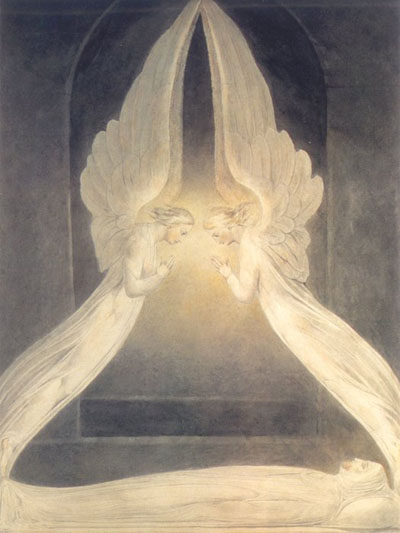
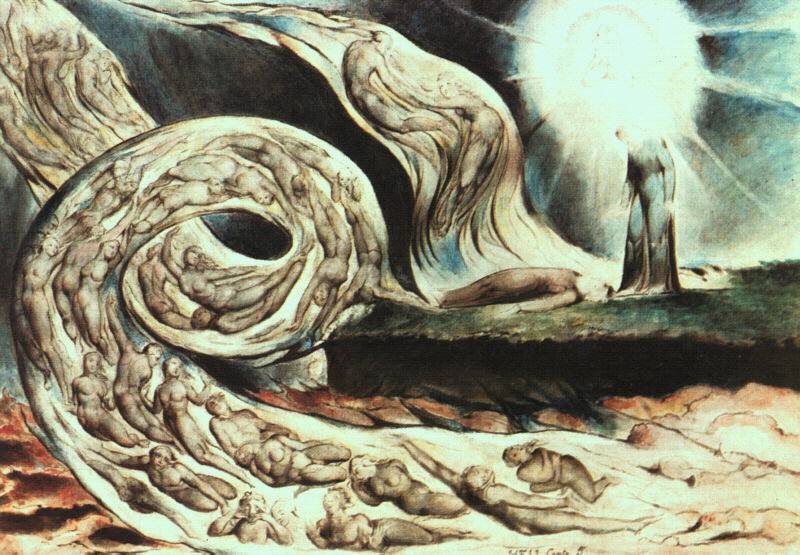
He was a poet (virtually unknown in his own lifetime), and also an engraver (I've put some of his startling work in the extended entry - but if you want to see more of his work, check out this link). He did illustrations for children's books, religious books, volumes of poetry ... and now his stuff is considered priceless.
William Blake was born in 1757 in London, the third of five children. He went to school until he was 14 and then had to go to work. He got a job as an apprentice to an engraver, which is how he ended up making his paltry living. He lived in pretty much poverty for his entire life. He married at 25 the illiterate Catherine Boucher. Blake taught her how to read, and they ended up becoming collaborators in bringing out volumes of his poetry. He did engravings to illustrate his poems. Catherine was the one who bound the books, and got them ready for publication. The entire thing was a joint production. They did all the work themselves.
The two of them never had any children. They were extremely unconventional, and visitors tell of stopping by the Blake house to find the two of them sitting out in their back garden completely naked. Just hanging out, reading, working together, NUDE. They had a whole philosophy about nakedness, and sex, and innocence - that there was nothing dirty about any of that stuff. It actually all was quite holy, and it was human prudery that made celebration of the body a dirty thing.
William Blake had visions. He speaks about them openly and much of his work has a phantasmagorical religious feeling to it. When he was a young boy, he said he looked up into a tree and saw that it was full of winged angels. He would get visions of Gabriel, the Virgin Mary, yadda yadda.
His view of God, the Spirit, the Holy Trinity is so inspiring to me. It's vital, it's alive, and it seems to be all about love. There are not too many people I would call "genius" - but Blake I most certainly would. On the edge of sanity? Sure. Whatever. Many geniuses are.
However - again - William Blake, despite these astonishing works of poetry he put out during his lifetime - died unrecognized.
Now, though, he is considered to be one of the greatest poets in the English language.
He's one of my all-time favorites.
His poem about the little lisping chimney-sweep is in the "canon". If you took any kind of sweeping Poetry 101 course, you probably would have encountered it. I'll post it below. But it's really his long form poems, especially the SPECTACULAR "Marriage of Heaven and Hell", where the guy literally has no equal. None. Blake has no peers.
Here's the one about the chimney sweep, which is an indictment of the society in which he lives, a society that treats its most innocent members with brutality and uncaring indifference. He is a visionary poet, yes, but he did not turn his eyes away from earthly matters. Far from it.
"The Chimney Sweep" - from Songs of Innocence
When my mother died I was very young,
And my father sold me while yet my tongue
Could scarcely cry 'weep! 'weep! 'weep! 'weep!
So your chimneys I sweep, and in soot I sleep.
There's little Tom Dacre, who cried when his head,
That curled like a lamb's back, was shaved: so I said,
"Hush, Tom! never mind it, for when your head's bare,
You know that the soot cannot spoil your white hair."
And so he was quiet; and that very night,
As Tom was a-sleeping, he had such a sight, -
That thousands of sweepers, Dick, Joe, Ned, and Jack,
Were all of them locked up in coffins of black.
And by came an angel who had a bright key,
And he opened the coffins and set them all free;
Then down a green plain leaping, laughing, they run,
And wash in a river, and shine in the sun.
Then naked and white, all their bags left behind,
They rise upon clouds and sport in the wind;
And the angel told Tom, if he'd be a good boy,
He'd have God for his father, and never want joy.
And so Tom awoke; and we rose in the dark,
And got with our bags and our brushes to work.
Though the morning was cold, Tom was happy and warm;
So if all do their duty they need not fear harm.
And here ... for those of you who are interested ... is "Marriage of Heaven and Hell" in its entirety (accompanied by more of Blake's engravings).
Just go with it. Just succumb.
As you can see, the guy was so ahead of his time that he is timeless. He predicts the Beat generation (and Allen Ginsberg was partially responsible for bringing Blake back into vogue), he predicts modernism, he would fit in with the poetry slams of today (except that he is, well, you know - GOOD). He was a man who plumbed his unconscious for material. He brought what was within him OUT. His poetry is the literary version of Van Gogh's Starry Night. Van Gogh was not interpreting the sky. Van Gogh was actually painting what he saw. William Blake is the same way.
I think my favorite line from William Blake is:
The eagle never lost so much time as when he submitted to learn of the crow.
I have reminded myself of those lines from time to time, when I am chastised by mediocrity, or an attitude that wants to bring you down, slap your hand from stepping out of the pack. Mediocrity wants you to be mediocre as well, so that you won't make anyone feel bad.
I'm not saying I am an eagle, but I will say that worrying TOO much about what the crows are chattering about is a big waste of time.
Thanks, Blake! Wish I could have visited you and your wife in your back garden, and sat around with you all, nude, drinking tea, and talking about angels.
Here are some quotes by and about William Blake. Enjoy!
"He had no public: he very early gave up publishing in any serious sense. one obvious consequence, or aspect, of this knowledge is the carelessness that is so apparent in the later prophetic books. Blake had ceased to be capable of taking enough trouble." -- F.R. Leavis
Improvement makes strait roads, but the crooked roads without Improvement, are roads of Genius. -- Blake
"I mean, don't you think it's a little bit excessive?"
"The road of excess leads to the palace of wisdom. William Blake."
Pause.
"William Blake?"
"William Blake!"
"William Blake???"
"William Blake!!!"
-- Bull Durham
"I do not condemn Pope or Dryden because they did not understand imagination, but because they did not understand verse." -- William Blake
"The prophetic robe with its woof of meekness and its warp of wrath was forced on [Blake] by loneliness and his modest station in life." -- Robert Graves
"In his youth, [Blake] had a gift of simple and fair speech; but he lost it. Although he could always catch the heavenly harmony of thoughts he could seldom mount them on a fitting chariot of rhythm and rhyme. His fine passages were the direct gift of the Muse, and are followed by lines of other origin." -- Edward Thomas
"It is an honesty against which the whole world conspires, because it is unpleasant." -- T.S. Eliot
"Think of a white cloud as being holy, you cannot love it, but think of a holy man within the cloud, love springs up in your thoughts, for to think of holiness distinct from man is impossible to the affections. Thought alone can make monsters, but the affections cannot." -- Blake
"He is very eighteenth century." -- T.S. Eliot
"The emotions are presented in an extremely simplified, abstract form. This form is one illustration of the eternal struggle of art against education, of the literary artist against the continuous deterioration of language." -- T.S. Eliot on "Songs of Innocence" and "Songs of Experience"
"In America in the late 1940s Allen Ginsberg, interested in Supreme Reality, alone and suffering a 'dark night of the soul sort of,' his lover Neal Cassady having sloped off, and having himself just masturbated, with a volume of Blake before him - 'I wasn't even reading, my eye was idling over the page of "Ah, Sun-flower," and it suddenly appeared - the poem I'd read a lot of times before.' He began to understand the poem, and 'suddenly, simultaneously with understanding it,' he 'heard a very deep earthen grave voice in the room, which I immediately assumed, I didn't think twice, was Blake's voice.' This 'apparitional voice' became his guiding spirit: 'It was like God had a human voice, with all the infinite tenderness and anciency and mortal gravity of a living Creator speaking to his son.' On Ginsberg this 'anciency fathered Howl, though the Blake simulacrum was aided by the hallucinogens popular at the time, the recipe for Part II of the poem including peyote, just as for Kaddish he was assisted by amphetamine injections. 'The amphetamine gives a peculiar metaphysical tinge to things, also. Space-outs.' Blake managed his visions without substance abuse. Ginsberg's appropriation of the poet of innocence and experience did much to promote Blake to the alternative culture of the 1950s and 1960s." -- Michael Schmidt, "Lives of the Poets"
"a completely and uncompromisingly individual idiom and technique ... individual, original, and isolated enough to be without influence." -- FR Leavis
"You cannot create a very large poem without introducing a more impersonal point of view, or splitting it up into various personalities. But the weakness of the long poems is certainly not that they are too visionary, too remote from the world. It is that Blake did not see enough, became too much occupied with ideas." -- TS Eliot
"Romantic writers glorified childhood as a state of innocence. Blake's 'The Chimey Sweeper', written in the same year as the French Revolution, combines the Romantic cult of the child with the new radical politics, whichcan both be traced to social thinker Jean-Jacques Rousseau. It is the boy sweep, rather than Blake, who speaks: he acts as the poet's dramatic persona or mask. There is no anger in his tale. On the contrary, the sweep's gentle acceptance of his miserable life makes his exploitation seem all the more atrocious. Blake shifts responsibility for protest onto us." -- Camille Paglia, "Break, Blow, Burn"
Some of William Blake's extraordinary engravings below:
Christ in the sepulcher guarded by angels - 1805
Whirlwind of Lovers (Illustration to Dante's Inferno)
The Ancient of Days - 1794

Isaac Newton - 1795

The Books: "Dubliners" - 'The Sisters' (James Joyce)
Next book on my adult fiction shelves:
Dubliners - by James Joyce
James Joyce said: "When you remember that Dublin has been a capital for thousands of years, that it is the 'second' city of the British Empire, that it is nearly three times as big as Venice it seems strange that no artist has given it to the world."
Dubliners is James Joyce's first book - a collection of short stories. It was finally published (after much brou-haha) in 1914. Publishers balked (especially in Ireland) at the frank portrait of Dublin - with its prostitutes, its fake piety, its aimless wandering young men ... I mean, all of that, yes - was very shocking at the time. But I think there was more to the reaction than just rigidity and prudery. Obviously, Joyce touched a nerve. Joyce was telling the truth, as he saw it, about his own country. I think it might have been seen as a betrayal in some circles. Not like he was LYING, no - quite the opposite. They were mad at him for telling the truth. It made them look bad. It was not, shall we say, a flattering portrait. Of course I have my own opinion about that. James Joyce's feelings about Ireland were complex and contradictory. He loved it, it was his homeland - he could never write about anything else - even when he had been living in exile for 20 years - it was to Ireland his mind constantly went in his work. But he could never live there. It was the most suffocating place for him imaginable. So he was not forgiven for choosing to de-camp. Not at that time. I love that Joyce is so honored now, and that Ireland has decided to be proud of their wayward son - but they ran him out of town on a rail back in the early years of the 20th century. He aired the dirty laundry of the "family" out in public. They hated him for it. It's like the reaction today when any African American dares to say that maybe (just maybe) the problems of their community SOMETIMES start from WITHIN the community. Maybe not EVERYTHING can be blamed on slavery. Maybe they need to look WITHIN. Now a white person can never say these things - but watch the reaction when a black person says something like that. These people are pilloried. Shrieking ravens of outrage fly up into the air, blacking out the sun. I see it as a similar reaction to Joyce's writing from the Irish back then, it's not a: "Hey you, stop LYING" reaction. It's a "Hey you, stop telling the TRUTH and making us look bad to outsiders!" reaction. It's understandable, I'm not sayiing I don't understand the reaction. There's a sense that a persecuted group needs to stick together, remain united You can see it in the gay community too sometimes - a need for uniformity. Women, too. Etc. There is nothing new under the sun. There have been identity politics at every time in history - it's just now that we have more official names for it. Groups need to stick together, the rank and file all must agree on the rules, and nobody can break the rules. Well, James Joyce broke the rules. He aired the Irish dirty laundry (literally) in public. George Bernard Shaw said, after reading Ulysses - which shocked and disgusted him, "If a man holds up a mirror to your nature and shows you that it needs washing -- not whitewashing -- it is no use breaking the mirror. Go for soap and water."
Well. Obviously that is a rare response. Most people - when shown a mirror and told, "You suck" - will fight back. And that's what happened to Joyce. He told the truth, and, as per usual with truthtellers, was not congratulated for it.
He left Ireland in 1904 - fleeing with his lover, Nora - leaving scandal and debt behind him. They settled down eventually in Trieste. Joyce had been publishing things here and there, he already had powerful allies like Yeats - who helped him out, thought there really was something special in his writing. But publishers still balked. If you read Dubliners all the way through - and try to put yourself back in 1908, 1909 - and imagine reading it then - put it in the context of its time - you can see what a shocking book it must have been. I have more to say about that, but I'll do it later. Anyway, Dubliners finally was published in 1914.
Harry Levin, the editor of my Portable James Joyce, writes in his introduction:
He left too early for the Revolution; he arrived too late for the Renaissance. His undergraduate idol, the subject of his first published article, was not Yeats but Ibsen. He greeted the Irish Literary Theatre with a polemic against folksy estheticism. He outraged his college debating society by expounding the iconoclasms of European drama. On several visits home from the Continent, between the ages of twenty and thirty, he considered whether some journalistic or pedagogical niche existed for him in the cultural life of his native city. In his single play, Exiles, as in actuality, he pushed this problem toward a negative conclusion. In his short stories, Dubliners, the recurrent situation is entrapment. Their timid protagonists are trapped into marriage ("The Boarding House"), kept from eloping ("Eveline"), wistfully envious of colleagues who get away ("A Little Cloud"). In "Counterparts" a father makes his son the victim of his own frustrations. The plight suggested in "The Dead" is that of a mill-horse harnessed to a carriage, pulling it round and round a public statue.Escaping from the treadmill of Dublin, Joyce spent the rest of his life brooding upon it and writing about it. His insistence on calling its denizens by their names, and pointing out its local landmarks, held up the publication of Dubliners for several years.
It was too private. Too spot-on. It revealed too much. It felt like an accusation - which, indeed, it was. Who is HE to accuse US? Ireland, at that time, was a deeply conventional society (in many ways, it still is). Joyce bucked convention. He looked towards Europe for inspiration. And yet (as I said before) - his creative consciousness always went back to Ireland. In all his stories and books, it is Ireland that comes to life. An incredible thing. I find it very moving. People, in general, do not like complexity. They find it threatening, and somehow hostile. They want things to be either or or. Not both at the same time. They cannot hold two opposing thoughts in their head at the same time, they always feel the need to make a choice. And so. It is very difficult for such people to understand that Joyce hated Ireland, and Joyce would kill for Ireland. Joyce could never live in Ireland, but Joyce yearned for it in his heart, in his words, every day of his life. He was Irish. He loved his country. Only something you love can break your heart. Ireland broke Joyce's heart. But simplistic folks only hear the criticism. They are not careful readers. They set themselves up in opposition. They come to it with their biases hard and firm, nothing can get through. You can't read Joyce that way. He demands engagement, he demands that you look within, that your SOUL is with him - not just your intellect.
Here's Levin again, in his introduction:
Those who confuse a writer with his material find it all too easy to make a scapegoat out of Joyce. They make Proust responsible for the collapse of France because he prophesied it so acutely; and, because Joyce sensed the contemporary need to create a conscience, they accuse him of lacking any sense of values. Of course it is he who should be accusing them. His work, though far from didactic, is full of moral implications; his example of esthetic idealism, set by abnegation and artistry, is a standing rebuke to facility and venality, callousness and obtuseness. Less peculiarly Joycean, and therefore even more usable in the long run, is his masterly control of social realism, which ingeniously springs the varied traps of Dublin and patiently suffers rebuffs with Mr. Bloom. The heroine of Stephen Hero, who has almost disappeared from the Portrait, says farewell after "an instant of all but union." By dwelling upon that interrupted nuance, that unconsummated moment, that unrealized possibility, Joyce renews our apprehension of reality, strengthens our sympathy with our fellow creatures, and leaves us in awe before the mystery of created things.
Amen. That's what I meant earlier when I said that if you only see the criticism - then you are only going halfway there. If your sense of threat is so strong that you must fight back without letting anything in, if you are closed to the possibility of being changed ... then you will miss that part of Joyce. You will miss the love.Dubliners is a very insightful book, very revealing - and most of the stories are, to use a terrible word, bitchy. He is gossiping, passing on dirty stories, revealing truths beneath the convention. He does not pull his punches. But ... but ... the collection ends with 'The Dead'. And in 'The Dead' - Joyce pulls his vision back - goes from microscopic to telescopic - and reveals a world of love and loss and grief and humanity ... that only come from the deepest places in his heart.
That is why I say to people who have not read Joyce and who want to know where to start (because, yes, he can be daunting) - I tell them to read Dubliners. Each story is about 5 or 6 pages long - on average (except for "The Dead") - so you can take it in small chunks - easily digestible - and I also tell them, and I tell you now: to read the stories in order. Read them in order! At least your first time through. I dip in and out Dubliners all the time now, picking up this or that story ... but my first time through, I read them in order, first to last. Joyce was very careful about where each story went in the collection - there was, as always, a method to his madness - and so much of his genius (not yet in full flower) is there, in the slow methodical progression - from 'The Sisters' - the first story in the collection - to 'The Dead' - the majestic last story in the collection, and the greatest short story ever written. In 'The Sisters' - a priest is dead, and he lies in a coffin in an upstairs room, and everyone (all women, except for our narrator - obviously a young boy, unused to death) sits in the sitting room downstairs and chats and gossips about the priest upstairs. Death hovers over 'The Sisters'. And so 'The Dead', the last story - in all its tragedy and scope - is a bookend, a counterpart to 'The Sisters'. Joyce did this deliberately. So I'm just saying this as a suggestion to those who want to give Joyce a try. Read Dubliners story by story, going in order. You'll start to see what Joyce was about then. Because in most of these stories, not much happens. There are no big revealing endings - nothing BIG happens - and so the book is all about the cumulative effect. I won't speak about 'The Dead' yet, and its place in the collection - I'll save that for when I get to it. Suffice it to say, that I don't believe that Dubliners would have HALF the reputation it has now if 'The Dead' were not included. It is 'The Dead' that elevates the book into something divine (I mean that quite literally), something transcendent and universal. But again, I'll get to that later.
'The Sisters', the first story in Dubliners is a simple gossipy little story. It feels like you are eavesdropping, your ear pressed up to the door. Many of the stories in Dubliners have that feel. The narrator of the story is a young boy - young enough to still get angry when he is referred to as a child. He appears to live with his aunt and uncle, no parents are mentioned. And Father Flynn - a pretty much fallen priest (he appears to have gone mad) who was his good friend - has had a stroke, and after a couple of days of vigil he passes away. This sparks in the narrator an unfurling stream of memories about Father Flynn, and who he was to him, etc.
That's the excerpt below.
Oh, and one last quote from Harry Levin, who has a way of saying things that I can't - so I'll just pass the mike to him. He's talking at first about the challenges of getting the collection published, and what the official problem with the book was. But then he goes on to talk about what Joyce was DOING in these stories, and why they were so amazing at the time ... something that you might miss today. It's almost like the influence of Marlon Brando in the late 40s and early 50s. What he did was so completely revolutionary - he changed our expectations of actors with one performance ... and now, everyone lives in the wake of his influence. That's just the fact. Of course it was in the zeitgeist of the time, Laurette Taylor, Montgomery Clift, the Group Theatre - the way playwrights were writing changed - opening a way for this new kind of acting, etc. It's just that Marlon Brando, with Stanley Kowalski, gets the credit. It's hard to remember how influential he was - since he changed things so completely that young actors today STILL want to be Marlon Brando. But to go back and see him in Streetcar - to watch that original performance ... it's like trying to get at the source of it. It was so influential. It remains influential today. But sometimes it's hard to remember that since now everyone "acts" like that. The old style of acting is gone forever. So there is no comparison.
So. Back to Joyce. The reason I want to post this next quote from Harry Levin is because - I was rereading 'The Sisters' last night, in preparation for today - and it occurred to me that the semi-stream-of-conscious voice is the voice of most short stories today. We follow an internal journey, we go with the narrator up, down, around ... we understand that events have internal causes as well as external. Remember, Joyce was living in the beginning of the "Freudian century" Freud was, naturally, already at work - and the debate on whether or not Freud was correct on this or that topic, or the question whether or not Freud has had TOO much influence (an opinion with which I wholeheartedly agree) - is irrelevant to this discussion right now. The revolution at the time was: there are things within our hearts and minds that cannot be seen in broad daylight. Childhood contains sparks of events, seen mainly through the 5 senses, that continue to influence us in adulthood. The surface is NOT everything. Joyce was trying to not just write ABOUT that, but to reflect that knowledge IN his writing. That's his whole thing - to get INSIDE that experience.
Now, of course, today, that is how short stories are written, that is the accepted style, no one finds it odd or intrusive to move so closely with another soul, to succumb to a subconscious rendering of events. That's how it's done now, shall we say. But back then it was a revelation. The Russians were doing it ... but the Irish most certainly were not.
Okay, I'll finally let Harry Levin take over now:
Most of Dubliners was written, from earlier notes jotted down on the spot, during Joyce's first year in Trieste, 1905. The manuscript was accepted the following year by the English publisher, Grant Richards, but was not brought out until 1914 because of objections raised by his printers. Meanwhile Joyce had added three more stories to the original twelve and sent them all to the Dublin firm of Maunsel and Company, which printed them, then changed its mind, and destroyed the sheets. When Joyce's insistence finally triumphed over the long delay, the published text included the exceptionable matter; the repetition of "bloody," the innuendo against Edward VII, and - what was most offensive to the Irish publisher and most intrinsic to Joyce's method - the specific mention of local establishments and personalities. The book is not a systematic canvass like Ulysses; nor is it integrated, like the Portrait, by one intense point of view; but it comprises, as Joyce explained, a series of chapters in the moral history of his community; and the episodes are arranged in careful progression from childhood to maturity, broadening from private to public scope. The older technique of short-story writing, with Maupassant and O. Henry, attempted to make daily life more eventful by unscrupulous manipulation of surprises and coincidences. Joyce - with Chekhov - discarded such contrivances, introducing a genre which has been so widely imitated that nowadays its originality is not readily detected. The open structure, which casually adapts itself to the flow of experience, and the close texture, which gives precise notation to sensitive observation, are characteristic of Joycean narrative. The fact that so little happens, apart from expected routines, connects form with theme: the paralyzed uneventfulness to which the modern city reduces the lives of its citizens.
Now. Onto the excerpt from 'The Sisters' - the first story in the collection.
Excerpt from Dubliners - by James Joyce: 'The Sisters'
The next morning after breakfast I went down to look at the little house in Great Britain Street. It was an unassuming shop, registered under the vague name of Drapery. The drapery consisted mainly of children's bootees and umbrellas; and on ordinary days a notice used to hang in the window, saying: Umbrellas Re-covered. No notice was visible now for the shutters were up. A crape bouquet was tied to the door-knocker with ribbon. Two poor women and a telegram boy were reading the card pinned on the crape. I also approached and read:
The Rev. James Flynn (formerly of S. Catherine's Church, Meath Street), aged sixty-five years,
R.I.P.
The reading of the card persuaded me that he was dead and I was disturbed to find myself at check. Had he not been dead I would have gone into the little dark room behind the shop to find him sitting in his arm-chair by the fire, nearly smothered in his great-coat. Perhaps my aunt would have given me a packet of High Toast for him and this present would have roused him from his stupefied doze. It was always I who emptied the packet into his black snuff-box for his hands trembled too much to allow him to do this without spilling half the snuff about the floor. Even as he raised his large trembling hand to his nose little clouds of smoke dribbled through his fingers over the front of his coat. It may have been these constant showers of snuff which gave his ancient priestly garments their green faded look for the red handkerchief, blackened, as it always was, with the snuff-stains of a week, with which he tried to brush away the fallen grains, was quiet inefficacious.
I wished to go in and look at him but I had not the courage to knock. I walked away slowly along the sunny side of the street, reading all the theatrical advertisements in the shop-windows as I went. I found it strange that neither I or nor the day seemed in a mourning mood and I felt even annoyed at discovering in myself a sensation of freedom as if I had been freed from something by his death. I wondered at this for, as my uncle said the night before, he had taught me a great deal. He had studied in the Irish college in Rome and he had taught me to pronounce Latin properly. He had told me stories about the catacombs and about Napoleon Bonaparte, and he had explained to me the meaning of the different ceremonies of the Mass and of the different vestments worn by the priest. Sometimes he had amused himself by putting difficult questions to me, asking me what one should do in certain circumstances or whether such and such sins were mortal or venial or only imperfections. His questions showed me how complex and mysterious were certain institutions of the Church which I had always regarded as the simplest acts. The duties of the priest towards the Eucharist and towards the secrecy of the confessional seemed so grave to me that I wondered how anybody had ever found in himself the courage to undertake them; and I was not surprised when he told me that the fathers of the Church had written books as thick as the Post Office Directory and as closely printed as the law notices in the newspaper, elucidating all these intricate questions. Often when I thought of this I could make no answer or only a very foolish and halting one upon which he used to smile and nod his head twice or thrice. Sometimes he used to put me through the responses of the Mass which he had made me learn by heart; and, as I pattered, he used to smile pensively and nod his head, now and then pushing huge pinches of snuff up each nostril alternately. When he smiled he used to uncover his big discoloured teeth and let his tongue lie upon his lower lip - a habit which had made me feel uneasy in the beginning of our acquaintance before I knew him well.
November 27, 2007
My old stompin' grounds
This past Saturday - a freezing cold day - I went up to URI and wandered around, on the quadrangle - and then went over to the Fine Arts Center, where I spent the majority of my time in college. Like 80% of my time. All the doors were opened. No students - they were all home on Thanksgiving break. But I wandered around to my hearts content, strolling down memory lane. Amazing how nothing has changed!
I went down to the girls dressing room - below the stage. I could still smell the powder, the Aquanet - I could still see all of our reflections in those mirrors ... Brooke, Jackie, Liz, Nancy, Julie, Lee ... all of my friends. Actresses. Costumes hung on the rack. Hustle, bustle, quick changes, curlers, corsets, T-strap shoes, hoop skirts, aprons, bonnets ... My locker was over on the left hand side.


My old stompin' grounds
The Fine Arts Center lobby. I wandered around, staring at all the posters - shows from before my time, shows during my time, and shows after. They're all still there. And that lobby!! How many fights did I have with boyfriends in that lobby. How many embarrassing public meltdowns. How much I have gossiped in that space, whispering with Mitchell, being completely annoying because we couldn't believe what good friends we were. We drove everyone crazy. How many classes did I cut - sitting in that very lobby. LIke: Sheila. You have a class IN THAT BUILDING. If you're going to cut, at least get off the premises!! How many nervewracking waits for auditions - that's where we all would pace and wander, before being brought into the various auditions. How many improvisations were done - with Mitchell and David and Jackie - crazy stuff - David picking us all up over his head and whipping us around. A wonderful advertisement for what it was to be a theatre major. It's a beautiful space and I love how much it has NOT changed.

The box office

Posters for The Five Brothers and The Effect of Gamma Rays on Man-in-the-Moon Marigolds - two shows I was in.

Poster for The Gingham Dog. David starred in that one. I played his bigoted sister.

Poster for Reckless. David and Nancy starred. Mitchell was hysterically funny as the ridiculous cheeseball gameshow host. I played David's deaf (or pretending to be deaf) paraplegic wife.

Poster for Anne of Green Gables. I played Anne with an "e". The highpoint of my college career.

Poster for Edwin Drood. I think that was my favorite theatrical experience in all of college. I just played a music hall girl, no big part ... and it was the most fun I've ever had. Jackie and I, as music hall sluts, were joined at the hip. We danced, we laughed, we did stupid bits, we heckled each other, we strutted about ... we had an absolute blast.
And now ... looking back: on my past, seen through the lobby.

My old stompin' grounds
The light lock. The actor's lounge downstairs. Hallways. Ghosts of my younger self EVERYWHERE. And not just my ghosts - but everyone's. David. Mitchell. Jackie. Nancy. Brooke. Jim. Alec. Judith. All of them. These spaces may LOOK empty, but I assure you: they are not.


My old stompin' grounds

The main theatre. Wait til you see the size of the space. We, as students, had no idea how good we had it. You get out in the real world, and you deal with scratchy black-box theatres, seating 70 people ... and you realize: holy crap, the facilities back then were world-class!
Thanksgiving weekend was always the dry tech weekend - students gone, so the technical team can put up the set for the show that opens the following week. I was happy to see nothing had changed. They are doing Little Women, and the dry tech was up and running when I peeked in. I love continuity.


My old stompin' grounds

G Studio. Scene of a million acting classes. A million rehearsals. We did a production of Lanford Wilson's Rimers of Eldritch in G Studio - and the place was transformed into an old rickety tumbleweedy kind of town. That place is full of ghosts. Kimber (teacher) smoking his pipe. Scenes being done. Meisner repetition exercises. So many things. Mitchell and I were reminiscing last night about all that went on in G Studio. And it hasn't changed at all. I auditioned for Picnic in G Studio. It was my introduction to the seriousness of what I wanted to do, and how seriously I wanted to take it. That feeling resides in that room to this day.


My old stompin' grounds
The exterior of the Fine Arts Center - where I spent the majority of my time in college. The statues say it all. It feels like so many important moments of my life happened within view of those statues. It was a freezing cold day, brisk and blue-skied. With red and yellow leaves abundant everywhere I looked. An autumnal day. Very college-y and it made me very nostalgic.


Baron von Steuben's entourage
This is so amusing. What a lively letter. I can just SEE that whole scene, and the poor landlady trying to be compensated for her trouble. Ha!!
Paging Sigmund Freud
Talking with Cashel on the phone last night. He launched into a monologue at one point.
"I was playing the Star Wars Legos game the other night, and I was so focused on it that I dreamed about Legos that night! And the dreams were reeaaaally scary!! Dad said that I was so concentrated on the Legos that they went into my subconscious."
I hate it when that happens.
The Books: "A Very Long Engagement" (Sebastien Japrisot)
Next book on my adult fiction shelves:
 Excerpt from A Very Long Engagement - by Sebastien Japrisot
Ted gave me this wonderful, haunting (and, in a weird way, fun) book as a gift years ago. I highly recommend it - to anyone who is looking for a good book. I still remember my pleasure of first reading it. It's a war novel - it takes place during WWI, in France - but it's also a love story. A young girl - Mathilde - waits for her lover (Jean - whose many nicknames include Manech and Cornflower) to come home to her. Is he dead? Alive? There is something mysterious at work. He was court-martialed for injuring himself on purpose. But then what? Where did he go? Mathilde, only a teenager, can't get any straight answers. She's a great character, by the way. Wonderful. Physically handicapped (she can't walk), open-hearted, courageous, determined. The book is mostly her story. Her lover never returned from the war (like millions of others who never returned). But there is no death notice, nothing official ... it seems that something else must have happened, something shameful, something that is being hidden. The book opens with 5 soldiers being walked through the mud to an uncertain fate. They are shackled. They tell each other to look out for trip wires. These 5 soldiers (we get to know them very well) all never return ... and Mathilde begins to piece together what happened to them. This is a jigsaw puzzle of a book - with clues dropped, and letters written in code - fragments of notes - mysterious messages ... Mathilde begins to seek out the loved ones (anyone!!) of the other 4 soldiers - to see if they know anything of the fates of their men. Did they say anything? Her search takes her far and wide. She is so young, but - like the title of the book says - she is willing to wait. This boy was her lover, her intended, he was everything to her. If she cannot have him in person, then she will put together how he died. It will not be easy, but she cannot just say to herself, "Oh well, that's it - I'll never know if he's alive or dead ..." That would be so wrong. A betrayal of the highest order.
What happened to those 5 French men, buried in mud on the front line? Shackled each to the other? Why does the trail go so cold at a certain point? What happened? And why will no one speak of it?
That's the trajectory of the book. Because I read it in translation from the French, I can only say that the translation is wonderful. I'm sure it would be best in the original language - but to my ears, this translation flows, it has a poetry to it, a wit, an intelligence - it doesn't feel stilted at all like some translations. The book is about the horror of war, certainly - the chaos of it, the gore, man's inhumanity to man. But it's also about a very smart very determined young lady, putting together as much information as she can - re-reading all of her lover's letters to her (we read the letters - the book is full of fragments of text like that) - trying to figure out if he knew anything more than he was telling. We get to know each of the soldiers - their lives, their significant others - they're all so different, although they are all French - but the only connecting link between them is that they all disappeared off the face of the earth one muddy night - and nobody knows where they are. Mathilde takes it as her mission to put together the story. It takes a long time. We only get glimpses - out-of-sequence glimpses - we are involved in her "detective work" - she breaks the code of one of the soldier's letters - and is able to read the hidden message within the text ... It's all great great stuff.
Very moving, too. What we do for love. And how soldiers depend on that love still being there when they return home. It is everything.
If you haven't read this book, I highly recommend it!! Mathilde is a heroine for the ages, she really is. I still think about her sometimes, and wonder what became of her, and how she fared in the rest of her life. She made that much of an impression on me.
Here's an excerpt from the haunting first chapter:
Excerpt from A Very Long Engagement - by Sebastien Japrisot
When suffering becomes simply too great to bear, it sometimes precedes its victims to the grave. After the staggering blow of his conviction, something inside Cornflower had quietly broken, like a monstrous abscess, as he lay in the darkness of the cattle truck bearing him and fourteen others to their unknown destination. From that moment on he was unconscious, save for brief spells of bewilderment, of what he had just lived through, the war, his missing hand, the silence of the mudmen lined up as he passed by and who averted their gaze from his, for the look in his eyes was docile, trusting, unbearable, and his fixed smile was the grimace of a demented child.
He walked along smiling so strangely, the last of these five soldiers who had to be punished; he had blue eyes and black hair, his cheeks were dirty but almost beardless, and now at last his youth gave him an advantage, for he had an easier time of it than his companions in the flooded trenches. In face, he had an animal sense of well-being at plowing through the mud, with the cold wind in his face, listening to the shouts and laughter of evenings gone by: he was coming home from school, along the path through the dunes, between the ocean and the lake, and it was that curious winter when there was snow everywhere, he knew his dog Kiki was coming to meet him in the gleaming sunset, he was hungry, he longed for some bread and honey and a big cup of hot chocolate.
Someone, somewhere, said to watch out for the wire.
Mathilde doesn't know if Manech heard this, through all the commotion of his childhood memories, through the crash of the great waves that broke over them as she clung to him at the age of twelve, fifteen ... She was sixteen when they first made love, one April afternoon, and swore to marry as soon as he came back from the war. She was seventeen when they told her he was lost. She cried a great deal, because women take such things hard, but she did not overdo it, because women don't give up easily, either.
There was still that wire, mended whenever it broke with whatever came to hand, a wire that snaked its way through all the trenches, through all the winters, now up at the top, now down at the bottom, across all the lines, until it reached the obscure bunker of an obscure captain to deliver criminal orders. Mathilde had seized hold of it. She holds it still. It guides her into the labyrinth from which Manech has not returned. When it breaks, she ties the frayed ends together. She never loses heart. The more time passes, the greater her confidence grows, and her determination as well.
And Mathilde has a cheerful disposition, too. She tells herself that if this wire doesn't lead her back to her lover, that's all right, she can always use it to hang herself.
November 26, 2007
Maurice Jarre - a Tribute to David Lean

In honor of David Lean's upcoming 100th birthday, in 2008, Milan Entertainment has released a special edition DVD/CD of a tribute concert which was recorded live at the Barbican Center in London in 1992, a month after David Lean's death. Maurice Jarre, French composer, composed the scores to 4 of David Lean's films: Doctor Zhivago, Lawrence of Arabia, Ryan's Daughter, and Passage to India, and he conducts the Royal Philharmonic Orchestra in the David Lean tribute. Jarre was a very close friend to Lean, and you can feel his emotion at certain points of the concert, the sense of loss for his friend, and the focus it takes to keep his mind on the job at hand. It's very moving to watch. The concert was recorded live, so obviously that means: one take, no do-overs, and they only had 7 cameras. It is extraordinary how those 7 cameras actually feel like 20, with the angles and perspectives provided throughout the concert. It is beautifully done, and I'm so pleased that this treasure is now available to the public.
The special edition DVD has audio commentary by Mr. Jarre. He talks about the work it took to pull the concert off, they only had two rehearsals, and he also reminisces about his association with David Lean, and what it was like to work on these extraordinary pictures with him. You get wonderful glimpses into how David Lean worked. Maurice Jarre said that Lean taught him perfectionism.
Maurice Jarre started out in France, and did quite well, and it was the score he composed for Sundays and Cybele which attracted the attention of Hollywood. It was nominated for Best Score. Sam Spiegel, mogul extraordinaire, honed in on Jarre as the man who should compose the score to his upcoming picture, Lawrence of Arabia. The interesting thing about this was that the music for Sundays and Cybele only made up about 10 minutes of the film, and there were only a couple of instruments involved. And here he was, being asked to compose (at very short notice) over 2 hours of music, for a 100-piece orchestra! But Spiegel knew an artist when he heard one. I love the idea of Jarre rising to the challenge, saying "Yes" to this unbelievable opportunity. There were all kinds of issues involved with hiring him, since the score was going to be recorded in London, and Spiegel was concerned that he already had too many "foreigners" involved in the picture, and Hollywood wouldn't take kindly to that. Additionally, the British government would not provide a subsidy for the recording unless a British person conducted the orchestra. Jarre didn't mind that. The job was big enough to keep him occupied. However, when Adrian Boult, the British conductor, was brought in for the rehearsal, and Jarre explained to him how recording for a film works, how you have to keep an eye on the chronometer, and an eye on the screen - as well as conducting the orchestra - a look of panic came over Boult's face. He said, "I don't know how to do that!" Eventually, Jarre ended up conducting the orchestra, except on the film credits Adrian Boult is listed as the conductor, in order to get the British subsidies. However, when the record was released of the score, Jarre was listed as the conductor. And nobody noticed or said a word about it, that two people apparently conducted that score. And Boult never conducted a note!
The collaboration between Lean and Jarre was highly successful, and Jarre won three Oscars, for Lawrence of Arabia, Doctor Zhivago (I can hear that score in my head now!) and A Passage to India. Jarre describes Lean's way of working, his theory of music in film. They were very much in sync, which is why it was such a fruitful working relationship. Lean did not believe that music should underline the events. Jarre said that only very rarely did Lean go in that direction. He was more interested in having music that showed what could not be showed visually. And isn't that the best kind of score? The most memorable? I am always annoyed by music that merely underlines what I already see. For example, Jarre describes the moment in Lawrence of Arabia when the little boy is out in the desert, all alone, staring around him. And then, on the far horizon, he sees a small black dot, and slowly the black dot approaches ... until you get that great shot of the two figures coming towards each other across the sandy panorama. It's magnificent. And the music swells to an almost unbearable crescendo, it's goosebump time! Jarre said that David Lean said to him, "We need something here that tells us what the little boy is feeling." This is Jarre's favorite kind of composing.
Another example of this (and it was one of my favorite stories in the interview Christian Lauliac does with Jarre which is also included in the special edition disc) is the Indian statue sequence in Passage to India, when Judy Davis, inhibited Victorian lady, comes across a garden of almost pornographic Indian statues. She is overwhelmed, something is stirring inside of her - it's pleasing, but it's also terrifying - since she has no context for the experience. She stares around, seeing the naked breasts and undulating figures, getting more and more disturbed, until finally about 5 monkeys descend on her, from a nearby tree - causing her to flee. That's the end of the sequence. There's not a word of dialogue. Judy Davis' acting brings you partway there, the cinematography fills in some of the blanks, but it is the music, in the end, that completes the picture. Lean had wanted there to be 1,000 monkeys leaping out of the tree, but there was only money for 5. So he said to Maurice Jarre (and I love this line): "You have to give me the missing monkeys with your music." And that's exactly what Jarre did.
The concert itself is broken down into 7 parts: the introductory "Remembrance", the "Ryan's Daughter" suite, the "Passage to India" suite, the "Doctor Zhivago" suite, a special piece of music composed by Jarre for David Lean's wedding, the "Passage to India: Garden of Statues" (where Jarre and the orchestra demonstrate how music is recorded for film, with the chronometer and the sequence projected on the wall behind), and finally, the "Lawrence of Arabia" suite. Throughout each, scenes from the film appear, but for me, the best part of the whole experience was watching Jarre himself. He was so focused, so marvelous, and he reminisced that because it was a David Lean tribute, many of the musicians brought not just their talent that day, but their hearts. It shows.
Jarre says, in the interview with Christian Lauliac, in regards to working with David Lean, "I am very careful to go in the same direction as him."
What a beautiful statement of the nature of artistic collaboration.
Maurice Jarre - a Tribute to David Lean includes:
DVD:
Full concert (also with audio commentary by Maurice Jarre)
35 minute interview with Maurice Jarre
Filmographies and biographies of Maurice Jarre and David Lean
Essay by film critic Christian Lauliac on the careers of both men
CD:
Full concert
November 25, 2007
As promised
The redcoat-ed Revolutionary War-era soldier perusing the 9/11 exhibit at the New York Historical Society.

The Gathering - Anne Enright
 I finished The Gathering this weekend (my mother did, too) - and while I am truly inspired by her writing (she's the kind of writer that makes me BURN to pick up my pencil, and try again) - I found the book almost unbearably depressing. I liked her take on Ireland now - we've had enough of twee Ireland thankyouverymuch - she's writing from the midst of the Celtic Tiger (although her book isn't strictly about that) - but the main character, with her Saab and her charcoal and slate interior design - is obviously reaping the benefits of Ireland's new wealth. But the memories of the characters are from the bleaker more rigid 60s and 70s - and I'm not against sad books, for God's sake, no ... but I found myself 3/4s of the way through looking forward to the end. It was too much for me. I did not experience that with, say, Atonement, which is probably the saddest mo-f**in' book I have ever read. But with The Gathering I twitched with impatience to be done with it. This has nothing to do with her writing - which I love. I love it so much I want to EAT it. I want to cut it with a knife like a big fat piece of cheesecake. It is so so good. Her bits about the Irish blue eyes, the Hegarty eyes - she just gets Ireland, or at least a portion of it. The tormented part of it. The pious surface, and the sexual underbelly. And even now - with wealth and "things" (see: Seamus) - Ireland must be dealt with on its own terms. Its past is huge. The sins done to that country - by their own clergy, by the very nature of Catholicism - must still be handled and faced. None of it is pretty. My great-aunt, who is a nun, has told me stories about working in Ireland in the early and late 60s, awesome stories (my great-aunt is one of the most amazing women I have ever known, a true idol to me) - but her funny and ridiculous stories are so so revealing about what was going on in Ireland, especially during the upheaval of Vatican II. There is a sense that reality itself cannot be looked at, in Ireland. Joyce said he wanted to hold up a looking-glass to his country and if they didn't like what they saw, then whose fault is that? This is what her book is about. I can see it might have cut too close to the bone. My mother and I talked about it a bit. Ireland has grown and changed. Shackles flung off. I suppose family issues are family issues anywhere, and in any generation. It doesn't matter that Ireland is now some Celtic Tiger. There are ghosts, demons, nightmares. Enright's territory is family, the suffocation of a large poor family in Ireland. Too many kids, too many obligations, exhausted mother, absent father ... too many relationships to manage ... an extended state of childhood, where your SIBLINGS continue to carry such weight in your mind. Other cultures do not have this. Or if they do - certainly not to the same mythological level that Ireland reaches. Enright writes about a family with 12 children (and 7 miscarriages, let's not forget) - and the chaotic raw upbringing that such a family would demand. No care-taking of souls, or development of personality and mind - it's just about being dragged up, each fighting for his own piece of turf. And they're all just messed UP! I was exhausted by the Hegartys. This is my terrain, so maybe it just pushed a button - a button I honestly don't want pushed. But her writing is so wonderful, so weird and angry and ... itself - it truly feels like an original voice - an "Enright" voice - in the same way that Annie Proulx seems completely original to me, someone who is just herself ... and reading such stuff always inspires me. To do better, work harder, go deeper ... be more myself. And hang the consequences. There will be those who will not like what I write. But I cannot worry about those people. I am not writing for them. The point is to express, to work hard, to hone my skills, and to be myself. Because there's only one me. And I am not reinventing the wheel, obviously, but I can only be the best Sheila-writer I can be. There WILL be an audience for such things. Those who are nit-picky, or offended, or who take me defensively - and always need to set themselves up in opposition to me ... are not the ones I am writing for. Anne Enright's book has helped me to see that.
But damn, I'm glad it's over. The tragedy of the Irish (for me) must be taken in small doses. Now I'm moving on to John McGahern's last novel - By the Lake - a portrait of a small rural community in the west of Ireland - and it has its own ghosts, echoes, problems - problems of a strictly Irish nature ... but it's not so unremittingly bleak.
I feel like I need to qualify all of this. Enright's writing (as you will see in the excerpt below) is not bleak, in and of itself. It's actually quite lively. She rollicks along, it feels rather conversational - and there are funny spot-on observations that make me nod in recognition - she's so good that way - it's just that I found it all too sad. And I wanted it to be over.
Here's a wonderful example of her writing. Veronica is describing one of her first loves - Michael Weiss, an American exchange student at UCD.
From The Gathering by Anne Enright:
I fell in love, I am beginning to realise, in my early twenties, when I met and slept with a guy from Brooklyn called Michael Weiss. He was in Dublin for an MA in Irish studies or Celtic studies, or what have you - we despised those courses, they were just something the college did to get rich Americans, and so I was surprised to find myself in love with Michael Weiss; surprised too because he was not a tall American with big prairie bones, but an average-sized guy who smoked rollups and talked with a Brooklyn pebble in his mouth, part slur and part contemplation.
Sleeping with him was very sweet, the way he would prop himself up to look at you and talk. He loved to chat while he was touching you, he loved even to smoke in this endless lazy foreplay that was all foreign to me then. I was twenty years old. I wasn't used to sex that was so aimless and unspecific. I wasn't used to sex that was sober, I suppose, and all this talking just made me uncomfortable: I thought he didn't fancy me. I watched his face move and wished he would just get on with it - the astonishing bit, the thing we were both here for.
I think, in his ironic, slow way Michael Weiss knew that he couldn't hold on to me, and all he was doing in those drowsy afternoons was trying to talk me down, like a cat in a tree, or an air hostess in charge of the plain. 'You see that leh-ver to your right? I want you to ease that leh-ver down to forty-five degrees.'
And though we got through a surprising amount of it - sex, that is - all I can remember is my madness at the time, watching the day outside his window shift to dusk in jolts and patches. It was, perhaps, an adolescent thing; standing naked on the nylon carpet of his student bedsit and feeling the change of light to be impossible; like my skin was being stripped off, as the day gave way, in tics and lunges, to dark.
Michael's father was an artist and his mother was something else. I wasn't used to that either - most of the parents I knew were just parents - but he had this semi-famous father and this mother who made appointments and met people and dressed up to go out, and so he had all of that dragging behind him. It was hard for him to know what he was going to do when he grew up, because he had been grown up, at a guess, since he was ten years old. He wrote some poems, and they were probably quite good poems, but the idea of getting anywhere was a problem for him. There was money - not a lot of money, but some - and he had decided I think, even then, just to exist, and see what came his way.
So now he is just existing, as I am, though probably somewhere more interesting than Booterstown, Dublin 4. He is in Manhattan, say, or the canyons of LA, and he is taking his son to saxophone lessons, he is turning up to his daughter's dance showcase on a Thursday afternoon, and finding all of that an important and amusing thing to do.
I went out with Michael Weiss for two years, on and off; driven crazy by his languor - made inadequate by it, and impatient for the world ahead of us, that was full of things to do. I was not sure what these things were, but they would be better than just hanging around all afternoon, kissing and smoking, talking about - what? - whether Dirk Bogarde was actually good-looking, and how, or how not to be, a Jew.
Now, of course, my afternoons are spent not watching the television, so I was undoubtedly right to distrust and finally leave Michael Weiss for a better, faster life, the one I have now, cooking for a man who doesn't show up before nine and for two girls who will shortly stop showing up too. Having tear-streaked sex, once in a blue moon, with my middle-aged husband; not knowing whether to hit him or kiss him.
Switch on the light, I want to say. Switch on the light.
But it is not just the sex, or remembered sex, that makes me think I love Michael Weiss from Brooklyn, now, seventeen years too late. It is the way he refused to own me, no matter how much I tried to be owned. It was the way he would not take me, he would only meet me, and that only ever halfway.
I think I am ready for that now. I think I am ready to be met.
Only connect
An old old old long-lost friend contacted me on Thanksgiving. It's been years. She's been on my mind (our families are intertwined - I know what's going on with her and hers, even when I do not see her) - and obviously the same was true for her. She was my first friend. We became best friends in kindergarten. She had a little brown velvet necklace on, and I asked her what it was called, and she said, making a joke, "A boonga." A totally made-up word. Thank God I got the joke. I thought "boonga" was the funniest thing I had ever heard in my life (gimme a break, I was 5 years old) - and even as we grew up, the humor of "boonga" never left us. A nonsense word. But it can mean so much. And from such an auspicious beginning, years of friendship followed. We drifted apart - and while I have kept in close touch with my core group of high school friends, she and I not so much. We've made inroads over the years - we had dinner once in the late 90s - I ran into her on the sidewalk once - she invited me to her wedding reception, which was wonderful - I went with my parents (like I said: families intertwined) but there was always the ghost of who we used to be, hovering around us. I couldn't bear us to be POLITE. In the intervening years, she has become world-famous. You would know her name. I have walked down the street and seen enormous photos of her in store windows ... two-page spreads in The New York Times ... imagine how odd that is. Her success has been well-deserved. So in a way, I kept in touch with her that way, as well. I followed her trajectory, not surprised at all - but it is, indeed, an odd sensation. You can feel so far away. I have felt, over the last 2 or 3 years, that something might be ready to shift. Beth has felt it, too. She has had a couple of encounters with our old friend - out of the blue, accidental - which has made her feel like: we are reaching out ... all the years in between are meaningless ... what remains is the connection that once was there. It is truly remarkable (and RARE) how that can happen sometimes. She and I talked on the phone, and it was so so good to hear her voice, I have tears in my eyes right now. We caught up a little bit - but not really - it was more about our family situations, I had heard of hers, she had heard of mine (our fathers are good friends and colleagues) - so we got right to it. When we said, "How are you doing?" we really meant it. I could hear her two little children in the background, children I have not yet met. My old friend, dangling on the jungle gym wearing her boonga necklace, has 2 small children. And there was her voice again. She reached out to me. It had to take some guts. Not because there's any animosity there, but because it has been so damn long. Years. Years of silence and nothingness.
We exchanged email addresses.
Thanksgiving. I am thankful that I have lived long enough to move past the anger and bitterness of my younger days. I am angry and bitter about OTHER things, sure ... but not the things from back then. There is such a thing as something happening "too soon". I think, perhaps, when we had dinner 10 years ago - it was "too soon". There was a barrier there. We were, the dreaded word, cordial. It was awful. We couldn't break through.
Now, all of that has washed away.
Leaving just the connection.
And that is something to be truly thankful for.
Love it
Helen Hayes holding a sign along the lines of "Irish Need Not Apply". Love her little mischievous grin!
Libraries again
Another post for you, my dear father. A letter from 1850 about a missing public library. I could totally see you writing such a letter to the editor!
The Books: "The Portrait of a Lady" (Henry James)
Next book on my adult fiction shelves:
 Excerpt from The Portrait of a Lady - by Henry James
I'm not really a big Henry James fan (I love this quote from TS Eliot which says it way better than I ever could) - and there have been times when I have felt rather, uhm, defensive about this (just a bit) - because people seem shocked and bothered by my opinion. Same thing when I say I'm not too wacky about Edith Wharton. I mean, I recognize the skill of the writing - in both cases - and there are some passages in Ethan Frome that are as good as it gets ... but the books themselves leave me cold. I have to force myself to pay attention. I never get lost in the narrative. I read Portrait of a Lady years ago, and I barely remember any of it. Unlike, say, Tess of the D'Urbervilles or Tale of 2 Cities - classic books which I first read a bazillion years ago, and certain scenes remain etched in my mind forever, and also: I can remember the plot-lines, the cliffhangers, what happens when, the thrust of the book. Portrait of a Lady remains very vague to me, and I'm not sure why. I do remember really liking the long long stretches of dialogue in the book - the conversations themselves were wonderfully portrayed. It reminded me a bit of the pages-long dialogues in Jane Austen's books. Where it's just people talking, with very little editorial interruption ... and you can HEAR the voices, and man, you wish you spoke like that!! The story of James' writing of Portrait of a Lady is well-known. He started out with no plot, no story-line. He wanted to write a character portrait of a young American heiress, meeting her destiny. Whatever that destiny was, James found out through the writing. Pretty interesting! Even more interesting when you reflect on what the plot of the book ended up being. Isabel Archer, a woman committed to her independence (only - in a strangely artificial way ... you get the sense that all of this is just an IDEA to her, not a reality - she likes the IDEA of being independent, and she likes the IDEA of the mobility that sudden wealth will give her ... but she honestly doesn't have enough character or personality to truly make something of herself.) She's another version of Dorothea Brooke, although a bit more cosmopolitan. Dorothea Brooke has a vague idea that her life should be interesting ... only to find out that she is, after all, not a very interesting person - and she has made completely conventional choices which have broken her heart in 2, for good. TRULY interesting people avoid such humdrum fates. Same goes with Isabel. She is the classic Jamesian heroine: an American, confronted by the cynicism of Europe - and that cynicism is her undoing. She does not have the tools to deal with the machinations of the wealthy in Europe. She is too forthright, too idealistic. It crushes her. In the end, it is a man who is her undoing. How terribly mundane. Isabel assumed her life would be glorious, she assumed that she was a superior type of person ... that regular everyday misery would not be for her. She falls in love with Gilbert Osmond - a horrible man - and he ruins her life. Slowly but surely.
It's interesting - in looking through the book again, to get ready for today's excerpt - I was struck by the many long long passages of character description - which border on brilliant psychology. (I can give James the props when he deserves them!) He dissects people. He describes them, yes, but he describes their souls, their motivations, their outlooks - in a way that can only be termed "Jamesian". He has been called a "first-class documentarian" and it's passages like the following excerpt that show why (in my opinion). George Eliot was better. What she didn't know about the human race probably isn't worth knowing. (Here's just one example) She is a psychologist of the highest order. She's like Shakespeare, in her insights into human beings - her sense of truth and reality. But James here, is pretty darned good. I'm still not a fan, and I still think he's over-rated - but there is much to be praised here. No baby out with the bathwater. (Here's an excerpt I posted from an EF Forster lecture on Henry James which also describes what is missing in James - for me.)
Excerpt from The Portrait of a Lady - by Henry James
It may be affirmed without delay that Isabel was probably very liable to the sin of self-esteem; she often surveyed with complacency the field of her own nature; she was in the habit of taking for granted, on scanty evidence, that she was right; she treated herself to occasions of homage. Meanwhile her errors and delusions were frequently such as a biographer interested in preserving the dignity of his subject must shrink from specifying. Her thoughts were a tangle of vague outlines which had never been corrected by the judgement of people speaking with authority. In matters of opinion she had had her own way, and it had led her into a thousand ridiculous zigzags. At moments she discovered she was grotesquely wrong, and then she treated herself to a week of passionate humility. After this she held her head higher than ever again; for it was of no use, she had an unquenchable desire to think well of herself. She had a theory that it was only under this provision life was worth living; that one should be one of the best, should be conscious of a fine organisation (she couldn't help knowing her organisation was fine), should move in a realm of light, of natural wisdom, of happy impulse, of inspiration gracefully chronic. It was almost as unnecessary to cultivate doubt of one's self as to cultivate doubt of one's best friend: one should try to be one's own best friend and to give one's self, in this manner, distinguished company. The girl had a certain nobleness of imagination which rendered her a good many services and played her a great many tricks. She spent half her time in thinking of beauty and bravery and magnanimity; she had a fixed determination to regard the world as a place of brightness, of free expansion, of irresistible action: she held it must be detestable to be afraid or ashamed. She had an infinite hope that she should never do anything wrong. She had resented so strongly, after discovering them, her mere errors of feeling (the discovery always made her tremble as if she had escaped from a trap which might have caught her and smothered her) that the chance of inflicting a sensible injury upon another person, presented only as a contingency, caused her at moments to hold her breath. That always struck her as the worst thing that could happen to her. On the whole, reflectively, she was in no uncertainty about the things that were wrong. She had no love of their look, but when she fixed them hard she recognised them. It was wrong to be mean, to be jealous, to be false, to be cruel; she had seen very little of the evil of the world, but she had seen women who lied and who tried to hurt each other. Seeing such things had quickened her high spirit; it seemed indecent not to scorn them. Of course the danger of a high spirit was the danger of inconsistency - the danger of keeping up the flag after the place has surrendered; a sort of behaviour so crooked as to be almost a dishonour to the flag. But Isabel, who knew little of the sorts of artillery to which young women are exposed, flattered herself that such contradictions would never be noted in her own conduct. Her life should always be in harmony with the most pleasing impression she could produce; she would be what she appeared, and she would appear what she was. Sometimes she went so far as to wish that she might find herself some day in a difficult position, so that she should have the pleasure of being as heroic as the occasion demanded. Altogether, with her meagre knowledge, her inflated ideals, her confidence at once innocent and dogmatic, her temper at once exacting and indulgent, her mixture of curiosity and fastidiousness, of vivacity and indifference, her desire to look very well and to be if possible even better, her determination to see, to try, to know, her combination of the delicate, desultory, flame-like spirit and the eager and personal creature of conditions: she would be an easy victim of scientific criticism if she were not intended to awaken on the reader's part an impulse more tender and more purely expectant.
It was one of her theories that Isabel Archer was very fortunate in being independent, and that she ought to make some very enlightened use of that state. She never called it the state of solitude, much less of singleness; she thought such descriptions weak, and, besides, her sister Lily constantly urged her to come and abide. She had a friend whose acquaintance she had made shortly before her father's death, who offered so high an example of useful activity that Isabel always thought of her as a model. Henrietta Stackpole had the advantage of an admired ability; she was thoroughly launched in journalism, and her letters to the Interviewer, from Washington, Newport, the White Mountains and other places, were universally quoted. Isabel pronounced them with confidence "ephemeral", but she esteemed the courage, energy and good-humour of the writer, who, without parents and without property, had adopted three of the children of an infirm and widowed sister and was paying their school-bills out of the proceeds of her literary labour. Henrietta was in the van of progress and had clear-cut views on most subjects; her cherished desire had long been to come to Europe and write a series of letters to the Interviewer from the radical point of view - an enterprise the less difficult as she knew perfectly in advance what her opinions would be and to how many objections most European institutions lay open. When she heard that Isabel was coming she wished to start at once; thinking, natrually, that it would be delightful the two should travel together. She had been obliged, however, to postpone this enterprise. She thought Isabel a glorious creature, and had spoken of her covertly in some of her letters, though she never mentioned the fact to her friend, who would not have taken pleasure in it and was not a regular student of the Interviewer: Henrietta, for Isabel, was chiefly a proof that a woman might suffice to herself and be happy. Her resources were of the obvious kind; but even if one had not the journalistic talent and a genius for guessing, as Henrietta said, what the public was going to want, one was not therefore to conclude that one had no vocation, no beneficent aptitude of any sort, and resign one's self to being frivolous and hollow. Isabel was stoutly determined not to be hollow. If one should wait with the right patience one would find some happy work to one's hand. Of course, among her theories, this young lady was not without a collection of views on the subject of marriage. The first on the list was a conviction of the vulgarity of thinking too much of it. From lapsing into eagerness on this point she earnestly prayed she might be delivered; she held that a woman ought to be able to live to herself, in the absence of exceptional flimsiness, and that it was perfectly possible to be happy without the society of a more or less coarse-minded person of another sex. The girl's prayer was very sufficiently answered; something pure and proud that there was in her - something cold and dry an unappreciated suitor with a taste for analysis might have called it - had hitherto kept her from any great vanity of conjecture on the article of possible husbands. Few of the men she saw seemed worth a ruinous expenditure, and it made her smile to think that one of them sholud present himself as an incentive to hope and a reward of patience. Deep in her soul - it was the deepest thing there - lay a belief that if a certain light should dawn she could give herself completely; but this image, on the whole, was too formidable to be attractive. Isabel's thoughts hovered about it, but they seldom rested on it long; after a little it ended in alarms. It often seemed to her that she thought too much about herself; you could have made her colour, any day in the year, by calling her a rank egoist. She was always planning out her development, desiring her perfection, observing her progress. Her nature had, in her conceit, a certain garden-like quality, a suggestion of perfume and murmuring boughs, of shady bowers and lengthening vistas, which made her feel that introspection was, after all, an exercise in the open air, and that a visit to the recesses of one's spirit was harmless when one returned from it with a lapful of roses. But she was often reminded that there were other gardens in the world than those of her remarkable soul, and that there were moreover a great many places which were not gardens at all - only dusky pestiferous tracts, planted thick with ugliness and misery. In the current of that repaid curiosity on which she had lately been floating, which had conveyed her to this beautiful old England and might carry her much further still, she often checked herself with the thought of the thousands of people who were less happy than herself - a thought which for the moment made her fine, full consciousness appear a kind of immodesty. What should one do with the misery of the world in a scheme of the agreeable for one's self? It must be confessed that this question never held her long. She was too young, too impatient to live, too unacquainted with pain. She always returned to her theory that a young woman whom after all every one thought clever should begin by getting a general impression of life. This impression was necessary to prevent mistakes, and after it should be secured she might make the unfortunate condition of others a subject of special attention.
England was a revelation to her; and she found herself as diverted as a child at a pantomime. In her infantine excursions to Europe she had seen only the Continent, and seen it from the nursery window; Paris, not London, was her father's Mecca, and into many of his interests there his children had naturally not entered. The images of that time moreover had grown faint and remote, and the old-world quality in everything that she now saw had all the charm of strangeness. Her uncle's house seemed a picture made real; no refinement of the agreeable was lost upon Isabel; the rich perfection of Gardencourt at once revealed a world and gratified a need. The large, low rooms, with brown ceilings and dusky corners, the deep embrasures and curious casements, the quiet light on dark, polished panels, the deep greenness otuside, that seemed always peeping in, the sense of well-ordered privacy in the centre of a "property" - a place where sounds were felicitously accidental, where the tread was muffled by the earth itself and in the thick mild air all friction dropped out of contact and all shrillness out of talk - these things were much to the taste of our young lady, whose taste played a considerable part in her emotions. She formed a fast friendship with her uncle, and often sat by his chair when he had had it moved out to the lawn. He passed hours in the open air, sitting with folded hands like a placid, homely household god, a god of service, who had done his work and received his wages and was trying to grow used to weeks and months made up only of off-days. Isabel amused him more than she suspected - the effect she produced upon people was often different from what she supposed - and he frequently gave himself the pleasure of making her chatter. It was by this term that he qualified her conversation, which had much of the "point" observable in that of the young ladies of her country, to whom the ear of the world is more directly presented than to their sisters in other lands. Like the mass of American girls Isabel had been encouraged to express herself; her remarks had been attended to; she had been expected to have emotions and opinoins. Many of her opinions had doubtless but a slender value, many of her emotions passed away in the utterance; but they had left a trace in giving her the habit of seeming at least to feel and think, and in imparting moreover to her words when she was really moved that prompt vividness which so many people had regarded as a sign of superiority.
Growing up
What a beautiful post. Beautiful photos, and beautiful words. Made me well up with tears, thinking of my own family, and Cashel growing up.
November 23, 2007
thanksgiving
Quiet time with family. Fire in the grate. Pumpkin pie. Sleeping deeply. Crossword puzzles. Carpet of red and brown leaves. In pajamas 24/7. Brunch at my sister's house. Bloody Mary's, shrimp, bagels, French toast, coffee. Oh, and there were 3 dogs cavorting around, wreaking havoc, looking for scraps. Back at parents. Quiet, sometimes talking, sometimes not. Reading. Doing dishes.
Oh, and we had a small birthday gathering for me. Ya gotta watch out there with my mother. I said to her casually, a couple weeks ago, "I hate my French press, I miss having a real coffee maker" (I wasn't hinting, I swear) and voila. Coffee maker for the birthday girl. Love that. Now that I have a car I can transport it back without having to bring the damn thing on the train.
Getting mani/pedis with sisters today. Then going clothes shopping and walking the dog on the beach. It's freezing out today.
Walked around on campus this morning, visiting all my old haunts from when I was a student there. Eerie, and strangely comforting. Magical, but echoey, too. I took pictures, I'll post them later.
Here's to 2008, man. Let's cross 2007 off the list and move ON.
Description of the character known as "the Shah"
From By the Lake, by the late John McGahern (the book I am reading right now):
When it was raining or there was little to be done, he was content to sit in the house. Often he sat in silence. His silences were never oppressive and he never spoke unless to respond to something that had been said or to say something that he wanted to say. Throughout, he was intensely aware of every other presence, exercising his imagination on their behalf as well as on his own, seeing himself as he might be seen and as he saw others. Since he was a boy he had been in business of some kind but had never learned to read or write. He had to rely on pure instinct to know the people he could trust. This silence and listening were more useful than speech and his instinct was radar-sharp. His manners had once been gentle and hidden with everybody but to some extent the gentleness had been discarded as he grew in wealth and independence. With people he disliked he could be rough. People or places that made him ill at ease or uncomfortable he went to great lengths to avoid. When caught in such situations his manners would turn atrocious, like a clear-sighted person going momentarily blind. Where he blossomed was in the familiar and habitual, which he never left willingly. The one aberration of his imaginative shrewdness was a sneaking regard for delinquents, or even old villains like John Quinn, whose activities excited and amused him, as they tested and gave two fingers to the moral world.
November 21, 2007
Bibi Andersson
A wonderful essay: thoughts on her face, and her unbelievable performance in Persona.
The Books: "Never Let Me Go" (Kazuo Ishiguro)
Next book on my adult fiction shelves:
 Excerpt from Never Let Me Go - by Kazuo Ishiguro
I read Never Let Me Go this year - posted about it here. I hesitate to even say anything about it, for fear of giving stuff away. It is the kind of book that is dependent on the reader NOT knowing anything going in. I went into it pure. I had somehow managed to avoid all spoilers - not even a HINT of anything made it to my ears (which is kind of extraordinary, considering how much I read book reviews, etc.) But I read one post about Never let Me Go in June (I link to it above) - went out, bought the book, and read it immediately. I was that curious about it. I am very glad I knew nothing, I didn't know the secret of the book, I didn't know the plot even! It's a terrible story, it really made me sick - and then suddenly, with a whoosh, on the last page - I found myself weeping. But up until that point, I was frozen in horror and disgust. It's the strangest sensation, reading that book - I know I'm not writing about it very well, but oh well. You can't win them all. Ishiguro, again, amazes me with his talent. He launches into the story, it's a first-person narration - our narrator is a woman named Kathy, and she's looking back on her childhood at a boarding school. All very normal and British. But she uses certain words in a context that makes me confused. I don't know what she means. What does she mean, she's a "carer"? That's in the first sentence. She doesn't bother to explain it to us, not for a long while - because she assumes we know. But there are other words, too. Not sci-fi outer space words - but words that you think you know what they mean, but they just sound ODD in her context. You start to piece together the world she inhabits. And piece by piece, the picture becomes clearer and clearer. By the end you're like: Okay, thanks, never want to live THERE, thank you very much. You're haunted by the book. It stays with you for a couple of days after you put it down.
I really don't want to say much more if you haven't read it. All I can do is say it was one of the most powerful books I've read in the last couple of years. It made me think, it made me question some of my unexamined beliefs, it made me scared, it made me ponder some big issues - but it also just reverberated around me with its implications. It's HORRIBLE. A great great read - I highly recommend it.
Ishiguro unfolds his world slowly. Kathy is not an introspective narrator. She does seem to obsess about emotional accuracy - to a point where you want to go, "Okay, Kathy, we get it, we get it." But that's part of the point. Kathy goes on and on about her high school years, her friends, her teachers, her classes, the intricacies of the social world at school, etc ... and yet somehow you get the sense that we do not know the whole story, that there is an entire world just around the corner, one where all the rules are clear ... why isn't Kathy talking about THAT world? She assumes we know about it. She babbles on about her friends ... and it made me so uneasy to read at first, because I was frightened of what I did not know. I knew I wasn't being told the whole story, I knew there were certain things that seemed off: is it an orphanage? A mental hospital? Where are the parents? Are they physically deformed children? Are they dwarves? Or are they actually NOT children - but little old people in a nursing home? Anything seemed possible. We never hear what anybody else looks like, we never get context like that. We also know that the children are brought up in a state of secrecy and mystery: information is withheld from them, until they can handle it. And because they have (seemingly) no contact with the outside world, the children do not question the rules, or the way things are. The book doesn't seem to take place in the far future, although it feels ... off ... and Ishiguro makes a point of telling us the year on the first page: England, late 1990s. Which just gives a chill, when you realize what the story really IS.
One of Kathy's friends in school is a boy named Tommy. It seems that Tommy has guessed what the deal is, long before the rest do. And he rages. He has temper tantrums. He is uncontrollable. There was a teacher at the school, too, who apparently did not agree with keeping information from the children - although the children are prepared for their roles in life from a very early age - but more than that - she thought that making the children busy busy busy with schoolwork and artwork was a disservice to them. Their preparations should have been much deeper, she thought. The teacher, naturally, did not last long at the school. She rocked the boat.
This excerpt is from early on in the book. Kathy and Tommy meet up by the pond at the school, Tommy has something he wants to tell her. The excerpt shows the oddness of the world: like, of course it would be good if children were creative ... but why does this school make such a huge deal out of it? What is going on here?? Kathy doesn't seem to question it, but Tommy does.
Comparing this book to Remains of the Day just leaves me in awe at Ishiguro's breadth.
Excerpt from Never Let Me Go - by Kazuo Ishiguro
Miss Lucy was the most sporting of the guardians at Hailsham, though you might not have guessed it from her appearance. She had a squat, almost bulldoggy figure, and her odd black hair, when it grew, grew upwards so it never covered her ears or chunky neck. But she was really strong and fit, and even when we were older, most of us - even the boys - couldn't keep up with her on a fields run. She was superb at hockey, and could even hold her own with the Senior boys on the football pitch. I remember watching once when James B. tried to trip her as she went past him with the ball, and he was the one sent flying instead. When we'd been in the Juniors, she'd never been someone like Miss Geraldine who you turned to when you were upset. In fact, she didn't tend to speak much to us when we were younger. It was only in the Seniors, really, we'd started to appreciate her brisk style.
"You were saying something," I said to Tommy. "Somethiing about Miss Lucy telling you it was all right not to be creative."
"She did say something like that. She said I shouldn't worry. Not mind what other people were saying. A couple of months ago. Maybe longer."
Over at the house, a few Juniors had stopped at one of the upstairs windows and were watching us. But I now crouched down in front of Tommy, no longer pretending anything.
"Tommy, that's a funny thing for her to say. Are you sure you got it right?"
"Of course I got it right." His voice lowered suddenly. "She didn't just say it once. We were in her room and she gave me a whole talk about it."
When she'd first asked him to come to her study after Art Appreciation, Tommy explained, he'd expected yet another lecture about how he should try harder - the sort of thing he'd had already from various guardians, including Miss Emily herself. But as they were walking from the house towards the Orangery - where the guardians had their living quarters - Tommy began to get an inkling this was something different. Then, once he was seated in Miss Lucy's easy chair - she'd remained standing by the window - she asked him to tell her the whole story, as he saw it, of what had been happening to him. So Tommy had begun going through it all. But before he was even half way she'd suddenly broken in and started to talk herself. She'd known a lot of students, she'd said, who'd for a long time found it very difficult to be creative: painting, drawing, poetry, none of it going right for years. Then one day they'd turned a corner and blossomed. It was quite possible Tommy was one of these.
Tommy had heard all of this before, but there was something about Miss Lucy's manner that made him keep listening hard.
"I could tell," he told me, "she was leading up to something. Something different."
Sure enough, she was soon saying things Tommy found difficult to follow. But she kept repeating it until eventually he began to understand. If Tommy had genuinely tried, she was saying, but he just couldn't be very creative, then that was quite all right, he wasn't to worry about it. It was wrong for anyone, whether they were students or guardians, to punish him for it, or put pressure on him in any way. It simply wasn't his fault. And when Tommy had protested it was all very well Miss Lucy saying this, but everyone did think it was his fault, she'd given a sigh and looked out of her window. Then she'd said:
"It may not help you much. But just you remember this. There's at least one person herre at Hailsham who believes otherwise. At least one person who believes you're a very good student, as good as any she's ever come across, never mind how creative you are."
"She wasn't having you on, was she?" I asked Tommy. "It wasn't some clever way of telling you off?"
"It definitely wasn't anything like that. Anyway ..." For the first time he seemed worried about being overheard and glanced over his shoulder towards the house. The Juniors at the window had lost interest and gone; some girls from our years were walking towards the pavilion, but they were still a good way off. Tommy turned back to me and said almost in a whisper:
"Anyway, when she said all this, she was shaking."
"What do you mean, shaking?"
"Shaking. With rage. I could see her. She was furious. But furious deep inside."
"Who at?"
"I wasn't sure. Not at me anyway, that was the most important thing!" He gave a laugh, then became serious again. "I don't know who she was angry with. But she was angry all right."
I stood up again because my calves were aching. "It's pretty weird, Tommy."
"Funny thing is, this talk with her, it did help. Helped a lot. When you were saying earlier on, about how things seemed better for me now. Well, it's because of that. Because afterwards, thinking about what she'd said, I realised she was right, that it wasn't my fault. Okay, I hadn't handled it well. But deep down, it wasn't my fault. That's what made the difference. And whenever I felt rocky about it, I'd catch sight of her talking about, or I'd be in one of her lessons, and she wouldn't say anything about our talk, but I'd look at her, and she'd sometimes see me and give me a little nod. And that's all I needed. You were asking earlier if something had happened. Well, that's what happened. But Kath, listen, don't breathe a word to anyone about this, right?"
I nodded, but asked: "Did she make you promise that?"
"No, no, she didn't make me promise anything. But you're not to breathe a word. You've got to really promise."
"All right." The girls heading for the pavilion had spotted me and were waving and calling. I waved back and said to Tommy, "I'd better go. We can talk more about it soon."
But Tommy ignored this. "There's something else," he went on. "Something else she said I can't quite figure out. I was going to ask you about it. She said we weren't being taught enough, something like that."
"Taught enough? You mean she thinks we should be studying even harder than we are?"
"No, I don't think she meant that. What she was talking about was, you know, about us. What's going to happen to us one day. Donations and all that."
"But we have been taught about all that," I said. "I wonder what she meant/ Does she think there are things we haven't been told yet?"
Tommy thought for a moment, then shook his head. "I don't think she meant it like that. She just thinks we aren't taught about it enough. Because she said she'd a good mind to talk to us about it herself."
"About what exactly?"
"I'm not sure. Maybe I got it all wrong, Kath. I don't know. Maybe she was meaning something else completely, something else to do with me not being creative. I don't really understand it."
Tommy was looking at me as though he expected me to come up with an answer. I went on thinking for a few seconds, then said:
"Tommy, think back carefully. You said she got angry ..."
"Well, that's what it looked like. She was quiet, but she was shaking."
"All right, whatever. Let's say she got angry. Was it when she got angry she started to say this othher stuff? About how we weren't taught enough about donations and the rest of it?"
"I suppose so ..."
"Now, Tommy, think. Why did she bring it up? She's talking about you and you not creating. Then suddenly she starts up about this other stuff. What's the link? Why did she bring up donations? What's that got to do with you being creative?"
"I don't know. There must have been some reason, I suppose. Maybe one thing reminded her of the other. Kath, you're getting really worked up about this yourself now."
I laughed, because he was right: I'd been frowning, completely lost in my thoughts. The fact was, my mind was going in various directions at once. And Tommy's account of his talk with Miss Lucy had reminded me of something, perhaps a whole series of things, little incidents from the past to do with Miss Lucy that had puzzled me at the time.
"it's just that ..." I stopped and sighed. "I can't quite put it right, not even to myself. But all this, what you're saying, it sort of fits with a lot of other things that are puzzling. I keep thinking about all these things. Like why Madame comes and takes away our best pictures. What's that for exactly?"
"It's for the Gallery."
"But what is her gallery? She keeps coming here and taking away our best work. She must have stacks of it by now. I asked Miss Geraldine once how long Madame's been coming here, and she said for as long as Hailsham's been here. What is this gallery? Why should she have a gallery of things done by us?"
"Maybe she sells them. Outside, out there, they sell everything."
I shook my head. "That can't be it. It's got something to do with what Miss Lucy said to you. About us, about how one day we'll start giving donations. I don't know why, but I've had this feeling for some time now, that it's all linked in, though I can't figure out how. I'll have to go now, Tommy. Let's not tell anything yet, about what we've been saying."
"No. And don't tell anyone about Miss Lucy."
"But will you tell me if she says anything else to you like that?"
Tommy nodded, then glanced around him again. "Like you say, you'd better go, Kath. Someone's going to hear us soon."
November 20, 2007
The town library
Dad: I saw this article and immediately thought of you, of course. Check out the slideshow to the right!
Wild and crazy guy
Words cannot express how much I can't wait to read this book.
Excerpt from article:
Eventually he would ditch the turquoise and adopt a white three-piece suit for his stage act. He had the same kinds of lucid reasons for this as he did for other pivotal decisions. He wanted to be visible from a distance. He wanted a vest to keep his shirt from coming loose. He wanted to escape the politics of the period, finding it funnier to look “like a visitor from the straight world who had gone seriously awry.” And he wanted to honor a piece of advice about audiences that he had heard early on: “Always look better than they do.”
I am DYING to read the book. He's one of my happy places ... THAT era of his career. It just brings up so many memories - and I can't wait to read his perspective on all of it.
And God. King Tut. Come on now. "Maybe we can all learn something from this ..." SNL video clip below the jump.
The Books: "The Remains of the Day" (Kazuo Ishiguro)
Next book on my adult fiction shelves:
 Excerpt from The Remains of the Day - by Kazuo Ishiguro
Ishiguro blows me away. I've only read this one and Never Let Me Go (you have to read it, if you haven't!! I posted about it here.) I don't know much about Ishiguro, nothing beyond his bio paragraphs at the ends of his books. The word that comes up for me, though, when I think of his writing is "ventriloquist". He inhabits these other people - both of the books of his I read are first person. And you cannot get more different than Stevens in Remains of the Day and Kath in Never Let Me Go. A perfect butler, and a seemingly normal love-crazed obsessive teenage girl. And yet both are utterly convincing. Ishiguro is INSIDE these people, and he changes his entire way of writing, his style - to suit the narrator. It's extraordinary. It really is. Wonderful writer, wonderful imagination. I adored Remains of the Day - I read it before I saw the movie (which I think is terrific, too) - and the book haunted me. There is a similarity with Never Let Me Go which is: we start to see the whole picture before the narrator does. Because isn't that the way it is in real life? Often those around us can see our lives more clearly than we inside of them. It becomes clear pretty early on that Stevens, the perfect butler, is actually serving NOT the perfect master, but Lord Darlington, a kind of Oswald Mosley type ... a perfect English gentleman, but with a rotting evil core (this only unfolds through the course of the book) . Stevens says early in the book: "professional prestige lay most significantly in the moral worth of one's employer." So dark dark days are ahead. It is also apparent, since we know the end, that the world Stevens lives in - the world he has dedicated his life to - is dying. It's not going to last. It's already over. Thanks for the service, Stevens - you, and your kind, will no longer be needed. But Stevens (what a great character) is slow to learn these things, because, of course, he is living them. Who wants to admit your entire life is a sham? The title of the book says it all. It is the remains of the day. A new morning will come. But there will be no place for people like Stevens in it. And, on top of all of this, is the unspoken passion and love that Stevens has for Mrs. Benn. The book is a tragedy. Nothing works out for the best. Not really. People lose, and they lose big. But Stevens' voice is so proper, so stiff at times - that it is hard to really tell what might be happening underneath that exterior. Ishiguro is so so so good that way. So at the end when Stevens and Mrs. Benn meet up in Weymouth, and they sit on the beach and talk - and Stevens says (and it's so perfectly put, and so ... un-histrionic - that you might even miss it): "Moreover, as you might appreciate, their implications were such as to provoke a certain degree of sorrow within me. Indeed - why should I not admit it? - at that moment, my heart was breaking" - it packs an even larger punch than something said more openly, or more rawly. Because it's Stevens. And you know what it would cost for him to say something like that. You know how bad it must be if he is even admitting that it is going on inside him. Even in that little passage, he has to sneak up on his own experience. He begins with the tepid "a certain degree of sorrow" - and then, breathtakingly, he opens the door in the next sentence: "why should I not admit it? - at that moment, my heart was breaking." I read that entire last chapter with tears streaming down my face. It's a perfect example of: if you, the artist, do not cry - then your audience will. If you, the artist, try to hold it back - then you will have to mop your audience up off the floor. My heart broke with Stevens. How does one calmly realize that one has wasted one's life? How does one face it?
Ishiguro is a marvel. The voice of this book is so specific, so clear and true ... you would have sworn that Ishiguro himself had been a butler, or that his father had been one. But no. It is just his imagination, his world of creativity - allowing him to step so completely into somebody else's shoes. A ventiloquist. Or maybe it would be apt to say he puts on a mask. And like all classic mask work: you take on the personality of the mask, you change your entire outlook to fit the mask ... and what comes out is not your voice, but another's. Ishiguro is untouchable in this respect.
Bravo.
Here's an excerpt.
Excerpt from The Remains of the Day - by Kazuo Ishiguro
I believe I can best highlight the difference between the generations by expressing myself figuratively. Butlers of my father's generation, I would say, tended to see the world in terms of a ladder - the houses of royalty, dukes and the lords from the oldest families placed at the top, those of 'new money' lower down and so on, until one reached a point below which the hierarchy was determined simply by wealth - or the lack of it. Any butler with ambition simply did his best to climb as high up this ladder as possible, and by and large, the higher he went, the greater was his professional prestige. Such are, of course, precisely the values embodied in the Hayes Society's idea of a 'distinguished household', and the fact that it was confidently making such pronouncements as late as 1929 shows clearly why the demise of that society was inevitable, if not long overdue. For by that time, such thinking was quite out of step with that of the finest men emerging to the forefront of our profession. For our generation, I believe, it is accurate to say, viewed the world not as a ladder, but more as a wheel. Perhaps I might explain this further.
It is my impression that our generation was the first to recognize something which had passed the notice of all earlier generations: namely that the great decisions of the world are not, in fact, arrived at simply in the public chambers, or else during a handful of days given over to an international conference under the full gaze of the public and the press. Rather, debates are conducted, and crucial decisions arrived at, in the privacy and calm of the great houses of this country. What occurs under the public gaze with so much pomp and ceremony is often the conclusion, or mere ratification, of what has taken place over weeks or months within the walls of such houses. To us, then, the world was a wheel, revolving with these great houses at the hub, their mighty decisions emanating out to all else, rich and poor, who revolved around them. It was the aspiration of all those of us with professional ambition to work our way as close to this hub as we were each of us capable. For we were, as I say, an idealistic generation for whom the question was not simply one of how well one practised one's skills, but to what end one did so; each of us harboured the desire to make our own small contribution to the creation of a better world, and saw that, as professionals, the surest means of doing so would be to serve the great gentlemen of our times in whose hands civilization had been entrusted.
Of course, I am now speaking in broad generalizations and I would readily admit there were all too many persons of our generation who had no patience for such finer considerations. Conversely, I am sure there were many of my father's generation who recognized instinctively this "moral" dimension to their work. But by and large, I believe these generalizations to be accurate, and indeed, such "idealistic" motivations as I have described have played a large part in my own career. I myself moved quite rapidly from employer to employer during my early career - being aware that these situations were incapable of bringing me lasting satisfaction - before being rewarded at last with the opportunity to serve Lord Darlington.
It is curious that I have never until today thought of the matter in these terms; indeed, that through all those many hours we spent discussing the nature of 'greatness' by the fire of our servants' hall, the likes of Mr. Graham and I never considered this whole dimension to the question. And while I would not retract anything I have previously stated regarding the quality of 'dignity', I must admit there is something to the argument that whatever the degree to which a butler has attained such a quality, if he has failed to find an appropriate outlet for his accomplishments he can hardly expect his fellows to consider him 'great'. Certainly, it is observable that figures like Mr. Marshall and Mr. Lane have served only gentlemen of indisputable moral stature - Lord Wakeling, Lord Camberley, Sir Leonard Gray - and one cannot help get the impression that they simply would not have offered their talents to gentlemen of lesser calibre. Indeed, the more one considers it, the more obvious it seems: assocation with a truly distinguished household is a prerequisite of 'greatness'. A 'great' butler can only be, surely, one who can point to his years of service and say that he has applied his talents to serving a great gentleman - and through the latter, to serving humanity.
As I say, I have never in all these years thought of the matter in quite this way; but then it is perhaps in the nature of coming away on a trip such as this that one is prompted towards such surprising new perspectives on topics one imagined one had long ago thought through thoroughly. I have also, no doubt, been prompted to think along such lines by the small event that occurred an hour or so ago - which has, I admit, unsettled me somewhat.
November 19, 2007
Speaking of reading:
-- finished Bleak House yesterday morning. My God! What a book!
-- started and finished The Road yesterday. Could not put it down. What a horrifying story. Scary, too: there were 2 moments in particular when I literally gasped out loud in terror.
-- had very bad dreams last night. I blame Cormac McCarthy. Michael was a big part of one of the dreams. I'm kind of haunted by the whole thing, and very haunted by him in particular. Not on an everyday basis, but just after a dream like that. I love him, and I miss him and he feels very far away to me right now. The Road made me feel almost unbearably lonely.
-- I think I'm going to move on to Anne Enright's The Gathering next. (Allison and I, on Saturday, went to the bookstore across from her apartment - one of my favorites in the city. We both bought 3 books - it's been a while since I bought a new book! I bought The Road which I read in one day, in one sitting, practically. Also the Schickel critical biography of Elia Kazan which I'm psyched about (Schickel is great - he wrote the critical study of Cary Grant that I have quoted from on the blog ad nauseum). And then I bought The Gathering which just won the Booker. I've been mentioning her here and there as well, she fascinates me. I don't know - The Road was so intense and so depressing that I am hesitating to pick up The Gathering at this moment in time.
-- Oh, and I saw The Hoax last night - the movie about Clifford Irving, the dude who wrote the "authorized autobiography of Howard Hughes" without ever having met Hughes - he hoaxed everybody. FASCINATING. Richard Gere was fantastic - perfect part for him, and I'll write more about that later. I really recommend the movie. I want to read Irving's book now - not the one about Howard Hughes (which was never actually published, I don't think - although they did do a print run of it) - but the one Irving wrote about how he made up the whole thing. Fascinating!!
Readers!!
My friend Ted has put together a survey about reading for a project he's working on. Go forth and take it!
The Books: "A Prayer for Owen Meany" (John Irving)
Next book on my adult fiction shelves:
 Excerpt from A Prayer for Owen Meany - by John Irving
I've written quite a bit about my reading of this book. So far, I've only read it once - I think the whole bursting-into-sobs-at-the-last-sentence thing made me hesitant to pick it up again. My first reading of the book was so perfect, so utterly engrossing ... that it almost makes me nervous to re-visit it. I remember sitting on the beach with my boyfriend, in our beach chairs, both of us reading it - neck and neck. He was a bit ahead of me - and his guffaws of laughter were music to my ears. We were reading the Christmas pageant scene, which is one of the funniest pieces of writing I have ever read. I read it, and snorted and howled with laughter. This is so rare - how often does a book make you do that??
Owen Meany has an almost mathematical structure to it - with things dovetailing perfectly, themes looping back in ... clues dropped on page 1 woven in to the picture on page 297 - That was a criticism of the book, I recall: that it was TOO neat. I can see that, or at least - I can see where a criticism like that is coming from. It seems to me, though, that that very "neatness" goes along with the themes of the book, and its overriding view of the world: that things make sense, that there is a cosmic meaning to the universe, that sometimes, on this earth, we meet someone who is an instrument of God. Johnny Wheelwright believes that Owen Meany was an instrument of God - and Owen believes that himself. The opening paragraph (again, Irving opens his books like nobody else) has Johnny stating: "It is Owen who made me a believer." So we know, from the getgo, that this is going to be a pretty intense journey. Owen Meany is a fantastic character - what a creation! The shortness, the ashy colored skin - and the voice. I don't know about you, but I have his voice in my head ... I'm sure other readers imagine it differently - but we all MUST imagine something. Irving tells us just enough to get our imaginations going ... and then the rest is up to us. Fantastic.
The book has such a wide span - and it's been so long since I read it. But I remember the pageant, and I remember Johnny's mother. I remember Owen being tormented when the Sunday School teacher was out of the room. I remember the ending, boy oh boy. I remember Johnny's present-day narration - where we begin to realize things about him - that he lives in Canada, that he's a minister ... and other things which I won't give away. But the present-day narration comes at intervals, so it's not a full picture right away. We wonder: what happened to Johnny? And ... what happened to Owen? Where is Owen now? God. What a book.
I remember Mitchell reading the book around the same time as I did. We were talking about it feverishly - and one of the things we both looooved about the book is Johnny's cousins: Noah, Simon, and Hester (nickname: Hester the Molester). And I still remember something Mitchell said to me, and as a person with about 50 cousins all together, I think he's so right: "John Irving just nails that whole cousin dynamic." It's very specific - and if you either have no cousins, or if you have cousins you never see and do not know ... then you might not realize just how specific Irving is, and how right ON he is with that very particular kind of familial relationship. I would get so excited when I was going to see my cousins ... and then when we were in each other's presence - we would have so much fun that it was almost like we were GORGING on fun. Desperate fun. SO MUCH FUN. And then - when it was time to go ... there was almost a swooning feeling of sadness, that the fun had to end. Someone usually cried. It was like we were dragged away from one another, sobbing. This is very particular to a COUSIN relationship. The fun you have with your cousins, as a kid, is so ferocious that someone usually got hurt. Because it's not like a friend from school you see all the time - so you have to squeeze in as much fun as you possibly can! There's something almost unpleasant about it. I am laughing out loud. Anyway, John Irving just "gets" that ... I've never read a better and more apt description of feverish cousin relationships than in Owen Meany - and that's going to be my excerpt from this book. Even though Owen Meany himself doesn't make an appearance here. His cousins are vaguely terrifying, and totally awesome.
Excerpt from A Prayer for Owen Meany - by John Irving
I would never describe my cousins as bullies; they were good-natured, rambunctious roughnecks and daredevils who genuinely wanted me to have fun - but fun in the north country was not what I was used to in my life with the women at 80 Front Street, Gravesend. I did not wrestle with my grandmother or box with Lydia, not even when she had both her legs. I did play croquet with my mother, but croquet is not a contact sport. And given that my best friend was Owen Meany, I was not inclined to much in the way of athletic roughhousing.
My mother loved her sister and brother-in-law; they always made her feel special and welcome - they certainly made me feel that way - and my mother doubtless appreciated a little time away from my grandmother's imperious wisdom.
Grandmother would come to Sawyer Depot for a few days at Christmas, and she would make a grand appearance for one weekend every summer, but the north country was not to Grandmother's liking. And although Grandmother was perfectly tolerant of my solitary disruption of the adult life at 80 Front Street - and even moderately tolerant of the games I would play in that old house with Owen - she had scant patience for the disruption caused in any house by all her grandchildren. For Thanksgiving, the Eastmans came to 80 Front Street, a disturbance that my grandmother referred to in terms of "the casualties" for several months after their visit.
My cousins were active, combative athletes - my grandmother called them "the warriors" - and I lived a different life whenever I was with them. I was both crazy about them and terrified of them; I couldn't contain my excitement as the time to see them drew near, but after several days, I couldn't wait to get away from them - I missed the peace of my private games, and I missed Owen Meany; I even missed Grandmother's constant but consistent criticism.
My cousins - Noah, Simon, and Hester (in order of their ages) - were all older than I: Hester was older by less than a year, although she would always be bigger; Simon was older by two years; Noah, by three. Those are not great differences in age, to be sure, but they were great enough in all those years before I was a teenager - when each of my cousins was better than I was, at everything.
Since they grew up in the north country, they were fabulous skiers. I was, at best, a cautious skier, modeling my slow, wide turns on my mother's graceful but undaring stem Christie - she was a pretty skier of intermediate ability who was consistently in control; she did not think that the essence of the sport was speed, nor did she fight the mountain. My cousins raced each other down the slopes, cutting each other off, knocking each other down - and rarely restraining their routes of descent to the marked trails. They would lead me into the deep, unmanageable powder snow in the woods, and in my efforts to keep up with them, I would abandon the controlled, conservative skiing that my mother had taught me and end up straddling trees, embracing snow fences, losing my goggles in icy streams.
My cousins were sincere in their efforts to teach me to keep my skis parallel - and to hop on my skis - but a school-vacation skier is never the equal to a north-country native. They set such standards for recklessness that, eventually, I could no longer have fun skiing with my mother. I felt guilty that I made her ski alone; but my mother was rarely left alone for long. By the end of the day, some man - a would-be ski instructor, if not an actual ski instructor - would be coaching her at her side.
What I remember of skiing with my cousins is long, humiliating and hurtling falls, follwowed by my cousins retrieving my ski poles, my mittens, and my hat - from which I became inevitably separated.
"Are you all right?" my eldest cousin, Noah, would ask me. "That looked rather harsh."
"That looked neat!" my cousin Simon would say; Simon loved to fall - he skied to crash.
"You keep doing that, you'll make yourself sterile," said my cousin Hester, to whom every event of our shared childhood was either sexually exhilarating or sexually damaging.
In the summers, we went waterskiing on Loveless Lake, where the Eastmans kept a boathouse, the second floor of which was remodeled to resemble an English pub - Uncle Alfred was admiring of the English. My mother and Aunt Martha would go sailing, but Uncle Alfred drove the powerboat wildly and fast, a beer in his free hand. Because he did not water-ski himself, Uncle Alfred thought that the responsibility of the boat's driver was to make the skier's ride as harrowing as possible. He would double back in the middle of a turn so that the rope would go slack, or you could even catch up to the rope and ski over it. He drove a murderous figure 8; he appeared to relish surprising you, by putting you directly in the path of an oncoming boat or of another surprised water-skier on the busy lake. Regardless of the cause of your fall, Uncle Alfred took credit for it. When anyone racing behind the boat would send up a fabulous spray, skimming lengthwise across the water, skis ripped off, head under one second, up the next, and then under again - Uncle Alfred would shout, "Bingo!"
I am living proof that the waters of Loveless Lake are potable because I swallowed half the lake every summer while waterskiing with my cousins. Once I struck the surface of the lake with such force that my right eyelid was rolled up into my head in a funny way. My cousin Simon told me I had lost my eyelid - and my cousin Hester added that the lost eyelid would lead to blindness. But Uncle Alfred managed to locate the missing eyelid, after a few anxious minutes.
Indoor life with my cousins was no less vigorous. The savagery of pillow-fighting would leave me breathless, and there was a game that involved Noah and Simon tying me up and stuffing me in Hester's laundry hamper, where Hester would always discover me; before she'd untie me, she'd accuse me of sniffing her underwear. I know that Hester especially looked forward to my visits because she suffered from being the constant inferior to her brothers - not that they abused her, or even teased her. Considering that they were boys, and older, and she was a girl, and younger, I thought they treated her splendidly, but every activity my cousins engaged in was competitive, and it clearly irked Heater to lose. Naturally, her brothers could "best" her at everything. How she must have enjoyed having me around, for she could "best" me at anything - even, when we went to the Eastman lumberyard and the sawmill, at log-rolling. There was also a game that involved taking possession of a sawdust pile - those piles were often twenty or thirty feet high, and the sawdust nearer the bottom, in contact with the ground, was often frozen or at least hardened to a crusty consistency. The object was to be king of the mountain, to hurl all comers off the top of the pile - or to bury one's attackers in the sawdust.
The worst part about being buried in the pile - up to your chin - was that the lumberyard dog, the Eastmans' slobbering boxer, a mindlessly friendly beast with halitosis vile enough to give you visions of corpses uprooted from their graves ... this dog with the mouth of death was then summoned to lick your face. And with the sawdust packed all around you - as armless as Watahantowet's totem - you were powerless to fend the dog off.
But I loved being with my cousins; they were so vastly stimulating that I could rarely sleep in their house and would lie awake all night, waiting for them to pounce on me, or for them to let Firewater, the boxer, into my room, where he would lick me to death; or I would just lie awake imagining what exhausting contests I would encounter the next day.
"'I thought 22 was a funnier number than 14." - Robert Gottlieb, Simon & Schuster
Wonderful article about the well-known story of the naming of the book Catch-22. My favorite is that quote from editor Robert Gottlieb in the title line. He's right, you know.
November 18, 2007
Lafayette
Yesterday, Allison, Tim and I went to the New York Historical Society. I was particularly moved by the Lafayette exhibit they have going on now - and it's going to be there until 2008 so I HIGHLY recommend it to anyone in the area, or anyone who plans on visiting New York. Wonderful stuff: relics of his triumphant return to America, his grand tour in 1824 - mugs imprinted with his face, ladies gloves with his face on them in a little imprint - handkerchiefs, invitations to balls - everything in honor of him. Portraits of him, snippets of his writing, etc. etc. Great stuff.
I also had a lovely time walking through the grand gallery on the 2nd floor where there is a marvelous exhibit of American painters of the Hudson River school. Soft green walls, vaulted high ceiling - and MASSIVE paintings. Very interesting stuff.
Oh, and one last thing: on the weekends, the NY Historical Society has what they call "Living History Days", where people dressed up in Revolutionary Era clothes mingle with the hoi polloi. They answer questions, they do demonstrations with their weapons, they cross-stitch little hankies and talk to children, and generally behave like history geeks. When we were there, we got to mingle with Lafayette (who, of course, had a mellifluous French accent) - I had a nice chat with him about the terror in Revolutionary France and how he fared - I exchanged a shy smile with Ben Franklin but was too timid to speak to him, and I cowered in awe and fear of the towering George Washington. I also caught one of the little Revolutionary ladies in her bonnet and apron chatting on her cell phone behind a column telling whomever was on the other end, "I'll be outta here by 6 ... wanna grab some Thai food later?" Hysterical. There's a 9/11 exhibit going on as well (the photo exhibit which makes up the book Here is New York - I'm sure you've heard of it - I own it, it's a prized possession of mine) - and there are two huge lit-up rooms filled with the photo prints from the book. It has a distinctly modern vibe, with fluorescent lights, etc. - unlike the Lafayette exhibit which feels like you are stepping back in time. I wasn't into the 9/11 exhibit, didn't feel like going in there - but I did glance in once - and the room full of photos was empty, except for one solitary figure. A British soldier from the time of the American Revolution, a true "lobsterback", with his rifle at his side, his red coat ablaze in the fluorescent lights, stood and browsed through the photos. All by himself. I took a picture of him from afar. I loved the incongruity of it, it seemed quite beautiful. It's why the NY Historical Society is one of my favorite organizations in the city, because you see stuff like that all the time.
If you have kids - "living history days" would be a great thing, I think. There were little kids talking with Washington, asking him questions with total belief - he WAS who he said he was, etc. And the actors, or re-enactors, were all wonderful. Great fun.
November 17, 2007

The Books: "The Cider House Rules" (John Irving)
Next book on my adult fiction shelves:
 Excerpt from The Cider House Rules - by John Irving
Mitchell has been known to get teary-eyed just thinking about Homer Wells. I believe this one is my dad's favorite of John Irving's. It's a spectacular book. Not just for its theme and its topic (a heartwarming bittersweet funny book about abortion? Well, sure!) - but for the characters, the atmosphere, the arc - St. Cloud's is REAL to me. The cider house is REAL. And the names! Dr. Larch. Fuzzy Stone. Candy. Nurse Edna. I read this book eons ago, in college. I think I read it one more time, when I was in Chicago, and flipped through it this morning and felt the need to read it again. Bits of prose coming out at me, remembered sentences, and also - the remembered sensation of reading this book for the first time. For some reason, this book really made my heart hurt. More so even than Owen Meany, which had a more searing sense of fate and destiny which made the sacrifice and the pain somehow make sense. Cider House Rules, to me, has an elegiac tone to it (that last paragraph!! Gulp!) - something that looks back on youth, and smiles. We look back on the pain and the loneliness ... and we can see it all ... but still, we smile. Homer Wells is one of John Irving's nicest characters, isn't he? By nice, I really mean "nice". You like this person. You actually LOVE this person. I'm in the middle of Bleak House, as I know I mention every day - and there are a couple of characters in it: Esther, first of all ... and then (I can barely think about her without getting a lump in my throat) - Mrs. Bagnet - who is a relatively minor character ... but my God, Dickens pulls out all the stops with her. Anyway, these characters - without any preachiness, or falsity - are just flat out GOOD people. They are always doing their best, even if it's awkward, or cautious. They are not petty. They do not have a petty bone in their bodies (it's amazing how rare that is - I would say that "pettiness" is a near-universal in most people i meet - they've all got that petty side ... But the ones who don't? They stand out) ... Mrs. Bagnet takes action, when all the menfolk around her stand around baffled, discussing theories of law and what they should do. Oh, hell no, Mrs. Bagnet won't stand for that! And off she goes. Esther ... my mother put it wonderfully when I was talking about it with her this last weekend: "She is a perfect person." Yup. Pretty much. Homer Wells is not perfect. But God, you love him. Owen Meany is a bit ... scary, shall we say ... I mean, you love him, but still, he's a bit distant from the rest of us human slobs, isn't he? He's set apart - by his looks, his voice, his outlook on life ... Homer Wells is one of us. I don't know, I need to read the book again for more details, all I know is in flipping through it this morning I kept getting fragments of memories coming back, and it choked me up.
Great book. A great American novel.
Here's an excerpt frome early on in the book. Mrs. Grogan with her continuous "Oh, how it hurts me" makes me laugh out loud. I love Melony freaking OUT at 'gleams of sunshine' ... and shouting "Gleams!" at Homer, as he leaves - hahahahaha ... just the whole thing. Wonderful book.
EXCERPT FROM The Cider House Rules - by John Irving
Nurse Edna teased Dr. Larch about Homer Wells. "You have a new shadow, Wilbur," she said.
"Doctor Larch," Nurse Angela said, "you have developed an echo. You've got a parrot following you around."
"God or whatever, forgive me," wrote Dr. Larch. "I have created a disciple, I have a thirteen-year-old disciple."
By the time Homer was fifteen, his reading of David Copperfield was so successful that some of the older girls in the girls' division asked Dr. Larch if Homer might be persuaded to read to them.
"Just to the older girls?" Homer asked Dr. Larch.
"Certainly not," said Dr. Larch. "You'll read to all of them."
"In the girls' division?" Homer asked.
"Well, yes," Dr. Larch said. "It would be awkward to have all the girls come to the boys' division."
"Right," said Homer Wells. "But do I read to the girls first or to the boys first?"
"The girls," Larch said. "The girls go to bed earlier than the boys."
"They do?" Homer asked.
"They do here," Dr. Larch said.
"And do I read them the same passage?" Homer asked. He was, at the time, in his fourth journey through David Copperfield, only his third aloud - at Chapter 16, "I Am a New Boy in More Senses Than One."
But Dr. Larch decided that girl orphans should hear about girl orphans - in the same spirit that he believed boy orphans should hear about boy orphans - and so he assigned Homer the task of reading aloud to the girls' division from Jane Eyre.
It struck Homer immediately that the girls were more attentive than the boys; they were an altogether better audience - except for the giggles upon his arrival and upon his departure. That they should be a better audience surprised Homer, for he found Jane Eyre not nearly so interesting as David Copperfield; he was convinced that Charlotte Bronte was not nearly as good a writer as Charles Dickens. Compared to little David, Homer thought, little Jane was something of a whiner - a sniveler - but the girls in the girls' division always cried for more, for just one more scene, when, every evening, Homer would stop and hurry away, out of the building and into the night, racing for the boys' division and Dickens.
The night between the boys' and girls' division frequently smelled of sawdust; only the night had kept the memory of the original St. Cloud's intact, dispensing in its secretive darkness, the odors of the old saw mills and even the rank smell of the sawyers' cigars.
"The night sometimes smells like wood and cigars," Homer Wells told Dr. Larch, who had his own memory of cigars; the doctor shuddered.
The girls' division, Homer thought, had a different smell from the boys', although the same exposed pipes, the same hospital colors, the same dormitory discipline prevailed. On the one hand, it smelled sweeter; on the other hand, it smelled sicker - Homer had difficulty deciding.
For going to bed, the boys and girls dressed alike - undervests and underpants - and whenever Homer arrived at the girls' division, the girls were already in their beds, with their legs covered, some of them sitting up, some of them lying down. The very few with visible breasts were usually sitting with their arms folded across their chests to conceal their development. All but one - the biggest one, the oldest one; she was both bigger and older than Homer Wells. She had carried Homer across the finish line of a particularly famous three-legged race - she was the one called Melony, who was meant to be Melody; the one whose breasts Homer had mistakenly touched, the one who'd pinched his pecker.
Melony sat for the reading Indian style - on top of her bed covers, her underpants not quite big enough for her, her hands on her hips, her elbows pointed out like wings, her considerable bosom thrust forward, a bit of her big, bare belly was exposed. Every night, Mrs. Grogan, who directed the girls' division, would say, "Won't you catch cold outside your covers, Melony?"
"Nope," Melony would say, and Mrs. Grogan would sigh - it was almost a groan. That was her nickname: Mrs. Groan. Her authority rested in her ability to make the girls think that they caused her pain by doing harm to themselves or each other.
"Oh, that hurts me to see that," she would tell them when they fought, pulled hair, gouged eyeballs, bit each other in the face. "That really hurts me." Her method was effective with the girls who liked her. It was not effective with Melony. Mrs. Grogan was especially fond of Melony, but she felt she was a failure at making Melony like her.
"Oh, it hurts me, Melony, to see you catching cold - outside your covers," Mrs. Grogan would say, "only partially clothed. That really hurts me."
But Melony would stay put, her eyes never leaving Homer Wells. She was bigger than Mrs. Grogan, she was too big for the girls' division. She was too big to be adopted. She's too big to be a girl, thought Homer Wells. Bigger than Nurse Edna, bigger than Nurse Angela - almost as big as Dr. Larch - she was fat, but her fat looked solid. Although he had not competed in the three-legged race for several years, Homer Wells also knew that Melony was strong. Homer had decided not to compete as long as he would be paired with Melony - and he would be paired with her as long as he was the oldest boy and she was the oldest girl.
In reading aloud from Jane Eyre, Homer needed to keep his eyes off Melony; one look at her would remind him of having his leg tied to hers. He sensed that she resented his withdrawal from the annual competition. He was also afraid that she might sense how he liked her heaviness - how fat, to an orphan, seemed such good fortune.
The sweeter passages of Jane Eyre (too sweet, for Homer Wells) brought tears to the eyes of the girls in the girls' division, and drew the most plaintive sighs and moans from Mrs. Grogan, but these same, sweeter passages extracted from Melony the most tortured breathing - as if sweetness provoked in her an anger barely restrainable.
The end of Chapter Four provided Melony with too much anger to restrain.
" 'That afternoon lapsed in peace and harmony,' " Homer Wells read to them; hearing Melony hiss at the words "peace" and "harmony", he bravely read on. " 'And in the evening Bessie told me some of her most enchanting stories, and sang me some of her sweetest songs.' " Homer continued, glad there was only one more sentence to get through; he saw Melony's broad chest heave. " 'Even for me [chirped little Jane Eyre], life had its gleams of sunshine.' "
" 'Gleams of sunshine'!" Melony shouted in violent disbelief. "Let her come here! Let her show me the gleams of sunshine!"
"Oh, how it hurts me, Melony - to hear you say that," Mrs. Grogan said.
"Sunshine?" Melony said with a howl. The younger girls crawled all the way under their bed covers; some of them began to cry.
"The pain this causes me, I don't know if I can bear it, Melony," Mrs. Grogan said.
Homer Wells slipped away. It was the end of the chapter, anyway. He was due at the boys' division. This time the giggles attendant on his departure were mixed with sobs and with Melony's derision.
"Gleams!" Melony called after him.
"How this hurts us all," Mrs. Grogan said more firmly.
November 16, 2007
2007 Rookie of the Year!!

Dustin Pedroia! So psyched! He's "Little Buddy" to the O'Malley family - and of course the joke about him being 11 years old surrounded by big tall strapping adults is not originated by us. You know. The joke is kind of universal. I also love how his teammates joked about his short-ness from the beginning (photo below jump). But all of that aside: Little Buddy has very quickly become beloved by the fans in Boston (check out Beth's retrospect of quotes about him) - and finding out that he was playing for 2 months with a broken bone in his left hand just intensifies the love for him. Also - it's ridiculous, we joke (with love) about him eating Twizzlers and playing with his X-box in the locker room as all the other big burly players drink whiskey and smoke cigars ... meanwhile, he's toughing it out and kicking some ass and winning Rookie of the Year. It's awesome!!


Congrats, Little Buddy!!
Photos from boston.com
Dan?
Paging Dan, please ...
Call on line 1 for Dan, call on line 1 ...
Dan, she says she's calling from the bottom of a well ... the connection's kind of staticky ...
Do you want me to take a message?
Paging Dan, please ... paging Dan ...
creepy well-chick on Line 1 ...
(Genius.)
Madness at 30 Rock
Tree going up. Ice rink open. Mania approaching.
God help us all.

Massive pile of Christmas lights.


That's the trunk of this massive tree.


Person guarding the tree.


Full set of photos here
November 15, 2007
Fathers
Thank you, thank you Stevie, for your words, for letting me get to know your father ... a little bit ... What a wonderful man. Capable, to the very end, of deep and wrenching soul-growth. No other words. Just thank you for sharing him. You do honor to him.
We the people
in order to form a more perfect pumpkin....
I love anyone who decides to create something like that.
(That's an awesome site, by the way ... have you ever looked through it?? Great stuff!)
I love one of the comments to that pumpkin post, it made me laugh out loud:
It almost looks like an electoral vote map after a particularly surprising landslide victory.
The Books: "The World According to Garp" (John Irving)
Next book on my adult fiction shelves:
 Excerpt from The World According to Garp - by John Irving
Ah, Garp. What a book. I come from a huge family of John Irving fans - and Mitchell and David and I were always neck and neck when reading Irving books - racing to the finish. "Don't tell me what happens!" we would shout at each other. To me, a new John Irving book is like an event. I think John Irving will be read and revered long after we are all dust. I wrote some of my thoughts about him here.
Prayer for Owen Meany was one of those books (like Geek Love - which I wrote about here) - where I can still remember where I was when I finished it. Atonement's another one. Vivid memory of finishing that book. I read Owen Meany when I was right out of college. My boyfriend and I read it together - I remember the two of us sitting on the beach in the summer, both with our copies resting on our knees, GUFFAWING with laughter because we had both reached the infamous Christmas pageant scene which is, to this day, one of the funniest pieces of writing I have ever read.
I read Garp in high school - and it was one of those weird things where I saw the movie first. I remember seeing Garp at Edwards Hall - up on the college campus - where they (used to? Do they anymore?) showed movies on Friday nights. Not first-run movies, there was always a bit of a delay before they were shown at Edwards. The sound system was terrible - they basically just had big stereo speakers, and they projected the film onto a large screen, like you would use in a Geology 101 course or something. There was a big balcony, which is where we all used to sit. It was mainly a college crowd in attendance but we in high school always went, too. I remember people smoking pot around us. People brought in beer. I often wonder if my parents had ANY idea the debauched atmosphere that really went on at Edwards. I went on my first "real" date to Edwards. We sat in the balcony and hung our feet over the railing. We both had on high-top sneakers. Memories! I saw some pretty damn good movies there in that crazy atmosphere! I saw Ordinary People there for the first time. I saw Sophie's Choice there. They played some heavy-hitters! And I saw Garp the movie there. I had read no John Irving. I probably hadn't even talked to my dad about it because Irving wasn't on my radar, and I was also just in high school and not the chatty Kathy that I am now. But that movie - my GOD that movie!!!! I still love that movie. It absolutely riveted me. Garp chasing after cars that drove too fast? John Lithgow in a dress? Glenn freakin' Close in what has to be one of the most startling film debuts since Lauren Bacall in To Have and Have Not. Like - no WAY was that woman NOT going to be a star! Hard to believe it was her first movie - her acting is so sure, so complex, so ... biZARRE. Anyway, it totally caught my attention. So I read the book. And that was my introduction to John Irving.
Garp blew me away. I was 16, 17 when I read it - so much of it was lost to me - I was an innocent yount thing - but still: the book! The writing! The books within books - where we get to read Garp's writing, and see his obsessions. The spectre of rape that hangs over the entire book. Garp's obsession with rape. Also, just the writing - God, Irving is good. He's one of the best. He creates complex living characters who are completely themselves. Like - Hester the Molester in Owen Meany is like nobody else. I would recognize Hester if I met her in real life, she's that real to me. Same with all of his characters. I don't know how he does it. I know I'm not the first person to make this comparison - but since I'm reading Bleak House right now, it's on my mind: When Dickens describes a character - he does so in total freedom, as though he is describing someone real. His imagination is that strong. Many writers can't do that. Their characters are archetypes - or ciphers - even when they are interesting. But Dickens launches into these detailed descriptions of what some dude's face looks like, and how his hands move, and what his eyes are like, etc. - and it's so damn good, it's like a perfect portrait of a full human being. We may never know what is in his heart - but we certainly GET his surface, in a way that very few writers can do. John Irving, to me, has the same freedom with his imagination. Like - the cast of characters he has created ... and how he writes about them, how detailed, how intricate, how funny, how tragic ... This is a man who is at the top of his game. I am in awe of him.
Not to mention his sheer writing chops. The dude can WRITE. Nobody begins a book like John Irving, and nobody ends a book like Irving. He knows how to craft his story, he knows how to end properly (very very difficult). That's why Owen Meany packs such a huge punch. It's the cumulation of the whole thing, of course - we realize we have been building up to that ending all along - but it's HOW he gets us there. I love him.
Not sure which of his is my favorite of his books - there are some that I have missed.
I read Garp probably before I was "ready" to. Movies have done that for me a lot. I read Oliver Twist at age 10 because I had seen the musical and became obsessed. Much of the book was really difficult for me - the language - but I struggled through. I read All the President's Men in 7th grade because I had seen the movie. HA! I remember my civics teacher being fascinated that this little 7th grader in a Fair Isle sweater with big thick glasses was reading this famous book of reportage. He kept coming over to me to ask me what part I was at in the book, etc. Too funny. There are more examples.
I found Garp challenging at the time - and even upsetting. It's quite a violent book, if you think about it. I mean, just look at the last sentence. There are tongues cut out, rapes in laundromats, you know ... the world is a terrible and violent and random place. This is why Garp chases down cars that drive too fast in his neighborhood. He can't control much, but boy - he can try to control THAT.
Great great character.
Here's an excerpt that makes me laugh. Jenny Fields. I mean, my God. What a character!! She is so WEIRD! But don't you just love her? Jenny and Garp, mother and son, move to Vienna - to be writers together. Although Garp seems more baffled and dominated by her than anything else, and he keeps thinking about Helen, the girl he has a crush on back home. Jenny, all excited and evangelical, tells him about a writer's room that was recreated perfectly in the Museum in Vienna. The writer's name (and I am laughing out loud right now) was Franz Grillparzer.
I chose this excerpt because I think it's funny and totally weird - but I also chose it because it's about writing.
EXCERPT FROM The World According to Garp - by John Irving
Franz Grillparzer died in 1872; he was an Austrian poet and dramatist, whom very few people outside Austria have ever heard of. He is one of those nineteenth-century writers who did not survive the nineteenth-century with any enduring popularity, and Garp would later argue that Grillparzer did not deserve to survive the nineteenth-century. Garp was not interested in plays and poems, but he went to the library and read what is considered to be Grillparzer's outstanding prose work: the long short story "The Poor Fiddler". Perhaps, Garp thought, his three years of Steering German were not enough to allow him to appreciate the story; in German, he hated it. He theen found an English translation of the story in a secondhand bookstore on Habsburgergrasse; he still hated it.
Garp thought that Grillparzer's famous story was a ludicrous melodrama; he also thought it was ineptly told and baldly sentimental. It was only vaguely remindful to him of nineteenth-century Russian stories, where often the character is an indecisive procrastinator and a failure in every aspect of practical life; but Dostoevsky, in Garp's opinion, could compel you to be interested in such a wretch; Grillparzer bored you with tearful trivia.
In the same secondhand bookstore Garp bought an English translation of the Meditations of Marcus Aurelius; he had been made to read Marcus Aurelius in a Latin class at Steering, but he had never read him in English before. He bought the book because the bookstore owner told Garp that Marcus Aurelius had died in Vienna.
"In the life of a man," Marcus Aurelius wrote, "his time is but a moment, his being an incessant flux, his sense a dim rushlight, his body a prey of worms, his soul an unquiet eddy, his fortune dark, his fame doubtful. In short, all that is body is as coursing waters, all that is of the soul as dreams and vapors." Garp somehow thought that Marcus Aurelius must have lived in Vienna when he wrote that.
The subject of Marcus Aurelius's dreary observations was certainly the subject of most serious writing, Garp thought; between Grillparzer and Dostoevsky the difference was not subject matter. The difference, Garp concluded, was intelligence and grace; the difference was art. Somehow this obvious discovery pleased him. Years later, Garp read in a critical introduction to Grillparzer's work that Grillparzer was "sensitive, tortured, fitfully paranoid, often depressed, cranky, and choked with melancholy; in short, a complex and modern man."
"Maybe so," Garp wrote. "But he was also an extremely bad writer."
Garp's conviction that Franz Grillparzer was a "bad" writer seemed to provide the young man with his first real confidence as an artist - even before he had written anything. Perhaps in every writer's life there needs to be that moment when some other writer is attacked as unworthy of the job. Garp's killer instinct in regard to poor Grillparzer was almost a wrestling secret; it was as if Garp had observed an opponent in a match with another wrestler; spotting the weaknesses, Garp knew he could do better. He even forced Jenny to read "The Poor Fiddler". It was one of the few times he would seek her literary judgment.
"Trash," Jenny pronounced it. "Simplistic. Maudlin. Cream puff."
They were both delighted.
"I didn't like his room, really," Jenny told Garp. "It was just not a writer's room."
"Well, I don't think that matters, Mom," Garp said.
"But it was a very cramped room," Jenny complained. "It was too dark, and it looked very fussy."
Garp peered into his mother's room. Over her bed and dresser, and taped to her wall mirror - nearly obscuring his mother's own image - were the scattered pages of her incredibly long and messy manuscript. Garp didn't think his mother's room looked very much like a writer's room either, but he didn't say so.
He wrote Helen a long, cocky letter, quoting Marcus Aurelius and slamming Franz Grillparzer. In Garp's opinion, "Franz Grillparzer died forever in 1872 and like a cheap local wine does not travel very far from Vienna without spoiling." The letter was a kind of muscle-flexing; perhaps Helen knew that. The letter was calisthenics; Garp made a carbon copy of it and decided he liked it so well that he kept the original and sent Helen the carbon. "I feel a little like a library," Helen wrote him. "It's as if you intend to use me as your file drawer."
Was Helen really complaining? Garp was not sensitive enough to Helen's own life to bother to ask her. He merely wrote back that he was "getting ready to write". He was confident she would like the results. Helen may have felt warned away from him, but she didn't indicate any anxiety: at college, she was gobbling courses at nearly triple the average rate. Approaching the end of her first semester, she was about to become a second-semester junior. The self-absorption and ego of a young writer did not frighten Helen Holm; she was moving at her own remarkable pace, and she appreciated someone who was determined. Also, she liked Garp's writing to her; she had an ego, too, and his letters, she kept telling him, were awfully well written.
In Vienna, Jenny and Garp went on a spree of Grillparzer jokes. They began to uncover little signs of the dead Grillparzer all over the city. There was a Grillparzergasse, there was a Kaffeehaus des Grillparzers; and one day in a pastry shop they were amazed to find a sort of layer cake named after him: Grillparzertorte! It was much too sweet. Thus, when Garp cooked for his mother, he asked her if she wanted her eggs soft-boiled or Grillparzered. And one day at the Schonbrunn Zoo they observed a particularly gangling antelope, its flanks spindly and beshitted; the antelope stood sadly in its narrow and foul winter quarters. Garp identified it: der Gnu des Grillparzers.
Of her own writing, Jenny one day remarked to Garp that she was guilty of "doing a Grillparzer." She explained that this meant she had introduced a scene or a character "like an alarm going off." The scene she had in mind was the scene in the movie house in Boston when the soldier had approached her. "At the movie," wrote Jenny Fields, "a soldier consumed with lust approached me."
"That's awful, Mom," Garp admitted. The phrase "consumed with lust" was what Jenny meant by "doing a Grillparzer".
"But that's what it was," Jenny said. "It was lust, all right."
"It's better to say he was thick with lust," Garp suggested.
"Yuck," Jenny said. Another Grillparzer. It was the lust she didn't care for, in general. They discussed lust, as best they could. Garp confessed his lust for Cushie Percy and rendered a suitably tame version of the consummation scene. Jenny did not like it. "And Helen?" Jenny asked. "Do you feel that for Helen?"
Garp admitted he did.
"How terrible," Jenny said. She did not understand the feeling and did not see how Garp could ever associate it with pleasure, much less with affection.
" 'All that is body is as coursing waters,' " Garp said lamely, quoting Marcus Aurelius; his mother just shook her head. They ate dinner in a very red restaurant in the vicinity of Blutgasse. "Blood Street," Garp translated for her, happily.
"Stop translating everything," Jenny told him. "I don't want to know everything." She thought the decor of the restaurant was too red and the food was too expensive. The service was slow and they started for home too late. It was very cold and the gay lights of the Karntnerstrasse did little to warm them.
"Let's get a taxi," Jenny said. But Garp insisted that in another five blocks they could take a streetcar just as easily. "You and your damn Strassenbahns," Jenny said.
It was clear that the subject of "lust" had spoiled their evening.
November 14, 2007
No Country For Old Women
I went to see No Country for Old Men tonight. The crowd gathered outside the theatre - and they wouldn't let us in because the cleanup crew was still going thru from the showing before. I stood there, nose in Bleak House. I can't stand crowds (which, yeah, uh huh, is why I live where I do, and why I choose to go to movies on 42nd and 8th at 7:30 pm) - so the best way to deal is to just read, totally divorce myself from the possible mayhem. I was reading the chapter about poor little Jo - being tended to by Mr. George (whom I love so much - I need to talk more about him later) and Mr Woodcourt ... and it got so sad at the end, I was in the last paragraph of the chapter, that my eyes filled with tears. I am standing in the lobby of the theatre, surrounded by a pressing crowd ... I am aware of none of them. Suddenly, a voice next to me says, "Excuse me ..." I looked up. It was a little old woman, probably in her 70s. She had on a nice wool beret, a scarf around her neck - and her eyes glimmered with clarity. She said, "I hope you don't mind my asking - but what Dickens is so engrossing you?" Her energy was so forthright, so ... so NICE ... that my normal urban reserve (especially in crowd situations) dissolved immediately. I said, "Bleak House." She gasped and put her hand over her heart. "Isn't it wonderful?" "You've actually caught me kind of crying right now ... it's SUCH a good book!" "Rather 'bleak', is it not?" She laughed at her pun. I said, "Yes." She said, "I just love Dickens. I can't do without him." I said, "God, he's just so wonderful ..." (Normally I don't like being interrupted while reading - but this woman? I just got so sucked into her energy which was just LOVELY.) She said, "I think my favorite is Tale of Two Cities ..." I said, "That's one of my favorite books of all time, I think ..." She said, "I love Great Expectations, too. Have you read this book?" gesturing up to the marquee, meaning Cormac McCarthy's book. I shook my head no - and she said, "Oh, you must! I am so eager to see the adaptation ... and to see how they deal with the character of the sheriff. I have read reviews that give it 3 stars, they seem to have some reservations about it - but I'm very excited to see it. You really have to read the book!" I suddenly got this wave of emotion over me ... this woman, in her 70s, coming down to go to the movies, by herself ... all excited to see what "they" did with the adaptation of this book she had enjoyed ... standing in the midst of a huge jostling crowd, by herself ... and she noticed I was reading Dickens ... and reached out to me. We walked into the movie theatre together, chatting about Cormac McCarthy's other works - and then parted, saying, "Enjoy!" I'm still kind of emotional about the encounter. Maybe one day I'll be a little 70 year old woman going to the movies by myself. Maybe I'll be hyped up to see the adaptation of a book I just read, and maybe I'll chat with someone else in line about the movie we're about to see. And I won't be lonely, or sad. I'll be open-eyed and clear and interested. So maybe everything will be okay after all.
Thank you, lady in beret. Thank you. For the glimpse of a possible future.
The barricades are alive!
We read in some of the coverage of the stagehands strike the following statement - obviously referring to Les Mis and trying to be clever:
"So now ... the barricades are silent."
Uhm - the barricades don't sing. The barricades are inanimate objects. That's like answering the question, "So who are you playing in Les Mis?" with "Oh, the barricade."
"Hey, I just got cast in Camelot!"
"That's great! Who are you playing?"
"Camelot."
"Hey, man, haven't seen you in a while - what've you been up to?"
"Great stuff! Just got cast in the road company of Oklahoma!"
"Dude, that's great! Who are you playing?"
"Oklahoma."
Like: the barricades are ALWAYS silent because they are NOT ALIVE.
Anyway, we've been guffawing with laughter about this whole thing - first of all, the image of the barricades singing and then suddenly falling silent - and we have also had fun coming up with much better "puns" for the strike using Les Mis lyrics. We are amusing ourselves on this grey rainy day.
The Master of the House? There IS no Master of the House because the House is closed.
There will be "empty chairs and empty tables" on Broadway tonight due to the stagehands strike.
Do you hear the people sing? Actually, no we don't, because all the shows have closed.
How long will the strike go on? One more dawn, one more day, one day more.
24601 … more days of striking
Come to me, Cosette, the light is fading … because the lighting designers have gone home.
Exeunt.
We can't stop.
Glam glam glam
An awesome montage. Just keep scrolling! The one of Crawford lying on her towel is goooooooorgeous. Is she perfect or what?
And I can't get over Jean Arthur as a red-lipsticked saucy brunette. I didn't even recognize her!
The still below from Only Angels Have Wings is the wallpaper on my computer. I know Arthur was not pleased with her performance in that movie - she felt she didn't 'get' it, and she couldn't do what Hawks wanted, and Howard Hawks wasn't really happy either ... he was eloquent about it much later in his life - it's very interesting to read about the shooting of that film, and the struggles they had ... and that's cool, fine, if they felt she didn't match up to the "Hawks Woman" fantasy ... but I hope it's cool with them, too, if I disagree. I thought she was wonderful!! Funny and awkward and completely unDONE by being in the presence of cranky macho Cary Grant.
Love the looks on both their faces here:

Musings on "Navigation"
Neat post ... (a site I love) ... navigation as it relates to ... Fassbinder and Joseph Cornell.
I share a deep love for Joseph Cornell as well.
The Books: "The Bone People" (Keri Hulme)
Next book on my adult fiction shelves:
 Excerpt from The Bone People - by Keri Hulme
God, what a wonderful wonderful book this is. Unforgettable, really - Hulme has a writing style all her own, and she really hasn't written anything else, which makes me wonder about her. I would love to hear from her again. It's like Katherine Dunn and Geek Love. Her mind is so singular, so itself - that she'll only write another book when she is good and damn well ready. I don't know much about Keri Hulme, but perhaps she's like that. The book was a pretty big phenomenon when it came out - and it won The Booker. It's difficult to describe a writing style, but I'll give it a shot. Unlike a book with a more straight narrative, this one has an almost Ulysses-like stream-of-consciousness to it - the senses flow into one another, there are snippets of poetry and prayers woven into it, there's also a hard edge to Kerewin's sections - she's a tough cookie, not always easy to like or sympathize with ... but we are so inside her head that her issues become ours, we see the world strictly through her eyes. We may have some sense of how unreasonable she is at times, and how she should probably quit drinking ... and how we wish she would just soften up a bit ... life might seem easier to her if she did ... but that's not the story being told. Or - it IS, but it's on Kerewin's terms, not ours. By the end of the book, I loved her (and the other two main characters - but mostly her) so much that my heart hurt. It was not an easy love. I was aware of the fragility of life, and the beauty and redemption in human connection ... and how we must, above all, try to (in the words of Auden) love our crooked neighbor with our crooked hearts. Life is NOT easy. Life does a number on us all. Nobody gets out of it untouched.
The Bone People is about three damaged souls ... whose lives intersect. The world has either forgotten them, or has abandoned them because they're too difficult.
Kerewin is the main character, and she will live on in your memory long after you put the book down. She is part Maori, part European - and there's enough of the Maori language in the book that there is a glossary in the back. She is an artist. And probably an alcoholic. Something hurts her to the core. She drinks to soothe herself. She lives in a 6-floored stone tower on the shore (in New Zealand) - isolated, she never has to deal with other people ... and that is the point for her. She can't deal with humanity. She's a tough broad. Unforgiving, hard ... and only able to live on her own terms. She goes fishing every day for her meals, she has set up her life so that there is a huge moat around it. She lives in her tower (an awesome space.... I love how it is described in the book) - and does her best to avoid the human race. Most of the book is from her point of view, and a more arresting voice you will never hear.
One day - she comes home from one of her long walks - to find that a little boy has somehow broken into her house and is hiding out there. He is mute. I think he can hear fine - but he cannot speak. He communicates through writing notes. Kerewin is, to put it mildly, NOT a maternal person. She wants this little person OUT of her house. He has obviously been abused ... he's terrified ... he's running away.
Eventually - his father comes into the picture - Joe, another character I fell so in love with that it made my heart hurt. He's another toughie. He's abusive, he's an alcoholic, but the pain that is there ... How much he loves his son ... The mother died, and has left the two of them behind ... Joe is Maori as well.
So. The book is the story of these three people - Kerewin, Simon and Joe. An unlikely trio. And nothing in the book turns out the way you would expect. It's not about Joe and Kerewin falling in love and making a nice home for Simon. It's not about Simon melting the ice in Joe's heart or softening Kerewin up. None of those Lifetime Movie moments happen. But other things do. And you ache, and long, and LOVE these people. You LOVE these people.
And above all of that: is the voice of the book, which you will see in the excerpt below. I would imagine some people might find it challenging - it's not typical, or normal - you can tell that Keri Hulme, the writer, speaks a language other than English - there's a Maori tilt in her language, you can feel the other words pushing themselves into the narrative - and it feels almost like a story being told round a fire, by someone of the old-school - someone who really knows how to spin a tale. There's a fairy tale aspect to it - even though Kerewin, dark and heavy and angry, makes a strange and ungrateful princess in her tower. But isn't that the way life is sometimes? I succumbed to Hulme's voice immediately ... it's overblown, emotional, it's deep and dark - she flies off into poetics - and then crashes back to earth, with the taste of whiskey, the smell of mold.
Terrific writer. Terrific book. I highly recommend it.
This excerpt is early on in the book. The 3 paths have not yet converged - but they are about to.
Excerpt from The Bone People - by Keri Hulme
It is still dark but she can't sleep anymore.
She dresses and goes down to the beach, and sits on the top of a sandhill until the sky pales.
Another day, herr Gott, and I am tired, tired.
She stands, and grimaces, and spits. The spittle lies on the sand a moment, a part of her a moment ago, and then it vanishes, sucked in, a part of the beach now.
Fine way to greet the day, my soul ... go down to the pools. Te Kaihau, and watch away the last night sourness.
And here I am, balanced on the saltstained rim, watching minute navyblue fringes, gill=fingers of tubeworms, fan the water ... put the shadow of a finger near them, and they flick outasight. Eyes in your lungs ... neat. The three-fin blenny swirls by ... tena koe, fish. A small bunch of scarlet and gold anemones furl and unfurl their arms, graceful petals, slow and lethal ... tickle tickle, and they turn into uninteresting lumps of brownish jelly ... haven't made sea-anemone soup for a while, whaddaboutit? Not today, Josephine ... at the bottom, in a bank of brown bulbous weed, a hermit crab is rustling a shell. Poking at it, sure it's empty? Ditheringly unsure ... but now, nervously hunched over his soft slug of belly, he extricates himself from his old hutch and speeds deftly into the new ... at least, that's where you thought you were going, e mate? ... hoowee, there really is no place like home, even when it's grown a couple of sizes too small.
There is a great bank of Neptune's necklaces fringing the next pool.
"The sole midlittoral fuccoid," she intones solemnly, and squashes a bead of it under the butt of her stick. "Ahh me father he was orange and me mother she was green," slithers off the rocks, and wanders further away down the beach, humming. Nothing like a tidepool for taking your mind off things, except maybe a quiet spot for killing ...
Walking the innocent stick alongside, matching its step to hers, she climbs up the sandhills. Down the other side in a rush, where it is dark and damp still, crashing through loose clusters of lupins. Dew sits in the centre of each lupin-leaf, hands holding jewels to catch the sunfire until she brushes past and sends the jewels sliding, drop by drop weeping off.
The lupins grow less; the marram grass diminishes into a kind of reedy weed; the sand changes by degrees into mud. It's an estuary, where someone built a jetty, a long long time ago. The planking has rotted, and the uneven teeth of the pilings jut into nowhere now.
It's an odd macabre kind of existence. While the nights away in drinking, and fill the days with petty killing. Occasionally, drink out a day and then go and hunt all night, just for the change.
She shakes her head.
Who cares? That's the way things are now. (I care.)
She climbs a piling, and using the stick as a balancing pole, jumps across the gaps from one pile to the next out to the last. There she sits down, dangling her legs, stick against her shoulder, and lights a cigarillo to smoke away more time.
Intermittent wheeping flutes from oystercatchers.
The sound of the sea.
A gull keening.
When the smoke is finished, she unscrews the top of the stick and draws out seven inches of barbed steel. It fits neatly into slots in the stick top.
"Now, flounders are easy to spear, providing one minds the toes."
Whose, hers or the fishes', she has never bothered finding out. She rolls her jeans legs up as far as they'll go, and slips down into the cold water. She steps ankle deep, then knee deep, and stands, feeling for the moving of the tide. Then slowly, keeping the early morning sun in front of her, she begins to stalk, mind in her hands, and eyes looking only for the puff of mud and swift silted skid of a disturbed flounder.
All this attention for sneaking up on a fish? And they say we humans are intelligent? Sheeit ...
and with a darting levering jab, stabbed, and a flounder flaps bloodyholed at the end of the stick.
Kerewin looks at it with slow smiled satisfaction.
Goodbye soulwringing night. Good morning sinshine, and a fat happy day.
The steeled stick quivers.
She pulls a rolledup sack from her belt and drops the fish, still weakly flopping, in it. She hangs the lot up by sticking her knife through the sackneck into a piling side.
The water round the jetty is at thigh-level when she brings the third fish back, but there has been no hurry. She guts the fish by the rising tide's edge, and lops off their heads for the mud crabs to pick. Then she lies down in a great thicket of dun grass, and using one arm as a headrest and the other as a sunshade, falls quietly asleep.
It is the cold that wakes her, and clouds passing over the face of the sun. There is an ache in the back of her neck, and her pillowing arm is numb. She stands up stiffly, and stretches: she smells rain coming. A cloud of midge-like flies blunders into her face and hair. On the ground round the sack hovers another swarm, buzzing thinly, through what would seem to be for them a fog of fish. The wind is coming from the sea. She picks up the sack, and sets off for home through the bush. Raupo and fern grow into a tangle of gorse: a track appears and leads through the gorse to a stand of windwarped trees. They are ngaio. One tree stands out from its fellows, a giant of the kind, nearly ten yards tall.
Some of its roots are exposed and form a bowl-like seat. Kerewin sits down for a smoke, as she nearly always does when she comes this way, keeping a weather eye open for rain.
In the dust at her feet is a sandal.
For a moment she is perfectly still with the unexpectedness of it.
Then she leavs forward and picks it up.
It can't have been here for long because it isn't damp. It's rather smaller than her hand, old and scuffed, with the position of each toe palely upraised in the leather. The stitching of the lower strap was coming undone, and the buckle hung askew.
"Young to be running loose round here."
She frowns. She doesn't like children, doesn't like people, and has discouraged anyone from coming on her land.
"If I get hold of you, you'll regret it, whoever you are ..."
She squats down and peers up the track. There are footprints, one set of them. Of a sandalled foot and half an unshod foot.
Limping? Something in its foot so that's why the sandal is taken off and left behind?
She rubs a finger inside the sandal. The inner sole was shiny and polished from long wearing and she could feel the indentation of the foot. Well-worn indeed ... in the heel though there is a sharpedged protrusion of leather, like a tiny crater rim. She turns it over. There is a corresponding indriven hole in the rubber.
"So we jumped on something that bit, did we?"
She slings the sandal into the sack of flounders, and marches away belligerently, hoping to confront its owner.
But a short distance before her garden is reached, the one and a half footprints trail off the track, heading towards the beach.
Beaches aren't private, she thinks, and dismisses the intruder from her mind.
The wind is blowing more strongly when she pushes open the heavy door, and the sky is thick with dark cloud.
"Storm's coming," as she shuts the door, "but I am safe inside ..."
The entrance hall, the second level of the six-floored Tower, is low and stark and shadowed. There is a large brass and wood crucifix on the far wall and green seagrass matting over the floor. The handrail of the spiral staircase ends in the carved curved flukes of a dolphin; otherwise, the room is bare of furniture and ornament. She rubs up the stairs, and the sack drips as it swings.
"One two three aleary hello my sweet mere hell these get steeper daily, days of sun and wine and jooyyy,"
the top, and stop, breathless.
"Holmes you are thick and unfit and getting fatter day by day. But what the hell ..."
She puts the flounders on bent wire hooks and hangs them in the coolsafe. She lights the fire, and stokes up the range, and goes upstairs to the library for a book on flatfish cooking. There is just about everything in her library.
A sliver of sudden light as she comes from the spiral into the booklined room, and a moment later, the distant roll of thunder.
"Very soon, my beauty, all hell will break loose ..." and her words hang in the stillness.
She stands over by the window, hands fistplanted on her hips, and watches the gathering boil of the surf below. She has a curious feeling as she stands there, as though something is out of place, a wrongness somewhere, an uneasiness, an overwatching. She stares morosely at her feet (longer second toes still longer, you think they might one day grow less, you bloody werewolf you?) and the joyous relief that the morning's hunting gave, ebbs away.
"Bleak grey mood to match the bleak grey weather," and she hunches over to the nearest bookshelf. "Stow the book on cooking fish. Gimme something escapist, Narnia or Gormenghast or Middle Earth, or,"
it wasn't a movement that made her look up.
There is a gap between two tiers of bookshelves. Her chest of pounamu rests inbetween them, and above it, there is a slit window.
In the window, standing stiff and straight like some weird saint in a stained gold window, is a child. A thin shockheaded person, haloed in hair, shrouded in the dying sunlight.
The eyes are invisible. It is silent, immobile.
Kerewin stares, shocked and gawping and speechless.
The thunder sounds again, louder, and a cloud covers the last of the sunlight. The room goes very dark.
If it moves suddenly, it's going to go through that glass. Hit rockbottom forty feet below and end up looking like an impoded plum ...
She barks,
"Get the bloody hell down from there!"
Her breathing has quickened and her heart thuds as though she were the intruder.
The head shifts. Then the child turns slowly and carefully round in the niche, and wriggles over the side in an awkward progression, feet ankles shins hips, half-skidding half-slithering down to the chest, splayed like a lizard on a wall. It turns round, and gingerly steps onto the floor.
"Explain."
There isn't much above a yard of it standing there, a foot out of range of her furthermost reach. Small and thin, with an extraordinary face, highboned and hollowcheeked, cleft and pointed chin, and a sharp sharp nose. Nothing else is visible under an obscuration of silverblond hair except the mouth, and it's set in an uncommonly stubborn line.
Nasty. Gnomish, thinks Kerewin. The shock of surprise is going and cold cutting anger comes sweeping in to take its place.
"What are you doing here? Aside from climbing walls?"
There is something distinctly unnatural about it. It stands there unmoving, sullen and silent.
"Well?"
In the ensuing silent, the rain comes rattling against the windows, driving down in a hard steady rhythm.
"We'll bloody soon find out," saying it viciously and reaching for a shoulder.
Shove it downstairs and call authority.
Unexpectedly, a handful of thin fingers reaches for her wrist, arrives and fastens with the wistful strength of the small.
Kerewin looks at the fingers, looks sharply up and meets the child's eyes for the first time. They are seabluegreen, a startling colour, like opal.
It looks scared and diffident, yet curiously intense.
"Let go my wrist," but the grip tightens.
Not restraining violence, pressing meaning.
Even as she thinks that, the child draws a deep breath and lets it out in a strange sound, a groaning sigh. Then the fingers round her wrist slide off, sketch urgently in the air, retreat.
Aue. She sits down, back on her heels, way back on her heels. Looking at the brat guardedly; taking out cigarillos and matches; taking a deep breath herself and expellng it in smoke.
The child stays unmoving, hands back behind it; only the odd seaeyes flicker, from her face to her hands and back round again.
She doesn't like looking at the child. One of the maimed, the contaminating ...
She looks at the smoke curling upward in a thin blue stream instead.
"Ah, you can't talk, is that it?"
A rustle of movement, a subdued rattle, and there, pitched into the open on the birdboned chest, is a pendant hanging like a label on a chain.
She leans forward and picks it up, taking intense care not to touch the person underneath.
It was a label.
1 PACIFIC STREET
WHANGAROA
PHONE 633Z COLLECT
She turns it over.
SIMON P. GILLAYLEY
CANNOT SPEAK
"Fasinating," drawls Kerewin, and gets to her feet fast, away to the window. Over the sound of the rain, she can hear a fly dying somewhere close, buzzing frenetically. No other noise.
Reluctantly she turns to face the child. "Well, we'll do nothing more. You found your way here, you can find it back." Something came into focus. "O there's a sandal you can collect before you go."
The eyes which had followed each of her movements, settling on and judging each one like a fly expecting swatting, drop to stare at his bare foot.
She points to the spiral stairs.
"Out."
Today in History: November 14, 1732
As a librarian's daughter, the event that took place on this day, in 1732 has very special resonance. I posted this last year. Here it is again.
On this day in history, the Library Company of Philadelphia (founded by Benjamin Franklin in 1731 - and still open today) hired its first librarian - and finally opened for "business".
Painting of Benjamin Franklin opening the first subscription library - by Charles Mill:

The Library Company was the brainchild of a group of local merchants (Ben Franklin was one- the group called themselves "The Junto") - These guys met to have discussions about philosophy, politics, civic issues ... one of the things that came up often was the general need for more comprehensive libraries. Naturally having a library of your own at that time was the mark of a successful person - so there were private libraries - and books were not always easy to come by. So at first, these gentlemen wanted to expand their OWN libraries - but eventually, it expanded into the idea of having a subscription library for the entire community.
In 1774 - they ended up making their entire collection available to the first Continental Congress - gathering in Philadelphia in Sept. 1774.
Here are the "minutes" from the board of directors meeting where that decision was made:
[An] Extract from minutes of the directors of the Library Company of Philadelphia, dated August 31 st ., directed to the President, was read, as follows:Upon motion, ordered,
That the Librarian furnish the gentlemen, who are to meet in Congress, with the use of such Books as they may have occasion for, during their sitting, taking a receipt for them.
By order of the Directors,(Signed) William Attmore, Sec'y.
Ordered, That the thanks of the Congress be returned to the Directors of the Library Company of Philadelphia, for their obliging order.
Gives me goosebumps!
Here's a description of the plan from HW Brands' biography of Ben Franklin: The First American:
Private libraries were common enough among men of wealth in the colonies. Franklin had taken advantage of a few himself. Nor were institutional libraries unheard of; these were usually joined to churches or other bodies heavenly bent. A secular subscription library, however, was something new. Subscribers would pool their resources to buy books all would share and from which all might benefit. Franklin floated the idea in the Junto; upon favorable reception he drew up a charter specifying an initiation fee of forty shillings and annual dues of ten shillings. The charter was signed in July 1731, to take effect upon the collection of fifty subscriptions.Franklin led the effort to obtain the subscriptions. At first, in doing so, he presented the library as his own idea, as indeed it was. But he encountered a certain resistance on the part of potential subscribers, a subtle yet unmistakable disinclination in some people to give credit by their participation to one so openly civic-minded. They asked themselves, if they did not ask him, what was in this for Ben Franklin that made him so eager to promote the public weeal. To allay their suspicions, Franklin resorted to a subterfuge. "I therefore put myself as much as I could of sight, and stated it as a scheme of a number of friends, who had requested me to go about and propose it to such as they thought lovers of reading."
Within four months the Library Company had its requisite two score and ten commitments. Compiling the initial book order involved identifying favorite titles and consulting James Logan, the most learned man in Pennsylvania. Logan knew Latin, Greek, Hebrew, French, and Italian and was said to be the only person in America sufficiently conversant with mathematics to be able to comprehend Newton's great Principia Mathematica. Before Franklin's emergence, Logan -- who was thirty years the elder and had been the personal protege of William Penn -- was the leading figure of Pennsylvania letters (and numbers). Naturally Franklin cultivated him as source of advice, patronage, and civic goodwill. Logan listed several items essential to the education of any self-respecting person; between these and the titles Franklin and the other library directors chose on their own, early purchases covered topics ranging from geometry to journalism, natural philopsophy to metaphysics, poetry to gardening.
Louis Timothée, a journeyman in Franklin's shop, was hired as librarian, and a room to house the collection was rented. Franklin and the other directors of the library instructed Timothée to open the room from two till three on Wednesday afternoons and from ten till four on Saturdays. Any "civil gentlemen" might peruse the books, but only subscribers could borrow them. (Exception was made for James Logan, in gratitude for his advice in creating the collection.) Borrowers might have one book at a time. Upon accepting a volume each borrower must sign a promissory note covering the cost of the book. This would be voided upon return of the book undamaged. The borrower might then take out another, building his edifice of knowledge, as it were, one brick at a time.
One of the things I am most impressed by, when it comes to our Founding Fathers, is that - unequivocally - each one - if they sensed a void in the community, a need - would go about creating whatever needed to be created to fill that void. They did not look to others. They did not bitch about how there wasn't such-and-such yet. They were NOT like the people described in that excerpt above: the ones who were suspicious of Benjamin Franklin's enthusiasm and civic energy.
Alexander Hamilton, working as a lawyer in New York, realized how his job was made so much more difficult because all of the laws in New York were not compiled and written down in one place. So he sat down and wrote that book.
Ben Franklin realized that a public subscription library would be a wonderful thing for the community. And so he set about creating it.
Last year I had the great good fortune to film something IN the Library Company of Philadelphia. It was sooo cool to be in that environment, surrounded by those precious books, the relics, the quiet, ... the history all around ... An awesome privilege. One of those: "Wow, let's just take a moment and relish how cool this is, mkay?" experiences.
So today in history: the Library Company hired Louis Timothée, as the first public librarian in the United States of America.
Pretty damn cool, eh?
November 13, 2007
Autumn montage
Flaming leaves, cold blue ocean - and there's also a quality of light in the autumn ... especially at certain times of day. It could not be mistaken for light during any other season.
Anyway, here are some pics.


This property is condemned
As a senior in college, I lived in a house off-campus - which, at first, seemed like an awesome deal. It was a big breezy old stone house with a bazillion rooms and a huge yard. I slept in a converted porch off the side. I had about 10 roommates, no lie, the house was so big. Beth's boyfriend at the time (and now husband) was one of my roommates. Beth just told me this last weekend that the house was condemned, and it was a huge scandal. Again, it was full of college students - but things had gotten pretty out of hand, with the parties, and the noise. When the police came to inspect - they found all the boys who lived there out in the backyard playing "naked whiffle ball". (hahahahahahaha) Inside - was a filthy pit of hell. Huge scandal. Boys with pictures in paper.
I went to college in the Paleozoic Era and even then that house was known as a "party house". The infamous Halloween party where Beth became an angry clown was held there. We had parties where it felt like not only the entire college showed up - but the entire surrounding town!
The situation, though, ended up getting so out of hand - that I moved out after one semester.
Some of the issues were (and Beth and I were laughing about this this weekend, just reminiscing about that crazy house):
-- we became a kind of halfway house for every runaway in that town. I would come home after school and find 10 grubby kids wearing flowy skirts and wool caps sitting in my living room.
-- A guy named Vince lived in the attic. He had anger management issues and used to punch holes in the wall.
-- Michael - the guy who had his name on the lease - lived in a massive suite with French doors - and as I remember it, he had a working fireplace, and a silver tea service, and lovely curtains and knick knacks ... He rarely came out of his room. Why would he? It was like Versailles up there.
-- Kerry was a lovely girl, who did Tarot readings all over the house - yet the problem was that she was only 17, and so she was the gateway to the Runaway Contingency. The runaways basically took over that house.
-- There was an unspayed cat who had a litter of babies in the ashy fireplace. The kittens roamed the house. They were EVERYWHERE.
-- Vince and his girlfriend had screaming punching matches on the front doorstep. Alcohol was involved. I heard the screams once and opened the door just in time to see him punch her in the face. Good times!
-- Tom (Beth's boyfriend/now-husband) got so sick of people stealing his food from the refrigerator downstairs that he bought a mini-fridge, put it in his room, and always kept the door locked. This was seen as a massive betrayal by the throngs of people throughout the house. LIke: "who does he think he is???" Uhm, he thinks he's a person who wants to NOT have his food stolen!
-- Janine had an iguana that got loose in the basement one infamous day.
-- The kitchen became so disgusting that I avoided it at all costs. I never ate there - it was too gross - it was like Grey Gardens in there - and the dishes literally piled up in the sink and on the counters. To even get a fork to eat your leftovers was a half-hour long ordeal. Since I never ate there, and it wasn't MY mess, I was like: no fucking WAY am I picking up after the 26 runaways camping out in the living room. My boyfriend and I would literally dash through the kitchen, not looking around, avoiding it completely.
-- Since the house was stone, it was damp, and moldy. But let me just say, too - it is an awesome house - it could have been so great! Huge rooms, fireplaces, etc. My room was FREEZING though. FREEZING.
-- I would knock furtively on Tom's door, where he hid from the chaos ... and he would let me in. Beth was usually there. So we would hang out in Tom's room, a quiet space of sanity - with its own food supply. We would lock the door, too. Nope. YOU CAN'T COME IN.
-- We had to have a big roommate meeting to deal with Vince's anger issues and the holes in the wall. I remember Beth taking the lead, even though she didn't even live at the house. Beth was like, "Dude, there are like 10 holes in the wall in your attic enclave. YOU are paying for those. WE will not. YOU'RE the one with anger management issues."
-- I finally couldn't take it anymore - and I found another situation in a great big house - with only 2 roommates - one of whom I already knew. I approached Michael in his drafty Versailles enclave, with the silver tea service glimmering on the immaculate white linen tablecloth - such a contrast to the kitten-infested MANIA just down the stairs ... and told him, "I'm outta here, bro. Find somebody to take my room." My boyfriend and I packed up my room - and I remember it was pouring rain, torrential downpour ... and it had the feeling of a midnight getaway. Like: go go go go go ... before the runaways steal more of your food ... before another kitten is born on your comforter ... before Vince punches another hole in the wall ... RUN!!!!
I have never forgotten that house, though. It was quite an experience living there.
And I guess its reputation has not changed. I drove by there this past weekend - and there's a big orange sticker on the front door - which basically says: THIS HOUSE IS TOTALLY MESSED UP IN EVERY WAY. LOSERS AND MANIACS LIVE HERE. ENTER AT YOUR OWN RISK.
The Books: "Catch-22" (Joseph Heller) Excerpt 6
Next book on my adult fiction shelves:
 Sixth excerpt from Catch-22 - by Joseph Heller
A beautiful and deep and funny excerpt. Yossarian emerges from the plane, covered in Snowden- who had died in the back. Yossarian is naked. He pretty much refuses to put his clothes on. He goes about his business naked because he doesn't "want to wear a uniform any more". He says he feels fine, reassures the doctor he's okay ... he just needs to be naked. He goes and sits in a tree. Milo, the dude profiteering from the war (and the Milo chapters are among the most cynical and funny in the book - he is willing to bomb his own countrymen in order to get his black market shipments of caviar where they need to go) - Milo comes and finds him in the tree. Milo's business is falling apart spectacularly. He pushed things too far. Milo is the kind of person who can only flourish during a war. He has flourished to such a degree that he has become the 'shah of Oran', parades meet his planes, he is hailed in countries across Europe - he has become a dictator of profit, basically. He LOVES the war. War, as a possible money-maker, is something he understands! It must go on, as long as he profits from it. But things begin to splinter. He misjudged a market - and now he has to unload a ton of stuff on the unwilling squadron. He is now desperate, desperate for delicacies to feed the men. (Thru the whole book, the meals in the commissary tent are described as though they are a 5-star restaurant level - and that's all Milo's doing.) Snowden's funeral is going on below the tree - Yossarian and Milo sit up there and watch. I just love this section. Poor Milo. Trying to understand Yossarian. That's the device of the book: Yossarian is the only one who seems sane (despite the fact that he is buck naked, up in a tree). Milo is TRULY nuts, but the world treats him like he is sane because, to some degree, he plays by the world's rules. So Milo (insane) cannot understand why Yossarian (sane) will not put on his uniform. He doesn't get it. He tries to act like he gets it but he is beyond baffled. This is what happens when the truly insane (most of the world) are confronted with a truly sane person (very rare indeed). The insane think: "What the hell is wrong with THAT guy?"
This is Yossarian's dilemma, this is the catch-22.
The joke of this somber section is that Yossarian watches the funeral (his thoughts are unknown to us - I mean, we can get a sense of what he thinks from how the narrator describes prayer, and the grave, and the crowd around the grave ... it's not strictly Yossarian's voice, but we can infer - we know how Yossarian feels about God, even though he is deeply in love with the chaplain.) - but anyway, the joke is that Yossarian watches Snowden's funeral - and Milo sits beside him and at times it SEEMS like he might be becoming, actually, human ... that the spectacle of death below might have actually touched him ... but then it always turns out that Milo is referring to something else, something totally unrelated.
EXCERPT FROM Catch-22 - by Joseph Heller
"Please taste this and let me know what you think. I'd like to serve it to the men."
"What is it?" asked Yossarian, and took a big bite.
"Chocolate-covered cotton."
Yossarian gagged convulsively and sprayed his big mouthful of chocolate-covered cotton right out into Milo's face. "Here, take it back!" he shouted angrily. "Jesus Christ! Have you gone crazy? You didn't even take the goddam seeds out."
"Give it a chance, will you?" Milo begged. "It can't be that bad. Is it really that bad?"
"It's even worse."
"But I've got to make the mess halls feed it to the men."
"They'll never be able to swallow it."
"They've got to swallow it," Milo ordained with dictatorial grandeur, and almost broke his neck when he let go with one arm to wave a righteous finger in the air.
"Come on out here," Yossarian invited him. "You'll be much safer, and you can see everything."
Gripping the bough above with both hands, Milo began inching his way out on the limb sideways with utmost care and apprehension. His face was rigid with tension, and he sighed with relief when he found himself seated securely beside Yossarian. He stroked the tree affectionately. "This is a pretty good tree," he observed admiringly with proprietary gratitude.
"It's the tree of life," Yossarian answered, waggling his toes, "and of knowledge of good and evil, too."
Milo squinted closely at the bark and branches. "No it isn't," he replied. "It's a chestnut tree. I ought to know. I sell chestnuts."
"Have it your way."
They sat in the tree without talking for several seconds, their legs dangling and their hands almost straight up on the bough above, the one completely nude but for a pair of crepe-soled sandals, the other completely dressed in a coarse olive-drab uniform with his tie knotted right. Milo studied Yossarian diffidently through the corner of his eye, hesitating tactfully.
"I want to ask you something," he said at last. "You don't have any clothes on. I don't want to butt in or anything, but I just want to know. Why aren't you wearing your uniform?"
"I don't want to."
Milo nodded rapidly like a sparrow pecking. "I see, I see," he stated quickly with a look of vivid confusion. "I understand perfectly. I heard Appleby and Captain Black say you had gone crazy, and I just wanted to find out." He hesitated politely again, weighing his next question. "Aren't you ever going to put your uniform on again?"
"I don't think so."
Milo nodded with spurious vim to indicate he still understood and then sat silent, ruminating gravely with troubled misgiving. A scarlet-crested bird shot by below, brushing sure dark wings against a quivering bush. Yossarian and Milo were covered in their bower by tissue-thin tiers of sloping green and largely surrounded by other gray chestnut trees and a silver spruce. The sun was high overhead in a vast sapphire-blue sky beaded with low, isolated, puffy clouds of dry and immaculate white. There was no breeze, and the leaves about them hung motionless. The shade was feathery. Everything was at peace but Milo, who straightened suddenly with a muffled cry and began pointing excitedly.
"Look at that! That's a funeral going on down there. That looks like the cemetery. Isn't it?"
Yossarian answered him slowly in a level voice. "They're buring that kid who got killed in my plane over Avignon the other day. Snowden."
"What happened to him?" Milo asked in a voice deadened with awe.
"He got killed."
"That's terrible," Milo grieved, and his large brown eyes filled with ears. "That poor kid. It really is terrible." He bit his trembling lip hard, and his voice rose with emotion when he continued. "And it will get even worse if the mess halls don't agree to buy my cotton. Yossarian, what's the matter with them? Don't they realize it's their syndicate? Don't they know they've all got a share?"
"Did the dead man in my tent have a share?" Yossarian demanded sarcastically.
"Of course he did," Milo assured him lavishly. "Everybody in the squadron has a share."
"He was killed before he even got into the squadron."
Milo made a deft grimace of tribulation and turned away. "I wish you'd stop picking on me about that dead man in your tent," he pleaded peevishly. "I told you I didn't have anything to do with killing him. Is it my fault that I saw this great opportunity to corner the market on Egyptian cotton and got us into all this trouble? Was I supposed to know there was going to be a glut? I didn't even know what a glut was in those days. An opportunity to corner a market doesn't come along very often, and I was pretty shrewd to grab the chance when I had it." Milo gulped back a moan as he saw six uniformed pallbearers lift the plain pine coffin from the ambulance and set it gently down on the ground beside the yawning gash of the freshly dug grave. "And now I can't get rid of a single penny's worth," he mourned.
Yossarian was unmoved by the fustian charade of the burial ceremony, and by Milo's crushing bereavement. The chaplain's voice floated up to him through the distance tenuously in an unintelligible, almost inaudible monotone, like a gaseous murmur. Yossarian could make out Major Major by his towering and lanky aloofness and thought he recognized Major Danby mopping his brow with a handkerchief. Major Danby had not stopped shaking since his run-in with General Dreedle. There were strands of enlisted men molded in a curve around the three officers, as inflexible as lumps of wood, and four idle gravediggers in streaked fatigues lounging indifferently on spades near the shocking, incongrous heap of loose copper-red earth. As Yossarian stared, the chaplain elevated his gaze toward Yossarian beatifically, pressed his fingers down over his eyeballs in a manner of affliction, peered upward again toward Yossarian searchingly, and bowed his head, concluding what Yossarian took to be a climactic part of the funeral rite. The four men in fatigues lifted the coffin on slings and lowered it into the grace. Milo shuddered violently.
"I can't watch it," he cried, turning away in anguish. "I just can't sit here and watch while those mess halls let my syndicate die." He gnashed his teeth and shook his head with bitter woe and resentment. "If they had any loyalty, they would buy my cotton till it hurts so that they can keep right on buying my cotton till it hurts them some more. They would build fires and burn up their underwear and summer uniforms just to create a bigger demand. But they won't do a thing. Yossarian, try eating the rest of this chocolate-covered cotton for me. Maybe it will taste delicious now."
Yossarian pushed his hand away. "Give up, Milo. People can't eat cotton."
Milo's face narrowed cunningly. "It isn't really cotton," he coaxed. "I was joking. It's really cottonc andy, delicious cotton candy. Try it and see."
"Now you're lying."
"I never lie!" Milo rejoindered with proud dignity.
"You're lying now."
"I only lie when it's necessary," Milo explained defensively, averting his eyes for a moment and blinking his lashes winningly. "This stuff is better than cotton candy, really it is. It's made out of real cotton. Yossarian, you've got to help me make the men eat it. Egyptian cotton is the finest cotton in the world."
"But it's indigestible," Yossarian emphasized. "It will make them sick, don't you understand? Why don't you try living on it yourself if you don't believe me."
"I did try," admitted Milo gloomily. "And it made me sick."
The graveyard was yellow as hay and green as cooked cabbage. In a little while the chaplain stepped back, and the beige crescent of human forms began to break up sluggishly, like flotsam. The men drifted without haste or sound to the vehicles parked along the side of the bumpy dirt road. With their heads down disconsolately, the chaplain, Major Major and Major Danby moved toward their jeeps in an ostracized group, each holding himself friendlessly several feet away from the other two.
"It's all over," observed Yossarian.
"It's the end," Milo agreed despondently. "There's no hope left. And all because I left them free to make their own decisions. That should teach me a lesson about discipline the next time I try something like this."
"Why don't you sell your cotton to the government?" Yossarian suggested casually as he watched the four men in streaked fatigues shoveling heaping bladefuls of the copper-red earth back down inside the grave.
Milo vetoed the idea brusquely. "It's a matter of principle," he explained firmly. "The governement has no business in business, and I would be the last person in the world to ever try to involve the government in a business of mine. But the business of government is business," he remembered alertly, and continued with elation. "Calvin Coolidge said that, and Calvin Coolidge was a President, so it must be true. And the government does have the responsibility of buying all the Egyptian cotton I've got that no one else wants so that I can make a profit, doesn't it?" Milo's face clouded almost as abruptly, and his spirits descended into a state of sad anxiety. "But how will I get the government to do it?"
"Bribe it," Yossarian said.
"Bribe it!" Milo was outraged and almost lost his balance and broke his neck again. "Shame on you!" he scolded severely, breathing virtuous fire down and upward into his rusty mustache through his billowing nostrils and prim lips. "Bribery is against the law, and you know it. But it's not against the law to make a profit, is it? So it can't be against the law for me to bribe someone in order to make a fair profit, can it? No, of course not!" He fell to brooding again, with a meek, almost pitiable distress. "But how will I know who to bribe?"
"Oh, don't you worry about that," Yossarian comforted him with a toneless snicker as the engines of the jeeps and ambulance fractured the drowsy silence and the vehicles in the rear began driving away backward. "You make the bribe big enough and they'll find you. Just make sure you do everything right out in the open. Let everyone know exactly what you want and how much you're willing to pay for it. The first time you act guilty or ashamed, you might get into trouble."
"I wish you'd come with me," Milo remarked. "I won't feel safe among people who take bribes. They're no better than a bunch of crooks."
"You'll be all right," Yossarian assured him with confidence. "If you run into trouble, just tell everybody that the security of the country requires a strong domestic Egyptian-cotton speculating industry."
"It does," Milo informed him solemnly. "A strong Egyptian-cotton speculating industry means a much stronger America."
"Of course it does. And if that doesn't work, point out the great number of American families that depend on it for income."
"A great many American families do depend on it for income."
"You see?" said Yossarian. "You're much better at it than I am. You almost make it sound true."
"It is true," Milo exclaimed with a strong trace of the old hauteur.
"That's what I mean. You do it with just the right amount of conviction."
"You're sure you won't come with me?"
Yossarian shook his head.
Milo was impatient to get started. He stuffed the remainder of the chocolate-covered cotton ball into his shirt pocket and edged his way back gingerly along the branch to the smooth gray trunk. He threw his arms about the trunk in a generous and awkward embrace and began shinnying down, the sides of his leather-soled shoes slipping constantly so that it seemed many times he would fall and injure himself. Halfway down, he changed his mind and climbed back up. Bits of tree bark stuck to his mustache, and his straining face was flushed with exertion.
"I wish you'd put your uniform on instead of going around naked that way," he confided pensively before he climbed back down again and hurried away. "You might start a trend, and then I'll never get rid of all this goldarned cotton."
November 12, 2007
Ocean Road
Hovering in the middle of the blue nothingness.

A convergence of giants
Recently, my dear friend Alex met my cousin Mike. Hilarity and beauty ensued. I still can't get over it.
November 10, 2007
"Reds" weather
Fall has come. Last weekend I heard the geese leaving town. It's been a long summer. Up until the end of October, we were still up in the high 60s in terms of temperature. I'm still not banking on the change yet ... I still feel that that thermometer might climb ... but it's feeling distinctly fall-ish now. I get to wear my fleece hoodies. And last night I finally broke out "the Nana".
On Wednesday night I had plans to get together with Allison. We were going to hang out at her apartment and watch Away From Her, a movie she had seen and NEEDED me to see.
But back to the weather. Allison had left me a message on Halloween. There was a Halloween festival in her neighborhood, and she wandered through it - looking at the little kids in costume - how cute they were - how much her heart cracked at the earnestness of them - and it was a crisp day, blue-skied, a bit chilly - and she said to me, "It's Reds weather!" I knew exactly what she meant! Allison and I love fall. It's our time, our birthday season - but also, there's something about that shift to chilliness, and grey days, and the turning of the leaves - that make us feel most like ourselves. We now refer to it as "Reds weather". One of the things I love about fall is that it is vaguely melancholy at times - and unlike during the muggy hot months - where everything feels literal and on-point - it feels okay to indulge sometimes in melancholy during the autumn months. You've probably noticed I have a melancholy streak. I'm okay with it, as long as it doesn't take over. In the fall, I feel like I have more space, to let that side of myself breathe, express itself. The bittersweet quality of life, the sensation of time slipping away, the nostalgia for the past ... all of that comes naturally in the fall, and I can even enjoy it if I'm in the right frame of mind. I'm not talking about waking up at 3 a.m. and being confronted by the ghosts of all the things that will now never be. Those moments I could live without. But, as Allison put it in a recent email to me, there's a "fuzzy sentimental melancholy" that can come with "Reds weather" ... and unlike the muggy heat of August, where I feel persecuted by the world, where I have no space for anything because I am just dealing with the unpleasant realities of heat ... Reds weather comes, and I can breathe.
It's great: Kate and I were talking about this once. She feels the same way Allison and I do. Her season is autumn, and I loved how she put it: "There's no irony in the summer."
Yes! That is what I find so torturous about those hot summer months. I can't find my irony. Has anyone seen my irony? A little bit of irony is what makes sadness sweet, rather than just terrible.
Allison and I were set to meet up at the subway stop on the corner of 48th and 6th. It was only 6 pm, but it was already nighttime. I had had a rough day, and was feeling harassed and persecuted. It was also day 1 of ye olde menstruation which just added to the feeling of dread. Later we were laughing - Allison said, "You're the only friend I have where I can invite you to come over and see this really sad movie on the first day of your period and you'd be like: 'YES!'" We stood on the crowded subway, holding onto the grimy poles - we were wearing our sweaters, our cozy clothes - and we caught up with each other, talking a mile a minute. We've both had a rough week. Being with her was like sinking into a warm comfortable blanket. I could give up the persona, the person who's needed to fight with people all week, and defend myself, and be tough and strong ... and just talk about my fears of what's happening, my sense of upheaval, my terrible night of no sleep last week ... and how I'm just trying to stay afloat right now. Just trying to not let the undertow get me. Allison understands. She always does. I also love that we are talking about such things on the F Train as it hurtles southward full of people jostling up against us. Life in New York. Private is public - it's GOTTA be - since the majority of your life here is spent out in public. You can't hold off on having that big conversation until you are in a private space ... because that time may never come. Just have your deep conversation in the midst of a throng, and don't be shy. Nobody cares. They're all having big conversations with each other about life-shattering personal events and no one is paying attention to you. Go for it. Be free!
We got to her place, and were attacked by her joyful dog Oscar, who had felt, during the day, that he would never see Allison again. He loses his MIND when she walks in the door. And Charley the cat lies on a table, belly exposed, staring at all of us with contempt. But then of course I go over to pet him, and he reaches his neck up - butting his head against my hand, a clear message of: More, more, more, more.
Allison took Oscar out for a walk and I did my nightly ritual when I come home, grimy from the day in the city. Wash hands thoroughly, wash face, brush teeth, lotion smeared on, hand sanitizer ... ahhhhhhhh. Despite the crampolas reverb-ing through my body due to it being day 1 - I started to feel like a person again. Then I lay down on Allison's bed, on my back, and that was pretty much my position for the next 3 hours. Allison and Oscar returned. Allison joined me on her bed, we fluffed up pillows, got ourselves arranged - Allison then told me the circumstances around her first viewing of Away From Her (we both share a love for Julie Christie) ... and of course didn't want to tell me too much more about it.
Then we watched it. I was immediately riveted by it. The opening sequence - with the snow and the blinding sun and the couple crosscountry skiing ... it's understated, there's barely any music (one of the great strengths of the film) - and for some reason, you can't look away. It makes a pretty pretty picture, but there's something else going on there, an elegiac echo ... like we are looking at something that has long since past ... Anyway, I'll write more about the film later. It's amazing and I highly recommend it. Sarah Polley, Canadian actress, directed it. She is 28 years old. It's a movie about Alzheimer's ... and is absoslutely devastating. Without any "Lifetime movie of the week" mawkishness. It's based on a short story by Alice Munro - and is apparently a very faithful adaptation (which Polley did herself). Seriously, she's a phenom. 28? Directing THAT? KuDOS, girl, kudos.
It kinda killed me. I was in tears during much of it. Allison and I had a great conversation about it afterwards. What we loved, moments we thought were perfect, scenes, moments, bits ... the state of Canadian filmmaking ... the quality of the acting which is uniformly terrific ... how much we love Julie Christie ... Our conversation segued into a talk about our lives. All good films will usually engender such a response. We talked about growing older, and our fears, and the portrait of love in that film - with all its complexities and betrayal ... The lights were off in Allison's apartment - she had a couple candles lit - the animals snoozed - it was a perfect cave-like atmosphere for truth, and honesty. Sharing. Every time I see Allison it is like we renew our friendship. I am truly grateful for her. I have tears in my eyes. We were talking about love, our love affairs, the men who have hurt us, the men who have touched us - I mentioned this ... it had obviously been on my mind lately, because I had written about it. She knew him, so we talked about it, and what it all meant, what it added up to, the unintended consequences of that night, our reactions to things ... how we think we're affected one way and then we realize, years later, what the REAL impact was ... and I don't know, I got all choked up. If I had let it out, I would have cried all night. That's what it felt like. It wasn't that that anguish had been there all along. I wasn't walking around holding it back ... but it was through our conversation that it started to come up. For both of us, about our own lives.
This is when the "fuzzy sentimental melancholy" can switch - with no warning - to paralyzing sadness. It comes up in the movie too - one of the best lines in the film is hers ... I don't want to give too much away, but basically - something happens during the film which plummets her into an abyss of grief. She cannot get out. She begins to give up, fade away. She lies in bed, paralyzed. She also has Alzheimer's, so nobody is sure what is a symptom, and what is true ... she is moving away. Her husband says to her, gently, "Can't you try to let it go?" She says, "If I let it go, it will only hit me harder when I bump into it again."
God, I know that feeling. God, I do.
I felt as we were talking, in her dimly lit cozy warm apartment, that I was being "hit harder" by something I thought I had let go. I had "bumped into it again", after years of strolling around with no awareness of the loss whatsoever - and it was hitting me harder. I started to feel it again. I was glad I was there with her, and not by myself. I cannot stand when loss ambushes me, years after the fact. I feel I have no protection against such ambushes. I have done my best at letting things go. But nothing is ever gone forever.
And then came the miracle. At Allison's suggestion, we got up and left the apartment and went across the street to the Irish pub we frequent (that's where I won the Oscar pool. It's also owned by the dude whose mother we stayed with when we went to Dublin. So going there is like going to someone's HOUSE where we know everyone). It wasn't packed, it was about 9:30 or so ... and we sat at the bar, and we were out in public, and we talked more about the movie, and we talked about Katharine Hepburn, and books we're reading ... we laughed hysterically ... there was one moment where Allison said, suddenly, "I'm so glad we're friends, Sheila" and then we were hugging, I feel the same way.
The piercing sadness we both were tiptoeing towards - in her dark apartment - or the sadness that was tiptoeing towards us ... diminished, dissolved ... once we were out. It's still there, it'll always be there, it's part of our lives ... but in changing the venue - we got a bit ahead of it. It was a great choice. We somehow let it ricochet off us. I might not have slept that night if we had continued on in that original vein. I never feel judged for being sad by Allison - we're not "sob sisters" either - that's not our thing - it's a completely three-dimensional friendship ... but i certainly feel safe with her. To be wherever I'm at.
And so I went home that night, peaceful, and content. And aware, above all, of how lucky I am to know her.
The Books: "Catch-22" (Joseph Heller) Excerpt 5
Next book on my adult fiction shelves:
Fifth excerpt from Catch-22 - by Joseph Heller
I don't have a favorite section of this book - the entire thing is an assault, one I love - I just ride the wave when I read it. But I do remember my first time reading the following excerpt, and I remember how, at some point during it, I started to laugh ... and I just continued to laugh all the way through. Because Heller keeps going where other writers would stop. He has the comedic sensibility of Andy Kaufman ... someone who didn't even realize there WAS a line that other people did not go over. The joke in the excerpt is that Yossarian goes into the hospital repeatedly because he feels safe there. That's it. That's the joke. Yossarian feels SAFE in a place of sickness and death. Heller takes that absurdity and plays on it, in a long long long paragraph that gets funnier and funnier as it goes on ... Like, we, the reader, get the point of the joke immediately. The punchline is in the first sentence of the damn paragraph! But Heller's not going for a punchline. Heller is expanding on something, a concept, a joke - spinning it further and further - until the entire thing reaches a level of ludicrous reality that I still feel, when I read this excerpt: God, I wish I could write like that! It's fearless - because it's so stupid. And by "stupid" I mean "awesome". I have friends (cough David cough Mitchell cough Jackie cough) who take jokes to absurd extremes. It's like there they are, and they realize that whatever bit they are doing is funny - and so they begin to explore the funniness therein - pushing it - making it bigger - going larger, wider - and the roars of laughter of their friends just pushes them on ... until the original joke is completely unrecognizable, all we have now is the ultimate absurdity of the RIFF on that joke. I love people who think in such a manner - and the following excerpt is a perfect example.
EXCERPT FROM Catch-22 - by Joseph Heller
Being in the hospital was better than being over Bologna or flying over Avignon with Huple and Dobbs at the controls and Snowden dying in back.
There were usually not nearly as many sick people inside the hospital as Yossarian saw outside the hospital, and there were generally fewer people inside the hospital who were seriously sick. There was a much lower death rate inside the hospital than outside the hospital, and a much healthier death rate. Few people died unnecessarily. People knew a lot more about dying inside the hospital and made a much neater, more orderly job of it. They couldn't dominate Death inside the hospital, but they certainly made her behave. They had taught her manners. They couldn't keep Death out, but while she was in she had to act like a lady. People gave up the ghost with delicacy and taste inside the hospital. There was none of that crude, ugly ostentation about dying that was so common outside the hospital. They did not blow up in mid-air like Kraft or the dead man in Yossarian's tent, or freeze to death in the blazing summertime the way Snowden had frozen to death after spilling his secret to Yossarian in the back of the plane.
"I'm cold," Snowden had whimpered. "I'm cold."
"There, there," Yossarian had tried to comfort him. "There, there."
They didn't take it on the lam weirdly inside a cloud the way Clevinger had done. They didn't explode into blood and clotted matter. They didn't drown or get struck by lightning, mangled by machinery or crushed in landslides. They didn't get shot to death in hold-ups, strangled to death in rapes, stabbed to death in saloons, bludgeoned to death with axes by parents or children, or die summarily by some other act of God. Nobody choked to death. People bled to death like gentlemen in an operating room or expired without commen in an oxygen tent. There was none of that tricky now-you-see-me-now-you-don't business so much in vogue outside the hospital, none of that now-I-am-and-now-I-ain't. There were no famines or floods. Children didn't suffocate in cradles or iceboxes or fall under trucks. No one was beaten to death. People didn't stick their heads into ovens with the gas on, jump in front of subway trains or come plummeting like dead weights out of hotel windows with a whoosh!, accelerating at the rate of thirty-two feet per second to land with a hideous plop! on the sidewalk and die disgustingly there in public like an alpaca sack full of hairy strawberry ice cream, bleeding, pink toes awry.
All things considered, Yossarian often preferred the hospital, even though it had its faults. The help tended to be officious, the rules, if heeded, restrictive, and the management meddlesome. Since sick people were apt to be present, he could not always depend on a lively young crowd in the same ward with him, and the entertainment was not always good. He was forced to admit that the hospitals had altered steadily for the worse as the war continued and one moved closer to the battlefront, the deterioration in the quality of the guests becoming most marked within the combat zone itself where the effects of booming wartime conditions were apt to make themselves conspicuous immediately. The people got sicker and sicker the deeper he moved into combat, until finally in the hospital that last time there had been the soldier in white, who could not have been any sicker without being dead, and he soon was.
The soldier in white was constructed entirely of gauze, plaster and a thermometer, and the thermometer was merely an adornment left balanced in the empty dark hole in the bandages over his mouth early each morning and late each afternoon by Nurse Cramer and Nurse Duckett right up to the afternoon Nurse Cramer read the thermometer and discovered he was dead. Now that Yossarian looked back, it seemed that Nurse Cramer, rather than the talkative Texan, had murdered the soldier in white; if she had not read the thermometer and reported what she had found, the soldier in white might still by lying there alive exactly as he had been lying there all along, encased from head to toe in plaster and gauze with both strange, rigid legs elevated from the hips and both strange arms strung up perpendicularly, all four bulky limbs in casts, all four strange, useless limbs hoisted up in the air by taut wire cables and fantastically long lead weights suspended darkly above him. Lying there that way might not have been much of a life, but it was all the life he had, and the decision to terminate it, Yossarian felt, should hardly have been Nurse Cramer's.
The soldier in white was like an unrolled bandage with a hole in it or like a broken block of stone in a harbor with a crooked zinc pipe jutting out. The other patients in the ward, all but the Texan, shrank from him with a tenderhearted aversion from the moment they set eyes on him the morning after the night he had been sneaked in. They gathered soberly in the farthest recess of the ward and gossiped about him in malicious, offended undertones, rebelling against his presence as a ghastly imposition and resenting him malevolently for the nauseating truth of which he was a bright reminder. They shared a common dread that he would begin moaning.
"I don't know what I'll do if he does begin moaning," the dashing young fighter pilot with the golden mustache had grieved forlornly. "It means he'll moan during the night, too, because he won't be able to tell time."
No sound at all came from the solider in white all the time he was there. The ragged round hole over his mouth was deep and jet black and showed no sign of lip, teeth, palate or tongue. The only one who ever came close enough to look was the affable Texan, who came close enough several times a day to chat with him about more votes for the decent folk, opening each conversation with the same unvarying greeting: "What do you say, fella? How you coming along?" The rest of the men avoided them both in their regulation maroon corduroy bathrobes and unraveling flannel pajamas, wondering gloomily who the soldier in white was, why he was there and what he was really like inside.
November 9, 2007
The Books: "Catch-22" (Joseph Heller) Excerpt 4
Next book on my adult fiction shelves:
Fourth excerpt from Catch-22 - by Joseph Heller
The horrifying attack of Bologna hovers over much of this book like a spectre. Heller leaps around in time a bit - we're before Bologna, we're after Bologna - it's like whatever happened there is so horrible that it cannot be told in a straight-up manner. You have to go at it obliquely, work your way up to it, come towards it like a crab, sideways. By avoiding the details, the apprehension grows.
And I remember the first time reading this book - feeling that the section below really stood out for me.
Let me try to put my thoughts into words. There is such a rat-a-tat-tat to the dialogue in the book, nothing ever stops, the jokes come and go, you never get a moment's rest.
And suddenly: in the middle of all of that: a breath. A deep deep breath.
Catch-22 is also not a book that dwells on nature and all of its beauty. Other authors and other books almost incorporate nature as another character into the stories (Annie Proulx is a great example - but you know, there are many others). Heller doesn't do that. We don't hear about the beauty of the sky, or the coldness of the air - or if we do, it's certainly not dwelled upon. Things are moving way too quickly to notice any of that crap. It's war, after all.
But ... with Bologna approaching ... and everyone has a bad feeling about it ... and Yossarian is trying to get out of it - even to the point that he demands they turn the plane around and go back to the base ... there's just a malevolent feeling in the air about this particular battle ...
and in the middle of all of that: this.
It's stunning. Ominous. It's like there are no people left on the earth. Eerie. It's Yossarian - left with himself and his thoughts. I think this is some of the best writing in the book - and this section really stands out for me. It's different from all the rest. Something else is going on here.
Fourth excerpt from Catch-22 - by Joseph Heller
Back at the field, the party fizzled out abruptly. An uneasy silence replaced it, and Yossarian was sober and self-conscious as he climbed down from the plane and took his place in the jeep that was already waiting for them. None of the men spoke at all on the drive back through the heavy, mesmerizing quiet blanketing mountains, sea and forests. The feeling of desolation persisted when they turned off the road at the squadron. Yossarian got out of the car last. After a minute, Yossarian and a gentle warm wind were the only things stirring in the haunting tranquillity that hung like a drug over the vacated tents. The squadron stood insensate, bereft of everything human but Doc Daneeka, who roosted dolorously like a shivering turkey buzzard beside the closed door of th emedical tent, his stuffed nose jabbing away in thirsting futility at the hazy sunlight streaming down around him. Yossarian knew Doc Daneeka would not go swimming with him. Doc Daneeka would never go swimming again; a person could swoon or suffer a mild coronary occlusion in an inch or two of water and drown to death, be carried out to sea by an undertow, or made vulnerable to poliomyelitis or meningococcus infection through chilling or overexertion. The thread of Bologna to others had instilled in Doc Daneeka an even more poignant solicitude for his own safety. At night now, he heard burglars.
Through the lavendar gloom clouding the entrance of the operations tent, Yossarian glimpsed Chief White Halfoat, diligently embezzling whiskey rations, forging the signatures of nondrinkers and pouring off the alcohol with which he was poisoning himself into separate bottles rapidly in order to steal as much as he could before Captain Black roused himself with recollection and came hurrying over indolently to steal the rest himself.
The jeep started up again softly. Kid Sampson, Nately and the others wandered apart in a noiseless eddy of motion and were sucked away into the cloying yellow stillness. The jeep vanished with a cough. Yossarian was alone in a ponderous, primeval lull in which everything green looked black and everything else was imbued with the color of pus. The breeze rustled leaves in a dry and diaphanous distance. He was restless, scared and sleepy. The sockets of his eyes felt grimy with exhaustion. Wearily he moved inside the parachute tent with its long table of smoothed wood, a nagging bitch of a doubt burrowing painlessly inside a conscience that felt perfectly clear. He left his flak suit and parachute there and crossed back past the water wagon to the intelligence tent to return his map case to Captain Black, who sat drowsing in his chair with his skinny long legs up on his desk and inquired with indifferent curiosity why Yossarian's plane had turned back. Yossarian ignored him. He set the map down on the counter and walked out.
Back in his own tent, he squirmed out of his parachute harness and then out of his clothes. Orr was in Rome, due back that same afternoon from the rest leave he had won by ditching his plane in the waters off Genoa. Nately would already be packing to replace him, entranced to find himself still alive and undoubtedly impatient to resume his wasted and heartbreaking courtship of his prostitute in Rome. When Yossarian was undressed, he sat down on his cot to rest. He felt much better as soon as he was naked. He never felt comfortable in clothes. In a little while he put fresh undershorts back on and set out for the beach in his moccasins, a khaki-colored bath towel draped over his shoulders.
The path from the squadron led him around a mysterious gun emplacement in the woods; two of the three enlisted men stationed there lay sleeping on the circle of sand bags and the third sat eating a purple pomegranate, biting off large mouthfuls between his churning jaws and spewing the ground roughage out away from him into the bushes. When he bit, red juice ran out of his mouth. Yossarian padded ahead into the forest again, caressing his bare, tingling belly adoringly from time to time as though to reassure himself it was all still there. He rolled a piece of lint out of his navel. Along the ground suddenly, on both sides of the path, he saw dozens of new mushrooms the rain had spawned poking their nodular fingers up through the clammy earth like lifeless stalks of flesh, sprouting in such necrotic profusion everywhere he looked that they seemed to be proliferating right before his eyes. There were thousands of them swarming as far back into the underbrush as he could see, and they appeared to swell in size and multiply in number as he spied them. He hurried away from them with a shiver of eerie alarm and did not slacken his pace until the soil crumbled to dry sand beneath his feet and they had been left behind. He glanced back apprehensively, half expecting to find the limp white things crawling after him in sightless pursuit or snaking up through the treetops in a writhing and ungovernable mutative mass.
The beach was deserted. The only sounds were hushed ones, the bloated gurgle of the stream, the respirating hum of the tall grass and shrubs behind him, the apathetic moaning of the dumb, translucent waves. The surf was always small, the water clear and cool. Yossarian left his things on the sand and moved through the knee-high waves until he was completely immersed. On the other side of the sea, a bumpy sliver of dark land lay wrapped in mist, almost invisible. He swam languorously out to the raft, held on a moment, and swam languourously back to where he could stand on the sand bar. He submerged himself head first into the green water several times until he felt clean and wide-awake and then stretched himself out face down in the sand and slept until the planes returning from Bologna were almost overhead and the great, cumulative rumble of their many engines came crashing through his slumber in an earth-shattering roar.
He woke up blinking with a slight pain in his head and opened his eyes upon a world boiling in chaos in which everything was in proper order. He gasped in utter amazement at the fantastic sight of the twelve flights of planes organized calmly into exact formation. The scene was too unexpected to be true. There were no planes spurting ahead with wounded, none lagging behind with damage. No distress flares smoked in the sky. No ship was missing but his own. For an instant he was paralyzed with a sensation of madness. Then he understood, and almost wept at the irony. The explanation was simple: clouds had covered the target before the planes could bomb it, and the mission to Bologna was still to be flown.
He was wrong. There had been no clouds. Bologna had been bombed. Bologna was a milk run. There had been no flak there at all.
Happy birthday, Anne Sexton

Poems and quotes from and about her below - in honor of this amazing talent, who pretty much burst fully-formed onto the poetry scene. Kind of incredible. When you read the Complete Poems, you can feel her sliding off the rails at the end (I'm not talking about mentally - I'm talking about the quality of her work, although the two are probably related) ... but still. A remarkable journey. With some WONDERFUL poems. My favorite of hers is below the jump.
LIVE
Live or die, but don't poison everything...
Well, death's been here
for a long time --
it has a hell of a lot
to do with hell
and suspicion of the eye
and the religious objects
and how I mourned them
when they were made obscene
by my dwarf-heart's doodle.
The chief ingredient
is mutilation.
And mud, day after day,
mud like a ritual,
and the baby on the platter,
cooked but still human,
cooked also with little maggots,
sewn onto it maybe by somebody's mother,
the damn bitch!
Even so,
I kept right on going on,
a sort of human statement,
lugging myself as if
I were a sawed-off body
in the trunk, the steamer trunk.
This became perjury of the soul.
It became an outright lie
and even though I dressed the body
it was still naked, still killed.
It was caught
in the first place at birth,
like a fish.
But I play it, dressed it up,
dressed it up like somebody's doll.
Is life something you play?
And all the time wanting to get rid of it?
And further, everyone yelling at you
to shut up. And no wonder!
People don't like to be told
that you're sick
and then be forced
to watch
you
come
down with the hammer.
Today life opened inside me like an egg
and there inside
after considerable digging
I found the answer.
What a bargain!
There was the sun,
her yolk moving feverishly,
tumbling her prize --
and you realize she does this daily!
I'd known she was a purifier
but I hadn't thought
she was solid,
hadn't known she was an answer.
God! It's a dream,
lovers sprouting in the yard
like celery stalks
and better,
a husband straight as a redwood,
two daughters, two sea urchings,
picking roses off my hackles.
If I'm on fire they dance around it
and cook marshmallows.
And if I'm ice
they simply skate on me
in little ballet costumes.
Here,
all along,
thinking I was a killer,
anointing myself daily
with my little poisons.
But no.
I'm an empress.
I wear an apron.
My typewriter writes.
It didn't break the way it warned.
Even crazy, I'm as nice
as a chocolate bar.
Even with the witches' gymnastics
they trust my incalculable city,
my corruptible bed.
O dearest three,
I make a soft reply.
The witch comes on
and you paint her pink.
I come with kisses in my hood
and the sun, the smart one,
rolling in my arms.
So I say Live
and turn my shadow three times round
to feed our puppies as they come,
the eight Dalmatians we didn't drown,
despite the warnings: The abort! The destroy!
Despite the pails of water that waited,
to drown them, to pull them down like stones,
they came, each one headfirst, blowing bubbles the color of cataract-blue
and fumbling for the tiny tits.
Just last week, eight Dalmatians,
3/4 of a lb., lined up like cord wood
each
like a
birch tree.
I promise to love more if they come,
because in spite of cruelty
and the stuffed railroad cars for the ovens,
I am not what I expected. Not an Eichmann.
The poison just didn't take.
So I won't hang around in my hospital shift,
repeating The Black Mass and all of it.
I say Live, Live because of the sun,
the dream, the excitable gift.
"What Sexton suggested to Plath was the force of simple rhyme and simple rhythm, the magic of nursery rhyme darkened by time, of fairy tale where the happy ending somehow doesn't happen. Sexton showed Plath the way, and then Plath died first, stealing a march on her friend, which Sexton resented and envied. Four years Plath's senior, Anne Sexton survived her by twelve years, committing suicide in 1974. But Plath keeps hold of the laurels. There are wonderful things in the Complete Poems of Sexton, published in 1981, but many of them are things we associate, whatever their original source, with Plath, and Sexton's work seems but a footnote to hers." -_ Michael Schmidt, "Lives of the Poets"
"Have rejected the Electra poem from my book. Too forced and rhetorical. A leaf from Anne Sexton's book would do here. She has none of my clenches and an ease of phrase, and an honesty. I have my 40 unattackable poems." -- Sylvia Plath, journal, April 23, 1959
" I hold back nothing." -- Anne Sexton, 1969
"Once, when I wrote to her about my terror of publishing a second book of poems, she answered: 'Don't dwell on the book's reception. The point is to get on with it--you have a life's work ahead of you--no point in dallying around waiting for approval. We all want it, I know, but the point is to reach out honestly--that's the whole point. I keep feeling that there isn't one poem being written by any of us--or a book or anything like that. The whole life of us writers, the whole product I guess I mean, is the one long poem--a community effort if you will. It's all the same poem. It doesn't belong to any one writer--it's God's poem perhaps. Or God's people's poem. You have the gift-- and with it comes responsibility--you mustn't neglect or be mean to that gift--you must let it do its work. It has more rights than the ego that wants approval.'" -- Erica Jong
"My own struggle with Anne Sexton, for twenty years now, has not been about her subject matter (she is the one who taught me that you can write a poem about anything), but about the blatant deterioration of her talent. Sexton's Complete Poems appeared in 1981, edited by her daughter/literary executor Linda Gray Sexton. This volume includes the eight books Anne Sexton sent to press during her lifetime, as well as one hundred and thirty pages of posthumously published poems. Though fascinating as Sexton documents, the latter are shockingly sloppy and full of over-the-top, bad-trip imagery. This, coupled with the fact that the last three books she did publish (The Book of Folly, The Death Notebooks, and That Awful Rowing Toward God) saw an obvious decline in quality, has made it difficult to come to grips with her complete body of work. It also didn't help that, after her death, her former mentor Robert Lowell wrote that her writing had become "meager and exaggerated." I jokingly refer to Sexton's late period as "Bad Anne." How else to reconcile such slipshod lines as "I flee. I flee. / I block my ears and eat salami" with her amazing early metaphors ("leaves . . . born in their own green blood / like the hands of mermaids") and admissions ("Once I was beautiful. Now I am myself")? It's too painful to think of her simply as a brilliant poet who got bad. And too easy, somehow, to blame it on pills, alcohol, insanity, fame. Better, I recently decided, to think of her as a genius with demons, writing to beat the clock. " -- David Trinidad
"One feels tempted to drop [Sexton's poems] furtively in the nearest ashcan, rather than to be caught with them in the presence of so much naked suffering." -- James Dickey
Sylvia's Death - by Anne Sexton
for Sylvia Plath
O Sylvia, Sylvia,
with a dead box of stones and spoons,
with two children, two meteors
wandering loose in a tiny playroom,
with your mouth into the sheet,
into the roofbeam, into the dumb prayer,
(Sylvia, Sylvia
where did you go
after you wrote me
from Devonshire
about rasing potatoes
and keeping bees?)
what did you stand by,
just how did you lie down into?
Thief --
how did you crawl into,
crawl down alone
into the death I wanted so badly and for so long,
the death we said we both outgrew,
the one we wore on our skinny breasts,
the one we talked of so often each time
we downed three extra dry martinis in Boston,
the death that talked of analysts and cures,
the death that talked like brides with plots,
the death we drank to,
the motives and the quiet deed?
(In Boston
the dying
ride in cabs,
yes death again,
that ride home
with our boy.)
O Sylvia, I remember the sleepy drummer
who beat on our eyes with an old story,
how we wanted to let him come
like a sadist or a New York fairy
to do his job,
a necessity, a window in a wall or a crib,
and since that time he waited
under our heart, our cupboard,
and I see now that we store him up
year after year, old suicides
and I know at the news of your death
a terrible taste for it, like salt,
(And me,
me too.
And now, Sylvia,
you again
with death again,
that ride home
with our boy.)
And I say only
with my arms stretched out into that stone place,
what is your death
but an old belonging,
a mole that fell out
of one of your poems?
(O friend,
while the moon's bad,
and the king's gone,
and the queen's at her wit's end
the bar fly ought to sing!)
O tiny mother,
you too!
O funny duchess!
O blonde thing!
"I'm hunting for the truth. It might be a kind of poetic truth, and not just a factual one, because behind everything that happens to you, there is another truth, a secret life." -- Anne Sexton
More on Anne Sexton here
Diary Friday
Ah, yet another excerpt from my frenzied roller-coaster journal from my junior year in high school. My unrequited love for David was slowly blossoming. It didn't hit its height until February or March of the next year ... but it's beginning here, in December. I ache, I throb, I pine!
DECEMBER
What a long pleasant day this has been. [What are you, 45 years old with the "pleasant"??] I worked from 9 to 1 but it's always slow in the mornings [I worked at the nearby public library, you can see photos of it here] so I didn't have to go tearing around. J. worked from 12 to 5 so we got to work an hour with each other. Charlotte left for lunch and the library was empty except for us, so we sat at the desk slipping books and talking about BOYS. How to handle that mysterious race. [I have learned, through long years of experience, that "boys" are actually another GENDER, not another race. But ah, I am young here. And a lunatic.] You know, I honestly don't know what I'm doing wrong. I don't do anything. [And that right there is the issue, girl] How long do you suppose is reasonable time for me to wait? I'm sick of waiting and I feel like I ought to be doing something about it - but what? [The question still remains] I can't just stand up and scream, "HEY GUYS! LOOK! IT'S TRUE! I AM AVAILABLE!" (Hmm - that's a thought.) I walk around now with a perpetual ache inside. It hurts so bad. It's not a sharp piercing pain but a grinding away that makes me want to moan and flop on the floor. [Good Lord!!] In spite of this though, life seems incredibly wonderful to me.
Yesterday I was walking home alone from the library at 5. It's already dark by then with just a slight whisper of sunset on the horizon. It was chilly and dark, the street lamps were on and I, with my bookbag and mittens on, was walking home. I love that part of the day. I was on South Road alone, but I felt very secure. When I'm alone - never ever am I lovely. My imagination is so great that people who really aren't there can suddenly materialize beside me [this is still true] and suddenly, I felt that David was walking along with me, our mittened hands clasped - I could even hear our soft serious conversation but I couldn't make out the words. But it became so real to me. It's a bad habit. I always feel like the world is a big awful terrible thick fog when I stop pretending and get home - if it were only real! If it were only real!
I think, though, that if it were real I couldn't put it down here right. I'd screw it up trying to find the right words. I have enough trouble just trying to relay gym class.
The sky today honestly took my breath away. I had to stop and just stare. Mum, Jean, Siobhan and I all ran out to the car for the 5 o'clock mass. Just as I opened the front door, I looked up. Glowing through the dark silhouette of trees - oh the skies - it was a muted rose, very gentle and whispery, as though someone had lightly brushed with a paint brush - the pink slowly melted into lavendar which then spread all out into a silvery deep blue. For once the twilight sky was really a very mysterious blue, and the moon just softly shone. I just stood outside the car looking. I felt so achey inside.
Then in church - I love our church and I love being a Catholic. Father Creedon is a wonderful man. I really love him. Anyway, usually when we sing the Our Father song - the entire congregation joins hands - people spread out across the aisle- Oh, I feel positively uplifted sometimes, singing, holding hands - the warmth of strangers [Yes. I am a 16 year old Blanche Dubois]. But tonight, in accordance with Advent, Father Creedon said, "I am going to ask you to do something during the singing of the Our Father which will feel rather uncomfortable. At Christ the King, we hold hands during it - but tonight we will not." Then the familiar beautiful music started and all of us were singing - but it felt so weird. I can't really explain it - but I missed it - it was awkward just standing there singing - without holding hands. But - involuntarily I felt my head lift up, my hands came out of my pockets - and I could feel my voice just flowing out of me - I felt as though just standing there wasn't near enough. I just wish I had wings. Walking on two feet is so commonplace especially especially when your head is in the sunset. [Oh, for God's SAKE!]
You know what? [Get ready for no segue] I can't go on pretending anymore. When I was in like 7th or 8th grade, I lived in a dream world. I came home from school, went to my room, talked to myself and Andrew in my head for hours. Then - that was enough. That made me feel happy. But not anymore. Suddenly pretending isn't enough. It's all fine but -
Oh GOD I need so much more!!!!
November 8, 2007
Chicks and cars
This post has a little something for everyone!!
Actually - there are boys with cars pictured, too - so it REALLY has something for everyone!
I get so into the details in photos like these. The shoes, the vest of the dude whom I believe is Edward Everett Horton - who was so hysterical and wonderful in Holiday - I love his pockets - the cigarette holders - the T-strap shoes ... the rolled-up overalls of Mary Carlisle ... the hats ... the saddle shoes of Mary Pickford (WHICH I WANT), the truly bizarre outfit of Leatrice Joy ... ... the signs in the background ... and then of course ... the cars!!!
saltpeter
I'm freaking out! Completely freaking out. A new edition pof the letters of John and Abigail? With more material? And "several letters never before published"? Foreword by Joseph Ellis? Are you kidding me? I had no idea. So psyched!!
One of the letters I love from their courtship period.
How much do I want to go to the reading too.
Oh, the heart is full of longings, isn't it. My dearest friend.
saltpeter. pins.
Flowered cabs
You know, just yesterday - I found myself thinking: Okay, what's up with the flowers on some of the cabs? Many yellow cabs now have big colored flowers painted on their hoods and their back trunks. You see them everywhere. I've noticed them - and liked them very much - but had no idea why ... was it part of a cab union thing? Was it a certain group of cabbies who were driving hybrid cabs? Is it part of a green initiative? But why some cabs and not others? I had no idea. I've been seeing them for a while - and they're kind of cool-looking - careening up and down the avenues - with their fellow regular yellow cabs - a kind of whimsical touch to the grimy reality here. Anyway, I thought to myself, only yesterday: "I should Google 'flowers on cabs' just to see what comes up ..." But then life got away from me yesterday, as it often does, and I forgot.
How happy am I then, and gratified, to see today's post on NY Daily Photo.
Ask and ye shall receive. It's also a much more interesting story than the one I came up with in my mind. I love it!
The Books: "Catch-22" (Joseph Heller) Excerpt 3
Next book on my adult fiction shelves:
Third excerpt from Catch-22 - by Joseph Heller
The manic brilliant LUNATIC energy in the next excerpt is so wonderful to me. Why I love it is: you can obviously read deeper meanings in it, Heller is NOT being subtle - he's lampooning ideological purity as well as patriotism, and the need that some folks have to be surrounded by identical little clones. (It is interesting that I would write that huge post about the Russian Revolution at the same time I'm doing Catch-22!) So he is obviously spoofing that whole thing - yet somehow, it's like a magic trick - you don't catch him spoofing - as far as Heller is concerned, he's just putting down what happened ... and the humor in the excerpt - I mean, it makes me laugh out loud - is a disappearing act at the same time that it is a reveal. By that I mean: it's there and it's NOT there at the same time. The book is full of language like that, which is why I think people who love it can go back to it time and time again. Heller makes his points - but he is NEVER a bore, the way so many other authors (and regular people) are when they are intent on "making their points". He goes for the humor, the absurdity - rather than the jugular. And yet he also karate chops you in the jugular. It's a beautiful gift he has - to continuously pull something like that off, throughout an entire book! I don't know how he did it. I just know that I read the following excerpt, and I start to laugh about 4 sentences in, and then just keep laughing til the end - the pictures he brings up in my mind, the images - I can just SEE that commissary and all the craziness of everyone racing around ... I LOVE it, I LOVE this kind of humor. Heller is lampooning something that has ruined people's lives, throughout history. But he does it by making fun of it, by showing the ultimate stupidity of those in power who wish for purity.
But you cannot deny the rage in a line like:
You never heard him denying it until we began accusing him, did you?
The tragedy of politics run amok, politics run by mental nitwits, is in that sentence.
I love someone who navigates his way through the lunacy of the world, and sees the tragedy of it - but can only laugh in response. And do so in a way that can make ME laugh! Bless Joseph Heller!
Here's the excerpt.
EXCERPT FROM Catch-22 - by Joseph Heller
When fellow administrative officers expressed astonishment at Colornel Cathcart's choice of Major Major, Captain Black muttered that there was something funny going on; when they speculated on the political value of Major Major's resemblance to Henry Fonda, Captain Black asserted that Major Major really was Henry Fonda; and when they remarked that Major Major was somewhat odd, Captain Black announced that he was a Communist.
"They're taking over everything," he declared rebelliously. "Well, you fellows can stand around and let them if you want to, but I'm not going to. I'm going to do something about it. From now on I'm going to make every son of a bitch who comes to my intelligence tent sign a loyalty oath. And I'm not going to let that bastard Major Major sign one even if he wants to."
Almost overnight the Glorious Loyalty Oath Crusade was in full flower, and Captain Black was enraptured to discover himself spearheading it. He had really hit on something. All the enlisted men and officers on combat duty had to sign a loyalty oath to get their map cases from the intelligence tent, a second loyalty oath to receive their flak suits and parachutes from the parachute tent, a third loyalty oath for Lieutenant Balkington, the motor vehicle officer, to be allowed to ride from the squadron to the airfield in one of the trucks. Every time they turned around there was another loyalty oath to be signed. They signed a loyalty oath to get their pay from the finance officer, to obtain their PX supplies, to have their hair cut by the Italian barbers. To Captain Black, every officer who supported his Glorious Loyalty Oath Crusade was a competitor, and he planned and plotted twenty-four hours a day to keep one step ahead. He would stand second to none in his devotion to country. When other officers had followed his urging and introduced loyalty oaths of their own, he went them one better by making every son of a bitch who came to his intelligence tent sign two loyalty oaths, then three, then four; then he introduced the pledge of allegiance, and after that "The Star-Spangled Banner," one chorus, two choruses, three choruses, four choruses. Each time Captain Black forged ahead of his competitors, he swung upon them scornfully for their failure to follow his example. Each time they followed his example, he retreated with concern and racked his brain for some new stratagem that would enable him to turn upon them scornfully again.
Without realizing how it had come about, the combat men in the squadron discovered themselves dominated by the administrators appointed to serve them. They were bullied, insulted, harassed and shoved about all day long by one after the other. When they voiced objection, Captain Black replied that people who were loyal would not mind signing all the loyalty oaths they had to. To anyone who questioned the effectiveness of the loyalty oaths, he replied that people who really did owe allegiance to their country would be proud to pledge it as often as he forced them to. And to anyone who questioned the morality, he replied that "The Star-Spangled Banner" was the greatest piece of music ever composed. The more loyalty oaths a person signed, the more loyal he was; to Captain Black it was as simple as that, and he had Corporal Kolodny sign hundreds with his name each day so that he could always prove he was more loyal than anyone else.
"The important thing is to keep them pledging," he explained to his cohorts. "It doesn't matter whether they mean it or not. That's why they make little kids pledge allegiance even before they know what 'pledge' and 'allegiance' means."
To Captain Piltchard and Captain Wren, the Glorious Loyalty Oath Crusade was a glorious pain in the ass, since it complicated their task of organizing the crews for each combat mission. Men were tied up all over the squadron signing, pledging and singing, and the missions took hours longer to get under way. Effective emergency action became impossible, but Captain Piltchard and Captain Wren were both too timid to raise any outcry against Captain Black, who scrupulously enforced each day the doctrine of "Continual Reaffirmation" that he had originated, a doctrine designed to trap all those men who had become disloyal since the last time they had signed a loyalty oath the day before. It was Captain Black who came with advice to Captain Piltchard and Captain Wren as they pitched about in their bewildering predicament. He came with a delegation and advised them bluntly to m ake each man sign a loyalty oath before allowing him to fly on a combat mission.
"Of course, it's up to you," Captain Black pointed out. "Nobody's trying to pressure you. But everyone else is making them sign loyalty oaths, and it's going to look mighty funny to the F.B.I. if you two are the only ones who don't care enough about your country to make them sign loyalty oaths, too. If you want to get a bad reputation, that's nobody's business but your own. All we're trying to do is help."
Milo was not convinced and absolutely refused to deprive Major Major of food, even if Major Major was a Communist, which Milo secretly doubted. Milo was by nature opposed to any innovation that threatened to disrupt the normal course of affairs. Milo took a firm moral stand and absolutely refused to participate in the Glorious Loyalty Oath Crusade until Captain Black called upon him with his delegation and requested him to.
"National defense is everybody's job," Captain Black replied to Milo's objection. "And this whole program is voluntary, Milo - don't forget that. The men don't have to sign Piltchard and Wren's loyalty oath if they don't want to. But we need you to starve them to death if they don't. It's just like Catch-22. Don't you get it? You're not against Catch-22, are you?"
Doc Daneeka was adamant.
"What makes you so sure Major Major is a Communist?"
"You never heard him denying it until we began accusing him, did you? And you don't see him signing any of our loyalty oaths."
"You aren't letting him sign any."
"Of course not," Captain Black explained. "That would defeat the whole purpose of our crusade. Look, you don't have to play ball with us if you don't want to. But what's the point of the rest of us working so hard if you're going to give Major Major medical attention the minute Milo begins starving him to death? I just wonder what they're going to think up at Group about the man who's undermining our whole security program. They'll probably transfer you to the Pacific."
Doc Daneeka surrendered swiftly. "I'll go tell Gus and Wes to do whatever you want them to."
Up at Group, Colonel Cathcart had already begun wondering what was going on.
"It's that idiot Black off on a patriotism binge," Colonel Korn reported with a smile. "I think you'd better play ball with him for a while, since you're the one who promoted Major Major to squadron commander."
"That was your idea," Colonel Cathcart accused him petulantly. "I never should have let you talk me into it."
"And a very good idea it was, too," retorted Colonel Korn, "since it eliminated that superfluous major that's been giving you such an awful black eye as an administrator. Don't worry, this will probably run its course soon. The best thing to do now is send Captain Black a letter of total support and hope he drops dead before he does too much damage." Colonel Korn was struck with a whimsical thought. "I wonder! You don't suppose that imbecile will try to turn Major Major out of his trailer, do you?"
"The next thing we've got to do is turn that bastard Major Major out of his trailer," Captain Black decided. "I'd like to turn his wife and kids out into the woods, too. But we can't. He has no wife and kids. So we'll just have to make do with what we have and turn him out. Who's in charge of the tents?"
"He is."
"You see?" cried Captain Black. "They're taking over everything! Well, I'm not going to stand for it. I'll take this matter right to Major ------ de Coverley himself if I have to. I'll have Milo speak to him about it the minute he gets back from Rome."
Captain Black had boundless faith in the wisdom, power and justice of Major ------ de Coverley, even though he had never spoken to him before and still found himself without the courage to do so. He deputized Milo to speak to Major ------ de Coverley for him and stormed out impatiently as he waited for the tall executive officer to return. Along with everyone else in the squadron, he lived in profound awe and reverence of the majestic, white-haired major with the craggy face and Jehovan bearing, who came back from Rome finally with an inuured eye inside a new celluloid eye patch and smashed his whole Glorious Crusade to bits with a single stroke.
Milo carefully said nothing when Major ------ de Coverley stepped into the mess hall with his fierce and austere dignity the day he returned and found his way blocked by a wall of officers waiting in line to sign loyalty oaths. At the far end of the food counter, a group of men who had arrived earlier were pledging allegiance to the flag, with trays of food balanced in one hand, in order to be allowed to take seats at the table. Already at the tables, a group that had arrived still earlier was singing "The Star-Spangled Banner" in order that they might use the salt and pepper and ketchup there. The hubub began to subside slowly as Major ------ de Coverley paused in the doorway with a frown of puzzled disapproval, as though viewing something bizarre. He started forward in a straight line, and the wall of officers before him parted like the Red Sea. Glancing neither left nor right, he strode indomitably up to the steam counter and, in a clear, full-bodied voice that was gruff with age and resonant with ancient eminence and authority, said:
"Gimme eat."
Instead of eat, Corporal Snark gave Major ------ de Coverley a loyalty oath to sign. Major ------ de Coverley swept it away with mighty displeasure the moment he recognized what it was, his good eye flaring up blindingly with fiery disdain and his enormous old corrugated face darkening in mountainous wrath.
"Gimme eat, I said," he ordered loudly in harsh tones that rumbled ominously through the silent tent like claps of distant thunder.
Corporal Snark turned pale and began to tremble. He glanced toward Milo pleadingly for guidance. For several terrible seconds there was not a sound. Then Milo nodded.
"Give him eat," he said.
Corporal Snark began giving Major ------ de Coverley eat. Major ------ de Coverley turned from the counter with his tray full and came to a stop. His eyes fell on the groups of other officers gazing at him in mute appeal, and, with righteous belligerence, he roared:
"Give everybody eat!"
"Give everybody eat!" Milo echoed with joyful relief, and the Glorious Loyalty Oath Crusade came to an end.
Captain Black was deeply disillusioned by this treacherous stab in the back from someone in high place upon whom he had relied so confidently for support. Major ------ de Coverley had let him down.
"Oh, it doesn't bother me a bit," he responded cheerfully to everyone who came to him with sympathy. "We completed our task. Our purpose was to make everyone we don't like afraid and to alert people to the danger of Major Major, and we certainly succeeded at that. Since we weren't going to let him sign loyalty oaths anyway, it doesn't really matter whether we have them or not."
Seeing everyone in the squadron he didn't like afraid once again throughout the appalling, interminable Great Big Siege of Bologna reminded Colonel Black nostalgically of the good old days of his Glorious Loyalty Oath Crusade when he hh ad been a man of real consequence, and when even big shots like Milo Minderbinder, Doc Daneeka and Piltchard and Wren had trembled at his approach and groveled at his feet.
November 7, 2007
Marginalia
Well, this isn't really about marginalia - which is one of my favorite topics - but about inscriptions in books (another fascination - this site, for example, is like crack cocaine to someone like me) . "Please don't steal my book, mkay?"
I love it. Messages to potential thieves in Revolutionary era Boston books. The bit about the dude who wrote "Here I place my name, since I don’t want to lose this book; If anyone steals it, he will be hanged by the neck.” growing up to be the last Royal Chief Justice of Massachusetts is great!! Already proclaiming sentences on criminals as a schoolboy.
I have something I need to share
I love, and I mean LOVE, Tyra Banks.
I love her. I love her so much that I actually want to be friends with her. I'm going to get tickets to her show now that she's filming it in New York. I adore her. I think she's funny, sweet, smart, and a total kook. She's also crazy, narcissistic and melodramatic and I love her for all of that, too.
I love her. I love her show. It's BRILLIANT. I love America's Next Top Model. It weaves a web of fascination around me that is difficult to describe. And it's all because of Tyra.
I find her compulsively honest, open, goofy, and also like she thinks she's Queen Elizabeth. It's all part of her persona.
I love how she listens. I love how she laughs and rolls her eyes and gets all black-gangsta when she's trying to make a point in her stilettos and skin-tight dress.
I LOVE HER.
I can't get enough. I think I need to own all seasons of America's Top Model and I wish I could have every episode of The Tyra Banks Show on a special neverending feed on my blackberry so I could tune in whenever I wish.
She is truly awesome. I wish we were friends. She's absolutely fantastic, and I cannot look away.

Today in History: Nov. 7, 1917
The Russian Revolution happened - one of (if not the) most seismic moments of the 20th century.

Or, as I would put it: A bunch of rogues with the idea that they could create a new kind of human being through state control took over Russia!

I love the grainy old photographs of all of them - they always look so twinkly and jolly, don't they? It's such a dichotomy. A more humorless bunch has never existed. Stalin's face always seems to be twinkling, as though he is Santa Claus on his day off. It's creepy. But they ALL look like that to me. Like they are chortling from on high. I say "I love the grainy old photographs" not cause it does my heart good to see Trotsky smiling - but because I find them VERY interesting. Especially, as I mentioned, the collective twinkle in the eye.
CREEPY.
Anyhoo. On this day, the workers seized the government buildings and put out a proclamation declaring the new government. There was almost no resistance.
Oversimplify? You accuse me of oversimplifying? I NEVER oversimplify ... (quote from What's Up Doc?)
The Russian Revolution is, along with Cary Grant and the early career of Ralph Macchio, one of my enduring fascinations.
Many reasons why.
First of all: I love politics and history - and whatever the outcome, you would be hard pressed to find a more important moment of political upheaval in the entire 20th century than the Russian Revolution. It changed the world.
Second of all: because it turns out that it was SUCH a bad idea. I read the original works of all those dudes - and what their PLAN actually is ... I mean, I read all their grand schemes and I literally roll my eyes. Utopianism. I've said it before and I'll say it again: any time some politician starts talking to you about Utopia, grab your loved ones and run for the hills. Make sure you are heavily armed. Utopianism is one step away from totalitarianism. In order to actually achieve any kind of Utopia, the individual must be ground to powder. There can be no individuals in a Utopia. But .... er ... no matter what you do, you cannot get rid of the individual. Totalitarian states don't care that their very IDEAS are illogical. They just want absolute power.
This is the secret in the secret book in 1984. This is what nobody told you, although their actions spoke loud and clear. The point was NEVER equality. The point was ALWAYS power - and controlling power into the hands of a very few. But the theories and ideals surrounding this secret were compelling to so many ... many still refuse to believe that there is no secret. That the smokescreen of equality was STILL the real point.
Thirdly: I am fascinated in the Russian Revolution because of the world-wide repercussions of it - and also because I vividly remember the entire edifice cracking apart in the late 80s. I couldn't believe it. I am in that generation that still grew up being afraid of Russia. We were the last generation to grow up with that fear. We have OTHER fears now - but not that one. I grew up during the dying gasps of the Cold War. So - to learn about the BEGINNINGS of such a political movement - something that would be entrenched for the better part of a century - has always been important to me.
And lastly, and this is where I get a little hoo-hah new age-y: For whatever reason: cults will ALWAYS fascinate me. Any kind of mind-control, or brainwashing ... any attempt to erase the individual's sense of agency ... It doesn't matter if it's Patty Hearst being kidnapped or what is being taught in the madrassahs of Pakistan - it's an attempt at mind control. And that stuff just GETS to me.
There's something in the Russian Revolution - the early heady days (I know that's such a cliche - but it's a perfect way to put it) of the Bolshevik takeover - something in their Utopian talk, their twinkly assurance that they could re-make the world, their convoluted reasoning - and - just the LANGUAGE itself -how the Communists used language - all of that points to a level of mind control - the beginnings of it - A very ominous thing. Imposing a mindset, a correct way of thinking, on a country of millions.
I've read John Reed's 10 Days that shook the world, and it's a brilliant piece of propaganda - one of the best. It is, of course, propaganda - and you can argue that it's a dangerous piece of work, whatever - that argument bores me, frankly. I want to read anything I can get my hands on - and that is a first-hand account of the October Revolution. He was the one who "sold" the Revolution to the outside world. Whatever you think of his beliefs (and again - I find myself rolling my eyes when I read it - the enthusiasm! The belief that the whole world would rise up in a red wave! Etc.) - the dude can write. Don't bitch to me about what I should or should not read. That's another form of totalitarianism. I used to have a way-more condescending readership - this was in the early days - and most of those guys have moved on to greener friendlier pastures - because they were sick of MY totalitarianism, meaning they didn't get to condescend to me and get away with it! I ruined their little soapbox ! Look, I am smart, educated, and when I choose to write about something, it's because I know a little bit about it. Unlike dictators and fundamentalists of any stripe (religious, social, political), I actually have the ability to see things in shades OTHER than black and white! And I am looking for an audience that is the same way. I realize I can't control everything, and that people all come to me for different reasons - and that's cool - but once you're here? I encourage a certain KIND of commentary, because it, to me, is the most satisfying and civilized. Some people can't hack it. They couldn't stop the condescension. They saw me as a silly little actress, oh, isn't she cute, to talk about politics ... but let me give her a reading list ... just to set her straight. Yeah, jackass, I read all those books. Thanks for telling me crap I already know, and assuming all kinds of things about me just because I look at things differently than you do. Talk about your basic totalitarian mindset. This ain't no free-for-all, yo. And if you condescend to me? Repeatedly? You're toast. That's the glory of the delete button!
I go on and on like this because the first time I wrote about John Reed and had the GALL to praise his writing, I was condescended to within an inch of my life by idiots who can't see the difference between art and ideology. You CAN'T praise his writing!! You just CAN'T! They thought I didn't KNOW about John Reed. They leapt all over me, and oh my God, the condescension! Unbelievable!! The problem is that those folks all had major reading comprehension issues as far as reading ME was concerned. They just didn't know how to read me. Most people do - I have people who show up here every day who don't have a problem with "how" to read me ... but boy, when someone doesn't get it? They don't get it HARD! How ... DARE she write about John Reed in a way that I wouldn't? And how DARE she act like she knows what she's talking about??? Doesn't she know that I own the truth? I'll set that little filly straight!
Back to the topic at hand - John Reed: I love first-person accounts of any historical event - biased or no. I like to feel like I am THERE.
But back to the mind-control thing: Reed puts a lot of the communiques from the leaders of the Revolution into the book. He prints their pamphlets, fliers, announcements - and all of it is in that LANGUAGE of Communism, that deadening blunted-edge language - with no poetry, no humanity in it. It is FROM a collective and it is TO a collective. You know what I'm talking about? Anyone who has read any of that stuff from Lenin or Trotsky will know what I am talking about. .
To control a population: you MUST control their language. You MUST control how they express themselves. You MUST show them the "correct" way to speak. There is only ONE meaning of the word "state". There can only be ONE meaning of the word "freedom". So the leaders of the Revolution set out immediately to co-opt the language. Watch any developing revolution anywhere in the world. And watch how they start by controlling the language. Look at the group of peole today who want to control the words "marriage", "family", "values". Their desire is to co-opt MEANING. Their desire is EXclusive - to shut others out, they want to "own" a word. They are not to be trusted.
George Orwell knew this, of course, and that's where the whole Newspeak thing comes from, in 1984.
I find it interesting, and horrifically ironic, that Lenin would say: "While the State exists there can be no freedom; when there is freedom there will be no State."
Okay, you hear that language? Look at that language. Also, look at the Utopianism. I am not convinced that any of these people truly believed in the Utopia - or some of them did - but I think most of it was just a big ol' power grab, doctored up in political Newspeak language. Anyhoo. Lenin makes that statement - but then of course what happened in Russia? The State became EVERYTHING, and no, there was no freedom. The State was the religion.
I refuse to just blame this on Stalin's evil - although I do think he was evil - and missing whatever piece it is that makes most of us human. But I don't think Stalin took an essentially good idea and made it bad and evil. I think it was a terrible idea to begin with.
Again: anyone in power who talks about Utopias is NOT TO BE TRUSTED. They can't WAIT to put you under the iron boot of the State. THAT'S Utopia.
Check out the picture below - of junkers lounging around in the Winter Palace in the fall of 1917:

From John Reed's 10 Days That Shook the World - one of his descriptions of the events of Nov. 7, 1917 - marvelous writer, marvelous first-hand reportage:
By this time, in the light that streamed out of all the Winter Palace windows, I could see that the first two or three hundred men were Red Guards, with only a few scattered soldiers. Over the barricade of firewood we clambered, and leaping down inside gave a triumphant shout as we stumbled on a heap of rifles thrown down by the yunkers who had stood there. On both sides of the main gateway the doors stood wide open, light streamed out, and from the huge pile came not the slightest sound.Carried along by the eager wave of men we were swept into the right hand entrance, opening into a great bare vaulted room, the cellar of the East wing, from which issued a maze of corridors and stair-cases. A number of huge packing cases stood about, and upon these the Red Guards and soldiers fell furiously, battering them open with the butts of their rifles, and pulling out carpets, curtains, linen, porcelain plates, glassware ... One man went strutting around with a bronze clock perched on his shoulder; another found a plume of ostrich feathers which he stuck in his hat. The looting was just beginning when somebody cried, "Comrades! Don't touch anything! Don't take anything! This is the property of the People!" Immediately twenty voices were crying, "Stop! Put everything back! Don't take anything! Property of the People!" Many hands dragged the spoilers down. Damask and tapestry were snatched from the arms of those who had them; two men took away the bronze clock. Roughly and hastily the things were crammed back in their cases, and self-appointed sentinels stood guard. It was all utterly spontaneous. Through corridors and up stair-cases the cry could be heard growing fainter and fainter in the distance, "Revolutionary discipline! Property of the People ...."
Here's all the crap I wrote about Stalin, if you're interested. There are a couple new biographies out of him now. My birthday's coming up. Amazon Wish List over to the right. Just sayin'. I never "bleg", and I'm not "blegging" now. I'm just SAYIN'. I figure the best way to honor the Russian Revolution is to freely display my own capitalist nature. BUY ME GIFTS. Thanks.
The Books: "Catch-22" (Joseph Heller) Excerpt 2
Next book on my adult fiction shelves:
Catch-22 - by Joseph Heller
Because I must. Because he makes me laugh out loud. Because I adore him and also because I fear him. Here is an excerpt involving Chief White Halfoat. He talks a little bit about his past. I am wiping tears of laughter from my eyes. I mean, it's funny - but it's also vicious. Heller is being vicious here. However - the prose has this "what, me??" plausible deniability to it at all times ... it's slippery, slidey - elusive. It's also fast - the second you feel like he might be honing in on some kind of specific rage at a specific thing - he's on to the next thing, or he makes it all ridiculous. I still laugh, though, at the image of the "White Halfoats" traveling around with enormous crews of oilmen trailing along behind them.
The excerpt below ends with the explanation of Catch-22.
EXCERPT FROM Catch-22 - by Joseph Heller
"He called me a wise guy and punched me in the nose. 'What are you, a wise guy?' he said, and knocked me flat on my ass. Pow! Just like that. I'm not kidding."
"I know you're not kidding," Yossarian said. "But why did he do it?"
"How should I know why he did it?" Doc Daneeka retorted with annoyance.
"Maybe it had something to do with Saint Anthony?"
Doc Daneeka looked at Yossarian blankly. "Saint Anthony?" he asked with astonishment. "Who's Saint Anthony?"
"How should I know?" answered Chief White Halfoat, staggering inside the tent just then with a bottle of whiskey cradled in his arm and sitting himself down pugnaciously between the two of them.
Doc Daneeka rose without a word and moved outside the tent, his back bowed by the compact kit of inustices that was his perpetual burden. He could not bear the company of his roommate.
Chief White Halfoat thought he was crazy. "I don't know what's the matter with that guy," he observed reproachfully. "He's got no brains, that's what's the matter with him. If he had any brains he'd grab a shovel and start digging. Right here in the tent, he'd start digging, right under my cot. He'd strike oil in no time. Don't he know how that enlisted man struck oil with a shovel back in the States? Didn't he ever hear what happened to that kid - what was the name of that rotten rat bastard pimp of a snotnose back in Colorado?"
"Wintergreen."
"Wintergreen."
"He's afraid,"Yossarian explained.
"Oh, no. Not Wintergreen." Chief White Halfoat shook his head with undisguised admiration. "That stinking little punk wise-guy son of a bitch ain't afraid of nobody."
"Doc Daneeka's afraid. That's what's the matter with him."
"What's he afraid of?"
"He's afraid of you," Yossarian said. "He's afraid you're going to die of pneumonia."
"He'd better be afraid," Chief White Halfoat said. A deep, low laugh tumbled through his massive chest. "I will, too, the first chance I get. You just wait and see."
Chief White Halfoat was a handsome, swarthy Indian from Oklahoma with a heavy, hard-boned face and tousled black hair, a half-blooded Creek from Enid who, for occult reasons of his own, had made up his mind to die of pneumonia. He was a glowering, vengeful, disillusioned Indian who hated foreigners with names like Cathcart, Korn, Black and Havermeyer and wished they'd all go back to where their lousy ancestors had come from.
"You wouldn't believe it, Yossarian," he ruminated, raising his voice deliberately to bait Doc Daneeka, "but this used to be a pretty good country to live in before they loused it up with their goddamn piety."
Chief White Halfoat was out to revenge himself upon the white man. He could barely read or write and had been assigned to Captain Black as assistant intelligence officer.
"How could I learn to read or write?" Chief White Halfoat demanded with simulated belligerence, raising his voice again so that Doc Daneeka would hear. "Every place we pitched our tent, they sank an oil well. Every time they sank a well, they hit oil. And every time they hit oil, they made us pack up our tent and go someplace else. We were human divining rods. Our whole family had a natural affinity for petroleum deposits, and soon every oil company in the world had technicians chasint us around. We were always on the move. It was one hell of a way to bring a child up, I can tell you. I don't think I ever spent more than a week in one place."
His earliest memory was of a geologist.
"Every time another White Halfoat was born," he continued, "the stock market turned bullish. Soon whole drilling crews were following us around with all their equipment just to get the jump on each other. Companies began to merge just so they could cut down on the number of people they had to assign to us. But the crowd in back of us kept growing. We never got a good night's sleep. When we stopped, they stopped. When we moved, they moved, chuckwagons, bulldozers, derricks, generators. We were a walking business boom, and we began to receive invitations from some of the best hotels just for the amount of business we would drag into town wiht us. Some of those invitations were mighty generous, but we couldn't accept any because we were Indians and all the best hotels that were inviting us wouldn't accept Indians as gusts. Racial prejudice is a terrible thing, Yossarian. It really is. It's a terrible thing to treat a decent, loyal Indian like a nigger, kike, wop, or spic." Chief White Halfoat nodded slowly with conviction.
"Then, Yossarian, it finally happened - the beginning of the end. They began to follow us around from in front. They would try to guess where we were going to stop next and would begin drilling before we even got there, so we couldn't even stop. As soon as we'd begin to unroll our blankets, they would kick us off. They had confidence in us. They wouldn't even wait to strike oil before they kicked us off. We were so tired we almost didn't care the day our time ran out. One morning we found ourselves completely surrounded by oilmen waiting for us to come their way so they could kick us off. Everywhere you looked there was an oilman on a ridge, waiting there like Indians getting ready to attack. It was the end. We couldn't stay where we were because we had just been kicked off. And there was no place left for us to go. Only the Army saved me. Luckily, the war broke out just in the nick of time, and a draft board picked me right up out of the middle and put me down safely in Lowery Field, Colorado. I was the only survivor."
Yossarian knew he was lying, but did not interrupt as Chief White Halfoat went on to claim that he had never heard from his parents again. That didn't bother him too much, though, for he had only their word for it that they were his parents, and since they had lied to him about so many other things, they could just as well have been lying to him about that too. He was much better acquainted with the fate of a tribe of first cousins who had wandered away north in a diversionary movement and pushed inadvertently into Canada. When they tried to return, they were stopped at the border by American immigration authorities who would not let them back into the country. They could not come back in because they were red.
It was a horrible joke, but Doc Daneeka didn't laugh until Yossarian came to him one mission later and pleaded again, without any real expectation of success, to be grounded. Doc Daneeka snickered once and was soon immersed in problems of his own, which included Chief White Halfoat, who had been challenging him all that morning to Indian wrestle, and Yossarian, who decided right then and there to go crazy.
"You're wasting your time," Doc Daneeka was forced to tell him.
"Can't you ground someone who's crazy?"
"Oh, sure, I have to. There's a rule saying I have to ground anyone who's crazy."
"Then why don't you ground me? I'mc razy. Ask Clevinger."
"Clevinger? Where is Clevinger? You find Clevinger and I'll ask him."
"Then ask any of the others. They'll tell you how crazy I am."
"They're crazy."
"Then why don't you ground them?"
"Why don't they ask me to ground them?"
"Because they're crazy, that's why."
"Of course they're crazy," Doc Daneeka replied. "I just told you they're crazy, didn't I? And you can't let crazy people decide whether you're crazy or not, can you?"
Yossarian looked at him soberly and tried another appraoch. "Is Orr crazy?"
"He sure is," Doc Daneeka said.
"Can you ground him?"
"I sure can. But first he has to ask me to. That's part of the rule."
"Then why doesn't he ask you to?"
"Because he's crazy," Doc Daneeka said. "He has to be crazy to keep flying combat missions after all the close calls he's had. Sure, I can ground Orr. But first he has to ask me to."
"That's all he has to do to be grounded?"
"That's all. Let him ask me."
"And then you can ground him?" Yossarian asked.
"No. Then I can't ground him."
"You mean there's a catch?"
"Sure there's a catch," Doc Daneeka replied. "Catch-22. Anyone who wants to get out of combat duty isn't really crazy."
There was only one catch and that was Catch-22, which specified that a concern for one's own safety in the face of dangers that were real and immediate was the process of a rational mind. Orr was crazy and could be grounded. All he had to do was ask; and as soon as he did, he would no longer be crazy and would have to fly more missions. Orr would be crazy to fly more missions and sane if he didn't, but if he was sane he had to fly them. If he flew them he was crazy and didn't have to; but if he didn't want to he was sane and had to. Yossarian was moved very deeply by the absolute simplicity of this clause of Catch-22 and let out a respectful whistle.
"That's some catch, that Catch-22," he observed.
"It's the best there is," Doc Daneeka agreed.
November 6, 2007
Not to be missed!
25 Best Movie Posters - by one of my favorite film bloggers. Great commentary and observations. Many famous posters - and others that are new to me. All thought-provoking and beautiful.
Related but on a different blog: Any blog that has an entire category called Polish Film Poster of the Week is okay by me.
Speaking of actors
I like all kinds of acting. I'm not a purist in terms of style. If it's good, if it makes me laugh/cry/shout "Oooh"/think - then I'm all for it. I don't care how you get there. I love Errol Flynn and I love Meryl Streep. Anyone who can come to life under imaginary circumsances - and who shares that imaginative side of themselves freely with us in the audience - has my undying love.
There are those who must do gads of research in order to feel they have the right to play a part. I love them.
There are those who believe in going moment to moment and that's enough. I love them too.
There are those who are comedically minded, and whose sensibility always steers them towards the funny potential in any scene. I love them.
There are those who have a more sentimental mindset, and who are more at home in weepy melodramas. I adore those people.
I'm talking about good actors now.
And I also love an actor who freely, openly, with no shame (that's key: NO SHAME) goes for the camp. Cary Grant in Bringing Up Baby is the best example I can think of. He has no self-protection as an actor. It is riotous. Like my acting teacher Sam once said, "When you get to be my age, you have no shame left, and you feel lucky to just be standing up there." I love the actor who knows a ba-dum-ching when he sees one and plays it with no selfconsciousness. Someone who, even in closeup, even in deep deep closeup - allows themselves to be seen as ridiculous.
Ahem.


And let's just take a look at that first one again, shall we? It's a perfect example of what I am talking about. Uhm ....
Compilation o' Alex
My dear friend Alex has a video up on her site with a compilation of her television work (go here and then click on Media Kit - it's a compilation of scenes from Grey's Anatomy, Nurses and ER (can we please get this actress OUT of the hospital??), and it's made me cry. I love the laughing scene with Lynn Redgrave. There's a reality to Alex's work, an honesty - a clear-eyed honesty - that I find tremendously moving. I'm all choked up right now, as the rain batters my windows.
There was also such a cosmic-tumbler coincidental moment yesterday - involving a random meeting between Alex and my cousin Mike - that I am still reeling from it. Small world, peeps, small world!!
The Books: "Catch-22" (Joseph Heller)
Next book on my adult fiction shelves:
Catch-22 - by Joseph Heller
As per usual, I get a little bit nervous when I come to a book in my shelf that is this important to me. I was nervous when I came to Cat's Eye, I was nervous when I got to the Emily books. Having to write about Possession in a calm manner freaked me out.
Believe it or not, I work hard at my writing - even here on this blog - and these book excerpts - which appear every day like clockwork - take a lot out of me. I try to do my best. I try to express what it is in each book I am left with, what is the "take away". And if I love a book dearly ... I feel the need to get into words in just the right way. And that takes work, and contemplation. It's easier to talk about what pisses you off than what pleases you. At least I've found that to be the case for myself. I could probably write a blistering essay on why I despise Forrest Gump, and it would be funny and raging - and it really wouldn't take a lot out of me. It's at my fingertips right now. But to write about something I love - to really get into what I LOVE about something ... I can't just sit down and rattle that off. I have to think about it, and plan it out. Where am I going to start from? What IS it about such and such that I love? I usually take the book for the next day off the shelf the night before, and flip through it ... just thinking about what I want to say, the excerpt I want to choose ... and what it is I want to lead off with. Writing isn't easy. It gives me great pleasure, but it is hard work. I say this thinking of my friends on the picket line right now, but I also say this because sometimes I look at my own blog as though I am not me - and it's not mine - and it seems like perhaps a ROBOT is in charge of the thing. Like: did I actually write that much about Tess of the D'Urbervilles?? Where did that COME from? I had no idea I had so much to say about that book and about Thomas Hardy. I couldn't have written that if I hadn't, so to speak, cleared the deck mentally before I wrote it. That's how I work, with these excerpts. It's one of my favorite things I do on this blog - because I limit myself to alphabetical reality - I am not randomly choosing books, I am not editorializing in the choice of books - if a book is on my shelf and I've read it - then I include it. It forces me to write about things every day - and it also forces me to write about something even if I'm not really in the mood. I love the "book excerpt" thing. I am not always in the mood for Tennessee Williams. Or for Emily Bronte. Or Charles Dickens. But it's good for me, I think, to force myself to "get in the mood" for my daily book excerpt. It's excellent writing practice. So now I pull Catch-22 off the shelf, and thoughts cyclone through my brain, crowding in on each other. Where to begin?
I'll begin with my own story, because I can't help but think about that when I think about Catch-22. Weirdly, once I finished Scarlet Letter, in line in Central Park (I linked to that story yesterday) I took out the next book in my bag - and that was Catch-22, a book I had never read.
Catch 22 is an O'Malley favorite. Everybody talks about it, everybody quotes from it constantly. I started to read it in August of 2001 and was deep in the midst of reading it on the bus when the second plane hit the WTC. I couldn't pick up Catch-22 again for months. First of all, I wasn't ready for fiction, escape, pleasure, amusement for a long long time. Second of all, every time I looked at the book, I remembered the morning of September 11. When I finally picked up the book again, I was amazed to read the paragraph where I had left off. It was one of those weird cosmic-tumbler clicking moments - that gave me a chill like no other. The book was telling me, in no uncertain terms, what was coming, what was headed our way. Here's the essay I wrote about that morning, and about that paragraph from Catch-22.
So that always comes up for me now, when I think about Catch-22, the surrounding circumstances of my first reading of it.
Now onto the book itself.
Heller wrote: "Everyone in my book accuses everyone else of being crazy. Frankly, I think the whole society is nuts, and the question is: What does a sane man do in an insane society?"
There is no other book quite like it. It has no heirs, as far as I'm concerned. It's stand-alone.
The Catch-22, acknowledged right up front as an unspoken rule of the universe, is directly responsible for the black is white and white is black insanity of the book. (Here's an explanation of the rules of Catch 22.) The book is so much fun to read, because literally: almost every sentence contradicts the one that came before it - BUT it does so in a way that SOUNDS LIKE it's in agreement. Hard to describe, but so so funny when you get into the rhythm. There's a ba-dum-ching quality to every sentence - but the punch line is never what you expect. You think you're going one way, and then Heller whips you around and forces you to go the OTHER way. In sentence after sentence after sentence. And it's not a gimmick, or self-conscious ... It is a completely correct style for a book that is about the ultimate insanity of the universe. Don't try to make sense of it. Only INSANE people think the world makes sense! This is Yossarian's dilemma.
Heller fans will know that the "catch-22" dilemma of the book was originally a "catch 18". He completed the book, and sent it to his publishers with the title Catch-18. One problem though: Leon Uris had just scored a huge hit with his book Mila 18, and Heller's publisher didn't want there to be any confusion. So they made him change it. Which ... God, it just goes so perfectly with the random no-cause-no-effect universe Heller describes in his book. Like: He had created this "rule", and it was called, in his mind "catch-18". I mean, that's the title of the damn book, so you know how Heller must have felt about it, the importance he gave it. He was BUMMED that he was forced to change it, and to him - it would always be "catch-18". Of course. It would be like changing a character's name. Yossarian is Yossarian. Captain Ahab is Captain Ahab. jane Eyre is Jane Eyre. I don't care if they're fictional characters. They are real people to the authors who create them - and what they CALL their characters is of the utmost importance. So imagine how Heller must have felt ... He never really reconciled himself to Catch-22 - which, again, is so amusing - because look at what he has wrought. He has actually created a phrase that now exists in our language. It did not exist before he created it. How many feckin' authors do that nowadays? I'll tell you how many. NONE. You say, "Man, I'm in trouble. It's like a total catch-22" and everybody knows what you are talking about. "Catch22" entered the language almost immediately. Again; extraordinary.
But forever in Heller's mind, it should have been a catch-18.
Damn Leon Uris.
The book is LAUGH OUT LOUD funny. I mean, please. Major Major Major Major. The chaplain. Dunbar. (I have a huge crush on Dunbar). Nately's whore chasing him through Europe with a knife, popping out from bushes, from behind buildings. Colonel Cathcart. Even just the names make me laugh out loud. Please: Major Major Major Major? That is SOMEONE'S NAME. I reiterate: his actual name is Major Major Major Major. I'm dying. And I think my favorite is the bitter Indian named Chief White Halfoat. He's a pissed-off murderous Indian, and everyone is rightly afraid of him. The book moves so quickly - it never dwells on itself, which is part of its charm. But dammit, he makes his points. Every other paragraph has some deep insight about insanity, incompetence, war, stupidity ... but they flash by so fast you don't feel bludgeoned. If you get it, you get it, if you don't ... too bad, we're moving on!! Life's short, baby, keep up!
Heller keeps going - where other authors would say, "Okay, that's enough." His sense of the absurd, his vaudevillian sense of humor, his love of upping the ante, his adoration of long insane twisted sentences that build and build and build - until, in a jujitsu move in the last 2 words, you are left wondering: "Wait ... did he just say what I THINK he just said??" He is so so good.
If you haven't read it yet, all I can say is: do yourself a favor and pick it up.
It's certainly one of the great novels of the last century or any century, for that matter. And try as I might, I can't think of any book to compare it to. It is its own thing. If you read me a passage of Heller's writing, and didn't tell me it was Heller - I bet I would guess the author. He's that distinctive. And sense of humor, of course, is a very individual thing - so maybe some people would read this and not "get" the humor. If you don't "get" the humor, I would imagine the book would seem dreadfully stupid and perhaps way too long. But I click with that humor - so every page rollicks, roars, rolls, ba-dum-chings ... and I am wiping tears of laughter off my face about Chief White Halfoat or Major Major Major Major ... and at the same time overwhelmed by the sensation of how insanely violent and awful the world is - and how Yossarian, by choosing to check out, pretty much has a point.
His whole thing is:
"When I go on bombing raids - there are people down there who are shooting up at me!!!!"
The usual response to that is, "Yossarian, they're shooting at everyone. It's war."
Because of catch-22, this is not a satisfactory answer to Yossarian. He's like, "So??? And this is normal to who??? They're shooting at ME, PERSONALLY, I don't care what you say!"
Brilliant brilliant book.
And I'm going to have to do more than one excerpt with this one.
First excerpt is from the first chapter. Yossarian and his buddy Dunbar are faking sick in the hospital so they don't have to go back out to war. Nobody can figure out what is wrong with them, and they linger ... as long as they can ... in the sick ward.
The book opens with Yossarian's sick-leave job of censoring letters home. He takes a creative approach to it. You can see how Yossarian's actions would be completely crazy-making to the folks back home receiving the butchered letters ... like : you would go INSANE if you got such weird letters ... and that's Yossarian's point. The world is nuts. I'm just behaving accordingly.
EXCERPT FROM Catch-22 - by Joseph Heller
All the officer patients in the ward were forced to censor letters written by all the enlisted-men patients, who were kept in residence in wards of their own. It was a monotonous job and Yossarian was disappointed to learn that the lives of enlisted men were only slightly more interesting than the lives of officers. After the first day he had no curiosity at all. To break the monotony he invented games. Death to all modifiers, he declared one day, and out of every letter that passed through his hands went every adverb and every adjective. The next day he made war on articles. He reached a much higher plane of creativity the following day when he blacked out everything in the letters but a, an and the. That erected more dynamic intralinear tensions, he felt, and in just about every case left a message far more universal. Soon he was proscribing parts of salutations and signatures and leaving the text untouched. One time he blacked out all but the salutation "Dear Mary" from a letter, and at the bottom he wrote, "I yearn for you trafically. A.T. Tappman, Chaplain, U.S. Army." A.T. Tappman was the group chaplain's name.
When he had exhausted all possibilities in the letters, he began attacking the names and addresses on the envelopes, obliterating whole homes and streets, annihilating entire metropolises with careless flicks of his wrist as though he were God. Catch-22 required that each censored letter bear the censoring officer's name. Most letters he didn't read at all. On those he didn't read at all he wrote his own name. On those he did read he wrote, "Washington Irving". When that grew monotonous he wrote, "Irving Washington." Censoring the envelopes had serious repercussions, produced a ripple of anxiety on some ethereal military echelon that floated a C.I.D. man back into the ward posing as a patient. They all knew he was a C.I.D. man because he kept inquiring about an officer named Irving or Washington and because after his first day there he wouldn't censor letters. He found them too monotonous.
It was a good ward this time, one of the best he and Dunbar had ever enjoyed. With them this time was the twenty-four-year-old fighter-pilot captain with the sparse golden mustache who had been shot into the Adriatic Sea in midwinter and had not even caught cold. Now the summer was upon them, the captain had not been shot down, and he said he had the grippe. In the bed on Tossarian's right, still lying amorously on his belly, was the startled captain wtih malaria in his blood and a mosquito bite on his ass. Across the aisle from Yossarian was Dunbar, and next to Dunbar was the artillery captain with whom Yossarian had stopped playing chess. The captain was a goodc hess player, and the games were always interesting. Yossarian had stopped playing chess with him because the games were so interesting they were foolish. Then there was the educated Texan from Texas who looked like someone in Technicolor and felt, patriotically, that people of means - decent folk - should be given more votes than drifters, whores, criminals, degenerates, atheists and indecent folk - people without means.
Yossrian was unspringing rhythms in the letters the day they brought the Texan in. It was another quiet, hot, untroubled day. The heat pressed heavily on the roof, stifling sound. Dunbar was lying motionless on his back again with his eyes staring up at the ceiling like a doll's. He was working hard at increasing his life span. He did it by cultivating boredom. Dunbar was working so hard at increasing his life span that Yossarian thought he was dead. They put the Texan in a bed in the middle of the ward, and it wasn't long before he donated his views.
Dunbar sat up like a shot. "That's it," he cried excitedly. "There was something missing - all the time I knew there was something missing - and now I know what it is." He banged his fist down into his palms. "No patriotism," he declared.
"You're right," Yossarian shouted back. "You're right, you're right, you're right. The hot dog, the Brooklyn Dodgers. Mom's apple pie. That's what everyone's fighting for. But who's fighting for the decent folk? Who's fighting for more votes for the decent folk? There's no patriotism, that's what it is. And no matriotism, either."
The warrant officer on Yossarian's left was unimpressed. "Who gives a shit?" he asked tiredly, and turned over on his side to go to sleep.
The Texan turned out to be good-natured, generous and likable. In three days no one could stand him.
November 5, 2007
"It's the pictures that got small"
Smoky-eyed photo of Gloria Swanson.
I'm reading a book of Bogdonavich's interviews with directors - and it starts off with Allan Dwan, one of the true creators of the whole business. He's the type of guy who was like, in 1911, "Uhm - I really want the camera to move backwards as the actor walks ... let's make that happen!" - so then there are carts, and railroad tracks, and buffers put on the wheels so the camera didn't jiggle - You know, he created a dolly. But he wasn't an inventor, tinkering away in his garage by himself. He was trying to solve problems on the set, and get the look he wanted. With a camera as large as a telephone booth that normally had to be bolted to the floor. "Okay ... is there any way we can raise the camera up??" So they had an elevator on a flatbed - and up it went - with the camera inside it. A 1913 version of a crane-shot.
Anyway, Bogdonavich interviewed him in the early 60s, I believe - and there's lots of GREAT anecdotes, many of which involved Gloria Swanson. How much fun she was, how TINY she was (having seen her miniature-size feet in the pavement outside Grauman's I can attest to the fact that the woman was practically a midget), and also, though, what a dedicated actress she was. (Which doesn't surprise me at all.) Dwan was directing her in something (these are all silent movies, of course) and she had to play a harassed young shopgirl, who worked at a place like Macy's - and much of the film had comical moments of her being pushed around on the subway, squashed, trampled, missing her stop, getting her hat crunched - etc. - as the poor little shop girl just tried to get to her job. Anyway, Swanson - a giant movie star at that point who lived in a freakin' castle basically - had never ridden the subway - and wanted to do so so she could get into character. There was a shuttle (still is, actually) across town from Grand Central to the other side - and Dwan basically shoved her onto one during rush hour - and made her ride it back and forth endlessly, for over an hour. They chose the height of the crowds and mayhem. She finally emerged, wild-eyed, nearly a ruined woman - hahahaha - her clothes ripped, feather on her hat stolen - people had stepped on her toes, shoved her aside - she was unable to get off the train because she was so small and kept twirling around trying to get to the door, etc. And apparently - when the movie premiered - and she played that subway scene,the audience was rolling in the aisles with laughter at her comedic portrayal of that experience.
There are a ton of Swanson stories like that (Like - one character she played was supposed to have spent a sleepless night and looked like shit. So Swanson showed up the day of shooting, looking like shit - because she had actually stayed up all night. Or also - she got a job at a fabric counter in a department store - so that she could know what it was like to work in such a place. You know - a commonsense approach to her craft. Pretty cool - she's not really "remembered" for that TYPE of approach to acting, so it's cool to realize how smart she was about acting, and what the job was) It's nice to remember she is NOT Norma Desmond, (although man she could tap into that "being forgotten and tossed aside" thing) - it's nice to remember that when she played Norma, she was acting. She wasn't an insane woman just being herself as Wilder took advantage of her. Swanson was in charge of that damn performance - and I love her for it.
Fearless. Good for her.

Seeing Henry V
It was a blessed relief to hear the English language being spoken as it ought, by people with really beautiful voices, who know how to treat it with respect. I know: a couple of actors did mangle their pentameters. I could name them, but I won't. Some jumbled and slurred. A few shouted when they didn't have to, and a few got too over-the-top actory about it for my tastes. Most, though, were like a deluge of something ineffable, something like drugs. It was almost too intense. And I started getting that thing again, where the words float across my mind, visible.
Lovely. I know just what she means.
The Books: "The Scarlet Letter" (Nathaniel Hawthorne)
Next book on my adult fiction shelves:
 The Scarlet Letter - by Nathaniel Hawthorne
This was another one of those "had to read" books in high school that I yowled my way thru in protest. The hi-falutin' language ... the bleakness, the foreignness of that world (at least to my naive eyes) - Bah, what a mess!! The Crud (teacher) did his best with it - and I still remember his lecture on the symbolism thruout. Even though I found the book soooo boring, he - with his clues of what to look for - helped us through it. He helped us crack the code of symbols, and that's all I really remember of the book.
In 2001, I launched my "let's go back and read all those books from high school" project. I started with The Scarlet Letter. And, naturally, was amazed by the book - reading it as an adult. His writing! The flashes of insight. Also, the development of the characters! Hester is not just some boring symbol (although she is that as well). She's also a real live person - with stubbornness, gumption ... she came to life for me. The Scarlet Letter - unlike Tess of the D'Urbervilles - contains a real possibility of redemption. Redemption through sacrifice and suffering, a la Dostoevsky. And Hawthorne, in his writing, lets us know that this is not meant to be a literal tale, not really. The last sentence of the book contains the word "legend". So this is meant to seem like a tale passed down through generations ... one that has taken on mythic or legendary status. As in: "so once upon a time there was a woman named Hester Prynne ... and here is what happened to her ..." That style really works perfectly. Even in the descriptions of nature - and the townsfolk - and the red beams of sunset - all of that combine to create an IMAGE of a world, almost like a postcard, or a medieval painting. We are not meant to be IN that world ... we look at it, in wonder and compassion ... we see all the elements, it is an incredibly detailed portrait ... but we are meant to maintain our distance from it, just a bit. It is, at its heart, a STORY - and it is meant to be SEEN as one.
I'll always remember this second reading of the book because I finished it while sitting in the dirt in line in Central Park, 7 hours into my wait. Story here, if you haven't read it.
Here's an excerpt. The line about "borrowing from the future" startles me in its brilliance and insight. But then - most every page of this remarkable book has some kind of sentence like that one. Astonishing.
EXCERPT FROM The Scarlet Letter - by Nathaniel Hawthorne
Hester Prynne's term of confinement was now at an end. Her prison-door was thrown open, and she came forth into the sunshine, which, falling on all alike, seemed to her sick and morbid heart, as if meant for no other purpose than to reveal the scarlet letter on her breast. Perhaps there was a more real torture in her first unattended footsteps from the threshhold of the prison, than even in the procession and spectacle that have been described, where she was made the common infamy, at which all mankind was summoned to point its finger. Then, she was supported by an unnatureal tension of the nerves, and by all the combative energy of her character, which enabled her to convert the scene into a kind of lurid triumph. It was, moreover, a separate and insulted event, to occur but once in her lifetime, and to meet which, therefore, reckless of econmy, she might call up the vital strength that would have sufficed for many quiet years. The very law that condemned her - a giant of stern features, but with vigor to support, as well as to annihilate, in his iron arm - had held her up, through the terrible ordeal of her ignominy. But now, with this unattended walk from her prison-door, began the daily custom; and she must either sustain and carry it forward by the ordinary resources of her nature, or sink beneath it. She could no longer borrow from the future to help her through the present grief. To-morrow would brings its own trial with it; so would the next day, and so would the next; each its own trial, and yet the very same that was now so unutterably grievous to be borne. The days of the far-off future would toil onward, still with the same burden for her to take up, and bear along with her, but never to fling down; for the accumulating days, and added years, would pile up their misery upon the heap of shame. Throughout them all, giving up her individuality, she would become the general symbol at which the preacher and moralist might point, and in which they might vivify and embody their images of woman's frailty and sinful passion. Thus the young and pure would be taught to look at her, with the scarlet letter flaming on her breast, -- at her, the child of honorable parents, -- at her, the mother of a babe, that would hereafter be a woman, -- at her, who had once been innocent, -- as the figure, the body, the reality of sin. And over her grave, the infamy that she must carry thither would be her only monument.
It may seem marvellous, that, with the world before her, -- kept by no restrictive clause of her condemnation within the limits of the Puritan settlement, so remote and so obscure, -- free to return to her birthplace, or to any other European land, and there hide her character and identity under a new exterior, as completely as if emerging into another state of being, -- and having also the passes of the dark, inscrutable forest open to her, where the wildness of her nature might assimilate itself with a people whose customs and life were alien from the law that had condemned her, -- it may seem marvellous that this woman should still call that place her home, where, and where only, she must needs be the type of shame. But there is a fatality, a feeling so irresistible and inevitable that it has the force of doom, which almost invariably compels human beings to linger around and haunt, ghostlike, the spot where some great and marked event has given the color to their lifetime; and still the more irresistibly, the darker the tinge that saddens it. Her sin, her ignominy, were the roots which she had struck into the soil. It was as if a new birth, with stronger assimilations than the first, had converted the forest-land, still so uncongenial to every other pilgrim and wanderer, into Hester Prynne's wild and dreary, but life-long home. All other scenes of earth - even that village of rural England, where happy infancy and stainless maidenhood seemed yet to be in her mother's keeping, like garments put off long ago - were foreign to her, in comparison. The chain that bound her here was of iron links, and galling to her inmost soul, but could never be broken.
It might be, too, -- doubtless it ws so, although she hid the secret from herself, and grew pale whenever it struggled out of her heart, like a serpent from its hold, -- it mgiht be that another feeling kept her within the scene and pathway that had been so fatal. There dwelt, there trod the feet of one with whom she deemed herself connected in a union, that, unrecognized on earth, would bring them together before the bar of final judgment, and make that their marriage-altar, for a joint futurity of endless retribution. Over and over again, the temper of souls had thrust this idea upon Hester's contemplation, and laughed at the passionate and desperate joy with which she had seized, and then strove to cast it from her. She barely looked the idea in the face, and hastened to bar it in its dungeon. What she compelled herself to believe - what, finally, she reasoned upon, as her motive for continuing a resident of New England -- was half a truth, and half a self-delusion. Here, she said to herself, had been the scene of her guilt, and here should be the scene of her earthly punishment; and so, perchance, the torture of her daily shame would at length purge her soul, and work out another purity than that which she had lost; more saintlike, because the result of martyrdom.
Hester Prynne, therefore, did not flee.
November 4, 2007
Honesty
... is such a lonely word.
Yup. It sure is. You don't encounter honesty like Stevie's on a daily basis. Thank you, Stevie. Your posts recently have given me more than you can ever know.
Movie quote
"You have got to get OUT OF HERE."
"And miss the good stuff that's comin'?"
"SHE WILL BE HERE ANY MINUTE."
"That's the good stuff that's comin'."
Just futzing with my template
Don't mind me. I am soooo sick of that random calendar that shows up at the top of the template. If anyone uses that calendar - I am truly sorry but I got rid of it. I also put up a Flickr banner - and I am extremely excited about my newly discovered HTML coding skills. I was able to "hide" certain elements I don't want to see - rather than delete them altogether. I "hid" the Recent Entries section - because I am honestly not sure how you people who read me get around my site. Do you ever check that "Recent Entries" section? Or do you just scroll down the main page? I don't know - I never look at the "Recent Entries" thing on other people's blogs - so I nixed it. Let me know if you are one of those people who relies on that to get around my site and I'll put it back in. Let's see what else. Oh, I pushed the Monthly Archives all the way down - I need to figure out a way to deal with those archives so that they are more easily searchable, and CLEANER. Like - I would like it to have only a list of the titles in each month, with a link to each post. So that when you open December 2005, you are not confronted with the entirety of each post. Same thing with the category archives. Like it would be great if, when you opened up my Daily Book Excerpt category - which is enormous - ENORMOUS - you only saw the titles, with a link to each post. It would be so much easier for folks to navigate. Any ideas? Pioneer Woman just re-did her archives and they are MUCH better. (This is what I am talking about and what I want.) I'm a writer. I want my titles to be on display - in an easy manner - so that people who get to me, for various reasons, can find what they like quicker. I also got rid of wee Sheila reading poetry and peppered the sidebar with photographs of myself as that heartless Gibson Girl character I became one wintry afternoon, all by myself in my apartment. I was going to go with the Peter Gatien's bitter assistant photos - because they still make me laugh - and the comments section of that particular post is hysterical!! People believe I am truly that person and get all angry and uppity - it's awesome!) but I figured I would keep it with the Gibson Girl theme. I have a birthday coming up and something about that little Sheila's face, reading The Golden Book of Poetry, in a "casual" pose (yeah, right. Where's the camera and my key light, please?) has been haunting me. I don't know. Just don't feel like looking at her right now. I prefer my Gibson Girl persona in November.
take the reason prisoner ...
I am howling with laughter - to see something I wrote in the context of this post. Perfect! I can't stop laughing!!!
I've personally never seen it but I would be curious how the play was done in one reel (roughly twenty minutes) anyway. Maybe someone with more experience in that area could explain it to me.
hahaha
I think in order to cut something like Macbeth down to one reel, you must sacrifice all logic as well as art, you must have sword fights be relegated to one or two stabs, and it is also imperative that you raise the number of Mad Sisters to FIVE, instead of three. Because, yeah, Shakespeare probably MEANT there to be five witches ... I'm sure he did.
I think everyone involved has et the insane RUHT, frankly.
Product Recommendations
I will get no commission for this post. I post it out of the goodness of my heart.
Products I adore:
-- the Oil of Olay "regenerist" line. I am particularly fond of the night cream and also the eye cream. And I also love (although I was fearful at first) the microdermabrasion kit. Highly recommended.
-- along those lines, Oil of Olay just came out with a body lotion called "Quench" and I will seriously karate chop anyone who tries to take it away from me
-- all cleaning products from Melaleuca. The Trinidadian guru got me hooked on them, and I will never go back. The laundry detergent (MelaPower) is fantastic, and I also love their "Tough and Tender" kitchen cleaner.
-- the "Lemon Lavendar" scent in the Yankee Candle line. I can't even describe it, it's just a wonderful mix of scents - and somehow not overpowering.
-- Swiffer. I wish I could make out with my Swiffer.
-- all makeup from Smash Box. I am a total convert. It's outrageously expensive - but since I don't wear a lot of makeup on a daily basis, it is lasting forever. Thank you, Eric! I am especially in love with the "artificial light luminizing lotion". You take one drop and smooth it over your face before you put on foundation. I like the "diffuse" - which is totally clear. You are not putting on foundation or coverup - you are basically preparing the skin for the makeup. And since you only need a teensy drop, one bottle lasts forever. Once the foundation goes on over that - it's almost better than a face lift, if you get the right tone. That's why it;'s called "artificial light", I imagine - it gives your skin the look of one who is carrying around her own soft-focus lamp.
-- BenGay. I think I would need to go into rehab if I no longer could use BenGay. I like the "ultra strength" - the one in the red box.
-- Nag Champa. You kinda can't do any better. I actually get anxious when I run out of it and it's too late to race out and buy some more. The candle store I frequent (I'm a candle fanatic) has a wonderful scent there called India Moon, which I also love love love. If they're out of India Moon, I plunge into a depression of the blackest dye.
-- Hand sanitizer. I know it's horrible and actually not all that good for you - but I'm an addict. I've mentioned before that I am vaguely OCD about the cleanliness of my hands, so hand sanitizer has been like blood to a vampire.
I am agnostic about shampoo and toothpaste. Recommendations welcome.
The Books: "Damage" (Josephine Hart)
Next book on my adult fiction shelves:
 Damage - by Josephine Hart
My memories of reading this book are so so vivid. I suppose it is indicative (mainly) of my mindset at the time of reading it - because flipping through it now, not only do I NOT find it captivating, I actually find it badly written. Overwrought, obvious - quite terrible, actually. What on earth did I see in it?? On the whole I don't read "popular" fiction - which I've talked about before here. If I look around on the subway and see everyone reading a certain book, it's usually a book I have no interest in reading. Just a taste thing. I don't go for "beach reads", meaning big ol' popular books that are "easy". If I'm on vacation, then that will be the time I take to read The Possessed or some other MASSIVE tome I have been putting off in my "normal" life, because I don't have the time or the brain space. That kind of reading is FUN for me, and for many others. I have caved a couple of times and read the book everybody else was reading on the subway and I've usually been sorry. I read The Notebook and it made me angry. I read Tuesdays with Morrie and it made me angrier. Sometimes I go into one of these reading experiences knowing it will be trash (The DaVinci Code) and have a great time regardless. That book is still a piece of shit, in terms of the writing - but I could not put it down. There are always exceptions. I love Stephen King, for example, although with him I feel he gets a raw deal in terms of critical acclaim. He is WAY better a writer than he is given credit for. But in general: those "AND THIS BOOK IS TAKING THE WORLD BY STORM" books are usually crap, and I have no use for them. Too many books in the world (tooooo many books) to waste my time on cotton candy malarkey. And please, to those who love those kinds of books, good for you. I hope you love reading, and that these books please you. To each his own. I had a funny email conversation with Lisa recently - she had forwarded me a bitchy editorial about Annie Proulx (Lisa knows I like Proulx) and the writer had a huge chip on her shoulder, she was basically saying, "These books are not FUN. I want FUN books, okay?" I'm almost not paraphrasing. The writer RESENTED the fact that Annie Proulx had critical acclaim - she seemed to feel ambushed by, oh, you know, that whole Northeast snobby literary set (yawn, yawn, yawn. Project much?) ... and was defending herself, saying, "I don't WANT to read Annie Proulx." (Uhm, then don't. Do what you want to do. And shut up about it!) I emailed back to Lisa, "Well, maybe easy beach reads are fun for that writer - good for her - but I, personally, would rather slit my wrists than read Bergdorf Blondes. Everyone has a different definition of fun." Lisa was like, "I find it fun to read about the monarchy in medieval Bulgaria, so that chick can suck it." hahahaha Seriously: to each his own!
Damage was one of those "TAKING THE WORLD BY STORM" books - and I was absolutely blown AWAY by it. I read it when it first came out, I think - I was a couple years out of college. I can read a book like The DaVinci Code and have an amazing time -but I still know, in my head, "Wow. Terrible writing." Damage was not like that for me. I thought it was amazing writing, too. I am baffled. Maybe I was looking for an expression of my own anxieties about my relationship - which was shrieking towards a cliff of doom at the speed of light. Damage taps into those anxieties. Damage says, in an ominous (bullshit) whisper, "You think your life is normal? You think you have escaped pain? Just wait. Just wait."
Which is fine. That's a fine message for a book. I'm more interested in the fact that I thought it was so good that I told everyone to read it - including my EX boyfriend - who was an intense "dark" person (he actually wasn't - he just WISHED he was dark and intense - he really was quite a sweet normal friendly person. Still is.) But anyway, I kind of re-connected with him during the time I was reading Damage - and told him he HAD to read it. I didn't cheat on my boyfriend with my ex-boyfriend - at least not physically - but I sure did in my heart, at that time. I was reaching out to him, going to him in my head all the time, for escape, respite. I saw the ex-boyfriend soon after that, and all we could talk about was Damage.
Bizarre. The book sucks, to my eyes, now. What on EARTH would we find to talk about?? To have my tastes change so much!
I think the book came along at a time when I needed it. I needed to hear that ominous message, that "never relax, because the axe is about to fall" message. And something about the prose - the preternaturally calm bleak tone - really spoke to me at the time. I have no idea why.
It was made into a movie, which I did not like - an opinion which places me at odds with the rest of the entire Western world. Everyone went gaga over that picture. I, who had somehow been brainwashed into thinking the book rivaled Anna Karenina, did not think the movie did it justice.
hahahaha
Now. Having said all that, let me say something else that completely contradicts all that:
The last two sentences of the book are an absolute slam dunk. I re-read them just now and felt, again, a chill. A perfect ending.
And the first chapter - a two-pager - which I will post as the excerpt - is pretty damn great, if you ask me - and you MUST keep reading. Especially after that last sentence, another slam dunk. If you don't already know the plot of the book, if you haven't seen the movie - then that last sentence COMMANDS that you read on. It makes you gasp, "What happened????? Turn the page and find out!"
But still: the WRITING is not good. I mean, in the excerpt below: "There are those born in rolling countryside who are really only at ease in the intense and busy loneliness of the city." No shit, Sherlock. This is news?
That's why I'm baffled by my younger self. My taste in writing has not changed at all. I always liked good writing. My taste veers towards the classic, it always has. I always liked challenging writing, whether it be EB White or Dickens or Fitzgerald. And the excerpt below is not good writing. Although I suppose you could make the argument that if you want to read on - then that is a KIND of good writing.
Sure. I'll buy that. I'm just curious as to why this book so knocked me out as a 22 year old that I ended up having an affair (in my head) with another guy about it. Weird!!
I've never read anything else Josephine Hart wrote. I think her second book was not as much of a success (although it would be hard to top the success of Damage) and I read a couple pages of it and it sounded exactly like the prose in Damage - cold, almost dead, with an overwhelming sense of, "And I was never the same after that" in the tone. So maybe she's a one-trick pony. No idea.
And I suppose the book served its purpose. I had a GREAT time reading it, once upon a time. I will never read it again, but that's okay too.
Okay - so here's the excerpt. The opening of the book!
EXCERPT FROM Damage - by Josephine Hart
There is an internal landscape, a geography of the soul; we search for its outlines all our lives.
Those who are lucky enough to find it ease like water over a stone, onto its fluid contours, and are home.
Some find it in the place of their birth; others may leave a seaside town, parched, and find themselves refreshed in the desert. There are those born in rolling countryside who are really only at ease in the intense and busy loneliness of the city.
For some, the search is for the imprint of another; a child or a mother, a grandfather or a brother, a lover, a husband, a wife, or a foe.
We may go through our lives happy or unhappy, successful or unfulfilled, loved or unloved, without ever standing cold with the shock of recognition, without ever feeling the agony as the twisted iron in our soul unlocks itself and we slip at last into place.
I have been at the bedsides of the dying, who looked puzzled at their family's grief as they left a world in which they had never felt at home.
I have seen men weep more at the death of their brother, whose being had once locked into theirs, than at the death of their child. I have watched brides become mothers, who only once, long ago, were radiant on their uncle's knee.
And in my own life, I have travelled far, acquiring loved and unfamiliar companions: a wife, a son, and a daughter. I have lived with them, a loving alien in surroundings of unsatisfying beauty. An efficient dissembler, I gently and silently smoothed the rough edges of my being. I hid the awkwardness and pain with which I inclined towards my chosen outline, and tried to be what those I loved expected me to be - a good husband, a good father, and a good son.
Had I died at fifty I would have been a doctor, and an established politician, though not a household name. One who had made a contribution, and was much loved by his sorrowing wife, Ingrid, and by his children, Martyn and Sally.
My funeral would have been well attended by those who had gone further in life than I, and who therefore honoured my memory by their presence. And by those who believed they had loved the private man, and by their tears gave testimony to his existence.
It would have been the funeral of an above-average man, more generously endowed with the world's blessings than most. A man who, at the comparatively early age of fifty, had ended his journey. A journey which would certainly have led to some greater honour and achievement, had it continued.
But I did not die in my fiftieth year. There are few who know me now, who do not regard that as a tragedy.
November 3, 2007
I am still laughing ...
.... about this and I read it hours ago. I'm trying to imagine the omniscent narrator in Tess of the D'Urbervilles suddenly saying on page 375: "Holy shit, I totally did not see that one coming."
Speaking of Moby Dick ..
(oh were we? Well, yes, it did come up today ...) so speaking of Moby Dick .... this is hysterical.
Trains
Part 3 in an ongoing series: Images of trains in cinema
Fantastic. What a lot of work. Beautifully done!
I immediately thought of this - but SO many more examples! North by Northwest - Some Like It Hot - oh, and now Darjeeling Limited - what a wonderful idea for a post!!
The Books: "Tess of the D'Urbervilles" (Thomas Hardy)
Next book on my adult fiction shelves:
 Tess of the D'Urbervilles - by Thomas Hardy.
Tess is one of those books I was forced to read in high school. Unlike Tale of 2 Cities or The Great Gatsby I did NOT, as a teenager, take to Tess. As a matter of fact, reading that book was the ultimate in drudgery for me at the time. Years passed - and I remembered NONE of it. Nothing had "taken" in my head. Starting in 2001, I decided to go back and re-read all of those old books I had been forced to read for class in high school. Not in order, and not all at once ... as a matter of fact, I am still working on the list. (I recently re-read Billy Budd, for example). So I re-read The Scarlet Letter, and Moby Dick (holy Mary mother of God), and many others. It's been a great project - I'm really happy about it - because these are great novels, and many of them were wasted on me as a 15 year old. I still think Billy Budd is simplistic and boring ... but I NEEDED to go back and confront the book again.
I re-read Tess in 2002 - and I remember talking with Maria about it (she loves the book) - and I was raving about how I felt like I had never read the book at ALL ... because I was having such an intense and great experience with it ... it seemed like a totally different book from the one I had read 'lo those many years ago. And I said something like, "I totally can't put it down ..." and Maria said (and this phrase stuck with me): "It's a page-turner, it really is."
That's what I had certainly missed back in high school, for whatever reason. And as an adult, yes - I found this book to be an almost horrifyingly compulsive page-turner. I knew it would not end well - mainly because it's Thomas Hardy, a gloomy angry personality on his BEST days. So as you flip through those pages, moving on towards the irrevocable end ... you can't stop yourself from trying to peek forward, to see what will happen - to see what is up next ... even though you know it's all going to be bleak and horrible. And what a terrible terrible thing it was ... the way the world treated Tess. There is nothing good about it. Nothing redeeming. Hardy did not forgive, Hardy is not Dostoevsky ... Hardy, at times, even as an old man, seems baffled at the world's cruelty. Not baffled in a naive way - he certainly understood the world to be a brutal place, and that's what he wrote about. In obsessive detail. But he still seems capable of being surprised by it - at least on behalf of characters like Tess. The story is peppered throughout with paragraphs of longing sadness, of regret - an omniscent voice wondering: "What could Tess have become if the world had been a different place?" Hardy is an omniscent type dude - as a writer he created an entire world ("Wessex") - and even during his lifetime literary "Wessex tours" began, for fans of the books to come out and see the countryside Hardy had described so intimately. His eye for detail - it's like you get to know every field, every hedgerow. The garden in front of this house, the small clump of trees on the way out of town ... etc. It has the detail of Tolkien's Middle Earth, with the maps and the signposts ... It feels like if you were dropped down into Tolkien's world, you'd be able to figure out your way around, just because he has described it so well. Hardy's world is the same way.
The thing you really are left with, though, in Hardy's "world" - is the lack of God. Books have been written about this, and about Hardy's disillusionment - and even though church is mentioned at times in Tess, and the beauty of nature - which could be seen to have a spiritual component, and all that ... God is not present. Hardy wrote a poem called "God's Funeral" which pretty much states his view on the matter:
I
I saw a slowly-stepping train --
Lined on the brows, scoop-eyed and bent and hoar --
Following in files across a twilit plain
A strange and mystic form the foremost bore.
II
And by contagious throbs of thought
Or latent knowledge that within me lay
And had already stirred me, I was wrought
To consciousness of sorrow even as they.
III
The fore-borne shape, to my blurred eyes,
At first seemed man-like, and anon to change
To an amorphous cloud of marvellous size,
At times endowed with wings of glorious range.
IV
And this phantasmal variousness
Ever possessed it as they drew along:
Yet throughout all it symboled none the less
Potency vast and loving-kindness strong.
V
Almost before I knew I bent
Towards the moving columns without a word;
They, growing in bulk and numbers as they went,
Struck out sick thoughts that could be overheard: --
VI
'O man-projected Figure, of late
Imaged as we, thy knell who shall survive?
Whence came it we were tempted to create
One whom we can no longer keep alive?
VII
'Framing him jealous, fierce, at first,
We gave him justice as the ages rolled,
Will to bless those by circumstance accurst,
And longsuffering, and mercies manifold.
VIII
'And, tricked by our own early dream
And need of solace, we grew self-deceived,
Our making soon our maker did we deem,
And what we had imagined we believed,
IX
'Till, in Time's stayless stealthy swing,
Uncompromising rude reality
Mangled the Monarch of our fashioning,
Who quavered, sank; and now has ceased to be.
X
'So, toward our myth's oblivion,
Darkling, and languid-lipped, we creep and grope
Sadlier than those who wept in Babylon,
Whose Zion was a still abiding hope.
XI
'How sweet it was in years far hied
To start the wheels of day with trustful prayer,
To lie down liegely at the eventide
And feel a blest assurance he was there!
XII
'And who or what shall fill his place?
Whither will wanderers turn distracted eyes
For some fixed star to stimulate their pace
Towards the goal of their enterprise?'...
XIII
Some in the background then I saw,
Sweet women, youths, men, all incredulous,
Who chimed as one: 'This is figure is of straw,
This requiem mockery! Still he lives to us!'
XIV
I could not prop their faith: and yet
Many I had known: with all I sympathized;
And though struck speechless, I did not forget
That what was mourned for, I, too, once had prized.
XV
Still, how to bear such loss I deemed
The insistent question for each animate mind,
And gazing, to my growing sight there seemed
A pale yet positive gleam low down behind,
XVI
Whereof, to lift the general night,
A certain few who stood aloof had said,
'See you upon the horizon that small light --
Swelling somewhat?' Each mourner shook his head.
XVII
And they composed a crowd of whom
Some were right good, and many nigh the best....
Thus dazed and puzzled 'twixt the gleam and gloom
Mechanically I followed with the rest.
The world is not just. Nothing makes sense. Anyone who tries to make sense out of the random cruelty experienced by Tess from almost Day One of her life is a fool. A delusional fool. Remember the last scene of Tess? After wandering through the countryside, camping out in empty mansions, hiding in inns, sleeping in haystacks ... Angel and Tess, in the dark of night, walk across a field ... they can't see where they are going - but they become aware that there is some sort of stone column - they feel it with their hands. They wonder ... is this a "Temple of the Winds", they ask each other. Gradually, they realize that they have come across Stonehenge. They are so exhausted that they lie down on slabs of rock, surrounded by the upright stone slabs - and sleep. This is where, of course, it all ends for Tess. Stonehenge - an obviously pre-Christian site - almost pre-historical - mysterious, just THERE, we can only guess at why it was created (or, like the tour guides at Newgrange, in Ireland: "Well, nobody knows, love ...") ... but it sure as hell has nothing to do with Christianity. Hardy chooses to end his merciless book THERE. It is where Tess can sink into the slabs of stone, and where truth can finally be told. I mean, it's obvious. Hardy was not afraid of being obvious in his hatreds. There's a reason why Tess was such a scandal at its original publication.
Nobody likes to be told they are a fool. And Hardy, with his books, did so over and over again. Time has obviously vindicated him. In the introduction to my copy of the book, by Robert Heilman, he writes:
In 1895, at the age of 55, Thomas Hardy gave up novels for poetry (which occupied him steadily for the remaining 33 years of his life). Rarely has a writer ended a career, or a phase of it, more triumphantly. In his last ten years as a novelist Hardy published three great works of tragic hue: The Mayor of Casterbridge, 1886; Tess of the D'Urbervilles, 1891; Jude the Obscure, 1895. The artistic achievement of thewse works was not immediately matched by the admiration of the world, for Tess and Jude offended many readers by the sense of disaster dominating them and by their treatment of sex; but the novels gradually won popular as well as critical esteem, and they are now generally ranked among the major works of nineteenth-century fiction.
One of the things that makes Tess stand out from other books of its kind (because let's remember that Hardy, with his plots, was not reinventing the wheel. The plot of Tess is basically a "modern" plot, a seduction novel, a story of virtue sullied, of trials and tribulations. People had been writing books with the same plot as Tess since the 1700s - and these books, now forgotten, while Tess remains, are really the birth of the modern novel). But anyway, one of the things that elevates Tess from the herd of other books with similar topics and structures - is that the three leads (well, and everyone in the book - but mainly the three leads) - are so individual, and unexpected. They live and breathe. Alec is not just a rapist, a blackguard. He truly believes that Tess could be had. Hardy makes the point over and over again that Tess has the body of a well-developed woman - yet in her heart she is still a girl. But men only saw the body. And so Alec rapes her. BUT. Not to excuse the horror of that - because Hardy sure as hell doesn't excuse it - it is Tess' ruination - but Alec is not a snarling villain like you see in silent movies. He is not painted in black and white terms (although you despise him for his actions). And Tess is not JUST a damsel in distress. There is a big deal in the book (and it's controversial to this day) about her partial consent to him. The lines are not clearly drawn. This makes things much much worse, because the shame Tess eventually heaps upon her own head is FAR worse than anything the gossips and prudes and evil-ones could ever do. Tess is punished enough, through her own self-hatred. Bah. It's horrible. The main problem seems to be that Alec misunderstands Tess. And as you will recall, he ends up paying a heavy heavy price for being delusional, for only seeing what he wants to see, for misunderstanding her. He basically messed up the wrong girl, although that would not be apparent at first. And then there is Angel - Tess' husband ... another 3-dimensional character. And Tess. She is not a damsel in distress - although her situation just goes from bad to worse. She is a human being, trying - desperately - to handle what she has been dealt. She seems REAL.
And, to me, THIS is why the book is such a "page-turner".
The plot is familiar. We know where we are going. No real big surprises there.
But Hardy turns our expectations upside down. Because nobody here is a "type". He is not writing a warning pamphlet about "what can happen to girls" in this world. He is writing about a particular girl, and her particular life. And so we come to not just care about her, but LOVE her. And because Hardy makes us love her, the book is that much more brutal.
Here's an excerpt, from near the beginning of the book. The omniscent narrator comes in periodically, as you will see ... and puts a chill over everything. An inhuman chill, the chill of an uber-perspective. Especially Alec's loud laugh at the end of the scene, and his declaration that the girl is "crumby" (in this context it means handsome, plump - it's a vaguely sexual term in this world.) It's just horrible - because of the chilly omniscence that comes directly before. This is one of Hardy's main themes in Tess which is devastating: when happiness DOES come, or at least the possibility of it - life, and the world, has already ruined us. Happiness always comes too late.
So Alec's laugh, and his covetousness - feels random, and yet unstoppable. It's GOING to happen.
shivers. And the paragraph beginning "In the ill-judged execution ..." has a terrible resonance for me, and re-reading it this morning has almost ruined my day.
Thanks, Thomas! Going out to breakfast now to shake off the ghosts and haunting echoes you always bring.
EXCERPT FROM Tess of the D'Urbervilles - by Thomas Hardy.
"Do you mind my smoking?" he asked.
"Oh, not at all, sir."
He watched her pretty and unconscious munching through the skeins of smoke that pervaded the tent, and Tess Durbeyfield did not divine, as she innocently looked down at the roses in her bosom, that there behind the blue narcotic haze was potentially the "tragic mischief" of her drama - one who stood fair to be the blood-red ray in the spectrum of her young life. She had an attribute which amounted to a disadvantage just now; and it was this that caused Alec D'Urberville's eyes to rivet themselves upon her. It was a luxuriance of aspect, a fulness of growth, which made her appear more of a woman than she really was. She had inherited the feature from her mother without the quality it denoted. It had troubled her mind occasionally, till her companions had said that it was a fault which time would cure.
She soon had finished her lunch. "Now I am going home, sir," she said, rising.
"And what do they call you?" he asked, as he accompanied her along the drive till they were out of sight of the house.
"Tess Durbeyfield, down at Marlott."
"And you say your people have lost their horse?"
"I -- killed him!" she answered, her eyes filling with tears as she gave particulars of Prince's death. "And I don't know what to do for father on account of it!"
"I must think if I cannot do something. My mother must find a berth for you. But Tess, no nonsense about 'd'Urberville'; - 'Durbeyfield' only, you know - quite another name."
"I wish for no better, sir," said she with something of dignity.
For a moment - only for a moment - when they were in the turning of the drive, between the tall rhododendrons and conifers, before the lodge became visible, he inclined his face towards her as if -- but, no: he thought better of it, and let her go.
Then the thing began. Had she perceived this meeting's import she might have asked why she was doomed to be seen and coveted that day by the wrong man, and not by some other man, the right and desired one in all respects - as nearly as humanity can supply the right and desired; yet to him who amongst her acquaintances might have approximated to this kind, she was but a transient impression, half forgotten.
In the ill-judged execution of the well-judged plan of things the call seldom produces the comer, the man to love rarely coincides with the hour for loving. Nature does not often say "See!" to her poor creature at a time when seeing can lead to happy doing; or reply "Here!" to a body's cry of "Where?" till the hide-and-seek has become an irksome, outworn game. We may wonder whether at the acme and summit of the human progress these anachronisms will be corrected by a finer intuition, a closer interaction of the social machinery than that which now jolts us round and along; but such completeness is not to be prophesied, or even conceived as possible. Enough that in the present case, as in millions, it was not the two halves of a perfect whole that confronted each other at the perfect moment; a missing counterpart wandered independently about the earth waiting in crass obtuseness till the late time came. Out of which maladroit delay sprang anxieties, disappointments, shocks, catastrophes, and passing-strange destinies.
When d'Urberville got back to the tent he sat down astride on a chair reflecting, with a pleased gleam in his face. Then he broke into a loud laugh.
"Well, I'm damned! What a funny thing! Ha-ha-ha! And what a crumby girl!"
November 2, 2007
Coming soon: Enchanted!
Just so you know, Bill, I'm seeing posters/billboards EVERYWHERE.
Cell phone photos from this morning alone:


It feels like a million years ago that I hung out on the "set" with you that sweltering day and met McDreamy and Amy Adams and then we were accosted by that narcoleptic dominatrix. And now: the moment is here!
Congrats - can't wait to see it.
Dumbledore gets his performance review
What am I gonna do, take notes with the wand? It's not Tom Riddle's diary, it's a steno pad.
Congrats, Stevie. I always knew you were exceptional.
Today in History: November 2, 1889
North Dakota and South Dakota were admitted to the United States as the 39th and 40th States.
Happy ... er ... birthday, Dakotas!!!
I drove across the country with my boyfriend years ago. We went to many many states. We saw many beautiful things. We went through mountains and plains and prairies. But the states that touched us the most - the states that, frankly, blew us away ... were the Dakotas.
Weird, but I don't remember the two of us even SPEAKING to one another as we moved our way through the Dakotas. I know we did. But there was something about the landscapes there that struck us dumb. With wonder? Awe? Yes. But something else. Perhaps an awareness of our own smallness. We LOVED the Dakotas.
My memories there are rich, sensoral, and just snippets:
-- Heavy grey clouds pressing in from horizon to horizon ... watching the lightning occuring miles and miles away ...
-- The wet highway stretching out before us to the vanishing point
-- An isolated gas station surrounded by dun-brown fields as far as the eye could see - the neon sign of the gas station gleaming through the rain - desolation - but poetry
-- Rich fields of sunflowers on either side of the highway. The late afternoon light falling across the bobbing yellow heads of the flowers ... the rich dark-brown soil
-- The two small white-headed children we saw sitting on top of a fence - in the middle of nowhere - no grown-ups in sight - and in the paddock (also in the middle of nowhere) were about 10 grazing buffalo. The buffalo being watched over by these small gleaming tow-headed children. Odd. My boyfriend and I talked to them for a while. In blunt simple language.
Something about the landscape in the Dakotas made language seem unnecessary.
And here's an old post I wrote about one of my favorite memories of all time. It's from an experience we had in one of the Dakotas. It says it all. Hovering over this piece is an enormous silence. The silence of the surrounding land, the enormous sky ... It didn't press in on us, it wasn't suffocating ... but it wasn't exactly liberating either. The landscape and the sky FORCED us to be contemplative. FORCED us to BE with ourselves. The silence persisted. Filling it up with silly chit-chat would have been useless because the silence was too big.
My love for the Dakotas is piercing and sensoral - and I was only there for 5 days.
Dakota post below:
Standing on a high windy plain with my boyfriend as a thunderstorm gathered on the horizon and the light got low, and sickly-green, and so charged with potential you nearly wanted to scream. Waiting for the release. We had been hiking for hours, watching as the day changed, as the sky got more ominous. There had been a massive wind, whipping the tall grass on its side, nearly carrying me away with it. We got some incredible pictures of the approaching storm (we had no business being up on the high plains watching forks of lightning jag their way towards us, but whatever, it was gorgeous) ... but the pictures cannot convey the feeling in the air itself . The hairs on my arm rose up, to meet the electricity in the molecules.
There were no people out there but us. (For obvious reasons. We were idiots.) Just a huge sky, changing on a moment to moment basis, getting fuller and fuller, lower and lower, and GREEN - not black, not purple ... but GREEN ... the sound of the wind in the grass ... the feeling that we were about to get caught out in something pretty enormous and spectacular.
And then, I'll never forget it:
For a brief whooshing moment, everything went still. The wind stopped. As though a giant hand had turned off the wind machine. Hush. A sudden alarming hush fell over the land. My boyfriend and I both stopped, feeling the change. We paused ... holding our breath ...
We were having the time of our lives. We were watching the storm unfold as though it was the best movie we had ever seen. We kept looking at each other, wordlessly, like: hoooly shiiiiit ...
Silence covered the plains (this was the real calm before the storm, turns out - when everything came to a sudden sharp stop ... took a breath ... and then the heavens opened up) ... and in that silence, we heard a sound. Something that, to be honest, I've only heard in movies.
The thundering sound of horses hooves ... galloping horses ... the galloping sound of MANY horses ...
It has got to be one of the most exciting sounds I've ever heard in my life. Even though I've only heard that sound in movies, when it came to my ears, there was a rush of familiarity, and love, and knowing: Yes. That is that sound. I know that sound. Something in my DNA knows that sound intimately. It was thrilling.
We were on the edge of a large dip in the land, a bit off the trail, and the sound came from far below. We walked over to the edge, in the middle of the eerie stillness, all the grass suddenly straight, still, motionless, and looked out over the dip in the land. And there we saw them - we had only heard about them and heard that it was rare to get a glimpse of them - but there they were - a herd of wild horses, racing along the bottom of the plain in a massive herd. There were about 20 of them, galloping like mad things, freaking out because of the storm ... their manes and tails flying, their hooves churning up the dirt ... neighing and whinnying in alarm, bucking and kicking and running ...
I have never seen anything so beautiful, so moving, so unbelievable in my life.
They were fierce, savage, a bit scary, almost mythical. I've seen wild horses like that in my dreams. My fantasies.
We got no pictures, obviously. We couldn't have captured it. We didn't need to capture it.
I love horses anyway, but ... to see wild horses ... and not to see them grazing on a hill ... but to see them AS wild, to see them running ... Oh my God. Like Marlowe said: "the wondrous architecture of the world..."
Boyfriend said to me after we gaped at their frenzy far down the plain for a while, "We should get the hell back to the van. They know something we don't."
And we RAN off the plains, as quickly as we could, as the wind started picking up again, alarmingly, this time cold - a whoosh of cold ... and we made it back to the van before the gods unleashed the torrents upon us in a thunderous crash. Hell broke loose. Massive wind/rain/electrical storm on the high plains.
But I am glad we took the risk. To see those horses. Those spectacular wild horses.
You know how you see something and you don't know why but you know you are somehow forever changed?
That's what that moment was like.
Photo I took in North Dakota below - which pretty much captures the magic of the place for me:

The Books: "The End of the Affair" (Graham Greene)
Next book on my my adult fiction shelves :
 The End of the Affair - by Graham Greene.
Graham Greene was a big BLANK in my education - I never read him (same with Evelyn Waugh, and I suppose many others). It wasn't on PURPOSE ... and his name comes up all the time in my reading (especially when I've read Robert Kaplan's stuff - Graham Greene, and his travelogues and journalism, is obviously a huge inspiration to Kaplan). Somehow over the last year, Eric found out that I had never read The End of the Affair. We talked about in a blog-post somewhere on my blog, can't remember where. And he FREAKED. He begged me to read it! He hoped against hope that I hadn't seen the movie! But I had. Wasn't wacky about it either to tell you the truth, but that had more to do (I imagine) with Ralph Fiennes than Graham Greene's story. I never ever ever buy Ralph Fiennes as a leading man. Nope. There's something too soft in his eyes, something ... I don't know. He reeks of mama's boy to me. And not that there's anything wrong with that - when he plays that kind of part, an underdeveloped man (of which his monster in Schindler's List is the best example) - then you really can't imagine anyone else playing the part. But as a lover? A guy pursuing a woman? A leading man? Don't even try, CHiPs.
So anyway - The End of the Affair is obviously one of Eric's favorite books - he felt that strongly about it - was so excited for me to experience it for the first time, and was bummed that I already knew the plot (because - if you've read the book - you know that there's a freakin' sucker punch in the last 2 pages. Like a sucker punch you've never had before in your life). But for whatever reason, the movie left a kind of TEPID response in my head (thanks, Ralph!) - so the details of the story were not strong to me. A couple weeks passed - and finally Eric could stand it no longer, and a package arrived at my house one day - I opened it - and there was The End of the Affair, from my blog-friend Eric. I laughed out loud when I saw it. My friend Allison and I have this thing with books we love - we basically BEG the other person to read it. We plead, we beg, we shove copies of said book into each other's hands ... Because our tastes are so similar, we have really expanded our reading that way - and I love it.
So finally, I read The End of the Affair. It's a slim little book, I read it in a weekend - and it's also the type of book you cannot put down. I was nearly killed by yellow cabs because I was stepping off curbs into the street with my nose in that book. I guess it's one of those books I took for granted. It's like when I first read Jane Eyre - I came to that one late, too - I was an adult when I first read it, and you know, you hear about Jane Eyre, blah blah blah ... great novel, etc. - but then you read it - and to be confronted head on with such greatness is a truly humbling and awe-inspiring experience. The End of the Affair was like that. I had a great time talking with my dad about it, too. It blew. me. away.
On its surface it is almost a detective story. You don't get all the pieces until those last 2 pages ... the narrative is not linear. We start at the end (and of course the book begins with this sentence: "A story has no beginning or end: arbitrarily one chooses that moment of experience from which to look back or from which to look ahead.") Our narrator doesn't know where to begin. He writes from the wreckage of the aftermath (literal and metaphorical - because let's not forget that this is also one of the greatest war-time novels ever written.) Our narrator knows the end ... and he struggles to discover how to tell his own story - and that struggle is in the writing. You can feel his anguish, you can feel his psychic torment - He is poisoned by hate, and yet he feels that it is only his hate that will help him survive the disaster of the end of the affair. Hate. Hard and clear. He will NOT succumb. God will not "get" him, boy. Nope. Fuck. YOU, God. I have never read such an angry book. It's breathtaking.
Graham Greene was, of course, Catholic - and this is also one of the greatest Catholic books ever written. I'd put Ulysses on that list too, although that's Irish Catholicism which is a horse of a different color entirely. I should know. Like Joyce said, "In Ireland, Catholicism is black magic."
The Catholic themes of End of the Affair unfold slowly ... horribly ... irrevocably ... and I wouldn't dream of giving anything away. I had to put the book down a couple of times, just to catch my breath.
The book is also a searing unforgettable love story. And since our narrator writes after "the end of the affair", everything is suffused with the misery of what came after. Even the joy, even the love they shared. He can't look at any of it without feeling the loss. He can't look at ANY of it without raging at God, a God he refuses to believe in. REFUSES. Out of spite. So there were times when I was reading about their trysts, and what they talked about, and how they worked as a couple (she, of course, is married already - so there's quite a bit of danger of being found out - and if it weren't for the fact that London was being bombed from above on a nightly basis, perhaps they would have been "found out" long before) ... anyway, there were times when the sweetness of their love, the strength of it - was so powerfully rendered (and yet so simple - because isn't love, at its purest, very very simple?) - when tears flooded my eyes. I cried because of how beautiful it was - but I also cried because I knew, in my reading of the book, that it was all over. And I didn't know HOW it ended (because I couldn't remember the movie very well), but the sadness of the loss trembles through his prose. He is a man left bereft. Forever. There will be no respite for him. No comfort. Greene, in his brilliant way, somehow suggests that the narrator is CHOOSING comfortlessness. Comfort does exist. But the narrator refuses it. Again, I hesitate to say more - if you haven't read it.
The End of the Affair is one of the greatest novels of the 20th century.
Here's an excerpt.
EXCERPT FROM The End of the Affair - by Graham Greene.
The sense of unhappiness is so much easier to convey than that of happiness. In misery we seem aware of our own existence, even though it may be in the form of a monstrous egotism: this pain of mine is individual, this nerve that winces belongs to me and to no other. But happiness annihhilates us: we lose our identity. The words of human love have been used by the saints to describe their vision of God, and so, I suppose, we might use the terms of prayer, meditation, contemplation to explain the intensity of the love we feel for a woman. We too surrender memory, intellect, intelligence, and we too experience the deprivation, the noche oscura, and sometimes as a reward a kind of peace. The act of love itself has been described as the little death, and lovers sometimes experience too the little peace. It is odd to find myself writing these phrases as though I loved what in fact I hate. Sometimes I don't recognize my own thoughts. What do I know of phrases like "the dark night" or of prayer, who have only one prayer? I have inherited them, that is all, like a husband who is left by death in the useless possession of a woman's clothes, scents, pots of cream ... And yet there was this peace ...
That is how I think of those first months of war - was it a phoney peace as well as a phoney war? It seems now to have stretched arms of comfort and reassurance all over those months of dubiety and waiting, but the peace must, I suppose, even at that time have been punctuated by misunderstanding and suspicion. Just as I went home that first evening with no exhilaration but only a sense of sadness and resignation, so again and again I returned home on other days with the certainty that I was only one of many men - the favourite lover for the moment. This woman, whom I loved so obsessively that if I woke in the night I immediately found the thought of her in my brain and abandoned sleep, seemed to give up all her time to me. And yet I could feel not trust: in the act of love I could be arrogant, but alone I had only to look in the mirror to see doubt, in the shape of a lined face and a lame leg - why me? There were always occasions when we couldn't meet - appointments with a dentist or a hairdresser, occasions when Henry entertained, when they were alone together. It was no good telling myself that in her own home she would have no opportunity to betray me (with the egotism of a lover I was already using that word with its suggestion of a non-existent duty) while Henry worked on the widows' pensions or - for he was soon shifted from that job - on the distribution of gas-masks and the design of approved cardboard cases, for didn't I know it was possible to make love in the most dangerous circumstances, if the desire were there? Distrust grows with a lover's success. Why, the very next time we saw each other it happened in jut the way that I should have called impossible.
I woke with the sadness of her last cautious advice still resting on my mind, and within three minutes of waking her voice on the telephone dispelled it. I have never known a woman before or since so able to alter a whole mood by simply speaking on the telephone, and when she came into a room or put her hand on my side she created at once the absolute trust I lost with every separation.
"Hello," she said, "are you asleep?"
"No. When can I see you? This morning?"
"Henry's got a cold. He's staying at home."
"If only you could come here ..."
"I've got to stay in to answer the telephone."
"Just because he's got a cold?"
Last night I had felt friendship and sympathy for Henry, but already he had become an enemy, to be mocked and resented and covertly run down.
"He's lost his voice completely."
I felt a malicious delight at the absurdity of his sickness: a civil servant without a voice whispering hoarsely and ineffectively about widows' pensions. I said, "Isn't there any way to see you?"
"But of course."
There was silence for a moment on the line and I thought we had been cut off. I said, "Hello. Hello." But she had been thinking, that was all, carefully, collectedly, quickly, so that she could give me straightaway the correct answer. "I'm giving Henry a tray in bed at one. We could have sandwiches ourselves in the living room. I'll tell him you want to talk over the film - or that story of yours", and immediatley she rang off the sense of trust was disconnected and I thought, how many times before has she planned in just this way? When I went to her home and rang the bell, I felt like an enemy - or a detective, watching her words as Parkis and his son were to watch her movements a few years later. And then the door opened and trust came back.
There was never any quesiton in those days of who wanted whom - we were together in desire. Henry had his tray, sitting up against two pillows in his green woollen dressing-gown, and in the room below, on the hardwood floor, with a single cushion for support and the door ajar, we made love. When the moment came, I had to put my hand gently over her mouth to deaden that strange sad angry cry of abandonment, for fear Henry should hear it overhead.
To think I had intended to just pick her brain. I crouched on the floor beside her and watched and watched, as though I might never see this again - the brown indeterminate-coloured hair like a pool of liquor on the parquet, the sweat on her forehead, the heavy breathing as though she had run a race and now like a young athlete lay in the exhaustion of victory.
And then the stair squeaked. For a moment we neither of us moved. The sandwiches were stacked uneaten on the table, the glasses had not been filled. She said in a whisper, "He went downstairs." She sat in a chair and put a plate in her lap and a glass beside her.
"Suppose he heard," I said, "as he passed."
"He wouldn't have known what it was."
I must have looked incredulous, for she explained with dreary tenderness, "Poor Henry. It's never happened - not in the whole ten years," but all the same we weren't so sure of our safety: we sat there silently listening until the stair squeaked again. My voice sounded to myself cracked and false as I said rather too loudly, "I'm glad you like that scene with the onions," and Henry pushed open the door and looked in. He was carrying a hot-water-bottle in a grey flannel cover. "Hello, Bendrix," he whispered.
"You shouldn't have fetched that yourself," she said.
"Didn't want to disturbe you."
"We were talking about the film last night."
"Hope you've got everything you want," he whispered to me. He took a look at the claret Sarah had put out for me. "Sholud have given him the '29," he breathed in his undimensional voice and drifted out again, clasping the hot-water-bottle in its flannel cover, and again we were alone.
"Do you mind?" I asked her, and she shook her head. I didn't really know what I meant - I think I had an idea that the sight of Henry might have roused remorse, but she had a wonderful way of eliminating remorse. Unlike the rest of us she was unhaunted by guilt. In her view when a thing was done, it was done: remorse died with the act. She would have thought it unreasonable of Henry, if he had caught us, to be angry for more than a moment. Catholics are always said to be freed in the confessional from the mortmain of the past - certainly in that respect you could have called her a born Catholic, although she believed in God as little as I did. Or so I thought then and wonder now.
If this book of mine fails to take a straight course, it is because i am lost in a strange region: I have no map. I sometimes wonder whether anything that I am putting down here is true. I felt that afternoon such complete trust when she said to me suddenly, without being questioned, "I've never loved anybody or anything as I do you." It was as if, sitting there in the chair with a half-eaten sandwich in her hand, she was abandoning herself as completely as she had done, five minutes back, on the hardwood floor. We most of us hesitate to make so complete a statement - we remember and we foresee and we doubt. She had no doubts. The moment only mattered. Eternity is said not to be an extension of time but an absence of time, and sometimes it seemed to me that her abandonment touched that strange mathematical point of endlessness, a point with no width, occupying no space. What did time matter - all the past and the other men she may from time to time (there is that word again) have known, or all the future in which she might be making the same statement with the same sense of truth? When I replied that I loved her too in that way, I was the liar, not she, for I never lose the consciousness of time: to me the present is never here: it is always last year or next week.
She wasn't lying even when she said, "Nobody else. Ever again." There are contradictions in time, that's all, that don't exist on the mathematical point. She had so much more capacity for love than I had - I couldn't bring down that curtain round the moment, I couldn't forget and I couldn't not fear. Even in the moment of love, I was like a police officer gathering evidence of a crime that hadn't yet been committed, and when more than seven years later I opened Parkis's letter the evidence was all there in my memory to add to my bitterness.
November 1, 2007
Movie quiz!!
My friend Ruben - one of the famous Baltimore Boys (he's like a superhero to me) - has a movie quiz up! Go go go!
Happy place
... on this dreary grey November day.

I first saw the light of day -- or rather the dark of night -- around 1:00 a.m. on a cold January morning, in a suburban stone house which, lacking modern heating conveniences, kept only one step ahead of freezing by means of small coal fires in small bedroom fireplaces; and ever since, I've persistently arranged to spend every possible moment where the sun shines warmest.-- Cary Grant
Today in History: Nov. 1, 1897
The Library of Congress (in its own separate building for the first time) opened its doors. Construction on the joint had been going on for nigh on 20 years ... an immense project. Up until that point - the collection had been housed in the Capitol Building, in the main reading room. I'm sure most of us know the story of how the Library of Congress came to be. In the war of 1812, the British invaded Washington and burned shit up. (I remember that funny moment a couple years ago when Tony Blair visited the Capitol Building - and somebody said, "And there is the fireplace where you burned up all our books" - or something like that - making it sound like it had happened yesterday - and Tony Blair, without missing a beat, said, "My apologies.") There were 3,000 volumes in the library - all gone. So Jefferson - who was now Mr. Retired Philospher King on the mountaintop - sold his unbelievable book collection (the book collection that had him in perpetual debt up to his ears - there were almost 7,000 books in his own personal collection) to the United States government, to begin building up a national library again.
Of course, that original collection from Jefferson is now housed in the rare book room. Image of part of it here:

I am drooling.
Check this image out. Pretty amazing. That photograph is from 1888 - and it's the excavation of the site where the Library of Congress would eventually stand.
Marvelous.
As a librarian's daughter - such historical events have a very special resonance.
The Kinks!!
I read this post today by The Shamus about The Kinks and immediately thought of my cousin Liam, perhaps the biggest Kinks fan in the entire solar system. He and I had a conversation about them once and he was so passionate and articulate that I asked him to write some posts for me about The Kinks.
Here they are!
The Books: "Veronica" (Mary Gaitskill)
Next book on my my adult fiction shelves :
 Veronica - - by Mary Gaitskill. Veronica is Gaitskill's latest book, a novel. As is probably clear by now, Mary Gaitskill is one of my favorite writers today. I was kinda disappointed in Veronica - not the writing, never the writing ... It was the cumulative effect of the story, the narration ... It just didn't add up for me. To me, her genius is in the short story form ... although I'm open to persuasion! (Jon?? Ted?) Speaking of Ted, he wrote a great post about Veronica which he read recently. This post here describes my original response to Veronica when it was still fresh in my mind. To me, the novel works best when she gets really specific - the way New York feels and looks at 5 o'clock in the morning, the kinds of conversations you have when you're drunk at a sex club in Paris, the way roommates act, the way moss on the tree gets drenched with rain ... Gaitskill is so so good at that stuff. In Veronica that is all there - but I felt her straining for something else. Something universal. This mostly comes up in the present-day sections when Allison is ill and taking a walk and thinking back on her life. I found my mind wandering during these sections ... Gaitskill is not, to my taste, a "universal" writer, but I have to think more about this. She is obviously versatile - it's not like she just keeps writing about the same people over and over, her characters have the stamp of authenticity - they stay behind in your mind, their quirks, the way their eyes flash, what they say ... But it seemed to me in Veronica that perhaps Gaitskill felt that that wasn't ENOUGH and she needed to move her telescope back and try to 'say' something about ALL of humankind. Not that Gaitskill shouldn't stretch and challenge herself as an artist.
One of my favorite quotes about her is from a review of her story collection Because They Wanted To, and I think it applies here:
In "The Wrong Thing", the novella that concludes the collection, Ms. Gaitskill seems to be striving toward an uncertain goal, and (like her narrator, Susan) she isn't entirely successful. She's slightly out of her depth -- which is exactly where she needs to be; it's the only place she's going to make the discoveries that will take her up to the next level and the levels beyond. Once an artist of her command relinquishes enough control to let her brilliance lead her where it wants to, anything is possible.
YES. Gaitskill, a writer of fearless truth, unblinking honesty, and almost chilling accuracy, needs to be "out of her depth" - yes yes yes. And I felt that in Veronica. Gaitskill is getting older. She is not the 23 year old phenom who wrote Bad Behavior and scared the crap out of everybody. She's an established writer. So what next? Where should she go next? What is her next topic? In order to answer those questions through her art, Gaitskill needs to take risks. And taking risks means there is a possibility of failure. I don't think Veronica is a failure. Far from it. It just didn't really work for me. But I see it in the context of her career as a whole. Pushing herself. Digging in. Rutting around. Being relentless with herself. Never resting on her laurels. Investigating. Coming out of what we might expect of her - and doing something else.
But also, it's never EVER the writing that suffers. There's some writing in this book that is as good as it gets.
As always, I look forward to what Mary Gaitskill will do next. She is a reminder to me to be courageous, to be truthful, to not care what people will think (you think it's a coincidence that I decided to try to write my Enter Sandman story at the same time as I have been doing Gaitskill excerpts? Think again!!) - to be bold, and open, and true. To work hard. To hone your vision so you can see INTO an experience rather than stay on the surface of it. Gaitskill is a great great teacher in that regard.
Here's an excerpt from Veronica.
EXCERPT FROM Veronica - - by Mary Gaitskill.
I stopped looking for a permanent job. I went out whenever I could, under any circumstance. When Sheila's cousin in Brooklyn had a birthday party, I took the train out, only to stand in a sparsely furnished room with strangers. When a temp at the office gave a reading combined with a dance performance, I showed up to watch determined girls in leotards creep and crouch across a ratty stage drenched in nightmare orange. A friend of Candy's - a harmless girl I despised for being harmless - invited us to a bachelorette party and I went.
No matter how unfashionable the party, fashionable music was always playing. The fashion then was silly and sepulchral at once, with hopping, skipping beats playing off a funereal overlay. Somebody sang, "This kiss will never fade away," his voice like an oily black machine operating a merry-go-round of music flying on grossly painted wings. "It's about the bombing of Dresden," said a drunk boy. "Excuse me," I said, and walked away. Heat flared in the flying music, then died like an explosion seen from far away. People walked around smiling and talking while the music likened mass death to a kiss and gave silliness a proud twist to its head. This kiss will never fade away. Alain kissed me forever while I stood on the outskirts of parties, watching people who meant something to one another. A fat person with an outthrust jawbone took someone's hand and squeezed it; there was a burst of goodwill. A woman with desperate bony calves, made stark by her big high heels, grinned at someone across the room, her grin a signal of deep things inside both of them that nobody else could see. Sometimes I saw the goodwill and the deep things and longed to know them. Sometimes I saw the thrusting jaw and the bony calves and turned up my nost. Because I could never fully have either feeling, I stayed detached. It was as if I were seventeen again and longing to live inside a world described by music - a world that was sad at being turned into a machine, but ecstatic, too, singing on the surface of its human heart as the machine spread through its tissue and silenced the flow of its blood. In this world, there were no deep things, no vulgar goodwill, only rigorous form and beauty, and even songs about mass death could be sung on the light and playful surface of the heart.
I didn't say any of this. I didn't even think it. But it was visible in the way I held my body, and in my bitter, despising eyes. Other people could see it in me as surely as I saw it in them. And so I was able to make friends. I went to nightclubs with an "actress" named Joy, who might've been a model if not for hips that would've been ungainly in a photograph, but which gave her living walk a pleasing, viscous reek. She worked as a hostess in a piano bar, where she got paid to drink and talk to lonely businessmen. She lived in a tiny shotgun apartment piled with dirty dishes, cat boxes, and open jars of clawed-at cold cream. Hurled pairs of pants tried to flee across the couch; wilted dresses snored on the kitchen chairs. The two cats tore the stuffing out of the couch and rolled toilet paper down the hall. During the day, Joy sat in this ragged nest like a princess, bathing in the kitchen with one gleaming pink foot perched on the edge of the tub, or sitting wrapped in a soiled comforter to drink coffee and eat cheesecake out of a tin. At night, she sailed out wearing absurd clothes as if they were Givenchy gowns. Once when I complimented her on one of her mismatched earrings, she pointed at the sky and said, "That earring means, Don't look at my finger; look at the moon."
Together, we were assured admittance to exclusive clubs where, lifted up and out of the hoi polloi and deposited at the entrance by the doorman's fastidious gaze, we handed our coats to a gaunt creature in a coat-lined cave, then walked down the glowing sound-chamber hall, where music, lightly skipping in the main rooms, here bumbled from wall to wall like a ghost groaning in purgatory. We turned a corner and the music showed its laughing public face. We entered the great night flower of fun, open and dark like a giant lily swarming with drunken fairies. Into the swarm we flew, Joy darting, hovering, seeking and finding the inevitable man handing out cocaine to girls.
Our converation was so much torn paper on the surging current of our united forward intent. But at some point, she would lean with her hip against me, and her body would talk to me, light and charmingly, of earrings and the moon. And at some other point, I would emerge from the bathroom and she would be gone, leaving me to wander with drunken, burning eyes, seeking a way into heaven. Sometimes I would wake with a dry mouth in the dim apartment of a naked man who'd promised he was that way but whose snoring face now denied it.
If I called Joy, she would tell me of her adventures, of this one's amazing kiss, or that one's art-world status. Otherwise, I didn't hear from her until she wanted to go out again; if I wasn't able to go out that night, she quickly got off the phone.