May 24, 2010
Picturing Dorian Gray

A riveting analysis of representations of Oscar Wilde's Dorian Gray through the years, from illustrated versions of the book, to the recent Marvel edition. Aubrey Beardsley freaks me out. Always has, always will.
It appears that it will be a nine-part essay, and there are only five parts so far. Looking forward to the rest.
Here's a piece I wrote on Oscar Wilde, after completing the Richard Ellmann biography. Some people go through Wildean phases. Mine, so far, has lasted decades. It comes and goes in waves, but it's always there.
Go read the whole piece (it can be a bit confusing to find the next "part" of each essay, but it's all there, one through five.)
May 3, 2010
The Books: "The Norton Anthology of Modern and Contemporary Poetry" - Louis MacNeice
 Next book on my poetry shelf:
The Norton Anthology of Modern and Contemporary Poetry
Born in Belfast in 1907, Louis MacNeice went to public school, and then attended Oxford. When you read reviews of MacNeice's stuff from other poets, it's wildly divergent in its opinions. Some are annoyed, some are enthusiastic - there does not seem to be a consensus. He was a brilliant scholar of the classics, and did many translations - his background was public-school all the way, and Oxford really set him free. He then went on to work for the BBC, producing radio plays that he often wrote. In fact, this job would end up being the cause of his death. He was producing a radio play and recording it in a damp cave (for proper sound effects, I suppose? Not sure why). He caught pneumonia and died.

Louis MacNeice had many stages as a poet. He experimented. His experiments did not always go over well. People didn't like him, misunderstood him, whatever - and I have a feeling that MacNeice died thinking he still had a lot more to do, that he was only at the middle of his career, so much more development of his art to come ... So what he probably thought were his "middle" poems are now his "last" poems. There is a bit of the journalist in MacNeice, and an unwillingness to "take sides". This separates him from his generation in a huge way.
Michael Schmidt, in his Lives of the Poets
Temperamentally he was engaged by facts rather than programs; solving orthodoxies made no sense to him. Auden moved across the political spectrum, but MacNeice stayed politically "between," not passionately, like George Orwell, but quizzically. "Between" is a favorite word and stance in the early poems, different from Auden's connective "between". In MacNeice it signifies suspension: "In a between world, a world of amber" one poem begins. In "Epitaph for Liberal Poets" it is clear that he is not even able to conform to liberal humanism. He acknowledges the approach of the "tight-lipped technocratic Conquistadors"; his stance is Mark Antony's, lamenting in acceptance the inevitable triumph of Caesar, hoping the poems will survive to thaw out in another age.
His generation - and his contemporaries - particularly Auden, Stephen Spender and C. Day Lewis - (poets he loved and wrote about a lot, and knew personally) - had to deal with the giants of the generation immediately preceding it. Imitate? Influence? Define yourself against them? How do you deal with a Yeats? Or an Eliot? The next generation all had different answers to these questions, and everyone struggled in a different way. But the struggle is apparent in all of them. MacNeice wrote, on this score:
Yeats proposed to turn his back on desire and hatred; Eliot sat back and watched other peoples' emotions with ennui and an ironical self-pity ... The whole poetry, on the other hand, of Auden, Spender, and Day-Lewis implies that they have desires and hatreds of their own and, further, that they think some things ought to be desired and others hated ... My own prejudice ... is in favour of poets whose worlds are not too esoteric. I would have a poet able-bodied, fond of talking, a reader of the newspapers, capable of pity and laughter, informed in economics, appreciative of women, involved in personal relationships, actively interested in politics, susceptible to physical impressions.
MacNeice lived most of his life in London. He supported Home Rule for Ireland. I don't think he ever thought of moving back there. But he never felt truly English, and I think that separateness he felt was exciting for him. He loved living in London. But he was very proud of his Irish roots. The "between" state of the exile. And his poems feel very Irish to me. He takes on Irish subjects, and speaks of Ireland repeatedly. It was a source of inspiration. But he was a realist, too. There was no Golden Age for MacNeice - no glorious time in the past when everything was awesome. I suppose nobody knows this better than classical scholars who spend years studying the ancients. Same shit going on as going on now. His nostalgia was tempered by realistic expectations - it makes for an interesting mix.
Here's one of his poems I love. It doesn't transcend (in my opinion) the particulars ... you can feel the journalistic drive here, just the facts, ma'am, and so maybe it isn't a great poem - but I do love it, and the world he describes, which comes to life.
Carrickfergus
I was born in Belfast between the mountain and the gantries
To the hooting of lost sirens and the clang of trams:
Thence to Smoky Carrick in County Antrim
Where the bottle-neck harbour collects the mud which jams
The little boats beneath the Norman castle,
The pier shining with lumps of crystal salt;
The Scotch Quarter was a line of residential houses
But the Irish Quarter was a slum for the blind and halt.
The brook ran yellow from the factory stinking of chlorine,
The yarn-milled called its funeral cry at noon;
Our lights looked over the Lough to the lights of Bangor
Under the peacock aura of a drowning moon.
The Norman walled this town against the country
To stop his ears to the yelping of his slave
And built a church in the form of a cross but denoting
The List of Christ on the cross, in the angle of the nave.
I was the rector's son, born to the Anglican order,
Banned for ever from the candles of the Irish poor;
The Chichesters knelt in marble at the end of a transept
With ruffs about their necks, their portion sure.
The war came and a huge camp of soldiers
Grew from the ground in sight of our house with long
Dummies hanging from gibbets for bayonet practice
And the sentry's challenge echoing all day long.
I went to school in Dorset, the world of parents
Contracted into a puppet world of sons
Far from the mill girls, the smell of porter, the salt mines
And the soldiers with their guns.
May 2, 2010
The Books: "The Norton Anthology of Modern and Contemporary Poetry" - Patrick Kavanagh
Next book on my poetry shelf:
The Norton Anthology of Modern and Contemporary Poetry
Patrick Kavanagh, great and titanically angry Irish poet, was born in 1904, and while the Celtic Renaissance was still going on as he came of age, he thought it was all a bunch of balderdash. That is not a direct quote. He was much more profane about it. He grew up poor and Catholic, and so had a huge scorn for the Anglo-Irish tradition (of which Yeats was the biggest star), which he felt was, despite all the Gaelic frippery, English in sensibility. What did those rich Protestants know about what it meant to be Irish? His first major poem, an epic, really, was called "The Great Hunger", about the famine in 1847 - and it's a giant work. He later disavowed it (he was big on that - he didn't really stand by his own work, he would look back on stuff in later years and say, "Wow, that sucked.") But it remains a very influential poem, and many Irish poets of today (Seamus Heaney being the main one), consider Kavanagh to be their greatest influence. Kavanagh was brutal in his critiques, which got him into trouble with the Irish censors. He did not mince words. He went after the British, yes, but he went after the Catholic church, and the vested interest it had in keeping the populace submissive and sex-phobic. James Joyce covered this territory as well. Is there any reason for a perfectly fit man to go through his life a virgin, as Patrick Maguire, the lead character in "The Great Hunger" does? What on earth is the good in that? Kavanagh raged against the prudish restrictions of his society, and tackled the famine on all its fronts. The helplessness of the people was terrible, but much of the helplessness was self-chosen. They had been GROOMED by their culture and their priests to be submissive. This is something Kavanagh could not forgive.
With lines like:
He was suspicious in his youth as a rat near strange bread,
When girls laughed; when they screamed he knew that meant
The cry of fillies in season. He could not walk
The easy road to his destiny. He dreamt
The innocence of young brambles to hooked treachery.
O the grip, O the grip of irregular fields! No man escapes.
It could not be that back of the hills love was free
And ditches straight.
No monster hand lifted up children and put down apes
As here.
you can feel the power of "The Great Hunger", why he ruffled feathers.
Kavanagh is a major major voice in 20th century Irish literature.

Michael Schmidt, in his Lives of the Poets
The rich measured achievement of his early poems is betrayed by the prolixity and unbridled anger of his later satires. Beginning with rural poems about real peasants (he was a countryman), Kavanagh left this world for Dublin, rejected much of his early verse and prose, and in indignation and self-pity marked his exclusion from a world that at once attracted and repelled him. A heavy drinker, he concedes that his excesses marred his later career. And yet at the end of it, he produced some of his best work.
A man with a typically Irish tragic outlook, Kavanagh also felt (and this is also truly Irish) that "comedy is the abundance of life". He consigned himself to oblivion, often with middle finger in the air towards the world that rejected him (he felt).
"My purpose in life was to have no purpose," he said in 1964.
He felt that the poet's vocation should be to: "name and name and name the obscure places, people, or events" - and that he did. He was furious that Yeats had the place that he did, that Yeats appointed himself the arbiter of that which was Irish poetry. He wanted to carve out another space.
Schmidt writes:
His is an easier poetry to get hold of, more conventional in its forms and in what it expects of readers than [Austin] Clarke's verse. [my excerpt of Clarke's stuff here.] It is not surprising that from Kavanagh stems much of the popular Irish poetry of recent decades. But not necessarily from The Great Hunger, which is inimitable, an invention, like a sturdy plough at the edge of an abandoned field.
While much of his stuff is the epitome of rage, political, social, sexual, and otherwise, thought I would anthologize a poem that cuts me to my very core. It shows the depth of feeling that Kavanagh is capable of, how personal his work always is. The poem is killer, just a warning.
In Memory of My Mother
I do not think of you lying in the wet clay
Of a Monaghan graveyard; I see
You walking down a lane among the poplars
On your way to the station, or happily
Going to second Mass on a summer Sunday -
You meet me and you say:
'Don't forget to see about the cattle - '
Among your earthiest words the angels stray.
And I think of you walking along a headland
Of green oats in June,
So full of repose, so rich with life -
And I see us meeting at the end of a town
On a fair day by accident, after
The bargains are all made and we can walk
Together through the shops and stalls and markets
Free in the oriental streets of thought.
O you are not lying in the wet clay,
For it is a harvest evening now and we
Are piling up the ricks against the moonlight
And you smile up at us - eternally.
April 14, 2010
Belfast: Directions from Carrie
"Take a right when you see the chicks with the guns."
What on earth could she be talking about?
Oh.

April 10, 2010
"What you get with Banville is the result of concentration. What you get with Black is the result of spontaneity."
Yet another great article about John Banville and his alter ego Benjamin Black. I just can't get enough of this guy, and I am especially taken by when he discusses his alter ego (and himself) in the third person. "Banville would never be able to do what Black does ..." You can sense the fun he has, mixing it up, creating serious craftsman-like novels as John Banville, and atmospheric tense noir thrillers as Benjamin Black. He's obviously a great interview. I read everything about the man I can get my hands on, and I have not read a boring interview with him yet. He's a detailed thinker, obviously, but with a sense of humor I love. He's so Irish, and so honest about being Irish (his Benjamin Black novels are about many of the dirty little secrets of the Emerald Isle, collective guilt, collective shame), and I get the sense that the fact that he is writing under a pseudonym, even though everyone knows it is him, gives him a sense of freedom that he DOESN'T have as Banville - he is quite honest about this, and I love him for it. I love him for having fun, open FUN, as a writer, even as he tackles terrible subjects.)
In the interview, he talks about atmosphere:
"I can only write here.” He points through the window to a rain-filled, platinum sky. “Isn’t that absolutely beautiful. That’s the colour inside my mind.”
He alternates books. A Banville book, then a Black book - and I anticipate all of them eagerly. I am quite behind in my Banville/Black reading, due to 2009 being a total wash, in terms of reading. Lorrie Moore, one of my favorite living writers, came out with a new novel


One of the other things I love about Banville is he directly attacks (just through being himself, AND being Benjamin Black) the notion that serious literature is somehow elitist, and popular literature is somehow "easy". He resists all of those labels. I don't happen to think "elitist" is an insult, anyway. At least not in the way it is thrown about now by the sneering hordes, when they use it to mean "well-read, has a good vocabulary, includes references that I might need to look up". "Elitist", when said by the anti-intellectuals, is something I cop to gladly. Naturally, I don't like it when it is meant "exclusive", like a country club that doesn't allow women, Jews, minorities, or artificial barriers between people meant to keep a certain class or group OUT - but a good vocabulary is elitist? We've come to that? Really? Well, alrighty then, I'm an elitist. At least I'm in good company.
Banville is a perfectionist, famously so. His sentences are crafted within an inch of their lives, and that does not come easily. He works at it. But as Benjamin Black, he lets it all go. I read the Benjamin Black books with great delight - they are awesome Irish who-dun-its, with dark terrible underbellies of corruption and decay - but the prose is easy, free, confident. I love how much Banville understands what Black has done for him, how openly he talks about it. No other writer today is so open and honest about the craft of writing. Perhaps he felt a bit trapped by "Banville the great artist" and had to create "Black, the crime thriller writer" to take the edge off. Seems that way. But still: the Benjamin Black books are not what I would call "easy". They just have a totally different feel and energy to them, with well-drawn characters you can't forget, and plots that ache to be told.
Banville, again, seems to rub people the wrong way - (the interview I link to is all about that) - but for me, the reasons he rubs people the wrong way (like, duh, maybe you should pick up a dictionary from time to time) is the reason I love him. Being smart is fun. Knowing words for things is fun. I was called "elitist" once on my blog for using the word "epistolary". I use it a lot. It happens to be one of my favorite words, just to say, I love the sound of it, and then also: I love it because it is accurate. I could certainly say "letter-writing relationship", or "relationship based on writing letters" - but those are three and four words when there is actually ONE word that will suit: EPISTOLARY. I love that. If that makes me elitist, then I sure am guilty as charged, and happy about it. I would be sad if I didn't know the word "epistolary", and I also would be sad if I encountered words I didn't understand and felt ANGRY and RESENTFUL about it, instead of thinking, "Holy shit, what the hell is that word, let me look that up."
Banville says in the interview, answering to the charge that sometimes he is an "intellectual bully" in his writing (ie: you're gonna sit there, and you're gonna take what I dish out):
“Well, sometimes it’s good to be bullied like that. What I’ve always tried to do is give my prose the same denseness and weight of poetry, and you cannot read a poem and do your knitting at the same time, or think about sex, or what you’re going to have for dinner. You have to read a poem or not read a poem. I want my books to be the same. You read them, or you don’t. If you don’t, that’s fine.”
Love him for his honesty. He is a breath of fresh air. I still have not read The Infinities

I love how this experiment/project (writing as two separate writers) seems to be continuing. He's committed to it. He's into it. He hasn't dropped it, it's not a pose. I read Christine Falls: A Novel
Once again: Interview with John Banville about Benjamin Black and other topics.
More of my posts about Banville/Black:
More on The Sea, by John Banville
"My goodness, these are very deep questions you're asking ..."
April 9, 2010
The Books: "The Norton Anthology of Modern and Contemporary Poetry" - Austin Clarke
Next book on my poetry shelf:
The Norton Anthology of Modern and Contemporary Poetry
In case you are wondering, the Norton Anthology is organized chronologically, by birth date of poet. I am not including every poet that shows up here, because many I am either not familiar with, OR I have separate volumes devoted only to that poet - and I'll do excerpts from those books, rather than this one.

Austin Clarke was a poet Dublin-born, and is the leading Irish poet in the generation after W.B. Yeats. John Montague (another poet I love) called Clarke "the first completely Irish poet to write in English." He was born in 1896, and had similar journeys to other Irishmen at that time. 1916 radicalized him (he was in college at the time), although the pump was already primed, his parents being nationalists. He went to University College, Dublin - and I think ended up teaching there. He is a very Irish poet, his topics are Irish, his language and phrasing recognizably Irish - but it just goes to show you that there are a million ways to be Irish. He sounds nothing like Yeats - at least not once he found his own way. He imitated him quite a bit in the beginning, before setting himself free. Yeats has a grand and mystical lyricism, which Clarke doesn't share at all. He is much more grim. Thomas Kinsella, who was a great supporter and advocate of Clarke wrote:
The diction of his last poems is a vivid, particular voice, rich and supple; nothing is unsayable. But it is no natural voice.
He liked limitations. He used assonance a lot. He wrote:
Assonance is more elaborate in Gaelic than in Spanish poetry. In the simplest forms the tonic word at the end of the line is supported by an assonance in the middle of the next line. The use of internal pattern of assonance in English, though more limited in its possible range, changes the pivotal movement of the lyric stanza. In some forms of the early syllabic Gaelic metres only one part of a double syllable is used in assonance ... and this can be a guide to experiment in partial rhyming or assonance and muting. For example, rhyme or assonance on or off accent, stopped rhyme (e.g. window: thin: horn: morning), harmonic rhyme (e/g/ hero: window), cross-rhyme, in which the separate syllables are in assonance or rhyme. The use, therefore, of polysyllabic words at the end of the lyric line makes capable a movement common in continental languages such as Italian or Spanish.
Michael Schmidt (my go-to guy for additional context) in Lives of the Poets
Yeats cast a long shadow. The endless debate about what constitutes Irishness in art and literature, continued, as it had for Joyce in his self-imposed exile and for Samuel Beckett. Readers were reluctant, given the achievement of Yeats and Patrick Kavanagh's accessibility, to accept Clarke on his own terms. It can't have been easy, as he emerged, to reconcile personal vocation, deep learning, a time of historic change, and an indifferent or hostile milieu.
He wrote a lot. He wrote plays, editorials, book reviews (he could be quite caustic) - and also novels. He got into trouble repeatedly with the censors in Ireland, a powerful force. He had a nervous breakdown later in life, and in the 60s published a book of verse about it.
Schmidt writes (and this is very interesting to me):
He gains much from being rooted in Ireland in ways Yeats was unable to be. Impoverishment comes from having to acknowledge and define that rootedness, to manifest it in prose and verse. History would not allow him to take his country of origin for granted. Tomlinson insists that Clarke's nationalism is not "the inertia of chauvinism, but a labour of recovery". Clarke adapted elements from a tradition alien to the English, working toward a separate Irish, not Anglo-Irish, poetry. It was for him a project, a required labor added on to his primary vocation, and it is responsible for peaks and troughs in his work. Yeats assimilates the Irish struggle into a preexistent rhetorical tradition. Clarke introduces the struggle, preserved in a language long suppressed, into the rhetoric itself, to forge a new poetic idiom.
I love his stuff, as I love most Irish literature, in all its complexity and diversity. His is another kind of voice, contemporary to the great early 20th century giants, but somehow still managing to do his own thing.
Schmidt writes about his "place" in Irish literature:
The uncompromising force of his best satires, the vividness of his love lyrics and visions, and the cool candor of his "confessions" set him apart. He cleared a non-Yeatsian space in which an Irish poet might build a confident poetry in English for which the term "Anglo-Irish" is meaningless.
That is a big big deal.
Here is one from 1928. I love it because you can feel an oral tradition in it ("They say ... Men that had seen her ...") You can feel the gossip of small towns, and also the long memories of a people who have lived in the same place for generations. The Norton Anthology has a footnote to the poem which I will include, since it's by Austin Clarke himself, his own note to this haunting poem. It's a footnote that gives really important context to what we are reading here. The language is simple, but as with a lot of Irish stuff, there are buried meanings and symbols that everyone there at that time would get - but are lost to us now.
The Planter's Daughter1
When night stirred at sea
And the fire brought a crowd in,
They say that her beauty
Was music in mouth
And few in the candlelight
Thought her too proud,
For the house of the planter
Is known by the trees.
Men that had seen her
Drank deep and were silent,
The women were speaking
Wherever she went -
As a bell that is rung
Or a wonder told shyly,
And O she was the Sunday
In every week.
1 "In barren Donegal, trees around a farmstead still denote an owner of Planter stock [that is, a Protestant], for in the past no native could improve his stone's-throw of land" [Clarke's note].
March 30, 2010
Happy birthday, Seán O'Casey

Irish playwright Seán O'Casey was born on this day, in 1880. He was the first major Irish playwright to deal with slum life, the reality of the Dublin poor.
I have a wonderful anecdote right here about O'Casey - this from his colleague Gabriel Fallon - who wrote (among other things) a book about Seán O'Casey. Here is his goose-bump-inducing description of the rehearsal process (at first rather confusing for all involved, since the play was most definitely "something new") for Juno and the Paycock
We could make nothing of the reading of Juno and the Paycock as it was called. It seemed to be a strange baffling mixture of comedy and tragedy; and none of us could say, with any certainty, whether or not it would stand up on the stage.The dress rehearsal would be held at 5 p.m. on March 2, Sunday. I arrived at the theatre at 4:30 p.m., and found the author there before me looking rather glum and wondering if a rehearsal would take place ... Gradually the players filed in and went to their dressing-rooms. Lennox Robinson arrived shortly before 5 o'clock and was followed by Yeats and Lady Gregory. The curtain rose about 5:36 p.m. so far as I could see and hear while waiting for my cue in the wings the rehearsal seemed to be proceeding smoothly. As soon as I had finished my part of Bentham at the end of the second act I went down into the stalls and sat two seats behind the author. Here for the first time I had an opportunity of seeing something of the play from an objective point of view. I was stunned by the tragic quality of the third act which the magnificent playing of Sara Allgood made almost unbearable. But it was the blistering irony of the final scene which convinced me that this man sitting two seats in front of me was a dramatist of genius, one destined to be spoken of far beyond the confines of the Abbey Theatre ...
We watched the act move on, the furniture removers come and go, the ominous entry of the IRA men, the dragging of Johnny to summary execution, the stilted scene between Jerry Devine and Mary Boyle, and then as with the ensnaring slow impetus of a ninth great wave Allgood's tragic genius rose to an unforgettable climax and drowned the stage in sorrow. How surely was the very butt and sea-mark of tragedy! But suddenly the curtain rises again: are Fitzgerald and McCormick fooling, letting off steam after the strain of rehearsal? Nothing of the kind; for we in the stalls are suddenly made to freeze in our seats as a note beyond tragedy, a blistering flannel-mouthed irony sears its maudlin way across the stage and slowly drops an exhausted curtain on a world disintegrating in 'chassis'.
I sat there stunned. So, indeed, as far as I could see, did Robinson, Yeats, and Lady Gregory. Then Yeats ventured an opinion. He said that the play, particularly in the final scene, reminded him of a Dostoevsky novel. Lady Gregory turned to him and said, "You know, Willie, you never read a novel by Dostoevsky." And she promised to amend this deficiency by sending him a copy of The Idiot. I turned to O'Casey and found I could only say to him, "Magnificent, Seán, magnificent."
The image of Lady Gregory basically cutting "Willie" down to size is so funny to me, but I love the whole anecdote.
Excerpted from Gabriel Fallon's memoir: SEAN O'CASEY: The Man I Knew

March 28, 2010
My advice to a friend, about to take her first trip to Ireland:
"If you travel to Ireland, and you do NOT make out with a couple of random Irishmen, then you really need to look within to find the problem."
March 17, 2010
March 12, 2010
"I think putting Yeats to rock'n'roll and doing it for 20 songs is radical."
Wonderful piece about setting poems from famous poets to music, in particular Yeats. The focus of the piece is on The Waterboys (especially Mike Scott) who has been determined to put Yeats's stuff to music, and has been doing so for years.
I own Fisherman's Blues (an album by the Waterboys) which has the haunting version of Yeats's "The Stolen Child" on it - a poem I will always have great affection for because we went to that spot in Ireland, as kids, with the little waterfall in the woods, and "The Stolen Child" on a plaque right there - and there was something about it: the setting, plus the poem - that just made it come alive to me. Not to mention the haunting refrain:
For the world's more feel of weeping than you can understand.
There I was, in Ireland, as a 14 year old pudgy teenager, and I feverishly copied down the entire poem, standing there in the woods, as my family wandered around, because I knew I wanted to have it with me. I NEEDED to have it with me. There was no Google. Naturally, with a father like mine, there were multiple copies of said poem back home - and while it is certainly not considered Yeats's greatest, it had a real impact on me back then, and I respect it for that. I entered into the poem. And to this day, I can never read that poem without picturing that spot in Ireland, the green woods, the small path, and the tall thin eerie waterfall. They are inextricably linked.
The Waterboys put "The Stolen Child" to music (audio clip below the jump). And it was years after my expereince in the woods in Ireland when I heard their version of the Yeats poem, but to me: it captures what it feels like there, and what the poem feels like, its tremendous sadness, loss, grief, and also an eerie quality - like the Pied Piper leading the children away forever from their homeland. I love the recording.
Back to The Waterboys. Read the article above. Mike Scott, frontman for The Waterboys is I guess what you would call a "Yeats geek" (he calls himself an "archivist")- and he is now working on a larger project, more extended, and they're doing a concert at the Abbey Theatre (that Yeats helped form back in the day), and it's all very exciting. There will be a new album of all of these live concerts - called Appointment with Mr. Yeats. Very exciting.
Funny: his last comment in the article sort of dovetails with my thoughts on "intimidation" that I've been bandying about lately. Writers who intimidate. The ones you love above all else. The ones who make you feel it's useless to even write at all. Here is Mike Scott wrestling with that influence, as a way to honor him, but also as a way to re-contextualize the work of a poet who died in 1939. It's beautiful. Scott states, "I can't be intimidated."
I really look forward to An Appointment with Mr. Yeats.
THE STOLEN CHILD (by WB Yeats - and covered by The Waterboys on Fisherman's Blues)
WHERE dips the rocky highland
Of Sleuth Wood in the lake,
There lies a leafy island
Where flapping herons wake
The drowsy water rats;
There we've hid our faery vats,
Full of berrys
And of reddest stolen cherries.
Come away, O human child!
To the waters and the wild
With a faery, hand in hand,
For the world's more full of weeping than you can understand.
Where the wave of moonlight glosses
The dim gray sands with light,
Far off by furthest Rosses
We foot it all the night,
Weaving olden dances
Mingling hands and mingling glances
Till the moon has taken flight;
To and fro we leap
And chase the frothy bubbles,
While the world is full of troubles
And anxious in its sleep.
Come away, O human child!
To the waters and the wild
With a faery, hand in hand,
For the world's more full of weeping than you can understand.
Where the wandering water gushes
From the hills above Glen-Car,
In pools among the rushes
That scarce could bathe a star,
We seek for slumbering trout
And whispering in their ears
Give them unquiet dreams;
Leaning softly out
From ferns that drop their tears
Over the young streams.
Come away, O human child!
To the waters and the wild
With a faery, hand in hand,
For the world's more full of weeping than you can understand.
Away with us he's going,
The solemn-eyed:
He'll hear no more the lowing
Of the calves on the warm hillside
Or the kettle on the hob
Sing peace into his breast,
Or see the brown mice bob
Round and round the oatmeal chest.
For he comes, the human child,
To the waters and the wild
With a faery, hand in hand,
For the world's more full of weeping than he can understand.
February 26, 2010
"My goodness, these are very deep questions you’re asking me. Why don’t you ask me what my favorite color is, or my favorite pop group?"
Wonderful thoughtful interview with John Banville about his new book The Infinities
I love his writing (the Banville books, as well as the Benjamin Black books), and I love the connections I have with him and my father - he was probably my father's favorite living author - and I love that Banville seems to see his art as something that is, well, fun. Even though if you read something like his Booker-award winning novel The Sea
I also feel that his pseudonym Benjamin Black, the writer who writes Dublin noir-style crime stories, has set him free, although I don't think he sees his Banville books as drudgery. It's almost like a great tragic actor deciding to do Importance of Being Earnest in summer stock, before going back to play Macbeth in Stratford the following fall. It's all the same actor, same commitment, but there is a certain feeling of release that seems to come when you don't feel the need to rip your guts out. It's a BREAK, a necessary palate cleanser. Banville talks about this quite openly. A new Benjamin Black is coming out and Banville says about it:
I have a new novel coming out shortly under Benjamin Black’s name. It’s a completely different discipline. I like doing it, it’s an inglorious craftwork that I enjoy immensely. And yes, I’ll keep doing it. It’s an adventure I’ve embarked on, and whether I’m making a mistake or otherwise, I don’t know.
If you go back and read all of the MOUNTAINS of press that Christine Falls
You can feel how much FUN he has with this crazy gift he has been given, this writing gift.
For example:
What kills art is solemnity. Art is always serious but never, never solemn. Good art recognizes, as I say, our peculiar predicament in the world, that we’re suspended in this extraordinary place, we don’t know what it’s for or why we’re here. We know vaguely, but there is no answer to it. It’s simply that by just some chance of evolution we evolved beyond the animals, we got consciousness of death, which goes back to the beginning of our conversation, gives all life its flavor. This is peculiar to us, so far as we know. Who knows, the animals may know that they’re dying but it doesn’t shape their lives in the way that consciousness of death shapes ours. But art, as I say, has to be light, it has to be frivolous, and it has to be superficial in the best sense of these words. Nietzsche says upon the surface, that’s where the real depth is, and I think that’s true. I never speculate, I never psychologize, I just present, so far as I can, the evidence—this is what one sees, this is how the world looks, this is how it tastes and smells. In other words, I don’t know how to answer your question.
hahahaha
I do love that: Art is serious but never solemn.
You get that from his books.
Banville has been very eloquent on Joyce. He is an Irish writer, after all. You're gonna be asked about Joyce. Banville is probably the most successful and renowned Irish writer today (although it is, as usual, a crowded field), and yet his philosophy (although he does not call it that) is similar to that of Joyce's. Joyce famously said about Ulysses, "on my honour as a gentleman, there is not one serious word in it." I believe him, as I have said before. A book can be serious without taking itself seriously and without being serious in and of itself. I enjoy things that are not top-heavy, tipping over with their meaning. It's one of the reasons why I loved Then We Came to the End
So there is something fun about Banville's approach to his work that I find very liberating, and fun to read about.
There’s no message. I constantly say one of my absolute mottos is from Kafka, where he says the artist is the man who has nothing to say. I have nothing to say. I have no opinions about anything. I don’t care about physical, moral, social issues of the day. I just want to recreate the sense of what life feels like, what it tastes like, what it smells like. That’s what art should do. I feel it should be absolutely gloriously useless.
Obviously, when you read something like The Sea, or his earlier books - the one on Kepler
Portrait of the Artist is one of the angriest books in the English language, but it is Joyce's stance as an artist that seems to change the way I perceive it. His desire was not to stick it to the British through literature. Many people did that, and while they may have made a splash in their day, their books would not stand the test of time. Joyce's desire was to capture, in language, what life feels like. He could only write about what he knows (he is the classic example of that - I don't think you always have to "write what you know" - that's balderdash - but Joyce ONLY wrote from personal experience - he didn't create characters, or create plots, nothing writerly whatsoever). Joyce wrote what life feels like. And that included things like listening to sermons and thinking about hell and masturbating and overhearing conversations about Parnell, and all of these highly explosive topics. But if you've read the book, then you know that it is not a polemic, a pamphlet, and the meaning is hidden, if there is one.
Once I got that Joyce didn't care about meaning, I was able to click into his stuff with the greatest of ease.
I love Banville's thoughts on that. Love it to death, as I work hard on my own writing, sitting and staring at the blank page.
I also love the section in the interview about naming characters and how important it is to find the right name. For him, once he gets the names, all else follows.
Ah, what can I say, love this man so much, and the interview is a good one. The interviewer had done her homework, and gave him some very thought-provoking questions (which Banville commented on a couple of times). She got some really great responses.
February 9, 2010
Today in history, February 9, 1923

Shakespeare said pretty well everything and what he left out, James Joyce, with a judge from meself, put in. -- Brendan Behan
Brendan Behan, Irish playwright and terrorist, was born on this day, in Dublin, in 1923. He led a life of poverty, violence, controversy, and seemingly aimless wandering. He spent time in jail as a teenager, for being part of a plot to blow up a bridge (he had the bombs in his bag). Then he was involved in the attempted murder of two detectives, and was sentenced to 14 years in prison. While in prison, he (like so many other convicts) spent that enforced solitude writing. He wrote memoirs, confessions, poetry. He was still only 23 years old. His IRA activities ceased after that time, although he remained connected and friendly with most of its members (naturally - his whole family was involved). While in prison, he learned the Irish language. He drank like a fish. He had trouble getting published in Ireland (so he was in a grand continuum of other Irish writers who faced similar censorship issues). Behan was raised in a staunchly Republican family. His father was involved in the Easter uprising. Behan was Catholic (of course) - but not by name only. He was a true believer.
In the 1950s, he left Ireland (again, in a grand continuum of Irish writers who feel they must leave in order to be an artist) and moved to Paris. He wanted to be free, to write, to publish, to live life the way he wanted to live it.
I have a total irreverence for anything connected with society except that which makes the roads safer, the beer stronger, the food cheaper, and the old men and old women warmer in the winter and happier in the summer.
When we were in Ireland as a family, my dad took us to the writer's museum in Dublin. It's like going to the Vatican of artists. Nobody is more dominant in the written word than Irish writers. Who knows why that is, it doesn't even matter why. The museum is great. Even as a kid I appreciated it, especially because I grew up being surrounded by these old Irish authors, on my dad's bookshelves. I hadn't READ any of the books, but people like Flann O'Brien and Brendan Behan and Francis Stewart and WB Yeats were a part of the warp and weft of our family. We had a big picture of Brendan Behan in our living room - actually, we still do: it was a drawing of Behan's big bloated meaty face - and it was all done in one line, with the pen never lifting from the page. You can see it on the wall over the television in this photo here. I still remember our visit to the museum and seeing Behan's battered typewriter under glass (you can see images of it on the museum's link). I didn't even know who he was, as a writer - I just knew his books were all over our house, and I just knew that he was on our living room wall. So he was omnipresent. And even as a young teenager, I was into "objects", the same way I am now. Like seeing Alexander Hamilton's DESK at the New York Historical Society and literally having to walk away from the display because I didn't trust myself to not reach out and touch the damn thing. Behan's typewriter is one of the few things I remember from that trip to the museum. I think perhaps it is because I had a battered typewriter of my own - given to me on my 10th birthday - and it lasted me pretty much until I went to college. Old-fashioned, where I had to buy ink ribbons on spools, and where certain letters came out quirky, no matter what you did. I loved my typewriter, and I wish I still had it. Even just as a curio. Behan's typewriter looked kind of like mine, which was strange to me ... I was a teenager living in the early 1980s ... Behan seemed like a man from ancient Rome to me, yet his typewriter was like mine!
"I am a drinker with writing problems."
His cynicism about the Irish and Ireland borders on the psychotic at times (but if you know the Irish, you know that cynicism about themselves appears to be built in to the national character - part of why they are so charming and so much fun. They ARE serious, but they don't take themSELVES seriously.)
If it was raining soup, the Irish would go out with forks.
But he also said:
It's not that the Irish are cynical. It's rather that they have a wonderful lack of respect for everything and everybody.
In my opinion it is his cynicsm that makes his work so exciting to read. It palpitates on the page. His feelings and judgments tremble before you. He lives in his words. He is unforgiving. Yet also so so funny. A typically Irish combination. If you just have the unforgiving attitude, you'll be a rather humorless writer, a propagandist. But Behan was a riot.
Never throw stones at your mother,
You'll be sorry for it when she's dead,
Never throw stones at your mother,
Throw bricks at your father instead.
-- Brendan Behan, "The Hostage", 1958
It doesn't surprise me at all that he and Jackie Gleason were best friends. Of course they were. They both had the same dead-eyed response to absurdity, the same intolerance for stupidity and silliness, the same potential for explosive rage and explosive tragedy, and also the same huge humor.

They had become friends because of a notorious drunken appearance by Behan on a television talk show, where Gleason was also a guest. Behan was wasted, it was shocking to many - but Gleason saw a kindred spirit.
So happy birthday, to a wonderful Irish writer, a man I grew up with, a character in my childhood lexicon. He was not outside our family at all, he was inner circle, like Flann OBrien (one of his friends) and Yeats and Joyce and Synge. Behan was on our wall. He was one of us. As an adult, I finally read all of his plays and realized what the fuss was all about.
1954's The Quare Fellow, about his time in prison, ran for a short time in Dublin, and was a modest hit. The prison language is meaty, funny, and shows Behan's gift for satire. There's a Pinter-esque quality in some of it (strange as that may sound if you are familiar with Pinter) - in that a lot of times the events that happen OFFstage take on far more importance than what is happening ON. So that adds to the audience's feeling of imbalance, or wanting to peek around corners to get the whole story. "The Quare Fellow" is never seen in the play, although he is referenced constantly. Now enters Joan Littlefield and her Theatre Workshop into the picture. We really can thank her for the fact that Brendan Behan is so famous today. I am not sure that fame was a done deal for someone like Behan - in the same way that it was for someone like Joyce, who seems destined to be a singular star. Behan was more on the fringe, more of a scrabbler. But Littlefield, a theatre director and producer, took The Quare Fellow over to England where it was a smashing success. Eventually the play moved to Broadway, bringing Behan worldwide fame.
My dad wrote me a note about The Hostage (another one of Behan's plays):
Dearest: I saw the play done once in the 70s: it seemed like John Cleese [or some other Python] had adapted Frank O'Connor's Guests of the Nation for the stage. I believe that it owes most of its success to the director [Joan Littlefield?]. love, dad
My father's comment reflects the general consensus that seems to be out there: that it was Joan Littlefield who took Behan's work, wrestled it into a theatrical form, produced it so that its strengths could shine through, hiding its weaknesses - and that any collaboration that Behan had afterwards suffers in comparison. Behan owed much to Littlefield. Perhaps that is why they had such a testy relationship, notoriously difficult.

The Hostage
Interestingly enough, my copy of the book, given to me by my father, was an early edition, 1959, and in the biographical sketch on the back it says: "Brendan Behan, the son of a house painter, left school at thirteen, and three years later served his first prison term for political reasons. As an IRA terrorist he has spent eight years of his life in various jails ..." The use of the word 'terrorist' really stood out for me. So often now, regardless of whether the person is actually a terrorist or not, the word is surrounded by little quotation marks. Or it's just not used at all. They're "insurgents", they're "rebels", they're "militants", "freedom fighters", etc. That little bio of Behan is quite a time-traveler, from an earlier decade when people weren't so hesitant to call a spade a spade.
Yeah, he was a terrorist. He blew shit up. He went to jail.
He also was a writer.
I appreciate the clarity and openness of that biographical sketch, and miss that kind of forthrightness (without the huge chip on its shoulder, too) today.
The Hostage was an enormous theatrical success in London, Paris, and New York. I love the play. It's laugh-out-loud funny at times, but also angry, pointedly political, sad ... with certain Keystone Cops slapstick elements. In my opinion, it should be played like a bat out of hell. You should only "pause" when Behan tells you to pause. Other than that, let it fly, keep the speed up, ba-dum-ching! Otherwise, the thing could be in danger of taking itself seriously. The points made are awesome and difficult and prickly - still relevant today ... but points such as those must not be underlined for the audience. God, I wish every director - for stage, TV, and film - would LEARN NOT TO UNDERLINE (with music, dialogue, closeups, repetitive language in the script to make sure we all "get it") what is already obvious.
Behan's work exists in a fiery world of high stakes, humor, and denial. If you pause, if you slow it down, its power unravels.
The Hostage takes place in a brothel in Dublin which is owned by a former IRA commander. The cast of characters is a motley array of whores and night-owls and other fringe-dwellers. It's a fast-moving theatrical work, very Irish - full of wise cracks, and jokes. It seems that NOTHING is taken seriously. But that's so very Irish. When the play opens, we eventually learn that the following day an 18 year old IRA member is to be hanged. He was accused of killing an Ulster policeman. This is on everybody's minds. Lots of talk and chatter about the IRA, and 1916, and martyrdom, and Ireland ... A young Cockney soldier, Leslie Williams, is held hostage in the brothel, in the hopes that somehow this might stave off the execution ... When the IRA member is hanged the following day, the British police eventually attack the brothel, and Leslie ends up getting killed by gunfire.
The Hostage was Behan's last major success.
Critic Kenneth Tynan said:
While other writers horde words like misers, Behan sends them out on a spree, ribald, flushed, and spoiling for a fight.
Here is an excerpt from The Hostage - a play that is well worth looking into if you are not familiar with it. Don't forget, despite the IRA themes and the title: this is a comedy.
Notice in the excerpt below that a "pause" is written into the script. And, hysterically, the Officer shouts "SILENCE!" after the pause. If you're in a production that is floppy, in terms of cue pickups, with pauses left and right, people stopping to think, or ponder - then that moment would be lost, the timing would not be right, you need to be able to "hear" the joke that Behan has written into the thing. It needs to be rat-a-tat dialogue all along, no pauses between lines, so then that sudden "Pause" will really have an effect ... and the fact that the Officer shouts "Silence" after the ONE pause in the script so far - is hysterical, and says worlds about that character. (This, too, is very Pinter-esque. In terms of "Pinter's pauses" - follow them like you would a musical score. Do not add more. Do not subtract any. Just DO WHAT HE SAYS ... and almost by default, the script will take on an ominous almost unbearably tense feeling. Example here of what a Pinter script looks like. Those "silences" are deliberate, written into the thing by Pinter. This is not always the case with such "directorial" additions to a script - sometimes they are added from production notes, and are not BY the playwright. But in Pinter's case, he wrote those "silences" in. They are much a part of the dialogue as the things actually spoken. It's not up to the actor to muck with that stuff, to decide when to pause - at least not with Pinter. With Pinter, you do what he says. Believe me, it will help.)
So happy birthday to Brendan Behan.
You make me think, basically, of my whole damn life. You were given to me, by my father, like so much else. It was through osmosis, rather than anything more deliberate.
Wherever I look, you are there.
EXCERPT FROM The Hostage
OFFICER: Now your rent books, please, or a list of the tenants.
PAT. I can give you that easy. There's Bobo, Ropeen, Colette, the Mouse, Pigseye, Mulleady, Princess Grace, Rio Rita, Meg, the new girl, and myself.
OFFICER. [PAT fetches his notebook] I'll tell you the truth, if it was my doings there'd be no such thing as us coming here. I'd have nothing to do with the place, and the bad reputation it has all over the city.
PAT. Isn't it good enough for your prisoner?
OFFICER. It's not good enough for the Irish Republican Army.
PAT. Isn't it now?
OFFICER. Patrick Pearse said "To serve a cause which is splendid and holy, men must themselves be splendid and holy."
PAT. Are you splendid, or just holy? Haven't I seen you somewhere before? It couldn't be you that was after coming here one Saturday night ...
OFFICER. It could not.
PAT. It could have been your brother, for he was the spitting image of you.
OFFICER. If any of us were caught here now or at any time, it's shamed before the world we'd be. Still, I see their reasons for choosing it too.
PAT. The place is so hot, it's cold.
OFFICERE. The police wouldn't believe we'd touch it.
PAT. If we're all caught here, it's not the opinion of the world or the police will be upsetting us, but the opinion of the Military Court. But then I suppose it's all the same to you; you'll be a hero, will you not?
OFFICER. I hope that I could never betray my trust.
PAT. Ah yes, of course, you've not yet been in Mountjoy or the Curragh glasshouse.
OFFICER. I have not.
PAT. That's easily seen in you.
OFFICER. I assure you, my friend, I'm not afraid of Redcaps.
PAT. Take it from me, they're not the worst [to audience] though they're bastards anywhere and everywhere. No, your real trouble when you go to prison as a patriot, do you know what it will be?
OFFICER. The loss of liberty.
PAT. No, the other Irish patriots, in along with you. Which branch of the IRA are you in?
OFFICER. There is only one branch of the Irish Republican Army.
PAT. I was in the IRA in 1916, and in 1925 H.Q. sent me from Dublin to the County Kerry because the agricultural labourers were after taking over five thousand acres of an estate from Lord Trales. They had it all divided very nice and fair among themselves, and were ploughing and planting in great style. G.H.Q. gave orders that they were to get off the land, that the social question would be settled when we got the thirty-county Republic. The Kerrymen said they weren't greedy like. They didn't want the whole thirty-two counties to begin with, and their five thousand acres would do them for a start.
OFFICER. Those men were wrong on the social question.
PAT. Faith and I don't think it was questions they were interested in, at all, but answers. Anyway I agreed with them, and stopped there for six months training the local unit to take on the IRA, the Free State Army, aye, or the British Navy if it had come to it.
OFFICER. That was mutiny.
PAT. I know. When I came back to Dublin, I was court-martialled in my absence and sentenced to death in my absence, so I said they could shoot me in my absence.
Pause.
OFFICER. Silence!
PAT. Sir!
OFFICER. i was sent here to do certain business. I would like to conclude that business.
PAT. Let us proceed, shall we, sir? When may we expect the prisoner?
OFFICER. Today.
PAT. What time?
OFFICER. Between nine and twelve.
PAT. Where is he now?
OFFICER. We haven't got him yet.
PAT. You haven't got a prisoner? Are you going down to Woolworths to buy one then?
OFFICER. I have no business telling you any more than has already been communicated to you.
PAT. Sure, I know that.
OFFICER. The arrangements are made for his reception. I will be here.
PAT. Well, the usual terms, rent in advance, please.
OFFICER. Is it looking for money you are?
PAT. What else? We're not a charity. Rent in advance.
OFFICER. I might have known what to expect. I know your reputation.
PAT. How did you hear of our little convent?
OFFICER. I do social work for the St. Vincent de Paul Society.
PAT. I always thought they were all ex-policement. In the old days we wouldn't go near them.
OFFICER. In the old days there were Communists in the IRA.
PAT. There were, faith, and plenty of them. What of it?
OFFICER. The man that is most loyal to his faith is the one that will prove most loyal to the cause.
PAT. Have you your initials mixed up? Is it the FBI or the IRA that you are in?
OFFICER. If I didn't know that you were out in 1916 I'd think you were highly suspect.
PAT. Sir?
OFFICER. Well, at least you can't be an informer.
PAT. Ah, you're a shocking decent person. Could you give me a testimonial I could use in my election address if I wanted to get into the coroporation? The rent, please!
February 4, 2010
Mrs. Robinson, Northern Ireland style
An absolutely fascinating account of the brou-haha surrounding Iris Robinson, wife of Peter Robinson, First Minister of the Northern Ireland Assembly. A recent BBC documentary about the scandal has got everybody talking. The piece is by Anne Enright, recent winner of The Booker Prize for The Gathering
I also am in love with Anne Enright as an interview subject. She certainly gives good interview. Her thoughts on Ireland, and Irish writing, and Joyce, and John McGahern, and the whole canon of them (mostly male) is fascinating. I always prick up my ears when I see an interview with her, I know it's going to be good stuff. She's a bit wild. A bit un-pin-down-able. Very funny, too, which you would never know from the mostly humorless The Gathering.
And her account here of Iris Robinson, a 60 year old politicians' wife, who has had an affair with a 19-year-old boy, which involved a siphoning off of funds from the Castelereagh Borough Council to give to him, and now her hospitalization, her psychiatric issues (long-standing), and the whole crazy terrain of Northern Irish politics is amazing - I couldn't stop reading it. Here's a brief excerpt that certainly shows the Anne Enright tang and tartness, but you should really read the whole thing:
In a statement made before the documentary aired, Iris said that ‘severe bouts of depression’ altered her mood and personality. ‘During this period of serious mental illness, I lost control of my life and did the worst thing that I have ever done.’ Her mental state is a matter of some political significance. ‘She is presently receiving treatment from a psychiatrist,’ her husband said at a post-revelation press conference and ‘the solicitor was unable to take instruction from her because of her illness.’ He seems to imply that Iris is in some quasi-legal sense insane.Being mad in Northern Ireland is different from being mad in any other place. The Robinsons come from a community in which people talk to God and He talks right back to them. ‘I have forgiven her,’ said Peter Robinson. ‘More important, I know that she has sought and received God’s forgiveness.’ These communications from God can be fairly abstract, they can be politically convenient, they seldom involve what the rest of the world call auditory hallucinations, but there is no doubt that the sense of conviction they carry can be overwhelming.
There is also a particular flavour to Northern Irish paranoia. A system of spies, counterspies and informers was in place in the province from the 1970s; British intelligence listened, watched, misinformed. They checked sheets for sperm or explosives with the help of the Four Square Laundry van. Annoyed at long-standing rumours that her husband beat her, Iris has said that ‘this malicious lie was started by the [British] government in an attempt to blacken Peter’s name when he was protesting at the Anglo-Irish Agreement. It took root because I was in hospital 17 times during that period with gynaecological problems.’ This is a lot to unpack. It may all even be true. Slightly more strange is her claim that Peter’s steak was laced with rat poison when they ate in a restaurant on the outskirts of Belfast which had ‘a very nationalist staff’. But then, who’s to say? The loyalist community could trust neither their Catholic neighbours nor the British government to whose queen they professed such shouting, undying and possibly unwanted loyalty.
It is interesting in this context to look at the DUP’s obsession with sodomy, not the activity perhaps so much as the word; one that is to be said out loud, without fear; one that should be repeated, shouted, written down for all to see. Paisley was always a great man for naming and shaming. ‘I denounce you as the Antichrist,’ he shouted, in the European Parliament, at Pope John Paul II. ‘Harlot’ was also a favourite, but this was rarely applied to an actual woman, being reserved for the Church of Rome. The same applied to ‘whore’, as in, ‘of Babylon’. The purity, in this uncracked patriarchy, of their own women, was a given; what they had to guard against were the sins of men. In 1977 Paisley added to the gaiety of several nations when he was shown on the news walking around with a placard that said ‘Save Ulster from Sodomy’. His campaign was a response to the liberalising laws of Westminster, which were threatening to leave this entrenched culture behind. Sodomy, in 1977, symbolised everything. Betrayal. Isolation. The future.
Iris Robinson may not have been in full health when she made her peculiar statements about homosexuality, but if they are evidence that she was unwell, then so are the other members of her party. The radio interview which lost her the sympathy, not just of the wider world, but also, crucially, of Selwyn Black, happened on 6 June 2008. By midsummer, she and Kirk McCambley were lovers. Whatever was happening to her in those weeks, it wasn’t that grey old beast, depression. Indeed, looking at the way she led her life, you might conclude that Iris was more often up than down.
January 13, 2010
"Strike me if I shriek."
A letter from Maud Gonne to WB Yeats, in December 1908. Yeats had come to visit Gonne where she was living in Paris. After years and years of friendship (not to mention what they called their "spiritual marriage"), it is believed that the two finally consummated their long unrequited affair on this particular visit. Yeats had not yet married at this point, but the later Mrs. Yeats (a formidable woman in her own right) believes as well that this was an important visit for the two old friends, and that something sexual had finally occurred. Gonne had already had two children out of wedlock with a French revolutionary (one child died when he was only one years old), and then had married (disastrously) to another revolutionary, an Irish one this time, James MacBride. The marriage didn't even last a year, although a child did come out of it (Sean - or Seghan, as it was spelled). Seghan ended up joining the IRA as a young man in the wake of the Easter Rising and living a life on the run. No surprise.
Regardless: Through the tempest of Gonne's personal life (and she always found the personal life to be annoying - it needed to come second to her life as an activist and politician), Yeats had remained loyal, although he did have a couple of affairs (mainly to let off the sexual tension he felt by loving the distant Gonne for so long). They are quite open about all of this in their letters to one another. Gonne cautioned him against marriage (she wasn't really "for" it in general), but she also cautioned him to not keep too large a space for her in his heart. She seemed to realize the sadness she caused him, and yet their bond was too strong to walk away from it altogether.
Whatever happened in December 1908, no one will ever really know, but here is the letter Gonne wrote to Yeats after he left. Having read all of her correspondence, (to him and to others) this letter stands out in tone and raw emotion. She often spent six hours a day on her voluminous correspondence, so her letters are quick, dashed off, to the point, and sometimes full of non sequitirs, like most letters between intimates. She lived primarily in France yet remained active in Ireland on all kinds of committees (committees she herself had formed) - so her correspondence was massive, and she employed no secretary.
Gonne usually addressed Yeats as "My dear Willie", and sometimes (echoing Abigail Adams) "My dearest friend". But here, in this letter, she starts with "Dearest", a greeting that cuts me to the core for various reasons, so familiar is it, so unbelievably missed.
This letter hurts me to read. I think she has a point. I am grateful (in many ways) that she did not return his love - because the very unfulfilled nature of his love for her helped create some of his best work. She is everywhere in his poetry. Would that high-flung transcendent love have survived in the everyday domestic world? Or would it have been ruined? Was it not distance itself that created such a burning need? I can never know, and it is not for me to know ... but her influence on him is paramount. The references to her cannot be counted. Yeats married quite late - I believe he was almost 50. He had a horror of growing old (he even proposed to Gonne's daughter Iseult - when she was 18, 19 years old! - Incredible!) - and was also quite sad at being along so late in life, when he should have been having grandkids already.
But it took him that long to crush down the longing for another, and to accept the situation. He was "old and gray and full of sleep" by that time. That struggle took a lifetime.
She also was quite open with him about the fact that she had a "horror of physical love" (meaning: sex) - and only believed it was necessary for procreation. She knew that he needed "physical love", and so wanted him, desperately, to "let her go", to torment himself no longer for a woman who could never satisfy him. She was not a prude in any way (obviously). But sex was horrifying to her. She could not bear it, and didn't want it in her life at all. She knew that this would be a problem for Yeats, although perhaps he insisted that it all would be all right once they got started with it. Or perhaps he said it didn't matter to HIM either, and she was wise enough to disbelieve him. Sadly, only her letters remain (or most of them), because of a police raid that destroyed her apartment and most of her papers. Only a couple of his letters to her still exist. So we just have her side. But make no mistake: this is a true dialogue. One that spans decades of life. Until Yeats passed away in 1939.
They were dear dear friends. These letters are amazing.
Back to the letter. It is December 1908. Yeats has just left Paris. It is quite likely they finally slept together during this particular visit. When she speaks of "going to him", she is referring to going to him in her mind. They communicated, long-distance, through shared visions and dreams, and made "dates" to meet up on the astral plane and then compare notes on what they both saw. Much of their letters has to do with this sort of new-age communication (this was what they meant when they said "spiritual marriage"). They experimented with it for years.
Maud wrote to him:
13 Rue de Passy
Paris
Friday [December 1908]Dearest
It was hard leaving you yesterday but I knew it would be just as hard today if I had waited. Life is so good when we are together & we are together so little - !
Did you know it I went to you last night? about 12 or 2 o'clock I don't exactly know the time. I think you knew. It was as it was when you made me see with the golden light on Wednesday. I shall go to you again often but not quite in that way, I shall try to make strong & well for your work for dear one you must work or I shall begin tormenting myself thinking perhaps I help to make you idle & then I would soon feel we ought not to meet at all, & that would be O so dreary! -
You asked me yesterday if I am not a little sad that things are as they are between us - I am sorry & I am glad. It is hard being away from each other so much there are moments when I am dreadfully lonely & long to be with you, - one of these moments is on me now - but beloved I am glad & proud beyond measure of your love, & that it is strong enough & high enough to accept the spiritual love & union I offer -
I have prayed so hard to have all earthly desire taken from my love for you & dearest, loving you as I do, I have prayed & I am praying still that the bodily desire for me may be taken from you too. I know how hard & rare a thing it is for a man to hold spiritual love when the bodily desire is gone & I have not made these prayers without a terrible struggle a struggle that shook my life though I do not speak much of it & generally manage to laugh.
That struggle is over & I have found peace. I think today I could let you marry another without losing it - for I know the spiritual union between us will outlive this life, even if we never see each other in this world again.
Write to me soon.
YoursMaud
Yeats, when he was in his 60s, nearing the end, wrote the following poem. Many scholars believe it makes reference to this visit in Paris in 1908, especially the evocative raw line "Strike me if I shriek". Whatever it means, it is fierce and intimate.
A Man Young and Old
by William Butler Yeats
I
First Love
THOUGH nurtured like the sailing moon
In beauty's murderous brood,
She walked awhile and blushed awhile
And on my pathway stood
Until I thought her body bore
A heart of flesh and blood.
But since I laid a hand thereon
And found a heart of stone
I have attempted many things
And not a thing is done,
For every hand is lunatic
That travels on the moon.
She smiled and that transfigured me
And left me but a lout,
Maundering here, and maundering there,
Emptier of thought
Than the heavenly circuit of its stars
When the moon sails out.
II
Human Dignity
Like the moon her kindness is,
If kindness I may call
What has no comprehension in't,
But is the same for all
As though my sorrow were a scene
Upon a painted wall.
So like a bit of stone I lie
Under a broken tree.
I could recover if I shrieked
My heart's agony
To passing bird, but I am dumb
From human dignity.
III
The Mermaid
A mermaid found a swimming lad,
Picked him for her own,
Pressed her body to his body,
Laughed; and plunging down
Forgot in cruel happiness
That even lovers drown.
IV
The Death of the Hare
I have pointed out the yelling pack,
The hare leap to the wood,
And when I pass a compliment
Rejoice as lover should
At the drooping of an eye,
At the mantling of the blood.
Then' suddenly my heart is wrung
By her distracted air
And I remember wildness lost
And after, swept from there,
Am set down standing in the wood
At the death of the hare.
V
The Empty Cup
A crazy man that found a cup,
When all but dead of thirst,
Hardly dared to wet his mouth
Imagining, moon-accursed,
That another mouthful
And his beating heart would burst.
October last I found it too
But found it dry as bone,
And for that reason am I crazed
And my sleep is gone.
VI
His Memories
We should be hidden from their eyes,
Being but holy shows
And bodies broken like a thorn
Whereon the bleak north blows,
To think of buried Hector
And that none living knows.
The women take so little stock
In what I do or say
They'd sooner leave their cosseting
To hear a jackass bray;
My arms are like the twisted thorn
And yet there beauty lay;
The first of all the tribe lay there
And did such pleasure take --
She who had brought great Hector down
And put all Troy to wreck --
That she cried into this ear,
'Strike me if I shriek.'
VII
The Friends of his Youth
Laughter not time destroyed my voice
And put that crack in it,
And when the moon's pot-bellied
I get a laughing fit,
For that old Madge comes down the lane,
A stone upon her breast,
And a cloak wrapped about the stone,
And she can get no rest
With singing hush and hush-a-bye;
She that has been wild
And barren as a breaking wave
Thinks that the stone's a child.
And Peter that had great affairs
And was a pushing man
Shrieks, 'I am King of the Peacocks,'
And perches on a stone;
And then I laugh till tears run down
And the heart thumps at my side,
Remembering that her shriek was love
And that he shrieks from pride.
VIII
Summer and Spring
We sat under an old thorn-tree
And talked away the night,
Told all that had been said or done
Since first we saw the light,
And when we talked of growing up
Knew that we'd halved a soul
And fell the one in t'other's arms
That we might make it whole;
Then peter had a murdering look,
For it seemed that he and she
Had spoken of their childish days
Under that very tree.
O what a bursting out there was,
And what a blossoming,
When we had all the summer-time
And she had all the spring!
IX
The Secrets of the Old
I have old women's sectets now
That had those of the young;
Madge tells me what I dared not think
When my blood was strong,
And what had drowned a lover once
Sounds like an old song.
Though Margery is stricken dumb
If thrown in Madge's way,
We three make up a solitude;
For none alive to-day
Can know the stories that we know
Or say the things we say:
How such a man pleased women most
Of all that are gone,
How such a pair loved many years
And such a pair but one,
Stories of the bed of straw
Or the bed of down.
X
His Wildness
O bid me mount and sail up there
Amid the cloudy wrack,
For peg and Meg and Paris' love
That had so straight a back,
Are gone away, and some that stay
Have changed their silk for sack.
Were I but there and none to hear
I'd have a peacock cry,
For that is natural to a man
That lives in memory,
Being all alone I'd nurse a stone
And sing it lullaby.
XI
From 'Oedipus at Colonus'
Endure what life God gives and ask no longer span;
Cease to remember the delights of youth, travel-wearied aged man;
Delight becomes death-longing if all longing else be vain.
Even from that delight memory treasures so,
Death, despair, division of families, all entanglements of mankind grow,
As that old wandering beggar and these God-hated children know.
In the long echoing street the laughing dancers throng,
The bride is catried to the bridegroom's chamber
through torchlight and tumultuous song;
I celebrate the silent kiss that ends short life or long.
Never to have lived is best, ancient writers say;
Never to have drawn the breath of life, never to have
looked into the eye of day;
The second best's a gay goodnight and quickly turn away.
January 9, 2010
Entire worlds
I love books where entire worlds open up in the footnotes. I have often followed the trail of footnotes and found books that have become ultimate favorites of all time, because of the mention in a footnote. The footnotes to the letters of Maud Gonne and WB Yeats are spectacular, but again, the person I would want to talk about all of this with is no longer here, so I feel a bit stopped up when I read a paragraph about this or that person and don't know where to turn. Please be careful in how you comment (unless, that is, you are my family or my friends who actually know me). Maud Gonne wrote in a letter to Yeats, nervous about advice she had given him:
I fear it seems like uncalledfor advice (which is a thing I have in horror!)
As do I. Seriously, unless I ask, don't give. Many thanks.
I want to talk to him and say, "So tell me more about John O'Leary" or "John O'Mahoney", or pretty much anyone, and he would not hesitate. He would not say, "Never heard of him", not to anyone appearing in THESE pages anyway.
My point here is: check out just ONE of the footnotes in this collection of letters (below). This is just ONE, and they are ALL like that.
Now I would like to point out that many of these people are not unknown to me, due to the family I grew up in, and my influences growing up, etc. I need no introduction to Patrick Pearse or Wolfe Tone or all the rest. It's these OTHER people, just as fascinating, who make these brief cameo appearances - but I want to follow every trail.
Here is just one example of a footnote that blew my mind:
Florence Farr (1869-1917) was an actress; she married Edward Emery, an actor, in 1884 and they were divorced in 1894. Also in 1894 she acted in WBY's play The Land of Heart's Desire at the Avenue Theatre, which was sponsored by Annie Horniman. She joined the Order of the Golden Dawn in 1890, becoming praemonstratrix in 1895. After disagreements with WBY and Annie Horniman she left the Order in 1902. In the first decade of the twentieth century she collaborated with WBY in his experiments with verse speaking to the psaltery. In Dublin she appeared as Aleel in the first production of WBY's The Countess Cathleen in 1899 nand recited to the psaltery at the Antient Concert Rooms in 1902. In 1912 she went to Ceylon to become the headmistress of a girls' school; she died there of cancer.
Florence Farr was an important person in Yeats' life, a name well-known to any Yeats fanatic - I barely knew anything about her except her intersection with him, and I still don't feel I know anything, but Jesus, just reading that short biography makes me want to know EVERYTHING. And while surely you could just Google her (as I most certainly will) - there is something lovely about sitting in the not-knowing for a bit, and contemplating that evocative footnote, full of an entire life. Even just that one footnote brings up a million questions for me. And do not ruin my fun by providing me with a Wikipedia page that I could just as easily find myself, like looking something up on IMDB or something!!
What a footnote like that means to me is an entire world has opened up in my mind. What was with her divorce? It must have been a scandal, but what was really going on there? And Ceylon? Really now! I would love to know how that choice came about.
Wikipedia might provide answers but they are colorless compared to the answers I used to receive, the perceptive hands pulling a book down off the shelf where he could point to this or that passage, coloring in the edges for me about people. The gravelly voice saying, immediately, upon my question, "Well, she was born in County Donegal to Anglo-Irish aristocrats..." or what have you.
That is what I miss. That is what I long for. That is what those footnotes make me think of.
Here's another one:
Sarah Purser (1848-1943), a Dublin artist, was a friend of the Yeats family. WBY described her as 'so clever a woman that people found it impossible to believe she was a bad painter.' He recorded her comments on MG: 'Maud Gonne talks politics in Paris, and literature to you, and at the Horse Show she would talk of a clinking brood mare.' He had earlier disliked one of her portraits of MG, and she had met him 'with the sentence, "so Maud Gonne is dying in the South of France and her portrait is on sale," and went on to tell how she had lunched with Maud Gonne in Paris and there was a very tall Frenchman there [probably Mellevoye] - and I thought she dwelt upon his presence for my sake - and the doctor had said to her "They will both be dead in six months"'. As a founder member of the Friends of the National Collection in 1924, she was instrumental in securing Charlemount House as the Municipal Gallery of Modern Art, where the Lane Collection was housed when it came to Dublin.
A world. A whole world.
January 7, 2010
Gonne and Yeats: a fragment
Ella Young wrote in her autobiography Flowering Dusk of her glimpses of Maud Gonne and WB Yeats:
I see her standing with WB Yeats, the poet, in front of Whistler's Miss Alexander in the Dublin gallery where some pictures by Whistler are astonishing a select few. These two people delight the bystanders more than the pictures. Everyone stops looking at canvas and manoeuvres himself or herself into a position to watch these two. They are almost of equal height. Yeats has a dark, romantic cloak about him; Maud Gonne has a dress that changes colour as she moves. They pay no attention to the stir they are creating; they stand there discussing the picture.I catch sight of them again in the reading room of the National Library. They have a pile of books between them and are consulting the books and each other. No one else is consulting a book. Everyone is conscious of those two as the denizens of a woodland lake might be conscious of a flamingo, or of a Japanese heron, if it suddenly descended among them.
Later, in the narrow curve of Grafton Street, I notice people are stopping and turning their heads. It is Maud Gonne and the poet. She has a radiance as of sunlight. Yeats, that leopard of the moon, holds back in a leash a huge lion-coloured Great Dane - Maud Gonne's dog, Dagda.
I am glad THEY were able to find Grafton Street.


I just love reading about the two of them. It makes me feel lonely, but it connects me to something deep and continuous as well.
December 30, 2009
The magic Irish Apple
I went to the Apple store today in Chelsea to buy a new MacBook. My current MacBook is literally falling apart at the seams, and I am about to go off on my writing sabbatical, and need new hard (and soft) ware. I was meeting Jeremiah at 3, so I didn't have a ton of time, but I had enough time to comparison shop and chat and get what I needed. The first Apple store employee who came up to me in the cavernous echoey space was lovely, and actually talked me DOWN (pricewise) from my first choice. "If all you need it to do is this this and this, then you might as well get this ..." which was significantly lower. Yes. I do not need major bells and whistles. I need mega-space for all my writing, and mega-space for all my photos. He recommended the MacBook that I had originally been thinking of, and then we chatted for a bit about my cray-cray backup system, and he was awesome and helpful. I cannot remember his name. Forgive me, kind Apple store employee.
He then passed me off to another Apple guy, whose job it was to close the sale.
And here is where the magic comes in.
A word about magic. I do believe that it is all around us, at all times. You just have to be primed to recognize it while it is happening. It is tough to live in that space. Nearly impossible for me. Because if I accept the magic while it is happening, then that would mean that all of life, ALL of it, is a GIFT, right? Every single second ... is a gift from God ... and if I am so wrapped up in self and I miss it, then that is my fault, and I would just have to admit that in that moment I am rejecting God. And who needs that shit. It is hard to live in that space, is all I'm saying. It requires a constant awareness of the presence of God. If you say you always live there, then bully for you, but I find it challenging. But today ... after a rough ROUGH couple of days ... in the Apple store in Chelsea, I was primed. I was open, ready with questions, excited about my sabbatical, and (this is key) - I have already had a good experience (many times over) with Apple employees, so I was prepared to be open and receptive to their help. I am a loyal Mac user. I'm IN.
Brian had bright blue eyes and sandy hair, and a nice thick unmistakable Dublin accent. I didn't mention it right away, though. We launched right into our Mac conversation. Here is my challenge with Time Machine. Oh, well have you tried this, this might help. No, I haven't, I will. Thank you.
I told him what I needed. He was helpful and sweet. He was patient with my lack of technological know-how and made me feel like I could do and handle anything.
We discussed the backup system extensively. I told him I was about to go out of town for a bit, and wanted to get this handled before I left. Eventually he asked, "Where are you going?"
Our conversation went as follows:
"I'm going out to an island in the Atlantic Ocean for the month of January."
"Really!"
"Totally. For a writing sabbatical of sorts."
"Really!" (His eyes glowed. You know. The Irish and writers.)
"Yes!"
"Where, if I may ask?"
"It's a place called Block Island - it's off the coast of Rhode Island. It will be bleak and wintry"
"So you're doin' a sort of Samuel Beckett stark and isolated thing."
I guffawed. Happy as I could be. "Yes! Exactly!"
"So is it like a workshop with other artists or ..."
"Nope. Just me."
"How long are you goin' for?"
"30 days."
"That's enough time for a novel then, isn't it."
"Yes! That's the plan."
"Or a novella!"
By this point, we were laughing hysterically. "I must write a novella while I'm out there, you are quite right."
"Will there be other people or ..."
(Brian was very concerned.)
"There are year-round residents, yes. There's also a pub at the end of the block."
He lit up. "Well, now, that's all right."
"Exactly. I just hope I emerge from this month with my sanity intact."
With the Irish gift for keeping the conversational ball in the air, he said, "Maybe you'll write something like The Shining."
I burst out laughing. "Totally. I'll send home some pages and people will be like, 'Uhm, should we rescue Sheila or ... because these stories are effed up."
"I'm jealous of ya. It sounds wonderful."
All of this said as we waited for my MacBook (and accessories) to be brought up from the Willy Wonka bowels of the joint.
I decided to "go there". In my world, that means "trust in God". I knew what the result would be, I just needed to take the leap and accept the magic.
I said, "You're Irish."
"Yes. Dublin, born and raised."
"How long have you been here?"
"About two years."
I changed the subject, looking around at the sparsely populated (for Apple) store. "So the Christmas rush is done, ey?"
"You know, Sheila, to be honest with you ... I know the economy is supposed to be in the tank and everything ... but seriously, business has never been better.:
"Really?"
"I suppose people freaked out for a bit, but now ... you'd never know the difference. Thank God for short memories, right?"
"Really."
Again, pushing it into the personal. "Well, you guys have had a real economic boom, now, haven't you?" (by "you guys" I meant "the Irish", and I knew he would get it. The Irish always "get it". You never have to explain yourself twice to them. They listen on the level that I find satisfying. They understand conversation on a cellular level.)
He said, "Oh, yes. There was a great boom."
"I was there during the boom."
"Yes, but it's certainly tanked now."
"I've heard! You had people marching on government buildings and the like!"
"The problem was is that people just weren't prudent. They went crazy with the money."
"That's what I sensed the last time I was there."
"Yes - everyone had to have two cars - everyone had to have a vacation home in Eastern Europe somewhere ... and when the bottom dropped out, it was not pretty."
"Of course not!"
"I have had friends say to me, 'How did you have the foresight ...'"
I started laughing. "You got out!"
Brian said, "The funny thing is - is that I lived in Italy for four years - "
"Really!"
"Yes - so I really haven't lived in Ireland for quite some time ..."
"Well, I suppose the Irish do have a long history of living in exile."
"Well, you really have to, don't you?"
"True, true."
"So I never really participated in Ireland's boom - but I heard stories - everyone got so materialistic suddenly -"
"Yes, I really felt that the last time I was there ..."
"And of course the ones who were the least prudent were those in the government..."
"Naturally."
"Which is where all of those protests came from."
"Oh Jesus, of course."
Then Brian and I veered off into an in-depth and emotionally connected conversation about the AppleCare program, and all the benefits thereof.
Slight pause.
Me: (determined to commune with magic) "So you lived in Italy?"
"Yes, for four years."
"What was that like?"
"Oh God, I loved it. I really miss it. I speak Italian - and it was so hard for me to learn the language, but I did it, and I finally could relax with it ..."
"That is so awesome."
"I think that's what I miss most, speaking Italian every day. But the good thing is is that I am a designated Italian speaker --" (he showed me his badge, that had his name on it, and then below it it said "Benvenuto/Welcome".)
"That is so cool!"
"Yes!"
"So if someone comes here speaking only Italian --"
"I can help."
"But of course everyone speaks English here."
(again, with the ease and flow of Irish conversation, no struggling for power or right-ness): "Of course. It's New York, everyone speaks English here."
"Where did you live in Italy?"
"I lived in Milan for a year, which is ugly, but at least things work there."
"Meaning ..."
"The trams, the bureaucracy - things work there ... then I moved to Rome ..."
(remembering vaguely something about Italy): "Are there piles of garbage everywhere?"
"No, that's Naples."
"Oh, okay."
"Rome is so beautiful, the people are so nice, but nothing works."
"Explain."
"The bureaucracy is so annoying, it takes forever to get anything done ..."
"Oh, I see."
"To get your papers, to get permission to do anything ... and then ... just things like bus schedules, tram schedules ... nothing works ..."
"Yuk."
"But the way they live!!"
"I've heard!"
"They just don't care about working. It's so laidback, so casual ... everything is so relaxed ..."
"Marvelous."
"And to spend, like, every weekend at the beach ..."
"Glorious."
"Totally. The Italians know how to live."
At some point during this, all of my purchases arrived from the Willy Wonka bowels, and he went to enter all of my information in his offical Mac-store iPhone-thing they have, which basically means you don't need a damn cashier there, which is so freakin' awesome. I was spelling out my name for him, and he started laughing.
"Irish much?"
"Middle name is Kathleen."
"Oh, Jesus. Have you been there much?"
"A ton. My parents took us there as kids, and we basically lived like gypsies for a month."
"Ya did NOT."
"We did!"
"Where did you go?"
"Oh, all over the West mostly. It was nuts. Recently I went to Belfast for the first time."
He (typing in all my information): "What did ya think of it?"
"It was really interesting. I have a friend who lives there and she took me to the Starbucks. At first I didn't realize what a big deal it was that there was a Starbucks in Belfast - so I was like, 'Uhm, we're going to Starbucks??'" (he laughed - totally getting it) "... but when she explained it to me ..."
He started laughing. "Yes. You have to just go along with it. It's sweet. It's meaningful."
"Exactly. Knowing the MEANING of the Starbucks was very important - so we went there, and posed for pictures outside of it -" (he started laughing) "Totally proud that there was now a Starbucks in Belfast and what it meant. It was great. I loved Belfast."
My packages were all ready. I paid. I resisted the urge to propose marriage to Brian (I had been struggling with the urge since the Samuel Beckett comment); and the urge was 100% more intense when the following event occurred:
Brian handed me all of my packages.
"Thank you so much!"
"You are so welcome!"
"You have been SO helpful!"
"And like I said, with your One to One package, you can come in and get one on one tutorials and really sit with someone, go deep into these issues, to figure out what you need ..."
"I can't wait."
I was all set with my packages. I held out my hand to him.
"Brian. Thank you."
And Brian, my magic Irish Apple employee, took my hand, and said, in almost a declamatory manner (like: he took his moment): "Well, Sheila, as the Irish say, 'Go raibh an ghaoth go brách ag do chúl. Go lonrai an ghrian go te ar d'aghaidh.'"
I felt my breath catch in my throat. He is speaking Irish to me? And I actually understand it? What the hell is happening? I'm in the Apple store!! Suddenly there was too much magic. Too much abundance. I couldn't capture any of it in my hands. It was here only for a minute, hold on to it, hold on to it, remember it, because it is about to be gone ... It is your responsibility to recognize it while it is happening. If you miss it, that's YOUR bad. But here. Here is the gift. Catch it if you can. That's God.
I knew what he had said, but didn't say a word, just grasped his hand tight - and Brian said, "That means, 'May the wind be always at your back, and may the sun shine warm upon your face.'"
Out of nowhere, I was in tears. I thought I might fall apart, and was horrified, but he saw my emotion and held my hand tighter.
"Best of luck to you with your writing sabbatical."
"Thank you, thank you ..."
I walked outside into the freezing sunshine, ready to walk cross-town to meet Jeremiah, and I felt like my heart had wings. It was too much. Too intense.
At that very moment, a raggedy dude with only three teeth in his head, wearing a huge beatup parka walked by me, through the throngs on that crowded sidewalk, and called out to me, specifically - and pointedly - he almost stopped in his tracks and said, right at me: "You beautiful!"
Thank you, sir.
I do not think the two events are unconnected.
It is almost the last day of this terrible year. Brian was a gift. From God.
Brian, if you're out there, if you can hear me:
Go n-éiri an bóther leat.
Go raibh an ghaoth go brách ag do chúl.
Go lonrai an ghrian go te ar d'aghaidh.
Go dtite an bhtháisteach go min ar do phtháirceanna.
Agus go mbuailimid le chthéile aris, go gcoinni Dia i mbos A ltháimhe thú.
December 20, 2009
Happy birthday, Maud Gonne
Maud Gonne, Irish revolutionary, feminist, radical, and lifelong poetic muse of William Butler Yeats, was born on this day in history in 1865. She married John MacBride (after a couple of notorious affairs and illegitimate children). John MacBride was an Irish nationalist who participated in the Easter Rising of 1916 and was executed by firing squad. Although Gonne and MacBride had apparently separated by the time of the Easter Rising, she wore mourning garb for the rest of her life. She was wedded to Irish nationalism. There was a bit of the death-cult about her.
Conor Cruise O'Brien writes in his memoir about Maud Gonne McBride:
When the husband, whom she loathed, was shot by a British firing squad after the Easter Rising, Madame MacBride - as she now came to be known - attired herself from head to toe in the most spectacular set of widow's weeds ever seen in Dublin, to which she returned from Paris in 1917. Her mourning for Major John MacBride was so intense that it lasted all the remaining years of her life (nearly forty of them), as far as outward appearances were concerned. I still remember her as I first saw her in that garb, about ten years later in Leinster Road, Rathmines. With her great height and noble carriage, her pale beaked gaunt face, and large lustrous eyes, and gliding along in that great flapping cloud of black, she seemed like the Angel of Death: or more precisely, like the crow-like bird, the Morrigu, that heralds death in the Gaelic sagas. That is how I think of that vision in retrospect; at the time I just thought: 'spooky'!
But of course, we know "of" Maud Gonne not because of these events (and she already would have earned her place in history as an extraordinary woman in her own right) - but because of W.B. Yeats' immortalizing of her in poem ... after poem .... after poem .... after poem .... after poem .... after poem .....
It's one of the greatest unrequited love affairs of all time. Great, merely because of the art it inspired.
Seamus Heaney writes about the mystical connection W.B. Yeats shared with Maud Gonne (a connection that he had all his life):
And all the while, of course, there was Maud Gonne, "high and solitary and most stern" according to one of the poems about her, "foremost among those I would hear praised" according to another, and "the troubling of my life" according to a famous sentence in his Autobiographies. The passion she inspired - and as readers we experience it more as creative power than erotic need - made her a figure of primary poetic radiance, a Dublin Beatrice, an archetype as much as a daily presence. Nevertheless, Yeats's poetry, his politics and his involvement with the occult received an extra charge of intensity from her day to day reality in his life, and when she appeared in the title role of his subversive play Cathleen Ni Houlihan (1902), another kind of maturity was achieved.
They never married, although Yeats asked her multiple times. Later on in life, he even considered asking Gonne's daughter to marry him.
Yeats and Gonne met in 1889 and he would say later that that was the year that "the troubling of my life began". Oh man.
Maud Gonne, of course, makes me think of Dad. On my father's shelf in his study is a big hardcover book with MAUD GONNE on the spine. It has been there always. I have memorized my dad's bookshelves, and know the spines of most of them, the ones that have been there since childhood. I own that MAUD GONNE book too (it is by Samuel Levenson).
Samuel Levenson writes:
No one who knew her in the days of her glory is now alive. But many Irish men and women recall her in her later years as one of Dublin's most extraordinary personalities - part eccentric, part heroine. They remember her as a tall, gaunt woman in black robes speaking on Dublin street corners about her current political or economic obsession. And they have not forgotten the stories they heard from their elders about her unconventional life in Paris, her constant cigarette smoking, the dogs and birds with which she surrounded herself, her affair with a French politician, her illegitimate children, her marriage to Irish patriot John MacBride, and the scandal of her separation from him.Some remember Maud Gonne's activities to house evicted tenant farmers, feed school children, aid political prisoners, find homes for Catholic refugees from Northern Ireland, establish a fully independent Irish Republic, and end partition between Northern and Southern Ireland. Few recall the names of the women's organizations and publications she founded, or the number of times she went to prison. And some confuse her with another tall Ascendancy woman who took up the Irish cause after a fling in Paris - the Gore-Booth girl, who came back with a Polish count named Markievicz. But they all know that the word "maudgonning" means agitating for a cause in a reckless flamboyant fashion.
Maud herself wished to be thought of as an Irish patriot. She was hailed in her lifetime as an Irish Joan of Arc, and would have been happy to be remembered as such for all time. A quarter of a century after her death, controversy surrounds the importance of her contributions to the Irish nation and its people. The scandal that still hovers around her name has grown dim. But it is neither her activities in Ireland's behalf, her unconventionality, nor her striking beauty that give her a place in history. It is, rather, the obsessive pursuit of her by the greatest poet of the era, William Butler Yeats. Her steadfast rejection of his proposals bit so deeply into his soul that he never ceased to fashion glorious poetry about her beauty, her talents, and the mystery of her personality. She was to Yeats what Beatrice was to Dante. And thus, Yeats made her a permanent figure of romance and myth throughout the English-speaking world.

Here is another of Yeats' "Gonne poems":
Aedh wishes for the Cloths of Heaven
by William Butler Yeats
Had I the heavens' embroidered cloths,
Enwrought with golden and silver light,
The blue and the dim and the dark cloths
Of night and light and the half light,
I would spread the cloths under your feet:
But I, being poor, have only my dreams;
I have spread my dreams under your feet;
Tread softly because you tread on my dreams.

On January 31, 1889, Yeats wrote to his friend John O'Leary, after having dinner with Maud:
"She is not only very handsome but very clever. Though her politics in European matters be a little sensational ... It was pleasant however to hear her attacking a young military man from India who was there, on English rule in India. She is very Irish, a kind of 'Diana of the Crossways.' Her pet monkey was making, much of the time, little melancholy cries at the hearthrug ... It was you, was it not, who converted Miss Gonne to her Irish opinions. She herself will make many converts."
On February 3, he wrote to Ellen O'Leary:
"Did I tell you how much I admire Maud Gonne? ... If she said the world was flat or the moon an old caubeen tossed up into the sky I would be proud to be of her party."
And so it began.
"The Arrow", one of the many poems Yeats wrote for Gonne, goes:
I THOUGHT of your beauty, and this arrow,
Made out of a wild thought, is in my marrow.
There's no man may look upon her, no man,
As when newly grown to be a woman,
Tall and noble but with face and bosom
Delicate in colour as apple blossom.
This beauty's kinder, yet for a reason
I could weep that the old is out of season.
Yeats mythologized her. Not just her beauty, but her essence, her soul. Gonne was right. It was a "spiritual union".
Gonne didn't have as clear a memory of their first meeting. At that point, she was far more formidable than he was. He was 23 years old, a young poet, a nobody. She had already lived in Paris, had become notorious, was at the forefront of the new movement that Yeats would eventually help champion.
Gonne's impressions of Yeats in that first meeting:
" ... a tall lanky boy with deep-set dark eyes behind glasses, over which a lock of dark hair was constantly falling, to be pushed back impatiently by long sensitive fingers, often stained with paint - dressed in shabby clothes ..."

They were never not in touch, through their long lives. They wrote long letters to one another, describing their dreams - wondering if the other had dreamt the same thing. Kindred spirits. In 1908, Gonne wrote to Yeats from Paris:
"I had such a wonderful experience last night that I must know at once if it affected you & how? At a quarter of 11 last night I put on this body & thought strongly of you & desired to go to you.”
Connection across the space-time continuum? They would experiment with it, wondering if the connection could be felt. I often think that unrequited love is far better for art than anything that works out in a normal or domesticated fashion. If Gonne had married Yeats, would he have written all of those poems? If he had ready access to her over the breakfast table, in the marriage bed ... would she have been elevated to such a poetic height in his consciousness? Perhaps Gonne sensed this herself. After one of his many proposals, she wrote to him:
"You would not be happy with me. ... You make beautiful poetry out of what you call your unhappiness and you are happy in that. Marriage would be such a dull affair. Poets should never marry."
She very well may have been wiser than he.
Her commitment to his work was paramount. Marriage or no, they would always have that. She seemed to understand where much of it came from (his love of her), and not only encouraged it, but pushed him even further. She wrote to him in 1911:
"Our children were your poems of which I was the father sowing the unrest & storm which made them possible & you the mother who brought them forth in suffering & in the highest beauty."
Love the gender flip-flop there. She as father, he as mother.
25 years after that first meeting, Yeats would write:
I was twenty-three years old when the troubling of my life began. I had heard from time to time in letters from Miss O'Leary, John O'Leary's old sister, of a beautiful girl who had left the society of the Viceregal Court for Dublin nationalism. In after years I persuaded myself that I felt premonnitory excitement at the first reading of her name. Presently she drove up to our house in Bedford Park ... I had never thought to see in a living woman so great beauty. It belonged to famous pictures, to poetry, to some legendary past. A complexion like the blossom of apples, and yet face and body had the beauty of lineaments which Blake calls the highest beauty because it changes least from youth to age, and a stature so great that she seemed of a divine race. Her movements were worthy of her form, and I understood at last why the poet of antiquity, where we would but speak of face and form, sings, loving some lady, that she paces like a goddess.
Samuel Levenson writes:
In his recollections, Yeats thought that there was, even at their first meetings, something in Maud's manner that was declamatory, "Latin in a bad sense," and possibly unscrupulous. She seemed to desire power for its own sake, to win elections for the sake of winning. Her goals were unselfish, he recalled, but, unlike the Indian sage who said, "Only the means can justify the end," Maud was ready to adopt any means that promised to be successful.He made two observations, which doubtless owe something to discoveries he made as their relationship progressed:
We were seeking different things: she, some memorable action for final consecration of her youth, and I, after all, but to discover and communicate a state of being ... Her two and twenty years had taken some color, I thought, from French Boulangist adventurers and journlist arrivistes of whom she had seen too much.Yeats remembered Maud Gonne as the herald of the movement to revive Celtic culture. "I have seen the enchanted day / And heard the morning bugles blow," he wrote in his manuscript book.
Jim Dwyer wrote in a recent New York Times article:
Until nearly the end of his days he and Gonne kept an eye on each other. In 1938 he wrote “A Bronze Head” about her frequent appearances at political funerals, a “dark tomb-haunter,” so transformed from the light, gentle woman of his memory.Almost from the beginning she had been a figure of memory. In the opening pages of the 1908 notebook he looked backward: “She said something that blotted away the recent past & brought all back to the spiritual marriage of 1898. She believed that this bond is to be recreated & to be the means of spiritual illumination between us. It is to be a bond of the spirit only.”
A Bronze Head
HERE at right of the entrance this bronze head,
Human, superhuman, a bird's round eye,
Everything else withered and mummy-dead.
What great tomb-haunter sweeps the distant sky
(Something may linger there though all else die;)
And finds there nothing to make its tetror less
i{Hysterica passio} of its own emptiness?
No dark tomb-haunter once; her form all full
As though with magnanimity of light,
Yet a most gentle woman; who can tell
Which of her forms has shown her substance right?
Or maybe substance can be composite,
profound McTaggart thought so, and in a breath
A mouthful held the extreme of life and death.
But even at the starting-post, all sleek and new,
I saw the wildness in her and I thought
A vision of terror that it must live through
Had shattered her soul. Propinquity had brought
Imagiation to that pitch where it casts out
All that is not itself: I had grown wild
And wandered murmuring everywhere, 'My child, my
child! '
Or else I thought her supernatural;
As though a sterner eye looked through her eye
On this foul world in its decline and fall;
On gangling stocks grown great, great stocks run dry,
Ancestral pearls all pitched into a sty,
Heroic reverie mocked by clown and knave,
And wondered what was left for massacre to save.
Here is, perhaps, the most famous poem Yeats wrote for her. It is impossible for me to read this without tears coming to my eyes.
When You are Old
When you are old and grey and full of sleep,
And nodding by the fire, take down this book,
And slowly read, and dream of the soft look
Your eyes had once, and of their shadows deep;
How many loved your moments of glad grace,
And loved your beauty with love false or true,
But one man loved the pilgrim soul in you,
And loved the sorrows of your changing face;
And bending down beside the glowing bars,
Murmur, a little sadly, how Love fled
And paced upon the mountains overhead
And hid his face amid a crowd of stars.

Happy birthday to this fierce complex "pilgrim soul", she who is so much a part of the warp and weft of my entire life.
December 6, 2009
"all fecund with its nuttiness"
An hysterical short film by Bórd Scannán na hEireann of James Joyce and Samuel Beckett playing pitch 'n putt and ... waiting ... for ... someone. Joyce is in a perpetual rage. Beckett is impenetrable. I laughed the whole way through. I love these actors. Like, Joyce: chill OUT. "all blood-red something ..." Non-stop rageful improvisation.
Thanks to Carrie for the link.
October 16, 2009
"I find it harder and harder every day to live up to my blue china."
So said Oscar Wilde, whose birthday it is today.

His mother, Jane Speranza Francesca Wilde (aka Lady Wilde, aka "Speranza") was an incredible woman, in the canon of Irish literary history certainly, not to mention its politics and social upheaval. My father knew a lot about Speranza, of course. She was a poet, a radical, a political firebrand, in many ways. In 1864, a new edition of her poems came out, and she dedicated it to her two sons:
Dedicated to my sons Willie and Oscar Wilde'I made them indeed
Speak plain the word country. I taught them, no doubt,
That country's a thing one should die for at need'
That gives you a taste of the feeling of the household Wilde grew up in. He was certainly his mother's son. His father was a fascinating man, a physician who specialized in the eye and ear, to this day there are procedures referred to as "Wilde's incision", for example, or "Wilde's cone of light", dating back to the mid-1860s, when William Wilde was practicing in Ireland. He was an extraordinary man. He was also a writer, and published books on all kinds of things - one of his main interests was the archeology in Ireland, and he published a catalog of antiquities from one particular archeological site, and the book now sits in the National Museum of Ireland. He also published books on folklore, legends, wives' tales - all of the things that his patients told him, their own received history and "cures" for their ills.
Oscar Wilde's parents were, frankly, powerhouses.
Speranza was "inflammatory", the word comes up all the time, a true patriot, willing to say what needed to be said about the English situation in Ireland.
Wilde grew up in a household of artists and politicians and surgeons and revolutionaries. It had to have been heady stuff for the small sensitive brilliant boy.
He went to Oxford, starting in the year he was 20 years old. Oxford was his beginning. The beginning, certainly, of his notoreity (he said the "blue china" line while at Oxford, and it caused quite a stir). He consciously lost his Irish accent, and while, yes, much of what he did at Oxford was about the appearance of things (he wore formal wear, he was obsessed with decorating his room, he had an "outfit" for everything) - Wilde never did anything by a whim. He was testing the boundaries, he was interested in aesthetics - and what that might have to do not only with art but also character, how a man lived. Not to mention his studies. Wilde distinguished himself at Oxford. He encountered many of the writers and philosophers that would make the deepest imprint on him, and leave him forever changed. One of the things I love about Wilde is how suggestible he was. I suppose that doesn't sound like a compliment, but I mean "suggestible" as: openness, receptivity. He took everything on, tried it out for a bit, and then was willing to put it aside if it didn't work for him. Or, if he realized, "That worked for me when I was 20, but now that I am older, it doesn't have the same impact." He really wrestled with his influences. He argued with them in his papers at Oxford, he took them on, examined the implications, and tried to see what he could take from it for his own work (which was still in its infant stage at that point). Pater, Swinburne - these were major influences. Walt Whitman, of course, but he really wrestled with that one. Many of his influences were highly controversial at the time, the New Romantics, the aesthetes, not seen as particularly Christian, as a matter of fact, they were seen as pretty demonic, living only for pleasure. Wilde, while obviously a funny man who liked hanging out with friends, and was always the life of the party, was not really a decadent aesthete (as many of his 'buddies" were - a pox on their houses, they were so quick to drop him like a hot potato when he got into trouble - he actually LIVED it and was willing to take the fall - they were just posers - I'm still mad at all those guys, and I know it's ridiculous, it has nothing to do with me, but whatever; I read biographies of Wilde and tears fill my eyes when I imagine how he was abandoned at the end, by people who were life-long friends). Anyway, my point is: Wilde was not "decadent". He enjoyed art and beauty and the surface of things, but he was too hard a worker, too intelligent and rigorous with his work ethic, to be a true decadent. That is why HE had to take the fall. Who cares if some nobody poet-wannabe gets convicted of sodomy? Nobody cares about that. But Oscar Wilde? That'll stick it to 'em.
Wilde, granted, was extremely careless at the end, and he allowed into his life the Marquess of Queensberry (who, I'm sorry, I know this is a cliche - but I read about this gentleman, and what happened to all of his sons, not to mention his own awful personality - and I can't help but think: Dude? Look. You're totally gay, mkay? Just admit it. Nobody is THAT angry without having some tendencies. You're gay, Marquess. Totally gay. AND you have raised sons who are gay, and this you cannot stand, this was your greatest failure: NOT because you are disappointed for your sons that they are "different" - but because YOUR homosexuality will now be revealed - it will be seen as a reflection of YOU and this you could not abide, because you've got something to hide. Uhm, am I actually bitch-slapping the Marquess of Queensberry on my blog? 100 plus years after the fact? Well, yes, I am. It felt good.) Wilde, in love with the Marquess' son, could not perceive the danger, could not understand what exactly he was inviting in to his life. When we're in love, we obviously aren't always careful. But you read the slow clang of events in Wilde's life, and you can feel the increasing danger at that point, you can feel how much they are going to 'get' him - and does the punishment fit the crime? Awful. Just awful. Wilde bears some responsibility for that, of course, he was not just a victim - but my God, what a punishment for being careless. He lost his freedom, his heart was broken - and I believe he died of that broken heart. Lord Douglas (the Marquess' son, and Oscar Wilde's great love) was no great shakes himself, and basically saw a way to "stick it to dear old Dad", through his notorious famous lover Oscar.
Reading the timeline of events, I just want to take Oscar aside and tell him to get the hell out of dodge for a while, escape - it WON'T be worth it.
But alas, it happened.
Wilde wrote about his passage to prison:
On November 13th 1895 I was brought down here from London. From two o'clock till half-past two on that day I had to stand on the centre platform of Clapham Junction in convict dress and handcuffed, for the world to look at ... When people saw me they laughed. Each train as it came up swelled the audience. Nothing could exceed their amusement. That was of course before they knew who I was. As soon as they had been informed, they laughed still more. For half an hour I stood there in the grey November rain surrounded by a jeering mob. For a year after that was done to me I wept every day at the same hour and for the same space of time.
In the 1895 trial, Charles Gill, the prosecutor, asked Wilde about the "love that dare not speak its name", a quote which came from a poem by Lord Douglas. Wilde, a broken man already by this point, answered:
The 'Love that dare not speak its name' in this century is such a great affection of an elder for a young man as there was between David and Jonathan, such as Plato made the very basis of his philosophy, and such as you find in the sonnets of Michaelangelo and Shakespeare. It is that deep, spiritual affection that is as pure as it is perfect. It dictates and pervades great works of art like those of Shakespeare and Michaelangelo, and those two letters of mine, such as they are. It is in this century misunderstood, so much misunderstood that it may described as the 'Love that dare not speak its name,' and on account of it I am placed where I am now. It is beautiful, it is fine, it is the noblest form of affection. There is nothing unnatural about it. It is intellectual, and it repeatedly exists between an elder and a younger man, when the elder man has intellect, and the younger man has all the joy, hope and glamour of life before him. That it should be so the world does not understand. The world mocks at it and sometimes puts one in the pillory for it.
Max Beerbohm, an old friend of Wilde's (fascinating man himself, a writer, drama critic, and caricaturist) was there that day and wrote to a friend afterwards:
Oscar has been quite superb. His speech about the Love that dares not tell his name was simply wonderful and carried the whole court right away, quite a tremendous burst of applause. Here was this man, who had been for a month in prison, and loaded with insults and crushed and buffeted, perfectly self-possessed, dominating the Old Bailey with his fine presence and musical voice. He has never had so great a triumph, I am sure, as when the gallery burst into applause - I am sure it affected the jury.
It did not.

Caricature of Oscar Wilde, by Max Beerbohm
On today, Oscar Wilde's birthday, a man who has given me so much pleasure, has made me laugh until my stomach hurts, I didn't mean to write about all his pain and suffering, but I found I couldn't help it. His suffering was acute, it had an air of sacrificial lamb about it. It was excessive. He did not last long once he was released from prison. He had lost everything. Most of his friends, his entire library, his social standing, his health. He moved to a small village in France, had a couple of visitors now and then, reconnected with Lord Douglas, but by that point, Wilde was on his way out. Life had broken him. He converted to Catholicism on his death-bed, something he had been tormented by for years. His father had not let him convert, back then, Catholicism was way beyond the pale, but Wilde never got over yearning for it. His yearnings were often aesthetic (naturally), there was something in the ceremony itself that struck deep chords within him (I can relate), but whatever it was, and it's not for me to say, a local Catholic priest was found in the middle of the night, and baptized Oscar Wilde on his death bed.
There's so much more to say about this man - I haven't even touched on his plays!! Those epigrams! His genius - it is quite unsettling what he does, and it is easy to understand why the powers-that-be found him disturbing. His epigrams are NOT just clever. That is the greatest misunderstanding about Wilde. His epigrams have, as their goal, to up-end the status quo. You think you're going one way, it feels good and right that you are going THIS way, and then the second half of the epigram up-ends your expectations. Leaves you in a state of chaos. Wilde required his audience to be "suggestible" as well. To not just dismiss something out of hand, but to take it on, try it on for size, see what you think about it. Hopefully you're laughing, throughout, as well, that's the beauty of Wilde, he is not a scold - and many people did laugh - but, sadly, many people did not. Who was this Irish fairy, wearing velvet suits with flowers in his buttonhole, who was he and who was HE to tell us the status quo needed to not just be up-ended, but laughed at in the process? He's got a nerve.
Yes, he did.
Thank God.
Some quotes from (and about) Wilde below.
And happy birthday, to Oscar Fingal O'Flahertie Wills Wilde.
Mankind has been continually entering the prisons of Puritanism, Philistinism, Sensualism, Fanaticism, and turning the key on his own spirit: But after a time there is an enormous desire for higher freedom - for self-preservation.
_____________
The mind of a thoroughly well-informed man is a dreadful thing. It is like a bric-a-brac shop, all monsters and dust, with everything priced above its proper value.
_____________
To win back my youth ... there is nothing I wouldn't do - except take exercise, get up early, or be a useful member of the community.
_____________
Miss Morris is the greatest actress I ever saw, if it be fair to form an opinion of her from her rendition of this one role. We have no such powerfully intense actress in England. She is a great artist, in my sense of the word, because all she does, all she says, in the manner of the doing and the saying, constantly evoke the imagination to supplement it. That is what I mean by art.
_____________
To disagree with three-fourths of the British public on all points is one of the first elements of sanity.
_____________
from a letter Wilde wrote to Walt Whitman:
Tennyson's rank is too well fixed and we love him too much. But he has not allowed himself to be a part of the living world and of the great currents of interest and action. He is of priceless value and yet he lives apart from his time. He lives in a dream of the unreal. We, on the other hand, move in the very heart of today.
_____________
Wilde on Walt Whitman:
He is the grandest man I have ever seen, the simplest, most natural, and strongest character I have ever met in my life. I regard him as one of those wonderful, large, entire men who might have lived in any age and is not peculiar to any people. Strong, true, and perfectly sane: the closest approach to the Greek we have yet had in modern times.
_____________
To be either a Puritan, a prig or a preacher is a bad thing. To be all three at once reminds me of the worst excesses of the French Revolution.
_____________
The most graceful thing I ever beheld was a miner in a Colorado silver mine driving a new shaft with a hammer; at any moment he might have been transformed into marble or bronze and become noble in art forever.
_____________
Praise makes me humble. But when I am abused I know I have touched the stars.
_____________
1883, letter of Oscar Wilde to Marie Prescott:
All the great men of France were cuckolds. Haven't you observed this? All! In every period. By their wives or their mistresses. Villon, Moliere, Louis XIV, Napoleon, Victor Hugo, Musset, Balzac, kings, generals, poets! Those I mention, a thousand more that I could name, were all cuckolds. Do you know what that means? I will tell you. Great men, in France, have loved women too much. Women don't like that. They take advantage of this weakness. In England, great men love nothing, neither art, nor wealth, nor glory ... nor women. It's an advantage, you can be sure.
_____________
1883, letter of Oscar Wilde to Marie Prescott:
Now, one of the facts of physiology is the desire of any very intensified emotion to be relieved by some emotion that is its opposite. Nature's example of dramatic effect is the laughter of hysteria or the tears of joy. So I cannot cut my comedy lines. Besides, the essence of good dialogue is interruption.
_____________
1885, letter of Oscar Wilde to Marillier
There is an unknown land full of strange flowers and subtle perfumes, a land of which it is joy of all joys to dream, a land where all things are perfect and poisonous.
_____________
1885, letter of Oscar Wilde to James Whistler
Be warned in time, James; and remain, as I do, incomprehensible: to be great is to be misunderstood.
_____________
To be at one with the elements seems to be Mr. Swinburne's aim. He seeks to speak with the breath of wind and wave ... He is the first lyric poet who has tried to make an absolute surrender of his personality, and he has succeeded. We have the song, but we never know the singer ... Out of the thunder and splendour of words, he himself says nothing. We have often heard man's interpretation of Nature; now we know Nature's interpretation of man, and she has curiously little to say. Force and Freedom form her vague message. She deafens us with her clangours.
_____________
As for George Meredith, who could hope to reproduce him? His style is chaos illumined by brilliant flashes of lightning. As a writer he has mastered everything, except language; as a novelist he can do everything, except tell a story.
_____________
The amount of pleasure one gets out of dialect is a matter entirely of temperament. To say "mither" instead of "mother" seems to many the acme of romance. There are others who are not quite so ready to believe in the pathos of provincialism.
_____________
We Irish are too poetical to be poets; we are a nation of brilliant failures, but we are the greatest talkers since the Greeks.
_____________
letter of Oscar Wilde to W.B. Maxwell
You mustn't take a story that I told you of a man and a picture. No, absolutely, I want that for myself. I fully mean to write it, and I should be terribly upset if I were forestalled.
_____________
Anyone can sympathise with the sufferings of a friend, but it requires a very fine nature - it requires, in fact, the nature of a true Individualist to sympathise with a friend's success.
_____________
Man is least himself when he talks in his own person. Give him a mask and he will tell you the truth.
_____________
Mallarme is a poet, a true poet. But I prefer him when he writes in French, because in that language he is incomprehensible, while in English, unfortunately, he is not. Incomprehensibility is a gift, not everyone has it.
_____________
1891 letter from Stephen Mallarme to James Whistler
No O.W. ---! just like him! He pushes ingratitude to the point of indecency, then? -- And all the old chestnuts -- he dares offer them in Paris like new ones! -- the tales of the sunflower -- his walks with the lily -- his knee breeches -- his rose-colored stiff shirts -- and all that! -- And then 'Art' here -- 'Art' there -- It's really obscene -- and will come to a bad end -- As we shall see -- and you will tell me how it happens --
_____________
I detest nature where man has not intervened with his artifice.
_____________
1891 letter of Oscar Wilde to Edmond de Goncourt
One can adore a language without speaking it well, as one can love a woman without understanding her. French by sympathy, I am Irish by race, and the English have condemned me to speak the language of Shakespeare.
_____________
I have equally recognised that humility is for the hypocrite, modesty for the incompetent.
_____________
1891, letter of Andre Gide to Paul Valery
Forgive my being silent: after Wilde I only exist a little.
_____________
"Know thyself!" was written over the portal of the ancient world ... the message of Christ to man was simply, "Be thyself."
_____________
I can see they are servants by their perfect manners.
_____________
For do you know, all my life I have been looking for twelve men who didn't believe in me .... and so far I have only found eleven.
September 10, 2009
"We don't know anything about other people. We can only know them from the outside. This is one of the great joys of life."
So says Irish writer John Banville in this awesome recent interview about his new book that has set my mind spinning. There's so much in it. So much to think about.
There are only a couple of writers today where I wait for their latest to come out with baited breath. I scour Amazon and Google to make sure I haven't missed anything. Like the good old days when I pored over TV Guide on a weekly basis to make sure that if Orphan Train was on repeat on some channel, even at 3 in the morning, I would know about it! Some authors (like Nancy Lemann) require much patience because she's only written five books in the last 20 years. For the most part there is silence from her - and she's just one of my favorites, ever. But I will not forget. I remain loyal. There are others, a short list:
A.S. Byatt (you write a book like Possession, and I don't care, I'll read your grocery list. But then there are her short story collections with masterpieces like this - she just excites me tremendously - can't wait to read her latest - Booker-nominated, naturally)
Katherine Dunn (talk about patience. Sheesh, lady!)
Michael Chabon (even his genre stuff, which I don't think is as good. Posts here, here, here, and here.)
Annie Proulx (still haven't read her latest collection, but I am very excited to. Posts here, here, here, here).
Nancy Lemann (Yes, dear gentle Southern comic writer ... you may not have had a giant world-wide hit, but seriously, you got it going on. I will read whatever you write. Posts here, here, here, here, here. You want a lovely read? Pick up Nancy Lemann.)
John Irving (I've been reading this guy since I was 16 years old. He still excites me. Posts here, here, and here.)
Mary Gaitskill (She scares me, unlike any other writer. She's off the charts. She has a new one out too. I just can't read fiction right now. Posts here, here, here, here - and this - my favorite story of hers. Ouch.)
Cormac McCarthy (naturally. If you're not already reading this man, I don't know what to say to you! Posts here, and here).
Lorrie Moore (whose latest book is now taking up all the airwaves at the moment and I am so excited about it - and also avoiding all reviews like the plague - not easy to do, since they are EVERYWHERE - until I am able to read fiction again myself - her latest book is the first on my list when I get back on my feet. Posts about her here, here)
Then we've got the non-fiction people, people who are always on my radar for their latest:
Joan Didion (excerpt here - hm, strangely I haven't written much about her. She is huge to me.)
Robert Kaplan (posts about this wonderful writer here, here, here - there are also his columns in The Atlantic Monthly, which I never miss)
Joseph Ellis (a couple posts here, and here)
A. Scott Berg (posts here, here, and here)
Fouad Ajami (marvelous writer, he's pretty much everywhere - post about one of his books here)

And John Banville - what can I say about John Banville that others haven't said? It's kind of a bittersweet thing for me. John Banville makes me lonely now. I see articles and interviews, and it makes me feel lonely, because I can't share it. His latest is coming out, and so the press begins, because why wouldn't it. As far as I'm concerned, he stands alone - not just in his gift as a writer, but in his fluidity with that gift. There's something CRANKY about him that reminds me a little bit about Dean Stockwell, unafraid to talk about the bad side of the business, never comes off as "whining" (my least favorite word, used by my least favorite people), but as an honest observer of the trials and tribulations of his own chosen field. Stockwell didn't find peace and happiness in acting until he was almost 50. The dude made his debut at age 7. So imagine. He HAPPENED to be good at something (acting), but that didn't amount to much. He tried other things, other careers, but it kept drawing him back. Then, late 40s, he started having some FUN, and the fun has never stopped. Not that Banville was just enduring his writing career until his creation of his pseudonym Benjamin Black (more on that here) - of course not. Banville's a heavy-hitter as he is. His books matter. Everyone talks about them. He's at the top of the heap. But if you read all of Banville's stuff (in order, preferably), and then - you read Christine Falls (by Benjamin Black), it's like: where the hell did THAT come from, and the only appropriate response, really, is to just bow down in awe before the maestro. I don't want to paint this with too wide a brush - but another one of my favorite writers, Michael Chabon, also publishes "genre" books, in an attempt to "rescue" genres from being sidelined. A lovely impulse, but perhaps best reserved for fan-fic. It feels like potboilers to me. Like Chabon, having exhausted himself with Kavalier and Clay (and seriously, I'm exhausted just THINKING about even TRYING to write a book as amazing as that) - wants to just relax. And more power to him. I'll just wait around, as he scribbles away, amusing himself ... but there's a sense (and I know I may be in the minority here) that he's just messing around until he gets back to REAL work. Rather ironic, when you consider that Chabon is a huge champion of genre fiction (mysteries, science fiction, fantasy.) To me, his "genre" stuff just doesn't come off. His latest, about the Yiddish Policeman's Union, is supposed to be a Philip Marlowe gumshoe type book, and in interviews he talks about how fun it was to do that hard-boiled Dashiell Hammett prose, and Brendan and I were laughing about how much he DOESN'T do in the book what he said he did. His sentences are more intricate in that book than in any other of his works. His fantasy of himself as a writer, in that book anyway, was that he was being hard-boiled and blunt, but the reality is that he was wordy and flowery and descriptive as always. Again, I don't begrudge him his experiments, and there is always something to love about ANY Michael Chabon book, but it feels like just that, an experiment.
Whereas John Banville (or should I say Benjamin Black) appears to have so immersed himself in the world of a 1950s alcoholic Dublin detective that you would barely know it was by the same writer. There are certain Banville touches, he's good no matter what he does, but Christine Falls is the work of a great chameleon. It's Meryl Streep submerging herself in accents and homework so that she can then let it all go when the camera is rolling. A.S. Byatt has a similar thing, only she does it in a more "meta" way, by weaving in different types of narrative (letters, scholarly papers, scrapbooks) into the more traditional linear narrative. Banville sticks with the straight story, but you hold Christine Falls up next to The Sea, and it just astonishing the difference. There is nothing in Christine Falls that feels ironic, arch, or experimental. He has submerged himself completely.
Christine Falls is one of the best books I read last year (I read it in one sitting), and the interviews with John Banville during that time are beyond illuminating. I remember my dad saying, "It sounds like he's having so much fun."
Banville's other works (the ones written by "him") are unrelentingly sad (at least I find them so). (Here's a post I wrote about The Sea.)
Here's a link, again, to the interview with Banville that set my mind spinning. I suppose I, too, like the interviewer, "feel like I am in At Swim-two-Birds". What a slicing intelligence he has, what integrity. He's cranky, but he is not unkind. He is precise. He is also emotional. He refers to his writing as his "succubus". This gives you some idea. He contradicts himself, which is the best part. He says one thing in one thought, and then another in another context. His response to all of this is rather amusing, and in a small way I relate - by those who do not seem to understand (or respect) "context". These are the people who try to play "gotcha" with comments you have made, ignoring the contexts. "But you said THIS here, how could you say THIS now??" All one can say in response (in my opinion) is either:
"A foolish consistency is the hobgoblin of little minds", which pretty much ends the conversation - that's why I use it -
OR
"Do I contradict myself? Very well then I contradict myself, (I am large, I contain multitudes.)" That about says it all.
There will be those who will never understand that.
There will be those who don't understand Banville's "experiment" with Benjamin Black, thinking that this might somehow lessen his serious reputation.
There will be those who will never understand context. Nuance. Also, you know, that little human quality known as "changing one's mind".
I very much enjoy watching Banville dodge labels and classifications here, without being overly surly or contemptuous. But he will resist the noose. That is his right, as a man certainly, but also as an artist. I don't think it can be under-estimated either, the length of the shadow cast by James Joyce, and how Irish authors, unlike American authors, struggle with that. Anne Enright is very funny on this topic as well. Blessing and a curse, you know. Almost every single interview with a contemporary Irish author brings up James Joyce. Imagine. There really is no equivalent in American literature. He is omnipresent. Annoying. Yet something that has to be dealt with, incorporated somehow.
I am working on a project right now that is taking up all of my intellectual time. If I have a slow moment, my mind circles back to it. I'm in the thick of it now. It has been read by some, I am editing and creating as I go, and there are things I am working on. There are problems that need to be solved.
The quote that I chose to put in the title of this post really sliced to the heart of the matter:
"We don't know anything about other people. We can only know them from the outside. This is one of the great joys of life."
It seems to me that that is the thing. That is THE THING that I am trying to get at. But to write about it, to capture that ... and not just the sense of alienation and separation - but also (so Irish!) - that last bit: that "this is one of the great joys of life" - Ouch, what a complex and beautiful thought. It has been with me all day.
I think that's what I need to think about. I mean, I have been, that is exactly what I have been working on in this project - but it had been a bit muddy. I was reaching out in the dark for it, and there it is, boiled down - into the beautiful Banville clarity - bleak and yet somehow redemptive.
Can't wait to read his latest.
I'm just glad he's out there. Makes me feel happy. Yes, lonely too. But I love him.
Two things can exist at the same time.
June 14, 2009
Happy (belated) birthday, William Butler Yeats
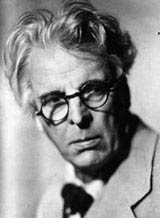
William Butler Yeats was born yesterday, in 1865. Yeats is a great poet and all that, but I grew up pretty much "over" him because he was kind of omnipresent in our household. We were made to memorize his epitaph in order to receive 25 cents for our allowance. ("Cast a cold eye / On life on death / Horseman pass by"). We knew his "Host of the Air" by heart, because it was on the Clancy Brothers at Carnegie Hall album. He was everywhere. It's not that we had a reverence for him - just the opposite. I knew what he looked like, in the same way I knew what George Washington looked like, because he was on our currency. Yeats? Oh, HIM again? Cast a cold eye ... yeah, I know, I know.
Yeats makes me think of my father. My first published piece in The Sewanee Review was about the Yeats-dad continuum.
From memory now!
THE HOST OF THE AIR
O'Driscoll drove with a song
The wild duck and the drake
From the tall and the tufted reeds
Of the drear Heart Lake.
And he saw how the reeds grew dark
At the coming of night-tide,
And dreamed of the long dim hair
Of Bridget his bride.
He heard while he sang and dreamed
A piper piping away,
And never was piping so sad,
And never was piping so gay.
And he saw young men and young girls
Who danced on a level place,
And Bridget his bride among them,
With a sad and a gay face.
The dancers crowded about him
And many a sweet thing said,
And a young man brought him red wine
And a young girl white bread.
But Bridget drew him by the sleeve
Away from the merry bands,
To old men playing at cards
With a twinkling of ancient hands.
The bread and the wine had a doom,
For these were the host of the air;
He sat and played in a dream
Of her long dim hair.
He played with the merry old men
And thought not of evil chance,
Until one bore Bridget his bride
Away from the merry dance.
He bore her away in his arms,
The handsomest young man there,
And his neck and his breast and his arms
Were drowned in her long dim hair.
O'Driscoll scattered the cards
And out of his dream awoke:
Old men and young men and young girls
Were gone like a drifting smoke;
But he heard high up in the air
A piper piping away,
And never was piping so sad,
And never was piping so gay.
To those of you who know that Clancy Brothers album - you'll know the special-ness of that recording.
When we visited his grave in Ireland, as kids, we all felt kind of amazed that ... it was REAL. That the epitaph we had been rattling off since we were toddlers actually existed out in the world, and had some meaning beyond the 25 cents in our pockets.
A couple years ago, I read his complete works in chronological order. It was a fascinating experience - I know many of his big poems almost by heart, the famous ones - but it's nothing compared to reading his work - from beginning to end. You watch an artist burst forth at a certain point - almost fully formed. You've read his younger work, you've seen its beauty (but also its sentimentality - its Celtic twilight "twee" lament ... it's actually quite awful in a way... and so nothing - NOTHING - can prepare you for the poet who would eventually write "Sailing to Byzantium" and "Among Schoolchildren" Where the hell did THAT come from?)
Yeats, as a poet, has always been one of my favorites (even with the "cloud-pale eyelids" balderdash of his early stuff), but what really inspires me is his work in Irish theatre, and the creation of the Abbey. An amazing story. His Nobel lecture was on the Irish Dramatic Movement. I wrote a big long post about his nurturing of John Synge, author of The Playboy of the Western World
Gabriel Fallon, an actor at the Abbey, describes the dress rehearsal of Sean O'Casey's Juno and the Paycock
in his book Sean Ocasey the Man I Knew
We could make nothing of the reading of Juno and the Paycock as it was called. It seemed to be a strange baffling mixture of comedy and tragedy; and none of us could say, with any certainty, whether or not it would stand up on the stage.The dress rehearsal would be held at 5 p.m. on March 2, Sunday. I arrived at the theatre at 4:30 p.m., and found the author there before me looking rather glum and wondering if a rehearsal would take place ... Gradually the players filed in and went to their dressing-rooms. Lennox Robinson arrived shortly before 5 o'clock and was followed by Yeats and Lady Gregory. The curtain rose about 5:36 p.m. so far as I could see and hear while waiting for my cue in the wings the rehearsal seemed to be proceeding smoothly. As soon as I had finished my part of Bentham at the end of the second act I went down into the stalls and sat two seats behind the author. Here for the first time I had an opportunity of seeing something of the play from an objective point of view. I was stunned by the tragic quality of the third act which the magnificent playing of Sara Allgood made almost unbearable. But it was the blistering irony of the final scene which convinced me that this man sitting two seats in front of me was a dramatist of genius, one destined to be spoken of far beyond the confines of the Abbey Theatre ...
We watched the act move on, the furniture removers come and go, the ominous entry of the IRA men, the dragging of Johnny to summary execution, the stilted scene between Jerry Devine and Mary Boyle, and then as with the ensnaring slow impetus of a ninth great wave Allgood's tragic genius rose to an unforgettable climax and drowned the stage in sorrow. How surely was the very butt and sea-mark of tragedy! But suddenly the curtain rises again: are Fitzgerald and McCormick fooling, letting off steam after the strain of rehearsal? Nothing of the kind; for we in the stalls are suddenly made to freeze in our seats as a note beyond tragedy, a blistering flannel-mouthed irony sears its maudlin way across the stage and slowly drops an exhausted curtain on a world disintegrating in 'chassis'.
I sat there stunned. So, indeed, as far as I could see, did Robinson, Yeats, and Lady Gregory. Then Yeats ventured an opinion. He said that the play, particularly in the final scene, reminded him of a Dostoevsky novel. Lady Gregory turned to him and said, "You know, Willie, you never read a novel by Dostoevsky." And she promised to amend this deficiency by sending him a copy of The Idiot. I turned to O'Casey and found I could only say to him, "Magnificent, Sean, magnificent."
"The Second Coming" is quoted (and mis-appropriated, more often than not) and quoted again ... by people who want to use it for their own ends. It's a dark ominous crystal ball. The best "use" of it, to my mind, is in the deleted scene in Nixon, with Sam Waterston playing Dick Helms, director of the CIA. Written in 1919 - when the world had already become familiar with horror - a horror of a kind never before seen on earth - the poem predicts the chaos of the 20th century. Try to disentangle it from all of the movies (and Sopranos episodes) that has used it ... and just read it, clear and simple, as a poem. On its own. It's one of the greatest poems of the 20th century.
"The Second Coming"
Turning and turning in the widening gyre
The falcon cannot hear the falconer;
Things fall apart; the centre cannot hold;
Mere anarchy is loosed upon the world,
The blood-dimmed tide is loosed, and everywhere
The ceremony of innocence is drowned;
The best lack all conviction, while the worst
Are full of passionate intensity.
Surely some revelation is at hand;
Surely the Second Coming is at hand.
The Second Coming! Hardly are those words out
When a vast image out of Spiritus Mundi
Troubles my sight: somewhere in sands of the desert
A shape with lion body and the head of a man,
A gaze blank and pitiless as the sun,
Is moving its slow thighs, while all about it
Reel shadows of the indignant desert birds.
The darkness drops again; but now I know
That twenty centuries of stony sleep
Were vexed to nightmare by a rocking cradle,
And what rough beast, its hour come round at last,
Slouches towards Bethlehem to be born?
Seamus Heaney wrote a marvelous essay on Yeats a while back (the link no longer works, but I have the hard copy) - in which he wrote:
Conquest, difficulty, labour: these terms indicate the nature of Yeats's creative disposition. From the start, he was enamoured of Blake's conviction that energy is eternal delight, yet the development of his own thought brought him more and more to the conclusion that conflict was the inescapable condition of being human. So, as his art matured and the articulation of his beliefs became more clarified and forceful, Yeats's poems typically conveyed a sensation of certitude achieved by great effort and of contradictions quelled. Poems in which the defiant self is pitted against hostile or disabling conditions - "An Irish Airman Foresees his Death", "September 1913", "Meditations in Time of Civil War"- are complemented by poems that read like discharges of pure, self-possessed energy, poems from which the accidental circumstances have been excluded so that all that remains is the melody and stamina of resurgent spirit - "The Cold Heaven", "Byzantium", "Long-legged Fly".

Of course, there is also the Maud Gonne factor that must be considered. Here's a post I wrote about her. What do you wanta bet that Maud Gonne had "cloud-pale eyelids"? Anne wrote a wonderful post about Maud Gonne MacBride. Fascinating woman. Poor Yeats. But at least she was his muse, and he got 100s of poems out of his unrequited love for her.
Never give all the heart
Never give all the heart, for love
Will hardly seem worth thinking of
To passionate women if it seem
Certain, and they never dream
That it fades out from kiss to kiss;
For everything that's lovely is
But a brief, dreamy. Kind delight.
O never give the heart outright,
For they, for all smooth lips can say,
Have given their hearts up to the play.
And who could play it well enough
If deaf and dumb and blind with love?
He that made this knows all the cost,
For he gave all his heart and lost.
Heaney writes, in that same essay:
And all the while, of course, there was Maud Gonne, "high and solitary and most stern" according to one of the poems about her, "foremost among those I would hear praised" according to another, and "the troubling of my life" according to a famous sentence in his Autobiographies. The passion she inspired - and as readers we experience it more as creative power than erotic need - made her a figure of primary poetic radiance, a Dublin Beatrice, an archetype as much as a daily presence. Nevertheless, Yeats's poetry, his politics and his involvement with the occult received an extra charge of intensity from her day to day reality in his life, and when she appeared in the title role of his subversive play Cathleen Ni Houlihan (1902), another kind of maturity was achieved.
Yeats is one of those poets who was not a solitary creature, writing in isolation. He wanted to start a "movement", and he did. He helped a young James Joyce in the beginning of HIS career. He advised Synge. He headed up the Abbey Theatre. He really looked at his own country - an insular priest-ridden culture at that time - and sensed a need, tried to create something different. It's hard to look with clear eyes on your own home, your own nation. Joyce did it, but that's only because he LEFT. Yeats, at first, went back into the Irish past in his work - and some of his early stuff is so quaint that it might as well be cross-stitched and hanging on the door of some Kountry Kraft Shoppe. I suppose it was his way of re-claiming the Irish past, its true inheritance. It was a phase, his beginning phase as a writer - how he found his "voice". And he was concerned about the rest of his countrymen, calling out to them:
"Irish poets, learn your trade, sing whatever is well made, scorn the sort now growing up all out of shape from toe to top."
Yeats was Anglo-Irish, but his feelings were that Irish-ness was a cultural thing, not a religious thing (forgive me for boiling it down so awkwardly) - and that the Irish could be united, regardless of religion - through writing, myths, poetry. He was a true nationalist.
I also love love LOVE his poem to fellow Irishman Jonathan Swift where he writes: "Imitate him if you dare."
Swift's Epitaph
Swift has sailed into his rest;
Savage indignation there
Cannot lacerate his breast.
Imitate him if you dare,
World-besotted traveller; he
Served human liberty.
WH Auden wrote, in his unbelievable poem to Yeats:
In the deserts of the heart
Let the healing fountain start,
In the prison of his days
Teach the free man how to praise.
And lastly, a poem that has great personal meaning for me:
The wild swans at Coole
The trees are in their autumn beauty,
The woodland paths are dry,
Under the October twilight the water
Mirrors a still sky;
Upon the brimming water among the stones
Are nine-and-fifty Swans.
The nineteenth autumn has come upon me
Since I first made my count;
I saw, before I had well finished,
All suddenly mount
And scatter wheeling in great broken rings
Upon their clamorous wings.
I have looked upon those brilliant creatures,
And now my heart is sore.
All's changed since I, hearing at twilight,
The first time on this shore,
The bell-beat of their wings above my head,
Trod with a lighter tread.
Unwearied still, lover by lover,
They paddle in the cold
Companionable streams or climb the air;
Their hearts have not grown old;
Passion or conquest, wander where they will,
Attend upon them still.
But now they drift on the still water,
Mysterious, beautiful;
Among what rushes will they build,
By what lake's edge or pool
Delight men's eyes when I awake some day
To find they have flown away?
SOME QUOTES
"My poetry is generally written out of despair. Like Balzac, I see increasing commonness everywhere, and like Balzac I know no one who shares the premises from which I work." -- Yeats
"On the third night Yeats addressed the audience before the curtain rose. If anyone had anything to say against the piece they would be welcomed at a debate which he would be glad to arrange in the theatre at some other time. He was interrupted several times. He asked the interrupters to at least listen to the play so that they would know what it was they were objecting to." -- Maire Nic Shiubhlaigh's description of Yeats trying to handle the riots that were happening in response to Synge's "Playboy of the Western World" - a play being put on at the Abbey Theatre
"In 1875 Yeats entered the Godolphin School in Hammersmith and visited Ireland during the longer school vacations, when he stayed with the Pollexfens in County Sligo. An early poetic impulse was to change the name of his toy yacht from Sunbeam to Moonbeam. It was a decisive act." -- Michael Schmidt, "Lives of the Poets"
"I thought we might bring the halves together if we had a national literature that made Ireland beautiful in the memory, and yet had been freed of provincialism by an exacting criticism, a European pose." -- Yeats
"This is not the huge competence of Auden, at play in the toy shop of poetic form, but mastery, the possession of a unique rhetoric for use on a real but limited range of themes. It is a mastery so complete that it can occlude the genuinely problematic, ride over the potholes of nonsense without even sensing them. Late in life he recognizes the evasiveness of his symbols, the tendency of his verse to turn away or inward, and in the concentrated intensity of the late poems he tries to remedy this. But he has an imperfect sense of generality; he is willing to plump out a truism as truth. As his mastery increases, his art becomes less truthful. But his main concern is not - until the later poems, and even there in an attenuated spirit - truth, but the house of myth and legend, where he can become a principal tenant, where it is his voice we hear casting the spell, and where real men are reduced - or, in his mind, enlarged - to masks, figures and types useful to myth, regardless of the human reality they had." -- Michael Schmidt, "Lives of the Poets
"All literature created out of a conscious political aim in the long run crates weakness by creating a habit of unthinking obedience. Literature created for its own sake, for some eternal spiritual need, can be used for politics. Dante is said to have unified Italy. The more unconscious the creation, the more powerful." -- Yeats
"Sex and death are the only things that can interest a serious mind." -- Yeats
"His mastery seems almost excessive." -- Richard Ellmann
"... a strained and unworkable allegory about a young man and a sphinx on a rock in the sea (how did they get there? what did they eat? and so on; people think such criticisms very prosaic, but common-sense is never out of place anywhere ...) but still containing fine lines and vivid imagery." - Gerard Manley Hopkins, after reading some of Yeats' first published verses
"Yeats's 'The Second Coming' has gained in prophetic power with each decade of the twentieth and now twenty-first century, from the rise of fascism and nuclear warfare to the proliferation of international terrorism. It expresses the melancholy realizatino that man, yearningly drawn to the divine, will never fully escape his bestial ancestry. The poem is modernistically unrhymed, though the first stanza plays with shadowy off-rhymes: 'gyre' / 'falconer' / 'everywhere'; 'hold' / 'world' / 'drowned'. It is structured instead by dramatic visuals and emblematic choreography. There are two main movements: a huge, expanding circle (the ascending falcon) and an arrowlike, linear track (the beast bound for Bethlehem). Then two smaller ones: a pendulum arc (the rocking cradle) and an exploding pinwheel (the reeling desert birds). Ideas have become design, starkly juxtaposed with the murky turbulence of elemental forces - storm, flood, drought. Hence the poem, with its horror movie finale, is as hybrid as the sphinx, who represents our buried impulses, vestiges of a past that keeps turning into the future." -- Camille Paglia, "Break, Blow, Burn: Camille Paglia Reads Forty-three of the World's Best Poems
"The heavy voluptuous splendour of much of his work has yet a ghostliness as of the palace made magically of leaves. Even his heroes and beautiful women are aware of this ... He never leaves us, any more than Crashaw, content with the glory alone. It calls our attention to a spirit behind and beyond, heaping high lovely, invisible things that it may show the greater beauty that can survive their crumbling into dust." -- Edward Thomas, 1909
"The worst thing about some men is that when they are not drunk they are sober." -- Yeats
"In London he was active in literature and politics. One particular event in 1889 proved crucial: he met and fell in love with the fiery Republican who haunted him for the rest of his days, Maud Gonne. His biography, from 1889 until Maud Gonne's marriage, is punctuated by the statement, 'Yeats proposed to Maud Gonne.'" -- Michael Schmidt, "Lives of the Poets
"Words are always getting conventionalized to some secondary meaning. It is one of the works of poetry to take the truants in custody and bring them back to their right senses." -- Yeats
" 'The best lack all conviction, while the worst / Are full of passionate intensity': these famous lines are Yeats's anguished formulation of what seems to be an eternal principle of politics (7-8). When 'the center cannot hold,' neither consensus nor compromise is possible. Public debate shifts to the extremes or is overtaken by violence, which blocks incremental movement toward reciprocity and conciliation. Moderate views are 'drowned' out (as by the bloody tide) in strident partisanship or fanaticism. The phrase 'passionate intensity' suggests that, for the late Romantic Yeats, eros diverted from the personal to the political turns into a distorted lust for power. The second stanza opens in doubt and confusion: 'Surely some revelation is at hand; / Surely the Second Coming is at hand. / The Second Coming!'' (9-11). We are hearing either one voice echoing its own shocked phrases or many voices in public tumult. The book of Revelation lists the dreadful omens heralding doomsday, when Jesus will return and unlock the secrets of history. But in Yeats's poem, Christ's promised glory is overshadowed by a monstrous apparition from antiquity. The poet is seized by an electrifying vision: 'a vast image out of Spiritus Mundi / Troubles my sight'. It's a collective memory, crystallizing from the repository of world myths (12-13). ("Spiritus Mundi" is Yeats's mystical term for "soul of the universe".) We witness the resurrection of the pagan era, whose barbarism mirrors that of the war-torn twentieth century. Yeats sees no evidence of moral evolution over two millennia of Christianity." -- Camille Paglia, "Break, Blow, Burn: Camille Paglia Reads Forty-three of the World's Best Poems
"I once got Yeats down to bed-rock on these subjects and we talked for hours. He had been talking rather wildly about the after life. Finally I asked him: 'What do you believe happens to us immediately after death?' He replied, 'After a person dies, he does not realize that he is dead.' I: 'In what state is he?' W.B.Y.: 'In some half-conscious state.' I said: 'Like the period between waking and sleeping?' W.B.Y.: 'Yes.' I: 'How long does this state last?' W.B.Y.: 'Perhaps some twenty years.' 'And after that,' I asked, 'what happens next?' He replied, 'Again a period which is Purgaotry. The length of that period depends upon the sins of the man when he was upon this earth.' And then again I asked: 'And after that?' I do not remember his actual words, but he spoke of the return of the soul to God. I said, 'Well, it seems to me that you are hurrying us back into the great arms of the Roman Catholic Church.' He was of course an Irish Protestant. I was bold to ask him, but his only retort was his splendid laugh." -- Lady Dorothy Wellesley
"It is an entirely new thing -- neither what they eye sees nor the ear hears, but what the rambling mind thinks and imagines from moment to moment. He has certainly surpassed in intensity any novelist of our time." -- Yeats on James Joyce's "Ulysses
"For Yeats, there was something both enviable and exemplary about the enlargement of vision and the consequent histrionic equanimity which Shakespeare's heroes and heroines attain at the moment of their death, 'carried beyond feeling into the aboriginal ice.' He wanted people in real life to emulate or at least to internalize the fortitude and defiance thus manifested in tragic art." -- Seamus Heaney, 1990
"Give up Paris, you will never create anything by reading Racine, and Arthur Symons will always be a better critic of French literature. Go to the Arran Islands. Live there as if you were one of the people themselves; express a life that has never found expression." -- Yeats's advice to John Synge
Cast a cold eye
On life on death
Horseman pass by
-- Yeats's epitaph
Imitate him if you dare.

May 9, 2009
Some gems from (and about) Oscar Wilde
Mankind has been continually entering the prisons of Puritanism, Philistinism, Sensualism, Fanaticism, and turning the key on his own spirit: But after a time there is an enormous desire for higher freedom - for self-preservation.
_____________
I find it harder and harder every day to live up to my blue china.
_____________
The mind of a thoroughly well-informed man is a dreadful thing. It is like a bric-a-brac shop, all monsters and dust, with everything priced above its proper value.
_____________
To win back my youth ... there is nothing I wouldn't do - except take exercise, get up early, or be a useful member of the community.
_____________
Miss Morris is the greatest actress I ever saw, if it be fair to form an opinion of her from her rendition of this one role. We have no such powerfully intense actress in England. She is a great artist, in my sense of the word, because all she does, all she says, in the manner of the doing and the saying, constantly evoke the imagination to supplement it. That is what I mean by art.
_____________
To disagree with three-fourths of the British public on all points is one of the first elements of sanity.
_____________
from a letter Wilde wrote to Walt Whitman:
Tennyson's rank is too well fixed and we love him too much. But he has not allowed himself to be a part of the living world and of the great currents of interest and action. He is of priceless value and yet he lives apart from his time. He lives in a dream of the unreal. We, on the other hand, move in the very heart of today.
_____________
Wilde on Walt Whitman:
He is the grandest man I have ever seen, the simplest, most natural, and strongest character I have ever met in my life. I regard him as one of those wonderful, large, entire men who might have lived in any age and is not peculiar to any people. Strong, true, and perfectly sane: the closest approach to the Greek we have yet had in modern times.
_____________
To be either a Puritan, a prig or a preacher is a bad thing. To be all three at once reminds me of the worst excesses of the French Revolution.
_____________
The most graceful thing I ever beheld was a miner in a Colorado silver mine driving a new shaft with a hammer; at any moment he might have been transformed into marble or bronze and become noble in art forever.
_____________
Praise makes me humble. But when I am abused I know I have touched the stars.
_____________
1883, letter of Oscar Wilde to Marie Prescott:
All the great men of France were cuckolds. Haven't you observed this? All! In every period. By their wives or their mistresses. Villon, Moliere, Louis XIV, Napoleon, Victor Hugo, Musset, Balzac, kings, generals, poets! Those I mention, a thousand more that I could name, were all cuckolds. Do you know what that means? I will tell you. Great men, in France, have loved women too much. Women don't like that. They take advantage of this weakness. In England, great men love nothing, neither art, nor wealth, nor glory ... nor women. It's an advantage, you can be sure.
_____________
1883, letter of Oscar Wilde to Marie Prescott:
Now, one of the facts of physiology is the desire of any very intensified emotion to be relieved by some emotion that is its opposite. Nature's example of dramatic effect is the laughter of hysteria or the tears of joy. So I cannot cut my comedy lines. Besides, the essence of good dialogue is interruption.
_____________
1885, letter of Oscar Wilde to Marillier
There is an unknown land full of strange flowers and subtle perfumes, a land of which it is joy of all joys to dream, a land where all things are perfect and poisonous.
_____________
1885, letter of Oscar Wilde to James Whistler
Be warned in time, James; and remain, as I do, incomprehensible: to be great is to be misunderstood.
_____________
To be at one with the elements seems to be Mr. Swinburne's aim. He seeks to speak with the breath of wind and wave ... He is the first lyric poet who has tried to make an absolute surrender of his personality, and he has succeeded. We have the song, but we never know the singer ... Out of the thunder and splendour of words, he himself says nothing. We have often heard man's interpretation of Nature; now we know Nature's interpretation of man, and she has curiously little to say. Force and Freedom form her vague message. She deafens us with her clangours.
_____________
As for George Meredith, who could hope to reproduce him? His style is chaos illumined by brilliant flashes of lightning. As a writer he has mastered everything, except language; as a novelist he can do everything, except tell a story.
_____________
The amount of pleasure one gets out of dialect is a matter entirely of temperament. To say "mither" instead of "mother" seems to many the acme of romance. There are others who are not quite so ready to believe in the pathos of provincialism.
_____________
We Irish are too poetical to be poets; we are a nation of brilliant failures, but we are the greatest talkers since the Greeks.
_____________
letter of Oscar Wilde to W.B. Maxwell
You mustn't take a story that I told you of a man and a picture. No, absolutely, I want that for myself. I fully mean to write it, and I should be terribly upset if I were forestalled.
_____________
Anyone can sympathise with the sufferings of a friend, but it requires a very fine nature - it requires, in fact, the nature of a true Individualist to sympathise with a friend's success.
_____________
Man is least himself when he talks in his own person. Give him a mask and he will tell you the truth.
_____________
Mallarme is a poet, a true poet. But I prefer him when he writes in French, because in that language he is incomprehensible, while in English, unfortunately, he is not. Incomprehensibility is a gift, not everyone has it.
_____________
1891 letter from Stephen Mallarme to James Whistler
No O.W. ---! just like him! He pushes ingratitude to the point of indecency, then? -- And all the old chestnuts -- he dares offer them in Paris like new ones! -- the tales of the sunflower -- his walks with the lily -- his knee breeches -- his rose-colored stiff shirts -- and all that! -- And then 'Art' here -- 'Art' there -- It's really obscene -- and will come to a bad end -- As we shall see -- and you will tell me how it happens --
_____________
I detest nature where man has not intervened with his artifice.
_____________
1891 letter of Oscar Wilde to Edmond de Goncourt
One can adore a language without speaking it well, as one can love a woman without understanding her. French by sympathy, I am Irish by race, and the English have condemned me to speak the language of Shakespeare.
_____________
I have equally recognised that humility is for the hypocrite, modesty for the incompetent.
_____________
1891, letter of Andre Gide to Paul Valery
Forgive my being silent: after Wilde I only exist a little.
_____________
"Know thyself!" was written over the portal of the ancient world ... the message of Christ to man was simply, "Be thyself."
_____________
I can see they are servants by their perfect manners.
_____________
For do you know, all my life I have been looking for twelve men who didn't believe in me .... and so far I have only found eleven.
April 20, 2009
From Cork to Kinsale, or: The best directions ever given
I have written before about Allison and me trying to get from Cork to Kinsale, and we were under time constraints, and then receiving the best most detailed directions in my life, from basically a group of people at a gas station in Cork. Here's the piece.
In going through a shoebox of photos, I actually found the kick-ass written directions that that woman wrote out for us.
I love how the "hairy roundabout" she warns us of really does look truly HAIRY in her drawing of it.

April 18, 2009
Carrie said, when giving us directions in Belfast:
"So keep an eye out for the chicks with guns - then take a right."
In other cities, you are told to look for the Starbucks, or the Mobile station, or the crumbling Druid ruin or the third stoplight. In Belfast, it's "chicks with guns".
Chicks with guns, then take a right? No problem. We'll be there in 10 minutes.

April 13, 2009
Happy birthday, Seamus Heaney
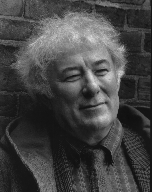
I went to hear him read at NYU about 10 years ago. We sat in the auditorium at NYU, and the laughter never stopped - it was completely due to his own commentary, his own way. He recited his own poems with no notes, no papers, all memorized, the beautiful lilt of his voice ... and after he finished reciting one of his poems, he would immediately start to talk about it, in the most prosaic and amusing way. His personality was what impressed itself upon me. I could fall in love with such a man.
And so, it is his birthday today. For more information on this amazing artist, check out his biography here (that's on the Nobel Prize site). He won the Nobel Prize in 1995.
His Nobel lecture (also included in his book The Redress of Poetry is astonishing. It's quite long, but so worth it. I read it years ago, and immediately had to print it out to put into my 'commonplace book'. It's beautiful, heartfelt, political, and evocative.
I was brought up with Seamus Heaney's poems. My dad loved his work, and for Christmas would usually give me one of Heaney's books - either of his poetry, or of his criticism (which is also phenomenal).
I remember Jean and I returning from Ireland from visiting Siobhan (this was in the late 1990s) and telling my dad about our stop at Clonmacnoise. We had gone there as a family way back when, and we had wanted to see it again. We had pulled off the highway on our way back to Dublin from Galway to walk around Clonmacnoise, and it was great because it was November, so nobody was there, and we shared memories of our first time there, when we all were kids.
The moment Jean and I said the word "Clonmacnoise" to my dad, my dad stood up, walked over to the bookshelf, pulled down a book and read out loud Seamus Heaney's goosebump-inducing poem about the legend of Clonmacnoise (This is my favorite of Heaney's poems and whenever I read it silently, I hear it in my dad's gravelly voice):
The annals say: when the monks of Clonmacnoise
Were all at prayers inside the oratory
A ship appeared above them in the air.
The anchor dragged along behind so deep
It hooked itself into the altar rails
And then, as the big hull rocked to a standstill,
A crewman shinned and grappled down the rope
And struggled to release it. But in vain.
'This man can't bear our life here and will drown,'
The abbot said, 'unless we help him.' So
They did, the freed ship sailed, and the man climbed back
Out of the marvellous as he had known it.
Ahhh. God, it never fails to get me. "Out of the marvellous as he had known it." A strangely sad poem. At least I find it sad. I have had my own experiences of "climbing back out of the marvellous" and it's always a bit sad.
(I wrote about the Clonmacnoise legend a bit here. But the poem pretty much tells the whole story. I'll just repeat what I said before: for me, the entirety of Seamus Heaney's power and magic as a poet is in the last line of that poem. It's simply breathtaking.)
And lastly, I am going to post his poem "Digging". It is one of his earlier efforts, but he refers to it often as the moment he really became a poet. It is a poem I have gone to often in the last couple of years, as I have struggled with the drudgery of my manuscript, or the work I need to do to get the damn thing done.
The subject of the poem is a cliche: Son will choose a different path from father - perhaps this choice will not be understood - but son knows he must go his own way. You can feel how young he is in the poem.
But oh, what a lovely and moving poem it is. Yes, Mr. Heaney, you do dig with your pen. You do. And for that I am very grateful.
Digging
Between my finger and my thumb
The squat pen rests; snug as a gun.
Under my window, a clean rasping sound
When the spade sinks into gravelly ground.
My father, digging. I look down
Till his straining rump among the flowerbeds
Bends low, comes up twenty years away
Stooping in rhythm through potato drills
Where he was digging.
The coarse boot nestled on the lug, the shaft
Against the inside knee was levered firmly.
He rooted out tall tops, buried the bright edge deep
To scatter new potatoes that we picked
Loving their cool hardness in our hands.
By God, the old man could handle a spade.
Just like his old man.
My grandfather cut more turf in a day
Than any other man on Toner's bog.
Once I carried him milk in a bottle
Corked sloppily with paper. He straightened up
To drink it, then fell to right away
Nicking and slicing neatly, heaving sods
Over his shoulder, going down and down
For the good turf. Digging.
The cold smell of potato mould, the squelch and slap
Of soggy peat, the curt cuts of an edge
Through living roots awaken in my head.
But I've no spade to follow men like them.
Between my finger and my thumb
The squat pen rests.
I'll dig with it.
March 18, 2009
Tá m'árthach foluaineach lán d'eascainn, baby!
Really, what more can one say.
Actually, here was one of the other quotes from the night. At one point I turned to Jen and said, totally enthusiastically, with no self-hatred whatsoever, "GOD, I just LOVE it when I don't act like myself! It is so awesome!"
Joe Hurley's Irish Rock Revue last night was a fantastic show. It was a five-hour-long extravaganza. "Come on, Eileen" was played to roaring success, which gives you some idea of the feel of the event. Not to mention "Raglan Road" which brought me to tears.
I need to Google the cast of thousands who performed although I am familiar with some of them (especially the writers - Colum McCann!) but for now, some photos.
Thanks, Joe, for being a warm and wonderful MC. Great night. A perfect St. Patty's Day fest. Meaning no:
-- amateur messy drunks
-- green beer
-- flashing shamrock antennae
-- people who seem to feel that being "Irish" means "acting like a complete douchebag on Bleecker Street"
It wasn't a precious event or twee in any way, but it wasn't "cool" either, which was one of the best things about it. Try to remain "cool" when "Come on Eileen" is being played. I dare you. The place went nuts. There were Irish fiddlers (one girl in particular was really fantastic, with a shiny green ribbon in her hair, she made me cry), and people flew in from Ireland, from Chicago, from elsewhere - just to perform one song. Really moving. Also, I know I'm in the right place when raffle tickets are sold and the prizes are a year-long subscription to The Irish Echo and signed copies of McCann's latest novel. It's also clear I am in the right place when Joe Hurley, as MC, interspersed the entire evening with quotes from Oscar Wilde. I mean, honestly. I love these people. To paraphrase Anne Sexton, they are my kind.
Some of the photos below are blurry - I was experimenting with how much I could get away with, using no flash. The results are iffy, but I think a lot of them do capture the FEEL of the night.


March 17, 2009
Reminder: Joe Hurley's Irish Rock Revue tonight!

I know the poster says March 14th - but there's a show tonight - March 17th as well. I know for a fact there are still tix available.
Show at La Poisson Rouge, 158 Bleecker Street. Doors open at 6 p.m.
Buy tickets for the March 17th show here.
Joe Hurley has been hosting the Irish Rock Revue (with a cast of thousands) in New York for years now, and this coming year will be the 10th annual event.
I've seen Joe Hurley perform (at the Losers Lounge Queen Tribute, where he rocked the house with "Fat Bottomed Girls" as though he were to the Freddie-Mercury-born) and I've also had the pleasure of singing a medley of songs with him from Oliver in the middle of the day outside a Wall Street Bar on Bloomsday in 2002. Impromptu. One of my favorite New York memories.
His voice is a mix of Tom Waits and, well, Ron Moody, of course. Mixed in with a little Joe Strummer. Boy is a force of nature. Not to be missed.
His band, The Gents, have been together for years now - an emotional and jagged mixture of punk and Irish traditional music (and yeah, with a little "oom pah pah" mixed in there - Joe Hurley is obsessed with the musical Oliver, and why shouldn't he be, I ask you?) - and you can keep up to date with all of their shenanigans at their website.
Proceeds of the Irish Rock Revue go to a couple of good causes (Gilda's Club and the Humane Society), and it looks to be a couple of massive parties. He has guest artists come and sing, people from Broadway, Irish novelists who live in town, poets, performance artists ... I can't wait!
I'll be there, screaming "Oom PAH PAH" from my seat like the nerd that I am.
It's St. Patrick's Day but I don't really care about that. With my name, why would I give a shite about St. Patrick's Day? Seems a bit redundant, don't you think?
DETAILS
Date: March 17, 2009
Where: La Poisson Rouge, 158 Bleecker Street.
Time: Doors open at 6 p.m.
Buy tickets for the March 17th show here.
Here's Joe, from last year's Irish Rock Revue. And more photos here.

Cheers. Beannacht. Erin go bra-less.
Sláinte .
February 9, 2009
Happy birthday to Brendan Behan
Thank you, Therese, for the sweet reminder - and also your wonderful post about Behan.
Shakespeare said pretty well everything and what he left out, James Joyce, with a judge from meself, put in. -- Brendan Behan
Brendan Behan, Irish playwright, Irish terrorist, was born on this day, in Dublin, in 1923. He led a life of poverty, violence, controversy, and seemingly aimless wandering. He spent time in jail as a teenager, for being part of a plot to blow up a bridge (he had the bombs in his bag). Then he was involved in the attempted murder of two detectives, and was sentenced to 14 years in prison. While in prison, he (like so many other convicts) spent that enforced solitude writing. He wrote memoirs, confessions, poetry. He was still only 23 years old. His IRA activities ceased after that time, although he remained connected and friendly with most of its members (naturally - his whole family was involved). While in prison, he learned the Irish language. He drank like a fish. He had trouble getting published in Ireland (so he was in a grand continuum of other Irish writers who faced similar censorship issues). Behan was raised in a staunchly Republican family. His father was involved in the Easter uprising. Behan was Catholic (of course) - but not by name only. He was a true believer.
In the 1950s, he left Ireland (again, in a grand continuum of Irish writers who feel they must leave in order to be an artist) and moved to Paris. He wanted to be free, to write, to publish, to live life the way he wanted to live it.
I have a total irreverence for anything connected with society except that which makes the roads safer, the beer stronger, the food cheaper, and the old men and old women warmer in the winter and happier in the summer.
When we were in Ireland as a family, my dad took us to the writer's museum in Dublin. It's like going to the Vatican of artists. Nobody is more dominant in the written word than Irish writers. Who knows why that is - but it doesn't even matter why. The museum is great. Even as a kid I appreciated it, especially because I grew up being surrounded by these old Irish authors, on my dad's bookshelves. I hadn't READ any of the books, but people like Flann O'Brien and Brendan Behan and Francis Stewart and WB Yeats were a part of the warp and weft of our family. We had a big picture of Brendan Behan in our living room - actually, we still do: it was a drawing of Behan's big bloated meaty face - and it was all done in one line, with the pen never lifting from the page. You can see it on the wall over the television in this photo here. I still remember our visit to the museum and seeing Behan's battered typewriter under glass (you can see images of it on the museum's link). I didn't even know who he was, as a writer - I just knew his books were all over our house, and I just knew that he was on our living room wall. So he was omnipresent. And even as a young teenager, I was into "objects", the same way I am now. Like seeing Alexander Hamilton's DESK at the New York Historical Society and literally having to walk away from the display because I didn't trust myself to not reach out and touch the damn thing. Behan's typewriter is one of the few things I remember from that trip to the museum. I think perhaps it is because I had a battered typewriter of my own - given to me on my 10th birthday - and it lasted me pretty much until I went to college. Old-fashioned, where had to buy ink ribbons on spools, and where certain letters came out quirky, no matter what you did. I loved my typewriter, and I wish I still had it. Even just as a curio. Behan's typewriter looked kind of like mine, which was strange to me ... I was a teenager living in the early 1980s ... Behan seemed like a man from ancient Rome to me, yet his typewriter was like mine!
"I am a drinker with writing problems."
His cynicism about the Irish and Ireland borders on the psychotic at times (but if you know the Irish, you know that cynicism about themselves appears to be built in to the national character - part of why they are so charming and so much fun. They ARE serious, but they don't take themSELVES seriously.)
"If it was raining soup, the Irish would go out with forks."
But he also said:
"It's not that the Irish are cynical. It's rather that they have a wonderful lack of respect for everything and everybody."
In my opinion it is his cynicsm that makes his work so exciting to read. It palpitates on the page. His feelings and judgments tremble before you. He lives in his words. He is unforgiving. Yet also so so funny. A typically Irish combination. If you just have the unforgiving attitude, you'll be a rather humorless writer, a propagandist. But Behan was a riot.
"Never throw stones at your mother,
You'll be sorry for it when she's dead,
Never throw stones at your mother,
Throw bricks at your father instead."
-- Brendan Behan, "The Hostage", 1958
It doesn't surprise me at all that he and Jackie Gleason were best friends. Of course they were. They both had the same dead-eyed response to absurdity, the same intolerance for stupidity and silliness, the same potential for explosive rage and explosive tragedy, and also the same huge humor.
They had become friends because of a notorious drunken appearance by Behan on a television talk show, where Gleason was also a guest. Behan was wasted, it was shocking to many - but Gleason saw a kindred spirit.
So happy birthday, to a wonderful Irish writer, a man I grew up with, a character in my childhood lexicon. He was not outside our family at all, he was inner circle, like Flann OBrien (one of his friends) and Yeats and Joyce and Synge. Behan was on our wall. He was one of us. As an adult, I finally read all of his plays and realized what the fuss was all about. He's fantastic.
1954's The Quare Fellow, about his time in prison, ran for a short time in Dublin, and was a modest hit. The prison language is meaty, funny, and shows Behan's gift for satire. There's a Pinter-esque quality in some of it (strange as that may sound if you are familiar with Pinter) - in that a lot of times the events that happen OFFstage take on far more importance than what is happening ON. So that adds to the audience's feeling of imbalance, or wanting to peek around corners to get the whole story. "The Quare Fellow" is never seen in the play, although he is referenced constantly. Now enters Joan Littlefield and her Theatre Workshop into the picture. We really can thank her for the fact that Brendan Behan is so famous today. I am not sure that fame was a done deal for someone like Behan - in the same way that it was for someone like Joyce, who seems destined to be a singular star. Behan was more on the fringe, more of a scrabbler. But Littlefield, a theatre director and producer, took The Quare Fellow over to England where it was a smashing success. Eventually the play moved to Broadway, bringing Behan worldwide fame.
My dad wrote me a note about The Hostage (another one of Behan's plays):
Dearest: I saw the play done once in the 70s: it seemed like John Cleese [or some other Python] had adapted Frank O'Connor's Guests of the Nation for the stage. I believe that it owes most of its success to the director [Joan Littlefield?]. love, dad
My father's comment reflects the general consensus that seems to be out there: that it was Joan Littlefield who took Behan's work, wrestled it into a theatrical form, produced it so that its strengths could shine through, hiding its weaknesses - and that any collaboration that Behan had afterwards suffers in comparison. Behan owed much to Littlefield. Perhaps that is why they had such a testy relationship, notoriously difficult.
The Hostage
Interestingly enough, my copy of the book, given to me by my father, was an early edition, 1959, and in the biographical sketch on the back it says: "Brendan Behan, the son of a house painter, left school at thirteen, and three years later served his first prison term for political reasons. As an IRA terrorist he has spent eight years of his life in various jails ..." The use of the word 'terrorist' really stood out for me. So often now, regardless of whether the person is actually a terrorist or not, the word is surrounded by little quotation marks. Or it's just not used at all. They're "insurgents", they're "rebels", they're "militants", "freedom fighters", etc. That little bio of Behan is quite a time-traveler, from an earlier decade when people weren't so hesitant to call a spade a spade.
Yeah, he was a terrorist. He blew shit up. He went to jail.
He also was a writer.
I appreciate the clarity and openness of that biographical sketch, and miss that kind of forthrightness (without the huge chip on its shoulder, too) today.
The Hostage was an enormous theatrical success in London, Paris, and New York. I love the play. It's laugh-out-loud funny at times, but also angry, pointedly political, sad ... with certain Keystone Cops slapstick elements. In my opinion, it should be played like a bat out of hell. You should only "pause" when Behan tells you to pause. Other than that, let it fly, keep the speed up, ba-dum-ching! Otherwise, the thing could be in danger of taking itself seriously. The points made are awesome and difficult and prickly - still relevant today ... but points such as those must not be underlined for the audience. God, I wish every director - for stage, TV, and film - would fucking LEARN NOT TO UNDERLINE (with music, dialogue, closeups, repetitive language in the script to make sure we all "get it") what is already obvious.
Behan's work exists in a fiery world of high stakes, humor, and denial. If you pause, if you slow it down, its power unravels.
The Hostage takes place in a brothel in Dublin which is owned by a former IRA commander. The cast of characters is a motley array of whores and night-owls and other fringe-dwellers. It's a fast-moving theatrical work, very Irish - full of wise cracks, and jokes. It seems that NOTHING is taken seriously. But that's so very Irish. When the play opens, we eventually learn that the following day an 18 year old IRA member is to be hanged. He was accused of killing an Ulster policeman. This is on everybody's minds. Lots of talk and chatter about the IRA, and 1916, and martyrdom, and Ireland ... A young Cockney soldier, Leslie Williams, is held hostage in the brothel, in the hopes that somehow this might stave off the execution ... When the IRA member is hanged the following day, the British police eventually attack the brothel, and Leslie ends up getting killed by gunfire.
The Hostage was Behan's last major success.
Literary critic Kenneth Tynan said:
"While other writers horde words like misers, Behan sends them out on a spree, ribald, flushed, and spoiling for a fight."
Amen.
Here is an excerpt from The Hostage - a play that is well worth looking into if you are not familiar with it. Don't forget, despite the IRA themes and the title: this is a comedy.
Notice in the excerpt below that a "pause" is written into the script. And, hysterically, the Officer shouts "SILENCE!" after the pause. If you're in a production that is floppy, in terms of cue pickups, with pauses left and right, people stopping to think, or ponder - then that moment would be lost, the timing would not be right, you need to be able to "hear" the joke that Behan has written into the thing. It needs to be rat-a-tat dialogue all along, no pauses between lines, so then that sudden "Pause" will really have an effect ... and the fact that the Officer shouts "Silence" after the ONE pause in the script so far - is hysterical, and says worlds about that character. (This, too, is very Pinter-esque. In terms of "Pinter's pauses" - follow them like you would a musical score. Do not add more. Do not subtract any. Just DO WHAT HE SAYS ... and almost by default, the script will take on an ominous almost unbearably tense feeling. Example here of what a Pinter script looks like. Those "silences" are deliberate, written into the thing by Pinter. This is not always the case with such "directorial" additions to a script - sometimes they are added from production notes, and are not BY the playwright. But in Pinter's case, he wrote those "silences" in. They are much a part of the dialogue as the things actually spoken. It's not up to the actor to muck with that stuff, to decide when to pause - at least not with Pinter. With Pinter, you do what he says. Believe me, it will help.)
So happy birthday to Brendan Behan.
You make me think, basically, of my whole damn life. You were given to me, by my father, like he gave me so much else. It was through osmosis, rather than anything more deliberate.
Wherever I look, you are there.
EXCERPT FROM The Hostage
OFFICER: Now your rent books, please, or a list of the tenants.
PAT. I can give you that easy. There's Bobo, Ropeen, Colette, the Mouse, Pigseye, Mulleady, Princess Grace, Rio Rita, Meg, the new girl, and myself.
OFFICER. [PAT fetches his notebook] I'll tell you the truth, if it was my doings there'd be no such thing as us coming here. I'd have nothing to do with the place, and the bad reputation it has all over the city.
PAT. Isn't it good enough for your prisoner?
OFFICER. It's not good enough for the Irish Republican Army.
PAT. Isn't it now?
OFFICER. Patrick Pearse said "To serve a cause which is splendid and holy, men must themselves be splendid and holy."
PAT. Are you splendid, or just holy? Haven't I seen you somewhere before? It couldn't be you that was after coming here one Saturday night ...
OFFICER. It could not.
PAT. It could have been your brother, for he was the spitting image of you.
OFFICER. If any of us were caught here now or at any time, it's shamed before the world we'd be. Still, I see their reasons for choosing it too.
PAT. The place is so hot, it's cold.
OFFICERE. The police wouldn't believe we'd touch it.
PAT. If we're all caught here, it's not the opinion of the world or the police will be upsetting us, but the opinion of the Military Court. But then I suppose it's all the same to you; you'll be a hero, will you not?
OFFICER. I hope that I could never betray my trust.
PAT. Ah yes, of course, you've not yet been in Mountjoy or the Curragh glasshouse.
OFFICER. I have not.
PAT. That's easily seen in you.
OFFICER. I assure you, my friend, I'm not afraid of Redcaps.
PAT. Take it from me, they're not the worst [to audience] though they're bastards anywhere and everywhere. No, your real trouble when you go to prison as a patriot, do you know what it will be?
OFFICER. The loss of liberty.
PAT. No, the other Irish patriots, in along with you. Which branch of the IRA are you in?
OFFICER. There is only one branch of the Irish Republican Army.
PAT. I was in the IRA in 1916, and in 1925 H.Q. sent me from Dublin to the County Kerry because the agricultural labourers were after taking over five thousand acres of an estate from Lord Trales. They had it all divided very nice and fair among themselves, and were ploughing and planting in great style. G.H.Q. gave orders that they were to get off the land, that the social question would be settled when we got the thirty-county Republic. The Kerrymen said they weren't greedy like. They didn't want the whole thirty-two counties to begin with, and their five thousand acres would do them for a start.
OFFICER. Those men were wrong on the social question.
PAT. Faith and I don't think it was questions they were interested in, at all, but answers. Anyway I agreed with them, and stopped there for six months training the local unit to take on the IRA, the Free State Army, aye, or the British Navy if it had come to it.
OFFICER. That was mutiny.
PAT. I know. When I came back to Dublin, I was court-martialled in my absence and sentenced to death in my absence, so I said they could shoot me in my absence.
Pause.
OFFICER. Silence!
PAT. Sir!
OFFICER. i was sent here to do certain business. I would like to conclude that business.
PAT. Let us proceed, shall we, sir? When may we expect the prisoner?
OFFICER. Today.
PAT. What time?
OFFICER. Between nine and twelve.
PAT. Where is he now?
OFFICER. We haven't got him yet.
PAT. You haven't got a prisoner? Are you going down to Woolworths to buy one then?
OFFICER. I have no business telling you any more than has already been communicated to you.
PAT. Sure, I know that.
OFFICER. The arrangements are made for his reception. I will be here.
PAT. Well, the usual terms, rent in advance, please.
OFFICER. Is it looking for money you are?
PAT. What else? We're not a charity. Rent in advance.
OFFICER. I might have known what to expect. I know your reputation.
PAT. How did you hear of our little convent?
OFFICER. I do social work for the St. Vincent de Paul Society.
PAT. I always thought they were all ex-policement. In the old days we wouldn't go near them.
OFFICER. In the old days there were Communists in the IRA.
PAT. There were, faith, and plenty of them. What of it?
OFFICER. The man that is most loyal to his faith is the one that will prove most loyal to the cause.
PAT. Have you your initials mixed up? Is it the FBI or the IRA that you are in?
OFFICER. If I didn't know that you were out in 1916 I'd think you were highly suspect.
PAT. Sir?
OFFICER. Well, at least you can't be an informer.
PAT. Ah, you're a shocking decent person. Could you give me a testimonial I could use in my election address if I wanted to get into the coroporation? The rent, please!
February 2, 2009
More Joyce
In my web wanderings today, I came across this wonderful post - a man tracking down Joyce's birthplace in Rathgar. With photos and commentary. He braved "the apocalyptic snows of Leinster to find the truth."
And thanks for the link, Ernie. You've been sending all kinds of fascinating people my way.
Today in history: February 2nd
Two things happened on today in history:
February 2, 1882: James Joyce was born in Rathgar.
February 2, 1922: Joyce's Ulysses

James Joyce had already written a collection of short stories (Dubliners


It took James Joyce seven years to write Ulysses. Later, he would joke, when faced with criticism that the book was just too damn big - "I spent seven years writing it. People could at least spend seven years reading it."
His next book was Finnegans Wake (excerpt here) and that took him seventeen years to write.
Boy marched to the beat of his own drummer.
The history of the publication of Ulysses is a book in and of itself.
James Joyce had fled Ireland, leaving a wake of debt and scandal behind him, back in 1904. Joyce got a job teaching English at a Berlitz school in first Zurich (that didn't work out), and then Trieste. He convinced his new-found love, Nora Barnacle, a wild girl from Galway, to run away with him. He had known her for only a couple of months. They had met on June 16, 1904 - the day that he would choose to set the entirety of Ulysses on, the ultimate tribute to what she gave him. James and Nora lived in Trieste for 10 years, having children (two of them), not getting married just to spite tradition - although they referred to one another as "husband" and "wife" (the two would eventually marry in the 1930s) ... and living below the poverty line. Meanwhile, Joyce was working on Dubliners, which was quite a struggle. He could not find anyone willing to publish it. Dubliners was eventually published in 1914. He had already been working on it for years. Portrait of the Artist As a Young Man was published (in serial form) in 1914 and finally brought out as a book in 1916. It had been serialized in the highly influential The Egoist. Around this time, James Joyce was taken under the wing of Ezra Pound (what a shock. Pound was everywhere).
James Joyce had been interested in the plight of the Jews for a long time. Especially as a man living in perpetual exile, country-less, yet always looking "homeward". He felt that there was an affinity between the Jews and the Irish, and he thought it was something to explore. He had considered writing a story along these lines for Dubliners but it didn't end up happening. However, the idea percolated. It ended up being one of the main ideas in the book Ulysses, based, of course, on Homer's epic, but Joyce, with his obsessive tendencies, was the kind of man who saw connections everywhere. Exile, journey, what does "home" mean, where is it? These were questions of great relevance to the Jews, but also to himself, who felt he could never live in Ireland again (and he never did). Leopold Bloom, the protagonist of Ulysses is a Jew, living in Ireland. Stephen Dedalus (Joyce's alter ego, the "star" of Portrait of the Artist as well) is one of the aimless men Ireland is so fond of creating, a man looking for a father figure, a guide. Through their mutual wanderings through the city of Dublin, on June 16, 1904, they eventually cross paths. It is not that a kindred spirit is revealed, not really. They do not connect, or heal, or grow, or become empowered. None of those pat concepts are at work in Ulysses. It is more that it is a meeting of the minds. A realization of the connection between them, but also that such connection is transitory. At the end of the book they go their separate ways.
Joyce wrote:
Ulysses is the epic of two races (Israel - Ireland) and at the same time the cycle of the human body as well as a little story of a day (life). The character of Ulysses always fascinated me ever since boyhood. I started writing it as a short story for Dubliners fifteen years ago but gave it up. For seven years I have been working at this book-- blast it!
What was such a big deal about Ulysses? A book where nothing, let's be honest, really happens?
Much of the brou-haha (at least in the literary set) was about the writing itself, a deepening and broadening of the landscape he had explored in Portrait: what is existence really like? What is it like to live, moment to moment?
James Joyce wrote once:
"Why all this fuss and bother about the mystery of the unconscious? What about the mystery of the conscious? What do they know about that?"
Joyce did not delve into the psychologies of his characters so much, although we get to know Leopold Bloom and Stephen Dedalus better than we even know our best friends through reading Ulysses. Joyce goes behind closed doors. He goes inside the body. Circulation, digestion, sex drive, the splitting of cells ... all of that is going on in his writing, because the book - as well as being an homage to Homer's Odyssey - as well as being set up in a complicated structure, mirroring Homer's work - as well as having colors associated with each episode, and a different writing style for each episode ... it is also, chapter by chapter, a dissection of the human body. One chapter (the Cyclops chapter, naturally) is the "eye" chapter. One chapter is the stomach chapter. One chapter is the sex organs chapter. And etc. None of this is explicit. There is no guide. You have to know what you're looking for. You have to get into HIS mode when reading the book, and let your OWN mode go. This is why many people were (and are) annoyed by Joyce. But geniuses have always annoyed people. As William Blake famously wrote:
The eagle never lost so much time as when he submitted to learn of the crow.
Ouch. Crows don't like that when you point it out. But eagles, in general, shouldn't worry about the response of crows to their superiority. They need to just keep being eagles.
But James Joyce wouldn't have thought of it like that. His defenders (like myself) say stuff like that all the time, but Joyce (perhaps disingenuously) really didn't see what the big deal was. He wrote what he wrote because it amused and fascinated him. He wrote only what he could write. He wasn't going for an effect, he wasn't trying to be clever. He loved puns and language and hidden connections. He wrote from that stance. He realized that he was ahead of his time, he really did, but he wasn't precocious, he wasn't self-conscious about it. (Actually, he was - but I'll touch on that in a bit.) The thing to get about Joyce (and this is where he is truly an eagle) is that he wrote Ulysses not to make a big splash, not to stick it to the censors, not to show lesser writers how it's REALLY done (although all of these things were results) ... he wrote it because he liked it. He found it funny. Engaging.
He said (and this may be perhaps my favorite Joyce quote, and it is something to keep in mind should you pick up Ulysses for the first time - it's a clue in HOW to read it):
The pity is that the public will demand and find a moral in my book, or worse they may take it in some serious way, and on the honour of a gentleman, there is not one single serious word in it.
I believe him. Certainly there were serious ideas in the book, it's a revolution, really ... but looked at in another light, in Joyce's light, there is "not one single serious word in it". It's a joke, a maze, a puzzle, an examination of ridiculous coincidences and connections. What does it "mean"? That's the stupidest question of all to concern yourself with. It means nothing.
Samuel Beckett's wonderful quote in regards to Finnegans Wake is also applicable to Ulysses:
You cannot complain that this stuff is not written in English. It is not written at all. It is not to be read. It is to be looked at and listened to. His writing is not about something. It is that something itself.
And THAT is why Joyce is such a big deal. THAT is why the book went off like a bomb throughout the literary world. THAT is why people like T.S. freakin' Eliot, no slouch himself, said, "I wish, for my own sake, that I had not read it." James Joyce lived in a world of giants. Hemingway, Proust, Virginia Woolf, Pound, Fitzgerald, Gertrude Stein, T.S. Eliot ... the modernists. He was part of his time, but he went so much further than any of his contemporaries that many of them never quite recovered from the Ulysses juggernaut. The comments of other writers about Ulysses are absolutely marvelous, because they all recognized what has come. They all realized what had happened. The 20th century had arrived. They had all been working towards it, trying to wrestle the 19th century out of existence, bringing new forms to light. And it's not that any of these people failed. But Ulysses was the "star". Ulysses was the real death-knell.
T.S. Eliot said that Ulysses "killed the 19th century".
James Joyce hadn't set out to "kill the 19th century", but his sensibility - contrarian, sensitive, angry, loving - led him to a form that couldn't help but do so.
Now let me talk about the actual publication of the book.
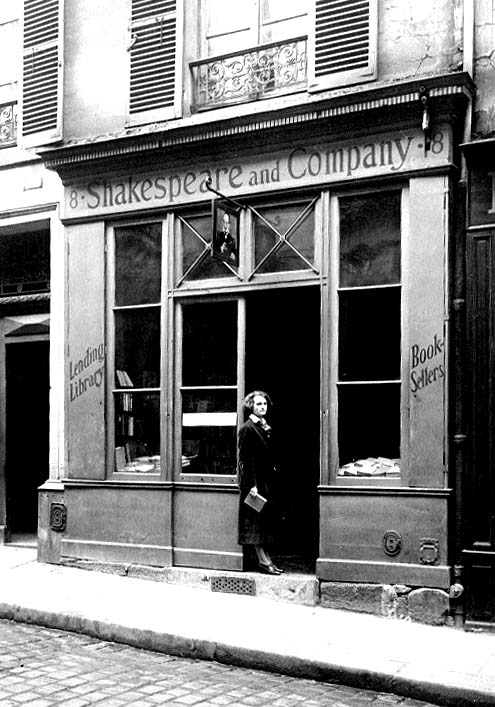
Into our story now steps Sylvia Beach. Born in Maryland, as an adult she became a major force in the literary ex-pat community in Paris. She served in World War I with the Red Cross in Serbia, and after the war settled in Paris, where she opened up a bookshop - the enormously influential Shakespeare & Co.. Shakespeare & Co. became the hub-bub, the vortex of them all. Oh, for a time machine, to go hang out at that place in the 1920s, where Hemingway would stop by, Fitzgerald would browse, Joyce would sneak in and out, Gertrude Stein would bitch and moan (haha) ... and Pound would negotiate with all of them, trying to help them all out and promote his favorites ... they ALL were there.
I love this - here is a cartoon of Joyce sitting at a table with all of his friends (try to find Joyce - isn't that hysterical?? He doesn't even have a body! That was how he was seen - just a big floating brain with enormous glasses!).

Who was the cartoonist?
F. Scott Fitzgerald.
In this vibrant world of literary rivals and giants struggling for the stage, Sylvia Beach played an important role. She had good taste, first of all, she liked the "good" ones, and didn't waste her time with the crows. She also had courage (as we shall see).
When Beach met James Joyce, he had already written Ulysses, and it was a finished manuscript by that point (or as finished as any Joycean manuscript ever would be) - but essentially unpublishable, due to its being deemed "obscene". You have to get into the mindset of the censors, as unpleasant an experience as that is. What on earth is "obscene" about Ulysses? Ultimately, the book expresses love. You cannot deny it, you cannot escape from it. It is love. Leopold Bloom, throughout his long long day, is only thinking about his wife Molly, and how much he loves her, and how afraid he is that she is being unfaithful. There is only one woman for him. In the same way that there was only one woman for Joyce. Love, it is love that drags us home after our long journey. Only love. But Joyce did not shy away from the more unsavory aspects of life (and let's remember his comment about the "mystery of the conscious" - that's so so important: he did not, as Proust did, or Woolf did, or some of the other modern writers - delve into psychology and the workings of the subconscious. He did not look at motivations and childhood repression. Let's not forget the huge influence of Freud at this time. A revolution in the understanding of the workings of humanity. Whether or not you agree with Freud, and whether or not you think Freud is over-rated is irrelevant. I am talking about the time and place from which Joyce wrote. Freud - and Jung - were hugely influential to writers like Joyce and Proust.) But Joyce, unlike Proust, did not explore how memory works, and how the senses trigger thoughts and feelings and entire narratives from our lives ... He was much more prosaic. Blunt. He presented man in the most honest manner possible. Leopold Bloom takes a dump, for example. He sits on the toilet after breakfast, and thinks about things, worrying about things, as he goes to the bathroom. Now, this is one of the most human of experiences. Anyone who says they haven't sat on the toilet, pondering their day, and what they are worried about, is lying. But to put that in a book?? What are you, cracked?
There are those who feel that while such things may be 'real', they have no place in literature. Now we're getting into the realm of the censors, who wanted to control what could be shown. It's the same as people nowadays who seem to feel that saying "TMI" is the be-all and end-all of human interaction. You complain that you stubbed your toe that morning, and certain people will say, "TMI!" Someday I'll write a post on how much I despise the "TMI" trend, and how I think it is actually indicative of so much that is effed up ... "TMI" is nothing new. There have always been those who really DON'T want to know you, who really DON'T want the truth when they ask "How are you?" It's just that now that we have "TMI" to say, it's way over-used. If I never hear the phrase "TMI" again, I will fall asleep a happy woman. Sure, there's such a thing as "over-sharing", but I'm not really talking about that. I am talking about something far more insidious. Something that is not in any way, shape or form new - it's been going on forever, as long as human beings have been in contact with one another. There is a shying away from real experience of one another. Of course. Because if you allow yourself to experience what it is like for another person, then that might mean you might have compassion for them, or empathy, or you might have a sense of recognition, an awareness of the universal: "Yes, I do that, too!" Many people do not want to be shaken out of their selves like that. I include myself, by the way, although you will never ever catch me saying "TMI"! I am all ABOUT "TMI"! But the first response for many, to some demand for connection, or understanding, is to batton down the hatches, draw the line in the sand, and say, "Nope. Nope. That's YOU, that's not ME."
Joyce cuts right to the core of that very human experience. He will not let the reader off the hook. If you insist on insisting, "That's YOU, not ME", then Ulysses will be a terribly confronting book. Joyce, above all else, was a humanist, although his cynicism and rage were titanic. That's what The Dead, with its final revelation of connection to all in the last four paragraphs, is all about. Gabriel realizes, as he watches his wife sleep, that he loves her, and yet that he has never really known her. And in that realization, his consciousness rises up and up, until he is looking down on the snowy landscape, on all of Ireland ... and he, for the first time, feels connected to life, because of his experience of heartbreak. He feels connected not just to all mankind, but also to all of the "shades", all of those people who have gone before.
To walk around saying "TMI, TMI" whenever anyone reveals anything about themselves is to exclude yourself from the human family.
The irony of all of this is that Joyce was one of the most isolated of beings, although not melancholy or a downer or any of that. It's just that he was rather old-fashioned, believe it or not, a family man, who had dinner every night with Nora and his kids and that was that. There is no scandal about Joyce. He didn't sleep with every woman in Paris. He didn't experiment with free love. Yes, he lived in sin for 30 years before tying the knot, but he was faithful to Nora. He wasn't a big socializer. He was a big drinker, but everyone was then. He wasn't dancing in fountains like F. Scott Fitzgerald was, and cheering as his wife did a jig on the table. He was rather conventional, rather bourgeois.
Additionally, there is a tremendous self-consciousness in his books (which I mentioned earlier). He can ONLY write from his own life. He was not an "inventor". He did not make up characters, and devise complicated plots. He did not write one standard novel. It was all self self self self self. I truly believe that you MUST be a genius in order to only focus on self. The memoir-trend in publishing today proves that, in my mind. There are very few good ones out there, very few stories worth telling ... the thing that elevates one memoir over another is, of course, the writing style ... If you're not a good writer then nobody cares that your mama locked you in a closet and your papa couldn't put down the whiskey. Angela's Ashes was such a phenomenal success because of McCourt's writing. You write that same story without McCourt's voice and you'd want to vomit. I know that there are folks in Limerick, especially, who already want to vomit when reading McCourt's book - but that just goes to show you that you can never please everybody.
Ulysses picked up where Portrait left off. As Portrait comes to a close, the traditional narrative voice breaks down, leaving us only with Stephen Dedalus' journal entries. There is no more voice outside the "I". Joyce has abandoned the traditional narrator. Dedalus will now take over. We are inside experience, as opposed to looking on. In the third episode in Ulysses Stephen Dedalus takes a walk on the beach. We learned in the first chapter that he had broken his glasses. This fact is mentioned only once in the entire 800 page book, but we are meant to remember it. In the third chapter, during his walk on the beach, sans glasses ... the experiences come at him through a vague impression of colors and sounds. If you somehow missed that he has no glasses, and this episode is told from the perspective of someone who can't see, then you might not know what the hell is going on. At one point:
The dog's bark ran towards him, stopped, ran back again.
As someone who needs her glasses, I can say that that is just just right. When I have been stranded without glasses, it is as though sounds "run towards" me ... It is not the DOG running at Dedalus, it is its BARK.
Perhaps now it seems obvious, or perhaps now it seems like everyone tries to write in this subjective manner. But that's only because Joyce did it first.
All of this made Ulysses a tough sell to publishers, not even counting the bowel movements, and penises, and the evening in "Nighttown" (Dublin's red-light district) and Molly Bloom's long 40 page run-on sentence that closes the book, full of farts and menstruation and masturbation. But also, please, let us not forget, that it is some of the most beautiful writing in the English language ... and her image of embracing her husband as they lie among the rhododendrons is some of the most romantic language of all time:
the sun shines for you he said the day we were lying among the rhododendrons on Howth head in the grey tweed suit and his straw hat the day I got him to propose to me yes first I gave him the bit of seedcake out of my mouth and it was leapyear like now yes 16 years ago my God after that long kiss I near lost my breath yes he said I was a flower of the mountain yes so we are flowers all a womans body yes that was one true thing he said in his life and the sun shines for you today yes that was why I liked him because I saw he understood or felt what a woman is and I knew I could always get round him and I gave him all the pleasure I could leading him on till he asked me to say yes and I wouldnt answer first only looked out over the sea and the sky I was thinking of so many things he didnt know of Mulvey and Mr Stanhope and Hester and father and old captain Groves and the sailors playing all birds fly and I say stoop and washing up dishes they called it on the pier and the sentry in front of the governors house with the thing round his white helmet poor devil half roasted and the Spanish girls laughing in their shawls and their tall combs and the auctions in the morning the Greeks and the jews and the Arabs and the devil knows who else from all the ends of Europe and Duke street and the fowl market all clucking outside Larby Sharons and the poor donkeys slipping half asleep and the vague fellows in the cloaks asleep in the shade on the steps and the big wheels of the carts of the bulls and the old castle thousands of years old yes and those handsome Moors all in white and turbans like kings asking you to sit down in their little bit of a shop and Ronda with the old windows of the posadas glancing eyes a lattice hid for her lover to kiss the iron and the wineshops half open at night and the castanets and the night we missed the boat at Algeciras the watchman going about serene with his lamp and O that awful deepdown torrent O and the sea the sea crimson sometimes like fire and the glorious sunsets and the figtrees in the Alameda gardens yes and all the queer little streets and pink and blue and yellow houses and the rosegardens and the jessamine and geraniums and cactuses and Gibraltar as a girl where I was a Flower of the mountain yes when I put the rose in my hair like the Andalusian girls used or shall I wear a red yes and how he kissed me under the Moorish wall and I thought well as well him as another and then I asked him with my eyes to ask again yes and then he asked me would I yes to say yes my mountain flower and first I put my arms around him yes and drew him down to me so he could feel my breasts all perfume yes and his heart was going like mad and yes I said yes I will Yes.
Brings me to tears every time.
The book was a bomb waiting to go off. No one would touch it. Pound had arranged for some excerpts to be published and that was the start of it. Writers, in general, were itching to get their paws on the book ... what the hell is that crazy Joyce working on now?? ... people felt competitive, nervous ... he helped them up their own game ... but in terms of the business side of things, the controversy had started before the book had even been published.
But Sylvia Beach - who had never published a book before - took a risk and said that Shakespeare & Co. would put out the book. She would publish it herself. She knew what she was doing, and she knew what the repercussions could be. It was an act of courage. Perhaps she went into it recklessly, thinking that giving a space for genius would be its own reward - perhaps she went into it knowing the eventual fallout that would crash down upon her head - But whatever her interior process, she published it. On February 2, 1922.
I was on the platform, my heart going like the locomotive, as the train from Dijon came slowly to a standstill and I saw the conductor getting off, holding a parcel and looking around for someone -- me. In a few minutes, I was ringing the doorbell at the Joyces' and handing them Copy No. 1 of Ulysses. It was February 2, 1922. -- Sylvia Beach
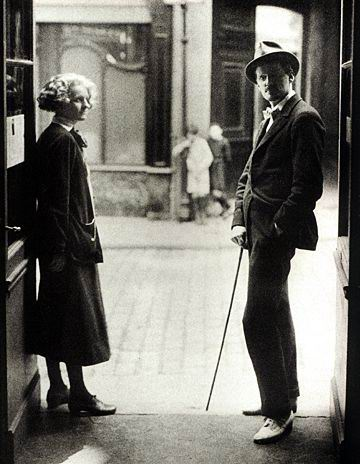
And the shit hit the fan.
Nora Tully describes it thus:
The response to Ulysses was immediate and extreme. Writer and literary critic Malcolm Cowley described it using the metaphor of a stone dropped into water: there was a moment of silence, the stone was dropped, "then all the frogs who inhabited the pool began to talk at once".
Once it was published, the obscenity controversies heated up, the book was banned everywhere - Ireland, America - everybody was talking about it, but who had actually read it? The first edition was only 1000 copies! You couldn't get the book anywhere. Additionally, you could be arrested for trying to smuggle it into certain countries - so there were a couple of years where the only place on the planet that you could get a copy of Ulysses was at Beach's bookshop in Paris. And so the orders flew in from folks around the world. People who were book readers, other writers, people who were collectors, people who sensed the historic moment and just wanted a copy.
Here is a copy of Peggy Guggenheim's urgent order-form, sent to Sylvia Beach:

Imagine you are dying to read the book. Imagine you can't get it anywhere. Imagine that it is illegal to smuggle it back into the United States. Imagine the frenzy. You can see it in Guggeinheim's writing, can't you?
Harriet Shaw Weaver, who had supported Joyce financially for years (at Pound's insistence) also arranged for another edition to be published by The Egoist press. She also arranged for them to be shipped to the United States, but they were seized by the customs officials. In 1923, John Rodker, through The Egoist again, arranged for a small printing of the book, but these were burned by English customs officials. In 1924, Shakespeare & Co., a small outfit really, and not set up to handle the demand, brought out another small printing.
Extraordinary.

Eventually, as the controversy died down, Joyce ended up going with another publisher, which really left Beach bereft financially. She already had suffered as a consequence of taking the risk to publish Ulysses. She was hounded by the police, by the censors ... so although Joyce really did need to move on, to a publisher who could handle his stardom, Beach was the first. Beach was the pioneer. Amazing woman.
Meanwhile, the comments from people who had actually read it were pouring in. This went on for years. You could read it in Europe, but America had declared it obscene, and would not allow it to arrive on its shores.
Finally, on August 7, 1934, over 10 years after its first publication by little Sylvia Beach and her little Shakespeare & Co. - a far-seeing and open-minded US Court of appeals judge, Judge Woolsey, declared that Ulysses was NOT obscene and could be admitted into the United States. It was a ground-breaking moment, a true historical watershed - and his decision reads almost like an insightful and intuitive literary review. Not to be missed. Go, Judge Woolsey!
The comments of other great writers on this book are of great interest to me. I can't get enough. I have compiled them all in a notebook. I love to read through them. The responses run the gamut from disgust, elation, despair, awe, humility ... He made other writers feel like putting down their pens. He enraged those who felt that THEY deserved HIS accolades (phone call for Gertrude Stein, Gertrude Stein, phone call) ... but whatever the response, the only emotion you will NOT find is indifference.
Joyce had made his mark.
Yeats (an early champion of Joyce) had this as his first response on reading Ulysses: "A mad book!"
Then later, as he let the book percolate, Yeats corrected himself: "I have made a terrible mistake. It is a work perhaps of genius. I now perceive its coherence ... It is an entirely new thing -- neither what the eye sees nor the ear hears, but what the rambling mind thinks and imagines from moment to moment. He has certainly surpassed in intensity any novelist of our time."
Hart Crane said: "I feel like shouting EUREKA! Easily the epic of the age."
George Bernard Shaw was disturbed by Ulysses, he took it personally, he did not like what it revealed - about man, about Irish men, about the life of Ireland, but he grappled with the implications in an honest way: "If a man holds up a mirror to your nature and shows you that it needs washing -- not whitewashing -- it is no use breaking the mirror. Go for soap and water."
T.S. Eliot was especially devastated by the book, and his comments on it are numerous. Examples: "How could anyone write again after achieving the immense prodigy of the last chapter?"
T.S. Eliot again: "I hold Ulysses to be the most important expression which the present age has found; it is a book to which we are all indebted, and from which none of us can escape."
Edmund Wilson wrote of it:
The more we read Ulysses, the more we are convinced of its psychological truth, and the more we are amazed at Joyce's genius in mastering and in presenting, not through analysis or generalization, but by the complete recreation of life in the process of being lived, the relations of human beings to their environment and to each other; the nature of their perception of what goes on about them and of what goes on within themselves; and the interdependence of their intellectual, their physical, their professional and their emotional lives. To have traced all these interdependences, to have given each of these elements its value, yet never to have lost sight of the moral through preoccuptation with the physical, nor to have forgotten the general in the particular; to have exhibited ordinary humanity without either satirizing it or sentimentalizing it - this would already have been sufficiently remarkable; but to have subdued all this material to the uses of a supremely finished and disciplined work of art is a feat which has hardly been equalled in the literature of our time.
Wilson also wrote:
Yet for all its appalling longeurs, Ulysses is a work of high genius. Its importance seems to me to lie, not so much in its opening new doors to knowledge -- unless in setting an example to Anglo-Saxon writers of putting down everything without compunction -- or in inventing new literary forms -- Joyce's formula is really, as I have indicated, nearly seventy-five years old -- as in its once more setting the standard of the novel so high that it need not be ashamed to take its place beside poetry and drama. Ulysses has the effect at once of making everything else look brassy."
Carl Jung read the book and wrote Joyce a letter:
Dear Sir, Your Ulysses has presented the world such an upsetting psychological problem, that repeatedly I have been called in as a supposed authority on psychological matters.Ulysses proved to be an exceedingly hard nut and it has forced my mind not only to most unusual efforts, but also to rather extravagant peregrinations (speaking from the standpoint of a scientist). Your book as a whole has given me no end of trouble and I was brooding over it for about three years until I succeeded to put myself into it. But I must tell you that I'm profoundly grateful to yourself as well as to your gigantic opus, because I learned a great deal from it. I shall probably never be quite sure whether I did enjoy it, because it meant too much grinding of nerves and of grey matter. I also don't know whether you will enjoy what I have written about Ulysses because I couldn't help telling the world how much I was bored, how I grumbled, how I cursed and how I admired. The 40 pages of non stop run at the end is a string of veritable psychological peaches. I suppose the devil's grandmother knows so much about the real psychology of a woman, I didn't.
Well I just try to recommend my little essay to you, as an amusing attempt of a perfect stranger that went astray in the labyrinth of your Ulysses and happened to get out of it again by sheer good luck. At all events you may gather from my article what Ulysses has done to a supposedly balanced psychologist.
With the expression of my deepest appreciation, I remain, dear Sir,
Yours faithfully,
C.G. Jung
Joyce was very proud of this letter and would read it out loud to guests in his house. Nora would snort at the end, "Jimmy knows nothin' about women!"
Katherine Mansfield wrote in a letter:
"Joyce was rather ... difficile. I had no idea until then of his view of Ulysses -- no idea how closely it was modelled on the Greek story, how absolutely necessary it was to know the one through and through to be able to discuss the other. I've read the Odyssey and am more or less familiar with it but Murry [Mansfield's husband] and Joyce simply sailed out of my depth. I felt almost stupefied. It's absolutely impossible that other people should understand Ulysses as Joyce understands it. It's almost revolting to hear him discuss its difficulties. It contains code words that must be picked up in each paragraph and so on. The Question and Answer part can be read astronomically or from the geologic standpoint or -- oh, I don't know!"
The most humorous part of this is that Joyce said, after meeting Katherine and her husband:
"Mrs. Murry understood the book better than her husband."
Hilarious.
George Moore, another Irish writer, wrote:
"Ulysses is hopeless; it is absurd to imagine that any good end can be served by trying to record every single thought and sensation of any human being. That's not art, it's like trying to copy the London Directory."
Hemingway wrote in a letter to Sherwood Anderson:
"Joyce has a most goddamn wonderful book. It'll probably reach you in time. Meantime the report is that he and all his family are starving but you can find the whole celtic crew of them every night in Michaud's where Binney and I can only afford to go about once a week...The damned Irish, they have to moan about something or other..."
Gertrude Stein wrote:
"Joyce is good. He is a good writer. People like him because he is incomprehensible and anybody can understand him. But who came first, Gertrude Stein or James Joyce? Do not forget that my first great book, Three Lives, was published in 1908. That was long before Ulysses. But Joyce has done something. His influence, however, is local. Like Synge, another Irish writer, he has had his day."
Joyce heard what Stein wrote, thought about it, and said, "I hate intellectual women."
George Bernard Shaw again:
"I have read several fragments of Ulysses ... It is a revolting record of a disgusting phase of civilization; but it is a truthful one; and I should like to put a cordon round Dublin; round up every male person in it between the ages of 15 and 30; force them to read it; and ask them whether on reflection they could see anything amusing in all that foul mouthed foul minded derision and obscenity...It is, however, some consolation to find that at last somebody has felt deeply enough about it to face the horror of writing it all down and using his literary genius to force people to face it. In Ireland they try to make a cat cleanly by rubbing its nose in its own filth. Mr. Joyce has tried the same treatment on the human subject."
Ezra Pound said:
"Joyce -- pleasing; after the first shell of cantankerous Irishman, I got the impression that the real man is the author of Chamber Music, the sensitive. The rest is the genius; the registration of realities on the temperament, the delicate temperament of the early poems. A concentration and absorption passing Yeats' -- Yeats has never taken on anything requiring the condensation of Ulysses."
Yeats wrote:
"It is an entirely new thing -- neither what they eye sees nor the ear hears, but what the rambling mind thinks and imagines from moment to moment. He has certainly surpassed in intensity any novelist of our time."
William Carlos Williams wrote (echoing what many of Joyce's contemporaries felt):
"Joyce is too near for me to want to do less than he did in Ulysses, in looseness of spirit, and honesty of heart -- at least."
E.M. Forster wrote:
"Perhaps the most interesting literary experiment of our day."
Dr. Joseph Collins reviewed "Ulysses" in The New York Times and wrote:
Ulysses will immortalize its author with the same certainty that Gargantua and Pantagruel immortalized Rabelais and The Brothers Karamazov Dostoevsky ... It comes nearer to being the perfect revelation of a personality than any book in existence.
Hart Crane, who had totally lost his head about the book, wrote:
"The sharp beauty and sensitivity of the thing! The matchless details! His book is steeped in the Elizabethans, his early love, and Latin Church, and some Greek ... It is my opinion that some fanatic will kill Joyce sometime soon for the wonderful things said in Ulysses."
Ford Madox Ford wrote:
"For myself then, the pleasure -- the very great pleasure -- that I get from going through the sentences of Mr. Joyce is that given me simply by the cadence of his prose, and I fancy that the greatest and highest enjoyment that can be got from any writing is simply that given by the cadence of the prose."
William Faulkner wrote:
You should approach Joyce's Ulysses as the illiterate Baptist preacher approaches the Old Testament: with faith.
Vladimir Nabokov wrote:
Ulysses, of course, is a divine work of art and will live on despite the academic nonentities who turn it into a collection of symbols or Greek myths. I once gave a student a C-minus, or perhaps a D-plus, just for applying to its chapters the titles borrowed from Homer while not even noticing the comings and goings of the man in the brown mackintosh. He didn't even know who the man in the brown mackintosh was. Oh, yes, let people compare me to Joyce by all means, but my English is pat ball to Joyce's champion game.

That's a drawing by Guy Davenport, entitled "Joyce Writing a Sentence".
Last year, at around this time - almost exactly a year now - my father gave me his treasured and rare copy of Ulysses - part of the 1924 printing of Shakespeare & Co. The book is falling apart. The pages are thin and rustly, and little bits of them drop off if you pick it up. It is enclosed in a box, to protect it - which has on the spine: ULYSSES - PARIS, 1924.
I have been unable to look at it over the past year. I brought it home with me, put it on a special shelf, and stayed the hell away from it. It seemed to mean something ominous, something final. I didn't want to pick it up, and be casual about it. Even just looking at the book gives me a chill down my spine.
This morning I took it out and spent an hour with it, treating it as carefully as a glass figurine. Every page has something of interest on it. There is a sticker on the first page - stamped with the personal imprint of the couple who had bought the book (my father, naturally, knew everything about them). The copyright page is amazing. First of all, it lists all of the controversial editions that had gone before ... 500 copies burned, etc. And to see the legendary "Shakespeare & Co.", in print, signing its name, so to speak, to the book, bravely putting it out again, knowing what will happen to their small operation ... It's just something that makes me feel humble, awed, and proud that I am aware that such people existed.
My copy of the book is not one that I will take out and read. It is too fragile.
But it is now my most prized possession. I spent some time with it this morning. 4 a.m. to 5 a.m. In honor of the man who gave it to me, and in honor of the birthday of this book that means so much to me, that connects me to something so deep, so powerful - that I can barely speak to it.
I took some photos of this gift from my father. They are below.
The last photo has a framed picture of my dad in the background, standing by Yeats' grave. That was not deliberate. I did not consciously place the framed photo in the frame. It's just that everywhere in my apartment that you look you will see evidence of my heritage, my family, my inheritance. My father taught us well.
Happy birthday to Jimmy Joyce and to his masterpiece.


January 26, 2009
Today in history: January 26, 1907

Until I get my words back for real, blogging will continue to be photo-oriented, a Facebook version of my blog. I cannot write right now. I am not myself.
But today is an important anniversary and one that has family-connections for me -a story I heard as a child, one that seemed so real that I felt like I must have been there myself - and so I must commemorate it. This is something I post every year on this day, because it's such a great story, so here it is again.
On this day in history, John Millington Synge's The Playboy of the Western World
Playboy is now in the history books, not only for being a wonderful play, and part of the theatrical revolution going on in Ireland at the time (the creation of the Abbey Theatre, etc.) - but also because of the riots that broke out when it opened on this day in history (they are now known as "The Playboy Riots"). Things got so out of hand that a police squad had to stand along the edge of the stage during the performance, so that the actors wouldn't get hurt or mobbed. If I had a time machine, I would LOVE to go back and be there on the opening night of that play. It's on my top 5 theatrical events I would like to see.
Synge wrote:
Ireland, for a few years more, we have a popular imagination that is fiery and magnificent, and tender; so that those of us who wish to write start with a chance that is not given to writers in places where the springtime of the local life has been forgotten, and the harvest is a memory only, and the straw has been turned into bricks.
The formidable Lady Gregory, dear friend of Yeats, and his partner in creating the Abbey Theatre sent Yeats two telegrams during the premiere of Playboy of the Western World.
The first one, sent at the close of the first act, read:
Play a great success.
At the end of the third act, she sent a second telegram:
Play broke up in disorder at the word 'shift'.
"Shift" as in "underwear". There is some controversy as to what Synge meant by the word "shift". Did he mean "chemise"? Or was it the more controversial meaning - as in "underwear"?? The audience thought it was the latter, and they went ballistic.
Oh, for a time machine.
Some background.
Synge's time out on the Aran Islands, off the wild west coast of Ireland, gave him the nuggets of inspiration for many of his plays. Out there the "native language" was still spoken, out there he could encounter the real Ireland.
Synge had spent a lot of time in Europe, taking courses in French literature, immersing himself in different cultures, reading Baudelaire, writing poems, chasing girls. He remained interested in his own country, but there wasn't really a place for him there. (it's hard to imagine Ireland without Synge, but he had to TAKE that ground, he had to claim it - it didn't exist before he came along.) Yeats' nationalistic literary (and theatrical) movement (in broader terms - the Irish literary revival) drew Synge back to his home country - the Abbey Theatre was formed - things were HAPPENING in Ireland. In retrospect, it all seems inevitable. Of course Synge would not only come back to be part of that movement, but he would end up defining that movement.
Yeats gave Synge a piece of now legendary advice:
Give up Paris, you will never create anything by reading Racine, and Arthur Symons will always be a better critic of French literature. Go to the Arran Islands. Live there as if you were one of the people themselves; express a life that has never found expression.
In the middle of what was, essentially, an Irish cultural revival, Yeats (having been out to the Aran Islands) recognized that there was something untouched out there, a primitive life, Irish language still spoken, the culture not corrupted. Yet. It was a race against time. A sentimental attitude, yes, but my God, the art that came out of it. Not just people who subscribed to the Irish revival (Yeats, Synge, O'Casey) - but those who rebelled against it (a little-known author named James Joyce). Without the Irish cultural explosion of the early 20th century, Joyce would not have been possible. He had to define himself against something, contrarian that he was.
The leaders of the cultural movement in Ireland at that time all had the same idea: Inspiration lay in the West of Ireland. Go west. Go west to find the real Ireland. (Interesting, to think of the final paragraphs of Joyce's The Dead (excerpt here ... even with his European inclinations, his desire to get OUT of Ireland - he finished that story with a spiritual journey westwards).
So Synge took Yeats' advice and went west.
The story of his four trips out to the Islands make up his book The Aran Islands
Not surprising, then, that Playboy of the Western World would cause such an uproar.
Here is an excerpt from Máire Nic Shiubhlaigh's marvelous book The Splendid Years: Recollections of Máire Shiubhlaigh as told to Edwa
Máire was an actress, highly involved with the cultural revival of the time, and a member of the Abbey Theatre. Her memories of Synge (and also her memories of the "Playboy riots") are fascinating. Here she speaks of Synge:
John M. Synge who came to us with his play direct from the Aran Islands, where the material for most of his later works was gathered, was born near Dublin in 1871, graduated at Trinity College, and shortly afterwards left Ireland for the Continent, living alternately in Germany and France, where he made a rather precarious livelihood as a violinist and contributor to literary magazines. Yeats had discovered him in Paris in about 1897 and, recognizing the quality of his writings, had brought him back to Ireland, where he introduced him to Aran, prophesying that in the beautiful lyrical prose of the western peasant he would find an original vehicle for dramatic composition. He was right. Synge went to Aran for a month, and stayed there, on and off, for a matter of years. He drew his inspiration from the hearths of the tiny whitewashed cabins and the harsh rocks of the western seaboard, gathering tales and expressions from the old and the young of the most picturesque portion of Ireland. In a short life -- he died at the early age of 38 -- he wove them into sombre dramatic tapestries, embroidered with the rhythmic language of the Irish peasant. His prose, highly musical and enriched with flashes of the most beautiful poetry, he devised simply by transcribing direct from the Gaelic of the islands. It is most difficult for an actor to master; most effective if delivered correctly.
She's got that right. I did a scene from Playboy in a class in graduate school, and while my scene partner and I had a hell of a lot of fun working on it, it was damn difficult to get that language right. Not just the language, but the rhythm, the tone. It doesn't matter if you get the words all correct, and remember all your lines, if you say them in the wrong rhythm. Rhythm is everything. It was a great challenge.
Máire wrote of Synge himself:
He was a gentle fellow, shy, with that deep sense of humour that is sometimes found in the quietest people. His bulky figure and heavy black moustache gave him a rather austere appearance -- an impression quickly dispelled when he spoke. His voice was mellow, low; he seldom raised it. But for his quiet personality he might have passed unnoticed at any gathering. During rehearsals of his play, he would sit quietly in the background, endlessly rolling cigarettes. This was a typical gesture, born more of habit than of any desire for tobacco -- he gave away more cigarettes than he smoked. At the first opportunity, he would lever his huge frame out of a chair and come up on to the stage, a half-rolled cigarette in eaach hand. Then he would look enquiringly round and thrust the little paper cylinders forward towards whoever was going to smoke them. In later years he became the terror of fire-conscious Abbey stage-managers. He used to sit timidly in the wings during plays, rolling cigarettes and handing them to the players as they made their exits.
He didn't set out to revolutionize Irish theatre. He just wrote down what he knew, with humor, wit and anger. That was the only way this guy could write. It turned everything upside down.
Here is Máire's description of some of the objections to Shadow, just to give you an idea of what was going on, and to also set the stage for the "Playboy riots". Synge was, indeed, ahead of his time. The world is rarely kind to those born ahead of their time.
The piece was "un-Irish" wrote some reviewers, an "insult" in fact to the peasant women of Ireland whom Nora Burke was taken to typify. There was an immense verbal furore about it. A number of writers claiming that Synge was slyly attacking the institution known as the "made marriage", and attributing it solely to Ireland, raised all sorts of objections. Others wrote of the character of Nora Burke: "Nora Burke is a lie". Of the play they said: "It is no more Irish than the Decameron. It is a staging of the old-world libel on womankind -- the Widow of Ephesus."Now, I do not propose to analyse the extraordinary attitude adopted towards the play. Indeed, the attacks were launched so suddenly that few of us were even able to gather what they were all about. Perhaps it was that the Irish play-going public of that time was so used to the "genteel" comedy of the established theatre which I mentioned earlier -- the entertaining but not very realistic stuff that was time and again put before it -- that it couldn't swallow a credible satire. In those days if an actress played an unpleasant part, then it followed that she was an unpleasant person. Similarly, if a dramatist wrote a nasty play he was a nasty fellow. Then, of course, there was the fact that Ireland was on the threshold of a renaissance. Everybody, writer, politician, artist, was at pains to eulogise over the beauty of the Irish character. The advent of a comparatively unknown writer who painted an unpleasant if realistic picture of the peasantry at such a time was, to say the least, unwelcome. The Dubliners who raised the loudest objections could not accept In the Shadow of the Glen as a play. They refused to be entertained.
In 1907, the Abbey Theatre produced Playboy of the Western World. Máire, who was there, writes:
The "Playboy Riots", as they came to be known, indicate very clearly some of the difficulties that the Abbey was called upon to face during its first years -- and they show how the theatre, under Yeats, managed to surmount them. When this play is produced in Dublin now it is recognised and enjoyed as a work of art. In 1907 it drove a number of people into such a frenzy that they nearly wrecked the Abbey. I am in rather a good position to describe the riots because I was in the audience during some of them. Curiosity had taken me into the theatre, as it had taken many another person that week.It was about the end of 1906 that Synge finished the Playboy ... Yeats later mentioned that Synge took considerable trouble over the piece and scrapped a number of earlier versions before he fixed on the one which was eventually produced...Yeats never tired of recounting the care which Synge lavished on the piece. This, indeed, may have been indirectly responsible for the reception accorded the play by some sections of the public, whose main argument against it was that it was "a slander on the peasantry of Ireland". As in the case of The Shadow of the Glen, its realism gave offence. The only differnce between it and any other play that did not take was that the public, instead of showing its lack of interest in the accepted way -- by its non-attendance -- displayed its disapproval by rioting in the theatre throughout the play's run. The most unusual feature of the affair was that although the players appeared on the stage and acted their parts for a whole week, the uproar caused by the audience was so great that the play was never really heard on any night but the first, and those who took part in the demonstrations on subsequent occasions were dependent on opinions of the firstnight audience and a few rather hysterical newspaper reports. As the week progressed, the trouble instead of lessening, increased, and before the run of the play was half over, the management felt compelled to call for the assistance of the police to preserve order.
The explanations put forward by the rioters during the week were many and varied and it is worth remarking that no two people appeared to base their objections on exactly the same thing. Some objected to the piece because "it made a hero out of a murderer" (the play deals in part with the welcome accorded by a West of Ireland village to a weak-willed boy who believes he has just killed his father); others claimed that the language used was too strong; more contented themselves by saying that the play was "vicious, untrue, and uncalled for" -- a "hideous caricature" in fact; while a considerable number based their objections on the assumption that the piece was a deliberate attack by Synge on Ireland in retaliation for the manner in which The Shadow of the Glen and The Well of the Saints had been received.
(All of this makes me think of what Joyce said, when it became apparent that no Irish publisher would go near The Dubliners and he would have to look outside his own country for a publisher: "It is not my fault that the odour of ashpits and old weeds and offal hangs round my stories. I seriously believe that you will retard the course of civilization in Ireland by preventing the Irish people from having one good look at themselves in my nicely polished looking-glass." )
Máire describes what it was like in the theatre, on the opening night of Playboy of the Western World, January 26, 1907.
The first act went well. There was laughter at the right places and the correct degree of solemnity was maintained when it was demanded. But during the second act I began to feel a tenseness in the air around me -- I was sitting in the pit -- and there were murmurs from the stalls and parts of the gallery. Before the curtain fell it was obvious that there was going to be some sort of trouble. Faint calls and ejaculations like "Oh, no! Take it off!" came from various parts of the house and the atmosphere gradually grew taut. In the third act things really came to a head and those around began to stamp the floor and shout towards the stage, the noise gradually increasing until the voices of the players were drowned. People stood up in their seats and demanded the withdrawal of the play, and when it became clear that the cast was determined to see the thing out to the end, tempers began to fray. The auditorium became a mass of people pulling and pushing in all directions. By the time the curtain fell on the last act, the crowd was arguing and fighting with itself. People in front leaned over the back of seats and demanded quiet -- a lot of people seemed to be doing this -- and those at the back responded by shouting and hissing loudly. The crowd which eventually emerged into the street was in an ugly mood.
Despite vicious and hysterical reviews the play went on. One of the objections was that the word "shift" appeared in the play: Christy - the lead character in the play - says - in what is now acknowledged to be a fine piece of dramatic literature, and one of the classic monologues of the stage:
"It's Pegeen I'm seeking only, and what'd I care if you brought me a drift of chosen females, standing in their shifts itself, maybe, from this place to the eastern world?"
This was seen as a shock and an outrage.
The Press and the public called for the play to be closed, the hysteria mounted, but the Abbey refused to capitulate. Obviously, Synge had struck a nerve. But things were getting out of hand, it was a violent atmosphere in the audience ... and so Yeats tried to quell this fire. Máire describes:
On the third night Yeats addressed the audience before the curtain rose. If anyone had anything to say against the piece they would be welcomed at a debate which he would be glad to arrange in the theatre at some other time. He was interrupted several times. He asked the interrupters to at least listen to the play so that they would know what it was they were objecting to.
It is just like those idiots who protested Scorsese's Last Temptation without even seeing it.
Such people have always existed. Their complaints are always the same. As a matter of fact, without the idiots, there would have been no such thing as "The Playboy Riots" - which catapulted Irish theatre onto an international stage. So I suppose we should be grateful in a way! Nothing like someone screaming, "NO ONE SHOULD SEE THIS" to make something into a giant hit.
Back to the Playboy Riots:
As on the first night, the opening passages were listened to quietly, and even evoked a little laughter. Halfway through the second act, however, a murmur arose in the pit and a man a few rows away stood up and, without any apparent reason, hit the person beside him. A gasp ran around the whole house and the lights went up. All around him the crowd was breaking into disorder.Within minutes, the audience in the pit and stalls was completely disorganised, and the crowd in thte back and side galleries was almost as bad. Almost everyone was standing. The noise was deafening. Yeats appeared on the stage and pleaded with the sensible members of the audience to remain quiet. His voice was drowned by catcalls, cheers, much stamping of feet, and from somewhere at the back ,the notes of a toy trumpet which came from the centre of a group of young men who looked like university students. He continued to speak, but his words were apparently objected to by those in front, for a howl of protest went up from the stalls and parts of the side gallery, which increased in volume as those behind joined in or tried to cheer the protest down. On the stage the players stood in little knots, discussing the occurrences amongst themselves.
As the noise increased and several arguments broke out around the theatre, Yeats left his place on the stage. A few minutes later the doors into the auditorium opened and to the horror and surprise of most of those present, a body of police entered. At the same time the curtain came down and a semblance of order was restored -- partly due to the sight of the uniforms ...
After a brief speech by Yeats, and the ejection of the more truculent members of the audience, peace was partially restored, and everyone sat down again. At this stage it would have been impossible for anyone to get out. After everyone had been quietened and the greater part of the audience reseated, it would have been dangerous for anyone to stand up. Those who did so were immediately surrounded by hefty policement and shepherded, not too gently, in the direction of the vestibule.
Meanwhile, the orchestra, a recent addition to the theatre, began to play. The music seemed to help matters somewhat, and things almost returned to what they were before the play began. There was much discussion and gesticulation going on however. The affair was still far from settled.
After some time the orchestra retired, the lights were lowered and the curtain went up. Almost immediately the audience reverted to what it had been before the arrival of the police. Not a word of the play could be heard. The cast eventually gave up speaking altogether and went through the piece in pantomime. As the play progressed the noise increased. Men and women stamped the floor, banged the backs of their seats with their fists, shouted and sang alternately. On the stairs from the stalls a man stood, dramatically addressing no one in particular.
The players courageously went through the whole piece. During this time several arrests were made and the police were kept busy operating between the doors and the hall. Just before the play ended I saw an opportunity to escape and took it. Almost everyone in the row where I had been sitting had vanished. I was able to make a dash for the door at the rear of the pit while the police were busy in the front of the house. My last impression of the scene was the sight of a figure standing on a seat somewhere about the centre of the stalls and the sound of a few bars of God Save the King, which were quickly stifled as someone pulled the singer down.
The play continued to be performed, and continued to generate riots and protests, garnering the attention of the world.
Synge died an early death, in 1909, but he left an indelible mark - not only on Ireland, but on theatre as a whole.
I'll end this post now, with a quote from Synge's beautiful book The Aran Islands (and I will post a photo, too, of Synge staring out into the Atlantic, from one of the Islands).
In the following excerpt, he describes leaving the Arans after a couple months' stay ... and returning to the bustle of Galway:
I have come out of an hotel full of tourists and commercial travellers, to stroll along the edge of Galway Bay, and look out in the direction of the islands. The sort of yearning I feel towards those lonely rocks is indescribably acute. This town, that is usually so full of wild human interest, seems in my present mood a tawdry medley of all that is crudest in modern life. The nullity of the rich and the squalor of the poor give me the same pang of wondering disgust; yet the islands are fading already and I can hardly realize that the smell of the seaweed and the drone of the Atlantic are still moving round them.
Happy birthday to Playboy of the Western World. This was bittersweet for me. I post stuff like this for one person in particular. And I do so still.
January 23, 2009
Like dolmens round my childhood, the old people
A couple years ago, my father told me to read this poem. It was one of his favorites.
Like Dolmens Round My Childhood, The Old People
by John Montague
Like dolmens round my childhood, the old people.
Jamie MacCrystal sang to himself,
A broken song without tune, without words;
He tipped me a penny every pension day,
Fed kindly crusts to winter birds.
When he died his cottage was robbed,
Mattress and money box torn and searched.
Only the corpse they didn't disturb.
Maggie Owens was surrounded by animals,
A mongrel bitch and shivering pups,
Even in her bedroom a she-goat cried.
She was a well of gossip defiled,
Fanged chronicler of a whole countryside:
Reputed a witch, all I could find
Was her lonely need to deride.
The Nialls lived along a mountain lane
Where heather bells bloomed, clumps of foxglove.
All were blind, with Blind Pension and Wireless,
Dead eyes serpent-flicked as one entered
To shelter from a downpour of mountain rain.
Crickets chirped under the rocking hearthstone
Until the muddy sun shone out again.
Mary Moore lived in a crumbling gatehouse,
Famous as Pisa for its leaning gable.
Bag-apron and boots, she tramped the fields
Driving lean cattle from a miry stable.
A by-word for fierceness, she fell asleep
Over love stories, Red Star and Red Circle,
Dreamed of gypsy love rites, by firelight sealed.
Wild Billy Eagleson married a Catholic servant girl
When all his Loyal family passed on:
We danced round him shouting "To Hell with King Billy,"
And dodged from the arc of his flailing blackthorn.
Forsaken by both creeds, he showed little concern
Until the Orange drums banged past in the summer
And bowler and sash aggressively shone.
Curate and doctor trudged to attend them,
Through knee-deep snow, through summer heat,
From main road to lane to broken path,
Gulping the mountain air with painful breath.
Sometimes they were found by neighbours,
Silent keepers of a smokeless hearth,
Suddenly cast in the mould of death.
January 20, 2009
"Having Confessed"
Having Confessed
by Patrick Kavanagh
Having confessed he feels
That he should go down on his knees and pray
For forgiveness for his pride, for having
Dared to view his soul from the outside.
Lie at the heart of the emotion, time
Has its own work to do. We must not anticipate
Or awaken for a moment. God cannot catch us
Unless we stay in the unconscious room
Of our hearts. We must be nothing,
Nothing that God may make us something.
We must not touch the immortal material
We must not daydream to-morrow's judgment—
God must be allowed to surprise us.
We have sinned, sinned like Lucifer
By this anticipation. Let us lie down again
Deep in anonymous humility and God
May find us worthy material for His hand.
January 17, 2009
Things I bought online in a fugue state on December 29
They are all arriving now, and it feels, already, like visitations from a ghost of the long-distant past.
-- The letters of Maud Gonne and WB Yeats
-- Maud Gonne's autobiography
-- Shane Leslie's memoirs
-- Conor Cruise O'Brien's memoirs
-- a collection of John Montague's poetry
-- the letters of James Joyce - an old copy from BEFORE the revelation of the "dirty letters". The preface seems cheerfully and unbelievably naive. There's almost a defensive quality to the writing, because you know the "dirty letters" were already known about, so the tone of the editor reeks of the man doth protesting too much. It was published right after Joyce's death.
-- Black List Section 8 by Francis Stuart
January 16, 2009
Scanning Friday
My boyfriend and I saw this as we drove through the Black Hills of South Dakota at dusk. We always regretted that we didn't stop in for a drink or a sandwich, but we were nervous about finding our campsite in those hills once we lost the light of day.
Seeing something like that in the middle of nowhere reminds me of the funny story Frank McCourt tells in 'Tis, his followup to Angela's Ashes. He is just off the boat, Irish, a young man in New York City ... and he wanders the streets ... looking for shamrocks. Of course they are everywhere, because Irish pubs are everywhere ... but any time he saw a shamrock, he knew he could enter and feel welcome. I do not have that immigrant experience but it's in my blood somehow, because even though I'm not into that whole kitschy Irish shamrock thing (I never wear green on St. Patrick's Day - my father drummed that rule into our collective skulls) - I do have an emotional response to it. It's welcoming. I know what it means.
I still love this picture. Glad we captured it. What a random joint. And NOTHING was around it. Just hills and trees and winding treacherous roads. I'd love to try and find it again. (And please. Don't ruin the magic by Googling and giving me the address or informing me that it has been demolished or that there's a Starbucks now, or whatever the case may be. That would ruin it. Only exception: If you actually live in the Black Hills and can tell me a personal story about that place, I would LOVE to hear it!)
But I think it would be best to just trip over it again ... randomly ... find it again, as if by accident, and you can bet that this time, whatever the hour of day, I would not pass on by. I would pull up my car, and stop in to have a cup of coffee and chat up the locals.
In any case, I like to imagine it is still there.

January 13, 2009
Cast a cold eye ...
... On life, on death
Horseman pass by
-- WB Yeats's epitaph
When we were small children, our dad made us memorize the epitaph in order to get part of our allowance (which was all of 75 cents). So all of us, ages 12 to 2, would stand there and chant in unison:
Cast a cold eye
On life, on death
Horseman pass by!
You would KNOW this story, by the way, if you had read my essay in Sewanee Review, my first published piece - where I detail the entire allowance ritual set up by my father.
Not even a nuclear blast could knock Yeats's epitaph out of my brain.
This photo below is framed and on my desk.
December 30, 2008
Happy birthday to Portrait of the Artist as a Young Man

A Portrait of the Artist as a Young Man
Dubliners
But it was Portrait of the Artist which really firmed up his reputation as a writer. Portrait, a book broken up into five long chapters, details Stephen Dedalus' journey from unknowing unthinking participant of life to artist. In order for Stephen Dedalus to put on the wings of Icarus, so to speak, he had to divorce himself from his influences: family, politics, church, language, and country. James Joyce himself wrote:
I will not serve that in which I no longer believe whether it call itself my home, my fatherland or my church: and I will try to express myself in some mode of life or art as freely as I can and as wholly as I can, using for my defence the only arms I allow myself to use - silence, exile, and cunning. ... I do not fear to be alone or to be spurned for another or to leave whatever I have to leave. And I am not afraid to make a mistake, even a great mistake, a lifelong mistake and perhaps as long as eternity too.
Portrait is one of the most self-involved books of all time. Fatherland needed to be jettisoned. So did family. So did church.
It ends with the famous lines:
April 27 Old father, old artificer, stand me now and ever in good stead.
It is that word - "artificer" - that is the clue to the book's power. What is art but artifice? This is not a bad thing in Joyce's lexicon. As a matter of fact, it is the whole point. It is the other things, the things we receive passively but without questioning (nationality, religion, our place in our own families) that are the true artificial entities ... Only art is real.
Then, naturally, 1922 brought the world Ulysses
Portrait is a huge accomplishment in and of itself, and it is best to look at it outside of the influence of Ulysses - because Ulysses is one of those things that casts such a long shadow in every direction - it's hard to see anything clearly. It's like trying to appreciate the other playwrights during Shakespeare's time (everyone besides Marlowe, I mean, who is great enough to be appreciated on his own). How does one get Shakespeare out of the way in order to appreciate the lesser accomplishments of his contemporaries? It's very difficult.
Kinda like that great quote from Bing Crosby, no slouch himself, on his contemporary rival Frank Sinatra: "Frank [Sinatra] is a singer who comes along once in a lifetime, but why did he have to come along in mine?"
Ulysses has the same effect - not just on Joyce's other writing, but on all other writers writing at that time (and they all knew it AS it was happening. Ulysses came out and it was like a bomb went off - the reverberations felt the world around).
I love Portrait of the Artist. I have read it many times, and each time I come to it I find something new. It's one of those books you can grow up with. At times in my life I find Stephen Dedalus frustrating. At other times I find him exciting, illuminating. It seems like the book changes with me. I also feel like I will never get to the bottom of the book. It's much more of a straight narrative than Ulysses (excerpt here) or Finnegans Wake (excerpt here) - but it still has a lot of mystery in it. It's not nonsensical - it's not mysterious for the sake of being mysterious - it's just that it's a deep deep pool. Joyce was beginning his internal journey, the one where he, as a writer, would try to break down what life actually felt like, moment to moment to moment ... For example, in the third chapter of Ulysses (excerpt here), Stephen Dedalus (again the protagonist) goes for a walk on the beach. We have learned in chapter one (excerpt here) that Dedalus has broken his glasses. Joyce does not remind us of this fact in chapter three. As a matter of fact, it never comes up again in the entire 800 page book. He mentions it just once. But in that walk on the beach, all of the sensations come to Dedalus as either blurry images or sound, just the way they would if you had lost your glasses. But Joyce doesn't spell it out, he does not say, "Having lost his glasses, Dedalus saw the world as blurry." Instead, he shows us this, he tries to put us inside that experience with lines like:
The dog's bark ran towards him, stopped, ran back again.
Brilliant. The dog itself is not seen clearly or perceived. But the dog's bark runs towards him, stops, and runs back again.
Ineluctable modality of the visible.
Joyce complained once:
"Why all this fuss and bother about the mystery of the unconscious? What about the mystery of the conscious? What do they know about that?"
Trying to describe and experience "the mystery of the conscious" was what Joyce's life-work was all about.
Here is an excerpt from the masterful Richard Ellman biography of Joyce
:
To write A Portrait of the Artist as a Young Man Joyce plunged back into his own past, mainly to justify, but also to expose it. The book's pattern, as he explained to Stanislaus, is that we are what we were; our maturity is an extension of our childhood, and the courageous boy is father of the arrogant young man. But in searching for a way to convert the episodic Stephen Hero into A Portrait of the Artist, Joyce hit upon a principle of structure which reflected his habits of mind as extremely as he could wish. The work of art, like a mother's love, must be achieved over the greatest obstacles, and Joyce, who had been dissatisfied with his earlier work as too easily done, now found the obstacles in the form of a most complicated pattern.This is hinted at in his image of the creative process. As far back as his paper on Mangan, Joyce said that the poet takes into the vital center of his life "the life that surrounds it, flinging it abroad again amid planetary music." He repeated this image in Stephen Hero, then in Portrait of the Artist developed it more fully. Stephen refers to the making of literature as "the phenomenon of artistic conception, artistic gestation and artistic reproduction," and then describes the progression from lyrical to epical and to dramatic art:
The simplest epical form is seen emerging out of lyrical literature when the artist prolongs and broods upon himself as the center of an epical event and this form progresses till the center of emotional gravity is equidistant from the artist himself and from others. The narrative is no longer purely personal. The personality of the artist passes into the narration itself, flowing round and round the persons and the action like a vital sea ... The dramatic form is reached when the vitality which has flowed and eddied round each person fills every person with such vital force that he or she assumes a proper and intangible esthetic life ... The mystery of esthetic like that of material creation is accomplished.This creator is not only male but female; Joyce goes on to borrow an image of Flaubert by calling him a "god", but he is also a goddess. Within his womb creatures come to life. Gabriel the seraph comes to the Virgin's chamber and, as Stephen says, "In the virgin womb of the imagination, the word is made flesh."
Ellman goes on to discuss Joyce's structural choices for this book - much of it tied up with the fact that Nora (his wife) was pregnant at the time of writing:
His brother records that in the first draft of Portrait, Joyce thought of a man's character as developing "from an embryo" with constant traits. Joyce acted upon this theory with characteristic thoroughness, and his subsequent interest in the process of gestation, as conveyed to Stanislaus during Nora's first pregnancy, expressed a concern that was literary as well as anatomical. His decision to rewrite Stephen Hero as Portrait in five chapters occurred appropriately just after Lucia's birth. For A Portrait of the Artist as a Young Man is in fact the gestation of a soul, and in the metaphor Joyce found his new principle of order. The book begins with Stephen's father and, just before the ending, it depicts the hero's severance from his mother. From the start the soul is surrounded by liquids, urine, slime, seawater, amniotic tides, "drops of water" (as Joyce says at the end of the first chapter) "falling softly in the brimming bowl." The atmosphere of biological struggle is necessarily dark and melancholy until the light of life is glimpsed. In the first chapter the foetal soul is for a few pages only slightly individualized, the organism responds only to the most primitive sensory impressions, then the heart forms and musters its affections, the being struggles towards some unspecified, uncomprehended culmination, it is flooded in ways it cannot understand or control, it gropes wordlessly toward sexual differentiation. In the third chapter shame floods Stephen's whole body as conscience develops; the lower bestial nature is put by. Then at the end of the fourth chapter the soul discovers the goal towards which it has been mysteriously proceeding -- the goal of life. It must swim no more but emerge into air, the new metaphor being flight. The final chapter shows the soul, already fully developed, fattening itself for its journey until at last it is ready to leave. In the last few pages of the book, Stephen's diary, the soul is released from its confinement, its individuality is complete, and the style shifts with savage abruptness.
If you go back and read the book again (or if you haven't read it - and are reading it for the first time), keep in mind the underlying structure. It's subtle - it's all done through metaphor, imagery, and language - but it's there. The development of the soul is never described - it is experienced through Joyce's language choices. This is Joyce's main contribution to literature as we know it. No other writer even comes close to accomplishing what he did - although many imitate him. Many probably imitate him without even realizing who it is they are imitating, that is the level of Joyce's influence. But Joyce was imitating no one. He had many influences - his sense of the tide of literature is encyclopedic - but he knew he was breaking with the past. He didn't break with the past just to be a rebel, or because he thought the past was worthless. On the contrary. He wrote the best way he knew how. He said later, "With me, the thought is always simple." And this is true in the stories of Dubliners, and it's true in the "gibberish" of Finnegans Wake
Remember: Joyce was an Irishman. The Irish language had been stomped out by British imperialism. Whatever language he wrote in, and he wrote in English, he knew that it was not really his own. Joyce wrote:
"Ireland remains the brain of the United Kingdom. The British, judiciously practical and ponderous, furnish the over-stuffed stomach of humanity with a perfect gadget -- the water closet. The Irish, condemned to express themselves in a language not their own, have stamped on it the mark of their own genius and compete for glory with the civilized nations. This is then called English literature."
Joyce also said:
"I'd like a language which is above all languages, a language to which all will do service. I cannot express myself in English without enclosing myself in a tradition."
Portrait, without becoming polemical, without turning itself into Irish nationalistic propaganda (something Joyce had contempt for), describes one Irishman's journey to divorce himself from that tradition. Joyce wrote his books about Ireland, but they were not really FOR Ireland. The funny thing is: Joyce lived most of his life outside of Ireland. But he could not write about anything else. He had a lot of anger towards Ireland. My words there are not really appropriate. Anger? Try rage. The provincial nature of the culture, the priest-ridden social life (Joyce said, "In Ireland, Catholicism is black magic"), the inability of its inhabitants to live freely, to "touch one another" (not just sexually, altlhough he meant that as well) ... He knew he offended his countrymen by telling the truth about what really went on in Ireland, but he didn't care. First of all, he came to the realization at some point that "I can't write without offending people", and he also realized:
"It is not my fault that the odour of ashpits and old weeds and offal hangs round my stories. I seriously believe that you will retard the course of civilization in Ireland by preventing the Irish people from having one good look at themselves in my nicely polished looking-glass.
Rage.
Joyce got in there WITH the language - and made it do what he needed it to do. He said that he would like a language that is "above all other languages". And so he set out to create it. Shakespeare did the same thing. Chaucer did the same thing. This is the level we're at here: Writers who didn't just accept language as it is. Writers who, through their own work, catapulted language to another level. We cannot think about the English language without talking about Shakespeare. Or Chaucer. Joyce, with his status as an Irishman, had a lot of feelings about all of this - because the English language was imposed upon his country. It wasn't imposed on him personally - he grew up speaking English - but it was imposed on his ancestors, and he had internalized that cultural disconnect. This is one of the reasons why he felt that the Celtic revival of his time, and all of the Irish language classes that started popping up again, were so ridiculous. Why would Ireland want to go backwards? Religion and language were the things that were holding Ireland back in the first place. He, unlike Yeats, unlike Synge, unlike the other big writers of that time, had no interest in cavorting with the peasantry in the west of Ireland. Joyce was a city boy, first of all, strictly urban ... and his gaze was turned permanently towards Europe. His first big influence was Ibsen. Dubliners is filled with stories where the characters yearn to get out, to flee ... they stare at the boats in the quays (excerpt here), boats from places like Norway and Argentina (excerpt here), and they know that getting out is their only chance of soul-survival.
Most writers who come from countries who were colonized have these feelings about language - it's a very interesting dialogue. If he COULD express himself fully - it would have to be in some OTHER kind of language (which is where Finnegans Wake came from.) Language ITSELF needed an overhaul. Again - you can count the writers on one hand who actually have this sense about language - and who are actually genius enough to pull it off. Joyce rebelled against that tradition of language, but unlike lesser talents, he didn't rebel against it by ignoring or belittling Shakespeare, or the King James Bible, or Chaucer, all of the great influences on the English language. No. He accepted that tradition, and he took from it what he felt would help him, propel him ... He loved language, and puns, and derivations ... He felt there was a deeper meaning to all of it, something that was quite universal. By retreating into the Irish language, Joyce felt that the Irish were damning themselves to irrelevance.
But he never forgot that English was NOT, in fact, his "native" language. It propelled him forward. It helped him be free of his influences (but not without a struggle), it helped him write from the inside, as opposed to narrate from the outside. This is one of the reasons why you can tell, just by looking at the page, that something is by James Joyce. His stuff doesn't LOOK like other people's stuff. It is instantly recognizable, not just by sound, but by sight as well.
The first chapter of Portrait is told from the point of view of Stephen Dedalus as a small child. Instead of either making the child precocious and able to narrate his own tale (like most writers do when writing from the point of view of children), or just deciding, "what the hell, he's a child, but he will speak with MY voice" ... Joyce opens the book with a cascade of senses, sound, sounds, colors, random comments, strange connections, nursery rhymes ... He was writing AS a child. What it might be like to BE a child. It is an act of ventriloquism.
Once upon a time and a very good time it was there was a moocow coming down along the road and this moocow that was coming down along the road met a nicens little boy named baby tuckooHis father told him that story: his father looked at him through a glass: he had a hairy face.
He was baby tuckoo. The moocow came down the road where Betty Byrne lived: she sold lemon platt.
O, the wild rose blossoms
On the little green place.
He sang that song. That was his song.O, the green wothe botheth.
When you wet the bed first it is warm then it gets cold. His mother put on the oilsheet. That had the queer smell.His mother had a nicer smell than his father. She played on the piano the sailor's hornpipe for him to dance. He danced:
Tralala lala,
Tralala tralaladdy,
Tralala lala,
Tralala lala.
Uncle Charles and Dante clapped. They were older than his father and mother but uncle Charles was older than Dante.Dante had two brushes in her press. The brush with the maroon velvet back was for Michael Davitt and the brush with the green velvet back was for Parnell. Dante gave him a cachou every time he brought her a piece of tissue paper.
The Vances lived in number seven. They had a different father and mother. They were Eileen's father and mother. When they were grown up he was going to marry Eileen. He hid under the table. His mother said:
-- O, Stephen will apologize.
Dante said:
-- O, if not, the eagles will come and pull out his eyes.--
Pull out his eyes,
Apologize,
Apologize,
Pull out his eyes.
Apologize,
Pull out his eyes,
Pull out his eyes,
Apologize.
This type of writing is par for the course now. Joyce's influence was as wide-spread as Marlon Brando's was in the world of acting. If you watch Streetcar now, it may not seem as revolutionary, because that is the style of acting practiced by pretty much everyone now (although without as much talent!). But that is only because of Brando's power and range in those early roles. He set the standard. There were others, of course, but his name will always be attached to that revolution in acting. Joyce's contemporaries - Gertrude Stein, Marcel Proust, Virginia Woolf, and others - were also working in the same vein as Joyce. This was not a singular journey, it was part and parcel of the mood of the time (same with Brando's new naturalistic style of acting).
As the book moves on, Stephen leaves childhood behind, and begins to open his eyes to the world around him. He is not immediately a rebel. On the contrary. He does not know yet that he is an artist. He is still a "young man". He wanders the streets of Dublin arguing about aesthetics and Aquinas with his friends. He resists, for some reason, signing petitions supporting Irish nationalism. The group will never be "for" Stephen Dedalus. Even before he knows who he is, he remains solitary, uncommitted. He will not be a joiner. Although he flirts with it. He becomes deeply religious in one chapter, terrified of the fires of hell (mainly because of his lustful thoughts and his masturbation). The pendulum swings to one side, and Dedalus feels he cannot keep up with his own sinning ... not enough praying in the world will make that sin vanish. The pendulum then swings back, and after the fire of religious piety fades, you get the sense it will never return. Dedalus has left it behind, shedding that self along his journey. He will now be free.
Language must also be jettisoned.
This is clearly shown in the "tundish scene", the most famous episode in the book. It is also (in my opinion) the most overtly angry, although you have to really pay attention ... Joyce requires you, the reader, to do some work here.
-- To return to the lamp, he said, the feeding of it is also a nice problem. You must choose the pure oil and you must be careful when you pour it in not to overflow it, not to pour in more than the funnel can hold.-- What funnel? asked Stephen.
-- The funnel through which you pour the oil into your lamp.
-- That? said Stephen. Is that called a funnel? Is it not a tundish?
-- What is a tundish?
-- That. The funnel.
-- Is that called a tundish in Ireland? asked the dean. I never heard the word in my life.
-- It is called a tundish in Lower Drumcondra, said Stephen, laughing, where they speak the best English.
-- A tundish, said the dean reflectively. That is a most interesting word. I must look that word up. Upon my word I must.
On the surface, that might seem like a benign moment. An intellectual moment. A moment of appreciating the difference of the languages and cultures. But that is a mistake with Joyce. If you take only the surface of it, you will never understand "what the big deal is" about this writer. Seen in its context, the "tundish scene" is one of the angriest moments in all of Irish literature, hell - all of literature, period. So yes, with Joyce, the "thought is always simple". In that scene, the English priest is unaware of the language of the country he actually lives in. It has never occurred to him that there might be another word for the "funnel", and he is fascinated by that prospect. But seen from the other side of the fence, the Irish side, the priest's ignorance of what his own culture has done to the culture it now sits upon, to know that a very fine word, "tundish", has been stomped out of existence ... and to have the priest be unaware of that fact, and also curious about it in mainly an intellectual way ...
It makes the hair on the back of my neck stand up.
Back to Ellman's analysis of the development of Portrait:
The sense of the soul's development as like that of an embryo not only helped Joyce to the book's imagery, but also encouraged him to work and rework the original elements in the process of gestation. Stephen's growth proceeds in waves, in accretions of flesh, in particularization of needs and desires, around and around but always ultimately forward. The episodic framework of Stephen Hero was renounced in favor of a group of scenes radiating backwards and forwards.1 In the new first chapter Joyce had three clusters of sensations: his earliest memories of infancy, his sickness at Clongowes (probably indebted like the ending of "The Dead" to rheumatic fever in Trieste), and his pandying at Father Daly's hands. Under these he subsumed chains of related mometns, with the effect of three fleshings in time rather than of a linear succession of events. The sequence became primarily one of layers rather than of years.In this process other human beings are not allowed much existence except as influences upon the soul's development or features of it. The same figures appear and reappear, the schoolboy Heron for example, each time in an altered way to suggest growth in the soul's view of them. E--- C---, a partner in childhood games, becomes the object of Stephen's adolescent love poems; the master at Clongowes reappears as the preacher of the sermons at Belvedere.2 The same words, "Apologise", "admit", "maroon", "green", "cold", "warm," "wet", and the like, keep recurring with new implications. The book moves from rudimentary meanings to more complex ones, as in the conceptions of the call and the fall. Stephen, in the first chapter fascinated by unformed images, is next summoned by the flesh and then by the church, the second chapter ending with a prostitute's lingual kiss, the third with his reception of the Host upon his tongue. The soul that has been enraptured by body in the second chapter and by spirit in the third (both depicted in sensory images) then hears the call of art and life, which encompass both without bowing before either, in the fourth chapter; the process is virtually compete. Similarly the fall into sin, at first a terror, gradually becomes an essential part of the discovery of self and life.
Now Stephen, his character still recomposing the same elements, leaves the Catholic priesthood behind him to become "a priest of eternal imagination, transmuting the daily bread of experience into the radiant body of everlasting life." Having listened to sermons on ugliness in the third chapter, he makes his own sermons on beauty in the last. The Virgin is transformed into the girl wading on the strand, symbolizing a more tangible reality. In the last two chapters, to suit his new structure, Joyce minimizes Stephen's physical life to show the dominance of his mind, which has accepted but subordinated physical things. The soul is ready now, it throws off its sense of imprisonment, its melancholy, its no longer tolerable conditions of lower existence, to be born.
1 It is a technique which William Faulkner was to carry even further in the opening section of The Sound and the Fury, where the extreme disconnection finds its justification, not, as in Joyce, in the haze of childhood memory, but in the blur of an idiot's mind. Faulkner, when he wrote his book, had read Dubliners and A Portrait; he did not read Ulysses until a year later, in 1930, but he knew about it from excerpts and from the conversation of friends. He has said that he considered himself the heir of Joyce in his methods in The Sound and the Fury. Among the legacies may be mentioned the stopped clock in the last chapter of A Portrait and in the Quentin section.
2 In both these instances Joyce changed the actual events. His freedom of recomposition is displayed also in the scene in the physics classroom in Portrait, where he telescopes two lectures, one on electricity and one on mechanics, which as Professor Felix Hackett remembers, took place months apart. Moynihan's whispered remark, inspired by the lecturer's discussion of ellipsoidal balls, "Chase me, ladies, I'm in the cavalry!" was in fact made by a young man named Kinahan on one of these occasions. In the same way, as JF Byrne points out in Silent Years, the long scene with the deean of studies in A Portrait happened not to Joyce but to him; he told it to Joyce and was later displeased to discover how his innocent description of Father Darlington lighting a fire had been converted into a reflection of Stephen's strained relations with the church.
The end of Portrait fractures. The narrative voice has left us. The story fragments into Dedalus' journal entries. He is now free from family, church, the pull of Ireland ... he is now free to go inward and see where his soul wants to go. The wings of Icarus. It has not been an easy journey. Becoming free never is. But Dedalus now sees that he is an artist, he does not know what that means - he hasn't even created anything yet ... but he is ready ... ready ... for whatever what will come next.
Portrait of the Artist is the launching-off point.
For Ulysses.
Here are the excerpts I posted from each chapter of Portrait:
Happy birthday, Portrait of the Artist as a Young Man. As with most other things, this book is so full of my father for me - that I can't tell where the book ends and my dad begins. He is woven into it. He taught me how to read it. He was there to talk with me about it when I wanted to talk, or ask questions. He showed me how to see.
Joyce, old father, old artificer, stand me now and ever in good stead.
December 21, 2008
Maud Gonne: "the pilgrim soul"
Maud Gonne, Irish revolutionary, feminist, radical, and lifelong poetic muse of William Butler Yeats, was born yesterday in 1865. She married John MacBride (after a couple of notorious affairs and illegitimate children). John MacBride was an Irish nationalist who participated in the Easter Rising of 1916 and was executed by firing squad. Although Gonne and MacBride had apparently separated by the time of the Easter Rising, she wore mourning for the rest of her life. She was wedded to Irish nationalism. There was a bit of the death-cult about her.
Conor Cruise O'Brien writes in his memoir about Maud Gonne McBride:
When the husband, whom she loathed, was shot by a British firing squad after the Easter Rising, Madame MacBride - as she now came to be known - attired herself from head to toe in the most spectacular set of widow's weeds ever seen in Dublin, to which she returned from Paris in 1917. Her mourning for Major John MacBride was so intense that it lasted all the remaining years of her life (nearly forty of them), as far as outward appearances were concerned. I still remember her as I first saw her in that garb, about ten years later in Leinster Road, Rathmines. With her great height and noble carriage, her pale beaked gaunt face, and large lustrous eyes, and gliding along in that great flapping cloud of black, she seemed like the Angel of Death: or more precisely, like the crow-like bird, the Morrigu, that heralds death in the Gaelic sagas. That is how I think of that vision in retrospect; at the time I just thought: 'spooky'!
Seamus Heaney writes about the mystical connection W.B. Yeats shared with Maud Gonne (a connection that he had all his life):
And all the while, of course, there was Maud Gonne, "high and solitary and most stern" according to one of the poems about her, "foremost among those I would hear praised" according to another, and "the troubling of my life" according to a famous sentence in his Autobiographies. The passion she inspired - and as readers we experience it more as creative power than erotic need - made her a figure of primary poetic radiance, a Dublin Beatrice, an archetype as much as a daily presence. Nevertheless, Yeats's poetry, his politics and his involvement with the occult received an extra charge of intensity from her day to day reality in his life, and when she appeared in the title role of his subversive play Cathleen Ni Houlihan (1902), another kind of maturity was achieved.
They never married, although Yeats asked her multiple times. Later on in life, he even considered asking Gonne's daughter to marry him.
Yeats and Gonne met in 1889 and he would say later that that was the year that "the troubling of my life began". Yeats wrote 100s of poems for Maud Gonne.
While mainly remembered now as the eternal beloved of Yeats, she had a fascinating life in her own right. It was her birthday yesterday. On my father's shelf in his study is a thick book called MAUD GONNE and I pull it out this morning, snow outside the windows, in honor of her - and, by association, in honor of my father, who used to tell me stories about Yeats and Gonne. He knows everything about these people and when he tells their stories, they come alive. And I find that I have memorized his bookshelves in my mind. "Now wait a minute ... where is that Maud Gonne book??"
Samuel Levenson writes in his book:
No one who knew her in the days of her glory is now alive. But many Irish men and women recall her in her later years as one of Dublin's most extraordinary personalities - part eccentric, part heroine. They remember her as a tall, gaunt woman in black robes speaking on Dublin street corners about her current political or economic obsession. And they have not forgotten the stories they heard from their elders about her unconventional life in Paris, her constant cigarette smoking, the dogs and birds with which she surrounded herself, her affair with a French politician, her illegitimate children, her marriage to Irish patriot John MacBride, and the scandal of her separation from him.Some remember Maud Gonne's activities to house evicted tenant farmers, feed school children, aid political prisoners, find homes for Catholic refugees from Northern Ireland, establish a fully independent Irish Republic, and end partition between Northern and Southern Ireland. Few recall the names of the women's organizations and publications she founded, or the number of times she went to prison. And some confuse her with another tall Ascendancy woman who took up the Irish cause after a fling in Paris - the Gore-Booth girl, who came back with a Polish count named Markievicz. But they all know that the word "maudgonning" means agitating for a cause in a reckless flamboyant fashion.
Maud herself wished to be thought of as an Irish patriot. She was hailed in her lifetime as an Irish Joan of Arc, and would have been happy to be remembered as such for all time. A quarter of a century after her death, controversy surrounds the importance of her contributions to the Irish nation and its people. The scandal that still hovers around her name has grown dim. But it is neither her activities in Ireland's behalf, her unconventionality, nor her striking beauty that give her a place in history. It is, rather, the obsessive pursuit of her by the greatest poet of the era, William Butler Yeats. Her steadfast rejection of his proposals bit so deeply into his soul that he never ceased to fashion glorious poetry about her beauty, her talents, and the mystery of her personality. She was to Yeats what Beatrice was to Dante. And thus, Yeats made her a permanent figure of romance and myth throughout the English-speaking world.
Here is another of Yeats' "Gonne poems":
Aedh wishes for the Cloths of Heaven
by William Butler Yeats
Had I the heavens' embroidered cloths,
Enwrought with golden and silver light,
The blue and the dim and the dark cloths
Of night and light and the half light,
I would spread the cloths under your feet:
But I, being poor, have only my dreams;
I have spread my dreams under your feet;
Tread softly because you tread on my dreams.
On January 31, 1889, Yeats wrote to his friend John O'Leary, after having dinner with Maud:
"She is not only very handsome but very clever. Though her politics in European matters be a little sensational ... It was pleasant however to hear her attacking a young military man from India who was there, on English rule in India. She is very Irish, a kind of 'Diana of the Crossways.' Her pet monkey was making, much of the time, little melancholy cries at the hearthrug ... It was you, was it not, who converted Miss Gonne to her Irish opinions. She herself will make many converts."
On February 3, he wrote to Ellen O'Leary:
"Did I tell you how much I admire Maud Gonne? ... If she said the world was flat or the moon an old caubeen tossed up into the sky I would be proud to be of her party."
And so it began.
"The Arrow", one of the many poems Yeats wrote for Gonne, goes:
I THOUGHT of your beauty, and this arrow,
Made out of a wild thought, is in my marrow.
There's no man may look upon her, no man,
As when newly grown to be a woman,
Tall and noble but with face and bosom
Delicate in colour as apple blossom.
This beauty's kinder, yet for a reason
I could weep that the old is out of season.
Yeats mythologized her. Not just her beauty, but her essence, her soul. Gonne was right. It was a "spiritual union".
Gonne didn't have as clear a memory of their first meeting. At that point, she was far more formidable than he was. He was 23 years old, a young poet, a nobody. She had already lived in Paris, had become notorious, was at the forefront of the new movement that Yeats would eventually help champion.
Gonne's impressions of Yeats in that first meeting:
" ... a tall lanky boy with deep-set dark eyes behind glasses, over which a lock of dark hair was constantly falling, to be pushed back impatiently by long sensitive fingers, often stained with paint - dressed in shabby clothes ..."
They were never not in touch, through their long lives. They wrote long letters to one another, describing their dreams - wondering if the other had dreamt the same thing. In 1908, Gonne wrote to Yeats from Paris:
"I had such a wonderful experience last night that I must know at once if it affected you & how? At a quarter of 11 last night I put on this body & thought strongly of you & desired to go to you.”
Connection across the space-time continuum? They would experiment with it, wondering if the connection could be felt. I often think that unrequited love is far better for art than anything that works out. If Gonne had married Yeats, would he have written all of those poems? If he had ready access to her in a domesticated fashion ... would she have been elevated to such a poetic height? Perhaps Gonne sensed this herself. I don't know. It's not for me to know. All we have is their letters, and his poems.
25 years after that first meeting, Yeats would write:
I was twenty-three years old when the troubling of my life began. I had heard from time to time in letters from Miss O'Leary, John O'Leary's old sister, of a beautiful girl who had left the society of the Viceregal Court for Dublin nationalism. In after years I persuaded myself that I felt premonnitory excitement at the first reading of her name. Presently she drove up to our house in Bedford Park ... I had never thought to see in a living woman so great beauty. It belonged to famous pictures, to poetry, to some legendary past. A complexion like the blossom of apples, and yet face and body had the beauty of lineaments which Blake calls the highest beauty because it changes least from youth to age, and a stature so great that she seemed of a divine race. Her movements were worthy of her form, and I understood at last why the poet of antiquity, where we would but speak of face and form, sings, loving some lady, that she paces like a goddess.
Samuel Levenson writes:
In his recollections, Yeats thought that there was, even at their first meetings, something in Maud's manner that was declamatory, "Latin in a bad sense," and possibly unscrupulous. She seemed to desire power for its own sake, to win elections for the sake of winning. Her goals were unselfish, he recalled, but, unlike the Indian sage who said, "Only the means can justify the end," Maud was ready to adopt any means that promised to be successful.He made two observations, which doubtless owe something to discoveries he made as their relationship progressed:
We were seeking different things: she, some memorable action for final consecration of her youth, and I, after all, but to discover and communicate a state of being ... Her two and twenty years had taken some color, I thought, from French Boulangist adventurers and journlist arrivistes of whom she had seen too much.Yeats remembered Maud Gonne as the herald of the movement to revive Celtic culture. "I have seen the enchanted day / And heard the morning bugles blow," he wrote in his manuscript book.
Jim Dwyer wrote in a recent New York Times article:
Until nearly the end of his days he and Gonne kept an eye on each other. In 1938 he wrote “A Bronze Head” about her frequent appearances at political funerals, a “dark tomb-haunter,” so transformed from the light, gentle woman of his memory.Almost from the beginning she had been a figure of memory. In the opening pages of the 1908 notebook he looked backward: “She said something that blotted away the recent past & brought all back to the spiritual marriage of 1898. She believed that this bond is to be recreated & to be the means of spiritual illumination between us. It is to be a bond of the spirit only.”
A Bronze Head
HERE at right of the entrance this bronze head,
Human, superhuman, a bird's round eye,
Everything else withered and mummy-dead.
What great tomb-haunter sweeps the distant sky
(Something may linger there though all else die;)
And finds there nothing to make its tetror less
i{Hysterica passio} of its own emptiness?
No dark tomb-haunter once; her form all full
As though with magnanimity of light,
Yet a most gentle woman; who can tell
Which of her forms has shown her substance right?
Or maybe substance can be composite,
profound McTaggart thought so, and in a breath
A mouthful held the extreme of life and death.
But even at the starting-post, all sleek and new,
I saw the wildness in her and I thought
A vision of terror that it must live through
Had shattered her soul. Propinquity had brought
Imagiation to that pitch where it casts out
All that is not itself: I had grown wild
And wandered murmuring everywhere, 'My child, my
child! '
Or else I thought her supernatural;
As though a sterner eye looked through her eye
On this foul world in its decline and fall;
On gangling stocks grown great, great stocks run dry,
Ancestral pearls all pitched into a sty,
Heroic reverie mocked by clown and knave,
And wondered what was left for massacre to save.
Here is, perhaps, the most famous poem Yeats wrote for her. It is impossible for me to read this without tears coming to my eyes.
When You are Old
When you are old and grey and full of sleep,
And nodding by the fire, take down this book,
And slowly read, and dream of the soft look
Your eyes had once, and of their shadows deep;
How many loved your moments of glad grace,
And loved your beauty with love false or true,
But one man loved the pilgrim soul in you,
And loved the sorrows of your changing face;
And bending down beside the glowing bars,
Murmur, a little sadly, how Love fled
And paced upon the mountains overhead
And hid his face amid a crowd of stars.
More on the fascinating Maud Gonne here.
December 9, 2008
Interviewing Benjamin Black
I cannot get enough of the John Banville / Benjamin Black thing. It makes me think of my father. Banville is one of his favorite writers. He turned me on to him.
Here is Part 1 of a 4-part interview with Benjamin Black. Not John Banville. Benjamin Black.
And here is Part 2.
I love how much FUN he's having. It really shows in those books.
"If you want to write noir fiction, Dublin in the 1950s is just the place for it.” says Benjamin Black.
Here are some of my other posts on Banville / Black:
John Banville / Benjamin Black
December 8, 2008
Speaking of Joyce:
A very interesting article about hearing writers read their own work, and the shock that can come hearing the actual voice.
The British Library has released a CD series of the recordings they have in their archives. Here's an article about it that makes me drool. That National Post article above made me think that Joyce had been included which made me think: "Huh. I have just one question. James Joyce was British? You're opening up a whole can of worms there, boyo. Kinda like the Russian Film Society inviting Jack Palance, a Ukrainian, to one of their awards shows. Not a good idea." But no - this is a collection of American and English writers, reading their own work, being interviewed, etc. Marvelous.
James Joyce has a brawling lilting Dublin voice that seems straight out of a book of stereotypes. Interesting: that the man lived the majority of his life outside Ireland, and yet the brogue remained thick as butter. Not surprising.
(I've put a clip of him reading from Finnegans Wake below the jump. It's TO DIE FOR.)
Here's a post I wrote about Finnegans Wake for anyone who is interested.
Happy birthday, Mary Gordon

Best-selling author Mary Gordon has her birthday today. I am particularly taken by Gordon's essay on James Joyce's "The Dead", which I post here.
Mary Gordon on James Joyce's "The Dead"It begins with a slap in the face. "Lily, the caretaker's daughter, was literally run off her feet."
Well, and did you fall for that one? Literally? Don't you know the difference between literally and figuratively? You're no better than Lily herself, are you? Or perhaps you're not Lily, but the garrulous speaker of the second paragraph, the platitude-spouting fool. "It was always a great affair, the Misses Morkan's annual dance ... Never once had it fallen flat. For years and years it had gone off in splendid style as long as anyone could remember ... Though their life was modest they believed in eating well; the best of everything: diamond-bone sirloins, three-shilling tea and the best bottled stout."
"The Dead" is built around a party, and for most of its duration we, like partygoers, swim in a clamor of voices, not only Gabriel's and the omniscient narrator's. Even Gabriel has many voices. There is the self-conscious Gabriel, the prissy Gabriel, the pompous Gabriel, the affectionate Gabriel, the lustful Gabriel. But many others speak: Miss Ivors, the political nettler; Mr. Browne with his forced jokes; Freddy Malins, who's just a little bit "screwed"; his mother, who tells us everything is "beautiful", including the fish her son-in-law caught in Scotland and had boiled for their dinner by the innkeeper. There is the novelettish voice of such sentences as "Aunt Kate was making frank use of her handkerchief," and the society-page gabble of "the acclamation which followed was taken up beyond the door of the supper-room by many of the other guests and renewed time after time." There is Aunt Julia's voice singing "Arrayed for the Bridal" and Bartell D'Arcy's singing "The Lass of Aughrim." There is the voice of Patrick Morkan, Gabriel's grandfather, imitated by Gabriel: the very model of a stuffy twit when his horse makes a fool of him by walking round and round the statue of the King: "Go on, sir! What do you mean, sir? ... Most extraordinary conduct! Can't understand the horse!"
To add to the tumult, Joyce offers us a series of lists, giving us information we have no need of: things that are only there for the pleasure of their naming. Guests are introduced briefly, for the sound of their names: Mr. Bergin, Mr. Kerrigan, Miss Power, Miss Furlong, Miss Daly. There are the secondhand booksellers on the Dublin quays: Hickey's on Bachelor's Walk, Webb's and Massey's on Aston's Quay, O'Clohissey's in the by-street. And, most important, the meal spread out before us, like Homer's catalogue of ships. Followed by dessert, the sweetmeats joined together by their jumpy integument of "and's".
This is the hubbub of realism, the buzz and Babel of the nineteenth century. Words, words, words, talk talk talk, and in so many voices, such an abundance that of course there must be misunderstandings and mistakes. "The Dead" is chock full of mistakes, beginning with Gabriel's ill-considered joshing of Lily about her beau, to which she replies, "The men that is now is only all palaver and what they can get out of you." Twice, Aunt Julia misunderstands: she doesn't know what galoshes are and doesn't get Gabriel's reference to the Three Graces. Browne repeatedly calls Freddy Malins Teddy and embarrasses the young ladies by telling the kind of joke they don't like. Errors of tone abound. Gabriel takes the wrong tone in responding to Miss Ivors's political challenge, and he mistakes the pressure of her hand for a conciliatory gesture, when it is really a prelude to her standing on tiptoe to whisper into his ear: "West Briton." Aunt Kate offers an ill-considered criticism of the pope's decision to banish women from choirs in favor of young boys, and she is chastised for doing this in the presence of Mr. Browne, who is of "the other persuasion". A conversation about monks sleeping in their coffin is dropped because it is too "lugubrious". And Freddy is ready to pick a fight in defense of a black opera singer whom no one, in fact, has criticized. "And why couldn't he have a voice too? Is it because he's only a black?"
The mistakes and misunderstandings seem to be smoothed over by Gabriel's speech in praise of his aunts and cousin, whom he compliments for their hospitality, their harmoniousness. There is the bustle of leave-taking, when Freddy Malins and Mr. Browne can't make the cabdriver understand them, and everyone shouts directions from the door, only adding to the confusion. Finally, the cab takes off, and upstairs there is the sound of music.
In the quiet surrounded by music, Gabriel sees his wife standing on the stairs. "There was grace and mystery in her attitude as if she were a symbol of something. He asked himself what is a woman standing on the stairs in the shadow, listening to distant music, a symbol of."
We usually think of mistakes as affairs of language, a by-blow of the very separateness that causes us to wish to communicate with one another. But what Gabriel perceives and tries to create in silence -- a woman who is a symbol -- constitutes the central mistake both of his life and of the story. He assumes that the light in her eyes and the color on her cheeks have to do with him, as he will later assume that she has understood his desire for her and shared it. In his silent creation of Gretta -- a creation brought about without a word from her -- Gabriel has misconstrued the woman he has lived beside. Just as the narrator refers to Gretta only as Mrs. Conroy or Gabriel's wife, Gabriel assumes that Gretta's whole identity is connected to him. It is only after she speaks what is in her heart, after she tells her story, that the vision which both takes in and transcends separateness can occur.
She tells him of a boy she knew as a young girl in the West Country, a boy who died for love of her. Afterward, she sleeps. And in this silence, the silence which comes after true speech, Gabriel is transformed from petty if dutiful pedant to a man of vision.
The process happens in stages. He is dully angry, and this anger rekindles his lust. He is jealous. He is ironic. He feels humiliated, seeing himself as far less than the boy who died for her. When he speaks, his voice is "humble and indifferent," the humility and indifference Joyce thought to be the necessary conditions of the true artist. Then he is terrfied at the "impalpable and vindictive being ... coming against him, gathering forces against him in its vague world." He notes that Gretta's not as young as she used to be and feels disgust for the reality of her body, represented by her petticoat string and the limp upper of her boot.
He thinks of his Aunt Julia's impending death, and this thought, born of benevolence, leads him to understand that to be alive is to be in the process of becoming a shade. Tears fill his eyes, and his blurred physical vision allows him to imagine the dead boy -- a shade, to be sure, but standing near, under a dripping tree. Gabriel loses himself, that distinct and separate self by which he has been able to be named. He is among the dead.
"His own identity was fading out into a grey impalpable world: the solid world in itself which these had one time reared and lived in was dissolving and dwindling." What a strange word, the word "reared". What does it imply? That the dead have nurtured the world we think of as the real one as parents "rear" a child, feeding it, sheltering it, educating it, until it is ready to leave them?
Gabriel's vision takes him to the graveyard where the boy is buried. The snow is falling. In the extraordinary last paragraph of "The Dead", the word "falling" is repeated seven times: seven, the theologically magic number, the number of the seven deadly sins, the seven moral virtues, the seven corporal and spiritual works of mercy.
The vagueness of the flickering shades subsides. Gabriel sees the snow on "the crooked crosses and headstones, on the spears of the little gate, on the barren thorns," those singular sharp things asserting, inexorably, their individuality, their separateness from their fellows. But the snow that is falling generally falls on them all alike and muffles their sharpness, their distinctness. "His soul swooned slowly as he heard the snow falling faintly through the universe and faintly falling, the descent of their last end, upon all the living and the dead."
Consider the daring of Joyce's final repetitions and reversals: "falling faintly, faintly falling" -- a triumph of pure sound, of language as music. No one has ever equaled it; it makes those who have come after him pause for a minute, in awed gratitude, in discouragement. How can any of us come up to it? Only, perhaps, humbly, indifferently, in its honor and its name, to try.
And he did it all when he was twenty-five. The bastard.
Brilliant. My dad loved that last line, too.
November 29, 2008
Exeunt
The weight of this sad time we must obey;
Speak what we feel, not what we ought to say.
The oldest hath borne most; we that are young
Shall never see so much, nor live so long.
-- King Lear, Shakespeare (spoken by Albany or by Edgar, depending on the version you read. They are the final lines of the play)
My father and I share a love of marginalia. I suppose I inherited it from him. He would pull down one of his books from the shelf and point out to me the markings that so-and-so had made, and what it might mean. At a certain level, marginalia becomes not an annoyance, an intrusion from a bossy reader - but something that makes the book priceless. Like Thomas Jefferson's cross-outs and markings on his draft of the Declaration of Independence.
This morning, at about 5:30, he asked me to look for a book for him. "It'll be on the top shelf. It's a Shane Leslie book." I stared at the shelf, scared that I wouldn't be able to find it. Dad said, "They're all Shane Leslie books up there." Oh, okay, so that makes it a bit simpler. I pulled down the first five books from the shelf. "Open them to the title page and let me see," said Dad. I opened the first one, he took one glance, "Nope, that's not it." Hysterical. He could tell in a second. I opened the second one. Nope. Third one. Nope. Fourth one. Nope. Fifth one ... BINGO.
On the title page of this book (The Passing Chapter) was a quote from King Lear, the one above. Dad showed me how on the page before there was a stamp - someone had stamped the book to show ownership. It was from a Jesuit house (in Ireland) called St. Ignatius (naturally). Okay, so I'm oriented as to what I am looking at. The book was published in 1934, and a Jesuit house obviously had the book in their library.
Now back to the title page.
The quote from Lear sat there beneath the title, in smaller typeface. But it read like this:
The weight of this sad time we must obey;
Speak what we feel and what we ought to say.
The oldest hath borne most; we that are young
Shall never see so much, nor live so long.
Instead of "comma NOT what we ought to say" - the typo made it all one thought, as though one part of the sentence agreed with the other (when it does not, in the original). The original is a sentence of diametrical opposites, it pits one way of being against another. That is the point of the "comma not". But the typo took away the comma and replaced "not" with "and". The typo completely negates the sentiment.
But here is what my dad wanted to show me:
The Jesuit had crossed out the word "and" and had put the word "not" over to the side - in pencil. He hadn't even made it into the book itself before the typo had immediately become apparent to the learned Jesuit, and he had to correct it.
I love that man.
There were markings in pencil through the rest of the book, and my dad (who has given papers on Shane Leslie, and also bibliography and marginalia) had put on the blank first page a list of page numbers where the markings occurred. We looked through those as well. These were more your standard markings - paragraphs marked with an X, sentences underlined (all in pencil) - but it is the stunning correction of a typo and what it all signifies that interests my father, and interests me.
Dad said, "Here's this Jesuit - he hasn't even gotten into the book yet - and he notices a typo on the title page ..."
And not just a typo, but a word-change which totally alters and irons out the original meaning.
It MUST be "not", it cannot be "and". If it is "and" then it becomes a benign toothless saying on a cross-stitch wall-hanging. Nothing threatening, nothing really profound, the equivalent of "I'm okay, you're okay." If it is "not" then it has teeth, it has life, it is a difficult profundity - full of grace and tragedy, and it makes demands on you the reader (or, listener, as Shakespeare would have thought of it). It is a command. It indicts those who feel they must speak "what they ought to say" in hard moments, when the "weight of sad times" buries them. If you speak what you feel "you ought to say" in those moments, then no, you are not "obeying" the weight of sad times. It is when you have the courage to "speak what you feel" in such moments that you can come close to touching divinity, to the eternal. There is much we can never understand, especially those of us who are young, who "shall never see so much", but at least we can decide to not be "polite" in sad times and speak only the accepted words. Even if we are young, we can decide to speak what we feel. And that is what it means to truly "obey".
The Jesuit's note of correction has all of that in it.
It makes my dad's copy of the book an important one.
November 17, 2008
From Cork to Kinsale
I was working on a piece yesterday that reminded me of something I had written on the blog a couple of years ago, after Allison and I came back from our trip to Ireland. Thought I would post it again with a couple of wee edits.

We were headed for Kinsale. We were very close, only 20 or so miles away. We knew our way to Cork, and after that, all we knew was: we needed to head almost directly south. And there would be Kinsale.
In our dreams.
I was Driver at this point, and Allison was Navigator. It was dark now. It was about 6:00 pm, and I had promised Jimmy at the B&B in Kinsale that we would be there by 7, because he had to leave at 7. Cork, obviously, is a city, and I find that driving in the city is far more stressful than a long inter-county roadway, even with all the roundabouts. So we pretty much promptly got lost. We didn't know where we were, or how to get where we were going, etc. I also had to pee. So I did one of those highly dreaded RIGHT HAND TURNS and we pulled into a gas station.
Allison asked a young guy pumping gas for directions. (One thing: I found, in my experience over there, that the Irish are incapable of giving bad directions. We got absolutely awesome directions from no matter who we asked, but this particular time was particularly good)
The young guy started telling Allison where she needed to go to get to Kinsale, and then almost immediately stopped himself. "My mother's inside - we should wait for her to come out. She's great at directions."
Boy, was she ever.
Allison and I LOVED these people.
This mother was so unbelievably generous with us, she gave us sterling directions, and we didn't realize how sterling they were until we were on the road again, and at every single point when we COULD have got confused, then there would come the landmark she had told us about, with tips on what to do and how to handle it.
"Wait - where are we?"
"Oh ... there's the river and the trees ... she told us we'd see that when we came round the bend ... this is the right way ..."
She even got into our heads, in anticipation of what we might be thinking at any certain point. "Now, you're probably gonna think that you should bear to the left, but that is not the case. Keep goin' straight. Stay firm."
She drew us an awesome map. Her son hung around with us, too, validating his mother. "Yeah, that's right ... then you go through the Tunnel ... right ..."
Oh, and a sidenote about Americans driving in Ireland: a couple weeks before we arrived, two Americans were driving along somewhere in Ireland, blithely on the wrong side of the road, and crashed head-on into a car coming the other way. This is probably not noteworthy at all, as Americans are always driving on the wrong freakin' side of the road all over Europe (there were stickers placed throughout the car reminding us in panicky huge letters to "DRIVE LEFT"), but what made this one kind of funny (and it was mentioned to us time and time again during our travels) was that the car they crashed into was being driven by a Minister of Parliament. Everyone kind of cackled with glee over that one. "Did ya hear about those Americans who crashed into the Minister of Parliament??" Again, it's not funny because the two Americans (in their tiny car) were badly hurt while the Minister of Parliament, in his enormous official car, was untouched. I believe the Americans are still in the hospital.
So the lady we met at the gas pump in Cork was the first person on our journey to tell us about the Americans crashing into the Minister of Parliament. She would not be the last.
We stood by the gas pumps, as she drew her map, all of us chatting up a storm: how did we find it driving on the other side of the road, where have we been, what our plans were. "Oh, you'll love Kinsale. It is very sweet indeed." We also chatted quite a bit about something that she called "the hairy roundabout", which was basically between Cork and Kinsale. She gave us profuse warnings about this "hairy roundabout", and put the fear of God into us. It was south of Cork, and apparently many many many cars have crashed there, it is a notoriously dangerous roundabout, famous all over Ireland, and she made it sound like a shrieking chaos of hell. She reiterated to us endlessly: We had to get ourselves into a certain lane, otherwise we would get stuck in the roundabout forever.
And we followed her instructions to the letter, and lo and behold, we were in Kinsale at 7:01. With poor Jimmy waiting for us at the door. Not too shabby!
As we stood around the car, and she walked us through the directions, another car drove up. She glanced up and waved. Informed us, "That's my husband."
Then another car pulled up to one of the other pumps, she waved to the driver of that car, and informed us, "If I weren't married to my husband, I'd be married to him."
And one by one, all of these various people - her husband, and the guy she'd be married to if she wasn't married to her husband, joined our little coterie and looked at the map, and gave us suggestions, adding detail and contrast to what was already there. We were a small jovial party by Gas Pump # 2.
Our ring-leader woman would introduce us to every new arrival: "These two American girls are trying to get to Kinsale ..."
Every new arrival informed us of the "Americans crashing into the Minister of Parliament". And every new arrival put the fear of God into us about "the hairy roundabout".
More suggestions came in, adding, clarifying, until we had the most specific set of directions EVER GIVEN for a 20 mile drive. She even gave us emotional directions for "the hairy roundabout":
"Just stay calm ... stay calm ... get yourselves in the right lane, and stay calm ..."
Allison and I drove off waving hail and farewell (or should I say Ave atque vale) to all of our new-found friends at the gas station in Cork.
After making our way successfully through the "hairy roundabout" (we did yoga breathing to stay calm, and yes, it was just as bad as she had warned), we started to see signs, finally, for Kinsale. Our destination. We had time constraints. Jimmy needed to go somewhere at 7, and so we needed to reach the B&B before then.
Allison drove us to Kinsale. The road was a two-way road, and yet by US standards, the road was only big enough to for one car. Thankfully, everyone still pretty much drives very small cars over there because an SUV on this road would be an utter disaster. The headlights shrieked up at us through the dark, the road was winding, it was night-time, there were no street lamps, and a line of cars stretched out behind us because we were driving so slowly (Allison: "I'm sorry, I just can't drive any faster than this." Me: "You do what you need to do. They can just wait.") we were a bit stressed.
The "hairy roundabout" had chafed our nerves tremendously.
But then, at last, Kinsale. I could smell the salt air when I rolled down the window, so I knew we were very close. We still needed to find our way to Jimmy's B&B, but from our street map of Kinsale the Town, it seemed like a pretty wee place, not too difficult to navigate.
It was now 6:50.
We immediately found ourselves in the middle of town, which was so adorable that it made my heart ache. I mean, we had heard about the quaintness and the beauty of Kinsale, and I had been there as a young girl, only retained no memory of it, but the reports of its beauty were almost under-played. It is one of the sweetest prettiest places I have ever seen. However, we could not ogle the sights, or the harbor, because we had to find Jimmy. Time was running out.
Randomly, we took a left-hand turn, and as we both glanced to our right, we saw an odd sight. We saw a line of people stretching down the sidewalk, there had to be hundreds of people (not an exaggeration) clustered along the street, all standing in line. But for what?
Allison wondered, "Is that a night-club or something?"
But ... it was only 6:51? A line into a nightclub at 6:51? In Kinsale?
We left that mystery behind us, drove around for a bit, on streets that were teeny, lined with shops, sudden curves, sudden hills, all adorable, but confusing, with no street signs.
At last, we asked a couple of people for directions. True to form, they gave us awesome directions. Directly to Jimmy's door. They knew Jimmy. Of course they did. "Give 'im my best, won't you girls?"
The B&B was right next to a massive Catholic church, and we parked in the church parking lot. It was 7:01. I could see a man standing in the golden glow of lamplight coming out of the open door of the B&B, and cried, "That's Jimmy!" There was a wintry breath in the air, the bite of the nearby water, a different feeling in the air than the windy mountainous energy of Wicklow. The moon was high, and waxing. Beautiful. Soaring above the church.
Allison and I left our bags in the car and ran up the steps of the B&B, apologizing. "I am so sorry - we truly thought we would be here at 7!"
Jimmy, of course, was lovely, kind, understanding. "I know how it is ... time when you're traveling and all that ..."
He said to us, "There's a funeral next door tonight at 7 ... A local guy died, so I'm going to go over to go to the funeral, and I'll be back in about half an hour..."
Good Lord, I felt like an ass. I had assumed he was maybe going out with friends. Instead, he had to go to a funeral. Jesus.
I said, "God, I am so sorry."
"Oh, no problem, Sheila, no problem ... You're fine parked where you are. Why don't you bring your bags in now, so that you won't have to walk through the procession ..."
I wasn't sure what he was talking about, but Allison and I went back to our car, shivering in the night-cold, to grab our bags.
And then came the procession he had told us about.
The "procession" was the huge crowd of people we had seen in the center of town.
We found out later that what happened was: they all gathered at the funeral home, almost the entire town, down on Market Street, and then walked, as a group (hundreds and hundreds of people) up to the church.
Allison and I didn't feel right walking through the funeral procession with our bags, so we stood back, in the shadows, and just watched.
It was cold enough to see everyone's breaths. The hearse had led the way, and then stopped outside the church. The procession, which filled the street in front of the B&B, and then curved away out of sight and down the hill, the procession must have been half-a-mile long, stood quietly, stamping in the cold, hands in pockets, clouds of frosty breath in the air. There were old people, little children, there were couples holding hands, there were teenagers with their parents. Everyone was there. Holding rosary beads, mass cards.
The coffin was lifted out of the hearse, and the pall-bearers lifted it up over their heads, so that it appeared to float through the air, and then they walked it up the long ramp into the lit-up brick church.
The procession didn't move, they had all halted as one to stand watch as the coffin was carried into the church. I could hear prayers being murmured, people crossed themselves. Everything trembled with silence and intensity. Allison and I were frozen to the spot.
We had come across a private moment. The private moment of a small community. Not for outsiders. The inner life of the small town revealed to us, observers. A rarity indeed. We didn't want to intrude, or break it up, or ignore it. We just watched.
When the gleaming coffin had floated its way into the church, the procession started to move. And that's when we really saw how many people there were. The line just kept coming from around the corner, as everyone walked up the steps and into the church for the funeral. More people just kept coming, silently, respectfully, maybe you would hear the chatter of a child here and there, but for the most part ... silence.
Jimmy later told me all about the man who had died. He was only 62, he was a musician, and played with a number of local bands. He knew everyone in town. He hadn't even been sick, but apparently he fell down over the summer, and X-rays revealed that he was riddled with cancer. Nothing to be done at that point, really, and he died in November.
Allison and I kept coming back to it, over the rest of our journey. "Member the funeral in Kinsale?" We felt that we had witnessed something very special, very private. I felt honored to be there, but also a little bit like it wasn't something for us to witness. All we could do was stand back, and be quiet and still. It was a town mourning its dead. With throngs and throngs and throngs of quiet chilly people coming up the hill, around the corner, up the hill, around the corner, up the hill ... in an endless flood.
November 14, 2008
"Forgive my being silent: after Wilde, I only exist a little."
So wrote André Gide in a letter to Paul Valéry in 1891, after meeting Oscar Wilde in Paris.
The effect Wilde had on Gide, a young man of about 20 at the time, was tremendous and could, ultimately, have destroyed Gide. Wilde's effect was so unbalancing that it took away Gide's voice. He could not write, he could barely think anymore. He trusted nothing, all of the things he thought were true he now saw were not. He did not know which end was up. He had a nervous breakdown, I suppose, although he eventually recovered (obviously. He won the Nobel Prize in 1947) Gide remained a friend of Wilde - although a distant cautious one - until the end. Whatever his tendencies were already (Gide's), they were not 'set' and neither, of course, were Wilde's, who delighted in contradictions. To someone who is a bit more rigid, perhaps, or who is looking for the answer - (not to mention living in a society that requires, expressly, that you not be who you really are) to meet someone who "delights in contradictions" can be a ruinous event. It nearly was for Gide.
Oscar Wilde's epigrams are wonderful, cutting, funny - still surprising - and his plays are still sell-outs over a century after he first wrote them - but I think in many ways we all 'only exist a little" after Wilde, there is still something so brilliant about him that it is hard to get my mind around it. It's inconsistent, at times, and there's some balderdash (the opening paragraph of Dorian Gray for example) - but the body of the work is extraordinary, and the willingness to delve deep into the contradictions of his age (and, of course, of future ages, of our age) and let two things co-exist at the same time STILL strikes me as a bit dangerous. There is STILL something truly subversive about him. (To me, "subversive" is a compliment.) His goal is to upend convention. That's all fun and good when it means curling your hair when everyone else wears it straight ... but how far will one go? How far will society let you take it?
In his contradictions, in the way he closes his epigrams with exactly the OPPOSITE of what you would expect, lies the assumption that all of society's rules and morals are up for interpretation. You can believe in that crap as "true" if you want, but Wilde will stand there, shrugging his shoulders at you languidly, and go on doing what he wants to do, and that could cause outrage in conventional people - because it wasn't so much that he flouted convention, it was that he refused to believe in the reality of those conventions in the first place. Subversive stuff. An example of his epigrams and how they start out one way, and set you up - the reader - into thinking, "Oh yes, I know where we're going" - and then he pulls the rug out, but elegantly, smoothly. Not to mention the fact that the sentiment itself is slightly unbalancing, unsettling ...
To win back my youth ... there is nothing I wouldn't do - except take exercise, get up early, or be a useful member of the community.
If all of society behaved in the way he described here, we would all be lost. But that was part of his point. And that was part of why Gide felt so silenced after meeting him for the first time.
But - on the other hand - there is a kindness in Wilde which cannot be denied. I think people often characterize him as a shallow dandy who was "brought down" into the muck, but I don't find that to be accurate. Yes, he was the promoter of the aesthetic movement, and counseled people on what books to read and how to dress and interior decorate, but it was always for a deeper purpose. Also, anyone that funny could not be shallow. His kindness is not there so much in his early plays, and certainly not there in Salomé, but as a person - he was generous, patient, and unbelievably strong in the face of relentless viciousness. He handled the insults with good humor, skewering his opponents - until he finally came across someone (the damned 9th Marquess of Queensberry, a pox on his soul) who could not be stopped, who had a chip on his shoulder the size of the entire British Isles, and who was determined to "save" his fairy son from further corruption. (Meanwhile, and this I had not known - one of the Marquess' OTHER sons had also been caught in a compromising relationship with another male, and had killed himself - right around the time that Queensberry started harassing Oscar Wilde. So. Imagine. This short angry little man - who, I'm sorry, probably had some "tendencies" himself, his response is so vicious, so out of proportion - had two gay sons, both of whom were living in an openly gay manner, in 1895. TWO sons? Unthinkable! It had to have pushed all this guy's buttons. Not to mention the fact that also right around this time, his second wife had divorced him, claiming publicly that his penis was too small for effective intercourse, and also that he was impotent, that the marriage had remained unconsummated. So. Make of that what you will. His unresolved issues ruined another man's life - a man whose writing I happen to cherish, so I've got zero sympathy for the guy.)

And so Wilde found himself a pawn in a fiery family struggle between father (Marquess of Queensberry) and son (Lord Alfred Douglas). Lord Douglas was no shrinking violet in this, Lord Douglas was the main instigator, pushing Wilde further and further into it, forcing the confrontation, glorying in the fact that his famous lover was "sticking it to dear old Dad". Wilde, too, who had two pretty extraordinary people as parents (look them up. Amazing people.) just did not approve of how the Douglas family treated one another. Lord Douglas would send telegrams to his father, saying stuff like, "You are a silly stupid man" and Wilde would just shake his head and remark, "You shouldn't talk to a parent like that." Imagine the generosity of this. Here he is talking about a man who is threatening to ruin him, who leaves notes under his front door calling him a "sodomite" and every other nasty name in the book, who stages protests outside productions of plays Wilde has written - who is doing everything possible to make Wilde miserable - and here Wilde is, chiding the son for talking to his father in a disrespectful manner. He had class, that's why.
He, a man of exquisite manners and taste, who loved his parents and remained close to his mother all the days of his life (his father passed away much earlier) found himself embroiled in a brou-haha that would ruin him completely. Fate, doom, whatever you want to call it. Wilde was not an innocent bystander in any way... he had invited Lord Douglas into his life and, therefore, by proxy, invited the Marquess into his life who would ruin everything ... but Wilde (unlike Douglas) was not a vindictive person. Wilde knew Douglas could ruin him. Perhaps that was part of the thrill. The beautiful dangerous boy and all that. In reading about Wilde, in reading about all of the literary spats he got into, all of the verbal sparring with current authors of the day - I never feel that he is vindictive. Or cruel. He is clever, and intelligent - and yes, often merciless - but never needlessly cruel.
So to see the cruelty that was heaped upon him at the end ... it's just awful.
It's very rare that a biography can bring me to tears. Patricia Bosworth's biography of Montgomery Clift
I just finished Richard Ellmann's biography of Oscar Wilde 
Now, the last 5 years of Oscar Wilde's life are horrifying enough to make a person tremble and cross herself in fervent thanks that none of it happened to her, but it is Ellmann's deep compassion (not to mention intelligent piecing-together of events, through letters and diary entries) that brought it so vividly before my eyes that I found tears streaming down my face. I know the story of his downfall, I know the series of truly unfortunate events, but not to the detailed extent I do now. The court transcripts are included in the book, the letters written from prison ...
It's one of the most moving books I've ever read.
Ellmann is spectacular (as I already know - since I've read his biography of James Joyce
But more than anything right now, I'm left really sad. Sad for the suffering of a fellow human being in 1897, 1898. I cannot even imagine his torment, and I have tears in my eyes now as I type this out.
So forgive my being silent: after Wilde, I only exist a little.
"...you aren't so much trying to describe it as trying to locate it."
Wonderful interview of Seamus Heaney by Dennis O'Driscoll.
One of my favorite excerpts from the interview:
I had no particular gift for writing what were called "compositions", and no particular enjoyment of it. But I do remember a moment, early on at St Columb's, when the topic was "A Day at the Seaside" and I made a connection between the performative student in me and a more inward creature, the writer-in-waiting, if you like. In the middle of the list of usual, expected activities such as diving and swimming, neither of which I could do, I wrote about going into an amusement arcade to escape from a shower and being depressed by the wet footprints on the floor and the cold, wet atmosphere created by people in their rained-on summer clothes. This had actually happened to me, so the image and the recording of it had a different feel. Something in me knew that I was on the right, intimate track - but it took me years to follow up.
And I love his bit about trying to locate it.
A new book is coming out, a compilation of interviews with Seamus Heaney (and he's a wonderful interview, juicy, intelligent - always leaves you with something to chew on). I've seen him read a couple of times, once in a nearly empty classroom at NYU in the middle of the afternoon ... and he's wonderful "live". Just wonderful. Funny, mischievous, and sharp.
November 8, 2008
Speaking of Mickey Rourke and the Irish:
Oh were we? Yes, we were. Where were YOU?
In this post about Laurette Taylor and her comeback, MrG and I start to discuss Mickey Rourke in the comments, and the possibility of his giant comeback - which seriously, if it actually happens, will be like a man resurrecting himself from the dead. But we started to talk about what roles would be wonderful - in a perfect world - for him (we were thinking of the stage, primarily). I was leaning towards Tennessee Williams (mainly because of the Laurette Taylor connection) - but MrG brought up O'Neill, which struck me as really insightful - he'd be wonderful in any of O'Neill's rough "plays of the sea", where the characters are rough around the edges, tormented, macho, tender ... all that crap that Rourke has going on in spades, but I have now decided that 10 years from now Mickey Rourke must play James Tyrone in Long Days Journey Into Night - BEAR WITH ME - (excerpt here) - just try to picture it, try to see it, and you will see how brilliant the idea is. Anyway, I'm going to fantasize about it with or without your permission. He couldn't do it now, he needs to be in his 60s ... but the thought of him playing that ruined bear of an actor, a man who sold out his divine talent to perform in TRASH only for the money, a man in denial about his own pain and his own contributions to his family's pain ... a man who can't even deal with the fact that he 'coulda been a contendah' in the theatre, if he had just had the courage to not sell out ... not to mention the man's staunch Irish Catholicism, which Rourke also shares, and the battle with alcoholism ... it's all there.
Well, frankly, it must happen, that's all.
I'm on it.
How else do you get things done in this universe except by putting the idea out there?? (Of course it would be wonderful if I could also do that for my OWN life, as opposed to focusing on what Mickey Rourke should be doing 10 years from now ... but that's besides the point. We all need our fantasies to get us through the dark moments, and I'm going to be fantasizing about an aging Mickey Rourke playing the bitter failed Irish patriarch if that's all right with you.)
November 7, 2008
Ludicrous (and not so ludicrous) things about Prayer For the Dying

This was the film where Mickey Rourke played an IRA terrorist, haunted by an explosion gone awry, who now wants out of the terror business - but oh, it won't be that easy, will he? There is just one more job for him to complete, and then he will be granted a Visa and a passage to America, and a whole new life. He is tormented, he is torn - but what can he do??
This was also the film that Rourke famously disowned after it came out, saying he had wanted to make a serious movie about "the Troubles" and the director had fucked it all up. Way to make friends, Mickey. But Rourke was never in this thing to make friends. He might be NOW, but that's because he has been deeply chastened and punished by the business that once celebrated him so highly. At the time of Prayer for the Dying, he was at the top of his game. The movie flopped (not a surprise) and Rourke went off on the powers that be. You can almost hear all of the doors shut on him.
So. Onto business.
LUDICROUS THINGS
-- The first shot of the film is of rolling green fields with a lonely grey road snaking through. Then comes a title, and it says: NORTHERN IRELAND. Now, look. That would be like showing a scene of autumn leaves and putting the words NEW ENGLAND up on the screen. Or showing a humid scene of vines twining around trees by a river and putting the words THE SOUTH on the screen. Can you please be more specific? Northern Ireland is a big place. Is it Belfast? Derry? Or - if you don't want to nail it down to a specific town, could you at least choose a county?? There are six counties. Choose one. I beg you. NEW ENGLAND is a big place, you can't just show a road and some trees and say it's NEW ENGLAND, you have to say MASSACHUSETTS (at least! although I'm still not happy with that) - or RHODE ISLAND ... So when I see that it takes place in NORTHERN IRELAND, a place that covers almost 5,500 square miles, I am suspicious. NORTHERN IRELAND is not real in Prayer For the Dying. It's not a real place with distinguishing characteristics like any large region. It's a symbol, it's a code for the ignorant American audience who will nod sagely and say to each other, "Yes, this takes place in NORTHERN IRELAND ... there's a war going on there, you know."
-- Mickey Rourke's hair is not red. He should not have dyed his hair. Plenty of Irish people have brown hair. Go with that. The dye job is distracting. It looks like he didn't rinse properly. And believe me, I know from red hair.
-- What the HELL was going on with Bob Hoskin's character? He does a fine acting job but his character was merely a cog in the creaky plot, with no inner life (except what Hoskins brought to it), no reality - and the dilemma he finds himself in is totally phony and set up by the filmmakers as another code, a symbol ... and then, randomly, in one scene - he beats the SHIT out of this one guy. Now it has been set up that he was in the army, and he's no pacifist priest. The priests in NORTHERN IRELAND are, of course, another breed altogether - more along the lines of Karl Malden in On the Waterfront than a beatific smiling man hearing confession in the light of Jesus. These guys are in the muck, they are political, they take sides. So that's fine. But out of nowhere, Bob Hoskins starts whaling on this one guy with a garbage can cover and - I'm not sure - but it seems like he keeps going until he kills the guy. Bob Hoskins has not been set up as a loose cannon. He obviously has a sense of indignation and a fierce sense of protection towards his church - but ... If you can see that one more blow with the garbage can will clearly KILL a man, wouldn't you stop? He does not. But ... it makes NO SENSE in light of what we know about the guy, and THEN - even more ludicrous - it is never referenced again. Will charges be brought up? Is he wanted for murder? The movie drops the plot like a hot potato and I wonder if there was more that was cut - stuff that would, you know, make that moment make sense!! It also didn't horrify me, or shock me, or make me think deep thoughts like, "My God, the violence we all have in us." No, it made me go, "What the hell was that moment? That was so fake."
-- Alan Bates plays a sneering villain, an undertaker - who is so ruthless he will have his men stab a traitor through the hand with a screwdriver, and smirk to himself as he hears the scream. I don't know. I have friends in Northern Ireland. I know people who are actually affected by events there. There aren't smirking chortling villains. There are some bad and violent dudes of course - but to turn the adversary into a cartoon villain really does the entire situation a disservice. Mickey Rourke, the terrorist, gets to be conflicted and haunted and disgusted. That's good. It's the story of his character and his journey. But in a movie such as this - that is supposedly NOT just a thriller with "bad guys" - having a villain like Bates just makes the whole thing seem dumb.
-- And so I realize very early on: Oh. This actually isn't about NORTHERN IRELAND ... this has nothing to do with The Troubles. This isn't Cal or Some Mother's Son or Name of the Father. This is a stupid Hollywood thriller using the Troubles as its bid to be taken more seriously - and THAT kind of cynicism I can't abide. I remember laughing once with Mitchell about that movie Swing Time, about the jitterbug dance club in Nazi Germany. I hadn't seen it yet. Mitchell has a big problem with movies that use the Holocaust as a plot point, a shorthand ... Like: no. Don't do that. It's too big a world event, it needs to be the center of the movie or don't use it. Mitchell was laughing about Swing Time and he said, "It's basically a heartwarming story about a bunch of German kids who manage to have some fun during the Holocaust." hahahahaha Anyway, this is what I get from Prayer for the Dying. By the final confrontation, which involves a leering ferris wheel, a weeping blind girl, an empty elevator, and an actual countdown until the bomb goes off, I was so over the whole thing. I had given up, obviously - and had issues from the first moment (NORTHERN IRELAND) - but I did hope that there would be SOME dealing with the issues of Northern Ireland - but nope, it's just a starkly drawn stupid thriller all building up to the big "standoff" at the end. But ... but ... this is The Troubles, peeps ... this is an actual real thing happening, with tragic consequences to actual people ... don't make it a SIDELINE. And if you're going to make Rourke a terrorist with a conscience, then REALLY deal with that. REALLY do it. Don't give him a couple of lines like, "I can't sleep at night" or "I hear the screams of children in my dreams" and expect that I will just accept that!!
-- There's a ludicrous moment when Alan Bates, for no apparent reason whatsoever, shows Mickey Rourke how to cremate someone. What do you want to bet that that information will come in useful later in the film??? LUDICROUS.
-- The blind organ player, Bob Hoskins' niece, is a bit much. She's a lamb for the slaughter. I think making her blind was a bit overkill. Again, it seemed like overheated script doctors cooking all of this up. (I know it was based on a novel, but that's neither here nor there.)
-- What the hell was going on with the tiny character Siobhan? She's barely in the film, but she has a moment late in the film - and she has had all of 2 lines (I am not exaggerating) up to that point, and suddenly she does something that totally tips the movie off-balance. Again, maybe she had a larger storyline that was cut - she did seem a bit TOO MUCH with the little she had to do in the film ... and I found myself thinking: what the hell is HER deal? Why is she scowling? What's she got in this thing? What's her angle? Then - BOOM - she shoots someone through the head, but again, I was more caught up in: what the hell is going on? You need to SET UP a moment like that. An audience needs a PAYOFF. If you're going to have a tiny character who has 2 lines shoot her own husband through the head, you need to GIVE ME a little somethin' somethin' to make that moment horrifying. Same as Bob Hoskins killing a man in an alley. What? Where did THAT come from? I'm not saying you have to spell things out, or pander ... but come on, we're talking about character development here. There is NONE in this film. Any character development that was done was done on the actors' own time - and Mickey Rourke, Bob Hoskins and Sammi Davis (as the blind girl) all create real and believable characters - who act and behave BETWEEN the lines ... which is essential because this is the kind of movie that IS its plot.
-- One of my biggest pet peeves about any movie is if it feels like it IS its plot. So boring. I can see the ending a mile away.
NOT SO LUDICROUS THINGS
-- I have read criticism of Mickey Rourke's accent. I totally disagree. "His Irish accent is not good ..." is the general consensus. I think this comes about because the idea we have of a "typical" Irish accent is the southern Irish accent, with its mellifluous lilt and downward-slant on the ending of the line. Now you get different variations in different areas and there are parts in Galway where I almost can't understand what people are saying the accent is so thick. And Dublin has a harder edge than the softer Southern accent - a little bit more hardscrabble, a little bit rougher and clipped ... but all of that is recognizably SOUTHERN Irish accents. Northern Ireland is completely different, and I think Mickey Rourke nailed it. It is as good as it needs to be. The accent is not a fetish, he doesn't make it precious - but to me it sounds very much like a Belfast-area accent - which is very very different from what you hear in the South. In the South, the inflection at the end of a sentence goes down. If you know an Irish person from the South of Ireland, just think about it, and you'll see it's true. It goes down. In the North, the inflection goes up, and kind of hovers there at the end of the sentences - it's like the voice bobs up a notch, and trembles there, staying on the same pitch or higher. It's a subtle difference, I guess, but it's really night and day and when you are in Ireland it is immediately apparent who is from "the South" and who is from "the North". You would NEVER mistake the accents for each other. Mickey Rourke is doing a solid Northern Irish accent - with the kind of coiled sound in the vowels - the dropping off of "th" (listen to how he says "Father" - it's almost like "Fa-her") - what else ... and his voice hovers at the end of a sentence, bobbing on the same pitch or higher as what came before. In the South, you float your voice down, in the North you lob your voice up. (Can you tell I've studied this? I've played more Irish people onstage than I've played American, so sorry for all the technical talk.) I am here to DEFEND MICKEY ROURKE'S ACCENT from the naysayers. They have ONE sound of Irish accents in their head, and his doesn't cut the mustard. Well, like I mentioned earlier, Ireland is a big place - and North is North and South is South and never the twain shall meet - and to my ear, Rourke's accent is SOLIDLY in the North. I think he did a great job.
-- Despite the silliness of the NORTHERN IRELAND title, the opening scene is the masterpiece of the film. It is truly awful, and filmed in a way where you can see the horror unfolding from a distance and you can feel the helplessness of the situation, that something BAD is going to happen you cannot do anything about it.
-- Mickey Rourke is captivating. But then, he can't help it. He's so good, and such a natural, that all he really needs to do is "show up" and you want to watch him. Other actors show their work. Either because their egos are somehow involved, or because they just flat out are not as talented and so their efforts are apparent. You never see Mickey Rourke work. In the ridiculous movies he made in the 90s, where the material is terrible, you still don't see him "working". It's almost worse what you see. You see a man who just doesn't care, who is in it for the money, who has contempt for the project he is in, and can't wait to get home that night and have a drink and fuck his girlfriend. He's lazy. Being that good at something can make you lazy. If you are not challenged, if you are not asked to rise to the occasion, acting can become a huge bore. I am not absolving him - because look, he has a gift, and he threw it away. It makes me sad to see him in those bad movies. But still: even here, in the middle of a dumb thriller, you cannot take your eyes off of him. And he manages to suggest, in BETWEEN the lines, how dangerous this guy is.
-- There are some lovely scenes between him and a prostitute, a bleached-blonde British bimbo who is in charge of keeping an eye on him. In true Mickey Rourke fashion, he treats her with interest and respect - asking her at one point, "Why do you do this?" He doesn't ask in a judgmental way. He's just curious. And when she comes on to him, he pushes her hand away, gently, almost regretfully ... Nope. He cannot have sex with this damaged woman who is a prostitute just so she can support her young daughter. It wouldn't be right. All of this is dreadfully cliche, naturally, but Rourke fills it up, makes it real and interesting.
-- The scene where Sammi Davis, the blind girl, is attacked at night by one of Alan Bates' goons - is truly terrifying. She can't see, she lies in bed in a white slip, Mickey Rourke has just left, she's just had sex for the first time (with him) - and it was tender and sweet ... and suddenly this goombah we've seen earlier in the movie sneaks into her room. He wants to know what it is like to have sex with a blind girl. (Of course we know this because the script pounds us over the head with it, foreshadowing the inevitable confrontation from minute one - YAWN). But her terror is palpable, her eyes flit around wildly - and he's in the room but she doesn't know where - and yes, it's all kind of dumb, and once again - a moment of terror for one of the characters is basically just an EXCUSE for Mickey Rourke to barge back in at the last second and kick some ass, gratifying the stupid popcorn-fed audience - but still: it's a good moment.
-- And whaddya know, after all this, the very last moment of the film brought me to tears. I knew I was being manipulated, and I knew how it would end from very early on in the film ... but it worked anyway. This is mainly because of Bob Hoskins' commitment to his dumb lines, making them real, and Mickey Rourke's unbreakable sense of reality and truth.
So no, I shed no tears for NORTHERN IRELAND during Prayer for the Dying because the filmmakers did not earn that response from me. But Bob Hoskins crying and clutching at Rourke as Rourke lies there with a shining soft light on his face ... Yeah. I'll cry. You got me, ya feckin' bastards.
All Mickey Rourke stuff here
October 23, 2008
The Books: "'Tis Herself: A Memoir" (Maureen O'Hara)
 Next book on my "entertainment biography" shelf:
'Tis Herself: A Memoir
Maureen O'Hara was one of those "old" movie stars that I grew up knowing about because of the yearly showing of Miracle on 34th Street on television, as well as my absolute obsession with Parent Trap. God, how I loved that movie. I wanted to be in it, I wanted to live it, I wanted to go to that camp, I wanted a British accent, and I wanted to wear little yellow sunsuits. Maureen O'Hara, with her flaming red hair and SLAMMING body (so soft and voluptuous in the early 50s - in Parent Trap transformed into a veritable zigzag of curves accentuated by bullet bras that would put your eye out), was so much fun in that movie, and I, as a little kid watching it on TV, thought: "Oh, it is so OBVIOUS that she still loves her husband!!" I liked her temper tantrums, her sort of self-righteous attitude - because it was so obvious that underneath it she was as soft and vulnerable as anyone. That was, unbeknownst to me at the time, the major element of O'Hara's appeal (well, that and the red hair, green eyes, and slamming body): the temper-y hothead, untameable, a shrew, a wild lion ... but what all of that is hiding is a soft womanly heart. If you could tap into it, and access it, you'd be the luckiest man alive. The other reason she was an actress who was familiar to me was because of, of course, The Quiet Man. Beloved by many, but beloved in particular by Irish Americans (as evidenced by my conversation with Eamonn at the Ice Bar in Dublin). When I saw ET, I felt like the smartest person in the world because I recognized that clip of the kiss in the wind from Quiet Man: that wasn't just some old movie, it was a movie I knew by heart! I loved one of my father's comments about Quiet Man, and he said this, oh, 20 years ago, but for some reason I remember the jist of it perfectly: "It has the best fight scene I've ever seen, and when I first saw it I really thought it was about 20 minutes long. It involves the whole town and goes over the fields ... and when every time I see it, it feels like the fight scene gets shorter and shorter. But I still remember the first time I saw it and I couldn't believe how long that fight scene was!" I am sure you all know the fight scene I mean. It makes me laugh just thinking about it.
In the years to come, I would watch many more of Maureen O'Hara's pictures - filling in all of the many blanks (she made 5 films with John Ford - and a bunch with John Wayne - she has said, "He [Wayne] was my best friend for 40 years.") - and had her struggles with Hollywood, like most successful actresses did. She felt she was not considered for really dramatic parts, and that they were trying to pigeonhole her. Of course that was true - and her role in The Quiet Man is the ultimate pigeonhole - fiery untamed Irish lassie - but she found a way to work the system, and be okay with it. She really was a "fiery" woman. I love the stories about her battles with John Ford - who, obviously, felt very strongly about his own Irish-ness.

O'Hara would sashay onto the set, and they'd basically do "Irish schtick" together, for the crew - and it was Ford's way of asserting, "I'M IRISH, I'M IRISH, LOOK HOW IRISH I AM, I CAN GO TOE TO TOE WITH MAUREEN" - and O'Hara knew that that was what he was doing, and that was what was expected of her - but at the same time, when he pissed her off she would let him have it. A fascinating relationship.
But she was one of those people who fought to hold her ground, who did contractual battles, and battles with studio execs - she wasn't a cringing violet, who felt lucky to just be working. For example, when she signed on to do Parent Trap, it was in her contract that she would have top billing. She was the leading lady of the picture and a huge star. When she eventually saw the poster, it said:
Hayley Mills and Hayley Mills
in
THE PARENT TRAP
Starring MAUREEN O'HARA and BRIAN KEITH
O'Hara went ballistic. She knew that Walt Disney had decided to ignore her contract and promote Hayley in the double role (basically calling attention to the revolutionary split-screen filming that they had done to make her appear as twins). O'Hara complained - and it started moving up the chain of command - 'take it to this person', 'take it to SAG' ... and to actually take on Disney was not (then or now) a pleasing prospect. Is this the hill you want to die on? O'Hara never worked for Disney again. Which is a shame, because I think she was the perfect Disney leading lady. But that was who she was. Do NOT take advantage of her, and more than that: don't betray her. That ad campaign for Parent Trap put Disney in breach of Maureen's contract - but they obviously knew that they held all the cards and whatever fight she wanted, she would not win.

Her autobiography is full of great anecdotes like that. She was a canny businesswoman - protective of herself and her interests ... and eager to show all that she could do, even if Hollywood wanted to pin her down. Her stories of battling the studios (and hell, I love crap like that - I love the stories of Bette Davis and Marilyn Monroe - and all of those people who really stood up for themselves in that environment) are fasciating - a real glimpse into a world that no longer exists, but with much relevance to young actresses today.
Maureen O'Hara was born into an eccentric arts-loving family who lived in Ranelagh, a suburb on the outskirts of Dublin. (My last trip to Dublin I stayed in Ranelagh.) Her mother also was a crazy redhead, and O'Hara grew up surrounded by jokes, laughter - an Irish cliche, basically. But she remembers it all as warm, beautiful, and joyous - a wonderful beginning for life. Her parents were into opera, football, fashion (her mother was, apparently, a clotheshorse - and brought the young Maureen shopping with her) - her mother was also an actress and a singer. Maureen knew quite early that acting was what she wanted to do - and she got some jobs on the radio, and what amounts to summer stock - she was only 13, 14 years old ... but finally, she got serious enough to begin studying for real. At 14, she auditioned for the famous Abbey Theatre in Dublin and was accepted - it was there that she really began to learn how to be an actress. Things were on fast-forward for her, when you read about it. Everything seems to proceed in a logical fashion. Of course she would be approrached to do a screen test. Of course she would resist at first - what about being a stage actress? Then of course she would come to her senses and go to London for the screen test. And of course Charles Laughton would see the screentest and be struck dumb by her eyes, he was so struck by her that he put her under his own personal contract. And the rest is history. Maureen O'Hara was one of the most successful stage actresses in Ireland (winning prizes left and right) by the time she was 15 years old, and when she went to Hollywood, under the wing of Charles Laughton, started off playing leads. Pretty incredible. No working her way up the ladder. Her book details that journey in humorous prose. You really like her. She seems very personable, with a temper you admire, and a seriousness about the work that is undeniable. Her desire to be a good actress is supreme.

She was an actress MADE for the invention of Technicolor. She's a gorgeous woman, even in black and white ... but what sets her apart from other gorgeous women? Her coloring. The red hair, pale skin, and green eyes ... It's almost like Technicolor was developed FOR her. That first glimpse of her in Quiet Man depends on the colors.

Maureen O'Hara retired from acting in the70s and in many way her post-acting career has almost been more interesting. She married a pilot - Charles Blair- who was killed in a plane crash in 1978. He had a long history with Pan Am, and in his wake, she managed his company - Antilles Airboats, traveling the world, promoting the excitement and possibilities of aviation. She eventually became President and CEO of the company (the first female CEO of an airline) - and lives, to this day, down in the Virgin Islands. She is one of those go-to gals for aviation fanatics around the world, because of the history she has seen in that industry. She supports and promotes aviation museums, the restoration of air boats and other classic aircraft, and the keeping of that history. She donated her husband's Sikorsky VS-44A plane (nicknamed "Queen of the Skies") to the New England Air Museum - and a friend of mine who is a freak about all things aviation gave me a postcard of the plane which is on my bulletin board. A Spruce Goose, indeed. She's done a couple of films in the 90s - coming out of retirement - and she is a very old woman now. Almost 90. She maintains her connections with all the different worlds she inhabited - Irish, filmmaking, aviation ... a truly interesting woman.
Oh, and let's not forget the groundbreaking moment when O'Hara became an American citizen (while maintaining her Irish citizenship) in 1946 and she put up a stink about being referred to as a "British subject":
There must have been a thousand questions on their standard questionnaire. After I completed it, I went and took the exam. I must have passed because I was then sent before a woman, ann officer of the court, who instructed me to raise my right hand and forswear my allegiance to Great Britian. FULL STOP!Forswear my allegiance to Britain? I didn't know what she was talking about. I told her, "Miss, I'm very sorry, but I cannot forswear an allegiance that I do not have. I am Irish and my allegiance is to Ireland." She looked at me with consternation for a moment and then said, "Well, then you better read these papers." She handed me back the stack of papers I had filled out before my exam. I perused them and was stunned to see that on every page where I had written "Irish" as my former nationality, they had crossed it out with a pen and written "English".
I told the woman, "I'm terribly sorry, but I can't accept this. It's impossible for me to do. I am Irish. I was born in Ireland and will only do this if I am referred to as an Irish citizen." She seemed perturbed that I would break the routine of the allegiance ceremony, and said, "I can't do that. You'll have to go to court to obtain the order for me to do it."
"Fine," I said. "When shall I go back to court?" I didn't have to come back. I did it right then and was taken straight to the courtroom. No attorneys were allowed in the courtroom with me, only my two witnesses. I stood in front of the judge, whose name I can't remember, and listened as the clerk explained why I was there before the court. Then I told the judge, "I am Irish. I will not forswear allegiance to Great Britain because I owe no allegiance to Great Britain. I was born in Dublin, Ireland."
The judge and I then went into a very long discussion of all of Irish history. He challenged my assertions. We kept going over it and over it, back and forth, but I wouldn't give an inch. I couldn't. Finally he said, "We're going to have to find out what Washington thinks." He instructed the clerk, "Check Washington and see what they consider a person like Miss O'Hara." The clerk left the courtroom and returned shortly after that. He told the judge, "Washington says she is a British subject." I was furious and told the judge, "I am not responsible for your antiquated records in Washington, D.C." He promptly ruled against me.
I had no choice but to thank him and tell the court, "Under those circumstances, I cannot accept nor do I want to become an American citizen." I turned to walk out of that courtroom, but having the kind of personality that I do, thought I couldn't give up without taking one last crack at him. I was halfway out of the courtroom when I turned back to him and said, "Your Honor, have you thought for one moment about what you are trying to force upon and take away from my child and my unborn children and my unborn grandchildren?" He sat back and listened intently as I went on, "You are trying to take away from them their right to boast and brag about their wonderful and famous Irish mother and grandmother. I just can't accept that."
He'd had enough. The judge threw his hands up and explained, "Get this woman out of here! Give her anything on her papers that she wants, but get her out of here!" The clerk moved in my direction and I simply said, "Thank you, Your Honor."
I didn't know at that time that my certificate of naturalization had already been created, and that they had listed my former nationality as English. Sometime between that date and the date when I was called to be sworn in as an American citizen, they changed my certificate in accordance with the order of the court. Where my former nationality was printed, they had erased "English" and typed over it "Irish". On the back of this document it states that "the erasure made on this certificate as to Former Nationality 'Irish' was made before issuance, to conform to petition. Name changed by order of the court." It is signed by the U.S. District Court.
This was the first time in the history of the United States of America that the American government recognized an Irish person as being Irish. It was one hell of a victory for me because otherwise I would have had to turn down my American citizenship. I could not have accepted it with my former nationality being anything other than Irish, because no other nationality in the world was my own.
A scandal arose in the wake of this, when incorrect reports came out that she had challenged the court during the ceremony in which the oath of allegiance was taken. Judges across the land wrote terrible things about Miss O'Hara, and the federal judge who had presided over that particular allegiance ceremony said that Miss O'Hara was a liar, and that the incident never happened.
He was correct that the event did not happen in his courtroom, but very wrong that it didn't happen at all.
The implications of the decision to list Maureen O'Hara as "Irish" were widespread - and crossed the Atlantic. O'Hara writes:
Apparently, the Irish government was unaware that its citizens were being classified as subjects of Great Britain. On January 29, Prime Minister Eamon De Valera issued the following statement:We are today an independent republic. We acknowledge no sovereignty except that of our own people. A fact that our attitude during the recent war should have amply demonstrated. Miss O'Hara was right when she asserted she owed no allegiance to Britain and therefore had none which she could renounce.
The prime minister then dispatched his envoys to Washington, D.C., where the Republic of Ireland formally requested that this policy be changed. The policy was changed, and my stand had paved the way for every Irish immigrant to the United States, including my own brothers and sisters, to be legally recognized as Irish from that day forward.
Pretty amazing.
Her autobiography (written with a little bit of help) is lovely. It came out in 2004, which is exciting - because what a long life she has lived! What scope - so you can really get a sense of it in her book. You can hear her voice. There are times when it seems she is leaning towards you, the reader, to whisper a secret. It is not a distant voice, or a cold voice. It's chatty and argumentative (still - I love that - she's like, "I know that everyone SAID I had an affair with John Ford, but I am here to tell you I did not, and all of you boys are barking up the wrong tree." You tell 'em, Maureen!) - charming, passionate, logical, and funny.
I highly recommend it. I recommend it for aviation fans, too. Some good anecdotes here about Howard Hughes, not to mention her later years when she devoted her life to aviation.
The excerpt I chose today just HAD to be about The Quiet Man because you know what? I can't resist.

Watch her smarts as an actress here, in the following excerpt. Not just smart about acting, but smart about script analysis: how she knew what the most important scene in the picture was, and if she nailed THAT, the rest of the picture would flow. That's important - an important mark of a good actress - to not just be worried about her closeups, and her crying scenes - but about the STORY being told. Watch how she goes back to the source material, to look for clues on how to play that scene. Love that.
I also love her version of the famous "whisper" at the end of Quiet Man - what did she whisper? (I wrote about that moment here). In the last shot, the two of them stand together, waving out at the road, laughing, beautiful - and she leans over and whispers something to him. Watch Wayne's reaction. Ha!!! The whisper obviously gets a rise (literally) out of Wayne because in response he chases her back to the house, and, presumably, to bed at the end of the picture. What did she say??
EXCERPT FROM 'Tis Herself: A Memoir
The single day that it did rai was just when Mr. Ford needed it. Right after the scene where Duke and I kiss in the windy cottage and I hit him, there is the sequence in which I run from the cottage, cross a stream, and then fall as the rain and wind storm about me. That was real rain in the scene. The rest of the rain in the picture came from rain machines. The wind actually blew me down in that scene, but I kept going because Mr. Ford always made it clear to his actors that "You do not stop acting no matter what happens in a scene until I say cut. I am the director,"
I loved Mary Kate Danaher. I loved the hell and fire in her. She was a terrific dame, tough, and didn't let herself get walked on. As I readied to begin playing her, I believed that my most important scene in the picture, the one that I had to get just right, was when Mary Kate is in the field herding the sheep and Sean Thornton sees her for the very first time. There is no dialogue between them. It's a moment captured in time, and it's love at first sight. I felt very strongly that if the audience believed it was love at first sight, then we would have lightning in a bottle. But if they didn't, we would have just another lovely romantic comedy on our hands. It had to be perfect, and the script provided me with a little inspiration, but not enough. Sean's line to Michaeleen - "Hey, is that real? She couldn't be" - didn't quite give me what I needed. I found a passage in Walsh's story that hit the mark, and I used it as motivation for how I would play the scene:
And there leaning on a wall was the woman. No ghost woman. Flesh and blood or I have no eyes to see. The sun shining o nher red hair and her scarf green as grass on her shoulders. She was not looking at me. She was looking over my head on the far side of the pool. I only saw her over my shoulder but she was fit to sit with the Mona Lisa amongst the rocks. More beautiful by fire and no less wicked. A woman I never saw before, yet a woman strangely familiar.
The scene comes off so beautifully. Mr. Ford brilliantly kept the camera stationary and had me walk slowly down and out of the frame instead of following me as I walked away. It's one of my favorite shots in the movie, and, if you have never noticed it before, it's worth watching the movie again just to see it.
Of course, the scene that everyone always asks me about is the scene with Duke and me in the cemetery. Most of the Quiet Maniacs, those who keep the film in its cult-classic status, tell me that this is their favorite scene. It's the sequence on the bicycle when Sean and Mary Kate escape Michaeleen's watchful eye. We run into the cemetery and it begins to rain. As thunder chases me under the arch, Duke takes his coat off and wraps it around me to keep me dry and warm. The rain drenches us and his white shirt clings to his body and becomes translucent. In that moment, we are truly together in each other's arms, and we kiss. It is sensual, passionate, and more than any other scene we ever did together displays the on-screen eroticism of the Wayne and O'Hara combination.
There were two parts to that scene. The first part we had to get in one take or Mr. Ford would have strung us up by our toes. It's everything that happens right up to the embrace and kiss. We had to get it in one take because our clothes were sopping wet when we finished. If we missed it, then our costumes would have to be cleaned, dried, and ironed. Our hair would have to be washed, dried, and reset. Makeup would have to be reapplied. These things take hours and hours and cost thousands and thousands of dollars for each take. We got it in one.
Once we were drenched and part one was in the can, we could focus on the kiss. But Mr. Ford rarely allowed more than a couple of takes, and I think we got that one in two. Why is the scene so erotic? Why were Duke and I so electric in our love scenes together? I was the only leading lady big enough and tough enough for John Wayne. Duke's presence was so strong that when audiences saw him finally meet a woman of equal hell and fire, it was exciting and thrilling. Other actresses looked as though they would cower and break if Duke raised a hand or even hollered. Not me. I always gave as good as I got, and it was believable. So during those moments of tenderness, when the lovemaking was about to begin, audiences saw for a half second that he had finally tamed me - but only for that half second.
Mr. Ford did not make Duke perform the kiss over and over, as I've read. The suggestion has been that Mr. Ford was living, through Duke, the experience of kissing me. Not in this scene, although I do believe John Ford longed to be every hero he ever brought to the screen. He would have loved to live every role John Wayne ever played. He would have loved to be Sean Thornton. His vivid stories - of riding with Pancho Villa or his longing to be a great naval hero or an Irish rebel - were all fantasies of being men John Ford could never be in life, yet desperately wanted and needed to be. He was a real-life Walter Mitty, years before Thurber gave Mitty literary life.
Visually, there are so many magnificent sequences in the film, like the windy kiss in White O'Morn when Mary Kate is caught cleaning the cottage. That scene was shot in Hollywood, and Mr. Ford used two large wind machines to blow our clothes and my hair for the effect. These were two large airplane propellers on a stand that Mr. Ford controlled by sending hand signals to an operator. Once again, it was a scene tailor-made for Duke and me. He pulls me away from the door and kisses me as I struggle to break free. He tames me for that half second, and I kiss him back, but then follow up with a hard blow across the face for the offense.
Now let me tell you what really happened with that slap. That day on the set, I was mad as hell at Duke and Mr. Ford for something they had done earlier in the day. My plan was to sock Duke in the jaw and rally let him have it. But Duke was no fool, and he saw it coming, he saw it in my face. So he put his hand up to shield his chin, and my hand hit the top of his fingers and snapped back. My plan backfired and my hand hurt like hell. I knew I had really hurt it and tried to hide it in the red petticoat I was wearing. Duke came over and said, "Let me see that hand. You nearly broke my jaw." He lifted it out of hiding; each one of my fingers had blown up like a sausage. I was taken off the set and sent to the local hospital where it was X-rayed. I had a hairline fracture in one of the bones in my wrist, but in the end got no sympathy. I was taken back to the set and put to work.
While one is working on a motion picture, it's natural to get mad at the others from time to time. I almost found myself in John Ford's barrel while we were shooting the Innisfree horse-race sequence down on the beach. The scene again required the use of wind machines during one of my close-ups. But instead of the wind machine blowing my hair away from my face, Mr. Ford put the machine behind me and blew my hair forward. Well, at that time I had hair like wire. It snapped and snapped against my face. The wind was blowing my hair forward and the hair was lashing my eyeballs. It hurt, and I kept blinking. Mr. Ford started yelling at me and insulting me under his breath: "Keep your goddamn eyes open. Why can't you get it right?"
He kept yelling at me and I was getting madder and madder. I finally blew my lid. I put my two hands down the side of the cart and yelled, "What would a baldheaded old son of a bitch like you know about hair lashing across your eyeballs?"
The words had no sooner left my mouth than I was nearly knocked off my feet by the sound of a collective gasp on the set. No one spoke to John Ford that way. There was absolute silence. No one dared move, speak, or even breathe. I don't know why I did it. He made me mad and I just blew my stack. Immediately, I thought, Oh my God. Why didn't I keep my bloody mouth shut? He's going to throw me off the picture. After years of waiting to make The Quiet Man, I was sure I was about to be tossed off the set. I waited for the explosion. I waited without moving a muscle and watched as Mr. Ford cased the entire set with his eyes. He looked at every person - every actor, every crew member, every stuntman - and he did it fast as lightning. I could see the wheels in his head turning. The old man was deciding whether he was going to kill me or laugh and let me off the hook. I didn't know which way it would go until the very moment that he broke into laughter. Everyone on the set collapsed with relief and finally exhaled. They followed Mr. Ford's lead and laughed for ten minutes - out of sheer relief that I was safe. Then we went on and shot the scene.
But in the end the old man got the last laugh. He and Duke agreed to play a joke on me. To do it, they chose the sequence where Duke drags me across town and through the fields. I bet you didn't know that sheep dung has the worst odor you have ever smelled in your life. Well, it does. Mr. Ford and Duke kicked all of the sheep dung they could find onto the hill where I was to be dragged, facedown, on my stomach. Of course, I saw them doing it, and so when they kicked the dung onto the field, Faye, Jimmy, and I kicked it right back off. They'd kick it in, and we'd kick it out. It went on and on, and finally, right before the scene was shot, they won, getting in the last kick. There was no way to kick it out. The camera began to roll and Duke had the time of his life dragging me through it. It was bloody awful. After the scene was over, Mr. Ford had given instructions that I was not to be brought a bucket of water or a towel. He made me keep it on for the rest of the day. I was mad as hell, but I had to laugh too. Isn't showbiz glamorous?
And the sequence itself is perfect for Duke and me. I fight him the entire way, but he won't have it. I swing at him, so he kicks me in the rear. In the end, he tosses me at the feet of Red Will and wins my dowry, and I concede. But the audience knows that he only thinks he has tamed me for good.
One thing I have always loved about John Ford pictures is that they are full of music. Whether it's the Sons of the Pioneers or the Welsh Singers, you know that eventually someone is going to sing in the movie. I was thrilled on The Quiet Man because it was finally my turn. I sang "Young May Moon" in the scene with Barry Fitzgerald, and, of course, "The Isle of Innisfree". I first heard that melody when played by Victor Young at John Ford's home in 1950, and I thought it was beautiful. When we returned from Ireland, John Ford, Charlie Fitz, and I wrote the words that I sang in the movie.
We finished filming in Ireland in early July, and returned to Hollywood to complete the interiors. Half the picture was shot there. Naturally, some of the "Irish Players" had to come back with us, and I was blessed that Charlie and JImmy were among them. I now had my two brothers living with me in America. The interiors were completed at the end of August, and Mr. Ford went right to work editing his movie. When I went in to see the film at Argosy, Duke was there, having just seen it. I walked into the office and he ran over to me, picked me up, and spun me around. He said, "It's wonderful, and you're wonderful." But Herbert Yates of Republic had a different reaction. He wanted The Quiet Man to be no more than a certain length. Ford's version was more than a few minutes over that, and Yates told him to cut the picture further.
But Ford was far too smart for him. When The Quiet Man was previewed to distributors and theater operators at Republic, Mr. Ford instructed the projection operator to stop the projector at the precise length that Yates had requested. Of course, Ford hadn't cut the film at all, and so the screen went black right in the middle of the fight-sequence finale. The audience went wild and demanded that the projector be turned back on. Mr. Ford cued the operator and the fight sequence continued. The audience rose to their feet and cheered when it was over. Old Man Yates wasn't about to touch it after that, and Mr. Ford was allowed to keep his extra ominutes.
There is only one fitting way to end our discussion of The Quiet Man, and that's with a whisper. No matter what part of the world I'm in, the question I am always asked is: "What did you whisper into John Wayne's ear at the end of The Quiet Man?" It was John Ford's idea: it was the ending he wanted. I was told by Mr. Ford exactly what I was to say. At first I refused. I said, "No. I can't. I can't ay that to Duke." But Mr. Ford wanted a very shocked reaction from Duke, and he said, "I'm telling you, you are to say it." I had no choice, and so I agreed, but with a catch: "I'll say it on one condition - that it is never ever repeated or revealed to anyone." So we made a deal. After the scene was over, we told Duke about our agreement and three of us made a pact. There are those who claim that they were told and know what I said. They don't and are lying. John Ford took it to his grave - so did Duke - and the answer will die with me. Curiosity about the whisper has become a great part of the Quiet Man legend. I have no doubt that as long as the film endures, so will the speculation. The Quiet Man meant so much to John Ford, John Wayne, and myself. I know it was their favorite picture too. It bonded us as artists and friends in a way that happens but once in a career. That little piece of The Quiet Man belongs to just us, and so I hope you'll understand as I answer:
September 26, 2008
Jonathan Swift: Still scary after all these years
A post about a teacher, a student, and Gullivers Travels that moves me so much. I was riveted.
I can't begin to guess at what is going on with that student who was so upset at Gulliver's Travels - it truly is not my place to guess - but I get that her fear and agitation is genuine, and in some ways I see myself in her. The response to literature is raw, personal ... there is no distance or barrier - and you can psych yourself out (especially in a class situation with the group dynamic) into feeling it is "inappropriate", that something is wrong with you - that you have such a response. After all, you look around your class and it seems like everyone else is just chilling out, not freaking about the text at all. (This may be untrue ... because you never can tell what goes on inside a human being ... that bland person sitting at the desk beside you may be having just a personal response as you are, except they have a better "game face").
Anyway, regardless: lovely post by a blogger I adore visiting, just to see what she's thinking about.
Here's a post I wrote about Gulliver's Travels, a book I re-read recently.
And here's something I wrote about Swift, a favorite of mine.
July 29, 2008
John Banville's alter ego
Amazing interview with John Banville in The Washington Post.
Banville fans know him well (he has passionate fans), and know that he also has been having a sort of catharsis - writing crime-noir books under the name Benjamin Black. Meanwhile, in his John Banville serious Irish literary persona, he won the Booker prize for The Sea in 2005. Since then, he has been writing noir thrillers under the name Benjamin Black and seems to be having a ball. FASCINATING. I am loving his journey - and all the interviews with him are very illuminating (he meditates for sometimes years over his "Banville books" - choosing every word, carefully ... he writes his Benjamin Black books in sometimes a couple of months). He's found it freeing.
I can't WAIT to read the two new Benjamin Black books. I loved Christine Falls
But the best thing about being a reader and a fan of his writing is that I don't have to choose. He is free to have a preference. But I get to eat it ALL up and that makes me happy.
It's rare that a writer comes along who actually excites. It all began with my dad's regard for Banville - Banville has always been on my radar because of his continuous presence on the bookshelves of my parents' house, and basically ... once you start paying attention, you will see that the name "John Banville" is everywhere. It was that way with my journey, too.
Here are a couple of my favorite excerpts from Wash Post article:
"You know, artists don't really have all that much experience of life. We make a huge amount out of the small experience that we do have."
I guess I just found that so ... encouraging. I've been having a lot of problems lately. I won't go into it. My life has been upended, and there are areas in my life where I have become paralyzed. To know that I can "make a huge amount out of the small experience" that I do have ... It just helped me to stay strong and know that I was (am) doing the right thing.
(Oh, and I LOVED his story about getting Dubliners
And here he is talking about The Sea
"It seems to me to be packed with plot," Banville says. "I don't know what they want in the way of plot. I really don't."
I'm with him on that one. What on earth do these people THINK is plot? Car crashes? Torrid love affairs? Political intrigue? To say that The Sea has "no plot" is to completely misunderstand what the damn word "plot" means.
Then, here he is on his "Benjamin Black persona" and how much he loves "being" Benjamin Black ... I don't know, this quote makes me laugh. It strikes me as particularly Irish, it's something I completely get:
"This, of course, is worrying. To enjoy writing is deeply worrying. I must be doing something wrong."
Keep on doing that wrong thing, Mr. Banville/Black. I'll follow you whereever.
Some of my posts on John Banville:
Excerpt from The Sea, by John Banville
John Banville:
Benjamin Black:
July 20, 2008
"It is to be a bond of the spirit only.”
William Butler Yeats
Maud Gonne
Fantastic article about the new Yeats exhibit going on at the National Library in Dublin - which will (pretty please) eventually come to the States, if a library/museum steps up to the plate to host it. (That's one of the best things, I have to say, about living where I do - even though it's the stinky sticky sweaty summer and there is much to bitch about, I know that IF the Yeats exhibit makes it to the US, there's a good chance that it will be in New York.)
But anyway, back to the exhibit - which sounds incredible. Yeats' lifelong infatuation with Maud Gonne is well known, one of the most famous romances in history - even though they were never married. He proposed to her, oh, probably 387 times over their lives together. She married someone else. She had a daughter. When the daughter was of age, Yeats asked permission to marry the daughter! Like: if I can't have the mother, at least I can have her offspring! But that ended up never happening - and Yeats did eventually marry (when he was in his 50s) - NOT Maud Gonne ... but you know, a passion like that doesn't just go away. Maud Gonne was not a huffy standoffish person ... she had her reasons for repeatedly refusing him, but they were kindred spirits, obviously - perhaps not meant to be married, but obviously spiritually connected in some way. She was one of his greatest inspirations. Well, Gonne - and Ireland itself. Anyway, I grew up hearing stories about Maud Gonne - my father's bookshelves are lined with books about Yeats and the forming of the Abbey Theatre and his poems and plays and letters ... The exhibit puts on display some of the Gonne-Yeats letters (and there's also a touch-screen digital display which sounds fantastic ... not quite as wonderful as seeing the object itself - but still - pretty cool) ... and I am really dying to have a look at some of it. Gonne and Yeats felt they were "synchronized" through time and space - having the same dreams or visions on the same day, despite being in separate countries, whatever ... They were truly interested in exploring their connection on that level - writing feverishly to each other, "I had a dream last night ... Tell me if you dreamt it too." Maud Gonne was not just a cypher - someone we only know through Yeats' interpretation/obsession with her. She is not Shakespeare's Dark Lady, a mysterious being that we can project our own longings and hopes onto. She was a fiery memorable being in her own right, a feminist, Home Rule activist, actress, intellectual, nationalist - with a mystical streak (of course. She was Irish after all) - and in a funny way (although it might have been quite tragic for Yeats) - the literary world should probably thank her for NOT accepting Yeats' 592 proposals. Perhaps a happy and satisfied Yeats would not have had such a writing impulse, such a need to get it out. Who knows. Yeats was obviously a genius, his later poems show that - but we all have to follow a star, we all have unresolved things in us that cannot be reconciled. Yeats never gave up on Gonne, and accepted another kind of marriage - more worldly and earthbound - in place of the spiritual connection he felt with her. But their connection lasted always, to his death. It's nice to see the two of them together again, reunited in the glass cases of the National Library in Dublin.
From the article in the Times:
Until nearly the end of his days he and Gonne kept an eye on each other. In 1938 he wrote “A Bronze Head” about her frequent appearances at political funerals, a “dark tomb-haunter,” so transformed from the light, gentle woman of his memory.Almost from the beginning she had been a figure of memory. In the opening pages of the 1908 notebook he looked backward: “She said something that blotted away the recent past & brought all back to the spiritual marriage of 1898. She believed that this bond is to be recreated & to be the means of spiritual illumination between us. It is to be a bond of the spirit only.”
Here's a link to the exhibit itself.
Here's a post I wrote about Yeats. Maud Gonne comes up. Of course she does. How could she not?
May 2, 2008
Rock-Paper-Scissors
Congratulations are in order to Mark Cleland, Ireland's newest rock-paper-scissors champion.
Every sentence in that story is a delight.
'I didn't go into the heats with any particular strategy, but as the final approached I practised with friends and focused on improving my concentration and stamina.'
Brilliant.
Thank you to Carrie for sending it along!
And it should be of special interest to my dear cousin Kerry who stars in the upcoming film The Flying Scissors, a mockumentary about "the intense, grueling world of competitive "Rock Paper Scissors".
I love people.
April 29, 2008
Edna O'Brien on The Country Girls
A terrific essay by Edna O'Brien about the publication of her first novel The Country Girls. Well worth reading but I'll pull out the two parts I liked especially:
The Country Girls took three weeks, or maybe less, to write. After I brought my sons Carlo and Sasha to the local school in Morden, I came home, sat by the windowsill of their bedroom and wrote and wrote. It was as if I was merely a medium for the words to flow. The emotional crux hinged on Ireland, the country I had left and wanted to leave, but now grieved for, with an inexplicable sorrow.Images of roads and ditches and bog and bog lake assailed me, as did the voice of my mother, tender or chastising, and even her cough when she lay down at night. In the fields outside, the lonely plaint of cattle, dogs barking and, as I believed, ghosts. All the people I had encountered kept re-emerging with a vividness: Hickey our workman, whom I loved; my father, whom I feared; knackers; publicans; a travelling salesman by the name of Sacco, who sold spectacles and sets of dentures; and the tinkers who rapped on the door demanding money in exchange for mending tin pots. There was the embryo poet, an amateur historian and the blacksmith who claimed to have met the film director John Ford on the streets of Galway and was asked to appear in The Quiet Man, but declined out of filial duty. The lost landscape of childhood.
I'm going through something right now - some developments in my life - that have put a fire under me. I have a deadline. I have to get to work. Reading her essay really bolstered me up.
And then this lovely bit:
Where do words come from, I wondered. I still wonder. Because even without books or rather with only prayer books and bloodstock manuals in our house, I had conceived a love of words and assembled my own little crop of them. I believed they had magical associations and that something amazing could be done with them. I had, of course, the language of the Gospels, which to me seemed and seems perfect, and the marvelling narratives of Irish myths and fables. I learnt everything through Irish, except English itself, and I loved both tongues.
April 17, 2008
The Books: "At Swim-Two-Birds" (Flann O'Brien)
 Next book on my adult fiction bookshelves:
At Swim-Two-Birds
It's kinda hard, as an O'Malley, to talk about this book in a normal book-report kind of way. I think I even sort of believed, as a child, that Flann O'Brien might have been related to us. Or something. There must be SOME personal connection. And O'Brien is my grandmother's maiden name. So it was possible! I didn't even read the book until after college - but the title - At Swim-Two-Birds - was already in my life and consciousness (forever) by, oh, age 4? I don't know. I can't remember a time when I wasn't aware that there was a man named Flann O'Brien and he had written a book with a mysterious title called At Swim-Two-Birds. My first blog's URL was atswimtwobirds.blogspot.com. And then, of course, there was my first published essay - if you go here and scroll down, you can see that they excerpted my essay on the back cover and it's called "Two Birds". It's not even a book to me, for God's sake. It's basically the story of my family, my childhood, everything. I have no idea why. It's one of the weirdest books ever written. I write about the book a bit here - and link to a terrific John Updike article about Flann O'Brien (one of his many monikers). I might be repeating myself a bit from that post, but here goes:
At Swim-Two-Birds anticipates the experimental meta-literature of today - Dave Eggers, for example, owes a great debt to At Swim-Two-Birds, with his narrator that suddenly steps forward, looks right at the reader, and starts addressing us directly. The goofiness, the non-literal structure ... things have no real substance, everything is malleable. The book is really about a young Holden Caulfield type narrator - a college student, who lives with his uncle, and basically lies around in his room smoking all day, dreaming up the great novel he will write. And then occasionally he goes out with his buddies and gets absolutely wasted. His uncle is pretty much horrified at what a loser his nephew is. The book also, fantastically, becomes about the entire history of Ireland - its myths, legends, old tales come back to life in a modern context. The novel the narrator is writing is about Finn McCool - or, he's one of the characters - and also Mad King Sweeney - the dude who turned into a bird - and the narrator keeps writing outlines of what he wants to write - the whole book is broken up into headings and sub-headings, as though it itself is the outline for another book ... and at some point, the narrator loses control of his own characters. They start to behave in ways he finds incomprehensible, they say and do whatever the hell they want - and he is struggling to rein back them in, to take charge again. But once Pandora's box is opened ... Finn McCool and Mad King Sweeney stroll the modern streets of Dublin. They're out. Flann O'Brien also directly references Joyce - especially in one section that is set up exactly like the famous ithaca episode in Ulysses
I have to say, too, that At Swim-Two-Birds is laugh-out-loud funny - although perhaps it's very specific humor. I would imagine if Catch-22
Notwithstanding this eulogy, I soon found that the mass of plain porter bears an unsatisfactory relation to its toxic content and I became subsequently addicted to brown stout in bottle, a drink which still remains the one that I prefer the most despite the painful and blinding fits of vomiting which a plurality of bottles has often induced in me.
Like, that is RIDICULOUS. But soo funny to me. This formal intricate sentence basically saying, "I love beer, even though it makes me barf." And then there's the even more ridiculous first sentence of the book, which is a masterpiece of self-consciousness:
Having placed in my mouth sufficient bread for three minutes' chewing, I withdrew my powers of sensual perception and retired into the privacy of my mind, my eyes and face assuming a vacant and preoccupied expression.
See, I've read the book a couple of times and that kind of sentence is STILL funny to me. It's ridiculous. It's observant. It's hugely overwritten. You want to say to him, "Oh, get OVER yourself!!" Who describes their own behavior that way?? But that's why it's funny.
I can't really talk more about the book - it's very weird, with 25 page long discourses on Irish history - with poems and songs and Finn McCool tromping through the pages ... but it's one of the all-time great Irish books. And it's funny: its influence is enormous. He is the precursor of the self-conscious looking-in-mirror-at-self literature we see in vogue today. It feels very very modern, this book - when you read it now. At the time it was published, it was unlike anything else out there - and in a way, it still is unlike anything else. But his experimentation with form, and content matching form, was hugely influential.
Here's an excerpt.
EXCERPT FROM At Swim-Two-Birds
That same afternoon I was sitting on a stool in an intoxicated condition in Grogan's licensed premises. Adjacent stools bore the forms of Brinsley and Kelly, my two true friends. The three of us were occupied in putting glasses of stout into the interior of our bodies and expressing by fine disputation the resulting sense of physical and mental well-being. In my thigh pocket I had eleven and eightpence in a weighty pendulum of mixed coins. Each of the arrayed bottles on the shelves before me, narrow or squat-bellied, bore a dull picture of the gas bracket. Who can tell the stock of a public-house? Many no doubt are dummies, those especially within an arm-reach of the snug. The stout was of superior quality, soft against the tongue but sharp upon the orifice of the throat, softly efficient in its magical circulation through the conduits of the body. Half to myself, I said:
Do not let us forget that I have to buy Die Harzreise. Do not let us forget that.
Hazreise, said Brinsley. There is a house in Dalkey called Heartrise.
Brinsley then put his dark chin on the cup of a palm and leaned in thought on the counter, overlooking his drink, gazing beyond the frontier of the world.
What about another jar? said Kelly.
Ah, Lesbia, said Brinsley. The finest thing I ever wrote. How many kisses, Lesbia, you ask, would serve to sate this hungry love of mine? - As many as the Libyan sands that bask along Cyrene's shore where pine-trees wave, where burning Jupiter's untended shrine lies near to old King Battus' sacred grave:
Three stouts, called Kelly.
Let them be endless as the stars at night, that stare upon the lovers in a ditch - so often would love-crazed Catallus bite your burning lips, that prying eyes should not have power to count, nor evil tongues bewitch, the frenzied kisses that you gave and got.
Before we die of thirst, called Kelly, will you bring us three more stouts. God, he said to me, it's in the desert you'd think we were.
That's good stuff, you know, I said to Brinsley,
A picture came before my mind of the lovers at their hedge-pleasure in the pale starlight, no sound from them, his fierce mouth burying into hers.
Bloody good stuff, I said.
Kelly, invisible to my left, made a slapping noise.
The best I ever drank, he said.
As I exchanged an eye-message with Brinsley, a wheezing beggar inserted his person at my side and said:
Buy a scapular or a stud, Sir.
This interruption I did not understand. Afterwards, near Lad Lane police station a small man in black fell in with us and tapping me often about the chest, talked to me earnestly on the subject of Rousseau, a member of the French nation. He was animated, his pale features striking in the starlight and his voice going up and falling in the lilt of his argumentum. I did not understand his talk and was personally unacquainted with him. But Kelly was taking in all he said, for he stood near him, his taller head inclined in an attitude of close attention. Kelly then made a low noise and opened his mouth and covered the small man from shoulder to knee with a coating of unpleasant buff-coloured puke. Many other things happened on that night now imperfectly recorded in my memory but that incident is still very clear to me in my mind. Afterwards the small man was some distance from us in the lane, shaking his divested coat and rubbing it along the wall. He is a little man that the name of Rousseau will always recall to me. Conclusion of reminiscence.
April 16, 2008
Happy birthday, John Millington Synge
Today is the birthday of Irish playwright John Millington Synge - born on this day in 1871. He was author of The Playboy of the Western World
Synge wrote:
Ireland, for a few years more, we have a popular imagination that is fiery and magnificent, and tender; so that those of us who wish to write start with a chance that is not given to writers in places where the springtime of the local life has been forgotten, and the harvest is a memory only, and the straw has been turned into bricks.
Synge's time out on the Aran Islands, off the wild west coast of Ireland, gave him the nuggets of inspiration for many of his plays. Out there the "native language" was still spoken, out there he could encounter the real Ireland.
Synge had spent a lot of time in Europe, taking courses in French literature, immersing himself in different cultures, reading Baudelaire, writing poems, chasing girls ... You know, all La Boheme stuff. He remained interested in his own country, his own heritage - but there wasn't really a place for him there. (Interesting: NOW it's hard to imagine Ireland without Synge, but he had to TAKE that ground, he had to claim it - it didn't exist before he came along.) Yeats' whole nationalistic literary (and theatrical) movement (in broader terms - the Irish literary revival) drew Synge back to his home country - the Abbey Theatre was formed - things were HAPPENING in Ireland. In retrospect, it all seems inevitable. Of course Synge would not only come back to be part of that movement, but he would end up defining that movement.
Yeats gave Synge a piece of now legendary advice (and this is a direct quote):
Give up Paris, you will never create anything by reading Racine, and Arthur Symons will always be a better critic of French literature. Go to the Arran Islands. Live there as if you were one of the people themselves; express a life that has never found expression.
In the middle of what was, essentially, an Irish cultural revival, Yeats (having been out to the Aran Islands) recognized that there was something untouched out there, a primitive life, Irish language still spoken, the culture not corrupted. Yet. It was a race against time.
The leaders of the cultural movement in Ireland at that time all had the same idea: Inspiration lay in the West of Ireland. Go west. Go west to find the real Ireland. (Interesting, to think of the final paragraphs of Joyce's The Dead (excerpt here).
So Synge took Yeats' advice and went west.
The story of his four trips out to the Islands make up his book The Aran Islands
Not surprising, then, that Playboy of the Western World would cause such an uproar.
Here is an excerpt from Máire Nic Shiubhlaigh's marvelous book The Splendid Years: Recollections of Máire Shiubhlaigh as told to Edwa
John M. Synge who came to us with his play direct from the Aran Islands, where the material for most of his later works was gathered, was born near Dublin in 1871, graduated at Trinity College, and shortly afterwards left Ireland for the Continent, living alternately in Germany and France, where he made a rather precarious livelihood as a violinist and contributor to literary magazines. Yeats had discovered him in Paris in about 1897 and, recognizing the quality of his writings, had brought him back to Ireland, where he introduced him to Aran, prophesying that in the beautiful lyrical prose of the western peasant he would find an original vehicle for dramatic composition. He was right. Synge went to Aran for a month, and stayed there, on and off, for a matter of years. He drew his inspiration from the hearths of the tiny whitewashed cabins and the harsh rocks of the western seaboard, gathering tales and expressions from the old and the young of the most picturesque portion of Ireland. In a short life -- he died at the early age of 38 -- he wove them into sombre dramatic tapestries, embroidered with the rhythmic language of the Irish peasant. His prose, highly musical and enriched with flashes of the most beautiful poetry, he devised simly by transcribing direct from the Gaelic of the islands. It is most difficult for an actor to master; most effective if delivered correctly.
She's got that right. I did a scene from Playboy in a class in graduate school, and while my scene partner and I had a hell of a lot of fun working on it, it was DAMN difficult to get that language right. Not just the language, but the rhythm, the tone. It doesn't matter if you get the words all correct, and remember all your lines, if you say them in the wrong rhythm. Rhythm is everything.
Back to Synge.
He was a gentle fellow, shy, with that deep sense of humour that is sometimes found in the quietest people. His bulky figure and heavy black moustache gave him a rather austere appearance -- an impression quickly dispelled when he spoke. His voice was mellow, low; he seldom raised it. But for his quiet personality he might have passed unnoticed at any gathering. During rehearsals of his play, he would sit quietly in the background, endlessly rolling cigarettes. This was a typical gesture, born more of habit than of any desire for tobacco -- he gave away more cigarettes than he smoked. At the first opportunity, he would lever his huge frame out of a chair and come up on to the stage, a half-rolled cigarette in eaach hand. Then he would look enquiringly round and thrust the little paper cylinders forward towards whoever was going to smoke them. In later years he became the terror of fire-conscious Abbey stage-managers. He used to sit timidly in the wings during plays, rolling cigarettes and handing them to the players as they made their exits.
He didn't set out to revolutionize Irish theatre. He didn't set out to be a genius, or to write great plays. He just wrote down what he knew. That was the ONLY way this guy could write. And it turned everything upside down.
Here is Máire's description of some of the objections to Shadow, just to give you an idea of what was going on, and to also set the stage for the "Playboy riots". Synge was, indeed, ahead of his time. The world is rarely kind to those born ahead of their time.
The piece was "un-Irish" wrote some reviewers, an "insult" in fact to the peasant women of Ireland whom Nora Burke was taken to typify. There was an immense verbal furore about it. A number of writers claiming that Synge was slyly attacking the institution known as the "made marriage", and attributing it solely to Ireland, raised all sorts of objections. Others wrote of the character of Nora Burke: "Nora Burke is a lie". Of the play they said: "It is no more Irish than the Decameron. It is a staging of the old-world libel on womankind -- the Widow of Ephesus."Now, I do not propose to analyse the extraordinary attitude adopted towards the play. Indeed, the attacks were launched so suddenly that few of us were even able to gather what they were all about. Perhaps it was that the Irish play-going public of that time was so used to the "genteel" comedy of the established theatre which I mentioned earlier -- the entertaining but not very realistic stuff that was time and again put before it -- that it couldn't swallow a credible satire. In those days if an actress played an unpleasant part, then it followed that she was an unpleasant person. Similarly, if a dramatist wrote a nasty play he was a nasty fellow. Then, of course, there was the fact that Ireland was on the threshold of a renaissance. Everybody, writer, politician, artist, was at pains to eulogise over the beauty of the Irish character. The advent of a comparatively unknown writer who painted an unpleasant if realistic picture of the peasantry at such a time was, to say the least, unwelcome. The Dubliners who raised the loudest objections could not accept In the Shadow of the Glen as a play. They refused to be entertained.
In 1907, the Abbey Theatre produced Playboy of the Western World. Máire, who was there, writes:
The "Playboy Riots", as they came to be known, indicate very clearly some of the difficulties that the Abbey was called upon to face during its first years -- and they show how the theatre, under Yeats, managed to surmount them. When this play is produced in Dublin now it is recognised and enjoyed as a work of art. In 1907 it drove a number of people into such a frenzy that they nearly wrecked the Abbey. I am in rather a good position to describe the riots because I was in the audience during some of them. Curiosity had taken me into the theatre, as it had taken many another person that week.It was about the end of 1906 that Synge finished the Playboy ... Yeats later mentioned that Synge took considerable trouble over the piece and scrapped a number of earlier versions before he fixed on the one which was eventually produced...Yeats never tired of recounting the care which Synge lavished on the piece. This, indeed, may have been indirectly responsible for the reception accorded the play by some sections of the public, whose main argument against it was that it was "a slander on the peasantry of Ireland". As in the case of The Shadow of the Glen, its realism gave offence. The only differnce between it and any other play that did not take was that the public, instead of showing its lack of interest in the accepted way -- by its non-attendance -- displayed its disapproval by rioting in the theatre throughout the play's run. The most unusual feature of the affair was that although the players appeared on the stage and acted their parts for a whole week, the uproar caused by the audience was so great that the play was never really heard on any night but the first, and those who took part in the demonstrations on subsequent occasions were dependent on opinions of the firstnight audience and a few rather hysterical newspaper reports. As the week progressed, the trouble instead of lessening, increased, and before the run of the play was half over, the management felt compelled to call for the assistance of the police to preserve order.
The explanations put forward by the rioters during the week were many and varied and it is worth remarking that no two people appeared to base their objections on exactly the same thing. Some objected to the piece because "it made a hero out of a murderer" (the play deals in part with the welcome accorded by a West of Ireland village to a weak-willed boy who believes he has just killed his father); others claimed that the language used was too strong; more contented themselves by saying that the play was "vicious, untrue, and uncalled for" -- a "hideous caricature" in fact; while a considerable number based their objections on the assumption that the piece was a deliberate attack by Synge on Ireland in retaliation for the manner in which The Shadow of the Glen and The Well of the Saints had been received.
(All of this makes me think of what Joyce said, when it became apparent that no Irish publisher would go near The Dubliners and he would have to look outside his own country for a publisher: "It is not my fault that the odour of ashpits and old weeds and offal hangs round my stories. I seriously believe that you will retard the course of civilization in Ireland by preventing the Irish people from having one good look at themselves in my nicely polished looking-glass."
Máire describes what it was like in the theatre, on the opening night of Playboy of the Western World, January 26, 1907.
The first act went well. There was laughter at the right places and the correct degree of solemnity was maintained when it was demanded. But during the second act I began to feel a tenseness in the air around me -- I was sitting in the pit -- and there were murmurs from the stalls and parts of the gallery. Before the curtain fell it was obvious that there was going to be some sort of trouble. Faint calls and ejaculations like "Oh, no! Take it off!" came from various parts of the house and the atmosphere gradually grew taut. In the third act things really came to a head and those around began to stamp the floor and shout towards the stage, the noise gradually increasing until the voices of the players were drowned. People stood up in their seats and demanded the withdrawal of the play, and when it became clear that the cast was determined to see the thing out to the end, tempers began to fray. The auditorium became a mass of people pulling and pushing in all directions. By the time the curtain fell on the last act, the crowd was arguing and fighting with itself. People in front leaned over the back of seats and demanded quiet -- a lot of people seemed to be doing this -- and those at the back responded by shouting and hissing loudly. The crowd which eventually emerged into the street was in an ugly mood.
Despite vicious and hysterical reviews the play went on. One of the objections was that the word "shift" appeared in the play (meaning: "chemise", or "slip", whatever you want to call it). Christy - the lead character in the play - says - in what is now acknowledged to be a fine piece of dramatic literature, and one of the classic monologues of the stage: "It's Pegeen I'm seeking only, and what'd I care if you brought me a drift of chosen females, standing in their shifts itself, maybe, from this place to the eastern world?" This was seen as a shock and an outrage.
The Press and the public called for the play to be closed, the hysteria mounted, but the Abbey refused to capitulate. Obviously, Synge had struck a nerve. But things were getting out of hand, it was a violent atmosphere in the audience ... and so Yeats tried to quell this fire. Máire describes:
On the third night Yeats addressed the audience before the curtain rose. If anyone had anything to say against the piece they would be welcomed at a debate which he would be glad to arrange in the theatre at some other time. He was interrupted several times. He asked the interrupters to at least listen to the play so that they would know what it was they were objecting to.
It is just like those idiots who protested Scorsese's Last Temptation without even seeing it. I have no patience and no tolerance for people like that. I'm pretty open-minded, you know "live and let live", but everyone has their limits, everyone has their thing that they cannot endure - and I cannot bear people like that. I don't want to listen, or try to "understand where they're coming from". That's the thing. I DO understand where they are coming from, and that is why I have contempt for them. My contempt comes directly FROM understanding. Their sense of themselves is so fragile that it's a house of cards. Even the fact that Scorsese's movie EXISTED threatened their entire world view. Fine. Go home then and read only the Bible and close the blinds and don't let the big bad nasty world touch your precious house of cards, and let those of us who actually want to SEE the movie decide for ourselves.
Such people have always existed. Their complaints are always the same. As a matter of fact, without the idiots, there would have been no such thing as "The Playboy Riots" - which catapulted Irish theatre onto an international stage. So I suppose we should be grateful in a way! Nothing like someone screaming, "NO ONE SHOULD SEE THIS" to make something into a big giant hit.
Back to the Playboy Riots:
As on the first night, the opening passages were listened to quietly, and even evoked a little laughter. Halfway through the second act, however, a murmur arose in the pit and a man a few rows away stood up and, without any apparent reason, hit the person beside him. A gasp ran around the whole house and the lights went up. All around him the crowd was breaking into disorder.Within minutes, the audience in the pit and stalls was completely disorganised, and the crowd in thte back and side galleries was almost as bad. Almost everyone was standing. The noise was deafening. Yeats appeared on the stage and pleaded with the sensible members of the audience to remain quiet. His voice was drowned by catcalls, cheers, much stamping of feet, and from somewhere at the back ,the notes of a toy trumpet which came from the centre of a group of young men who looked like university students. He continued to speak, but his words were apparently objected to by those in front, for a howl of protest went up from the stalls and parts of the side gallery, which increased in volume as those behind joined in or tried to cheer the protest down. On the stage the players stood in little knots, discussing the occurrences amongst themselves.
As the noise increased and several arguments broke out around the theatre, Yeats left his place on the stage. A few minutes later the doors into the auditorium opened and to the horror and surprise of most of those present, a body of police entered. At the same time the curtain came down and a semblance of order was restored -- partly due to the sight of the uniforms ...
After a brief speech by Yeats, and the ejection of the more truculent members of the audience, peace was partially restored, and everyone sat down again. At this stage it would have been impossible for anyone to get out. After everyone had been quietened and the greater part of the audience reseated, it would have been dangerous for anyone to stand up. Those who did so were immediately surrounded by hefty policement and shepherded, not too gently, in the direction of the vestibule.
Meanwhile, the orchestra, a recent addition to the theatre, began to play. The music seemed to help matters somewhat, and things almost returned to what they were before the play began. There was much discussion and gesticulation going on however. The affair was still far from settled.
After some time the orchestra retired, the lights were lowered and the curtain went up. Almost immediately the audience reverted to what it had been before the arrival of the police. Not a word of the play could be heard. The cast eventually gave up speaking altogether and went through the piece in pantomime. [Note from Sheila: God, I wish I had been there to see this. It must have been extraordinary.] As the play progressed the noise increased. Men and women stamped the floor, banged the backs of their seats with their fists, shouted and sang alternately. On the stairs from the stalls a man stood, dramatically addressing no one in particular.
The players courageously went through the whole piece. During this time several arrests were made and the police were kept busy operating between the doors and the hall. Just before the play ended I saw an opportunity to escape and took it. Almost everyone in the row where I had been sitting had vanished. I was able to make a dash for the door at the rear of the pit while the police were busy in the front of the house. My last impression of the scene was the sight of a figure standing on a seat somewhere about the centre of the stalls and the sound of a few bars of God Save the King, which were quickly stifled as someone pulled the singer down.
Amazing. The play continued to be performed, and continued to generate riots and protests, garnering the attention of the world. "What is going on over in Ireland right now? What exactly are they protesting??"
Synge died an early death, in 1909, but he left an indelible mark - not only on Ireland, but on theatre as a whole.
I'll end this post now, with a quote from Synge's beautiful book The Aran Islands (and I will post a photo, too, of Synge staring out into the Atlantic, from one of the Islands).
In the following excerpt, he describes leaving the Arans after a couple months' stay ... and returning to the bustle of Galway:
I have come out of an hotel full of tourists and commercial travellers, to stroll along the edge of Galway Bay, and look out in the direction of the islands. The sort of yearning I feel towards those lonely rocks is indescribably acute. This town, that is usually so full of wild human interest, seems in my present mood a tawdry medley of all that is crudest in modern life. The nullity of the rich and the squalor of the poor give me the same pang of wondering disgust; yet the islands are fading already and I can hardly realize that the smell of the seaweed and the drone of the Atlantic are still moving round them.
The Books: "Girls In Their Married Bliss" (Edna O'Brien)
 Next book on my adult fiction bookshelves:
Girls In Their Married Bliss
Here's my post about The Country Girls Trilogy as a whole, and Edna O'Brien as a writer. And here's my post about The Lonely Girl, the second book in the trilogy. Things get pretty damn bleak in Girls In Their Married Bliss - marriage is obviously seen as no great shakes. As a matter of fact, it's a nightmare in some ways. BUT we do get a bit of relief - because the narrators have switched. The other two books were narrated by Kate who is a bit more earnest and naive. Baba is her best friend, and Baba is a bit wild, and she knows about things like sexy underwear, and how to order a fancy cocktail, and she has a bit of irreverence for things that Kate holds sacred. She's a wonderful character - and her no-nonsense voice is totally different from Kate's voice ... which is kind of a relief. My favorite of all of the trilogy is the first one, when they are teenagers, and just starting out. Girls In Their Married Bliss is just depressing! It was published in 1964 - which, in terms of Ireland - but also in terms of the world in general - was a much more conservative time, much more like the 50s than the late 60s. So the book needs to be seen in its proper context. It was early to be writing a book which is so vicious about marriage - and women's roles in particular - which is why, yet again, Edna O'Brien found her book banned in her native country. It's kind of like reading Margaret Atwood's earliest books - like The Edible Woman (excerpt here) and Surfacing (excerpt here. Those were published in the late 60s, and have nothing like the power and beauty and horror of her later books (although they are still good) - and her views on marriage and women and men were shocking, at the time. Now books like that are a dime a dozen (although perhaps not written so well). Girls In Their Married Bliss is a brutal examination of marriage, and being trapped in it, of making bad choices in a man because you don't know you have more agency in your life, and also - how women could get lost in marriage. Even down to the fact that you lose your last name. You disappear. Kate definitely disappears. She marries Eugene - the dude from The Lonely Girl - he finally gets a divorce. And he gets Kate pregnant. And they have a shotgun wedding. Very scandalous. The Catholic Church wouldn't bless a marriage like that. But Baba was always more practical. Kate believed in love. She was looking for love. Baba always just wanted a bit of a laugh, maybe some sex, and a comfortable life where she could buy things. Her standards were much lower. And she also lacked the earnestness of her best friend Kate ... she is not as easily hurt. Here's an excerpt from where Baba meets the guy she will eventually marry. Again, seen in the context of that time - especially in Ireland - all of this was quite shocking - I mean, birth control!!, and nobody wanted to hear it. (Well, everybody wanted to hear it ... but the powers-that-be freaked out. You can't say that!!!) Well, yes she could, and did.
EXCERPT FROM Girls In Their Married Bliss
His name was Frank and he was blowing money around the place and telling jokes. I'll repeat one joke so as you'll have an idea how hard up I was. Two men with fishing tackle have an arm around an enormous woman and one says to the other, "A good catch." When people are drunk they'll laugh at anything, provided they're not arguing, or hitting each other.
Anyhow, he drove me home and offered me money - he has a compulsion to offer money to people who are going to say no - and asked if I thought he looked educated. Educated! He was a big, rough fellow with oily hair, and his eyebrows met. So I said to him, "Beware of the one whose eyebrows meet, because in his heart there lies deceit." And sweet Jesus, next time we met he'd had them plucked over his broken nose. He's so thick he didn't understand that the fact they met was the significant thing. Thick. But nice, too. Anybody that vulnerable is nice, at least that's how I feel. Another dinner. Two dinners in one week and a bunch of flowers sent to me. The first thought I had when I saw the flowers was, could I sell them at cut rates. So I offered them to the girls in the bed-sits above and below, and they all said no except one eejit who said yes. She began to fumble for her purse, and I felt so bloody avaricious that I said, "Here's half of them," so we had half each, and when he came to call for me that evening, he counted the number of flowers that I'd stuck into a paint tin, for want of a vase. And you won't believe it, but didn't he go and ring the flower shop to say they'd swindled him. There he was out on the landing phone, yelling into it about how he'd ordered three dozen. Armagh roses and what crooks they were, and how they'd lost him as a customer, and there was I in the room with a fist over my mouth to smother the laughter. "You may not be educated," said I, "but you're a merchant at heart. You'll go far." It ended up with the flower shop saying they'd send more, and they did. I was driven to go out to Woolworth's and buy a two-shilling plastic vase because I knew the paint tin would topple if one more flower was put in.
He didn't propose bed for at least six dinners, and that shook me. I didn't know whether to be pleased or offended. He was blind drunk the night he said we ought to, and my garret was freezing and far from being a love nest. The roses had withered but weren't thrown out, and I had this short bed so that his feet hung out at the bottom. I lay down beside him - not in the bed, just on it - with my clothes on. He fumbled around with my zip and of course broke it, and I thought, I hope he leaves cash for the damage, and even if he doesn I'll have to go to a technical school to learn how to stitch on a zip, it's that complicated. I knew the bed was going to collapse. You always know a faulty bed when you put it to that sort of use. So he got the zip undone and got past my vest - it was freezing - and got a finger or two on my skin, just around my midriff, which was beginning to thicken because of all the big dinners and sauces and things. I reckoned I ought to do the same thing, and I explored a bit and got to his skin, and the surprising thing was, his skin was soft and not thick like his face. He began to delve deeper, very rapacious at first, and then he dozed off. That went on for a while - him fumbling, then dozing - until finally he said, "How do we do it?" and I knew that was why he hadn't made passes sooner. An Irishman: good at battles, sieges, and massacres. Bad in bed. But I expected that. It made him a hell of a sight nicer than most of the sharks I'd been out with, who expected you to pay for the pictures, raped you in the back seat, came home, ate your baked beans, and then wanted some new, experimental kind of sex and no worries from you about might you have a baby, because they liked it natural, without gear. I made him a cup of instant coffee, and when he went to sleep I put a quilt over him and put the light out. I sat on the chair, thinking of the eighteen months in London, and all the men I'd met, and the exhaustion of keeping my heels mended and my skin fresh for the Mr. Right that was supposed to come along.
I knew that I'd end up with him, he being rich and a slob and the sort of man who would buy you seasick tablets before you traveled. You won't believe it but I felt sorry for him, the way he worried about not being educated, or being fooled by florists, or being taken for an Irish hick by waiters. Never mind that they're Italian hicks. I could tell them all to go to hell because I had a brazen, good-looking face and was afraid of none of them, not even afraid whether people liked me or not, which is what most people are afraid of, anyhow. I know that people liking you or not liking you is an accident and is to do with them and not you. That goes for love, too, only more so.
April 15, 2008
The Books: "The Lonely Girl" (Edna O'Brien)
Next book on my adult fiction bookshelves:
The Lonely Girl
Here's my post about The Country Girls Trilogy as a whole, and Edna O'Brien as a writer. The Lonely Girl is the second book in this famous trilogy - it was published in 1962. And again, like the first in the trilogy, it was banned. This one is even more shocking - because Caithleen, the main character, the "I" of the book, has an affair with a married man. And there's sex and stuff, and sex vs. religion - all of the hot Catholic topics. Eugene is the name of Caithleen's love - and if I'm recalling correctly (it's been a while since I've read the book), the romance blossoms for quite some time before it is revealed that he has a wife. The wife, I believe, is in California. Caithleen discovers a letter from her, I think. Sorry so vague - it's been years. And there's also a child in the picture, which complicates things even more. Eugene, obviously, is not presented as a prince among men ... but he's also not a blackguard villain. Life is a bit more complicated than that, and Caithleen gets sucked into a domestic drama, and because Eugene is her first and all that - she has no perspective. She can't be like Baba, her more worldly best friend, and stroll away saying, "Oh well!! Lesson learned!" Caithleen's family somehow finds out about the situation, and pretty much kidnap her. She is trapped at her house out West, and she is harangued, and harassed - her letters are opened, she is not allowed to go anywhere without a chaperone - a priest is called in for an intervention ... Caithleen, more than anything, yearns for an escape. Who might be looking for her? If someone called the house, would she get the message? How will she get out of here? Edna O'Brien has made no secret about the fact that her family was pretty awful - not just ignorant but openly malevolent towards her and who she actually was. Literature itself was seen as suspect - so, oh well. That means they can't have a relationship with their daughter, since literature is all she cares about. O'Brien really delves into the flash points of culture and sex and religion in The Lonely Girl - and, again, found herself in trouble. Her book banned, everyone furious at her ... But here we are today, talking about The Lonely Girl, and Edna O'Brien is still writing, so I suppose revenge is sweet.
Here's an excerpt from the "kidnapping" section of the book. I love the bleakness of her imagery ... and how she totally captures the brown and grey desolation of the west of Ireland. She writes simply, there aren't a hell of a lot of extra words or flowery passages - but it's still so evocative, I think.
EXCERPT FROM The Lonely Girl
I had been thinking of some way of escaping, but the thought of their chasing me made me frightened.
"This vale of tears," my aunt said desolately. Burying the calf had saddened her. Death was always on her mind. Death was so important in that place. Little crosses painted white were stuck up on roadside ditches here and there to mark where someone had been killed for Ireland, and not a day seemed to pass but some old person died of flu, or old age, or a stroke. Somehow we only heard of the deaths; we rarely heard when a child was born, unless it was twins, or a blue baby, or the vet had delivered it.
"Th' evenings will be getting long soon," I said to my aunt to cheer her up, but she just sighed.
We ate dinner in the kitchen. We had salty rashers, a colander of green cabbage, and some potatoes reheated from the previous day. While we were eating in silence, a car drove up and around by the side of the house. My aunt blessed herself as she saw a stranger help my father out.
"Grand evening," my father said as he came in and handed her a brown paper parcel of meat soggy with blood. The stranger had had some drinks but did not stagger.
"You're settling down!" he said to me. I tried to ignore him by concentrating on peeling a cold potato.
"I met Father Hagerty over in the village, he wants to have a chat with you," he said.
My heart began to race, but I did not say anything.
"You're to go and see him."
I put butter on the potato and ate it slowly.
"D'you hear me?" he said with a sudden shout.
"There, there, she'll go," my aunt said, and she linked him into the back room. The stranger hung around for a few minutes until she came out, and then asked for a pound. We had no money, but we gave him three bottles of porter which had been hidden in a press since Christmastime.
My aunt put them in a paper bag and he went off, swearing. We had no idea where he came from.
We sat by the cooker and listened for my father's call. At about nine o'clock he cried out and I ran in to him.
"I think I'm going to die," he said, as his stomach was very sick. The news cheered me up no end - I might get away - so I gave him a dose of health salts.
We went to bed early that night. I slept in the room opposite my aunt's, and when I had closed the door I sat down on the bed and wrote a long letter to Baba, for help. I wrote six or seven pages, while the candle lasted. I had already written a postcard, but had no answer. It occurred to me that maybe they had told the postmistress to keep my letters.
A wind blew down the chimney, causing the candle flame to blow this way and that. There was electricity in the house, but we were short of bulbs. I hid the letter under the mattress and undressed. The sight of my purple brassiere made me recall with longing the Sunday morning Baba and I had dyed all our underwear purple. Baba read somewhere that it was a sexy color, and on the way home from Mass we bought five packets of dye. Sneaky old Gustav must have been peeping through the keyhole of the bathroom, because suddenly Joanna had rushed upstairs and pushed the door in.
"Poison color in the basin," she shouted as she burst in.
"You might have knocked, we could have been doing something very private," Baba said.
"Poison water," Joanna said, pointing to the weird-colored water in the basin. Our underwear turned out very nice, and some boy asked Baba if she was a cardinal's niece.
I kept a jumper on in bed. We were short of blankets. I had only an ironing blanket over me and a quilt that my aunt had made. The candle had burned right down to the saucer as I lay on my side and closed my eyes to think of Eugene. I remembered the night he asked me to do some multiplication for him. He knew all about politics, and music, and books, and the insides of cameras, but he was slow to add. I totted up the amount of money he should get for one hundred and thirty-seven trees, at the rate of thirty-seven and six per tree. He had sold some trees to a local timber merchant, because the woods needed thinning. There were blue paint marks on the "sold" trees, but he said that at night the timber merchant had sent a boy along to put paint marks on extra trees.
"Nearly three hundred and fifty pounds," I said, reckoning it roughly first, the way we were taught to at school, so that we should know it if our final answer was wildly wrong.
"And out of that he'll make a small fortune," Eugene said, detailing what would happen to the tree from the time it was felled until it became a press or a rafter. I could see planks of fine white wood with beautiful knots of deeper color, and golden heaps of sawdust on a floor, while he fumed about the profit which one man made.
I went to sleep wondering if I would ever see him again.
In the morning my aunt brought me tea and said that the priest had sent over word that he was expecting me. I dressed and left the house around eleven. My father had stayed in bed that morning and Mad Maura ran to the village for a half-bottle of whiskey, on tick.
Always when I escaped from the house I felt a rush of vitality and hope, as if there was still a chance that I might escape and live my life the way I wanted to.
It was a bright windy morning, the fields vividly green, the sky a delicate green-blue, and the hills behind the fields smoke-gray.
It's nice, nice, I thought as I breathed deeply and walked with my aunt's bicycle down the field toward the road.
I did not go to the priest's house. I was too afraid, and anyhow, I thought that no one would ever find out.
I went for a spin down by the river and with the intention of posting Baba's letter in the next village.
The fields along the road were struck into winter silence, a few were plowed and the plowed earth looked very, very dead and brown.
If only I could fly, I thought as I watched the birds flying and then perching for a second on thorn bushes and ivied piers.
I cycled slowly, not being in any great hurry. It was very quiet except for the humming of electric wires. Thick black posts carrying electric wires marched across the fields and the wires hummed a constant note of windy music.
At the bottom of Goolin Hill I got off the bicycle and pushed it slowly up; then halfway I stood to look at the ruined pink mansion on the hill. It had been a legend in my life, the pink mansion with the rhododendron trees all around it and a gray gazebo set a little away from the house. A rusted gate stood chained between two limestone piers, and the avenue had disappeared altogether. I thought of Mama. She had often told me of the big ball she went to in that mansion when she was a young girl. It had been the highlight of her whole life, coming across at night, in a rowboat, from her home in the Shannon island, changing her shoes in the avenue, hiding her old ones and her raincoat under a tree. The rhododendrons had been in bloom, dark-red rhododendrons; she remembered their color, and the names of all the boys she danced with. They had supper in a long dining room, and there were dishes of carved beef on the sideboard. Someone made up a song about Mama that night and it was engraved on her memory every after.
Lily Neary, swanlike
She nearly broke her bones
Trying to dance the reel-set
With the joker Johnny Jones.
"Who was Johnny Jones?" I used to ask.
"A boy," she would say dolefully.
April 13, 2008
The Books: "The Country Girls" (Edna O'Brien)
Next book on my adult fiction bookshelves:
The Country Girls Trilogy
Published in one volume, the three books known as "The Country Girls Trilogy" - were what put Edna O'Brien on the map. Her first novel was "The Country Girls", published in 1960. True to Irish tradition, her book was banned. Not just that book - but all the subsequent Country Girls books, as well as many of her other books. O'Brien just wasn't "playing nice" with Irish sensibilities, and wrote openly about sex and the life of Dublin girls, and marriage, and religion - and so stepped right into hot water. As a young girl, Edna O'Brien read James Joyce's A Portrait of the Artist as a Young Man
Edna O'Brien has been asked (of course) if the books are autobiographical. It's about two girls from the country, who go away to a convent school together, before moving to Dublin - as single girls - to get jobs, and have love affairs, and eventually get married. These experiences make up the whole trilogy. Edna O'Brien was born in County Clare (to a family who sounds horrendous, frankly - judgmental, rigid, lots to rebel against) - and she also went to a convent school before moving to Dublin where she got a job in a pharmacy. She eventually became a pharmacist. She also got married, to a writer - who (according to my dad) was jealous of his wife's burgeoning gift with the pen ... a nightmare ... O'Brien published her first book ("The Country Girls") in 1960. So anyway. Of course she is asked repeatedly if the book is autobiographical. In one interview she replied, "The novel is autobiographical insofar I was born and bred in the west of Ireland, educated at a convent, and was full of romantic yearnings, coupled with a sense of outrage."
The books are not long litanies of how horrible the men in the country girls' lives are - but there is definitely a sense of isolation, and separation of the genders - which makes intimacy nigh on impossible. Men and women cannot connect. There's the whole sex thing, too. The girls are, of course, Catholics, and have been raised in a homogenous rigid world, where the Church dominates everything - their education, their emotional lives, everything. But when sex starts to come up, all of their teachings are thrown into a tizzy ... can it be reconciled? Kate and Baba don't just want to get married in order to solve the sex problem. They try to struggle it out, in affairs which are pretty terrible at times - questionable - married men, awful people sometimes ... but there is the struggle between living your own life FIRST, and then "settling down" ... can you be a happy individual in a marriage? Remember, this is the late 40s, early 1950s - when choices were much more limited - and those who were NOT just yearning to get married had a helluva time making their way. Square pegs in round holes. The books are now seen as high works of feminist art (although I hesitate to label them because it might turn someone off - but hey, I'm just reporting the facts here - and the fact is that these books are hailed as major events in the history of 20th century feminism) - although many feminists had a problem with Edna O'Brien's stuff because the main focus of the characters in the books was usually on men. So as you can see, Edna O'Brien doesn't completely please anyone. She seems ornery enough that that would make her happy. If you please everyone, you certainly can't be an artist of any import. She grew up in an environment where her mother found a book of Sean O'Casey's plays in Edna's bag, and burned it. Okay? So her mother was an ignorant ridiculously rigid and awful person - who must have been horrified at the free spirit she had given birth to. Sorry, I don't know them - but Edna has spoken about that upbringing herself. And so to fight against that, to fight against family, church, tradition ... well. I'm thinking of Joyce here, right? The age-old Irish artist's fight. To live freely, and write what they want.
O'Brien has said that she wrote her first novel The Country Girls- the first in the trilogy - like a bat out of hell. She just sat down and it streamed out of her. The book reads that way, too. A confident beautiful detailed personal stream of prose - exquisitely rendered at points - events moving us on, things happening, things halting ... Kate and Baba in the country, in the convent ... Who really cares if it's autobiographical or not? What ever happened to just getting into the story? I like the first of the trilogy the best - with Kate and Baba as teenagers and young women, making their way. To me, it is most evocative. The writing!! When they end up getting married, life becomes a drag ... and so do the books a bit. But still: it's a major Irish work, controversial to this day (and you have to wonder: why? It must be seen in the context of the time to get how controversial it was - girls talking about their breasts, and sex, and money ... going behind closed doors to hear what girls talk about when no men are around.) I mean, I won't trivialize it by calling it Sex and the City Dublin-style - because there's way more going on here - but there is a level of everyday reality, the ins and outs of life, the pubs, the dates, the dances ... that seems pretty tame in comparison to coming-of-age stories nowadays. BUT. This is about girls. Coming-of-age stories about boys can have their controversies as well (as James Joyce found out) ... but girls are always a more touchy matter, especially in a patriarchal conservative society. So Kate and Baba - who are not in any, way, shape or form - slutty girls ... have experiences, nonetheless (with married men, with birth control, with sex) - that must have been tremendously shocking at the time. Knowing Edna O'Brien's family situation, it is clear that writing, for her, was a blazing act of rebellion - and it shows. This isn't maudlin "Yellow Wallpaper" stuff - or that terrible story about the woman who drowns herself at the end (I read that book and thought on, oh, about page 2 - "Jeez, hope this lady drowns herself soon. She's a drip.") ... The Country Girls is vibrant slice-of-life stuff, with writing that verges on poetry.
I highly recommend these books to anyone interested in good writing. Also anyone interested in landmark moments in Irish literature.
Edna O'Brien said recently in an interview:
"I wrote The Country Girls in three weeks having blown the 50 quid advance. I was young, married with two small children, and whenever I met people, I was spouting poetry. I had this thing that writing was real – I mean other people's writing – literature, great literature, not rubbish. There's so much rubbish written now, so much garbage, and it's extolled. But writing was to me animate; it was real; it was as real as the people I knew."I only thought of one thing – the country, the landscape, my mother, the people I had left. Now I was dying to leave, this is not nostalgia, and I feel permanently, in life, quite isolated. I both belong very intensely to that place where I come from and I'm running from it still. So when I sat down to write, I was extremely emotional and yet the language is not emotional; it just came out. I didn't have to call on memory. To use the cliché – it wrote itself. And that is sometimes true for a first book.
"I knew there'd be a storm. I was accused of betraying my country, my locality, my sex. The nuns in my convent went bonkers with rage. But the books survived. I suppose that's what counts."
Here's an excerpt from The Country Girls, the first in the trilogy. As you can see, it's a simple tale, told simply ... but it broke new ground nonetheless, and paved the way for a more honest and true depiction of Irish womanhood. Edna O'Brien was a trailblazer and it's never easy for such people!! They always get the brunt of the criticism! But she's right - "the books survived" and "that's what counts".
EXCERPT FROM The Country Girls
"Will you fit on the brassiere, Miss Brady?" the shopgirl asked. Pale, First Communion voice; pale, pure, rosary-bead hands held the flimsy, black, sinful garment between her fingers, and her fingers were ashamed.
"No. Just measure me," I said. She took a measuring tape out of her overall pocket, and I raised my arms while she measured me.
The black underwear was Baba's idea. She said that we wouldn't have to wash it so often, and that it was useful if we ever had a street accident, or if men were trying to strip us in the backs of cars. Baba thought of all these things. I got black nylons, too. I read somewhere that they were "literary" and I had written one or two poems since I came to Dublin. I read them to baba and she said they were nothing to the ones on mortuary cards.
"Good night, Miss Brady, happy Easter," the First Communion voice said to me, and I wished her the same.
When I came in they were all having tea. Even Joanna was sitting at the dining-room table, with tan makeup on her arms and a charm bracelet jingling on her wrist. Every time she lifted the cup, the charms tinkled against the china, like ice in a cocktail glass. Cool, ice-cool, sugared cocktails. I liked them. Baba knew a rich man who bought us cocktails one evening.
There were stuffed tomatoes, sausage rolls, and simnel cake for tea.
"Good?" Joanna asked before I had swallowed the first mouthful of crumbly pastry. She was a genius at cooking, surprising us with things we had never seen, little yellow dumplings in soup, apple strudel, and sour cabbage, but how I wished that she didn't stand over us with imploring looks, asking, "Good?"
"Tell jokes, my tell jokes?" Herman asked Gustav. He had taken a glass of wine, and always after a glass of wine he wanted to tell jokes.
Gustav shook his head. Gustav was pale and delicate. He looked unemployed, which of course was proper, because he did not go to work. He suffered from a skin disease or something. I was never sure whether I liked Gustav or not. I don't think I liked the cunning behind his small blue eyes, and I often thought that he was too good to be true.
"Let him tell jokes," Joanna said; she liked to be made to laugh.
"No, we go to pictures. We have good time at pictures," Gustav said, and Baba roared laughing and lifted her chair so that it was resting on its two back legs.
"There no juice at pictures," Joanna said, and Baba's chair almost fell backward, because she had got a fit of coughing on top of the laughing. She coughed a lot lately, and I told her she ought to see about it.
"No juice" was Joanna's way of saying that the pictures were a waste of money.
"We go, Joanna," Gustav said, gently nudging her bare, tanned arm with his elbow. His shirt-sleeves were rolled up and his jacket was hanging on the back of his chair. It was a warm evening and the sun shone through the window and lit up the apricot jam on the table.
"Yes, Gustav," Joanna said. She smiled at him as she must have smiled when they were sweethearts in Vienna. She began to clear off the table and warned us about the good, best china.
"Ladies come nightclub with me?" Herman asked jokingly.
"Ladies have date," Baba said. She lowered her chin onto her chest, to let me know that it was true. Her hair was newly set, so that it curved in soft black waves that lay like feathers on the crown of her head. I was raging. Mine was long and loose and streelish.
"More cake?" Joanna asked. But she had put the simnel cake into a marshmallow tin.
"Yes, please." I was still hungry.
"Mein Gott, you got too fat." She made a movement with her hand, to outline big fat woman. She came back with a slice of sad sponge cake that was probably put aside for trifle. I ate it.
Upstairs, I took off all my clothes and had a full view of myself in the wardrobe mirror. I was getting fat all right. I turned sideways and looked around so that I could see the reflection of my hip. It was nicely curved and white like the geranium petals on the dressmaker's window ledge.
"What's Rubenesque?" I asked Baba. She turned around to face me. She had been painting her nails at the dressing table.
"Chrissake, draw the damn curtains or they'll think you're a sex maniac." I ducked down on the floor, and Baba went over and drew the curtains. She caught the edges nervously between her thumb and her first finger, so that her nail polish would not get smudged. Her nails were salmon pink, like the sky which she had just shut out by drawing the curtain.
I was holding my breasts in my hands, trying to gauge their weight, when I asked her again, "Baba, what's Rubenesque?"
"I don't know. Sexy, I suppose. Why?"
"A customer said I was that."
"Oh, you better be it all right, for this date," she said.
"With whom?"
"Two rich men. Mine owns a sweets factory and yours has a stocking factory. Free nylons. Yippee. How much do your thighs measure?" She made piano movements with her fingers, so that the nail polish would dry quickly.
"Are they nice?" I asked tentatively. We had already had two disastrous nights with friends that she had found. In the evenings, after her class, some other girls and she went into a hotel and drank coffee in the main lounge. Dublin being a small, friendly city, one or the other of them was always bound to meet someone, and in that way Baba made a lot of acquaintances.
"Gorgeous. They're aged about eighty, and my fellow has every bit of himself initialled. Tiepin, cufflinks, handkerchief, car cushions. The lot. He has leopards in his car as mascots."
"I can't go then," I said nervously.
"In Christ's name, why not?"
"I'm afraid of cats."
"Look, Caithleen, will you give up the nonsense? We're eighteen and we're bored to death." She lit a cigarette and puffed vigorously. She went on: "We want to live. Drink gin. Squeeze into the front of big cars and drive up outside hotels. We want to go places. Not to sit in this damp dump." She pointed to the damp patch in the wallpaper, over the chimneypiece, and I was just going to interrupt her, but she got in before me. "We're here at night, killing moths for Joanna, jumping up like maniacs every time a moth flies out from behind the wardrobe, puffing DDT into crevices, listening to that lunatic next door playing the fiddle." She sawed off her left wrist with her right hand. She sat on the bed exhausted. It was the longest speech Baba had ever made.
"Hear! Hear!" I said, and I clapped. She blew smoke straight into my face.
"But we want young men. Romance. Love and things," I said despondently. I thought of standing under a streetlight in the rain with my hair falling crazily about, my lips poised for the miracle of a kiss. A kiss. Nothing more. My imagination did not go beyond that. It was afraid to. Mama had protested too agonizingly all through the windy years. But kisses were beautiful. His kisses. On the mouth, and on the eyelids, and on the neck when he lifted up the mane of hair.
"Young men have no bloody money. At least the gawks we meet. Smell o' hair oil. Up the Dublin mountains for air, a cup of damp tea in a damp hotel. Then out in the woods after tea and a damp hand fumbling up your shirt. No, sir. We've had all the bloody air we'll ever need. We want life." She threw her arms out in the air. It was a wild and reckless gesture. She began to get ready.
We washed and sprinkled talcum powder all over ourselves.
"Have some of mine," Baba said, but I insisted, "No, Baba, you have some of mine." When we were happy we shared things, but when life was quiet and we weren't going anywhere, we hid our things like misers, and she'd say to me, "Don't you dare touch my powder," and I'd say, "There must be a ghost in this room, my perfume was interfered with," and she'd pretend not to hear me. We never loaned each other clothes then, and one worried if the other got anything new.
One morning Baba rang me at work and said, "Jesus, I'll brain you when I see you."
"Why?" The phone in the shop and Mrs. Burns was standing beside me, looking agitated.
"Have you my brassiere on?"
"No, I haven't," I said.
"You must have; it didn't walk. I searched the whole damn room and it isn't there."
"Where are you now?"
"I'm in a phone booth outside the college and I can't come out."
"Why not?"
"Because I'm flopping all over the damn place," and I laughed straight into Mrs. Burns's face and put down the phone.
"Oh, darling, I know how popular you must be. But tell your friends not to phone in the mornings. There might be orders coming through," Mrs. Burns said.
That night Baba found the brassiere mixed up in the bedclothes. She never made her bed until evening.
We got ready quickly. I put on the black nylons very carefully so that none of the threads would get caught in my ring and then looked back to see if the seams were straight. They were bewitching. The stockings, not the seams. Baba hummed "Galway Bay" and tied a new gold chain around the waist of her blue tweed dress.
I was still wearing my green pinafore dress and the white dancing blouse. They smelled of stale perfume, all the perfume I had poured on before going to dances. I wished I had something new.
"I'm sick o' this," I said, pointing to my dress. "I think I won't go."
So she got worried and loaned me a long necklace. I wound it round and round, until it almost choked me. The color was nice next to my skin. It was turquoise and the beads were made of glass.
"My eyes are green tonight," I said, looking into the mirror. They were a curious green, a bright, luminous green, like wet lichen.
"Now mind - Baubra; and none of your Baba slop," she warned me. She ignored the bit about my eyes. She was jealous. Mine were bigger than hers and the whites were a delicate blue, like the whites of a baby's eyes.
There was nobody in the house when we were leaving, so we put out the hall light and made sure that the door was locked. A gas meter two doors down had been raided and Joanna warned us about locking up.
We linked and kept step with one another. There was a bus stop at the top of the avenue, but we walked on to the next stop. It was a penny cheaper from the next stop, to Nelson's Pillar. We had plenty of money that night, but we walked out of habit.
"What'll I drink?" I asked, and distinctly somewhere in my head I heard my mother's voice accusing me, and I saw her shake her finger at me. There were tears in her eyes. Tears of reproach.
"Gin," Baba said. She talked very loudly. I could never get her to whisper, and people were always looking at us in the streets, as if we were wantons.
"My earrings hurt," I said.
"Take them off and give your ears a rest," she said. Still aloud.
"But will there be a mirror?" I asked. I wanted to have them on when I got there. They were long giddy earrings, and I loved shaking my head so that they dangled and their little blue-glass stones caught the light.
"Yeh, we'll go into the cloaks first," Baba said. I took them off and the pain in the lobes of my ears was worse. It was agony for a few minutes.
We passed the shop where I worked; the blind was drawn, but there was a light inside. The blind wasn't exactly the width of the window; there was an inch to spare at either side and you could see the light through that narrow space.
"Guess what they're doing in there," Baba said. She knew all about them, and was always plying me with questions - what they are and what kind of nightgowns were on the clothesline and what he said to her when she said, "Darling, I'll go up and make the bed now."
"They're eating chocolates and counting the day's money," I said. I could taste the liqueur chocolates Mr. Gentleman had given me long ago.
"No, they're not. They're taking a rasher off every half pound you've weighed before going up to confession," she said, going over and trying to see through the slit at the corner. I saw a bus coming and we ran to the stop thirty or forty yards away.
"You're all dolled up," the conductor said. He didn't take our fares that night. We knew him from going in and out of town every other evening. We wished him a happy Easter.
April 10, 2008
On John McGahern
Me: "He didn't write many books, did he?"
Dad: "No. He spent all his time paring them down, cutting out everything that didn't fit. There's no fat in his books."
Amen. Finished The Pornographer today in a rowdy Irish pub, got my beer and a book ... found myself in tears at the end. He's sneaky, that McGahern. He doesn't overdo it. He doesn't overstate it. But when he makes his point, you are stripped bare of any defenses, and left naked, shivering, resentful, and yet grateful.
So no. He didn't write that many novels. He was too busy cutting the fat out of them. How many many writers I can think of who could learn from his example.
Thank you, Dad.
The Pornographer, by John McGahern
 I'm tearing through The Pornographer
But it is not that simple, of course it isn't. And my response to Josephine, and Michael's response to her ... perhaps might be indicative of our own personal truths, our own sense of boundaries, etc ... but I imagine that McGahern is going for a deeper point here. About intimacy and the inability to connect. Sex feels like connection, and it actually is connection. But when two people are having two separate experiences -during the act of making love - then that's a problem. Actually to call it "making love" is a misnomer. If one person is "making love" and the other person is "having sex" you're gonna have some issues. Josephine is 38 years old, and a virgin. She is highly competent at her job, and she loves it. Michael writes porn stories for a magazine, and hides that fact from everyone. When she discovers the truth, at first she is intrigued. But as they get deeper involved, and he starts pushing her away, she becomes convinced that it is the writing of the porn that has ruined his soul for love. He needs to give it up. And looking at Michael's coldness, his ability to detach - regardless of the consequences - I don't know, maybe Josephine has a point. Michael doesn't sit back and write his porn stories with detachment, they work him up ... as they are meant to work the reader up. But what is he ultimately left with? McGahern does not take a judgmental stance towards porn, or those who love it. He is quite egalitarian, which I like. He's a male writer who can write about women (not all of them can, many of the great male writers suck at trying to write women) ... Women are not monolithic to McGahern, they are not "other" (that's my main beef with a lot of male writers and how they write about women - I'm looking at YOU, Don DeLillo) ... they may be mysterious to the gentlemen involved with them, but they are not so completely beyond the pale in terms of their life experience. Josephine is a nightmare to read - the story, after all, is totally from Michael's point of view. We only feel his increasing sense of entrapment (and this chick sets her sights on him instantly ... I guess that's what happens when you take a 38 year old virgin's virginity ...)
She's pushy. She's demanding. She is immediately in love with him. Michael senses the danger, he senses that Josephine's power 'comes from outside' - meaning: there is a hollowness there, and when he rejects her, as he WILL do, she will be destroyed, because she has built him up as her only reason for being. Michael can sense, from afar, how Josephine is creating a relationship with him out of wholecloth - even though he only wants to take her to pubs, and go back to his place. Doing "date" things, like going to the movies, or doing things during the day ... he's not into that. She keeps pushing him. I ache for her. I ache with embarrassment for her. I want to tell her to back off. She mentions her two friends, two American girls, and Michael can sense the HOURS of girl-talk that has been devoted to him. Michael's no dummy. He knows how women operate. He knows how they make shit up because they want it to be true.
But he got more than he bargained for with Josephine, who will not disappear so easily. This isn't a Fatal Attraction story. She doesn't go off the rails (at least not yet) ... but it's hypnotic, in the fact that I can't wait for her to disappear, I can't wait for Michael to go back to his real life, which consists of doing nothing but writing porn, wandering the streets aimlessly on his days off, picking up girls, having sex, moving on ... Like: why do I want him to go back to that? And yet - I certainly couldn't "approve" of him accepting Josephine - it couldn't work! His coldness amazes even me, and I actually think it's something to be proud of. He does not lead her on. He says straight off, "I am attracted to you, and I want to have sex with you. That's not love." She doesn't understand that at ALL. He reiterates the point. He knows he has to break it off. She gets all excited when she's with him, she can't stand it when he needs "a day off" - like, she wants to be with him all the time. Meanwhile, Michael is in the middle of a family crisis - with his beloved aunt dying, and all of that stuff going on ... he needs SPACE. "I'll see you this weekend," he says to Josephine, after their date on Tuesday. She is dismayed. "All that time without seeing you?"
Frankly, I want to slap her upside the head.
But let me be clear: I want to slap her upside the head because I'm embarrassed, yes, and I want her to protect herself more, play it cool, not be so openly needy ... but then I look at my life, where I have played it cool to such an extent that I am alone, I have hidden my neediness from men so well that they think I don't need them or even really like them, frankly. So who is better? Should Josephine go MY way? Why, cause it's been such a ringing success for me?? Honestly.
What button is being pushed by reading about a woman actually saying, "I love you. I want to be with you. I want to be IN your life ... i don't want to just be the girl you get a drink with and then go home and screw ... I want to be part of your life ..." ?
I don't know, but SOME button is being pushed.
At the same time, I think Michael has been perfectly clear with her - and if any guy ever says to me, "I think we need to take a break" I will know what that means, and I will walk away, and never look back. But that's not Josephine. She will not give up so easy. She fights for it. She is annoying, yes, and we see her through Michael's eyes - which is a distortion ... but I admire the fight.
Be careful what you wish for? Yes, but also the maxim could be: Be careful who you sleep with ... you might awaken a monster. I said that to the doppelganger, lo, those many years ago, in the horrible 2002 aftermath: "Guess you just flirted with the wrong girl, huh. Lesson learned." He gave me the weirdest look, almost like I had slapped him, and nodded and said, "Yeah. I guess so."
And yet I never lose sight of Michael's journey, too - in the book. I yearn for his freedom, I yearn for her to just ... go away. Life (and love) is never that simple.
Bravo, Mr. McGahern.
Here's a killer excerpt. The last paragraph knocked me on my ass. I still haven't gotten up.
"We only know each other a few weeks, and things are happening far too fast for me. I'm fond of you," I could hear the lie slithering on the surface of thin ice. "But I'm not in love with you. I want us to call a halt, for a time anyhow, to these regular meetings.""I see you have it all worked out, just like one of your plots."
"I haven't it all worked out, but I want to give it a rest. We'll drop it for a month or so and see how we feel then. And for that time both of us are free."
"But I love you ...."
"If you love me, then surely you can do that much for a month."
"You're letting nothing through and you can really swing them."
"Swing what?"
"Reasons. Figures. You have it all figured out, haven't you? There's hardly need to even talk."
"I want to rest it for a month," I said doggedly.
"It'll be no different in a month."
"We'll see."
"I feel I have enough love for the both of us to begin with. It's that horrible stuff you're writing that has you all twisted and unnatural. I'd care so much for you. There's so many other decent natural things you could do."
"I suppose I could run a health food shop or a launch on the Shannon River," I said angrily.
"You don't understand. I love you. I only want the best for you."
'Well then, the best for me is that we agree not to see one another for a month."
"I don't suppose there's any use suggesting that we go back to your place and talk about it."
"No. There's no use. You know what that'll lead to, and we'll be only deeper and deeper in."
"There was a time when you were anxious enough for that," it was her turn to be angry.
"We both were. I'll get a taxi for you or I'll walk you home. Whichever you prefer."
"Walk me home," she said.
"I'm grateful, even flattered by your love. But you can't do the loving for the both of us," I said to her at the gate.
"O boy," she said bitterly. "I waited long enough to sure pick a winner," and I shook her hand and left before she began to cry.
I too had stood mutilated by another gate, believing that I could not live without my love; but we endure, as the first creature leaving water endured, having first tried to turn back from the empty land. Having drunk from the infernal glass we call love and knowing we have lived our death, we turn to love another way, in the ordered calm of each thing counted and loved for its impending loss. We learn to smile.
April 9, 2008
The Pornographer, by John McGahern
I'm reading The Pornographer


Here's an interesting post about McGahern, thoughts about who he was as a writer, and what he meant.
Anne Enright, winner of the Booker Prize last year for The Gathering
I find being Irish quite a wearing thing. It takes so much work because it is a social construction. People think you are going to be this, this, and this. I can't think of anything you might say about Irish people that is absolutely true. John McGahern was an immensely angry, dangerous, and subversive writer. But he was domesticated by the Irish academy incredibly fast. There's the idea of the "authentic Irish" that he keys into.
Subversive not like peep-show subversive. But subversive as in revolutionary. He said what nobody wanted him to say. Which was the truth, as he saw it, about life on the ground in Ireland. He was sacked from his job. His first novel was banned in Ireland. Eventually, they came around - and he was more famous in Ireland than he ever was abroad (although, in the wake of his death, that has much changed). He is one of Ireland's greatest all-time writers. His stuff is haunting. He uses a gentle pen - nothing firebrand-ish about him. You lose track of where you are when you are reading his books, the atmosphere is so all-encompassing. And for the most part, it seems like he is just describing what happened ... The depths of his books are not immediately apparent. He does not make a big obvious deal about his themes. But they are there, and they resonate in the reader long long after you finish the book. I mean, the silence of that house in Amongst Women
Thomas Hardy, who was also accused of being "provincial" - and writing about the same 10 square miles of ground - had this to say:
"A certain provincialism of feeling is invaluable. It is the essence of individuality, and is largely made up of that crude enthusiasm without which no great thoughts are thought, no great deeds done."
And then a quote from photographer Henri Cartier Bresson, who had this to say about photographing Marilyn Monroe:
She's American and it's very clear that she is - she's very good that way - one has to be very local to be universal.
Both of these quotes seem to me to be applicable to John McGahern, and his particular and specific power as a writer. He is Irish. His books could not take place anywhere else. You can hear the brogues in his language (much more than you can in, say, Banville's stuff). McGahern writes in a brogue. And yet by being "very local" he has become "universal". And his stuff, which has a "certain provincialism" also becomes "the essence of individuality". You cannot remove his people into other lands, and have them retain the same sense of truth. Ireland is a character in his books, although it is rarely mentioned. LIke I said, he does not dwell, he does not use a giant hammer to make his points ... and in that way, he is the most subversive writer of them all. Because it is hard to pinpoint exactly what it is he is doing or saying - and so he drove the officals mad! "We KNOW this is subversive, dammit ... but we don't know WHY!! He's up to no good, that's clear!"
I mean, sometimes it is obvious why - he was very open about sex and writing about sex - and just look at the title of this book!! Hugely confrontational! The Pornographer? In 1970s Ireland? What are you, nuts? You can't say that!!
But he does.
In The Pornographer
My uncle saw his own state as the ideal, and it should be the goal of others to strive to reach its perfect height. For me to disturb its geometry with any different perspective would be a failure of understanding and affection.
Wow.
Michael tells no one what he does for a living. It's vague. He's a "writer". He had a failed love affair which seems to have made an impact. He asked her to marry him, she said no. And now he is left in the lonely quiet aftermath.
Here's an excerpt - a connection being made between the ritual of the mass and the ritual of sitting down to write. Of course, sitting down to write porn. Ah, McGahern. I love your subversive self.
There was no sound when I opened the door of the house and let it close. Nor was there sound other than the creaking of the old stairs as I climbed to the landing. I paused before going into the room but the house seemed to be completely still. I closed the door and stood in the room. Always the room was still.The long velvet curtain that was drawn on the half-open window stirred only faintly. A coal fire was set ready to light in the grate. The bed with damaged brass bells stood in the corner and shelves of books lined the walls. Books as well were piled untidily on the white mantel above the coal grate, on the bare dressing table. Beside the wardrobe a table lamp made out of a Chianti bottle lit the marble tabletop that had been a washstand once, lit the typewriter that rested on a page of old newspaper on the marble, lit an untouched ream of white pages beside it. I reflected as I always did with some satisfaction after an absence that the poor light of day hardly ever got into this room.
I washed and changed, combed my hair, and washed my hands again a last time before going over to the typewriter on the marble, and started to leaf through what I had written.
We used to robe in scarlet and white how many years before. Through the small window of the sacristy the sanded footpath lay empty and still between the laurels and back wall of the church, above us the plain tongued boards of the ceiling. It seemed always hushed there, motors and voices and the scrape-drag of feet muffled by the church and tall graveyard trees. Kneelers were no longer being let down on the flagstones. The wine and water and hand linen had been taken out onto the altar. The incessant coughing told that the church was full. The robed priest stood still in front of the covered chalice on the table, and we formed into line at the door as the last bell began to ring. When it ceased the priest lifted the chalice, and we bowed together to the cross, our hearts beating. And then the sacristy door opened on to the side of the altar and all the faces grew out of a dark mass of cloth out beyond the rail. We began to walk, the priest with the covered chalice following behind.
Among what rank weeds are ceremonies remembered, are continued. I read what I had written, to take it up. My characters were not even people. They were athletes. I did not even give them names. Maloney, who was paying me to write, effectively named them. "Above all the imagination requires distance," he declared. "It can't function close up. We'd risk turning our readers off if there was a hint that it might be a favourite uncle or niece they imagined doing these godawful things with"; and so Colonel Grimshaw got his name and his young partner on the high wire joined him as Mavis Carmichael.
This weekend the Colonel and Mavis were away to Majorca.
"Write it like a story. Write it like a life, but with none of life's unseemly infirmities," Maloney was fond of declaring. "Write it like two ball players crunching into the tackle. Only feather it a little with down and lace."
I am not sure what is to come - I'm really looking forward to the book.
April 8, 2008
The Sea, by John Banville
Another excerpt from The Sea
The following excerpt made me say "Wow" out loud when I finished it. Wow.
After dinner Miss Vavasour clears the table in a few broad fanciful passes - she is altogether too good for this kind of menial chore - while the Colonel and I sit in vague distress listening to our systems doing their best to deal with the insults with which they have just been served. Then Miss V. in stately fashion leads the way to the television room. This is a cheerless, ill-lit chamber which has a somehow subterranean atmosphere, and is always dank and cold. The furnishings too have an underground look to them, like things that subsided here over the years from some brighter place above. A chintz-covered sofa sprawls as if aghast, its two arms flung wide and cushions sagging. There is an armchair upholstered in plaid, and a small three-legged table with a dusty potted plant which I believe is a genuine aspidistra, the like of which I have not seen since since I do not know when, if ever. Miss Vavasour's upright piano, its lid shut, stands against the back wall as if in tight-lipped resentment of its gaudy rival opposite, a mighty, gunmetal-grey Pixilate Panoramic which its owner regards with a mixture of pride and slightly shamed misgiving. On this set we watch the comedy shows, favouring the gentle ones repeated from twenty or thirty years ago. We sit in silence, the canned audiences doing our laughing for us. The jittering coloured light from the screen plays over our faces. We are rapt, as mindless as children. Tonight there was a programme on a place in Africa, the Serengeti Plain, I think it was, and its great elephant herds. What amazing beasts they are, a direct link surely to a time long before our time, when behemoths even bigger than they roared and rampaged through forest and swamp. In manner they are melancholy and yet seem covertly amused, at us, apparently. They lumber along placidly in single file, the trunk-tip of one daintily furled around the laughable piggy tail of its cousin in front. The young, hairier than their elders, trot contentedly between their mothers' legs. If one set out to seek among our fellow-creatures, the land-bound ones, at least, for our very opposite, one would surely need look no further than the elephants. How is it we have allowed them to survive so long? Those sad little knowing eyes seem to invite one to pick up a blunderbuss. Yes, put a big bullet through there, or into one of those huge absurd flappy ears. Yes, yes, exterminate all the brutes, lop away at the tree of life until only the stump is left standing, then lovingly take the cleaver to that, too. Finish it all off.You cunt, you fucking cunt, how could you go and leave me like this, floundering in my own foulness, with no one to save me from myself. How could you.
"A chintz-covered sofa sprawls as if aghast" ...
Wow.
My other post about The Sea
UPDATE: I just finished the book. I didn't see the Miss Vavasour connection coming AT ALL. Has anyone else read the book? Did you guess? I literally said, "Oh my God" out loud when the information was revealed.
And then there is the mystery of what was going on with the twins, on the "day the gods departed". Minor spoilers here: Did they say anything to one another while sitting for a moment together on the beach? Banville doesn't say. It appears that they just sit quietly, and then stand up and walk into the ocean. Why? What happened? Do they truly believe they are "gods" - not of this earth?
But it was the Rose thing that really knocked me on my ass.
Sad. Sad book. Not just because of Chloe and Myles but because of what eventually will become of Max. And the nasty undertones to his relationship with his daughter ... I had thought that that was maybe just a man being honest about his daughter's failings. But no. He sensed the threat. He knew that eventually it would be her or him. Someone had to win.
Sheesh. Sad.
April 7, 2008
The Sea, by John Banville
It was difficult to decide what to read after the sweeping majesty and horror of Blood Meridian:
It's interesting. Blood Meridian made such an impact (post about it here, here and here). It made an enormous crater in my brain, and the language of that book still buzzes through me, in its awful bloody omniscence, and mythic enormity.
But here, in The Sea, we are in more traditional territory. Wonderfully written, acute, sensitive, perceptive - he's SUCH a good writer ... but I have had to adjust to the fact that I am now in the world of minutia, of objects, of what things smell like, look like, sensory moments that transport you back ... the typical business of writers. Now a bad writer will make such moments (seeing something that reminds you of something else) insufferable. Banville is a master. He is nothing less than absolutely specific. And he is skirting on the edges of some big stuff here: mortality, death, loss ... but also, you can feel that the book will also be about loss of innocence. Something was lost, back there in his childhood ... and the 50 something years in between have been just him marking time. Now that's an eerie thought, one that has kept me up at night in my white-knuckle moments. But I have had to let Blood Meridian go in order to get into this book. It makes me realize, again, just how dominant Cormac McCarthy really is, just how much he has taken over the landscape. Extraordinary.
Max has a daughter, Claire. There is something about how Banville writes about her that really touches me. Also, in very few words, he sketches an entire life ... seen through the eyes of her father, of course (the book is first-person). I "get" Claire. Banville is so so good in this arena. Listen:
Claire, my daughter, has written to ask how I am faring. Not well, I regret to say, bright Clarinda, not well at all. She does not telephone because I have warned her I will take no calls, even from her. Not that there are any calls, since I told no one save her where I was going. What age is she now, twenty-something, I am not sure. She is very bright, quite the blue-stocking. Not beautiful, however, I admitted that to myself long ago. I cannot pretend this is not a disappointment, for I had hoped that she would be another Anna. She is too tall and stark, her rusty hair is coarse and untameable and stands out around her freckled face in an unbecoming manner, and when she smiles she shows her upper gums, glistening and whitely pink. With those spindly legs and big bum, that hair, the long neck especially - that is something at least she has of her mother - she always makes me think, shamefacedly, of Tenniel's drawing of Alice when she has taken a nibble from the magic mushroom. Yet she is brave and makes the best of herself and of the world. She has the rueful, grimly humorous, clomping way to her that is common to so many ungainly girls. If she were to arrive here now she would come sweeping in and plump herself down on my sofa and thrust her clasped hands so far down between her knees the knuckles would almost touch the floor, and purse her lips and inflate her cheeks and say Poh! and launch into a litany of the comic mishaps she has suffered since last we saw each other. Dear Claire, my sweet girl.
That is heartbreakingly good. It's difficult, to hear a father talk about his daughter like that, but Banville is nothing if not unafraid to say difficult things.
And then of course there is the opening paragraph of the book, which is a stunner:
They departed, the gods, on the day of the strange tide. All morning under a milky sky the waters in the bay had swelled and swelled, rising to unheard-of heights, the small waves creeping over parched sand that for years had known no wetting save for rain and lapping the very bases of the dunes. The rusted hulk of the freighter that had run aground at the far end of the bay longer ago than any of us could remember must have thought it was being granted a relaunch. I would not swim again, after that day. The seabirds mewled and swooped, unnerved, it seemed, by the spectacle of that vast bowl of water bulging like a blister, lead-blue and malignantly agleam. They looked unnaturally white, that day, those birds. The waves were depositing a fringe of soiled yellow foam along the waterline. No sail marred the high horizon. I would not swim, no, not ever again.Sometimes has just walked over my grave. Someone.
April 2, 2008
John Banville/Benjamin Black
An absolutely wonderful interview with Irish author John Banville in The Village Voice. I love his humor, and I have always loved his ego. It's towering, and it makes no friends. But then he always ends up by saying something self-deprecating which takes the edge off. It's so Irish. John Banville has been writing novels for years - he's one of my father's favorite writers ... and recently he began writing books under another name - Benjamin Black ... there was no secret about it, though. In the "Benjamin Black" books, there are author photographs of Banville, so it's clear that he wrote the books ... it's just that he's interested in working on something else at the moment, at NOT writing a "John Banville" book. It's an alter ego.
I love this, he says:
Benjamin Black writes very quickly indeed. . . . I'd never written like this before. March of 2005, I went to Italy to stay with a friend of mine. She gave me a room, and I sat down at nine one Monday morning and I thought: I don't know whether I'll be able to do this or not. But by lunchtime I'd written 1,500 words, which for John Banville would have been absolutely unheard of. If I write 1,500 in a week as John Banville, I'm doing very well. I discovered in myself a facility for this kind of writing.
Wonderful! I totally understand the uses of personae ... I used to do way more of that ... it would help me deal with little Sheila-isms that hold me back (shyness, insecurity) ... I would choose who I would want to be for a night, and my clothes would reflect that. It's a way of hiding, sure, but hiding is WAY under-rated - you just have to be good at it, so that you don't seem like you're hiding. Choosing a persona is a way to step out into the light. Maybe only artists behave this way ... because, for the most part, we are social misfits. I'm shy, introverted, and very weird. Most of my friends are the same way. But the way we behave can be outrageous - because that's who we are, how we express ourselves. If I just walked around as myself all the time ... Jeez, what's the fun in that? Also, I would get NOTHING done, because my natural tendency is towards a hermit-like monastic existence. Mitchell and I would be getting ready to go out, and I'd be picking out an outfit - and one night he said to me, "Your clothes aren't clothes, you know. They're costumes." And that's so true! I would say, "Tonight I'm going for a kind of Natalie Wood in Rebel Without a Cause thing ..." as I put on my leather jacket and wrapped a long filmy red scarf around my neck. Or, "I think tonight I'm Ann Margaret" as I put on my black bustier, my long flowing pants, and I made my hair HUGE - a bouffant to end all bouffants. Sometimes Mitchell would call it. He'd look at me and say, oh, "You look like a disaffected spoiled member of some defunct royal family." (I don't know, I think he's right!) It's a joke now to say "It is better to look good than to feel good ..." but for me there is certainly a lot of truth in that. Anyway, I've always felt freer, more uninhibited, more my TRUE self, when I'm onstage, saying somebody else's words, acting like I am somebody else.
And Banville is kind of speaking to that ... how he was freed up when he was writing as Benjamin Black - even though he's the same guy! How wonderful!
Banville also says:
I'm having much too much fun as Benjamin Black. I'll have to pay for it. I'm Irish. This is what we do—guilt.
Now you're speakin' my language.
I read Christine Falls, his first Benjamin Black book, in one sitting, while I was waiting in O'Hare for 10 hours ... to get on a flight - ANY flight - going ANYwhere vaguely near New York City. Some thoughts on the book here. If you like crime novels, then this is one you do not want to miss. It's a noir - with the murky almost muffled atmosphere of any classic noir. Big grand secrets are hiding behind the damask tablecloths, the thick drawn curtains of Dublin's Georgian-era houses. And it is Quirke - the unlikely hero - the alcoholic haunted coroner - who finds himself obsessed by the murder of Christine Falls ... there's something "off" about it, he can almost smell the cover up ... but why? Dead girls are not unusual to a coroner. But this one is different. Banville evokes the quiet intense atmosphere of Dublin in the 1950s - way before the Celtic Tiger came into existence ... and you can almost smell the wet wool drying on the clanging radiators, you can hear the stillness of the Sunday mornings, when the town is shut down and everyone is in church ... and you can taste the stale whiskey on a hungover morning. It's terrific writing. But the book is also a page-turner of the first order. Whodunit? And why? Powerful people are implicated. Quirke is struggling to even get through the day, he has his own torment to deal with ... but he's like a dog with a bone. He can't let it go.
The sequel just came out - The Silver Swan - same characters, different case - and I can't wait to read it.
March 24, 2008
Irish authors
An article about the state of Irish fiction right now. An interesting look at the different generations, and what's going on now (and how the Celtic Tiger, so to speak, is influencing how Irish literature is perceived).
I just read Christine Falls by Benjamin Black (John Banville's pseudonym) - and am very much looking forward to reading the sequel, entitled Silver Swan - especially after reviews like this one:
... Benjamin Black's The Silver Swan, about which Tim Rutten in the LA Times urged: "Go directly home. If you live with others, send them away. Pour yourself a quiet drink and settle into your best chair for an authentic dose of Irish angst and wit, wondrous writing and about as undiluted an evening's pleasure as reading can provide."
Christine Falls was fantastic - I so recommend it. Dublin in the 1950s, a haunted vaguely alcoholic coroner named Quirke, a dead girl, the Magdalen laundries (which you never could have written about even 20 years ago in Ireland) - the sweep of the Catholic Church's influence - and also just the feel of Dublin, pre-economic boom. An evocative gripping book. It's got it all. Can't wait to read the next one.
Very interesting article. I know most of the names, of course - but there are a couple of new ones I'll have to check out.
March 19, 2008
Oró Sé do Bheatha 'Bhaile
Grey day. Listening to iPod shuffle. And on came "Oró Sé do Bheatha 'Bhaile" - you know, it's a song I'd probably never seek out, because I have heard it enough in my childhood to last a lifetime. I have so much Irish crap on my iPod that I hear two notes of some jig or a half-note from a bagpipe - and I immediately roll my eyes and press "forward" - like: how on earth can there be so much Irish music on here? Who knew that The Chieftains wrote 25,000 goddamn songs? Don't get me wrong. Love it. But every other song?? But whatever, I have a nice version of "Oró Sé do Bheatha 'Bhaile" by The Cassidys - who can sometimes be a little bit "celtic" new age-y for me - (you know, that's the trend where folks seem hell-bent on making Ireland gentle and good and feckin' toothless.) Yeah, well, Oró Sé do Bheatha 'Bhaile's got teeth. Doesn't suck that Gráinne Mhaol is an ancestress of ours, and my sister is named for her.
It's good to remember we have teeth, from time to time. Not so bad to bite back once in a while.

Tá Gráinne Mhaol ag go duill ar sáile,
óglaigh armtha léi mar gharda,
Gaeil iad féin is ní Gaill ná Spáinnigh,
is cuirfidh siad ruaig ar Ghallaibh.
Oró, sé do bheatha abhaile,
Oró, sé do bheatha abhaile,
Oró, sé do bheatha abhaile
Anois ar theacht an tsamhraidh.
'Sé do bheatha, a bhean ba léanmhar,
do b' é ár gcreach tú bheith i ngéibheann,
do dhúiche bhreá i seilbh méirleach,
is tú díolta leis na Gallaibh.
A bhuí le Rí na bhFeart go bhfeiceam,
mura mbeam beo ina dhiaidh ach seachtain,
Gráinne Mhaol agus míle gaiscíoch,
ag fógairt fáin ar Ghallaibh.
March 14, 2008
HMS Surprise
 I'm almost done with the third novel in the Aubrey-Maturin series - haven't been writing much about my journey with the series -but I will. I've just been busy surviving, and recuperating from my week in Chicago. It's not been an easy adjustment.
I finished Post Captain last Saturday, on my almost 10-hour wait to get onto a flight - ANY flight - at O'Hare. Thank goodness I had another book to start right away -  Chrstine Falls by Benjamin Black (aka John Banville) - little did I know that my wait at the airport would be so long that I finished Christine Falls - a dense novel, over 300 pages long - that day! I still hadn't boarded the plane when I finished Christine Falls! Fantastic book, by the way. I'll write about it sometime. Dublin, 1950s. Magdalen laundries. Morgues. Intrigue. Catholic Church. Awesome characters. A real noir. I loved it.
When I got home, I decided to pick up HMS Surprise - because I'm into the series now, I have to keep going! They are the best possible kinds of books I could read at this point in my life. Escape. But not drivel. Deep. But not off-puttingly so. Intellectually arduous - they make me think, I do not find the books "easy" - I have to concentrate. This is good.
Anyway, my experience of the series made me think of the piece David Mamet wrote in The New York Times, an elegy for Patrick O'Brian when he died in 2000. I remember reading it back then - I think I read it in the actual newspaper, not the website - and it brought tears to my eyes, even though I had not read any Patrick O'Brian by that point. It was just a tribute - from one artist to another - and it really really moved me. I have never forgotten it. Just tracked it down - it is, thankfully, available online:
The Humble Genre Novel, Sometimes Full Of Genius, by David Mamet
March 11, 2008
The Books: "By The Lake" (John McGahern)
Next book in my on my adult fiction shelves:
By the Lake
 I read By the Lake last year (here's my post on it) - John McGahern just passed away, and while his reputation was already stellar (although not perhaps internationally) - he was mainly known as an Irish writer, strictly local. His fame had not quite crossed over to the States - although since his passing I think that has changed a bit. (Interesting thoughts on McGahern from Anne Enright here.) His most famous book is Amongst Women (excerpt here - fantastic book) - and actually the title of By the Lake in England, Ireland, Europe is the far more evocative and moving That They May Face The Rising Sun. What were the publishers in America thinking? Would you pick up a book called By the Lake? Maybe you would if you were a huge fan of Nicholas Sparks' malarkey ... but it sounds like nothing to me, it has no resonance - it doesn't capture at ALL what this quiet deceptively monotonous book is about. It is the story of a community of people in rural Ireland who all live around a lake - they are all about at the age of retirement - children grown and gone (or, no children - whatever the case may be) - it's a slow-moving gentle book, following the seasons - small farms, selling the lambs, the local rake getting married again, worries about their children, etc. There is no plot. It is a portrait - a loving accurate portrait - of a group of people in an Ireland that may be changing in the big cities, but out in the country, things move along in the same slow pace, although the cars may be flashier, and some of them have freelance jobs out of London. But McGahern's original title: That They May Face The Rising Sun - digs deep into what he is really saying here, what the book is REALLY about ... and the title hovers over the entire book, reminding you constantly of the deeper themes. The local cemetery is set up so that the graves "may face the rising sun" ... and while these people are not ancient, death is coming ... it is the twilight of their lives. They are still vibrant, and involved in the every-day business of living ... but man, that title! So I hope the American publisher won't mind, but I completely ignored their bogus boring title (it's like they wanted to marginalize John McGahern!!) - and to me it will always be That They May Face The Rising Sun. Gorgeous! The politics of Ireland, always raucous and sometimes rancorous, are on the edges of life here ... there's one republican fellow who haunts the local pubs, who aggressively greets people in Irish, to make his point ... but he doesn't really have any effect. He's not well liked. Once people are settled into life, the strain and bump of politics loses its appeal. The characters leave indelible marks in the reader's head: there's the character who is known as "The Shah" - a single man, a devout Catholic, very wealthy - who is starting to think of retirement. He owns a business, and so he is looking to pass it off. There is much consternation about this in the community. What on earth will The Shah do without his work? Kate and Ruttledge are a married couple, with a nice easy air about them. Patrick Ryan is a local jagoff - oooh, I do not like him ... he's one of those cynical snarky types who always looks at you in an invasive manner, trying to get underneath your skin. John Quinn is a fascinating character - he marries a widow with 3 children (who are grown) - and the entire family of the woman he marries is against the wedding (we hear a bit about Quinn's character - he's an asshole). The wedding lasts less than 24 hours. His bride (a middle-aged woman) sits upstairs in her room after the ceremony and decides she has made a terrible mistake - and she basically flees into the night. It is a huge brou-haha in this small gossipy community. Bill Evans is a handyman at one of the farms - kind of a simple creature, who never got a break in life. Was an orphan, and has always worked for his living. Kind of a pathetic character - I felt protective of him.
But to describe "what happens" in the book is to miss the point. It is not about "what happens". It is about the writing, and the slow deep truths revealed over the course of the book. Nothing hits like a lightning-bolt, there are no huge revelatory moments ... just quiet drinks in the dusk, chatting about their lives, telling stories, gossiping, and then holing up in their own houses, closing down the barriers again. The rhythm of the book is what is so compelling to me. I read it late last fall, when things were starting to go really bad. There were times when I thought: "God, I wonder if anything is going to HAPPEN in this book" ... but as I succumbed to the slow rural rhythm of By the Lake, it became the absolute best book I could have read at that time. It felt like it made no demands on me - but that was actually an illusion. What happened is that the book worked on me in a subconscious way - deeps were stirred, and I found myself thinking about these people constantly, even when I wasn't reading. I was in that world - with the mist and the lake and the dusk and the dry grass ... McGahern can't be touched, in terms of his skills as a writer. And his vision of rural Ireland, and the church, and the Irish people itself ... is something you don't hear often - what with all the tormented (albeit eloquent) writhing of Irish literature in general (there's that great quote from Hemingway, in a letter he wrote after the publication of Ulysses: "Joyce has a most goddamn wonderful book. It'll probably reach you in time. Meantime the report is that he and all his family are starving but you can find the whole celtic crew of them every night in Michaud's where Binney and I can only afford to go about once a week...The damned Irish, they have to moan about something or other...") Ha! One of the things I so love about Joyce is that his books are really about joy and self-expression and domestic humor. They really are. They are not grim. Not in the slightest. For a man who lost the sight in one of his eyes, and lived in a near-state of poverty for his entire life, who was run out of his own country because of controversy and disagreement with the Church who ran things there - his books are joyful. They are deep, yes, and challenging ... but overwhelmingly what I get from Joyce is how much he ate up all that life had to offer. McGahern is not in any way, shape, or form a benign writer (see Anne Enright's comments above) - although it seems that with a title like By the Lake, certain elements in the literary world were trying to MAKE him benign.
You find yourself challenged after the fact, with By the Lake ... when not one of those characters will leave you alone in your psyche.
It works slowly, inevitably ... It took me a long time to read the book. I kept dipping into it in the free moments that I had, and yes - it became a wonderful escape for me in the darkness of last fall - I loved talking with my dad about it, he's the one who made me read McGahern in the first place - and while By the Lake did not have the same gut-wrenching effect on me as his Amongst Women did - it packed a huge punch. It works on you almost the way a dream works on you. You're not sure what has happened, but you know that things have changed. And they may change back, you can't tell, some things aren't permanent ... but you know that you will not forget any of those people. They live.
McGahern's writing is often so good that it is COMPLETELY INVISIBLE. I do not know how he does it.
I highly recommend By the Lake. (That They May Face The Rising Sun, I mean.)
Here's an excerpt.
EXCERPT FROM By the Lake
There were many days of wind and rain. Uneasy gusts ruffled the surface of the lake, sending it running this way and that. Occasionally, a rainbow arched all the way across the lake. More often the rainbows were as broken as the weather, appearing here and there in streaks or brilliant patches of colour in the unsettled sky. When rain wasn't dripping from leaves or eaves, the air was so heavy it was like breathing rain. The hives were quiet. Only the midges swarmed.
The hard burnt colour of the freshly cut meadows softened and there was a blue tinge in the first growth of aftergrass that shone under the running winds. The bullfinch disappeared with the wild strawberries from the bank. The little vetches turned black. The berries on the rowans along the shore glowed with such redness it was clear why the rowan berry was used in ancient song to praise the lips of girls and women. The darting swifts and swallows hunted low above the fields and the halflight brought out the noisy blundering bats.
There was little outside work. The sheep and cattle were heavy and content on grass. Radish, lettuc, scallions, peas, broad beans were picked each day with the new potatoes. In the mornings Ruttledge worked at the few advertising commissions he had until they were all finished. Then he read or fished from the boat. Kate read or drew and sometimes walked or cycled round the shore to Mary and Jamesie.
Even more predictable than the rain, Bill Evans came every day. All his talk now was of the bus that would take him to the town. For some reason it had been postponed or delayed for a few weeks but each day he spoke of the imminent arrival of the bus. They were beginning to think of it as illusory as one of the small rainbows above the lake, when a squat, yellow minibus came slowly in around the shore early on Thursday morning and waited. In the evening the bus climbed past the alder tree and gate, and went all the way up the hill.
He had always been secretive about what happened in his house or on the farm unless there was some glory or success that he could bask in; it was no different with the welfare home.
What he was forthcoming about was the bus and the people on the bus and the bus driver, Michael Pat. Already, he had become Michael Pat's right-hand man: the two of them ran the bus together and he spoke of the other passengers with lordly condescension.
"I give Michael Pat great help getting them off the bus. Some of them aren't half there. They'd make you laugh. Michael Pat said he wouldn't have got on near as well without me and that I'm a gift. He's calling for me first thing next Thursday. I sit beside him in the front seat and keep a watch."
If a strange bird couldn't cross the fields without Jamesie knowing, a big yellow minibus coming in round the shore wasn't going to escape his notice, but he didn't want to seem too obviously curious. He took a couple of days before cycling in around the shore. The Ruttledges knew at once what brought him and told him what they knew. They were inclined to make light of Bill Evans's boasting.
He held up his hand in disagreement, knowing several people on the bus. "Take care. He may not be that far out. With people living longer there's a whole new class who are neither in the world or the graveyard. Once they were miles above poor Bill in life. Some of them would have tossed him cigarettes after Mass on a Sunday. Now they are in wheelchairs and hardly able to cope. The bus takes them into town. It's a great idea. They get washed and fed and attended to and it gives the relatives looking after them at home a break for the day. People fall very low through no fault of their own. Compared to some of the souls in that bus, Bill Evans is a millionaire."
The bus was a special bus, with safety belts and handrails and a ramp for wheelchairs. The following Thursday Bill Evans sat in the front seat beside Michael Pat and waved and laughed towards the Ruttledges as the bus went slowly down to the lake. Under the "No Smoking" sign he sat puffing away like an ocean-going liner. The faces that appeared at the other windows were strained with age and illness and looked out impassively. Many did not look out at all.
February 29, 2008
The Books: "Amongst Women " (John McGahern)
Next book in my on my adult fiction shelves:
Amongst Women
 This book is all tied up with my father. I will never look at this book or think about this book without thinking about my father. I don't even know what else to say about it, really. John McGahern, who passed away in 2006 (I wrote about him here), is the greatest contemporary Irish writer. Or ... he was. Rest in peace. In a recent interview with Anne Enright (that I linked to a couple days ago) - she says about McGahern: "I find being Irish quite a wearing thing. It takes so much work because it is a social construction. People think you are going to be this, this, and this. I can't think of anything you might say about Irish people that is absolutely true. [Irish writer John McGahern, who died in 2006] was an immensely angry, dangerous, and subversive writer. But he was domesticated by the Irish academy incredibly fast. There's the idea of the 'authentic Irish' that he keys into."
McGahern writes "quiet" books - domestic interior dramas - but I'm with Enright. The wellspring underneath his work is volcanic. He is in no way, shape, or form SAFE. As a matter of fact, Amongst Women was one of those books that made my heart hurt. Literally. You know how sometimes you feel like there is an actual bruise on your actual heart? That's what this book did. I almost couldn't finish it. McGahern's work cuts way close to the bone, for me. And sometimes life is easier if you just ignore certain realities, sometimes it gets too intense. McGahern, in Amongst Women, in his quiet specific way - opens up the psychologies of that whole family to me, the reader ... and I get it ... He makes me get it. But Enright's point is also well-taken. Ireland has a way of pillorying and then celebrating their famous artistic sons. Joyce could tell you a bit about that. McGahern had similar experiences. McGahern doesn't write political books, not necessarily - but I suppose most everything is political in Ireland. At least on some level. There was an article in the UK Times about McGahern a year or so ago (link no longer available). An excerpt:
He was recognised as a master craftsman: a succession of awards and prizes confirmed that. But McGahern also came to be seen as something he never was, nor tried to be: a chronicler of Ireland's journey from the past and an explorer of Irish identity.As he tried to explain in interviews, this way of looking at things held no attraction for him. It was not interesting; there was something childish in questing after the machinery of identity. He disliked the notion of the writer as romantic artist, a courageous solo swimmer in a sea of archetypes.
He wrote about the world he knew and the world his people had known for generations in rural Ireland. He came from the Catholic middle classes, and although he had left the faith behind, he refused to condemn it. It was part of what he was.
It has always been too easy to stereotype McGahern. When his second novel, The Dark, was banned in Ireland, and he was forced by the Catholic church to resign from his teaching job in Dublin, some wanted to use him as a cause celebre, a literary crusader against the old repression.
McGahern rejected the role. He noted that Samuel Beckett was one of the few to inquire after his personal opinion before agreeing to join an anti-censorship campaign. To others, it seemed that McGahern must have been so deeply brainwashed by Irish Catholicism that he refused to denounce it.
But he was no campaigner. If there was any denouncing to be done, it could be undertaken by the reader after engaging with the truth of his fiction. He did not want to dignify the ban by openly opposing it. Readers of his work could see what had angered the hierarchy: not just the frank sexuality, but a portrait of a religious institution without spirituality, devoted to secular power.
See what I mean? His books rattled the status quo. And yet he also was not an "issue" writer. He didn't do "issue" books. And he refused to fit into the little box that some elements wanted him to be in. He left the faith - but in my opinion, nobody writes about Irish Catholicism like John McGahern. And his "refusal to condemn in" sufficiently left many very upset. You know. People wanted to 'own" him. He refused to be owned.
I'm making him sound rather ponderous, and he is just the opposite. He's just a damn fine writer and Amongst Women and That They May Face The Rising Sun (or By the Lake in the US) are routinely listed on any list of the greatest Irish novels. He is a master at prose. I don't know how he does it.
Amongst Women is about, mainly, Michael Moran - father of 5 - widower - married again ... an old Irish Republican, who now is left without a war. It's a present-day novel, so Moran is bitter = oh God is this man bitter - about where Ireland is going now, and the "gangsters" running things. There is no place for Michael Moran in the new order, and yet he was one of the ones who fought for the country. He's very similar to "The Citizen" in James Joyce's Cyclops episode in Ulysses (excerpt here). It's like he's not domesticated. And yet he lives in a house, and has to submit to normal life again. But he bucks against it. And he takes out his own misery on the family - who spend the entirety of their lives, tiptoeing around him, trying to guess his moods, adjusting, disappearing, submitting. This book has to be the best examination of that whole Irish father-daughter dynamic - which can be so baffling to outsiders. I'm talking about tribal loyalty here. It goes beyond love, loyalty, duty, familial responsibilities. It's about tribe. Maggie, Sheila, and Mona are the three grown daughters - trying to live their own lives, and yet - they will never ever truly cut the cord. After they get married or go to college, they still come home every weekend. They tiptoe around their father, and have whispered conversations behind his back. The entire house revolves around Michael Moran's moods. He has his old IRA buddies over, to relive past glories - and they are grim evenings, Moran needing to dominate - always.
But here's where McGahern is a genius, and I have no idea how he does it. Michael Moran is not a character on a page - he is a living breathing man ... and while you may be glad that he is not your father ... you love him so much that you get that bruise-thing on your heart I mentioned earlier. His pain, his loss, the horribleness of getting old ... becoming useless ... and a man who cannot express himself, a man who cannot say, "Hey, I'm in pain here ..." or "I'm scared of how lonely I am" or whatever ... a man like that is always alone. His daughters sense this, so they hover around him, making sure he will never be alone. They may have their own feelings about how he treats them, how he treats everyone - but if anyone ever says a word against him - they would be cut off forever. Even the daughters' husbands. It is FORBIDDEN to talk against Michael Moran. The daughters can do so amongst themselves ... but no one else - not even intimate in-laws - can enter that territory. This is what TRIBE means.
God, I so get that.
My family feeling is tribal as well.
Michael Moran is one of the great literary characters. I will never forget him. And what a confusing experience it is getting to know him. You hate him sometimes. You roll your eyes at his exaggerated sense of himself as an Irish warrior. You wish he would soften up. You ACHE for him. God, do you ache.
I have tears in my eyes. This book means a lot to me.
Here's an excerpt. Michael Moran has re-married - a woman in the town, Rose (another wonderful character). She did not know him well when she married him. She married an unknown. A widower with 5 children. So there is much about him that frightens her. His moods, his sudden viciousness ... She's on uncertain ground. She loves him. Loves him dearly. But God can this guy be a son-of-a-bitch. Wonderful character. This excerpt starts from Rose's point of view ... but as you'll see, it's a gentle omniscent narrator - we flow from one person's POV to another..
EXCERPT FROM Amongst Women
Often when talking with the girls she had noticed that whenever Moran entered the room silence and deadness would fall on them; and if he was eating alone or working in the room - setting the teeth of a saw, putting a handle in a broken spade on a wet day, taking apart the lighting plant that never seemed to run properly for long - they always tried to slip away. If they had to stay they moved about the place like shadows. Only when they dropped or rattled something, the startled way they would look towards Moran, did the nervous tension of what it took to glide about so silently show. Rose had noticed this and she had put it down to the awe and respect in which the man she so loved was held, and she was loath to see differently now. She had chosen Moran, had married him against convention and her family. All her vanity was in question. The violence Moran had turned on her she chose to ignore, to let her own resentment drop and to join the girls as they stole about so that their presences would never challenge his.
He came in late, wary, watchful. The cheerfulness with which Rose greeted him he met with a deep reserve. She was unprepared for it and her nervousness increased tenfold as she bustled about to get his tea. Sheila and Mona were writing at side tables; Michael was kneeling at the big armchair, a book between his elbows, as if in prayer, a position he sometimes used for studying. All three looked up gravely to acknowledge their father's presence; but, ssensing his mood at once, they buried themselves again in their schoolwork.
'Where's Maggie?' he demanded.
'She went to visit some friends in the village.'
'She seems always to be on the tramp these days.'
'Shes going around mostly saying goodbye to people.'
'I'm sure she'll be missed,' he said acidly.
Rose poured him his tea. The table was covered with a spotless cloth. As he ate and drank she found herself chattering away to him out of nervousness, a stream of things that went through her head, the small happenings of a day. She talked out of confusion: fear, insecurity, love. Her instinct told her that she should not be talking but she could not stop. He made several brusque, impatient movements at the table but still she could not stop. Then he turned round the chair in a fit of hatred. The children were listening though they kept their eyes intently fixed on their school books.
'Did you ever listen carefully to yourself, Rose?' he said. 'If you listened a bit more carefully to yourself I think you might talk a lot less.'
She looked like someone who had been struck without warning but she did not try to run or cry out. She stood still for a long moment that seemed to the others to grow into an age. Then, abjectly, as if engaged in reflection that gave back only its own dullness, she completed the tasks she had been doing and, without saying a word to the expectant children, left the room.
'Where are you going, Rose?' he asked in a tone that told her that he knew he had gone too far but she continued on her way.
It galled him to have to sit impotently in silence; worse still, that it had been witnessed. They kept their heads down in their books though they had long ceased to study, unwilling to catch his eye or even to breathe loudly. All they had ever been able to do in the face of violence was to bend to it.
Moran sat for a long time. When he could stand the silence no longer he went briskly into the other room. 'I'm sorry, Rose,' they heard him say. They were able to hear clearly though he had closed the door. 'I'm sorry, Rose,' he had to say again. 'I lost my temper.' After a pause they thought would never end they heard, 'I want to be alone,' clear as a single bell note, free of all self-assertiveness. He stayed on in the room but there was nothing he could do but withdraw.
When he came back he sat beside the litter of his meal on the table among the three children not quite knowing what to do with himself. Then he took a pencil and paper and started to tot up all the monies he presently held against the expenses he had. He spent a long time over these calculations and they appeared to soothe him.
'We might as well say the Rosary now,' he announced when he put pencil and paper away, taking out his beads and letting them dangle loudly. They put away their exercises and took out their beads.
'Leave the doors open in case Rose wants to hear,' he said to the boy. Michael opened both doors to the room. He paused at the bedroom door but the vague shape amid the bedclothes did not speak or stir.
At the Second Glorious Mystery Moran paused. Sometimes if there was an illness in the house the sick person would join in the prayers through the open doors but when the silence was not broken he nodded to Mona and she took up Rose's Decade. After the Rosary, Mona and Sheila made tea and they all slipped away early.
Moran sat on alone in the room. He was so engrossed in himself that he was startled by the sound of the back door opening just after midnight. Maggie was even more startled to find him alone when she came in and instantly relieved that she hadn't allowed the boy who had seen her home from the village further than the road gate.
'You're very late,' he said.
'The concert wasn't over till after eleven.'
'Did you say your prayers on the way home?'
'No, Daddy. I'll say them as soon as I go upstairs.'
'Be careful not to wake the crowd that has to go to school in the morning.'
'I'll be careful. Good night, Daddy.' As on every night, she went up to him and kissed him on the lips.
He sat on alone all until all unease was lost in a luxury of self-absorption. The fire had died. He felt stiff when he got up from the chair and turned out the light and groped his way through the still open doorway to the bed, shedding his clothes on to the floor. When he got into bed he turned his back energetically to Rose.
She rose even earlier than usual next morning. Usually she enjoyed the tasks of morning but this morning she was grateful above all mornings for the constancy of the small demanding chores: to shake out the fire, scatter the ashes on the grass outside, to feel the stoked fire warm the room. She set the table and began breakfast. When the three appeared for school they were wary of her at first but she was able to summon sufficient energy to disguise her lack of it and they were completely at ease before they left for school. When Moran eventually appeared he did not speak but fussed excessively as he put on socks and boots. She did not help him.
'I suppose I should be sorry,' he said at length.
'It was very hard what you said.'
'I was upset over that telegram my beloved son sent. It was as if I didn't even exist.'
'I know, but what you said was still hard.'
'Well then, I'm sorry.'
It was all she demanded and immediately she brightened. 'It's all right, Michael. I know it's not easy.' She looked at him with love. Though they were alone they did not embrace or kiss. That belonged to the darkness and the night.
'Do you know what I think, Rose? We get too cooped up in here sometimes. Why don't we just go away for the day?'
'Where would we go?'
'We can drive anywhere we want to drive to. That's the great thing about having a car. All we have to do is back it out of the shed and go."
"Do you think you can spare the day?' She was still careful.
'It's bad if we can't take one day off,' he said laughingly. He was happy now, relieved, pleased with himself, ready to be indulgent.
He backed the Ford out of the shed and faced it to the road. Maggie had risen and was taking breakfast when he came in.
'Is there anything you want, Daddy?'
'Not a thing in the wide world, thanks be to God.' She was relieved to hear the tone. 'You'll have the whole place to yourself today. Rose and myself are going away for the day.'
'When do you think you'll be back, Daddy?'
Rose had left out his brown suit and shirt and tie and socks and he had started to dress.
'We'll be back when you see us. We'll be back before night anyhow,' he said as he tucked his shirt into his trousers, hoisting them round his hips.
'I'm holding everybody up,' Rose fussed self-effacingly. She looked well, even stylish in a discreet way, in her tweed suit and white blouse.
'Daddy looks wonderful. I hope I'm not too much of a disgrace,' she laughed nervously, moving her hands and features in one clear plea to please.
'I'm bound to be taken for the chauffeur,' he laughed out, mispronouncing the word with relish but he was not corrected as he hoped.
'There'd never be a fear of that,' she said wtih feeling.
They set off together in the small car, Rose's girlish smiles and waves only accentuating the picture of the happy couple going on a whole day's outing alone together. Maggie watched the car turn carefully out into the main road and then she went and closed the gate under the big yew tree.
February 27, 2008
"I can't think of anything you might say about Irish people that is absolutely true."
 WONDERFUL interview with Anne Enright, author of The Gathering, winner of the Man Booker Prize last year. I finished it near my birthday last year (post here) - and had mixed feelings about it, although the writing knocked me on my ass. I just LIKE her as a person, too - every interview I've read with her has been fascinating. Seems like a lady I'd like to have a pint with.
She says in the interview:
Q. Where does the idea of "authentic" Irishness come from?A. From the diaspora. They dreamt about Ireland and reinvented it. Ireland is a series of stories that have been told to us, starting with the Irish Celtic national revival. I never believed in "Old Ireland." It has been made all of kitsch by the diaspora, looking back and deciding what Ireland is. Yes, it is green. Yes, it is friendly. I can't think of anything else for definite.
I read that, and thought of the piece I wrote "Road Works Ahead". I'm a writer. I read other people's thoughts and think of my own work. That's the way it goes. I still get emails about that "Road Works Ahead" piece. Irish people, Irish-American people - but mostly straight Irish. After I wrote that piece, an Irish newspaper linked to it, a big one, a national paper - and my piece was used as a launching-off place for an op-ed column - by an Irishman, who was worried about what had happened to that good old Irish hospitality. I felt a cringing within me when I saw that I had been referenced, I have a sensitivity towards how i come off ... i didn't want to seem like I was criticizing Ireland, or behaving like an obnoxious irish-American, pissed off that there were no more leprechauns. But the op-ed column was quite honest, and quite open ... it took my observations (made as an outsider, yes) and started to ask questions, based upon those observations. And the response I got was overwhelming. And also quite respectful and nice. It was great. Like I said, people still email me about that piece.
I am (a couple generations removed) a member of the diaspora and I recognize it in her words. I recognize it from the conversation I had with Eamon in the piece I wrote above. The whole Quiet Man thing, and the whole ambivalence about progress and change.
And I LOVED LOVED LOVED Anne Enright's thoughts on Joyce. I literally giggled with glee when I read them:
Q. Almost every review of an Irish writer's work makes comparisons to James Joyce. Is it hard to get away from him?A. I don't want to get away from him. It's male writers who have a problem with Joyce; they're all "in the long shadow of Joyce, and who can step into his shoes?" I don't want any shoes, thank you very much. Joyce made everything possible; he opened all the doors and windows. Also, I have a very strong theory that he was actually a woman. He wrote endlessly introspective and domestic things, which is the accusation made about women writers - there's no action and nothing happens. Then you look at "Ulysses" and say, well, he was a girl, that was his secret.
Marvelous. I want to read that to my father. He will appreciate it.
The Books: "Charming Billy " ( Alice McDermott)
Next book in my on my adult fiction shelves:
Charming Billy by Alice McDermott
 Alice McDermott writes about Irish-American life and the Irish-American experience (straddling Vatican II into now) - like nobody's business. Charming Billy is almost creepy to me, because she just gets it all so right. It sounds right, the houses are right, the masses are right - the family stuff is right ... and her writing is not flowery, or sentimental - in many ways, she reminds me of Dennis Lehane (excerpt of Mystic River here), although she doesn't write crime books. It's the STYLE. It's the TYPE of person she writes about. The Irish-Americans - the folks from Southie in Boston - the third-generation people, with grandmothers and great-grandmothers who speak in brogues - you know, my peeps. McDermott doesn't write about it in a precious way - or a fetishizing way. It's just real.
Charming Billy won the National Book Award the year it came out, and I think that's pretty cool - because Charming Billy doesn't have a lot of sturm und drang - it's not about a politically hot topic - it's not focusing on mental illness or depression - it's not "important" at all. But God spare us from only reading "important" books. Charming Billy is the story of a family who gathers in a bar in the Bronx - after the funeral mass of their family member Billy - he's an uncle, a cousin, whatever - and the family sits around and talks about him, telling stories. Billy had a long life. He was a big drinker. He had a great lost love - Eva, an Irish girl. He had a new wife - Maeve - and she's relatively new to the family (but again, with the whole Irish tendency of not accepting newbies - the family doesn't quite know how to deal with her - she's not really "one of them" yet) - and everyone tells stories, and sometimes the narrator (who is a member of the family - it's a first-person book, although often it doesn't feel that way, because she is telling the stories of Billy's life, not her own) - anyway, sometimes the narrator will go back into the past, and share her memories of Billy, and the memories will come to life on the page. The whole thing takes place in one day, sitting around the bar in the Bronx, shooting the shit about their dearly departed Billy.
And who can say why this was such a lovely read? Having described "what happens", I can imagine it doesn't sound all that compelling.
But it's what I call a "soft" read. You can just sink into it. You can lose yourself. The writing is not insistent, or clever. It's just GOOD. It's good story-telling. And it has the breath of reality in it. I have been to more Irish wakes than I can count. We have a big family and my childhood was punctuated by truly tragic deaths, out of the blue deaths, dear dear family members dying young, horrible. And to me, McDermott just captures the vibe at the after-gatherings of such funerals. I mean, Irish wakes are a cliche - but there's much truth in cliches. I recognize myself in this book. I see my family. Alice McDermott has perfect pitch.
And I love the title of the book.
Billy is not always a pleasant man to get to know. He had a drinking problem. He was old-school Catholic boy. But yes. He was "charming". That word can have snotty connotations - like it has lost its meaning. What does it mean when someone REALLY has "charm"? What is charm? Billy had it. There is much to mourn.
Lovely book. I have all of Alice McDermott's other books, based just on my love of Charming Billy - but I have yet to read any of them. I love her writing.
Here's an excerpt. I love love love the bit about the waiter placing the ice cream on the table. And how Alice McDermott describes it perfectly. That's good writing.
EXCERPT FROM Charming Billy by Alice McDermott
"Well, he always drank," Kate said. "But for a very long time it seemed he drank harmlessly. I remember him feeling no pain when he was on leave, before he went overseas, but that was understandable. I remember the night he came home and told us that Eva had passed away. He went straight to bed afterwards and I called Dennis to see if I could learn anything more and Dennis said they'd both had quite a lot to drink the night before, which was understandable, too. It was probably as hard for Dennis to tell him as it was for Billy to hear the news."
His sister Rosemary said, "I remember he had one too many at Jill's christening. I was worried about him riding the subway home."
"But for years he never missed a day of work," Kate told us. "And he was there to open the shoe store every Saturday morning from the time he started into the early sixties, when Mr. Holtzman finally sold the place to Baker's. I don't think Mr. Holtzman ever knew he drank. Certainly no one at Edison knew until near the end."
But Mickey Quinn held up his hand. "They knew," he said wisely.
"But not until fairly recently," Kate said. "Maybe when he went into the hospital in '73, the same year my Kevin graduated from Regis."
But Mickey Quinn frowned and shook his head slightly apologetically, as if over something that was only slightly askew. "They knew," he said again. "We all knew. I left Irving Place in '68 and the fellows in the office knew Billy was a drinker even then. They covered for him, mostly in the afternoon. He'd go out on a call after lunch and not come back to the office and they'd cover for him. Everyone liked him. They were glad to do it."
"I think Smitty might have covered for him, too," his sister Rosemary said. "In the shoe store. Do you remember Smitty? Mr. Holtzman's assistant - the little bald man?" He was remembered. "I went in there one Saturday, we were looking for Betty's First Communion shoes, and Billy was just coming in from lunch. I had the feeling he'd had a few. I mean, he was fine, and the kids were always happy to see him, but I noticed Smitty did all the measuring and got out all the shoes. Billy mostly sat. Which wasn't like him. He was sucking a peppermint."
"When was this?" Kate asked as her wealthy husband, trained at Fordham Law, might do.
Rosemary paused to calculate. "Betty was in second grade. 1962." Almost in apology: "He was drinking in '62."
Dan Lynch raised his hands. "Well, what does it mean? He was drinking before that, too. Down at Quinlan's. Saturdays after work. Sunday evenings. Hell, I was always there, too, and my liver's fine."
"So when did it become a problem?" cousin Rosemary asked.
"He started AA in the late sixties," Kate told her. "And then again around '71 or '2."
"He took the pledge on that Ireland trip. That was '75."
"What good did it do?"
"I thought it would stick. Maeve did, too."
Dan Lynch was chuckling, his hand around his small glass. "I remember Billy saying that AA was a Protestant thing, when you came right down to it. Started by a bunch of Protestants. He said he didn't like the chummy way some of them were always calling Our Lord by his first name. I drove him to the first meeting and waited to take him home, 'cause Maeve didn't want him driving, and when he came out he said you could tell who the Catholics were because they'd all been bowing their heads every ten seconds while the Protestants bantered on about Jesus, Jesus, Jesus."
(And sure enough, up and down our stretch of table, heads bobbed at the name.)
Sister Rosemary said, "He didn't like them calling God a Higher Power, either - which I guess was the official AA term. Nondenominational, you know. He said it only proved that none of them had a sense of humor. He said you'd have to be God Himself to get higher than most of these guys had been."
There was a bit of low laughter. "Billy had an irreverent streak," MIckey Quinn said. "I liked that about him."
"The way Father Joyce explained it to me," Dan Lynch went on, "the pledge was the Catholic take on AA. He said it was like Holy Orders itself - you signed on and there was no going back. An unbreakable oath never to take another drink. Billy thought it was the real thing."
"But he broke it."
"There's plenty of priests that break their Holy Orders, too," Dan Lynch told them.
"Well, it got him over to Ireland, anyway," cousin Rosemary said. "I tried to talk him and Maeve into going over any number of times, but I never could do it."
"Maeve isn't one to travel," sister Rosemary said. "She's a homebody. Always has been."
Kate leaned toward us all, folding her hands on the table: a tasteful ring of diamonds, a gold bracelet, a professional manicure. "I often wondered," she said slowly. "I never had the heart to ask him, but I wondered if Billy went to visit the town Eva came from. While he was there."
Her sister shook her head. "Billy would have said so if he had. He wasn't one to keep things to himself."
Kate paused only a moment to consider this. "But he might not have wanted it to get back to Maeve, you know," she said. "He might have thought she wouldn't want to hear about a pilgrimage like that."
"Who would?"
"She knew about Eva?" Bridie said, whispering too, adding, "Thank you," as the waiter took her empty plate.
"I'm sure," Kate said. "Thank you." And then: "Actually, I don't know. I'd imagine she knew something about her."
"He must have told her something."
"Dennis would know," Mickey Quinn said. "They were always real close."
But Dan Lynch objected. "I was the best man at Billy's wedding," he said. "We were pretty close, too."
"Well, did he tell Maeve about the Irish girl?"
Dan waved his hand impatiently. "I'm sure he told her something. You know, it's not the sort of thing men talk about. And I'll say this for Billy, you never heard him mention that girl again, once he married Maeve."
"Ask Dennis," cousin Rosemary whispered.
The selected dessert was brought in: two scoops of vanilla ice cream in cold stainless-steel bowls. Hands in lamps to make the poor man's job easier as he reached between their shoulders. Thank you.
"I remember watching Maeve come down the aisle," Dan Lynch said, lifting his spoon, holding it like a scepter. "She was on her old man's arm, but it was clear as you watched her that she was shoring him up, you know, keeping him straight. She was smiling as sweetly as any bride, but there was a determination in the way she walked, you know, the way she held her shoulder up against his, like it was a wall about to topple. She took hold of his arm when they got to the first pew, I mean a good grip, right here." He demonstrated, taking hold of his own forearm, spoon and all. "The old man banged his foot against the kneeling bench - you could hear it all over the church - and for a minute it looked like he'd go down headfirst. But she got him in there and got him seated. She maneuvered him. By sheer force of will, I'd say. And then she gave a little nod, as if to say, Well, that's done, and came up the steps to marry Billy." He sipped his beer. "Ready to take him on, is what I remember thinking. She was a plain girl, but determined."
"Very quiet," Mickey Quinn said. "Go over there for dinner and Billy would do most of the talking."
"He was lucky to find her," sister Rosemary said. "My mother always siad there's nothing more pathetic than an old bachelor who's not a priest. That's what she thought Billy would be, after the Irish girl. An old bachelor. No offense, Danny."
And Dan Lynch laughed, blushed a little across his bald dome. Sipping his beer and shrugged. None taken - the story here being that Danny Lunch was such a connoisseur of beauty and behavior that no flawed wife could have pleased him and no flawless one could have been found.
"Did you ever meet her?" Bridie from the old neighborhood whispered. "The Irish girl?"
The two sisters exchanged a look across the table - the kind of look they might have exchanged had they been eyeing the last bite of a shared piece of cake. "She came to the apartment," Kate said, scooping it up. "It was just before she went back home. Billy borrowed Mr. Holtzman's car to go into the city to get her."
"She was very pretty," Rosemary added, taking a crumb. "Like Susan Hayward."
"Oh, I didn't think so," Kate said. "But she had nice hair, dark auburn. And big brown eyes. She wasn't very tall, even a little chubby. Billy brought her for Sunday dinner and then couldn't eat a bite himself. He was so - I don't know what - so delicate with her. The way he spoke to her, and watched her and listened to her. She did have a nice voice, you know, the poor girl" (a reminder to us all that she had died young), "with her brogue and all. My mother's brogue got thicker just listening to her. They were good-looking together, Eva and Billy. A handsome pair. Better looking together than singly, somehow. He was lovestruck, that's for sure. We kidded him when he got home, after he'd taken her back to the city. We put his plate out on the dining-room table when we heard him coming up. We'd saved it. He'd hardly eaten a bite. We said, 'What was wrong with your dinner, Billy?'" She began to laugh. "We said, 'How are you going to marry this poor girl if her mere presence takes your appetite away? Billy,' we said, 'she'll be at your dinner table every day, breakfast too, when are you going to eat? You'll starve. You'll waste away to nothing. You'll have to sneak over here just to calm down enough to have your dinner.' We gave him such a hard time."
"And do you remember what Momma said?" sister Rosemary asked. Kate swallowed her smile, looked blank. Professional makeup, too. "No."
Well pleased, Rosemary said to my end of the table, "You know my mother thought herself a kind of psychic." She was getting her share of the story, after all. "She read cards and had dreams. And she said after Billy left that when she touched the girl's hand she felt four quick pulses in her own stomach, like baby kicks, which meant they'd have four children."
"Or that your mother had indigestion," Mickey Quinn said.
"More likely," Kate said. "You know how my mother cooked."
"She wasn't a much better prophet."
But Bridie shook her head. "I don't know," she said. "It might have been true. I mean, you could say if the girl had lived, that's how many children they might have had."
Dan Lynch said solemnly, "Which would have made this a different day."
"It would have been a different life."
Mickey Quinn shook his head and leaned back in his chair, as if to avoid all such speculation. "I'll have that cup of coffee now, please, when you get the chance," he said to the waiter's back.
"A different life," Dan Lynch repeated, and raised his beer.
The light through the window behind Maeve had begun to change now. A trace of shadow coming between the dark trunks of the trees, the clouds breaking up, perhaps.
"I don't agree with that," sister Rosemary said softly. "I've done a lot of reading in this regard, with Billy the way he was. Alcoholism isn't a decision, it's a disease, and Billy would have had the disease whether he married the Irish girl or Maeve, whether he'd had kids or not. It wouldn't have been such a different life, believe me. Every alcoholic's life is pretty much the same."
"Now I don't agree," Dan Lynch said under his breath, and Kate added, "It's not always fatal."
"I say it's a matter of will," Dan Lynch said, speaking up, keeping Kate from running away with the talk once again. "I drank side by side with Billy LYnch for nearly forty years. My liver's fine. Billy never had the will to stop."
Sister Rosemary frowned, shaking her head. "That's not fair. When he went to Ireland, when he took the pledge, he was truly determined. He told me so. You know what faith Billy had. And you know how seriously he took that trip. He was truly determined that time. But the disease had him in its grip." She raised a fist, showing them.
Dan Lynch poured himself and Mickey Quinn another beer. "Well, let me tell you what he told me," he said. "Down at Quinlan's, maybe a year or two after the Irish girl died. He told me," he said, lifting his glass, pointing around it, "that after year was a weight on his shoulders. Every hour was, he said." He pointed to Kate. "Remember when you said he was like a man waiting for a bus, when he was waiting to get her back here? Well, when you said that I thought: It never changed. He was still waiting, years after she'd died. But she was waiting to go to her now. Ever since the night Dennis told him the news, he was waiting to die. I'm sure of it."
"But there was Maeve," Bridie from the neighborhood cried.
"That's not fair to Maeve," sister Rosemary said.
Dan Lynch shook his head. "I'm not saying a word against Maeve. She had a lot to handle, that's for sure. But if you ask me, Billy had a foot in the hereafter even before he met Maeve." He glanced up the table and then leaned forward, lowering his voice because the guests were beginning to thin out, Billy's friends and relatives getting up to have a few more words with Maeve, to go to the bathroom, or to get another drink before departing.
"We went to Mass together once. Feast of the Assumption. August 15. We'd both stopped into Quinlan's after work, a blazing hot day if there ever was one, hot as Hades, and both of us realized at the same time what the date was. We hightailed it over to 6:30 Mass at St. Sebastian's and, I don't know, I glanced at Billy, just after Communion. It struck me that it wasn't any thought of Our Lord or the Blessed Mother that put that look on his face. It was the girl. The Irish girl. When he turned his eyes to heaven, that's who he saw."
"Oh, nonsense," sister Rosemary whispered.
Mickey Quinn studied the ceiling. Down the table, a few heads turned, perhaps sensing a fight.
Dan Lynch took a sip of his beer, pursed his lips around the taste. "What's nonsense is all this disease business," he said. "Maybe for some people it's a disease. But maybe for some there are things that happen in their lives that they just can't live with. Things that take the sweetness out of everything. Maybe for some it's a sadness they can't get rid of or a disappointment that won't go away. And you know what I say to those people? I say good luck to those people." He raised his glass, raised his chin. "I say maybe they're not as smart and sensible and accepting as every one of us," indicating every one of us with a sweep of his beer, "but they're loyal. They're loyal to their own feelings. They're loyal to the first plans they made - just like Billy was loyal to Holtzman and the job he gave him. And like he would have been loyal to her if she had lived and come back here and they'd gotten married. Just like he was loyal to Maeve. Billy never breathed another word about that girl after he married Maeve. But the girl was first, and for Billy she would always be first. That's the kind of guy he was. Maeve couldn't change him."
"I think he went to her grave when he was in Ireland," Kate said suddenly. "I just have the feeling that sometime while he was over there he went to the town she was from and visited her grave. I think it was the whole reason he made the trip."
Rosemary shook her head, appealed to Mickey Quinn, who was intent on dissolving the sugar in his coffee. "He went with Father Ryan to take the pledge," she said patiently. "To make the retreat. To quit drinking."
But Kate said, "Oh, Rose, think about it. Ireland's not the only place that has retreats for alcoholics. He could have made one over here. Maybe he thought if he went to her grave he could put something to rest, finally. Put his feelings for her to rest so then he could quit drinking."
"But he couldn't," Dan Lynch said sadly, and poured another little beer.
"He couldn't," Kate agreed. "Which is why it didn't stick, as determined as he was."
But Rosemary's mouth was set. "No," she said firmly. "Look, there are faster and more pleasant ways of killing yourself. I tell you, I've read everything there is about this. Alcoholism is a disease, it's genetic. Our own father ruined his liver as well and probably would have died the same way if he hadn't gotten cancer. And Uncle John in Philadlephia was an alcoholic. And two of his sons - Chuck and Peter - go to AA. And Ted. And Mary Casey and Helen Lynch. And Dennis's father was no teetotaler either."
"Uncle Daniel died of cancer," Dan Lynch said indignantly. "He was no drunk." He turned to Bridie and Mickey Quinn. "He brought his six brothers and a sister over here and God knows how many other friends and relations. All on a motorman's salary."
"He was a saint," Bridie from the neighborhood said, nodding. "My mother always said so."
"Okay," Rosemary said. "God bless Uncle Daniel, but my point is that our family has what they call a genetic predisposition to both cancer and alcoholism. Billy had it in his genes."
"When he came back from Ireland," Kate said softly, stroking the stem of her glass. "June of '75 - I remember because my Daniel had just graduated from Fordham - he went straight out to Long Island. Out to the little house. Dennis was there, it wasn't long after he'd lost Claire. Remember how he used to rent the place back from his mother's tenant so he could spend his vacation? Well, Billy wasn't home for more than a day when he took the train out - and he hadn't been there in years."
"Meaning?" Rosemary asked coolly.
"Meaning he went back to the place he first met her. Eva. He was trying to work something out."
"Oh, honestly," Rosemary said. "It had been nearly thirty years. What was there to work out? It was a shame that she died, but Billy had thirty years of living since then. I mean, come on, name me anything that's going to stay with you that strongly for thirty years."
Which seemed to silence our end of the table for a moment, as if the thing we would mention had only momentarily slipped our minds.
Cousin Rosemary poked her swizzle stick into the remaining ice in her glass. "It's all water under the bridge," she said, as if water from under the bridge was the very thing the tall glass contained. "What's the point of even discussing all this now? Billy was here and now he's gone, and I for one just can't believe it. Despite his troubles." Tears now. "I'll miss him. I'll miss his voice over the phone. I'll miss his smiling face."
"Hear, hear," Mickey Quinn said.
But Dan Lynch raised his beer again. He was whispering, his voice fierce. "I just don't think it credits a man's life to say he was in the clutches of a disease and that's what ruined him. Say he was too loyal. Say he was disappointed. Say he made way too much of the Irish girl and afterwards couldn't look life square in the face. But give him some credit for feeling, for having a hand in his own fate. Don't say it was a disease that blindsided him and wiped out everything he was." He bit off a drink, his face flushed. "Do the man that favor, please."
February 8, 2008
At Swim-Two-Birds
When I first started blogging, on blog-spot, atswimtwobirds was the URL I chose, in honor of the great and the weird Flann O'Brien (aka Myles na gCopleen, aka Brian O'Nolan). Flann O'Brien's most well-known novel is probably At Swim-Two-Birds - which I read in college - and recently re-read. In the O'Malley family At Swim-Two-Birds was ubiquitous around the house - and I have written before (well, you'd have to buy The Sewanee Review, their Irish issue from 2006 to read it - and whatever, not to brag - oh what the hell, I'll brag - they're promoting me on the main page of their website right now.) about the allowance ritual in my family - where my father assigned each of us Irish authors, and we had to memorize their book titles - in order to get, oh, 75 cents. Siobhan was assigned Flann O'Brien, so to hear her, at 4 years old, rattle off "At Swim-Two-Birds" - is a potent family memory. It's a crazy book. It truly does defy description. It's a romp. It's an intellectual smorgasbord. And it prefigures books like Catcher in the Rye, or even later than that ... Dave Eggers, for example, is definitely in the Flann O'Brien continuum. It's a book that admits it's a book. There's a "meta" feeling to the whole thing. It's laugh out loud funny, doesn't take itself too seriously - and yet somehow it seems to encapsulate all of the insanity of Irish history, with its Finn McCool trajectory, its Cuchalain myths and legends ... and yet it's also about an aimless Irish youth, lying in his room, smoking cigarettes, and pondering the great novel he wants to write. It's one of the weirdest books I've ever read, and frankly, one of the most enjoyable.
Flann O'Brien has been on my mind because of this great essay on him by John Updike. I've seen it linked to everywhere, in the blogs I read - and I highly recommend it. Even if you know nothing about Flann O'Brien (or should I say, sorry, Myles? Or Brian?) - even if you haven't read his books ... well then so much the better. Perhaps Updike's piece will inspire you to give him a go. He's a major player in Irish literature, and that is obviously very difficult to achieve - since Irish literature is so full of goddamned great writers. Also, O'Brien was a contemporary of James Joyce, Sam Beckett. They cast a huge shadow. They do to this day - but imagine trying to publish novels in the 30s and 40s, post Ulysses. Flann O'Brien openly wrestled with his contemporaries - and put all of that into his books. In At Swim-Two-Birds, the young writer lies in bed, and he's sick so he's taken drugs - and the characters he is dreaming up for his book (we see his outlines, his notes) kind of take over. Old Irish kings and fairies enter the narrative. The novelist has lost control of his own book. He tries to control his characters, wrestling with them, essentially - like: "No! I am in charge here - not you!" But once let loose, it's very hard to get control again.
Updike has this to say about O'Brien's third novel An Béal Bocht, written in Gaelic:
O’Brien, who spoke Irish Gaelic in his childhood home, wrote his next extended fiction, “An Béal Bocht,” in Gaelic, in 1941; in 1973, it was translated, by Patrick C. Power, into a spirited imitation of O’Brien’s English as “The Poor Mouth: A Bad Story About the Hard Life.” Less than a hundred pages long, the tale has the advantage of a relatively clear, if extravagant, story line and a distinct satiric point—i.e., that the Irish Republic’s official cherishing of the nearly extinct Gaelic language ignores the miserable poverty of its surviving speakers, the rain-battered peasantry of the countryside. In one episode, government orators at a Gaelic feis parrot and praise the venerable language while in their audience “many Gaels collapsed from hunger and from the strain of listening.” In another, a folklorist from Dublin, visiting O’Brien’s fictional Gaeltacht area of Corkadoragha, and frustrated by the drunken taciturnity of an assembly of local males, records the muttering of a pig under the impression that it is Gaelic: “He understood that good Gaelic is difficult but that the best Gaelic of all is well-nigh unintelligible.” Parodying sentimental novels and memoirs in modern Gaelic by such authors as Tomás Ó Criomhthainn and Séamas Ó Grianna, O’Brien protests on behalf of a depressed Irish population: “In one way or another, life was passing us by and we were suffering misery, sometimes having a potato and at other times having nothing in our mouths but sweet words of Gaelic.”
Updike writes:
The man was ingenious and learned like Jim Joyce and like Sam Beckett gave the reader a sweet dose of hopelessness but unlike either of these worthies did not arrive at what we might call artistic resolution. His novels begin with a swoop and a song but end in an uncomfortable murk and with an air of impatience.
It has made me want to re-visit some of Flann O'Brien's stuff again, as challenging and bizarre as it is. He's like a jazz musician, going off on riffs as his creativity demands ... hoping the audience will follow ... or perhaps not even. Perhaps he doesn't care whether or not we follow. He can be a challenge, because sometimes you want to shout at him, "GET BACK TO THE POINT, FLANN!" - but for him, the riff IS the point. He's an important writer because of that.
Also a helluva lot of fun. At Swim-Two-Birds made me laugh out loud repeatedly, and there were times when he knocked my socks off - with his inventiveness, and what he had to say about the process of writing itself. It is the most myopic of books - and yet, as with most Irish writers, the past presses in - everywhere. The kings and priests and fairies of Celtic golden ages gone by ... they are not just influences on Flann O'Brien - they are so huge that they insert themselves into the novel, and demand to be taken seriously. He, the writer, tries to make them behave. They will not. What a great metaphor.
Check him out, if you haven't.
February 2, 2008


January 31, 2008
Will Ferrell: "James Joyce spent a lot of his life living outside of Ireland. I too have spent a lot of time living outside of Ireland."
Congrats to Will Ferrell - latest recipient of the James Joyce award. Now, honestly, you have to read the article - check out the OUTFIT he wore to accept the award. I'm howling!! And his comments on Joyce ("As I perused my leatherbound volumes of 'Ulysses,' 'Finnegans Wake,' 'Dubliners,' 'Portrait of the Artist as a Young Man,' standing in my mahogany library, a lot of feelings ran across my mind. Like: 'Damn, I should have read these books.' ") have already made my day and it's not even 8 a.m. yet.
January 28, 2008
Today in History: January 28, 1939
William Butler Yeats died (thanks for the heads up, Ms. Baroque). And, of course, Yeats makes me think of my father. My first published piece in The Sewanee Review was about the Yeats-dad continuum.
From memory now! And when I hear this poem, in my head - I always hear the recitation from the Clancy Brothers Carnegie Hall album.
THE HOST OF THE AIR
O'Driscoll drove with a song
The wild duck and the drake
From the tall and the tufted reeds
Of the drear Heart Lake.
And he saw how the reeds grew dark
At the coming of night-tide,
And dreamed of the long dim hair
Of Bridget his bride.
He heard while he sang and dreamed
A piper piping away,
And never was piping so sad,
And never was piping so gay.
And he saw young men and young girls
Who danced on a level place,
And Bridget his bride among them,
With a sad and a gay face.
The dancers crowded about him
And many a sweet thing said,
And a young man brought him red wine
And a young girl white bread.
But Bridget drew him by the sleeve
Away from the merry bands,
To old men playing at cards
With a twinkling of ancient hands.
The bread and the wine had a doom,
For these were the host of the air;
He sat and played in a dream
Of her long dim hair.
He played with the merry old men
And thought not of evil chance,
Until one bore Bridget his bride
Away from the merry dance.
He bore her away in his arms,
The handsomest young man there,
And his neck and his breast and his arms
Were drowned in her long dim hair.
O'Driscoll scattered the cards
And out of his dream awoke:
Old men and young men and young girls
Were gone like a drifting smoke;
But he heard high up in the air
A piper piping away,
And never was piping so sad,
And never was piping so gay.
To those of you who know that Clancy Brothers album - you'll know the special-ness of that recording.
The O'Malley children were made to memorize Yeats' epitaph as part of our weekly allowance ritual. Say Yeats' epitaph, get a dime!! When we visited his grave in Ireland, as kids, we all felt kind of amazed that ... it was REAL. That the epitaph we had been rattling off since we were toddlers actually existed out in the world.
More in honor of this great poet - one of my favorites - below the jump. A couple years ago, I read his complete works - sitting backstage during the run of a play - when I wasn't onstage acting. I had about 40 minutes before my scene - came on, did my scene - and then there was another half-hour before curtain call. So I huddled backstage wearing my jeweled bifocals and my birkenstocks, and read Yeats. It was a fascinating experience - I know many of his big poems almost by heart, the famous ones - but it's nothing compared to reading his work - from beginning to end. You watch an artist burst forth at a certain point - almost fully formed. You've read his younger work, you've seen its beauty (but also its sentimentality - its Celtic twilight "twee" lament ... and nothing - NOTHING - can prepare you for the poet who would eventually write "Sailing to Byzantium" and "Among Schoolchildren").
Here's a biography of Yeats, Nobel prize winner in 1923.
Yeats, as a poet, has always been one of my favorites (even with the "cloud-pale eyelids" balderdash of his early stuff), but what truly inspires me is his work in Irish theatre, and the creation of the Abbey. An amazing story. His Nobel lecture was on the Irish Dramatic Movement. I wrote a big long post about his nurturing of John Synge, author of Playboy of the Western World. Synge, as a young man, was a floundering artist bohemian type - until Yeats got a hold of him, and told him to go stay on the Aran Islands for a while, to discover the real Irish people. The result? A revolution in Irish theatre.
Gabriel Fallon, an actor at the Abbey, describes the dress rehearsal of Sean O'Casey's Juno and the Paycock in his book Sean O'Casey, The Man I Knew - a wonderful theatrical anecdote:
We could make nothing of the reading of Juno and the Paycock as it was called. It seemed to be a strange baffling mixture of comedy and tragedy; and none of us could say, with any certainty, whether or not it would stand up on the stage.The dress rehearsal would be held at 5 p.m. on March 2, Sunday. I arrived at the theatre at 4:30 p.m., and found the author there before me looking rather glum and wondering if a rehearsal would take place ... Gradually the players filed in and went to their dressing-rooms. Lennox Robinson arrived shortly before 5 o'clock and was followed by Yeats and Lady Gregory. The curtain rose about 5:36 p.m. so far as I could see and hear while waiting for my cue in the wings the rehearsal seemed to be proceeding smoothly. As soon as I had finished my part of Bentham at the end of the second act I went down into the stalls and sat two seats behind the author. Here for the first time I had an opportunity of seeing something of the play from an objective point of view. I was stunned by the tragic quality of the third act which the magnificent playing of Sara Allgood made almost unbearable. But it was the blistering irony of the final scene which convinced me that this man sitting two seats in front of me was a dramatist of genius, one destined to be spoken of far beyond the confines of the Abbey Theatre ...
We watched the act move on, the furniture removers come and go, the ominous entry of the IRA men, the dragging of Johnny to summary execution, the stilted scene between Jerry Devine and Mary Boyle, and then as with the ensnaring slow impetus of a ninth great wave Allgood's tragic genius rose to an unforgettable climax and drowned the stage in sorrow. How surely was the very butt and sea-mark of tragedy! But suddenly the curtain rises again: are Fitzgerald and McCormick fooling, letting off steam after the strain of rehearsal? Nothing of the kind; for we in the stalls are suddenly made to freeze in our seats as a note beyond tragedy, a blistering flannel-mouthed irony sears its maudlin way across the stage and slowly drops an exhausted curtain on a world disintegrating in 'chassis'.
I sat there stunned. So, indeed, as far as I could see, did Robinson, Yeats, and Lady Gregory. Then Yeats ventured an opinion. He said that the play, particularly in the final scene, reminded him of a Dostoevsky novel. Lady Gregory turned to him and said, "You know, Willie, you never read a novel by Dostoevsky." And she promised to amend this deficiency by sending him a copy of The Idiot. I turned to O'Casey and found I could only say to him, "Magnificent, Sean, magnificent."
I had a conversation once with the doppelganger about "greatest poems of the 20th century" and we discussed Sailing to Byzantium, Among Schoolchildren, and The Second Coming. We said any list of "greatest poems of the 20th century" that DIDN'T include at least one of those poems was not a list to be taken seriously in the slightest. "The Second Coming" is quoted (and mis-appropriated, more often than not) and quoted again ... by people who want to use it for their own ends. It's a dark ominous crystal ball. The best "use" of it, to my mind, is in the deleted scene in Nixon, with Sam Waterston playing Dick Helms, director of the CIA. Written in 1919 - when the world had already become familiar with horror - a horror of a kind never before seen on earth - the poem predicts the chaos of the 20th century.
"The Second Coming"
Turning and turning in the widening gyre
The falcon cannot hear the falconer;
Things fall apart; the centre cannot hold;
Mere anarchy is loosed upon the world,
The blood-dimmed tide is loosed, and everywhere
The ceremony of innocence is drowned;
The best lack all conviction, while the worst
Are full of passionate intensity.
Surely some revelation is at hand;
Surely the Second Coming is at hand.
The Second Coming! Hardly are those words out
When a vast image out of Spiritus Mundi
Troubles my sight: somewhere in sands of the desert
A shape with lion body and the head of a man,
A gaze blank and pitiless as the sun,
Is moving its slow thighs, while all about it
Reel shadows of the indignant desert birds.
The darkness drops again; but now I know
That twenty centuries of stony sleep
Were vexed to nightmare by a rocking cradle,
And what rough beast, its hour come round at last,
Slouches towards Bethlehem to be born?
Jesusmaryandjoseph.
Seamus Heaney wrote a marvelous essay on Yeats a while back (the link no longer works, but I have the hard copy) - in which he wrote:
Conquest, difficulty, labour: these terms indicate the nature of Yeats's creative disposition. From the start, he was enamoured of Blake's conviction that energy is eternal delight, yet the development of his own thought brought him more and more to the conclusion that conflict was the inescapable condition of being human. So, as his art matured and the articulation of his beliefs became more clarified and forceful, Yeats's poems typically conveyed a sensation of certitude achieved by great effort and of contradictions quelled. Poems in which the defiant self is pitted against hostile or disabling conditions - "An Irish Airman Foresees his Death", "September 1913", "Meditations in Time of Civil War"- are complemented by poems that read like discharges of pure, self-possessed energy, poems from which the accidental circumstances have been excluded so that all that remains is the melody and stamina of resurgent spirit - "The Cold Heaven", "Byzantium", "Long-legged Fly".

Of course, there is also the Maud Gonne factor that must be considered. I read some funny quote somewhere (can't remember where) that said: "Any biography of Yeats would have to have in every chapter the following words: 'And he proposed marriage yet again to Maud Gonne'." What do you wanta bet that Maud Gonne had "cloud-pale eyelids"?
Heaney writes, in that same essay:
nd all the while, of course, there was Maud Gonne, "high and solitary and most stern" according to one of the poems about her, "foremost among those I would hear praised" according to another, and "the troubling of my life" according to a famous sentence in his Autobiographies. The passion she inspired - and as readers we experience it more as creative power than erotic need - made her a figure of primary poetic radiance, a Dublin Beatrice, an archetype as much as a daily presence. Nevertheless, Yeats's poetry, his politics and his involvement with the occult received an extra charge of intensity from her day to day reality in his life, and when she appeared in the title role of his subversive play Cathleen Ni Houlihan (1902), another kind of maturity was achieved.
Heartbreak. Enduring heartbreak and loss.
Some quotes from Mr. Yeats:
"I hate journalists. There is nothing in them but tittering jeering emptiness. They have all made what Dante calls the Great Refusal. The shallowest people on the ridge of the earth."
"Irish poets, learn your trade, sing whatever is well made, scorn the sort now growing up all out of shape from toe to top."
"The worst thing about some men is that when they are not drunk they are sober."
"Words are always getting conventionalized to some secondary meaning. It is one of the works of poetry to take the truants in custody and bring them back to their right senses."
"Do not wait to strike till the iron is hot; but make it hot by striking."
"And say my glory was I had such friends."
Yes. That last one really moves me - it's from one of his poems. I feel the same way about my life, and my friends.
Words to live by:
Never give all the heart
Never give all the heart, for love
Will hardly seem worth thinking of
To passionate women if it seem
Certain, and they never dream
That it fades out from kiss to kiss;
For everything that's lovely is
But a brief, dreamy. Kind delight.
O never give the heart outright,
For they, for all smooth lips can say,
Have given their hearts up to the play.
And who could play it well enough
If deaf and dumb and blind with love?
He that made this knows all the cost,
For he gave all his heart and lost.
I also love love LOVE his poem to Jonathan Swift where he writes: "Imitate him if you dare."
Swift's Epitaph
Swift has sailed into his rest;
Savage indignation there
Cannot lacerate his breast.
Imitate him if you dare,
World-besotted traveller; he
Served human liberty.
Speaking of epitaphs, you can't get any better or more eloquent than Auden's stunning poem in memory of Yeats:
In Memory of W.B. Yeats
by Auden
I
He disappeared in the dead of winter:
The brooks were frozen, the airports almost deserted,
And snow disfigured the public statues;
The mercury sank in the mouth of the dying day.
What instruments we have agree
The day of his death was a dark cold day.
Far from his illness
The wolves ran on through the evergreen forests,
The peasant river was untempted by the fashionable quays;
By mourning tongues
The death of the poet was kept from his poems.
But for him it was his last afternoon as himself,
An afternoon of nurses and rumours;
The provinces of his body revolted,
The squares of his mind were empty,
Silence invaded the suburbs,
The current of his feeling failed; he became his admirers.
Now he is scattered among a hundred cities
And wholly given over to unfamiliar affections,
To find his happiness in another kind of wood
And be punished under a foreign code of conscience.
The words of a dead man
Are modified in the guts of the living.
But in the importance and noise of to-morrow
When the brokers are roaring like beasts on the floor of the Bourse,
And the poor have the sufferings to which they are fairly accustomed,
And each in the cell of himself is almost convinced of his freedom,
A few thousand will think of this day
As one thinks of a day when one did something slightly unusual.
What instruments we have agree
The day of his death was a dark cold day.
II
You were silly like us; your gift survived it all:
The parish of rich women, physical decay,
Yourself. Mad Ireland hurt you into poetry.
Now Ireland has her madness and her weather still,
For poetry makes nothing happen: it survives
In the valley of its making where executives
Would never want to tamper, flows on south
From ranches of isolation and the busy griefs,
Raw towns that we believe and die in; it survives,
A way of happening, a mouth.
III
Earth, receive an honoured guest:
William Yeats is laid to rest.
Let the Irish vessel lie
Emptied of its poetry.
In the nightmare of the dark
All the dogs of Europe bark,
And the living nations wait,
Each sequestered in its hate;
Intellectual disgrace
Stares from every human face,
And the seas of pity lie
Locked and frozen in each eye.
Follow, poet, follow right
To the bottom of the night,
With your unconstraining voice
Still persuade us to rejoice;
With the farming of a verse
Make a vineyard of the curse,
Sing of human unsuccess
In a rapture of distress;
In the deserts of the heart
Let the healing fountain start,
In the prison of his days
Teach the free man how to praise.
And lastly, a poem that has great personal meaning for me - especially today- a sad upsetting day for me:
The wild swans at Coole
The trees are in their autumn beauty,
The woodland paths are dry,
Under the October twilight the water
Mirrors a still sky;
Upon the brimming water among the stones
Are nine-and-fifty Swans.
The nineteenth autumn has come upon me
Since I first made my count;
I saw, before I had well finished,
All suddenly mount
And scatter wheeling in great broken rings
Upon their clamorous wings.
I have looked upon those brilliant creatures,
And now my heart is sore.
All's changed since I, hearing at twilight,
The first time on this shore,
The bell-beat of their wings above my head,
Trod with a lighter tread.
Unwearied still, lover by lover,
They paddle in the cold
Companionable streams or climb the air;
Their hearts have not grown old;
Passion or conquest, wander where they will,
Attend upon them still.
But now they drift on the still water,
Mysterious, beautiful;
Among what rushes will they build,
By what lake's edge or pool
Delight men's eyes when I awake some day
To find they have flown away?
SOME QUOTES
"My poetry is generally written out of despair. Like Balzac, I see increasing commonness everywhere, and like Balzac I know no one who shares the premises from which I work." -- Yeats
"On the third night Yeats addressed the audience before the curtain rose. If anyone had anything to say against the piece they would be welcomed at a debate which he would be glad to arrange in the theatre at some other time. He was interrupted several times. He asked the interrupters to at least listen to the play so that they would know what it was they were objecting to." -- Maire Nic Shiubhlaigh's description of Yeats trying to handle the riots that were happening in response to Synge's "Playboy of the Western World" - a play being put on at the Abbey Theatre
"In 1875 Yeats entered the Godolphin School in Hammersmith and visited Ireland during the longer school vacations, when he stayed with the Pollexfens in County Sligo. An early poetic impulse was to change the name of his toy yacht from Sunbeam to Moonbeam. It was a decisive act." -- Michael Schmidt, "Lives of the Poets
"I thought we might bring the halves together if we had a national literature that made Ireland beautiful in the memory, and yet had been freed of provincialism by an exacting criticism, a European pose." -- Yeats
"This is not the huge competence of Auden, at play in the toy shop of poetic form, but mastery, the possession of a unique rhetoric for use on a real but limited range of themes. It is a mastery so complete that it can occlude the genuinely problematic, ride over the potholes of nonsense without even sensing them. Late in life he recognizes the evasiveness of his symbols, the tendency of his verse to turn away or inward, and in the concentrated intensity of the late poems he tries to remedy this. But he has an imperfect sense of generality; he is willing to plump out a truism as truth. As his mastery increases, his art becomes less truthful. But his main concern is not - until the later poems, and even there in an attenuated spirit - truth, but the house of myth and legend, where he can become a principal tenant, where it is his voice we hear casting the spell, and where real men are reduced - or, in his mind, enlarged - to masks, figures and types useful to myth, regardless of the human reality they had." -- Michael Schmidt, "Lives of the Poets"
"All literature created out of a conscious political aim in the long run crates weakness by creating a habit of unthinking obedience. Literature created for its own sake, for some eternal spiritual need, can be used for politics. Dante is said to have unified Italy. The more unconscious the creation, the more powerful." -- Yeats
"Sex and death are the only things that can interest a serious mind." -- Yeats
"His mastery seems almost excessive." -- Richard Ellmann
"... a strained and unworkable allegory about a young man and a sphinx on a rock in the sea (how did they get there? what did they eat? and so on; people think such criticisms very prosaic, but common-sense is never out of place anywhere ...) but still containing fine lines and vivid imagery." - Gerard Manley Hopkins, after reading some of Yeats' first published verses
"Irish poets, learn your trade, sing whatever is well made, scorn the sort now growing up all out of shape from toe to top." -- Yeats
"Yeats's 'The Second Coming' has gained in prophetic power with each decade of the twentieth and now twenty-first century, from the rise of fascism and nuclear warfare to the proliferation of international terrorism. It expresses the melancholy realizatino that man, yearningly drawn to the divine, will never fully escape his bestial ancestry. The poem is modernistically unrhymed, though the first stanza plays with shadowy off-rhymes: 'gyre' / 'falconer' / 'everywhere'; 'hold' / 'world' / 'drowned'. It is structured instead by dramatic visuals and emblematic choreography. There are two main movements: a huge, expanding circle (the ascending falcon) and an arrowlike, linear track (the beast bound for Bethlehem). Then two smaller ones: a pendulum arc (the rocking cradle) and an exploding pinwheel (the reeling desert birds). Ideas have become design, starkly juxtaposed with the murky turbulence of elemental forces - storm, flood, drought. Hence the poem, with its horror movie finale, is as hybrid as the sphinx, who represents our buried impulses, vestiges of a past that keeps turning into the future." -- Camille Paglia, "Break, Blow, Burn"
"The heavy voluptuous splendour of much of his work has yet a ghostliness as of the palace made magically of leaves. Even his heroes and beautiful women are aware of this ... He never leaves us, any more than Crashaw, content with the glory alone. It calls our attention to a spirit behind and beyond, heaping high lovely, invisible things that it may show the greater beauty that can survive their crumbling into dust." -- Edward Thomas, 1909
"The worst thing about some men is that when they are not drunk they are sober." -- Yeats
"In London he was active in literature and politics. One particular event in 1889 proved crucial: he met and fell in love with the fiery Republican who haunted him for the rest of his days, Maud Gonne. His biography, from 1889 until Maud Gonne's marriage, is punctuated by the statement, 'Yeats proposed to Maud Gonne.'" -- Michael Schmidt, "Lives of the Poets"
"Words are always getting conventionalized to some secondary meaning. It is one of the works of poetry to take the truants in custody and bring them back to their right senses." -- Yeats
" 'The best lack all conviction, while the worst / Are full of passionate intensity': these famous lines are Yeats's anguished formulation of what seems to be an eternal principle of politics (7-8). When 'the center cannot hold,' neither consensus nor compromise is possible. Public debate shifts to the extremes or is overtaken by violence, which blocks incremental movement toward reciprocity and conciliation. Moderate views are 'drowned' out (as by the bloody tide) in strident partisanship or fanaticism. The phrase 'passionate intensity' suggests that, for the late Romantic Yeats, eros diverted from the personal to the political turns into a distorted lust for power. The second stanza opens in doubt and confusion: 'Surely some revelation is at hand; / Surely the Second Coming is at hand. / The Second Coming!'' (9-11). We are hearing either one voice echoing its own shocked phrases or many voices in public tumult. The book of Revelation lists the dreadful omens heralding doomsday, when Jesus will return and unlock the secrets of history. But in Yeats's poem, Christ's promised glory is overshadowed by a monstrous apparition from antiquity. The poet is seized by an electrifying vision: 'a vast image out of Spiritus Mundi / Troubles my sight'. It's a collective memory, crystallizing from the repository of world myths (12-13). ("Spiritus Mundi" is Yeats's mystical term for "soul of the universe".) We witness the resurrection of the pagan era, whose barbarism mirrors that of the war-torn twentieth century. Yeats sees no evidence of moral evolution over two millennia of Christianity." -- Camille Paglia, "Break, Blow, Burn"
"I once got Yeats down to bed-rock on these subjects and we talked for hours. He had been talking rather wildly about the after life. Finally I asked him: 'What do you believe happens to us immediately after death?' He replied, 'After a person dies, he does not realize that he is dead.' I: 'In what state is he?' W.B.Y.: 'In some half-conscious state.' I said: 'Like the period between waking and sleeping?' W.B.Y.: 'Yes.' I: 'How long does this state last?' W.B.Y.: 'Perhaps some twenty years.' 'And after that,' I asked, 'what happens next?' He replied, 'Again a period which is Purgaotry. The length of that period depends upon the sins of the man when he was upon this earth.' And then again I asked: 'And after that?' I do not remember his actual words, but he spoke of the return of the soul to God. I said, 'Well, it seems to me that you are hurrying us back into the great arms of the Roman Catholic Church.' He was of course an Irish Protestant. I was bold to ask him, but his only retort was his splendid laugh." -- Lady Dorothy Wellesley
"It is an entirely new thing -- neither what they eye sees nor the ear hears, but what the rambling mind thinks and imagines from moment to moment. He has certainly surpassed in intensity any novelist of our time." -- Yeats on James Joyce's "Ulysses"
"For Yeats, there was something both enviable and exemplary about the enlargement of vision and the consequent histrionic equanimity which Shakespeare's heroes and heroines attain at the moment of their death, 'carried beyond feeling into the aboriginal ice.' He wanted people in real life to emulate or at least to internalize the fortitude and defiance thus manifested in tragic art." -- Seamus Heaney, 1990
"Give up Paris, you will never create anything by reading Racine, and Arthur Symons will always be a better critic of French literature. Go to the Arran Islands. Live there as if you were one of the people themselves; express a life that has never found expression." -- Yeats's advice to John Synge
"The first spectre of the new generation has appeared. His name is Joyce. I have suffered from him and I would like you to suffer." -- George Russell in a letter to Yeats, 1902
Cast a cold eye
On life on death
Horseman pass by
-- Yeats's epitaph
Imitate him if you dare.
January 9, 2008
Ireland as a "winner"
Okay, so do you see this unintentionally funny sign? Check it out and then come back here.
There's so much about it that I find amusing:
-- First of all: the "probably" ... like ... what a vote of confidence! That's a professionally printed sign! And even then they are not quite sure about their greatness as a team. The "probably" cracks me up and just strikes me as so Irish.
-- And then the equally uncertain quotation marks around the word "best" - which gives the whole sign a snarky rolling-eyes quality that I am SURE is not intentional. They want to sound enthusiastic - but instead they sound sarcastic and jeering.
It's hysterical.
Like, imagine the sign said in a joking sneer. Put special emphasis on "probably". Do air quotes around "best". I mean, that's how the sign actually reads! I could get into this and how my interpretation of the main issue with the dismaying level of quotation mark misuse is that people think (somehow) that quotation marks mean italics. And so they use them for EMPHASIS.
But I will leave that for another post. Tangents begone.
Why I am even writing about all of this is that the sign - and what it ends up saying (as opposed to what the sign-makers really WANT it to say) reminds me of one of my favorite stories. It's from one of my jaunts to Ireland. I think it's rather profound, and the small anecdote is expressive of an entire culture - like, you can almost point to it and say: "THERE. THAT is what I am talking about!" ... but I prefer to just let the anecdote stand for itself. It was a pure and beautiful moment. And my sisters and I are still laughing about it.
I call it:
Losing in Ireland
The doors of the crazy Donnybrook pub burst open, letting in at least twenty ravaging guys, coming from the rugby game. I stand beside one of them at the bar, waiting for the harassed bartender to take notice of us. This guy's hand is bleeding, wrapped up in a handkerchief. He has an enormous devilish smile on his face and a cracked tooth. Others have black eyes. Cut lips. They pour liquor down their throats. They smash their mugs onto the bar. They make out with random girls, who laugh, and shove them away. They light each other's cigarettes, and laugh uproariously. Some of them have the colors of the Irish flag painted on their faces.
My sisters and I watch the spectacle of testosterone, huddled in our corner.
A manic conga line forms and cuts a path through the pub.
Jean turns to the little elfish guy named Brian who has become our new best friend. "So I guess Ireland won, huh?" she says as the conga line rages by.
Brian replies casually, "Oh no, we lost."
We gape at him, turning wordlessly to stare at the unmistakably nationalistic ecstasy, ricocheting down the whiskey-soaked conga line. We scan the fanatical expressions on the green, white, and orange faces. We then glance back at Brian, full of silent questions.
He shrugs. "It was a moral victory."
December 29, 2007
Speaking of "Portrait of the Artist":
Today is also the book's birthday!! That's a picture of Joyce as a college student, an "artist as a young man". Portrait of the Artist As a Young Man had been serialized by Ezra Pound in The Egoist - in 1914, 15 - but today is the day it was published as a whole, in 1916.
April 27 Old father, old artificer, stand me now and ever in good stead.
The Dubliners had already been published - and very controversial they were - not embraced by his own country of course (it hit too close to home) - I don't think they were even published in Ireland, come to think of it - but it was Portrait of the Artist which really firmed up his reputation as a writer. Then, naturally, 1922 brought the world Ulysses which changed everything - with that book Joyce, according to TS Eliot, "killed the 19th century". Portrait is a huge accomplishment in and of itself, and it is best to look at it outside of the influence of Ulysses - because Ulysses is one of those things that casts such a long shadow in every direction - it's hard to see anything clearly. It's like trying to appreciate the other playwrights during Shakespeare's time (everyone besides Marlowe, I mean - one can appreciate Marlowe fully, even when he's standing next to Shakespeare - but everyone else just wilts and becomes about half an inch tall). How does one get Shakespeare out of the way in order to appreciate the lesser accomplishments of his contemporaries? It's very difficult. Kinda like that great quote from Bing Crosby, no slouch himself, on his contemporary Frank Sinatra: "Frank [Sinatra] is a singer who comes along once in a lifetime, but why did he have to come along in my lifetime?" Ulysses has the same effect - not just on Joyce's other writing, but on all other writers writing at that time (and they all knew it AS it was happening. Ulysses came out and it was like a bomb went off - the reverberations felt the world around).
I love Portrait of the Artist. I have read it many times, and each time I come to it I find something new. It's one of those books you can grow up with. At times in my life I find Stephen Dedalus frustrating. At other times I find him exciting, illuminating. It seems like the book changes with me. I also feel like I will never get to the bottom of the book. It's much more of a straight narrative than Ulysses or Finnegans Wake - but it still has a lot of mystery in it. It's not nonsensical - it's not mysterious for the sake of being mysterious - it's just that it's a deep deep pool. Joyce was a genius, after all. His mind didn't work like everyone else's.
Here is an excerpt from the masterful Ellman biography of Joyce:
To write A Portrait of the Artist as a Young Man Joyce plunged back into his own past, mainly to justify, but also to expose it. The book's pattern, as he explained to Stanislaus, is that we are what we were; our maturity is an extension of our childhood, and the courageous boy is father of the arrogant young man. But in searching for a way to convert the episodic Stephen Hero into A Portrait of the Artist, Joyce hit upon a principle of structure which reflected his habits of mind as extremely as he could wish. The work of art, like a mother's love, must be achieved over the greatest obstacles, and Joyce, who had been dissatisfied with his earlier work as too easily done, now found the obstacles in the form of a most complicated pattern.This is hinted at in his image of the creative process. As far back as his paper on Mangan, Joyce said that the poet takes into the vital center of his life "the life that surrounds it, flinging it abroad again amid planetary music." He repeated this image in Stephen Hero, then in Portrait of the Artist developed it more fully. Stephen refers to the making of literature as "the phenomenon of artistic conception, artistic gestation and artistic reproduction," and then describes the progression from lyrical to epical and to dreamatic art:
The simplest epical form is seen emerging out of lyrical literature when the artist prolongs and broods upon himself as the center of an epical event and this form progresses till the center of emotional gravity is equidistant from the artist himself and from others. The narrative is no longer purely personal. The personality of the artist passes into the narration itself, flowing round and round the persons and the action like a vital sea ... The dramatic form is reached when the vitality which has flowed and eddied round each person fills every person with such vital force that he or she assumes a proper and intangible esthetic life ... The mystery of esthetic like that of material creation is accomplished.This creator is not only male but female; Joyce goes on to borrow an image of Flaubert by calling him a "god", but he is also a goddess. Within his womb creatures come to life. Gabriel the seraph comes to the Virgin's chamber and, as Stephen says, "In the virgin womb of the imagination, the word is made flesh."
Ellman goes on to discuss Joyce's structural choices for this book - much of it tied up with the fact that Nora (his wife) was pregnant at the time of writing:
His brother records that in the first draft of Portrait, Joyce thought of a man's character as developing "from an embryo" with constant traits. Joyce acted upon this theory with characteristic thoroughness, and his subsequent interest in the process of gestation, as conveyed to Stanislaus during Nora's first pregnancy, expressed a concern that was literary as well as anatomical. His decision to rewrite Stephen Hero as Portrait in five chapters occurred appropriately just after Lucia's birth. For A Portrait of the Artist as a Young Man is in fact the gestation of a soul, and in the metaphor Joyce found his new principle of order. The book begins with Stephen's father and, just before the ending, it depicts the hero's severance from his mother. From the start the soul is surrounded by liquids, urine, slime, seawater, amniotic tides, "drops of water" (as Joyce says at the end of the first chapter) "falling softly in the brimming bowl." The atmosphere of biological struggle is necessarily dark and melancholy until the light of life is glimpsed. In the first chapter the foetal soul is for a few pages only slightly individualized, the organism responds only to the most primitive sensory impressions, then the heart forms and musters its affections, the being struggles towards some unspecified, uncomprehended culmination, it is flooded in ways it cannot understand or control, it gropes wordlessly toward sexual differentiation. In the third chapter shame floods Stephen's whole body as conscience develops; the lower bestial nature is put by. Then at the end of the fourth chapter the soul discovers the goal towards which it has been mysteriously proceeding -- the goal of life. It must swim no more but emerge into air, the new metaphor being flight. The final chapter shows the soul, already fully developed, fattening itself for its journey until at last it is ready to leave. In the last few pages of the book, Stephen's diary, the soul is released from its confinement, its individuality is complete, and the style shifts with savage abruptness.
If you go back and read the book again (or if you haven't read it - and are reading it for the first time), keep in mind the underlying structure. It's subtle - it's all done through metaphor, imagery, and language - but it's there. The development of the soul is never described - it is experienced. Through Joyce's language choices. This is one of Joyce's main contributions to literature as we know it. No other writer even comes close to accomplishing what he did - although everyone imitates him. But Joyce was imitating no one. He had many influences - his sense of the tide of literature is encyclopedic - but he knew he was breaking with the past. He didn't break with the past just to break with the past, or because he thought the past was worthless. He wrote the best way he knew how. He said later, "With me, the thought is always simple." And this is true in the stories of Dubliners, and its true in the "gibberish" of Finnegans Wake. The structure may be complex, and it usually is with Joyce - but "the thought is always simple". Literature was old, tired, and language itself had no meaning. Joyce got in there WITH the language - and made it do what he needed it to do. Shakespeare did the same thing. Chaucer did the same thing. This is the level we're at here: Writers who didn't just accept language as it is. Writers who, through their own work, catapulted language to another level. We cannot think about the English language without talking about Shakespeare. Or Chaucer. Joyce, with his status as an Irishman, had a lot of feelings about all of this - because the English language was imposed upon his country. It wasn't imposed on him personally - he grew up speaking English - but it was imposed on his ancestors, and he had internalized that cultural disconnect. Most writers who come from countries who were colonized have these feelings about language - it's a very interesting dialogue. If he COULD express himself fully - it would have to be in some OTHER kind of language (which is where Finnegans Wake came from, basically. Huge simplification - but that was what he was working on there. Making a language that would express him. Making a language that was natural for him.) Language ITSELF needed an overhaul. Again - you can count the writers on one hand who actually have this sense - and who are actually genius enough to pull it off. Joyce, being a genius, rebelled. He rebelled against that tradition. He didn't rebel against it by ignoring Shakespeare, or the King James Bible, or all of the great influences on the English language. No. He accepted that tradition, and he took from it what he felt would help him. But he never forgot that English was NOT, in fact, his "native" language.
This is most clearly defined in the famous "tundish" scene from Portrait - which again, I'll get to in my excerpts.
In the meantime: here's a taste of the famous scene:
-- To return to the lamp, he said, the feeding of it is also a nice problem. You must choose the pure oil and you must be careful when you pour it in not to overflow it, not to pour in more than the funnel can hold.-- What funnel? asked Stephen.
-- The funnel through which you pour the oil into your lamp.
-- That? said Stephen. Is that called a funnel? Is it not a tundish?
-- What is a tundish?
-- That. The funnel.
-- Is that called a tundish in Ireland? asked the dean. I never heard the word in my life.
-- It is called a tundish in Lower Drumcondra, said Stephen, laughing, where they speak the best English.
-- A tundish, said the dean reflectively. That is a most interesting word. I must look that word up. Upon my word I must.
Back to Ellman's analysis of the development of Portrait:
The sense of the soul's development as like that of an embryo not only helped Joyce to the book's imagery, but also encouraged him to work and rework the original elements in the process of gestation. Stephen's growth proceeds in waves, in accretions of flesh, in particularization of needs and desires, around and around but always ultimately forward. The episodic framework of Stephen Hero was renounced in favor of a group of scenes radiating backwards and forwards.1 In the new first chapter Joyce had three clusters of sensations: his earliest memories of infancy, his sickness at Clongowes (probably indebted like the ending of "The Dead" to rheumatic fever in Trieste), and his pandying at Father Daly's hands. Under these he subsumed chains of related mometns, with the effect of three fleshings in time rather than of a linear succession of events. The sequence became primarily one of layers rather than of years.In this process other human beings are not allowed much existence except as influences upon the soul's development or features of it. The same figures appear and reappear, the schoolboy Heron for example, each time in an altered way to suggest growth in the soul's view of them. E--- C---, a partner in childhood games, becomes the object of Stephen's adolescent love poems; the master at Clongowes reappears as the preacher of the sermons at Belvedere.2 The same words, "Apologise", "admit", "maroon", "green", "cold", "warm," "wet", and the like, keep recurring with new implications. The book moves from rudimentary meanings to more complex ones, as in the conceptions of the call and the fall. Stephen, in the first chapter fascinated by unformed images, is next summoned by the flesh and then by the church, the second chapter ending with a prostitute's lingual kiss, the third with his reception of the Host upon his tongue. The soul that has been enraptured by body in the second chapter and by spirit in the third (both depicted in sensory images) then hears the call of art and life, which encompass both without bowing before either, in the fourth chapter; the process is virtually compete. Similarly the fall into sin, at first a terror, gradually becomes an essential part of the discovery of self and life.
Now Stephen, his character still recomposing the same elements, leaves the Catholic priesthood behind him to become "a priest of eternal imagination, transmuting the daily bread of experience into the radiant body of everlasting life." Having listened to sermons on ugliness in the third chapter, he makes his own sermons on beauty in the last. The Virgin is transformed into the girl wading on the strand, symbolizing a more tangible reality. In the last two chapters, to suit his new structure, Joyce minimizes Stephen's physical life to show the dominance of his mind, which has accepted but subordinated physical things. The soul is ready now, it throws off its sense of imprisonment, its melancholy, its no longer tolerable conditions of lower existence, to be born.
1 It is a technique which William Faulkner was to carry even further in the opening section of The Sound and the Fury, where the extreme disconnection finds its justification, not, as in Joyce, in the haze of childhood memory, but in the blur of an idiot's mind. Faulkner, when he wrote his book, had read Dubliners and A Portrait; he did not read Ulysses until a year later, in 1930, but he knew about it from excerpts and from the conversation of friends. He has said that he considered himself the heir of Joyce in his methods in The Sound and the Fury. Among the legacies may be mentioned the stopped clock in the last chapter of A Portrait and in the Quentin section.
2 In both these instances Joyce changed the actual events. His freedom of recomposition is displayed also in the scene in the physics classroom in Portrait, where he telescopes two lectures, one on electricity and one on mechanics, which as Professor Felix Hackett remembers, took place months apart. Moynihan's whispered remark, inspired by the lecturer's discussion of ellipsoidal balls, "Chase me, ladies, I'm in the cavalry!" was in fact made by a young man named Kinahan on one of these occasions. In the same way, as JF Byrne points out in Silent Years, the long scene with the deean of studies in A Portrait happened not to Joyce but to him; he told it to Joyce and was later displeased to discover how his innocent description of Father Darlington lighting a fire had been converted into a reflection of Stephen's strained relations with the church.
Happy birthday, Portrait of the Artist as a Young Man. Joyce, old father, old artificer, we are forever in your debt.
December 22, 2007
Winter Solstice
In keeping with the Irish-based content this last week, here's a post I do every winter solstice.
Today is the winter solstice which makes me think of a lot of things - the winter solstice parties we had in college and stuff like that, but mainly it makes me think of Newgrange, a place I have been to numerous times (I have a picture on my fridge of me and Jean at Newgrange - taken by Siobhan). I wrote a little piece on what it's like to go on a tour there.
The whole "winter solstice event" at Newgrange is something I have always wanted to do - even though it's nigh on impossible to get a ticket, and you have to do a "solstice draw", like a lottery - to see if you'll be able to be one of the lucky few. And of course since it's Ireland in December, there is no guarantee that there will even be sun on that day. But when there is? Magic. Goosebump-magic.
On the tour of Newgrange, when you are in the inner chamber, they turn off all the lights - and do a recreation of what it would look like if you were there on the sunrise at winter solstice. But to see it with the actual sun? As the people who built the mysterious structure would have seen it? Now that would be something.
Newgrange is a passage tomb north of Dublin. There are quite a few other passage tombs up there, but Newgrange is the biggest and most famous. You've probably seen photos of the rocks inside that are covered with spirals. Who knows why these ancient people were into spirals - but it's psychedelic and arresting to see. The spirals are everywhere. You go into the inner chamber via a small narrow passageway - with earthen floor - and the path gently slopes up (a very important element in the winter solstice miracle. The mathematical and astronomical sophistication of the ancients is something to stand in awe before.) So what happened on the winter solstice is: when you are inside the inner chamber (and there are indentations all around - with big scooped-out spaces - nobody knows what was done there - were they graves of important community members? Nobody knows) - But anyway, it's pitch black in there. And on the winter solstice, when the sun rises (and it's not a rainy or misty day, etc.) - slow rays of light creep thru the open passage door - and crawl up the path (if the path were not on an incline, this miracle would not work) - and then when the rays reach the inner chamber, the whole thing is FLOODED with light. Light literally pours into the darkness. It pours UP the path, ray by ray ... and then reaches the inner chamber and everything bursts into visibility. How did they know? Why did they build it? What were they doing? It's an amazing place. Being at Newgrange is like being in the presence of the Pyramids or Stone henge or any of those other monolithic structures filled with sophistication and symbols and ancient wisdom ... and to see the rays of sun slowly illuminate the entire chamber, hidden deep within the earth ... Just makes you feel all humble and awestruck and quiet.
And every winter solstice crowds of people gather at Newgrange - from all over the world. Only a lucky few get spots in the inner chamber - where you can probably fit 15 people, maybe 20. You have to draw slots - and there are waiting lists of years to get those spots. But many people just camp out on the chilly grass in front of the passage tomb, to watch the sun rise from there. How amazing it would be, though, to be one of the folks inside. To watch the sun fill up the earthen chamber ... just like the ancients did. Must be amazing!
Here are some pictures from past winter solstices at Newgrange:
That's from within the inner corridor that slopes upward into the chamber. When the sun first peeks over the horizon - the sun rays pierce through the main door like a laser. Unbelievable.
Slowly, as the sun rises - the rays continue to flood forward - going around slight curves, slowly rising up the corridor ... Eventually the inner chamber floods with light as bright as day. It's incredible.
And here's a view of Newgrange from the outside, winter solstice 2002.
Happy solstice everyone!
And here are 101 facts about Newgrange.
December 12, 2007
From "By the Lake" - by John McGahern
... which I am loving. I got sidetracked by Hannah Arendt for a bit - but I finished that last night, and now I'm back. Here's an excerpt from this slow beautifully rendered elegiac book:
They were discussing the sale and transfer of the business. As he listened to the two voices he was so attached to and thought back to the afternoon, the striking of the clocks, the easy, pleasant company, the walk round the shore, with a rush of feeling he felt that this must be happiness. As soon as the thought came to him, he fought it back, blaming the whiskey. The very idea was as dangerous as presumptive speech: happiness could not be sought or worried into being, or even fully grasped; it should be allowed its own slow pace so that it passes unnoticed, if it ever comes at all.
November 30, 2007
Happy Birthday, Jonathan Swift!
"[He is] the most vigorous hater we've ever had in our literature." -- Edgell Rickword on Jonathan Swift

Jonathan Swift was born on this day, in 1667. Here's a ton of biographical information if you are interested.
Primarily known for Gulliver's Travels (which I re-read earlier this year - here's my post about it) and A Modest Proposal he was also a poet of pretty uncommon gifts. He's also one of the most quotable of all writers. He's like Oscar Wilde that way, his words have barbs in them - they stick, get a hold on you.
Swift wrote:
But you think that it is time for me to have done with the world, and so I would if I could get into a better before I was called into the best, and not die here in a rage, like a poisoned rat in a hole.
His contempt has echoed across the centuries and given us the primary examples of satire that all writers should study. I am sorry that satire is so tepid these days. I find most of it way too coy, and stupid. They WISH that what they were doing was satire of the highest order - but what they are really doing is just bitching and whining in a tiny airless corner. Swift was merciless. Swift's command of language was impeccable. His observations were ruthless. He cannot be touched to this day.
Swift said, in regards to satire:
Satire is a sort of glass, wherein beholders do generally discover everybody's face but their own.
Swift embraced hate, it is true, yet he did not embrace corruption. Most people who fill their souls with hate (and I can think of many examples in our present-day political discourse) completely corrupt their humanity. Their hatred for everyone else (and their inability to look in a mirror - or, no, it's not just inability - it is blatant and conscious REFUSAL to look in a mirror) leaves them with no humanity. Swift does not seem to have had that problem. He was just alert, that's all. He saw the things going on around him, and wrote it all down. He pulled no punches.
I never wonder to see men wicked, but I often wonder to see them not ashamed.
There is such truth in Swift.
And also:
Politics, as the word is commonly understood, are nothing but corruptions.
He called things as he saw them:
We have just enough religion to make us hate, but not enough to make us love one another.
Obviously such blunt truth was highly unwelcome in many circles - and still is today. Oh, how much the pious haters despise those who call them on their phoniness!! Again: it all comes back to this: Can you look in the mirror? Can you face yourself? Can you entertain the possibility that that which you hate is also inside of you? Oh ho ho no. Many people don't even know what the HELL you are talking about when you talk like that!
But then there is also this:
It is in men as in soils where sometimes there is a vein of gold which the owner knows not.
The belief in the good in people. Not universally - oh, no. Swift was perfectly willing to see some people as just plain assholes with no redeeming qualities - and I'm pretty much with him on that. But occasionally - where you least expect it - a "vein of gold".
Many professional haters have ZERO senses of humor. Oh, they think they do, and I see them chortling on political talk shows, throwing zingers at their opponents - and their witless followers guffaw "Ho ho ho" in response, but there is no actualy humor there. None.
But Swift used humor. He used it like a whip, yes, but also - well - there's something like this statement which makes me laugh out loud every time I read it:
There were many times my pants were so thin I could sit on a dime and tell if it was heads or tails.
Self-knowledge - a willingness to include himself in his own merciless searchlight:
Where I am not understood, it shall be concluded that something very useful and profound is couched underneath.
And his poems, let's not forget them. They're funny, biting, mean ... and yet sometimes so heartfelt (the ones to Stella - the woman he loved all his life - comes to mind) that they bring tears to my eyes.
You don't want to skim these. Read. Read them.
A Satirical Elegy: On the Death of a Late Famous General
His Grace! impossible! what dead!
Of old age, too, and in his bed!
And could that Mighty Warrior fall?
And so inglorious, after all!
Well, since he's gone, no matter how,
The last loud trump must wake him now:
And, trust me, as the noise grows stronger,
He'd wish to sleep a little longer.
And could he be indeed so old
As by the news-papers we're told?
Threescore, I think, is pretty high;
'Twas time in conscience he should die.
This world he cumber'd long enough;
He burnt his candle to the snuff;
And that's the reason, some folks think,
He left behind so great a stink.
Behold his funeral appears,
Nor widow's sighs, nor orphan's tears,
Wont at such times each heart to pierce,
Attend the progress of his hearse.
But what of that, his friends may say,
He had those honours in his day.
True to his profit and his pride,
He made them weep before he dy'd.
Come hither, all ye empty things,
Ye bubbles rais'd by breath of Kings;
Who float upon the tide of state,
Come hither, and behold your fate.
Let pride be taught by this rebuke,
How very mean a thing's a Duke;
From all his ill-got honours flung,
Turn'd to that dirt from whence he sprung.
I love the line: "How very mean a thing's a Duke". It just says it all.
And here is my favorite of the "Stella poems":
Stella's Birthday March 13, 1727
This day, whate'er the Fates decree,
Shall still be kept with joy by me:
This day then let us not be told,
That you are sick, and I grown old;
Nor think on our approaching ills,
And talk of spectacles and pills.
To-morrow will be time enough
To hear such mortifying stuff.
Yet, since from reason may be brought
A better and more pleasing thought,
Which can, in spite of all decays,
Support a few remaining days:
From not the gravest of divines
Accept for once some serious lines.
Although we now can form no more
Long schemes of life, as heretofore;
Yet you, while time is running fast,
Can look with joy on what is past.
Were future happiness and pain
A mere contrivance of the brain,
As atheists argue, to entice
And fit their proselytes for vice;
(The only comfort they propose,
To have companions in their woes;)
Grant this the case; yet sure 'tis hard
That virtue, styl'd its own reward,
And by all sages understood
To be the chief of human good,
Should, acting, die, nor leave behind
Some lasting pleasure in the mind;
Which by remembrance will assuage
Grief, sickness, poverty, and age;
And strongly shoot a radiant dart
To shine through life's declining part.
Say, Stella, feel you no content,
Reflecting on a life well spent?
Your skilful hand employ'd to save
Despairing wretches from the grave;
And then supporting with your store
Those whom you dragg'd from death before?
So Providence on mortals waits,
Preserving what it first creates.
Your gen'rous boldness to defend
An innocent and absent friend;
That courage which can make you just
To merit humbled in the dust;
The detestation you express
For vice in all its glitt'ring dress;
That patience under torturing pain,
Where stubborn stoics would complain:
Must these like empty shadows pass,
Or forms reflected from a glass?
Or mere chims in the mind,
That fly, and leave no marks behind?
Does not the body thrive and grow
By food of twenty years ago?
And, had it not been still supplied,
It must a thousand times have died.
Then who with reason can maintain
That no effects of food remain?
And is not virtue in mankind
The nutriment that feeds the mind;
Upheld by each good action past,
And still continued by the last?
Then, who with reason can pretend
That all effects of virtue end?
Believe me, Stella, when you show
That true contempt for things below,
Nor prize your life for other ends,
Than merely to oblige your friends;
Your former actions claim their part,
And join to fortify your heart.
For Virtue, in her daily race,
Like Janus, bears a double face;
Looks back with joy where she has gone
And therefore goes with courage on:
She at your sickly couch will wait,
And guide you to a better state.
O then, whatever Heav'n intends,
Take pity on your pitying friends!
Nor let your ills affect your mind,
To fancy they can be unkind.
Me, surely me, you ought to spare,
Who gladly would your suff'rings share;
Or give my scrap of life to you,
And think it far beneath your due;
You, to whose care so oft I owe
That I'm alive to tell you so.
"Does not the body thrive and grow By food of twenty years ago?" Yes, Swift ... yes, it does.
And this one - hee hee:
Oysters
Charming oysters I cry:
My masters, come buy,
So plump and so fresh,
So sweet is their flesh,
No Colchester oyster
Is sweeter and moister:
Your stomach they settle,
And rouse up your mettle:
They'll make you a dad
Of a lass or a lad;
And madam your wife
They'll please to the life;
Be she barren, be she old,
Be she slut, or be she scold,
Eat my oysters, and lie near her,
She'll be fruitful, never fear her.
Michael Schmidt's book Lives of the Poets has a chapter devoted to Jonathan Swift, John Gay, and Alexander Pope - it's called "Three Friends". Schmidt's book is a must-read for poetry lovers. He's not a critic, first of all. He's an editor and a book publisher. He's a fan of poetry - and he writes like a fan writes - not like a critic - and yet his knowledge is encyclopedic.
Here is some of what he has to say about Jonathan Swift:
His vexed relations with women, especially "Stella" and "Vanessa", and his disgust with physical functions, have given much latitude to Freudian interpretations. Disgust informs much of the prose and verse, but so does a real interest in common people, their language, actions and concerns. The verse opens on this area of his genius, and on his darker musings. It possesses the satiric virtues of the prose with an additional element: the "I" speaks, speaks as itself, with an uncompromised acerbity that few poets have masterd. When he died in 1745, Ireland and England were in his debt. The topicality that limits the appeal of some of his prose is itself the appeal of the verse: it catches inflections and remembers small actions now lost -- the voices of gardeners, street vendors, laborers ... the tone of a cryptic man of conscience speaking of his world, his bitter, life, his wary loves.
Jonathan Swift described style, in writing, as "proper words in proper places". I think he pretty much mastered that - in his prose, certainly, but also in his poems. There isn't an extra word there - there is no FAT in his language - he has pared everything down to its essentials. The verses come to us as though they were born complete - and perfect.
More from Schmidt - and this, I believe, is a brilliant point:
In the more ambitious pieces Swift challenges the reader ... There is a unique irony at work, not normative, like Dryden's, but radical: thematic rather than stylistic. This is why his poems, even the most topical, retain force today. "I take it to be part of the honesty of poets," he wrote, "that they cannot write well except they think the subject deserves it." The subjects he chose he approached as if for the first time, as if we stepped from the chill, clear world of reason into a world of men.
More (I see his point here about Swift not being quotable, not really - most of the quotes I excerpted above were from his prose works - His poems are pretty much complete as they are - and need to be read straight through - they are difficult to excerpt. They depend on momentum and continuity):
Swift is hard to recommend as a poet because he is hard to quote out of context. There are few purple passages, detachable maxims; the poetry is drawn evenly through the poem in ways that out-of-context quotation violates. The epitaphs, the spoofs, the eclogues, the anecdotes spoken by various voices, the ironic love poems, the first-person poems, will not be broken up into tags like the rich couplet bric-a-brac of Pope. In Swift we come upon a writer who might have preferred to be called versifier rather than poet. There is a difference in kind in his work from that of his predecessors; and he is not "polite" enough to have beguiled his contemporaries into imitation. He stands alone, he doesn't sing, he never ingratiates himself. He speaks, and he understands how the world wags.
And on that note, I will close this ginormous post - but I will let William Butler Yeats have the last word on Jonathan Swift:
Swift's Epitaph
Swift has sailed into his rest;
Savage indignation there
Cannot lacerate his breast.
Imitate him if you dare,
World-besotted traveller; he
Served human liberty.
Yup. Imitate him if you dare.
November 25, 2007
The Gathering - Anne Enright
 I finished The Gathering this weekend (my mother did, too) - and while I am truly inspired by her writing (she's the kind of writer that makes me BURN to pick up my pencil, and try again) - I found the book almost unbearably depressing. I liked her take on Ireland now - we've had enough of twee Ireland thankyouverymuch - she's writing from the midst of the Celtic Tiger (although her book isn't strictly about that) - but the main character, with her Saab and her charcoal and slate interior design - is obviously reaping the benefits of Ireland's new wealth. But the memories of the characters are from the bleaker more rigid 60s and 70s - and I'm not against sad books, for God's sake, no ... but I found myself 3/4s of the way through looking forward to the end. It was too much for me. I did not experience that with, say, Atonement, which is probably the saddest mo-f**in' book I have ever read. But with The Gathering I twitched with impatience to be done with it. This has nothing to do with her writing - which I love. I love it so much I want to EAT it. I want to cut it with a knife like a big fat piece of cheesecake. It is so so good. Her bits about the Irish blue eyes, the Hegarty eyes - she just gets Ireland, or at least a portion of it. The tormented part of it. The pious surface, and the sexual underbelly. And even now - with wealth and "things" (see: Seamus) - Ireland must be dealt with on its own terms. Its past is huge. The sins done to that country - by their own clergy, by the very nature of Catholicism - must still be handled and faced. None of it is pretty. My great-aunt, who is a nun, has told me stories about working in Ireland in the early and late 60s, awesome stories (my great-aunt is one of the most amazing women I have ever known, a true idol to me) - but her funny and ridiculous stories are so so revealing about what was going on in Ireland, especially during the upheaval of Vatican II. There is a sense that reality itself cannot be looked at, in Ireland. Joyce said he wanted to hold up a looking-glass to his country and if they didn't like what they saw, then whose fault is that? This is what her book is about. I can see it might have cut too close to the bone. My mother and I talked about it a bit. Ireland has grown and changed. Shackles flung off. I suppose family issues are family issues anywhere, and in any generation. It doesn't matter that Ireland is now some Celtic Tiger. There are ghosts, demons, nightmares. Enright's territory is family, the suffocation of a large poor family in Ireland. Too many kids, too many obligations, exhausted mother, absent father ... too many relationships to manage ... an extended state of childhood, where your SIBLINGS continue to carry such weight in your mind. Other cultures do not have this. Or if they do - certainly not to the same mythological level that Ireland reaches. Enright writes about a family with 12 children (and 7 miscarriages, let's not forget) - and the chaotic raw upbringing that such a family would demand. No care-taking of souls, or development of personality and mind - it's just about being dragged up, each fighting for his own piece of turf. And they're all just messed UP! I was exhausted by the Hegartys. This is my terrain, so maybe it just pushed a button - a button I honestly don't want pushed. But her writing is so wonderful, so weird and angry and ... itself - it truly feels like an original voice - an "Enright" voice - in the same way that Annie Proulx seems completely original to me, someone who is just herself ... and reading such stuff always inspires me. To do better, work harder, go deeper ... be more myself. And hang the consequences. There will be those who will not like what I write. But I cannot worry about those people. I am not writing for them. The point is to express, to work hard, to hone my skills, and to be myself. Because there's only one me. And I am not reinventing the wheel, obviously, but I can only be the best Sheila-writer I can be. There WILL be an audience for such things. Those who are nit-picky, or offended, or who take me defensively - and always need to set themselves up in opposition to me ... are not the ones I am writing for. Anne Enright's book has helped me to see that.
But damn, I'm glad it's over. The tragedy of the Irish (for me) must be taken in small doses. Now I'm moving on to John McGahern's last novel - By the Lake - a portrait of a small rural community in the west of Ireland - and it has its own ghosts, echoes, problems - problems of a strictly Irish nature ... but it's not so unremittingly bleak.
I feel like I need to qualify all of this. Enright's writing (as you will see in the excerpt below) is not bleak, in and of itself. It's actually quite lively. She rollicks along, it feels rather conversational - and there are funny spot-on observations that make me nod in recognition - she's so good that way - it's just that I found it all too sad. And I wanted it to be over.
Here's a wonderful example of her writing. Veronica is describing one of her first loves - Michael Weiss, an American exchange student at UCD.
From The Gathering by Anne Enright:
I fell in love, I am beginning to realise, in my early twenties, when I met and slept with a guy from Brooklyn called Michael Weiss. He was in Dublin for an MA in Irish studies or Celtic studies, or what have you - we despised those courses, they were just something the college did to get rich Americans, and so I was surprised to find myself in love with Michael Weiss; surprised too because he was not a tall American with big prairie bones, but an average-sized guy who smoked rollups and talked with a Brooklyn pebble in his mouth, part slur and part contemplation.
Sleeping with him was very sweet, the way he would prop himself up to look at you and talk. He loved to chat while he was touching you, he loved even to smoke in this endless lazy foreplay that was all foreign to me then. I was twenty years old. I wasn't used to sex that was so aimless and unspecific. I wasn't used to sex that was sober, I suppose, and all this talking just made me uncomfortable: I thought he didn't fancy me. I watched his face move and wished he would just get on with it - the astonishing bit, the thing we were both here for.
I think, in his ironic, slow way Michael Weiss knew that he couldn't hold on to me, and all he was doing in those drowsy afternoons was trying to talk me down, like a cat in a tree, or an air hostess in charge of the plain. 'You see that leh-ver to your right? I want you to ease that leh-ver down to forty-five degrees.'
And though we got through a surprising amount of it - sex, that is - all I can remember is my madness at the time, watching the day outside his window shift to dusk in jolts and patches. It was, perhaps, an adolescent thing; standing naked on the nylon carpet of his student bedsit and feeling the change of light to be impossible; like my skin was being stripped off, as the day gave way, in tics and lunges, to dark.
Michael's father was an artist and his mother was something else. I wasn't used to that either - most of the parents I knew were just parents - but he had this semi-famous father and this mother who made appointments and met people and dressed up to go out, and so he had all of that dragging behind him. It was hard for him to know what he was going to do when he grew up, because he had been grown up, at a guess, since he was ten years old. He wrote some poems, and they were probably quite good poems, but the idea of getting anywhere was a problem for him. There was money - not a lot of money, but some - and he had decided I think, even then, just to exist, and see what came his way.
So now he is just existing, as I am, though probably somewhere more interesting than Booterstown, Dublin 4. He is in Manhattan, say, or the canyons of LA, and he is taking his son to saxophone lessons, he is turning up to his daughter's dance showcase on a Thursday afternoon, and finding all of that an important and amusing thing to do.
I went out with Michael Weiss for two years, on and off; driven crazy by his languor - made inadequate by it, and impatient for the world ahead of us, that was full of things to do. I was not sure what these things were, but they would be better than just hanging around all afternoon, kissing and smoking, talking about - what? - whether Dirk Bogarde was actually good-looking, and how, or how not to be, a Jew.
Now, of course, my afternoons are spent not watching the television, so I was undoubtedly right to distrust and finally leave Michael Weiss for a better, faster life, the one I have now, cooking for a man who doesn't show up before nine and for two girls who will shortly stop showing up too. Having tear-streaked sex, once in a blue moon, with my middle-aged husband; not knowing whether to hit him or kiss him.
Switch on the light, I want to say. Switch on the light.
But it is not just the sex, or remembered sex, that makes me think I love Michael Weiss from Brooklyn, now, seventeen years too late. It is the way he refused to own me, no matter how much I tried to be owned. It was the way he would not take me, he would only meet me, and that only ever halfway.
I think I am ready for that now. I think I am ready to be met.
May 20, 2007
Scanner sunday
My favorite road sign in Ireland (and I love the accompanying prop below) - it's just so hysterical. (More on Irish signs here)
Scanner sunday
My favorite road sign in Ireland (and I love the accompanying prop below) - it's just so hysterical. (More on Irish signs here)
Scanner sunday
Welcome to Belfast! Carrie gave us directions, involving the phrase, "Take a left when you see the mural of the chicks with the guns ..." You know, as though she were saying, "Turn left when you see the Dunkin Donuts ..." We did the whole mural tour with Carrie. I mean, you just gotta. Our tour guide said stuff like, "And over der is da pub where me girlfriend's da got his leg blown off ..."
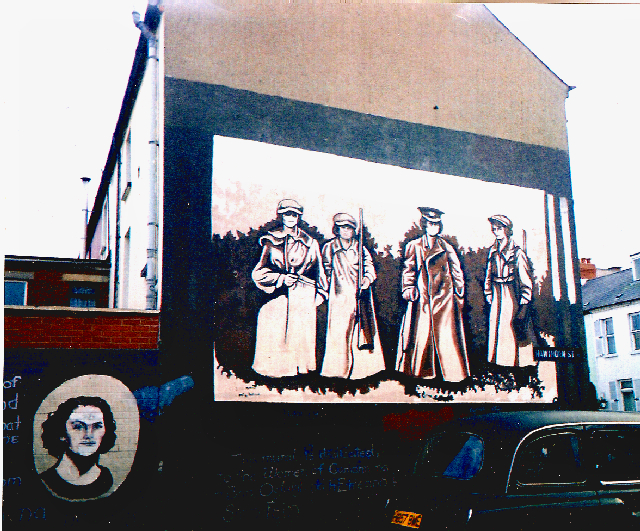
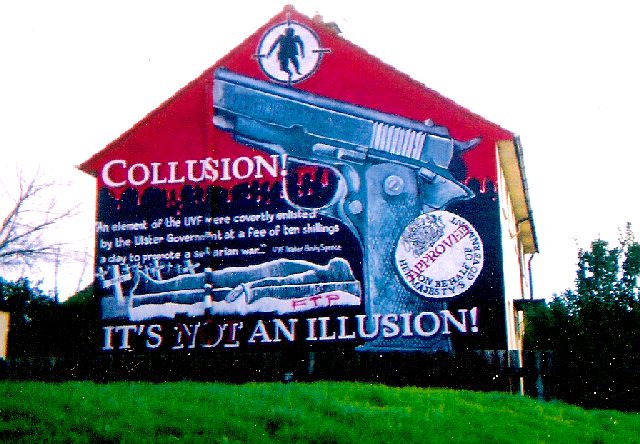
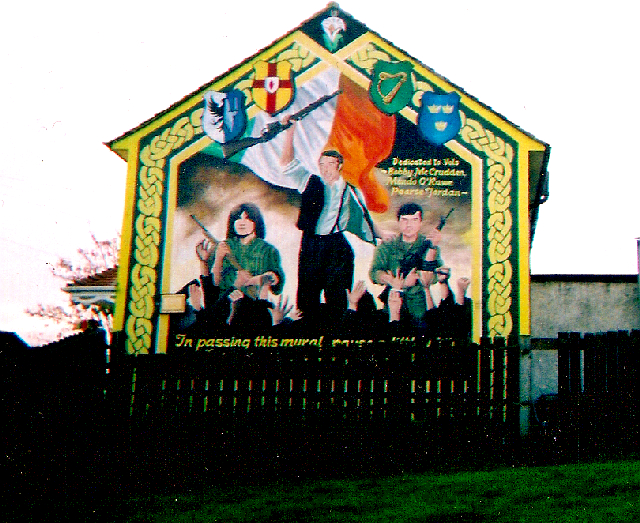
This one is actually not on the side of a private home - like all the other ones are - this is on the side of the Sinn Fein office. Gerry Adams was inside - and you can see the television truck antenna in the foreground. Lots of TV journalists hanging out, waiting, smoking, drinking coffee. We talked to them for a bit.
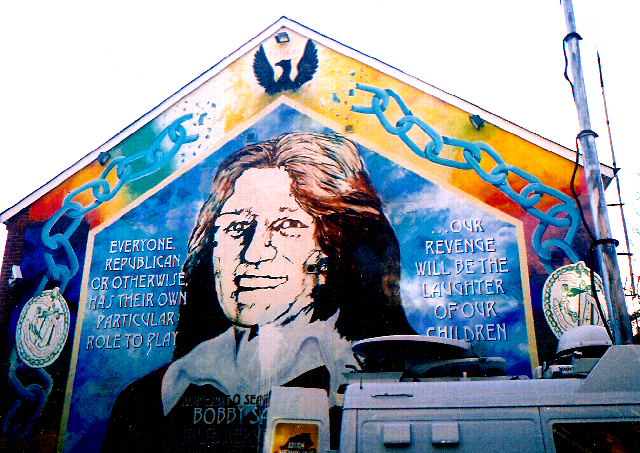
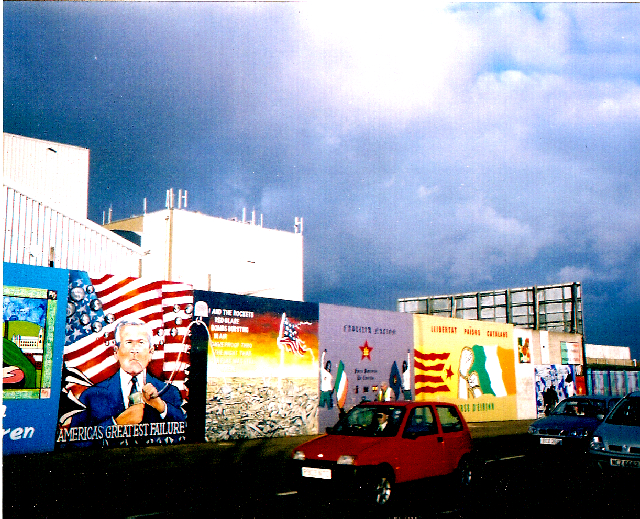
Hi! Welcome to the neighborhood!
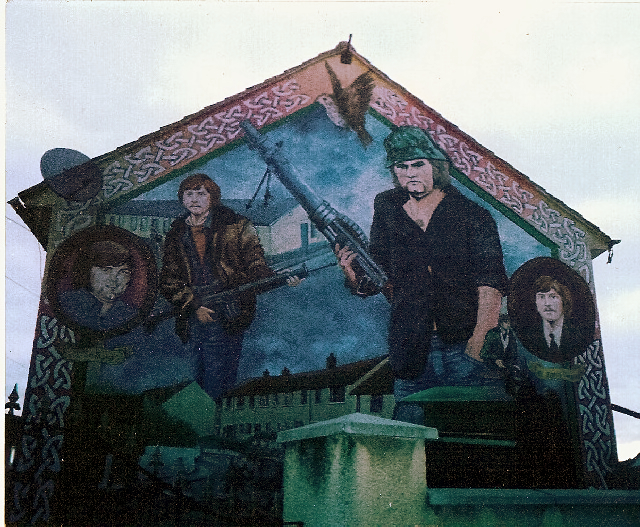
Scanner sunday
Welcome to Belfast! Carrie gave us directions, involving the phrase, "Take a left when you see the mural of the chicks with the guns ..." You know, as though she were saying, "Turn left when you see the Dunkin Donuts ..." We did the whole mural tour with Carrie. I mean, you just gotta. Our tour guide said stuff like, "And over der is da pub where me girlfriend's da got his leg blown off ..."
This one is actually not on the side of a private home - like all the other ones are - this is on the side of the Sinn Fein office. Gerry Adams was inside - and you can see the television truck antenna in the foreground. Lots of TV journalists hanging out, waiting, smoking, drinking coffee. We talked to them for a bit.
Hi! Welcome to the neighborhood!
March 22, 2007
John Banville in LA
A great post re-capping Banville's reading last night. I love Banville's answers to what was obviously a Q and A session - very thought-provoking, in terms of literature and art. Wonderful! He said "If you write honestly, you will not be sentimental." .... God, John, I hope so.
Banville's a favorite of my dad's.
December 21, 2006
Winter solstice
Today is the winter solstice which makes me think of a lot of things - winter solstice parties in college and stuff like that, but mainly it makes me think of Newgrange, a place I have been to numerous times. I wrote a little piece on what it's like to go on a tour there.
The whole "winter solstice event" at Newgrange is something I have always wanted to do - even though it's nigh on impossible to get a ticket, and you have to do a "solstice draw", like a lottery - to see if you'll be able to be one of the lucky few. And of course since it's Ireland in December, there is no guarantee that there will even be sun on that day. But when there is? On the tour of Newgrange, when you are in the inner chamber, they turn off all the lights - and do a recreation of what it would look like if you were there on the sunrise at winter solstice.
It's truly a mindblowing thing - it's like being in the presence of the Pyramids or Stone henge or any of those other monolithic structures filled with sophistication and symbols and ancient wisdom ... and to see the rays of sun slowly illuminate the entire chamber, hidden deep within the earth ... Just makes you feel all humble and awestruck and quiet.
Here are some pictures from past winter solstices at Newgrange:
That's from within the inner corridor that slopes upward into the chamber. When the sun first peeks over the horizon - the sun rays pierce through the main door like a laser. Unbelievable.
Slowly, as the sun rises - the rays continue to flood forward - going around slight curves, slowly rising up the corridor ... Eventually the inner chamber floods with light as bright as day. It's incredible.
And here's a view of Newgrange from the outside, winter solstice 2002.
Happy solstice everyone!
And here are 101 facts about Newgrange.
July 8, 2006
The potato famine, a-boo-hoo-hoo
It is well known in my family that my dad hates memorials to the potato famine. If you want to know why, just ask him! It's a "ooh! ooh! Mr. Kotter! Ooh! We were victimized too! We were victimized too!!" desperation that my dad despises. A-boo-hoo-hoo there was a potato famine. Get over it. Stop wallowing. So you had to eat your great-grandmother when she died. SO WHAT!! She was old anyway. I love to get my dad going on the potato famine memorials. The O'Malleys are from County Mayo - one of the hardest hit counties - but whatevs. Is that any reason to put up memorials in every city about it? It was black '47, a-boo-hoo. It's 2006 now. GET OVER IT. You just want to be included in the roll call of the world's biggest victims. Etc. I could go on and on, but you get the drift.
In our walk yesterday I said something like, "Somewhere along here is a memorial to the potato famine. Which of course makes dad crazy."
I was talking to Bren, but of course Cashel heard this and I could feel his little brain turning it over. Then the inevitable: "Why does the potato famine memorial make Gampa crazy?"
Bren replied, "Oh, because he's cranky."
We walked and walked. We saw the Korean War Memorial. We saw the US Navy memorial. We saw the really cool memorial to the Merchant Marines. That engendered a great discussion. Mainly about the seagull who perched on top of the main statue's head. Then suddenly, we saw something that looked like a discarded set for a Flintstone movie. Seriously. Look at the potato famine memorial in Battery Park and you'll see what I'm talking about.
"What is that?" asked Cashel.
"Some memorial, Cash. I have no idea what it is."
Then we heard some loudspeakered voice moaning on and on reproachfully and we heard the Irish accent and Bren said, "Oh God. It's the potato famine memorial."
"We have to go check it out."
We walked through it. There's a kind of recreation of - oh - Glendalough - but - it's dumb. I didn't say anything, though, because who knows - maybe Cashel would LIKE the potato famine memorial, and it's not up to me to tell him how to feel. We stood in one of the little Glendalough-esque alcoves, listening to the a-boo-hoo-hoo loudspeaker voice - on autopilot - there was an "old" stove cut into the wall, and Cashel went over and sat in it. All around us was the overwhelming sadness of the millions of Irish dead. Not. It looked like a Flintstone set.
Then I said, "Oh my God. We have to call Gampa right now and tell him where we are."
So we did. It was hysterical. I dialed - Dad picked up - and I said, "Hang on, Dad - we want to tell you where we are right now ..." And on the count of 3, just like we planned, Cashel, Bren and I screamed into the phone: "WE'RE AT THE POTATO FAMINE MEMORIAL!"
Seeing Cashel, with the huge smile on his face, and his big-boy teeth, scream those words - and he doesn't even really get WHY the potato famine memorial is funny - but he knows it's a joke, and that we're "getting Gampa" and that will be, in and of itself, funny.
My dad was HOWLING.
The funniest thing about it is that people were wandering around through the memorial - people of all nationalities - looking at the plaques, listening to the a-boo-hoo overhead, contemplating, being serious and respectful - blah blah - and 3 people of actual Irish descent stand in their midst, shouting into a phone about how FUNNY the memorial is.
June 16, 2006
Bloomsday: "like a vomit"
Henry Miller:
For at bottom there is in Joyce a profound hatred for humanity -- the scholar's hatred. One realizes that he has the neurotic's fear of entering the living world, the world of men and women in which he is powerless to function. He is in revolt not against institutions, but against mankind ... Ulysses is like a vomit spilled by a delicate child whose stomach has been overloaded with sweetmeats.
April 16, 2006
Happy birthday, JM Synge
Today is Easter. It's also the birthday of Irish playwright John Millington Synge (1871–1909), author of Playboy of the Western World, Riders to the Sea, and many more - not to mention his wonderful book about his time on the Aran Islands, called, coincidentally, The Aran Islands. Playboy is now in the history books, not only for being a wonderful play, and part of the theatrical revolution going on in Ireland at the time (the creation of the Abbey Theatre, etc.) - but also because of the riots that broke out when it opened. Things got so out of hand that a police squad had to stand along the edge of the stage during the performance, so that the actors wouldn't get hurt or mobbed. If I had a time machine, I would LOVE to go back and be there on the opening night of that play.
Synge wrote (and this is a bit of a mission statement):
Ireland, for a few years more, we have a popular imagination that is fiery and magnificent, and tender; so that those of us who wish to write start with a chance that is not given to writers in places where the springtime of the local life has been forgotten, and the harvest is a memory only, and the straw has been turned into bricks.
Synge's time out on the Aran Islands, off the wild west coast of Ireland, gave him the nuggets of inspiration for many of his plays. Out there the "native language" was still spoken, out there he could encounter the real Ireland.
Synge had spent a lot of time in Europe, taking courses in French literature, immersing himself in different cultures, reading Baudelaire, writing poems, chasing girls ... You know, all La Boheme stuff. He remained interested in his own country, his own heritage - but there wasn't really a place for him there. (Interesting: NOW it's hard to imagine Ireland without Synge, but he had to TAKE that ground, he had to claim it - it didn't exist before he came along.) Yeats' whole nationalistic literary (and theatrical) movement drew Synge back to his home country - the Abbey Theatre was formed - things were HAPPENING in Ireland. In retrospect, it all seems inevitable. Of course Synge would not only come back to be part of that movement, but he would end up defining that movement. But at the time, Synge had some reservations about Yeats' "let's bring back the fairies and the Celtic twilight" romanticism. Was that Ireland? Fairies? Leprechauns? Shivering grey twilights? Was that Irish culture? Couldn't there be something more there? Something ELSE to be expressed? (That Synge did so, and so powerfully, is proof of his genius).
Yeats gave Synge a piece of now legendary advice (and this is a direct quote):
Give up Paris, you will never create anything by reading Racine, and Arthur Symons will always be a better critic of French literature. Go to the Arran Islands. Live there as if you were one of the people themselves; express a life that has never found expression.
In the middle of what was, essentially, an Irish cultural revival, Yeats (having been out to the Aran Islands) recognized that there was something untouched out there, a primitive life, Irish language still spoken, the culture not corrupted. Yet. It was a race against time.
The leaders of the cultural movement in Ireland at that time all had the same idea: Inspiration lay in the West of Ireland. Go west. Go west to find the real Ireland. (Interesting, to think of the final paragraphs of Joyce's The Dead in this context. I'm sure I'm not the first one to think of this- ha - but still, it's interesting.)
So Synge took Yeats' advice and went west.
The story of his four trips out to the Islands make up his book Aran Islands, a wonderful rich travelogue, a classic of the genre. He sits around turf fires with the various storytellers, and listens, and writes the folktales and anecdotes down later. These stories contain the germs of Playboy, the germs of Shadow of the Glen, the germs of Riders. Yeats was right. With all of Yeats' airy-fairy Celtic frippery, he understood that a powerful culture lay beneath the surface, a culture that had never been shown to the world, never been expressed.
Not surprising, then, that Playboy of the Western World would cause such an uproar.
Here is an excerpt from Maire Nic Shiubhlaigh's marvelous book The Splendid Years, which is the story of the Irish National Theatre. Maire was an actress, highly involved with the cultural revival of the time, and a member of the Abbey Theatre. Her memories of Synge (and also her memories of the "Playboy riots") are fascinating. Here she speaks of Synge:
It was early in June, 1903, that Lady Gregory called us to her rooms at the Nassau Hotel and read Synge's play [Shadow of the Glen] over to us. The piece was a one-act comedy based on an Irish folk-tale the author had heard from an old Aran Island seanachie -- the story of the aged husband feigning death to test his youthful wife's fidelity; denouncing her, but forgiving her lover. The plot, strictly speaking, was not original, but the treatment was. It was completely different to anything we had known before; the play itself was a masterpiece of dramatic construction. It was, in fact, the first of the Irish "realist" dramas, and the quiet young man who sat unobtrusively in the background while Lady Gregory read aloud his words, was to take his place amongst the greatest dramatists the Irish theatre produced.John M. Synge who came to us with his play direct from the Aran Islands, where the material for most of his later works was gathered, was born near Dublin in 1871, graduated at Trinity College, and shortly afterwards left Ireland for the Continent, living alternately in Germany and France, where he made a rather precarious livelihood as a violinist and contributor to literary magazines. Yeats had discovered him in Paris in about 1897 and, recognizing the quality of his writings, had brought him back to Ireland, where he introduced him to Aran, prophesying that in the beautiful lyrical prose of the western peasant he would find an original vehicle for dramatic composition. He was right. Synge went to Aran for a month, and stayed there, on and off, for a matter of years. He drew his inspiration from the hearths of the tiny whitewashed cabins and the harsh rocks of the western seaboard, gathering tales and expressions from the old and the young of the most picturesque portion of Ireland. In a short life -- he died at the early age of 38 -- he wove them into sombre dramatic tapestries, embroidered with the rhythmic language of the Irish peasant. His prose, highly musical and enriched with flashes of the most beautiful poetry, he devised simly by transcribing direct from the Gaelic of the islands. It is most difficult for an actor to master; most effective if delivered correctly.
Ahem. She's got that right. I did a scene from Playboy in a class in graduate school, and while my scene partner had a hell of a lot of fun working on it, it was DAMN difficult to get that language right. Not just the language, but the rhythm, the tone. It doesn't matter if you get the words all correct, and remember all your lines, if you say them in the wrong rhythm. Rhythm is everything.
Back to Synge.
He was a gentle fellow, shy, with that deep sense of humour that is sometimes found in the quietest people. His bulky figure and heavy black moustache gave him a rather austere appearance -- an impression quickly dispelled when he spoke. His voice was mellow, low; he seldom raised it. But for his quiet personality he might have passed unnoticed at any gathering. During rehearsals of his play, he would sit quietly in the background, endlessly rolling cigarettes. This was a typical gesture, born more of habit than of any desire for tobacco -- he gave away more cigarettes than he smoked. At the first opportunity, he would lever his huge frame out of a chair and come up on to the stage, a half-rolled cigarette in eaach hand. Then he would look enquiringly round and thrust the little paper cylinders forward towards whoever was going to smoke them. In later years he became the terror of fire-conscious Abbey stage-managers. He used to sit timidly in the wings during plays, rolling cigarettes and handing them to the players as they made their exits.
Here's more from Maire:
Synge was a genius, one of the great literary figures of his time, but brilliance often ripens under the most difficult conditions. In the Shadow of the Glen was sufficiently in advance of its time to arouse in Dublin audiences a completely unfounded indignation. Its production raised a storm of protest in some sections of the Press that was stupid and ridiculous, disconcerting its unfortunate author and amazing most of us, who had never looked upon the play as anything but an exceptionally well-written comedy.
And THAT'S why the guy is a genius. He didn't set out to revolutionize Irish theatre. He didn't set out to be a genius, or to write great plays. He just wrote down what he knew. That was the ONLY way this guy could write. And it turned everything upside down.
Here is Maire's description of some of the objections to Shadow, just to give you an idea of what was going on, and to also set the stage for the "Playboy riots". Synge was, indeed, ahead of his time. The world is rarely kind to those born ahead of their time.
The piece was "un-Irish" wrote some reviewers, an "insult" in fact to the peasant women of Ireland whom Nora Burke was taken to typify. There was an immense verbal furore about it. A number of writers claiming that Synge was slyly attacking the institution known as the "made marriage", and attributing it solely to Ireland, raised all sorts of objections. Others wrote of the character of Nora Burke: "Nora Burke is a lie". Of the play they said: "It is no more Irish than the Decameron. It is a staging of the old-world libel on womankind -- the Widow of Ephesus."Now, I do not propose to analyse the extraordinary attitude adopted towards the play. Indeed, the attacks were launched so suddenly that few of us were even able to gather what they were all about. Perhaps it was that the Irish play-going public of that time was so used to the "genteel" comedy of the established theatre which I mentioned earlier -- the entertaining but not very realistic stuff that was time and again put before it -- that it couldn't swallow a credible satire. In those days if an actress played an unpleasant part, then it followed that she was an unpleasant person. Similarly, if a dramatist wrote a nasty play he was a nasty fellow. Then, of course, there was the fact that Ireland was on the threshold of a renaissance. Everybody, writer, politician, artist, was at pains to eulogise over the beauty of the Irish character. The advent of a comparatively unknown writer who painted an unpleasant if realistic picture of the peasantry at such a time was, to say the least, unwelcome. The Dubliners who raised the loudest objections could not accept In the Shadow of the Glen as a play. They refused to be entertained.
In 1907, the Abbey Theatre produced Playboy of the Western World. Maire, who was there, writes:
The "Playboy Riots", as they came to be known, indicate very clearly some of the difficulties that the Abbey was called upon to face during its first years -- and they show how the theatre, under Yeats, managed to surmount them. When this play is produced in Dublin now it is recognised and enjoyed as a work of art. In 1907 it drove a number of people into such a frenzy that they nearly wrecked the Abbey. I am in rather a good position to describe the riots because I was in the audience during some of them. Curiosity had taken me into the theatre, as it had taken many another person that week.It was about the end of 1906 that Synge finished the Playboy ... Yeats later mentioned that Synge took considerable trouble over the piece and scrapped a number of earlier versions before he fixed on the one which was eventually produced...Yeats never tired of recounting the care which Synge lavished on the piece. This, indeed, may have been indirectly responsible for the reception accorded the play by some sections of the public, whose main argument against it was that it was "a slander on the peasantry of Ireland". As in the case of The Shadow of the Glen, its realism gave offence. The only differnce between it and any other play that did not take was that the public, instead of showing its lack of interest in the accepted way -- by its non-attendance -- displayed its disapproval by rioting in the theatre throughout the play's run. The most unusual feature of the affair was that although the players appeared on the stage and acted their parts for a whole week, the uproar caused by the audience was so great that the play was never really heard on any night but the first, and those who took part in the demonstrations on subsequent occasions were dependent on opinions of the firstnight audience and a few rather hysterical newspaper reports. As the week progressed, the trouble instead of lessening, increased, and before the run of the play was half over, the management felt compelled to call for the assistance of the police to preserve order.
The explanations put forward by the rioters during the week were many and varied and it is worth remarking that no two people appeared to base their objections on exactly the same thing. Some objected to the piece because "it made a hero out of a murderer" (the play deals in part with the welcome accorded by a West of Ireland village to a weak-willed boy who believes he has just killed his father); others claimed that the language used was too strong; more contented themselves by saying that the play was "vicious, untrue, and uncalled for" -- a "hideous caricature" in fact; while a considerable number based their objections on the assumption that the piece was a deliberate attack by Synge on Ireland in retaliation for the manner in which The Shadow of the Glen and The Well of the Saints had been received.
(All of this makes me think of what Joyce said, when it became apparent that no Irish publisher would go near The Dubliners and he would have to look outside his own country for a publisher: "It is not my fault that the odour of ashpits and old weeds and offal hangs round my stories. I seriously believe that you will retard the course of civilization in Ireland by preventing the Irish people from having one good look at themselves in my nicely polished looking-glass." Obviously Synge had approached the same territory - he had held up a "nicely polished looking-glass" to the Irish people, and the Irish people were having NONE of it. At the time.)
Maire describes what it was like in the theatre, on the opening night of Playboy of the Western World, January 26, 1907.
The first act went well. There was laughter at the right places and the correct degree of solemnity was maintained when it was demanded. But during the second act I began to feel a tenseness in the air around me -- I was sitting in the pit -- and there were murmurs from the stalls and parts of the gallery. Before the curtain fell it was obvious that there was going to be some sort of trouble. Faint calls and ejaculations like "Oh, no! Take it off!" came from various parts of the house and the atmosphere gradually grew taut. In the third act things really came to a head and those around began to stamp the floor and shout towards the stage, the noise gradually increasing until the voices of the players were drowned. People stood up in their seats and demanded the withdrawal of the play, and when it became clear that the cast was determined to see the thing out to the end, tempers began to fray. The auditorium became a mass of people pulling and pushing in all directions. By the time the curtain fell on the last act, the crowd was arguing and fighting with itself. People in front leaned over the back of seats and demanded quiet -- a lot of people seemed to be doing this -- and those at the back responded by shouting and hissing loudly. The crowd which eventually emerged into the street was in an ugly mood.
Despite vicious and hysterical reviews the play went on. One of the objections was that the word "shift" appeared in the play (meaning: "chemise", or "slip", whatever you want to call it). Christy - the lead character in the play - says - in what is now acknowledged to be a fine piece of dramatic literature, and one of the classic monologues of the stage: "It's Pegeen I'm seeking only, and what'd I care if you brought me a drift of chosen females, standing in their shifts itself, maybe, from this place to the eastern world?" People were shocked and outraged by this, it was seen as an insult to all Irish women.
The Press and the public called for the play to be closed, the hysteria mounted, but the Abbey refused to capitulate. Obviously, Synge had struck a nerve. But things were getting out of hand, it was a violent atmosphere in the audience ... and so Yeats tried to quell this fire. Maire describes:
On the third night Yeats addressed the audience before the curtain rose. If anyone had anything to say against the piece they would be welcomed at a debate which he would be glad to arrange in the theatre at some other time. He was interrupted several times. He asked the interrupters to at least listen to the play so that they would know what it was they were objecting to.
It is just like those idiots who protested Scorsese's Last Temptation without even seeing it. Ignorant idiots. I have no patience and no tolerance for people like that. To me, they are a scourge upon this planet. I'm pretty open-minded, you know "live and let live", but people like that put me into a rage and I have no problem with openly scorning their stupid fearful little lives. Especially if they try to BLOCK the general public from seeing something that THEY find offensive. Everyone has their limits, everyone has their thing that they cannot endure - and I cannot bear people like that. I don't want to listen, understand where they're coming from. No. I DO understand where they are coming from, and that is why I despise them. My contempt comes directly FROM understanding. Their "faith" and their sense of themselves is so fragile that it's a house of cards. Even the fact that Scorsese's movie EXISTED threatened their entire world view. Fine. Go home then and read only the Bible and close the blinds and don't let the big bad nasty world touch your precious house of cards, and let those of us who actually want to SEE the movie and decide for ourselves - live in peace.
Such people have always existed. Their complaints are always the same.
Back to the Playboy Riots:
As on the first night, the opening passages were listened to quietly, and even evoked a little laughter. Halfway through the second act, however, a murmur arose in the pit and a man a few rows away stood up and, without any apparent reason, hit the person beside him. A gasp ran around the whole house and the lights went up. All around him the crowd was breaking into disorder.Within minutes, the audience in the pit and stalls was completely disorganised, and the crowd in thte back and side galleries was almost as bad. Almost everyone was standing. The noise was deafening. Yeats appeared on the stage and pleaded with the sensible members of the audience to remain quiet. His voice was drowned by catcalls, cheers, much stamping of feet, and from somewhere at the back ,the notes of a toy trumpet which came from the centre of a group of young men who looked like university students. He continued to speak, but his words were apparently objected to by those in front, for a howl of protest went up from the stalls and parts of the side gallery, which increased in volume as those behind joined in or tried to cheer the protest down. On the stage the players stood in little knots, discussing the occurrences amongst themselves.
As the noise increased and several arguments broke out around the theatre, Yeats left his place on the stage. A few minutes later the doors into the auditorium opened and to the horror and surprise of most of those present, a body of police entered. At the same time the curtain came down and a semblance of order was restored -- partly due to the sight of the uniforms ...
After a brief speech by Yeats, and the ejection of the more truculent members of the audience, peace was partially restored, and everyone sat down again. At this stage it would have been impossible for anyone to get out. After everyone had been quietened and the greater part of the audience reseated, it would have been dangerous for anyone to stand up. Those who did so were immediately surrounded by hefty policement and shepherded, not too gently, in the direction of the vestibule.
Meanwhile, the orchestra, a recent addition to the theatre, began to play. The music seemed to help matters somewhat, and things almost returned to what they were before the play began. There was much discussion and gesticulation going on however. The affair was still far from settled.
After some time the orchestra retired, the lights were lowered and the curtain went up. Almost immediately the audience reverted to what it had been before the arrival of the police. Not a word of the play could be heard. The cast eventually gave up speaking altogether and went through the piece in pantomime. [Note from Sheila: God, I wish I had been there to see this. It must have been extraordinary.] As the play progressed the noise increased. Men and women stamped the floor, banged the backs of their seats with their fists, shouted and sang alternately. On the stairs from the stalls a man stood, dramatically addressing no one in particular.
The players courageously went through the whole piece. During this time several arrests were made and the police were kept busy operating between the doors and the hall. Just before the play ended I saw an opportunity to escape and took it. Almost everyone in the row where I had been sitting had vanished. I was able to make a dash for the door at the rear of the pit while the police were busy in the front of the house. My last impression of the scene was the sight of a figure standing on a seat somewhere about the centre of the stalls and the sound of a few bars of God Save the King, which were quickly stifled as someone pulled the singer down.
Amazing. The play continued to be performed, and continued to generate riots and protests, garnering the attention of the world. "What is going on over in Ireland right now? What exactly are they protesting??"
Synge died an early death, in 1909, but he left an indelible mark - not only on Ireland, but on theatre as a whole.
I'll end this post now, with a quote from Synge's beautiful book The Aran Islands (and I will post a photo, too, of Synge staring out into the Atlantic, from one of the Islands).
In the following excerpt, he describes leaving the Arans after a couple months' stay ... and returning to the bustle of Galway:
I have come out of an hotel full of tourists and commercial travellers, to stroll along the edge of Galway Bay, and look out in the direction of the islands. The sort of yearning I feel towards those lonely rocks is indescribably acute. This town, that is usually so full of wild human interest, seems in my present mood a tawdry medley of all that is crudest in modern life. The nullity of the rich and the squalor of the poor give me the same pang of wondering disgust; yet the islands are fading already and I can hardly realize that the smell of the seaweed and the drone of the Atlantic are still moving round them.
Happy birthday, JM Synge. We are in your debt.
-- this is a re-post
March 20, 2006
The Books: "On Another Man's Wound" (Ernie O'Malley)
And here is my next excerpt of the day from my library.
 Next book on the shelf is On Another Man's Wound by Ernie O'Malley. Like my dad said when he told me to read this book: "Most memoirs of IRA members are not well written. It's all 'Then we blew up the lorry and hid in the bushes.' But O'Malley can actually write." He sure can. This is literature, a beautifully written book. Luscious language, filled with Irish songs and poems, personal portraits of people he met, a real sense of the time. Ernie O'Malley was a medical student in Dublin when the Easter Uprising happened in 1916. He was kind of indifferent to the whole thing at first - but as the fighting continued - his perspective changed. So much so that he joined the IRA. He traveled around Ireland (in the South, not the North) and organized battalions, training farmers and regular people in the ways of war.
This is his story, written in his own words. But again, what sets this book apart from other revolutionary memoirs is his talent for writing. It's almost like he is determined to get down as complete a picture of Ireland at that very moment in time as he possibly can. It's like Synge's book on the Aran Islands. Everything is going to change ... and people will change ... so let's get it all down NOW before they do.
On Another Man's Wound is filled with lots of Irish legends, told around peat fires in the West - the songs they would sing, the poems they would recite ...
It's hypnotic. A lovely and elegaic book. It's a love letter to Ireland. It reminds me a lot of Synge's stuff.
Here's an excerpt.
From On Another Man's Wound by Ernie O'Malley.
The brigade Vice-Commandant, Maurteen Devitt, and the Quartermaster, Peadar O'Loughlin, were on the run in their part of Mid Clare. They had more time for Volunteer work and knew the by-roads and the general direction of police patrols. Maurteen was thin in body, pale faced and energetic with a sharp turn of tongue in speech and wit; satiric.
Maurteen Devitt's father was an old man, an Irish speaker, his favourite curse being, "the curse of the crows upon you," but he sympathised with us and did not regard us as half wits, as many others did. Once I arrived early in the morning, tired out, as I had walked a long distance, I knew the songs were out at a dance and that the father was alone. He came to the window and when I told him I wanted to get in, he said: "Be off with you, Patsey Mitchell, you playboy." I mentioned my name, but he did not seemingly know it, as it had not been spoken of in the house, although I had been staying there some weeks. He cursed me fluently, ending up with the curse of the crows; I knocked again, but as he became more exasperated i gave it up, buttoned up my coat and went to sleep on thte ground. One of the sons found me in the morning sleeping, white with hoar frost. The old man always bore this in mind and never ceased to blame himself when he met me.
In the night time I often sat opposite to him in the fireplace listening to his talk. He always wore an old hard hat, light green with sun, brown mottled in spots with a torn brim and a dint on the top. He had a hoar stubble of a beard. He slurred his words in English through gaps in his stained teeth, but Irish seemed to flow swiftly enough. He had a great friend who came often; then they spoke Irish all the evening; sometimes the old man would translate or begin a story in English with many pauses. He would hold a match in his broken clay pipe or a piece of glowing sod, then puff, hold the pipe in one hand, talk, draw on the pipe to find it had gone out. Time and again the pipe went out; intent on the story he used it to emphasize words. Refilling the pipe was a ceremony. The 'baccy was pared from a hard black piece of plug or twist, ground slowly between the palms and rammed down into the bowl; some of the last pipe's ashes on top, then a tin cover with a hole in the top. The pipe was cleaned by sticking the bowl in the red turf glow.
Sometimes they'd laugh together and shake their heads with delight when speaking of Pedlar McGrath or Se�n O'Twomey. Some poems he would not translate; they seemed to enjoy them all the more. "The ould fellow is worked up," Maurteen would say, when he began on Rafferty or Donnchadh Ruadh MacNamara. Then I regretted I had not studied Irish thoroughly. I knew next to nothing of these poets save in translation. But here the seventeenth and eighteenth centuries lived again, for these two men could tell story after story of the poets' pranks, drinkings and songs, and describe them as if they had lived in the same parish. They recited verses of men whose names I did not know. I think the only thing that left me with a shred of reputation was that I had a battered copy of the Love Songs of Connacht.
Old Devitt and his friends were like the others I had met in this stretch of Clare and in the Rosses. Their sense of literature was on the lips and in their faultless memory. In craggy Carren an old man recited the whole of The Midnight Court for me. They were not literary nor had they any pretence to learning. The extension of their knowledge made them simple; they were not conscious of it, but they knew more of poetry as a living feeling than had anybody else I had met save poets themselves. They could curse hard and long mostly for emphasis and the sound of words, but also in anger.
What I liked most about him and others was their independence, their air of being true to themselves. In the towns people conformed their suppressed selves to an outward convention; here they created their own environment in and through themselves. They had no feeling of equality or inequality, but a definite reality, and it would be a long time, I knew, before I could ever hope to have anything as real in myself as they had.
They had a sense of life that made them fresh and interesting to listen to and the flavour of a life of the open air was in their words and thought. They were starkly real like chunks of their own earth when they spoke of the land, its irritable uncertainty and its aching sweat, but a feeling for words and phrasing would lift a talk about manure.
Old women screwed with rheumatism, their faces like ploughed fileds, took snuff or a draw of the pipe in the corner while they fingered their beads. These were the obvious signs of outward realism and the harsh background of their lives; but there was a deep content, an ease in life and a depth in themselves that could well up nourishment. They were able to entertain and amuse themselves easily. Song was a definite expression as natural as talk, and they all sang. They sang at the end of the a hard day's work and were refreshed or musicioners used fiddle or melodeon in a manner peculiar to themselves. In spite of aching land work they had the leisure of the wealthy and they made use of it simplyl and fully. Gentleness and fierceness, lack of sentimentality and a definite concreteness merged with poetry and sharp realism in speech; kind towards suffering and callous towards cattle and dogs and their burden-bearer the skinny ass.
March 16, 2006
The Books: "A Secret History of the IRA" (Ed Moloney)
And here is my next excerpt of the day from my library.
 Next book on the shelf is A Secret History of the IRA by Ed Moloney. If I recall correctly, Emily got so angry reading this book that she threw it across the room! Good times!! Ed Moloney has been Northern editor of The Irish Times and the Sunday Tribune - and has written this book with unprecedented access to - well - the "secret history" of the IRA. It's the story of the IRA but more than that it's the story of the rise of Gerry Adams. The pretty much Machiavellian rise of Gerry Adams. Having stayed in Ballymurphy when I was in Belfast, and having - uhm - seen Gerry Adams' car outside the Sinn Fein head office - I really feel like an insider. There is nothing like seeing Gerry Adams' car parked at the curb to really make you feel close to the HEART of something important. heh heh This book is DENSE, man - I found it tough-going at times to keep on reading it.
When my family went to Ireland when we were all kids - we went to visit my "Auntie Bridgie" in Killarney. An 83 year old woman who lived in a 2-room dark house with cows right outside the door. Her husband had been dead for ... 30 years? 40 years? Anyway, on the dark stained wall over the stove were three things: A picture of JFK. A picture of Pope John Paul II. And a pin in a small dusty glass case - the pin had a red ribboned thing hanging off it. I am unable to describe it, because I am a loser. It wasn't a medallion - but a ribboned thing, almost like an epaulet - Anyway, that was her husband's IRA pin. Of course this would have been the IRA back in the 20s and 30s, a very different organization from the one we see now. But those three items were the only wall decorations. Kinda says it all, don't it??
I'll post an excerpt about the Provisional IRA.
From A Secret History of the IRA by Ed Moloney.
The first Provisional leaders were sure of the rightness of their cause and the reasons for breaking with the Officials. The initial statement from O Bradaigh's breakaway Sinn Fein in January 1970 listed five reasons for splitting with Goulding: his recognition of the Irish and British parliaments; the move to embrace extreme socialism; illegal internal disciplinary methods; the failure to defend Belfast; and the policy of defending the Northern parliament at Stormont. The list demonstrated that the Provisionals were essentially a coalition of differing grievances; for some Marxism was the major problem with Goulding, and for others the military rundown of the IRA. One characteristic of the new IRA above all others that united the coalition - the glue that held it together - was a distrust of politics, parliamentary politics in particular, and an unshakable belief in the correctness of armed struggle.
The early Provisional leaders were determined that they would not stray down the path of parliamentary reformism trod by other nationalist and republican leaders. Each previous generation of freedom fighters had been betrayed, they believed, by leaders seduced by the siren call of parliamentary politics. They would be the exception. For this reason they defined the relationship between Sinn Fein and the IRA in simple and traditional terms. The military wing, the IRA, was in charge, and Sinn Fein would obey and be subservient to the Army Council. That was the case in the South and also in the North, where, according to one veteran party activist, Sinn Fein was secondary to the IRA from the outset: "Sinn Fein was the poor relation. It wasn't worth bothering about. Sinn Fein in the 1970s was an organization without clout; it supported the 'campaign' and held lofty ideas of a united Ireland but nothing else. The IRA was boss."
As the war intensified and more and more Northerners joined up, the antipolitical nature of the Provisionals intensified, as one of the Provisionals' founding members recalled:
When the resistance began, Northerners came in droves, and they were reacting to events for a number of years. The Northern guys were quite slow to be politicized. They looked down on Sinn Fein and dismissed it, saying, 'We're Army men.' I shared a cell with them in Mountjoy, and that was their view. They were quite happy sitting in their cells reading the Sun or the Mirror boasting about operations. They were purely militaristic - hit, hit, keep on hitting.
Whereas the first IRA commanders were Southerners, the foot soldiers in the war, the Volunteers, came overwhelmingly from the North and at first mostly from Belfast, where the attempted loyalist pogroms of August 1969 had taken place. Many IRA units elsewhere in North, in republican heartlands like Tyrone, Armagh, and Derry, were slower to take sides in the republican split; in some cases months went by before they decided whether to follow Goulding or MacStiofain. The Provisionals were born in Belfast and sustained by the city's bitter sectarian politics.
Some of those outside Belfast were repelled by the Provisionals' simplistic politics. Typical of this category was the Derry republican Mitchel McLaughlin, who stayed with the Officials for several months before joining the Provisionals, later rising to become a key Adams aide and advocate of his peace strategy. "At the time of the split," he once told an interviewere, "I actually stayed with the Official Republican Movement. Mainly because of their politics which undoubtedly were more progressive than the more, kind of nationalistic rhetoric that I was hearing [from the early Provisional leaders]." Gerry Adams and the Ballymurphy unit were not the only IRA members to hesitate before taking sides in the split. Not surprisingly, many were waiting to see who came out on top, and so what happened in Belfast was crucial. When Belfast republicanism went over to the Provos, as it did during the crucial year of 1970, many of the rural units followed, and soon if angry young Northern Catholics wanted to hit back at either the loyalists or the British army, they knew they would find a warm welcome in the Provisionals.
The IRA before August 1969 was an organization kept going by family tradition. Membership was passed from father to son, mother to daughter, but the recruits who flocked to the ranks of the Provisionals were a new breed, motivated by an atavistic fear of loyalist violence and an overwhelming need to strike back. Known as Sixty-niners, they joined the IRA literally to defend their own streets, were resolved that the near-pogroms of August 1969 would never again be repeated, and were ready, if the opportunity arose, to retaliate. They joined the Provos because the Officials had failed to defend their communities in the way that was expected, and they automatically associated the Officals' obsession with politics with military weakness and betrayal. From the outset abhorrence of politics and the requirement for defense and armed struggle were just different sides of the same coin.
Typical of the new Provisional IRA Volunteer was Bernard Fox, an apprentice coach builder from the Falls Road who joined the IRA in 1969, when he was just eighteen years old. He is now a senior figure in the leadership and was named in 2001 in the British media as a senior figure in the Provisional IRA's GHQ staff. He spent nineteen years in prison, either jailed or interned, for IRA activitiy. His motive for signing up was straightforward, as he once explained in a newspaper interview after the peace process reforms had secured his release fromk prison: "I was almost shot in a gun attack at Norfolk Street. I came away wanting a gun. It was survival. You wanted to protect your own people ... my family and myself. When the barricades went up I wanted a gun so I approached this fella who was in the IRA and asked for gun and he said: could I shoot a British soldier? At that time I hadn't the idea that it was the British government's fault ..."
Brendan Hughes from the Lower Falls Road district, a figure who later became an IRA legend, was similarly affected by the violence of August 1969. "At that time it was simply 'Here we are being attacked by Loyalists, by B Specials, by the RUC, by the British army,' and there was a need to hit back," recalled the former Belfast commander. "I mean I was in Bombay Street the morning after it was burned out, helping people out, and I went to the bottom of the Falls Road and seen all the burnt-out homes. I had relatives in Bombay Street who were burnt out, and I felt the desire to get back at these people who were doing it." Micky McMullen, a former long-term IRA prisoner, came under similar pressure but managed to resist it: "Up to 1969 there was nothing, but August 1969 was the turning point. I became involved in community defence you know and stuff like that, helping families to move after they had been burned out. At that time a lot of my friends would have been trying to join the IRA and the rationale would be just to get stuck into the 'Orangies' you know. It was a defence thing but something stopped me from getting into that."
Fox, Hughes, and McMullen and the many hundreds who followed them into the Provisional IRA in the first years of its existence were part of a Northern Catholic tradition that went back nearly two hundred years, when another armed uprising had very nearly ended British rule in Ireland. The United Irishmen's rebellion of 1798 is celebrated as the moment when modern, secular Irish republicanism was born, but it but it also coincided with the birth of sectarian politics in Ireland and left a scar that marked Northern socidety for centuries to come.
February 10, 2006
The Books: "Modern Ireland : 1600-1972" (R. F. Foster)
And here is my next excerpt of the day from my library.
My history bookshelf. Onward.
 Next book on this shelf is called Modern Ireland : 1600-1972 by R. F. Foster.
A massive book with a sweeping scope - it's kind of essential reading for anyone interested in Ireland. My dad told me to read it years ago - and there's so much in it, so much information that it's actually hard to absorb in one sitting. It's a very good book. I agonized over the excerpt to choose. I mean, not AGONIZED ... but you know ... it took some time. Should I go with the famine? Or Parnell? Or Cromwell? Or with Patrick Pearse et al?
I decided to go with the events in Ireland in the late 1700s - a time of great upheaval - well, there was great upheaval everywhere. There was the American revolution, the French revolution - these events reverberated throughout the world. Kind of like the time of revolutions in the 1960s, when every African country seemed to shrug off their colonial masters in the same decade ... a wave of revolutions that could not be stopped. The Irish were very much affected by the events in France - and the revolution-mania brought their own issues, shall we say, their own discontent to the surface. The Catholics must be completely emancipated - and there needed to be a strong government in Ireland - Parliament needed to be reformed - and out of all of this brou-haha a society was formed called the United Irishmen. They were a group of men who were well organized - and also dedicated and strong enough to try to bring about the necessary changes in Irish society. Foster writes: "their history reflects the inspiration, radicalization and disillusionment that the events of the 1790s brought to Irish society at much wider levels." The secretary of the United Irishmen was Theobald Wolfe Tone - his name is probably familiar to you. The United Irishmen wanted equality for Catholics (oh, and most of these guys were Protestants - so there goes the assumption that this whole thing is about religion - it's not - it's about land and power) - but they wanted to work within the existing system (at least originally) - a fact that made Edmund Burke (Mr. Don't Tear Stuff Down!!) approve of their ideas - which was very important. Getting Burke's stamp of approval was a big deal - and, hahahaha, I guess it still is, even though the dude is dead. People still wonder: "Will Edmund Burke approve???" In terms of the United Irishmen wanting reform and emancipation, Foster writes - Burke gave "the intelligent conservative rationate for such a step." I am so skimming the surface of this tumultuous time - but that's the gist of it.
I'm going to post an excerpt involving the United Irishmen and the extraordinary Theobald Wolfe Tone.
I highly recommend this book!!
From Modern Ireland : 1600-1972 by R. F. Foster.
This movement, the vital germ of Irish radicalism, cannot be separated from the general Irish reaction to the French Revolution. Fashionable Irish people had always tended to Francophilia; there was accordingly a wide circulation of literature to do with the early Revolution, and much favorable comment in the newspapers. Trinity College took its characteristic adversarial role, conferring an honorary degree on Burke a few weeks after the publication of his Reflections. As the Revolution gathered momentum, so did celbration of its great occasions. And so did political argument: vehement pamphlets came from the conservative side, to counter republican salvoes. The level of informed opinion was remarkably high on both sides: this discourse indicates a politically literate society, exasperated by the incompetence of a landlord government. Here we can discern some of the impetus behind the early United Irishmen Clubs.
The origin of the Belfast Club may lie in the 1791 celebrations of Bastille Day; the Club was formed the following October. Belfast was notably "French", Dublin less so. But there, too, was an educated middle-class element, and an initial desire to see the men of small property represented in politics -- which could, with the radicalization of events in France and the rise to influence of men like Thomas Addis Emmet,1 move on to ideas of universal male suffrage and complete Catholic emancipation, as well as the secret ballot, payment of MPs and a general range of radical nostrums.
But how and when did the United Irishmen movve from being parliamentary reformers to constitutional revolutionaries? Eventually, their oaths and catechisms would posit a linear historical development. "What have you got in your hand? A green bough. Where did it first grow? In America. Where did it bud? In France. Where are you going to plant it? In the crown of Great Britain." But what should be borne in mind is not only the percussion of events in Ireland from the early 1790s, but also the Presbyterian tradition of libertarian republicanism that long antedated 1775 or 1789. Dissenting ideology is there from the beginning: far more apparent, and far more galvanic, than the vague and shadowy Gaelic nationalism that was taken on board in the late 1790s. The traditions of Enlightenment debate were diffused through Belfast "society" (notably via education in Glasgow); this encouraged the fashion for Paine (seven Irish editions of the Rights of Man between 1791 and 1792) and the full newspaper reports of Convention debates. But deism was never popular, even among the most advanced Belfast United Irishmen. And northern radicals retained a basic dislike of Catholicism, not only because of its counter-revolutionary implications. Despite the belief that the age of religion was over, ancient identifications ran through radical Irish discourse; "the Catholics" were always referred to as a distinct group, if only a political one. Even when they were allies, they tended to be seen as irritatingly obsessive. Consciousness of Catholics qua Catholics remained evident in the discussions even of advanced United Irishmen like Drennan, Russell2, McCracken3 and Neilson4.
Neilson's paper, the Northern Star, appeared from January 1792 and reflects some of the attitudes of Belfast United Irishmen. It could always be relied upon to explain and rationalize the reverses and convulsions of events in Paris through the early nineties -- supporting th execution of the King, as did Tone and Drennan. On domestic issues it trod a more careful path, beginning by advancing political reform and criticizing the violent methods of "those infatuated people called Defenders". It was, inevitably, prosecuted all the same; but its ability to reappear made it a focus of radical energy until it went down for the last time in 1797.
The Star and Tone's enthusiastic views have colored the reputation of Ulster radicalism. But the old siege mentality was still much in evidence in most of the province. Antrim and Down, with very few Catholics and a strong New Light Presbyterian tradition, were radical, the rest of Ulster was not. And though 1792-3 saw a great revival of Volunteering in Ulster, and the summoning of reform conventions supported by many gentry, this should not be simplistically interpreted. Francis Hutcheson's ideas of armed militias to protect civil rights may have been returned to Ulster with interest. But many within the movement specifically declared against republicanism, and aired deeply held worries about Catholic emancipation. Pro-Catholic United Irishmen might argue that Catholics had been "educated to liberty" by association with Protestants, but this was not entirely convincing. Even Drennan, one of the most generously minded, was fatalistic rather than enthusiastic about the process of Catholic rapprochement. "It is churlish soil, but it is the soil of Ireland, and must be cultivated, or we must emigrate."
Belfast radicalism also tended to be cynical about the sister movement in Dublin, which got under way slightly later. By the end of 1792 a renewed and radicalized Volunteer movement seemed about to take off, using tactics and iconography borrowed from the French Revolution; but it was short-circuited after some near-confrontations with the government. Northern Volunteers tended to sneer at the outspoken radical paper sponsored by Emmet and Arthur O'Connor, the Press ("vulgar for the vulgar", according to Drennan). However, in Ulster also Volunteers backed off from confrontation over reform; the revival collapsed slowly from early 1793. Again, the vital development of war with France was instrumental. But even without such an issue, it is doubtful whether infiltration by United Irishmen could ever have succeeded in radicalizing gentry Volunteers to the point of open defiance. Subsequent developments would be accelerated by counter-revolutionary measures brought in by Pitt's wartime administration; frome arly 1794, no longer restrained by their Volunteer allies, clear-sighted United Irishmen saw that conspiracy and elitist organization were the only weapons open to them.
This was as true in Dublin as in Belfast. The Dublin United Irishmen, formed a month after the Belfast Society, began by capitalizing on the current of political feeling that worked to bring Catholics and radicals into a reforming coalition; their rapid polarization is well documented, an advantage to the government of the day as well as to historians of the future. From early on their membership included ex-Volunteers like the irrepressible Napper Tandy and Hamilton Rowan5, as well as members of the politically marginalized professional and business classes, including many textile manufacturers, who stressed the advantages of campaigning for protectionist measures. The working classes were conspicuously absent from the rolls of the Dublin United Irishmen. The aristocratic mavericks came later, though the movement as a whole is inevitably identified with their reputations.
After the United Irishmen's reconstruction in 1794 and the arrest of many of its members, the liberal Francophile middle class were much less prominent in the Society. Their place was taken by glamorous figures like Lord Edward Fitzgerald6, the epitome of radical chic, and Arthur O'Connor7, who translated the ideas of Swift and Molyneux into the rhetoric of the 1790s. Such men had links, personal as well as political, with English radical Whiggery -- Fox, and those to the left of him. They were also closely connected to the provincial network of United Irishmen in Ireland itself: as early as 1793 there were at least nine Clubs in towns like Armagh, Lisburn, Clonmel and Limerick. The influence of men like Fitzgerald stressed the French connection (he had romantically married a supposed daughter of Philippe Egalite) and "breaking the connection" with England -- though it was tacitly admitted that geographical and, by now, cultural propinquity would always necessitate some kind of association. Notions of federalism were being floated even in the late 1790s. Contradictions of this kind within the movement are best expressed by its most famous member, Wolfe Tone.
Tone was brilliantly articulate, and his cleverness, humor and personality have been passed down to posterity through his extraordinarily immediate and entertaining journals. The secret language, self-mockery and in-jokes apparently convey a jocular and lightweight character: "a flimsy man", remarked one contemporary. Certainly his inconsistency and self-advancement have been much stressed, as well as his inability to recognize the sectarian underpinning of all political activity in Ireland, outside the small Francophile intelligentsia. Even in his days as spokesman of the Catholic Committee, he held to the fundamental Irish-Protestant belief that Catholicism was a dying superstition -- though this did not prevent his Argument on Behalf of the Catholics (September 1791) from being a brilliant pamphlet that persuaded many Dissenters that it would be dangerous not to join the emancipation cause.
But Tone's really important quality was his ability to become a dedicated and ruthless revolutionary. From his early days at the Irish Bar, satirically nicknamed "Marat" and mocking his own radical pretensions, he actually came to live out the reality of international conspiracy. Like Irish radical politics as a whole, Tone must be seen as undergoing a fundamental change in 1793-4. The United Irishmen were suppressed in May 1794. While Tone had been quite capable in the early 1790s of casting a line towards the government, praising Grattan and cultivating Irish Whigs, by April 1794 he could produce memoranda for French agents that were radical in a reductionist way.
In Ireland, a conquered and oppressed and insulted country, the name of England and her power is universally odious, save with those who have no interest in maintaining it, such as the Government and its connexions, the Church and its dependents, the great landed property, etc.; but the power of these people, being founded on property, the first convulsion would level it with the dust. On the contrary, the great bulk of the people would probably throw off the yoke, if they saw any force in the country sufficiently strong to resort to for defence. It seems idle to suppose that the prejudices of England against France spring merely from the republicanism of the French; they proceed rather from a spirit of rivalship, encouraged by continued wars. In Ireland the Dissenters are enemies to the English power from reason and reflection; the Catholics, from hatred to the English name. In a word, the prejudices of the one country are directly favorable, and those of the other directly adverse, to an invasion. The Government of Ireland is to be looked upon as a Government of force; the moment a superior force appears it would tumble at once as being neither founded in the interests nor in the affections of the people.
This was the kind of activity that sent him into exile in June 1795, after the government had incriminated a number of United Irishmen in treasonable activity. By then, there was no turning back. Most importantly, in Ireland radical identifications had begun to fuse with nationalism, in the sense that the establishment was defined as English. All ills, in Tone's view, could be traced to the English connection. The idea of native oppressors was not much entertained; they were written off as an oligarchy of collaborators.
"Nationalism" as such had not been part of the original United Irish package. They were internationalist liberals, anti-government rather than anti-English. Even when anti-Englishness took over, they had little time for "ethnic" considerations; recent fashions for traditional music and poetry, and archaeological divinations of the "Celtic" past, seemed to middle-class radicals at best silly and at worst savage. The United Irishmen were modernizers: they appealed, as they themselves put it, to posterity, not ancestors. (Given the way that the ancestors of Belfast radaicals had treated the Gaelic Irish, this was just as well.) They looked to Hutcheson, to Locke, to America, and most of all to France.
1Thomas Addis Emmet (1764-1827): born in Cork; educated at Trinity College, Dublin, Edinburgh and the Continent; called to the Irish bar, 1790; leading counsel for the United Irishmen; took their oath in open court to prove its legality; Secretary to the Society's Supreme Council, 1795; arrested, 1798; attempted to interest Napoleon in an invasion of Ireland, 1802, but came to regret the connection of Irish and French politics; sailed for the USA, 1804; joined the New York Bar; built up a large practice, specializing in pleading for the liberty of escaped slaves. Characterized by Drennan as "possessing more eloquence than energy, more caution than action".
2Thomas Russell (1767 - 1803): born in County Cork; joined the British army, 1782; an original member of the United Irishmen, 1791; contributed to the Northern Star; imprisoned, 1796 - 1802; met Robert Emmet in Paris and given the task of raising Ulster, 1803; arrested in Dublin; tried and hanged at Downpatrick for high treason.
3Henry Joy McCracken (1767-98): born in Belfast of Huguenont descent and into a leading family in the linen trade; an early but not original member of the United Irishmen, 1791; arrested, 1796; took a leading part in planning the 1798 rebellion in the north, while on bail; commanded the County Antrim insurgents; captured on the eve of a projected escape to America, after some weeks in hiding; tried and hanged.
4Samuel Nelson (1761-1803): born in County Down, son of a Presbyterian minister; had made his fortune as a draper by 1790; abandoned business for politics; editor of the Northern Star, 1792; arrested, 1796; released on bail and played a part in preparing the 1798 rising; rearrested and gave "honorable information"; imprisoned and exiled, 1799; favored Union; died in the USA.
5Archibald Hamilton Rowan (1751-1834): born in London; settled in County Kildare, 1784; a founding member of the Northern Whig Club, 1790; joined the United Irishmen, 1791; tried and sentenced for sedition, 1794; escaped to France; the memory of atrocities witnessed during the Reign of Terror made it impossible for him to join any Irish revolutionary enterprise; pardoned, 1803; settled in County Down.
6Lord Edward Fitzgerald (1763-98): born in Carton House, County Kildare; son of the first Duke of Lenster and Emily, daughter of the Duke of Richmond; joined the Sussex militia and served in America, 1779; MP for Athy, 1781; rejoined the army in Canada, 1788; MP for County Kildare, 1790; attracted by revolutionary thought; visited Paris, staying with Tom Paine, 1792; cashiered from the army for toasting the abolition of all hereditary titles; associated with the United Irishmen from their early days but did not formally join the Society until 1796; led a military committtee of the United Irishmen, 1798; captured and mortally wounded in a skirmish in a house in Thomas Street, Dublin.
7Arthur O'Connor (1763-1852): born in Michelstown; educated at Trinity College, Dublin; called to the Irish Bar, 1788; MP for Philipstown, 1792; did not oppose government until 1795; determined to abandon Irish politics and seek an English parliamentary seat, 1796; persuaded to act otherwise by Lord Edward Fitzgerald; joined the United Irishmen; edited the Press; arrested in England, 1798; released, 1803; went to France; appointed a general by Napoleon and married the daughter of Condorcet; grew fiercely anti-clerical, to the extent of deriding the O'Connellite movement for Catholic relief as priest-ridden. Eccentric, churlish, megalomaniac.
January 5, 2006
The Books: "Lovers" (Brian Friel)
Next in my Daily Book Excerpt:
I am still on my script shelf
 Next play in my little unalphabetized pile of Samuel French plays is Lovers
A sad sad play. Not only is the plot sad, but the structure of the play adds to the sadness. It is the story of two Irish teenagers - Joe and Mag. They are 17. She is pregnant. They are going to be married in 3 weeks. They sit on top of a hill and study for their final exams. Mag is a chatter-box, not interested in school. Joe is serious, and kind of burdened down by his life - he needs to do well on his exams so that he can get a good job.
Two other characters - Man and Woman - sit off to the sidelines of Joe and Mag's scenes and occasionally, the lights will go down on Joe and Mag and come up on Man and Woman, who both hold open books in their laps - They sometimes refer to the books as they speak - as they tell the ending of the story. Joe and Mag end up disappearing - the town searches for them - and finally, their drowned bodies are found on the shore of a nearby lake.
So as we Joe and Mag fighting and laughing and studying on the hill - we know that something dreadful happened to them. We know it from the beginning of the play - because it opens with Man and Woman describing the events, almost like a police report. The knowledge that this time up on the hill is the last day Joe and Mag will be alive colors the entire play. It's really sad.
You can see that Joe and Mag have "relationship issues" - he feels trapped into marrying her, he's scared of her pregnancy, she feels lost and alone - she wants to talk, he doesn't - she tries to force him to share his feelings - but then occasionally, the problems will melt away and they'll start laughing like little kids about something.
A sad play - it has the feeling of a Greek tragedy - the same sort of inevitability. You know that the ending will be bad - because the Man and Woman keep coming in and reciting facts, like an obituary in a newspaper - but you can't help but hope that everything will work out.
Here's a scene where Mag lies asleep on the hill and Joe starts opening up to her. Of course he can only do so because she is asleep.
From Lovers
MAN. On Tuesday, June 21, a local boy was driving his father's cows down to the edge of Lough Gorn for a drink when he saw what he described as "bundles of clothes" floating just off the north shore. He ran home and told his mother.
WOMAN. The police were informed, and Sergeant Finlay accompanied by two constables went to investigate. The "bundles" were the bodies of Margaret Mary Enright and Joseph Michael Brennan. They were floating, fully clothed, face down, in twenty-seven inches of water.
MAN. A post-morten was held in the parochial hall at 7:00 pm that evening.
[Joe has returned. He speaks with a dignified sincerity]
JOE. Mag, there is something I never told you. And since you are going to be my wife, I don't want there to be any secrets between us. I have a post office book. I have had it since I was ten. And there is £23/15/0d. in it now. I intend spending that money on a new suit, new shoes, and an electric razor. And I'm mentioning this to you now in case you suspect I have other hidden resources. I haven't.
[He cannot maintain this tone. He continues naturally]
And I was working out our finances. The rent of the flat's two-ten. That'll leave us with about four-ten. And if I could get some private pupils, that would bring in another -- say -- thirty bob. We can manage on that, can't we? I mean, I can. What about you?
[Looks down at her]
Mag? You asleep, Mag? How the hell can you sleep when you have no work done! Maggie? ... [He kneels beside her and looks into her face. He gently puts her hair away from her eyes. He straightens up as he remembers the word Caesarean] Dictionary. [He gets his own dictionary and searches for the word] Cadet ... cadge ... Caesar ... Caesarean, pertaining to Caesar or the Caesars -- section -- an operation by which the walls of the stomach are cut open and ... [shocked and frightened] ... Cripes! [Reads] -- as with Julius -- oh my God! If I see you on that bike again I'll break your bloody neck! As with Julius -- good God! Maggie, are you all right, Maggie? Oh God, that's wild, wild! Sleep, Mag, that's bound to be good for you. [He lifts her blazer and spreads it over her] There. God almighty! Cut open. [Takes the blazer off] Maybe you'll be too warm. God, I'd sit ten exams every day sooner than this! Don't say a word, Maggie; just sleep and rest! That twenty-three pound fifteen -- it's for you, Maggie. And I want you to -- to -- to squander it just as you wish: fur coats, dresses, perfumes, makeup, all that stuff -- anything in the world you want -- don't even tell me what you spend it on; I don't want to know. It's yours. And curtains for the window -- whatever you like. God, Mag, I never thought for a minute it was that sort of thing!
[He looks closely at her] Mag. [whispers] Mag, I'm not half good enough for you. I'm jealous and mean and spiteful and cruel. But I'll try to be tender to you and good to you; and that won't be hard because even when I'm not with you -- just when I think of you -- I go all sort of silly and I say to myself over and over again: I'm crazy about Maggie Enright; and so I am -- crazy about you. You're a thousand times too good for me. But I'll try to be good to you; honest to God, I'll try.
[He kisses her hand and replaces it carefully across her body. Then with sudden venom] Those Caesars were all gets!
[He takes an apple from one of the lunchbags, gets out his penknife and peels it. As he does he talks to Mag even though he knows she is asleep] I hope it's a girl, like you; with blonde hair like yours. 'Cause if it's a boy it'll be a bloody hash, like me. And every night when I come home from Skeehan's office I'll teach her maths and she'll grow up to be a prodigy. I saw a program on TV once about an American professor who spoke to his year-old daughter in her cot in four different languages for an hour every day; and when the child began to talk she could converse in German, French, Spanish and Italian. Imagine if my aul fella looked down into our wee girl's cot and she shouted up to him "Buenos dias!!" Cripes, he'd think she was giving him a tip for a horse! I hope to God it's a girl. But if it's twins I'd rather have two boys or two girls than ...
[He glances shyly at Maggie and trails off sheepishly when he realizes he has fallen into her speech pattern]
... D'You hear me? That's the way married people go. They even begin to look alike. Wonder, is old Skinny Skeehan married? I bet she looks like a gate-post ... Your father, Mag, my God, he's such a fine man. And your mother -- I mean she's such a fine woman. I remember -- oh, I was only a boy at the time -- I remember seeing them walking together out the DublinRoad; And I thought they were so -- you know -- so dignified looking. I'd like to be like him. God, such a fine man. And so friendly to everyone. You're lucky to have parents like that ... My aul fella -- lifting the dole on a Friday -- that's what he lives for. She laughs and calls him her man Friday; but I don't know how she can laugh at it. And to listen to him talking -- cripes, you'd think he was bloody Solomon. How can he sit on his backside and watch her go out every morning with her apron wrapped in a newspaper under her arm -- Honest to God, I don't know how he does it. I said to her once, you know; called him a loafer or something. And you should have seen her face. I thought she was going to hit me! "Don't you ever -- ever -- say the likes of that again. You'll never be half the man he is." Loyalty, I suppose; 'cause when you're that age, you hardly -- you know -- really love your husband or wife anymore ... Did I ever tell you what he does when there's no racing? He has this tin trunk under his bed; he keeps all my old school reports in it. And he sits up there in the cold and takes out the trunk and pores over all those old papers -- term reports and all, away back to my primary school days! Real nut! I know damn well when he's at it 'cause I can hear the noise of the trunk on the lino. And once when I went into the room he tried to stuff all the papers out of sight. Strange, too, isn't it ... You know, we never speak at all, except maybe "Is the tea ready" or "Bring in some coal." ... Sitting up there in that freezing attic, going over my old marks ... Maybe when I'm older, maybe we'll go to football matches together, like Peadar Donnelly and his aul fella ... I don't like football matches but he does; and we wouldn't have to speak to each other -- except going and coming back ... Three years is no length for a degree. And I think myself I'd be a good teacher.
[Mag speaks but does not move or open her eyes. Her voice is sleepy]
MAG. What time is it?
JOE. Quarter to two.
MAG. Call me at half-past, will you? I have a bit of revision to do.
JOE. A bit! You've done nothing! [Mag has dropped off again] Mag!
MAG. Mm?
JOE. That's all right! You go ahead and sleep! But I'm tellin gyou; if I die of a heart attach and leave you with a dozen kids, you'll be damned sorry you haven't your GCE ordinary levels! [Mag sits up and stares at him. He goes on defiantly] I'm just being practical. Nowadays you're fit for nothing unless you have an education. And you needn't stare at me like that; any qualification is better than nothing. You'll always get some sort of job. Hennigan that teaches us PT -- that's all he has -- is GCE. And I'm telling you, I wouldn't give a shilling for your chances at the moment!
MAG. And the children?
JOE. What children?
MAG. Who's going to look after the dozen children when I'm up at St. Kevin's teaching physical jerks?
JOE. Oh, you're very smart.
MAG. And where, may I ask, did the round dozen come from all of a sudden?
JOE. Cut it out, will you? YOu know what I meant.
MAG. Indeed I do. And if you think I'm going to spend my days like big Bridie Brogan --
JOE. Who's she supposed to be?
MAG. She's married to a second cousin once removed of Joan O'Hara's --
JOE. God, I might have known! If there's anyone I hate --
MAG. -- and after her third baby the doctor told her she'd die if she had any more; but her husband was an Irish brute and she had a fourth baby ---
JOE. And she died.
MAG. She didn't die, smartie. But she lost her sight. And then she had a fifth baby --
JOE. And she died.
MAG. -- and she went deaf. And she couldn't watch after the sixth. And after the seventh she had to get all her teeth out --
JOE. Sounds like the Rose of Tralee.
MAG. And by the time she had ten --
JOE. Her husband died laughing at her.
MAG. She developed pernicious micropia.
JOE. Pernicious what?
MAG. I'm not in the habit of repeating myself. Anyhow she's thirty-three now and --
JOE. You made that word up.
MAG. I did not.
JOE. You did, Maggie.
MAG. I did not.
JOE. Say it again, then.
MAG. I told you -- I'm not in ---
JOE. Pernicious what?
MAG. You're too ignorant to have heard of it. My father came across frequent cases of it. I don't suppose your parents ever heard of it. [As soon as she has said this, she regrets it. But she cannot retract now. Joe's banter is suddenly ended. He is quietly furious.]
JOE. Just what do you mean by that?
MAG. What I say.
JOE. I said, what do you mean by that remark?
MAG. You heard me.
JOE. You insulted my parents -- deliberately.
MAG. I was talking about a disease.
JOE. You think they're nobody, don't you?
MAG. You were mocking me.
JOE. And you think your parents are somebody, don't you?
[Mag picks up a book, opens it at random, turns her back to him, and begins to read]
MAG. I have revision to do.
JOE. Well, let me tell you, madam, that my father may be temporarily unemployed, but he pays his bills; and my mother may be a charwoman but she isn't running out to the mental hospital for treatment every couple of months. And if you think the Brennans aren't swanky enough for you, then, by God, you shouldn't be in such a hurry to marry one of them! [As soon as he has said this, he regrets it. But he cannot retract now.] You dragged that out of me. But it happens to be the truth. And it's better that it should come out now than after we're married. At least we know where we stand ... [His anger is dead] Margaret? ... Maggie? ... [stiff again] Well, it was you that started it. And if you're going into another of your huffs, I swear to you I'm not going to be the first to speak this time. [He picks up a book, opens it at random, turns his back to her, and begins to read]
WOMAN. At the post-mortem on the evening of June 21, evidence of identification was given by Walter Enright. He said that the body recovered form Lough Gorm was the body of his daughter, Margaret Mary Enright.
MAN. Michael Brennan identified the male body as that of his son, Joseph Michael Brennan.
WOMAN. Doctor Watson said that he examined the bodies of both the deceased. There were no marks of violence on either, he said. And in his opinion -- which, he submitted, was given after a hasty examination -- death in both cases was due to asphyxiation.
MAN. Mr. Skeehan, the coroner, asked was there any evidence as to how both deceased fell into the water. Sergeant Finlay replied that there was no evidence.
WOMAN. A verdict in accordance with the medical evidence was returned. Mr. Akeehan and Sergeant Finlay expressed their grief and the grief of the community to the parents. And it was agreed that the inquest should be held as soon as possible because the coroner took his annual vacation in the month of July.
November 21, 2005
The Kinsale Procession
After making our way successfully through the "hairy roundabout", we started to see signs, finally, for Kinsale. Our destination. We had time constraints ... Jimmy needed to go somewhere at 7, and so we needed to reach the B&B before then. I assumed he was meeting friends for pints, or whatever, but this ended up NOT being the case, and in light of what he actually needed to do, I am tremendously glad that we made it there in time.
Allison drove us to Kinsale, after we left our new best friends at the gas station in Cork. The road was a two-way road, and yet ... by US standards, the road was only big enough to be a one-way road. Thankfully, everyone still pretty much drives teeny cars over there, an SUV on this road would be an utter disaster. The headlights shrieked up at us through the dark, the road was winding, it was night-time ... we were a bit stressed.
But then, at last, Kinsale. I could smell the salt air when I rolled down the window, so I knew we were very close. We still needed to find our way to Jimmy's B&B, but from our street map of Kinsale the Town, it seemed like a pretty wee place, not too difficult to navigate.
It was now 6:50.
We immediately found ourselves in the middle of town, which ... I mean, we had heard about the quaintness and the beauty of Kinsale ... but the reports of its beauty were almost under-played. It is one of the sweetest prettiest places I have ever seen. However, we could not ogle the sights, or the harbor, because we had to find Jimmy. Time was running out.
Randomly, we took a left-hand turn, and as we both glanced to our right, we saw an odd sight. We saw a line of people stretching down the sidewalk, there had to be hundreds of people (not an exaggeration) clustered along the street, all standing in line. But for what?
Allison wondered, "Is that a night-club or something?"
But ... it was only 6:51? A line into a nightclub at 6:51? In Kinsale?
We left that mystery behind us, drove around for a bit, on streets that are teeny, lined with shops, sudden curves, sudden hills, all adorable, but confusing ... no street signs.
At last, we asked a couple of people for directions. True to form, they gave us AWESOME directions. Directly to Jimmy's door. They knew Jimmy. Of course they did.
And then, there we were. The B&B was right next to a massive Catholic church, and we parked in the church parking lot. It was 7:01. I could see a man standing in the golden glow of lamplight coming out of the open door of the B&B ... "That's Jimmy!" There was a wintry breath in the air, the bite of the nearby water ... a different feeling in the air than the windy mountainous energy of Wicklow. The moon was high, and waxing. Beautiful. Soaring above the church.
Allison and I left our bags in the car and ran up the steps of the B&B, apologizing. "I am so sorry - we truly thought we would be here at 7!"
Jimmy, of course, was lovely, kind, understanding. "I know how it is ... time when you're traveling and all that ..."
He said to us, "There's a funeral next door tonight at 7 ... A local guy died, so I'm going to go over to go to the funeral, and I'll be back in about half an hour..."
Good Lord, I felt like an ass. I had assumed he was maybe going out with friends. Instead, he had to go to a funeral. Jesus.
I said, "God, I am so sorry."
"Oh, no problem, Sheila, no problem ... You're fine parked where you are. Why don't you bring your bags in now, so that you won't have to walk through the procession ..."
I wasn't sure what he was talking about, but Allison and I went back to our car, shivering in the night-cold, to grab our bags.
And then came the procession.
The "procession" was the huge crowd of people we had seen in the center of town.
We found out later that what happened was: they all gathered at the funeral home, down on Market Street, and then walked, as a group (and we are talking about 300 people ... the procession went on forever) up to the church.
Allison and I didn't feel right walking through the funeral procession with our bags, so we stood back, in the shadows, and just watched.
It was cold enough to see everyone's breaths. The hearse had led the way, and then stopped outside the church. The procession, which filled the street in front of the B&B, and then curved away out of sight and down the hill, the procession must have been half-a-mile long, stood quietly, stamping in the cold, hands in pockets, clouds of frosty breath in the air. There were old people, little children, there were couples holding hands, there were teenagers with their parents ... Everyone was there.
The coffin was lifted out of the hearse, and the pall-bearers lifted it up over their heads, so that it appeared to float through the air, and then they walked it up the long ramp into the lit-up brick church.
The procession didn't move. Neither did Allison and I.
We had come across a private moment. The private moment of this small community. The inner life of this small town revealed to us, outsiders. A rarity indeed. We didn't want to intrude, or break it up, or ignore it. We just watched.
When the gleaming coffin had floated its way into the church, the procession started to move. And that's when we really saw how many people there were. The line just kept coming from around the corner, as everyone walked up the steps and into the church for the funeral. More people just kept coming, silently, respectfully, maybe you would hear the chatter of a child here and there, but for the most part ... just silence.
Obviously a well-loved man. Jimmy told me all about him later. He was only 62, he was a musician, and played with a number of local bands. He hadn't even been sick, but apparently he fell down over the summer, and X-rays revealed that he was riddled with cancer. Nothing to be done at that point, really ... and he died in November. Sad.
But to watch this small town slowly walk into that church ...
Allison and I kept coming back to it, over the rest of our journey. "Member the funeral in Kinsale?" We felt that we had witnessed something very special, very private. I felt honored to be there, but also a little bit like ... it wasn't something for us to witness. All we could do was stand back, and not intrude. Be respectful, quiet, and watch. It was a town mourning its dead. With throngs and throngs and throngs of quiet chilly people coming up the hill, around the corner, up the hill, around the corner, up the hill, into the church ... in an endless flood.
Asking for directions in Cork
We were headed for Kinsale. We were very close, only 20 or so miles away ... we knew our way to Cork, and after that, all we knew was - we needed to head almost directly south. And there would be Kinsale.
In our dreams.
I was Driver at this point, and Allison was Navigator. It was dark now. It was about 6:00 pm ... and I had promised Jimmy at the B&B in Kinsale that we would be there by 7, because he had to leave at 7. Cork, obviously, is a city, and I find that driving in the city is far more stressful than a long inter-county roadway, even with all the roundabouts. So we pretty much promptly got lost. We didn't know where we were, or how to get where we were going, etc. I also had to pee. So I did a blasted RIGHT HAND TURN and we pulled into a gas station.
Allison asked a young guy pumping gas for directions. (One thing: I found, in my experience over there, that the Irish are incapable of giving bad directions. We got absolutely awesome directions from no matter who we asked ... but this particular time was parTICularly good ...)
So the young guy started telling Allison where she needed to go to get to Kinsale, and then almost immediately stopped himself. "My mother's inside - we should wait for her to come out. She's great at directions."
Boy, was she ever.
Allison and I LOVED these people.
This mother was so unbelievably generous with us, she gave us sterling directions ... I mean, we didn't realize how sterling they were until we were on the road again, and at every single point when we COULD have got confused, then there would come the landmark she had told us about, or whatever.
"Wait - where are we?"
"Oh ... there's the river and the trees ... she told us we'd see that when we came round the bend ... this is the right way ..."
She drew us an awesome map. Her son hung around with us, too, validating his mother. "Yeah, that's right ... then you go through the Tunnel ... right ..." She was the FIRST person on our journey to tell us about the Americans crashing into the Minister of Parliament. Ha ha ha ha
We stood by the gas pumps, as she drew her map, all of us chatting up a storm - how we found it driving on the other side of the road, where we had been, what our plans were ... We also chatted quite a bit about what she called "the hairy roundabout" - She gave us profuse warnings about "the hairy roundabout", which we needed to go through to get to Kinsale. It was south of Cork, and apparently a gazillion cars have crashed there, and she made it sound like shrieking hellatious chaos. We had to get ourselves into a certain lane, otherwise we would get stuck in the roundabout forever, etc ....
And goldurnit, we followed her instructions to the letter, and lo and behold, we were in Kinsale at 7:01. With poor Jimmy waiting for us at the door. Not too shabby!
As we stood around the car, and she walked us through the directions, another car drove up. She glanced up and waved. Informed us, "That's my husband." Then another car pulled up to one of the other pumps, she waved to the driver of THAT car, and informed us, "If I weren't married to my husband, I'd be married to him."
And one by one, all of these various people - her husband, and the guy she'd be married to if she wasn't married to her husband, joined our little coterie and looked at the map, and gave us suggestions ... We were a small party by Gas Pump # 2.
Our ring-leader woman would introduce us to every new arrival: "These 2 American girls are trying to get to Kinsale ..."
Every new arrival informed us of the "Americans crashing into the Minister of Parliament". And every new arrival put the fear of God into us about "the hairy roundabout".
More suggestions came in, adding, clarifying, until we had the most specific set of directions EVER GIVEN for a mere 20 mile drive. She even gave us emotional directions for "the hairy roundabout":
"Just stay calm ... stay calm ... get yourselves in the right lane, and stay calm ..."
Allison and I drove off waving hail and farewell to all of our new-found friends. At the gas station in Cork.
Roundabout Support
We got a stick-shift, first of all ... so you're doing all your stick-stuff with the left hand. Thank goodness the clutch and the gas pedal weren't moved. Took a bit of mental adjustments to get used to - Occasionally I would automatically reach down with my right hand for the clutch.
We did GREAT as a team, I have to say. We took turns being Navigator and Driver. Two essential jobs.
The one who was Navigator also had another very important job: Emotional Supporter of the Driver.
The Driver could not do her job without the Emotional Support of the Navigator.
"You are doing so good."
"Okay, so a roundabout is coming up ... take your time ... you're doing awesome ..."
"Member to look right ... but you're doing so great!"
Occasionally, the Driver would blurt out: "I don't care that there are 20 cars behind me right now. I have to drive slow."
The Navigator would say, "You do whatever you need to do."
There was definitely a specific sub-set of Emotional Support which deserves its own category:
Supporting One Another Through the Endless Roundabouts.
Now - a word on "roundabouts". I grew up in Rhode Island, a state of many many many rotaries. We are very used to rotaries, the yielding rules, what you do when you're IN the rotary, etc. The rules are exactly the same in Ireland, except that when you yield, you must look right, as opposed to left. To someone who has NEVER driven through a rotary before (and unless I'm mistaken, there are some states in the US that don't have them) - all of that might be mind-bogglingly scary.
For the first 10 roundabouts, we would get into this hunker-down almost military attitude. "Okay. Here comes a roundabout. Get ready. You ready? Everything's going to be fine."
Navigator would scan the signs for which exit to take off said roundabout.
"Okay, so you're going to go 3/4 of the way around ... follow the signs for N6 ... "
Driver pulls up. Yields. Looks right. Pulls into rotary, swings around, finds exit, takes it ... and then Navigator congratulates Driver. "GREAT job. That was perfect."
We were old hands at roundabout behavior within 2 days, but those first couple ones were a wee bit stressful - and definitely required 2 people to make it all come off.
When we dropped the car off, with no bumps, no bruises, no crashes, no disasters, nothing ... we felt like rock stars. Allison said, "I didn't want to gloat about it until we had passed over the keys ... seemed like it would be bad luck."
Funnily enough (or - er - actually, not funny at all) - a couple weeks before we arrived, 2 Americans were driving along somewhere in Ireland, blithely on the wrong damn side of the road, and crashed head-on into a car coming the other way. This is probably not noteworthy at all, as Americans are always driving on the wrong freakin' side of the road all over Europe (there were stickers placed throughout the car - reminding us: "DRIVE LEFT", etc.) ... but what made this one kind of funny (and it was mentioned to us time and time again during our travels) - was that the car they crashed into was being driven by a Minister of Parliament. Everyone kind of cackled with glee over that one. "Did ya hear about those Americans who crashed into the Minister of Parliament??" Again, it's not funny - because the 2 Americans (in their tiny car) were badly hurt - while the Minister of Parliament, in his enormous official car, was untouched - I believe the Americans are still in the hospital.
However: we never drove on the wrong side of the road. We didn't even have any "oops!" moments like that. The teeny country-roads at night were a bit scary - the one down to Kinsale especially. Night-time, no lights, small road ... no idea where we were going ... STRESS. But we arrived in one piece.
And we were both terrified of and a little bit angry about right-hand turns. They stressed us out to no end - we almost wanted to drive out of our way to avoid having to deal with them. Left-hand turns, no big deal, easy-peasy. Right-hand turns required total concentration, lots of emotional support, and frantic looking back and forth ... "Am I okay? Am I okay?" "You're great - okay - GO. NOW."
Allison, murmuring, as she pulled up to an intersection: "Shit. A right-hand turn."
I was Navigator/Emotional Supporter so I said, "Take your time. You're gonna do great."
And she did. And we both did.
It was a good little car. My, she was yar!
October 14, 2005
Booker Prize Brou-haha
It seems like people are literally having nervous breakdowns and going into apoplexy because John Banville won the Booker. I mean - the op-eds I've read are so doom-laden that they sound kind of insane.
Here's John Sutherland's response to the raging controversy.
This guy sounds like he needs to go on medication.
My dad loves John Banville - and therefore, I think it's awesome he won the prize. And I think it's great that literary types are FREAKING OUT about it. One of my favorite things in the world is a good old-fashioned literary dustup!!
October 9, 2005
American Pie
The boys we met in Donnybrook decided to take us to a place called Rio's. I remember as we all emerged from Kiely's, Brian was sort of the ringleader. Jean and I were walking with him. I said, "Where's the accountant?" and Jean said, "Where's the guy with the little glasses?" and Brian said, to an invisible audience, "Oh, listen to ya'! You've got little names for all of us, have ya'?"
We piled into our car that had the bumper taped on with violent red tape, due to a mishap early in our journey. Our car was now literally taped together. There were six of us. It became a clown car. I was on Cahul's lap. Siobhan was BURIED in men in the backseat. A hilarious drive into Dublin with all of us talking at once. Jokes, repartee, laughter, witty comments. Great company, those Irish boys.
Then: Rio's - which is a CHEESE-ball Dublin dance club. It was packed. The pubs close in Dublin at 10, 11 - and after that there are only a couple of places where you can go, so those places are always madhouses. Rio's was one of those places. There was club music blaring, everything was silver, too - mirrored surfaces, so the crowd looked three times as large. When we arrived, the party had reached its peak.
Jean and I stood in line to check our coats (a mistake!). Our passports and tickets home were in her purse, which she also checked. Not too smart.
A small muscled bald man insisted on bonding with Jean while we were in line. He basically fell madly in love with her. Immediately.
Irish men all immediately remember and assimilate your name. They say it back to you right away. It's a beautiful thing. Very good manners. "So ... tell me, Sheila..."
I've said it before and I will say it again: One phrase that I have never heard in Ireland is: "So what was your name again?"
Later in the night, after the fuse blew (I'll get to that in a minute), and the entire dance club was out on the sidewalk, with their pints of Guinness, and Jean and Siobhan and I had bonded with these other guys, suddenly Baldie emerged out of the throng and shouted joyfully at Jean, as though they were dear old friends, who hadn't seen one another in years: "JEAN!!"
Back in the club: Baldie was all about line dancing. He assumed that because we were Americans, we would be able to line-dance. He was dancing with Jean when the power went, twirling her around, and I heard him say something about "the prom". Ha ha. His vision of America: line dancing and proms.
So, we walked into Rio's, checked our coats, we hit the dance floor. Jean, Siobhan, me, and Brian - our tour guide. Cheesy music, cheesy strobe lights, so much fun. Brian dancing was so adorable. He was dancing for himself, totally unself-conscious. Our new friend from Tipperary.
He gained our love back at Kiely's when we were discussing the "ring of Kerry". We were blithering at him, speaking in a chorus: "We really want to do the ring of Kerry - we went there when we were kids - but we don't think we'll have time this trip ..." And Brian said, "Well, to be perfectly honest with ya', it's more like the trapezoid of Kerry." We loved him from that moment on.
We danced for maybe two or three songs when a fuse blew. The music stopped, abruptly, and the entire place was plunged into darkness.
Brian totally owned it. He felt responsible. He was embarrassed. He was trying to show these three crazy American girls a good time and look what happens! He was sort of laughing and apologetic, "This never happens!!" He kept saying that, assuring us: "This never happens!"
My heart cracked! We assured him (through the pitch black) that we were having the best time of our lives. It was an adventure. The whole night was wacked, but once the lights went out, it reached a whole other level of insanity.
Baldie and Jean took to the dance floor in the darkness. There was no music, but they kept line-dancing away. People kept drinking. The noise-level was outrageous. There was a general atmosphere of camaraderie, hilarity, humor.
Finally, someone came along and told us all that we had to evacuate the building.
A mild form of Irish pandemonium ensued.
A throng clustered in line to retrieve our coats, in the pitch dark. The poor coat-check girl blundered around in the black. Everyone continued to smoke and drink and whoop it up IN THE DARK. Jean and I lost track of Siobhan. We also lost track of the crazy group of boys who had taken us to Rio's. Baldie continued to love Jean, completely glued to her side, making witty smart-ass comments. He made us cry with laughter.
That's another observation about Irish men. (Generalizations, sure, but I've had enough experience there to say that this is pretty much true). Baldie had his eye on Jean, true, but he made sure that he charmed the crap out of her 2 sisters as well. Very important.
We were going nowhere in that line. Jammed together in a mad mob. Jean yelled out, "HEY. SOMEONE GRABBED MY ASS." Baldie prepared to get into a fist-fight to defend Jean's honor. Jean promptly got totally paranoid right after her outburst that she had pissed off a group of "Dublin girls".
Finally we reached the coat check area, only to be confronted by an Irish fireman (Lord help us and save us), holding a flashlight, ushering us out a back door.
"But what about our coats?" I said, right in his face. Obnoxious American behavior. He waved me by, unperturbed.
The entire nightclub had poured out onto the street. A fleet of fire trucks lined the block, lights flashing. It was a cold night. No one had coats. Everyone had brought their drinks outside with them. Everyone, that is, except for Jean and I (we still couldn't find Siobhan) -- we still had an American dread of "open containers". The guys we met on the sidewalk were so shocked and bemused that we had left our beers in the club. "They'd have kept you warm, y'know?"
Pandemonium. Firemen running around. Garda running around. One dashed by us and Jean exclaimed, joyfully, "Garda!" Swirling lights. A huge crowd of shivering drunk people. Laughter. Noise. Everyone was bonding.
We all got separated. We had no idea where Siobhan was. I lost Jean. I wandered around looking for my sisters.
Siobhan later described looking for us, finally resorting to yelling my name out into the crowd. "SHEILA!" And some random guy she had never seen before offered, "Oh ... I think I saw her over there."
We howled about this later. Like: everyone knew our names! Of course there were probably 5 other Sheilas in the throng ... but everyone knew about the Americans among them. It was a strictly Irish crowd.
I found Jean finally. We huddled up against each other shivering, be-moaning the fact that our passports and tickets home were trapped in the doomed night club - which, for all we knew was going to explode into a fiery mesh at any moment. We met up with two or three other amusing Irish men on the sidewalk, and we were all about: "Our passports! Our plane tickets!" And one of them said to us, gently, in an "I'm not judging you, but you should know --" tone: "It'd probably be best to not carry those things around with you." So gentle!
Then Siobhan re-appeared. Glamorous Siobhan with her black velvet boa and her long curly hair.
A drunken convivial group, all hugging one another to keep warm, began singing "American Pie". And -- beautifully -- it caught on. Until the entire crowd from Rio's, lining the sidewalk, joined in ... and we all ... every single one of us ... sang along. Everyone knew every single word. We sang as loud as we could. People danced, people had their arms round each other ... We worked together as a group, all slowing down, as one, during the melancholy last verse.
"I went down to the sacred store
where I'd heard the music years before...."
It is one of my favorite memories of all time: singing American Pie with the large group of Irish revelers, because the fuse had blown. Trying to imagine the same situation at a nightclub in Manhattan ... it's rather unthinkable. I can see the diva fits already ... the bitching and moaning ... would the entire nightclub bond together to sing Don McLean? Somehow I think not.
Jean was so cold that this one guy put his arms around her, hugging her to keep her warm. Baldie was nowhere to be seen. He hugged her for about twenty minutes. Siobhan blatantly took a picture of it. We asked him to take a picture of the three of us, clustered on the stairs. Jean was blithering at him about how the "night flash" worked. Suffice it to say that Jean was obsessed with the "night flash".
The guy's friends were making jokes about "flashing", every time the words "night flash" came out of Jean's mouth (which was many many times.) "Oh, don't say the word 'flash' to him!" "Wait for the nightflash--" "Now you've done it!" "Oh God, she said it again!"
I said as he aimed the camera at us: "Come on! Flash us!" This was a huge hit with the group.
Jean and I stood in front of one of the fire trucks, surrounded by all our new friends. Baldie reappeared, and continued to follow Jean around, making her laugh. That is the way Irish men court women. They keep the ladies laughing. Siobhan took a picture of all of us, and there was something hilarious, too, about Siobhan documenting all of this craziness -- her leaning in, aiming her camera, and pressing the night flash. We also got one of our new guy friends to take a photo of me, Siobhan, Jean, and Baldie in front of the fire truck - It's a great photo, it completely captures the frenzied fun we were having. I'll post it later when I can scan it in.
One of the guys, the guy who had been hugging Jean to keep her warm, said to us ruefully, "My wife just had triplets. She doesn't want to see my face for a while."
We completely lost Brian, Taidhg, Cahul and Steven. They disappeared. But we found other friends.
They finally let people back in to retrieve their coats. Jean was our emissary. She described going back into the darkened night club, she described queuing up yet again for our coats, and then she was told to go out through the dance floor. She made her way through the darkened silver-reflected space, and the entire fire department was sitting on bar stools, lounging about, smoking cigarettes, saying to people: "Hey, how ya' doin'?"
Why is that image so damn funny to me?
While Jean was inside, I somehow hooked up with five other guys. It was that kind of night. I started talking to one hottie wearing a fleece hat. He asked my name. I replied, "Sheila." All of his friends started chanting, in a warm approving chorus, "Sheila! Sheila!" Nodding to one another, like, "Ah, that's a good name."
"So ... Sheila..." said Fleece Hat Hottie. Immediately saying my name back to me, of course.
Of course he assumed I was Irish, and the second I got out more than three words, he stopped me, excited, "You're from the States?"
"Yup."
"Where from?"
"Rhode Island?" (said with a question mark...You just never know. Sometimes people assume you mean "Long Island", which they've heard of ... and then there was the one guy who ran the B&B who, when he heard we were from Rhode Island, asked us, "Is that near Houston?" So you just never can assume.)
Fleece-Hat Hottie leapt right in, eager to show his knowledge. "Okay -- here's how it goes, Sheila, right? You have Rhode Island -- then Cape Cod -- then New York."
"Uhm .... no. That's not how it goes. Cape Cod comes first. So it goes, Cape Cod, Rhode Island, New York --"
He was so intent on me. He took it in. "Ah, yes. Of course. That's how it goes." He had lived on Cape Cod. He had this flirty humorous intent energy.
Jean said it was so funny, coming back out of Rio's, and seeing me surrounded by five men, deep in conversation, as though we had known one another all our lives.
And finally: off we went. My sisters and I, as we pulled away from Rio's, were still laughing, re-living funny moments, roaring about the night flash.
Jean suddenly called out, when we hit an intersection: "Look! It's those guys!"
There were our "night flash" friends crossing the street. The new father of triplets, and the others. We beeped, waving at them, manically, as though they were our DEAR friends. They stopped, turned, squinted into our car. When they saw that it was us, the crazy American girls they had been hugging to keep warm, they got these huge delighted smiles on their faces (oh, my heart ... People!... I love people ...)...Then, as a joke, they made this big show about how cold they were, how they wanted to get into our car to keep warm, they were hugging themselves AT us, implying: "Please keep us warm, because we kept you warm!"
They then caught a glimpse of our red-taped bumper and made huge faces of mock horror and alarm - like: "No, thanks ... we don't want to get into THAT car because you all obviously CANNOT DRIVE!"
All of this done with body language between the group on the sidewalk and the three of us in our car.
Oh my heart. This'll be the day that I die. This'll be the day that I die.
October 8, 2005
Losing in Ireland
The doors of the crazy Donnybrook pub burst open, letting in at least twenty ravaging guys, coming from the rugby game. I stand beside one of them at the bar, waiting for the harassed bartender to take notice of us. This guy's hand is bleeding, wrapped up in a handkerchief. He has an enormous devilish smile on his face and a cracked tooth. Others have black eyes. Cut lips. They pour liquor down their throats. They smash their mugs onto the bar. They make out with random girls, who laugh, and shove them away. They light each other's cigarettes, and laugh uproariously. Some of them have the colors of the Irish flag painted on their faces.
My sisters and I watch the spectacle of testosterone, huddled in our corner.
A manic conga line forms and cuts a path through the pub.
Jean turns to the little elfish guy named Brian who has become our new best friend. "So I guess Ireland won, huh?" she says as the conga line rages by.
Brian replies casually, "Oh no, we lost."
We gape at him, turning wordlessly to stare at the unmistakably nationalistic ecstasy, ricocheting down the whiskey-soaked conga line. We scan the fanatical expressions on the green, white, and orange faces. We then glance back at Brian, our questions clear on our faces.
He shrugs. "It was a moral victory."
October 4, 2005
The Books: "The Importance of Being Earnest " (Oscar Wilde)
Next in my Daily Book Excerpt:
Still on the script shelf:
More Oscar Wilde!
 Next play on the shelf is The Importance of Being Earnest
Ah, Earnest. Just the thought of this play makes me laugh. Mistaken identities, misunderstandings, country vs. city ... deception. The men in this play employ deception when it is convenient to them. They all seem to have second identities, secret imaginary friends (Bunbury is Algernon's imaginary invalid friend whom he uses whenever he wants to get out of anything), Jack pretends his name is "Ernest" when he's in the city ... Jack proposes to Gwendolen but she says she would prefer to be married to someone named "Ernest" because it sounds more aristocratic. (The play's all about status, too - class. Jack is too low a status for Gwendolen - at least according to her aunt, Lady Bracknell) Back in the country, we meet little Cecily, who is Jack's 'ward'. Miss Prism is Cecily's governess, and she sings Jack's praises to Cecily, comparing him very favorably to his wicked brother Ernest. Algernon arrives (Jack won't be arriving until the following Monday) and pretends to be this mythical wicked brother Ernest. Unfortunately, Jack arrives early dressed in mourning clothes - claiming that his brother Ernest has died. He is shocked to find Algernon already there - pretending to be his brother. Who is supposed to be dead. He tries to shuffle Algernon back to the city but it is too late - Algernon has already fallen in love with little country-mouse Cecily, and wants to propose to her. When he does propose to Cecily, she takes out her little diary and shows him the evidence that she (just like Gwendolen) has always wanted to marry someone named Ernest. In the middle of all of this, Miss Gwendolen (glamorous city mouse) arrives - in pursuit of Jack - and finds that Cecily - his "ward" - is actually a beautiful young woman. Gwendolen and Cecily have a brilliant biting scene over tea, they're trading barbs, psyching each other out ... and they both realize that they are both engaged to someone named "Ernest Worthing". Has anyone actually ever SEEN Ernest Worthing? Jack and Algernon arrive and try to straighten the situation out - but in the process, they piss both women off. The men agree to be re-christened as Ernest - and this seems to be a good solution to all. Lady Bracknell then shows up and demands to know the marriage plans of everyone. She consents to Algernon marrying Cecily (when she learns of Cecily's fortune). Jack, though, says that he will not consent to Cecily marrying unless he is allowed to marry Gwendolen (Lady Bracknell is still concerned about his lowly birth, etc.). A reverend then arrives and says he is ready for "the christenings". Anyway, through a final twist of fate - it soon is revealed that Miss Prism was actually the same governess who "lost" Lady Bracknell's own nephew 28 years before ... and ... soon after this revelation, it is revealed that Jack, of the so-called lowly status, is actually Algernon's older brother - son of Ernest Montcrieff - who died many years ago. So Jack now really is Ernest. And all's well that ends well. Jack gets Gwendolen, Algernon gets Cecily ... and both men realize (finally) how important it it to be "earnest".
I'll excerpt the scene between Cecily and Gwendolen - and at the end Algernon and Jack both come in ... and the tangled web gets even more tangled. It's way over-done (at least in acting classes. Every 3rd actress in the room works on this scene at one time or another.) - but there's a reason it's worked on all the time. Because it's a classically put-together scene, it can't be improved upon. It's a perfect example of two objectives battling one another. Only secretly. Just as we do in real life.
EXCERPT FROM The Importance of Being Earnest
CECILY. [Advancing to meet her.] Pray let me introduce myself to you. My name is Cecily Cardew.
GWENDOLEN. Cecily Cardew? [Moving to her and shaking hands.] What a very sweet name! Something tells me that we are going to be great friends. I like you already more than I can say. My first impressions of people are never wrong.
CECILY. How nice of you to like me so much after we have known each other such a comparatively short time. Pray sit down.
GWENDOLEN. [Still standing up.] I may call you Cecily, may I not?
CECILY. With pleasure!
GWENDOLEN. And you will always call me Gwendolen, won�t you?
CECILY. If you wish.
GWENDOLEN. Then that is all quite settled, is it not?
CECILY. I hope so. [A pause. They both sit down together.]
GWENDOLEN. Perhaps this might be a favourable opportunity for my mentioning who I am. My father is Lord Bracknell. You have never heard of papa, I suppose?
CECILY. I don�t think so.
GWENDOLEN. Outside the family circle, papa, I am glad to say, is entirely unknown. I think that is quite as it should be. The home seems to me to be the proper sphere for the man. And certainly once a man begins to neglect his domestic duties he becomes painfully effeminate, does he not? And I don�t like that. It makes men so very attractive. Cecily, mamma, whose views on education are remarkably strict, has brought me up to be extremely short-sighted; it is part of her system; so do you mind my looking at you through my glasses?
CECILY. Oh! not at all, Gwendolen. I am very fond of being looked at.
GWENDOLEN. [After examining Cecily carefully through a lorgnette.] You are here on a short visit, I suppose.
CECILY. Oh no! I live here.
GWENDOLEN. [Severely.] Really? Your mother, no doubt, or some female relative of advanced years, resides here also?
CECILY. Oh no! I have no mother, nor, in fact, any relations.
GWENDOLEN. Indeed?
CECILY. My dear guardian, with the assistance of Miss Prism, has the arduous task of looking after me.
GWENDOLEN. Your guardian?
CECILY. Yes, I am Mr. Worthing�s ward.
GWENDOLEN. Oh! It is strange he never mentioned to me that he had a ward. How secretive of him! He grows more interesting hourly. I am not sure, however, that the news inspires me with feelings of unmixed delight. [Rising and going to her.] I am very fond of you, Cecily; I have liked you ever since I met you! But I am bound to state that now that I know that you are Mr. Worthing�s ward, I cannot help expressing a wish you were - well, just a little older than you seem to be - and not quite so very alluring in appearance. In fact, if I may speak candidly -
CECILY. Pray do! I think that whenever one has anything unpleasant to say, one should always be quite candid.
GWENDOLEN. Well, to speak with perfect candour, Cecily, I wish that you were fully forty-two, and more than usually plain for your age. Ernest has a strong upright nature. He is the very soul of truth and honour. Disloyalty would be as impossible to him as deception. But even men of the noblest possible moral character are extremely susceptible to the influence of the physical charms of others. Modern, no less than Ancient History, supplies us with many most painful examples of what I refer to. If it were not so, indeed, History would be quite unreadable.
CECILY. I beg your pardon, Gwendolen, did you say Ernest?
GWENDOLEN. Yes.
CECILY. Oh, but it is not Mr. Ernest Worthing who is my guardian. It is his brother - his elder brother.
GWENDOLEN. [Sitting down again.] Ernest never mentioned to me that he had a brother.
CECILY. I am sorry to say they have not been on good terms for a long time.
GWENDOLEN. Ah! that accounts for it. And now that I think of it I have never heard any man mention his brother. The subject seems distasteful to most men. Cecily, you have lifted a load from my mind. I was growing almost anxious. It would have been terrible if any cloud had come across a friendship like ours, would it not? Of course you are quite, quite sure that it is not Mr. Ernest Worthing who is your guardian?
CECILY. Quite sure. [A pause.] In fact, I am going to be his.
GWENDOLEN. [Inquiringly.] I beg your pardon?
CECILY. [Rather shy and confidingly.] Dearest Gwendolen, there is no reason why I should make a secret of it to you. Our little county newspaper is sure to chronicle the fact next week. Mr. Ernest Worthing and I are engaged to be married.
GWENDOLEN. [Quite politely, rising.] My darling Cecily, I think there must be some slight error. Mr. Ernest Worthing is engaged to me. The announcement will appear in the Morning Post on Saturday at the latest.
CECILY. [Very politely, rising.] I am afraid you must be under some misconception. Ernest proposed to me exactly ten minutes ago. [Shows diary.]
GWENDOLEN. [Examines diary through her lorgnettte carefully.] It is certainly very curious, for he asked me to be his wife yesterday afternoon at 5.30. If you would care to verify the incident, pray do so. [Produces diary of her own.] I never travel without my diary. One should always have something sensational to read in the train. I am so sorry, dear Cecily, if it is any disappointment to you, but I am afraid I have the prior claim.
CECILY. It would distress me more than I can tell you, dear Gwendolen, if it caused you any mental or physical anguish, but I feel bound to point out that since Ernest proposed to you he clearly has changed his mind.
GWENDOLEN. [meditatively.] If the poor fellow has been entrapped into any foolish promise I shall consider it my duty to rescue him at once, and with a firm hand.
CECILY. [Thoughtfully and sadly.] Whatever unfortunate entanglement my dear boy may have got into, I will never reproach him with it after we are married.
GWENDOLEN. Do you allude to me, Miss Cardew, as an entanglement? You are presumptuous. On an occasion of this kind it becomes more than a moral duty to speak one�s mind. It becomes a pleasure.
CECILY. Do you suggest, Miss Fairfax, that I entrapped Ernest into an engagement? How dare you? This is no time for wearing the shallow mask of manners. When I see a spade I call it a spade.
GWENDOLEN. [Satirically.] I am glad to say that I have never seen a spade. It is obvious that our social spheres have been widely different.
[Enter Merriman, followed by the footman. He carries a salver, table cloth, and plate stand. Cecily is about to retort. The presence of the servants exercises a restraining influence, under which both girls chafe.]
MERRIMAN. Shall I lay tea here as usual, Miss?
CECILY. [Sternly, in a calm voice.] Yes, as usual. [Merriman begins to clear table and lay cloth. A long pause. Cecily and Gwendolen glare at each other.]
GWENDOLEN. Are there many interesting walks in the vicinity, Miss Cardew?
CECILY. Oh! yes! a great many. From the top of one of the hills quite close one can see five counties.
GWENDOLEN. Five counties! I don�t think I should like that; I hate crowds.
CECILY. [Sweetly.] I suppose that is why you live in town? [Gwendolen bites her lip, and beats her foot nervously with her parasol.]
GWENDOLEN. [Looking round.] Quite a well-kept garden this is, Miss Cardew.
CECILY. So glad you like it, Miss Fairfax.
GWENDOLEN. I had no idea there were any flowers in the country.
CECILY. Oh, flowers are as common here, Miss Fairfax, as people are in London.
GWENDOLEN. Personally I cannot understand how anybody manages to exist in the country, if anybody who is anybody does. The country always bores me to death.
CECILY. Ah! This is what the newspapers call agricultural depression, is it not? I believe the aristocracy are suffering very much from it just at present. It is almost an epidemic amongst them, I have been told. May I offer you some tea, Miss Fairfax?
GWENDOLEN. [With elaborate politeness.] Thank you. [Aside.] Detestable girl! But I require tea!
CECILY. [Sweetly.] Sugar?
GWENDOLEN. [Superciliously.] No, thank you. Sugar is not fashionable any more. [Cecily looks angrily at her, takes up the tongs and puts four lumps of sugar into the cup.]
CECILY. [Severely.] Cake or bread and butter?
GWENDOLEN. [In a bored manner.] Bread and butter, please. Cake is rarely seen at the best houses nowadays.
CECILY. [Cuts a very large slice of cake, and puts it on the tray.] Hand that to Miss Fairfax.
[Merriman does so, and goes out with footman. Gwendolen drinks the tea and makes a grimace. Puts down cup at once, reaches out her hand to the bread and butter, looks at it, and finds it is cake. Rises in indignation.]
GWENDOLEN. You have filled my tea with lumps of sugar, and though I asked most distinctly for bread and butter, you have given me cake. I am known for the gentleness of my disposition, and the extraordinary sweetness of my nature, but I warn you, Miss Cardew, you may go too far.
CECILY. [Rising.] To save my poor, innocent, trusting boy from the machinations of any other girl there are no lengths to which I would not go.
GWENDOLEN. From the moment I saw you I distrusted you. I felt that you were false and deceitful. I am never deceived in such matters. My first impressions of people are invariably right.
CECILY. It seems to me, Miss Fairfax, that I am trespassing on your valuable time. No doubt you have many other calls of a similar character to make in the neighbourhood.
[Enter Jack.]
GWENDOLEN. [Catching sight of him.] Ernest! My own Ernest!
JACK. Gwendolen! Darling! [Offers to kiss her.]
GWENDOLEN. [Draws back.] A moment! May I ask if you are engaged to be married to this young lady? [Points to Cecily.]
JACK. [Laughing.] To dear little Cecily! Of course not! What could have put such an idea into your pretty little head?
GWENDOLEN. Thank you. You may! [Offers her cheek.]
CECILY. [Very sweetly.] I knew there must be some misunderstanding, Miss Fairfax. The gentleman whose arm is at present round your waist is my guardian, Mr. John Worthing.
GWENDOLEN. I beg your pardon?
CECILY. This is Uncle Jack.
GWENDOLEN. [Receding.] Jack! Oh!
[Enter Algernon.]
CECILY. Here is Ernest.
ALGERNON. [Goes straight over to Cecily without noticing any one else.] My own love! [Offers to kiss her.]
CECILY. [Drawing back.] A moment, Ernest! May I ask you - are you engaged to be married to this young lady?
ALGERNON. [Looking round.] To what young lady? Good heavens! Gwendolen!
CECILY. Yes! to good heavens, Gwendolen, I mean to Gwendolen.
ALGERNON. [Laughing.] Of course not! What could have put such an idea into your pretty little head?
CECILY. Thank you. [Presenting her cheek to be kissed.] You may. [Algernon kisses her.]
GWENDOLEN. I felt there was some slight error, Miss Cardew. The gentleman who is now embracing you is my cousin, Mr. Algernon Moncrieff.
CECILY. [Breaking away from Algernon.] Algernon Moncrieff! Oh! [The two girls move towards each other and put their arms round each other�s waists protection.]
CECILY. Are you called Algernon?
ALGERNON. I cannot deny it.
CECILY. Oh!
GWENDOLEN. Is your name really John?
JACK. [Standing rather proudly.] I could deny it if I liked. I could deny anything if I liked. But my name certainly is John. It has been John for years.
CECILY. [To Gwendolen.] A gross deception has been practised on both of us.
GWENDOLEN. My poor wounded Cecily!
CECILY. My sweet wronged Gwendolen!
GWENDOLEN. [Slowly and seriously.] You will call me sister, will you not? [They embrace. Jack and Algernon groan and walk up and down.]
CECILY. [Rather brightly.] There is just one question I would like to be allowed to ask my guardian.
GWENDOLEN. An admirable idea! Mr. Worthing, there is just one question I would like to be permitted to put to you. Where is your brother Ernest? We are both engaged to be married to your brother Ernest, so it is a matter of some importance to us to know where your brother Ernest is at present.
JACK. [Slowly and hesitatingly.] Gwendolen - Cecily - it is very painful for me to be forced to speak the truth. It is the first time in my life that I have ever been reduced to such a painful position, and I am really quite inexperienced in doing anything of the kind. However, I will tell you quite frankly that I have no brother Ernest. I have no brother at all. I never had a brother in my life, and I certainly have not the smallest intention of ever having one in the future.
CECILY. [Surprised.] No brother at all?
JACK. [Cheerily.] None!
GWENDOLEN. [Severely.] Had you never a brother of any kind?
JACK. [Pleasantly.] Never. Not even of any kind.
GWENDOLEN. I am afraid it is quite clear, Cecily, that neither of us is engaged to be married to any one.
CECILY. It is not a very pleasant position for a young girl suddenly to find herself in. Is it?
GWENDOLEN. Let us go into the house. They will hardly venture to come after us there.
CECILY. No, men are so cowardly, aren�t they?
[They retire into the house with scornful looks.]
October 3, 2005
Michael Flatley
A very funny review of Michael Flatley's latest dance extravaganza - where he attempts to tell the entire history of Ireland in 2 hours through dance.
I loved Riverdance - I know a lot of Irish people think it's awful, and it probably is, but whatever. I make no apologies. I thought it was great - although when watching the original version from Ireland I do have to turn a blind eye to Flatley's unbelievable cheesiness, his puffy shirts, his atrocious ego, and his enormous self-pleasure which drips off of his every dance gesture. He's a good dancer, but whatever, dude. Please take a chill. I have seen a couple different versions of Riverdance - and I saw the guy who took over for Flatley when Flatley left the show (due to "creative differences" - again: WHATEVER, dude!!!) - but anyway, whoever that guy was - Ian something - was just wonderful. He is what a dancer should be. Humble - and yet able to do the most amazing things with his body. But HUMBLE, ya hear me?? The show does not depend on Michael Flatley, no matter what he might thinks. The show is bigger than Michael Flatley.
Regardless - now apparently he has a new show out - and ... the humor of that review is very subtle, but delicious nonetheless. I actually don't mind Michael Flatley, although I recognize that he is a complete bonehead. Whatever. He's a big cheeze doodle. No skin off my nose.
Favorite quotes from this review:
First onstage following the intermission was a single dancer wearing a flight attendant's uniform. The crowd seemed mildly confused. Was Flatley saluting Irish aviation? Using the airplane as a metaphor for being stranded between two worlds? As we pondered such thoughts, the flight attendant began to peel off her clothes. Flatley was paying tribute to a more recent achievement, thoroughly American: the striptease. The flight attendant shed her clothes to reveal a bikini colored like the American flag—the shedding of her Irish identity?—and then began a regimen of sensual calisthenics. My notes trail off, but I have a memory of the flight attendant ending her presentation downstage, legs splayed and squatting like an offensive lineman.
So Flatley!! So cheesy!!
More:
He debuted in the Riverdance show at the ripe age of 36. Flatley was Riverdance's star and—according to him—its choreographer and chief inspiration, but a row over money and credit led him to quit the show before it began a second run in London. (Flatley's agent, in a memorable diatribe, had requested that his star "be treated and respected as if Michael was Dame Judi Dench.") Within months, Flatley had regrouped and raised his own show, which he humbly titled Lord of the Dance.
hahahaha "which he humbly titled ..." I was taking dance classes at Alvin Ailey at the time of Lord of the Dance, and I remember my teacher, Maxine (unbelievable woman) saying stuff like, "Oh fuck HIM. Lord of the dance? What an ego. Asshole." This tall lengthy gorgeous ballerina woman, fuming, with profanity, about Michael Flatley having the nerve to anoint himself "Lord of the Dance".
More humor:
And yet Flatley is not an American exceptionalist, nor even an Irish one. His is more of a free-range patriotism—a "hooray for everybody!" approach common to Montessori kindergartens. In Celtic Tiger, Viking hordes commingle with Irish peasants. The Brits have their vile moments but are allowed a lusty chorus of "Rule Britannia." Flatley honors Irish independence then declares his unwavering love for America. Oddly, for a show called Celtic Tiger, the finale has Flatley clad in red, white, and blue and performing "I'm a Yankee Doodle Dandy."
"hooray for everybody" - YOu know, that is so true - and actually has become more and more true about "Riverdance" as the years have gone by. The original was mostly Irish dancing, with one Spanish folk dancer and then the folk dancers from Russia. By the time it got to Broadway, the main song - about the "river" - has an African beat, and we've got African dancers, African songs sung by solo African singers, we've got dancers from Eastern Europe, we've got the American tap dancers, and native American dancers, and French dancers, and folk dancers from around the multi-colored world ... and we're celebrating EVERYBODY! WHOO-HOO!! Why just celebrate Ireland when you can celebrate EVERYONE?? I don't know. I always just liked the Irish stuff, and thought the multicultural theme of the show was pushing it - although I saw what they were going for (similarities in dance styles across cultures. But whatever. Yawn. Let's see some Irish step-dancing please and don't WORRY about validating every other culture. If you validate Irish dancing, does that mean you INvalidate dances from other cultures? It's that kind of universal exclusiveness that gets kind of tiresome.) Riverdance did not start out that way. The star of the show was the traditional dancing of Ireland - modernized and sexed up a bit. Sorry, other cultures. Do your own show. This one's about Ireland.
But still. Despite that small annoyance, nothing can taint my affection for that show, and my memory of seeing it for the first time. Not even Michael Flatley's puffy cheeze-doodle shirts, on-again off-again Irish accent, painted-on leather pants, and shoes with Lous XIV high heels. Nope. Not even HE can ruin Riverdance for me.
Bryan Curtis, the very funny writer of the piece in Slate, sums it all up with:
There are those of us who would have been happy if he'd shown up in jeans and a tank top and danced for a half hour.
heh heh
This made me laugh out loud:
With his pants casually unbuttoned, Flatley gives off a kind of tortured, middle-aged sexuality, like Bono only with a more uncertain accent. I doubted Flatley's allure until I saw a large, graying woman, seated to my left, clomping her foot like a deranged horse until the Lord of the Dance returned for an encore.
That "tortured middle-aged sexuality" thing is so spot ON!!
Anyway, whatever. I don't begrudge Cheeze-ball his success, even though I think he's kind of silly and a complete and utter egomaniac. More power to him.
The Books: "An Ideal Husband" (Oscar Wilde)
Next in my Daily Book Excerpt:
Still on the script shelf:
More Oscar Wilde!
 Next play on the shelf is An Ideal Husband
Has anyone seen the film version of this script? With Rupert Everett? (And a host of others) I thought it was a lot of fun. Rupert Everett is the perfect actor to play Wilde. That language sounds perfectly natural coming out of his mouth. Oh, and I experienced the first signs of Minnie Driver fatigue when I saw the film back in 1999. I found her sooooo tiresome, and sooooo pleased with herself in that movie that I thought: Okay. I need her to go away now. I liked her a lot in Circle of Friends and Good Will Hunting but ... Ewan McGregor nailed it when he said about her (in his earlier days, when he was much more volatile with the press, showing up to junkets hungover and then saying anything he felt like to them!!) "Minnie Driver would go to the opening of an envelope." I sensed that over-eagerness for success in her performance in Ideal Husband and it turned me off. Of course you have to be eager for success if you want to be an actor, but you can't let that ambition get into your acting itself - it's grotesque. Anyway, I have strayed far from the path.
In the play, Sir Robert Chiltern, a prestigious member of the House of Commons, and married to Mabel Chiltern, has all of this threatened when Mrs Cheveley arrives in London, and begins showing up here and there. It's all very vicious - because Mrs. Cheveley was actually a schoolgirl enemy of Lady Chiltern - so there are layers upon layers of motive here. Mrs. Cheveley shows up at a party being held at the Chiltern home, and tries to blackmail Sir Robert into supporting a fraudulent scheme to build canals in Argentina. Why does Sir Robert Chiltern agree to her demand? Because she has evidence of not only a shady business deal in his past - but evidence that his entire fortune was made because of that shady business deal. Mrs. Cheveley, whose dead mentor was the other partner in this "business deal", has the letter to prove the crime. Sir Robert is terrified of what the revelation of all of this will do not only to his career but to his marriage (that is the key to the play - the whole marriage part) - and so he submits to her demands. He is trapped. He agrees to support the Argentinian canal project, even though it's widely known to be a scam.
Enter one of the most pivotal roles (played beautifully in the film by Cate Blanchett) - Sir Robert's wife - Lady Childtern. They have the "ideal" marriage. Based on love, mutual respect, shared goals and ideals. (The marriage is wonderfully played in the film. Sir Robert is played by Jeremy Northam. You truly get the sense that there is a deep love between the two). However, there's a deep dishonesty there: Lady Chiltern does not know about her husband's shady past, and the marriage is a house of cards because not only does she need to love her husband, but her entire ideal of marriage is predicated on the fact that she must worship his character - in the private AND the public realm. This is her entire life goal. And she thought she had it. When she learns of the deal that Mrs. Cheverley has roped him into, a deal he had formerly rejected, she insists that he renege on his promise. She doesn't know he is being blackmailed. She does not know the real truth. The vise begins to tighten for him ... He caves to his wife's demands, because, after all, he loves her, but he also loves her worship. He also needs a marriage that is based on seeming unimpeachable in all of his decisions. (Am I being clear here? I am making it sound more complex than it is. It all is vibrantly alive and simple when you see the film) Wilde is making a point here, obviously. When we fall in love with an ideal, when we expect mere human beings to live up to some spotless ideal, we are doomed to fail.
Meanwhile - there are other guests at this same house party and we get involved with them as well. Sir Robert's good friend Lord Goring (played by Rupert Everett) - who is a dandy, a confirmed old bachelor, and a major troublemaker. Along the lines of Puck. A guy who likes to create intrigues, and then snicker in the corner as he watches the fallout. He's got kind of a partner in crime in this, namely Mabel Chiltern (Robert's sister) - played tiresomely by Minnie Driver. There's a whole intrigue with a diamond brooch that they find at the party - a brooch that Lord Goring gave to someone many years ago. Hmmmm. Who left it? Goring gives the brooch to Mabel and asks her to inform him if anyone comes looking for it.
The play's plot moves on inexorably. It's kind of a light-hearted version of Doll's House - with a shady secret business deal threatening not just a specific marriage - but the entire institution of marriage itself. Lord Goring, who knows all, goes to his friend, Sir Robert, and tries to convince him to just come clean to his wife. He also reveals that once upon a time he had been engaged to the now-threatening Mrs. Cheverley. (Typical Wilde. All the different threads of the plot woven, interwoven, tangled up, coincidences abound) In the same meeting at the Chiltern house, Lord Goring goes to Lady Chiltern and gives her some advice, (without giving her husband's secret away). He suggests that she not be so morally inflexible, so unforgiving. Such rigidity is actually very fragile. After Lord Goring leaves, Mrs. Cheverley arrives at the door - saying that she had misplaced her brooch the night before at the party - had anyone found it? During this scene with Lady Chiltern, it is revealed that Lord Chiltern has gone back on his promise to Mrs. Cheverley, and will not support the fraudulent scheme. Mrs. Cheverley (played so sweetly sinister in the film by Julianne Moore) is so enraged by this news that she comes clean with Lady Chiltern, and reveals everything to her about her husband's shady past. Lady Chiltern cannot, and will not, accept her husband as anything less than "ideal" - so she denounces him and refuses to forgive him.
Horrible. It's awful in the movie - you really feel the pain of those two people (the Chilterns). They love each other, no doubt about it, but there's a deep lie at the heart of their relationship - and finally when they both admit to it - their marriage crumbles.
Meanwhile - Lord Goring's father is constantly showing up at Lord Goring's residence demanding when his son will be married. You honestly can't imagine Lord Goring ever being married. He's too sly, too cunning, and way way too cynical to ever fall in love. He's got the flirty thing going with the tiresome Mabel - who is kind of his female equivalent - a troublemaker, kind of above the muck and mire of actual human relationships, too busy snickering about everyone else's problems to actually have problems of her own.
So the plot rolls on. Goring receives a letter at his home from Lady Chiltern asking for his help. The letter is on pink paper. (Important detail) The letter could be mistaken, in appearance and in its cryptic tone, for a love letter. Mrs. Cheverley arrives at Goring's home, and is ushered into the parlor by the butler to wait for Sir Robert. At the same moment, Sir Robert also shows up at Lord Goring's house - to ask Lord Goring for advice. He is unseen (at first) by Mrs. Cheverley, waiting in the parlor. While Mrs. Cheverley waits, she finds the pink letter from Lady Chiltern. A very compromising letter, indeed. Sir Robert eventually discovers Mrs. Cheverley in the parlor, and is immediately convinced that Lord Goring and Mrs. Cheverley have revved up their old affair. He is enraged by this (Lord Goring is his friend, after all - what about loyalty? Why would his friend pick up with a woman who is trying to destroy him??) and storms out of the house.
Lord Goring finally comes in to see Mrs. Cheverley - she confronts him with the pink letter - and offers up a bargain. She offers to exchange the old business letter (evidence of Lord Chiltern's shady deal) for Lord Goring's hand in marriage. She says that she is still in love with him. Lord Goring says no. He say has reduced marriage to a financial transaction, and he can't abide by that, and he also can't stand that she had ruined the marriage of the Chilterns. Then Lord Goring goes to a desk drawer, takes out the brooch, and suddenly goes at her, and attaches it (with some hidden clasp thingie) to her wrist. Mrs. Cheverley is confused by this whole thing - and then Lord Goring comes clean: he knows that Mrs. Cheverley actually stole the brooch from his own cousin years and years ago. He threatens to call the police to arrest her for the old theft. In order to avoid arrest, the trapped Mrs. Cheverley hands over the old incriminating letter. Lord Goring throws it in the fire. While his back is turned - the conniving Mrs. Cheverley pockets the "pink letter" from Lady Chiltern. Her plan? To send it to Sir Robert Chiltern - who will obviously read it as a love letter from his wife to his bachelor best friend.
We are nearing the end now ...
In the last act: We are in Lord Goring's house on Grovesnor Square. Lord Goring proposes marriage to Mabel, his partner in crime. She says yes. (Minnie Driver says "yes" with such smug giggling self-pleased glee that I found her despicable. Ew.) We learn that Sir Robert stood up in the House of Commons and publicly denounced the fraudulent Argentinian canal scheme. It was a desperate ploy to get his wife back, to get back in her high regard. Lady Chiltern appears at the door, and Lord Goring tells her the whole story about how he burned the old letter - but then he tells her that her own letter, on the pink paper, had been stolen by Mrs. Cheverley. She obviously is going to use that as blackmail - because Mrs. Cheverley is now determined to destroy the Chiltern marriage. Sir Robert enters the house, and he is reading the pink letter from Lady Chiltern to Lord Goring - but he mistakes it for a letter of forgiveness to HIM. (It's an ambiguous letter). Because of this "mistake" - the two are able to reconcile.
Lord Goring asks Sir Robert for his sister's hand (Mabel's hand) in marriage. Sir Robert, who knows Lord Goring's reputation as a bachelor better than anyone, says no. Remember: he also believes that Lord Goring is also cavorting about with that conniving bitch Mrs. Cheverley. So he refuses. In light of this misunderstanding, which threatens to derail two lives - Lord Goring's and Mabel's - Lady Chiltern, she of the "ideal" fantasies, finally comes clean. She explains about the pink letter, and what it was really about. This puts to rest the rumor that Lord Goring is going around with Mrs. Cheverley - so Sir Robert finally says: Yes, Lord Goring can marry Mabel. That self-pleased giggling over-eager wench. No, just kidding.
Okay, so did you get all that?
I had forgotten many of the details - and relied on IMDB's plot summary to remind me of the intricacies - but it's actually quite a satisfying morality tale, and it's one of my favorite Oscar Wilde plays.
Too many good scenes with too many epigrams to count!
I will excerpt the scene when Mrs. Cheverley arrives at Lord Goring's house and is shown into the parlor - where she sees the pink letter. Here is the scene between Lord Goring and Mrs. Cheverley. Watch the sparks fly!! Such fun language, such a battle of wits. Sharp-edged, too, one shouldn't forget the sharp edge, and the stakes involved here.
EXCERPT FROM Next play on the shelf is An Ideal Husband
LORD GORING: Mrs. Cheveley! Great heavens! . . . May I ask what you were doing in my drawing-room?
MRS. CHEVELEY: Merely listening. I have a perfect passion for listening through keyholes. One always hears such wonderful things through them.
LORD GORING: Doesn't that sound rather like tempting Providence?
MRS. CHEVELEY: Oh! surely Providence can resist temptation by this time. [(Makes a sign to him to take her cloak off, which he does.)]
LORD GORING: I am glad you have called. I am going to give you some good advice.
MRS. CHEVELEY: Oh! pray don't. One should never give a woman anything that she can't wear in the evening.
LORD GORING: I see you are quite as wilful as you used to be.
MRS. CHEVELEY: Far more! I have greatly improved. I have had more experience.
LORD GORING: Too much experience is a dangerous thing. Pray have a cigarette. Half the pretty women in London smoke cigarettes. Personally I prefer the other half.
MRS. CHEVELEY: Thanks. I never smoke. My dressmaker wouldn't like it, and a woman's first duty in life is to her dressmaker, isn't it? What the second duty is, no one has as yet discovered.
LORD GORING: You have come here to sell me Robert Chiltern's letter, haven't you?
MRS. CHEVELEY: To offer it to you on conditions. How did you guess that?
LORD GORING: Because you haven't mentioned the subject. Have you got it with you?
MRS. CHEVELEY: [(sitting down.)] Oh, no! A well-made dress has no pockets.
LORD GORING: What is your price for it?
MRS. CHEVELEY: How absurdly English you are! The English think that a cheque-book can solve every problem in life. Why, my dear Arthur, I have very much more money than you have, and quite as much as Robert Chiltern has got hold of. Money is not what I want.
LORD GORING: What do you want then, Mrs. Cheveley?
MRS. CHEVELEY: Why don't you call me Laura?
LORD GORING: I don't like the name.
MRS. CHEVELEY: You used to adore it.
LORD GORING: Yes: that's why.
[(MRS. CHEVELEY motions to him to sit down beside her. He smiles, and does so.)]
MRS. CHEVELEY: Arthur, you loved me once.
LORD GORING: Yes.
MRS. CHEVELEY: And you asked me to be your wife.
LORD GORING: That was the natural result of my loving you.
MRS. CHEVELEY: And you threw me over because you saw, or said you saw, poor old Lord Mortlake trying to have a violent flirtation with me in the conservatory at Tenby.
LORD GORING: I am under the impression that my lawyer settled that matter with you on certain terms . . . dictated by yourself.
MRS. CHEVELEY: At that time I was poor; you were rich.
LORD GORING: Quite so. That is why you pretended to love me.
MRS. CHEVELEY: [(shrugging her shoulders.)] Poor old Lord Mortlake, who had only two topics of conversation, his gout and his wife! I never could quite make out which of the two he was talking about. He used the most horrible language about them both. Well, you were silly, Arthur. Why, Lord Mortlake was never anything more to me than an amusement. One of those utterly tedious amusements one only finds at an English country house on an English country Sunday. I don't think any one at all morally responsible for what he or she does at an English country house.
LORD GORING: Yes. I know lots of people think that.
MRS. CHEVELEY: I loved you, Arthur.
LORD GORING: My dear Mrs. Cheveley, you have always been far too clever to know anything about love.
MRS. CHEVELEY: I did love you. And you loved me. You know you loved me; and love is a very wonderful thing. I suppose that when a man has once loved a woman, he will do anything for her, except continue to love her? [(Puts her hand on his.)]
LORD GORING: [(taking his hand away quietly.)] Yes: except that.
MRS. CHEVELEY: [(after a pause.)] I am tired of living abroad. I want to come back to London. I want to have a charming house here. I want to have a salon. If one could only teach the English how to talk, and the Irish how to listen, society here would be quite civilised. Besides, I have arrived at the romantic stage. When I saw you last night at the Chilterns', I knew you were the only person I had ever cared for, if I ever have cared for anybody, Arthur. And so, on the morning of the day you marry me, I will give you Robert Chiltern's letter. That is my offer. I will give it to you now, if you promise to marry me.
LORD GORING: Now?
MRS. CHEVELEY: [(smiling.)] To-morrow.
LORD GORING: Are you really serious?
MRS. CHEVELEY: Yes, quite serious.
LORD GORING: I should make you a very bad husband.
MRS. CHEVELEY: I don't mind bad husbands. I have had two. They amused me immensely.
LORD GORING: You mean that you amused yourself immensely, don't you?
MRS. CHEVELEY: What do you know about my married life?
LORD GORING: Nothing: but I can read it like a book.
MRS. CHEVELEY: What book?
LORD GORING: [(rising.)] The Book of Numbers.
MRS. CHEVELEY: Do you think it is quite charming of you to be so rude to a woman in your own house?
LORD GORING: In the case of very fascinating women, sex is a challenge, not a defence.
MRS. CHEVELEY: I suppose that is meant for a compliment. My dear Arthur, women are never disarmed by compliments. Men always are. That is the difference between the two sexes.
LORD GORING: Women are never disarmed by anything, as far as I know them.
MRS. CHEVELEY: [(after a pause.)] Then you are going to allow your greatest friend, Robert Chiltern, to be ruined, rather than marry some one who really has considerable attractions left. I thought you would have risen to some great height of self-sacrifice, Arthur. I think you should. And the rest of your life you could spend in contemplating your own perfections.
LORD GORING: Oh! I do that as it is. And self-sacrifice is a thing that should be put down by law. It is so demoralising to the people for whom one sacrifices oneself. They always go to the bad.
MRS. CHEVELEY: As if anything could demoralise Robert Chiltern! You seem to forget that I know his real character.
LORD GORING: What you know about him is not his real character. It was an act of folly done in his youth, dishonourable, I admit, shameful, I admit, unworthy of him, I admit, and therefore . . . not his true character.
MRS. CHEVELEY: How you men stand up for each other!
LORD GORING: How you women war against each other!
MRS. CHEVELEY: [(bitterly.)] I only war against one woman, against Gertrude Chiltern. I hate her. I hate her now more than ever.
LORD GORING: Because you have brought a real tragedy into her life, I suppose.
MRS. CHEVELEY: [(with a sneer.)] Oh, there is only one real tragedy in a woman's life. The fact that her past is always her lover, and her future invariably her husband.
LORD GORING: Lady Chiltern knows nothing of the kind of life to which you are alluding.
MRS. CHEVELEY: A woman whose size in gloves is seven and three-quarters never knows much about anything. You know Gertrude has always worn seven and three-quarters? That is one of the reasons why there was never any moral sympathy between us. . . . Well, Arthur, I suppose this romantic interview may be regarded as at an end. You admit it was romantic, don't you? For the privilege of being your wife I was ready to surrender a great prize, the climax of my diplomatic career. You decline. Very well. If Sir Robert doesn't uphold my Argentine scheme, I expose him. Voila tout.
LORD GORING: You mustn't do that. It would be vile, horrible, infamous.
MRS. CHEVELEY: [(shrugging her shoulders.)] Oh! don't use big words. They mean so little. It is a commercial transaction. That is all. There is no good mixing up sentimentality in it. I offered to sell Robert Chiltern a certain thing. If he won't pay me my price, he will have to pay the world a greater price. There is no more to be said. I must go. Good-bye. Won't you shake hands?
LORD GORING: With you? No. Your transaction with Robert Chiltern may pass as a loathsome commercial transaction of a loathsome commercial age; but you seem to have forgotten that you came here to-night to talk of love, you whose lips desecrated the word love, you to whom the thing is a book closely sealed, went this afternoon to the house of one of the most noble and gentle women in the world to degrade her husband in her eyes, to try and kill her love for him, to put poison in her heart, and bitterness in her life, to break her idol, and, it may be, spoil her soul. That I cannot forgive you. That was horrible. For that there can be no forgiveness.
MRS. CHEVELEY: Arthur, you are unjust to me. Believe me, you are quite unjust to me. I didn't go to taunt Gertrude at all. I had no idea of doing anything of the kind when I entered. I called with Lady Markby simply to ask whether an ornament, a jewel, that I lost somewhere last night, had been found at the Chilterns'. If you don't believe me, you can ask Lady Markby. She will tell you it is true. The scene that occurred happened after Lady Markby had left, and was really forced on me by Gertrude's rudeness and sneers. I called, oh!---a little out of malice if you like---but really to ask if a diamond brooch of mine had been found. That was the origin of the whole thing.
LORD GORING: A diamond snake-brooch with a ruby?
MRS. CHEVELEY: Yes. How do you know?
LORD GORING: Because it is found. In point of fact, I found it myself, and stupidly forgot to tell the butler anything about it as I was leaving. [(Goes over to the writing-table and pulls out the drawers.)] It is in this drawer. No, that one. This is the brooch, isn't it? [(Holds up the brooch.)]
MRS. CHEVELEY: Yes. I am so glad to get it back. It was . . . a present.
LORD GORING: Won't you wear it?
MRS. CHEVELEY: Certainly, if you pin it in. [(LORD GORING suddenly clasps it on her arm.)] Why do you put it on as a bracelet? I never knew it could he worn as a bracelet.
LORD GORING: Really?
MRS. CHEVELEY: [(holding out her handsome arm.)] No; but it looks very well on me as a bracelet, doesn't it?
LORD GORING: Yes; much better than when I saw it last.
MRS. CHEVELEY: When did you see it last?
LORD GORING: [(calmly.)] Oh, ten years ago, on Lady Berkshire, from whom you stole it.
MRS. CHEVELEY: [(starting.)] What do you mean?
LORD GORING: I mean that you stole that ornament from my cousin, Mary Berkshire, to whom I gave it when she was married. Suspicion fell on a wretched servant, who was sent away in disgrace. I recognised it last night. I determined to say nothing about it till I had found the thief. I have found the thief now, and I have heard her own confession.
MRS. CHEVELEY: [(tossing her head.)] It is not true.
LORD GORING: You know it is true. Why, thief is written across your face at this moment.
MRS. CHEVELEY: I will deny the whole affair from beginning to end. I will say that I have never seen this wretched thing, that it was never in my possession.
MRS. CHEVELEY tries to get the bracelet off her arm, but fails. LORD GORING looks on amused. Her thin fingers tear at the jewel to no purpose. A curse breaks from her.
LORD GORING: The drawback of stealing a thing, Mrs. Cheveley, is that one never knows how wonderful the thing that one steals is. You can't get that bracelet off, unless you know where the spring is. And I see you don't know where the spring is. It is rather difficult to find.
MRS. CHEVELEY: You brute! You coward! [(She tries again to unclasp the bracelet, but fails.)]
LORD GORING: Oh! don't use big words. They mean so little.
MRS. CHEVELEY: [(again tears at the bracelet in a paroxysm of rage, with inarticulate sounds. Then stops, and looks at LORD GORING.)] What are you going to do?
LORD GORING: I am going to ring for my servant. He is an admirable servant. Always comes in the moment one rings for him. When he comes I will tell him to fetch the police.
MRS. CHEVELEY: [(trembling.)] The police? What for?
LORD GORING: To-morrow the Berkshires will prosecute you. That is what the police are for.
MRS. CHEVELEY: [(is now in an agony of physical terror. Her face is distorted. Her mouth awry. A mask has fallen from her. She it, for the moment, dreadful to look at.)] Don't do that. I will do anything you want. Anything in the world you want.
LORD GORING: Give me Robert Chiltern's letter.
MRS. CHEVELEY: Stop! Stop! Let me have time to think.
LORD GORING: Give me Robert Chiltern's letter.
MRS. CHEVELEY: I have not got it with me. I will give it to you to-morrow.
LORD GORING: You know you are lying. Give it to me at once. [(MRS. CHEVELEY pulls the letter out, and hands it to him. She is horribly pale.)] This is it?
MRS. CHEVELEY: [(in a hoarse voice.)] Yes.
LORD GORING: [(takes the letter, examines it, sighs, and burns it with the lamp.)] For so well-dressed a woman, Mrs. Cheveley, you have moments of admirable common sense. I congratulate you.
MRS. CHEVELEY: [(catches sight of LADY CHILTERN's letter, the cover of which is just showing from under the blotting-book.)] Please get me a glass of water.
LORD GORING: Certainly. [(Goes to the corner of the room and pours out a glass of water. While his back is turned MRS. CHEVELEY steals LADY CHILTERN's letter. When LORD GORING returns the glass she refuses it with a gesture.)]
MRS. CHEVELEY: Thank you. Will you help me on with my cloak?
LORD GORING: With pleasure. [(Puts her cloak on.)]
MRS. CHEVELEY: Thanks. I am never going to try to harm Robert Chiltern again.
LORD GORING: Fortunately you have not the chance, Mrs. Cheveley.
MRS. CHEVELEY: Well, if even I had the chance, I wouldn't. On the contrary, I am going to render him a great service.
LORD GORING: I am charmed to hear it. It is a reformation.
MRS. CHEVELEY: Yes. I can't bear so upright a gentleman, so honourable an English gentleman, being so shamefully deceived, and so---
LORD GORING: Well?
MRS. CHEVELEY: I find that somehow Gertrude Chiltern's dying speech and confession has strayed into my pocket.
LORD GORING: What do you mean?
MRS. CHEVELEY: [(with a bitter note of triumph in her voice.)] I mean that I am going to send Robert Chiltern the love-letter his wife wrote to you to-night.
LORD GORING: Love-letter?
MRS. CHEVELEY: [(laughing.)] `I want you. I trust you. I am coming to you. Gertrude.'
LORD GORING rushes to the bureau and takes up the envelope, finds is empty, and turns round.
LORD GORING: You wretched woman, must you always be thieving? Give me back that letter. I'll take it from you by force. You shall not leave my room till I have got it.
He rushes towards her, but MRS. CHEVELEY at once puts her hand on the electric bell that is on the table. The bell sounds with shrill reverberations, and PHIPPS enters.
MRS. CHEVELEY: [(after a pause.)] Lord Goring merely rang that you should show me out. Good-night, Lord Goring!
Goes out followed by PHIPPS. Her face it illumined with evil triumph. There is joy in her eyes. Youth seems to have come back to her. Her last glance is like a swift arrow. LORD GORING bites his lip, and lights his a cigarette.
October 2, 2005
The Books: "A Woman of No Importance" (Oscar Wilde)
Next in my Daily Book Excerpt:
Still on the script shelf:
More Oscar Wilde!
Next play on the shelf is A Woman of No Importance
And here again is the same theme subtext/theme we saw in Lady Windermere's Fan: Men are applauded for their sins, women are punished for theirs. Men can buck convention with their reputations intact - women cannot. Wilde is, believe it or not, subtle in his observations about this phenomenon. (Although I believe he reached his peak in this area with An Ideal Husband - Here you can still see the puppet strings. It's a bit creaky at times)
Most of the play takes place at a house party at a large country estate. Basic plot: 20 years before the action of the play, Mrs. Arbuthnot had a son by an aristocratic lover who then abandoned her. Now - 20 years later- that very same son (Gerald) is offered a high-level diplomatic career by Lord Illingworth - a man who happens to be his father - although neither of them are aware of this fact. Mrs. Arbuthnot, without revealing her secret, begs her son to refuse the opportunity. Why? Because Lord Illingworth, described by others as a "bad man", ruined her youth. The career Illingworth offers Gerald would take him far away from her ... she can't bear to lose her son ... why should the villain Lord Illingworth get to be with her son, when he threw her out with the trash 20 years before? Etc. Gerald is in the dark about all of this, and does not know why his mother objects so harshly to his new career.
Here's a scene between Gerald and Lord Illingworth. It takes place later in the play, after Mrs. Arbuthnot has relented (she has a long fantastic one-on-one scene with Lord Illingworth - great stuff). Lord Illingworth has some great lines. Example: "Talk to every woman as if you loved her, and to every man as if he bored you, and at the end of your first season you will have the reputation of possessing the most perfect social tact." Also, here is one of my favorites of his lines:
"To win back my youth, Gerald, there is nothing I wouldn't do - except take exercise, get up early, or be a useful member of the community."
hahahahaha
EXCERPT FROM A Woman of No Importance
SCENE: The Picture Gallery at Hunstanton. Door at back leading on to
terrace. LORD ILLINGWORTH and GERALD, R.C. LORD ILLINGWORTH lolling on a sofa. GERALD in a chair.]
LORD ILLINGWORTH. Thoroughly sensible woman, your mother, Gerald. I knew she would come round in the end.
GERALD. My mother is awfully conscientious, Lord Illingworth, and I know she doesn't think I am educated enough to be your secretary. She is perfectly right, too. I was fearfully idle when I was at school, and I couldn't pass an examination now to save my life.
LORD ILLINGWORTH. My dear Gerald, examinations are of no value whatsoever. If a man is a gentleman, he knows quite enough, and if he is not a gentleman, whatever he knows is bad for him.
GERALD. But I am so ignorant of the world, Lord Illingworth.
LORD ILLINGWORTH. Don't be afraid, Gerald. Remember that you've got on your side the most wonderful thing in the world - youth! There is nothing like youth. The middle-aged are mortgaged to Life. The old are in life's lumber-room. But youth is the Lord of Life. Youth has a kingdom waiting for it. Every one is born a king, and most people die in exile, like most kings. To win back my youth, Gerald, there is nothing I wouldn't do - except take exercise, get up early, or be a useful member of the community.
GERALD. But you don't call yourself old, Lord Illingworth?
LORD ILLINGWORTH. I am old enough to be your father, Gerald.
GERALD. I don't remember my father; he died years ago.
LORD ILLINGWORTH. So Lady Hunstanton told me.
GERALD. It is very curious, my mother never talks to me about my father. I sometimes think she must have married beneath her.
LORD ILLINGWORTH. [Winces slightly.] Really? [Goes over and puts his hand on GERALD'S shoulder.] You have missed not having a father, I suppose, Gerald?
GERALD. Oh, no; my mother has been so good to me. No one ever had such a mother as I have had.
LORD ILLINGWORTH. I am quite sure of that. Still I should imagine that most mothers don't quite understand their sons. Don't realise, I mean, that a son has ambitions, a desire to see life, to make himself a name. After all, Gerald, you couldn't be expected to pass all your life in such a hole as Wrockley, could you?
GERALD. Oh, no! It would be dreadful!
LORD ILLINGWORTH. A mother's love is very touching, of course, but it is often curiously selfish. I mean, there is a good deal of selfishness in it.
GERALD. [Slowly.] I suppose there is.
LORD ILLINGWORTH. Your mother is a thoroughly good woman. But good women have such limited views of life, their horizon is so small, their interests are so petty, aren't they?
GERALD. They are awfully interested, certainly, in things we don't care much about.
LORD ILLINGWORTH. I suppose your mother is very religious, and that sort of thing.
GERALD. Oh, yes, she's always going to church.
LORD ILLINGWORTH. Ah! she is not modern, and to be modern is the only thing worth being nowadays. You want to be modern, don't you, Gerald? You want to know life as it really is. Not to be put off with any old-fashioned theories about life. Well, what you have to do at present is simply to fit yourself for the best society. A man who can dominate a London dinner-table can dominate the world. The future belongs to the dandy. It is the exquisites who are going to rule.
GERALD. I should like to wear nice things awfully, but I have always been told that a man should not think too much about his clothes.
LORD ILLINGWORTH. People nowadays are so absolutely superficial that they don't understand the philosophy of the superficial. By the way, Gerald, you should learn how to tie your tie better. Sentiment is all very well for the button-hole. But the essential thing for a necktie is style. A well-tied tie is the first serious step in life.
GERALD. [Laughing.] I might be able to learn how to tie a tie, Lord Illingworth, but I should never be able to talk as you do. I don't know how to talk.
LORD ILLINGWORTH. Oh! talk to every woman as if you loved her, and to every man as if he bored you, and at the end of your first season you will have the reputation of possessing the most perfect social tact.
GERALD. But it is very difficult to get into society isn't it?
LORD ILLINGWORTH. To get into the best society, nowadays, one has either to feed people, amuse people, or shock people - that is all!
GERALD. I suppose society is wonderfully delightful!
LORD ILLINGWORTH. To be in it is merely a bore. But to be out of it simply a tragedy. Society is a necessary thing. No man has any real success in this world unless he has got women to back him, and women rule society. If you have not got women on your side you are quite over. You might just as well be a barrister, or a stockbroker, or a journalist at once.
GERALD. It is very difficult to understand women, is it not?
LORD ILLINGWORTH. You should never try to understand them. Women are pictures. Men are problems. If you want to know what a woman really means - which, by the way, is always a dangerous thing to do - look at her, don't listen to her.
GERALD. But women are awfully clever, aren't they?
LORD ILLINGWORTH. One should always tell them so. But, to the philosopher, my dear Gerald, women represent the triumph of matter over mind - just as men represent the triumph of mind over morals.
GERALD. How then can women have so much power as you say they have?
LORD ILLINGWORTH. The history of women is the history of the worst form of tyranny the world has ever known. The tyranny of the weak over the strong. It is the only tyranny that lasts.
GERALD. But haven't women got a refining influence?
LORD ILLINGWORTH. Nothing refines but the intellect.
GERALD. Still, there are many different kinds of women, aren't there?
LORD ILLINGWORTH. Only two kinds in society: the plain and the coloured.
GERALD. But there are good women in society, aren't there?
LORD ILLINGWORTH. Far too many.
GERALD. But do you think women shouldn't be good?
LORD ILLINGWORTH. One should never tell them so, they'd all become good at once. Women are a fascinatingly wilful sex. Every woman is a rebel, and usually in wild revolt against herself.
GERALD. You have never been married, Lord Illingworth, have you?
LORD ILLINGWORTH. Men marry because they are tired; women because they are curious. Both are disappointed.
GERALD. But don't you think one can be happy when one is married?
LORD ILLINGWORTH. Perfectly happy. But the happiness of a married man, my dear Gerald, depends on the people he has not married.
GERALD. But if one is in love?
LORD ILLINGWORTH. One should always be in love. That is the reason one should never marry.
GERALD. Love is a very wonderful thing, isn't it?
LORD ILLINGWORTH. When one is in love one begins by deceiving oneself. And one ends by deceiving others. That is what the world calls a romance. But a really grande passion is comparatively rare nowadays. It is the privilege of people who have nothing to do. That is the one use of the idle classes in a country, and the only possible explanation of us Harfords.
GERALD. Harfords, Lord Illingworth?
LORD ILLINGWORTH. That is my family name. You should study the Peerage, Gerald. It is the one book a young man about town shouldknow thoroughly, and it is the best thing in fiction the English have ever done. And now, Gerald, you are going into a perfectly new life with me, and I want you to know how to live. [MRS. ARBUTHNOT appears on terrace behind.] For the world has been made by fools that wise men should live in it!
October 1, 2005
The Books: "Lady Windermere's Fan" (Oscar Wilde)
Next in my Daily Book Excerpt:
Still on the script shelf:
So now we move on to Oscar Wilde!! Love love him.
 Next play on the shelf is Lady Windermere's Fan
This was the first play of Oscar Wilde's that got produced, and it was an instant success. Lady Windermere (just love the name - he always gives his characters such great almost onomotopoeic names) is a high society lady in Victorian London - who decides to leave her husband. She's only been married for two years - but she believes her husband has been unfaithful. Well, he has ... sort of ... but not really ... The play is a farce, a catlog of misunderstandings ... but, as always with Wilde, he was interested in deeper implications, in terms of the society in which he lived. It was not just a romp, and none of his plays were. You can see that very clearly with An Ideal Husband
I will excerpt the opening scene. Lady Windermere, in the midst of her turmoil in her marriage (which is all based on a misunderstanding - but of course she does not know that), is at home - when Lord Darlington comes to call. Lord Darlington flirted with her at a gathering the night before, and Lady Windermere is annoyed with him about it.
Listen to the language. And look at the criticisms he makes of society - without sacrificing wit. Sudden lines like this: "If you pretend to be good, the world takes you very seriously. If you pretend to be bad, it doesn't. Such is the astounding stupidity of optimism." I also particularly enjoy this line: "It is absurd to divide people into good and bad. People are either charming or tedious." hahaha Oscar Wilde just takes my breath away.
EXCERPT FROM Lady Windermere's Fan
LORD DARLINGTON. How do you do, Lady Windermere?
LADY WINDERMERE. How do you do, Lord Darlington? No, I can't shake hands with you. My hands are all wet with these roses. Aren't they lovely? They came up from Selby this morning.
LORD DARLINGTON. They are quite perfect. [Sees a fan lying on the table.] And what a wonderful fan! May I look at it?
LADY WINDERMERE. Do. Pretty, isn't it! It's got my name on it, and everything. I have only just seen it myself. It's my husband's birthday present to me. You know to-day is my birthday?
LORD DARLINGTON. No? Is it really?
LADY WINDERMERE. Yes, I'm of age to-day. Quite an important day in my life, isn't it? That is why I am giving this party to-night. Do sit down. [Still arranging flowers.]
LORD DARLINGTON. [Sitting down.] I wish I had known it was your birthday, Lady Windermere. I would have covered the whole street in front of your house with flowers for you to walk on. They are made for you. [A short pause.]
LADY WINDERMERE. Lord Darlington, you annoyed me last night at the Foreign Office. I am afraid you are going to annoy me again.
LORD DARLINGTON. I, Lady Windermere?
[Enter PARKER and FOOTMAN, with tray and tea things.]
LADY WINDERMERE. Put it there, Parker. That will do. [Wipes her hands with her pocket-handkerchief, goes to tea-table, and sits down.] Won't you come over, Lord Darlington?
[Exit PARKER .]
LORD DARLINGTON. I am quite miserable, Lady Windermere. You must tell me what I did. [Sits.]
LADY WINDERMERE. Well, you kept paying me elaborate compliments the whole evening.
LORD DARLINGTON. [Smiling.] Ah, nowadays we are all of us so hard up, that the only pleasant things to pay ARE compliments. They're the only things we CAN pay.
LADY WINDERMERE. [Shaking her head.] No, I am talking very seriously. You mustn't laugh, I am quite serious. I don't like compliments, and I don't see why a man should think he is pleasing a woman enormously when he says to her a whole heap of things that he doesn't mean.
LORD DARLINGTON. Ah, but I did mean them. [Takes tea which she offers him.]
LADY WINDERMERE. [Gravely.] I hope not. I should be sorry to have to quarrel with you, Lord Darlington. I like you very much, you know that. But I shouldn't like you at all if I thought you were what most other men are. Believe me, you are better than most other men, and I sometimes think you pretend to be worse.
LORD DARLINGTON. We all have our little vanities, Lady Windermere.
LADY WINDERMERE. Why do you make that your special one?
LORD DARLINGTON. Oh, nowadays so many conceited people go about Society pretending to be good, that I think it shows rather a sweet and modest disposition to pretend to be bad. Besides, there is this to be said. If you pretend to be good, the world takes you very seriously. If you pretend to be bad, it doesn't. Such is the astounding stupidity of optimism.
LADY WINDERMERE. Don't you WANT the world to take you seriously then, Lord Darlington?
LORD DARLINGTON. No, not the world. Who are the people the world takes seriously? All the dull people one can think of, from the Bishops down to the bores. I should like YOU to take me very seriously, Lady Windermere, YOU more than any one else in life.
LADY WINDERMERE. Why--why me?
LORD DARLINGTON. [After a slight hesitation.] Because I think we might be great friends. Let us be great friends. You may want a friend some day.
LADY WINDERMERE. Why do you say that?
LORD DARLINGTON. Oh!--we all want friends at times.
LADY WINDERMERE. I think we're very good friends already, Lord Darlington. We can always remain so as long as you don't -
LORD DARLINGTON. Don't what?
LADY WINDERMERE. Don't spoil it by saying extravagant silly things to me. You think I am a Puritan, I suppose? Well, I have something of the Puritan in me. I was brought up like that. I am glad of it. My mother died when I was a mere child. I lived always with Lady Julia, my father's elder sister, you know. She was stern to me, but she taught me what the world is forgetting, the difference that there is between what is right and what is wrong. SHE allowed of no compromise. I allow of none.
LORD DARLINGTON. My dear Lady Windermere!
LADY WINDERMERE. [Leaning back on the sofa.] You look on me as being behind the age.--Well, I am! I should be sorry to be on the same level as an age like this.
LORD DARLINGTON. You think the age very bad?
LADY WINDERMERE. Yes. Nowadays people seem to look on life as a speculation. It is not a speculation. It is a sacrament. Its ideal is Love. Its purification is sacrifice.
LORD DARLINGTON. [Smiling.] Oh, anything is better than being sacrificed!
LADY WINDERMERE. [Leaning forward.] Don't say that.
LORD DARLINGTON. I do say it. I feel it--I know it.
[Enter PARKER]
PARKER. The men want to know if they are to put the carpets on the terrace for to-night, my lady?
LADY WINDERMERE. You don't think it will rain, Lord Darlington, do you?
LORD DARLINGTON. I won't hear of its raining on your birthday!
LADY WINDERMERE. Tell them to do it at once, Parker.
[Exit PARKER]
LORD DARLINGTON. [Still seated.] Do you think then--of course I am only putting an imaginary instance--do you think that in the case of a young married couple, say about two years married, if the husband suddenly becomes the intimate friend of a woman of--well, more than doubtful character--is always calling upon her, lunching with her, and probably paying her bills--do you think that the wife should not console herself?
LADY WINDERMERE. [Frowning] Console herself?
LORD DARLINGTON. Yes, I think she should--I think she has the right.
LADY WINDERMERE. Because the husband is vile--should the wife be vile also?
LORD DARLINGTON. Vileness is a terrible word, Lady Windermere.
LADY WINDERMERE. It is a terrible thing, Lord Darlington.
LORD DARLINGTON. Do you know I am afraid that good people do a great deal of harm in this world. Certainly the greatest harm they do is that they make badness of such extraordinary importance. It is absurd to divide people into good and bad. People are either charming or tedious. I take the side of the charming, and you, Lady Windermere, can't help belonging to them.
LADY WINDERMERE. Now, Lord Darlington. [Rising and crossing.] Don't stir, I am merely going to finish my flowers.
[Goes to table.]
LORD DARLINGTON. [Rising and moving chair.] And I must say I think you are very hard on modern life, Lady Windermere. Of course there is much against it, I admit. Most women, for instance, nowadays, are rather mercenary.
LADY WINDERMERE. Don't talk about such people.
LORD DARLINGTON. Well then, setting aside mercenary people, who, of course, are dreadful, do you think seriously that women who have committed what the world calls a fault should never be forgiven?
LADY WINDERMERE. I think they should never be forgiven.
LORD DARLINGTON. And men? Do you think that there should be the same laws for men as there are for women?
LADY WINDERMERE. Certainly!
LORD DARLINGTON. I think life too complex a thing to be settled by these hard and fast rules.
LADY WINDERMERE. If we had 'these hard and fast rules,' we should find life much more simple.
LORD DARLINGTON. You allow of no exceptions?
LADY WINDERMERE. None!
LORD DARLINGTON. Ah, what a fascinating Puritan you are, Lady Windermere!
LADY WINDERMERE. The adjective was unnecessary, Lord Darlington.
LORD DARLINGTON. I couldn't help it. I can resist everything except temptation.
LADY WINDERMERE. You have the modern affectation of weakness.
LORD DARLINGTON. [Looking at her.] It's only an affectation, Lady Windermere.
September 28, 2005
The Books: "Saint Joan" (George Bernard Shaw)
Next in my Daily Book Excerpt:
Still on the script shelf:
I have finished with Shanley.
 Next play on the shelf is Saint Joan
Too many great speeches and scenes in this play to count. But I will excerpt from Scene V - which takes place directly following the coronation of King Charles. Joan, who had predicted he would be King - bullied him into it, basically, prays in the vestry. Eventually, King Charles and the Archbishop come out to talk to "the Maid" - the Maid who had led their troops to victory, and brought Charles to the throne. You can already see that there are troubled times ahead in this scene.
Dunois, the "Bastard of Orleans", a commander in the Army, has the utmost respect for Joan because she showed up one day and gave him a battle plan to attack Orleans - and also, made the wind change - which was to their side's advantage. Dunois is her friend, he sticks up for her. Or - not completely - let's just say he understands her. But when he warns her- he does so out of a sense of friendship, and wanting to save her from trouble (as opposed to the others, who just want to punish her.)
But Joan, obviously, is not interested in making friends. She speaks her mind. You can feel the powerful forces gathering against her in this scene.
EXCERPT FROM Saint Joan
[The Archbishop comes from the vestry, and joins the group between Charles and Bluebeard
CHARLES. Archbishop: The Maid wants to start fighting again.
THE ARCHBISHOP. Have we ceased fighting, then? Are we at peace?
CHARLES. No: I suppose not; but let us be content with what we have done. Let us make a treaty. Our luck is too good to last; and now is our chance to stop before it turns.
JOAN. Luck! God has fought for us; and you call it luck! And you would stop while there are still Englishmen on this holy earth of dear France!
THE ARCHBISHOP. [sternly] Maid: the king addressed himself to me, not to you. You forget yourself. You very often forget yourself.
JOAN. [unabashed, and rather roughly] Then speak, you; and tell him that it is not God's will that he should take his hand from the plough.
THE ARCHBISHOP. If I am not so glib with the name of God as you are, it is because I interpret His will with the authority of the Church, and of my sacred office. When you first came you respected it, and would not have dared to speak as you are now speaking. You came clothed with the virtue of humility; and because God blessed your enterprises accordingly, you have stained yourself with the sin of pride. The old Greek tragedy is rising among us. It is the chastisement of hubris.
CHARLES. Yes: she thinks she knows better than everyone else.
JOAN. [distressed, but naively incapable of seeing the effect she is producing] But I do know better than any of you seem to. And I am not proud: I never speak unless I know I am right.
BLUEBEARD. Ha ha!
CHARLES. Just so.
THE ARCHBISHOP. How do you know you are right?
JOAN. I always know. My voices --
CHARLES. Oh, your voices, your voices. Why don't the voices come to me? I am king, not you.
JOAN. They do come to you; but you do not hear them. You have not sat in the field in the evening listening for them. When the angelus rings you cross yourself and have done with it; but if you prayed from your heart, and listened to the thrilling of the bells in the air after they stop ringing, you would hear the voices as well as I do. [Turning brusquely from him] But what voices do you need to tell you what the blacksmith can tell you: that you must strike while the iron is hot? I tell you we must make a dash at Compiegne and relieve it as we relieved Orleans. Then Paris will open its gates; or if not, we will break through them. What is your crown worth without your capital?
LA HIRE. That is what I say too. We shall go through them like a red hot shot through a pound of butter. What do you say, Bastard?
DUNOIS. If our cannon balls were all as hot as your head, and we had enough of them, we should conquer the earth, no doubt. Pluck and impetuosity are good servants in war, but bad masters: they have delivered us into the hands of the English every time we have trusted to them. We never know when we are beaten: that is our greatest fault.
JOAN. You never know when you are victorious: that is a worse fault. I shall have to make you carry looking-glasses in battle to convince you that the English have not cut off all your noses. You would have been besieged in Orleans still, you and your councils of war, if I had not made you attack. You should always attack; and if you only hold on long enough the enemy will stop first. You don't know how to begin a battle; and you don't know how to use your cannons. And I do.
[She squats down on the flags with crossed ankles, pouting]
DUNOIS. I know what you think of us, General Joan.
JOAN. Never mind that, Jack. Tell them what you think of me.
DUNOIS. I think that God was on your side; for I have not forgotten how the wind changed, and how our hearts changed when you came; and by my faith I shall never deny that it was in your sign that we conquered. But I tell you as a soldier that God is no man's daily drudge, and no maid's either. If you are worthy of it He will sometimes snatch you out of the jaws of death and set you on your feet again; but that is all: once on your feet you must fight with all your might and all your craft. For He has to be fair to your enemy too: don't forget that. Well, He set us on our feet through you at Orleans; and the glory of it has carried us through a few good battles here to the coronation. But if we presume on it further, and trust to God to do the work we should do ourselves, we shall be defeated; and serve us right!
JOAN. But ----
DUNOIS. Sh! I have not finished. Do not think, any of you, that these victories of our were won without generalship. King Charles: you have said no word in your proclamations of my part in this campaign; and I make no complaint of that; for the people will run after The Maid and her miracles and not after the Bastard's hard work finding troops for her and feeding them. But I know exactly how much God did for us through The Maid, and how much He left me to do by my own wits; and I tell you that your little hour of miracles is over, and that from this time on he who plays the war game best will win -- if the luck is on his side.
JOAN. Ah! if, if, if, if! If ifs and ans were pots and pans there'd be no need of tinkers. [Rising impetuously] I tell you, Bastard, your art of war is no use, because your knights are no good for real fighting. War is only a game to them, like tennis and all their other games: they make rules as to what is fair and what is not fair, and heap armor on themselves and on their poor horses to keep out the arrows; and when they fall they can't get up, and have to wait for their squires to come and lift them to arrange about the ransom with the man that has poked them off their horse. Can't you see that all the like of that is gone by and done with? What use is armor against gunpowder? And if it was, do you think men that are fighting for France and for God will stop to bargain about ransoms, as half your knights live by doing? No: they will fight to win; and they will give up their lives out of their own hand into the hand of God when they go into battle, as I do. Common folks understand this. They cannot afford armor and cannot pay ransoms; but they followed me half naked into the moat and up the ladder and over the wall. With them it is my life or thine, and God defend the right! You may shake your head, Jack; and Bluebeard may twirl his billygoat's beard and cock his nose at me; but remember the day your knights and captains refused to follow me to attack the English at Orleans! You locked the gates to keep me in; and it was the townsfolk and the common people that followed me, and forced the gate, and shewed you the way to fight in earnest.
BLUEBEARD. [offended] Not content with being Pope Joan, you must be Caesar and Alexander as well.
THE ARCHBISHOP. Pride will have a fall, Joan.
JOAN. Oh, never mind whether it is pride or not: is it true? is it commonsense?
LA HIRE. It is true. Half of us are afraid of having our handsome noses broken; and the other half are out for paying off their mortgages. Let her have her way, Dunois: she does not know everything; but she has got hold of the right end of the stick. Fighting is not what it was; and those who know least about it often make the best job of it.
DUNOIS. I know all that. I do not fight in the old way: I have learnt the lesson of Agincourt, of Poitiers and Crecy. I know how many lives any move of mine will cost; and if the move is worth the cost I make it and pay the cost. But Joan never counts the cost at all: she goes ahead and trusts to God: she thinks she has God in her pocket. Up to now she has had the numbers on her side; and she has won. But I know Joan; and I see that some day she will go ahead when she has only ten men to do the work of a hundred. And then she will find that God is on the side of the big battalions. She will be taken by the enemy. And the lucky man that makes the capture will receive sixteen thousand pounds from the Earl of Ouareek.
JOAN. [flattered] Sixteen thousand pounds! Eh, laddie, have they offered that for me? There cannot be so much money in the world.
DUNOIS. There is, in England. And now tell me, all of you, which of you will lift a finger to save Joan once the English have got her? I speak first, for the army. The day after she has been dragged from her horse by a goddam or a Burgundian, and he is not struck dead: the day after she is locked in a dungeon, and the bars and bolts do not fly open at the touch of St. Peter's angel: the day when the enemy finds out that she is as vulnerable as I am and not a bit more invincible, she will not be worth the life of a single soldier to us; and I will not risk that life, much as I cherish her as a companion-in-arms.
JOAN. I don't blame you, Jack: you are right. I am not worth one soldier's life if God lets me be beaten; but France may think me worth my ransom after what God has done for her through me.
CHARLES. I tell you I have no money; and this coronation, which is all your fault, has cost me the last farthing I can borrow.
JOAN. The Church is richer than you. I put my trust in the Church.
THE ARCHBISHOP. Woman: they will drag you through the streets, and burn you as a witch.
JOAN. [running to him] Oh, my lord, do not say that. It is impossible. I a witch!
THE ARCHBISHOP. Peter Cauchon knowns his business. The University of Paris has burnt a woman for sayingt hat what you have done was well done, and according to God.
JOAN. [bewildered] But why? What sense is there in it? What I have done is according to God. They could not burn a woman for speaking the truth.
THE ARCHBISHOP. They did.
JOAN. But you know that she was speaking the truth. You would not let them burn me.
THE ARCHBISHOP. How could I prevent them?
JOAN. You would speak in the name of the Church. You are a great prince of the Church. I would go anywhere with your blessing to protect me.
THE ARCHBISHOP. I have no blessing for you while you are proud and disobedient.
JOAN. Oh, why will you go on saying things like that? I am not proud and disobedient. I am a poor girl, and so ignorant that I do not know A from B. How could I be proud? And how can you say that I am disobedient when I always obey my voices, because they come from God.
THE ARCHBISHOP. The voice of God on earth is the voice of the Church Militant; and all the voices that come to you are the echoes of your own wilfulness.
JOAN. It is not true.
THE ARCHBISHOP. [flushing angrily] You tell the Archbishop in his cathedral that he lies; and yet you say you are not proud and disobedient.
JOAN. I never said you lied. It was you that as good as said my voices lied. When have they ever lied? If you will not believe in them: even if they are only the echoes of my own commonsense, are they not always right? and are not your earthly counsels always wrong?
THE ARCHBISHOP. [indignantly] It is a waste of time admonishing you.
CHARLES. It always comes back to the same thing. She is right; and everyone else is wrong.
THE ARCHBISHOP. Take this as your last warning. If you perish through setting your private judgment above the instructions of your spiritual directors, the Church disowns you, and leaves you to whatever fate your presumption may bring upon you. The Bastard has told you that if you persist in setting up your military conceit above the counsels of your commanders --
DUNOIS. [interrupting] To put it quite exactly, if you attempt to relieve the garrison in Compiegne without the same superiority in numbers you had at Orleans --
THE ARCHBISHOP. The army will disown you, and will not rescue you. And His Majesty has told you that the throne has not the means to ransoming you.
CHARLES. Not a penny.
THE ARCHBISHOP. You stand alone: absolutely alone, trusting to your own conceit, your own ignorance, your own headstrong presumption, your own impiety in hiding all these sins under the cloak of a trust in God. When you pass through these doors into the sunlight, the crowd will cheer you. They will bring you their little children and their invalids to heal: they will kiss your hands and feet, and do what they can, poor simple souls, to turn your head, and madden you with the self-confidence that is leading to your destruction. But you will be none the less alone: they cannot save you. We and we only can stand between you and the stake at which our enemies have burnt that wretched woman in Paris.
JOAN. [her eyes skyward] I have better friends and better counsel than yours.
THE ARCHBISHOP. I see that I am speaking in vain to a hardened heart. You reject our protection, and are determined to turn us all against you. In future, then, fend for yourself; and if you fail, God have mercy on your soul.
DUNOIS. That is the truth, Joan. Heed it.
JOAN. Where would you all have been now if I had heeded that sort of truth? There is no help, no counsel, in any of you. Yes: I am alone on earth: I have always been alone. My father told my brothers to drown me if I would not stay to mind his sheep while France was bleeding to death: France might perish if only our lambs were safe. I thought France would have friends at the court of the king of France; and I find only wolves fighting for pieces of her torn body. I thought God would have friends everywhere, because He is the friend of everyone; and in my innocednce I believed that you who now cast me out would be like strong towers to keep harm from me. But I am wiser now; and nobody is any the worse for being wiser. Do not think you can frighten me by telling me that I am alone. France is alone; and God is alone; and what is my loneliness before the loneliness of my country and my God? I see now that the loneliness of God is His strength: what would He be if He listened to your jealous little counsels? Well, my loneliness shall be my strength too; it is better to be alone with God: His friendship will not fail me, nor His counsel, nor His love. In His strength I will dare, and dare, and dare, until I die. I will go out now to the common people, and let the love in their eyes comfort me for the hate in yours. You will all be glad to see me burn; but if I go through the fire I shall go through it to their hearts forever and ever. And so, God be with me!
[She goes from them. They stare after her in glum silence for a moment. Then Gilles de Rais twirls his beard]
BLUEBEARD. You know, the woman is quite impossible. I don't dislike her, really; but what are you to do with such a character?
September 13, 2005
The Books: "Long Day's Journey into Night" (Eugene O'Neill)
Next in my Daily Book Excerpt:
I am still on my script shelf:
 Still on Eugene O'Neill - next play on the shelf is Long Day's Journey into Night

It's such a nice cheery play, isn't it? Really fills you with hope. The glass is half full, ya know what I'm sayin'? Life is good, and there's hope for humanity. You can just tell by the title that you are in for a rollicking comedic evening of theatre.
Uhm ... not.
Eugene O'Neill wrote it in 1939, but it was never performed in his lifetime. His wife remembered the summer he wrote it. He would stay in his study all day working, and emerge in the evening, with his eyes puffed up out of his head from weeping. He wrote and wept. And damn, you can tell that from the language in this play. An astonishing and painful exorcism has taken place. It's a wrenching play. Bleak. If you find the hope in it, lemme know, would ya?
On his twelfth wedding anniversary with his wife Carlotta, O'Neill gave her the script of the play with this note:
For Carlotta, on our 12th Wedding AnniversaryDearest: I give you the original script of this play of old sorrow, written in tears and blood. A sadly inappropriate gift, it would seem, for a day celebrating happiness. But you will understand. I mean it as a tribute to your love and tenderness which gave me the faith in love that enable me to face my dead at last and write this play, write it with deep pity and understanding and forgiveness for all the four haunted Tyrones.
These twelve years, Beloved One, have been a Journey into Light, into love. You know my gratitude. And my love!
Gene
Tao House
July 22, 1941
The play is autobiographical. O'Neill's father, like James Tyrone, was a Broadway actor. Eugene O'Neill was raised Irish Catholic, Catholicism was a big deal in their family, and his rejection of the faith devastated his father - just like in the play. O'Neill's father was also an alcoholic (like James Tyrone) - and has also given up a career as a Shakespearean actor for a part in a very commercial (but worthless) production called Monte Cristo. James Tyrone is haunted by the great Shakespearean actor he could have been ... and so was O'Neill's dad. Like Mary Tyrone, O'Neill's mother in real-life was a morphine addict. Just like in the play, she became addicted to morphine after an incompetent doctor proscribed it to her following a difficult childibrth. Jamie is modeled after O'Neill's real-life brother, an alcoholic whoremonger who was basically a huge failure at whatever he tried. Eugene had an older brother named Edmund - who had died when he was a baby. In the play, the baby who died is named Eugene. Like Edmund, Eugene O'Neill sailed for years, living a restless peripatetic constantly-broke life. He took odd jobs. O'Neill was also not what you would call a hearty man with a hearty constitution. He was fragile, and eventually got tuberculosis. He spent 6 months in a sanatorium for treatment - turberculosis was a very dangerous disease.
So anyway. With all of these parallels - these painful parallels - it is not surprising that 1. he would emerge from his study weeping after working on the play, and 2. that the play is so unbelievably great.
Long Day's Journey into Night was first performed in 1956, three years after O'Neill's death. It won a Pulitzer Prize and has often been hailed as O'Neill's greatest play.
The four members of the Tyrone family are as real to me as if I had met them at a recent barbecue. Honestly, they lift off the page. They live on. Nobody can ever convince me that the Tyrone family isn't "out there" somewhere.
Basic plot (but honestly - the plot doesn't capture the true power of this piece of work - you have to read it.):
It's 1912. There's a father, a mother, and two sons.
Father is 65 year old James Tyrone. He was once considered to be the most promising young actor in America. He squandered his talent by appearing for years in melodramas (which paid well, and were crowd-pleasers) - so until he became typecast, and couldn't get work in anything else - and he is bitter about this. He traded artistic excellence for financial success, and this gnaws at him. He lives in constant fear of the poorhouse, so he pinches his pennies in a way that is actually dangerous to the family. He is an alcoholic. He is Irish Catholic. He is hopeless about what has happened to his wife. He knows there is no hope. He badgers his two sons about everything - how they lost their faith, their own drinking, etc. etc. Very fractious relationship with his sons.
Mother is Mary Tyrone. She was once beautiful. Her hands are now twisted up with painful rheumatism. Mary was raised in a prosperous home, and was devoted to her father. Mary was educated in a convent, and wanted to be either a nun or a concert pianist. Music was very important to her, she had a gift. But then she was introduced to James Tyrone and she fell in love immediately. They married. They were very happy - but her life was not easy from the get-go. They traveled constantly, she had to hang out in hotel rooms for weeks on end while he did gigs across the country - she was lonely. Additionally, James' penny-pinching qualities meant that nothing was ever made comfortable for her. They traveled third class, they ate bad food, they stayed in cheap hotels ... Mary gave birth to a baby who died. She went right back on the road with her husband ... and again, even though she was sick, Tyrone would not spend any money on comforts for her. She got sicker. She then gave birth to Edmund, a difficult childbirth which weakened her even more. She finally went to an incompetent doctor, who proscribed morphine. Mary Tyrone becomes addicted to morphine. Despite being sent away for rest cures (and her husband would never spend the money to send her to the best doctors, or to the best sanitariums) - her addiction deepens. There's so much going on in Mary. She is in complete denial that her son Edmund is dying of consumption. She refuses to face reality and sinks into a dream-world. By the end of the play, she has regressed completely. She is once again that young hopeful girl in the convent, playing piano for hours. Only now she can no longer play because rheumatism has ruined her hands.
She is one of THE great female characters ever written.
Jamie Tyrone is the older son. He's in his early 30s. He is a wastoid, pretty much, although he had as much promise as his father once had. He was expelled from countless colleges, but with the help of his father he did gain some success in theatre, doing a couple of long runs on Broadway. But he always spends every penny he earns, so he is constantly broke. He spends the summers taking care of the grounds on the Tyrone summer estate. But he spends most of his time drinking and whoring. Jamie and his father constantly clash. His father is unforgiving towards his son - Jamie is an enormous disappointment to him.
Edmund Tyrone is 23 years old. He is a restless soul. He also was expelled from college, and he went to sea. He was often broke, and homeless, sleeping on park benches in, say, Buenos Aires, other ports. He is not strong like his father, and like Jamie - at least physically. He has tried to commit suicide. He takes after his mother. And he has developed consumption. He is dying. But nobody in the family will admit it. They just pretend that it's a cold that has really been hanging on. He has come home to the family estate - basically to die. Although that is never spoken. He gets a job on a local newspaper, and his father holds out hope that maybe his son will start to be successful, start to take care. Edmund is a gloomy cynical dude. He has rejected Catholicism bitterly - something that breaks his father's heart. He, as opposed to Jamie, holds out hope that his mother might be able to kick her addiction. He is hugely resentful of his father because his father has not spent the money to place his mother in the best care.
So there you have it. The Tyrone family. In the summer of 1912, they are all under the same roof, for the summer.
The play is one long progression towards death. The long day's journey into night.
It is a masterpiece.
The scene I'm going to excerpt is rightly famous (and also done, ad nauseum, in acting classes. It's a great scene for two men ... I've seen it so many times that I have basically memorized the lines).
It's the opening of Act Four. It's midnight. James Tyrone sits up, he has been drinking, he plays solitaire. Edmund Tyrone comes home, drunk. There is a long long late-night scene between father and son. Mary Tyrone, upstairs, lost in a morphine haze, haunts this scene - even though she never appears. Truly a great piece of writing. I'll post some of it, only the first half of it. It's a gigantic scene.
It's one of those scenes that could only take place in the middle of the night.
EXCERPT FROM Long Day's Journey Into Night, by Eugene O'Neill
[As the curtain rises, Tyrone finishes a game and sweeps the cards together. He shuffles them clumsily, dropping a couple on the floor. He retrieves them with difficulty, and starts to shuffle again, when he hears someone entering the front door. He peers over his pince-nex through the front parlor.]
TYRONE. [his voice thick] Who's that? Is it you, Edmund? [Edmund's voice answers curtly, "Yes". Then he evidently collides with something in the dark hall and can be heard cursing. A moment later the hall lamp is turned on. Tyrone frowns and calls.] Turn that light out before you come in. [But Edmund doesn't. He comes in through the front parlor. He is drunk now, too, but like his father he carries it well, and gives little physical sign of it except in his eyes and a chip-on-the-shoulder aggressiveness in his manner. Tyrone speaks, at first with a warm, relieved welcome.] I'm glad you've come, lad. I've been damned lonely. [Then resentfully] You're a fine one to run away and leave me to sit alone here all night when you know -- [with sharp irritation] I told you to turn out that light! We're not giving a ball. There's no reason to have the house ablaze with electricity at this time of night, burning up money!
EDMUND. Ablaze with electricity! One bulb! Hell, everyone keeps a light on in the front hall until they go to bed. [He rubs his knee] I damned near busted my knee on the hat stand.
TYRONE. The light from here shows in the hall. You could see your way well enough if you were sober.
EDMUND. If I was sober? I like that.
TYRONE. I don't give a damn what other people do. If they want to be wasteful fools, for the sake of show, let them be!
EDMUND. One bulb! Christ, don't be such a cheap skate! I've proved by figures if you left the light bulb on all night it wouldn't be as much as one drink!
TYRONE. To hell with your figures! The proof is in the bills I have to pay!
EDMUND. [contemptuously] Yes, facts don't mean a thing, do they? What you want to believe, that's the only truth! [Derisively] Shakespeare was an Irish Catholic, for example.
TYRONE. So he was. The proof is in the plays.
EDMUND. Well, he wasn't, and there's no proof of it in his plays, except to you. [jeeringly] The Duke of Wellington, there was another good Irish Catholic!
TYRONE. I never said he was a good one. He was a renegade but a Catholic just the same.
EDMUND. Well, he wasn't. You just want to believe no one but an Irish Catholic general could beat Napoleon.
TYRONE. I'm not going to argue with you. I asked you to turn out that light in the hall.
EDMUND. I heard you, and as far as I'm concerned it stays on.
TYRONE. Nonne of your damned insolence! Are you going to obey me or not?
EDMUND. Not! If you want to be a crazy miser put it out yourself.
TYRONE. [with threatening anger] Listen to me! I've put up with a lot from you because from the mad things you've done at times I've thought you weren't quite right in your head. I've excused you and never lifted my hand to you. But there's a straw that breaks the camel's back. You'll obey me and put out that light or, big as you are, I'll give you a thrashing that'll teach you ---! [Suddenly he remembers Edmund's illness and instantly becomes guilty and shamefaced] Forgive me, lad. I forgot -- You shouldn't goad me into losing my temper.
EDMUND. [ashamed himself now] Forget it, Papa. I apologize, too. I had no right being nasty about nothing. I am a bit soused, I guess. I'll put out the damned light. [He starts to get up]
TYRONE. No, stay where you are. Let it burn. [He stands up abruptly -- and a bit drunkenly -- and begins turning on the three bulbs in the chandelier, with a childish, bitterly dramatic self-pity] We'll have them all on! Let them burn! To hell with them! The poorhouse is the end of the road, and it might as well be sooner as later! [He finishes turning on the lights]
EDMUND. [has watched this proceeding with an awakened sense of humor -- now he grins, teasing affectionately] That's a grand curtain. [He laughs] You're a wonder, Papa.
TYRONE. [sits down sheepishly -- grumbles pathetically] That's right, laugh at the old fool! The poor old ham! But the final curtain will be in the poorhouse just the same, and that's not comedy! [Then as Edmund is still grinning, he changes the subject] Well, well, let's not argue. You've got brains in that head of yours, though you do your best to deny them. You'll live to learn the value of a dollar. You're not like your damned tramp of a brother. I've given up hope he'll ever get sense. Where is he, by the way?
EDMUND. How would I know?
TYRONE. I thought you'd gone back uptown to meet him.
EDMUND. No. I walked out to the beach. I haven't seen him since this afternoon.
TYRONE. Well, if you split the money I gave you with him, like a fool --
EDMUND. Sure I did. He's always staked me when he had anything.
TYRONE. Then it doesn't take a soothsayer to tell he's probably in the whorehouse.
EDMUND. What of it if he is? Why not?
TYRONE. Why not, indeed. It's the fit place for him. If he's ever had a loftier dream than whores and whiskey, he's never shown it.
EDMUND. Oh, for Pete's sake, Papa! If you're going to start that stuff, I'll beat it. [He starts to get up]
TYRONE. [placatingly] All right, all right, I'll stop. God knows, I don't like the subject either. Will you join me in a drink?
EDMUND. Ah! Now you're talking!
TYRONE. [passes the bottle to him -- mechanically] I'm wrong to treat you. You've had enough already.
EDMUND. [pouring a big drink -- a bit drunkenly] Enough is not as good as a feast. [He hands back the bottle]
TYRONE. It's too much in your condition.
EDMUND. Forget my condition! [He raises his glass] Here's how.
TYRONE. Drink hearty. [They drink] If you walked all the way to the beach you must be damp and chilled.
EDMUND. Oh, I dropped in at the Inn on the way out and back.
TYRONE. It's not a night I'd pick for a long walk.
EDMUND. I loved the fog. It was what I needed. [He sounds more tipsy and looks it]
TYRONE. You should have more sense than to risk --
EDMUND. To hell with sense! We're all crazy. What do we want with sense? [He quotes from Dowson sardonically:]
"They are not long, the weeping and the laughter,
Love and desire and hate:
I think they have no portion in us after
We pass the gate.
They are not long, the days of wine and roses:
Out of a misty dream
Our path emerges for a while, then closes
Within a dream."
[Staring before him] The fog was where I wanted to be. Halfway down the path you can't see this house. You'd never know it was here. Or any of the other places down the avenue. I couldn't see but a few feet ahead. I didn't meet a soul. Everything looked and sounded unreal. Nothing was what it is. That's what I wanted -- to be alone with myself in another world where truth is untrue and life can hide from itself. Out beyond the harbor, where the road runs along the beach, I even lost the feeling of being on land. The fog and the sea seemed part of each other. It was like walking on the bottom of the sea. As if I had drowned long ago. As if I was a ghost belonging to the fog, and the fog was the ghost of the sea. It felt damned peaceful to be nothing more than a ghost within a ghost. [He sees his father staring at him with mingled worry and irritated disapproval. He grins mockingly] Don't look at me as if I'd gone nutty. I'm talking sense. Who wants to see life as it is, if they can help it? It's the three Gorgons in one. You look in their faces and turn to stone. Or it's Pan. You see him and you die -- that is, inside you -- and have to go on living as a ghost.
TYRONE. [impressed and at the same time revolted] You have a poet in you but it's a damned morbid one! [Forcing a smile] Devil take your pessimism. I feel love-spirited enough. [He sighs] Why can't you remember your Shakespeare and forget the third-raters. You'll find what you're trying to say in him -- as you'll find everything worth saying. [He quotes, using his fine voice:] "We are such stuff as dreams are made on, and our little lifle is rounded with a sleep."
EDMUND. [Ironically] Fine! That's beautiful. But i wasn't trying to say that. We are such stuff as manure is made on, so let's drink up and forget it. That's more my idea.
TYRONE. [disgustedly] Ach! Keep such sentiments to yourself. I shouldn't have given you that drink.
EDMUND. It did pack a wallop, all right. On you too. [He grins with affectionate teasing] Even if you've never missed a performance! [Aggressively] Well, what's wrong with being drunk? It's what we're after, isn't it? Let's not kid each other, Papa. Not tonight. We know what we're trying to forget. [Hurriedly] But let's not talk about it. It's no use now.
TYRONE. No. All we can do is try to be resigned -- again.
EDMUND. Or be so drunk you can forget. [He recites, and recites well, with bitter, ironical passion, the Symons' translation of Baudelaire's prose poem.] "Be always drunken. Nothing else matters: that is the only question. If you would not feel the horrible burden of Time weighing on your shoulders and crushing you to the earth, be drunken continually.
Drunken with what? With wine, with poetry, or with virtue, as you will. But be drunken.
And if sometimes, on the stairs of a palace, or on the green side of a ditch, or in the dreary solitude of your own room, you should awaken and the drunkenness be half or wholly slipped away from you, ask of the wind, or of the wave, or of the star, or of the bird, or of the clock, of whatever flies, or sighs, or rocks, or sings, or speaks, ask what hour it is; and the wind, wave, star, bird, clock, will answer you: 'It is the hour to be drunken! Be drunken, if you would not be martyred slaves of Time; be drunken continually! With wine, with poetry, or with virtue, as you will.'" [He grins at his father provocatively]
TYRONE. I wouldn't worry about the virtue part of it, if I were you. [then disgustedly] Pah! It's morbid nonsense! What little truth is in it you'll find nobly said in Shakespeare. [Then appreciatively] But you recited it well, lad. Who wrote it?
EDMUND. Baudelaire.
TYRONE. Never heard of him
EDMUND. [grins provocatively] He also wrote a poem about Jamie and the Great White Way.
TYRONE. That loafer! I hope to God he misses the last car and has to stay uptown!
EDMUND. [goes on, ignoring this] Although he was French and never saw Broadway and died before Jamie was born. He knew him and Little Old New York just the same. [He recites the Symons' translation of Baudelaire's "Epilogue"]
"With heart at rest I climbed the citadel's
Steep height, and saw the city as from a tower,
Hospital, brothel, prison, and such hells,
Where evil comes up softly like a flower.
Thou knowest, O Satan, patron of my pain,
Not for vain tears I went up at that hour;
But like an old sad faithful lecher, fain
To drink delight of that enormous troll
Whose hellish beauty makes me young again.
Whether thou sleep, with heavy vapours fall,
Sodden with day, or, new apparelled, stand
In gold-laced veils of evening beautiful,
I love thee, infamous city! Harlots and
Hunted have pleasures of their own to give,
The vulgar herd can never understand."
TYRONE. [with irritable disgust] Morbid filth! Where the hell do you get your taste in literature? Filth and despair and pessimism! Another atheist, I suppose. When you deny God, you deny hope. That's the trouble with you. If you'd get down on your knees --
EDMUND. [as if he hadn't heard] It's a good likeness of Jamie, don't you think, hunted by himself and whiskey, hiding in a Broadway hotel room with some fat tart -- he likes them fat -- reciting Dowson's Cynara to her. [He recites derisively, but with deep feeling.]
"All night upon mine heart I felt her warm heart beat,
Night-long within mine arms in love and sleep she lay;
Surely the kisses of her bought red mouth were sweet;
But I was desolate and sick of an old passion,
When I awoke and found the dawn was gray:
I have been faithful to thee, Cynara! in my fashion."
[Jeeringly] And the poor fat burlesque queen doesn't get a word of it, but suspects she's being insulted! And Jamie never loved any Cynara, and was never faithful to a woman in his life, even in his fashion! But he lies there, kidding himself he is superior, and enjoys pleasures "the vulgar herd can never understand"! [He laughs] It's nuts -- completely nuts!
TYRONE. [vaguely -- his voice thick] It's madness, yes. If you'd get on your knees and pray. When you deny God, you deny sanity.
EDMUND. [ignoring this] But who am I to feel superior? I've done the same damned thing. And it's no more crazy than Dowson himself, inspired by an absinthe hangover, writing it to a dumb barmaid, who thought he was a poor crazy souse, and gave him the gate to marry a waiter! [He laughs -- then soberly, with genuine sympathy] Poor Dowson. Booze and consumption got him. [He starts and for a second looks miserable and frightened. Then with defensive irony] Perhaps it would be tactful of me to change the subject.
TYRONE. [thickly] Where you get your taste in authors -- That damned library of yours! [He indicates a small bookcase at rear] Voltaire, Rousseau, Schopenhauer, Nietzsche, Ibsen! Atheists, fools, and madmen! And your poets! This Dowson, and this Baudelaire, and Swinburne and Oscar Wilde and Whitman and Poe! Whoremongers and degenerates! Pah! When I've three good sets of Shakespeare there [he nods at the large bookcase] you could read.
EDMUND. They say he was a souse, too.
TYRONE. They lie! I don't doubt he liked his glass -- it's a good man's failing -- but he knew how to drink so it didn't poison his brain with morbidness and filth. Don't compare him with the pack you've got in there. [he indicates the small bookcase again] Your dirty Zola! And your Dante Gabriel Rosettie who was a dope fiend! [He starts and looks guilty]
EDMUND. Perhaps it would be wise to change the subject. [A pause] You can't accuse me of not knowing Shakespeare. Didn't I win five dollars from you once when you bet me I couldn't learn a leading part of his in a week, as you used to do in stock in the old days. I learned Macbeth and recited it letter perfect, with you giving me the cues.
TYRONE. [approvingly] That's true. So you did. [He smiles teasingly and sighs] It was a terrible ordeal, I remember, hearing you murder the lines. I kept wishing I'd paid over the bet without making you provie it. [He chuckles and Edmund grins. Then he starts as he hears a sound from upstairs -- with dread] Did you hear? She's moving around. I was hoping she'd gone to sleep.
EDMUND. Forget it! How about another drink? [He reaches out and gets the bottle, pours a drink and hands it back. Then with a strained casualness, as his father pours a drink:] When did Mama go to bed?
TYRONE. Right after you left. She wouldn't eat any dinner. What made you run away.
EDMUND. Nothing. [abruptly raising his glass] Well, here's how.
TYRONE. [mechanically] Drink hearty, lad. [They drink. Tyrone again listens to sounds upstairs -- with dread] She's moving around a lot. I hope to God she doesn't come down.
EDMUND. [dully] Yes. She'll be nothing but a ghost haunting the past by this time. [He pauses -- then miserably] Back before I was born --
TYRONE. Doesn't she do the same with me? Back before she ever knew me. You'd think the only happy days she's ever known were in her father's home, or at the Convent, praying and playing the piano. [Jealous resentment in his bitterness] As I've told you before, you must take her memories with a grain of salt. Her wonderful home was ordinary enough. Her father wasn't the great, general, noble Irish gentleman she makes out. He was a nice enough man, good company and a good talker. I liked him and he liked me. He was prosperous enough, too, in his wholesale grocery business, an able man. But he had his weakness. She condemns my drinking but she forgets his. It's true he never touched a drop till he was forty, but after that he made up for lost time. He became a steady champagne drinker, the worst kind. That was his grand pose, to drink only champagne. Well, it finished him quick -- that and the consumption -- [He stops with a guilty glance at his son.]
EDMUND. We don't seem able to avoid unpleasant topics, do we?
TYRONE. No. [then with a pathetic attempt at heartiness] What do you say to a game or two of Casino, lad?
EDMUND. All right.
TYRONE. [shuffling the cards clumsily] We can't lock up and go to bed till Jamie comes on the last trolley -- which I hope he won't -- and I don't want to go upstairs, anyway, till she's asleep.
EDMUND. Neither do I.
TYRONE. [keeps shuffling the cards fumblingly, forgetting to deal them] As I was saying, you must take her tales of the past with a grain of salt. The piano playing and her dream of becoming a concert pianist. That was put in her head by the nuns flattering her. She was their pet. They loved her for being so devout. They're innocent women, anyway, when it comes to the world. They don't know that not one in a million who shows promise ever rises to concert playing. Not that your mother didn't play well for a schoolgril, but that's no reason to take it for granted she could have --
EDMUND. [sharply] Why don't you deal, if we're going to play.
TYRONE. Eh? I am. [dealing with very uncertain judgment of distance] And the idea she might have become a nun. That's the worst. Your mother was one of the most beautiful girls you could ever see. She knew it, too. She was a bit of a rogue and a coquette, God bless her, behind all her shyness and blushes. She was never made to renounce the world. She was bursting with health and high spirits and the love of loving.
EDMUND. For God's sake, Papa! Why don't you pick up your hand?
TYRONE. [picks it up -- dully] Yes, let's see what I have here. [They both stare at their cards unseeingly. Then they both start. Tyrone whipsers] Listen!
EDMUND. She's coming downstairs.
TYRONE. [hurriedly] We'll play the game. Pretend not to notice and she'll soon go up again.
EDMUND. [staring through the front parlor -- with relief] I don't see her. She must have started down and then turned back.
TYRONE. Thank God.
EDMUND. Yes. It's pretty horrible to see her the way she must be now. [with bitter misery] The hardest thing to take is the blank wall she builds around her. Or it's more like a bank of fog in which she hides and loses herself. Deliberately, that's the hell of it! You know something in her does it deliberately -- to get beyond our reach, to be rid of us, to forget we're alive! It's as if, in spite of loving us, she hated us!
TYRONE. Now, now, lad. It's not her. It's the damned poison.
EDMUND. She takes it to get that effect. At least, I know she did this time! [abruptly] My play, isn't it? Here. [He plays a card]
TYRONE. [plays mechanically] She's been terribly frightened about your illness, for all her pretending. Don't be too hard on her, lad. Remember she's not responsible. Once that cursed poison gets a hold on anyone --
EDMUND. [his face grows hard and he stares at his father with bitter accusation] It never should have gotten a hold on her! I know damned well she's not to blame! And I know who is! You are! Your damned stinginess! If you'd spent money for a decent doctor when she was so sick after I was born, she'd never have known morphine existed! Instead you put her in the hands of a hotel quack who wouldn't admit his ignorance and took the easiest way out, not giving a damn what happened to her afterwards! All because his fee was cheap! Another one of your bargains!
TYRONE. [stung -- angrily] Be quiet! How dare you talk of something you know nothing about! [Trying to control his temper] You must try to see my side of it too, lad. How was I to know he was that kind of a doctor? He had a good reputation --
EDMUND. Among the souses in the hotel bar, I suppose!
TYRONE. That's a lie! I asked the hotel proprietor to recommend the best --
EDMUND. Yes! At the same time crying poorhouse and making it plain you wanted a cheap one! I know your system! By God, I ought to after this afternoon.
TYRONE. What about this afternoon?
EDMUND. Never mind now. We're talking about Mama! I'm saying no matter how you excuse yourself you know damned well your stinginess is to blame --
TYRONE. And I say you're a liar! Shut your mouth right now, or --
EDMUND. After you found out she'd been made a morphine addict, why didn't you send her to a cure then, at the start, while she still had a chance? No, that would have meant spending some money! I'll bet you told her all she had to do was use a little will power! That's why you still believe in your heart, in spite of what doctors, who really know something about it, have told you!
TYRONE. You lie again! I know better than that now! But how was I to know then? What did I know of morphine? It was years before I discovered what was wrong. I thought she'd never got over her sickness, that's all. Why didn't I send her to a cure, you say? Haven't I? I've spent thousands upon thousands in cures! A waste. What good have they done her? She's always started again.
EDMUND. Because you've never given her anything that would help her want to stay off it! No home except this summer dump in a place she hates and you've refused even to spend money to make this look decent, while you keep buying more property, and playing sucker for every con man with a gold mine, or a silver mine, or any kind of get-rich-quick swindle! You've dragged her around on the road, season after season, on one-night stands, with no one she could talk to, waiting night after night in dirty hotel rooms for you to come back with a bun on after the bars closed! Christ, is it any wonder she didn't want to be cured? Jesus, when I think of it I hate your guts!
TYRONE. Edmund! [then in a rage] How dare you talk to your father like that, you insolent young cub! After all I've done for you.
EDMUND. We'll come to that, what you're doing for me!
TYRONE. [Loooking guilty again -- ignoring this] Will you stop repeating your mother's crazy accusations, which she never makes unless it's the poison talking? I never dragged her on the road against her will. Naturally, I wanted her with me. I loved her. And she came because she loved me and wanted to be with me. That's the truth, no matter what she says when she's not herself. And she needn't have been lonely. There was always the members of my company to talk to, if she'd wanted. She had her children, too, and I insisted, in spite of the expense, on having a nurse to travel with her.
EDMUND. Yes, your one generosity, and that because you were jealous of her paying too much attention to us, and wanted us out of your way! It was another mistake, too! If she'd had to take care of me all by herself, and had that to occupy her mind, maybe she'd have been able to --
TYRONE. [goaded into vindictiveness] Or for that matter, if you insist on judging things by what she says when she's not in her right mind, if you hadn't been born, she'd never -- [He stops, ashamed]
EDMUND. [suddenly spent and miserable] Sure. I know that's what she feels, Papa.
TYRONE. She doesn't! She loves you as dearly as ever mother loved a son! I only said that because you put me in such a God-damned rage, raking up the past, and saying you hate me --
EDMUND. [dully] I didn't mean it, Papa. [He suddenly smiles -- kidding a bit drunkenly] I'm like Mama, I can't help liking you, in spite of everything.
September 12, 2005
The Books: "Anna Christie" (Eugene O'Neill)
Next in my Daily Book Excerpt:
I am still on my script shelf:
 Still on Eugene O'Neill - next play on the shelf is Anna Christie

The play takes place in 1910. It starts in a dive bar near the waterfront in New York City. The bar is filled with off-duty sailors, it's a rough rough crowd. Into this crowd walks Anna - a prostitute, about 20 years old. She has shown up, looking for her father. She is weary, even though she is a young woman. Her desire is to find her father and reconcile with him, make things right.
Anna is a great part, a true juicy morsel of a part.
Here is an excerpt from the first act - when Anna first appears.
EXCERPT FROM Anna Christie, by Eugene O'Neill
[Anna Christopherson enters. She is a tall, blond, fully-developed girl of twenty, handsome after a large Viking-daughter fashion but now run down in health and plainly showing all the outward evidences of belonging to the world's oldest profession. Her youthful face is already hard and cynical beneath its layers of makeup. Her clothse are the tawdry finery of peasant stock turned prostitute. She comes and sinks wearily in a chair by the table]
ANNA. Gimme a whiskey -- ginger ale on the side. [then, as Larry turns to go, forcing a winning smile at him] And don't be stingy, baby.
LARRY. [sarcastically] Shall I serve it in a pail?
ANNA. [with a hard laugh] That suits me down to the ground. [Larry goes into the bar. The two women size each other up with frank stares. Larry comes back with the drink which he sets before Anna and returns to the bar again. Anna downs her drink at a gulp. Then, after a moment, as the alcohol begins to rouse her, she turns to Marthy with a friendly smile] Gee, I needed that bad, all right, all right!
MARTHY. [nodding her head, sympathetically] Sure -- yuh look all in. Been on a bat?
ANNA.. No -- travelling -- day and a half on the train. Had to sit up all night in the dirty coach, too. Gawd, I thought I'd never get here!
MARTHY. [with a start, looking at her intently] Where'd yuh come from, huh?
ANNA. St. Paul -- out in Minnesota.
MARTHY. [staring at her in amazement, slowly] So -- yuh're -- [She suddenly bursts out into hoarse ironical laughter] Gawd!
ANNA. All the way from Minnesota, sure. [flaring up] What are you laughing at? Me?
MARTHY. [hastily] No, honest, kid. I was thinkin' of somethin' else.
ANNA. [mollified -- with a smile] Well, I wouldn't blame you, at that. Guess I do look rotten -- yust out of the hospital two weeks. I'm going to have another 'ski. What d'you say? Have something on me?
MARTHY. Sure I will. T'anks. [She calls] Hey, Larry! Little service! [he comes in]
ANNA. Same for me.
MARTHY. Same here. [Larry takes their glasses and goes out]
ANNA. Why don't you come sit over here, be sociable. I'm a dead stranger in this burg -- and I ain't spoke a word with no one since day before yesterday.
MARTHY. Sure thing. [She shuffles over to Anna's table and sits down opposite her. Larry brings the drinks and Anna pays him]
ANNA. Skoal! Here's how! [She drinks]
MARTHY. Here's luck! [She takes a gulp from her schooner]
ANNA. [taking a package of Sweet Corporal cigarettes from her bag] Let you smoke in here, won't they?
MARTHY. [doubtfully] Sure. [then with evident anxiety] On'y trow it away if yuh hear someone comin'.
ANNA. [lighting one and taking a deep inhale] Gee, they're fussy in this dump, ain't they? [She puffs, staring at the table top. Martha looks her over with a new penetrating interest, taking in every detail of her face. Anna suddenly becomes conscious of this appraising stare -- resentfully] Ain't nothing wrong with me, is there? You're looking hard enough.
MARTHY. [irritated by the other's tone -- scornfully] Ain't got to look much. I got your number the minute you stepped in the door.
ANNA. [her eyes narrowing] Ain't you smart! Well, I got yours, too, without no trouble. You're me forty years from now. That's you! [She gives a hard little laugh]
MARTHY. [angrily] Is that so? Well, I'll tell you straight, kiddo, that Marthy Owen never -- [She catches herself up short -- with a grin] What are you and me scrappin' over? Let's cut it out, huh? Me, I don't want no hard feelin's with no one. [extending her hand] Shake and forget it, huh?
ANNA. [shakes her head gladly] Only too glad to. I ain't looking for trouble. Let's have 'nother. What d'you say?
MARTHY. [shaking her head] Not for mine. I'm full up. And you -- Had anythin' to eat lately?
ANNA. Not since this morning on the train.
MARTHY. Then yuh better go easy on it, hadn't yuh?
ANNA. [after a moment's hesitation] Guess you're right. I got to meet someone, too. But my nerves is on edge after that rotten trip.
MARTHY. Yuh said yuh was just outa the hospital?
ANNA. Two weeks ago. [leaning over to Marthy confidentially] The joint I was in out in St. Paul got raided. That was the start. The judge give all us girls thirty days. The others didn't seem to mind being in the cooler much. Some of 'em was used to it. But me, I couldn't stand it. It got my goat right -- couldn't eat or sleep or nothing. I never could stand being caged up nowheres. I got good and sick and they had to send me to the hospital. It was nice there. I was sorry to leave it, honest.
MARTHY. Did yuh say yuh got to meet someone here?
ANNA. Yes. Oh, not what you mean. It's my Old Man I got to meet. Honest! It's funny, too. I ain't seen him since I was a kid -- don't even know what he looks like -- yust had a letter every now and then. This was always the only address he give me to write him back. He's yanitor of some building here now -- used to be a sailor.
MARTHY. [astonished] Janitor!
ANNA. Sure. And I was thinking maybe, seeing he ain't never done a thing for me in my life, he might be willing to stake me to a room and eats till I get rested up. [wearily] Gee, I sure need that rest! I'm knocked out. [then resignedly] But I ain't expecting much from him. Give you a kick when you're down, that's what all men do. [with sudden passion] Men, I hate 'em -- all of 'em! And I don't expect he'll turn out no better than the rest. [then with sudden interest] Say, do you hang out around this dump much?
MARTHY. Oh, off and on.
ANNA. Then maybe you know him -- my Old Man -- or at least seen him?
MARTHY. It ain't old Chris, is it?
ANNA. Old Chris?
MARTHY. Chris Christopherson, his full name is.
ANNA. [excitedly] Yes, that's him! Anna Christopherson -- that's my real name -- only out there I called myself Anna Christie. So you know him, eh?
MARTHY. [evasively] Seen him about for years.
ANNA. Say, what's he like, tell me, honest?
MARTHY. Oh, he's short and --
ANNA. [impatiently] I don't care what he looks like. What kind is he?
MARTHY. [earnestly] Well, yuh can bet your life, kid, he's as good an old guy as ever walked on two feet. That goes!
ANNA. [pleased] I'm glad to hear it. Then you think's he'll stake me to that rest cure I'm after?
MARTHY. [emphatically] Surest thing you know. [disgustedly] But where'd yuh get the idea he was a janitor?
ANNA. He wrote me he was himself.
MARTHY. Well, he was lyin'. He ain't. He's captain of a barge -- five men under him.
ANNA. [disgusted in her turn] A barge? What kind of a barge?
MARTHY. Coal, mostly.
ANNA. A coal barge! [with a harsh laugh] If that ain't a swell job to find your long lost Old Man working at! Gee, I knew something'd be bound to turn out wrong -- always does with me. That puts my idea of his giving me a rest on the bum.
MARTHY. What d'yuh mean?
ANNA. I s'pose he lives on the boat, don't he?
MARTHY. Sure. What about it? Can't you live on it, too?
ANNA. [scornfully] Me? On a dirty coal barge! What d'you think I am?
MARTHY. [resentfully] What d'yuh know about barges, huh? Bet yuh ain't never seen one. That's what comes of his bringing yuh up inland -- away from the old devil sea -- where yuh'd be safe. Gawd! [the irony of it strikes her sense of humor and she laughs hoarsely]
ANNA. [angrily] His bringing me up! Is that what he tells people! I like his nerve! He let them cousins of my Old Woman's keep me on their farm and work me to death like a dog.
MARTHY. Well, he's got queer notions on some things. I've heard him say a farm was the best place for a kid.
ANNA. Sure. That's what he'd always answer back -- and a lot of crazy stuff about staying away from the sea -- stuff I couldn't make head or tail to. I thought he must be nutty.
MARTHY. He is on that one point. [casually] So yuh didn't fall for life on the farm, huh?
ANNA. I should say not! The old man of the family, his wife, and four sons -- I had to slave for all of 'em. I was only a poor relation, and they treated me worse than they dare treat a hired girl. [after a moment's hesitation -- somberly] It was one of the two sons -- the youngest -- started me -- when I was sixteen. After that, I hated 'em so I'd killed 'em all if I'd stayed. So I run away -- to St. Paul.
MARTHY. [who has been listening sympathetically] I've heard Old Chris talkin' about your bein' a nurse girl out there. Was that all a bluff yuh put up when yuh wrote him?
ANNA. Not on your life, it wasn't. It was true for two years. I didn't go wrong all at one jump. Being a nurse girl was yust what finished me. Taking care of other people's kids, always listening to their bawling and crying, caged in, when you're only a kid yourself and want to go out and see things. At last I got the chance -- to get into that house. And you bet your life I took it! [defiantly] And I ain't sorry neither. [after a pause -- with bitter hatred] It was all men's fault -- the whole business. It was men on the farm ordering and beating me -- and giving me the wrong start. Then when I was a nurse, it was men again hanging around, bothering me, trying to see what they could get. [she gives a hard laugh] And now it's men all the time. Gawd, I hate 'em all, every mother's son of 'em. Don't you?
MARTHY. Oh, I dunno. There's good ones and bad ones, kid. You've just had a run of bad luck with 'em, that's all. Your Old Man now -- old Chris -- he's a good one.
ANNA. [skeptically] He'll have to show me.
MARTHY. Yuh kept right on writing him yuh was a nurse girl still, even after yuh was in the house, didn't yuh?
ANNA. Sure. [cynically] Not that I think he'd care a darn.
MARTHY. Yuh're all wrong about him, kid. [earnestly] I know Old Chris well for a long time. He's talked to me 'bout you lots o' times. He thinks the world o' you, honest he does.
ANNA. Aw, quit the kiddin'.
MARTHY. Honest! Only he's a single old guy, see? He's got nutty notions. But he means well, honest. Listen to me, kid -- [She is interrupted by the opening and shutting of the street door in the bar and hearing Chris's voice.] Ssshh!
ANNA. What's up?
CHRIS. [who has entered the bar. He seems considerably sobered up] Py golly, Larry, dat grub taste good. Marthy in back?
LARRY. Sure -- and another tramp with her. [Chris starts for the entrance to the back room.]
MARTHY. [to Anna in a hurried, nervous whisper] That's him now. He's comin' in here. Brace up!
ANNA. Who? [Chris opens the door.]
MARTHY. [as if she were greeting him for the first time] Why hello, Old Chris.
September 11, 2005
The Books: "The Iceman Cometh" (Eugene O'Neill)
And here is my next excerpt of the day from my library. I am still on my first bookshelf - in my kitchen.
 Still on Eugene O'Neill - next play on the shelf is The Iceman Cometh


Jason Robards' portrayal of Hickey on Broadway in the 1950s (he came back and revived the role in a much later production - 20 years later, I think - but I'm talking about the first time he did the part) is one of those watershed moments in theatrical history that I wish I could have witnessed. Not only did it make him a star, but it raised the bar for stage actors everywhere. Whether or not you are even aware of Robards' performance, it doesn't matter ... It's out there, and it happened, and it apparently was just one of "those" performances. A performance that people do not forget. People who saw him do that part still talk about it with this kind of "I don't know what to say about it" awe. He must have been so amazing.
The role of Hickey has to be one of the most physically and verbally demanding roles in the American theatrical canon. Hickey is rarely offstage. The play is four long dense acts. He has 5, 6, 7 page monologues throughout - It's just a workout. It takes stamina to play that part. Stamina and concentration. And Robards apparently was the definitive Hickey.
Amazing.
Here's just a snippet of Act Four - when Hickey comes clean about his wife Evelyn (the one who supposedly cheated on him with the iceman).
EXCERPT FROM The Iceman Cometh, by Eugene O'Neill.
HICKEY. [suddenly bursts out] I've got to tell you! Your being the way you are now gets my goat! It's all wrong! It puts things in my mind -- about myself. It makes me think, if I got balled up about you, how do I know I wasn't balled up about myself? And that's plain damned foolishness. When you know the story of me and Evelyn, you'll see there wasn't any other possible way out of it, for her sake. Only I've got to start way back at the beginning or you won't understand. [He starts his story, his tone again becomes musingly reminiscent.] You see, even as a kid I was always restless. I had to keep on the go. You've heard the old saying, "Ministers' sons are sons of guns." Well, that was me, and then some. Home was like a jail. I didn't fall for the religious bunk. Listening to my old man whooping up hell fire and scaring those Hoosier suckers into shelling out their dough only handed me a laugh, although I had to hand it to him, the way he sold them nothing for something. I guess I take after him, and that's what makes me a good salesman. Well, anyway, as I said, home was like jail, and so was school, and so was that damned hick town. The only place I liked was the pool rooms, where I could smoke Sweet Corporals, and mop up a couple of beers, thinking I was a hell-on-wheels sport. We had one hooker shop in town, and, of course, I liked that, too. Not that I hardly ever had entrance money. My old man was a tight old bastard. But I liked to sit around in the parlor and joke with the girls, and they liked me because I could kid 'em along and make 'em laugh. Well, you know what a small town is. Everyone got wise to me. They all said I was a no-good tramp. I didn't give a damn what they said. I hated everybody in the place. That is, except Evelyn. I loved Evelyn. Even as a kid. And Evelyn loved me. [He pauses. No one moves or gives any sign except by the dread in their eyes that they have heard him. Except Parritt, who takes his hands from his face to look at Larry pleadingly]
PARRITT. I loved Mother, Larry! No matter what she did! I still do! Even though I know she wishes now i was dead! You believe that, don't you? Christ, why can't you say something?
HICKEY. [too absorbed in his story now to notice this -- goes on in a tone of fond, sentimental remembrance.] Yes sir, as far back as I can remember, Evelyn and I loved each other. She always stuck up for me. She wouldn't believe the gossip -- or she'd pretend she didn't. No one could convince her I was no good. Evelyn was stubborn as all hell once she'd made up her mind. Even when I'd admit things and ask her forgiveness, she'd make excuses for me and defend me against myself. She'd kiss me and say she knew I didn't mean it and I wouldn't do it again. So I'd promise I wouldn't. I'd have to promise, she was so sweet and good, though I knew darned well -- [A touch of strange bitterness comes into his voice for a moment] No, sir, you couldn't stop Evelyn. Nothing on earth could shake her faith in me. Even I couldn't. She was a sucker for a pipe dream. [Then quickly] Well, naturally, her family forbid her seeing me. They were one of the town's best, rich for that hick burg, owned the trolley line and lumber company. Strict Methodists, too. They hated my guts. But they couldn't stop Evelyn. She'd sneak notes to me and meet me on the sly. I was getting more restless. The town was getting more like a jail. I made up my mind to beat it. I knew exactly what I wanted to be by that time. I'd met a lot of drummers around the hotel and liked 'em. They were always telling jokes. They were sports. They kept moving. I liked their life. And I knew I could kid people and sell things. The hitch was how to get the railroad fare to the Big Town. I told Mollie Arlington my trouble. She was the madame of the cathouse. She liked me. She laughed and said, "Hell, I'll stake you, Kid! I'll bet on you. With that grin of yours and that line of bull, you ought to be able to sell skunks for good ratters!" [He chuckles] Mollie was all right. She gave me confidence in myself. I paid her back, the first money I earned. Wrote her a kidding letter, I remember, saying I was peddling baby carriages and she and the girls had better take advantage of our bargain offer. [He chuckles] But that's ahead of my story. The night before I left town I had a date with Evelyn. I got all worked up, she was so pretty and sweet and good. I told her straight, "You better forget me, Evelyn, for your own sake. I'm no good and never will be. I'm not worthy to wipe your shoes." I broke down and cried. She just said, looking white and scared, "Why, Teddy? Don't you still love me?" I said, "Love you? God, Evelyn, I love you more than anything in the world. And I always will!" She said, "Then nothing else matters, Teddy, because nothing but death could stop my loving you. So I'll wait, and when you're ready you send for me and we'll be married. I know I can make you happy, Teddy, and once you're happy you won't want to do any of the bad things you've done any more." And I said, "Of course I won't, Evelyn!" I meant it, too. I believed it. I loved her so much she could make me believe anything. [He sighs. There is a suspended waiting silence. Even the two detectives are drawn into it. Then Hope breaks into dully exasperated, brutally callous protest]
HOPE. Get it over, you long-winded bastard! You married her, and you caught her cheating with the iceman, and you croaked her, and who the hell cares? What's she to us? All we want is to pass out in peace, bejees! [A chorus of dull, resentful protest from all the group. They mumble, like sleepers who curse a person who keeps awakening them, "What's it to us? We want to pass out in peace!" Hope drinks and they mechanically follow his example. He pours another and they do the same. He complains with a stupid, nagging insistence.] No life in the booze! No kick! Dishwater. Bejees, I'll never pass out!
HICKEY. [goes on as if there had been no interruption] So I beat it to the Big Town. I got a job easy, and it was a cinch for me to make good. I had the knack. It was like a game, sizing people up quick, spotting what their pet pipe dreams were, and then kidding 'em along that line, pretending you believed waht they wanted to believe about themselves. Then they liked you, they trusted you, they wanted to buy something to show their gratitude. It was fun. But still, a good time away from Evelyn. In each letter I'd tell her how I missed her, but I'd keep warning her, too. I'd tell her all my faults, how I liked my booze every once in a while, and so on. But there was no shaking Evelyn's belief in me, or her dreams about the future. After each letter of hers, I'd be as full of faith as she was. So as soon as I got enough saved to start us off, I sent for her and we got married. Christ, wasn't I happy for a while! And wasn't she happy! I don't care what anyone says, I'll bet there never was two people who loved each other more than me and Evelyn. Not only then but always after, in spite of everything I did -- [He pauses -- then sadly] Well, it's all there, at the start, everything that happened afterwards. I never could learn to handle temptation. I'd want to reform and mean it. I'd promise Evelyn, and I'd promise myself, and I'd believe it. I'd tell her, it's the last time. And she'd say, "I know it's the last time, Teddy. You'll never do it again." That's what made it so hard. That's what made me feel such a rotten skunk -- her always forgiving me. My playing around with women, for instance. It was only a harmless good time to me. Didn't mean anything. But I'd know what it meant to Evelyn. So I'd say to myself, never again. But you know how it is, traveling around. The damned hotel rooms. I'd get seeing things in the wall paper. I'd get bored as hell. Lonely and homesick. But at the same time sick of home. I'd feel free and I'd want to celebrate a little. I never drank on the job, so it had to be dames. Any tart. What I'd want was some tramp I could be myself with without being ashamed -- someone I could tell a dirty joke to and she'd laugh.
CORA. [with a dull, weary bitterness] Jees, all de lousy jokes I've had to listen to and pretend was funny!
HICKEY. [goes on obliviously] Sometimes I'd try some joke I thought was a corker on Evelyn. She'd always make herself laugh. But I could tell she thought it was dirty, not funny. And Evelyn always knew about the tarts I'd been with when I came home from a trip. She'd kiss me and look in my eyes, and she'd know. I'd see in her eyes how she was trying not to know, and then telling herself even if it was true, he couldn't help it, they tempt him, and he's lonely, he hasn't got me, it's only his body, anyway, he doesn't love them, I'm the only one he loves. She was right, too. I never loved anyone else. Couldn't if I wanted to.
September 10, 2005
The Books: "Ile" (Eugene O'Neill)
And after a brief hiatus - I want to go back to the daily excerpt thing. I am still on my play shelf:
 And another one of Eugene O'Neill's Seven Plays of the Sea
This one is called Ile.
I saw this play once, when I was in college. The actors weren't very good, as I recall, but the play itself haunts me, and haunts me to this day. It's the story of a ship that is caught in the ice, and has been so for ... a year? Can't remember. But a long long time. It takes place in 1895. The captain of the ship has his wife with him on this journey ... and the ice really starts to go to her head. Actually, it goes to everybody's head. The crew is nearing mutiny. They refer to the captain as "a hard man ..." A very bad feeling starts to escalate on the boat. It's a simple play, made up really of one argument: her saying: David, please get me out of here ... when the ice breaks ... you must take me home. And David saying, "Of course, dear, I will take you home ... you have been very patient ..." This being an O'Neill play - the whole thing ends very badly. The captain, after making all these promises to his wife ("once the ice breaks, we will turn around and go home"), bails out on her when he hears that the ice actually is breaking up. He is a man driven forward, he must go on, he cannot turn around. And when the wife realizes this - her mind snaps. Completely.
It's probably 10 pages long this play but damn, there is so much in it. It's a great part for a female - I'd love to play that part. Oh, and here's one thing:
"Emotional" stage directions are sometimes helpful, sometimes hurtful. Like, if a playwright (or the director, or whoever) adds to the script that a character says the line "angrily" - sometimes that's a good clue - but other times, it can just lead the actor into cliched responses. I usually ignore "emotional" stage directions. There are a couple of exceptions. I always read them in Tennessee Williams' plays - and I always read them in O'Neill's plays. They're not just commands, they are revelations about the character's inner life. If you read this excerpt, and read the stuff in italics, you'll see what I mean.
EXCERPT FROM Ile by Eugene O'Neill.
[Keeney hears his wife's hysterical weeping and turns around in surprise -- then walks slowly to her side.]
KEENEY. [putting an arm around her shoulder -- with gruff tenderness] There, there, Annie. Don't be afeard. It's all past and gone.
MRS. KEENEY. [shrinking away from him] Oh, I can't bear it! I can't bear it any longer!
KEENEY. [gently] Can't bear what, Annie?
MRS. KEENEY. [hysterically] All this horrible brutality, and these brutes of men, and this terrible ship, and this prison cell of a room, and the ice all around, and the silence. [After this outburst she calms down and wipes her eyes with her handkerchief.]
KEENEY. [after a pause during which he looks down at her with a puzzled frown] Remember, I warn't hankerin' to have you come on this voyage, Annie.
MRS. KEENEY. I wanted to be with you, David, don't you see? I didn't want to wait back there in the house all alone as I've been doing these last six years since we were married -- waiting, and watching, and fearing -- with nothing to keep my mind occupied -- not able to go back teaching school on account of being Dave Keeney's wife. I used to dream of sailing on the great, wide, glorious ocean, I wanted to be by your side in the danger and vigorous life of it all. I wanted to see you the hero they make you out to be in Homeport. And instead -- [her voice grows tremulous] All I find is ice and cold -- and brutality! [Her voice breaks]
KEENEY. I warned you what it'd be, Annie. "Whalin' ain't no ladies' tea party," I says to you, and "You better stay to home where you've got all your woman's comforts." [shaking his head] But you was so set on it.
MRS. KEENEY. [wearily] Oh, I know it isn't your fault, David. You see, I didn't believe you. I guess I was dreaming about the old Vikings in the story books and I thought you were one of them.
KEENEY. [protectingly] I done my best to make it as cozy and comfortable as could be. [Mrs. Keeney looks around her in wild scorn] I even sent to the city for that organ for ye, thinkin' it might be soothin' to ye to be playin' it times when they was calms and things was dull like.
MRS. KEENEY. [wearily] Yes, you were very kind, David. I know that. [She goes to left and lifts the curtains from the porthole and looks out -- then suddenly bursts forth] I won't stand it -- I can't stand it -- pent up by these walls like a prisoner. [She runs over to him and throws her arms around him, weeping. He puts his arm protectingly over her shoulders] Take me away from here, David! If I don't get away from here, out of this terrible ship, I'll go mad! Take me home, David! I can't think any more. I feel as if the cold and the silence were crushing down on my brain. I'm afraid. Take me home!
KEENEY. [holds her at arm's length and looks at her face anxiously] Best go to bed, Annie. You ain't yourself. You got fever. Your eyes look so strange like. I ain't never seen you look this way before.
MRS. KEENEY. [laughing hysterically] It's the ice and the cold and the silence -- they'd make any one look strange.
KEENEY. [soothingly] In a month or two, with good luck, three at the most, I'll have her filled with ile and then we'll give her everything she'll stand and pint for home.
MRS. KEENEY. But we can't wait for that -- I can't wait. I want to get home. And the men won't wait. They want to get home. It's cruel, it's brutal for you to keep them. You must sail back. You've got no excuse. There's clear water to the south now. If you've a heart at all you've got to turn back.
KEENEY. [harshly] I can't, Annie.
MRS. KEENEY. Why can't you?
KEENEY. A woman couldn't rightly understand my reason.
MRS. KEENEY. [wildly] Because it's a stupid, stubborn reason. Oh, I heard you talking with the second mate. You're afraid the other captains will sneer at you because you didn't come back with a full ship. You want to live up to your silly reputation even if you do have to beat and starve men and drive me mad to do it.
KEENEY. [his jaw set stubbornly] It ain't that, Annie. Them skippers would never dare sneer to my face. It ain't so much what any one'd say -- but -- [he hesitates, struggling to express his meaning] You see -- I've always done it -- since my first voyage as skipper. I always come back -- with a full ship -- and -- it don't seem right not to -- somehow. I been always first whalin' skipper out o' Homeport, and -- Don't you see my meanin', Annie? [He glances at her. She is not looking at him but staring dully in front of her, not hearing a word he is saying.] Annie! [She comes to herself with a start] Best turn in, Annie, there's a good woman. You ain't well.
MRS. KEENEY. [resisting his attempts to guide her to the door in rear] David! Won't you please turn back?
KEENEY. [gently] I can't, Annie -- not yet awhile. You don't see my meanin'. I got to git the ile.
MRS. KEENEY. It'd be different if you needed the money, but you don't. You've got more than plenty.
KEENEY. It ain't the money I'm thinkin' of. D'you think I'm as mean as that?
MRS. KEENEY. [dully] No -- I don't know -- I can't understand -- [Intensely] Oh, I want to be home in the old house once more and see my own kitchen again, and hear a woman's voice talking to me and be able to talk to her. Two years! It seems so long ago -- as if I'd been dead and could never go back.
KEENEY. [worried by her strange tone and the far-away look in her eyes] Best go to bed, Annie. You ain't well.
MRS. KEENEY. [not appearing to hear him] I used to be lonely when you were away. I used to think Homeport was a stupid, monotonous place. Then I used to go down on the beach, especially when it was windy and the breakers were rolling in, and I'd dream of the fine free life you must be leading. [She gives a laugh which is half a sob] I used to love the sea then. [She pauses, then continues with slow intensity] But now -- I don't ever want to see the sea again.
KEENEY. [thinking to humor her] Tis no fit place for a woman, that's sure. I was a fool to bring you.
MRS. KEENEY. [after a pause -- passing her hand over her eyes with a gesture of pathetic weariness] How long would it take us to reach home -- if we started now?
KEENEY. [frowning] 'Bout two months, I reckon, Annie, with fair luck.
MRS. KEENEY. [counts on her fingers -- then murmurs with a rapt smile] That would be August, the latter part of August, wouldn't it? It was on the twenty-fifth of August we were married, David, wasn't it?
KEENEY. [trying to conceal the fact that her memories have moved him -- gruffly] Don't you remember?
MRS. KEENEY. [vaguely -- again passes her hand over her eyes] My memory is leaving me -- up here, in the ice. It was so long ago. [A pause. Then she smiles dreamily] It's June now. The lilacs will be all in bloom in the front yard -- and the climbing roses on the trellis to the side of the house -- they're budding. [She suddenly covers her face with her hands and commences to sob]
KEENEY. [disturbed] Go in and rest, Annie. You're all wore out cryin' over what can't be helped.
MRS. KEENEY. [suddenly throwing her arms around his neck and clinging to him] You love me, don't you, David?
KEENEY. [in amazed embarrassment at this outburst] Love you? Why d'you ask me such a question, Annie?
MRS. KEENEY. [shaking him fiercely] But you do, don't you, David? Tell me!
KEENEY. I'm your husband, Annie, and you're my wife. Could there be aught but love between us after all these years?
MRS. KEENEY. [shaking him again -- still more fiercely] Then you do love me. Say it!
KEENEY. [simply] I do, Annie.
MRS. KEENEY. [gives a sigh of relief -- her hands drop to her sides. Keeney regards her anxiously. She passes her hand across her eyes and murmurs half to herself] I sometimes think if we could only have had a child. [Keeney turns away from her, deeply moved. She grabs his arm and turns him around to her -- intensely] And I've always been a good wife to you, haven't I, David?
KEENEY. [his voice betraying his emotion] No man has ever had a better, Annie.
MRS. KEENEY. And I've never asked for much from you, have I, David, have I?
KEENEY. You know you could have all I got the power to give ye, Annie.
MRS. KEENEY. [wildly] Then do this this once for my sake, for God's sake -- take me home! It's killing me, this life -- the brutality and cold and horror of it. I'm going mad. I can feel the threat in the air. I can hear the silence threatening me -- day after gray day and every day the same. I can't bear it. [sobbing] I'll go mad, I know I will. Take me home, David, if you love me as you say. I'm afraid. For the love of God, take me home! [She throws her arms around him, weeping against his shoulder. His face betrays the tremendous struggle going on within him. He holds her out at arm's length, his expression softening. For a moment his shoulders sag, he becomes old, his iron spirit weakens as he looks at her tear-stained face.]
KEENEY. [dragging out the words with an effort] I'll do it, Annie -- for your sake -- if you say it's needful for ye.
MRS. KEENEY. [with wild joy -- kissing him] God bless you for that!
August 30, 2005
The Books: "In the Zone" (Eugene O'Neill)
Next in my Daily Book Excerpt:
The first collection of plays I have is entitled Seven Plays of the Sea
This one called In the Zone. I wonder if anyone is reading these O'Neill excerpts ... do I have any O'Neill fans in the house? Yes? No?
In the Zone is the fourth play in this series that stars the same set of crewmen from the British ship Glencairn.
It says in the opening descriptions of this play: Five men are in their bunks, apparently asleep. It is about ten minutes of twelve on a night in the fall of the year 1915.
The Glencairn is carrying ammunition through the war zone (they are "in the zone") and the vibe on the ship is tense and silent - much different from the rowdy vibe on the ship we've seen in the other plays, which all took place before the start of WWI. One of their crew members (Smitty) who we've already seen in the other plays to be a bit of an outsider - suddenly has a fog of suspicion around him that he is a German spy. He keeps a black box under his bed - no one knows what is in it. Smitty is out on deck, looking up at the moon, and the crew takes advantage of his absence to air their suspicions to one another. The ending of the play is devastating, in classic O'Neill fashion.
The crew members attack Smitty when he comes back in, and confront him with the black box. Smitty starts to freak out, thrashing, trying to get it back. They hogtie him, and gag him. Driscoll then opens the box - with Smitty's muffled screams as background. It turns out that there is a packet of love letters in the box - from a woman named Edith - the love of Smitty's life, who basically says, in letter after letter, "I love you so much ... but if the black shadow of your drunkenness is going to be in our lives forever ... I can't marry you ..." They are heartbreaking letters. Driscoll reads them all outloud, and at some point, Smitty starts weeping. Still hogtied. The last letter is Edith breaking it off with Smitty, saying that he has ruined her life, but that she will always love him. The crew members silently untie Smitty, who is a wreck, and Driscoll puts all the letters back in the little black box, and returns the box to its place under Smitty's bed.
This excerpt is from the crew's discussion, before Smitty returns. They all stare at the little black box, fearful that it might explode.
EXCERPT FROM In the Zone by Eugene O'Neill.
DRISCOLL. 'Tis a hell av a thing fur grown men to be shiverin' loike children at a bit av a black box. [scratching his head in uneasy perplexity] Still, ut's damn queer, the looks av ut.
DAVIS. [sarcastically] A bit of a black box, eh? How big do you think ehm -- [he hesitates] -- things has to be -- big as this fo'c's'le?
JACK. [in a voice meant to be reassuring] Aw, hell! I'll bet it ain't nothin' but some coin he's saved he's got locked up in there.
DAVIS. [scornfully] That's likely, ain't it? Then why does he act so s'picious? He's been on ship near two year, ain't he? He knows damn well there ain't no thiefs in this fo'c's'le, don't he? An' you know 's well 's I do he didn't have no money when he came on board an' he ain't saved none since. Don't you? [Jack doesn't answer] Listen! D'you know what he done after he put that thing in under his mattress? -- an' Scotty'll tell you if I ain't speakin' truth. He looks round to see if any one's woke up --
SCOTTY. I clapped my eyes shut when he turned round.
DAVIS. An' then he crawls into his bunk an' shuts his eyes, an' starts in snorin', pretendin' he was asleep, mind!
SCOTTY. Aye, I could hear him.
DAVIS. An' when I goes to call him I don't even shake him. I just says, "Eight bells, Smitty", in a'most a whisper-like, an' up he gets yawnin' an' stretchin' fit to kill hisself 's if he'd been dead asleep.
COCKY. Gawd blimey!
DRISCOLL. [shaking his head] Ut looks bad, divil a doubt av ut.
DAVIS. [excitedly] An' now I come to think of it, there's the porthole. How'd it come to git open, tell me that? I know'd well Paul never opened it. Ain't he grumblin' about bein' cold all the time?
SCOTTY. The mon that opened it meant no good to the ship, whoever he was.
JACK. [sourly] What porthole? What're yuh talkin' about?
DAVIS. [pointing over Paul's bunk] There. It was open when I come in. I felt the cold air on my neck an' shut it. It would'a been clear 's a lighthouse to any sub that was watchin' -- an' we s'posed to have all the ports blinded! Who'd do a dirty trick like that? It wasn't none of us, nor Scotty here, nor Swanson, nor Ivan. Who would it be, then?
COCKY. [angrily] Must'a been 'is bloody Lordship.
DAVIS. For all's we know he might'a been signalin' with it. They does it like that by winkin' a light. Ain't you read how they gets caught doin' it in London an' on the coast?
COCKY. [firmly convinced now] An' wots 'e doin' aht alone on the 'atch -- keepin' 'isself clear of us like 'e was afraid?
DRISCOLL. Kape your eye on him, Scotty.
SCOTTY. There's no a move oot o' him.
JACK. [in irritated perplexity] But, hell, ain't he an Englishman? What'd he wanta--
DAVIS. English? How d'we know he's English? Cos he talks it? That ain't no proof. Ain't you read in the papers how all them German spies they been catchin' in England has been livin' there for ten, often as not twenty years, an' talks English as good's any one? An' look here, ain't you noticed he don't talk natural? He talks it too damn good, that's what I mean. He don't talk exactly like a toff, does he, Cocky?
COCKY. Not like any toff as I ever met up wiv.
DAVIS. No; an' he don't talk it like us, that's certain. An' he don't look English. An' what d'we know about him when you come to look at it? Nothin'! He ain't ever said where he comes from or why. All we knows is he ships on here in London 'bout a year b'fore the war starts, as an A.B. -- stole his papers most lik'ly -- when he don't know how to box the compass, hardly. Ain't that queer in itself? An' was he ever open with us like a good shipmate? No; he's always had that sly air about him 's if he was hidin' somethin'.
DRISCOLL. [slapping his thigh - angrily] Divil take me if I don't think ye have the truth av ut, Davis.
COCKY. [scornfully] Lettin' on be 'is silly airs, and all, 'e's the son of a blarsted earl or somethink!
DAVIS. An' the name he calls hisself -- Smith! I'd risk a quid of my next pay day that his real name is Schmidt, if the truth was known.
JACK. [evidently fighting against his own conviction] Aw, say, you guys give me a pain! What'd they want puttin' a spy on this old tub for?
DAVIS. [shakes his head angrily] They're deep ones, an' there's a lot o' things a sailor'll see in the ports he puts in ought to be useful to 'em. An' if he kin signal to 'em an' they blows us up it's one ship less, ain't it? [Lowering his voice and indicating Smitty's bunk] Or if he blows us up hisself.
SCOTTY. [in alarmed tones] Hush, mon! Here he comes!
August 29, 2005
The Books: "The Long Voyage Home" (Eugene O'Neill)
Another entry for "Red's Bookshelf - An Excerpt a Day".
And another one of Eugene O'Neill's Next in my Daily Book Excerpt:
Now we come to Eugene O'Neill. Yay! The first collection of plays I have is entitled Seven Plays of the Sea
This one called The Long Voyage Home. It stars the same cast of characters - crewmen on the British ship Glencairn - who were also in The Moon of the Caribees and Bound East for Cardiff. The crew has now landed back in England ... the play takes place in a small dingy tavern down by the docks in London. There are two barmaids there when the crew bursts in, looking for drinks, and women.
The play ends on a really ugly note. Freda, one of the barmaids, is also a thief. She works with Joe, the proprietor of the dive, in ripping off customers who get too drunk. She butters them up, gets them talking, keeps them distracted, so she can then steal their wallet.
I'll post the excerpt between Freda and Olson, the crew member from Sweden, who's kind of a naive sweet guy. She is beginning to work her scam.
EXCERPT FROM The Long Voyage Home by Eugene O'Neill.
FREDA. [to Olson] Stay 'ere an' 'ave a talk wiv me. They're all drunk an' you ain't drinkin'. [with a smile up into his face] I'll think yer don't like me if yer goes in there.
OLSON. [confused] You wus wrong, Miss Freda. I don't -- I mean I do like you.
FREDA. [smiling -- puts her hand over his on the table] An' I likes you. Yer a genelman. You don't get drunk an' hinsult poor gels wot 'as a 'ard an' uneppy life.
OLSON. [pleased but still more confused -- wriggling his feet] I bane drunk many time, Miss Freda.
FREDA. Then why ain't yer drinkin' now? [She exchanges a quick questioning glance with Joe, who nods back at her -- then she continues persuasively] Tell me somethin' abaht yeself.
OLSON. There ain't nothin' to say, Miss Freda. I bane poor devil sailor man, dat's all.
FREDA. Where was you born -- Norway? [Olson shakes his head] Denmark?
OLSON. No. YOu guess once more.
FREDA. Then it must be Sweden.
OLSON. Yes. I wus born in Stockholm.
FREDA. [pretending great delight] Ow, ain't that funny! I was born there, too -- in Stockholm.
OLSON. [astonished] You wus born in Sweden?
FREDA. Yes; you wouldn't think it, but it's Gawd's troof. [She claps her hands delightedly]
OLSON. [beaming all over] You speak Swedish?
FREDA. [trying to smile sadly] Now. Y'see my ole man an' woman come 'ere to England when I was on'y a baby an' they was speakin' English b'fore I was old enough to learn. Sow I never knew Swedish. [sadly] Wisht I 'ad! [with a smile] We'd 'ave a bloomin' lark of it if I 'ad, wouldn't we?
OLSON. It sound nice to hear the old talk yust once in a time.
FREDA. Righto! No place like yer 'ome, I says. Are yer goin' up to -- to Stockholm b'fore yer ships away agen?
OLSON. Yes. I go home from here to Stockholm. [Proudly] As passenger!
FREDA. An' you'll git another ship up there arter you've 'ad a vacation?
OLSON. No. I don't never ship on sea no more. I got all sea want for my life -- too much hard work for little money. Yust work, work, work on ship. I don't want more.
FREDA. Ow, I see. That's why you give up drinkin'.
OLSON. Yes. [with a grin] If I drink I yust get drunk and spend all money.
FREDA. But if you ain't gointer be a sailor no more, what'll yer do? You been a sailor all yer life, ain't yer?
OLSON. No. I work on farm till I am eighteen. I like it, too -- it's nice -- work on farm.
FREDA. But ain't Stockholm a city same's London? Ain't no farm there, is there?
OLSON. We live -- my brother and mother live -- my father is dead -- on farm yust a little way from Stockholm. I have plenty money, now. I go back with two years' pay and buy more land yet; work on farm. [Grinning] No more sea, no more bum grub, no more storms -- yust nice work.
FREDA. Ow, ain't that luv'ly! I s'pose you'll be gittin' married, too?
OLSON> [very much confused] I don't know. I like to, if I find a nice girl, maybe.
FREDA. Ain't yer got some gel back in Stockholm? I bet yer 'as.
OLSON. No. I got nice girl once before I go to sea. But I go on ship, and I don't come back, and she marry other faller. [He grins sheepishly]
FREDA. Well, it's nice for yer to be goin' 'ome, anyway.
OLSON. Yes. I tank so.
[There is a crash from the room on left and the music abruptly stops. A moment later Cocky and Driscoll appear, supporting the inert form of Ivan between them. He is in the last stage of intoxication, unable to move a muscle. Nick follows them and sits down at the table in rear.]
DRISCOLL. [as they zigzag up to the bar] Ut's dead he is, I'm thinkin', for he's as limp as a blarsted corpse.
COCKY. [puffing] Gawd, 'e ain't 'arf 'eavy!
DRISCOLL. [slapping Ivan's face with his free hand] Wake up, ye divil, ye. Ut's no use. Gabriel's trumpet itself cudn't rouse him. [To Joe] Give us a dhrink for I'm perishing wid the thirst. 'Tis harrd worrk, this.
JOE. Whiskey?
DRISCOLL. Irish whiskey, ye swab.
August 26, 2005
Argh!!!
My piece on the Ice Bar was the launching point for this essay in the Irish Examiner. (Thanks for the heads up, peteb!)
The writer, Ronan Mullen writes:
Ms O'Malley is keen to let us know that she is not sentimental about the old, poverty-stricken Ireland, but her account of the new, brash Irish, whose sense of self-worth depends entirely on their stock of material possessions, strikes a nerve. Most of us have encountered Seamus, or someone like him, during the last five years.
No link to my blog in the article ... but hey, you can't have everything!
The Books: "Bound East for Cardiff" (Eugene O'Neill)
Next in my Daily Book Excerpt:
Uhm ... this is the largest bookshelf on earth, apparently - I'm still on that first bookshelf in my kitchen - However, I will have you know that we are now on the bottom shelf. At last! But we still have a ways to go to get to the end of this particular shelf, because plays, in general, are skinny little books.
Now we come to Eugene O'Neill. Yay! The first collection of plays I have is entitled Seven Plays of the Sea
This play takes place on the same boat as the one in Moon of the Caribees and it's the same cast of characters. This time, though, they are not in the West Indies, but on a voyage from New York to Cardiff. And this play doesn't take place on the deck of the Glencairn but in the forecastle. The men lie around in their bunks, talking. Yank had, earlier that day, fallen from the mast ... and he lies in bed, struggling to breathe. Some of the men keep joking that he's dead, or he's going to die and Driscoll - (you'll definitely remember him from Moon of the Caribees) angrily tells them all off. You can tell that he loves Yank. You can tell that, even more than that, Yank is all he has.
Of course they're all big tough blustery sailors ... but you can tell - that facing losing his best friend Yank is somethign Driscoll is too afraid to contemplate.
(This is the play my friend David made such a huge splash in in college. He played Driscoll. He was amazing.)
EXCERPT FROM Bound East for Cardiff, by Eugene O'Neill.
DRISCOLL. [trying to conceal his anxiety] Didn't I tell you you wasn't half as sick as you thought you was? The Captain'll have you out on deck cursin' and swearin' loike a trooper before the week is out.
YANK. Don't lie, Drisc. I heard what he said, and if I didn't I c'd tell by the way I feel. I know what's goin' to happen. I'm goin' to -- [He hesitates for a second -- then resolutely] I'm goin' to die, that's what, and the sooner the better!
DRISCOLL. [wildly] No, and be damned to you, you're not. I'll not let you.
YANK. It ain't no use, Drisc. I ain't got a chance, but I ain't scared. Gimme a drink of water, will yuh, Drisc? My throat's burnin' up. [Driscoll brings the dipper full of water and supports his head while he drinks in great gulps.]
DRISCOLL. [seeking vainly for some word of comfort] Are ye feelin' more aisy loike now?
YANK. Yes -- now -- when I know it's all up. [A pause] You mustn't take it so hard, Drisc. I was just thinkin' it ain't as bad as people think -- dyin'. I ain't never took much stock in the truck them sky-pilots preach. I ain't never had religion; but I know whatever it is what comes after it can't be no worser'n this. I don't like to leave you, Drisc, but -- that's all.
DRISCOLL. [with a grown] Lad, lad, don't be talkin'.
YANK. This sailor life ain't much to cry about leavin' -- just one ship after another, hard work, small pay, and bum grub; and when we git into port, just a drunk endin' up in a fight, and all your money gone, and then ship away again. Never meetin' no nice people; never gittin outa sailor town, hardly, in any port; travellin' all over the world and never seein' none of it; without no one to care whether you're alive or dead. [with a bitter smile] There ain't much in all that that'd make yuh sorry to lose it, Drisc.
DRISCOLL. [gloomily] It's a hell av a life, the sea.
YANK. [musingly] It must be great to stay on dry land all your life and have a farm with a house of your own with cows and pigs and chickens, 'way in the middle of the land where yuh'd never smell the sea or see a ship. It must be great to have a wife and kids to play with at night after supper when your work was done. It must be great to have a home of your own, Drisc.
DRISCOLL. [with a great sigh] It must, surely; but what's the use av thinkin' av ut? Such things are not for the loikes av us.
YANK. Sea-farin' is all right when you're young and don't care, but we ain't chickens no more, and somehow, I dunno, this last year has seemed rottten, and I've had a hunch I'd quit -- with you, of course -- and we'd save our coin, and go to Canada or Argentine or some place and git a farm, just a small one, just enough to live on. I never told yuh this cause I thought you'd laugh at me.
DRISCOLL. [enthusiastically] Laugh at you, is ut? When I'm havin' the same thoughts myself, toime afther toime. It's a grand idea and we'll be doin' ut sure if you'll stop your crazy notions -- about -- about bein' so sick.
YANK. [sadly] Too late. We shouldn'ta made this trip, and then -- How'd all the fog get in here?
DRISCOLL. Fog?
YANK. Everything looks misty. Must be my eyes gittin' weak, I guess. What was we talkin' of a minute ago? Oh, yes, a farm. It's too late. [His mind wandering] Argentine, did I say? D'yuh remember the times we've had in Buenos Aires? The moving pictures in Barracas? Some class to them, d'yuh remember?
DRISCOLL. [with satisfaction] I do that; and so does the piany player. He'll not be forgettin' the black eye I gave him in a hurry.
YANK. Remember the time we was there on the beach and had to go to Tommy Moore's boarding house to git shipped? And he sold us rotten oilskins and seaboots full of holes, and shipped us on a sky-sail yarder round the Horn, and took two months' pay for it. And the days we used to sit on the park benches along the Paseo Colon with the vigilantes lookin' hard at us? And the songs at the Salor's Opera where the guy played ragtime -- d'yuh remember them?
DRISCOLL. I do, surely.
YANK. And La Plata -- phew, the stink of the hides! I always liked Argentine -- all except that booze, cana. How drunk we used to git on that, remember?
DRISCOLL. Cud I forget ut? My head pains me at the menshun av that divil's brew.
YANK. Remember the night I went crazy with the head in Singapore? And the time you was pinched by the cops in Port Said? And the time we was both locked up in Sydney for fightin'?
DRISCOLL. I do so.
YANK. And that fight on the dock at Cape Town -- [His voice betrays great inward perturbation]
DRISCOLL. [hastily] Don't be thinkin' av that now. 'Tis past and gone.
YANK. D'yuh think He'll hold it up against me?
DRISCOLL. [Mystified] Who's that?
YANK. God. They say He sees everything. He must know it was done in fair fight, in self-defense, don't yuh think?
DRISCOLL. Av course. Ye stabbed him, and be damned to him, for the skulkin' swine he was, afther him tryin' to stick you in the back, and you not suspectin'. Let your conscience be aisy. I wisht I had nothin' blacker than that on my soul. I'd not be afraid av the angel Gabriel himself.
YANK. [with a shudder] I c'd see him a minute ago with the blood spurtin' out of his neck. Ugh!
DRISCOLL. The fever, ut is, that makes you see such things. Give no heed to ut.
YANK. [uncertainly] You don't think He'll hold it up agin me -- God, I mean.
DRISCOLL. If there's justice in hivin, no! [Yank seems comforted by this assurance.]
YANK. [after a pause] We won't reach Cardiff for a week at least. I'll be buried at sea.
DRISCOLL. [putting his hands over his ears] Ssshh! I won't listen to you.
YANK. [as if he had not heard him] It's as good a place as any other, I s'pose -- only I always wanted to be buried on dry land. But what the hell'll I care then? [fretfully] Why should it be a rotten night like this with that damned whistle blowin' and people snorin' all round? I wish the stars was out, and the moon, too; I c'd lie out on deck and look at them, and it'd make it easier to go -- somehow.
DRISCOLL. For the love av God don't be talkin' loike that!
YANK. Whatever pay's comin' to me yuh can divvy up with the rest of the boys; and you take my watch. It ain't worth much, but it's all I've got.
DRISCOLL. But have you no relations at all to call your own?
YANK. No, not as I know of. One thing I forgot: You know Fanny the barmaid at the Red Stork in Cardiff?
DRISCOLL. Sure, and who doesn't?
YANK. She's been good to me. She tried to lend me half a crown when I was broke there last trip. Buy her the biggest box of candy yuh c'n find in Cardiff. [Breaks down.] It's hard to ship on this voyage I'm goin' on -- alone! [Driscoll reaches out and grasps his hand.]
August 25, 2005
The Books: "Moon of the Caribees" (Eugene O'Neill)
Next in my Daily Book Excerpt:
Uhm ... this is the largest bookshelf on earth, apparently - I'm still on that first bookshelf in my kitchen - However, I will have you know that we are now on the bottom shelf. At last! But we still have a ways to go to get to the end of this particular shelf, because plays, in general, are skinny little books.
Now we come to Eugene O'Neill. Yay! The first collection of plays I have is entitled Seven Plays of the Sea
I am smiling right now ... just because these plays will always make me think of my friend David, one of the best friends I have on this earth. My college did a production of 3 or 4 of these "plays of the sea" - and he was in Bound East for Cardiff - and it was his first play at the college, and nobody really knew who he was - he wasn't a Theatre major at that point, but he made this huge splash. He was amazing. He's this big beefy football player, a frat boy [New Englanders who watch NESN - you will recognize him from his commercials where he plays Larry, the over-eager next door neighbor to Tim Wakefield ... and other athletes, too]- but man. He's so open, so willing, so fearless on stage. People were blown away by him. It was raw talent.
The first play in the collection is called Moon of the Caribees. It takes place on a British tramp steamer called "Glencairn". They're at anchor off an island in the West Indies. It takes place way before the outbreak of World War I. Just to give you some context. The play opens, and all the seamen are lounging around on the deck, not in their uniforms, smoking pipes, listening to the singing of the "natives" on the island. They talk about them, they have heard rumors that the natives eat their dead. Driscoll, one of the sailors, has made a deal with a West Indian woman - that she will bring booze to the boat (even though the Captain has forbidden alcohol on board his ship). Driscoll is jones-ing for a drink. They all are. They wait for her to show up. Once she (and other women) do show up ... things, of course, get ugly pretty quick.
One of the things I find so incredible at Eugene O'Neill is his ear for dialects. He writes it down as he hears it - that's why some of his stuff is so hard to read. Ever try to make it through The Hairy Ape? If you have, then you know what I mean. It helps to read it out loud. The accent is THERE, in the words on the page.
For example: one of the sailors in this play says "Cheerio, ole dear! Don't be ser dawhn in the marf, Duke. She loves yer." See what I mean? Down in the mouth?
The sailors on the ship all have different accents - English (multiple dialects), Irish, Dutch ... O'Neill writes them all down phonetically.
This excerpt is from the start of the play, as they sit around and wait for the women.
EXCERPT FROM Moon of the Caribees by Eugene O'Neill.
[Three bells are heard striking]
DAVIS. Three bells. When's she comin', Drisc?
DRISCOLL. She'll be here any minute now, surely. [To Paul, who has returned to his position by the bulwark after hearing Driscoll's news.] D'you see 'em comin', Paul?
PAUL. I don't see anyting like bumboat. [They all set themselves to wait, lighting pipes, cigarettes, and making themselves comfortable. There is a silence broken only by the mournful singing of the negroes on shore.]
SMITTY. [slowly -- with a trace of melancholy] I wish they'd stop that song. It makes you think of -- well -- things you ought to forget. Rummy go, what?
COCKY. [slapping him on the back] Cheerio, ole love! We'll be 'avin' our rum in arf a mo', Duke. [He comes down to the deck, leaving Smitty alone on the forecastle head.]
BIG FRANK. Sing something, Drisc. Den ve don't hear dot yelling.
DAVIS. Give us a chanty, Drisc.
PADDY. Wan all av us knows.
MAX. We all sing in on chorus.
OLSON. "Rio Grande", Drisc.
BIG FRANK. No, ve don't know dot. Sing "Viskey Johnny."
CHIPS. "Flyin' Cloud".
COCKY. Now! Guv us "Maid o' Amsterdam".
LAMPS. "Santa Anna" is a good one.
DRISCOLL. Shut your mouths, all av you. [Scornfully] A chanty is ut ye want? I'll bet me whole pay day there's not wan in the crowd 'ceptin' Yank here, an' Ollie, an' meself, an' Lamps an' Cocky, maybe, wud be sailors enough to know the main from the mizzen on a windjammer. Ye've heard the names of chanties but divil a note av the tune or a loine av the words do ye know. There's hardly a rale deep-water sailor lift on the seas, more's the pity.
YANK. Give us "Blow The Man Down". We all know some of that. [A chorus of assenting voices: Yes! -- Righto! -- Let 'er drive! Start 'er, Drisc! etc.]
DRISCOLL. Come in then, all av ye. [He sings] As I was a-roamin' down Paradise Street --
ALL. Wa-a-ay, blow the man down!
DRISCOLL. As I was a-roamin' down Paradise Street --
ALL. Give us some time to blow the man down!
Blow the man down, boys, oh, blow
the man down!
Wa-a-ay, blow the man down!
As I was a -roamin' down Paradise Street --
Give us some time to blow the
man down!
DRISCOLL. A pretty young maiden I chanced for to meet.
ALL. Wa-a-ay, blow the man down!
DRISCOLL. A pretty young maiden I chanced for to meet.
ALL. Give us some time to blow the man down!
Blow the man down, boys, oh, blow
the man down!
Wa-a-ay, blow the man down!
A pretty young maiden I chanced for to meet.
Give us some time to blow the
man down!
PAUL. [Just as Driscoll is clearing his throat preparatory to starting the next verse] Hey, Drisc! Here she come, I tink. Some bumboat comin' dis way. [They all rush to the side and look toward the land.]
YANK. There's five or six of them in it -- and they paddle like skirts.
DRISCOLL. [wildly elated] Hurroo, ye scuts! 'Tis thim right enough. [He does a few jig steps on the deck]
OLSON. [After a pause during which all are watching the approaching boat] Py yingo, I see six in boat, yes, sir.
DAVIS. I kin make out the baskets. See 'em there amidships?
BIG FRANK. Vot kind booze dey bring -- viskey?
DRISCOLL. Rum, foine West Indy rum wid a kick in ut loite a mule's hoind leg.
LAMPS. Maybe she don't bring any; maybe skipper scare her.
DRISCOLL. Don't be thrown' cold water, Lamps. I'll skin her black hoide off av her if she goes back on her worrd.
YANK. Here they come. Listen to 'em gigglin'. [Calling] Oh, you kiddo! [The sound of women's voices can be heard talking and laughing.]
DRISCOLL. [calling] Is ut you, Mrs. Old Black Joe?
A WOMAN'S VOICE. 'Ullo, Mike! [There is loud feminine laughter at this retort.]
DRISCOLL. Shake a leg an' come abord thin.
A WOMAN'S VOICE. We're a-comin'.
DRISCOLL. Come on, Yank. You an' me'd best be goin' to give 'em a hand wid their truck. 'Twill put 'em in good spirits.
COCKY. [as they start off left] Ho, you ain't 'arf a fox, Drisc. Down't drink it all afore we sees it.
DRISCOLL. [over his shoulder] You'll be havin' yours, me sonny bye, don't fret. [He and Yank go off left]
COCKY. [licking his lips] Gawd blimey, I can do wiv a wet.
DAVIS. Me too!
CHIPS. I'll bet there ain't none of us'll let any go to waste.
BIG FRANK. I could trink a whole barrel mineself, py chimminy Christmas!
COCKY. I 'opes all the gels ain't as bloomin' ugly as 'er. Looked like a bloody organ-grinder's monkey she did. Gawd, I couldn't put up wiv the likes of 'er!
PADDY. Ye'll be lucky if any of thim looks at ye, ye squint-eyed runt.
COCKY. [angrily] Ho, yus? You ain't no bleedin' beauty prize yeself, me man. A 'airy ape, I calls yer.
PADDY. [walking toward him, truculently] Whot's thot? Say ut again if ye dare.
COCKY. [his hand on his sheath knife, snarling.] 'Airy ape! That's wot I says! [Paddy tries to reach him but the others keep them apart.]
BIG FRANK. [pushing Paddy back] Vot's the matter mit you, Paddy. Don't you hear vat Driscoll say -- no fighting?
PADDY. [grumblingly] I don't take no back talk from that deck-shrubbin' shrimp.
COCKY. Blarsted coal-puncher! [Driscoll appears wearing a broad grin of satisfaction. The fight is immediately forgotten by the crowd who gather around him with exclamations of eager curiosity: How is it, Drisc? Any luck? Vot she bring, Drisc? Where's the gels? etc.]
DRISCOLL. [with an apprehensive glance back at the bridge] Not so loud, for the love av hivin! [The clamor dies down] Yis, she has ut wid her. She'll be here in a minute wid a pint bottle or two for each wan av ye -- three shillin's a bottle. So don't be impashunt.
COCKY. [indignantly] Three bob! The bloody cow!
SMITTY. [with an ironic smile] Grand larceny, by God! [They all turn and look up at him, surprised to hear him speak.]
OLSON. Py yingo, we don't pay so much!
BIG FRANK. Tamn black tief!
PADDY. We'll take ut away from her and give her nothin'.
THE CROWD. [growling] Dirty thief! Dot's right! Give her nothin'. Not a bloomin' 'apenny! etc.
DRISCOLL. [grinning] Ye can take ut or lave ut, me sonny byes. [He casts a glance in the direction of the bridge and then reaches inside his shirt and pulls out a pint bottle] 'Tis foine rum, the rale stuff. [He drinks] I slipped this wan out av wan av the baskets whin they wasn't lookin'. [He hands the bottle to Olson who is nearest him] Here ye are, Ollie. Take a small sup an' pass ut to the nixt. 'Tisn't much but 'twill serve to take the black taste out av your mouths if ye go aisy wid ut. An' there's buckets more av ut comin'. [The bottle passes from hand to hand, each man taking a sip and smacking his lips with a deep "Ah-ah" of satisfaction.]
August 24, 2005
The Books: "Virginia" (Edna O'Brien)
Next in my Daily Book Excerpt:
That does it for the compilation of Odets' plays - although I do have some more individual plays of his, which I will get to later. Of course you will, Sheila!
 Next play on the script shelf:
Edna O'Brien's Virginia: A Play
Novelist Edna O'Brien created this play about Virginia Woolf. I say "created" because not one word in it is O'Brien's - every single piece of it is taken from the writings (including letters and diaries) of Virginia Woolf, as well as the writings of the two main people in her life: Leonard (her husband) and Vita Sackville-West (her lover). And what's amazing about the accomplishment here is that it is not just a series of dueling monologues ... O'Brien actually creates scenes, and dialogue ... but again; only out of writing that already exists. Amazing.
Virginia Woolf, though, of course - is the lead. She speaks to the audience in long introspective monologues - and sometimes in the middle of a scene with Leonard or Vita, she will suddenly break out of the moment, and turn to the audience and speak - describing her emotions, or clarifying something, or whatever.
I understudied both the roles of Virginia and of Vita in a great production of this play. Understudying is great but it's also one of the most nerve-wracking things in the world - especially if you are understudying a ginormous part like Virginia (and actually, Vita's a pretty huge part, too). You have limited rehearsal. You have to learn all the lines. You sit in on rehearsals, and take note of the blocking - but you rarely get to practice it. You have to be on call for the run of the show. You have to always be ready to go on. Oh, and in the case of this play, you must keep your English accent impeccable. You must be ready to speak in an English accent, convincingly, at any moment. So the mindset is a very odd one. You have a lot of leisure time, and yet you have to maintain the mentality of readiness. I walked around talking in an English accent. I recited the lines to myself obsessively, every day. And then one day, I'll never forget it - I was out and about with Mitchell, and I stopped off at the McDonalds opposite Wrigley Field to call home for my messages. (Pre cell phone). There was the director, saying to me, "Kelly [the actress playing Virginia] is going to take a week off next week ... so ... er ... you're going on." I am not kidding when I say I almost pissed my pants. I felt my knees go weak. Literally. In the McDonalds. The director was generous enough to give me 2 or 3 rehearsals - he was awesome. I got to say the words out loud, on the stage, I got to do the blocking ... but the anxiety!! Also, because the actress playing Virginia had been getting rave reviews and was known in the Chicago theatre - I was nervous that audiences would show up and be disappointed it was me. And of course, some people were. Whatever. My Virginia was different than her Virginia. Necessarily so, since we are different people. So I ended up performing the show for a glorious week. Oh my GOD, it was so amazing. I have never been so proud of myself in my life. Honestly. I DID it. And not only did I DO it, but I enjoyed every stinking second of it. Taking my curtain call was incredible, because I really really felt like I had earned that applause, and I had no problem with taking my moment to bow. I was so damn proud. Because, I'm telling you - Virginia has 5 page monologues in this play. Mkay? And also ... it's Virginia feckin' Woolf, so I had to go mad, I had to sink into despair ... I had to hit those emotional moments or the whole thing would have sucked. The other 2 people in the cast were so supportive of me, and so wonderful with me, that I will never forget them. They just leapt right in, and accepted that I was Virginia, they were welcoming, and warm ... And Kelly [the "real" Virginia] sent me flowers on my first night. It was so damn nice. I didn't have much contact with Kelly, and I didn't know her at all, but in the 5 minutes that we met, she said, "All you need to do to succeed is remember 2 things: You are the star. And you are crazy." hahahahaha
Anyway, I will always have a soft spot in my heart for this play.
Here's a piece of one of Virginia's monologues - that comes early on. When there is reference to "The Man" - that is her father, I believe.
EXCERPT FROM Virginia, by Edna O'Brien.
VIRGINIA. Eros came on dirty wings. My half-brother George was taking me to Lady Sligo's Ball.
My dress was made of green stuff bought at a furniture shop because it was cheaper and also more adventurous. The carriage waiting, the pavement silver in the new moon, half insane with shyness and nervousness, I entered the Ball ... And gallopaded around the room discussing oratory and the Garter with young men from the Foreign Office. Dancing, feeling the queerness and the strangeness of being alone with a complete stranger, striking out this way and that like a beginner on ice. My half-brother George danced with al the ladies and then bowed to them, then brought me home.
I went up to my bedroom, unfastened the brooch that he gave me and then: the door opened and in the dark someone entered -- "Who?" I cried. "Don't be frightened," George replied, "and don't turn on the light, oh beloved."
He flung himself on my bed and took me in his arms. Something in him burst, reticence, you could say, or decency or etiquette, the things that middle-class men are supposed to possess. "Besides I love you, I must have you," he said.
The division in our lives was most curious. There was my father in the next room teaching me the humanities and the sciences, the rules against error. All theory, vapid, theory.
I am unlearned. Make no mistake, the Greeks are for men, the Treasury is for men, Whitehall is for men, the world belongs to men.
[She looks at The Man]
I wanted a mind, a man, a sparring partner, but they were all in Cambridge. My brother Thoby was in Cambridge.
If the spirit of peace dwelt anywhere it was in those rooms in Cambridge, those courts, those quadrangles, colors burning in the windowpane like the beat of an excitable heart ... all the books and smoke and drink and deep armchairs ... the urbanity.
The dignity.
MAN. The privacy.
VIRGINIA. [ignoring him] My brother Thoby knew the most interesting fellows, apostles and geniuses.
[Very excited]
Lytton Strachey, a wit, Sidney Turner another, slept all day and read all night, Woolf a strange wild man, a Jew; Clive Bell an atheist and what is more a muscular atheist, who not only wrote poems but had Edna May to lunch in his rooms, dammit, while we famished at home and tackled Greek and did bookbinding and laid the table and were polite to women, to Aunts, women in constant lachrymose attendance for every death and every deathknock.
MAN. Ginia, you are such a comfort to me, so good to me.
VIRGINIA. If you must die, why don't you?
[Virginia turns as if she is about to recall him but doesn't. She crosses and snaps closed the book that he was reading.]
VIRGINIA. His life would have entirely ended mine -- no writing, no rooks slicing the air, no stories, inconceivable.
It was a question of throwing out all the old things, the stacks of letters, the pictures, the Past, and moving to Gordon Square. It was a most beautiful thing to have distempered walls and bright chintzes, to have coffee instead of tea.
And Nessa and I no longer in white satin but in colored dresses like Gauguin painted.
And so began our Thursdays. The bell would ring after dinner and in they glided, Strachey and Sidney Turner and Leonard Woolf and Clive Bell. Clive Bell, a mixture between Shelley and a country squire. Lytton Strachey.
[Ponderous voice] "Do you hear the music of the spheres." and then fainting; and Sidney Turner, who only spoke the truth, the absolute truth.
And I had to hide the matchboxes because they clashed with the colors.
They would settle themselves in corners and gaze into the distance and for a long time say nothing.
"No."
"No, I have not seen it."
"No, I have not been there."
"No, I do not agree."
Until they got on to something really interesting such as beauty or whether intimacy led to a dust of the soul.
Every word had an aura. Poetry combined the different auras in a sequence.
I would think I am a story, he is a story, she is a story, but how to get it. Not just the theory and the argument, holding the thing -- all the things -- the innumerable things together. Phrases for the moon, how people looked, dropped their cigarette ends. And then Strachey, who hadn't spoken for ages, suddenly pointed to a stain on Nessa's skirt and said, "Semen?" Can one really say it, I thought. And suddenly we were all laughing. Nessa laughed the most. How beautiful she was and how ready.
She was the sunlight and I was the twilight. Love was not mentioned. Anyhow the great artist was Androgynous. I had known that there were buggers in Plato's Greece but it never occurred to me that there could be buggers in our drawing room in Forty-six Gordon Square.
James is in despair, Rupert has been twice jilted, Morgan isn't coping.
Marriage was a lowdown affair and yet
[Reciting]
"Miss Buss and Mr. Beale
Cupid's darts do feel."
I never dreamed it would happen.
August 10, 2005
ROAD WORKS AHEAD
I'm standing in The Ice Bar at the Four Seasons Hotel in Dublin, sipping a tall drink with so many layers it looks like an overachieving jello-mold, green-white-clear-white-green. It is a work of art, but it has no taste. I think it's a mojito but I really can't be sure. With the exchange rate being what it is, the drink costs as much as my entire monthly electric bill.
The Ice Bar is a scene. I hail from Manhattan where, if you despise "scenes", as I do, you must verge off the beaten track, you must rely on word-of-mouth, you must be persistent in finding quiet pubs where you can relax. Otherwise you'll find yourself on a Friday night smack-dab in the middle of some hideous scene, sipping a wildly overpriced drink, feeling fatter than everyone else on the planet, and wondering, "Wow. Am I a total bitch or is everyone here incredibly shallow?"
Dublin is not "sceney". It is not "cool." Dublin is the kind of place where you can sit down in some unadorned dusty pub, and five minutes later find yourself deeply embroiled in a great conversation with a stranger, a stranger you could, conceivably, talk to all night. Dublin is relaxed, it is sociable. The opposite of sociable is, of course, "cool".
Well, it's a new Dublin now. Ireland is in the EU, money is pouring into the economy, and now Dublin needs a place called The Ice Bar, where the elite can congregate and consume. To see and be seen in the scene. I had no desire to go to The Ice Bar. None. However, we knew someone who knew someone who once went to school with a bartender there, and so we made our way to the palatial Four Seasons Hotel to check it out.
An Irish friend heard of our plans and gave us navigation tips for The Ice Bar experience. "Oh, so what you're gonna be seein' tonight then is cool Dublin. It's all about the phones and the clothes and bein' cool. So keep yourselves cool. And do not pay for a single drink. Look pretty, look approachable, and some man will pick up the tab. I will be very angry if I hear that you paid anything for one of those ridiculous drinks."
We took her advice seriously. We sprayed perfume on our wrists. We did our hair. We carefully defined the creases of our eyelids with smoky shadow. The primping felt like a grim duty. Cool Dublin is no fun. No fun at all.
The Ice Bar is a high airy white space, filled with confusing echoes. The noise is deafening. There are very few places to sit, and maneuvering through the bar is difficult. It is also nearly impossible to get to the bar itself to order your jello-mold. And once you're at the bar, it takes forever to attract the attention of the bartender. Everyone mills about, standing, talking at the tops of their lungs, doing battle with the echoes. In order to use the bathroom, you must venture out into the frightening hotel lobby, overwhelmingly plush and hushed, with flower arrangements, deep carpets and curly-cued chairs. The bathrooms are like something out of Versailles, and you feel embarrassed urinating in such a luscious immaculate setting. Not to mention the fact that the bathroom is where the dolled-up gorgeous-smelling teetering-heeled Irish women congregate, jabbering on their cell phones as they re-do their makeup. Gorgeous intimidating Amazons.
My eyelids may be smokily defined but I am wearing a biker's jacket, and I look like the lumpen proletariat party-crashing the rich folks' cocktail hour. I'm the buxom Irish maid scarfing wine in the pantry.
The bartender with whom we have a thrice-removed connection is nice enough, welcoming, although too busy to chat. We find empty spots at the bar, elbowed in by the Amazons, and we let him prepare drinks for us. Due to the green-white-clear nature of such drinks, they take twenty minutes to arrive. They are beautiful, with garnishes of mint, but I feel distinctly like an imposter sipping it. Like someone is going to race over and demand my Ice-Bar Identity-Card, because I obviously don't belong.
Now let me be clear. I do not yearn for the "good old days" of Irish famines and a gazillion % emigration and dark store-fronts on Sundays. What is happening now is a boom. I imagine someday the boom will collapse, like all booms do, and people will settle down, and the economy will stabilize. But Dublin, in the early years of the 21st century, has the manic energy, the gleaming greed of all boom towns in all eras. It is now Ireland's turn. Ireland has never had a turn. For the rest of my stay, I hang out in little pubs called McSorley's or The Four Provinces, meet funny down-to-earth people, drink whiskey, and have a grand old time.
But meanwhile, the forces of change and progress are upending this conservative society. The entire country appears to be under construction. By the end of our jaunts through the southern and western counties, my friend and I would laugh every time we saw another sign proclaiming "ROAD WORKS AHEAD". Road Works Ahead? Really. What a shock. The cranes and bulldozers and mountains of dirt everywhere are visible proof of what is happening. A country building itself up, digging down for a new foundation.
Dig deep enough and what do you find?
The Ice Bar, apparently.
My friend's camera sits on the bar, and an enormous gentlemen beside me, waiting for his drink, says, "Is that yours?" He is huge. He has no neck. He is wearing a pinkie ring. A pinkie ring? In Ireland?
I reply, "No, it's my friend's."
"Oh, because I was going to tell you that I had that camera, but then I upgraded from my Nikon 2000 to a Minolta 5 million, and I also got a new digital blah-blah-blah which has video capabilities as well as a satellite hook up, 8000 megabytes of storage space, and my very own room with a view."
This entire monologue is unsolicited. I don't know how to respond, mainly because I have no idea what he is talking about, and so I struggle with my own facial expression. Does he need me to be impressed? What the HELL is he babbling about? It's all brand-names and numbers.
He isn't done yet.
"I'm very big on the upgrading. I now have two fully-loaded Mercs with 10-wheel drive and purple-tinted skylights, seat-warmer pads and a talking GPS system ..."
Honestly. He doesn't need me as a partner in this charade, this mockery of the word "conversation". If I walk away, he would keep talking into thin air. Maybe he has some compulsive-talking disorder. Mercs? Then I put it together. Mercedes Benz. Wow. This dude is pathetic. Not because he has "two Mercs", but because without even finding out my name, he has to blurt out all of his possessions. He is a materialistic Rainman.
The list of perks in the Mercs goes on. And on.
Again, I struggle with my own face, trying to wrench it into some mildly interested mask, and not let the outright boredom trickle down over my features.
Irish men, while sometimes rowdy, and never shy, are always polite. They know how to introduce themselves, they know how to ask for your name, and they always remember the name. One phrase you never hear in Ireland is: "Sorry, what was your name again?" Their good manners are instinctive in that respect. But Huge-Merc-Dude, while he speaks with an Irish accent, has none of the usual charm of the Irish Man. This is what money does. I feel like I am in a time-machine, and have suddenly been transported into a yuppie happy hour down on Wall Street, circa 1986, surrounded by blind self-interested greed.
He's still talking.
"And it has a Microwave-oven in the back, as well as TiVo, 20 horsepower engines ... and magnetic force fields around the --"
After ten days of invigorating back-and-forth banter with people all around the country, it takes me a while to even register this gentleman's rudeness. And once I do, the guy is toast.
I interrupt the compulsive cataloguing. "What's your name." It's not a question. It's a command.
"Seamus."
Now I no longer worry about my facial expression. Now I am openly annoyed. "I'm Sheila."
A look of uncertainty wafts across Seamus' large ruddy face.
As always, the second I speak I give myself away as a visitor. I look like an Irish local wherever I go, and so I am now accustomed to the immediate response to my American accent.
"You're from the States?" Seamus asks, his first question of me. I can tell he has already lost interest. Not because I'm from the States, but because he literally could not care less about me, where I'm from, who I am. What a boring topic compared to videos and cars and cameras.
"Yes. I'm from the States. Nice to meet you, Seamus." I'm blunt. I turn my back on him and leave him alone, and happier probably, with visions of gadgetry dancing in his head.
Guys like Seamus are a dime a dozen in New York City. But it is disorienting to meet one here. Maybe people's personalities change once they walk through the vaulted white doors of The Ice Bar. Maybe the echo-chamber of the bar does something to people's listening capabilities. Maybe if I met Seamus at McSorley's or The Four Provinces he wouldn't have been so pathetically eager to impress. I have no idea. I just know that if he listed one more "perk" at me, I might punch him in his fat head.
I put down my mint-julep or whatever it is, and order a beer. Fuck it. I'm a member of the proletariat and proud of it.
When Eamon first speaks to me, I have my guard up, a leftover from Seamus. How quickly one becomes jaded, hard. But with Eamon I go back into familiar Irish territory: talk that occurs spontaneously, takes on a life of its own. It is easy to keep the tennis ball in the air. Eamon grew up with the bartender we had come to see, they were childhood friends. Eamon lived in America for the last ten years, and has now come home for a three-month stay. He doesn't know what he wants to do next, and so he's moved home with his mother while he figures it out. He had been living in New Jersey, so he and I have a lot to discuss. We love the same pubs in Manhattan. We talk about Puck Fair, and Swift's. We talk about music, we exchange email addresses. The conversation is lovely, light, it's fun. Seamus recedes into the past.
Eamon and I get around to discussing The Ice Bar, and the deeper significance of such a place. I don't want to criticize his country, and I also don't want to be one of those obnoxious Irish-Americans who would prefer Ireland to be backwards and poor so that my fantasies of the place will remain undisturbed.
But Eamon takes a humorous view. "People come to The Ice Bar just to be seen, y'know?"
"Yeah, that's what it seems like."
"They'll come here for a quick drink, and then go off to a funner venue. Where they can watch rugby and have a bit of craic."
Indeed, I have noticed three distinct waves of people come and go. Eamon is right. People were not settling in at The Ice Bar. It's a pit stop, something they have to do.
Eamon says, "I've got my local where I hang out. I came here tonight to see Liam."
We glance at Liam, busily concocting complicated drinks for the hoarding masses, pushing up against the bar. There is the incessant ring of cell phones in the air.
"Not much time to talk to him, eh?" I say.
"No, indeed."
We discuss the economic boom, and how Ireland now has to deal with immigrants from different cultures for the first time in its history. Eamon is positive about it. Most everyone I talked to in Ireland takes a positive view of these new developments.
"I think it's a good thing for this country, you know?" Eamon says. "Immigrants bring a lot of energy with them, just like the Irish did when they moved to America."
I have not thought of it like that. "Good point."
"So a lot of people are grumbling now about immigrants taking jobs away from the Irish, but I still think it's really good for Ireland. We've never had to deal with any of this before, and I think the people coming here from India or Africa or wherever are bringing a lot of good things with them. It's opening Ireland up to the world."
The echoes of The Ice Bar ricochet over our heads. Missing us completely. I can hear him, he can hear me.
"You know, Eamon, it's interesting. I'm of Irish heritage, but I'm American. Obviously. And there is a huge contingency of Irish-Americans who don't want Ireland to be modern and successful, because it messes up their ideas about the 'old country'."
"Oh, Sheila, you've got that one so right."
"And half the time, these people have never even BEEN to Ireland."
"Right right right."
"If these people came here now, and saw that - Oh. My. God. - you guys have highways under construction and cell phones and an Ice Bar ... they would be devastated. They would feel betrayed."
Eamon starts laughing.
I say, "As an Irishman, does that drive you crazy?"
"Oh, I guess they just want to know where they came from. I understand that's important to Americans."
"But the Irish-Americans I'm talking about seem literally BUMMED that there are no more famines. They love that whole martyr thing. They aren't interested in getting to know Ireland now. All they care about is the famine and the Troubles. That's it."
Eamon pounces on this. "Sheila, you are very right on that score. To them, Ireland is the famine and the Troubles, but you have forgotten one item on your list, one very important item, that lies between the famine and the Troubles, and this one item has done more to sentimentalize this country than any other ... and it is called The Quiet Man."
I burst into laughter.
Eamon goes on, laughing too. "The Quiet Man is the reason for that Irish-American attitude."
I have to 'fess up: "The Quiet Man is great, though."
"Oh, I love the movie! John Ford, all that, his Irishness was very important to him indeed, but Americans see that movie and come to Ireland looking for that world. They think all Irish women are going to be Maureen O'Hara throwing pots and pans at them."
"That's so hilarious. So true."
In a world of 1847, The Quiet Man, and the Troubles, there would be no room for an Ice Bar.
The Ice Bar is one of the most obnoxious places I have ever been (except for the lovely exception of Eamon), but I think even its obnoxiousness is a sign of hopeful growth for Ireland. What kind of person would begrudge this island, with its pained long history, a bit of success, a bit of money to spend? What kind of person would wish that Seamus didn't have two "fully-loaded Mercs", and instead had to tool around in a beat-up jalopy he shared with his six siblings? Who would prefer that Ireland remain narrow, hard-bitten, and hungry?
Eamon and I, before we parted ways, raise a toast to Ireland as it is now, to its future, to its success.
"May Ireland continue to flourish," says I, holding up my beer.
"Amen," says he.
And as we clink glasses in that white echo-mad place filled with fashion models and pinkie-ringed Seamuses, the epitome of the new "cool" Dublin, Eamon says what is, perhaps, the warmest friendliest word in the Irish language: "Sláinte!"
It moves me. To hear that particular word in that ice-cool place. The old traditions alongside the new. Nothing is lost. It moves me to see Eamon's kind human grin as he says it.
Sláinte
Sláinte to fat-headed Seamus, Sláinte to The Ice Bar, and Sláinte to road works ahead.
The Books: "Conversations on a Homecoming" (Tom Murphy)
Next in my Daily Book Excerpt:
 Next play on the script shelf :
a small collection of plays 
My dad turned me on to Tom Murphy, who is a major playwright, a major artist. You read his stuff and it's breath-taking. People really don't write such plays anymore - such ambitious and poetic plays - with social, religious, cultural themes running through. (However, the plays completely resist being pamphlets or propaganda. Maybe Tony Kushner is in the same vein - He certainly attempted that with Angels in America and succeeds on a ton of levels - but I don't think Kushner achieves the universality that Murphy achieves. Murphy writes about Ireland, yeah, but he really writes about the human condition.)
Fintan O'Toole observed:
John Millington Synge wrote that "there are sides to all that western life, the groggy patriot/publican/general shop man ... (that) I left untouched in my stuff. I sometimes wish I hadn't a soul and then I could give myself up to putting those lads on stage. God, wouldn't they hop!" Tom Murphy has put precisely those sides of western Irish life on stage in these plays. The remarkable thing is that he does it without neglecting the soul that Synge feared losing.
Murphy's plays wrench at the heart, and yet at the same time - they are not maudlin, or sentimental. They are the opposite: biting, comic, they move right alone - no malingering - a quick pace - overlapping - no dwelling on the tragedy - but tragedy suffuses every word.
The following excerpt is from Murphy's play Conversations on a Homecoming. It's a one-act - but it feels like a full-length.
It takes place in the 1970s, in a small town in the west of Ireland. There was a pub built in the town called The White House - built in honor of John F. Kennedy becoming president in America. The guy who built it - JJ - apparently was a dead ringer for Kennedy - and so, in those times of optimism for Irish people - that really meant something. But (and here's Tom Murphy's laser-sharp point) - that was all that JJ had going for him. He looked a little bit like Kennedy. In all other respects, he was a lazy drunken slob. When Kennedy was assassinated, everything changed - including the spirit of the Irish people who had gotten swept away by what was going on in America, gotten swept away by the optimism. Anyway - this is all just background. Very little of it is expressed in the play - but the feeling of gloom, and downright cynicism permeates the play. JJ (who is never seen) hovers above the action, he is referenced all the time - he still holds sway over the imagination ... He is the character who had seduced them all with optimism (like Kennedy) and then shattered their hearts (Kennedy getting killed).
Michael - a boy from the town - had gone to America to try to be an actor. He has returned, still a young man, but a failure - and kind of on the verge of a nervous breakdown. (He tried to set himself on fire at a party in Greenwich Village). But he's putting on a good show, pretending like he's a success, telling people he's met Al Pacino, etc. He is dying to see JJ - because he wants to get swept away by optimism and glamour again. He wonders why everything is so bleak in Ireland, he wonders where all the passion went, where the culture has gone ... Somehow, for him, JJ holds the key.
His friends, who never left, know better. JJ's a drunk. He's a lazy slob. He's nobody to emulate.
Michael is a typical Irish stereotype: the guy who has left, and then comes back, with all kinds of romantic notions about what needs to be done in Ireland, what the next step should be ...
Irish people have had to deal with that garbage for generations.
The old group of friends sit around in The White House pub, with a picture of Kennedy on the wall, and at first the atmosphere is jovial, friendly, pints being poured ... a nice reunion ... but gradually, the facades come off.
It's a play of amazing power.
Again, from Fintan O'Toole:
Thus in Conversations the image of JJ's desperate apeing of John F. Kennedy and of the long hangover from the 1960s in which the action unfolds, are real and immediately identifiable aspects of the social reality of a country which abandoned itself to American optimism and money in the 1960s and woke up in the 1980s to find itself on the wrong, rain-sodden side of the Atlantic. But JJ is also an image of the God who has abandoned mankind, the deus absconditus of modern philosophy, out on the batter while his worshippers mutter in his empty temple ...Converesations on a Homecoming is perfectly poised between despair and hope. The play is set in the backwash of an illusion, Ireland's infatuation with American modernity as embodied by Jack Kennedy in the 1960s, and its characters are left with little to do but scratch at each other's sores. But in Murphy's work despair is not mere pessimism, but the essential prelude to hope. A spell of false hopes must be broken before an unfrozen life can begin to flow. Michael's despairing of the absent JJ, his final break from the dangerous refuge which JJ provided, leads not to hatred but to love.
Here's an excerpt from the play.
Tom is a great character, another classic Irish type: the bachelor guy who has been engaged to the same woman for 10 years. Tom still lives at home with his mother - has a brilliant mind ... Everyone thought Tom would have been the one to get out. He has not. He's a smart smart man. Do not feel sorry for Tom. Look out - cause he probably feels sorry for you. And rightly so.
Tom and Michael were once great friends. Now, with Michael's homecoming, things have altered a bit. Michael has come home, and wants to shake things up again, wants to put a fire under people's asses, get them proud of Irish culture again, get things moving again ...
People always resent it when such comments come from "an outsider", which Michael now is.
EXCERPT FROM Conversations on a homecoming
TOM. Look, excuse me, Michael, but what is the point, the real issue of what we are discussing!
MICHAEL. Well, maybe I have changed, because my enjoyment in life comes from other things than recognising my own petty malice in others.
TOM. Is that the point?
MICHAEL. A simple matter -- and it's not a dream -- of getting together and doing what we did before.
TOM. Is that the point? To do what we did before? And tell me, what did we do before?
MICHAEL. To do what we did before!
TOM. [to himself] Extraordinary how the daft romantics look back at things.
MICHAEL. Why is everyone calling me a romantic?
TOM. It's more polite.
MICHAEL. You would never have made the statements you are making tonight a few years ago.
LIAM. I'd reckon, fella, that proves he ain't static.
MICHAEL. It depends on which direction he went.
LIAM. I'd reckon, fella, that you are all -- [washed up]
TOM. No. Hold on. I think you're serious, Michael, hmm? I think he's serious. I think we have another leader. Another true progressive on our hands at last, lads. Another white fuckin' liberal.
PEGGY. Shh, love!
TOM. Home to re-inspire us, take a look at our problems, shake us out of our lethargy, stop us vegetating, show us where we went wrong --
MICHAEL. You're choosing the words --
TOM. Show us that we're not forgotten, bringing his new suicidal fuckin' Christ with him!
PEGGY. Love --
MICHAEL. Vegetating, lathargy, forgotten --
TOM. And most surprisingly, I think the poor hoor -- like his illustrious predecessor -- does not know where he is himself.
MICHAEL. [laughs] I've been having a great time --
TOM. No! -- No! --
MICHAEL. Marvellous time!
TOM. You're too depressed, Jack, too much on the defensive Jack --
MICHAEL. Marvellous! But cheers anyway, Jack, cheers!
TOM. The point, Michael, the real point and issue for you, Michael -- D'yeh want to hear? You came home to stay, to die, Michael.
LIAM. Correct.
TOM. And fair enough, do that, but be warned, we don't want another JJ.
MICHAEL. [laugh/smile is gone] I never mentioned I had any intention of staying home.
LIAM. Correct.
MICHAEL. What do you know about JJ?
LIAM. Enough, fella. But leave it to me. I'll rescue this place shortly.
MICHAEL. You spent so much of your time away as a student, the story was they were going to build a house for you in the university.
TOM. Michael.
MICHAEL. And you know nothing about JJ either.
TOM. I'm marking your card for you. JJ is a slob.
MICHAEL. He --
TOM. A slob --
MICHAEL. Isn't.
TOM. Is, was, always will be. He's probably crying and slobbering on somebody's shoulder now this minute, somewhere around Galway. Missus in there treats him as if he were a child.
JUNIOR. [angrily, rising] And what else can the woman do?
TOM. I'm just telling him.
JUNIOR. [exits to Gents] Jesus!
MICHAEL. Why?
TOM. Why what?
MICHAEL. Why are you telling me -- and glorying in it?
TOM. JJ is a dangerous and weak slob. He limped back from England, about 1960. England was finished for him. He could not face it again. I hope this is not ringing too many bells for you personally. And he would have died from drink, or other things, but for the fact that the John F. Kennedy show had started on the road round about then, and some auld woman in the town pointed out doesn't he look like John F. Kennedy. And JJ hoppped up on that American-wrapped bandwagon of so-called idealism --
MICHAEL. He had his own idealism.
TOM. Until he began to think he was John F. Kennedy.
MICHAEL. And in a way, he was.
TOM. And Danny O'Toole up the road thinks he's Robert Mitchum and he only five feet two?
MICHAEL. He re-energised this whole town.
TOM. And Danny O'Toole is winning the west for us? Then people started to look at our new slob-hero afresh. People like Missus in there -- she pinned her hopes on him -- and, he quickly hopped up on her too. And so, became the possessor of her premises, which we, and others, put together for him, restyled at his dictates into a Camelot, i.e., a thriving business for selling pints.
MICHAEL. No --
TOM. Alright, selling pints was a secondary consideration. Like all camelot-pub owners he would have welcomed a clientele of teetotalers. His real purpose of course was to foster the arts, to give new life to broken dreams and the -- horn -- of immortality, nightly, to mortal men ... But then came the fall.
MICHAEL. The assassination.
TOM. Of whom?
MICHAEL. Kennedy.
TOM. Oh, I thought for a minute there you were talking about our president, JJ.
MICHAEL. Well.
TOM. What?
MICHAEL. Well, as I heard it, after Kennedy's death, the character-assassination of JJ started in earnest.
TOM. No.
MICHAEL. Well, as you said yourself earlier, the priest's visits, other people's visits and the people the priest represented.
TOM. No. After Kennedy's assassination, the grief, yes. We all experienced it. But is grief a life-long profession?
MICHAEL. A lot of people feared and hated JJ in this town.
TOM. Feared? No. Never.
August 3, 2005
Here's my impression ...
of being on a tour at Newgrange. (LOOK AT THAT THING.) You have to imagine the thick Irish brogues to really get the effect.
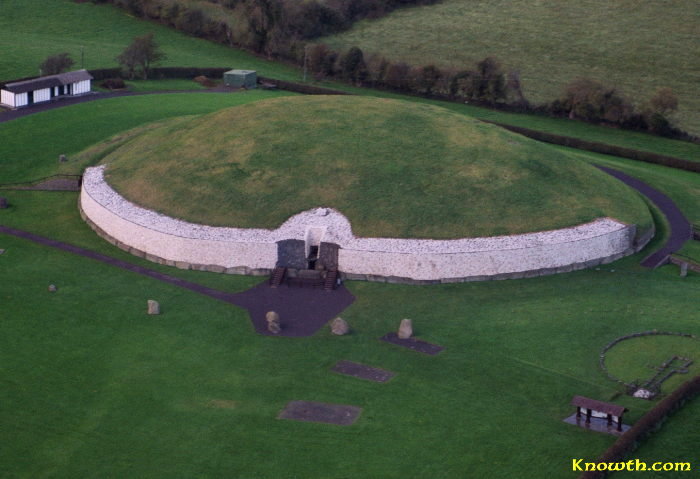
American accent: "So ... what do all these spirals signify?"
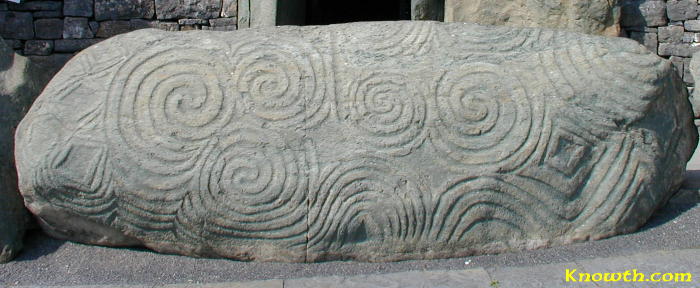
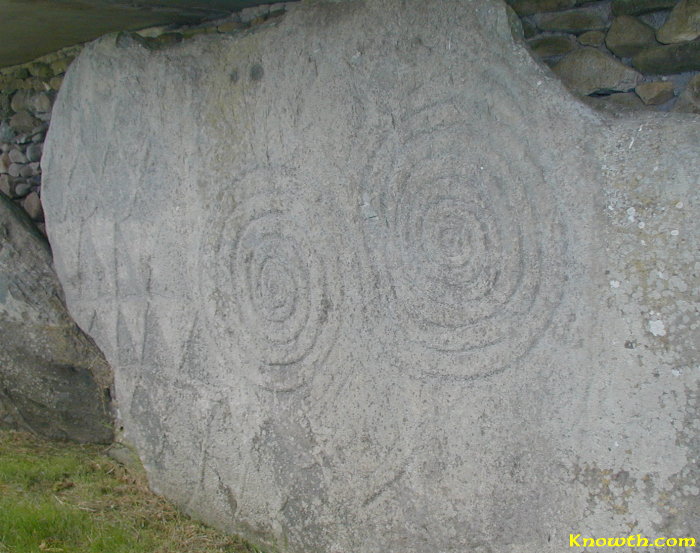
Irish accent: "Well, we don't really know. But aren't they lovely?"
American accent: "And what exactly happened in these recesses? Were they burial tombs, or ..."
Irish accent: "Well, actually, nobody knows, love."
American accent: "These standing stones are amazing. Why did they place them like that?"
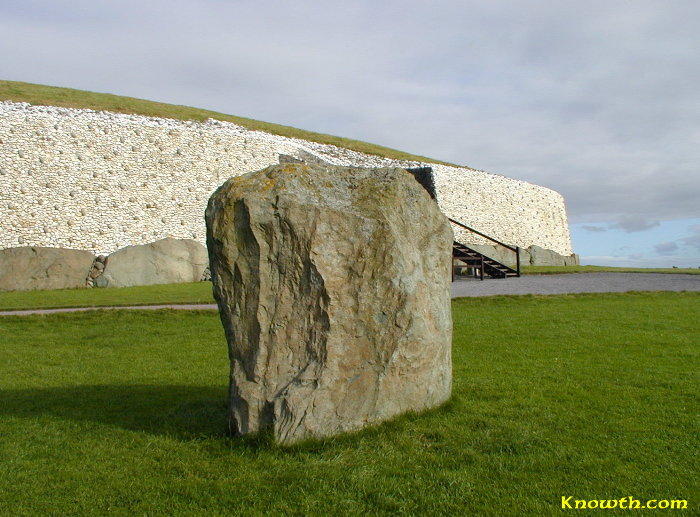
Irish accent: "Well, we don't really know."
Literally. The tour went on like that for 45 minutes. It was positively charming. I loved every second of it. Basically the theme was: Nobody knows what the FECK went on here, but isn't it lovely?
One of the most amazing places I've ever been. I highly recommend it to you all. Here are 101 facts about New grange. I guess there are some things that "we know".
I have a couple of wee goals in life - not really personal achievement goals - but things I would like to see, and one of them is I would love to be there at Newgrange (with all the crowds) on the winter solstice - to see the sun illuminate the inner tomb. What happens is - on the winter solstice - you can buy a ticket to hang out either around New grange - or within the inner tomb (I think the waiting list is years long) - and at sunrise (which, in Ireland, is an iffy prospect - it's usually rainy during winter solstice) the sun enters the main door, crawls up the passageway, and FLOODS the inner tomb with light. They recreate it during the tour (where the ongoing theme is "Well, nobody really knows, love") - and I swear to God, you feel your heart beat either quicken or slow to a turtle's pace when that light pours itself into the pitch black.
The fact that "nobody knows" is what makes the place so special, so magical.
An ancient and important site.
You know what I felt at Newgrange, standing in the pitch black with my sisters, in that ancient tomb, with the spiral rock carvings above and below us, waiting for the light to crawl up the slanting passage? I felt: Man. It is awesome to be a member of the human race. Humans are absolutely beyond belief. I am really PROUD of us. Even though we can't know what exactly drove those ancient people to create such a structure - we can marvel at their knowledge, their spirit, their drive. They are in an unending continuum with this event. It's the same impetus. They knew to build the inner passageway at just the right slant upwards - so that the sun could crawl upwards and flood the inner passageway and inner "tomb" (or whatever it was) for the maximum amount of time. When you duck down under the entrance stone, and enter the darkness - you feel the path go on a steep incline. You are inside the earth, walking UP. How did they know? Well, they just did. And I am just proud of the human race for all of that. What a mystery we are. What a neverending and curious mystery.
American accent: "And ... sorry ... I know we've covered this ... but what was going on with those spirals??"
Irish accent, "Oh, love, nobody really knows."
"Private" thought: If I ever get another tattoo, it'll be of Newgrange spirals.
August 1, 2005
The Books: "The Beauty Queen of Leenane" (Martin McDonough)
Next in my Daily Book Excerpt:
 Next play on the script shelf is The Beauty Queen of Leenane
Beauty Queen is the story of Mag (the mother in her 70s - kind of house-bound - a horrific bogey-man picture of a mother - she's manipulative, nosy, tiresome, contemptuous) and Maureen (the daughter - a virgin in her 40s, with no prospects for love - Her mother would laugh at the thought!) Mag and Maureen live together, Maureen "takes care of" Mag (Maureen is as cruel in her behavior as her mother - just in a different way) and they jab at each other constantly, and yet there are whole worlds that are not being said. Horrors from the past. Maureen ends up going out on a date with a sad sap named Pato Dooley - and that is the catalyst which brings everything crashing down.
Great play.
Here's a scene between Mag and Maureen:
EXCERPT FROM The Beauty Queen of Leenane
(Maureen switches off the kettle, and pours a sachet of Complan into a mug and fills it up with water)
MAUREEN: I'll do you some of your Complan.
MAG. Have I not had me Complan already, Maureen? I have.
MAUREEN: Sure, another one won't hurt.
MAG. (wary) No, I suppose.
Maureen tops the drink up with tap water to cool it, stirs it just twice to keep it lumpy, takes the spoon out, hands the drink to Mag, then leans back against the table to watch her drink it. Mag looks at it in distaste.
MAG. A bit lumpy, Maureen.
MAUREEN. Never mind lumpy, Mam. The lumps will do you good. That's the best part of Complan is the lumps. Drink ahead.
MAG. A little spoon, do you have?
MAUREEN. No, I have no little spoon. There's no little spoons for liars in this house. No little spoons at all. Be drinking ahead.
Mag takes the smallest of sickly sips
MAUREEN. The whole of it now!
MAG. I do have a funny tummy, Maureen, and I do have no room.
MAUREEN. Drink ahead, I said! You had room enough to be spouting your lies about Ray Dooley had no message! Did I not meet him on the road beyond as he was going? The lies of you. The whole of that Complan you'll drink now, and suck the lumps down too, and whatever's left you haven't drank, it is over your head I will be emptying it, and you know well enough I mean it!
Mag slowly drinks the rest of the sickly brew
MAUREEN. Arsing me around, eh? Interfering with my life again? Isn't it enough I've had to be on beck and call for you every day for the past twenty year? Is it one evening out you begrudge me?
MAG. Young girls should not be out gallivanting with fellas ...!
MAUREEN. Young girls! I'm forty years old, for feck's sake! Finish it!
Mag drinks again
MAUREEN. 'Young girls'! That's the beste yet. And how did Annette or Margo ever get married if it wasn't first out gallivanting that they were?
MAG. I don't know.
MAUREEN. Drink!
MAG. I don't like it, Maureen.
MAUREEN. Would you like it better over your head?
Mag drinks again
MAUREEN. I'll tell you, eh? 'Young girls out gallivanting.' I've heard it all now. What have I ever done but kissed two men the past forty years?
MAG. Two men is plenty!
MAUREEN. Finish!
MAG. I've finished! (Mag holds out the mug. Maureen washes it.) Two men is two men too much!
MAUREEN. To you, maybe. To you. Not to me.
MAG. Two men too much!
MAUREEN. Do you think I like being stuck up here with you? Eh? Like a dried up oul ...
MAG. Whore!
Maureen laughs
MAUREEN. Whore? (Pause) Do I not wish, now? Do I not wish? (Pause) Sometimes I dream ...
MAG. Of being a ...?
MAUREEN. Of anything! (Pause. Quietly) Of anything. Other than this.
MAG. What an odd dream that is!
MAUREEN. It's not at all. Not at all is it an odd dream. (Pause) And if it is it's not the only odd dream I do have. Do you want to be hearing another one?
MAG. I don't.
MAUREEN. I have a dream sometimes there of you, dressed all nice and white, in your coffin there, and me all in black looking in on you, and a fella beside me there, comforting me, the smell of aftershave off him, his arm round me waist. And the fella asks me then if I'll be going for a drink with him at his place after.
MAG. And what do you say?
MAUREEN. I say 'Aye, what's stopping me now?'
MAG. You don't!
MAUREEN. I do!
MAG. At me funeral?
MAUREEN. At your bloody wake, sure! Is even sooner!
MAG. Well, that's not a nice thing to be dreaming!
MAUREEN. I know it's not, sure, and it isn't a dream-dream at all. It's more of a day dream. Y'know, something happy to be thinking of when I'm scraping the skitter out of them hens.
MAG. Not at all is that a nice dream. That's a mean dream.
MAUREEN. I don'tknow if it is or it isn't. (Pause. Maureen sits at the table with a pack of Kimberly biscuits) I suppose now you'll never be dying. You'll be hanging on forever, just to spite me.
MAG. I will be hanging on forever!
MAUREEN. I know well you will!
MAG. Seventy you'll be at my wake, and then how many men'll there be round your waist with their aftershave?
MAUREEN. None at all, I suppose.
MAG. None at all is right!
MAUREEN. Oh aye. (Pause) Do you want a Kimberley?
MAG. Have we no shortbread fingers?
MAUREEN. No, you've ate all the shortbread fingers. Like a pig.
MAG. I'll have a Kimberley so, although I don't like Kimberleys. I don't know why you get Kimberleys at all. Kimberleys are horrible.
MAUREEN. Me world doesn't revolve around your taste in biscuits.
Maureen gives Mag a biscuist. Mag eats
MAG. (pause) You'll be going to this do tomorrow so?
MAUREEN. I will. (Pause) It'll be good to see Pato again anyways. I didn't even know he was home.
MAG. But it's all them oul Yanks'll be there tomorrow.
MAUREEN. So?
MAG. You said you couldn't stand the Yanks yesterday. The crux of the matter yesterday you said it was.
MAUREEN. Well, I suppose now, Mother, I will have to be changing me mind, but, sure, isn't that a woman's prerogative?
MAG. (quietly) It's only prerogatives when it suits you.
MAUREEN. Don't go using big words you don't understand, now, Mam.
MAG. (sneers. Pause) This invitation was open to me too, if you'd like to know.
MAUREEN. (half-laughing) Do you think you'll be coming?
MAG. I won't, I suppose.
MAUREEN. You suppose right enough. Lying the head off you, like the babby of a tinker.
MAG. I was only saying.
MAUREEN. Well, don't be saying. (Pause) I think we might take a drive into Westport later, if it doesn't rain.
MAG. (brighter) Will we take a drive?
MAUREEN. We could take a little drive for ourselves.
MAG. We could now. It's a while since we did take a nice drive. We could get some shortbread fingers.
MAUREEN. Later on, I'm saying.
MAG. Later on. Not just now.
MAUREEN. Not just now. Sure, you've only just had your Complan now. (Mag gives her a dirty look. Pause) Aye, Westport. Aye. And I think I might pick up a nice little dress for meself while I'm there. For the do tomorrow, y'know?
Maureenlooks across at Mag, who looks back at her, irritated.
BLACKOUT.
July 2, 2005
The Books: "Dancing at Lughnasa" (Brian Friel)
Next in my Daily Book Excerpt:
 Next excerpt on my script shelf:
Brian Friel's Dancing at Lughnasa: A Play
I'll post the beginning of the play:
EXCERPT FROM Dancing at Lughnasa: A Play
When the play opens MICHAEL is standing downstage left in a pool of light. The rest of the stage is in darkness. Immediately MICHAEL begins speaking, slowing bring up the lights on the rest of the stage.
Around the stage and at a distance from MICHAEL the other characters stand motionless in formal tableau. MAGGIE is at the kitchen window. CHRIS is at the front door. KATE at extreme stage right. ROSE and GERRY sit on the garden seat. JACK stands beside ROSE. AGNES is upstage left. They hold these positions while MICHAEL talks to the audience.
MICHAEL . When I cast my mind back to that summer of 1936 different kinds of memories offer themselves to me. We got our first wireless set that summer -- well, a sort of a set; and it obsessed us. And because it arrived as August was about to begin, my Aunt Maggie -- she was the joker of the family -- she suggested we give it a name. She wanted to call it Lugh after the old Celtic God of the Harvest. Because in the old days August the First was La Lughnasa, the feast day of the pagan god, Lugh; and the days and week sof harvesting that followed were called the Festival of Lughnasa. But Aunt Kate -- she was a national schoolteacher and a very proper woman -- she said it would be sinful to christen an inanimate object with any kind of name, not to talk of a pagan god. So we just called it Marconi because that was the name emblazoned on the set.
And about three weeks before we got that wireless, my mother's brother, my Uncle Jack, came home from Africa for the first time ever. For twenty-five years he had worked in a leper colony there, in a remote village called Ryanga in Uganda. The only time he ever left that village was for about six months during World War One when he was chaplain to the British Army in East Africa. Then back to that grim hospice where he worked without a break for a further eighteen years. And now in his early fifties and in bad health he had come home to Ballybeg -- as it turned out -- to die.
And when I cast my mind back to that summer of 1936, these two memories -- of our first wireless and of Father Jack's return -- are always linked. So that when I recall my first shock at Jack's appearance, shrunken and jaundiced with malaria, at the same time I remember my first delight, indeed my awe, at the sheer magic of that radio. And when I remember the kitchen throbbing with the beat of the Irish dance music beamed to us all the way from Dublin, and my mother and her sisters suddenly catching hands and dancing a spontaneous step-dance and laughing -- screaming! -- like excited schoolgirls, at the same time I see that forlorn figure of Father Jack's shuffling from room to room as if he were searching for something but couldn't remember what. And even though I was only a child of seven at the time I know I had a sense of unease, some awareness of a widening breach between what seemed to be and what was, of things changing too quickly before my eyes, of becoming what they ought not to be. That may have been because Uncle Jack hadn't turned out at all like the resplendent figure in my head. Or maybe because I had witnessed Marconi's voodoo derange those kind, sensible women and transform them into shrieking strangers. Or maybe it was because during those Lughnasa weeks of 1936 we were visited on two occasions by my father, Gerry Evans, and for the first time in my life I had a chance to observe him.
July 1, 2005
The Books: "Translations" (Brian Friel)
Next in my Daily Book Excerpt:
 Next excerpt from my script shelf is:
Brian Friel's Translations
Translations takes place in 1833, in Ireland. An important thing to know, because you know what HASN'T happened yet and what is ABOUT to befall the country. The famine hangs over this entire play like a spectre, even though it's in the future, and nobody can know that it is coming. You can't help but be aware of it, and you want to yell at the characters to prepare, to warn them. Translations isn't about potatoes though. No. It is about the death of the Irish language, and Friel "locates the moment of its final decline in the Donegal of the 1830s, the years in which the British Army Engineer Corps carried out its famous ordnance srvey of Ireland, mapping and renaming the whole country to accord with its recent (1800) integration into the United Kingdom of Great Britain and Ireland". (That comes from the introduction to the collection of plays I have. I couldn't really write it any clearer.) The play takes place in one of the hedge schools, and at first the people aren't aware of what is REALLY going on - they think that the British just want to make better maps, or re-do their old maps - but eventually it becomes clear that this "ordnance survey" is really about Anglicizing every place-name in Ireland, systematically wiping out the Gaelic terms for everything. It's a crisis for the hedge-school, of course - for the people who live in that particular town - the people we get to know through the course of the play ... but why the play is so effective for the audience is that we know so much more than the characters, since we are from the present-day, and we know what ended up happening. The Irish language was wiped out. It's also tragic because, like I said earlier, the potato famine is still to come. This is the decimation of an entire civilization.
One of the other reasons why this play is so successful is what it has to say about the relationship between Britain and Ireland. The way Friel does this is very clever: Many of the Irish characters in the play can't speak a word of English and do not understand what is happening when British soldiers arrive in their town for this "survey". They need translators. But of course - we watch the translations get confused. All the characters in the play speak in English - but eventually we realize that the Irish characters are really speaking in Gaelic ... So we get to hear both sides. It's a wonderful device, and works really well on stage.
Oh yeah, and the other thing that happens during this "ordinance survey" is that all hedge-schools will close, and new 'national schools' will open up - where it will all be in English. The Irish language will be lost in the timespan of a generation. Now even amongst the Irish characters there is disagreement here. One of them is very pro-English language, even though she only speaks Gaelic herself. She wants to learn English, she is sick of being isolated on her small island.
And now for the excerpt. Yolland is one of the British soliders (described by Friel as 'a soldier by accident'.) He is young, barely out of boyhood, and struggles to understand the Irish culture around him. He feels left out ... and yet at the same time, he doesn't really understand his own job at first. He follows orders. But gradually, he realizes what is going on. Yolland is a wonderful character - he's kind of our way in (the audience's way in, I mean). We are him. We are outsiders, we look on, we try to understand, we have to play catch up ... Hugh is the headmaster of the hedge-school. And Owen is Hugh's son, a local boy, back in town after being away for 6 years. He is bi-lingual, he's seen a bit more of the world. He signs up to help the British soldiers in their ordnance survey - he can help them with translating the plans to the Irish people, who don't understand the language.
EXCERPT FROM Translations
YOLLAND. (Embarrassed) Where's the pot-een?
OWEN. Poteen.
YOLLAND. Poteen -- poteen -- poteen. Even if I did speak Irish I'd always be an outsider here, wouldn't I? I may learn the password but the language of the tribe will always elude me, won't it? The private core will always be ... hermetic, won't it?
OWEN. You can learn to decode us.
(Hugh emerges from upstairs and descends. He is dressed for the road. Today he is physically and mentally jaunty and alert -- almost self-consciously jaunty and alert. Indeed, as the scene progresses, one has the sense that he is deliberately parodying himself. The moment Hugh gets to the bottom of the steps, Yolland leaps respectfully to his feet.)
HUGH. (as he descends)
Quantumvis cursum longum fessumque moratur
Sol, sacro tandem carmine vesper adest.
I dabble in verse, Lieutenant, after the style of Ovid. (to Owen) A drop of that to fortify me.
YOLLAND. You'll have to translate it for me.
HUGH. Let's see --
No matter how long the sun may linger on his long and weary journey
At length evening comes with its sacred song.
YOLLAND. Very nice, sir.
HUGH. English succeeds in making it sound ... plebian.
OWEN. Where are you off to, Father?
HUGH. An expeditio with three purposes. Purpose A: to acquire a testimonial from our parish priest -- (to Yolland) a worthy man but barely literate; and since he'll ask me to write it myself, how in all modesty can I do myself justice? (to Owen) Where did this (drink) come from?
OWEN. Anna na mBreag's.
HUGH. (to Yolland) In that case address yourself to it with circumspection. (And Hugh instantly tosses the drink back in one gulp and grimaces) Aaaaagh! (Holds out his glass for a refill) Anna na mBreag means Anna of the Lies. And Purpose B: to talk to the builders of the new school about the kind of living accommodation I will require there. I have lived too long like a journeyman tailor.
YOLLAND. Some years ago we lived fairly close to a poet -- well, about three miles away.
HUGH. His name?
YOLLAND. Wordsworth -- William Wordsworth.
HUGH. Did he speak of me to you?
YOLLAND. Actually I never talked to him. I just saw him out walking -- in the distance.
HUGH. Wordsworth? ... No, I'm afraid we're not familiar with your literature, Lieutenant. We feel closer to the warm Mediterranean. We tend to overlook your island.
YOLLAND. I'm learning to speak Irish, sir.
HUGH. Good.
YOLLAND. Roland's teaching me.
HUGH. Splendid.
YOLLAND. I mean -- I feel so cut off from the people here. And I was trying to explain a few minutes ago how remarkable a community this is. To meet people like yourself and Jimmy Jack who actually converse in Greek and Latin. And your place names -- what was the one we came across this morning? -- Termon, from Terminus, the god of boundaries. It -- it -- it's really astonishing.
HUGH. We like to think we endure around truths immemorially posited.
YOLLAND. And your Gaelic literature -- you're a poet yourself --
HUGH. Only in Latin, I'm afraid.
YOLLAND. I understand it's enormously rich and ornate.
HUGH. Indeed, Lieutenant. A rich language. A rich literature. You'll find, sir, that certain cultures expend on their vocabularies and syntax acquisitive energies and ostentations entirely lacking in their material lives. I suppose you could call us a spiritual people.
OWEN. (not unkindly; more out of embarrassment before Yolland) Will you stop that nonsense, Father?
HUGH. Nonsense? What nonsense?
OWEN. Do you know where the priest lives?
HUGH. At Lis na Muc, over near ...
OWEN. No, he doesn't. Lis na Muc, the Fort of the Pigs, has become Swinefort. (Now turning the pages of the Name Book -- a page per name.) And to get to Swinefort you pass through Greencastle and Fair Head and Strandhill and Gort and Whiteplains. And the new school isn't at Poll na gCaorach -- it's at Sheepsrock. Will you be able to find your way?
(Hugh pours himself another drink. Then: --)
HUGH. Yes, it is a rich language, Lieutenant, full of the mythologies of fantasy and hope and self-deception -- a syntax opulent with tomorrows. It is our response to mud cabins and a diet of potatoes; our only method of replying to ... inevitabilities. (to Owen) Can you give me the loan of half-a-crown? I'll repay you out of the subscriptions I'm collecting for the publication of my new book. (to Yolland) It is entitled: 'The Pentaglot Preceptor or Elementary Institute of the English, Greek, Hebrew, Latin and Irish Languages; Particularly Calculated for the Instruction of Such Ladies and Gentlemen as may Wish to Learn without the Help of a Master'.
YOLLAND. (laughs) That's a wonderful title.
HUGH. Between ourselves -- the best part of the enterprise. Nor do I, in fact, speak Hebrew. And that last phrase -- 'without the Help of a Master' -- that was written before the new national school was thrust upon me -- do you think I ought to drop it now? After all you don't dispose of the cow just because it has produced a magnificent calf, do you?
YOLLAND. You certainly do not.
HUGH. The phrase goes. And I'm interrupting work of moment. (He goes to the door and stops there) To return briefly to that other matter, Lieutenant. I understand your sense of exclusion, of being cut off from a life here; and I trust you will find access to us with my son's help. But remember that words are signals, counters. They are not immortal. And it can happen -- to use an image you'll understand -- it can happen that a civilization can be imprisoned in a linguistic contour which no longer matches the landscape of ... fact. Gentlemen. (He leaves)
OWEN. 'An expeditio with three purposes': the children laugh at him: he always promises three points and he never gets beyond A and B.
MANUS. He's an astute man.
OWEN. He's bloody pompous.
YOLLAND. But so astute.
OWEN. And he drinks too much. Is it astute not to be able to adjust for survival? Enduring around truths immemorially posited -- hah!
YOLLAND. He knows what's happening.
OWEN. What is happening?
YOLLAND. I'm not sure. But I'm concerned about my part in it. It's an eviction of sorts.
OWEN. We're making a six-inch map of the country. Is there something sinister in that?
YOLLAND. Not in --
OWEN. And we're taking place-names that are riddled with confusion and --
YOLLAND. Who's confused? Are the people confused?
OWEN. -- and we're standardizing those names as accurately and as sensitively as we can.
YOLLAND. Something is being eroded.
June 30, 2005
The Books: "Faith Healer" (Brian Friel)
Next in my Daily Book Excerpt
So I'm done with Christopher Durang, for now ... the next playwright on the script shelf is the Irish playwright Brian Friel.
 I have a a collection of some of his plays
Faith Healer, first done here in New York in 1979, is considered one of his most important plays. The plot (and structure) of the play are simple. It tells the story of Frank Hardy, the faith healer, and his wife Grace. The play is told through a series of long monologues - two spoken by Frank, one spoken by Grace, and one spoken by Teddy, Frank's manager. Frank and Grace travel around England, Scotland, and Wales in a caravan, offering to heal the sick. There's a couple of tragedies at the heart of this story - one being the death of Frank and Grace's baby.
I'll post an excerpt from Grace's monologue. All the monologues are about 10 to 15 pages long (memorizing them must be a beeyotch!), so I'll just post a bit of it. The ending of this section of the monologue is just a killer. So well done. It's why he's a successful playwright. He keeps it simple, he doesn't bash you over the head with emotion, but dammit: he gets the job done.
EXCERPT FROM Faith Healer
GRACE. Abergorlech, Abergynolwyn, Llandefeilog, Llanerchymedd, Aberhosan, Aberporth ...
It's winter, it's night, it's raining, the Welsh roads are narrow, we're on our way to a performance. He always called it a performance, teasing the word with that mocking voice of his -- "Where do I perform tonight?" "Do you expect a performance in a place like this?" -- as if it were a game he might take part in only if he felt like it, maybe because that was the only way he could talk about it. Anyhow Teddy's driving as usual, and I'm in the passenger seat, and he's immediately behind us, the Fantastic Francis Hardy, Faith Healer, with his back to us and the whiskey bottle between his legs, and he's squatting on the floor of the van -- no, not squatting -- crouched, wound up, concentrated, and happy -- no, not happy, certainly not happy, I don't think he ever knew what happiness was -- but always before a performance he'd be ... in complete mastery -- yes, that's close to it -- in such complete mastery that everything is harmonized for him, in such mastery that anything is possible. And when you speak to him he turns his head and looks beyond you with those damn benign eyes of his, looking past you out of his completion, out of that private power, out of that certainty that was accessible only to him. God, how I resented that privacy! And he's reciting the names of all those dying Welsh villages -- Aberarder, Aberayron, Llangranog, Llangurig -- releasing them from his mouth in that special voice he used only then, as if he were blessing them or consecrating himself. And then, for him, I didn't exist. Many, many, many times I didn't exist for him. But before a performance this exclusion -- no, it wasn't an exclusion, it was an erasion -- this erasion was absolute: he obliterated me. Me who tended him, humoured him, nursed him, sustained him -- who debauched myself for him. Yes. That's the most persistent memory. Yes. And when I remember him like that in the back of the van, God how I hate him again --
Kinlochbervie, Inverbervie,
Inverdruie, Invergordon,
Badachroo, Kinlochewe,
Ballantrae, Inverkeithing,
Cawdor, Kirkconnel,
Plaidy, Kirkinner ...
(quietly, almost dreamily) Kinlochbervie's where the baby's buried, two miles south of the village, in a field of the lefthand side of the road as you go north. Funny, isn't it, but I've never met anybody who's been to Kinlochbervie, not even Scottish people. But it is a very small village and very remote, right away up in the north of Sutherland, about as far north as you can go in Scotland. And the people there told me that in good weather it is very beautiful and that you can see right across the sea to the Isle of Lewis in the Outer Hebrides. We just happened to be there and we were never back there again and the week that we were there it rained all the time, not really rained but a heavy wet mist so that you could scarcely see across the road. But I'm sure it is a beautiful place in good weather. Anyhow, that's where the baby's buried, in Kinlochbervie, in Sutherland, in the north of Scotland. Frank made a wooden cross to mark the grave and painted it white and wrote across it Infant Child of Francis and Grace Hardy -- no name, of course, because it was still-born -- just Infant Child. And I'm sure that cross is gone by now because it was a fragile thing and there were cows in the field and it wasn't a real cemetery anyway. And I had the baby in the back of the van and there was no nurse or doctor so no one knew anything about it except Frank and Teddy and me. And there was no clergyman at the graveside -- Frank just said a few prayers that he made up. So there is no record of any kind. And he never talked about it afterwards; never once mentioned it again; and because he didn't, neither did I. So that was it. Over and done with. A finished thing. Yes. But I think it's a nice name, Kinlochbervie -- a complete sound -- a name you wouldn't forget easily.
June 16, 2005
Stephen Spender ...
"It is a stupendous attempt to present us with a truer picture of the human mind than has ever been achieved before, by creating the discontinuous stream of thoughts, habits of mind rising from the past, disturbances caused by the environment, and even suggested by purely physical movements of the body, which pass through the fragmentary and interrupted consciousness of people at every moment."
-- Stephen Spender
June 15, 2005
The Books: "By the Bog of Cats" (Marina Carr)
Next in my Daily Book Excerpt:
 Next play on the scripts shelf was given to me by my sister Siobhan - I believe she saw it done at the Abbey Theatre in Dublin and absolutely loved it. It is called By the Bog of Cats
This play is so full of juicy great female characters that you think you've died and gone to heaven. It's set in rural Ireland at a place called The Bog of Cats, and it's a re-telling of Medea - with all the same themes of betrayal, revenge, murder, abandonment. It tells the story of Hester Swane, a tinker (that's probably a politically incorrect term now) - who is deeply connected to the land in a way that is almost a torment. (Of course it is. She's Irish.) Hester was born to tinker parents, she killed her brother years ago, and now she has to watch the love of her life, the father of her child, marry someone else. She snaps, and goes on a journey of revenge.
The tone of the play is not realistic. It's kind of poetic, mysterious, and ... scary, frankly.
Here's how it opens. I just loooove her writing.
From By the Bog of Cats
Dawn. On the Bog of Cats. A bleak white landscape of ice and snow. Music, a lone violin. HESTER SWANE trails the corpse of a black swan after her, leaving a trail of blood in the snow. The GHOST FANCIER stands there watching her.
HESTER. Who are you? Haven't seen you around here before.
GF. I'm a ghost fancier.
HESTER. A ghost fancier. Never heard tell of the like.
GF. You never seen ghosts?
HESTER. Not exactly, felt what I thought were things from some other world betimes, but nothin' I could grab onto and say, that is a ghost.
GF. Well, where there's ghosts there's ghost fanciers.
HESTER. That so? So what do you do, Mr. Ghost Fancier? Eye up ghosts? Have love affairs with them?
GF. Dependin' on the ghost. I've trailed you a while. What're you doin' draggin' the corpse of a swan behind ya like it was your shadow?
HESTER. This is auld Black Wing. I've known her the longest time. We used to play together when I was a young wan. Wance I had to lave the Bog of Cats and when I returned years later this swan here came swoopin' over the bog to welcome me home, came right up to me and kissed me hand. Found her frozen in a bog hole last night, had to rip her from the ice, left half her underbelly.
GF. No one ever tell ya it's dangerous to interfere with swans, especially black wans?
HESTER. Only an auld superstition to keep people afraid. I only want to bury her. I can't be struck down for that, can I?
GF. You live in that caravan over there?
HESTER. Used to; live up the lane now. In a house, though I've never felt at home in it. But you, Mr. Ghost Fancier, what ghost are you ghoulin' for around here?
GF. I'm ghoulin' for a woman be the name of Hester Swane.
HESTER. I'm Hester Swane.
GF. You couldn't be, you're alive.
HESTER. I certainly am and aim to stay that way.
GF. (looks around, confused) Is it sunrise or sunset?
HESTER. Why do ya want to know?
GF. Just tell me.
HESTER. It's that hour when it could be aither dawn or dusk, the light bein' so similar. But it's dawn, see there's the sun coming up.
GF. Then I'm too previous. I mistook this hour for dusk. A thousand apologies.
Goes to exit. HESTER stops him.
HESTER. What do ya mean you're too previous? Who are ya? Really?
GF. I'm sorry for intrudin' upon you like this. It's not usually my style.
Lifts his hat, walks off.
HESTER. (shouts after him) Come back! --- I can't die -- I have a daughter.
June 14, 2005
The Books: "The Hostage" (Brendan Behan)
Next up in my Daily Book Excerpt:
And now for something completely different!! This particular bookcase is a mish-mash of mingled topics. We had the science, we had the religion (side by side, as I think that's appropriate), some kids books, books on politics ... blah blah blah. The shelf below the political one starts up with all my scripts. Uhm ... what? So yeah. Now we're moving into the world of the theatre. I think this'll be fun. Some of these plays I haven't looked through in YEARS, so picking out excerpts will be really fun.
First play on the shelf is The Hostage
The Hostage was written in 1958. Interestingly enough, my copy of the book, given to me by my father, was an early edition, 1959, and in the biographical sketch on the back it says: "Brendan Behan, the son of a house painter, left school at thirteen, and three years later served his first prison term for political reasons. As an IRA terrorist he has spent eight years of his life in various jails ..." The use of the word 'terrorist' really stood out for me. So often now, regardless of whether the person is actually a terrorist or not, the word is surrounded by little quotation marks. Or it's just not used at all. They're "insurgents", they're "rebels", they're "militants", etc. That little bio of Behan is quite a time-traveler, from an earlier decade when people weren't so hesitant to call a spade a spade.
The Hostage was an enormous theatrical success in London, Paris, and New York. I love the play. It's laugh-out-loud funny at times, but also angry, pointedly political, sad ... It takes place in a brothel in Dublin which is owned by a former IRA commander. The cast of characters is a motley array of whores and night-owls and other fringe-dwellers. It's a fast-moving theatrical work, very Irish - full of wise cracks, and jokes. It seems that NOTHING is taken seriously. But that's so very Irish. The following day, an 18 year old IRA member is to be hanged. He was accused of killing an Ulster policeman. This is on everybody's minds. Lots of talk and chatter about the IRA, and 1916, and martyrdom, and Ireland ... A young Cockney soldier, Leslie Williams, is held hostage in the brothel, in the hopes that somehow this might stave off the execution ... When the IRA member is hanged the following day, the British police eventually attack the brothel, and Leslie ends up getting killed by gunfire.
The Hostage was Behan's last major success.
Anyway, here's the scene where the "Officer" shows up at the brothel, to inform the owner, Pat, that a hostage will be held there, for the evening.
EXCERPT FROM The Hostage
OFFICER: Now your rent books, please, or a list of the tenants.
PAT. I can give you that easy. There's Bobo, Ropeen, Colette, the Mouse, Pigseye, Mulleady, Princess Grace, Rio Rita, Meg, the new girl, and myself.
OFFICER. [PAT fetches his notebook] I'll tell you the truth, if it was my doings there'd be no such thing as us coming here. I'd have nothing to do with the place, and the bad reputation it has all over the city.
PAT. Isn't it good enough for your prisoner?
OFFICER. It's not good enough for the Irish Republican Army.
PAT. Isn't it now?
OFFICER. Patrick Pearse said "To serve a cause which is splendid and holy, men must themselves be splendid and holy."
PAT. Are you splendid, or just holy? Haven't I seen you somewhere before? It couldn't be you that was after coming here one Saturday night ...
OFFICER. It could not.
PAT. It could have been your brother, for he was the spitting image of you.
OFFICER. If any of us were caught here now or at any time, it's shamed before the world we'd be. Still, I see their reasons for choosing it too.
PAT. The place is so hot, it's cold.
OFFICERE. The police wouldn't believe we'd touch it.
PAT. If we're all caught here, it's not the opinion of the world or the police will be upsetting us, but the opinion of the Military Court. But then I suppose it's all the same to you; you'll be a hero, will you not?
OFFICER. I hope that I could never betray my trust.
PAT. Ah yes, of course, you've not yet been in Mountjoy or the Curragh glasshouse.
OFFICER. I have not.
PAT. That's easily seen in you.
OFFICER. I assure you, my friend, I'm not afraid of Redcaps.
PAT. Take it from me, they're not the worst [to audience] though they're bastards anywhere and everywhere. No, your real trouble when you go to prison as a patriot, do you know what it will be?
OFFICER. The loss of liberty.
PAT. No, the other Irish patriots, in along with you. Which branch of the IRA are you in?
OFFICER. There is only one branch of the Irish Republican Army.
PAT. I was in the IRA in 1916, and in 1925 H.Q. sent me from Dublin to the County Kerry because the agricultural labourers were after taking over five thousand acres of an estate from Lord Trales. They had it all divided very nice and fair among themselves, and were ploughing and planting in great style. G.H.Q. gave orders that they were to get off the land, that the social question would be settled when we got the thirty-county Republic. The Kerrymen said they weren't greedy like. They didn't want the whole thirty-two counties to begin with, and their five thousand acres would do them for a start.
OFFICER. Those men were wrong on the social question.
PAT. Faith and I don't think it was questions they were interested in, at all, but answers. Anyway I agreed with them, and stopped there for six months training the local unit to take on the IRA, the Free State Army, aye, or the British Navy if it had come to it.
OFFICER. That was mutiny.
PAT. I know. When I came back to Dublin, I was court-martialled in my absence and sentenced to death in my absence, so I said they could shoot me in my absence.
Pause.
OFFICER. Silence!
PAT. Sir!
OFFICER. i was sent here to do certain business. I would like to conclude that business.
PAT. Let us proceed, shall we, sir? When may we expect the prisoner?
OFFICER. Today.
PAT. What time?
OFFICER. Between nine and twelve.
PAT. Where is he now?
OFFICER. We haven't got him yet.
PAT. You haven't got a prisoner? Are you going down to Woolworths to buy one then?
OFFICER. I have no business telling you any more than has already been communicated to you.
PAT. Sure, I know that.
OFFICER. The arrangements are made for his reception. I will be here.
PAT. Well, the usual terms, rent in advance, please.
OFFICER. Is it looking for money you are?
PAT. What else? We're not a charity. Rent in advance.
OFFICER. I might have known what to expect. I know your reputation.
PAT. How did you hear of our little convent?
OFFICER. I do social work for the St. Vincent de Paul Society.
PAT. I always thought they were all ex-policement. In the old days we wouldn't go near them.
OFFICER. In the old days there were Communists in the IRA.
PAT. There were, faith, and plenty of them. What of it?
OFFICER. The man that is most loyal to his faith is the one that will prove most loyal to the cause.
PAT. Have you your initials mixed up? Is it the FBI or the IRA that you are in?
OFFICER. If I didn't know that you were out in 1916 I'd think you were highly suspect.
PAT. Sir?
OFFICER. Well, at least you can't be an informer.
PAT. Ah, you're a shocking decent person. Could you give me a testimonial I could use in my election address if I wanted to get into the coroporation? The rent, please!
June 12, 2005
The Books: "Reflections on the Revolution in France" (Edmund Burke)
Next book in my Daily Book Excerpt:
 Next book in my politics/philosophy section is:
Reflections on the Revolution in France
All I can really say is is that this book is essential reading. That's all. After I read it for the first time, I couldn't believe that there was a time in my life when I hadn't read it. It had a huge impact - in Burke's day, and in mine. Extraordinary.
Wow. That last sentence reminds me of the quote I posted from The Language Police and our ensuing discussion. It reminds me of the misguided (and to me, infuriating) crusade of Catherine MacKinnon and Andrea Dworkin. In having an incompete understanding of history - in wanting to provide redress to those with grievances - in saying they are fighting 'intolerance' - they have become just like the intolerant folks they scream about.
The victim becomes the oppressor. The revolution eats its young.
EXCERPT FROM Reflections on the Revolution in France
We do not draw the moral lessons we might from history. On the contrary, without care it may be used to vitiate our minds and to destroy our happiness. In history a great volume is unrolled for our instruction, drawing the materials fo future wisdom from the past errors and infirmities of mankind. It may, in the perversion, serve for a magazine, furnishing offensive and defensive weapons for parties in church and state, and supplying the means of keeping alive, or reviving dissensions and animosities, and adding fuel to civic fury. History consists, for the greater part, of the miseries brought upon the world by pride, ambition, avarice, revenge, lust, sedition, hypocrisy, ungoverned zeal, and all the train of disorderly appetites, which shake the public with the same
---troublous storms that toss
The private state, and render life unsweet.
These vices are the causes of those storms. Religion, morals, laws, prerogatives, privileges, liberties, rights of men, are the pretexts. The pretexts are always found in some specious appearance of a real good. You would not secure men from tyranny and sedition, by rooting out of the mind the principles to which these fraudulent pretexts apply? If you did, you would root out every thing that is valuable in the human breast. As these are the pretexts, so the ordinary actors and instruments in great public evils are kings, judges, and captains. You would not cure the evil by resolving, that there should be no more monarchs, nor ministers of state, nor of the gospel; no interpreters of law; no general officers; no public councils. You might change the names. The things in some shape must remain. A certain quantum of power must always exist in the community, in some hands, and under some appellation. Wise men will apply their remedies to vices, not to names; to the causes of evil which are permanent, not to the occasional organs by which they act, and the transitory modes in which they appear. Otherwise you will be wise historically, a fool in practice.
Seldom have two ages the same fashion in their pretexts and the same modes of mischief. Wickedness is a little more inventive. Whilst you are discussing fashion, the fashion is gone by. The very same vice assumes a new body. The spirit transmigrates; and, far from losing its principle of life by the change of its appearance, it is renovated in its new organs wtih the fresh vigour of a juvenile activity. It walks abroad; it continues its ravages; whilst you are gibbeting the carcass, or demolishing the tomb. You are terrifying yourself with ghosts and apparitions, whilst your house is the haunt of robbers. It is thus with all those, who, attending only to the shell and husk of history, think they are waging war with intolerance, pride, and cruelty, whilst, under colour of abhorring the ill principles of antiquated parties, they are authorizing and feeding the same odious vices in different factions, and perhaps in worse.
April 24, 2005
Today in history
The Easter Rising, in Dublin, 1916.

(Read the text here. I'm a geek - I have that thing framed, on my wall.) All men who signed the Proclamation of the Irish Republic were executed.
I want to post William Butler Yeats' poem Easter, 1916. Elegiac, portentous, tragic, and prophetic. A "terrible beauty" was indeed born.
Easter 1916
I have met them at close of day
Coming with vivid faces
From counter or desk among grey
Eighteenth-century houses.
I have passed with a nod of the head
Or polite meaningless words,
Or have lingered awhile and said
Polite meaningless words,
And thought before I had done
Of a mocking tale or a gibe
To please a companion
Around the fire at the club,
Being certain that they and I
But lived where motley is worn:
All changed, changed utterly:
A terrible beauty is born.
That woman's days were spent
In ignorant good-will,
Her nights in argument
Until her voice grew shrill.
What voice more sweet than hers
When, young and beautiful,
She rode to harriers?
This man had kept a school
And rode our winged horse;
This other his helper and friend
Was coming into his force;
He might have won fame in the end,
So sensitive his nature seemed,
So daring and sweet his thought.
This other man I had dreamed
A drunken, vainglorious lout.
He had done most bitter wrong
To some who are near my heart,
Yet I number him in the song;
He, too, has resigned his part
In the casual comedy;
He, too, has been changed in his turn,
Transformed utterly:
A terrible beauty is born.
Hearts with one purpose alone
Through summer and winter seem
Enchanted to a stone
To trouble the living stream.
The horse that comes from the road.
The rider, the birds that range
From cloud to tumbling cloud,
Minute by minute they change;
A shadow of cloud on the stream
Changes minute by minute;
A horse-hoof slides on the brim,
And a horse plashes within it;
The long-legged moor-hens dive,
And hens to moor-cocks call;
Minute by minute they live:
The stone's in the midst of all.
Too long a sacrifice
Can make a stone of the heart.
O when may it suffice?
That is Heaven's part, our part
To murmur name upon name,
As a mother names her child
When sleep at last has come
On limbs that had run wild.
What is it but nightfall?
No, no, not night but death;
Was it needless death after all?
For England may keep faith
For all that is done and said.
We know their dream; enough
To know they dreamed and are dead;
And what if excess of love
Bewildered them till they died?
I write it out in a verse -
MacDonagh and MacBride
And Connolly and Pearse
Now and in time to be,
Wherever green is worn,
Are changed, changed utterly:
A terrible beauty is born.
April 13, 2005
Happy birthday, Seamus!
It's the birthday of Nobel Laureate Mr. Seamus Heaney!
I went to hear him read at NYU a couple of years ago, and it was so much fun. Who knew a poetry reading could be such a humorous event? We sat in the auditorium at NYU, and the laughter never stopped - it was completely due to his own commentary, his own way. He recited his own poems with no notes, no papers, all memorized, the beautiful lilt of his voice ... and after he finished reciting one of his poems, he would immediately start to talk about it, in the most prosaic and amusing way. This is not a man precious with his art, although he most certainly takes it very very seriously. But his personality was what impressed itself upon me. I could fall in love with such a man.
And so, it is his birthday today. For more information on this amazing artist, check out his biography here (that's on the Nobel Prize site). He won the Nobel Prize in 1995.
His Nobel lecture (also included in his book The Redress of Poetry - thanks, peteb!!) is astonishing. It's quite long, but so worth it. I read it years ago, and immediately had to print it out to put into my 'commonplace book'. It's beautiful, heartfelt, political, and evocative.
I was brought up with Seamus Heaney's poems. My dad loves his work, and has for years. I remember Jean and I returning from Ireland (this was in the late 1990s) and telling my dad about our stop at Clonmacnoise. We had pulled off the highway on our way to Galway to walk around Clonmacnoise, and it was great because it was November, so nobody was there, and we shared memories of our first time there, when we all were kids. Anyway, the moment Jean and I said the word "Clonmacnoise" to my dad, my dad stood up, walked over to the bookshelf, pulled down a book and read out loud Seamus Heaney's goosebump-inducing poem about the legend of Clonmacnoise (I love this poem, and whenever I read it silently, I somehow hear it in my dad's voice):
The annals say: when the monks of Clonmacnoise
Were all at prayers inside the oratory
A ship appeared above them in the air.
The anchor dragged along behind so deep
It hooked itself into the altar rails
And then, as the big hull rocked to a standstill,
A crewman shinned and grappled down the rope
And struggled to release it. But in vain.
'This man can't bear our life here and will drown,'
The abbot said, 'unless we help him.' So
They did, the freed ship sailed, and the man climbed back
Out of the marvellous as he had known it.
Ahhh. God, it never fails to get me. "Out of the marvellous as he had known it." A strangely sad poem. At least I find it sad. I have had my own experiences of "climbing back out of the marvellous" and it's always a bit sad.
(I wrote about the Clonmacnoise legend a bit here. But the poem pretty much tells the whole story. I'll just repeat what I said before: for me, the entirety of Seamus Heaney's power and magic as a poet is in the last line of that poem. It's simply breathtaking.)
And lastly, I am going to post his poem "Digging". It is one of his earlier efforts, but he refers to it often as the moment he really became a poet. I wish I had the essay he wrote on this poem at hand, but I do not. The subject of the poem is a cliche: Son will choose a different path from father - perhaps this choice will not be understood - but son knows he must go his own way.
Cliche? Sure. But oh, what a lovely and moving poem it is. Yes, Mr. Heaney, you do dig with your pen. You do. And for that I am very grateful.
Digging
Between my finger and my thumb
The squat pen rests; snug as a gun.
Under my window, a clean rasping sound
When the spade sinks into gravelly ground.
My father, digging. I look down
Till his straining rump among the flowerbeds
Bends low, comes up twenty years away
Stooping in rhythm through potato drills
Where he was digging.
The coarse boot nestled on the lug, the shaft
Against the inside knee was levered firmly.
He rooted out tall tops, buried the bright edge deep
To scatter new potatoes that we picked
Loving their cool hardness in our hands.
By God, the old man could handle a spade.
Just like his old man.
My grandfather cut more turf in a day
Than any other man on Toner's bog.
Once I carried him milk in a bottle
Corked sloppily with paper. He straightened up
To drink it, then fell to right away
Nicking and slicing neatly, heaving sods
Over his shoulder, going down and down
For the good turf. Digging.
The cold smell of potato mould, the squelch and slap
Of soggy peat, the curt cuts of an edge
Through living roots awaken in my head.
But I've no spade to follow men like them.
Between my finger and my thumb
The squat pen rests.
I'll dig with it.
March 17, 2005
A compilation of Irish posts:
Anne has a fascinating excerpt from Conor Cruise O'Brien's memoir. It has to do with Maud Gonne. Fascinating.
And speaking of Maud Gonne ... Emily has posted one of my favorite Yeats poems.
Limerick contest (and truly terrifying St. Patrick's Day image) over at Michele's.
Alex has photos!
On a more serious note - PLEASE go and read Broom of Anger. Powerful, man - I check in with her daily.
Dan has some photos. Of milky-skinned Irish bathing beauties ... and also a poem by the man of a million aliases - Flann O'Brien.
Mitch says: "Kiss me, I'm Norwegian and Scottish!"
Top 10 Irish journeys. No Aran Islands?? Nice to see Puckoon by Spike Milligan there. Irish-guy in the pub at Glendalough raved about this book, and recently sent it to me, because he could not stand that I had not read it yet. All of his emails included the sentence: "Have you read Puckoon yet?" Got this link from the indispensable Slugger O'Toole, who have been all over the McCartney sister thing, by the way.
This is another fun piece I found on Slugger: Wetting the shamrock. A very fun piece.
And of course ... once again ...
I must link to this.
More Irish stuff ...
I call this one The Bells of Dublin. I've posted it here before. It may be my favorite moment I've ever had in Ireland. (Well ... hard to choose. There's the American Pie night. And Glendalough-at-midnight .) But this ... this was one of those beautiful moments when poetry and prose, reality and myth blended - right before my eyes.
The Bells of Dublin
"When the clock strikes midnight, we have to go outside and hear the bells of Dublin!"
This is shouted at me in the chaos of Sean O'Casey's, a smoke-filled pub off O'Connell Street, on the eve of the millennium.
By this point, I have danced a jig with a jolly toothless 70-year-old man. I have belted "Sweet Caroline" at the top of my lungs with the other crazies. I have flirted intensely and single-mindedly with a big meaty Irish bloke named Tom for the entire night. He tells me the story of Cuchaillain, touching my arm occasionally. I have no idea where Ann Marie has gone. She and Ciaran have disappeared. The snippy bartender insults me out of nowhere, due to some vaguely anti-American sentiment; insults me so sharply it is as though he has punched me in the stomach. An involuntary flood of tears. Tom offers to beat him up for me, in the same friendly tone he used when offering to buy me another Guinness. "Want me to take care of 'im for ya?"
Tom and I discuss the economic rejuvenation Ireland is experiencing and the problems such rejuvenation brings to Irish society. For the first time, people are not fleeing from Ireland, but flocking to Ireland.
He says to me, easy, familiar now after hours of craic, “Well, for so long, it’s only been about us. And our problems. Us alone.”
I’m tipsy, loving the flirting dance. I say, in an extremely obnoxious know-it-all manner, “Well, you guys are an island culture. Island cultures are always self-obsessed.” Teasing him.
Tom flashes me a look, taken aback. “Self-obsessed? What do ya’ mean by that?” he demands, cigarette in mouth, whipping out a lighter which happens to be printed with 10 Irish coats of arms.
I point at the lighter. Silently. Exhibit A. He bursts into laughter, and we then laugh hysterically for five minutes, staggering about, clutching at one another.
I have not paid for one drink.
When the countdown to 2000 is complete, ten men hug me at once. They all seem to be named Sean, Brian, or Liam. One hug is so violent that a Guinness splashes into my face. Tom kisses me anyway. Tasting the beer on my mouth. Laughing down at me.
And then, as one, we clamor out onto the dark side street to hear the church bells ring. I stand on the sidewalk, shivering, a satellite view in my head of people all over the world celebrating in different ways. Dancers on the beach in Papua, New Guinea. Brits obsessing about their Millennium Dome. New Yorkers clustered in Times Square losing their collective minds. Fireworks over Sydney harbor. In Ireland, we huddle in the alley, freezing, waiting for the bells of Dublin to start ringing.
Staggered up and down the cobblestones, like black paper cut-outs, are numerous tall Irish men, standing separately from one another, wearing long trench coats. They are all on their cell-phones. They begin dialing before the twelve chimes have struck. I then hear each one saying, in counterpoint with each other, in counterpoint with the bells, "Mum! Mum! It's Sean/Brian/Liam! Happy New Year, Mum! Is Da there? Put him on! Da! Happy New Year, Da!"
Calling their Mums and Das at the dawn of the new millennium, each and every one of them.
December 29, 2004
Gráinne Ni Mhaille - the Pirate Queen
A funny piece in The Guardian about Gráinne Ni Mhaille (one of the myriad ways to say/spell her name - and perhaps the most poetic). Otherwise known as Grace (or Grania) O'Malley, Irish female pirate from the 16th century. I am descended from her, and my sister, Jean Grania, bears her name.
More on Grania ("the Pirate Queen") here.
Thanks, peteb, for the heads up on these links.
CW has more on Grania, plus a ton of other stuff on cool pirates through the ages here, here, and here. There's probably more, but his blog is now moving (at least for me) at the breakneck speed of a sluggish glacier, and I can't seem to get around over there with ease. Lots of cool pirate stuff though, in those links.
December 14, 2004
More on the Irish "Ish"
Member this whole post? About "ish"? The Irish tendency to say, "I'll meet you at nine-ish, I'll call you at half-seven-ish", etc.?
I've got another one. But it's even better.
Got an email from an Irish friend. He closed with:
"I'll write a longer letter soonish."
I find that BEAUTIFUL. It made me laugh out loud.
First of all, it's a bit different than "I'll meet you at 9-ish" or "10-ish", because ... well, "soon" is already a vague word, so to put "ish" at the end of "soon" is absolute genius.
The funniest thing about all of this is I know exactly what he means by "soonish".
December 12, 2004
The ship in the air
Clonmacnoise is a spectacular old monastery in Ireland (it's right off the N6 - the road that takes you from Dublin to Galway - If you're ever in Ireland, I have got to tell you: Go to Clonmacnoise!)
There's a graveyard, with tilting high crosses up and down the green. There's a crumbling tower, a crumbling structure placed out beyond on a small mound, and off to the left is a river, and marshes. The water is rather wide there, as I recall, and there are amazing sky reflections. Or at least there can be, and there were when Jean and I went.
The place is magic.
(Oh, and there's also a "fertility statue" within the monastery which has my name - one of the famous Sile na gigs - the statues who sit there in rather improper legs-spread poses, and they are believed to have fertile powers, and women and men used to come to the monastery, to rub the Sile na gig, in the hopes that they would get pregnant.)
It's a rich place.
The water, the sky, the crumbling stones, the high crosses on the green, the reflections ...
Now, there is an old legend about the place and here is how it goes:
Long long ago, when there were still monks living and working in the monastery, back when Christianity was in a much younger phase ... one day a ship appeared. The monastery is next to a river, but this ship was not in the river. It floated by in the sky. All the monks saw it. (Interesting - when you go to Clonmacnoise, you can see at least one of the reasons why this legend makes sense. The water reflects the sky in such a way that they blend together like a watercolor ... it is difficult to distinguish between the two. But anyway, back to the mystery): The monks were at prayers, they looked up, and watched the ship float by in the sky. Then, out of the ship, came a massive anchor, which fell to the ground, and hooked itself at the bottom of their altar. This was a mistake, it wasn't supposed to catch on anything, and so ... the ship finds itself stuck, it cannot go forward.
A sailor clambered himself down the rope, to try to un-hook the anchor. And, of course, he began to drown. The monks realized this, and hurried to let the anchor go, and they helped the man back up to the ship.
And then - the ship in the air sailed away.
I love this legend. There's something so spectacular about it. There's something essentially mysterious and un-knowable about it. I also love it because if you go there (especially during twilight, or early morning, when no one else is there) you will almost be able to see that ship in the air. Or, at least, it is not difficult to believe that someone WOULD see a ship in the air. It makes perfect sense.
Seamus Heaney wrote a MARVELOUS poem about Clonmacnoise and this legend - it is included in a larger group of poems called 'Lightenings', and the poem itself has no name.
Of all that he has written (all of which I love), this poem might be my favorite. It involves no verbal pyrotechnics, nothing clever, nothing too difficult - it tells the story I just told in a very straightforward way (except it's in verse).
But the last line, people. The last line. Therein lies the magic of Seamus Heaney.
The annals say: when the monks of Clonmacnoise
Were all at prayers inside the oratory
A ship appeared above them in the air.The anchor dragged along behind so deep
It hooked itself into the altar rails
And then, as the big hull rocked to a standstill,A crewman shinned and grappled down the rope
And struggled to release it. But in vain.
'This man can't bear our life here and will drown,'The abbot said, 'unless we help him.' So
They did, the freed ship sailed, and the man climbed back
Out of the marvellous as he had known it.
December 10, 2004
An Irish moment
(At least, I was informed later by an Irish person, that this moment was very Irish.)
He: "So we'll meet up at, say, half-nine?"
Me: "Sure. Half-nine it is."
Brief pause.
He: "Ish."
December 9, 2004
Random quotes from Ireland
Allison calls these "snapshots". There are entire stories around each quote, but I'll only give the quote. Some involve Allison and I, others are just things we overheard, or snippets of conversations we had with people we met along the way.
-- "Frosty the Snowman is goin' down."
-- Allison shrieked out into a crowded pub: "Oh my God! He has no teeth!" And then later, trying to explain further just HOW this person had no teeth: "One entire side of his front row of teeth was gone ... It looked like an orthodontal side part." An orthodontal side part? Genius.
-- "I love getting drunk and swimming in hotel pools. Because ... well ... you can't really drown."
" 'The snow is general all over Ireland!' "
"Oh Jaysus, now she's quotin' Joyce!"
Guy: "I put my cell phone on the windowsill in the bathroom while I took a shower, and now ... for some reason ... it won't work anymore!"
Me: "For some reason? Uh ... "
Guy: "It must be witchcraft or somethin'."
"My ass is up for grabs in Turkey."
-- "Oh, I'd love to throw my leg over him."
She: "I love my Rabbit." (She was NOT referring to a pet. She was referring to another kind of rabbit, and for those of you who don't know what I'm talking about, all I can say is ... er ... shame on you?) Anyway - she proclaims to a crowded pub: "I love my Rabbit."
Bursts of laughter all around from the women.
She then says, "I think I need to get a bigger size though."
The men put their heads in their hands in embarrassment. One of them says, "Ah, yes. An insight into the female mind."
Me to Carrie: "In reality, I am quite serious and shy."
Carrie literally did a spit-take. Laughed RIGHT IN MY FACE.
Read the one below in a feisty flirt-y context, rather than a hostile context, and you'll get the tone of it.
He: "Get a map."
Me: "What did you just say to me?"
He: "I said: GET. A. MAP."
Me: "You literally do not want to get into a geography battle with me, because I assure you, even though I do not know you - that I. Will. Win."
Long pause. Then:
He: "I can tell by the look on your face that I will definitely lose this war."
December 8, 2004
Expert Essay: by Anne C.
Yet another wonderful essay has arrived for my Expert Series. This one is a sheer delight, and makes me want to join in the next time it occurs.
EXPERT ESSAY: Hey-the-Irish-Relatives-Are-In-Town tour of New York City, by Anne C.
My Irish relatives come to visit me from time to time, and I have, through trial and error, established a plan of attack for the city. This tour is really geared toward Irish people, who have certain things they need to do and see in New York, many of them involving the Kennedys, but it may work for others as well.
These are the highlights:
1) The "You're in New York now, baby" opening move. I always get tickets for some shocking play or other, often involving nakedness. This makes the Irish relatives feel like they've really left their small town behind. I took one batch or other to the Vagina Monologues (back when they were new), and I remember going to some show or other about a very large woman who posed as an artist's model, who was naked onstage for most of the performance.
2) The Jackie O mini-tour, in which I point out her apartment building at 1040 Fifth Avenue; pass by Loyola and/or St Thomas More, the Kennedy family churches; duck into the park to give them a brief glance at the Reservoir, where she used to run every morning (adding that hey, I used to run there too, in high school); and show them the apartment building where I once ran into her in 1982.
3) The John Jr mini-tour, usually involving brunch at Bubby's and tales of my many sightings of him. I also breathlessly recount the one time I spoke to him on the phone.
4) The obligatory St Patrick's Cathedral visit.
5) The Tenement Museum and/or Ellis Island, so we get to see how much it sucked to be an immigrant.
6) The Woodside/Sunnyside pub crawl, always featuring a stop at The Kilmegan on Roosevelt Avenue, where they invariably run into people who know my uncle Owen.
7) A visit to my favorite non-Irish bar, where they will buy everyone drinks, making themselves and me very popular for years to come.
8) At least one restaurant with really spicy food, so they can say, "I didn't know food could be this hot."
And, tacked on at the end, everything else you're supposed to do as a tourist in NYC.
--- by Anne C
December 6, 2004
Signs in Ireland
Signs in Ireland are refreshingly open and blunt. They just come right out and say it ... no euphemisms, no beating round the bush. They just SAY it.
Examples:
-- To let us know a hill is coming up, there was a small yellow sign with a "hill" that was literally almost vertical. And a car snaked its way down it, almost completely on its side. It made it seem like we were about to drive down Everest's North Face.
-- My personal favorite was: along the highways, in various counties, you would get enormous white billboards: 54 PEOPLE HAVE DIED ON THIS ROAD IN THE LAST 5 YEARS. DRIVE SAFELY.
-- In New York, you get signs saying, "Curb your dog." That's it. You know what it means. Clean up the damn poop, kay, kids?? In Ireland I saw a sign that said: NO FOULING. And then there was a picture of a Scottish terrier-type dog, standing there with his tail up. And below his tail was a pile of shit with steam rising from it. Through the entire image was drawn a line. Saying: Don't Do This. I LOVED the detail of the steam rising from the dog shit. Much better than "curb your dog".
-- And then, Emily, we saw the sign you and I laughed about: The edge of a pier, with little waves beneath, and a car driving directly off into the water. There isn't even a line through it! It basically appears to be saying: "There is a possibility that you could just drive your feckin' car off the pier here. So ... if you're thinking about doing that ... just KNOW that you will probably drown." I remember seeing that sign when I was in Ireland as a kid, and drawing a picture of it in my little journal. Nice to know they're still around.
But still, my favorite is:
7,000 PEOPLE HAVE DIED ON THIS ROAD SINCE LAST FEBRUARY. DRIVE SAFELY.
And you know what? It worked!! We did drive safely, because of the constantly dire warnings of how deadly the roads were.
Also, we didn't plummet off of any piers.
December 5, 2004
We met under the dancing Santa
Allison and I got together last night - we had been experiencing serious separation anxiety, after spending so much time together in Ireland. Like: where the hell is Allison and why am I not seeing her every minute of the day???
We went to see Closer which I absolutely MUST write about ... I will, just need to get my thoughts together ...
Then we went to an Irish pub in her 'hood, and drank. Hair of the dog, you see. Standing on a corner of the bar was a life-size Santa, who was motorized ... He would stand up there, frozen, staring off into space like a creepy robot ... and then, at some unseen cue, or someone flipped a hidden switch, or SOMEthing, he would begin to gyrate about like a fat hip-hop dancer. His head would turn too, swiveling on his neck ... It was strangely disturbing. There was a sexual element to his dancing ... and I just do NOT want to think about Santa in a sexual context.
Allison and I would be deep in conversation. The frozen Santa was behind me, and I would be talking, and I would suddenly see Allison's eyes move off mine, looking up behind me ... I would turn, and there Santa would be, jerking his hips and arms back and forth ...
This, needless to say, brought on howls of laughter from us. We would stare up at him, silently, just taking in his crazy dance ... Then we would glance at one another, silently ... because, after all, what is there to say in such a moment? And then we would burst into guffaws.
We reminisced about our trip and laughed so hard we cried. We pounded on the bar, we re-told stories to one another, and all in all had a great time.
A couple of amusing quotes:
-- I said to her, "I wish we had taken more pictures at O'Neils. I wish we had a picture of the murderer I befriended." I befriended a murderer at a pub called O'Neils. That's all I really can say. Great guy. Murderer. Uhm ... what?
-- The two of us HOWLING about Rory falling in Mary's foyer. He was trying to be so so so quiet, and then BOOM, a major wipe out. And he landed in a position that made him look like a male gymnast frozen on top of the pommel horse or something. One of the funniest things I have ever seen in my life. Tears of laughter streaming down our faces.
-- "The Sin Bin". Allison and I were obsessed with "the Sin Bin" ... the rugby announcers casually saying, "So and so is still in the Sin Bin" ... which, I assume, means that the player had a penalty called on him, and was pulled out of the match temporarily. But it is called THE SIN BIN, and Allison and I absolutely LOVE that. We have decided that when we have children (uhm ... not with each other, of course ... Not that there's anything wrong with that!), we are going to break the monopoly that the words "Time Out" have on today's parenting style. We will not give our children "Time Outs". We will put them in "the Sin Bin" for 10 minutes. We LOVE the Sin Bin. "Eat your lima beans now, and no fussing, or I'll have to put you in The Sin Bin." Allison put herSELF in The Sin Bin at one point, after making a dumb joke. She made the joke, we sat there silently, not laughing, and then Allison said, "I think I need to go into The Sin Bin for that one."
-- We HOWLED with laughter about Ricky, our silent cab driver. Hard to explain, definitely a "had to be there" thing. But we were snorting about Ricky.
And there was a hell of a lot more we talked about. I did an impassioned monologue about the Virgin Mary, and what Mary means to me. (Allison, you're a saint for listening to all of that!) We talked about Howard Hughes, we talked about Hepburn and Tracy, we talked about Julia Roberts, we talked about our shared love of Michael Jackson's music (we both cried out "THRILLER" at the same moment) - we also talked about what we feel is his obvious guilt - I think the dude's gonna go to jail, I really do - and we talked incessantly about Closer, the movie we had just seen.
Talk talk talk talk talk.
Under the watchful eyes of the creepy dancing Santa.
December 4, 2004
Photographs of my trip
I got my pictures back, and frankly it looks like I sent my camera on the trip, and I wasn't there at all. I only have one picture of Allison, walking up the stone steps at the Cliffs of Moher, but other than that? I cannot even tell that I was there at all, judging from the photos.
Got some great pictures of the murals of Belfast. The day we were there the sky was a dark heavy slate grey, but with beaming shafts of sun gleaming from beneath the clouds - very dramatic lighting. So the murals look even more striking, and violent and interesting with this heavy heavy sky behind them. ("You take a right at the chicks with the guns, you take a left at the guys with the guns ...") And Gerry Adams' car, too. I got a lame little picture of that, too. Parked next to the gleaming Sinn Fein headquarters. I figured, what the hell. It's a bit of an historic moment ... might as well snap it.
Just wish I had taken some photos of some of the ACTUAL PEOPLE WE MET.
But it's all right ... I wasn't camera-obsessed this trip. I didn't feel an overwhelming need to capture, pin down, solidify. I knew I'd remember it. And I actually got to be present during the trip, as opposed to those tourists you see who walk around holding up a video camera, and they see their entire trip through that lens. Making it a second-hand experience in the middle of the first-hand one, if you get my meaning.
December 3, 2004
The Procession
After making our way successfully through the "hairy roundabout", we started to see signs, finally, for Kinsale. Our destination. We had time constraints ... Jimmy needed to go somewhere at 7, and so we needed to reach the B&B before then. I assumed he was meeting friends for pints, or whatever, but this ended up NOT being the case, and in light of what he actually needed to do, I am tremendously glad that we made it there in time.
Allison drove us to Kinsale, after we left our new best friends at the gas station in Cork. The road was a two-way road, and yet ... by US standards, the road was only big enough to be a one-way road. Thankfully, everyone still pretty much drives teeny cars over there, an SUV on this road would be an utter disaster. The headlights shrieked up at us through the dark, the road was winding, it was night-time ... we were a bit stressed.
But then, at last, Kinsale. I could smell the salt air when I rolled down the window, so I knew we were very close. We still needed to find our way to Jimmy's B&B, but from our street map of Kinsale the Town, it seemed like a pretty wee place, not too difficult to navigate.
It was now 6:50.
We immediately found ourselves in the middle of town, which ... I mean, we had heard about the quaintness and the beauty of Kinsale ... but the reports of its beauty were almost under-played. It is one of the sweetest prettiest places I have ever seen. However, we could not ogle the sights, or the harbor, because we had to find Jimmy. Time was running out.
Randomly, we took a left-hand turn, and as we both glanced to our right, we saw an odd sight. We saw a line of people stretching down the sidewalk, there had to be hundreds of people (not an exaggeration) clustered along the street, all standing in line. But for what?
Allison wondered, "Is that a night-club or something?"
But ... it was only 6:51? A line into a nightclub at 6:51? In Kinsale?
We left that mystery behind us, drove around for a bit, on streets that are teeny, lined with shops, sudden curves, sudden hills, all adorable, but confusing ... no street signs.
At last, we asked a couple of people for directions. True to form, they gave us AWESOME directions. Directly to Jimmy's door. They knew Jimmy. Of course they did.
And then, there we were. The B&B was right next to a massive Catholic church, and we parked in the church parking lot. It was 7:01. I could see a man standing in the golden glow of lamplight coming out of the open door of the B&B ... "That's Jimmy!" There was a wintry breath in the air, the bite of the nearby water ... a different feeling in the air than the windy mountainous energy of Wicklow. The moon was high, and waxing. Beautiful. Soaring above the church.
Allison and I left our bags in the car and ran up the steps of the B&B, apologizing. "I am so sorry - we truly thought we would be here at 7!"
Jimmy, of course, was lovely, kind, understanding. "I know how it is ... time when you're traveling and all that ..."
He said to us, "There's a funeral next door tonight at 7 ... A local guy died, so I'm going to go over to go to the funeral, and I'll be back in about half an hour..."
Good Lord, I felt like an ass. I had assumed he was maybe going out with friends. Instead, he had to go to a funeral. Jesus.
I said, "God, I am so sorry."
"Oh, no problem, Sheila, no problem ... You're fine parked where you are. Why don't you bring your bags in now, so that you won't have to walk through the procession ..."
I wasn't sure what he was talking about, but Allison and I went back to our car, shivering in the night-cold, to grab our bags.
And then came the procession.
The "procession" was the huge crowd of people we had seen in the center of town.
We found out later that what happened was: they all gathered at the funeral home, down on Market Street, and then walked, as a group (and we are talking about 300 people ... the procession went on forever) up to the church.
Allison and I didn't feel right walking through the funeral procession with our bags, so we stood back, in the shadows, and just watched.
It was cold enough to see everyone's breaths. The hearse had led the way, and then stopped outside the church. The procession, which filled the street in front of the B&B, and then curved away out of sight and down the hill, the procession must have been half-a-mile long, stood quietly, stamping in the cold, hands in pockets, clouds of frosty breath in the air. There were old people, little children, there were couples holding hands, there were teenagers with their parents ... Everyone was there.
The coffin was lifted out of the hearse, and the pall-bearers lifted it up over their heads, so that it appeared to float through the air, and then they walked it up the long ramp into the lit-up brick church.
The procession didn't move. Neither did Allison and I.
We had come across a private moment. The private moment of this small community. The inner life of this small town revealed to us, outsiders. A rarity indeed. We didn't want to intrude, or break it up, or ignore it. We just watched.
When the gleaming coffin had floated its way into the church, the procession started to move. And that's when we really saw how many people there were. The line just kept coming from around the corner, as everyone walked up the steps and into the church for the funeral. More people just kept coming, silently, respectfully, maybe you would hear the chatter of a child here and there, but for the most part ... just silence.
Obviously a well-loved man. Jimmy told me all about him later. He was only 62, he was a musician, and played with a number of local bands. He hadn't even been sick, but apparently he fell down over the summer, and X-rays revealed that he was riddled with cancer. Nothing to be done at that point, really ... and he died in November. Sad.
But to watch this small town slowly walk into that church ...
Allison and I kept coming back to it, over the rest of our journey. "Member the funeral in Kinsale?" We felt that we had witnessed something very special, very private. I felt honored to be there, but also a little bit like ... it wasn't something for us to witness. All we could do was stand back, and not intrude. Be respectful, quiet, and watch. It was a town mourning its dead. With throngs and throngs and throngs of quiet chilly people coming up the hill, around the corner, up the hill, around the corner, up the hill, into the church ... in an endless flood.
December 2, 2004
Asking for directions in Cork
We were headed for Kinsale. We were very close, only 20 or so miles away ... we knew our way to Cork, and after that, all we knew was - we needed to head almost directly south. And there would be Kinsale.
In our dreams.
I was Driver at this point, and Allison was Navigator. It was dark now. It was about 6:00 pm ... and I had promised Jimmy at the B&B in Kinsale that we would be there by 7, because he had to leave at 7. Cork, obviously, is a city, and I find that driving in the city is far more stressful than a long inter-county roadway, even with all the roundabouts. So we pretty much promptly got lost. We didn't know where we were, or how to get where we were going, etc. I also had to pee. So I did a blasted RIGHT HAND TURN and we pulled into a gas station.
Allison asked a young guy pumping gas for directions. (One thing: I found, in my experience over there, that the Irish are incapable of giving bad directions. We got absolutely awesome directions from no matter who we asked ... but this particular time was parTICularly good ...)
So the young guy started telling Allison where she needed to go to get to Kinsale, and then almost immediately stopped himself. "My mother's inside - we should wait for her to come out. She's great at directions."
Boy, was she ever.
Allison and I LOVED these people.
This mother was so unbelievably generous with us, she gave us sterling directions ... I mean, we didn't realize how sterling they were until we were on the road again, and at every single point when we COULD have got confused, then there would come the landmark she had told us about, or whatever.
"Wait - where are we?"
"Oh ... there's the river and the trees ... she told us we'd see that when we came round the bend ... this is the right way ..."
She drew us an awesome map. Her son hung around with us, too, validating his mother. "Yeah, that's right ... then you go through the Tunnel ... right ..." She was the FIRST person on our journey to tell us about the Americans crashing into the Minister of Parliament. Ha ha ha ha
We stood by the gas pumps, as she drew her map, all of us chatting up a storm - how we found it driving on the other side of the road, where we had been, what our plans were ... We also chatted quite a bit about what she called "the hairy roundabout" - She gave us profuse warnings about "the hairy roundabout", which we needed to go through to get to Kinsale. It was south of Cork, and apparently a gazillion cars have crashed there, and she made it sound like shrieking hellatious chaos. We had to get ourselves into a certain lane, otherwise we would get stuck in the roundabout forever, etc ....
And goldurnit, we followed her instructions to the letter, and lo and behold, we were in Kinsale at 7:01. With poor Jimmy waiting for us at the door. Not too shabby!
As we stood around the car, and she walked us through the directions, another car drove up. She glanced up and waved. Informed us, "That's my husband." Then another car pulled up to one of the other pumps, she waved to the driver of THAT car, and informed us, "If I weren't married to my husband, I'd be married to him."
And one by one, all of these various people - her husband, and the guy she'd be married to if she wasn't married to her husband, joined our little coterie and looked at the map, and gave us suggestions ... We were a small party by Gas Pump # 2.
Our ring-leader woman would introduce us to every new arrival: "These 2 American girls are trying to get to Kinsale ..."
Every new arrival informed us of the "Americans crashing into the Minister of Parliament". And every new arrival put the fear of God into us about "the hairy roundabout".
More suggestions came in, adding, clarifying, until we had the most specific set of directions EVER GIVEN for a mere 20 mile drive. She even gave us emotional directions for "the hairy roundabout":
"Just stay calm ... stay calm ... get yourselves in the right lane, and stay calm ..."
Allison and I drove off waving hail and farewell to all of our new-found friends. At the gas station in Cork.
More on Glendalough
A couple amusing moments from our night in Glendalough, and these mostly come to me second-hand (from Allison) because I was involved in something else.
Glendalough, as you may recall, is this incredible place in the Wicklow Mountains, one of my favorite places on earth. My visits to Glendalough have always been special, but this last one ... It's what Anne of Green Gables would call an "epoch" in my life.
Before I left the pub and traipsed through the ruins in the middle of the night, Allison and I hung out for hours with various groups of fascinating wonderful people - all locals. We were the only tourists, certainly the only Americans. It is, for all intents and purposes, a small-town pub, and they took us into their hearts, they were warm, wonderful, funny, they told us all their secrets - we heard about that one's brain tumor, we heard about that one's tragedy, we heard about that one's "So he made some mistakes - who doesn't?" attitude towards Hitler (which is a whole bizarre story in and of itself) ... We got all the juice. Just by sitting there in the pub. When it came out a couple of days later that there was one huge thing that we DIDN'T know, someone had had a very serious operation, Allison said, shocked, "Wow - so-and-so didn't tell me that!" In all sincerity. I grew up in a small town. The bar in that small town is very similar to this one.
We had a marvelous time.
Allison and I did not feel the need to be joined at the hip, as travelers. At least not at every moment. (Very important, I think - you have to be able to go off and do your own thing). I met someone and pretty much hung out with him all night, although I did veer off into group conversations with a wonderful couple ... but in general, I was perched on one stool all night, by the window, chatting and arguing and roaring with laughter, and having a grand old time with this one particular bloke.
So anyway, there's the set-up.
Allison started talking to some of the guys playing pool. They were young, and sweet, and definitely "trouble". In a funny way. Like - one had cuts on his face obviously from a fight he had had the night before, etc. Cutie-pies.
Allison told me later that this group of kids (they were all about 20, 21 years old) were keeping tabs on me from across the bar. I hadn't met any of them, at that point, but they kept reporting to Allison on what was going on with me. I think perhaps these kids felt protective of me, maybe? Or they wanted to keep Allison informed of my progress? I have no idea, but I still think it's funny.
One of them said to Allison, randomly, "Your friend looks like she's a very good listener." ha ha ha ha
The other comment was (and this came later in the night): "Your friend is drinking whiskey now."
Why is this so amusing to me? I have no idea. It just is. They took note of when I started drinking whiskey and felt the need to inform Allison of it. heh heh heh
The other funny thing (or one of the other MANY funny things) about that night was when Allison strolled over from the pool table to stop by and say hi to me and the bloke - as she approached, she heard one of us say the words "Al Qaeda" - and she promptly turned and walked the other way.
WHY is this so funny to me???
I SWEAR that I did not bring Al Qaeda up. I did not stagger through Ireland cornering people about Al Qaeda. Not at all. It happened mutually, organically - We talked about a ton of other things, too ... it's just that at the moment Allison decided to visit us, we were talking about Al Qaeda.
I can just see it. "Hey, let's go over and say hi to Sheila ... oh shit, they're talking about Al Qaeda ... let's go this way now ..."
Uhm ... Drinking whiskey in Glendalough during a wind-storm talking about Al Qaeda? Uhm ... can you say heaven on earth?
Supporting One Another Through the Roundabouts
We got a stick-shift, first of all ... so you're doing all your stick-stuff with the left hand. Thank goodness the clutch and the gas pedal weren't moved. Took a bit of mental adjustments to get used to - Occasionally I would automatically reach down with my right hand for the clutch.
We did GREAT as a team, I have to say. We took turns being Navigator and Driver. Two essential jobs.
The one who was Navigator also had another very important job: Emotional Supporter of the Driver.
The Driver could not do her job without the Emotional Support of the Navigator.
"You are doing so good."
"Okay, so a roundabout is coming up ... take your time ... you're doing awesome ..."
"Member to look right ... but you're doing so great!"
Occasionally, the Driver would blurt out: "I don't care that there are 20 cars behind me right now. I have to drive slow."
The Navigator would say, "You do whatever you need to do."
There was definitely a specific sub-set of Emotional Support which deserves its own category:
Supporting One Another Through the Endless Roundabouts.
Now - a word on "roundabouts". I grew up in Rhode Island, a state of many many many rotaries. We are very used to rotaries, the yielding rules, what you do when you're IN the rotary, etc. The rules are exactly the same in Ireland, except that when you yield, you must look right, as opposed to left. To someone who has NEVER driven through a rotary before (and unless I'm mistaken, there are some states in the US that don't have them) - all of that might be mind-bogglingly scary.
For the first 10 roundabouts, we would get into this hunker-down almost military attitude. "Okay. Here comes a roundabout. Get ready. You ready? Everything's going to be fine."
Navigator would scan the signs for which exit to take off said roundabout.
"Okay, so you're going to go 3/4 of the way around ... follow the signs for N6 ... "
Driver pulls up. Yields. Looks right. Pulls into rotary, swings around, finds exit, takes it ... and then Navigator congratulates Driver. "GREAT job. That was perfect."
We were old hands at roundabout behavior within 2 days, but those first couple ones were a wee bit stressful - and definitely required 2 people to make it all come off.
When we dropped the car off, with no bumps, no bruises, no crashes, no disasters, nothing ... we felt like rock stars. Allison said, "I didn't want to gloat about it until we had passed over the keys ... seemed like it would be bad luck."
Funnily enough (or - er - actually, not funny at all) - a couple weeks before we arrived, 2 Americans were driving along somewhere in Ireland, blithely on the wrong damn side of the road, and crashed head-on into a car coming the other way. This is probably not noteworthy at all, as Americans are always driving on the wrong freakin' side of the road all over Europe (there were stickers placed throughout the car - reminding us: "DRIVE LEFT", etc.) ... but what made this one kind of funny (and it was mentioned to us time and time again during our travels) - was that the car they crashed into was being driven by a Minister of Parliament. Everyone kind of cackled with glee over that one. "Did ya hear about those Americans who crashed into the Minister of Parliament??" Again, it's not funny - because the 2 Americans (in their tiny car) were badly hurt - while the Minister of Parliament, in his enormous official car, was untouched - I believe the Americans are still in the hospital.
However: we never drove on the wrong side of the road. We didn't even have any "oops!" moments like that. The teeny country-roads at night were a bit scary - the one down to Kinsale especially. Night-time, no lights, small road ... no idea where we were going ... STRESS. But we arrived in one piece.
And we were both terrified of and a little bit angry about right-hand turns. They stressed us out to no end - we almost wanted to drive out of our way to avoid having to deal with them. Left-hand turns, no big deal, easy-peasy. Right-hand turns required total concentration, lots of emotional support, and frantic looking back and forth ... "Am I okay? Am I okay?" "You're great - okay - GO. NOW."
Allison, murmuring, as she pulled up to an intersection: "Shit. A right-hand turn."
I was Navigator/Emotional Supporter so I said, "Take your time. You're gonna do great."
And she did. And we both did.
It was a good little car. My, she was yar!
November 29, 2004
In addition to all of my other adventures in Ireland ...
... I also had the "obligatory Colin Farrell sighting" in Dublin. (That is literally what it is called here. "So have you had the obligatory Colin Farrell sighting yet?" There is also "the obligatory Bono sighting", etc. But it's great - because the energy around celeb-sightings is very much Irish, and very much New York-ish. Both groups of people see celebs all the time, and so we are singularly unimpressed. "Oh, look, there's Uma!!" "Oh yeah, whatever, I see her at this juice bar all the time." No big deal. There are a couple of stars I might lose my cool for. Cough - Ewan McGregor - cough - Eminem - cough ... Ahem. But normally, it's just not that big a deal to see them wandering about. In Ireland it is the same way - especially with the local Irish celebs)
So I had the obligatory sighting. Down near Grafton Street. He walked right past me. It was a rainy day, he had on a raincoat with the hood up, he was smoking, he looked completely anonymous, like any other passerby, and he was much shorter than I imagined him.
So now I can write home:
-- Saw the Book of Kells
-- Saw the Cliffs of Moher
-- Saw Belfast
-- Saw Colin Farrell
Mission accomplished.
November 28, 2004
Sentimentalizing Ireland
Talking with Eamon last night about all kinds of things ... but at one point, we discussed the breed of Irish-Americans who are extraordinarily sentimental about Ireland ... and most of them have never been here. I know the type, and he, as an Irishman, certainly knows the type.
I said, "It's like they wouldn't want to see Ireland as it is now, flourishing and booming ... Their idea of Ireland is old, and sentimental. They would want to visit Ireland only during 1847. They love the famine. They think the famine's GREAT. They would come back now and be seriously disappointed to see Ireland doing so well. Well, the famine and the Troubles. I suppose those are the two things they really care about."
Eamon interjected, "Yes, you are quite right. Although you are missing one other thing in your list. One very important thing. In between the famine and the Troubles, there was one small event ... one small thing ... and that is called The Quiet Man."
I burst into laughter.
Eamon went on, laughing himself, "For those people, it is all about 1847, the Troubles, and The Quiet Man. That movie has done more to stereotype this country than all the other things put together!"
I admitted, shamefacedly, that I did adore that movie. Especially the fight scene that goes on for what feels like HOURS.
Eamon said, "Oh, it's a great movie! Just great! But people come to Ireland expecting that all the Irish women will be ... you know ... Maureen O'Hara throwing pots and pans at them ..."
heh heh heh
November 27, 2004
Directions in Belfast
So I called Carrie from Dublin to set up when we would arrive in Belfast, and all that. We were going to take a taxi from the station in Belfast to her house, and she gave me a couple of landmarks to give to the driver ... so that we could find our way there. Here is how it went:
Carrie said, "So you go up that main road, and then when you see the mural of the chick with all the guns, you take a right ... and then at your next mural, which is of a bunch of guys with guns, you take a left ..."
"I been away a long time"
(Quick - someone guess which book that "last line" is from!!)
I been away a long time, indeed. I am still away. Too many stories to tell. I am CLOGGED with stories. It is inSANE how many stories I have. (Carrie, that one was for you.)
I have finally met Carrie (of Broom of Anger fame) ... and her husband and scrumptiously cute little girl. They were all generous enough to put us up in Belfast. I still haven't quite processed all of it ... but I first must say: thank you thank you to Carrie et al for your generosity, your kindness, your awesome sight-seeing skills, your tremendous Bloody Marys (which, obviously, I had heard much about), and for - in general - having us into your home. It meant a great deal.
I'll write a bit more about all of that when I have time. We went to Bobby Sands' grave. In the Milltown Cemetery, a place I feel like I know, a place I have heard so much about it, seen pictures of ... it's a place that lives in my imagination, my psyche ... and I finally got to go. It's something else, I'll tell you.
Carrie's daughter, in her adorable little fleece kitten hat, and her fleece mittens, chattered up a storm as we walked up and down the aisle of hunger-strikers' graves ... her wee laugh chiming into the air. One of the famous Bobby Sands quotes is (and forgive me if I get it a bit wrong): "Our revenge will be the laughter of our children." Carrie mentioned to her husband and to us later (and it was quite a moving moment) that the laughter of the wee girl in the cemetery was Sands' dream come true. His revenge. A small girl, in a fleece hat, standing by his grave, laughing. A happy girl.
Oh, and obviously - anyone who follows Irish politics will know that a hell of a lot is going on up in Belfast right now ... everyone waiting for a deal. We went to Sinn Fein headquarters, just to take a look, and there was a BBC truck parked outside, just waiting. Hanging around waiting for a decision. Our taxi driver pointed out Gerry Adams' car. "That's his car - he must be in there right now." Haven't heard anything yet ... I think a decision is still pending ... but it's very much on everyone's minds here.
Not to mention the chaos in the Ukraine right now. That news is on everyone's lips as well.
More to tell, obviously. Just wanted to get a quick note out there.
It's a grey and chilly morning in Dublin ... it's my birthday ... I've got a hot cup of coffee beside me ... Last night I met up with a friend I made in Glendalough ... and we were out until all hours of the night in a hilarious night club with an amazing light show, pounding music which has rendered me half-deaf, and NO ONE DANCING. heh heh heh It was hysterical. Kind of lame, actually. But many great people-watching opportunities. A lot of fun. And the street I'm living on at the moment is lined with gorgeous old Georgian-type houses and black wrought-iron gates ... very very much The Dead kind of atmosphere, if you get my drift. I love it.
I don't want to leave.
I hope everyone in the States had a very happy Thanksgiving. What has been very sweet, and very nice, is the amount of people here who have wished Allison and I a happy Thanksgiving. The second they hear our accents, they know we are from America, and they say, "Oh, and a very happy Thanksgiving to you ..." Why that touches me so much I can't really say, but it does.
At midnight last night, when it became my birthday, I was in a wacko nightclub, sipping whiskey, with my friends, in Ranelagh. Shouts of "Happy Birthday!!" It couldn't have been a better birthday, really. In an unfamiliar setting, but ... feeling quite at home. Happy. That's the word for how I felt. Takes me a while to identify it.
And I walked back to my The Dead look-alike street, and the moon was so full, so white, so over-blown, that it took my breath away.
November 23, 2004
Glendalough
Now I've been to Glendolough a couple times in my life - maybe 4 times or something like that, and I always say it is one of my favorite places on earth ... and there have been times, stressful times, when I've been slogging my way down 7th Avenue in New York - that I'll take a second and remember Glendolough, and think to myself: "It's out there now. It's out there right now. It exists."
We ended up staying over in the area because it was dark and the prospect of driving out of there through the Wicklow Mountains was rather daunting (although my sisters and I did do just that!). We hung out at the local pub. And of course, made lifelong friends. I have acquired more email addresses on strips of paper than I know what to do with.
But the best part ... the best part of this particular trip to Glendolough ... was that I got to live out a fantasy I have always had. Every time I have gone there before, it's to visit the ruins, like a good tourist does ... see the sights ... and then leave. The place is always packed, filled with people wandering around ... which is not a bad thing, not at all ... but my fantasy has always been to walk through those ruins at night, by myself. To hang out with the gravestones, the old cathedral, the "kitchen", etc. To be alone with the place.
And once the pub closed, I did just that. There was a wind storm going on, it was a wet and windy night, the air filled with the roar of wind, and the clattering of the full stream nearby. There were spectacular stars. Glendalough is in a valley, with brown wooded mountains rising steeply on either side. You are in a gap, a deep trough in the hills. The wind races between the mountains like a ravening ghost. It was indeed a bit creepy ... to stroll amongst the graveyard alone, at 1 a.m. - and I need to take some time with myself to be able to describe it.
I feel that, in Glendalough, I am confronted with a mystery of some kind. The place doesn't give up all its secrets. Ever. Not in the daylight, certainly not, but even less so in the middle of the night.
There were moments when I could not tell what century I was in. It certainly was not a modern century ... it was in the late 5th century, when Christianity was close to its pagan roots. The place has a fierceness to it - which I had sensed in my other visits there, you can't get away from it, but the fierceness came out full throttle in the middle of the night, when I was there on myh lonesome. The high Celtic crosses shadowed in the black, the silhouette of the tower off to my right rising up into the sky. And it gave me a very weird feeling - I'm telling you, I haven't quite found the words yet. The best way I can describe it is that I was in the presence of Mystery itself. It also felt like this had to be holy ground ... it is a holy place. Not just because of St. Kevin and all that ... It feels like it was a holy place before St. Kevin even arrived. He just recognized what was already there.
I probably sound goofy and all that ... but it was one of the most primal powerful experiences of my life, walking in the pitch black - the PITCH BLACK - amongst the enormous tilting gravestones, gravestones which are covered with white lichen - so they glimmer oddly in the pale moonlight ... the shadowed silhouettes of these ancient stone buildings all around me ... the graves, the stream, the crumbling stones ...
I was almost in tears when I went back to my room. I didn't know what it was that I sensed. Something very powerful, something fierce, something ... almost UN-holy. It's a ferocious place - and I've only seen it surrounded by other tourists and visitors. Regardless, even if you see it then, in the daylight, during visiting hours, it is a very very special place.
But at one in the morning, by yourself, surrounded by the stone ruins, the gravestones, the moonlight and the roaring sounds of rushing water ... it is like a different place altogether.
I will never forget it in all my life.
November 20, 2004
The snow is general
Walking home last night ... it began to snow. Big wet sticky flakes filling the air, a heavy soft snowfall. I know I'm a geek, but I thought of Jimmy Joyce. "The snow is general all over Ireland." An odd thing ... nobody expected it ... it had been a bit of a chilly grey day, but not snow-chilly. And then there it was - a heavy snow falling through the night.
It was just beautiful.
And this is a message for my sisters:
This afternoon I am going to watch some rugby on television at Kielys in Donnybrook. You'll know the place of which I speak - it will live on in memory forever:
-- "Well, to be perfectly honest with you ... it's more like the trapezoid of Kerry."
-- "Fat man in a little coat ... fat man in a little co-oat..."
-- "So you guys lost the match, huh." "Oh no, we won." A stunned pause. Then - "It was a moral victory."
-- "My name's Sean ... and this is my friend Sean, and over here is a good friend of mine - Sean ..."
It'll be hilarious to be in that joint again.
November 19, 2004
Ireland
... where you fly into Dublin Airport over the greenest of green fields (quite a difference from the industrial wasteland surrounding JFK)
... where Grafton Street is, at the moment, a mania of commerce and white lights and pricey clothes and street performers
... where the security guard at the door of the Trinity College library is a humorist along the likes of Mark Twain - you could have talked and laughed with that guy for hours
... where you sit in the toasty warm clatter of Bewley's, having the best cup of coffee you have ever had ... thinking of James Joyce. You always think of James Joyce when you go to Bewley's
... where the skies are grey, the air chill and soft
... where you realize just how much Ugg boots have completely taken over the world
... where you can bond with other Robbie Williams fans in a way you cannot in the States ... where you go to a pub with a live singer (who reminds you of Ewan McGregor in the most alarming way) doing Oasis, and the Beatles ... and Robbie Williams. The entire place erupted into song and you were a part of it. You sang at the top of your lungs. "And through it ALL ... she offers me proTECtion ... a lot of love and affection ..."
... where the Book of Kells lurks ... in all its mysterious unearthly beauty ... suggestive of a long history, of religious faith hidden under stone ... of deep dark blues, swirls of gold ... There it is, on display, but there is only so much you can know about it.
... where every child looks good enough to eat. Freckled, pudgy, bright red cheeks .... encased in snow suits, so fat that they literally cannot move their arms
... where every corner is filled with chattering smoking teenage schoolgirls in plaid skirts, all of them on their cell phones (probably to each other!)
... where you stay in a B&B in Ranelagh - in a garret room. Enormous, sprawling, a wardrobe that reminds you of Narnia ... a skylight ... rain on the skylight ...
... where you go out for a pint, end up making friends with 3 guys from Yorkshire, who you then end up spending 5 hours with ... pub-crawling ... and then you take a drunken cab ride home at 3 in the morning ... wondering: "Who the hell were those guys we just hung out with?"
... where you have a brief conversation with a guy, and during that conversation, he says to you, "You bastards have brought political correctness to the rest of the world" ... and where you reply: "Jesus, man, I know. And I humbly apologize."
... where it's all about having pints and listening to live music
... where you hear from one of the Yorkshiremen that you, yourself, are a perfect "Lad-ette". Meaning: "one of the boys ... a chick that can hang out with the boys." Where you are then referred to as "Lad-ette" for the rest of the evening. Where you know that this is the ultimate compliment.
... where you wake up really early, despite the fact that you cavorted with Yorkshiremen until 3 in the morning, and you curl up in a chair by the window in your garret room, and read Underworld
... where the high heels of women clack on the cobblestones of Temple Bar
... where I see the face of my future husband in the face of every guy I meet
May 5, 2004
Expert Essay: How to make a damn good Bloody Mary, by Carrie
Member my whole Expert Essay project? I got a bunch of entries - and just received another one - so if you're still interested, still feel you're an expert on something, anything, send me an essay and I will post it.
The following essay is by Carrie, of Broom of Anger - whom I hopefully will get to meet when I go to Ireland!
She has written a scrumptious-sounding essay entitled: How to Make a Damn Good Bloody Mary. Definitely going to try this one at home!
Enjoy.
How to Make a Damn Good Bloody Mary
Kathy at Kate and Pansy wishes she drank Bloody Marys. I love Bloody Marys. The Apartment does the best Bloody Mary in Belfast, although cocktail bars in the city center are always springing up and I haven't tried them all yet. Usually, though, if you ask for a Bloody Mary, you get a glass with a bit of vodka in the bottom, a tiny bottle of tomato juice, and some white pepper and salt. Tabasco if you're lucky. Not good. The Apartment however does a real kick ass BM. Of course, the best BM is the one I make at home, which I'm real tempted to make now even though it's not just past noon. I got all the ingredients out to take the snap and they are taunting me.
So Kathy linked to a basic BM recipe which is good to start with. As you make more Bloody Marys you'll vary it and go by your own tastes. Here's what I do. I put salt and ground black pepper on a little plate for putting on the top of the glass. Rub some lime juice on the rim of the glass before dipping it in the salt and pepper mix. It's usually a good idea to do this first, before you put any liquid in your glass. Now, I like my Bloody Marys so I use a pint glass but then again I don't mess around. Plus it's the sort of drink you can take around with you for a bit. You know, wander from the living room to the kitchen and back again.
Anyway. Lime juice, I usually get a bottle of it from the baking section in the grocery store to have on hand when I don't buy fresh limes. As you can see in the photo, though, I have fresh limes. This is because the other day I made me some guacamole and I had to buy avocados for that which are in the produce section the same as limes and guacamole tastes good with a squirt of lime in it but even better than that I found some Mexican beer in the liquor section so I had to buy limes. I was so happy. But I digress. It's handy to keep a bottle of lime juice in the fridge for Mexican emergencies like when you get a hankering for salsa or you have a bunch of ready salted crisps on handy and you want to make some hot-sauce-lime-juice crisps. This is a treat that I learned from an old boyfriend who was from Mexico City where you could get a bag of Ruffles chips sprinkled with Tapatio hot sauce and lime juice from guys selling them on the street along with hot corn and the like. Not like a guy hustling spicy crisps - "Psst, hot crisps, hot crisps" a la some sort of narcotic trafficker, but like those street traders who sell all sorts of stuff from fresh fruit to roasted corn to tacos to spicy chips.
I should really write a recipe book because it would turn into a novel. Like Water for Chocolate except not.
So you've got your glass edge with lime juice on it rolled into the salt and pepper - the juice makes the S & P stick to the glass. Now you get your can of V8 tomato juice. Another reason I like to use a pint glass is that I don't have to measure anything when I use a tin of V8 cause it is the perfect size. I prefer V8 - which I hated as a child and still won't drink on its own, I mean, tomato juice? Bleech - because it's a bit tastier than straight tomato juice. At this point I sometimes like to put my salts and peppers in, because I find the tomato absorbtion of it is real nice (I do this with my salsas too. Have you ever had a salted tomato? It's real good, especially when you give the salt a few seconds to set on the tomato. So I reckon the same concept works with salsa and Bloody Marys). You want to use Celery Salt, regular salt, maybe a little bit of garlic salt and/or onion salt (if you like it, you don't have to put them in) and a bunch of ground black pepper. Stay away from that namby-pamby white pepper that you find in every salt and pepper shaker here. What's up with that? Give me some real earth-shaking pepper, man.
So then you pour your vodka in. Put as much or as little as you like. Mix it up a bit. The add your Worcestershire sauce. I like a lot of it. And then tabsaco. I like a lot of that, too, but less than the Worcestershire. Mix again. Taste. Add more salt and pepper. Taste. Add more Worcestershire or Tabsaco. Squeeze a drop or two of lime juice in. At this point, you may want to add some ice or maybe you've already put the ice in before you put everything else in, depends on how you like to do it.
For fun you can add other hot sauces, such as the Tapatio I use or perhaps the fantastic Chiplote Tabasco sauce which will give it a nice smoky flavor.
Garnish with celery. If you got green olives and like them, put some of them in, too. You can also throw in some of the fresh lime you have left over from juicing the edge of the glass. Don't forget to eat the celery as you drink! The thing with the celery is (and why it's good to have celery salt in the drink), is that it gives a real nice contrast in taste to the drink. Try it, you'll see. And it's handy as you're drinking to use the stalk to push the salt and pepper from the rim of the glass into the drink and stir it around a bit.
So there you go. How to make a fabulous Bloody Mary in the comfort of your own home. Enjoy.
Other Expert Essays:
The Martini, by Skillzy
A Dog Trick, by Noggie
How to Catch a Snake, by Daniel Medley
How to make Chili, by Dean Esmay
Horse racing, by Michael Thomas