August 31, 2005
Things to be thankful for
-- that I have a great doctor. Really. He's the best.
-- friends who send me emails just to say hi
-- my lilac-scented candles, placed all over my house
-- Endust
-- rescue swimmers
-- my big fat dictionary
-- Anton Chekhov
-- new sneakers
-- Grey Goose vodka
-- the people who read this blog
-- Glendalough
-- my dad's garden, and the Adirondack chairs on the patio
-- my beautiful lamp from Pier One
-- the fact that my bamboo plant (once languishing) is now flourishing
-- Beth's tiki bar in her backyard, with the blue gleaming swimming pool
-- Alex's back porch
-- Gena Rowlands
-- all my friends' kids
-- Cashel and the letters he writes to me, and his smile with his big-boy teeth
-- my sister Siobhan's music
-- my sister Jean's smile
-- my brother Brendan's kindness
-- my entourage of cousins
-- my dad's staunch belief in me
-- my mom's entire personality
-- my framed old map of Ireland on my wall. I bought it at Trinity College. It has sea monsters and mermaids leaping around the borders.
-- Lake Michigan
-- the Bible
-- Metallica
-- the constellation Orion
-- Pat's albums
-- my skin
-- and speaking of that: Eucerin Q10 Anti-Wrinkle cream. Phenomenal.
-- the Consitutional Convention of 1787
-- Judy Garland
-- Ryzsard Kapuscinski
-- The Sewanee Review
-- Tennessee Williams' Summer and Smoke
-- charades
-- Winslow Homer
-- Jeff Bridges' acting
-- firemen
-- men, in general
-- women, in general
-- David McCullough
-- my incense (the scent is called "sensuality")
-- Alexander Hamilton
-- along with that - The Federalist Papers
-- 6 Feet Under
-- warriors/commando-types/SEALs/Delta Force ... you know, "those guys"
-- Seamus Heaney
-- John Gribbin
-- my pale pale yellow walls, and my thick brown curtains, and my ceiling fan
-- kissing someone I really really like
-- engineers
-- Anne Frank
-- Anne Frank
August 30, 2005
New Orleans
Things are rapidly deteriorating. The Superdome is to be evacuated. They're evacuating the hospitals, the prison. All of New Orleans is to be evacuated. A looter apparently shot a cop in the head. I heard a rumor that martial law has been declared. [That is still not confirmed by the way.]
Brendan Loy has been tireless over the last 5 days. It's awful reading, in some respects - but it's fast-breaking. People in the comments send in links to TV reports, news reports, updates from the area. Way more fast-breaking than regular news channels. But here's the "evacuate New Orleans" notice on Fox.
In that piece:
"The looting is out of control. The French Quarter has been attacked," said Jackie Clarkson, a New Orleans councilwoman. "We're using exhausted, scarce police to control looting when they should be used for search and rescue."
Sounds like things are getting exponentially worse with every passing moment. I can't imagine how they will evacuate everyone who is in that Superdome. There are rumors that there are now 60,000 people in there.
This is the worst-case scenario people have feared (and many warned of). It's happening right now.
More updates here - local TV station - although it's hard to know what is happening - it's all happening so fast. You can keep clicking on that link for updates as they come in.
People of Louisiana, people of Mississippi, Alabama, everyone affected by this horrible storm ... my thoughts and prayers are with you all.
Happy birthday ...
... # 9.

Take the Ted Williams trivia quiz!
Ted Williams: one of the greatest hitters the game has ever seen.
From The Teammates by David Halberstam:
[Bobby] Doerr remembered his first glimpse of Ted. It was June 1936, and the original Hollywood Stars had just moved to San Diego and been reborn as the Padres, after Bill Lane, the owner, balked at a 100 percent rent increase for Wrigley Field, the ballpark the Stars and the Los Angeles Angels shared. Some San Diego businessmen induced Lane to move the team south to what then was a city of only 200,000 people. It was right before a game, just as the regulars were taking batting practice, when Williams, who had been playing for a local school, Herbert Hoover High, was brought in for a tryout. "I was standing right near the batting cage," Doerr remembered, "on the first-base side -- I don't know why I was there, but I remember the scene distinctly. And here is this kid, and he is really skinny. You wanted to laugh -- no one that thin could possibly hit. 'Let the kid hit,' Shellenback is saying, because he's been told that by the owner, Bill Lane, who wants to look at Ted. The veterans are all grumbling -- you know, we all wanted our batting practice swings. No one thinks he can be a ballplayer, he's much too thin, and we've got a game in an hour or two, and he's not even going to play with us. So we're impatient and there's a lot of resentment, a lot of muttering. And then he started to swing. And we all remembered that swing. You paid attention to the swing. He hit six or seven balls very hard, and all the veterans are starting to watch, and it's getting very quiet, and I remember one veteran player saying, 'That kid is going to be signed before the week is out.'"Dominic DiMaggio remembered a similar scene. "It was my first year in the league. It was early in the season. I was playing for the San Francisco Seals, and we were playing San Diego. I wasn't starting yet. Brooks Holder was our centerfielder, very fast, but he couldn't catch the ball, so there was going to be a place for me. Lefty O'Doul was our manager. The other guys, the San Diego players, are taking batting practice, and eventually Ted comes up to take his swings. And suddenly Lefty, who was a great hitter, and a great hitting instructor, jumps up from our dugout and goes to the other side of the field, near their dugout. That's very unusual -- you just didn't do that in those days. And he waits there, and finally Ted finishes his swings, and Lefty calls him over, and they talk for a little bit. Maybe twenty or thirty seconds. And then Lefty comes back to our dugout. And we're all sitting around, and someone asks him, 'Skip, what was that all about?' And Lefty says, 'That kid is one hell of a hitter. And all I told him was, "Don't let anyone ever tamper with your batting stroke. Just don't let anyone ever touch you."'"
And finally:
Here is John Updike's famous piece , published in the New Yorker in 1960 - inspired by Ted Williams' home run in his last at bat. (I could really really do without every single writer from then on quoting the first sentence of Updike's piece, or referencing it, or bringing it up ... it's overused now ... Boston fans, you'll know what I'm talking about). But still: a great tribute to a baseball icon.
I try not to think about what happened to Williams after death. It's so ghoulish. So awful.
I prefer to remember him the way he looks in that picture up above.
Or in this one:
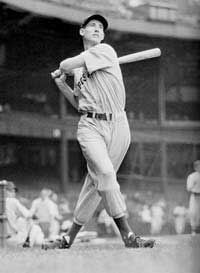
To me, that is just sheer beauty. Clean and open. Perfection. Grace.
"That kid [was] one hell of a hitter", indeed.
It just blows my mind ...
... how you can see the outlines of individual states from space. Amazing, right?
To the teachers I know ...
... and I know a ton of them (whether they have a job or not - right, Beth?) ... actually, my friend Betsy is a guidance counselor starting a new job this week ... so I will include her in this, too:
To all the educators I know - my dear sister Jean, my dear friend Beth, to Betsy, to my friend Janine ...
School is beginning! This week for some of you, next week for others ... but best of luck over the school year to everyone! You're doing great work, really the most important work there is.
And because I never get tired of posting it, here is my favorite story about a teacher. The impact that a good teacher can have on a child's life cannot be measured. I know being a teacher is hard, but look at what this one teacher did. Look at what she did!!
Happy back to school, everyone.
An Ode to a very special teacher
I have a friend who grew up in a nightmare, surrounded by poverty, abandonment, and chaos. He and his siblings clung to one another through it all, and they have emerged intact: healthy beautiful people. But they were brought up in an abusive and reckless nuthouse.
And this post is an ode to a teacher. A teacher who saved my friend's life. When I say this I am quite serious, although she did not drag him from out of a burning house, or leap in to save him from drowning. No. What she did was she recognized the light within him, and she made it her business to protect it, and nurture it, and make sure it survived.
If that's not saving someone's life, then I don't know what is.
My friend is extremely intelligent. His parents did not value this in him. On the contrary, it threatened them. To add to all of this, my friend, from a very young age, knew he was "different" from other boys. Somehow. How many other boys would stay home from school and put hot-rollers into their sister's Cher-doll's hair? How many other boys could recite Meet Me in St. Louis? How many other boys lip-synched to Barbra Streisand albums? He couldn't put a name to what was different because he was just a little boy. But he knew it was there.
The teasing he got, from within his family and at school, was brutal. Teasing of this kind has one goal and one goal only: to crush what is different. The difference in him was like a scent and other kids could smell it. So they set out to destroy it. Which is why he would stay home from school, playing with his sister's Barbies.
The little boy reached the 2nd grade. He had already learned some very hard lessons. He had already experienced cruelty, betrayal, terror. The end of this story could have been a terrible one. All of the cards were stacked against this person.
He might never have gotten out, were it not for his 2nd grade teacher.
I cannot remember her name, but I will hold a place in my heart for her forever. I did not meet this "little boy" until college when we became fast friends, but to my view, this 2nd grade teacher was directly responsible for the fact that this little boy went to college (the first one in his family to do so), that this little boy broke the pattern of abuse in his family, that this little boy got the hell OUT and said NO to what seemed to be his logical fate.
This 2nd grade teacher read E.B. White's Stuart Little to the class.
And my friend, then 7 years old, had what can only be described as a life-changing experience, listening to that book.
Stuart Little is a mouse, born to human parents. Everyone is confused by him. "Where the heck did HE come from?" My friend, a little boy who was so "different" he might as well have been a mouse born to human parents, a little boy who was, indeed, smaller than everybody else in the class, listened to this book, agog, his soul opened up to it, and it changed his life.
First of all: for the first time, he really got reading. By this I mean the importance, and the excitement, of language. Language can crack open windows in places you thought were just flat brick. Language can create new and better worlds. Language is a way out. To this day, my friend is a voracious reader. I will never forget living with him while he was reading Magic Mountain. We lived in a one-room apartment, and so if I wanted to go to sleep and turn the lights off, my friend would take a pillow into the bathroom, shut the door, curl up on the bathmat, and read Magic Mountain long into the night.
I believe that this voraciousness is a direct result of that 2nd grade teacher reading Stuart Little to the class. If that had not happened, and if it hadn't been that particular book, my friend might not have become a huge reader, might not have gone to college, might not have gotten OUT. It was that significant.
Stuart Little is "different". Just like my friend was "different". In hearing the words of that story, my friend rose above the pain, the loneliness, the torture, the fear, and realized that there were others out there who were "different" too. And that different was GOOD!
And here was the major revelation: Stuart Little's small-ness ends up being his greatest asset. That which seemed like the biggest strike against him is not at all in the end! My friend, in his 7-year-old epiphany, embraced his size. Small didn't mean "weak". Not at all.
Somewhere, in his child-like soul, he knew he was gay although he did not have a word for it. It wasn't a sexual orientation so much, at that time, but a sensibility. He wasn't like the other kids. He didn't know yet what that would mean for him, in his life, but it certainly isolated him in school. And it isolated him at home. And so, hearing about the adventures of Stuart Little, my friend realized that this life that he was living right now , the narrow circle of poverty and pain, did not have to be his life. He suddenly knew, for the first time in his life, that everything was going to be okay.
As the teacher read the story to the class, my friend had the intense sensation that the teacher was reading it directly to him, and only to him. It was such a strong feeling that he was able to describe it to me, vividly, years and years later. The rest of the class fell away, and it was as though she had singled him out, she was trying to give him a message of some sort, through the words of E.B. White. That book was for him.
By the time high school came around, my friend had learned that wit was the best defense against teasing. His humor, his sarcasm became his armor, but it also became the way he made friends. In a very short time, he acquired what can be only referred to as bodyguards, high school football players, who thought he was hilarious, and who protected him in the locker room, pushing anyone off who tried to mess with him.
My friend had a close circle of friends, all witty, artistic, interesting people, and these friends pushed him to apply to college, because they all were applying to college. And so he applied to college. He got in. He went to college. He graduated. He graduated college.
Years later, many years after college, he ran into that 2nd grade teacher in a breakfast restaurant in Rhode Island.
She (a teacher to the core) recognized him immediately, even in his adult-ness. She said, "My goodness - it is so wonderful to see you! I have heard so many wonderful things about what you are up to - how are you??"
They talked for a while. He caught her up on his life, she listened and supported him. She still was invested in what had happened to that small special boy she had taught many many years before.
And then, in a burst of open-ness, my friend said to her, kind of blowing it off, laughing at himself, "You know ... this is kind of silly ... but I want to tell you that ... I remember so vividly you reading Stuart Little to the class. It had a huge impact on my life ... and ... I know it's crazy and everything, but at the time, I truly had the feeling that you were reading it just to me."
She looked at him then, smiled, and said, "I was."
The Books: "In the Zone" (Eugene O'Neill)
Next in my Daily Book Excerpt:
 The first collection of plays I have is entitled Seven Plays of the Sea
This one called In the Zone. I wonder if anyone is reading these O'Neill excerpts ... do I have any O'Neill fans in the house? Yes? No?
In the Zone is the fourth play in this series that stars the same set of crewmen from the British ship Glencairn.
It says in the opening descriptions of this play: Five men are in their bunks, apparently asleep. It is about ten minutes of twelve on a night in the fall of the year 1915.
The Glencairn is carrying ammunition through the war zone (they are "in the zone") and the vibe on the ship is tense and silent - much different from the rowdy vibe on the ship we've seen in the other plays, which all took place before the start of WWI. One of their crew members (Smitty) who we've already seen in the other plays to be a bit of an outsider - suddenly has a fog of suspicion around him that he is a German spy. He keeps a black box under his bed - no one knows what is in it. Smitty is out on deck, looking up at the moon, and the crew takes advantage of his absence to air their suspicions to one another. The ending of the play is devastating, in classic O'Neill fashion.
The crew members attack Smitty when he comes back in, and confront him with the black box. Smitty starts to freak out, thrashing, trying to get it back. They hogtie him, and gag him. Driscoll then opens the box - with Smitty's muffled screams as background. It turns out that there is a packet of love letters in the box - from a woman named Edith - the love of Smitty's life, who basically says, in letter after letter, "I love you so much ... but if the black shadow of your drunkenness is going to be in our lives forever ... I can't marry you ..." They are heartbreaking letters. Driscoll reads them all outloud, and at some point, Smitty starts weeping. Still hogtied. The last letter is Edith breaking it off with Smitty, saying that he has ruined her life, but that she will always love him. The crew members silently untie Smitty, who is a wreck, and Driscoll puts all the letters back in the little black box, and returns the box to its place under Smitty's bed.
This excerpt is from the crew's discussion, before Smitty returns. They all stare at the little black box, fearful that it might explode.
EXCERPT FROM In the Zone by Eugene O'Neill.
DRISCOLL. 'Tis a hell av a thing fur grown men to be shiverin' loike children at a bit av a black box. [scratching his head in uneasy perplexity] Still, ut's damn queer, the looks av ut.
DAVIS. [sarcastically] A bit of a black box, eh? How big do you think ehm -- [he hesitates] -- things has to be -- big as this fo'c's'le?
JACK. [in a voice meant to be reassuring] Aw, hell! I'll bet it ain't nothin' but some coin he's saved he's got locked up in there.
DAVIS. [scornfully] That's likely, ain't it? Then why does he act so s'picious? He's been on ship near two year, ain't he? He knows damn well there ain't no thiefs in this fo'c's'le, don't he? An' you know 's well 's I do he didn't have no money when he came on board an' he ain't saved none since. Don't you? [Jack doesn't answer] Listen! D'you know what he done after he put that thing in under his mattress? -- an' Scotty'll tell you if I ain't speakin' truth. He looks round to see if any one's woke up --
SCOTTY. I clapped my eyes shut when he turned round.
DAVIS. An' then he crawls into his bunk an' shuts his eyes, an' starts in snorin', pretendin' he was asleep, mind!
SCOTTY. Aye, I could hear him.
DAVIS. An' when I goes to call him I don't even shake him. I just says, "Eight bells, Smitty", in a'most a whisper-like, an' up he gets yawnin' an' stretchin' fit to kill hisself 's if he'd been dead asleep.
COCKY. Gawd blimey!
DRISCOLL. [shaking his head] Ut looks bad, divil a doubt av ut.
DAVIS. [excitedly] An' now I come to think of it, there's the porthole. How'd it come to git open, tell me that? I know'd well Paul never opened it. Ain't he grumblin' about bein' cold all the time?
SCOTTY. The mon that opened it meant no good to the ship, whoever he was.
JACK. [sourly] What porthole? What're yuh talkin' about?
DAVIS. [pointing over Paul's bunk] There. It was open when I come in. I felt the cold air on my neck an' shut it. It would'a been clear 's a lighthouse to any sub that was watchin' -- an' we s'posed to have all the ports blinded! Who'd do a dirty trick like that? It wasn't none of us, nor Scotty here, nor Swanson, nor Ivan. Who would it be, then?
COCKY. [angrily] Must'a been 'is bloody Lordship.
DAVIS. For all's we know he might'a been signalin' with it. They does it like that by winkin' a light. Ain't you read how they gets caught doin' it in London an' on the coast?
COCKY. [firmly convinced now] An' wots 'e doin' aht alone on the 'atch -- keepin' 'isself clear of us like 'e was afraid?
DRISCOLL. Kape your eye on him, Scotty.
SCOTTY. There's no a move oot o' him.
JACK. [in irritated perplexity] But, hell, ain't he an Englishman? What'd he wanta--
DAVIS. English? How d'we know he's English? Cos he talks it? That ain't no proof. Ain't you read in the papers how all them German spies they been catchin' in England has been livin' there for ten, often as not twenty years, an' talks English as good's any one? An' look here, ain't you noticed he don't talk natural? He talks it too damn good, that's what I mean. He don't talk exactly like a toff, does he, Cocky?
COCKY. Not like any toff as I ever met up wiv.
DAVIS. No; an' he don't talk it like us, that's certain. An' he don't look English. An' what d'we know about him when you come to look at it? Nothin'! He ain't ever said where he comes from or why. All we knows is he ships on here in London 'bout a year b'fore the war starts, as an A.B. -- stole his papers most lik'ly -- when he don't know how to box the compass, hardly. Ain't that queer in itself? An' was he ever open with us like a good shipmate? No; he's always had that sly air about him 's if he was hidin' somethin'.
DRISCOLL. [slapping his thigh - angrily] Divil take me if I don't think ye have the truth av ut, Davis.
COCKY. [scornfully] Lettin' on be 'is silly airs, and all, 'e's the son of a blarsted earl or somethink!
DAVIS. An' the name he calls hisself -- Smith! I'd risk a quid of my next pay day that his real name is Schmidt, if the truth was known.
JACK. [evidently fighting against his own conviction] Aw, say, you guys give me a pain! What'd they want puttin' a spy on this old tub for?
DAVIS. [shakes his head angrily] They're deep ones, an' there's a lot o' things a sailor'll see in the ports he puts in ought to be useful to 'em. An' if he kin signal to 'em an' they blows us up it's one ship less, ain't it? [Lowering his voice and indicating Smitty's bunk] Or if he blows us up hisself.
SCOTTY. [in alarmed tones] Hush, mon! Here he comes!
August 29, 2005
Happy 20th birthday ...
... to The Breakfast Club, which came out in 1985.

I wish they would do a re-release of it in the theatres - I bet people would pack it IN!! I would so go.
I remember vividly the first time I saw that film. It was at the Showcase Cinemas, in Warwick, Rhode Island. I went with a group of my friends - wait - Betsy - was it you, me, and J that first time? I remember how the movie kind of just pierced through me. It reached out of the screen, and talked right to our lives. As high school students, as teenagers. It was funny, angry, surprising ... the characters were also full of surprises, although they all began as "types". We just were blown away by it.
I fluctuated my alliances. There were times when I related most to Allison. But then there were other times when I really related to Bender. I FELT most like Allison in my life ... and so the fact that Andy, the popular jock, would see the beauty in her ... was painfully hopeful to me. I'm serious. The two scenes where they kind of connect one on one just killed me. I wondered if I could ever connect with a boy like that. If a boy would ever come up to me and try to cut through my defenses - the way he did.
"You've got problems."
"Oh, I've got problems?"
"You do everything everybody ever tells you to do. THAT is a problem."
"Yeah, well, I didn't empty out my bag and invite people into my problems. Did I ..."
Just wonderful. She looks like a wild animal in that scene, her hair in her eyes, her eyes black-rimmed like a fierce cat in the jungle. He needs to tame her, he needs to approach her carefully ...
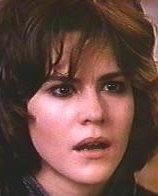
And then the second scene when she emerges "made over" by Claire. Beautiful. Something about the music beneath that scene, too - it's very subtle, but it works so well. You can FEEL his emotions as he sees her transformations.
There was something about that particular connection that really got to me, as a teenager.
But really, like I said - that's the genius of the film. Throughout it, you can flip back and forth between points and views. You think you know someone, you think you have them pegged, and then they reveal a bit of humanity, or something you can relate to ... and your whole attitude changes.

(Like Tracy says in Philadelphia Story: "The time to make up your mind about people is never.")
High school is all about appearances. The Breakfast Club, a sensitive well-made story, accepts that. But by the end of the film - they have cracked through to one another. They don't go over the top with it, there are no sloppy hugs, no "I'm sorry I treated you the way I did..." It's a better movie than that. Everything is NOT resolved. We don't know what will happen when they go back to school. Will they maintain their connetion? What?? We don't know. It's up for speculation. No promises are made at the end of the film (except, I guess, by Brian who says, when they're sitting on the floor: "I just want to tell you all ... that I wouldn't do that ... and I won't...")

Also: unless I'm mistaken there is no "reconciliation" really between Bender and Andy. All of the others come to some sort of understanding, individually - sometimes without even talking about it. (If you notice, Bender accepts Allison almost immediately, in the beginning of the movie. He never EVER gives her crap. Says to her, "I've seen you before ..." and leaves it at that. He can probably sense her pain, on some supersonic level, and so he just lets her be. It's subtle - but it really shows that Bender is actually, somehow, kind of a hero. He zeroes in on Claire because Claire is a liar, and full of shit. She's also obviously cruel to others. Bender wants to crack that facade. Allison's facade is different - it's a survival mechanism. She needs it to get through her day. Huge difference. So Bender lets her be.) But back to Bender and Andy: they end up just keeping away from each other, maybe just accepting the fact that: "Okay, y'know what? We're both alpha dogs. Can't be two alphas in one room ... so let's just back off, mutually." Because of course in the beginning of the film, they clash immediately, doing that macho posturing shit at each other. But somewhere along the line, silently, they let it go.
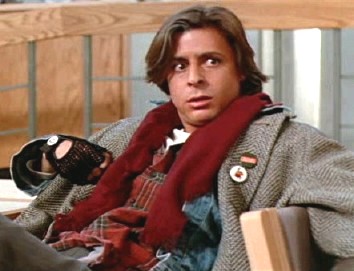
It's a classic movie. Mitchell and I were talking this weekend about "classics" and what movies from our time, our generation, will be considered classics 100 years from now.
I said Groundhog Day and he said The Breakfast Club.
One of the other interesting things about The Breakfast Club (which sadly, is always cut out by the prudish networks when they run the film in a constant loop - is it on AMC?) - anyway. They cut out all of the pot-smoking references. They can't cut it out completely - because then there would be no reason for them to sneak off into the school to get to Bender's locker. So they keep that in (but you can feel how grudgingly they do so) ... but all shots of them smoking the pot are excised.
But here's the deal: and I don't think you could get away with this now, in our even more uptight era: Smoking pot is THE thing that breaks down the barriers. John Hughes doesn't couch it in a warning to the kids in the audience, he doesn't try to say "drugs are bad" at the same time ... No. It's unabashedly positive. They all get stoned, and then the next shot is them sitting on the floor ... talking ... when all kinds of emotional, dramatic, and funny ("I can eat with my toes") things happen. There's a direct correlation there. But it's a direct correlation that people don't want to deal with. There is no cautionary moment when the film-maker scolds the audience: "Pot smoking is bad!" No. Pot smoking is actually seen as GOOD. Which (duh) is why teenagers do it. And it isn't always a slippery slope, leading to cocaine and heroin and harder drugs, for God's sake. You couldn't get away with such a simple acceptance of that reality now. At least not in a mainstream movie made for teenagers. If you do drugs you are bad. Drugs are bad. Subliminal message pounding. I mean, people can't even smoke cigarettes anymore without being "the villain". What would Humphrey Bogart do if he were a movie star today?
The Breakfast Club is a highly sophisticated film, if you compare it to what is being made for that age bracket now. It respects its audience. That's why we loved it so, that's why I still love it.
I probably saw it 5 times in the movie theatre when it first came out, and continue to watch it on a regular basis. I never EVER get tired of it. Weird, right? How often does THAT happen?
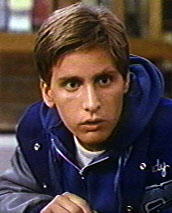
To imitate Alex, here is a list of Breakfast Club trivia, for your enjoyment:
--The original running time of "The Breakfast Club" was about two and a half hours. Thinking the film would not be a hit, Universal Pictures trimmed the running time down to the modern 97 minute version. The studio then destroyed the negatives of the deleted scenes. John Hughes said in a "Premiere" magazine article that he has the only complete copy.
--Emilio Estevez was originally going to play Bender, but Hughes couldn't find someone to play Andrew Clark so Emilio agreed to play Clark.
--Molly Ringwald really wanted to play Allison but Ally Sheedy had already been promised the part.
--The library in which this movie takes place was actually constructed in the gymnasium of a high school that had closed down several years before filming began. As of 2000, the school is a police station.
--Director John Hughes insisted that the entire cast and crew eat their meals on location in the Maine North High School cafeteria.
--The joke that Bender tells but never finishes (while crawling through the ceiling) actually has no punchline. According to Judd Nelson, he ad-libbed the line. Originally, he was supposed to tell a joke that would end when he came back into the library and said, "Forgot my pencil", but no one could come up with a joke for that punchline.
--The guidance counselor's desk has a name plaque which says "R. Hashimoto". Richard Hashimoto was the production supervisor.
--A prom queen election poster contains the name of Michelle Manning, who co-produced the film.
--Director John Hughes actually attended Glenbrook North High School, one of the schools where the movie was filmed.
--It was originally suggested that there would be several sequels to the Breakfast Club, occurring every ten years, in which the Breakfast Club would get back together.
--Director Cameo: [John Hughes] Brian's father, who picks him up at the end of the film.
--In the beginning of the movie you see different shots of the school hallways and classrooms, you can see what the flare gun did to Brian's locker. Also there is a picture of a former Shermer High School student "Man of the Year". The guy in the picture is the janitor.
--The theme song, "Don't You (Forget About Me)", was written for the film by Keith Forsey. It was a number one hit for Simple Minds, and both Billy Idol and Bryan Ferry turned down offers to record it first (although in 2001, Billy Idol recorded Don't You (Forget About Me) as a bonus track for his Greatest Hits album). The song was also turned down by Chrissie Hynde of The Pretenders who then suggested they offer it to the band fronted by her husband at the time, Simple Minds.
--The film's title comes from the nickname invented by students and staff for detention at the school attended by the son of one of John Hughes' friends. Thus, those who were sent to detention were designated members of "The Breakfast Club".
--"Claire's" entire ensemble was purchased specially for the character from a Ralph Lauren store, the only one in Chicago at the time. Hughes had rejected the original costume on the grounds that it wasn't sophisticated enough.
--Nicolas Cage was originally considered for the role of John Bender but the production couldn't afford his salary at the time. John Cusack auditioned, but producers opted instead for Judd Nelson.
--Director John Hughes said that the cast rehearsed the entire movie as if it was a play a few times before filming began. After the film was a hit, Hughes was asked to write the script as a play so high schoolers could perform it.
--John Cusack was originally cast as John Bender, but John Hughes decided to replace him with Judd Nelson before shooting began.
--John Hughes wrote the screenplay to this movie in just two days (4 and 5 July 1982).
--Rick Moranis was originally cast as the janitor; he left due to creative differences and was replaced by John Kapelos.
--One subplot that was filmed but deleted showed Principal Vernon watching some women faculty members using the school swimming pool.
--More deleted scenes:
Allison imagines what the other students are really like.
Carl the janitor predicts where the Breakfast Club will be in 20 years.
When Allison says, "I can write with my toes," she actually does so.
--The scene in which all characters sit in a circle on the floor in the library and tell stories about why they were in detention was not scripted. John Hughes told them all to ad-lib.
--Other proposed titles were "The Lunch Bunch" and "Library Revolution".
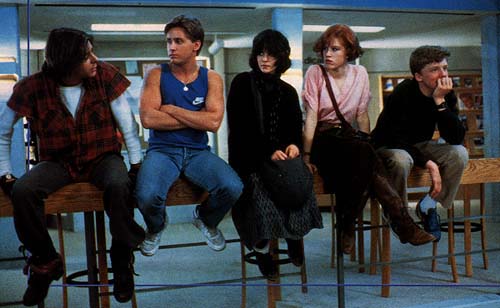
Brian's voiceover at the end: Dear Mr. Vernon, we accept the fact that we had to sacrifice a whole Saturday in detention for whatever it was we did wrong. But we think you're crazy to make us write an essay telling you who we think we are. You see us as you want to see us... In the simplest terms, in the most convenient definitions. But what we found out is that each one of us is a brain...
Andrew: ...and an athlete...
Allison: ...and a basket case...
Claire: ...a princess...
Bender: ...and a criminal...
Brian: Does that answer your question?... Sincerely yours, the Breakfast Club.
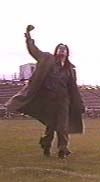
Happy birthday, Breakfast Club.
Network
Another great tribute to another great movie - from my friend Alex.
She's so right that that movie is freakily prescient. It depicted a "nightmare" scenario where TV became solely about "reality". The freaks of the world suddenly leap on the chance to get their 15 minutes, and TV networks collaborated with them, giving them the spotlight. Hahahaha, right? Network came out in 1976. It predicted the world that we live in now. The world of Reality TV on every network, "battle of the reality TV stars", Jerry Springer, take your pick.
At the time, the film was seen as a broad parody, while obviously making some great points about the business of television. But now, with the perspective of 30 years, we can see that it wasn't a parody at all. It was just a freakily accurate prediction.
I posted a bunch of excerpts a while back from Sidney Lumet. Here they are:
And then I wrote this long piece on the general great-ness of William Holden.
"suppose they had shot Dostoevsky?"
Dostoevsky by Charles Bukowski
against the wall, the firing squad ready.
then he got a reprieve.
suppose they had shot Dostoevsky?
before he wrote all that?
I suppose it wouldn't have
mattered
not directly.
there are billions of people who have
never read him and never
will.
but as a young man I know that he
got me through the factories,
past the whores,
lifted me high through the night
and put me down
in a better
place.
even while in the bar
drinking with the other
derelicts,
I was glad they gave Dostoevsky a
reprieve,
it gave me one,
allowed me to look directly at those
rancid faces
in my world,
death pointing its finger,
I held fast,
an immaculate drunk
sharing the stinking dark with
my
brothers.
The Books: "The Long Voyage Home" (Eugene O'Neill)
Another entry for "Red's Bookshelf - An Excerpt a Day".
And another one of Eugene O'Neill's Next in my Daily Book Excerpt:
Now we come to Eugene O'Neill. Yay! The first collection of plays I have is entitled Seven Plays of the Sea
This one called The Long Voyage Home. It stars the same cast of characters - crewmen on the British ship Glencairn - who were also in The Moon of the Caribees and Bound East for Cardiff. The crew has now landed back in England ... the play takes place in a small dingy tavern down by the docks in London. There are two barmaids there when the crew bursts in, looking for drinks, and women.
The play ends on a really ugly note. Freda, one of the barmaids, is also a thief. She works with Joe, the proprietor of the dive, in ripping off customers who get too drunk. She butters them up, gets them talking, keeps them distracted, so she can then steal their wallet.
I'll post the excerpt between Freda and Olson, the crew member from Sweden, who's kind of a naive sweet guy. She is beginning to work her scam.
EXCERPT FROM The Long Voyage Home by Eugene O'Neill.
FREDA. [to Olson] Stay 'ere an' 'ave a talk wiv me. They're all drunk an' you ain't drinkin'. [with a smile up into his face] I'll think yer don't like me if yer goes in there.
OLSON. [confused] You wus wrong, Miss Freda. I don't -- I mean I do like you.
FREDA. [smiling -- puts her hand over his on the table] An' I likes you. Yer a genelman. You don't get drunk an' hinsult poor gels wot 'as a 'ard an' uneppy life.
OLSON. [pleased but still more confused -- wriggling his feet] I bane drunk many time, Miss Freda.
FREDA. Then why ain't yer drinkin' now? [She exchanges a quick questioning glance with Joe, who nods back at her -- then she continues persuasively] Tell me somethin' abaht yeself.
OLSON. There ain't nothin' to say, Miss Freda. I bane poor devil sailor man, dat's all.
FREDA. Where was you born -- Norway? [Olson shakes his head] Denmark?
OLSON. No. YOu guess once more.
FREDA. Then it must be Sweden.
OLSON. Yes. I wus born in Stockholm.
FREDA. [pretending great delight] Ow, ain't that funny! I was born there, too -- in Stockholm.
OLSON. [astonished] You wus born in Sweden?
FREDA. Yes; you wouldn't think it, but it's Gawd's troof. [She claps her hands delightedly]
OLSON. [beaming all over] You speak Swedish?
FREDA. [trying to smile sadly] Now. Y'see my ole man an' woman come 'ere to England when I was on'y a baby an' they was speakin' English b'fore I was old enough to learn. Sow I never knew Swedish. [sadly] Wisht I 'ad! [with a smile] We'd 'ave a bloomin' lark of it if I 'ad, wouldn't we?
OLSON. It sound nice to hear the old talk yust once in a time.
FREDA. Righto! No place like yer 'ome, I says. Are yer goin' up to -- to Stockholm b'fore yer ships away agen?
OLSON. Yes. I go home from here to Stockholm. [Proudly] As passenger!
FREDA. An' you'll git another ship up there arter you've 'ad a vacation?
OLSON. No. I don't never ship on sea no more. I got all sea want for my life -- too much hard work for little money. Yust work, work, work on ship. I don't want more.
FREDA. Ow, I see. That's why you give up drinkin'.
OLSON. Yes. [with a grin] If I drink I yust get drunk and spend all money.
FREDA. But if you ain't gointer be a sailor no more, what'll yer do? You been a sailor all yer life, ain't yer?
OLSON. No. I work on farm till I am eighteen. I like it, too -- it's nice -- work on farm.
FREDA. But ain't Stockholm a city same's London? Ain't no farm there, is there?
OLSON. We live -- my brother and mother live -- my father is dead -- on farm yust a little way from Stockholm. I have plenty money, now. I go back with two years' pay and buy more land yet; work on farm. [Grinning] No more sea, no more bum grub, no more storms -- yust nice work.
FREDA. Ow, ain't that luv'ly! I s'pose you'll be gittin' married, too?
OLSON> [very much confused] I don't know. I like to, if I find a nice girl, maybe.
FREDA. Ain't yer got some gel back in Stockholm? I bet yer 'as.
OLSON. No. I got nice girl once before I go to sea. But I go on ship, and I don't come back, and she marry other faller. [He grins sheepishly]
FREDA. Well, it's nice for yer to be goin' 'ome, anyway.
OLSON. Yes. I tank so.
[There is a crash from the room on left and the music abruptly stops. A moment later Cocky and Driscoll appear, supporting the inert form of Ivan between them. He is in the last stage of intoxication, unable to move a muscle. Nick follows them and sits down at the table in rear.]
DRISCOLL. [as they zigzag up to the bar] Ut's dead he is, I'm thinkin', for he's as limp as a blarsted corpse.
COCKY. [puffing] Gawd, 'e ain't 'arf 'eavy!
DRISCOLL. [slapping Ivan's face with his free hand] Wake up, ye divil, ye. Ut's no use. Gabriel's trumpet itself cudn't rouse him. [To Joe] Give us a dhrink for I'm perishing wid the thirst. 'Tis harrd worrk, this.
JOE. Whiskey?
DRISCOLL. Irish whiskey, ye swab.
August 28, 2005
Playing old
Morgan Freeman, when he played Hoke Colburn in Driving Miss Daisy, had to age a great deal over the course of the film. Freeman was 51 when he played that part, but he had to play a man in his mid-70s. We have all seen actors try to "play old" and a lot of times they fail miserably. They are "acting" old, and whatever it is that they do - it seems superficial. They make their voice quavery, they hunch their backs (all so general, so stereotypical) or they just rely on the old-age makeup and hair to do the work for them. But no true illusion is created. You always think, as an audience member: "Oh, there's that young actor with old-age makeup on."
Freeman, while preparing to play that part, remembered something an acting teacher had said to him way back when he first started taking classes. This acting teacher was talking about this very thing - the problem of a young person having to play an elderly person - how does one do it truthfully and convincingly?
And this acting teacher said, "You should just walk as though you have glass Christmas tree ornaments for testicles." He made all the young men in the class walk across the room, imagining they had glass balls, basically - just to see what that would do for their movement. By concentrating on THAT, as opposed to "pretending" to be old, they were able to successfully transform themselves. It's amazing how concentrating on something SIMPLE ("pretend your testicles are made of glass") as opposed to something very complex ("pretend you are 80"), so often does the trick. Because it's specific. And it's also grounded in some kind of sensory reality. It's not intellectual, it's not an idea. I think a lot of the times when actors play old, they're just playing "the idea" of old - they haven't given themselves specific small tasks to concentrate on, to keep them grounded.
So that's what Freeman did, many many years later in Driving Miss Daisy, when he had to play Hoke, a man in his mid 70s. He walked as though he had glass balls.
I love anecdotes like that. So creative, so cool. Actors. Love 'em.
Seven things
I got this from United Irelander - a new blog I just discovered. Seems like a lot of fun over there. I like it.
Seven things I plan to do before I die.
1. Get my one-woman show produced
2. Novel(s) published
3. Run the Blessing of the Fleet, dammit - hey, maybe I'll do that next year. Any other Rhode Islanders want to join me?
4. Travel through Central Asia. Countries to see: Iran, Turkmenistan, Uzbekistan, Tajikstan, Kazakhstan, Kyrgzstan. I'd also like to go to Nepal.
5. Get married. Dad walks me down the aisle.
6. Own a house
7. Live in Ireland for an extended period of time
Seven things I can do.
1. I can write
2. I can be loyal as the day is long. If you're my friend, or my boyfriend ... you'll never get any treachery from me. Loyal, loyal, loyal.
3. I can drive a stick shift
4. I can jitterbug
5. I can remember conversations I had over 20 years ago almost word for word. I'm freaky that way. I'm also freaky about remembering specific body language. How someone leaned back, leaned forward, looked away, leaned in ...
6. I have now realized that I am fully capable of keeping plants alive. I have 5 plants in my apartment that are flourishing. This is amazing.
7. I can sing all the lyrics to "Museum Song" from the musical Barnum. At the breakneck speed in which they are sung on the album. So can my sister Jean:
Quite a lotta
Roman terra cotta
Livin' lava from the flanks of Etna
Statuary
Ride a dromedary
See the Temple tumble and the Red Sea part.
McNamara's band
The fattest lady in the land
A pickled prehistoric hand
A strand of Pocahontas' hair
Crow and Sioux
Who're going to
Be showing you
Some rowing through
A model of the rapids on the Delaware.
Armadillas
Clever caterpillas
Reproductions of the Cyclops' ret'na
Crystal blowing
Automatic sewing
Venus on a shell and other works of art.
Educated fleas
A tribe of Aborigines
Two ladies joined across the knees
A Mona Lisa made of ice
Hottentots
We've gotten in
Forgotten spots
A cotton gin
A night with Lot in Sodom
Better see that twice!
One iguana
Snakes and other fauna
Got no bearded lady but we're get'na
When you duck out
Take another buck out
Run around the block and see and run around the block and run around the block
And see a new show start.
Seven things I can not do.
1. Love Renee Zellweger or accept her success in any graceful way
2. Ski (I'm sure I could learn, but as of now, I have never skiied.)
3. I cannot take apart a car engine and put it back together and have it still work
4. I cannot fly an airplane
5. I cannot tame a wild animal. I also could not kill an animal. I mean, I'm sure I could - but only in self-defense or if I was hungry. Never ever for sport.
6. I cannot stop myself from watching Notorious and Bringing Up Baby endlessly
7. I cannot deal with s's
Seven things that I find really attractive about the opposite sex.
1. Smile/Laugh
2. Hands
3. Height (and by that I mean: tall)
4. Good listener, but also good talker.
5. Brain
6. Passion for what he does
7. General curiosity about all things. No "I'm over it" attitude allowed.
Seven things I say the most.
1. Holy crap
2. You have got to be kidding me.
3. What a jag-off
4. That is SO COOL
5. No way.
6. You're going to be okay, Sheila
7. hahahahahahahahahahahaha
Seven books I love.
1. Wrinkle in Time, Madeleine L'Engle
2. Portrait of the Artist as a Young Man, James Joyce
3. Harriet the Spy, Louise Fitzhugh
4. Mating, Norman Rush
5. Hopeful Monsters, Nicholas Mosley
6. Possession, AS Byatt
7. Catch 22, Joseph Heller
1985 music
I got this from Michele. Wanna play along? (Mere - I won't call it a "meme". Mkay?)
A.) Go to musicoutfitters.com
B.) Enter the year you graduated from high school in the search function and get the list of 100 most popular songs of that year
C.) Bold the songs you like, strike through the ones you hate and underline your favorite. Do nothing to the ones you don't remember (or don't care about).
1. Careless Whisper, Wham!
2. Like A Virgin, Madonna
3. Wake Me Up Before You Go-Go, Wham!
4. I Want To Know What Love Is, Foreigner
5. I Feel For You, Chaka Khan
6. Out Of Touch, Daryl Hall and John Oates
7. Everybody Wants To Rule The World, Tears For Fears
8. Money For Nothing, Dire Straits
9. Crazy For You, Madonna
10. Take On Me, A-Ha
11. Everytime You Go Away, Paul Young
12. Easy Lover, Phil Collins and Philip Bailey
13. Can't Fight This Feeling, REO Speedwagon
14. We Built This City, Starship
15. The Power Of Love, Huey Lewis and The News
16. Don't You (Forget About Me), Simple Minds
17. Cherish, Kool and The Gang
18. St. Elmo's Fire (Man In Motion), John Parr
19. The Heat Is On, Glenn Frey
20. We Are The World, U.S.A. For Africa
21. Shout, Tears For Fears
22. Part-Time Lover, Stevie Wonder
23. Saving All My Love For You, Whitney Houston
24. Heaven, Bryan Adams
25. Everything She Wants, Wham!
26. Cool It Now, New Edition
27. Miami Vice Theme, Jan Hammer
28. Lover Boy, Billy Ocean
29. Lover Girl, Teena Marie
30. You Belong To The City, Glenn Frey
31. Oh Sheila, Ready For The World
32. Rhythm Of The Night, Debarge
33. One More Night, Phil Collins
34. Sea Of Love, Honeydrippers
35. A View To A Kill, Duran Duran
36. The Wild Boys, Duran Duran
37. You're The Inspiration, Chicago
38. Neutron Dance, Pointer Sisters
39. We Belong, Pat Benatar
40. Nightshift, Commodores
41. Things Can Only Get Better, Howard Jones
42. All I Need, Jack Wagner
43. Freeway Of Love, Aretha Franklin
44. Never Surrender, Corey Hart
45. Sussudio, Phil Collins
46. Strut, Sheena Easton
47. You Give Good Love, Whitney Houston
48. The Search Is Over, Survivor
49. Missing You, Diana Ross
50. Separate Lives, Phil Collins and Marilyn Martin
51. Raspberry Beret, Prince and The Revolution
52. Suddenly, Billy Ocean
53. The Boys Of Summer, Don Henley
54. One Night In Bangkok, Murray Head
55. If You Love Somebody Set Them Free, Sting
56. Obsession, Animotion
57. We Don't Need Another Hero, Tina Turner
58. Material Girl, Madonna
59. Better Be Good To Me, Tina Turner
60. Head Over Heels, Tears For Fears
61. Axel F, Harold Faltermeyer
62. Smooth Operator, Sade
63. In My House, Mary Jane Girls
64. Don't Lose My Number, Phil Collins
65. All Through The Night, Cyndi Lauper
66. Run To You, Bryan Adams
67. Glory Days, Bruce Springsteen
68. Voices Carry, 'Til Tuesday
69. Misled, Kool and The Gang
70. Would I Lie To You?, Eurythmics
71. Be Near Me, ABC
72. No More Lonely Nights, Paul McCartney
73. I Can't Hold Back, Survivor
74. Summer Of '69, Bryan Adams
75. Walking On Sunshine, Katrina and The Waves
76. Freedom, Wham!
77. Too Late For Goodbyes, Julian Lennon
78. Valotte, Julian Lennon
79. Some Like It Hot, Power Station
80. Solid, Ashford and Simpson
81. Angel, Madonna
82. I'm On Fire, Bruce Springsteen
83. Method Of Modern Love, Daryl Hall and John Oates
84. Lay Your Hands On Me, Thompson Twins
85. Who's Holding Donna Now, Debarge
86. Lonely Ol' Night, John Cougar Mellencamp
87. What About Love, Heart
88. California Girls, David Lee Roth
89. Fresh, Kool and The Gang
90. Do What You Do, Jermaine Jackson
91. Jungle Of Love, The Time
92. Born In The USA, Bruce Springsteen
93. Private Dancer, Tina Turner
94. Who's Zoomin' Who, Aretha Franklin
95. Fortress Around Your Heart, Sting
96. Penny Lover, Lionel Richie
97. All She Wants To Do Is Dance, Don Henley
98. Dress You Up, Madonna
99. Sentimental Street, Night Ranger
100. Sugar Walls, Sheena Easton
Comments:
Wow. I guess I didn't really like Bryan Adams. I thought I did ... but I guess I don't.
So many of these songs I had forgotten ... but God, they all came rushing back to me. I had forgotten how much I loved that song "No more lonely nights... never be ano-other ... No more lone-leee nights ..."
Also: you literally could not get away from Tears for Fears that year. And The Thompson Twins. They were ubiquitous. I loved them both.
In retrospect, I hated "We are the world", although I thought I was into it at the time. I was way more into the British version - "Do they know it's Christmas?" It's so American to make the song about US and how it's all about US, and how great WE are. Yuk. Come on now. At least pretend to be humble, people. Bob Geldof's song was actually about Africa. Also, in general - just a much better song.
I loved Hall & Oates but I don't recognize their songs on this list, which is weird. I wonder if my Hall & Oates phase was already fading out ... it had peaked with "Private Eyes" and after that I didn't pay attention?
I also had been a huge Police fan. HUGE. But Sting's solo stuff left me kinda cold. It still does, I guess. He's too pleased with himself for putting words like "Goethe" in a pop song ... hahaha Or, I don't know. I just loved the Police. Their energy, their songs, just their very sound.
Bruce Springsteen. He was also everywhere that year. "I'm on Fire". Amazing. What an exciting time.
We were all so into Til Tuesday. That song "Voices Carry' still has the power to transport me back to high school. "Hu-ush hush ... keep it down now ... voices carry ..." The otherworldly sound of her voice ...
And it was a toss-up for my favorite song. I considered any number of the Tears for Fears songs - I was so into them ... but then figured I had to go with "Don't You Forget About Me". That movie had such a huge impact on me in high school - and still - today - 20 years later - if I hear those first chords from that song, I get a little chill of memory. Memories vivid and alive.
A breathtaking review ...
... of Garry Hynes' Synge marathon going on in Ireland right now. Actually, it's over - they did the marathon all this summer, now it's at the Edinburgh Festival - and I am just crossing my fingers hopefully, prayerfully, that eventually the marathon comes to New York. Listen to that review. It gave me chills. It's marvelously written, so even if you have no interest in JM Synge, or theatre, it's well worth a read. I feel like I must see these plays, as directed by Ms. Hynes.
The project is almost a life's labor for Ms. Hynes, who in 1998 became the first woman to win a Tony Award for directing Mr. McDonagh's "Beauty Queen of Leenane." It is also, in part, an act of restoration. John Millington Synge had a deep if complicated affection for his culture, but the love went largely unrequited during his lifetime. His first plays, which are now considered key works of Irish literature, were greeted with an outraged snarl by The Irish Times at their debuts in the early years of the 20th century."Excessively distasteful" was the verdict on "The Shadow of the Glen." "Riders to the Sea" was deemed "repulsive." And the riots that greeted the premiere of "The Playboy of the Western World" in 1907 have entered the annals of both Irish history and theatrical lore.
I wrote a huge piece on "The Playboy Riots". It's an incredible story - and one of the main theatrical events in history that I so wish I had been a witness to.
And here, in the review, is where I got goosebumps - and suddenly considered flying to Edinburgh TODAY to try to see the Synge cycle - Listen:
The connections are further emphasized by the use of the same basic set, by Francis O'Connor (a dirt floor, looming gray walls mottled by age) and Davy Cunningham's intricate but simple lighting, and by the casting of key actors in leading roles in more than one play. Most rewardingly, Marie Mullen, who starred in Mr. McDonagh's "Beauty Queen" on Broadway, appears in no less than five significant roles, embodying an astonishing range of Synge's powerfully drawn female characters, defining each with indelible artistry, humor and compassion. Even if it is never seen in the English-speaking theatrical capitals of London and New York - as it should be - Ms. Mullen's achievement may well come to rank among the legendary acting accomplishments of the era. She is a great actress, delivering an astonishing series of performances here.
Good God. I don't even HAVE to see it to get that something amazing is going on over there, but damn - I sure would LIKE to see it.
The review ends:
Different in style if not in spirit from Synge's previous work, "Deirdre" is written in a staid, imagistic and almost incantatory language that defies naturalistic interpretation. Its mythic figures are, like all Synge's characters, vividly human in their conflicted desires, but the actors are adrift in these strange waters, and Ms. Hynes herself resorts to some unfortunate stylistic experiments.And yet theatrically ineffective as it is, "Deirdre of the Sorrows," in which the dying Synge wrote movingly, even passionately, about the consolations of a life cut short before time can dampen the fires of a young heart, brings the cycle to an aptly mournful conclusion. The fact that Ms. Hynes' and her collaborators' great success contains an element of failure does not detract from the significance of their achievement - there is even something aptly Syngean in the cycle concluding not with a bravura bang but with quiet letdown.
A flawless presentation of his oeuvre would betray the harsh beauty of his vision. For Synge, loss was as constant and inevitable as the sea and stars. It's the shadow of death moving stealthily toward us that puts the savor in the sip of whiskey, the tall tale or the tender communion of a long hoped-for kiss.
Synge has always been dear to my heart, even though I don't think I fully understand him, and have read his plays many many times, in an attempt to get closer to what he was trying to say. He was a very very important playwright - not just for Ireland - but for the world.
Damn. I so so wish I could transport myself across the ocean, free of charge, to see these plays in person.
Please let them come to New York!!! I'll get in line for tickets right now!
August 27, 2005
Party snapshots
-- Met up with Rachel in the Grand Central terminal, ready to take our train north into the wilds of Connecticut. Rachel! My old dear friend from Chicago, who now lives here. So cool! There was probably not more than 2 seconds of silence between us during the entire 2 hour train ride. Yap yap yap yap. Fun.
-- We were going to the house of Jackie and Stuart, who were having a party today. (There are so many good stories from the friendship of Jackie and Sheila. We have had some truly bizarre adventures. Here's one of my favorites. And I would say that this one is pretty funny too. But that's just the tip of the iceberg.) People from all different sections of my life (and theirs, of course) would be in attendance. Mitchell is in town. He would be there. David and Maria and their kids (and their new dog). Jim!!! An old friend from college, who then moved to Chicago while I was there (oh, the memories - after going to his first Pat show, which Mitchell and I dragged him to, even though he was seriously jet-lagged, Jim said, dazed: "I felt like Pat McCurdy was ... some sort of god...") and is now living in Providence. Another old friend from college, David, who I ended up being in a show with here in New York, randomly. Haven't seen him since that show closed in 2002. Rachel. Oh, and Luisa - one of my good friends from college - ahem. Buy her jewelry. She's incredible. Oh yeah - and my first serious boyfriend was going to be there, too - with one of his sons. Argh! This is your life, Sheila!!!
-- Jackie and Stuart's house is idyllic. It feels like such a home. Beautiful. Warmly painted walls, lots of books - it's an old house, so there's a lot of cool old details. And, here's the kicker: 4 piano-esque instruments. Hysterical. A small standing piano that Jackie got at a yard sale in college (I remember the day she brought it home). A much larger piano painted orange that Jackie got from a friend when that friend moved. A small electric keyboard. Then - an old-fashioned huge organ, with these little knobs you push in for different effects - Jackie sang us an impromptu number on that one. The funny thing about Jackie playing the piano is that no matter what number she chooses to sing, it always ends up sounding like a hymn. Something about her chord choices. She makes "Love Potion #9" sound like "Onward Christian Soldiers".
-- Jackie wore an apron with two blazing yellow pineapples on it.
-- The backyard was heaven on earth. There was a swing hanging from a high high tree limb. The swing will take a starring role later in the party. Over in the corner, surrounded by trees, was an idyllic little hammock. There was a small brick patio, but for the most part, it was just a grassy green space made for kids.
-- When Mitchell walked into the kitchen when he first arrived, he had on a small straw cowboy hat. He looked great. Sadly, his hat choice made me think of "I have lived -" step-step-step " - many lives", one of Mitchell's more ridiculous moments.
-- David and Maria's two girls are so gorgeous, so sweet. They were so solicitous and careful with their new dog, very attentive. Adorable. They remind me so much of the two little girls in In America.
-- Jackie and Stuart's two sons are amazing - such little individuals. So different from one another, and both so interesting.
-- Oh, and my first serious boyfriend came -- argh! I was nervous to see him for about 2 seconds, and then when I laid eyes on him I was fine. He's a good friend. And a cherished person from my past. His son is this sweet-faced blue-eyed boy, who slayed my heart a little bit (in a good way).
-- We all sat around on the patio, lots of talk, lots of laughter. Reconnecting with old friends. I also love watching people from totally different parts of my life chatting and getting along. Seeing old-boyfriend talking in an in-depth way with Rachel - whom he had never met. Seeing David talking and laughing with Stuart. One of our other Chicago friends who was there regaled us all with tales of touring with Vagina Monologues. Good good stories, y'all. Some excellent celebrity gossip! But my lips are sealed!
-- The food was delicious. Stuart made margaritas.
-- I miss Luisa. I miss seeing her more. My favorite Luisa story is of her wandering through the apartment she shared with Mitchell in college, devastated about something, can't remember what, and Luisa - a brilliant learned woman - saying to herself over and over, "This is my bear to cross. This is my bear to cross." Completely not realizing she had reversed it. She was deadly serious. Deadly. "Bear to cross" has now become a catch-phrase with my group of friends. All you need to do is say, "Bear to cross?" and people know exactly what you mean.
-- Great talk with Mitchell about Bette Davis. And how great she is. It's almost like her "campiness" has helped her work to survive the years. She may be overe the top ... but there's still something deeply universal in her acting, that cannot be attached to a specific "style" of acting.
-- And then came: fun on the swing!!! David MADE each and every one of us have a turn on the swing. He would BELLOW our names. Literally. BELLOW. "SHEILA O'MALLEY. COME TO THE SWING." And here was the ritual. It was the same, each and every time. You got on the swing. David would then push you up, up, up - so that you were nearly horizontal - but he would still be holding onto you, so that you would hover there, over the patio, supported by his hands on your butt. He would then BELLOW to the crowd (David is a born showman): "IS ANYONE BEHIND ME???" All the little kids, of course, loved the ritualistic aspect of this - and all would shout: "NO!" He would then let you go, and give you a nice hard shove just to send you careening off into the yard with as much force as possible. Then came an amazing time of just swinging, up high, shoes flying off, the crowd cheering ... David would yell at one point: "DO YOU WANT THE SPIN MANEUVER?" (He yelled this every time.) The person swinging would shout, as they hurtled past, either "Yes" or "No". Often it didn't matter what you answered. David would put you into "the spin maneuver" regardless. As you would shriek by, David would grab your feet and whip them to the left or the right, so then you would be forced into a "spin maneuver". The kids loved that one. They always requested "the spin maneuver". Then ... as the swing died down naturally ... David would bellow: "LET GO WHEN I TELL YOU TO!" (It's so hysterical that everyone just naturally obeyed his bellowing demands. Hahahaha.) So then - David would yell, "LET GO" at a certain point - just as you were swinging towards him - and you would let go, and he would be right there to catch you. Now, please remember: there were ... what ... 12 adults there? Of varying weights and sizes. And also 7 children altogether. David did this for ALL of us. Men, women, children. He was drenched in sweat afterwards. hahahaha Flopped in a chair and drank his beer. But damn: flying through the air on that swing was a glorious feeling. Beautiful. Thanks, David, for being a perpetual He-Man Action Figure.
-- Jim told a VERY funny story. Jim was in a show in Chicago. They did a show for a bunch of kids bussed in from the south side of Chicago. We've all done shows like that. Sometimes they can be such a blast that you are high for days ... other times it is, to put it mildly, not so fun. After the show, the cast came on the stage for a question and answer period. Jim played the Prince. Just so you have some context: Jim is ... not a large man. He is small, and boyish-looking. He is also older than I am and looks like he is about 19 years old. So they open up the floor for questions. A girl in the audience raised her hand and said (and I quote - sorry if it's offensive, but it's how the girl spoke): "Yeah. I gots a question for the Prince." Jim said to her, "Yes?" And the girl said: "Is you a midget?" !!!!! No one knew what to say. There was dead silence for a moment. And then Jim said: "Is I a what?"
-- Jackie's son's obsession with recycling has not abated with the years. You sip your beer and suddenly you feel this small hovering presence beside you. You turn. He says, "Are you done with your beer yet?" He wants to put the bottle in the appropriate bucket. He has the whole recycling thing down. He even knows the laws about recycling in other countries, and can list them to you.
-- Oh, here's another funny thing. Jackie's son is not only obsessed with recycling, but he is also obsessed with the United States Presidents and can tell you pretty much anything you want to know about any of them. Even the nobodies. He knows EVERYTHING. He has a poster of them on his wall, with a couple of relevant facts beneath each face. When Rachel and I first arrived, Jackie gave us a tour of the house. Jackie and I went into her bedroom, and Rachel stayed behind in Jackie's son's room with him. Our paths diverged for no less than 30 seconds. As Jackie and I walked by her son's bedroom, we heard Rachel say, in a tone of interest, "So William Henry Harrison wasn't really around for a long time then?" We just howled. It took them 2 seconds to get deeply into presidential biographies.
Jazz-Physics Boy, Wolf Man, and the Whisperer
I wrote this a couple years ago. I still find it amusing.
I had my bout with Match.com a couple years ago - a bout that lasted 3 dates (which, I realize, is very half-assed). I am not a big date-r, it's never been my thing. But New York City felt like a howling wilderness at the time, I missed my wacko busy social life in the Windy City, I wasn't meeting anyone, and my co-worker had recently gotten engaged to someone she met on an online-date site. She was very big on giving online dating a shot and she overcame my objections forcefully.
"I hate going on dates. I would rather read a book." I stated.
"Come on, Sheila, you're not looking to get married - if it doesn't work out, who cares? It's just one night! You try people on, if you don't like it, you don't go out with them again."
"I hate small talk." was my intelligent reply.
"Look at it this way: A couple nights a month you'll get a free dinner, and maybe you'll meet somebody nice."
So whatever, I signed up.
I went on 3 dates before I threw in the towel. Maybe I'm too rigid. (It is highly possible.) My friend who ended up getting married had gone on ... 70 dates or something like that ... before she finally met a guy she clicked with.
70 dates??
Here is a brief description of each one of my Match.com dates:
1. Date #1 - Jazz Physics Man
The morning of my date, I woke up with a summer flu. I am sure it was psychosomatic. I didn't want to go. I was meeting the guy at the Central Park boathouse for brunch or something like that. I felt like it was a CHORE. My nose was red. I wanted to stay in bed.
But I got it together, powdered the red nose, and went to meet him. He was pretty normal, he had responded to my profile cause I said something about Einstein ... which was kind of a mistake because he proceeded to talk about physics the entire time, as we ate our eggs benedict. He talked about physics and asked my opinion, and it went way over my head. I had nothing to contribute.
He also loved jazz. Sorry, folks, but in my book, that is a very bad sign. Not in terms of their music taste, but in terms of their ... general social skills and romantic potential. (I'll get a lot of flack for that one, I know. It's not jazz I have a problem with - Not at all ... it's the obsessive jazz FANS. If you start raving to me about how so-and-so played the tuba on the summer sessions in 59 and how it literally changed music ... Whatever. It's not my thing. And don't yell at me. I'm sure there are plenty of girls who go ga-ga when you mention that so-and-so played the tuba on the summer sessions in 59 ... go date HER then.) Anyway - there was no spark. He never called me, I never called him, no big deal, buh-bye. I was glad I got it over with - no biggie.
2. Date #2 was with someone I ended up calling "Wolf-Man" in my head, AS the date was occurring.
He met me outside of work and we walked to a nearby bar for a drink. I towered over him. He had not put his height in his profile. I am only 5'5", so that gives you some idea of his short-ness. Please understand that wanting a tall man is just a personal taste of mine - not an indictment of an entire body-type. I like big tall strappy jocky guys. Can't help it.
We had a drink. He talked a LOT. A bit too much - but it was okay. He was funny. He was a tough guy. With a crotchety sense of humor. Kind of self-deprecating.
I enjoyed him, until: He had wolf tattoes up and down his arms. I commented on them, and he said, "I love wolves. I love wolves mainly because they are monogamous and they mate for life." I almost burst out laughing in his face. (I'm not saying I am a particularly easy woman to date ... as a matter of fact, I am a nightmare.) It was just so ... so ... hilarious - like he had read it in a book somewhere: Tell her that you love swans because they choose one mate. Who knows, maybe he really does love wolves because they mate for life. I love wolves, too, but not because they are monogamous, for God's sake. I love wolves because they are fierce and gorgeous with unbelievable eyes. So - I held back the laughter and nodded seriously. Trying to keep my face impassive. I am sure he was looking for SOME kind of a girlie response from me, which is usually a mistake when you are dealing with me. I may be afraid of "s"s, but I'm not really "girlie".
We left the bar - it had begun to rain. We ran for the train. I didn't care that I had no umbrella, I was laughing up into the downpour, and he was completely blown away by this. He couldn't believe it. He must date nightmare high-maintenance women or something. "Wow! You don't care that you just got rained on!!" gushed Wolf-Man. I almost scorned his enthusiasm but again - I restrained myself. He was obviously a freakin' SWEETheart, to tell you the truth.
Unfortunately, during my date with Wolf-Man, I had one of those weird "flashbacks" (no, not drug-induced) - but one of those moments when the past rushes up from out of the past, and overwhelms the present. Like when you hear a random song, and are suddenly catapulted back 25 years in time. Or you get a whiff of ginger cookies, and you feel like you are 5 years old again. Well, I had one of those moments on this date with Wolf-Man, and ... it was pretty terrible, actually. If anything, you want to stay in the Present Moment on any date. I was waiting in line for the bathroom, (basically to get a moment's PEACE AND QUIET from my date's constant chatter) and suddenly I looked over at the waitress station. There was a coffee pot, I could see the gleaming orange light on the top, the light that tells you it is "on", I could suddenly smell the fresh coffee dripping down into the pot ... and suddenly, out of nowhere, I got this huge sense of overwhelming melancholy. Tears welled up in my eyes. For whatever reason, the sight of the waitress station made me feel lonely for a guy I once loved - I yearned for him - I remembered how he and I had laughed so hard we cried ...
And a big crack opened, and grief came up out of me like lava.
WHILE I WAS ON A DATE.
This is not good. You do not want to be having a nice beer with somebody and suddenly be filled up with hot lava. I got myself together and went out to join Wolf-Man, but I already knew that I wasn't gonna be his wolf-mate. He didn't stand a chance.
3. And now we come to The Whisperer. Or: The Last Match.com Date I Went On, Thank the Good Lord
I had written something about TS Eliot in my profile (I'm so pretentious). He and I were meeting up at the Atrium in the World Trade Center ... so strange, to remember that space now. Anyway, we were gonna have dinner. I had very much liked his emails. He was Irish. He had a way with words. All was well. As long as it was completely digital.
I approached a bench in the Atrium with a single man sitting on it, holding a book up, reading. He was the only man alone, so I assumed it must be him. As I got closer, I saw what book he was holding up - The Collected Works of TS Eliot.
I almost turned around and walked away then and there.
If you want me to explain to you why - I will. Some women might have swooned and thought this was so sensitive, so sweet, so great. But I immediately felt warning signals go off inside - "freak! freak! freak!" Should have listened to those signs.
We went out to dinner. He was extremely nervous. He was awkward, fumbling ... and very much in love with me already. He had never met me so this was my clue that he was a little bit insane. He spoke to himself, IN MY PRESENCE, "Okay, calm down, calm down, everything doesn't need to be settled tonight..."
Uh ... no shit, Sherlock.
But the single most annoying thing about the whole night was that he never spoke above a whisper. It was like that Seinfeld episode, with the "low talker".
I was trying to be polite, really I was, even though I did not want to be on a date with him, the second I saw him reading TS Eliot. The whispering made it worse, but I tried to stay nice. I kept saying, leaning across the table, "I'm sorry ... what did you say?"
"And so you were saying ... what was that again?"
Or more bluntly, "Huh?"
Finally, at the end of the dinner, I had had it. I said, "I am no longer going to ask you to speak up. I cannot hear a word you are saying."
He laughed - nervously - but I saw a flicker of panic and despair in his eyes.
Oh God. Get me out of here. If he starts to weep, I do not know what I will do.
I asked him if he went to college, and he had this entire freaked-out response ... He shrugged, he blushed, he rolled his eyes, obviously there was a HUGE story attached to the answer to my simple question ... and I had asked the question in all innocence ... When I saw his flustery rolling eyes I said, putting on the brakes, "It's okay. Don't tell me the story. Please." He did anyway. (Although I had to strain across the table to hear it.) Turns out, he had had a nervous breakdown and had to withdraw from school so that he could be hospitalized.
Again - no judgment on that! But ... on a first date?? It was ... sorry to be so juvenile, but ... it was ikky.
Basically - he was head over heels with ... the idea of me. And there is nothing that annoys me more than someone being head over heels with the IDEA of me. It happens to me a lot, I suppose. What - the REAL me ain't good enough for you? You've got to go reaching for the IDEA?
So we strolled back to the subway together, him talking, and me saying, "What did you just say?", and him repeating what he had whispered, in a just slightly higher voice, and me nodding like I gave a shit.
At the subway, he whispered, fluttery, "I suppose it's too early for a kiss."
I said, bluntly, "I'm very shy."
He nodded and whispered, "Okay."
You know who he reminded me of? Laura in The Glass Menagerie. So sensitive that you could shatter him if you looked at him wrong. Afterwards, when I thought it all over, I found compassion in my heart for him. It took a while though, because the date had been so annoying - but I did find it. GOOD for him for trying Match.com, and being brave enough to put up a profile - because obviously the man is too shy to speak at a normal volume.
One small note:
I am FAR from perfect and I do not post these stories under the category of "Sheila's Proudest Moments". I am sure those 3 guys left me and said stuff about me too. "She looked like she was about to burst into laughter when I told her about what wolves mean to me, and then she came back from the bathroom and she obviously had been crying. What a FREAK."
Update 2:
About jazz freaks: As should be commonly known by anyone who reads me, I adore obsessives. But not jazz freak obsessives. If you sit down and start babbling to me about baseball stats from the 1941 world series, I will be enthralled.
August 26, 2005
Notes on Office Space
... which I am watching right now.
-- Michael Bolton rapping along with the radio while he's stuck in traffic. This geeky thin white boy being a bad ass.
-- Gary Cole's first entrance over Peter's cubicle. Genius. "Yyyyyyeah ... "
-- "I have the memo ... I just ... forgot ..." "Yyyyeah ... well, if you could remember next time, that would be grreat..... Kay?"
-- I love the guy from Saudi Arabia. I LOVE HIM. His first entrance: freaking out at the copy machine. Then later at the coffee shop Peter says, "This hypnotherapist really helped Anne lose weight." Pause. Saudi guy says, "Peter, she's anorexic." Peter says, "I know! The guy's really good!"
-- The guy who plays Milton is an absolute comic genius. "I was told I could listen to the radio at a reasonable volume from 9 to 11 ...I don't see why I should have to turn down the radio ... I enjoy the radio ... at a reasonable volume ... from 9 to 11 ..."
-- "There was nothing wrong with my name until I was about 12 years old and that no-talent assclown became famous and started winning Grammy's."
-- "You think the Pet Rock was a really good idea?"
-- I love Peter's next-door neighbor and how they just blatantly have conversations through the wall. "Check out channel 9, Peter - check out this chick!"
-- "JUST a moment!"
-- I have to say it again. Gary Cole's performance is just brilliant. It's perfect in every way. Funny, contemptible ... so so specific. "I'm gonna need you ... to come in here tomorrow ... so if you could be here ... at 9 ... that would be grreat, kay?"
-- "I told Bill if they moved my desk one more time ... I'm going to quit ..."
-- Gary Cole's series of answering machine messages. "Yeah ..." "Yyyeah, hi ..." "Yyyeah, Peter ..."
-- The hypnotized look on Jennifer Aniston's face when she hears the words "kung fu." And the deadly serious tone in which she says, "I love kung fu."
-- "I'll set the building on fire."
-- I love the two Bobs, especially the tall thin one. He's very funny in a very subtle way.
-- The manager of the restaurant is another comic genius. The way his lips get tight as he talks to her about doing "the bare minimum" ... Dude is a genius.
-- "I told those fudgepackers I liked Michael Bolton's music. That's just not right, Peter."
-- "This isn't Riyadh, Zamir. They aren't gonna saw your hand off!"
-- "If things go well, I might be showin' her my O face."
-- "You know, the Nazis had pieces of flair that they made the Jews wear."
Diary Friday
Another Friday, another diary entry.
Came across this entry today and thought it was kind of sweet. It's from September, right before the start of my junior year. Before David took over my whole life.
That year there was a teacher's strike - and we didn't start school on time. I think they might have even struck for a week, a week and a half ... so there was nothing to do but ... you know. Keep going to the beach, keep hanging out.
I just love the images of Betsy and myself in this entry. We're still good friends today. Just saw her last weekend as a matter of fact. I love that.
You can see that some things never change. Look at how I begin the entry.
SEPTEMBER
9 p.m. -- East of Eden was on. SO EXCITED. JIMMY!!! Right as it started, the phone rang, and Siobhan called me to the phone. I ran to get it. "Hello?" Then came Betsy's voice, "Are you watching what I think you're watching?" "BETSY! You're home!" "Yeah! How are ya!" "Good! How are -- Oh! I got my braces off!" "Really?? Do they look good?" "They look wicked!" [Again. Not "wicked cool" or "wicked nice". Just "wicked".] "Oh my God, there he is." [Meaning James Dean, I am assuming] "Oh Betsy, I gotta go. Bye!" "Bye!" We both slammed down the phones and I'm sure we both raced for the TV. I had never seen the beginning. Diary -- the man did three movies. The man did three movies and LOOK at the impact! His movements, his face, the expressions, the hurt little boy face, the way he swings his whole body to turn around, hands shoved in his pockets. He is so great. God.
After - we went downtown to get my retainer. If you don't know what it is, it defies description.
Then I invited Betsy to go to the beach with us. We had so much fun! I hadn't seen her in so long! At the beach, we lay out on towels for a long time, talking about Jimmy [Not only were we on a first name basis with James Dean, but we were also close enough to him to call him by his nickname], and school, and camp and Texas. Betsy went to a Happening conference in Houston. [Happening. A religious retreat for teenagers. I did my "Happening" when I was ... 15, I think.] We walked up to the Pavilion for a soda. I told her about Mere and B.B. [Mere - hahahaha!] and we talked about the Sadies and we tried to think of someone for me to ask. Someone from camp. No more stupid SK macho dorks. [But ... what? Macho dorks? There were plenty of boys who weren't macho dorks. But ... the guy I had had a crush on sophomore year was, indeed, a big fat macho DORK.] NO WAY. Camp is the only way to go.
The water was massively grossly seaweedy, but we braved it. We had a blast. Slowly, we made our way out through the seaweed, occasionally calmly saying to each other, "This is really nauseating." We survived, and we went out far where there was no seaweed. We would be bobbing there having a conversation and a wave would crash over us, our heads would go under, and then we'd come back up and continue talking as though there had been no interruption.
Argh!!!
My piece on the Ice Bar was the launching point for this essay in the Irish Examiner. (Thanks for the heads up, peteb!)
The writer, Ronan Mullen writes:
Ms O'Malley is keen to let us know that she is not sentimental about the old, poverty-stricken Ireland, but her account of the new, brash Irish, whose sense of self-worth depends entirely on their stock of material possessions, strikes a nerve. Most of us have encountered Seamus, or someone like him, during the last five years.
No link to my blog in the article ... but hey, you can't have everything!
Bruce Almighty

I watched about 3/4 of it last night - I had never seen it.
First of all: the outtakes at the end made me laugh so loudly I might have woken up the entire neighborhood. It's been a while since I laughed that hard. I was frozen in a posture of near-pain, tears streaming down my face.
Out-take:
Jim Carrey with microphone, as Sammy Davis Jr. Swaggering onto camera, stating, "Oompa ..." and holds out microphone to chef. The chef replies, "Loompa." Then Jim Carrey sort of twists his body off to the side, and replies, "Doompa." Holds out microphone to chef. There is a pause. And then suddenly the two of then can't hold it anymore - they burst out laughing.
It's mainly visual - so I can't explain why this exchange is so damn funny, but I swear - I couldn't stop laughing. It was too much!!
Also Steve Carrell's jinxing on national television - we actually talked about this movie at Beth's this past weekend, and Mere mentioned this scene in particular. The "jinxing" of Steve Carrell. There's one moment where his whole head gets still, his eyes go dead, and his mouth is open though - with his tongue waving up and down wildly. He looks like a gargoyle coming to life. Again: I was laughing so loudly I probably annoyed my neighbors. The out-takes of this particular scene were hilarious, too, because it's obvious that Steve Carrell is just making all that shit up ... That is his job. Okay: Just go nuts. You can hear random guffaws from crew members as he tries to get out the word "news." "In other n-nah-nah-nah-nah..."
"The Prime Minister traveled to Indonesia today and my tiny little nipples went to France."
Long pause. All the guys in the newsroom sit blank-faced ... one of them says, "What did he just say?"
And I found the ending of the movie surprisingly moving. There's a part where Jim Carrey realizes that every single night before she goes to bed Jennifer Aniston prays for him. All the prayers come in: "Please help Bruce to find himself." "Please help Bruce to be happy." And after they break up, her prayer is: "Please help me to let him go." Then there's a shot of Jennifer Aniston lying in bed, and making that prayer ... and I'm telling you: that one scene alone is evidence enough that this woman is a major talent, and highly underestimated by people who are snobby about people who "come from TV". So what that you come from TV? So did a lot of giant movie stars. Jennifer Aniston is completely vulnerable in this scene, she is really praying ... but weeping as she prays ... and it's just so human. I recognized myself in that moment. She really just went there. Saying to God, "Please God, I don't want to love him anymore ... Help me... Help me to let him go ..." I got a little misty-eyed myself, watching her in that scene.
She's terrific. I thought she was terrific on Friends and I think she's terrific in more dramatic parts too. The Good Girl, anyone?
It's almost helped her that she's been underestimated. She's been able to stay under the radar and do really good work in all different kinds of movies (Office Space is a classic example. Watch her being reprimanded for not wearing enough flair. She's hilarious. But it's so real. She's got a great comic sensibility - but she's also always connected to something real.)
Also, I loved the two of them together. Carrey could overwhelm anybody (I'm a huge huge fan of his, by the way) - and she plays it sweetly, simply ... and yet she's also a character in her own right. You get where she is coming from. Not an easy task if you are acting with Jim Carrey, I imagine.
I actually really enjoyed the movie. I especially enjoyed the guffaws of laughter it gave me. Literally - guffaws!!!
"And I do the cha-cha ... like a sissy little girl."
The Books: "Bound East for Cardiff" (Eugene O'Neill)
Next in my Daily Book Excerpt:
Uhm ... this is the largest bookshelf on earth, apparently - I'm still on that first bookshelf in my kitchen - However, I will have you know that we are now on the bottom shelf. At last! But we still have a ways to go to get to the end of this particular shelf, because plays, in general, are skinny little books.
Now we come to Eugene O'Neill. Yay! The first collection of plays I have is entitled Seven Plays of the Sea
This play takes place on the same boat as the one in Moon of the Caribees and it's the same cast of characters. This time, though, they are not in the West Indies, but on a voyage from New York to Cardiff. And this play doesn't take place on the deck of the Glencairn but in the forecastle. The men lie around in their bunks, talking. Yank had, earlier that day, fallen from the mast ... and he lies in bed, struggling to breathe. Some of the men keep joking that he's dead, or he's going to die and Driscoll - (you'll definitely remember him from Moon of the Caribees) angrily tells them all off. You can tell that he loves Yank. You can tell that, even more than that, Yank is all he has.
Of course they're all big tough blustery sailors ... but you can tell - that facing losing his best friend Yank is somethign Driscoll is too afraid to contemplate.
(This is the play my friend David made such a huge splash in in college. He played Driscoll. He was amazing.)
EXCERPT FROM Bound East for Cardiff, by Eugene O'Neill.
DRISCOLL. [trying to conceal his anxiety] Didn't I tell you you wasn't half as sick as you thought you was? The Captain'll have you out on deck cursin' and swearin' loike a trooper before the week is out.
YANK. Don't lie, Drisc. I heard what he said, and if I didn't I c'd tell by the way I feel. I know what's goin' to happen. I'm goin' to -- [He hesitates for a second -- then resolutely] I'm goin' to die, that's what, and the sooner the better!
DRISCOLL. [wildly] No, and be damned to you, you're not. I'll not let you.
YANK. It ain't no use, Drisc. I ain't got a chance, but I ain't scared. Gimme a drink of water, will yuh, Drisc? My throat's burnin' up. [Driscoll brings the dipper full of water and supports his head while he drinks in great gulps.]
DRISCOLL. [seeking vainly for some word of comfort] Are ye feelin' more aisy loike now?
YANK. Yes -- now -- when I know it's all up. [A pause] You mustn't take it so hard, Drisc. I was just thinkin' it ain't as bad as people think -- dyin'. I ain't never took much stock in the truck them sky-pilots preach. I ain't never had religion; but I know whatever it is what comes after it can't be no worser'n this. I don't like to leave you, Drisc, but -- that's all.
DRISCOLL. [with a grown] Lad, lad, don't be talkin'.
YANK. This sailor life ain't much to cry about leavin' -- just one ship after another, hard work, small pay, and bum grub; and when we git into port, just a drunk endin' up in a fight, and all your money gone, and then ship away again. Never meetin' no nice people; never gittin outa sailor town, hardly, in any port; travellin' all over the world and never seein' none of it; without no one to care whether you're alive or dead. [with a bitter smile] There ain't much in all that that'd make yuh sorry to lose it, Drisc.
DRISCOLL. [gloomily] It's a hell av a life, the sea.
YANK. [musingly] It must be great to stay on dry land all your life and have a farm with a house of your own with cows and pigs and chickens, 'way in the middle of the land where yuh'd never smell the sea or see a ship. It must be great to have a wife and kids to play with at night after supper when your work was done. It must be great to have a home of your own, Drisc.
DRISCOLL. [with a great sigh] It must, surely; but what's the use av thinkin' av ut? Such things are not for the loikes av us.
YANK. Sea-farin' is all right when you're young and don't care, but we ain't chickens no more, and somehow, I dunno, this last year has seemed rottten, and I've had a hunch I'd quit -- with you, of course -- and we'd save our coin, and go to Canada or Argentine or some place and git a farm, just a small one, just enough to live on. I never told yuh this cause I thought you'd laugh at me.
DRISCOLL. [enthusiastically] Laugh at you, is ut? When I'm havin' the same thoughts myself, toime afther toime. It's a grand idea and we'll be doin' ut sure if you'll stop your crazy notions -- about -- about bein' so sick.
YANK. [sadly] Too late. We shouldn'ta made this trip, and then -- How'd all the fog get in here?
DRISCOLL. Fog?
YANK. Everything looks misty. Must be my eyes gittin' weak, I guess. What was we talkin' of a minute ago? Oh, yes, a farm. It's too late. [His mind wandering] Argentine, did I say? D'yuh remember the times we've had in Buenos Aires? The moving pictures in Barracas? Some class to them, d'yuh remember?
DRISCOLL. [with satisfaction] I do that; and so does the piany player. He'll not be forgettin' the black eye I gave him in a hurry.
YANK. Remember the time we was there on the beach and had to go to Tommy Moore's boarding house to git shipped? And he sold us rotten oilskins and seaboots full of holes, and shipped us on a sky-sail yarder round the Horn, and took two months' pay for it. And the days we used to sit on the park benches along the Paseo Colon with the vigilantes lookin' hard at us? And the songs at the Salor's Opera where the guy played ragtime -- d'yuh remember them?
DRISCOLL. I do, surely.
YANK. And La Plata -- phew, the stink of the hides! I always liked Argentine -- all except that booze, cana. How drunk we used to git on that, remember?
DRISCOLL. Cud I forget ut? My head pains me at the menshun av that divil's brew.
YANK. Remember the night I went crazy with the head in Singapore? And the time you was pinched by the cops in Port Said? And the time we was both locked up in Sydney for fightin'?
DRISCOLL. I do so.
YANK. And that fight on the dock at Cape Town -- [His voice betrays great inward perturbation]
DRISCOLL. [hastily] Don't be thinkin' av that now. 'Tis past and gone.
YANK. D'yuh think He'll hold it up against me?
DRISCOLL. [Mystified] Who's that?
YANK. God. They say He sees everything. He must know it was done in fair fight, in self-defense, don't yuh think?
DRISCOLL. Av course. Ye stabbed him, and be damned to him, for the skulkin' swine he was, afther him tryin' to stick you in the back, and you not suspectin'. Let your conscience be aisy. I wisht I had nothin' blacker than that on my soul. I'd not be afraid av the angel Gabriel himself.
YANK. [with a shudder] I c'd see him a minute ago with the blood spurtin' out of his neck. Ugh!
DRISCOLL. The fever, ut is, that makes you see such things. Give no heed to ut.
YANK. [uncertainly] You don't think He'll hold it up agin me -- God, I mean.
DRISCOLL. If there's justice in hivin, no! [Yank seems comforted by this assurance.]
YANK. [after a pause] We won't reach Cardiff for a week at least. I'll be buried at sea.
DRISCOLL. [putting his hands over his ears] Ssshh! I won't listen to you.
YANK. [as if he had not heard him] It's as good a place as any other, I s'pose -- only I always wanted to be buried on dry land. But what the hell'll I care then? [fretfully] Why should it be a rotten night like this with that damned whistle blowin' and people snorin' all round? I wish the stars was out, and the moon, too; I c'd lie out on deck and look at them, and it'd make it easier to go -- somehow.
DRISCOLL. For the love av God don't be talkin' loike that!
YANK. Whatever pay's comin' to me yuh can divvy up with the rest of the boys; and you take my watch. It ain't worth much, but it's all I've got.
DRISCOLL. But have you no relations at all to call your own?
YANK. No, not as I know of. One thing I forgot: You know Fanny the barmaid at the Red Stork in Cardiff?
DRISCOLL. Sure, and who doesn't?
YANK. She's been good to me. She tried to lend me half a crown when I was broke there last trip. Buy her the biggest box of candy yuh c'n find in Cardiff. [Breaks down.] It's hard to ship on this voyage I'm goin' on -- alone! [Driscoll reaches out and grasps his hand.]
August 25, 2005
Movie quote
"The COLOR OF THIS PEN ... THAT I HOLD IN MY HAND ... IS ... RRRRRRRRRRRRRRROYAL BLUE."
"a kind of otherworldly grace"
Another wonderful music post by Beth - this one's on Johnny Cash. I look forward to when she writes about music. She usually makes me see the particular musician in a new way.
It is said in Protestant faiths that good works are the reflection of salvation, rather than a means to it. Nowhere more than in the prison performances of Johnny Cash do I see the truth of this.
Johnny Cash is the best. That's it. End of story. Thanks for the post, Beth.
All I have to say is:
HOORAY! It keeps getting better and better. I love this!
"There are forces at work ...
... in the seventh floor water closet. And they disturb me."
two gents in the park
Last night Trav took me to see Two Gentlemen of Verona, playing at the Delacorte, in Central Park. He was reviewing the play, so we didn't have to stand in line. Whoo-hoo! It was hilarious - I made my way to the theatre, strolling through the lush crowded paths of Central Park - and as I came up the hill towards the Delacorte, I saw "the line". It just made me laugh, remembering my own experiences. The line for this play was nowhere near as long as my line - but then again, Two Gents is just opening ... so perhaps by the end of August, we'll see some real growth there.
It was a perfect night for an outdoor theatre experience. Mild, cool, clear, not too windy ... the sunset glow, the black silhouetted trees, the lit-up tops of buildings on the edges of Central Park ... and crowds and crowds of people gathering in the middle of the park to see some Shakespeare. I love New York. I love New Yorkers.
The play was a laugh-riot. They've turned it into a musical - The guy who did the music for Hair (his name escapes me) - wrote the songs - and awesome playwright John Guare wrote the lyrics, as well as did the adaptation of the play. I can't even tell you how amusing some of these songs were - the styles were a full range - reggae, disco, pop, earnest folky songs .... The play, of course, is very silly - a romantic comedy with dark weird undertones - and women dress up as men, and there's a princess trapped in a tower, etc. etc. The ensemble was absolutely hilarious. The chick playing Silvia was my favorite. She was phenomenal - looks like Diane Ross - or, at least was made to look like Diana Ross. She had a huge afro, and was wearing a long slinky dress, a la Diana Ross in the 70s at Studio 54. She was hiLARious. Amazing voice as well.
Oh, and men? Rosario Dawson, making her theatrical debut as Julia, is even more delicious looking in person than on the screen. I swear. Her beauty is not just made for the movies, where everything only works in tight close-up. The second she walked on, her breathtaking face gleamed up off the stage. It is truly a remarkably beautiful face. She can't really sing ... but somehow that was okay, too. Her songs were simple, written for her range obviously - and she did a fine job. I loved when she broke out into Spanish at certain high emotional moments.
It'll be interesting to see what the critics say. I wonder. It's certainly not perfect. There were a couple of songs that could have been cut. A couple of "reprises" that could have been cut. A couple of performances which fell kind of flat for me. But all in all, it was really really fun. If you make me laugh, spontaneously (and I laughed spontaneously throughout the play last night) - then I can forgive the little flaws. But if you don't make me laugh? I will be highly relentless with criticism. So it'll be interesting to see what the critics say. It is not a production that takes itself seriously. at all. If you are stuffy and precious about Shakespeare, then perhaps you would scoff at this rendition of the play. With its random disco dance numbers, and goofy folk ballads. It's a GOOFY production - and completely makes fun of the fact that it is a PLAY, and not really happening. But to me, the material kind of warrants that. There were some very funny choices. Many of the characters wore parodies of Shakespeare costumes, with flowing capes, and puffy sleeves and tight trousers ... You laughed when you saw them come on.
But on another level - I wouldn't even have cared (all that much) if the production was a piece of garbage - because it is just so pleasurable to sit in the park, at night, in this little enclave of an amphitheatre, surrounded by a crowd of watching listening people, the black trees above, the sounds of the city fading away, the night falling around us, the colored spotlights beaming onto the stage ... It's like time stands still. It's like you are transported. It is what theatre should be, and has been - from the beginning of time. That's what it feels like, going to shows there. There's something primal in it, something eternal. It has to do with community. People coming together. And having the whole thing be outside, at night, just adds to the magical feeling.
It was a ton of fun.
Oh, and here's my small geeky moment: Every time I go see a play there ... every. single. time, I'm not kidding ... I take a second to glance up at the sky and think to myself, "Thank you, Joe Papp. Thank you, wherever you are."
The Books: "Moon of the Caribees" (Eugene O'Neill)
Next in my Daily Book Excerpt:
Uhm ... this is the largest bookshelf on earth, apparently - I'm still on that first bookshelf in my kitchen - However, I will have you know that we are now on the bottom shelf. At last! But we still have a ways to go to get to the end of this particular shelf, because plays, in general, are skinny little books.
Now we come to Eugene O'Neill. Yay! The first collection of plays I have is entitled Seven Plays of the Sea
I am smiling right now ... just because these plays will always make me think of my friend David, one of the best friends I have on this earth. My college did a production of 3 or 4 of these "plays of the sea" - and he was in Bound East for Cardiff - and it was his first play at the college, and nobody really knew who he was - he wasn't a Theatre major at that point, but he made this huge splash. He was amazing. He's this big beefy football player, a frat boy [New Englanders who watch NESN - you will recognize him from his commercials where he plays Larry, the over-eager next door neighbor to Tim Wakefield ... and other athletes, too]- but man. He's so open, so willing, so fearless on stage. People were blown away by him. It was raw talent.
The first play in the collection is called Moon of the Caribees. It takes place on a British tramp steamer called "Glencairn". They're at anchor off an island in the West Indies. It takes place way before the outbreak of World War I. Just to give you some context. The play opens, and all the seamen are lounging around on the deck, not in their uniforms, smoking pipes, listening to the singing of the "natives" on the island. They talk about them, they have heard rumors that the natives eat their dead. Driscoll, one of the sailors, has made a deal with a West Indian woman - that she will bring booze to the boat (even though the Captain has forbidden alcohol on board his ship). Driscoll is jones-ing for a drink. They all are. They wait for her to show up. Once she (and other women) do show up ... things, of course, get ugly pretty quick.
One of the things I find so incredible at Eugene O'Neill is his ear for dialects. He writes it down as he hears it - that's why some of his stuff is so hard to read. Ever try to make it through The Hairy Ape? If you have, then you know what I mean. It helps to read it out loud. The accent is THERE, in the words on the page.
For example: one of the sailors in this play says "Cheerio, ole dear! Don't be ser dawhn in the marf, Duke. She loves yer." See what I mean? Down in the mouth?
The sailors on the ship all have different accents - English (multiple dialects), Irish, Dutch ... O'Neill writes them all down phonetically.
This excerpt is from the start of the play, as they sit around and wait for the women.
EXCERPT FROM Moon of the Caribees by Eugene O'Neill.
[Three bells are heard striking]
DAVIS. Three bells. When's she comin', Drisc?
DRISCOLL. She'll be here any minute now, surely. [To Paul, who has returned to his position by the bulwark after hearing Driscoll's news.] D'you see 'em comin', Paul?
PAUL. I don't see anyting like bumboat. [They all set themselves to wait, lighting pipes, cigarettes, and making themselves comfortable. There is a silence broken only by the mournful singing of the negroes on shore.]
SMITTY. [slowly -- with a trace of melancholy] I wish they'd stop that song. It makes you think of -- well -- things you ought to forget. Rummy go, what?
COCKY. [slapping him on the back] Cheerio, ole love! We'll be 'avin' our rum in arf a mo', Duke. [He comes down to the deck, leaving Smitty alone on the forecastle head.]
BIG FRANK. Sing something, Drisc. Den ve don't hear dot yelling.
DAVIS. Give us a chanty, Drisc.
PADDY. Wan all av us knows.
MAX. We all sing in on chorus.
OLSON. "Rio Grande", Drisc.
BIG FRANK. No, ve don't know dot. Sing "Viskey Johnny."
CHIPS. "Flyin' Cloud".
COCKY. Now! Guv us "Maid o' Amsterdam".
LAMPS. "Santa Anna" is a good one.
DRISCOLL. Shut your mouths, all av you. [Scornfully] A chanty is ut ye want? I'll bet me whole pay day there's not wan in the crowd 'ceptin' Yank here, an' Ollie, an' meself, an' Lamps an' Cocky, maybe, wud be sailors enough to know the main from the mizzen on a windjammer. Ye've heard the names of chanties but divil a note av the tune or a loine av the words do ye know. There's hardly a rale deep-water sailor lift on the seas, more's the pity.
YANK. Give us "Blow The Man Down". We all know some of that. [A chorus of assenting voices: Yes! -- Righto! -- Let 'er drive! Start 'er, Drisc! etc.]
DRISCOLL. Come in then, all av ye. [He sings] As I was a-roamin' down Paradise Street --
ALL. Wa-a-ay, blow the man down!
DRISCOLL. As I was a-roamin' down Paradise Street --
ALL. Give us some time to blow the man down!
Blow the man down, boys, oh, blow
the man down!
Wa-a-ay, blow the man down!
As I was a -roamin' down Paradise Street --
Give us some time to blow the
man down!
DRISCOLL. A pretty young maiden I chanced for to meet.
ALL. Wa-a-ay, blow the man down!
DRISCOLL. A pretty young maiden I chanced for to meet.
ALL. Give us some time to blow the man down!
Blow the man down, boys, oh, blow
the man down!
Wa-a-ay, blow the man down!
A pretty young maiden I chanced for to meet.
Give us some time to blow the
man down!
PAUL. [Just as Driscoll is clearing his throat preparatory to starting the next verse] Hey, Drisc! Here she come, I tink. Some bumboat comin' dis way. [They all rush to the side and look toward the land.]
YANK. There's five or six of them in it -- and they paddle like skirts.
DRISCOLL. [wildly elated] Hurroo, ye scuts! 'Tis thim right enough. [He does a few jig steps on the deck]
OLSON. [After a pause during which all are watching the approaching boat] Py yingo, I see six in boat, yes, sir.
DAVIS. I kin make out the baskets. See 'em there amidships?
BIG FRANK. Vot kind booze dey bring -- viskey?
DRISCOLL. Rum, foine West Indy rum wid a kick in ut loite a mule's hoind leg.
LAMPS. Maybe she don't bring any; maybe skipper scare her.
DRISCOLL. Don't be thrown' cold water, Lamps. I'll skin her black hoide off av her if she goes back on her worrd.
YANK. Here they come. Listen to 'em gigglin'. [Calling] Oh, you kiddo! [The sound of women's voices can be heard talking and laughing.]
DRISCOLL. [calling] Is ut you, Mrs. Old Black Joe?
A WOMAN'S VOICE. 'Ullo, Mike! [There is loud feminine laughter at this retort.]
DRISCOLL. Shake a leg an' come abord thin.
A WOMAN'S VOICE. We're a-comin'.
DRISCOLL. Come on, Yank. You an' me'd best be goin' to give 'em a hand wid their truck. 'Twill put 'em in good spirits.
COCKY. [as they start off left] Ho, you ain't 'arf a fox, Drisc. Down't drink it all afore we sees it.
DRISCOLL. [over his shoulder] You'll be havin' yours, me sonny bye, don't fret. [He and Yank go off left]
COCKY. [licking his lips] Gawd blimey, I can do wiv a wet.
DAVIS. Me too!
CHIPS. I'll bet there ain't none of us'll let any go to waste.
BIG FRANK. I could trink a whole barrel mineself, py chimminy Christmas!
COCKY. I 'opes all the gels ain't as bloomin' ugly as 'er. Looked like a bloody organ-grinder's monkey she did. Gawd, I couldn't put up wiv the likes of 'er!
PADDY. Ye'll be lucky if any of thim looks at ye, ye squint-eyed runt.
COCKY. [angrily] Ho, yus? You ain't no bleedin' beauty prize yeself, me man. A 'airy ape, I calls yer.
PADDY. [walking toward him, truculently] Whot's thot? Say ut again if ye dare.
COCKY. [his hand on his sheath knife, snarling.] 'Airy ape! That's wot I says! [Paddy tries to reach him but the others keep them apart.]
BIG FRANK. [pushing Paddy back] Vot's the matter mit you, Paddy. Don't you hear vat Driscoll say -- no fighting?
PADDY. [grumblingly] I don't take no back talk from that deck-shrubbin' shrimp.
COCKY. Blarsted coal-puncher! [Driscoll appears wearing a broad grin of satisfaction. The fight is immediately forgotten by the crowd who gather around him with exclamations of eager curiosity: How is it, Drisc? Any luck? Vot she bring, Drisc? Where's the gels? etc.]
DRISCOLL. [with an apprehensive glance back at the bridge] Not so loud, for the love av hivin! [The clamor dies down] Yis, she has ut wid her. She'll be here in a minute wid a pint bottle or two for each wan av ye -- three shillin's a bottle. So don't be impashunt.
COCKY. [indignantly] Three bob! The bloody cow!
SMITTY. [with an ironic smile] Grand larceny, by God! [They all turn and look up at him, surprised to hear him speak.]
OLSON. Py yingo, we don't pay so much!
BIG FRANK. Tamn black tief!
PADDY. We'll take ut away from her and give her nothin'.
THE CROWD. [growling] Dirty thief! Dot's right! Give her nothin'. Not a bloomin' 'apenny! etc.
DRISCOLL. [grinning] Ye can take ut or lave ut, me sonny byes. [He casts a glance in the direction of the bridge and then reaches inside his shirt and pulls out a pint bottle] 'Tis foine rum, the rale stuff. [He drinks] I slipped this wan out av wan av the baskets whin they wasn't lookin'. [He hands the bottle to Olson who is nearest him] Here ye are, Ollie. Take a small sup an' pass ut to the nixt. 'Tisn't much but 'twill serve to take the black taste out av your mouths if ye go aisy wid ut. An' there's buckets more av ut comin'. [The bottle passes from hand to hand, each man taking a sip and smacking his lips with a deep "Ah-ah" of satisfaction.]
August 24, 2005
Comment policy
First of all: welcome!! Not sure how you got here, or what you're interested in - seeing as my content is quite eclectic, you never can tell.
I have some ground rules, based on my experiences in the past. If this stuff doesn't apply to you, and you're ready to just leap in and see what the heck I'm talking about on a daily basis - then don't take any of this personally!
This is not a one-topic blog. I go from James Joyce to Alfred Hitchcock sometimes in the same day. If you like one, and don't like the other, just scroll on past. This is not a "one size fits all" blog. If you can't "segue" from topic to topic, you may find the site baffling. Not really my problem. This is my hobby. It's fun for me.
Here Goes. My "rules":
1. No politics. End of story. Think before typing. If your entire filter is political, then seriously: go away now. I write about the Founding Fathers quite a bit, but if you are unable to discuss them in a way that doesn't involve slamming this or that side in today's political world, then you will not be welcome here. In general: no politics.
2. I talk about acting, movies, directors, art - with no apology. It's my passion, the love of my life. Hopefully you can go there, too. But please, if you want me to talk about other things, or if you don't understand why I don't talk about what YOU want to talk about ... please, either start your own blog, or just go away and let me be.
3. Do not bring up the politics of any celebrity. If I mention Mystic River and your only comment is: "I can't stand Sean Penn because of his politics" I will delete your comment. If you cannot discuss the work in a meaningful way, then this is probably not the blog for you. I protect the atmosphere I've created here, and I won't have anyone come along and ruin it.
4. I like to have fun here. If you can't have fun, please go elsewhere. If you have a chip on your shoulder or an overwhelmingly bitter or negative attitude ... please take a look around on my site to see the lay of the land before commenting. I talk about a variety of topics, and I like to keep it positive, full of enthusiasm - which leads to greater openness and freedom in more somber topics.
5. If, in general, you think acting is a stupid profession and actors are silly stupid people, and Hollywood is a teeming tarpit of liberals, then you really must ask yourself: why do I want to read Sheila's site? I come from a family of actors, some famous, some not. I have grown up in this profession. It's my profession. Of course it has its boneheads, but so does Wall Street, so does law, so does any profession. If you come at the discussion with a cliched generalized contempt for actors and artists, you won't be long for my comments section.
6. Please don't be snotty and rude to other commenters, even if you disagree. I will have civility here, at any cost. If you break this rule on your first comment, it says all I need to know about you, and I will make sure you don't come back. TONE and ENERGY is important to me. This place is a special place to me, and I protect it from those who want to rain on everyone else's parade.
OTHER THAN THAT:
I love the community here. Many people have been reading me for 4, 5, 6 years. They come from all over. It's a great vibe, and I'm proud of it. Hope you like it too.
Congrats!
... to my old friend (and senior prom date, incidentally) for getting a starred review in Publishers Weekly for his upcoming book: No Applause--Just Throw Money : The Book That Made Vaudeville Famous
First of all: ahem: I cannot WAIT to read it. History of vaudeville? All those amazing people? Oh, to have lived during that time!
Here's a quote from Publisher's Weekly:
Much has been written about the American institution of vaudeville, but readers would be hard-pressed to find an account as humorous and sharp as writer and performer Trav S.D.'s tasty chronicle. Although critics in the early 20th century lambasted vaudeville as crude, sometimes clever, but generally "trite and empty," the author points out that from 1881 to 1932, vaudeville "was the heart of American show business," so ubiquitous that "if you were beyond the reach of vaudeville, then you were really in the sticks." He comments on the artistic and commercial ties between vaudeville and Hollywood's glamour industry and Broadway; they often shared performers in hit plays and films (though Trav S.D. also reveals how essential managers were to the medium, since "performers, as Jesus said of the poor, are always with us"). There are candid moments about the resistance to hiring black players in a few fascinating segments about minstrelsy and blackface, as Trav S.D. writes of the trials African-American legend Bert Williams endured. Throughout, the author, a humorist, never forgets to get his laugh quota, whether he's talking about audiences (Midwestern crowds were tough: "Do they like me? Hate me? Are they alive? Hello?") or burlesque ("a sort of bush league for broad comedians"). The result is a well-researched, riotous book about a cultural mainstay, "the theatrical embodiment of freedom, tolerance, opportunity, diversity, democracy, and optimism."
Awesome. I literally can't WAIT to read it.
This whole thing is making me think of that post I just wrote about connections. How years can go by, life goes on ... but there is something eternal in the personality ... You can actually recognize people from many years gone by. Not just by what they look like, but from the look in their eyes, their essence, who they ARE.
Even as a kid in high school, (I wrote about him here) this passion for vaudeville existed. He was all about that stuff. He wasn't just into it. He STUDIED it. Amazing. And now here ... so many years later ... he's coming out with a book on the topic. I just love that.
And I'm serious - I can't WAIT to read it.
But ... but ...
... Mr. Niayzov, sometimes I like to dance around my room and lip synch to Kelly Clarkson. Is that ... illegal now? Say it ain't so!!
I know it's not really funny, because ... well, Niyazov has power, etc., and the people who live in Turkmenistan have to deal with him being their leader ... but still. His rules that come down from on high are ... they're just funny. And his commentary ... Like: oh my God, dude, you are NUTS.
"Don't kill talents by using lip synching... Create our new culture."
Sir. Excuse me for saying this, but you are insane, and I think your country might have bigger problems than the ubiquity of LIP SYNCHING. I mean ... what???
Will there now be a lip synching underground? Boot-leg music videos smuggled into the country? Secret code-words to get into secret clubs, where people can let off steam, and lip synch to their heart's content? "50 people were arrested last night, en masse, for holding a lip synching contest out in the woods. We will show no mercy towards such rebels."
I wrote a long thing about Niyazov a while back. Every now and then, you hear word from Turkmenistan - and it's always some nutso ruling like Niyazov's latest.
Lip synchers: unite!! We will not allow ourselves to be discriminated against! We will stand up for what is right! We will not succumb!
Again, I know it's not really funny, because a lunatic is in charge of an entire country ... but I couldn't help but laugh, in amazement, when I read this latest one. Lip synching has "a negative effect on the development of singing and musical art", according to Niyazov. Lemme ask you something, dude: you outlawed opera last year. You also outlawed ballet. That also might have "a negative effect on the development of singing and musical art," don't you think?
But then again, maybe he has a point.
If you were to ask me, flat out, "What is wrong with America?" - I know that the very first thing that would come to my mind would be: "Too much damn lip synching."
The Books: "Virginia" (Edna O'Brien)
Next in my Daily Book Excerpt:
That does it for the compilation of Odets' plays - although I do have some more individual plays of his, which I will get to later. Of course you will, Sheila!
 Next play on the script shelf:
Edna O'Brien's Virginia: A Play
Novelist Edna O'Brien created this play about Virginia Woolf. I say "created" because not one word in it is O'Brien's - every single piece of it is taken from the writings (including letters and diaries) of Virginia Woolf, as well as the writings of the two main people in her life: Leonard (her husband) and Vita Sackville-West (her lover). And what's amazing about the accomplishment here is that it is not just a series of dueling monologues ... O'Brien actually creates scenes, and dialogue ... but again; only out of writing that already exists. Amazing.
Virginia Woolf, though, of course - is the lead. She speaks to the audience in long introspective monologues - and sometimes in the middle of a scene with Leonard or Vita, she will suddenly break out of the moment, and turn to the audience and speak - describing her emotions, or clarifying something, or whatever.
I understudied both the roles of Virginia and of Vita in a great production of this play. Understudying is great but it's also one of the most nerve-wracking things in the world - especially if you are understudying a ginormous part like Virginia (and actually, Vita's a pretty huge part, too). You have limited rehearsal. You have to learn all the lines. You sit in on rehearsals, and take note of the blocking - but you rarely get to practice it. You have to be on call for the run of the show. You have to always be ready to go on. Oh, and in the case of this play, you must keep your English accent impeccable. You must be ready to speak in an English accent, convincingly, at any moment. So the mindset is a very odd one. You have a lot of leisure time, and yet you have to maintain the mentality of readiness. I walked around talking in an English accent. I recited the lines to myself obsessively, every day. And then one day, I'll never forget it - I was out and about with Mitchell, and I stopped off at the McDonalds opposite Wrigley Field to call home for my messages. (Pre cell phone). There was the director, saying to me, "Kelly [the actress playing Virginia] is going to take a week off next week ... so ... er ... you're going on." I am not kidding when I say I almost pissed my pants. I felt my knees go weak. Literally. In the McDonalds. The director was generous enough to give me 2 or 3 rehearsals - he was awesome. I got to say the words out loud, on the stage, I got to do the blocking ... but the anxiety!! Also, because the actress playing Virginia had been getting rave reviews and was known in the Chicago theatre - I was nervous that audiences would show up and be disappointed it was me. And of course, some people were. Whatever. My Virginia was different than her Virginia. Necessarily so, since we are different people. So I ended up performing the show for a glorious week. Oh my GOD, it was so amazing. I have never been so proud of myself in my life. Honestly. I DID it. And not only did I DO it, but I enjoyed every stinking second of it. Taking my curtain call was incredible, because I really really felt like I had earned that applause, and I had no problem with taking my moment to bow. I was so damn proud. Because, I'm telling you - Virginia has 5 page monologues in this play. Mkay? And also ... it's Virginia feckin' Woolf, so I had to go mad, I had to sink into despair ... I had to hit those emotional moments or the whole thing would have sucked. The other 2 people in the cast were so supportive of me, and so wonderful with me, that I will never forget them. They just leapt right in, and accepted that I was Virginia, they were welcoming, and warm ... And Kelly [the "real" Virginia] sent me flowers on my first night. It was so damn nice. I didn't have much contact with Kelly, and I didn't know her at all, but in the 5 minutes that we met, she said, "All you need to do to succeed is remember 2 things: You are the star. And you are crazy." hahahahaha
Anyway, I will always have a soft spot in my heart for this play.
Here's a piece of one of Virginia's monologues - that comes early on. When there is reference to "The Man" - that is her father, I believe.
EXCERPT FROM Virginia, by Edna O'Brien.
VIRGINIA. Eros came on dirty wings. My half-brother George was taking me to Lady Sligo's Ball.
My dress was made of green stuff bought at a furniture shop because it was cheaper and also more adventurous. The carriage waiting, the pavement silver in the new moon, half insane with shyness and nervousness, I entered the Ball ... And gallopaded around the room discussing oratory and the Garter with young men from the Foreign Office. Dancing, feeling the queerness and the strangeness of being alone with a complete stranger, striking out this way and that like a beginner on ice. My half-brother George danced with al the ladies and then bowed to them, then brought me home.
I went up to my bedroom, unfastened the brooch that he gave me and then: the door opened and in the dark someone entered -- "Who?" I cried. "Don't be frightened," George replied, "and don't turn on the light, oh beloved."
He flung himself on my bed and took me in his arms. Something in him burst, reticence, you could say, or decency or etiquette, the things that middle-class men are supposed to possess. "Besides I love you, I must have you," he said.
The division in our lives was most curious. There was my father in the next room teaching me the humanities and the sciences, the rules against error. All theory, vapid, theory.
I am unlearned. Make no mistake, the Greeks are for men, the Treasury is for men, Whitehall is for men, the world belongs to men.
[She looks at The Man]
I wanted a mind, a man, a sparring partner, but they were all in Cambridge. My brother Thoby was in Cambridge.
If the spirit of peace dwelt anywhere it was in those rooms in Cambridge, those courts, those quadrangles, colors burning in the windowpane like the beat of an excitable heart ... all the books and smoke and drink and deep armchairs ... the urbanity.
The dignity.
MAN. The privacy.
VIRGINIA. [ignoring him] My brother Thoby knew the most interesting fellows, apostles and geniuses.
[Very excited]
Lytton Strachey, a wit, Sidney Turner another, slept all day and read all night, Woolf a strange wild man, a Jew; Clive Bell an atheist and what is more a muscular atheist, who not only wrote poems but had Edna May to lunch in his rooms, dammit, while we famished at home and tackled Greek and did bookbinding and laid the table and were polite to women, to Aunts, women in constant lachrymose attendance for every death and every deathknock.
MAN. Ginia, you are such a comfort to me, so good to me.
VIRGINIA. If you must die, why don't you?
[Virginia turns as if she is about to recall him but doesn't. She crosses and snaps closed the book that he was reading.]
VIRGINIA. His life would have entirely ended mine -- no writing, no rooks slicing the air, no stories, inconceivable.
It was a question of throwing out all the old things, the stacks of letters, the pictures, the Past, and moving to Gordon Square. It was a most beautiful thing to have distempered walls and bright chintzes, to have coffee instead of tea.
And Nessa and I no longer in white satin but in colored dresses like Gauguin painted.
And so began our Thursdays. The bell would ring after dinner and in they glided, Strachey and Sidney Turner and Leonard Woolf and Clive Bell. Clive Bell, a mixture between Shelley and a country squire. Lytton Strachey.
[Ponderous voice] "Do you hear the music of the spheres." and then fainting; and Sidney Turner, who only spoke the truth, the absolute truth.
And I had to hide the matchboxes because they clashed with the colors.
They would settle themselves in corners and gaze into the distance and for a long time say nothing.
"No."
"No, I have not seen it."
"No, I have not been there."
"No, I do not agree."
Until they got on to something really interesting such as beauty or whether intimacy led to a dust of the soul.
Every word had an aura. Poetry combined the different auras in a sequence.
I would think I am a story, he is a story, she is a story, but how to get it. Not just the theory and the argument, holding the thing -- all the things -- the innumerable things together. Phrases for the moon, how people looked, dropped their cigarette ends. And then Strachey, who hadn't spoken for ages, suddenly pointed to a stain on Nessa's skirt and said, "Semen?" Can one really say it, I thought. And suddenly we were all laughing. Nessa laughed the most. How beautiful she was and how ready.
She was the sunlight and I was the twilight. Love was not mentioned. Anyhow the great artist was Androgynous. I had known that there were buggers in Plato's Greece but it never occurred to me that there could be buggers in our drawing room in Forty-six Gordon Square.
James is in despair, Rupert has been twice jilted, Morgan isn't coping.
Marriage was a lowdown affair and yet
[Reciting]
"Miss Buss and Mr. Beale
Cupid's darts do feel."
I never dreamed it would happen.
August 23, 2005
Yay for "The Awful Truth"!
I'm posting this for my dear friend Kate - who had not seen the wonderful Awful Truth until recently. I was so excited for her to experience it. I told her when I was in Chicago that she reminds me of Irene Dunne - Kate has that same sweet honesty, and down-home grace (Kate could totally kick ass in Penny Serenade, for example) - but she also has a completely LUNATIC side - which Irene Dunne has in spades. God forbid if you are ever in a serious drama with Kate. Which I was. Try to keep a straight face through a long LONG serious-faced photo call with this woman. Impossible!
Anyway, I was very excited to hear Kate's comments about it.
My favorite scene is where Jerry busts into the music room, thinking he will catch his soon-to-be-ex-wife in the arms of her music teacher, only to find that she is in the middle of giving a hoity-toity little concert to about 10 people. He BURSTS into the room ... and then freezes. You hear her trilling and twittering like a little bird, standing by the grand piano. He tries to be quiet when he realizes his error. She, singing up front, just gets this gleam in her eyes, when she sees him ... It's like you suddenly just KNOW ... you KNOW how much she loves him. (In the next scene, despite the disastrous ending to her concert - she goes home and tells her aunt about it - and in the middle of re-telling the tale, she starts laughing - and it's REAL laughter. Irene Dunne was not a mannerist type actress, with all these coy little gestures. She didn't really have a "style" of acting. Her stuff would fit in with movie actors today. Love her. Anyway - it's like she realizes that she still loves the guy, even though his suspicions are ruining their marriage. I love her realization that that is the case - it happens WHILE she is singing, and you can see it glowing out of her face.)
And then of course there is his spectacular pratfall that ends that scene. The fall that just keeps going and going and going ... You keep thinking it can't get any funner ... but ... it DOES.
He was so wonderful.
And that last scene is just classic. I love how SERIOUSLY they do it, how SEIROUSLY they say those ridiculous words ... and yet ... it's so FUNNY, despite the seriousness of their situation. That last scene was mostly improvised, by the way ... for those of you who have seen it:
Jerry: In a half an hour, we'll no longer be 'Mr. and Mrs.' Funny, isn't it?Lucy: Yes, it's funny that everything's the way it is on account of the way you feel.
Jerry: Huh?
Lucy: Well, I mean if you didn't feel the way you do, things wouldn't be the way they are, would they? Well, I mean things could be the same if things were different.
Jerry: But things are the way you made them.
Lucy: Oh no. No, things are the way you think I made them. I didn't make them that way at all. Things are just the same as they always were, only you're the same as you were, too, so I guess things will never be the same again...You're all confused, aren't you?
Jerry: Uh-huh. Aren't you?
Lucy: No.
Jerry: Well, you should be, because you're wrong about things being different because they're not the same. Things are different, except in a different way. You're still the same, only I've been a fool. Well, I'm not now. So, as long as I'm different, don't you think that, well, maybe things could be the same again? Only a little different, huh?
hahahahaha
Ralph Bellamy yet again plays the goofball farm boy (the same part he played in His Girl Friday) who wins the girl by default. Him singing "Home home on the range" off-key, as Irene Dunne plays (and winces at his terrible notes) is one of the funniest scenes in the movie. He's so SINCERE. He has no idea, NONE, how awful he sounds ... and really, to him, what matters is that he is sincere in his heart, and loves the song. The notes are irrelevant. But to the rest of the world who has to listen to him? It's another story.
There's an exchange in the film that completely explains what exactly goes on between the hero and heroine in a screwball comedy:
Daniel [Bellamy]: Are you sure you don't like that fella?Lucy [Dunne]: Like him? You saw the way I treated him, didn't you?
Daniel [Bellamy]: : That's what I mean. Back on my ranch, I got a little red rooster and a little brown hen and they fight all the time too, but every once in a while they make up again and they're right friendly.
Yup. It's that whole Howard Hawks phenomena.
Better to find someone you can enjoy sparring with (and it has to be equal sparring - The women are as strong as the man, if not stronger, in screwball comedies - otherwise, what's the fun??) than get swept away by some grand humorless passion.
This movie was what launched the whole screwball genre (with a couple of important precursors - It Happened One Night being the most obvious) It also launched Cary Grant's career. Cary Grant had been successful for a couple of years, but after The Awful Truth he became "important". He never looked back.
The Awful Truth - even more so than Bringing Up Baby is the ultimate screwball comedy.

The Books: "Rocket to the Moon" (Clifford Odets)
Next in my Daily Book Excerpt:
 Another Clifford Odets play - Rocket to the Moon
Here's a scene between Belle and Stark. Stark and Cleo have already begun their affair. And Belle shows up at the office ... trying to get him to leave and enjoy his weekend with her. (Belle's a wonderful part. I would love to play this role. Ruth Nelson originally played her - I bet she was marvelous. Morris Carnovsky played Stark.)
EXCERPT FROM Rocket to the Moon, by Clifford Odets.
[Cleo and Belle look at each other briefly, and Cleo exits]
BELLE. She uses a very heavy perfume.
STARK. [over-brightly] Belle, I'm surprised to see you in town!
BELLE. [quizzically] But pleased?
STARK. Very pleased.
BELLE. The beach is boring.
STARK. It must be cool down there. I wish I didn't have to stick in the office --
BELLE. [wanly] I feel like a poached egg.
STARK. Why don't you stay down there, dear? It's cool, you can rest --
BELLE. [wearily] Don't be funny, Ben. A place is not a place. A place is who you're with!
STARK. [meekly, wondering what she knows] Unfortunately, I have this lecture tonight, at the Clinic. But I'll be down early in the afternoon, tomorrow ... tomorrow? ... Yes, Saturday, and we'll have the whole weekend together.
BELLE. A weekend starts on Friday in the summer. If you saw the other husbands at the beach today you'd know it. [Suddenly she almost sobs, but immediately catches herself. Stark is immediately at her side, his arm around her shoulder. He is both touched and uneasy, a little sick at heart]
STARK. [gently] Is that why you came to town, dear? You felt alone?
BELLE. [dry-eyed] Yes.
STARK. Why don't you have Milly Heitner down till I get there? They can use the other room -- I'll move the table out --
BELLE. Milly and Jack are in San Diego, California.
STARK. I forgot that ... [After a pause] Would you want to stay in town tonight? ...
BELLE. Do you want me to?
STARK. I wouldn't ask if I didn't. [Seeing her distressed face] What's the matter, Belle?
BELLE. Your heart is so faint, the way you ask. Am I being a pest?
STARK. You're not a pest, Belle.
BELLE. For God's sake, tell me if I am. I'll go back to the beach and bury myself in the sand up to the chin!
STARK. [meekly] I was only thinking -- I have that lecture tonight ... [Now Belle begins to flirt with her husband, an activity which does not become her. But she is desperate. The flirting comes out thin, pitiful, dry and nervous. To both of them it is an extremely painful interlude.]
BELLE. Aren't you afraid I'll leave you, Ben? Down there at the beach, alone? All day long? Suppose an interesting man came along? Don't you care?
STARK. [smiling uneasily] You won't run away, dear ...
BELLE. [half smiling] I might ... or don't you think I'm attractive enough for a man --
STARK. You're as attractive as you ever were, Belle.
BELLE. Confess to your wife -- aren't you ever afraid to leave her alone as much as you do?
STARK. [shaking a finger at her] Send me a wire before you elope. [They both laugh weakly]
BELLE. [fishing for affirmations] You'd like to get rid of me.
STARK. Never, never!
BELLE. Admit it --
STARK. Never, dear, not for a day ... And I don't want you to talk that way, even in a joke.
BELLE. [suddenly] I'll make you an offer, Ben. Why don't I take this job?
STARK. This ...
BELLE. [quickly] I'd get my typing back in no time. In one week I'd have this office on an efficient working basis ...
STARK. You don't mean it.
BELLE. Yes, I do.
STARK. You wouldn't want this job.
BELLE. Why not? I'm loyal, honest -- you'd get me cheap --
STARK. A wife in her husband's office? I need a girl here who can take orders. She has to clean instruments, be yelled at, be impersonal --
BELLE. I can be impersonal.
STARK. Why do you bring up a thing like that, after all these years?
BELLE. Why are you so outraged?
STARK. [angrily] Who's outraged?
BELLE. Isn't your tone unreasonable?
STARK. Isn't your request? In all fairness ... Well, I see your point, Belle, but I give in to you on many things. Gee, I know it's no bed of roses for you, but a man's office is his castle --
BELLE. I can be as impersonal as some snip of a girl with vaseline on her eyelids. I want you to fire her and let me --
STARK. Yes? Well, I won't do it!
BELLE. Why does she call you Ben, that little papoose?
STARK. What?
BELLE. I heard her call you Ben when I came in. Is that a habit of hers?
STARK. I didn't noticer that.
BELLE. Ask her to call you Dr. Stark -- do me the favor. Or would that be straining relationships too much?
STARK. [quickly] What relationships?
BELLE. [acidly] Any which might exist. Secondly, I intend to go to that lecture tonight.
STARK. That doesn't frighten me.
BELLE. Will she be there?
STARK. She takes notes.
BELLE. Notes? Will they be printed in a book, "Confessions of a Dentist"?
STARK. Belle, I deplore these suspicions!
BELLE. Let her go or you'll confirm them!
STARK. [going to her after a pause] Belle, can you stand there and seriously tell me ...
BELLE. [eluding him] Off ... the scrawny shoulders, my dental friend. Now make up your mind, Ben ....
STARK. [blazing out] Will you stop that stuff for a change! It's about time you began to realize there are two ends to a rope. I have needs, too! This one-way street has to end! I'm not going to stay under water like an iceberg the rest of my life. You've got me licked -- I must admit it. All right, I'm sleeping, I don't love you enough. But what do you give? What do you know about my needs?
BELLE. Don't you dare speak that way to me!
STARK. You've been speaking like that for ten years!
BELLE. You won't throw me away for that dirty rag of a girl!
STARK. The hell with the girl! I'm talking of us ...
BELLE. [wildly] I gave you too much of my life for that. You've used me up ...
STARK. Belle, for Pete's sake ...!
BELLE. And now you want to throw me off. But you're a man, not an animal -- you can't do that!
STARK. If you can't talk facts, keep quiet!
BELLE. [weeping] My mother sat crying by the window for twenty years ---
STARK. Every word is nonsense!
BELLE. But you can't do that to me. I wasn't born in Europe -- I'm a modern woman -- I don't weep, not me ... [She trails off into silence. Stark gruffly hands her a handkerchief, which she uses.]
STARK. [bitterly] Sonofagun ...
BELLE. Not weep, not weep. [Belle turns scornfully and enters the office, slamming the door in Stark's following face.]
STARK. [at the door] No, open the door, Belle. Open it. [Rattling and turning the knob] Unlock the door, Belle. [Twisting the knob again] Belle? ... Belle? ... Let me in ...
Deer in the headlights
I was in a production of Golden Boy in Chicago. The show, sadly, did not find an audience. We played to nearly empty houses. And it was a long run, too ... It was kind of dreadful, and heartbreaking - because we had worked so hard, and we believed in the show. (This was the production where we sent a letter to William Hurt - asking him to come see it. We had read that Hurt was looking for a theatre company to get involved with - so we contacted him. And he actually came! The night Hurt showed up, with a friend, they were the ONLY TWO PEOPLE IN THE AUDIENCE. Of course we couldn't cancel because ... he had flown in from LA to see it. So we did the ENTIRE 3 act play for William Hurt alone. It was the strangest most moving experience in the world. It was so WEIRD. When we came out for our curtain call ... well. Obviously, bowing to the sound of two people clapping is a highly terrible experience - but it's even more weird, when one of those people is William Hurt. We bowed, looking out at him, and he sat there, clapping, with tears streaming down his face. Mind-blowing night.)
So anyway - back to my story.
Our director continued to give extensive notes following each show. As the run dragged on, we (the actors) started rebelling a bit against this. Like: dude, we just played to 5 people ... you're gonna give us notes???
"Notes" became a rather slap-happy interlude. We all sat around in the empty theatre, listening to our director, sort of ... but all with ants in our pants. Like: get me the feck OUT of here! It's a weird feeling when you're in a bomb. A bomb that you don't think deserves to be a bomb. It's very depressing.
Anyway, one of the cast members was this guy I will remember forever. He played Eddie Fuseli, the gay gangster who basically buys Joe Bonaparte's soul in the play. This actor was good-looking, talented, kind of a prick, but also - when he wanted to be - so FUNNY. He had a way of cutting through the bullshit of the moment and just speaking the truth.
So in one particular note-taking session, our director focused on this actor. Started giving him notes about his entrance. Now remember: we had been up and running with the show for a couple of weeks now. The show IS what it IS ... why with all the notes? Tweaking this or that aspect of a performance is NOT going to suddenly bring in an audience! (I want to make clear, though, that I loved this director. He was not an idiot. He probably had a hard time letting go of the show. It happens a lot.)
ANYWAY.
We're all sitting in the echoey empty theatre. There is a very depressed vibe among the group. It is demoralizing to pour your heart out for NO AUDIENCE. It sucks.
So this actor was listening to the notes being given to him about his entrance. I could just TELL, from the kind of calm empty look on his face, that he thought this entire thing was ridiculous. He didn't say anything, he listened, but he sure as shit didn't write any of the notes down. He felt, as the rest of us did, that we needed to just accept that the show was up, running, and we needed to stop worrying about it, and just play the damn thing and get it over with.
Director goes on and on about his entrance: "I think it's important that when you first appear you blah blah blah ... so make that entrance more blah blah blah ... I mean, we've talked about this ... You need to show that Fuseli is blah blah blah ..."
Finally, this actor interrupts the speech, and says, "I know, I know. I know what I'm supposed to do, but what can I say - I panicked. I had all 8 eyes on me and I just FROZE like a deer in the headlights."
Everyone erupted into laughter and that ended the note-taking session. For that night, anyway.
Monarchy after carnage
I dated a guy once who informed me that he was in line for the British throne.
I loved this. "Really? Like ... huh? Your family or ..."
He said: "Yeah, I'm something like 10,000th in line." Pause. "I mean ... an extraordinary number of people would have to die in order for me to be King."
August 22, 2005
Say no to Evil literature
Thanks to peteb at Slugger O'Toole - I came across this link(which then led me into a web of links - I can't stop clicking!!) about the history of censorship in Ireland.
The Committee on Evil Literature was appointed by the Minister for Justice, Kevin O'Higgins, on 12 February 1926, to consider and report whether it is necessary or advisable in the interest of the public morality to extend the existing powers of the State to prohibit or restrict the sale and circulation of printed matter (1). In establishing this departmental committee, the Minister was yielding to mounting public pressure which disagreed with his statement to Dáil Éireann in October 1925, stating that existing laws were adequate to deal with the sale and distribution of obscene literature and that it was not possible for the state to interfere or to decide what the public could read with propriety (2).
I just ... too funny. They actually called it "The Committee on Evil Literature". Hmmm ... so let me guess? You guys are going to be open-minded about what you allow into the country? hahahaha
Really interesting stuff there on the National Archive site.
A recent radio show on Radio 3 focused on The Committee on Evil Literature. Here is the review in The Guardian (scroll all the way down). Interesting. A nice quote from John McGahern (AWESOME Irish novelist - one of my favorite contemporary Irish writers - thanks, Dad, for making me read him!)
This Ireland was, said novelist John McGahern, "a kind of crazy place: it was childish and anything foreign was rejected". When Yeats was awarded the Nobel prize for literature, the Catholic Bulletin denounced the prize as "the substantial sum provided by a deceased anti-Christian manufacturer of dynamite" and as the promotion of Paganism. Then there were copies of Ulysses - never officially banned but very hard to get hold of - smuggled into Ireland in boxes marked "sanitary towels".One answer, a contributor fondly recalled, was to go to Belfast. "You could get all the nasty books and fun books you wanted," he said. "You could also get contraceptives and spangled sweets, both of which were very desirable."
Happy birthday to ...
the acerbic, the delicious, the brilliant Dorothy Parker. She would probably scoff at my well wishes. And that is all well and good. We need acerbic cynics. They help keep us honest.

Interior
Her mind lives in a quiet room,
A narrow room, and tall,
With pretty lamps to quench the gloom
And mottoes on the wall.
There all the things are waxen neat,
And set in decorous lines,
And there are posies, round and sweet,
And little, straightened vines.
Her mind lives tidily, apart
From cold and noise and pain,
And bolts the door against her heart,
Out wailing in the rain.
The Books: "Golden Boy" (Clifford Odets)
Next in my Daily Book Excerpt:
Another Clifford Odets play - and this one is probably the most well-known of his plays (although I do not believe it is his best)- Golden Boy
It was turned into a movie, first of all, a couple of times. The play is still done (more so than Odets' other plays). It has a much more simplistic plot than, say, Paradise Lost (excerpt here) - and not just simplistic, but kind of creaky and phony in sections. Odets really shows the playwright puppet strings, I think. You can feel him working for effect, manipulating events. It has some phenomenal scenes - and maybe the most famous love scene he's ever written. I myself know huge chunks of the scene by heart because of how many times I have seen it done in acting classes and workshops. ("He stiffened the space between my shoulder blades. Misery reached out to misery.") It's a huge favorite of actors (for obvious reasons). But all in all: Golden Boy is Odets' most simplistic play.
I did a production of this in Chicago - a very memorable experience. I played Anna Bonaparte, the giggly pleasure-loving sister of Joe Bonaparte (the lead character).
But here's the famous love scene I was talking about. It's between Joe Bonaparte and Lorna Moon. Joe Bonaparte: an Italian kid, who has an aptitude for boxing. But also he has an aptitude for playing violin. (oh no! What shall we do? We Americans all have split personalitieis!!) Should Joe become a boxer - which essentially means turning his back on art??? Or should he become an artist - which essentilally means turning his back on making a buck??? Oh no, what should Joe do??? The plot itself kind of creaks along, it's not natural, BUT ... despite all of that: there is some dialogue in this play that would knock you on your ass. Odets at his very best. Oh, and Lorna Moon is the tough broad who is the girlfriend/gun moll of Joe Bonaparte's boxing manager (Tom Moody). Lorna's had a tough life, and the broad is HARD. At least seemingly so. She is a fantastic part. Because, of course, she has HUGE vulnerability beneath that tough exterior. Actresses have a great time withi this character.
So here's their "love scene". They have started to take long walks in Central Park together ... Lorna is another man's girlfriend, so there's no question of anything between them. However, her boyfriend treats her like shit, and Joe sees that, and hates it. Joe is naive about women. He wants to save her.
That's enough - you can figure out the rest for yourself. It's a great scene.
EXCERPT FROM Golden Boy, by Clifford Odets
[Lorna and Joe sit on the same park bench]
JOE. Some nights I wake up -- my heart's beating a mile a minute! Before I open my eyes I know what it is -- the feeling that someone's standing at my bed. Then I open my eyes ... it's gone -- ran away!
LORNA. Maybe it's that old fiddle of yours.
JOE. Lorna, maybe it's you ...
LORNA. Don't you ever think of it anymore -- music?
JOE. What're you trying to remind me of? A kid with a Buster Brown collar and a violin case tucked under his arm? Does that sound appetizing to you?
LORNA. Not when you say it that way. You said it different once ...
JOE. What's on your mind, Lorna?
LORNA. What's on yours?
JOE. [simply] You ... You're real for me -- the way music was real.
LORNA. You've got your car, your career - what do you want with me?
JOE. I develop the ability to knock down anyone my weight. But what point have I made? Don't you think I know that? I went off to the wars 'cause someone called me a name -- because I wanted to be two other guys. Now it's happening ... I'm not sure I like it.
LORNA. Moody's against that car of yours.
JOE. I'm against Moody, so we're even.
LORNA. Why don't you like him?
JOE. He's a manager. He treats me like a possession! I'm just a little silver mine for him -- he bangs me around with a shovel!
LORNA. He's helped you --
JOE. No, Tokio's helped me. Why don't you give him up? It's terrible to have just a Tuesday-night girl. Why don't you belong to me every night of the week? Why don't you teach me love? ... Or am I being a fool?
LORNA. You're not a fool, Joe.
JOE. I want you to be my family, my life -- Why don't you do it, Lorna, why?
LORNA. He loves me.
JOE. I love you!
LORNA. [treading delicately] Well ... Anyway, the early bird got the worm. Anyway, I can't give him anguish. I ... I know what it's like. You shouldn't kick Moody around. He's poor compared to you. You're alive, you've got yourself -- I can't feel sorry for you!
JOE. But you don't love him!
LORNA. I'm not much interested in myself. But the thing I like best about you ... you still feel like a flop. It's mysterious, Joe. It makes me put my hand out. [She gives him her hand and he grasps it]
JOE. I feel very close to you, Lorna.
LORNA. I know ...
JOE. And you feel close to me. But you're afraid --
LORNA. Of what?
JOE. To take a chance! Lorna darling, you won't let me wake you up! I feel it all the time -- you're half dead, and you don't know it!
LORNA. [half smiling] Maybe I do.
JOE. Don't smile -- don't be hardboiled!
LORNA. [sincerely] I'm not.
JOE. Don't you trust me?
LORNA. [evasively] Why start what we can't finish?
JOE. [fiercely] Oh, Lorna, deep as my voice will reach -- listen!! Why can't you leave him? Why?
LORNA. Don't pull my dress off -- I hear you.
JOE. Why?
LORNA. Because he needs me and you don't --
JOE. That's not true!
LORNA. Because he's a desperate guy who always starts out with two strikes against him. Because he's a kid at forty-two and you're a man at twenty-two.
JOE. You're sorry for him?
LORNA. What's wrong with that?
JOE. But what do you get?
LORNA. I told you before I don't care.
JOE. I don't believe it.
LORNA. I can't help that!
JOE. What did he ever do for you?
LORNA. [with sudden verve] Would you like to know? He loved me in a world of enemies, of stags and bulls! ... And I loved him for that. He picked me up in Friskin's hotel on 39th Street. I was nine weeks behind in rent. I hadn't hit the gutter yet, but I was near. He washed my face and combed my hair. He stiffened the space between my shoulder blades. Misery reached out to misery --
JOE. And now you're dead.
LORNA. [lashing out] I don't know what the hell you're talking about!
JOE. Yes, you do ...
LORNA. [withdrawing] Ho hum ...
[There is silence. The soft park music plays in the distance. The traffic lights change. Lorna is trying to appear impassive. Joe begins to whistle softly. Finally Lorna picks up the last note and continues; he stops. He picks up her note and after he whistles a few phrases she picks him up again. This whistling duet continues for almost a minute. Then the traffic lights change again.]
LORNA. [beginning in a low voice] You make me feel too human, Joe. All I want is peace and quiet, not love. I'm a tired old lady, Joe, and I don't mind being what you call "half dead". In fact it's what I like. [Her voice mounting higher] The twice I was in love I took an awful beating and I don't want it again! [Now half crying] I want you to stop it! Don't devil me, Joe. I beg you, don't devil me ... let me alone .... [She cries softly. Joe reaches out and takes her hand. He gives her a handkerchief which she uses]
LORNA. [finally] That's the third time I cried in my life.
JOE. Now I know you love me.
LORNA. [bitterly] Well ...
JOE. I'll tell Moody.
LORNA. Not yet. Maybe he'd kill you if he knew.
JOE. Maybe.
LORNA. Then Fuseli'd kill him ... I guess I'd be left to kill myself. I'll tell him ...
JOE. When?
LORNA. Not tonight.
JOE. Swiftly, do it swiftly --
LORNA. Not tonight.
JOE. Everything's easy if you do it swiftly.
LORNA. He went up there tonight with six hundred bucks to bribe her into divorce.
JOE. Oh ...
LORNA. [sadly] He's a good guy, neat all over -- sweet. I'll tell himtomorrow. I'd like a drink.
JOE. Let's drive over the Washington Bridge.
LORNA. [standing] No, I'd like a drink.
JOE. [standing and facing her] Lorna, when I talk to you ... something moves in my heart. Gee, it's the beginning of a wonderful life! A man and his girl! A warm living girl who shares your room ...
LORNA. Take me home with you.
JOE. Yes.
LORNA. But how do I know you love me?
JOE. Lorna ...
LORNA. How do I know it's true? You'll get to be the champ. They'll all want you, all the girls! But I don't care! I've been undersea a long time! When they'd put their hands on me I used to say, "This isn't it! This isn't what I mean!" It's been a mysterious world for me! But Joe, I think you're it! I don't know why, I think you're it. Take me home with you.
JOE. Lorna!
LORNA. Poor Tom ...
JOE. Poor Lorna! [The rest is embrace and kiss and clutching each other.]
Slow Fadeout
Heaven
Swimming today. There was a heaviness in the air - The air itself was almost green, thick and heavy with impending weather. At the beach, there were thick black clouds marching over the whiteness of the rest of the sky. The clouds came from the south in a black wall. And so the sky was half black, half white. Beautiful. No rain. And the ocean was a slate grey, dark, chilly, with nice big waves, rolling in, one after the other. It takes your breath away. So does the salt air. The beach wasn't really crowded, because it wasn't sunny, but there were lifeguards on duty, and tons of surfers paddling out to meet the waves. The water was cold (at least compared to the humid air) - so refreshing you almost felt like laughing out loud. Which I did. I never wanted to leave the ocean. There was almost no seaweed. I was by myself, and I just swam and rode waves in and bobbed up and down on my back, riding up and down the huge swells, for about an hour. I never wanted to leave. Walking back to my car, through the sun which had just then weakly re-appeared, my skin felt tight and clean. Salt-soaked. That first shock, when diving into the water, is awesome. After you get used to the cold, it's kind of like ... damn. I never ever want to get out of the ocean. Ever. I'm from the Ocean State. I'm a Rhode Island girl, through and through.
August 20, 2005
The Books: "Paradise Lost" (Clifford Odets)
Next in my Daily Book Excerpt:
Another Clifford Odets play - and this one is considered to be his best - Paradise Lost
So far - the other plays I've mentioned have some kind of pretty heavy theme or plot. Odets was an idea man. He was an ideal-ist. He wrote about what mattered to him. But with Paradise Lost ... It's a play about a family named the Bergers ... there's only one set ... it's a family, sitting around the table, arguing, making up, chatting. It's CLASSIC Odets. Sure, stuff happens - there are tensions, and - like with most of Odets' earliest plays - you can FEEL the wolf of the Great Depression breathing at the door throughout. But unlike many of his other plays, Paradise Lost goes right into the personal. Politics may be implied ... but they are not overt.
As ever, the language is good enough to eat. The language has a way of DYING in the mouths of later 20th century actors. If you don't speak it like rat-a-tat-tat with next to no pauses then you are already dead in the water. Odets' dialogue has to MOVE.
Let's see - brief background to the scene below:
Leo and Clara Berger have 3 kids - Ben, Julie, and Pearl. Libby (the daughter of a family friend) just married Ben in a quick and secret wedding down at City Hall, blowing everyone away. Kewpie (a taxi driver) is a good friend of Ben's. Kewpie is an awesome part. He was played in the original production by Elia Kazan. He is cynical, unsentimental, he sees EVERYthing and has a way of cutting through the bullshit. The following scene is mainly between Libby and Kewpie - who had a love affair while Ben was away.
It is 1935.
EXCERPT FROM Paradise Lost by Clifford Odets.
LIBBY. I married a man with a big future.
KEWPIE. Good in the receiving department, but lousy in the shipping.
LIBBY. Don't pick on me!
KEWPIE. You and that soft juicy body, like a mushmelon.
LIBBY. You're a hundred miles away.
KEWPIE. Suppose I tell him what happened when he went to Europe?
LIBBY. He don't believe such things about me. He'd throw you around for saying it.
KEWPIE. Don't you know he's yellow in his heart? Get wise to that skyrocket: starts with a bang!
LIBBY. Ben's the most handsome man I know.
KEWPIE. A burnt out spark plug?
LIBBY. Stop pickin' on me!
KEWPIE. You're a little squab, and you laid right down in the sand with me, under the boardwalk.
LIBBY. So what?
KEWPIE. Purely horizontal.
LIBBY. Did I say I was ice, with Ben running races the whole summer in Europe? It happened like that -- down "the island," the summer, the night and all that. I'm not sorry for a thing I done! Telling me -- a cheap cab driver with a dozen phony side lines. You don't drive no gold chariot, Kewpie.
KEWPIE. I do, only you don't see it, Mabel!
LIBBY. Dont' call me Mabel. You're sore because he tells me poems. You act like his best friend, but you're the worst enemy --
KEWPIE. Who said ---?
LIBBY. You'll knife him in the back!
KEWPIE. Who said ---?
LIBBY. Well, I'm telling you so you won't start up again. For me Ben's a home run with the bases full.
KEWPIE. He got everything I laid my hands on first.
LIBBY. Don't tell me!
KEWPIE. [holding her] A sleeping clam at the bottom of the ocean, but I'll wake you up. I'm through with the little wars: no more hacking, making a pound in a good day. Like old man Pike says, every man for himself nowadays, and when you're in a jungle you look out for the wild life. I put on my Chinese good luck ring and I'm out to get mine. You're the first stop!
LIBBY. Goof!
KEWPIE. I start with Joe the Shark next week. You could string along with me. You --
LIBBY. Stop foaming at the mouth.
KEWPIE. [out of control] You know I had a fever for you. You did it to spite me. [Leo enters. Sees them together this way]
LEO. What's wrong?
LIBBY. [breaking away] Kewpie's telling my fortune.
LEO. Libby ... I love my sons better than life. I know ... I know you're inclined to be a little bit wild ...
LIBBY. Where do you get that stuff?
LEO. [painfully] I know you'll make a good wife, but married life brings new responsibilities and ...
LIBBY. You got your nerve!
LEO. Excuse me for ... [He exits]
KEWPIE. Your shell's lined with pearls.
LIBBY. Shut your face!
BEN. [as he enters] Hey, you look swell in that new coat. [embracing her] Who loves Ben?
LIBBY. [throughout aware of the effect on Kewpie] Libby. Who loves Libby?
BEN. [jokingly] Kewpie! Hey, I love your rocks and rills, darling. How your shoulders move when you walk -- I love that too.
LIBBY. Hon, you're mussing me up again.
BEN. Happy?
LIBBY. Sure, every day's Saturday.
BEN. [to Kewpie] What do you think of her?
KEWPIE. [in a low controlled voice] She's a juicy baby, all right.
BEN. [laughing] Four stars!
KEWPIE. [suddenly] But dumb -- nothing between the acts!
LIBBY. I'll smack his face in a minute! He's always making a pass for me, Ben. You shoulda heard him just now.
BEN. What did he say? [She won't answer]
KEWPIE. Tell him ...
LIBBY. That's your worst enemy!
BEN. [amused] Kewpie?
LIBBY. Yeah, a carbon copy who hates your guts.
BEN. I wish ... I could make you out, Kewpie ... you're changing.
KEWPIE. Don't talk soda water. Only take my word -- I'm a better friend than she is.
LIBBY. How do you get this way?
KEWPIE. All my life you got a square deal. Always in front smackin' them down left and right when they got in your way. Now she says ten words -- you're ready to throw me over!
BEN. Christ, life goes like the river; why get excited?
KEWPIE. What did she ever do for you? Did she tell you about Bill Crawford? Eddie Meyers?
LIBBY. If you listen to him I'll walk right out!
BEN. Listen, Kewpie, we intend to stay married! Sore 'cause I took Libby away from you?
KEWPIE. In case you'd like to know, I'm sore on my whole life.
BEN. Why take it out on us?
LIBBY. He even said you couldn't make a living for me!
BEN. [to Kewpie] I never expected to hear that from you. A -- the future's all mapped out. B -- Anything I owe you you get back. And about Libby - X Y Z - if I stepped on your toes, I'm sorry. We fell in love. The best man won.
KEWPIE. [finally] Okay ...
LIBBY. I notice you're not so wise when Ben's around.
KEWPIE. Shut up or I'll poke you one!
BEN. [laughing it off] Coast to coast ...
LIBBY. You think he don't mean it? I'll ride downtown in his cab?!
KEWPIE. Crawl for all I care.
BEN. Say ... what the hell is this?
KEWPIE. I'm outa control, Ben. Take your hand away. You know I got a temper. Whata you let her kid me for? You know you're aces with me. Only don't let her give me the needles. [Ben turns and looks at Libby]
LIBBY. Now it's my fault!
BEN. You know he's got a quick temper.
LIBBY. Sure, little Barney Google! [Kewpie quickly walks over to Libby and slaps her smartly across the mouth. As quickly Ben gets between them and swings a punch to Kewpie who in turn swings over two, the second of which knocks Ben down and out for a few seconds.]
KEWPIE. I'll take on a regiment!
August 19, 2005
Connections
It's pretty cool how this blog has somehow brought people back into my life from my past. I'm very big on maintaining connections with my past, my childhood ... I mean, my crowd of best friends (one of the crowds, anyway) are from childhood and adolescence. We're still best buds. And ... you know, sometimes I do take it for granted, because that's what you do with lifelong friendships ... but I don't ALWAYS take it for granted. I look at Beth, Mere, and Betsy and honestly think: What the hell would I do without those women?? Betsy and I met when we were 10. Beth and Mere I met at age 12. These people are forever people. But here we are, grown women, our lives are different, so much has changed ... but the friendships remain. I feel LUCKY, man. (We're having a pool party at Beth's on Saturday night ... I can't wait. Now we can sit around and gossip like crazy about our high school reunion.)
But anyway. In the last 6 months or so - a bunch of people from my past have "found" me, through my blog. I'm not sure why ... maybe my posts are higher up on the Google search terms list than they used to be - I don't know.
What is doubly awesome about all of this is that ... I've written some stuff about some of these people. All complimentary. I don't bitch about people on my blog, and if I do, I change the names. I want my blog to be a positive place. I want to have FUN here. Anyway, I enjoy writing these posts of acknowledgement about people I used to know. The story about the spitball valentine is the most obvious example. It's one of my favorite little stories ... and I had so much fun writing about it. It was a way to sort of connect the dots in my own life. To carry around the memory with me - not like an anvil around my neck, but to re-claim it. The sweetness of Andrew in that moment, and how much his gesture meant to me. Still means to me.
Anyway. Andrew found himself through that post. I didn't write it thinking he would ever read it ... but suddenly ... I'm back in touch with Andrew again.
Then there's my "favorite ex" (that phrase should be copyrighted by jess!) ... I'm on some kind of promotional mailing list of his - I haven't seen him in years. Since 2002 maybe. So I get an announcement about his DVD coming out. Which then prompted me, in a flurry, to write this post . All emotion and adrenaline, trying to express why he is my 'favorite'. It's just my way of acknowledging him. Who he was to me, what he meant to me. I didn't forward it on to him, or try to track him down to say: "I wrote this about you!" No. I just needed to get it OUT, and so I blogged about it. Because I mentioned his first and last name, he ended up finding himself a couple days later. There's really not much to say after reading a post like that ... I mean, if I found out that one of my ex-boyfriends had written such a post about me ... and acknowledging me ... and writing about me with such heart and fond memories ... I would just be floored. Which is what has happened.
All of this has been a side-effect of this blog. I didn't start it up expecting that people from my life would end up finding me. There are many more examples - and actually, I owe a couple of people emails. People I was in shows with, people from my childhood neighborhood, people from all throughout the timeline of my life. It's amazing.
It makes my heart feel all warm and happy ... to exchange emails with spitball Andrew, to be able to really tell "favorite ex" how I feel about him, to have Keith M. know the impact he had on me ...
The last couple of months have been all about that. People emailing me, out of the blue: "Hi, old friend!" "Do you remember me?" "How 'bout that time we ..."
Connections made with the past. Fragments being re-claimed. And also, most importantly (at least for me) - being in a place now where I can just come right out and tell these characters in my life what they meant to me. It feels GOOD, man. It's very cathartic.
All of this is in the foreground because of my trip to Chicago, my time with the magnet, and also - the general "memory lane" vibe I get every time I return to the Windy City. Just thinking about how ... even though we do lose things along the way in life, even though hearts do get broken, we do get older and we lose some of our illusions ... some things remain eternal. Like I wrote about the magnet. Our lives have diverged. The magnet is strong as ever. Weird. His face, his voice ... also, how we talk to each other ... our shorthand ... It's still there. After YEARS. This used to send me into a tailspin of tragedy and sadness - why do we still have shorthand?? Why won't that connection just DIE so I can move on??? But now it seems perfectly all right. I like knowing that I have these thin silver threads of connection with people from my past. I like knowing that the threads are not torn. They still exist.
Emailing with Andrew, with Keith M., with favorite ex ... and yes, with magnet too.
Also, this past weekend, I had a brief phone conversation with Keith M. We were laughing, reminiscing about the reunion, talking about other things ... but mostly we just laughed about how ... sure, a lot has changed since we were 10. We're men and women now. But ... you look at somebody, you look into their eyes ... and for the most part, you can still see THEM in there. It's strangely comforting, in this world of flux and change. To know that someone's ESSENCE remains unchanged.
But even more comforting than the essence thing ... is this overwhelming sensation (with all of these people I'm reconnecting with) that they remember me with as much fondness as I do them. I am not ALONE with fond memories of "favorite ex", or magnet, or whoever. They share that fondness. They might not have written a big essay about it ... but they feel the same way, and they remember me with the same sense of warmth, love, and need.
I find that unbelievably comforting. Nothing worse than having some intense memory of somebody, and you think you guys were really close, and then you run into that person years later and they don't even know your name. OUCH.
I found this old picture of Keith M. and me. At the height of our grade school friendship. I can't say why this picture just captures exactly our essence as friends, but it does. It says it all. That's his hat I am wearing. We must be about 10 or 11 here.
Love it! And talking with him on the phone recently ... listening to his voice, which is still - somehow - the same - even though it's deeper - I got this strange feeling of: "Yup. He's a man now. But he's the same person as the grinning boy in that old photo."
The eternal-ness of personality.
Diary Friday
And we're back. With yet another installment of Diary Friday!! Where I willingly impale myself on the thorns of embarrassment! for your entertainment.
Enjoy!
I'm staying with my junior year in high school, for now. The year I was MADLY IN LOVE with a senior named David. MADLY IN LOVE. Do you hear me? MADLY IN LOVE! (Who the hell is screaming like that?? Oh never mind. It's just Sheila.) MADLY IN LOVE.
My entire life, junior year, became about French class and Gym. These were the two classes where our paths intersected.
NOVEMBER
Perfect day. Wonderful! Wonderful! [Uhm: "O, wonderful, wonderful, and most wonderful wonderful! and yet again wonderful, and after that out of all hooping." Is that what you meant to say, Sheila?] Every day my feelings explode and grow! [That must hurt.] I'm sorry to bore you every single minute with the continuing saga of Dave and Sheila - but exciting things are happening to me every day! I swear - my life is now revolving around him. [And ... this is a good thing? Because I'm not really clear ... er ...] That's dangerous. I know. He is not perfect, but -- Oh God. I like him. I really really really really do. [hahahaha Such a cliche! 1 or 2 "really"s would not be enough to express the depth of how much I "like" him.] I mean -- I don't know why I'm trying so hard to convince you -- [Neither do I. It's a journal. You have an argumentative journal? A journal that doesn't validate your emotions and gives you a hard time? Get a new journal then, babe.] I know how I feel and I know. This is special. This is -- and -- diary, I have the courage this time to do something. I was paralyzed around JW. Also, I never saw him. [So yeah. Being paralyzed and never seeing someone pretty much ensures that it will not be a win-win situation.] I passed JW maybe once a day in the halls. I wasn't friends with him. Sure, when I was a freshman, we were in a history class together - but - we never ever talked -- oh, a few passing words -- but -- at dances -- there wouldn't be a chance in the world that I could ask him. He scared me. He wasn't even my friend. He didn't know me or who I was. [And you liked him why?] The whole thing was in my mind.
But with Dave -- I feel so much differently about him. There is a friendship there. Oh -- there is!!!! [Again with the arguing with the journal? I want to bitch-slap the journal for giving my 16 year old self such a difficult time. Shut up. You're a journal. DO NOT JUDGE.] What will I do if something really happens? He really does something to me. He really does.
Anyway. In gym today we went down to Old Mountain Field. Me, the dumb one, put on my sweats. ["Me put on my sweats"?] It was freezing outside. I mean - freezing. With a chilly biting wind. It was freezing. We walked along. I was with Kate, April, and J. Dave was up ahead of us. He was wearing maroon Levis and a big green down coat. [Wow. I can so see those maroon Levis right now. Weird.] He is so gorgeous. I can't go on just gaping at him. Oh Diary. Think of it. What if something happens? Oh my God oh my God.
Sorry.
We got down to the field. We just stood around waiting for instructions. [I took a gym class called Project Adventure, which was like an Outward Bound thing. It was one of the best classes I took in high school.] I was just standing there, freezing. Dave came over to me, obviously to talk to me. Not about anything big - we just talked about French. I love the way he smiles down at me. Sort of leaning back his head to smile down. [Again: a weird sense-memory rush. I remember just how he would look down and smile at me. He was quite tall ... so he would lean his head back ... I haven't thought about that for 22 years or something like that.]
I am not running away with embarrassment whenever I see him. But since I asked him to dance, something's changed. Something is different. But it's for the better, somehow. When he looks at me - Oh God - something new is there. Oh my God. I can NOT stand liking a guy this much. [Well get used to it, sweetheart. Because that's your deal. When you like a guy, you always like him "this much", you always like him like CRAZY, so much so that you can barely stand it. It's over 20 years now ... and I STILL go crazy when I fall in love. Nothing halfway about it.]
He came over. "Hey, did you get the French?" I nodded sarcastically. "Of course! Of course!" We still had a way to go to get to the goal posts where the teachers were. J., Kate, and April sort of miraculously drifted off. [Now THOSE are good girlfriends. Nothing more annoying than a girlfriend who doesn't know when the hell to disappear. There's a word for girls like that, but this is a family blog.] We kept walking on together. As we talked, I just looked up at Dave and admired him. [Damn. For some reason, that one line alone: "I looked up at Dave and admired him" kills me.]
He said, "I swear, I don't do a damn thing in that class. I just sit there, stare out the window, and then he calls on me, and I'm like - 'Wha'? Huh?'"
"Yeah, but you always get the right answer." I playfully jabbed at his stomach. I said, "What do you, like, think in French or something?"
He shrugged and said, "Quelque fois!" [Okay. Now I must really punch you in the stomach.]
We both laughed. Oh help me! I love his smile! I come home from school, come up here, lie on the floor, and just moan, weakly, thinking of him. [Ah, this reminds me of another great quote from "As You Like It" - a play which is the perfect depiction of this kind of giggly adolescent love. Rosalind says, "I'll go find a shadow and sigh till he comes." God, I love that line. It's so true.] Thinking of him makes me weak. I am in love. Oh, I am! How many times can I say it? David. David.
Gym was excellent. [hahahahaha There is literally no segue there. I am lying on the floor, moaning "David, David" ... next sentence: "Gym was excellent."]
She picked 3 groups. For a while I just prayed, "Let me be in Dave's group!" Finally (I'm desperate), I murmured to Mrs. Ryan: "Can I be in that group?" She nodded. Jubliance was mine. [hahaha so dramatic!!] Dave, me, J. and Nick were in the same group. We kept giving each other beaming smiles.
The problem: The whole group had to be blindfolded and holding hands. Through this grove of trees, they had wound ropes in a maze. We had to go from one end to the other, but there were lots of wrong turns and dead ends. The way we knew it was the end was if there was a piece of tape on the tree. The leader had to feel all over for it. Davide was our leader.
Diary -- I swear -- each day goes by. I am dying. It's getting bigger and bigger.
I was third in line. [HAHAHAHA Again with the no segue!!] Dave was holding Bob's hand, I was holding on to Bob. I loved hearing Dave's voice telling us all where to go next. I (the cheater) would peek out from beneath my cloth just to look at his white sneakers and ankles. [Ohhhh, the sight of a man's ankles drives me wild to this day!]
We finished the maze. I was so cold. I took off my blindfold. My hands were all red and splotchy. I could hardly move them.
Then -- we had to do it again but with a different leader. I elected April. So we all put on our blindfolds again. I was second in line, holding hands with April and J. All of us were blind, disoriented, so a lot of people were crying, "Help! Where am I?" We started moving slowly. I heard Dave, somewhere to my right, saying, "Wait! Wait! I'm not attached." I guess he was stretching out his arms, cause his fingers brushed mine - which were holding onto J's. But April kept us moving. Dave tried to grasp on, tried to find a place, going, "Wait -- I need to attach on ..." Unthinkingly, immediately, I broke off with J and took his hand. [Okay. Even with so much retrospect, I can still feel the excitement. How much FUN was Project Adventure!!] (I apologized to J after and she thoroughly understood.) So there we were - my little hand in his - we were holding hands. I was soaring inside! [This is all strangely painful. I'm so vulnerable. He did not return my feelings - which ended up all becoming plain at the end of the year. Like Yeats warns: "Never give all the heart." Horrible lessons to learn, but I needed to learn them, and I still need to learn them. When I love someone, I don't mess around, man.]
As our line was tripping along, I heard Dave say, "Should I trust you, Sheila?"
Ba-boom!
"Yes, I think you should," I said. [Yes, but should I trust him? That's the real question.]
What was he thinking beneath that blindfold?
I hate myself sometimes. [Huh? What's THAT about?]
Then - we started following the rope. I was in heaven. I love loving Davide! It got sort of awkward, trying to hold hands, as well as hang on to the rope, so I heard Dave say, "Wait a minute here ... let me hold on to your ... your sweatshirt .." I felt his hand grab on to my sleeve. I felt so weird inside having him touch me. But that got too hard - me having to turn around to walk -- so he just put his hand on my back and lightly held on. [Dear Lord, I want to take a Project Adventure class now!!] Oh, I feel like a sex maniac! Sorry! It's just that I felt his hand on my back. I was so aware of it. But then that also got awkward because he kept trying to hold onto my shirt, and at one point he accidentally grabbed my bra strap. He said, "Uh ... sorry about that ..." So then we went back to holding hands. He has such a firm grasp.
As we walked along, I felt my legs get all poked with prickers and I shrieked, "PRICKERS!" Everyone started laughing, and Dave started saying in a mock haughty English accent, "Oh, my word! Prickers! Prickers!"
Gym was wonderful today. Wonderful for J too. She held hands with Nick. Oooohh! It was so windy, and positively teeth-chatteringly cold. I had so much pent-up screaming energy, so I ran to catch up with J and Kate - wanting to squeal: AHHHHH. As we walked back we started talking about The Fantasticks and how Kate screwed up the whole thing by forgetting her lines (she played the Mute). Dave was walking along diagonally behind us. Obviously he was listening cause he came up to stand next to me and smile down at the three of us. "The budding Thespians!" J. cried, "Hey - I know what that means!" Dave kept walking along in front of us. Kate and J both glanced at me and then we all just BURST out laughing.
I love how he walks. I love how he holds himself.
I just wish I knew what he thought. Especially since I asked him to dance. My asking him just seemed to make things better. He knows now. I don't think he knows the extent of how I feel. [Thank GOD.] But he knows that I am thinking of him. I would love to know what he thinks of me in the privacy of his own dark room.
I ran up to the locker room. My fingers were not functioning. I could not do the combination. I got dressed, looked at my reflection (ugh), and went down the stairs. Just as I came out of the girls door, Davide was coming out of the guys door at the other end of the gym. I can imitate his walk now. I love it. He walks like a southern drawl. I am not even going to try to explain what I mean by that, but it is a perfect description of how he walks. I know what I mean. He doesn't slouch. No. But his walk ... it's wicked. [Ha! Member when "wicked" was not a qualifier of another adjective - as in "wicked cool" or "wicked awesome" - but an adjective in and of itself???]
My heart! My heart! I wish I didn't ache so inside. It aches.
I don't ever remember feeling like this before. What do I do?
As I was starting up the locker room stairs with Kate and J right behind me, I heard Kate say, "Sheila!" I turned around. J. and I had just been "comparing notes". She didn't say anything but her face - God, she knows how to make a person feel wonderful. Her expression was wide-eyed, she was nodding confidently. You can't read it - not being able to see it - but her looks was like: "Sheila. Something is there. Wow! Go for it!" I just flapped my hands around like: No! No! No!
Even though I don't trust people as I should, and I feel so stupidly cautious sometimes -- I don't want to stake my life on Dave -- but I know I already have. I want him more than I ever wanted JW. The JW thing was all in my mind. I made up fantasies about us. About him coming to me asking for forgiveness [Uhm - for what? For not knowing who I am???] - and us finally getting together. Why couldn't I see that he was just too far out of reach? I had no contact with him at all. But Dave. There are possibilities there. I feel it. What will happen?
There's a dance next Friday. I've gotta find out if he's going. I'll get a second chance. I will ask him to dance. I know he'll say yes. And I haven't ruined everything by asking him before. I ruined everything when I asked JW to the Sadies. [I cringe, remembering that.] Dumb dumb move. We would have had a horrible time. I didn't even know him! But every day I am getting to know Dave better. He acts like he wants to know me better too.
Let him go the dance! I could do it again. I have confidence in myself now. [Notice how it never even occurred to me that he should ask ME to dance. No one ever asked me to dance, in all 4 years of high school. So I took matters into my own hands. But still. That's ridiculous.] I know I can do it. I had never asked a guy to dance before him. I'm such a chicken! I'm awful! But I did ask him, and look at hjow he reacted. [Er - I have no memory of how he reacted.]
What if he is interested? Oh help!!
You know -- I'm almost done with this diary. It's been just about a year. What a year! I was just looking it over. I am so different now. I have changed so much! Look at how much I used to swear - at the beginning of this journal! I don't swear anymore. And the first few entries - God, I sound so queer. It was so awkward. It was like I was trying to make an impression for an invisible audience - trying to be "a typical teen". I don't know who I was trying to impress. But talking about my stupid nail polish and what shampoo I used at Mere's? Really thrilling there, Sheila. But really. I have tried to keep a diary before. I kept one through 7th and 8th grade - but it was one of those dinky little things with 3 lines for each day - so I'd end up writing "I'm really down. Oh brother. Well - bye!" I've grown sort of dependent on this new diary. I love sitting down to write. Recalling wonderful happenings is so fun! I am a lot more faithful to the diary now - I am on such an incredible high right now. Every day is like a magic bag and me not knowing what is going to come out when I open it. I love it! My life is slowly looking up now. I love everything. I love a guy. I want to capture this! I told you, I have a thing for memories, keeping everything in writing. Someday I can get this book out and read it again. Will I be so different then? Will it be like I'm a different person reading a book about some alien weird little teenager? I hope not. I like myself now. I hope I can be as open with my new diary as I am with this one. I love running home and scribbling down all my Davide anecdotes. Confiding is wonderful. Of course it's better when there's a live listening ear there for you, but if there isn't -- God, a diary really helps!
Happy birthday ...
to Frank McCourt!
I read Angela's Ashes: A Memoir
I started laughing so loudly, and so uncontrollably, that eventually I had to stand up and leave the library. I tried to contain myself ... but finally ... it was too much. Tears of laughter streamed down my face, and I could tell that I was disturbing people. So I stood up, still GUFFAWING, and staggered out of the quiet library, so that I could howl with laughter in peace.
I've met Frank a couple of times - and also Malachy. They show up, randomly, at many Irish events here in the city - especially theatrical events. I remember being at some reception with Malachy McCourt, now an old jolly man, with jowls, etc., and I'm making small talk, but the entire time ... I could not get out of my head the vision of him as a small terrified boy, with dentures stuck in his face. Bobbing over his father's shoulder like an apparition of grotesque doom.
Actually, my favorite Frank McCourt story isn't even in Angela's Ashes - or the lesser sequel 'Tis

So anyway. Cut to 10, 15 years later. The school is having a reunion. McCourt, who no longer teaches there, is invited. He goes. He enters the room where the reunion is taking place, and suddenly - all of his former students - who had been teenagers, and are now full grown adults - all come racing over to him, STILL spouting Shakespeare - running at him, saying the lines that they had memorized 10 years before, the words still imprinted in their minds.
And I remember what Frank said. He said, "Jesus! I thought to myself - this is the most important moment of my life!"
This story always makes me think of my sister Jean, who is a teacher. That's what teachers can do. Amazing. Life-changing.
Happy birthday, Frank!
The Books: "Till the Day I Die" (Clifford Odets)
Another entry for "Red's Bookshelf - An Excerpt a Day".
Another Clifford Odets play - Till the Day I Die
But still. The writing is so good that you want to chew on it. You want to say the words. They are meant to be spoken.
Here's a scene between two members of the Communist underground. Tilly and Carl. Tilly is going out with Ernst - (the lead character and Carl's brother) - and she has just discovered she's having a baby. Carl and Tilly huddle in this bunker-like atmosphere, typing out pamphlets. Oh, and Ernst (Tilly's lover) has, if I recall correctly, been arrested by the S.S. And the Communists believe that he has turned on them, become an informer. So in the scene below when Carl tells her not to name her baby after "him" - that's what he's referring to. Even though Ernst is his brother - the 'cause' is more important. Ernst is now a traitor.
My favorite exchange in the scene below is:
Tilly. He's your brother!
Carl. That won't sell a postage stamp.
Oh, and by the way ... just take note of Tilly's small monologue following Carl's statement: "Nothing is too good for the proletariat". Read it a couple of times. It can be taken as a literal story, or it can be taken as a metaphor. But Odets, with his playwriting instinct, takes the scene to another place - another level - full of sensory details and personalization - after the propagandistic statement of Carl's. It's amazing. Subtle. Odets never gets enough credit for that - for his subtlety.
EXCERPT FROM Till the Day I Die, by Clifford Odets.
[Carl's room. Only a door set up in center. In darkness we hear two typewriters. When lights fade up we see Carl and Tilly each at a typewriter. Typing. Tilly finally stops.]
TILLY. A few mistakes.
CARL [older]. No matter.
TILLY. My heart hurts. Hurt me all day.
CARL. Take care. Lie down before we go.
TILLY. I can't rest. [Comes down to him]
TILLY. Carl, I want to ask you -- are you ever afraid?
CARL. Sometimes.
TILLY. Now? Tell me the truth.
CARL. Yes, if you want it. The place we're going to is swarming with S.S. men. We might never come out alive. I'm not so masculine that I won't admit I'm scared.
TILLY. All day I had this pain under the heart.
CARL. When will the baby be coming?
TILLY. A long time yet.
CARL. [in a low voice] What will you call him?
TILLY. If it's a girl, I don't know. If it's a boy ...
CARL. Not his name.
TILLY. [suddenly clutching him] Tell me, how do you know? What makes you so sure?
CARL. There's proof -- plenty!
TILLY. You believe it?
CARL. In the beginning I didn't. Maybe the brown shirts spread the tales themselves.
TILLY. They've done it before.
CARL. I don't say no. That's why I didn't believe a word I heard at first.
TILLY. Now you believe it.
CARL. Yes. Too many reliable comrads have checked on his activity.
TILLY. Maybe he's drugged. Maybe he walks in his sleep. You know -- yes, you know -- he would have found some way to do away with himself before he was forced to act as a spy. You know that! You know you do!
CARL. Don't tear my shirt. [Trying to jest]
TILLY. [persistently] Answer the question!
CARL. [finally, in a burst] Goddamit, I say he's guilty!
TILLY. If he came here, broken in mind and body, would you refuse to see him? Can you stand there and tell me you wouldn't even listen to what he has to say?
CARL. To me he has nothing to say!
TILLY. He's your brother.
CARL. That won't sell a postage stamp!
TILLY. Suppose he knocks on the door this minute!
CARL. You're in love.
TILLY. Answer what I ask!
CARL. What makes you think you're the only one? Maybe I slept better at night the last two months. Maybe I cried myself to sleep some nights. This big blustering idiot wept like a girl. [walks around] Yes, yes, the whole thing funnels up in me like a fever. My head'll bust a vein!
TILLY. [catching herself] We're talking too loud.
CARL. [whispering, but with same intense flow] Seeing him at the hospital the last time -- the picture follows me like a dog. I'm sick, I tell you I'm sick of the whole damn affair! [sitting] Perhaps we ought to change -- do our work apart. This way, this is a secret eating thing between us. Each reminds the other.
TILLY. We'll talk about it tomorrow. I want to find a glass of milk before we start to work.
CARL. We'll get some on the corner.
TILLY. The baby has to eat ... [He gets her coat. Smiles at its shabbiness]
CARL. Nothing is too good for the proletariat.
TILLY. I had a nice coat once. I had a mother. I had a father. I was a little girl with pigtails and her face scrubbed every morning. I was a good child. I believed in God. In summer I ate mulberries from our own tree. In late summer the ground was rotten where they fell. [Knock at the door] Open the door. Don't ask who it is. It's Ernst. I know it is.
CARL. [looks at her, puzzled. Tilly goes to open door. He stops her. Whispering.] Are you crazy?
TILLY. I know it's him.
CARL. Let the door alone.
VOICE. [outside] Carl ...
CARL. [covers door] You can't let him in.
TILLY. You can't keep him out. [waits] He's waiting ...
CARL. He'll go away.
TILLY. Maybe he's sick.
CARL. And the others in detention camps, they're not sick?
TILLY. You might be wrong.
CARL. Then better one mistake like this than a thousand arrests and murder.
VOICE. [knocks without] Carl ...
TILLY. He won't leave. [After another knock] Give me the key, Carl. [Carl looks at her. Puts key on table. Walks away. She opens door with it. Opens wide the door. There stands Ernst. Looks terrible. Wears a large velour hat, black, making his face look small. This man, sick, broken, alone, desperate, something of amusement in him too. Has a handful of coins he plays with. Clothes are too big on him. Looks like a ghost.]
ERNST. Tilly ...
TILLY. Come in, Ernst.
ERNST. May I ...?
TILLY. Come in ...
August 18, 2005
Tag
I'm tagging myself with this meme:
Write down five of your own personal idiosyncrasies.
1. I MUST wake up no less than 3 hours before I have to go anywhere. Even if I have to be somewhere at 7 am, then I MUST be up hours before then. It's a psychological thing. I cannot roll out of bed and immediately go somewhere. I mean, if I have to, I will ... but the whole day then feels "off". I habitually wake up at 5 in the morning, because ... well. Because I MUST.
2. I keep an index-card filing system of ... oh God. It's so bizarre (and idiosyncratic) I can't even describe it without embarrassment. Basically: information on countries I find fascinating. I have all the countries organized alphabetically, so I just need to flip through to locate what I'm looking for. If I come across some interesting fact I did not know about, say, Serbia ... then I must add it to the "Serbia" file. It's as though I have decided I work in intelligence for the US government ... only no one knows!!! Some countries only have a couple index cards to their name ... other countries (like Uzbekistan, Montenegro, Iran, Serbia) almost need an entire box for their index cards alone. I don't know why I do this. It is a compulsion. (That's where my whole Country of the Week thing came from. All of that came off my index cards.)
3. I don't like cake. Never have. Never will. Other things I don't like that pretty much the whole planet appears to like: bananas, apple sauce, coconut ... Even just thinking about those three things make me want to dry heave. But cake's the biggie. Everyone likes cake. I do not.
4. I can't go to bed barefoot. Even during a heat wave. Must have feet covered.
5. When I buy a new book, the first thing I HAVE to do is put my name and the date I bought it on the first page. I HAVE to. Don't ask me why.
Here's curly's. I am still laughing at her "one clap - two clap" idiosyncracy. Can't stop laughing! Another great quote from her list: "Bumpy textures and folds FREAK me the fuck out. I'm positively horrified by close-ups of pock marks, cavities, crevices, fibers, etc. When I hear the term "nooks and crannies," I flinch."
And here's Lisa's. Lisa starts off with: "I will not eat ANY food which requires that a liquid be poured over a bread-type solid before it is eaten. No pancakes. No biscuits and gravy. No milk on my cereal. NOTHING soggy EVER touches my lips. EV. ER."
Got it!
Idiosyncratics - unite!!
STOP COMPLAINING
Very funny thread over at "I Love Books".
It starts out with: "I am now more tired of people bitching about the Da Vinci Code than I am of people telling me to read it or of telly programmes and magazine articles devoted to it." and ends with the question: "what books or authors will you never read or have you already read that you are tired of people recommending to you or trashing and why?"
I have to say Henry James. If one more person tells me I HAVE to read Henry James, my head will explode. I have read him. Thanks. I don't like him. DEAL WITH IT. It's okay that YOU like him, but I don't. What is the problem?
As to being sick of the complainers? I'm sick of people complaining about the Harry Potter books, and angsting about them, and over-analyzing them. STOP COMPLAINING. God. Just shut UP. Why does it BOTHER you that these books are popular? Get a feckin' LIFE, please.
The thread then sort of becomes an argument about James Joyce - people who ge sick of people lionizing him and shouting: 'YOU HAVE TO READ JOYCE!!", and then someone makes a good point that a lot of people who bitch and moan about James Joyce actually haven't READ any Joyce. So STOP COMPLAINING. If you bitch about a book you haven't read, then I automatically discount your opinion. Like the fundie idiots who want to ban Catcher in the Rye from school libraries but haven't read it. Well: you are just an idiot, and so therefore, I do not take you seriously in any way whatsoever. Like the picketers outside of Last Temptation of Christ, or Passion - 90% of whom hadn't seen the film. You're idiots. I do not take you, or your opinion, seriously. At all. Why should I??
But also: to those who feel the need to SHOUT at others about their reading choices: what on earth is your deal?? It reminds me of one of my friends who doesn't like The Beatles, and her descriptions of being subjected to literal harangues by people who are truly ANGRY that she doesn't like the Beatles ... as though her not liking the Beatles is somehow a personal insult to those who DO like the Beatles ... The stories are hysterical, actually. She's pushed into a corner at a party by some Beatle freak, and she's thinking: please, stranger, stop yelling at me at a cocktail party. If I tell you I like the Beatles, will you GET OUT OF MY FACE then??
But still: funny thread. Go read it.
I'm sick of the people complaining about Da Vinci Code too. (And that means you, too, Sister Mary Michael!) I mean, I haven't read the book. Maybe I will, maybe I won't ... but the complainers are just out of control! God. Get some other interests. Get a life, basically.
The Books: "Awake and Sing" (Clifford Odets)
Next in my Daily Book Excerpt:
Another Clifford Odets play - Awake and Sing
Unlike Waiting for Lefty which is a series of vignettes, culminating in the taxi strike when all the different strands come together ... Awake and Sing is a full-length conventional ensemble drama. It has some of the best lines Odets has ever written. It was a huge Broadway hit at the time, and pretty much established The Group Theatre as a player on the map. The original cast list (all members of The Group) reads like a whos-who of American theatre. Art Smith, Stella Adler, Morris Carnovsky, Phoebe Brand, Jules Garfield (who eventually became JOHN Garfield), Roman Bohnen, Luther Adler, J.E. Bromberg, Sanford Meisner. Stella Adler and Sanford Meisner eventually became two of our most important acting teachers. Hugely influential. It also makes me sad and mad to look at that list of names: many of these people were blacklisted during the McCarthy years - and could no longer work. John Garfield was so harassed by the HUAC, so hounded, that he feckin' DIED at the age of 39. It makes me mad just thinking about it.
So - the excerpt I want to post today is the love scene at the end of Awake and Sing - between Hennie and Moe. Hennie Berger lives with her parents, it is the Great Depression, she feels trapped by life, but she's pretty fatalistic about it. She has a wry sense of humor about it as well. She's not a whiner. She's self-reliant, she knows she can survive. Moe Axelrod is a guy from the neighborhood (which is the Bronx) - he lost a leg in World War I. He's the kind of guy who will do his damndest to never let you see his vulnerability. He fights against his own feelings. Yet - he's madly in love with Hennie. She is ALL that he wants. He's a bitter guy, cynical about most things - and he's also very proud. (That's one of the reasons why Odets' love scenes are so good. He usually gives his characters some sense of pride, and also resistance ... so that they're fighting against the very thing they want the most. Odets writes TOUGH characters. These are tough nuts, hardened, they don't ever do a willing swandive into love, they're too tough and cynical... so when it happens, it's not a gushy surrender. People fight like tooth and nail in Odets' plays to not fall in love, or at least to not lose control. Like in the middle of the scene I post below, Hennie says, "Don't make me laugh!" That's classic Odets - to have a line like that in the middle of a passionate love scene.)
There's a ton more that goes on in the play - it's not just a love story between Hennie and Moe - but I just HAVE to post this one scene. It's got some of my favorite Odets-ian lines ever. For example:
"What do you want? Say the word -- I'll tango on a dime. Don't gimme ice when your heart's on fire!"
Nobody writes like that but Odets.
It's at the end of the play. It's the culmination of a ton of back and forth, of cagey stuff, not admitting their feelings, teasing each other, lying ... the whole tormenting mating game.
EXCERPT FROM Awake and Sing by Clifford Odets.
MOE. Why are you crying?
HENNIE. I never cried in my life. [She is now]
MOE. [starts for door. Stops.] You told Sam you love him ...
HENNIE. If I'm sore on life, why take it out on him?
MOE. You won't forget me to your dyin' day -- I was the first guy. Part of your insides. You won't forget. I wrote my name on you -- indelible ink!
HENNIE. One thing I won't forget -- how you left me crying on the bed like I was two for a cent!
MOE. Listen, do you think --
HENNIE. Sure. Waits till the family goes to the open air movie. He brings me perfume ... He grabs my arms --
MOE. You won't forget me!
HENNIE. How you left the next week?
MOE. So I made a mistake. For Chris' sake, don't act like the Queen of Romania!
HENNIE. Don't make me laugh!
MOE. What the hell do you want, my head on a plate?! Was my life so happy? Chris', my old man was a bum. I supported the whole damn family -- five kids and Mom. When they grew up they beat it the hell away like rabbits. Mom died. I went to the war; got clapped down like a bedbug; woke up in a room without a leg. What the hell do you think, anyone's got it better than you? I never had a home either. I'm lookin' too!
HENNIE. So what?!
MOE. So you're it -- you're home for me, a place to live! That's the whole parade, sickness, eating out your heart! Sometimes you meet a girl -- she stops it -- that's love ... So take a chance! Be with me, Paradise. What's to lose?
HENNIE. My pride!
MOE. [grabbing her] What do you want? Say the word -- I'll tango on a dime. Don't gimme ice when your heart's on fire!
HENNIE. Let me go! [He stops her]
MOE. WHERE?!!
HENNIE. What do you want, Moe, what do you want?
MOE. You!
HENNIE. You'll be sorry you ever started --
MOE. You!
HENNIE. Moe, lemme go -- [Trying to leave] I'm getting up early -- lemme go.
MOE. No! ... I got enough fever to blow the whole damn town to hell. [He suddenly releases her and half stumbles backwards. Forces himself to quiet down.] You wanna go back to him? Say the word. I'll know what to do ...
HENNIE. [helplessly] Moe, I don't know what to say.
MOE. Listen to me.
HENNIE. What?
MOE. Come away. A certain place where it's moonlight and roses. We'll lay down, count stars. Hear the big ocean making noise. You lay under the trees. Champagne flows like -- [Phone rings. Moe finally answers the telephone] Hello? ... Just a minute. [Looks at Hennie]
HENNIE. Who is it?
MOE. Sam.
HENNIE. [starts for phone, but changes her mind] I'm sleeping ...
MOE. [in phone] She's sleeping ... [Hangs up. Watches Hennie who slowly sits] He wants you to know he got home O.K. ... What's on your mind?
HENNIE. Nothing.
MOE. Sam?
HENNIE. They say it's a palace on those Havana boats.
MOE. What's on your mind?
HENNIE. [trying to escape] Moe, I don't care for Sam -- I never loved him --
MOE. But your kid --?
HENNIE. All my life I waited for this minute.
MOE. [holding her] Me too. Made believe I was talkin' just bedroom golf, but you and me forever was what I meant! Christ, baby, there's one life to live! Live it!
HENNIE. Leave the baby?
MOE. Yeah!
HENNIE. I can't ...
MOE. You can!
HENNIE. No ....
MOE. But you're not sure!
HENNIE. I don't know.
MOE. Make a break or spend the rest of your life in a coffin.
HENNIE. Oh God, I don't know where I stand.
MOE. Don't look up there. Paradise, you're on a big boat headed south. No more pins and needles in your heart, no snake juice squirted in your arm. The whole world's green grass and when you cry it's because you're happy.
HENNIE. Moe, I don't know ...
MOE. Nobody knows, but you do it and find out. When you're scared the answer's zero.
HENNIE. You're hurting my arm.
MOE. The doctor said it -- cut off your leg to save your life! And they done it -- one thing to get another.
August 17, 2005
Punk rock History

Really interesting article in the Times about CBGB's.
The club has been some kind of symbol for decades. The question is whether that symbolism can transcend real estate and real noise. A transplanted CBGB would be irrevocably changed, and an artificially preserved one could be just as dicey. Punk-rock certainly has enough artifacts to fill a museum, but solemn academic inquiry just doesn't seem right for CBGB. A transplanted CBGB might become something like the Cavern Club in Liverpool, where the Beatles woodshedded and which was demolished and rebuilt as a replica (with some of the original bricks). What has been a symbol of unlovely urban survival would turn into a self-conscious icon.Or, to be precise, a more self-conscious icon. It's hard to say how long ago CBGB started considering itself legendary, but decades is a fair estimate. While punk promoted itself as overthrowing the status quo, CBGB has prided itself on staying put.
Hard to imagine New York without CBGBs ... but the article has some really interesting points about the future of the club.
The Books: "Waiting for Lefty" (Clifford Odets)
I've never written a whole post about Clifford Odets ... it's one of those things I've had on the backburner for a while - what his work means to me, what he means to American theatre in general, my experience acting in Golden Boy - yadda yadda. Clifford Odets, more than anything else, is just FUN to work on. The LANGUAGE. It's deceptively simple. Odets' language is really really tough to nail, to do correctly. But damn - it's good. It sparkles, it sparks ... it jumps off the page at you.
Waiting for Lefty
Sure, his plays were relevant to the times, he spoke to the issues of the day, etc. ... but to assume that that is the ONLY reason why people responded so strongly to his plays (Shelley Winters and Arthur Miller both said, 50 years later, that they could remember specific BLOCKING from Odets' plays ... productions they had seen half a century earlier. Amazing) is missing the point.
Waiting for Lefty begins in the MIDDLE of a scene, and not only does it begin in the "middle" of something - it begins in the middle of an argument. That was just NOT done, at that point.
You, as the audience, are thrown into the situation - like an eavesdropper - and you have to play catch up.
The first line of Waiting for Lefty is "You're so wrong I ain't laughing." (I bet most actors know this line by heart ... it changed American theatre - its impact can't be ignored. Look how Odets tosses you right into the middle of the action, the argument has been going on before the curtain came up ... this was revolutionary. There was a sense that there was life OUTSIDE the constraints of the script. We are only seeing a glimpse of it all.) "You're so wrong I ain't laughing."
In the context of those days, the early 30s, if you look at what was on Broadway at the time - Philiip Barry comedies, Moss Hart ... all wonderful playwrights, very very skilled - but they were upperclass drawing-room comedies, essentially.
Odets changed that. Odets paved the way for Arthur Miller, Tennessee Williams - two playwrights who listed him as their primary influence.
Here's Harold Clurman on the language of Odets:
It is an ungrammatical jargon -- and constantly lyric. It is composed of words heard on the street, in drugstores, bars, sports arenas, and rough restaurants. (Odets used to cut out newspaper photos of faces to help him flesh the characters who might speak his language.) It is the speech of New York: half-educated Jews, Italians, Irish, transformed into something new-minted, individual, and unique. Above all it makes for crackling theatre dialogue -- ask the actors! His dialogue is moving, even thrilling, and very often hilarious. It is not "English"; in a sense it is not "realistic" at all. It is "Odets"; and also incontrovertibly ours in unguarded moments. Listen: "That sort of life [the good life] ain't for the dogs which is us. Christ, Baby! I got like thunder in my chest when we're together. God damnit, it's trying to be a man on the earth." "The Clancy family is growing nuts." "You're so wrong I ain't laughing." "The big-shot money men want us like that ... highly insulting us --" "I'm piling up a fortune. Why? To be the richest man in the cemetery?"
This language calls attention to itself. It was different than anything being heard at that time, anywhere. It was a huge attention-getter - but it wasn't a gimmick. Odets would hold a tape recorder under the table, as his raucous immigrant family (all living on the lower East Side in Manhattan) would argue and talk and laugh. Then Odets would play the tape for The Group Theatre (the theatre company he wrote for), saying: "LISTEN to them! The way I write isn't an exaggeration. People really talk like this, and that's how you have to talk in my plays."
Oops one last thing: Harold Clurman wrote about Odets:
Odets wrote some of the finest love scenes to be found in American drama. An all-enveloping warmth, love in its broadest sense, is a constant in all Odets' writing, the very root of his talent. IT is there in tumultuous harangues, in his denunciations and his murmurs. It is by turns hot and tender. Sometimes it sounds in whimpers. It is present as much in the scenes between grandfather and granson in Awake as in those of Joe and Lorna in Golden Boy. It is touchingly wry in Rocket. This explains why these scenes are chosen by so many actors for auditions and classwork.
The scene snippet I'm posting today shows some of what Clurman talks about. Actors love to work on Odets, because he's so rich, so multilayered. In one scene alone, you can go from rage to tears, you can have warmth, with a sudden argument ... just like happens in real life.
Anyway. Here's a bit from one of the scenes from Waiting for Lefty. It's the scene between the young taxi driver and his girl. They're broke, it's the Depression, the taxi drivers are considering striking, it's a very tense situation, the "young hack" wants to make a good life for his girl, they both feel stuck, looking for a way out ...
EXCERPT FROM Waiting for Lefty, by Clifford Odets:
SID. You and me -- we never even had a room to sit in somewhere.
FLOR. The park was nice ...
SID. In winter? The hallways ... I'm glad we never got together. This way we don't know what we missed.
FLOR. [in a burst] Sid, I'll go with you -- we'll get a room somewhere.
SID. Naw ... they're right. If we can't climb higher than this together -- we better stay apart.
FLOR. I swear to God I wouldn't care.
SID. You would, you would -- in a year, two years, you'd curse the day. I seen it happen.
FLOR. Oh, Sid ...
SID. Sure, I know. We got the blues, Babe -- the 1935 blues. I'm talkin' this way 'cause I love you. If I didn't, I wouldn't care ...
FLOR. We'll work together, we'll --
SID. How about the backwash? Your family needs your nine bucks. My family --
FLOR. I don't care for them!
SID. You're making it up, Florrie. Little Florrie Canary in a cage.
FLOR. Don't make fun of me.
SID. I'm not, Baby.
FLOR. Yes, you're laughing at me.
SID. I'm not. [They stand looking at each other, unable to speak. Finally, he turns to a small portable phonograph and plays a cheap, sad, dance tune. He makes a motion with his hand; she comes to him. They begin to dance slowly. They hold each other tightly, almost as though they would merge into each other. The music stops, but the scratching record continues to the end of the scene. They stop dancing. He finally looses her clutch and seats her on the couch, where she sits, tense and expectant.]
SID. Hello, Babe.
FLOR. Hello. [For a brief time they stand as though in a dream.]
SID. [finally]: Good-bye, Babe. [He waits for an answer, but she is silent. They look at each other.]
SID. Did you ever see my Pat Rooney imitation? [He whistles Rosy O'Grady and soft-shoes to it. Stops. He asks:]
SID. Don't you like it?
FLOR. No. [Buries her face in her hands. Suddenly he falls on his knees and buries his face in her lap.]
Blackout
The magnet
I wouldn't say so much that we are now "good friends". That's not quite right. It's more like we're old war buddies. We survived something. And here we still stand. We're the tottering ancient dudes in uniform marching in the Memorial Day parade. Seeing his face ... God. That face. Beautiful face. A face I love. It's a visceral response. He is imprinted on my spirit. Forever. Because of what we survived. For a long time - for years -we could barely have anything to do with one another. Even though we tried. It's that weird thing: you move onto separate paths ... but that original connection remains strong. We were drawn to one another originally as though there was a magnet controlling our actions. It was chemistry, plain and simple. It could not be avoided, or rationalized, or ignored in any way. Our connection was inevitable. So ... when something like that ends ... you have to move on, but the monolithic magnet kind of can't be destroyed. You have to ignore its signals, and keep walking away from it. For your own good. You just have to decide to put one foot in front of the other ... and soon you'll be walkin' out the do-o-or ... We could never ever be casual, we could never say, "Oh hi ... how have you been, old friend?" It was always really rough. Messy. It's not rough now. We're past the roughness. We can sit across from one another at the table, and catch up. And laugh, and give updates. And hug each other goodbye, and wish each other well.
But the magnet still exists. It's like matter : whatever that magnet is, on whatever plane it exists ... something like that can't be destroyed. Ever.
Warning:
If you become friends with me, I very well may ruin your life.
Heads up.
(I also have never EVER been referred to as "Mary Poppins on a monorail." This is turning out to be a banner day!)
August 16, 2005
Snapshots
-- Alex and I hunched over the computer, listening to lecture tapes of L. Ron Hubbard (LOONY TUNES!!!), agog, gasping at one another at his craziness, rewinding to listen to particularly insane parts. Add this into the mix: Alex's eye got all messed up, from stage makeup and bright lights, so she needs to wear an eyepatch periodically. A big black eye patch. So there we are, hunched over the computer, gasping at how insane Hubbard was ... but ... uhm ... Alex looked pretty damn crazy herself. But I got used to it so quickly, and would promptly forget that I was talking to an eyepatched pirate diva. We would be 15 minutes into some conversation before it would occur to me: "Uhm ... Pirate? Or ..."
-- I bought amazing new clogs. I mean, honestly. They are the cutest mod-est things ever. I love them. They are FURRY and they have a cowhide pattern to them. Love love love them.
-- I have gone running every day. Even on the stickiest days when the air was like soup. It feels good.
-- Dinner at Kate and Tim's. Guy and Sean joined us later. It was so great! The reunion of the wedding party! We sat on the back porch, a nice mild night, we drank wine, talked, laughed, told stories. Sean is now in a production of Henry V and regaled us with many tales of backstage hilarity. It was so good to be with them all again. A nicer (and funnier) group of people you won't ever meet. Much much laughter. There was a moment when a dog turned into a starfish, and that is all I'm saying. I also cannot get the image of Guy singing with dry mouth out of my mind. His face!!
-- Met up for breakfast with Kate at one of our favorite old breakfast joints. It has expanded exponentially, amazing, but they still have the same old fruit and granola smorgasborg thing that I loved once upon a time. A wonderful morning with my dear dear friend. I never get enough of her. You know? She's the best.
-- Something happened on the porch between Alex and I that defies description. We laughed so hard that the next day it felt as though I had done a 45 minute ab workout. I am not kidding. It would not stop, and ... no matter how hard we tried to move on ... we could. not. stop. Alex had to walk off down the stairs a bit ... I could hear her gasping and wheezing from behind me ... Suffice it to say, it was about Xenu. I wish I could describe the moment. But ... I just can't.
-- I have been forced to do imitations of the barking hopping lady for pretty much everybody. "Oh my God, please demonstrate what happened. WHAT???"
-- A ton of funny memories coming up - they always do when I come back here. I'll write some of them down later.
August 13, 2005
Beauty
Standing on a windy street corner with my friend Kate waiting for the bus HOWLING with laughter about a show we were in together (James Agee's Death in the Family) - we never get tired of babbling about that show (which was a wonderful show, by the way). But something about it - the characters who were IN the show with us, the experience itself ... We had SO MUCH FUN doing it. That show is when we became friends ... and for whatever reason, we just strolled down memory lane tonight, and HOWLED over some of the remembered moments ... which I will now list. They will be like a secret code to everyone but Kate and Sheila:
"Martha ... your dress ssstinks."
"How old?" "College." "Thank you!"
"If I hahahahaha could see the wo-orld ..."
"Mama cita, mama cita mama cita ..."
"I love my dead gay costume."
Kate reminded me of another moment when I referred to my own breasts as "udders", and also a moment when I glanced in the dressing room mirror, took in my reflection, and said, "Huh. I'm having a fat day. I thought I was having a thin day, but now it is clear I am actually having a fat day."
Another vivid memory: Martha having a loose thread sticking out of her costume and Stephen BITING it off.
Kate and I had to wear long heavy turn of the century dresses, and yet we both had short boyish haircuts. We looked kind of ridiculous. We totally should have been given wigs. As it was, we looked like two lesbian schoolteachers on the prairie, as opposed to two proper Victorian-era Catholic ladies.
Our dressing room was in a dank SMELLY basement. The cast was a bunch of witty lovable people, all with their own gifts, their own quirks ... That cast bonded in a way I've never really experienced before. We became family. Just like the title of the show (and book) says. We were family.
Why all of this is so RIOTOUS to us is ... well ... maybe because it was the birth of our friendship, and so everything still seems so vivid and powerful.
Change
It's weird to come back here and know that I will not see Window Boy. It's been years ... but still ... he was so much a part of my time here. He is engrained in my memory of this city. Strange: to walk the streets I used to walk, see the storefronts I used to know so well, walk past cafes and vintage clothing stores I frequented ... It's an eerie sensation of being in the past and the present at the same moment. Sometimes I feel like I might run into my younger self on these Chicago streets.
Big Dan
I don't know what to say. Big Dan has passed away. I never met him. That is irrelevant. I felt like I knew him. He was a good friend. I'm so sad. My thoughts and prayers go out to his wife, his family, his community, his church, all the people who knew him and loved him. He had been suffering so greatly these past months - cancer (which he has fought for years), then he got pneumonia ... And now he has passed away.
Dear dear Daniel Champion. Yes, that was his name. Danny, the Champion of the world. Rest, my friend, rest.
August 12, 2005
RIP Barbara Bel Geddes

A marvelous actress with a long long LONG career has just died. Barbara Bel Geddes passed away. Look at her face in those photos. Isn't it a nice face? She got more attractive as she got older - with those smile lines. A twinkly face, a smart face. I love the quote in the obituary: ""They're always making me play well-bred ladies. I'm not very well bred, and I'm not much of a lady."
She was very loved by some of the biggest directors of her day: Hitchcock, Elia Kazan. She also had a major stage career (she was much more successful on Broadway than she ever was in Hollywood - she was the original Maggie the Cat). And, very rare for actresses (more so than for actors) - she kept working after her youth was gone. Her biggest success (in fact, probably the most money she ever made) was when she was on Dallas - which was, of course, a huge cash cow. Just goes to show you: you can never give up. You are never "done". Acting is not just for the young and beautiful. Barbara Bel Geddes just kept going.
My personal favorite of her performances is Midge in Vertigo - which I raved about here. She's just so LOVable in that part. I want her to be my friend. She plays it perfectly: the down to earth woman, the friend of Jimmy Stewart ... but you know ... you just know ... that in her deepest heart, she is in love with him. It will not work out for her. She must accept his friendship. But ... even though there are no LINES to support this ... Barbara Bel Geddes lets us know: "This is the man for me." Her love for him is not fickle, or passionate, or adolescent. If she can't have him, then probably she will not be able to have anybody. She's a one-man woman. Again though: there are NO LINES that say any of this. It's all in Barbara Bel Geddes' face. But it's subtle. She's so good, she never hits you over the head with it. For the most part, she is just the good friend, the one who listens to him, the one who mixes him a drink ... who doesn't judge him ... who is there for him. Midge: a marvelous character. I fall in love with her every time I see that movie.
Rest in peace, Barbara Bel Geddes. And thank you so much for all your work over all the years.
Trip from Hell
A list of all the things that went wrong on my trip yesterday from New York to Chicago:
1. Hit massive traffic jam the second we came out of the Lincoln Tunnel, on our way to Newark Airport. The shuttle I was on was scheduled to get to the airport an hour before my flight. We were inching forward, at a snail's pace, for 20 minutes. (Turns out a car had stalled on the exit to the turnpike - so there were towing trucks, blah blah blah.)
2. As our bus driver pulled past the cop car near the stalled truck, he basically cut it too close, and ripped off the cop car's rear view mirror.
3. Our bus was then yanked over to the side by a VERY angry New Jersey cop. "WHADDYA THINK YOU'RE DOING?"
4. We then sit, over on the sidelines, for another 20 minutes. With nothing happening. The cop is writing a ticket, maybe. The bus driver is frighteningly passive about the whole thing. The passengers (there were 10 of us) began to stir uneasily. This was no longer an inconvenience. We could all miss our flights. There's a mutiny on the Bounty feel in the air. Especially because the driver doesn't seem to care.
5. Cop comes back to the bus window, asks for the registration or whatever. Driver cannot find the registration. He looks EVERYWHERE. A passenger sitting in the front seat starts to help him look. (This is the one and only time that I really felt bad for the driver.) He looks for the registration for FIVE MINUTES. This is five minutes that none of us can now spare. Finally: he finds it. But now - the cop has moved back to his car.
6. Bus driver hangs out his window, yelling back to the cop: "I NEED TO GET THESE PEOPLE TO THE AIRPORT!" (He couldn't get out of the bus. We were in the lane on the overpass where the stalled car had been ... traffic zipped by us on the right.)
7. Cop comes back ... and for some reason, he tells us that we have to follow him to the first exit and pull off.
8. Passengers are now shouting in frustration. "I'm gonna miss my flight!" "Where are we going NOW?"
9. Driver maintains his passive apathetic stance, adding to our collective mania.
10. The bus follows the cop car down the road (it's wonderful to at last be moving ...) and then pulls off at the first exit. We pull off to the side. And then we sit there for another 10 minutes.
11. Driver tells us another bus is coming "shortly" to take us to the airport. The passengers want more information. "Shortly??? What does 'shortly' mean?"
12. We are then made to fill out accident forms. "Are you injured? Did you see the accident? Do you know if anyone else was injured?"
13. Cop comes to collect the forms. Apparently, one person on the bus did not fill it out. Cop says, "You got 10 passengers here - I only have 9 forms." Then to all of us: "Who didn't fill one out?" Silence. Cop: "Come on, people. The sooner I get all the forms, the sooner you can be on your way." Silence. I have had it. I call from the back seat, "Is everyone listening to him? Who didn't fill out the damn form?" Probably some person who spoke no English and didn't understand what the cop was saying. So: we have to fill out the forms AGAIN.
14. I am now sweaty with anxiety.
15. But then ... we pass in the forms. And ... I guess the other bus coming to get us "shortly" was just a lie he told us ... because then ... halleluia ... we were on our way. No more traffic. Onto the turnpike.
16. I am not out of the woods, though. It is now only 25 minutes until my plane departs. This is cutting it waaaayyyyyy close. I cannot relax.
17. We get to the United terminal 10 minutes before my departure time. I get off the bus. I begin to run. I have a duffel bag and a book bag, so I galumph along awkwardly - I feel like that massive Muppet chasing after the jalopy in The Muppet Movie. That's what I look like. I RUN to check in ... but ... OF COURSE ... there are no attendants at the United desks. I SHOUT down to the attendants at the next airline: "WHERE DID ALL THE UNITED PEOPLE GO?" They SHOUT back, "THEY WENT HOME FOR THE NIGHT!" Uhm ... excuse me? I shout back, "I NEED TO CHECK IN. WHERE DO I GO?" (I couldn't take the time to RUN all the way down to the next airline to have the conversation at a normal decibel level.) They shout back: "TWO LEVELS DOWN!"
18. I am beside myself. I galumph my Muppet self down 2 levels. Baggage claim. I am PISSED. There are no United desks. I run - yes - I am RUNNING - to the United baggage claim office. I barge in - I'm sweaty. I am out of my mind. There are people who are looking for their bags. Sorry - my problem takes precedent. I say to an attendant: "My flight ... here's my e-ticket ... my bus got in an accident ..."
19. She glances at the clock. "The plane is leaving right now. I'll print out a boarding pass - just go to the front of the security line - and if you make it, you make it, if you don't you don't. We are not responsible." "Okay. Fine."
20. And then ... I am OFF. I RUN at TOP SPEED through the security checkpoints. I am RUNNING down the hallways like an anxietal giant Muppet. The woman doing the security check on me glances at my ticket, and says, confused, "Are you meeting someone's plane?" I said, and suddenly - horrifyingly - tears come to my eyes. TEARS. "No ... I'm trying to catch that flight. I know. I know. I'm late."
21. I put my shoes back on, I grab my bags, and RACE towards gate A14.
22. There's a man at the gate and he sees me coming. He calls out to me lazily, "Here she comes!" in such a kind friendly voice. Apparently, chick down in baggage claim had called up to the gate telling them I was on my way. He was waiting. When he saw a redheaded sweaty-faced galumphing Muppet come around the corner, he knew he had his girl.
23. I arrive at the gate. He checks my boarding pass, and lets me go through. He is so nice, so sweet, and I am so happy that I made the flight that I fall deeply DEEPLY in love with him. For 2 and a half seconds, and then I move on.
24. But ... my journey of hell was not over! I walk down the corridor to the airplane ... and standing there, blocking my entrance to the plane ... is a rather alarming scene. A woman, with a kind of blank glazed-eyed look on her face, is about to enter the plane, when suddenly she starts hopping backward on one foot. It is strange behavior. Is she falling? Did she lose her balance? Her face shows nothing. One of the stewardesses says, "Ma'am ...?" And then - the woman stops. There's a pause. And then - the woman BARKS. Like a dog, people. A loud rough BARK. Did she have Tourette's? Was it a seizure of some kind? I have no idea. We all jumped.
25. The stewardess let me go around the barking woman to get on the plane. I get to my seat. I sit down. I cannot BELIEVE I made it.
26. We then have to wait for another 20 minutes because apparently they would not let the barking woman and her two daughters onto the plane. They had to remove their luggage, etc.
27. I sink into the chair, I enjoy the air-conditioning, I take out Harry Potter ... I still cannot BELIEVE that I made that plane!
And here I am in Chicago. My old home. It's always good to be back. I love the drive in from the airport, I know it by heart. Feels good to be here.
August 11, 2005
Kurt Russell as Herb Brooks
I watched the DVD of Miracle last night. For ... the 4th time?
"Eleven seconds, you got ten seconds, the countdown going on right now...Morrow up to Silk...five seconds left in the game! Do you believe in miracles? Yes!" - Al Michaels, ABC Sportscaster

(Jack O'Callahan or "OC" attacking Mike Ramsey after the "miracle". Love that.)
Anyhoo: I've posted WAY too much about this movie, and the Miracle on Ice in general. It's a bit of a passion o' mine. Other posts: here, here, here, here, and here.)
Watching the film again last night affirmed, yet again, my high opinion of Kurt Russell's performance as Herb Brooks, coach of the 1980 Olympic team.
I think it was the most under-rated performance not only of last year but of recent memory. I watched his moments over and over and over again ... studying him ... marveling. I think partly my awe is because of my addiction to the HBO documentary about Miracle on Ice - I am very familiar with Herb Brooks' mannerisms, and Kurt Russell not only inhabits them - he seems to channel them.

This is a major-ly great performance by a movie star. It is a star turn. And yet ... it is also, ultimately, a very humble piece of acting. It's about Herb Brooks - not Kurt Russell being a big star and showing off his acting.
Superb acting job.
Watch the last moment when he hustles to get off the rink, away from the jubilation, so he can be alone. Watch him. Just watch Kurt Russell in that quiet moment by himself. We can't even see his FACE (which is great film-making, I think ... the director made an excellent choice - no big close-ups, nothing) ... we just see him pacing in that shadowy hallway, you can FEEL the adrenaline, the emotion, surging through him ... (that's great movie acting, man. Kurt Russell ... got all of that across ... in his body, in his spirit, his energy) ... how he suddenly clenches his fists and shakes them in front of him ... such a quiet moment of triumph - it's fierce, primal ...
I'm tellin' ya. Kurt Russell is pretty much better than most people give him credit for. That performance is a masterpiece of subtlety and specificity. Those blue blue eyes, the accent, and the moments he takes ... Everyone who was on that team talks about how intimidating Herb Brooks was, and how scary he could be. But also: how unbelievably smart he was, and how he could motivate people to be better than they thought they were. Herb Brooks always said that he did not "push" people to be great - he "pulled greatness out of them". Goose bumps ...
Kurt Russell captures this perfectly.
Hugely under-rated performance. It gets better with closer viewing, too. It's so layered, so powerful ... Russell is doing WAY more than what it seems like he's doing at first glance. He's marvelous.
(But the movie Miracle, no matter how exciting, cannot compare with the real thing. My copy of the HBO documentary "Do you believe in miracles" is one of the most watched tape in my collection. Even more so than Notorious. If you ever get a chance ... SEE it. It's unbeLIEVable. EVERY time I see Mark Johnson's goal - with 1 second left on the clock - I feel like cheering. EVERY. TIME. I've seen the damn footage 30 times now. Don't matter. The way he swoops through the Russian defensemen- who were not paying attention - they thought the period was over, and Johnson zoomed through, and gently scooped the puck into the goal - right by Tretiak ... it's just so exciting.)
Here are some great links about the "Miracle on Ice".
Damn
I owe Ann Althouse one for linking to me from her guest-blogger status at "that site". I've been linked by Instapundit a couple times before, but I never get used to the JOLT of traffic, as evidenced by referral log. It's a bit scary.
Regardless: welcome, Instapundit readers!! Thanks, Ann!
August 10, 2005
ROAD WORKS AHEAD
I'm standing in The Ice Bar at the Four Seasons Hotel in Dublin, sipping a tall drink with so many layers it looks like an overachieving jello-mold, green-white-clear-white-green. It is a work of art, but it has no taste. I think it's a mojito but I really can't be sure. With the exchange rate being what it is, the drink costs as much as my entire monthly electric bill.
The Ice Bar is a scene. I hail from Manhattan where, if you despise "scenes", as I do, you must verge off the beaten track, you must rely on word-of-mouth, you must be persistent in finding quiet pubs where you can relax. Otherwise you'll find yourself on a Friday night smack-dab in the middle of some hideous scene, sipping a wildly overpriced drink, feeling fatter than everyone else on the planet, and wondering, "Wow. Am I a total bitch or is everyone here incredibly shallow?"
Dublin is not "sceney". It is not "cool." Dublin is the kind of place where you can sit down in some unadorned dusty pub, and five minutes later find yourself deeply embroiled in a great conversation with a stranger, a stranger you could, conceivably, talk to all night. Dublin is relaxed, it is sociable. The opposite of sociable is, of course, "cool".
Well, it's a new Dublin now. Ireland is in the EU, money is pouring into the economy, and now Dublin needs a place called The Ice Bar, where the elite can congregate and consume. To see and be seen in the scene. I had no desire to go to The Ice Bar. None. However, we knew someone who knew someone who once went to school with a bartender there, and so we made our way to the palatial Four Seasons Hotel to check it out.
An Irish friend heard of our plans and gave us navigation tips for The Ice Bar experience. "Oh, so what you're gonna be seein' tonight then is cool Dublin. It's all about the phones and the clothes and bein' cool. So keep yourselves cool. And do not pay for a single drink. Look pretty, look approachable, and some man will pick up the tab. I will be very angry if I hear that you paid anything for one of those ridiculous drinks."
We took her advice seriously. We sprayed perfume on our wrists. We did our hair. We carefully defined the creases of our eyelids with smoky shadow. The primping felt like a grim duty. Cool Dublin is no fun. No fun at all.
The Ice Bar is a high airy white space, filled with confusing echoes. The noise is deafening. There are very few places to sit, and maneuvering through the bar is difficult. It is also nearly impossible to get to the bar itself to order your jello-mold. And once you're at the bar, it takes forever to attract the attention of the bartender. Everyone mills about, standing, talking at the tops of their lungs, doing battle with the echoes. In order to use the bathroom, you must venture out into the frightening hotel lobby, overwhelmingly plush and hushed, with flower arrangements, deep carpets and curly-cued chairs. The bathrooms are like something out of Versailles, and you feel embarrassed urinating in such a luscious immaculate setting. Not to mention the fact that the bathroom is where the dolled-up gorgeous-smelling teetering-heeled Irish women congregate, jabbering on their cell phones as they re-do their makeup. Gorgeous intimidating Amazons.
My eyelids may be smokily defined but I am wearing a biker's jacket, and I look like the lumpen proletariat party-crashing the rich folks' cocktail hour. I'm the buxom Irish maid scarfing wine in the pantry.
The bartender with whom we have a thrice-removed connection is nice enough, welcoming, although too busy to chat. We find empty spots at the bar, elbowed in by the Amazons, and we let him prepare drinks for us. Due to the green-white-clear nature of such drinks, they take twenty minutes to arrive. They are beautiful, with garnishes of mint, but I feel distinctly like an imposter sipping it. Like someone is going to race over and demand my Ice-Bar Identity-Card, because I obviously don't belong.
Now let me be clear. I do not yearn for the "good old days" of Irish famines and a gazillion % emigration and dark store-fronts on Sundays. What is happening now is a boom. I imagine someday the boom will collapse, like all booms do, and people will settle down, and the economy will stabilize. But Dublin, in the early years of the 21st century, has the manic energy, the gleaming greed of all boom towns in all eras. It is now Ireland's turn. Ireland has never had a turn. For the rest of my stay, I hang out in little pubs called McSorley's or The Four Provinces, meet funny down-to-earth people, drink whiskey, and have a grand old time.
But meanwhile, the forces of change and progress are upending this conservative society. The entire country appears to be under construction. By the end of our jaunts through the southern and western counties, my friend and I would laugh every time we saw another sign proclaiming "ROAD WORKS AHEAD". Road Works Ahead? Really. What a shock. The cranes and bulldozers and mountains of dirt everywhere are visible proof of what is happening. A country building itself up, digging down for a new foundation.
Dig deep enough and what do you find?
The Ice Bar, apparently.
My friend's camera sits on the bar, and an enormous gentlemen beside me, waiting for his drink, says, "Is that yours?" He is huge. He has no neck. He is wearing a pinkie ring. A pinkie ring? In Ireland?
I reply, "No, it's my friend's."
"Oh, because I was going to tell you that I had that camera, but then I upgraded from my Nikon 2000 to a Minolta 5 million, and I also got a new digital blah-blah-blah which has video capabilities as well as a satellite hook up, 8000 megabytes of storage space, and my very own room with a view."
This entire monologue is unsolicited. I don't know how to respond, mainly because I have no idea what he is talking about, and so I struggle with my own facial expression. Does he need me to be impressed? What the HELL is he babbling about? It's all brand-names and numbers.
He isn't done yet.
"I'm very big on the upgrading. I now have two fully-loaded Mercs with 10-wheel drive and purple-tinted skylights, seat-warmer pads and a talking GPS system ..."
Honestly. He doesn't need me as a partner in this charade, this mockery of the word "conversation". If I walk away, he would keep talking into thin air. Maybe he has some compulsive-talking disorder. Mercs? Then I put it together. Mercedes Benz. Wow. This dude is pathetic. Not because he has "two Mercs", but because without even finding out my name, he has to blurt out all of his possessions. He is a materialistic Rainman.
The list of perks in the Mercs goes on. And on.
Again, I struggle with my own face, trying to wrench it into some mildly interested mask, and not let the outright boredom trickle down over my features.
Irish men, while sometimes rowdy, and never shy, are always polite. They know how to introduce themselves, they know how to ask for your name, and they always remember the name. One phrase you never hear in Ireland is: "Sorry, what was your name again?" Their good manners are instinctive in that respect. But Huge-Merc-Dude, while he speaks with an Irish accent, has none of the usual charm of the Irish Man. This is what money does. I feel like I am in a time-machine, and have suddenly been transported into a yuppie happy hour down on Wall Street, circa 1986, surrounded by blind self-interested greed.
He's still talking.
"And it has a Microwave-oven in the back, as well as TiVo, 20 horsepower engines ... and magnetic force fields around the --"
After ten days of invigorating back-and-forth banter with people all around the country, it takes me a while to even register this gentleman's rudeness. And once I do, the guy is toast.
I interrupt the compulsive cataloguing. "What's your name." It's not a question. It's a command.
"Seamus."
Now I no longer worry about my facial expression. Now I am openly annoyed. "I'm Sheila."
A look of uncertainty wafts across Seamus' large ruddy face.
As always, the second I speak I give myself away as a visitor. I look like an Irish local wherever I go, and so I am now accustomed to the immediate response to my American accent.
"You're from the States?" Seamus asks, his first question of me. I can tell he has already lost interest. Not because I'm from the States, but because he literally could not care less about me, where I'm from, who I am. What a boring topic compared to videos and cars and cameras.
"Yes. I'm from the States. Nice to meet you, Seamus." I'm blunt. I turn my back on him and leave him alone, and happier probably, with visions of gadgetry dancing in his head.
Guys like Seamus are a dime a dozen in New York City. But it is disorienting to meet one here. Maybe people's personalities change once they walk through the vaulted white doors of The Ice Bar. Maybe the echo-chamber of the bar does something to people's listening capabilities. Maybe if I met Seamus at McSorley's or The Four Provinces he wouldn't have been so pathetically eager to impress. I have no idea. I just know that if he listed one more "perk" at me, I might punch him in his fat head.
I put down my mint-julep or whatever it is, and order a beer. Fuck it. I'm a member of the proletariat and proud of it.
When Eamon first speaks to me, I have my guard up, a leftover from Seamus. How quickly one becomes jaded, hard. But with Eamon I go back into familiar Irish territory: talk that occurs spontaneously, takes on a life of its own. It is easy to keep the tennis ball in the air. Eamon grew up with the bartender we had come to see, they were childhood friends. Eamon lived in America for the last ten years, and has now come home for a three-month stay. He doesn't know what he wants to do next, and so he's moved home with his mother while he figures it out. He had been living in New Jersey, so he and I have a lot to discuss. We love the same pubs in Manhattan. We talk about Puck Fair, and Swift's. We talk about music, we exchange email addresses. The conversation is lovely, light, it's fun. Seamus recedes into the past.
Eamon and I get around to discussing The Ice Bar, and the deeper significance of such a place. I don't want to criticize his country, and I also don't want to be one of those obnoxious Irish-Americans who would prefer Ireland to be backwards and poor so that my fantasies of the place will remain undisturbed.
But Eamon takes a humorous view. "People come to The Ice Bar just to be seen, y'know?"
"Yeah, that's what it seems like."
"They'll come here for a quick drink, and then go off to a funner venue. Where they can watch rugby and have a bit of craic."
Indeed, I have noticed three distinct waves of people come and go. Eamon is right. People were not settling in at The Ice Bar. It's a pit stop, something they have to do.
Eamon says, "I've got my local where I hang out. I came here tonight to see Liam."
We glance at Liam, busily concocting complicated drinks for the hoarding masses, pushing up against the bar. There is the incessant ring of cell phones in the air.
"Not much time to talk to him, eh?" I say.
"No, indeed."
We discuss the economic boom, and how Ireland now has to deal with immigrants from different cultures for the first time in its history. Eamon is positive about it. Most everyone I talked to in Ireland takes a positive view of these new developments.
"I think it's a good thing for this country, you know?" Eamon says. "Immigrants bring a lot of energy with them, just like the Irish did when they moved to America."
I have not thought of it like that. "Good point."
"So a lot of people are grumbling now about immigrants taking jobs away from the Irish, but I still think it's really good for Ireland. We've never had to deal with any of this before, and I think the people coming here from India or Africa or wherever are bringing a lot of good things with them. It's opening Ireland up to the world."
The echoes of The Ice Bar ricochet over our heads. Missing us completely. I can hear him, he can hear me.
"You know, Eamon, it's interesting. I'm of Irish heritage, but I'm American. Obviously. And there is a huge contingency of Irish-Americans who don't want Ireland to be modern and successful, because it messes up their ideas about the 'old country'."
"Oh, Sheila, you've got that one so right."
"And half the time, these people have never even BEEN to Ireland."
"Right right right."
"If these people came here now, and saw that - Oh. My. God. - you guys have highways under construction and cell phones and an Ice Bar ... they would be devastated. They would feel betrayed."
Eamon starts laughing.
I say, "As an Irishman, does that drive you crazy?"
"Oh, I guess they just want to know where they came from. I understand that's important to Americans."
"But the Irish-Americans I'm talking about seem literally BUMMED that there are no more famines. They love that whole martyr thing. They aren't interested in getting to know Ireland now. All they care about is the famine and the Troubles. That's it."
Eamon pounces on this. "Sheila, you are very right on that score. To them, Ireland is the famine and the Troubles, but you have forgotten one item on your list, one very important item, that lies between the famine and the Troubles, and this one item has done more to sentimentalize this country than any other ... and it is called The Quiet Man."
I burst into laughter.
Eamon goes on, laughing too. "The Quiet Man is the reason for that Irish-American attitude."
I have to 'fess up: "The Quiet Man is great, though."
"Oh, I love the movie! John Ford, all that, his Irishness was very important to him indeed, but Americans see that movie and come to Ireland looking for that world. They think all Irish women are going to be Maureen O'Hara throwing pots and pans at them."
"That's so hilarious. So true."
In a world of 1847, The Quiet Man, and the Troubles, there would be no room for an Ice Bar.
The Ice Bar is one of the most obnoxious places I have ever been (except for the lovely exception of Eamon), but I think even its obnoxiousness is a sign of hopeful growth for Ireland. What kind of person would begrudge this island, with its pained long history, a bit of success, a bit of money to spend? What kind of person would wish that Seamus didn't have two "fully-loaded Mercs", and instead had to tool around in a beat-up jalopy he shared with his six siblings? Who would prefer that Ireland remain narrow, hard-bitten, and hungry?
Eamon and I, before we parted ways, raise a toast to Ireland as it is now, to its future, to its success.
"May Ireland continue to flourish," says I, holding up my beer.
"Amen," says he.
And as we clink glasses in that white echo-mad place filled with fashion models and pinkie-ringed Seamuses, the epitome of the new "cool" Dublin, Eamon says what is, perhaps, the warmest friendliest word in the Irish language: "Sláinte!"
It moves me. To hear that particular word in that ice-cool place. The old traditions alongside the new. Nothing is lost. It moves me to see Eamon's kind human grin as he says it.
Sláinte
Sláinte to fat-headed Seamus, Sláinte to The Ice Bar, and Sláinte to road works ahead.
The Books: "Conversations on a Homecoming" (Tom Murphy)
Next in my Daily Book Excerpt:
 Next play on the script shelf :
a small collection of plays 
My dad turned me on to Tom Murphy, who is a major playwright, a major artist. You read his stuff and it's breath-taking. People really don't write such plays anymore - such ambitious and poetic plays - with social, religious, cultural themes running through. (However, the plays completely resist being pamphlets or propaganda. Maybe Tony Kushner is in the same vein - He certainly attempted that with Angels in America and succeeds on a ton of levels - but I don't think Kushner achieves the universality that Murphy achieves. Murphy writes about Ireland, yeah, but he really writes about the human condition.)
Fintan O'Toole observed:
John Millington Synge wrote that "there are sides to all that western life, the groggy patriot/publican/general shop man ... (that) I left untouched in my stuff. I sometimes wish I hadn't a soul and then I could give myself up to putting those lads on stage. God, wouldn't they hop!" Tom Murphy has put precisely those sides of western Irish life on stage in these plays. The remarkable thing is that he does it without neglecting the soul that Synge feared losing.
Murphy's plays wrench at the heart, and yet at the same time - they are not maudlin, or sentimental. They are the opposite: biting, comic, they move right alone - no malingering - a quick pace - overlapping - no dwelling on the tragedy - but tragedy suffuses every word.
The following excerpt is from Murphy's play Conversations on a Homecoming. It's a one-act - but it feels like a full-length.
It takes place in the 1970s, in a small town in the west of Ireland. There was a pub built in the town called The White House - built in honor of John F. Kennedy becoming president in America. The guy who built it - JJ - apparently was a dead ringer for Kennedy - and so, in those times of optimism for Irish people - that really meant something. But (and here's Tom Murphy's laser-sharp point) - that was all that JJ had going for him. He looked a little bit like Kennedy. In all other respects, he was a lazy drunken slob. When Kennedy was assassinated, everything changed - including the spirit of the Irish people who had gotten swept away by what was going on in America, gotten swept away by the optimism. Anyway - this is all just background. Very little of it is expressed in the play - but the feeling of gloom, and downright cynicism permeates the play. JJ (who is never seen) hovers above the action, he is referenced all the time - he still holds sway over the imagination ... He is the character who had seduced them all with optimism (like Kennedy) and then shattered their hearts (Kennedy getting killed).
Michael - a boy from the town - had gone to America to try to be an actor. He has returned, still a young man, but a failure - and kind of on the verge of a nervous breakdown. (He tried to set himself on fire at a party in Greenwich Village). But he's putting on a good show, pretending like he's a success, telling people he's met Al Pacino, etc. He is dying to see JJ - because he wants to get swept away by optimism and glamour again. He wonders why everything is so bleak in Ireland, he wonders where all the passion went, where the culture has gone ... Somehow, for him, JJ holds the key.
His friends, who never left, know better. JJ's a drunk. He's a lazy slob. He's nobody to emulate.
Michael is a typical Irish stereotype: the guy who has left, and then comes back, with all kinds of romantic notions about what needs to be done in Ireland, what the next step should be ...
Irish people have had to deal with that garbage for generations.
The old group of friends sit around in The White House pub, with a picture of Kennedy on the wall, and at first the atmosphere is jovial, friendly, pints being poured ... a nice reunion ... but gradually, the facades come off.
It's a play of amazing power.
Again, from Fintan O'Toole:
Thus in Conversations the image of JJ's desperate apeing of John F. Kennedy and of the long hangover from the 1960s in which the action unfolds, are real and immediately identifiable aspects of the social reality of a country which abandoned itself to American optimism and money in the 1960s and woke up in the 1980s to find itself on the wrong, rain-sodden side of the Atlantic. But JJ is also an image of the God who has abandoned mankind, the deus absconditus of modern philosophy, out on the batter while his worshippers mutter in his empty temple ...Converesations on a Homecoming is perfectly poised between despair and hope. The play is set in the backwash of an illusion, Ireland's infatuation with American modernity as embodied by Jack Kennedy in the 1960s, and its characters are left with little to do but scratch at each other's sores. But in Murphy's work despair is not mere pessimism, but the essential prelude to hope. A spell of false hopes must be broken before an unfrozen life can begin to flow. Michael's despairing of the absent JJ, his final break from the dangerous refuge which JJ provided, leads not to hatred but to love.
Here's an excerpt from the play.
Tom is a great character, another classic Irish type: the bachelor guy who has been engaged to the same woman for 10 years. Tom still lives at home with his mother - has a brilliant mind ... Everyone thought Tom would have been the one to get out. He has not. He's a smart smart man. Do not feel sorry for Tom. Look out - cause he probably feels sorry for you. And rightly so.
Tom and Michael were once great friends. Now, with Michael's homecoming, things have altered a bit. Michael has come home, and wants to shake things up again, wants to put a fire under people's asses, get them proud of Irish culture again, get things moving again ...
People always resent it when such comments come from "an outsider", which Michael now is.
EXCERPT FROM Conversations on a homecoming
TOM. Look, excuse me, Michael, but what is the point, the real issue of what we are discussing!
MICHAEL. Well, maybe I have changed, because my enjoyment in life comes from other things than recognising my own petty malice in others.
TOM. Is that the point?
MICHAEL. A simple matter -- and it's not a dream -- of getting together and doing what we did before.
TOM. Is that the point? To do what we did before? And tell me, what did we do before?
MICHAEL. To do what we did before!
TOM. [to himself] Extraordinary how the daft romantics look back at things.
MICHAEL. Why is everyone calling me a romantic?
TOM. It's more polite.
MICHAEL. You would never have made the statements you are making tonight a few years ago.
LIAM. I'd reckon, fella, that proves he ain't static.
MICHAEL. It depends on which direction he went.
LIAM. I'd reckon, fella, that you are all -- [washed up]
TOM. No. Hold on. I think you're serious, Michael, hmm? I think he's serious. I think we have another leader. Another true progressive on our hands at last, lads. Another white fuckin' liberal.
PEGGY. Shh, love!
TOM. Home to re-inspire us, take a look at our problems, shake us out of our lethargy, stop us vegetating, show us where we went wrong --
MICHAEL. You're choosing the words --
TOM. Show us that we're not forgotten, bringing his new suicidal fuckin' Christ with him!
PEGGY. Love --
MICHAEL. Vegetating, lathargy, forgotten --
TOM. And most surprisingly, I think the poor hoor -- like his illustrious predecessor -- does not know where he is himself.
MICHAEL. [laughs] I've been having a great time --
TOM. No! -- No! --
MICHAEL. Marvellous time!
TOM. You're too depressed, Jack, too much on the defensive Jack --
MICHAEL. Marvellous! But cheers anyway, Jack, cheers!
TOM. The point, Michael, the real point and issue for you, Michael -- D'yeh want to hear? You came home to stay, to die, Michael.
LIAM. Correct.
TOM. And fair enough, do that, but be warned, we don't want another JJ.
MICHAEL. [laugh/smile is gone] I never mentioned I had any intention of staying home.
LIAM. Correct.
MICHAEL. What do you know about JJ?
LIAM. Enough, fella. But leave it to me. I'll rescue this place shortly.
MICHAEL. You spent so much of your time away as a student, the story was they were going to build a house for you in the university.
TOM. Michael.
MICHAEL. And you know nothing about JJ either.
TOM. I'm marking your card for you. JJ is a slob.
MICHAEL. He --
TOM. A slob --
MICHAEL. Isn't.
TOM. Is, was, always will be. He's probably crying and slobbering on somebody's shoulder now this minute, somewhere around Galway. Missus in there treats him as if he were a child.
JUNIOR. [angrily, rising] And what else can the woman do?
TOM. I'm just telling him.
JUNIOR. [exits to Gents] Jesus!
MICHAEL. Why?
TOM. Why what?
MICHAEL. Why are you telling me -- and glorying in it?
TOM. JJ is a dangerous and weak slob. He limped back from England, about 1960. England was finished for him. He could not face it again. I hope this is not ringing too many bells for you personally. And he would have died from drink, or other things, but for the fact that the John F. Kennedy show had started on the road round about then, and some auld woman in the town pointed out doesn't he look like John F. Kennedy. And JJ hoppped up on that American-wrapped bandwagon of so-called idealism --
MICHAEL. He had his own idealism.
TOM. Until he began to think he was John F. Kennedy.
MICHAEL. And in a way, he was.
TOM. And Danny O'Toole up the road thinks he's Robert Mitchum and he only five feet two?
MICHAEL. He re-energised this whole town.
TOM. And Danny O'Toole is winning the west for us? Then people started to look at our new slob-hero afresh. People like Missus in there -- she pinned her hopes on him -- and, he quickly hopped up on her too. And so, became the possessor of her premises, which we, and others, put together for him, restyled at his dictates into a Camelot, i.e., a thriving business for selling pints.
MICHAEL. No --
TOM. Alright, selling pints was a secondary consideration. Like all camelot-pub owners he would have welcomed a clientele of teetotalers. His real purpose of course was to foster the arts, to give new life to broken dreams and the -- horn -- of immortality, nightly, to mortal men ... But then came the fall.
MICHAEL. The assassination.
TOM. Of whom?
MICHAEL. Kennedy.
TOM. Oh, I thought for a minute there you were talking about our president, JJ.
MICHAEL. Well.
TOM. What?
MICHAEL. Well, as I heard it, after Kennedy's death, the character-assassination of JJ started in earnest.
TOM. No.
MICHAEL. Well, as you said yourself earlier, the priest's visits, other people's visits and the people the priest represented.
TOM. No. After Kennedy's assassination, the grief, yes. We all experienced it. But is grief a life-long profession?
MICHAEL. A lot of people feared and hated JJ in this town.
TOM. Feared? No. Never.
August 9, 2005
The Movie quote game ...
Unfurling below are a gazillion movie quotes (some are exchanges of dialogue - others just one-liners). Guess the movie! There is no prize. Just a lot of fun.
READY
SET
GO!
Guess that quote
"I can hear you whisperin' children, so I know you're down there. I can feel myself gettin' awful mad. I'm out of patience children. I'm coming to find you now."
Guess that quote
"I was such an awful mother... what if you had a mother like Joan Crawford or Lana Turner?"
"These are the options? You, Joan or Lana?"
Guess that quote
"People like blood sausage too, people are morons."
Guess that quote
"Don't you think that idea is a little half-baked?"
"Oh no, Dad, it's completely baked."
Guess that quote
"Listen, strange women lyin' in ponds distributin' swords is no basis for a system of government. Supreme executive power derives from a mandate from the masses, not from some farcical aquatic ceremony."
Guess that quote!
"You blow it tonight, girl, and it's keggers with kids all next year."
Guess that quote
"Remember what it says in the Bible, 'The Lord giveth and the Lord taketh away.'"
"How does it feel to be the Lord?"
"Not so very wonderful, since the Free Will Bill was passed. Too little power."
Guess that quote
"The wet look is in, asshole."
"That's Mr. Asshole to you."
Guess that quote
"We're both rotten."
"Only you're a little more rotten."
Guess that quote
"You know what I want you to do? Will you do something for me? "
"What?"
"Do me a favor. Just kick my ass, okay? Kick this ass for a man, that's all. Kick my ass. Enjoy. Come on. I'm not asking, I'm telling with this. Kick my ass."
Guess that quote
"You're talking about a matter of seconds. Nobody can be that accurate."
"Well I think that testimony that can put a boy into the electric chair should be that accurate."
Guess that quote
"You despise me, don't you?"
"If I gave you any thought I probably would."
Guess that quote
"Water polo? Isn't that terribly dangerous?"
"I'll say. I had two ponies drowned under me."
Guess that quote
"Now, what can a man do with his clothes off for twenty minutes? Couldn't he have taken an hour?"
"You could always take a cold shower."
Guess that quote
"Where did you learn to drive?"
"I took a correspondence course."
Guess that quote
"Deliberate cruelty is unforgivable, and the one thing of which I have never, ever been guilty of."
Guess that quote
"Quite an experience to live in fear, isn't it? That's what it is to be a slave."
Guess that quote
"There's been a lamp burning in the window for ya, honey. "
"No thanks. I jumped out that window a long time ago."
Guess that quote
"I like the way I look. Makes me feel good, it does. And women like me, goddammit. Hell, the only one thing I ever been good for is lovin'. Women go crazy for me, that's a really true fact!"
Guess that quote
"Ya know, you see a girl a couple of times a week, just for laughs, and right away they think you're gonna divorce your wife. Now I ask you, is that fair?"
"No, sir, it's very unfair. Especially to your wife."
Guess that quote
"If she was here I'd probably be just as crazy now as I was then in about 5 minutes. Ain't that ridiculous?... Naw, it ain't really. 'Cause being crazy about a woman like her is always the right thing to do. Being an old decrepit bag of bones, that's what's ridiculous."
Guess that quote
I know I put this quote in every time I do this game, but it's too good - I can't resist:
"Hmm."
"What does that mean?"
"It means, hmm."
Guess that quote
"What's this doohickey?"
"It's a brassiere! You know about those things, you're a big boy now."
Guess that quote
"How can we get a nice little war going?"
Guess that quote
"You, you with the banjo, can you help me? I seem to have lost my sense of direction!"
"Have you tried Hare Krishna?"
Guess that quote
"There are two people in this barracks who know I didn't do it. Me and the guy that did do it."
Guess that quote!
"I came into this game for the action, the excitement. Go anywhere, travel light, get in, get out, wherever there's trouble, a man alone. Now they got the whole country sectioned off, you can't make a move without a form."
Guess that quote
"You know how you said before, how your parents use you to get back at each other? Wouldn't I be outstanding in that capacity?"
Guess that quote
"Hey, these are real diamonds!"
"Of course they're real! What do you think? My fiance is a bum?"
Guess that quote
"He treats me like a woman. "
"What did I treat you like? A water buffalo?"
Guess that quote!
"What would you do if some miracle happened and we could walk out of here tomorrow morning and start all over again clean? No record and nobody after us, huh?"
"Well, uh, I guess I'd do it all different. First off, I wouldn't live in the same state where we pull our jobs. We'd live in another state. We'd stay clean there and then when we'd take a bank, we'd go into the other state."
Guess that quote!
"Leslie and I have an amazing relationship and it's very physical, he still pushes all my buttons. People say 'oh but he's so much older than you' and you know what, I'm the one having to push him away. We have so much in common, we both love soup and snow peas, we love the outdoors, and talking and not talking. We could not talk or talk forever and still find things to not talk about."
Guess that quote
"She just looks like Lana Turner. "
"She is Lana Turner. "
"What? "
"She is Lana Turner."
Guess that quote
"You mean you want me to go home? "
"Yes. "
"You mean you don't want me to help you any more? "
"No. "
"After all the fun we've had? "
"Yes. "
"And after all the things I've done for you? "
"That's what I mean."
Guess that quote
"Will I see you tonight?"
"I never make plans that far ahead."
Guess that quote
"This means something. This is important."
Guess that quote!
"You risk your skin catching killers and the juries turn them loose so they can come back and shoot at you again. If you're honest you're poor your whole life and in the end you wind up dying all alone on some dirty street. For what? For nothing. For a tin star."
Guess that quote
"Each, in its own way, was unforgettable. It would be difficult to - Rome! By all means, Rome. I will cherish my visit here in memory as long as I live."
Guess that quote
"Is it three strikes, Doc?"
"You want it straight?"
"Yeah. "
"It's three strikes."
Guess that quote
"If you were mine, I wouldn't share you with anybody or anything. It'd be just you and me. We'd be the center of it all. I know it would feel a lot more like love than being left alone with your work."
Guess that quote
"I tried to think of the most harmless thing. Something I loved from my childhood. Something that could never ever possibly destroy us."
Guess that quote
"You can find another wife."
"Sure I can find another wife. But she take my rifle and horse. Oh, I'll never sell her. I love her so much. I beat her with a whip and she never gets tired."
"Your wife?"
"No, my horse. I can find another wife easy, yes, but not a horse like that!"
Guess that quote
"You give him credit for too much cleverness. My impression was that he's just another blundering American. "
"We musn't underestimate American blundering. I was with them when they blundered into Berlin in 1918."
I believe ...
that this is what they call over at Chez Miscarriage a "parenting drive-by".
If I was walking along, with my first child in tow, and I had a bit of awkwardness because of the newness of it all - say, with juggling the sippy cups, and the stroller, and making sure the baby's chubbo legs didn't get sunburned, and trying to soothe a screaming infant on a shrieking subway, and trying to make sure that I, you know, don't accidentally kill the baby at any moment because I'm new at the whole thing ... and some BITCH said to me what that BITCH said to the new father in the link - I would become NEW MOMMA FROM HELL and bitch-slap her so badly she would never EVER forget me. She would think of me and wince with humiliation at her own bad behavior.
Good for that new father for putting that BITCH down so eloquently.
The Books: "Tamburlaine" (Christopher Marlowe)
Next in my Daily Book Excerpt:
 Next play on the script shelf is Tamburlaine
Marlowe fascinates, intrigues. There's a new biography of him out, and I want to read it.
Here's an excerpt from Act IV, scene 2 of his magnificent work Tamburlaine. I just love that last speech of Tamburlaine's. The imagery! The language!
... wrapped in the bowels of a freezing cloud ...
...when the sky shall wax as red as blood,
It shall be said I made it red myself...
Amazing.
EXCERPT FROM Tamburlaine
Enter Tamburlaine, Techelles, Theridamas, Usumcasane, Zenocrate, Anippe, two Moores drawing Bajazeth in a cage, and Zabina following him.
TAMBURLAINE
Bring out my footstool.
[They take BAJAZETH out of the cage.]
BAJAZETH
Ye holy priests of heavenly Mahomet,
That, sacrificing, slice and cut your flesh,
Staining his altars with your purple blood,
Make heaven to frown, and every fixed star
To suck up poison from the moorish fens,
And pour it in this glorious tyrant's throat!
TAMBURLAINE
The chiefest god, first mover of that sphere
Enchas'd with thousands ever-shining lamps,
Will sooner burn the glorious frame of heaven
Than it should so conspire my overthrow.
But, villain, thou that wishest this to me,
Fall prostrate on the low disdainful earth,
And be the footstool of great Tamburlaine,
That I may rise into my royal throne.
BAJAZETH
First shalt thou rip my bowels with thy sword,
And sacrifice my heart to death and hell,
Before I yield to such a slavery.
TAMBURLAINE
Base villain, vassal, slave to Tamburlaine,
Unworthy to embrace or touch the ground
That bears the honour of my royal weight;
Stoop, villain, stoop! stoop; for so he bids
That may command thee piecemeal to be torn,
Or scatter'd like the lofty cedar-trees
Struck with the voice of thundering Jupiter.
BAJAZETH
Then, as I look down to the damned fiends,
Fiends, look on me! and thou, dread god of hell,
With ebon sceptre strike this hateful earth,
And make it swallow both of us at once!
[TAMBURLAINE gets up on him into his chair.]
TAMBURLAINE
Now clear the triple region of the air,
And let the Majesty of Heaven behold
Their scourge and terror tread on emperors.
Smile, stars that reign'd at my nativity,
And dim the brightness of your neighbour lamps;
Disdain to borrow light of Cynthia!
For I, the chiefest lamp of all the earth,
First rising in the east with mild aspect,
But fixed now in the meridian line,
Will send up fire to your turning spheres,
And cause the sun to borrow light of you.
My sword struck fire from his coat of steel,
Even in Bithynia, when I took this Turk;
As when a fiery exhalation,
Wrapt in the bowels of a freezing cloud,
Fighting for passage, make[s] the welkin crack,
And casts a flash of lightning to the earth:
But, ere I march to wealthy Persia,
Or leave Damascus and th' Egyptian fields,
As was the fame of Clymene's brain-sick son
That almost brent the axle-tree of heaven,
So shall our swords, our lances, and our shot
Fill all the air with fiery meteors;
Then, when the sky shall wax as red as blood,
It shall be said I made it red myself,
To make me think of naught but blood and war.
August 8, 2005
The other thing I learned about "Bringing Up Baby"
... is that the first close-up in the entire movie comes in the 4th scene. The 4th scene. This is HIGHLY unusual. Think about the over-use of close-ups in movies today - and you will realize how unusual it is. Hawks holds back. A close-up means: psychology, introspection, point of view ... It's supposed to be a signal to the audience of how to feel, where to look, who to sympathize with. (But it's not really used like that anymore in modern movies. If you use closeups all the time, they lose their significance. Think about soap operas, which are mostly done in close-up). But in old-fashioned movies, close-ups are used sparingly - and they are very very important. You can tell: the lighting changes in a close-up, there are music cues ... The director is saying: Okay, now HERE is the emotional truth of the scene. HERE IT IS.
In Bringing up Baby, most of the scenes are filmed in one continuous shot - almost like Hawks was filming a play. It's gloriously fun to watch - there is very little cutting back and forth - so that you know you are ACTUALLY seeing Cary Grant fall on his ass in the nightclub, you are ACTUALLY watching Huxley and Susan usher the leopard out of the car and into the barn stall ... I love that. Please, directors: let the actors do what they do best and ACT. Get out of the damn way. Use the close-ups more sparingly and you'll have a better movie. Also: It's hard to imagine a modern star of any stature putting up with no less than 10 closeups in every scene. The vanity of the movie star is much more pampered now than it was then, when everyone, even the ginormous stars, were pretty much work-horses, slaves to the studios. But also (one more also?): Grant and Hepburn were trained in the theatre. They actually knew how to craft a scene on their own, without the camera's aid - Bringing up Baby would be just as funny on the stage, because Grant and Hepburn know how to make big bold moves, and show the comedy in their bodies, in their behavior - they know how to modulate a scene without the camera telling the audience: "look here, look there"
Think about the one moment in the woods when Grant suddenly gets tender, and you think he might kiss her. That whole scene is done in pretty much one shot - maybe one or two cuts - but Grant lets you know exactly the moment when his character thinks: "Hm. I feel like kissing her ..." with a small tilt of his head, and he moves in just a bit ... All in a medium-shot, so we see his behavior, we see her response ... It's great fun. Many movie stars today only know how to act in closeup. ANYONE can act in a closeup. ANYONE is interesting in a closeup. But to be interesting and powerful in a medium shot? That takes some skill.
I never noticed, though, that Hawks barely uses closeups at all in Bringing Up Baby.
The first one comes in the 4th scene, and it is Hepburn's close-up. We don't get a close-up of Grant until much later. Interesting. So Hawks is signaling to us: Sympathize with Hepburn. We are on her side. We know her thoughts, we can see her plans. And we know that what she wants will be good for Grant's character. She wants to loosen him up. He will become more human, and more manly, as the film goes on ... under her influence. As the film goes on, the camera starts to move in on HIS face. It is only when he starts to come out of his shell, and really live, that we get the close-ups of him. Fascinating.
Nothing is an accident in a Howard Hawks film.
1st scene: -- At the museum. Huxley gets word that the intercostal clavicle is on its way. His stuck-up fiancee reminds him he has to play golf with Mr. Peabody ("Peabody? WHAT Peabody?") and suck up to him to get the grant. No closeups. This scene is sheer exposition. We're all on the surface here.
2nd scene: -- The golf course. First time Huxley and Susan meet. It ends in disaster, with Huxley clinging to the side of his own car, as Susan screeches out of the parking lot ... leaving Mr. Peabody watching the whole thing, bewildered. No closeups. Again: we're still getting introduced to the characters. We don't know them yet. We don't know who to side with yet.
3rd scene: -- The nightclub. Huxley and Susan run into each other again. Huxley falls on his ass, slipping on an olive dropped by Susan. She eventually runs after him to apologize and rips his tailcoat. He is enraged. She starts to storm away from him, and the entire back panel of her dress rips off. He then tries to shield her, leading to the hilarious lock-step exit from the nightclub. No closeups in this scene.
4th scene: -- Up at Susan's apartment - as she mends his tailcoat. He is disgruntled. She is breezily certain it all can work out. She knows Mr. Peabody well ... why don't they just drive up to Riverdale where he lives, and explain it all to him? Huxley says, "Oh, no, no ..." Susan helps him into his jacket (awkwardly): "We can drive right up there in my car ..." Huxley says, finally in the jacket, "No, we can't - because I have to meet Miss Swallow! We're engaged!" And then - finally - huge glimmering closeup of Katharine Hepburn's face. The first closeup in the film. You can see the anxiety in her eyes, the sudden vulnerability - and she says, "Engaged ... to be married?" The scene then moves on - the closeup ends - but Hawks has done his job. Masterfully. We need no more exposition. we don't have to have a scene of dialogue where Susan describes her feelings, we don't have to hear her explain herself ... that one closeup tells us ALL we need to know. Okay: she loves him. And we are on her side.
(Although: LOOK at his expression in that photo above. I mean ... how can you not be on that poor man's side? He's just trying to hide her cute little undies from being on display ... He is panicked. "Something terrible has happened ..." hahahaha)
"Peabody? WHAT Peabody?"
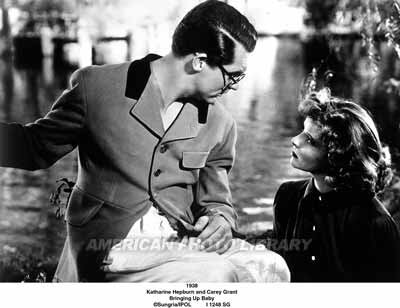
Watched Bringing Up Baby last night.
The cool thing about this was: I own a copy of the movie, of course - but in VHS form. My VCR is on the fritz at the moment, so I rented a copy of it during my afternoon errand-running thingamajiggie yesterday. I didn't even look at it closely - it's bringing up Baby - that was all I needed to know.
But what a treat to find that it was a 2-disc extravaganza, with the amazing Cary Grant documentary called A Class Apart (I've seen it before - it's so in-depth, with some WONDERFUL footage you'll never see anywhere else - home movie stuff, etc.) - but also: there was a commentary track for the movie given by Peter Bogdonavich - who is probably one of the most knowledgeable film historians in this country. He also had been friends with Cary Grant at the end of Grant's life (and had tried desperately to get Grant to be in What's Up Doc, Bogdonavich's tribute to the screwball comedies of the 30s, especially Bringing Up Baby). Bogdonovich had also interviewed Howard Hawks extensively about the movie, so he is basically a wealth of information.
It was AWESOME.
What I loved about it too is that Bogdonavich, even though he has probably seen the movie like 50 times - no, way more than that - he has made studying this movie his life's work - he still burst into laughter at certain moments.
The title to this post was one of those moments. It's a simple moment, and no way could I ever describe WHY it is funny ... it is just that Cary Grant's entire essence is comedic in that movie, without him EVER begging for laughs. He is playing the square absent-minded professor as seriously as can be ... and we all roar with laughter.
There were a lot of cool revelations from Bogdonavich about the movie - one was that Dudley Nichols (the screenwriter) had gotten the idea for his script when he had been the screenwriter for John Ford's Mary of Scotland in 1936, starring Katharine Hepburn.
John Ford was notoriously terrifying to actors (but he was also notoriously generous - it all depended on his mood). He could be brutal. He launched Spencer Tracy's career, pretty much - he was very very good with actors he loved - but NOBODY was immune. He even reduced John Wayne, the most macho man in the world, and one of his greatest collaborators, to tears once. Wayne said, with tears on his face, "That goddamned son of a bitch ..."
So Ford could be brutal.
If you did something that displeased him, he could "put you on ice". Freeze you out, not speak to you for years. If he decided he didn't like you on the first day of shooting, then you were in for a time of HELL.
Hepburn was not afraid of John Ford. She would tease him, tell him to shut up, brush off his terrifying rages with a laugh, she completely bossed him around ... and somehow (probably because he fell in love with her) ... he not only tolerated it but ATE IT UP. He LOVED it. A woman who could stand up to him! Tell him off! And yet do so in such a pretty and comedic way!
The two of them would sit at the lunch table and tease one another mercilessly, while the other actors and crew members cowered in fear.
He even got so frustrated directing one of the scenes that he gave up, in a rage, and said to Hepburn: "You finish it." And she did. She directed one of the scenes in that movie ... John Ford? Major director giving up the reins? Well, he gave up the reins to her.
Dudley Nichols, screenwriter, watched this dynamic and was fascinated by it, drawn in, wondering at the mechanics. How did it work? Why was Hepburn somehow safe from the wrath of Ford? How did she get away with it?
Hepburn was blissfully unaware (or so it seemed) of the effect Ford had on others, and was also unaware of when she was treading on dangerous waters. She forged right ahead. And Ford not only let her ... but he encouraged her. There was something in her that released a warmth and a sincerity in him. A vulnerability. Hepburn, in her typical genius way with men, saw straight to the vulnerability, and didn't let the rages and the glowers fool her. Yet she also didn't emasculate him. But somehow just teased him out of his black moods.
Nichols, in writing Bringing up Baby, used that nugget of truth between Hepburn and Ford to create the dynamic of Dr. David Huxley and Susan Vance. Huxley, of course, was not a man filled with rage, or a macho guy, or even a guy who could deal with his anger. But he certainly was extremely cranky ... and Susan never EVER seemed to notice the crankiness, but just breezed right on with her plans, oblivious, involving him deeper and deeper in her insanity.
There's one scene (it's after he takes the shower and she steals his clothes - and he finds himself dressed up in her brother's ridiculous jodhpurs) and she comes into the room to check on him and dissolves into laughter at the first sight of the absurd outfit on Dr. David Huxley. Huxley says something like, "Well, I couldn't find my other clothes" - but basically, in that Cary Grant clipped-consanant way, he shouts this RIGHT AT HER HEAD. He doesn't "lose it", it's not a temper tantrum - he remains Very. Precise. With. His. Words - but he SHOUTS that line at her head. It's uproarious. And she just bats her eyelashes up at him and tells him how good-looking he looks without his glasses.
It's feckin' FUNNY.
All of this came from Nichols' observing the very specific dynamic between Ford and Hepburn two years before.
Yay!!!
I repeat: YAY! The beat goes on. The train wreck intensifies. My entertainment continues. All is right with the world.
(Also, for all you Eddie Izzard fans out there - I love it that she writes: "Jeezy Creezy". hahahaha)
It's from Izzard's routine when God bitches out his own son. It goes something like (and I am sure Wutzizname can correct me):
God: (annoyed) Jesus CHRIST!
Jesus: Don't take my name in vain, Dad.
God: (adjusting) Well ... Jeezy Creezy ...
Jesus: (exasperated) And don't call me Jeezy Creezy!!
ode to keats
Here's one of the reasons why Garrison Keillor's The Writer's Almanac (a daily radio show on NPR - which has an online version here) is one of my daily pit stops.
First off: you get a poem a day. This is always good.
Second of all: there's a whole bottom section where you get "on this day" information. Some of them are birthdays of famous writers - but others are historical events of significance.
Today's though ...
First of all, the poem for today is a famous extract from John Keats' "Endymion":
A thing of beauty is a joy for ever:
Its loveliness increases, it will never
Pass into nothingness; but still will keep
A bower quiet for us, and a sleep
Full of sweet dreams, and health, and quiet breathing.
Therefore, on every morrow, are we wreathing
A flowery band to bind us to the earth,
Spite of despondence, of the inhuman dearth
Of noble natures, of the gloomy days,
Of all the unhealthy and o'er—darkened ways
Made of our searching; yes, in spite of all
Some shape of beauty moves away the pall
From our dark spirits.
Keats. I always kind of loved Keats - loved his sweeping romantic vision of nature, how breathless he gets about flowers, and pumpkins, and autumn mist ... He seems consistently bowled over by the natural world.
Listen to this AWESOME quote from Robert Graves. I copied it down in my commonplace book when I ran across it in college, because I just loved its insight. I wished I could write my college papers in this vein:
Shelley was a volatile creature of air and fire: he seems never to have noticed what he ate or drank, except sometimes as a matter of vegetarian principle. Keats was earthy, with a sweet tooth and a relish for spices, cream and snuff, and in a letter mentions peppering his own tongue to bring out the delicious coolness of claret. When Shelley in Prometheus Unbound mentions: "The yellow bees in the ivy-bloom", he does not conjure up, as Keats would have done, the taste of the last hot days of the dying English year, with over-ripe blackberries, ditches full of water, and the hedges grey with old man's beard. He is not aware of the veteran bees whirring their frayed wings or sucking rank honey from the dusty yellow blossoms of the ivy.-- Robert Graves
I love that. "Over-ripe blackberries", "peppering his own tongue to bring out the delicious coolness of claret" ... the whole comparison to Shelley is fascinating.
Then there is Lucy Maud Montgomery's words on Keats, wrote down in her diary - it presents another viewpoint:
On the whole, I do not like Keats. His poems are, in reality, too full of beauty. One feels stifled in roses ... There is little in Keats' poems except luscious beauty -- so much of it that the reader is surfeited.
(Funny: there are passages in some of LM Montgomery's books - passages so full of the beauty of the natural world - that I, too, feel surfeited. As a naturalist, an observer and lover of nature, Montgomery has few equals.)
Rudyard Kipling had this to say about Keats and Coleridge, the two poets he revered above all others:
These are the pure Magic. These are the clear vision. The rest is only poetry.
Then, of course, there is Keats' own epitaph - which he wrote himself:
This Grave
contains all that was Mortal
of a
Young English Poet
Who
on his Death Bed
in the Bitterness of his Heart
at the Malicious Power of his Enemies
Desired
these words to be engraved on his Tomb Stone
"Here lies One Whose Name was writ in Water."
Holy shite!!! Wow.
Anyway, back to Garrison Keillor's radio program. Along with historical 'today in history' factoids, we get such gems as this one today:
And today is the anniversary of the end of one of the last truly happy periods of John Keats's life. It was on this day in 1818, Keats finished a long walking tour through England. John Keats was 23 years old. He'd planned to become a surgeon, but he realized his real vocation was poetry, and in the spring of 1818, he published his first major long poem Endymion. And then he set out on a hike through the countryside with his friend Charles Brown. Wordsworth was one of Keats's favorite poets, and he knew that Wordsworth had been inspired by walking around England, so Keats decided to do the same that summer.Keats was a London boy. He had never seen the mountains. He had never seen a waterfall. He wrote letters back to his brother about the wonderful things that he saw, but gradually on his hike he realized he was no Wordsworth, that he did not want to write about scenery. He hated descriptions. He was more interested in the people whom he saw along the way. He was fascinated by the peasants who walked barefoot on the roads, carrying their shoes and stockings so they would look nice when they got to town. He saw an old woman being carried along the road in a kind of a cage like a dog kennel, smoking a pipe.
He came back to London and learned that the reviews of his last book of poetry, Endymion, were coming in and critics had written ferocious attacks on him. He was crushed. And his brother had come down with a serious case of tuberculosis. His brother died in December, and by the end of that year, John Keats had contracted tuberculosis himself. He would die three years later, in 1821. It was in those last three years of his life that he wrote most of his greatest poems.
My favorite John Keats poem is his "Ode to Autumn". I put it down here as a kind of invocation. Because the summer is brutal, I cannot stand it, and I yearn for the autumn when I can feel human again and alive. COME, autumn, COME!!
But still: Keats' words taste good in my mouth. They are delicious. His imagery is perfect, emotional, and just plain old beautiful. "A thing of beauty is a joy for ever", indeed.
ODE TO AUTUMN
SEASON of mists and mellow fruitfulness,
Close bosom-friend of the maturing sun;
Conspiring with him how to load and bless
With fruit the vines that round the thatch-eaves run;
To bend with apples the moss'd cottage-trees,
And fill all fruit with ripeness to the core;
To swell the gourd, and plump the hazel shells
With a sweet kernel; to set budding more,
And still more, later flowers for the bees,
Until they think warm days will never cease;
For Summer has o'erbrimm'd their clammy cells.
Who hath not seen thee oft amid thy store?
Sometimes whoever seeks abroad may find
Thee sitting careless on a granary floor,
Thy hair soft-lifted by the winnowing wind;
Or on a half-reap'd furrow sound asleep,
Drowsed with the fume of poppies, while thy hook
Spares the next swath and all its twinèd flowers:
And sometimes like a gleaner thou dost keep
Steady thy laden head across a brook;
Or by a cyder-press, with patient look,
Thou watchest the last oozings, hours by hours.
Where are the songs of Spring? Ay, where are they?
Think not of them, thou hast thy music too,—
While barrèd clouds bloom the soft-dying day
And touch the stubble-plains with rosy hue;
Then in a wailful choir the small gnats mourn
Among the river-sallows, borne aloft
Or sinking as the light wind lives or dies;
And full-grown lambs loud bleat from hilly bourn;
Hedge-crickets sing; and now with treble soft
The redbreast whistles from a garden-croft;
And gathering swallows twitter in the skies.
August 5, 2005
Room with a view ... with a long introductory post about my morning, the heat, and my sense of defeat, in general
I was so upset reading Children of the Arbat this morning that it's put me in a melancholic mood all day. I'm having a bad day.
At around 7 a.m., after reading for a couple hours (and it was already so hot that I was drenched in sweat, which puts me in a foul mood) - I had to put the book down. It was too much. I can't wait to get back to it, but I had to take a break. I felt haunted.
So I bustled around my apartment, dusting (no, not singing at the top of my lungs. It was too early. Although I was buck naked. No, just kidding), and washing dishes, and making another pot of coffee, and writing To Do lists, and trying to get organized. I haven't been doing very well lately, truth be told. I am hoping that keeping lists will help.
ANYWAY. Then I took a shower. I emerged at 8:00 am. And immediately, again, became drenched in sweat. I also got my period. The Children of the Arbat was still working its way through me, so honestly, I felt on the verge of tears. Babyish? Sure. Couldn't hold it back though. Hormones. Also: I've genuinely been on the edge for about 4 days now. Afraid to cry, actually.
Walked out of my apartment into a BLAZING hot morning. The sun still low in the sky. The heat unbearable.
What enrages me about my own sweat-habits is that I do not sweat in the pits. Or - I DO, of course I do - but that's not where it mainly happens for me. Would that it were. I get sweaty IN MY FACE. Literally. I feel like Albert Brooks in Broadcast News during his catastrophic broadcast. Sweat running off my face, my hair as wet as if I had been swimming the Hudson ... it POURS off of my face.
I can't wear makeup on hot days. It's pointless. I am a slave to my sweaty mug.
Anyway. I hate the summer. I yearn for fall.
I got onto my wee air-conditioned ghetto bus into the city (have I ever told about those busses??) ... and struggled with this feeling of hopelessness I had. I don't know where it came from. A combination of things. Menstruation. Children of the Arbat. Blazing heat. The fact that I was so sweaty I felt EMBARRASSED. If only I just sweat in my arm pits like a civilized human being ... I literally needed a towel to wipe my face off.
I opened Room with a View and began to read.
I have been LOVING reading this book again. I had forgotten the funniness of it. Every page is a delight.
And then there are passages that are just ... sheer perfection, as far as I'm concerned. Forster had such HEART when he wrote.
This is from the part in the book when Lucy runs into the rampaging skinny dipping men by accident. One of the men happens to be George Emerson, the guy she had the kissing encounter with in Florence. A man she is not engaged to, and barely even likes (so she thinks). But ... but ... she kissed him. And now she is engaged to someone (the wonderfully awful Cecil) ... and George and his father have suddenly rented a cottage in her vicinity ... and ... oh no ... now she must run into him all the time ... what will that mean ... what will happen ...
You know ... all that delicious stuff.
Lucy faced the situation bravely, though, like most of us, she only faced the situation that encompassed her. She never gazed inwards. If at times strtange images rose from the depths, she put them down to nerves. When Cecil brought the Emersons to Summer Street, it had upset her nerves. Charlotte would burnish up past foolishness, and this might upset her nerves. She was nervous at night. When she talked to George -- they met again almost immediately at the Rectory -- his voice moved her deeply, and she wished to remain near him. How dreadful if she really wished to remain near him! Of course, the wish was due to nerves, which love to play such perverse tricks upon us. Once she had suffered from "things that came out of nothing and meant she didn't know what." Now Cecil had explained psychology to her one wet afternoon, and all the troubles of youth in an unknown world could be dismissed.It is obvious enough for the reader to conclude, "She loves young Emerson." A reader in Lucy's place would not find it obvious. Life is easy to chronicle, but bewildering to practice, and we welcome "nerves" or any other shibboleth that will cloak our personal desire. She loved Cecil; George made her nervous; will the reader explain to her that the phrases should have been reversed?
But the external situation -- she will face that bravely.
I don't know how to say it, but I just find that so FUN to read.
Things to look for ...
... in this post. (Just keep scrolling.)
1. More pictures of Tara Reid drunk with Paris Hilton. Now that has cheered me up immediately. Go Tara! Keep on partyin'! For my sake!
2. Pictures of Sean Astin in a speedo. Incomprehensible.
The Russian Ark
I'm reading Children of the Arbat right now. I can't speak about it yet. Just going to have to (in true Sheila fashion) post a billion excerpts to show my interest in it. It's about Stalin. That man appears in my nightmares.
This morning I read a couple of chapters that made me dizzyingly sad. Like, I sat in my chair (the sun hadn't even come up yet) - and I had to put the book down for a while.
It made me flash on the movie The Russian Ark for a moment - which I saw a couple years ago. I blogged about it then so I had to go back and dig up that old post to see my thoughts about it. I find the post incredibly sad.
For those of you who have not heard about this film, it was filmed entirely in the hermitage in St. Petersburg, and it is a panoramic look at Russian history ... (a big deal for the nation, whose leaders so often want to erase the past). But the most fascinating thing about this movie is:
The entire 90 minutes of it is ONE TAKE.
People drool with praise over Martin Scorsese's 15 minute takes, or Robert Altman's unbelievably long take at the beginning of "The Player" -- and don't get me wrong ... they are masterful. It's so fun to try to imagine how they pulled it off. But "The Russian Ark", moving through the different rooms of the Hermitage is one long uninterrupted take. I was very very excited to see it, to see how it flowed, and also: to imagine HOW did they pull it off???
(Here's an awesome website dedicated to the film. Here's the page with pictures of the day of shooting.)
The film meanders at times ... but that's all right ... it's part of the whole experience. Sometimes history meanders. Sometimes you can't see things clearly. Sometimes you are peeking through a tiny window into a dark space, and sometimes you are in a sweeping ballroom.
I heard people scoffing at the "gimmick" of it, and I just have to roll my eyes.
YES. It is a "gimmick". But ... is it any less interesting because it is a "gimmick"? Does it feel GOOD to put yourself so above everything? To be so "over" everything? Does it give you pleasure to take a "been there done that" attitude towards everything? Well, knock yourself out, but I prefer to be enthusiastic, curious, and capable of being touched by things. And yeah. I feel like my way is the better way.
The Children of the Arbat put me on the edge today.
Here's my old post which describes the "gimmick" (grrrrrrrr) of The Russian Ark. In a strange way, it's one of the saddest movies I've ever seen. But ... why? I think it's from the one flashing look that crosses the man's face at the end of the movie, when he chooses to stay at the ball, and not move on (to the next stage of Russian history). It's a horrible look. Horrible.
The Russian Ark
There was a narrator - who was just a voice throughout, asking questions, and it was set up that we, the audience, assume that the voice belongs to the man who is holding the camera. Of course he isn't - because the camera-work is not hand-held or shaky - it is a long slow inevitable roll ... but all along our journey through the Hermitage, we hear the soft voice of the narrator - asking questions, saying, "Oh, look over there", etc. Very benign voice. The narrator is a tourist through Russian history.
The narrator has a companion who acts as a kind of guide - He was sort of jolly, and vague, with a shock of white hair. He doesn't say much, but just strolls thru the whole movie, taking us in and out of scenes, telling us where to look ... He was our Homeric guide. Kind of a jester-type, with a flowing funny black coat, and his messy white hair. A friendly weather-worn face, and twinkley eyes.
Just to make clear what an accomplishment this film is: there are over 3,000 people who appear in it. Over 3,000 people had to be organized in the Hermitage, throughout all the different rooms, waiting for their turn ... It just takes one's breath away. The camera moves from room to room in the St. Petersburg hermitage -- strolling through different scenes of Russian history ... Not a lot of dialogue. Sometimes you just get glimpses, or hear snippets of a conversation ... It's not a literal film. We don't really 'get into it' with any one of the specific characters. The camera doesn't dwell. It scans the landscape ... we see this, we see that, we move on ... At times the camera follows people down teeny dark spiral staircases... then a character will open a door into a massive art gallery, or a spectacular ballroom, and suddenly you see thousands of people from czarist Russia all doing the mazurka ...
Because the entire film is done in one take, then that means that those thousands of people have been waiting in that room, in costume, on hold - waiting for the rest of the movie to take place, so that then they can come to life - whenever the doors open.
The camera, on its way through the building, will peek through windows, into a dark interior room, 5 or so people inside, something intense happening. We spy on them for a couple of minutes, and then we move on.
All the time with uninterrupted takes.
I am in awe. Martin Scorsese, famously in "Good Fellas", did that entire scene at the nightclub in one uninterrupted take: Ray Liotta entering through the back, strolling through a hallway, entering the kitchen ... As an actor, I am in love with the thought of LIFE going on whether or not the camera is pointed at you. That is one of the marks of great film acting: if you get a palpable sensation that you are only watching a sliver of life. Think of the great film performances. I'm thinking of Travis Bickle right now, but that's just an example. That 2-hour long movie was just a snippet of the stories that could be told about this man. If only you could peek outside the frames, if only you could stay in this room for one second longer ... you'd see all kinds of amazing things.
"The Russian Ark" felt like a dream, one of those dreams where doors keep opening, or you are walking through a house that you thought was familiar to you, but suddenly you discover another wing, another room.
I want to know how the HELL they filmed this movie. I want the coffee table book. Were there Production Assistants running ahead to the people in the next room, informing them: "Okay, the camera is on its way ...Take your positions please!" Were walkie talkies involved? How did they do it?? And what was it like for the many many many people in the last scene ... who had to wait over an hour for the camera to arrive? The last scene was a ball, with a full orchestra playing... czars and czarinas and nobility, in incredible costumes, dancing, and laughing and talking ... There were probably 800 people people in that scene alone.
There were times when my experience, as an audience member, was primarily about; "How the HELL did they do this??" I couldn't get over it. But then there were times that I completely forgot about the one-take, and got wrapped up in the events on the screen.
It certainly helped that I know a bit of Russian history, but it's not necessary to have that in order to get into the film. The film does a pretty good job of letting you know who is who. Oh, there's Catherine the Great, etc. However, if you do have a bit of context, then you will have eerie moments of recognition. Encountering characters who you feel you know, as if these historical people were personal friends (or enemies, as the case may be). (Here is the cast of characters.)
At one point, the camera enters this long spectacular green-walled hallway. In the hallway there are 4 vivacious young girls, so beautiful in a child-like way that you want to cry. They all have long ringlets, with flowers woven into their hair, they are wearing diaphonous dresses, and ballet slippers. They are heart-achingly beautiful, and they are in a riotous mood, running as quickly as they can down the endless hallway, batting themselves back and forth, from wall to wall, laughing hysterically, their hair streaming behind them. They look like mermaids, especially in that underwater-light of green. And nothing was said at first ... you just see the scene unfold. Everything bathed in a greenish light because of the walls, and there were four rambunctious young fairies catapulting riotously down the hallway. And I knew who they were as well as if they were from my own family. I knew immediately, the second I saw them. My heart tugged up out of my chest at the sight of them, their youth, their beauty, their innocence ...They have no idea how horrible their end will be. And then a nurse-maid, or a nun, in another room, says, "Anastasia, what are you doing?" or something like that. That name ... again, in the context of this film, this non-literal film ... comes across as an incantation of some kind. Or a symbol. Even just being able to speak that name is an important political act. Healing, maybe. I don't know. That was one of the things I felt when I heard her name come floating out of the next room ...
The movie works on another level, what I would call a subterranean level.
Ted and I were so stirred up by the whole thing that we had to go out afterwards and drink wine and talk like maniacs.
The Russians are trying to reclaim their long history, after decades of totalitarian silence. They are building an Ark. So the question is: What should go in the Ark? What will survive? What should survive? What already HAS survived? History did not begin in 1917. NOTHING has been wiped out.
That is why I believe this is a great and an important film, and the whole rolling-eyes "Oh, yeah, the one-take gimmick" crowd have missed the point. This is a film of reclamation for an entire country.
I kept waiting for Stalin to appear. But he did not. It seemed deliberate.
So I guess he does not get to go on the Ark.
This was fascinating to me. And also tragic, in a piercing way. Why tragic? Well, here's how I took it: He wasn't in the film at all, nobody spoke his name, he is unmentionable, and yet, for me, he hovered over the whole thing. All of these ancient events, the camera moving inexorably from room to room... I thought every time a door opened, he would be standing there. Like a Demon of Death, the guy waiting at the end of the corridor. The End of History. The four little green-lit fairy girls, running and laughing ... Somehow, in my subterranean experience, I thought they would go careening around a corner and bump into him, with the twinkley eyes, the big mustache, the solid head ... Terrifying.
But no. He was noticeably absent, and this - to me - was the saddest of all. Because of the terror he wrought. Because of the damage he did. In the context of the film, it seems to me that the wounds are still too raw. Or maybe there's something else going on. That the Russian people (the people this film is really FOR) need to see him as somehow outside of their history (he was from Georgia, after all), he has nothing to do with them, he was not one of them at all.
I can't explain why it made me so so sad, but it did. I almost WANTED to see him ... just so I could deal with my anger, so I could have a catharsis of rage towards that man ... that man subliminally waiting at the end of every Russian corridor, that man just around the corner ... I wanted to see his face. So that I could ... what ... hiss? Boo? All I know is I hungered to see him. I needed a focus to put my hatred.
But he never showed up. Why am I crying? The movie was all about healing. And reclamation of history. But he is still too big to "claim". It can't be healed. What he did.
The last scene of the film is the czarist ball, with the full orchestra, all of these people having the time of their lives. The scene went on and on and on, and was absolutely delicious. The camera swooped around the dancers, entering the dance floor, following the couples dancing, moving along the spectators, then sweeping up to get an overview of the orchestra ... The scene had no beginning, middle, or end. It was just life. That's all. Life captured on celluloid.
It was life in St. Petersburg right before the Revolution. Because the film was in one take, you could feel that the experience was coming to an end ... there was an internal time-clock to the whole thing ... and, like I said, I kept having this expectation that there had to be one scene after the ball - at least one scene. The ball would end, all the rich people with their jewels and silks and laughing faces would scurry away into the corridors, into the darkness ... and then we would see ... what? Lenin? Trotsky? Bolsheviks tramping their muddy boots through the marbled halls, ripping stuff off the walls? I didn't know ... but I expected that very soon the ball would end, and we would then be full on in 'what came after'. "What came after" hung over the scene of the ball like a polluted cloud.
But my expectation was not to be ... the ball-scene went on and on and on ... I didn't time it, but it was very long, and the very length of it became a quiet agony to me.
I could sense we were nearing the end of the journey. And everyone kept laughing, and talking, and living their lives ... while revolution was stirring unseen outside. I got an intense sensation of watching a world which was just about to die. And the people in the scene, the hundreds and hundreds of them, had no idea how close the end was. I wanted to jump into the movie screen and send warnings, tell them all to get out, run while they still had the chance ...
The orchestra finishes the song, and the crowd gives an extended ovation. The clapping and cheering goes on and on and on. There were smiles on every face. The conductor (a famous conductor in real life) continued to bow, gracious, smiling. It seemed that the masses would never stop applauding.
A happy scene, yes? But as it kept going, as they kept clapping, suddenly, out of nowhere, I got this massive lump in my throat. I suddenly wanted to cry. It was more of a physical response, than a purely emotional one. it literally felt like my heart rose up into my throat. And I didn't know why ... but of course, on some level, I did know why.
In the middle of the scene, the "guide" (guy with flowing black coat and messy white hair) suddenly turned and looked directly at the camera. No words. It was just a look. Behind him swooped the laughing dancing bejewlled crowds. And the look on his face - it was piercing, it pierced my heart - all the sadness of the ages was in his face. It was so incongrous, in that glamorous setting. The narrator, still unseen, suddenly says, in a confused voice, "I'm sad."
The narrator says then: "So where to now? Should we move forward?" (He means forward in time.)
A look flashes across the companion's face again. What was the look? I would say: I saw fear. And grief. Or maybe it was just terror I saw, and since I know the end of the story projected grief onto his face. I have no idea. I think what it really was - was terror. Of going "forward". And all he said was: "Forward?" He didn't want to move forward. We all know what happened next.
And the companion does not want to go. "I don't want to go forward. I think I will stay here."
But the sadness I saw ... "sadness" is a tepid word to describe what I saw on that man's face.
I am not Russian. I do not have the Russian history behind me as a cultural memory. Their memories, as a people, are not mine. But that doesn't matter.
In that moment, that moment of terror and grief on his face, I "got" what has happened to Russia. I felt it. As opposed to just understanding it from books.
I can't get that man's expression out of my mind.
August 4, 2005
Drama camp ... oh, the memories ...
Yes. I went to a drama camp. Well ... it was called Music Camp.
Because of this - I have become a little bit addicted to Worship Naked (it's a blog)
Mainly because I read this post . Tracey is the director of a Drama Camp. In that post, she describes the stereotypes who abound at such camps.
Genius.
there’s always the Bratty Boy; the boy that says, “Ewww. There are no boys at this camp, only girls. Ewwww. I don’t wanna do this. Ewwww. This sucks.” So where is Bratty Boy now? Oh, he’s lying down over there in another corner. Guess he’s just plumb tuckered out from all that participatin’ he’s doin’. Or he’s drunk. Frankly, I’d rather he lie there than bother the rest of camp.
Etc.
Sounds, too, like she has a little Keith M. at her camp:
But then, ah, then, there’s always The Boy Who’s My Hero, the one who is sure enough about his emerging masculinity that he can go to football camp or baseball camp or basketball camp and STILL come to drama camp. And where is this boy, you ask? Well, he’s the one onstage right now, fearlessly leading the charge before all the other boys and getting up to audition, opinions be damned.
As a matter of fact, all of her Drama Club posts are classic.
More:
and also this one, humorosly titled: "I might start drinking" - in which Tracey confesses that she has, in a matter of a week, become the "Simon Cowell of kiddie drama". heh heh heh
Bets - I posted these for you. Although we all went to Music Camp as children, you are the only one who is RUNNING Music Camp now. :)
Summer reading ...
... of the stars.
I found this very enjoyable reading. What are "stars" reading this summer? Looks like pretty much everybody is reading Harry Potter (except Harold Bloom who is spending the summer re-reading the god-awful canon of the god-awful Henry James).
I love the stream-of-conscious way people answer.
Here's a good one:
Isaac Mizrahi, fashion designer I just finished Them, which is Francine Du Plessix Gray’s book about her monster parents, which is so entertaining. I’m swamped with books about Arthurian legend, because I’m designing an opera of Purcell’s, the King Arthur which is at English National Opera next spring. I’ve been reading really boring books like The Grail: A Casebook, edited by Dhira Mahoney, and Arthurian Legend for Dummies and all kinds of delicious stuff. I just read The Innocents Abroad by Mark Twain, and it made me want to go away really badly. I got the new Harry Potter, which I’ll devour next week, and then I feel like I have to get into this Edgar Allan Poe that a friend of mine loaned me called Tales of Mystery and Imagination. I forced the new Murakami (Kafka on the Shore, which I adored beyond words) on her and she loved it, so I feel obliged to read her pick. Also, I really love Poe. In snippets, I’m rereading The Comedy of Errors, the Shakespeare play, because I was talking about it with a group of friends, making a point about it, when I was embarrassed to find I couldn’t remember the storyline. Lovely to be making a heated point about something you’ve completely forgotten.
Michael Musto's is very funny:
Michael Musto, writer, gossip columnist When Blanche Met Brando: The Scandalous Story of “A Streetcar Named Desire” by Sam Staggs. I’m loving it—maybe because I’m a total gay stereotype. It’s a quick read and easy to absorb. You don’t even have to buy it; you can just stand there reading it in the bookstore.
Also, just check out the titles on this one (pun intended):
Heather Hunter, porn star, rapper Emotional Blackmail: When the People in Your Life Use Fear, Obligation, and Guilt to Manipulate You by Susan Forward and Sacred Contracts: Awakening Your Divine Potential by Caroline Myss, and XXX: 30 Porn-Star Portraits by Timothy Greenfield-Sanders.
That first book's title, combined with her chosen profession, just makes me shake with laughter. It's so revealing of whatever drama she must be going through right now. hahahahaha You go, Heather. Do not let the people in your life use fear, obligation, and guilt to manipulate you!!
However, the creme de la creme has GOT to be Tom Wolfe's answer. I don't know - I just love it. His answer keeps getting funnier and funnier as it goes along:
Tom Wolfe, writer, I Am Charlotte Simmons Maggie: A Girl of the Streets by Stephen Crane. If Stephen Crane hadn’t died at the age of 29, he would have been remembered as a giant. I’m literally rummaging around my desk to see what exciting things I have here …. The Abs Diet by David Zinczenko. Here’s the thing: I never really had sharply defined abs, even when I was an athlete. I always wanted them to look like a cobblestone street. That was before six-packs; they didn’t have six-packs, but they did have cobblestone streets. My wife said, “You have cobblestone streets, but they’ve been paved over.” Here’s a real barn-burner: Religion and the Decline of Magic by Keith Thomas. This has to do with what I hope to write: a history of the last 1,000 years of the world in 98 pages. It was going to be 100 pages, but 98 sounds so much shorter, don’t you think? No one is interested in this book but me. There’s a book called Status Anxiety; the fellow has kind of a French name. [Alain de Botton.] That’s another thing I want to write— a book about status …. And Hemmings Motor News, which is a thick periodical—this one I’m looking at is 672 pages. It’s full of ways to either fix up old cars or do things with new cars …. This is all part of my desire and attempt to, as they now say, pimp my ride. I have a Cadillac DeVille, which people think of as a stodgy old-people’s car, but I have the intention to show people that this is a sensational old-people’s car once I pimp it.
Tom Wolfe expounding on his abs. Too funny.
Go read all of them though. It's a lot of fun.
Dad - take note of the Proust answer!! Something about getting "bogged down" somewhere in the middle ...
And Neal Pollock's answer reminds me that I absolutely have to read We Need to Talk About Kevin.
What have I read this summer, you ask? And what am I still reading?
Okay, let's see:
Adams Vs. Jefferson: The Tumultuous Election of 1800 by John Ferling.
Re-read Reflections on the Revolution in France, by Edmund Burke.
The Teammates by David Halberstam
A People Adrift : The Crisis of the Roman Catholic Church in America,by Peter Steinfels
(God ... I can already tell I need to lighten up a bit. Oh well. This kind of reading is very relaxing for me. What can i say. Onward:)
Lost Summer by Bill Reynolds (story of 1967 red sox season)
Cary Grant, by Marc Eliot (the latest biography of my favorite actor ever.) In a way, though ... I think I know all I need to know about Mr. Grant. There's a reason why he led such a private life - despite the fact that he was in the public eye all the time. I am far more into him as an ACTOR and his process as an ACTOR rather than his marriages, etc. But still: very interesting.
Faithful by Stewart O'Nan and Stephen King (the story of the 2004 Red Sox season, told in a series of diary entries and emails back and forth)
Now I'm reading:
A room with a view, by Forster. I've read it before - but I picked it up again. It made me laugh out loud this morning on the bus.
The Children of the Arbat: A Novel - by Anatoli Naumovich Rybakov - a previously suppressed Russian book about life in Moscow at the time of Stalin - in the mid to late 1930s. A chilling book - I've read 16 chapters so far. I will definitely be posting some juicy excerpts.
Life is a Banquet - Rosalind Russell's autobiography. SO wonderful!!
August 3, 2005
Here's my impression ...
of being on a tour at Newgrange. (LOOK AT THAT THING.) You have to imagine the thick Irish brogues to really get the effect.

American accent: "So ... what do all these spirals signify?"


Irish accent: "Well, we don't really know. But aren't they lovely?"
American accent: "And what exactly happened in these recesses? Were they burial tombs, or ..."
Irish accent: "Well, actually, nobody knows, love."
American accent: "These standing stones are amazing. Why did they place them like that?"
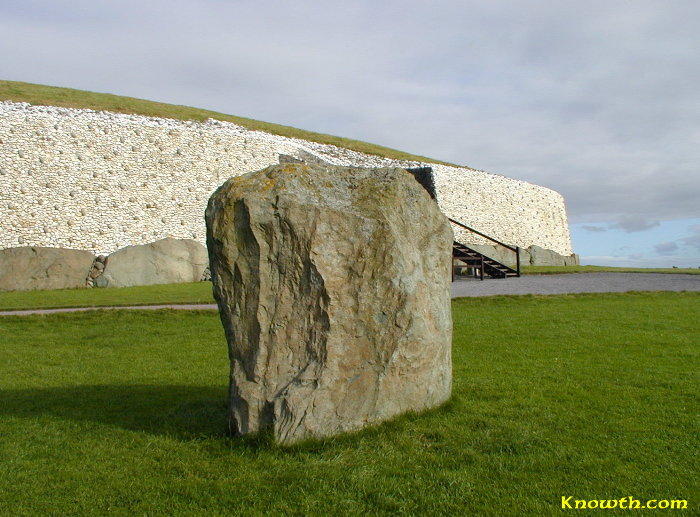
Irish accent: "Well, we don't really know."
Literally. The tour went on like that for 45 minutes. It was positively charming. I loved every second of it. Basically the theme was: Nobody knows what the FECK went on here, but isn't it lovely?
One of the most amazing places I've ever been. I highly recommend it to you all. Here are 101 facts about New grange. I guess there are some things that "we know".
I have a couple of wee goals in life - not really personal achievement goals - but things I would like to see, and one of them is I would love to be there at Newgrange (with all the crowds) on the winter solstice - to see the sun illuminate the inner tomb. What happens is - on the winter solstice - you can buy a ticket to hang out either around New grange - or within the inner tomb (I think the waiting list is years long) - and at sunrise (which, in Ireland, is an iffy prospect - it's usually rainy during winter solstice) the sun enters the main door, crawls up the passageway, and FLOODS the inner tomb with light. They recreate it during the tour (where the ongoing theme is "Well, nobody really knows, love") - and I swear to God, you feel your heart beat either quicken or slow to a turtle's pace when that light pours itself into the pitch black.
The fact that "nobody knows" is what makes the place so special, so magical.
An ancient and important site.
You know what I felt at Newgrange, standing in the pitch black with my sisters, in that ancient tomb, with the spiral rock carvings above and below us, waiting for the light to crawl up the slanting passage? I felt: Man. It is awesome to be a member of the human race. Humans are absolutely beyond belief. I am really PROUD of us. Even though we can't know what exactly drove those ancient people to create such a structure - we can marvel at their knowledge, their spirit, their drive. They are in an unending continuum with this event. It's the same impetus. They knew to build the inner passageway at just the right slant upwards - so that the sun could crawl upwards and flood the inner passageway and inner "tomb" (or whatever it was) for the maximum amount of time. When you duck down under the entrance stone, and enter the darkness - you feel the path go on a steep incline. You are inside the earth, walking UP. How did they know? Well, they just did. And I am just proud of the human race for all of that. What a mystery we are. What a neverending and curious mystery.
American accent: "And ... sorry ... I know we've covered this ... but what was going on with those spirals??"
Irish accent, "Oh, love, nobody really knows."
"Private" thought: If I ever get another tattoo, it'll be of Newgrange spirals.
Go, Hetfield!!
Beth has a great post up right now about one of my favorite rock star bad-asses of all time: James Hetfield of Metallica. I ate up every word of her post.
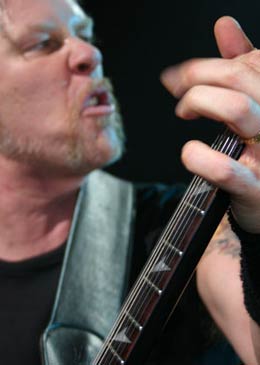
I kind of never "get over" Metallica, and I've been listening to them for years. Beth says that Nine Inch Nails is her other "favorite" - and for me, it would be Nirvana. If we have to call favorites. Like: no matter how many times I hear "Rape Me" by Nirvana, i still feel the hairs on the back of my neck rise up. I never "get over" it. Metallica is the same way. I also love how Beth brings up the great GREAT double album they did called S & M - which is a live concert recording they did with the San Francisco Symphony. It is truly an inspirational and exciting album. Metallica with a full orchestra jamming out? Classical musicians jamming out with JAMES HETFIELD? I love love love that.
Here are Beth's eloquent words on Hetfield himself, but I highly recommend you go read her whole post:
He has a distinctive style, biting off the ends of his words so viciously as to add syllables - "But the devil-uh take that woman-ah, yeah, for you know she tricked-uh me easy-ahh..." And his voice is a blue-steel baritone, smooth and cold and purposeful. No hoarseness and an even, highly masculine tone. His speaking voice, too, is that of a man's man - a growl slightly tinged with Southern accent and the same pitch as his singing voice, not too low or too high.That vocal consistency hints at what truly makes James Hetfield transcendent - unlike so many rock stars, his persona onstage is not much of stretch from his personality off it. This is in contrast to a surprising number of his fellow frontmen - Marilyn Manson sounds like a dysfunctional librarian when not performing; Trent Reznor is a bashful, softspoken loner (in stark contrast to the shrieking nutcase he becomes onstage); even Alice Cooper and Gene Simmons seem more like corporate marketers or used car salesmen when out of stage drag.
James Hetfield, meanwhile, is every bit as intimidating in all the interview or behind-the-scenes footage I've seen as he seems behind his signature flying-V guitar and the microphone. It's one thing to look like a demon next to blaring amplifiers and surrounded by blazing heavy-metal pyrotechnics; it's quite another to look in the most casual Mtv segment like someone you don't want to cross, ever.
Let us just pause a moment and revel in the perfection of this phrase: "Marilyn Manson sounds like a dysfunctional librarian when not performing"
hahaha
Anyone out there see Some Kind of Monster? FASCINATING movie. I blithered about it here and here. What really struck me was Hetfield's emotionalism - his fear of the band breaking up - which was really just a fear of rejection, of being abandoned - how really he was like a little kid, being afraid that he wouldn't get picked for kickball. And if you think that's a condescending remark, then you obviously do not remember school recesses - when everything was SO important, and being picked for teams was a moment of stark emotionalism, when your entire social status - whether or not you are LIKED and ACCEPTED - was revealed to all. Hetfield had that kind of childlike emotion underneath his bad-ass self. (Think about the persona of Enter Sandman, one of their biggest hits. A small child afraid of the dark, praying "If I should die before I wake ..." All alone. And yet ... it's feckin' James HETFIELD singing - a scary-lookin' Alan Embree-esque - yet hotter - dude. That's his dichotomy - that's the demon he deals with.)
I think his intimidating stance is not a pose. Or a "look at me, I'm a badass." To me, it seems to come from an inability to lie. He is unable to not show his emotions. If he's bored in an interview, he shows it. If he is annoyed by a question, he shows it. He does not suffer fools gladly. Don't waste his time.
Thanks Beth, for a great post about one of my favorite rock stars ever!
[Uhm ... is mine the only blog in town that can go from James Joyce to James Hetfield in a nano-second? Should I care? Or should I repeat to myself like a mantra:"A foolish consistency is the hobgoblin of little minds "?]
I love this!!
(By the way, what am I doing? I am poring through the digital online gallery of a rare book library looking their James Joyce collection. Of course I am.)
This one is phenomenal - I gasped out loud when I came across it.
It is a page from Thornton Wilder's copy of Finnegans Wake - obviously, he went a bit nuts with the taking notes thing. But you know what? My copy looks the same way. Of course I am not famous, and so my copy is not in a collection at a rare book library - but I looked at all of his notes (definitions, scribbled thoughts - one every other word!) and felt a kinship with Thornton Wilder. I felt: So you had the same experience reading that book as I did, huh??
You cannot be passive and read James Joyce. It's got to be interactive.
For some reason, looking at Thornton Wilder's notes make me want to cry.
I've been crying all day, truth be told. What's one more tear.

James and Nora
All I can say to this one is: woah.
James and Nora Joyce. Look at his smoking jacket thing. And the eye patch. And her expression!!
Nora was always insulted when everyone assumed that she must be Molly Bloom. She scoffed, "Molly was much fatter."
Love Nora. I want to have a copy of this photograph on my wall. Next to my photograph of John Cassavetes and Gena Rowlands, another couple I admire.
And I think Nora might have the final word on her husband, "Sure, he's a genius, but he's got such a dirty mind, hasn't he?"

The Joyce family
I know this photograph - it's rather famous, if you're a Joyce freak. I love it. It's Joyce and his wife Nora, and their two children - Lucia and Giorgio. Lucia already looks a little mad, doesn't she?
With the carafes of white wine on the table that Joyce so loved.
This photo reminds me of that AWESOME quote from Ernest Hemingway (who loved Joyce - was jealous of his talent - but loved him.)
After the publication of Ulysses, Hemingway wrote a letter to Sherwood Anderson and said:
"Joyce has a most goddamn wonderful book. It'll probably reach you in time. Meantime the report is that he and all his family are starving but you can find the whole celtic crew of them every night in Michaud's where Binney and I can only afford to go about once a week...The damned Irish, they have to moan about something or other."
hahahahaha
And there they are! In that photo! I think they did eat out in restaurants for almost every meal. And, like the Irish still do today - they brought their children everywhere.
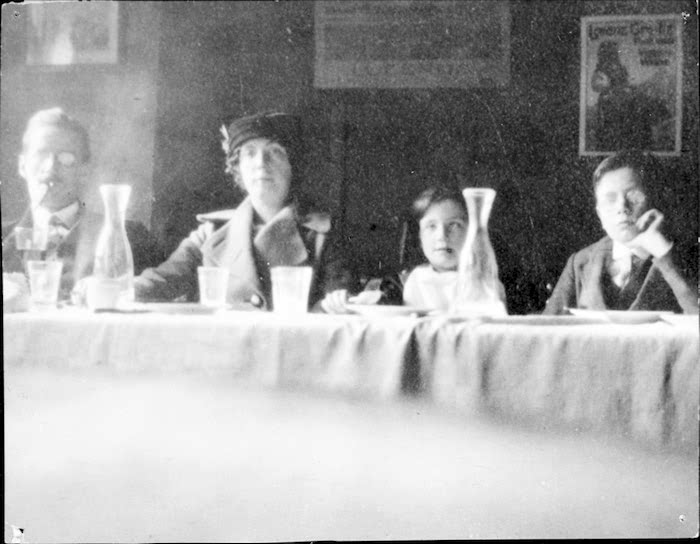
This is even better.
I have tears in my eyes.
The last paragraph of The Dead - the handwritten manuscript of the story, the greatest short story ever written (I've said it before and I'll say it again: don't argue with me on this point. You can disagree but do not do it on my blog! haha) The English language doesn't get any better. To see it in its raw form, though ... before the whole world had heard it ...
Tears.

Man
This is awesome. Check it out in the extended entry. Handwritten manuscript title page of The Dead.
I found it here - the digital images gallery from the Beinecke Rare Books & Manuscript Library at Yale. I just typed in James Joyce and came up with a massive archive.
Will spend some time digging - let you know what else I find.
Affair to Remember - 2
I have the best library in the world. Look what I just dug up. This is from Richard Schickel's wonderful book of analysis of Cary Grant
For Leo McCarey's remake of one of his pre-war hits, Love Affair, about a shipboard romance that takes a near tragic turn, but ends in soppy redemption was an emotionally reprehensible film. In its first sequence, we meet Grant as Nickie Ferrante, international playboy, internationally recognized as such, strolling toward the first dinner sitting of an Atlantic crossing. As he eases along the passageways in his perfect dinner jacket people stop and stare and do double takes -- as any of us might do if we encountered not Nickie Ferrante, but Cary Grant in all his casual glamour. He is almost languid in his self-assurance. And his self-amusement. He knows the stir he's causing. What star does not? But he's enjoying it. This is quite different from the way Charles Boyer played the same sequence in the earlier film. We are also, curiously, in the realm of autobiography here; Grant had met two of the women he married -- Betsy Drake, as well as Barbara Hutton -- aboard ship, though in his recollection he was very shy when he was introduced to Drake. More importantly we are out of the realm of acting here, and into the realm of personal appearances. And McCarey is aware of it. He is giving us what he knows -- or thinks -- we want: another chance to drop dead at the star's feet. Leo McCarey, lest we forget, made The Awful Truth. Cary Grant, lest we forget, made it with him. How far we had come from those dear days.How far the wretched McCarey has yet to go in this film. For at dinner Nickie meets Terry McKay (Deborah Kerr) and is smitten by her. She is pretty, witty, and sensible -- except, apparently, on the subject of sex. She will not succumb to Nickie, until he abandons his wayward ways. After much boat deck smooching and a visit to his encouraging grandmother when the ship calls at the port of her island retreat (his respectable Catholic background is revealed here) the couple agree not to see one another for six months, during which time he is to explore the previously untasted pleasures of celibacy and work (he's always wanted to be a painter). If at the end of this period he has reformed and they are both still in love, they will meet on the observation deck of the Empire State Building. Their love, naturally, abides, but as he awaits their date and as she rushes toward it, she looks up at what the script ickily keeps calling 'the nearest place to Heaven') and is struck by a cab. The result is paraplegia for her, depression for him until at last he finds her -- conducting the children's choir at a Catholic school. This was a vilely sentimental touch not present in the original film, which was also much helped by Irene Dunne's performance as Terry, much more knowing and ironic than Kerr's.
There was a subtext to the film. McCarey was himself a notorious womanizer, and good Catholic that he was, more troubled in his maturity about his transgressions than he had been previously. He had by this time won two Oscars for the ghastly Going My Way, his sentimental portrayal of parish priests, had added a nun to the mix in The Bells of St. Mary's and had made the truly execrable My Son John, a rationale for the Communist witch hunts. For all one knows he was atoning for the blithe spirit of early days when he had directed the Marx Brothers and WC Fields along with his romantic comedies. In any case, he would tame Nickie Ferrante's libido as, perhaps he had his own, with heavy doses of piety, kid choirs and warmly human priests.
heh heh heh
Affair to remember
I watched the last hour of it last night. And I realized - yet again - how sappy the damn thing is. (Although I love it. I WAY over-analyze Cary Grant's acting in 3 specific moments in that film here. That was when my obsession was at its peak, and i was STUDYING his acting, rather than just enjoying his movies.)
I've seen Affair to Remember countless times. It's on TV constantly - so I'm always catching 15 minutes of it here, an hour of it there.
I love the first half of it better than the second half. I could do without the singing kids altogether. EWWWW. So sappy!!! The film just drips with icky unearned sentiment the second those freckled icky little tots start singing.
And when they trot out the wee singing and dancing Negroes ... God. It makes me cringe. It's so condescending, so racist. Like: ooh, here come the dancing darkies! That's all they're good for! And when they make the little black boy BOW to the doctor in the later scene ... EWWWWW. Old movies are filled with racist moments like that (and homophobic moments too, I might add - in the truest sense of that word: PHOBIC.) ... and you just have to suck it up and say to yourself, "Okay. It sucks. But it was a different time." However, it does give me an odd feeling sometimes. To see it so blatant, to see it so out there. The homophobia in Adam's Rib pretty much makes what is, in essence, a good movie - nearly unwatchable to me. It's just goddamned mean.
The scene with the singing kids - the first one, at the school - is so damn LONG. Has anyone noticed how LONG that song is?? It's like it will never feckin' end. I want to murder all of those underprivileged children. And, the lyrics never really repeat themselves exactly - so you never really know when the damn thing is going to end. Actually - no - once the darkie children do their dancin', cause you know that all darkies can tap dance, right?? ... you know that it is thankfully about to end.
Jesus. THAT'S the song they're going to sing in the school concert? How stupid.
"He knows you inside out!
You say life should just go on and on
But you know that ain't true
You know something's coming up hoo-hoo
What will you do do do?"
Or whatever. Fill in the lyrics as you wish - none of them make sense anyway, and it just goes on and on and on like that.
The second singing scene (yes - there's another one! Where they all crowd around her bed before the Christmas concert that she can't attend because she is too ill) is just as gross. Especially because the two little girls who do the echo, sing "Tomorrow Wand" instead of "Tomorrow Land". It's supposed to be adorable. Instead, it is disgusting.
I mean, great - she has a job. I'm happy for her. It's not easy to be a gimp and get work. Somehow a kindly priest steps up to the plate and is at her bedside and gets her a job teaching singing to the gross freckled children in his parish. The entire film is, basically, a Catholic advertisement - remember the two of them praying side by side in the chapel in Italy with Grant's grandmother? Yup. The couple that prays together stays together. Leo McCarey, the director (who also directed Cary Grant in his first big success The Awful Truth) had some kind of intense conversion experience later in life - or maybe it was that he suddenly felt he had to get the word out - he wanted to assuage his guilt for having left the church for so long - and so Affair to Remember is filled with God. The Catholic God. He's everywhere.
I have more to say on that ... I think it adds to the film's sappiness. It's hard to do a good movie about people who have faith. Because faith is an internal experience - and it's hard to film people praying without having it be sentimental or sappy.
In the chapel scene in Italy - when he joins her at prayer - watch how Cary Grant kind of underplays the moment. She is praying, with her eyes closed. Now - if he had knelt beside her - and began praying, too, with his eyes closed - I'm sorry - but that would be vomitrocious. I think that's what McCarey wanted him to do - that, for McCarey, was the whole point of that scene. Nicky Ferranti realizing there was more to life than his gold cigarette case and his tuxedo. But Cary Grant couldn't be sentimental if he tried. And watch what he does in that scene - it's so subtle - but so perfect. He keeps the film on the ground ... she goes off into her Catholic praying bit (and please - I'm Catholic - this is not against religion - this is about the cinematic portrayal of religion. Is it active? Is it revealing? What does religion reveal about the characters? Those are the questions that need to be answered - because this is a movie, and not Sunday school. Something about how religion is portrayed in that film turns me off. It's a lecture. The grandmother is right out of a sappy religious painting of happy faith-filled peasants. The whole thing is made much worse by those damn singing midgets. Ew. Anyway) ... She's praying seriously.
He kneels beside her. He is uncomfortable. He stares up at Mary with the most peculiar expression on his face - like he doesn't know quite what to make of her, and also - like he wishes she would stop staring down at them. He glances at Deborah Kerr - who is deep in her prayer. He looks even more uncomfortable. (He turns what could have been a horribly sappy scene into a masterpiece of understatement - it's comedic - it's moving - you can tell he's falling in love with her - but this makes him uncomfortable, too)
Then - she is done praying. She crosses herself, and goes to stand up.
Now watch Cary Grant ... he starts to cross himself - but he can't finish it. He only does the forehead and the heart ... and then stops, and stands up to follow her out of the chapel.
Now - I am SURE that McCarey did not tell him to do that. I believe (and it's just a theory) that that was Cary Grant's actor-survival technique kicking in. You can tell when you are being forced into a situation that might make you look bad. That might be silly, or sentimental. There are subtle ways you can take care of yourself ... and I think that's what Cary Grant was doing with his little unfinished crossing-himself bit.
What that moment means to me is: He feels a little bit like a phony (the character does) ... he can't cross himself with conviction ... especially not when he's beside someone who is so simply devout. Also: he's more focused on what she is going through, and what is growing in his own heart ... than doing the damn Our Father. (See, I really think McCarey was evangelizing his audience in that scene. Cary Grant saves the day there, in my opinion. He makes the whole thing about the two characters, and what the characters are experiencing - rather than a small pamphlet on the wonders of prayer.)
If you happen to catch the film on TV - look for that small scene. I love Cary Grant's work in it. It's so simple - but so evocative. There are no lines. But his emotions are crystal clear. He's so damn good.
But please: can we cut out the singing kids? Or ... if they MUST sing, do they have to sing for so long???
"You know he will love you up or down
That's the part we know
But hey - don't you ever fuss or frown
He must be there to show
You say I must be a dirty boy
And I have crapped my pants
But look! Here comes the new light of day
Let's watch the darkies dance!"
Whatever. It's so stupid!
Aren't there better songs out there for their public debut as a chorus??
The Books: "After the Fall" (Arthur Miller)
Next in my Daily Book Excerpt:
 Next play on the script shelf is After the Fall
The first production of this was directed by Elia Kazan and it starred Jason Robards and Barbara Loden (who was Kazan's wife, at the time). It was going to be the premiere production of America's very first repertory company: Lincoln Center Repertory. (The story of the short-lived theatre company is very sad.) After the Fall was not only its first prodcution, but it was also its last. The play was controversial - everyone wanted to see it for prurient reasons - Barbara Loden insisted on wearing a platinum wig (against Arthur Miller's wishes) - which didn't really work - because people came looking for Marilyn Monroe, and of course nobody but Marilyn is Marilyn. Also: the play is VERY wordy. And VERY intellectual. Basically, the way I see it is: it is Arthur Miller's purging of his own guilt for not being able to save his wife. He was explaining himself to the audience. "This is how it really was!!! It's not my fault!!!!" And Miller always had a bit of the lecturing didact in him - So in a way - Quentin comes off as this superior know-it-all drip, and Maggie comes off as deeply misunderstood, and rightfully suspicious of his motives.
Anyway - who knows. It's not a perfect work, but I love it deeply. I loved working on it. Playing Maggie changed my life. I didn't think I could do it. But I did. It was wonderful.
There are so many great 2-person scenes in this play it's hard to choose ... Their first meeting in Central Park is wonderful - funny, sweet, sad ... but I'm gonna go with a scene from later in the play, when they are married. She is falling apart. He has realized the depth of the woman's problems - beneath the bombshell exterior - he has begun to back off from her drowning - and she feckin' HATES him for that. Things turn very ugly.
(Oh, and just so you know - Quentin occasionally turns and talks to the audience. To make the whole thing even MORE didactic. It's not a realistic play. People wander in and out of scenes, there are sudden flashbacks - like in a movie - people can be in different settings and times - talking to one another. It is a truly introspective play - like it all takes place in Quentin's brain. As he goes over and over these events, and they get all mixed up in his mind ... trying to figure out where he went wrong with Maggie.)
EXCERPT FROM After the Fall
QUENTIN. By the ocean. That cottage. That night. The last night.
Maggie in a rumpled wrapper, a bottle in her hand, her hair in snags over her face, staggers out to the edge of the pier and stands in the sound of the surf. Now she starts to topple over the edge of the pier, and he rushes to her and holds her in his hands. Maggie turns around and they embrace. Now the sound of jazz from within is heard, softly.
MAGGIE. You were loved, Quentin; no man was ever loved like you.
QUENTIN. [releasing her] Carrie tell you I called? My plane couldn't take off all day --
MAGGIE. [drunk, but aware] I was going to kill myself just now. [He is silent] Or don't you believe that either?
QUENTIN. [with an absolute calm, a distance, but without hostility] I saved you twice, why shouldn't I believe it? [going toward her] This dampness is bad for your throat, you oughtn't be out here.
MAGGIE. [she defiantly sits, her legs dangling] Where've you been?
QUENTIN. [going upstage, removing his jacket] I've been in Chicago. I told you. The Hathaway estate.
MAGGIE. [with a sneer] Estates!
QUENTIN. Well, I have to pay some of our debts before I save the world. [He removes his hat and puts it on bureau box; sits and removes a shoe]
MAGGIE. [from the pier] Didn't you hear what I told you?
QUENTIN. I heard it. I'm not coming out there, Maggie, it's too wet.
[She looks toward him, gets up, unsteadily, enters the room]
MAGGIE. I didn't go to rehearsal today.
QUENTIN. I didn't think you did.
MAGGIE. And I called the network that I'm not finishing that stupid show. I'm an artist! And I don't have to do stupid shows, no matter what contract you made!
QUENTIN. I'm very tired, Maggie. I'll sleep in the living room. Good night. [He stands and starts out upstage]
MAGGIE. What is this?
[Pause. He turns back to her from the exit.]
QUENTIN. I've been fired.
MAGGIE. You're not fired.
QUENTIN. I didn't expect you to take it seriously, but it is to me; I can't make a decision any more without something sits up inside me and busts out laughing.
MAGGIE. That's my fault, huh?
[Slight pause. Then he resolves]
QUENTIN. Look, dear, it's gone way past blame or justifying ourselves, I ... talked to your doctor this afternoon.
MAGGIE. [stiffening with fear and suspicion] About what?
QUENTIN. You want to die, Maggie, and I really don't know how to prevent it. But it struck me that I have been playing with your life out of some idiotic hope of some kind that you'd come out of this endless spell. But there's only one hope, dear -- you've got to start to look at what you're doing.
MAGGIE. You going to put me away somewhere. Is that it?
QUENTIN. Your doctor's trying to get a plane up here tonight; you settle it with him.
MAGGIE. You're not going to put me anywhere, mister. [She opens the pill bottle]
QUENTIN. You have to be supervised, Maggie. [She swallows pills] Now listen to me while you can still hear. If you start going under tonight I'm calling the ambulance. I haven't the strength to go through that alone again. I'm not protecting you from the newspapers any more, Maggie, and the hospital means a headline. [She raises the whiskey bottle to drink] You've got to start facing the consequences of your actions, Maggie. [She drinks whiskey] Okay. I'll tell Carrie to call the ambulance as soon as she sees the signs. I'm going to sleep at the inn. [He gets his jacket]
MAGGIE. Don't sleep at the inn!
QUENTIN. Then put that stuff away and go to sleep.
MAGGIE. [afraid he is leaving, she tries to smooth her tangled hair] Could you ... stay five minutes?
QUENTIN. Yes. [He returns]
MAGGIE. You can even have the bottle if you want. I won't take any more. [She puts the pill bottle on the bed before him]
QUENTIN. [against his wish to take it] I don't want the bottle.
MAGGIE. Member how used talk to me till I fell asleep?
QUENTIN. Maggie, I've sat beside you in darkened rooms for days and weeks at a time, and my office looking high and low for me --
MAGGIE. No, you lost patience with me.
QUENTIN. [after a slight pause] That's right, yes.
MAGGIE. So you lied, right?
QUENTIN. Yes, I lied. Every day. We are all separate people. I tried not to be, but finally one is -- a separate person. I have to survive too, honey.
MAGGIE. So where you going to put me?
QUENTIN. [trying not to break] You discuss that with your doctor.
MAGGIE. But if you loved me ...
QUENTIN. But how would you know, Maggie? Do you know any more who I am? Aside from my name? I'm all the evil in the world, aren't I? All the betrayal, the broken hopes, the murderous revenge? [She pours pills into her hand, and he stands. Now fear is in his voice.] A suicide kills two people, Maggie, that's what it's for! So I'm removing myself, and perhaps it will lose its point. [He resolutely starts out. She falls back on the bed. Her breathing is suddenly deep. He starts toward Carrie, who sits in semi-darkness, praying.] Carrie!
MAGGIE. Quentin, what's Lazarus?
[He halts. She looks about for him, not knowing he has left]
MAGGIE. Quentin? [Not seeing him, she starts up off the bed; a certain alarm ...] Quen? [He comes halfway back.]
QUENTIN. Jesus raised him from the dead. In the Bible. Go to sleep now.
MAGGIE. Wha's 'at supposed to prove?
QUENTIN. The power of faith.
MAGGIE. What about those who have no faith?
QUENTIN. They only have the will.
MAGGIE. But how you get the will?
QUENTIN. You have faith.
MAGGIE. Some apples. [She lies back. A pause.] I want more cream puffs. And my birthday dress? If I'm good? Mama? I want my mother! [She sits up, looks about as in a dream, turns and sees him.] Why you standing there? [She gets out of bed, squinting, and comes up to him, peers into his face; her expression comes alive.] You -- you want music?
QUENTIN. All right, you lie down, and I'll put a little music on.
MAGGIE. No, no; you, sit down. And take off your shoes. I mean just to rest. You don't have to do anything. [She staggers to the machine, turns it on; jazz. She tries to sing, but suddenly comes totally awake.] Was I sleeping?
QUENTIN. For a moment, I think.
MAGGIE. [coming toward him in terror] Was -- was my -- was anybody else here?
QUENTIN. No, just me.
MAGGIE. Is there smoke? [Witha cry she clings to him; he holds her close]
QUENTIN. Your mother's dead and gone, dear; she can't hurt you anymore, don't be afraid.
MAGGIE. [in the helpless voice of a child as he returns her to the bed] Where you going to put me?
QUENTIN. [his chest threatening a sob] Nowhere dear -- the doctor'll decide with you.
MAGGIE. See? I'll lay down. [She lies down.] See? [She takes a strange deep breath.] You -- you could have the pills if you want.
QUENTIN. [stands and, after a hesitation, starts away] I'll have Carrie come in and take them.
MAGGIE. [sliding off the bed, holding the pill bottle out to him] No, I won't give them to Carrie. Only you. You take them.
QUENTIN. Why do you want me to have them?
MAGGIE. [extending them] Here.
QUENTIN. [after a pause] Do you see it, Maggie? Right now? You're trying to make me the one who does it to you? I grab them; and then we fight, and then I give them up, and you take your death from me. Something in you has been setting me up for a murder. Do you see it? [He moves backward] But now I'm going away, so you're not my victim any more. It's just you, and your hand.
MAGGIE. But Jesus must have loved her.
QUENTIN. Who?
MAGGIE. Lazarus?
[Pause. He sees, he gropes toward his vision]
QUENTIN. That's right, yes! He ... loved her enough to raise her from the dead. But He's God, see ... and God's power is love without limit. But when a man dares reach for that ... he is only reaching for the power. Whoever goes to save another person with the lie of limitless love throws a shadow on the face of God. And God is what happened, God is what is, and whoever stands between another person and her truth is not a lover, he is ... [He breaks off, lost, peering, and turns back to Maggie for his clue.] And then she said. [He goes back to Maggie, crying out to invoke her.] And then she said!
MAGGIE. I still hear you. Way inside, Quentin! My love? I hear you! Tell me what happened!
QUENTIN. [through a sudden burst of tears] Maggie, we ... used one another!
MAGGIE. Not me, not me!
QUENTIN. Yes, you. And I. "To live" we cried and "Now" we cried. And loved each other's innocence, as though to love enough what was not there would cover up what was. But there is an angel, and night and day he brings back to us exactly what we want to lose. So you must love him because he keeps truth in the world. You eat those pills to blind yourself, but if you could only say, "I have been cruel", this frightening room would open. If you could say, "I have been kicked around, but I have been just as inexcusably vicious to others, called my husband an idiot in public, I have been utterly selfish despite my generosity, I have been hurt by a long line of men but I have cooperated with my persecutors--"
MAGGIE. [she has been writhing in fury] Son of a bitch!
QUENTIN. "And I am full of hatred; I, Maggie, sweet lover of all life -- I hate the world!"
MAGGIE. Get out of here!
QUENTIN. Hate women, hate men, hate all who will not grovel at my feet proclaiming my limitless love for ever and ever! But no pill can make us innocent. Throw them in the sea, throw death in the sea and all your innocence. Do the hardest thing of all -- see your own hatred and live!
MAGGIE. What about your hatred? You know when I wanted to die. When I read what you wrote, kiddo. Two months after we were married, kiddo.
QUENTIN. Let's keep it true -- you told me you tried to die long before you met me.
MAGGIE. So you're not even there, huh? I didn't even meet you. You coward! What about your hatred! [She moves front] I was married to a king, you son of a bitch! I was looking for a fountain pen to sign some autographs. And there's his desk -- [She is speaking toward some invisible source of justice now, telling her injury] -- and there's his empty chair where he sits and thinks how to help people. And there's his handwriting. And there's some words. [She almost literally reads in the air, and with the same original astonishment] "The only one I will ever love is my daughter. If I could only find an honorable way to die." [Now she turns to him] When you gonna face that, Judgey? Remember how I fell down, fainted? On the new rug? That's what killed me, Judgey. Right? [She staggers up to him and into his face] 'Zat right?
QUENTIN. [after a pause] All right. You pour them back, and I'll tell you the truth about that.
MAGGIE. You won't tell truth.
[He tries to tip her hand toward the bottle, holding both her wrists.]
QUENTIN. [with difficulty] We'll see. Pour them back first, and we'll see.
[She lets him pour them back, but sits on the bed, holding the bottle in both hands]
MAGGIE. [
QUENTIN. [in quiet tension against his own self-condemnation] We'd had our first party in our own house. Some important people, network heads, directors --
MAGGIE. And you were ashamed of me. Don't lie, now! You're still playing God! That's what killed me, Quentin!
QUENTIN. All right. I wasn't ... ashamed. But ... afraid. [Pause] I wasn't sure if any of them ... had had you.
MAGGIE. [astounded] But I didn't know any of those!
QUENTIN. [not looking at her] I swear to you, I did get to where I couldn't imagine what I'd ever been ashamed of. But it was too late. I had written that, and I was like all the others who'd betrayed you, and I could never be trusted again.
MAGGIE. [with a mixture of accusation and lament for a lost life, weeping] Why did you write that?
QUENTIN. Because when the guests had gone, and you suddenly turned on me, calling me cold, remote, it was the first time i saw your eyes that way -- betrayed, screaming that I'd made you feel you didn't exist --
MAGGIE. Don't mix me up with Louise!
QUENTIN. That's just it. That I could have brought two women so different to the same accusation -- it closed a circle for me. And I wanted to face the worst thing I could imagine -- that I could not love. And I wrote it down, like a letter from hell. [She starts to raise her hand to her mouth, and he steps in and holds her wrist] That's rock bottom. What more do you want? [She looks at him; her eyes unreadable] Maggie, we were both born of many errors; a human being has to forgive himself! Neither of us is innocent. What more do you want?
[A strange calm overtakes her. She lies back on the bed. The hostility seems to have gone.]
MAGGIE. Love me, and do what I tell you. And stop arguing. [He moves in anguish up and down beside the bed] And take down the sand dune. It's not too expensive. I want to hear the ocean when we make love in here, but we never hear the ocean.
QUENTIN. We're nearly broke, Maggie; and the dune keeps the roof from blowing off.
MAGGIE. So you buy a new roof. I'm cold. Lie on me.
QUENTIN. I can't do that again, not when you're like this.
MAGGIE. Just till I sleep!
QUENTIN. [an outcry] Maggie, it's a mockery. Leave me something.
MAGGIE. Just out of humanness! I'm cold! [Holding down self-disgust, he lies down on her but holds his head away. Pause.] If you don't argue with me any more, I'll let you be my lawyer again. 'Kay? If you don't argue? Ludwig doesn't argue. [He is silent.] And don't keep saying we're broke? And the sand dune? [The agony is growing in his face, of total disintegration.] 'Cause I love the ocean sound; like a big mother -- sssh, sssh, sssh. [He lifts himself off, stands looking down at her. Her eyes are closed.] You gonna be good now? [She takes a very deep breath. He reaches in carefully and tries to snatch the bottle. She grips it.]
QUENTIN. It isn't my love you want any more. It's my destruction! But you're not going to kill me, Maggie. I want those pills. I don't want to fight you, Maggie. Now put them in my hand.
[She looks at him, then quickly tries to swallow her handful, but he knocks some of them out -- although she swallows many. He grabs for the bottle, but she holds and he pulls, yanks. She goes with the force, and he drags her onto the floor, trying to pry her hands open as she flails at him and hits his face -- her strength is wild and no longer her own. He grabs her wrist and squeezes it with both his fists.]
QUENTIN. Drop them, you bitch! You won't kill me! [She holds on, and suddenly, clearly, he lunges for her throat and lifts her with his grip] You won't kill me! You won't kill me! [She drops the bottle as from the farthest distance Mother rushes to the 'bathroom door', cryuing out -- the toy sailboat in her hand.]
MOTHER. Darling, open this door! I didn't trick you! [Quentin springs away from Maggie, who falls back to the floor, his hands open and in air. Mother continues without halt.] Quentin, why are you running water in there? [She backs away in horror from the "door".] I'll die if you do that! I saw a star when you were born -- a light, a light in the world.
[He stands transfixed as Mother backs into his hand, which of its own volition, begins to squeeze her throat. She sinks to the floor, gasping for breath. And he falls back in horror]
QUENTIN. Murder?
[Maggie gets to her hands and knees, gasping. He rushes to help her, terrified by his realization. She flails out at him, and on one elbow looks up at him in a caricature of laughter, her eyes victorious and wild with fear]
MAGGIE. Now we both know. You tried to kill me, mister. I been killed bya lot of people, some couldn't hardly spell, but it's the same, mister. You're on the end of a long, long line, Frank. [As though to ward off the accusation, he reaches again to help her up, and in absolute terror she springs away across the floor. Stay 'way! ... No! No -- no, Frank. Don't you do that. [Cautiously, as though facing a wild ravening beast. Don't you do that ... I'll call Quentin if you do that. [She glances off and calls quietly, but never leaving him out of her sight.] Quentin! Qu --
[She falls asleep, crumpled on the floor. Now deep, strange breathing. He quickly goes to her, throws her over onto her stomach for artificial respiration, but just as he is about to start, he stands. He calls upstage.]
QUENTIN. Carrie? Carrie! [Carrie enters. As though it were a final farewell:] Quick! Call the ambulance! Stop wasting time! Call the ambulance!
[Carrie exits. He looks down at Maggie, addressing Listener]
QUENTIN. No-no, we saved her. It was just in time. Her doctor tells me she had a few good months; he even thought for a while she was making it. Unless, God knows, he fell in love with her too. [He almost smiles. It is gone. He moves out to the dock] Look, I'll say it. It's really all I came to say. Barbituates kill by suffocation. And the signal is a kind of sighing -- the diaphragm is paralyzed. And I stood out on that dock. [He looks up] And all those stars, still so fixed, so fortunate! And her precious seconds squirming in my hand, alive as bugs; and I heard. Those deep, unnatural breaths, like the footfalls of my coming peace -- and knew ... I wanted them. How is that possible? I loved that girl!
August 2, 2005
Butt out, Pa Ingalls!!
Curly's on a rampage And you kind of don't want to miss it. It's a post about what she has learned from television, and it begins with what she calls "the Alan Alda Sensitivity Project" ... and somehow ends with this immortal phrase:
"Charles Ingalls is a buttinsky."
hahahaha
And then there's this bit of genius from the comments:
Charles Ingalls knew all and it totally aggravated me. Hell, if I was the Reverend Alden, I would have been like, 'Quit stepping on my toes, bitch.'Like, when he wasn't all up in the preacher's business and making orthopedic shoes, he was punching out evil people and exposing fraudulent evangelists. 'She saw the crutch!'
Tears of laughter. "exposing fraudulent evangelists" ... so true!!
"What are you up to this weekend?"
"Ah, nothin' much. Just exposing some fraudulent evangelists on Saturday, but other than that, I'm free!"
The Books: "Death of a salesman" (Arthur Miller)
Next in my Daily Book Excerpt:
 Next play on the script shelf:
Death of a Salesman
This play needs no introduction. Although I will link to this a post where I excerpt Miller's autobiography about the life-changing opening of the first production of Death of a Salesman. It gives me chills - no matter how many times I read it.
The excerpt below is the famous scene (although they're all famous scenes, I guess) where Linda, Willy Loman's wife, castigates her son Biff for how he treats his father. I mean, some of her lines ... I merely read them to myself, and I feel a ginormous lump in my throat ... Extraordinary.
The "attention must be paid" monologue ... Jesus. Playwriting pretty much doesn't get any better than that.
EXCERPT FROM Death of a Salesman
LINDA. Biff, you can't look around all your life, can you?
BIFF. I just can't take hold, Mom. I can't take hold of some kind of a life.
LINDA. Biff, a man is not a bird, to come and go with the springtime.
BIFF. Your hair ... [He touches her hair] Your hair got grey.
LINDA. Oh, it's been gray since you were in high school. I just stopped dyeing it, that's all.
BIFF. Dye it again, will ya? I don't want my pal looking old.
LINDA. You're such a boy! You think you can go away for a year and ... You've got to get it into your head now that one day you'll knock on this door and there'll be strange people here --
BIFF. What are you talking about? You're not even sixty, Mom.
LINDA. But what about your father?
BIFF. [lamely] Well, I meant him too.
HAPPY. He admires Pop.
LINDA. Biff, dear, if you don't have any feeling for him, then you can't have any feeling for me.
BIFF. Sure I can, Mom.
LINDA. No. You can't just come to see me, because I love him. [With a threat, but only a threat, of tears] He's the dearest man in the world to me, and I won't have anyone making him feel unwanted and low and blue. You've got to make up your mind now, darling, there's no leeway anymore. Either he's your father and you pay him that respect, or else you're not to come here. I know he's not easy to get along with -- nobody knows that better than me -- but ...
WILLY. [from the left, with a laugh] Hey, hey, Biffo!
BIFF. [starting to go out after Willy] What the hell is the matter with him? [Happy stops him]
LINDA. Don't -- don't go near him!
BIFF. Stop making excuses for him! He always, always wiped the floor with you. Never had an ounce of respect for you.
HAPPY. He's always had respect for --
BIFF. What the hell do you know about it?
HAPPY. Just don't call him crazy!
BIFF. He's got no character -- Charley wouldn't do that. Not in his own house -- spewing out that vomit from his mind.
HAPPY. Charley never had to cope with what he's got to.
BIFF. People are worse off than Willy Loman. Believe me, I've seen them!
LINDA. Then make Charley your father, Biff. You can't do that, can you? I don't say he's a great man. Willy Loman never made a lot of money. His name was never in the paper. He's not the finest character that ever lived. But he's a human being, and a terrible thing is happening to him. So attention must be paid. He's not to be allowed to fall into his grave like an old dog. Attention, attention must be finally paid to such a person. You called him crazy --
BIFF. I didn't mean --
LINDA. No, a lot of people think he's lost his -- balance. But you don't have to be very smart to know what his trouble is. The man is exhausted.
HAPPY. Sure!
LINDA. A small man can be just as exhausted as a great man. He works for a company thirty-six years this March, opens up unheard-of territories to their trademark, and now in his old age they take his salary away.
HAPPY. I didn't know that, Mom.
LINDA. You never asked, my dear! Now that you get your spending money someplace else you don't trouble your mind with him.
HAPPY. But I gave you money last --
LINDA. Christmas time, fifty dollars! To fix the hot water it cost ninety-seven fifty! For five weeks he's been on straight commission, like a beginner, an unknown.
BIFF. Those ungrateful bastards!
LINDA. Are they any worse than his sons? When he brought them business, when he was young, they were glad to see him. But now his old friends, the old buyers that loved him so and always found some order to hand him in a pinch -- they're all dead, retired. He used to be able to make six, seven calls a day in Boston. Now he takes his valises out of the car and puts them back and takes them out again and he's exhausted. Instead of walking he talks now. He drives seven hundred miles, and when he gets there no one knows him any more, no one welcomes him. And what goes through a man's mind, driving seven hundred miles home without having earned a cent? Why shouldn't he talk to himself? Why? When he has to go to Charley's and borrow fifty dollars a week and pretend to me that it's his pay? How long can that go on? How long? You see what I'm sitting here and waiting for? And you tell me he has no character? The man who never worked a day but for your benefit? When does he get the medal for that? Is this his reward -- to turn around at the age of sixty-three and find his sons, who he loved better than his life, one a philandering bum --
HAPPY. Mom!
LINDA. That's all you are, my baby! [to Biff] And you! What happened to the love you had for him? You were such pals! How you used to talk to him on the phone every night! How lonely he was till he could come home to you!
BIFF. All right, Mom. I'll live here in my room, and I'll get a job. I'll keep away from him, that's all.
LINDA. No, Biff. You can't stay here and fight all the time.
BIFF. He threw me out of this house, remember that.
LILNDA. Why did he do that? I never knew why.
BIFF. Because I know he's a fake and he doesn't like anybody around who knows!
LINDA. Why a fake? In what way? What do you mean?
BIFF. Just don't lay it all at my feet. It's between me and him -- that's all I have to say. I'll chip in from now on. He'll settle for half my pay check. He'll be all right. I'm going to bed. [He starts for the stairs]
LINDA. He won't be all right.
Rosalind Russell 13: "Is she going to do that?"
I love this anecdote - makes me want to see His Girl friday again to pick up on all of these little things:
Hawks was a terrific director; he encouraged us and let us go. Once he told Cary, "Next time give her a bigger shove onto the couch," and Cary said, "Well, I don't want to kill the woman," and Hawks thought about that for a second. Then he said, "Try killin' 'er."And once Cary looked straight out of a scene and said to Hawks (about something I was trying), "Is she going to do that?" and Hawks left the moment in the picture -- Cary's right there on film, asking an unseen director about my plans.
Rosalind Russell 12
Here's Russell on what makes a good director:
A good director also knows when not to direct. Nobody ever tried to direct Gable. They let Gable be Gable. I don't mean that he wouldn't take direction, but when he walked in with the gun and the uniform, and he'd just been over the top, what more could anybody do about that? Gable was the same sitting on the sidelines as he was when he got up and played the scene, and nobody wanted him to be anything else. People like Gable, Wayne, they're personalities, and a personality is an asset, you don't destroy it or mess with it.
Cary Grant was different; he wasn't just a personality, he could immediately go off into a spin and become any character that was called for. He was terrific to work with because he's a true comic, in the sense that comedy is in the mind, the brain, the cortex ...Grant loved to ad lib. He'd be standing there, leaning over, practically parallel to the ground, eyes flashing, extemporizing as he went, but he was in with another ad-libber. I enjoyed working that way too. So in His Girl Friday we went wild, overlapped our dialogue, waited for no man. And Hawks got a big kick out of it.
Then I started worrying that all this noisiness and newsroom high spirits might seem too chaotic to a watcher, and one night after we were finished I again went to Hawks. "I'm afraid," I said, "that audiences won't follow us."
"You're forgetting the scene you're gonna play with the criminal," Hawks said. "It's gonna be so quiet, so silent. You'll just whisper to him, you'll whisper, 'Did you kill that guy?' and your whispering will change the rhythm. But when we're with Grant, we don't change it. You just rivet in on him all the time."
Damn. Howard Hawks. A true conductor. He was in charge of the tempo, the rhythm ... and he knew the movie would not be too fast - because of that one nearly-inaudible scene between Rosalind and the guy in jail. That was the "pause" - and until then? He could afford to have the movie be played like a bat out of hell.
Most directors, 99.99999% of directors actually, have no idea what the feck they are doing.
Or ... they know all about camera lenses, and apertures, and cool techno-gadget stuff - but - er - they have no idea how to DIRECT. How to craft a movie. How to make one scene flow to the next. How to work with actors. Most directors suck. They're on power trips, they have contempt for actors, and yet - when push comes to shove - they want the actors to make them look good - and they take all the credit. This is especially true now - when most directors come out of film school - where they learn NOTHING about the art of acting. All of those old-time awesome directors came out of the THEATRE. They knew what acting was. They understood the craft.
Someone like Howard Hawks ... just knows what the hell he is doing.
It shows in his movies.
Rosalind Russell 11: more on "His Girl Friday"
Russell describes how she was desperate for direction (or maybe validation?) from Howard Hawks ... But the thing is: she obviously just started out doing the part perfectly, and he felt no need to keep saying, "You're perfect, you're perfect ..." But actors are insecure (especially if they have the awareness that they are 15th down on the list for the part) and Russell was worried that Hawks didn't like what she was doing:
We'd been shooting two days when I began to wonder if his instructing me that my suit should be kind of hard-boiled-looking was the only advice I was going to get from Mr. Hawks.He sprawled in a chair, way down on the end of his spine, and his eyes were like two blue cubes of ice, and he just looked at me.
After the second day I went to Cary Grant. "What is it with this guy? Am I doing what he wants?"
"Oh, sure, Ross," Cary said. (All the English call me Ross.) "If he didn't like it, he'd tell you."
"I can't work that way," I said. I went over to where Hawks was sitting. "Mr. Hawks," I said, "I have to know whether this is all right. Do you want it faster? Slower? What would you like?"
Unwinding himself like a snake, he rose from his chair. "You just keep pushin' him around the way you're doin'," he said. I could hardly hear him but I could see those cubes of eyes beginning to twinkle.
heh heh. He knew a good thing when he saw it. He probably didn't want to say too much for fear of the actors becoming self-conscious ... If they're already doing the job perfectly, why mess up a good thing?
I love Howard Hawks.
Rosalind Russell 10: on "His Girl Friday"
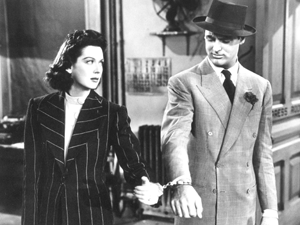
Rosalind Russell went into His Girl Friday (one of my favorite movies ever) knowing that she was about the 15th choice for the role. Howard Hawks had pretty much offered it to every other actress in Hollywood - only to find everyone either uninterested or unavailable. Finally, he "settled" on Russell. Russell knew this because there was a huge article in the New York Times about the whole thing - and reading it, she felt completely humiliated.
Nobody wants to know they are not the first choice.
Russell was pissed off.
She was enough of a success at that point that she felt dissed and pissed.
And here is how she went to her first meeting with Howard Hawks (I love her. She's so ballsy!! Hawks, by the way, ended up falling in love with her too. She was, just by being herself, the quintessential Howard Hawks Woman.)
Russell writes:
I arrived back in California in a bad mood, and California was in the middle of a heat wave. I'd built my first swimming pool, a salt-water pool (you just dumped salt in, but you had to have special pipes), and it was about a hundred and seven degrees outside, and I was supposed to go down and see Hawks, but I kept brooding about being humiliated in the New York Times, and before I went to Columbia, I jumped in the pool, got my dress and hair all wet, and then went and sat in Hawks' outer office.I was always so sassy, it seems to me, so unattractive, now that I think about it.
Hawks came out, did a triple take, and ushered me inside.
"You didn't want me for this, did you?" I said. (Besides being sassy, I was forever assaulting some guy -- Bill Powell, Howard Hawks -- with the news that he really hadn't wanted me.)
"It'll be all right," Hawks said. "You'll be fine. Nonw go to Wardrobe and tell them I'd like you in a suit with stripes, rather flashy-looking."
"Okay, Mr. Hawks, goodbye," I said. "I'll see you later."
For some reason, I just love that story. These two hard-boiled types coming together ... Rosalind stalking into Hawks' office with a WET DRESS and WET HAIR ... and Hawks saying, "It'll be all right ... now here's what you're gonna do ..."
I just love it.
Rosalind Russell 9: on Clark Gable
Why does this not surprise me??
Russell says:
The only man who could make a love scene comfortable was Clark Gable. He was born graceful, he knew what to do with his feet, and when he took hold of you, there was no fooling around.
Rosalind Russell 8: on William Powell
Rosalind on William Powell. One of her first movie roles in Hollywood was in a film with him - they became great friends.
He was not only dear, he was cool. If an actor thought he could get any place by having tantrums, watching Bill Powell would have altered his opinion. I remember a story conference during which he objected to a scene that he felt wasn't right for him. He was at once imperious and lucid. "It's beyond my histrionic ability to do this," he said. I thought that was delicious.
hahahaha So do I.
Rosalind Russell 7: "I'd be thinking, Why can't he get a laugh on that?"
Russell on craft, and how she studied the craft of the actor as a young woman:
Talent is wonderful, but I've played with actors who have more talent than I, and you can't hear them in the fourth row, they just don't have the energy, nothing in the belly, nothing in the guts that brings it all out and sells it across the orchestra pit and into the twenty-third row.In Boston with Clivey's troupe -- I couldn't do it at Saranac, I didn't have the time -- I used to sit on the stage apron and watch every rehearsal I wasn't involved in. I'd be thinking, Why can't he get a laugh on that? It's a funny line -- and taking the thing apart in my head to see why it wasn't working. Half the pleasure of doing comedy in the theatre is that even before you hear a laugh, you sense where the laugh should be. Something happens in the audience, you feel it, you go to work on it. Until one day, all of a sudden, you're rewarded with a titter. You keep working on the line and finally you get a real belly laugh. After that you generally push too hard and lose it, and you have to pull away and inch your way back.
August 1, 2005
Rosalind Russell 6: "Somebody has written the Duchess"
Oh ... this is the beginning of Rosalind Russell Appreciation Day, by the way.
Russell's sister - who died very young - and who is known as "the Duchess" in Russell's book - was an inspiration. I've never met the woman. I will never meet the woman. But Russell introduces me to her. Beautifully.
You could have set the Duchess down anywhere, in the span of this world, and she would have made her audience laugh, and feel better. (When the typewritten manuscript of Auntie Mame was first sent to me by its author, Patrick Dennis -- the book hadn't yet been publihsed -- I sat up till late, reading it, and since I was due on a movie set early the next morning, Freddie fumed. "Put your light out, you'll have such dark circles the cameraman will kill you." But I was bumused. "Somebody has written my sister," I said. "Somebody has written the Duchess." I could have played Mame with one hand tied behind me: I'd been living with her all my life.)
An additional excerpt about "the Duchess" - a woman I have never met, a woman who died in 1940 - and yet who is vibrantly alive for me:
Once before I tried to write about the Duchess. I made some notes, but she's hard to capture. Because she was at once totally sophisticated and absolutely naive. (This is Auntie Mame's character too.)Example: I didn't drink till I was about twenty-four, but two or three times when Clara and i were still living at home, I'd splash whiskey all over me like perfume and come in and put on a drunk act for her. An unspeakably bad, broad drunk act.
"Hullo," I'd say, staggering. "Wha' you doin' there, readin' that apple?"
Every time she'd fall for it. She'd drop her book, grab me. "Oh, come in here, close that door, oh, this is terrible, what if Mother saw you like this?"
She was so sweetly dumb. And so smart. She was an authority on the Irish poets (how many loved her moments of glad grace), she was always reading Macauley, she was funny and she was easy. My darling Duchess, I still miss her.
Is it possible to miss someone you have never met? Well, it has to be. Because I miss the Duchess.
Rosalind Russell 5: the gambling Russell family
I love this story. No wonder men not only fell in love with Rosalind Russell, but they just loved her - in general:
We children would be up on the third floor -- we had a billiard room there; my father played billiards, not pool, and to this day I can shoot so well, people think I must have earned my living at it -- playing games and racketing around over my mother's head, while she sat downstairs doing those name tapes. We had turned an alcove on the third floor into a bowling alley, and we also had a pool table.My poor father, he never made a bet in his life, he didn't approve of betting, and he brought up a bunch of gamblers. After he died those of us who were still in school used to come home at different hours -- sometimes just for weekends -- and there was always a crap game going in my father's library. My mother permitted it, and stayed to supervise. The dice were going all the time, and I remember arriving late one Friday night and having a chum of one of my brothers, a young man who didn't know I was a member of the family, warn me against the Russells. "Do you know those people?" he whispered. "Be careful, they're all sharp shooters."
And in the background my relatives were yelling, "Get your money up, get your money up, it;s all cash here ..."
"Do you know those people?"
hahahahahahah
Rosalind Russell 4: "My name is not Rosalind"

A memory from her childhood:
I was born in a house on Chestnut Avenue, and when I was four years old I ran away from home. Or at least I walked away, and found myself clear down on the Green, in the center of Waterbury's business section. A neighbor who saw me there, swinging on a hitching post, stopped short and cried, "Rosalind, what are you doing here?""My name is not Rosalind," I said. "I'm from out of town."
Four-year-old traveling fibbers don't get too far (the neighbor went straight to my mother and told her where I was), but the episode hints at my future theatrical bent.
"I'm from out of town." hahahahaha
Rosalind Russell 3: "The old men with beautiful manners"
Another excerpt from her book. Here she talks about her father. I found it very moving. Don't you just get this vivid picture of her father??
The age he lived in was right for him; he never should have been in any other. He went to church in the Prince Albert coat, and the tails at Christmas and Easter. He was infinitely patient with children (his library was never safe from invasion; while he sat trying to read the evening paper, we would climb all over him, comb his hair, plaster it down into his eyes, make curls of it -- none of this bothered him) and he was infinitely civil with people of any stripe.His civility used to embarrass me, because he knew everybody in town and he'd stop on his way home to talk to the street cleaner -- "How's the new baby? Well, you've got to see to it that that young man goes on to college" -- and the whole time the street cleaner would be pushing his broom along the gutter, and I, little snob that I was, would be looking nervously up and down the block, thinking, What if the kids from school see my Dad talking to the street cleaner?
My father wasn't old then, but when I read the Ezra Pound lines "They will come no more,/The old men with beautiful manners," I think of him.
Isn't that absolutely gorgeous?
Rosalind Russell 2: on James Galanos
Another excerpt from Life Is a Banquet
Here is an unbelievably moving story, told by Freddie Brisson (Russell's husband) about the special relationship between Russell and Galanos:
In 1960, after she had the first mastectomy, Rosalind went to Galanos. He says it was the only time he ever saw her break down. She had come to his office, very crisp, very businesslike. "I'm going to tell you something nobody in the world knows except Freddie and my doctor. I've had my breast removed, and I want to keep it quiet. So long as I can be active, I don't want to be thought a freak, I don't want people looking at me in person or on the screen and wondering about my sex life." (You have to consider the era. Women had not yet begun to go public about their mastectomies.)"I want you to start thinking in terms of how I can now be dressed," Rosalind said to Jimmy, and then she began to take her clothes off. She started to cry, and he saw that she could hardly lift her left arm, it was so swollen, and he broke down too. From that day forward, he specially designed every piece of her clothing, and neither he nor his fitter ever told a soul.
I don't know what to say. I am just full of emotion.
Rosalind Russell 1: "Give me wings to get to the point"
Her autobiography was published after she had finally succumbed to a devastating bout with cancer. She had lost both of her breasts, she was weakened to the point of needing oxygen, a wheelchair ... and yet still: every day, she would dress up, in a lovely suit, and have lunch (with martinis) with her husband. Her husband of 35 years or something like that - Freddie Brisson. They were set up by Cary Grant, who was the best man at their wedding in 1941.
Freddie wrote a prologue to her book, which clutches at my heart. He writes:
After she died I found a petition she had tucked away in her prayer book. It said in part, "Keep my mind free from the recital of endless details; give me wings to get to the point. Seal my lips on aches and pains. They are increasing, and love of rehearsing them is becoming sweeter as the years go by."
"Love of rehearsing" the "aches and pains". God. And to those who think Hollywood is a festering sore of Godless commies: FUCK. YOU. You got that? Yeah. I'm talking to you. FUCK. YOU.
Freddie writes of their courtship. Rosalind gave him a HELL of a hard time. He would call to ask her out, and her maid would answer the phone, and he would hear Rosalind bellowing in the background: "Tell him I'm out!!"
But he was persistent. The two of them went to the races, they went out dancing until 2 o'clock in the morning ... but still. She held him off. She was Hollywood's "Bachelor Girl", after all. Read into that what you will, but I would advise you not to read anything prurient into it, because it would be highly unimaginative of you. And also very unfair. She had a great career, and a great life. It would have to be prrreeeety damn good offer for her to give that up ... and she knew that. She put Brisson through his paces.
Listen to his story of his proposal:
The first time I proposed, she didn't accept. I persisted. "I'm going to write your mother and ask for your hand." And I did. "There's no way I'm going to get rid of you, is there?" Rosalind finally said, laughing. But when she gave up, she gave up on her own terms. "I don't like any of these proposals after you've had an evening out. I'm not interested in that nonsense. If you want to propose, then come around at seven o'clock in the morning, and put a white handkerchief on the ground and kneel down and ask for my hand."At seven o'clock the next morning Roz at last accepted.
Ah. A woman who knows what she wanted. I've had a couple of "Oh, it's two o'clock in the morning, we just had a great night out together, LET'S GET MARRIED" proposals. Roz was smart to say No ... and to make him do it right.
The two of them were faithfully married from 1941 to 1976, when she passed away.
Rosalind Russell appreciation day
Yup. Get ready for 5,000 excerpts. While in Cape Cod, I found a second-hand (or, more likely, a 5th hand copy) of her autobiography Life Is a Banquet
She's one of my idols.
She wasn't a glamour girl. She was a leading lady. A take no prisoners leading lady. She's an inspiration to any actress who might not have the bombshell looks but who has a GIFT for this thing called acting.
God bless Rosalind Russell. It's a great book. I came away from it feeling like: "damn, she was such a nice person." Such a funny and nice and warm and fearless person.
Like I said: she's one of my idols. If I could achieve 1/15 of what she achieved, I could be happy.
She was a true trailblazer - without making a big deal about it. It just happened that way. She couldn't be anyone but herself (and, obviously, the studios tried to change her - unimaginative people are always trying to change those who are truly original) - and she got a couple lucky breaks (which she fought like tooth and nail for) - and voila. We have this image of strong funny womanhood to guide us ... Actresses who are not beautiful have someone to show us the way. Just be yourself. Don't try to fit into the mold they give you because IT WILL NEVER WORK. Maybe it worked for Jean Harlow, but you know why it did??? Because she was Jean feckin' Harlow and it WORKED - for HER. If you're Rosalind Russell, you must find your own way. She did ... and because she did ... so can the rest of us. I just love the woman, that's all.
Excerpts comin' up ...
Eunuch curiosity
Anne's tiny post about eunuchs in Imperial China has made me want to know more.
Remember my plea from months ago?
You know, the one that went: "Please, Tara Reid: Don't ever change"? I couldn't bear to have her change, or calm down, or sober up ... because her antics are far too entertaining, and also rather harmless, in a drunk slut shenanigans kind of way.
Well. Over the last couple months - my plea has been MORE than answered.
I think Tara might be the kind of chick who REALLY goes crazy in the summer - it's all one long Spring Break to her - and so that means there are just more embarrassing photos of drunken Tara staggering through St. Tropez to keep me entertained.
She's such a train wreck and I absolutely adore her.
Exhibit C Awesome!! As long as I don't have to be there in person, or hang out with her EVER ... I LOVE that she pulls stuff like this!
Exhibit C1 (Scroll way down. The photos are from the same par-tee as in Exhibit C - only in this one, we get to see a picture of Tara wiped out on the floor. Awesome!)
Keep it up, Tara!
Happy birthday to Herman Melville!

Here's a page with his biography. Moby-Dick
"Call me Ishmael," says the narrator in the beginning of Moby-Dick. We don't know is it his real name and exactly when his story is taking place. He signs abroad the whaler Pequod with his friend Queequeg, a harpooner from the South Sea Islands. Then the mood of the story changes. The reader is confronted by a plurality of linguistic discourses, philosophical speculations, and Shakespearean rhetoric and dramatic staging. Mysterious Captain Ahab, a combination of Macbeth, Job, and Milton's Satan, appears after several days at sea. Melville named the character after the Israelite king who worshiped the pagan sun god Baal. Ahab reveals to the crew that the purpose of the voyage is to hunt and kill the snow-white sperm whale, known as Moby-Dick, that had cost Ahab his leg on a previous voyage. The captain has his own faith and sees the cosmos in contention between two rival deities. "Oh! thou clear spirit of clear fire, whom on these seas I as Persian once did worship, till in the sacramental act so burned by thee, that to this hour I bear the scar; I know thee, thou clear spirit, and I now know that thy right worship is defiance." Ahab has nailed a goldpiece to the mast and offers it as a reward to the first man who sights the creature. Starbuck, the first mate, tries to dissuade Ahab from the quest. The novel culminates when Moby-Dick charges the boat which sinks. Ahab is drowned, tied by the harpoon line his archenemy. In his end Ahab takes his crew with him. The only survivor is the narrator, who is rescued by a passing ship.Moby-Dick was misunderstood by those who read and reviewed it and it sold only some 3,000 copies during Melville's lifetime. The book can be read as a thrilling sea story, an examination of the conflict between man and nature - the battle between Ahab and the whale is open to many interpretations. It is a pioneer novel but the prairie is now sea, or an allegory on the Gold Rush, but now the gold is a whale. Jorge Luis Borges has seen in the universe of Moby-Dick "a cosmos (a chaos) not only perceptibly malignant as the Gnostics had intuited, but also irrational, like the cosmos in the hexameters of Lucretius." (from The Total Library
, 1999) Clare Spark has connected in Hunting Captain Ahab: Psychological Warfare and the Melville Revival
(2001) different interpretations with changing political atmosphere - depending on the point of view Ahab has been seen as a Promethean hero or a forefather of the twentieth-century totalitarian dictators. The director John Huston questions in his film version (1956) which one, Ahab or the whale, is the real Monster.
I read Moby Dick in high school and despised it. I thought it was one of the most boring pointless things I had ever read. It was on our summer reading list, and I clearly remember FORCING myself to read the damn thing, during the dog days of August ... nearly crying from the psychological boredom. Whatever, man ... Moby Dick, Captain Ahab, endless discourses on blubber ... I was 16. I DIDN'T GET IT.
Cut to many many years later. 2001, to be exact. I read it in the spring of 2001. Around that time I decided to systematically go back and re-read all of the books I had been forced to read in high school (which, obviously, made me despise them at the time). I read The Scarlet Letter

And honestly - the feckin' book blew the top of my head off.
I have rarely had such an exciting reading experience as that one. I didn't want it to end. I underlined passages feverishly. I put exclamations points in the margins next to particularly amazing sentences. Honestly. It blew me away.
Re-reading Scarlet Letter, et al, was also really fun - and yes, I renewed my appreciation for those old books, and realized: "Ohhh, okay, yup. THAT'S why the dern thing is a classic" ... but none of them flattened me as much as Moby Dick.
Holy mackerel. ahem.
The book, in high school, seemed so far from relevant ... to my life ... and also: there was nothing even remotely recognizable. At least in Scarlet Letter you deal with social issues and sexual issues - stuff I could latch onto as an adolescent ... but Moby Dick? I'm supposed to give a hoo-hah about the spout-hole and what it means and why it's important?
Also, except for the blowsy woman who serves Ishmael chowder in the 2nd or 3rd chapter, there are NO women in this book. NONE. Now: I wasn't a big girlie girlie book reader - Adventures of Huckleberry Finn

Melville himself was a vicious misogynist. He tried to kill his wife. I believe she would flee from the house in the night, screaming, etc. It is well-known that he had many homosexual experiences during his time at sea. Many whalers did.
Paglia believes that Melville was writing out his anxiety and his anger towards women, in general. But not just 'women' as in 'a person who happens to be female' - but on a larger level: Woman as nature, woman as chaos, woman as the uncontrollable force running the universe.
Paglia feels that the entire book, with not one woman in it, is actually haunted by this spectre of female-ness.
Interesting. I'm not sure if she's right or not - but it is a very interesting theory - and I think there is definitely some truth to it (especially when you know some of the details of Melville's life.)
It's a big mess of a novel. We have 20 chapters which are basically marine biology. And yet ... the marine biology chapters always have a spiritual or metaphorical theme to them as well.
The point of view switches inexplicably. The first line of the book is "Call me Ishmael". This establishes that we have a first-person narrative. But that does not remain consistent. There are private moments of Captain Ahab and Starbuck described - moments when they are alone - moments Ishmael could never have witnessed. During the whale chapters - where we learn about blubber, and the spout, and their mating rituals, etc. - the voice changes from first-person to omniscent. With no warning. It doesn't seem to be Ishmael anymore. The "I" in the beginning of the book, Ishmael's "I", does not seem to be the same "I" who gives us marine biology lectures throughout the middle of the book. It is not the same voice at all.
But in the end, none of that matters.
It is an unconventional book, with its own narrative rules. Once you succumb, you will not have a better reading experience. The same could be said for Joyce's Ulysses. If you just trust the author, even though they seem to be off on their own personal jaunt, just writing to please themselves, they will take you places you could not even imagine.
The "interminable" chapters on whales, the chapters which I found so unbearable in high school, are what make the book (in my opinion) so stunning, so bizarre, and so - in the end - important. What is Melville's genius here is that - he starts out telling us, "Okay, so let's talk about the spout-hole ..." And he takes you through it, telling you how it works, what it is, how it evolved. But throughout this, somehow, he elevates each part of the whale into something almost allegorical. Blubber can actually teach us something about ourselves. We all can learn a lot about ourselves from studying the different parts of whales.
My favorite chapter, in these sections, is the one on the skin of the whale. It is called "The Blanket".
I read it, and it seems relatively informational, matter-of fact, and then by the end, Melville does a little jujitsu move in his prose - and I found myself in tears.
This happened to me time and time again when I re-read this great book. I would have a momentary thought, "Jesus, this chapter on the sperm in the sperm-whales is freakin' long, and i wish he would just get back to Queequeg, and the plot ... Dammit, this is so LONG..." And then suddenly, with a few simple phrases, Melville will draw back the veil, and show you the underbelly, give you the real GUTS of what he is saying.
Here's what I mean. This is an excerpt from the stunning chapter "The Blanket" - and look out for the jujitsu move at the end:
The BlanketI have given no small attention to that not unvexed subject, the skin of the whale. I have had controversies about it with experienced whalemen afloat, and learned naturalists ashore. My original opinion remains unchanged; but it is only an opinion.
The question is, what and where is the skin of the whale? Already you know what his blubber is. The blubber is something of the consistence of firm, close-grained beef, but tougher, more elastic and compact, and ranges from eight or ten to twelve and fifteen inches in thickness.
Now, however preposterous it may at first seem to talk of any creature's skin as being of that sort of consistence and thickness, yet in point of fact these are no arguments against such a presumption; because you cannot raise any other dense enveloping layer from the whale's body but that same blubber; and the outermost enveloping layer of any animal, if reasonably dense, what can that be but the skin? True, from the unmarred dead body of the whale, you may scrape off with your hand an infinitely thin, transparent substance, somewhat resembling the thinnest shreds of isinglass, only it is almost as flexible and soft as satin; that is, previous to being dried, when it not only contracts and thickens but becomes rather hard and brittle. I have several such dried bits, which I use for marks in my whale-books. It is transparent, as I said before; and being laid upon the printed page, I have sometimes pleased myself with fancying it exerted a magnifying influence. At any rate, it is pleasant to read about whales through their own spectacles, as you may say. But what I am driving at here is this. That same infinitely thin, isinglass substance, which, I admit, invests the entire body of the whale, is not so much to be regarded as the skin of the creature, as the skin of the skin, so to speak; for it were simply ridiculous to say, that the proper skin of the tremendous whale is thinner and more tender than the skin of a new-born child. But no more of this.
Assuming the blubber to be the skin of the whale; then, when this skin, as in the case of a very large Sperm Whale, will yield the bulk of one hundred barrels of oil; and, when it is considered that, in quantity, or rather weight, that oil, in its expressed state, is only three fourths, and not the entire substance of the coat; some idea may hence be had of the enormousness of that animated mass, a mere part of whose mere integument yields such a lake of liquid as that. Reckoning ten barrels to the ton, you have ten tons for the net weight of only three quarters of the stuff of the whale's skin...
A word or two more concerning this matter of the skin or blubber of the whale. It has already been said, that it is stript from him in long pieces, called blanket-pieces. Like most sea-terms, this one is very happy and significant. For the whale is indeed wrapt up in his blubber as in a real blanket or counterpane; or, still better, an Indian poncho slipt over his head, and skirting his extremity. It is by reason of this cosy blanketing of his body, that the whale is enabled to keep himself comfortable in all weathers, in all seas, times, and tides. What would become of a Greenland Whale, say, in those shuddering, icy seas of the North, if unsupplied with his cosy surtout? True, other fish are found exceedingly brisk in those Hyperborean waters; but these, be it observed, are your cold-blooded, lungless fish, whose very bellies are refrigerators; creatures, that warm themselves under the lee of an iceberg, as a traveller in winter would bask before an inn fire; whereas, like man, the whale has lungs and warm blood. Freeze his blood, and he dies.
How wonderful it is then - except after explanation - that this great monster, to whom corporeal warmth is as indispensable as it is to man; how wonderful that he should be found at home, immersed to his lips for life in those Arctic waters! where, when seamen fall overboard, they are sometimes found, months afterwards, perpendicularly frozen into the hearts of fields of ice, as a fly is found glued in amber. But more surprising is it to know, as has been proved by experiment, that the blood of a Polar whale is warmer than that of a Borneo negro in summer.
It does seem to me, that herein we see the rare virtue of a strong individual vitality, and the rare virtue of thick walls, and the rare virtue of interior spaciousness. Oh, man! admire and model thyself after the whale! Do thou, too, remain warm among ice. Do thou, too, live in this world without being of it. Be cool at the equator; keep thy blood fluid at the Pole. Like the great dome of St. Peters, and like the great whale, retain, O man! in all seasons a temperature of thine own.
Stunning.
And so: happy birthday to Mr. Melville.
James Agee on silent comedy
First off: in typical Sheila fashion: I have a lot to say about James Agee. (A rough biography - rank with misspellings - here. Although you're better off just reading his damn books - few though they may be - to get a feeling for this extraordinary man).
Some things are easy to quantify. Home run records. No-hitters. Farthest long-jump record.
Some things not so easy (but no less interesting): Greatest actor. Best fiction writer. Best theatre director.
And best film critic. While it is not possible to say: so and so is definitely the BEST, and that is the END OF THE STORY ... it is possible to say: here is the canon, here are the top 5, here are the most influential film critics since movies began ... take your pick.
I would put James Agee at the very top of the list.
In my reading and movie-watching and obsessive pursuits - his name comes up constantly. In the same way that Pauline Kael's name comes up constantly, another one of our greatest film critics. In the same way Brooks Atkinson's name comes up constantly (one of our greatest theatre critics).
James Agee wrote a piece for Life magazine called "Comedy's Greatest Era" which appeared on September 3, 1949. It was Agee's tribute to the masters of silent films - the Charlie Chaplins, the Buster Keatons, and more. If you are interested in silent films, if you love Chaplin or Keaton, then I cannot recommend this piece of Agee's highly enough. It's one of those moments when someone steps up to the plate and expresses FOR you what might be in your heart. Like: you know why you love Buster Keaton, and you could rave about this or that movie, or what it was about him that so touched you ... but it takes a master to come along and clarify things, put them into context. What is so marvelous about Agee's article is how much you can feel the LOVE behind his words. He LOVES those guys. A lot of times, I LOVE people (like - er - Cary Grant, for example) ... but it's difficult to put into words WHY. I certainly give it my best shot, and it's a fun exercise for me ... but then I read Pauline Kael's famous piece on Grant (thanks, Stevie!!!), or I read Richard Schickel's book of appreciation on Cary Grant ... and they can do it so much better than I can. They put into words what I can't. I read their stuff and find myself nodding, thinking: "Yes, yes, that's it, that's perfect!!" A great critic of anything can do that.
While I was on the Cape, we went to a used bookstore, and I came across the compilation of all of James Agee's film writing (he was a reviewer for The Nation) - and bought it up greedily. The book starts with "Comedy's Greatest Era", which was a massive article - and apparently, it received one of the greatest responses in the history of Life magazine. It brought back a resurgence of interest in Charlie Chaplin, in silent films, and to this day - Agee's piece is referenced whenever any of those guys come up. It's the high water mark.
I'll be posting bits and pieces from it, just to give you a taste of it. It makes you want to run out and rent all of those old silent films!!
Here is Agee on Chaplin:
With Tillie's Punctured Romance, in 1914, he became a major star. Soon after, he left Sennett when Sennett refused to start a landslide among the other comedians by meeting the raise Chaplin demanded. Sennett is understandably wry about it in retrospect, but he still says, "I was right at the time." Of Chaplin he says simply, "Oh well, he's just the greatest artist that ever lived."None of Chaplin's former rivals rate him much lower than that; they speak of him no more jealously than they might of God. We will try here only to suggest the essence of his supremacy. Of all comedians he worked most deeply and most shrewdly within a realization of what a human being is, and is up against. The Tramp is as centrally representative of humanity, as many-sided and as mysterious, as Hamlet, and it seems unlikely that any dancer or actor can ever have excelled him in eloquence, variety or poignancy of motion. As for pure motion, even if he had never gone on to make his magnificent feature-length comedies, Chaplin would have made his period in movies a great one singlehanded even if he had made nothing except The Cure or One AM...
Before Chaplin came to pictures people were content with a couple of gags per comedy; he got some kind of laugh every second. The minute he began to work he set standards -- and continually forced them higher. Anyone who saw Chaplin eating a boiled shoe like brook trout in The Gold Rush or embarrassed by a swallowed whistle in City Lights, has seen perfection.
Agee feels that movies (comedy, in particular) really lost something when they switched to sound. By relying on the words to be funny, as opposed to physical action, much of the hilarity was lost - became intellectual. The generosity of these silent comedians is extraordinary, when you think about it. There was nothing they could rely on but their own physical genius, and their own driving desire to tell a story with their faces and their bodies.
More on Chaplin:
The finest pantomime, the deepest emotion, the richest and most poignant poetry were in Chaplin's work. He could probably pantomime Bryce's The American Commonwealth without ever blurring a syllable and make it paralyzingly funny into the bargain. At the end of City Lights the blind girl who has regained her sight, thanks to the Tramp, sees him for the first time. She has imagined and anticipated him as princely, to say the least; and it has never seriously occurred to him that he is inadequate. She recognizes who he must be by his shy, confident, shining joy as he comes silently toward her. And he recognizes himself, for the first time, through the terrible changes in her face. The camera just exchanges a few quiet close-ups of the emotions which shift and intensify in each face. It is enough to shrivel the heart to see, and it is the greatest piece of acting and the highest moment in movies.
Wow. I have tears in my eyes.
(Trivia moment: the blind girl in City Lights was Cary Grant's first wife. ONWARD!)
Now for Agee's words on Buster Keaton, which, frankly, blew me away. I would love to hear people's responses to all of this - people who are fans of these old silent films. There are those staunchly in the Chaplin camp, and then there are those firmly in the Keaton camp ... I would love to hear people's thoughts on these genius guys.
But here's Agee on Buster Keaton:
Very early in [Keaton's] movie career friends asked him why he never smiled on the screen. He didn't realize he didn't. He had got the dead-pan habit in variety; on the screen he had merely been so hard at work it had never occurred to him there was anything to smile about. Now he tried it just once and never again. He was by his whole style and nature so much the most deeply "silent" of the silent comedians that even a smile was as deafeningly out of key as a yell. In a way his pictures are like a transcendent juggling act in which it seems that the whole universe is in exquisite flying motion and the one point of repose is the juggler's effortless, uninterested face.Keaton's face ranked almost with Lincoln's as an early American archetype; it was haunting, handsome, almost beautiful, yet it was irreducibly funny; he improved matters by topping it off with a deadly horizontal hat, as flat and thin as a phonograph record. One can never forget Keaton wearing it, standing erect at the prow as his little boat is being launched. The boat goes grandly down the skids and, just as grandly, straight on to the bottom. Keaton never budges. The last you see of him, the water lifts the hat off the stoic head and it floats away.
Gorgeous. I love people with pro-active comedic minds.
And here, in my opinion, Agee outdoes himself:
Much of the charm and edge of Keaton's comedy, however, lay in the subtle leverages of expression he could work against his nominal dead pan. Trapped in the side-wheel of a ferryboat, saving himself from drowning only by walking, then desperately running, inside the accelerating wheel like a squirrel in a cage, his only real concern was, obviously, to keep his hat on. Confronted by Love, he was not as deadpan as he was cracked up to be, either; there was an odd, abrupt motion of his head which suggested a horse nipping after a sugar lump.Keaton worked strictly for laughs, but his work came from so far inside a curious and original spirit that he achieved a great deal besides, especially in his feature-length comedies. (For plain hard laughter his nineteen short comedies -- the negatives of which have been lost -- were even better.) He was the only major comedian who kept sentiment almost entirely out of his work, and he brought pure physical comedy to its greatest heights. Beneath his lack of emotion he was also uninsistently sardonic; deep below that, giving a disturbing tension and grandeur to the foolishness, for those who sensed it, there was in his comedy a freezing whisper not of pathos but of melancholia. With the humor, the craftsmanship and the action there was often, besides, a fine, still and sometimes dreamlike beauty. Much of his Civil War picture The General is within hailing distance of Mathew Brady. And there is a ghostly, unforgettable moment in The Navigator when, on a deserted, softly rolling ship, all the pale doors along a deck swing open as one behind Keaton and, as one, slam shut, in a hair-raising illusion of noise.
Perhaps because "dry' comedy is so much more rare and odd than "dry" wit, there are people who never much cared for Keaton. Those who do cannot care mildly.
That is some damn fine writing and analysis there. I have found his last sentence to be very true. People who love Buster Keaton really LOVE him. They 'cannot care mildly'.
And, until James Agee had expressed it, I hadn't been really conscious of the "freezing whisper not of pathos but of melancholia" in his work - but I think that is so right ON. Yes. Melancholia. Indeed. It may just be me projecting stuff onto that handsome stoic face ... but if so, then all the better!
I'll post more from this ground-breaking essay later.
The Books: "The Beauty Queen of Leenane" (Martin McDonough)
Next in my Daily Book Excerpt:
 Next play on the script shelf is The Beauty Queen of Leenane
Beauty Queen is the story of Mag (the mother in her 70s - kind of house-bound - a horrific bogey-man picture of a mother - she's manipulative, nosy, tiresome, contemptuous) and Maureen (the daughter - a virgin in her 40s, with no prospects for love - Her mother would laugh at the thought!) Mag and Maureen live together, Maureen "takes care of" Mag (Maureen is as cruel in her behavior as her mother - just in a different way) and they jab at each other constantly, and yet there are whole worlds that are not being said. Horrors from the past. Maureen ends up going out on a date with a sad sap named Pato Dooley - and that is the catalyst which brings everything crashing down.
Great play.
Here's a scene between Mag and Maureen:
EXCERPT FROM The Beauty Queen of Leenane
(Maureen switches off the kettle, and pours a sachet of Complan into a mug and fills it up with water)
MAUREEN: I'll do you some of your Complan.
MAG. Have I not had me Complan already, Maureen? I have.
MAUREEN: Sure, another one won't hurt.
MAG. (wary) No, I suppose.
Maureen tops the drink up with tap water to cool it, stirs it just twice to keep it lumpy, takes the spoon out, hands the drink to Mag, then leans back against the table to watch her drink it. Mag looks at it in distaste.
MAG. A bit lumpy, Maureen.
MAUREEN. Never mind lumpy, Mam. The lumps will do you good. That's the best part of Complan is the lumps. Drink ahead.
MAG. A little spoon, do you have?
MAUREEN. No, I have no little spoon. There's no little spoons for liars in this house. No little spoons at all. Be drinking ahead.
Mag takes the smallest of sickly sips
MAUREEN. The whole of it now!
MAG. I do have a funny tummy, Maureen, and I do have no room.
MAUREEN. Drink ahead, I said! You had room enough to be spouting your lies about Ray Dooley had no message! Did I not meet him on the road beyond as he was going? The lies of you. The whole of that Complan you'll drink now, and suck the lumps down too, and whatever's left you haven't drank, it is over your head I will be emptying it, and you know well enough I mean it!
Mag slowly drinks the rest of the sickly brew
MAUREEN. Arsing me around, eh? Interfering with my life again? Isn't it enough I've had to be on beck and call for you every day for the past twenty year? Is it one evening out you begrudge me?
MAG. Young girls should not be out gallivanting with fellas ...!
MAUREEN. Young girls! I'm forty years old, for feck's sake! Finish it!
Mag drinks again
MAUREEN. 'Young girls'! That's the beste yet. And how did Annette or Margo ever get married if it wasn't first out gallivanting that they were?
MAG. I don't know.
MAUREEN. Drink!
MAG. I don't like it, Maureen.
MAUREEN. Would you like it better over your head?
Mag drinks again
MAUREEN. I'll tell you, eh? 'Young girls out gallivanting.' I've heard it all now. What have I ever done but kissed two men the past forty years?
MAG. Two men is plenty!
MAUREEN. Finish!
MAG. I've finished! (Mag holds out the mug. Maureen washes it.) Two men is two men too much!
MAUREEN. To you, maybe. To you. Not to me.
MAG. Two men too much!
MAUREEN. Do you think I like being stuck up here with you? Eh? Like a dried up oul ...
MAG. Whore!
Maureen laughs
MAUREEN. Whore? (Pause) Do I not wish, now? Do I not wish? (Pause) Sometimes I dream ...
MAG. Of being a ...?
MAUREEN. Of anything! (Pause. Quietly) Of anything. Other than this.
MAG. What an odd dream that is!
MAUREEN. It's not at all. Not at all is it an odd dream. (Pause) And if it is it's not the only odd dream I do have. Do you want to be hearing another one?
MAG. I don't.
MAUREEN. I have a dream sometimes there of you, dressed all nice and white, in your coffin there, and me all in black looking in on you, and a fella beside me there, comforting me, the smell of aftershave off him, his arm round me waist. And the fella asks me then if I'll be going for a drink with him at his place after.
MAG. And what do you say?
MAUREEN. I say 'Aye, what's stopping me now?'
MAG. You don't!
MAUREEN. I do!
MAG. At me funeral?
MAUREEN. At your bloody wake, sure! Is even sooner!
MAG. Well, that's not a nice thing to be dreaming!
MAUREEN. I know it's not, sure, and it isn't a dream-dream at all. It's more of a day dream. Y'know, something happy to be thinking of when I'm scraping the skitter out of them hens.
MAG. Not at all is that a nice dream. That's a mean dream.
MAUREEN. I don'tknow if it is or it isn't. (Pause. Maureen sits at the table with a pack of Kimberly biscuits) I suppose now you'll never be dying. You'll be hanging on forever, just to spite me.
MAG. I will be hanging on forever!
MAUREEN. I know well you will!
MAG. Seventy you'll be at my wake, and then how many men'll there be round your waist with their aftershave?
MAUREEN. None at all, I suppose.
MAG. None at all is right!
MAUREEN. Oh aye. (Pause) Do you want a Kimberley?
MAG. Have we no shortbread fingers?
MAUREEN. No, you've ate all the shortbread fingers. Like a pig.
MAG. I'll have a Kimberley so, although I don't like Kimberleys. I don't know why you get Kimberleys at all. Kimberleys are horrible.
MAUREEN. Me world doesn't revolve around your taste in biscuits.
Maureen gives Mag a biscuist. Mag eats
MAG. (pause) You'll be going to this do tomorrow so?
MAUREEN. I will. (Pause) It'll be good to see Pato again anyways. I didn't even know he was home.
MAG. But it's all them oul Yanks'll be there tomorrow.
MAUREEN. So?
MAG. You said you couldn't stand the Yanks yesterday. The crux of the matter yesterday you said it was.
MAUREEN. Well, I suppose now, Mother, I will have to be changing me mind, but, sure, isn't that a woman's prerogative?
MAG. (quietly) It's only prerogatives when it suits you.
MAUREEN. Don't go using big words you don't understand, now, Mam.
MAG. (sneers. Pause) This invitation was open to me too, if you'd like to know.
MAUREEN. (half-laughing) Do you think you'll be coming?
MAG. I won't, I suppose.
MAUREEN. You suppose right enough. Lying the head off you, like the babby of a tinker.
MAG. I was only saying.
MAUREEN. Well, don't be saying. (Pause) I think we might take a drive into Westport later, if it doesn't rain.
MAG. (brighter) Will we take a drive?
MAUREEN. We could take a little drive for ourselves.
MAG. We could now. It's a while since we did take a nice drive. We could get some shortbread fingers.
MAUREEN. Later on, I'm saying.
MAG. Later on. Not just now.
MAUREEN. Not just now. Sure, you've only just had your Complan now. (Mag gives her a dirty look. Pause) Aye, Westport. Aye. And I think I might pick up a nice little dress for meself while I'm there. For the do tomorrow, y'know?
Maureenlooks across at Mag, who looks back at her, irritated.
BLACKOUT.