September 30, 2005
Happy birthday, Truman!
Today is the birthday of one of my favorite writers - Truman Capote.

I am so excited to see Philip Seymour Hoffman's take on him. The film got a great review in The NY Times and I'm just so excited about it. Look at the similarities there. Amazing.

Truman Capote has been one of my many life-long obsessions - so forgive my autuistic knowledge of this man - his life, and his work. Also - I just had to go out and find all the great photos of him, and post them here. People LOVED to photograph this man (at least in his early wunderkind days) - and all of them are online, which is so exciting. So I've found some of my favorites, to post them here for you.
Example:
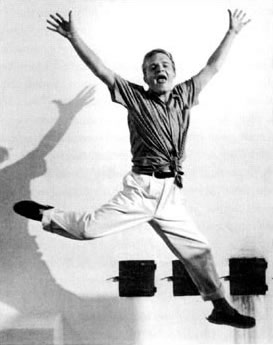
Most of my generation only remembers Truman from his appearances on various talk shows, mainly Johnny Carson, when he was a bloated guy with a high lisping voice who was vaguely embarrassing to watch - At least I felt that way. He was obese, he had face lifts, he wore a white Panama hat, he was kind of grotesque. I didn't know that he was basically caricaturing himself by then - which is always death to an artist of any kind.
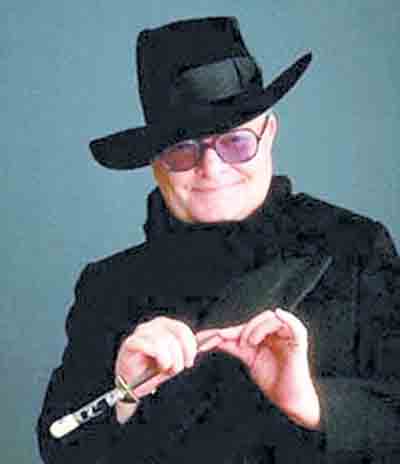
But he was stuck. He had horrendous writer's block at the very end - which tormented him. The end of his life was full of despair. It's wrenching to read about - you just want his suffering to stop.
But as a youngun? As the new writer in town? He was a golden boy. He was a creature like Thomas Mann had written about. The golden-haired child-man who led others to do naughty naughty things, and then pled innocence. Photographers lined up to capture this guy.
See what I mean?

Hard to realize just how provocative those photos were back then. Especially because he was openly gay. And not just "openly gay" - but openly PRISSY and gay - which some people find unforgivable. Fine, be gay ... but ... do you have to be so ... GAY about it?? Can't you just PRETEND to be straight so I don't have to feel so ... ikky? Truman, even back in the early 40s, didn't put on an act for the straight world. He didn't turn himself inside out to make people feel comfortable with his gayness. He just was who he was. If people felt uncomfortable, then that was THEIR problem. He was prissy, he lisped, he flounced about like a Southern belle - AND he happened to be a kick-ass writer with a literary voice that no one could forget.
I still remember the impact that The Grass Harp
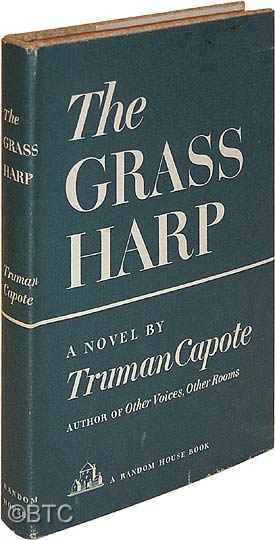
That book literally hurt my heart. I was too young then to really understand regrets, or loss - the way I understand them now - but his elegaic writing in that story touched some deep universal chord in me - the part of me that is HUMAN, and not just an age on a timeline. There was a kind of soul-growth spurt that happened to me when I read that sad beautiful story. I still have a real fondness for it.
His first book, published in 1948, was Other Voices, Other Rooms

Just to add to the controversy - here is the "author photo" that appeared sprawled across the back of the book:
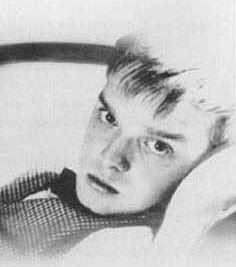
hahahahaha Truman! Please! It caused an outrage. A stir. People loved it. People hated it. People TALKED about it, and that was what Truman cared about. Truman had talent - yes - but he understood the whole 15 minutes of fame thing long before Andy Warhol came along. Truman wanted to be FAMOUS as well as being a good writer. He wasn't one of those writers who holed themselves up in their apartments (at least not until In Cold Blood when he disappeared off the face of the earth for almost 5 years - he said later that writing that book nearly killed him.) ... But before In Cold Blood he was out at every party, he hung out with the rich and famous (at least until the huge debacle at the end of his life when he alienated all of them in one fell swoop)
This photo is just ... kind of says it all, don't it?
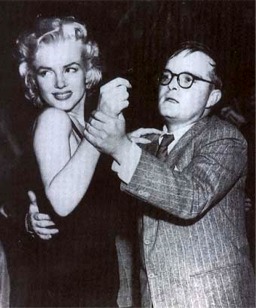
Look at how he's holding her wrist!!! Like - hold her HAND, Truman. But also - look at how sweet she is. The two of them were actually very good friends and he wrote one of my favorite pieces about her, which appears in the gorgeous collection Music for Chameleons
He was the darling of New York. He wasn't just friends with celebrities - whose wealth is a rather transitory thing. He became friends with REAL rich people. The international tycoon types. The Onassis types. He was invited to all of the "society" parties.
And he threw a party that is still famous. It was called The Black and White Ball, and he threw it for Katherine Graham - who he didn't even really know.
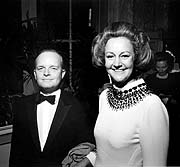
She wrote in her autobiography (which I've read): "I was truly baffled as to why I was the guest of honor. But it seemed really important to Truman ... so I said yes."
Odd. It was, many people say who care about this stuff, the "party of the century".
Everyone had to come wearing masks, and everyone had to dress in black and white. Truman had just finished In Cold Blood - or maybe he had just returned from Kansas - not sure - but he needed to let off steam, he needed to shake off In Cold Blood which had literally taken over his life. So he threw this party - where everyone who was anyone showed up.
Here's Candice Bergen at the party:

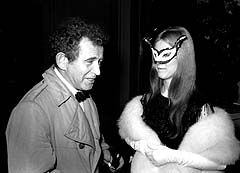
Here's Norman Mailer and his wife - hahahaha
Here's Mia Farrow and Frank Sinatra- who had just gotten married:
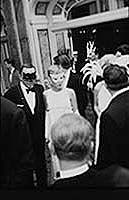
People jostled to get invited. People sucked up to Truman. He was in his glory. But even then - he had the oddest mix of desire and contempt when it came to the rich. He wanted to hang out with them - but he had contempt for them as well. On some level, I think he knew that they would drop him like a hot potato the second his friendship became inconvenient. He knew that his friendships with these people were were pretty one-sided: Truman was there to entertain, to keep things light and amusing. The second he started falling on hard times later in life, they stopped tolerating his company.
Perhaps all those rich people just liked the cache of having a literary star at their parties - it made their parties seem more ... substantial. Maybe they really did like him. But I don't think so. And I don't think Truman liked them all that much, either. He saw right through them. Only he kept that to himself, and let the rich people think that he bought their game, that he was fooled, that he did not see the essential shallowness beneath their facade. When he finally came out and wrote about them and their pettiness, their stupidity - they could not and would not forgive him. (By that point in his life, long after In Cold Blood, Truman had actually lost a lot of what had made him a success in the first place ... and that was his compassion for others. His ability to love his fellow man, and to try to step into their shoes and describe for us, the reader, what it is "like" to be that person. By the 1960s, drugs and drinking had taken hold ... and Truman was angry. He wrote about his former friends with bitchy - but spot-on - RAGE. He had NO compassion for THEM. He could find it in his heart to be compassionate for Dick Hickock and Perry Smtih even though they had committed such a heinous crime. But he was NOT compassionate for the fat Upper East Side cats. He unleashed his wrath on them, and it was like a bomb going off in international society.)
Truman Capote found himself bereft, and alone. He never recovered from that shattering of his world, even though he said over and over, "I'm a writer! What did they think I did in my spare time? I observed life - and I wrote about it!" They did not forgive him for telling the truth. Years later, when Gerald Clarke wrote his tremendous biography of Capote - there were people who refused to be interviewed for the book becaue they were STILL seething at Truman's "betrayal".
I'm going to post something I wrote a long time ago on this blog - which ended up being published elsewhere. It's called "Fairy on the Prairie", and it's about the writing of In Cold Blood which is pretty much on my Top 10 favorite books ever written. Certain books come and go on that list - titles get bumped off - moved on - but not In Cold Blood. There are a couple of others that never get bumped off - Harriet the Spy


I'm proud of the piece I wrote on Truman.
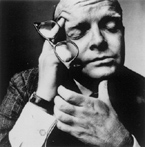
Before we get to that, though, I would like to share my favorite photo of Truman Capote. It's done by the great photographer Irving Penn. I like it because - it's not the "carefree" look of his golden-boy self - which was a pose, to some degree. It's not the provocative just-got-out-of-bed look he sported as an early writer - which was also a pose. And it's not a photograph from his later years, which just really hurt me to see.
Irving Penn had photographed Spencer Tracy, famously, boxed up in a corner. (That was one of Penn's "things" - he put famous people into corners of rooms and photographed them. Strangely effective.)
Look. Amazing photo of Spencer. Look at the EXPRESSION on his face.

Penn took basically the same photograph of Truman - boxed him up in a corner. I looked for a larger version of the photo - a clearer one - but couldn't find it. This is the best I could get.
There is something about this photo that not only haunts me, but strikes me as deeply painfully TRUE. The oversized coat, it makes him look so small and frail. The cramped quarters, the walls pressing in. Now, I did not know Truman Capote, and it is not for me to say who is the "real" Truman Capote - but something about the look on his face in this photo, its flat blank-eyed stare, the gaze is a bit confronting, but also - so accepting of himself, of the soul behind those eyeballs - something about it lands for me. I feel that I am getting a glimpse not of a personality, a famous person ... but someone's soul. I feel the same way about the Spencer Tracy photograph - so I don't know what that's about, and I'm sure it has all to do with Irving Penn's gift. It's extraordinary to me.

And now. Onto In Cold Blood, and my old post about him. There may be some repeats of information here.
Happy happy birthday, dear dear Truman.

Truman Capote said later that if he had known what he was getting into, when he traveled down to Kansas ("a fairy down on the prairie - who'd have thought?") to write a piece on the murder for The New Yorker, then he never would have gone. He went to Kansas only 2 weeks after the murders took place. The killers had still not been found, the community was in an uproar of suspicion and paranoia. Capote's main interest was to do a long profile of the townspeople, how regular church-going farmers handled such a disaster. Little did he know what the book would eventually be! The project took up years of his life. He had to wait for the executions of the 2 murderers, in order to complete his book. So he waited, and waited. Appeal after appeal ...He was unable to write anything else. Nothing else interested him. He was a man obsessed, in the grip of his obsession for years. His health was ruined. His friends were sick of hearing about the Clutter family. He tried to take vacations with his long-time partner, and would just drink, and try to sleep, and have fits of despair. He thought those boys would never be executed, he thought he would be in limbo forever. Yet - the morbidness of his entire life being on hold because of commuted death-sentences in Kansas - the morbidness of trying to go on, when really all you want is for those 2 boys to be killed - so that YOU can go back to YOUR life ... This paid a huge toll on him.
Finally - there were no more appeals and Capote traveled to Kansas, to watch the execution. Hickock and Smith had asked him to be there. In the intervening years, he had interviewed the 2 killers numerous times. Their first-person descriptions of their own sorry lives make up important parts of the book. Capote became their conduit to the outside world. Hickock would draw self-portraits of himself and send them to Capote. Capote was playing a double-edged game here. He became "the listener", the one who would sit and ask them questions, and nod understandingly. The 2 of them got addicted to his concern. Yet Capote was horrified by most of what he heard. He wasn't without pity for these men, who had pretty much been beaten like dogs from the second they were born - and yet Capote hadn't had an easy road either, and HE hadn't killed anyone in cold blood. He had grown up with alcoholics, he had been abandoned by his father, his parents were ashamed of having a "fairy" for a son, he was sent to military school - can you imagine how awful that must have been for him? Capote may have acted like a cream-puff but that man was cold and hard as steel inside. He had to be.
Capote needed quotes, he needed access, he needed to enter into the psychologies of these 2 men. He was able to paint the graphic picture of the Clutter family through interviews with people who knew and loved them. But the Clutters were no longer around to speak for themselves. Hickock and Smith were alive for a couple of years, so he visited them often. On his way out of Death Row, he would feel the urge to vomit. It would take him days to recover, emotionally, from these macabre "visits". And he said, later, that he never recovered from the "shattering" experience of watching the two men hang. The letters he wrote to friends afterwards are nearly incoherent. Watching how hard the hanging body clings to life, watching the kicking feet, the flailing, the letting-go of bodily functions ... Capote was really never the same man again.
And he then sat down and wrote the book like a bat out of hell.
Truman Capote always thought that he had a "great book" in him. This mythical "great book" haunted his dreams, he would lie awake at night aching with ambition, dreaming about this great book ... He didn't think In Cold Blood was his masterpiece. He looked back on the experience of researching that book and writing it as a grim one, an almost universally unpleasant and grueling experience. I've read all of Capote's books. I love that guy's writing style. I even read his unfinished work - the 2 chapters of the novel he was working on when he died. He claimed to have it almost finished, but the rest of it (if it even existed) was never found. The 2 chapters are okay - it's a gossipy bitchy look at high-class New York society. It's merciless. It's very funny. Nobody is spared. Human beings are seen in their worst lights. Everyone is selfish, cynical, out for themselves ... It is quite funny, but it's very very mean. He was nearing the end of his life, and he had been abandoned by most of his friends. His outlook was not good, he was addicted to drugs, filled with anxiety and loneliness ... The 2 chapter are his way of lashing out at all those people who left him, who tossed him out with the trash. Hence, the mean-ness.
The thing in the rest of Capote's writing that, for me, sets him apart is his undeniable love of humanity. His tenderness. His ability to SEE people, with all their flaws - and to see them as beautiful. Much of his best writing is all about nostalgia, wistfulness, yearning for childhood ... Yes, it is sentimental, but it also has a depth of sadness beneath it, a grief ... which elevates it from mawkishness.
In Cold Blood taps into something else. In Cold Blood doesn't fit into either of the Capote categories: the bitchy mean queen telling all the nasty secrets of his high-class friends, or the lonely sweet man filled with hurtful nostalgia for childhood.
It was something completely new. For him, and for us. I don't even know if I can describe it. All I can say is - he never accomplished such a thing again. His writing never seemed so effortless again. You read that book and you feel like if you cut ONE WORD, the entire thread will unravel. It is so tight.
The other thing I had forgotten from the biography is Capote's personal experience leaving his home-environment of ritzy New York City (where there were lots of "fairies"), and venturing into the Kansas prairies to investigate a murder. Capote was openly gay. He wasn't a macho gay, either. He didn't try to blend in, or act straight, or hide his gayness. He was a small rotund man, who wore wide white hats, spoke with a lisp, fluttered about like Blanche DuBois, and literally said things like, "I declare!"
He took one of his best friends, Harper Lee (yes - THAT Harper Lee) as a co-researcher. She was much more "normal"-acting, and was able to blend in a bit more. She could get people to talk to her, because she seemed like one of them.
But Truman Capote was so relentless, and not only so relentless, but so committed to justice, so committed to discovering what had happened in the Clutter household, that people started opening up. The people in the town started competing about who had had him over for dinner the most times. Alvin Dewey, the head of the investigation, a tough gruff 3 pack a day smoker, eventually counted Truman as a valued partner. Truman was there when Dewey got the call that the 2 murderers had been picked up in Las Vegas, AND that they were still wearing the boots with the distinctive soles (that had left footprints - If the 2 hadn't confessed, the boots alone would have convicted them). Truman was standing right there, with Dewey's wife, listening to Dewey hear the news.
The people of Kansas, who had never met a person like Capote in their lives, who were Bible-Belt ranchers and farmers, took him into their homes, their families, their hearts. Without them, the book would not have been written.
It is a massive accomplishment.
Truman Capote went to his grave thinking that his "great book" remained unwritten. I beg to differ.
Milestone
I just reached the million page view mark. Just noticed.
Amazing. How is that possible?
Here was my very first post on my little clunky blog on Blogspot.
At that point, I think I had two readers. My dad and my friend Beth. I also had no comments. I blogged for almost a year before anyone outside my family circle read me.
And what was the first thing that someone linked to? It's so funny to me - I had been ranting about politics for months. Yes, my blog was different back then, and served a different need. So I was letting off steam on the blog so I wouldn't bore and browbeat my friends.
But then one day ... I put up a compilation of bad reviews of Battlefield Earth - and somehow, someone found it, and linked to it, which then led to Ben Kepple linking to it ... and after that, I had more and more readers, until I finally ditched Blogspot. That Battlefield Earth post remains one of the funniest compilations I've ever seen in my life - can barely get through it without laughing - and I read it with regularity. I imported it from the old blog. Read it and weep with laughter.
Anyway - I think it's really funny that all of my political posts went unnoticed - and when I started writing about movies - people actually started linking to me. It was a sign!! Also, how amusing is it that it would be that post because of the whole Xenu Jag-off Couch-Jumping connection with that movie.
So. A million page views. Kind of wild!
To paraphrase Garrett Morris as Chico Esquela: "Blogging has been beddy beddy good to me ..."
Thanks for reading, everyone!
Diary Friday
This is a repeat diary Friday. (More Diary Fridays here) I just felt like posting it today. It is HIGHLY edited - I think the actual diary entry took up almost an entire notebook. You cannot believe the level of detail I reached in this journal.
This is not from high school - and heads up - it is LONG. Only die-hard Diary Friday fans should go into the extended entry, because really - it's nuts. This was from a 4 day period which - as I say in the journal - was an "epoch" in my life (quoting Anne Shirley there). I mean, just the mere fact that 150 pages were given up to describe 2 or 3 days - you can see what kind of impact it had.
But my first sketched out notes of the experience were frenzied - almost like a kaleidoscope. I tried to wrestle the whole thing into chronological form, but I couldn't. I just wanted to get all the jokes down. I just needed to get the FEEL of the "epoch" down - because I knew, even as it was happening, that such an experience would never come again.
As always - what I left OUT was far more interesting than what I left IN. But that's the weird thing about keeping a journal.
Background:
In the 1994, I performed with Pat McCurdy at the Milwaukee Summer Fest. He hired me, and 3 friends (Ann Marie, Kenny, and Phil) to be his back-up group. We made up goofy dances and the like. We spent 4 days in Milwaukee, having various adventures.
It is, to date, maybe the most fun I have ever had in my entire life.
One of the things which strikes me as amusing, reading through this one long entry which covers those 4 days - is how OBSESSED I was with air-conditioning. It is as though air-conditioning is some kind of novelty to me. I didn't count how many times I reference air-conditioning - but it certainly is a lot. Like: Sheila - get over it. Hotels have air-conditioning. Why are you mentioning it 5000 times?
I've left out the snarky present-day comments that I usually do with Diary Friday, interjecting my judgment on who I was in the past. I still can't snark about who I was in that 4 day period - my exhilaration, my commitment, my excitement ... I was so ALIVE in those 4 days. No snarking about that!
I still tremble with laughter at some of these old jokes. "Please don't ever leave me alone with Connie. Promise me." "I promise."
Oh, and I also just BURST into laughter right now when I remembered Pat interrupting my pre-show prayer.
We're standing in a circle before the show, each saying a little prayer. We're goofing on the Madonna prayer-circle she does before each show - but we're kind of serious. It's a bonding group experience - getting psyched to do the show. It comes my turn:
I'm like, "Dear God, help us to do really well tonight. We thank you for this opportun--"
Pat interrupts, he obviously hasn't been listening to me at all: "Sheila, you are stacked."
hahahahaha Guffawing right now!!
SUMMER 1994 Milwaukee Summer Fest
The inside of my head is a kaleidoscope. It feels like I have been gone for weeks. This has been an "epoch" in my life, as Anne of Green Gables would say. The shows were unbelievable. A fantasy. A dream come true. Literally thousands of people cheering. All of us bursting through the green curtains, the music pounding, the lights hot and bright, the screaming throngs, yes, throngs … what a RUSH. As Phil said after the first show, "This was huge. This was huge." That's the perfect word. The whole thing was huge.
Monday in Milwaukee:
The first night the show ended up being canceled. It had begun to rain. The sky was apocalyptic. Black and swirling and ominous with lightning forks. The sky was greenish as well. It was gorgeous, in a way, but we all resented it. Phil said, in regards to the sky being green, "That's not right. That's never right." He's such a sailor.
The images of our time swirl by me.
The 4 of us in the back of the van, wearing our freshly ironed Pat T-shirts (Ann did that at the hotel) and shorts (girls in black, boys in green) and as Pat was taking corners we were all falling into each other and propping each other up.
I announced, "We have no boundaries anymore."
Pipe picked us up.
The 4 of us were insane, waiting for him down in the lobby. Pipe laughed at us. "You guys didn't have to wait down here!"
I was jittery and nervous.
Every time Pipe would break suddenly or make a fast turn, Phil would yell out, "Hey! There's dancers back here!"
We all had secret moments of bonding and excitement, through touching and eye contact. I love my fellow dancers. By the second show, we had leapfrogged to the point where we were all like brothers and sisters. It was great.
We went and picked up Mike. He was standing on the sidewalk outside of his apartment, holding his guitar, with 2 cowboy hats piled on his head – to give to me and Ann Marie for our line-dancing during "Imagine a Picture". He remembered!
We then went to go get Pat. The rain hadn't really started yet when we pulled up in front of Pat's house – we were all feeling a little bit claustrophobic in the un-airconditioned van. We all got out. The sky was spectacular. The 4 of us hooked our feet up on this iron fence, holding onto the bars, and watched the sky as though it were a movie. The wind was enormous. The trees were all freaked out with the leaves turned upside down and grey. The air was thick and grey. The sky was angry and filled with incredible lightning. Everything was greenish. It was all so beautiful, but I couldn't really succumb to the beauty because I wanted us to perform so badly. My insides were a total circus.
There were so many moments when I would step outside myself and the experience for a second, and look around at my beautiful fellow cast members, all of us in crisp white Pat T-shirts, and I would have to burst into laughter. Ann and I had our cowgirl hats on, and we went to a parked car to check out our reflections. We practiced our line dance on the sidewalk.
Then Pat came out of his house – we all piled into the van. Pat drove and Pipe climbed into the back with us dancers and we were off.
We sat in Parking Lot E for an hour. We were waiting for the word: show or no show. It poured tropically for that whole time. No A/C. No windows, except for the 2 in front and those had to be open only a crack because the rain was being blown in horizontal lines by the frigging funnel clouds all around us. The stuffiness was nearly unbearable. I kept thinking someone would call the ASPCA like they do with dogs trapped in cars at the beach.
"My tongue is swelling." I said.
"I think it's lightening up," said Kenny, when the downpour reached its heaviest moment. He literally had to yell to be heard. We roared with laughter.
We could hear the crowd screaming for the BoDeans – they weren't performing outside – so their show was on.
Ann finally declared, "I don't care anymore!" and went outside. Now, it was only drizzling – the downpour had stopped. We all got out to breathe the cooler air.
Eventually, the show was canceled.
Meanwhile, Bob, Ann's new boyfriend, way on the other side of the midway, was trying to scam his way over to the Miller Oasis by saying to various Summer Fest employees, "My girlfriend is performing tonight!" Is that the funniest thing?
Pipe dropped us all off at the hotel. Once we dancers were all alone with each other, we felt more comfortable expressing our open disappointment. We had all kept instinctively quiet in the van. We're grateful to be involved at all, but once we were alone, we all were like: SHIT. And of course, by this point, it had cleared up and was now a beautiful cool night.
The boys drove back up to the farmhouse where they were staying. We all were slightly disheartened. We had reached such a fevered pitch getting ready beforehand in the motel room, all for naught.
Ann and I crashed in the lovely air-conditioning. We had basically moved in. Clothes hanging, hot rollers everywhere, makeup scattered. When Pat walked in on Wednesday, he glanced around and said, "You live here now." The nesting instinct.
Oh, this is funny:
It is scary how in sync Ann and I are. More and more, we shriek things out in unison. Weird things, obscure things, out-of-nowhere things. She and I were meant to be friends. It had to happen. At one point in the van, we said an entire sentence in unison. There was a pause. Everyone is so used to this by now, but Phil couldn't help but say, "You guys really do speak in unison more than anyone else I know."
Tuesday in Milwaukee
Ann and I awoke. In unison. Of course.
It was early and we needed coffee so we went out in search of a Dunkin Donuts. It was already very hot. There was a whitish haze in the air. We ate at the D&D we finally found, and then drove back to the hotel room (our home).
Kenny had had this idea of getting T-shirts made up for all of us, Summer Fest/Pat McCurdy shirts. None of us could stop saying the words "I'm with Pat" the entire time. So we wanted the shirts to say "I'm with Pat" across the front. Ann and I decided to do a little research on our own so we got out our Milwaukee yellow pages and started making calls. We alternated. Comparison shopped. Asked a million questions. Ann took notes. We were all spread out on her bed, phone books, phone in between us, pad of paper, we were very business-like. We were also very into instant gratification, and it didn't look like it was gonna happen.
"I want this now," said Ann.
During all of this, Ann decided that she wanted to get a massage, so she started making calls regarding that and she found one right down the street. As she was discussing prices with this woman, I decided that I wanted to get one too. Ann basically told this woman our whole life story in order for us to get appointments that day. "You see, we're only in town for a couple of days because we're performing at Milwaukee Summer Fest-" (Ann rolled her eyes at me, and I burst into laughter.) So Edel, the masseuse, rearranged her schedule for us.
Ann said, "I am totally unembattled about this. I want a massage today." Ann Marie makes things happen. Our appointments were later in the day so we decided to go have lunch at a Mexican restaurant that Ted recommended to me. I called the restaurant (Ann and I were all about the yellow pages this morning), got directions (which Ann and I later chose to ignore, somehow feeling that we knew the city better than the native who gave us the directions), and we set off.
It was a hot hazy day.
We shrieked along the freeway. It was so fun to be on a kind of vacation together. Summer! A whole day of nothingness! In Milwaukee! With this enormously exciting event in the evening.
We had the windows rolled down. Ann was driving fast, it was windy and loud … glorious! Then, suddenly, Ann rolled up my window and my fingers got crushed. Then followed a white-hot three seconds of total chaos. Poor Ann. Suddenly I started screaming at the top of my lungs in total panic, "OPEN THE WINDOW! OPEN THE WINDOW!" At first Ann thought I was joking since my screaming was so hyperbolic. For the one second that she thought I was joking, and the window didn't go down, I then thought that the window was stuck, so then I really lost my mind. "OH MY GOD! OH MY GOD!" Then she rolled down the window – oh, I just BURST into laughter just now remembering this whole thing, the 2 of us screaming and crying – I was clutching my clawed hand, and then I burst into stormy primal tears. It was a physiologically-based cry, like sneezing or sleeping. It was a literal bursting into tears. I cried for 20 minutes.
Poor Ann felt so bad, and so she started crying, and there we were. Cruising down the freeway, both of us in tears.
She kept imploring, "Bend your fingers! Can you bend them?"
Just writing this down is making me laugh.
Once I began crying, I started crying about my whole life, and how clumsy I am (even though this was not a case of clumsiness). I could not stop crying once I started. Ann kept saying, with tears streaming down her face, "This wasn't your fault!"
Well, my fingers are fine. They were a little bruised the next day but that was it.
Somehow, though, the crying released many of the stress toxins I had coursing through my veins. Out they came with my tears. It was a great stress-reducer. Also, once all the toxins were out, the crying stopped immediately.
It was like a huge clap of thunder. The pressure released, the sky was clear again, the air cool and fresh.
We had a lingering Mexican lunch that was very yummy and we both had 2 margaritas. We had a surly rude waitress. I sucked down my 2 drinks, limp as a dishrag from the crying, and then had a nice tequila buzz, and then Ann and I had a fascinating terrific discussion about religion. It was a GREAT talk.
We left the restaurant, emerged into the hot air, and drove off, singing along to "Close Every Door" from Joseph, at the tops of our lungs. Windows wide open. The weather was a sauna.
We went and had incredible massages.
The whole day was about toxin expulsion. Crying, tequila, huge conversation about religion, massage. We left Edel's with oil on our skin, in these uplifted spacy states, like we had been roaming the Milky Way and were trying to relearn our bodies again.
We went back to A/C land. There was a busted soda machine in the lobby. Ann pressed the Coke button, she didn't even put any money in, and it was like winning a slot machine. Cokes kept pouring out. We were laughing hysterically. We loaded ourselves down with so many cans that we could not open our door. Girls, take a step back. We got a bucket of ice and filled it with our free sodas.
Just as funny was the boys showing up at our door later on, we opened up the door to admit them, and there they were, beaming with glee and greed, each holding about 7 cans of soda. They thought they would surprise us. I swung open the door so that they could see the bucket overflowing with our soda cans.
The 4 of us were out of control. We really did have the comfort level of siblings with each other. We ruled the hotel from Room 230. We were filming a "backstage video" of our experience – so we moved furniture, we filmed in the lobby. We stole sodas.
We then had a quick run-through in the room. We definitely weren't as insanely excited as we had been the night before. We were a tiny bit jaded because of the cancellation.
Pipe came to get us and called up from the parking lot. He could hear our raucous behavior from down below.
We all bustled about. We each had a bag filled with stuff for the show. Phil continuously lost track of his bag. "Where's my bag? Where's my bag?" "Have you seen my bag?" "No, I'm fine … just having my daily bag stress." It got to the point where every time I heard the word "bag" come out of Phil's mouth, I'd start to laugh.
Ann was in charge of all the hats in the show. She said, "Do you want me to own the hats?" "Own" the hats. She meant "own" in an emotional sense, as in "taking responsibility" – which is so damn funny.
We climbed into the van with a very different energy from the night before.
It was hazy and extraordinarily hot, but we were at least confident that a show would happen. Pipe was so cute, pointing out Milwaukee landmarks to us (we, who were blind in the back), telling us stories about buildings.
We arrived at the Fest and went to Lot E again. We all piled out again.
I was amazed by the overpass. It fascinated me so much that Pat eventually started to referring to it as "Sheila's bridge". Pat had tickets for all of us, and we clustered around him like children waiting for dad to dole out allowance. All of us in our matching outfits. GOOFY. We were little Pat McCurdy chicklets. Then we were off, walking briskly through the throngs, holding bags, guitars, hats. Excitement mounting. Every third person we passed hailed Pat. "Pat!" "Hey, there's Pat!" "Pat, where you playing?" "Pat! Hi!"
Crowds and crowds of people. Hazy pink night. Neon beer signs everywhere. Sounds of music, sounds of screams from where Janet Jackson was performing. Everything was shimmery. And above it all was that magical prehistoric-looking overpass. Everything was so vital, so incredible. I'm ALIVE. It was one of those nights when I love everyone I see. It was so much fun, walking briskly through the Fest and its throngs with Pat.
We got to the Miller Oasis with its monolithic stage. Pat took us around to the back where there was a ramp going up into the backstage area, which was teeming with activity, security people on the edge, another band setting up, their entourage milling about.
This was funny: the name of the band preceding us was something along the lines of "Malatini". As were were driving over, someone asked, "Who's going before us?" and I said, "Mahi Mahi." This was a big hit, and within about 10 minutes, it was assimilated into everyone's vocabulary. Later, at the Fest, I overheard Pipe Jim say to someone, totally seriously, "Okay, so once Mahi Mahi finishes…"
None of us felt like exploring the Fest. We all felt the need to be in the immediate backstage area. There was so much to soak up! So many sensations! This was so big-time for us. In our own chaotic way, the 4 of us needed to focus. We needed to be all about the show. We had to wear Miller Oasis stickers. I loved having mine. We were all very into our stickers. Every moment was memorable, it was that kind of evening. Every image was a keeper. It was one of those rare times in life where I could totally observe my own life and think, "How cool! Look at how COOL my life is!" And yet I was still present in every moment. Vivid vivid VIVID. Technicolor. My eyes saw everything with microscopic clarity.
There were kegs of free beer backstage. There were 3 dressing rooms and the bands rotated. They were air conditioned and they had a terrible smell. The carpet was red and stained. Pat looked at the stain, glanced at me and said, "Musicians", shaking his head.
I immediately began to set up all my stuff, hanging up my change of costume, laying out all the shit I'd need during the show. It was so funny because during our "backstage video" – we faked a fight between the 4 of us in the hotel room, we all began bickering and bitching at each other, and the entire time I kept packing up my bag, arranging my stuff on the bed, and Phil yelled at me, "Oh, the whole WORLD belongs to Sheila, right??" Hysterical. It became this big joke, and then there I was – totally taking over one corner of the dressing room with all my stuff.
Kenny gathered all of us players together and we went into the backstage area to discuss logistics. We talked through stuff, got familiar. I just love the images so much of the 4 of us in shorts and Pat McCurdy T-shirts and sneakers and red stickers, walking around, having quick little summit meetings.
"Okay, so during Drive in Reverse…"
"All right, then, so we'll come on from this side for Groovy Thing…"
"Should I set up the cowboy hats here or…"
"Kenny, will you come on from this side for Mick, because…"
We wrote out the song list twice and taped them up where we could refer to them if we needed to during the frenzy of the show. There were all kinds of long-haired roadie types walking around and I was consummately in the way. I said, "Excuse me" 10 times. Ann and I loved to stand in the huge open "door" and watch the Summer Festers walk by, eating, drinking beer, looking up at us. With our Miller Oasis stickers. It gave us a nice important feeling.
We were all totally stressed, waiting for the show to begin. Pipe later called us all "jungle animals", because we were all 4 of us pacing back and forth. Separately. In our own worlds.
The 4 of us and Pat stood in a circle before the show (like Madonna did with her dancers in "Truth or Dare") to bond, and get psyched, and offer up wishes, one by one, to God. In the middle of my turn, in the middle of one of my sentences, Pat, who had been looking at me, totally interrupted my prayer and said, "Sheila, you are stacked."
I am still laughing about that.
The show of course was magic. Dreams come true. Thousands of screaming people.
After the show, the 4 dancers stood in the dressing room, soaking wet with sweat, speaking all at the same time, drinking free beer, talking nonstop. It was a raging success for all of us. I think Pat was very relieved. We were all blithering and chattering, twitching with adrenaline.
The 4 of us went out with Pipe and Mike afterwards to a bar, where a bunch of their friends were. Phil and Kenny were really into partying, but I was not due to my increasing recording anxiety. The bar was very smoky so I started having a mild panic attack that I would wake up the next day with no voice.
Connie was at the bar. Basically, Ann Marie is deathly afraid of Connie. She confessed this to me. "Don't ever leave me alone with Connie." I promised.
Pipe came over to me and Ann and was so sweet, talking to us, being mellow, telling us stories, taking care of us. He'd make you soup at a low moment. He'd rub your feet. He's a caretaker.
Kenny and Phil stayed on at the bar, and the rest of us left.
The night was unbelievably hot, and the air actually felt thick. We were all laughing about how Ann's mom used to say to her kids, "Don't hang" on nights such as this.
There we were, 1:30 in the morning, drowsing off to sleep in the back of the van as Pipe drove us through the deserted streets of Milwaukee.
The guys were going to crash in our room, and they promised us that they would be quiet.
And they were SO NOT QUIET when they came in. they were giggling like, literally, 8-year-old brothers. Ann and I had crawled into the same bed, and we fell fast asleep.
Wednesday in Milwaukee
Ann and I woke up, in unison, and LOVED the image of bare-chested straight-guys Kenny and Phil in bed together. The mood of hilarity began.
Kenny woke up and introduced a sleepy Phil as "Joe" and said that he had met "Joe" at "the Pabst stage." We did some more filming of our backstage video, and then the boys drove up to spend the day at the farmhouse. Kenny's sister from France was coming in that day with her husband and daughter. It was a very funny ruffled sleepy morning with the boys.
I was tightly coiled up – knowing that I was recording the duet with Pat later that day.
Mike and Ann made plans for the morning. He was in a tour guide mode. They went to go take a tour of a brewery, and then Pat came to pick me up, and we drove to the studio. I took one look at the recording booth and had a brief flash, "I can't do this. I don't want to do this." But I instantly repressed the freak-out.
All I can say about the recording experience is that it was just perfect. I loved it so much. Once we were both in the booth, headphones on, I felt ready. No more fear. Before, I had clearly been showing some tension because Pat had taken me by the shoulders and shook me. Hard.
And then – we did the duet in one take. Live. So what will end up being on the CD will be us actually singing to each other – rather than him recording his part, and then me recording my part separately. We went through it once, together, just to get the feel for it – and then it ended up coming out perfectly.
We sat and listened to it afterwards for about 3 times. It was so weird. Hearing my voice floating through the recording studio.
By the time we left, for Pat to drive me back to the hotel, the sun rays were long and lazy. It was still really hot. We were tired, relieved, happy. When I walked back into Room 230, Ann was asleep in the room. The silence of the air-conditioned space surrounded me. It's a strange thing, living in a motel. It's hard to settle. Ann and I did as much as we could, filled the drawers with clothes, made our beds, but I guess it's harder to settle down emotionally.
Stasis in darkness. Surreal. Time outside of time.
Then the insanity for that night's show started up again.
Ann was having some kind of allergy attack which she fought as best she could.
We began our preparations again, waiting for the boys to arrive. It was a tiny bit rainy again. When the boys showed up – Kenny said something wonderful. He said to us, "You guys, let's try to remember – even if tonight is canceled – let's try to hold onto the fact that we at least got to do it once. And last night was so incredible. Let's not forget that, no matter what." He was right.
We had a mini-rehearsal in the room again. There was something so heartwarming about every moment. Phil doing "jazz hands", and reminding all of us not to forget our "jazz hands", is enough to carry me through many a darkened hour.
We all were high on each other, cracking each other up. Our windows were open for air circulation. We feared that Ann Marie was having a reaction to too much air-conditioning in her life. Pipe pulled into the parking lot. Room 230 faced front, right over the lot – we had just run through one of the big "dance numbers". We had to laugh as we did it. We were just so ridiculous. And when we finished it, we all started clapping and screaming and cavorting, and this is when Pipe got out of the van. We heard a voice call up to us.
He said, "I heard the commotion and thought: 'Gee, who could that be…'"
We are children. And off we went again, carrying bags and hats and various hair products.
The rain stopped.
There was the excitement, again, of getting our tickets and walking through the crowd, and gaping up at "Sheila's bridge". Jackie and Ken were coming!
We were all, by this point, so "over" the Miller Oasis thing. We put on our stickers, totally blasé, stashed our stuff, and then scattered to the 4 winds to explore. Ann and I walked around, in our Pat T-shirts and stickers. We saw a lot of drunken scenes. The ground underfoot was slick and sticky with spilled beer. We saw a girl fall off a picnic table into a puddle of beer and then get dragged off by her 2 friends. We saw girls dancing on picnic tables wearing white bikini tops and shorts.
It was a gorgeous night, hazy but cool. The pressure of the day released.
Ann and I passed by one of those little fake recording studios. By this point, we had only 10 minutes til we were supposed to be back at the Oasis, so we totally pulled rank on the other people in line, flashing our stickers at the people working: "We're performing in 20 minutes- can you squeeze us in fast?" They did. We put on headphones and literally shrieked our way through "Like a Virgin". God. It really sounds AWFUL. Total impulse thing. Ann is such a great friend for adventures like that.
We all converged on the Mecca that was the Miller Oasis. Ann and I stood on the little cement stairwell balcony, sipping free beer, and watching the parade go by. We soaked up the attention we got just for being backstage.
The show, again, was – beyond belief. Over 3000 people cheering for us. The sound they made was a literal ROAR.
After the show, Pat had to go do another show at one of the local clubs – so we all tagged along. We rode in the back of the equipment van. So fun. All of us drinking beer out of paper cups, holding Pat masks, laughing at all the groups we saw out of the back of the van, wearing Pat masks, strolling through the streets. It was as though a strange cult had come to town.
At the club, it was like we were stars. People flocked around us, bought us drinks. The 4 of us all sat at one table at the club, wearing our "I'm With Pat" T-shirts that Kenny had pro-actively gotten done. Kenny's sister and her husband were there with us. We were this little enclave. I had on my black shorts, my fishnet stockings, my combat boots, my derby. Like Madonna's girlie show or something.
Shots of liquor that tasted like Dentyne were bought for all of us. We were totally carousing.
Ann Marie ran into people who were clients of hers from her actual job – so WEIRD. So who knows that they think of her life now. People had this impression that this was what we did for a living, traveled around with Pat, wearing "Pat" uniforms.
Pat played Drive in Reverse during his show at the club, and the 4 of us stormed the stage to do our GOOFY dance. I was laughing so hard. We were the biggest geeks in the world. We had so much attention paid to us. We sat at our VIP table, pounding back beers, bouncing off the walls, reliving the shows, dancing with each other, giving each other love and affirmation about the amazing-ness of this entire experience.
Phil was taking pictures and burning all of our corneas.
The Books: "Arcadia" (Tom Stoppard)
Next in my Daily Book Excerpt:
Still on the script shelf:
 Next play on the shelf is Arcadia: A Play
This is just a great play. It truly is. The play takes place at two moments in time: April, 1809 and the present day. (Think of the movie Possession - and that's the same idea. Past and present shuttling along beside one another. There are scholars in the present studying the people in the past ... but all they have is what's left behind: letters, journals, fragments ... clues to put together ... They cannot re-enter the past and relive it in all its everyday complexity. But that's what scholars try to do.)
It takes place in a large country house in Derbyshire. Back in 1809, the Coverleys live there and they have a daughter who is pretty much a prodigy. Her name is Thomasina, and she is 13. Great part. She has a special tutor - Septimus Hodge - and the play opens with the two of them doing their lessons together.
200 years later, Hannah Jarvis stands in the same room. She is a garden historian and she has come to the house to investigate a scandal that was supposed to have happened in this very house when Lord Byrom stayed at Sidley Park. She believes it might have something to do with the "hermit" that lived on the grounds.
The plays moves fluidly back and forth between the centuries - and is really a nice big idea play - the kind that we don't really get anymore, and when we do get them? They are usually badly written, didactic, and so self-righteous you could suffocate. Not so Tom Stoppard. He's interested in ideas. In this play he is interested in, obviously, nature. Hannah Jarvis is a garden historian - the way people landscaped their lawns in 1809 is very different from how we landscape our lawns now - and stuff like that says everything about the society beneath it. The play is about time travel, in a way ... what exactly is time? Would it be possible to step back into the past? Etc. etc.
Love this play. Sadly, I've never seen it. I missed the much-lauded first American production which was at Lincoln Center. I was in Chicago at the time.
I'll excerpt one of the scenes from the present day (although I just love all of the scenes with Thomasina in them - she's a great part). Hannah, wandering through the house, has come across Septimus Hodge's old teaching portfolio. She looks through it. She is with Valentine Coverly, the son of the man who lives in the house now. (Actaully - the house has never passed out of the Coverly's hands. It has been their family home for centuries.)
EXCERPT FROM Arcadia: A Play
[Hannah and Valentine. She is reading aloud. He is listening. Lightning, the tortoise, is on the talbe and is not really distinguishable from Plautus. In front of Valentine is Septimus's portfolio, recognizable so but naturally somewhat faded. It is open. Principally associated with the portfolio (although it may contain sheets of blank paper also) are three items: a slim math primer; a sheet of drawing paper on which there is a scrawled diagram and some mathematical notations, arrow marks, etc.; and Thomasina's mathematics lesson book, ie. the one she writes in, which Valentine is leafing through as he listetns to Hannah reading from the primer.]
HANNAH. 'I, Thomasina Coverly, have found a truly wonderful method whereby all the forms of nature must give up their numerical secrets and draw themselves through number alone. This margin being too mean for my purpose, the reader must look elsewhere for the New Geometry of Irregular Forms discovered by Thomasina Coverly.'
[Pause. She hands Valentine the text book. Valentine looks at what she has been reading. From the next room, a piano is heard, beginning to play quietly, unintrusively, improvisationally]
HANNAH. Does it mean anything?
VALENTINE. I don't know. I don't know what it means, except mathematically.
HANNAH. I meant mathematically.
VALENTINE. [Now with the lesson book again] It's an iterated algorithm.
HANNAH. What's that?
VALENTINE. Well, it's ... Jesus ... it's an algorithm that's been ... iterated. How'm I supposed to ...? [He makes an effort] The left-hand pages are graphs of what the numbers are doing on the right-hand pages. But all on different scales. Each graph is a small section of the previous one, blown up. Like you'd blow up a detail of a photograph, and then a detail of the detail, and so on, forever. Or in her case, till she ran out of pages.
HANNAH. Is it difficult?
VALENTINE. The maths isn't difficult. It's what you did at school. You have some x-and-y equation. Any value for x gives you a value for y. So you put a dot where it's right for both x and y. Then you take the next value for x which gives you another value for y, and when you've done that a few times you join up the dots and that's your graph of whatever the equation is.
HANNAH. And is that what she's doing?
VALENTINE. No. Not exactly. Not at all. What she's doing is, every time she works out a value for y, she's using that as her next value for x. And so on. Like a feedback. She's feeding the solution back into the equation, and then solving it again. Iteration, you see.
HANNAH. And that's surprising, is it?
VALENTINE. Well, it is a bit. It's the technique I'm using on my grouse numbers, and it hasn't been around for much longer than, well, call it twenty years.
[Pause]
HANNAH. Why would she be doing it?
VALENTINE. I have no idea. [Pause] I thought you were doing the hermit.
HANNAH. I am. I still am. But Bernard, damn him ... Thomasina's tutor turns out to have interesting connections. Bernard is going through the library like a bloodhound. The portfolio was in a cupboard.
VALENTINE. There's a lot of stuff around. Gus loves going through it. No old masters or anything ...
HANNAH. The maths primer she was using belonged to him -- the tutor; he wrote his name in it.
VALENTINE. [reading] 'Septimus Hodge.'
HANNAH. Why were these things saved, do you think?
VALENTINE. Why should there be a reason?
HANNAH. And the diagram, what's it of?
VALENTINE. How would I know?
HANNAH. Why are you cross?
VALENTINE. I'm not cross. [Pause] When your Thomasina was doing maths it had been the same maths for a couple of thousand years. Classical. And for a century after Thomasina. Then maths left the real world behind, just like modern art, really. Nature was classical, maths was suddenly Picassos. But now nature is having the last laugh. The freaky stuff is turning out to be the mathematics of the natural world.
HANNAH. This feedback thing?
VALENTINE. For example.
HANNAH. Well, could Thomasina have ---
VALENTINE. [snaps] No, of course she bloody couldn't!
HANNAH. All right, you're not cross. What did you mean you were doing the same thing she was doing? [Pause] What are you doing?
VALENTINE. Actually I'm doing it from the other end. She started with an equation and turned it into a graph. I've got a graph -- real data -- and I'm trying to find the equation which would give you the graph if you used it the way she's used hers. Iterated it.
HANNAH. What for?
VALENTINE. It's how you look at population changes in biology. Goldfish in a pond, say. This year there are x goldfish. Next year there'll be y goldfish. Some get born, some get eaten by herons, whatever. Nature manipulates the x and turns it into y. Then y goldfish is your starting population for the following year. Just like Thomasina. Your value for y becomes your next value for x. The question is: what is being done to x? What is the manipulation? Whatever it is, it can be written down in mathematics. It's called an algorithm.
HANNAH. It can't be the same every year.
VALENTINE. The details change, you can't keep tabs on everything, it's not nature in a box. But it isn't necessary to know the details. When they are all put together, it turns out the population is obeying a mathematical rule.
HANNAH. The goldfish are?
VALENTINE. Yes. No. The numbers. It's not about the behavior of fish. It's about the behavior of numbers. This thing works for any phenomenon which eats its own numbers -- measles epidemics, rainfall averages, cotton prices, it's a natural phenomenon in itself. Spooky.
HANNAH. Does it work for grouse?
VALENTINE. I don't know yet. I mean, it does undoubtedly, but it's hard to show. There's more noise with grouse.
HANNAH. Noise?
VALENTINE. Distortions. Interference. Real data is messy. There's a thousand acres of moorland that had grouse on it, and always did till about 1930. But nobody counted the grouse. They shot them. So you count the grouse they shot. But burning the heather interferes, it improves the food supply. A good year for foxes interferes the other way, they eat the chicks. And then there's the weather. It's all very, very noisy out there. Very hard to spot the tune. Like a piano in the next room, it's playing your song, but unfortunately it's out of whack, some of the strings are missing, and the pianist is tone deaf and drunk -- I mean, the noise! Impossible!
HANNAH. What do you do?
VALENTINE. You start guessing what the tune might be. You try to pick it out of the noise. You try this, you try that, you start to get something -- it's half-baked but you start putting in notes which are missing or not quite the right notes ... and bit by bit ... [He starts to dumdi-da to the tune of 'Happy Birthday'] Dumdi-dum-dum, dear Val-en-tine, dumdi-dum-dum to you - the lost algorithm!
HANNAH. [soberly] Yes. I see. And then what?
VALENTINE. I publish.
HANNAH. Of course. Sorry. Jolly good.
VALENTINE. That's the theory. Grouse are bastards compared to goldfish.
HANNAH. Why did you choose them?
VALENTINE. The game books. My true inheritance. Two hundred years of real data on a plate.
HANNAH. Somebody wrote down everything that's shot?
VALENTINE. Well, that's what a game book is. I'm only using from 1870, when butts and beaters came in.
HANNAH. You mean the game books go back to Thomasina's time?
VALENTINE. Oh yes. Further. [And then getting ahead of her thought] No -- really. I promise you. I promise you. Not a schoolgirl living in a country house in Derbyshire in eighteen-something!
HANNAH. Well, what was she doing?
VALENTINE. She was just playing with the numbers. The truth is, she wasn't doing anything.
HANNAH. She must have been doing something.
VALENTINE. Doodling. Nothing she understood.
HANNAH. A monkey at a typewriter?
VALENTINE. Yes. Well, a piano.
[Hannah picks up the algebra book and reads from it]
HANNAH. '... a method whereby all the forms of nature must give up their numerical secrets and draw themselves through number alone.' This feedback, is it a way of making pictures of forms in nature? Just tell me if it is or isn't.
VALENTINE. [irritated] To me it is. Pictures of turbulence -- growth -- change -- creation -- it's not a way of drawing an elephant, for God's sake!
HANNAH. I'm sorry. [she picks up an apple leaf from the table. She is timid about pushing the point] So you couldn't make a picture of this leaf by iterating a whatsit?
VALENTINE. Oh yes, you could do that.
HANNAH. Well, tell me! Honestly, I could kill you!
VALENTINE. If you knew the algorithm and fed it back say ten thousand times, each time there'd be a dot somewhere on the screen. You'd never know where to expect the next dot. But gradually you'd start to see this shape, because every dot will be inside the shape of this leaf. It wouldn't be a leaf, it would be a mathematical object. But yes. The unpredictable and the predetermined unfold together to make everything the way it is. It's how nature creates itself, on every scale, the snowflake and the snowstorm. It makes me so happy. To be at the beginning again, knowing almost nothing. People were talking about the end of physics. Relativity and quantum looked as if they were going to clean out the whole problem between them. A theory of everything. But they only explained the very big and the very small. The universe, the elementary particles. The ordinary-sixed stuff which is our lives, the things people write poetry about -- clouds -- daffodils -- waterfalls - and what happens in a cup of coffee when the cream goes in -- these things are full of mystery, as mysterious to us as the heavens were to the Greeks. We're better at predicting events at the edge of the galaxy or inside the nucleus of an atom than whether it'll rain on auntie's garden party three Sundays from now. Because the problem turns out to be different. We can't even predict the next drip from a dripping tap when it gets irregular. Each drip sets up the conditions for th enext, the smallest variation blows prediction apart, and the weather is unpredictable the same way, will always be unpredictable. When you push the numbers through the computer you can see it on the screen. The future is disorder. A door like this has cracked open five or six times since we got up on our hind legs. It's the best possible time to be alive, when almost everything you thought you knew is wrong.
[Pause]
HANNAH. The weather is fairly predictable in the Sahara.
VALENTINE. The scale is different but the graph goes up and down the same way. Six thousand years in the Sahara looks like six months in Manchester, I bet you.
HANNAH. How much?
VALENTINE. Everything you have to lose.
HANNAH. [Pause] No.
VALENTINE. Quite right. That's why there was corn in Egypt.
[Hiatus. The piano is heard again]
HANNAH. What's he playing?
VALENTINE. I don't know. He makes it up.
HANNAH. Chloe called him 'genius'.
VALENTINE. It's what my mother calls him -- only she means it. Last year some expert had her digging in the wrong place for months to find something or other -- the foundations of Capability Brown's boat-house -- and Gus put her right first go.
HANNAH. Did he ever speak?
VALENTINE. Oh yes. Until he was five. You've never asked about him. You get high marks here for good breeding.
HANNAH. Yes, I know. I've always been given credit for my unconcern.
September 29, 2005
The blazing star of Sept. 29
This post will probably make no sense except to those who were there.
I woke up this morning and ... I don't know ... I thought to myself: "September 29. September 29. What happened on this day? Why do I remember September 29?" I scanned the list in my head of birthdays. Then I got it. And in the next second, immediately - like a flickering newsreel - came this chain of memories.
September 29, 1993. A rainy night. It was his birthday.
Ann and I had actually put in a couple of DAYS preparation. Giggling to ourselves the entire time at how embarrassing we were. We would be totally serious about preparing, making lists, etc., and then either she or I would shout, "WE HAVE TO GET A LIFE!" But we plowed on.
Ann actually took a day off work to get ready. I called her during the day, and said, "Hey, what's up?" She said flatly, "I just baked 200 cupcakes." Long long pause. Then she shouted, "HELP ME. I AM SO INSANE."
I matched her insanity. I had actually rehearsed a song to present as a gift to him on the night of his birthday in front of the crowd. Mitchell and I sat around the night before, working it out, discussing choices, creating props - yes - props. All of this was done with desperate seriousness.
Me: "So ... on that line, do you think I should drop my voice to a whisper, or ...?"
Mitchell: "No, no ... I think it should be much more up-front ... Like - you are making no bones about it ..."
Me: "Like this?" I sing the line in question as Mitchell suggested. Mitchell then gave me notes.
I was going to sing "You Made Me Love You" - but the idea behind my performance was that it would be like Marilyn's "Happy Birthday" to John F. Kennedy at Madison Square Garden. So we used that as our theme - and moved on accordingly with our rehearsals. Yes. Rehearsals. As though we were getting PAID for this.
All along, as I rehearsed my song, Mitchell was cutting up pieces of black construction paper - for part of my prop. All so serious. He was measuring stuff out with a ruler, his face serious, concentrated ... I had completely sucked him into my crazy web.
Later, I said to Mitchell: "I am so geeky. I PREPARED A SONG."
Mitchell said, "Sheila, please. If you're a geek, then what am I? I spent an hour last night cutting out small pieces of black paper with the utmost seriousness."
I had an outfit picked out. What was I going for? "Natalie Wood in Rebel without a cause" was the theme of my costume. I curled my hair, big red curls. I had a long red scarf around my neck. Bright red lips. Pale skin.
Ann came to pick me up. Mitchell would be meeting us there later. I went racing out to her car, giggling like a maniac. There was a drizzle. We were going to be an hour and a half early for the show. This was so embarrassing. We had to talk ourselves down off the ledge about this. "Okay, we're just going to have to be total geeks and accept it."
Ann was dressed to the nines. She smelled great, and her heels clacked on the damp pavement, in an important-sounding way. I got in her car, and Ann gestured at the back seat - with a kind of shameful serious glee in her eyes. There I saw the stacked up pans of cupcakes. I couldn't speak. I just stared at them. What had happened? Why were we SO excited for this man's birthday? Why were we such lunatics? Where were the brakes? Where was the little voice saying, "Uhm ... girls. Calm down."
If the voice existed, we ignored it. As Ann Marie has said countless times: "I will propel myself into the blazing star." She says it in kind of a threatening tone, too, like: "Don't even think I won't!" I am shaking with laughter right now.
She was my perfect partner in crime. We both propelled ourselves into the blazing star without embarrassment.
The night came off without a hitch. Ann Marie set up a small area in the corner where she could pass out cupcakes to the crowd. The image of Ann, seriously doing this in a NIGHTCLUB, is a humorous memory that will never leave me.
My song was ... well. Must not brag. But let me say that it came off juuuuuuuust as I planned. It was seriously cool. I took OVER that whole joint. Literally. I just took OVER. Right before I started singing into the mike - it occurred to me that the entire nightclub wasn't as silent as I wanted it to be - so I gently, gently shushed the crowd. And THEY OBEYED. Mitchell said to me later, "Who do you think you are, Tina Turner?"
One of the best birthdays ever. And it wasn't even mine.
Propelling yourself into the blazing star means, obviously, you get burnt. But ... for me ... there's no other way to live. Into the blazing star. Ouch!
Curiouser and curiouser
Mimi Smartypants reminisces about Curious George.
You know, I always liked Curious George because he was a fuckup. His fuckups were presented as a result of his being "curious," which rang true to me as a kid. I never went on an ether binge, but I did plenty of odd and dangerous things in the name of experimentation, such as riding my tricycle down the stairs and flushing a sock down the toilet. The original books always featured CG's fuckup, the hilarious consequences, and then the resolution: would that you hadn't been so curious, George, but all's well that ends well.
There's more, though. Go read it. Very funny.
The Books: "Miss Julie" (August Strindberg)
Next in my Daily Book Excerpt:
Still on the script shelf:
 Next play on the shelf is Miss Julie
Miss Julie is a play about status, misogyny, class. Julie, the aristocrat, descends from her social status, to be with Jean, the valet - and Jean feels he is actually improving his social status, through his liaison with Miss Julie. Miss Julie, the daughter of a Count, has just broken her engagement. Set in 1894, on a midsummer night, it takes place mostly in the kitchen of the Count's manor. Miss Julie's engagement broke off because apparently she tried to train her fiance like a dog. She is one of THOSE women. She was raised by her mother - a woman who despised all men. Julie's nature is warped because of this. She desires men, yet she is also disgusted by them. If they show desire for her (like Jean does), then she feels contempt for them.
Strindberg sees Julie as mentally ill. He's one of the most psychological of playwrights - that's what interests him. He writes characters who are not motivated by plot-points, or events in the past ... he writes characters who are motivated by psychology. In his preface to Miss Julie, he writes:
I have motivated Miss Julie's tragic fate by a great number of circumstances: her mother's primary instincts, her father raising her incorrectly, her own nature, and the influence of her fiance on her weak and degenerate brain. Also, more particularly: the festive atmosphere of midsummer night, her father's absence, her monthly indisposition, her preoccupation with animals, the provocative effect of the dancing, the magical midsummer twilight, the powerfully aphrodisiac influence of flowers, and finally, the chance that drives the couple together into a room alone -- plus the boldness of the aroused man.My treatment of the subject has thus been neigher one-sidedly physiological nor exclusively psychological. I have not put the entire blame on what she inherited from her mother, nor on her monthly indisposition, nor on immorality. I have not even preached morality -- this I left to the cook in the absence of a minister.
This multiplicity of motives, it pleases me to assert, is in keeping with the times. And if others have done it before me, then it pleases me that I have not been alone in my "paradoxes", as all discoveries are called.
"Monthly indisposition". I love that. "I have my monthly indisposition right now." Also, the play was written in 1888, and the heroine has her period throughout the entire play. It is openly referred to. I mean ... what?? Strindberg was nuts. But it is fascinating.
The entire play takes place in the kitchen at the manor. There are only 3 characters in the play: Julie, Jean, and Kristine - the Count's cook. She is also Jean's fiance. So there's a little triangle of love going on between these characters. A party is going on out in the rest of the house, but Julie and Jean take a break from the dancing to sit in the kitchen and talk, and flirt, and seduce, and fight.
Julie's got major masochistic tendencies, as the excerpt will reveal. She's self-hating, and yet - imperiously self-loving as well. She's a great character, one of the great female characters. Not likable at ALL, but that's the point. We're not meant to like her. We're meant to try to understand her, see where she's coming from, see the societal forces that made her.
EXCERPT FROM Miss Julie
JULIE. You talk as if you were already above me.
JEAN. I am. You see, I could make you a countess, but you could never make me a count.
JULIE. But I'm the child of a count -- something you could never be!
JEAN. That's true. But I could be the father of counts -- if ...
JULIE. But you're a thief. I'm not.
JEAN. There are worse things than being a thief! Besides, when I'm working in a house, I consider myself sort of a member of the family, like one of the children. And you don't call it stealing when a child snatches a berry off a full bush. [His passion is aroused again] Miss Julie, you're a glorious woman, much too good for someone like me! You were drinking and you lost your head. Now you want to cover up your mistake by telling yourself that you love me! You don't. Maybe there was a physical attraction -- but then your love is no better than mine. ----- I could never be satisfied to be no more than an animal to you, and I could never arouse real love in you.
JULIE. Are you sure of that?
JEAN. You're suggesting it's possible. ----- Oh, I could fall in love with you, no doubt about it. You're beautiful, you're refined -- cultured, lovable when you want to be, and once you start a fire in a man, it never goes out. [putting his arm around her waist] You're like hot, spicy wine, and one kiss from you ... [He tries to lead her out, but she slowly frees herself]
JULIE. Let me go!? -- You'll never win me like that.
JEAN. How then? --- Not like that? Not with caresses and pretty speeches? Not with plans about the future or rescue from disgrace? How then?
JULIE. How? How? I don't know! --- I have no idea! --- I detest you as I detest rats, but I can't escape from you.
JEAN. Escape with me!
JULIE. [pulling herself together] Escape? Yes, we must escape. ---- But I'm so tired. Give me a glass of wine? [Jean pours the wine. She looks at her watch] But we must talk first. We still have a little time. [She drains the glass, then holds it out for more[
JEAN. Don't drink so fast. It'll go to your head.
JULIE. What does it matter?
JEAN. What does it matter? It's vulgar to get drunk! What did you want to tell me?
JULIE. We must escape! But first we must talk, I mean I must talk. You've done all the talking up to now. You told about your life, now I want to tell about mine, so we'll know all about each other before we go off together.
JEAN. Just a minute! Forgive me! If you don't want to regret it afterwards, you'd better think twice before revealing any secrets about yourself.
JULIE. Aren't you my friend?
JEAN. Yes, sometimes! But don't rely on me.
JULIE. You're only saying that. --- Besides, everyone already knows my secrets. --- You see, my mother was a commoner -- very humble background. She was brought up believing in social equality, women's rights, and all that. The idea of marriage repelled her. So, when my father proposed, she replied that she would never become his wife, but he could be her lover. He insisted that he didn't want the woman he loved to be less respected than he. But his passion ruled him, and when she explained that the world's respect meant nothing to her, he accepted her conditions. But now his friends avoided him and his life was restricted to taking care of the estate, which couldn't satisfy him. I came into the world -- against my mother's wishes, as far as I can understand. She wanted to bring me up as a child of nature, and, what's more, to learn everything a boy had to learn, so that I might be an example of how a woman can be as good as a man. I had to wear boy's clothes and learn to take care of horses, but I was never allowed in the cowshed. I had to groom and harness the horses and go hunting -- and even had to watch them slaughter animals -- that was disgusting! On the estate men were put on women's jobs and women on men's jobs -- with the result that the property became run down and we became the laughingstock of the district. Finally, my father must have awakened from his trance because he rebelled and changed everything his way. My parents were then married quietly. Mother became ill -- I don' tknow what illness it was -- but she often had convulsions, hid in the attic and in the garden, and sometimes stayed out all night. Then came the great fire, which you've heard about. The house, the stables, and the cowshed all burned down, under very curious circumstances, suggesting arson, because the accident happened the day after the insurance had expired. The quarterly premium my father sent in was delayed because of a messenger's carelessness and didn't arrive in time. [She fills her glass and drinks]
JEAN. Don't drink any more!
JULIE. Oh, what does it matter. ---- We were left penniless and had to sleep in the carriages. My father had no idea where to find money to rebuild the house because he had so slighted his old friends that they had forgotten him. Then my mother suggested that he borrow from a childhood friend of hers, a brick manufacturer who lived nearby. Father got the loan without having to pay interest, which surprised him. And that's how the estate was rebuilt. --- [drinks again] Do you know who started the fire?
JEAN. The Countess, your mother.
JULIE. Do you know who the brick manufacturer was?
JEAN. Your mother's lover?
JULIE. Do you know whose money it was?
JEAN. Wait a minute -- no, I don't.
JULIE. It was my mother's.
JEAN. You mean the Count's, unless they didn't sign an agreement when they were married.
JULIE. They didn't. --- My mother had a small inheritance which she didn't want under my father's control, so she entrusted it to her -- friend.
JEAN. Who stole it!
JULIE. Exactly! He kept it. --- All this my father found out, but he couldn't bring it to court, couldn't repay his wife's lover, couldn't prove it was his wife's money! It was my mother's revenge for being forced into marriage against her will. It nearly drove him to suicide -- there was a rumor that he tried with a pistol, but failed. So, he managed to live through it and my mother had to suffer for what she'd done. You can imagine that those were a terrible five years for me. I loved my father, but I sided with my mother because I didn't know the circumstances. I learned from her to hate men -- you've heard how she hated the whole male sex -- and I swore to her I'd never be a slave to any man.
JEAN. But you got engaged to that lawyer.
JULIE. In order to make him my slave.
JEAN. And he wasn't willing?
JULIE. He was willing, all right, but I wouldn't let him. I got tired of him.
JEAN. I saw it -- out near the stable.
JULIE. What did you see?
JEAN. I saw -- how he broke off the engagement.
JULIE. That's a lie! I was the one who broke it off. Has he said that he did? That swine ...
JEAN. He was no swine, I'm sure. So you hate men, Miss Julie?
JULIE. Yes! ----- Most of the time! But sometimes -- when the weakness comes, when passion burns! Oh God, will the fire never die out?
JEAN. Do you hate me, too?
JULIE. Immeasurably! I'd like to have you put to death, like an animal ...
JEAN. I see -- the penalty for bestiality -- the woman gets two years at hard labor and the animal is put to death. Right?
JULIE. Exactly!
JEAN. But there's no prosecutor here -- and no animal. So, what'll we do?
JULIE. Go away!
JEAN. To torment each other to death?
JULIE. No! To be happy for -- two days, a week, as long as we can be happy, and then -- die ...
JEAN. Die? That's stupid. It's better to open a hotel!
JULIE. [without listening] --- on the shore of Lake Como, where the sun always shines, where the laurels are green at Christmas and the oranges glow.
JEAN. Lake Como is a rainy hole, and I never saw any oranges outside the stores. But tourists are attracted there because there are plenty of villas to be rented out to lovers, and that's a profitable business. --- Do you know why? Because they sign a lease for six months -- and then leave after three weeks!
JULIE. Why after three weeks?
JEAN. They quarrel, of course! But they still have to pay the rent in full! And so you rent the villas out again. And that's the way it goes, time after time. There's never a shortage of love -- even if it doesn't last long.
JULIE. You don't want to die with me?
JEAN. I don't want to die at all! For one thing, I like living, and for another, I think suicide is a crime against the Providence which gave us life.
JULIE. You believe in God? You?
JEAN. Of course I do. And I go to church every other Sunday ---- To be honest, I'm tired of all this, and I'm going to bed.
JULIE. Are you? And do you think I can let it go at that? A man owes something to the woman he's shamed.
JEAN. [taking out his purse and throwing a silver coin on the table] Here! I don't like owing anything to anybody.
JULIE. [pretending not to notice the insult] Do you know that the law states ...
JEAN. Unfortunately the law doesn't state any punishment for the woman who seduces a man!
JULIE. [as before] Do ytou see any way out but to leave, get married, and then separate?
JEAN. Suppose I refuse such a mesalliance?
JULIE. Mesalliance ...
JEAN. Yes, for me! You see, I come from better stock than you. There's no arsonist in my family.
September 28, 2005
Moulin Rouge
Someday I'll try to get my act together enough to write a full post about my primal response to Moulin Rouge. I touched on it here. I know I'm always saying this movie or that movie "changed my life" - and if that makes you roll your eyes (and I know that's the case with some people out there - maybe not roll their eyes at me, specifically, but for anyone who says "that song changed my life", or whatever - people make fun of people who talk like that) then ... well, I can't change that. I am dramatic, yes. But I am also honest. But I have never - and I mean NEVER - had such a response to a movie. I was in a bad bad way when I first came across it - I saw it in 2002. And that film ... helped me to keep going. Literally. My poor roommate. She had to deal with me watching it once a day. She was the essence of patience, as I pressed "Play" again on the same damn video.
Anyway. I'm listening to the soundtrack right now - and once again - my response to it is so powerful (and irrational - which is probably why I haven't really written about it yet - hard to describe a primal life-force response to something) - that I can feel it in my body all over again. The throat-tightening sensation of hope ... hope coming alive again ... after disappointment ... after giving up ... The knowing inside that this too shall pass ... knowing that life will go on ... And even a heartache like THIS one will pass. Not go away. But will pass.
When I hear Ewan McGregor sing "Your Song" ... that's what I remember. Not with my mind. But with all 5 senses.
It's so so moving to me. It's such an open-throated exhilarated version of that song ... I don't even know if he sings it well ... To me, it's irrelevant.
It's just that ... he puts his heart and soul into singing it. He holds nothing back. It also doesn't depend upon seeing the film ... I'm listening to it now as just a piece of music ... and I feel that soul-lift all over again.
Weird. I know the criticisms of the film. And I probably agree with a lot of them. It's a headache, it's all splash no substance, it's too flashy, too many quick cuts ... But in the end, that doesn't matter. It was my heart that responded to that movie, my soul - it got inside me. It just ... helped me to keep going in a very very dark period in my life.
Wild, too, how the memory of that is so powerful, and still remains in the soundtrack. So often when you have those primal first-impression responses to something- a piece of music, a book, a movie, whatever ... when you go back to it years later, often the impression doesn't last. Whatever magic or power the piece originally had has faded with time.
Not so for me with Moulin Rouge. I can barely think of that movie and what it "did for me" without getting all choked up.
I look at this photo and see such joy - such perfection. And hope. Hope that love is possible. I know it's crazy, but that's what I see. Somehow, all of that is encapsulated in his face. I look at his face and I feel intense hope.
Some things are just magic. And you can't explain why.
Master class with a bloated tick
Back by popular demand ...
Here is the story of a Master Class I had with Liza Minelli! Just one note: She actually did just have back surgery when this class took place, and was still in recovery. Apparently, she has recovered - not only her back, but her voice as well. At the time I met Liza Minelli, however, she was a trainwreck careening at me.
During my second year in grad school, it was announced to us by the head of our voice department, with great aplomb and pomposity, that we would be having a "master class with Liza Minelli". The department-head was her personal voice coach, and basically had an "in" with Liza.
I just want to get one thing straight before I launch into my tale of woe and cruelty (because I am probably going to say some cruel things about Liza):
In her day, in her prime, Liza Minelli was a genius. If you don't believe me, then watch Cabaret again. If you don't believe me, watch New York, New York. Also, the woman won (help me out here, Mitchell) - a Tony, a Grammy, an Emmy, and an Oscar. Maybe even multiple awards in these categories. I'm not sure - let's just say she's been medalled, left and right. You don't win awards in all of these different fields if you are a total JOKE. But along with her obvious gift, came a host of evils. Narcissism, alcoholism, self-destructive tendencies - all of which have basically resulted in Liza losing her voice.
Mitchell said about her once, "She commits - and FULLY - to the craziest things onstage. Like - someone with a normal ego would say - 'Uh. No. I'm not going to do that.' But Liza DOES."
Sometimes she succeeded, sometimes she flopped. That's what happens when you take risks.
HOWEVER.
My encounter with her, on the day of the Master Class, is worthy of a Tennessee Williams one-act.
How far the great have to fall.
It was only funny afterwards. While it was happening, I was a writhing mess of embarrassment and agony.
My friend Jen, who was also in the Master Class, actually started to weep at one point. It was a truly traumatic experience for all involved.
So. Big fanfare. "Liza's coming! Liza's coming! Liza's coming!"
Normally, we had class in little classroom with a piano, but for Liza, we moved into a huge echoey auditorium, with a grand piano. A couple of students were chosen to be guinea pigs. Ahem. A couple of students were going to sing, and Liza was going to work with them on their songs.
The class gathered in the auditorium. There was a bit of ghoulish curiosity in all of us. To see Liza, in the flesh. What would she be like? What did the next hour hold for us?
I sat with one of my best friends in school, Wade, a crazy cynical Texan guy. Wade is one of the funniest men I have ever known. We clicked on the first day of school. He would wear his Stetson hat to class. He was a babe magnet. He was honest. He was hilarious. And damn talented. Sitting next to him was a mistake because there were a couple of times when I almost started guffawing like a lunatic during the Master Class, because of some caustic thing Wade whispered to me. Or, he didn't even need to whisper to me. He and I would just glance at each other, and I would be DONE.
Class was supposed to begin at 4 pm, so we all gathered in the auditorium at five of 4. 4 p.m. came and went. There were no "authority figures" around. None of our teachers had showed up. There was no Liza. It was just us. We were waiting.
Waiting for Liza.
20, 25 minutes passed! Yes, we did wait that long. All of our anticipation and ghoulish curiosity completely disappeared in the wait. It was like we were in grade school, and the teacher had stepped out of the room for a minute. Complete mayhem ensued. We leapt up onto the cavernous stage and did imitations of our teachers, we did imitations of each other, we did hostile imitations of the dean of the school, we shouted, we hooted, we hollered, we were completely out of control - we obviously needed adult supervision, and we WERE adults. Wade, in his Stetson, doing an imitation of our dean ... Honestly. You had to be there. We were weeping with laughter.
4:25 comes, and all discipline has disappeared, and this is when Liza and the head of the voice department finally showed up.
The door at the back of the aisle opened suddenly. A couple of my classmates were engaged in some hostile improvisational skit up on the stage, involving imitations of a couple of our teachers - and so we were so busted. We bustled back into our seats, staring up the aisle in ghoulish curiosity at Liza. Liza frickin' Minelli. Our teacher for the day.
Liza was surrounded by the entire voice department. All 4 teachers were huddled around her. She needed the support of those 4 people to make it down the looooong aisle to the stage.
At times, she seemed about ready to collapse into a quivery mess, her knees kept buckling under her, and she would wildly stagger about, her legs going this-a-way, that-a-way ... and our whole voice department would stagger about after her, waiting to catch her if she fell. Our mood of slap-happy ghoulishness disappeared at the sight of Liza, who was obviously a wreck.
We sat quietly. Staring back at her, as she staggeringly approached us.
Now, for her outfit:
She was wearing a big triangular-shaped BRIGHT RED woolen coat. It came out from her neck into a triangle, and it stopped just above her knees. Then, coming out from beneath the triangle, were two absolute stick-figure legs, encased in black spandex. So her shiny black stick legs emerged from the massive red triangle.
Later, when I was describing the debacle to Mitchell, I said, choosing my words carefully, "In her outfit, Liza looked like ... she looked like ... I guess she looked like a bloated tick."
What I am trying to say is: We expected Liza Minelli to come teach our Master Class, and instead we were confronted by a bloated tick.
Years later, I had completely blocked out the whole Master Class, because it was way too disturbing. Yet for Mitchell (who wasn't even there) it remained a vivid memory. He said to me once, "Oh, member when Liza Minelli showed up and she was a bloated tick..."
I burst out laughing and said, "Bloated tick??? That is so HOSTILE! And hilarious!!"
There was a pause, and then Mitchell said flatly, "Sheila, I'm quoting you."
"Oh ... I said that? God. I'm so mean."
Liza's hair was short (of course) - and she had a terrible case of bed head. Her hair was all squashed off to one side, and then the back was COMPLETELY flat. As though someone had held a plate onto the back of her head.
And the woman could not walk.
Unfortunately, none of you are with me in person right now - because I do a hell of an imitation of Liza Minelli's stagger-walk down the aisle. (Right, Alex?)
Imagine this: you set your right foot out to take a step, but instead of putting it down directly in front of you, you scoop it waaaaaaaay out to the side, and - without putting your foot down, you then scoop it waaaaaay back in, across your other leg - and then you finally put your foot down on the ground. A wild perverse dance-step. If you try to walk like that, you will lose your balance. You will look very wobbly. That's how she walked. Her equilibrium was shot.
And when I saw her bedhead, coupled with the fact that she was half an hour late, coupled with the crazy woman walk comin' at me, I realized that she probably had slept the entire day away, and the entire voice department, alarmed, had raced to her apartment, woken her up out of her drugged-out sleep, slapped some clothes on her which happened to make her look like a bloated tick, didn't even run a comb through her hair, carried her into a cab, took her downtown, and then presented her to us, like: TA-DA, as though everything was normal.
It was SICK. It would be like taking a tour of some famine-struck country, and you're in a limo, and your tour guide keeps babbling about how happy the people are, and how great everything is, and yet - out the window you see stark misery.
Like: this woman needs to be in a HOSPITAL. Not teaching a Master Class!
The head of our voice department had a placid (and panicked) beam of pride on his face, as he held onto the staggering bloated tick who was his star pupil.
He announced, "Class! I give to you: Miss ... Liza Minelli!"
Her eyelids were drooping down over her eyeballs compulsively, and her knees kept bobbling, and she swooped her head around to the class, smiling at us in a profoundly intimate and intensely disturbing way.
Just the FACT that I was sitting next to Wade meant that I was in trouble.
Liza was helped into a seat in the front row. She said nothing to us. I don't think she COULD speak at that point. She was obviously on some kind of drugs. From my vantage point, now that I was sitting behind her, all I could see was the flat-back of her bed-head, and the red triangle of her coat ballooning out into the seats next to her.
She did not lead the Master Class.
The head of our voice department said, "Matt ... let's start with you."
I cannot begin to describe to you the vibe in that auditorium. Nobody could even BREATHE. Liza was this bobble-headed bloated tick in the front row. It was so disturbing.
Matt goes up onto the stage, Les (our accompanist) took his place at the grand piano. Matt, politely addressing Liza (who could not have cared less since her eyes were rolling back into her bedhead), said, "I'll be singing blah blah blah today."
Then he sang.
When he finished, silence descended on all of us, as we waited for Liza to take over. Nobody said a word. Nobody moved. Wade reached out and gripped my hand. I couldn't look at him. Someone needed to take the reins, and quickly ... I looked at Liza, in the front row, and - during Matt's song - her head had literally fallen back onto the back of her chair - nose up to the air - and she was FAST asleep. Her mouth was open, people. She was conked out, the entire time of Matt's song. And not just dozing in boredom, trying to hide it. This woman was openly FAST ASLEEP.
At this point, I started to get angry. Not at Liza. But at the powers-that-be. They should have just canceled the damn class. This was ridiculous. This was so embarrassing. I thought I would die of embarrassment.
Matt, standing up onstage, glanced down at Liza. He obviously saw that she had just entered a deep REM cycle, so he just stood there like an orphan ... wondering what he should do, wondering who would save him ... should he bark out: "Hey! SLEEPY! You with me??" He just stood up there, arms hanging awkwardly, with this odd look of polite embarrassment on his face.
I was gripping Wade's hand. "This is awful," I whispered.
Wade was starting to get hysterical. I could feel it.
Department-head nudged Liza awake.
I am not exaggerating when I say she snorted as she woke up.
She had missed the entire song.
In a completely dazed drugged-out voice (and yet so completely recognizable as Liza's), she said up to him, "I'm sorry, darling. Darling, I'm so sorry. Could you run that by me one more time?"
It was at this point that Wade silently and unobtrusively got up and left the auditorium. He couldn't take it anymore.
So Matt politely ran through his song one more time.
During the song, the entire class nervously kept our eyes on the black head in the front row. Nobody paid attention to Matt. I saw Liza fall in and out of sleep about 10 times. It was like that guy on the bus you sometimes see, head flopping to one side, jerking himself awake, head flopping off to one side again, then jerking himself awake - over and over and over and over again. Sometimes she jerked herself awake with more violence than other times, jumping up in her chair, other times was more subtle. But this woman was obviously slipping into a perpetual coma all through Matt's song.
Matt knew it, too, as he sang. He said to me later, "I kept thinking - I don't know what to do. Should I stop? Should I just stop the whole class?"
Matt finished "running it by Liza one more time", and then waited. We all waited.
Liza then decided to teach. Which was even more awful than the narcolepsy. I profoundly missed Wade, suddenly. I felt abandoned without his Stetson beside me. My partner in crime. Liza stood up, and promptly fell right back down. 3 voice teachers leapt out of their chairs immediately to help her up. Liza decided she wanted to be up on the stage with Matt. So that she could teach.
I was terrified. I thought I was going to witness something awful. Like - the disintegration of a human being's personality. Like the end of Star is Born with James Mason pleading to the crowd, "I need a job! I need a job!" I thought she might start to ... tell us stories of her life, or start to try to sing for us, or suddenly start to weep like a gibbering chimpanzee ... It felt like anything could happen.
Frighteningly, she refused help in getting up the stairs.
It took her 10 minutes to climb the 6 stairs up to the stage. At every moment, she looked like she would collapse. Her teeny black-spandex stick legs were bucking about wildly, emerging from under the enormous red triangle.
Then there she was up onstage, untethered, no stair railing, nothing. Just Liza and Matt.
Matt was staring at her with a look of barely concealed terror.
(Later, as you can imagine, the entire class laughed about our Master Class with such abandon that the humor STILL has not died - and when we run into each other, we still reference it.)
Matt was alone. with Liza coming at him, and Liza was saying absolutely incomprehensible things in a slurred incomprehensible voice.
It went like this:
"Well, darling, I think you're just wonderful...I really do, darling ... wonderful ... just wonderful, darling ... who ever taught you how to be so wonderful, darling? ... I think you need to flow with it more ... you know, darling? ... and what I like to do is to put my hand on the piano and just feel the flow, darling, feel the flow ... come over here with me .. come to the piano, darling ..."
Matt obeyed. I mean, what are you gonna do when Liza tells you to "come to the piano, darling"...
"Let's feel the music together now, darling..."
Les, our hilarious cynical pianist who always looked annoyed about life in general, began to play some random song, with this look of wounded pissed-off dignity on his face. I loved Les.
Matt was trapped, with his hand beneath Liza's. Matt was trying to feel the music, in front of the whole class, with Liza 10 inches away from his face, her eyes rolling back in her head.
"I'd like to hear you do it again, darling ..." (or, with all the slurring, it sounded like this:
"mmmmIdliket'hearyoudoooitagainnn,darling
allrightdarlingallright....")
Then, of course, it took her 10 minutes to stagger her way off the stage before Matt could try it again. And, of course, with such unclear suggestions, he sang the song pretty much the same way as before. And Liza sat in the front row again, dozing off, jerking herself awake, dozing off, jerking herself awake, dozing off...
At one point, Jen, my dear friend and roommate, sitting a couple rows ahead of me, turned around to look at me, and she had tears running down her face.
It truly was abominable. It was shatteringly embarrassing to be in her presence. Which is why Wade left the room. I longed to be with him. I longed to be anywhere but there.
We went through the ENTIRE charade with 2 more students. Nobody intervened. We had to go on with the pretense that we were having a normal Master Class. I wanted to stand up and scream: "This is RIDICULOUS AND A WASTE OF TIME."
Our routine:
-- Student goes up onstage.
-- Sings. Liza sleeps through the whole thing.
-- Liza is then nudged awake. Murmurs in a slurred voice, "Could you run that by me one more time, darling?"
-- Song sang a second time. Liza sleeps through the whole thing, and is nudged awake periodically by head of voice department.
-- Then comes a litany of incomprehensible comments.
"darlingyou'resowonderful...truly.... yoursingingiswonderful..."
At one point, she mentioned "mama" - and I do admit I felt a shiver of a thrill. "Mama used to say..."
The last student went up onstage, now KNOWING what is in store, now DREADING the ordeal before him, cursing the day of his birth, wishing he had never been born, knowing he has to deal with a staggering drugged-out bedheaded Liza as his teacher, and somehow be polite and get through it without falling apart. Same routine.
3rd student sings as Liza takes a nice long SNORING nap.
The whole thing was tragic. And PAINFUL to witness.
I felt completely abused afterwards. Like: I had been subjecting to something I did not want to see. I felt trapped. I felt PISSED.
The class FINALLY ended and I got the hell out of there, and met up with Wade, where we promptly began to find the humor in it, and we ended up laughing so hard that we could no longer speak, and our stomachs hurt the next day. We stood in a subway station, and I did an imitation of her terrifying stagger across the stage at Matt, and I thought Wade was going to jump in front of a train he was laughing so hysterically.
The next week, Liza left a message for our class:
"I am so sorry I let you all down. I had just had back surgery and was out of it from the pain killers. Please let me make it up to you, darlings. I would like to do another class with you all next week."
The 2nd Master Session with Liza was set up for the following week, but I cut class and went out carousing with Wade instead.
100 most challenged books
Some of these are my favorite books! What does that mean?? Some of these books changed me profoundly, when I first read them. Some of these books (I'm thinking of Forever . . .
Another book along those lines was Go Ask Alice
Some of these baffle me. Blubber


Some of these books were really really upsetting to me when I first read them. The Chocolate War
I don't understand what is the problem with Ordinary People
Fine. But - er - people do commit suicide.
I love that book. It's one of those cases where the book is equally as good as the movie - only in different ways.
I also am consistently baffled as to why Shel Silverstein ruffles so many feathers. A Light in the Attic
And A Wrinkle in Time
I'll bold the ones I've read.
Scary Stories (Series) by Alvin Schwartz
Daddy?s Roommate by Michael Willhoite
I Know Why the Caged Bird Sings by Maya Angelou
The Chocolate War by Robert Cormier
The Adventures of Huckleberry Finn by Mark Twain
Of Mice and Men by John Steinbeck
Harry Potter (Series) by J.K. Rowling
Forever by Judy Blume
Bridge to Terabithia by Katherine Paterson
Alice (Series) by Phyllis Reynolds Naylor
Heather Has Two Mommies by Leslea Newman
My Brother Sam is Dead by James Lincoln Collier and Christopher Collier
The Catcher in the Rye by J.D. Salinger
The Giver by Lois Lowry
It?s Perfectly Normal by Robie Harris
Goosebumps (Series) by R.L. Stine
A Day No Pigs Would Die by Robert Newton Peck
The Color Purple by Alice Walker
Sex by Madonna
Earth?s Children (Series) by Jean M. Auel
The Great Gilly Hopkins by Katherine Paterson
A Wrinkle in Time by Madeleine L?Engle
Go Ask Alice by Anonymous
Fallen Angels by Walter Dean Myers
In the Night Kitchen by Maurice Sendak
The Stupids (Series) by Harry Allard
The Witches by Roald Dahl
The New Joy of Gay Sex by Charles Silverstein
Anastasia Krupnik (Series) by Lois Lowry
The Goats by Brock Cole
Kaffir Boy by Mark Mathabane
Blubber by Judy Blume
Killing Mr. Griffin by Lois Duncan
Halloween ABC by Eve Merriam
We All Fall Down by Robert Cormier
Final Exit by Derek Humphry
The Handmaid?s Tale by Margaret Atwood
Julie of the Wolves by Jean Craighead George
The Bluest Eye by Toni Morrison
What?s Happening to my Body? Book for Girls: A Growing-Up Guide for Parents & Daughters by Lynda Madaras
To Kill a Mockingbird by Harper Lee
Beloved by Toni Morrison
The Outsiders by S.E. Hinton
The Pigman by Paul Zindel
Bumps in the Night by Harry Allard
Deenie by Judy Blume
Flowers for Algernon by Daniel Keyes
Annie on my Mind by Nancy Garden
The Boy Who Lost His Face by Louis Sachar
Cross Your Fingers, Spit in Your Hat by Alvin Schwartz
A Light in the Attic by Shel Silverstein
Brave New World by Aldous Huxley
Sleeping Beauty Trilogy by A.N. Roquelaure (Anne Rice)
Asking About Sex and Growing Up by Joanna Cole
Cujo by Stephen King
James and the Giant Peach by Roald Dahl
The Anarchist Cookbook by William Powell
Boys and Sex by Wardell Pomeroy
Ordinary People by Judith Guest
American Psycho by Bret Easton Ellis
What?s Happening to my Body? Book for Boys: A Growing-Up Guide for Parents & Sons by Lynda Madaras
Are You There, God? It?s Me, Margaret by Judy Blume
Crazy Lady by Jane Conly
Athletic Shorts by Chris Crutcher
Fade by Robert Cormier
Guess What? by Mem Fox
The House of Spirits by Isabel Allende
The Face on the Milk Carton by Caroline Cooney
Slaughterhouse-Five by Kurt Vonnegut Lord of the Flies by William Golding
Native Son by Richard Wright
Women on Top: How Real Life Has Changed Women?s Fantasies by Nancy Friday
Curses, Hexes and Spells by Daniel Cohen
Jack by A.M. Homes
Bless Me, Ultima by Rudolfo A. Anaya
Where Did I Come From? by Peter Mayle
Carrie by Stephen King
Tiger Eyes by Judy Blume
On My Honor by Marion Dane Bauer
Arizona Kid by Ron Koertge
Family Secrets by Norma Klein
Mommy Laid An Egg by Babette Cole
The Dead Zone by Stephen King
The Adventures of Tom Sawyer by Mark Twain
Song of Solomon by Toni Morrison
Always Running by Luis Rodriguez
Private Parts by Howard Stern
Where?s Waldo? by Martin Hanford
Summer of My German Soldier by Bette Greene
Little Black Sambo by Helen Bannerman
Pillars of the Earth by Ken Follett
Running Loose by Chris Crutcher
Sex Education by Jenny Davis
The Drowning of Stephen Jones by Bette Greene
Girls and Sex by Wardell Pomeroy
How to Eat Fried Worms by Thomas Rockwell
View from the Cherry Tree by Willo Davis Roberts
The Headless Cupid by Zilpha Keatley Snyder
The Terrorist by Caroline Cooney
Jump Ship to Freedom by James Lincoln Collier and Christopher Collier
Sniffle
I watched Stand By Me last night. Haven't seen it in a couple of years. What a film. It just gets me right in the throat, you know?
I'll write more about it later.
Just needed to express my deep affection for that movie, and my continuing awe at how well it works. It just kills me!! I forgot that John Cusack played the dead older brother, showing up in a couple of important flashback scenes. John Cusack. Just love him, and love his quality on film - it's rare that an actor can really get across kindness. It's a hard "quality" to portray, and I would say that you either have it or you don't. John Cusack, when it's appropriate for the character (like in Say Anything), can give off this overwhelming subtext of kindness - the sort that cracks your heart. That was all that was needed in the flashback scenes in Stand By Me - you just had to GET why this boy's death ruined the family. He was the hero, the one the father/mother/brother looked up to ... and not just cause he was a successful football player and a golden boy. No. Because he was kind. Hard to get that across in 2 scenes, but John Cusack does it.
Anyway. I just love that movie.
The Books: "Saint Joan" (George Bernard Shaw)
Next in my Daily Book Excerpt:
Still on the script shelf:
I have finished with Shanley.
 Next play on the shelf is Saint Joan
Too many great speeches and scenes in this play to count. But I will excerpt from Scene V - which takes place directly following the coronation of King Charles. Joan, who had predicted he would be King - bullied him into it, basically, prays in the vestry. Eventually, King Charles and the Archbishop come out to talk to "the Maid" - the Maid who had led their troops to victory, and brought Charles to the throne. You can already see that there are troubled times ahead in this scene.
Dunois, the "Bastard of Orleans", a commander in the Army, has the utmost respect for Joan because she showed up one day and gave him a battle plan to attack Orleans - and also, made the wind change - which was to their side's advantage. Dunois is her friend, he sticks up for her. Or - not completely - let's just say he understands her. But when he warns her- he does so out of a sense of friendship, and wanting to save her from trouble (as opposed to the others, who just want to punish her.)
But Joan, obviously, is not interested in making friends. She speaks her mind. You can feel the powerful forces gathering against her in this scene.
EXCERPT FROM Saint Joan
[The Archbishop comes from the vestry, and joins the group between Charles and Bluebeard
CHARLES. Archbishop: The Maid wants to start fighting again.
THE ARCHBISHOP. Have we ceased fighting, then? Are we at peace?
CHARLES. No: I suppose not; but let us be content with what we have done. Let us make a treaty. Our luck is too good to last; and now is our chance to stop before it turns.
JOAN. Luck! God has fought for us; and you call it luck! And you would stop while there are still Englishmen on this holy earth of dear France!
THE ARCHBISHOP. [sternly] Maid: the king addressed himself to me, not to you. You forget yourself. You very often forget yourself.
JOAN. [unabashed, and rather roughly] Then speak, you; and tell him that it is not God's will that he should take his hand from the plough.
THE ARCHBISHOP. If I am not so glib with the name of God as you are, it is because I interpret His will with the authority of the Church, and of my sacred office. When you first came you respected it, and would not have dared to speak as you are now speaking. You came clothed with the virtue of humility; and because God blessed your enterprises accordingly, you have stained yourself with the sin of pride. The old Greek tragedy is rising among us. It is the chastisement of hubris.
CHARLES. Yes: she thinks she knows better than everyone else.
JOAN. [distressed, but naively incapable of seeing the effect she is producing] But I do know better than any of you seem to. And I am not proud: I never speak unless I know I am right.
BLUEBEARD. Ha ha!
CHARLES. Just so.
THE ARCHBISHOP. How do you know you are right?
JOAN. I always know. My voices --
CHARLES. Oh, your voices, your voices. Why don't the voices come to me? I am king, not you.
JOAN. They do come to you; but you do not hear them. You have not sat in the field in the evening listening for them. When the angelus rings you cross yourself and have done with it; but if you prayed from your heart, and listened to the thrilling of the bells in the air after they stop ringing, you would hear the voices as well as I do. [Turning brusquely from him] But what voices do you need to tell you what the blacksmith can tell you: that you must strike while the iron is hot? I tell you we must make a dash at Compiegne and relieve it as we relieved Orleans. Then Paris will open its gates; or if not, we will break through them. What is your crown worth without your capital?
LA HIRE. That is what I say too. We shall go through them like a red hot shot through a pound of butter. What do you say, Bastard?
DUNOIS. If our cannon balls were all as hot as your head, and we had enough of them, we should conquer the earth, no doubt. Pluck and impetuosity are good servants in war, but bad masters: they have delivered us into the hands of the English every time we have trusted to them. We never know when we are beaten: that is our greatest fault.
JOAN. You never know when you are victorious: that is a worse fault. I shall have to make you carry looking-glasses in battle to convince you that the English have not cut off all your noses. You would have been besieged in Orleans still, you and your councils of war, if I had not made you attack. You should always attack; and if you only hold on long enough the enemy will stop first. You don't know how to begin a battle; and you don't know how to use your cannons. And I do.
[She squats down on the flags with crossed ankles, pouting]
DUNOIS. I know what you think of us, General Joan.
JOAN. Never mind that, Jack. Tell them what you think of me.
DUNOIS. I think that God was on your side; for I have not forgotten how the wind changed, and how our hearts changed when you came; and by my faith I shall never deny that it was in your sign that we conquered. But I tell you as a soldier that God is no man's daily drudge, and no maid's either. If you are worthy of it He will sometimes snatch you out of the jaws of death and set you on your feet again; but that is all: once on your feet you must fight with all your might and all your craft. For He has to be fair to your enemy too: don't forget that. Well, He set us on our feet through you at Orleans; and the glory of it has carried us through a few good battles here to the coronation. But if we presume on it further, and trust to God to do the work we should do ourselves, we shall be defeated; and serve us right!
JOAN. But ----
DUNOIS. Sh! I have not finished. Do not think, any of you, that these victories of our were won without generalship. King Charles: you have said no word in your proclamations of my part in this campaign; and I make no complaint of that; for the people will run after The Maid and her miracles and not after the Bastard's hard work finding troops for her and feeding them. But I know exactly how much God did for us through The Maid, and how much He left me to do by my own wits; and I tell you that your little hour of miracles is over, and that from this time on he who plays the war game best will win -- if the luck is on his side.
JOAN. Ah! if, if, if, if! If ifs and ans were pots and pans there'd be no need of tinkers. [Rising impetuously] I tell you, Bastard, your art of war is no use, because your knights are no good for real fighting. War is only a game to them, like tennis and all their other games: they make rules as to what is fair and what is not fair, and heap armor on themselves and on their poor horses to keep out the arrows; and when they fall they can't get up, and have to wait for their squires to come and lift them to arrange about the ransom with the man that has poked them off their horse. Can't you see that all the like of that is gone by and done with? What use is armor against gunpowder? And if it was, do you think men that are fighting for France and for God will stop to bargain about ransoms, as half your knights live by doing? No: they will fight to win; and they will give up their lives out of their own hand into the hand of God when they go into battle, as I do. Common folks understand this. They cannot afford armor and cannot pay ransoms; but they followed me half naked into the moat and up the ladder and over the wall. With them it is my life or thine, and God defend the right! You may shake your head, Jack; and Bluebeard may twirl his billygoat's beard and cock his nose at me; but remember the day your knights and captains refused to follow me to attack the English at Orleans! You locked the gates to keep me in; and it was the townsfolk and the common people that followed me, and forced the gate, and shewed you the way to fight in earnest.
BLUEBEARD. [offended] Not content with being Pope Joan, you must be Caesar and Alexander as well.
THE ARCHBISHOP. Pride will have a fall, Joan.
JOAN. Oh, never mind whether it is pride or not: is it true? is it commonsense?
LA HIRE. It is true. Half of us are afraid of having our handsome noses broken; and the other half are out for paying off their mortgages. Let her have her way, Dunois: she does not know everything; but she has got hold of the right end of the stick. Fighting is not what it was; and those who know least about it often make the best job of it.
DUNOIS. I know all that. I do not fight in the old way: I have learnt the lesson of Agincourt, of Poitiers and Crecy. I know how many lives any move of mine will cost; and if the move is worth the cost I make it and pay the cost. But Joan never counts the cost at all: she goes ahead and trusts to God: she thinks she has God in her pocket. Up to now she has had the numbers on her side; and she has won. But I know Joan; and I see that some day she will go ahead when she has only ten men to do the work of a hundred. And then she will find that God is on the side of the big battalions. She will be taken by the enemy. And the lucky man that makes the capture will receive sixteen thousand pounds from the Earl of Ouareek.
JOAN. [flattered] Sixteen thousand pounds! Eh, laddie, have they offered that for me? There cannot be so much money in the world.
DUNOIS. There is, in England. And now tell me, all of you, which of you will lift a finger to save Joan once the English have got her? I speak first, for the army. The day after she has been dragged from her horse by a goddam or a Burgundian, and he is not struck dead: the day after she is locked in a dungeon, and the bars and bolts do not fly open at the touch of St. Peter's angel: the day when the enemy finds out that she is as vulnerable as I am and not a bit more invincible, she will not be worth the life of a single soldier to us; and I will not risk that life, much as I cherish her as a companion-in-arms.
JOAN. I don't blame you, Jack: you are right. I am not worth one soldier's life if God lets me be beaten; but France may think me worth my ransom after what God has done for her through me.
CHARLES. I tell you I have no money; and this coronation, which is all your fault, has cost me the last farthing I can borrow.
JOAN. The Church is richer than you. I put my trust in the Church.
THE ARCHBISHOP. Woman: they will drag you through the streets, and burn you as a witch.
JOAN. [running to him] Oh, my lord, do not say that. It is impossible. I a witch!
THE ARCHBISHOP. Peter Cauchon knowns his business. The University of Paris has burnt a woman for sayingt hat what you have done was well done, and according to God.
JOAN. [bewildered] But why? What sense is there in it? What I have done is according to God. They could not burn a woman for speaking the truth.
THE ARCHBISHOP. They did.
JOAN. But you know that she was speaking the truth. You would not let them burn me.
THE ARCHBISHOP. How could I prevent them?
JOAN. You would speak in the name of the Church. You are a great prince of the Church. I would go anywhere with your blessing to protect me.
THE ARCHBISHOP. I have no blessing for you while you are proud and disobedient.
JOAN. Oh, why will you go on saying things like that? I am not proud and disobedient. I am a poor girl, and so ignorant that I do not know A from B. How could I be proud? And how can you say that I am disobedient when I always obey my voices, because they come from God.
THE ARCHBISHOP. The voice of God on earth is the voice of the Church Militant; and all the voices that come to you are the echoes of your own wilfulness.
JOAN. It is not true.
THE ARCHBISHOP. [flushing angrily] You tell the Archbishop in his cathedral that he lies; and yet you say you are not proud and disobedient.
JOAN. I never said you lied. It was you that as good as said my voices lied. When have they ever lied? If you will not believe in them: even if they are only the echoes of my own commonsense, are they not always right? and are not your earthly counsels always wrong?
THE ARCHBISHOP. [indignantly] It is a waste of time admonishing you.
CHARLES. It always comes back to the same thing. She is right; and everyone else is wrong.
THE ARCHBISHOP. Take this as your last warning. If you perish through setting your private judgment above the instructions of your spiritual directors, the Church disowns you, and leaves you to whatever fate your presumption may bring upon you. The Bastard has told you that if you persist in setting up your military conceit above the counsels of your commanders --
DUNOIS. [interrupting] To put it quite exactly, if you attempt to relieve the garrison in Compiegne without the same superiority in numbers you had at Orleans --
THE ARCHBISHOP. The army will disown you, and will not rescue you. And His Majesty has told you that the throne has not the means to ransoming you.
CHARLES. Not a penny.
THE ARCHBISHOP. You stand alone: absolutely alone, trusting to your own conceit, your own ignorance, your own headstrong presumption, your own impiety in hiding all these sins under the cloak of a trust in God. When you pass through these doors into the sunlight, the crowd will cheer you. They will bring you their little children and their invalids to heal: they will kiss your hands and feet, and do what they can, poor simple souls, to turn your head, and madden you with the self-confidence that is leading to your destruction. But you will be none the less alone: they cannot save you. We and we only can stand between you and the stake at which our enemies have burnt that wretched woman in Paris.
JOAN. [her eyes skyward] I have better friends and better counsel than yours.
THE ARCHBISHOP. I see that I am speaking in vain to a hardened heart. You reject our protection, and are determined to turn us all against you. In future, then, fend for yourself; and if you fail, God have mercy on your soul.
DUNOIS. That is the truth, Joan. Heed it.
JOAN. Where would you all have been now if I had heeded that sort of truth? There is no help, no counsel, in any of you. Yes: I am alone on earth: I have always been alone. My father told my brothers to drown me if I would not stay to mind his sheep while France was bleeding to death: France might perish if only our lambs were safe. I thought France would have friends at the court of the king of France; and I find only wolves fighting for pieces of her torn body. I thought God would have friends everywhere, because He is the friend of everyone; and in my innocednce I believed that you who now cast me out would be like strong towers to keep harm from me. But I am wiser now; and nobody is any the worse for being wiser. Do not think you can frighten me by telling me that I am alone. France is alone; and God is alone; and what is my loneliness before the loneliness of my country and my God? I see now that the loneliness of God is His strength: what would He be if He listened to your jealous little counsels? Well, my loneliness shall be my strength too; it is better to be alone with God: His friendship will not fail me, nor His counsel, nor His love. In His strength I will dare, and dare, and dare, until I die. I will go out now to the common people, and let the love in their eyes comfort me for the hate in yours. You will all be glad to see me burn; but if I go through the fire I shall go through it to their hearts forever and ever. And so, God be with me!
[She goes from them. They stare after her in glum silence for a moment. Then Gilles de Rais twirls his beard]
BLUEBEARD. You know, the woman is quite impossible. I don't dislike her, really; but what are you to do with such a character?
September 27, 2005
"The great live Squid, which, they say, few whale-ships ever beheld, and returned to their ports to tell of it."
Speaking of Moby Dick, check out these incredible images of a live giant squid.
Japanese scientists have taken the first photographs of one of the most mysterious creatures in the deep ocean -- the giant squid.Until now the only information about the behavior of the creatures which measure up to 18 meters (59 feet) in length has been based on dead or dying squid washed up on shore or captured in commercial fishing nets.
Check out those eerie photos.
The giant squid warrants an entire chapter in Moby-Dick
Now to Melville:
The Squid

In the distance, a great white mass lazily rose, and rising higher and higher, and disentangling itself from the azure, at last gleamed before our prow like a snow-slide, new slid from the hills. Thus glistening for a moment, as slowly it subsided, and sank. Then once more arose, and silently gleamed. It seemed not a whale; and yet is this Moby Dick? thought Daggoo. Again the phantom went down, but on re-appearing once more, with a stiletto-like cry that startled every man from his nod, the negro yelled out -- "There! there again! there she breaches! right ahead! The White Whale, the White Whale!"
Upon this, the seamen rushed to the yard-arms, as in swarmin-time the bees rush to the boughs. Bare-headed in the sultry sun, Ahab stood on the bowsprit, and with one hand pushed far behind in readiness to wave his orders to the helmsman, cast his eager glance in the direction indicated aloft by the outstretched motionless arm of Daggoo.
Whether the flitting attendance of the one still and solitary jet had gradually worked upon Ahab, so that he was now prepared to connect the ideas of mildness and repose with the first sight of the particular whale he pursued; however this was, or whether his eagerness betrayed him; whichever way it might have been, no sooner did he distinctly perceive the white mass, than with a quick intensity he instantly gave orders for lowering.
The four boats were soon on the water; Ahab's in advance, and all swiftly pulling towards their prey. Soon it went down, and while, with oars suspended, we were awaiting its reappearance, lo! in the same spot where it sank, once more it slowly rose. Almost forgetting for the moment all thoughts of Moby Dick, we now gazed at the most wondrous phenomenon which the secret seas have hitherto revealed to mankind. A vast pulpy mass, furlongs in length and breadth, of a glancing cream-color, lay floating on the water, innumerable long arms radiating from its centre, and curling and twisting like a nest of anacondas, as if blindly to clutch at any hapless object within reach. No perceptible face or front did it have; no conceivable token of either sensation or instinct; but undulated there on the billows an unearthly, formless, chance-like apparition of life.

As with a low sucking sound it slowly disappeared again, Starbuck still gazing at the agitated waters where it had sunk, with a wild voice exclaimed -- "Almost rather had I seen Moby Dick and fought him, than to have seen thee, thou white ghost!"
"What was it, Sir?" said Flask.
"The great live Squid, which, they say, few whale-ships ever beheld, and returned to their ports to tell of it."
But Ahab said nothing; turning his boat, he sailed back to the vessel; the rest as silently following.
Whatever superstitions the Sperm Whalemen in general have connected with the sight of this object, certain it is, that a glimpse of it being so very unusual, that circumstance has gone far to invest it with portentousness. So rarely is it beheld, that though one and all of them declare it to be the largest animated thing in the ocean, yet very few of them have any but the most vague idea concerning its true nature and form; notwithstanding, they believe it to furnish the Sperm Whale his only food. For though other species of whales find their food above water, and may be seen by man in the act of feeding, the spermaceti whale obtains his whole food in unknown zones below the surface; and only by inference is it that any one can tell of what, precisely, that food consists. At times, when closely pursued, he will disgorge what are supposed to be the detached arms of the Squid; some of them thus exhibited exceeding twenty and thirty feet in length. They fancy that the monster to which these arms belonged ordinarily clings by them to the bed of the ocean; and that the Sperm Whale, unlike other species, is supplied with teeth in order to attack and tear it.
There seems some ground to imagine that the great Kraken of Bishop Pontoppodan may ultimately resolve itself into Squid. The manner in which the Bishop describes it, as alternately rising and sinking; with some other particulars he narrates, in all this the two correspond. But much abatement is necessary with respect to the incredible bulk he assigns it.
By some naturalists who have vaguely heard rumors of the mysterious creature, here spoken of, it is included among the class of cuttle-fish, to which, indeed, in certain external respects it would seem to belong, but only as the Anak of the tribe.
Big news
Cashel had his first play date today in his new hometown. He has made a friend. They have bonded, apparently, over Star Wars (thank you, George Lucas!!) and a shared love of playing imaginary games. And today Cashel went over to his house. This is very exciting news. Cashel making friends in his new town. It's hard to remember being a child, being so little, and how hard it can be sometimes. How hard the whole process is. Especially if you move around a lot. But Cashel has a new friend. I love this boy, whoever he is.
Last night
I went to a screening of Good night, and good luck., the movie George Clooney directed about Edward R. Murrow. It's marvelous.
David Strathairn is absolutely marvelous - I've always really liked him. Member LA Confidential?? How creepy he was? Wonderful wonderful actor. Here he is in the film, as Murrow:
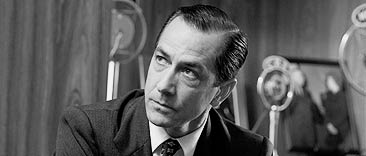
I enjoyed the movie in the same way I enjoyed Clooney's last directorial project Confessions of a Dangerous Mind. It's not a vanity project. He doesn't set those films up to give himself a great role. I'm not a huge Clooney fan - although in the last 5 or 10 years I have been quite impressed with his work - O Brother Where Art Thou is a perfect example. I think one of the things that is surprising and refreshing about Clooney is how GOOFY he really is. He's got those handsome manly looks and he "got by" on those looks for years. A lot of his work on ER was about that. But I think he's more of a goofball than anything else. Anyway, I have enjoyed both of his forays into directing. Instead of choosing a "vehicle" for his own damn self, he picks a story that interests him. He plays a small part in Good night, and good luck - or, not a small part - but the entire movie rides on Strathairn. It's his movie.
The rest of the cast - Robert Downey Jr, Patricia Clarkson (LOVE HER), Jeff Daniels, Frank Langella as Bill Paley ... are all wonderful. You are immersed in the world of the newsroom. The film is in black and white. Everyone smokes. At all times. It's so odd to see. Because the film is in black and white, you get that cool effect of the billowing smoke from 100 cigarettes filling the air.
There is some great great old footage of Murrow's interviews - the one with Liberace, in particular. Liberace talking about how he looked forward to getting married one day, how marriage is a wonderful thing ... this young pudgy-faced Liberace - and Murrow interviewing him, with this dry ironic seriousness - you could just tell he was thinking: "What am I doing with my life? Is this journalism?"
Langella as Paley was great. Just great. Clooney got a great cast together.
But it's really Strathairn's movie. It's so nice to see him in a LEAD. He's a character actor. He never gets the lead. But he's the lead in this, and he is absolutely fantastic.
What I also liked about Clooney's movie is that he sticks to the story. We don't get into these people's home lives, their personal lives (the only personal life thing we get is Patricia Clarkson and Robert Downey Jr. having to pretend they're not married in order to go on working at CBS) ... Clooney doesn't care about Murrow's psychology, his deeper motivations, whatever. He sticks to the story.
In a way, it's a very personal film for Clooney. His father was a newscaster in the early days of television broadcasting.
The review in the Times ends with this very apt observation:
Most of the discussion of this movie will turn on its content - on the history it investigates and on its present-day resonance. This is a testament to Mr. Clooney's modesty (as is the fact that, on screen, he makes himself look doughy and pale), but also to his skill. Over the years he has worked with some of the smartest directors around, notably Joel Coen and Steven Soderbergh (who is an executive producer of this film). And while he has clearly learned from them, the cinematic intelligence on display in this film is entirely his own. He has found a cogent subject, an urgent set of ideas and a formally inventive, absolutely convincing way to make them live on screen.
I totally agree with that.
It was fun. Sitting in a little screening room on 49th and 7th, on a rainy rainy night. Good movie.
Medium
I watched Medium last night. It's actually quite good. I've always been a fan of Patricia Arquette's - I think she's one of those under-rated gems. Her performance in True Romance is just spectacular - what a performance!! The call girl huddled up in the blanket in the cold, crying about how she loves him, telling him that she is "completely .......... monogamous." Great part. Alabama was her name. She's terrific.
Anyway, she's very good in Medium as well, and I'm always happy to see her working. She has a couple of kids in real life, and works her schedule around them - which limits the parts she gets. She seems okay with that - she's never been a big careerist - but I never want to see her drop out completely. I also love her body.
The part I'm playing in this play is a medium. Someone who can hear the dead speak, who is surrounded by voices that she needs to either filter out or listen to. Also someone who occasionally works with the police department (on the hush-hush, of course) to put together crime scenes, get into the mind of the killer, the victim, what have you. One of those. Not a psychic - they don't like that word, apparently. They like "medium", or "clairvoyant".
I watched it just to get an idea of this real-life medium's life, how this "gift" or "curse" works for her, how she experiences it ... as research, if you will ... but then ended up getting sucked into the story.
It's really not all that bad. I rarely watch regular network television anymore - because most of it sucks. I religiously watch Yes, Dear for obvious reasons, and I also watch The West Wing on occasion, which I really enjoy. But for the most part - I never go near network TV. I watched a bit of Las Vegas which was on before Medium and ... sorry if there are any fans out there ... but it is really shockingly bad. Even down to the casting. The acting is generic. The actors cast in the smaller cameo parts are generic - not very good. All the real talent out there appears to be working for HBO. And Lara Flynn Boyle - good GOD, woman, lay off the collagen. How old is she? Is she my age? She must be my age ... but she has now had so much work done that she looks way older. Ironically. Her lips are plumped out unnaturally. Her face is drawn and gaunt. Her collarbone juts out. But not as far as her lips jut out. What happened to that delectable freckled redhead who was so cute on Twin Peaks? What happened to her? She looks absolutely atrocious. And she can't act anymore either. Whatever talent she might have had she has squandered. She got caught up in her own looks - so her acting is now self-conscious, guarded, and ... feckin' BAD.
Compared to the stuff on HBO, this network stuff is really bad. In quality, in direction, in what the show looks like ...
But Medium was a pleasant surprise. I'll watch it again. It was also very helpful for me, just in terms of what I was looking for. I took notes.
Am I ready?
Am I ready for end-of-September baseball? It's almost like gearing up for some battle or something. I know my time is limited. I know the game schedule. I must make it work. I must accept that there will be a lack of sleep. I can't fight it. Ready? Ready? Well, it doesn't matter if one is ready or not. The time is here.
Great post at Surviving Grady.
Here we go!!
The Books: "Italian American Reconciliation" (John Patrick Shanley)
Next in my Daily Book Excerpt:
Still on the script shelf:
 More John Patrick Shanley! The next play is Italian American Reconciliation
Very funny play. Great characters.
Here's the setup: It takes place in Little Italy. Huey Maximilian Bonfigliano was married to Janice - a woman who haunts every scene she's not in. Everyone talks about her and her shenanigans all the time. The way she is described is horrific. She is not just a bitch, apparently - but she's evil. She shot Huey's dog, for example. She tried to shoot Huey. She is apparently off her rocker. Finally, though, we meet Janice - in a long extended scene - and while she is indeed a bitch, we do discover that there is way more to this woman than just that. It's great that we don't actually meet her until halfway through the play. Shanley builds her up in our mind like some demon goddess, we're almost afraid of her ... and then when she appears, we come to her with all that expectation. It's a great set-up. Anyway - Huey and Janice got divorced. Huey is now dating a nice girl named Teresa. Only Huey cannot get Janice out of his mind. He decides that he wants to break up with Teresa and get back together with Janice. Only he's too scared of Janice to make the first move - so he sends his best friend Aldo to talk to Janice. Huey and Aldo have been best friends since childhood. Actually - all of these characters have known one other since they were little kids. Huey is more vulnerable one than Aldo, who is a tough intense Italian guy. Aldo is very successful with the ladies. He is a babe magnet and he knows it. He's also a nice guy.
So Aldo goes to Janice's house, to see if she would be interested in getting back together with Huey. This is the first time we meet the infamous Janice. This is the scene I'll excerpt. It's obvious what Shanley is going for - because the way we first see Janice is: she is standing on her balcony, looking out into her backyard. She's wearing a soft white nightgown, and she's holding six roses. Quite a different first impression than we were expecting. She has been described as a Dragon Lady, and there she is mooning about on her balcony.
Aldo approaches. They start to talk. Janice is, indeed, very intimidating. For example. Aldo tries to make small talk and says, "Beautiful stars." Janice's blunt reply is: "Stars make me think of death." Janice obviously doesn't "do" small talk.
13 by Shanley: Thirteen Plays (Applause American Masters Series)
Here's the excerpt:
EXCERPT FROM Italian American Reconciliation
ALDO. Janice, Janice, Janice.
JANICE. What?
ALDO. We've seen some stuff, huh?
JANICE. What are you talking about?
ALDO. Member when we were kids? I'd play Julius Caesar and you'd stab me with the rubber knife and yell Die! Die!
JANICE. I remember.
ALDO. You were some nutty little girl.
JANICE. You were a jerk.
ALDO. I was very innocent.
JANICE. You were a jerk.
ALDO. I was a little kid. I was supposed to be a jerk.
JANICE. You did it perfectly.
[A pause]
ALDO. Janice, Janice, Janice.
JANICE. Why do you keep saying that?
ALDO. We've been around the block a few times.
JANICE. Aldo. You are still the same hammerheaded clown you always were. Are you trying to be smooth? You come here outta no place. You send flowers. You say Janice, Janice, Janice. Am I supposed to be getting the idea? How 'bout just spitting it out?
ALDO. Huey wants to make it up with you.
JANICE. Why are you saying this? Where's Huey?
ALDO. He sent me first.
JANICE. Oh, I get it. He always was a coward.
ALDO. Huey is not a coward.
JANICE. Huey always was a coward, and you always were a stooge. If he wasn't a coward he'd be standing here in his own shoes speaking his own words. If you weren't a stooge, you wouldn't be standin in somebody else's love scene. Ain't you got no girl of your own?
ALDO. I got girls comin out my ears.
JANICE. What a picture.
ALDO. I didn't come here to talk about me.
JANICE. That's cause you're a stooge.
ALDO. Stop callin me that! You can be a very difficult woman to talk to, Janice.
JANICE. Really?
ALDO. Yes. I mean, if I was here on my own ... I mean, if I was the specific guy who was tryin to romance you, I gotta tell you I wouldn't even know where to begin. You are so ... nasty.
JANICE. I am?
ALDO. Yeah, you're like a fiend. Your eyes look like vampire vulture monster fiend eyes.
JANICE. They do?
ALDO. Yes, they do. And you always smile only for the wrong, the most horriblest reason. Sometimes when you smile I expect to see like fangs fall down over your lower lip. I've had the experience when you smile where I wanted to run away down the street cause I was afraid you were gonna bite me.
JANICE. Really?
ALDO. You're not angry?
JANICE. Why would I be?
ALDO. I thought cause I was telling you the truth that I might be insulting.
JANICE. Why?
ALDO. You know.
JANICE. No, I don't.
ALDO. You know. Romance. Lies.
JANICE. I like the truth.
ALDO. So do I. You know, sometimes when I catch sight a you unexpected, my balls jump up in a bunch like I dropped 'em inna glass a ice water. [Janice laughs heartily] You think that's funny?
JANICE. Yeah. Don't you?
ALDO. Yeah, but I thought you'd be like the last person in the world to get the joke.
JANICE. You don't know me, Aldo.
ALDO. I guess not.
JANICE. You always amazed me. Why'd you let me stab you and bury you and treat you like a dog?
ALDO. I don't know.
JANICE. You oughta think about these things.
ALDO. I have thought about 'em, and I still don't know.
JANICE. I did all that stuff to you to see how much you'd take. I thought, Maybe if I kick him one more time, he'll stand up and take my shoes away.
ALDO. Take your shoes? Why would I take your shoes?
JANICE. To take charge of me like a man.
ALDO. What are you saying?
JANICE. You still don't get it, do you? I was flirting with you.
ALDO. That was flirting?
JANICE. Sure.
ALDO. No, that wasn't flirting. You may have felt like flirting, but you weren't doing flirting. You were treating me like I was the snake in the apple tree.
JANICE. You just didn't get it.
ALDO. I woulda gotten it if you did it right.
JANICE. YOu would have gotten it if you weren't so supid.
ALDO. Alright. Anyway, thanks.
JANICE. For what?
ALDO. I don't know. For feeling like flirting with me, even if I didn't get it. Listen, I wanna apologize for what I said before. I don't think you're nasty.
JANICE. I am, though.
ALDO. No. It's like this what we were just talking about. I've just misunderstood you, so I was afraid of you.
JANICE. You understood me well enough. I've never asked to be understood any better.
ALDO. But you're not this monster I made you out. You don't have evil eyes. You don't have big teeth and you're not gonna bite me.
JANICE. I might.
ALDO. Listen, Janice, I think you're okay. You've had your problems just like the rest of us and who am I to pass judgement on you? No matter what I said, you an I go back to the beginning and under everything I'm always gonna have a warm sport for you. The final ultimate drift is I know you're a nice person and I'm gonna make a real effort to remember that from now on.
JANICE. Don't bother on my account.
ALDO. I am, though. I'll tell you something. I'm very titillated that you was flirting with me, even in those ancient days. Have you ever ... felt like that ... since?
JANICE. Never.
ALDO. You must have your romantic fantasies here, livin by yourself. Like you're that princess trapped in that castle surrounded by thorny bushes. Waiting for Prince Valiant to happen by. You must have thoughts like that. On occasion.
JANICE. Never.
ALDO. The thought of you has crossed my mind from time to time. In an unterrifying way. I have a fantasy life, you know.
JANICE. Do you?
ALDO. Oh yes. I have a very full and real fantasy life, and from time to time, you appear there.
JANICE. Aldo, are you hitting on me?
ALDO. Maybe I am.
JANICE. This is too delicious.
ALDO. What d'you mean?
JANICE. You're supposed to be here for Huey.
ALDO. So. Maybe I'm not the stooge you thought. Maybe I got my own agenda of feelings. Janice, I'm gonna be out there for you. I've been thinking about you. The thought of your face and your figure has been eating me up lately. How 'bout it?
JANICE. How 'bout what?
ALDO. How 'bout I come up stairs and we rip up the bed a little bit?
JANICE. Just like that.
ALDO. That's right. Impulsive.
JANICE. Alright. What the hell.
ALDO. Really?
JANICE. I'll come down an open the door.
[Janice goes in]
ALDO. [to the audience] That was easy.
[Janice comes back on the terrace with a zip gun. Aldo has his back to her.]
JANICE. Aldo.
[Aldo turns around and sees the gun]
ALDO. Holy Moly!
[Janice fires. The gun, defective, blows up. It burns her fingers. She drops it. Aldo, meanwhile, dives under the table]
JANICE. You dunce! You oaf! You slimey sewer rat. Damn it. Look at that. I burned my finger. What do you take me for, you comical boob? Am I not supposed to see through you? You're like cellophane! Let's rip up the bed a little bit. God!
ALDO. Don't shoot me!
JANICE. I can't. My gun broke.
ALDO. [comes out from under the table] You shot a gun at me.
JANICE. Don't be obvious.
ALDO. You tried to kill me!
JANICE. I burned my finger. That's what I get for usin zip guns. Next time it's Smith and Wesson.
ALDO. Janice. Do you understand what you did? You committed attempted murder on me.
JANICE. I was aiming at your kneecaps.
ALDO. I should come up there an give you a spankin!
JANICE. Oh yeah? Try it. I'll cut your heart out.
[I'll stop there. But the scene goes on and on and on after that ... and they actually come to some deep deep level of understanding ... it's a great scene.]
September 26, 2005
Call me Ishmael
A wonderful book review of a new biography of Herman Melville.
I like this:
Readers will note that I have said nothing very much about Moby-Dick . But what can anyone say? Its quietly portentous first sentence is as famous as any in world literature ("Call me Ishmael"), and some of Ahab's monologues, like the one beginning "Is Ahab Ahab?," achieve an eloquence rivaling that of the Bible and Shakespeare. There are longueurs, but even in the midst of tedious cetological lore, one comes across such disturbing passages as that in which the Pequod's sailors squeeze and squeeze and squeeze handfuls of white spermacetti. Then there are the marvelous portraits of the crew -- the black cabin boy Pip, who goes mad and loses his sense of self, the well-meaning but weak Starbuck, the mysterious harpooners Queequeg, Tashtego, Daggoo. There are the haunting encounters with other ships, especially the Rachel "searching for her lost children." And throughout there is philosophizing that at times rises to a kind of prose poetry:"All men live enveloped in whale-lines. All are born with halters round their necks; but it is only when caught in the swift, sudden turn of death, that mortals realize the silent, subtle, ever-present perils of life. And if you be a philosopher, though seated in a whale-boat, you would not at heart feel one whit more terror, than though seated before your evening fire with a poker, and not a harpoon, by your side."
In Melville's lifetime few recognized or even suspected the writer's exceptional genius -- but Nathaniel Hawthorne came close, and the two men established a long-lasting friendship. After their first encounters, the writer of Polynesian adventures went back to his romantic tale about "Whale Fishery" and, in Delbanco's words, "tore it up from within." Melville deepened and amplified his novel, enlarged it in every sense, with the obvious hope of joining what he called, in an essay on Hawthorne, that fraternity where "genius, all over the world, stands hand in hand, and one shock of recognition runs the whole circle round." With wonderful appropriateness, then, the author of The Scarlet Letter -- which appeared in 1850 -- became the dedicatee of the following year's Moby-Dick .
I've always loved that story about the unlikely pairing of Melville and Hawthorne.
Moby Dick. What a book.
One of my favorite passages (always gives me chills) is:
Oh, man! admire and model thyself after the whale! Do thou, too, remain warm among ice. Do thou, too, live in this world without being of it. Be cool at the equator; keep thy blood fluid at the Pole. Like the great dome of St. Peters, and like the great whale, retain, O man! in all seasons a temperature of thine own.
Health class - circa 1950
One of my favorite sites is Cate's Garage Sale Finds. Too much funny stuff there to even count - but it's on par with the infamous Weight Watchers cards from 1974. PAINFULLY funny and observant.
PAINfully funny.
Anyway, I just flipped through Cate's discussion of a health book for teenagers in the 50s she found somewhere.
You just have to flip through it. Look at the illustrations, look deeply. And then read her commentary.
My stomach hurts. Her observations about the illustrtaion showing the dangers of joy-riding is almost too funny to be read at work.
More Stephen King
I decided to do a little King catch-up - I got excited about it after our big Stephen King conversation here the other day. Found a copy of Rose Madder at a cool second-hand bookstore in Hoboken, bought it for a dollar, and I am now a quarter of the way through.
That's the thing. When they're good, they're good. And it's like ... you literally cannot put it down.
I have not read Rose Madder, by the way - so please don't spoil it! I have NO idea what will happen.
Although now it is becoming apparent that there is something, shall we say, odd about the painting she bought in the pawn shop ... and it seems to be ... shifting within its frame ... either zooming out ... or moving back ... who knows ... It's damn creepy, whatever it is. Imagine looking up on the wall at a painting you love, and suddenly seeing something coming in from one side that was never there before. As though the "camera" had moved over 5 inches, to see what was beyond the frame.
Creepy!!!
Having fun reading it. I'm doing a lot of other really heavy reading at the moment ... so it's good to have an escape kinda book as well.
Trivial things that I love right now
And by "love" I can mean two things:
1. Genuine love and affection
2. Or the gleeful snarky schaudenfraude brand of love. By that I mean: MEAN love.
So here we go:
1. I find myself loving this season of The Real World. The one in Austin. My love grew slowly ... and it started out with a lot of shame mixed in ... like: "Oh my God, I am actually aware when the show is on ... and I am counting the minutes until it starts" ... but now the shame is gone, and I am left with pure love and affection. Granted, my love for that show peaked years and years ago, with the San Francisco cast (my friend Mitchell and I still discuss those people as though we knew them personally. "God, I love Judd." "You know who was great, actually? Rachel ... and how she bonded with Pedro ..." Etc.) So no. The Real World has definitely gone down the slippy-slope since then --- culminating in the Las Vegas season, when everyone appeared to just be alcoholic ho-bags and jag-offs. There was a naked lesbianic hot tub in the first show of the season. Uhm ... what "real world" would that be? The show always attracted exhibitionists - of course it did - but when the entire form of the show is no longer normal interactions but people "pushing it for the camera", it gets a bit boring. Poor Charelle - or whatever her name was. What was her name? That sadly unattractive I-will-make-out-with-girls-because-it-turns-men-on girl.
ANYHOO, I have strayed far off the field. Back to my point:
I have gotten sucked into the Austin season, and I am strangely invested in a couple of these people. I started out thinking that Melinda was just a sad desperate slut ... but now I have another theory, which I will not bore with you at this moment in time. I like Nehemiah and I wish him well. Johnanna needs an intervention. Seriously. Lacey is weirdly cool, even though she's kind of superior and over-it. I like her because she does her own thing. She's a virgin, she doesn't drink, she has a serious boyfriend back home ... she's not interested in getting drunk and hooking up with people like the rest of the people in the house ... so she doesn't. She's impervious to peer pressure. And then there is Danny. Of the broken-eyeball fame. I love Danny and his Boston accent. I fear for his broken eyeball and crushed skull. I am glad that they reconstructed his poor collapsed face, because he is a cutie. He has gotten sucked into a heavy duty thing with Melinda ... and he needs to break free. As of now, he's being a prick about it, very ungraceful (and of course - the second she takes the hint and backs off, he's all over her again. Come on, Danny. Knock that shite off) ... but it will be interesting to see how it unfolds.
Obviously I need to talk about this in WAY more depth.
People I need to psychoanlayze, and commit paragraphs and paragraphs of text to:
Melinda and Wes.
Wes is a fascinating case study. I don't even know where to start. How can one be so completely unaware of how one comes across? To me, that connotes a deeply deeply stupid person. You know those people who honestly believe that they are fooling everyone in the room - who project out a persona, and really think that we'll all buy it? They honestly believe that we think they're hot shit, or cool - or whatever it is... Like when Wes went in to "comfort" Johanna in her bed, and he was wearing dark sunglasses. Dude. Please. That was SO for the cameras, and he honestly believed that we, back home, would be like: "Wow. Wes is so cool. So hip. Wearing sunglasses in the house." Wes walks around with invisible movie cameras following him around (in addition to the real camera crew following him) - and is starring in his own movie. Only he thinks that he's, like, Russell Crowe ... when in actuality ... he is Patrick Dempsey.
I can already feel how much I need to talk about this.
I also feel like I might need to do a post about how just the thought of Patrick Dempsey puts me into a rage.
Get ready for some major Real World posts. I have got to get this out of my system.
2. I love the whole "fraud" thing of Renee and Kenny (aka The Pucker-faced Inchworm and The I'm-not-a-real-cowboy-but-I-am-one-hell-of-a-stud) . You think your wedding is a fraud, lady? I think YOU are a fraud, frankly. So this whole thing makes me so happy. Why??? Because I'm a mean and awful person, I guess. Just goes to show you that bonding with someone at a tsunami benefit does not til-death-do-us-part make.
I also love how many gleeful emails I received from friends and readers saying, "Have you heard???" Thank you all, for sharing in my contempt.
Kathy even wrote a post for me about it.
3. On the flipside, I love Demi Moore and Ashton Kutcher. This is the genuine kind of love. I get the feeling that there's something quite substantial going on between the two of them, and they truly seem to enjoy one another. The body language says it all to me. I also just kind of have always been a "fan" of hers - but I'm not sure how else to say it. I don't think she's a very good actress, although do not even try to tell me she's bad in GI Jane, because I LOVE that movie. It is the guiltiest of guilty pleasures - I have to have seen it 20 times. Anyway. It's not really her acting ... I guess it's her perseverence. She just kept sticking with it. I remember her as Jackie Templeton (on "my" soap, General Hospital) - back before she became famous. And ... she's one of those actresses who is a savvy businesswoman, who was able to cultivate deals for herself unprecedented in the business - at one point she was the highest paid actress in Hollywood - and yet somehow, even with her stardom - she keeps her private life private. She doesn't really court the prying eyes. There's a wall there. After her divorce from Willis, she disappeared to raise her daughters. She lives in Idaho. Then - suddenly - she was back. And I don't know. I just love her and Ashton together. I think they're a great couple, and every photo I see of them, they've got this glow about them. Like this one. Compare to the body language in this photo. Ew.
So congrats to Ashton and Demi!
How much more trivial can you get here???
I'll think of some more later.
Oh, and on a final note, here is something Mitchell said (one of my best friends), after the birth of Rumer (Bruce and Demi's daughter):
"Yes. They have named their child Rumer. Their next child will be named Flat-Out Gossip, and their final child will be named Bold-Faced Lie."
The Books: "the dreamer examines his pillow" (John Patrick Shanley)
Next in my Daily Book Excerpt:
Still on the script shelf:
More John Patrick Shanley! The next play is the dreamer examines his pillow
First of all, I just love that title.
And the play itself - so rich, so weird, so deep ... I've read it about 10 times and I still can't really picture it, how it should be done, how it should be played ... It is not a realistic play, and yet it has a realistic surface. Fascinating - I know many Shanley fans who call dreamer examines his pillow their favorite of his plays.
It's a three-scene play - about 30 pages long. There are three characters - Tommy, Donna, and Dad. Tommy and Donna once had a torrid love affair. Well - not torrid. Let's just call it volatile. Addictive. Painful. Beautiful. Tommy has now broken off with Donna, and is going out with her 16 year old sister Mona. Not only that but he robbed his mother of money, and is living in a filthy apartment, and appears to be losing his mind. The play opens with Donna coming over to confront him about this. They have a long tormented scene, with Donna asking him why why why, and Tommy fighting back ... Occasionally they can't help themselves and they fall into a torrid embrace ... Donna eventually storms out.
The next scene is Donna going to confront her father, who was not a very good father - cheated on her mother, etc. etc. But she goes there to ask for his aid in dealing with the situation. What should be done about Mona seeing a 27 year old guy? On a deeper level, though, she's going to her father to ask him why men are the way they are, and what she should do about being in love with Tommy. The scene between Donna and the father is so wonderful - and that will be what I excerpt from.
13 by Shanley: Thirteen Plays (Applause American Masters Series)
EXCERPT FROM the dreamer examines his pillow
DONNA. Dad. Somethin's happened to me. It's made me have a lotta ideas. And I'm very upset. About it. And it's got to do with you.
DAD. How?
DONNA. Well, inna couple a ways. There's this guy. His name is Tommy. I'm in love with him.
DAD. So go kiss him or somethin.
DONNA. He's hurtin me. A lot.
DAD. So then go talk to him.
DONNA. I just did that. Listen. He ... Well, he's been foolin with Mona, too.
DAD. He's seein you an Mona?
DONNA. Yeah.
DAD. My, my, my.
DONNA. He's all fucked up. He's stealin now. He looks like shit. But all that I can deal with. Even the Mona thing, I think. But this is the thing. In the whole way that this has come down, I thought I knew what I was doin. The me part of it. Till today. Another like level came into it. I always heard that girls went after guys who reminded em of their fathers. An I guess I kinda believed that idea or was spooked by it at least, so ... I've always made double goddamn sure never ta go near any guy I thought was like you, because then I'd turn into my mother, right? A thought that makes me think a the phrase, Fate Worse Than Death. Anyways, I always steered clear of this certain kinda guy for that reason. Like this guy Tommy. I'm like absolutely sure he's totally different than you. And then today, I go to him, inta this pit where he's livin, and up on the wall is a painting a drawing he did.
DAD. This guy your seein?
DONNA. An Mona. A really lousy picture, self-picture. But it scared me. I think more than anything that's ever happened to me. I heard the fuckin Twilight Zone music. Cause here I am, goin along, thinkin things are one way, that I'm choosin an goin my own way, an maybe doin a terrible fuckin botch a that, but doin it. An then I see this picture. And I think, Do I really know what's goin on in my life? Or am I just a complete molecule or some shit. If this guy Tommy is turnin into you, then I'm in some kinda car I don't even know I'm in, and some guy inna scary mask is drivin, an he's had the route the map since the doctor smacked my ass. Where am I? I'm in love with this guy Tommy. He's drivin me crazy, yeah. He's tearin my heart out an steppin on it, yes. The whole thing I'm doin looks to be a total fuckup, but I can deal with that I can live with that. But what I wanna know gotta know is IS THIS MY LIFE OR WHAT? Is this my pain? My love? Or if what's goin on here like history? You treated my mother like shit. You cheated on her. You lied to her. You humiliated her in public. When you had money, you wouldn't give her any. When she had money, you took it. You walked on her face with muddy shoes. When she was in the hospital, you didn't visit her. And then finally she just fuckin died. Now I hate your fuckin guts for that, but I decided a long time since that I wasn't gonna spend my whole life wishin you dead or different, cause I didn't want my life bossed by your life. I even thought, Maybe she deserved it. I knew I didn't know the whole story and never would an what was it my business anyway? But that was before. Today, I saw that picture on Tommy's wall, an it was writin on the wall to me, an the writin said, Watch Out. You could be in the middle of somebody else's life. So that's why I'm here. Because before I thought I didn't have to know about you to do my life, and now I see I better find out a few things. It's like medical history.
DAD. What bullshit.
DONNA. That's what you say when I pour out my heart to you?
DAD. I'm sorry. What you're afraid of just cracks me up, that's all.
DONNA. I don't understand.
DAD. Alright, you want your father's smarts, I'll give you your father's smarts. What you have are women fears.
DONNA. Women fears.
DAD. That's right.
DONNA. I hate what I'm hearin.
DAD. Well, tough shit. You got women fears. That's what I know and I'm tellin you. When I talk to a woman, I feel like I'm yellin across the Indian Ocean. That's cause I'm a man. Do you wanna hear this or not?
DONNA. Yes.
DAD. Women are very concerned about bein trapped. All women, or virtually, anyway. They worry about it, that's been my experience. So what they do, a lot of em, to feel strong, they trap a man. They trap some guy in their dream. And then they feel trapped cause they gotta guard what they caught. At least let me say, this is what happened with me an your mother. But there's a certain universal here.
DONNA. And men don't feel that?
DAD. What happens with men is a little different. I think that men recognize or make up that they are trapped, already, an what they do is, the man feeling is, they long to be free. Of mother, wife, job, art, whatever.
DONNA. Do you hear yourself? You sound like a total jerk. This stuff you're sayin can be knocked down by a three-year-old with a feather.
DAD. So what? I'm tryin to tell you somethin to get somewhere, somewhere maybe you'd like to get to. Don't think you can get everywhere by algebra, honey. Things ain't that straight. Life ain't at all like the psychological section in the New York Times three-warning-signs-to-look-for bullshit. Things ain't like that at all. If somebody's willin to talk to you an tell you shit they think is true, don't be so quick to knock it. People don't usually part with the weird shit they personally know because theyh know how easy it will be to punch holes in. Now I'm tellin you somethin. It's for you to poke through the soup an find the meat. So listen up. There's a level where you fear an want that's a woman level. This shit you just told me about bein afraid you're turnin inta your mother, that's on the woman level, that's a women fear. So my suggestion about that is, you go talk to a woman about that. But there's another place under that place, where men an women can meet an talk, if you know what I mean. It's way down. An it's dark. An it's old as the motherfuckin stars. If you want somethin from me, or if you wanna tell me somethin, that's where we're gonna haveta be.
[A long pause]
DONNA. Alright. [a long pause] Tommy an me ... When he loves me. In bed. When he puts his arms around me, and I can feel his skin, his heart beating, his breath, and I smell him, it's like Africa. It's like, I get scared because all of my guts shake ... Sometimes I press my hands against myself because I think things are coming loose inside. He just touches me, starts to barely touch me, and I'm so frightened because it's so much, it's so hot, it's so close to losing my mind. It's beyond pleasure. It's ... he takes me over. Like there's a storm, I get caught in this storm with electricity and rain and noise and I'm blind I'm blind. I'm seeing things, but just wild, wild shapes flying by like white flyin rain and black shapes. I feel I feel this this rising thing like a yell a flame. My hair I can feel my hair like slowly going up on its toes on my skull my skull. Everything goes up through me from my belly and legs and feet to my head and all these tears come out but it can't get out that way, so it goes down against my throat swells an through down to where it can get out GET OUT GET OUT. But it doesn't go out, so I, I EXPAND. Like to an ocean. To hold the size of it. An then it's maybe something you could speak of as pleasure, since then somehow I can hold it. I'm this ocean with a thousand moons and comets reflecting in me. And then I come back. Slowly. Slowly. From such a long way. And such a different size. And I'm wet. My body my hair. The bed is just soaked, torn up and soaked. There ain't a muscle left in me. I'm all eyes. My eyes are the size of like two black pools of water in the middle of an endless night. And Tommy's there. And he did it to me. He took me completely. I wasn't me anymore. I was just a blast a light out in the stars. What could be better than that? What could be better? It's like gettin to die, an get past death, to get to the universe, an then come back. In the world where we talk and fight and he fucks me over, it all just seems so unimportant after that. I don't understand how he can do that for me an then turn around an be such a, well, smaller. It is a small world this world, in comparison to where we go in bed. And I guess we gotta be smaller in it.
DAD. What are you tryin to tell me, Donna?
DONNA. I'm afraid.
DAD. Of what?
DONNA. I'm afraid to leave him or that he'll leave me. I'm afraid to be without the sex we get to. Everything else seems like nothin next to it. But I can't give up who I am to be his love slave. That's what I'm afraid of. That I'll lose myself if I stay with him, and that I'll lose the sex if I get away.
DAD. I've felt that.
DONNA. You have?
DAD. Yeah.
DONNA. But that seems like a woman thing to me.
DAD. Nope. Men have that too. It's a very down thing. It's very near the bottom.
DONNA. In one way, he don't know a thing about me, not really. And in another way, what he knows is the key that lets me outta my life. It's like what he don't know about me is exactly what I don't care about anyway.
DAD. Yeah.
DONNA. You've really had this?
DAD. Oh yeah. I had this with your mother. It's why I always kept a girlfriend on the side. I hadda keep somethin away from her, so I didn't lose everything when we went nuts in bed. And too, because I wanted to protect what we had in bed by havin somethin else goin that was not that intense. Sort've a comparison, a reminder. Somethin common to underline the extraordinary. Your mother was the love of my life.
DONNA. But if that's true, how the fuck could you treat her like you did?
DAD. That bed was what we had. When I got outta that bed, I didn't walk, I ran. When I got outta that bed the most important thing was that my feet hit the ground, found the fuckin ground. Do you understand? If there was gonna be anything else a me outside a that bed, it hadda be without her. Otherwise, she woulda taken me over all the way. I hadda create a second place in me and outta me where I could work. Do my painting. I got the studio. I got the girlfriend. WHY DO YOU REMIND ME OF THESE THINGS? It's so fuckin painful. Your mother's dead. My baby's dead.
DONNA. I can't believe this. You mean, you really loved her?
DAD. Shut up shut up. Can't you understand? All I have now is that little bit I kept from her. That little room. I can't even paint anymore. Why would I want to? What do I care what I see, why would I describe it? I hid a part a me from her to save somethin cause I was scared. I'm so sorry. I'm so sorry. I shoulda given her that, too. If I'd given her everything, then when she died, I woulda died, too, and that woulda been the merciful end of it. Why did I save something? What for? It wasn't worth it. What I saved wasn't worth a goddamn thing. If I only known.
DONNA. I'm here.
DAD. I can't stand the sight a you. You remind me just enough ta make it unbearable. At least Mona don't look like her. You. Sometimes, the way you ... Sometimes you could be her. But you're not. Sure I treated her like shit. I was so angry cause she had so much a me. I thought it was too much to let somebody have. And when she was dyin in the hospital, sure I didn't go an see her. I couldn't bear it. Don't you get it? I just couldn't bear to watch her leave me. You come here to tell me things you think I don't understand. So maybe you were right. Maybe you are turnin inta your mother. And maybe this guy Tommy is turnin inta me. I don't know. But the big news is you don't know who those people are. I promise you.
DONNA. You never told me.
DAD. It just woulda sounded like an apology for abuse.
DONNA. All my memories seem wrong now.
DAD. Good. Maybe now then you can remember a few things.
DONNA. Who am I?
DAD. Don't worry about it. I think you worry too much.
DONNA. I love this guy.
DAD. Come here, baby. I hate the sight a you, but let me hold you in my arms.
[He holds her]
DONNA. I don't see any future for me.
DAD. Good.
DONNA. It's not good.
DAD. You can't see the future anyway. It's a very realistic feelin you're havin.
DONNA. Can I move back home?
DAD. No.
DONNA. I want to.
DAD. You probably feel like suckin your thumb, too. But there's a time an place, an that an place called home is gone now.
DONNA. What am I gonna do?
DAD. Well, that's a question. You could run away to the circus.
DONNA. This is the fuckin circus.
DAD. You wanna grapple an go inna single direction and stick with it, ride it out inna straight line right to heaven, the grave or whatever?
DONNA. Yes.
DAD. There's only one thing that goes straight, my baby, and it's not love. It is not love. You can chase that one forever, it won't come to you. It won't bow, it won't serve, it won't do what you want, what it should, it won't be how you thought, or was taught how it was meant ta be. You can't lead it cause it'll be draggin you wherever it wants. If you wanna go inna straight line, give up people. People are what zigzag. I'd rather predict the weather three months in advance, my sweet girl, than try to tell you one thing about the future of the dullest heart.
September 25, 2005
The Baltimore Boys
Speaking of Ruben (the friend I mentioned in this post), I thought I would re-post the story of how he and I met. It's quite extraordinary, and it still has a little whiff of unreality to it, when I look back on it. I still kind of can't believe that I did what I did - it was unprecedented, a huge risk (if you think about what COULD have happened) ... and yet ... it all made sense in those crazy days.
We are still friends. I can't even explain how grateful I am for that, and how grateful I am for Ruben.
The first time I left New York City after September 11 was for a weekend in Baltimore at the end of September. I was going to visit 2 guys I had never met before in my life. But we had become friends in an online flirty kind of way, in the summer before September 11. I felt no fear, NONE, as I went to meet these strangers. I was aware of no danger. My friends thought I was insane. "What do you know about these guys? Who are they? What are their phone numbers? Call me every day while you're down there..." Etc.
Well, suffice it to say - that they were 2 of the loveliest men I have ever met, and they treated me like a refugee from a war-torn country. Which, indeed, I was. At that time.
One of them, Ruben, is still a good friend of mine, and comments on this blog often (his moniker is Wutzizname). I will ALWAYS have a soft spot in my heart for these guys. I went down there on the train, and I was - to put it mildly - a mess. I didn't want to leave New York. I was still not sleeping. The city had not recovered. By the end of September, we were into the Time of the Funerals. Every day there were funerals. The drones of bagpipes filled the air at all times - replacing the screams of sirens on September 11. I can't explain it. I had not recovered - nothing was normal.
I almost didn't go down to Baltimore, because I felt too much anxiety leaving my city. What if something else happened? I couldn't not be there! If an explosion was going to happen, then dammit - I wanted to be exploded too. It's MY city, Goddammit. I would look at the skyline every morning, and get this overwhelming sense of its vulnerability, its fragility ... And somehow I felt like if I could just stay nearby, nothing would happen to it. Leaving felt precarious.
My 2 new online friends were voices of calm and reason. All of America was affected by what happened that day. But I was their friend from New York City, and they assured me that everything was going to be all right, and when I got down to Baltimore, they would show me around, they would take me out to dinner, they would take care of everything. No worries, no worries, no worries ...
I am still amazed that these guys came into my life. I called them "my Baltimore Boys".
Our encounters before September 11 (the two of them are best friends) were online chats, IM messages, and a couple phone conversations. Benign, flirty, whatever ... On the morning of September 11, when I finally was able to check my email (since no phones worked, email became my primary contact with the outside world) - I saw that both of them had emailed me about 5 or 10 minutes after the first plane hit. Actually, everyone in my entire life who was near a computer emailed me in the first 5 or 10 minutes after the first plane hit. But their emails definitely struck me, because they were, in essence, strangers to me ... but there they were, sending me concerned (and yet calm-sounding) emails to their new friend. I can't explain how much that moved me. It didn't move me so much that first day but in the days that followed ... I became more and more attached to both of them. I would even say that I felt a bit clingy. Why them? I do not know. But there they were - stalwart email friends - sending me multiple supportive emails a day - "hang in there ... we will get through this ... how you holding up? ... we're all upset ..." ... and I just started clinging to them both in my heart.
When one of them invited me down for the weekend, I said Yes with no hesitation.
Everything felt very unreal.
On the day I was to leave, I had an extended anxiety attack. I was taking the Path to 33d Street and then walking over to Penn Station to take the train out of town. At every second, I thought I'd turn back. I felt I could not leave the city yet. The whole damn island of Manhattan felt like an illusion. While I was in Baltimore, the entire place could be liquidated. My home ... my home ... my family ... my sister ... my brother ... Cashel ... all of them were there ... I could not be separated from them ...
But I got off at 33rd Street and made my way to the stairs up to the street. My breath was always high up in my throat in those days. The station was packed with people. It was a Friday afternoon, your regular rush hour.
And suddenly - with no warning - NONE - everyone started to run. People were screaming. There was a mad RUSH for the stairs. I had no idea what had happened. What was happening? But I was part of that crowd - and the second the movement began, the crowd movement, I started to run too. Something was going to explode, something was in the subway station ... There must be a REASON why everyone is running, right?? (By the way, this was not the only time that this happened to me in the month following September 11. It happened 4 or 5 times actually - a crowd response to some invisible panic button ... Crazy days.)
People were pushing and shoving, frantically, to get out of the station up to the street. I had my bags for the weekend. I couldn't catch my breath.
It was completely catching. The panic.
And I emerged onto the nightmare of the street - it's a block away from the Empire State Building - you have to crane your neck way way back to see the spindle - and there had been some sort of bomb scare. Which is probably highly normal for the Empire State Building - but in those late September days of 2001 - nothing seemed more fragile, more courageous, more precious and easily destroyed - than the Empire State Building. I would stare at it from my kitchen window in Hoboken, the only building in Manhattan visible to me. At least now it was the only building I could see. I used to be able to see the twin towers, but now ... there was just one building left. The Empire State Building looked ENORMOUS. A huge target.
The streets were blocked off around the Empire State Building. Cops and National Guardsmen were literally everywhere. I am not exaggerating. It felt like we were under siege. A war zone. As many military folks as civilians. The crowd (of which I was a part) was running this way - that way - panicked - trying to get away from the building, running towards the building - shouting at the cops, "WHAT'S GOING ON?" The cops were hollering at the crowd - "GET BACK. GET BACK."
You have to remember the context of those days.
I started running across 34th Street, holding my suitcase. People were running, all around me. Some were running, as they were talking on their cells. The sound of sirens filled the air. As I ran, I kept looking back over my shoulder at the Empire State Building's spindle ... it looked so fragile you could snap it. I was WILLING it to still exist.
This all probably sounds really crazy. But there was such a crowd dynamic in New York in those days. At any moment, the crowds on the sidewalk were liable to start running. For no reason.
Oh, and randomly - in the middle of this crowd panic - something very very strange happened.
A woman grabbed onto my hand. I was literally running towards Penn Station. I was completely convinced that the Empire State Building was going to explode behind me ... like in a movie. So a woman grabbed onto me. Stopped me. I looked at her with my crazy eyes.
And she said something so unbelievably incomprehensible to me - that I had to ask her to repeat it. She was speaking in English, do not get me wrong, but in that moment, what she said was so absurd, so out of place, that I could not, for the life of me, understand what she was saying.
Here is what she said:
"Do you have any idea where I could buy a Boggle game?"
I'm not kidding.
We're in the middle of a Midtown-wide Bomb Scare, and she's looking for Boggle.
It was only later that I was able to laugh about this. I did an imitation of the moment later for my friend Jen and we were crying with laughter. My insane running, looking over my shoulder, etc., and then this calm oblivious woman basically asking me to point her in the direction of Toys R Us.
I said, "Huh?"
She said, smiling, unaware somehow of the crowd running at her from the direction of Broadway, "Can you tell me where I might find a game of Boggle?"
I should have said, "Up your ass, lady. Why don't you try there?"
But I pointed wildly uptown, and screamed, as I ran away from her, "THERE'S A TOYS R US ON THE CORNER OF 45TH AND BROADWAY - TRY THERE..."
Absurd.
Those days were so absurd.
Penn Station in those days was one of the most mournful places on earth. You walked down the huge corridor to get to the terminal, and the walls were, first of all, lined with National Guardsmen and women who all looked about 12 years old, holding massive rifles. Second of all, the walls were plastered with notes from all over the world. And commuters and passersby would stop to read the notes. People were always weeping in that corridor. I would weep in that corridor. I think I read every note, over those weeks. There were notes from entire classrooms of 2nd graders in Tulsa, there were notes from fire departments the world over ... clumsy English spelling from a fire department in Germany ... there were notes from individual people, "Hang in there..." "We love you" "We will not forget" - there were letters in every language imaginable. Some were written by little kids who obviously had just learned how to write. So their sentiments were blunt. "I am very sad about the dead people. My dad says it's okay to cry though." Stuff like that. It was a corridor of mourning. A corridor lined with the National Guard, and filled with crying people.
My God.
So the panic was still going on, as I entered Penn Station. I felt like I was making a getaway from a war zone, being air-lifted out of Nigeria or something. Everything dissolving into chaos behind me.
Now mind you: This was just an anxiety attack I was having. New York was still there when I got back. The Empire State Building was still there when I got back. But everything was messed up in my head, I couldn't sleep - no one could - It felt like we were on the brink of utter destruction. It was only September 28.
I got on the train, my breathing high in my chest, and everything in me was saying: Don't go. Don't go. If the Empire State Building explodes, you will want to be here. You will want to be here for your city.
But ... the train pulled away from the station ... and I was off. I felt insane. Wild-eyed.
Boggle? What?
When we emerged into New Jersey, I could see the whole of the city spread out to my left, glimmering, and tragic. The gaping hole of lower Manhattan hurt me, like an actual wound. It doesn't really anymore, but it did then. And I stared at that spindle of the Empire State Building, the tallest building, in the center of the island ... teetering ... It looked so ... small. It looked like - wow, it would take absolutely nothing to get rid of that building! And I stared at it, craning my neck backwards, tears running down my face, until I couldn't see it anymore.
I arrived in Baltimore to meet these 2 strange men, in this state of mind.
We had never met. We knew what we all looked like, pictures had been exchanged ... but nothing else.
And these men were my heroes. They still are.
They came to get me at the station. I was nervous, and literally trembling. I could not play anything cool. If I had been going to visit them in July, it would have been a very different vibe. Ready for some flirty-flirty, yadda yadda ... but now? I was a mess. There they were - tall and strong, walking towards me - and Ruben, dear Ruben, just held his arms open. I walked right into them, and he hugged me like he wanted to shield me from all harm. I have never felt so safe in my life.
They took care of me. They showed me the sights. They listened to me talk. They were sensitive. I couldn't talk about anything else. And I needed to have the TV on at all times, in case something happened. They were fine with that. They introduced me to their friends as "our refugee". They gave me (why?? I have no idea!! I was a stranger to them!!) 2 days away from the stench of death and the bomb scares. They were kind enough to take me in. I was, to put it mildly, NO FUN to be around. This was not a whoo-hoo kind of weekend. I was jumpy, and tearful, and needy, and a little bit insane. They expected nothing from me. They just wanted to take care of me, and give me some time away. They were thrilled to be able to do that for me.
Writing this down, I realize it doesn't make all that much sense.
But I'll alway be grateful to my Baltimore Boys for their kindness to me during that weekend. I will never ever forget it.
And one of them has remained a true friend. For which I am also very grateful.
They weren't really meeting "the real Sheila" that weekend. Who I was that weekend is not who I am normally, obviously. I couldn't stop shaking, all through our first dinner out - I sat at the Mexican restaurant, shivering, as though they had the AC on full blast. I kept saying, "God, would they turn the AC down?" The Baltimore Boys said that the AC wasn't on at all, actually. But I couldn't stop shivering. Then I said I wanted to go to a bar where they had a TV, because I had to make sure nothing had happened to the Empire State Building. They did whatever I wanted. "You need a TV, darlin'? Okay, then, we'll take you to a TV."
These men were miracles to me.
I remember lying on Ruben's bed in his dark cave-like apartment, staring at his glowing blue lava lamp for about 30 minutes. Ruben left me alone to do that. Member that, Ruben? The lava was floating around, in its cool blue light, and it looked so peaceful, so deep ... I lost myself in contemplating it. I thought about nothing. I worried about nothing.
When I returned to New York a day and a half later, I came back into Penn Station at about 9 o'clock at night. It was rainy and dark.
And the sadness of the city hit me like a wall. It wasn't MY sadness, per se. I didn't own any more sadness than anyone else. It was like there was a wall of grief around the city. And I was stepping back into that atmosphere. I am telling you: I could feel it the second I got off the train. The sadness wasn't just in the air, or between the molecules ... it WAS the air.
Sheer liquid pleasure
I am sure many of you have seen this before - it is rather famous - but I must link to it. My good friend Ruben sent it to me and I just can't get past it.
It is Kevin Spacey doing Christopher Walken's audition as Han Solo. I mean ... genius. There are others in there too: Richard Dreyfuss auditioning for C3P0 and Walter Matthau auditioning for Obi Wan Kenobi. All of them are laugh out loud funny.
I've mentioned before that I have problems with Spacey as an actor (sometimes. I liked Glengarry Glen Ross and Usual Suspects.) But I've seen him do his imitations of people on talk shows - and the guy is an uncanny mimic. Like - he's not just imitating - he's channeling these people. I have a clip of him on tape doing Al Pacino and tears of laughter stream down my face every time I see it. But his Christopher Walken is a stroke of genius. And to hear him do Christopher Walken saying "she did the Kessel Run in less than 12 parsecs" ... is really just about as good as life gets.
Saturday snapshots
-- Woke up to feel a chill breeze blowing through my window onto my face. First time this season. A true harbinger of fall. I just bide time through the summer. I can't stand the summer. Autumn is my season. That dawn breeze yesterday was the first breath of autumn.
-- Did research online for this play I'm working on. It was great. Got a lot done, and made a list of next steps: articles to track down, books to track down ... It's a subject I know nothing about, and also regard with some skepticism - which, of course, I can't have at all when playing the character. Must believe. It's a prerequisite. In order to believe, I have to learn more about it. So it's fun. I love to learn new stuff. It's one of the best parts about being an actor. Learning how other people live, what their jobs are, how things work in other communities that you never encounter ... so fun.
-- Traveled into Manhattan. God, it was a gorgeous shining day. The city looked like Oz, across the water.
-- Bought these. I'm so excited!! A cute young kid, maybe 18 or 19, helped me. He was wonderful - answered all my questions, and I had about 250 of them. His name was Elvis. Elvis: thank you. The sneakers feel amazing on my feet. So let's hit the road, Sheil-babe!!
-- Went to the Barnes & Noble in Union Square to look for a book that I came upon in my research that morning. It was a madhouse. The New Yorker Festival is going on right now - and they were hosting a Stephen King reading (argh!! The birthday boy!) on the top floor of that particular store. It hadn't begun yet, but you could feel the anticipation shivering throughout the entire joint. "He" hadn't shown up yet, but the line on the top floor snaked around through the shelves, people standing there holding piles of his books in their arms, books for him to sign ... Just the sight of that gave me a lump in my throat. Especially after writing about him earlier this week. People love him. You could see the excitement and anticipation on their faces. It just GOT to me to see that.
-- I had to go to the New Age section to find the book I was looking for. And there it was - 50% off, and only one copy left. Bingo. Mission accomplished.
-- Returned to Hoboken, hoping to find a bar that had NESN that wasn't packed that would be showing the Sox game at 4:30. First bar I tried: No NESN. Second bar I tried: No NESN. I know that Liberty has NESN (that's where I watched them win the Series - hell, I spent 2 weeks of my damn life there last year and the year before) ... but when I arrived it was standing room only. All Red Sox fans - hahaha - awesome - I knew most of them from watching games throughout the years there - but I didn't want to stand for possibly three hours. I came home and descended into utter geek-land:
-- I listened to the game on the radio, while tracking the action pitch by pitch online. Aweeeeeeesome!! I spoke out loud to my computer screen. I cheered on the batters in crucial moments: "Come on, Papi, come on, Papi ..." But ... I am shouting at my laptop.
-- Well, we won. Sheesh. Was a close one.
The Books: "Women of Manhattan" (John Patrick Shanley)
Next in my Daily Book Excerpt:
Still on the script shelf:
More John Patrick Shanley! The next play is Women of Manhattan
Three friends - Judy, Rhonda, and Billie, sit around in Rhonda's Upper West Side apartment and talk about their lives. Rhonda just threw her boyfriend out of the apartment. These three women are old friends, they love each other.
I'll excerpt a bit from the first scene, although one of my favorite lines is from the last scene where Judy explains her night of sex with Duke - actually, the entire exchange is great:
Judy: We went at it like the primordial forms. There were plateaus, upheavals, ditches. We got so deep into this bed it was like dinosaurs wrestling in a tarpit. At one point my tongue had a spasm that made me squawk like a parrot being electrocuted.
Rhonda: Did you have an orgasm?
Judy: I think so.
hahahahahahahaha After all that, and you just "think so"??? Cracks me up.
But here's a bit from the first scene. They've all been sitting around, drinking wine in Rhonda's apartment. Billie is the only married one. Judy has some of the funniest lines in the play. And even though she uses a word I despise - over and over and over - it seems to be for comic effect. Anyway, it makes me laugh - and I cringe when I hear that word normally. It's a great monologue.
13 by Shanley: Thirteen Plays (Applause American Masters Series)
EXCERPT FROM Women of Manhattan
JUDY. What are those big red sneakers doing shambling around on your nice neat floor? Might those be Jerry's shoes?
RHONDA. Yes. They are Jerry's shoes.
JUDY. But doesn't Jerry not live here anymore? Was he not shown the door some time since?
RHONDA. I threw him out. Which you know.
JUDY. I knew you'd thrown him out of the apartment and your life and so on, but I had no idea that you'd thrown him right out of his red sneakers!
RHONDA. Don't be smart.
JUDY. I wouldn't know how.
RHONDA. He left the sneakers. Or they fell out of a bag. I don't know which. But there they are.
BILLIE. Do you really think I spill my guts?
JUDY. Yes, but hold on to them for a minute. [to Rhonda] I came to dinner. I ate dinner. It was passable. A little fatty for my taste, but I don't think it's right for a guest to speak out.
RHONDA. You could've fooled me.
JUDY. I saw the sneakers when I walked in. Said nothing. The soul of whatever. You've said not a word. I know you're troubled about this character Jerry. That you loved him or were enslaved to something about him or something. I've been patient. I've lain here like a monk on a cot waiting for you to speak. But all I've really gotten is that Billie wants to be in some movie with an awful plot. We're getting to the shank of the evening. When are you going to unveil your pain?
[A long pause]
BILLIE. All I meant by the movie thing ...
JUDY. Billie! Hush!
[Billie complies. A long pause]
RHONDA. I miss him.
JUDY. That's it?
RHONDA. I miss his smell.
JUDY. He had a smell?
RHONDA. Yes.
JUDY. Do his sneakers contain this smell? Is that why the little devils are still here?
RHONDA. I don't know. Maybe. I hate those sneakers.
JUDY. Then why don't you send them back to him?
RHONDA. I don't know where he is.
JUDY. Why don't you throw them out?
RHONDA. I don't know. They're too nice to throw out.
JUDY. They're too nice? Please.
RHONDA. I know what you think this is, but it's not. I don't keep the sneakers because I love him.
JUDY. Uh-huh.
RHONDA. I didn't love him. Not in a way that led anywhere. I mean, I loved him but it was like trying to hug a wall. How do you hug a wall?
JUDY. I don't know.
RHONDA. I guess my big mistake was I revealed myself to him. That's where I really went wrong. You know, that thing that most people can't do? That thing that's supposed to be like the hardest thing to get to with another person? It took me time, but I struggled and strove and succeeded at last in revealing my innermost, my most personal soul to him.
BILLIE. And what is that?
RHONDA. Never you mind.
JUDY. And what did he do?
RHONDA. Nothing. Zip. Nothing. He just sat there with a coke in his hand like he was watching television, waiting for the next thing. Like that was a nice stop on the way to WHAT I CAN'T IMAGINE! The whole thing with him was such a letdown. But why am I surprised? You know? I mean, here I was congratulating myself on being able to show myself, show my naked self to a man. But what's the achievement? I chose to show myself to a wall. Right? That's why I was able to do it. He was a wall and I was really alone, showing myself to nobody at all. How much courage does that take? Even when I got it together to throw him out, and I made this speech at him and got all pink in the face and noble as shit. He just said alright and left. What did I delude myself into thinking was going on between us if that's how he could take it ending? "Alright. Just lemme get my tools together, Rhonda Louise, and I'll get on to the next thing." You know how in that one school a thought you're the only thing real in the world, and everything else is just a dream? All these people and things, the stars in the sky, are just sparks and smoke from your own lonely fire in a big, big night. I always thought what a lotta intellectual nonsense that was until Jerry. I mean, to tell you the naked truth, I'm not even sure there was a Jerry. It seems impossible to me that there was. Sometimes I think I just got overheated, worked myself into a passion and fell in love with that wall right there. It must've been! It must've been that wall and me, crazy, loving it cause I needed to love. And not a human man. I couldn't have poured everything out to a really truly human man, and him just stand there, and take it, and give nothing back. It's not possible. But when I get too far gone in that direction of thinking -- and alone here some nights I do -- at those times it does me good to look and see these sneakers there sitting on the floor. His sneakers. He was here. It happened.
BILLIE. If that had been me, I would've doubted that I existed.
RHONDA. Well, Billie, maybe that's the difference between us.
JUDY. If that happened to me, I think I would've been glad.
RHONDA. How do you come to that?
JUDY. At least something would've happened for me to brood over.
RHONDA. You wanna brood?
JUDY. Oh, I brood. But I'd enjoy brooding about something new.
BILLIE. What do you brood about now?
JUDY. We're not doing me now, we're doing Rhonda Louise.
RHONDA. Forget that. With me you're done. What do you brood about?
JUDY. Sex.
BILLIE. Me too!
JUDY. But you're married.
BILLIE. All the more.
JUDY. Oh, I'm sure. But what I mean is, since you're married, correct me if I'm wrong, you have sex.
BILLIE. Well, yes I do.
JUDY. Well I don't. Or anyway I haven't in a goodly while. So the way I brood about sex is different. It's darker, more perverse, Scandinavian kind of deep deep festering stew.
BILLIE. God.
JUDY. It's not really sex at all. It's too black for that. It's more like a kind of exquisite exasperation. A sullen, slow, galling exasperation having to do with men.
RHONDA. Why you mad at men?
JUDY. Because they're all gay.
BILLIE. They are not!
JUDY. They're all faggots!
RHONDA. Maybe the men you meet.
JUDY. Definitely the men I meet. The men I meet are all faggots! Some of them know they're faggots, and they're bad enough. But a lot of them aren't sure, so they go out with me for clarification. We go back to my place. Maybe we even get to bed before he bursts into tears and starts telling me about his Confusion. He's all mixed up. I'm like his sister. He's like my sister! These fucking sensitive guys out there sniffing flowers in their designer sweaters, I could just spit! And there's only so much you can accomplish alone. At least me. I have a real problem with my ability to fantasize. Because I can only imagine sexual encounters that I feel are plausible. You know, I have to have at least experienced some small bubble of chemistry between me and the guy in order to imagine the rest. These days that limits me to guys I ran into so long ago that they're too young for me to get really excited about. I lie in bed with my eyes clamped shut trying desperately to age some eighteen year old with a skin problem up to the requisite thirty. And then I see myself lying there in the bed, my face all scrunched up like some numbskull telepath trying to communicate with a dolphin, and I think: The faggots have done this to me! This, anyway, is the course that my brooding sometimes takes.
BILLIE. Well. Hmmm. Well, it's your own fault, lady.
JUDY. How do you figure that?
RHONDA. Uh-huh.
BILLIE. I meet straight guys all the time.
RHONDA. Me too.
BILLIE. You're asking for it.
JUDY. I'm asking for fags to come home with me and reveal their fagginess to me?
BILLIE. Basically, yes, that's what you're doing.
RHONDA. I agree. In fact, I really agree.
JUDY. I'll take a piece of pie now.
RHONDA. That's my pie. Not yet. Billie's saying something.
BILLIE. What are you wearing?
JUDY. You can see what I'm wearing.
BILLIE. That jacket.
JUDY. What's wrong with my jacket?
BILLIE. It's MAN-tailored.
JUDY. That's right.
RHONDA. And those shoes. E.G. Marshall could be in those shoes.
JUDY. Well, what are you getting at?
RHONDA. Go on, tell her.
BILLIE. Alright. I will. Because I'm her friend. You're a Fag Hag, Judy! That's right! You march around with that efficient priss, and you wear a woman's version of a man's clothes, and you're arch ... as an arch. Do you think that turns straight guys on?
RHONDA. It makes them nervous.
BILLIE. If you wanna get in a straight man's pants you've gotta make him think he's getting into yours. I've seen how you deal with straight guys. You look them over like you wanna give them an enema.
JUDY. How can you talk to me this way? I'm not a stone! I have feelings!
[Judy cries]
BILLIE. I'm sorry. I forgot. But you see? That's how it is. You get treated like you ask to be treated. And you ask to be treated like, I don't know ...
RHONDA. Like a fag.
JUDY. What?
BILLIE. I don't know. No, I know. I just know I'm on thin ice with you with this. The only people who treat you nice are fags cause they think you're one of them.
JUDY. What about you?
BILLIE. And Rhonda and me treat you nice because we love you. We see through you like you see through us and that's love.
JUDY. I don't want to talk about this.
BILLIE. Talk about it.
JUDY. I don't want to.
RHONDA. Maybe that's why you should.
JUDY. Oh. I'm so lonely!
RHONDA. Me too.
JUDY. But you miss Jerry. With me it's not even that. I'm not lonely for anyone, I'm just lonely in myself. I wish I could meet some nice guy, get involved with some nice guy.
RHONDA. There are no nice guys.
JUDY. Then somebody who was screwed up in a way that complemented what's wrong with me. I wanna be an active heterosexual again! Sounds like volcanoes. "Watch out, Judy's active. Better evacuate the village."
September 24, 2005
Take your hopes in hand
I've been meaning to link to this post for a couple of days.
Dan's post on the Red Sox. I think it's spectacular. Got a little choked up when I first read it.
To love something - whether that thing is a baseball team or an individual or whatever- is to sow the seeds of your own downfall. If you love you're going to hurt - somehow, somewhere, sometime.And when you get hurt you can rage or scream or feel sorry for yourself. Or, you can do as beth suggests - face the music dressed in our best, and prepared to go down as gentlemen. Why not face adversity with some dignity? Why not cheer for the Sox until the bitter end, embrace our passion until the last out? After all nobody forces you to care. Nobody puts a gun to your head and says "ok... on my command... love!" It's a choice we all make, and you can avoid the consequences, the heartbreak, quite easily. Wall yourself off from other people. Follow golf. If you choose to love something, then take your hopes in hand, do it unreservedly and accept that sometimes the object of your affection may fall short. Not make the play-offs. Not win another championship. You know what I mean.
Another very good writer ...
... on my blogroll is Anne. I read every post she writes. Sometimes they are as small as this. Or a brief thought she has about Schopenhauer. I love how she just lets her emotions go in her writing - like this one about an apartment in Paris.
And then there's her post today. It's a specific recollection of her family. I was so struck by this passage:
"My grandmother and her sisters were so cold, and so mean. I shiver to think of them. There was an odd kind of glamour to their frostiness--particularly in one great aunt who was more well-off than the others. They may have been cruel and utterly unforgiving, but they at least had some style about it. At least they had the power of making you wish they liked you."
An odd kind of glamour to their frostiness. That's some good stuff there. Maybe not so pleasant to have lived it ... but it's quite a nice turn of phrase, I think.
Tracey's dad
Please go read this post. A couple things: Tracey is an incredible writer, which will immediately become clear. Also: she's just doing a silly meme thing, apparently she was tagged for it, we've all done them, right? ... but look at where she takes it. The story about her father (the second story down, under "Five Years Ago") hit me like a punch in my stomach. I felt the story on a visceral level - and that's all to the goodness of her writing.
Thanks, Tracey.
"Take Hitler and stick him on the funny page."
Alex has a great post about one of my favorite movies ever made: His Girl Friday.
A couple of my favorite quotes from the film (the title of this post is one of them):
Hildy: If I ever lay my two eyes on you again, I'm gonna walk right up to you and hammer on that monkeyed skull of yours 'til it rings like a Chinese gong!
Hildy: He treats me like a woman.
Walter: What did I treat you like? A water buffalo?
Walter: There's been a lamp burning in the window for ya, honey.
Hildy: No thanks - I jumped out that window a long time ago.
Walter: Look Hildy, I only acted like any husband that didn't want his home broken up.
Hildy: What home?
Walter: "What home"? Don't you remember the home I promised you?
Happy birthday ...
... to F. Scott Fitzgerald!
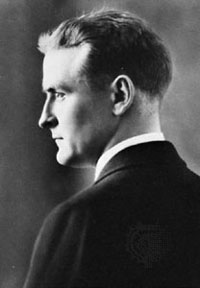
Fitzgerald was one of those writers I liked right away, even though I read most of his stuff when I wasd 15, and was forced to for school. Melville I despised - and had to come back to later (years and years later) ... now I love Melville, but my first encounter with his books were ... pretty much horrific. But Fitzgerald I clicked into right away. I credit a lot of that to my 10th grade teacher, Mr. Crothers - who ... basically ... was just a great feckin' teacher. His love of The Great Gatsby
I already had a fascination with flappers (ahem. Obviously.) Not sure where the fascination came from. I think it might have had something to do with seeing Bugsy Malone on TV when I was about 12. Member that movie? Jodie Foster and Scott Baio as little kid gangsters and gangster molls? Driving cars with their feet like the Flintstones? I absolutely loved that movie, and I loved Jodie Foster's spit curls, and her costumes ... I remember, too, in junior high I did a whole paper on the 1920s for history class. I remember including photographs of flappers, and photographs of the cars they had ... I would insert stuff like this through the text:

I knew all about prohibition, I knew the music ... Oh, and I just remembered a couple other reasons why the whole "jazz age" thing fascinated me long before I encountered Fitzgerald: one of my favorite books growing up was Cheaper by the Dozen
And lastly - when I was about 11, I remember my parents taking me to see a production of The Boyfriend up at the local university and I was literally swept away by it. The costumes, the music, the craziness ... I loved the charleston. I loved the whole fantasy of that era.
So when Great Gatsby came along, I was ready to just LIVE in the pages of that book.
F. Scott Fitzgerald (or - Francis Scott Key Fitzgerald) was born in St. Paul Minnesota in 1896. He went to Princeton, and afterwards joined the army. Somewhere in here, he sold his first story ... and when he was only 23 years old he wrote and published his first novel: This Side of Paradise. It was a smash hit - and was one of those zeitgeist books: it described the moment in time that everyone was experiencing (or, a certain set of people, let's say that) ... It was one of those books that is eloquent about cultural and social changes AS they are happening. Fitzgerald was immediately seen as the voice of that era, and that generation. The jazz age kicking in. Fitzgerald was the poster child. It didn't hurt that he was so handsome.

People projected their own desires onto him, their ideals for who they wanted to be. He was glamorous, urbane, free of societal conventions ... He lived the life others wanted to live.
In 1922, he wrote in a letter to Maxwell Perkins at Scribners: "I want to write something new -- something extraordinary and simple & intricately patterned."
Such a young man. Such a broad and deep vision.
Around this time, he married Zelda Sayre.

She was the yin to his yang, she was the perfect partner in crime for that particular decade ... she did not give a damn. She was who they were talking about when they talked about "jazz babies". She was the original flapper.
Look at their wedding portrait. I just love it.

They had their wedding reception at Chumley's, a speakeasy at 86 Bedford Street, which is still there. I first met Bill McCabe and Emily Jones at Chumley's. Awesome!! It's the same now as it was then: no signage, nothing to say it's there. You have to know where it is. 86 Bedford, baby!
So Fitzgerald and Zelda married. They lived their relationship in public. They created personas, they acted parts, they showed up at places looking amazing, they relished in their own publicity. They kept massive scrapbooks of their clippings from the gossip pages. Again, they were partners in crime.
Here's a page from their scrapbook:

They were almost like the Billy Bob Thornton and Angelina Jolie of their day. Exhibitionists, putting their own craziness on display, loving and living to shock others, having massive crockery-throwing fights in public, also having massive clutching make-out sessions in public ... It all was about being famous. But underneath all of that, there was this kindred spirit thing happening. You can't be in love with someone who NEEDS to be famous and not have the same need yourself. Or, you can, but it'll go bust. The two of them were in sync in those first years - it was like they were the same person.
Neither of them was ever the one to say, "Okay. Time for bed now." They were a couple with no brakes.
They would have drinks at the Plaza Hotel, and she would dance on the table. She would leap into fountains, fully dressed. She bucked convention. Just for the hell of it. She was the life of the party (while it lasted). She was wild. Just wild. F. Scott Fitzgerald was inspired by her, she was definitely a muse of some kind ... he would read her diaries, he would hoard the letters she wrote to him, he was completely wrapped up in her glow. Zelda is a fascinating (and ultimately tragic) character in her own right. A girl who was completely unprepared to do anything useful in her life - pampered and indulged by her family who thought she was nuts, and also trouble, she basically set her sights on New York. She had the misfortune of marrying a man seen as the bright literary light of his generation - a misfortune because she had literary aspirations as well. Here is a small sketch she wrote about Montgomery Alabama, where she grew up. It is obvious she can write. Not like her husband, but she can definitely write.
There exists in Montgomery a time and quality that appertains to nowhere else. It began about half past six on an early summer night, with the flicker and sputter of the corner street lights going on, and it lasted until the great incandescent globes were black inside with moths and beetles and the children were called into bed from the dusty streets ... The drug stores are bright at night with the organdie balloons of girls' dresses under the big electric fans. Automobiles stand along the curbs in front of open frame houses at dusk, and sounds of supper being prepared drift through the soft splotches of darkness to the young world that moves every evening out of doors. Telephones ring, and the lacy blackness under the trees disgorges young girls in white and pink, leaping over the squares of warm light toward the tinkling sound with an expectancy that people have only in places where any event is a pleasant one. Nothing seems ever to happen.
There's a nice descriptive romantic quality there. She had talent. Only she had no discipline. None. F. Scott Fitzgerald, while an insane partier, a crazy drinker, a guy who stayed out all night every night, had great discipline. He worked at his craft. He worked hard at writing. He was always writing, and honing, and editing ... maybe he was hungover, but his writing was his JOB. Zelda had none of that. She couldn't focus her energies. She was threatened by his success. She wanted a piece of that pie for herself. But ... well, we all know what ended up happening to Zelda. She went mad. I don't know her diagnosis - but judging from some of her episodes, it had to be pretty bad. This was not a case of clinical depression. It was psychosis. While they lived in Paris, she got it into her head that she needed to be a ballerina. She began to study. She became obsessed. Soon, she was dancing for 6, 7, 8 hours a day. But she was in her early 30s by this point ... way too old to be a prima ballerina. But Zelda didn't care. Apparently, too, she was a terrible dancer. Friends who visited the couple in Paris told stories (in letters, and later, to biographers) of arriving for their visit, and Zelda would greet them at the door in a tutu and ballet shoes. She would dance for them. Awfully. These stories are excruciatingly painful to read.
Who knows where the madness came from, or if the wildness of her behavior in her youth (jumping in fountains, etc.) were early warning signs - things people ignored and forgave her for, because she was young and free. Who knows. It's a sad story. I read a biography of Zelda Fitzgerald last year and it wrenched my heart. It really did. She also had a deadly fear of fire, she was like a horse in that respect - it terrified her - and she died in a fire in her institution. She was on a locked ward, she couldn't get out, and the institution burned to the ground. It must have been shrieking agony. It must have been unspeakable.
But for about 5 or 6 years, the two of them were on top of the world. They had youth in their favor.
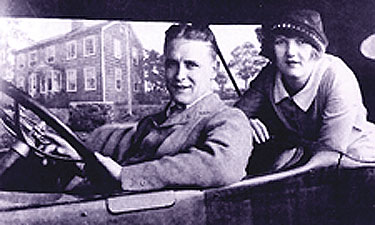
The Great Gatsby was published in 1925. Fitzgerald worked his ass off on this book - and was pretty tormented throughout the process. He wrote, and re-wrote, and re-wrote - holding off his editor, Maxwell Perkins, as long as possible. It was a precious book to him, a deeply personal book, and he feared he had not succeeded.
Perkins' long letter back to Fitzgerald, after he finally received the manuscript, just gives me chills. I won't print it in its entirety - it's too long - but it's an amazing insight into the book, and also ... into Fitzgerald the Writer. The guy had an innate gift, yes, but he also was this major craftsman. He worked hard.
Here are some excerpts from Perkins' initial letter:
I think you have every kind of right to be proud of this book. It is an extraordinary book, suggestive of all sorts of thoughts and moods. You adopted exactly the right method of telling it, that of employing a narrator who is more of a spectator than an actor: this puts the reader upon a point of observation on a higher level than that on which the characters stand and at a distance that gives perspective. In no other way could your irony have been so immensely effective, nor the reader have been enabled so strongly to feel at times the strangeness of human circumstance in a vast heedless universe. In the eyes of Dr. Eckleburg various readers will see different significances; but their presence gives a superb touch to the whole thing: great unblinking eyes, expressionless, looking down upon the human scene. It's magnificent!I could go on praising the book and speculating on its various elements, and meanings, but points of criticism are more important now. I think you are right in feeling a certain slight sagging in chapters six and seven, and I don't know how to suggest a remedy. I hardly doubt that you will find one and I am only writing to say that I think it does need something to hold up here to the pace set, and ensuing.
He then goes on to list a couple of pages of specific criticisms. Beautiful to read. It's really just amazing literary analysis is what it is.
One of the criticisms is this:
The other point is also about Gatsby: his career must remain mysterious, of course. But in the end you make it pretty clear that his wealth came through his connection with Wolfstein. You also suggest this much earlier. Now almost all readers numerically are going to be puzzled by his having all this wealth and are going to feel entitled to an explanation. To give a distinct and definite one would be, of course, utterly absurd. It did occur to me though, that you might here and there interpolate some phrases, and possibly incidents, little touches of various kinds, that would suggest that he was in some active way mysteriously engaged. You do have him called on the telephone, but couldn't he be seen once or twice consulting at his parties with people of some sort of mysterious significance, from the political, the gambling, the sporting world, or whatever it mayb be. I know I am floundering, but that fact may help you to see what I mean ... I wish you were here so I could talk about it to you for then I know I could at least make you understand what I mean. What Gatsby did ought never to be definitely imparted, even if it could be. Whether he was an innocent tool in the hands of somebody else, or to what degree he was this, ought not to be explained. But if some sort of business activity of his were simply adumbrated, it would lend further probability to that part of the story.
After a couple more paragraphs, Perkins writes:
The general brilliant quality of the book makes me ashamed to make even these criticisms. The amount of meaning you get into a sentence, the dimensions and intensity of the impression you make a paragraph carry, are most extraordinary. The manuscript is full of phrases which make a scene blaze with life. If one enjoyed a rapid railroad journey I would compare the number and vividness of pictures your living words suggest, to the living scenes disclosed in that way. It seems in reading a much shorter book than it is, but it carries the mind through a series of experiences that one would think woudl require a book of three times its length.The presentation of Tom, his place, Daisy and Jordan, and the unfolding of their characters is unequalled so far as I know. The description of the valley of ashes adjacent to the lovely country, the conversation and the action in Myrtle's apartment, the marvelous catalogue of those who come to Gatsby's house -- these are such things as make a man famous. And all these things, the whole pathetic episode, you have given a place in time and space, for with the help of T.J. Eckleburg and by an occasional glance at the sky, or the sea, or the city, you have imparted a sort of sense of eternity. You once told me you were not a natural writer -- my God! You have plainly mastered the craft, of course; but you needed far more than craftsmanship for this.
Now that's the kind of letter you want from your editor.
The Great Gatsby was not the phenom that This Side of Paradise was. Reviews were mixed. Only posterity would put Gatsby in the canon.
Zelda had her first breakdown in 1930. Fitzgerald's drinking problem went to another level. He was devastated by her illness, and he was devastated by what was obviously a slacking off in his success. It's tough when you become a mega-star at 23. Anything that follows is so sure to be a letdown. Fitzgerald needed to support himself, so he started cranking out short stories for the big mags at the time ... stuff that paid the bills but left him feeling empty.
F. Scott Fitzgerald died of a heart attack at 44, leaving an unfinished novel The Last Tycoon behind him.
Like I said, last year I re-read The Great Gatsby. It was like running into an old childhood friend. I'll re-post what I wrote about it back then, because it was fresh in my mind, and I was still on a high from the experience.
Happy birthday, Mr. Francis Scott Key Fitzgerald ... and thanks for your books.
Re-visiting The Great Gatsby
I just picked up The Great Gatsby again and read it in three days. (It felt much much longer in high school.) I was shocked and moved by how much I had remembered. The huge eyes of Doctor T.J. Eckleberg ... I remember the intense class discussion about what those eyes symbolize. The green light at the end of the dock, obviously. And there were parts that I actually remembered word for word, because of how, exactly, Mr. Crothers (my teacher) taught the book.
I remember the huge discussion about the following part of the book:
Suddenly she threw the cigarette and the burning match on the carpet."Oh, you want too much!" she cried to Gatsby. "I love you now -- isn't that enough? I can't help what's past." She began to sob helplessly. "I did love him once -- but I loved you too."
Gatsby's eyes opened and closed.
"You loved me too?" he repeated.
I remember Mr. Crothers pointing out that section to us, and talking about how that was the snap in Gatsby, that was the dream dying in Gatsby, that was the inner conflict of the entire book encapsulated in two sentences:
Gatsby's eyes opened and closed. "You loved me too?" he repeated.
Fitzgerald does not describe the snap. He does not have to. Fitzgerald does not talk about Gatsby's dream of Daisy, his fantasy of Daisy, at least not in that pivotal moment. All he does, all he does, is tell us that Gatsby's eyes opened and closed. And in that moment, a man's dream dies.
Phenomenal.
I would have missed that, in high school, if Mr. Crothers hadn't dwelt on it so specifically, and it all came back rushing back when I re-read it.
I might say that Mr. Crothers was the best teacher I have ever had. Period. He taught me how to write. Plain and simple. And you know how he taught me? I wrote a paper in his class. I got a D. My first D in my whole life. Panic ensued. Deep depression. Writer's block. I wrote another paper. I got a D+. Next paper: C-. Next paper: I got a straight C. It was a very proud moment. And with every paper, agonizingly, I got better and better and better. Until finally, light broke through, and I was able to construct a damn paper. I wrote consistently A-level papers in college directly because of what Mr. Crothers taught me.
This post is a ramble. Mr. Crothers, if he read this, would be thinking: "Sheila, where's the thesis statement??"
So here it is:
I had forgotten the stature of Fitzgerald's opus. I had forgotten how superb it was. Or: if I remembered it, it was in a taken-for-granted kind of way. Like: "Oh yeah, that's a great book. One of the best books of the 20th century. Whatever." I had forgotten the level of the accomplishment. I had forgotten how moving it is.
Reading it as an adult gave me a whole new perspective on it as well.
When I read it at age 15, I was completely on the side of Nick, the narrator: The relatively innocent and honest bystander, looking on at the decadence of Daisy and Jordan and Gatsby, trying not to judge (like he says on the first page of the book), and trying to come out of the situation unscathed. But by the end of the book, Nick is changed. And so are we, whether we like it or not.
But now, reading it as a grown woman, with a couple of failed love affairs in my rear view mirror, I found myself entering the story through the eyes of Gatsby. I could see myself in parts of him. It KILLED me. I understood Gatsby, suddenly. Carrying a torch for years, infusing everything with significance, poetry, choosing the dream-world over reality.
It is only NOW, after reading it from an adult perspective, that I can truly understand why the book is seen as such an epic human tragedy. An American tragedy.
Now I understand. Now I understand.
Those first pages are so extraordinary, so exquisitely written, they cannot be improved upon.
In my younger and more vulnerable years my father gave me some advice that I've been turning over in my mind ever since."Whenever you feel like criticizing any one," he told me, "just remember that all the people in this world haven't had the advantages that you've had."
He didn't say any more, but we've always been unusually communicative in a reserved way, and I understood that he meant a great deal more than that. In consequence, I'm inclined to reserve all judgments, a habit that has opened up many curious natures to me and also made me the victim of not a few veteran bores. The abnormal mind is quick to detect and attach itself to this quality when it appears in a normal person, and so it came about that in college I was unjustly accused of being a politician, because I was privy to the secret griefs of wild, unknown men. Most of the confidences were unsought -- frequently I have feigned sleep, preoccupation, or a hostile levity when I realized by some unmistakable sign that any intimate revelation was quivering on the horizon; for the intimate revelations of young men, or at least the terms in which they express them, are usually plagiaristic and marred by obvious suppressions. Reserving judgments is a matter of infinite hope. I am still a little afraid of missing something if I forget that, as my father snobbishly suggested, and I snobbishly repeat, a sense of the fundamental decencies is parcelled out unequally at birth.
And after boasting this way of my tolerance, I come to the admission that it has a limit. Conduct may be founded on the hard rock or the wet marshes, but after a certain point I don't care what it's founded on. When I came back from the East last autumn I felt that I wanted the world to be in uniform and at a sort of moral attention forever; I wanted no more riotous excursions with privileged glimpses into the human heart. Only Gatsby, the man who gives his name to this book, was exempt from my reaction -- Gatsby, who represented everything for which I have an unaffected scorn. If personality is an unbroken series of successful gestures, then there was something gorgeous about him, some heightened sensitivity to the promises of life, as if he were related to one of those intricate machines that register earthquakes ten thousand miles away. This responsiveness had nothing to do with that flabby impressionability which is dignified under the name of the "creative temperament" -- it was an extraordinary gift for hope, a romantic readiness such as I have never found in any other person and which it is not likely I shall ever find again. No -- Gatsby turned out all right at the end; it is what preyed on Gatsby, what foul dust floated in the wake of his dreams that temporarily closed out my interest in the abortive sorrows and short-winded elations of men.
HOLY GOD.
Reading that makes me want to put down my pen forever.
So does the last sentence of the book:
So we beat on, boats against the current, borne back ceaselessly into the past.
The Books: "Savage in Limbo" (John Patrick Shanley)
Next in my Daily Book Excerpt:
Still on the script shelf:
More John Patrick Shanley! The next play is Savage in Limbo
I'll excerpt a fantastic scene from the start of the play. There are so many good scenes ... but this one is particularly good - a scene between Savage and Linda. Linda enters the bar, hysterically crying. Savage starts to talk with her.
I love Savage's monologue about gravity ... I love the whole scene. And Linda's question at the very very end is just hilarious. Perfect character moment.
13 by Shanley: Thirteen Plays (Applause American Masters Series)
EXCERPT FROM Savage in Limbo
SAVAGE. So what's wrong with you? What's the story? Did you get knocked up again?
LINDA. No. It's Anthony. He's gone crazy.
SAVAGE. Is he hittin you?
LINDA. No.
SAVAGE. What's he doin?
LINDA. He wants to see other women.
SAVAGE. What?
LINDA. He wants to see other women.
SAVAGE. And for this you think he's crazy, huh? You are a pisser.
LINDA. You don't understand.
SAVAGE. I understand that. That's very common.
LINDA. No, no. You don't understand.
SAVAGE. Have it your own way.
LINDA. He wants to see ugly women.
SAVAGE. They may look that way to you, honey, but I guess he sees 'em different.
LINDA. You don't understand. He told me. He says, Linda, I wanna see ugly girls.
SAVAGE. He said that?
LINDA. Yes.
SAVAGE. Well, what did he mean?
LINDA. He meant what he said.
SAVAGE. But that's not possible. Men don't go after women they think are ugly. If they end up with an ugly woman, it's because they made a mistake and they think she's good-lookin. Alright a drunk, a crazy guy, a loser. But a guy like Tony? A guy like Tony Aronica would never end up with an ugly woman. You know why? He's just got too much dog in 'em. He thinks like a dog.
LINDA. What are you tellin me? You're tellin me nothin. I tell you what's goin on, and you tell me it ain't goin on. It's goin on. Anthony wants to see ugly girls cause I don't know why, but that's the fuckin news and don't tell me otherwise. Every Monday night I go to his place and we spend time together, and this night I go and he's got this look in his eye. Like he knows somethin, and like he never seen me before. I got a scared feelin right away. I touch him but he puts my hand away. He says he wants to talk. What's he wanna talk about before we go to bed? What's there to talk about? When a woman wants to talk to a man, it's cause she wants the man to see her better. When it's the other way, when the man stops you from touchin to talk, what's there to talk about? It's gotta be bad. I tried to keep him from talkin. I turned myself on. But there was somethin in his mind. Even my mother sees what Anthony's got. Even my mother. She'd like a taste. She knows where I'm goin on Monday nights. I don't come home till late, the mornin sometimes, but she don't say anything. Any other time she would. But she knows where I go, and she wants it for me. Once I was goin, and she whispered to me so's my father wouldn't hear, Take it, Linda. That's all. Take it, Linda. And I did. And now he don't wanna see me cause he wants to see ugly women. I said I'd be ugly for him, but he said no. It didn't work that way. I'm so ashamed. I feel ugly. I feel fat. Anthony don't want me no more.
SAVAGE. You're not fat. You're almost fat. But you're not fat. You wanna play some cards?
LINDA. No.
SAVAGE. These cards are disgusting anyway. I left 'em near the humidifier one night and they got all spongy. I got the humidifier cause my mother was dryin out. She never goes anywhere, she can't, and we got so much heat in that fuckin apartment -- I looked at her one day and she looked like a dead plant. So I went out and I got the humidifier and I run it every night. She still looks like freeze-dried shit, but I feel better cause I did somethin. I didn't just take it. I didn't just fuckin accept it. I believe in action. Anyway, between the humidity and my sloppy ways, these cards are real crappy. Some of these Sister Rosita's, you know, these witchtellers, they're supposed to be able to see your future inna pack a cards. I look at these cards, I never see anything about my future. I just see my fuckin life. I'm gonna go i nsane.
LINDA. What are you talkin about?
SAVAGE. I'm talkin about tension. I'm talkin about somethin snappin at your heels, but you can't get away. Bein apart from everybody else. bein alone. There's a wall there. Like you're inna glass box, a bee inna jar, dreamin about flowers, smelling your own ... death. People look at you, it's through somethin. You touch somebody, there's somethin over your head.
LINDA. I don't get you.
SAVAGE. I'm tryin to tell you somethin, but it's not easy.
LINDA. So tell me anyway.
SAVAGE. I'm a virgin.
LINDA. What?
SAVAGE. You heard me. You're just astounded. I'm a virgin.
LINDA. Why you tellin me a lie?
SAVAGE. In the beginnin, it was just bad luck. I'm not like you, and I got a big mouth, and well, it's easy not to lose it at first. You're scared, they're scared, somebody says: Boo, and everybody runs away. At least that's the way it was for me. To start with. But then it became a thing. Most everybody I knew lost it, you know, over a certain period a time, and there I was, still in the wrapper. It woulda been easy to lose it then. But it became a thing, you know? I felt different. I felt like I was holdin out for somethin. Not some guy, not just some guy. I felt like I was holdin out for somethin, sayin no, no, I'm not takin that life just cause it was the first one I was offered. So here I am. I'm thirty-two. And I'm still sayin no, no. And I still only got offered the one life, and I still don't want that one.
LINDA. You're a virgin?
SAVAGE. Yeah.
LINDA. Wow.
SAVAGE. Say somethin.
LINDA. What's it like?
SAVAGE. It's like holdin your breath, only you never have to let go. No, that's not what it's like ...
LINDA. I never knew anybody grown up who never, you know ... I feel like you know somethin I don't know.
SAVAGE. Well, I know you know somethin I don't know.
LINDA. Yeah, but everybody I know knows what I know. Except you. It's like common knowledge. But what you know, it's like a secret. How does it feel?
SAVAGE. I feel strong. Like I'm wearin chains and I could snap 'em any time. I feel ready. I go to work and I feel like I could take over the company, but I just type. I go home and I see my mother in her chair and I feel like I could pick her up with one hand and chuck her out the window and roll up the rug and throw a big party. Everybody's invited. I go to the library and I wanna take the books down off the shelves and open all the books on the tables and argue with everybody about ideas. I wanna think out loud. I wanna think out loud with other people. You know what's wrong with everybody? Too smart. I know it sounds crazy. I know. But it's true. Everybody's too smart. It's like everybody knows everything and everybody argued everything and everything got hashed out and settled the day before I was born. It's not fair. They know about gravity so nobody talks about gravity. It's a dead issue. Look at me. My feet are stuck to the fuckin floor. Fantastic. But no. That's gravity. Forget it. It's been done it's been said it's been thought, so fuck it. It's not fair. I've been shut outta everything that mighta been good by a smartness around that won't let me think one new thing. And it's been like that with love, too. You're a little girl and you see the movies and maybe you talk to your mother and you definitely talk to your friends and then you know, right? So you go ahead and you do love. And somethin a what somebody told ya inna movie or in your ear is what love is. And where the fuck are you then, that's what I wanna know? Where the fuck are you when you've done love, and you can point to love, and you can name it, and love is the same as gravity the same as everything else, and everything else is a totally dead fuckin issue?
LINDA. That's what it's like to be a virgin?
September 23, 2005
Empire of Dreams
I'm watching a wonderful documentary on the making of the Star Wars series right now called Empire of Dreams. There's so much stuff to say ... but I just want to report two very funny things that Carrie Fisher said. In regards to the whole action-figure phenomenon, Carrie said, "We basically signed away the rights to our likenesses. So what that means is ... every time I look in the mirror, I have to send George a couple of bucks." The other funny thing she said was, "You know you've really made it when you become a Pez dispenser."
More hilarious wonderful-ness:
Frank Oz talking about the whole Yoda experience. Really ground-breaking. They made it up as they went along. They would cut holes in the floor, and Frank would crouch down below, doing the puppetry. Humorously, though: the assistant director would come up to give him notes - like: "Look more towards the camera ... turn right ..." whatever ... but the guy would speak directly to Yoda, as though Yoda were a real actor, and Frank, huddled beneath the floor, couldn't hear a thing. Frank would yell up, "Hey! I'm down here! Can't hear you!"
Why does that charm me so much??? An assistant director seriously giving notes to Yoda. Beautiful. The willing suspension of disbelief.
Another hilarious tidbit:
The animator was given the job to create Jabba the Hut. He was given some guidance: "He should be grotesque ... really alien ... kind of like Sidney Greenstreet."
HA! That's so awful!!! Jabba is based on Sidney Greenstreet?
Another tidbit:
Carrie Fisher (and I have tried to emulate her timing): "Yes, I got to kill Jabba the Hut, and that was great, but I was more concerned about the slave girl outfit and ... what I was going to do." Long pause. "About exercise."
Diary Friday
An entry from the summer in between my sophomore and junior year. It is August 8th. A day celebrated in Rhode Island as "Victory over Japan" day (VJ Day). I think we're the only state who still celebrates it. Obviously, I was very upset about it. I go OFF on it. I am 15 years old.
And - as always - like so many of my high school entries do - it ends at the roller rink.
All of life leads to the roller rink.
August 8
Shitty VJ day. Let me state right now that I think VJ Day is a disgrace and it makes me so mad. I can't stand it. We are celebrating a victory over a country that happened in the 40s? I mean, the whole state is on a holiday. It was 40 years ago. The poor Japanese in my neighborhood. In the whole state. They should at LEAST call it something else! I don't hate the Japanese. Why should I? How can our state still hold this holiday? It makes me want to spit in someone's face. Sure, 40 fuckin' years ago I might have loved it, but now? Get over it. Get over it. People are terrible. And that is my statement for the day.
Kate called me this morning and invited me to go to Larkin's Pond with her. So I said Yes, forgetting that Peg had just knocked on my door. [Ahem. This is was a euphemism for having your period - we all said "Peg is here to visit" when we had our period. "How's Peg?" "Oh my GOD, she is being such a BITCH this month! And ... well, I didn't start using tampons til college. So I was out of luck before then on days I wanted to go swimming. Just in case you were wondering. I'm sure it's thrilling information for you all to have.] Mum tried to tell me about tampons but I am like: NO! Those things are gross. [Oh boy. Sheila ... you have no idea how happy you will be when you get over that ... the freedom!! The joy!!] So I just put on my suit, and shorts, and Kate pulled up - That's right. SHE WAS DRIVING. [Huge deal. Kate was the first one of us to drive, I believe. She drove her parents massive station wagon, which we all referred to as "The Boat"] I hopped in the car going, "Oh, my grown-up friend!!"
So she drove and we had a really nice time. It's so peaceful there. Kate just went to NYC and saw Amadeus! Mark Hamill had just left 2 weeks before. But she said it was really really good. And David Birney was the best - he cried and stuff. [Yes. The mark of a good actor? Tears. That's it. Tears.] It sounds so wicked. [hahahahaha]
Then back home - it was so Augusty. I sat out on the backsteps with my radio and a bag of corn, and I shucked the corn, listening to music. It was such a summery thing! Shucking under the azure sky! [What are you, Willa Cather?]
Then at 7, we drove off to pick up Michele, Mere, Beth, and Kate to go roller skating. [Betsy - why weren't you with us??] I felt pretty. I had on my 'generic jeans' [I can't remember why I called them that], my grey pink and white bowler shirt [Member the whole Stray Cats-inspired 1950s fashion craze? I was so into it.], my black piano tie [Oh my God. That is the most embarrassing thing I have ever heard in my life], and my penny loafers. I had on a little mascara and this wicked pink lipstick that's more of a plum color with undertones of blue. [For God's sake.] For once I looked in the mirror and liked what I saw. Shivers!
Roller skating was a waste of money. First of all, there were about thirty people there and the disc jockey only played funk. [hahahahaha. I'm sorry. I'm killing myself right now. Like ... I am JUDGING funk.] Honestly. Funk degrades the word 'music'. [WHAT???? I so don't feel that way now!! God, I was so HARSH about it!] I'm serious - in another year it's gonna die and no one will ever admit to liking it, same as disco. But now - we must have asked him 20 times for some Police, or Missing Persons, Devo or the Go-Gos - Diary, he didn't know who the Go-Gos were. That dorky asshole said, "I don't know about any music but funk." What a jerk! He said he takes requests, but he didn't play one of the songs we asked him to. That made me mad. One of the reasons I go is cause it's like a dance -- a chance to go and listen to good music. It's not fun unless a song you like comes on. What was one song? He had no Adam Ant, he only had one Police album - but it wasn't even taken out of the wrapper. He was such a loser. Anyone who likes funk is a loser. [!!!!! I cannot believe the vehemence!!! I have no memory of being in such a RAGE about funk!]
It is now 12:45 a.m. At 1:00 a.m. there is a documentary on about James Dean, and I'm staying up for it. I will prop my eyes open to see him.
Oh, and tomorrow I'm gonna ride my bike up to the library to take out Wuthering Heights! [I had just seen a play of it - and had not read the book yet, apparently] I love antiheroes like Heathcliff. Better than those sappy guys [GOD, Sheila, again with the harsh judgment!!!] who go on their knees and cry, "My love! You are the sun! The Moon! The Rain! Without you, my life is an empty shell!" [Uhm, think you're settin' up a straw man here, Sheila. Who actually talks like that?] I'd sit there, look at him like, "Oh God, who are you?" Now Heathcliff. There is a man. (In spite of the fact that the actor playing him had his fly down for the entire first act.)
Rehearsal
We rehearse in an old church in the East Village, a church that rents out its two upstairs rooms to theatre companies. I've rehearsed shows there before, and I love the atmosphere - it's much better than the slicker rehearsal studios in Times Square, although those are more convenient. I walk up the steps to go inside. To the left-hand side is the office, where I can see piles of boxes labeled: "Hurricane Relief". Right in front of me is a big common room, and on some nights there are AA meetings going on there. So the actors trooping up the steps to go rehearse mingle with the recovering addicts. I trudge up the wide flights of stairs. On every landing, there are doors leading to offices, and rooms - rooms labeled: "Youth Ministry", stuff like that. There are also these awesome old dark-wood bookcases, with glass doors. The bookcases are filled with books - I would love to have a bookcase like that some day. We rehearse on the 4th floor, a wide echoing room with hard-wood floors, and a major cross-breeze. Every night we've rehearsed, at around 8 o'clock, we can hear the church choir start their rehearsal, maybe 2 flights down. Their windows are open, like our windows are open ... so the sound of their singing floats up to us. It's glorious - a full, rich sound, many voices. It's a vibrant church. One of the actresses in the play goes to this church, it is "her" church. There's a homey feel to it. You can somehow tell that it is a true community. A true neighborhood church. I have to laugh, too - only in New York would a church announce on its billboard outside "reviews", as though it is an off-Broadway show. "New York Times says ..." I've seen that in most churches in New York, a small plug from some area newspaper, saying why the church is great. It's funny to me.
"The best blockbuster sermons of the summer!" "Every week a cliffhanger ... you don't want to miss this one!"
When we move our rehearsals uptown, later in the process, I'll miss the church. I'll miss going there every night. I'll miss hearing that choir, the voices floating up two stories into our window.
Happy birthday ...
to Bruce Springsteen!

God, that image is so evocative for me of a certain time and place. I remember that album coming out. I was in high school. And - literally - you could not get away from that album. It was everywhere. E.V.E.R.Y.W.H.E.R.E.
Mitch, one of my best blog-friends out there, is a major Springsteen fan - and I just looked up his archive of writing on the man. It's funny when an artist somehow - explains your own life to you - at different stages of your life ... Like, you grow along with the artist. It's amazing - these people who have had really really long careers ... Sometimes you hear one song, and you can flash back 20 years in time to a specific place, a specific sensation ... You know where you were, but more importantly than that, more evocatively: You know WHO you were. We change, we grow, we evolve. But music, and musicians who call us out, who challenge us, who evoke emotions, who remain honest and true ... can remind us of WHO we were. Here's a post of Mitch's about this very thing - and he says it WAY better than I ever could.
I'll be honest. Mitch's posts about Springsteen bring a lump to my throat.
Listen to Mitch's words:
But Springsteen has (again with the High Infidelity-level specious associations which, as damnable luck would have it, seem just as credible as they are ridiculous) always caught my mood perfectly - the longing for deliverance in Darkness on the Edge of Town, the wary appraisal of The River, the weary acceptance of Tunnel of Love, the disconcertion of real life, and reconciliation with the ghosts of one's earlier life, from Human Touch and Lucky Town.Now, The Rising - on one level, "about" September 11 (sometimes very directly). On another level...
...I almost wrote "It's about all of us", but I haven't heard the album, and that'd be a pretty pretentious thing to say anyway.
But five'll get you ten it's about me. Or that's how it'll feel, as I try to raise a couple of kids in a world that has nothing to do with the world I or my parents grew up in. To paraphrase one of his greatest moments - I'm 39, I've got a boy of my own now. I sat up with him the other night, and said this is your world, now.
I'll be waiting at midnight, tomrorow night, for the album to come out of the shipping box. I'm a fan.
I have my reasons.
Here's Mitch's wonderful post on the 30 year anniversary of Born to Run. Again, let me make an observation: I know Mitch loves Springsteen's music. Actually, "love" seems like a silly tepid word in this case. It doesn't cover it at all. But what I notice in Mitch's Springsteen posts is that while yes, he talks about the music, what he does more, though, is talk about himself. His memories, his past, his assocations ... And, in my opinion, that is the mark of a great artist. His art is somehow greater than himself. I remember coming out of seeing Death of a Salesman on Broadway with Brian Dennehy. My date had never seen the play, although he had read it. And as we walked to the subway after, did we talk about - the production values, the cast, the wonderful lighting, the great acting? No. My date started telling me, randomly, about how he felt like he could never communicate with his dad ... not in any real way. And how he had a lot of guilt about that. It just struck me, that night: wow. That's the power of that play. That's why it's a classic. Why different cultures respond to it. Because when we leave the play - we are thrown back on OURselves, we must reflect upon our own lives, our own connections with others ... We left the play and didn't talk about IT, we talked about US.
Beautiful.
Anyone remember when Springsteen appeared on the last Letterman Show on NBC? For some reason, it is emblazoned in my brain - and recently, I was validated in my opinion about this - when the Springsteen performance on that show (in 1993) was part of Vh1's "Best Music Moments on television" special. It was this really emotional night ... and then out comes Springsteen ... and he performed Glory Days and I am telling you: I still feel the hairs on my arms rise up when I remember it. I have rarely seen anything so ... exciting ... that's really the only word I can think of. Once I saw the Vh1 special, I learned a little bit more about the backstory of that historic appearance. Letterman is a huge Springsteen fan, and had been trying to get Springsteen to come on the show for years. Springsteen doesn't "do" the talk-show rounds. He turned Letterman down repeatedly - for years. Finally, though - since this was Letterman's signing off night ... I have no idea what decision process Springsteen went through to say "yes", but he did say Yes. Not only did he say Yes, but ... the dude is such a showman, and also- I believe he just has an innate sense of "what is needed" (in terms of performance) - he turned that performance into something that people are still talking about. On Vh1, they interviewed all these music people - random people - like Beyonce, and music journalists, and Melissa Etheridge and Russell Simmons, yadda yadda, and each one of them was like: "Do you remember that?? Do you remember when Bruce jumped up on Paul's piano? I'll never forget it." I guess you would have had to have seen it to get why it was one of the most thrilling live things I've ever seen. Bruce did not "clear" his jumping-up-on-piano move with Paul Schaeffer. But Paul, interviewed for the show, said that during the rehearsal, Bruce came over to Paul's keyboard set-up, and took hold of it, and kind of jiggled it. Asked Paul: "This is sturdy, right?" Paul said, "Yeah", and inside he knew: Oh boy, somethin's comin ....
Dudes, I just can't explain the moment when he leapt up there. You know how you see someone performing - and it's good, and it's a song you know and love, and it's awesome, and everyone's rocking - but then sometimes, very rarely, the performer just ... kicks it up a notch ... and it's suddenly like you are in another universe: your heart leaps out of your chest, your breath gets shallow - and you feel like the performance is suddenly inside of you, working through you ... rather than something you are just watching.
That's what happened (to me, and obviously to millions of others) when Springsteen jumped up on top of Paul's piano.
What was so beautiful about it, so unbelievably moving (I have the thing on tape, and I'm deeply moved every time I see it) is that it was all FOR Letterman. Most people go on that show and are pumping up their own careers, they're selling a new album, they're giving themselves publicity - ain't nothing wrong with that. That's one of the purposes of the show. But Springsteen didn't care about any of that. He wasn't there for himself. He was there to celebrate Letterman, and to finally say "YES" to Letterman's long-standing request.
Springsteen was not gonna go on that show and do just a regular set. He took it to another level. Just for Letterman.
I'm all verklempt right now just remembering.
Happy birthday, Bruce.
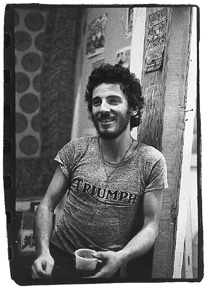
The Books: "The Red Coat" (John Patrick Shanley)
Next in my Daily Book Excerpt:
Still on the script shelf:
More John Patrick Shanley!
The next play is a one-act (literally - the play is 5 pages long.) It's called The Red Coat. It was first done, along with 6 of his other one-acts, at the Ensemble Studio Theatre (or EST) here in New York. The Red Coat
EXCERPT FROM The Red Coat
MARY. I got all dressed ... I tasted the wine on your ... mouth. You were waiting for me out here? I wasn't even going to come. I don't like Susan so much. I was going to stay home and watch a movie. What would you have done?
JOHN. I don't know.
[He kisses her again. She kisses him back]
MARY. You go to St. Nicholas of Tolentine, don't you?
JOHN. Yeah.
MARY. I see you on the platform on a hundred and forty-ninth street sometimes.
JOHN. I see you, too! Sometimes I just let the trains go by until the last minute, hoping to see you.
MARY. Really?
JOHN. Yeah.
MARY. I take a look around for you but I always get on my train. What would you have done if I hadn't come?
JOHN. I don't know. Walked around. I walk around a lot.
MARY. Walk around where?
JOHN. I walk around your block a lot. Sometimes I run into you.
MARY. YOu mean that was planned? Wow! I always thought you were coming from somewhere.
JOHN. I love you, Mary. I can't believe I'm saying it ... to you ... out loud. I love you.
MARY. Kiss me again.
[They kiss]
JOHN. I've loved you for a long time.
MARY. How long.
JOHN. Months. Remember that big snowball fight?
MARY. In the park?
JOHN. Yeah. That's when it was. That's when I fell in love with you. You were wearing a red coat.
MARY. Oh, that coat! I've had that for ages and ages. I've had it since the sixth grade.
JOHN. Really?
MARY. I have really special feelings for that coat. I feel like it's part of me ... like it stands for something ... my childhood ... something like that.
JOHN. You look nice in that coat. I think I sensed something about it ... the coat ... it's special to me, too. It's so good to be able to talk to you like this.
MARY. Yeah, this is nice. That's funny how you felt that about my coat. The red one. No one knows how I feel about that coat.
JOHN. I think I do, Mary.
MARY. Do you? If you understood about my red coat ... that red coat is like all the good things about when I was a kid ... it's like I still have all the good kid things when I'm in that red coat ... it's like being grown up and having your childhood, too. You know what it's like? It's like being in one of those movies where you're safe, even when you're in an adventure. Do you know what I mean? Sometimes, in a movie the hero's doin' all this stuff that's dangerous, but you know, becausa the kind of movie it is, that he's not gonna get hurt. Bein' in that red coat is like that ... like bein' safe in an adventure.
JOHN. And that's the way you were in that snowball fight! It was like you knew that nothing could go wrong!
MARY. That's right! That's right! That's the way it feels! Oh, you do understand! It seems silly but I've always wanted someone to understand some things and that was one of them ... the red coat.
JOHN. I do understand! I do!
MARY. I don't know. I don't know. I don't know about tomorrow, but ... right this minute I ... love you!
JOHN. Oh, Mary!
MARY. Oh, kiss me, John. Please!
JOHN. You're crying!
MARY. I didn't know. I didn't know two people could understand some things ... share some things.
[They kiss]
JOHN. It must be terrible not to.
MARY. What?
JOHN. Be able to share things.
MARY. It is! It is! But don't you remember? Only a few minutes ago we were alone. I feel like I could tell you anything. Isn't that crazy?
JOHN. Do you want to go for a walk?
MARY. No, no. Let's stay right here. Between the streetlight and the moon. Under the tree. Tell me that you love me.
JOHN. I love you.
MARY. I love you, too. You're good-looking, did you know that? Does your mother tell you that?
JOHN. Yeah, she does.
MARY. Your eyes are shining.
JOHN. I know. I can feel them shining.
[The lights go down slowly]
September 22, 2005
Downward Dog ...
Cashel apparently is adjusting very well to his new school. This warms my heart. He has made friends, and he loves his teacher (so much so that he leaves her "anonymous" notes).
He has also signed up for 3 after-school activities. Which ... frankly ... just KILL me. I can't get over it.
They are:
1. Spanish
2. Musical comedy (they will be doing a production of Cats. Ahem.)
3. Yoga
Yoga. I can barely express how much I want to be a fly on the wall at that class and watch Cashel do yoga.
But also ... just taken all together ... those 3 activities just crack me UP.
Add this to the Cashel archive! Cashel's doin' some yoga!
The Books: "Danny and the Deep Blue Sea" (John Patrick Shanley)
Next in my Daily Book Excerpt:
Still on the script shelf:
I'm done with Pinter, and next playwright on the shelf is John Patrick Shanley - one of my all-time favorites!
First play in this collection is Danny and the Deep Blue Sea: An Apache Dance
Danny and the Deep Blue Sea is a 2 person play beloved by most actors because of the juiciness of the characters. These people are raw. Shanley dedicated this play "to everyone in the Bronx who punched me or kissed me, and to everyone whom I punched or kissed". The play is full of punches and kisses. Roberta and Danny meet in a bar in the Bronx. Roberta is 31, and is described as "physically depleted, with nervous bright eyes". Danny (John Turturro originated the part, in 1984) is 29 - and a bomb waiting to go off. He's full of rage, he doesn't know his own strength, this guy is a mess. Shanley writes: "About both characters: They are violent and battered, inarticulate and yearning to speak, dangerous and vulnerable."
Roberta and Danny start to converse. In typical Shanley-esque dialogue: sparking, rich, profane, angry, vulnerable, poetic ... These people have their guards up. They are both ready to attack at any moment. Danny is covered in cuts and bruises - he has just come from a fight, and he thinks he killed the other guy. He is tormented by this. Roberta and Danny end up going home together, to Roberta's ratty room in her mother's house - and spend the night together. They have sex. But throughout the course of the night - they open up to each other. That sounds so trite. It's not trite how Shanley writes it. Roberta and Danny have been repeatedly brutalized by everyone in their lives. Love is not something that comes easy, and when love does start to blossom - or tenderness - they are suspicious of it, ready to kill it - because it feels weak.
There are three scenes in the play: 1. Takes place in the bar where they meet. 2. Takes place right after they make love, in Roberta's room. 3. Takes place the following morning, when they both wake up.
I'll excerpt a bit of scene 2.
There are a ton of swears, so if that kind of shite offends you, don't read.
EXCERPT FROM Danny and the Deep Blue Sea: An Apache Dance
ROBERTA. I'll light a candle.
DANNY. All right.
ROBERTA. You like my room?
DANNY. Yeah. It's good.
ROBERTA. It used to be a closet. I painted it myself.
DANNY. Uh-huh.
ROBERTA. I light the candle and I close this door ... You see that round light up on that roof?
DANNY. Yeah, I see it.
ROBERTA. The guy who lives over there put that light up because he's got a pigeon coop, and people were stealin his pigeons. Don't you think it looks like the moon?
DANNY. No.
ROBERTA. Come on, look at it!
DANNY. All right. Yeah, it does a little.
ROBERTA. Like a full moon every night.
[Danny howls]
ROBERTA. Shut up! What are you doin?
DANNY. Howlin at the moon.
ROBERTA. Oh. Well, you ain't no wolf out in the woods, so keep it down. My father will hear you.
DANNY. Fuck 'em.
ROBERTA. You got the most beautiful eyes.
DANNY. Shut up.
ROBERTA. I mean it.
DANNY. Shut up.
ROBERTA. Are you blushin?
DANNY. Fuck no. What the fuck you think I am?
ROBERTA. You are!
DANNY. I wanna ask you somethin.
ROBERTA. What?
DANNY. Who ... I mean, how old are you?
ROBERTA. I already told ya! And you have a good memory!
DANNY. Right, right! So how old's your kid?
ROBERTA. You're just tryin to change the subject.
DANNY. So what if I am? No, really. I wanna know. How old is he?
ROBERTA. He's gonna be thirteen.
DANNY. Old.
ROBERTA. Yeah. He's got big hands and feet. He's gonna be a big guy. Now he's gonna be in high school ...
DANNY. Wow, you're gonna have a kid in high school.
ROBERTA. Yeah, ain't that a laugh? I hope he does better than I did. But he won't.
DANNY. Why not?
ROBERTA. He's all fucked up.
DANNY. What's wrong with him?
ROBERTA. He's a jerk. He's got me for a mother.
DANNY. It ain't his fault.
[She slaps him, suddenly furious]
ROBERTA. You're gonna be a wiseass why don't you just get the fuck outta here! I don't need that! I don't need anything like that!
DANNY. What's the fuck's with you?
ROBERTA. Sayin shit about the way I raise my kid!
DANNY. I didn't say nothin! You said it. And keep your hands to yourself or you could lose 'em.
ROBERTA. That kid was just born crazy, that's all. My mother don't understand that. Anyway, if anybody got him nuts it was her. All the time with the eyes. All the time not lookin at anybody ...
DANNY. HEY! I never said nothin about your motherhood. You're probably good.
ROBERTA. No, I'm not.
DANNY. You probably are though.
ROBERTA. You think so?
DANNY. Sure.
ROBERTA. Thanks.
DANNY. You got some smack.
ROBERTA. You all right?
DANNY. Nop big deal. It almost felt ... I feel good.
ROBERTA. So do I.
DANNY. It does look like the moon.
ROBERTA. You think so?
DANNY. Yeah. I was out in the country once. At night you never seen so many stars. It gave me a fuckin headache. Really. But then I saw there was this one bunch that looked like a big fish. A tuna or some shit. A big fish jumpin around in the stars. And cause I could see something in there, you know, somethin that added up, the whole thing didn't gimme a headache no more. That sound stupid?
ROBERTA. You must like the country.
DANNY. I hate the fuckin country.
ROBERTA. Why?
DANNY. All those fuckin trees. They smell bad.
ROBERTA. No!
DANNY. Yeah. They stink up everything out there like aftershave. And bugs all over the place. Mud. Rocks in your shoes. You can keep it.
ROBERTA. You're funny.
DANNY. Who's laughin?
ROBERTA. Not me.
DANNY. I had this teacher. He said I was stupid. Right in front of everybody. So I punched him in his fuckin eye. It swelled up real good. So they sent me to this camp in the woods to straighten my young ass out. I don't know what they was thinkin about. Gettin bit by a buncha bugs and sloppin through the fuckin mud whadn't about to change my mind about some asshole teacher in James Monroe High School.
ROBERTA. I went to the deli this mornin to get a roll. Chinese guy put it in the bag. I looked at his face. And he was happy, I could tell. Bad things happen, I guess, to him sometimes, but you could see things whadn't bad for him.
DANNY. Let's go throw a rock through his window.
ROBERTA. No. I got another idea. Let's be like him, Danny. For tonight anyway. Let's be happy.
DANNY. Whaddaya talkin about?
ROBERTA. Let's be romantic.
DANNY. What?
ROBERTA. Let's be romantic with each other! Say things to each other!
DANNY. No. Like what?
ROBERTA. I don't know. Like ... If you love me, I'll love you, too.
DANNY. I can't say shit like that.
ROBERTA. Sure you can! Oh, I don't know. Sure I do! Let's be romantic to each other, Danny! We've got a bed and we've ... done love, and there's a candle and some kinda moon ... What do we got? What do we got? Touch me? Put your hand on me nice and talk to me.
[Danny, with difficulty, touches her]
DANNY. You're a nut, huh?
ROBERTA. Nice?
DANNY. You're a ... You ... You're ... good-lookin.
ROBERTA. No I'm not.
DANNY. Don't contradict me when I'm tellin you somethin!
ROBERTA. I'm sorry.
DANNY. You're good-lookin.
ROBERTA. Okay.
DANNY. [Pause. He's working hard] You got a nice nose.
ROBERTA. A nice nose?
DANNY. Yeah. It's like ... It looks at ya. That's right! It looks right at ya, your nose, and it says Hello! That's right! And you got a nice chin, too. When you, when you smile, it goes up. Yeah. Like a balloon. No. Better. Like a bird. Like some kinda bird.
ROBERTA. Thank you.
DANNY. Shut up! I ain't finished yet!
ROBERTA. You're not?
DANNY. No. What are you kiddin? I gotta tell you about your mouth. It's ... It's ... beautiful. Like a flower. That's right! A bird flyin and a flower, right there on your face. And all the time your nose sayin Hello.
ROBERTA. Stop!
DANNY. You know what?
ROBERTA. What?
DANNY. Say your name.
ROBERTA. Why?
DANNY. Just say it!
ROBERTA. Stop. Roberta.
DANNY. Say it again!
ROBERTA. Stop. Why?
DANNY. I wanna watch your mouth say your name. Say it again!
ROBERTA. Roberta.
DANNY. Again.
ROBERTA. Roberta. What are you doin?
DANNY. Watchin your beautiful mouth say your beautiful name.
ROBERTA. That's nice! You're bein so nice to me!
DANNY. Roberta.
ROBERTA. Stop!
DANNY. Why?
ROBERTA. It's like ... tickling me.
DANNY. All right.
ROBERTA. Now I'll be nice to you!
DANNY. Nah!
ROBERTA. Yes, I will.
DANNY. You don't have to.
ROBERTA. Yes I do too. I'll save your eyes for last. You did so good, I don't know what to say.
DANNY. Don't do nothin.
ROBERTA. Your hair! Your hair is very sexy.
DANNY. Shut up.
ROBERTA. Very sexy. Cause it's like strong and soft at the same time, and it feels good when you touch it.
DANNY. Comon, comon, let's talk about somethin else.
ROBERTA. All right. You got friendly ears.
DANNY. I ain't got friendly anything.
ROBERTA. You got friendly ears. They make me feel friendly. They make me feel l ike, I wanna shake hands.
DANNY. This is so fuckin silly.
ROBERTA. Don't ... curse.
DANNY. Okay.
ROBERTA. I was savin your eyes. Cause your eyes are very dark and beautiful. And I don't think I know how to say things about 'em. Your heart. I can see your heart.
[She leans forward to kiss him, very slowly. As their lips are about to meet, in a panic, he slaps her]
DANNY. No!
ROBERTA. [Unshaken] Don't be scared, baby.
[This time she succeeds in kissing him, first on his lips, then on each of his bruises]
DANNY. [weakly] No, no. Don't touch me. It burns.
ROBERTA. Somebody hurt my baby. Somebody hurt him. Somebody hurt his hands. Somebody hurt his face. I love you, Danny. I love you. I know you hurt. baby. I love you.
DANNY. What are you doin to me?
ROBERTA. [kissing him] I'm lovin you.
DANNY. Stop.
ROBERTA. No.
DANNY. It's too much.
ROBERTA. Come on.
DANNY. I'm breathin.
ROBERTA. No you're not.
DANNY. I'm breathin too much.
ROBERTA. Don't worry about it.
DANNY. I'm gonna die from this.
ROBERTA. It's just an idea in your mind. Look at me. Look at me.
[He looks at her]
DANNY. I ... I ... You're good ... to be with.
ROBERTA. Oh, thank you, baby! Thank you!
[He slaps her]
DANNY. No! I can't ...
[She goes right on kissing him]
ROBERTA. You don't have to be scared. You don't have to be. I'm not gonna hurt you. I'm never gonna hurt you.
[He chokes back a sob]
DANNY. I'm the Beast!
ROBERTA. No you're not. No you're not.
DANNY. Why you doin this for?
ROBERTA. I'm not doin nothin you ain't doin, too.
DANNY. Yeah?
ROBERTA. That's right. Do you really think you killed that guy?
DANNY. I don't know.
ROBERTA. I hope not.
DANNY. He was a real mess.
ROBERTA. But it takes a lot to kill somebody, right? I mean lots of people've been hurt worse than you hurt that guy, I bet, and they didn't die. Sure! That's right. Babies fall outta windows five stories high and go right on cryin. Old ladies get run over by buses and pop right back up. You hear about it all the time.
DANNY. I don't know. He wasn't ... He wasn't dead when I left.
ROBERTA. Then you probably didn't kill nobody at all.
DANNY. I coulda killed him. Even if I didn't. Ain't that the same?
ROBERTA. Between you and me, yeah. It's the same. One way or the other. [A distant boat horn sounds] Listen! [It sounds again, and then once more] There. You hear it?
DANNY. What is it?
ROBERTA. Big boats.
DANNY. Ain't no boats around here. There's no water.
ROBERTA. Yeah, there is. It's not a block over or like that, but the ocean's right out there. [The horn sounds again] See? That's a big boat goin down some like river to the ocean.
DANNY. Whatever you say.
ROBERTA. That's what it is. There's boats right up by Westchester Square. What's that, twenty blocks? Look, sometime, you'll see 'em. Not the real big ones, but big. Sea boats. I met a sailor in the bar one time. In the outfit, you know? I was all over him. But he turned out to be nothin -- a pothead. He giggled a lot. It was too bad because ... Well, it was too bad. When we got married, me and Billy, that was my husband, we smoked a ball of opium one night. It really knocked me out. I fell asleep like immediately. And I dreamed about the ocean. It was real blue. And there was the sun, and it was real yellow. And I was out there, right in the middle of the ocean, and I heard this noise. I turned around, and whaddaya think I saw? Just about right next to me. A whale! A whale came shootin straight outta the water! A whale! Yeah! And he opened up his mouth and closed it while he was up there in the air. And people on the boat said, Look! The whales are jumpin! And no shit, these whales start jumpin outta the water all over the place. And I can see them! Through one a those round windows. Or right out in the open. Whales! Gushin outta the water, and the water gushin outta their heads, you know, spoutin! And then, after a while, they all stopped jumpin. It got quiet. Everybody went away. The water smoothed out. But I kept lookin at the ocean. So deep and blue. And different. It was different then. 'Cause I knew it had all them whales in it.
September 21, 2005
The last time I did a shot of tequila
The last time I did a shot of tequila was in 1992, April or May, a rainy night, at a once-upon-a-time strip club called Estelle's in Chicago. Apparently it is now renovated into a total yuppie hangout. But in 1992, it was a grungy dirty dive, located beneath the L tracks. A hang-out for off-duty firemen, raging alcoholics and improv comedians . The bartender there was a fabulous woman named Carla, a woman whom I ended up being in a band with ... briefly, thank Christ. (I'm even on their album which ... I have no idea where it is, I used to have a copy of it, but it has since sunk into the depths of history. Again, thank Christ.) My friend Jackie and I had a regular gig singing at Estelle's. Because it was once a strip-club, in long-ago days, there is a stage behind the bar. Which is where we stood to sing.
People loved us. People came to see us, specifically. We had a small following.
One night I did some tequila shots. And later that night, I was involved in my one and only "bar fight. Coincidence? I think not.
The fight was with a crazy woman named Caroline, who wore a bandana as a headband (a la Jon Bon Jovi circa 1986), tall white boots, and who appeared to be incredibly disturbed and angered by our presence. She began to heckle us. Loudly. At one point, she began to weep. Uncontrollably. She sat at the end of the bar, sobbing like a banshee. Jackie and I kept trying to make our way through our set, ignoring the random shrieked interjections from the miserable Caroline. A couple examples of what we had to deal with:
"Take your pants off, bitches!" hollered Caroline at one point.
"Ahhhh, this is BULL shit!!" moaned Caroline. That was a refrain. We, and our singing, were BULL shit!!! We were put on this earth just to cause her pain!!
Later, Jackie and I came up with the theory that Caroline was an in-the-closet lesbian and somehow took out all of her latent aggressions on the two singing straight girls wearing lipstick and getting male attention up on the stage. Who knows what was actually going on. Kindly firemen tried to shut Caroline up, which pushed her over the edge even more.
To make a long story ... well, longer ... Caroline ended up locking herself in the bathroom and smashing all the mirrors, during our set. Jackie and I were perched up on the stripper's stage, singing along, hearing these wild CRASHES coming from behind the locked door. Occasionally, a howl of agony from the distraught Caroline would make it to our ears. I cannot describe how challenging it was to keep singing, when all we wanted to do was break down and LAUGH.
At one point (and this was the major error of the evening), Jackie, a gorgeous blonde, one of my dearest friends in the world, leaned into the microphone, while Caroline was mirror-smashing her way into infamy, and said in a sweet sugary voice, "Come on out of the bathroom, Caroline ... Everybody loves you ... Come on out ... "
Caroline, in the middle of her nervous breakdown, obviously heard this and thought (rightly) that everyone out in the bar was making fun of her. Rage began to smoulder beneath her headband. Grief and loss bubbled up in her heart. Jackie and I suddenly became symbolic of her struggles in life, all of the people who had ever rejected her. We were her problem.
Our set ended ... finally, management got Caroline out of the bathroom ... but they did not throw her out, for some inconceivable reason. She was still sizzling with rage, waiting for her moment.
I had just gotten new headshots done, so Jackie and I went into the now-cleaned-up and mirror-less bathroom to look them over. We huddled over the contact sheet, talking. Then - suddenly - BOOM. The door to the bathroom slammed open and there stood Caroline., holding a pool cue like some medieval crossbow. She was blocking our exit. Jackie and I stood frozen, petrified, trapped. We felt guilty. She glared at us. We were her nemesei.
I decided to make a break for it. I grabbed Jackie's hand and shoved my way past Caroline. We literally had to push her out of the way to escape the dreaded bathroom because Caroline was about to kick our asses.
Our autonomy, our independence, our unconcern for her rage (we could not take her pain away) caused a crack to open up in Caroline's psyche.
And so she then smashed her pool cue against my back, cracking it in two.
I have never been attacked in my life. I felt no pain. Adrenaline surged up. Fierce jagged adrenaline.
I turned on Caroline and pushed her up against the wall, screaming in her face, "Don't you EVER friggin' touch me again, bitch -- you hear me? Don't you EVER lay a hand on me again! You freakin' crazy BITCH!" (You get the idea. It was variations along that general theme.)
The firemen playing pool raced over and pulled me off of her, and at that moment Caroline started freaking out, as though she were being carted off to Bellevue: she was trying to punch me, reaching out to pull my hair ... The firemen had to restrain her. I continued to scream throughout all of this. "You're CRAZY. You're CRAZY! You don't TOUCH ME. You got that? YOU. DON'T. TOUCH. ME."
Caroline, being held back by the firemen, did a karate kick at me, with her big white 1986 boots.
And it was then, finally, that Caroline was kicked out of Estelle's. After she had relentlessly heckled the entertainment, destroyed their bathroom, attacked an entertainer, broke a pool cue ... Hmmm. What's your clue that this woman needs to be shown the door?
I stood, surrounded by concerned firemen, my heart pounding through my body, my hands trembling. The firemen took care of me. They made me sit down. They sat with me until I calmed down. Firemen. Salt of the earth, I tell ya.
The last I ever saw of Caroline was 20 minutes later. She stood in the middle of North Ave, in the pouring rain, trying to call a cab, in a state of frenzied rage and grief. Occasionally she would turn and scream at the top of her lungs in the general direction of Estelle's.
What the hell was going on with that woman?
It's quite frightening when you realize that you have unwittingly become a symbol to someone else. There's very little you can do at that point.
The next day my friend Jackie, quite a funny cartoonist, drew a caricature of Caroline, with the headband, the boots, a cigarette in one hand, a beer in the other, with glowering furious eyes, and FAXED it to me at my temp job. Unfortunately, the boss got to the Fax before I did, and watched the drawing emerge from the Fax machine. He placed it on my desk with a note which was the epitome of understatement: "I think this is yours."
Happy birthday!
to one of my favorite authors - Stephen King!

Love that photo. His book On Writing
In my opinion, It/a>
My other favorite of his is The Stand
Here's an anecdote:
When I moved to the apartment I live in now, I was moving from a 5th floor walkup. Ouch. I hired movers. These three guys were unbelievable. Just monsters. Hauling my bed, my dresser, my bookcases - down 5 flights of stairs. And then, of course, there were my boxes of books. I had, probably, 20 boxes. 20 boxes of books. The guys looked at the stack of books with palpable despair on their faces. Nothing heavier than a box of books. So off they went, my friendly He-man action figures, carrying boxes down stairs, climbing back up, another box down, climbing back up ... I was openly apologetic about my own obsessiveness. "I am so sorry about how many books I have ..." I said at one point, as this big bulky red-headed dude with tattooes, hauled another box of books up onto his shoulder. His reply was, with a little puff of breath beforehand, "There BETTER be some Stephen King books in here."
hahahahaha Like, if he was hauling poetry around, he would have been pissed. But Stephen King? That would be worth 20 trips up and down 5 flights.
Beautiful.
Other favorites? King fans out there?
The Books: "Old Times" (Harold Pinter)
Next in my Daily Book Excerpt:
Still on the script shelf:
 Next on the shelf: another Harold Pinter play: Old Times
There are three characters in this haunting spare play: a man named Deeley, his wife Kate, and Kate's friend Anna - who is visiting them. Kate and Anna haven't seen one another for 20 years. And, of course, there's a lot of suppressed stuff going on in that relationship. Underneath the entire thing, as a matter of fact, is a world of darkness. Questions Pinter makes you ask: Is Kate actually dead, and is Deeley a widow? Is Anna his new wife? Did he actually know Anna from way back when, and he and Anna are only pretending to just meet now? The script gives clues, but never answers.
I'll post the opening of the play.
This play is reaaaaally Pinter-pause heavy. The struggle with it is to NOT ADD MORE PAUSES, which is very difficult, believe it or not. If this play is done with a lethargic pace, it's deadly. But if you keep the pauses specific, and only pause where Pinter says "pause" - then it's fascinating. The pauses are like a musical score - pianissimo, etc. It tells you where to go.
EXCERPT FROM Old Times
[Deeley, slumped in armchair, still.
Kate curled on a sofa, still.
Anna standing at the window, looking out.
Silence.
Lights up on Deeley and Kate, smoking cigarettes.
Anna's figure remains still in dim light or the window.]
KATE. [reflectively] Dark.
[Pause]
DEELEY. Fat or thin?
KATE. Fuller than me. I think.
[Pause]
DEELEY. She was then?
KATE. I think so.
DEELEY. She may not be now.
[Pause]
Was she your best friend?
KATE. Oh, what does that mean?
DEELEY. What?
KATE. The word friend ... when you look back ... all that time.
DEELEY. Can't you remember what you felt?
[Pause]
KATE. It is a very long time.
DEELEY. But you remember her. She remembers you. Or why would she be coming here tonight?
KATE. I suppose because she remembers me.
[Pause]
DEELEY. Did you think of her as your best friend?
KATE. She was my only friend.
DEELEY. Your best and only.
KATE. My one and only.
[Pause]
If you have only one of something you can't say it's the best of anything.
DEELEY. Because you have nothing to compare it with?
KATE. Mmmn.
[Pause]
DEELEY. [smiling] She was incomparable.
KATE. Oh, I'm sure she wasn't.
[Pause]
DEELEY. I didn't know you had so few friends.
KATE. I had none. None at all. Except her.
DEELEY. Why her?
KATE. I don't know. [Pause] She was a thief. She used to steal things.
DEELEY. Who from?
KATE. Me.
DEELEY. What things?
KATE. Bits and pieces. Underwear.
[Deeley chuckles]
DEELEY. Will you remind her?
KATE. Oh ... I don't think so.
[Pause]
DEELEY. Is that what attracted you to her?
KATE. What?
DEELEY. The fact that she was a thief.
KATE. No.
[Pause]
DEELEY. Are you looking forward to seeing her?
KATE. No.
DEELEY. I am. I shall be very interested.
KATE. In what?
DEELEY. In you. I'll be watching you.
KATE. Me? Why?
DEELEY. To see if she's the same person.
KATE. You think you'll find that out through me?
DEELEY. Definitely.
[Pause]
KATE. I hardly remember her. I've almost totally forgotten her.
[Pause]
DEELEY. Any idea what she drinks?
KATE. None.
DEELEY. She may be a vegetarian.
KATE. Ask her.
DEELEY. It's too late. You've cooked your casserole. [Pause] Why isn't she married? I mean, why isn't she bringing her husband?
KATE. Ask her.
DEELEY. Do I have to ask her everything?
KATE. Do you want me to ask your questions for you?
DEELEY. No. Not at all.
[Pause]
KATE. Of course she's married.
DEELEY. How do you know?
KATE. Everyone's married.
DEELEY. Then why isn't she bringing her husband?
KATE. Isn't she?
[Pause]
DEELEY. Did she mention a husband in her letter?
KATE. No.
DEELEY. What do you think he'd be like? I mean, what sort of man would she have married? After all, she was your best -- your only -- friend. You must have some idea. What kind of man would he be?
KATE. I have no idea.
DEELEY. Haven't you any curiosity?
KATE. You forget. I know her.
DEELEY. You haven't seen her for twenty years.
KATE. You've never seen her. There's a difference.
[Pause]
DEELEY. At least the casserole is big enough for four.
KATE. You said she was a vegetarian.
[Pause]
DEELEY. Did she have many friends?
KATE. Oh ... the normal amount, I suppose.
DEELEY. Normal? What's normal? You had none.
KATE. One.
DEELEY. Is that normal? [Pause] She ... had quite a lot of friends, did she?
KATE. Hundreds.
DEELEY. You met them?
KATE. Not all, I think. But after all, we were living together. There were visitors, from time to time. I met them.
DEELEY. Her visitors?
KATE. What?
DEELEY. Her visitors. Her friends. You had no friends.
KATE. Her friends, yes.
DEELEY. You met them. [Pause. Abruptly.] You lived together?
KATE. Mmmmn?
DEELEY. You lived together?
KATE. Of course.
DEELEY. I didn't know that.
KATE. Didn't you?
DEELEY. You never told me that. I thought you just knew each other.
KATE. We did.
DEELEY. But in fact you lived with each other.
KATE. Of course we did. How else would she steal my underwear from me? In the street?
[Pause]
DEELEY. I knew you had shared with someone at one time ... [Pause] But I didn't know it was her.
KATE. Of course it was.
[Pause]
DEELEY. Anyway, none of this matters.
[Anna turns from the window, speaking, and moves down to them, eventually sitting on the second sofa]
ANNA. Queuing all night, the rain, do you remember? my goodness, the Albert Hall, Covent Garden, what did we eat? to look back, half the night, to do things we loved, we were young then of course, but what stamina, and to work in the morning, and to a concert, or the opera, or the ballet, that night, you haven't forgotten? and then riding on top of the bus down Kensington High Street, and the bus conductors, and then dashing for the matches for the gasfire and then I suppose scrambled eggs, or did we? both giggling and chattering, both huddling to the heat, then bed and sleeping, and all the hustle and bustle in the morning, rushing for the bus again for work, lunchtimes in Green Park, exchanging all our news, with our very own sandwiches, innocent girls, innocent secretaries, and then the night to come, and goodness knows what excitement in store, I mean the sheer expectation of it all, the looking-forwardness of it all, and so poor, but to be poor and young, and a girl, in London then ... and the cafes we found, almost private ones, weren't they? where artists and writers and sometimes actors collected, and others with dancers, we sat hardly breathing with our coffee, heads bent, so as not to be seen, so as not to disturb, so as not to distract, and listened and listened to all those words, all those cafes and all those people, creative undoubtedly, and does it still exist I wonder? do you know? can you tell me?
[Slight pause]
DEELEY. We rarely get to London.
September 20, 2005
Re-reading
So next Tuesday night, if I don't have rehearsal, I will be at the New York Public Library for the following evening event which sounds faaaaabulous:
REREADINGS:
Like romantic love, early book-love is ecstatic. As a young reader curls up with a novel, its fictional characters seem real, while the real world pales into comparative insignificance. Can that ecstasy be recaptured? Is a book--or a reader--the same the second time around? In an evening of conversation for bibliophiles, Anne Fadiman will explore the emotionally charged topic of rerereading along with David Samuels and David Michaelis, two of the authors who contributed to REREADINGS: Seventeen Writers Revisit Books They Love, a witty and poignant collection of essays that Fadiman selected and edited. André �ciman will moderate.Moderator André �ciman muses: "The books I read once changed me more than the books I read today. I reread old books not only to rediscover what was so special about them, but to recover the kind of starstruck reader I was then."
A couple things: Anne Fadiman is a personal idol of mine. Her book Ex Libris: Confessions of a Common Reader
Look at her face! I just love her. She's young, witty, hilarious and just - damn. The woman can write. Her style is David Sedaris-esque - but really, it's a style all her own.
I admire her so much.
Anyway, it got me to thinking about re-reading. Over the past couple of years, I have gone back and "re-read" all the books I was FORCED to read in high school. Which has been great fun (and sometimes just as tortuous as the original experience).
But the "re-reading" that will be discussed at this panel thing next week is not that kind of re-reading - it's when the charm of a certain book does not pall with the years. What are the books that you can re-visit - again and again and again, without any of the magic or power or whatever it was that had that first impact on you - dimming?
Everyone will have a different list, of course.
For me, here are the books that I compulsively re-read. I'll be re-reading these specific books, periodically, until I croak. I can't say that re-reading them gives me the sensation of the first time I read them ... No, the delight is different. (Some of these books I read first when I was a child, others when I was an adult ... I think there is a big difference. The books that captured me as a child are literally like magic carpets. I mean, look - I'm tracking them down over the Internet as we speak. Even the books I discovered as an adult - like Mating, for example, can't TOUCH that kind of adoration.)
But for whatever reason, these books are books I will NEVER tire of. EVER. No matter how many times I have read them. I'm being honest here. You can't be all linear about what you do or do not find to be magical. These books sucked me in the very first time I read them, and I guess they have never really let me go:
A Wrinkle in Time
Crime and Punishment
The "Emily" series
Mating: A Novel
Helter Skelter: The True Story of the Manson Murders
Lives of the Saints
Sportsman's Paradise
Catch-22
Jane Eyre (Penguin Classics)
The Lion, the Witch and the Wardrobe
Dubliners
Hopeful Monsters
It (Signet Books)
The Books: "The Dumb Waiter" (Harold Pinter)
Next in my Daily Book Excerpt:
I am now on my script shelf:
 Next on the shelf: another Harold Pinter play, my favorite one: The Dumb Waiter
It's two guys in a basement room, waiting for ... something ... some message to come. There's a dumb waiter. The two guys are similar to Goldberg and McCann in The Birthday Party - there's the obviously senior partner, and then the younger more inexperienced one. Like any buddy movie. They're obviously hit men of some kind. And as the play progresses, the feeling of menace grows - this play is inexplixably ominous. And the two characters - Gus and Ben - it's almost like there's an unspoken rule between them to not talk about what they are doing. And gradually, you get the feeling that maybe they aren't really partners ... that there's some kind of setup here ... that one partner knows way more about the upcoming job than the other and isn't divulging the information ...
Ah whatever. It's classic Pinter. Filled with menace, and long pauses ... none of it arbitrary ... and yet the ultimate meaning is elusive.
Anyway, the play opens. They wait. They shoot the shit. They read the paper. They bicker. Then - suddenly - an envelope is slid under the door. This is obviously not part of the plan. They glance at each other. Nervous. They open the envelope. Inside is a book of matches. This is not at all in the plan. They don't know what the message is.
Ben, the leader of the two, tries to hide his worry - while Gus, the younger, starts to freak out.
Again, notice the specificity of the Pinter pauses.
EXCERPT FROM The Dumb Waiter
GUS. I wonder who it'll be tonight.
[Silence]
Eh, I've been wanting to ask you something.
BEN. [putting his legs on the bed] Oh, for Christ's sake.
GUS. No. I was going to ask you something.
[He rises and sits on Ben's bed]
BEN. What are you sitting on my bed for?
[Gus sits]
What's the matter with you? You're always asking me questions. What's the matter with you?
GUS. Nothing.
BEN. You never used to ask me so many damn questions. What's come over you?
GUS. No, I was just wondering.
BEN. Stop wondering. You've got a job to do. Why don't you just do it and shut up?
GUS. That's what I was wondering about.
BEN. What?
GUS. The job.
BEN. What job?
GUS. [tentatively] I thought perhaps you might know something.
[Ben looks at him.]
I thought perhaps you -- I mean -- have you got any idea -- who's it going to be tonight?
BEN. Who what's going to be?
[They look at each other]
GUS. [at length] Who it's going to be.
[Silence]
BEN. Are you feeling all right?
GUS. Sure.
BEN. Go and make the tea.
GUS. Yes, sure.
[Gus exits, Ben looks after him. He then takes his revolver from under the pillow and checks it for ammunition. Gus re-enters]
The gas has gone out.
BEN. Well, what about it?
GUS. There's a meter.
BEN. I haven't got any money.
GUS. Nor have I.
BEN. You'll have to wait.
GUS. What for?
BEN. For Wilson.
GUS. He might not come. He might just send a message. He doesn't always come.
BEN. Well, you'll have to do without it, won't you?
GUS. Blimey.
BEN. You'll have a cup of tea afterwards. What's the matter with you?
GUS. I like to have one before.
[Ben holds the revolver up to the light and polishes it]
BEN. You'd better get ready anyway.
GUS. Well, I don't know, that's a bit much, you know, for my money. [He picks up a packet of tea from the bed and throws it into the bag] I hope he's got a shilling, anyway, if he comes. He's entitled to have. After all, it's his place, he could have seen there was enough gas for a cup of tea.
BEN. What do you mean, it's his place?
GUS. Well, isn't it?
BEN. He's probably only rented it. It doesn't have to be his place.
GUS. I know it's his place. I bet the whole house is. He's not even laying on any gas now either. [Gus sits on his bed] It's his place all right. Look at all the other places. You go to this address, there's a key there, there's a teapot, there's never a soul in sight -- [He pauses] Eh, nobody ever hears a thing, have you ever thought of that? We never get any complaints, do we, too much noise or anything like that? You never see a soul, do you? -- except the bloke who comes. You ever noticed that? I wonder if the walls are sound-proof. [He touches the wall above his bed] Can't tell. All you do is wait, eh? Half the time he doesn't even bother to put in an appearance, Wilson.
BEN. Why should he? He's a busy man.
GUS. I find him hard to talk to, Wilson. Do you know that, Ben?
BEN. Scrub round it, will you?
[Pause]
GUS. There are a number of things I want to ask him. But I can never get round to it, when I see him.
[Pause]
I've been thinking about the last one.
BEN. What last one?
GUS. That girl.
[Ben grabs the paper, which he reads. Gus rises, looking down at Ben] How many times have you read that paper?
[Ben slams down the paper and rises]
BEN. [angrily] What do you mean?
GUS. I was just wondering how many times you'd --
BEN. What are you doing, criticizing me?
GUS. No, I was just --
BEN. You'll get a swipe round your earhole if you don't watch your step.
GUS. Now look here, Ben --
BEN. I'm not looking anywhere! [He addresses the room] How many times have I -- ! A bloody liberty!
GUS. I didn't mean that.
BEN. You just get on with it, mate. Get on with it, that's all.
[Ben gets back on the bed]
GUS. I was just thinking about that girl, that's all.
[Gus sits on the bed]
She wasn't much to look at, I know, but still. It was a mess though, wasn't it? What a mess. Honest, I can't remember a mess like that one. They don't seem to hold together like men, women. A looser texture, like. Didn't she spread, eh? She didn't half spread. Kaw! I've been meaning to ask you.
[Ben sits up and clenches his eyes]
Who clears up after we're gone? I'm curious about that. Who does the clearing up? Maybe they don't clear up. Maybe they just leave them there, eh? What do you think? How many jobs have we done? Blimey, I can't count them. What if they never clear anything up after we've gone.
BEN. [pityingly] You mutt. Do you think we're the only branch of this organization? Have a bit of common. They got departments for everything.
GUS. What cleaners and all?
BEN. You birk!
GUS. No, it was that girl made me start to think --
[There is a loud clatter and racket in the bulge of wall between the beds, of something descending. They grab their revolvers, jump up and face the wall. The noise comes to a stop. Silence. They look at each other. Ben gestures sharply towards the wall. Gus approaches the wall slowly. He bangs it with his revolver. It is hollow. Ben moves to the head of the bed, his revolver cocked. Gus puts his revolver on his bed and pats along the bottom of the center panel. He finds a rim. He lifts the panel. Disclosed is a serving-hatch, a 'dumb waiter'. A wide box is held by pulleys. Gus peers into the box. He brings out a piece of paper.]
BEN. What is it?
GUS. You have a look at it.
BEN. Read it.
GUS. [reading] Two braised steak and chips. Two sago puddings. Two teas without sugar.
BEN. Let me see that. [He takes the paper]
GUS. [to himself] Two teas without sugar.
BEN. Mmmmm.
GUS. What do you think of that?
BEN. Well --
[The box goes up. Ben levels his revolver]
GUS. Give us a chance! They're in a hurry, aren't they?
[Ben re-reads the note. Gus looks over his hsoulder]
That's a bit -- that's a bit funny, isn't it?
BEN. No. It's not funny. It probably used to be a cafe here, that's all. Upstairs. These places change hands very quickly.
GUS. A cafe?
BEN. Yes.
GUS. What, you mean this was the kitchen, down here?
BEN. Yes, they change hands overnight, these places. Go into liquidation. The people who run it, you know, they don't find it a going concern, they move out.
GUS. You mean the people who ran this place didn't find it a going concern and moved out?
BEN. Sure.
GUS. WELL, WHO'S GOT IT NOW?
[Silence]
BEN. What do you mean, who's got it now?
GUS. Who's got it now? If they moved out, who moved in?
BEN. Well, that all depends --
[The box descends with a clatter and bang. Ben levels his revolver. Gus goes to the door and brings out a piece of paper]
GUS. [reading] Soup of the day. Liver and onions. Jam tart.
[A pause. Gus looks at Ben. Ben takes the note and reads it.He walks slowly to the hatch. Gus follows. Ben looks into the hatch but not up it. Gus puts his hand on Ben's shoulder. Ben throws it off. Gus puts a finger to his mouth. He leans on the hatch and swiftly looks up it. Ben flings him away in alarm. Ben looks at the note. He throws his revolver on the bed and speaks with decision]
BEN. We'd better send something up.
GUS. Eh?
BEN. We'd better send something up.
GUS. Oh! Yes. Yes. Maybe you're right.
September 19, 2005
War movies
I think I've done this before, but whatever, I have no memory of what I have done on my own blog.
This has come about because of my post about Black Hawk Down - everyone's comments to that post are sooooo interesting to me. We all come to movies with different assumptions, tastes, and also - our life experience - which will color how we respond.
Anyway - let's hear from you all.
What are your favorite war movies? And why? What do you think is, hands down, the best war movie ever made?
Black Hawk Down
I caught the last hour of it last night. It's a wrenching film - but not half as wrenching as the book. If you haven't read the book - honestly, all I can say is: you really must. Unbelievable. Unbelievable book.
One of the things I really liked about the movie - something I think is so appropriate, so RIGHT, is that it's not a star vehicle, even though there are some pretty big stars in it. You don't have a Tom Hanks in it, skewing the whole thing towards his stardom, you don't have a monologue like Hanks' in Saving Private Ryan, where he confesses to Tom Sizemore how many men he's lost. I have to be the only person on the planet who was totally underwhelmed by that monologue. It was too actor-y, too "here is my soliloquy of my inner thoughts right now, here is my deep Oscar-winning closeup" ... it pulled me out of the story completely. Black Hawk Down never makes that mistake. We get to know these guys not because of what they say, but because of how they behave, and what they do in this time of crisis. Which, to me, is far more appropriate in a war movie, than a loving soliloquy about how tough war is. The pace of the film is breakneck ... we feel like we are there with these guys ... we're at ground-level.
Black Hawk Down seems to take a realistic view. There's the moment at the end when Eric Bana, as "Hoot", says to Josh Hartnett, "It's just war, man." And the way he says it ... I don't know. I don't want to over-analyze it. But frankly: it doesn't seem like he's an actor in that moment. I have no idea who Eric Bana is. I could list his resume, but I don't know him as a person. I don't know what he, the real person, is like. But in that moment in Black Hawk Down - there was no separation between actor and character. He just was that guy. He lived that life. Humphrey Bogart always used to say that in film acting, you have to have your character down so well that it goes 6 feet back in your eyes. That's how perceptive the movie camera is. If you only go back 2 or 3 feet (which most actors do) - then the character is just a facade, the audience is reminded occasionally that we are watching an actor do a job. (That was my experience of Tom Hanks in Saving Private Ryan. That character did not go back 6 feet in his eyes. Maybe 2 or 3 feet. But not 6.)
I know Eric Bana has a relatively small part in Black Hawk Down but it's a really important part (especially if you have read the book). And I have to say: I think the character he has created goes 6 feet back in his eyes.
It's my favorite performance in the movie, and I honestly cannot say why. Maybe just because I admire that character? And who he is in a time of war? How he behaves? I have no idea. That's what I mean: I can't tell the difference. Do I like what the actor is doing or do I like the character he portrays? In rare cases - there is no difference, and in Eric Bana's case, I believe there is no difference. It's a complete melding.

Anyway - great flick. Lots to think about. Might have to read Black Hawk Down again for, er, the third time??
The Books: "The Birthday Party" (Harold Pinter)
Next in my Daily Book Excerpt:
I am now on my script shelf:
Next on the shelf: a bunch of Harold Pinter plays. I love reading Pinter, I love working on Pinter ... There's so much he doesn't say in his plays, he leaves so much of the main event clouded from view ... but Pinter rarely seems coy to me. His writing style is not coy. And what it does, at least in a good production of his work, is set up this overwhelming feeling of menace in the play. Because of what is not being said. Because somehow, the details are obscured ... If anyone has read any Pinter, you'll know what I mean. It's kind of hard to describe. My favorite Pinter play is "The Dumb Waiter" - just wonderful.
 But today's excerpt is from The Birthday Party
It's set in a seedy boarding house, run by Meg and Petey, a couple in their 60s. Stanley is their only boarder, and he's been there a long time. He's a scruffy depressed guy in his 30s - and you get the sense, from the oblique hints in the script - that he had been some kind of concert pianist, or something. Anyway, that's the set-up. The opening of the play, the first scene, is kind of benign and loopy - you meet these 3 characters. There is nothing huge going on, nothing of import ... Meg makes breakfast for Stanley. She mentions, casually, that two new boarders are coming to stay with them ... and Stanley acts very alarmed, "who are they? Two men? No, they shouldn't stay here ... they shouldn't stay here ..." You get the sense (as you so often do in Pinter plays) that something is going on underneath. What is it? What is Stanley worried about? Who is Stanley really? Who are the two guys coming to board?
Then, suddenly, the two guys show up. Goldberg and McCann. I'll just post the excerpt so you can see what I mean about the ominous feeling of the words ... you don't know what is ominous, exactly, you don't know who these two guys are ... but suddenly you get the creepy-crawly feeling that something bad is going to happen.
Vintage Pinter.
What's also "vintage Pinter" is his use of pauses. His use of "pause" is like a period, a comma, a semi-colon ... It's punctuation that actors and directors would be well-advised to follow. Do the pauses. Even if you don't know why there's a pause. Maybe you'll figure out why by actually DOING the pause, and seeing what might be there in the silence. It won't be an intellectual discovery, but more of an emotional understanding of "what is REALLY going on" - which is always the job of the actor in any given script. But if you ignore Pinter's pauses, you will short-change the discovery process - and you will also not be figuring out what is REALLY going on.
Follow the pauses. Do them. Don't add more pauses. Don't be an idiot. Just do the pauses that Pinter wrote, and be obedient to them. If you feel uncomfortable during the pauses, that's the whole damn point. Pinter knew what he was doing.
EXCERPT FROM The Birthday Party
[She exits. Stanley stands. He then goes to the mirror and looks in it. He goes into the kitchen, takes off his glasses and begins to wash his face. A pause. Enter, by the backdoor, Goldberg and McCann. McCann carries two suitcases, Goldberg a briefcase. They halt inside the door, then walk downstage. Stanley, wiping his face, glimpses their backs through the hatch. Goldberg and McCann look round the room. Stanley slips on his glasses, idles through the kitchen door and out of the back door.]
MCCANN. Is this it?
GOLDBERG. This is it.
MCCANN. Are you sure?
GOLDBERG. Sure I'm sure.
[Pause]
MCCANN. What now?
GOLDBERG. Don't worry yourself, McCann. Take a seat.
MCCANN. What about you?
GOLDBERG. What about me?
MCCANN. Are you going to take a seat?
GOLDBERG. We'll both take a seat. [McCann puts down the suitcase and sits at the table] Sit back, McCann. Relax. What's the matter with you? I bring you down for a few days to the seaside. Take a holiday. Do yourself a favor. Learn to relax, McCann, or you'll never get anywhere.
MCCANN. Ah sure, I do try, Nat.
GOLDBERG. [sitting at the table] The secret is breathing. Take my tip. It's a well-known fact. Breathe in, breathe out, take a chance, let yourself go, what can you lose? Look at me. When I was an apprentice yet, McCann, every second Friday of the month my Uncle Barney used to take me to the seaside, regular as clockwork. Brighton, Canvey Island, Rottingdam -- Uncle Barney wasn't particular. After lunch on Shabbuss we'd go and sit in a couple of deck chairs -- you know, the ones with canopies -- we'd have a little paddle, we'd watch the tide coming in, going out, the sun coming down -- golden days, believe me, McCann. Uncle Barney. Of course, he was an impeccable dresser. One of the old school. He had a house just outside Basingstoke at the time. Respected by the whole community. Culture? Don't talk to me about culture. He was an all-round man, what do you mean? He was a cosmopolitan.
MCCANN. Hey, Nat ...
GOLDBERG. [reflectively] Yes. One of the old school.
MCCANN. Nat. How do we know this is the right house?
GOLDBERG. What?
MCCANN. How do we know this is the right house?
GOLDBERG. What makes you think it's the wrong house.
MCCANN. I didn't see a number on the gate.
GOLDBERG. I wasn't looking for a number.
MCCANN. No?
GOLDBERG. You know one thing Uncle Barney taught me? Uncle Barney taught me that the word of a gentleman is enough. That's why, when I had to go away on business I never carried any money. One of my sons used to come with me. He used to carry a few coppers. For a paper, perhaps, to see how the M.C.C. was getting on overseas. Otherwise my name was good. Besides, I was a very busy man.
MCCANN. What about this, Nat? Isn't it about time someone came in?
GOLDBERG. McCann, what are you so nervous about? Pull yourself together. Everywhere you go these days it's like a funeral.
MCCANN. That's true.
GOLDBERG. True? Of course it's true. It's more than true. It's a fact.
MCCANN. You may be right.
GOLDBERG. What is it, McCann? You don't trust me like you did in the old days?
MCCANN. Sure I trust you, Nat.
GOLDBERG. But why is it that before you do a job you're all over the place, and when you're doing the job you're as cool as a whistle?
MCCANN. I don't know, Nat. I'm just all right once I know what I'm doing. When I know what I'm doing, I'm all right.
GOLDBERG. Well, you do it very well.
MCCANN. Thank you, Nat.
GOLDBERG. You know what I said when this job came up. I mean naturally they approached me to take care of it. And you know who I asked for?
MCCANN. Who?
GOLDBERG. You.
MCCANN. That was very good of you, Nat.
GOLDBERG. No, it was nothing. You're a capable man, McCann.
MCCANN. That's a great compliment, Nat, coming from a man in your position.
GOLDBERG. Well, I've got a position, I won't deny it.
MCCANN. You certainly have.
GOLDBERG. I would never deny that I had a position.
MCCANN. And what a position!
GOLDBERG. It's not a thing I would deny.
MCCANN. Yes, it's true, you've done a lot for me. I appreciate it.
GOLDBERG. Say no more.
MCCANN. You've always been a true Christian.
GOLDBERG. In a way.
MCCANN. No, I just thought I'd tell you that I appreciate it.
GOLDBERG. It's unnecessary to recapitulate.
MCCANN. You're right there.
GOLDBERG. Quite unnecessary.
[Pause. McCann leans forward]
MCCANN. Hey Nat, just one thing ...
GOLDBERG. What now?
MCCANN. This job -- no, listen -- this job, is it going to be like anything we've ever done before?
GOLDBERG. Tch, tch, tch.
MCCANN. No, just tell me that. Just that, and I won't ask any more.
[Goldberg sighs, stands, goes behind the table, ponders, looks at McCann, and then speaks in a quiet, fluent, official tone]
GOLDBERG. The main issue is a singular issue and quite distinct from your previous work. Certain elements, however, might well approximate in points of procedure to some of your other activities. All is dependent on the attitude of our subject. At all events, McCann, I can assure you that the assignment will be carried out and the mission accomplished with no excessive aggravation to you or myself. Satisfied?
MCCANN. Sure. Thank you, Nat.
[Meg enters]
GOLDBERG. Ah, Mrs. Boles?
MEG. Yes?
GOLDBERG. We spoke to your husband last night. Perhaps he mentioned us? We heard that you kindly let rooms for gentlemen. So I brought my friend along with me. We were after a nice place, you understand. So we came to you. I'm Mr. Goldberg and this is Mr. McCann.
MEG. Very pleased to meet you.
[They shake hands]
GOLDBERG. We're pleased to meet you, too.
MEG. That's very nice.
GOLDBERG. You're right. How often do you meet someone it's a pleasure to meet?
MCCANN. Never.
GOLDBERG. But today it's different. How are you keeping, Mrs. Boles?
MEG. Oh, very well, thank you.
GOLDBERG. Yes? Really?
MEG. Oh yes, really.
GOLDBERG. I'm glad.
[Goldberg sits at the table]
GOLDBERG. Well, so what do you say? You can manage to put us up, eh, Mrs. Boles?
MEG. Well, it would have been easier last week.
GOLDBERG. It would, eh?
MEG. Yes.
GOLDBERG. Why? How many have you got here at the moment?
MEG. Just one at the moment.
GOLDBERG. Just one?
MEG. Yes. Just one. Until you came.
GOLDBERG. And your husband, of course?
MEG. Yes, but he sleeps with me.
GOLDBERG. What does he do, your husband?
MEG. He's a deck-chair attendant.
GOLDBERG. Oh, very nice.
MEG. Yes, he's out in all weathers.
[She begins to take her purchases from her bag]
GOLDBERG. Of course. And your guest? Is he a man?
MEG. A man?
GOLDBERG. Or a woman?
MEG. No. A man.
GOLDBERG. Been here long?
MEG. He's been here about a year now.
GOLDBERG. Oh yes. A resident. What's his name?
MEG. Stanley Webber.
GOLDBERG. Oh yes? Does he work here?
MEG. He used to work. He used to be a pianist. In a concert party on the pier.
GOLDBERG. Oh yes? On the pier, eh? Does he play a nice piano?
MEG. OH, lovely. [She sits] He once gave a concert.
GOLDBERG. Oh? Where?
MEG. [falteringly] In ... a big hall. His father gave him champagne. But then they locked the place up and he couldn't get out. The caretaker had gone home. So he had to wait until the morning before he could get out. [with confidence] They were very grateful. [Pause] And then they all wanted to give him a tip. And so he took the tip. And then he got a fast train and he came down here.
GOLDBERG. Really?
MEG. Oh yes. Straight down.
[Pause]
MEG. I wish he could have played tonight.
GOLDBERG. Why tonight?
MEG. It's his birthday today.
GOLDBERG. His birthday?
MEG. Yes. Today. But I'm not going to tell him until tonight.
GOLDBERG. Doesn't he know it's his birthday?
MEG. He hasn't mentioned it.
GOLDBERG. Ah! Tell me. Are you going to have a party?
MEG. A party?
GOLDBERG. Weren't you going to have one?
MEG. [her eyes wide] No.
GOLDBERG. Well, of course, you must have one. [He stands] We'll have a party, eh? What do you say?
MEG. Oh yes!
GOLDBERG. Sure. We'll give him a party. Leave it to me.
MEG. Oh, that's wonderful, Mr. Gold --
GOLDBERG. Berg.
MEG. Berg.
GOLDBERG. You like the idea?
MEG. Oh, I'm so glad you came today.
GOLDBERG. If we hadn't come today we'd have come tomorrow. Still, I'm glad we came today. Just in time for his birthday.
September 18, 2005
Today in history
Not only is today my sister Jean Grania's birthday (yes, she was named for the female pirate Gráinne Ni Mhaille, our most illustrious ancestor) - but today is also the day that George Washington laid the cornerstone for the US Capitol building in what was then just a broad marsh on the Potomac. Sept. 18, 1793.

Choosing the site of our nation's capital is a fascinating story in and of itself, involving political wheeling and dealing, major discord between North and South, and a secret dinner between foes Alexander Hamilton and James Madison - hosted by Thomas Jefferson at his residence in New York (57 Maiden Lane, if you're really interested. I'm autistic. Okay, then. Moving on.) In 1790, Hamilton submitted to Congress his financial plan for recovering the economy, which generated a shitstorm of controversy. Of course it did, because it was authored by Alexander Hamilton - who, along with being my dead boyfriend, was a man who probably never did an uncontroversial thing in his life. Southern congressmen, led by James Madison, blocked approval of Hamilton's plan - basically because of one element of the whole thing: the part that said that the federal government should take on the debt of the states. This one piece of the plan was so controversial that it threatened to derail Hamilton's entire plan. Total gridlock was the result. Hamilton threatened to resign (he was Secretary of the Treasury).
In June, 1790 - in the middle of all of this - Hamilton and Jefferson (also a member of Washington's cabinet) ran into each other on the sidewalk outside Washington's residence in New York. The way Jefferson told it, Hamilton did not look like his normal shining self. He was haggard, distracted, upset. He unloaded on Jefferson his anger about the hold-up in Congress, and told him his feeling of utter defeat. Jefferson later wrote: "On considering the situation of things, I thought the first step towards some reconciliation of views would be to bring Mr. Madison and Colo. Hamilton to a friendly discussion of the subject."
He offered to host a private dinner at his residence - outside of the glaring light of political intigue, beyond the reach of the press - where the two warring gentlemen could come together and find some common ground. Typical politics. Jefferson, the man who always wanted to be above politics, was, in essence, the master wheeler-dealer. He was always behind the scenes, pulling the strings, and yet somehow pretending he wasn't doing so. Fascinating. His accounts of his own behavior are often inaccurate - because of this dichotomy. It was like there was some deep-down paradox there, something even he couldn't reconcile. This is, actually, not just evidence of being hypocritical - but evidence of being supremely human. All of us operate from our own set of assumptions about reality ... and any account we give of our own actions tend to put us in the best light. Go to any happy hour, and you'll overhear innumerable snippets of people sharing stories about how they got the best of so-and-so. We are always right. We are always justified. Some of our deepest motivations are blurred to our own sight. But that's all right. That's just being human. Welcome to the human race.
Here is how Jefferson described that fateful meeting:
They came. I opened the subject to them, acknowledged that my situation had not permitted me to understand it sufficiently but encouraged them to consider the thing altogether. They did so. It ended in Mr. Madison's acquienscence in a proposition that the question should be again brought before the house by way of amendment from the Senate, that he would not vote for it, not entirely withdraw his opposition, yet he would not be strenuous, but leave it to its fate. It was observed, I forget by which of them, that as the pill would be a bitter one to the Southen states, something should be done to soothe them; and the removal of the seat of government to the Patowmac was a just measure, and would probably be a popular one with them, and would be a proper one to follow the assumption.
So simple, so seemingly casual, huh??
Joseph Ellis, in his marvelous book Founding Brothers, devotes a chapter to this event. He writes:
Jefferson brokered a political bargain of decidedly far-reaching significance: Madison agreed to permit the core provision of Hamilton's fiscal program to pass; and in return Hamilton agreed to use his influence to assure that the permanent residence of the national capital would be on the Potomac River. If true, this story deserves to rank alongside the Missouri Compromise and the Compromise of 1850 as one of the landmark accommodations in American politics. And, without much question, what we might call "The Compromise of 1790" would top the list as the most meaningful dinner party in American history.But is it true? The verdict of history, or at least the reigning judgment of most historians, is that the story is essentially true. Hamilton and Madison did meet at Jefferson's quarters in late June of 1790. On July 9 the House passed the Residence Bill, locating the permanent national capital on the Potomac after a ten-year residencde in Philadelphia, all this decided by a vote of 32 to 29. On July 26, the House passed the Assumption Bill [this was Hamilton's bill about the federal government assuming the debts of the states] by a nearly identical vote of 34 to 28, Madison voted against but, in keeping with Jefferson's version of the bargain, not leading the opposition in his previously "strenuous" fashion. Moreover, several different political observers and newspaper editors of the day clearly believed that some kind of secret deal had been made to effect the switching of votes necessary to break the long-standing deadlock on both issues. A disgruntled New York editor, for example, was quite explicit: "The true reason of the removal of Congress from this city will be explained to the people in the course of a very few days. To the lasting disgrace of the majority in both houses it will be seen, that the Pennsylvania and Patowmack interests have been purchased with twenty one and one-half million dollars," which just happened to be the size of the assumed state debts.
Then - the other issue on the table - was where to place the capital. The decision, of couse, had huge political implications. Madison wrote: "The business of the seat of Government is become a labyrinth for which the votes printed furnish no clue, and which it is impossible in a letter to explain to you." Any ultimate decision - Philadelpiha, New york, Annapolis, Trenton ... whatever ... would be seen as insult to SOMEone. If New York was chosen ... would that give New England an unfair advantage over the southern states? And, etc. etc. Nothing was good, nothing could be agreed upon.
Here's another excerpt from Founding Brothers about the Potomac, and what it all meant, and how important this decision was:
Although it never seemed to be part of the conscious intnetion of either Jefferson or Madison at the time, the isolated location and de novo character of the national capital had even deeper political implications. For at the start and for several decades thereafter, it remained a vast and nearly vacant plot of ground. Visitors in those early years who stopped to ask directions to the American capital were often astonished when told they were standing squarely in its center. Anyone apprehensive about the encroaching powers of the federal government must have felt a palpable sense of reassurance that the seat of power was virtually invisible. Or if, like Jefferson, one believed that cities were sores on the body politic, and agrarian values were the mainstay of American virtue, then Washington, D.C., must have seemed the perfect capital for the new republic, since it was really not a city at all. If the clustering together or consolidation of political power touched some primal nerve, conjuring up horrific scenes of courtiers in london or Paris plotting against the rights of ordinary citizens, again the American capital performed visual therapy by lacking courts, corridors, or many public buildings whatsoever. It symbolized the victory of diffusion over consoldiation.
Jefferson's wheeling and dealing worked.
Hamilton's bill was passed, and the Potomac was settled on as the location of the new capital.
On September 18,1793, President Washington laid the cornerstone of the US Capitol.
September 16, 2005
Diary Friday
The following entry, from my sophomore year in high school has everything! Girlie adolescent excitement, poetic yearning, pop culture references, and then ... an awful story from the roller rink which I had completely blocked out. As always, there are moments when I feel almost too embarrassed to post this ... but that's part of the fun of it.
DECEMBER
I hope my Seventeen comes today. [I mean, honestly. That's the beginning of the entry.]
Oh, GUESS WHAT! I'm going to Tootsie tonight! I can't WAIT! L. called me but I want to call up Mere and go with her. [Er - thank God, in retrospect] Nancy said that you laugh through the whole thing. I'm so psyched!
Listen to this: It begins with a forest where the woodchucks woo, and leaves wax green and vines entwine like lovers; try to see it. Not with your eyes, for they are wise; but see it with your ears: the cool green breathing of the leaves. And hear it with the inside of your hand: the soundless sound of shadows flicking light. Celebrate sensation. Recall that certain place; you've been there. You remember. That speciasl place where once -- just once -- in your crowded sunlit lifetime, you hid away in shadows from the tyranny of time. That spot beside the clover where someone's hand held your hand, and love was sweeter than the berries, or the honey, or the stinging taste of mint. It is September. Before a rainfall. A perfect time to be in love.
Isn't that so beautiful? I love to read that. It's so cool and dewy. [That's from the musical "The Fantasticks" by the way] Can't you just picture that and hear the whispering breeze? I wish I were there with J.W. [Oh for God's sake, not that loser. Who wore a headband. And thought it was macho.]
Guess what I'm doing for New Years? Babysitting. (Sigh.) Oh well. I wouldn't expect that I'd be invited to any party or anything.
[Sheila: in reading these past 4 paragraphs I must ask the question which is probably on everyone's minds: What do you have against segues, for God's sake?]
9:30 - I saw Tootsie. I am in love! I honestly am! With Dustin Hoffman. [It would take me a couple more viewings to realize that my heart REALLY belonged to the roommate - played with perfect dryness by Bill Murray] The man is so sensitive - and God, it seems like he really respects women, and I like that, but he was also positively hilarious. Kate, Mere and I were - I laughed until my stomach felt empty. When he ripped off his wig on live TV - I swear, we all almost fell out of our seats. You laugh through the whole movie, but it also had meaning. That's what I think makes a great comedy movie, not just a good one. Dustin's character ended up having points to make about sexism - but we laughed hysterically the whole time. It was so much fun. There is one image of him - in a baggy sweatshirt and faded jeans leaning on a car. And his hair and his face in that scene - I realized actually that I thought he was quite handsome. But God. It was just hysterical. [And my first impression has now lasted over 20 years. I still love that movie.]
3:00 am - I can't sleep because my teeth are killing me. (New wire) I've been thinking about something that I have to right down - about all of my friends and how great they are. It was one night at Ocean Skate and this awful jerky girl kept going up to Dolores saying, "You need skating lessons" and all this really mean stuff. We didn't know who she was. She basically was just a stupid shithead, and I loathe her whoever she is, and hope she has a miserable life. So anyway, I got in on it, telling Dolores to ignore her whenever she skated by, because she would lean over to make a face at us and then skate off laughing. It was so ridiculous and it made me so mad that she skated by once, I yelled at her: "FUCK OFF!" I don't know how people can be like that. What right do they have in making people miserable? Who the fuck do they think they are? I don't understand. So then of course she started bugging me. I guess she was just showing off for her friends and they all crowded around me and she started saying how ugly I was and how I should push up my glasses. I thought the whole thing was so bizarre that I basically just laughed through the whole thing, and they got bored and skated off, unsatisfied. So then we all decided to forget about it and go out and skate. I was going around when all of a sudden I felt these hands around my waist and I looked over my shoulder and it was that CUNT. God, I got so scared all of a sudden. Not of her. But of falling down and having her laugh at me. I shook her off and zoomed on, but she caught up, grabbed onto me again, and skated me towards the wall, shoving me right into it. I fell on the ground and she skated off, roaring with laughter. Suddenly all of my friends were around me. Dolores kept saying, "I told you not to get involved." But Kate said, "I saw the whole thing, Sheila" and Beth was fuming: "I am telling the manager and anyone who stands in my way will have to deal with me." God, I love her! And then Mere zoomed over. I was crying by then and I held out my hands, which were all cut up, and she took them and squeezed them so tightly I thought mky bones would break. I remember what she said. "Sheila, I am fuckin' shaking. I saw her go towards you and I started going so fast, weaving in and out, trying to get over there ..." I just remember thinking later about her going to protect me. I really needed their support that night.
Phew! I wrote it out. It's been circling around in my brain for some time.
Yatta!!!!
I honestly don't know what to say about this, but I feel compelled to link to it. I don't know what to say. I really don't.
It's Alex's fault that I am even aware that this ... whatever it is ... exists.
The Books: "Say Goodnight, Gracie"
Next in my Daily Book Excerpt:
I am now on my script shelf:
 Next play on the shelf is Say Goodnight, Gracie
I love this play. On one level, it's a piece of fluff - there is no plot - it's just five people sitting around, getting stoned out of their minds, and talking. But on another level, it's really about a specific moment in time - a specific generation - a generation that went through much, and is now at its turning point. The play takes place in 1976. There are five characters - Jerry, Ginny, Steve, Bobby, and Catherine. They are going to their high school reunion - and they all convene at Jerry's apartment. They live in New York City. They have various jobs ... writer, aspiring actor ... Catherine, who is the loopy girlfriend of Bobby, is a stewardess. Instead of going to the reunion, they end up sitting around, smoking pot, eating junk food, and talking. Some of it is funny - some of it is nonsensical - you can tell they are all drugged out - but then some of it is poignant and open and revelatory.
I have a fondness for this play.
One of reasons is the following monologue, said by Catherine. It's a knockout monologue. Ralph Pape outdid himself here. It's fantastic. Catherine is the outsider in this old group of friends, she is "the girlfriend" of one of them ... and she is one or two steps away from being a complete flower child. The rest of them are all stressing out about various things - turning 30, not being able to get jobs, what are they doing with their lives ... and none of that stuff seems to concern Catherine. She floats through life in a flower-child make-love-not-war energy shield.
Here's the setup for the monologue. They're all sitting around on the floor, and they are all high. It is very important to remember how deeply stoned everybody is. The conversation that comes before Catherine's monologue is disjointed, interrupted by requests for more soda, or more chips ... People blurt out things randomly, and then subside, not following through on the thought ... Catherine hasn't said much since she first arrived. That is also important to realize. Catherine comes into the room on the arm of her boyfriend, she is a babealicious broad, dressed to the nines ... and while the rest of them all talk and bicker and converse ... she sits back. Is she observing? Is she even listening? Is she conversing with her inner eye, is she meandering through fields of joy within her soul? Who knows.
But then - out of nowhere - she starts to speak. What she says has nothing to do with what just came before. It comes out of nowhere. And she speaks for two pages.
They all sit in stunned stoned silence, listening to her.
When this monologue is done right (and it's hard, man ... this is a very tough one) - the audience is on the floor with laughter. Basically ... she takes a global crisis and turns it into an excuse to behave like a raging 'ho. But the funny thing about it is her delivery. HOW she describes it. She's talking about it as though it's some spiritual thing ... or at least she should be ... That's what makes it funny. She describes her transformation into a raging 'ho as though it is some soaring journey of spiritual awakening. It's hilarious. But that's the important thing in playing it: do not play her as a 'ho. Play her as a hippie-dippie flower child. And therein lies the humor.
Also - remember: she has not said a word at this party up until this point. And then ....
EXCERPT FROM Say Goodnight, Gracie
CATHERINE. I was in high school during the Cuban missile crisis. When the blockade went into effect, they led us downstairs into the basement, and the nuns stood around and everyone had to say the rosary because pepole really believed that a nuclear war could have broken out that morning. I didn't want to stay there. I didn't want to die like that. I was near a flight of steps that led upstairs and when no one was looking, I snuck out. I just ... wanted to be outside. I had never been disobedient or questioned authority before that moment.
BOBBY. [appreciatively] All right ... !
CATHERINE. It was cold outside and there was an incredible blue sky and no wind. There were no people. I walked around the empty schoolyard. I was so afraid. There were tears in my eyes because I really believed I was looking at everything for the last time. It was so beautiful. I felt like a little girl. I began to touch things. The brick wall of the school. The iron railing of the fence that ran around the yard. The bicycle rack. Everything was so cold and yet so beautiful. I filled my lungs with air. I was alive. I had never admitted to myself how much I loved just being alive. And I knew if I survived, I would never forget that morning when i wanted to touch and feel everything around me. I was sixteen at this time. A virgin .. After the crisis had passed, I still felt like I was moving through a very beautiful dream. I had a date with Greg Sutton, the captain of the basketball team, very soon after. That night, without even realizing that I was saying the words, I begged Greg to fuck me. He couldn't believe it. He was probably a virgin, too. I said, Greg, all of us are on this earth for only a short while, and we can't be afraid, we have to open ourselves up to every moment ... so Greg fucked me in the back seat of his car that cold winter's night at the drive-in. Moonlight shone through the windows. I can't begin to describe what it was like. I can only ask you to imagine it. In and out. In and out. In and out. I wrapped my legs around him and I remembered how beautiful and precious the world had seemed to me that morning and I grabbed at him repeatedly and plunged my tongue deep inside his mouth. My breasts were heaving up and down. I was so hot and wet. It was indescribable ... I can only ask you to try to imagine this. Anyway, after that night, Greg must have done some bragging to his friends, because the next week I was literally besieged with requests for dates. All of which I accepted. Greg became jealous, but I explained to him that I needed to reach out and touch everyone for myself, just as, that morning, I had wanted to touch every leaf on the big oak tree outside the school when I thought the world would perish in a fiery holocaust. Before the term was over, I ahd gone to bed with over twenty different boys. And my geometry teacher, Mr. Handfield. That summer, I took a house with some girls down at the Jersey shore. College boys were in and out of that house every night, and I denied myself nothing. At long last, I became a stewardess and travelled all over the world and had innumerable sexual experiences with men of every race and culture imaginable ... also, I was able to see the clouds close up, which I had always wanted to do. I wanted to reach out and touch them. I still do. Perhaps some day I will ... But I have never lost the joy of just being alive ever since that morning in 1962. Bobby always tells me I'm the most passionate person he knows, in or out of bed, and he understands why, although I love him, I have to have the freedom to reach out and touch and commune with my fellow human creatures. Because we are all on this earth for only a very short while ... And I just can't get depressed by that ...
[Pause]
BOBBY. Could I have a glass of soda?
September 15, 2005
Order of the Phoenix
I finished it last night. I truly tried to drag out those last 2 chapters, but you know ... I read fast, it's hard to pace yourself. But Lisa was right: it gets a wee bit confusing during those last 3 chapters. So much happens, so many things are explained ... and these books just keep getting longer and longer ... it's hard to catalog them all in their head.
Out of the blue, during the climactic last scene, there's some line that goes:
"Harry reocgnized the old wizard who had killed the Prewetts."
I swear to God - I have no feckin' clue who the Prewetts are. Is it important? I need an index of names. That would have been very helpful because I had no idea in which book the Prewetts showed up.
I got this weird little lump in my throat when I realized that Sirius was ... you know. I just felt awful about that. I was just getting to like Sirius, and rely on him ... when poof. He was gone. What a great character.
I don't want to get too deep about all of this, but I'll just make one observation, the main one that I have after completing the book:
Harry is 16 years old in this book. He is no longer the little boy from the other books, and he is also no longer the Golden Boy of the school. He has been isolated, he has a failed romance with Cho, there is no quidditch, and things just keep getting darker and darker. Harry is 16 years old. He is a moody temperamental teenager in this book, completely self-consumed. To me, the book ended up being all about identity. For example: when he goes back in the past and sees his father as a 16 year old boy, being kind of an arrogant and mean to Snape ... he has this whole identity crisis afterwards. He had counted on the fact that his father was someone to look up to ... he had based much of his identity on that "fact" ... And now he had to actually just accept that his father was a human being, and not perfect. In a way, that's Harry's journey of the book as well. Things always went very well for him in the other books. Sure, he had challenges ... but the general feeling in the magic world about him was that he was a star, he was special ... In this book, he no longer has that protection. So he actually has to ... you know ... develop his character. And it's hard, and he doesn't like it, and his growth spurt in this area is NOT graceful ... but by the end of the book it's happened.
You know the moment when I realized how much he had changed? At the end of the book, before he leaves Hogwarts, he runs into Luna Lovegood in the common room. She says she's looking for her things - and that everybody always "takes her stuff" and hides it around the tower.
I don't have the book with me, but then there's a moment that goes something like this:
"It took a minute for Harry to realize what he was feeling towards Luna. It was pity. He felt sorry for her."
Through the entire book he is so self-consumed that Hermione and Ron constantly have to scold him, saying, "Why are you yelling at US? We're on YOUR side?" He is incapable of feeling for other people, because it's such a full-time job feeling his own feelings.
But in that moment - when he suddenly feels pity for Luna - and then when he says in the next moment: "That's not right, Luna. They shouldn't hide your stuff" ... I realized how much he had grown up.
It still "took him a second" to figure out what he was feeling - it didn't come immediately - because it was a new muscle being used. It feels weird when, after a time of being consumed with your own problems, you come out into the world, and not only realize that other people have problems too - but that you actually FEEL for them. Not in a "let me be the one to swoop in and solve the problems and save the day" feeling (which Harry had through the other books) - because that would still have to do with satisfying his own ego. "Look at me! Helping people!!" No. That moment with Luna - he truly feels for her as a human being. Not only that, but in that moment he actually REALIZES that she is a human being.
This is such an important step for teenagers to take. Being all wrapped up in your own life is part of being adolescent, part of separating yourself from your parents, part of growing up ... But that's not the only part.
Harry has learned that (in a painful way) by the end of the book. It was strangely moving.
Arthur Koestler
Christopher Hitchens has a piece on Arthur Koestler in Slate. I highly recommend giving it a read.
I especially found this analysis of Darkness at Noon: A Novel
From the first page of Darkness at Noon you become aware that the daily realization of impending execution is a powerful stimulus, both to reflection and to fatalism. Koestler's chief character, Nicholas Rubashov, is modeled on those former Bolshevik intellectuals who made full "confessions" of fantastic and abominable crimes at the Moscow show trials of the late 1930s. And, because Koestler had by no means forgotten what he had learned about the dialectic, he decided to place Rubashov in a dilemma from which he himself had escaped. What if the opponent of Stalin is still half-convinced that Stalin is morally wrong but may be "historically" right? He may decide to put his name on the confession and hope that history will one day vindicate him. His last duty to the Party may, in other words, be suicide.We now know that this is not how the confession of Nikolai Bukharin, for example, was in fact obtained. Stalin's men employed less subtle means of inducement and persuasion. But we do not know that this paradox was not alive in Bukharin's own mind, even at the end. If you once accept a certain logic of history, how can you exempt yourself from it? Apart from Dostoyevsky's Grand Inquisitor, there is no finer example in fiction of a pitiless interrogator facing a victim with the intention of saving his soul. Indeed, the teamwork of the two questioners, Ivanov and Gletkin, is so logically and artistically represented that it actually had the effect of converting some people to communism! Rubashov has one fatal weakness, which is that of the open-minded intellectual: "the familiar and fatal constraint to put himself in the position of his opponent, and to see the scene through the other's eyes." His dogmatist jailers suffer from no such disadvantage. This is a crux that has relevance well beyond the time and place in which it was set. Orwell's more widely read Nineteen Eighty Four, which has many points of similarity with Darkness at Noon, makes the same terrifying point that the fanatics don't just want you to obey them: They want you to agree with them.
Very interesting points there - ones that fascinate me as well. What was in Bukharin's mind? What was the level of awareness at these show trials? What was it actually like to be one of those guys? Insanity - down is up, up is down ... history will vindicate, sure ... but who?
I found the interrogation scenes in Darkness at Noon almost unreadably upsetting. It was impossible for me to not step into Rubashov's shoes ... and experience it with him. It's like one of those nightmares - where you know you are in mortal danger, and yet somehow you cannot run ... you are stuck to the ground ... you try to move your legs ... but you cannot. It's mostly the unFAIRness of that scenario (amplified 100,000 %) that makes people nuts. You should be able to defend yourself against an unfair attack, but in this scenario - it is impossible. The feeling that no matter what you say ... they are going to get you anyway. There is the feeling that ... even if you are, technically, innocent of the crimes they accuse you of, way deep within you you know that you have committed countless crimes on an ideological thought level.
Also, though, there is something deeper going on: by its very nature, the Communist Party implicated everyone. No one could say, with impunity, that they were "innocent". Even if you weren't guilty of what they accused you of, you definitely were guilty of something else. We're all in this together.
(If you're interested, I blithered my initial response to Darkness at Noon, which I read in one night, in one sitting, here.)
The Books: "On the Verge"
Next in my Daily Book Excerpt:
I am now on my script shelf:

Next play on the shelf is On the Verge
On the Verge is a lot of fun. Mary, Fanny, and Alex are three American women in the Victorian age, who are "adventurers". They trek through Africa, through Nepal, with their helmets, and little pick axes, chatting about the natives, and their other journeys. The play is made up of relatively short scenes, as they go from place to place - we see them in the jungle, in the mountains - always chatting to one another like good Victorian ladies. The journeys spin off into time travel. They begin to skip about in space, getting word of the future, then going back in time ... A reviewer called this play 'a kaleidoscope' and that seems very accurate to me. The sisters travel through time ... they discover things like the surfboard, the barbecue ... one or two of them decide to settle down in this or that year ... "Ah, I like 1955, I am going to stay here ..." But one of them, Mary, does not want to stop moving. She is the classic "adventurer" - always going, always looking forward ... She could never settle down in one place.
This play is a delight. It's funny, well-written, really interesting - and the characters are terrific.
Here's one of the kaleidoscopic scenes - as you will see, the ladies come across a newspaper clipping, and try to piece together the facts ... This is when it dawns on them that they are time travelers, a fact which they had not been aware of before:
EXCERPT FROM On the Verge
[Fanny has spied a bit of paper caught in a branch. She plucks it]
ALEX. Share, Fanny.
FANNY. A clipping. Folded thrice. From The New York Times.
MARY. Reputable. Trustworthy.
FANNY. The Herald Tribune, pour moi. This sheds new light. Terra Incognita cannot be utterly benighted if one can get The new York Times. [studies clipping] A Kodak of a man. Never heard of this fellow. Behind him an impressive array of snow mountains. His arms are spread -- so: [Imitating a man gesturing about the size of a large fish] The caption reads: President Nixon. Grand Tetons. June, 1972. Quote: "I had trout from the lake for dinner last night. They were so good I had them again for breakfast. I haven't had anything but cereal for breakfast since 1953." Endquote.
[Pause]
MARY. 1953? 1972?
ALEX. Printer's errors?
MARY. Two such errors in one tiny Times item? Not credible.
FANNY. Dickensian character. Looks like something off the bottom of the sea bed. [Pause] President. President Nixon. President of what?
ALEX. Some eating club or other. Where men have breakfast, and compare their tropies.
MARY. No. The United States.
FANNY. How do you know?
MARY. I just know. Don't ask me how.
FANNY. I thought McKinley was President.
MARY. Garfield.
ALEX. Taft, you daft duo.
FANNY. Alexandra, the interjection of song lyrics into otherwise civilized conversation is strictly prohibited.
ALEX. Surely not president of the United States. How could a man who hasn't had an egg for breakfast in twenty years be president of the United States?
FANNY. You know, he rather resembles an orangutan in a dinner jacket.
MARY. I could do with some trout.
ALEX. The Grand Tetons are a lovely little range.
FANNY. Someday they will be preserved as a national park by Teddy Roosevelt.
MARY. Teddy Roosevelt?
ALEX. I've never heard of him.
FANNY. Oh yes, you have. Bully bear and San Juan Hill and all that.
ALEX. No.
FANNY. His statue is in front of the Museum of Natural History.
MARY. In New York? No. It is not. Not when I was there last.
FANNY. Certainly not. That statue will not be erected until 1936.
[Pause]
ALEX. Do you know why there is evil in the world?
FANNY. Metaphysical speculation, Alexandra?
MARY. I don't think so. Do you?
ALEX. Yes, I do.
FANNY. You are so young.
MARY. Why is there evil in the world, Alexandra?
ALEX. To thicken the plot.
[Pause]
FANNY. I believe you are exactly right.
[Alex seizes the clipping]
ALEX. This is plot thickener!
MARY. Yes!
FANNY. Yes! Ladies, we are in a strange new world.
MARY. Terra Incognita, by definition, could not be otherwise. I have a theory. One that explains the unknown objects. The strange words in our mouths. The references to persons unknown that spring to mind. Spring to mind. It is spring in our minds, ladies. A New World. Blossoming! Within and without! I believe, with each step, each chop of the machete, we are advancing through the wilderness of time as well as space. Chronology as well as geography. Not -- as we usually do in savage lands, moving backward into the past, into pre-history -- but forward, into the future! A New World, within and without! Blossoming!
[Pause]
FANNY. A new world! Within and without!
ALEX. It would explain the dirigible.
FANNY. The clipping from 1972.
ALEX. The Nixon.
MARY. Mrs. Butterworth. Burma Shave. Cream cheese.
ALEX. Robert Lowell. The troll.
FANNY. It would explain why, now, burning in my forebrain like a Mosaic tablet, is the copyright date for a novel entitled Herzog.
MARY. Something else is happening, obviously. Something even more astonishing. Not only are we advancing in time, not only are we encountering the future with every step -- [Beat] Ladies, we are beginning to know the future! [Beat] It is entering into our consciousness. Like mustard gas. Whatever that is. Wait a moment. I'll tell you. [She osmoses] Oh. Oh. Oh. Unfortunate simile. I withdraw it.
ALEX. We are absorbing the future! Through osmosis!
FANNY. As long as you're at it, osmos Red Chinese for us.
ALEX. Let me try. [She osmoses] Something's coming in, yes, like a radio transmission. [She holds up a hand] Don't ask. [She osmoses] Hmmmmm.
FANNY. Yes?
ALEX. Little Red Book. Great Leap Forward. Swimming the Yang-tze River. Tractor Operas.
FANNY. Operas about tractors?
ALEX. Running dogs. And -- [osmoses] They're friends of Nixon!
[The ladies leap about excitedly]
MARY. Ladies, this is fantastic. I presume you are feeling -- with me -- slightly tremulous -- a bit fluttery around the gills. Ladies, I don't know about you, but I am experiencing a definite, a palpable -- yearning for the future!
ALEX. Oh, Mary! Yes! [Osmoses a moment] Radio. Radio is. Oh. I can't believe that! Voices on the air, ladies! Sounds voodoo. You'll just have to osmose your own description.
[Pause]
MARY. We are imbued with the future.
[Pause]
FANNY. One doesn't have to like it.
[Pause]
ALEX. I shall make my fortune in radio.
[Pause]
MARY. We shall go from year to year, as if we were going from tribe to tribe.
ALEX. Big fun!
[Mary finds a button in the grass]
MARY. Look. Another button. Similar to the one we found our first day on the beach.
FANNY. "Hec -- khwod -- ont."
MARY. Once could be a fluke. Twice is a trend.
ALEX. What what what does the button read, Mary?
MARY. "I -- Like -- Ike".
[Pause. Simultaneously]
MARY, ALEX AND FANNY: Who's Ike?
[They laugh. Pause]
FANNY. I don't know about all of you, but I do have a sudden craving. A burning desire. Intense, painful longing. [Beat] For "Cool Whip".
[Pause]
ALEX AND MARY. Hmmmmmmmmmmm.
[The ladies come downstage, grasp hands, and survey their prospects.]
MARY. Ladies! Let us segue!
[They disappear in a blaze of light]
September 14, 2005
Movie quote
"Did you love your father?"
"What?"
"Your dad. Did you love him?"
"Yes. Very much."
"Prove it."
Pass it on
Ten albums I would recommend you add to your collection (No compilations or 'best of' collections permitted): - this is just off the top of my head. If I did the list tomorrow, it would probably be different:
1. Metallica - the black album
2. Patty Griffin - Living with Ghosts
3. Foo Fighters - The Color and the Shape
4. Rufus Wainwright - Rufus Wainwright (his first one)
5. Robbie Williams - the ego has landed
6. Fleetwood Mac - Rumors
7. Tracy Bonham - The Burdens of Being Upright
8. Cliff Eberhardt - The Long Road
9. Nirvana - MTV Unplugged
10. Any Clancy Brothers album you can get your hands on - although I recommend you starting with their recording at Carnegie Hall.
I got this from Dan - whose list is awesome, mainly because it includes Sleater-Kinney!!
Things lost
Do not miss this post. I hesitate to even call it a "post" because the writing's better than most blog posts. It's an essay.
God. Marvelous. Just marvelous.
Wisdom
"I'm doing my bit for the women's movement. The women have always been naked in movies and now I'm just desperate to take my clothes off as much as possible."
-- Ewan McGregor
Thank you, Ewan. Your support is greatly appreciated.
"Moscow! Moscow!, our soldiers shouted and started to applaud"
On this day in history, Napoleon and his army entered the city of Moscow: Sept. 14, 1812. Only to find that the Russian people had set their own city on fire.

From Ryszard Kapuscinski's Imperium
The sight of Moscow enraptured Chateaubriand. The author of Memoirs from Beyond the Tomb accompanied Bonaparte on the expedition to Moscow. On September 6, 1812, the French army reached the great city:Napoleon appeared on horseback near the advance guard. One more rise had to be crossed; it bordered Moscow the way Montmartre borders Paris and was called the Hill of Homage, for Russians prayed here at the sight of the holy city like pilgrims at the sight of Jerusalem. Moscow of the golden domes, as Slavic poets say, blazed in the sun: two hundred and ninety-five churches, one thousand five hundred palaces, houses out of decoratively sculpted wood, yellow, green, pink, all that was lacking was cypresses and the Bosphorus. The Kremlin, covered in burnished or painted sheets of iron, was a part of this ensemble. Among the exquisite villas made of brick and marble flowed the River Moscow, surrounded by parks of pines -- the palms of this sky. Venice in the days of its glory on the waters of the Adriatic was not more splendid ... Moscow! Moscow!, our soldiers shouted and started to applaud." ... for Russians prayed here at the sight of the holy city like pilgrims at the sight of Jerusalem".
Yes, because Moscow was for them a holy city, the capital of the world -- a Third Rome. This last notion was put forth in the sixteenth century by the Pskov sage and visionary, the monk Philotheus. "Two Romes have already fallen (Peter's and Byzantium)," he writes in a letter to the contemporary Muscovite prince Vasily III. "The Third Rome (Moscow) stands. There will not be a fourth," he categorically assures the prince. Moscow: it is the end of history, the end of mankind's earthly wanderings, the open gateway to the heavens.
Russians were capable of believing in such things profoundly, with conviction, fanatically.
The Moscow Napoleon saw on that sunny September afternoon of 1812 no longer exists. The Russians burned it down the next day so as to force the French to turn around. Later, Moscow burned several more times. "Our cities," Turgenev writes somewhere, "burn every five years." It is understandable: Russia's building material was timber. Timber was cheap; there were forests everywhere. One could raise a building out of timber quickly, and, moreover, a wooden wall retains heat well. But then if a fire breaks out, everything burns, the whole city. Thousands upon thousands of Russian townspeople went to their death in flames.
Of course, Napoleon's disastrous retreat from Moscow is well known.
I am reminded of Eddie Izzard's re-enactment of it during his genius show Dress to Kill:
Eddie charges across the stage (in his platform shoes), chanting: "We're gonna invade, we're gonna invade, we're gonna invade, we're gonna invade ..." He abruptly retreats, charging back across the stage, saying, "Oh, it's a bit cold, it's a bit cold, it's a bit cold ..."
One of my favorite novels is The Passion, by Jeanette Winterson. One of the main characters is a young man who is recruited into Napoleon's army, and eventually becomes Napoleon's personal chef. The young man goes through a transformation over the course of the book. Napoleon inspires him, lights him up, fills him with an evangelical fervor ... but eventually, the disillusionment comes. It's a wonderful book - I love it.
Anyway, here's an excerpt from the chapter in the book entitled "The Zero Winter":
"We march on Moscow", he said when the Czar betrayed him. It was not his intention, he wanted a speedy campaign. A blow to Russia for daring to set herself against him again. He thought he could always win battles the way he had always won battles. Like a circus dog he thought every audience would marvel at his tricks, but the audience was getting used to him. The Russians didn't even bother to fight the Grande Armee in any serious way, they kept on marching, burning villages behind them, leaving nothing to eat, nowhere to sleep. They marched into winter and we followed them. Into the Russian winter in our summer overcoats. Into the snow in our glued-together boots. When our horses died of the cold we slit their bellies and slept with our feet inside the guts. One man's horse froze around him; in the morning when he tried to take his feet out they were stuck, entombed in the brittle entrails. We couldn't free him, we had to leave him. He wouldn't stop screaming.Bonaparte travelled by sledge, sending desperate orders down the lines, trying to make us outmaneuver the Russians in just one place. We couldn't outmaneuver them. We could hardly walk.
The consequences of burning the villages were not only our consequences; they were those of the people who lived there. Peasants whose lives ran with the sun and the moon. Like my mother and father, they accepted each season and looked forward to the harvest. They worked hard in the hours of daylight and comforted themselves with stories from the Bible and stories of the forest. Their forests were full of spirits, some good some not, but every family had a happy story to tell; how their child was saved or their only cow brought back to life by the agency of a spirit.
They called the Czar 'the Little Father', and they worshipped him as they worshipped God. In their simplicity I saw a mirror of my own longing and understood for the first time my own need for a little father that had led me this far. They are a hearth people, content to bolt the door at night and eat thick soup and black bread. They sing songs to ward the night away and, like us, they take their animals into the kitchen in winter. In winter the cold is too much to endure and the ground is harder than a soldier's blade. They can only light the lamps and live on the food in the cellar and dream of the spring.
When the army burned their villages, the people helped to set fire to their own homes, to their years of work and common sense. They did it for the little father. They turned themselves out into the zero winter and went to their deaths in ones and twos or in families. They walked to the woods and sat by the frozen rivers, not for long, the blood soon chills, but long enough for some of them to be still singing songs as we passed by. Their voices were caught in the fierce air and carried through the stubble of their houses to us.
We had killed them all without firing a shot. I prayed for the snow to fall and bury them for ever. When the snow falls you can almost believe the world is clean again.
Is every snowflake different? No one knows...
Our sustaining hope as the temperatures dropped and we gave up speech was to reach Moscow. A great city where there would be food and fire and friends. Bonaparte was confident of peace once we had dealt a decisive blow. He was already writing surrender notices, filling the space with humiliation and leaving just enough room at the bottom for the Czar to sign. He seemed to think we were winning when all we were doing was running behind. But he had furs to keep his blood optimistic.
Moscow is a city of domes, built to be beautiful, a city of squares and worship. I did see it, briefly. The gold domes lit yellow and orange and the people gone.
They set fire to it. Even when Bonaparte arrived, days ahead of the rest of the army, it was blazing and it went on blazing. It was a difficult city to burn.
We camped away from the flames, and I served him that night on a scrawny chicken surrounded by parsley the cook cherishes in a dead man's helmet. I think it was that night that I knew I couldn't stay any longer. I think it was that night that I started to hate him.
I didn't know what hate felt like, not the hate that comes after love. It's huge and desperate and it longs to be proved wrong. And every day it's proved right it grows a little more monstrous. If the love was passion, the hate will be obsession. A need to see the once-loved weak and cowed and beneath pity. Disgust is close and dignity is far away. The hate is not only for the ones loved, it's for yourself, too; how could you ever have loved this?
The Books: "Look Back in Anger" (Jon Osborne)
Next in my Daily Book Excerpt:
I am now on my script shelf:
 Next play on the shelf is Look Back in Anger
This play was first produced in 1956 in London, at the Royal Court Theatre. To say it was a success is to be putting it so mildly as to be meaningless. It was a cultural and social event, in England. People discuss the impact this play had to this day. Books have been written about it. At the time, in the 50s in England, there were a group of writers who were referred to (and perhaps they referred to themselves as such) as 'angry young men'. They took a rebellious stance towards society, they were critical towards handed-down mores and beliefs ... not just critical. They raged against them. Not only did these writers rage against society - they raged against themselves, their disappointments in their own achievements, in who they were, in how they turned out. The play Look Back in Anger became a lightning rod for that generation. Leslie Allen Paul's autobiography gave this "movement" its name - it was called Angry Young Man. I wonder if Christopher Hitchens has ever written about the "angry young men" writers - I'd be interested to hear what he had to say. Other writers who classed themselves part of this generational shift were Kingsley Amis, John Braine, John Wain, Alan Sillitoe ... I am sure there are more. But John Osborne's 1956 production of his play had an impact like a bomb going off. It is still referenced today.
The play is painful to read. There is no let-up. The plot is simple: Jimmy is married to Allison, who is pregnant. Jimmy is a strong working-class guy - who cannot get a job. He is frightened. He is in a rage at the unfairness of society. He takes out all of his aggressions onto his wife - it's brutal, man. Some of the scenes are so awful that you can't wait for them to be over. The play looks at the class-structure in England. Jimmy is one of those types who is fiercely loyal to his working-class origins - wants no part of the bullshit he sees in the upper levels of society ... and yet, he still wants to live the good life. His wife is pregnant - he still needs to worry about making a living. Throughout the course of the play, he becomes infatuated with a friend of his wife's - an upper-class woman named Helena. All hell breaks loose.
I personally find Jimmy to be an unremitting self-pitying bore ... I know a guy like that. He dominates the room with his own personal dramas, and if you don't immediately jump on board and accept his interpretation of events 100%, he will zero in on you, like a shark smelling blood. He will then find your weakness, exploit it, and humiliate you publicly. I've seen him do it time and time again. If his ego feels threatened in any way, if he doesn't feel that everyone in the room is hanging on his every word ... and also accepting his version of the story totally ... he will attack. Jimmy is in a rage, sure ... but it comes off as "wah wah wah why doesn't anyone understand me" to me. Jimmy wonders why his wife doesn't sympathize more ... why she turns away from him ... It's completely obvious to me why she turns away. Who wants to listen to that crap? What - she doesnt' have her own life? She has to spend 100% of her time being abused by him, but also being lectured at, dominated .. and her only job is to nod sympathetically? Huh?
It's a play that is, on its surface, about this small group of characters, and what happens to them in their lives. But on an uber-level, it's about society as a whole - British society, specifically. John Osborne is pissed, man. He's also a good writer - so that saves the play from just being a pamphlet of propaganda. This is no pamphlet. It is the story of a couple of people, caught up in their own struggle ... a struggle which is deeply universal.
Here's part of a scene from the middle of the play. Helena, Allison, Jimmy ... the three main characters ... are all involved. Oh, and Cliff is there, too. I forget who Cliff is. Helena is staying with Jimmy and Allison, and she and Allison announce casually that they are going to go to church on Sunday morning. Jimmy flips out.
EXCERPT FROM Look Back in Anger
JIMMY. One day, when I'm no longer spending my days running a sweet-stall, I may write a book about us all. It's all here. [slapping his forehead] Written in flames a mile high. And it won't be recollected in tranquility either, picking daffodils with Auntie Wordsworth. It'll be recollected in fire, and blood. My blood.
HELENA. [thinking patient reasonableness may be worth a try] She simply said that she's going to church with me. I don't see why that calls for this incredible outburst.
JIMMY. Don't you? Perhaps you're not as clever as I thought.
HELENA. You think the world's treated you pretty badly, don't you?
ALLISON. Oh, don't try and take his suffering away from him -- he'd be lost without it. [He looks at her in surprise, but he turns back to Helena. Allison can have her turn again later]
JIMMY. I thought this play you're touring in finished up on Saturday week?
HELENA. That's right.
JIMMY. Eight days ago, in fact.
HELENA. Allison wanted me to stay.
JIMMY. What are you plotting?
HELENA. Don't you think we've had enough of the heavy villain?
JIMMY. [to Allison] You don't believe in all that stuff. Why you don't believe in anything. You're just doing it to be vindictive, aren't you? Why -- why are you letting her influence you like this?
ALLISON. [starting to break] Why, why, why, why! [putting her hands over her ears] That word's pulling my head off.
JIMMY. And as long as you're around, I'll go on using it. [He crosses to the armchair and seats himself on the back of it. He addresses Helena's back] The last time she was in a church was when she was married to me. I expect that surprises you, doesn't it? It was expediency, pure and simple. We were in a hurry, you see. Yes, we were actually in a hurry! Lusting for the slaughter! Well, the local registrar was a particular pal of Daddy's, and we knew he'd spill the beans to the Colonel like a shot. So we had to seek out some local vicar who didn't know him quite so well. But it was no use. When my best mate -- a chap I'd met in the pub that morning -- and I turned up, Mummy and Daddy were in the church already. They'd found out at the last moment, and had come to watch the execution carried out. How I remember looking down at them, full of beer for breakfast, and feeling a bit buzzed. Mummy was slumped over her pew in a heap -- the noble, female rhino, pole-axed at last! And Daddy sat beside her, upright and unafraid, dreaming of his days among the Indian Princes, and unable to believe he'd left his horsewhip at home. Just the two of them in that empty church -- them and me. [Coming out of his remembrance suddenly] I'm not sure what happened after that. We must have been married, I suppose. I think I remember being sick in the ventry. [To Allison] Was I?
HELENA. Haven't you finished?
[He can smell blood again, and he goes on calmly, cheerfully]
JIMMY. [to Allison] Are you going to let yourself be taken in by this saint in Dior's clothing? I will tell you the simple truth about her. [articulating with care] She is a cow. I wouldn't mind that so much, but she seems to have become a sacred cow as well!
CLIFF. You've gone too far, Jimmy. Now dry up!
HELENA. Oh, let him go on.
JIMMY. [to Cliff] I suppose you're going over to that side as well. Well, why don't you? Helena will help to make it pay off for you. She's an expert in the New Economics -- the Economics of the Supernatural. It's all a simple matter of payments and penalties. She's one of those apocalyptic share pushers who are spreading all those rumours about a transfer of power. [His imagination is racing, and the words pour out] Reason and Progress, the old firm, is selling out! Everyone get out while the going's good. Those forgotten shares you had in the old traditions, the old beliefs are going up -- up and up and up. There's going to be a change over. A new Board of Directors, who are going to see that the dividents are always attractive, and that they go to the right people. Sell out everything you've got: all those stocks in the old, free inquiry. The Big Crash is coming, you can't escape it, so get in on the ground floor with Helena and her friends whil there's still time. And there isn't much of it left. Tell me, what could be more gilt-edged than the next world? It's a capital gain, and it's all yours. You see, I know Helena and her kind so very well. In fact, her kind are everywhere, you can't move for them. They're a romantic lot. They spend their time mostly looking forward to the past. The only place they can see the light is the Dark Ages. She's moved long ago into a lovely little cottage of the soul, cut right off from the ugly problems of the twentieth century altogether. She prefers to be cut off from all the conveniences we've fought to get for centuries. She'd rather go down to the ecstatic little shed at the bottom of the garden to relieve her sense of guilt. Our Helena is full of ecstatic wind -- aren't you?
[He waits for her to reply]
HELENA. It's a pity you've been so far away all this time. I would probably have slapped your face. [They look into each other's eyes across the table.] You've behaved like this ever since I first came.
JIMMY. Helena, have you ever watched somebody die? [She makes a move to rise] No, don't move away. [She remains seated, and looks up at him] It doesn't look dignified enough for you.
HELENA. [like ice] If you come any nearer, I will slap your face.
[He looks down at her, a grin smouldering round his mouth]
JIMMY. I hope you won't make the mistake of thinking for one moment that I am a gentleman.
HELENA. I'm not very likely to do that.
JIMMY. I've no public school scruples about hitting girls. If you slap my face -- by God, I'll lay you out!
HELENA. You probably would. You're the type.
JIMMY. You bet I'm the type. I'm the type that detests physical violence. Which is why, if I find some woman trying to cash in on what she thinks is my defenceless chivalry by lashing out with her frail little fists, I lash back at her.
HELENA. Is that meant to be subtle, or just plain Irish?
[His grin widens]
JIMMY. I think you and I understand one another all right. But you haven't answered my question. I said: have you watched somebody die.
HELENA. No, I haven't.
JIMMY. Anyone who's never watched somebody die is suffering from a pretty bad case of virginity. [His good humour of a moment ago deserts him, as he begins to remember] For twelve months, I watched my father dying -- when I was ten years old. He'd come back from the war in Spain, you see. And certain god-fearing gentlemen there had made such a mess of him, he didn't have long left to live. Everyone knew it -- even I knew it. But, you see, I was the only one who cared. His family were embarrassed by the whole business. Embarrassed and irritated. As for my mother, all she could think about was the fact that she had allied herself to a man who seemed to be on the wrong side in all things. My mother was all for being associated with minorities, provided they were the smart, fashionable ones. We all of us waited for him to die. The family sent him a cheque every month, and hoped he'd get on with it quietly, without too much vulgar fuss. My mother looked after him without complaining, and that was about all. Perhaps she pitied him. I suppose she was capable of that. [with a kind of appeal in his voice] But I was the only one who cared! Every time I sat on the edge of his bed, to listen to him talking or reading to me, I had to fight back my tears. At the end of twelve months, I was a veteran. All that that feverish failure of a man had to listen to him was a small, frightened boy. I spent hour upon hour in that tiny bedroom. He would talk to me for hours, pouring out all that was left of his life to one, lonely, bewildered little boy, who could barely understand half of what he said. All he could feel was the despair and the bitterness, the sweet, sickly smell of a dying man. You see, I learnt at an early age what it was to be angry -- angry and helpless. And I can never forget it. I knew more about -- love ... betrayal ... and death, when I was ten years old than you will probably every know all your life.
[They all sit silently. Helena rises.]
HELENA. Time we ent. [Allison nods] I'll just get my things together. I'll see you downstairs.
[EXIT. A slight pause]
JIMMY. [not looking at her, almost whispering] Doesn't it matter to you -- what people do to me? What are you trying to do to me? I've given you just everything. Doesn't it mean anything to you? [Her back stiffens. His axe-swinging bravado has vanished and his voice crumples in disabled rage] You Judas! You phlegm! She's taking you with her, and you're so bloody feeble, you'll let her do it!
[Allison suddenly takes hold of her cup and hurls it on the floor. He's drawn blood at last. She looks down at the pieces on the floor, and then at him. Then she crosses the room, takes out a dress on a hanger, and slips it on. As she is zipping up the side, she feels giddy, and she has to lean against the wardrobe for support. She closes her eyes.]
ALLISON. All I want is a little peace.
JIMMY. Peace! God! She wants peace! [hardly able to get his wrods out] My heart is so full, I feel ill -- and she wants peace! [She crosses to the bed to put on her shoes. Cliff gets up from the table and sits in the armchair. He picks up a paper and looks at that. Jimmy has recovered slightly, and manages to sound almost detached] I rage, and shout my head off, and everyone thinks, "poor chap!" or "what an objectionable young man!" But that girl there can twist your arm off with her silence. I've sat in this chair in the dark for hours. And, although she knows I'm feeling as I feel now, she's turned over and gone to sleep. One of us is crazy. One of us is mean and stupid and crazy. Which is it? Is it me? Is it me, standing here like an hysterical girl, hardly able to get my words out? Or is it her? Sitting there, putting on her shoes to go out with that -- [But inspiration has deserted him by now] Which is it? [Cliff is still looking down at his paper] I wish to heaven you'd try loving her, that's all. [Jimmy watches Allison look for her gloves] Perhaps, one day, you may want to come back. I shall wait for that day. I want to stand up in your tears, and splash about in them, and sing. I want to be there when you grovel. I want to be there, I want to watch it, I want the front seat. [Helena enters, carrying two prayer books] I want to see your face rubbed in the mud -- that's all I can hope for. There's nothing else I want any longer.
HELENA. [after a moment] There's a phone call for you.
JIMMY. [turning] Well, it can't be anything good, can it?
[He goes out]
September 13, 2005
snapshots
-- I got a new phone. Did you know that they make phones with CAMERAS IN THEM NOW???? hahaha I know I'm behind. I still listen to cassette tapes, for God's sake. But I love my phone so much that I've been making out with it for 2 days non-stop. I take it out and just stare at it. I took a picture of my feet. Also of the corner of my desk. I take many pictures. I call no one. It's awesome.
-- Rehearsals start this week.
-- Congratulations to my friend Guy Adkins for being nominated for a Jeff Award (in the Best Actor in a Principal Role in a Musical category) (They were just announced today). He was nominated for Funny Thing Happened on the Way to the Forum - which was playing while I was out there, but bummer - I didn't get to see it. I love it when the Jeff awards come out ... I always know SOMEbody.
-- Comment that comes out of reading the shows being done: People still do productions of Closer than Ever?? It seems like such a late 80s, early 90s kind of show. It's about the concerns of yuppies. The musical version of 30something. Funny, wistful, self-absorbed - I LOVE some of the music for that musical - damn. Good good stuff ... but I thought that it had dated itself almost immediately upon its first production.
-- I'm getting a massage next week. The last time I got a massage, the masseur (a guy I had never met before) asked me out WHILE he was giving me a massage. I'm not lying. This is so Sex and the City, I know, but it really happened. It seems vaguely inappropriate, doesn't it?? However, the whole thing struck me as pretty damn funny at the time. I walked out of there thinking ... Did that just happen? Did my masseur just ask me out? While I was lying on the table in a dim room, draped only in a sheet? He asked me to go on a canoe trip. In the middle of my massage. I don't know. Maybe stuff like that happens to other women all the time, and I'm over-reacting. It's not like he was creepy, or made me feel weird ... It just was totally SURREAL. You're supposed to zone out during a massage. You're supposed to go into a deep relaxation. And so you fall into the moment. You breathe deeply. Your body relaxes. You slip off into a coma. This is what I was doing. I breathed. I zoned out. I lost myself in the relaxation. And then ... softly ... came the masseur's voice: "I'd really like to take you out. Want to go canoeing next weekend?" Er ... pardon?
-- I watched 8 Mile again last night. Great flick. The bonus features were classic. Curtis Hanson - skinny white man - MC-ing a rap battle with all the black Detroit extras??? It was awesome!! I need to write more about it. I'll add it to my list of Things I Want to Write About.
-- Nearly done with Order of the Phoenix. Argh!!! Things are drawing to a close. Trying to slow things down but I can't. I am plowing through the book. Fred and George flying out of Hogwarts in a blaze of glory was just sheer genius. I love those two. I mention them often, I know. I just think they're great characters.
-- Heaven to Betsy, by Maud Hart Lovelace arrived today. My heart swelled up when I saw those illustrations. It's the first of the onslaught of my childhood books. So exciting!
In praise of:
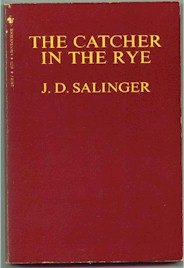
A really cool post about the plain maroon cover of The Catcher in the Rye
The dustjacket on the original 1951 edition, designed by Michael Mitchell, had a Ben Shahn-style drawing of a carousel horse dwarfing the skyline of uptown Manhattan, an image clearly inspired by the book?s ?so damn nice? final scene. Early in its paperback life, I recall it had an incarnation I hated: a drawing of protagonist Holden Caulfield wearing the Sherlock Holmes-style hat described in the book (but looking much dorkier, somehow, than I had pictured him in my mind).Then somewhere along the way (Was it the mid-sixties? My attempts to find a chronology have been unavailing), Catcher acquired the cover it bore when I checked it out for the first time. I?ve heard rumors, but have not yet found any proof, that Salinger so hated the earlier illustrations that he insisted that the covers of all his books be type-only. Certainly this was borne out by the U.S. paperback editions of his other three books then in circulation. Nine Stories had its grid of colored squares (courtesy of Pushpin); the two Zen-themed books about the Glass family, Franny and Zooey
and Raise High the Roofbeam Carpenters
both bore someone?s idea of Asian-flavored lettering.
But for me, the maroon cover of Catcher has a special place. Blank, enigmatic, vaguely dangerous, it was the perfect tabula rasa upon which I could project all my adolescent loneliness, insecurity, anger and sentimentality. It was as if possessing it provided a password into an exclusive club, even if that club existed only in your own mind. I wonder if a different cover, a more ?designed? cover, could have been able to contain quite so much emotion and meaning.
I'm glad I still have my battered old maroon-covered paperback. It's the same one I've had since I first read it in high school. The spine is now taped back together, and pages have dislodged themselves from the glue completely. But ... I don't know. I'm sentimental. Not about most copies of books ... but about this one, I am.
It's a great post ... and the last paragraph is terrific and true. I couldn't agree more.
(via Dr. Frank)
Halloween ...
It's about the candy, stupid! Great post by Michele.
Speaking of un-PC Halloween costumes, you kind of can't get more un-PC than the one below. If you can't guess who I am, then I ain't telling. Here's a clue: the red writing on my arms? They were the words "HELTER SKELTER". And it's a frontal view, so you can't really tell - but I am pregnant.
Evil. I am evil. As a matter of fact, when I walked into the party, dressed like that, one of the people at the party looked me up and down, realized who I was, and stated, "That is just WRONG."
Yup.
I'm going to hell.
And please realize: that I rode the subway dressed like that to get to the party.
So so wrong.

And here's the side view. I am dancing (with Jackie Kennedy on vacation at Hyannisport - yes, that was the name of the costume, and Mrs. Al Capone). More evidence that I am going straight to hell:
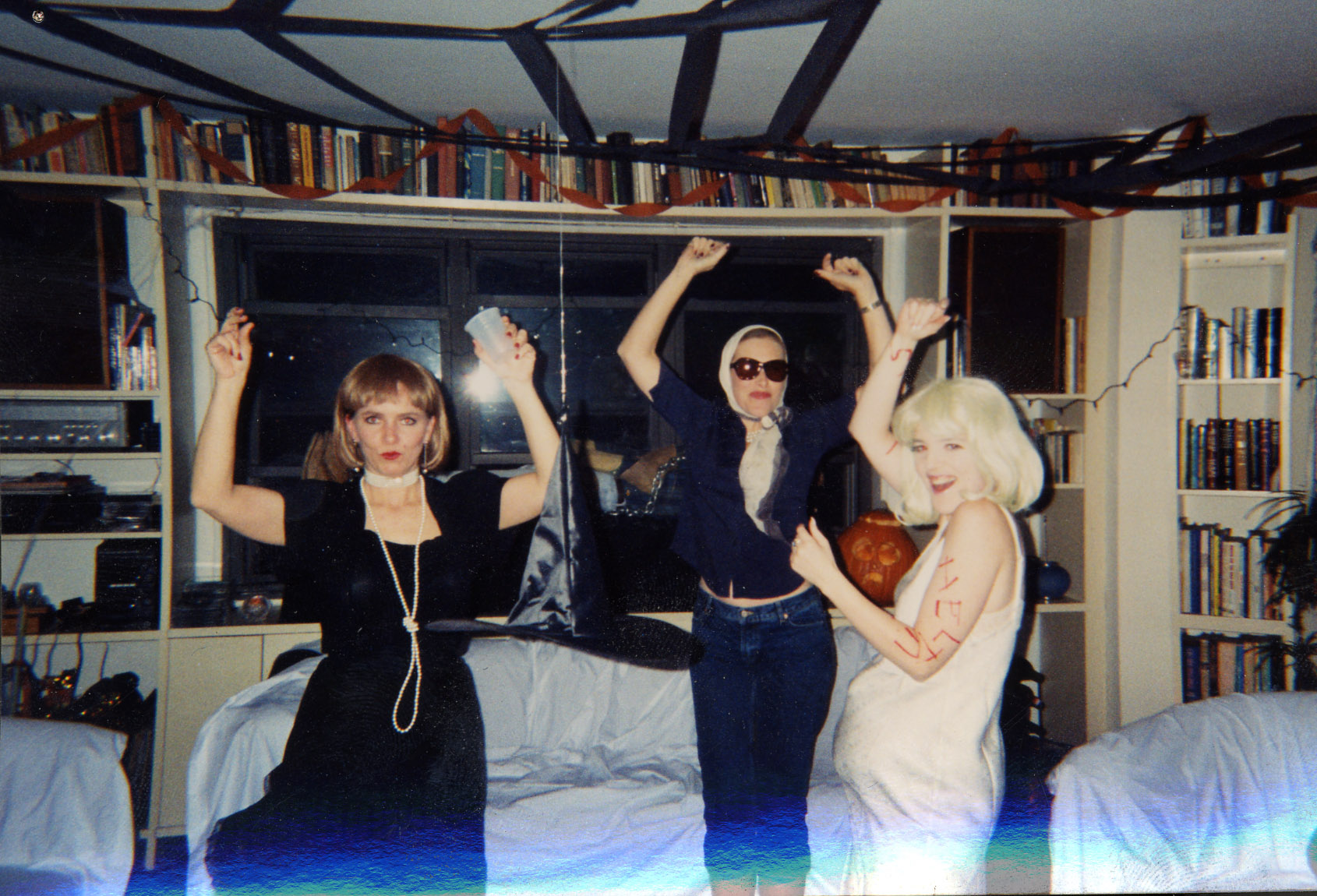
The Books: "Long Day's Journey into Night" (Eugene O'Neill)
Next in my Daily Book Excerpt:
I am still on my script shelf:
 Still on Eugene O'Neill - next play on the shelf is Long Day's Journey into Night

It's such a nice cheery play, isn't it? Really fills you with hope. The glass is half full, ya know what I'm sayin'? Life is good, and there's hope for humanity. You can just tell by the title that you are in for a rollicking comedic evening of theatre.
Uhm ... not.
Eugene O'Neill wrote it in 1939, but it was never performed in his lifetime. His wife remembered the summer he wrote it. He would stay in his study all day working, and emerge in the evening, with his eyes puffed up out of his head from weeping. He wrote and wept. And damn, you can tell that from the language in this play. An astonishing and painful exorcism has taken place. It's a wrenching play. Bleak. If you find the hope in it, lemme know, would ya?
On his twelfth wedding anniversary with his wife Carlotta, O'Neill gave her the script of the play with this note:
For Carlotta, on our 12th Wedding AnniversaryDearest: I give you the original script of this play of old sorrow, written in tears and blood. A sadly inappropriate gift, it would seem, for a day celebrating happiness. But you will understand. I mean it as a tribute to your love and tenderness which gave me the faith in love that enable me to face my dead at last and write this play, write it with deep pity and understanding and forgiveness for all the four haunted Tyrones.
These twelve years, Beloved One, have been a Journey into Light, into love. You know my gratitude. And my love!
Gene
Tao House
July 22, 1941
The play is autobiographical. O'Neill's father, like James Tyrone, was a Broadway actor. Eugene O'Neill was raised Irish Catholic, Catholicism was a big deal in their family, and his rejection of the faith devastated his father - just like in the play. O'Neill's father was also an alcoholic (like James Tyrone) - and has also given up a career as a Shakespearean actor for a part in a very commercial (but worthless) production called Monte Cristo. James Tyrone is haunted by the great Shakespearean actor he could have been ... and so was O'Neill's dad. Like Mary Tyrone, O'Neill's mother in real-life was a morphine addict. Just like in the play, she became addicted to morphine after an incompetent doctor proscribed it to her following a difficult childibrth. Jamie is modeled after O'Neill's real-life brother, an alcoholic whoremonger who was basically a huge failure at whatever he tried. Eugene had an older brother named Edmund - who had died when he was a baby. In the play, the baby who died is named Eugene. Like Edmund, Eugene O'Neill sailed for years, living a restless peripatetic constantly-broke life. He took odd jobs. O'Neill was also not what you would call a hearty man with a hearty constitution. He was fragile, and eventually got tuberculosis. He spent 6 months in a sanatorium for treatment - turberculosis was a very dangerous disease.
So anyway. With all of these parallels - these painful parallels - it is not surprising that 1. he would emerge from his study weeping after working on the play, and 2. that the play is so unbelievably great.
Long Day's Journey into Night was first performed in 1956, three years after O'Neill's death. It won a Pulitzer Prize and has often been hailed as O'Neill's greatest play.
The four members of the Tyrone family are as real to me as if I had met them at a recent barbecue. Honestly, they lift off the page. They live on. Nobody can ever convince me that the Tyrone family isn't "out there" somewhere.
Basic plot (but honestly - the plot doesn't capture the true power of this piece of work - you have to read it.):
It's 1912. There's a father, a mother, and two sons.
Father is 65 year old James Tyrone. He was once considered to be the most promising young actor in America. He squandered his talent by appearing for years in melodramas (which paid well, and were crowd-pleasers) - so until he became typecast, and couldn't get work in anything else - and he is bitter about this. He traded artistic excellence for financial success, and this gnaws at him. He lives in constant fear of the poorhouse, so he pinches his pennies in a way that is actually dangerous to the family. He is an alcoholic. He is Irish Catholic. He is hopeless about what has happened to his wife. He knows there is no hope. He badgers his two sons about everything - how they lost their faith, their own drinking, etc. etc. Very fractious relationship with his sons.
Mother is Mary Tyrone. She was once beautiful. Her hands are now twisted up with painful rheumatism. Mary was raised in a prosperous home, and was devoted to her father. Mary was educated in a convent, and wanted to be either a nun or a concert pianist. Music was very important to her, she had a gift. But then she was introduced to James Tyrone and she fell in love immediately. They married. They were very happy - but her life was not easy from the get-go. They traveled constantly, she had to hang out in hotel rooms for weeks on end while he did gigs across the country - she was lonely. Additionally, James' penny-pinching qualities meant that nothing was ever made comfortable for her. They traveled third class, they ate bad food, they stayed in cheap hotels ... Mary gave birth to a baby who died. She went right back on the road with her husband ... and again, even though she was sick, Tyrone would not spend any money on comforts for her. She got sicker. She then gave birth to Edmund, a difficult childbirth which weakened her even more. She finally went to an incompetent doctor, who proscribed morphine. Mary Tyrone becomes addicted to morphine. Despite being sent away for rest cures (and her husband would never spend the money to send her to the best doctors, or to the best sanitariums) - her addiction deepens. There's so much going on in Mary. She is in complete denial that her son Edmund is dying of consumption. She refuses to face reality and sinks into a dream-world. By the end of the play, she has regressed completely. She is once again that young hopeful girl in the convent, playing piano for hours. Only now she can no longer play because rheumatism has ruined her hands.
She is one of THE great female characters ever written.
Jamie Tyrone is the older son. He's in his early 30s. He is a wastoid, pretty much, although he had as much promise as his father once had. He was expelled from countless colleges, but with the help of his father he did gain some success in theatre, doing a couple of long runs on Broadway. But he always spends every penny he earns, so he is constantly broke. He spends the summers taking care of the grounds on the Tyrone summer estate. But he spends most of his time drinking and whoring. Jamie and his father constantly clash. His father is unforgiving towards his son - Jamie is an enormous disappointment to him.
Edmund Tyrone is 23 years old. He is a restless soul. He also was expelled from college, and he went to sea. He was often broke, and homeless, sleeping on park benches in, say, Buenos Aires, other ports. He is not strong like his father, and like Jamie - at least physically. He has tried to commit suicide. He takes after his mother. And he has developed consumption. He is dying. But nobody in the family will admit it. They just pretend that it's a cold that has really been hanging on. He has come home to the family estate - basically to die. Although that is never spoken. He gets a job on a local newspaper, and his father holds out hope that maybe his son will start to be successful, start to take care. Edmund is a gloomy cynical dude. He has rejected Catholicism bitterly - something that breaks his father's heart. He, as opposed to Jamie, holds out hope that his mother might be able to kick her addiction. He is hugely resentful of his father because his father has not spent the money to place his mother in the best care.
So there you have it. The Tyrone family. In the summer of 1912, they are all under the same roof, for the summer.
The play is one long progression towards death. The long day's journey into night.
It is a masterpiece.
The scene I'm going to excerpt is rightly famous (and also done, ad nauseum, in acting classes. It's a great scene for two men ... I've seen it so many times that I have basically memorized the lines).
It's the opening of Act Four. It's midnight. James Tyrone sits up, he has been drinking, he plays solitaire. Edmund Tyrone comes home, drunk. There is a long long late-night scene between father and son. Mary Tyrone, upstairs, lost in a morphine haze, haunts this scene - even though she never appears. Truly a great piece of writing. I'll post some of it, only the first half of it. It's a gigantic scene.
It's one of those scenes that could only take place in the middle of the night.
EXCERPT FROM Long Day's Journey Into Night, by Eugene O'Neill
[As the curtain rises, Tyrone finishes a game and sweeps the cards together. He shuffles them clumsily, dropping a couple on the floor. He retrieves them with difficulty, and starts to shuffle again, when he hears someone entering the front door. He peers over his pince-nex through the front parlor.]
TYRONE. [his voice thick] Who's that? Is it you, Edmund? [Edmund's voice answers curtly, "Yes". Then he evidently collides with something in the dark hall and can be heard cursing. A moment later the hall lamp is turned on. Tyrone frowns and calls.] Turn that light out before you come in. [But Edmund doesn't. He comes in through the front parlor. He is drunk now, too, but like his father he carries it well, and gives little physical sign of it except in his eyes and a chip-on-the-shoulder aggressiveness in his manner. Tyrone speaks, at first with a warm, relieved welcome.] I'm glad you've come, lad. I've been damned lonely. [Then resentfully] You're a fine one to run away and leave me to sit alone here all night when you know -- [with sharp irritation] I told you to turn out that light! We're not giving a ball. There's no reason to have the house ablaze with electricity at this time of night, burning up money!
EDMUND. Ablaze with electricity! One bulb! Hell, everyone keeps a light on in the front hall until they go to bed. [He rubs his knee] I damned near busted my knee on the hat stand.
TYRONE. The light from here shows in the hall. You could see your way well enough if you were sober.
EDMUND. If I was sober? I like that.
TYRONE. I don't give a damn what other people do. If they want to be wasteful fools, for the sake of show, let them be!
EDMUND. One bulb! Christ, don't be such a cheap skate! I've proved by figures if you left the light bulb on all night it wouldn't be as much as one drink!
TYRONE. To hell with your figures! The proof is in the bills I have to pay!
EDMUND. [contemptuously] Yes, facts don't mean a thing, do they? What you want to believe, that's the only truth! [Derisively] Shakespeare was an Irish Catholic, for example.
TYRONE. So he was. The proof is in the plays.
EDMUND. Well, he wasn't, and there's no proof of it in his plays, except to you. [jeeringly] The Duke of Wellington, there was another good Irish Catholic!
TYRONE. I never said he was a good one. He was a renegade but a Catholic just the same.
EDMUND. Well, he wasn't. You just want to believe no one but an Irish Catholic general could beat Napoleon.
TYRONE. I'm not going to argue with you. I asked you to turn out that light in the hall.
EDMUND. I heard you, and as far as I'm concerned it stays on.
TYRONE. Nonne of your damned insolence! Are you going to obey me or not?
EDMUND. Not! If you want to be a crazy miser put it out yourself.
TYRONE. [with threatening anger] Listen to me! I've put up with a lot from you because from the mad things you've done at times I've thought you weren't quite right in your head. I've excused you and never lifted my hand to you. But there's a straw that breaks the camel's back. You'll obey me and put out that light or, big as you are, I'll give you a thrashing that'll teach you ---! [Suddenly he remembers Edmund's illness and instantly becomes guilty and shamefaced] Forgive me, lad. I forgot -- You shouldn't goad me into losing my temper.
EDMUND. [ashamed himself now] Forget it, Papa. I apologize, too. I had no right being nasty about nothing. I am a bit soused, I guess. I'll put out the damned light. [He starts to get up]
TYRONE. No, stay where you are. Let it burn. [He stands up abruptly -- and a bit drunkenly -- and begins turning on the three bulbs in the chandelier, with a childish, bitterly dramatic self-pity] We'll have them all on! Let them burn! To hell with them! The poorhouse is the end of the road, and it might as well be sooner as later! [He finishes turning on the lights]
EDMUND. [has watched this proceeding with an awakened sense of humor -- now he grins, teasing affectionately] That's a grand curtain. [He laughs] You're a wonder, Papa.
TYRONE. [sits down sheepishly -- grumbles pathetically] That's right, laugh at the old fool! The poor old ham! But the final curtain will be in the poorhouse just the same, and that's not comedy! [Then as Edmund is still grinning, he changes the subject] Well, well, let's not argue. You've got brains in that head of yours, though you do your best to deny them. You'll live to learn the value of a dollar. You're not like your damned tramp of a brother. I've given up hope he'll ever get sense. Where is he, by the way?
EDMUND. How would I know?
TYRONE. I thought you'd gone back uptown to meet him.
EDMUND. No. I walked out to the beach. I haven't seen him since this afternoon.
TYRONE. Well, if you split the money I gave you with him, like a fool --
EDMUND. Sure I did. He's always staked me when he had anything.
TYRONE. Then it doesn't take a soothsayer to tell he's probably in the whorehouse.
EDMUND. What of it if he is? Why not?
TYRONE. Why not, indeed. It's the fit place for him. If he's ever had a loftier dream than whores and whiskey, he's never shown it.
EDMUND. Oh, for Pete's sake, Papa! If you're going to start that stuff, I'll beat it. [He starts to get up]
TYRONE. [placatingly] All right, all right, I'll stop. God knows, I don't like the subject either. Will you join me in a drink?
EDMUND. Ah! Now you're talking!
TYRONE. [passes the bottle to him -- mechanically] I'm wrong to treat you. You've had enough already.
EDMUND. [pouring a big drink -- a bit drunkenly] Enough is not as good as a feast. [He hands back the bottle]
TYRONE. It's too much in your condition.
EDMUND. Forget my condition! [He raises his glass] Here's how.
TYRONE. Drink hearty. [They drink] If you walked all the way to the beach you must be damp and chilled.
EDMUND. Oh, I dropped in at the Inn on the way out and back.
TYRONE. It's not a night I'd pick for a long walk.
EDMUND. I loved the fog. It was what I needed. [He sounds more tipsy and looks it]
TYRONE. You should have more sense than to risk --
EDMUND. To hell with sense! We're all crazy. What do we want with sense? [He quotes from Dowson sardonically:]
"They are not long, the weeping and the laughter,
Love and desire and hate:
I think they have no portion in us after
We pass the gate.
They are not long, the days of wine and roses:
Out of a misty dream
Our path emerges for a while, then closes
Within a dream."
[Staring before him] The fog was where I wanted to be. Halfway down the path you can't see this house. You'd never know it was here. Or any of the other places down the avenue. I couldn't see but a few feet ahead. I didn't meet a soul. Everything looked and sounded unreal. Nothing was what it is. That's what I wanted -- to be alone with myself in another world where truth is untrue and life can hide from itself. Out beyond the harbor, where the road runs along the beach, I even lost the feeling of being on land. The fog and the sea seemed part of each other. It was like walking on the bottom of the sea. As if I had drowned long ago. As if I was a ghost belonging to the fog, and the fog was the ghost of the sea. It felt damned peaceful to be nothing more than a ghost within a ghost. [He sees his father staring at him with mingled worry and irritated disapproval. He grins mockingly] Don't look at me as if I'd gone nutty. I'm talking sense. Who wants to see life as it is, if they can help it? It's the three Gorgons in one. You look in their faces and turn to stone. Or it's Pan. You see him and you die -- that is, inside you -- and have to go on living as a ghost.
TYRONE. [impressed and at the same time revolted] You have a poet in you but it's a damned morbid one! [Forcing a smile] Devil take your pessimism. I feel love-spirited enough. [He sighs] Why can't you remember your Shakespeare and forget the third-raters. You'll find what you're trying to say in him -- as you'll find everything worth saying. [He quotes, using his fine voice:] "We are such stuff as dreams are made on, and our little lifle is rounded with a sleep."
EDMUND. [Ironically] Fine! That's beautiful. But i wasn't trying to say that. We are such stuff as manure is made on, so let's drink up and forget it. That's more my idea.
TYRONE. [disgustedly] Ach! Keep such sentiments to yourself. I shouldn't have given you that drink.
EDMUND. It did pack a wallop, all right. On you too. [He grins with affectionate teasing] Even if you've never missed a performance! [Aggressively] Well, what's wrong with being drunk? It's what we're after, isn't it? Let's not kid each other, Papa. Not tonight. We know what we're trying to forget. [Hurriedly] But let's not talk about it. It's no use now.
TYRONE. No. All we can do is try to be resigned -- again.
EDMUND. Or be so drunk you can forget. [He recites, and recites well, with bitter, ironical passion, the Symons' translation of Baudelaire's prose poem.] "Be always drunken. Nothing else matters: that is the only question. If you would not feel the horrible burden of Time weighing on your shoulders and crushing you to the earth, be drunken continually.
Drunken with what? With wine, with poetry, or with virtue, as you will. But be drunken.
And if sometimes, on the stairs of a palace, or on the green side of a ditch, or in the dreary solitude of your own room, you should awaken and the drunkenness be half or wholly slipped away from you, ask of the wind, or of the wave, or of the star, or of the bird, or of the clock, of whatever flies, or sighs, or rocks, or sings, or speaks, ask what hour it is; and the wind, wave, star, bird, clock, will answer you: 'It is the hour to be drunken! Be drunken, if you would not be martyred slaves of Time; be drunken continually! With wine, with poetry, or with virtue, as you will.'" [He grins at his father provocatively]
TYRONE. I wouldn't worry about the virtue part of it, if I were you. [then disgustedly] Pah! It's morbid nonsense! What little truth is in it you'll find nobly said in Shakespeare. [Then appreciatively] But you recited it well, lad. Who wrote it?
EDMUND. Baudelaire.
TYRONE. Never heard of him
EDMUND. [grins provocatively] He also wrote a poem about Jamie and the Great White Way.
TYRONE. That loafer! I hope to God he misses the last car and has to stay uptown!
EDMUND. [goes on, ignoring this] Although he was French and never saw Broadway and died before Jamie was born. He knew him and Little Old New York just the same. [He recites the Symons' translation of Baudelaire's "Epilogue"]
"With heart at rest I climbed the citadel's
Steep height, and saw the city as from a tower,
Hospital, brothel, prison, and such hells,
Where evil comes up softly like a flower.
Thou knowest, O Satan, patron of my pain,
Not for vain tears I went up at that hour;
But like an old sad faithful lecher, fain
To drink delight of that enormous troll
Whose hellish beauty makes me young again.
Whether thou sleep, with heavy vapours fall,
Sodden with day, or, new apparelled, stand
In gold-laced veils of evening beautiful,
I love thee, infamous city! Harlots and
Hunted have pleasures of their own to give,
The vulgar herd can never understand."
TYRONE. [with irritable disgust] Morbid filth! Where the hell do you get your taste in literature? Filth and despair and pessimism! Another atheist, I suppose. When you deny God, you deny hope. That's the trouble with you. If you'd get down on your knees --
EDMUND. [as if he hadn't heard] It's a good likeness of Jamie, don't you think, hunted by himself and whiskey, hiding in a Broadway hotel room with some fat tart -- he likes them fat -- reciting Dowson's Cynara to her. [He recites derisively, but with deep feeling.]
"All night upon mine heart I felt her warm heart beat,
Night-long within mine arms in love and sleep she lay;
Surely the kisses of her bought red mouth were sweet;
But I was desolate and sick of an old passion,
When I awoke and found the dawn was gray:
I have been faithful to thee, Cynara! in my fashion."
[Jeeringly] And the poor fat burlesque queen doesn't get a word of it, but suspects she's being insulted! And Jamie never loved any Cynara, and was never faithful to a woman in his life, even in his fashion! But he lies there, kidding himself he is superior, and enjoys pleasures "the vulgar herd can never understand"! [He laughs] It's nuts -- completely nuts!
TYRONE. [vaguely -- his voice thick] It's madness, yes. If you'd get on your knees and pray. When you deny God, you deny sanity.
EDMUND. [ignoring this] But who am I to feel superior? I've done the same damned thing. And it's no more crazy than Dowson himself, inspired by an absinthe hangover, writing it to a dumb barmaid, who thought he was a poor crazy souse, and gave him the gate to marry a waiter! [He laughs -- then soberly, with genuine sympathy] Poor Dowson. Booze and consumption got him. [He starts and for a second looks miserable and frightened. Then with defensive irony] Perhaps it would be tactful of me to change the subject.
TYRONE. [thickly] Where you get your taste in authors -- That damned library of yours! [He indicates a small bookcase at rear] Voltaire, Rousseau, Schopenhauer, Nietzsche, Ibsen! Atheists, fools, and madmen! And your poets! This Dowson, and this Baudelaire, and Swinburne and Oscar Wilde and Whitman and Poe! Whoremongers and degenerates! Pah! When I've three good sets of Shakespeare there [he nods at the large bookcase] you could read.
EDMUND. They say he was a souse, too.
TYRONE. They lie! I don't doubt he liked his glass -- it's a good man's failing -- but he knew how to drink so it didn't poison his brain with morbidness and filth. Don't compare him with the pack you've got in there. [he indicates the small bookcase again] Your dirty Zola! And your Dante Gabriel Rosettie who was a dope fiend! [He starts and looks guilty]
EDMUND. Perhaps it would be wise to change the subject. [A pause] You can't accuse me of not knowing Shakespeare. Didn't I win five dollars from you once when you bet me I couldn't learn a leading part of his in a week, as you used to do in stock in the old days. I learned Macbeth and recited it letter perfect, with you giving me the cues.
TYRONE. [approvingly] That's true. So you did. [He smiles teasingly and sighs] It was a terrible ordeal, I remember, hearing you murder the lines. I kept wishing I'd paid over the bet without making you provie it. [He chuckles and Edmund grins. Then he starts as he hears a sound from upstairs -- with dread] Did you hear? She's moving around. I was hoping she'd gone to sleep.
EDMUND. Forget it! How about another drink? [He reaches out and gets the bottle, pours a drink and hands it back. Then with a strained casualness, as his father pours a drink:] When did Mama go to bed?
TYRONE. Right after you left. She wouldn't eat any dinner. What made you run away.
EDMUND. Nothing. [abruptly raising his glass] Well, here's how.
TYRONE. [mechanically] Drink hearty, lad. [They drink. Tyrone again listens to sounds upstairs -- with dread] She's moving around a lot. I hope to God she doesn't come down.
EDMUND. [dully] Yes. She'll be nothing but a ghost haunting the past by this time. [He pauses -- then miserably] Back before I was born --
TYRONE. Doesn't she do the same with me? Back before she ever knew me. You'd think the only happy days she's ever known were in her father's home, or at the Convent, praying and playing the piano. [Jealous resentment in his bitterness] As I've told you before, you must take her memories with a grain of salt. Her wonderful home was ordinary enough. Her father wasn't the great, general, noble Irish gentleman she makes out. He was a nice enough man, good company and a good talker. I liked him and he liked me. He was prosperous enough, too, in his wholesale grocery business, an able man. But he had his weakness. She condemns my drinking but she forgets his. It's true he never touched a drop till he was forty, but after that he made up for lost time. He became a steady champagne drinker, the worst kind. That was his grand pose, to drink only champagne. Well, it finished him quick -- that and the consumption -- [He stops with a guilty glance at his son.]
EDMUND. We don't seem able to avoid unpleasant topics, do we?
TYRONE. No. [then with a pathetic attempt at heartiness] What do you say to a game or two of Casino, lad?
EDMUND. All right.
TYRONE. [shuffling the cards clumsily] We can't lock up and go to bed till Jamie comes on the last trolley -- which I hope he won't -- and I don't want to go upstairs, anyway, till she's asleep.
EDMUND. Neither do I.
TYRONE. [keeps shuffling the cards fumblingly, forgetting to deal them] As I was saying, you must take her tales of the past with a grain of salt. The piano playing and her dream of becoming a concert pianist. That was put in her head by the nuns flattering her. She was their pet. They loved her for being so devout. They're innocent women, anyway, when it comes to the world. They don't know that not one in a million who shows promise ever rises to concert playing. Not that your mother didn't play well for a schoolgril, but that's no reason to take it for granted she could have --
EDMUND. [sharply] Why don't you deal, if we're going to play.
TYRONE. Eh? I am. [dealing with very uncertain judgment of distance] And the idea she might have become a nun. That's the worst. Your mother was one of the most beautiful girls you could ever see. She knew it, too. She was a bit of a rogue and a coquette, God bless her, behind all her shyness and blushes. She was never made to renounce the world. She was bursting with health and high spirits and the love of loving.
EDMUND. For God's sake, Papa! Why don't you pick up your hand?
TYRONE. [picks it up -- dully] Yes, let's see what I have here. [They both stare at their cards unseeingly. Then they both start. Tyrone whipsers] Listen!
EDMUND. She's coming downstairs.
TYRONE. [hurriedly] We'll play the game. Pretend not to notice and she'll soon go up again.
EDMUND. [staring through the front parlor -- with relief] I don't see her. She must have started down and then turned back.
TYRONE. Thank God.
EDMUND. Yes. It's pretty horrible to see her the way she must be now. [with bitter misery] The hardest thing to take is the blank wall she builds around her. Or it's more like a bank of fog in which she hides and loses herself. Deliberately, that's the hell of it! You know something in her does it deliberately -- to get beyond our reach, to be rid of us, to forget we're alive! It's as if, in spite of loving us, she hated us!
TYRONE. Now, now, lad. It's not her. It's the damned poison.
EDMUND. She takes it to get that effect. At least, I know she did this time! [abruptly] My play, isn't it? Here. [He plays a card]
TYRONE. [plays mechanically] She's been terribly frightened about your illness, for all her pretending. Don't be too hard on her, lad. Remember she's not responsible. Once that cursed poison gets a hold on anyone --
EDMUND. [his face grows hard and he stares at his father with bitter accusation] It never should have gotten a hold on her! I know damned well she's not to blame! And I know who is! You are! Your damned stinginess! If you'd spent money for a decent doctor when she was so sick after I was born, she'd never have known morphine existed! Instead you put her in the hands of a hotel quack who wouldn't admit his ignorance and took the easiest way out, not giving a damn what happened to her afterwards! All because his fee was cheap! Another one of your bargains!
TYRONE. [stung -- angrily] Be quiet! How dare you talk of something you know nothing about! [Trying to control his temper] You must try to see my side of it too, lad. How was I to know he was that kind of a doctor? He had a good reputation --
EDMUND. Among the souses in the hotel bar, I suppose!
TYRONE. That's a lie! I asked the hotel proprietor to recommend the best --
EDMUND. Yes! At the same time crying poorhouse and making it plain you wanted a cheap one! I know your system! By God, I ought to after this afternoon.
TYRONE. What about this afternoon?
EDMUND. Never mind now. We're talking about Mama! I'm saying no matter how you excuse yourself you know damned well your stinginess is to blame --
TYRONE. And I say you're a liar! Shut your mouth right now, or --
EDMUND. After you found out she'd been made a morphine addict, why didn't you send her to a cure then, at the start, while she still had a chance? No, that would have meant spending some money! I'll bet you told her all she had to do was use a little will power! That's why you still believe in your heart, in spite of what doctors, who really know something about it, have told you!
TYRONE. You lie again! I know better than that now! But how was I to know then? What did I know of morphine? It was years before I discovered what was wrong. I thought she'd never got over her sickness, that's all. Why didn't I send her to a cure, you say? Haven't I? I've spent thousands upon thousands in cures! A waste. What good have they done her? She's always started again.
EDMUND. Because you've never given her anything that would help her want to stay off it! No home except this summer dump in a place she hates and you've refused even to spend money to make this look decent, while you keep buying more property, and playing sucker for every con man with a gold mine, or a silver mine, or any kind of get-rich-quick swindle! You've dragged her around on the road, season after season, on one-night stands, with no one she could talk to, waiting night after night in dirty hotel rooms for you to come back with a bun on after the bars closed! Christ, is it any wonder she didn't want to be cured? Jesus, when I think of it I hate your guts!
TYRONE. Edmund! [then in a rage] How dare you talk to your father like that, you insolent young cub! After all I've done for you.
EDMUND. We'll come to that, what you're doing for me!
TYRONE. [Loooking guilty again -- ignoring this] Will you stop repeating your mother's crazy accusations, which she never makes unless it's the poison talking? I never dragged her on the road against her will. Naturally, I wanted her with me. I loved her. And she came because she loved me and wanted to be with me. That's the truth, no matter what she says when she's not herself. And she needn't have been lonely. There was always the members of my company to talk to, if she'd wanted. She had her children, too, and I insisted, in spite of the expense, on having a nurse to travel with her.
EDMUND. Yes, your one generosity, and that because you were jealous of her paying too much attention to us, and wanted us out of your way! It was another mistake, too! If she'd had to take care of me all by herself, and had that to occupy her mind, maybe she'd have been able to --
TYRONE. [goaded into vindictiveness] Or for that matter, if you insist on judging things by what she says when she's not in her right mind, if you hadn't been born, she'd never -- [He stops, ashamed]
EDMUND. [suddenly spent and miserable] Sure. I know that's what she feels, Papa.
TYRONE. She doesn't! She loves you as dearly as ever mother loved a son! I only said that because you put me in such a God-damned rage, raking up the past, and saying you hate me --
EDMUND. [dully] I didn't mean it, Papa. [He suddenly smiles -- kidding a bit drunkenly] I'm like Mama, I can't help liking you, in spite of everything.
September 12, 2005
On Sept. 12, 1974 ...
Emperor Haile Selassie, ruler of Ethiopia for 58 years, was deposed by the military, after a couple of years of revolution.
The text of the announcement, read over the radio to the people of Ethiopia on the morning of September 12, 1974, went as follows:
Even though the people treated the throne in good faith as a symbol of unity, Haile Selassie I took advantage of its authority, dignity, and honor for his own personal ends. As a result, the country found itself in a state of poverty and disintegration. Moreover, an eighty-two-year-old monarch, because of his age, is incapable of meeting his responsibilities. Therefore His Imperial Majesty Haile Selassie I is being deposed as of September 12, 1974, and power assumed by the Provisional Military Committee. Ethiopia above all!
Ryzsard Kapuscinski's hypnotic book The Emperor
There are three parts in the book: The Throne - describing the absolute nature of Haile Selassie's rule. The opulence, the decadence, the desire for modernity - yet mixed with the autocratic touch. You can't really have those two things together. It's Coming, It's Coming is the second part of the book. This is where the seeds of rebellion blossom, and things start to fall apart. And finally: The Collapse. The documentation of the revolution and the Emperor being run out of town.
I thought it would be interesting to post some excerpts from Kapuscinski's book - which is one of my favorites of its kind. The excerpts I've chosen are all from the section titled "The Collapse".

Emperor Haile Selassie I, 1930
From The Emperor, by Ryzsard Kapuscinski.
A.G.
You must know, Mr. Richard, that by early August the inside of the Palace had lost its stateliness and its awe-inspiring solemnity. There was such confusion everywhere that the remaining ceremony officials could not introduce any order. The Palace had become the last refuge for the dignitaries and notables, who came here from the whole Empire, hoping to be safer at His Majesty's side, hoping that the Emperor would save them and obtain their freedom through his entreaties to the arrogant officers. Without respect for their honors and titles, dignitaries and favorites of all ranks, levels, and distinctions now slept side by side on the carpets, sofas, and armchairs, covering themselves wtih curtains and drapes -- over which they got into constant quarrels, since some didn't want the curtains taken down from the windows, for fear the rebellious air force would bomb the Palace if it were not kept blacked out. The others maintained that they couldn't fall asleep without covers (you have to admit that the nights then were exceptionally cold), and they selfishly pulled down the curtains and covered themselves. All these squabbles and gibes were meaningless, however, because the officers soon reconciled everyone by taking them to jail, where the contentious dignitaries couldn't count on any covers.
In those days, patrols from the Fourth Division would come to the Palace every morning. The rebellious officers would get out of their cars and order a meeting of dignitaries in the throne room. "Meeting of dignitaries! Meeting of dignitaries!" the cries of the ceremony officials resounded through the corridors. These officials were already sucking up to the officers. At the sound of this call some of the dignitaries hid in corners, but the rest, wrapped in curtains and drapes, showed up. Then the officers read their list and those whose names had been called were taken to jail.
One must remark, Mr. Richard, that His Majesty was now always dressed in his uniform, sometimes in the ceremonial uniform, sometimes in the field uniform, the battle dress in which he used to watch maneuvers. He would appear in the salons where the terrified dignitaries lay on the carpets and lounged on the sofas, asking each other what fate would descend on them when their waiting came to an end. He would comfort them, wish them success, attach the greatest importance, treat them with personal care. However, if he met a patrol of officers in the corridor, he encouraged them as well, wished them success, thanked the army for its loyalty to him; he assured them that army affairs were the object of his personal care. At this point the Jailers would angrily and venomously whisper that the officers should be hanged because they had destroyed the Empire. The kindly monarch would hear them out attentively, encourage, wish them luck, and thank them for their loyalty, underlying the fact that he valued them highly. And the indefatigable mobility of His Venerable Majesty, by which he contributed to the general welfare, never sparing his advice or directives, was called a success by Mr. Gebre-Egzy, who saw in it proof of the monarchy's resilience. Unfortunately, by calling everything a success, the minister so infuriated the officers that they dragged him from the hall and gagged him once and for all, throwing him in jail.
Y.Y.
We were by now only a handful, waiting for the final and most terrible verdict, when -- praise be to God! -- a ray of hope appeared in the form of the lawyers who at last, after long deliberations, had prepared a revised constitution and come to His Majesty with their proposal. The proposal consisted in changing our autocratic Empire into a constitutional monarchy, creating a strong government and leaving to His Venerable Highness only as much power as the British kings have. The distinguished gentlemen started reading the proposal immediately, dividing into small groups and hiding in secret corners, because whenever the officers noticed a larger gathering they jailed them right away. Unfortunately, my friend, the Jailers opposed this proposal, insisting that absolute monarchy should be preserved, the full power of notables and dignitaries in the provinces maintained, and the delusions about constitutional monarchy, coming as they did from the moribund British Empire, thrown to the dogs. Here, however, the Talkers started jumping down the Jailers' throats, saying that it was the last moment to improve the Empire through constitutional change, season it, make it palatable. And so, quarreling, they went to His Merciful Highness, who was just then receiving the delegation of lawyers and looking into the details of their proposal with personal attention, attaching the greatest importance to their ideas. Now, having listened to the sulking of the Jailers and the flattery of the Talkers, he praised all, encouraged, and wished everyone success. But someone must have run off to the officers and informed, because hardly had the lawyers emerged from His Enlightened Majesty's office when they ran into the military, who immediately snatched the proposal from them, ordered them to go home, and forbade them to return to the Palace.
Y.Y.
Life inside the Palace seemed strange, as if existing only of itself and for itself. When I went to town as an official of the Palace post office, I would see normal life -- cars driving through the streets, children playing, people selling and buying, old men sitting, talking away -- and every day I would pass from one existence to another, no longer knowing which one was real, and feeling that it was sufficient for me to go into the city, to mingle with the crowds, for the whole Palace to vanish from memory. It would disappear, as if it didn't exist, to the point of making me anxious that when I came back I wouldn't find it there.
E.
He spent his last days alone in the palace, with only his old valet de chambre for company. Apparently the group in favor of closing the Palace and dethroning the Emperor had gained the upper hand in the Dergue. None of the names of the officers was known, none was announced -- they acted in total secrecy until the end. Now they say that this group was headed by a young major named Mengistu Haile-Mariam. There were other officers, too, but they are all dead. I remember when this Mariam would come to the Palace as a captain. His mother was a servant at the court. I cannot tell who made it possible for him to graduate from the officers' school. Slender, slight, always tense, but in control of himself -- anyway, that was the impression he gave. He knew the structure of the court, he knew who was who, he knew whom to arrest and when in order to prevent the Palace from functioning, to make it lose its power and strength, change it into a useless simulacrum that today stands abandoned and deteriorating.
E.
The crucial decisions in the Dergue must have been taken sometimes around the first of August. The military committee -- that is, the Dergue -- was composed of a hundred and twenty delegates elected at meetings in divisions and garrisons. They had a list of five hundred dignitaries and courtiers whom they gradually arrested, creating a sinking emptiness around the Emperor until finally he was left alone in the Palace. The last group, members of the Emperor's inner circle, was jailed in the middle of August. That's when they took the chief of the Imperial bodyguards, Colonel Tassew Wajo, our monarch's aide-de-camp, General Assefa Demissie; the commander of the Imperial Guard, General Tadesse Lemma; the personal secretary to H.S. Solomon Gebre-Mariam; the premier, Endelkachew; the Minister of the Highest Privileges, Admassu Retta; and perhaps twenty others. At the same time they dissolved the Crown Council and other institutions directly subordinate to the Emperor.
Then the officers made detailed searches of the Palace. The most compromising documents were found in the Office of Highest Privileges, and found with all the more ease because Admassu Retta himself started to spill the beans. Once only the monarch distributed priviileges, but as the Empire began to fall apart the grabbing and snatching grew so strong among the notables that H. S. was unable to keep things under control, and he handed over some of the distribution of privileges to Admassu Retta. But Admassu Retta was not such a mnemonic genius as the Emperor, who never needed to write anything down, so he kept detailed accounts of his disbursements of land, enterprises, foreign currencies, and the other gratuities given to the dignitaries. All this fell into the hands of the military, who used these gravely compromising documents in a major propaganda campaign about the corruption in the Palace. They awakened anger and hatred in the people. Demonstrations flared up, the street demanded hangings in an atmosphere of horror and apocalypse. It turned out well that the military drove us all from the Palace -- maybe that was what saved my head.
Ryzsard Kapuscinski's words at the end:
In the second half of August the officers arrest the last of H. S.'s circle. They still don't touch the Emperor, because they need time to prepare public opinoin: the capital must understand why the monarch is being removed. The officers know about thet magical element in popular thinking, and about the dangers it contains. The magical aspect is the the highest one is endowed, often unconsciously, with divine characteristics. The supreme one is wise and noble, unblemished and kindly. Only the dignitaries are bad; they cause all the misery. Moreover, if the one on the top knew what his people were up to, he would immediately repair the damage and life would be better. Unfortunately, these crafty villains pull the wool over their master's eyes, and that is why life is so hard, so low and miserable. This is magical thinking beause, in reality, in an autocratic system it is precisely the one on top who is the primary cause of what happens. He knows what is going on, and if he doesn't know, it's because he doesn't want to know. It was no accident that the majority of the people around the Emperor were mean and servile. Meanness and servility were the conditions of ennoblement, the criteria by which the monarch chose his favorites, rewarded them, bestowed privileges on them. Not one step was taken, not one word said, without his knowledge and consent. Everyone spoke with his voice, even if they said diverse things, because he himself said diverse things. The condition for remaining in the Emperor's circle was practicing the cult of the Emperor, and whoever grew weak and lost eagerness in the practice of this cult lost his place, dropped out, disappeared. Haile Selassie lived among shadows of himself, for what was the Imperial suite if not a multiplication of the Emperor's shadow? Who were gentlemen like Aklilu, Gebre-Egzy, Admassu Retta, aside from being H.S.'s ministers? Nobodies. But it was precisely such people the Emperor wanted around him. Only they could satisfy his vanity, his self-love, his passion for the stage and the mirror, for gestures and the pedestal.
And now the officers meet the Emperor alone, they confront him face to face, the final duel begins. The moment has come for everyone to remove the mask and show his face. This action generates anxiety and tension because the two sides form a new geometry. The Emperor has nothingt o gain, but he can still defend himself by his defenselessness, his inactivity, by the unique virtue of occupying the Palace, by virtue of his being long-established -- and also because he performed an extraordinary service: he was silent, was he not, when the rebels claimed that they were carrying out the revolution in his name. He never protested, he never called it a lie, and yet it was precisely the charade of loyalty, acted out for months by the military, that made their task so eminently easy. But the officers decide to go further, to follow through to the very end: they want to unmask the deity. In a society so crushed by misery, by privation and worry, nothing will speak more eloquently to the imagination, nothing causes greater unrest, anger, and hatred than the picture of corruption and privilege among the elite. Even an incompetent and sterile government, if it lived a spartan life, could exist for years basking in the esteem of the people. The attitude of the people to the Palace is normally kindhearted and understanding. But all tolerance has its limits, which in its swaggering arrogance the Palace often and easiliy violates. And the mood of the street changes violently from submission to defiance, from patience to rebelliousness.
Now comes the moment when the officers decide to lay bare the King of Kings, to turn his pockets inside out, to reveal to the people the secret hiding places in the Emperor's closet.
Order of the Phoenix snapshots
-- I am already 3/4 of the way through, thanks to my hour-long commute out and back to Michele's yesterday. I wish it wasn't going by so fast!!!
-- Harry's a moody bastard in this one, isn't he? I guess true adolescence has begun.
-- I want to punch Professor Umbridge in her fat toady face. She is, by far, the most hateable hateful character in this series.
-- I love how Hermione basically coaches Harry through his blossoming romance with Cho - explaining to him how girls think, and interpreting Cho's odd behavior for Harry. "Here's what that meant ... what she's REALLY saying is ..." We all should have a friend like that of the opposite sex.
-- Poor Sirius Black. Trapped in his horrible childhood home with that despicable house-elf and the shrieking portraits of his awful ancestors.
-- In general - this book is quite depressing. The vibe at Hogwarts is oppressive, frightening ... and Harry, for the first time, is on the outside. He was the golden boy in all the other books - sure, he had dangerous stuff happen to him - but he was pretty much always indulged and admired (Snape notwithstanding). I like that he really has to struggle in this book - even though it's not a pleasant experience for him. It's going to be a good character-building thing, I'm sure. But still - the mood of the book is very dark. Much darker than the other books.
-- Fred and George Weasley continue to just crack me up. Especially the joke candies they invented that make you projectile vomit one moment and then stop vomiting in the next moment. I laughed out loud on the train when they were demonstrating how the candies worked in the Gryffindor common room. Like - Harry's trying to study, but all he can hear is the sounds of vomiting over in the corner, and then wild cheers. Hahahahahaha
-- Poor Hagrid. Hagrid's really having a tough time in this particular book.
-- Here is where I am at in the book:
Harry is taking extra classes with Snape so that he can protect his brain from Lord Voldemort. He continues to have dreams about the long corridor - but he doesn't know what it means yet. It is not yet apparent what Voldemort is up to - although the Death Eaters have escaped from Azkaban. Harry's scar hurts him almost constantly now. He's having a really rough time making it through the day. He has a small romance with Cho going on - which he finds really exciting and scary and awkward. Professor Umbridge is sending out educational decrees every 2 seconds ... and Dumbledore continues to ignore Harry. Harry is really alone in this book. From the very beginning. He's really on his own.
-- Oh, and I absolutely love that a group of them have created a secret society to have Harry teach them Defense against the Dark Arts. I just love it.
Yesterday
I hauled ass out to Long Island with two suitcases full of school supplies (and other items) to add to the piles in Michele's house for her Kids of Katrina project. Last week, I had mentioned Michele's project to my women's group - when we were emailing around, making plans for our next meeting. I arrived at Maria's house on Friday night - only to find that all of them had gone hog-wild with buying items off of Michele's list. There were bags and bags of stuff: notebooks, diapers, kids socks, crayons - so many crayons!! - scissors, glue ... My friends had all been school shopping for their own kids that week, and had just gone nuts - buying stuff for the evacuee kids. It filled my heart to see all that stuff. It was so much stuff that I honestly wondered: Uhm ... how the hell will I get all of that out to Long Island? With no car???
But I did it.
One kindly drunk gentleman helped me down the stairs of the Path train with my bags. He saw me struggling to go down the stairs and not be overpowered by my own bags ... and ran to the rescue. It was 7:45 in the morning, and he literally reeked of booze, mkay? Which he admitted freely. "Sorry ... I'm still kind of drunk ... you need some help?" I said, "Actually, I do - but I'm warning you. This one is very heavy." He grabbed the heavy one and trotted down the stairs as though it weighed absolutely nothing. Literally. The thing had to have weighed ... 200 lbs? More than that? But there he went. He was also going to take the train into the city, so he waited for me to come through the turnstiles, helped me with the heavy bag over the turnstile, and then walked me right to my train down the second flight of steps. I wondered if he would want a tip? He wasn't a hobo or anything like that - he was a strapping guy in his 30s - but obviously a big drinker. You could see it on his face. But man, he helped me out. I said to him before I got on the train, "Thank you so much for your help." He said, simply, "It's September 11. It's a good day to remember how we should help each other out."
Believe it or not - I had been so focused on getting my ass out the door with all my stuff at 7:15 am (waking up at 6:30 am, calling a cab, getting the bags together, bringing the bags downstairs, waiting for the cab ...) that I hadn't yet thought about September 11. I was focused on the task at hand.
But there was that helpful drunk gentleman ... saying that ... He reminded me to just take a moment. Just take a moment. Remember the day. Remember to be helpful towards one another. Remember the day.
I was grateful to him for more reasons than one.
And I just have to say - it was so amazing - to see the piles in Michele's house. Words can't really capture the amount of stuff she has there. It has literally taken over her house.
Also, though: it was so cool to finally meet Michele. I have been reading her blog since right after September 11 ... we have corresponded ... we read each other's stuff ... and so to finally meet one another was really really cool.
Flight 93
I watched The Discovery Channel's The Flight That Fought Back last night. The story is obviously well known. I know the names of all of those people as though they were friends of mine. Jeremy Glick. Todd Beamer. Mark Bingham. Sandy Bradshaw. CeeCee Lyles. Louis Nacke. Tom Burnett.
If you get a chance to see this program ... I honestly can't recommend it highly enough. I really can't speak about it with any eloquence - all I can say is: you've got to see it.
The Books: "Anna Christie" (Eugene O'Neill)
Next in my Daily Book Excerpt:
I am still on my script shelf:
 Still on Eugene O'Neill - next play on the shelf is Anna Christie

The play takes place in 1910. It starts in a dive bar near the waterfront in New York City. The bar is filled with off-duty sailors, it's a rough rough crowd. Into this crowd walks Anna - a prostitute, about 20 years old. She has shown up, looking for her father. She is weary, even though she is a young woman. Her desire is to find her father and reconcile with him, make things right.
Anna is a great part, a true juicy morsel of a part.
Here is an excerpt from the first act - when Anna first appears.
EXCERPT FROM Anna Christie, by Eugene O'Neill
[Anna Christopherson enters. She is a tall, blond, fully-developed girl of twenty, handsome after a large Viking-daughter fashion but now run down in health and plainly showing all the outward evidences of belonging to the world's oldest profession. Her youthful face is already hard and cynical beneath its layers of makeup. Her clothse are the tawdry finery of peasant stock turned prostitute. She comes and sinks wearily in a chair by the table]
ANNA. Gimme a whiskey -- ginger ale on the side. [then, as Larry turns to go, forcing a winning smile at him] And don't be stingy, baby.
LARRY. [sarcastically] Shall I serve it in a pail?
ANNA. [with a hard laugh] That suits me down to the ground. [Larry goes into the bar. The two women size each other up with frank stares. Larry comes back with the drink which he sets before Anna and returns to the bar again. Anna downs her drink at a gulp. Then, after a moment, as the alcohol begins to rouse her, she turns to Marthy with a friendly smile] Gee, I needed that bad, all right, all right!
MARTHY. [nodding her head, sympathetically] Sure -- yuh look all in. Been on a bat?
ANNA.. No -- travelling -- day and a half on the train. Had to sit up all night in the dirty coach, too. Gawd, I thought I'd never get here!
MARTHY. [with a start, looking at her intently] Where'd yuh come from, huh?
ANNA. St. Paul -- out in Minnesota.
MARTHY. [staring at her in amazement, slowly] So -- yuh're -- [She suddenly bursts out into hoarse ironical laughter] Gawd!
ANNA. All the way from Minnesota, sure. [flaring up] What are you laughing at? Me?
MARTHY. [hastily] No, honest, kid. I was thinkin' of somethin' else.
ANNA. [mollified -- with a smile] Well, I wouldn't blame you, at that. Guess I do look rotten -- yust out of the hospital two weeks. I'm going to have another 'ski. What d'you say? Have something on me?
MARTHY. Sure I will. T'anks. [She calls] Hey, Larry! Little service! [he comes in]
ANNA. Same for me.
MARTHY. Same here. [Larry takes their glasses and goes out]
ANNA. Why don't you come sit over here, be sociable. I'm a dead stranger in this burg -- and I ain't spoke a word with no one since day before yesterday.
MARTHY. Sure thing. [She shuffles over to Anna's table and sits down opposite her. Larry brings the drinks and Anna pays him]
ANNA. Skoal! Here's how! [She drinks]
MARTHY. Here's luck! [She takes a gulp from her schooner]
ANNA. [taking a package of Sweet Corporal cigarettes from her bag] Let you smoke in here, won't they?
MARTHY. [doubtfully] Sure. [then with evident anxiety] On'y trow it away if yuh hear someone comin'.
ANNA. [lighting one and taking a deep inhale] Gee, they're fussy in this dump, ain't they? [She puffs, staring at the table top. Martha looks her over with a new penetrating interest, taking in every detail of her face. Anna suddenly becomes conscious of this appraising stare -- resentfully] Ain't nothing wrong with me, is there? You're looking hard enough.
MARTHY. [irritated by the other's tone -- scornfully] Ain't got to look much. I got your number the minute you stepped in the door.
ANNA. [her eyes narrowing] Ain't you smart! Well, I got yours, too, without no trouble. You're me forty years from now. That's you! [She gives a hard little laugh]
MARTHY. [angrily] Is that so? Well, I'll tell you straight, kiddo, that Marthy Owen never -- [She catches herself up short -- with a grin] What are you and me scrappin' over? Let's cut it out, huh? Me, I don't want no hard feelin's with no one. [extending her hand] Shake and forget it, huh?
ANNA. [shakes her head gladly] Only too glad to. I ain't looking for trouble. Let's have 'nother. What d'you say?
MARTHY. [shaking her head] Not for mine. I'm full up. And you -- Had anythin' to eat lately?
ANNA. Not since this morning on the train.
MARTHY. Then yuh better go easy on it, hadn't yuh?
ANNA. [after a moment's hesitation] Guess you're right. I got to meet someone, too. But my nerves is on edge after that rotten trip.
MARTHY. Yuh said yuh was just outa the hospital?
ANNA. Two weeks ago. [leaning over to Marthy confidentially] The joint I was in out in St. Paul got raided. That was the start. The judge give all us girls thirty days. The others didn't seem to mind being in the cooler much. Some of 'em was used to it. But me, I couldn't stand it. It got my goat right -- couldn't eat or sleep or nothing. I never could stand being caged up nowheres. I got good and sick and they had to send me to the hospital. It was nice there. I was sorry to leave it, honest.
MARTHY. Did yuh say yuh got to meet someone here?
ANNA. Yes. Oh, not what you mean. It's my Old Man I got to meet. Honest! It's funny, too. I ain't seen him since I was a kid -- don't even know what he looks like -- yust had a letter every now and then. This was always the only address he give me to write him back. He's yanitor of some building here now -- used to be a sailor.
MARTHY. [astonished] Janitor!
ANNA. Sure. And I was thinking maybe, seeing he ain't never done a thing for me in my life, he might be willing to stake me to a room and eats till I get rested up. [wearily] Gee, I sure need that rest! I'm knocked out. [then resignedly] But I ain't expecting much from him. Give you a kick when you're down, that's what all men do. [with sudden passion] Men, I hate 'em -- all of 'em! And I don't expect he'll turn out no better than the rest. [then with sudden interest] Say, do you hang out around this dump much?
MARTHY. Oh, off and on.
ANNA. Then maybe you know him -- my Old Man -- or at least seen him?
MARTHY. It ain't old Chris, is it?
ANNA. Old Chris?
MARTHY. Chris Christopherson, his full name is.
ANNA. [excitedly] Yes, that's him! Anna Christopherson -- that's my real name -- only out there I called myself Anna Christie. So you know him, eh?
MARTHY. [evasively] Seen him about for years.
ANNA. Say, what's he like, tell me, honest?
MARTHY. Oh, he's short and --
ANNA. [impatiently] I don't care what he looks like. What kind is he?
MARTHY. [earnestly] Well, yuh can bet your life, kid, he's as good an old guy as ever walked on two feet. That goes!
ANNA. [pleased] I'm glad to hear it. Then you think's he'll stake me to that rest cure I'm after?
MARTHY. [emphatically] Surest thing you know. [disgustedly] But where'd yuh get the idea he was a janitor?
ANNA. He wrote me he was himself.
MARTHY. Well, he was lyin'. He ain't. He's captain of a barge -- five men under him.
ANNA. [disgusted in her turn] A barge? What kind of a barge?
MARTHY. Coal, mostly.
ANNA. A coal barge! [with a harsh laugh] If that ain't a swell job to find your long lost Old Man working at! Gee, I knew something'd be bound to turn out wrong -- always does with me. That puts my idea of his giving me a rest on the bum.
MARTHY. What d'yuh mean?
ANNA. I s'pose he lives on the boat, don't he?
MARTHY. Sure. What about it? Can't you live on it, too?
ANNA. [scornfully] Me? On a dirty coal barge! What d'you think I am?
MARTHY. [resentfully] What d'yuh know about barges, huh? Bet yuh ain't never seen one. That's what comes of his bringing yuh up inland -- away from the old devil sea -- where yuh'd be safe. Gawd! [the irony of it strikes her sense of humor and she laughs hoarsely]
ANNA. [angrily] His bringing me up! Is that what he tells people! I like his nerve! He let them cousins of my Old Woman's keep me on their farm and work me to death like a dog.
MARTHY. Well, he's got queer notions on some things. I've heard him say a farm was the best place for a kid.
ANNA. Sure. That's what he'd always answer back -- and a lot of crazy stuff about staying away from the sea -- stuff I couldn't make head or tail to. I thought he must be nutty.
MARTHY. He is on that one point. [casually] So yuh didn't fall for life on the farm, huh?
ANNA. I should say not! The old man of the family, his wife, and four sons -- I had to slave for all of 'em. I was only a poor relation, and they treated me worse than they dare treat a hired girl. [after a moment's hesitation -- somberly] It was one of the two sons -- the youngest -- started me -- when I was sixteen. After that, I hated 'em so I'd killed 'em all if I'd stayed. So I run away -- to St. Paul.
MARTHY. [who has been listening sympathetically] I've heard Old Chris talkin' about your bein' a nurse girl out there. Was that all a bluff yuh put up when yuh wrote him?
ANNA. Not on your life, it wasn't. It was true for two years. I didn't go wrong all at one jump. Being a nurse girl was yust what finished me. Taking care of other people's kids, always listening to their bawling and crying, caged in, when you're only a kid yourself and want to go out and see things. At last I got the chance -- to get into that house. And you bet your life I took it! [defiantly] And I ain't sorry neither. [after a pause -- with bitter hatred] It was all men's fault -- the whole business. It was men on the farm ordering and beating me -- and giving me the wrong start. Then when I was a nurse, it was men again hanging around, bothering me, trying to see what they could get. [she gives a hard laugh] And now it's men all the time. Gawd, I hate 'em all, every mother's son of 'em. Don't you?
MARTHY. Oh, I dunno. There's good ones and bad ones, kid. You've just had a run of bad luck with 'em, that's all. Your Old Man now -- old Chris -- he's a good one.
ANNA. [skeptically] He'll have to show me.
MARTHY. Yuh kept right on writing him yuh was a nurse girl still, even after yuh was in the house, didn't yuh?
ANNA. Sure. [cynically] Not that I think he'd care a darn.
MARTHY. Yuh're all wrong about him, kid. [earnestly] I know Old Chris well for a long time. He's talked to me 'bout you lots o' times. He thinks the world o' you, honest he does.
ANNA. Aw, quit the kiddin'.
MARTHY. Honest! Only he's a single old guy, see? He's got nutty notions. But he means well, honest. Listen to me, kid -- [She is interrupted by the opening and shutting of the street door in the bar and hearing Chris's voice.] Ssshh!
ANNA. What's up?
CHRIS. [who has entered the bar. He seems considerably sobered up] Py golly, Larry, dat grub taste good. Marthy in back?
LARRY. Sure -- and another tramp with her. [Chris starts for the entrance to the back room.]
MARTHY. [to Anna in a hurried, nervous whisper] That's him now. He's comin' in here. Brace up!
ANNA. Who? [Chris opens the door.]
MARTHY. [as if she were greeting him for the first time] Why hello, Old Chris.
September 11, 2005
In memory
I post this every year.
Billy Collins, former poet laureate, wrote "The Names" in the wake of September 11 and read it during a special joint session of Congress in New York on September 6, 2002.
This is what poets laureate are for.
The Names
Yesterday, I lay awake in the palm of the night.
A soft rain stole in, unhelped by any breeze,
And when I saw the silver glaze on the windows,
I started with A, with Ackerman, as it happened,
Then Baxter and Calabro,
Davis and Eberling, names falling into place
As droplets fell through the dark.
Names printed on the ceiling of the night.
Names slipping around a watery bend.
Twenty-six willows on the banks of a stream.
In the morning, I walked out barefoot
Among thousands of flowers
Heavy with dew like the eyes of tears,
And each had a name --
Fiori inscribed on a yellow petal
Then Gonzalez and Han, Ishikawa and Jenkins.
Names written in the air
And stitched into the cloth of the day.
A name under a photograph taped to a mailbox.
Monogram on a torn shirt,
I see you spelled out on storefront windows
And on the bright unfurled awnings of this city.
I say the syllables as I turn a corner --
Kelly and Lee,
Medina, Nardella, and O'Connor.
When I peer into the woods,
I see a thick tangle where letters are hidden
As in a puzzle concocted for children.
Parker and Quigley in the twigs of an ash,
Rizzo, Schubert, Torres, and Upton,
Secrets in the boughs of an ancient maple.
Names written in the pale sky.
Names rising in the updraft amid buildings.
Names silent in stone
Or cried out behind a door.
Names blown over the earth and out to sea.
In the evening -- weakening light, the last swallows.
A boy on a lake lifts his oars.
A woman by a window puts a match to a candle,
And the names are outlined on the rose clouds --
Vanacore and Wallace,
(let X stand, if it can, for the ones unfound)
Then Young and Ziminsky, the final jolt of Z.
Names etched on the head of a pin.
One name spanning a bridge, another undergoing a tunnel.
A blue name needled into the skin.
Names of citizens, workers, mothers and fathers,
The bright-eyed daughter, the quick son.
Alphabet of names in a green field.
Names in the small tracks of birds.
Names lifted from a hat
Or balanced on the tip of the tongue.
Names wheeled into the dim warehouse of memory.
So many names, there is barely room on the walls of the heart.
The Books: "The Iceman Cometh" (Eugene O'Neill)
And here is my next excerpt of the day from my library. I am still on my first bookshelf - in my kitchen.
 Still on Eugene O'Neill - next play on the shelf is The Iceman Cometh


Jason Robards' portrayal of Hickey on Broadway in the 1950s (he came back and revived the role in a much later production - 20 years later, I think - but I'm talking about the first time he did the part) is one of those watershed moments in theatrical history that I wish I could have witnessed. Not only did it make him a star, but it raised the bar for stage actors everywhere. Whether or not you are even aware of Robards' performance, it doesn't matter ... It's out there, and it happened, and it apparently was just one of "those" performances. A performance that people do not forget. People who saw him do that part still talk about it with this kind of "I don't know what to say about it" awe. He must have been so amazing.
The role of Hickey has to be one of the most physically and verbally demanding roles in the American theatrical canon. Hickey is rarely offstage. The play is four long dense acts. He has 5, 6, 7 page monologues throughout - It's just a workout. It takes stamina to play that part. Stamina and concentration. And Robards apparently was the definitive Hickey.
Amazing.
Here's just a snippet of Act Four - when Hickey comes clean about his wife Evelyn (the one who supposedly cheated on him with the iceman).
EXCERPT FROM The Iceman Cometh, by Eugene O'Neill.
HICKEY. [suddenly bursts out] I've got to tell you! Your being the way you are now gets my goat! It's all wrong! It puts things in my mind -- about myself. It makes me think, if I got balled up about you, how do I know I wasn't balled up about myself? And that's plain damned foolishness. When you know the story of me and Evelyn, you'll see there wasn't any other possible way out of it, for her sake. Only I've got to start way back at the beginning or you won't understand. [He starts his story, his tone again becomes musingly reminiscent.] You see, even as a kid I was always restless. I had to keep on the go. You've heard the old saying, "Ministers' sons are sons of guns." Well, that was me, and then some. Home was like a jail. I didn't fall for the religious bunk. Listening to my old man whooping up hell fire and scaring those Hoosier suckers into shelling out their dough only handed me a laugh, although I had to hand it to him, the way he sold them nothing for something. I guess I take after him, and that's what makes me a good salesman. Well, anyway, as I said, home was like jail, and so was school, and so was that damned hick town. The only place I liked was the pool rooms, where I could smoke Sweet Corporals, and mop up a couple of beers, thinking I was a hell-on-wheels sport. We had one hooker shop in town, and, of course, I liked that, too. Not that I hardly ever had entrance money. My old man was a tight old bastard. But I liked to sit around in the parlor and joke with the girls, and they liked me because I could kid 'em along and make 'em laugh. Well, you know what a small town is. Everyone got wise to me. They all said I was a no-good tramp. I didn't give a damn what they said. I hated everybody in the place. That is, except Evelyn. I loved Evelyn. Even as a kid. And Evelyn loved me. [He pauses. No one moves or gives any sign except by the dread in their eyes that they have heard him. Except Parritt, who takes his hands from his face to look at Larry pleadingly]
PARRITT. I loved Mother, Larry! No matter what she did! I still do! Even though I know she wishes now i was dead! You believe that, don't you? Christ, why can't you say something?
HICKEY. [too absorbed in his story now to notice this -- goes on in a tone of fond, sentimental remembrance.] Yes sir, as far back as I can remember, Evelyn and I loved each other. She always stuck up for me. She wouldn't believe the gossip -- or she'd pretend she didn't. No one could convince her I was no good. Evelyn was stubborn as all hell once she'd made up her mind. Even when I'd admit things and ask her forgiveness, she'd make excuses for me and defend me against myself. She'd kiss me and say she knew I didn't mean it and I wouldn't do it again. So I'd promise I wouldn't. I'd have to promise, she was so sweet and good, though I knew darned well -- [A touch of strange bitterness comes into his voice for a moment] No, sir, you couldn't stop Evelyn. Nothing on earth could shake her faith in me. Even I couldn't. She was a sucker for a pipe dream. [Then quickly] Well, naturally, her family forbid her seeing me. They were one of the town's best, rich for that hick burg, owned the trolley line and lumber company. Strict Methodists, too. They hated my guts. But they couldn't stop Evelyn. She'd sneak notes to me and meet me on the sly. I was getting more restless. The town was getting more like a jail. I made up my mind to beat it. I knew exactly what I wanted to be by that time. I'd met a lot of drummers around the hotel and liked 'em. They were always telling jokes. They were sports. They kept moving. I liked their life. And I knew I could kid people and sell things. The hitch was how to get the railroad fare to the Big Town. I told Mollie Arlington my trouble. She was the madame of the cathouse. She liked me. She laughed and said, "Hell, I'll stake you, Kid! I'll bet on you. With that grin of yours and that line of bull, you ought to be able to sell skunks for good ratters!" [He chuckles] Mollie was all right. She gave me confidence in myself. I paid her back, the first money I earned. Wrote her a kidding letter, I remember, saying I was peddling baby carriages and she and the girls had better take advantage of our bargain offer. [He chuckles] But that's ahead of my story. The night before I left town I had a date with Evelyn. I got all worked up, she was so pretty and sweet and good. I told her straight, "You better forget me, Evelyn, for your own sake. I'm no good and never will be. I'm not worthy to wipe your shoes." I broke down and cried. She just said, looking white and scared, "Why, Teddy? Don't you still love me?" I said, "Love you? God, Evelyn, I love you more than anything in the world. And I always will!" She said, "Then nothing else matters, Teddy, because nothing but death could stop my loving you. So I'll wait, and when you're ready you send for me and we'll be married. I know I can make you happy, Teddy, and once you're happy you won't want to do any of the bad things you've done any more." And I said, "Of course I won't, Evelyn!" I meant it, too. I believed it. I loved her so much she could make me believe anything. [He sighs. There is a suspended waiting silence. Even the two detectives are drawn into it. Then Hope breaks into dully exasperated, brutally callous protest]
HOPE. Get it over, you long-winded bastard! You married her, and you caught her cheating with the iceman, and you croaked her, and who the hell cares? What's she to us? All we want is to pass out in peace, bejees! [A chorus of dull, resentful protest from all the group. They mumble, like sleepers who curse a person who keeps awakening them, "What's it to us? We want to pass out in peace!" Hope drinks and they mechanically follow his example. He pours another and they do the same. He complains with a stupid, nagging insistence.] No life in the booze! No kick! Dishwater. Bejees, I'll never pass out!
HICKEY. [goes on as if there had been no interruption] So I beat it to the Big Town. I got a job easy, and it was a cinch for me to make good. I had the knack. It was like a game, sizing people up quick, spotting what their pet pipe dreams were, and then kidding 'em along that line, pretending you believed waht they wanted to believe about themselves. Then they liked you, they trusted you, they wanted to buy something to show their gratitude. It was fun. But still, a good time away from Evelyn. In each letter I'd tell her how I missed her, but I'd keep warning her, too. I'd tell her all my faults, how I liked my booze every once in a while, and so on. But there was no shaking Evelyn's belief in me, or her dreams about the future. After each letter of hers, I'd be as full of faith as she was. So as soon as I got enough saved to start us off, I sent for her and we got married. Christ, wasn't I happy for a while! And wasn't she happy! I don't care what anyone says, I'll bet there never was two people who loved each other more than me and Evelyn. Not only then but always after, in spite of everything I did -- [He pauses -- then sadly] Well, it's all there, at the start, everything that happened afterwards. I never could learn to handle temptation. I'd want to reform and mean it. I'd promise Evelyn, and I'd promise myself, and I'd believe it. I'd tell her, it's the last time. And she'd say, "I know it's the last time, Teddy. You'll never do it again." That's what made it so hard. That's what made me feel such a rotten skunk -- her always forgiving me. My playing around with women, for instance. It was only a harmless good time to me. Didn't mean anything. But I'd know what it meant to Evelyn. So I'd say to myself, never again. But you know how it is, traveling around. The damned hotel rooms. I'd get seeing things in the wall paper. I'd get bored as hell. Lonely and homesick. But at the same time sick of home. I'd feel free and I'd want to celebrate a little. I never drank on the job, so it had to be dames. Any tart. What I'd want was some tramp I could be myself with without being ashamed -- someone I could tell a dirty joke to and she'd laugh.
CORA. [with a dull, weary bitterness] Jees, all de lousy jokes I've had to listen to and pretend was funny!
HICKEY. [goes on obliviously] Sometimes I'd try some joke I thought was a corker on Evelyn. She'd always make herself laugh. But I could tell she thought it was dirty, not funny. And Evelyn always knew about the tarts I'd been with when I came home from a trip. She'd kiss me and look in my eyes, and she'd know. I'd see in her eyes how she was trying not to know, and then telling herself even if it was true, he couldn't help it, they tempt him, and he's lonely, he hasn't got me, it's only his body, anyway, he doesn't love them, I'm the only one he loves. She was right, too. I never loved anyone else. Couldn't if I wanted to.
September 10, 2005
The Books: "Ile" (Eugene O'Neill)
And after a brief hiatus - I want to go back to the daily excerpt thing. I am still on my play shelf:
 And another one of Eugene O'Neill's Seven Plays of the Sea
This one is called Ile.
I saw this play once, when I was in college. The actors weren't very good, as I recall, but the play itself haunts me, and haunts me to this day. It's the story of a ship that is caught in the ice, and has been so for ... a year? Can't remember. But a long long time. It takes place in 1895. The captain of the ship has his wife with him on this journey ... and the ice really starts to go to her head. Actually, it goes to everybody's head. The crew is nearing mutiny. They refer to the captain as "a hard man ..." A very bad feeling starts to escalate on the boat. It's a simple play, made up really of one argument: her saying: David, please get me out of here ... when the ice breaks ... you must take me home. And David saying, "Of course, dear, I will take you home ... you have been very patient ..." This being an O'Neill play - the whole thing ends very badly. The captain, after making all these promises to his wife ("once the ice breaks, we will turn around and go home"), bails out on her when he hears that the ice actually is breaking up. He is a man driven forward, he must go on, he cannot turn around. And when the wife realizes this - her mind snaps. Completely.
It's probably 10 pages long this play but damn, there is so much in it. It's a great part for a female - I'd love to play that part. Oh, and here's one thing:
"Emotional" stage directions are sometimes helpful, sometimes hurtful. Like, if a playwright (or the director, or whoever) adds to the script that a character says the line "angrily" - sometimes that's a good clue - but other times, it can just lead the actor into cliched responses. I usually ignore "emotional" stage directions. There are a couple of exceptions. I always read them in Tennessee Williams' plays - and I always read them in O'Neill's plays. They're not just commands, they are revelations about the character's inner life. If you read this excerpt, and read the stuff in italics, you'll see what I mean.
EXCERPT FROM Ile by Eugene O'Neill.
[Keeney hears his wife's hysterical weeping and turns around in surprise -- then walks slowly to her side.]
KEENEY. [putting an arm around her shoulder -- with gruff tenderness] There, there, Annie. Don't be afeard. It's all past and gone.
MRS. KEENEY. [shrinking away from him] Oh, I can't bear it! I can't bear it any longer!
KEENEY. [gently] Can't bear what, Annie?
MRS. KEENEY. [hysterically] All this horrible brutality, and these brutes of men, and this terrible ship, and this prison cell of a room, and the ice all around, and the silence. [After this outburst she calms down and wipes her eyes with her handkerchief.]
KEENEY. [after a pause during which he looks down at her with a puzzled frown] Remember, I warn't hankerin' to have you come on this voyage, Annie.
MRS. KEENEY. I wanted to be with you, David, don't you see? I didn't want to wait back there in the house all alone as I've been doing these last six years since we were married -- waiting, and watching, and fearing -- with nothing to keep my mind occupied -- not able to go back teaching school on account of being Dave Keeney's wife. I used to dream of sailing on the great, wide, glorious ocean, I wanted to be by your side in the danger and vigorous life of it all. I wanted to see you the hero they make you out to be in Homeport. And instead -- [her voice grows tremulous] All I find is ice and cold -- and brutality! [Her voice breaks]
KEENEY. I warned you what it'd be, Annie. "Whalin' ain't no ladies' tea party," I says to you, and "You better stay to home where you've got all your woman's comforts." [shaking his head] But you was so set on it.
MRS. KEENEY. [wearily] Oh, I know it isn't your fault, David. You see, I didn't believe you. I guess I was dreaming about the old Vikings in the story books and I thought you were one of them.
KEENEY. [protectingly] I done my best to make it as cozy and comfortable as could be. [Mrs. Keeney looks around her in wild scorn] I even sent to the city for that organ for ye, thinkin' it might be soothin' to ye to be playin' it times when they was calms and things was dull like.
MRS. KEENEY. [wearily] Yes, you were very kind, David. I know that. [She goes to left and lifts the curtains from the porthole and looks out -- then suddenly bursts forth] I won't stand it -- I can't stand it -- pent up by these walls like a prisoner. [She runs over to him and throws her arms around him, weeping. He puts his arm protectingly over her shoulders] Take me away from here, David! If I don't get away from here, out of this terrible ship, I'll go mad! Take me home, David! I can't think any more. I feel as if the cold and the silence were crushing down on my brain. I'm afraid. Take me home!
KEENEY. [holds her at arm's length and looks at her face anxiously] Best go to bed, Annie. You ain't yourself. You got fever. Your eyes look so strange like. I ain't never seen you look this way before.
MRS. KEENEY. [laughing hysterically] It's the ice and the cold and the silence -- they'd make any one look strange.
KEENEY. [soothingly] In a month or two, with good luck, three at the most, I'll have her filled with ile and then we'll give her everything she'll stand and pint for home.
MRS. KEENEY. But we can't wait for that -- I can't wait. I want to get home. And the men won't wait. They want to get home. It's cruel, it's brutal for you to keep them. You must sail back. You've got no excuse. There's clear water to the south now. If you've a heart at all you've got to turn back.
KEENEY. [harshly] I can't, Annie.
MRS. KEENEY. Why can't you?
KEENEY. A woman couldn't rightly understand my reason.
MRS. KEENEY. [wildly] Because it's a stupid, stubborn reason. Oh, I heard you talking with the second mate. You're afraid the other captains will sneer at you because you didn't come back with a full ship. You want to live up to your silly reputation even if you do have to beat and starve men and drive me mad to do it.
KEENEY. [his jaw set stubbornly] It ain't that, Annie. Them skippers would never dare sneer to my face. It ain't so much what any one'd say -- but -- [he hesitates, struggling to express his meaning] You see -- I've always done it -- since my first voyage as skipper. I always come back -- with a full ship -- and -- it don't seem right not to -- somehow. I been always first whalin' skipper out o' Homeport, and -- Don't you see my meanin', Annie? [He glances at her. She is not looking at him but staring dully in front of her, not hearing a word he is saying.] Annie! [She comes to herself with a start] Best turn in, Annie, there's a good woman. You ain't well.
MRS. KEENEY. [resisting his attempts to guide her to the door in rear] David! Won't you please turn back?
KEENEY. [gently] I can't, Annie -- not yet awhile. You don't see my meanin'. I got to git the ile.
MRS. KEENEY. It'd be different if you needed the money, but you don't. You've got more than plenty.
KEENEY. It ain't the money I'm thinkin' of. D'you think I'm as mean as that?
MRS. KEENEY. [dully] No -- I don't know -- I can't understand -- [Intensely] Oh, I want to be home in the old house once more and see my own kitchen again, and hear a woman's voice talking to me and be able to talk to her. Two years! It seems so long ago -- as if I'd been dead and could never go back.
KEENEY. [worried by her strange tone and the far-away look in her eyes] Best go to bed, Annie. You ain't well.
MRS. KEENEY. [not appearing to hear him] I used to be lonely when you were away. I used to think Homeport was a stupid, monotonous place. Then I used to go down on the beach, especially when it was windy and the breakers were rolling in, and I'd dream of the fine free life you must be leading. [She gives a laugh which is half a sob] I used to love the sea then. [She pauses, then continues with slow intensity] But now -- I don't ever want to see the sea again.
KEENEY. [thinking to humor her] Tis no fit place for a woman, that's sure. I was a fool to bring you.
MRS. KEENEY. [after a pause -- passing her hand over her eyes with a gesture of pathetic weariness] How long would it take us to reach home -- if we started now?
KEENEY. [frowning] 'Bout two months, I reckon, Annie, with fair luck.
MRS. KEENEY. [counts on her fingers -- then murmurs with a rapt smile] That would be August, the latter part of August, wouldn't it? It was on the twenty-fifth of August we were married, David, wasn't it?
KEENEY. [trying to conceal the fact that her memories have moved him -- gruffly] Don't you remember?
MRS. KEENEY. [vaguely -- again passes her hand over her eyes] My memory is leaving me -- up here, in the ice. It was so long ago. [A pause. Then she smiles dreamily] It's June now. The lilacs will be all in bloom in the front yard -- and the climbing roses on the trellis to the side of the house -- they're budding. [She suddenly covers her face with her hands and commences to sob]
KEENEY. [disturbed] Go in and rest, Annie. You're all wore out cryin' over what can't be helped.
MRS. KEENEY. [suddenly throwing her arms around his neck and clinging to him] You love me, don't you, David?
KEENEY. [in amazed embarrassment at this outburst] Love you? Why d'you ask me such a question, Annie?
MRS. KEENEY. [shaking him fiercely] But you do, don't you, David? Tell me!
KEENEY. I'm your husband, Annie, and you're my wife. Could there be aught but love between us after all these years?
MRS. KEENEY. [shaking him again -- still more fiercely] Then you do love me. Say it!
KEENEY. [simply] I do, Annie.
MRS. KEENEY. [gives a sigh of relief -- her hands drop to her sides. Keeney regards her anxiously. She passes her hand across her eyes and murmurs half to herself] I sometimes think if we could only have had a child. [Keeney turns away from her, deeply moved. She grabs his arm and turns him around to her -- intensely] And I've always been a good wife to you, haven't I, David?
KEENEY. [his voice betraying his emotion] No man has ever had a better, Annie.
MRS. KEENEY. And I've never asked for much from you, have I, David, have I?
KEENEY. You know you could have all I got the power to give ye, Annie.
MRS. KEENEY. [wildly] Then do this this once for my sake, for God's sake -- take me home! It's killing me, this life -- the brutality and cold and horror of it. I'm going mad. I can feel the threat in the air. I can hear the silence threatening me -- day after gray day and every day the same. I can't bear it. [sobbing] I'll go mad, I know I will. Take me home, David, if you love me as you say. I'm afraid. For the love of God, take me home! [She throws her arms around him, weeping against his shoulder. His face betrays the tremendous struggle going on within him. He holds her out at arm's length, his expression softening. For a moment his shoulders sag, he becomes old, his iron spirit weakens as he looks at her tear-stained face.]
KEENEY. [dragging out the words with an effort] I'll do it, Annie -- for your sake -- if you say it's needful for ye.
MRS. KEENEY. [with wild joy -- kissing him] God bless you for that!
The blinding blue of that morning
There was already something a little off about that morning.
I was running late. Normally I am on the bus, on my way into Manhattan from Hoboken, at 8:45, 9 am. But that morning, I was 20 minutes behind. Because I was late, I decided to walk two blocks north, and pick up the bus at 9th and Washington as opposed to 7th and Washington. Washington is the main drag in Hoboken. Washington is 3 blocks west of the Hudson, but the brownstones lining the street block any view of Manhattan. If you walk east on the numbered streets in Hoboken, you can see the Hudson and a glimpse of Manhattan (the Chelsea area) at the end of the street, but that is it. We were completely unaware, as we gathered at the busstop, that an enormous jet had plowed its way into the WTC.
As has been described ad nauseum, it was a stunning day. A real fall day. Saying "not a cloud in the sky" is not a euphemism or an exaggeration. It is the truth. The buildings of Washington Street cast long shadows in the morning, long chilly shadows, but the day was bright and blindingly sunny.
I am such a creature of habit in the mornings. I am also barely awake. But I had taken an unfamiliar route, I had veered off course, I had chosen 9th instead of 7th, so ... Well, for me, it made a difference. I could walk down 7th Street in Hoboken with my eyes closed and never ever trip on the buckling sidewalk. Not so on 9th.
I never walked up to 9th, but that morning I did for some reason.
I was 3/4 of the way through Catch-22, a book I had never read before, much to the amazement and chagrin of ... THE WHOLE DAMN WORLD. I come from a long line of Catch-22 worshippers, so I finally picked it up.
I mention this only because this is a post about what I remember on that morning. And it's weird what you remember. Or what grows in significance later, when you look back on it. I remember that I had my nose in Catch-22, standing in the long chilly shadows on Washington Street, at 8:45 in the morning ... wondering, in the back of my mind: Where the hell is the bus?
Full disclosure: I do not wear a watch. So I can put together the timing of the events on my side of the river only through deductive reasoning. I left my house at 8:30, late for me. I arrived at the bus stop, at 8:45 or thereabouts. I was on the causeway before the Lincoln Tunnel when the second plane hit. Puzzle pieces.
I began to read. Standing on the curb.
Busses during rush-hour, in Hoboken, come one after the other after the other. If you wait 3 or 4 minutes for a bus, it feels like a long time. And if 6 or 7 minutes go by, then you know something is up.
So 6 or 7 minutes went by.
Desultory conversations broke out between my fellow commuters. "I wonder where the bus is." "I should call work ... I'm gonna be late." People stepping off the curb, peering down to the left, squinting for busses. "Maybe there was an accident in the Tunnel," I heard. Then someone arrived at the bus-stop, and I heard her inform a couple of people, "I guess a plane hit the World Trade Center." This was second-hand news. She was not hysterical, just reporting a possible reason for the slow-down of busses.
This was, even though we had no idea of the scope or the magnitude, disturbing to hear. In the same way that anything bad is disturbing news, if you have a heart beating in your chest. A massive earthquake in Turkey or South America. You take a moment to think, "Oh God. How awful. How awful." Fellow human feeling. Some kid shoots up his school across the country. You take a moment: "Oh my God, how terrible ... I hope people weren't too hurt." Hearing about the plane generated a response on that level, for the most part. Perhaps it was a bit more intensified because it was just across the river, but also: we couldn't SEE anything yet. People watching on television across the country (and the world) had way more perspective on the events than those of us who were right there. We had no idea what was happening right across the Hudson. We couldn't see it. We, as human beings, have a need to SEE. I know that the first thing I did when I finally was let off the damn bus 40 minutes later, still in Hoboken, the first thing I did was run, as fast as I could, down to the water, so that I could see what was happening. I HAD TO SEE.
So not being able to see what was going on just across the river was ... disturbing. Everybody got thrown off. People dropped their change. Strangers broke out into conversation.
I assumed, as many people assumed, that this was probably a (as I called it in my mind) "JFK Jr. Situation". An inexperienced pilot, a small plane ...
If I had actually contemplated it, and tried to be logical, then I would have soon come to the conclusion that that guess made no sense whatsoever. JFK Jr. was flying over the ocean, on a foggy black night, with no instrument training, flying only by what he SAW, which was a wall of black. How in the world could someone MISS the World Trade Center when they are the tallest things on the landscape, dwarfing all else, and visible from miles away? My "JFK Jr." guess made no sense.
But again: I wasn't sitting there trying desperately to figure it out. I had a moment of: "Oh God. I hope nobody was hurt! That is terrible!" and then went back to Catch-22.
It sounds so callous. But we had no information, and no visuals, even though it was happening just across the river.
I did notice, (again, in a desultory casual way) that everybody was on their cell phone. And that nobody was actually speaking into the cell phone. I didn't make anything of it. It was only later when I realized that that was the beginning of the being-unable-to-use-our-phones phenomenon. Everybody knows somebody who worked in those buildings. Everybody was trying to get through to them, and say, "What happened? Are you okay?" And already, at that early time, before the second plane, people's phones had stopped working. Obviously because, like I said, the rest of the country probably had a better view of what was going on in Manhattan than the majority of us actually here did. And everybody across the country picked up the phone.
And still ... the bus wasn't coming. I don't know how long we waited. 10 minutes maybe. 15. And then a bus came. We all piled on, gratefully. At last! We're off to work!
In my memory, the bus lumbered down Washington very very slowly. It seems like we were in slo-mo, but that could just be retrospect coloring the memory. I am not sure what was true, what was not, but I felt like we were chugging along at a horse-and-buggy pace. Why?
Maybe we were actually going slow, because the driver, in contact with the officials at Port Authority, knew something that we, the riders, didn't. Of course, I didn't think this at the time. I was too busy reading Catch-22, and trying not to think about the horrible-ness of a plane crashing into a skyscraper. I was sure some people had died.
A woman sitting behind me had miraculously gotten through to her boyfriend on the phone, who was home, watching CNN, and trying to tell her what was going on. The second plane had not hit yet.
She hadn't yet transformed into the correspondent for the entire bus, as she would do, moments later. She was speaking quietly, privately, trying to figure out, with her boyfriend what was going on. "So ... what kind of plane was it? Do you know? Is anyone hurt? Yeah, well, there's a ton of traffic on the causeway ... we're completely stopped."
Others were engrossed in trying to dial their cell phones. Some people were zoned out as though nothing was out of the ordinary.
As the bus chug-chug-chugged along Washington, towards 14th Street (and the edge of Hoboken), where it would then take a left, and then a right ... to head onto the causeway leading into the Lincoln Tunnel, I dealt with my own sense of "Something's not quite right about this morning" by reading my book.
I remember the whole Catch-22 part of this morning so vividly because that would be the last pleasure-reading that I would do for well over a year to come.
When I finally felt that I could read again (I mean, read a book just for pleasure, and not just read books by Bernard Lewis, Fouad Ajami, Robert Kaplan, and Sandra Mackey) - I picked up Catch-22 again, and tried to figure out where I had left off on that blindingly blue morning. The book suddenly held even more significance than it had before. Catch-22 has always had a mythical glow around it, for me, because of my father's love of it, my uncles' love of it, my friend Rich's love of it... but when I picked it up again, all I could see was the morning of September 11, being stuck on that causeway, before we knew what was happening, what was going to happen, that the world, as we knew it, was about to die.
I went to go pick up where I had left off in the book, feeling ... a deep sense of oddness inside me. "Where I had left off in the book" meant: Where people started screaming and we saw a pillar of flame in the sky ... That was when I put down my book. For good. Or, at least, for a year.
I hadn't remembered where I left off, so I figured it out through deductive reasoning along these lines: "Okay, so I remember the episode described in THIS chapter, so I clearly read THIS ..." (flip ahead) "Okay, I KNOW I didn't read THIS episode, none of it looks familiar, so I must have stopped before THIS ..." (flip back) And in this way I finally narrowed it down to the exact sentence where I put the book down. (I'm freaky like this.)
And, without any unnecessary commentary from me, let me just say, that when I re-read the last paragraph I had read before putting the book down on the morning of September 11, I put the book down again and didn't pick it up for months.
I was not ready for pleasure-reading yet.
I also was astonished at what I had been reading on the bus, having no idea what was coming, having no idea how prophetic it would be, having no idea ... having no idea ...
Listen:
Chapter 36 The Cellar Nately's death almost killed the chaplain. Chaplain Shipman was seated in his tent, laboring over his paperwork in his reading spectacles, when his phone rang and news of the mid-air collision was given to him from the field. His insides turned at once to dry clay. His hand was trembling as he put the phone down. His other hand began trembling. The disaster was too immense to contemplate. Twelve men killed -- how ghastly, how very, very awful! His feeling of terror grew. He prayed instinctively that Yossarian, Nately, Hungry Joe and his other friends would not be listed among the victims, then berated himself repentantly, for to pray for their safety was to pray for the death of other young men he did not even know. It was too late to pray; yet that was all he knew how to do. His heart was pounding with a noise that seemed to be coming from somewhere outside, and he knew he would never sit in a dentist's chair again, never glance at a surgical tool, never witness an automobile accident or hear a voice shout at night, without experiencing the same violent thumping in his chest and dreading that he was going to die. He would never watch another fist fight without fearing he was going to faint and crack his skull open on the pavement or suffer a fatal heart attack or cerebral hemorrhage. He wondered if he would ever see his wife again or his three small children. He wondered if he ever should see his wife again, now that Captain Black had planted in his mind such strong doubts about the fidelity and character of all women. There were so many other men, he felt, who could prove more satisfying to her sexually. When he thought of death now, he always thought of his wife, and when he thought of his wife he always thought of losing her.
It was at this moment that ... someone screamed ... everyone looked up ... around ... the screams caught on ... we looked out towards the city ... and saw the fireball erupt into the blue air. There was no context for this event. We didn't know what had happened. We saw it happen, but ... there was no processing. It happened in front of our eyes.
Then came screams. Hysteria. The girl who was miraculously already on an open phone line with her boyfriend, elected herself reporter, so she stood up and started hollering out to all of us, what her boyfriend was saying, her boyfriend watching CNN:
"That was a second plane --- a second plane -- My boyfriend said a second plane just flew into the other tower."
This is when, for the first time, I thought of my sister. Who worked a block away from the towers, which were now both on fire. Black smoke filled the air. Screams through the bus. Panic. People were jumping up and down. Crying. Screaming with frustration at how their phones would not work.
Then. For the first time. Terror. Not just anxiety, or worry. But terror. I felt that I was going to die at any minute. All bets were off on that particular day.
I started praying outloud ... I was not alone ... many people were praying ... as we all feverishly kept trying to use our cell phones. My prayer became all one word:
hailmaryfullofgracethelordiswiththeeblessedartthouamong
womenandblessedisthefruitofthywombjesusholymary
motherofgodprayforoursinsnowandatthehourofourdeathamen
hailmaryfullofgracethelordiswiththeeblessedartthouamong
womenandblessedisthefruitofthywombjesusholymary
motherofgodprayforoursinsnowandatthehourofourdeath
amenhailmaryfullofgracethelordiswiththeeblessedart
thouamongwomenandblessedisthefruitofthywombjesusholy
marymotherofgodprayforoursinsnowandatthehourofourdeath
amen...
Dial, hang up, dial, hang up, dial, hang up .... hailmaryfullofgrace....
Underneath the established prayer, with memorized words, was another prayer.
let siobhan be okay let siobhan be okay let siobhan be okay let siobhan be okay let siobhan be okay let siobhan be okay let siobhan be okay let siobhan be okay let siobhan be okay
Meanwhile, traffic still was not moving. And that girl who had an open phone line became our eyes and ears, reporting to the rest of the bus what was happening. She just shouted out to the rest of us what her boyfriend was seeing on television. I will never, if I live to be 110, forget that girl.
I know now that within 5 minutes after the second plane hit (or an extraordinarily short amount of time, let's put it that way) all access in and out of the city was shut down. All tunnels closed.
And then, slowly, our bus drove itself over the median strip, turned itself around, and drove us all back into Hoboken.
People were screaming, crying, jumping up and down, completely freaking out.
It seemed 5 million years ago since I had categorized the unknown magnitude in my mind as "a JFK Jr. Situation". Obviously, America was under attack.
But all the other stuff, all the stuff I live with on a daily basis now (the rage, the foreign policy perspective, the interest in global happenings, the voracious hunger for knowledge) - none of that stuff was going through my mind on that morning. I was just trying to call my sister. My parents. My brother. My other sister.
And praying.
It was such a beautiful day. Remember what a beautiful day it was? Startlingly beautiful: Blue sky, no clouds, beaming sun ... the city across the river looked benign, peaceful, ordinary.
Every time I go over that causeway, to this day, I remember September 11. I stare out at the city skyline, in all its different moods, and remember that blindingly blue awful morning.
New Yorkers: Announcement
My sister Siobhan is participating in the city-wide September concert tomorrow - an event of music across the boroughs to commemorate September 11th. Check out everything that's going on here.
Oh, and this is pretty cool: A video of Siobhan singing "4 Times More", one of her songs.
September 9, 2005
Diary Friday
A repeat. Forgive me. Tons going on.
This is actually NOT a high school entry, but an entry from when I lived in Chicago.
It came to mind today. I love it. It calls up a time, a feeling ... and I feel a little bit of that today.
May
Happiness is such a weird thing. I no longer know what it is. The word itself seems silly to me. Simplistic. Joy sounds more appropriate. Appropriately fleeting, more indicative of the actual thing. A flash, a burst, a revelation – here – and vivid and true and wonderful and then gone.A moment.
But I appreciate such moments. I try to anyway.
Like standing in the back at Lounge Ax, with Max [Ed: an old flame - he's window-boy, for those of you paying attention. "Max" is not his real name..] We were watching the show [Ed: a Pat McCurdy show], and at some point, a joke started between us. I kept calling him "mean-spirited." I would say something, and he would make some face, or react in some cranky way, and I would say, "No need for such a hostile face", and it all boiled down to me calling him (or at least his facial expressions) "mean-spirited." It wouldn't even be part of a sentence. He'd give me a look, or make some cranky comment, and I would state flatly, "Mean-spirited." As though I had given myself the job of compulsively labeling his emotions right to his face.
The first time I said it, we got into this big brou-haha.
He jerked himself up when I said it, and balked at it. For real. "Mean-spirited? I'm not mean-spirited. That wasn't a mean-spirited face."
"Uh. It was totally mean-spirited."
Even his so-called mean-spiritedness makes me laugh.
So after that, because he seemed so sensitive about it (maybe touchy is a better word), I couldn't stop myself. Also, sorry, but they WERE mean-spirited faces! Not seriously mean-spirited, but in that pissy irritable short-tempered cranky way he has at times. So anyway, I would say something, and he would argue me in this cranky tone, and I would reply, in a tired voice, "Mean-spirited."
The third or fourth time it happened (with a big argument after each one: "Mean-spirited? That wasn't mean-spirited! I'm not mean-spirited!") – he confronted me. I was laughing in his face. I was teasing him. He was such an easy target.
He exploded: "I'M NOT MEAN-SPIRITED."
I did an imitation of his cranky face, and said, "That was mean-spirited."
"You think that was mean-spirited?? Well, how 'bout this?" He made a face.
I labeled it. "Mean-spirited."
"This?" He made another face.
"Mean-spirited."
Another face. I nodded. "Very mean-spirited."
This charade went on and on and on. If anyone had been watching us from afar, they would have had no clue what the hell we were doing. He just kept making face after face after face after face, mean-spirited scowly faces (but each subtly different) – with me saying, right in his face, "Mean-spirited. Mean-spirited. Mean-spirited. Mean-spirited. Mean-spirited." An innocent bystander would have taken one look at that and thought: What the hell is going on over there?
He was a cranky slide show. I provided commentary.
Then he made one totally goofy face, different from all the others. God, I can see it now. Big buggy eyes, a goofy huge smile – he looked retarded and very happy. I started to say, out of habit, "Mean-spirited" but then – I just broke down into laughs – and said, "Okay, that was just funny."
It made him laugh too. He could feel how funny the face was.
And then later, after the show, we were deciding what we wanted to do next – Maybe he asked me what I wanted to do – and for whatever reason, I got shy, I felt insecure, whatever, and I answered his question, in kind of a little-girl voice, "I don't know … what do you want to do?"
It just slipped out.
And he pounced on it, and said, imitating my baby-voice, "I don't know – what do you want to do??"
I said, "Woah. Mean-spirited."
Max said (and this was his best line of the night): "Mean-spirited? No, that wasn't mean-spirited. That was even handed."
There was a pause as that landed - and then I just ROARED with laughter. "You are so right!!" Fell in love with him a little bit too. He nailed me in that moment. And he treated me with an even hand. Love that.
He laughed too. It was a great laugh. It felt good. The whole thing suddenly just felt so good, so unembattled. So free.
To me, that is the meaning of joy.
Happiness is not a word I "get", as I have said. At least on a huge scale. I don't believe that there is such a thing as a "happy" person. How could there be? Maybe you get to a point in your life when you are over your wild mood swings and caring so much about stuff that you have a nervous breakdown every 10 minutes, and you can say, "Well, I take the good with the bad." (Or "bad with good" is probably a better way to put it) "I take the bad with the good, and all in all, I can say that I am happy. It is a good life."
But I'm not sure about that.
I have flashes, sensations, moments – like the "mean-spirited" game with Max – but mostly these sensations of happiness are tied up with images, sensory reality. These are the things I subconsciously hold onto when I plummet.
Here are some of the images that stay in my brain – actually, no. Not even in my brain. They are remembered images. Not thoughts or plans or ideas, or anything cerebral. All of this stuff is remembered in my soul, in my DNA. Most of these sensations of joy last a second, if that long. But in that second, I seem to live a fuller life, and see things in a more vivid way, and I take a huge breath of freezing air, and everything that comes after that moment of joy is colored by it. How could it not be?
I was walking home from an audition. Mitchell and I had just moved to Ashland. I live about a 20 minute walk away from Shiel Park, where the audition was. It was light out when I walked there, and dark when I got out of the audition. I shouldn't have walked home. I realize that now. But I was new to the neighborhood. I cut over to Ashland on Irving Park (a mistake.) Irving Park is a street that is basically falling apart. People roam the streets, no one stays in their apartments, everyone just roams about. The sidewalk stoops were crowded – but only with men. There was not a woman to be seen on the streets.
So I was walking by the stoops, all dressed up, and within moments, Irving Park became Street O' Catcalls.
I did my usual "I am deaf I am blind I am dumb" act. Although I did have a couple of fluttery internal moments, keeping my eye on Ashland at the end of the block. Determined. Determined that I would not be ambushed.
Despite all of this, it was a beautiful night. Warm, blue-black, and high up in the sky behind me – a golden full moon.
I did not stop to moon-gaze though. Obviously.
But then – across the street from me – I saw an amazing thing. And I couldn't help myself. I stopped, and stared.
Across the street was what looked like an old abandoned house. Blackened, falling apart, sagging, broken windows, but someone obviously lived there. There were straggly curtains blowing out of the broken windows. There was a porch, with a roof over it, and 2nd story broken windows looking out onto the roof. And sitting on that porch-roof, on the very edge, watching the cars go by, checking out all the action, was this gorgeous black and white husky dog. He looked like a wolf. Like a wild wolf, sitting on a roof on Irving Park. You just knew his eyes were that ice-blue. He looked like a wild animal in the middle of the decaying urban landscape. Incredible. He just looked so COOL, and sailing above him, behind the house, was the glowing moon, and he was just the COOLEST dog. That's all I can say. He was so COOL. Just sitting there, on the roof. I suddenly did not care about the hissing men on the stoop behind me. I stopped and just looked at the haunted house, who the hell lives in that blackened place, the moon above, and the damn DOG.
I was all the way across the street but I whistled to get the attention of the wolf. I didn't think he'd hear me, but he did. His head shot my way, ears sticking up, alert, and he STARED at me. We stared at each other. He was spectacular. I couldn't see his eyes that far away, but I could feel his attention on me. Those icy husky eyes. Like Max's eyes.
Looking at the dog, eye contact with the dog, the moon, the house … I felt something. Something big. It moved me.
Happy?
I don't know. Something. Joy. Joy in the image. Joy in the sensory details. The entire image was 100% satisfying to me. Sheer pleasure in what I see and hear.
This is what I value. This is how I recognize joy.
Here's another image, or set of images that I hold dear. I turn them over and over, smoothing them like moonstones in my head, because the images soothe me.
It was a Saturday night. I was kind of down. Hormonal, maybe. Can't remember why. I was blue. Trying valiantly to shake it. I had had acting class with Bobby that day, and during a sensory exercise, something popped inside me, something I hadn't felt there at all – I hadn't felt any pressure of something that needed to burst, or something hidden I needed to express – but something was there – and suddenly I was screaming and pounding my fists on the floor. Like a maniac. It was exhausting. And fun. But I was wiped out. David drove me and Bobby home. Bobby was very pleased about the work done by everyone in class. He said, flatly, "Today, in particular, you all looked like inmates in an insane asylum." A high compliment indeed.
That evening, Mitchell and I were going over to David and Maria's for dinner. We stood on the Belmont L platform, waiting for the train.
It was a wild night. Windy. Dark. A big big storm was coming. It was in the air. You could smell it in the air. I love storms, and I love to be out in a storm. Something rises up in me, big and strong and excited and fierce, to meet the storm. It was already night, but you could still tell that the sky was thick with clouds.
The L platform for some reason was crowded with rowdy obnoxious high school students. About 20 of them. Mitchell and I separated ourselves from them, and stood down the platform a-ways. Two 14 (or so) year old girls were sitting on the steps of the transfer platform. They had long hair whipping around their faces, big jackets, they were talking too loud, and too much, and they were blowing bubbles. Constantly. The wind was so fierce and so strong that the two girls would just hold out their arms into the wind and let a stream of bubbles fly away.
It was borderline obnoxious, because I kind of wanted to concentrate on the storm, but after a while – I liked it. The bubbles were magic. Incessant. Like harbingers of something, something special.
The L platform lights are a swimmy orange. They make everything look very weird. They turn your skin a sicky grey color. The bubbles were floating and careening through this orange, then across the tracks and away …
From the Belmont L, you can see, in the distance, the Sears Tower, monstrosity that it is, red lights flashing. The clouds weren't low enough to cut off the top of the Tower. And in the sky, down around the Sears Tower, was one of the most violent and amazing lightning storms I have ever seen.
It was mesmerizing. I didn't want the train to come.
There was no thunder. Just lightning.
We watched the lightning show downtown as though we were little kids watching fireworks. I gasped. I clapped my hands. It exhilarated me.
The sky was a really thick deep blue, dark-grey, and the lightning was blinding white, and constant. Forks forking off of other forks, lighting up the whole sky, being reflected in the glossy black walls of the Sears Tower. The Sears Tower, standing its ground in the middle of all this. The huge wind. The bubbles all around us, filling the air.
Mitchell and I just stood there, and soaked it all in. The many many elements of the scene. I opened my heart to it.
And suddenly, Mitchell was hugging me. This tight tight hug. I hugged him back, and we held onto each other, in complete awe of the beauty of the night, hugging amidst the wind and the bubbles.
I found joy in that moment. Not happiness, that word is shallow to me. But deep and profound joy. It stays with me. I did not have to reach for the sensation. It was suddenly just there. And it stays with me.
Old childhood books
Member when I tracked down the book about the bimulous night? And how exciting it was to find it again?
Well suddenly yesterday I went on a rampage. Of book-searching. And I just bought about 10 books from my childhood - very rare, hard to find in some cases, but once I did find them - they were about 25 cents apiece. Probably crappy paperbacks, ex-library books - I don't care.
All I care is that I HAVE FOUND THEM. My old friends!!!
From the mists of childhood memories, here are the books that I have found - I CAN'T WAIT TO READ THEM AGAIN - argh!!!!!!!
-- A book long out of print called Summer Sleigh Ride. I can barely type that without screaming out loud in excitement. I know my sister Jean will remember this book - I know my mother will remember it too! I loved this book. I loved it so much that I was obsessed with it, and I would write my own stories - modeling them on Summer Sleigh Ride. All I remember about it now is this: There were 4 girls, all with different personalities (very Little Women-esque - there was the tomboy, the snooty girl, the smart girl, the peacemaker) ... and somehow ... somehow ... they end up coming across this magical sleigh and going for a ride in the summer - and this "summer sleigh ride" takes them into an alternate universe - a futuristic Aldous Huxley type universe. I can't remember much else - but it's very ominous ... and I loved it so much. I remember the illustrations. I couldn't remember the author, though - and it didn't come up on Amazon. (At least when I first checked. But yesterday I checked again - and there was a random copy - for 3 bucks or something - and my heart skipped a beat.) Summer Sleigh Ride!!!!!!
-- Another book by the same author who wrote Caddie Woodlawn (Brink, I think is her name??) Caddie Woodlawn is very easy to find. It's everywhere. But she wrote a lesser known book that I liked better - called Louly. The magic of this book is hard for me to describe. I read it over and over and over again. I think it takes place in the 'teens of the 20th century, before WWI. It's in a small town. And "Louly" is a girl who is about 13 years old ... very much looked up to by the other kids in the neighborhood (who are all younger) - because she has something special, something magic. She knows how to tell stories. She is a good mimic. She is good at oratory. She wins contests. But there's more than that. She's the kind of person who makes the world seem like an adventure. The story is told from the point of view of one of the younger kids in the neighborhood, so Louly remains somewhat mysterious - we don't know what it is like to BE her ... but through the narrator's eyes, we sure are glad to have met her. She has a long braid, and wears a middy blouse. I know I loved this book because, in a vague way, Louly is an actress. Louly is into transformation. Just like I was when I was a kid. I'm really eager to read it again. It's very hard to find - I think it's out of print. But I found it!!!!
-- I also, in a rush, bought all of the Betsy-Tacy books. I used to have them, but somewhere along the way I got rid of them. Uhm - talk about obsessions. I was obsessed with those books, especially the 4 that took Betsy and Tacy through high school. I remember them vividly. And now ... they will be mine again!!!
Over the next week or so, the packages will start coming in. 25 cent worn-out books from libraries across America. Dear dear old books ... books that totally transported me when I was a kid ... coming to transport me again.
Another update
Cashel emerged after his first day of school at a brand new school and said to my brother, "That was fun!"
Big big smile in my heart.
Along with everything else:
I finished Goblet of Fire this morning at 6:45 a.m.
I took a moment to relish the experience. I had a moment of silence for poor dead Cedric. I sighed happily. Then I went to the bookshelf, took out Order of the Phoenix.
I am already on Chapter 2.
Hurricane relief
Stitch Bar, September 8, 2005. (Photo by curly!!)
Thanks, Tanya, for organizing a wonderful event. Here's her round-up.
Jess was there. Curly was there. And many many others. Sadly, I missed the raffle because I had to come home and cook something (don't ask) .... but it was wonderful to see the turnout.
Thanks again, Miss Tanya!
September 8, 2005
The white shadow
Oh my gosh. I am so excited. I have learned, from Sports Guy, that the old show The White Shadow is coming out on DVD in November.
Guys, girls: do you remember this show??
Could it be as GOOD as I remember?
I hope it is. I swear: I was a huge fan when it was first out - I loved all the kids on the team - they were gorgeous in that surly tough teenager way - I remember some of their faces vividly - but I just remember it being such a quality show. And Ken Howard was terrific. Ken Howard is still terrific. I think he recently had a guest-spot on The West Wing and I felt this rush of warmth towards him because ... come on!!! He was the White Shadow!!!
Of course, the White Shadow cannot hold a candle to "Father Damien - Leper Priest", but then again: what can?
September 7, 2005
Prepare
Got off the bus at the end of my street. It was dark. I started towards the corner and then saw something out of the corner of my eye. Looked up. My breath caught in my throat.
There - above the building - beamed the two columns of light.
I had forgotten.
Not about the anniversary ... but that they would be coming. The light beams.
I can't describe my emotion when I saw them. There they were again, shining up into the black, until they were nothing, dissolving into space.
I can see them from my window. They're visible when I lie my head on my pillow. I remember that from last year. But the beams weren't there last night. And tonight ... here they are.
What they mean is death. Death of thousands. I look at the silvery beams and can almost see the souls there. What they mean is remembrance. They are also telling us to prepare. It's not the anniversary yet. The anniversary is still a couple days off. But today - here are the beams. A harbinger. A message. "Remember what approaches. Remember what's coming. Remember."
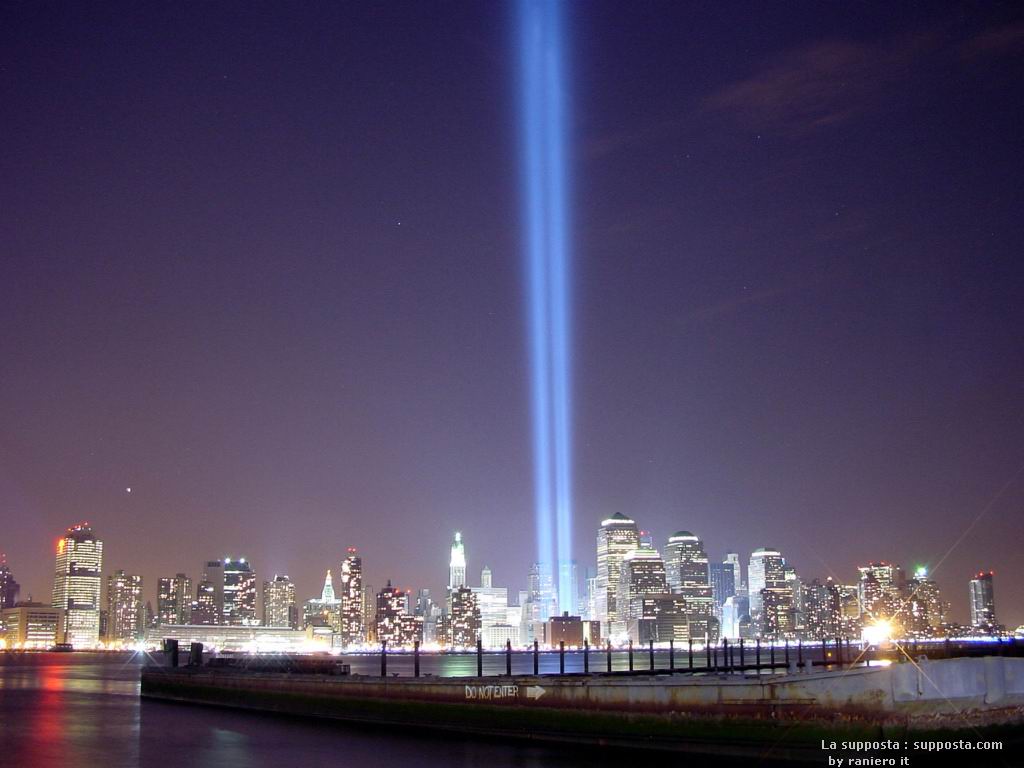
Please. Please. No spoilers.
I beg of you all - who have read the Harry Potter books - to not give anything away. I beg you.
I am now 3/4 of the way through Goblet of Fire. Again: no word of the plot twists in the next 2 books have been leaked to my ears so I don't want to know what is in store, but I just have to give some romantic predictions (I love that suddenly - in this book - you can start to feel the possibility of romance blossoming - the kids are old enough, etc.)
-- Ron and Hermione are CLEARLY in love with each other. I love love that! Didn't see it coming at all. No wonder they are fighting like cats and dogs.
-- Something tells me that Harry and Cho are NOT going to end up together. Not sure why, just doesn't seem like it.
-- I love Hagrid as a courting half-giant, trying to grease his hair down
-- Oh, and the Weasley twins are very quickly becoming my favorite peripheral characters. I love them!!! This small section made me laugh out loud on the bus this morning:
"So ... you lot got dates for the ball yet?""Nope," said Ron.
"Well, you'd better hurry up, mate, or all the good ones will be gone," said Fred.
"Who're you going with, then?" said Ron.
"Angelina," said Fred promptly, without a trace of embarrassment.
"What?" said Ron, taken aback. "You've already asked her?"
"Good point," said Fred. He turned his head and called across the common room, "Oi! Angelina!"
Angelina, who had been chatting with Alicia Spinner near the fire, looked over at him.
"What?" she called back.
"Want to come to the ball with me?"
Angelina gave Fred an appraising sort of look.
"All right, then," she said, and she turned back to Alicia and carried on chatting with a bit of a grin on her face.
"There you go," said Fred to Harry and Ron, "piece of cake."
That just makes me laugh.
-- Oh, and I can't stand Fleur Delacour and her half-veela French-accented haughtiness. I don't like her for laughing at Ron.
-- I haven't figured out Viktor Krum yet, and what's up with him.
Loving every second of these books - this one in particular.
Audition notes
I sit in the hall, waiting for my time slot. Actors are all around me. Some are just chatting. Some are looking over scripts. Some are vocalizing. One guy paces on his cell phone, and I hear him say the words "Superdome" and "so where are you now? You okay?" It is a cornucopia of random sound. You get used to it. You get used to doing what you have to do, relax and focus, in the middle of all of that unfocused noise. I know now that if I am in the middle of rush hour at Grand Central, or a traffic jam going into the Lincoln Tunnel, or a holiday rush at Macy's ... that if I have to clear my mind, "shake off the street" (as one of my acting teachers always used to say), and focus on the task at hand ... I will be able to do so. And it is, indeed, like riding a bike. It doesn't matter how many years has gone by ... the second you get back up on the bike, your body remembers. Oh yes, I know what to do now. That is good training. It has nothing to do with talent. You need to practice to be able to relax like that. To relax at will. It's like a surgeon, maybe ... they have to ignore stress to such a degree that they can perform extremely intricate maneuvers, under extraordinary circumstances. Now this is just acting, but the concentration-task is similar. You must be able to tune out all the white noise, you must be able to tune out (or put to use) your own stress and anxiety - turn it into something constructive and not destructive - and you must be able to rely on your own powers of concentration and be able to say to yourself: "Okay. That conversation over there, that loud loud giggly conversation, and that guy right there, pacing around talking about the Superdome, does not exist right now. All that exists is what I need to do in the next 10 minutes." Concentration and relaxation - the two keys to acting. They're muscles. Without those two things, ya got nothing. Talent is great. You need talent. And talent will take you 75% there. But you need that other 25%. You need need need that other 25%.
I tune out the white noise. Eyes closed. Deep slow breaths. And literally - the entire world dissolves away. The only thing that remains is the piece of paper in front of me, with the words I have to say during my time slot. That's it. That is all that is in my brain.
At one point, I hear, from the audition room, screaming and wailing. Like a banshee during a voodoo ceremony. It's one of the women who is up for my part. Yeah. It's my part. Even though I haven't gotten it yet. So I heard her. And she was literally screaming like a wounded animal, screaming some of the lines on the piece of paper that was sitting on my lap, the lines I am getting ready to say during my time slot. I recognize the lines. They're my lines, being screamed by her from behind a closed door.
Only I am not planning on screaming like a voodoo banshee when it's my turn.
I have worked on the piece. I have worked on it all weekend. And wailing like a voodoo banshee was not on the program.
Suddenly, cold self-doubt floods my entire being, ripping me out of my concentration, ripping me out of my Zen deep breathing. I think: "Have I completely misread this script? Should I scream and wail?"
Funny - how quickly confidence dissipates. With the shriek of a random banshee, all your work flies out the window. Suddenly: voodoo banshee knows best. Voodoo banshee has an "in" you don't have. You MUST have mis-read the script. It's YOU that's the problem. You start to second-guess your choices, you start to think (even though you KNOW it's not true): "Louder is better." You start to wonder if you're on the right track with the script, you start to wonder if it's "your" part after all ...
At the same time that the icy self-doubt takes over ... the brain then counter-acts. (Again - this only can happen with practice.) The brain leapt in immediately, hushing the self-doubt voice. The brain raced over and said, "Okay, okay, ignore voodoo banshee. Ignore her. Just keep doing your work. You have to do what YOU'RE going to do. You can't worry about what everybody else is doing in there."
It requires a sense of ownership.
The script is mine. I must feel that I own it enough that I can walk into that audition room and just GO, with complete confidence. I OWN it. I am not BORROWING it. It is already MINE. Banshee or no banshee.
The audition experience: those hallways, the lines of chairs, the bottled water lying around, the random noise, the rumpled pages of scripts, the muttered lines, and then ... the sounds of screaming and "acting" from the audition room.
As I am going through all of this (relaxing, concentrating, and then getting distracted by banshee, and then having brain talk me out of self-doubt) ... I am watching myself go through it. I can't even explain it. I am in the moment, yet I am above it, too. I am completely alive and awake, but I am also analyzing everything, analyzing my relaxation, going through my body, checklist: "Neck? Check. Ankles? Check", and saying to myself things like: "Okay, you're getting stressed. Stop thinking. Close eyes. Breathe." Giving myself commands.
And yet still, the entire thing is about one thing only:
The 3 pages of the script in my hand. And what was I going to do with those 3 pages.
I have worked on it. I understand it. I have asked my questions. I have provided answers for myself. I made choices. But I also have kept it loose. Not too planned.
Two or three or four threads of experience surge through me at the same time. Lines of the script ... breathing ... tuning out noise ... battling self-doubt due to banshee ... back to my breathing ... oops, here comes self-doubt again ... shoo, shoo!! ... back to the script ... back to the script ... listen to the screaming of the banshee! ... Nope, tune her out, tune her out, back to the script ... breathe ...
The door opens and I hear my name called.
The moment is now. I stand up and walk inside.
Happy birthday ...
... to Elia Kazan.

He's a man whose work has given me more than I can even possibly describe. I have spent my life pretty much studying his movies, ever since I saw East of Eden when I was 12 years old.
His involvement in The Group Theatre in the 1930s helped launch him as a director - even though he was primarily an actor with the Group. Harold Clurman, one of the founders of the Group, said to a young Elia: "You may have a talent for the theatre, but it's certainly not for acting". That ended up being quite true, although Kazan did get some very good roles with the Group (here is a picture of him from that time):

Kazan said later of himself as an actor: "As an actor, I was like a violin that could only play 2 or 3 notes."
But as a director? Fuggedaboutit!
He was so eager, and so ambitious, and so committed to the Group Theatre - that he would do anything for them: he built sets, printed flyers, ran props - no job too small. Apparently, too, he was always the fix-it guy - he could fix anything, he was always prepared to fix anything that was broken - and so this gave him the nickname (that stuck to him for a lifetime) of "Gadget". Or, even shorter: "Gadg". People just called him that. "Gadg." I love that that nickname came from that crucible of experience in the Group Theatre. I knew about the name "Gadget" even when I was a teenager, because I had already started to tear through biographies of anyone who had ever been associated with the Actors Studio (he had helped found it) ... and "Gadg" was a name that came up all the time.
Kazan was always a controversial guy. The most lasting controversy was the "naming names" controversy (I still remember Amy Madigan glaring at him from the audience at the Oscars. Whatever, babe. Good for Meryl Streep, and Steven Spielberg, and the others who got the hell over themselves and stood up for that man. Stood up for his enormous contribution to their community.) But my point here is that Kazan was always a kind of controversial guy. That particular one just became the most notorious. But he always ruffled feathers. He never minced words. He was passionate, outspoken, fiery, and driven. Man, was he driven. He always went his own way. He had a wife he loved. He cheated on her mercilessly, and openly. His own behavior broke his own heart. He didn't know why he did it. But he couldn't be faithful. He wrote about it very openly in his awesome autobiography. He made a lot of enemies from how he treated Molly (a respected person in the theatre in her own right). His tactics as a director are now very well-known. And obviously - whatever it was he did with the actors - could be magic.
I know all the controversies. They all just make him 100% more interesting to me.
And besides all of that personal-life garbage - there are his MOVIES.
Streetcar. East of Eden. On the Waterfront. !!! I love Baby Doll, too - such a funny movie - with a great performance by Eli Wallach.
Here are some quotes from Ebert's review of On the Waterfront - Kazan here is talking about Brando's performance as Terry Malloy:
``If there is a better performance by a man in the history of film in America, I don't know what it is,'' Kazan writes in his book. If you changed ``better'' to ``more influential,'' there would be one other performance you could suggest, and that would be Brando's work in Kazan's ``A Streetcar Named Desire'' (1951). In those early films, Brando cut through decades of screen mannerisms and provided a fresh, alert, quirky acting style that was not realism so much as a kind of heightened riff on reality. He became famous for his choices of physical gestures during crucial scenes (and as late as ``The Godfather,'' he was still finding them--the cat in his lap, the spray gun in the tomato patch).
Another quote:
And look at the famous scene between Terry and his brother, Charley (Rod Steiger), in the back seat of a taxi. This is the ``I coulda been a contender'' scene, and it has been parodied endlessly (most memorably by Robert De Niro in ``Raging Bull''). But it still has its power to make us feel Terry's pain, and even the pain of Charley, who has been forced to pull a gun on his brother. Here is Kazan on Brando:`` ... what was extraordinary about his performance, I feel, is the contrast of the tough-guy front and the extreme delicacy and gentle cast of his behavior. What other actor, when his brother draws a pistol to force him to do something shameful, would put his hand on the gun and push it away with the gentleness of a caress? Who else could read `Oh, Charley!' in a tone of reproach that is so loving and so melancholy and suggests the terrific depth of pain?''

More from Ebert:
The best scenes are the most direct ones. Consider the way Brando refuses to cooperate with investigators who seek him out on the docks, early in the film. And the way he walks around on the rooftop where he keeps his beloved pigeons--lithe and catlike. Steiger is invaluable to the film, and in the famous taxi conversation, he brings a gentleness to match Brando's: The two brothers are in mourning for the lost love between them.
Amazing. If you read the script, that scene in the back of the cab is pretty on-the-nose. But what those two actors brought to it - with Kazan's help - cannot be measured. Actually, let me clarify that: Kazan never ever ever took credit for anything that Brando did. Now THAT is rare. Anything that Brando did that was genius (like pushing the gun away) came from his own talent. Kazan never took credit for it. He knew that all you needed to do when you directed Brando was to get the hell out of the way.
Ebert ends his review with:
``On the Waterfront'' was nominated for 11 Oscars and won eight. Ironically, the other three nominations were all for best supporting actor, where Cobb, Malden and Steiger split the vote. Today the story no longer seems as fresh; both the fight against corruption and the romance fall well within ancient movie conventions. But the acting and the best dialogue passages have an impact that has not dimmed; it is still possible to feel the power of the film and of Brando and Kazan, who changed American movie acting forever.
Yup. That's about the size of it.
Kazan's contributions to the theatre (as opposed to film) are ... too great to name. He directed more plays than movies - his resume is astonishing - and he helped make Tennessee Williams (and Stanley Kowalski) a household name. He was responsible for ground-breaking productions of plays by Arthur Miller, Williams ...
He was the main interpreter of Tennessee Williams. An interesting combination of personalities there. Tenneessee: a sensitive gay man from the south, and Elia, a fiery macho Greek-American, born in Istanbul. An immigrant. A tough scrappy immigrant. But I've said it before here, and I'll say it again: I think that without Elia Kazan's strong sensitive guidance - Williams' plays might have crumbled into fairy dust. Inconsequential. Now the writing was all there - Kazan said that all along - that when he first read the scripts, they were complete. Done. Ready to go. (This is extremely rare, by the way, when you're working on a new play. But Williams' plays arrived on Kazan's doorstep perfect). But Williams' plays have so much to do with artifice, and the fragility of memories ... that if you get a director who tries to deal with the delicacy TOO much, or if you get a director who just suffuses the entire play in a certain mood of nostalgia (sounds like the most recent production of Glass Menagerie with Jessica Lange went that route) ... then the plays don't add up to much. But Kazan always went for the jugular. Kazan brought out the animal passion in Williams' plays - knowing that the other stuff would take care of itself, or could be handled through lighting and music. But the acting needed to be visceral, real, taut ... Williams' plays burst onto the scene like an emissary from another planet. American theatre has never truly recovered. Any playwright who comes after now has to deal with the bar that Williams (and, by association, Kazan) set.
Kazan was the only director who really understood Tennessee Williams.
He took those plays, already perfect, and heightened the reality of them - made the reality dramatic - and turned them into American icons.
Here is an excerpt from Kazan's autobiography about the NY production of Streetcar, which introduced Marlon Brando to the world.
Jessica Tandy was already a celebrated actress. Marlon Brando was practically unknown. Kazan noticed which way the wind was blowing during rehearsals, and it concerned him on many levels. Basically what was happening was that Marlon Brando was acting Jessica Tandy off the stage. EASILY. When the two of them were on stage, you only looked at one of them, and it wasn't Tandy you were loooking at. Without breaking a sweat, Brando stole the show right out from under her. Jessica Tandy fought to keep her ground (which, actually, is perfect for the theme of the show and for the character of Blanche Dubois), but Kazan's main concern was that Blanche would turn into a laughable character. Kazan was worried that the audience, because of Brando's undeniable stage presence, and the electricity of his acting, would completely side with Stanley, and not have any sympathy for Blanche at all.
The balance of the play was off.
Anyway, there's the setup. Here's what Kazan has to say about it. And also Tennessee Williams comes by to drop in his two cents:
But what had been intimated in our final rehearsals in New York was happening. The audiences adored Brando. When he derided Blanche, they responded with approving laughter. Was the play becoming the Marlon Brando Show? I didn't bring up the problem, because I didn't know the solution. I especially didn't want the actors to know that I was concerned. What could I say to Brando? Be less good? Or to Jessie? Get better? ...Louis B. Mayer sought me out to congratulate me and assure me that we'd all make a fortune ... He urged me to make the author do one critically important bit of rewriting to make sure that once that "awful woman" who'd come to break up that "fine young couple's happy home" was packed off to an institution, the audience would believe that the young couple would live happily ever after. It never occurred to him that Tennessee's primary sympathy was with Blanche, nor did I enlighten him ... His misguided reaction added to my concern. I had to ask myself: Was I satisfied to have the performance belong to Marlon Brando? Was that what I'd intended? What did I intend? I looked to the author. He seemed satisfied. Only I -- and perhaps Hume [Cronyn, Tandy's husband] -- knew that something was going wrong ...
What astonished me was that the author wasn't concerned about the audience's favoring Marlon. That puzzled me because Tennessee was my final authority, the person I had to please. I still hadn't brought up the problem, I was waiting for him to do it. I got my answer ... because of something that happened in the Ritz-Carlton Hotel, across the hall from my suite, where Tennessee and Pancho [Tennessee's companion at the time] were staying. One night I heard a fearsome commotion from across the hall, curses in Spanish, threats to kill, the sound of breaking china ... and a crash ... As I rushed out into the corridor, Tennessee burst through his door, looking terrified, and dashed into my room. Pancho followed, but when I blocked my door, he turned to the elevator still cursing, and was gone. Tennessee slept on the twin bed in my room that night. The next morning, Pancho had not returned.
I noticed that Wiilliams wasn't angry at Pancho, not even disapproving -- in fact, when he spoke about the incident, he admired Pancho for his outburst. At breakfast, I brought up my worry about Jessie and Marlon. "She'll get better," Tennessee said, and then we had our only discussion about the direction of his play. "Blanche is not an angel without a flaw," he said, "and Stanley's not evil. I know you're used to clearly stated themes, but this play should not be loaded one way or the other. Don't try to simplify things." Then he added, "I was making fun of Pancho, and he blew up." He laughed. I remembered the letter he'd written me before we started rehearsals, remembered how, in that letter, he'd cautioned me against tipping the moral scales against Stanley, that in the interests of fidelity I must not present Stanley as a "black-dyed villain". "What should I do?" I asked. "Nothing," he said. "Don't take sides or try to present a moral. When you begin to arrange the action to make a thematic point, the fidelity to life will suffer. Go on working as you are. Marlon is a genius, but she's a worker and she will get better. And better."
It puts a lump in my throat - Tennessee's prescience, his "let it go" attitude. "When you begin to arrange the action to make a thematic point, the fidelity to life will suffer."

Kazan took that advice. That's why those plays had such an impact. The impact still reverberates today.
I met Elia Kazan once, he showed up at a production at the Actors Studio that I was involved in. It was an Odets play- Awake and Sing - which Kazan had acted in in its original incarnation, during the early 1930s. And suddenly ... there he was.
There had been a rumor that he would show, but by that point in his life, he was pretty much a shut-in. Very elderly, very frail. It was not expected that he would come. But he did.
His walk was very slow, very halting, there were people hovering around him, helping him.
I looked at his craggy face, so well-known to me, so familiar, and thought ... Jesus. Jesus Christ. There is Elia fucking Kazan.
This man's work means ... more to me than I can even put into words.
It was like laying my eyes upon one of my idols.
No, it wasn't LIKE that. It WAS that. I saw this small old old man walk in, and I saw one of my true idols. One of my true inspirations in life. One of the people who is responsible for me making the choices I have made in my life.
Clifford Odets, the long-dead playwright, had been one of Elia Kazan's best friends. To those of you who might not know: Clifford Odets is one of our great American playwrights - and his involvement with the Group Theatre was what catapulted him into fame. Anyone see the Coen brothers' film Barton Fink? That's based on Odets' self-imposed "exile" in Hollywood, trying to make a living as a screenwriter.
Odets has been dead for many years. And Kazan came out, on that cold winter night in New York City, to see the production of the show he had helped bring to life so many years ago.
Kazan was almost completely deaf by this point. He sat in the front row.
There was a party afterwards, with cheap wine in paper cups, the snow falling outside the window. And everyone stood around, trying to pretend they wanted to talk to each other, when really - all anyone was aware of was Mr. Kazan.
Eventually, I just had to ... I didn't care ... I had to just go over and speak to him. I would never forgive myself if I didn't. I would never get this chance again. I'm not normally a person who goes up to stars and says, "Thank you for your work". There's something in me that just respects their privacy too much. But with Kazan I threw all that out the window. I knew he was deaf, and probably would have no idea what I was saying - but I just needed to thank him. That's all. Just needed to say "thank you" to this man who has done so much for me, so so much ...
So I just sidled over there, he was standing with a guy I had dated for about 2 seconds, and that guy's father. My friend's father was an actor and director - he was probably in his late 70s, early 80s - who had been friends with Kazan all his life. I hovered there on the edge, for a second, waited for the pause, and then held out my hand to Mr. Kazan. He took it. I shook his hand, gently, and said, "Thank you for your work, Mr. Kazan. Thank you. So so nice to meet you, Mr. Kazan" - and he, very old, just shook my hand, and stared at my mouth, stared at the shapes my mouth made, trying to see what I said.
And that was that. I let him be, after that. I let go of his hand, and backed away.
Enough. Let the man go.
I was so wiped out from meeting him, and from his age, and from the searching way he stared at my mouth, trying to figure out what I was saying ... wiped out from basically what he means to me and that there I was, in my life, with an opportunity to MEET him ... but that confused look in his eyes when he took my hand, the confused way he stared at my mouth ... I don't think he got my message ... I was so wiped out from all of this that when I left, I huddled in an empty stoop, out of the falling snow, and bawled like a wittle wittle baby.
One of the all-time greats he was.
Happy birthday, Gadget.
September 6, 2005
Ismael to Ali to Chance
"We're only playing a simple game."
What a great story. I love it. (I especially appreciated this quote: "My friends advised me not to fulfill my dream because I might be interrogated or put in prison.")
Triumvirate
Thanks, peteb, for writing about Bonham's auction on Slugger.
Going up for auction on Oct. 3 - a huge collection of images of writers and artists. Sketches, portraits, photographs ... So many amazing things in there. Baudelaire, Beckett ... tons and tons more.
Here's my favorite though - Ted Hughes, Seamus Heaney, and Charles Causley sitting round the table. You can see they've all signed the bottom of the photo.
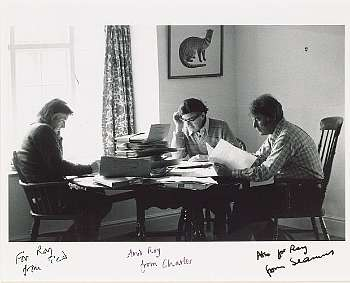
Auction notes read:
HUGHES, TED, (1930-1998, poet, Poet Laureate, O.M.) AND CAUSLEY, CHARLES (1917-2003, poet) AND HEANEY, SEAMUS (b. 1939, poet, Nobel Prize winner for Literature)PORTRAITS BY CAROL ORCHARD HUGHES, photograph, showing the three of them seated round a table in the Hughes' house, reading submissions for the Arvon Poetry Competition in 1982 which are piled on the table, signed by each in the lower margin for the collector ('For Roy from Ted', 'And Roy from Charles', and 'Also for Roy from Seamus'), dated on verso by Carol Hughes 26 July 1980, 8½ x 10½ in (21.6 x 26.7 cm).
Wow.
Bob Denver has gone on "a fateful trip"
Well, Bob Denver, the actor who played Gilligan has died.

Bye, Gilligan. You always kind of annoyed me, because I found your stupidity distressing and actually very stressful to watch. I was 8 years old and I would be screaming at the television, because the solution to your problem at the time was so obvious - yet you acted so stupid! I was more of a Professor fan. (The love of geeks in glasses far pre-dated Cary Grant, I guess.)
But the real reason I am even writing this right now is that:
I GOT A CNN BREAKING NEWS EMAIL ABOUT THIS.
In what universe is the death of Bob Denver "breaking news"? I'm serious. Especially after a week like the one we just had. I've made fun of CNN's breaking emails before. I got one when Rick James died. I got one when Julia Roberts delivered twins. But I have to say: over this past week and a half, CNN's breaking emails have been pertinent, relevant, and greatly appreciated by me. I was grateful for them.
And now this.
I'm sorry he's dead, but ... this is not "breaking news" that warrants an emergency email to millions of people.
For God's sake.
However ... let's not dwell. Instead, let's just sing, in remembrance of the big white-hatted goofball who gave me anxiety attacks on a daily basis as a child:
Just sit right back and you'll hear a tale,
a tale of a fateful trip.
That started from this tropic port,
aboard this tiny ship.
The mate was a mighty sailin' man,
the skipper brave and sure.
Five passengers set sail that day,
for a three hour tour, a three hour tour………
The weather started getting rough,
the tiny ship was tossed.
If not for the courage of the fearless crew,
the Minnow would be lost; the Minnow would be lost.
The ship took ground on the shore of this uncharted desert isle,
with Gilligan, the Skipper too,
the Millionaire, and his Wife,
the Movie Star, the Professor and Mary Ann,
here on Gilligan's Isle.
First day of school
... for Cashel. A brand new school, as he begins his brand new life. He's been such a brave boy, really a tremendous sport ... and I feel this strange sense of relief and happiness to think that he is now where he is ...
and today is his first day of school.
Thinking about him SO MUCH right now!!! Wish I could watch the whole thing on web cam or something.
Go, Cashel!!
September 5, 2005
Today in history
... was the start of the First Continental Congress, in 1774. They convened at Carpenters Hall in Philadelphia. Anyone been there? It's so cool, full of potent powerful ghosts:
It is hard to imagine, or remind ourselves, of the tension of the times, the unknown that these men were strolling into ... Now it all has a tendency to seem like a done deal, but when those men convened in Philadelphia in 1774 - none of it was a done deal. It was a very stressful and dangerous situation, and there was very little agreement among the colonies about what should be done. The Port Bill (closing down Boston to ships) had been passed by the British, in retaliation for the Boston Tea Party - and Boston was suffering greatly. The colonies faced the question, so monumental at the time: "Is Boston's suffering our business?" That question, of course, had large implications - the main one being: Are we, all the separate colonies, united? Are we willing to take a stand for Boston's survival, even though we're from South Carolina or Connecticut? The beginning of a union ...
Martha Washington wrote a letter to a relative on the eve of her husband's departure to the Convention:
I foresee consequences; dark days and darker nights; domestic happiness suspended; social enjoyments abandoned; property of every kind put in jeopardy by war, perhaps; neighbors and friends at variance, and eternal separations on earth possible. But what are all these evils when compared with the fate of which the Port Bill may be only a threat? My mind is made up; my heart is in the cause. George is right; he is always right. God has promised to protect the righteous, and I will trust him.
We have a series of letters from John Adams to his wife, describing this first Congress - they're fabulous, because Adams was not reticent at all with his wife. He had next to no formality with Abigail, he shared everything with her: his gripes, his self-doubt, his vanity, his jokes ... The letters are a rich first-person resource, one of the most amazing archives of letters we have in our national history.
Adams wrote a letter (the last paragraph of which is now rightly famous) to Abigail on his way down to Philadelphia:
We Yesterday visited Nassau Hall Colledge, and were politely treated by the Schollars, Tutors, Professors and President, whom We are, this Day to hear preach. Tomorrow We reach the Theatre of Action. God Almighty grant us Wisdom and Virtue sufficient for the high Trust that is devolved upon Us. The Spirit of the People wherever we have been seems to be very favourable. They universally consider our Cause as their own, and express the firmest Resolution, to abide the Determination of the Congress.I am anxious for our perplexed, distressed Province [Boston] -- hope they will be directed into the right Path. Let me intreat you, my Dear, to make yourself as easy and quiet as possible. Resignation to the Will of Heaven is our only Resource in such Dangerous Times. Prudence and Caution should be our Guides. I have the strongest Hopes, that We shall yet see a clearer Sky, and better Times...
Your Account of the Rain refreshed me. [In his absence, Abigail took complete charge of the farm, the finances, the help, along with raising their growing brood of children. It is speculated as well that without this "help", John Adams might have run their finances into the ground. From his book allowance alone!] I hope our Husbandry is prudently and industriously managed. Frugality must be our Support...
The Education of our Children is never out of my Mind. Train them to Virtue, habituate them to industry, activity and Spirit. Make them consider every Vice, as shameful and unmanly: fire them Ambition to be usefull -- make them disdain to be destitute of any usefull, or ornamental Knowledge or Accomplishment. Fix their Ambition upon great and solid Objects, and their Contempt upon little, frivolous, and useless ones. It is Time, my dear, for you to begin to teach them French. Every Decency, Grace, and Honesty should be inculcated upon them.
And here - finally - in a letter dated September 16, John Adams describes the first meeting of the First Continental Congress. Gives me chills, every time:
When the Congress first met, Mr. Cushing made a Motion, that it shouild be opened with Prayer. It was opposed by Mr. Jay of N. York and Mr. Rutledge of South Carolina, because we were so divided in religious Sentiments, some Episcopalians, some Quakers, some Aanabaptists, some Presbyterians and some Congregationalists, so that We could not join in the same Act of Worship. -- Mr. S. Adams arose and said he was no Bigot, and could hear a Prayer from a Gentleman of Piety and Virtue, who was at the same Time a Friend to his Country. He was a Stranger in Phyladelphia, but had heard that Mr. Duche (Dushay they pronounce it) deserved that Character, and therefore he moved that Mr. Duche, an episcopal Clergyman, might be desired, to read Prayers to the Congress, tomorrow Morning. The Motion was seconded and passed in the Affirmative. Mr. Randolph our President waited on Mr. Duche, and received for Answer that if his Health would permit, he certainly would. Accordingly next Morning he appeared with his Clerk and in his Pontificallibus, and read several Prayers, in the established Form; and then read the Collect for the seventh day of September, which was the Thirty Fifth Psalm. -- You must remember this was the next Morning after we heard the horrible Rumour, of the Cannonade of Boston. -- I never saw a greater Effect upon an Audience. It seemed as if Heaven had ordained that Psalm to be read on that Morning. After this Mr. Duche, unexpected to every Body struck out into an extemporary Prayer, which filled the Bosom of every Man present. I must confess I never heard a better Prayer, or one so well pronounced. Episcopalian as he is, Dr. Cooper himself never prayed with such fervour, such Ardor, such Earnestness and Pathos, and in Language so elegant and sublime -- for America, for the Congress, for the Province of Massachusetts Bay, and especially the Town of Boston. It has had an excellent Effect upon every Body here.I must beg you to read that Psalm.
I put the 35th Psalm in the extended entry, if you'd like to read it.
And finally - a funny excerpt from one of the many descriptive letters John Adams wrote to his wife during the Congress - just makes me chuckle:
This assembly is like no other that ever existed. Every man in it is a great man -- an orator, a critic, a statesman, and therefore every man upon every question must show his oratory, his criticism, his political abilities. The consequence of this is that business is drawn and spun out to immeasurable length. I believe if it was moved and seconded that we should come to a resolution that three and two make five, we should be entertained with logic and rhetoric, law, history, politics, and mathematics concerning the subject for two whole days, and then we should pass the resolution unanimously in the affirmative.
hahahahaha
The 35th Psalm
Oppose, LORD, those who oppose me; war upon those who make war upon me.
Take up the shield and buckler; rise up in my defense.
Brandish lance and battle-ax against my pursuers. Say to my heart, "I am your salvation."
Let those who seek my life be put to shame and disgrace. Let those who plot evil against me be turned back and confounded.
Make them like chaff before the wind, with the angel of the LORD driving them on.
Make their way slippery and dark, with the angel of the LORD pursuing them.
Without cause they set their snare for me; without cause they dug a pit for me.
Let ruin overtake them unawares; let the snare they have set catch them; let them fall into the pit they have dug.
Then I will rejoice in the LORD, exult in God's salvation.
My very bones shall say, "O LORD, who is like you, Who rescue the afflicted from the powerful, the afflicted and needy from the despoiler?"
Malicious witnesses come forward, accuse me of things I do not know.
They repay me evil for good and I am all alone.
Yet I, when they were ill, put on sackcloth, afflicted myself with fasting, sobbed my prayers upon my bosom.
I went about in grief as for my brother, bent in mourning as for my mother.
Yet when I stumbled they gathered with glee, gathered against me like strangers. They slandered me without ceasing;
without respect they mocked me, gnashed their teeth against me.
Lord, how long will you look on? Save me from roaring beasts, my precious life from lions!
Then I will thank you in the great assembly; I will praise you before the mighty throng.
Do not let lying foes smirk at me, my undeserved enemies wink knowingly.
They speak no words of peace, but against the quiet in the land they fashion deceitful speech.
They open wide their mouths against me. They say, "Aha! Good! Our eyes relish the sight!"
You see this, LORD; do not be silent; Lord, do not withdraw from me.
23
Awake, be vigilant in my defense, in my cause, my God and my Lord.
Defend me because you are just, LORD; my God, do not let them gloat over me.
Do not let them say in their hearts, "Aha! Just what we wanted!" Do not let them say, "We have devoured that one!"
Put to shame and confound all who relish my misfortune. Clothe with shame and disgrace those who lord it over me.
But let those who favor my just cause shout for joy and be glad. May they ever say, "Exalted be the LORD who delights in the peace of his loyal servant."
Then my tongue shall recount your justice, declare your praise, all the day long.
Yellow brick road
We all have ways of dealing with what is happening right now. I am devouring Harry Potter and the Goblet of Fire. I had only read the first and second of the Harry Potter books, when they first came out ... so I decided a month or so ago: let me catch up. And now? Cannot put them down. Total page-turning escape. And don't tell me what happens in the next 2 books, because I literally have no idea! I don't have kids in my life on a daily basis, so I am completely in the dark about what happens in the next two. I know big stuff is coming. I frankly find these books disturbingly addictive. Like - I have 20 seconds free while I stand in line, and I have to take the book out to read another sentence or two.
So Alex and I were talking on the phone the other night, of course about Katrina. How we felt, how pissed off we were, what we wanted to do to help ... but also our feeling of helplessness.
Like I said, we all have ways of dealing with this. (I mean - the ones of us who are not in the thick of things, the ones of us who can only watch on television)
Alex just posted two pieces on one of the biggest escapes of all time: The Wizard of Oz.
September 4, 2005
No words
I keep seeing this photo everywhere. I just have no words to describe my response to it.
Tanisha Blevin, 5, holds the hand of Nita LeGarde, 105, as they leave the Convention Center in New Orleans.
Look at Ms. LeGarde's purse. Also look at the little boys in the background, being rolled along by giant men with guns. And Tanisha's protective attitude towards Ms. LeGarde. I wonder if they met in the Convention Center or if they knew each other beforehand. I just ... have no words. Tanisha. You are obviously a good good good little soul.
Update:
The photograph reminded me (so often do we search for comparisons, in order to deal with our experiences) of the Norman Rockwell painting The Problem we all Live With - which has to do with the start of desegregating schools:

The authority figures tower up out of the picture. The child is surrounded by filth - literal and figurative. But she remains pure.
God bless them all.
Tea and cake or death
This very interesting piece in The New Criterion about the Church of England (written by a minister in the church) has almost too many bizarre elements to believe - I found myself laughing out loud at some of it (especially in the beginning) - but of course the entire thing reminded me of Eddie Izzard's brilliant routine about the Church of England, which culminates with him imagining what would have happened if CofE were in charge of the Spanish Inquisition. The choices: "Tea and cake, or death?"
"Thank you for flying Church of England, cake or death?"
"Church of England is really more like a hobby."
"The reading today is from ... a magazine I found! Apparently, pink lipsticks are all the rage right now ... and ... uh ... well ... " [light bulb goes on in his brain] "This reminds me of our Lord Jesus!"
"We need to have some principles, get us some principles!"
"There really isn't any sin in the Church of England. You say, 'Oh, Vicar, I have sinned.' He says:" [in a kind of lush-y voice] " 'Well, so have I.' "
From that essay:
I recently attended a conference for clergy at a beautiful medieval church in Oxford. It was supposed to be a choral Eucharist but there was no organ music—only some plinky-plonky stuff on an out-of-tune piano and mindless choruses in the Jesus Goes to Toytown fashion: interminable glum repetition of what was not worth singing once.Then the Bishop came on and told us that at the laughably misnamed riot called “The Peace” he didn’t want us merely to shake hands but to “hug one another”—and not just to hug one another, but to put our arms on our neighbor’s shoulders and say three times, “You are everlastingly loved.” When, with varying degrees of squeamishness, grown men fawned on one another in this way, the Bishop came on again in full pantomime mode and said, “Not loud enough! Again—louder!” Not one word from the Book of Common Prayer throughout the three-day conference or indeed from any source that might be identified as religious in the traditional sense.
I swear to God, if someone made me put my arms around a stranger's shoulders and shout "You are everlastingly loved" at them, three times, I would walk out. Don't shout at me, Vicar. For God's sake, that is so fucking ridiculous. I don't even know what I'm really reacting to - and why it grosses me out so much ... Maybe because that encounter group stuff turns me off? But it doesn't really ... I mean, not just because it's encounter group-ish. It's just ... First of all, it has a groupthink aspect to it - and a peer pressure aspect to it ("Why aren't you shouting as loudly as that man over there? You must not REALLY mean it, you're not trying hard enough...") that I find abusive and disturbing.
To have a priest scream "louder" at you? Fuck. You. As though your VOLUME is some indicator of the sincerity in your heart. What a total misunderstanding of not only spirituality and religion but of humanity itself. We all know that the loudest people are often the biggest assholes on the face of the fucking planet, and the people who are quiet, and humble, and shut the fuck UP are the ones doing the real good deeds.
It reminds me of acting classes I've been in - doing certain relaxation exercises - where the person who starts bawling first is roundly congratulated and held up as the good example. As though tears on face = good acting. Many charlatan acting teachers make it their GOAL to produce tears on the faces of their students ... they're all about "catharsis" - but in the end, that has nothing to do with acting, and it's just fucking phony. And so someone like myself - who is a good actress but who isn't necessarily a big "cry-er" would be pushed and pushed to get tears on my face. This has nothing to do with acting. This has to do with a stupid teacher who gets some ego boost out of making people cry because it makes her feel like a good teacher. So I'd be lying there on my yoga mat, listening to the weeping and wailing around me, the room filling with sounds of ululations ... thinking: "Uhm ... okay ... if I just CRY then this class will be over much quicker."
So much for sincerity in acting. I can squeeze out a few tears, sure I can. Here are the tears. Where's my prize? It turns acting in the phoniest of enterprises, phony mcphony, man.
So that's what it is. "You are everlastingly loved" strikes me as fucking PHONY and I'm with Holden Caulfield on this one: there is nothing I have more contempt for than people who are fucking phonies.
And I just ... listen to this:
the giggling theological colleges are run like children’s television.
wow. hahahahaha It actually is a very humorously written article, although quite a sad indictment of the church itself.
And so we come back to the real question:
Tea and cake, or death?
Tea and cake or death. Tea and cake or death. Little red cookbook, little red cookbook, Tea and cake ... orrrrrrr deaaaaaaath???
Uhm ... cake, please?
(If you don't know who Eddie Izzard is, then I have a couple things to say. First of all: What the hell is your problem??? Second of all: that entire last section is from his HBO special Dress to Kill.)
Bill Simmons ...
... one of my favorite columnists, on New Orleans.
September 3, 2005
Levity
From Mimi Smartypants, listing the books she's reading:
The Lorax. Oh, shut up you fucking Lorax. I read this book to Nora every single day and she still wants more. She cluck-clucks over the glop in the Humming-Fish pond, she sighs with despair over the smoggy sky, she scolds, "No! You do not do that!" at the sight of axes felling Truffula Trees. Should I just order her Greenpeace sweatshirt now? I'm down with the environment and all, but repeated readings of The Lorax have made me want to go shoot a panda, load it in my Navigator and drive it to a national park, and then set fire to its corpse with gasoline.
I can't stop laughing.
September 2, 2005
Taking care
The baby was a little bit fussy. He squirmed about in his mother's lap, across the aisle of the bus from me, and it seemed that he was nearing the inconsolable stage. He was probably 3 or 4 months old (but then again: I'm pretty bad at guessing baby's ages), and he had tan skin, and big brown eyes. He wore a navy blue onesie, and his white diaper bulged out the sides. His legs were more like yummy drumsticks than human appendages. His mother, a plump Hispanic woman with thick black hair, soothed him or tried to, stroking his fat little face, and murmuring something to him in Spanish. To no avail. He writhed about. At one point, we made eye contact across the aisle, he and I. His eyes, huge and deeply set, struck me with their humanness. He was having a hard time right then, he was dealing with a bodily function of some kind, who knows which one, and he was letting his mother know he needed help. I gave him an encouraging smile. This seemed to strike him still, he got that I was communicating with him, and he went very silent and calm, staring at me. His eyes were serious. Who is this person smiling at me ... does it mean something? Can she help me? When it became apparent that my smile had nothing to do with HELPING HIM, he went back to writhing about, his small tan feet curling and uncurling themselves in mortal baby agony. The mother, still cradling him in her lap, reached down for her bag, which was placed on the floor of the bus, awkwardly out of her reach. She strained, reaching further, digging her hand deeper. The baby's mood was reaching critical mass. He was about to start screaming. I could see the threat of it in his eyes. Then she finally brought out a bottle of what looked like apple juice, and got him into feeding position. Already the bottle was 5 minutes too late, so in the one second it took to get him into position, he began to weep as though he were from a Greek tragedy. Why, mamma, why is it taking ... so ... long ... ... And just before the tragedy could reach its peak, the bottle went in his mouth. Then came the transformation. You could feel it not just in his body language but in his entire essence. He relaxed. He lay back in his mother's lap, and sucked away. Blissfully. He had his drumsticks up in the air, and I could see that he was still flexing his feet, but now it was a languid gesture, the gesture of a happy pasha, of contentment. Ahhhh, yum yum, I've got me some juice, and I love to flex my toes ...
I watched this entire thing from across the bus, sometimes peripherally, and sometimes blatantly - and when he relaxed, suddenly I felt from out of nowhere a huge lump clog up my throat. I thought of the mothers outside the Superdome, clutching their limp hot babies, babies wearing filthy diapers that the mothers have scraped clean so that they can use them again, dehydrated babies, babies who need water, juice, anything ... and the mothers, being mothers, know this ... and yet there is no water, there is no juice. The stench of the air is atrocious, there is a corpse lying 2 feet away, and no amount of soothing or clucking or stroking will turn the baby into a contented pasha, flexing his toes just because he can and because it feels good.
The simple gesture: of a mother reaching down into her bag to get a bottle ... the simple gesture: of a mother being able to take care of her baby's needs when he says to her, in body language: "Mamma, I have a need..." ...
suddenly seemed like a miracle, a freakin' miracle, and it pierced my heart in two.
For laughs (because I know I sure as hell need it)
(and in lieu of Diary Friday, which I can't do today):
Here I am, as the very geeky, and very desperate secretary Miss Krumholtz in How to Succeed in Business Without Really Trying.
All Miss Krumholtz wants is to be married.
Miss Krumholtz has quite an uphill journey in order to reach her goal.
I mean, just look at her.

Today in history
The London Fire. 1666. (I wrote about it here.)
"Oh the miserable and calamitous spectacle! The sky was like the top of a burning oven, and the light seen 40 miles round about for many nights. God grant mine eyes may never behold the like, who now saw 10,000 houses all in one flame; the noise and cracking and thunder of people, the fall of towers, houses, and churches, was like a hideous storm. London was, but is no more!"-- written by a man named John Evelyn in his diary
"the approach of jazz, the smell of olive, ambrosia"
An excerpt from Lives of the Saints
At five o'clock I crossed Canal Street into the Quarter with some of the clerks to have a drink at the Royal Orleans. It was one of those mob scenes that we get in this town at frequent intervals year-round. We rely on the tourist dollar. Jammed in the narrow streets were black Cadillacs and Texans and people with cameras. I wonder in my heart, since the place is so beautiful, what it would actually be like if the Quarter were as still and deserted and lethargic as all the rest of town.We sat in the Royal Orleans at the ground floor bar, viewing the scene through French windows. Then we went to a side street to an oyster bar. The bar had yellow pin-striped wallpaper and a dark mahogany bureau with The New York Times in stacks selling for a fortune each. We walked to another bar, with chairs set out on the sidewalk by large shuttered doors, the white marble Fifth Circuit Court of Appeals across the street, with magnolia trees and the calm bustle of a side street late at night in the balmy air.
I had taken to walking all around the Quarter until its air of debauch wearied me -- I even walked down Bourbon, that height of ruin, Friday evening after work, past the strippers, the ruined architecture, and thought of my memories. It is not the frailty of my memories, but the strength of them, that causes me to recollect. Certain figures passing down the street, of life in a small town, contain a sense of fate, for each has his noble secret and each his handsome drama.
The weather had turned fine. Dark fell. I looked into the glimmering night. Suddenly, a parade came out of nowhere and passed through the unsuspecting street, heralded by African drumbeats in the distance vaguely, then the approach of jazz, the smell of olive, ambrosia, the sense of impending spectacle. Then it passed in its fleeting beauty, this glittering dirge, and, as suddenly as it came, I was left, rather stunned, in its wake.
It is this passing parade which I chronicle.
"the roots of the oak trees in Audobon Park make strange music to me"
Another excerpt from Lives of the Saints
It was Latin American Night in the Quarter, in Jackson Square, starting at eight o'clock. The time is gone when we were "the gateway to the Americas" and ships left our harbor daily for Havana with all the men wearing white suits. But all the men still wear white suits in New Orleans, on certain summer days.
There were bulbs strung up in Jackson Square among the lush green of the banana trees and the elephant ear, with small black children tap dancing to the Latin band. I met Claude at the Hilton Hotel, where he was smoking Tareytons and wearing a dark blue suit -- distinguished, familiar, and dear. His dark hair was slicked straight back austerely. But he looked like a cross between a crackpot and a normal, conservative young man. You couldn't tell which would win out.We went to a party on St. Claude Avenue, as it happened, across the Industrial Canal in Araby, at the corner of Desire. There was another Latin band and magnolia trees. After that, we ended up going to a party in the country through the Louisiana green. We went through the rows of sugarcane and pending hurricanes and all that which is strangely comforting.
I swear, when it comes to the place you are from, even the dirt looks different. For even the roots of the oak trees in Audobon Park make strange music to me, of my childhood in a town which is gentle to the bottom of its bones and which is far from peril.
Everyone was in the garden by the oaks, a collection of laconic young men in khaki suits who had conventional jobs downtown and were perfectly willing to sit in that garden until four in the morning, calmly and devotedly out on a binge. Among the venerable oaks and Spanish moss and the haze of the late afternoon, I was looking out at the tropic night from the slightly unintelligible elegance of the plantation style. I felt a loyalty to it, and to its refuge, its defeat.
We were at St. Louis Plantataion in Placquemines, which is the heart of the remote, unknown South. There you see an unlikely glamour, pink antebellum mansions suddenly alone by the levee in their obscure grace almost as though it were a joke, a sort of sad one, though, as if the madcap Southerners had put one over on the world, to set these mansions at the edge of the world where there is no one near. Now there are huge oil distilleries and grain elevators along the River Road, which make it seem like Mars. But they, too, are hidden here at the edge of the levee and the rows of sugarcane, against an orange sky.
The halls of the plantation were mahogany, with huge four-poster beds and Audobon prints and cots on the attic floor and otherwise no furniture but threadbare elegance. This threadbare elegance meant more to me than any glittering metropolis and busy companies of men.
There was a house party on the glittering lake. We had a boating party on the lake. We went into the bayou to the Boguefalaya with dead tree trunks all black and twisted and cows standing in the water. We had boiled crabs and cantaloupes and tomatoes for dinner. Some people got plastered. Claude dropped his plate on his lap after some girl paid him a compliment. He dropped his entire plate, amid formal dead silence at the table. Then when he went to get another one and was returning across the lawn, while the whole table was watching him approach, he stepped on a can, which made a loud noise, and then tripped over it and nearly fell, while everyone watched his catastrophes.
****
"Louise, watch that boy in the street," said Claude while I was driving the car. "Honey, watch out, this is a one-way street," he said as I weaved my way in and out of the traffic, under the marvelous oaks, ther ein the late night down the Avenue. He kept telling me directions and cautions as though he were some kind of Frail Older Gentleman, the way he sometimes seemed as though he were about eighty, even though he was wild.
In truth, Claude was different and wise and older. He had an air of distraction, striding along beside me, as though he looked far down somewhere in the Quarter where I couldn't see.
***
In Napoleon House, with the crumbling walls, the "Hallelujah Chorus" was playing when we walked in, by the portraits of Napoleon brooding while his soldiers sack the Tuileries. The night was fairly balmy. No one was there. The waiter knew us. It was very pleasant. Until some got too drunk and threw their coats down in the gutter and had no cash and I had to stop the order for more champagne and became alarmed. But some decaying social conservatives in seersucker suits in the back room saved us and took care of the bill.
There was some sort of jazz revolution going on in Armstrong Park, formerly Congo Square, with black men in gold suits with sequins or dapper summer whites. A black man in a white suit came across the lagoon in a pirogue, standing up and playing a mournful trumpet solo in the night, and then he landed over at the Gospel Tent. There were rickety old black men in pink ruffled suits with jazz umbrellas, dancing for the crowd -- and you felt that if at least you were near to people like that, then maybe you were not weak, if you could even be near to such as them.
Summer whites, green gardens, Mississippi, white summer suits and seersucker suits, those were the sights. In the Garden District, Claude stopped and pointed out the jasmine and the cicadas in the night. That was his innocence to me. He had the sweetness of the town itself and broke my heart completely into a million pieces on the floor, as he himself would say, for he touched my heart, to such degree, that I had to steel myself, or my heart would break, like his, into a million places on the floor. For in Claude Collier I saw my very youth, a fateful green garden, parades on the Avenue, an orchestra on a bandstand, my youth in New Orleans.
I knew him so well that I knew him in my bones, and I saw, among other things, that in him. But at the end of the night what I did not see was that Claude sat with a bottle and was unable to lay his head down, went back out dancing until dawn, back to the party on St. Claude and Desire, and got in a minor car wreck on the bridge over the Industrial Canal on the way home, and had to go to Night Court in Araby.
But there he could talk to his friends, no doubt, in Central Lock-Up.
***
Youthful folly is a thing which we had a great deal of in New Orleans. It is a thing which has its season, and its season is youth. I was surprised when I came back from college in the East to see how long it pended with some people I knew. But I still felt there was a season for it and that we were still in it. If it went on too long -- that would separate me from those who did it too long. Nor do I know how you can tell someone to be sensible -- simply, to be sensible.
I left New Orleans when I was young, to go to college in the East. But I came back immediately after, and spent many palmy days there. The Defeat and Humiliation of the South is a true thing. Among the Yankees I have known, I only met one who had the grace to apologize to me about the War. So as peoples throughout history have been chastened and put down, I retreated in Dignity and Pride back to New Orleans.
As an obscure provincial who was once in New York, I can say that my experience in New York was not a pretty one. I went on dates with New York boys who were writers and journalists who were total strangers who were intellectuals. It was mentally exhausting. I thought of my absent beloved, who was wise in the heart, who did not talk like them. But he, who had his own money, and did not appear to have ambition, was sweltering in the dream of his native town.
September 1, 2005
Rooms across America
... for our refugees. Scrolling through this, I felt something absolutely indescribable.
I can't even form a sentence right now.
Reading the messages ...
Have an extra bedroom in my house for temporary shelter for Katrina victim(s). Man in 20s here with a cat and dog.
The generosity in that little (s). It kills me.
Another one:
room and space available for family of three. Close to jobs and hospitals. A place to rebuild your life. we will be able to pick up your family as far away as alabama if response is in the next seven days.( by 9/8/05 )
Even the absurdity of:
Lesbian Housing for Lesbian Refugees - I have a modest house in St. Louis. I can take up to 4 womyn- have fold out couch and futon. The weather is beautiful here this time of year. Call or respond to this post.
just clutches at my throat. "The weather is beautiful here this time of year." God. The kindness of people. The goodness.
I don't know how the refugees, at this point, would even see these listings ... but the gesture, nonetheless ...
Beslan
It's one year today that the horror began.

Marking the anniversary in Beslan.