May 31, 2007
Happy place
These images always make me think of my grandparents house in Newton - and my aunt Regina, who had a big book of Maxfield Parrish's work in her room. I was transported by him. Still love him - and every year when I buy a wall calendar, it's a Maxfield Parrish one. Maybe it's the smidgeon of romantic spirit left in me (Keith would laugh at me for saying that. "You're over-the-top romantic, Sheila. Gimme a break.") - but I find him almost gushingly fantastic. I look at his stuff and I find myself going off into lovely beautiful worlds in my head, ramparts upon ramparts, vaulted clouds in the sky. You know. Romantic! I'm not generally into fantasy (as a genre), or pretty Renaissance Faire princesses running through misty woods wearing big cone-hats. Not my style. But Maxfield Parrish? Bring it on. There's something psychedelic about him. Druggy. (More on Parrish here.)
Happy happy place!



(That last one is my favorite of all - I wrote a wee bit about it here.)
More happy places here!
The Books: "Sugar and Other Stories" - 'The Dried Witch' (A.S. Byatt)
Next up in my Daily Book Excerpt ... Adult fiction shelves:
 This excerpt is from "The Dried Witch", another short story from the collection Sugar and Other Stories - by A.S. Byatt. This is an early version of one of Byatt's fables. It has the sound of myth, or legend ... there's an impersonal tone to the narrator (which is quite different from the more chatty or subjective tones of many of her narrators - like the one in 'Racine and the Tablecloth', among others). The story takes place in a primitive society (primitive meaning: not modern, no dishwashers or cars, so just calm down) - perhaps in Africa - somewhere definitely hot. It's not a Muslim community - the villagers believe in many gods. But it has the same hatred and suspicion of women. You just can't win if you're a woman. Everything is your fault. Infidelity? You brought it on. Sexuality is in women's hands, completely. You're raped? Your fault. The crime? Being a woman. Don't try to win, you won't be able to. Women are beheaded for being alone with a man who is not her relative. That fear hangs over all of the interpersonal relationships in the village. A-Oa is the heroine of our story ... which feels like an analogy for menopause, but I may be reading too much into it. It feels like the devastation of not being OF USE anymore. A-Oa is a woman who has suffered extraordinary losses. She had four sons - all of whom died. Her husband went off to fight in some war - and never returned. The village now suspects that she is a "jinx". She is bad luck. Not only is she bad luck - but she is purposefully malevolent. (She actually isn't - but that's how the village feels about her). She scares them. It's like whatever bad luck hovers around her is catching. There's also a fiery drought on. Everything is drying up. Is this the fault of the "jinx" too? The whole story has a malevolent feeling to it - A-Oa is blameless, yet is she? It's almost like the demands of communal living insist on a literal interpretation of events - not too much room for grey areas. A-Oa has interactions with people full of subtlety, like we all do ... but again: the literalists will take over, they turn everything ugly - those literal-minded people ... and that's what happens here. Meanwhile, A-Oa is also overwhelmingly aware of the dryness of her own body, the lack of saliva - it's a torment.
I would say the story is about 5 or 6 pages too long. It loses its impact just a tiny bit .... the ending is powerful and terrible. Byatt could have gotten there quicker.
Here's an excerpt.
Excerpt from from "The Dried Witch", another short story from the collection Sugar and Other Stories - by A.S. Byatt.
The courtyards were busy and chattering: worshippers moved between greater and lesser temples, brown-robed monk ofs carried baskets of rain and vegetables, families squatted in the dust and argued. In the greater Temple were the huge figures of the Wise Ones, three and awful, taller and wider than the eye could ever see at once, so that it was as much as you could do to focus on a heavy knee, or monstrous, mountainous hand, or far away the three faces, up in the dark of the roofspace, staring quietly out over the heads of the worshipping ants, wonderfully, characteristically blank, bearing a family resemblance in their perfect stillness. The brass lamps were all at the level of the altars, which were themselves below the level of the vast feet, which were dusty but not travel-stained. This gave the illusion that the Wise Ones towered away for ever, out of sight, out of apprehension, out of form. A-Oak bought an incense stick from a monk, lit it, and stood it with the others on one of the smaller altars; she bowed repeatedly, and set out her dishes of beans and fruit before kneeling to pray, her black and silver hair in the dust. It seemed to her that she did not know how to pray or what to ask for. In the past she had asked for sons: or to be forgiven for whatever had caused the sons she had to sicken and fail. To one side of her, standing beside the altar, was a small squat brass boy, a fat and polished child, not dusty like everything else in the huge, smoky and rattling place, but gleaming where countless soft dark hands had touched and caressed him. He wore a small scarlet cloth on a string, just large enough to cover whatever he had between his legs. It was known that his touch brought luck, brought boy-children. On every previous visit A-Oa had touched him. When she was young and humorous she had tickled him like a lover, laughing back quietly at her husband; after the loss of the first child she had touched the warm metal with fearful fingertips. Once she had come with Da-Shin and had touched the boy furtively, laying her fingers over his metal ones, asking friendship, complicity. He had a smile that took up his whole face, curling both mouth and eyebrow corners. She tried to tell the Wise Ones that she was afraid, that she was not herself, that there were changes she couldn't describe. All she was conscious of was the presence of the grinning boy, the sheen of countless handlings, gratified or denied, the dangling red cloth that was never lifted. She thought: when I am dead, this will be over, meaning by "this" the boy and all his works. The Wise Ones vouchsafed no relief, perhaps because she expected so little, was closed to their silent lines of life as her tongue and palate were to water.
May 30, 2007


Writer's rooms
Edna O'Brien's room. I'm lovin' it. The fireplace. Beckett and Joyce - and also the red. There's something very nice about that red. Also, the "harvest of dregs" inscription made me laugh.
The bookcases in Kureishi's writing room make me want to weep from envy.
And there's something I really like in this one too. The slants, the bookshelves - and that CHAIR!
Oh, and since I'm in the "Byatt" section of my bookshelf - for the daily excerpt - here is HER writer's room. That one doesn't appeal to me as much - too modern - that lamp doesn't work for me (as inspiration, I mean) but I am interested to hear her words about why the room works for her.
One size most definitely does not fit all.
More glimpses into "writer's rooms" here.
COMMONPLACE BOOK
Member my old commonplace book? Here are a ton more. Many of them are writers either talking about their writing, or commenting on other writers. I feel I should say this: whether or not I agree with the sentiments of the quotes is irrelevant to me. It's the quote ITSELF I am interested in. [For example: I agree with all of the quotes bad-mouthing James. I hate James. But I am also highly interested in the opinions of those who found him brilliant. It's all good to me. It's all part of learning more about life, and writing, and people.] I feel I have to say this because when I've posted such quotes before, some readers get defensive - like: "Hey! I love Henry James!" or whatever - some tiresome remark like that. The quotes are not endorsements one way or the other. I like the quotes because they are a montage of artistic comments ... it's a jigsaw-puzzle of responses, and reading over them make me feel alive. They make me remember my own intellectual curiosity, my own ambitions ... and they make me love (all over again) people who READ. People who inquire, and love, and hate things strongly. This is why I keep those quotes.
My commonplace book is to remind me never to stop questioning, never to think, "There. Now I'm DONE".
It helps keep me in the conversation.
I hope you enjoy the quotes - I hope they make you think, or make you laugh (some very funny ones!!) God bless Oscar Wilde and his wit!
Commonplace
Will you do a total stranger the kindness of reading his verse?
Thank you!
Thomas Lanier Williams
-- Tennessee Williams, letter to editor Harriet Monroe, March 11, 1933
Commonplace
Dear Madame, you make an absurd, though common mistake in supposing that any human creature can help you to be an authoress, if you cannot become one in virtue of your own powers.
-- Charles Dickens, letter to reader, Dec. 27, 1866
Commonplace
Had I been a passionate man ... we should now have separated, I living in Montevideo as H.M. Minster and she breeding Samoyeds in the Gobi desert.
-- Harold Nicholson, diary entry, Dec. 24, 1933 - on his marriage to Vita Sackville-West
Commonplace
I have a higher and greater standard of principle [than George Washington]. Washington could not lie. I can lie but I won't.
-- Mark Twain, 1871
Commonplace
The works of [Samuel] Richardson ... are pictures of high life as conceived by a bookseller, and romances as they would be spiritualized by a Methodist preacher.
-- Horace Walpole, 1764
Commonplace
Wherever they burn books, they will also, in the end, burn human beings.
-- Heinrich Heine
Commonplace
If I feel physically as if the top of my head were taken off, I know that is poetry.
-- Emily Dickinson
Commonplace
Some American writers who have known each other for years have never met in the daytime or when both were sober.
-- James Thurber
Commonplace
Most of the basic material a writer works with is acquired before the age of 15.
-- Willa Cather
Commonplace
I have no more right to the name of a poet than a maker of mousetraps has to that of an engineer.
-- William Cowper
Commonplace
It resembles nothing that I know of, and reminds me of everything I admire.
-- Jean Cocteau on Marcel Proust's "Swann's Way"
Commonplace
Like Peter Pan, he never grew up, and he lived his own stories with such intensity that he ended by believing them himself.
-- Ford Madox Ford on Jack London, 1916
Commonplace
It is curious how vanity helps keep the successful man and wrecks the failure. In old days half of my strength was my vanity.
-- Oscar Wilde letter to friend following Wilde's release from jail, Nov. 16, 1897
Commonplace
His style has the desperate jauntiness of an orchestra fiddling away for dear life on a sinking ship.
-- Edmund Wilson on Evelyn Waugh
Commonplace
Having been unpopular in high school is not just cause for book publication.
-- Fran Lebowitz
Commonplace
I don't mind what the opposition say of me, so long as they don't tell the truth.
-- Mark Twain, 1880
Commonplace
The years between 50 and 70 are the hardest. You are always being asked to do things and yet are not decrepit enough to turn them down.
-- TS Eliot, 1950
Commonplace
Dear Sir, excuse my enthusiasm or rather madness, for I am really drunk with intellectual vision whenever I take a pencil or engraver into my hand ....
-- William Blake, letter to William Hayley, Oct. 23, 1804
Commonplace
It was good of God to let Carlyle and Mrs. Carlyle marry one another and so make only two people miserable instead of four.
-- Samuel Butler on Thomas Carlyle
Commonplace
Lord Sandwich: "Wilkes, you will die of a pox or the gallows."
John Wilkes: "That depends, my lord, on whether I embrace your lordship's mistress or your lordship's principles."
Commonplace
To write adequately one must know, above all, how bad are one's first drafts.
-- John Kenneth Galbraith
Commonplace
I'm a little shocked by her commonness at first sight; lines so hard and cheap. However, when this diminishes, she is so intelligent and inscrutable that she repays friendship.
-- Virginia Woolf on Katherine Mansfield, journal entry, Oct. 11, 1917
Commonplace
Some drunk dame told [James Thurber] at a party that she would like to have a baby by him. Jim said, "Surely you don't by unartificial insemination!"
-- Nunnally Johnson, letter to Groucho Marx, Oct. 9 1961
Commonplace
Thomas Hardy taught me to like Edgar Allan Poe, and Poe taught me about those 'Mimes in the form of God on high, blind prophets that come and go.'
--John Cowper Powys
Commonplace
I'm writing my third autobiography. The other two were premature.
-- Louis Untermeyer, said on his 90th birthday
Commonplace
It is in order to shine sooner that authors refuse to rewrite. Despicable. Begin again.
-- Albert Camus, Sept. 30, 1937
Commonplace
For my part I keep the Commandments, I love my neighbour as my selfe, and to avoid Coveting my neighbour's wife I desire to be covered by her; which you know is quite another thing.
-- William Congreve, Sept 27, 1700
Commonplace
There's nothing to writing. All you do is sit down at a typewriter and open a vein.
-- Red Smith
Commonplace
An author ought to write for the youth of his own generation, the critics of the next, and the schoolmasters of ever afterwards.
-- F. Scott Fitzgerald
Commonplace
Play to the lines, through the lines, but never between the lines. There simply isn't time for it.
-- George Bernard Shaw to actress Ellen Terry on performing Shakespeare, 1896
Commonplace
[I am working on] a poem of immeasurable length which will occupy me for the next four decades, unless it becomes a bore.
-- Ezra Pound, 1915
Commonplace
I always write my last line, my last paragraphs, my last page first.
-- Katherine Anne Porter
Commonplace
I don't play golf, am not a joiner. I vote Democrat, read as much as my eyes will stand, and work at my trade day in and day out. When I can find nothing better to do, I write.
-- William Carlos Williams
Commonplace
It took me fifteen years to discover that I had no talent for writing, but I couldn't give it up because by that time I was too famous.
-- Robert Benchley
Commonplace
The possessor of a brilliant and almost inimitable prose style, and of scarcely any ideas at all.
-- F. Scott Fitzgerald on Sherwood Anderson
Commonplace
The most complete example of human symbiosis I have ever seen.
-- Edmund Wilson to John Dos Passos on Gertrude Stein and Alice B. Toklas
Commonplace
Well, I hope they understand one another - nobody else would.
-- Wordsworth, 1846 - musing on the marriage of Elizabeth Barrett and Robert Browning
Commonplace
Now, my darling Nora, I want you to read over and over all I have written you. Some of it is ugly, obscene and bestial, some of it is pure and holy and spiritual; all of it is myself.
-- James Joyce, letter to Nora, Sept. 7 1909
Commonplace
In the time of your life, live - so that in that good time there shall be no ugliness or death for yourself or for any life your life touches. Seek goodness everywhere, and where it is found, bring it out of its hiding-place and let it be free and unashamed.
-- William Saroyan, preface to "Time of Your Life"
Commonplace
I am earnest, terribly earnest. Carlyle bending over the history of Frederick the Great was a mere trifle, a volatile butterfly, in comparison.
-- Joseph Conrad to critic Edward Garnelt
Commonplace
I am following in the exquisite footsteps of Miss Edna St. Vincent Millay, unhappily in my own horrible sneakers.
-- Dorothy Parker
Commonplace
The fictional Christophr Robin ... and his real-life namesake were not always on the best of terms ... In pessimistic moments ... it seemed to me, almost, that my father had got to where he was by climbing upon my infant shoulders.
-- Christopher Milne, son of AA Milne
Commonplace
The simple truth is that she was the poet, and I the clever person by comparison.
-- Robert Browning on his wife, Elizabeth Barrett Browning, 1871
Commonplace
The people die so, that now it seems they are fain to carry the dead to be buried by daylight, the nights not sufficing to do it in.
-- Samuel Pepys, diary, Aug. 12 1665 - during the plague
Commonplace
He had the finest ear, perhaps, of any English poet; he was also undoubtedly the stupidest; there was little about melancholia he didn't know; there was little else that he did.
-- Auden on Tennyson
Commonplace
First she starved herself of love, which meant also life; then of poetry ... Consequently, as I think, she starved into austere emaciation a very fine original gift.
-- Virginia Woolf on Christina Rossetti, journal entry, Aug 5 1918
Commonplace
I go to bed feeling terribly Edwardian and back-number, and yet, thank God, delighted that people like Wystan Auden should actually exist.
-- Harold Nicolson after a reading by Auden
Commonplace
[I have been] weeping steadily because once again I had come to the great healing chapter of the brothers Karamazov. It always chokes me up and fills me with a love of mankind which sometimes lasts till noon of the following day.
-- Alexander Woollcott to Mrs. Otis Skinner, Aug. 2 1935
Commonplace
If I could I would work in silence and obscurity, and let my efforts be known by their results.
-- Emily Bronte
Commonplace
He hasn't an enemy in the world, and none of his friends like him.
-- Oscar Wilde on George Bernard Shaw
Commonplace
What a commonplace genius he has; or a genius for the commonplace.
-- DH Lawrence on Thomas Hardy, 1928
Commonplace
I enjoyed talking to her, but thought nothing of her writing. I considered her 'a beautiful little knitter.'
-- Edith Sitwell on Virginia Woolf
Commonplace
You never cut anything out of a book you regret later.
-- F. Scott Fitzgerald to Thomas Wolfe, who was struggling over his revisions of "Of Time and the River"
Commonplace
When I have an idea, I turn down the flame, as if it were a little alcohol stove, as low as it will go. Then it explodes, and that is my idea.
-- Ernest Hemingway
Commonplace
With 60 staring me in the face, I have developed inflammation of the sentence structure and a definite hardening of the paragraphs.
-- James Thurber, 1955
Commonplace
[Henry] James felt buried in America; but he came here to be embalmed.
-- George Bernard Shaw on Henry James becoming a British subject
Commonplace
... this voluble Jack-of-all-Trades ... this carnivorous vegetarian.
-- NY Times critic on George Bernard Shaw, 1898
Commonplace
He is a very great loss. He had a large loving mind and the strongest sympathy with the poorer classes.
-- Queen Victoria, journal entry - 2 days after the death of Charles Dickens, June 11, 1870
Commonplace
The picture of you in the newspaper saying that, amongst other reasons, you have come to London to see me has greatly enhanced my credit line in the neighborhood, and particularly with the greengrocer across the street.
-- TS Eliot, letter to Groucho Marx, June 3, 1964
Commonplace
A most surprising compound of plain grandeur, sentimental affection, and downright nonsense.
-- Robert Louis Stevenson on Walt Whitman
Commonplace
I could readily see in Emerson ... the insinuation that had he lived in those days when the world was made, he might have offered some valuable suggestions.
-- Herman Melville
Commonplace
Her writings are a capital picture of real life, with all the little wheels and machinery laid bare like a patent clock. But she explains and fills out too much.
-- Henry Wadsworth Longfellow on Jane Austen
Commonplace
A delicious little old dandy ... Much of what he said would have been commonplace but for his exquisite delivery.
-- Evelyn Waugh on Max Beerbohm, 1947
Commonplace
... rather ill and rather American ... But by no means to be sniffed at.
-- Lytton Strachey on TS Eliot, May 14, 1919
Commonplace
... a purge, at the end of it one is empty ... like a dry shell on the beach, waiting for the tide to come in again.
-- Daphne du Maurier on writing a book
Commonplace
I heard TS Eliot read his poems the other night ... He is an actor and really put on a better show than Shaw.
-- Edmund Wilson to John Dos Passos, May 11, 1933
Commonplace
For several days after my first book was published I carried it about in my pocket, and took surreptitious peeps at it to make sure the ink had not faded.
-- James M. Barrie, 1888
Commonplace
It really is most unfortunate that she rules out copulation - not the ghost of it visible - so that her presentation of things becomes little more ... than an arabesque --- an exquisite arabesque, of course.
-- Lytton Strachey, 1927, on "To the Lighthouse"
Commonplace
Well, Jim I haven't read any of your books but I'll have to someday because they must be good considering how well they sell.
-- Nora Joyce, letter to Jimmy, 1940
Commonplace
"Yes, that's a good one, and tomorrow I shall be telling it on the Golden Floor."
-- A.E. Houseman, 1936 - he was on his deathbed, and his doctor told him a dirty joke. This was Houseman's response
Commonplace
"I quite agree with you, sir, but what can two do against so many?"
-- George Bernard Shaw, 1894. "Arms and the Man", opening night - unanimous cheers and hullaballoo - Shaw goes up onto the stage to take his bow. As he does so - ONE man boos. And the quote above was Shaw's response to the boo-er.
Commonplace
Every great man nowadays has his disciples, and it is usually Judas who writes the biography.
-- Oscar Wilde
Commonplace
I was an old man when I was 12; and now I am an old man, and it's splendid.
-- Thornton Wilder on his 70th birthday
Commonplace
Whatever our theme in writing, it is old and tried. Whatever our place, it has been visited by the stranger, it will never be new again. It is only the vision that can be new, but that is enough.
-- Eudora Welty
Commonplace
I hereby formally bequeath you to the female vagina, which vortex will inevitably receive you with or without my permission.
-- Tennessee Williams, letter to Kip Kiernan - a man he loved who just left him for a woman, August 22, 1940
Commonplace
His abiding complex and the source of much of his misery was that he was not a 6 foot all, extremely handsome and rich duke.
-- Cecil Beaton on Evelyn Waugh
Commonplace
In his youth Wordsworth sympathized with the French Revolution, went to France, wrote good poetry, and had a natural daughter. At this period, he was called a 'bad' man. Then he became 'good', abandoned his daughter, adopted correct principles, and wrote bad poetry.
-- Bertrand Russell
Commonplace
I don't go upstairs to bed 2 nights out of 7 without taking Washington Irving under my arm.
-- Charles Dickens
Commonplace
Whether children will find anything amusing in it, only time will tell.
-- EB White to his editor Cass Canfield, on the manuscript of "Charlotte's Web"
Commonplace
Sir, he was dull in company, dull in his closet, dull every where. He was dull in a new way, and that made people think him GREAT.
-- Samuel Johnson on Thomas Gray, 1775
Commonplace
For writing in the cause of Virtue, and against the fashionable vices, I am lookt upon at present as the most obnoxious person almost in England.
-- John Gay to Jonathan Swift, 1728 - after "Beggar's Opera" opened
Commonplace
... the exquisite touch, which renders ordinary commonplace things and characters interesting ... is denied to me.
-- Sir Walter Scott on Jane Austen, 1826
Commonplace
If it will satisfy you that I should know you, love you, love you - why then indeed ... You should have my soul to stand on if it could make you stand higher.
-- Elizabeth Barrett to Robert Browning, 1846
Commonplace
The poor little woman of genius! ... I can read a great deal of her life as I fancy in her book, and see that rather than have fame ... she wants some Tomkins or other to ... be in love with.
-- William Makepeace Thackeray after reading Charlotte Bronte's "Villette", 1835
Commonplace
From the beginning [Oscar] Wilde performed his life and continued to do so even after fate had taken the plot out of his hands.
-- WH Auden, 1963
Commonplace
Writing is easy; all you do is sit staring at a blank sheet of paper until the drops of blood form on your forehead.
-- Gene Fowler
Commonplace
As I get older, and things get gloomier and more difficult, it is to poets like Horace and Pope that I find myself more and more turning for the kind of refreshment I require.
-- WH Auden, 1969
Commonplace
I want to look like an American Voltaire or Gibbon, but am slowly settling down to be a third-rate Boswell hunting for a Dr. Johnson.
-- Henry Adams
Commonplace
A past master in making nothing happen very slowly.
-- Clifton Fadiman on Gertrude Stein
Commonplace
A cord breaking.
1000 miles away.
Rose.
Her head cut open. A knife thrust in her brain.
Me. Here. Smoking.
-- Tennessee Williams, journal entry, Marcy 24, 1943
Commonplace
I'd just as soon play tennis with the net down.
-- Robert Frost on writing free verse, 1956
Commonplace
I worshipped Kipling at 13, loathed him at 17, enjoyed him at 20, despised him at 25, and now again rather admire him.
-- George Orwell, 1936
Commonplace
Whoever reads me will be in the thick of the scrimmage, and if he doesn't like it - if he wants a safe seat in the audience - let him read somebody else.
-- DH Lawrence, 1925
Commonplace
Horatio Alger wrote the same novel 135 times and never lost his audience.
-- George Juergens
Commonplace
Wonderful man! I long to get drunk with him.
-- Lord Byron on Sir Walter Scott, journal entry, Jan. 5, 1782
Commonplace
Never, I believe, were such talents and such drudgery united.
-- William Cowper on John Dryden
Commonplace
Customs official: "Anything to declare?"
Oscar Wilde: "Nothing but my genius."
-- perhaps an apocryphal story, from 1882
Commonplace
Forster never gets any further than warming the teapot ... Feel this teapot. Is it not beautifully warm? Yes, but there ain't going to be no tea.
-- Katherine Mansfield, journal entry, May 1917
Commonplace
I have been reading a good number of biographies this year which I am sure you will commend. Probably you remember how I picked up that volume of Ludwig's Napoleon on the boat and liked it so well that the owner had to ask me for it. I tried to get it at the library but it was out. Instead i got a life of the Kaiser Wilhelm by the same author. Since then I hve read several others of celebrated literary personages. I have one at home now about Shelley, whose poetry I am studying at school. His life is very interesting. He seems to have been the wild, passionate and dissolute type of genius: which makes him very entertaining to read about.
-- Tennessee Williams, letter to his grandfather, Nov. 22, 1928
The Books: "Sugar and Other Stories" - 'The Next Room' (A.S. Byatt)
Next up in my Daily Book Excerpt ... Adult fiction shelves:
This excerpt is from "The Next Room", another short story from the collection Sugar and Other Stories - by A.S. Byatt. I was very moved by this story. Joanna is a woman whose mother just died. Her feelings about her mother (named Molly) are complicated. Her mother was an invalid and Joanna gave up many years of her life - the prime career years - to take care of her. Her mother was not grateful. Now that her mother is dead, Joanna is trying to get back into her career - only now she's 59 years old. Her career (before her mother got sick) had been traveling to third world countries and helping with development projects. A young woman's game, most definitely. So Joanna feels almost relieved her mother is gone - and also resentful that here she is, almost old now ... and what will she do? She wants to sell her mother's house immediately - get RID of it ... but in the meantime, she stays there ... and intermittently she hears voices in "the next room". It is not ever clearly identified who they are ... but they argue, they complain ... and they are aware of her. Eventually, when Joanna says through the wall - Please be quiet ... she can hear the voices stop, as though they hear her ... and then just begin to complain louder. She wonders if she is going crazy.
And I know people like Molly - people who are perpetually disappointed by life ... making me wonder: What exactly did you want?
Here's an excerpt:
Excerpt from "The Next Room", another short story from the collection Sugar and Other Stories - by A.S. Byatt.
She became aware of two quite different aspects of her sense of her mother who was not here. The first was an expectation of her imminent arrival, querulous or ready with a piece of witty self-deprecation, to take up her seat in her chair and ask for this and that to be fetched or taken away. This almost comfortable epectation was uncanny only because Molly would never come again; it was usual, and would not be switched off to order, or for reason's sake. The second was not expectation, but reminiscence and later came to constitute itself in Joanna's thought as "the jigsaw". She had had such a jigsaw during the long and tedious years at boarding school - a set of images, strip-cartoon pictures, patches of colour, she seemed to snip out with mental scissors and fit together awkwardly and with overlaps or gaps, labelling this for reference "my mother", an entity which had little or nothing to do with the living, slippered creature who would not again patter between Cliff Thorburn and the toaster, or take up the knitting-needles and count stitches. "My mother" in Joanna's schooldays had, like most people's mothers, worn embarrassing and strident hats. She was frozen forever in Joanna's playroom doorway like an avenging angel crying out against powder paint on the carpet fifty-four years ago. A comforting corner of the jigsaw held a kitchen mother with a wooden spoon, dripping cochineal into birthday icing: she was good at cakes, and enjoyed Joanna's pleasure. Joanna turned the finished jigsaw in her mind like a kaleidosocope; there were things now, that constituted sharp corners and jagged edges, that she had never brought out to look at in those long flickering evenings in case Molly overlooked or overheard her thoughts. Many of these pieces were to do with her vanished father, who had begun to vanish long before he had in fact chosed gently to death, who had begun to vanish at precisely the moment when he had become perpetually present, which his premature retirement, or whatever it had been, had confined him to Molly's territory and its margins, the far reaches of the garden, the bonfire, the compost heap, the battle with ground elder from next door. Molly had been a great requirer: she had expected much from life, and had not had it, and had made her disappointment vociferous. Joanna was not, and now never would be, quite sure what she had wanted - it was not particularly to do anything, but to be something, the wife of an influential and successful man. (Joanna's own life, a career devoted to useful work for underdeveloped socieites, had been conceived in direct opposition to this want.) Joanna sometimes suspected that her mother had married her father simply because he represented the nearest thing she knew to this vicarious influence and success. He had been clever, shy, and formal, a step up the social scale for the daughter of a sub-postmistress. He might have become an Under-Secretary or even better. He never talked about his work, and then, suddenly, there was trouble - "the silly mess your father got into" - Joanna would never know what - and it was at an end.
He had become ill, almost immediately, within a year at most. A wasting disease had attacked him. Joanna had heard him say once, in the conservatory, "I wasted time, and now doth time waste me," but he had been saying it into the trumpets of his lilies, not to her. He said nothing to Molly, who said a great deal to him, and Joanna had always bitterly felt that he saw Joanna herself as an extension of his wife. He had had fine, cobwebby grey hair, that when he worked he sleeked, briefly, with water. As he wasted away he became all grey; his face grew thinner, and ashen, and developed long fine downwards pleats and incisions, and then a crazy criss-cross of cracks as he diminished steadily. His eyes had always been a pale, smoky grey. He wandered among the smoke of his bonfires in a grey V-necked pullover, carrying increasingly small forkfuls of twigs and dried weeds, ghost-grey. Joanna had been very startled that the ashes which she sifted onto the roots of Madame Alfred Carriere, at the last, had been creamy white.
The stages of his slow decline were marked on the whole by jigsaw pieces depicting, not him, but Molly's dealings with him. Molly declaring, after the fateful interview with the specialist, "There's nothing really wrong with him: he just needs to pull himself together, you'll see." Molly's distaste for his bodily presence and all his activities. He had tried, in the early days, to have a glass of beer in the early evenings. Molly had taken exception to this. The smell, she said, disgusted her. Beer was a sickening smell. (The fact that Joanna also disliked its smell had rendered her icily neutral in this dispute.) Molly had pounced on his beer glass the moment it was emptied, when the air still lingered in the fringe of froth at its brim, and had washed and washed it, her mouth set. Later, she had commented to Joanna on every small eructation. Your father's tummy grumbles all the time. He makes awful belching noises. It's the beer. It's disgusting. Towards the end, when the discreet belches were an inevitable function of his failing body, she had not even waited for his absence to comment. He appeared not to hear. He gave up the beer.
May 29, 2007
I forgot to mention:
I am now a member of the paparazzi. Obviously.
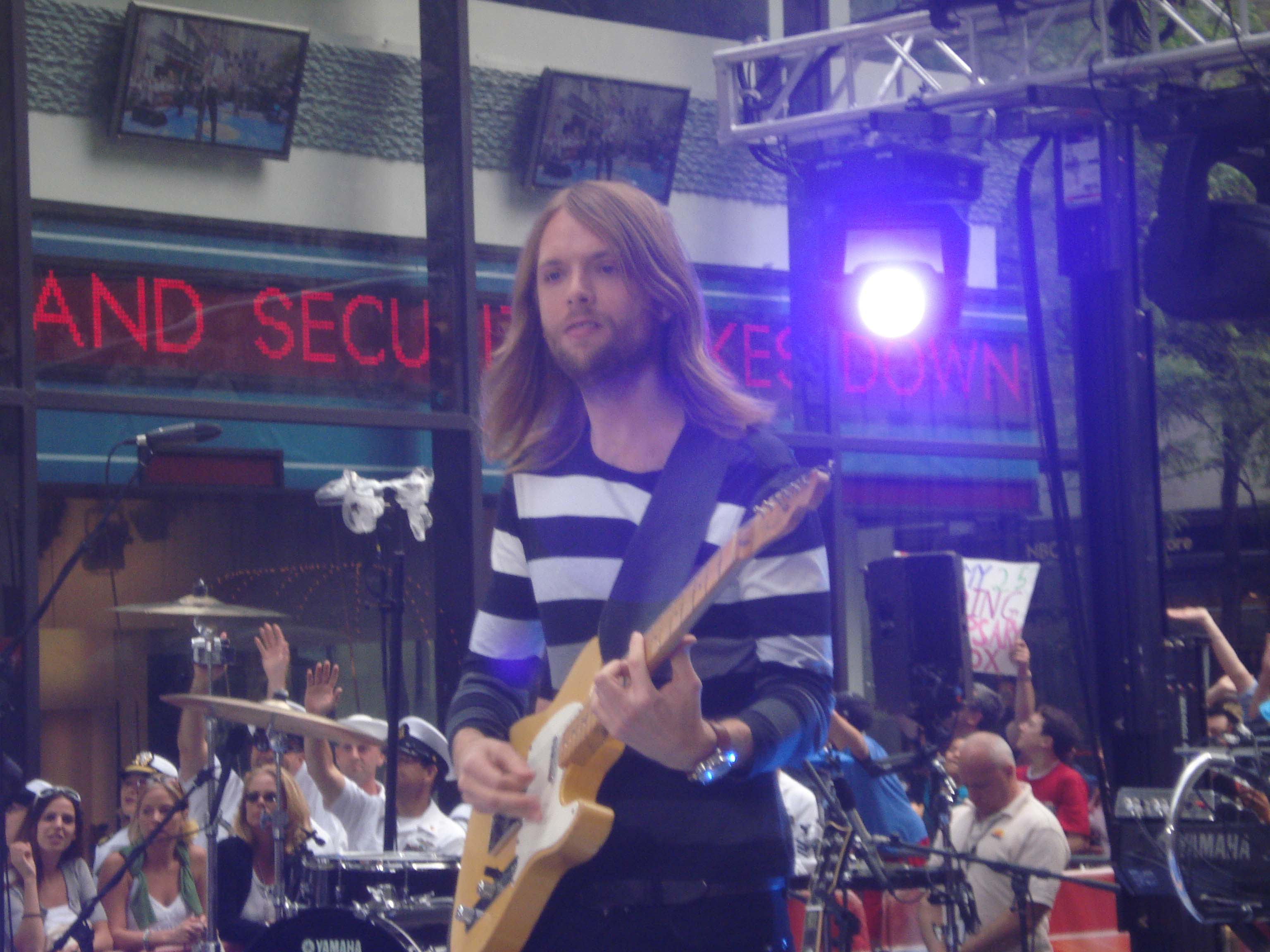
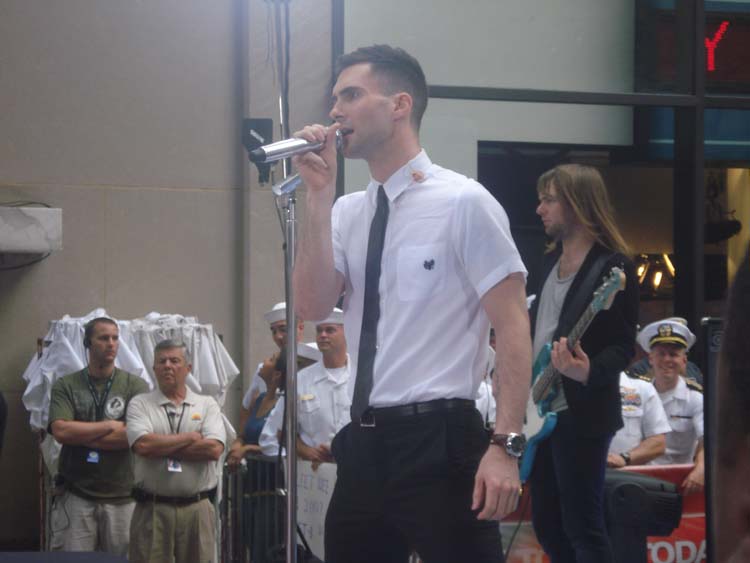
(The stories of the grizzled cynical hysterical press photographers around me - and what they say - and who they are ... will be saved for a later date. But I love it. These guys are hard, man ... and funny. Shouting up at Adam Levine, "GROUP HUG, GROUP HUG", etc.)
Jeff Buckley ... in memory
This is for my sister Jean, who called me at 7:30 am today to tell me that today is the 10 year anniversary of Jeff Buckley's death.

On a rainy night in Chicago many years ago, my friend Ted (now the BLOGGER Ted! ha!!) and I went to go see some singer I had never heard of at The Green Mill. His name was Jeff Buckley. He had a couple of tiny albums out - recordings of live shows he had done at Cafe Sin-� in New York - but he was about to have a large album released - the album that would be called Grace ... and so he was on the cusp of stardom. Ted had heard something about Buckley on NPR, I think - so we got tickets and met up to go see him.
It is, to date, the most amazing live show I have ever seen.
Jeff Buckley's voice is rightly famous - it has a kind of eerie Brideshead revisited choirboy-with-an-evil-streak sound - his "Corpus Christi Carol" on Grace has to be heard to be believed. What? That's a grown man?
But what I want to talk about is the VIBE of the show Ted and I saw. We still talk about it today. We still reference it.
A lot of people were pissed off at Jeff Buckley that night. But Ted and I were enraptured. Buckley was there, at the bar, mingling, hanging out. In looking back on it - I think he knew that stardom was about to hit. The tourbus parked outside was indicative of what was about to happen. But he seemed so ... small, almost - dwarfed by the bus, by the circumstances appraoching. He was freaked out. Freaked OUT. He had just given an interview to Rolling Stone and had apparently said wildly inappropriate things to the reporter. Success was coming, man ... and don't we all want success? Well, sure ... but what success actually means, in the reality of the day to day life, is not always welcome ... it's intimidating, it's scary, and artists oftentimes are people who have trouble with reality. That's why they're artists. Stardom comes with responsiblity, with lots of have-tos, with obligations, with loss of anonymity (Goldie Hawn talks about how she used to go to a little grubby bar in Malibu - before she was famous - have a glass of wine by herself, sit staring out at the waves, and write in her journal, working out any problems she might have at that moment ... it was one of her meditative healing things to do. To her, stardom was always a great great blessing ... but that doesn't mean she doesn't mourn that anonymous self ... the person who could go have a glass of wine alone, write in her diary, and not have someone take a picture of it, sell it to a tabloid and have it appear on the newsstand the next day: GOLDIE HAWN DRINKS ALONE - or whatever. Hawn is not an ungrateful person - but she does grieve that loss of solitude.) - Harrison Ford talks about this quite eloquently, and with no self-pity. "It took me years to be able to cope with the loss of privacy." It's a sacrifice. Not for some - some glory in the reality-TV aspect of stardom ... but for others it is a soul-crushing experience that separates them from their fellow man. Jeff Buckley was in that latter category.
So there he was, doing shots at the bar - talking with people, but ... you could sense things shifting. He wasn't "normal" anymore ... he couldn't blend in ... he was not anonymous. He had been playing shows at Cafe Sin-� ... a teeny joint in New York ... where the musicians who are gonna play sit out in the audience, guitars propped up against the wall ... and just walk up to the "stage" when it's their turn ... The blending of audience and performer is complete.
This world was already receding for Jeff Buckley on the rainy night at the Green Mill.
And like I said - success of course is desirable. Exciting. But it's more complex than that (for some).
I'm talking about this like I sat down and had a conversation with Jeff Buckley about his thoguhts and feelings. I did not. This is what I gleaned from his behavior that night - his brilliance of performing - his obviously self-destructive tendencies - but also his beautiful human need to connect. It was all going on at the same time. And ALL of it went into his performance. ALL of it. I have never seen anything like it. NOTHING was excluded. He didn't judge any of his own emotions - fear, anger, sadness, excitement - as inappropriate for his show. It was like watching a master-diva at work - a Judy Garland or someone like that. No matter what came up in Judy Garland - she used it. EVERYTHING was to be used. Other, more careful, artists ... craft performances in a more intellectual way. And many of these artists are brilliant, too, in their own way. But to see a raw nerve - at work - and to see him struggle - OPENLY - with all of this ... in front of us ...
Like I said, a lot of people ended up being pissed off at him because they wanted a conventional show. They didn't want him to talk in between sets about how freaked out he was, they didn't want him to suddenly stop a song he was singing, announce, "God, that sucks - let's start it over again ..." and then start the song over again ... They wanted a straight show. But Jeff Buckley couldn't have given a straight show if you paid him a million dollars. He was honest. He was true.
There were a couple of moments where I got goosebumps - because I was watching a man truly grappling with himself. In front of us.
And - I must mention this: he sang the HELL out of all of his songs. That voice.
As an actor - watching him up there - and watching how private he was, even in public (that's the definition of good performance art as far as I'm concerned - the ability to be private while people are watching you ...) was something I have never encountered before or since. He had no polish. NONE. The record company who had obviously funded this tour - and funded the tour bus - was probably trying to iron Jeff Buckley into some kind of appropriate behavior - Buckley seemed to feel the enormous institution behind him ... and there were obligations there, and responsiblities - he was no longer a free insane agent ... He had to show up, he had to get back on his mega-bus, he had to do the songs the record company wanted him to do ...
The show was chaotic. He got heckled at times. "SHUT UP - JUST SING THE SONG!" shouted from the back. Buckley didn't fight back - he didn't engage the heckler - not in a "hey, fuck you, man, I'm up here doing my thing" way ... He apologized - profusely - kept saying things like, "I suck ... Im so sorry ... I just suck ..."
But then - he'd sing "Lilac Wine" and you'd find yourself standing there, stunned at what you were witnessing and hearing.
Buckley was grappling with some demons there. He was drunk. He announced to us, at one point:
"You guys, I'm so sorry, but I am drunk. D - U - R - N - K. DRUNK!"
He started to sing Leonard Cohen's "Halleluia". But ... but ... he just wasn't being true ... it didn't feel true to him ... or something ... so he stopped the song. "Stop stop stop stop ..." It was like he was almost in pain - so far away was he from his own ideals. I am thinking of Odets in Hollywood, writing trash. Spiritual death. So what Ted and I saw (and we went out and talked about it all night afterwards, in a diner down the street - as the rain splashed against the windows) - was a man trying to imagine himself, work himself, closer to his own ideal in his head. And if that meant starting a song over - even though there was a whole crowd there - so be it. What we were seeing was not a finished product. He would not BE a 'product'. He was in process.
Buckley said at one point, "I want to give everybody their money back ... i am so sorry about the show tonight ... I suck so bad ..."
This could not have been farther from the truth. It was self-indulgent, yes - but any artists process MUST be self-indulgent. How else will you know what works, what failure feels like? You have to GO there. It was unconventional - that he would GO there during a show, and not during a rehearsal or whatever ... but to expect Jeff Buckley to be conventional in any way, shape, or form, is ludicrous. I watched him up there, alone by the mike - with that stunning James Dean-esque face - the innocence of it, but also the wildness - and how he would throw himself up towards those high notes, launching his voice up fearlessly into the octaves above - eyes closed, body slack and open - letting it happen, letting it come ... and I remember wondering: God, what is going to happen to this boy. This special wild boy. This is not just retrospect talking. The whole night was like that. Buckley told us about the interview with Rolling Stone, he seemed to be having a nervous breakdown almost - about the impending fame ... It was like we were getting to see him in a small club for the last time. He was going. He was going somewhere else now. Buckley felt the loss of that.
He handled the heckling with grace - but he also didn't change his approach. He didn't "get it together". One song he started to sing - and for whatever reason - he felt like he needed to sit down - so he crossed his legs, and sat down - with his back to the audience, and sang the whole song in that position. Beautifully, by the way.
It was his way, it seemed, of getting back into his private world.
His band was amazing. They just went wherever he went. If he stopped a song - they stopped, started over, whatever.
The best thing of it was this: They started to play one of his songs - I think it was "So Real". Like I said, I didn't know Buckley's music at that point. But I loved the song immediately - and his voice just pierced right through me. That voice. Holy God. Ted and I stood there, lost in it (many of us were lost in it - the hecklers in the crowd were few and far between, although they were loud) - and maybe after a verse and a chorus, Buckley said, in a "oh, fuckitalltohell" tone, "God, stop stop stop ... " He wasn't an indignant arrogant maestro. He seemed like a little boy, hurt, because his mom interrupted his make-believe game of knights and dragons with the prosaic request that he set the table. He was BUMMED that ... he wasn't being transported. He had a requirement of his own art. So anyway - he stopped the song. Which had sounded FINE to me. He was in pain. "God, that sucked ... we SUCK ... " (heckling) "I know, I know, you guys ... I'm so sorry ... Let's start it again ..."
They started the song again. And the hairs on the back of my neck rose up. It was as though Jeff Buckley had realized that going into the song he was a bit cloudy, in terms of motivation, or ... sound ... and he needed to clear the deck. He needed to FOCUS ... so that he could "go there" in the song. And that's what happened after the interruption. The band almost blew the roof of that tiny club. Jeff Buckley stood up there - a shaman, a madman, a choirboy with a direct line to heaven and hell - wailing to the skies, catapulting his voice up, down - his gestures free, fearless, uninhibited - and yet totally specific and germane to the song. When he "got it together" - by taking that pause - when he cleared the deck of everything extraneous and unnecessary to his performance - the genius that came, the power of that voice, gives me goosebumps to this day.
I was so sad when he died. So so sad. I imagined him ... swimming in the current, drunk, stars wheeling by overhead ... I can't say I was surprised - because there had been a wildness in him, and a potential for unhinged grief - you could sense it.
But I miss him. I miss the albums he didn't make.
To me, Jeff Buckley was always that wild pale-faced boy, doing shots at the bar, on a rainy night in Chicago, many years ago. A tour bus looming outside. Change coming, change coming so fast ... and yet ... in the moment, there was just him ... on stage ... trying to transport himself into the world that he imagined.

The Books: "Sugar and Other Stories" - 'The July Ghost' (A.S. Byatt)
Next up in my Daily Book Excerpt ... Adult fiction shelves:
This excerpt is from "The July Ghosts", another short story from the collection Sugar and Other Stories - by A.S. Byatt. A creepy story. Byatt is so good psychologically. A young man, whose girlfriend up and left him for another man, is kind of reeling from the shock of it - he needs to find another place to live, so he rents a room in a woman's house. There's a husband in the picture - but things are prickly between them - the young man is a witness to the weirdness in the relationship, and the weirdness of the woman herself. He minds his own business, he has a lot of work to do, he's a writer, and he sits out in the back garden, writing and reading. Kids play in the next yard - so often one of them will come over to retrieve a ball that flew over the fence, or whatever. One day, he sees a little boy sitting up in the tree, staring down at him. He says to him, "You be careful up there ... don't fall ..." The boy doesn't respond. There's something about the boy that really strikes him. His smile, first of all. The boy continues to appear, intermittently, out in the garden, lying in the grass in the corner, smiling over at him. One day, the young man sees the little boy exiting the house, coming out of the kitchen door - as though he lived there. He decides to mention the little boy to the woman.
What I meant earlier by saying that Byatt is so good psychologically is that in just a few sentences she has set up our expectations of how this woman will behave. So that when she starts to behave in unexpected ways - it is breathtaking, and very moving. She seems practical, unemotional, repressed, humorless - not unkind ... but certainly not a woman of any deep feeling.
Here's an excerpt.
Excerpt from "The July Ghosts", another short story from the collection Sugar and Other Stories - by A.S. Byatt.
He felt reluctant to inform on the boy, who seemed so harmless and considerate: but when he met him walking out of the kitchen door, spoke to him, and got no answer but the gentle smile before the boy ran off towards the wall, he wondered if he should speak to his landlady. So he asked her, did she mind the children coming in the garden. She said no, children must look for balls, that was part of being children. He persisted - they sat there, too, and he had met one coming out of the house. He hadn't seemed to be doing any harm, the boy, but you couldn't tell. He thought she should know.
He was probably a friend of her son's, she said. She looked at him kindly and explained. Her son had run off the Common with some other children, two years ago, in the summer, in July, and had been killed on the road. More or less instantly, she had added drily, as though calculating that just enough information would preclude the need for further questions. He said he was sorry, very sorry, feeling to blame, which was ridiculous, and a little injured, because he had not known about her son, and might inadvertently have made a fool of himself with some casual refernence whose ignorance would be embarrassing.
What was the boy like, she said. The one in the house? "I don't -- talk to his friends. I find it painful. It could be Timmy, or Martin. They might have lost something, or want ..."
He described the boy. Blond, almost ten at a guess, he was not very good at children's ages, very blue eyes, slightly built, with a rainbow-striped tee shirt and blue jeans, mostly though not always - oh, and those football practice shoes, black and green. And the other tee shirt, with the ships and wavy lines. And an extraordinarily nice smile. A really warm smile. A nice-looking boy.
He was used to her being silent. But this silence went on and on and on. She was just staring into the garden. After a time, she said, in her precise conversational tone,
"The only thing I want, the only thing I want at all in this world, is to see that boy."
She stared at the garden and he stared with her, until the grass began to dance with empty light, and the edges of the shrubbery wavered. For a brief moment he shared the strain of not seeing the boy. Then she gave a little sigh, sat down, neatly as always, and passed out at his feet.
After this she became, for her, voluble. He didn't move her after she fainted, but sat patiently by her, until she stirred and sat up; then he fetched her some water, and would have gone away, but she talked.
"I'm too rational to see ghosts, I'm not someone who would see anything there was to see, I don't believe in an after-life, I don't see how anyone can, I always found a kind of satisfaction for myself in the idea that one just came to an end, to a sliced-off stop. But that was myself; I didn't think he - not he - I thought ghosts were - what people wanted to see, or were afraid to see ... and after he died, the best hope I had, it sounds silly, was that I would go mad enough so that instead of waiting every day for him to come home from school and rattle the letter-box I might actually have the illusion of seeing or hearing him come in. Because I can't stop my body and mind waiting, every day, every day, I can't let go. And his bedroom, sometimes at night I go in, I think I might just for a moment forget he wasn't in there sleeping, I think I would pay almost anything - anything at all - for a moment of seeing him like I used to. In his pyjamas, with his - his - his hair ... ruffled, and, his ... you said, his ... that smile.
"When it happened, they got Noel, and Noel came in and shouted my name, like he did the other day, that's why I screamed, because it - seemed to same - and then they said, he is dead, and I thought coolly, is dead, that will go on and on and on till the end of time, it's a continuous present tense, one thinks the most ridiculous things, there I was thinking about grammar, the verb to be, when it ends to be dead ... And then I came out into the garden, and I half saw, in my mind's eye, a kind of ghost of his face, just the eyes and hair, coming towards me - like every day waiting for him to come home, the way you think of your son, with such pleasure, when he's -- not there -- and I -- I thought -- no, I won't see him, because he is dead, and I won't dream about him because he is dead, I'll be rational and practical and continue to live because one must, and there was Noel ...
"I got it wrong, you see, I was so sensible, and then I was so shockecd because I couldn't get to want anything - I couldn't talk to Noel -- I -- I -- made Noel take away, destroy, all the photos, I -- didn't dream, you can will not to dream, I didn't ... visit a grave, flowers, there isn't any point. I was so sensible. Only my body wouldn't stop waiting and all it wants is to -- to see that boy. That boy you -- saw."
He did not say that he might have seen another boy, maybe even a boy who had been given the tee shirts and jeans afterwards. He did not say, though the idea crossed his mind, that maybe what he had seen was some kind of impression from her terrible desire to see a boy where nothing was. The boy had had nothing terrible, no aura of pain about him: he had been, his memory insisted, such a pleasant, courteous, self-contained boy, with his own purposes. And in fact the woman herself almost immediately raised the possibility that what he had seen was what she desired to see, a kind of mix-up of radio waves, like when you overheard police messages on the radio, or got BBC I on a switch that said ITV. She was thinking fast, and went on almost immediately to say that perhaps his sense of loss, his loss of Anne, which was what had led her to feel she could bear his presence in her house, was what had brought them - dare she say - near enough, for their wavelengths to mingle, perhaps, had made him susceptible ... You mean, he had said, we are a kind of emotional vacuum between us, that must be filled. Something like that, she had said, and had added, "But I don't believe in ghosts."
Anne, he thought, could not be a ghost, because she was elsewhere, with someone else, doing for someone else those little things she had done so gaily for him, tasty little suppers, bits of research, a sudden vase of unusual flowers, new bold shirt, unlike his own cautious taste, but suiting him, suiting him. In a sense, Anne was worse lost because voluntarily absent, an absence that could not be loved because love was at an end, for Anne.
"I don't suppose you will, now," the woman was saying. "I think talking would probably stop any - mixing of messages, if that's what it is, don't you? But - if - if he comes again" -- and here for the first time her eyes were full of tears -- "if -- you must promise, you will tell me, you must promise."
May 27, 2007
MEMORIAL WAY
This is something I wanted to post last year - but it took some planning ahead and it also took, er, a camera. All along Boulevard East (a winding road on the cliffs opposite Manhattan) is a memorial park - it goes from Weehawken to West New York. It is so beautiful. I wanted to move along from south to north and take pictures of every memorial I came across. They aren't just for wars, as you will see below ... but I've included them all. This is what I did last night (before I went home and tried on my blue sparkley false eyelashes). The south end of Boulevard East marks the estimated spot above where they estimate the dueling grounds were where my dead boyfriend lost his life. When I run along Boulevard East, I pass this spot. There's a bust of Hamilton there ... so that's where I start. And I just moved north - snapping shots of each thing I saw.
Some of these get kind of artsy. I was experimenting. Also, it was dusk - perfect lighting - until I reached the end ... when lighting my "subjects" became quite challenging. I did my best.
I had an interaction with a little boy by a huge bell - a memorial for the Weehawken Fire Department, erected in 1907. I heard a little mouse-voice announce behind me, "That's the Liberty Bell!" I turned and saw him. A pipsqueak of about 7 years old, with brown skin, thick black hair, and a little scooter he was pushing along. He was with his mom. He kept talking, "Actually, I don't think that's the Liberty Bell." I loved how he was taking himself thru his thought process. I also loved his deductive reasoning. Age 7. He said confidently, "The Liberty Bell is in Washington D.C." Oh it is, bub? Really? He kept babbling, his mother being busy with her smaller baby, "I really don't think that's the Liberty Bell." I felt he was waiting for some confirmation so I stepped in. Little did he know who he was dealing with. You wanna talk about the Liberty Bell? The chick in the white skirt and the hi-top sneakers is JUST the girl you want. I said, "No, that's not the Liberty Bell." He said, 'What is it?" I said, "It was put up for the firemen in Weehawken way at the beginning of the LAST century." (This child was obviously born in THIS century. He's a 21st century kid.) He said, "Why?" "Oh, you know. To thank them for their help in the town and stuff like that." "I knew it wasn't the Liberty Bell." "You are totally right. The Liberty Bell is in Philadelphia." He was thrown off by this, but silently. He adjusted his brain's information. Okay. It's not in DC. It's in Philly. Got it. He reminded me of Cashel. He then asked, "Why are there all these things up?" Meaning - the red white and blue bunting everywhere. I said, "It's for Memorial Day on Monday. You probably don't have school, right? It's a holiday." "Oh." Then they were off ... meandering away thru the dusk ... little black-haired boy babbling on and on to his mother. It was a perfect and very human little exchange.
So - in honor of Memorial Day - of all the American veterans, past and present, of all of those who have lost their lives in service for this country, and in honor of all of those in harm's way in the present-day ... here's my wee tribute. And my deepest gratitude.
First: the view from Boulevard East. Dusk.
Midtown.

Downtown. DAMmit.

ALEXANDER HAMILTON MEMORIAL


ALEXANDER HAMILTON MEMORIAL PARK
People were out in droves. Escaping the heat.


THE "LIBERTY BELL" OF THE WEEHAWKEN FIRE DEPARTMENT


MEMORIAL TO THE KOREAN AND VIETNAM WAR

WORLD WAR I MEMORIAL


WORLD WAR II MEMORIAL


SKYLINE BREAK


Repetitive, perhaps, but I never EVER get tired of the view.
JOSE MARTI MEMORIAL
I would have had no idea who Jose Marti was if Val from Babalu Blog hadn't asked me to participate in his BlogCuba celebration years ago. He asked bloggers to write something about Cuba. I know nothing about Cuba, except the political stuff that everybody knows. I like Cuban food. I felt like I would be an asshole if I wrote about a Cuban restaurant I liked, so I emailed Val - "I don't know what to write about!" He basically set me free, saying - whatever you want! A movie you like, an author you like, whatever! I decided to write about Cuban poetry. I know nothing about Cuban poetry. But I educated myself. And, naturally, I discovered Jose Marti immediately. What a gift! Here's the piece I wrote for Val - I don't just focus on Marti - there are other poets - but Marti is basically the father of Cuban poetry. So I felt like an insider when I came across this memorial. I live in a heavily Cuban area ... as will become obvious. I thought of Val, as I stood there in the darkness, looking at Marti's face, with the Manhattan skyline in the background.


MEMORIAL TO CUBAN PATRIOTS


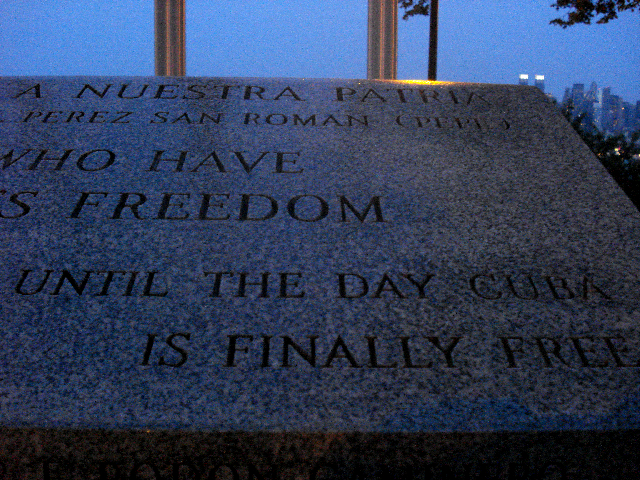

WEST NEW YORK VETERANS MEMORIAL PARK

WAR MEMORIAL
This was erected in 1935. Notice that at that time WWI was just called "World War". WWII was gathering, approaching ... but at the time of the memorial's birth, it was just "the Great War". Sad. It's kind of an ugly memorial in the light of day - but seen in the dusk it takes on a mythical aspect. It's funereal, like a mausoleum ... with plaques all over it - of all of the wars ... and the names of everybody from West New York who lost their lives in "the Great War" (not enough space for everybody else from all the other wars). Sad - this memorial made me sad. Perhaps because of the year it was put up. Retrospect can kill ya.





MEMORIAL TO TWO CUBAN DUDES


SKYLINE BREAK

AMERICAN VETERANS MEMORIAL

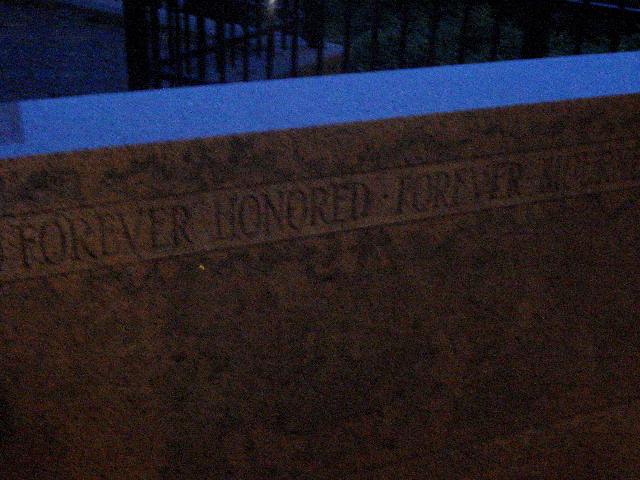
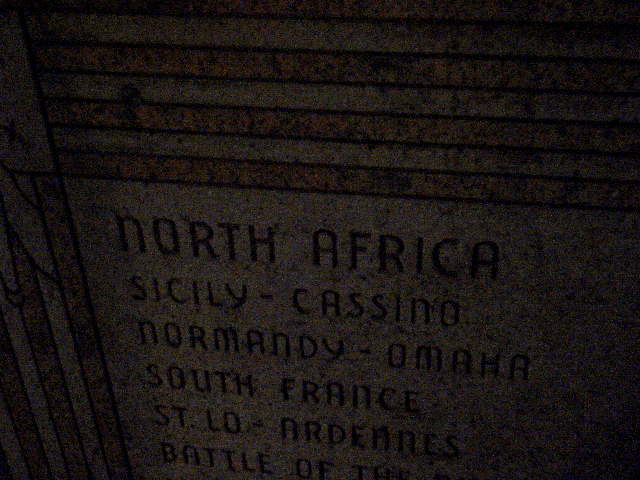

THE COMMUNITY ...
Boys ... playing basketball in the dying of the light ...

Girls playing a game of baseball on the tennis courts

COMMEMORATING THE SIGNING OF THE CONSITUTION
Plaque erected in 1937.

STATUE HONORING CHRISTOPHER COLUMBUS
I really struggled with the light here. I could not get a good shot of the Roman frieze-esque plaque ... it's a ship, struggling in the waves. Anyway, here's what I got.


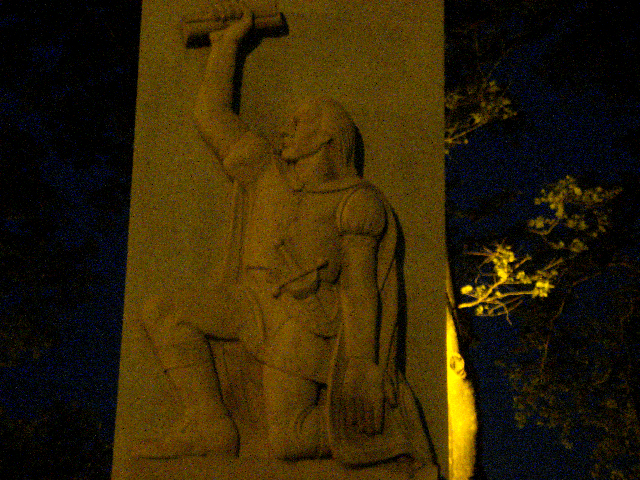

SKYLINE BREAK

Okay. It's totally night now.
ANOTHER PLAQUE HONORING THE 150TH ANNIVERSARY OF THE UNITED STATES CONSTITUTION
(The trees planted now tower around the plaque. Sniff.)

SEPT. 11, 2001 MEMORIAL


The memorial day parade
I have another photo essay planned - that I actually wanted to do last year - but never got around to it (uhm, mainly cause I didn't have a camera). I took all the photos I need last night for this photo-essay idea (before the visit from the firemen, naturally) ... but I need to go thru them, and organize them. In the meantime: here (and below the fold) are the photos I took of the Memorial Day parade in Hoboken. (Warning: I took a million photos. This camera has created a monster. Me.)

Please assume that every caption for every photo should be: "I love these people."
The veterans. The high school bands. The cops. The firemen. The ROTC clubs. The Boy Scouts and Girl Scouts. And everybody knows everybody in Hoboken - so there's a lot of waving, and joviality.
I love parades.

And here they all come!! (Oh, and it was sunset time. So that light glowing on the buildings in the background is not an exaggeration or a Photo Shop trick. It was that magical hour when everything blazes up into utter clarity, shadows take on stark and vivid outlines, and the bricks glow like gold. I was glad that some of that was captured)
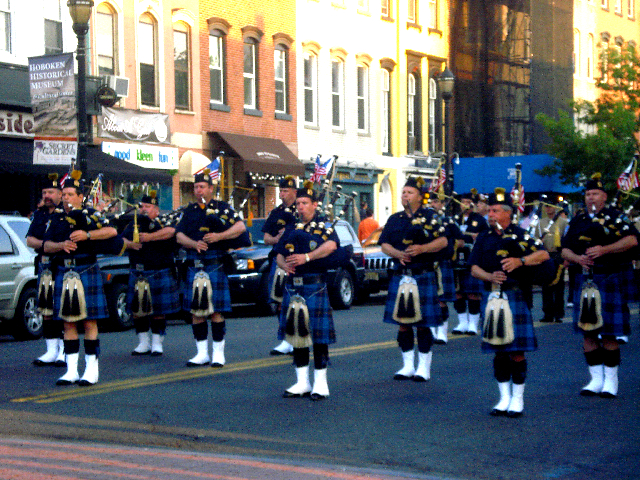
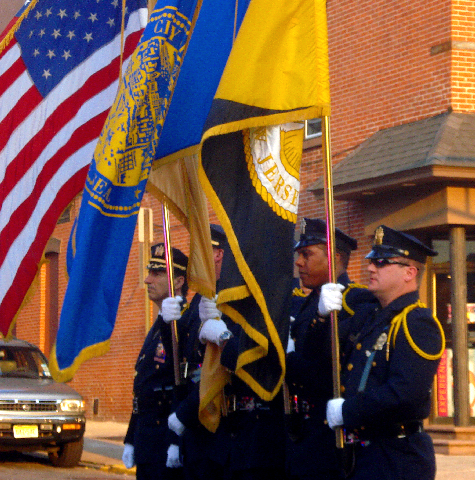
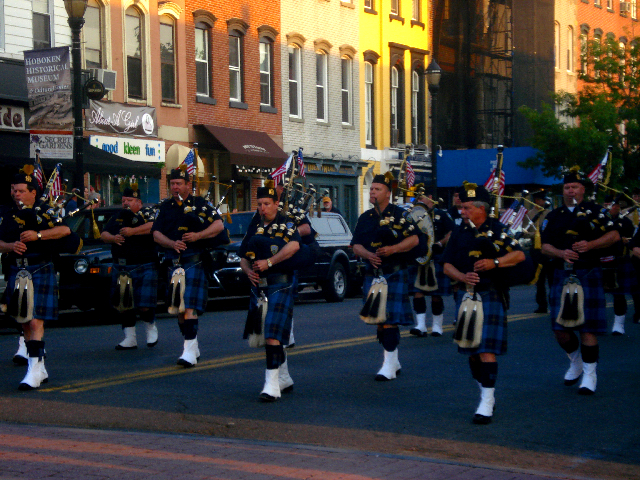
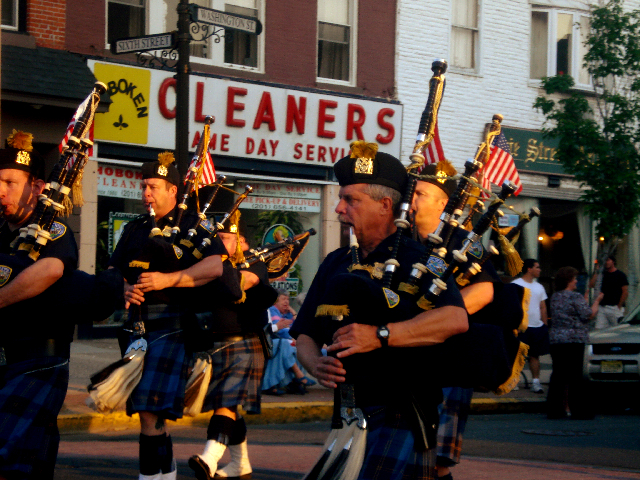
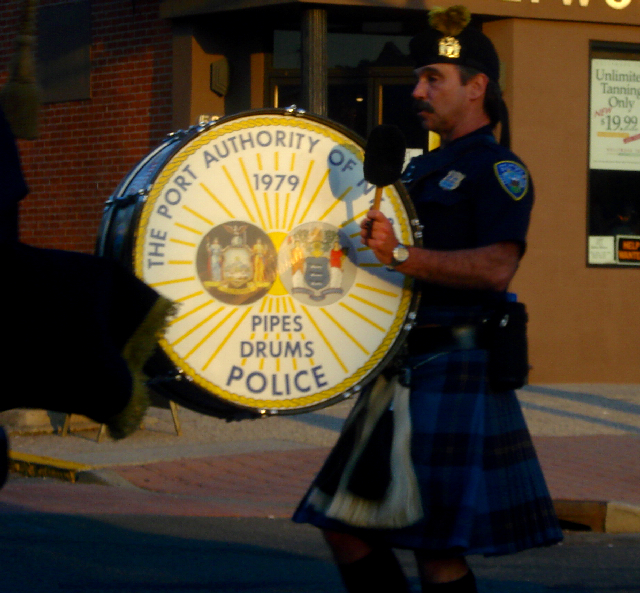

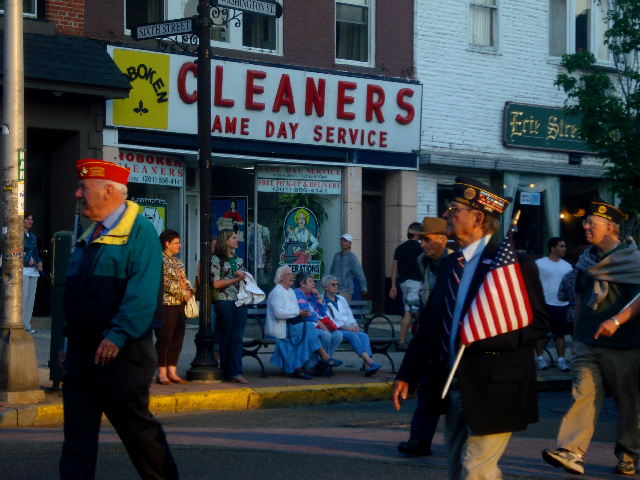


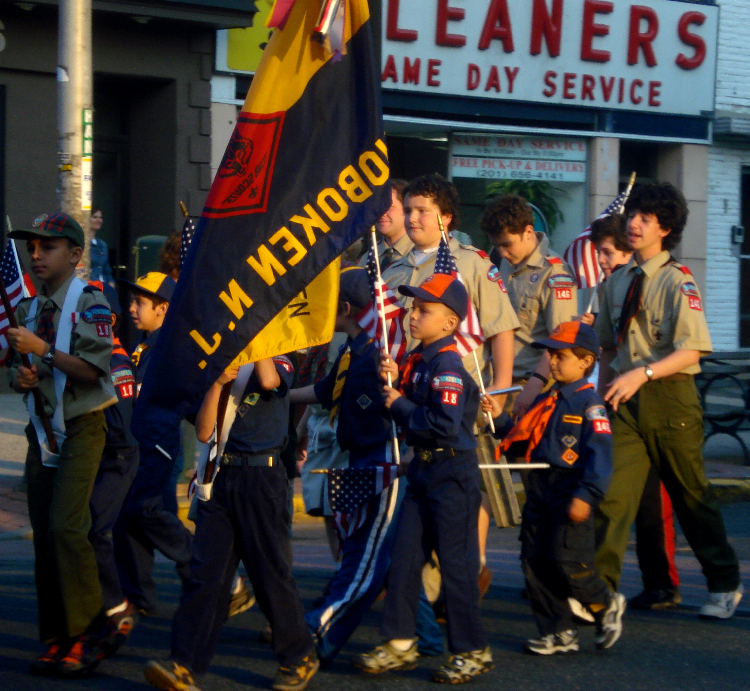


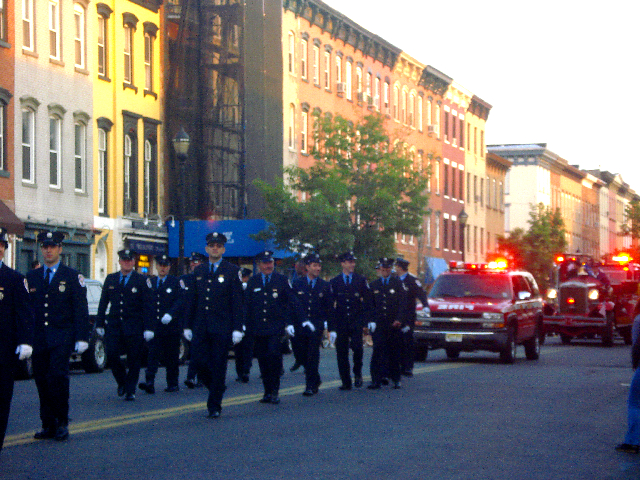


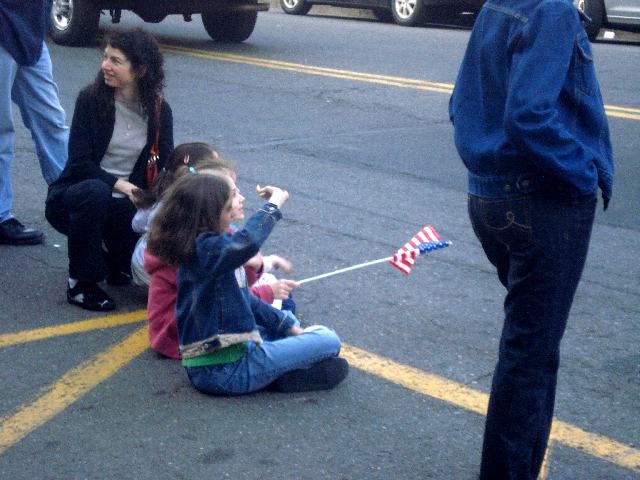


And there they all go ....
I hope you all have a wonderful Memorial Day.
Stagehands on break.
Hot day.
Hot men.
I couldn't resist - they looked so perfect - their poses, the yellow walls ...

A two-pronged experience
THE THRILL: The fire alarm in the main stairwell of my building went off last night. I investigated. No smell of smoke. But whatever - people were gathering, so I called 911. It was about 10:30 p.m. Within 3 minutes, my building was crawling with firemen. Now - nobody asked me "who here's wearing Sierra" like the last time I was overrun with hot firemen ... but still. There they all were. Tromping up and down the stairs, with axes, and helmets, and day-glo stripes and big boots ... I just loved standing back and watching them. Hot. So that was the thrill. (Especially since the building was NOT burning down. No fire.) I was free to hang back in a leisurely manner and watch firemen do their thing, without the fear of my 8 boxes of journals going up in smoke, or the plastic folder of letters over the years from 74 Facts guy being incinerated into a smoking pile of cinders. There was only glory in the moment, and in the undeniable FACT of the gorgeous-ness of the firemen.
THE MORTIFICATION: I was wearing Hello Kitty pajamas and also bright-blue sparkley false eyelashes. I had just been messing around with them - had just bought them yesterday, as a matter of fact and wanted to see what they looked like. Let me reiterate: they were sparkley, and they were blue.
I realize now that I must have looked like some tragic Tennessee Williams character, there in the shadowy dingy hallway, in my flimsy pajamas printed with 100s of Hello Kitty heads ... and the La Cage Aux Folles ambience of the blue sparkley eyelashes ... a tragic failed debutante, 20 years past her prime, playing dress-up by herself in her own apartment, waiting for a Gentleman Caller who will never come.
The Books: "Sugar and Other Stories" - 'Racine and the Tablecloth' (A.S. Byatt)
Next up in my Daily Book Excerpt ... Adult fiction shelves:
Sugar and Other Stories - by A.S. Byatt. A short story collection - her first. She has a ton more out and I'll be excerpting from them quite a bit. She's fantastic. As anyone who reads Byatt knows, she's very into fairy tales (remember Christabel's story 'The Glass Coffin' - in Possession)? Byatt cites as some of her main influences - not just giants like George Eliot - but also the Brothers Grimm and Arabian Nights (the copy of Arabian Nights I'm reading now has a preface by AS Byatt). The influence is clear, in all of her writing. The stories in this particular collection are not fairy tales, not exactly - but there's something in the writing - a distance, a perspective - that makes them not quite real. They become fables. The narrator is not omniscent - the narrator has a point of view, it's more like a story being told round a fire. I love that aspect of Byatt's short stories. They're thrilling to read.
The first story in this collection is a haunting tale called 'Racine and the Tablecloth'. It reminds me a bit of Margaret Atwood's Cat's Eye ... the terror and potency of being a young girl, surrounded by other young girls. The danger ... the danger especially of pulling ahead of the pack. In a way, this is a feminist fable. Emily - the lead of the story - is a brilliant student, she is a scholarship student at a boarding school - and she is clearly better, academically, than everyone else. This does not make her any friends. She is isolated. And worse than that - the headmistress of the school, named Miss Crighton-Walker, seems to hone in on Emily - in a way that can only be described as malevolent. She is an adult ... yet she finds something antagonistic about this young girl, who is only 14 years old. And although Miss Crighton-Walker would never admit it, she sets out to destroy Emily's spirit.
Great story. Chilling. And with a narrative voice that is very interesting - continuiing to assert itself into the story. Who is the narrator? Not Emily. No. It's a story-teller, who ruminates over the meaning of things, who pulls us out of the driving action - to contemplate motivations, themes. It's a great device because it elevates the story.
Excerpt from Sugar and Other Stories - by A.S. Byatt. - 'Racine and the Tablecloth'.
I am not going to describe the dance, which was sad for almost all of them, must have been, as they stood in their resolutely unmingled ranks on either side of the grey school hall. Nothing of interest really happened to Emily on that occasion, as she must, in her secret mind, have known it would not. It faded rapidly enough in her memory, whereas Miss Crichton-Walker's peculiar anxiety about it, even down to her curious analogy between razors and lawn-mowers, remained stamped there, clear and pungent, an odd and significant trace of the days of her education. In due course this memory accrued to itself Emily's later reflections on the punning names of depilatories, all of which aroused in her mind a trace-image of Miss Crichton-Walker's swinging, white, hairless body in th emoonlight. Veet. Immac. Nair. Emily at the time of the static dance was beginning to sample the pleasures of being a linguist. Nair sounded like a Miltonic coinage for Satanic scaliness. Veet was a thick English version of French rapidity and discreet efficiency. Immac, in the connexion of Miss Crichton-Walker, was particularly satisfying, carrying with it the Latin, maculata, stained or spotted, immaculata, unstained, unspotted, and the Immaculate Conception, which, Emily was taught at this time, referred to the stainless or spotless begetting of the Virgin herself, not to the subsequent self-contained, unpunctured, manless begetting of the Son. The girls in the dormitories were roused by Miss Crichton-Walker to swap anecdotes about Veet, which according to them had 'the - most - terrible - smell' and produced a stinking slop of hairy grease. No one sent her razor home. It was generally agreed that Miss Crichton-Walker had too little bodily hair to know what it was to worry about it.
Meanwhile, and at the same time, there was Racine. You may be amused that Miss Crichton-Walker should simultaneously ban ladies' razors and promote the study of Ph�dre. It is amusing. It is amusing that the same girls should already have been exposed to the betrayed and betraying cries of Ophelia's madness. 'Then up he rose, and doffed his clothes, and dupped the chamber door. Let in the maid that out a maid, never departed more.' It is the word 'dupped' that is so upsetting in that little song, perhaps because it recalls another Shakespearean word that rhymes with it, Iago's black ram tupping the white ewe, Desdemona. Get thee to a nunnery, said Hamlet, and there was Emily, in a nunnery, never out of one, in a rustle of terrible words and delicate and gross suggestions, the stuff of her studies. But that is not what I wanted to say about Racine. Shakespeare came upon Emily gradually, she could accommodate him, he had always been there. Racine was sudden and new. That is not it, either, not what I wanted to say.
Think of it. Twenty girls or so - were there so many? - in the A level French class, and in front of each a similar, if not identical, small, slim greenish book, more or less used, more or less stained. When they riffled through the pages, the text did not look attractive. It proceeded in strict, soldierly columns of rhymed couplets, a form disliked by both the poetry-lovers and the indifferent amongst them. Nothings eemed to be happening, it all seemed to be the same. The speeches were very long. There appeared to be no interchange, no battle of dialogue. No action. Ph�dre. The French teacher told them that the play was based on the Hippolytus of Euripides, and that Racine had altered the plot by adding a character, a young girl, Aricie, whom Hippolytus should fall in love with. She neglected to describe the original play, which they did not know. They wrote down, Hippolytus, Euripides, Aricie. She told them that the play kept the unities of classical drama, and told them what these unities were, and they wrote them down. The Unity of Time = One Day. The Unity of Space = One Place. The Unity of Action = One Plot. She neglected to say what kind of effect these constrictions might have on an imagined world: she offered a half-hearted rationale she clearly despised a little herself, as though the Greeks and the French were children who made unnecessary rules for themselves, did not see wider horizons. The girls were embarrassed by having to read this passionate sing-song verse aloud in French. Emily shared their initial reluctance, their near-apathy. She was later to believe that only she became a secret addict of Racine's convoluted world, tortuously lucid, savage and controlled. As I said, the imagination of the other girls' thoughts was not Emily's strength. In Racine's world, all the inmates were gripped wholly by incompatible passions which swelled uncontrollably to fill their whole universe, brimming over and drowning its hoizons. They were all creatures of excess, their secret blood burned and boiled and an unimaginably hot bright sun glared down in judgment. They were all horribly and beautifully interwoven, tearing each other apart in a perfectly choreographed dance, every move inevitable, lovely, destroying. In this world men and women had high and terrible fates which were themselves and yet greater than themselves. Ph�dre's love for Hippolyte was wholly unnatural, dragging her world askew, wholly inevitable, a force like a flood, or a conflagration, or an eruption. This art described a world of monstrous disorder and excess and at the same time ordered it with iron control and constrictions, the closed world of the classical stage and the prescribed dialogue, the flexible, shining, inescapable steel mesh of that regular, regulated singing verse. It was a world in which the artist was in unusual collusion with the Reader, his art like a mapping trellis between the voyeur and the terrible writhing of the characters. It was an austere and adult art, Emily thought, who knew little about adults, only that they were unlike Miss Crichton-Walker, and had anxieties other than those of her tired and over-stretched mother. The Reader was adult. The Reader saw with the pitiless clarity of Racine - and also with Racine's impersonal sympathy - just how far human beings could go, what they were capable of.
May 26, 2007
Happy birthday, John Wayne!
Or should I say ... happy birthday Marion Robert Morrison?
Uhm, no, let's stick with John Wayne. Smart move changing your name there, bub.

First of all: go here. Keep scrolling. Terrific photos - I was riveted.
David Thomson - in his massive film encyclopedia - devotes almost three pages to John Wayne. Here are some excerpts. The excerpts go in order (I don't quote the entire entry - just pulled out things I really liked) ... but I placed them in order so you can get a sense of the scope of this amazing guy's journey as an actor.
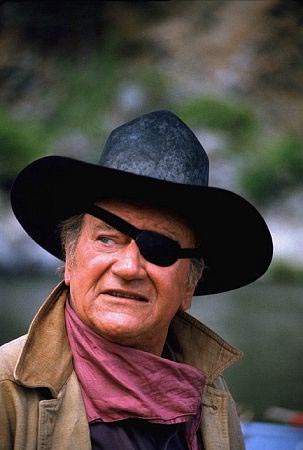
David Thomson:
As a child he moved West and, after a football scholarship at the University of Southern California, Tom Mix got him a job at Fox. There he met John Ford and worked as a set decorator on Mother Machree (28). Gradually he edged into acting, by the storybook means of being a bystander. His first big part was in The Big Trail (30, Raoul Walsh). Walsh had seen him carrying a big armchair above his head - carrying it witih flair and flourish.
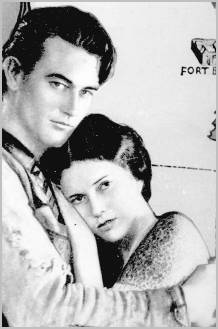
David Thomson:
Throughout the 1930s Wayne was a star of matinee Westerns, sometimes a singing cowboy, working his way round most of the smaller studios and making something like a hundred films. By 1939 he was with Republic when John Ford asked him to be the Ringo Kid in Stagecoach. The success of that film lifted Wayne from regular work to stardom. Republic pulled themselves together for a major vehicle for him - Dark Command (40, Walsh) - and Ford called on him again to play a seaman in The Long Voyage Home (40).
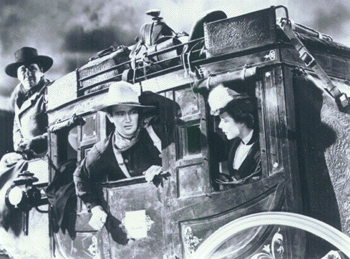
David Thomson:
Even at that stage [the late 30s, early 40s], Wayne had this virtue denied to Ford's "stock company": he did not ham. Universal put him opposite Dietrich in Seven Sinners (40, Tay Garnett) and Republic lowered its sights to more Westerns. For the next few years he made fodder at his home studio and more adventurous work outside, much of which only exposed his monotonous fierceness: Reap the Wild Wind (42, Cecil B. De Mille); The Spoilers (42, Ray Enright); Flying Tigers (42, David Miller); with Joan Crawford in Jules Dassin's crazy Reunion in France (42); and The Fighting Seabees (44, Edward Ludwig). In 1945, he was in Back to Bataan (Edward Dmytryk), Flame of the Barbary Coast (Joseph Kane), and was overshadowed by Robert Montgomery in They Were Expendable (Ford). He was bizarrely paired with Claudette Colbert in a comedy, Without Reservations (46, Mervyn Le Roy), but Rebublic still pushed straight Westerns at him.
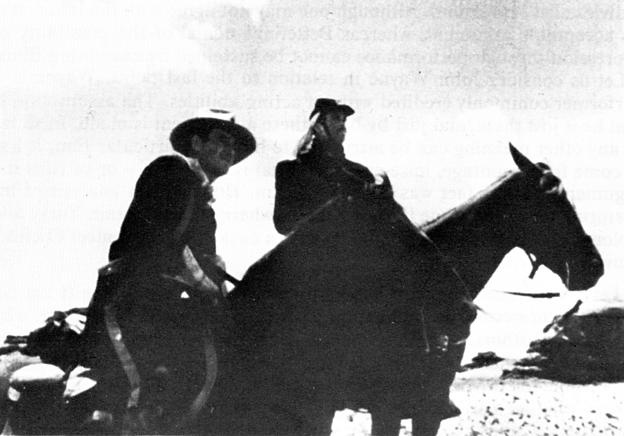
David Thomson:
Then came two films that radically enlarged his image: Fort Apache (48, Ford), in which he played a cavalry captain, and Red River (48, Howard Hawks). Not least of his achievements as a guide to players is the way Hawks was the first to see the slit-eyed obdurate side to Wayne's character. Tom Dunson is a fine character study: a man made hard by an early mistake and by the emphasis on achievement with which he tried to conceal that mistake. With Ford again, Wayne was one of Three Godfathers (48), a truly awful movie. But in 1949, he was Captain Nathan Brittles at the point of retirement in She Wore a Yellow Ribbon (Ford), and in 1950 the trilogy was completed withthe leisurely Rio Grande (Ford). Asked to be older, a husband and a father, Wayne became human and touching.
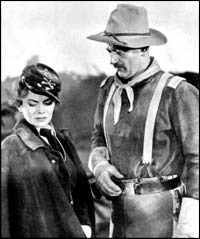
David Thomson:
Next, however, came The Searchers (56, Ford), one of his finest films - once more a study of an unapproachable stubborn man, finally excluded from the family reunion as a romantic but lonely figure facing the landscape. He coasted with The Wings of Eagles (57, Ford), Legend of the Lost (57, Hathaway), and The Barbarian and the Geisha (58, John Huston), before making Rio Bravo (59, Hawks). Once more, Hawks enlarged Wayne by concentrating on an alcoholic Dean Martin and having Wayne watch him "like a friend". It worked - as did the application of Angie Dickinson's talkative emotional crises to Wayne's solidity - so that Rio Bravo is not just Wayne's most humane picture but the one that makes him most comic.
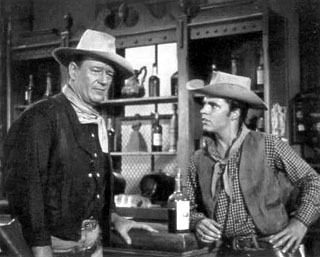
David Thomson:
His death moved nearly everyone, as had his brave walk down the Academy staircase, two months before death, to give the best picture Oscar to ... The Deer Hunter (that'll be the day, indeed.)He made too many pictures, of course; but only because for so long he was a guarantee of profit.

David Thomson:
But what a star, what a presence, and what a wealth of reserve he brought to that bold presence. (So you wonder if he couldn't have played comedy.)Nor has he dated. All one can say is that he filled the screen role of a necessarily difficult man as naturally as most actors wore clothes. There was an age when people could be stars without undue grandeur or self-mockery. Whether Wayne is looking at the land that may make a great ranch, or turning in a doorway to survey his true home, the desert, every gesture was authentic and a prized disclosure. He moved the way singers sing, with huge confidence and daring. You have to imagine how it all began in the way Raoul Walsh saw him carrying that armchair - as if it was a young girl in a red robe being lifted up in mercy and wonder.
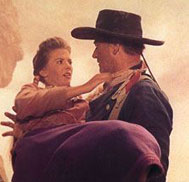
Happy birthday, Duke. And thanks!
Great tribute to him here. (Really illuminating quote from Henry Hathaway starts it all off.)
And if you haven't been reading The Shamus' posts on the Duke then I don't know what to say for you.
Two last pictures. Just cause, you know ... YUM!
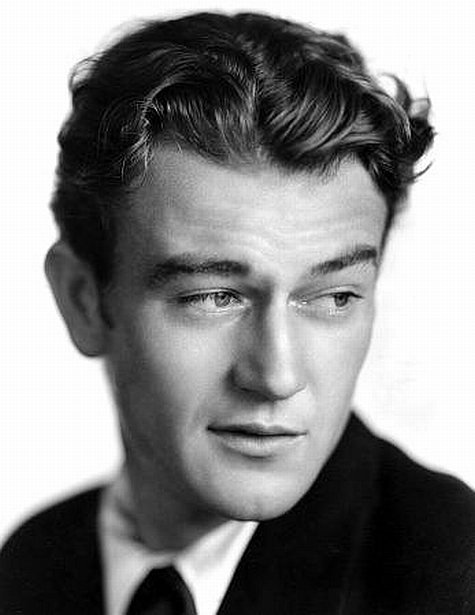
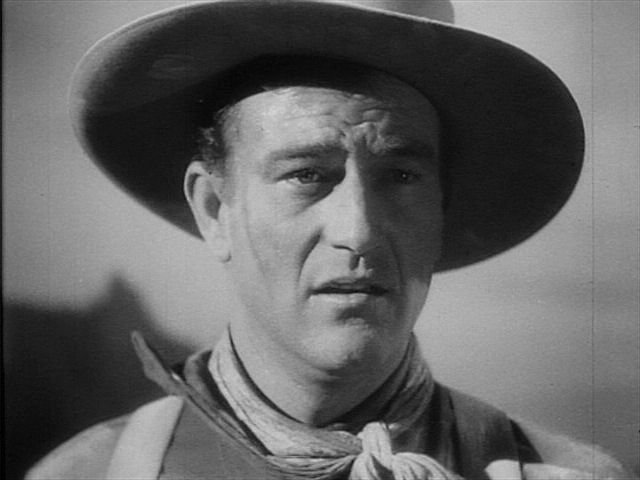
Fragment ending in laughter II
P.: "So ... this is where you have class?"
Me: "Yup."
He looks around. Looks at the shelves of random objects.
P.: [in a grandiose tone, gesturing] "Are these props??"
[Basically showing me he knows the word.]
Me [deadpan]: "Yes, P. They're props."
P.: [another Master Thespus gesture] "But .... aren't you supposed to become them?"
Me: [howling. Could not stop laughing. Tears of laughter.] "What?? Become them? No, I'm not supposed to become my props ... hahahahahahaha"
Fragment ending in laughter I
Me: "I love you."
Long pause full of terror. For him.
M.: "I love you too."
Me: "Don't get scared, now."
M.: "No, I know. I know this doesn't mean you'll show up tomorrow in a wedding dress."
Me: "Oh God. NEVER. I would NEVER want to marry you."
M.: "Uhm - thanks? ..."
Me: "I just love you, that's all."
Pause. I could feel him thinking. Then:
M.: "What the hell do you mean - you would NEVER want to marry me?"
Me: "Oh, what - suddenly you think we should be married just because I said I would never marry you?? Can you picture us married?"
M.: "Fuck no."
Me: "hahahahahahahahahahaha see what I mean?"
The Books: "The Biographer's Tale" (A.S. Byatt)
Next up in my Daily Book Excerpt ... Adult fiction shelves:
 The Biographer's Tale - by A.S. Byatt.
For the love of Pete, I barely remember a word of this book. It came out in December 2001 - and I bought it and also read it in Dec. of 2001 (I keep a list of the books I read) - and so that may explain why I remember NOTHING of this book. Dec. 2001. That's all that really needs to be said.
I tried to read fiction ... but it would be a year and a half or so before I could submit to a novel ... everything I read had to be historical, factual, whatever. So that might be why I have NO memory of Biographer's Tale - and I can tell that I actually read it because I've marked out certain passages, underlined certain sentences. What? Was I even THERE? There's a good 6 or 7 months around that time that I have almost no memory of, anyway - and I read Biographer's Tale during that time. Vanished from ye olde brain cells.
I don't remember it making a big splash - compared to Possession and Babel Tower it's almost like a sketchbook of an idea ... From what I can gather ... it's about a man who leaves his graduate program in English, or literary theory - something extremely postmodern and analytical ... and decides to confront reality by writing a biography of a great biographer. He begins his research and finds a box of material in an attic somewhere (forgive the vagueness) ... notebooks full of notes written by this great biographer. Because it's Byatt writing - we get to feel like we are rifling through this box. There are catalog cards with notes and quotes scribbled on them - some attributed, some not - we get to read them. "Card No. 29", etc. Byatt loves to do that - books within books, trying to get at a first-hand experience as opposed to something told to us. It becomes apparent - as you read through the notes of the great biographer that he had been in the planning stages for books on Henrik Ibsen - Darwin ... and some other dude. No memory of it.
Uhm ... what the point of all of this is is beyond me. I'd need to read it again. I read this book in the direct aftermath of terrorist attacks and - I guess I thought I needed an escape (well, I did!) ... and maybe this book did help me escape, but nothing of it remains in my brain.
I flipped through the book and decided to excerpt from one of the sections of the biographer's notebook. (I mean - the one that the narrator, the OTHER biographer, is investigating. As always, there are layers within layers in this book). Although "Ibsen" is not named ... it becomes obvious who the notes are referring to.
And re-reading this this morning - I really like it. Especially this line from Ibsen: "summer is best described on a winter day." !!!!!!!!!!
Makes me think I need to read it now - when I'm no longer shell-shocked from a certain blinding blue September day.
Excerpt from The Biographer's Tale - by A.S. Byatt.
III
[The third document, to which I gave the provisional title "I ..."]
He was a public man, and he made a daily public progress. He set out at two o'clock from Victoria Terrace, and walked to the Grand Hotel. He dressed carefully, always in the same clothes - a black, broadcloth frock-coat, black trousers, concertinaed at the ankles over highly polished, high-heeled black boots, a carefully folded umbrella, a glistening silk top-hat, a little fence of miniature medals. His white beard, and his white hair surrounded his sallow, unsmiling face, like the copious flare of a halo. He was a tiny personage, and carried himself stiffly erect, full of a dignity at once self-important and threatening. His lips were thin; his eyes, under their snowy ledges, have been called, finely, "fierce badger eyes". Cartoonists found him easy to "take"; their images proliferated, all recognisable projections, all the same, all different. He knew he was looked at. He had constructed himself to be looked at. Famous men walk behind, or inside, a simplified mask, constructed from inside and outside simultaneously. He groomed his parchment skin and his sleek boot-leather to turn back the light to the onlooker. The onlookers, even as they watched the precise, dandified advance, knew they saw the outside, not the inside. They let their imaginations flicker round the inchoate "inside," which remained bland and opaque. He belonged to them, their countryman. They had never been sure if they liked him.
His effigies were round him in his lifetime. In his latter days, his statue stood outside the National Theatre, larger than life, looming through the snow. He was photographed, diminutive and bristling amongst the dignitaries, at ceremonies of dedication. There was a Platz named for him in Gossensass. There was a proposal to make a waxwork double of him to preside over a Freie Buhne festival in Berlin. They wrote to ask for the loan of an old suit. "Be so good as to tell this gentleman that I do not wear 'old suits,' nor do I wish a wax model of myself to be clothed in an 'old suit'. Obviously I cannot give him a new one, and I therefore suggest he order one from my tailor, Herr Friess, of Maximilianstrasse, Munich." Sculptors and painters found him somehow inordinate. He had, he informed one of them, the largest brainpan ever measured by a certain German expert. Another, having asked him to remove his spectacles, was appalled by the disparity between his eyes.
"One was large, I might almost say horrible - so it seemed to me - and deeply mystical; the other much smaller, rather pinched up, cold and clear and calmy probing. I stood speechless a few seconds and stared at those eyes, and spoke the thought that flashed into my mind: 'I wouldn't like to have you as an enemy.' Then his eyes and his whole body seemed to blaze, and I thought instinctively of the troll in the fairy tale who pops out of his hole and roars: 'Who is chopping trees in my forest?'"
He was a man mjok trollaukinn, with "augmented inhumanity" as one ludicrous translation has it. He wrote:
To live is to war with trolls in heart and soul.
To write is to sit in judgement on oneself.
Division and self-division. The trolls ensconced in the blood and under the pelt of the human creature; the writer, watching himself, summing up, delivering judgement. He wrote surrounded by a swarm of red-tongued gutta-percha trolls. "There must be a troll in what I write," he said. His monstrous troll came out only in extremis, when things were impossibly difficult. "Then I lock my door and bring him out. No other human eye has seen him, not even my wife ... He is a bear, playing the violin, and beating time with his feet."
So there he was, man and troll, badger and bear, black integument and lined parchment sac containing blood, bones, and busy creatures, proceeding towards the Grand Hotel, in Christiania, in Norway, which he did not want to think was home. "Up here among the fjords I have my native land. But-but-but: where do I find my homeland?" "Ten years ago, after my second absence of ten years, when I sailed up the fjord, I literally felt my chest contract with revulsion and a feeling of sickness. I felt the same during my whole stay; I was no longer myself among all these cold and uncomprehending Norwegian eyes in the windows and on the pavements." In the South, he thought of the North.
He turned his ship's
Prow from the north,
Seeking the trail
Of brighter gods.
The snow-land's beacons
Quenched in the sea.
The fauns of the seashore
Stilled his longing
He burned his ships.
Blue smoke drifted
Like a bridge's span
Towards the north.
To those snow-capped huts
From the hills of the south
There rides a rider
Every night.
He was a northerner who went south for light, for distance, in order to see the north, in light, from a distance. He crossed the Alps on May 9th 1864. On April 1, 1898, in Copenhagen, he spoke of the transition.
"Over the high mountains the clouds hung like great, dark curtains, and beneath these we drove through the tunnel and, suddenly, found ourselves at Mira Mara, where that marvellously bright light which is the beauty of the south suddenly revealed itself to me, gleaming like white marble. It was to affect all my later work, even if the content thereof was not always beautiful." He had "a feeling of being released from the darkness into light, emerging from mists through a tunnel into the sunshine."
He was, or had been, a narrow northern Puritan. He was shocked, and then exhilerated, by the excess of energy of Michelangelo and Bernini. "Those fellows had the courage to commit a madness now and then." The Norweigians, he recalled contemptuously, "speak with intense complacency of our Norwegian 'good sense,' which really means nothing but a tepidity of spirit which makes it impossible for those honest souls to commit a madness."
It was his great desire to commit a madness like Michelangelo. Was it for fear of tepidity and dim light only that he fled Norway? Was there a madness, already committed, working away like yeast in the Norwegian small beer of his past, ready to explode the bottle? As a letter-writer, he was inhibited, crabbed, tortuously formal, uncommunicative. After leaving his home town, he never returned there, though on the occasion of his mother's death he wrote a stilted letter to his sister Hedwig, saying that he was just setting off for Egypt, but would like to receive letters. Later, he wrote to his father, who did not preserve the letter, but sent a reply, which was preserved, in which he said, "I tried to read your letter, but I couldn't understand it, I felt ashamed ..."
It is doubly difficult for a famous man, once returned to his native land, not to make a pious pilgrimage to the place of his birth. Spectators of the public life are interested in its beginnings, in the source. It is patently untrue to claim that he himself was indifferent or uninterested. In 1881 he began an autobiography, rapidly abandoned, expressing surprise that a street had been renamed for him. "Or so at any rate the newspapers have reported, and I have also heard it from reliable travellers." He recorded a grim town - "nothing green; no rural, open landscape" -- full of the sound of weirs and, penetrating the watery roar, "from morning to dusk, something resembling the sharp cries of women, now shrieking, now moaning. It was the hundreds of sawblades at work on the weirs. When later I read of the guillotine, I thought of those sawblades." In the tall church, raised by a Copenhagen master builder, the child was exposed, by his nursemaid, sitting in the open window of the town, high, high up. The unexpected sight of him there caused his mother to scream and faint. In the church, too, lived a demonic black poodle with fiery red eyes, the sight of which, at that same window, had shocked a watchman into falling to his death, bursting open his head in the square below. "I felt that the window belonged to me and the church poodle," he wrote. Then he gave up his autobiographical enterprise. It clearly never tempted him into revisiting those scenes. Something forbade him. He stayed away.
Sometimes he described how he set his characters in motion. How, one may ask, does such a man set about constructing another human being, in some sense ex nihilo, an individual who was not there before, and now exists, but whose very identity must leave space for the creative puppet-mastery of a director, the defining touches of a costumier and a maquilleuse, the deliberate accidents of directed light-rays and non-functional, even painted, cloth, chairs and tables? Above all, how does he make such a person "real," whatever that is, and yet leave that "reality" sketched and incomplete, to be fleshed out, to be wormed into, to bulge and sag around the unimagined, unaccommodating perhaps, body, voice - and history, and soul, and human limitations - of an actor? And not even one, definitive, magesterial actor, but a succession of these too fleshy ghosts each filling out different pouches and pockets? How could he collaborate, in his work of imagination, with these unknown helpers or opponents?
Such descriptions as he left of this process - few, as always, fewer than one might reasonably hope or expect - are disappointing in this regard. They could have been written by a novelist, or even - stretching the imagination a little - by a biographer. There is perhaps a little more emphasis on the body and the voice, but this is scratching for grains in sand. In a way, his accounts are platitudes, multiplied in other records of other observers. Nevertheless, the precise form of his platitudes, his own platitudes, cannnot be without interest; we should, if everything were accessible to know, be interested also in the precise combination of flora in his intestine, or layered convolutions in his brain. Do we have instruments for dissecting platitudes finely enough to yield precise local truths?
"Before I write one word," runs this rare confidence, then, "I must know the character through and through, I must penetrate into the last wrinkle of his soul. I always proceed from the individual; the staging, the dramatic ensemble, all that comes naturally and causes me no worry, as soon as I am certain of the individual in every aspect of his humanity. But I have to have his exterior in mind also, down to the last button, how he stands and walks, how he carries himself, what his voice sounds like. Then I do not let him go until his fate is fulfilled."
Now we may ask - must ask, indeed, since it appears pointless to raise hypothetical theoretical barriers against such a profound and natural human curiosity - where these imagined humans come from? As we shall see, he compares them, ingeniously or disingenuously, to strangers met on a train. He observed those he met on trains, as a naturalist observes new and familiar species. With an overtone of moral judgement, added to pure observation. He is on record as having driven himself into rage and hatred over some unknown fellow-traveller, a woman, who slept in his railway-compartment all the way from Rome to Gossensass, without once looking out of the window. "What a lazy woman! To sleep the whole way! How can anyone be so lazy? ... Most people die without ever having lived. Luckily for them, they don't realise it."
But the people he, to use a primitive phrase, "made up" must in some sense be not only watched strangers but spun from his own fabric, sensed inside his own stance, seen through one or the other of those terrible disparate eyes?
"As a rule, I make three drafts of my plays, which differ greatly from each other - in characterisation, not in plot. When I approach the first working-out of my material, it is as though I knew my characters from a railway-journey. One has made a preliminary acquaintance, one has chatted about this and that. At the next draft I already see everything much more clearly, and I know the people roughly as one would after a month spent with them at a spa; I have discovered the fundamentals of their characters and their little peculiarities; but I may still be wrong about certain essentials. Finally, in my last draft I have reached the limit of my knowledge; I know from characters from close and long acquaintance - they are my intimate friends, who will no longer disappoint me; as I see them now, I shall always see them.
He took things from others, certainly. A very young woman sent him, in Dresden, a sequel to his dramatic poem Brand, which she had called Brand's Daughters. She called it a religious book. He called it a novel. He bothered, unusually, to give her advice. He liked very young women. He enjoyed their admiration. Something more than talent is required, he told her: "One must have something to create from, some life experience ... Now I know very well that a life in solitude is not a life devoid of experiences. But the human being is in the spiritual sense a long-sighted creature. We see most clearly at a distance; details confuse us; we must get away from what we desire to judge; summer is best described on a winter day."
Light like white marble, remembered amongst crisp snow under steel skies.
Later he appropriated the same young woman's confusion and folly to construct his doll-wife in his dolls' house; she too had borrowed to pay for her sick husband's travel, she too had forged a cheque. Nora arouses the sympathy of millions. Laura, whose acts were stolen, had periods of madness and shame. He did not choose to make, or keep friends.
"Friends are an expensive luxury; and when one sinks all one's capital in a vocation and a mission in life, then one cannot afford to have friends. The extravagance of keeping friends lies not in what one does for them, but what, out of consideration for them, one omits to do. On that account, many intellectual shoots are crippled in oneself. I have gone through this, and on that account, I have several years behind me, in which I did not succeed in being myself."
May 25, 2007
Bang Bang You're Dead
Holden's death scene in "Sunset Boulevard"
All in one take. I love it because it's the best kind of make-believe acting. The kind of acting that little kids do so brilliantly when they're playing and making up games. The kind of belief in the imaginary circumstances that so many adult actors have to WORK to remember how to do. It's the "Bang bang you're dead" school of acting. Because it's in one take - Holden has to be shot three times - stagger forward - turn back - turn the other way - be shot one last time and fall face first into the pool. One take. That takes not only acting chops - and make-believe chops (you know, not to be embarrassed or self-conscious about the "bang bang you're dead" energy of the thing) ... but also athletic chops.
Watch that scene again when you have the chance. Watch Holden's swan dive into that pool. Watch the lead-up to that last moment. And notice the unbroken take. It's just gorgeous - really FUN movie-making. I mean, yes, a man is being murdered, so it's not fun for HIM ... but that kind of take is almost unheard of nowadays - what with the love affair with closeups, and cutaways, and CGI effects ... One long take of an actor being shot multiple times, twirling this way, that, before plunging himself into the pool is old-fashioned film-making. Great great stuff.
Billy Wilder said to Cameron Crowe, about Holden: "Holden was very good. Physically, he was first-class."
Holden comes out onto the lawn - followed by Norma with her gun - he is shot in the back the first time. It stops him in his tracks - his back kind of arches, his head goes back ...
Then he plunges forward - wounded - dropping his suitcase ...
She shoots him again - from the side - he takes the hit ...
Out of control now, staggering away from her - turning back to see his attacker -
Disoriented, wounded - he flails about - flailing for the dropped suitcase ...
Which is when she shoots him for the final time. The death blow. His swoon is practically balletic. Fearless. Throwing himself off to the side and over the edge.
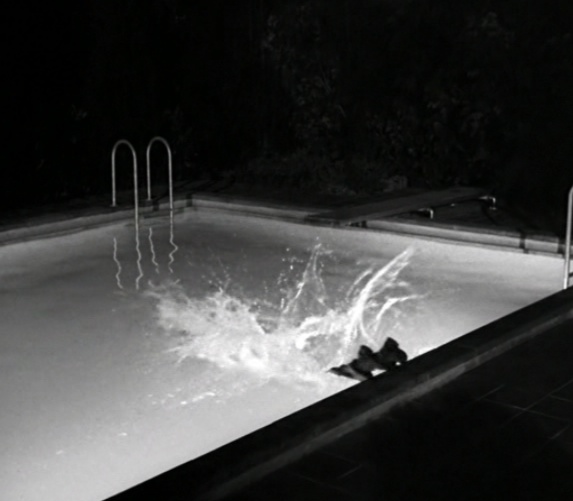







Bang Bang You're Dead of the highest order.
Friday Favorites ...
The nostalgia! She burns my soul!!
Awesome post, Carl V - a treasure-trove!
BY THE WAY:
1997 quotes. No context.
"Somebody needs to call him up and tell him he's an asshole!" - Maria W. on Scott Hamilton
"I'm glad you're back ... even though I didn't know you were gone." - Ann
"M. and I were not really made for public viewing. We were a private exhibit. Invitation Only." - Me
"Who the hell is Tex Watson?" - Barbara
"SLUGWORTH." - Ann
"When she styled it, I looked like Sylvia Plath in her college years." - Maria M.
"I need to get some new cuss words. I want to start using words like 'asshole' and 'bitch.'" - Stephen
"...his snowbeard penis." - Jackie
"Buhsh 'n Pudding ..." - Shelagh, trying to say "button pushing"
"So I want you to operate out of complete panic." - Gene
"I'm on a roll! I'm on a very second-rate roll here!" - Sam
"It's a great mistake to try to be original." - Sam
"This is not a relaxing job." - Sam
"So. You've just heard from the portobellos ..." - Sam
"I had a bolt of stress that you didn't know where he worked. Literally. I had a bolt of stress .... You know, for the coma contingency." - Ann
"If I could say goodbye to you in a Rebus form I would ..." - Me to Ann
"I wish there was such a thing as Open Boob Night." - Brooke
"Where Alan Thicke meets Frankenstein ..." - Ann
"And then Tim hugged me." Long pause. "Well, electronically." - Ann
"She puts marshmallows on brownies!" - Maria's indictment of Jo
"She then plunged a dagger into my heart. Literally. She impaled me with her horns." - Ann
"Honey Nut Clusters, steamed squash, and red wine ..." - Jen, describing our nights at home
Kevin: "I just said 'Fuck it'."
Pause.
Robert: "Which is Latin for 'Be Free!'"
Me: "What about Adam?"
Ann: "Oh please. That rumor has already been squelched."
"And then, of course, there was the Bo Deans debacle ..." - Me to Kate
"Once you get to my stage, you have no standards, and you just feel grateful to still be standing here!" - Sam
"It seems to me, Rodney, that the importance of the hyoid bone is in having one." - Robert
Shelagh: "Isn't it true that Meryl Streep used to throw up before she used to go onstage?"
Cheryl: "Yeah, but that's because she was drunk."
Shelagh: "Oh! Okay! Thanks for clearing that up for me!"
"I am so charmed by him that I can barely sleep." - Mitchell on Scott Wolf
"What am I - the Profiler?" - Mere
"This is so Cohort One." - Matt
Discussion about Kenneth Branagh's Frankenstein:
Maria: "What annoyed me was that he called the movie 'Mary Shelley's Frankenstein' when it clearly should have been called 'My Chest.'"
The Wookie holiday: "Life Day"
I am so happy - an analytical essay on The Star Wars Holiday Special.
Quote from the essay:
"If ever a television program defined “so bad, it’s good," this is it, as if the initial pain of having one’s brain cells killed off is followed by the euphoria that accompanies their absence. "
Tooooo many books
Got this meme (Mere - BWAHAHAHA) from my dear friend Ted - who just started blogging - go, Ted. (Here's a Diary Friday, by the way, which describes the night Ted and I became friends. We had known each other for a couple of months - but it was on this night that we realized: Uhm ... kindred spirit???)
A book that made you cry: Atonement. I was a freakin' wreck at the end of that book. The rest of the book was a chilling and almost still experience - I didn't cry all the way through reading it. But that last paragraph. I cried so intensely that I scared the dude I was dating at the time. I have been unable to pick up that book ever since - even though I sometimes do yearn to re-read it, it was so good. But nope. Too painful.
A book that scared you: House of Leaves by Mark Z. Danielewski
Uhm ... I've never written a post about this book. I will when I get to it. This book was a mind-freak. I actually had nightmares reading it. It tapped into a deep core of utter terror that I guess I walk around with at all times. Fear of dark, fear of claustrophobia, fear of ... reaching out to find the wall in the darkness and having it not be there ... This book is out of this world. Has anyone else read it? I'll get into more detail during my book excerpt thing - but I was blown away. Not just by the look of the book (you sometimes have to turn it upside down, you have to hold it up to the mirror sometimes) ... but also by his writing, which is startlingly good. I was terrified by this damn book. I felt like a little kid reading it. I didn't want to turn off my light because I knew I would have a bad dream. I read it a couple years ago. Great GREAT read. Scared the shit out of me.
A book that made you laugh: Scoop, by Evelyn Waugh I read it in a recent Book Blogger Classics Challenge - and it made me laugh so hard that I embarrassed myself during public commutes. One of the funniest books I have ever read in my life.
A book that disgusted you: Less than Zero, by Bret Easton Ellis. Those people have no redeeming qualities.
A book you loved in elementary school: Harriet the Spy, by Louise Fitzhugh I mean ... LOOK at Harriet. I STILL dress like Harriet. Coincidence? I think not. She's why I started putting my thoughts down on paper when I was 10 years old.
A book you loved in middle school: The Pigman by Paul Zindel - this is still one of my all-time favorite books. Ever. I still read it, on average, once a year - and have ever since middle school.
A book you loved in high school: The Bell Jar, by Sylvia Plath The book does not hold up. The poetry, however, just gets better and better ... but the book is juvenile, and doesn't holdup. Still some well-written sections - I latched onto this book in high school. I loved it. Thank goodness it was a phase. Her POETRY is where it's really at.
A book you hated in high school:Billy Budd, by Herman Melville. I still have feelings of revulsion when i think of how much I hated reading that book.
A book you loved in college: Cider House Rules, by John Irving. Still one of my favorite books.
A book that challenged your identity: Diary of Anne Frank. I was 11 when I read it. I realized, for the first time in my innocent life, how much God has to answer for. It was devastating to me. Shattering, really. I remember kneeling by my bed and screaming at God so loudly that I was scared I would be struck by lightning. That book completely re-worked how I thought about the universe, fate, fairness, free will ... It was a horrible experience. I never fully recovered, I guess - and for that I am truly grateful.
A series that you love: The "Emily" books by LM Montgomery
All the Madeleine L'Engle series
Your favorite horror book: It, by Stephen King. A masterwork, as far as I'm concerned.
Your favorite science fiction book: Wrinkle in Time, I suppose is my answer.
Your favorite fantasy: The Narnia books.
Your favorite mystery: I must honor my younger self and say that the first 10 books in the Trixie Belden mega-series are pretty damn great. I should re-read them. I DEVOURED them when I was a kid. Nancy Drew Shmancy Drew. Give me Trixie.
Your favorite biography: Oh God, I'm with Ted. Only one?? I'm a biography freak. Let's see. Chernow's Alexander Hamilton, McCullough's John Adams, the two-part biography of Orson Welles by Simon Callow (oh my God), Joseph Ellis' books on Jefferson and Washington, A. Scott Berg's book on Lindbergh - the Joe Papp biography - Leverich's book Tom about Tennessee Williams (and he died before he could finish Volume 2! Tragedy!), Gerald Clarke's Capote is a masterpiece of the genre - and Mrs. Gaskell's Life of Charlotte Bronte. Yes, it's gossipy - yes, it's biased - and mythologizes the sisters -but listen - the book has not ever been out of print since it was first published. GIVE IT THE PROPS it deserves. Biographies go out of style so quickly - as new "theories" come up and go down ... but that kind of staying power is notable. I love Mrs. Gaskell's gossipy "I knew Charlotte Bronte" book ... and I know I'm reading a myth, but it's a damn good book anyway. Richard Ellmann's James Joyce is spectacular.
I can't stop. There are even more I need to add.
Your favorite �coming of age� book: Probably Tiger Eyes, by Judy Blume. Awesome book. I still love it. Wrote about it here.
Your favorite classic: Why must I choose. Why.
The first thing that comes to mind is Jane Eyre.
But I also have to say Tale of Two Cities, Brothers K, Crime and Punishment - Pride and Prejudice, Huckleberry Finn. Great Expectations. These are the main ones.
Oh shit, and how could I forget - Moby Dick. Hated it in high school - re-read it in 2003 ... and felt it was one of the most EXCITING books I've ever read. Love it. Love love love it.
Your favorite romance book: Flowers in the Attic by VC Andrews.
JUST KIDDING.
I suppose I would have to say Jane Eyre is the best romance ever. Although ... sigh. I want to add Possession to the list - as well as Life without Friends, a young adult book. Best romance I've ever read. It STILL gets to me.
Your favorite book not on this list:
Hopeful Monsters, by Nicholas Mosley.
The Books: "Babel Tower" (A.S. Byatt)
Next up in my Daily Book Excerpt ... Adult fiction shelves:
 Babel Tower - by A.S. Byatt.
The third novel featuring the Potter family - this book is epic. Fantastic. Frederica Potter is the star of this book ... but the real star is the 1960s, or - more specifically - London in the 1960s. It's not so much about the counterculture - not yet - but about the upheavals going on at all levels of society. Frederica flees in the night with her son from an abusive marriage. Her husband is an old-school Englishman - who has very specific ideas about what a wife should be. (Why he would marry someone like Frederica then, is beyond me) His disappointment in his wife translates into rage, and domestic violence. Frederica takes her son and leaves - goes and stays with some of her old college friends (all men) in London. They all take her and her son on. It's a collective kind of community - they love Frederica, she needs them, her son needs them ... they step up to the plate. Frederica's husband naturally will not go down without a fight - and divorce proceedings begin, where he drags Frederica's name through the mud. She has to go to trial to prove her fitness as a mother. Meanwhile (sorry, I realize I'm making this sound like a soap opera - and it's NOT) - a book written by an acquaintance of Frederica - a kind of loopy Nitszchean-influenced outcast - is going on trial for obscenity. It's a book along the lines of Marquis de Sade - it purports that it's showing a Utopia, a world of ultimate freedom. Brutal. At the same time that Frederica is fighting for her son and her reputation - this book is standing trial. Because it's Byatt here - we get to read long sections of the controversial book. It has a sort of Anne Rice "Sleeping Beauty" feel to it - only it's more political, less pornographic. Babel Tower - with all of these different elements - ends up being about rebellion - useful rebellion and also useless ... the ideas of the 60s, loopy ones, and also revolutionary ones. How on earth Byatt writes a book about an entire society I will never know - but that's what she does. She does so without sacrificing character - Frederica is as clearly drawn as ever, all the characters are ... but Byatt is really interested here in language - the breaking apart of convention and what that does to our language - this is reflected even down to the personal level of what a word like "wife" or "marriage" means. As society upends itself, as the Swinging Sixties really kick in ... it is not a bold new day dawning ... even with all the new ideas, and new freedoms ... it is just another day, with new struggles, new annoyances - and the rebellion of those days will end up creating the rigid academic world Byatt so beautifully portrays in Possession. All that freedom, all that openness ... ends up solidifying, petrifying - into the postmodernist theoretical atmosphere that is so influential and, at times, annoying, today. Byatt is looking at the beginning of all of that in Babel Tower (I mean, her title kind of says it all).
This is a bold book. A book with huge sweep and ambition. I love it - I am feeling the need to read it again. As with all of the Byatt books I've excerpted - I flip through them, get a glimpse of a passage here, a paragraph there, and think ... argh, have to read it again!!
Here's an excerpt. Frederica is in London. She has left her husband. She's taken a lover. (I love how Byatt writes about sex.)
Excerpt from Babel Tower - by A.S. Byatt.
John and Frederica come back to Gothland in the evening. They walk in the dusk through the village, where the black-faced sheep stare with yellow, inhuman eyes. Something tugs at Frederica's memory. She came here once, in a bus, on a trip, and had what she has now docketed as an interesting and instructive experience with a traveller in dolls. The sight of a sheep and a thorn bush brings back this person, Ed, in his interesting and repelling flishiness, but it also brings back a thought. It was a thought about her own separateness, and the power that was possibly inherent in keeping things separate - sex and language, she thinks, ambition and marriage, what was I thinking? She remembers she was thinking about Racine, and the rhythmic movement of her feet, comfortably in time with the rhythmic movement of the feet of John Ottokar, brings back the couplet in the landscape to which it was wholly irrelevant then, and for that reason interesting, for that reason compelling:
Ce n'est pas une ardeur dans mes veines cachee
C'est Venus toute entiere a sa proie attachee
She remembers, and with it her delight in the balance of the lines, the way they pivot on the caesura and are both separated and joined by the rhyme. She says the verse out loud, and John Ottokar puts his hand over her buttocks, lovingly, and laughs, and says, "Precisely." Frederica stops in her tracks, dizzy with sex, and puts her arms tightly round him: watched by sheep, and by the man who was reading Lady Chatterley in the rosy restaurant, they embrace, they kiss, they walk on. They lean together. Frederica's mind, a dark snake burrowing in darkness, looks for a word which then seemed the key to power and safety. She remembers her distress that Stephanie had apparently found happiness with Daniel. She thinks of Forster and Lawrence, only connect, the mystic Oneness, and her word comes back to her again, more insistently: laminations. Laminations. Keeping things separate. Not linked by metaphor or sex or desire, but separate objects of knowledge, systems of work, or discovery. In her pocket her fingers touch Luk Lysgaard-Peacock's snail shells, two greenish and one striped. Are the stripes laminations, or organic growths? The layer of strontium, exposed by the diamond saw in the spiral form, is a layer - an accident in Cumberland, a time of fall-out in the air - what is she saying? Partly that even fear of death in the air is not all-consuming or all-pervading. She has the first vague premonition of an art-form of fragments, juxtaposed, not interwoven, not "organically" spiralling up like a tree or a shell, but constructed brick by brick, layer by layer, like the Post Office Tower. The radomes are on the moor and are seen amongst the heather and the neolithic stones and barrows, but their beauty is in the difference as well as in the simultaneity of the vision.
She is feeling for something, and doesn't know what it is, cannot push the thought further. Laminations. Separation. I was thinking about the Virgin Queen and the power of her solitude and her separation, the fact that her power and her intelligence were dependent upon her solitude and her separation.
"What are you thinking?" says John Ottokar, and takes her shoulders, and turns her face to his. "You've gone away from me. Where? What are you thinking?"
Desire moves round the column of Frederica's spine like the spiral of a helter-skelter, round which she spins screaming with fear and delight.
"I had an idea for a book called Laminations."
"Why Laminations?" he says later, in the bedroom. At the time, he simply smiled and nodded.
"I haven't thought it out. It's to do with what was in the lectures, the Romantic desire for everything to be One - lovers, body and mind, life and work. I thought it might be interesting to be interested in keeping things separate."
"I know about that," he says, sitting naked on the edge of the bed. The lights are out, but the room is full of pale moonlight. "I know what it is like to be afraid of being two separate creatures confined in one skin."
They are naked and cool in the night, sitting companionably on the edge of the bed. On an impulse she touches his sex, the two balls moving loose and separate inside the cool bag of skin. The penis shrinks like a soft curled snail, and then swings out blindly, a lumbering and supple serpent becoming a rod or a branch. Two in one, thinks Frederica, as his arms go round her. You might think, she thinks, as their bodies join, that her are two beings striving to lose themselves in each other, to become one. The growing heat, the wetness, the rhythmic movements, the hot breath, the slippery skins, inside and out, are one, are part of one thing. But we both need to be separate, she thinks. I lend myself to this, the language in her head goes on, with its own rhythm, I lose myself, it remarks with gleeful breathlessness, I am not, I come, I come to the point of crossing over, of not being, and then I fall away, I am myself again, only more so, more so. His face, post coitum is calm like an Apollonian statue. There is no clue to wghat is inside his brain-box. I love that, says Frederica's chatty linguistic self, I love not knowing, I love it that I don't know him.
May 24, 2007
Sewanee Review:
So much is going on right now - my real-life is extremely consuming right now ... but yo, I'm psyched about this.
Sewanee Review has launched their website, and check out who they're promoting on the home page. Sniff, sniff. I get all choked up and proud and goofy about this stuff. Especially cause my dad is mentioned.
Everything is poignant. Painful. Strange feeling ... to just be proud and humble and psyched all at the same time. Things are good right now.
Letters
Here's one of my new favorite blogs. What a great idea: "A Daily Selection of Correspondence by Authors, Writers, Poets, Painters and others".
I love reading people's letters. I just bought a second-hand copy of the correspondence of my intellectual idol Rebecca West - and I'm almost scared to start it. It's so voluminous ... daunting ... but still: I drool just looking at that book!
Anyway - back to that blog. One letter a day. Awesome.
Excerpt from letter to Sir Walter Scott:
The moment all was done, the Duke clapped spurs to his horse, and was back in Downing Street within the 2 hours--breakfasted--and off for Windsor, where he transacted business for an hour or so, and then said: "By the bye, I was forgetting: I have had a Field day with Lord W. this morning." They say the King rowed Arthur much for exposing himself at such a crisis. Such is the gossip of the Club. . . .
Yours affectionately,J. G. Lockhart
Also - letter from Max Beerbohm!
More here. It's a new blog - but I look forward to checking in with it daily.
Famous person said to Alex:
"I'm glad you liked my Asshole."
You'll just have to go read the whole thing.
I love it when Alex runs into famous people. It's like this extremely articulate fiercely intelligent woman becomes a bumbling idiot, saying the famous person's name over ... and over ... and over ... (or just plain old calling the person a "Ho" like she did to Chita Rivera). And then there was her red carpet moment with Stockard Channing where Alex could not stop saying the words "Stockard Channing" RIGHT TO Stockard Channing herself. "Nice to meet you, Stockard Channing ... Stockard Channing, beautiful night, eh, Stockard Channing?" hahahaha
My next goal in life is to run into a famous person when I am with Alex, so I can watch the disintegration of my friend's personality. And point and laugh.
1938
From the personal notebooks of Tennessee Williams (he just won a play contest, sponsored by the Group Theatre - he is not famous yet):
My next play will be simple, direct and terrible - a picture of my own heart - there will be no artifice in it - I will speak truth as I see it - distort as I see distortion - be wild as I am wild - tender as I am tender - mad as I am mad - passionate as I am passionate - It will be myself without concealment or evasion and with a fearless unashamed frontal assault upon life that will leave no room for trepidation. I believe that the way to write a good play is to convince yourself that it is easy to do - then go ahead and do it with ease. Don't maul, don't suffer, don't groan - till the first draft is finished. Then Calvary - but not till then. Doubt - and be lost - until the first draft is finished.
"Passionate minutiae"
David frantically emailed me yesterday saying we needed to get together, it had been way too long, and we needed to sit and talk endlessly about "passionate minutiae".
Nobody like David.
I can't wait. I am allllll about passionate minutiae. You have no idea just how passionate my minutiae can get. You have no idea just how minute my passion can become. And etc. and etc.
I think I need to write a short story with that as the title. Or a poem. Or something.
David and me. Passionate minutiae. It's gonna be a long night!
The Books: "Angels and Insects" - 'Conjugal Angel' (A.S. Byatt)
Next up in my Daily Book Excerpt ... Adult fiction shelves:
 Conjugal Angel - by A.S. Byatt.
This is the second novella in the collection Angels and Insects. It also takes place in the 1800s - late 1800s I believe. It has, as its plot-line and theme, another one of AS Byatt's pet interests - the whole seance phenomenon, the table-rapping, mesmerism, etc. - that was such a fad then. This also is featured heavily in Possession - Christabel gets very into it after the breakup with Ash ... and Ash, memorably, infiltratees himself into a seance so that he can confront Christabel. The two novellas - "Morpho Eugenia" and "Conjugal Angel" stand back to back - two sides of the same 19th century coin. The mania for insects, and the mania for seances and spirit-world visitations. There is so much IN these novellas - seriously, Byatt is just a master. I LOVE her.
"Conjugal Angel" takes place at one particular seance. We get to know all the participants - and what they are looking for, the dead person they are hoping to communicate with ... Byatt has a lot to say about what was REALLY going on with this 'fad' ... what people were really looking for. Mrs. Papagay is the "medium" who runs the thing. She was married to a sea captain - who was apparently lost at sea 10 or so years back - his ship never returned. It was through a medium that she "contacted" her dead husband ... and since then has found that she has a talent for this stuff herself.
The ending of this novella was surprisingly moving to me. Something happens on the very last page which takes the breath away - I did not see it coming. At all. And the event is one that completely upends the entire seance proceedings ... and yet also deepens my understanding of it. Byatt isn't interested in judging the silliness of this fad (and the charlatans involved) ... she is more interested in what it indicates, philosophically. What it shows us about ourselves.
Here's an excerpt.
Excerpt from Conjugal Angel - by A.S. Byatt.
Mr. Hawke arranged them. He sat between Sophy Sheekhy and Lilias Papagay, with a copy of the Bible, and a copy of Swedenborg's Heaven and Hell in front of him. Mrs. Jesse was next to Mrs. Papagay and on her other side was Mrs. Hearnshaw. Captain Jesse sat between Mrs. Hearnshaw and Sophy Sheekhy, in a kind of parody of dinner-party placement when there were insufficient men. It was Mr. Hawke's custome to begin the proceedings with a reading from Swedenborg and a reading from the Bible. Emily Jesse was not quite sure how he had made himself so central a figure, since he had exhibited no mediumistic powers up to that point. She had been glad at first, when she told him of their promising, if alarming results from their early cautious spiritual experiments, that he had asked to be included. Like her eldest brother, Frederick, and her sister, Mary, she was a dedicated member of the Swedenborgian New Jerusalem Church, and also a convinced spiritualist. Whilst the spiritualists claimed Swedenborg, who had made such momentous journeys into the interior of the spirit world, as a founder of the faith, many of the more orthodox Swedenborgians looked askance at what they saw as the loose and dangerous power-play of the spiritualists. Mr. Hawke was not an ordaining minister in the New Church, but a wandering preacher, ordained to speak but with no society to govern, a grade, as he never tired of explaining, referred to by Swedenborg as sacerdos, canonicus, or flamen. He sat with his back to the fire and read out:
'The Church on earth before the Lord is One Man. It is also distinguished into societies, and each society again is a Man, and all who are within that Man are also in Heaven. Every member of the Church also is an angel of heaven, for he becomes an angel after death. Moreover, the Church on earth, together with the angels, not only constitutes the inward parts of that Grand Man, but also its outward parts, which are called cartilaginous and osseous. The Church brings this about because men on earth are furnished with a body in which the spiritual ultimate is clothed with a natural. This makes the conjunction of Heaven with the Church, of the Church with Heaven.
'Today's reading from the Word,' he went on, 'is taken from the Book of Revelation, the twentieth chapter, verses 11 to 15.
'And I saw a great white throne, and him that sat on it, from whose face the earth and the heaven fled away; and there was found no place for them.
And I saw the dead, small and great, stand before God; and the book swere opened: and another book was opened, which is the book of life: and the dead were judged out of those things which were written in the books, according to their works.
And the sea gave up the dead which were in it; and death and hell delivered up the dead which were in them: and they were judged every man according to their works.
And death and hell were cast into the lake of fire. This is the second death.
And whosoever was not found written in the book of life was cast into the lake of fire.'
The passage from Revelation sent a frisson of accustomed delight through the frame of Mrs. Papagay, who loved its sonorous booming and its lurid colours, scarlet, gold, white and the black of the Pit. She loved too, and had loved since childhood, all its strange visions and images, the angels rolling up the scroll of the heavens and tidying them away forever, the stars falling out of the sky into the sea like a rain of golden fiery globes, the dragons and swords, the blood and the honey, the swarms of locusts and the hosts of angels, those creatures at once pure white and fiery-eyed, casting down their golden crowns around a glassy sea. She had asked herself often and often why everyone loved the ferocious Saint John and his terrible vision so, and had answered herself variously, like a good psychologist, that human beings liked to be terrified - look how they enjoyed the nastier Tales of Mr. Poe, pits, pendulums, buried alive. Not only that, they liked to be judged, she considered, they could not go on if their lives were not of importance, of absolute importance, in some higher Eye which watched and made real. For if there were not death and judgement, if there were not heaven and hell, men were no better than creepy-crawlies, no better than butterflies and blowflies. And if this was all, sitting and supping tea, and waiting for bed-time, why were we given such a range of things guessed at, hoped for and feared beyond our fat bosoms confined in stays, and troubles wiht stoves? Why the white airy creatures towering, the woman clothed with the sun and the Angel standing in it?
Mrs. Papagay was not good at giving up thinking. Their practice was to sit in silence, composing the circle, holding hands lightly, to join them into one, waiting, passive mind mind for the spirits to use, to enter, to speak through. At first they had used a system of raps and answers, one for yes, two for no, and every now and then they were still startled by great peals of banging from beneath the table, or shakings of the surface below their fingers. But mostly now they waited until the spirits gave signs of their presence, and then proceeded to automatic writing - all might hold pencil over paper, all, except Captain Jese, had produced scripts, long or short, which they had studied and interrogated. And then, if it was a good day, the visitors would speak through Sophy, or more rarely, through herself. And once or twice, Sophy could see them, she could describe what she saw to others. She had seen Mrs. Jesse's dead nephew and nieces, the three children of her sister Cecilia - Edmund, Emily, and ucy, dead at thirteen, nineteen and only last year at twenty-one. So slow, so sad, Mrs. Papagay thought, though the spirits said how happy and busy they were in a land of Summer amongst flowers and orchards of wonderful light. It was the marriage of this sister, Cecilia, which had been celebrated at the end of In Memoriam as the triumph of Love over Death, with the bride's little slippered feet, Mrs. Papagay could just see them, tripping on the tablets of the dead in the old church. But we live in a Vale of Tears, Mrs. Papagay had to conclude, we need to know that there is Summerland. The unborn child who was the future hope of the Laureate's poem had come and gone, like A.H.H. himself. With whom, for some reason, they were none of them not even Sophy Sheekhy, able to esstablish communication.
The firelight made shadows on walls and ceilings. Captain Jesse's mane of white hair stood out like a crown, his beard was god-like, and Aaron's smooth black head appeared in a smoky and wavering silhouette. Their hands were fitfully lit. Mrs. Jesse's were long and brown, gipsy hands with glinting red rings. Mrs. Hearnshaw's were softly white, covered with mourning rings containing the hair of the lost in littler caskets. Mr. Hawke's were muddy, with a few gingery hairs on them. He took good care of his nails, and wore a little signet ring with a bloodstone. He was given to making little pats and squeezes of encouragement and reassurance to his neighbours. Mrs. Papagay could also feel his knees, which occasionally rubbed her own, and, she was sure, Sophy Sheekhy's. She knew, without having to think about it, that Mr. Hawke was an excitable man in that way, that he liked female flesh, and thought much and very frequently about it. She knew, or thought she knew, that he liked the idea of the cool pale limbs of Sophy Sheekhy, that he imagined undoing that smooth unornamented bodice, or running his hands up those pale legs under the dove-coloured dress. She knew, with slightly less assurance, that Sophy Sheekhy did not respond to this interest. She saw Sophy's pale hands, creamy-pale even under the nails, motionless and at rest in his grip, with no answering sweat, Mrs. Papagay was sure. Sophy seemed to have no interest in that kind of thing. Part of her spiritual success might be due to this intact quality of hers. She was a pure vessel, cool, waiting dreamily.
Mrs. Papagay also knew that Mr. Hawke had considered her own possibilities as a source of creature comfort. She had caught his eye on her breast and waist, involuntarily speculative, she had felt his warm fingers massage her palm, at moments of excitement. She had met his eye, once or twice, as he weighed up her full mouth and her still-youthful coils of hair. She had never offered him any voluntary encouragement, but she had not, as she could have done, repelled him once and for all when he looked too long or brushed against her. She was trying to weigh it all up. She believed any woman who put her mind to it could have Mr. Hawke for the asking, if only that woman were reasonably buxom and inclined to him. Did she want to be Mrs. Hawke? The truth was she wanted Arturo, she wanted what Swedenborg would call the 'conjugal delights' of her married life. She wanted to sleep with male arms round her in the scent of marriage-sheets. Arturo had taught her much and she had been an apt pupil. He had gained courage to tell his wide-eyed wife of what he had seen in various ports, of women who had entertained him - he went so far, and further, as he saw that his surprising wife did not take umbrage, but evinced detailed curiosity. She could teach Mr. Hawke, or some other man, a thing or two, could Lilias Papagay, that would surprise him. If she could bring herself to it, after Arturo. She had a terrible nightmare once, about embracing Arturo and finding herself engorged with a great sea-eel, dragon or sea-serpent, which had somehow half-absorbed or half-extruded parts of him. Though the occasional dream in which he returned, as it were, 'to the life' hurt almost more, on waking. ' "Ah, dear, but come thou back to me," ' said Mrs. Papagay to herself, to her dead man. Her outside thumb found itself measured, and rubbed, by Mr. Hawke's stiff outside thumb. She tried to compose her mind to the purpose of the meeting. She reproached her own backsliding by looking at the expectant strain on Mrs. Hearnshaw's large soft face.
May 23, 2007
It was just a matter of time.
Red Sox iiiiiin spaaaaaaaace ....
5 for the day: Katharine Hepburn
Matt at House Next Door asked me to write a certain essay for a certain centennial anniversary that comes up this month, May 2007 ... no, not John Wayne ... another one.
It just went up: 5 for the day: Kate Hepburn.
The images below are of my research pile. I am so grateful that I apparently never throw a book away. I lurve my library. It is always there for me.


The Books: "Angels and Insects" - 'Morpho Eugenia' (A.S. Byatt)
Next up in my Daily Book Excerpt ... Adult fiction shelves:
Morpho Eugenia - by A.S. Byatt. After Possession, which hit the literary world like a bomb going off ... AS Byatt hung back for a while. I'm sure it was nuts for her. Awards and interviews and fame. The next book that came out (and believe me - after I read Possession, the first of her books I read, I read everything else of hers I could get my hands on ... which took about 3 weeks ... and then ... dadblastit ... I WAITED, and WAITED and WAITED .... It was agony!) Anyway, finally - out came Angels and Insects which is two novellas published as one book. They are peripherally connected to one another - one character overlaps with both stories (a very peripheral character) ... and yet the themes are similar. "Morpho Eugenia" is the first novella in Angels and Insects and it is that story that was turned into a movie called Angels and Insects. Never mind that ONE of the stories is the "insect" story while the other one is the "angels" story ... "Morpho Eugenia" is the insect story. I disliked that they used the title of the collection of novellas for the film of just ONE of the stories. But oh well. I wasn't consulted. It actually wasn't a bad movie - and it's my favorite of Kirstin Scott Thomas' performances, although - I wish she had been made even LESS attractive. (It's hard, though - she's so gorgeous). It's just wrong for the part for her to have any conventional beauty whatsoever. It's a MUCH stronger story if she barely seems like a woman at all. She says that in the electrifying scene at the end of the book (and actually - it's electrifying in the movie, too - you think she is going to EXPLODE) ... "You don't think of me as a woman at all. So why should you be concerned about such and such?"
But let's talk about the story itself, not the film. If you haven't read Angels and Insects, I highly recommend it. Actually, just flipping through it right now made me realize I have to re-read it. I loved every word. It's a feast for the mind and spirit.
"Morpho Eugenia" is the first story in the collection. The story is, well, relatively simple ... although layers of complexity are added until you feel kind of like William himself (he's the main character): buried in innuendoes, lies, and half-truths. You don't know WHAT is going on. It takes place in 1860. William Adamson is a naturalist, who has spent years in the Amazon - living with the indigenous people - and studying flora, fauna, but mainly insects. Byatt returns again and again in all of her books to the fascination 19th century folks had for insects. It was nearly a mania. Randolph Henry Ash in Possession has the same fascination. And some of Christabel's letters and poems in Possession have to do with various insects as metaphors. Mid 19th century. A time of Darwin, of scientific exploration and discovery ... William Adamson represents that. He has spent years outside of normal British society. On his return home to England, his ship sank - and he was rescued, and managed to save his once-in-a-lifetime only specimen collection of tropical butterflies. In comes Harald Alabaster - a rich dude who lives on a self-sustaining estate with his wife, many children, and a bazillion servants. He is interested in Adamson's work - so he basically invites him to come stay on his estate, as the resident naturalist. Bring his specimens. A conservatory is set up where the butterflies can fly free - and a laboratory is set up for Adamson to do his work in peace and quiet. Adamson very quickly kind of falls in love with Eugenia - one of the Harald Alabaster's daughters. At the same time - he begins to "work with" Matty Crompton, a spinster, who is the younger children's governess. Matty Crompton, a woman whose position would never allow her the freedom of Adamson (her position in her class, her sex, her education) ... so she asks Adamson if he woudln't mind helping her teach the children, and go on nature walks with them - to pass on some of his knowledge about insects.
I'm making this book sound very boring. It's actually the total opposite. Something is deeply deeply wrong in the Alabaster household and it takes William a long long time to figure it out. He is in an awkward position because he is indebted to Alabaster - and once he marries Eugenia - he almost becomes enslaved to him. He begins to lose his purpose in life. Eugenia doesn't understand any of his issues. She is most definitely Daddy's little girl. So William tries to lose himself more and more in his work ... only he doesn't know anymore what his work is FOR. He feels trapped on the Alabaster estate.
Matty Crompton, meanwhile, has this intense (one might say fiery) interest in ants - ant societies and communities ... so they set up observation posts to watch the ants do their thing. Because this is Byatt - we get multiple levels of narrative. Crompton keeps notes on what she observes. Instead of Byatt describing the notes to us as an omniscent narrator - we get to read the notes themselves. We get to read William's personal journal. Matty has actually written a fanciful and violent fairy tale - she asks William to read it and give her comments. We get to read the whole thing. You go deeper and deeper into the intellectual pursuits of these two characters - you lose sight of the Alabaster estate altogether (which is what these two experience when they lie in the grass, watching the ants) ... and when you come back up for air - after 20 pages of his journals or whatever ... and you are "back to reality" - it's quite jarring.
A man needs to be free. A man must not be beholden to anyone - father-in-law, wife, job ... William has chosen his own prison - but he didn't realize at the time what a prison it would be. Matty Crompton, the spinster governess, sees all. And yet until the electrifying scene at the end - you never know what it is that she sees. She seems to only be consumed with ants. And John Milton. Other than that ... she is barely human.
It's a brilliant novella - full of ideas, and passion, and long conversations about Darwin and God and Milton ... and also a couple of plot-shockers ... ugliness at the core of life at the Alabasters.
I highly recommend it.
Here's an excerpt. William has not yet married Eugenia. But he is overly conscious of her presence and being at all times ... he's a bit obsessed with her physicality. Another way of saying: he wants her. Yet you can tell too ... from the first sentence ... that there is something about this life ... on an estate where you never have to leave ... that doesnt' suit him. Especially because he is, essentially, an employee.
Watch how he's having this lovely (he thinks) conversation with Eugenia ... where he has been made the 'star' of her attentions ... and watch Matty Crompton's jujitsu move (physical and cerebral). Good for you, Matty. Intellectuals everywhere thank you.
Excerpt from Morpho Eugenia - by A.S. Byatt.
He went on nature rambles. He felt coerced into doing this, reminded of his dependent status by the organisation of Miss Mead and Matty Crompton, and yet at the same time he enjoyed the outings. All three elder girls sometimes came and sometimes did not. Sometimes he did not know whether Eugenia would make one of the party until the very moment of setting out, when they would assemble on the gravel walk in front of the house armed with nets, with jam-jars on string handles, with metal boxes and useful scissors. There were days when his morning's work became almost impossible because of the tension in his diaphragm over whether he would or would not see her, because of the imagination he lavished on how she would look, crossing thel awn to the gate in the wall, crossing the paddock and the orchard under the blossoming fruit trees to the fields which sloped down to the little stream, where they fished for minnows and sticklebacks, caddis grubs and water-snails. He liked the little girls well enough; they were docile, pale little creatures, well buttoned up, who spoke when they were spoken to. Elaine in particular had a good eye for hidden treasures on the undersides of leaves, or interesting bore-holes in muddy banks. When Eugenia was not in the party he felt his old self again, scanning everything with a minute attention that in the forests had been the attention of a primitive hunter as well as a modern naturalist, of a small animal afraid amongst threatening sounds and movements, as well as a scientific explorer. Here the pricking of his skin was associated not with fear, but with the invisible cloud of electric forces that spangled Eugenia's air as she strolled calmly through the meadows. Perhaps it was fear. He did not wish to feel it. He was only in abeyance, untnil he felt it again.
One day, when they were all occupied on the bank of the streams, including both Eugenia and Enid, he was drawn into speaking of his feelings about all this. There had been a great fall of spring rain, and various loose clumps of grass and twigs were floating along the unusually placid surface of the stream, between the trailing arms of the weeping willows and the groups of white poplar. There were two white ducks and a coot, swimming busily; the sun was over the water, kingcups were golden, early midges danced. Matty Crompton, a patient huntress, had captured two sticklebacks and trailed her net in the water, watching the shadows under the bank. Eugenia stood next to William. She breathed in deeply, and sighed out.
"How beautiful all this is," she said. "How lucky I always feel to live just here, of all the spots on the earth. To see the same flowers come out every spring in the meadows, and the same stream always running. I suppose it must seem a very bounded existence to you, with your experience of the world. But my roots go deep ..."
"When I was in the Amazon," he answered simply and truthfully, "I was haunted by an image of an English meadow in spring - just as it is today, with the flowers, and the new grass, and the early blossom, and the little breeze lifting everything, and the earth smelling fresh after the rain. It seemed to me that such scenes were truly Paradise - that there was not anything on earth more beautiful than an English bank in flower, than an English mixed hedge, with roses and hawthorn, honeysuckle and bryony. Before I went, I had read highly coloured accounts of the brilliance of the tropical jungle, the flowers and fruits and gaudy creatures, but there is nothing there so colourful as this. It is all a monotonous sameness of green, and such a mass of struggling, climbing, suffocating vegetation - often you cannot see the sky. It is true that the weather is like that of the Golden Age - everything flowers and fruits perpetually and simultaneously in the tropical heat, you have always Spring, Summer, and Autumn at once, and no Winter. But there is something inimical about the vegetation itself. There is a kind of tree called the Sipo Matador - which translates, the Murderer Sipo - which grows tall and thin like a creeper and clings to another tree, to make its way up the thirty, forty feet to the canopy, eating its way into the very substance of its host until that dies - and the Sipo perforce crashes down with it. You hear the strange retorts of crashing trees suddenly in the silence, like cracks of gunshot, a terrible and terrifying sound I could not for some months explain to myself. Everything there is inordinate, Miss Alabaster. There is a form of the violet, there - see, here are some - that grow to be a huge tree. And yet that is in so many ways the innocent, the unfallen world, the virgin forest, the wild people in the interior who are as unaware of modern ways - modern evils - as our first parents. There are strange analogies. Out there, no woman may touch a snake. They run to ask you to kill one for them. I have killed many snakes for frightened women. I have been fetched considerable distances to do so. The connection of the woman and the snake in the garden is made even out there, as though it is indeed part of some universal pattern ofs ymbols, even where Genesis has never been heard of - I talk too much, I bore you, I am afraid."
"Oh no. I am quite fascinated. I am glad to hear that our Spring world in some sense remains your ideal. I want you to be happy here, Mr. Adamson. And I am most intrigued by what you have to say of the women and snakes. Did you live entirely without the company of civilised peoples, Mr. Adamson? Among naked savages?"
"Not entirely. I had various friends, of all colours and races, during my stay in various communities. But sometimes, yes, I was the only white guest in tribal villages."
"Were you not afraid?"
"Oh, often. Upon two occasions I overheard plots to murder me, made by men ignorant of my knowledge of their tongue. But also I met with much kindness and friendship from people not so simple as you might suppose from seeing them."
"Are they really naked and painted?"
"Some are. Some are part-clothed. Some wholly clothed. They are greatly given to decorating their skins with vegetable dyes."
He was aware of the limpid blue eyes resting on him, and felt that behind her delicate frown she was considering his relations with the naked people. And then felt that his thoughts smutched her, that he was too muddied and dirty to think of her, let alone touch at her secret thoughts from his own secret self. He said, "Those floating grasses, even, remind me of the great floating islands of uprooted trees and creepers and bushes that make their way along the great river. I used to compare those to Paradise Lost. I read my Milton in my rest-times. I thought of the passage where Paradise is cast loose, after the Deluge."
Matty Crompton, without lifting her eyes from the stream surface, provided the quotation.
'then shall this mount
Of Paradise by might of waves be moved
Out of his place, pushed by the horned flood,
With all his verdure spoiled, and trees adrift,
Down the great river to the opening gulf,
And there take root an island salt and bare,
The haunt of seals and orcs, and sea-mews' clang.'
"Clever Matty," said Eugenia. Matty Crompton did not answer, but made a sudden plunge and twist with her fishing net and brought up a thrashing, furious fish, a stickleback, large, at least for a stickleback, rosybreasted and olive-backed. She tipped it out of the net into the jar with the other captives, and the little girls crowded round to look.
The creature gasped for a moment and floated inert. Then it could be seen to gather its forces. It blushed rosier - its chest was the most amazing colour, a fiery pink overlaid, or underlaid, with the olive colour that pervaded the rest of it. It raised its dorsal fin, which became a kind of spiny, draconian ridge, and then it became an almost invisible whirling lash, attacking the other fish, who had nowhere, in their cylindrical prison, to hide. The water boiled. Eugenia began to laugh ,and Elaine began to cry. William came to the rescue, pouring fish from jar to jar until, after some gasping on grass, he had managed to isolate the rosy-waistcoated aggressor in a jar of his own. The other fish opened and closed their tremulous mouths. Elaine crouched over them.
William said, "It is very interesting that it is only this very aggressive male who has the pink coat. Two of the others are male, but they are not flushed with anger, or elation, as he is. Mr. Wallace argues that females are dull because they keep the nests in general, but this father both makes and guards his own hatchery until the fry swim away. And yet he remains an angry red, perhaps as a warning, long after the need to attract a female into his handsome house has quite vanished."
Matty said, "We have probably orphaned his eggs."
"Put him back," said Elaine.
"No, no, bring him home, let us keep him awhile, and put him back when we have studied him," said Miss Mead. "He will build another nest. Thousands of fish eggs are eaten every minute, Elaine, it is the way of Nature."
"We are not Nature," said Elaine.
"What else are we?" asked Matty Crompton. She had not thought out her theology, William said to himself, without speaking out loud. Nature was smiling and cruel, that was clear. He offered his hands to Eugenia, to help her up the bank of the stream, and she took hold with her hands, gripping his, through her cotton gloves, always through cotton gloves, warmed by her warmth, impregnated by whatever it was that breathed from her skin.
May 22, 2007
One week to go ...
... until the Star Wars Blog-a-Thon over on Edward Copeland's wonderful site.
Ryland Walker Knight has a jump on things and has posted a fantastic essay about Revenge of the Sith. Not "fantastic" because I agree with him (although I do agree with a lot of it) - but "fantastic" because he's such a good writer and he put into words a lot of my own thoughts way better than I could.
(In case anyone's interested, I babbled about my response to the movie here)
Can't wait to read the entries in the Star Wars Blog-a-Thon when they all go live!
Thinking:
I'm not clear on a couple of things.
I need to get clear.
Hmmmmm.....
What do I need ...
what am I looking for ....
to get CLEAR ...

Passive-aggressive notes
An entire blog devoted to passive-aggressive notes.
Like this one.
I am in heaven. So funny!!!
Thank you so much for sending me the link, Ilyka - I love it!!
I think this is something Johnny Virgil would love ... with all of his documentation of insane signs at work.
The Books: "Possession: A Romance" (A.S. Byatt)
Next up in my Daily Book Excerpt ... Adult fiction shelves:
 Possession: A Romance - by A.S. Byatt. I know I've written here before what that book meant to me (and continues to mean to me - I just re-read it ... again!!). I read it in December of 92 - which means nothing to anyone but me, but I was in a specific place in my life when this book became necessary. Not just a good book ... but a helpful guide - a lantern in the darkness. It didn't solve any problems but it sure as hell put into words - and beautiful words - so many of my own wordless struggles, my too-frightening-to-talk-about fears ... my heartache, which I had a lot at that time. And every single time I have read the book since then - in different stages of my life - I've seen different things, gotten different things ... As a matter of fact, just recently - I had a bit of a crack-up, and was out o' commission for maybe 3 days - not a huge crack-up, but definitely a teeny one - and I immediately turned to Possession again. I knew the passage I needed. It helped. In a weird way, it really did. It's one of those miraculous books that seems to grow with you, the devoted reader. I continue to be amazed by the breadth and depth of AS Byatt's skill. I linked to a piece once where Byatt talked about the writing of this book - Here it is - and there's a fantastic discussion in the comments about the book itself (I have awesome readers. Yay!) I guess the fact that I would place Possession on such a list as this one says it all. I write in that post:
As my life changes, as I grow older ... the book appears to take on deeper meanings - I fluctuate between sympathy for Roland, for Christabel, for Val, for poor Ellen Ash, for Maud ... depending on my mood, or where I am at in my life. Also, and this is a deeper comment: This is a book about intellectuals having love affairs. The cerebral mixed with the primal. This is something that strikes a very intense chord in me ... a problem that has come up in my life repeatedly, because of who I am, and because of my emotional makeup - a fiery mix of brains and passion. Tough for anybody to handle. How will it work? How will I find my way, find peace? My intellectual side is rigid, hard-working, and can be very inflexible. I will not "tone it down" to make others feel comfortable around me. I've been asked (outright, and also subliminally) to "tone it down" and the price (for me) is too great. It's too much of a betrayal. And yet I do not lack feelings, I am not cold ... Maud's struggle in the book with "letting her hair down", her resistance to love, her fear of having her boundaries melded with somebody else's, is my eternal struggle. I have never ever read a better prolonged study of the issues a woman like myself has when she falls in love. It's very specific. There isn't anything generic about a love affair - and yet most books do not tackle it from Byatt's angle. Not only did I love the story, but I felt validated and vindicated by it. It's something I go to again and again, sometimes searchingly, sometimes just with the knowledge that I will be able to lose myself in it ... and sometimes with trepidation. The truths revealed in this book are only live-able to me when I am in a good head-space, and dealing with myself openly. If I'm trying to "hide" (in the same way that Maud hides) - then the book rebukes me. I can't think of too many other books that maintain such a vibrant presence in my life.
I always get kind of nervous when, during this daily book excerpt thing I do, I approach a book which has been truly meaningful to me - like the Emily books - many others.
Byatt is at the top of her game here. She's at the top of anyone's game, frankly. She has written extensively about how she wanted to create almost a Victorian melodrama - the scene at the grave at the very end has all of the "props" - thrashing trees, driving rain, flickering lanterns, dirt - and yet we also have the gleam and bustle of modern-day London, and the postmodern world of academia - (her labeling the book "A Romance" is indicative of what she is trying to do ... it's a bit of a distancing technique). Two modern-day literature scholars - one a feminist, a women's studies professor - and one, a kind of aimless and yet passionate graduate student - end up tripping over a cache of letters between two Victorian poets - Randolph Ash and Christabel laMotte - love letters - and it was never before known that these two even knew each other. As a matter of fact, there is a bit of hostility in the LaMotte camp towards Randolph Ash - he's seen as a "soft-core misogynist" - LaMotte was a lesbian, apparently - she lived with a woman for many years - and all of the LaMotte scholarship since then has slowly and yet inevitably been erected around the sexual politics of the situation. Her work MEANS something to lesbians ... it validates THEIR life in the modern-day world. And now ... to discover ... that she actually had a tormented love affair with ... Randolph Ash?? Randolph Ash is apparently a sort of Tennyson-esque poet - he is part of the edifice of British culture. He was celebrated in his day (the same way Tennyson was) - and he lived an exemplary life, married, never unfaithful (as far as scholarship knows) - he was also a man of his time - inquiring, curious, controversial in some of his beliefs (about religion, for example) ... LaMotte is seen as a minor poet, and the Ash folks kind of pooh-pooh her. She didn't publish as much - a book of fairy tales, a limited edition of an epic about a fairy ... she didn't make her mark in the same way that Ash did. Byatt's depiction of modern-day scholarship is spot ON. She includes "excerpts" from scholarly papers and books which show the absolute opacity of lit-crit writing ... and makes the point that life will always be between the lines. There are things a biographer can NEVER know (the whole section about Ellen Ash at her husband's death bed is a perfect example) ... and Roland and Maud (the two modern-day scholars) have to go through quite a lot to, first of all, understand each other ... and second of all, to understand Randolph Ash and Christabel LaMotte. Both of them are so-called EXPERTS in their field. There is nothing about Christabel that Maud doesn't know.
And so the discovery of this huge correspondence rocks their world. They know they are sitting on a gold-mine. This will change the face of scholarship. Other forces become involved. Ash scholars, LaMotte scholars ... all of them start closing in ... everyone wants a piece of this new discovery.
Imagine if it was discovered that Tennyson and Emily Dickinson actually had a passionate and unrequited love affair. THAT'S the kind of bombshell we're talking about here. It would change everything.
Byatt's a genius. She acts as a sort of medium here. We get to read Randolph Ash's poetry. And also LaMotte's. And as the book goes on ... we start to see how they influenced one another. It was a meeting of the minds, man.
The book has everything. It's a detective story. At the end, it basically becomes a melodrama. It's a whodunit. It's a romance. The romance, for me, is startlingly effective. I burst into tears at the last sentence of the book. BURST into tears. Noooooooooooo!!!! was my main response.
It works.
Here's an excerpt. Now ... let me just say something about Byatt's writing. There is something here (and you'll see it in the excerpt) where she pulls back her lens a bit ... to comment on the action. It's not like we, the reader, are completely IN Maud and Roland's world ... no. She pulls back from THEM as well. (This goes back to her title of the book: Possession: A Romance) Even though we are peering back through time at the correspondence between Ash and LaMotte - trying to figure out what happened ... we are not QUITE in the present-moment completely either. Byatt is really making the whole point of the book in this section. In the movie (which I liked - I'll write about that at some other time - I was nervous about it, because of my feelings for the book - but I was very pleased with the result. Not 100% pleased, but almost so). Anyway, in the movie - they added a scene - which is kind of a compilation of many different scenes (including, sort of, the excerpt below). Maud and Roland lie in bed, they are in Yorkshire, trying to track down the Victorian poets ... and they have a prickly professional relationship. Yet they're warming up to each other. No romance yet. They lie in bed (they were given one room) ... and it's not awkward, they're just lying there, with books around them ... talking about their search, and about Ash and LaMotte. It starts to get personal. Roland asks Maud why she always wears her hair back (this is also in the book). They start to talk about it. And it segues into a talk about love and relationships. Is Roland seeing someone? How about Maud? They talk. At one point, Roland says something about his desire to stay free and independent, or whatever ... and Gwyneth glances at him, grins, and says, "Aren't we so modern." She's not saying it in a bitchy way. It's perfect, the way she says it. (And it's not in the book. But the FEELING of that moment is in the book - and in this excerpt today. But the movie puts it into language. Wonderful adaptation). The point here is that ... Ash and LaMotte conducted their romance in what may be seen as a simpler time. They didn't have to contend with gender politics, sexual politics, labeling - at least not the way we do in our "modern" era - the "isms" of modern day life. The hyphenated classifications of every human being. When Ash and LaMotte say the word "love" they actually mean something different than a modern person. Roland and Maud are discovering that. Are they falling "in love"? But ... what does that mean now? What have we lost, in being so modern? Gwyneth's little kind grin in that scene where she teases, "Aren't we so modern" says it all.
The funny thing is, and this is Byatt's kind of trickiness in this book (a trickiness that works): below, Roland starts to think about plots, and ... what if THEIR plot, in the modern-day was mirroring the plot of the Victorian poets. But then ... what WAS the plot? How could they know the plot if they don't know the ending? Byatt goes on to talk about the mistrust of "love" in the modern generation - and so ... beautifully ... by calling the book Possession: A Romance ... and by having Roland worry about what plot he is in ... and by explaining that he and Maud do not trust romantic love ... the title of the book answers Roland's question. He may not like that answer, he may be afraid of it ... but it's right there, plain as the nose on his face.
Here's the excerpt.
Excerpt from Possession: A Romance - by A.S. Byatt. I
They had been in Brittany three weeks. They had supposed, when they made their precipitate flight, that they would spend such timem as they stole, decorously in the university library at Nantes. Instead, they found themselves, owing to the closure of the library and the absence of Ariane Le Minier, on holiday, on holiday together, and for the second time that summer. They had separate rooms - with the requisite white beds - but there was no doubt that there was a marital or honeymooning aspect to their lingering. Both of them were profoundly confused and very ambivalent about this. Someone like Fergus Wolff would have known how to take advantage of this state of affairs, and would have assumed that it was natural for, indeed incumbent upon, him to take advantage. But Maud would not again willingly have gone anywhere with Fergus. And she had more than willingly set out with Roland. They had run away together, and were sharply aware of the usual connotations of this act. They spoke peacefully, and with a kind of parody of ancient married agreement of "we" or "us". "Shall we go to Pont-Aven?" one would placidly ask, and the other would answer, "We might try to see the crucifix that was the original of Gauguin's Christ Jaune." They did now, however, discuss this use of the pronoun, although both thought about it.
Somewhere in the locked-away letters, Ash had referred to the plot of fate that seemed to hold or drive the dead lovers. Roland thought, partly with precise postmodernist pleasure, that he and Maud were being driven by a plot of fate that seemed, at least possibly, to be not their plot or fate but that of those others. He tried to extend this apercu. Might there not, he professionally asked himself, be an element of superstitious dread in any self-reflexive, inturned postmodernist mirror-game or plot-coil that recognises that it has got out of hand? That recognises that connections proliferate apparently at random, apparently in response to some ferocious ordering principle, which would, of course, being a good postmodernist principle, require the aleatory or the multivalent or the "free", but structuring, but controlling, but driving, to some - to what? - end. Coherence and closure are deep human desires that are presently unfashionable. But they are always both frightening and enchantingly desirable. "Falling in love", characteristically, combs the appearances of the world, and of the particular lover's history, out of a random tangle and into a coherent plot. Roland was troubled by the idea that the opposite might be true. Finding themselves in a plot, they ight suppose it approrpriate to behave as though it was that sort of plot. And that would be to compromise some kind of integrity they had set out with.
So they continued to discuss, almost exclusively, the problems of those dead. They sat over buckwheat pancakes in Pont-Aven, and drank cider from cool earthenware pitchers and asked the difficult questions.
What became of the child?
How or why, in what state of ignorance or knowledge, had Blanche been abandoned? How had Ash and LaMotte parted? Did he know of the possible child?
The letter returning the letters to Christabel was undated. When had that been sent? Had there been more contact? A long affair, an immediate rupture?
Maud was muted and saddened by the poems Ariane had enclosed. She interpreted the second to mean that the child had been born dead, and the "spilt milk" poem to be an evidence of a terrible guilt, on Christabel's part, at the fate, whatever it was, of the infant.
"Milk hurts," Maud said. "A woman with milk who can't feed a child, is in pain."
In terms of Christabel, she too discussed the parodying of plots.
"She wrote a lot about Goethe's Faust round about then. It's a regular motif, the innocent infanticide, in European literature at that time. Gretchen, Hetty Sorrel, Wordsworth's Martha in 'The Thorn.' Despairing women with dead babies."
"We don't know it was dead."
"I can't help thinking, if it was not destined to die, why did she run away? She had gone there for sanctuary. Why didn't she stay where she was safe?"
"She meant no one to know what happened."
"There's an ancient taboo on seeing childbirth. Early versions of the Melusina myth have childbirth instead of the bath."
"Repeating patterns. Again."
They discussed also the future of the project, that is, of the research, without knowing where to go next. Back to Nantes was an obvious step, and they condoned their lingering, on this ground. Maud said Christabel had stayed with friends in London in the early 1860s - she was unaware of the connection with the Vestal Lights. Roland remembered a glancing reference to the Pointe du Raz in Ash -- "tristis usque ad mortem," Ash had said it was - but that was no guarantee he had come there.
Beyond the future of the project, Roland was worried about his own future. He would have been in a panic if he had allowed himself to think, but the dreamy days, the pearly light alternating with the hot blue, and something else, made it possible to leave thinking in abeyance. Things did not look good. He had simply walked out on Blackadder. He had done the same to Val, who was, he considered, unforgiving and dependent in equal proportion - he would have to go back to be berated, and then how could he leave, where would he go, how should he live?
Things had changed between them nevertheless. They were children of a time and culture that mistrusted love, "in love", romantic love, romance in toto, and which nevertheless in revenge proliferated sexual language, linguistic sexuality, analysis, dissection, deconstruction, exposure. They were theoretically knowing: they knew about phallocracy and penisneid, punctuation, puncturing and penetration, about pollymorphous and polysemous perversity, orality, good and bad breasts, clitoral tumescence, vesicle persecution, the fluids, the solids, the metaphors for these, the systems of desire and damage, infantile greed and oppression and transgression, the iconography of the cervix and the imagery of the expanding and contracting Body, desired, attacked, consumed, feared.
They took to silence. They touched each other without comment and without progression. A hand on a hand, a clothed arm, resting on an arm. An ankle overlapping an ankle, as they sat on a beach, and not removed.
One night they fell asleep, side by side, on Maud's bed, where they had been sharing a glass of Calvados. He slept curled against her back, a dark comma against her pale elegant phrase.
They did not speak of this, but silently negotiated another such night. It was important to both of them that the touching should not proceed to any kind of fierceness or deliberate embrace. They felt that in some way this stately peacefulness of unacknowledged contact gave back their sense of their separate lives inside their separate skins Speech, the kind of speech they knew, would have undone it. On days when the sea-mist closed them in a sudden milk-white cocoon with no perspectives they lay lazily together all day behind heavy white lace curtains on the white bed, not stirring, not speaking.
Neither was sure how much, or what, all this meant to the other.
Neither dared ask.
May 21, 2007
In honor of the Duke:
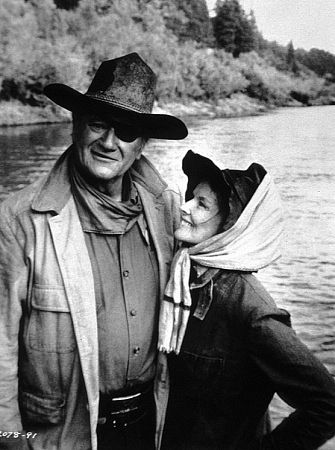
Some excerpts from Kate Hepburn's autobiography Me:
He is so tall a tree that the sun must shine on him whatever the tangle in the jungle below.From head to toe he is all of a piece. Big head. Wide blue eyes. Sandy hair. Rugged skin - lined by living and fun and character. Not by just rotting away. A nose not too big, not too small. Good teeth. A face alive with humor. Good humor I should say, and a sharp wit. Dangerous when roused. His shoulders are broad - very. His chest massive - very. When I leaned against him (which I did as often as possible, I must confess - I am reduced to such innoncent pleasures), thrilling. It was like leaning against a great tree. His hands so big. Mine, which are big too, seemed to disappear. Good legs. No seat. A real man's body.
And the base of this incredible creation. A pair of small sensitive feet. Carrying his huge frame as though it were a feather. Light of tread. Springy. Dancing. Pretty feet.
Very observing. Very aware. Listens. Concentrates. Witty slant. Ready to laugh. To be laughed at. To answer. To stick his neck out. Funny. Outrageous. Spoiled. Self-indulgent. Tough. Full of charm. Knows it. Uses it. Disregards it. With an alarming accuracy. Not much gets past him.
He was always on time. Always knew the scene. Always full of notions about what should be done. Tough on a director who had not done his homework. Considerate to his fellow actors. Very impatient with anyone who was inefficient. And did not bother to cover it up.
More:
Life has dealt Wayne some severe blows. He can take them. He has shown it. He doesn't lack self-discipline. He dares to walk by himself. Run. Dance. Skip. Walk. Crawl through life. He has done it all. Don't pity me, please.And with all this he has a most gentle and respectful gratitude toward people who he feels have contributed very firmly to his success. His admirers. He is meticulous in answering fan mail. Realistic in allowing the press to come on the set. Uncomplicated in his reaction to praise and admiration. Delighted to be the recipient of this or that award - reward. A simple man. None of that complicated Self-Self-Self which seems to torment myself and others who shall be nameless when they are confronted with the Prize for good performance. I often wonder whether we behave so ungraciously because we really think that we should have been given a prize for every performance. And are therefore sort of sore to begin wtih. Well, as I began - he is a simple and decent man. Considerate to the people who rush him in a sort of wild enthusiasm. Simple in his enjoyment of his own success. Like Bogie. He really appreciates the praise heaped upon him. A wonderful childlike, naive open spirit.
And lastly:
As an actor, he has an extraordinary gift. A unique naturalness. Developed by movie actors who just happen to become actors. Gary Cooper had it. An unselfconsciousness. An ability to think and feel. Seeming to woo the camera. A very subtle capacity to think and express and caress the camera - the audience. With no apparent effort. A secret between them. Through the years these real movie actors seem to develop a technique similar to that of a well-trained actor from the theatre. They seem to arrive at the same point from an entirely different beginning. One must unlearn - the other learns. A total reality of performance. So that the audience does not feel that they are watching. But feel a real part of what is going on. The acting does not appear acting. Wayne has a wonderful gift of natural speed. Of arrested motion. Of going suddenly off on a new tack. Try something totally unrehearsed with him. He takes the ball and runs and throws with a freedom and wit and gaiety which is great fun. As powerful as is his personality, so too is his acting capacity powerful. He is a very very good actor in the most highbrow sense of the word. You don't catch him at it.When you buy a cotton shirt - you want to get a cotton shirt. Not nylon. It stays clean, but it makes you sweat. Not drip-dry, which you don't have to press but you should. Just cotton. Good simple long-lasting cotton. No synthetics. That's what you get when you get John Wayne.
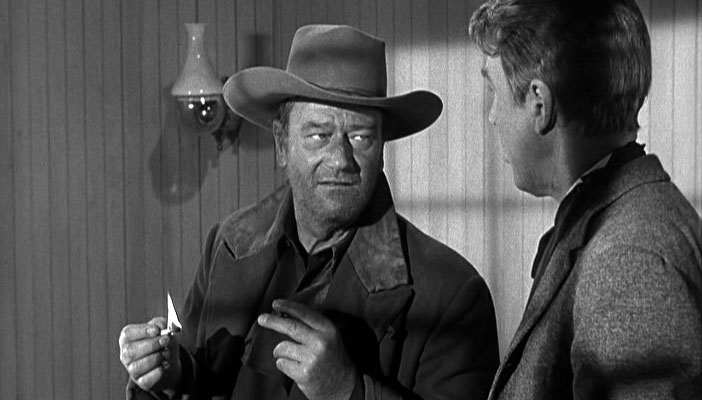
The Books: "Still Life" (A.S. Byatt)
Next up in my Daily Book Excerpt ... Adult fiction shelves:
 Still Life - by A.S. Byatt.
This is the second of the "Potter family" books and man, I love this book. Her big themes continue from Virgin in the Garden: intellect vs. body, marriage vs. independence, madness vs. creativity. Interspersed throughout the book are long fascinating excerpts from the letters of Theo and Vincent van Gogh - so the book has an intellectual rigor to it (as all her books do). It's not straight narrative. We get into the nitty-gritty of the characters' lives - and then switch back to treatises, by an omniscent narrator, on the van Goghs, and art, and trying to capture light and color. Frederica - the prickly "star" of this book - escapes Yorkshire and goes to Cambridge. She falls in with a rowdy group of men (who continue on as characters in the subsequent books). Frederica is the kind of woman who flourishes in platonic male friendship. It's not that she doesn't like women - but it's one of her struggles - to remain a woman, while at the same time being a serious academic, and being taken seriously in her work. Stephanie has married Daniel, a vicar - and you can see how she begins to lose her fight in this regard almost immediately. But because it's AS Byatt writing it - it's not a simplistic struggle. It's just that ... at the time (and even now, to some extent) - marriage is seen as a structure that has a specific form, and you must adhere to that form - or it's not a marriage. Wives should be a certain way. Stephanie is not rebellious, by nature - but she has a moment in this book, when she's going into labor, and she knows she's going to be in the hospital for some time - and she is desperate for someone to go home and bring her her books. This request is not understood. She is seen as being difficult, weird. Why does a new mother need her complete Wordsworth by her side? Again, this isn't said explicitlly - but it's there - and you really feel for Stephanie, trapped in a life that she thought maybe would free her up (it is the 50s, after all - you can't be single for TOO long ... marriage was seen as the truly freeing thing). But what really interests me about this book is the back and forth between the spectacular letters of Theo and Vincent - and the Potter family. It's such a nice device. I found it to be hugely effective. Marcus, the brother, has had a nervous breakdown - and has been convalescing in a hospital for some time. His "madness" has to do with how he perceives light. Light comes across to him as a mathematical theorem - he can SEE it - breaking apart, coming together - lines, angles, parabolas - it is something he cannot control. There is a genius in Marcus, a mathematical genius - but he becomes overwhelmed by the very FACT of light's existence, he can't bear it. This, of course, is very similar to Vincent van Gogh's madness ... after all, Vincent never saw his famous painting "Starry Night" as impressionistic, or abstract in any way. This is actually how the stars appeared to him. Is that madness? Does it even matter?
Here's an excerpt from the book. I love her writing, man. There's a distance to it - as there is in all the Potter books. It's almost like a treatise, a sociological examination - you'll see what I mean. This is from Frederica's time at Cambridge. There's something about Byatt's specific excavation of Frederica's motives and actions during this time that reminds me of this time in my life. I was very very Frederica-esque then. Byatt could be describing me. It's odd, and cool, isn't it ... when you see yourself in a book? It's like: but ... but ... that's so private ... how could Byatt know that??
Excerpt from Still Life - by A.S. Byatt.
She had too tough and inflexible a sense of her identity to be as good a chameleon as Alan Melville. She did not intend, as she began to suspect he did, to make a career of it. She tried, in a small way. She said "darling" and "love" to the theater people. She tried to adjust her clothes to the preconceptions of sweet Freddie, though some things cannot be done without money. (He was shocked by a pair of elbow-length nylon gloves she had, which he had supposed might be old lace.) She talked about "value" to the poetry friends and slickly and cynically to Tony and Alan. But only in bed - or on sofas, or in punts, or hand in hand on the Backs - did she truly practice being a chameleon. She gave back as much - or more often as little - as was offered or expected. Her greed did not express itself in bed as it did in conversation. She copied and followed, she did not demand. She was unaware that this was all she did. She awoke once from a dream in which she was a grass meadow, held to the earth by myriad grass roots through her hair, fibrils painlessly incorporating her skin in turf, a Gulliver being absorbed by Lilliput, and over the meadow leaped, slowly, exhaustedly, rhythmically, similarly, a procession of pale yellow frogs, long legged, mostly flaccid, a spurt, a heavy-breathing rest, a floppy spurt, one after the other after the other ...
This may seem to be a chill and cynical account of a time that was, was perceived as, rich, confusing, full of emotion. The language with which I mgiht try to order Frederica's hectic and somewhat varied sexual life in 1954-55 was not available to Frederica then. She had the phsycial and intellectually classifying adjectives, but she did not believe herself to be primarily conducting research but looking for love, trust, "someone who would want her for what she was". And she had thought very little about the feelings or expectations of clever boys or clever young men. There were many things, however many beds she hopped in and out of, however many cheeks she demurely brushed, that she was not fitted to understand. She came, after all, not in utter nakedness but cocooned by her culture in a web of amatory, social, and tribal expectations that was not even coherent and unitary.
She believed unquestioningly, with part of herself, for instance, that a woman was unfulfilled without marriage, that marriage was the end of every good story. She was looking for a husband, partly because she was afraid no one might want her, partly because she couldn't decide what to do with herself until that problem was solved, partly because everyone else was looking for a husband. (It is curious, but true, that the offers she received in no way changed her fixed feeling that the sort of woman she was was essentially not wanted as a wife.)
She believed, with a mixture of "realism" and resignation, that women were much more preoccupied with love than men were, more vulnerable, more in pain. There were imposing tags in her mind. "Man's love is of man's life a thing apart / 'Tis woman's whole existence." "He for God only, she for God in him." "I claim only this privilege for my sex - you need not covet it ... this distinction of loving longest when life, when hope is gone." She was conditioned to desire to be abject. This desire was reinforced by the behavior of Rosamond Lehmann's heroines and of Ursula Brangwen (whom some other part of Frederica was ready to despise heartily.) And there was the knowledge gleaned from agony columns, where abject women asked for help with the indifferent, the unfaithful, the only-wanting-one-thing, the other women's husbands.
The Frederica who had fled to Scarborough with Wilke rather than go to bed with Alexander might be described as instinctively in revolt against "whole" (overwhelming) love, though she would have said she was afraid of failure, embarrassment, bloodshed. The Frederica who conducted experiments in sex in Cambridge was looking for an ideal lover. At one level. At another, she was considering a battle with the whole male sex. She often said, "I like men," as one might say, "I like strong cheese," or "I like bitter chocolate," or "I like red wine." Sghe came to pronounce that each realationship was what it was - dancing, sex, talk, friendship - as many as there were men. This was true, and she believed it, but it was not the whole truth. Her behavior was more dictated by generalizations aout men, or Men, than she was at first aware.
Men had their group behavior. Together they talked about girls as they might about motorcars or beer, joking about breast measurements and legs, planning campaigns of seduction like army or teenage gang maneuvers. For these men women were better or worse, easier or more rarified sex. Simply. Frederica did the same, at first half-consciously, then with deliberation. She judged and categorized men. Quality of skin, size of backside, texture of hair, skill. Men discussed whether girls would or wouldn't. Frederica furiously categorized those men who could and couldn't. If men wanted "only" one thing, so could, and would, and did, Frederica Potter. She took some pride in the fact that there was no one who could feel able to refer to her as his girlfriend. She preempted the planned, staged, purchased 9with curry, with films, with wine) seductions by immediate acquiescence or unusually direct and candid rejection. These habits took some learning and there were moments when she lost her nerve, even wondered if she were cheap, or a tart. (Fast would have been a good word for her but came from another decade.)
There were men who wanted her, or seemed to, who sent letters quoting "the not-impossible She", who asked delicately if she saw them as perhaps special. Here Frederica's confusion was at its height. She believed that she wanted to solve the marriage problem. To find a true mind, with the rest of course added. But she also wanted not to be like her mother's generation, free and powerful only during this brief artificial period before concession and possession. She felt contempt for the suitors, which protected her from taking them seriously, or allowed her to remain abject - in her own mind - before the not-impossible unknown. She prevaricated and cheated, shared them with other women and neither felt nor appeared to feel jealousy. (This was owing to egocentricity: she simply could not imagine men in the company of other women.)
It shouould by now be clear that Frederica was more than once both cruel and destructive. In extenuation it can be argued that she had not been led by custom or by cultural mythology to suppose that men had feelings. Men were deceivers ever, the bad ones, and masterful, the good ones. The world was their world and what she wanted was to live in that world, not to be sought out as a refuge from or adjunct to it.
She might have been instructed by literature. She had read endless descriptions of the shyness and desperation of male first love. But whereas she recognized the humiliation of Charlotte Bronte's Lucy Snowe, of Rosamond Lehmann's brave, doomed girls, and the death of the heart, from some fund of ancient knowledge, she did not recognize, or believe in, the professional coquettes or pure young girls, or mysterious animal presences of the male novels. None of these were anything to do with Frederica Potter, who was brisk, businesslike, interested in but not obsessed by sex, and wanted to make friends of the creatures if they would have it. Women in male novels were unreal and it was beyond Frederica's comprehension that young men might suppose she was any or all of these characters. So they battled, the men to be hopelessly devoted, Frederica to be abject and/or free, and were puzzled and hurt. Frederica was shocked and startled when one young man burst uninvited into a tea she was making for another and smashed a teacup with a poker. She categorized long and deeply considered love letters as parts of a campaign and ignored them. When one desperate man whom she found unexciting, apart from an encyclopedic knowledge of Thomas Mann, burst into tears and said she was mcking him, she could only stare, become wholly silent, and go home.
May 20, 2007
Scanner sunday
My favorite road sign in Ireland (and I love the accompanying prop below) - it's just so hysterical. (More on Irish signs here)
Scanner sunday
I haven't touched up this photo at all. This is actually what I saw. This is the view from the end of my street. It is dawn. I mean, can you believe it??


Scanner sunday
He's lecturing me about something, chowing down on a stack of French toast.

Scanner sunday
Hi, everybody! I am SO EXCITED. I mean, just check out my pants ... wouldn't YOU be excited if YOU were wearing such pants? Also ... it is just SO FUNNY to be perched at the top of the bulkhead. Like ... I cannot get over HOW FUNNY it is to be up so high in my plaid pants!

Scanner sunday
Welcome to Belfast! Carrie gave us directions, involving the phrase, "Take a left when you see the mural of the chicks with the guns ..." You know, as though she were saying, "Turn left when you see the Dunkin Donuts ..." We did the whole mural tour with Carrie. I mean, you just gotta. Our tour guide said stuff like, "And over der is da pub where me girlfriend's da got his leg blown off ..."
This one is actually not on the side of a private home - like all the other ones are - this is on the side of the Sinn Fein office. Gerry Adams was inside - and you can see the television truck antenna in the foreground. Lots of TV journalists hanging out, waiting, smoking, drinking coffee. We talked to them for a bit.
Hi! Welcome to the neighborhood!
Scanner sunday
I think wearing some kind of sailor-middy type dress should be compulsory for little girls.
Who ... me?
Scanner sunday
A gleam of gold.
This was on my way out to Block Island one wintry day. Heavy grey clouds, dark icy ocean - with this gleam of gold at the horizon. Truly spectacular - heart-stoppingly so.
Scanner sunday
Long-time regular readers of my blog will recognize this one right away. And for those of you who are new ...
Still has the potential to get me all choked up.
Scanner sunday
I found this photo in my big hatbox this morning - I was looking for something else and instead floated off down memory lane. This photo is what happens when you live with one of your best friends, and you have the same sense of humor, and you take a joke and you run with it. I am drunk (obviously) and Mitchell said to me, "You know - in that get-up you somehow look like a disaffected member of some defunct royal family - like a Hapsburg princess on vacation in the Alps or something."
What? But that became the joke. That I was a coked-up princess deprived of her throne - being all bitter and glamourous in some Alpine nightclub. There are a number of other photos in this series. I loved living with Mitchell, we were always doing crap like that.

The Books: "The Virgin in the Garden" (A.S. Byatt)
Next up in my Daily Book Excerpt ... Adult fiction shelves:
 The Virgin in the Garden - by A.S. Byatt.
This is Byatt's third novel - and actually, she has gone on to write three more books about this particular family, so there was obviously something here that gripped her. You can tell in the writing, too. The book takes place in 1952, in England - the time of Elizabeth's coronation - seen as "the new Elizabethan age". This is AS Byatt's explicit topic. A young playwright/academic has written a new play, in honor of the occasion of the coronation - and if I recall correctly it's in verse, and it's about Elizabeth, the Virgin Queen. Drawing parallels between that age and the "new" age. The play is to be put on at a private school - and the headmaster and his family (3 kids) are the main characters of Byatt's book. The chapters alternate points of view. We follow Bill (the father), and Stephanie, Frederica and Marcus (the children) through their lives - but all the time, they are grappling with big questions and issues. What is it to be English? What is culture? Is it something to be inherited? Is how we speak directly influenced by, say, Chaucer? Shakespeare? Byatt revisits these themes again and again in her books (Possession is all about that). Virgin in the Garden is really ABOUT England. England at a particular time. There is a cynicism in the era - a kind of dichotomy between the brou-haha of the upcoming coronation (and all its sincerity - you know, there's no ironic distance in a coronation, no wink-wink at the audience), and all of the shining expectations of what this new age will bring for the British Empire - and the snarkiness going on below in the populace. Another one of Byatt's main themes (this, I believe, is the thing I found most piercingly wonderful in Possession, the thing that spoke to me the most) is the split between the cerebral and the earthy. Body and mind. In a funny way, nobody writes about sex like AS Byatt. At least, to my taste and sensibilities. She writes about cerebral people, intellectuals, to some extent cut off from their own bodies - this is her topic. Sex is not always easy, or grasp-able to certain types - although the desire is usually present in every human. So there's Frederica and Stephanie - the two daughters in this book - both kind of cerebral in their own way. Frederica is sharp-minded, no-nonsense, not always likeable, unlike other girls - not gushy or mushy at all - and then there's Stephanie, a charcter I find truly fascinating. A quiet placid girl, a teacher ... I don't know, she's a mystery to me. With all her quiet placid-ness, I never knew what she was going to do next. Anyway, the lushness of Elizabethan drama, juxtaposed with the dry academic setting in 1950s England - the national hysteria over the coronation - juxtaposed with Stephanies' lectures to her students - on Keats, Ovid, Chaucer ... The book is kind of patchwork, no real plot - (unlike Possession, which is all plot) - but what you are left with is ... the image of a nation on the brink of some big changes. 1950s England. What is it to be English? What is it to be an artist? How does one feel about Shakespeare, if one is English? How does he inform the present? What is culture? A construct? Or something more organic? Byatt knows what's coming - because this book was published in 1976, I believe. Byatt knows that England, like many other countries, is headed for some decades of self-doubt, cynicism, and rebellion against old forms. The prologue of Virgin in the Garden takes place in 1968 - so in some sense, by doing that, Byatt is placing the book in its decade, purposefully. There is some retrospect. What do the 1950s look like, from the end of the 1960s? It's almost like it was a different world entirely.
I love this book. I should go back and read it again.
Here's an excerpt. I didn't know what to pick - the book is so rich, and there are so many parts I love - the family watching the coronation on television, and having all kinds of differing responses to it - the discussions of the new play, rehearsals - but I like this one. I wanted to pick an excerpt having to do with quiet deep Stephanie. Here she is, in the classroom where she teaches. She's gotta be about 20? Can't remember. She, unlike her sister Frederica, isn't a difficult character to like. But she is difficult to understand. There seems to be some melancholy there, and also - perhaps she represents a kind of old order. Meaning: look at the poem she is teaching to her students. A 'revolution' in the culture is coming. In the 60s and 70s, lit crit and multicultural concerns are going to re-make "English" classes into something entirely different. How would Stephanie have fared in that new landscape? It's not that she's a purist. No, not exactly. But her reading - and the way Byatt talks about her reading - is personal. I can't imagine that politicized readings of the classics would appeal to her at all.
Byatt doesn't really get into all of that in this book (she saves that for later books in this same series, and takes it as her main subject for Possession) - but it is there, nonetheless.
Excerpt from The Virgin in the Garden - by A.S. Byatt.
Stephanie sat in a chill brown classroom, whitened over with chalk dust, and taught the Ode on a Grecian Urn to those girls who had not gone to Blesford Ride. Good teaching is a mystery and takes many forms Stephanie's idea of good teaching was simple and limited: it was the induced, shared, contemplation of a work, an object, an artefact. It was not the encouragement of self-expression, self-analysis, or what were to be called interpersonal relations. Indeed, she saw a good reading of the Ode on a Grecian Urn as a welcome chance to avoid these activities.
She had never had trouble with discipline, although she never raised her voice. She exacted quietness, biologically and morally. Girls came in from outside, buzzing, crashing, laughing. Barbara, Gillian, Zelda, Valerie, Susan, Juliet, Grace. Valerie had a disfiguring boil and Barbara an acute curse pain. Zelda's father was dying, this month or next, and Juliet had been shocked by a strange boy who had thrust his fist up her skirt and crooked an elbow around her throat in a Blesford ginnel. Gillian was very clever and required a key, mnemonics and an analytic blueprint of the Grecian Urn for exam purposes. Susan was in love with Stephanie whom she tried to please by straining her attention. Grace wanted only to have a florist's shop, was held at school in a vice of parental ambition, biding her time.
Stephanie's mind was clear of all this information, and she required that their minds should become so. She made them keep still, by keeping unnaturally still herself, as tamers of wild birds and animals keep still, she had read in childhood, so that the creatures become either mesmerized or fearless or both, she was not sure which.
She required also that her mind at least should be clear of the curious clutter of mnemonics that represented the poem at ordinary times, when the attention was not concentrated upon it. In her case: a partial visual memory of its shape on the page, composed, in fact, of several super-imposed patterns from different editions, the gestalt clear, but shifting in size: a sense of the movement of the rhythm of the langauge which was biological, not verbal or visual, and not to be retrieved without calling whole strings of words to the mind's eye and ear again: some words, the very abstract ones, form, thought, eternity, beauty, truth, the very concrete words, unheard, sweeter, green, marble, warm, cold, desolate. A run of grammatical and punctuational pointers: the lift of frozen unasnwered questions in the first stanza, the apparently undisciplined rush of repeated epithets in the third. Visual images, neither seen, in the mind's eye, nor unseen. White forms of arrested movement under dark formal boughs. Trouble with how to "see" the trodden weed. John Keats on his death-bed, requesting the removal of books, even of Shakespeare. Herself at Cambridge, looking out through glass library walls into green boughs, committing to memory, what? Asking what, why?
She read the poem out quietly, as expressionless as possible, a ditty with no tone. And then again. The ideal was to come to it with a mind momentarily open and empty, as though for the first time. They must all hear the words equally, not pounce, or tear, or manipulate. She asked them chilly, "Well?" prolonging the difficult moment when they must just stare, finding speech difficult and judgment unavoidable.
She sat there, looking into inner emptiness, waiting for the thing to rise into form and saw nothing, nothing and then involuntarily flying specks and airy clumps of froth or foam on a strongly running grey sea. Foam not pure white, brown and gold-stained herre and there, blowing together, centripetal, a form cocooned in crusts and swathes of adhesive matter. Not relevant, her judgment said, the other poem, damn it, the foam of perilous seas. The thing had a remembered look, not pleasant, and she grimaced, as she saw it. Venus de Milo, Venus Anadyomene. The foam-born, foam from the castrated genitals of Kronos. Not a bad image, if you wanted one, of the coming to form from shapelessness, but not what she had meant to call up.
"Well," she said to the girls, "well, what do you see?"
They began to talk about when Keats required his reader to see an urn and when a landscape, what colours he called up and what he left to chocie, and moved from there to the nature of the difficulty of seeing what is formed to be
"seen" by language alone, marble men and maidents, the heifer and altar, a burning forehead and a parching tongue, cold pastoral.
Herad melodies are sweet but those unheard
Are sweeter,
said Stephanie. Clever Gillian commented that the word desolate was the centre of the poem, almost allowing one to be taken out of it, like the word forlorn in the Nightingale. They talked about beauty is truth, truth beauty. They talked, as Stephanie had meant them to, about a verbal thing, made of words so sensual and words not sensual at all, like beauty and truth. She talked about what it could mean, that the turn should "tease us out of thought As doth eternity". It is a funeral urn, said Zelda. That is not enough to say, said Susan, staring at Stephanie.
Things moved in the classroom, amongst eight closed minds, one urn, eight urns, nine urns, half realised, unreal, white figures whose faces and limbs could be sensed but not precisely described, bright white, the dark, the words, moving, in ones, in groups, in clusters, in and out of whatever cells held their separate and communal visual, aural or intellectual memories. Stephanie talked them out of the vocabulary she was supposed to be teaching them and left them with none, darlkling. Gillian, who was enjoying the process, reflected that words could be quickly enough snatched back, when the occasion required it. Stephanie reflected that this poem was the poem she most cared for, saying ambivalently that you could not do, and need not attempt, what it required you to do, see the unseen, realise the unreal, speak what was not, and that yet it did it so that unheard melodies seemed infinitely preferable to any one might ever hope to hear. Human beings, she had thought, even as a very small child faced with The Lady of Shalott, might so easily never have hit on the accidental idea of making unreal verbal forms, they might have just lived, and dreamed, and tried to tell the truth. She had kept asking Bill, why did he write it, and the answers had been so many and so voluble and so irrelevant to the central problem, that she closed her mind to them, even whilst effortlessly committing them to memory for future use, as Gillian now must and would.
The bell rang. They came out blinking, like owls into the bright daylight. Stephanie, gathering her books, allowed herself to wonder whether the irrelevant flying foam she had seen had come from the Nightingale, or from her own intellect, making Freudian associations all too tidily between marble maidens, the Venus and the subconscious knowledge she had of the nature of that foam. It was not very nice foam.
May 19, 2007
Photo category
I created a new category for photos. Just cuz.
I have a lot of writing to get done this weekend, and I also have Witness for the Prosecution to watch and there's a massage to get and lots of cleaning to get done. The last couple of weeks have been so busy (although you'd never know it from what I share on the blog! ha) that I feel like I haven't had a chance to breathe. Today I will breathe! After I get to work on my writing, that is.
The Books: "The Game" (A.S. Byatt)
Next up in my Daily Book Excerpt ... Adult fiction shelves:
 The Game - by A.S. Byatt.
This is AS Byatt's second novel, published in 1967. She had quite a long writing life before she finally hit the jackpoet with Possession - she did a lot of critical writing, studies of Iris Murdoch, she taught, she wrote, but she didn't have, for many many years, fame. I like that about her. I like that she didn't make a splash with her first book, or her second, or her third. Or her fourth ... etc etc. I like the long-percolating aspect of her career. I read these earlier books of Byatt's and she, as a writer - the voice, the concerns, the themes - is clearly in evidence. I totally recognize the writer of Possession here. It's just that the subject matter isn't yet BIG enough for her particular gifts. She's a very detailed writer - but she's also a writer who truly THINKS about things - trends, generations, movements, etc. - She thinks about these things not in a dilettanteish way - she doesn't use these things as plot points ... these are truly her concerns. (Like the whole "lit crit theory" trend - which is the jumping off place for Possession)
The Game - I can't remember much about it. I know it's about two estranged sisters. They had a troubled upbringing and created a fantasy world together when they were little - a sort of Knights of the Round Table world - that reminds me a bit of the two girls in Heavenly Creatures and that claymation world they would escape to. Uhm ... and that's all I remember. I know that now, when the book starts, the two sisters are grown women, married - estranged ... and somehow they are drawn back together again. There's a sort of "evil" guy named Simon - has he had affairs with them both? How does he factor in? No memory. But he, predictably, is some sort of specialist on snakes (see - Byatt hasn't quite figured out yet how to hide her themes more gracefully) - he has a television program about snakes, and the two sisters are kind of haunted by seeing him everywhere. They have known Simon since they were young girls - and ... somehow ... well. He's the snake in the garden. The book is supposed to be really psychologically ominous - but as you can tell, none of it has remained in my memory.
I flipped thru it just now, and some of it came back to me - but only some.
There are long sections of Cassandra's journal (Byatt is very into doing that - she likes that device, a very Jane Austen-y device - of printing letters, memos, journals - that's the whole point of Possession - She likes giving you, the reader, the feeling that you are rifling through someone else's papers.) So anyhoo - here's an excerpt involving the teenage Cassandra's journals.
Like I wrote elsewhere: I totally recognize AS Byatt here. It's 1967, it's years before she hit it with Possession - but the voice is already there. I love that.
Excerpt from The Game - by A.S. Byatt.
Cassandra's Journal. Easter 1944.
Today he showed me the snakes. I hoped he might, as I imagine he would not show them to most people. He says he has 'for some reason' always kept them a secret. So I was very flattered, but could not comment as intelligently or enthusiastically as I would have liked to. I hoped to feel we were sharing something, but he was a bit schoolmasterish - more letting me be there than wanting me. I refine too much on what he says. I said, 'Is there anything I can do?' He said, 'Just sit there and keep me company.' I was absurdly pleased by this. (Must watch myself, no lies, no lies.) One must never ask for more than is offered - not out of virtue, but because if one does one loses what one has.
Snakes are strange things. Not evil-looking, as I had supposed, not anything much, just little heaps like coils of rope or something one might have dropped. He keeps them hidden in this cave. In glass tanks. He has earth on the bottom, and odd stones, and dishes of water for them to swim in. None were swimming. I would make it all look much better, but he clearly doesn't care how it looks. There is water running down the back wall; the stone is stained, silver and gold and olive; there are minute ferns growing in crevices. One could perhaps grow ferns all round, put in a few shelves.
It is strange to me to think anyone could love those snakes - stranger than before I saw them - but in some way he clearly does. He has ten grass-snakes, three smooth-snakes and two adders he caught in the heather. He has a collection of skins, wrapped in oilskin, in a metal box, and a book full of observations. There are no thoughts, only notes on how they excrete, how and when they cast their skins, how they swallow, how long they go iwthout food, what they will and won't eat. They have no names, although he knows them all apart. He told me they were beautiful, which I suppose is a kind of thought. I expected to find them beautiful myself - I am the sort of person you would think would - but I didn't. There was a dryness and nothingness about them. I was somehow surprised they were alive. They were nothing, really, just accidental tubular shapes of things. He says spring is late so they are torpid; they are inert, as though the step from life to death was insignificant to them. Snakes have no lids to their eyes, and so look plainly out at you; this makes them seem not so much fascinating as stupid.
I like watching him watch them. One of the things about knowing him is the excitement of mapping out all the directions in which there are things to learn I shall never know more of than that they are there. (Prose!!) I really don't want to know more than he voluntarily tells me, partly because I am shy. I stand around in a waiting silence much of the time but he doesn't seem to mind too much. I hope my waiting doesn't oppress him. God knows I don't mean it to. He said last week I was censorious, but oh, Simon, not with you, ever.
We had for lunch spam, tomatoes from his greenhouse, half a hard-boiled egg each and an apple.
We had another argument about the Incarnation. I was trying to say I didn't see it was necessary for Christ to have been God or to have died. It seems to have made, proportionately to what is claimed for it, so little difference - historically, that is - it hasn't changed war or murder or cruelty, most people still know nothing about it. I said I didn't want God to have been made flesh, as far as I was concerned if there was any point in the idea of God it was precisely that He was not flesh, he was something else, something other. He said might we not then feel God was inaccessible, and I said that individually, for myself, that was how I did feel. I see the flaw in my argument here.
He said, surely I saw something was wrong with the world - 'something horribly twisted' was how he put it. He said some twisting back on a really grand scale was needed, some 're-wrenching', not done by us, to counteract this.
I said, something was certainly horribly wrong, but it seemed to me likely that it had always been wrong and had not at one point in time 'gone wrong'. I said we have no right to think this re-wrenching actually took place just because we think it ought to have. He said the point about the Crucifixion was that it was the moment when the eternal was involved in history - thus its effects were eternal (we are now forever able to be saved) and historical (it has to be worked out). I said this was too metaphorical. I was angry because he didn't see that if the 'going wrong' wasn't historical, the atonement needn't be. He was angry with me; he wants me to believe.
I told him that what I found saving was the order and structure one could see in things, smooth-running, meaningful. The growth of plants, the circulation of the blood, networks of working muscles, veins on leaves, movements of planets and shoals of fish. A harmony one could see. This is what we are for, to pay attention to this beautiful network of designed movement that we and our tragedies are held in. He said that suffering and sin were rents in this network, and that Christ was a guarantee that they could be mended, the fabric could be restored. I said I thought the need for Christ was a need to simplify, to reduce to terms of human suffering something that is neutral, not loving, inhuman, not human.
We were angry with each other. I wish I didn't have to win arguments, especially with him. It doesn't do me much good. Moreover, about concrete suffering at least, he knows more than I do. Mine is all in the head. But he knows. I feel he is always on edge and menaced. I don't know why. I speculate about how he lives in that house; going into it is unthinkable. He must do normal things, brush his hair and teeth, sit by the fire ... He doesn't talk about his family. I don't ask.


May 18, 2007
Remaining quotes
Okay, so I just have to say to everyone who showed up today: you are all so awesome. Beautiful. The guesses, the slow load-time of comments, the feeding frenzy atmosphere ... the beautiful stabs in the dark (sometimes the guesses are so illuminating, so intelligent - even if they were wrong) - the pondering, the worrying over certain quotes ... Seriously, it's on days like this that I'm really proud of this blog, and the fact that you people show up on a daily basis. I love it. Thank you for playing and playing so hard! It makes it all so fun.
Time to point out the quotes left unguessed - and I'll give a clue for each one.
This one has been giving folks a LOT of trouble. I guess I thought it was more obvious than it was! So here's the clue: the American dream gone horribly awry.
This one. Not one guess!! Here's a clue: bounty hunter
This one We've narrowed it down to a Woody Allen film. Here's a clue: ee cummings
This one. Here's a clue: Africa
This one Some awesome and very logical guesses. Here's a clue: vaudeville
This one I put a clue in the comments section there. It's truly terrifying.
This one Here's a clue: encyclopedia
This one DBW? Where are you?? Let's see - here's a clue: Scar
This one Here's a clue: a lost bumblebee
This one Clue: funhouse mirror
This one Clue: planetarium
This one Clue: "We're Texicans"
Movie quote
"Do we look like the kind of store that sells 'I Just Called to Say I Love You'?? Go to the mall."
Movie quote
"Come on, all the long distance lines are down? What about satellite? Is it snowing in space? Don't you keep open a line for emergencies or for celebrities? I'm both. I'm a celebrity in an emergency."
Movie quote
"You want the word on that brother-and-sister act, Hansel's a fag and Gretel's got the hots for herself, so who cares, right? Load up on the salami. "
Movie quote
"Amputate a man's leg and he can still feel it tickling. Tell me, mum, when your little girl is on the slab, where will it tickle you?"
Movie quote
"Don't forget: stay out of the adult bookstore. "
"Adult bookstore. Why? "
"Poison gas. Invisible. "
Movie quote
"Step on it, Velma! Step on it, Velma! Step on it, Velma. Step on it, Velma. Velma, step on it, Velma! "
Movie quote
"You shoulda looked out for me a little bit. You shoulda taken care of me just a little bit so I wouldn't have to take them dives for the short-end money."
Movie quote
"Those two yellow zinnias at the end, they're shorter now. Now since when do flowers grow shorter over the course of two weeks? Something's buried there."
Movie quote
"I like your outfit too, except when I dress up as a frigid bitch, I try not to look so constipated."
Movie quote
"Perhaps you're interested in how a man undresses. You know, it's a funny thing about that. Quite a study in psychology. No two men do it alike. You know, I once knew a man who kept his hat on until he was completely undressed. Yeah, now he made a picture. Years later, his secret came out. He wore a toupee. Yeah. You know, I have a method all my own. If you notice, the coat came first, then the tie, then the shirt. Now, uh, according to Hoyle, after that, the, uh, pants should be next. There's where I'm different... I go for the shoes next. First the right, then the left. After that it's, uh, every man for himself. "
Movie quote
"You were diagnosed with something called a brain cloud and didn't ask for a second opinion?"
Movie quote
"You don't ask me things like that, do you? No! You never ask me what's on the flip side."
"No! Because I don't give a shit. Shrevie, who cares about what's on the flip side about the record?"
Movie quote
"What do you think you are, for Chrissake, crazy or somethin'? Well you're not! You're not! You're no crazier than the average asshole out walkin' around on the streets and that's it."
Movie quote
"It adds up that you got yourselves the wrong guy. Because, I'm telling you, the krauts wouldn't plant two stoolies in one barracks. And whatever you do to me, you're gonna have to do all over again when you find the right guy. "
Movie quote
"Ever had sex with an animal, Jack? "
"No, but I saw some tasty-looking chickens back at that barn over there. "
Movie quote
"I don't like when somebody comes up to me the next day and says, 'Hey, man, I saw your play. It touched me; I cried.' I like it when a guy comes up to me a week later and says, 'Hey, man, I saw your play... what happened?' "
Movie quote
" I like the way I feel. I like thinking about the red dress and the television and you and your father. Now when I get the sun, I smile. "
Movie quote
"He treats me like a woman. "
"Oh he does, does he? Mm-hm... how did I treat you? Like a water buffalo? "
Movie quote
"When you pull on that jersey, the name on the front is a hell of alot more important than the one on the back. "
Movie quote
"I don't know anyone who could get through the day without two or three juicy rationalizations. They're more important than sex. "
"Ah, come on. Nothing's more important than sex. "
"Oh yeah? Ever gone a week without a rationalization? "
Movie quote
"Are you a nice girl or are you a cunt? "
"Can't I be both? "
"No. It's a decision a girl's gotta make early in life, if she's gonna be a nice girl or a cunt. "
Movie quote
"I don't believe this! I've got a trig midterm tomorrow, and I'm being chased by Guido the killer pimp. "
Movie quote
"Don't you think that idea is a little half-baked? "
"Oh no, Dad, it's completely baked. "
Movie quote
"It's called 'Charlie Chan In London'. It's a detective story. "
"Set in London? "
"Well, not really."
Movie quote
"You know, at one time, I used to break into pet shops to liberate the canaries. But I decided that was an idea way before its time. Zoos are full, prisons are overflowing... oh my, how the world still dearly loves a cage. "
Movie quote
"Son, if I'd only gotten to be a doctor for five minutes... now that would have been a tragedy. "
Movie quote
"Just going to the kitchen to get some food, then I'm going to tell you a story that will make your balls shrink to the size of raisins. "
Movie quote
"I'm a murderer. "
"No, you're not. "
"I'm a murderess. I'm gonna go to the pen. My poor kids. I'm gonna lose my job."
"Violet, stop this. "
"I'm no fool. I've killed the boss, you think they're not gonna fire me for a thing like that? "
Movie quote
"And Nietzsche, with his theory of eternal recurrence. He said that the life we lived we're gonna live over again the exact same way for eternity. Great. That means I'll have to sit through the Ice Capades again. "
Movie quote
"If I could only have one food for the rest of my life? That's easy, Pez, cherry-flavored Pez. No question about it. "
Movie quote
"Someday - and that day may never come - I'll call upon you to do a service for me. But until that day, accept this justice as gift on my daughter's wedding day. "
Movie quote
" Mother, you're a scream, really you are. The next thing I know you'll be knitting little garments. "
"I don't see anything so ridiculous about that. "
" If I were you, I'd save myself the trouble."
Movie quote
"You know what I think? I think that we're all in our private traps, clamped in them, and none of us can ever get out. We scratch and we claw, but only at the air, only at each other, and for all of it, we never budge an inch. "
"Sometimes, we deliberately step into those traps. "
"I was born into mine. I don't mind it anymore. "
Movie quote
"She said you came to the place where they buried her. Asked her a question? She said the answer is...'Every day.' What did you ask? "
"Do... Do I make her proud? "
Movie quote
"Gretchen, I'm sorry I laughed at you that time you got diarrhea at Barnes & Nobles ... And I'm sorry for telling everyone ... And I'm sorry for repeating it just now. "
Movie quote
"Like the fella says, in Italy for 30 years under the Borgias they had warfare, terror, murder, and bloodshed, but they produced Michelangelo, Leonardo da Vinci, and the Renaissance. In Switzerland they had brotherly love - they had 500 years of democracy and peace, and what did that produce? The cuckoo clock. "
Movie quote
"It's quiet. Only three days left. Plenty of time to read my Bible and look for a loophole. "
Movie quote
"What was she like, anyway? "
"Who? "
" That girl that made you act the way you do. "
"A whole lot like you. Just as nice, almost as smart. "
"Chorus girl? "
"Only by temperament. "
Movie quote
"Then, on the fourth day, he roped himself a couple of sea turtles, lashed 'em together and made a raft. "
"He roped a couple of sea turtles. "
"Aye. Sea turtles. "
"What did he use for rope? "
"Human hair. [pause] From my back. "
Movie quote
"What happened? "
" She ate from her own plate. She ate with a spoon. Herself. And she folded her napkin. "
" Folded her napkin? "
"The dining room's a wreck, but her napkin is folded."
Movie quote
"All my life I've had this strange feeling that there's something big and sinister going on in the world. "
"No, that's perfectly normal paranoia. Everyone in the universe gets that. "
Movie quote
"It's just that nosy Mrs. Bates going on about your picture last night."
"Oh really did she like it? "
"Oh really did she like it?... She liked it! "
Movie quote
"Erik got injured today. And do you know the first thing I thought when I saw him go down? "
"What?"
" 'I wish that was me.' So that made me think, you know, 'cause that's not a normal reaction. How much of what you liked about me was because I was a ballet dancer, and how much because I was me?"
Movie quote
"It seems it always happens. Whenever we get too high-hat and too sophisticated for flag-waving, some thug nation decides we're a push-over all ready to be blackjacked. And it isn't long before we're looking up, mighty anxiously, to be sure the flag's still waving over us. "
Movie quote
"I am so glad that I got sober now so I can be hyper-conscious for this series of humiliations. "
Movie quote
"I come from this musical family. My mother is a piano teacher and my father was a conductor. "
"Where did he conduct? "
"On the Baltimore and Ohio. "
Movie quote
"I don't get this. Why do we have to get you along? Back in the States, I'd drive up, honk the horn, the gal'd come runnin'... "
Movie quote
"'Course I'm respectable. I'm old. Politicians, ugly buildings, and whores all get respectable if they last long enough. "
Movie quote
"You're right, I did lose a million dollars last year. I expect to lose a million dollars this year. I expect to lose a million dollars *next* year. You know, Mr. Thatcher, at the rate of a million dollars a year, I'll have to close this place in ...... 60 years."
Movie quote
"I am gonna ask you questions. And every time you don't give me answers, I'm gonna cut something off. And I promise you, they will be things you will miss. "
Movie quote
"What you do is a tiny, pathetic subset of dancing. I will attempt to turn your robotic routines into poetry, written with the human body. Follow me, or perish, sweater monkeys. "
Movie quote
"Put all hope out of your mind. And masturbate as little as possible, it drains the strength! "
Movie quote
"You give him credit for too much cleverness. My impression was that he's just another blundering American."
"We musn't underestimate American blundering. I was with them when they blundered into Berlin in 1918. "
Movie quote
"Make no mistake, I shall regret the absence of your keen mind; unfortunately, it is inseparable from an extremely disturbing body."
Movie quote
"I think my eyes are getting better. Now instead of a big dark blur, I see a big bright blur. "
"There's nothing to see. I used to live here, you know. "
"You're gonna die here, you know. "
Movie quote
"I'm gonna get fuckin' divorced. No marriage counselling, no trial separation, I'm gonna get fuckin' divorced."
Movie quote
"She does things in there I'm not allowed to see. So I go to the window and imagine that I am smelling the garden."
Movie quote
"My dear young man, don't take it too hard. Your work is ingenious. It's quality work. And there are simply too many notes, that's all. Just cut a few and it will be perfect."
"Which few did you have in mind, Majesty?"
Movie quote
"I just have one question: What's with the turtlenecks? I mean it's the middle of summer."
Movie quote
"Do you know what it's like to fall in the mud and get kicked... in the head... with an iron boot? Of course you don't, no one does. It never happens. It's a dumb question... skip it."
Movie quote
"Honey, would you rather I were making love to him using your name, or making love to you using his name? "
Movie quote
"It's your birthday, and it's time you knew. You're not our natural-born child."
"I'm not??? You mean I'm gonna STAY this color?"
Movie quote
"Gentlemen, we do not stop till nightfall. "
"What about breakfast? "
"You've already had it. "
"We've had one, yes. What about second breakfast? "
Movie quote
"Wouldn't it be wonderful if we were old? Then we could say we survived all this. Everything thing would be uncomplicated, the way it was when we were young?"
"Katie, it was never uncomplicated."
Movie quote
"Aren't you too old to go to space camp?"
"You're never too old to go to space camp, dude."
Movie quote
"Well, did you hear that? I'm practically on the wagon, that's quite a change."
"It's a phase."
"You don't think a woman can change?"
"Sure, change is fun, for awhile."
Movie quote
"Your national security advisor has just been executed. He's a very good negotiator. He bought you another half hour."
Movie quote
"You're just a mass of prejudices, aren't you? You're so much thought and so little feeling, Professor."
Movie quote
"...just possibly saving 120 passengers from a tragic fiery death!"
"I find that story intensely moving."
"I find it as difficult to swallow as this potage au gelee."
Movie quote
"All we've got is that maybe you love me and maybe I love you."
"You know whether you love me or not."
"Maybe I do. I'll have some rotten nights after I've sent you over, but that'll pass."
Movie quote
"You are suspended for six months, without pay, effective immediately! Have you anything to say?"
".......Could you lend me fifty francs?"
Movie quote
"Forget it! I'm stayin' right where I am. It's gonna take you and the police department and the fire department and the National Guard to get me outta here!"
Movie quote
"See this system here? This is Hi-Fi... high fidelity. What that means is that it's the highest quality fidelity."
The Books: "The Shadow of the Sun" (A.S. Byatt)
Next up in my Daily Book Excerpt ... Adult fiction shelves:
 The Shadow of the Sun - by A.S. Byatt. She's one of my all-time favorite writers. For Possession alone. But then there are the other books that I love ... Angels and Insects, Virgin in the Garden - her short stories ... she's so ... God, she's a true writer of ideas. Some people don't like that about her. My opinion is is that the ideas she tackles don't at all lesen the heart of the books. The first time I read Possession - a sweepingly brilliant book - full of all kinds of themes and ideas (postmodernism - a critique of it and also a validation of it - fascinating - Victoriana, sex, gender, the MEANING of reading ... like, the book is dense) - but anyway, the 'coda' to Possession - with the poet meeting the little girl in the field - knocked my socks off the first time I read it. I clutched at my heart when I read the last sentence, my soul cried out, "NO! NOOOOOO!" Perfect. A perfect and emotional ending to a perfect book. It packed a huge punch - and still does to this day. I've read it countless times and it is ALWAYS good. Shadow of the Sun is her first novel. It was published in the early 60s - she was an undergraduate when she wrote it. It did not make a splash - but was re-published after her huge breakthrough hit of Possession. And naturally I went and bought it and read it, since that one book alone made me a fan of all of AS Byatt's stuff forever. I actually can't remember much about Shadow of the Sun - I do know it's a book about a writer. A young woman whose father is a famous novelist. Byatt herself has commented on this book, saying - "It's a book by a young woman who doesn't quite know WHY she has to write ... but knows she MUST." She also has said (and I have noticed this, on my own reading of her work) that much of her writing is "heliotropic". This is definitely clear in Still Life - which intersperses the narrative with letters between Theo and Vincent Van Gogh. Her books are about color - green and gold are the background of so much - Possession, definitely. Think about Maud - her "golden hair" and the green headscarf she wears - the poems in Possession, full of gold and green. The whole "heliotropic" thing is a huge part of Shadow of the Sun (even the title!) The book opens with a long description of an English garden - and Byatt, the young writer, goes overboard on the descriptors - but you can see there the seeds of the writer she would eventually be. The "descriptive terms" in Possession are by someone who has become a master. She knows when to put them in, when to leave them out ... Shadow of the Sun is overwritten, as many books by young first novelists are ... and because I'm a huge fan of her - it's fun to watch her development. It's fun to read the three-page description of what the hay bales look like, gleaming in the sun ... even though it's "too much", even though a better writer knows to leave stuff out, that one paragraph will suffice. It's fun to read because you can feel AS Byatt finding, through the act of writing, what is important to her. What she SEES. The "heliotropic" focus ... she is not sure what to do with it yet, she is only 22 years old ... but she knows that this is what she sees, this is important to her. So she writes from there. I've picked one of those long sections as an excerpt. The details of the plot are lost to me - I know there's a love affair between the novelist's young teenage daughter and a married man ... Anna (the daughter) feels distant from her famous father, wants her independence ... and Henry (the novelist) is a difficult person, an artist, a fanatical gardener, a solitary man. He disappears for hours at a time when he is thinking out a book, to stride through the golden fields and woods. But more than that, I don't remember.
Here's an excerpt. Notice the use of color - it is purely symbolic. He "shines" - he is an analogy - he is a bull, a mythical bull - his shirt takes on symbolic significance ... In her later books, Byatt has become more graceful - things are not as obviously symbolic, she learned how to layer - meaning upon meaning. But here ... it's all out in the open. A young writer, spreading her wings. Awkwardly. But beautifully. Here she is.
Excerpt from The Shadow of the Sun - by A.S. Byatt.
Henry came over the hill into the sun. The descent was steeper than the ascent had been; the valley was rounded, on the upper slopes bracken and some stones, in the bowl trees, mostly beech, a quick leaping river, divided again and again by large boulders, crossed in one place by a wooden bridge with a handrail, and, on the other side of the trees, slopes of thick gorse bushes, butter yellow, and more bracken. There was a boy on the bridge watching the water. He was camping with a friend, in the next valley, and had quarrelled with him, as two people alone on holiday together are apt to do, so he was watching the water rather sulkily, wishing he had something better to do, or that he had not come at all. The first edge of the bowl was almost vertical, ten feet or so of rock, tufted with wiry grass. Henry appeared on the top so rapidly and so suddenly that the boy had hardly time to take him in, a huge figure with flailing arms against the sky, before he was over. The boy made an involuntary movement to warn him - which at that distance was useless - of the drop. But unlike the philosopher, Henry was not swallowed for presumption; he came down, on a difficult stone, on one foot, balanced all his huge weight on it for a moment, swinging his arms wildly with all the power in them to keep a balance which it suddenly seemed impossible he should lose, took off in a huge leap, and was down the hill again like some enormous animal, an ancient white bull, in full charge.
He had his head down like the bull, and, with the curling mass of his beard and hair obscuring his face from this angle altogether, presented something of the same solid, blind, purposeful front. His speed, or some earlier gesture, had whipped up his hair into two great curved peaks, not unlike horns, which added to the illusion, and the whole of him, silver hair and white garment - his shirt was outside his trousers now, like a tabard - shone in some strange way, with a white glitter, as though he was giving off a concentrated light of his own and not merely the refracted light of the still sun over the hill.
What unnerved the boy was the directness of his progress. As he had come over the hill, so he continued, in a straight line, going over the hillocks, and through gorse bushes, clattering stones out of his way down the hillside. As he came down, in what seemed only a few moments, but must, even at Henry's speed, have been much longer, towards the river, the boy moved aside altogether, pressing himself against a tree for protection. He felt sick with unreasonable fear; either the man would come near him, or he would break his neck in the river, which was here quite wide. It was not full - the summer had been too dry - so the channel between its banks was unusually deep, and the stones were sharp, and glossy with bright olive green moss. Henry came down, still even in the shadow, shining, ignored the bridge, stepped, wide and lightly, one stride into the river, and one, from the same foot on the slimy stone, apparently effortless stride up onto the far bank, shook himself and went on out into the sun again and up onto the further hill.
The boy looked involuntarily up the valley towards where Henry had come from, to see what had been driving him, but the valley was clear and empty under the sun, and nothing monstrous, nor even human, appeared on the skyline. So he turned back to Henry and watched him make his way, with no diminution of speed, towards the next ridge.
Henry was afraid of the thing towards which he was driving himself; it was partly that he was driving, not only that he was driven. In a sense, now, he knew enough about his present state of mind to be able to predict what would be the outcome of his walking. In a sense, too, he could control it, and knew why he must walk as he did, and how far he could go. But more powerfully, it was all new every time he set out, it was all to be learned, to be undergone again, and from his present, still fairly rational state, it seemed terrible. He would, quite consciously, have liked to be able to abandon the whole undertaking and go quietly home to his work, but what came first was to walk, it did not matter how far, to walk until he was exhausted, and at that time he felt himself inexhaustible.
What he called, liking the precise medical metaphor, his attacks of vision, had come upon him very gradually, only becoming really nasty when he was about Anna's age. At first it had been only an inexplicable attentiveness, a tightening of sight, a thing seen suddenly and remembered as a visual touchstone, a tree like a branched and burning candlestick, with flame upon flame of leaping green light. But once, in the main street of the small country town where he had lived as a boy, the thing had shaken and changed him, and the pattern had been set. There had been first the visual insistence - hard outlines, the lines on the pavement suddenly slicing and dangerous, the salmon pinks and dull brick reds of the housefronts suddenly thickened and glaring to the point of suffocation. There had been no pleasure in seeing, then, largely he thought, now, because he did not know what was happening, and fought it, was most unhelpfully afraid. After the sight changed, there had been as now a sudden bewildering access of strength pumped up from inside him, so that, as now, he had lengthened his stride, and pushed things, which, in this case on the crowded marker street, happened to be people - out of his way, thinking in confusion that he could like Samson rip up the gas lamps by their roots to part them more effectively.
Over the years, he had learned to come to terms with these attacks. He recognized the symptoms earlier - noticed a quickening of sight he could not have been alive to when younger; light in his own green glass paperweight had warned him this time, weeks ago, it had been dangerously beautiful, disproportionately important. When it came to him, now, he had to stop writing in the end, he could not attend to anything as long drawn out and demanding as that; he went back to his study of the visionaries, finding all their sentences, all their descriptions of the indescribable, equally, in some curious way, in inspiration and an invitation. Later, when he was an artist again, he found parts of Blake banal and some of Coleridge's notes meaningless, but at the time everything connected, all meanings were a network, and his coming experience the master-knot. He thought a great deal about this, having accepted it almost immediately as the most important area of his life. He knew already before the war that his visionary moments were a direct source of power and that his only way to make a statement as high and as demanding was to write a very violent, stylized action, remote on the whole from the way most people lived, most of the time, which should rarefy, or concentrate what he knew to the bright intensity witih which he knew it. But before the war he had not quite known how; the prison camp had taught him that.
He never, curiously, attempted to write anything other than novels - it may have been that his extreme shyness needed the distance of the dramatic form before he could speak at all. His thought formed itself around whole men, whole actions; it was epic; his own solitary experiences were not, and he always knew it, raw material.
May 17, 2007
"Horse amounts of alcohol ..."
"Look. I have been to fraternities. I have done Whip-Its with these kids."
My friend Nate has appeared in yet another hard-hitting Onion segment - this one about college drinking.
10 things you now know about me
I was tagged by Annie for this.
Oops. I made it 10!!
1. If you are leaving a phone number or an address on my machine for the first time - please leave it twice. I am totally unable to remember a series of numbers - and the only chance I have of getting my act together is to have the chance of hearing it twice.
2. I wish it would rain every day. I feel most at peace when it's rainy. Sunshine grates. I experience sun as pressure. I resent it.
3. I rarely remember my dreams anymore. I used to be such a big dream-er, vivid, psychedelic, novelistic. Now if I remember one dream every 4 months I'm lucky. I miss my dreams. I really do.
4. I root for Lindsay Lohan. I think she's really talented, a lovely actress. I'll stick up for her every time. Come on, Linds! You can do it! You're the real deal, a real talent!! Loved you in Prairie Home Companion - Loved Parent Trap, Mean Girls - can't wait to see Georgia Rule ... you go, Linds. I got your back.
5. Sometimes I miss having a cat so much that it makes my heart hurt. My cat Sammy died in 2000. Sometimes, when I go to open a can of tuna - I still get a creepy-feeling along the neck - like at any moment I'll hear Sammy come running. Best cat ever. Next apartment I have will be pet-friendly, even if I have to move to freakin' Irkutsk. I don't care. I MUST have a cat.
6. I tune out people if they appear to display the following qualities in any persistent defining way:
-- pessimism
-- cynicism
-- "the world's going to hell in a handbasket" refrains
-- gloom and doom predictions
-- the tendency to go from particular to general. It is a fixation with some folks. If it happens sometimes it's not an alarm bell for me. But if that is one of your defining characteristics? Uhm, do you answer to the name "Big Fat Bore" because that will be how I think of you. This "particular to general" thing goes like this: You tell a particular story about a particular annoying moment. "So I was on the bus and this woman was talking on her cell phone SO LOUDLY - it was so annoying!!" Certain people will always respond (and I'm talking ALWAYS) with, "See, that's the problem with all of Generation X ..." or whatever. Sometimes these sociological trends are somewhat true (somewhat true) ... but if you combine the "see, that's the problem with [insert entire generation/race/movement/decade here]" with persistent moans of "the world's going to hell in a handbasket" and if you also do it ALL THE TIME - then I will, indeed, write you off as a person who is basically discontented with reality itself, and someone not really to be taken seriously. It's too much like whining. I whine on occasion. But if I whined 24/7? I would expect a bitch-slap from Mitchell in no time at all. Have MOMENTS of being discontented with reality itself ... but if that's your fixation? Then you're delusional. And you also sound like you believe in a utopia. And I have made my feelings on utopia-yearners before here on this blog. Either you're the type of person who believes in a utopia in the future - or you believe that the utopia was in the past ... Either way, I don't trust you. You need to either live by yourself on a mountaintop so you aren't bothered by your pesky annoying fellow man ... or you need to get some therapy ... or maybe do some volunteer work. How 'bout that. How 'bout you stop whining about how shallow and horrible everyone is now (as opposed to that utopia of yesterday in your head - that never existed) and do some fucking good? How 'bout that?
Ahhhhhh. That felt good! Let off some steam, Sheil-babe! Moving on.
7. I went out for tapas last night with a couple other film-blogger critics. It was pouring rain. I had octopus. It was yummy.
8. I can recite the entirety of What's Up Doc. "I don't have a badge for a Eunice Burns." "THIS ..... IS OUTRAGEOUS." "I love your hair." "There is only I ... Fritz." "Ohhhh, what a shame ...." "Couldn't I just kill her?" "My fiance Miss Sleep is still burning ..." "Is it possible to break a lung?" "How much is it without the Bufferin?"
9. I was scared to let my parents read the novella I wrote a couple years ago because there's a lot of sex in it. But they were both really cool about it and picked up on the deeper themes I was going for ... what it was really about. I remember calling them after I knew they both had read it and I was ... as scared as a little kid. Weird. How needy that moment was. I would have written it ANYway, even if they hadn't liked it ... but that moment ... I realized how much I cared about what they thought. A good and a bad thing. But the best thing was that they treated the sex scenes as just another part of the plot ... they weren't all prudey about it. We talked about what the book was about ... and I hung up with them, wiped OUT emotionally, and wired ... wired ... wired from having been understood ... from having them see me and also see what I was trying to do. Sniff.
10. I love boy-shorts underwear. (Ahem. The 4th one over to the right in the top row is what I'm really talkin' about). So cute!!! It has freed me up from the tyranny of thongs and bikini panties. More boy-shorts, please. Thanks.
"110 in the Shade"
Can't wait!!
May 24 8 p.m. I'm finally gonna see Audra McDonald live in her latest performance - in 110 in the Shade (musical version of The Rainmaker). Seriously - it's about time I see this phenom do her thing in person.
Here's the review in the Times.
Brief excerpt:
Singing for Ms. McDonald is just a more emphatic and articulate way of talking, one that�s needed when emotions are so intense they can�t be captured without the texture and shading of melody. When you listen to Ms. McDonald�s Lizzie sing about the ache of loneliness or her disgust for the words �old maid,� you don�t know how she feels; you feel how she feels. You�re likely to find tears in your eyes by the end of even comic songs.
The woman has gotten reviews along those lines since she first trod Ye Olde Boards ... you know, words like "transcendent", and "powerful" are used repeatedly. I missed her in all of those storied productions. Carousel (1st Tony), Master Class (Tony), Ragtime (Tony). She won 3 Tonys in 5 years. She was 26 years old. I have her albums ... I thrill to her voice ... and I can't wait to see her live. My friend Kate (who just opened in Arcadia in Chicago) saw her in Ragtime and said it was more like watching a "raw nerve" than a Broadway-typical performance. McDonald burned, ached, wailed, crooned - her acting as spectacular as the voice ... but it is the VOICE that makes it all possible.
What is rare is how abandoned she seems at all times. Yet the voice remains in her service. She can use it at will. It is as abandoned, emotionally, as uninhibited, emotionally, as she is. It seems paradoxical - but it takes intense discipline to have a voice be that free. It's like Judy Garland's voice. Or like the young Barbra Streisand's voice. It is capable of expressing everything. There is nowhere that that voice cannot go.
Thrilled! Countdown to May 24 begins.

Audra McDonald in "110 in the Shade"
The Books: "The Master and Margarita" (Mikhail Bulgakov)
Next up in my Daily Book Excerpt ... Adult fiction shelves:
 The Master and Margarita - by Mikhail Bulgakov.
I finally read this great great novel last fall as part of a blog-reading challenge - I wrote a big thing about it here.
The book terrifies. The devil comes to Moscow in the 1930s. He is more of a shit-disturber than anything else. A practical joker. But what happens when the devil appears in a city that doesn't believe in God? Or the devil, for that matter? The book is, of course, an extended metaphor about life under Stalin - this book was not allowed to be published in Russia at the time. Bulgakov felt it was too dangerous to even have the manuscript lying around so he destroyed it ... and later re-created it from memory. Unbelievable.
The book opens with the devil appearing to two men (two writers) on a hot day in Moscow. Stalin's name is never mentioned, communism is never mentioned, socialism - but the sense of the ominous-ness of this culture is palpable. Who is this gentleman talking to them? Is he a foreigner? Pontius Pilate comes up (he's a very important theme throughout the book) ... and at the end of the third chapter a tragedy occurs. A tragedy with decidedly occult overtones. It seems that "devilry" is afoot - and also ... a huge black cat has been seen, walking on its hind legs (shiver - that freakin' cat) ... and now ... someone's head has been severed. Ivan - the poet - who witnesses all of this - tries to tell people what has happened. Naturally, he is not believed. He gets more and more frantic. Something is not right. Something evil has arrived in Moscow! He is finally put into a mental institution. That's the excerpt below. He is asked to write down everything that happened that day ... and watch what happens. The chapter is called "Ivan is Split In Two". If you remember the culture, and the year, and what was going on in Russia in the 30s ... this chapter takes on decidedly terrifying meaning. How people themselves must always be 'split in two' in a totalitarian society. What you see is NOT really what you see ... and you cannot EVER have an opinion on what you see .... you must keep your mouth shut ... even if you DO see a massive cat riding the streetcar ... Nope. You didn't really see that. You didn't really see that. In order to survive this .... one must split in two. Ivan was near hysteria when he was brought to the hospital. Things were urgent. The devil himself was loose! We must act quickly! Why won't anyone listen to me?? And slowly .... his attitude changes ...
This chapter scared me. There are times in life when confusion, hysteria, grappling with an issue openly - rather than coming to a concrete decision, emotion, response, reaction ... are appropriate and not to be feared. Certain people (and certain cultures) want to cut all that off. The ideal is an obedient populace. A populace who will swallow ANYthing, even the devil walking around a pond in a public park. And so anyone who says, "You know what? This isn't right!" is seen as a threat, or as just flat out stupid or crazy. The doctor comes in - and Ivan is hysterical - and rightly so ... but the doctor gives him a shot ... and says, as though this is the highest good - that "all will be forgotten".
You want to scream at Ivan - "No! Don't let them make you forget! Don't let them give you that shot! Remember! Remember!"
But the society as a whole has a vested interest in shutting Ivan and his loud-mouth down.
This chapter is phenomenal in describing that process. And watch ... watch how eventually Ivan has internalized the voices of others. This is the split. He begins to doubt himself. He begins to doubt that he saw what he really saw.
Once that happens - the culture has won. It has made him obedient.
The book is a masterpiece, one of the greatest books of the 20th century.
Excerpt from The Master and Margarita - by Mikhail Bulgakov.
The poet's attempts to compose a report on the terrible consultant had come to nothing. As soon as he received a pencil stub and some paper from the stout nurse, whose name was Praskovya Fyodorovna, he had rubbed his hands together in a businesslike fashion and hastily set to work at the bedside table. He had dashed off a smart beginning, "To the police. From Ivan Nikolayevich Bezdomny, member of MASSOLIT. Report. Yesterday evening I arrived at Petrarch's Ponds with the deceased Berlioz ..."
And the poet immediately became confused, largely due to the word "deceased". It made everything sound absurd from the start: how could he have arrived somewhere with the deceased? Dead men don't walk! They really will think I'm a madman!
Such thoughts made him start revising. The second version came out as follows, "... with Berlioz, later deceased ..." That didn't satisfy the author either. He had to write a third version, and that came out even worse than the other two, " ... with Berlioz, who fell under a streetcar ..." What was irksome here was the obscure composer who was Berlioz's namesake; he felt compelled to add, "... not the composer ..."
Tormented by these two Berliozes, Ivan crossed everything out and decided to begin with a strong opening that would immediately get the reader's attention. He began with a description of the cat boarding the streetcar, and then went back to the episode of the severed head. The head and the consultant's prediction made him think of Pontius Pilate, and in order to make the report more convincing, he decided to include the whole story about the procurator, starting with the moment when he came out onto the colonnade of Herod's palace dressed in a white robe with a blood-red lining.
Ivan worked hard, crossing out what he had written and adding new words. He even tried to do drawings of Pontius Pilate, and of the cat on its hind legs. But the drawings didn't help either, and the more the poet worked, the more confused and incomprehensible his report became.
By the time an ominous stormcloud with smoking edges had appeared from the distance and enveloped the woods, and the wind had blown the papers off the table, Ivan felt drained of energy and unable to cope with the report. Making no effort at all to pick up the scattered pages, he burst into silent and bitter tears.
The kind-hearted nurse, Praskovya Fyodorovna, came by to check on Ivan during the storm and was upset to see him crying. She closed the blinds so that the lightning would not frighten him, picked up the papers from the floor, and ran off with them to get the doctor.
The doctor appeared, gave Ivan an injection in his arm and assured him that he would stop crying, that now everything would pass, everything would change and all would be forgotten.
The doctor turned out to be right. The wood across the river started to look as it had before. It stood out sharply, down to the last tree, beneath the sky which had been restored to its former perfect blueness, and the river grew calm. Ivan's anguish began to diminish right after the injection, and now the poet lay peacefully, gazing at the rainbow spread across the sky.
Things stayed this way until evening, and he never even noticed when the rainbow evaporated, the sky faded and grew sad, and the world turned black.
Ivan drank some hot milk, lay down again, and was himself surprised at how his thoughts had changed. The image of the demonic, accursed cat had somehow softened in his memory, the severed head no longer frightened him, and when Ivan stopped thinking about the head, he began to reflect on how the clinic wasn't so bad, everything considered, and how Stravinsky was a clever fellow and a celebrity and extremely pleasant to have dealings with. And, besides, the evening air was sweet and fresh after the storm.
The asylum was falling asleep. The frosted white lights in the quiet corridors went out, and in accordance with regulations, the faint blue night-lights came on, and the cautious steps of the nurses were heard less frequently on the rubber matting in the corridor outside the door.
Now Ivan lay in a state of sweet lethargy, gazing now at the shaded lamp, which cast a mellow light down from the ceiling, now at the moon, which was emerging from the black wood. He was talking to himself.
"Why did I get so upset over Berlioz falling under a streetcar?" the poet reasoned. "In the final analysis, let him rot! What am I to him, anyway, kith or kin? If we examine the question properly, it turns out that I, esentially, didn't really know the deceased. What did I actually know about him? Nothing, except that he was bald and horribly eloquent. And so, citizen," continued Ivan, addressing an invisible audience, "let us examine the following: explain, if you will, why I got so furious at that mysterious consultant, magician, and professor with the black, vacant eye? What was the point of that whole absurd chase, with me in my underwear, carrying a candle? And what about that grotesque scene in the restaurant?"
"But, but, but ..." said the old Ivan to the new Ivan, addressing him in a stern voice from somewhere inside his head or behind his ear, "but didn't he know in advance that Berlioz's head would be cut off? How could you not get upset?"
"What is there to discuss, comrades!" retorted the new Ivan to the broken-down old Ivan. "Even a child can see that there is something sinister about all this. He is, no doubt about it, a mysterious and exceptional personality. But that's what makes it so interesting! The fellow was personally acquainted with Pontius Pilate, what could be more interesting than that? And instead of making that ridiculous scene at Petrarch's Ponds, wouldn't it have been better to have asked him politely about what happened next to Pilate and the prisoner Ha-Notsri? But instead, I got obsessed with the devil knows what! Is it such an earth-shattering event - that an editor got run over! Does it mean the magazie will have to close down? So, what can you do? Man is mortal and, as was said so fittingly, sometimes suddenly so. Well, God rest his soul! There'll be a new editor, and maybe he'll be even more eloquent than the last one."
After dozing off for awhile, the new Ivan asked the old Ivan spitefully, "So how do I look in all this?"
"Like a fool!" a bass voice pronounced distinctly, a voice which did not come from either one of the Ivans and was amazingly reminiscent of the consultant's bass.
For some reason Ivan did not take offense at the word "fool", but was pleasantly surprised by it, smiled, and fell into a half-sleep. Sleep was creeping up on Ivan, and he could already see a palm tree on an elephantlike trunk, and a cat went by - not a fearsome one, but a jolly one, and, in short, sleep was about to engulf him when suddenly the window grille moved aside noiselessly, and a mysterious figure, who was trying to hide from the moonlight, appeared on the balcony, and shook a warning finger at Ivan.
Not feeling the least bit afraid, Ivan raised himself in bed and saw that there was a man on the balcony. And this man pressed his finger to his lips and whispered, "Shh!"
May 16, 2007
Movie quote game
It's about that time. I am going to do another "Movie Quote" guessing game.
When: Friday, May 18
Launch time: 1:30 p.m. EST
Be there. Let's see if we can't crash my blog like we did last time!
John Ford anecdotes

I watched The Searchers last night - with the commentary track from Peter Bogdonavich on - his commentaries are always so awesome. Searchers fans, I highly recommend checking it out (if you haven't already). And the good thing is is that Bogdonavich knew John Ford and John Wayne - he interviewed them both extensively, he made a documentary about Ford - etc. So his comments are insightful, and he gives anecdotes you might otherwise never hear of.
Anyway, here are some funny stories:
John Ford was notoriously cranky. Even frightening. Bogdonavich said you could tell if he liked you - but it was always very subtle. Because the guy was such a crank, and could turn on you at any moment if you pushed things too far. (The love of his life was Katharine Hepburn - and apparently the dynamic between her and Cary Grant in Bringing Up Baby was based on her and Ford - She could joke him out of his crankiness. She didn't take the crankiness personally. She knew he was a bully, and she didn't let it bother her. She didn't cower in fear like everybody else did. John Ford was so tough that he even brought John Wayne - John Wayne! - to tears once. Here's another story along those lines. He liked to keep people off-balance. He liked to withhold himself - his approval - just to mess with people's heads. He could be that mean. And he and Wayne were friends! So imagine how he treated his enemies!)
Bogdonavich said that Ford was very intimidating. You had to really get yourself together before speaking with him - and organize your comments - because otherwise he'd bark at you, "Get to the point!" or whatever. Bogdonavich describes the night his documentary on Ford was first played. This was in Los Angeles in the early 70s. And Wayne was there, and Howard Hawks - all the old GIANTS. John Ford was cranky throughout, he was embarrassed by the fuss. You know ... you could never catch the guy being self-important, or self-congratulatory. But anyway - the documentary went over well - Ford's reputation was on the ascendant in the 70s, mainly because of the younger generation of film-makers (like Bogdonavich and others) - who considered him a master. The Searchers didn't have the reputation then that it has now - of a masterpiece, in general - and certainly one of Ford's best films. Anyway, after the screening, Bogdonavich went over to Ford, kind of nervously. He didn't know what to say. He said, "So, Jack ... what did you think?" Ford barked, "You did okay even though you had the most boring subject imaginable." And that might have been that. Bogdonavich laughed, and the moment was about to end - but Ford then reached out, took Bogdonavich's hand in a firm grip, didn't let go - and said, "Thank you." Now from the little I know of Ford, a moment like that has to be earned. And you should thank your lucky stars that he is letting you in a bit. Because it happened once a decade, not everybody was given the key to the castle. But that one moment - the "Thank you" - after all the bluster and self-deprecation - was all the praise that Bogdonavich ever needed.
Another funny anecdote:
Bogdonavich was hanging out at John Ford's place. This was in the 70s. Ford was a bit deaf - but he sometimes pretended he was deafer than he was, just to make people more uncomfortable, and to have the fun of watching them scream their innocent comments louder and louder. Ford was kind of a sonofabitch in that way. Intimidating. So Bogdonavich said to Ford, "It's Duke's birthday next week. I'm thinking of getting him a present - maybe a book or something." Ford barked, "HUH?" In a way that made Bogdonavich know that ... uh oh ... trouble's ahead. So Bogdonavich repeated his sentence to Ford, only louder. "It's Duke's birthday next week. I'm thinking of getting him a present - maybe a book or something!" Again, Ford barked, "HUH?" Uh-oh. Apparently, he made Bogdonavich repeat that sentence 3 or 4 times - until Bogdonavich was literally screaming, feeling like a total idiot. So the last time - Ford barks, even more annoyed, "HUH?" And Bogdonavich shouts at the top of his lungs: "IT'S DUKE'S BIRTHDAY NEXT WEEK. I'M THINKING OF GETTING HIM A PRESENT. MAYBE A BOOK OR SOMETHING." Ford took this in, and then said, grumpily, "He's already got a book." hahahaha And Bogdonavich said he fell down laughing.
"He's already got a book."
There's more to be said about the actual filming of The Searchers - I do want to write more about that - fascinating observations ... but those Ford anecdotes are classic.
What a crusty old pirate.
And what an artist. The technique with him is hidden. Bogdonavich helped me to see that. People often say that Ford never moved his camera. But that's not actually true. He moved it quite a bit - but so subtly that you, the audience member, barely notice it. It does not call attention to itself. It always has a point. Wayne walks into the room and the camera moves in with him. So the camera IS Wayne. It tells us, in no uncertain terms, who to look at ... but it doesn't tell us what to feel, or how to think about it. It is a kind of artistry that is so sure, so certain ... that can be easily dismissed ... because it seems too easy. Bogdonavich's observations about Ford's work as a director really made me see that movie in a new and alert way. So much fun.
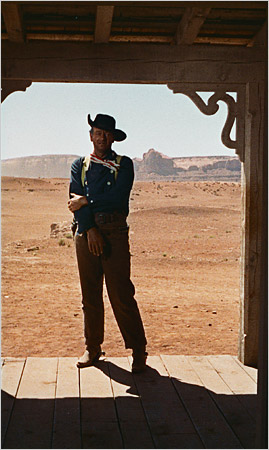
Oh - and one last thing: see how John Wayne is standing there? That's from the famous last shot of The Searchers. The pose - with the one arm holding the other - was quite distinctive, and so un-John-Wayne-like that Bogdonavich once asked him about it. "You know how you stand in the doorway in that last shot? And how you have your arms? Was that on purpose? Did you choose that pose, or ..."
And John Wayne's answer is enough to bring tears to my eyes. He said, "I knew a guy who stood like that all the time. And the pose always seemed so lonely to me. I thought it would work well in that last shot."
Jesusmaryandjoseph.
"The pose always seemed so lonely to me ..."
The consciousness of his artistry, his genius ... that he chose that particular pose on purpose - for that reason ...
Brilliant. Brilliant.
UPDATE: The Shamus has been doing a whole series of posts on Duke - definitely go over there and check them all out. I'll link to this one in particular.
The Books: "The Da Vinci Code" (Dan Brown)
Next up in my Daily Book Excerpt ... Adult fiction shelves:
 The Da Vinci Code - by Dan Brown.
This book is horribly written. I mean, within the first paragraph, my literary sensibility was cringing at the awful (AWFUL) prose. I bought it on a whim, believe it or not - I bought it because I was in the train station and had a couple hours to kill, and I had no other book on me. This was last year. The book had already been out for ages - and it was EVERYWHERE. You could not get away from displays of this stupid book. I knew it was trash, but I figured - Okay, I'll wait for it to come out in paperback. YEARS then passed. This is when you know you have a ginormous hit on your hands. The same thing happened with The Celestine Prophecy, another horribly written piece of garbage - that didn't come out in paperback for EONS. Anyhoo - last May I picked up The Da Vinci Code - it had just come out in paperback - and I was down in Philadelphia for a relatively grueling acting job that involved long days, pages and pages of text (that had to be memorized - sometimes on the spot) - and I knew that I would need something absolutely EASY to read ... something that would not require ANYTHING on my part. Now: a quick word about this. In general, I do not read to be entertained. "Entertainment" is a by-product of all the reading I do. By that I mean - there's the whole thing about "beach reads", etc. But that's never been my style. I don't read "fluff" on vacation just because it's vacation. I look at a week-long vacation with nothing to do as the most thrilling opportunity ever to FINALLY read The Possessed or Anna K - or I will finally have the space to RE-read Grapes of Wrath. This, to me, is fun. It's how I read. So it was so hysterical to me, starting The Da Vinci Code. The prose in that book! I mean, isn't it awful? Can the guy use any more italicized words? It's so ... breathless. Like: calm down, please. But the thing of it was - I couldn't put it down. (At least in the one hour I had free a day during my time in Philadelphia last year.) I would come back to my hotel at night, EXHAUSTED but also wired - because I had been busy all day long, since 6 a.m. - I'd order take-out Chinese - lie on my bed - and read. I finished it in 2 days. hahaha It's so terrible. On many levels. But I just had to find out what happened!
Oh, and I know all the predictable yappers, the perpetually offended, complaining about how none of it is true and whining about how the book disses Christianity etc. etc. Uhm, I certainly don't read a piece of shit like The Da Vinci Code to find out the truth about anything, mkay? It was a thriller. It was a whodunit. It was a chase. Dan Brown cannot write to save his life.
Could not put the damn thing down.
And so: Well played, Dan Brown.
Or should I say: Well played, Dan Brown.
Here's a particularly awful excerpt.
Excerpt from The Da Vinci Code - by Dan Brown.
Earlier, while telling Sophie about the Knights Templar, Langdon had realized that this key, in addition to having the Priory seal embossed on it, possessed a more subtle tie to the Priory of Sion. The equal-armed cruciform was symbolic of balance and harmony but also of the Knights Templar. Everyone had seen the paintings of Knights Templar wearing white tunics emblazoned with red equal-armed crosses. Granted, the arms of the Templar cross were slightly flared at the ends, but they were still of equal length.
A square cross. Just like the one on this key.
Langdon felt his imagination starting to run wild as he fantasized about what they might find. The Holy Grail. He almost laughed out loud at the absurdity of it. The Grail was believed to be somewhere in England, buried in a hidden chamber beneath one of the many Templar churches where it had been hidden since at least 1500.
The era of Grand Master Da Vinci.
The Priory, in order to keep their powerful documents safe, had been forced to move them many times in the early centuries. Historians now suspected as many as six different Grail locations since its arrival in Europe from Jerusalem. The last Grail "sighting" had been in 1447 when numerous eyewitnesses described a fire that had broken out and almost engulfed the documents before they were carried to safety in four huge chests that each required six men to carry. After that, nobody claimed to see the Grail ever again. All that remained were occasional whisperings that it was hidden in Great Britain, the land of King Arthur and the Knights of the Round Table.
Wherever it was, two important facts remained:
Leonardo knew where the Grail resided during his lifetime.
That hiding place had probably not changed to this day.
For this reason, Grail enthusiasts still pored over Da Vinci's art and diaries in hopes of unearthing a hidden clue as to the Grail's current location. Some claimed the mountainous backdrop in Madonna of the Rocks matched the topography of a series of cave-ridden hills in Scotland. Others insisted that the suspicious placement of disciples in The Last Supper was some kind of code. Still others claimed that X rays of the Mona Lisa revealed she originally had been painted wearing a lapis lazuli pendant of Isis - a detail Da Vinci purportedly later decided to paint over. Langdon had never seen any evidence of the pendant, nor could he imagine how it could possibly reveal the Holy Grail, and yet Grail afficianados still discussed it ad nauseam on Internet bulletin boards and worldwide-web chat rooms.
Everyone loves a conspiracy.
And the conspiracies kept coming. Most recently, of course, had been the earthshaking discovery that Da Vinci's famed Adoration of the Magi was hiding a dark secret beneath its layers of paint. italian art diagnostician Maurizio Seracini had unveiled the unsettling truth, which the The New York Times Magazine carried prominently in a story titled "The Leonardo Cover-Up."
Seracini had revealed beyond any doubt that while the Adoration's gray-green sketched underdrawing was indeed Da Vinci's work, the painting itself was not. The truth was that some anonymous painter had filled in Da Vinci's sketch like a paint-by-numbers years after Da Vinci's death. Far more troubling, however, was what lay beneath the impostor's paint. Photographs taken with infrared reflectography and X ray suggested that this rogue painter, while filling in Da Vinci's sketched study had made suspicious departures from the underdrawing ... as if to subvert Da Vinci's true intention. Whatever the true nature of the underdrawing, it had yet to be made public. Even so, embarrassed officials at Florence's Uffizi Gallery immediately banished the painting to a warehouse across the street. Visitors at the gallery's Leonardo Room now found a misleading and unapologetic plaque where the Adoration once hung.
THIS WORK IS UNDERGOING
DIAGNOSTIC TESTS IN PREPARATION
FOR RESTORATION.
In the bizarre underworld of modern Grail seekers, Leonardo da Cinci remained the quest's great enigma. His artwork seemed bursting to tell a secret, and yet whatever it was remained hidden, perhaps beneath a layer of paint, perhaps enciphered in plain view, or perhaps nowhere at all. Maybe Da Vinci's plethora of tantalizing clues was nothing but an empty promise left behind to frustrate the curious and bring a smirk to the face of his knowing Mona Lisa.
May 15, 2007
Question for Ceci

On Saturday, my sister Jean and I went and got mani/pedis. French nails on Ye Olde Digits - and I got the lovely shade called "Kinky from Helsinki" on the toes. As we sat there, getting pampered, we watched television with the other ladies in the shop. River of No Return was playing on AMC - the Saturday morning Western. Love that movie!
A funny moment:
A lady sitting in the chair next to me, getting her heels scrubbed by the manicurist, said, in a growly voice, with a RI accent, "God, look at huh." ("huh" meaning "her") We were staring up at Marilyn in her showgirl outfit. Lady said to no one in particular, "People said she was fat." Long pause, as we all contemplated the "fat"-ness of Marilyn Monroe. Lady in the chair then said, to complete the thought, "Jesus. I'd love to be fat." (Meaning: if "fat" means I look like "huh" - then bring it on!)
Now Ceci - my question for you is:
There are all of those lovely scenes with Marilyn playing the guitar. Sometimes during her show, and then sometimes out in the wild, to entertain the little boy. Her guitar-playing looks very realistic. The chord changes, the way her fingers move ... all seemed perfect.
Jean asked me, "Did she really play?"
And I didn't know the answer. It looks like she knew how to play. And I also recall the little ukelele in Some Like It Hot - but I KNOW, Ceci, that you will know the answer.
Could Marilyn Monroe play the guitar? Was that her really playing in River of No Return?
New York montage
Around 34th and 8th:
Vertigo.

Post office under wraps.

Est. 1901

The Garden.

Chapped lips, dead eyes, fabulous wig.

Reflection
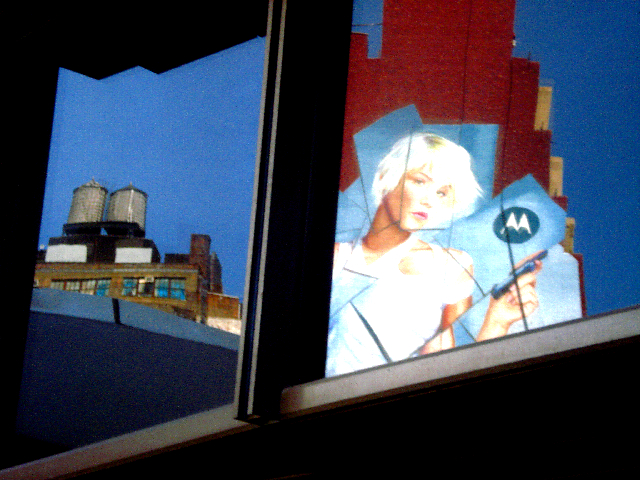
The Books: "Jane Eyre" (Charlotte Bronte)
Next up in my adult fiction shelves:
 Jane Eyre - by Charlotte Bronte.
I love this book.
That is all. It is transportive.
Here's an excerpt. I remember the first time I read the first part of this section goosebumps literally raised up on my arm. Terrifying.
Excerpt from Jane Eyre - by Charlotte Bronte.
Though I had now extinguished my candle and was laid down in bed, I could not sleep for thinking of his look wen he paused in the avenue, and told how his destiny had risen up before him, and dared him to be happy at Thornfield.
"Why not?" I asked myself. "What alienates him from the house? Will he leave it again soon? Mrs. Fairfax said he seldom stayed here longer than a fortnight at a time; and he has now been resident eight weeks. If he does go, the change will be doleful. Suppose he should be absent spring, summer, and autumn: how joyless sunshine and fine days will seem!"
I hardly know whether I had slept or not after this musing; at any rate, I started wide awake on hearing a vague murmur, peculiar and lugubrious, which sounded, I thought, just above me. I wished I had kept my candle burning: the night was drearily dark; my spirits were depressed. I rose and sat up in bed, listening. The sound was hushed.
I tried again to sleep; but my heart beat anxiously: my inward tranquility was broken. The clock, far down in the hall, struck two. Just then it seemed my chamber door was touched; as if fingers had swept the panels in groping a way along the dark gallery outside. I said, "Who is there?" Nothing answered. I was chilled with fear.
All at once I remembered that it might be Pilot, who, when the kitchen door chanced to be left open, not infrequently found his way up to the threshold of Mr. Rochester's chamber. I had seen him lying there myself in the mornings. The idea calmed me somewhat: I lay down. Silence composes the nerves; and as an unbroken hush now reigned again through the whole house, I began to feel the return of slumber. But it was not fated that I should sleep that night. A dream had scarcely approached my ear, when it fled affrighted, scared by a marrow-freezing incident enough.
This was a demonic laugh - low, suppressed, and deep - uttered, it seemed, at the very keyhole of my chamber door. The head of my body was near the door, and I thought at first the goblin-laughter stood at my bedside - or rather crouched by my pillow: but I rose, looked round, and could see nothing; while, as I still gazed, the unnatural sound was reiterated: and I knew it came from behind the panels. My first impulse was to rise and fasten the bolt; my next again to cry out, "Who is there?"
Something gurgled and moaned. Ere long, steps retreated up the gallery towards the third-story staircase: a door had lately been made to shut in that staircase; I heard it open and close, and all was still.
"Was that Grace Poole? and is she possessed with a devil?" thought I. Impossible now to remain longer by myself; I must go to Mrs. Fairfax. I hurried on my frock and a shawl; I withdrew the bolt and opened the door with a trembling hand. There was a candle burning just outside, and on the matting in the gallery. I was surprised at this circumstance: but still more was I amazed to perceive the air quite dim, as if filled with smoke: and, while looking to the right hand and left, to find whence these blue wreaths issued, I became further aware of a strong smell of burning.
Something creaked: it was a door ajar; and that door was Mr. Rochester's, and the smoke rushed in a cloud from thence. I thought no more of Mrs. Fairfax; I thought no more of Grace Poole, or the laugh: in an instant, I was within the chamber. Tongues of flame darted round the bed: the curtains were on fire. In the midst of blaze and vapour, Mr. Rochester lay stretched motionless, in a deep sleep.
"Wake! wake!" I cried. I shook him, but he only murmured and turned: the smoke had stupefied him. Not a moment could be lost: the very sheets were kindling. I rushed to his basin and ewer; fortunately, one was wide and the other deep, and both were filled with water. I heaved them up, deluged the bed and its occupant, flew back to my own room, brought my own water-jug, baptized the couch afresh, and, by God's aid, succeeded in extinguishing the flames which were devouring it.
The hiss of the quenched element, the breakage of the pitcher which I had flung from my hand when I had emptied it, and, above all, the splash of the shower-bath I had liberally bestowed, roused Mr. Rochseter at last. Though it was now dark, I knew he was awake; because I heard him fulminating strange anathemas at finding himself lying in a pool of water.
"Is there a flood?" he cried.
"No, sir," I answered, "but there has been a fire: get up, do; you are quenched now; I will fetch you a candle."
"In the name of all the elves in Christendom, is that Jane Eyre?" he demanded. "What have you done with me, witch, sorceress? Who is in the room besides you? Have you plotted to drown me?"
"I will fetch you a candle, sir; and, in Heaven's name, get up. Somebody has plotted something: you cannot too soon find out who and what it is."
"There! I am up now; but at your peril you fetch a candle yet: wait two minutes till I get into some dry garments, if any dry there be - yes, here is my dressing-gown. Now run!"
I did run; I brought the candle which still remained in the gallery. He took it from my hand, held it up, and surveyed the bed, all blackened and scorched, the sheets drenched, the carpet round swimming with water.
"What is it? and who did it?" he asked.
I briefly related to him what had transpired: the strange laugh I had heard in the gallery: the step ascending to the third story; the smoke - the smell of fire which had conducted me to his room; in what state I had found matters there, and how I had deluged him with all the water I could lay hands on.
He listened very gravely; his face, as I went on, expressed more concern than astonishment; he did not immediately speak when I had concluded.
"Shall I call Mrs. Fairfax?" I asked.
"Mrs. Fairfax? No: what the deuce would you call her for? What can she do? Let her sleep unmolested."
"Then I will fetch Leah, and wake John and his wife."
"Not at all: just be still. You have a shawl on. If you are not warm enough, you may take a cloak yonder; wrap it about you and sit down on the arm-chair: there - I will put it on. Now place your feet on the stool, to keep them out of the wet. I am going to leave you a few minutes. I shall take the candle. Remain where you are till I return; be as still as a mouse. I must pay a visit to the third story. Don't move, remember, or call any one."
He went: I watched the light withdraw. He passed up the gallery very softlyl, unclosed the staircase door with as little noise as possible, shut it after him, and the last ray vanished. I was left in total darkness. I listened for some noise, but heard nothing. A very long time elapsed. I grew weary: it was cold, in spite of the cloak; and then I did not see the use of staying, as I was not to rouse the house. I was on the point of risking Mr. Rochester's displeasure by disobeying his orders, when the light once more gleamed dimly on the gallery wall, and I heard his unshod feet tread the matting. "I hope it is he," thought I, "and not something worse."
He re-entered, pale and very gloomy. "I have found it all out," said he, setting the candle down on the washstand; "it is as I thought."
"How, sir?"
He made no reply, but stood with his arms folded, looking on the ground. At the end of a few minutes he inquired in rather a peculiar tone -
"I forgot whether you said you say anything when you opened your chamber-door."
"No, sir, only the candlestick on the ground."
"But you heard an odd laugh? You have heard that laugh before, I should think, or something like it?"
"Yes, sir: there is a woman who sews here, called Grace Poole - she laughs in that way. She is a singular person."
"Just so. Grace Poole - you guessed it. She is as you say, singular - very. Well, I shall reflect on the subject. Meantime, I am glad that you are the only person, besides myself, acquainted with the precise details of to-night's incident. You are no talking fool: say nothing about it. I will account for this state of affairs" (pointing to the bed) "and now return to your own room. I shall do very well on the sofa in the library for the rest of the night. It is near four: in two hours the servants will be up."
"Good-night, then, sir," said I, departing.
He seemed surprised - very inconsistently so, as he had just told me to go.
"What!" he exclaimed, "are you quitting me already, and in that way?"
"You said I might go, sir."
"But not without taking leave; not without a word or two of acknowledgement and goodwill: not, in short, in that brief dry fashion. Why, you have saved my life - snatched me from a horrible and excruciating death! and you walk past me as if we were mutual strangers! At least shake hands."
He held out his hand; I gave him mine: he took it first in one, then in both his own.
"You have saved my life: I have a pleasure in owing you so immense a debt. I cannot say more. Nothing else that has being would have been tolerable to me in the character of creditor for such an obligation: but you: it is different - I feel your benefit no burden, Jane."
He paused; gazed at me: words almost visible trembled on his lips - but his voice was checked.
"Good-night again, sir. There is no debt, benefit, burden, obligation, in the case."
"I knew," he continued, "you would do me good in some way, at some time: I saw it in your eyes when I first beheld you: their expression and smile did not" -- (again he stopped) -- "did not" (he proceeded hastily) "strike delight to my very inmost heart so for nothing. People talk of natural sympathies; I have heard of good genii: there are grains of truth in the wildest fable. My cherished preserver, good-night!"
Strange energy was in his voice, strange fire in his look.
"I am glad I happened to be awake," I said: and then I was going.
"What! you will go?"
"I am cold, sir."
"Cold? Yes - and standing in a pool! Go, then, Jane; go!" But he still retained my hand, and I could not free it. I bethought myself of an expedient.
"I think I hear Mrs. Fairfax move, sir," said I.
"Well, leave me," he relaxed his fingers, and I was gone.
I regained my couch, but never thought of sleep. Till morning dawned I was tossed on a buoyant but unquiet sea, where billows of trouble rolled under surges of joy. I thought sometimes I saw beyond its wild waters a shore, sweet as the hills of Beulah; and now and then a freshening gale, wakened by hope, bore my spirit triumphantly towards the bourne: but I could not reach it, even in fancy - a counter-acting breeze blew off the land, and continually drove me back. Sense would resist delirium: judgment would warn passion. Too feverish to rest, I rose as soon as day dawned.
May 14, 2007
Celluloid and the Actor
Micheál MacLÃammóir co-founder of The Gate Theatre in Dublin, has recently become of great interest to me - through my reading of Simon Callow's marvelous (yes - MARVELOUS) multi-part biography of Orson Welles. I haven't written much about it yet because I am devouring it at the speed of light (alongside of Arabian Nights, yes, I'm nuts). But in the meantime - MacLÃammóir also sparked my fancy - what a character, what an artist - just amazing. Here's some background on MacLÃammóir (naturally, my dad is a wealth of information about this gentleman - who gave Welles his start in the theatre). And look at this absolutely incredible photo I found - of Eartha Kitt, MacLÃammóir and Orson Welles from 1950:
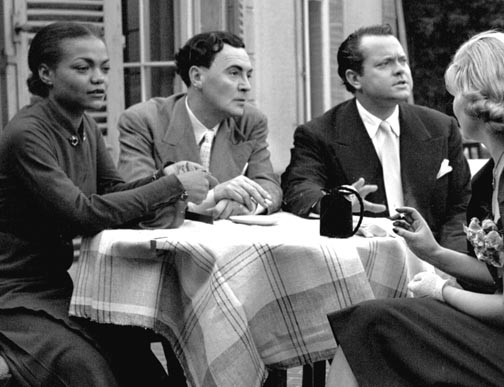
God, just so beautiful!! MacLÃammóir seems to me to be an example of true integrity as an artist. I need to know more.
Anyway - my dad has just received in the mail a bunch of issues of a short-lived Irish literature magazine called "Envoy" - all from 1950 - and MacLÃammóir has a long essay in one of them called "Celluloid and the Actor". This is a comparative study - of the art of the stage actor and the art of the movie actor. WONDERFUL observations - I particularly liked the bit about how audiences in the theatre expect strict probability from the plots - this dates back to Aristotle and verisimilitude and all that - but are more prone to forgive the larger-than-life quality of acting, due to the medium of live theatre. Whereas the total opposite is true of cinematic audiences. They are willing to swallow the most improbable plots imaginable - but any whiff of over-acting is enough to sink the entire operation.
Lots of great observations here ... and this is just the tip of the iceberg, in terms of my research into MacLÃammóir. He wrote a couple of autobiographies - my dad has a copy of one, and I have ordered the other.
Anyway - taking a risk with the copyright gods - I have copied out his essay "Celluloid and the Actor" below ... figuring that it is better to make it available to an Internet audience - however briefly - than let it suffer in the obscurity of an old literature mag.
Wonderful stuff - Alex, Mitchell, David, Kate - all my actor friends - you guys will love this!
Micheál MacLÃammóir
Celluloid and the Actor, a Note on a First Experiement
Envoy,
Jan. 1950
1.
The art of the film belongs primarily to the director, and to those learned and secretive shadows who surround him: the cameraman, the cutter, and a hundred and one technicians whose activities, though constantly referred to under varying titles, remain to the neophyte anonymous and remote.
That curious phenomenon, part magic, part simian exuberance that we may as well agree to call the art of acting emerges in the presence of the camera and its attendants as a quality only half understood. He whose life work it is, had realised always perhaps that it was composed of divers subtle elements, this queer, yet commonplace talent he possessed of making other people laugh or cry to the tune of a poet's words or of his own often vulgar fancy. He had realised that it was a power at once liquid and inexorable, malleable and merciless, that could gush forth, could flow and laugh and trickle and thunder and whisper, could soothe, seduce, overwhelm, submerge, destroy; that it could reflect an image, deceive an army, or occupy a thousand shapes; that it could cleanse or breed or quence or spawn or rot: that it was, in short, a fluid. Yet not until he faces the lens can he have understood that this fluid is also an essence so potent that to use it in more than the smallest distillations, the most minutely measured drops, would be to shatter the design of the master mind, which is embodied in the director, and to set the most uncritical of audiences on a roar at the wrong moment.
The actor, in short, should understand that he relinquishes, as he signs his contract and steps upont he floor, his never too-firmly established claim to be an artist in the sense of a master of a creative work, of an entire and complete composition. That task, however important he may become as a star, is left in other hands, who begin their work by skilfully stripping from him, stitch by stitch, the raiments of the craft he had laboriously pieced together in the living theatre, leaving him naked (and it may be exceedingly ashamed) to face his personality in the raw, which alone, he is informed with perfect friendliness and courtesy, is of the slightest use to him or to anyone else.
This is a lesson of grat value, if the poor devil can stand the drafts that blow so briskly around his shivering ego, as unaccustomed to exposure on the public gaze as the body of a monk; for on the stage he had learned, not to strip naked, but to assume at will what was in the main a series of disguises, to acquire a trunk frull of ingenious and sometimes beautiful costumes: a trick of expression, a movement with the shoulders or the hands, an ability to lift a scene with the rhythm of his voice, to colour a whole consecutive hour with a parade of beauty, or strength or grotesqueness donned at will; to take, in short, the action of the play at the moment of performance into his own hands, if his skill and the part he portrays allow it, and himself to work out his destiny.
All this he must forget when he passes into the studio; it is less than useless to him or to the astounding conglomeration of intellectyual simplicity and technical complication that goes to make up the work in hand; it is a hindrance. He will indeed do well to recall the statement, now so accepted as a truth that it has become a platitiude, that babies and dogs make the best film-actors, and become for the time being something that hovers between baby and dog, while retaining, if he can, qualities of a passionate belief in the moment, a singleness of thought, and a concentration of emotion not necessarily shared by these unspoilt children of nature.
Acting, as he had understood the word, ceases to exist for him or takes upon itself a new meaning. I am not sure that the art of the screen-player - and those who have seen, let us say, Raimu, or Garbo, or Laughton, or Chaplin, will agree that it can be an art - should not find for itself a separate name, as the arts of sculpture and painting which are akin and yet essentially different have separate names. Film-acting has not, and I feel it can never have, that essential content of the art of the stage actor, which in common with all the arts that have down to us from the past, is of the nature of architecture: the individual working-out of a design on a given theme, the selection of material and treatment for its realisation, the slow or rapid building of its consecutive structure. Here is where what we have hittherto understood as the artist shows himself also essentially as the master: at the moment of performance he guides, however previously moulded by his director, his own destiny to success or to failure. The screen-actor has no such responsibility, being a tool in the hands primarily of those unseen powers that have made his features, his limbs, and the life that flows through them, and secondarily in the masterful imagination and will of the artist, the true artist, who, even through the split-up moments of his ultimate appearance on the screen, moulds and directs those features, those limbs, and that life.
2.
He has no such responsibliities as the stage-actor and yet, in spite of the ubiquitous models of the baby and the dog, he must be possessed, if not of more intelligence, at least of a more vivid and visible power of thought.
"You are acting it, not thinking it," is the most contsant correction in the ears of those more skilled in the art of the stage than of the screen, and as he is not in fact either baby or dog, however much he may despairingly wish he were, neither milk-bottle nor mutton-bone may be dangled before his eyes to m ake them brighter withi desire; neither turnip-headed bogey-man nor hissing, bristling cat can be provided (out of the range of the camera) to contract his face with fear or fury; he must imagine these things as the stage-actor must, often without even the visible presence of the cause of his reaction, for frequently a scene that appears on the screen as consecutive action between any two characters will be made in sections that demand the presence of only one actor at a time, the other being free to smoke his cigarette and enjoy his weekend where he chooses (which is, as a rule, as far from the scene of action as possible). The player is compelled in such cases to imagine even the face of friend or enemy as well as the emotions it calls forth. So the victim of the celluloid must imagine it all - imagine with a deeper, less formal, and far more minute understanding than is demanded from the glamorous distance lent by stall or gallery, for the black unwinking eye of the camera reads all his thoughts and reproduces them, not, as is often supposed, with complete truth, but with all the merciless insistence on his poorer qualities that would do credit to a disapproving member of his own family. And, having imagined, he must do little more. Above all he must not project his imaginings: to do so is to offend the highly developed trades-union instinct of the camera, whose work it is to project everything itself. Nor must the old-fashioned advice simply of being natural, either at long distance or in close-up, be listened to by any but those who have never been within a hundred miles of the living theatre. The natural manner of the stage actor (I refer to him outside his working hours) appears to the layman almost invariably well over life-size: his daily training makes him express rather than repress his passions, emotions, and prejudcies; his ideas, as will be readily understood, are generally limited though none the less vigorously proclaimed; his features are mobile, his voice booms, his eyes flash a hundred communications, many of them trifling but all most vital, his eyebrows are seldom at rest, and the slight modification of these characteristics in the modern player is due almost entirely to his traffic with the world of celluloid or, in English speaking countries, to his morbid desire to pass himself off as a gentleman in good society. All this is fatal when he works for, or rather under, the camera which demands not the natural but the sub-natural; a repose that lies somewhere between that of the Sphinx and of the ideal English butler will suffice with the aid of that black, unwinking eye and the merest shadow of a thought, to appear on the screen as the embodiment of desire, hope, lechery, faith, agony, trust, ambition, despair, resignation, duplicity, revenge or what you will. A contraction of the nostrils, a twitch of the eybrows, and all is ruined, as all may be ruined by an extra ounch of superfluous flesh or one additional tone to the voice. Much of his time will therefore be spent in a casting aside of all his most treasured histrionic possessions, a process that must be careful rather than ruthless, for if he goes too far in this direction he becomes one of those myriad, mechanical shadows for the creation of which Hollywood and other centres have become so justly infamous, and passes rapidly into the ranks of well-favoured nondescripts that form the background to the average popular film. If, when he is thus physically stripped to the bone, purified, groomed and decarbonised almost beyond recognition, there is still enough individual interest left in him to work with, he will in all likelihood make a success.
3.
His is the problem of the tightrope, the agonising nicety of balance between the obedient puppet necessary to the director's will, and the scientifically poised and intuitive intelligence that can interpret the process of thought and emotion to an enormous and international public which, perhaps by very reason of its lack of aesthetic education, is all the more shrewd at distinguishing between an authentic and a synthetic form of behaviour. The audiences of the theatre and of the cinema, it seems to me, differ most profoundly on this point: that whereas the former will be critically fastidious about the probability of a dramatic situation, rejecting as absurd some machine-made twist in plot or narrative or dialogue, they will readily accept as a traditional inevitability these very qualities in the mannerisms of an actor, whom they allow to boom or gush, to overplay or underplay to his heart's content, so long as he is possessed of the skill to disguise these weaknesses beneath the trappings of verve and personality, the opposite is true of the film audience. These, it is well known, crowd nightly to the cinemas of Europe and America in order to devour with eyes and ears stories that would barely deceive a centenarian, let alone a sensible child of seven, yet they in their turn will reject as unconvincing the faintest divergence from normal behaviour (usually behaviour of the phlegmatic Anglo-Saxon school, too, so famous for understatement) in the portrayal of some personal reaction. One false movement, one slight exaggeration, one slip of the tongue, one relapse into heroics, and a buzz of antipathy goes round the audience, an uneasy stir, a titter of frozen laughter. And that actor is dead for the night, and, it may well be, for many nights to come.
I do not mean by this that more is demanded of the film than of the stage actor. Less is demanded in the matter of style and of those qualities that separate a work of art from the life it seeks to express: more is demanded in power to imitate exactly the surface of that life, and never for a moment to step beyond the bounds of its most commonplace manifestation. Less is demanded in the matter of the cration by the actor of a mood to be sustained by him and his fellows for a considerable length of time; more is demanded of his ability to leap with superhuman suddenness and an apparently complete sincerity into the heart of a scene, the beginnings of which were probably completed some weeks or months previously and since dropped, and, with a single line, led up to by nothing but hours of waiting in an overheated studio or wind-swept exterior, persuad himself and the world that he loves a woman, hates a man, is hungry, cold, furious, or weary unto death; the latter sentiment being, it is unnecessary to state, by far the easiest to express with any conviction. This need for instantaneous potency is unlike that expected from the prize-fighter, whose eyes and muscles are trained in the primeval art of expecting the unexpected, the first instinct of human survival, developed in the ring to a technical formula. No such fundamental impulse of nature lurks in the brain-cells of him who is invited to say (for no reason in the world that he can gauge or anyone else tell him but that it is part of that scene where he, Jack, threatens Don Juan, before setting fire to the hacienda, surely he remembers?), "And now, my Dago friend, get out of here before I ..."; just that and no more.
The following excerpt, like the dialogue, is imaginary, but the situation is literal and accurate. The tim eis 10.45 a.m., the actors, honest Jack and Conchita the Spitfire, ahving breakfasted on orange-juice at six, have been on the set (dressed and made-up) since seven, and now, with a promptitude quite unusual under the circumstances, all is ready. The take - for that one pithy and athletic line comprises the take - has been rehearsed to a smoothly running accompaniment of encouragement and invective from the director about a dozen times, the technicians, crew, continuity girls, and the rest form an attentive and critical semi-circle, the make-up man dabs the sweat gently from the noses of Jack and Conchita, already eyeing each other with mingled pity and animostiy, the hairdresser gives a last nerve-racking tweak or so to their locks; Don Juan (for he is not in the shot) lolls in a distant chair and regards himself in a mirror, the crew takes on itself the intense yet slightly incredulous air of an Irish football crowd, Conchita slips at an angle of several degrees and numbing discomfort into Jack's arms, Jack toes the chalk-marks previously marked out for him, both artists screw their faces about like paper bags, blink several times, moisten their lips, avoid each other's gaze,a nd lower their quivering eyelids, as a weary and wiry little man like a retired fly-weight darts forward and thrusts between their features and the camera a black-board furnished with some numbers, a handle and a clapper. The numbers are yelled out, the clappter provides a nerve-shattering demonstration, the director's voice intones the word of doom. "Action," he says, and the scene is shot. This involves, as well as Jack's advice to Don Juan, a neat piece of business with a gun, a shifting from one of the hero's arms to the other of the heroine, some complicated footwork on the part of both of them, and also a retreating movement of the camera until the joyful word "Cut" is heard, and the thing is done, though not yet finished. In the first shot the gun goes wrong, in the second Jack fails to hit his marks, in the third Conchita's right shoulder is hitched too high and masks the hero's well-known features at the beginning of his speech, in the fourth a reflector gets loose and causes the light to quiver, in the fifth Conchita glances down at the floor to find her marks, "what a naughty girl I am, and I'd no idea I was doing it."
The morning went on. The director's voice, so full of bright, hard, matinal decision at rehearsal slowly takes on the moribund and caressing tones of him who begins to understand the terror of eternity; it grows fat, flat and soothing like the voice of an experienced nurse with a peevish and incurable patient who hasn't the remotest chance of dying for years.
"Much better that time, much the best so far for the artist; it was spoilt by the dolly wobbling like bloody hell." And with relief and rapture, for he knows that to bully either Jack or Conchita at this crucial moment will reduce them to even lower depths of incompetency than they have hitherto plumbed, he vents his real feelings on the crew. They, of course, are used to this and take it like men, with silence if not with strength. The fifteenth shot is ruined by a flyl settling on Conchita's nose; the twenty-fifth is good all round, "but let's try one more for luck," so its excellence is soon forgotten in a series of unprecedented disasters that follow one another with nightmare agility. The thirty-fifth shot is mechanically perfect but marred, it seems, by Jack's performance having, quite inexplicably, become a trifle unreal.
"Dear old boy you're going to be so impatient with me but it didn't mean a damn thing. I mean it wasn't true, it wasn't alive, I just didn't believe it: that's all."
Jack listens to this little speech (delivered without the flicker of an eyelid by the director) with an expression so genuinely exhausted as to allow one to expect the obvious retort, and says, in a bright voice, what about trying it again? This suggestion is accepted more in sorrow than in anger, both make-ups, now at the clogged stage, are attended to, and the scene goes on ... and it goes on and it goes on.
When at length a shot is made that is worthy of preservation, camera angles and lighting are readjusted, a matter sometimes of hours, and the scene favouring Conchita instead of Jack is retaken, necessitating much the same process; then for a third time the thing is repeated in order to reveal to a world-wide public the reactions to Jack's unflinching eloquence on the sinister features of Don Juan.
4.
It will be seen by this scarcely exaggerated description of a simple moment in a simple scene (probably, when all is done, to be expurgated by the cutter, to say nothing of its fate in the hands of censors of varying local and moral scruples) that the screen-player's path is no easy one, and that the obstacles with which it is strewn are not all connected with the art of acting. There are indeed moments when the actor feels that in playing for the films he undergoes a combination of experiences that combine: a severe Training for the Commandos, a Lesson in Gymnastic Precision, a Turkish Bath, an Ocular Test, an Essay in the Virtue of Patience and Obedience, and an interminable Session at the Photographers. Few shots in a film have longer endurance in their completed condition than a minute, hardly any, I think, longer than four and a half, which is less than the time that the average stage artist requires to get to grips with his scene; the most convincing moments are often achieved by a lucky chance, such as a stumble on a slippery groundl or by a deep-laid plot on the part of the director, such as an unexpected blow on the face which not unnaturally produces a surprise so genuine that the highest art could hardly improve upon; and these accidents, shifts and stratagems are a commonplace in the studios. Yet there are lessons for the actor to learn when he faces the lens as well as those of fortitude and tricky technicalities, and, strangely enough, in this atmosphere of synthetic aids and augmentations, the greatest of these I think is the study of the inner life, of the depths of the mind, of the birth of thought and passion, of the ego's function; not merely of formalised representation of its results, wherein lies the actor's great danger. For what is that false quality we all "staginess" but a forgetfulness of the roots of the tree of human life, and a reducing of the flowers and fruits to a conventional design that grows with ease into mere mannerism? What in the theatre we call a "ham" is in reality no more than one who has learned the outside of his craft merely, which is the exposition of the passions, and who has discarded, or maybe never understood, the fountain of passion itself, so that his portrayals of men and women grow into caricatures which even when they have style and skill are so lacking in understanding, in life, in truth, that they become ludicrous. To save the theatre from this degeneration is a work no ingenuity of the writer, or designer, no magnificience in light, colour or pageantry can achieve: it is a work for the actor who is the medium, and the director who controls him, and nowhere can this work be more rapidly learned than under the camera's eye. That this should be so, that the emotions of the human system should be more accessible to the student, in a setting of mechnical chicanery than in the living theatre, seems a paradox. That it is so I am persuaded, as I am persuaded that the Muses, always at war with the times, are searching for a way back to simplicity through the mastery and the ultimate rejection of that elaborate technique which took five hundred years to perfect and is now for a spell in decay, partly beack to the recapture of the primitive world, and when I say this I am thinking of painting, and of Picasso, of Rouault, and of Miro. The Muses search with whatever means come their way, and science, in this century it has made its own, has thrust its most complicated ingenuities across their path. That the drama should have been so swift a Muse to flirt for a while with these perilous mechanisms is a link, it may be, with those mysteries that bind all the energies of aesthetic intellect and emotion to life and to the fates; for I believe that machinery may be seeking to destroy the world as it is already destroying what we have hitherto understood as the arts; and that, perhaps, is why the arts, in seeking to preserve themselves, are endeavouring to discover a means by which some armistice may be made with the enemy, that humanity may live in sheer simplicity side by side with its armed forces and yet not all be lost. And what is so in tune with the destruction of the ancient arts as the discovery of the movie? And what art is so instinctive, so childish, so unchangeably inconsequent as that of the actor; what more ingenuously human flower has ever grown on the bough of an ancient and impressive family tree?
Sunday
Red Sox vs. Orioles. It was 5 - 0. 8th inning. Okay, whatever. I'll take a quick walk and take some pictures. I came back into the house 20 minutes later - just in time to see the Red Sox freakin' WIN.
It was great, too - because the second the game was over the phone rang (which is classic - that's the way it always goes in this family. Game over, phone rings ... you have no idea WHO it is, but you know it is a member of the extended clan ... who needs to either exult or bitch ...) It was my brother and my cousin Mike. So that was great.
So weird, though, that I left, strolling around in the late afternoon sunshine ... pretty certain that they would lose - I mean, of course they would ... and I walked back into the house ... to hear my parents hissing at me, "Come in here! You're not going to believe it!" I rushed down the hall, just in time to see Millar (bless him, on multiple levels) throw to first ... fumble bumble ... and then to see Ortiz and Youk jumping up and down just like they were in Little League celebrating a championship win.
From 5 - 0 ... to 6 - 5? What the hell??
Here are the photos I took as my team worked its 9th inning magic.
Side lawn.

Forsythia.

Corner of the lawn.

Shadows on the grass.

Violets in the shade.

Green and gold.

Prehistoric bush.

Neighbor's beautiful lawn.

Back lawn.

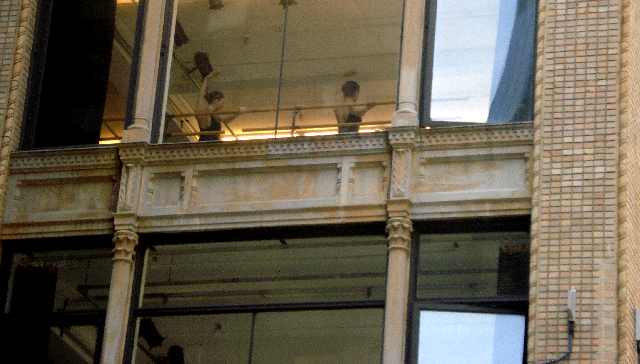
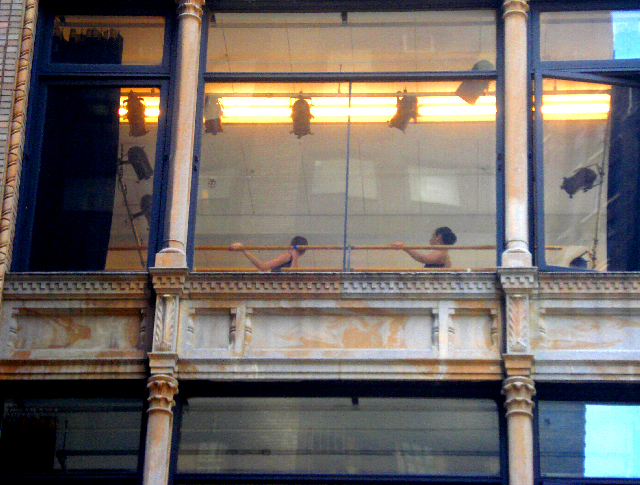
"Do you believe in miracles?"
Well ...
How about "Unexpected Victory on Ice"?
Thank you so much, Emily, for the humorous link. It gave me a much-needed laugh today.
May 11, 2007
The Books: "Wuthering Heights" (Emily Bronte)
Next up in my Daily Book Excerpt ... Adult fiction shelves:
 Wuthering Heights - by Emily Bronte.
I re-read this book recently and was struck, as if for the first time, by the violence of it. It's truly remarkable. Cathy and Heathcliff are not your ordinary star-crossed lovers. These two people are individuals, strong-willed, not all that likable all the time, selfish - It's like that line in Emily Bronte's poem "Often Rebuked":
I'll walk where my own nature leads me
It vexes me to choose another guide.
This is, on the surface, admirable - but if you truly behave that way - and hang the consequences - you can be seen as a monster. People who just walk where their own nature leads are criticized by those in our society who are really concerned with being nice, being polite, playing well with others ... It seems that the highest good to some folks is our ability to NOT just walk where our own nature leads ... but to suppress those qualities within us that would jar social harmony.
Cathy and Heathcliff thumb their noses at propriety. And it's almost as though: in this book - society itself doesn't even exist. Not as anything REAL anyway. It's a complete construct. Cathy and Heathcliff barely acknowledge its existence - and to those people to whom "fitting in" and "playing well with others" is the highest good - that is the most unforgivable.
It's fascinating. It's truly a radical book. God doesn't exist in this world either. He's a complete construct as well. All that really exists, all that is real and eternal - is the WILLS of Cathy and Heathcliff. Their LOVE - which threatens to sweep away everything in its path ... is the only thing worth saving. Like I said - it's violent. And Godless. It's truly not only ahead of its time, but ahead of ours as well. There's a reason why it's a classic, and why it speaks to generation after generation. Most of us give "society" its due. We let society tell us how to behave. We accept the rules. But how cathartic it is to hang out with two people who, frankly, could not give a crap. It is a teenager's paradise, this book. Rebel without a cause. I mean, I read it - and I want to push down everybody who tries to thwart this couple's overwhelming desire to be together. And love? I don't know - to call what goes on between Cathy and Heathcliff "love" is just another way of society (the construct) trying to neaten up that which is messy. Love? What a neat nice little word. Cathy and Heathcliff are drawn to each other as though it is another form of Mother Nature - the plants drawn to the sun, spring following winter ... a natural process, so natural that to try to get in its way would spell disaster. Mother Nature ALWAYS gets her way. You can put up nice little walls, and she'll just laugh at you. That's the kind of thing that goes on between Cathy and Heathcliff.
Morality? HA! Social norms? WhatEVS.
Here's an excerpt.
Excerpt from Wuthering Heights - by Emily Bronte.
'Are you alone, Nelly?'
'Yes, Miss,' I replied.
She entered and approached the hearth. I, supposing she was going to say something, looked up. The expression of her face seemed disturbed and anxious. Her lips were half asunder, as if she meant to speak, and she drew a breath; but it escaped in a sigh instead of a sentence.
I resumed my song; not having forgotten her recent behaviour.
'Where's Heathcliff?' she said, interrupting me.
'About his work in the stable,' was my answer.
He did not contradict me; perhaps he had fallen into a dose.
There followed another long pause, during which I perceived a drop or two trickle from Catherine's cheek to the flags.
Is she sorry for her shameful conduct? I asked myself. That will be a novelty: but she may come to the point as she will - I shan't help her!
No, she felt small trouble regarding any subject, save her own concerns.
'Oh dear!' she cried at last. 'I'm very unhappy!'
'A pity,' observed I. 'You're hard to please: so many friends and so few cares, and can't make yourself content!'
'Nelly, will you keep a secret for me?' she pursued, kneeling down by me, and lifting her winsome eyes to my face with that sort of look which turns off bad temper, even when one has all the right in the world to indulge it.
'Is it worth keeping?' I inquired, less sulkily.
'Yes, and it worries me, and I must let it out! I want to know what I should do. To-day, Edgar Linton has asked me to marry him, and I've given him an answer. Now, before I tell you whether it was a consent or denial, you tell me which it ought to have been.'
'Really, Miss Catherine, how can I know?' I replied. 'To be sure, considering the exhibition you performed in his presence this afternoon, I might say it would be wise to refuse him: since he asked you after that, he must be either hopelessly stupid or a venturesome fool.'
'If you talk so, I won't tell you any more,' she returned, peevishly, rising to her feet. 'I accepted him, Nelly. Be quick, and say whether I was wrong!'
'You accepted him! then what good is it discussing the matter? You have pledged your word and cannot retract.'
'But say whether I should have done so - do!' she exclaimed in an irritated tone; chafing her hands together, and frowning.
'There are many things to be considered before that question can be answered properly,' I said, sententiously. 'First and foremost, do you love Mr. Edgar?'
'Who can help it? Of course I do,' she answered.
Then I put her through the following catechism: for a girl of twenty-two, it was not injudicious.
'Why do you love him, Miss Cathy?'
'Nonsense, I do - that's sufficient.'
'By no means; you must say why?'
'Well, because he is handsome, and pleasant to be with.'
'Bad!' was my commentary.
'And because he is young and cheerful.'
'Bad, still.'
'And because he loves me.'
'Indifferent, coming there.'
'And he will be rich, and I shall like to be the greatest woman of the neighbourhood, and I shall be proud of having such a husband.'
'Worst of all. And now say how you love him?'
'As everybody loves - You're silly, Nelly.'
'Not at all - Answer.'
'I love the ground under his feet, and the air over his head, and everything he touches, and every word he says. I love all his looks, and all his actions, and him entirely and altogether. There now!'
'And why?'
'Nay, you are making a jest of it: it is exceedingly ill-natured! It's no jest to me!' said the young lady, scowling, and turning her face to the fire.
'I'm very far from jesting, Miss Catherine,' I replied. 'You love Mr. Edgar, because he is handsome, and young, and cheerful, and rich, and loves you. The last, however, goes for nothing: you would love him without that, probably; and with it you wouldn't, unless he possessed the four former attractions.'
'No, to be sure not: I should only pity him - hate him, perhaps, if he were ugly, and a clown.'
'But there are several other handsome, rich young men in the world: handsomer, possibly, and richer than he is. What should hinder you from loving them?'
'If there be any, they are out of my way: I've seen none like Edgar.'
'You may see some: and he won't always be handsome, and young, and may not always be rich.'
'He is now; and I have only to do with the present. I wish you would speak rationally.'
'Well, that settles it: if you have only to do with the present, marry Mr. Linton.'
'I don't want your permission for that - I shall marry him; and yet you have not told me whether I'm right.'
'Perfectly right: if people be right to marry only for the present. And now, let us hear what you are unhappy about. Your brother will be pleased ... The old lady and gentleman will not object, I think; you will escape from a disorderly comfortless home into a wealthy, respectable one; and you love Edgar, and Edgar loves you. All seems smooth and easy: where is the obstacle?'
'Here! and here!' replied Catherine, striking one hand on her forehead, and the other on her breast, 'in whichever place the soul lives. In my soul and in my heart, I'm convinced I'm wrong!'
'That's very strange! I cannot make it out.'
'It's my secret. But if you will not mock at me, I'll explain it: I can't do it distinctly, but I'll give you a feeling of how I feel.'
She seated herself by my again: her countenance grew sadder and graver, and her clasped hands trembled.
'Nelly, do you never dream queer dreams?' she said, suddenly, after some minutes' reflection.
'Yes, now and then,' I answered.
'And so do I. I've dreamt in my life dreams that have stayed with me ever after, and changed my ideas; they've gone through and through me, like wine through water, and altered the colour of my mind. And this is one: I'm going to tell it - but take care not to smile at any part of it.'
'Oh! don't, Miss Catherine!' I cried. 'We're dismal enough without conjuring up ghosts and visions to perplex us. Come, come, be merry and like yourself! Look at little Hareton! he's dreaming nothing dreary. How sweetly he smiles in his sleep!'
'Yes; and how sweetly his father curses in his solitude! You remember him, I dare say, when he was just such another as that chubby thing: nearly as young and innocent. However, Nelly, I shall oblige you to listen: it's not long: and I've no power to be merry to-night.'
'I won't hear it, I won't hear it!' I repeated hastily.
I was superstitious about dreams then, and am still; and Catherine had an unusual gloom in her aspect, that made me dread something from which I might shape a prophecy, and forsee a fearful catastrophe.
She was vexed, but she did not proceed. Apparently taking up another subject, she recommenced in a short time.
'If I were in heaven, Nelly, I should be extremely miserable.'
'Because you are not fit to go there,' I answered. 'All sinners would be miserable in heaven.'
'But it is not for that. I dreamt once that I was there.'
'I tell you I won't harken to your dreams, Miss Catherine! I'll go to bed,' I interrupted again.
She laughed, and held me down; for I made a motion to leave my chair.
'This is nothing,' cried she: 'I was only going to say that heaven did not seem to be my home; and I broke my heart with weeping to come back to earth; and the angels were so angry that they flung me out into the middle of the heath on the top of Wuthering Heights; where I woke sobbing for joy. That will do to explain my secret, as well as the other. I've no more business to marry Edgar Linton than I have to be in heaven; and if the wicked man in there had not brought Heathcliff so low, I shouldn't have thought of it. It would degrade me to marry Heathcliff now; so he shall never know how I love him: and that, not because he's handsome, Nelly, but because he's more myself than I am. Whatever are souls are made of, his and mine are the same; and Linton's is as different as a moonbeam from lightning, or frost from fire.'
Ere this speech ended, I became sensible of Heathcliff's presence. Having noticed a slight movement, I turned my head, and saw him rise from the bench, and steal out noiselessly. He had listened til he heard Catherine say it would degrade her to marry him, and then he staid to hear no farther.
Can't sleep.
And so ...
Penny Serenade. A sweet (meaning sometimes saccharine) and wonderfully acted movie - directed by George Stevens - starring Cary Grant and Irene Dunne. I love this movie. It was the first time Cary Grant was nominated for an Oscar - mainly because of the one scene where he goes before the judge to plead his case, and he starts to cry. You know ... why nominate Cary Grant for something like His Girl Friday when he was just playing himself??? (Like "playing yourself" is easy. I love it when people who aren't actors say "Bah, he was just playing himself" - as though that's easy, first of all. Or - as though it's some kind of a criticism. Huh? How on earth is "he just played himself" a criticism? John Wayne "just played himself". You gonna tell me that guy wasn't a superior actor?)
Penny Serenade is, in its own way, ahead of its time. It presents serious issues - miscarriage, infertility, what those things can do to a marriage, the whole adoption process, financial difficulties, what it's like to adopt a baby - the angst, the nerves - parenting, in general - feeling totally unprepared to take care of this little creature ... etc. etc. It treats these matters seriously, sensitively, openly - it's not coy at all. It's a real grown-up movie, if you know what I mean.
So. I pulled some screenshots. And I can't sleep. So here they are. I basically tell the entire plot of the movie below. So there are spoilers. Know that before you move on.
She works in a music store. He walks by one day. Music is playing out of a speaker onto the street and the record starts to skip. It calls his attention. He turns and stares in at her, like: "Uhm - you gonna fix that?" The second he sees her, though, a spark comes into his eye. He likes the look of this dame.
They start to date. I love this shot - they're dancing - music is playing - and the two of them are both whistling along with the tune, and making each other laugh. Totally real moment. I know that Cary Grant loved Irene Dunne best, in terms of leading ladies ... they were dear dear friends, and you so can see that here. He thought she was so funny.
They take a day-trip to the beach. It's night ... and it's time to catch the last train back to town. They're in love (but it seems like real people in love - not sentimental glowing light mushy movie love - like: he seems a bit antsy about sharing his feelings, he gets shy and weird, she doesn't push, or get mushy - she keeps her counsel) ... and here they start kissing by the dressing-rooms at the beach ... and it's pretty obvious that he's about to get rather hot and heavy. She gently stops him. The dialogue is all innuendo but it's still totally clear. "We need to get back ..." He leans in again. "Not yet ..." Etc. A totally real feeling scene. Not coy, like I mentioned before. He wants to sleep with her. She gently says no. That's basically what's going on here.
She throws a raucous New Year's Eve party. He shows up minutes before midnight and drags her out onto the fire escape. He is apologetic about being late ... but he has some news. Big news. I love BOTH of their acting in this scene. It's so deep. They're not saying what they're really feeling - but it's all in their faces.
Another shot from that scene. I love how we're looking at them thru the fire escape. He has been offered a job as news editor at his paper's operation in Japan. He is going to take it - it's a 2 year contract - and he is leaving that very night at 3 in the morning. 3 am train to San Francisco and then a boat to Japan. He's excited ... she's excited for him, too - but also ... you know. Upset that he's leaving. But she tries to hide it. Look at her face here. God, she just kills me. I love her acting so much.
Same scene. He finally gets to the point, the real point. He blurts out, "Let's get married. Right now. Before I catch my train. I have a cab waiting downstairs to take us to the justice of the peace ..." She is all flustered - now? what? Why the rush? He jokes, "You think I'm gonna let a funny little redhead like you walk around? What if some other fella came along??"
She says yes, yes, she will marry him. In that moment, it becomes the New Year - bells ringing, etc. A raucous family on the fire escape opposite come out - it's snowing - they're all in their pajamas, and hooting and hollering and banging pots and pans and celebrating. They all shout "Happy New Year" at each other. I adore this shot. Isn't it beautiful?
The two of them rush back through her apartment - which is even more raucous now - with revelry.
She goes with him to the train station after the marriage ceremony at city hall in the middle of the night. He will send for her in about 3 months time when he's all set up. She comes onto the train with him just to say goodbye. Neither of them want to say goodbye. And of course he has his own room with a bed. People traveled in style those days. They cling to each other.
She is supposed to get off the train before it leaves ... but they are sitting on the bed - embracing - and you can see out the window that the train is now pulling out of the station. She gasps, "Roger - the train is moving ..." He reaches out to close the door (the camera is out in the hallway, so he is essentially closing the door on us) - and he says what is the raciest line in the movie - unbelievable the censors didn't pick up on it: "We'll get you off." The next shot we see is the train pulling into another station - the sign says: "New York 115 Miles" - so that orients us, how long they've been traveling. Long enough for her to get pregnant ... we discover later. The two of them step out onto the deserted snowy platform - she's going to catch the next train back to New York - and now they really have to say goodbye. It's all silent. No dialogue. Very moving.
He sends for her in three months time and she travels to Japan. He is excited as a little kid to show her their new digs, etc. This is the moment where she breaks to him the news that she is pregnant. She's nervous. She thinks he doesn't like kids. He seems so gruff, and uninterested, and kind of selfish. His acting in this scene - and it's all reaction shots ... is as real as it gets.
And then: tragedy. In what is a terrifying scene (and very well done, actually - no special effects) - an earthquake hits the area where they live. She is trapped on the staircase of their house - as it wildly destroys itself around her - and she ends up buried in beams and boards and debris. The next thing we see is a steamer ship - then a shot of a port - then another shot of the side of a building with a sign: SAN FRANCISCO MEMORIAL HOSPITAL. Now THAT is efficient film-making. She lies in a hospital bed and the doctor has just told her that she lost the baby, and will not be able to have another. He finally lets Cary Grant in to see her. Cary Grant's character - a mover, a shaker, kind of irresponsible, impulsive - has no coping skills for this. He loves her. He can't believe that this tragedy has befallen her. He doesn't know how to make it better. All he knows is: he MUST make it better. But you can feel his helplessness in this scene.
Look at him.
The couple decide to start anew. Roger buys a small struggling newspaper office in a tiny town north of San Francisco. He calls on his old friend Applejack (a wonderful character - God, you just love him) to come out from New York and be the press manager. He's not sure when or if he will arrive ... and one day Applejack shows up. You can see how happy Roger is to see him.
There's a sadness between the couple now. Unspoken. They don't quite know how to deal with it, or each other. Gradually - with a couple of fits and starts - they start to talk about adopting a child. It's a tough decision. To them, (or mainly: to him) it's like admitting failure. Admitting that he can't have one of his own. It's all this messy STUFF that neither of them can even say. But eventually - they decide to make an appointment with the adoption agency. The two of them, on the drive over, are stressed OUT.
They have an interview with Miss Oliver (wonderful character actress, great character - you think she's an uptight spinster, but then you just fall in love with her) ... and she tells them the arduousness of the process - tells them they have to prove their fitness - and that one day she will just drop by their house, unannounced, to take a look. "We want to see your house as it really is, not when it's fixed up for company." She arrives one day ... and Irene Dunne takes her out into their tiny backyard where Roger has built a slide - this is what they see when they come out into the backyard. hahahaha
Miss Oliver has come to tell them that a brand-new baby girl is now up for adoption. Roger and Julie had said they wanted a boy. But obviously it is only ROGER who really wanted that - because Julie is all ready to take the baby girl. Look at them here.
They're scared. They're not "ready". Now? We are going to have a baby now? It had been a theoretical hope for them ... it's now becoming real. They're kind of panicking.
They go to the orphanage. The baby is brought out. Roger tries to seem uninterested. After all, it is a baby GIRL. NOT WHAT THEY WANTED. And then he reaches out ... and the baby grips onto his finger. There's no swelling music here, no close-up screaming at us: HE LOVES HER NOW ... it's all very subtle. But that moment when the baby grips onto his finger ... fuggedaboutit. He's toast.
They take the baby home. The whole long section of their first night with this baby is genius. They do not know WHAT they are doing. They are nervous, terrified - they bumble, fumble - check Miss Oliver's notes a billion times - they bicker - like YOU should know what to do ... oh yeah, well how come YOU don't know what to do? The baby wakes up and starts screaming. The two of them absolutely panic.
They pass the baby back and forth. DO something. No, YOU do something!
Terror. Sheer terror.
Next day. The high-comedy scene (mostly in one shot) of Julie trying to give the baby her first bath. She doesn't know what she is doing. She feels like she SHOULD know what she's doing. She tries to be cool, calm. But you can feel her panic (and self-loathing) grow. Applejack eventually takes over. He has some experience with babies. He swoops in and shows 'em how it's done. This is a great scene.
Applejack shows Julie how to pin the cloth diaper. Cloth diapers. God bless the mothers of generations past. Cloth freakin' diapers.
A year passes. They had their baby on a year trial ... and in that year, he lost the newspaper. His income is now zero. The court is going to take their baby away ... and Roger - kind of arrogant, Mr. I'm gonna be my own boss - has to go and plead his case to a very unsympathetic judge. This is the scene that got him the Oscar nomination. It brings me to tears every time I see it. It's all done in long-shots, too. Amazing. No close-ups of his emotional moment. Very rare.
"If you take her away now ... she wouldn't know what had happened to her ..."
He also has a great line (again, very insightful - and ahead of its time) - something like: "We have to put up with inspections - people checking up on us to make sure we're taking care of her properly - her vaccinations, her shots, her toothbrush ... How many 'real' parents have to put up with something like that?"
Home again. She's now theirs. For good.
Years pass. Trina (the baby) is now 6 years old. Daddy's little girl.
Trina is an "angel" in the Christmas play. Roger and Julie sit out in the audience, watching her - and their hearts are bursting with love. They can barely DEAL with it. Great great reaction shots from the two of them.
Tragedy strikes again. I love this shot. It says it all.
And the look on his face here says it all too.
She is going to leave him. The tragedy has ruptured their bond. It's too much. They can't take it. He says to her, "I'm licked." She has a great line, "You're not licked, Roger. The problem is with us, not you. When things got really tough, we couldn't face it together." He is so defeated. He can barely lift a finger to stop her from leaving.
And then ... from out of the blue ... a fateful call from Miss Oliver:
The movie is obviously sentimental. But not TOO much so. It's meant to be emotional, it's a "message" picture - but the strength of the script and the goodness of the acting keeps it from being schmaltz. A lovely little movie that I highly recommend if you haven't seen it.
And now. To bed. I think I'll be able to sleep now.
May 10, 2007
Cultural hodge podge
I am, at this moment in time:
-- reading 1001 Arabian Nights and having the time of my life
-- reading a biography of Andrew Jackson
-- waiting for two movies to arrive: The Searchers and Lady from Shanghai
-- watching Demolition Man for the bazillionth time
-- listening to Avril Lavigne's latest album - catchy! Yet also filled with girl-on-girl scorn which is a turn-off.
-- getting ready for my second installment of my Shakespeare project. Taming of the Shrew is next. I've been working on it for a week now.
-- contemplating starting a bikram yoga class
-- researching the Druze in Lebanon. Just because.
-- doing in-depth research about how to effectively wash my makeup brushes - which I paid a shitload of money for. Any suggestions welcome.
-- re-discovering the offensive pleasure of h*enta*i
-- putting together a collage of Cary Grant photos from Penny Serenade
-- obsessing on the fact that tomorrow Social Security is going to reveal the top baby names of 2006 ... what will be the top name for boys? For girls? Can I BEAR to wait until tomorrow?
Seriously. I have worked on - or thought about - or experienced - each one of these separate items - all in one 24 hour period. What the hell is my problem? Can't I put the Druze on the back burner and just ... oh ... enjoy the spring twilight?
NO.
I CANNOT.
THE DRUZE WAITS FOR NO ONE.
Neither does Demolition Man.
Just in case ...
there was any lingering confusion ... (and shockingly, there still is)
here is a helpful visual aid we cooked up, for your reference notes:
A final exam ...
... that looks like this.
(The comments to that post are all really funny.)
“I wish I could bottle it.”
A beautiful post. I love how you see the world, Alex. You really SEE. And when you DON'T see, when you're caught up in a moment of frustration, or being late, or whatever ... you are always ready to be jolted back into awareness. You accept the gift - when it comes. You recognize the messenger. Many people don't. A homeless man who calls you "Missy" is a messenger. You SAW him as such. It's like this: the universe is there, with all its gifts, at all times. We just forget to see sometimes ... because life gets that way, for all of us. Many people refuse to be jolted back into an awareness of the beauty and simplicity of things. They are too cynical. Too lost to revelation. Too busy bitching about their fellow man and how annoying he is at all times. That's what I love so much about posts like this one you just wrote. You help me remember to LOOK, to SEE.
Michael Chabon ...
A fascinating report from Elegant Variation - who was there last night at the LAPL to hear him speak. I'm excited to read Chabon's latest. This part really got to me:
Was originally in first person but "the main character is a bigmouth ... can't shut up ... a yenta," which worked against his wish for a simpler, Chandleresque style ... He dumped the entire 660-page draft (to gasps from the audience) ... which "can be hard" ... he "had a sick feeling while saying goodbye - but more often than not" his stomach guides him, pointing to what's right ... Can physically feel it in his stomach when the writing doesn't work ...
Stories like that always give me goose bumps. LIke John Irving completely rewriting his entire latest book - going WAY over his deadline - to the dismay of the publisher who had been waiting for it - changing the point of view completely. Like: he KNOWS his craft.
This happened to Chabon before ... and was the genesis of Wonder Boys (and if you'll remember - the novelist in that book has a hard time completing his novel) ... Chabon's debut novel Mysteries of Pittsburgh was such a success, and Chabon was such a phenom - he was only 22 years old - and he started work on another book right away - and ... it just ... wasn't working. He wrote and wrote and wrote - the thing was 1000 pages long. Years passed. Anyone who read Mysteries of Pittsburgh and adored it will remember how long that waiting period was. I think it was 8 years or something like that? UnSPEAKable! Mitchell and I were both like: WHERE IS MICHAEL CHABON? WHERE IS HIS NEXT BOOK??? Apparently, he was sweating it out in the trenches - writing, re-writing - until finally: he threw the whole damn thing out. He knew when to cry "Uncle". The damn thing was not working. He gave it his best shot. But he was done working on it. And began to write another book entirely, not the one he had promised his publisher, years had now gone by ... but out with the old draft of the book - and he wrote the entirety of Wonder Boys at breakneck speed.
It's so inspirational to me.
The Books: "Fahrenheit 451" (Ray Bradbury)
Next up in my Daily Book Excerpt ... Adult fiction shelves:
 Fahrenheit 451 - by Ray Bradbury. A good and scary book about censorship, book-burning, morons, totalitarians, and firemen. In this world, the firemen are in charge of setting books on fire. That's their job. Guy Montag is a fireman - he never questioned his job, or the whys of it - he's a part of that world. Until ....
My favorite part of the book is when Montag goes on the run - he's being chased - now he knows that the world he lives in is fuuuuuuucked up and he wants no part of it. But "they" (there's always a "they") are after him. He flees into the woods and comes across a group of people - outlaws - sitting around a fire. Who are they? Why don't they live in the neat little suburban world he lives in? What's their deal??
Here's the excerpt: This section makes me think:
If I were one of these people ... in that situation ... what book would I want to commit to memory? What book would I be? The first thing that comes to mind is The Federalist Papers ... like: that document MUST be preserved ... but Moby Dick also comes to mind. Ulysses as well. Can I have those three books in my mind at once?? I'll keep thinking about it. It's an interesting thing to contemplate: you realize what you value.
Excerpt from Fahrenheit 451 - by Ray Bradbury.
Granger touched Montag's arm. "Welcome back from the dead." Montag nodded. Granger went on. "You might as well know all of us, now. This is Fred Clement, former occupant of the Thomas Hardy chair at Cambridge in the years before it became an Atomic Engineering School. This other is Dr. Simmons from U.C.L.A., a specialist in Ortega y Gasset; Professor West here did quite a bit for ethics, an ancient study now, for Columbia University quite some years ago. Reverend Padover here gave a few lectures thirty years ago and lost his flock between one Sunday and the next for his views. He's been bumming with us some time now. Myself: I wrote a book called The Fingers in the Glove: the Proper Relationship between the Individual and Society, and here I am! Welcome, Montag!"
"I don't belong with you," said Montag, at last, slowly. "I've been an idiot all the way."
"We're used to that. We all made the right kind of mistakes, or we wouldn't be here. When we were separate individuals, all we had was rage. I struck a fireman when he came to burn my library years ago. I've been running ever since. You want to join us, Montag?"
"Yes."
"What have you to offer?"
"Nothing. I thought I had part of the Book of Ecclesiastes and maybe a little bit of Revelation, but I haven't even that now."
"The Book of Ecclesiastes would be fine. Where was it?"
"Here." Montag touched his head.
"Ah." Granger smiled and nodded.
"What's wrong? Isn't that all right?" said Montag.
"Better than all right; perfect!" Granger turned to the Reverend. "Do we have a Book of Ecclesiastes?"
"One. A man named Harris in Youngstown."
"Montag." Granger took Montag's shoulder firmly. "Walk carefully. Guard your health. If anything should happen to Harris, you are the Book of Ecclesiastes. See how important you've become in the last minute!"
"But I've forgotten!"
"No, nothing's ever lost. We have ways to shake down your clinkers for you."
"But I tried to remember!"
"Don't try. It'll come when we need it. All of us have photographic memories, but spend a lifetime learning how to block off the things that are really in there. Simmons here has worked on it for twenty years and now we've got the method down to where we can recall anything that's been read once. Would you like, someday, Montag, to read Plato's Republic?"
"Of course!"
"I am Plato's Republic. Like to read Marcus Aurelius? Simmons is Marcus."
"How do you do?" said Mr. Simmons.
"Hello," said Montag.
"I wnat you to meet Jonathan Swift, the author of that evil political book Gulliver's Travels! And this other fellow is Charles Darwin, and this one is Schopenhauer, and this one is Einstein, and this one here at my elbow is Mr. Albert Schweitzer, a very kind philosopher indeed. Here we all are, Montag. Aristophanes and Mahatma Gandhi and Gautuma Buddha and Confucius and Thomas Love Peacock and Thomas Jefferson and Mr. Lincoln, if you please. We are also Matthew, Mark, Luke and John."
Everyone laughed quietly.
"It can't be," said Montag.
"It is," replied Granger, smiling. "We're book burners, too. We read the books and burnt them, afraid they'd be found. Microfilming didn't pay off; we were always traveling, we didn't want to bury the film and come back later. Always the chance of discovery. Better to keep it in the old heads, where no one can see it or suspect it. We are all bits and pieces of history and literature and international law. Byron, Tom Paine, Machiavellie, or Christ, it's here. And the hour's late. And the war's begun. And we are out here, and the city is there, all wrapped up in its own coat of a thousand colors. What do you think, Montag?"
"I think I was blind trying to go at things my way, planting books in firemen's houses and sending in alarms."
"You did what you had to do. Carried out on a national scale, it might have worked beautifully. But our way is simpelr and, we think, better. All we want to do is keep the knowledge we think we will need intact and safe. We're not out to incite or anger anyone yet. For if we are destroyed, the knowledge is dead, perhaps for good. We are model citizens, in our own special way; we walk the old tracks, we lie in the hills at night, and the city people let us be. We're stopped and searched occasionally, but there's nothing on our persons to incriminate us. The organization is flexible, very loose, and fragmentary. Some of us have had plastic surgery on our faces and fingertips. Right now we have a horrible job; we're waiting for the war to begin and, as quickly, end. It's not pleasant, but then we're not in control, we're the odd minority crying in the wilderness. When the war's over, perhaps we can be of some use in the world."
"Do you really think they'll listen then?"
"If not, we'll just have to wait. We'll pass the books on to our children, by word of mouth, and let our children wait, in turn, on the other people. A lot will be lost that way, of course. But you can't make people listen. They have to come 'round in their own time, wondering what happened and why the world blew up under them. It can't last."
"How many of you are there?"
"Thousands on the roads, the abandoned railtracks, tonight, bums on the outside, libraries inside. It wasn't planned, at first. Each man had a book he wanted to remember, and did. Then, over a period of twenty years or so, we met each other, traveling, and got the loose network together and set out a plan. The most important single thing we had to pound into ourselves is that we were not important, we mustn't be pedants; we were not to feel superior to anyone else in the world. We're nothing more than dust jackets for books, of no significance otherwise. Some of us live in small towns. Chapter One of Thoreau's Walden in Green River. Chapter Two in Willow Farm, Maine. Why, there's one town in Maryland, only twenty-seven people, no bomb'll ever touch that town, is the complete essays of a man named Bertrand Russell. Pick up that town, almost, and flip the pages, so many pages to a person. And when the war's over, someday, some year, the books can be written again, the people will be called in, one by one, to recite what they know and we'll set it up in type until another Dark Age, when we might have to do the whole damn thing over again. But that's the wonderful thing about man: he never gets so discouraged or disgusted that he gives up doing it all over again, because he knows very well it is important and worth the doing."
"What do we do tonight?" asked Montag.
"Wait," said Granger. "And move downstream a little ways, just in case."
He began throwing dust and dirt in the fire.
The other men helped, and Montag helped, and there, in the wildnerness, the men all moved their hands, putting out the fire together.
May 9, 2007
Great news:
First, from Jeff, this news: at long LAST - Prince of the City is coming out on DVD.
Second, on May 22 - THIS film is finally coming out on DVD too.
FINALLY.
"Mad Hot Ballroom"

I don't think I've written about the film before - it's one of my favorite documentaries ever made. I've seen it a gazillion times. I never get sick of it. Those kids!!!! The teachers!! It is definitely a must-see. When I first visited Alex, I MADE Alex see it with me. Seriously, if you haven't seen it - do yourself a favor. It stays with you long after it's over. Here's a nice interview with the director - and some clips from the film. I'm tearing up all over again. I remember one clip of a teacher who started to talk about what the program gave her students and she got choked up in the middle of speaking. She said, "I watch these kids ... turn into ... gentlemen and ladies ..."
Awesome film. See it.
The Books: "Vox" (Nicholson Baker)
Next up in my Daily Book Excerpt ... Adult fiction shelves:
 Vox - by Nicholson Baker. I read a couple of the Amazon reviews of this book and find myself thinking: wow. Did these people read the same book I did?? To even be concerned that some of the conversation in this book might be "vulgar" or "crude" is so far outside of ... my worldview, it just wouldn't even occur to me. Why would you even read such a book if you were worried about vulgarity? What on earth are you looking for then? It's like ASKING to be offended. The more vulgar the better, frankly. It's a sex book, for God's sake. But my opinion is - that as graphic as the book gets - there's not one "vulgar" moment in it. "Vulgar" puts a dirty connotation on something that totally is NOT. It's a book about phone sex. Or - it's not ABOUT phone sex. It IS phone sex. The entire book is one long conversation - with very little in the ways of "he said" or "she said". Sometimes an omniscent narrator will say, "There was a pause." Then one of the voices will return to say, "Sorry ... getting a glass of water" or whatever. Abby and Jim are two people who sign up with an erotic phone service - this is obviously a pre-email era, even though it's not too long ago. You sign up with the service - and then you call a number on your list ... and voila ... you are talking to Jim ... or Abby ... and it's not about dating (they are in different cities, on opposite sides of the country) - it's about phone sex. So that's the premise. But because it's Nicholson Baker writing it - you get so much more. To me - it's about sex, yes - but not just that. We aren't just sexual creatures in the bedroom - it is who we are, when we're washing dishes, putting on a bracelet, taking a jog - whatever. We're sexual beings. This book takes a very lighthearted comedic look at that - there are sections of it that are laugh out loud funny. The two characters don't just cut to the chase - they're both kind of awkward at first, they don't know how to get started, Abby and Jim sit, and talk - about their fantasies - but they go off into long tangents ... which are so amusing in this particular context. The two of them probably paid a bazillion dollars for this phone call it goes on so long. But you can tell, in a funny way - with no narrative whatsoever - no omniscent voice - that there's a connection between these two people. They both seem NICE. That's one of the things that I would say I really took away from this book. I LIKE both of these people. It seems like I could be friends with both of them. NICEness is a hard quality to convey - especially with no description - we just get dialogue here ... but I like spending time with both of these people. They seem sensitive, amusing, intelligent, detail-oriented (their sexual fantasies are like War and Peace, in terms of the detail), curious ... my kind of people. He, in particular, strikes me as very amusing. I like him.
Hovering on the outskirts of this whole book is loneliness. A sense that these two people are the only two people awake on the whole planet ... and, miraculously, during a phone-sex conversation with a stranger - they forge a connection. It's so fragile ... you don't even want to invest any energy in hoping they will "make it" ... but in a sense, the book doesn't care whether they "make it" or not. What matters is that connection is possible.
I chose this excerpt because of her monologue about songs fading out, as opposed to just ending with a chord. It, to me, epitomizes what I love about this book. The phrase: "summation of hopefulness"...
Excerpt from Vox - by Nicholson Baker.
There was a pause.
"I hear ice cubes," he said.
"Diet Coke."
"Ah. Tell me more things. Tell me about the room you're in. Tell me about the chain of events that led up to your calling this number."
"Okay," she said. "I'm not in the bedroom anymore. I'm sitting on the couch in my living room slash dining room. My feet are on the coffee table, which would have been impossible yesterday, because the coffee table was piled so high with mail and work stuff, but now it is possible, and the whole room, the whole apartment, is really and truly in order. I took a sick day today, without being sick, which is something I haven't done up to now at this job. I called the receptionist and told her I had a fever. The moment of lying to her was awful, but gosh what freedom when I hung up the phone! And I didn't leave the apartment all day. I just organized my immediate surroundings, I picked up things, I vacuumed, and I laid out all the silver that I've inherited - three different very incomplete patterns - laid it out on the dining-room table and looked at it and I gave some serious thought to polishing it, but I didn't go so far as to polish it, but it looked beautiful all laid out, a big arch of forks, a little arch of knives, five big serving spoons, some tiny salt spoons, and a little grouping of novelty items, like oyster forks. No teaspoons at all. One of the dinner forks from my great aunt's set fell into the dishwasher once when i was visiting her and it got badly notched by that twirly splasher in the bottom, and someone at work was telling me he knew a jeweler who fixed hurt silverware, so I'm planning to have that fixed, it's all ready to go. And I even got together all my broken sets of beads - I sorted them all out - the sight of all those beads jumbled together on my bedside table was making me unhappy every morning, and now they're ready to be restrung, the pink ones in one envelope, and the green ones in one envelope, and the parti-colored Venetian ones in one envelope - and I have them on my dining-room table too, ready to go."
"The same jeweler who fixes silverware restrings beads?" he asked.
"Yes!"
"How did your beads get broken?"
"They seem to break in the morning when I'm rushing to get dressed. They catch on something. The jade ones, my favorite set, which my father gave me, caught on the open door of the microwave when I was standing up too quickly after picking a piece of paper up off the floor. That was the latest tragedy. And of course my sister's babe yanked one set off my neck. But they can all be repaired and they will all be repaired."
"Good going."
"Anyway, this apartment is transformed, I mean it, not just superficially but with new hidden pockets of order in it, and I waited until the midafternoon to have a shower, and I did not masturbate, because the illicitness of calling in sick without justification made me want to be pure and virtuous all day long, and I had an early dinner of Carr's Table Water crackers with cream cheese and sliced pieces of sweet red kosher peppers on them, just delicious, and I did not turn on the TV but instead I turned on the stereo, which I haven't used much lately. It's a very fancy stereo."
"Yes?"
"I think I spent something like fourteen hundred dollars on it," she said. "I bought it from someone who was buying an even fancier system. It was true insanity. I had a crush on this person. He liked the Thompson Twins and the S.O.S. Band and, gee, what were the other groups he liked so much? The Gap Band was one. Midnight Star. And Cameo. This was a while ago. He was not a particularly intelligent man, in fact in a way he was a very dimwitted narrow-minded man, but he was so infectiously convinced that what he liked everyone would like if they were exposed to it. And good-looking. For about four months, while I was in his thrall, I really listened to that stuff. I gave up my life to it. My own taste in music stopped evolving in grade school with the Beatles, the early early Beatles - in fact I used to dislike any song that didn't end - you know, end with a chord, but simply faded out."
"But then you met this guy," he said.
"Exactly!" she said. "All of the songs he liked faded out, or most of them did. And so I became a connoisseur of fade-outs. I bought cassettes. I used to turn them up very loud - with the headphones on - and listen very closely, trying to catch that precise moment when the person in the recording studio had begun to turn the volume dial down, or whatever it was he did. Sometimes I'd turn the volume dial up at just the speed I thought he - I mean the ghostly hand of the record producer - was turning it down, so that the sound stayed on an even plane. I'd get in this sort of trance, like you on the rug, where I thought if I kept turning it up - and this is a very powerful amplifier, mind you - the song would not stop, it would just continue indefinitely. And so what I had thought of before as just a kind of artistic sloppiness, this attempt to imply that oh yeah, we're a bunch of endlessly creative folks who jam all night, and the bad old record producer finally has to turn down the volume on us just so we don't fill the whole album with one monster song, became for me instead this kind of, this kind of summation of hopefulness. I first felt it in a song called 'Ain't Nobody,' which was a song that this man I had the crush on was particularly keen on. 'Ain't nobody, loves me better.' You know that one?"
"You sing well!" he said.
"I do not. But that's the song, and as you get toward the end of it, a change takes place in the way you hear it, which is that the knowledge that the song is going to end starts to be more important than the specific ups and downs of the melody, and even though the singer is singing just as loud as ever, in fact she's really pouring it on now, she's fighting to be heard, it's as if you are hearing the inevitable waning of popularity of that hit, its slippage down the charts, and the twlight of the career of the singer, despite all of the beautiful subtle things she's able to do with a plain old dumb old bunch of notes, and even as she goes for one last high note, full of daring and hope and passionateness and everything worthwhile, she's lost, she's sinking down."
"Oh! Don't cry!" he said. "I'm not equipped ... I mean my comforting skills don't have that kind of range."
There was another sound of ice cubes. She said, "It's just that I really liked him. Vain bum. We went dancing one night, and I made the mistake of suggesting to him as we were on the dance floor that maybe he should take his pen out of his shirt pocket and put it in his back pocket. And that was it, he never called me again."
"That little scum-twirler! Tell me his address, I'll fade him out, I'll rip his arms off."
"No. I got over it. Anyway, that wasn't what I meant to talk about. I just mean I was here in my wonderfully orderly apartment after dinner and I saw this big joke of a stereo system and I switched it on, and the sky got darker and all the little red and green lights on the receiver were like ocean buoys or something, and I started to feel what you'd expect, sad, happy, resigned, horny, some combination of all of them, and I felt suddenly that I'd been virtuous for long enough and probably should definitely masturbate, and I thought wait, let's not just have a perfunctory masturbatory session, Abby, let's do something just a little bit special tonight, to round out a special day, right? So I brought out a copy of Forum that I rather bravely bought one day a while ago. But I'd read all the stories and all the letters and it just wasn't working. So I started looking at the ads, really almost for the first time. And there was this headline: ANYTIME AT ALL."
"MAKE IT HAPPEN."
"That's right. And I like the sound of the pauses in long-distance conversations - the cassette hiss sound. And yet I didn't really want to talk to anyone I knew. So that's more or less why I called. Now I've answered your questions, now you tell me something."
"Do you want to hear something true, or something imaginary?"
"First true, then imaginary," she said.
May 8, 2007
Snapshots
See below
By the dawn's early light.


Ruben - I think you need to check out what's on my fridge.


A baby bag.

I used to live on the second floor - my window is the one with the fire escape outside it, behind the tree. I lived there from 2000 - 2001. Horrifying.

So bizarre.

Contrast.

The Books: "Running from Safety" (Richard Bach)
Next up in my Daily Book Excerpt ... Adult fiction shelves:
 Running from Safety: An Adventure of the Spirit - by Richard Bach. Hmmm. Man speaks with inner child for length of book. Hmmm. I imagine if you said to me, "Sheila, you've gotta read this book - it's an extended dialogue between a man and his own inner child" - I would have to punch you in the face. Merely for misunderstanding my personality and my taste to such a deep level. HOWEVER. I bought it because Richard Bach wrote it (naturally) - and I always put my name and the date of purchase on the front page of every book I buy (it's kind of obsessive) - and I see that I bought this one in December 1995 - and I imagine read it like a banshee immediately upon purchase - The date goes a long way towards explaining the impact the book had on me. I had just uprooted myself - yet again. A huge love affair had ended and I was a WRECK. I was living in my brother's apartment in New York. I had left Chicago. My stuff was in storage. I was in school all day long. NOTHING was familiar to me. The everyday details of my life were all different ... and there were times when I felt completely unmoored. The whole "running from safety" concept was something I had begun to LIVE ... not because of the book or anything, but just because that's how life goes somehow. Run from safety. RUN. What a rush. But man, sometimes it's hard. I really needed to hear the message in this book at that particular time. It's all about leaving Ye Olde Comforte Zone. It's all about taking risks. And honoring the dreams that you had as a small child. Because some people forget, you know. You forget.
I'm not sure if this book would have as great an impact on me now. I'm way more cynical than I was back then. But who knows ... hopefully you are NEVER done with personal growth.
In this book, Richard, with Leslie's encouragement, opens the door to this dungeon-like room in his imagination - and that is where his 8 year old self has been suffering for 45 years, or whatever. And that 8 year old Dickie is PISSED. He has been abandoned. Richard (with his neuroses, and his yearning for perfection) is put off by the kids rage. He refers to it as "He was pretty annoyed" and Leslie basically laughs at him. "Annoyed? You call that annoyed?" Anyway, she thinks he needs to open that door ... let the child out again. So Richard and his younger self start hanging out - and the younger self asks questions, and Richard answers, and they talk about all kinds of things - love and death and physics and flight ... Richard dredges up memories of what it was like to BE this 8 year old (the memories are the weakest parts of the book, if I recall) - and I'm not sure how it ends ... I can't remember. This Dickie is, naturally, imaginary - but Richard had been walking around for the majority of his life ignoring him. Ignoring the fact of his existence.
Here's an excerpt - a conversation between Richard and Dickie. This is my last Bach book on the shelf - it's been wonderful talking with Richard Bach fans about him this last couple of days. I realized that somewhere along the line, in my travels and my moving, I got rid of the books I have of his flying writing - the compilations of essays he's written about aviation. Gift of Wings - Stranger to the Ground - some of the essays are rather boring, but some are sheer poetry: stories of barnstorming, of being a pilot ... wonderful stuff. I think I need to get those books again.
And I know I'm just guessing here, but it's a theory: In each of his major books, Richard has basically created another character who is a perfect friend. And not only a perfect friend - but someone who will listen to him. Donald Shimoda ... and then Leslie Parrish (I know she's real, but still - he casts her as a "character" in his story) - and in this book - Dickie. And as you can see in the excerpt below - Bach is moving away from plot, from reality. Most of this is just Dickie asking questions and Bach spouting off about his theories. I don't mean to criticize - and a lot of his ideas are things I have NEEDED to hear at certain points in my life ... but if you read this conversation below, and then think of some of the long extended conversations with Leslie in Bridge Across Forever and you'll see the difference. Dickie - as a child - a student - is a captive audience. Bach gets to be the teacher. He talks and talks and talks. Leslie doesn't let him get away with that in Bridge. She is equally a teacher. And her lessons come to him like bolts from the blue ... because he is a bit arrogant, and truly believes that his "truth" is the only "truth". So when Leslie comes along and smacks him out of that - it blows him away. He is a closed system, this Richard Bach - even with all of his out of body experiences, and theories. It's a closed system.
So this book might be a harbinger of things to come for him (and for Leslie). He no longer is interested in talking to someone real. He is back to making up imaginary people for conversations such as the one below.
It's just a theory. Like I said - I got a lot out of this book. I was pretty miserable in December 1995 - even though the changes I had made were all very good and necessary. But oh, I yearned for Chicago, and the man I had left, and all my friends, and M., and Wayne Street ... my whole LIFE was back there! So to read a book about "running from safety" at that point was really good for me. It came along at just the right time.
Oh, and for me? The Principle of Coincidence is something that I have used over and over and over and over ... It's sort of become a way of life now, I would say. It's just part of me, part of how I operate, part of how I navigate slings and arrows, et al.
Excerpt from Running from Safety: An Adventure of the Spirit - by Richard Bach.
"Are you a master?" he asked.
"Of course I am! Me and you and everybody else. But we forget."
"How do they do it?" he said.
"How does who do what?"
"How do masters change their lives at will?"
I smiled at the question. "Power tools."
"Pardon?"
"Another difference between masters and victims is that victims haven't learned power tools and masters use 'em all the time."
"Electric drills? Buzz saws?" He was adrift, asking for help. A good teacher would have left him alone to puzzle it out, but I'm too chatty to teach.
"Not buzz saws. Choice. The enchanted blade, with an edge that shapes lifetimes. Yet if we're afraid to choose anything but what we've got, what good is choice? Might as well leave choice wrapped up in its box, don't bother to read the instructions."
"Who's afraid to use it?" he said. "What's scary about choice?"
"It makes us different!"
"Oh, come on ..."
"Okay, don't choose," I said. "Do what everyone else would do, every minute of your life. What happens?"
"I go to school."
"Yes. And?"
"I graduate."
"Yes. And?"
"I get a job."
"Yes. And?"
"I get married."
"Yes. And?"
"I have children."
"Yes. And?"
"I help them through school."
"Yes. And?"
"I retire."
"Yes. And?"
"I die."
"And when you die, listen to your last words."
He thought about those. "So what."
"Even though you do everything that everyone expects you to do: you're a law-abiding citizen, you're the perfect husband and father, you vote, you give to charity, you're kind to animals. You live what they expect and you die from so what?"
"Hm."
"Because you never chose your life, Dickie! You You never asked for change, you never asked what you loved and you never found it, you never hurled yourself into the world that mattered most to you, never fought dragons that you thought could eat you up, never inched yourself out on cliffsides clinging by the tips of your skill a thousand feet over destruction because your life was there anad you had to bring it home from terror! Choice, Dickie! Choose what you love and chase it at top speed and I your future do solemnly promise that you will never die from so what!"
He looked at me sideways. "Are you trying to convince me?"
"I'm trying," I said, "to turn you astray from Going Along. I owe that to you."
"What if I do it? What happens if I learn choosing from myself, no matter what other people say, and I go out there on the cliffs. Will your magic blade keep me safe?"
I sighed. "Dickie, when did safety become your ambition? Running from safety is the only way to make your last word Yes!"
"The sycamore tree," he said.
"Excuse me?"
" ... in the front yard. It's always there, it's always safe. When I'ms cared I'd give anything to be that tree. When I'm not I couldn't stand the dull life."
The tree lives there yet, I thought, bigger than he'd know it, leafier, lasted another half century by digging its feet ever deeper in the dirt.
"Run from safety doesn't mean destroy yourself," I said. "You don't strap on a racing plane until you learn to fly a Cub first. Little choices, little adventures before big ones. But one day comes the middle of an air race, in the wide-open blast-furnace roar of this monster engine, the world's a steep green blur fifty feet down, you're pulling six G's around the pylons and all at once you remember: I chose this minute to happen to me! I built this life! I wanted it more than anything else, I crawled and walked and ran to get it and now it's here!"
"I don't know," he said. "Do I have to risk my life?"
"Of course you do! With every choice you risk the life you would have had; with every decision, you lose it. Sure, an alternate Dickie in an alternate world splits away and lives what you might have chosen, but that's his choice, not yours. In school and business and marriage, in any adventure you pick, if you care what your last words will be, you trust what you know and you dare toward your hope."
"And if I'm wrong," he said, "I die."
"If you want security," I said, "you've come to the wrong arena. The only security is Life Is, and that's all that matters. Absolute, unchanging, perfect. But Security in Appearance? Even the sycamore falls to dust, someday."
He gritted his teeth, his face a panic of worry-lines.
I laughed at the look. "The wood disintegrates, the symbol vanishes, not the spirit of its life. The belief of your body shatters, not the believer who shaped it."
"Maybe my spirit loves change," he said. "My body hates it."
I remembered. Safe and warm, under the covers, six-thirty sound asleep in the winter morning, and BOBBY! DICKIE! RISE AND SHINE! READY FOR SCHOOL! and if I'd struggle awake, swear that if I ever grew up I would never get out of bed before noon. Same in the Air Force: alert siren goes off, wired to my pillow at two in the morning HONGA-HONGA-HONGA! and I am somehow supposed to wake up? and fly? an airplane? in the dark? Body: Not possible! Spirit: Do it! Now!
"Body hates change," I Nodded. "But look at your body ... every day a little taller, a little changed; Dickie melts upward into Richard, doomed to adulthood! No body's destroyed more completely than a child's grown up, Captain. Gone without a trace, no coffin, not even ashes left to mourn."
"Help," he said. "I need all the power tools I can get!"
"They're already in your hands. What can you say to any appearance?"
"Life Is."
"And?"
"And what?" he asked.
I hinted. "Choice."
"And I can change appearances."
"Within certain limits?"
"Limits heck!" he said. "I don't have to breathe, if I don't want to breathe! Where are your limits now?"
I shrugged.
"When masters don't like the way things seem to be, Richard, why don't they just stop breathing? Why don't they just quit the world of Appearances hwen they run into a really hard problem, and go home?"
"Why quit when we can change the world? Declare Life Is, right in the face of appearance, draw enchanted Choice, and after a decent work-filled interval, the world changes."
"Always?"
"Usually."
The air went out of him. "Usually? You give me a magic formula and your guarantee is it usually works?"
"When it doesn't, the Principle of Coincience shows up."
"The principle of coincidence," he said.
"You've chosen some life-affirming change in your immediate world of Appearance, let's say. You decide changes will appear."
He nodded.
"You declare Life Is, knowing it's true, and you work your little heart out to transform what you will."
He nodded.
"And it doesn't change," I said.
"I was going to ask."
"Here's what you do: You keep working, and you watch for coincidences to come strolling your way. Watch carefully, for it always comes in disguise."
He nodded.
"And you follow that coincidence!"
Dickie was unmoved. "An example would help," he said.
An example. "We need to walk through this brick wall, becuase it locks us into an appearance of life that we choose to change."
He nodded.
"We work like crazy to change it, but our wall remains brick, and it gets if anything harder than ever. We've checked: there's no secret door, no ladder, no shovel to dig under ... solid brick."
He agreed. "Solid brick."
"Then be still and listen. Is that a faint muffled chugging behind us? Has yon bulldozer operator left an engine running during her lunch break and the machine slipped into double compound low gear? Is the machine coincidentally rumbling toward our wall?"
"I'm supposed to trust in coincidence?"
"Remember that this world is not reality. It's a playground of appearances on which we practice overcoming seems-to-be with our knowing of Is. The Principle of Coincidence is a power tool that promises, in this playground, to take us to the other side of our wall."
May 7, 2007
The Books: "One" (Richard Bach)
Next up in my Daily Book Excerpt ... Adult fiction shelves:
 One - by Richard Bach. The second in Bach's "soulmate" books. Again, he and Leslie are the stars. In this one, he and Leslie fly in their little plane - far above what looks like a vast ocean - yet it is more like the space-time continuum. They can see bright paths in the water below - interconnecting, breaking apart, standing alone ... and they choose to land here, land there ... and encounter themselves in many different identities and lifetimes.
They go back in time - Bach discovers that Attila the Hun, apparently, is a distant ancestor, and he is horrified. No matter where they land, however different things look ... they always encounter themselves - even if they look different, have different accents, whatever. This is Bach's imaginary (although I'm sure he felt it was real at the time) world - where he and Leslie float through some astral plane, far above the muck of humanity ... and he is convinced that they have known one another through multiple lifetimes. I don't have an argument with his theory - I couldn't prove it or disprove it if I tried. I wasn't wacky about One when I first read it - maybe it was TOO disconnected from reality? One of the reasons I so responded to Bridge Across Forever was that it was a "real" love story. Yes, there were moments of new agey floaty stuff - but it was all in service of the "real" story - which was Richard and Leslie finding each other. One has no reality. And I myself never really bought the whole soulmate thing - even though I have certainly felt before that I have "known" someone before. You know that bizarre sense of deja vu (although you can't really call it that) you have with some people. You feel they are "familiar", even though you have no reason to think that. Anyway - for whatever reason - One just didn't get under my skin. The next (and final) book in the "Leslie" series is Running from Safety and THAT one really affected me - I still really like that book. But One was boring. Everything seemed too NEAT. You know? Oh, look at us - here we are as futuristic beings ... here we are in an alternate universe with no war .... here we are as medieval Huns ... whatever. It's too neat. I know that that is his theory, that is his belief - so he's just expanding on it here ... but I missed the mess of Bridge Across Forever. I missed the human-ness. It is interesting to contemplate though: If you could meet your younger self ... what would you say? If you could give advice to your younger self ... poised on the edge of making a huge decision ... what would you say? Sometimes thinking about that stuff is dangerous for me - all I see are regrets - but sometimes it is interesting. That sort of time-travel moment. When you think: Okay, that person is about to have a huge adventure ... one that will change her forever ... is she ready? Is she aware?
And then there are moments - strange moments - where it's almost as though life becomes a literary conceit. LIke, if you made it up - you would be accused of being simplistic. Like the first thing this man said to me was, "Are you waiting for someone?" He meant it in a very prosaic way, and he meant it literally. I was standing on a sidewalk, looking back and forth ... and he wondered if I was waiting for somone. But in the context of what eventually happened between us - the fact that his first words to me were "Are you waiting for someone" - take on a huge meaning. I didn't know him at all. We had never spoken. He came right up to me and said, "Are you waiting for someone?" Naturally, he just wanted to talk to me. That was his opening line. It's weird, that's all. Just weird. It turns out that I WAS waiting for someone, in a metaphorical way - I was waiting for HIM - and I actually (no word of a lie) had a sense of that in that moment. My impulse (and I have the diary entry of that moment to prove it) was to say, jokingly, "Yeah. You." These things happen. And I do believe that in that moment we were tapping into the future - just a bit. Just a bit. It was prophetic.
Here's an excerpt. Leslie and Richard, out for a normal flight, suddenly find themselves in an alternate universe ... they wonder if they have died ... they are not sure what has happened to them ...
Excerpt from One - by Richard Bach.
Leslie took my hand. "Richie," she said, soft and sad, "do you think we're dead? Maybe we hit something in the air, or something hit us so fast we never knew."
I'm the family expert on death and I hadn't even considered ... Could she be right? But what's Growly doing here? There's nothing I've read about dying that says it doesn't even change the oil pressure.
"This can't be dying!" I said. "The books say when we die there's a tunnel and light and all this incredible love, and people to meet us ... if we went to the trouble of dying together, two of us at once, wouldn't you think they'd find a way to meet us on time?"
"Maybe the books are wrong," she said.
We descended in silence, swept with sadness. How could the joy and promise of our lives have ended so swiftly?
"Do you feel dead?" she asked.
"No."
"Neither do I."
We flew low over the parallel channels, checking for coral heads or floating logs before we landed. Even when you're dead, you don't want to tear your airplane apart setting down on some rock.
"What a dumb way to end a lifetime!" Leslie said. "We don't even know what happened, we don't even know how we died!"
"The gold light, Leslie, the shock-wave! Could it have been a nuclear ...? Were we the first ones to die in the Third World War?"
She thought about it. "I don't think so. It wasn't coming toward us, it was going away. And we would have felt something."
We flew in silence. Sad. So sad.
"It's not fair!" said Leslie. "Life had just gotten so beautiful! We worked so hard, we overcame so many problems ... we were just beginning the good times."
I sighed. "Well, if we're dead, we're dead together. That part of our plans came true."
"Our lives are supposed to flash in front of us," she said. "Did your life flash in front of you?"
"Not yet," I said. "Yours?"
"No. And they say everything goes black. That's wrong, too!"
"How can so many books, how could we be so wrong?" I said. "Remember our out-of-body times at night? That's what dying ought to be, just like that except we'd go on, we wouldn't come back in the morning."
Ever had I believed that dying would make sense, it would be a rational creative chance for new understanding, a glad freedom from the limits of matter, an adventure beyond the walls of crude beliefs. Nothing had warned us that death is flying over an endless technicolor ocean.
At least we could land. There were no rocks, nor seaweed nor school of fish. The water was smooth and clear, wind barely enough to ruffle the surface.
Leslie pointed the two bright paths to me. "It's like those two are friends," she said, "always together."
"Maybe they're runways," I said. "It feels best lining up on them. Let's touch down right where they join, OK? Ready to land?"
"I guess so," she said.
I looked out the side windows, double-checking our landing gear. "We have the left main up," I said, "nosewheel up, the right main is up, the wheels are up for a water landing, flaps are down ..."
We began the last turn and the sea tilted graceful slow-motion to meet us. We floated for a long minute, inches above the surface, reflections spangling our white hull.
The keel skimmed wavelets and the seaplane turned racing-boat, flying on a cloud of spray. The whisper of the engine faded into the rush of water as I pulled the throttle back and we slowed.
Then the water vanished, the airplane disappeared. Blurring around us were rooftops, streaks of red tiles and palm trees, the wall of some great windowed building dead ahead.
"LOOK OUT!"
The next second we were stopped inside that building, giddy but unscratched, standing together in a long hallway. I reached to my wife, held her.
"Are you all right?" we said together, breathless, the same second.
"Yes!" we said. "Not a scratch! Are you? Yes!"
There was no shattered glass in the windows at the end of the hall, no hole in the wall through which we had rocketed. Not a person in sight, not a sound in the building.
I burst in frustration. "What in hell is going on?"
"Richie," she said quietly, eyes wide with wonder, "this place is familiar. We've been here before!"
I looked around. A many-doored hallway, brick-red carpet, elevator doors directly across from us, potted palms. The hall window overlooked sunny tile rooftops, low golden hills beyond, a hazy blue afternoon. "It's ... it looks like a hotel. I don't remember any hotel ..."
Came a soft chime, a green arrowhead glowed above the elevator doors.
We watched as the doors rumbled open. Inside stood a rangy angular man and a lovely woman dressed in faded work-shirt under a surplus Navy coat, bluejeans, a spice-color cap.
I heard my wife gasp at my side, felt her body tighten. From the elevator stepped the man and woman we had been sixteen years before, the two we were on the day we met.
To readers in the Atlanta area:
My beautiful and talented singer-songwriter sister Siobhan is taking part in a large event in Atlanta - one that is going on all week. Rolling Stone just came out with a list of the top 500 songs - and this event is having today's artists, from all over the country, play the songs - from 1 to 500. Siobhan will be playing #240 - "Son of a Preacher Man"! All the money raised is going to The SONGS FOR KIDS FOUNDATION, INC.
The event is being held at Smith's Olde Bar. 1578 Piedmont NE. Tickets are 7 bucks at the door.
Siobhan will be playing #240 at 7:20 pm (sharp!) on Tuesday, May 8.
I so wish I could be there ... if you live in or around Atlanta, it sounds like it's gonna be a helluva lot of fun!
May 6, 2007
Milos Forman's "Firemen's Ball"
Just saw Firemen's Ball. Loved every single second of it. The movie - directed by Milos Forman - and saved from destruction by Francois Truffaut. A great story.
No professional actors. Forman used actual firemen in the actual town he was filming in. They are all marvelous. Funny, absurd, ridiculous ...
The film takes place at a firemen's ball.
It ends with a man's house burning down. During the ball, we see lots of people getting drunk, dancing, acting like fools, stealing the gifts for the lottery ... every time they turn around, another gift disappears from the table. A couple has sex underneath the banquet table. A band plays. Steins of beer are everywhere. A girl's pearl necklace comes apart as she dances with her boyfriend, and the pearls go everywhere, making other dancing couples slip and fall. The organizing committee of the firemen's brigade decide they should have a beauty contest during the ball. So they walk around, peering into girls faces, and at their boobs - as they dance with their boyfriends - to see if they'll "do".
What we get here - similar to what we get with so much subversive art - is the surface of things. It appears that what you see is what you get. It is a whimsical slapstick comedy about a bunch of buffoonish firemen trying to get through their own ball. But of course - since it was made in a Communist society - in 1968 - in Czechoslovakia - it is, in actuality, much much more.
This was the film that was banned by the Politburo "forever". Yes, they actually used the word "forever" in their pronouncement. Obviously, poking fun at the firemen's brigade was a too-obvious poke at them and their ridiculousness and they would not allow the film to be shown. It was one line that did the trick. The line was: "I would NEVER return something I had stolen ... because the good name of the fire brigade is more important to me than the truth." The jig was up. A shitstorm ensued. The film was to be "banned forever".
The film was rescued by Francois Truffaut - a friend of Forman's. Truffaut knew of Forman's predicament - so he paid the producer the money Forman owed, and also bought the rights to the film. So that Truffaut then OWNED it. This was its lifeline. It then was shown at the New York Film Festival and the rest is history.
Firemen's Ball is an allegory - it was completed in Czechoslovakia just months before the Soviet crackdown that appalled the world. It was made during the more relaxed Dubcek era ... and Forman paid the price (in that moment, I mean - he is certainly vindicated now).
Wonderful film. Laugh out loud funny. Innovative. Clever. And truly subversive.
We have Truffaut to thank for it being rescued. Amazing.
And Forman has made some of my favorite movies ever - but this one I had never seen.
The beauty pageant at the firemen's ball - its leadup and then the actual event - has to be seen to be believed. The sheer joy and absurdity of it ... words fail me.
How I used to write in my journal
December
Sitting across from Michael at the Golden Apple. A drizzly day. My spanking new saddle shoes. Michael chowing on waffles with gusto. I always used to love watching him eat. And the eyes. I could lose myself in them. (Well, I did!) And when he would become aware of something - the semi-homeless man who sat near us - the way he takes things in. And the kindness, too. The kindness in his eyes revealing the kindness in his heart. Listening, eyes on me, mouth full. We are sort of restless in one another's presence. Ants in our pants. It's like at any second we're about to start eating each other alive and ripping our clothes off. Yet we don't. And the repression of that impulse at all times causes some stress.
First half of talk. Acting. My plans. Our plans. But underneath it all I was thinking, Michael. You proposed marriage to me. What is up with THAT? Fuck acting!
This, to me, was different from my need to get laid. I could justify that away. Okay, it's not gonna happen. Yes, it's a disappointment. You're sick of living like a nun, but that is no reason to throw yourself at Michael. When Michael and I sleep together, it's gonna be fuckin' serious, fuckin' for real, and so I could have a little dialogue with my horn-dog self, banking her fires.
But this I wanted to push. I felt entitled to do so.
It would not be okay with me if he and I parted company without talking about marriage. It needed to happen. And I realized it would have to be me that did it. So I did. A lull came, and then Michael said, "What else?" And I said, grinning, "Well, it's funny, and kinda weird. I just received a marriage proposal out of the blue!"
And the changes that went over Michael's face - that funny face he makes - the face captured in the hysterical picture of me and him being forced to play cards. The sort of flared nostrils, the smile playing about his lips - a contemplative humorous making-fun-of-himself face.
He said, slowly, realizing the terrain was changing, coming into the game with me, "Really?" Taking on the rules of the game I set up.
I said, "Yeah! Can you believe it?"
Still with that funny flared-nostril pseudo-serious face, pouring syrup on his waffles, glancing at me quickly, looking away, inhaling, all with something very real going on underneath. Then he said, "I'm jealous."
"Really!" I said, interested in that response. "You are?"
My heart was in my throat. Since I was determined to really discuss this, we didn't stay in game-land for very long. We both got so nervous though. Like: Are we really talking about this?
There was a moment where Michael got sort of openly nervous and skittish, and I suddenly got this weird sensation that I was pressuring him, and I immediately realized the absurdity of that. He's the one who said, "Will you marry me?" I didn't say it! He did. We're 9 years old.
I said to him, "Michael, the only reason we are having this conversation right now is because you proposed marriage. I'm just dealing with the reality of your proposal."
He started laughing. "I know. I take full responsibility for anything that happens from here on out."
We had a really excellent talk about getting married. About each other, about what we want in our lives, what we want from a relationship, what we found in each other that autumn in Ithaca. He, at one point, got really nervous - so nervous that he started feeling physically ill. He insisted it had more to do with the waffles he had just wolfed down, but I was skeptical. I didn't give him a hard time about it, though.
He said, "I asked you to marry me because I meant it." (I took note of the past tense, but shut my mouth and just listened. Let him have his say.) "Also" - with a sort of wry twist of his mouth, "I asked you because I felt pretty certain you'd say no. It was an impulse. You had really been on my mind, and in that moment, I wanted to marry you, but it was also my way of saying to you - Keep me on the back burner. Make sure I'm on the back burner. Somewhere. When you get ready to settle down, I want to be considered."
I just listened. I'm good at that.
But then I told him that I would actually not say no. "If" he asked me to marry him (for real, I mean, not our practice run) - I would not say no. I would say yes.
He could not believe his ears. He thought he hadn't heard right.
"What?"
Everything got even more electrically charged between us. We were listening to each other thru the pores of our skin. Trying to figure out what we really were saying.
He was stunned.
"You're kidding me ... right?"
"Why do you think I'm kidding you? No, I'm not kidding you. If you asked me to marry you right now, I would say yes." I had no fear from then on.
So he thought and thought about this new development, looking at me with semi-apprehensive eyes, trying to see if I was teasing - Then he said (and I loved this, it was such a Me moment, such a Sheila moment), "You like me that much?"
Not love, but like. I was so charmed by that, it was so truthful, so us.
I started laughing. "Yes, I like you that much. There's nothing you could do that would make me not like you that much." [Still true, by the way. Still true. Thank you, God. Thank you for Michael.]
He kept thinking about me liking him "that much". I didn't say anything. I waited. And what was his comment, after another long contemplative pause? He said, relishing each word, "That ... is .... so .... cool!"
Now, for me, there was such a beauty in his phrasology. ("Watch your phrasology!" "Not one more poop out of you!" "I think he means peep." "Great honk!" "Watch your phrasology!")
But his word choices:
"You like me that much?"
"That is so cool!"
The childlike nature of his word choices ... suits me. It's endearing to me. That kind of shit makes the world go round for me. These insights into people's hearts, the way these men that I love negotiate their ways thru the world. They are so rare. They are rare and precious jewels. I cherish them. I cherish their rarity. I hover over it. I guard it with my life. With my own rarity.
I love love love it that Michael thinks it's "cool" that I "like" him enough to marry him. This, to me, is familiar somehow. Like that song I sang at Jackie's wedding. "Feels like home to me ... Feels like I'm all the way back where I come from ... Feels like home to me ... Feels like I'm all the way back where I belong ..."
Reminds me also of the last line of Cuckoo's Nest. "I been away a long time."
My God.
You recognize your home even if you have been away from it a long time.
I don't even know if I love Michael, but I do know that he's home.
I knew that something very true happened between us in Ithaca, even though our outer circumstances may have been artificial. The feeling of lying with my head in his lap, being read to ... and chasing each other, drunk, thru the sunset-drenched fields, laughing and screaming and kissing ... and drinking coffee every morning, reading our respective books ... It felt so natural. We had such a groove.
And I have to back up a little bit, and say, about it being "artificial" and all:
Maybe to a civilian it would be "artificial", but this sort of thing is the actor's world. It's my reality. Relationships start on location all the time. Or with touring shows. Romances start that way all the time. It makes total sense to me. It also appeals to my cut-to-the-chase mentality. With the focus being mainly on work. The intensity of that atmosphere, the intimacy it fosters - it's REAL. We are actors. We are gypsies. Our homes are always semi-temporary, our families are makeshift. We form intense bonds quickly. We thrive in a high energy atmosphere. I am not a normal person. I am not a regular citizen. I am a fringe-dweller and proud of it.
So Michael and I dated for 6 weeks. So what? To us, in out of town mode, it felt like a year. So much happened. John Cassavetes and Gena Rowlands knew each other only 4 months before they got married. And it began out of their work. He came to see her in a play, went backstage to meet her, and 4 months later, they got hitched.
Who am I talking to right now? The doubters, the skeptics.
He and I talked about marriage, our concept of it. I told him how I, unfortunately, told many people about his proposal, and it set into a motion a cycle of conversations with my friends, all who weighed in with opinions on whether I should or should not. "You have no idea what you have started. I mean, I've had arguments - actual arguments - with friends about this." How to say that what had happened between Michael and I three years ago was enough for me to take the proposal seriously. Michael wanted me to just keep talking, so that he could calm himself down (and digest his waffles. Uh-huh.) "Keep talking. Don't stop talking." So I kept going. I talked. I talked my head off for half an hour, my saddle shoe-d feet up on the booth opposite me, Michael's hand on my foot. An anchor. I babbled. He was perfectly happy to sit and listen and soak up every word. Then it was his turn and he talked. It was so great.
I even told him my fears about domesticity. That married women seem to discuss curtains with such desperate seriousness ... so it makes me feel like interest in curtains is a requirement of marriage - and I just could not be less interested. I never will be interested. I mean, I want curtains, of course, I don't want people to be able to stare into my apartment, but that's about it. But see how this is what I talk about when I talk about being afraid of marriage? It's about losing my self - feeling like I can't just be who I am - wild Sheila - but also - marriage, as it is discussed, seems to be all about domestic concerns, and that stuff does not interest me at all. It stresses me out, actually. I don't want to get neurotic about shit I don't care about. What if I don't obsess about sun-dried tomato dip and curtains and wine racks? T. required me to be interested in that stuff. It bored me to tears. He couldn't just let me be. It put the fear of relationships into me forever. I had to pretend to give a shit in order to not piss him off. I can't have that again. So that was basically what I was babbling about like a lunatic, nursing my 8th refill of joe. But Michael, of course, didn't treat me like a lunatic. He listened seriously. The good thing, though, is that he is NOT on the side of my neuroses. T. was. He played up the neuroses, he argued with me about my neuroses, tried to talk me out of them - which naturally made things worse. Michael is supportive if I'm insecure, but he doesn't go there. He says stuff like, "Okay. You're totally acting crazy right now." But he's on the side of my strength, my bigness, my reality, my sexiness, my uniqueness. He doesn't give credence to crazy stuff.
He said, "Marriage, to me, is not about materialistic things. Like curtains, plates, a house. It's about companionship. A partnership. That's all. Going thru life together as opposed to by yourself."
I talked a lot about myself - and the other marriage proposal I had - the one I turned down - I just felt like a round-hole of marriage was being offered to me, the square peg. I would have to fit into that concept of marriage, rather than make up my own way. And so somehow, to me, in my lexicon, his out of the blue proposal made a lot of sense to me. It suited me. And if I were to get married, it would of course be in these sort of abnormal impulsive circumstances. And it's hard to explain to people who truly fit in to a more traditional set-up. It's okay that they fit in to the status quo. But I don't. And this feels right to me.
He couldn't get over the fact that I was dead serious. My response was: well, sure - why not? I have come to the point in my life where I trust responses like that. There I was - with T. - deeply ensconced in a relationship - and when he proposed to me - deep within my soul, an alarm bell rang. Something held me back. My gut feeling. Thank God I listened to it.
And why shouldn't I listen to my gut here?
I said, "I just have this sense about you, Michael. About you and me together. And I don't even know what to call it. We haven't even given it a shot yet, but I still have this feeling. That there is something to explore here. The way you look at the world, the way you look at theatre and art, what you seem to aspire to - and the fact that you care about things. You have ideals. You get angry at the same things I do. You have zero tolerance for the same shit as me. I don't know. There's a kinship here - I felt it in Ithaca, and I feel it now."
I loved this, too. At one point, Michael said, "So .... what does Mitchell think of all of this?"
That just makes me laugh. Everyone always needs to know what Mitchell thinks. I'm so glad that Michael and Mitchell know each other. Because Michael is this unknown entity to everyone else - but Mitchell has experienced him, and us together. Michael knows how much I trust Mitchell so he wanted to know Mitchell's opinion.
Now of course Mitchell had told me that David had come to him, saying, "Tell me about this Michael guy. Who is he? What do we think of him?" And Mitchell said, "In a way - in a wierd way - what's going on between Sheila and Michael - is true love."
So I told Michael that. No response yet - he was pondering it - listening.
I said, "Mitchell said that when he first heard that you had proposed to me, his first thought was, 'Wow, that's kind of crazy' ... and then his second thought was, 'Huh. But it makes sense.'"
That was sort of my response, too. Like: Wow! Crazy! But then ... well, let me think about it ...
That was Ann's feeling about it as well. Taken aback at first, then immediate acceptance. "Oh. Well. Of course. That makes total sense."
So hearing of Mitchell's validation calmed Michael down. Mitchell has a lot of power. But I feel that he deserves it. He's earned it. Also, to quote Mitchell - I don't give him any more power than I give myself. That's the beauty of it.
I did say to Michael, "God, it's scary how much we both need Mitchell's endorsement! Like - what if he said he didn't think it was a good idea?"
We talked a lot about Relationship One. Our first stab at it. And he was so self-deprecating that I finally had to yell at him. "Will you cut that out, please??"
He felt like he had to apologize profusely, and I felt like that was totally unnecessary. He was talking about his insane jealousy towards me ("Why were you talking to that guy?" "You like Pat better than me. What did you guys talk about?" Etc. He wore on my last nerve.) "You shouldn't have had to deal with that," he said. I told him that no one had ever been as openly jealous with me as he was and I had kind of gotten off on it, although it was a very new sort of energy for me to deal with. Like the time he yelled at me after talking with Pat about Tropic of Cancer. He was beside himself. "You know how I feel about that book. Why were you talking about it with him??" "Uhm ... cause he asked me if I liked the book? Uhm ..."
He said, "I was a mess. I treated you unfairly." On and on with the beating himself up, as though he thought that was what I needed from him. I said, "I don't feel that way. Don't say that to me cause you feel I want to hear that." I also said, "And, as you recall, I wasn't in the best place either, Michael. It wasn't like I was totally healthy and you were a psycho. There was the ghost of the Baby Boomer - the timing was off. For both of us." I don't know if I convinced him or not but I really tried.
We kept bursting into nervous laughter, because we were actually talking about getting married. We felt so subversive.
He said to me, "Logistically, it would not be good. We're on separate coasts."
I kept saying, "Look. I don't want to get into some anxietal unhappy long distance situation with you. That is the farthest thing from my mind. I tell you this - I am ready. In terms of being ready for a real relationship. But I'm so not into pressure. Also, I don't want to get SAD about this. Know what I mean? I've never been SAD about you and I don't want to start now. I don't want this to turn into a sad thing before we've even discovered what's here. You know?" I really feel strongly about this. So we discussed logistics.
Then he qualified all of this by saying, "Besides, I can't marry you yet. My parents would kill me!" That made me laugh. "They don't even know who you are! So we'd have to work on that before we get married. I mean, God!" I just sat there in my saddle shoes, drinking black coffee, beaming at him.
Then he really got to the heart of the matter. Another level of truth. I saw it happen. And I waited to hear what he would say. There was a sort of cautious tentative look to him, he was a little bit afraid to verbalize it. I was staring at him, sending him "It's okay, it's safe" vibes. And he said, "Okay ... see ... here's the thing I'm thinking now. This all makes me very afraid because .... what you are offering me here is an opportunity. You know? And - if I choose now not to take it .... And then ... I lose you ... and you find someone else while you're waiting for me - well ... then I'm gonna have so many regrets. I'll have to live with the fact that I let you go - and I lost you ..."
Now I - from my side of the fence - with all my experiences - this speech of his really hit home with me. And I couldn't say to him, "Oh, no, that's not true" - because it is true. Life is about living with regrets. At least a mature life is about living with regrets. And - yes. Maybe we are at a crossroads, and yes, he might lose me. To whomever comes along next. I realize that. And - yes. This is tough decision. Or whatever - it's a risk. The whole thing I went through with P. taught me so much about love and loss and regret and letting go. I felt like Methuselah sitting there across from Michael.
I nodded at him. "Well, yes. See, that's the thing."
That's the way life is.
It's a gamble either way.
You play, you win. You play, you lose.
It was just so great to talk about it openly. Because I wasn't about to say, "Oh, I'll wait till you're ready" - I wasn't about to say "I'll move to LA in June" - No. That's not true for me, it's not what I want. I have already MADE those mistakes.
So now? It's a risk.
Michael and I may not end up together. I'll live. It won't destroy me. I may meet someone else in the next year who sweeps me off my feet and that'll be that. I'll have to break the news to him, but if he told me he was seriously dating someone - I mean, I'll live. That's all I can say. I'll live. I may experience severe disappointment but I know, too, that no promises were made. He would not be betraying me. If I got together with someone now, I wouldn't feel like I was cheating on Michael ... and that is where we stand right now.
Life's a risk.
You play. You win. You lose. You play.
And I feel so much more philosophical about all of this since P. I don't have as many needs. And I'm also honest.
I said, "Don't make some hasty decision because you're afraid of losing me. That will never work. But yes. You are right. You may end up having to live with that regret. That's the way life is."
But he seemed really afraid. I found the whole thing so damn poignant. Just the words being said: Losing you, regrets, the future, opportunity ... human beings trying to work it out.
And we sort of left it at that.
I mean, leave it to me to let things remain in this uncertain risky place, but that felt the most right to me. For now. It may change. I may end up moving out there, or falling in love with someone. Do I love him? People have asked me that. Am I in love with him? I do not know. Probably not. Love Shmove. There! I'm fascinated by him, I am challenged by him, I have vast feelings of tenderness for him, I find him intensely sexually attractive, I find him mysterious, interesting, he's very funny, we have the same absurd sense of humor. I love him, quite definitely. But in love? Does there have to be a difference? I remember Paul Newman's answer to the question: What is the key to your long-lasting marriage to Joanne Woodward? "We have a lot of laughter and a lot of lust." Not a word about love. That suits me. That makes sense to me.
I have no idea what love means. What in love means. I feel like we could have an incredible sex life. I feel like we would have titanic arguments. I feel like the jealousy thing is part of who he is, and I'd have to deal with that. I feel like we could be silent together, reading, cooking, hanging out. There's a peace in our energy together. Does all of this add up to love? Maybe to me it could.
So we left it at that. The words were out there. Everything spoken out into the universe, and so now we just have to see what happens. No neuroses, please. I don't want to miss him. Before I've even gotten used to him. I'm so used to being sad about the men in my life. I don't want to be sad about Michael.
He asked me if I was dating anyone, and I said no. He didn't believe me. He refused to believe me. He got angry at me for lying to him, actually.
Later that night, Michael and I were back at Mitchell's. He and I fell asleep on the couch together, wrapped up in each other's arms, pig-piled. I think we were both having a shared narcoleptic episode. Like, we lay down on the couch, turned on the TV, and both CRASHED at the same moment. We had an exhausting day. So Mitchell came home to see this Romeo and Juliet tableau on his couch. We woke up, and lay there, and Mitchell stood over us, and talked to us. Rather firmly. Asking us if we had come to a decision.
Michael and I both said things along the lines of, "Well, I don't want to assume ..." "I don't want to assume that Sheila ..." "I don't want to assume that Michael ..." Mitchell finally said, frustrated, "One of you had better start assuming something." He had had it with both of us. Michael said, "Tell us what to do." Mitchell went off to the kitchen to get a drink, saying, "I think you should spend the rest of your lives together. What more do you want from me?"
The Books: "The Bridge Across Forever" (Richard Bach)
Next up in my Daily Book Excerpt ... Adult fiction shelves:
 The Bridge Across Forever - by Richard Bach. If you read a couple of the Amazon reviews on the re- release of this long-time NY Times bestseller - the ultimate "soulmate" book - you can start to see how angry people are at Richard Bach. Like: really angry. I've spent some time on Richard Bach message forums - and there's a real sense of betrayal in some people. Because life down here - in the swamp - without the astral travel, and the money, and the glamour - kinda sucks - and we all want to find OUR mates - but it's not so easy! And it's not that Richard Bach makes it sound easy in this book - he puts Leslie Parrish through hell. It's that, after 20 years of marriage - he divorced her. So what does THAT mean for all of us schmucks down here who looked to him as a kind of guide? Whether or not you think it's unfair to put all of that responsibility onto Bach's shoulders is another conversation, albeit a very interesting one (there are entire forums devoted to discussing this on various Richard Bach fan sites). It seems to me that some of the sense of "betrayal" is unfair. Because Richard Bach is, after all, just a man. He is not a floaty astral guide from the planet Vega. He is just a MAN. Yes, he set himself up as a guide in his books - there is much that is VERY profound in them ... but still. He is a human being.
I didn't feel betrayed when I heard that Bach and Parrish had divorced. No, I had a much more unattractive response. Mine was more of a grim smug response, lacking sympathy, that sort of "serves you right" response that I mostly associate with self-righteous hypocritcal Christian gossips. I actually think I would prefer the betrayal. That sort of smug glee in the face of someone else's misfortune is so not me. But I will say this: my response has since changed. That was just my first response. I've gone back and re-read all the books. Part of why I wrote those soulmate essays was to come to terms with the whole Richard Bach thing - I'm still not done with them, actually. But there was a lot there that I needed to say. I actually feel sad for Bach now. That's one part of my response to him. He has six children and you would never know it from any of his books. They just do not factor at all into his emotional makeup. You would never know it. And again: I can't stand the smug "serves you right" response ... I am much more interested in ... what the HELL was going on with him??
And some of the passages of Bridge Across Forever still resonate today. It's almost like it's even MORE interesting now that I know that after 20 years, they called it quits. I wish he'd write about THAT. But I wonder. His "soulmate" theory (and he says it himself in the book) requires perfection. Any time Leslie does something, no matter how small, that doesn't fit with his view of "Her", his "ideal" - he's all taken aback. So all of this MEANING is assigned to poor Leslie Parrish, who is just in love, and trying to have a relationship with this man. Like he discovers one day that, when agitated, Leslie Parrish swears like a longshoreman. He is surprisingly (and annoyingly, to me) prudish about this. He is shocked, offended. His "perfect woman" wouldn't swear like that. Leslie, bless her, laughs until she cries when she sees the shocked prissy look on his face. "Ohhhh, did my swearing shock poor little Richie?" But there are many examples of this. Anyone who thinks perfection is the ultimate goal - is a totalitarian at heart. Something's wrong there. We all want to be happy. But some people don't want to feel. And that is their definition of happy. Richard Bach is that kind of person. Leslie has normal emotions - she's not on a short leash with herself. She gets upset, frustrated - she's not afraid of her own anger - If she feels like Bach is running away from her, she comes right out and says it. Bach is frightened and pressured by this. He thinks they should just float in and out of each other's orbits, without expecting anything ... no true involvement ... floating ABOVE the mess of real life. This is Bach's ideal. That's a very neurotic ideal - but I only see this now after 20 years of life, and having learned some hard lessons myself. I yearned for nothingness too. I yearned for perfection, for stasis - for: "happily ever after". These things did not come to me. I lost. Maybe I gained something too - but all I am mainly aware of is the loss. Still. To this day.
Many people have had similar experiences as mine - and took it out on Richard Bach. "I lost my soulmate - NOW WHAT?" In a funny way, it's like Richard Bach IS Donald Shimoda, the Reluctant Messiah in Illusions. Donald Shimoda has a lot of answers to things - and yet he refuses to act like he "owns" the answers. The answers are for all of us - we just need to discover them for ourselves. But this is too much for some people. They need to BLAME, they don't want to take responsiblity ... Bach was a guru to them, and he failed. He lied to them. (This is how they see it). And when word came out that he divorced Leslie - he got death threats, etc.
There are a lot of literal-minded people out there. Damaged people who cling to your "word" - any word - that will give them hope.
Bridge Across Forever - as I wrote in one of my soulmates essays - got me through what was maybe the roughest time of my life - freshman and sophomore year in college. I read it and re-read it, and the copy of the book I am looking at right now is the same one I read back then. It is literally falling apart. I have taped the cover back on. It's in shreds. I eventually moved on - and although the "soulmate" thing continued to inform my thoughts and dreams - until everything fell apart in my late 20s - I can still look at Bridge Across Forever and appreciate it for what it is.
He is just a man. And some of his writing is a bit too cutesy for me, but some of it STILL has the power to get underneath my skin.
Here's an excerpt - I really struggled with choosing one. Leslie Parrish writes him a goodbye letter which is rightly famous - seriously, if you're gonna tell someone off, with love, you couldn't do any better than to just copy that letter and hand it off. Unbelievable. So I thought of choosing that. Then there's his "vision" of love (Mariah??) - the "I AM. AND YOU ARE. AND LOVE. IS ALL. THAT MATTERS" bombardment - I love that section too. I also love the 9 hour long conversation the two of them have ... this is before they've hooked up. Great stuff.
But here's what I chose. Richard Bach has been spending "too much time" with Leslie - he's feeling trapped - he doesn't want to limit his options - so he goes off to his house in Key West - where he has a whole airport full of airplanes that he owns (this was in the wake of the success of JLS and Illusions - he suddenly had become richer than he knew what to do with). Anyway, he's fled Leslie and he walks into his empty house in Key West only to be greeted by a knight, in clanking medieval armor. The knight scolds him: "Why are you spending so much time with Leslie? She is not your perfect woman. You have to keep searching, Richard. Don't tie yourself down." There's a long philosophical argument - between Richard and his own armor - The knight wins the battle.
And Richard is left with wondering what the hell he should do.
The message in the following excerpt still resonates with me: So was there some future ahead of me that could not possibly happen without my first having lived this free lonely present.
I often feel trapped in my "free lonely present". I wonder if someday I will look back on this time and think, "Now all of THAT - back there - makes sense." David says he is sure that that is the case. I have tears in my eyes just thinking about it. How much I want to believe that.
Excerpt from The Bridge Across Forever - by Richard Bach.
I answered mail for an hour, worked on a magazine article that had no deadline. Then, restless, I wandered downstairs to the hangar.
Over the great hollow place hung the faintest veil of something wrong ... so light a vapor that there was nothing to see.
The little BD-5 jet needed flying, to blow the cobwebs from its control surfaces.
There are cobwebs on me, too, I thought. It is never wise to lose one's skill in any airplane, to stay away too long. The baby jet was demanding, the only aircraft I had flown more dangerous on takeoff than landing.
Twelve feet from nose to tail, it wheeled out of the hangar like a hot-dog pushcart without the umbrella, and as lifeless. Not quite lifeless, I thought. It was sullen. I'd be sullen, too, left alone for weeks, spiders in my landing gear.
Canopy cover removed, fuel checked, preflight inspection done. There was dust on the wings.
I should hire someone to dust the airplanes, I thought, and snorted in disgust. What a lazy fop I have become - hire somebody to dust my airplanes!
I used to be intimate with one airplane, now there's a tin harem; I'm the sheikh come to visit now and then. The Twin Cessna, the Widgeon, the Meyers, the Moth, the Rapide, the Lake amphibian, the Pitts Special ... once a month, if then, do I start their engines. Only the T-33 had recent time in its logbook, flying back from California.
Careful, Richard, I thought. To be distant from the airplane one flies is not to invite longevity.
I slid into the baby-jet's cockpit, stared at an instrument panel turned unfamiliar with time.
Used to be, I spent every day with the Fleet, crawled upside-down in the cockpit reaching hay off the floor, streaked my sleeves with oil cleaning the engine and setting the valves just so, tightening cylinder hold-down bolts. Today, I'm as intimate with my many airplanes as I am with my many women.
What would leslie think about that, she who values everything? Weren't we intimate, she and I? I wish she were here.
"Tailpipe clear!" I called the warning from habit, and pressed the start switch.
The igniters fired TSIK! TSIK! TSIK!, and at last a rumble of jet fuel lighting off in burner cans. Tailpipe temperature swept up its gauge, engine rpm turned round on its tiny dial.
So much is habit. Once we learn an airplane, our hands and eyes know how to make it runl ong after our minds have forgotten. Had someone stood at the cockpit and asked how to start the engine, I couldn't have said ... only after my hands finished the starting sequence could I have explained what they had done.
The rough perfume of burning jetfuel sifted into the cockpit ... memories of a thousand other flights sifted along with it. Continuity. This day is part of a lifetime spent mostly flying.
You know another meaning for flying, Richard? Escaping. Running away. What am I escaping, and what am I finding, these days?
I taxied to the runway, saw a few cars stop at the airport fence to watch. There wasn't much for them to see. The jet was so small that without the airshow smoke system on, it would be out of sight before it reached the far end of the runway.
Takeoff is critical, remember. Lightly on the control stick, Richard, feather lightly. Accelerate to 85 knots, then lift the nosewheel one inch and let the airplane fly itself off. Force it off and you are dead.
Pointed down the white runway centerline, canopy closed and locked, I pressed full throttle and the little machine crept forward. With its tiny engine, the jet gathered speed about as fast as an Indian oxcart. Haflway down the runway it was moving, but still asleep ... 60 knots was far too slow to fly. A long time later we were going 85 knots, wide open, and most of the runway was behind us.
I eased the nosewheel off the concrete, and a few seconds later we were airborne, barely, low and sluggish, off the end of the runway, straining to clear the trees.
Wheels up.
Mossy branches flashed ten feet below. Airspeed up to 100 knots, 120 knots, 150 knots and at last the machine woke up and I began to relax in the cockpit,. At 180 the little thing would do anything I wanted it to do. All it needed was airspeed and free sky and it was a delight.
How important was flying to me! It stood for all I loved. Flight seems magic, but it's a learned, practiced skill with a learnable lovable partner. Principles to know, laws to follow, disciplines that lead, curiously enough, to freedom. So much like music, is flying! Leslie would love it.
Away off airways to the north a line of cumulus built toward thunderstorms. Ten minutes and we were skating on their smooth-dome tops, off the edge into thin air, two miles down to the wilderness.
When I was a kid I'd hide in the weeds and watch clouds, see another me perched way up high on just such an edge as this, waving a flag to the boy in the grass, shouting HI DICKIE! and never being heard for the height. Tears in his eyes, he wanted so much to live one minute on a cloud.
The jet turned at the notion, climbed, then shot toward the cloudtop, an Austrian down a ski-jump. We plunged our wings briefly into the hard mist, pulled up and rolled. Sure enough, dwindling behind us, a curling white flag of cloud to mark the jump. Hi, Dickie! I thought, louder than a shout. Hi Dickie crosstime to the kid on the ground thirty years before. Hold your passion for the sky, kiddo, and I promise: what you love will find a way to sweep you up from the earth, high into its joyful scary answers for every question you can ask.
A level rocket, we were, cloudscape changing highspeed around us.
Did he hear?
Do I remember hearing then the promise I just this minute gave the kid watching from the grass of a different year? Maybe. Not the words, but the dead-sure knowing that I would someday fly.
We slowed, rolled inverted, plunged straight down for a long way. What a thought! What if we could talk between us, from one time to another, Richard-now encouraging Dickie-then, touching not in words but in way-deep rememberings of adventures yet to be. Like psychic radio, transmitting wishes, hearing intuitions.
How much to learn if we could spend one hour, spend twenty minutes with the us-we-will-become! How much could we say to us-we-were?
Smoothly smoothly, with the gentlest touch of one finger on the control stick, the little airplane eased out of its dive. At redline airspeed one does nothing sudden with an aircraft, lest it become a puff of separate parts stopped midflight, fluttering here and there into swamps.
Lower clouds shot past like bursts of peaceful flak; a lonely road flicked below and was gone.
Such an experiment that would be! To say hello to all the other Richards flown out ahead of me in time, to find a way to listen to what they'd say! And the alternate me's in alternate futures, the ones who made different decisions along the way, who turned left at corners I turned right, what would they have to tell me? Is their life better or not? How would they change it, knowing what they know now? And none of this, I thought, is to mention the Richards in other lifetimes, in the far futures and the far pasts of the Now. If we all live Now, why can't we communicate?
By the time the airport was in sight, the little jet had forgiven me my neglects and we were friends again. It was harder to forgive myself, but so it usually is.
We slowed and entered the landing pattern, that same pattern that I had seen the day I got off the bus and walked to the airport. Can I see him now, walking there with his bedroll and news he was a millionaire? What do I have to say to him? Oh, my, what do I have to say?
As easy to land as it was tricky to take off, the BD-5 hushed down final approach, touched its miniature wheels to the ground, rolled long and straight to the last taxiway. Then primly she turned and in a minute we were back at the hangar, engine-fire off, turbine spinning slower and slower and stopped at last.
I patted her canopy-bow and thanked her for the flight, the custom of any pilot who's flown longer than he or she thinks they've deserved.
The other airplanes watched enviously. They wanted to fly, too; needed to fly. Here the poor Widgeon, oil leaking from the nose-case of her right engine. The seal had dried from being still for so long.
Could I listen to airplane's futures, as well as my own? Had I practiced and known her future then, I would not have felt sad. She would become a television-star airplane, opening each episode of a wildly popular TV series, flying to a beautiful island, landing on the water, taxiing to dock sparkling and pretty, no oil leaks anywhere. And she couldn't have that future without the present she lived right now, dusty in my hangar after flying her few hundred hours with me.
So was there some future ahead of me that could not possibly happen without my first having lived this free lonely present.
I climbed the stairs back to the house, absorbed in the possibility of contact with the other aspects of me, Richards-before and Richards-yet-to-be, the I's of other lifetimes, other planets, other hypnotic space-times.
Would any of them have looked for a soulmate? Would any of them have found her?
Intuition - the future/past always-me - whispered back, that moment on the stairs:
Yes.
May 5, 2007
The Books: "Illusions: The Adventures of a Reluctant Messiah" (Richard Bach)
Next up in my Daily Book Excerpt ... Adult fiction shelves:
 Illusions: The Adventures of a Reluctant Messiah - by Richard Bach. This was the first of his books I read. I was in high school - I think I was a junior. I loved it. There are still snippets from "The Messiah's Handbook" that I reference in my mind, from time to time - some great stuff there. Also: the fact that the book ends with the words "Everything in this book might be wrong" is very enlightened. It's humble. I love that. (Bach, when he got divorced from Leslie and caused a shitstorm among his most loyal fans, said that one of his major mistakes was NOT adding the words "Everything in this book might be wrong" at the end of Bridge Across Forever. Amazing)
Illusions tells the tale of a man named Richard who is a barnstormer in the midwest.
He sleeps in his bedroll beneath his wing, he lands in isolated fields and takes people up for rides. He's a mechanic. We don't know much about his life. And one day he meets a fellow barnstormer - whose name is Donald Shimoda. Shimoda has a mystery about him ... his plane is spotless, first of all. How is that possible? But as Richard and Donald keep hanging out - it becomes apparent that this Shimoda is quite an extraordinary individual. He performs miracles. But in a casual off-hand way. He is referred to as "The Reluctant Messiah". He begins to "train" Richard ... first of all, by giving him a ratty little book called "The Messiah's Handbook". They also experiment with things like walking thru walls, walking on water, moving clouds, etc. etc.
The ending of this book is, perhaps, predictable - but I remember it packing a huge punch when I was a kid.
Here's the start of the second chapter of the book. If you remember - the book starts with blotched-looking lined pages - a facsimile of a notebook - and handwriting, telling a fable about a Master who comes to "the holy land of Indiana". But it is in the second chapter when we meet Richard and Donald.
And you know what I get from this book, reading it now as an adult? Richard's loneliness. His ache for connection, communication, friendship ... even though he must be "free" - he is dying for human communion. He dreams up a friend - someone who comes from out of the blue - and is exactly what he needs, at that moment in time. It's kind of sad. I say that having done the very same thing myself.
Excerpt from Illusions - by Richard Bach.
It was toward the middle of the summer that I met Donald Shimoda. In four years' flying, I had never found another pilot in the line of work I do: flying with the wind from town to town, selling rides in an old biplane, three dollars for ten minutes in the air.
But one day just north of Ferris, Illinois, I looked down from the cockpit of my Fleet and there was an old Travel Air 4000, gold and white, landed pretty as you please in the lemon-emerald hay.
Mine's a free life, but it does get lonely, sometimes. I saw the biplane there, thought about it for a few seconds, and decided it would be no harm to drop in. Throttle back to idle, a full-rudder slip, and the Fleet and I fell sideways toward the ground. Wind in the flying wires, that gentle good sound, the slow pok-pok of the old engine loafing its propeller around. Goggles up to better watch the landing. Cornstalks a green-leaf jungle swishing close below, flicker of a fence and then just-cut hay as far as I could see. Stick and rudder out of the slip, a nice little round-out above the land, hay brushing the tires, then the familiar calm crashing rattle of hard ground under-wheel, slowing, slowing and now a quick burst of noise and power to taxi beside the other plane and stop. Throttle back, switch off, the soft clack-clack of the propeller spinning down to stop in the total quiet of July.
The pilot of the Travel Air sat in the hay, his back against the left wheel of his airplane, and he watched me.
For half a minute I watched him, too, looking at the mystery of his calm. I wouldn't have been so cool just to sit there and watch another plane land in a field with me and park ten yards away. I nodded, liking him without knowing why.
"You looked lonely," I said across the distance.
"So did you."
"Don't mean to bother you. If I'm one too many, I'll be on my way."
"No. I've been waiting for you."
I smiled at that. "Sorry I'm late."
"That's all right."
I pulled off my helmet and goggles, climbed out of the cockpit and stepped to the ground. This feels good, when you've been a couple hours in the Fleet.
"Hope you don't mind ham and cheese," he said. "Ham and cheese and maybe an ant." No handshake, no introduction of any kind.
He was not a large man. Hair to his shoulders, blacker than the rubber of the tire he leaned against. Eyes dark as hawk's eyes, the kind I like in a friend, and in anyone else make me uncomfortable indeed. He could have been a karate master on his way to some quietly violent demonstration.
I accepted the sandwich and a thermos cup of water. "Who are you, anyway?" I said. "Years, I've been hopping rides, never seen another barnstormer out in the fields."
"Not much else I'm fit to do," he said, happily enough. "A little mechanicking, welding, roughneck a bit, skinning Cats; I stay in one place too long, I get problems. So I made the airplane and now I'm in the barnstorming business."
"What kind of Cat?" I've been mad for diesel tractors since I was a kid.
"D-Eights, D-Nines. Just for a little while, in Ohio."
"D-Nines! Big as a house! Double compound low gear, can they really push a mountain?"
"There are better ways of moving mountains," he said with a smile that lasted for maybe a tenth of a second.
I leaned for a minute against the lower wing of his plane, watching him. A trick of the light ... it was hard to look at the man closely. As if there were a light around his head, fading the background a faint, misty silver.
"Something wrong?" he asked.
"What kind of problems did you have?"
"Oh, nothing much. I just like to keep moving these days, same as you."
I took my sandwich and walked around his plane. It was a 1928 or 1929 machine, and it was completely unscratched. Factories don't make airplanes as new as his was, parked there in the hay. Twenty coats of hand-rubbed butyrate dope, at least, paint like a mirror pulled tight over the wooden ribs of the thing. Don, in old-English gold leaf under the rim of his cockpit, and the registration on the map case said, D.W. Shimoda. The instruments were new out of the box, original 1928 flight instruments. Varnished-oak control stick and rudder-bar; throttle, mixture, spark advance at the left. You never see spark advances anymore, even on the best-restored antiques. No scratch anywhere, not a patch on the fabric, not a single streak of engine oil from the cowling. Not a blade of straw on the floor of the cockpit, as though his machine hadn't flown at all, but instead had materialized on the spot through some time-warp across half a century. I felt an odd creepy cold on my neck.
"How long you been hopping passengers?" I called across the plane to him.
"About a month, now, five weeks."
He was lying. Five weeks in the fields and I don't care who you are, you've got dirt and oil on the plane and there's straw on the cockpit floor, no matter what. But this machine ... no oil on the windshield, no flying-hay stains on the leading edges of wings and tail, no bugs smashed on the propeller. That is not possible for an airplane flying through an Illinois summer. I studied the Travel Air another five minutes, and then I went back and sat down in the hay under the wing, facing the pilot. I wasn't afraid, I still liked the guy, but something was wrong.
"Why are you not telling me the truth?"
"I have told you the truth, Richard," he said. The name is painted on my airplane, too.
"A person does not hop passengers for a month in a Travel Air without getting a little oil on the plane, my friend, a little dust? One patch in the fabric? Hay, for God's sake, on the floor?"
He smiled calmly at me. "There are some things you do not know."
In that moment he was a strange other-planet person. I believed what he said, but I had no way of explaining his jewel airplane parked out in the summer hayfield.
"This is true. But some day I'll know them all. And then you can have my airplane, Donald, because I won't need it to fly."
He looked at me with interest, and raised his black eyebrows. "Oh? Tell me."
I was delighted. Someone wanted to hear my theory!
"People couldn't fly for a long time, I don't think, because they didn't think it was possible, so of course they didn't learn the first little principle of aerodynamics. I want to believe that there's another principle somewhere: we don't need airplanes to fly, or move through walls, or get to planets. We can learn how to do that without machines anywhere. If we want to."
He half-smiled, seriously, and nodded his head one time. "And you think that you will learn what you wish to learn by hopping three-dollar rides out of hayfields."
"The only learning that's mattered is what I got on my own, doing what I want to do. There isn't, but if there were a soul on earth who could teach me more of what I want to know than my airplane can, and the sky, I'd be off right now to find him. Or her."
The dark eyes looked at me level. "Don't you believe you're guided, if you really want to learn this thing?"
"I'm guided, yes. Isn't everyone? I've always felt something kind of watching over me, sort of."
"And you think you'll be led to a teacher who can help you."
"If the teacher doesn't happen to be me, yes."
"Maybe that's the way it happens," he said.
May 4, 2007
Tribeca Film Festival
Wrapping things up now ... More reviews:
The Air I Breathe - by Keith Uhlich
You Kill Me - by Steven Boone
Between Heaven and Earth - by me
The Books: "Jonathan Livingston Seagull" (Richard Bach)
Next up in my Daily Book Excerpt ... Adult fiction shelves:
 Jonathan Livingston Seagull - by Richard Bach.
Oh boy. We're moving into Richard Bach land. I have a complicated long-term relationship with Richard Bach. And for those of you who are new to me - I wrote this whole series of essays on soulmates. There's actually more to be said on this topic - but I shy away from it, because it's a loaded issue for me - but whatevs, it's also VERY interesting.
If you're into it, here are my soulmates posts:
Soulmates: An Overview (check out the comment to that post from "JLS" - uhm - Jonathan Livingston Seagull commented on my post. And check out its snotty tone which completely proved my own point about the whole soulmates industry)
Soulmates: An Introduction to Richard Bach
And now - a small tangent about my blog: One of the issues I have with the way some people comment on blogs - not all - SOME (especially those who spend most of their time reading political blogs, and then come to visit me ... they bring that judgey rigid tone HERE - it's like that's the only way they know how to speak, even though I'm posting about Mae West and not the Republican fucking debates - but still, it doesn't matter: they are in the habit of being positional, judgmental, and rigid - where I am so not interested in having that type of black and white conversation - even if I DID post about politics - that tone ruins everything. I don't read blogs who have that tone, and I don't want that spill-over here) To be fair, people who are consistently judgey and rigid don't last long here. I don't tolerate it, because it ruins my fun. But still: it happens on occasion. Anyway - one of the issues I have with that kind of commenter is that it makes for a boring conversation. It's too positional. As in: Richard Bach = BAD. And people who love Richard Bach = STUPID. And that misses my point. I'm not interested in having a political-type audience, who can only take positions on things, who are only in opposition, etc. Whose main attitude appears to be: "What in the hell is wrong with everybody else except me?? Why can't everybody be as smart as I am??" You know the type. Yawn. Also: it seems to be that that type of attitude is geared towards ENDING conversation, rather than continuing it. I'm all about the talk, and the conversation. Even with strong opinions - it is a hope of mine that we can still continue to TALK about things. But "what is wrong with everyone? Such and such is BAD and that's final" is not intelligent, and not a continuation of anything. No place for that here.
So when I "take on" Richard Bach - I do so from the stance of having been an enormous fan of his stuff at one point. I do so from the position of having once loved him, and looked to him for answers. I don't anymore - but I also don't roll my eyes at my younger self for having been into him. And I don't roll my eyes at those who still think he's an inspiration. I would hope that people could express themselves about it without being snotty, like JLS - because it is a very interesting topic, and touches on things that are very personal for many of us. Is there only ONE person out there for everybody? Can you have MULTIPLE soulmates? Etc. I am not interested in a kneejerk response to those questions. I prefer contemplation, discussion, back and forth ... I am saying this because Bach is a sensitive subject and people take him personally. That's totally cool - so did I. I have changed my mind, drastically. That's what my soulmate essays are about. There's quite a bit about his stuff that I still love. I love his writing, in general. (Read the essays. All the background is there).
I think the first book I read of his was Illusions - and I came back to Jonathan Livingston Seagull later. You can read it in about 20 minutes. It was his first major book - he had been writing articles and essays on flying for many years. He was a barnstormer, a pilot - and his writing on aviation is phenomenal. Not as good as St. Ex ... but you can feel that St. Ex is his guiding star. He writes about flight like that. Marvelous. So in Jonathan Livingston Seagull - he goes into the realm of metaphor. All of his themes: breaking through barriers, mind over matter, standing alone, being ahead of the crowd, or unafraid of being different - it's all here.
Here's an excerpt. And interesting - I chose this excerpt because of my strong reaction to it this morning. It makes me realize that I should probably re-open the soulmates conversation again. I am not done with Richard Bach. Not by a long shot. I still have a bone to pick with that man.
But what's interesting to me: is how I USED to look at him, how I USED to read him. I thought he had the key. I looked to him. And now - reading this excerpt - what I see is his flaws, his humanity - his fears - and you know what? That makes him even more interesting to me.
He wants to transcend being human. I relate to that wish. Sometimes I want that myself. But he doesn't seem quite aware of his own avoidance techniques, his own desire to feel nothing, to be ABOVE others ....
This is all very interesting because of his experiences as a pilot - that very specific perspective of being far above the earth, looking down.
And yet old habits die hard. The line "keep working on love" makes me want to weep. My response to Richard Bach is so primal that it borders on muscle memory. Some kind of sensoral memory. Intellectually, I am pissed at him. But when he comes out with a line like "keep working on love" ... I fall in love with him again.
Bastard.
Excerpt from Jonathan Livingston Seagull - by Richard Bach.
A month went by, or something that felt about like a month, and Jonathan learned at a tremendous rate. He always had learned quickly from ordinary experience, and now, the special student of the Elder Himself, he took in new ideas like a streamlined feathered computer.
But then the day came that Chiang vanished. He had been talking quietly with them all, exhorting them never to stop their learning and their practicing and their striving to understand more of the perfect invisible principle of all life. Then, as he spoke, his feathers went brighter and brighter and at last turned so brilliant that no gull could look upon him.
"Jonathan," he said, and these were the last words that he spoke, "keep working on love."
When they could see again, Chiang was gone.
As the days went past, Jonathan found himself thinking time and again of the Earth from which he had come. If he had known there just a tenth, just a hundredth, of what he knew here, how much more life would have meant! He stood on the sand and fell to wondering if there was a gull back there who might be struggling to break out of his limits, to see the meaning of flight beyond a way of travel to get a breadcrumb from a rowboat. Perhaps there might even have been one made Outcast for speaking his truth in the fact of the Flock. And the more Jonathan practiced his kindness lessons, and the more he worked to know the nature of love, the more he wanted to go back to Earth. For in spite of his lonely past, Jonathan Seagull was born to be an instructor, and his own way of demonstrating love was to give something of the truth that he had seen to a gull who asked only a chance to see truth for himself.
Sullivan, adept now at thought-speed flight and helping the others to learn, was doubtful.
"Jon, you were Outcast once. Why do you think that any of the gulls in your old time would listen to you now? You know the proverb, and it's true: The gull sees farthest who flies highest. Those gulls where you came from are standing on the ground, squawking and fighting among themselves. They're a thousand miles from heaven - and you say you want to show them heaven from where they stand! Jon, they can't see their own wingtips! Stay here. Help the new gulls here, the ones who are high enough to see what you have to tell them." He was quiet for a moment, and then he said, "What if Chiang had gone back to his old worlds? Where would you have been today?"
The last point was the telling one, and Sullivan was right. The gull sees farthest who flies highest.
Jonathan stayed and worked with the new birds coming in, who were all very bright and quick with their lessons. But the old feeling came back, and he couldn't help but think that there might be one or two gulls back on Earth who would be able to learn, too. How much more would he have known by now if Chiang had come to him on the day that he was Outcast!
"Sully, I must go back," he said at last. "Your students are doing well. They can help you bring the newcomers along."
Sullivan sighed, but he did not argue. "I think I'll miss you, Jonathan," was all he said.
"Sully, for shame!" Jonathan said in reproach, "and don't be foolish! What are we trying to practice every day? If our friendship depends on things like space and time, then when we finally overcome space and time, we've destroyed our own brotherhood! But overcome space, and all we have left is Here. Overcome time, and all we have left is Now. And in the middle of Here and Now, don't you think that we might see each other once or twice?"
Sullivan Seagull laughed in spite of himself. "You crazy bird!" he said kindly. "If anybody can show someone on the ground how to see a thousand miles, it will be Jonathan Livingston Seagull." He looked at the sand. "Good-bye, Jon, my friend."
"Good-bye, Sully. We'll meet again." And with that, Jonathan held in thought an image of the great gull-flocks on the shore of another time, and he knew with practiced ease that he was not bone and feather but a perfect idea of freedom and flight, limited by nothing at all.
May 3, 2007
Duke's gonna be 100
Awesome post. Something to revel in.
If you think he was a one-note actor, you haven't watched the full range of his performances. You haven't seen the emotional underpinning he could put into the simplest scene. The way he could speak volumes through movement and facial expression and action. The way he spoke to our notion of American manliness and, especially through his films with John Ford, helped outline a complicated view of America itself.
A couple great quotes from John Wayne, and also from Peter Bogdonavich about John Wayne:
To me, Duke had always seemed slightly out of breath...
But go read the full post. 100 Things about John Wayne.

I told you so, Pagliaccio
In context, the following moment makes sense. However, I will not provide context, because I think it's funnier.
Last night, during the Q & A, Mitchell leaned over to me and whispered, in a tone of savage "I told you so" triumph:
"I knew someone up on that stage had done mask work."
Yup.
You were right.
"Mask work" was in da house.
Mitchell called it and so his moment of triumph was well-deserved. Mask work was subliminal. He knew there was commedia training amongst the crowd.
It's like Hunter saying that he always knows when there's a blimp in the sky, even if he's inside. "I have an uncanny sixth sense for the presence of dirigibles," he said to me once, in all seriousness.
Flex-time for Ramirez ...
... The Red Sox have tentatively agreed to allow Ramirez to telecommute ....


The Books: "Pride and Prejudice" (Jane Austen)
Next up in my Daily Book Excerpt ... Adult fiction shelves:
 Pride and Prejudice - by Jane Austen. I struggled to choose an excerpt from this book - it's one that I love, and that I never get tired of. The long scenes of intense dialogue - the back and forth, with very little editorializing (until after the conversations end) - are my favorite parts of the book. You don't get a lot of "she felt this" during these long conversations - that comes after. When you're in the middle of it, in the middle of the dialogue - it unfolds organically (albeit very articulately) - and you don't NEED to hear "she felt this", "he thought this". The personalities are there on the page, their needs, prides, prejudices (ahem) ... So here's an excerpt.
Excerpt from Pride and Prejudice - by Jane Austen.
While settling this point, she was suddenly roused by the sound of the door-bell, and her spirits were a little fluttered by the idea of its being Colonel Fitzwilliam himself, who had once before called late in the evening, and might now come to inquire particularly after her. But this idea was soon banished, and her spirits were very differently affected, when, to her utter amazement, she saw Mr. Darcy walk into the room. In an hurried manner he immediately began an inquiry after her health, imputing his visit to a wish of hearing that she were better. She answered him with cold civility. He sat down for a few moments, and then getting up, walked about the room. Elizabeth was surprised, but said not a word.
After a silence of several minutes, he came towards her in an agitated manner, and thus begun:
"In vain have I struggled. It will not do. My feelings will not be repressed. You must allow me to tell you how ardently I admire and love you."
Elizabeth's astonishment was beyond expression. She stared, coloured, doubted, and was silent. This he considered sufficient encouragement; and the avowal of all that he felt, and ahd long felt for her, immediately followed. He spoke well; but there were feelings besides those of the heart to be detailed, and he was not more eloquent on the subject of tenderness than of pride. His sense of her inferiority - of its being a degradation - of the family obstacles which judgment had always opposed to inclination, were dwelt on with a warmth which seemed due to the consequence he was wounding, but was very unlikely to recommend his suit.
In spite of her deeply-rooted dislike, she could not be insensible to the compliment of such a man's affection, and though her intentions did not vary for an instant, she was at first sorry for the pain he was to receive; till, roused to resentment by his subsequent language, she lost all compassion in anger. She tried, however, to compose herself to answer him with patience, when he should have done. He concluded with representing to her the strength of his attachment which, in spite of all his endeavours, he had found impossible to conquer, and with expressing his hope that it woudl now be rewarded by her acceptance of his hand. As he said this, she could easily see that he had no doubt of a favourable answer. He spoke of apprehension and anxiety, but his countenance expressed real security. Such a circumstance could only exasperate farther, and, when he ceased, the colour rose into her cheeks, and she said:
"In such cases as this, it is, I believe, the established mode to express a sense of obligation for the sentiments avowed, however unequally they may be returned. It is natural that obligation should be felt, and if I could feel gratitude, I would now thank you. But I cannot - I have never desired your good opinion, and you have certainly bestowed it most unwillingly. I am sorry to have occasioned pain to anyone. It has been most unconsciously done, however, and I hope will be of short duration. The feelings which, you tell me, have long prevented the acknowledgement of your regard, can have little difficulty in overcominng it after this explanation."
Mr. Darcy, who was leaning against the mantelpiece with his eyes fixed on her face, seemed to catch her words with no less resentment than surprise. His complexion became pale with anger, and the disturbance of his mind was visible in every feature. He was struggling for the appearance of composure, and would not open his lips till he believed himself to have attained it. The pause was to Elizabeth's feelings dreadful. At length, in a voice of forced calmness, he said:
"And this is all the reply which I am to have the honour of expecting? I might, perhaps, wish to be informed why, with so little endeavour or civility, I am thus rejected. But it is of small importance."
"I might as well inquire," replied she, "why with so evident a design of offending and insulting me, you chose to tell me that you liked me against your will, against your reason, and even against your character? Was not this some excuse for incivility, if I was uncivil? But I have other provocations. You know I have. Had not my own feelings decided against you - had they been indifferent, or had they even been favourable, do you think that any consideration would tempt me to accept the man who has been the means of ruining, perhaps for ever, the happiness of a most beloved sister?"
As she pronounced these words, Mr. Darcy changed colour; but the emotion was short, and he listened without attempting to interrupt her while she continued:
"I have ever reason in the world to think ill of you. No motive can excuse the unjust and ungenerous part you acted there. You dare not, you cannot deny that you have been the principal, if not the only means of dividing them from each other - of exposing one to the ensure of the world for caprice and instability, the other to its derision for disappointed hopes, and involving them both in misery of the acutest kind."
She paused, and saw with no slight indignation that he was listening with an air which proved him wholly unmoved by any feeling of remorse. He even looked at her with a smile of affected incredulity.
"Can you deny that you have done it?" she repeated.
With assumed tranquillity he then replied: "I have no wish of denying that I did everything in my power to separate my friend from your sister, or that I rejoice in my success. Towards him I have been kinder than towards myself."
Elizabeth disdained the appearance of noticing this civil reflection, but its meaning did not escape, nor was it likely to conciliate her.
"But it is not merely this affair," she continued, "on which my dislike is founded. Long before it had taken place my opinion of you was decided. Your character was unfolded in the recital which I received many months ago from Mr. Wickham. On this subject, what can you have to say? In what imaginary act of friendship can you here defend yourself? or under what misrepresentation can you here impose upon others?"
"You take an eager interest in that gentleman's concerns," said Darcy, in a less tranquil tone, and with a heightened colour.
"Who that knows what his misfortunes have been, can help feeling an interest in him?"
"His misfortunes!" repeated Darcy contemptuously; "yes, his misfortunes have been great indeed."
"And of your infliction," cried Elizabeth with energy. "You have reduced him to his present state of poverty - comparative poverty. You have withheld the advantages which you must know to have been designed for him. You have deprived the best years of his life of that independence which was no less his due than his desert. You have done all this! and yet you can treat the mention of his misfortune with contempt and ridicule."
"And this," cried Darcy, as he walked with quick steps across the room, "is your opinion of me! This is the estimation in which you hold me! I thank you for explaining it so fully. My faults, according to this calculation, are heavy indeed! But perhaps," added he, stopping in his walk, and turning towards her, "these offences might have been overlooked, had not your pride been hurt by my honest confession of the scruples that had long prevented my forming any serious design. These bitter accusations might have been suppressed, had I, with greater policy, concealed my struggles, and flattered you into the belief of my being impelled by unqualified, unalloyed inclination; by reason, by reflection, by everything. But disguise of every sort is my abhorrence. Nor am I ashamed of the feelings I related. They were natural and just. Could you expect me to rejoice in the inferiority of your connections? -- to congratulate myself on the hope of relations, whose condition in life is so decidedly beneath my own?"
Elizabeth felt herself growing more angry every moment; yet she tried to the utmost to speak with composure when she said:
"You are mistaken, Mr. Darcy, if you suppose that the mode of your declaration affected me in any other way, than as it spared the concern which I might have felt in refusing you, had you behaved in a more gentlemanlike manner."
She saw him start at this, but he said nothing, and she continued:
"You could not have made me the offer of your hand in any possible way that would have tempted me to accept it."
Again his astonishment was obvious; and he looked at her with an expression of mingled incredulity and mortification. She went on:
"From the very beginning - from the first moment, I may almost say - of my acquaintance with you, your manners, impressing me with the fullest belief of your arrogance, your conceit, and your selfish disdain of the feelings of others, were such as to form that groundwork of disapprobation on which succeeding events have built so immovable a dislike; and I had not known you a month before I felt that you were the last man in the world whom I could ever be prevailed on to marry."
"You have said quite enough, madam. I perfectly comprehend your feelings, and have now only to be ashamed of what my own have been. Forgive me for having taken up so much of your time,a nd accept my best wishes for your health and happiness."
And with these words he hastily left the room, and Elizabeth heard him the next moment open the front door and quit the house.
May 2, 2007
Tribeca Film Festival
More reviews!
Two in One: by Keith Uhlich
Gardener of Eden - by Steven Boone
Podcast Interview with Kevin Connolly (director of Gardener of Eden) on our partner site Zoom In
Where God Left His Shoes - by me
Lots more going on over there ... Sopranos fans will not want to miss the weekly Sopranos posts - House Next Door has been my go-to place for a year now, in terms of awesome analytical passionate writing about the Sopranos.
snapshots
-- Thunder last night. Rain.
-- Movies, writing, movies, writing.
-- I'm lonely right now. I am missing a lot of people. I miss my friends, all of them, and Cashel. I am alone too much. I'm busy, that's good, but lonely too. I miss my parents too.
-- Movies, writing, movies, writing.
-- My apartment looks like a bomb hit it. I'm using it basically as a pit-stop right now ... and I need to have a good long organizational/cleaning purge but it won't be for a week or so. I just don't have the energy or the time right now.
-- I read the novel We Need to Talk About Kevin in 2 days. In the wake of VT massacre, it ended up being chillingly timely. My God. What a book. What a writer. I am totally in awe. I'll write more about her - but it's rare that I can't put down a novel. Like - I fell asleep on Saturday night with the book open in my hands. I needed sleep, but I couldn't stop reading. UnbeLIEVable book.
-- Saw The Third Man last night. I've been seeing so many movies that the thought now of seeing a movie in my one night off was almost ikky - but then I got into it. It was a rainy night, I was exhausted, and book-less. I love Joseph Cotten. God, he's good. And I am certainly not the first to say it - but Orson Welles' entrance in this film is one of the best (if not the best) entrances of any character in any movie ever made. PERIOD.
-- I hurt myself on the bus last night. A metal bar stuck out of the ripped upholstery of the seat (the bus is so damn ghetto), and I, exhaustedly, threw myself into the seat, and stabbed my own butt cheek with the sharp metal. It didn't break the skin - or rip my clothes - thank God - I would have had to go to the hospital - but it hurt like a motherfucker. Damn ghetto bus. My entire left ass-cheek is black and blue and a sickly green right now. I'm so bummed. Literally.
-- Saw Grey Gardens again last week. Went with my sister Siobhan. It was great - a real indulgence - and great to see her and catch up.
-- I need to go back to Rhode Island. I miss my friends, my family.
-- I need to get back into exercising. I'm too busy right now and I feel bad about it - kind of out of control.
-- Marvelous post. God, I so relate. That's an amazing blog in general. I love her voice.
-- It's a funny thing, talking about love with somebody who interrogates people for a living. It gives the conversation a clarity and an urgency that it might not otherwise have. His assessment, after 45 minutes of questioning me and listening intently to my answers? "I think you need to dumb down." I am still laughing about that.
-- Stopped off at the Virgin Megastore in Times Square last night - a place I normally avoid like the plague - but I wanted to pick up the new Tori Amos. Ne-yo was downstairs, signing copies of his new CD - and there was a screaming crowd, cordoned off, waiting in line ... waves of screams emanating up the escalator. Found Tori and then saw a huge display of soundtracks. Started browsing and saw the soundtrack of the film Jesus Christ Superstar - which I had had on tape - and it never made the transfer to CD ... and suddenly I realized how much I NEEDED it. It was 40 bucks. Ouch. But I bought it anyway. I came home and listened to some of it, as the thunder rolled in the sky. I am so excited to have it in my life again. "Damned For All Time". "Just DON'T say I'm ... daaaaaaaa-aaaaaamned foooooo-or a-aaalll ti-ime ..." Goosebumps.
-- Ann Marie was in town this past weekend for 2 days and I was so busy I couldn't see her. sniff.
-- Screening tonight at 10:30 p.m. I think David is going to be there - a mutual friend of ours is in the film - and actually, Mitchell came to town as of yesterday - so he might come to the screening too. That would be my only chance to see him.
-- My dear friend Kate is in tech this week for Arcadia - opening at the Court in Chicago next week. I've been thinking a lot about her. Missing her, too. I want to try to get out there in the next month or so, to visit friends, but also to see Arcadia. It's been a while since I saw her act. Too long.
More actual snapshots below

It's awesome when you live on the edge of gang territory.

Sunday. 7-4. A 20 minute pitstop to check the score, in between Kapuscinski and my 2nd movie of the day.

Making fun of Tucker Carlson never gets old. It is one of our new favorite activities.

Under the highway.

Colony Music. Heaven on earth.

Pitstop # 854.

Tribeca.

Spectacular spectacular. (Oh, and happy birthday Empire State Building.)

En route.

What we do when we are bored. And there is a dry erase marker in the vicinity.

The Books: "Sense and Sensibility" (Jane Austen)
Next up in my Daily Book Excerpt ... Adult fiction shelves:
 Sense and Sensibility - by Jane Austen.
I know Willoughby is a user. And a weak man. And what he did was unforgivable. And Marianne is well to be rid of him. But for me, this excerpt below is pretty much the most heart-wrenching in the book. Ouch, man. OUCH.
Marianne has had a life-threatening illness. Due to her heartbreak over the loss of Willoughby. Marianne and Elinor are holed up at the Palmers house ... recovering. The cranky (yet kind at heart) Hugh Laurie has given up his mansion to the invalid. And one day, with no warning, Willoughby appears. He has gotten word that Marianne might die. He and Elinor talk. She is not predisposed to think well of him, to forgive him. He tries to explain why, why he did what he did. And then ...
OUCH.
Excerpt from Sense and Sensibility - by Jane Austen.
A short pause of mutual thoughtfulness succeeded. Willoughby, first rousing himself, broke it thus:
"Well, let me make haste and be gone. Your sister is certainly better, certainly out of danger?"
"We are assured of it."
"Your poor mother too! -- doting on Marianne."
"But the letter, Mr. Willoughby, your own letter; have you anything to say about that?"
"Yes, yes, that in particular. Your sister wrote to me again, you know, the very next morning. You saw what she said. I was breakfasting at the Ellisons'; and her letter, with some others, was brought to me there from my lodgings. It happened to catch Sophia' eye before it caught mine; and its size, the elegance of the paper, the handwriting, altogether immediately gave her a suspicion. Some vague report had reached her before of my attachment to some young lady in Devonshire, and what had passed within her observation the preceding evening had marked who the young lady was, and made her more jealous than ever. Affecting the air of playfulness, therefore, which is delightful in a woman one loves, she opened the letter directly, and read its contents. She was well paid for her impudence. She read what made her wretched. Her wretchedness I could have borne, but her passion - her malice - at all events it must be appeased. And in short, what do you think of my wife's style of letter writing? Delicate, tender, truly feminine - was it not?"
"Your wife! The letter was in your own handwriting."
"Yes, but I had only the credit of servilely copying such sentences as I was ashamed to put my name to. The original was all her own, her own happy thoughts and gentle diction. But what could I do? We were engaged, everything in preparation, the day almost fixed - but I am talking like a fool. Preparation! Day! In honest words, her money was necessary to me, and in a situation like mine anything was to be done to prevent a rupture. And, after all, what did it signify to my character in the opinion of Marianne and her friends, in what language my answer was couched? It must have been only to one end. My business was to declare myself a scoundrel, and whether I did it with a bow or a bluster was of little importance. 'I am ruined for ever in their opinion,' said I to myself; 'I am shut out for ever from their society; they already think me an unprincipled fellow, this letter will only make them think me a blackguard one.' Such were my reasonings as, in a sort of desperate carelessness, I copied my wife's words, and parted with the last relics of Marianne. Her three notes - unluckily they were all in my pocket-book, or I should have denied their existence, and hoarded them for ever; I was forced to put them up, and could not even kiss them. And the lock of hair - that, too, I had always carried about me in the same pocket-book, which was now searched by Madam with the most ingratiating virulence - the dear lock - all, every memento was torn from me."
"You are very wrong, Mr. Willoughby, very blameable," said Elinor, while her voice, in spite of herself, betrayed her compassionate emotion; "you ought not to speak in this way, either of Mrs. Willoughby or my sister. You hae made your own choice. It was not forced on you. Your wife has a claim to your politeness, your respect, at least. She must be attached to you, or she would not have married you. To treat her with unkindness, to speak of her slightingly, is no atonement to Marianne, nor can I suppose it a relief to your own conscience."
"Do not talk to me of my wife," said he, with a heavy sigh. "She does not deserve your compassion. She knew I had no regard for her when we married. Well, married we were, and came down to Combe Magna to be happy; and afterwards returned to town to be gay. And, now do you pity me, Miss Dashwood? Or have I said all this to no purpose? Am I - be it only one degree - am I less guilty in your opinion than I was before? My intentions were not always wrong. Have I explained away any part of my guilt?"
"Yes, you have certainly removed something - a little. You have proved yourself, on the whole, less faulty than I had believed you. You have proved your heart less wicked, much less wicked. But I hardly know - the misery that you have inflicted - I hardly know what could have made it worse."
"Would you repeat to your sister, when she is recovered, what I have been telling you? Let me be a little lightened, too, in her opinion as well as in yours. You tell me that she has forgiven me already. Let me be able to fancy that a better knowledge of my heart, and of my present feelings, will draw from her a more spontaneous, more natural, more gentle, less dignified forgiveness. Tellh er of my misery and my penitence, tell her that my heart was never inconstant to her, and if you will, that at this moment she is dearer to me than ever."
"I will tell her all that is necessary to what may comparatively be called your justification. But you have not explained to me the particular reason of your coming now, nor how you heard of her illness."
"Last night, in Drury Lane lobby, I ran against Sir John Middleton, and when he saw who I was (for the first time these two months) he spoke to me. That he had cut me ever since my marriage, I had seen without surprise or resentment. Now, however, his good-natured, honest, stupid soul, full of indignation against me, and concern for your sister, could not resist the temptation of telling me what he knew ought to, though probably he did not think it would, vex me horribly. As bluntly as he could speak it, therefore, he told me that Marianne Dashwood was dying of a putrid fever at Cleveland - a letter that morning received from Mrs. Jennings declared her danger most imminent - the Palmers all gone off in a fright, etc. I was too much shocked to be able to pass myself off as insensible, even to the undiscerning Sir John. His heart was softened in seeing mine suffer; and so much of his ill-will was done away, that when we parted, he almost shook me by the hand, while he reminded me of an old promise about a pointer puppy. What I felt on hearing that your sister was dying - and dying, too, believing me the greatest villain upon earth, scorning, hating me in her latest moments - for how could I tell what horried projects might not have been imputed? One person I was sure would represent me as capable of anything. What I felt was dreadful! My resolution was soon made, and at eight o'clock this morning I was in my carriage. Now you know all."
Elinor made no answer. Her thoughts were silently fixed on the irreparable injury which too early an independence and its consequent habits of idleness, dissipation, and luxury, had made in the mind, the character, the happiness, of a man who, to every advantage of person and talents, united a disposition naturally open and honest, and a feeling, affectionate temper. The world had made him extravagant and vain; extravagance and vanity had made him cold-hearted and selfish. Vanity, while seeking its own guilty triumph at the expense of another, had involved him in a real attachment, which extravagance, or at least its offspring necessity, had required to be sacrificed. Each faulty propensity, in leading him to evil, had led him likewise to punishment/. The attachment from which against honour, against feeling, against every better interest he had outwardly torn himself, now, when no longer allowable, governed every thought; and the connection, for the sake of which he had, with little scruple, left her sister to misery, was likely to prove a source of unhappiness to himself of a far more incurable nature. From a reverie of this kind she was recalled at the end of some minutes by Willoughby, who, rousing himself from a reverie at least equally painful, started up in preparation for going, and said:
"There is no use in staying here; I must be off."
"Are you going back to town?"
"No, to Combe Magna. I have business there; from thence to town in a day or two. Good-bye."
He held out his hand. She could not refuse to give him hers; he pressed it with affection.
"And you do think something better of me than you did?" said he, letting it fall, and leaning against the mantelpiece, as if forgetting he was to go.
Elinor assured him that she did; that she forgave, pitied him, wished him well - was even interested in his happiness - and added some gentle counsel as to the behaviour most likely to promote it. His answer was not very encouraging.
"As to that," said he, "I must rub through the world as well as I can. Domestic happiness is out of the question. If, however, I am allowed to think that you and yours feel an interest in my fate and actions, it may be the means - it may put me on my guard - at least, it may be something to live for. Marianne, to be sure, is lost to me for ever. Were I even, by any blessed chance, at liberty again --"
Elinor stopped him with a reproof.
"Well," he replied, "once more good-bye. I shall now go away and live in dread of one event."
"What do you mean?"
"Your sister's marriage."
"You are very wrong. She can never be more lost to you than she is now."
"But she will be gained by some one else. And if that some one should be the very he, whom, of all others, I could least bear ----- But I will not stay to rob myself of all your compassionate good-will by showing that where I have most injured I can least forgive. Good-bye; God bless you!"
And with these words, he almost ran out of the room.
May 1, 2007
The Books: "The Robber Bride" (Margaret Atwood)
Next up in my Daily Book Excerpt ... Adult fiction:
 Still on the Margaret Atwood train ... the next book on the shelf is The Robber Bride - by Margaret Atwood. This is around the time when I started turning off Margaret Atwood. Although not for good! Never for good. I still buy all her books but I just can't get into them in the same way. (Her essays and poetry are another story. I still love those). But here I sit and I can't remember one damn thing about The Robber Bride. Atwood fans: should I give it another go? Maybe Cat's Eye was so powerful to me, so unbelievable ... that anything else that came after was sure to be a letdown. I think I felt, too, that she might have been trying to re-create some of the Cat's Eye thing - with the boogey-woman character of Zenia .. but I just didn't get into it. All I remember is that there are a group of women friends, the book is told from different points of view - and this scary man-eating woman who was a friend of theirs - and somehow messed with all of their lives - in profound ways - then died ... and the book begins when she comes back to life. They start to see her on the streets of Toronto and they are all terrified. But seriously that is all I remember. Once I flipped through it certain things did come back to me. Tony (a woman) is a military historian and has maps with pins stuck into them all over her house. Roz is a career woman - and Chasis is a woman whose damaged soul finds relief in all kinds of New Agey things - she works in a shop called Radiance, she's all about love and peace - but it's only because the things that were once done to her were so damaging that she has basically become a split personality. But ... that's all that remains. And Zenia is this gorgeous scary cold Spider Woman.
Here's an excerpt.
Excerpt from The Robber Bride - by Margaret Atwood.
That's what Billy was like, at the time. He was always after her then. In the mornings, in the afternoons, at night, it made no difference. Maybe it was just a sort of nervousness, or boredom, because he didn't have that much to fill up the time; or it might have been the tension of being there illegally. He would wait for her at the ferry dock and walk back to the house with her and grab her before she even had a chance to put the groceries down, pressing her back against the kitchen counter, his hands pulling up her long flimsy skirt. His urgency confused her. God I love you, God I love you, he would say at these times. Sometimes he did things that hurt - slapping her, pinching. Sometimes it hurt anyway, but since she didn't mention this, how was he supposed to know about it?
What had she felt, herself? It's hard to sort out. Maybe if there had been less, less plain old sex - if she had felt less like a trampoline with someone jumping up and down on it - she would have learned to enjoy it more, in time. If she could relax. As it was she merely detached herself, floated her spirit off to one side, filled herself with another essence -- apple, plum -- until he'd finished and it was safe to re-enter her body. She liked being held afterwards, she liked being stroked and kissed and told she was beautiful, a thing Billy sometimes did. Once in a while she cried, which Billy seemed to find normal. Her tears had nothing to do with Billy; he didn't make her sad, he made her happy! She told him that, and he was satisfied and didn't push her for answers. They talked about other things; they never talked about that.
But what was it supposed to be like? What would have been normal? She had no idea. Every so often they smoked dope - not a lot, because they couldn't afford much of it, and when they had some it usually came from one of Billy's friends - and at those times she got an inkling, an intimation, a small flutter. But it hardly counted, because her skin felt like rubber then anyway, like a rubber suit she had on with a grid of tiny electric wires running through it, and Billy's hands were like inflated comic-book gloves, and she would get involved with the convolutions of his ear or the whorl of golden hairs on his chest, and whatever her body was up to was no concern of hers. One of Billy's friends said that there was no sense in wasting good hash on Charis because she was stoned all the time anywya. Charis didn't think that was fair, although it was true that being stoned didn't make as much difference for her as it seemed to make for other people.
Billy wasn't the first man she'd slept with, of course. She'd slept with several, because you were supposed to and she didn't want to be considered uptight, or selfish about her body, and she'd even lived with one man, although it hadn't lasted. He'd ended by calling her a frigid bitch, as if she was doing him some injury or other, which puzzled her. Hadn't she been affectionate enough, hadn't she nodded her head when he talked, hadn't she cooked the meals and laid herself down compliantly whenever he wanted her to, hadn't she washed the sheets afterwards, hadn't she tended him? She was not an ungiving person.
The good part about Billy was that this thing about her, this abnormality - she knew it must be one, because she'd listened to other women talking - didn't bother him. In fact he appeared to expect it. He thought women were like that: without urges, without needs. He didn't pester her about it, he didn't question her, he didn't try to fix her, as the other men had done - tinkering away at her as if she was a lawnmower. He loved her the way she was. Without anything being said, he simply assumed, as she did, that what she felt about it didn't matter. Both of them were agreed on that. They both wanted the same thing: for Billy to be happy.