June 30, 2007
Paris, Texas
I've always loved Wim Wenders' Paris, Texas, and been a bit haunted by it. I'll get to Dean Stockwell later - but for now, just want to mention the beauty of this film, and by that I mean - its look. The art direction, the cinematography. What I love about it is that there are no 'sets' - and it appears that most of it is done with natural lighting (whether or not that is actually the case is irrelevant - if there ARE lots of klieg lights offscreen then it is even more of an accomplishment, because it all looks so natural). But it has a hyper-realism. A heightened sense of reality and beauty and desolation. It is NOT realism - in the way that something like Dog Day Afternoon is realism - which has no stage lights, no effects, no fancy camera moves, no set-ups, the actors aren't wearing makeup, that's real sweat you see pouring off of Cazale and Pacino - it has the feeling of a documentary. Paris, Texas is not like that, although it has a very unprepossessing manner, never in your face, never clever. Sunsets are beautiful, rain on a windshield is melancholy - but Paris, Texas digs into these things, submerges itself in these prosaic things, into the colors, the textures, the LOOK, so that the landscape itself becomes poetic, evocative of something else - like images seen in a dream. Good dream or nightmare is unclear. Most of the movie takes place on the road, in crappy little motels, and convenience stores - which are most definitely not sets. It was filmed on location. I love that kind of "found object" movie-making - and so the location scout is to be congratulated. Because that's the thing, isn't it. Reality is often more vivid, and beautiful, and creepy, and transcendent than we can ever let ourselves believe in real life. That's the beauty of movies, good ones. They can help us to see. To look.
Like I said, I'll get to the acting at some other time. I'm working up to a big Dean Stockwell onslaught (as is probably obvious) ... but for now, let's just see. Let's just look.


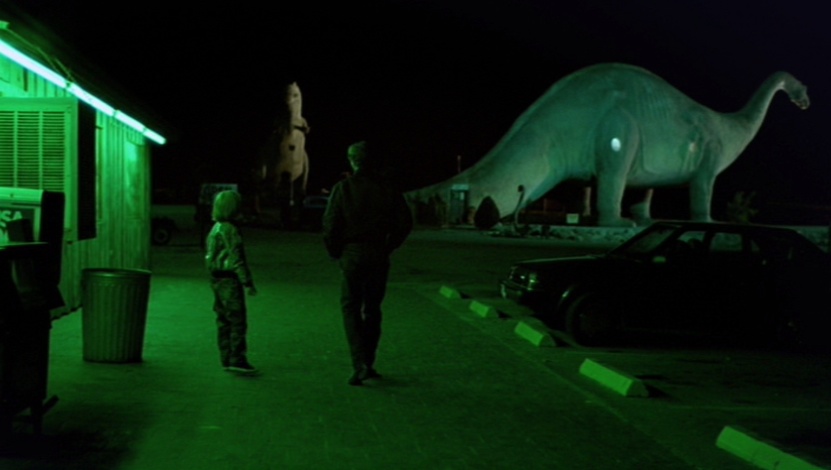


The look of Paris, Texas reminds me of the look of some of Kwik Stop, Michael's movie. The landscape as HYPER reality, poetry seen in the mundane, the sets look "found" - not created by the filmmakers, they exist outside of the movie, in reality. Life is sometimes bizarre, motels are sometimes absurd ... down the rabbit hole. Yet they exist.
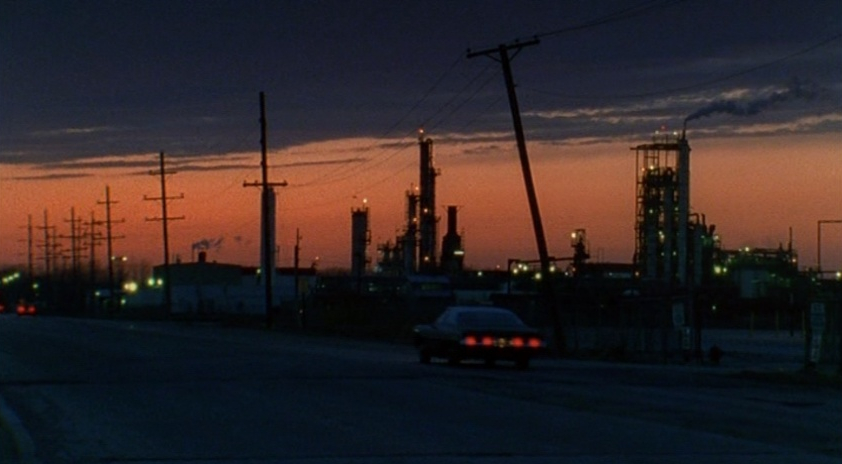


(Punk)


Same look and feel. Intense colors, dream-like, and yet not surreal. It looks hyper real ... the way reality feels like in a dream.
The Books: "Little Black Book of Stories" - 'Body Art' (A.S. Byatt)
Next book on my adult fiction bookshelves:
 The next book on the shelf is the last short story collection by AS Byatt, and this one is called Little Black Book of Stories - I'm excerpting from the second story, called "Body Art". Damian Becket is a gynocologist. One day, after his rounds, he sees a kind of grubby sullen young woman, sitting in one of the wards, making decorations to put up. He doesn't know who she is. Turns out, she is from a local art school - the hospital had asked for volunteers to put up Christmas decorations, and she was the only one who applied. Damian Becket is an art-lover and art-collector - and the hospital itself is decorated with various modern paintings, donated by the artists and by galleries. It gives the hospital a very un-hospital-like feeling. Damian was married - to an actress - but the marriage didn't work out. He had been Catholic - but his faith has now completely lapsed. He sort of befriends Daisy, the art student - but he is an awkward man, and she is sullen, and also vaguely homeless. Turns out, she has been camping out in the hospital basement, undetected. He discovers her there and offers her a room in his apartment, at least until she can get something more permanent. She stays a week - and every night, she comes into his room and they make love. Without speaking about it, or "dating", or anything like that. It is very uncharacteristic for Damian to have casual sex - although there isn't anything casual about sex with Daisy. Maybe I should just say sex outside of a relationship - because you can have pretty intense connected sex with a stranger, all the myths notwithstanding. Daisy is not a sympathetic character, not really - she scorns modern art, which is Damian's great passion, and she has a lot of anger and apathy towards things he holds sacred. But 'sacred' - maybe that's not the right word - especially in lieu of the expert below.
Excerpt from Little Black Book of Stories
He did not lose faith as a consequence of her death. Nor as a consequence of its effect on Eleanor, who now wriggled away from his body as though he was going to damage or contaminate her. Nor out of any moral outrage - though he felt some - at the Church's interference in processes he wanted to believe were human and natural. (That included contraception. Human beings were not animals. They cared for children for perhaps a third of the normal human life. They needed to havev the number of children they could decently and responsibly care for. Their sexual desires were unfortunately not periodic in the way of cows and bitches. Women were perpetually on heat unless, as in the case of his wife, the heat had been turned off. It followed that contraception was natural.) He lost his faith as a result of a vision.
The vision was conventional enough, in one sense. It was a vision of Christ on the Corss - not a heavely appearance, but the result of an unnaturally close inspection of the carving that hung in his local church, a painted wooden carving, neither good nor bad, a mediocre run-of-the-mill carving of a human body, unpleasantly suspended from nails hammered through the palms of hands neither writhing in pain nor distorted by stress, but spread wide in blessing. He thought, The anatomy is bad, the weight would rip through muscle and sinew long before the man was dead. Some crucifixes did support the feet. This one did not. They were crossed, and improbably nailed through both ankles. Some care had been taken to depict the agony of the muscles of the torso, the arms and the thighs. The gash under the heart had realistic slipperiness where it opened; unreal immobilised paint-blood spilled from it, in runnels someone had taken pleasure in varying. There were no bloodstains on the loincloth, which carefully obscured the sex. The face was stylised. Long, unlied, with downcase eyelids, closed as in sleep, and a mouth slightly opened, showing no teeth. More artistic blood had been dribbled from the clutches of the crown of thorns in the abundant shaggy hair. The dead or dying flesh - the carving was simplly not good enough for him to be sure which - was creamy in colour, with pink highlights. He thought, I belong to a religion which worships the form of a dead or dying man. He realised that he did not believe and never had believed, either that the man's bodily death had been reversed, or that he ascended into heaven, for there was no heaven, and all human descriptions of heaven made it pathetically clear that we can't imagine it well enough to make it at all attractive as a prospect. He would not meet poor Rosalie in any such place, and he did not think he would even want to. He did not believe that this one unpleasant death had in any way cancelled out the sins of the earth: Rosalie's wildness, the Church's obstructiveness and bloodymindedness, his grandfather's deaths in bomb blasts in wartime ( paternal) and peacetime (maternal). He never had believed any of it. He felt for the shape of the time - his whole life - when he would have said he believed, and was aghast to sense it like a great humming ice-box behind him, in which what he had been had kept its form, neither dead nor alive, suspended. He was a human bowed down under the weight of a man-sized icebox.
He went on looking at the figure hanging by his hands, with outrage and then with pity. There was a man, who had been dying, and then dead. And there was an idea of who he was, which was a dream, which was a poem, which was a moral cage, which was a film over a clear vision of things. A man is his body, his body is a man.
From which it followed that Damian Becket, having straightened his back, and shaken the ice-box from his sholuders to melt he hoped, at the feet of the lifeless carving, had to concern himself with bodies. His vision had not taught him that everything was without meaning, that chaos reigned. There was order, but order was in time and space and the body. If a man - who had seen the ice-box - wanted to make sense of his life and live well, he must concern himself with the body. There were multifarious reasons why in his case it was the female body. His decision to become a medical student, at the age when he should have been about to earn his living, offended his mother and made his wife extremely angry. He was not quite sure why she was so very angry, and could not find out. Communication is much harder in intimate fear and anger than between casual companions. Silence spread into their lives. He went to London and she did not. She went to church, and he did not.
June 29, 2007
The iPhone line
Here is my favorite photo I took this morning of the iPhone line. I couldn't believe my eyes. The shoes really make the photo.
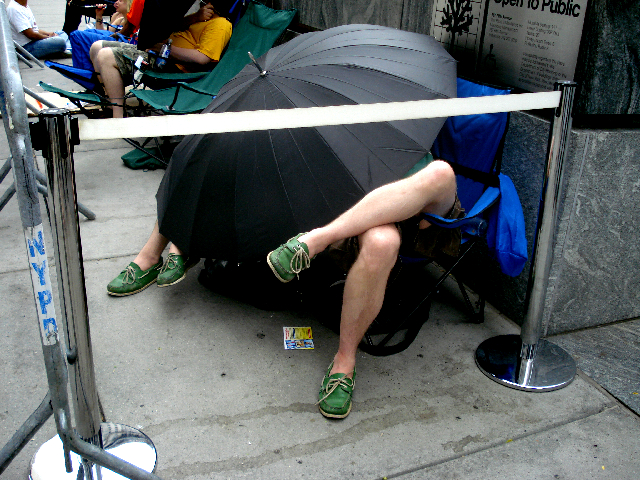
More photos of the iPhone line (and other things) here on my Flickr page.
Erik!!
I cannot find your email - and I'm too rushed to search for it - but I just have to say THANK YOU for sending me The End of the Affair and for remembering our conversation about Graham Greene - that was so so nice of you, and it really means a lot. It's a beautiful copy of the book, too - just lovely.
I am now deeply engrossed in Billy Budd - and loving every homoerotic second of it - but I will probably finish it this weekend and bump it off the list.
Next up? The End of the Affair - thank you so much! I'm excited!
(To anyone who doesn't know Erik - here is his blog. He's wonderful.)
John Adams' Diary
For the dates of Oct. 1775 - Oct. 1776:
He wrote this on the inside cover:

"Colonies?"
(Politics shmolitics - this is my favorite entry in John Adams' journal.)
Dammit.
I look at this supposedly sweet picture and I think of the Child Catcher.
DAMN him! For tainting all that is good and pure!
"Don't stop me now!"
I've watched this clip about 4 times now and I cry every time. It's the looks on the faces - the judges, the audience, and Granny backstage - and Craig himself.
Killing me!! Also - the SONG he chose to perform to.
Perfect clip.
(Thanks for linking, Alex!!)
What it's like in "the line"
I walked by the Apple Store this morning - I just wanted to see the madness. I took some very funny pictures of the folks in line. People had mattresses, tents, umbrellas, dogs ... I love people. I love nuts. You could tell, too, that people had bonded - you know, you bond with the people around you in an experience such as that. It was 8 a.m. in the morning, and everybody was just ... it was like they were at HOME, but they were in public. I saw a dude sleeping. And he wasn't a homeless man. He was a well-dressed young professional, sitting in a chair in the line, completely asleep. No judgment. He needed to sleep. People were playing Scrabble, chatting. I LOVED it.
And it reminded me of my own experience waiting in line for something for eighteen hours. I took a day off work. I recently found some of the photos I took during that experience (sadly, this was when I was in my throwaway camera phase ...) I'll post some of the photos later, when I'm at my scanner. I have a picture of "Elena" sleeping on the sidewalk on her yoga mat. hahahaha
I posted this piece before- but I'll post it again, in honor of the folks in line on 58th and 5th. Stay strong! You're almost at the finish line!
Here is my essay: The Line.
August, 2001
Although I knew I would be sleeping and sitting on the ground for eighteen hours, I neglected to bring a blanket or a pillow. I did, however, bring a bag of books. To keep me company through the night. Hours later, lying curled up on the hard dirt, rocks jutting into my back, using my lumpy book-filled knapsack as a pillow, staring at everyone else's elaborate sleeping contraptions set up around me, I contemplated my choices in life.
I remembered The Scarlet Letter and forgot the blanket. That is all that needs to be said about my entire personality.
Meryl Streep. Kevin Kline. Christopher Walken. Chekhov’s The Seagull directed by Mike Nichols. A much-anticipated event. Come August I started hearing the stories: people camping out, sleeping in Central Park, waiting in line for the coveted free tickets handed out at 1 p.m. by The Delacorte Theatre the day of each performance.
I was, to some degree, waiting for the random phone call from the random friend: "Hey, I have an extra ticket!" Three weeks into the run, I realized that the show was closing soon, and I had to take control of my destiny. I decided to go join the line.
Thursday
6:45 p.m. I approached the already-existing line on the green slope of grass outside The Delacorte, in Central Park. My behavior was tentative, shy. I was afraid that there were invisible rules and that I would be accosted immediately for some infraction.
Because I so believe that people are out to get me, I find that people are often actually out to get me. Which is what happened the second I joined the line.
7:00 p.m. "Excuse me – you just CUT."
My attacker had three Saran-Wrapped cushions tied to a little cart, a cooler slung over one shoulder, and some bedrolls strapped to her back. She looked like a Sherpa.
"That was MY SPOT. You can't just come along and TAKE SOMEONE'S SPOT."
Would a Sherpa yell at someone like this?
I have no way of knowing if this woman is normal and polite in her real life. To my eyes, she was a lunatic. Not to mention the fact that she was wearing a miner's helmet and I had no idea why. Hours later, in the dead of night, when I saw her reading by the beam of light shooting out of her forehead, I understood (and envied) her madness.
But at the time of the attack she was just a fiery-eyed Sherpa in a miner's helmet yelling at me.
I still don't understand how I cut in line since no one was behind me. But apparently there were invisible rules (there always are), and I broke all of them at once.
I felt like screaming, "I DIDN'T MEAN TO CUT!"
One sweet gentle guy with little round glasses came up and said, "We really would appreciate it if you would move back and give her back her spot."
His gentleness was more terrifying than the Sherpa's rage. I got very scared at his use of "we". It was an intimidation tactic, which worked like a charm. I stepped back, baffled, embarrassed, and for the next ten minutes entertained extremely satisfying revenge fantasies. Saying with haughty scorn, "Listen, Sherpa-Bitch, cut me some slack…"
I could not discern at the time that three hours later I too would become a fire-breathing maniac if someone tried to cut in front of me. And I would not have cared one bit if they "didn't mean to", either. A lot of people don't MEAN to do evil in this world and they go ahead and do it anyway. Does that mean they should go unpunished?
I learned an important lesson in that first moment. The worst crime in the universe, unforgivable, is cutting in line. The revolutionary battles in France and America can be explained thus: people simply had had it with other people who felt that it was their right to cut and get in the front of the line.
7:30 p.m. I sat in the dirt.
There was a dude to my right who had come all the way up from Baltimore just to get himself in the line. He was a playwright, choked up with possibility. He hadn't brought a blanket or sleeping bag either, so he and I eventually were complete dirtballs.
To my left were Max and Elena. He was from Long Island and she was from Russia. It was perfect that I waited in line for The Seagull with an actual Russian. I became very involved with Max and Elena's relationship through proximity and osmosis.
They got into an argument at one point during the evening. She said to him, "Max, I thought that we were in this together. I thought that we were a team. Why do you abuse me because you lost your glasses? Why is that?"
His comment was, "This is the Cold War all over again."
He had a long conversation on his cell phone with his mother who was going in for some sort of scary surgery the following morning. I did not know Max, but I could hear the anxiety hovering in his voice.
Right before he hung up he said, trying to get her attention, "Ma?…Ma?…Ma—"
There was a pause, when clearly his mother settled down enough to listen, and he said, "I love you, Ma. Okay? I love you." He hung up and lay back down on his mat, not saying a word, clearly "replete with very thee". Actually, just "replete with very 'Ma'". Elena rolled over and took him into her arms. They lay there silently, in the line, holding each other. I heard Max murmur into Elena's neck. "She's really nervous."
I thought of my own mother with longing and fear.
7.40 p.m. I called my parents from my cell phone, and left a message telling them I loved them.
8:00 p.m. We could sense when the show inside began because of the way the molecules shifted in the atmosphere, creating more space. You could smell the excitement, like ozone in the air.
8:30 p.m. His name was Gabriel, which was quite a propos, since he saw himself as a messenger. However, he didn't quite bring us tidings of great joy.
He moved down the line, in a vaguely militaristic way, shouting at different sections of the ever-lengthening line.
"Hi, everybody! My name is Gabriel and I've waited in line now 13 times—" (a little rustle of alarm went up and down the line. We said to one another, "13 times? What?") "So let me tell you how this works! We all wait in line here until 1:30 a.m., which is when they close the park. At that time, the cops come along and kick us out. There's one cop named Officer Foccaccia…" (something like that) "He gets what we're trying to do here and tries to help us maintain the integrity of the line as we march out to Central Park West—"
I got a chill at the words "maintain the integrity of the line". Suddenly Gabriel was no longer the Angel of the Lord to me. He was more like Robespierre.
"But it's up to us to keep the order of the line. So we're gonna send a list down. Just sign it and pass it on. The Delacorte will not honor this list – it's mainly for us to police ourselves. We stay out on Central Park West until 5:30 a.m. when they open up the park again. And then we come back here. There's a girl who works for the Delacorte whose job it is to watch over the line. Her name is Kathleen. If anyone tries to jump the line – and they will – tell Kathleen. They start to give out tickets at 1 p.m. No more than two tickets per person. Do you guys have any questions?"
Up went Elena's hand.
Gabriel turned to her. "Yes?"
Elena asked, her voice filled with incomprehension and scorn, "Why would you wait in line 13 times?"
I do not believe that this was the sort of question Gabriel had in mind.
He said briefly, "My uncle's a congressman" and then moved down the line to repeat his speech to the next group of people, leaving us with more questions than answers. We discussed the meaning of "My uncle's a congressman" endlessly. Was the congressman so selfish that he kept saying to Gabriel, "I've got two tycoons who invested in my campaign, they want to see The Seagull, please wait in line", knowing that this meant 18 hours out of Gabriel's life? Was that any way for an uncle to treat his nephew? And what was the matter with Gabriel that he kept saying yes?
8:40 p.m. A lifelong bond formed between two guys and two girls over to my left, strangers before getting in line. One of the girls looked so much like Chandra Levy that I considered calling the FBI. Or at least approaching her and saying, "A lot of people are very worried about you right now."
The four of them huddled around a lantern while the guys taught the girls a card game. The girls were very slow at picking up the rules. An hour into the game I could still hear what sounded like extremely elementary questions coming from Chandra and her friend.
"So … do two 5's beat three 3's?"
I hate card games and can never retain the rules because I nearly collapse from the psychological boredom but even I could tell that that was a pretty simplistic question coming so late in the game. But the guys just kept teaching the girls the same rules, over and over, by the glow of the lantern, their low laughter floating through the night air.
8:45 p.m. One guy (who had forgotten, as I did, to bring along a miner's helmet) moved his lawn chair out of the line to sit under a streetlight with John Irving's latest. Max and Elena and I murmured to one another, anxiously admiring his boldness. "Is that allowed?" I huddled over The Scarlet Letter, squinting at the pages, tilting the book towards the light, ruining my eyes in the space of one evening.
8:55 p.m. Max started to get restless and irritable. The reality of his situation was hitting him hard.
"What are we DOING?" he demanded of Elena.
Elena said calmly, "We are waiting in line for a great theatrical event, Max."
"Yeah, but … Chekhov? Maybe for Ibsen I'd wait in line all night, but Chekhov? All these people are just here to see the celebrities. And that's it."
"Max, you have absolutely no feeling for the theatre. We are not here to see the celebrities. We are waiting in line to see actors interpret a classic."
I thought, "Yes. Russians understand art."
9:10 p.m. I polished off The Scarlet Letter, closed the book, the wind moving the trees above, and put my head down on my knees. I had tears in my eyes. I wondered what became of Pearl, what her life was like.
9:30 p.m. Parts of the show reached our ears, carried on the wind. Echoes, reverberations of the play occurring 200 feet away. At one point, we could clearly hear Meryl Streep's agonized shriek. An electric current passed down the line, and we all fell silent, listening intently. I heard Chandra Levy murmur seriously, "That was her."
"Her".
I lay down in the dirt, my head on my bumpy knapsack. The dark trees covered the night sky above me. So often in life I anticipate or worry about what is coming next. But right then, in Central Park, the moment was enough. More than enough.
9:35 p.m. People crawled into sleeping bags, settling in for the night, as though this were a normal time for night-owl New Yorkers to go to bed. It was dark and we could not leave the line. What else was there to do? Elena and Max curled up underneath a blanket. I heard her whisper at one point, "Bite my elbow." I did not peek to see if Max complied with her request.
9:50 p.m. My teeth felt fuzzy. I was hungry.
I wanted to leave the line and find a deli over on Lexington. Gabriel had told us that if we left the line for over half an hour our spot might not be there when we return. "The Line does not look kindly upon you if you leave for three hours and return looking rested and freshly showered and still expect to have your place…" Gotcha, Robespierre.
It took me 15 minutes to get up the nerve to leave.
I told Baltimore Dude my plans, just in case. I trusted he would stick up for me and my spot in line (#56) should questions or accusations arise.
10:05 p.m. I hurried through empty shadowy Central Park as though I had nothing to be apprehensive about, and gangs of wilding boys were not waiting to attack me. I was not just a foolish girl walking through Central Park at night; I knew I was part of something much much bigger.
10:08 p.m. I raced to a deli, feverishly grabbing snacks, my eyes on the clock, ants in my pants. "It's been almost ten minutes! Hurry!!" Nature abhors a vacuum and I coveted my place. Others, further back in the Line, were not guaranteed a ticket. It was a crapshoot for them. But I loved my #56 placement. For me, seeing the show the following evening was a done deal.
As I returned, coming over the grassy knoll, I could feel the Line check their watches, monitoring the length of my absence.
11:00 p.m. The audience emerged from the show, strolling by our refugee camp. They were all dressed up, suits, high heels, clean hair, but the night before they were lying in the dirt, too. There was a sort of force field between the two groups. They smiled over encouragingly. But warily, too. They did not approach us. It was like we were under quarantine.
One of the card-playing guys called out to them, "How was the show?"
Answers came back.
"Oh, wonderful!"
"Terrific!"
"Wait until you see her!"
But one guy said flatly, "If you're not too busy to take the day off and wait in line, then the show's okay."
This last comment angered the Line. We only wanted raves. Be positive and enthusiastic or keep your mouth shut, please.
I heard people on our side repeating it to each other, contemptuously. "'If you're not too busy'?? What the hell kind of answer is that??"
Envy radiated from both sides of the force field. The envy from our side came from the obvious fact that we still had 14 hours of waiting ahead of us. It was an eternity. The envy from their side was subtler. We in the Line still had so much ahead of us, so much to look forward to. Their experience was over, on its way to being just a memory.
11:20 p.m. A good friend called my cell phone before going to sleep in her warm bed, to see how I was holding up. Baltimore Dude was snoring lustily beside me, and I held the phone out towards him so that she could hear. I described to her the scene before my eyes. The dark serpent of people weaving through the trees, little rounded tents, bobbing lights, low distant conversation. "I feel like I'm in The Hobbit, you know?"
11:30 p.m. I curled up in the dirt, the wind on my face, and fell asleep.
Friday
1:30 a.m. Movement. Confusion. I opened my eyes and saw people on their feet all around me. Squinting into the flashing lights of Officer Foccaccia's vehicles, completely disoriented but following orders, I got to my feet, lugging my bag of books up onto my shoulder.
The great Migration from Central Park out to the street was soon underway.
Maintaining the Line during our march was paramount. The pace was ruthless. If your shoe became untied, if you dropped something, if you tripped and broke your leg, the Line would flow mercilessly on, never looking back. The Sherpa dropped her shrink-wrapped cushion contraption and we all marched past her unfeelingly.
Well.
This is not strictly true.
I had some feelings.
I had feelings of triumph and glee. I felt like calling out, "Better you than me, sister!"
Within six hours of being in line I did not recognize myself. All compassion for my fellow human creatures dissolved in favor of keeping the Line in order.
Emerging onto Central Park West had its own particular brand of chaos. People were hanging around out there, waiting to join the Line and we in the already-established Line were blatantly not happy to see them. They could easily take advantage of our sleepy pandemonium and start cutting left and right.
We barked at these newcomers. "Stay back! Stay back!" "The end of the line is THAT way." "I SAID STAY BACK." We were bleary-eyed and punchy, racing to re-establish the Line, tearing about, staking territorial claims. I saw people toss sleeping bags down ahead of them and take flying leaps into place. I scored two feet on a park bench. Chandra Levy and her friend feverishly erected a tent on the sidewalk. The two guys they had befriended joined them inside. As though they had known each other all their lives. I wondered about the sexual politics of the situation. Baltimore Dude, a successful man with a good job, curled up on the cobblestones surrounded by cigarette butts. Elena put her yoga mat down on the sidewalk and lay on her back. Max took up the rest of the bench with me.
During the flurry of activity, Max glanced up and down the line, taking it all in, transfixed, and then shook himself, saying, "I forgot for a second what we all were doing here."
1:55 a.m. Unbelievably, I was still #56 after all that mayhem. Someone actually went up to the front once everyone had settled down, and counted back, obsessively.
2 a.m. Max glanced down at Elena, stretched out in solitary state on the sidewalk, her hair fanning out, arms folded over her chest like a mummy. He contemplated her for a while and then said, "Right now you look just like you looked the day I fell in love with you."
After 2 Busses lumbered by with eerie lit-up interiors, like an Edward Hopper on wheels, all the people inside staring out at the scene in disbelief.
A cab drove by and I heard a guy scream from the back seat, triumphantly, "I SAW IT!!" I don't think he meant the production, I think he meant the phenomenon of the Line. The Line had been written up in the New York Times, and he had "seen it". Like aurora borealis. Or Snuffleupagus. But of course I cannot be sure of what he actually meant because I never got to ask him about it.
After 2 It did not take the Line long to discern that this was the evening for Upper West Siders to toss their furniture out onto the sidewalk. A frantic scavenger hunt began, people dashing up and down 81st and 82nd, lugging the discarded mattresses back to the Line. Mattresses, which had just that day been up in some penthouse, were now comforting the Seagull squatters a block away.
Max dragged back a single mattress for him and Elena to share, which was a relief for me. It had seemed odd to me to see Max way up on the bench with Elena way down on the pavement. There was something very wrong about all that empty space between them.
2:30 a.m. or so The newcomers looked crestfallen when they emerged from the subway station outside the Museum of Natural History and saw the sprawling tent-city which stretched into the distance. They thought they were so on top of things, so radical, setting out to get in line at 2 a.m., but they were unaware that there were throngs of people in NYC crazy enough to grab a spot in line at 7 p.m. One cute little couple slowly walked by us, holding bedrolls, making their way around Chandra Levy's tent, glancing down at Elena and Max on their mattress. They did not say a word as they passed us, but as they moved on I heard the guy murmur to the girl, "We're never gonna get tickets. These people are hardcore."
3 a.m. or so The mugginess of the day disappeared, and a chilly wind blew over us. My goal was to find a position on the bench where none of my skin touched the air. This became an interesting project for me and took up quite a bit of time. I must have looked like a Kama Sutra for When You're By Yourself video. Eventually I slept. Sort of.
Sometime after that I opened my eyes for no apparent reason. The Line slept. Everything was quiet and dark and chilly. The windows of the penthouse apartments lining CPW stared down on us darkly. I wondered what we looked like from up there. Occasional empty cabs floated up the avenue aimlessly.
I looked down at Max and Elena, curled up on their bare mattress, spooning, their legs intertwined, arms wrapped around each other. In full view. Beautiful. Simple. They were a haiku made manifest, on the pavement.
Sleepily, I thought of Michael, one of my ex-boyfriends. My favorite ex-boyfriend. He would have been a perfect partner for an adventure such as this. I lay there, shivering, twisted up like a pretzel, images of him drifting by. Suddenly, even though our relationship was long buried, I missed him intensely. It seemed wrong that I had lost track of him so completely. I have no idea where he is right now, if he is alive or dead, happy or not. I hate that: how some people are lost, and disappear forever.
5:30 a.m. The Return of Officer Foccaccia.
The world was grey. The grey dawn light seeped into the buildings, the trees, the grass, and our sleepy skin. We got ourselves together and began the surreal procession back through the misty deserted park. We walked calmly and silently in single file, sleeping bags draped over shoulders, mattresses hoisted over heads like canoes. This march had none of the cutthroat anxiety of the first one. How easily one grows accustomed to insanity. How quickly the absurd becomes mundane.
Camps were re-erected in all of two seconds. People fell back asleep instantly.
7:15 a.m. Morning in Central Park. Normal New Yorkers slowed down as they passed by us, dogs on the leash, staring at us blatantly, wondering what the hell we were doing. The Line was still asleep, for the most part, so we must have looked a bit like Jonestown.
We, by that point, had been in line for so long that our normal everyday lives had completely disappeared. We had taken time off work, gotten babysitters, cancelled plans. It was incredible to us that there were people on the planet who were NOT in line and who had no desire to get in line.
Who are these freaks? we thought, as we lay on our stolen mattresses and curled up in the dirt, brushing our teeth in public. What is the MATTER with them?
8:30 a.m. One of the members of the line began to stretch. Endlessly. This was not your basic morning knee-bend. She stretched as though she were about to randomly run a marathon and be back in time so she wouldn't lose her place. She flipped herself over a park bench and did crunches. She used trees in innovative ways. She did dance-y runs up and down the path in front of us, her long grey hair billowing. Perhaps she had taken a break from her Navy SEAL training to join the line. I tried to read Catch 22 but she kept pulling focus. I heard Chandra Levy say to her friend, "I wish she'd stop. She's stressing me out."
9:10 a.m. Kathleen from the Delacorte stalked up and down the line, screaming at us, letting us know what was going to happen and when. Gabriel had done the same thing the night before and the Line, as a whole, had bristled with resentment. Who does he think he is? Who elected him Lord of the Line? Who gives a damn that his uncle is a congressman? But our night out in the open had beaten us down. We meekly accepted autocracy now. People waiting in line, confused, bored, ambitious, cling to the one who promises to organize them. The Line yearned for a strong hand after a time of chaos and hardship. Many incomprehensible regimes from history began to make sense to me.
10:30 a.m. "Would you like to sign our petition?" "Want to join this mailing list?" "Here's a petition – you want to sign?" Representatives of every boneheaded cause in New York moved up and down the line. Or at least the causes seemed boneheaded to me on three hours sleep. By the time the 5th or 6th person came down the line asking us to support turning all of the East Village into some matriarchal society of grass huts, we categorically refused to sign. Please stop taking advantage of us because you know we cannot get away from you.
10:40 a.m. A festival of bonding around me. The card players finalized plans to get together again in their normal lives, outside the Line. Strangers found obscure things in common. Two men, one from Norway and one from Mexico, who had met only because they sat next to each other, struck up a chess game. A deep emotional bond clearly had formed between them. I gave my email address to at least five people. I overheard one man say to a woman he had just met in the Line, "Well, send me your resume. I can pass it on to HR."
11:10 a.m. My cell phone rang. Tearing myself away from Catch 22, I answered.
"Hello?"
I heard my friend Rich say, "How do you like your coffee?"
11:45 a.m. Rich appeared, carrying a picnic basket which contained two steaming thermoses of hot coffee, and two bagels with cream cheese. He sauntered up, grinning, and tossed a New York Times into my lap. We chowed on bagels and I talked his head off. I beamed upon him, thinking, like the song says, that I "must have done something good" to have such a one as he in my life.
12:10 p.m. As Rich was about to leave, a petitioner approached, her smile tentative from rejection. "Hi … excuse me … we're trying to get cars banned from Central Park. Would you like to sign our petition?"
Elena said, kindly but firmly, "I don't think that will ever happen."
The woman's smile looked now like a shriek of rage. "I was there when they took down the Berlin Wall and people thought that would never happen either."
Rich said, "But Central Park was built for cars to be able to go through it."
A guy sitting to our right chimed in, "I think we have more to fear from the roller bladers in Central Park. One of them plowed into me once."
A tense silence fell, and No-Car woman snapped, "Okay, fine. So I guess you guys don't want to sign" and stalked off.
Rich and I marveled at the ludicrous equation of no cars in Central Park to the Berlin damn Wall coming down. What are you SAYING, woman?
"Only a truly privileged person would make a comparison like that," I said with gusto, gulping down the last of my coffee, filthy, happy, righteous. (And privileged myself.)
12:30 p.m. Kathleen ordered us around like Lucy Van Pelt. "Okay, everybody! Stand up! Make a single line! Tickets are handed out starting at 1 p.m." We obeyed, packing up our sprawling selves, sucking our meanderings into a single-line formation. We felt threatened by the people wandering around on our outskirts like hyenas, eyeing us greedily, waiting for us to look the other way so that they could leap into the line. We huddled together, closing up the vulnerable spaces between us.
12:40 p.m. Baltimore Dude and I had a conversation with only three elements to it:
1. One of us would state the title of one of Meryl Streep's films.
2. Both of us would make some sort of brief subjective exclamation.
3. The other would vehemently list another one of her films.
And so on. It went on forever.
"Silkwood! Amazing!"
"Oh! Totally! And Sophie's Choice! Come ON!"
"Yes! And how about French Lieutenant's Woman? Gorgeous!"
"Oh my God. And Postcards From the Fucking Edge. Hilarious!"
"Brilliant! And don't forget Kramer vs. Kramer—"
"My GOD…"
What can I say. We had had three hours of sleep in the dirt. We did the best we could.
12:50 p.m. Baltimore Dude told me that he had just had spinal surgery and was missing his morphine. He blatantly confessed, "Morphine is great for the pain, but it makes it really hard to go to the bathroom." There was a pause. He went on, clarifying the finer points for me: "Number One and Number Two."
I did not find it at all odd that a stranger would confess this to me, or that an adult would say the words "Number Two" right to my face. I was completely sympathetic and horrified for him. "Wow. No Number Two, either? That sounds terrible!"
"Oh, it is! It is!"
12:52 p.m. The inevitable occurred. Someone "cut". It was far back in the line and word of it flashed up to us in front at the speed of light.
"Someone cut—"
"What? What?"
"Where?"
"Wait – what? Someone cut?"
"Who cut? Who cut?"
We craned our necks to see "the cutter", all of us straining out of the line diagonally, surging with blood lust. Someone, a grown man, called out at the top of his lungs, "KATHLEEN! SOMEONE CUT!" His face was in a frenzy of rage. We applauded him. Tattle-tales get what they want out of life.
Kathleen catapulted into action, and charged down the path toward the "cutter". We cheered ferociously, as though we were at the Coliseum.
"You GO, Kathleen!"
"Get him, Kathleen! Get him!"
She was a tiny girl for a gladiator, wearing plastic barrettes and high-top sneakers, but she was our defender because we could not defend ourselves. We loved her.
The entire line had turned away from the Delacorte to watch Kathleen's blazing trail. Suddenly Max exclaimed, in a tone of horrified realization, "It's a diversionary tactic! Now the front of the line is undefended!" Alarmed, we whirled around to face the Delacorte again. Max kept talking, pumping up our paranoia: "It's a classic flank maneuver! This is how Napoleon won the battle at Lodi!"
1:15 p.m. The next thing I knew my dirty little fingers clutched two free purple tickets.
1:20 p.m. Baltimore Dude and I had a happy beaming moment of parting, saying, "I'll look for you tonight." I floated down the path, triumphant, in my filthy baggy overalls, my hair sleep-spiked around my face. All around me I saw people saying goodbye to the new friends they had made in line.
"I'll see you tonight."
"I'll see you tonight."
We looked forward to seeing one another again.
7:00 p.m. I ran into Elena outside the Delacorte in the midst of the teeming hoard, while waiting for my sister Siobhan. Elena and I greeted one another with the affection of old friends. Her green eye shadow swooped upwards, like Cleopatra. Over to our right I could see the line burgeoning on, folks getting ready to spend their second night out in Central Park.
7:50 p.m. Once we were inside the theatre, Siobhan eventually stopped asking, "How do you know that person?" I recognized almost everyone there from the Line. I heard a woman say a few rows back, "It's so funny seeing everyone look so nice now. The last time I saw these people, they were all so grubby."
I saw the Sherpa. I almost didn't recognize her without all the gear strapped to her back. Now that she was out of the line she seemed like a perfectly nice normal woman. Her mission was accomplished and she was in HER seat. At long last. Having a seat of one’s own was what each of us wanted, after all.
The Seagull A couple of times during the show, when we all would laugh or clap, my consciousness would slip itself up over the wall and peer down on the Tolkien landscape below. I could see the twisting line, the gnomes crumpled in the dirt, pricking up their ears, keeping hope alive in their Hobbit hearts. I remembered when we heard Meryl Streep's voice flying out over us, and how exciting it was. Hearing her voice helped us to endure, to hang on, because at the end of the 18 hours, at the end of the line, there would be her.
We had waited long hours, we had peed in the bushes, we had no sleep. All for them. In return, they bombarded us with their gifts. We were a raucous vocal entranced audience, letting them know at every second how we felt about them. It was a two-way current of love and appreciation, the likes of which I have rarely experienced in the theatre.
At some point during the ovations, I burst spontaneously into sobs. I cannot explain why I was crying except to say that suddenly I was overwhelmed with the "too much-ness" of everything.
11:00 p.m. Siobhan and I staggered down the path, not speaking. I glanced over and saw the lanterns, the tents, the dark forms on the ground. The Line went on, but it was a different Line now. Not my Line. I felt a little bit lonely for my Line. I wondered how Max liked the show. If he became reconciled to Chekhov, and forgave the seagull for not being a wild duck.
11:03 p.m. A couple charged up to us, holding hands, smiling excitedly. I noticed the sleeping bags under their arms. The guy demanded, "Is it worth it?"
For a brief moment I hesitated, for the production was not without its flaws.
But as I took in the happy open-faced couple, I remembered how angered we all were the night before at the "If you're not too busy to wait in line, it's okay" comment. So I said, smiling, and sincere, "Oh, yeah. It is totally worth it."
June 28, 2007
Dean Stockwell montage
Because I MUST!
I can't stop NOW, are you crazy?
I have a lot of work to do tonight - but I also have Paris, Texas to watch. I've seen it before (I agree with Ebert - it is, indeed, worthy of the name "great") - but I've never sat down to watch it just to hone in on one person - my new BFF, Dean Stockwell. That will be my task tonight.

Dean Srtockwell and Ernest Hemingway, 1950s

That's Stockwell in "Compulsion" - the Leopold and Loeb story - from 1959. Orson Welles stars.

Dean Stockwell in the classic "Secret Garden" - in 1949 - I saw that movie a million times when I was a kid.

Dean Stockwell in "Psych-Out" - another movie I remember seeing a bazillion years ago - this was pre-cable years - I saw a helluva lot of good movies on network television and public television. I don't even remember if this was good - but I do remember it - so I imagine there was something there. Susan Strasberg (who died a couple of years ago) was the star - she was the daughter of Lee Strasberg, famous acting teacher. I should try to track this movie down again.

That's him in "Married to the Mob", of course

That's Stockwell in "Kim" - the movie adaptation of the Rudyard Kipling tale

In "Blue Velvet". If I let myself think too much about that guy, I would have nightmares
Macho macho man
I rarely say I "hate" anything (unless it's applesauce and coconut - damn you, Tom, daaaaamn you!) but I have a vivid memory of haaating "Billy Budd" in high school. I had to read a lot of "hard" books in high school - Scarlet Letter, Tess of the D'Urbevilles - and while they were hard to get through sometimes, i didn't despise them. But I despised Billy Budd. I have no idea why, though. I remember this - I remember thinking Billy (the character) was boringly good - unambiguously good - a goody two-shoes, actually - and I had contempt for him because of that. I still have contempt for goody two-shoes. So that's no surprise. And that's all I remember. Billy Budd was no Sydney Carton, is what I'm saying. Now THERE'S a character I want to read about it - and I felt the same way at 15. But Billy Budd? You want to put a frog in his bed just to see him freak out. And then point and laugh at him.
Uhm, yeah. Don't think that was Melville's intent.
So over the past 5 or 6 years, I gave myself the task to go back and read my entire high school reading list (not all at once, of course, but eventually). And thank God I did. Tess! Moby Dick! Love 'em all.
But my hatred-memory of Billy Budd remained.
So finally, I decided to bite the bullet - and put Billy Budd on my Summer Reading Challenge. I don't enjoy random free-floating hate. It's my least favorite emotion.
I've finished 2 of the books on my challenge (Never Let Me Go - by Kazuo Ishiguro - post here and here - and Veronica, by Mary Gaitskill - post here) - and so what the hell - Billy Budd is 90 pages long. Just DO it, Sheila. Even if you hate it again, what do you care? It's 90 pages!
So I'm 2 chapters in.
Imagine my surprise to find that it is actually a homoerotic novel full of hard bodies, bronzed muscles, physical descriptions of men hanging off of masts - descriptions that go on for (no lie) an entire page, words like "specimen" and "Greek" sprinkled throughout. It's one of the gay-est things I've ever read. Like: OPENLY gay. Like showtunes night at Sidetrax gay. Gay gay gay.
It makes sense when you know a bit about Melville - but I'm actually surprised how OBVIOUS it is. At the 3rd reference in 2 paragraphs to ideal Greek statues, and bronzed brows - I'm thinking, "Uhm, was this book ghost-written by Jean Genet or something?"
I'll report more when I'm more than 2 chapters in - but so far so good. I'm putting the Billy Budd hate to rest! I'm enjoying it. I still wish Billy Budd was more human - but it's certainly not AGONY to read like it was way back when. I love it when that happens.
Letter to EB White
I found the letter to Mr. EB White very touching. It has to do with a real-life Mr. Stuart Little, which - naturally - makes me think of this.
Today in History: June 28, 1914
Excerpt from the towering magnificent "Black Lamb and Grey Falcon" by Rebecca West:
This [June 28th] was a day of some personal significance to him [Franz Ferdinand]. On that date in 1900 he had gone to the Hofburg in the presence of the Emperor and the whole court, and all holders of office, and had, in choking tones, taken the oath to renounce the royal rights of his unborn children. But it was also a day of immense significance for the South Slav people. It is the feast-day of St. Vitus, who is one of those saints who are lucky to find a place in the Christian calendar, since they started life as pagan deities; he was originally a Vidd, a Finnish-Ugric deity. It is also the anniversary of the battle of Kossovo, where, five centuries before, the Serbs had lost their empire to the Turk. It had been a day of holy mourning for the Serbian people within the Serbian kingdom and the Austrian Empire, when they had confronted their disgrace and vowed to redeem it, until the year 1912, when Serbia's victory over the Turks at Kumanovo wiped it out. But, since 1913 had still been a time of war, the St. Vitus's Day of 1914 was the first anniversary which might have been celebrated by the Serbs in joy and pride. Franz Ferdinand must have been well aware that he was known as an enemy of Serbia. He must have known that if he went to Bosnia and conducted maneuvres on the Serbian frontier just before St. Vitus's Day and on the actual anniversary paid a state visit to Sarajevo, he would be understood to be mocking the South Slav world, to be telling them that though the Serbs might have freed themseves from the Turks there were still many Slavs under the Austrian's yoke.To pay that visit was an act so suicidal that one fumbles the pages of the history books to find if there is not some explanation of his going, if he was not subject to some compulsion. But if ever a man went anywhere of his own free will, Franz Ferdinand went to Sarajevo.
Another excerpt:
In January 1913 [Danilo Ilitch] had gone to Toulouse with a Moslem friend and had visited the wonderful Gachinovitch, the friend of Trotsky. He had received from the leader weapons and poison for the purpose of attempting the ife of Genera Potiorek, the Military Governor of Bosnia, but on the way he and his friend had thought better of it and dropped them out of the carriage window. Ilitch had also enrolled two schoolboys called Chubrilovitch and Popovitch, and gave them revolvers. Neither had ever fired a shot in his life. The few days before the visit of the Archduke Ilitch spent in alternately exhorting this ill-assorted group to show their patriotism by association and imploring them to forget it and disperse. He was himself at one point so overcome by terror that he got into the train and travelled all the way to the town of Brod, a hundred miles away. But he came back, though to the very end he seems at times to have urged Princip, who was living with him, to abandon the attentat, and to have expressed grave distrust of Chabriovitch on the ground that his temperament was not suited to terrorism. It might have been supposed that Franz Ferdinand would never be more safe in his life than he would be on St. Vitus's Day at Sarajevo.This very nearly came to be true. On the great day Ilitch made up his mind that the assassination should take place after all, and he gave orders for the disposition of the conspirators in the street. They were so naive that it does not seem to have struck them as odd that he himself proposed to take no part in the attentat. They were told to take up their stations at various points on the embankment: first Mehmedbashitch, then Chabrinovitch, then Chubrilovitch, then Popovitch, and after that Princip, at the head of the bridge that now bears his name, with Grabezh facing him across the road. What happened might easily have been foretold. Mehmedbashitch never threw his bomb. Instead he watched the car go by and then ran to the railway station and jumped into a train that was leaving for Montenegro; there he sought the protection of one of the tribes which constituted that nation, with whom his familiy had friendly connexions, and the tribesmen kept him hidden in their mountain homes. Later he made his way to France, and that was not to be the end of his adventures. He was to be known to Balkan history as a figure hardly less enigmatic than the Man in the Iron Mask. The schoolboy Chubrilovitch had been told that if Mehmedbashitch threw his bomb he was to finish off the work with his revolver, but if Mehmedbashitch failed he was to throw his own bomb. He did nothing. Neither did the other schoolboy, Popovitch. It was impossible for him to use either his bomb or his revolver, for in his excitement he had taken his stand beside a policeman. Chabrinovitch threw his bomb, but high and wide. He then swallowed his dose of prussic acid and jumped off the parapet of the embankment. There, as the prussic acid had no effect on him, he suffered arrest by the police. Princip heard the noise of Chabrinovitch's bomb, and thought the word was done, so stood still. When the car went by and he saw that the royal party was still alive, he was dazed with astonishment and walked away to a cafe, where he sat down and had a cup of coffee and pulled himself together. Grabezh was also deceived by the explosion and let his opportunity go by. Franz Ferdinand would have gone from Sarajevo untouched had it not been for the actions of his staff, who by blunder after blunder contrived that his car should slow down and that he should be presented as a stationary target in front of Princip, the one conspirator of real and mature deliberation, who had finished his cup of coffee and was walking back through the streets, aghast at the failure of himself and his friends, which would expose the country to terrible punishment without having inflicted any loss on authority. At last the bullets had been coaxed out of the reluctant revolver to the bodies of the eager victims.
June 28, 1914: Archduke Franz Ferdinand and his wife Sophie - setting out in their motorcade in Sarajevo, that fateful morning - as the assassins, unseen, move into position.

The Books: "Little Black Book of Stories" - 'The Thing in the Forest' (A.S. Byatt)
Next book on my adult fiction bookshelves:
The next book on the shelf is the last short story collection by AS Byatt, and this one is called Little Black Book of Stories (which is such a good-looking book - I LOVE the design of it. Kudos!). There are five stories in this collection - and the first one is called "The Thing in the Forest". This story is creeeeepy. I love, too, when AS Byatt writes about the WWII generation - not the adults - but the kids, the ones who were little during the war in England. What did it mean - to not be fully conscious of world events, at least not the political ins and outs - but to have your lilfe be so impacted? And that generation stands apart, in terms of its thrift, its practicality - etc. Byatt comes back to this time and time again. That era is closer to the Victorian era, in terms of sensibility, than anything closer to the modern era. "The Thing in the Forest" is all about that.
It's written like a fairy tale, which adds to the creep factor - because it's a fairy tale during the Blitz. Penny and Primrose and two little English girls who are one of a huge group of kids evacuated to the country during the war (a la Lion Witch and Wardrobe). Penny and Primrose befriend each other on the train. The kids are sent to a massive drafty country estate - and are basically set free, to do what they please all day long, before they have to go to sleep in makeshift dormitories set up throughout the estate.
And one day Penny and Primrose take a walk in the forest. And while in the forest, they see a "thing". A terrifying huge slug-like creature - out of a nightmare - stinking of death and decay. By huge, I mean - fairy-tale huge. They hang back, and watch it slither by - destroying everything in its path. It doesn't swerve for trees in its way - it moves right through, so the tree slices it in half - and then the slug re-attaches itself afterwards. Penny and Primrose never speak about what they saw. And they never speak to each other again.
Until .... many years later - when they are both in their 40s or 50s - and they are taking a tour of that old country estate - which has now been turned into a WWII museum. And they happen to be there on the same day.
What was "the thing"? Was it real? They BOTH saw it. But there is something unspeakable about it. Do they feel marked by it? It's like the kids in Stephen King's It - they will be forever changed, and forever linked together, by the horror that they saw. How to live with it?
This is a dark fairy tale. Wonderful writing.
I'll excerpt from the beginning.
Excerpt from Little Black Book of Stories - "The Thing in the Forest"
The two ittle girls had not met before, and made friends on the train. They shared a square of chocolate, and took alternate bites at an apple. One gave the other the inside page of her Beano. Their names were Penny and Primrose. Penny was thin and dark and taller, possibly older, than Primrose, who was plump and blonde and curly. Primrose had bitten nails, and a velvet collar to her dressy green coat. Penny had a bloodless transparent paleness, a touch of blue in her fine lips. Neither of them knew where they were going, nor how long the journey might take. They did not even know why they were going, since neither of their mothers had quite known how to explain the danger to them. How do you say to your child, I am sending you away, because enemy bombs may fall out of the sky, because the streets of the city may burn like forest fires of brick and timber, but I myself am staying here, in what I believe may be daily danger of burning, burying alive, gas, and ultimately perhaps a grey army rolling in on tanks over the suburbs, or sailing its submarines up our river, all guns blazing? So the mothers (who did not resemble each other at all) behaved alike, and explained nothing, it was easier. Their daughters they knew were little girls, who would not be able to understand or imagine.
The girls discussed on the trin whether it was a sort of holiday or a sort of punishment, or a bit of both. Penny had read a book about Boy Scouts, but the children on the train did not appear to be Brownies or Wolf Cubs, only a mongrel battalion of the lost. Both little girls had the idea that these were all perhaps not very good children, possibly being sent away for that reason. They were pleased to be able to define each other as "nice". They would stick together, they agreed. Try to sit together, and things.
The train crawled sluggishly further and further away from the city and their homes. It was not a clean train - the upholstery of their carriage had the dank smell of unwashed trousers, and the gusts of hot steam rolling backwards past their windows were full of specks of flimsy ash, and sharp grip, and occasional fiery sparks that pricked face and fingers like hot needles if you opened the window. It was very noisy too, whenever it picked up a little speed. The engine gave great bellowing sighs, and the invisible wheels underneath clicked rhythmically and monotonously, tap-tap-tap-CRASH, tap-tap-tap-CRASH. The window-panes were both grimy and misted up. The train stopped frequently, and when it stopped, they used their gloves to wipe rounds, through which they peered out at flooded fields, furrowed hillsides and tiny stations whose names were carefully blacked out, whose platforms were empty of life.
The children did not know that the namelessness was meant to baffle or delude an invading army. They felt - they did not think it out, but somewhere inside them the idea sprouted - that the erasure was because of them, because they were not meant to know where they were going or, like Hansel and Gretel, to find the way back. They did not speak to each other of this anxiety, but began the kind of coversation children have about things they really disliked, things that upset, or disgusted, or frightened them. Semolina pudding with its grainy texture, mushy peas, fat on roast meat. Listening to the stairs and the window-sashes creaking in the dark or the wind. Having your head held roughly back over the basin to have your hair washed, with cold water running down inside your liberty bodice. Gangs in playgrounds. They felt the pressure of all the other alien children in all the other carriages as a potential gang. They shared another square of chocolate, and licked their fingers, and looked out at a great white goose flapping its wings beside an inky pond.
The sky grew dark grey and in the end the train halted. The children got out, and lined up in a crocodile, and were led to a mud-coloured bus. Penny and Primrose managed to get a seat together, although it was over the wheel, and both of them began to feel sick as the bus bumped along snaking country lanes, under whipping branches, dark leaves on dark wooden arms on a dark sky, with torn strips of thin cloud streaming across a full moon, visible occasionally between them.
June 27, 2007
Snapshots
-- It's annoyingly hot. The heat makes me feel fat and grubby. The subway is particularly awful, and I have to grit my teeth to NOT say to people who brush up against me, 'Do you mind?' My aversion to crowds is especially interesting considering where I have chosen to live. I do not mind crowds in the winter. I find them bracing then. But in the summer, I am one step away from going postal at every moment.
-- I just signed another year's lease, which is an odd sensation because of all of my other plans I had a mere 2 months ago, which involved upheaval and change. Well, I've still got the upheaval and change - it's just that it's happening in New York now for the time being, and I have to be here. I had been living in my apartment looking around, calculating how long it would take to transfer everything into boxes - and I even got started, took down pictures, boxed up some books ... and now I'm still here. I think I might leave the stuff in boxes, though. To remind myself of that other plan, which is still a good one. Can't ever get too complacent.
-- I seriously cannot imagine my life without Nag Champa incense. I get NERVOUS when I run out.
-- After finishing Veronica, I decided to go with something a bit lighter - and I'm in a fiction phase - so I picked up Elinor Lipman's The Pursuit of Alice Thrift. Elinor Lipman is a wonderful writer - one of those rare rare writers who can make me laugh out loud - and I'll be posting more about her.
-- Speaking of books, here are two funny related stories. Years ago, Allison and I were sitting in a loud music club - so loud we had to scream - and I was telling her about Philip Gourevitch's amazing We Wish to Inform You That Tomorrow We Will be Killed With Our Families. I was shouting about it in her ear. She was into it, excited to read it. Later in the night, we came back to it - when she said, obviously intending to buy it, "Now - what was that book you mentioned? Please Forgive Me But I am About to be Murdered In Front of my Mother?" I still shake with laughter when I remember that. And she wasn't being snarky - she truly did not remember the title, and that was her best shot. And then last week, after my two posts about Never Let Me Go by Kazuo Ishiguro - she called me. "So tell me about this book!!" I raved about it to her. And then this past weekend, she went to the bookstore across the street from her apartment and said to the clerk, "Hi - I'm looking for a book and it's by the guy who wrote Remains of the Day and it's called .... Never Push Me Off the Cliff??" Again, she wasn't snarking - she was trying to remember and that was her best shot. I am guffawing. hahahahahahaha The clerk was like, "Uhm, never heard of that ... " Too funny. But she now has it - and she's tearing through it!
-- I've got Rio Bravo to watch tonight. And Paris, Texas to watch tomorrow night. And a shitload of work to do between the two movies. It's good to have bookends.

Inscriptions
I love the site Book Inscriptions Project dearly - so glad I discovered it! I love to just scroll through there, reading, perusing - it makes me feel like I'm snooping, or something. Maybe that's part of the appeal. But it's not just that.
I have some second-hand books that come with random inscriptions (the one from 1912 is my favorite) - and there are a couple of books in my own collection with inscriptions that have huge capacity to transport me back in time. Antonio and I always used to sign the books we gave to each other - so there they remain, in my collection - ghosts of that relationship, years and years gone by.
The book that really 'got us together' was The Accidental Tourist by Anne Tyler - Antonio was reading it that summer, and he gave a copy to me to read, before we even started officially dating - and wrote in it (in response to a joke I had made, I guess), "No. We are not just two attitudes bouncing off of each other. Tonio." There was something about that book - and its portrayal of an unconventional woman, and a quirky relationship - really spoke to him, and made him see me in a new way (his words). We had known each other forever - and it was as he was reading Accidental Tourist that the thought occurred to him .... what about Sheila?
I remember reading that inscription and feeling a little crinkly thing in my stomach, like: hmmmm, this FEELS like something is there ... Am I reading into that inscription? Or .. is he saying there is more between us than just jokes and banter?
I always think I'm reading stuff into everything, but the thing is: I am usually right. My instincts have rarely been off - even when friends have tried to say, "You're being paranoid", etc. Nope - I know. (The weirdest example of my intuition being here.)
The gift was symbolic - and I still have it - inscription and all. Strange. None of the feelings remain from that time - he's one of the few guys I DID get over with no lingering regrets - so when I look at that inscription I feel strangely distant, and poetic almost. Like - wow. Look at that poetic thing that happened to someone else. Look at that poetic romantic thing that means nothing to me.
Snippets, fragments of humanity, of connection - missed or otherwise- Human beings writing to each other, to themselves ... I don't know, I find it very touching - like Dr. Frank's ongoing found objects series. latest here. Or this one
There's something about The Book inscriptions project that really speaks to me. Hieroglyphics, remnants, ghosts, echoes ... and yet oh how important these messages were to someone, once upon a time.

The Battle of Bunker Hill
Lego style. I love the Lego dudes digging in the beginning.
Found this on Boston 1775 - which, honestly, is the best website ever created.
June 26, 2007
You and me
This'll make my dad laugh. Grammar Girl has finally addressed my one grammatical issue. The best thing, though, is that once my dad started reminding me about it (he'd send me an email after reading a post of mine, and the subject line of his email would be: "You/Me" - and I'd know: DAMMIT. Where is it??) - I actually became conscious of the problem, and have nearly licked the habit. But still - it cracked me up. Here is just one example of this fond loving father/daughter phenomenon. I wouldn't even open the email from him mostly, because the subject line said it all - I'd just go back to the post and scour it for the problem. You know some rules you just KNOW, because you learned them so well during the Mesozoic era? For example: I never get the "your" "you're" thing wrong. Or "they're" "their" "there". I haven't made a "they're" "their" or "there" error since I was 8 years old. Or the whole "it's" "its" debacle. I never make that mistake. And if I do? It's a typo. You'll just have to trust me on that. These rules I KNOW. And most grammar rules are like that for me (for I? - hahahaha) ... but the you/me thing gets me. However, over the last year, I have decided to learn the rule - and I think I've got it licked. It still cracks me up, though. All it took was a little focus on the problem.
I love, too, how Grammar Girl writes:
The proper sentence is I love you, not Me love you.
Oh, really? You want to tell that to him?

Grammar Girl. Indispensable site!
Veronica - by Mary Gaitskill
I've finished my second book on my Summer Reading Challenge - Veronica, by the great Mary Gaitskill. (Voila.)
Here are some of the many posts I've written about her, marvelous writer:
Happiness (and the comments to that post are great, Gaitskill fans!)
Veronica is a novel - it's about two women - Alison (the narrator), who was a teenage runaway turned high-fashion model - and her friend Veronica - a blowsy fierce middle-aged woman, whose boyfriend is bisexual - who eventually gives Veronica AIDS. I first encountered Gaitskill with her knock-one-out-of-the-park debut - the short story collection Bad Behavior. Her firts novel is called Two Girls Fat and Thin - and I read it, and honestly remember almost nothing about it - while I can remember certain scenes from stories in Bad Behavior word for word. I should go back and read Two Girls Fat and Thin. I then read, last year, Gaitskill's second short story collection Because they wanted to - and ate up every word. Some of her stories (especially "The Blanket") move me to tears. But there was something in Veronica that left me cold - and I would imagine that a couple years from now I wouldn't remember a bit of it - just like I don't remember a bit of Two Girls Fat and Thin. It makes me wonder if short stories are Gaitskill's true milieu. Like I believe is the case with Lorrie Moore - one of the greatest short story writers ever. I haven't read any of Moore's novels - I think there are two - so I may be wrong in this. I'm just saying that I have rarely read anything more perfect than Moore's collection Birds of America. She is a MASTER. And Gaitskill is a master too. But, to me, there was something lacking in Veronica. I have to think a bit more upon it.
One of the things that occurred to me is this:
Gaitskill is at her best (meaning: better than anybody else) when she hones in on the specific. The people she writes about - from the beginning - are very often nasty selfish weird little people. You don't LIKE her characters. That's not the point. Reminds me of Tommy Lee Jones' point about playing villains - and whether or not an actor needs to LIKE the character he plays. Jones says, "You don't need to like the character. But you do need to want to WATCH the character." I can't look away from Gaitskill's people. Some of it does read like a traffic accident, and I'm rubber-necking by. She's an entryway into a world peripheral to mine, a world that has occasionally touched my own - a world of sex clubs and strippers and whores - not whores meaning "promiscuous" - but whores meaning "sex for money". She writes about girls who strip as they go through art school. She writes about S&M - people who get off on pain, who yearn to go to their limits of endurance ... and yet why? Is it loneliness? Love? What are these people looking for as they beg strangers to whip them, or piss on them - or whatever. The movie Secretary is based on one of Gaitskill's stories - and while it was domesticated up a bit (hard to believe - but not if you've read Gaitskill's actual stuff) - and made into a kind of touching love story ... the grain of truth remains. The lead character accepts the spankings ... for the first time in her life, it gives her purpose, makes her feel needed, necessary. The point is not to find oneself for these people. The point is to LOSE oneself. Anyway, I could go on and on. Gaitskill knows what she's talking about here - this is her topic. I don't know much about her life story, and I won't make any guesses, just because I have read her work. I do know she was a teenage runaway, and did work as a prostitute for a while. There is a strong sense of authenticity in her work - but more than that: this woman is a kick-ass writer, fearless - It takes your breath away. There are no tidy endings, no morals ... But what she does do is she LOOKS, she sees, and she TELLS. She's so very good in the details.
My issue with Veronica is not with the writing. But it seems to me that she was going for something universal here, and I just don't think that that is Gaitskill's particular gift. Not that I don't relate to some of her characters - I always do - it's not a freak show, after all. These people - the addicts and runaways and whores and wanderers - all have something in them that connects them to the human race. I cannot look at them and say, "That, is YOU, over there, and has nothing to do with ME." But she remains honed in on the specifics, the details - what their apartments look like, how they eat, how they talk, what they say when they do talk ... She doesn't worry so much about a message, or about being universal. And I felt a certain drive in her in Veronica to push upward, into some kind of universal truth. For the majority of the book, Alison - who is now a sad middle-aged woman, with Hepatitis C, her beauty gone ... takes a walk in a redwood forest - and ponders the past. We go back and forth in time. And I felt that the past sections were far more vivid - the present-day sections involved Alison looking at the moss, and the trees, and the running streams ... and I felt that Gaitskill was going for something here, something that did not quite work, for me. However, my point here reminds me of the quote I linked to above, from a review of Bad Behavior, a quote I love so much:
In "The Wrong Thing", the novella that concludes the collection, Ms. Gaitskill seems to be striving toward an uncertain goal, and (like her narrator, Susan) she isn't entirely successful. She's slightly out of her depth -- which is exactly where she needs to be; it's the only place she's going to make the discoveries that will take her up to the next level and the levels beyond. Once an artist of her command relinquishes enough control to let her brilliance lead her where it wants to, anything is possible.
YES. She is not "entirely successful" in Veronica either - a bit "out of her depth" - at least in the meandering "look at the moss on the trees and ponder the universe" sections. But I agree with that reviewer that this, on the edge, and not entirely successful, is "exactly where she needs to be". She is a writer who takes risks. Not just for the sake of taking risks. Not for the sake of being shocking, although some of her stories are shocking. She is not in it for the shock. Having known people who live in the world she describes - the underworld, I guess you'd say - I can say that she gets it right. Much in this world would shock the comfortable middle class. Gaitskill lives on the sidelines, her characters do not participate in society in that full and open way ... they are shadow people, tunnel people, forgotten - and many times, have no concept whatsoever of the things many others take for granted. There's a moment in Vernonica where a boyfriend of Alison's breaks up with her - because he has met someone else. He wants to be fair to Alison, so he comes clean. Gaitskill's description of this conversation is brief, stark - and the main thing you come away with is the realization that Alison does not understand his sense of honor. She recognizes that he is behaving honorably - but instead of appreciating it, it embarrasses and shocks her. This is a corrupt world, full of corrupt people. Alison would love to participate in a full life - where things like love, and kindness, and honor are expected, and also understood. She is not so completely gone that she SCORNS such things ... but she certainly knows that she is left out. And that her boyfriend is better off without her. But then - much later in the book - Gaitskill pulls one of her jujitsu moves - and there is a moment of pure and fierce love ... and it was enough to bring tears to my eyes. Gaitskill is not cynical - that's what makes her so fascinating as a writer. You would think she would be, what with her topic - and what she has seen. She is not. But it is an intense and bleak view of the world, pared down, raw. Hard to take.
And for me - all of that is clear when she stays in the details. The "universal" is not for her. At least not when it is gone at directly. Some writers can do that - it is their sensibility, how they see things. Gaitskill's gift is most clear when she is in the muck, describing what she sees.
Example from Veronica:
Because we sold flowers outside bars and go-go clubs, prostitutes were some of our best customers; the nice ones bossed their johns into buying from us. Most of them weren't beautiful girls, but they had a special luster, like something you could barely see shining at the bottom of a deep well. They treated us like sisters, and we were tempted to join them when men came around looking for "models" - which everybody knew meant stripper or whore. Mostly, we would indignantly say no, but sometimes somebody would say yes. I said yes a couple of times. Why I picked those times to say yes, I don't know. One was an old fat man with a spotted face and pale, aggrieved eyes. He ran some kind of business, maybe postcards or comic books. He leaned on a counter in the back room of his store and blinked his pale eyes while I took off my clothes. When I was naked, he looked awhile and then asked if he could look at me from behind. I said okay; he walked around me in a circle and then went back behind the counter again. "You have beautiful hips and legs," he said. "Beautiful shoulders, too. But your breasts are small and they're not that good." He talked to me about the kind of work I might do while I put my clothes back on."You mean porn?"
"Sure, we do some porn. There's more money for the girls that way. But we do seminude art, as well." His eyes became more aggrieved. "Do you care what the other girls do?"
I shrugged. Outside the window, electric music corkscrewed through the air. If he hadn't insulted my boobs, I might have tried it out. But I just said bye and left.
Like a cat in the dark, your whisker touched something the wrong way and you backed out. Except sometimes it was a trap baited with something so enticing, you pushed your face in anyway. Once when I was out with my basket, a short man with a square torso said, "Hey, hot shit - you should come work for me." He bounced a rubber ball on the pavement, caught it, and bounced it again. "I'm a pimp." His face was like lava turned into cold rock. But inside him, it was still running hot; you could smell it: pride, rage, and shame boiling and ready to spill out his cock and scald you. I stared in fear. He just laughed and bounced his ball; he knew that for somebody what he had was the perfect enticement.
And then there's this - one of the many sections of the book that describes the world of high fashion, and this image really really struck me:
At a magazine party, I sat at a table with the most famous model of the year, a seventeen-year-old whose laughing face was a fleshy description of pleasure, satiety and engagement that engaged at one decibel again and again. Photographers pitilessly filled her with their radiant needles until she was riddled with invisible holes and joyfully pouring radiance out each one. As an afterthought, a photographer turned and photographed me. My picture would appear later in a magazine society page. In the photo, I ws sitting next to the young writer who had briefly occupied the chair next to me when it was vacated by a columnist. He sat down to ask me if I'd ever seen Modigliani's paintings. "Because you're lilke a beautiful Modigliani painting," he said. "You should go see the exhibit at the Metropolitan." I waited for him to ask me to go with him, but he didn't. He had intense eyebrows and hazel eyes with bright changeable streaks glowing emberlike through the solid color. His name was Patrick. He gave the impression of a fast current that you might ride on, laughing. We talked about nothing and then he got up and left. I waited a very pleasant moment before getting up, too. Six months later his friends woud ignore me and sting me with weapons made of the finest jealousy and gossamer contempt. A woman writing a book on the history of troll dolls would look at me and talk loudly about the trivial nature of beauty and fashion. A short actress would turn her back on me while I was speaking and put her arms around Patrick. I would break a wineglass in a hostess's bathroom and walk on it until the splinters were unseeable. I would change my mind and guiltily mop the glass with a wet towel. "Alison?" Patrick would pound on the door. But that night, he proudly introduced me. That night, I said, "I'm a model," and it came out shy and shining at the same time. People smiled and parted, and allowed me to enter the social grid.
Or this section, when Alison leaves a party with Jamie, a guy she just met. I love how Gaitskill, in 2 or 3 words - can call up an entire personality.
We left the party and went for a walk. On the bottoms of his severely pointed shoes, Jamie wore cleats, which clicked loudly on the pavement. The only people I'd ever known to wear cleats were middle-school boys, who wore them so they could kick hard and make a lot of noise when they walked. I asked Jamie why he wore them, and he said, "I just like them." His words were modest, but they whirred with secret importance. He said everything that way. The British monarchy was very important; Prince Charles's recent marriage was particularly so. Ornette Coleman was the only good jazz musician. He approved of men's shoes on women. He approved of Buckminster Fuller and Malcolm McLaren. He approved of Bow Wow Wow.His opinions were frivolous, fierce, and exact. He worked in a smal graphics plant that made logos and labels for sundry products. But he was as proud and particular as any Parisian playboy. His favoirte logo was the brand name of a line of white paper sacks commonly used by small grocers; I had never noticed, but TORNADO was printed in brown letters with a vibrant round T at the top of each bag. "It's so elegant," he said, and it was.
Brilliant. So clear. You can't argue with such clarity. It just IS. And the last 3 words of that excerpt - the "and it was" - is typical Gaitskill. It's what makes her so wonderful. You may be lulled into a false sense of superiority towards Jamie, you may think: God what an ass, how pretentious ... You may hate his type. But Gaitskill will never go there with you, in your judgment, she is more interested in being on the inside of the experience. Jamie may be an ass, I mean - he's wearing cleats to a party ... but then he raves about a logo he likes ... and Alison realizes how right he is. That his eye is, in fact, good. And of such small moments are connections made at 2 o'clock in the morning in this dirty lonely city. I've been there. That's just how it is.
The book loses much in the present-day sections, although I can see what she is going for. It is elegiac - and you do feel, by the end, that Alison has lost much ... her past is far more vivid than her present ... Yet the writing is less DETAILED in the present-day sections. It doesn't have that spark of danger, which is one of the reasons i find Gaitskill so compelling. Her work feels on the edge. There is something dangerous about life, and it shows in her writing.
The Books: "The Matisse Stories" - 'The Chinese Lobster (A.S. Byatt)
Next book on my adult fiction bookshelves:
 The next book on the shelf is another short story collection by AS Byatt, and this one is called The Matisse Stories. This excerpt is from the last story in the collection "The Chinese Lobster". Byatt takes the gloves off here about art theory, academia, political correctness, social mores - and the problem with lack of context. Context is everything. How do you study Matisse without context? In this story - the Dean of Women's Studies has met up for dinner at a Chinese restaurant with a professor in her program - who has been accused of sexually assaulting a student. (The Dean has, in her possession, a horribly written - in terms of grammar and spelling - accusation from the student). There's no real plot here - the two people just sit and talk over their food, as a lobster meanders about in a big tank behind them with open staring mute eyes. Perry Diss, the professor, is outraged - not just that he has been accused, but that he has been accused by an ignorant politically correct anorexic women's studies nitwit, who hasn't even TRIED to understand the work of Matisse. All the student sees is the fleshy naked bodies, the voluptuous females - and she hates it. She thinks the work is misogynistic. Perry Diss thinks: what a waste of an education. To see everything politically. What a waste. Missing the point of life. The students aren't even able to SEE any more ... because of all the "theory" surrounding such education. How does one LOOK at Matisse? THAT is the question. Perry Diss has reached the end of his rope with this kind of nonsense. And he also happens to love Matisse. He knows the student is ignorant, but he also begins to realize that the student is the one with the power here. All it takes is to make the accusation, true or not. However, very important: Perry Diss is no saint, and Hillelblau has a point. Oh, and Perry Diss also says inappropriate things about the student - as you can see in the excerpt below. He could easily be misunderstood. Nothing is simple in Byatt's world, and those looking for nice little black and white representations of their own rigidity should surely look elsewhere. Byatt - as always - means to engage reality - not point a finger. She observes, and reports. I feel she does take sides, she's on Perry's side - on the side of art, pure, she is not neutral in the argument - yet she is also aware of the validity of the other side (all of Possession is like that). She concedes points all the time. That's what makes good writing. Oh - and I like this story too because it's funny. It's a serious matter - but she writes in this rollicking free way - most of it is conversation, and you can just hear both of the voices.
Anyway, really interesting story - a topic very dear to my heart. Byatt knows this shit inside and out.
Excerpt from The Matisse Stories. This excerpt is from the last story in the collection "The Chinese Lobster".
'I have had this rather unpleasant letter which I must talk to you about. It seemed to me important to discuss it informally and in an unofficial context, so to speak. I don't know if it will come as surprise to you.'
Perry Diss reads quickly, and empties his glass of Tiger beer, which is quickly replaced with another by the middle-aged Chinese man.
'Poor little bitch,' says Perry Diss. 'What a horrible state of mind to be in. Whoever gave her the idea that she had any artistic talent ought to be shot.'
Don't say bitch, Gerda Himmelblau tells him in her head, wincing.
'Do you remember the occasion she complains of?'
'Well, in a way I do, in a way. Her account isn't very recognisable. We did meet last week to discuss her complete lack of progress on his dissertation - she appears indeed to have regressed since she put in her proposal, which I am glad to say I was not responsible for accepting. She has forgotten several of the meagre facts she once knew, or appeared to know, about Matisse. I do not see how she can possibly be given a degree - she is ignorant and lazy and pigheadedly misdirected - and I felt it my duty to tell her so. In my experience, Dr Himmelblau, a ot of harm has been done by misguided kindness to lazy and ignorant students who have been cosseted and nurtured and never told they are not up to scratch.'
'That may well be the case. But she makes specific allegations - you went to her studio - '
'Oh yes. I went. I am not as brutal as I appear. I did try to give her the benefit of the doubt. That part of her account bears some resemblance to the truth - that is, to what I remember of those very disagreeable events. I did say something about the inarticulacy of painters and so on - you can't have worked in art schools as long as I have without knowing that some can use words and some can only use materials - it's interesting how you can't always predict which.
'Anyway, I went and looked at her so-called Work. The phraseology is cating. "So-called". A pantechnicon contemporary term of abuse.'
'And?'
'The work is horrible, Dr Himmelblau. It disgusts. It desecrates. Her studio - in which the poor creature also eats and sleeps - is papered with posters of Matisse's work. La Reve. La Nu rose. La Nu bleu. Grande Robe bleue. La Musique. L'Artiste et son modele. Zorba sur la terrasse. And they have all been smeared and defaced. With what looks like organic matter - blood, Dr Himmelblau, beef stew or faeces - I incline towards the latter since I cannot imagine good daube finding its way into that miserable tenement. Some of the daubings are deliberate reworkings of bodies or faces - changes of outlines - some are like thrown tomatoes - probably are thrown tomatoes - and eggs, yes - and some are great swastikas of shit. It is appalling. It is pathetic.'
'It is no doubt meant to disgust and desecrate,' states Dr Himmelblau, neutrally.
'And what does that matter? How can that excuse it?' roars Perry Diss, startling the younger Chinese woman, who is lighting the wax lamps under the plate warmer, so that she jumps back.
'In recent times,' says Dr Himmelblau, 'art has traditionally had an element of protest.'
'Traditional protest, hmph,' shouts Perry Diss, his neck reddening. 'Nobody minds protest, I've protested in my time, we all have, you aren't the real thing if you don't have a go at being shocking, protest is de rigeur, I know. But what I object to here, is the shoddiness, the laziness. It seems to me - forgive me, Dr Himmelblau - but this - this caca offends something I do hold sacred, a word that would make that little bitch snigger, no doubt, but sacred, yes - it seems to me, that if she could have produced worked copies of those - those masterpieces - those shining - never mind - if she could have done some work - understood the blues, and the pinks, and the whites, and the oranges, yes, and the blacks too - and if she could still have brought herself to feel she must - must savage them - then I would have had to feel some respect.'
'You have to be careful about the word masterpieces,' murmurs Dr Himmelblau.
'Oh, I know all that stuff, I know it well. But you have got to listen to me. It can have taken at the maximum half an hour - and there's no evidence anywhere in the silly girl's work that she's ever spent more than that actually looking at a Matisse - she has no accurate memory of one when we talk, none, she amalgamates them all in her mind into one monstrous female corpse bursting with male aggression - she can't see, can't you see? And for half an hour's shit-spreading we must give her a degree?'
'Matisse,' says Gerda Himmelblau, 'would sometimes make a mark, and consider, and put the canvas away for weeks or months until he knew where to put the next mark.'
'I know.'
'Well - the - the shit-spreading may have required the same consideration. As to location of daubs.'
'Don't be silly. I can see paintings, you know. I did look to see if there was any wit in where all this detritus was applied. Any visual wit, you know, I know it's meant to be funny. There wasn't. It was just slapped on. It was horrible.'
'It was meant to disturb you. It disturbed you.'
'Look - Dr Himmelblau - whose side are you on? I've read your Mantegna monograph. Mes compliments, it is a chef-d'oeuvre. Have you seen this stuff? Have you for that matter seen Peggi Nollett?'
'I am not on anyone's side, Professor Diss. I am the Dean of Women's Students, and I have received a formal complaint against you, about which I have to take formal action. And that could be, in the present climate, very disturbing for me, for the Department, for the University, and for yourself. I may be exceeding my strict duty in letting you know of this in this informal way. I am very anxious to know what you have to say in answer to her specific charge.
'And yes, I have seen Peggi Nollett. Frequently. And her work, on one occasion.'
'Well, then. If you have een her you will know that I can have made no such - no such advances as she describes. Her skin is like a potato and her body is like a decaying potato, in all that great bundle of smocks and vests and knitwear and penitential hangings. Have you seen her legs and arms, Dr Himmelblau? They are bandaged like mummies, they are all swollen with strapping and strings and then they are contained in nasty black greaves and gauntlets of plastic with buckles. You expect some awful yellow ooze to seep oout between the layers, ready to be smeared on La Joie de vivre. And her hair, I do not think her hair can have been washed for some years. It is like a carefully preserved old frying-pan, grease undisturbed by water. You cannot believe I could have brought myself to touch her, Dr Himmelblau?'
'It is difficult, certainly.'
'It is impossible. I may have told her that she would be better if she wore fewer layers - I may even, imprudently - thinking, you understand, of potatoes - have said something about letting the air get to her. But I assure you that was as far as it went. I was trying against my instincts to converse with her as a human being. The rest is her horrible fantasy. I hope you will believe me, Dr Himmelblau. You yourelf are about the only almost-witness I can call in my defense.'
'I do believe you,' says Gerda Himmelblau, with a little sigh.
'Then let that be the end of the matter,' says Perry Diss. 'Let us enjoy these delicious morsels and talk about something more agreeable than Peggi Nollett. These prawns are as good as I have ever had.'
June 25, 2007
Dean Stockwell listening
Part 2. Last post for today. Ah, but tomorrow ... who knows what tomorrow will bring??
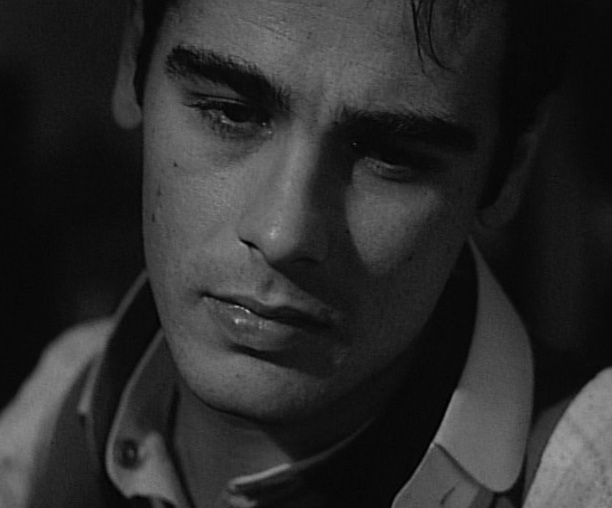
The wrenching last 2 scenes of Long Day's Journey - between Jamie and Edmund ... and then the scene that ends the play, involving the whole tragic family. It's his face as he takes it all in. And this is nasty stuff, relentless stuff - cruel things are said that can never be unsaid. Edmund, with all of his dissipation - his drinking, his whoring, and also his consumption, is the rock of the family. The steady one. And yet he is completely unstable on some level - all he does is absorb, absorb everybody else's pain. Not to mention the fact that on some deep and utterly true level, everybody blames him for what happened to Mary Tyrone. Which basically means, that they blame him for being born. He knows it, everybody knows it ... yet can such a thing be said? There are stories of Eugene O'Neill locking himself into his study for 10 hours a day, when he was writing Long Day's Journey. His wife said he would emerge, at the end of the day, eyes puffed out of his head from crying all day long. He would write and cry. That was his process the entire time of writing the play. He was wrenching something out of his soul, and pouring it onto the paper, with his heart, pain, grief, loss ... Edmund is the Eugene O'Neill persona in the play. The watcher, the absorber ... the one who might, just might, if he survives, be able to make art out of all that tragedy. At a huge cost, of course, but what else are you gonna do.
Anyway. Back to the beautiful intense listening face of Dean Stockwell.
LISTENING

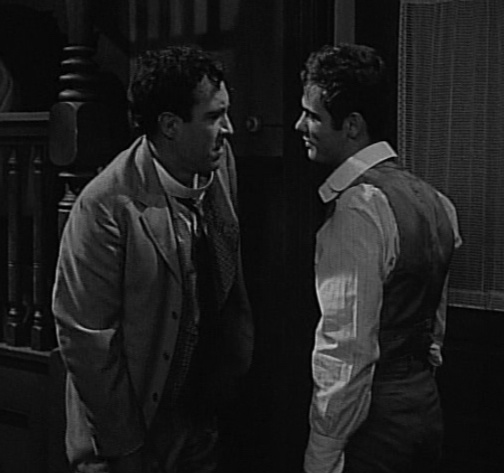
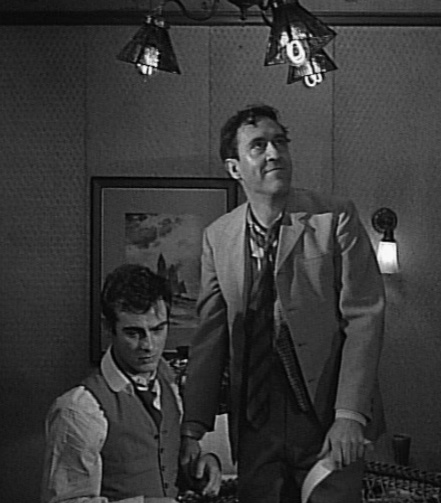
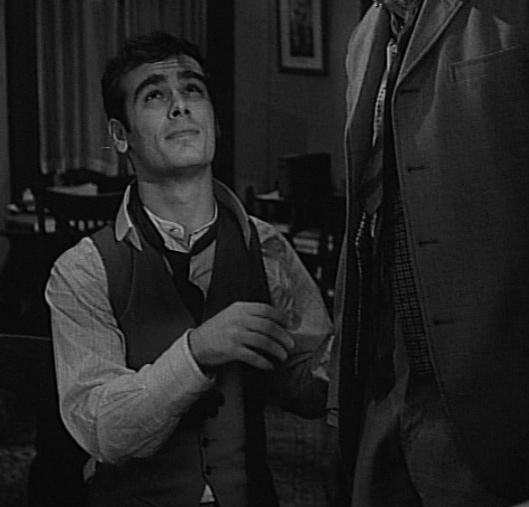

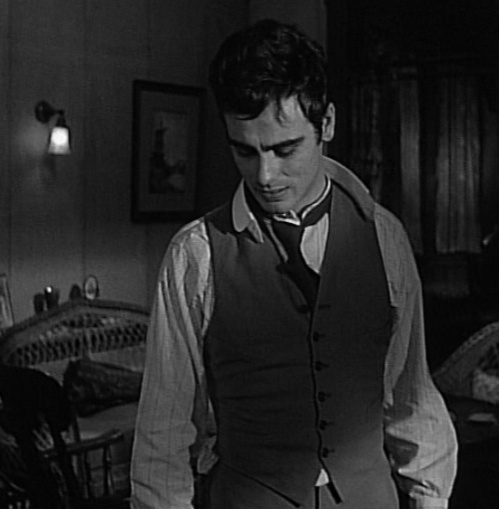
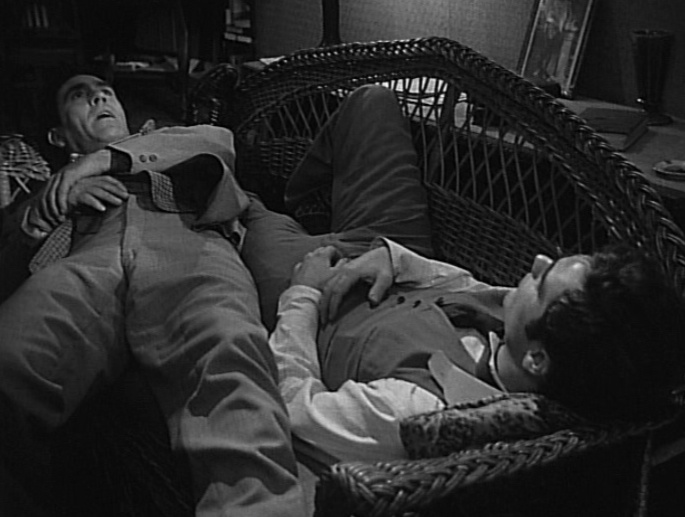
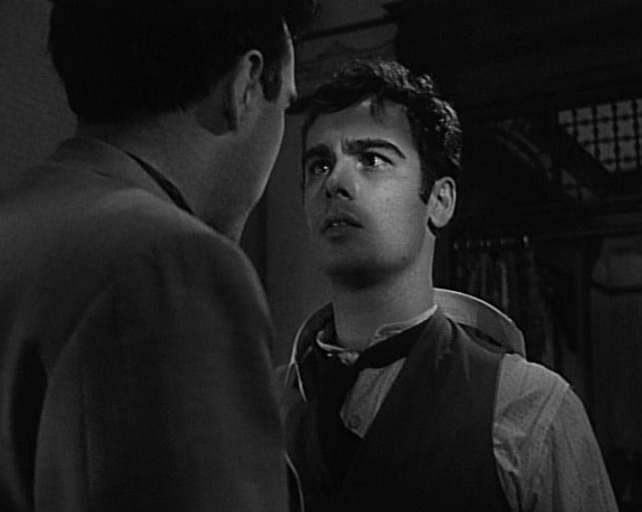
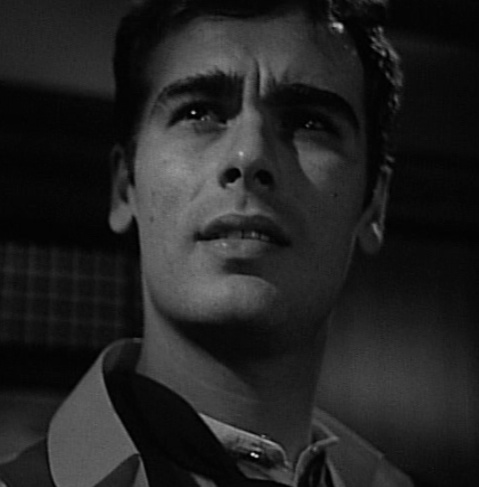
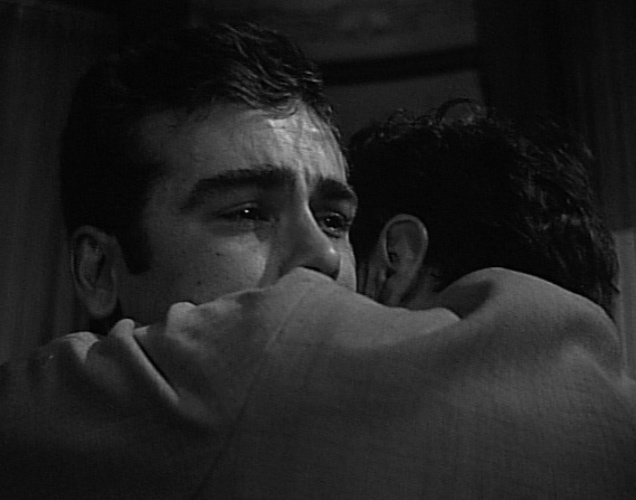
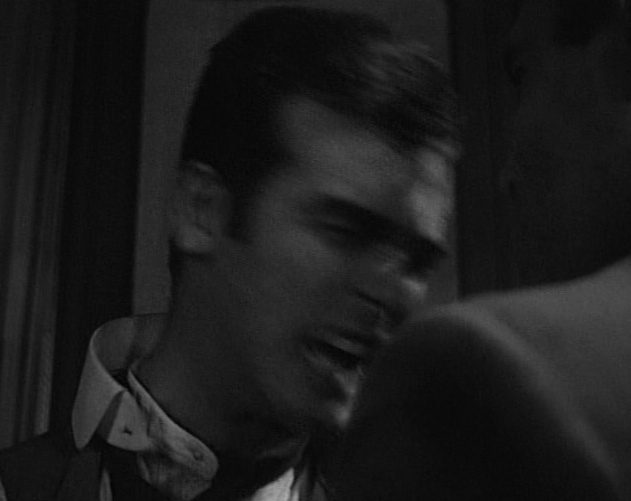
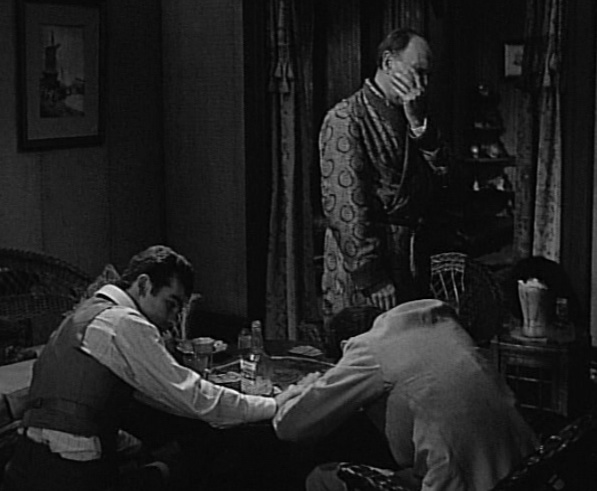
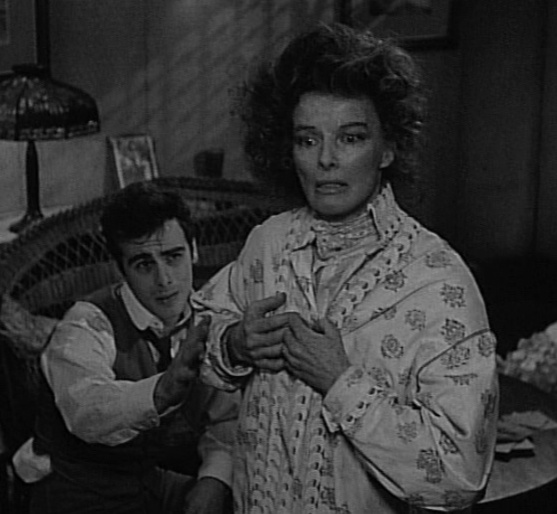
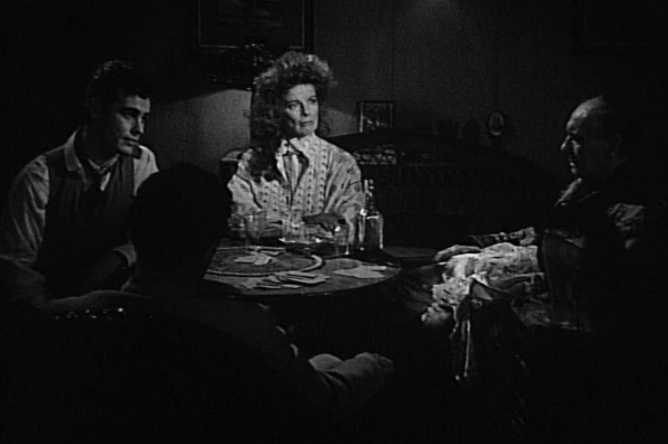
Dean Stockwell: because I can't leave well enough alone
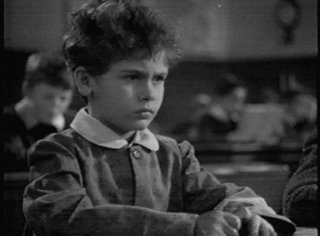
All indented excerpts from David Thomson's film encyclopedia:
With the TV series Quantum Leap and with his regular work as a supporting actor in movies, Dean Stockwell may never have been better known. Yet he has experienced so many stages and changes already - the piercing child; the beautiful yet not quite penetrating young lead; the wanderer, hippie, and biker; the realtor in New Mexico; and now, for a decade at least, the versatile, reliable, yet never quite predictable character actor who seems blessed to play men brushed by the wing of uncommon experience - as if they might once have had green hair.
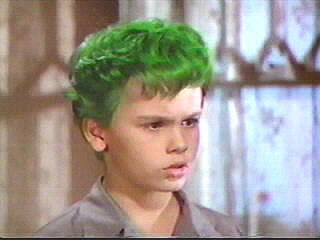
The child who was once the center of films has become a man content to be an outcast or an eccentric.

He is the son of actor Harry Stockwell, and the older brother of Guy Stockwell, and he was a steady movie child at Metro by the age of nine.
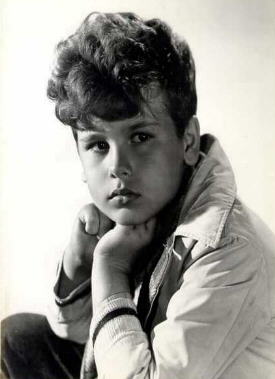
He was away from the screen for several years and came back as a twenty-year-old: Gun for a Coward (56, Abner Biberman); The Careless Years (57, Arthur Hiller); with Bradford Dillman as Leopold and Loeb in Compulsion (59, Richard Fleischer); as the young DH Lawrence in Sons and Lovers (60, Jack Cardiff); and worthy of the exceptional cast as Eugene O'Neill's alter ego in Long Day's Journey Into Night (62, Sidney Lumet).
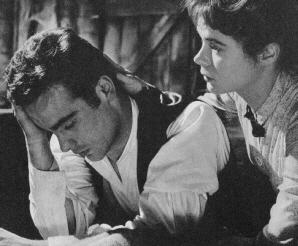
Again, he stopped, and within a few years he was an available actor for a strange assortment of sixties dreams and delusions.
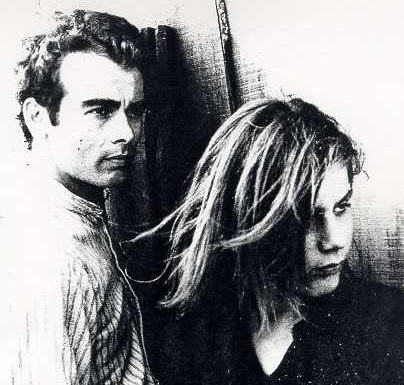
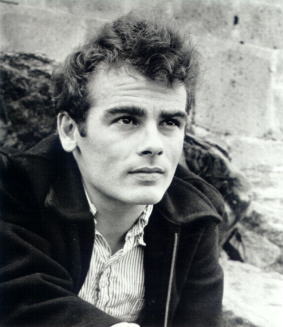
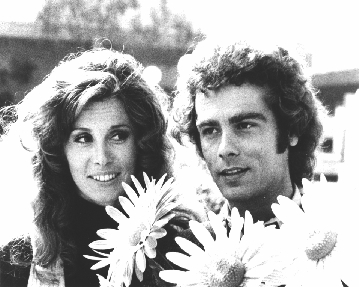
Then in 1984, he had a real part in the forlorn Dune (David Lynch) and unexpected attention as the decent, steady brother in Paris, Texas (84, Wim Wenders). That picture did well enough in America to begin to ease away his freaky reputation. He was back to the mainstream.
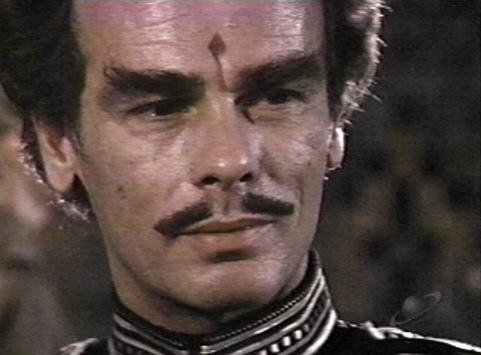
He was in The Legend of Billie Jean (85, Matthew Robbins); To Live and Die in LA (85, William Friedkin); uncanny, terrifying, and wonderful in the best scenes from Blue Velvet (86, David Lynch); Gardens of Stone (87, Francis Ford Coppola); Beverly Hills Cop 2 (87, Tony Scott); Buying Time (88, Mitchell Gabourie); delicious as Howard Hughes in Tucker (88, Coppola); broad and funny as a camp don in Married to the Mob (88, Jonathan Demme) - he was nominated for the supporting actor Oscar.
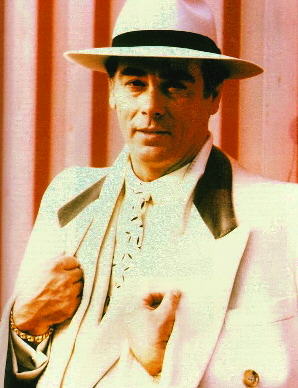
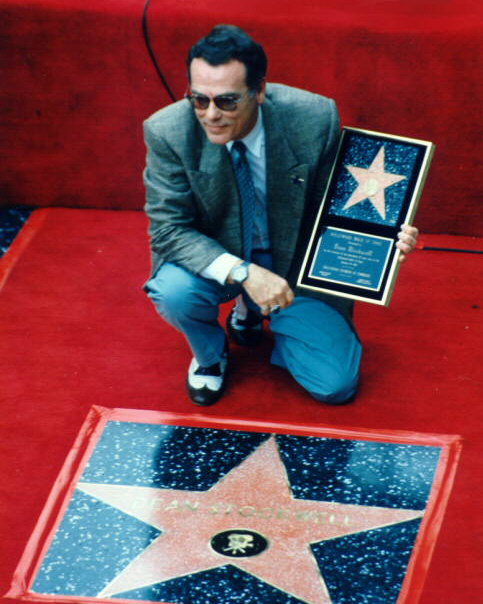
Note from Sheila: I guess it's one of those moments where I realized that I have seen most of his movies - and loved him in all of them ... but I'm just appreciating him on a deeper level. His talent, to be sure, but also the trajectory of his career, and how he has handled it.

Dean Stockwell listening
I've always been a fan of Dean Stockwell. Think the first time I really encountered him was in Married to the Mob. Let's face it, I have a bit of a crush. He reminds me a bit of someone. But recently I saw Long Day's Journey into Night again - and had forgotten how good he was. I mean, then you see him when he's a little kid - in something like Gentleman's Agreement and as far as I'm concerned he steals that movie. And he's, what, 8?? He's got a gift. Long Day's Journey is a four-way tour de force, exhausting to watch (which is appropriate - no other way to do that play) ... but he ... as Edmund - the consumptive alcoholic son ... What really struck me this last time watching it was Dean Stockwell's LISTENING. My God - he sits there, and sometimes it seems like he doesn't have a lot to do - but that's totally wrong. Acting isn't about the number of lines you have. It never is. So his work in this movie is a master class for actors. Watch him - watch him react. He is so ALIVE. At all times. Acting is all about listening. But it's a rare gift (in acting, and in life - how many truly good listeners do you know? Not many, I'll bet). John Wayne always said that he didn't consider his job to be an "actor" - he said the better job description was "REactor". And here is Dean Stockwell, surrounded by towering giants ... but all I could look at was him. Watching him listening, thinking. I mean, he is also just so damn photogenic. His face is made for the camera. But the thing about it is: some faces are just beautiful, beautiful to look at. His certainly is. But there's more to it than that. It's that the camera picks up his every thought, we see inside. This, as we all know, rarely happens - even with very good actors. If he thinks it, we get it. It's riveting. I mean, all the actors are riveting in the movie - but this last time was all about him.
LISTENING
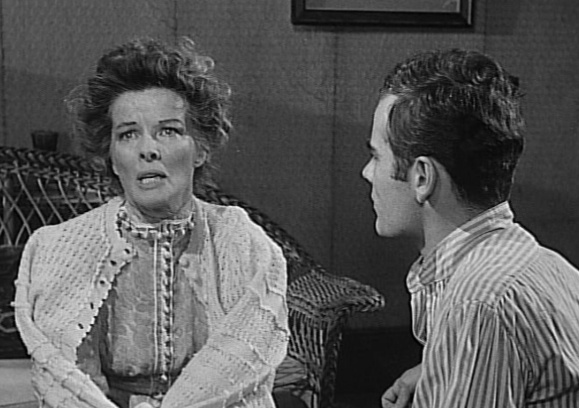
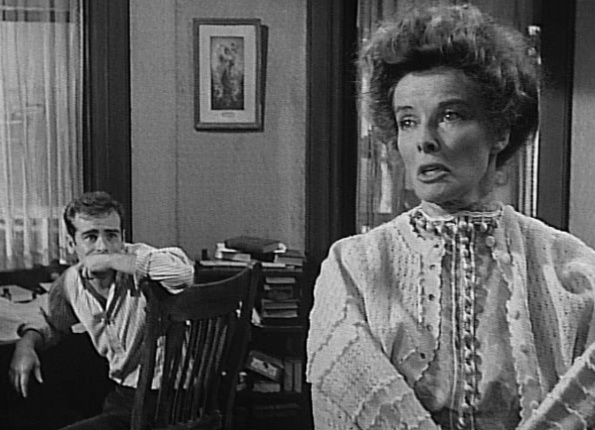
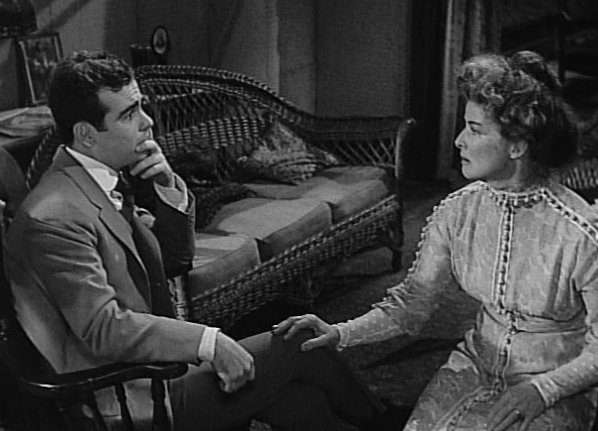
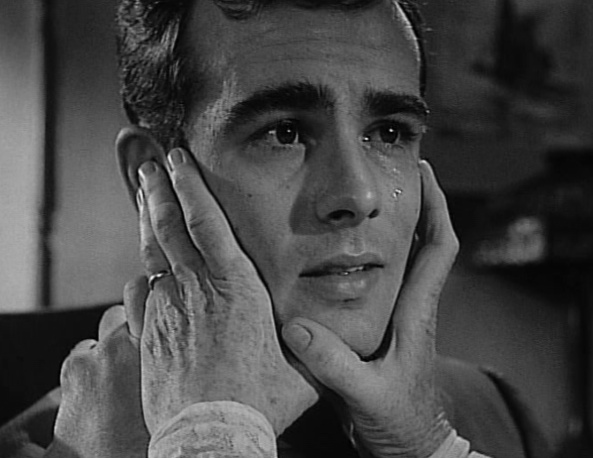
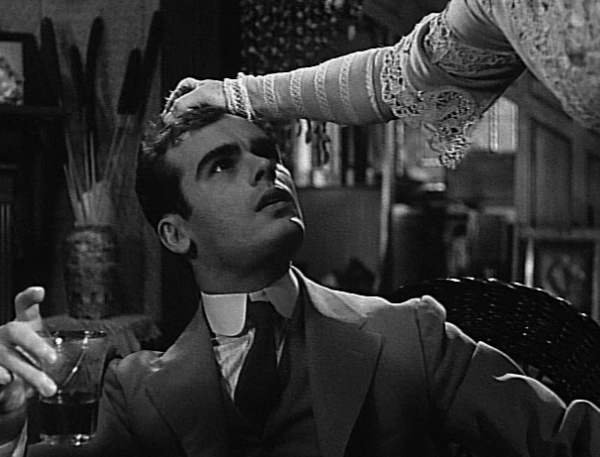
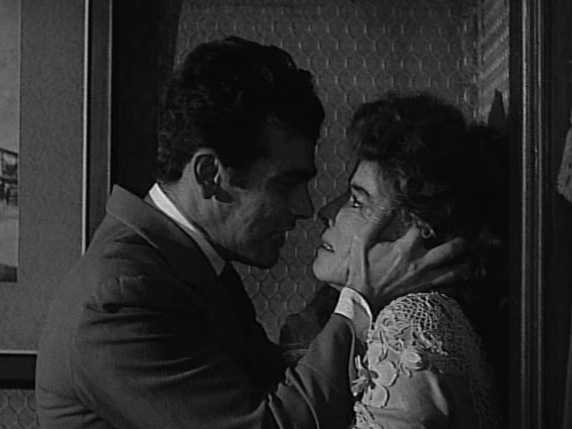
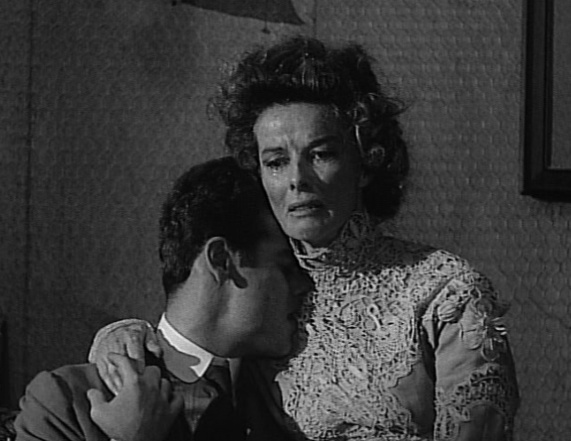
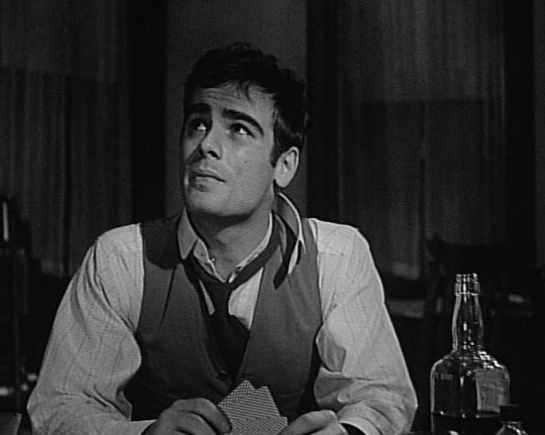
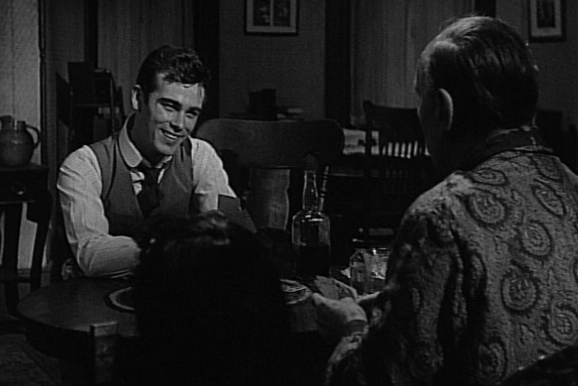
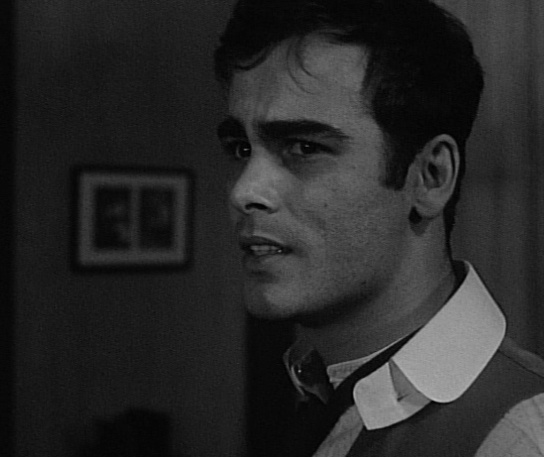
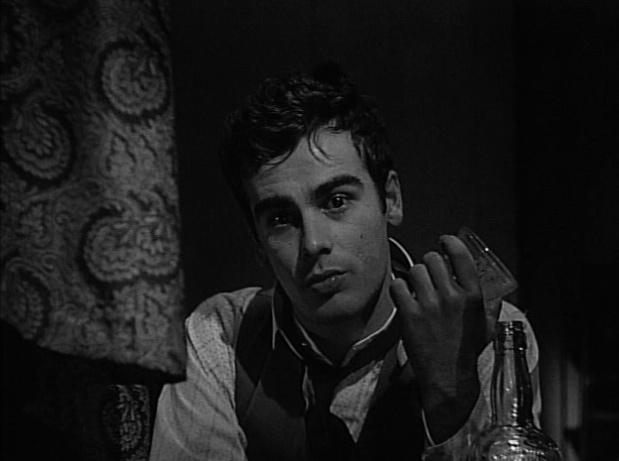
The Books: "The Matisse Stories" - 'Art Work' (A.S. Byatt)
Next book on my adult fiction bookshelves:
The next book on the shelf is another short story collection by AS Byatt, and this one is called The Matisse Stories. "Art Work" is the second story in this collection - and it's a weird experience reading it. I felt it dragged in the beginning - it was a SURFACE, a highly detailed surface - and I kind of got lost in all of the descriptions of things, which sometimes went on for pages. But it worked on me in a subliminal way, because at the end - when the revelation comes - I literally gasped out loud. I am sure that Byatt, in all her talent, did this deliberately - it didn't quite work for me - but the story itself, taken as a whole, packs a huge punch. I could see this being a successful film. It has all the elements.
Debbie and Robin are a married couple and they have a couple of young kids. Debbie used to be an artist - her favorite thing to make was woodcuts ... but she gave that up (and it grieves her, haunts her - the art she used to make) in order to be practical and make money. She works for a women's magazine, writing copy for photo shoots about kitchen redecorating. She struggles to find the perfect word for the color of that linoleum, etc. There is something horrible in this for her, yet she does it anyway. Because of her husband - Robin. Who really IS an artist, and works all day long upstairs in his attic studio, tormented, weird, obsessive, paranoid. She sacrificed her work for his. Their life is insanely busy - and Robin is a difficult man - so keeping a housekeeper and nanny has not been easy. But Debbie finally found one who works - a Mrs. Brown. Mrs. Brown is the grease in the wheels - without her, the whole house of cards would come down. She is flexible, easygoing, and she understands the family dynamic. Debbie lives in terror that Mrs. Brown will one day quit - over some tirade of Robin's ... she cannot imagine what she would do without Mrs. Brown. It's almost like the servant is the head of the family. But Mrs. Brown is a humble unprepossessing individual - except for her clothes - which are colorful mismatched castoffs, so she always looks quite bizarre. A blaze of color, oranges and pinks and greens. Mrs. Brown ends up being extremely important to the story. GREAT character.
Here's an excerpt.
Excerpt from The Matisse Stories. "Art Work"
Left to himself, Robin Dennison walks agitated up and down his studio. He is over forty. He thinks, I am over forty. He prevents himself, all the time now, from seeing his enterprise, his work, his life, as absurd. He is not suited to the artistic life, in most ways. By upbringing and temperament, he should have been a solicitor or an accountant, he should have worn a suit and fished for trout and played cricket. He has no great self-confidence, no braggadocio, no real or absolute disposition to the sort of self-centred isolation he practises. He does it out of a stubborn faithfulness to a vision he had, a long time ago now, a vision which has never expanded or diminished or taken its teeth out of him. He was given a set of gouache paints by an aunt when he was a boy, and painted a geranium, and then a fish-tank. He can still remember the illicit, it seemed to him, burst out of sensuous delight with which he saw the wet carmine trail of his first flick of the brush, the slow circling of the wet hairs in a cobalt pool, the dashes of yellow ochre and orange, as he conjured up, on matt white, wet and sinuous fish-tails and fins. He was not much good at anything else, which muted any familial conflict over his choice of future. With his brushes in his hand he could see, he told himself, through art school. Without them, he was grey fog in a world of grey fog. He painted small bright things in large expanses of grey and buff and beige. Everyone said, 'He's got something,' or more dubiously, 'He's got something.' Probably not enough, they qualified this, silently to themselves, but Robin heard them well enough, for all that.
He could talk to Debbie. Debbie knew about his vision of colour, he had told her, and she had listened. He talked to her agitatedly at night about Matisse, about the paradoxical way in which the pure sensuousness of Luxe, calme et volupte could be a religious experience of the nature of things. Not softness, he said to Debbie, power, calm power.
Debbie said yes, she understood, and they went to the South of France for a holiday, to be in the strong light, la-bas. This was a disaster. He tried putting great washes of strong colour on the canvas, a la Matisse, a la Van Gogh, and it came out watery and feeble and absurd, there was nothing he could do. His only successful picture of that time was a kind of red beetle or bug and a large shining green-black scarab and a sulphurous butterfly on a seat of pebbles, grey and pinkish and sandy and buff and white and terracotta, you can imagine the kind of thing, it is everywhere in all countries, a variegated expanse of muted pebbles. Extending to all the four corners of the world of the canvas, a stony desert, with a dead leaf or two, and some random straws, and the baleful insects. He sold that one to a gallery and had hopes, but heard no more, his career did not take off, and they never went back to the strong light, they take their holdiays in the Cotswolds.
Robin has ritualised his life dangerously, but this is not, as he thinks it is, entirely because of his precarious vocation. His father, a Borough Surveyor, behaved in much the same way, particularly with regard to his distinction between his own untouchable 'things' and other people's, especially the cleaning-lady's 'filth'. Mr. Dennison, Mr. Rodney Dennison, used to shout at and about the 'charwoman' if pipe-dottle was thrown away, or soap-fragments amalgamated, or scattered bills tidily gathered. He, like Robin with Mrs. Brown, used to feel a kind of panic of constriction, like the pain of sinus-fluid thickening in the skull-pockets, when threatened by tidy touches. He, like Robin, used to see Mrs. Briggs' progress like a snail-trail across his private spaces. Robin puts it all down to Art. He does not ask himself if his hatred of Mrs. Brown is a deflected resentment of his helplessness in the capable hands of his wife, breadwinner and life-manager. He knows it is not so: Debbie is beautiful and clean and represents order. Mrs. Brown is chaotic and wild to olok at and a secret smoker and represents - even while dispersing or re-distributing it - 'filth'.
June 24, 2007
Of surfeit one can never have too much
I believe I have mentioned my undying love for the sight of water towers perched on top of buildings throughout Manhattan. Little (and big) rickety wooden rain barrels ... floating through the sky. Once you start to look for them, you see them everywhere. I adore them.
This weekend I found myself in an apartment floating above the city. The view was stunning. But more than that ... WAIT UNTIL YOU SEE WHAT I SAW.
My experience of the water towers transformed. As you can see below.
THEY'RE EVERYWHERE!!!

I think that one's coming to get me.
But look down ...
HOLY GOD, IT'S AN INVASION.
Hmmm, I feel something looking at me. I turn my head.
AHHHHHH. ANOTHER ONE. NO, TWO!

They've got frigging sentinels everywhere.


There is no escape. Don't even try. They have every avenue covered.

As far as the damn eye can see. BASTARDS.

Figure I better keep my eye on the Big Mama closest to me.
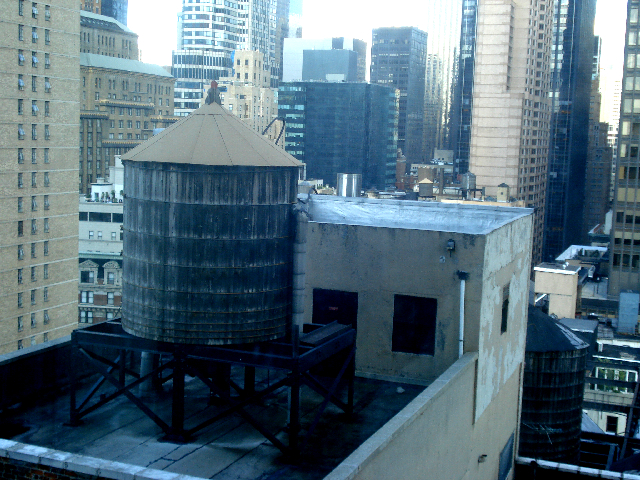
You know, it's kind of unnerving.


AHHHH!

That's better, sister. Back off.

Solstice thunder and gleam
So I posted about the summer solstice sky -
Here are two of the photos I took that night. (Rest here)
The sky over my apartment.

And then ... looking to the end of my street ... the sky over Manhattan in the same moment.

Use the force, Cashel!
"Do or do not. There is no try."
(Cashel called me last night and today to give me permission to post this photo of him and his friend Jack. Great job with the Photoshopping, Cash!)
June 23, 2007
Diary Saturday
This is for my dear friends from high school. You know who you are. I was a senior in college here. In love for really the first time (not counting Ralph Macchio, of course). And he was in love with me. My first real boyfriend. So that's my context - (his name was - is - Antonio). He shows up in this entry because he was all I could think about. We had been dating since June - and this entry is from January of the next year. Oh, and this entire New Year's party was documented with photos. Best party photos ever. If my friends give me permission, I'll post the pictures of us dancing. They're briliant!!
JANUARY 2ND
Mere had the coolest New Year's party I've ever been to. It was so wild for ALL of us (except for J.) to be together. It's been so long since last Christmas, I guess. It was a wild time. I didn't get too drunk - but managed to stay consistently buzzed for about 4 straight hours. [Spoken like a true Irish lass.]
Some pretty rare magical moments.
I pretty much hung out in Mere's room - with Mere and Betsy and Kate and Beth (poor Beth was sick and lay sprawled on the futon weakly for the whole party), and at one point - the 5 of us began to relive high school.
And Betsy made the comment that for once - it was wonderful. It made us extremely happy to be talking about those years. We were OUT OF CONTROL. We all BECAME 15.
All we did was - one after the other - play THE songs from our high school dances - songs we have not herd in years. Ecstatic songs - to actually transport us in time.
And it was infectious. All 5 of us had the same experience hearing those songs. And even poor sick Beth got up to dance wildly.
The Go Gos - Our Lips are Sealed
We Got the Beat
B-52s - Rock Lobster
Devo - Jerkin' back and forth
Rocky Horror - Time Warp
The only one missing was Freeze Frame.
And all we could do was scream - yell the old lyrics - dance crazily - like we used to - at all the old high school dances.
Especially Devo. There were all these robotic little motions and gestures we used to do ["You got me.... jerking UP HIGH ... you got me ... jerkin' DOWN LOW ..."] - and we all remembered all of them. And as we all started to do them - the laughter!
The 5 of us were out of control. Trying to sing but we were laughing SO hard, and dancing - It was a great great time. And some kid took a bunch of pictures with my camera and I HOPE they came out. [Oh, did they ever] It was totally exhausting. We were drenched. Then we all joined the rest of the party for the countdown. It was so exciting - the mood was infectious. Champagne bottles, screams.
Member me and Brooke? [who ya talkin' to, Sheila? Your diary? Or yourself? Or your eternal audience?] Hugging, crouched on the floor in front of the TV in a shower of champagne spray ... It's one of my favorite New Year's memories. That and Dave W.'s party. [David - I called you "Dave"??? When did I ever call you Dave?]
So it became the new year.
The year of indecision and change.
-- GRADUATION
-- LIFE
[And, little did I know, but the beginning of a couple of years of unremitting misery which would end, finally, with me screaming at two gently helpful and baffled cops in the middle of a crowded road in Woodland Hills, California, while wearing a Holly Hobbie jumper, tennis sneakers, and a ponytail. Having to be taken into the back of their car because I was so out of control. Leaning over into the front seat like a lunatic, showing them the emptiness of my wallet. Sneering at the two of them, 'Hey! Look at that! YA EVER SEE ANYTHING SO EMPTY IN YOUR LIFE?' That was the nadir. I escaped to Chicago directly following that event. To begin my REAL life. So, uhm, yeah. "Indecision and change" is definitely coming up. ]
We all were hugging and screaming - I hugged people I didn't know. Mere was crying! She came over to me and we hugged and hugged - I almost started to cry - It was a great hug. I am SO glad I went to this party. [I have no memory of this. Thanks for the great hug, Mere!]
15 seconds into our New Year, Mere and I were in the middle of our fantastic tight embrace when there was a crash. We ignored it. Beth was pulling at Mere's sweater, murmuring, "Mere ... Mere ..." We pulled apart just in time to see Mere's housemate and her boyfriend (who wears all black and smokes a pipe - as though he created the image. Dork.) furiously storming out of the apartment - he was dragging her, she was soaked - and then - bang. They were gone. Murmurings, curiosity, anxiety - and then instantly the party picked up again, as though nothing had happened. "Happy New Year!"
The entire night I was periodically calling Antonio. [This was way pre-cell phone, obviously.] Charging it to home, of course, but I was suffering from withdrawal. I hadn't talked to him the entire day before. I love him so much! Sometimes my feelings surprise me. They are so warm and gentle. Usually I feel crazed and electric. Not very restful and not very nurturing. You know, the old "please pass the mustard" syndrome. [This was a joke between me and Antonio - who was always much more openly demonstrative than I was. And there was the infamous moment, at some romantic dinner in a candlelit restaurant - when he said something mushy to me - can't remember what - and my response was - in all seriousness - "Please pass the mustard." hahahaha We instantly turned it into a joke, and we actually still joke about it today. It's become an entire personality type. "So he's a 'please pass the mustard' type ..." "Ah. Yes. Totally understand." Love Antonio - great sense of humor.] While he definitely is the more nurturing of us, I am definitely beside him on this journey - 100%. [Humorously - I wrote a "2" over the "1" ... to make it "200%". Very interesting. I could write a whole post about that, and what it says about our relationship, but more importantly, what it says about me. But that is for another time! 100%, 200%, what's the dif, right?] Antonio is becoming a fixture - an integral part of me. If I dwell on this, it scares me. So I do not dwell. [Excellent policy.] But occasionally I do say it out loud, just to try it on for size. Eventually, it will become part of my vocab - in the same way that I will become used to saying the words "I love you" and "boyfriend". It's all still so new.
I was having such a happy time - it made me miss him all the more. And Mere had talked to her boyfriend in Canada - huddled by the phone - and he had gone off on this poetical flight, telling her about the "sparkling snow" - so I just had to call Antonio!
My happiness wouldn't be totally complete and the night wouldn't be totally perfect without hearing his voice, making contact with him.
It was a really long party - started at about 7:00 - I got the wild inspiration to call him - even though he was in Vancouver with his buddy going skiing - But it was urgent. My love! I MUST TALK TO HIM. I MUST. I MISS HIM. So I attempted many times, mostly operator trouble - [Man. We have it so good now with cell phones] Mere has Sprint, not AT&T, but my call finally got through. Over the course of the night, I became quite intimate with the clerk at Crystal Lodge. "Hi there! It's me again!" I would say. He must have thought Antonio was this poor henpecked dude with a bratty pestering girlfriend, or that he was off on a tryst in Vancouver with some stripper/snow bunny and I was an enraged rejected lover. But I didn't care. I was desperate to hear his voice and laugh with him and say, "Happy New Year".
I was kind of drunk, so I was operating on impulse.
I love operating on impulses. I do it so rarely.
3 hour time change. I called him the first time at like 8:30, which he had said was the best time. But there was no one there. Saddened, I hung up. It had become a subliminal mission.
Called back 2 hours later. Still no answer. I was stumped. Saw dancing visions of neon bars and naked boobs. Bummer. Partied on for 2 more hours - danced - chowed down - laughed hysterically - took fun pictures - MANY pictures - and kept a nice consistent drunk going. A nice pleasant party drunk.
It became the new year. Blah blah.
Things chilled out and we congregated back in Mere's room again with dim lights, incense, music, good rocking times. MUCH fun. At about 12:30 or so, I remembered that I had a boyfriend [hahahahahahahaha] and that I had once upon a time desperately wanted to call him.
Oh yeah, one of the earlier times I had called and talked to the clerk again, he said, "Do you want to leave a message?" And I said, drunkenly, "Yeah, okay. Could you tell him that Sheila called? He can't get in touch with me, but sure. Tell him I called." Very helpful message, Sheila.
So I tried to call Vancouver once it became THIS year about 4 or 5 times. Nasal operator voice: "Due to intense holiday calling ..." Etc. Quite frustrating. FINALLY, I got an operator, and she put me through. AND HE WAS THERE!
My honey! As I was waiting for Room 338 to answer, I felt like my heart was on hold. I sat in my little shadowy corner on Mere's futon and surrounded by silk pillow, with the sounds of the party fading away around me - I heard nothing but the rings of the phone in Vancouver and the waiting silence in my own brain. The anticipation. Jesus.
I cannot fucking wait to see him. And kiss him.
Greg answered. I asked for Tonio. I couldn't really tell how loud or shrill I was speaking because I had been at the party for so long, and the decibel level was pretty intense. I had been screaming "jerkin' back and forth" for a good 3 hours by that point. So I'm sure I shrieked in Greg's ear. Then there was Tonio! And he was so HAPPY to hear my voice. I almost cried - He had gotten my message, and had been trying to find me. "But there was no answer at your house! Where do you think they all were? And I thought it might be too late to call your parents' house ..." "Yeah! I'm in Boston! With all of my friends from high school!"
Introductory chatter.
Then we exploded. "I MISS YOU." "I MISS YOU SO MUCH." "I CAN'T WAIT TO SEE YOU." He makes my spine crinkle. And I just CRINKLED when I heard his voice.
I described the party to him in enthusiastic detail. He kind of moaned, "Oh, that sounds fun ... I wish I was there ..." I moaned back, "I wish you were here, too!"
Cool thing was: It was still the old year where he was. I was speaking to him from the future, basically.
I kept saying (shrieking), "I am talking to you across time!"
Like Richard and Leslie! [Oh, for God's sake. Those two again?] They have a new book out, by the way.
We blabbed endlessly. We blab endlessly.
He and Greg went heli-skiing, dropped off by helicopter on some untouched mountaintop already tested for avalanches. Jesus, Tonio. He said he has taken mounds of pictures. It sounded magnificent, monumental, and totally scary. Jean was very impressed when I told her that. "He must be a great skier." He swears he's not, but I have my doubts.
He's so cute. He's the planner. He is determined to get me to go skiing [he never did.] - he wrote me one long letter where, step by step, he told me what we would do. He ended his long paragraph with a decisive, "There. I have it all planned."
I said, "I'm not too wasted." "No, you sound pretty coherent."
That reminds me: in the middle of the Halloween party - there were so fucking many people in my house. And I really was bombed. I was Edie - with silver hair, hoop earrings, white face, white lips, fake lashes, tight halter, black tights, and bandaids on my arms. Mitchell was Andy. We were perfect. It was a magnificent party even though it was altogether too crazy. [This is the party where my friend Beth, dressed as a clown, bitched out two random partygoers. Story here. It's hilarious.] Anyways, Janeen comes over - she was dressed as a genie - and grabs me off the dance floor where I had been madly gyrating and screams at me, "ANTONIO'S ON THE PHONE!" I TORE up the stairs, secluded myself in Tom's room [uhm, now Beth's husband. The tangled web here is gorgeous.] - the house was vibrating with noise - and I picked up the phone.
And that's all I remember.
The next day I racked my brains - "what the hell did I say to him?" I was a little nervous - but he loves the memory of it now. I was incoherently babbling to him, raving about my costume, and Mitchell's costume, and everybody's costume ... I told him the costume of every person at that party, and there had to be 150 people in my house. This was a long-distance call.
So when I called him at Mere's from the New Year's party -we were laughing about that call from the Halloween party - he said, "What was it you kept saying to me? It was so cute!" Of course I remembered and shrieked in a shrill mushy drunk voice, "I LOVED YOUR LETTER!" He started howling with laughter - that fantastic boisterous laughter that I have always adored so much [Antonio has the best laugh in the world. Everyone who knows him agrees. It's a consensus. You hear him laugh, and you MUST laugh too.] Much laughter.
I hung up with him and I felt absolutely totally whole.
Let's hope I can sustain it.
Everyone has been saying how shitty this year has been for them - and yeah, part of it sucked - but for the majority, it's been the most amazing year of my life. Tonio says it's the same way for him. "Yeah, a lot of this year was bad ... but after June ... [when we hooked up] ... everything looked up."
God, that makes me feel so good.
Best New Year's party ever. [And that assessment still stands!!]
June 22, 2007
"Diary of Indignities" -by Patrick Hughes
Awesome news - Patrick Hughes (funny man and bane of the existence of Ren Faire enthusiasts everywhere) has come out with a book. It's just all so exciting and cool. He certainly deserves it. Amazing writer, that man. I was reading something from his archives once - about a camping trip (with his mom's friends? Is that possible?) - and I was in public as I was reading it, and began to laugh so hard that my face literally froze into a mask that was almost like a grimace. What I'm trying to say is that my laugh in that moment was so deeply intense that it had become silent as well as STATIC. It was almost awful, actually. I looked forward to the laughter ending. I wanted my FACE back, thankyouverymuch.
But then there's this
Seriously. That is just the tip of the iceberg.
Anyone who can make me laugh so hard that I petrify into a grimacing static statue IN PUBLIC is okay by me.
But, too, there are posts like this one.
Whatever. Here's the deal. The guy can WRITE, okay?
I'm also kinda psyched cause he sent me my very own signed copy of his book. It arrived yesterday and I tore it open like a maniac.
Haven't read it yet - but I can't wait.
AMAZON link:
DIARY OF INDIGNITIES - by Patrick Hughes
Congratulations, Patrick!
Summer solstice
I came home yesterday at around 7 pm, and there was a strange stoppered-up feeling in the atmosphere as I walked the couple of blocks from the busstop. Hovering over my neighborhood (it felt like it was over my apartment building only) was a thick thick black cloud. You could see the layers of smudge in it, dark grey smudging against lighter grey smudging against charcoal. No rain yet though. Because the cloud was so localized, the sunset was pouring out from between the gaps, but it wasn't suffusing the landscape with light. It was more contained. And so the city - across the river - had the look to it that I love best. Stark, black, silhouettes ... with a pale creamy background - (it always reminds me of the Chim Chiminy scene in Mary Poppins when it looks like this) - magical, unreal.
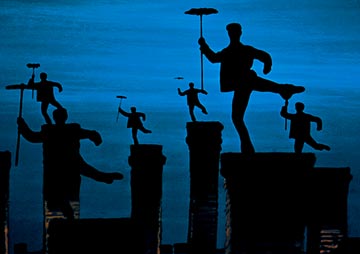
And the Hudson below caught the glower of the clouds, and so it was not silvery, or blue - like it sometimes is ... it was a dark grey, and the tugboats going by churned up white foam against the dark. It's hard to explain - I did take some pictures of it (naturally) - and will upload them when I have a second. Behind me and above me loomed the black thundercloud. The neon "OPEN" sign from the deli on the corner gleamed through the dark air, an oasis. And in front of me, Manhattan stood - a black and clear papercutout against the pale sunset shine. It was fantastic. Especially because it was the solstice. The longest day. And yet here I was, in this darkness - this early darkness, the cloud blotting out the rest of the sky. I stood out on my street, and basically watched the sky change, as though it were a movie.
Then I went inside, curled up in bed, and watched The Quiet Man (with apologies to Eamon), my windows open, listening to (at last) the rain pouring down, the wind rustling the trees.
It was a good solstice.
Oh! And I watched the special features and there were some great "making of" documentaries, etc. One anecdote I loved:
You know the last moment in the movie? When we see the two of them in their field, waving and laughing?
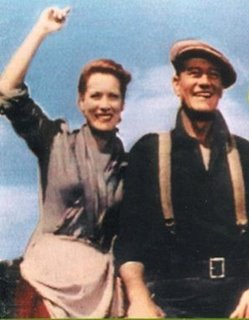
Then she whispers something to him ... we don't know what it is, but we can guess - because of his reaction. He pulls his head back a bit, to look right at her - startled - with a sort of urgency to him, a sexual urgency ... and she laughs, and runs off - looking back over her shoulder at him ... and he runs after her, catches up with her ... and, holding onto each other, they walk back into the cottage.
So. Maureen O'Hara was interviewed and she said that John Ford came up to her and said, "Okay, here is what I want you to whisper to him in this moment." And he told her. She was shocked, and said - no, she wouldn't say THAT! Ford insisted. "You will say that." She finally said to Ford, "I will say what you ask ... but on one condition. That you will never ever tell anyone what you asked me to say." It must have been quite racy!! Ford agreed. So Maureen did it. And Ford had NOT told Wayne that Maureen would whisper something to him - he kept that a secret from Wayne - so the moment you see on the film is unrehearsed, and a surprise. So watch Wayne. It's even more of a beautiful moment to me - now that I know the background of it. Watch him react. It's subtle - it's human and real ... not "acted". Hepburn always said that she loved acting with him because he could totally improv - if you switched things up, or did something unexpected, it never threw him. He always just went with it. Beautiful. So Maureen O'Hara, embarrassed, whispered whatever it was to Wayne ... and the moment was captured for all time. O'Hara said later, "Ford could be brutal and controlling - but you loved him ... because he was always about the result. And in that moment - he knew the result he wanted, and he knew how to get it."
I love stories like that.
So go back and watch that last moment again! And watch him react to whatever it was she said. And then watch what happens after.
Beautiful!
The Books: "The Matisse Stories" - 'Medusa's Ankles' (A.S. Byatt)
Next book in my Daily Book Excerpt:
The next book on the shelf is another short story collection by AS Byatt, and this one is called The Matisse Stories. There are only three stories in this collection - each one takes, as a jumping-off point, a sketch or a painting of Matisse. I guess you could say each story is a RIFF. It's not hidden, either - or symbolic, or thematic. The Matisse works are usually front and center, in each of the stories. In terms of her collections, this one is not my favorite. The writing is, of course, universally good - and the second story in particular really got to me - but I guess there's something about it that feels self-conscioius. Or - no, that's not the right word. It feels a bit thin. And that is one thing that almost never happens with Byatt - and it seems to happen here. Not the writing - the writing isn't thin ... but the collection itself.
The first story in the collection is called "Medusa's Ankles", and it's the best one in the collection. It ends with such a ka-BOOM - and I would bet that every woman who has ever gotten a terrible haircut would relate, and cheer the ending of this story. It's horrifying - and yet ... I have so wanted to take the actions that Susannah, our narrator, takes. What is it like ... when you cross that line? When you stop caring what people will think? When you let the rage out? Not just the rage at a bad haircut - the bad haircut is the catalyst - but the rage at growing old, at losing your looks - and, by association, losing your power. It's painful, and this story is all about that pain.
Our narrator is a woman in her late 40s. She has been going to the same salon for quite some time, getting her hair cut by the same guy. He is a chatty melodramatic person, who understands her hair, and takes care of her. Going to the hair salon is vaguely stressful for her ... since she no longer is young and beautiful, and whatever is done to her cannot HOLD. It's a race against time. None of this is spoken aloud, but it's there. And one day, she walks into the salon - to find that it has been completely redecorated, revamped and restaffed ... it's now sleek, modern, and (to her) alienating.
But I'll excerpt from the beginning of the story - before the catastrophic re-decorating and all of the tragedies that follow.
Excerpt from The Matisse Stories - "Medusa's Ankles"
She had walked in one day because she had seen the Rosy Nude through the plate glass. That was odd, she thought, to have that lavish and complex creature stretched voluptuously above the coat rack, where one might have expected the stare, silver and supercilious or jetty and frenzied, of the model girl. They were all girls now, not women. The rosy nude was pure flat colour, but suggested mass. She had huge haunches and a monumental knee, lazily propped high. She had round breasts, contemplations of the circle, reflections on flesh and its fall.
She had asked cautiously for a cut and blow-dry. He had done her himself, the owner, Lucian of 'Lucian's', slender and soft-moving, resembling a balletic Hamlet with full white sleeves and tight black trousers. The first few times she came it was the trousers she remembered, better than his face, which she saw only in the mirror behind her own, and which she felt a middle-aged disinclination to study. A woman's relation with her hairdresser is anatomically odd. Her face meets his belt, his haunches skim her breathing, his face is far away, high and behind. His face had a closed and monkish look, rather fine, she thought, under soft, straight, dark hair, bright with health, not with added fats, or so it seemed.
'I like your Matisse,' she said, the first time.
He looked blank.
'The pink nude. I love her.'
'Oh, that. I saw it in a shop. I thought it went exactly with the colour-scheme I was planning.'
Their eyes met in the mirror.
'I thought she was wonderful,' he said. 'So calm, so damn sure of herself, such a lovely colour, I do think, don't you? I fell for her, absolutely. I saw her in this shop in the Charing Cross Road and I went home, and said to my wife, I might think of placing her in the salon, and she thought nothing to it, but the next day I went back and just got her. She gives the salon a bit of class. I like things to have class.'
In those days the salon was like the interior of a rosy cloud, all pinks and creams, with creamy muslin curtains here and there, and ivory brushes and combs, and here and there - the mirror-frames, the little trollies - a kind of sky blue, a dark sky blue, the colour of the couch or bed on which the rosy nude spread herself. Music played - Susannah hated piped music - but this music was tinkling and tripping and dropping, quiet seraglio music, like sherbet. He gave her coffee in pink cups, with a pink and white wafer biscuit in the saucer. He soothed her middle-aged hair into a cunningly blown and natural windswept sweep, with escaping strands and tendrils, softening brow and chin. She remembered the hairdressing shop of her wartime childhood, with its boarded wooden cubicles, its advertisements for Amami shampoo, depicting ladies with blonde pageboys and red lips, in the forties bow which was wider than the thirties rosebud. Amami, she had always supposed, rhymed with smarmy and was somehow related to it. When she became a linguist, and could decline to verb to love in several languages, she saw suddenly one day that Amami was an erotic invitation, or command. Amami, love me, the blondes said, under their impeccably massed rolls of hair. Her mother had gone draggled under the chipped dome of the hairdryer, bristling with metal rollers, bobby-pins and pipe-cleaners. And had come out under a rigidly bouncy 'et', like a mountain of wax fruit, that made her seem artificial and embarrassing, drawing attention somehow to the unnatural whiteness of her false teeth.
They had seemed like some kind of electrically shocking initiation into womanhood, those clamped domes descending and engulfing. She remembered her own first 'set', the heat and buzzing, and afterwards a slight torn tenderness of the scalp, a slight tindery dryness to the hair.
In the sixties and seventies she had kept a natural look, had grown her hair long and straight and heavy, a chestnut-glossy curtain, had avoided places like this. And in the years of her avoidance, the cubicles had gone, everything was open and shared and above board, blow-dryers had largely replaced the hoods, plastic spikes the bristles.
She had had to come back because her hair began to grow old. The ends split, the weight of it broke, a kind of frizzed fur replaced the gloss. Lucian said that curls and waves - following the lines of the new unevenness - would dissimulate, would render natural-looking, that was, young, what was indeed natural, the death of the cells. Short and bouncy was best, Lucian said, and proved it, tactfully. He stood above her with his fine hands cupped lightly round her new bubbles and wisps, like the hands of a priest round a Grail. She looked, quickly, quickly, it was better than before, thanked him and averted her eyes.
She came to trust him with her disintegration.
June 21, 2007
To quote Team America
"We need a montage!"
Random NYC shots.
I took this one out a cab window as we ricocheted down 7th Avenue. I was surprised how clear it came out.

A winged Wilbur.
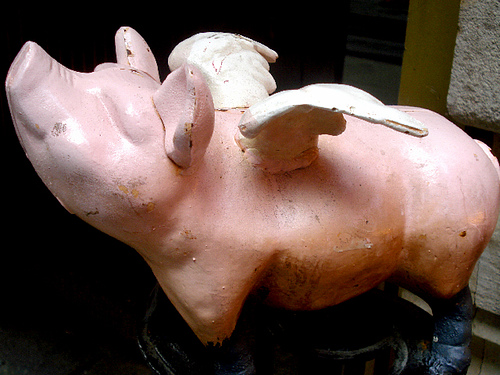
Garment district. Dancer in the window.

Fountain. I liked how this shot came out.

I kept seeing a pack of ghosts running through Times Square. Everywhere I looked, I'd see them. They weren't doing anything, really - just standing around, or walking. This is my favorite shot of one of them.

Another one of the fountain. Divide of sun and shadow, thought it looked cool.

Blood-orange margarita

Midtown Comics.

The Paramount Sign. I swear, my heart speeds up when I see that sign.
Cool T-shirt.

Like James Lileks, and also Bill McCabe - I love the ghosts of old signs painted on sides of buildings. You gotta capture these things while they still last. Their days are numbered.

And then - a couple of the many shots I've taken of the Tiles for America memorial. (I posted about this place before)


Oh - and here are more (more photos than you probably ever would want to see) here on Flickr!
June 20, 2007
Muppet faves
Progressive Boink (one of my all-time favorite sites) has started a list of Favorite Muppets. 50 Favorites.
Do yourself a favor and read the commentary - don't just scan for pictures, you'll miss out.
I mean, the first one on the list goes like this:
Though there are a few mute Muppets in the Jim Henson Universe, Slimey is by far the best. He doesn't have anything special to communicate like the Honkers or Dingers, but with a few wiggles and nods there has been a lot the little worm from the bottom of Oscar's trash can has accomplished. He's the first worm on the moon and is treated to mud baths whenever he is feeling too clean. Slimey is part of the reason why I'm not scared of bugs. I would go digging under the rocks in my backyard to pull up pillbugs, worms, beetles and all sorts of other little creatures. Any one I liked I would keep temporarily in a little bug house my grandmother had bought me. I'd watch them crawl around and try to talk to them to see if any would look up at me and nod like Slimey did, but it never happened. It was probably because they had no necks.
I could read commentary like that all day.
Or this, on the Muppet Babies:
WHY are the Muppet Babies all in foster care? Nanny is clearly not the interspecies erotic mother of a dog and a frog and a stuffed chicken. So why do they end up in a nursery with more imagination than toys and more time together than with a guardian? In that book, indeterminately-origined Scooter, the Muppet Show gofer and 1980s child show character type "computery one," says that his mother was a parrot and that he doesn't know his father. So is that the true origin of the Muppet Babies? That they were the offspring of human raped animals that somehow became pregnant? Like, some guy was fucking a pig and when he left, the pig gave birth to a man-pig? I can imagine those creepy mistakes being shuffled off into some government lab and experimented on. Come to think of it, that would explain why they were always hallucinating and confusing fantasy with reality.
Or this, on Prairie Dawn:
She was a little pink girl who wore picnic table dresses and liked to put on plays. She was mature and wanted to be a journalist and a writer. She had something to her rather than just being a tan colored Elmo puppet with eyeshadow and jewelry and a tutu on. Remember that someday, when you're flipping through the channels and stop on PBS to find Elmo and Zoe and a retarded bear floating on a CGI background, one of those floaties should be Prairie Dawn, sitting at a piano, trying to get Cookie Monster to say his lines and get over his stage fright and dramatically announce that he is a rain cloud.
And #33 made me laugh out loud.
So much more though - go read, and enjoy.
Bloggers who think, who make me think
Another random thing that made me happy - in that quiet little content way that I value more and more - is this:
Edward Copeland - a man whose site I admire tremendously - nominated me for a Thinking Blogger award - and his words about my site seriously have made my morning.
Thank you!!! Your site is amazing, love all the contributors - and I check in with you every day. I so appreciate your words.
So I already did a Thinking Blogger thing a while back- but hell, I'll do it again! And choose different folks this time. Lots of people make me think! I love things like this, because it gives me a chance to acknowledge those writers out there who, just by being themselves, and writing about what they want to write about, help me to go deeper, live larger, be more aware. That's what this is all about for me.
I'll post the name of the blog, a few words, and then cherry-pick a post - just for fun.
Bloggers who make me think!

1. Confessions of a Pioneer Woman
Where do I even begin. I discovered her maybe 2 or 3 months ago, and have been addicted ever since. She posts like clockwork - every morning. She has also opened up a second blog, for all of her recipes - but seriously, if you have not had the pleasure of "meeting" this woman - go there now, and click around. Her photos are wonderful, her descriptions of ranch life vivid and riveting (horses!)- and her stories from her past, as a ballerina, are sometimes hysterical, sometimes moving - whatever. One of my favorite sites on the 'net. Check out her photos in this one post alone.
2. The Rejecter.
She describes her blog as: "I am an assistant at a literary agency. I am the first line of defense for my boss. On average, I reject 95% of the letters immediately and put the other 5% in the 'maybe' pile. Here, I'll tell you how to get past me." I cannot even tell you how valuable this site has been for me in the last 2 months. Seriously. Here's a post she wrote about "credentials" - but that is just one of a bazillion. LOVE that site.
3. Sergio Leone and the Infield Fly Rule
It's hard to cherry-pick just one post out of this site - one of my favorites on my blog-roll. Dennis' writing is so detailed, so good - that I often print out his posts to be read in a leisurely moment, so I can savor it. Also, the comments section over there is to be admired. I ALWAYS read all of the comments - just wonderful commentary. Like - here's his whole post on summer drive-in season. Then there are the quizzes. I live for the quizzes. They are hard, they take work - and they are always worth it. He also started this series called Faces I love (here is the latest version) - and I have just fallen in love with the idea, and done a bunch of them on my own. (Like here. And here! And here) Fun! So anyway. If you're not checking in with him, and you are also a big film fan - then I say to you: what are you waiting for??
4. From the Archives
Weird, I read her every day - but I hesitate to link to her, because I know the issues she had when a bunch of strangers suddenly came to her, through various links from high-traffic bloggers - and those people were so unpleasant and horrible that she closed down for a couple of days. It's difficult - when you have a blog where you speak frankly and openly - as though you're in an intimate situation, to people who love you and who know you ... and suddenly some random person shows up and completely doesn't get it, doesn't have the patience to try to understand, and who blaze in with judgmental language, words like "idiot", etc. etc. Who raised such people? There's that. Her comment policy is one of the best on the web. Smart smart woman. Her posts are heartfelt, diverse (we go from relationship posts - like this latest beauty, to water-management posts), funny - and VERY well-written. Example. I get a lot from her blog. I know Megan doesn't like compliments - neither do I - at least not too much or too often ... so I hope she doesn't mind me saying that I love her spirit, her writing style, her thought process - and I enjoy checking in with her to see what she's thinking about. This post had a big impact on me. A lot of that sentiment goes along with what I've been up to lately, and what I mentioned in my post about growing my nails, and toxic people. There's been a sea-change. Anyway, love Megan, love her voice, and love that she makes me think, and contemplate things.
5. The Elegant Variation.
One of the best literary sites on the web. And that's kinda final. Go there - and follow the links. The links they find are so worth it. Goldmines, all of them.
Things that make me happy this morning
-- The rain, the drowsy morning feel in the West Village streets
-- Allison in her sleep mask
-- The French press, the smell of coffee, grey morning
-- an email from Keith involving a desert island (where he and I have created a new civilization, apparently), him offering to row ("I'll row") while I read my high school journals to him. Or something along those lines. It made me laugh out loud. What?? You'll row? While I read to you Diary Friday? It sounds like heaven.
-- an email from Allison, raving on about a show about a satanic cult she saw after I left. We love shows about killers, evil teenagers, rampaging serial killers, and anything involving bloodshed, forensic evidence, and DNA results. Anyway, her email to me just now goes like this:
As soon as you left, i went to my cue of shows that saved last night and delightedly stumbled across this: MSNBC Investigates: A self-described leader of a vampire cult murders a couple in Florida. He's a teenager who recruits from among the outcasts at his school and convinces them that he's a thousand-year-old vampire who only just woke up after a lengthy slumber....so he starts a "coven." they go into the woods and cut themselves and each other and have all these creepy blood letting rituals. When the parents of one of his female "fleglings" prohibit her from hanging around him, he kills them and drinks their blood ... A great way to start the day.
Can I hear an amen?
-- And finally, this. Looking at this, I honestly feel that I have never been so happy. I'm a raw nerve anyway, these days, but this has pushed me right over the edge.

June 19, 2007
The Books: "The Djinn in the Nightingale's Eye" - 'The Djinn in the Nightingale's Eye' (A.S. Byatt)
Next up in my adult fiction shelves:
 Still excerpting the short story fairy-tale collection by AS Byatt (my favorite - obviously!) - called The Djinn in the Nightingale's Eye - This excerpt is from the title story. And it's the last story in the book. It's a novella - and I remember the first time I read it. It gripped me slowly - it's a bit slow to get going, but I trust Byatt, so I just go with it. Once I got to the end - (and I was lingering over the reading of it, by that point I never wanted it to end!) I was so invested in this story, and in these characters - that I found myself, 3 pages to go, sitting on a bench on the edge of Central Park - I was waiting for a friend - and I was so into the story, so so into it .... that I was mentally willing my friend not to show up until I had finished. If my friend had walked up and I had 1 page to go, I would have been forced to say, "Great to see you! Hi! Just let me finish this story ... I'll be right with you."
And - like with Possession - the last 3 lines pulsed with feeling, aliveness - and I found myself with tears rolling down my face. It was life-affirming. The story is life-affirming, and I LOVE her for writing it.
I highly recommend it!!! For me, it was slow in the beginning ... so just know that, going in. But hang in there ... the ending is awesome.
The story stars Gillian Perholt, an intellectual woman, a woman who lives in her head - a woman who is a "narratologist" - she travels the world, collecting stories and myths ... she goes to conferences with other narratologists, all over the world. She gives papers. She speaks. The story opens - Gillian is in Turkey, for a story conference. First Ankara, and then Istanbul. She has been to Turkey before, and has a good friend - Orhan - another narratologist, who acts as tour-guide and friend. Gillian's husband has left her for another woman, a younger model. Gillian has a couple kids, she's in her 50s ... and there's a sadness there, although she loves her work. But there is something hovering on the edges of her consciousness - an awareness of her own death ... and she feels such intense loss about it ... It almost appears to her as an apparition at times, waiting in the back of conference halls for her.
So anyway. Here is Gillian. Not really in crisis - but you get the sense that all is not as it should be. She gives her paper at the conference. It's on Patient Griselda, the tale nobody really likes in Canterbury Tales.
There are long sections where Gillian and Orhan sight-see. They go to Haghia Sophia. They go out to dinner. I was not sure where the story was going ... until Gillian and Orhan end up at the Grand Bazaar. Gillian loves paperweights, and always buys one from whatever city she travels to. So she and Orhan go to a small shop (run by one of Orhan's students) - and she is looking for a paperweight.
What ends up happening is the "paperweight" she buys is actually a container for a genie (or - the correct term, as I have also learned from my Arabian Nights reading: "djinn") ... Later, in her hotel room, she uncorks the bottle - and out comes a genie.
And the relationship between these two that follows is something you'll just have to read for yourself. Like I said before, it's life-affirming. The djinn is one of my favorite Byatt characters. And I relate to Gillian. I so so relate to her. The woman who lives in her mind. And what it feels like when that ice begins to crack, the cerebral armor - what it is like when an intellectual head-y woman gets into her body, into the physical. This, I would say, is one of Byatt's main themes - and "Djinn in the Nightingale's Eye" is its clearest and most beautiful expression. I love this story!!
Here's the excerpt where she picks out the bottle, unknowing that within lies ... the djinn ... who will so change her life.
Excerpt from The Djinn in the Nightingale's Eye - "The Djinn in the Nightingale's Eye"
Another of Orhan's students had a little shop in the central square of the market-maze, Iç Bedestan, a shop whose narrow walls were entirely hung with pots, pans, lamps, bottles, leather objects, old tools whose purpose was unguessable, chased daggers and hunting knives, shadow-puppets made of camel skin, perfume flasks, curling tongs.
'I will give you a present,' said Orhan. 'A present to say good-bye.'
(He was leaving the next day for Texas, where a colloquium of narratologists was studying family sagas in Dallas. Gillian had a talk to give at the British Council and three more days in Istanbul.)
'I will give you the shadow puppets, Karagöz and Hacivat, and here is the magic bird, the Simurgh, and here is a woman involved with a dragon, I think she may be a djinee, with a little winged demon on her shoulders, you might like her.'
The small figures were wrapped carefully in scarlet tissue. Whilst this was happening Gillian poked about on a bench and found a bottle, a very dusty bottle amongst an apparently unsorted pile of new/old things. It was a flask with a high neck, that fitted comfortably into the palms of her hands, and had a glass stopper like a miniature dome. The whole was dark, with a regular whirling pattern of white stripes moving round it. Gillian collected glass paperweights: she liked glass in general, for its paradoxical nature, translucent as water, heavy as stone, invisible as air, solid as earth. Blown with human breath in a furnace of fire. As a child she had loved to read of glass balls containing castles and snowstorms, though in reality she had always found these disappointing and had transferred her magical attachment to the weights in which coloured forms and carpets of geometric flowers shone perpetually and could be made to expand and contract as the sphere of glass turned in her fingers in the light. She liked to take a weight back from every journey, if one could be found, and had already bought a Turkish weight, a cone of glass like a witch's hat, rough to touch, greenish-transparent like ice, with the concentric circles, blue, yellow, white, blue, of the eye which repels the evil eye, at the base.
'What is this?' she asked Orhan's student, Feyyaz.
He took the flask from her, and rubbed at the dust with a finger.
'I'm not an expert in glass,' he said. 'It could be çesm-i bülbül, nightingale's eye. Or it could be fairly recent Venetian glass. "Çesm-i bülbül" means nightingale's eye. There was a famous Turkish glass workshop at Incirköy - round about 1845, I think - made this famous Turkish glass, with this spiral pattern of opaque blue and white stripes, or red sometimes, I think. I don't know why it is called eye of the nightingale. Perhaps nightingales have eyes that are transparent and opaque. In this country we were obsessed with nightingales. Our poetry is full of nightingales.'
'Before pollution,' said Orhan, 'before television, everyone came out and walked along the Bosphorus and in all the gardens, to hear the first nightingales of the year. It was very beautiful. Like the Japanese and the cherry blossom. A whole people, walking quietly in the spring weather, listening.'
Feyyaz recited a verse in Turkish and Orhan translated.
In the woods full of evening the nightingales are silent
The river absorbs the sky and its fountains
Birds return to the indigo shores from the shadows
A scarlet bead of sunshine in their beaks.
Gillian said, 'I must have this. Because the word and the thing don't quite match, and I love both of them. But if it is çesm-i bülbül it will be valuable ...'
'It probably isn't,' said Feyyaz. 'It's probably recent Venetian. Our glassmakers went to Venice in the eighteenth century to learn, and the Venetians helped us to develop the techniques of the nineteenth century. I will sell it to you as if it were Venetian, because you like it, and you may imagine it is çesm-i bülbül and perhaps it will be, is, that is.'
'Feyyaz wrote his doctoral thesis on Yeats and Byzantium,' said Orhan.
Gillian gave the stopper an experimental twist, but it would not come away and she was afraid of breaking it. So the nightingale's-eye bottle too was wrapped in scarlet tissue, and more rose tea was sipped, and Gillian returned to her hotel. That evening there was a farewell dinner in Orhan's house, with music, and raki, and generous beautiful food. And the next day, Gillian was alone in her hotel room.
June 18, 2007
"Acting" nervous ... and the multi-decade results
I was 9 years old and I was cast in some school play. It had to be a more informal situation than the brou-haha of Oliver - where we had lights, and a darkened auditorium, and parents in attendance - or my brilliant turn as Amahl in the puppet show rendition of Amahl and the Night Visitors - where we had to wait backstage and everything, like real actors. This was more of a school assembly type thing - where the entire school trooped into the multi-purpose room (seen at the end of the hall here) - and we all, in the cast, were milling about on the stage, waiting for the audience to gather, in full sight of the entire place. I was this age. Oh, isn't Flickr fun.
Here is what I remember.
Because it's important.
I remember standing on the steps of the stage, watching the "audience" file in. Meaning: my schoolmates. And I remember this moment so clearly.
I was 9 years old. And I had a sense of tremendous importance. Because: I was in the play and everybody else wasn't. That was key. I was separated from the pack. Something made me special. Everyone else was coming in to see the play. And I was in it.
I was heady with responsibility and ego. I stood on the steps of the stage. I felt huge. I felt massive, and indispensable. It was nearly unbearable, what I felt. Anyone who went to grade school will know what I am talking about. I was outside of the pack. The mere act of acting set me outside of the pack.
And here is what happened next.
And here is everything you need to know about us weirdos, about us show-trash.
So listen closely.
I saw all of my classmates filing in. And I was separate from them, because I was in the play. And they weren't.
I was not more important than them, although I certainly felt more important than them at the time. I was just separate. I had spent my recesses rehearsing the silly play, so that we could present it to the school at the assembly. It's a specific kind of person who thinks that that disciplined use of your spare time is fun.
This has always been my character.
It's easier now that I am almost 40 because I don't give a fuck about what people think of me. But when I was 9, I did. And I remember. I remember what it was like to care. To be 9 years old, and to feel my own bigness, my own different-ness ... and yet to care, so intensely, about what others thought of me.
I loved being separate from everybody else, standing on those stage steps, watching the masses file in. Oh God. I loved it. Not only did I love it. But I needed it. It was like blood to a vampire.
Oh, though. How embarrassing it is to need something so embarrassing. This is what they mean when they say that most artists are pathological introverts. Don't ever let anyone tell you different.
You couldn't ever be CAUGHT needing such a thing. Everyone knows a person who NEEDS to have attention - even at 9 years old - and nobody EVER likes that person. I knew that, even then. Even at my young young age.
I wanted the attention of the entire school. I ached for the attention of the school. Of the whole world. That was my goal. To have attention, undivided.
I remember the moment. I was torn in two different directions. I was never ever a show off. Ever. Being a 'showoff' was completely against my sensibility. It offended me. I would only realize this later - I didn't think about it deeply at the time. But I know, in retrospect, that there was something about this need of mine, for attention, that was not pathetic. Or embarrassing.
It was sacred.
It was why I was put on this earth.
But these are heavy thoughts for a 9 year old. You might think I am elaborating through retrospect. You might think that, but that is only because you are not me. This is what I felt. Watching my classmates walk into that multipurposeroom. I felt the agony of my separation from them.
And somehow, I wanted to assert to them, in my ego-inflated state, that I wasn't REALLY separate. I was really still just one of them, I just happened to be in the play.
So I started to bite my nails.
I had never bitten my nails before. It had never even occurred to me. It just seemed like a gesture that was appropriate to the occasion.
I chose it because it seemed:
1. distracted
2. nervous
3. actor-ish
4. grown-up
It was all about the gesture and what it seemed like from the outside. I chose it because of what it looked like, not because it was how I actually felt.
It made me seem like I was focused on other things. It made me seem like I didn't REALLY think I was awesome. I was biting my nails - which meant, in terms of a gesture, that I was nervous Even though (and this is very important): I was NOT. NERVOUS. I was psyched. I couldn't wait for the play to start. I couldn't wait. But I had gotten the message already how tiresome people find such an attitude, and so I came up with the perfect gesture to throw them off the track. Nobody could ever accuse ME of thinking I was better than anybody else! Or that I was a showoff. Because look how nervous I was! I was biting my nails!
I remember the moment vividly.
And many times, over the intervening years, I have regretted it.
Not just because I have been an avid and vicious nail-biter from that moment on ... but because it was the first moment in my life, that I can remember, where I sold myself out.
I LOVED being outside the pack. Yet I couldn't OPENLY love being outside the pack ... because that was too close to being a showoff, or actually owning my difference from others. So I bit my nails .. as a gesture. A gesture to the crowds (who weren't even paying attention to me!): "I'm still one of you".
It was a betrayal of the highest order and one that I would not realize the significance of until years later. Because it was an inner betrayal, although it might seem otherwise. I betrayed myself in that moment.
What is so awful about being outside the pack? Who will care?
I'm here to tell you that people will care. EVERYONE will care.
I have been a nail-biter ever since. I have gnawed at my own flesh for 30 years straight. Non-stop. There has never been a time that I have not been a nail-biter, since that moment I sold myself out, willingly, in the multi-purpose room. I can't say it's been a crutch, I have been mainly unconscious of it for so long ... yet the moment I started was completely conscious.
It was NOT a nervous habit.
It was the complete opposite.
I was not at ALL nervous, being a member of the cast of this play. On the contrary. I was CALM. It was what I SHOULD be doing.
But that was terrifying. To be so young, and to know - in such a quiet and sure way - what you should be doing.
And so I ACTED nervous. In order to calm everybody ELSE down.
Because God forbid that anyone should ever see my ambitions for myself. God forbid that anyone should ever witness my difference, my desire to be different.
I have quit a lot of things in my life. I have given up a lot. But I had never ever been able to give up biting my nails. And I'd tried. I would grow ONE of my nails, so that I ended up looking like a coke-whore, with one pointy pinky nail. Or I would grow a couple of them, hanging on ... desperately ... to my one or two paper-thin nails. I remember M. saying to me once, when I was trying to grow my nails - and I had acrylics, and band-aids, and contraptions attached to my hands - he took one look, and said, almost fondly, and with nostalgia, "I don't know what I'd do if you didn't have little rat-gnawed fingers."
I have had "rat-gnawed" fingers for as long as I can rermember.
But a month ago, some things changed. Nothing I feel like talking about or enumerating. I will say this: I will never again 'act' nervous when I am (in reality) quite calm and confident. Never. And I've had to make some changes because of that. I've had to get rid of some toxic influences. By that I mean: The people who prefer me nervous. I have realized that there are some folks in my life who prefer the act of nervousness, rather than the reality of confidence. I realize and accept that the act has been my creation, and that I have perpetuated it. No fault but my own, in that regard. But, in general, my real friends (and you all know who you are) do not buy the act. My friends want me strong and well. They always have. The ones who prefer me nervous? Who don't like it when people are confident? Who feel threatened by someone who doesn't concede ground? Who prefer that I quietly telegraph to them, "Don't mind me ... I don't think I'm great ... or different ... or better ... I'm just over here, doing my thing ... don't mind me ..." They have had to go. And it's been a bit brutal.
It is also a victory. A victory that perhaps only my true friends will really understand.
June 18, 2007
Everything you need to know about me, (everything important, anyway) is in this post.
"Never Let Me Go" - part deux
This was the post that made me buy the book immediately. The good thing about the post is that there are no spoilers - none at all. And good discussion in the comments section (all of which I avoided first time I read it - because I feared there would be spoilers).
I am mostly struck (at this moment - I'm still processing the book) by Kath's voice. The narrator's voice. The chatty, detailed, almost mundane voice - it reminded me a bit of the voice in Prep (which is one of the most distinctive and compelling first-person voices I've heard in a long time - I wouldn't say the writing itself was great, but the voice!! And the story! Could not put the book down. Yo) Anyway, Kath's voice reminded me a bit of the voice in Prep - except there's this overlay of portentousness and doom in Never Let Me Go. Like: for all intents and purposes (or: "for all intensive purposes") - it's just your regular old kids-at-boarding-school novel. It's a novel of adolescent angst, a three-dimensional portrait of school, life, romance, teen sex, classes, authority figures, etc. But you still get this creepy sense of how much you don't know ... and you know that when you find out, it's going to be horrible ... but we are never "in" on the secret before Kath is ... We just have to listen to her babble on about her teenage romances and her love triangles, and I kept just getting a kind of gruesome feeling in the pit of my stomach, as I read on. Like: who are they? What are they? Are they old? Deformed? What is it?? It was awful. The narrator's voice (like I said before) is totally convincing - although I have to think about it a bit more.
There's one essential part of the book that didn't quiiiiite ring true for me - but it was alllllmost there.
Sort of spoilers below ... I hint at things that should not be hinted at, if you plan on reading the book.
Only those who have read it follow me!!
So ... there was a false note, for me, in the whole bit about the artwork taken from the kids - and what the students all believe happened to it. How rumors fly, and what they all settle on as the logical explanation.
I need to be careful here, because I'm treading into real Spoiler Land. I feel like the explanation they came up with (the students I mean) ... I guess, if it wasn't so fairy tale-ish, so: "They need our artwork because of THIS!" - I guess I just didn't believe that the STUDENTS would believe that fairy tale explanation. I realize they were sheltered, and in many ways naive - but ... I guess I felt like it was too "and they lived happily ever after".... It did add to the ominous feeling of that part of the book, because you KNEW something bad was coming ... But I still think it might have been more powerful if I, the reader, hadn't been so skeptical. If I, too, had thought; "Maybe that IS why they took the artwork!!"
But I didn't believe it for a second. Perhaps this just tells you that I'm a cynical person who's gotten my heart broke one too many times to believe in that crap anymore. This is highly possible.
I do think Ishiguro is smarter than that, though - and was going for an unbalancing effect, a sort of dreamlike: "what is real, what isn't real" feeling ... and that one thing pulled me out of it. Only momentarily, though. It was like a semi-bad actor showing up in a movie with great actors. You have to just forgive it, and go, "Okay, so I didn't quite believe that ... but oh well ... here comes the next moment! Moving on!"
And when the real explanation comes ... and what the artwork really was for ... and how it was kind of close to their imagining about it ... it was quite chilling. Horrible, really. Makes me want to puke. To be honest, the whole book makes me want to puke.
Am I insane to say that I think it could have made me want to puke more?
I have to think more on it (obviously) ... but I just want to say that I had the same response as Stefanie above, this morning. I read the last 10 pages, and I truly believe if my bed had spontaneously combusted I would have been hesitant to leave the book behind - I was that engrossed, that sucked in - awful, it had an awful inevitability to it, once you truly understood what was going on ... and because of that inevitability (which can take on almost Greek proportions) - there was a coldness to my response to the final 10 pages. Like, the veil was lifted, all was clear ... no escape ... one must trudge with the characters to their fates ... but, like Stefanie, at the last paragraph, I found myself welling up with tears.
And the ending of the book has stayed with me all day.
It reminds me of that one sentence in the last section of Remains of the Day. Anyone who has read the book will know the moment I mean. Something like, "To be truthful, my heart was breaking." No more, no less. No description, nothing but that ... and since the rest of the book was this elegant precise prose ... My God, to suddenly be punched forward into this man's heart like that ... It hit me like a ton of bricks.
The ending of Never Let Me Go, even with its inevitability, hit me like a ton of bricks.
"Never Let Me Go" - by Kazuo Ishiguro
I finished the first book on my Summer Reading Challenge - Never Let Me Go by Kazuo Ishiguro. I read it in a day and a half. I was really chilled by it. Scared. Very sad. And I am GLAD nobody leaked to me what it was really about ... I went into it pure. The revelations that came came slowly, and were that much more horrible. I actually was going to finish it last night - it was only about 10 pm but I was exhausted - due to the Bloomsday marathon the day before. I lay in bed, and was nearly done with it - and I suddenly got this creepy feeling, uneasy - like: I need to go to sleep now. If I finish this book now, I might have nightmares - or I will not be able to sleep ... and more than anything else right now - I need SLEEP.
So I reluctantly put the book down with 20 pages to go. Very unlike me.
Slept like a baby. Woke up with a sore neck though - I can't move my head. Typical. Made a cup of coffee, and finished the last 20 pages.
I was right to put it off. Now it's the light of day, the sun is shining - and I can shake off the effect of the book a bit easier.
More later.
June 17, 2007
Father's Day
A Father's Day post - involving John Ford - that made me cry. What a character study of a father ... I just totally GET it from the description.
Thank you, siren - you have no idea how much I needed to read something like that today.
Bloomsday on Broadway
At Symphony Space, on 95th and Broadway. Organized and run by Isaiah Sheffer - this was their 26th year.
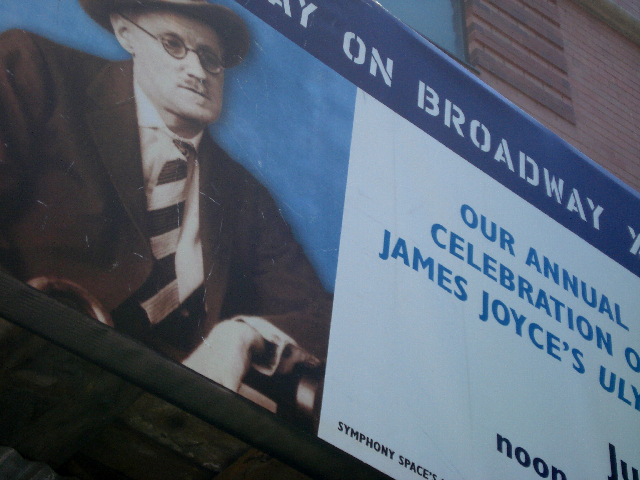
Holee shite, don't even know where to begin. Yesterday was exhilarating, hysterical, interesting, sometimes boring, fun, challenging, and at times revelatory. It was also an awesome escape. So needed. I am so glad I did it. It was like we were all in this Outward Bound project together, or something. It was a test of endurance at times. Other times, it was so fun you were like, "Did 3 hours just pass? It felt like 20 minutes." Those of us who had all-day tickets got to know each other by sight, and we would smile encouragingly at each other, as we got another beer, or stepped outside to make a phone call, or stood up to stretch our legs. There were many who came and went ... You could buy tickets for part of the day, for one section, for two sections - whatever worked for you. The newbies would be ushered in at the breaks between sections. And as people flooded down the aisles, other people flooded UP the aisles - a constant flow. The theatre was the most packed in the late afternoon. I stood in the back then, because I needed to stretch my legs, and have a bite. But other times I was in the front row. Or the 5th row center. Or the 8th row aisle. Or in the balcony. It was general seating, so if you got up to go get a bite to eat, or go to the bathroom, you gave up your seat. But that was no big deal, there were always seats to be had.
Over to the side of the lobby is a small backstage corridor where they had a cafe set up - with food going on all day, which was a godsend. It was Bloomsday-inspired food, with pears (in honor of Molly), and gorgonzola, and Irish soda bread, and Irish stew, tea - and also beer. Thank God. To paraphrase Jo at the beginning of Little Women: "Bloomsday wouldn't be Bloomsday without a bit of alcohol!"
There were people there - Irish luminaries - Frank McCourt, Frank Delaney, Fiona Walsh, Colum MacCann (who organized my favorite Bloomsday celebration I ever went to - I had forgotten about the random Wall Street dude, who wandered in to what he thought was a normal Happy Hour - only to find a bunch of drunk people singing the entire score to Oliver - we had been drinking all day, and the Bloomsday festivities had wound down ... anyway, I had forgotten about that dude, and his beautiful response to what we were all doing. I'm laughing out loud!! Ha!) Anyway - Colum MacCann was there yesterday, he read Buck Mulligan in the first chapter - and Stephen Bloom in a couple others. There was a rotating cast. David Marguiles was there - he read Bloom, he also read the unnamed narrator in the Cyclops section ("says I, says I, says I ...") - just wonderful!! He just took huge BITES off the language - terrific.
Joe Grifasi was there - he apparently has participated in Bloomsday on Broadway for years. I befriended him. Or he befriended me. I recognized him instantly - but didn't know his name, and now obviously I will never forget it. I laughed, as we shook hands - "I totally know your face - but what's your name now??" Very nice man. We had a long conversation about Ullysses, and also New Jersey, and also regional theatre (focusing on Trinity - since I grew up going to Trinity - we actually had some people in common, small world) - and Richard Jenkins - and lots of other things. He loved my name. I kept running into him at the bar. "Hello again ..." "Hi, Joe!" "Hey, Sheila, how's it going ..." Then, 25 minutes later, I'd see him up onstage, reading Mr. Power, or Martin Cunningham. He also played "The Citizen" in The Cyclops episode. The event had that kind of casual energy to it - it was lovely. How often does THAT happen?
After the Eumeus episode - there was a break in the Ulysses action. This was at around 7 or 8 pm. Two more episodes to go - Ithaka, and then of course - Penelope, with Fionnula Flanagan reading the entirety of Molly Bloom's monologue. There were still hours to go. But there was a break - and many letters of James Joyce's were read. Actually - letters to and from Joyce. We heard from Nora, we heard from Ezra Pound - we heard from Yeats - and there is also that fantastic letter by George Bernard Shaw - not to Joyce, but to someone else ... and one gentleman - I'll have to look up his name because he was goosebump-worthy - my GOD - he read all of Joyce's jealous sexy letters to Nora, in 1909. Joyce was back in Ireland, and became convinced that Giorgio was not his son, and that Nora had been a whore. The letters are crazy. But so beautiful, too. Absolute raw passion. These jealous letters led to the infamous "dirty" letters - which are basically an early 20th century version of phone sex. Nora wrote Jim sexy letters - he wrote sexy letters back - Nora, I think, wanted to keep him from going to whores, while he was away from her - so she sent him panties thru the mail, stuff like that ... But leading up to that are these letters of a tormented Joyce, thinking that he was getting "the leavings" of other men, with Nora. (This was all pretty much unfounded). His love for her, his need for her - is palpable when you read these letters - it's almost painful - and this actor - what was his name?? My God, he just WENT there. It took my breath away. There's a point during one of these letters when Jim starts to tell Nora how much he loves her, and he starts to cry as he writes - he says, "I am sobbing now as I write this ..." This actor, whoever he was, had so followed Joyce's emotional thruline of the letter - without seeming manufactured, or actor-y - he was just embodying what Joyce had written - and at that point, as Joyce said, "I am sobbing now as I write this ..." this man just filled up with emotion. It was heart-wrenching. I have tears in my eyes now remembering. I was in the 9th or 10th row - and I felt his emotion grasp through my skin. He was a gentleman in his 50s, white hair, a suit, glasses ... It was marvelous. One of my favorite parts of the whole day. His imagination so flexible and fluid he could just flow into Joyce's point of view ... he let himself "go there" and I was moved to tears. He finished that letter - and we all spontaneously burst into applause and cheers.
I am not sure what time Fionnula Flanagan took the stage. She was supposed to go on at 9 - but I think it was more like 11. It takes her 3 hours to read Molly Bloom's monologue - and I got out of there at 2 a.m. Those of us left in the theatre were the true die-hards. There were maybe 40 of us there, sitting scattered throughout the Symphony Space. Up in the balconies, over on the sides, the middle. A man was snoring behind me - which was so hilarious because Molly Bloom's whole monologue takes place with Leopold snoring at her feet. So it was perfect. I nodded off at a couple points - not due to boredom, but due to sheer exhaustion - and then I would wake up, and it would still be going on - and I would dip into it, like a river. Doze off ... her voice in my ears ... wake up ... her voice ... laughter ... It was quite a profound experience, and I havent' figured out how to talk about it yet. It has something to do with the subconscious. People weren't sitting there politely, and academically by that point. We were lying all over the seats. We leaned forward. People had their shoes off, and were lolling their legs over the seats in front of them. And Fionnula - with her thick thick shining shock of white hair ... and her deep navy blue gown with the spangles ... sat in a big armchair on the dark stage, with her feet up - bare feet - a bottle of water beside her - the script in loose pages in her hand (she would drop the pages off to the side of the chair when she was done with each one) ... and a microphone bent gently to her mouth ... It was one of the most riveting three-dimensional performances - embodiments - I have ever seen. She was with us - she was talking to us - and yet she was also completely private. You felt the darkness of her bedroom, the chamber pot, the soiled sheets, the snoring husband ... Molly ruminates on her breasts for a while - "what are these lines here ..." and how she thinks Leopold might have forever shaped her breasts from how hard he sucked on them ... Fionnula, in a tired meandering way, just like you would when you were alone - ran her fingers over her breasts, staring down at them, shrugging, confiding in us, feeling herself up again, like: really doing it. That's privacy. No shame, no embarrassment ... because why would you be ashamed when you were alone in your bedroom? The part about farting was hilarious - she has some rhyme about letting your "wind go free" - but Molly is afraid of waking up her husband with it ... and Fionnula had what I think of as the quintessential Molly Bloom energy - humorous, exhausted, a bit disheartened, lonely, and with a deep private pain. Something that she normally laughs or fucks away. When Fionnula said, "It's 11 years to the day ..." and you know what she's referring to - the look that flashed acros her face, the grief, the loss that is still sharp and fresh .... I didn't know what time it was, I forgot my exhaustion, or - no, that's not it. I was exhausted, but I was still PRESENT- a strange energy that comes with intense tiredness, a vivid-ness of perception - yet with blurry edges - things coming quick and sharp and strong, like a dream ... Yet you're not sure what the sequence is, or where you are in time and space ... What time is it ... 12:30? 1:00? Doesn't matter. We were in Molly's time and space. A space with no punctuation, or light - except that which is in her memory.
And when she said the line, "and the sun shines for you he said" - I felt a rush ... I knew where we were in that 40 page run-on sentence ... I knew we were a page from the end ... and all of my remaining shreds of attention poured into this moment, into her - on stage - shining in white hair and blue sparkles. Don't miss it. Don't miss it. This is why you're here. This is the moment you've been waiting for.
And Fionnula Flanagan - through that last page - yes rhododendrons Gibraltar flower of the mountain yes Yes yes yes ... was divine. Not a dry eye in the house. I was a wreck.
She ended it on a whisper. The words clear, open, alive ... so so alive ... Her head thrown back in abandon, staring up ...
Then - silence. The moment passed ... the monologue was done - and we all stood - cheering and screaming - the little old lady next to me was weeping, and screaming, "BRAVA" - and Fionnula - stood up on that stage with the white light beaming down on her - bowing - smiling - making eye contact with us - because we were right there ... and there were so few of us left. Bowing, humbly, smiling - thankful ... we all were in that moment together, in the wee wee hours of the morning.
Some photos below.

The day began. 11:30 a.m.

I emerged at the end of the event. It was the next day. 2 a.m. (And eventually I'll have to tell about my cab ride back to Jersey - which was a splurge. It was another one of THOSE rides that I always seem to have, where I form a deep personal bond with the cab driver. This one was from Bangladesh originally although he is an American citizen now. As I got out of the cab, he actually said to me, "I miss you already." Ha!! But it was true! I missed him already, too! How does this happen? It had something to do with it being way past my bedtime - so I was open, not at all guarded - but I do seem to always have these cabbie moments - like the Armenian cab driver actually hugging me when he dropped me off at Alex's - I love it.)

The empty stage.
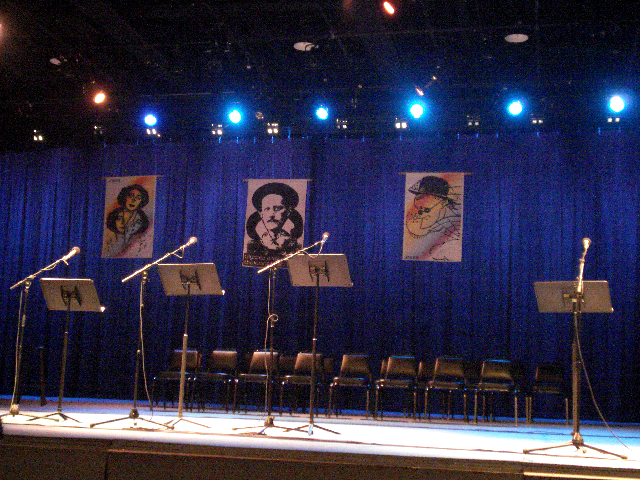
Cheat sheet in the back of my book.

Bloomsday playing cards ... decorating the stage.


Audience - start of the day.

Came out at around 1 or 2, to stretch my legs, make a phone call, buy some water, etc. The blaring sun of morning was long-gone. Clouds lowered, thunder rumbled ... I felt like I had been hovering in some alternate universe.

A papier-mache James Joyce bust out on the sidewalk - it was there all day, and every photo I took of it made me laugh. Hey Jim, what's up.
Isaiah Sheffer: THANK YOU.
June 16, 2007
Work. Leisure.
I got a lot of work done yesterday - on what you can see trapped by the flower pot here ... and I've been working under, shall we say, duress these days ... it's been very hard to focus, due to circumstances outside my control ... but the work must be done. I must continue on. So yesterday was productive.
And so today I have earned my leisure. And leisure to me means sitting in a theatre for 14 hours, holding my copy of Ulysses, and reading along as the performers do their thing. While wearing an eyepatch.
It's a beautiful day. I'm tired, and my work still calls to me ... but I figure it's okay. It's okay to balance it out with a day off.
And I try to stay away from Joyce when I'm writing things myself - because his shadow tends to swallow me up ... but today I'm hoping will just rejuvenate, help me rally. It's not about thinking, or hoping, or wishing. It's about DOING.
The manuscript is safe under the flower pot. And I am going to let myself forget. For a while. The work will be waiting for me tomorrow.
Bloomsday, 2007
Note from James Joyce to Nora Barnacle, on June 15, 1904. She was a waitress. He had asked her "out" - which, in Dublin, in those days, just meant going for a walk. She had blown him off. He sent her this follow-up note.
60 Shelbourne RoadI may be blind. I looked for a long time at a head of reddish-brown hair and decided it was not yours. I went home quite dejected. I would like to make an appointment but it might not suit you. I hope you will be kind enough to make one with me -- if you have not forgotten me!
James A. Joyce 15 June 1904
And apparently - they went out the next night - June 16, 1904. Years later, Joyce would pay tribute to this moment in his life by setting the entire plot of "Ulysses" on one day: June 16 1904. He told Nora later that on that day, he became a man. They fled Ireland together, an unmarried couple, a couple of months later, leaving a wake of debt and scandal behind them. They lived "abroad" for the rest of their lives together, and were rarely parted from one another, ever.

"I'd like a language which is above all languages, a language to which all will do service. I cannot express myself in English without enclosing myself in a tradition."
-- James Joyce

You had best believe that I am well prepared for the all-day celebration I am going to today. I've got the essential Bloomsday prop.

Geek.
[Ulysses] is the epic of two races (Israel - Ireland) and at the same time the cycle of the human body as well as a little story of a day (life). The character of Ulysses always fascinated me ever since boyhood. I started writing it as a short story for Dubliners, fifteen years ago but gave it up. For seven years I have been working at this book - blast it!-- James Joyce

"I wish, for my own sake, that I had not read it... Joyce has single-handedly killed the 19th century."
-- T.S. Eliot

I was on the platform, my heart going like the locomotive, as the train from Dijon came slowly to a standstill and I saw the conductor getting off, holding a parcel and looking around for someone -- me. In a few minutes, I was ringing the doorbell at the Joyces' and handing them Copy No. 1 of Ulysses. It was February 2, 1922.-- Sylvia Beach (publisher of "Ulysses" - shown in the photo above, standing in the doorway of her bookstore in Paris with Joyce)

That's James and Nora - on their wedding day in 1931, when they finally decided, after decades of life together, after 2 children, etc., to make it official.
"Sure, if you've been married to the greatest writer in the world, you don't remember all the little fellows."
-- Nora, after Joyce's death, when asked what writers she liked.
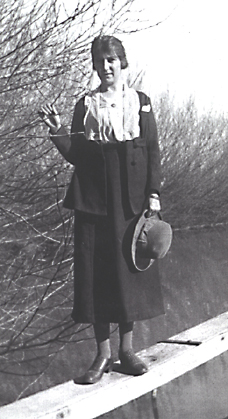
Nora Barnacle, Galway girl - Joyce loved the symbolism inherent in her name. Barnacle, the creature clinging to the rock. And Nora - the heroine of the play by Ibsen - who was James Joyce's main inspiration as a writer.
Joyce said he wanted to end the book with "the most positive word in the English language". He also had always noted that when Nora wrote him letters, she never used punctuation. Every year, at whatever Bloomsday fiesta I attend, there are vast swathes of people who know this section by heart. My heart is full!
the sun shines for you he said the day we were lying among the rhododendrons on Howth head in the grey tweed suit and his straw hat the day I got him to propose to me yes first I gave him the bit of seedcake out of my mouth and it was leapyear like now yes 16 years ago my God after that long kiss I near lost my breath yes he said I was a flower of the mountain yes so we are flowers all a womans body yes that was one true thing he said in his life and the sun shines for you today yes that was why I liked him because I saw he understood or felt what a woman is and I knew I could always get round him and I gave him all the pleasure I could leading him on till he asked me to say yes and I wouldnt answer first only looked out over the sea and the sky I was thinking of so many things he didnt know of Mulvey and Mr Stanhope and Hester and father and old captain Groves and the sailors playing all birds fly and I say stoop and washing up dishes they called it on the pier and the sentry in front of the governors house with the thing round his white helmet poor devil half roasted and the Spanish girls laughing in their shawls and their tall combs and the auctions in the morning the Greeks and the jews and the Arabs and the devil knows who else from all the ends of Europe and Duke street and the fowl market all clucking outside Larby Sharons and the poor donkeys slipping half asleep and the vague fellows in the cloaks asleep in the shade on the steps and the big wheels of the carts of the bulls and the old castle thousands of years old yes and those handsome Moors all in white and turbans like kings asking you to sit down in their little bit of a shop and Ronda with the old windows of the posadas glancing eyes a lattice hid for her lover to kiss the iron and the wineshops half open at night and the castanets and the night we missed the boat at Algeciras the watchman going about serene with his lamp and O that awful deepdown torrent O and the sea the sea crimson sometimes like fire and the glorious sunsets and the figtrees in the Alameda gardens yes and all the queer little streets and pink and blue and yellow houses and the rosegardens and the jessamine and geraniums and cactuses and Gibraltar as a girl where I was a Flower of the mountain yes when I put the rose in my hair like the Andalusian girls used or shall I wear a red yes and how he kissed me under the Moorish wall and I thought well as well him as another and then I asked him with my eyes to ask again yes and then he asked me would I yes to say yes my mountain flower and first I put my arms around him yes and drew him down to me so he could feel my breasts all perfume yes and his heart was going like mad and yes I said yes I will Yes.
God bless James Joyce!
This, as always, is mainly for my father. Which is appropriate since Father's Day is nigh. My father helped me through Ulysses - it's one of my favorite memories of our relationship - reading that book, and calling him up with questions - beautiful - and he has always loved my Bloomsday posts, sending me notes or small corrections - or commenting on the posts himself. Most of what I do, in this regard, is for him. So Dad ... whenever you get to read this ... thank you. And this is for you.
My post about the plot of the book is below. I post it every year and I've received letters from random strangers - telling me that they used it as a guide. Which is kind of scary, yet also totally flattering. And then there's coming across things like this. You know. The universal Joyce family. So here, again, are my notes on the journey of this great book.
And happy happy Bloomsday.
THE PLOT.
Chapter I "Telemachus" episode ... it is early morning, June 16, 8 am.
We start off with the character of Stephen Dedalus - who was also the lead character in Portrait of the Artist as a Young Man. Ulysses doesn't quite pick up the strand from where that book left off - but it's close enough.
Stephen is rooming with a couple of friends in an old round square tower ("stately plump Buck Mulligan, et al). He awakens. He has broken his glasses. It is June 16. He starts off for work.
Chapter II "Nestor" episode ... it is now 10 a.m.
Stephen teaches in a school. After class, he has a long conversation with Mr. Deasy, the headmaster - who is, basically, the wise Nestor in "The Odyssey". Their conversation is about history. Irish history. Deasy asks Dedalus if he could drop off a couple of things he had written at 2 Irish newspapers.
Deasy says to Dedalus at one point:
-- You think me an old fogey and an old tory, his thoughtful voice said. I saw three generations since O'Connell's time. I remember the famine. Do you know that the orange lodges agitated for repeal of the union twenty years before O'Connell did or before the prelates of your communion denounced him as a demagogue? You fenians forget some things....I have rebel blood in me too ... On the spindle side. But I am descended from sir John Blackwood who voted for the union. We are all Irish, all kings' sons.-- Alas, Stephen said.
The generational difference. A major propelling force in Dedalus, who must strike out on his own. Must fight against artifice.
Chapter III "Proteus" episode ... This is around 11 am, it takes place on the Strand - I've quoted from it already here and here .
Stephen goes for a walk on the beach. He is blind, his glasses have broken. And so all impressions come to him through sounds, all colors blur together ... which is a perfect reflection of his own state of mind. He has not yet broken free yet, he has not yet separated himself from his inspirations, his tradition, his world. It's very Hamlet-esque - which makes sense, because Stephen (and Joyce) were obsessed with Hamlet.
Quote from this section:
Jesus wept: and no wonder, by Christ.
And the Proteus episode ends the "Telemachia". After the "Telemachia", the actual "Odyssey" begins. And we now enter the world of Leopold Bloom.
In the Odyssey, Ulysses must leave Calypso - the female, the nymph. He travels, he visist with the Phaenicians - he tells them all the long tale of his travels, his misfortunes, etc. They transport him back to Ithaca. Back home. That's the arc of the book (so simplistic!!) But simplicity is good. It helped me out, in reading Ulysses to remember that fact: It's just a journey. It's the journey of two men through one day.
Their paths start out as separate. And eventually they converge.
Part II of Ulysses is the section of the actual Odyssey.
Chapter IV The "Calypso Episode" - This takes place in Leopold Bloom's house - at 8 a.m. - the very same moment that Stephen Dedalus is waking up across town in his Tower
Leopold Bloom has breakfast. Then he takes a dump. That is basically the "plot" of the section. However: you get a couple of clues. He's worried that Molly (his wife) is cheating on him. The thought torments him. He goes upstairs - and she's lying in bed. Bloom gets ready to go to a funeral of a friend. Molly is waiting for him to leave, basically, so that she can go meet up with her lover. This is a strange chapter - it's all about the innards of things. What people eat, what people excrete ... it's body without any redeeming soul.
Chapter V "The Lotuseater" episode
Leopold Bloom leaves his house ... it's around 10 am. He wanders the streets of Dublin, window-shopping. He goes to the post office. He turns left, he turns right, he walks a block, he stops, he turns left, he turns right ... This is one of those chapters where you could re-construct a map of Dublin from the prose.
I am sure there are people right now, in Dublin, walking around, holding Ulysses up in front of them - following the commands of this chapter. The chapter ends with Leopold Bloom visiting the baths, lying down in the water.
Enjoy a bath now: clean trough of water, cool enamel, the gentle tepid stream. This is my body.He foresaw his pale body reclined in it at full, naked, in a womb of warmth, oiled by scented melting soap, softly laved, buoyed lightly upward, lemonyellow: his navel, bud of flesh: and saw the dark tangled curls of his bush floating, floating hair of the stream around the limp father of thousands, a languid floating flower.
Obviously, Bloom is a troubled man.
Chapter VI "The Hades" episode
This is where Bloom attends the funeral - an obvious parallel to the journey through Hades. Stephen Dedalus is at the same funeral - but their paths do not cross yet. Not really. Bloom is in the same carriage as Dedalus' kinda deadbeat father - as well as some other people. It is 11 a.m. The mourners all crowd into carriages, and travel to the graveyard. They stare out the windows, and talk about what they see - another microscopic glimpse of the world of Dublin. It's a gossipy chapter, filled with different and conflicting voices.
They drove on past Brian Boroimhe house. Near it now.-- I wonder how is our friend Fogarty getting on, Mr Power said.
-- Better ask Tom Kernan, Mr Dedalus said.
-- How is that? Martin Cunningham said. Left him weeping I suppose.
-- Though lost to sight, Mr Dedalus said, to memory dear.
The carriage steered left for Finglas road.
The stonecutter's yard on the right. Last lap. Crowded on the spit of land silent shapes appeared, white, sorrowful, holding out calm hands, knelt in grief, pointing. Fragments of shapes, hewn. In white silence: appealing. The best obtainable. Thos. H. Dennany, monumental builder and sculptor.
Passed.
On the curbstone before Jimmy Geary the sexton's an old tramp sat, grumbling, emptying the dirt and stones out of his huge dustbrown yawning boot. After life's journey.
Gloomy gardens then went by, one by one: gloomy houses.
After the graveside service, they pile back into carriages again. They leave Hades.
The gates glimmered in front: still open. Back to the world again. Enough of this place. Brings you a bit nearer every time.
Chapter VII "The Eolus" episode
This is when Stephen Dedalus goes to the newspaper office to drop off Mr. Deasy's letters, and Leopold Bloom is there to sell advertisements. Their paths almost cross here ... but they just miss each other.
I was completely BAFFLED by this chapter until I got what Joyce was doing - and then had to go back and read it again. The entire episode, which Joyce wanted to be symbolic of lungs, air, rhetoric - a lot of "windbags", actually - is all talk talk talk talk - and because it takes place in a newspaper office, the text is interspersed with wacko headlines.
It was a lot of fun to read, once I got the structure. It made perfect sense.
Like Joyce said himself, "With me, the thought is always simple."
The form may be complex, convoluted - but the thought never is.
Everyone's full of a lot of hot air in this chapter. Yak yak yak yak
LOST CAUSES NOBLE MARQUESS MENTIONED-- We were always loyal to lost causes, the professor said. Success for us is the death of the intellect and of the imagination. We were never loyal to the successful. We serve them. I teach the blatant Latin language. I speak the tongue of a race the acme of whose mentality is the maxim: time is money. Material domination. Dominus! Lord! Where is the spirituality? Lord Jesus! Lord Salisbury. A sofa in a westend club. But the Greek!
See what I mean? Yak yak yak.
Chapter VIII "The Lestrygonians" episode
This has as its parallel the episode with Ulysses and the cannibals. In this episode, Leopold Bloom goes to get lunch. And again - we're back with the old disgust at the body, disgust at what it must do - how it must chew, how it must digest ... How can anyone ever rise above that and find anything spiritual or refined?
Leopold Bloom's anxiety increases ... as he gets closer and closer to the time he suspects Molly will be meeting with her lover. He becomes consumed by thoughts of her - as he sits and has his lunch. He imagines everyone talking about him, he is paranoid.
The chapter is a cornucopia of grossness. Images of childbirth splitting someone open, of a throat clogged, of the nastiness of food in general ...
Men, men, men.Perched on high stools by the bar, hats shoved back, at the tables calling for more bread no charge, swilling, wolfing gobfuls of sloppy food, their eyes bulging, wiping wetted moustaches. A pallid suetfaced young man polished his tumbler knife fork and spoon with his napkin. New set of microbes. A man with an infant's saucestained napkin tucked round him shovelled gurgling soup down his gullet. A man spitting back on his plate: halfmasticated gristle: no teeth to chewchewchew it. Chump chop from the grill. Bolting to get it over. Sad booser's eyes. Bitten off more than he can chew. Am I like that? See ourselves as others see us. Hungry man is an angry man. Working tooth and jaw. Don't! O! A bone! That last pagan king of Ireland Cormac in the schoolpoem choked himself at Sletty southward of the Boyne. Wonder what he was eating. Something galoptious. Saint Patrick converted him to Christianity. Couldn't swallow it all however.
Ha!
Chapter IX "The Scylla and Charybdis" episode
Okay. Love this chapter. This is the chapter where Joyce basically sounds off about all of the things he has been thinking about - putting them in the mouth of his alter-ego Stephen Dedalus.
It is 2 pm, and Leopold Bloom, after having his lunch, comes to the library. He basically hides behind a statue, and eavesdrops on a long conversation between Stephen Dedalus and his friends. In it, Dedalus talks about his theory of Hamlet, and his ideas about Shakespeare.
To me, this chapter is FOOD FOR MY BRAIN.
There's also the brilliance of the parallel: the rocks of Scylla and Charybdis - the whirlpool in between ... Dedalus caught - between traditions, geography, trying to navigate his way through.
The entire chapter is a vibrant literary discussion. Eventually, they see Leopold Bloom sneaking away from them ... and they gossip about him, about his wife's obvious infidelities. This chapter, too, is Dedalus (who eventually - we know - because he is Joyce - will get the hell OUT of Ireland) emerging from un-knowingness - and from the pre-language ramblings of the Proteus episode - into articulation. He speaks. And speaks, and speaks.
The birth of the writer.
It is in this chapter that Stephen says the famous line: "A man of genius makes no mistakes. His errors are volitional and are the portals of discovery."
Chapter X "The Wandering Rocks" episode
Joyce now takes us out of the interiors (the library, the pub, the baths, the carriages) - and out into the raucous streets of Dublin. It's a melee - a mish-mosh - a montage - We see everyone, snippets, bits, pieces, behavior, incomprehensible and comprehensible ... exactly as one does on city streets anywhere. You get glimpses of other passersby - you see things - you move on - everyone walking in their own direction, passing each other by.
Joyce saw this chapter as moving away from the obvious BRAIN of the chapter before, and into the blood-stream.
Everyone is circulating in this chapter, Dublin is on the move.
This section, actually, is missing from Homer's account of the Odyssey. But Joyce wasn't just copying the structure, he was transforming it, melding it, molding it ... and he couldn't leave out the Wandering Rocks.
Because it, to him, was the perfect opportunity to SHOW us Dublin, and Dubliners. When they don't know that anyone is watching them.
There's some kind of parade going on - or a motorcade or something. And that is the structure that Joyce uses, to take us through the blood-stream (or the "wandering rocks") of Dublin. The motorcade passes this, it passes that ... all of the citizens of Dublin are the rocks through which the motorcade passes.
In the last section, it's like the car speeds up - and we see everyone we have just met - in increasing speed - just glimpses - like you would get from out of the window of a car.
Leopold Bloom and Stephen Dedalus are not seen. And by this point, I wondered: Hm. Where the hell are those two?
Chapter XI "The Sirens" episode
It is 4 pm, by this point. 4 pm is the time of Molly's rendesvous with her lover. Leopold stops by a hotel bar/concert hall to have a drink, and to listen to the singers.
Two barmaids stand there, chattering.
Because the parallel of this is the Sirens episode in the Odyssey - which is all about SOUND - we get none of Leopold's inner thoughts. We just hear what he hears. And because of his increasing anxiety and paranoia - it all comes to him as meaningless jibber-jabber.
It's a brilliant device.
Again, once I knew what Joyce was up to - it became great fun. Here's an excerpt - it is going to read like gibberish, and it's supposed to. It's the way other people's jabbering conversations may sound to you - when your mind is elsewhere, when you are deep in thought.
Jingle. Bloo. Boomed crashing chords. When love absorbs. War! War! The tympanum. A sail! A veil awave upon the waves. Lost. Throstle fluted. All is lost now. Horn. Hawhorn. When first he saw. Alas! Full tup. Full throb. Warbling. Ah, lure! Alluring.
Of course they're alluring. They're the sirens.
Bloom through the bardoor saw a shell held at their ears. He heard more faintly that that they heard, each for herself alone, then each for other, hearing the plash of waves, loudly, a silent roar.Bronze by a weary gold, anear, afar, they listened.
Her ear too is a shell [Ed: He's thinking about Molly now], the peeping lobe there. Been to the seaside. Lovely seaside girls. Skin tanned raw. Should have put on coldcream first make it brown. Buttered toast. O and that lotion mustn't forget. Fever near her mouth. Your head it simply. Hair braided over: shell with seaweed. Why do they hide their ears with seaweed hair? And Turks their mouth, why? Her eyes over the sheet, a yashmak. Find the way in. A cave. No admittance except on business.
The sea they think they hear. Singing. A roar. The blood is it. Souse in the ear sometimes. Well, it's a sea. Corpuscle islands.
Chapter XII "The Cyclops" episode
The action moves now to a tavern - it's around 5 p.m. I found this entire chapter opaque, until - again - my dad came to the rescue.
Suddenly, we have a brand-new narrator - and he is speaking in the first-person - and he is not Leopold Bloom, and he is not Stephen Dedalus - and he appears to be regaling a group of his friends with a tale of what had happened in the Tavern earlier that day.
It is a run-in. A run-in by a windbag old Irish radical referred to as "the Citizen" - and Leopold Bloom, who has stopped by for a drink. Things get ugly. It's anti-Semitic. It's nasty. Bloom knows that everyone knows he is a cuckold.
However: the whole thing is told in the voice of someone else - saying to his friends at the pub later that night: "So let me told you what I saw today!!"
I didn't get it at ALL. Held the book out to my dad and said, "What the HELL is going on here?"
He took one look at the page and said, "It's the Cyclops episode."
Er ... my dad didn't even have a chance to READ any of it - I said, "How do you know that?"
Dad held the book out to me and said, "Look at how many times the word 'I' appears on every page."
And then ... it all unfolded. Sense came. I got the music, I got the sense of it.
The episode is the parallel to the monstrous CYCLOPS episode. And so - the episode in Joyce's book is filled with 'I'. hence - the first-person.
"says I, says I, says I..."
And it is true: once you know the sense, the reasoning - you can tell just by looking at the page which episode you are in.
The Citizen - old windbag - hostile - is the Cyclops. He's a broken old patriot, living on the glories from the past - No one can tell him anything, he brooks no opposition, he is always right. Out of this Irish patriotic vibe comes his sudden verbal attack on Leopold Bloom, sitting nearby. Bloom insists that although he is a Jew, his country is Ireland, because he was born here.
You can smell the hostility in the room, you can feel the contempt all have for Bloom - not just because he is Jewish, but because his wife is blatantly cheating on him, sleeping with her lover at that very moment.
Everyone laughs at Bloom. Poor guy.
Chapter XIII "The Nausikaa" episode
An extremely creepy and bizarre chapter. It takes place on the rocks, down by the beach, at about 8 pm. Leopold Bloom is avoiding going home to his adulterous wife. He sits on the rocks, brooding. He sees 2 young women, also on the beach. He hides behind the rocks and masturbates.
This all sounds very simple - but the weird thing is is that the entire chapter is written in the overblown overly romantic turgid prose of a bad romance novel.
Joyce chose this for ... well, I can guess why: Leopold Bloom, in that moment, in that moment of avoiding going home, and in the moment of sunset-time, looking at the fresh young women on the beach ... is filled with the yearning of a romance novel. He is almost adolescent in his praise of their purity, their beauty.
Ironically, their beauty is what makes him masturbate in a frenzy. Filled with shame and loathing. It's quite tragic, actually.
How moving the scene there in the gathering twilight, the last glimpse of Erin, the touching chime of those evening bells and at the same time a bat flew forth from the ivied belfry through the dusk, hither, thither, with a tiny lost cry. And she could see far away the lights of the lighthouses so picturesque she would have loved to do with a box of paints because it was easier than to make a man and soon the lamplighter would be going his rounds past the presbyterian church grounds and along by shady Tritonville avenue where the couples walked ...For Gerty had her dreams that no-one knew of.
The chapter ends with a bell chiming in the distance:
Cuckoo
Cuckoo
Cuckoo
An obvious and taunting reminder to Bloom of his marital condition. He is cuckoo, a cuckold.
Chapter XIV "The Oxen of Sun" episode
It's now 10 o'clock at night. It appears that none of the men in Dublin want to go home, and are wandering about. (Having been to Dublin many times, I can say that that is still the case.)
All the men converge on a maternity hospital - where a friend's wife has just had a baby.
And here - at last - Stephen Dedalus and Leopold Bloom meet.
It makes perfect sense. Childbirth, something transforming, something coming to life ... in a rather sterile and white atmosphere, actually. But what was once an embryo is now a full human life.
Paths converge.
The writing in this chapter is a precursor (I would say) of Finnegans Wake. A non-stop onslaught, a constant repeating of themes, a constant embellishment on the themes of the chapter (wombs, medicine, embryos, life)...The prose is like the development of a child inside a woman. Fingers developing, toes coming out, head forming itself, organs forming ... a constant process of transformation, repetition, and growth.
Once you know that that's what's going on - it becomes quite easy to get through, actually.
Also: that it takes place in the waiting room of a maternity ward. A bunch of men, sitting around, aimlessly, in the world of women.
Therefore, everyman, look to that last end that is thy death and the dust that gripeth on every man that is born of woman for as he came naked forth from his mother's womb so naked shall he wend him at the last for to go as he came.The man that was come into the house then spoke to the nursingwoman and he asked her how it fared with the woman that lay there in childbed. The nursingwoman answered him and said that that woman was in throes now full three days and that it would be a hard birth unneth to bear but that now in a little it would be. She said thereto that she had seen many births of women but never was none so hard as was that woman's birth. Then she set it forth all to him that time was had lived nigh that house. The man hearkened to her words for he felt with wonder women's woe in the travail that they have of motherhood and he wondered to look on her face that was a young face for ny man to see but yet was she left after long years a handmaid. Nine twelve bloodflows chiding her childless.
The men sit, in the waiting room, and talk about all of this. Dedalus and Bloom recognize one another. Not just "Oh hey, I know your face" - but as kindred souls.
Dedalus is looking for a father. A spiritual father, a real father. Bloom appears.
Chapter XV "The Circe" episode
Dedalus and Bloom visit the red-light district in Dublin, known as Night Town.
This chapter is a psychedelic ride, I'll tell ya. It's all written like a script, with stage directions. It is completely unrealistic. People change shapes, shift into horrible visions -
Bella (the Madame of Night Town) is "Circe" - and she indulges Bloom in what we have seen, thoughout the day, in his masochistic fantasies. He is reduced to a snivelling snorting little piglet, licking her boot-soles.
Dedalus is suddenly tormented by the ghost of his dead mother - etc. All females represented to him as the death of this one important female.
It's midnight. The whole thing takes on the feel of one mass hallucination.
There's so much in this chapter, it's immensely long - it's about death, sex, Ireland, women, the search for meaning, life, fear, love of pain, patriotism ...
Like I said, it's quite a ride.
And the Circe episode ends Part II of this book. The journey out has ended - now it's time to go back in.
Part III of Ulysses is the "Nostos" - the return.
Ulysses, in the Nostos, reveals himself to his son. They slaughter the suitors together, and he returns to his kingdom as a hero - to regain his country and also to regain Penelope.
In Part III of Joyce's book, Bloom has to go home again. He has to go and face his "Penelope" - lying in bed now, waiting for him.
Chapter XVI "The Eumeus" episode
It's now 1 a.m., and Dedalus and Bloom have escaped from the madhouse of the brothel, with their sanity barely intact. They still don't want to go home. So they stop off at a midnight cafeteria where the carriage-drivers of the city hang out off-duty - to have a cup of soup.
The parallel here is:
The Eumeus, in the Odyssey, is all about the navigation home, the sailors, the sea. Joyce's chapter does the same thing. The men in the cabbie shelter become the sailors, the ones bearing Dedalus and Bloom towards home.
The men are also referred to as "wrecks" - They also become the shipwrecks out on the sea, the danger facing Dedalus and Bloom on this journey home.
They're not out of the woods yet.
They all sit, it's 1 a.m., and they discuss many things. Of course, they all start to discuss Ireland.
Stephen is exhausted. Testy. He says:
-- We can't change the country. Let us change the subject.
Love that line.
Dedalus, Bloom, and the sailors - huddled over their midnight snack - discuss women and marriage, too. Bloom worries, tormentedly:
Can real love, supposing there happens to be another chap in the case, exist between married folk?
It is throughout this episode that intimacy grows, unspoken, between Stephen Dedalus and Bloom. They realize the parallels in their lives, they have both had identical June 16ths ...
Bloom thinks at one point:
Though they didn't see eye to eye in everything, a certain analogy there somehow was, as if both their minds were travelling, so to speak, in the one train of thought.
Chapter XVII "Ithaca" episode
Bloom and Dedalus leave the homeless shelter - it's now 2 a.m. They walk, exhausted, and yet also invigorated by discovering one another - they walk through the dark Dublin streets, talking. Endlessly. Bloom invites Dedalus into his house when they arrive - for a cup of tea.
Molly is asleep upstairs. Bloom approaching -- we have been hearing about this woman all day -- and now she is right up the stairs.
This chapter is written in extremely impersonal prose. Joyce saw this chapter or episode as a "skeleton". It was meant to be, literally, bare bones.
It is the kind of raw and open and absolutely honest conversation that one can only have at 2 o'clock in the morning. Do you know what I mean?
It is TRUTH.
But it's not messy or emotional - they're too tired for that. It's a cut to the chase thing, an intellectual and philosophical and "what is the meaning of life" conversation that, again, could only happen when half the planet is asleep.
It's done in a series of questions and answers.
To me, it is the most brilliant thing in the book. We get distance now. It is as though we are far far back, and studying Stephen Dedalus and Leopold Bloom from the perspective of centuries of distance.
It's like a lecture series on Bloom and Dedalus. And people in the class ask questions about these 2 characters, and the professor answers. It goes on and on and on - and I cannot tell you how riveting it is, and moving it is - once you have read the entire book.
There's scope. There's galaxies of distance. Human beings are so small, so unimportant ... and yet also so miraculous, and so beautiful. Connection is still possible. Even though usually galaxies separate us.
That's what the "Ithaca" section makes me think of.
Here's an example of how the entire chapter goes:
Was there one point on which their view were equal and negative?The influence of gaslight or electric light on the growth of adjoining paraheliotropic trees.
Had Bloom discussed similar subjects during nocturnal perambulations in the past?
In 1884 with Owen Goldberg and Cecil Turnbull at night on public thoroughfares between Longwood avenue and Leonard's corner and Leonard's corner and Synge street and Synge street and Bloomfield Avenue.
It's encyclopedic. We have been inside the story with Bloom and Dedalus, and now we are way out.
One other example (but truly, the chapter is cumulative ... it's so powerful when you read it all the way through):
What was Stephen's auditive sensation?He heard in a profound ancient male unfamiliar melody the accumulation of the past.
What was Bloom's visual sensation?
He saw in a quick young male familiar form the predestination of a future.
James Joyce, in the end, believes that it IS possible for human beings to connect. Even those as different from one another as Bloom and Dedalus.
The two of these nocturnal creatures sit in Bloom's kitchen, where the Odyssey began, and talk long into the night. Molly is upstairs, in bed. Bloom offers Stephen a bed for the night (still putting off going up the stairs) - Stephen declines, and leaves.
Now there's no more putting off.
By the end of the Ithaca chapter, we are ready to join Molly.
Chapter XVIII "Penelope" episode
In bed with Molly. Her interior monologue. A female. Inside the mind of the female. Her boredom, her horniness, her body betraying itself, her love for Leopold, her humor, her menstruation, her boredom with her lover, she re-lives an erotic moment with Leopold, she masturbates, but ... truly ... to try to sum it up is RIDICULOUS. It's a 40 page run-on sentence.
Joyce always said that he wanted to end his book on "the most positive word in the English language".
And so he did.
yes when I put the rose in my hair like the Andalusian girls used or shall I wear a red yes and how he kissed me under the Moorish wall and I thought well as well him as another and then I asked him with my eyes to ask again yes and then he asked me would I yes to say yes my mountain flower and first I put my arms around him yes and drew him down to me so he could feel my breasts all perfume yes and his heart was going like mad and yes I said yes I will Yes.
The end.
June 15, 2007
Mmmhelloooo?
I had forgotten about Betty Butterfield, and the genius of Betty. The hypnotic power. The comedy. But now I have remembered. And I find her as mesmerizing as ever. That person is brilliant. Alex and I spent a couple of hours around in there for a couple of hours - watching all of them ... which I just did again. My favorite part is when her voice trails off into a whimpery moany whisper, and she gets so panicked (over what??) that her red lipsticked lips tremble, and she quietly goes off into a freakout ... like: WHAT? Betty!!! Stop crying. It's O KAY.
Oh, I have needs.
For some reason, this random game tickled my funny bone. I got it from Annie ... I had to type my name with the word "needs" after it into Google and see what came up. Choose 13 that kind of make sense. It's so silly, but I just started laughing reading some of these, imagining me needing such things.
1. Sheila needs to get her spouse on board with their new eating plan if she hopes to improve her kids' diets. [God, it's just so true. As long as Cookie Monster is still allowed to spew forth his evil message, I will have an uphill battle.]
2. For formal papers, Sheila may need extended time requirements and one-on-one teacher assistance with revising and editing her own work. [To quote Bette Davis: "Don't direct me. Edit me."]
3. Dr. Yehuda says Sheila needs to get specific and address each of her fears head on, in a therapeutic setting. [Thanks for caring, Dr. Yehuda!]
4. Sheila needs to relax and recharge - she works at least as hard as I do [I almost began to weep at this one. I do need to relax and recharge! Thanks for noticing!]
5. Sheila needs help in getting her dream school up and going somewhere -- anywhere. ... [I've got a barn - let's do a show!]
6. Sheila needs a speechwriter, however, don�t let that fool you into believing her not to be competent. [The person who wrote that horrible sentence needs a speechwriter.]
7. Please don't hesitate to call and discuss any of your special needs for a/v or room setup. Sheila is very flexible and will be happy to work with you. [This one made me laugh out loud, knowing my technological challenges. ]
8. Sheila just needs to crawl back into her pit!! [I am guffawing]
9. Sheila understood the need for credible data, just as she understood the need for advocates and shelters - and was comfortable in both worlds. [I do understand, I just don't care.]
10. Sheila is to design what the Iron Chefs are to the secret ingredients. ... a mural in your bedroom�you�ve found a designer for all your creative needs. [I specialize in murals featuring Cary Grant, Stalin, and Janice from "The Muppets"]
11. The fundamental issue at stake here is that students who have specific needs similar to Sheila are increasingly becoming commonplace. [Thank God. Now I don't feel so alone]
12. PRINCE NEEDS TO LET JASMINE GUY AND SHEILA E. IN ON HIS BEAUTY SECRETS. standard. [This was totally my favorite one of the bunch]
13. Sheila Sunday needs to do something different in order to get the biscuits on the shelves instead of another brand. [Sheila Sunday wants to say that suggestions are welcome]
The Books: "The Djinn in the Nightingale's Eye" - 'Dragons' Breath' (A.S. Byatt)
Next up in my Daily Book Excerpt ... Adult fiction shelves:
Still excerpting the short story fairy-tale collection by AS Byatt (my favorite - obviously!) - called The Djinn in the Nightingale's Eye - This excerpt is from "Dragons' Breath". I love a story that starts with "Once upon a time ..." And, for me, this eerie story - about a village that is, over time, slowly threatened by a herd (a herd?) of dragons - who descend upon them inevitably from the mountains - is most wonderful in its ending. Which I won't reveal here. There's not a plot twist or a revelation - but it's where Byatt chooses to take the story, in terms of tone - she chooses to make the whole story a contemplation on stories, and why we tell each other stories, and why human beings need stories. It's so beautiful - it has a sweep of time in it ... like - how did people talk in the aftermath of Vesuvius blowing up? What stories did they pass on? And more than just the details of the story: what did they make it mean? We all make things MEAN something - and there is no one correct interpretation. It also becomes about - how a catastrophe can make life, in the aftermath, even the drudgery, seem beautiful and precious. So once upon a time ... some dragons came down from the mountains ...
Here's an excerpt.
Excerpt from The Djinn in the Nightingale's Eye - "Dragons' Breath".
The first sign may have been the hunters' reports of unusual snow-slides in the high mountains. Or maybe it was, as some of them later claimed, dawns that were hectically rosy, sunsets that flared too crimson. They began to hear strange rumblings and crackings up there, above the snow-line, which they discussed, as they discussed every strange and every accustomed sound, with their repetitious measuring commentary that made Jack and Harry grind their teeth with rage at the sameness of it all. After a time it became quite clear that the rim of the mountains directly above the village, both by day and by night, was flickering and dancing with a kind of fiery haze, a smoky salmon-pink, a burst here and there of crimson and gold. The colours were rather beautiful, they agreed as they watched from their doorsteps, the bright ribbons of colour flashing through the grey-blue smokiness of the air, and then subsiding. Below this flaming rim the white of the snow was giving way to the gaunt grey of wet rock, and the shimmer - and yes, steam - of new water.
They must have been afraid from the beginning: they could see well enough that large changes were taking place, that everything was on the move, earth and air, fire and water. But the fear was mixed great deal of excited interest, and with even a certain pleasure in novelty, and with aesthetic pleasure, of which many of them were later ashamed. Hunting-parties went out in the direction of the phenomenon and came back to report that the hillside seemed to be on the move, and was boiling and burning, so that it was hard to see through the very thick clouds of ash and smoke and steam that hung over the movement. The mountains were not, as far as anyone knew, volcanic, but the lives of men are short beside the history of rocks and stones, so they wondered and debated.
After some time they saw on the skyline lumps like the knuckles of a giant fist, six lumps, where nothing had been, lumps that might represent objects the size of large sheds or small houses, at that distance. And over the next few weeks the lumps advanced, in smoke and spitting sparks, regularly and slowly, side by side, without hesitation or deviation, down the mountainside. Behind each tump trailed a long, unbending tube, as it were, or furrow-ridge, or earth-work, coming over the crest of the mountain, over the rim of their world, pouring slowly on and down.
Some brave men went out to prospect but were forced back by clouds of scalding steam and showers of burning grit. Two friends, bold hunters both, went out and never returned.
One day a woman in her garden said: -- "It is almost as though it was not landslides but creatures, great worms with fat heads creeping down on us. Great fat, nodding bald heads, with knobs and spouts and whelks and whorls on them, and nasty hot wet eyes in great caverns in their muddy flesh, that glint blood-red, twelve eyes, can you see them, and twelve hairy nostrils on blunt snouts made of grey mud." And after conversations and comparisons and pointings and descriptions they could all see them, and they were just as she said, six fat, lolling, loathsome heads, trailing heavy bodies as long as the road from their village to the next, trailing them with difficulty, even with pain, it seemed, but unrelenting and deadly slow.
June 14, 2007
That missing plane
I know many of you follow this story - of the missing 727 - so I must link to my friend CW's latest on this mystery.
So just say Hola!
First there is this.
Sesame Street makes me want to cry. Love. Just love!! Luis! Maria! I'm totally dying.
So then (sorry, my friends who have already seen this) there's this.
Freaky Five
The Shamus, one of my favorite film bloggers, writes about his "Five Scariest Movie Characters". I love how he writes: Here he is on Norma Desmond:
"Forget Elsa Lanchester: Gloria [Swanson] plays the creepiest female I�ve ever seen. It must be the hair, the freaky eyebrows, the madness, the megolomania. But it totally throws me off my game. And when she does that funky Salome dance down the stairs for her closeup, I am up and hiding behind the sofa, literally cringing and rubbing my arms."
Great stuff.
My List of Five Scariest Movie Characters
 1. Well-chick from The Ring. God, I hate that bitch. She makes me want to cry I am so scared of her. I never ever want to see her in real-life. Please God, keep her away from me. I hate how she moves. I hate her hair. I hate how at one moment she's over THERE, and in the next second, SHE'S RIGHT IN FRONT OF YOU. I hate how needy she is. What does she WANT from me? STOP calling me, well-chick! I will never (and i mean ever) forget the first time I saw that movie. I rented it and watched it by myself because I, like a lunatic, thought, "How scary can it be?" Well. I am here to tell you I had to take BREAKS from watching that movie, I had to turn it off, stand up, walk around, talking to myself, "It's just a movie, it's just a movie ..."
 2. Robert Mitchum from Night of the Hunter. Even thinking about his voice at the top of the cellar stairs, calling down, "Chiiiiiiiiiiiiiildreeeeeen...." makes me want to piss my pants immediately.
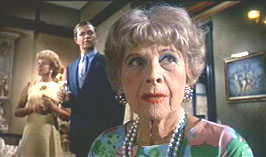 3. Ruth Gordon from Rosemary's Baby. She turns sweet little old lady into the most malevolent character imaginable, and yet she's always smiling, smotheringly "kind", and ... you just can't get away from her. Do not try to escape. The woman will GET you, don't even try (CHiPs!)
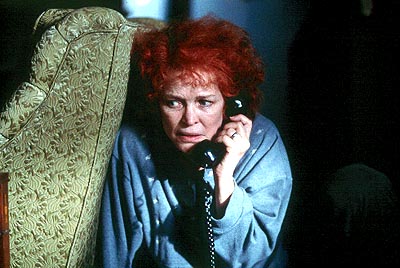 4. Ellen Burstyn in Requiem for a Dream. One of the most ruthless portraits of misplaced USELESS vanity ever on screen. I found myself almost unable to watch her disintegration. Not just because it was so convincing and horrible, but because I identified. An empty woman. With a pathetic dream, having to do with being congratulated, for what? For nothing. Please, God, don't let that ever be me. I am haunted by that character, and she probably enters my mind as a cautionary tale on an almost weekly basis.
 5. The alien in Aliens. My God, that thing must be killed. Alien is great, but Aliens reaches the level of myth, or legend - in terms of the fear factor, as well as the challenge. That freakin' monster must be killed. Ten times, in order to make sure it's REALLY dead. Kill it AGAIN. And AGAIN, please. Keep up the killing until there's nothing left because that thing needs to GO.
A related post by Curly: Halloween H20: 20 Years Later! Hysterical.
The Books: "The Djinn in the Nightingale's Eye" - 'The Story of the Eldest Princess' (A.S. Byatt)
Next up in my Daily Book Excerpt ... Adult fiction shelves:
Next book on the shelf is yet another short story collection by AS Byatt (my favorite - obviously!) - this one is called The Djinn in the Nightingale's Eye - This excerpt is from "The Story of the Eldest Princess".
Fairy tales are often stories of quests, and in this one: a Princess is sent out, by her kingdom, on a quest. She is the oldest Princess of three, and her kingdom is benevolent and peaceful. But suddenly - for no discernible reason - the sky has become green, instead of blue. There is much consternation in the land. People look up, afraid, they blame the King and Queen for it. Priests are consulted. They say to repent. Generals are consulted. They advise attacking the neighboring kingdom. But an old wizard says that someone must be sent along the Road, thru the Forest, across the Desert, into the Mountains - to bring back the single silver bird and her nest. The bird was in a walled garden - surrounded by poisonous thorns and snakes ... etc. You get the drill. It will be a terrifying dangerous quest. And whoever goes on this quest - must follow the directions exactly (of course) - and not take any shortcuts. After a meeting of the family, the Eldest Princess says that she would be happy to go.
So off she goes.
Now the thing about this story (and the thing that makes this small collection of tales so special) is that - well, I guess you'd say there's a postmodern TINGE here - just a tinge! In general, it's a straight-up fairy story - but in the middle of it (and you'll see in this excerpt) - the Princess begins to realize that she is in a tale. She recognizes the plot of her own story, so to speak ... and ... Well, it becomes (in its own way) a rumination on stories, and can we decide to be the authors of our own stories? What is Fate? Are we ruled by it? Do we have any say?
I love how Byatt writes about these things. One of the reasons I cherish her stuff is that (unlike a lot of authors) - for some reason I take her stuff personally. It seems applicable to my life. There's somthing about it. Or something about how she writes, and how she sees the world ... I espeically felt this in the last story in this collection, the title story - but I'll talk about that when I get to it.
So here is the Eldest Princess.
Excerpt from The Djinn in the Nightingale's Eye - "The Story of the Eldest Princess".
So she set out. They gave her a sword, and an inexhaustible water-bottle someone had brought back from another Quest, and a package of bread and qualis' eggs and lettuce and pomegranates, which did not last very long. They all gathered at the city gate to wish her well, and a trumpeter blew a clear, silver sound into the emptiness ahead, and a minister produced a map of the Road, with one or two sketchy patches, especially in the Desert, where its undeviating track tended to be swallowed by sandstorms.
The eldest Princess travelled quickly enough along the Road. Once or twice she thought she saw an old woman ahead of her, but this figure vanished at certain bends and slopes of the path, and did not reappear for some time, and then only briefly, so that it was never clear to the Princess whether there was one, or a succession of old women. In any case, if they were indeed, or she was indeed, an old woman, or old women, she or they were always very far ahead, and travelling extremely fast.
The Forest stretched along the Road. Pale green glades along its edges, deeper rides, and dark tangled patches beyond these. The Princess could hear, but not see, birds calling and clattering and croaking in the trees. And occasional butterflies sailed briefly out of the glades towards the Road, busy small scarlet ones, lazily swooping midnight-blue ones, and once, a hand-sized transparent one, a shimmering film of wings with two golden eyes in the centre of the lower wing. This creature hovered over the Road, and seemed to follow the Princess for several minutes, but without ever crossing some invisible barrier between the Forest and the Road, When it dipped and turned back into the dappled light of the trees the Princess wanted to go after it, to walk on the grass and moss, and knew she must not. She felt a little hungry by now, although she had the inexhaustible water-bottle.
She began to think. She was by nature a reading, not a travelling princess. This meant both that she enjoyed her new striding solitude in the fresh air, and that she had read a great many stories in her spare time, including several stories about princes and princesses who set out on Quests. What they all had in common, she thought to herself, was a pattern in which the two elder sisters, or brothers, set out very confidently, failed in one way or another, and were turned to stone, or imprisoned in vaults, or cast into magic sleep, until rescued by the third royal person, who did everything well, restored the first and the second, and fulfilled the Quest.
She thought she would not like to waste seven years of her brief life as a statue or prisoner if it could be avoided.
She thought that of course she could be vigilant, and very courteous to all passers-by - most elder princesses' failings were failings of courtesy or over-confidence.
There was nobody on the Road to whom she could be courteous, except the old woman, or women, bundling aong from time to time a long way ahead.
She thought, I am in a pattern I know, and I suspect I have no power to break it, and I am going to meet a test and fail it, and spend seven years as a stone.
This distressed her so much that she sat down on a convenient large stone at the side of the road and began to weep.
June 13, 2007
Happy birthday - to William Butler Yeats
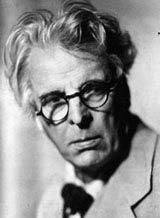
Here's the post I wrote about him for National Poetry Month - lots of great quotes from and about him.
From memory now! And when I hear this, in my head - I always hear the recitation from the Clancy Brothers Carnegie Hall album ... I get goosebumps every time I hear the "He bore her away in his arms" part ... so passionate!
O'Driscoll drove with a song
The wild duck and the drake
From the tall and the tufted reeds
Of the drear Heart Lake.
And he saw how the reeds grew dark
At the coming of night-tide,
And dreamed of the long dim hair
Of Bridget his bride.
He heard while he sang and dreamed
A piper piping away,
And never was piping so sad,
And never was piping so gay.
And he saw young men and young girls
Who danced on a level place,
And Bridget his bride among them,
With a sad and a gay face.
The dancers crowded about him
And many a sweet thing said,
And a young man brought him red wine
And a young girl white bread.
But Bridget drew him by the sleeve
Away from the merry bands,
To old men playing at cards
With a twinkling of ancient hands.
The bread and the wine had a doom,
For these were the host of the air;
He sat and played in a dream
Of her long dim hair.
He played with the merry old men
And thought not of evil chance,
Until one bore Bridget his bride
Away from the merry dance.
He bore her away in his arms,
The handsomest young man there,
And his neck and his breast and his arms
Were drowned in her long dim hair.
O'Driscoll scattered the cards
And out of his dream awoke:
Old men and young men and young girls
Were gone like a drifting smoke;
But he heard high up in the air
A piper piping away,
And never was piping so sad,
And never was piping so gay.
To those of you who know that Clancy Brothers album - you'll know the special-ness of that recording.
William Butler Yeats. It is fitting that today, of all days, is WB Yeats' birthday.
The O'Malley children were made to memorize Yeats' epitaph as part of our weekly allowance ritual. Say Yeats' epitaph, get a dime!!
Cast a cold eye
On life on Death
Horseman pass by
Once more for good luck!
Cast a cold eye
On life on Death
Horseman pass by
When we visited his grave in Ireland, as kids, we all felt kind of amazed that ... it was REAL. That the epitaph we had been rattling off since we were toddlers actually existed out in the world.
Here's a biography of Yeats, Nobel prize winner in 1923.
Yeats, as a poet, has always been one of my favorites (even with the "cloud-pale eyelids" balderdash), but what truly inspires me is his work in Irish theatre, and the creation of the Abbey. An amazing story. His Nobel lecture was on the Irish Dramatic Movement. I wrote a big long post about his nurturing of John Synge, author of Playboy of the Western World. Synge, as a young man, was a floundering artist bohemian type - until Yeats got a hold of him, and told him to go stay on the Aran Islands for a while, to discover the real Irish people. The result? A revolution in Irish theatre.
Great anecdote here about Yeats (or should I call him "Willie" like Lady Gregory does??) watching a dress rehearsal for Juno and the Paycock ...
I had a conversation once with the doppelganger about "greatest poems of the 20th century" and we discussed Sailing to Byzantium, Among Schoolchildren, and The Second Coming. We said any list of "greatest poems of the 20th century" that DIDN'T include at least one of those poems was not a list to be taken seriously in the slightest. "The Second Coming" is quoted (and mis-appropriated, more often than not) and quoted again ... by people who want to use it for their own ends. It's a dark ominous crystal ball. Written in 1919 - when the world had already become familiar with horror - a horror of a kind never before seen on earth - the poem predicts the chaos of the 20th century.
"The Second Coming"
Turning and turning in the widening gyre
The falcon cannot hear the falconer;
Things fall apart; the centre cannot hold;
Mere anarchy is loosed upon the world,
The blood-dimmed tide is loosed, and everywhere
The ceremony of innocence is drowned;
The best lack all conviction, while the worst
Are full of passionate intensity.
Surely some revelation is at hand;
Surely the Second Coming is at hand.
The Second Coming! Hardly are those words out
When a vast image out of Spiritus Mundi
Troubles my sight: somewhere in sands of the desert
A shape with lion body and the head of a man,
A gaze blank and pitiless as the sun,
Is moving its slow thighs, while all about it
Reel shadows of the indignant desert birds.
The darkness drops again; but now I know
That twenty centuries of stony sleep
Were vexed to nightmare by a rocking cradle,
And what rough beast, its hour come round at last,
Slouches towards Bethlehem to be born?
Of course, there is also the Maud Gonne factor that must be considered.

Some quotes from Mr. Yeats:
"I hate journalists. There is nothing in them but tittering jeering emptiness. They have all made what Dante calls the Great Refusal. The shallowest people on the ridge of the earth."
"Irish poets, learn your trade, sing whatever is well made, scorn the sort now growing up all out of shape from toe to top."
"The worst thing about some men is that when they are not drunk they are sober."
"Words are always getting conventionalized to some secondary meaning. It is one of the works of poetry to take the truants in custody and bring them back to their right senses."
"Do not wait to strike till the iron is hot; but make it hot by striking."
"And say my glory was I had such friends."
Yes. That last one really moves me - it's from one of his poems. I feel the same way about my life, and my friends.
Words to live by:
Never give all the heart
Never give all the heart, for love
Will hardly seem worth thinking of
To passionate women if it seem
Certain, and they never dream
That it fades out from kiss to kiss;
For everything that's lovely is
But a brief, dreamy. Kind delight.
O never give the heart outright,
For they, for all smooth lips can say,
Have given their hearts up to the play.
And who could play it well enough
If deaf and dumb and blind with love?
He that made this knows all the cost,
For he gave all his heart and lost.
I also love love LOVE his poem to Jonathan Swift where he writes: "Imitate him if you dare."
Swift's Epitaph
Swift has sailed into his rest;
Savage indignation there
Cannot lacerate his breast.
Imitate him if you dare,
World-besotted traveller; he
Served human liberty.
Speaking of epitaphs, you can't get any better or more eloquent than Auden's stunning poem in memory of Yeats:
In Memory of W.B. Yeats
by Auden
I
He disappeared in the dead of winter:
The brooks were frozen, the airports almost deserted,
And snow disfigured the public statues;
The mercury sank in the mouth of the dying day.
What instruments we have agree
The day of his death was a dark cold day.
Far from his illness
The wolves ran on through the evergreen forests,
The peasant river was untempted by the fashionable quays;
By mourning tongues
The death of the poet was kept from his poems.
But for him it was his last afternoon as himself,
An afternoon of nurses and rumours;
The provinces of his body revolted,
The squares of his mind were empty,
Silence invaded the suburbs,
The current of his feeling failed; he became his admirers.
Now he is scattered among a hundred cities
And wholly given over to unfamiliar affections,
To find his happiness in another kind of wood
And be punished under a foreign code of conscience.
The words of a dead man
Are modified in the guts of the living.
But in the importance and noise of to-morrow
When the brokers are roaring like beasts on the floor of the Bourse,
And the poor have the sufferings to which they are fairly accustomed,
And each in the cell of himself is almost convinced of his freedom,
A few thousand will think of this day
As one thinks of a day when one did something slightly unusual.
What instruments we have agree
The day of his death was a dark cold day.
II
You were silly like us; your gift survived it all:
The parish of rich women, physical decay,
Yourself. Mad Ireland hurt you into poetry.
Now Ireland has her madness and her weather still,
For poetry makes nothing happen: it survives
In the valley of its making where executives
Would never want to tamper, flows on south
From ranches of isolation and the busy griefs,
Raw towns that we believe and die in; it survives,
A way of happening, a mouth.
III
Earth, receive an honoured guest:
William Yeats is laid to rest.
Let the Irish vessel lie
Emptied of its poetry.
In the nightmare of the dark
All the dogs of Europe bark,
And the living nations wait,
Each sequestered in its hate;
Intellectual disgrace
Stares from every human face,
And the seas of pity lie
Locked and frozen in each eye.
Follow, poet, follow right
To the bottom of the night,
With your unconstraining voice
Still persuade us to rejoice;
With the farming of a verse
Make a vineyard of the curse,
Sing of human unsuccess
In a rapture of distress;
In the deserts of the heart
Let the healing fountain start,
In the prison of his days
Teach the free man how to praise.
And lastly, a poem that has great personal meaning for me - especially today, of all days:
The wild swans at Coole
The trees are in their autumn beauty,
The woodland paths are dry,
Under the October twilight the water
Mirrors a still sky;
Upon the brimming water among the stones
Are nine-and-fifty Swans.
The nineteenth autumn has come upon me
Since I first made my count;
I saw, before I had well finished,
All suddenly mount
And scatter wheeling in great broken rings
Upon their clamorous wings.
I have looked upon those brilliant creatures,
And now my heart is sore.
All's changed since I, hearing at twilight,
The first time on this shore,
The bell-beat of their wings above my head,
Trod with a lighter tread.
Unwearied still, lover by lover,
They paddle in the cold
Companionable streams or climb the air;
Their hearts have not grown old;
Passion or conquest, wander where they will,
Attend upon them still.
But now they drift on the still water,
Mysterious, beautiful;
Among what rushes will they build,
By what lake's edge or pool
Delight men's eyes when I awake some day
To find they have flown away?
Happy birthday to William Butler Yeats.
Imitate him if you dare.
Snapshots
Random photos and stuff. Things I think look kinda cool.
Tense stressful day ahead.
I think The Quiet Man arrives today. I'm alternating between Woody Allen and John Wayne, and it suits me perfectly.
Reading The Arabian Nights. The Richard Burton translation - which has a flowery Arabic FEEL to it and I love it. I read a couple pages a day. It's all I'm fit for right now. Now I know why generations of schoolchildren are literally swept away by the magic carpet ride herein. You just are transported to another world. And you NEED to know: "But what happens next??"
Breathe. Don't forget to breathe.
Dinner with Ted tonight.
Window at Tiffany's.

Weather-beaten chairs on my roof.

59th and 5th - it was a black stormy sky with a burst of sun hitting the white marble buildings. Breathtaking.
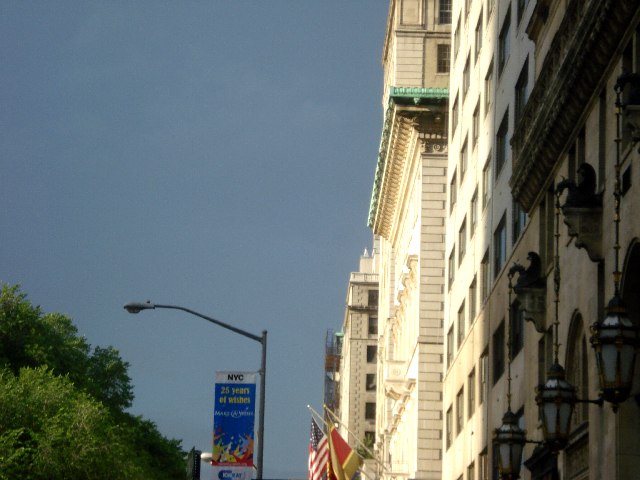
Apple Store, stormy day

St. Patrick's Cathedral

Buildings on edge of Columbus Circle.

They call me "No Shame Sheila."

More photos here!!
The Books: "The Djinn in the Nightingale's Eye" - 'Gode's Story' (A.S. Byatt)
Next up in my Daily Book Excerpt ... Adult fiction shelves:
Next book on the shelf is yet another short story collection by AS Byatt (my favorite - obviously!) - this one is called The Djinn in the Nightingale's Eye - This excerpt is from "Gode's Story" - this is another "story within the story" from Possession. Sophie de Kercoz kept a journal in possession - she lives in the wildness of Brittany - and records some of the myths and legends of her place. This is one of them - which takes on ominous significance in the larger story of Possession - but which also works, and beautifully, as a fairy tales all on its own.
I'll just excerpt the beginning, without saying anything more about it.
Actually, no, I'll just say this. Having read all of Byatt's published books - fiction and non-fiction - it continuously amazes me how WELL she can morph into another voice. She does it in all of her books - she'll excerpt ficitonal scholary papers, or private journals, or letters ... she becomes a ventriloquist, in a way ... I find her to be utterly convincing in all of her various guises. I am lost in admiration.
Here she is a storyteller. Plain and simple. Please notice that she starts almost every paragraph with the word "And". And then recall The Arabian Nights. That breathy feeling of desperation - of a real voice - propelling the stories along - for her own desperate urgent reasons ... "And ... And ... And ..."
Excerpt from The Djinn in the Nightingale's Eye - "Gode's Story"
There was once a young sailor who had nothing but his courage and his bright eyes - but those were very bright - and the strength the gods gave him, which was sufficient.
He was not a good match for any girl in the village, for he was thought to be rash as well as poor, but the young girls liked to see him go by, you can believe, and they liked most particularly to see him dance, with his long, long legs and his clever feet and his laughing mouth.
And most of all one girl liked to see him, who was the miller's daughter, beautiful and stately and proud, with three deep velvet ribbons to her skirt, who would by no means let him see that she liked to see him, but looked sideways with glimpy eyes, when he was not watching. And so did many another. It is always so. Some are looked at, and some may whistle for an admiring glance till the devil pounces on them, for so the Holy Spirit makes, crooked or straight, and naught to be done about it.
He came and went, the young man, for it was the long voyages he was drawn to, he went with the whales over the edge of the world and down to where the sea boils and the great fish move under it like drowned islands and the mermaids sing with their mirrors and their green scales and their winding hair, if tales are to be believed. He was first up the mast and sharpest with the harpoon but he made no money, for the profit was all the master's, and so he came and went.
And when he came he sat in the square and told of what he had seen, and they all listened. And the miller's daughter came, all clean and proud and proper, and he saw her listening at the edge and said he would bring her a silk ribbon from the East, if she liked. And she would not say if she liked, yes or not, but he saw that she would.
And he went again, and had the ribbon from a silk-merchant's daughter in one of those countries where the women are golden with hair like black silk, but they like to see a man dance with long, long legs, and clever feet and a laughing mouth. And he told the silk-merchant's daughter he would come again and brought back the ribbon, all laid up in a perfumed paper, and at the next village dance he gave it to the miller's daughter and said, "Here is your ribbon."
And her heart banged in her side, you may believe, but she mastered it, and asked coolly how much she was to pay him for it. It was a lovely ribbon, a rainbow-coloured silk ribbon, such as had never een seen in these parts.
And he was very angry at this insult to his gift, and said she must pay what it had cost her from whom he had it. And she said,
"What was that?"
And he said, "Sleepless nights till I come again."
And she said, "The price is too high."
And he said, "The price is set, you must pay."
And she paid, you may believe, for he saw how it was with her, and a man hurt in his pride will take what he may, and he took, for she had seen him dance, and she was all twisted and turned in her mind and herself by his pride and his dancing.
And he said, if he went away again, and found some future in any part of the world, would she wait till he came again and asked her father for her.
And she said, "Long must I wait, and you with a woman waiting in every port, and a ribbon fluttering in every breeze on every quay, if I wait for you."
And he said, "You will wait."
And she would not say yes or no, she would wait or not wait.
And he said, "You are a woman with a cursed temper, but I will come again and you will see."
June 12, 2007
The last 2 minutes
I never get sick of it. Ever. Every time I watch this, I think .... they're not gonna pull it off. I KNOW the end ... but I forget it. Every time.
Photos and such
Hey everybody - I love that I'm being "invited" as a "contact" to other Flickr members - this is all a new thing for me, and it's really fun. I love my Flickr page, and I'm kind of obsessed with it. It shall pass. Thanks for making me feel welcome - I'm seriously a newbie, etc. I took some hopefully cool photos yesterday as a big and sudden storm came up ... I was at the Apple Store on the corner of Central Park and I saw some pretty amazing cloud/sun combinations that made the whole city look like miniature jewels or something.
The life of Herb Brooks
I think this is one of the best movies I've ever seen. Done by a kid for a class project. I can't stop watching it. And I get all choked up at the end every time when you see the photos.
Thank you, Emily!!!
Speaking of an O'Malley filmmaker (Kung Food Guy: Part 1, Part 2, trailer for Part 3) Cashel is going to a summer camp where he will learn how to create video games.
This is the coolest thing ever.
He left me a rambling message where I only understood two words: "500,000 dollars" ... It sounded like, "blah blah garble blah and BLAH GARBLE BLAH!!! blahblahblahblah 500,000 dollars!!"
Is he asking me for 500,000 dollars? Not sure.
I also had a brief conversation with him, where I could tell his attention was elsewhere. I had interrupted his Simpsons marathon.
I said, "Okay, Cash, I'll let you go. I know you need to get back to the Simpsons."
He pondered this, and then said, "Well. I don't think I need to get back to the Simpsons."
I howled with laughter. His linguistic sophistication rearing its head. "Hahahaha VERY good point, Cash - but you WANT to ... You don't NEED to, but you WANT to. I completely know what you are talking about."
I don't NEED to watch Holiday and Only Angels Have Wings back to back on a weekly basis. No, I don't NEED to. But I WANT to.
And that's good enough for me. Life is so full of have-tos. It's good to make time for what you WANT-to.
Anyway, I can't wait to see what video game he creates.
Oh, and watch that Herb Brooks movie. Genius! I've watched it 3 times.
The Books: "The Djinn in the Nightingale's Eye" - 'The Glass Coffin' (A.S. Byatt)
Next up in my Daily Book Excerpt ... Adult fiction shelves:
Next book on the shelf is yet another short story collection by AS Byatt (my favorite - obviously!) - this one is called The Djinn in the Nightingale's Eye - This excerpt is from "The Glass Coffin"
I think this might be my favorite of her short story collections (and we've got one more to go!) and ironically, I resisted reading it. Even though it was AS Byatt. It's "Five Fairy Stories" - as I've mentioned, and as anyone who's read Byatt knows - she is VERY into fairy stories, and myths and fables ... her books usually have books-within-books - where magical things happen - the poems and stories in Possession ... My copy of The Arabian Nights has a preface by AS Byatt - she is very into all of it. So in this particular collection, she has 5 fairy stories (2 which appear within the narrative of Possession, and 3 that are new). And I guess I need to be in the mood for fairy stories, not sure - but I didn't read this one for a long time, it just sat on my shelf. And now - particularly the title story - I go to the stories again and again. She's just so damn GOOD. I finished the title story, sitting on a bench on the edge of Central Park - I was waiting for someone - and the wind was HUGE that day - and I was afraid (yes, afraid) that my friend would actually be on time for once - and interrupt me 2 pages from the end. I was literally sitting there, willing my friend to be a couple seconds late so I could finish the story in peace. Because it just GOT me. Tears flooded my eyes at one point ... and the ending - the last 3 paragraphs - are my definition of perfect. Closes out the story perfectly. So satisfying, so moving.
But the first story in the collection is "The Glass Coffin" which was, actually, Christabel's story in Possession. It's about a "little tailor" who journeys thru a forest, trying to "make a meagre living" - he wanted to find someone who would want his skills, so he goes deeper and deeper into the forest, until he comes across a little house. He knocks and a little old man lets him in. Beside the little old man stands a huge grey dog with red eyes. In the house are a lot of animals, sitting in chairs, lying on rugs. The little old man tells the tailor he has no need of a tailor - but would he mind making dinner? So the little tailor goes and makes a great dinner for everybody, humans and animals. Turns out, this was a test set to him by the little old man. He says, "You are a good man - you made dinner for all of us, not just the humans - you left nobody unattended - here are 3 objects - which one do you want?" There is a purse, a cooking pot, and a glass key. He ponders. He knows it will be an important choice. He chooses the key. The man tells him to go outside and call to the West Wind - show her the key - and let her carry him where she will. No fighting is allowed, no questions. She will let you down at a place where there will be the "gate to your adventure" ... and etc. etc. It's a fairy story. Lovely, haunting, and very eerie at points.
Here's the part where the West Wind takes him.
Excerpt from The Djinn in the Nightingale's Eye "The Glass Coffin"
And that was a delightful and most alarming sensation, when the long, airy arms of the West Wind reached down through the trees and caught him up, and the leaves were all shivering and clattering and trembling with her passing, and the straws danced before the house and the dust rose and flew about in little earth-fountains. The trees grabbed at him with twiggy fingers as he rose up through them, lurching this way and that in the gusts, and then he felt himself held against the invisible rushing breast of the long Wind, as she hurled moaning along the sky. He rested his face against his airy pillows, and did not cry out or struggle, and the sighing song of the West Wind, full of fine rain and glancing sunshine, streaming clouds and driven starlight, netted him around and around.
She put him down as the little grey man had foretold on a huge grey granite stone, pitted and scarred and bald. He heard her whisking and wailing on her way, and he bent down and laid the cock-feather on the stone, and behold with a heavy groaning and grinding the huge stone swung up in the air and down in the earth, as though on a pivot or balance, disturbing waves of soil and heather like thick sea-water, and showing a dark, dank passage under the heather-roots and the knotty roots of the gorse. So in he went, bravely enough, thinking all the time of the thickness of rock and peat and earth over his head, and the air in that place was chill and damp and the ground underfoot was moist and sodden. He bethought him of his little key and held it up bravely before him, and it put out a little sparkling light that illumined a step at a time, silvery-pale. So he came down to the vestibule, where the three doors were, and under the sills of the two great doors, light shone, warm and enticing, and the third was behind a musty leather curtain. He touched this leather, just brushing it with the tip of his soft hen-feather, and it was drawn away in angular folds like bat-wings, and beyond a little dark door lay open into a tiny hole, into which he thought he might just manage to put his shouders. Then truly he was afraid, for his small grey friend had said nothing of this narrow little place, and he thought if he put his head in he might never come out alive.
So he looked behind himself and saw that the passage he had just come down was one of many, all wrinkled and wormy and dripping and tangled with roots, and he thought he could never find his way back so he must perforce push on and see what lay in store. It took all the courage he had to thrust his head and shoulders into the mouth of that entrance, but he closed his eyes and twisted and turned and after a time tumbled out into a great stone chamber, lit with a soft light of its own that dimmed the glitter of his shining key. It was a miracle, he thought, that the glass had not shivered in that tight struggle, but it was as clear and brittle as ever. So he looked about him, and saw three things. The first was a heap of glass bottles and flasks, all of them covered with dust and cobwebs. The second was a glass dome, the size of a man, and a little taller than our hero. And the third was a shining glass coffin, lying on a rich velvet pall on a gilded trestle. And from all these things the soft light proceeded, like the glimmering of pearls in the depth of water, like the phosphorescent light that moves of itself on the night surface of southern seas, or shines round the heaving shoals, milky-white over their silver darts, in their own dark Channel.
Well, he thought, one of these is my adventure.
June 11, 2007
The Tonys
I can barely read this recount of the gathering because i'm frankly angry that I wasn't there. Damn ALL OF YOU TO HELL.
I love how much Mitchell despises Phylicia Rashad. It makes me so happy. I love to get him going off about it.
I also love how Alex had a mini-stroke about Ben Vereen and Usher.
Congratulations, Christine Ebersole - and Mary Louise Wilson! Well deserved!!!
The thing about Michael is
I can lean on him. Like ... lean. It's a rare thing. Many people can't take it when you lean on them. They expect something in return. Or in the back of their minds, they wonder nervously: "What does she want from me?? What does she really want from me?" Not him. I don't want anything but a little help with Ye Olde load. And he helps.
His casual, yet firm voice from the other room, "Baby, you've got to get a thick skin. The guy's an asshole."
And poof. The freakout disappears. The skin thickens. I realize the asshole-ness of the asshole, and I move on. Immediately. This is what a partner can do. Perspective. Not do the work for me, but to help.
And so I lean. Sometimes it's invisible, too. Like - I lean on him without him even knowing about it. Very very sneaky. I go to him in my mind when I'm troubled, and try to imagine what he'd say about it. How he'd talk me out of it, or talk me through it. Or maybe he does know I do this. He was always kinda cool like that.
The Books: "Elementals: Stories of Fire and Ice" - 'Christ in the House of Martha and Mary' (A.S. Byatt)
Next up in my Daily Book Excerpt ... Adult fiction shelves:
 Next book on the shelf is another short story collection - this one called Elementals: Stories of Fire and Ice - by A.S. Byatt. This is an excerpt the story "Christ in the House of Martha and Mary". This story uses the following Diego Velasquez painting as the jumping-off point. It ends up being a rumination on objects, the beauty of objects - especially homey objects - like fish in a bowl, or eggs ... but sometimes we cannot see the divinity within such objects. The lead character of the story is the woman in the painting who is looking right at us. She is the drudge in a house where a "painter" has come to stay for a whie. She is resentful of her life, of having to cook, clean, of being ugly ... I like Byatt because she does not always feel a compulsion to end her stories unhappily. Not that there isn't honor in an unhappy ending ... but one of the things Byatt does best is to describe joy, those moments (sometimes small) when life takes a turn for the better. Think of the second to last scene in Possession when Roland and Maud get into bed together. It's messy, frightening, you have no idea if it will work, but ... to know that human connectino is possible ... to have a breakthrough in your armor of ice - to let go of certain rigid ideas you might have of oneself ... Sometimes those moments are awful, sometimes beautiful -and sometimes they are a little bit of both at the same time. Byatt goes into this area again and again, and I love her for it. I have had those moments. And very few writers can really write about it.
Dolores is the name of the woman in the painting. She has one of those moments at the end of this beautiful little story. What does it mean to be seen ... This is a very potent concept, for me, for everybody. Byatt is talking artistically, of course - to see yourself as an artist sees you is an odd thing ... but she's also talking on a human level ... when you are actually seen by another. So much of what I want to write about (and what I do write about) are those moments.
It's a fable - as most of the stories in this collection are.
Excerpt from Elementals: Stories of Fire and Ice - by A.S. Byatt - "Christ in the House of Martha and Mary".
The young artist was a friend of Concepción's. He borrowed things, a pitcher, a bowl, a ladle, to sketch them over and over. He borrowed Concepción, too, sitting quietly in a corner, under the hooked hams and the plaits of onions and garlic, drawing her face. He made Concepción look, if not ideally beautiful, then wise and graceful. She had good bones, a fine mouth, a wonderful pattern of lines on her brow, and etched beside her nose, which Dolores had not been interested in until she saw the shapes he made from them. His sketches of Concepción increased her own knowledge that she was not beautiful. She never spoke to him, but worked away in a kind of fury in his presence, grinding the garlic in the mortar, filleting the fish with concentrated skill, slapping dough, making a tattoo of sounds with the chopper, like hailstones, reducing onions to fine specks of translucent light. She felt herself to be a heavy space of unregarded darkness, a weight of miserable shadow in the corners of the room he was abstractedly recording. He had given Concepción an oil painting he had made, of shining fish and white solid eggs, on a chipped earthenware dish. Dolores did not know why this painting moved her. It was silly that oil paint on board shoudl make eggs and fish more real, when they were less so. But it did. She never spoke to him, though she partly kknew that if she did, he might in the end give her some small similar patch of light in darkness to treasure.
Sunday was the worst day. On Sunday, after Mass, the family entertained. They entertained family and friends, the priest and sometimes the bishop and his secretary, they sat and conversed, and Doña Conchita turned her dark eyes and her pale, long face to listen to the Fathers, as they made kindly jokes and severe pronouncements on the state of the nation, and of Christendom. There were not enough servants to keep up the flow of sweetmeats and pasties, syllabubs and jellies, quails and tartlets, so that Dolores was sometimes needed to fetch and carry as well as serve, which she did with an ill grace. She did not cast her eyes modestly down, as was expected, but stared around her angrily, watching the convolutions of Doña Conchita's neck with its pretty necklace, the tapping of her pretty foot, directed not at the padre whose words she was demurely attending to, but at young Don José on the other side of the room. Dolores put a hot dish of peppers in oil down on the table with such force that the pottery burst apart, and oil and spices ran into the damask cloth. Doña Ana, Doña Conchita's governess, berated Dolores for a whole minute, threatening dismissal, docking of wages, not only for clumsiness but for insolence. Dolores strode back into the kitchen, not slinking, but moving her large legs like walking oak trees, and began to shout. There was no need to dismiss her, she was off. This was no life for a human being. She was no worse than they were, and more of use. She was off.
The painter was in his corner, eating her dish of elvers and alioli. He addressed her directly for the first time, remarking that he was much in her debt, over these last weeks, for her good nose for herbs, for her tact with sugar and spice, for her command of sweet and sour, rich and delicate. You are a true artist, said the painter, gesturing with his fork.
Dolores turned on him. He had no right to mock her, she said. He was a true artist, he could reveal light and beauty in eggs and fishes that no one had seen, and which they would then always see. She made pastries and dishes that went out of the kitchen beautiful and came back mangled and mashed - they don't notice what they're eating, they're so busy talking, and they don't eat most of it, in case they grow fat, apart from the priests, who have no other pleasures. They order it all for show, for show, and it lasts a minute only until they put the knife to it, or push it around their plate elegantly with a fork.
The painter put his head on one side, and considered her red face, as he considered the copper jugs, or the glassware, narrowing his eyes to a slit. He asked her if she knew the story St Luke told, of Christ in the house of Martha and Mary. No, she said, she did not. She knew her catechism, and what would happen to sinners at the Last Judgment, which was on the wall of the church. And about butchered martyrs, who were also on the walls of the church.
They were sisters, the painter told her, who lived in Bethany. Jesus visited them, from time to time, and rested there. And Mary sat at his feet and listened to his words, and Martha was cumbered with much serving, as St Luke put it, and complained. She said to the Lord, 'Dost thou not care that my sister hath left me to serve alone? bid her therefore that she help me.' And Jesus said to her, 'Martha, Martha, thou art careful and troubled about many things: but one thing is needful, and Mary hath chosen that good part, which shall nto be taken away from her.'
Dolores considered this, drawing her brows together in an angry frown. She said, 'There speaks a man, for certain. There will always be serving, and someone will always be doomed to serving, and will have no choice or chance about the better part. Our Lord could make loaves and fishes from the air for the listeners, but mere mortals cannot. So we - Concepción and I - serve them whilse they have the better part they have chosen.'
And Concepción said that Dolores should be careful, or she would be in danger of blaspheming. She should learn to accept the station the Lord had given her. And she appealed to the painter, should Dolores not learn to be content, to be patient? Hot tears sprang in Dolores' eyes. The painter said:
'By no means. It is not a question of accepting our station in the world as men have ordered it, but of learning not to be careful and troubled. Dolores here has her way to that better part, even as I have, and, like mine, it begins in attention to loaves and fishes. What matters is not that silly girls push her work about their plates with a fork, but that the work is good, that she understands what the wise understand, the nature of garlic and onions, butter and oil, eggs and fish, peppers, aubergines, pumpkins and corn. The cook, as much as the painter, looks into the essence of the creation, not, as I do, in light and on surfaces, but with all the other senses, with taste, and smell, and touch, which God also made in us for purposes. You may come at the better part by understanding emulsions, Dolores, by studying freshness and the edges of decay in leaves and flesh, by mixing wine and blood and sugar into sauces, as well as I may, and likely better than fine ladies twisting their pretty necks so that the light may catch their pretty pearls. You are very young, Dolores, and very strong, and very angry. You must learn now, that the important lesson - is that the divide is not between the servants and the served, between the leisured and the workers, but between those who are interested in the world and its multiplicity of forms and forces, and those who merely subsist, worrying or yawning. When I paint eggs and fishes and onions, I am painting the godhead - not only because eggs have been taken as an emblem of the Resurrection, as have dormant roots with green shoots, not only because the letters of Christ's name make up the Greek word for fish, but because the world is full of light and life, and the true crime is not to be interested in it. You have a way in. Take it. It may incidentally be a way out, too, as all skills are. The Church teaches that Mary is the contemplative life, which is higher than Martha's way, which is the active way. But any painter must question, which is which? And a cook also contemplates mysteries.'
'I don't know,' said Dolores, frowning. He tilted his head the other way. Her head was briefly full of images of the skeleton of fishes, of the whirlpool of golden egg-and-oil in the bowl, of the pattern of muscles in the shoulder of a goat. She said, 'It is nothing, what I know. It is past in a flash. It is cooked and eating, or it is gone bad and fed to the dogs or thrown out.'
'Like life,' said the painter. 'We eat and are eaten, and we are very lucky if we reach our three score years and ten, which is less than a flash in the eyes of an angel. The understanding persists, for a time. In your craft and mine.'
He said, 'Your frown is a powerful force in itself. I have an idea for a painting of Christ in the house of Martha and Mary. Would you let me draw you? I hae noticed that you are unwilling.'
'I am not beautiful.'
'No. But you have power. Your anger has power, and you have power yourself, beyond that.'
June 10, 2007
Broadway Danny Rose
I so needed Broadway Danny Rose last night. It has the perfect combination of absurdity, poignancy, and ridiculous-ness - and was just what I was in the mood for. Nothing too heavy - but nothing too shallow either. I love the comedians sitting around the table, the rapport - the true feeling you get that they are really swapping tall tales ... I love the showdown in the huge warehouse full of Macy's Day Parade floats - and the shootout occurs with all of the participants having accidentally breathed in helium. Squeaky mouse voices shouting: "Don't move or I'll blow your brains out!" "Run! He's out of bullets! It's our only chance! It's our only chance!" Running around beneath the towering floats ... Makes me laugh out loud. But it also satisfies the eye. Everything takes on a surrealistic aspect ... That scene reminded me of the famous final showdown in Lady from Shanghai - in the carnival funhouse mirror room. (Which - YET AGAIN - reminds me that I need to complete my Man in the Mirror post ... I have everything ready, now I just need to write the damn thing.)
I love Broadway Danny Rose - it's an homage to New York, to a certain generation of comedians - really old-school, a love letter to a certain time and place.
One of Danny Rose's clients. She plays the "glasses". I love how she would coyly look up and smile, as she did this ridiculous act. Hilarious.

All the comedians, sitting around the table at Carnegie Deli, swapping tales about Broadway Danny Rose. I love all these men.
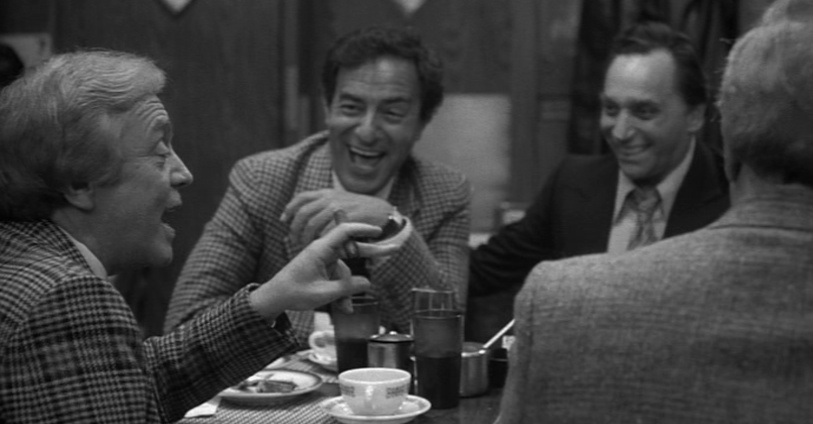
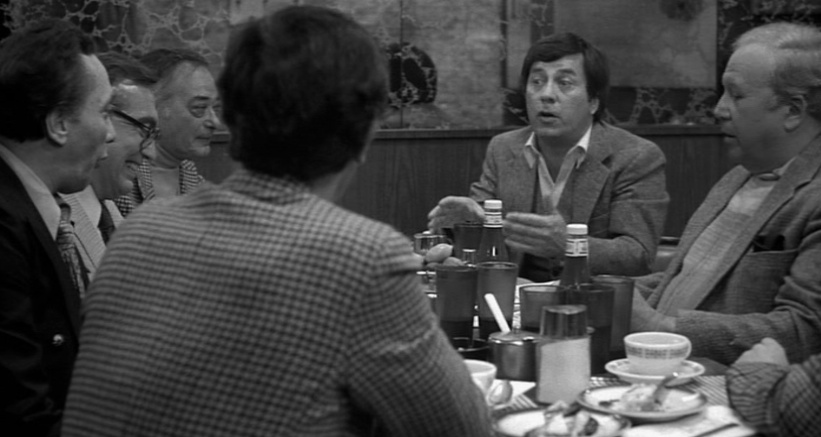
Mia Farrow, in gun moll mode. I loved this performance of hers. It's campy, loud, brash ... and in the end, really touching.
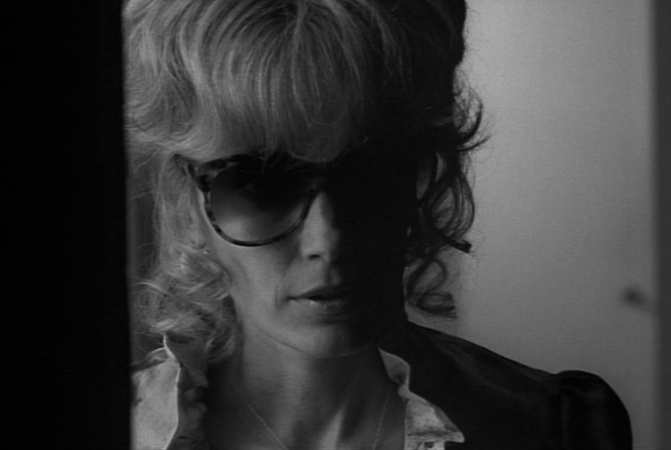
At the garden party of mafia hitmen. This looks like a Diane Arbus photo almost.
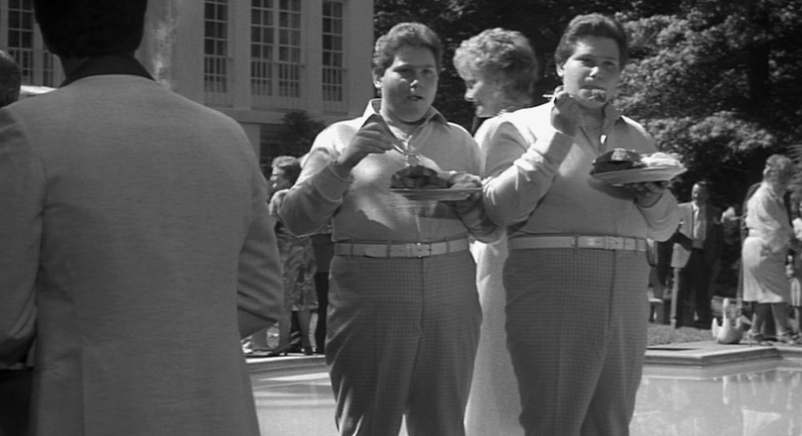
Danny Rose and Tina end up on the run ... lost in the flatlands of New Jersey. Tina exclaims, "I know where we are! We're in the flatlands! My husband's friends used to dump dead bodies here!" In a tone of almost fond nostalgia. They wander, panicked - then they hear a voice shout, "Hey!" They turn ... and see this.
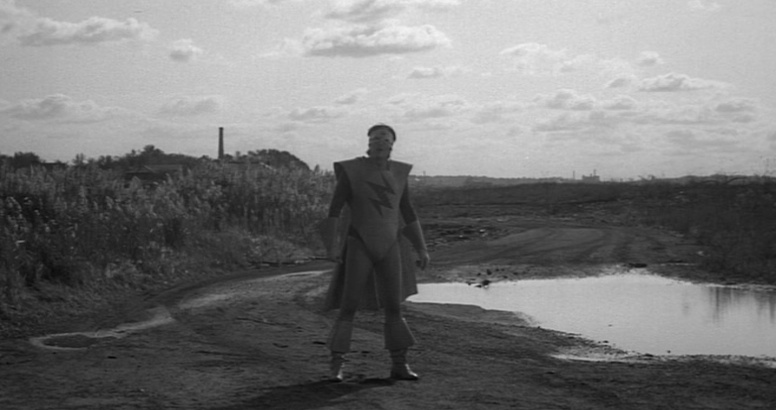
I love this movie.
I think the shot below is my favorite in the movie. It's poetic, certainly, but it's also evocative of the smell down there at the piers - the circling cawing seagulls, the stink of fish, the lapping of the water ... Beautiful.
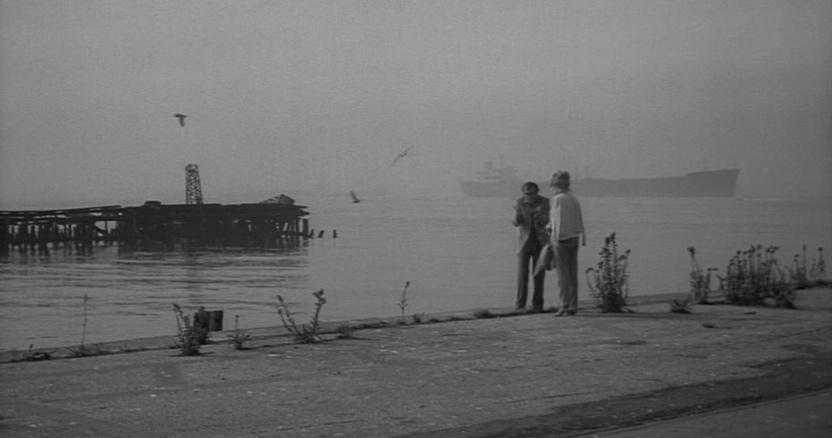
Danny and Tina escape the thugs ... and find themselves in a huge shadowy space. "Where are we?" "Seems like it's a warehouse ..."
Lights come on all at once. Brilliant shot. Or - the two shots together are brilliant. Darkness, shadows ... to instantly: this.
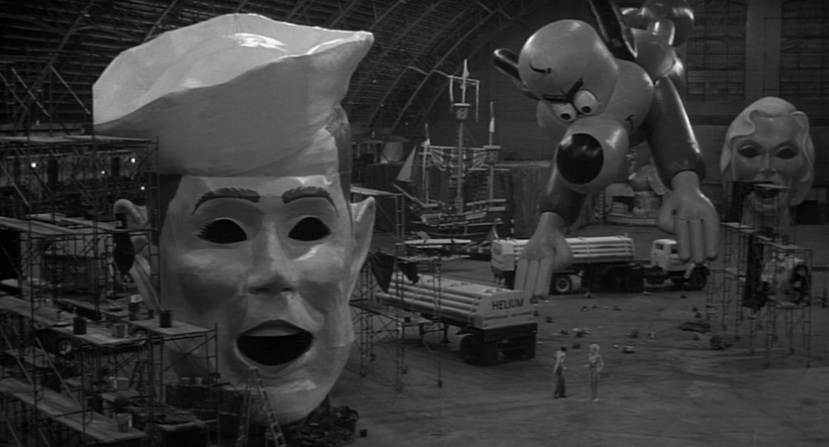
And here they are pleading for their lives - in squeaky helium voices. "Don't shoot!" "It's all a mistake!"
The big night at the Waldorf. Famous faces in the crowd.
Tina's conscience begins to eat away at her. Impacting her whole life.
The Macy's Day Parade.
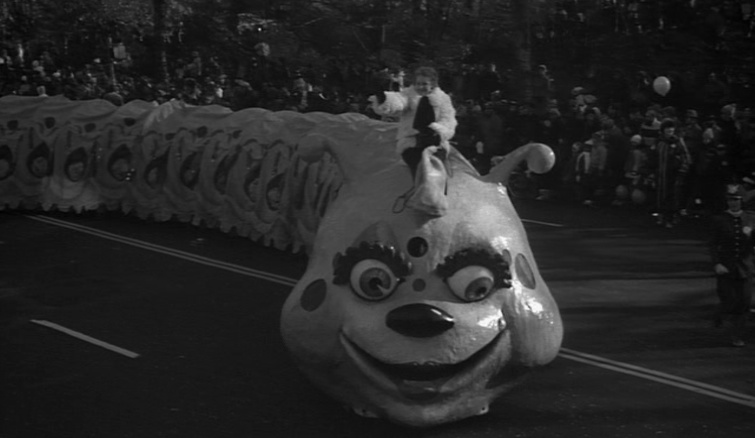
The movie was a great escape. MUCH needed.
June 9, 2007
I don't really know what I'm doing
but I have a Flickr page now. I need to work on organizing all of it. I know nothing about Flickr. Kinda like how I just discovered this awesome thing called Netflix. And how I just got this cool new gadget called an iPod. I'm always the LAST with crap like this. But it's been fun (and hard) uploading the photos.
Speaking of Netflix, I have Broadway Danny Rose to watch tonight. I've had a long hard day. Need to chill. (Freaks and Geeks hasn't arrived yet! The entire 6 disc series is on its way. I can't wait.)
Date with massage guy tomorrow. Thank the Lord. Til then .....
Objects
I was walking down 6th Avenue at about 5:30 pm last night - and I saw many things along the way. Many magical wonderful things!!
There was a haze in the air - an odd hot haze - that made the lengthening of the light even more stark. A strange day - sort of muggy, yet when you got a breeze, it was as cool as an ocean breeze.
6th Avenue, at around 44th, 43rd ... gets very CRAFT oriented (in an industrial way - it's kind of like the garment district - with entire stores of bangles, or scarves, or silk, or whatever) - as you will see. Some incredible-looking stores. But you also pass "jewelry way" ... so it's an interesting mix.
I kept trying to capture what the light and shadow looked like on this one particular building. I haven't quite captured it - but you can KIND of tell how cool it looked.


Obviously, it was box day in the city. You saw such things everywhere.

I passed a couple of stores entirely devoted to buttons. In the long sunset-light rays, the objects shimmered - almost like talismans, or something out of a fairy tale. Magical.



Then I passed all the jewelry stores. To explain why the light was so amazing - these stores were all on the east side of the street - so they were getting the sunset light on them directly.



A couple stores devoted entirely to trim.


A wall of ribbon. Incredible sight.

I thought this one came out cool. The reflection is of the sun-struck buildings in the first part of this post. Amazing, right?

Pitstop. Manicure.


And also with you.

Hot.

R2? What are you doing here?

Table of ties, sidewalk, corner of 43rd and 6th.

Flowers on the edge of Bryant Park.

End of the line.



The Books: "Elementals: Stories of Fire and Ice" - 'Jael' (A.S. Byatt)
Next up in my Daily Book Excerpt ... Adult fiction shelves:
Next book on the shelf is another short story collection - this one called Elementals: Stories of Fire and Ice - by A.S. Byatt. This is an excerpt the story "Jael".
The narrator is a woman who directs commercials. She went to Oxford. She has a wealth of associations in her head - all of which she puts to use to sell, oh, Lysol. Whatever. She reminisces about a drawing she did as a young girl - of Jael and Sisera - for some reason, that story in the Bible really - not tormented her, but - gripped her. She couldn't stop thinking about it. She talks about how she has used some of those images from her childhood in her adult work - The story has no plot, but it's a rumination on different things -as the excerpt below will show.
I love the details of her writing, the sense-memory feel of it.
Excerpt from Elementals: Stories of Fire and Ice - by A.S. Byatt. "Jael".
Anyway, Jael. Why do I remember Jael? Metaphrs. I do know - I have always known - that I felt a faint click of symmetry as I drove the point of my pencil into the paper. Pencil, peg. Another detached image, like the grenade. Pointed. Pointless. I do know also that whenever I remember that patch of fierce colour I remember, like an after-image, a kind of dreadful murky colour, a yellow-khaki-mustard-thick colour, that is the colour of the days of our boredom. For we were not unhappy girls, we were cared-for, nice, clever girls, and we were bored. It's quite hard to think back to that time. All the buidings were the same colours, green and cream. We wore milk-chocolate-coloured gymslips over khaki-colored shirts, with what we then amiably called nigger-brown ties. I do not believe any of thought of the nasty meaning of those words, nigger-brown, we just recognised the colour. Ignorance, innocence, boredom. It's strange how I hesitate, out of fear, to write down the true fact that we used that word, in that unloaded way. It's so long ago, we shall be judged without being imagined. All the excitement of life was in books. Jane Eyre, with her burning bed-curtains, or being punished in the Red Room (I've made films with both those images, fire insurance and children's furniture). Ivanhoe charging, Robin Hood in the dappled green light with his bow, Eliza escaping across the breaking ice, wolves and narwhals, volcanoes and tidal waves, excitement was all in books, none of it, nothing at all, seeped out into life. We were the pre-television age, and we cannot - that is, the absolute quality of our boredom cannot - be imagined by those who grew up with the magic lantern, the magic window on the world, the Pandora's box peopling the world with temptations and emotions and knowledge and other places and people in the corner of the lounge/sitting room/front room. I know young people now have a worked-up nostalgia for an imaginary time when families communicated, people made things, played games, instead of passively watching. Now and then we did. I remember the physical pleasure of frenzied playground skipping. I remember the passionate life with which I invested a collection of lead ponies. But mostly - apart from books - I remember this smeared, fuggy, limited light of boredom, where you couldn't see very much or very far, and the horizon was unimaginable.
June 8, 2007
"all true art is of necessity samizdat, and thus destined to languish in obscurity, ignored by the nekulturny hordes of bourgeois apparatchiks"
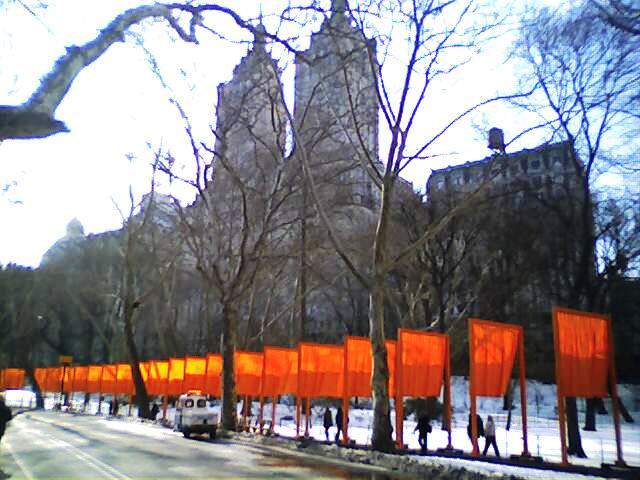
I had forgotten about our (meaning you guys who read me, as well as myself) group review of "The Gates". But Mitch referenced it today - so I went back and re-read it and found tears of laughter streaming down my cheeks.
For those of you who didn't participate, here is how it happened.
I saw Christo's The Gates - and thought it was hysterical. I loved it - the whimsy, the over the top-ness - whatever - and kept reading posts from bloggers who seemed truly ANGRY that The Gates were even attempted. It was not a response to the actual art - it was a response to the attempt. They were PISSED. I did not get it. Not that you have to like the Gates - but the anger seemed misplaced and, in general, I get sick of people who just have a constant chip on the shoulder about anything artistic - there is always a sneer in the tone of such people - and so I wanted to stick it to them. Sticking it to humorless hostile people is one of my favorite pastimes.
Curly and I were laughing about the angry people - and she said: "I may have to write some grandiose post about how I discovered the Meaning of Life through the Gates (even if I hate them) � just to chap people�s asses." hee hee So that's what we did - everyone participated (it's all in the comments section of this post). The game will immediately become clear. The comments are so so funny - some people just submitted WORDS to be used, others whole phrases ... It's so beautiful. So I put them all together into one review.
And here is the final result. Our review - culled from the comments section. Too many gems to pull out - the whole thing strikes me as brilliant parody. I almost wanted to submit it to, like, New Criterion and see if they would publish it - thinking it was real.
I love everyone for playing that game so hard and so well. Too too funny. Thanks for the reminder, Mitch - that was hysterical, reading it again.
The funniest thing was - that when Mitch originally linked to it, way back when - some chick in his comments section thought it was serious, and got all bitchy about it - not realizing that she completely did not get the joke in the first place. I was like, "Uhm, the whole thing is a joke, ma'am ..." and she responded with something along the lines of, "I guess my sense of humor isn't 'sophisticated' enough then."
The best thing about that exchange was that her chip on the shoulder response was EXACTLY my point with the whole game. So I guess I can say "mission accomplished".
I still can't get enough of our bullshit artistic-critic language - SO FUNNY. Brilliant, people, brilliant!!
Red River
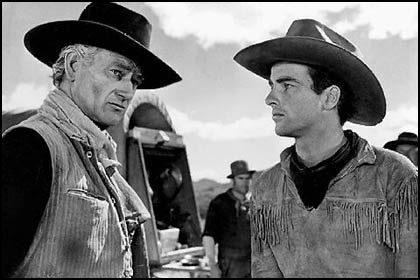
No matter how many times I see that movie, and I saw it again last night, the last scene always makes me cry.
If there is such a thing as perfection - then that last scene in Red River - from the moment Dunson rides into town - through the last moment - with Dunson tracing the new brand in the sand - is perfect.
Tears! Always tears.
That's just because the damn thing works - on a primal, almost physical level. You know what I mean? My tears are not dependent upon surprise, or not knowing what is coming, or anything having to do with the intricacies of the plot. The tears have to do with the perfect expression of each moment ... from moment to moment to moment to moment ... in the last 10 minutes of the movie. And those last 10 minutes run the gamut! We've got suspense, rage, defiance, an AWESOME fist fight - like, seriously, one of the all-time greats, and then a fantastic emotional monologue, panicked, and urgent, we've got a revelation, we've got some humor (like John Wayne is truly frightened by the little lady with the gun), we've got reconciliation - each thing fulfilled to its absolute maximum. Nothing over the top, nothing treacly or sentimental - just perfect. Not that the rest of the movie isn't perfect as well - I'd be hard pressed to find a false moment, or a moment that doesn't work in Red River ... from the one on one scenes, with great dialogue - to the spectacular cattle drive scenes - but it's the fact that spontaneously, by the end, I find myself in tears every time I see it ... It's the same thing as Apollo 13. The last 10 minutes of that movie ... I've seen it how many times? Doesn't matter. The catharsis comes.
I so appreciate any art that works on that level. It seems to me to be rare.
Here he comes. Here he comes to claim what was his. Look out!
The Books: "Elementals: Stories of Fire and Ice" - 'Cold' (A.S. Byatt)
Next up in my Daily Book Excerpt ... Adult fiction shelves:
Next book on the shelf is another short story collection - this one called Elementals: Stories of Fire and Ice - by A.S. Byatt. This is an excerpt from the third story in the collection, called "Cold".
I love this story!! Like all fairy tales, it transports you into another world - it's a wonderful story - but then - like all good fairy tales, it potentially shows you, the reader, something about yourself. It's an extended metaphor for an aspect of the human condition. But it's not didactic! I've been reading The Arabian Nights - and while all of those stories have morals (and, er, most of the morals have something to do with: "All women are salacious and evil so beware!" - so forgive me if I don't take the moral part of the venture seriously!) the real potency and magic (God, they're magical - I love them!) lies in the stories themselves. Like, you can't stop reading. Byatt has cited The Arabian Nights as a major influence on her work (that and George Eliot. Uhm, I love AS Byatt??) and it shows in tales like "Cold".
A princess is born "in a temperate kingdom". Her name is Fiammarosa. She is the 13th in a long line of children. She is loved by everybody. And yet there seems to be something wrong with her. She is fragile. She "seems breakable". She lies on grassy fields, watching other people play and frolic. She can't seem to get any energy. Her tutor commits to her education - although Princesses don't need TOO much education - and so she goes along in her life, unremarkable, except for her weakness, her almost transparent fragility. Then - one snowy night - she stares outside at the icy landscape and feels an overwhleming desire to be out there in the snow. It is not so much a desire - as a NEED. Some need sunlight. We all need food and water. She NEEDS the cold. She tries to sneak outside to walk around in the snow, but finds she cannot get outside - the doors are all locked, and she runs into a sentry, who gently informs her it's too cold, she can't go outside, she might get sick. Defeated, Fiammarosa goes back to bed, but she lies there, imagining in her mind, over and over and over - herself out there in the snow - naked - rolling around - submerging herself - walking on a frozen pond in bare feet - Her body yearns for the ice.
And so begins her transformation.
And, of course, because it is a fairy tale - she encounters many (often deadly) obstacles along the way.
The story is wonderful - I've read it often.
It reminds me of this heart-breaking line from Summer and Smoke - in the killer last scene of the play. Miss Alma says to John Buchanan, "It wasn't the physical you I wanted" - He responds, "You didn't have that to give me." She says, "Not at the time." He says, "You had something else to give." She asks, "What?"
And John responds, with words that have such resonance for me, personally - that it's hard for me to even express it:
You couldn't name it and I couldn't recognize it. I thought it was just a Puritanical ice that glittered like flame. But now I believe it was flame, mistaken for ice. I still don't understand it, but I know it was there, just as I know that your eyes and your voice are the two most beautiful things I've ever known -- and also the warmest, although they don't seem to be in your body at all ...
I guess I want to say that my flame has been mistaken for ice. And there is nothing more devastating in all the world.
Something like that is going on in AS Byatt's story - as you can see from the excerpt below.
Excerpt from Elementals: Stories of Fire and Ice - by A.S. Byatt. "Cold"
The next night she reconnoitred the corridors and cupboards, and the night after that she went down in the small hours, and took a small key from a hook, a key that unlocked a minor side-door that led to the kitchen-garden, which was now, like everywhere else, under deep snow, the taller herbs stiffly draggled, the tufted ones humped under white, the black branches brittle with the white coating frozen along their upper edges. It was full moon. Everything was black and white and silver. The princess crept in her slippers between the beds of herbs, and then bent down impulsively and pulled off the slippers. The cold snow on the soles of her feet gave her the sense of bliss that most humans associate with warm frills of water at the edge of summer seas, with sifted sand, with sunny stone. She ran faster. Her blood hummed. Her pale hair floated in the wind of her own movement in the still night. She went under an arch and out through a long ride, running lightly under dark, white-encrusted boughs, into what in summer was a meadow. She did not know why she did what she did next. She had always been decorous and docile. Her body was full of an electric charge, a thrill, from an intense cold. She threw off her silk wrap, and her creamy woollen nightgown, and lay for a moment, as she had imagined lying, with her naked skin on the cold white sheet. She did not sink, the crust was icy and solid. All along her body, in her knees, her thighs, her small round belly, her pointed breasts, the soft inner skin of her arms, she felt an intense version of that paradoxical burn she had received from the touch of the frosted window. The snow did not numb Fiammarosa; it pricked and hummed and brought her, intensely, to life. When her front was quite chilled, she turned over on her back, and lay there, safe inside the form of her own faint impression on the untouched surface. She stared up, at the great moon with its slaty shadows on its white-gold disc, and the huge fields of scattered, clustered, far-flung glittering wheeling stars in the deep darkness, white on midnight, and she was, for the first time in her life, happy. This is who I am, the cold princess thought to herself, wriggling for sheer pleasure in the snow-dust, this is what I want. And when she was quite cold, and completely alive and crackling with energy, she rose to her feet, and began a strange, leaping dance, pointing sharp fingers at the moon, tossing her long mane of silver hair, sparkling with ice-crystals, circling and bending and finally turning cartwheels under the wheeling sky. She could feel the cold penetrating her surfaces, all over, insistent and relentless. She even thought that some people might have thought that this was painful. But for her, it was bliss. She went in with the dawn, and lived through the day in an alert, suspended, dreaming state, waiting for the deep dark, and another excursion into the cold.
Night after night, now, she went and danced in the snowfield. The deep frost held and she began to be able to carry some of her cold energy back into her daily work. At the same time, she began to notice changes in her body. She was growing thinner, rapidly - the milky softness induced by her early regime was replaced with a slender, sharp, bony beauty. And one night, as she moved, she found that her whole body was encased in a transparent, crackling skin of ice that broke into spiderweb-fine veined sheets as she danced and then re-formed. The sensation of this double skin was delicious. She had frozen eyelashes and saw the world through an ice-lens; her tossing hair made a brittle and musical sound, for each hair was coated and frozen. The faint sounds of shivering and splintering and clashing made a kind of whispered music as she danced on. In the daytime now, she could barely keep away, and her night-time skin persisted patchily in odd places, at the nape of her neck, around her wrists, like bracelets. She tried to sit by the window, in her lessons, and also tried surreptitiously to open it, to let in the cold wind, when Hugh, her tutor, was briefly out of the room. And then, one day, she came down, rubbing frost out of her eyelashes with rustling knuckles, and found the window wide open, Hugh wrapped in a furred jacket, and a great book open on the table.
'Today,' said Hugh, 'we are going to read the history of your ancestor, King Beriman, who made an expedition to the kingdoms beyond the mountains, in the frozen North, and came back with an icewoman.'
Fiammarosa considered Hugh.
'Why?' she said, putting ehr white head on one side, and looking at him with sharp, pale blue eyes between the stiff lashes.
'I'll show you,' said Hugh, taking her to the open window. 'Look at the snow on the lawns, in the rose-garden.'
And there, lightly imprinted, preserved by the frost, were the tracks of fine bare feet, running lightly, skipping, eddying, dancing.
Fiammarosa did not blush; her whiteness became whiter, the ice-skin thicker. She was alive in the cold air of the window.
'Haev you been watching me?'
'Only from the window,' said Hugh, 'to see that you came to no harm. You can see that the only footprints are fine, and elegant, and naked. If I had followed you I should have left tracks.'
'I see,' said Fiammarosa.
'And,' said Hugh, 'I have been watching you since you were a little girl, and I recognise happiness and health when I see it.'
'Tell me about the icewoman.'
'Her name was Fror. She was given by her father, as a pledge for a truce between the ice-people and King Beriman. The chronicles describe her as wondrously fair and slender, and they say also that King Beriman loved her distractedly, and that she did not return his love. They say she showed an ill will, liked to haunt caverns and rivers and refused to learn the language of the kingdom. They say she danced by moonlight, on the longest night, and that there were those in the kingdom who believed she was a witch, who had enchanted the King. She was seen, dancing naked, with three white hares, which were thought to be creatures of witchcraft, under the moon, and she was imprisoned in the cells under the palace. There she gave birth to a son, who was taken from her, and given to his father. And the priests wanted to burn the icewoman, "to melt her stubbornness and punish her stiffness", but the King would not allow it.
'Then one day, three northmen came riding to the gate of the castle, tall men with axes on white horses, and said they had come "to take back our woman to her own air". No one knew how they had been summoned: the priests said that it was by witchcraft that she had called to them from her stone cell. It may have been. It seems clear that there was a threat of war if the woman was not relinquished. So she was fetched out, and "wrapped in a cloak to cover her thinness and decay" and told she could ride away with her kinsmen. The chronicler says she did not ask to see her husband or her tiny son, but "cold and unfeeling as she had come" mounted behind one of the northmen and they turned and rode away together.
'And King Beriman died not long after, of a broken heart or of witchcraft, and his brother reigned until Leonin was old enough to be crowned. The chronicler says that Leonin made a "warm-blooded and warm-hearted" ruler, as though the blood of his forefathers ran true in him, and the "frozen lymph" of his maternal stock was melted away to nothing.
'But I believe that after generations, a lost face, a lost being, can find a form again.'
'You think I am an icewoman.'
'I think you carry the inheritance of that northern princess. I think also that her nature was much misunderstood, and that what appeared to be kindness was extreme cruelty - paradoxically, probably her life was preserved by what appeared to be the cruellest act of those who held her here, the imprisonment in cold stone walls, the thin prison dress, the bare diet.'
'I felt that in my bones, listening to your story.'
'It is your story, Princess. And you too are framed for cold. You must live - when the thaw comes - in cold places. There are ice-houses in the palace gardens - we must build more, and stock them with blocks of ice, before the snow melts.'
Fiammarosa smiled at Hugh with her sharp mouth. She said:
'You have read my desires. All through my childhood I was barely alive. I felt constantly that I must collapse, vanish, fall into a faint, stifle. Out there, in the cold, I am a living being.'
'I know.'
'You choose your words very tactfully, Hugh. You told me I was "framed for cold". That is a statement of natural philosophy, and time. It may be that I have ice in my veins, like the icewoman, or something that boils and steams at normal temperatures, and flows busily in deep frost. But you did not tell me I had a cold nature. The icewoman did not look back at her husband and son. Perhaps she was cold in her soul, as well as in her veins?'
'That is for you to say. It is so long ago, the tale of the icewoman. Maybe she saw King Beriman only as a captor and conqueror? Maybe she loved someone else, in the North, in the snow? Maybe she felt as you feel, on a summer's day, barely there, yawning for faintness, moving in shadows.'
'How do you know how I feel, Hugh?'
'I watch you. I study you. I love you.'
Fiammarosa noticed, in her cool mind, that she did not love Hugh, whatever love was.
She wondered whether this was a loss, or a gain. She was inclined to think, on balance, that it was a gain. She had been so much loved, as a little child, and all that heaping of anxious love had simply made her feel ill and exhausted. There was more life in coldness. In solitude. Inside a crackling skin of protective ice that was also a sensuous delight.
June 7, 2007
Speaking of Bloomsday:

I'm all trembly right now. I have always wanted to go to the all-day Bloomsday celebration - created by Isaiah Sheffer - held at the Symphony Space - I've been hearing about it for years. Frank McCourt describes the vibe there. Another excerpt, describing the excitement. One of the things I am MOST excited about is to hear Fionnula Flanagan read Molly Bloom's monologue - she does it every year, it closes the entire event - and apparently it takes her 3 hours to get through it. I'M SO EXCITED THAT I AM GOING TO BE THERE TO ... PARTICIPATE AND EXPERIENCE IT. (Mental Multivitamin discusses seeing a video of Flanagan doing the Molly monologue here ... goosebumps.) Flanagan talks a bit about her connections with Joyce here. The Bloomsday celebration at Symphony Space is a yearly event - and I am sooo excited that I stopped the "oh, someday I'll go to that" and just bought a ticket. Duh. It was 30 bucks. I'm going to be there from noon until midnight.
I feel voraciously excited about this!! I'm almost nervous. Something I have ALWAYS wanted to do. I'll be there - at 11 am (it's general seating ... so dammit I want to get a good seat!) - with book in hand. Ready for the long LONG day ahead - but what a group event, what communal spirit - what insane geekery!
Can't wait!
Summer Poetry Challenge
Well, my dear old friend Ted is now blogging and he has hit the ground running. He's one of the most interesting people I know - so go check him out. I love him - great friend. Check out his post about the night we went to go see Jeff Buckley. It was a night of epiphany - for both of us.
He was blogging for, what, 2 minutes before he created a reading challenge for the summer - hahaha - I love that - and people are already signing up.
This one is a Summer Poetry Challenge. Here are all the details. If you love poetry - or if you feel like, "Hmmm, I wish I read more poetry" or whatever - this would be a great opportunity! It's gonna be fun - I already love reading the choices from other people.
The Books: "Elementals: Stories of Fire and Ice" - 'A Lamia in the Cévennes' (A.S. Byatt)
Next up in my Daily Book Excerpt ... Adult fiction shelves:
Next book on the shelf is another short story collection - this one called Elementals: Stories of Fire and Ice - by A.S. Byatt. This is an excerpt from the second story in the collection "A Lamia in the Cévennes". A painter named Bernard Lycett-Kean (I believe he has had some success in his career, the way Byatt writes about him you can tell he's serious about his work, etc.) can't take England under Margaret Thatcher, and so he takes his savings - and buys a house in The Cévennes. It's a little stone house in a hillside - and he has a swimming pool built into the side of a hill. He lives in total solitude. He becomes obsessed with the blue in the swimming pool - and how to paint it ... (this will be the excerpt today). It is a problem in color and paint that keeps him up at nights. He asks- what is my problem? Why am I tormented by this blue?? But still - he just keeps working the problem. Then one day ... the pool starts to seem cloudy, murky - There's something wrong with it. Bernard kind of freaks out. It must be fixed! Where did the blue go? He has workmen come out - drain the pool - re-fill it with water from an underground spring ... and this completely screws up Bernard's rhythm, in terms of his work ... but he grits it out. When the pool is re-filled ... it's just not the same. The blue is not the same. The depths are cloudy. He swims in the pool and can't see his legs because of the murk. Toads swim in the pool, too. Something is shifting, changing. He doesn't know what it is. Sometimes he thinks he gets a glimpse of a massive (meaning: scary massive) snake, coiled up at the bottom of the pool. In double figure eights. He is not scared of the snake ... or monster ... he tries to paint it. The snake - eventually - .... hmm, this is where Byatt goes into fairy-tale mode, which is one of her voices, or genres. She has an entire book of fairy tales out - she loves that magical stuff ... So basically this snake - is kind of a Little Mermaid type creature ... looking to Bernard to "save" her, and make her be human. She is a disgusting creature - but there's something in her that Bernard likes. And also - he becomes obsessed with his painting of the snake in the pool. He can't follow her instructions that would make her be a human until he has finished his painting.
Anyway - it's a fascinating scary little story.
Here is Bernard, becoming obsessed with the blue.
Oh, and I mentioned yesterday in my first post about Elementals that each story in the collection uses as its jumping-off point an image of some work of art - an artifact, an object, a painting. The one for this is a sketch of a mermaid by Matisse.
The last line of this excerpt kills me. God, it's good. YES.
Excerpt from Elementals: Stories of Fire and Ice - by A.S. Byatt. - "A Lamia in the Cévennes"
He swam more and more, trying to understand the blue, which was different when it was under the nose, ahead of the eyes, over and around the sweeping hands and the flickering toes and the groin and the armpits and the hairs of his chest, which held bubbles of air for a time. His shadow in the blue moved over a pale eggshell mosaic, a darker blue, with huge paddle-shaped hands. The light changed, and with it, everything. The best days were under racing cloud, when the aquamarine took on a cool grey tone, which was then chased back, or rolled away, by the flickering gold-in-blue of yellow light in liquid. In front of his prow or chin in the brightest lights moved a mesh of hexagonal threads, flashing rainbow colours, flashing liquid silver-gilt, with a hint of molten glass; on such days liquid fire, rosy and yellow and clear, ran across the dolphin, who lent it a thread of intense blue. But the surface could be a reflective plane, with the trees hanging in it, with two white diagonals where the aluminium steps entered. The shadows of the sides were a deeper blue but not a deep blue, a blue not reflective and yet lying flatly under reflections. The pool was deep, for the Émeraude young men envisaged much diving. The wind changed the surface, frilled and furred it, flecked it with diamond drops, shirred it and made a witless patchwork of its plane. His own motion changed the surface - the longer he swam, the faster he swam, the more the glassy hills and valleys chopped and changed and ran back on each other.
Swimming was volupté - he used the French word, because of Matisse. Luxe, calme et volupté. Swimming was a strenuous battle with immense problems, of geometry, of chemistry, of apprehension, of style, of other colours. He put pots of petunias and geraniums near the pool. The bright hot pinks and purples were dangerous. They did something to that blue.
The stone was easy. Almost too blandly easy. He could paint chalky white and creamy sand and cool grey and paradoxical hot grey; he could understand the shadows in the high rough wall of monstrous cobblestones that bounded his land.
The problem was the sky. Swimming in one direction, he was headed towards a great rounded-green mountain, thick with the bright yellow-green of dense chestnut trees, making a slightly innocent, simple arc against the sky. Whereas the other way, he swam towards crags, towards a bowl of bald crags, with a few pines and lines of dark shale. And against the green hump the blue sky was one blue, and against the bald stone another, even when for a brief few hours it was uniformly blue overhead, that rich blue, that cobalt, deep-washed blue of the South, which fought all the blues of the pool, all the green-tinged, duck-egg-tinged blues of the shifting water. But the sky had also its greenish days, and its powdery-hazed days, and its theatrical louring days, and none of these blues and whites and golds and ultramarines and faded washes harmonised in any way with the pool blues, though they all went through their changes and splendours in the same world, in which he and his shadow swam, in which he and his shadow stood in the sun and struggled to record them.
He muttered to himself. Why bother. Why does this matter so much. What difference does it make to anything if I solve this blue and just start again. I could just sit down and drink wine. I could go and be useful in a cholera-camp in Colombia or Ethiopia. Why bother to render the transparency in solid paint or air on a bit of board? I could just stop.
He could not.
He tried oil paint and acrylic, watercolour and gouache, large designs and small plain planes and complicated juxtaposed planes. He tried trapping light on thick impasto and tried also glazing his surfaces flat and glossy, like seventeenth-century Dutch or Spanish paintings of silk. One of these almost pleased him, done at night, with the lights under the water and the dark round the stone, on an oval bit of board. But then he thought it was sentimental. He tried veils of watery blues on white in watercolour, he tried Matisse-like patches of blue and petunia - pool blue, sky blue, petunia - he tried Bonnard's mixtures of pastel and gouache.
His brain hurt, and his eyes stared, and he felt whipped by winds and dried by suns.
He was happy, in one of the ways human beings have found in which to be happy.
June 6, 2007
Unbelievable
I watched this thing, laughing and crying at the same time. I have no other words but: wow.
(found via Mighty Jimbo)
Joyce geekery ahead

Anyone who follows Joyce knows the copyright issues (byzantine, tangled, at times psychotic) - and also it is well-known the issues that pretty much every Joycean scholar has had with Joyce's grandson who holds the estate. There was a great article in The New Yorker last year which details Stephen Joyce's aggressive defense of the works of his grandfather (sometimes justified, other times completely insane, Type A bullshit that makes life freakin' difficult for Joyce lovers) - so aggressive that he's made enemies all over da damn place. It's almost like Joyce scholars need support groups and therapy sessions, to swap war stories about dealing with this dude.

This is a similar situation (until very recently) to any biographer who wanted to write about Sylvia Plath. Ted Hughes held the estate to her works - and that estate was watched over zealously (and, some would say, pathologically) by Olwyn Hughes, Ted's sister - who never liked Sylvia. It was an antagonistic estate ... and yet it took on personal overtones that drove Plath scholars mad. They didn't just want to control the use of Plath's words - they wanted to control the interpretation of Plath that was allowed (examples of this are legion.) Biographers had to submit manuscripts to the Hughes' (which is par for the course) - but when the edits would come back, that's when things would start to get really complicated. It was not about "please don't quote that poem in its entirety" ... it was "please do not ever suggest that Plath was bisexual - remove that paragraph". (Actual example.) There are many interesting issues to discuss here - what is a biography? What is objectivity?
Janet Malcolm, journalist (love her) - wrote an entire book about the difficulty of writing a book about Sylvia Plath - due to, first of all, the myths around her, and the fact that many of the folks who knew her when she was alive are emotionally invested in making sure that THEIR version of the myth (she was a bitch! She was a victim! She was a lover! She was a fighter! - whatever) is the one that sticks. So there's THAT. But Olwyn Hughes' managing of the Plath estate was the other difficult aspect. She was a Sphinx. A Cerberus. A fire-breathing dragon standing in front of the cave of Plathian goodies. Choose your metaphor. She was revered and feared - and any book that was published had to go through Olwyn - and she had to okay it. (Janet Malcolm's book goes into all of this - each writer's experience, the specific edits Olwyn asked to make - the boundaries set) ... In a way, the Hughes estate made it nearly impossible to write a biography with a point of view. All biographies have a point of view. (This is another of Janet Malcolm's pet themes, if you look at the rest of her books. To pretend that you are "objective" means you're a liar and you're probably not a good writer. Be up front about your point of view, be up front about your ambivalence - do not misrepresent yourself - that was her main issue with Joe McGinniss, which touched off a war of words in op-ed columns throughout the US - and became the subject of another one of Malcolm's books) Anyway, I digress.
Back to Joyce. Stephen Joyce is the bogeyman to Joyce scholars - and things have come to a head yet again over the recent book about Lucia Joyce, James Joyce's mentally ill daughter. (I wrote - perhaps I should say bitched - about that book here.)
The LA Times has a full rundown of what is going on now, and all of the complicated copyright issues. Stephen Joyce often claims ownership over things the Joyce estate actually does not own.
From the New Yorker article:
In 2004, the centenary of Bloomsday, Stephen threatened the Irish government with a lawsuit if it staged any Bloomsday readings; the readings were cancelled. He warned the National Library of Ireland that a planned display of his grandfather�s manuscripts violated his copyright. (The Irish Senate passed an emergency amendment to thwart him.) His antagonism led the Abbey Theatre to cancel a production of Joyce�s play �Exiles,� and he told Adam Harvey, a performance artist who had simply memorized a portion of �Finnegans Wake� in expectation of reciting it onstage, that he had likely �already infringed� on the estate�s copyright. Harvey later discovered that, under British law, Joyce did not have the right to stop his performance.
Way to totally antagonize the fanatics about your grandfather's work, bro. As a committed Bloomsday participant through the years (just one example), I can only think:
What the HELL is your problem? Going after Bloomsday??
Dude, you seriously must chill.
Also, I'm surprised he hasn't come after me, seeing as I go insane every June 16, and am looking forward to this year - especially since it's a Saturday so I can spend the entire DAY in the company of drunk Joyceans, all of us shouting "YES I SAID YES I WILL YES" through the summery air. He would prefer to STOP that gathering and to stop us from shouting out lines from his grandfather;s novel that we love and that we have memorized.
I mean, gimme a break.
And the fight goes on. The fight over James Joyce goes on.
The Books: "Elementals: Stories of Fire and Ice" - 'Crocodile Tears' (A.S. Byatt)
Next up in my Daily Book Excerpt ... Adult fiction shelves:
Next book on the shelf is another short story collection - this one called Elementals: Stories of Fire and Ice - by A.S. Byatt. I love that: "Stories of Fire and Ice". Each story in this wonderful little collection uses as a jumping-off place some piece of art - a painting, an ancient artifact, a Matisse sketch, a glass goblet ... I love the device. It's not literal, an A to B correlation - but it opens your mind to the possible connections. It's like Chris van Allsburg's wonderful book The Mysteries of Harris Burdick where all you get is a drawing - mysterious - evocative - and one line of text. The rest you have to make up in your head. Byatt's stories, of course, are not just one line ... but I found myself going back to the first page of each of the stories - to look at the image there, whatever it was, and to contemplate it ... and why it had made Byatt write this particular story. She does that a lot - uses art as a launching off place. She has an entire short story collection (still to come) called The Matisse Stories.
The first story in this collection is called Crocodile Tears. Patricia Nimmo and her husband stand in an art gallery on a Sunday afternoon. They have been married for many years, have two grown children. This is a Sunday ritual - they like to go look at art and talk about it. They are very often in sync - not only in their tastes, but also in museum-behavior. You know how some people like to zip thru museums? And others like to linger for 25 minutes in front of one painting? Neither approach is correct, obviously - but it's nice to be in sync on such matters if youre going to a museum togehter ... and the Nimmos, as a team, always have the same impulse to move on at the same time. Patricia Nimmo has never before seriously contemplated the question: "When are you done with seeing?" Meaning: when do you know, at a museum, that is time to move on to the next painting? And what does that mean ... to be done with seeing? How does that work? Is there a saturation point? These questions all come up later in the story, and they are devastating to Patricia ... On this particular Sunday they have a rare disagreement about a painting - Tony likes it, Patricia doesn't - and she judges him for liking it. He sees something in it she does not. She argues for her position, Tony says he wants to buy the painting. She's annoyed. How can he not see how cliched and bland the work is? It has NO depth. She leaves him contemplating the bad (to her) painting and moves on thru the gallery by herself, feeling that the day is ruined. As she continues to browse, she starts to hear vaguely the sound of sirens ... and begins to be aware of a commotion elsewhere in the gallery. She strolls back through, looking for her husband - and she comes across him - He is lying on the floor in the middle of the main room, and he is surrounded by emergency workers, and ambulance drivers - there is a stretcher - and Patricia hears someone say, "He's dead - just had a massive heart attack and died ..."
Patricia then does something shocking. It's shocking because even though we are only 5 pages into the story, we think we know her, and we think we know her relationship with her husband - even though they were just having a disagreement. She walks out of the gallery, walks home, packs a small bag, gets on a train, and goes to southern France. She gets off the train randomly - no plans ... and finds herself in N�mes. She has not notified her children of where she is. She has fled the scene of her husband's death. She has left England without a trace. Byatt, in the writing, makes it clear that Patricia sometimes had such fantasies ... "what would it be like if ..." so when the moment came, she took it.
She does not weep for her husband (not at first). She knows her kids are capable to deal with funeral arrangements - they're adults.
Patricia checks into a gorgeous hotel and basically starts a new life in this small hot French town. She wants to learn French. She buys a copy of Proust's a la recherche, etc., and a dictionary. The hot sun beats down (you can see the "fire" element in action throughout this story ... it's all about heat and light) ... Patricia is a blank. We do not know what she is thinking or feeling. But we do know what she is seeing, we see thru her eyes - the things she looks at, the little field trips she takes, what she eats. She lives in complete solitude.
Until she finally meets (at his insistence) a dude named Nils Isaksen - who is also staying at her hotel. A Norwegian. Two cold northern people in a hot hot place. He tries to engage her - just in conversations about the history of N�mes, the Roman remnants (that's where the title comes from - a Roman coin found in the town that has a crocodile on it - so the town is full of crocodile statues and fountains, etc. Ahem. The launching-off-point image at the beginning of the story is an actual Roman coin - with the "crocodile de N�mes" on it - If you scroll down here, you can see it) ... Patricia has no interest in learning about N�mes. Or the history. She just wants to become a nothing, a blank. She goes to a museum and finds it vaguely upsetting - because she no longer knows when to stop looking at something. She always knew with her husband. Now she is adrift.
Nils Isaksen is also a widower ... but Patricia does not share with Nils that she upped and left the second her husband died. That's not for him to know.
Anyway - there's way more - this is basically just the set-up ... it's a lovely story, beautifully written. Here's an excerpt.
One quick thing. I love the phrase "yawning vegetably". Love it so much.
Excerpt from Elementals: Stories of Fire and Ice - by A.S. Byatt - "Crocodile Tears"
After this they had several more brief drinks together, in the evenings, which were getting hotter, and heavier. Patricia did not think she liked Nils Isaksen, and also felt that this simply did not matter. The nerve-endings with which she had once felt out the shape of other people's feelings were severed or numbed. She got no further than acknowledging to herself that he was in some way a driven man. His reading and writing were extravagant, his concentration theatrical, his covering of the paper - wrong somehow, too much, or was it that she felt that any effort, any energy, was too much? The pleasure was going out of A la recherche, though she persisted, and her French improved. They talked about N�mes. He told her things she hadn't wanted to know, hadn't been at all anxious about, which nevertheless changed her ideas. He told her that the city and the water of the fountain, Fons Nemausis, were one single thing; that this closed, walled collection of golden houses with red-tiled roofs in a dustbowl in the garrigue had been built because of the presence of the powerful source. That the god of the town, Nemausus, was the god of the source. That under and beyond it were gulfs, caverns, galleries of water in the hill. That there had been a nunnery on the hill above the fountain, around the temple of Diana, from the year 1000 to the Renaissance, whose abbesses had claimed ownership of the water. He spoke of excavations, of pagan antiquities, of religious wars of resistance to Simon de Montfort, to Louis XIV, to the Germans. He spoke of the guillotine in the revolution, and the gibbet in the Second World War. Patricia listened, and then went shopping, or wandering. She thought, if he talked much more, or overstepped some boundary, she would have to move on. But she did not know where she would go. The weather was getting hotter. The weather-map on the television in her room showed that N�mes was almost invariably the hottest city in France, uncooled by coastal breezes, or mountain winds, a city on a plain, absorbing heat and ight. She took longer walks, for variation. She went into the Jardin de la Fontaine in the midday heat, stared into the green troubled depths, climbed the unshaded, formal staircase with its balustrades, observed a crocodile made of bronze-leaved plants in a bed of rose and white flowers, curving its tail over its back, yawning vegetably, in the dancing bright air. Nils Isaksen told her she shouldn't go out without a hat. She wanted to reply that she didn't care. She said 'I know' but did not buy a hat. Let it bake her brain, something said.
One evening Nils Isaksen broke his cautious bounds. Patricia was very tired. She had taken three eaux-de-vie Mirabelle, instead of one, and saw the cedars shifting across the too spangling stars.
'I should be happy,' said Nils Isaksen, 'if you would come with me to the ethnological museum. I should like to show you ...'
'Oh, no.'
'I should like to show you the tombstones of the gladiators. So young. We can read the life of a city, in its monuments--'
'No, no --'
'Forgive me, I think you should make some change. I am impertinent. When I first lost Liv, I wished the whole world to be dead, too. Frozen stiff, I wished everything to be. But I exist. And you, forgive me, you exist.'
'I don't need company, Mr Isaksen. I don't need to be -- entertained. I have -- I have things to do.'
Before his intervention, something had been going on, in the silence. He had spoiled it. She stared angrily at him.
'Forget I spoke, please. I am in need of speech, from time to time, but that is nothing to do with you, as I can understand.'
The dreadful thing was that her refusal had made more of an event, had brought them closer together.
June 5, 2007
Old photos
Circus family. Extraordinary, on so many levels. The faces. Mitchell - this is one you must check out!
Kitchen. This one reminds me of The Hours, even though it's the wrong period. It makes me think of Laura Brown trying to make a birthday cake for her husband. Something about it. (Leave it to me to see suicide and despair in a benign photo like that one. I've written before about my aversion to domesticity of that kind that almost borders on pathological. Makes me believe in reincarnation, almost - or successive lifetimes. Maybe it's not pathological. Maybe it's that I know who I am, to such a degree, that I have avoided something that would have been spiritual death, an anguish of suppression - that's why The Hours was almost unpleasant to read, I felt almost like I knew that woman in an intuitive way, I had such a visceral response to Laura Brown ... even though my experience has been nothing like hers. Who knows. I just think it's funny that from THAT photo, I see piercing mental agony. Insane.)
The Gobi of writing
Edith Wharton had been a bit on my mind lately, just peripherally - in a floaty sort of way (oops, suddenly felt like Timothy Treadwell ... railing at the "floaty Buddha guy" for not bringing Treadwell's grizzly-bear paramour more rain ... but I digress) - I think Wharton kept coming up for me starting from this post of Anne's - it just got me to thinking ... and then, on my new favorite blog - I came across this wonderful letter from Wharton. It's really what I need to hear right now, in terms of writing. Weird when that happens sometimes. But it's definitely food for continuous thought - I have been experiencing it myself.
"Knocked Up"
Allison and I went to go see it last night. I'll write more about it a bit later ... but I just loved it. Judd Apatow is 2 for 2, as far as I'm concerned. This is that rare rare movie: a movie for grown ups.
And yet it's also HYSTERICAL.
And Leslie Mann gives the best performance I have seen in a long long long time. I've always been a mini fan of her work - ever since George of the Jungle, believe it or not ... and then her tour de force scene in 40 Year Old Virgin - but this? This is some serious movie-stealing work. Every moment is real - it's one of those things where she's playing SUCH a recognizable "type" - the aggrieved bitchy Type-A wife who treats her husband like shit. And yet ... it's not played simply, it's not just a "stereotype" - which would have been SUCH the easy route to go with that part. Make her into a villain, a bitch, a hate-able wench ... but they don't do that. Bless them. The film-makers don't do that. They allow her to be three-dimensional. And man. Man, does she knock it out of the park.

Leslie Mann - she's a brilliant actress, she really is. I mean, I always knew she was funny, but ... there's more going on with her in this particular character, and it's a great piece of acting work all around. Bra-VO.
One of the funniest lines in the movie - was the 6 year old girl announcing from the back seat, "I Googled 'murder' yesterday."
Also: How awesome is it, like major awesome, that a BLURPY MAN (anyone still confused about my term "blurpy" and its inherent vagueness - well, it's really Ann Marie's term - needs to see this movie!! All your questions will be answered!) - ... Anyway: how awesome is it that a blurpy man - like a truly blurpy man, not Hollywood blurp - is a leading man in a movie. A romantic lead. An improbable romantic lead: the best kind. The blurpy kind.
I want to throw a freakin' party in the streets and set crap on fire - just to show how AWESOME I think that is.
Loved it.
The Shamus has a great review. But then again - I haven't seen a bad review. Why do I somehow feel personally vindicated by this? I have nothing to do with it!! I don't know ... I somehow feel invested in the success of these people - all of them - and I'm just psyched for them.
Great flick.
MORE THOUGHTS:
-- Paul Rudd with the chairs in the hotel room in Vegas. Hilarious.
-- Doing mushrooms and going to see Cirque du Soleil - what are you guys nuts?? Hysterical scene.
-- The big burly bouncer suddenly opening up about his feelings.
-- The bitchy envious girl who works at the TV station where Heigl works. Soooo funny. Two scenes and she's genius.
-- Ryan Seacrest parodying himself. I didn't know he had it in him. Hilarious!!
-- Leslie Mann confronting her husband in the driveway. I could see how unreasonable she was being, how .... rigid ... Yet her pain was palpable, her loneliness - GREAT moment. Sometimes we act crazy when we're lonely - and we can't SAY, "Hey. I'm lonely." She's brilliant - I'm so psyched for her. Not the typical Hollywood route - and that was some of the best acting I've seen in a long time.
-- Found a funny quote from Rogen about doing sex scenes: "It's the exact opposite of real sex: Instead of trying to maintain your erection, you're trying not to get one."
-- Katherine Heigl (and I have loved her from LONG before Grey's Anatomy, since she starred in the brilliant ground-breaking earth-shattering TV movie Romy and Michele: In the Beginning - which starred someone I kinda know, you know, vaguely - and it's a dumb movie - but Heigl stands out. I was like - Hmmmm, that skinny blonde girl with the big boobs is actually an actress - and how often does that happen??) - but anyway - Heigl has a moment when she is lying in a tub, her pregnant belly sticking out - and she is stressed out, and terrified, her doctor is on vacation, she's having contractions, and she actually just broke up with the father of her baby, who is now sitting there, by the tub, trying to calm her down. And she has a moment when he says something - asks her a question about what's happening with her physically - that makes her realize something else about him (it's all clear in the context of the movie, I'm being purposefully vague) ... and she looks at him, and she can barely get out her next line she's so choked up. I'm choked up right now just typing this. Heigl has an ability to fill up with emotion in a way that is very very rare. It's powerful. It really is. The payoff of the rest of the movie comes in that moment. She plays the hell out of it. Beautiful. It's quiet, in a way - not histrionic. Lovely.
Robert Shaw ....
I remember that one post a while back where we all discussed Robert Shaw ... and so: check out this Diane Arbus photo. He looks like a Clancy Brother. I love it. I have a couple of Shaw films on the Netflix queue - I'm a huge fan.
The Books: "Sugar and Other Stories" - 'Sugar' (A.S. Byatt)
Next up in my Daily Book Excerpt ... Adult fiction shelves:
 This excerpt is from "Sugar", the final short story from the collection Sugar and Other Stories - by A.S. Byatt.
This one feels autobiographical to me - and not just because it's (rare for Byatt) a first-person narrative. I actually don't know all that much about Byatt - bare bones stuff - but I feel like I know many of her intellectual interests. Those all show up here. It's the story of a woman whose father is dying - he's in a hospital bed in Amsterdam where he collapsed - and she has gone to him. One of the themes of the whole story is that her mother - mainly a good woman, an upstanding woman - was also a liar. A fabricator. She told stories about the past - weaving fiction into truth - choosing words carefully, omitting certain things - and also flat out making things up. And by doing so - it's almost like she has hijacked the past. Our narrator doesn't know if some of her memories are real - or ... implanted there by her mother's telling and re-telling and embroidering of the stories. She begins to recognize signs of fictionalization, certain phrases her mother uses - like: Oh, I bet she made that part of it up ... While her father lies dying in Amsterdam, he talks about this trait of his wife ... in a way that makes you feel that she did the same thing to him. She took over his stories. And sometimes she told them wrong. Or sometimes she made shit up - like being at the death-bed of his father and being there at the moment he passed away. This is a sacrilege - to make up something like that. Why does her mother do this? The story doesn't really set out to answer that question ... but the story does set out (in first-person voice) to try to put down what you remember. It's all "I remember this ..." "I remember that" - as though the act of writing will make it concrete, or will make it hers. She wants to know her father. It is hard to know her father without getting thru the mists set up by her mother ... and it is also hard because he's not a gushy talk-y kind of guy. The following excerpt - is also a reminder of what was to come in Possession (this collection of short stories pre-dates Possession) as well as Still Life (excerpt here) - with its intercut scenes of the Potter family narrative and the letters of Vincent Van Gogh. Randolph Henry Ash, in Possession, wrote an epic poem about Ragnarok - and had a great fascination in the chilly northern gods and their myths. It's interesting, here, to hear this narrator (who is or is not Byatt) discuss what it was that drew her to those two specific things.
Excerpt from "Sugar", the final short story from the collection Sugar and Other Stories - by A.S. Byatt.
He had often said before, though he didn't repeat it, at least to me, during those weeks, that a man's children are his true and only immortality. As a girl I had been made uncomfortable by that idea. I craved separation. "Each man is an island" was my version of a delightful if melancholy truth. I was like Auden's version of Prospero's rejecting brother, Antonio, "By choice myself alone". But during those extreme weeks in Amsterdam I thought about origins. I thought about my grandfather. I thought also about certain myths of origin which I had pieced together in childhood, to explain things that were important, my sense of northernness, my fear of art, the promised end. By a series of elaborate coincidences two of these had become inextricablly involved in what was happening. The first was the Norse Ragnorak, and the second was Vincent Van Gogh.
We went to see the Gotterdammerung, in Covent Garden, on the last night of my father's doomed Rhine-journey. I had a bad cough, which embarrassed me. Now whenever I could I see Gunter and Gutrune like proto-Nazis in their heavy palace beside the broad and glittering artificial water, and think as I thought then, as I always think, when I think of the 1930s, of my father in those first years of my life knowing and fearing what was coming, appalled by appeasement, volunteering for the RAF. When I was clearing his things I found a copy of the "Speech Delivered in the Reichstag, April 28th 1939, by Adolf Hitler, Fuhrer and Chancellor". It was stored in a box of family photographs, the only thing in there that was not a photograph, as though it was an intimate part of our family history. At the time, because I was thinking about islands, I remember very clearly thinking about the similarities and dissimilarities between Prospero and Wotan. I thought, in the red dark, that the nineteenth-century Allfather, compared to the Renaissance rough magician, was enclosed in Victorian family claustrophobia, was essentially, by extension, a social being, though both had broken rods. When Fricka berated Wotan, I thought with pleasure of my father, proceeding slowly and freely along the great river.
My favourite book, the book which set my imagination working, as a small child in Pontefract in the early years of the war, was Asgard and the Gods. Tales and Traditions of our Northern Ancestors. 1880. It was illustrated with steel engravings, of Wodan's Wild Hunt, of Odin tied between two fires, his face threatening and beautiful, of Ragnarok, the Last Battle, with Surtur with his flaming head, come out of Muspelheim, the gaping Fenris Wolf about to destroy Odin himself, Thor thrusting his shield-arm into the maw of the risen sea-serpent Jormungander. I remember the shock of reading about the Last Battle in which all the heroes, all the gods, were destroyed forever. It had not until then occurred to me that a story could end like that. Though I had suspected that real life might, my expectations were gloomy. I found it exciting. I knew Asgard backwards before my mother told me about Sylvia, that is certain. I remember sitting in church, listening to the story of Joseph and his coat of many colours and thinking that this story was no different from the stories in Asgard and less moving than they were. I remember going on to think that Ragnarok seemed "truer" than the Resurrection. After Ragnarok, a very tentative, new, vegetable world began a new cycle, washed clean of blood and fire and gold. I may, I see now, rereading the book as I still do, have been influenced in these childish steps in literary theory and the Higher Criticism by the tone of the authors of Asgard, who rationalize Balder and Hodur into summer and winter, who turn giants into mountain ranges and Odin's wrath to wild weather, and who talk about the superior truths illustrated by the beautiful Christian stories. They are not Frazer, equating all gods gleefully with trees, but they set you on course for him. I identified Our Northern Ancestors in my mind with my father's family, wild, extravagant, stony, large and frightening. They were something of which I was part. They were serious gods, as the Greeks, with their love-affairs and capriciousness, were not. The book was, however, not my father's, but my mother's, bought as a crib for the Ancient Icelandic and Old Norse which formed an obligatory part of her degree course. I can't remember if she gave it to me to read, or if I found it. I do remember that she fed the hunger for reading, there was always a book and another book and another. She never underestimated what we could take. She was not kind to her children as social beings, she screamed at invited friends, she felt and communicated extremes of nervous terror. But to readers she was generous and resourceful. I knew she had been the kind of child I was, speechless and a reader. I knew.
It was with my mother, on the other hand, that the Van Gogh myth originated. Her family name had a Dutch shape and sound to it. Her family came, in part, from the Potteries, from the Five Towers, and a myth had grown up with no foundation in evidence, that they were descended from Dutch Huguenots, who came here in the time of William the Silent, practical, warm, Protestant, hardworking craftsmen, with a buried and secret artistic strain. This Dutch quality was a kind of Gemutlichkeit, the quality with which my mother had hoped to warm and mitigate the wuthering and chill of my father's upbringing. In Sheffield, after the war, we had various reproductions of paintings by Vincent Va Gogh around our sitting room wall. There was one of the bridges at Arles, one of the sunnier ones, where the water is aquamarine and women are peacefully spreading washing. There were the boats on the beach at Les Saintes-Maries de la Mer, which I recognized with shock when I went there eight years later. There was a young man in a hat and yellow jacket whom I now know to have been the son of Roulin, the postman, and there was a Zouave in full oriental trousers and red fez, sitting on a bench on a floor whose perspective rose dizzily and improperly towards him There were also two Japanese prints and what I think now must have been a print of Vermeer's Little Street in the Rijksmuseum, a housefront of great peace and steadiness, with a bending woman in a passageway on the left. I always, from the very earliest, associated these working women in Dutch streets with my mother. I associated the secret inwardness of the houses, de Hooch's houses even more than Vermeer's, with my mother's domestic myth, necessary tasks carried out in clear light, in their own confined but meaningful spaces. In my memory, I have superimposed a de Hooch on the Vermeer, for a remember in the picture a small blonde Dutch child, with a cap and serious expression, close to the woman's skirts, who is my small blonde self, gravely paying attention, as my mother would have liked. The Sheffield house, in whose sitting-room these images were deployed, was one of a pair of semi-detached houses purchased as a wedding present for my father by his father, who could never, clearly, do things by halves, who thought, rightly, it would be an investment. We left one of these houses for Pontefract, during the war, for fear of bombs, and came back to the other. At the period when I most clearly remember the Van Goghs and the Vermeer/de Hooch the second house was in a state of renovation and redecoration. My grandfather had died, various large and dignified pieces of furniture had come to be fitted in, and there was money to spend on wallpaper and curtains. I remember one very domestic one, a kind of blush pink with regular cream dots on it, a sugar-sweet paper that my parents repeatedly expressed themselves surprised to like, and about which I was never sure. In my memory, the Van Goghs hang tamed on this delicately suburban ground, but in fact they cannot have done so. I am almost sure that paper was in the dining-room, where my Aunt Gladys was flustered by my enraged and aproned mother. In any case my earliest acquaintance with the paintings was as pleasantly light decoration round a three-piece suite. This was part of what he meant his work to be, sensuous pleasure for everyone. When did I discover differently? Certainly before I myself went to Arles, before Cambridge, in the 1950s, and saw that tortured and aspiring cypresses were exact truths, of their kind. When my father collapsed at Schiphol I was writing a novel in which the idea of Van Gogh stalked in and out of a text about puritanical northern domesticity. There was nowhere I would rather have found myself than the Van Gogh museum in Amsterdam. I was reading and rereading his letters. He wrote about the Dutch painters and their capacity to paint darkness, to paint the brightness of black. He wrote about the hunger for light, and about how his "northern brains" in that clear, heavy, sulphur yellow southern light were oppressed by its power. He was not cautious, he lived dangerously. He felt his brains were electric and his vision too much for his body. Yet he remained steadily intelligent and analytic, mixing his colours, thinking about the nature of light, of one man's energy, of one man's death. He painted the oppression of his fellow-inmates in the hospital in St. Remy. He was a decorous and melancholic northerner turned absolute and wild. He observed and reobserved his own grim red-headed skull and muscles without gentleness, without self-love, without evasion. He was truthful and mad. In the mornings I went and looked at his paintings, and in the afternoons I took the tram out to my father's echoing hospital, carrying little parcels of delicacies, smoked fish, fruits, chocolates. In the afternoons and evenings he talked. He talked, among other things, about the Van Gogh prints, which were obviously his own, his choice, nothing to do with my "Dutch" mother. He talked particularly about the portrait of the Zouave. That was on one of his good days. I had brought him some freesias and some dahlias. I had not realized, in all those years, that he was one of the rare people who cannot smell freesias. He claimed that on this occasion he could. "Just a ghost of a smell, just a hint, I think I can smell it ..." he said. He helped me to mend one of the dahlias with sellotape, where I had bent its stem. "You can keep them alive," he said, "if you keep the water-channels open. I've often kept things alive successfully for surprisingly long periods, that way." He talked about Van Gogh's Zouave, the one of the family prints I had liked least, as a child, because the floor made me giddy and because the man was alien, both his clothes and his face. It was, said my father precisely, "a very powerful image of pure male sexuality. Absolutely straightforward and simple. It was always my favourite."
June 4, 2007
"A birdcage I planned to hang ... I'll get to that someday ..."

Fantastic long article about Christine Ebersole and Grey Gardens in The New York Times Sunday Magazine.
This part made me cry.
“My father started out as a riveter, but he had the soul of an artist,” she said. “He worshiped Shakespeare and had aspirations to be an actor. He claimed that from the first day he laid eyes on me, I was going to be this great dramatic actress.”
And the part about ... standing there, singing with tears streaming down her face at the same time ... but not missing a note, not wavering ... the sound does not suffer from that emotion ... I loved how she talked about that.


Some Cards
I am crying with laughter over these. Just click through some of them. Like this one. hahahaha Or this. Or this. Or this loving message of support. Or this. What? HA! It totally appeals to my sense of humor.
Thanks for the link, Curly ... I've been clicking through those cards and snorting with laughter.
Rosalind Russell Tribute
Everything you need to know right here. Great post - go read it!!! And then come back here for some book excerpts.
Some quotes from Rosalind Russell's wonderful autobiography (I highly recommend it - it's a great read, she was quite funny in real life as well). Example:
I was born in a house on Chestnut Avenue, and when I was four years old I ran away from home. Or at least I walked away, and found myself clear down on the Green, in the center of Waterbury's business section. A neighbor who saw me there, swinging on a hitching post, stopped short and cried, "Rosalind, what are you doing here?""My name is not Rosalind," I said. "I'm from out of town."
Four-year-old traveling fibbers don't get too far (the neighbor went straight to my mother and told her where I was), but the episode hints at my future theatrical bent.
And here are some quotes on His Girl Friday:

Hawks was a terrific director; he encouraged us and let us go. Once he told Cary, "Next time give her a bigger shove onto the couch," and Cary said, "Well, I don't want to kill the woman," and Hawks thought about that for a second. Then he said, "Try killin' 'er."And once Cary looked straight out of a scene and said to Hawks (about something I was trying), "Is she going to do that?" and Hawks left the moment in the picture -- Cary's right there on film, asking an unseen director about my plans.
Ha - I love that moment. Cary turning to Hawks and saying, "Is she going to do that?"
Another excerpt:
A good director also knows when not to direct. Nobody ever tried to direct Gable. They let Gable be Gable. I don't mean that he wouldn't take direction, but when he walked in with the gun and the uniform, and he'd just been over the top, what more could anybody do about that? Gable was the same sitting on the sidelines as he was when he got up and played the scene, and nobody wanted him to be anything else. People like Gable, Wayne, they're personalities, and a personality is an asset, you don't destroy it or mess with it.Cary Grant was different; he wasn't just a personality, he could immediately go off into a spin and become any character that was called for. He was terrific to work with because he's a true comic, in the sense that comedy is in the mind, the brain, the cortex ...
Grant loved to ad lib. He'd be standing there, leaning over, practically parallel to the ground, eyes flashing, extemporizing as he went, but he was in with another ad-libber. I enjoyed working that way too. So in His Girl Friday we went wild, overlapped our dialogue, waited for no man. And Hawks got a big kick out of it.
Then I started worrying that all this noisiness and newsroom high spirits might seem too chaotic to a watcher, and one night after we were finished I again went to Hawks. "I'm afraid," I said, "that audiences won't follow us."
"You're forgetting the scene you're gonna play with the criminal," Hawks said. "It's gonna be so quiet, so silent. You'll just whisper to him, you'll whisper, 'Did you kill that guy?' and your whispering will change the rhythm. But when we're with Grant, we don't change it. You just rivet in on him all the time."
I love stuff like that.

Here's Russell on William Powell - this made me laugh:
He was not only dear, he was cool. If an actor thought he could get any place by having tantrums, watching Bill Powell would have altered his opinion. I remember a story conference during which he objected to a scene that he felt wasn't right for him. He was at once imperious and lucid. "It's beyond my histrionic ability to do this," he said. I thought that was delicious.
Here's a great excerpt, showing her smarts as an actress, her intellect:
Talent is wonderful, but I've played with actors who have more talent than I, and you can't hear them in the fourth row, they just don't have the energy, nothing in the belly, nothing in the guts that brings it all out and sells it across the orchestra pit and into the twenty-third row.In Boston with Clivey's troupe -- I couldn't do it at Saranac, I didn't have the time -- I used to sit on the stage apron and watch every rehearsal I wasn't involved in. I'd be thinking, Why can't he get a laugh on that? It's a funny line -- and taking the thing apart in my head to see why it wasn't working. Half the pleasure of doing comedy in the theatre is that even before you hear a laugh, you sense where the laugh should be. Something happens in the audience, you feel it, you go to work on it. Until one day, all of a sudden, you're rewarded with a titter. You keep working on the line and finally you get a real belly laugh. After that you generally push too hard and lose it, and you have to pull away and inch your way back.
Here's an excerpt from the introduction to her book written by her husband. Rosalind Russell was responsible for launching the career of James Galanos, designer. Here is an unbelievably moving story, told by Freddie Brisson (Russell's husband) about the special relationship between Russell and Galanos:
In 1960, after she had the first mastectomy, Rosalind went to Galanos. He says it was the only time he ever saw her break down. She had come to his office, very crisp, very businesslike. "I'm going to tell you something nobody in the world knows except Freddie and my doctor. I've had my breast removed, and I want to keep it quiet. So long as I can be active, I don't want to be thought a freak, I don't want people looking at me in person or on the screen and wondering about my sex life." (You have to consider the era. Women had not yet begun to go public about their mastectomies.)"I want you to start thinking in terms of how I can now be dressed," Rosalind said to Jimmy, and then she began to take her clothes off. She started to cry, and he saw that she could hardly lift her left arm, it was so swollen, and he broke down too. From that day forward, he specially designed every piece of her clothing, and neither he nor his fitter ever told a soul.
Another excerpt from the introduction, by her husband:
After she died I found a petition she had tucked away in her prayer book. It said in part, "Keep my mind free from the recital of endless details; give me wings to get to the point. Seal my lips on aches and pains. They are increasing, and love of rehearsing them is becoming sweeter as the years go by."
And again, here's the link to the tribute. GREAT stuff.
A glimpse of Sarah Siddons ...
... in a letter from Daniel Terry to Sir Walter Scott. Wow. Her Lady Macbeth is one of those "oh for a time machine" things I wish I could have seen!! (I love the story about her backstage preparation for the sleepwalking scene. Brilliant!)
Spelling-bee
Spelling-bee round-up by Annie... I love this blogger!! What a funny writer ("basking in the whimsy of etymology") and artist. She posts her own drawings (hilarious - the 'faux-stache' one made me laugh out loud)... and her writing is hysterical.
The Books: "Sugar and Other Stories" - 'Precipice-Encurled' (A.S. Byatt)
Next up in my Daily Book Excerpt ... Adult fiction shelves:
This excerpt is from "Precipice-Encurled", another short story from the collection Sugar and Other Stories - by A.S. Byatt.
I am not sure what year this beautiful (and ultimately tragic) story was written - but it feels to me like a rehearsal for Possession. We have a scholar - in the present-day - looking back through time at a portrait of a woman ... and also at the poems and letters of Robert Browning ... the scholar does not have much to go on but he believes that Browning and the woman in the portrait had an unrequited love affair - and he believes that the clues are everywhere, in the poems, the letters ... he just needs to piece it all together. The story itself is in pieces, though ... We hear about the portrait. We get inside the scholar's mind. Then - suddenly - we are in Robert Browning's mind. In the Browning sections he talks quite a bit about Sludge, the medium ... and of course that's a HUGE theme in Possession ... It feels to me like Byatt might have been working up to Possession here, so many of the themes and devices are similar. And after that - we are there in Italy, on a trip Browning was supposed to take ... but did not ... we know from the section about the scholar that the scholar is curious as to why Browning did NOT join the others in Italy ... Anyway - it's a well-written short story, completely with the stamp of AS Byatt on it. Nobody else could have written it. Here's an excerpt - from the section where we are inside Robert Browning's head. It was hard to pick an excerpt - the story is rather long, and every page is jammed with great stuff, food for thought, good writing. She is so so good when writing about intellectual and spiritual concerns of a bygone age. It's not about the fact that they didn't have electricity or cars ... although that is a factor, too. It's about what they thought and how they thought about it. So much historical fiction is just balderdash with people wearing costumes. Byatt is interested in how they thought, the intellectual influences of the day, where God fits into all of it .... etc.
Excerpt from "Precipice-Encurled", another short story from the collection Sugar and Other Stories - by A.S. Byatt.
Elizabeth had been a great poet, a captive princess liberated and turned wife, a moral force, silly over some things, such as her growing boy's long curls and the flimsy promises and fake visions of the seance. She too had not known this world that was so important. One such intimate knowledge as I have had with many a person would have taught her, he confided once, unguarded, had she been inclined to learn. Though I doubt if she would have dirtied her hands for any scientific purpose. His pubic self had a scientific purpose, and if his hands were dirty, he could wash them clean in a minute before he saw her, as he trusted to do. He had his reasonable doubts about this event, too, though he wrote bravely of it, the step from this world to that other world, the fog in the throat, the mist in the face, the snows, the blasts, the pain and then the peace out of pain and the loving arms. It was not a time of certainties, however he might assert them from time to time. It was a time of doubt, doubt was a man's business. But it was also hard to imagine all this tenacious sense of self, all this complexity of knowledge and battling, force and curiosity becoming nothing. What is a man, what is a man's soul?
Descartes believed, he noted down, that the seat of the soul is the pineal gland. The reason for this is a pretty reason - all else in our apparatus for apprehending the world is double, viz. two ears, two eyes, etc. and two lobes of our brain moreover; Descartes requires that somewhere in our body all our diverse, our dual impressions must be unified before reaching the soul, which is one. He had thought often of writing a poem about Descartes, dreaming in his stove of sages and blasted churches, reducing all to the tenacity of the observing thinker, cogito ergo sum. A man can inhabit another man's mind, or body, or senses, or history, can jerk it into a kind of life, as galvanism moves frogs: a good poet could inhabit Descartes, the bric-a-brac of stove and ill-health and wooden bowls of onion soup, perhaps, and one of those pork knuckles, and the melon offered to the philosopher by the sage in his feverish dream, all this paraphernalia spinning round the naked cogito as the planets spin in an orrery. The best part of my life, he told himself, the life I have lived most intensely, has been the fitting, the infiltrating, the inventing the self of another man or woman, explored and sleekly filled out, as fingers swell a glove. I have been webbed Caliban lying in the primeval ooze, I have been madman and saint, murderer and sensual prelate, inspired David and the cringing medium, Sludge, to whom I gave David's name, with what compulsion of irony or equivocation, David Sludge? The rooms in which his solitary self sat buzzed with other selves, crying for blood as the shades cried at the pit dug by Odysseus in his need to interrogate, to revive the dead. His father's encyclopaedias were the banks of such blood0pits, bulging with paper lives and circumstances, no two the same, none insignificant. A set of views, a time-confined philosophy, a history of wounds and weaknesses, flowers, clothing, food and drink, light on Mont Blanc's horns of silver, fangs of crystal; these coalesce to make one self in one place. Then decompose. I catch them, he thought, I hold them together, I give them coherence and vitality, I. And what am I? Just such another concatenation, a language and its rhythms, a limited stock of learning, derived from my father's consumed books and a few experiments in life, my desires, my venture in dragon-slaying, my love, my loathings also, the peculiar colours of the world through my two eyes, the blind tenacity of the small, the single driving centre, soul or self.
What he had written down, with the scratchy pen, were one or two ideas for Descartes and his metaphorical orrery: meaningless scraps. And this writing brought to life in him a kind of joy iin greed. He would procure, he would soak in, he would comb his way through the Discourse on Method, and the Passions of the Soul: he would investigate Flemish stoves. His private self was now roused from its dormant state to furious activity. He felt the white hairs lift on his neck and his breath quickened. A bounded man, he had once written, may so project his surplusage of soul in search of body, so add self to self ... so find, so fill full, so appropriate forms ... In such a state a man became pure curiosity, pure interest in whatever presented itself of the creation, lovely or freakish, pusillanimous, wise or vile. Those of his creatures he most loved or most approved moved wiht such delighted and indifferent interest through the world. There was the tragic Duchess, destroyed by the cold egotism of a Duke who could not bear her equable pleasure in everything, a sunset, a bough of cherries, a white mule, his favour at her breast. There was Karshish, the Arab physician, the not-incurious in God's handiwork, who noticed lynx and blue-flowering borage and recorded the acts of the risen Lazarus. There was David, seeing the whole earth shine with significance after soothing the passionate self-doubt of Saul; there was Christopher Smart, whose mad work of genius, his Song to David, a baroque chapel in a dull house, had recorded the particularity of the world, the whale's bulk in the waste of brine, the feather-tufts of Wild Virgin's Bower, the habits of the polyanthus. There was the risen Lazarus himself, who had briefly been in the presence of God and inhabited eternity, and to whose resuscitated life he had been able to give no other characteristics than these, the lively, indifferent interest in everything, a mule with gourds, a child's death, the flowers of the field, some trifling fact at which he will gaze "rapt with stupor at its very littleness."
June 3, 2007
The Books: "Sugar and Other Stories" - 'In the Air' (A.S. Byatt)
Next up in my Daily Book Excerpt ... Adult fiction shelves:
This excerpt is from "In the Air", another short story from the collection Sugar and Other Stories - by A.S. Byatt.
Mrs. Sugden is a woman in her 60s, a retired schoolteacher, elementary school. She lives with her dog Wolfgang. As she has gotten older, certain phobias and fears have become almost fixations in her mind. One is going outside. The second fear is related to the first. She is almost irrationally terrified of being attacked and raped on her daily walks with Wolfgang. She can feel that her body is old, that she would not be able to fight back ... and she also questions Wolfgang's readiness to come to her defense. She takes her walks every day and it is almost like a monumental act of courage for her ... because the sense of impending doom is so overpowering.
The story is terrible as it unfolds. Because sometimes our worst fears are not irrational. Because SOMEONE experiences your worst fear. My worst fear is to be sitting calmly in my apartment - only to have blood-crazed lunatics come in and chase me around like an animal for the slaughter. No mercy for me. tee hee what an irrational fear, right? Tell that to Abigail Folger, why don't you. Tell that to Jay Sebring. The fear doesn't rule my life but it does come into my head from time to time.
Mrs. Sugden sees a blind woman walking wiht her seeing-eye dog in the park. And she notices, too, that a man appears to always be trailing along behind her - something about it sends an alarm bell in Mrs. Sugden. Who is that man? Sometimes he dances in a circle around the blind woman, waving his hands in the air ... because he knows she can't see him. Mrs. Sugden just does not ike the look of this so suddenly - she befriends the blind woman - and they start to have their afternoon walks in the park together.
But the man keeps trailing along.
The story is terrible. You want to applaud Mrs. Sugden for being so brave ... for stepping into the breach, trying to protect the blind woman ... and you also want to save her. It's not right that she should be alone in this. That she should have to live with such fear. Her fear is so ever-present that she thinks of the future attack that WILL come to her as an inevitability. She doesn't think of her attacker as a stranger, or an unknown. He is already known as "he".
Excerpt from from "In the Air", another short story from the collection Sugar and Other Stories - by A.S. Byatt.
She knew it was irrational, though there was logic in it, to feel better indoors. There were women who had found men waiting for them in the dark when they came home, women who had been followed and then pushed quickly in from behind, women whose windows or barred doors had been contemptuously shattered. Mrs. Sugden still felt safer within walls. Partly because of Wolfgang, who knew that this was his territory, who set up a whole orchestra of aggressive sound if anyone knocked, or stopped to stare, who howled and growled and pealed defiance and threat. In Brent - Mrs. Sugden thought it was Brent, certainly somewhere like that - only two per cent of homes with dogs had been entered and seventyy-five per cent of homes without. Inside her own walls she and Wolfgang had a chance. Outside was different. She knew other women might organize their fear differently, might be most afraid of being cornered, of having their own bed violated, their carpet smeared, their kitchen tools turned against them. In her own rooms, her heart ran evenly like her clocks, almost always, except when she was locking up, except when her hands were on cold glass with black night and whatever else just over the threshold. Fear seeped in through the warped lavatory window. But in general it was in open spaces that she expected the encounter. In open spaces her breath came short, her heart was larger and fleshier and beat in little spurts, she was webbed with dizziness. She could not have run for her life and knew it. This also was shaming. Fear and shame, these were what was left, were they? Mrs. Sugden put on her coat, defying them as she defied them daily. Wolfgang circled and pranced in ecstasy. Mrs. Sugden put on her woolly hat and gathered up his lead.
Her path took her along two roads of pleasant Victorian suburban houses, upwards towards the high ground. The roads debouched on a wide and whirling motorway junction which carved the common land, white and lethal. The underpass was the secret entry to the wild land beyond the concrete. Wolfgang rushed to and fro, lifting his leg on lampposts and parked cars, glistening with good health. A sudden car changed lanes as Mrs. Sugden was looking over a hedge at some iris reticulata, and screeched to a halt beside her, facing the wrong way. Now? Out of a car, now? She looked at the driver's face, which was square, oriental, and expressionless. He was simply parking, he lived there, he had simply failed to signal. Mrs. Sugden dropped her eyes and proceeded towards the underpass. The arch over this was adorned in shaky blood-red paint with the pacific slogan MEAT IS MURDER. The graffiti inside were mostly the work of a neat fanatic, with a spray-gun of white paint, who had surrounded the usual inscribed lists of names, pierced hearts, Julie, Lois, Sharon with tidy boxes and correctly spelled admonitions. "You are a whore." "You are an exhibitionist tramp." "You disgust me." Mrs. Sugden would have given this moralist nine out of ten for handwriting, and ten for spelling. She imagined him in a shiny white raincoat to match his paintwork, staring fixedly from inside metal-rimmed glasses above well-polished shoes. He was certainly a manifestation of the man she feared: his work showed that his hand was steady and his intention clear. It might be that he preferred the young and the pretty, with whom he seemed to have a quarrel. He might not notice a thickened person with grey frizz under a woolly hat, plodding quietly through the puddles?
That was not certain. She had watched a whole television film on the subject, sitting on the sofa with a reluctant Wolfgang panting beside her. There had been an interview wiht one young convicted rapist who, silhouetted black against a bland turquoise ground, had said that he always chose ugly or unattractive women. Incredibly, he put his hand to his mouth and added, oh, I hope none of them are watching, I don't want to hurt their feelings. He explained. He did it out of a deep sense of inadequacy, a need to dominate. The civilized words tripped easily off his tongue, in this classroom discussion. He had been exposed to intensive group therapy. Pretty ones, he said, might have intimidated me, you know, I might have backed down. Hearing him say this, in his pleasant young voice, out of the black hole of his obscurity, Mrs. Sugden had known that this voice was his voice, the man's voice, that she was listening to him speak. He was like boys she had taught, coming back to show off how they had got on in the world. Boys had liked her, as a techer, in those younger days. She had liked boys. The cheeky youngster, the workman with his wolf-whistle from scaffolding, the teaching student grateful for being shown the ropes. It was the world that had changed and she with it.
At the further mouth of the underpass, on her way up into light, she encountered a solitary man, walking rapidly and frowning. He was tall, black-avised with a heavy growth of stubble on gaunt cheeks under a woollen cap pulled well down. Combat jacket, faded jeans, dirty trainers. Fear fogged Mrs. Sugden's gaze. She went on walking, past him. He held his eyes averted, rigidly, as alarmed by her, apparently, as she by him. Or perhaps just English. Once there had been a time when people passed the time of day, surely there had, even if their polite greetings had been a formal indication that they posed no threat? Now, no one dared. She, for fear of provoking him, he, for fear of misapprehension. Or perhaps he was just sour. Perhaps he had not really seen her at all.
In the earlier days of her fear Mrs. Sugden had tried to make herself think about other things. She hd promised herself little rewards. If I get as far as the first copse, on the way to the pond, without thinking about him, there will be a letter from James. Or, more reliably, I will allow myself to buy a chocolate eclair. She had long ago given up this childish self-bribery with things she didn't really look forward to - she found it hard to look forward to anything much, except sleep. It had directly brought on the one mental battle which had caused her to turn tail before the copse, crying for Wolfgang in distress, battling her way home with bursting chest and wandering eyes. No, no, fear was better faced squarely. She could go out into his world if she was prepared for him, if she thought him out rationally, if she knew him and what might happen.
Summer reading challenge
I have joined a Summer Reading Challenge - hosted by and set up by Amanda.
BOOKS I WILL READ (AND POST ABOUT) THIS SUMMER
oh, and naturally I reserve the right to change this list at any time. But for now - here are my intentions!
Bleak House - by Charles Dickens (finally! I love Ted's post on it ... inspired me to finally put it on Ye Olde reading list)
Veronica - by Mary Gaitskill
Passage to India - by EM Forster
Something Happened - by Joseph Heller
Villette - by Charlotte Bronte
The French Revolution - by Thomas Carlyle - I've been 1/4 of the way thru this book for, uhm, many months ... it's so dense, and slow-going - takes so much concentration - but I really MUST finish it. I can tell it's going to be worth it. It already IS worth it - but a deadline would be helpful, to force me to finish it.
One Day in September - by Simon Reeve
Billy Budd - by Herman Melville - YES! I WILL RE-READ IT. I will see if it is just as loathsome as I remember from high school. But - most importantly - I will keep an open mind. After all, I hated Moby Dick once upon a time too and now look what has happened!
Never Let Me Go - by Kazuo Ishigiro (After reading this post, I immediately went out and bought a copy of the book. If you have read it - DON'T TELL ME ANYTHING. I want no spoilers. I loved Remains of the Day - the only other one of his I have read - and I am really excited for this new one.)
Boy Detective Fails - by Joe Meno
June 2, 2007
knick knack paddy wack
I suck at thinking up titles.
Long day, lots of work done. Still much more to do but at least I STARTED. Exhausting mentally, takes a lot of concentration, a specific mindset. But I hunkered down. It's swelteringly hot too. Now I'm gonna lie on my cool sheets, burn some incense, and watch Sands of Iwo Jima. I figure I deserve a break. And all the John Wayne centennials that went on last week made me bump this one to the top of the queue. I've seen it before, but I got a hankering to see it again. I have a couple of Woody Allens too - I'm in kind of a Woody phase ... I saw Melinda and Melinda this past week and fell in love with it. I agree completely with Roger Ebert's review of it - I'm right there with ya, buddy! It was great to see Radha Mitchell get such a plum part, too. I remember seeing High Art years ago and thinking: Hmmm. That chick is pretty damn good. Not too bad to look at either. To see her in a Woody Allen flick, though, was so right. She has a Mia Farrow kind of fragility - she's very pretty, but obviously a wee bit crazy too. I loved it.
But tonight I have a date with the Duke. And a cold beer.
Some pictures below. Just because.



You got a little patriotism, and a little bit of smut. All before 8 a.m.!



My godmother told me long ago that one of the ways she kept herself engaged - and not afraid of change or risk - was to drink from a different coffee cup every day. To not be too rigid, to not have a favorite. It was a small gesture, but not meaningless. So that every day ... every day ... she had a small reminder of what life was really about: embracing change, leaping in, letting go. I really liked that ... and have been doing it ever since. I do have a favorite (yo) but every day ... new cup.


Check out the red glow of sunset against the new Times building (still being built). This is a view from the rooftop bar of a new club that opened up near me. Sunset time is the hour ... the magic hour. I kept calling it "happy hour" ... but I suppose that is true as well.
And here's the view when I turned the other way.

Counting the days ...

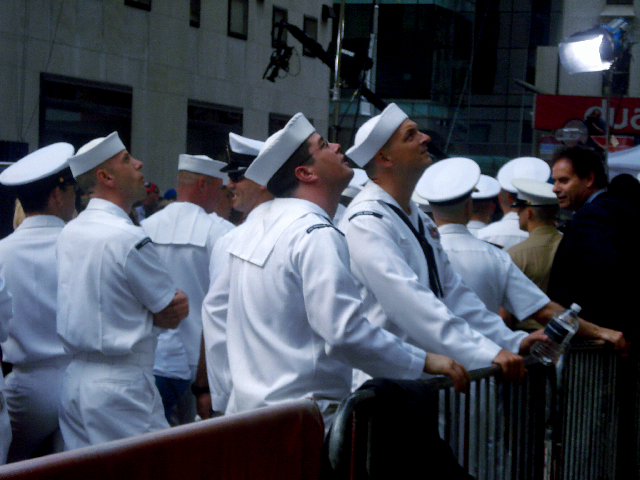
The Books: "Sugar and Other Stories" - 'The Changeling' (A.S. Byatt)
Next up in my Daily Book Excerpt ... Adult fiction shelves:
This excerpt is from "The Changeling", another short story from the collection Sugar and Other Stories - by A.S. Byatt.
Another short story about writing. Sugar is full of them. In "The Changeling" we meet Josephine - a writer. Her husband left her for another woman. Her son is now 18 or 19. Her son had gone to a private school - and Josephine had taken up the habit of befriending or "taking in" Lost Boys ... boys far away from their families, boys with no families ... whatever. The story begins with the headmaster of the private school asking if she would take in a student in need - his name is Henry Smee. The headmaster says to her that he IS the spitting image of "Simon Vowle" - the adolescent boy who is the "star" of Josephine's most successful book, The Boiler-Room. Josephine takes him in. And so begins the story. What is really interesting to me about this Josephine character is: the degree to which she has play-acted all her life. It's kind of devastating when you realize it. She is full of terror (this is what she writes about too - it sounds to me like her books are Robert Cormier-esque) ... and yet her play-acting self is breezy, calm, organized ... but once Henry Smee comes to live with her, the facade begins to crumble. She has been "found out". I'm not writing about it very well - you should just read the story. But here's an excerpt.
Excerpt from "The Changeling", another short story from the collection Sugar and Other Stories - by A.S. Byatt.
The subject of Josephine's writings was fear. Rational fear, irrational fear, the huge-bulking fear of the young not at home in the world. Every writer, James says, discovers his or her subject matter early and spends a lifetime elaborating and exploring it. That may or may not be generally true, but it was certainly true of Josephine Piper. Her characteristic form was the long novella: her characteristic hero a boy, anywhere between infancy and late adolescence, threatened and in retreat. Some of these boys were actually mutilated or killed, driven away in cars with no inner door handles, rushed stumbling through urban jungles at knife-point, ritually tormented by gangs of other boys in public school dormitory or state schoo playground. If they were hurt it was always fast and unexpected: the subject was not violence but fear. Often they were not hurt: they suffered from a look, an exclusion, a crack in a windowpane, a swaggering bus conductor keeping order on the top deck because he himself was afraid for his life. Josephine's work had been compared to Kafka as well as to Wilkie Collins and James himself. The Boiler-Room, whose central figure was Simon Vowle, was a surreal story of a boy in a boarding school who had built himself a Crusoe-like burrow or retreat in the dust behind the coiling pipe-system of the coke-boiler in the school basement and had finally moved in there completely, making forays for food and drink at night. It had a macabre end: Josephine Piper did not let her characters off. It had been described, with the usual hyperbole, as the last word on institutional terrors in schools. Josephine Piper could make an ordinary desk, a heap of football boots, a locked steel locker, tall and narrow, bristle with the horror of what man can do to man.
She recognized fear in Henry Smee, though she had no idea what he was afraid of, or whether his fears were real or phantasmagoric. She recognized something else too, from her own experience; the inconvenience, to the pathologically afraid, of an excessive gift of intellectual talent. Poor Henry could not but enjoy a grammatical dispute or the strict form of complex music: he perceived order and beauty, he remembered forms and patterns, he was doomed to think. He could not take up hiding as a way of life. She herself had been afraid as a child - where else could such knowledge have come from? - and had been so clever that it had had to be noticed, she could not hide it in silence and stammering,s he had had to read and remember and in the end, as Henry was now doing, to go out at least temporarily into a world where these things mattered.
He developed an inconvenient habit. He would not speak, over breakfast or supper, and Josephine slowly ceased to persist in questionings that received monosyllabic or nodding answers. But he roamed the house at two, at three in the morning, in his pyjamas and dressing gown, and once or twice she came down, fearing intruders, to find him sitting in the kitchen, with a mug of Nescafe, staring at the stove. On these occasions, though he did not confide in Josephine, he showed an extraordinary willingnes to talk. He would talk very quietly, so that she had to strain to hear him, offering, she imagined, the flotsam and jetsam of his thoughts, disconnected observations about the use of learning Latin quantities, or the economy of Stravinsky, or a longish disquisition on the Cambridge syllabus, with a parenthetical remark that he hoped that he didn't have to share supervisions, he found it hard to be in a room with more than one person at once. This was the most personal thing he said, and yet, yawning and low in blood-sugar, Josephine was aware that he was telling her as best he could what or how he was. The trouble was that she did not want to know. What she could face about what Henry was telling her she already knew. And fear is infectious.
Fear is perhaps also hereditary. Josephine's mother had had a mild and for others disagreeable case of agoraphobia, which had worsened as she grew older, with what josephine's father, bewildered, socially embarrassed, lonely, called indulgence. When Josephine was five or six her overwrapped mother would take her overwrapped daughter as far as the local school and had been known to go as far as the public library. By the time Josephine was fourteen, at boarding school, Josephine's mother rarely ventured outside her bedroom, and became giddy even in the back garden. She had never said - Josephine had never supposed it would be worth asking - what she feared, and her daughter had been left to imagine. She remembered her mother veering in agitation out of a bus queue in which they had been standing side by side in uncompanionable silence, running up the road, dropping books and paper bags of plums and carrots. What was frightening about bus stops? It was more understandable that the doorbell should arouse terror. Josephine, who had had to negotiate the Kleen-e-ze man, the meter-readers, the doctor himself, saw all these as menacing. How much more menacing were the laughing large girls in the school dormitory, who threw pillows, who launched themselves on each other's beds, who ragged and mocked the thin child she was, shaking in her liberty bodice? She had been saved, if she had been saved, by the solitary and sensuous pleasure of writing out her fear. Already in the boiler-room at St Clare's School she was writing clumsy tales of justified terror, of bounding packs of girls who accidentally squeezed the last breath out of their pathetic prey, of lost, voiceless sufferers locked in cupboards and accidentally forgotten. The boiler-room had been thick with coal-dust: a scree of coke sloped up to a closed and cobwebbed window under the area and the pavement. If she opened the boiler door the flames hissed and roared and the coke-dust glittered here and there. She collected things: a blanket, a bicycle lamp, an old sweater, a biscuit tin, a special box for pens, a folder that lived there. She squeezed into her burrow, through pipe-gaps too narrow to take a larger girl or member of staff. Sometimes she sacrificed bad writing to the boiler, whose angry red turned briefly golden. When she wrote about Simon Vowle the coke-smell came back in its ancient fustiness and bitterness. Simon Vowle was an exorcism. The woman who could make and observe him was not doomed to relive her mother's curious arrested life - was not?
June 1, 2007
Happy birthday, Marilyn Monroe!!
On June 1, 1926 Norma Jeane Mortenson was born.
Happy birthday, dear Marilyn Monroe!! You're one of my favorites.
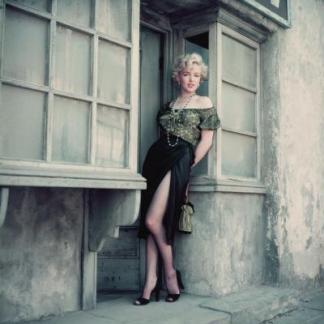
Bunch of quotes about her and by her below ... Enjoy!!
(That's a photo by Sam Shaw - his photos of her are my favorites. Natural light, an innocence to them ... candid-feeling ... just beautiful.)
Marilyn Monroe:
People had a habit of looking at me as if I were some kind of mirror instead of a person. They didn't see me, they saw their own lewd thoughts, then they white-masked themselves by calling me the lewd one.
That's Monroe and photographer Eve Arnold
Billy Wilder:
She had a kind of elegant vulgarity about her. That, I think, was very important. And she automatically knew where the joke was. She did not discuss it. She came up for the first rehearsal, and she was absolutely perfect, when she remembered the line. She could do a 3-page dialogue scene perfectly, and then get stuck on a line like, "It's me, Sugar"... But if she showed up, she delivered, and if it took 80 takes, I lived with 80 takes, because the 81st was very good ...She had a feeling for and a fear of the camera. Fright. She was afraid of the camera, and that's why, I think, she muffed some lines. God knows how often. She also loved the camera. Whatever she did, wherever she stood, there was always that thing that comes through. She was not even aware of it.
Eve Arnold:
If an editor wanted her, he had to agree to her terms. She knew how she wanted to be seen, and if her cooperation was sought, she reserved the right of veto.She knew she was superlative at creating still pictures and she loved doing it.
She had learned the trick of moving infinitesimally to stay in range, so that the photographer need not refocus but could easily follow movements that were endlessly changing.
At first I thought it was surface technique, but it went beyond technique. It didn't always work, and sometimes she would tire and it was as though her radar had failed; but when it did work, it was magic. With her it was never a formula; it was her will, her improvisation.
Peter Bogdonavich:
The fact is that Marilyn was in bad trouble from the day she was born as Norma Jean Mortenson on June 1, 1926, in the city of angels and movies, a poor bastard angel child who rose to be queen of a town and a way of life that nevertheless held her in contempt. That she died a martyr to pictures at the same time as the original studio star system -- through which she had risen -- finally collapsed and went also to its death seems too obviously symbolic not to note. Indeed, the coincidence of the two passing together is why I chose to end this long book about movie stars with Marilyn Monroe. What I saw so briefly in my glimpse of Marilyn at the very peak of her stardom (and the start of my career) -- that fervent, still remarkably naive look of all-consuming passion for learning about her craft and art -- haunts me still. She is the most touching, strangely innocent -- despite all the emphasis on sex -- sacrifice to the twentieth-century art of cinematic mythology, with real people as gods and goddesses. While Lillian Gish had been film's first hearth goddess, Marilyn was the last love goddess of the screen, the final Venus or Aphrodite. The minute she was gone, we started to miss her and that sense of loss has grown, never to be replaced. In death, of course, she triumphed at last, her spirit being imperishable, and keenly to be felt in the images she left behind to mark her brief visit among us.
Elia Kazan:
Relieve your mind now of the images you have of this person. When I met her, she was a simple, eager young woman who rode a bike to the classes she was taking, a decent-hearted kid whom Hollywood brought down, legs parted. She had a thin skin and a soul that hungered for acceptance by people she might look up to ...The girl had little education and no knowledge except the knowledge of her own experience; of that she had a great deal, and for an actor, that is the important kind of knowledge. For her, I found, everything was either completely meaningless or completely personal. She had no interest in abstract, formal, or impersonal concepts but was passionately devoted to her own life's experiences. What she needed above all was to have her sense of worth confirmed. Born out of wedlock, abandoned by her parents, kicked around, scorned by the men she'd been with until Johnny, she wanted more than anything else approval from men she could respect. Comparing her with many of the wives I got to know in that community, I thought her the honest one, them the "chumps". But there was a fatal contradiction in Marilyn. She deeply wanted reassurance of her worth, yet she respected the men who scorned her, because their estimate of her was her own.
Marilyn Monroe:
Well-behaved women rarely make history.
John Strasberg (son of Lee Strasberg, Marilyn's acting teacher):
I think I was talking about cars to Mother and Father. You know how I loved cars. I'd just come home and it was going to be my eighteenth birthday. I'd wanted to come for that.Mother and Father hadn't wanted me to come. "Why don't you wait till the end of the year?" Well, i'd already been kicked out of college. They didn't know yet.
When I'd gone off at the airport, I'd turned to Mother and said, "For two cents, I won't go." Nobody gave me the two cents, but I'd meant it. What I'd wanted to do was work. I'd wanted to work from the time I was fifteen, and they were always against any effort on my part to be strong or independent. I remember how much I resented it. "You don't have to work, we'll take care of everything," undermining me.
So I was talking about cars, no one was listening, and Marilyn was there and out of the blue said, "Why don't you take my car, Johnny?"
I thought I hadn't heard her right, and I said, "What?" She had remembered the summer before, in California, I'd had that Chevy I'd rented. God, I loved that car, a '57 Bel Air silver Chevy, and she had the Thunderbird.
She continued, "I've got the Ford Mustang the corporation gave me, and Arthur and I have a car. That one's just sitting in the garage, we don't use it."
I was stunned. I couldn't believe she meant it.
Mother and Father were horrified; they didn't like it at all. I don't know if it felt like too much to give me or if they were worried about my driving in my state of mind, but they objected strenuously. "He's too young. Maybe later, Marilyn. You don't have to. It's impossible, he can't afford it, it could be dangerous."
Marilyn just said, "Well, don't worry about any of that, it's in the corporation's name, so I'll take care of the insurance."
I'll never forget that ... There were so few, so very few people who were generous like that. Especially to me, who couldn't do anything for her.
I think that car saved my life.
Billy Wilder:
I never knew what Marilyn was going to do, how she was going to play a scene. I had to talk her out of it, or I had to underline it and say, "That's very good" or "Do it this way." But I never knew anybody who ... except for a dress that blows up and she's standing there ... I don't know why she became so popular. I never knew. She was really kind of ... She was a star. Every time you saw her, she was something. Even when she was angry, it was just a remarkable person. A remarkable person, and in spades when she was on the screen. She was much better on the screen than not on the screen.
Marilyn Monroe:
Some people have been unkind. If I say I want to grow as an actress, they look at my figure. If I say I want to develop, to learn my craft, they laugh. Somehow they don't expect me to be serious about my work.
Billy Wilder:
It's very difficult to talk seriously about Monroe, because she was so glitzy, you know. She escaped the seriousness somehow; she changed the subject. Except that she was very tough to work with. But what you had, by hook or crook, once you saw it on the screen, it was just amazing. Amazing, the radiation that came out. And she was, believe it or not, an excellent dialogue actress. She knew where the laugh was. She knew.
Marilyn Monroe:
"For breakfast, I have two raw beaten eggs in a glass of hot milk. I never eat dessert. My nail polish is transparent. I never wear stockings or underclothes because I think it is important to breathe freely. I wash my hair everyday and I am always brushing it. Every morning I walk across my apartment rolling an empty soda bottle between my ankles, in order to preserve my balance."
Eve Arnold:
I never knew anyone who even came close to Marilyn in natural ability to use both photographer and still camera. She was special in this, and for me there has been no one like her before or after. She has remained the measuring rod by which I have -- unconsciously -- judged other subjects.

Marilyn Monroe:
It's not true that I had nothing on. I had the radio on.

Ernest Cunningham (photographer):
I worked with Marilyn Monroe. A rather dull person. But when I said "Now!" she lit up. Suddenly, something unbelievable came across. The minute she heard the click of the camera, she was down again. It was over. I said, "What is it between you and the camera that doesn't show at any other time?" She said, "It's like being screwed by a thousand guys and you can't get pregnant."
Peter Bogdonavich:
More than forty years have passed since Marilyn's mysterious death, but her legend and persona have survived. This is all the more remarkable because she actually made very few films, and even fewer that were any good. But there was a reality to her artifice -- she believed in the characters she played, even if they were inherently unbelievable. "Everything she did," [Arthur] Miller said to me, "she played realistically. I don't think she knew any other way to play anything -- only to tell you the truth. She was always psychologically committed to that person as a person, no matter what the hell it was, rather than a stock figure. Because the parts she got could easily have been stock figures, which had no other dimension. But she wouldn't have known how to do that. In other words, she did not have the usual technique for doing something as a stock figure ... She was even that way when [director] John Huston used her the first time [in a memorable walk-on bit] in The Asphalt Jungle [1950]."This went for every picture she did in her surprisingly, painfully short career as a star, barely a decade, little more than a dozen pictures. Though she managed to work with quite a number of major directors, it was not necessarily always in their best efforts; but still they were Fritz Lang, Howard Hawks (twice), Otto Preminger, Billy Wilder (twice), George Cukor (twice, if you count her last unfinished one), John Huston (twice), Laurence Olivier, Joshua Logan, and Joseph L. Mankiewicz (bit part in 1950's classic All About Eve). In my conversation with Miller, he said, "I thought she had the potential for being a great performer if she were given the right stuff to do. And if you look at the stuff she did do, it's amazing that she created any impression at all because most of it was very primitive. And the fact that people remember these parts from these films is amazing ... She was comitted to these parts as though they were real people, not cardboard cutouts. Even though the director and author and the rest might have thought they were cutouts and would deal with them that way. The way the two men [Tony Curtis, Jack Lemmon] in Some Like It Hot felt with their parts, or George Raft with his part. She was real. And therefore she had the potential of being a great comedienne." (Norman Mailer, in his book on Monroe -- he never met her -- wrote that starting with 1953's Gentlemen Prefer Blondes, she was a great comedienne.)

Marilyn Monroe:
I'd prefer not to analyze it [acting] ... it's subjective; rather, I want to remain subjective while I'm doing it. Rather than do much talking I'd rather act. When it's on the screen, that's when you'll know who Roslyn [her character in The Misfits] is. I don't want to water down my own feeling ... Goethe says a career is developed in public but talent is developed in private, or silence. It's true for the actor. To really say what's in my heart, I'd rather show than to say. Even though I want people to understand, I'd much rather they understand on the screen. If I don't do that, I'm on the wrong track, or in the wrong profession.... Nobody would have heard of me if it hadn't been for John Huston. When we started Asphalt Jungle, my first picture, I was very nervous, but John said, 'Look at Calhern [the late Louis Calhern, a veteran actor], see how he's shaking. If you're not nervous, you might as well give up.' John has meant a great deal in my life. It's sort of a coincidence to be with him ten years later.
John Strasberg:
The first time I met her I remember she came out of the living room and Pop said, "This is my son," and my first impression of her was that she was different from most of the people who came to the house. I'd watch all these people trading their most human qualities, betraying themselves for success at all costs, to become rich and famous, and afterward, when it was too late, they'd realize they had lost the best part of themselves along the way, but she, she was like me. When I looked into her eyes, it was like looking into my own, they were like a child's eyes. I was still a child. You know how children just look at you. My feeling was she had less ego or was less narcissistic than most of the actors who never really bothered with me. She was just another person to me, another one from that world I felt cut off, excluded, from. She was nicer, real simple, no makeup, and she really looked at me as if she saw me. It wasn't that I wanted people to look at me, but I knew the difference when she did. I knew everyone said she was the sexiest, most sensual woman in the world. Not to me. I thought there was something wrong with me for not feeling that from her. I'd felt it from other women who came to the house. I was pretty sexually frustrated then. She was so open, so loose, and her sensuality as such was so totally innocent, nothing dirty in it at all, and the first time it was just like talking to an ordinary person, only realer than most who came into the house in those days. She was quiet, too, I remember, like an animal is quiet, and I was like that too, survival tactics. She seemed smart, but not in an educated way, instinctively smart, nobody's fool.
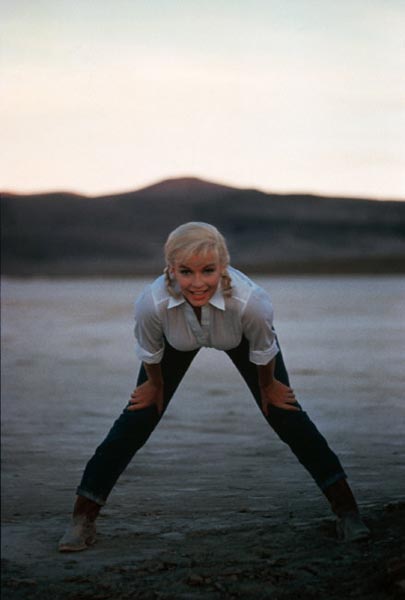
Couldn't resist:
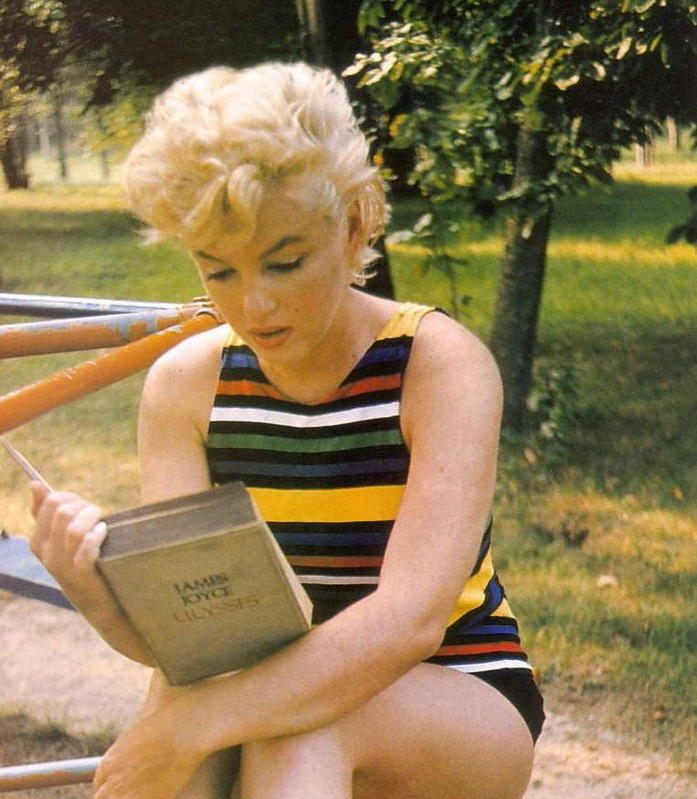
Marilyn Monroe:
"I am a failure as a woman. My men expect so much of me because of the image they have made of me and that I have made of myself, as a sex symbol. Men expect so much and I can't live up to it. They expect bells to ring and whistles to whistle, but my anatomy's the same as any other woman's. I can't live up to it."
Marilyn Monroe:
My illusions didn't have anything to do with being a fine actress. I knew how third rate I was. I could actually feel my lack of talent, as if it were cheap clothes I was wearing inside. But, my God, how I wanted to learn, to change, to improve!
Arthur Miller:
She was a whirling light to me then, all paradox and enticing mystery, street-tough one moment, then lifted by a lyrical and poetic sensitivity that few retain past early adolescence. Sometimes she seemed to see all men as boys, children with immeidate needs that it was her place in nature to fulfill; meanwhile her adult self stood aside observingt he game. Men were their need, imperious and somehow sacred. She might tell about being held down at a party by two of the guests in a rape attempt from which she said she had escaped, but the truth of the account was far less important than its strange remoteness from her personally. And ultimately something nearly godlike would emerge from this depersonalization. She was at this point incapable of condemning or even of judging people who had damaged her, and to be with her was to be accepted, like moving out into a kind of sanctifying light from a life where suspicions was common sense. She had no common sense, but what she did have was something holier, a long-reaching vision of which she herself was only fitfully aware: humans were all need, all wound. What she wanted most was not to be judged but to win recognition from a sentimentally cruel profession, and from men blinded to her humanity by her perfect beauty. She was part queen, part waif, sometimes on her knees before her own body and sometimes despairing because of it -- "Oh, there's lots of beautiful girls," she would say to some expression of awed amazement, as though her beauty betrayed her quest for a more enduring acceptance.
Peter Bogdonavich:
The year before her much-speculated-over death at thirty-six (rumors of presidential involvement, etc.), playwright Clifford Odets told me that she used to come over to his house and talk, but that the only times she seemed to him really comfortable were when she was with his two young children and their large poodle. She relaxed with them, felt no threat. With everyone else, Odets said, she seemed nervous, intimidated, frightened. When I repeated to Miller this remark about her with children and animals, he said, "Well, they didn't sneer at her."
Burt Glinn (photographer):
She had no bone structure -- the face was a Polish flat plate. Not photogenic in the accepted sense, the features were not memorable or special; what she had was the ability to project.
Billy Wilder:
Marilyn was not interested in costumes. She was not a clotheshose. You could put anything on her you wanted. If it showed something, then she accepted it. As long as it showed a little something.
Henri Cartier Bresson (photographer):
She's American and it's very clear that she is - she's very good that way - one has to be very local to be universal.
Here's the mega-post I wrote about the making of The Misfits
Marilyn Monroe:
Hollywood is a place where they'll pay you a thousand dollars for a kiss and fifty cents for your soul.

Marilyn Monroe:
Being a sex symbol is a heavy load to carry, especially when one is tired, hurt and bewildered.
Marilyn Monroe:
Acting isn't something you do. Instead of doing it, it occurs. If you're going to start with logic, you might as well give up. You can have conscious preparation, but you have unconscious results.
Arthur Miller:
To have survived, she would have had to be either more cynical or even further from reality than she was. Instead, she was a poet on a street corner trying to recite to a crowd pulling at her clothes.

Marilyn Monroe:
I'm not interested in money. I just want to be wonderful.
Marilyn Monroe (this is what she pleaded at the end of the last interview she gave):
What I really want to say: That what the world really needs is a real feeling of kinship. Everybody: stars, laborers, Negroes, Jews, Arabs. We are all brothers.Please don't make me a joke. End the interview with what I believe.

The Books: "Sugar and Other Stories" - 'On the Day That E.M. Forster Died' (A.S. Byatt)
Next up in my Daily Book Excerpt ... Adult fiction shelves:
This excerpt is from "On the Day That E.M. Forster Died", another short story from the collection Sugar and Other Stories - by A.S. Byatt.
This is my favorite story in the whole collection. It's also the most revealing. Meaning - I felt named by it. Especially when I re-read it recently. It got me all worked up when I finished it. I felt nervous. Irritable. Worried. It was a free-floating sensation, the kind of which I used to suffer from all the time. Something was wrong ... but what??? Well, recently I could locate the source of my anxiety pretty quickly - it was because I had re-read this story.
I don't want to say too much about it. I will say that it starts with the words: "This is a story about writing." The main character is named Mrs. Smith. We get to know her quite well ... but never her first name. We get to know what goes on in her mind. She is a middle-aged housewife and mother - who goes to the London Library after the kids go to school - and sits there, in that environment, trying to write. She does write. She does write. All kinds of disparate strands of stories take up space in her head ... and on one fateful day, the day that EM Forster died, she decides to put them all together and write a big long complex book - where ALL of her stories are part of it. Take this strand about the Hungarian refugee - and somehow weave it in with the Tolkien-esque story - the whole world opens up for her (inside her head) - Byatt describes the revelatory moment like nobody else. That feeling, that itchy feeling, that knowing .... that you are onto something. That you are not just able to THINK of an idea, but you WILL be able to execute it. You are ready to execute it. It's hard to write about writing. But obviously - with Possession - Byatt has shown she's a master at it.
I won't say too much more about this story. It makes me want to cry. It makes me want to mourn the lost years, the lost time .... and it also makes me nervous, voracious, ready, but paralyzed - because, like Zooey says to Franny: " You'd better get busy though, buddy. The goddamn sands run out on you every time you turn around."
Here's an excerpt:
Excerpt from "On the Day That E.M. Forster Died", another short story from the collection Sugar and Other Stories - by A.S. Byatt.
She went up and down Jermyn Street, through the dark doorway, the windowed umber quiet of St James's Piccadilly, out into the bright churchyard with its lettered stones smoothed and erased by the passage of feet. Along Piccadilly, past Fortnum and Mason's, more windows full of decorous conspicious consumption, down an arcade bright with windowed riches like Aladdin's cave, out into Jermyn Street again. Everything was transformed. Everything was hers, by which phrase she meant, thinking fast in orderly language, that at that time she felt no doubt about being able to translate everything she saw into words, her own words, English words, English words in 1970, with their limited and meaningful and endlessly rich histories, theirs as hers was hers. This was not the same as Adam in Eden naming things, making nouns. It was not that she said nakedly, as though for the first time, tree, stone, grass, sky, nor even, more particularly, omnibus, gas-lamp, culottes. It was mostly adjectives, Elephantine bark, eau-de-nil paint on Fortnum's walls, Nile-water green, a colour fashionable from Nelson's victories at the time when this street was formed, a colour for old drawing-rooms or, she noted in the chemist's window, for a new eyeshadow, Jeepers Peepers, Occidental Jade, what nonsense, what vitality, how lovely to know. Naming with nouns, she thought absurdly, is the language of poetry, There is a Tree, of many One. The Rainbow comes and goes. And Lovely is the Rose. Adjectives go with the particularity of long novels. They limit nouns. And at the same time give them energy. Dickens is full of them. And Balzac. And Proust.
Nothing now, she knew, whatever in the moral abstract she thought about the relative importance of writing and life, would matter to her more than writing. This illumination was a function of middle age. Novels - as opposed to lyrics, or mathematics - are essentially a middle-aged form. The long novel she meant to write acknowledged both the length and shortness of her time. It would not be History, nor even a history, nor certainly, perish the thought, her history. Autobiographies tell more lies than all but the most self-indulgent fiction. But it would be written in the knowledge that she had lived through and noticed a certain amount of history. A war, a welfare state, the rise (and fall) of the meritocracy, European unity, little England, equality of opportunity, comprehensive schooling, women's liberation, the death of the individual, the poverty of liberalism. How lovely to trace the particular human events that might chart the glories and inadequacies, the terrors and absurdities, the hopes and fears of those words. And biological history too. She had lived now through birth, puberty, illness, sex, love, marriage, other births, other kinds of love, family and kinship and local manifestations of their universals, Drs Spock, Bowlby, Winnicott, Flower Power, gentrification, the transformation of the adjective gay into a politicized noun. How extraordinary and interesting it all was, how adequate language turned out to be, if you thought in t terms of long flows of writing, looping tightly and lolsey round things, joining and knitting and dividing, or, to change the metaphor, a Pandora's box, an Aladdin's cave, a bottomless dark bag into which everything could be put and drawn out again, the same and not the same. She quoted to herself, in another language, "Nel mzzo del cammin di nostra vita." Another beginning in a middle. Mrs. Smith momentarily Dante, in the middle of Jermyn Street.