September 30, 2007
The Northern Dispensary
After my haircut ... I went downtown to meet up with Allison.
And we walked by the Northern Dispensary in the Village - You can read more about this mysterious abandoned empty building here - and another link - with a great photo here - it just sits there, prime real estate - and you can still see the old dentist equipment, rotting away through the windows - it's on a corner - so you can peek into the windows on one side and see straight through to the windows on the other side. There are some great stories behind the building - Allison told me some of them - but follow the links in that post above to read more. I used to have my appointments with my analyst in the building right behind the Dispensary in that photo - and i walked by it all the time, not really thinking about it - or wondering why this Willy Wonka's factory nobody-comes-in-or-goes-out building was just sitting there ... empty ... at the intersection of Waverley and Waverley.
It was a nice little pilgrimage, and dammitall I didn't have my camera with me (which ended up being an even bigger bummer because on my way home I inadvertently got trapped in a raucous parade of angry lesbians - marching and drumming and dancing - I could not get out of the throng, they were jammed into the narrow streets of the Village - and they had taken over the entire block - and I had no idea what they were protesting - but there was nothing to do but join them, so I marched along blissfully oblivious, my new haircut bouncing buoyantly in the night breeze, clapping my hands, dancing to their drumbeats - hoping the lesbians got whatever they wanted - but in the meantime, ahhh, that's a nice drumbeat, let me dance along to my train station since I cannot seem to escape ... laughing at the weirdness of my life) - so back to the Northern Dispensary: I settled on 2 shots with my crappy cell phone.
It's a haunting building. Allison kept saying, "What I wouldn't give to go in there and have a look around!"


Pampering
I went and got my 700 dollar cut and color yesterday. I seriously feel like I could write a 50 page essay about everything I observed and experienced in that salon - it was overwhelming! The decor is sleek, modern, and all black and white. The stylists wear all black - and there are glassed-in rooms where you can see bizarre experiments going on, with hair color, and makeover tints - and the stylists there wear white lab coats. The amenities of the salon are amazing. People stroll around offering you iced tea, or lemonade, or seltzer ... Other people stroll around carrying little trays of pastries ... Everyone who works there is drop-dead gorgeous. Everyone who GOES there is drop-dead gorgeous! I was intimidated but determined to not let it crush me. I just asked questions, and blatantly allowed myself to be in a fluster of confusion. I did not try to KNOW the system ... I was like: "Oh ... so ... where do I hang my coat?" "Take a left over there ... you can get changed in the rooms over there ..." Oh! Rooms! Changed! Got it! Then once I was over in the room-changing area - I again was in a bluster of confusion ... "Do I check my coat? How about my purse? Do I need to ... Oh, I go right over here ... thank you." (Thankfully, there are people who work there EVERYWHERE - and anyone who looks even mildly lost - for 2 seconds - is approached. "Can I help you?" "Do you need anything?" So, with a lot of hand-holding - I made my way through the maze of changing into the black gown thing - and checking my coat - and then they gave me a big plastic bag to keep my purse in - since I was getting my hair colored. Now that's nice. I suppose if you walk in there with a bag that costs 1500 bucks, you don't want to check it and you also don't want to risk having it stained. Got it). Bag in a plastic bag. Coat checked. Black gown on over my dress. And .... now what? Where do I go? Help me? Mummy? I was lost. Naturally, I was approached immediately by a staff member who asked if I needed anything ... "Yes ... I'm having my hair colored by ... Olivia?" "Okay - go up the stairs, take a right - and another right - she'll be at the window." Oh! Okay!
I mean, the whole day was like that. Baffled, confused, staring around ... like the most elementary things were beyond my comprehension: where is the bathroom? Could I have a glass of water? I needed help AT EVERY MOMENT. It was hysterical - but everyone was so nice and helpful that I felt perfectly comfortable being discombobbled. It was honest. If I had let myself HIDE how intimidated I felt - I would have been stressed out and paralyzed.
I got my color done first - Olivia rocked the house with the color - it's a coppery red - but she got rid of the grey, and also gave it some tints and shades throughout that look REALLY nice - natural. She pretty much colored my hair strand by strand.
I need to discuss my deep deep love for Mohammed, her assistant. I crushed on him the entire time I was there. First of all, the gorgeousness of the man is hard to even discuss - he looked like a young Marlon Brando. I mean: YUMMY. We talked about sky diving and bungee jumping. He said he always wanted to skydive - but his wife was expecting - and he didn't feel comfortable doing such a dangerous thing, now that he was about to be a father. We also talked about our shared love of Bloody Marys. Seriously. I am crushing on him so hard. He washed my hair - and gave me a head massage. Hence: my love for him. I have never felt anything so good in my life. I texted a friend of mine as I was sitting in the chair waiting for Mohammed to come back. "I am deeply in love with Mohammed, the assistant. I don't want this part of the day to end - because I'll have to say goodbye to him." She texted me back within 5 minutes: "I am so telling Dean!" (as in Stockwell. hahahahahaha)
But all love affairs must end. And once the coloring was done - Olivia passed me off to Rich - the guy who was going to cut my hair.
So much people-watching I don't even know what to say about it! Rich was running a bit behind because a gaggle of girls (yes, a gaggle) had come in to get their hair done for a wedding - and they were running him ragged. But I took one look at what he made this one girl's hair looked like, and thought: Holy shit, he is an artist. That is AMAZING. But I watched everyone, as I waited. I bonded with Bessa - who rinsed my hair out - we discussed the ins and outs of Britney's career for about half an hour. It was so fun. We discussed all of her VMA performances, the hits, the misses, how we both kinda love her, how we were horrified by the latest debacle ... We talked about the tragic loss of JT and how Britney went downhill from there ... we discussed our yearning for a big ol' awesome comeback - but how we are losing hope in that regard. It was hysterical - Bessa was very busy, moving around - assisting other stylists - being called over to hold hair as it was blow-dried or whatever ... but in between, she'd come back over to me, and say, "So how 'bout her reality show, huh?" It was great. People are people, wherever you find them.
If you can talk to me about Britney - and if you know what I'm referring to when I casually reference, "the python" or "her appearances on Star Search' - then we'll be able to hang.
Rich finally was ready for me and we had a long conversation about my hair - and I have to say - I don't think I've ever had such an incredible haircut. It's just full and kind of sexy - but it looks tousled and natural - He's incredible. Olivia popped over with Mohammed, my long-lost love - to see what it all looked like - blow-dried out, the color, the cut - and was so sweetly excited for me. Rich and I actually (it turns out) have some mutual friends (life is so weird) - he lives with his wife down on the Jersey shore - so his daily commute is 2 hours. But obviously it's worth it. He says, "It's hard to get a job here because stylists never want to leave. It's a great job." At one point - both he and Bessa were blow-drying sections of my hair - I have never felt so PAMPERED in all my life. It's not altogether a pleasant sensation ... I mean, it is - of course it is ... but it's also a bit embarrassing.
When I left, I was frightened about how to handle the tipping. I knew I would tip everyone who touched my hair - but ... do I wander around handing them wads of cash like a Mafia don??
A guardian angel appeared. I came back down the stairs, in my black gown - to the front desk area - The girl behind the desk - who had a short glamorous Louise Brooks bob - bright red hair - pale skin - just gorgeous - Anyway, she looked up, saw me, and said, "Oh my God - that haircut! You look so great!" (After all, she had seen what I looked like when I walked in. Not that I'm a Gila monster on the prowl - but you know ... It was a big transformation.) So to have her say that - scary girl at the front desk - was sooo nice - and it turns out she wasn't scary at all. We were talking about how wonderful the salon is - how much of a difference it makes to have a nice haircut - She said to me, "I'm an actress - I work in a preschool, too - but i work here one day a week so I can get my discount." I loved that! First of all, she was intimidatingly beautiful - she's the first thing you see when you get off the elevator- so naturally they're going to have BABES working the front desk, because it's the best advertisement for the salon within. So I was scared of her at first. But then she reveals that she's an actress, and a preschool teacher, and works reception one day a week ... so I was like: Oh. You're just like me. I love you now.
So I felt comfortable taking her into my neuroses and said, "How does one handle tipping in this environment?"
And she said, "Here are some envelopes - just put the tip for whoever into different envelopes - write their name on it - and then drop it off in that little dropbox over there. They'll get it at the end of the day."
Thank you, Redheaded Goddess! For walking me through the mysteries of salon life!! Easy-peasy! I'm SO GLAD I asked. I mean, it would have been fine if I had tramped back up the stairs and wandered around looking for Olivia, or Mohammed or whoever ... but it was so much more civilized to just put the bills in an envelope and pop them into the little drop-box.
I wrote on Bessa's envelope: "Go, Brit-Brit!"
Anyway, I'm really happy with it. It was a long afternoon - I was there for 4 hours - which is a bit much!! But what a generous gift ... and it turned out to be (as things usually are for me) kind of an adventure.
Blurry bad cell phone pic of the haircut - me in the PATH station later that night. You can't really see the gorgeousness of the haircut - and I'm eager to try to "do" it myself, later today. It was pretty simple - his styling of it (I had told him my low-maintenance lifestyle - and that very often I "air-dry" my hair. He was hugely approving of this.) ... But I am eager to try to make it look as good as he did - on my own.

I miss you, Mohammed.
Happy birthday, Truman Capote!
Today is the birthday of one of my favorite writers - Truman Capote.

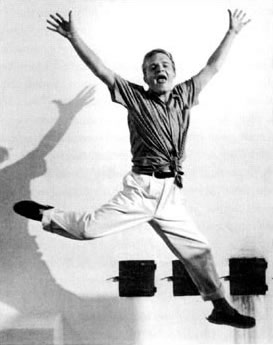
Truman Capote has been one of my many life-long obsessions - so forgive my autuistic knowledge of this man - his life, and his work. Also - I just had to go out and find all the great photos of him, and post them here. People LOVED to photograph this man (at least in his early wunderkind days) - and all of them are online, which is so exciting. So I've found some of my favorites, to post them here for you.
Example:
Most of my generation only remembers Truman (his Public Persona, I mean), from his appearances on various talk shows, mainly Johnny Carson, when he was a bloated guy with a high lisping voice who was vaguely embarrassing to watch - At least I felt that way. He was obese, he had face lifts, he wore a white Panama hat, he was kind of grotesque. I didn't know that he was basically caricaturing himself by then - which is always death to an artist of any kind.
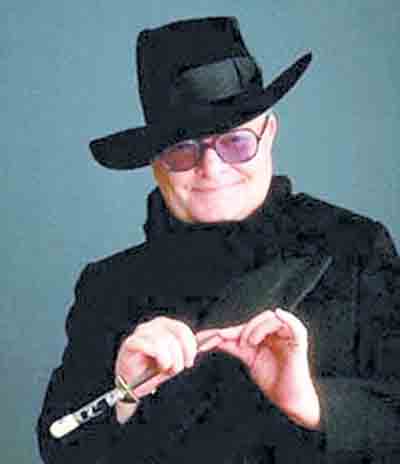
But he was stuck. He had horrendous writer's block at the very end - which tormented him. The end of his life was full of despair. It's wrenching to read about - you just want his suffering to stop.
But as a youngun? As the new writer in town? He was a golden boy. He was a creature like Thomas Mann had written about. The golden-haired child-man who led others to do naughty naughty things, and then pled innocence. Photographers lined up to capture this guy.
See what I mean?

Hard to realize just how provocative those photos were back then. Especially because he was openly gay. And not just "openly gay" - but openly PRISSY and gay - which some people find unforgivable. Fine, be gay ... but ... do you have to be so ... GAY about it?? Can't you just PRETEND to be straight so I don't have to feel so ... ikky? Truman, even back in the early 40s, didn't put on an act for the straight world. He didn't turn himself inside out to make people feel comfortable with his gayness. He just was who he was. If people felt uncomfortable, then that was THEIR problem. He was prissy, he lisped, he flounced about like a Southern belle - AND he happened to be a kick-ass writer with a literary voice that no one could forget.
I still remember the impact that The Grass Harp had on my heart when I first read it.
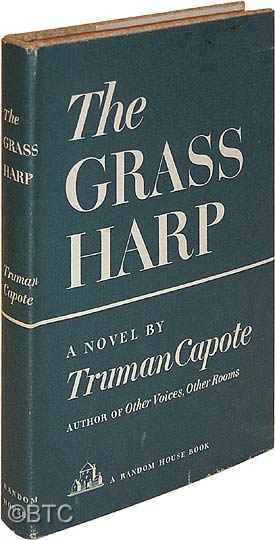
I was too young then to really understand regrets, or loss - the way I understand them now - but his elegaic writing in that story touched some deep universal chord in me - the part of me that is HUMAN, and not just an age on a timeline. There was a kind of soul-growth spurt that happened to me when I read that sad beautiful story. I still have a real fondness for it.
(Excerpt here)
His first book, published in 1948, was Other Voices, Other Rooms, and it took the literary world by storm. It was one of THOSE debuts. High level reviewers praised the book - in glowing terms - and it truly is a wonderful book. Not as good as his others, and CERTAINLY not as good as In Cold Blood (just saying the name of that book gives me a chill up my spine) - but you could tell that there was a real VOICE in that book.
Just to add to the controversy - here is the "author photo" that appeared sprawled across the back of the book:
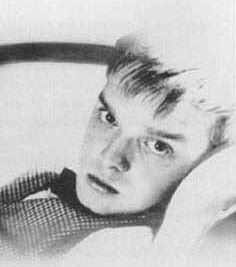
hahahahaha Truman! Please! It caused an outrage. A stir. (Tennessee Williams, down in Key West, had heard about it - and wrote letters referencing it) People loved it. People hated it. People TALKED about it, and that was what Truman cared about. Truman had talent - yes - but he understood the whole 15 minutes of fame thing long before Andy Warhol came along. Truman wanted to be FAMOUS as well as being a good writer. He wasn't one of those writers who holed themselves up in their apartments (at least not until In Cold Blood when he disappeared off the face of the earth for almost 5 years - he said later that writing that book nearly killed him.) ... But before In Cold Blood he was out at every party, he hung out with the rich and famous (at least until the huge debacle at the end of his life when he alienated all of them in one fell swoop)
This photo is just ... kind of says it all, don't it?
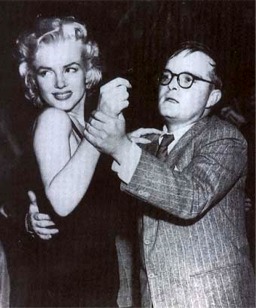
Look at how he's holding her wrist!!! Like - hold her HAND, Truman. But also - look at how sweet she is. The two of them were actually very good friends and he wrote one of my favorite pieces about her, which appears in the gorgeous collection Music for Chameleons. The piece describes a day in New York when he and Marilyn attended a funeral of a mutual friend. I love that piece. It's called "A Beautiful Child", because that's what Truman saw her as. Not the sex goddess. But a beautiful child.
(Excerpt here)
He was the darling of New York. He wasn't just friends with celebrities - whose wealth is a rather transitory thing. He became friends with REAL rich people. The international tycoon types. The Onassis types. He was invited to all of the "society" parties.
And one day - he read a little snippet in the newspaper about an entire family who had been slaughtered in their own home ... and something sparked in him ... He spoke to the folks at The New Yorker - he wanted to do a piece on how such a brutal murder would affect the small town ... He went to Kansas - and basically did not emerge from that nightmare for another 5 or 6 years. The result, of course, was the great great In Cold Blood.
(Excerpt here)
More on In Cold Blood in a bit.
Once that book stopped taking up every second of his life (he was never really the same again, after writing it) ... he was ready to re-enter New York society, with a bang.
And he threw a party that is still famous. It was called The Black and White Ball, and he threw it for Katherine Graham - who he didn't even really know.
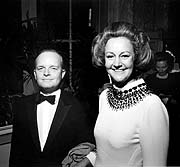
She wrote in her autobiography (which I've read): "I was truly baffled as to why I was the guest of honor. But it seemed really important to Truman ... so I said yes."
Odd. It was, many people say who care about this stuff, the "party of the century".
Everyone had to come wearing masks, and everyone had to dress in black and white. Truman had just finished In Cold Blood - or maybe he had just returned from Kansas - not sure - but he needed to let off steam, he needed to shake off In Cold Blood which had literally taken over his life. So he threw this party - where everyone who was anyone showed up.
Here's Candice Bergen at the party:

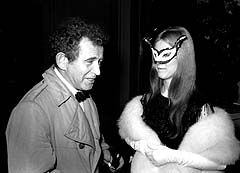
Here's Norman Mailer and his wife - hahahaha
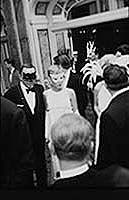
Here's Mia Farrow and Frank Sinatra- who had just gotten married:
People jostled to get invited. People sucked up to Truman. He was in his glory. But even then - he had the oddest mix of desire and contempt when it came to the rich. He wanted to hang out with them - but he had contempt for them as well. On some level, I think he knew that they would drop him like a hot potato the second his friendship became inconvenient. He knew that his friendships with these people were were pretty one-sided: Truman was there to entertain, to keep things light and amusing. The second he started falling on hard times later in life, they stopped tolerating his company.
Perhaps all those rich people just liked the cache of having a literary star at their parties - it made their parties seem more ... substantial. Maybe they really did like him. But I don't think so. And I don't think Truman liked them all that much, either. He saw right through them. Only he kept that to himself, and let the rich people think that he bought their game, that he was fooled, that he did not see the essential shallowness beneath their facade. When he finally came out and wrote about them and their pettiness, their stupidity - they could not and would not forgive him. One chapter of his book was published - and set off a shitstorm through the international rich set - all of whom had welcomed Capote into their midst.
(Excerpt here)
He never finished that book.
(By that point in his life, long after In Cold Blood, Truman had actually lost a lot of what had made him a success in the first place ... and that was his compassion for others. His ability to love his fellow man, and to try to step into their shoes and describe for us, the reader, what it is "like" to be that person. By the 1960s, drugs and drinking had taken hold ... and Truman was angry. He wrote about his former friends with bitchy - but spot-on - RAGE. He had NO compassion for THEM. He could find it in his heart to be compassionate for Dick Hickock and Perry Smtih even though they had committed such a heinous crime. But he was NOT compassionate for the fat Upper East Side cats. He unleashed his wrath on them, and it was like a bomb going off in international society.)
Truman Capote found himself bereft, and alone. He never recovered from that shattering of his world, even though he said over and over, "I'm a writer! What did they think I did in my spare time? I observed life - and I wrote about it!" They did not forgive him for telling the truth. Years later, when Gerald Clarke wrote his tremendous biography of Capote - there were people who refused to be interviewed for the book becaue they were STILL seething at Truman's "betrayal".
I'm going to post something I wrote a long time ago on this blog - which ended up being published elsewhere. It's called "Fairy on the Prairie", and it's about the writing of In Cold Blood which is pretty much on my Top 10 favorite books ever written. Certain books come and go on that list - titles get bumped off - moved on - but not In Cold Blood. There are a couple of others that never get bumped off - Harriet the Spy, Wrinkle in Time, Catch 22. These are great great books.
I'm proud of the piece I wrote on Truman.
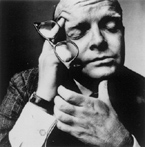
Before we get to that, though, I would like to share my favorite photo of Truman Capote. It's done by the great photographer Irving Penn. I like it because - it's not the "carefree" look of his golden-boy self - which was a pose, to some degree. It's not the provocative just-got-out-of-bed look he sported as an early writer - which was also a pose. And it's not a photograph from his later years, which just really hurt me to see.
Irving Penn had photographed Spencer Tracy, famously, boxed up in a corner. (That was one of Penn's "things" - he put famous people into corners of rooms and photographed them. Strangely effective.)
Look. Amazing photo of Spencer. Look at the EXPRESSION on his face.

Penn took basically the same photograph of Truman - boxed him up in a corner. I looked for a larger version of the photo - a clearer one - but couldn't find it. This is the best I could get.
There is something about this photo that not only haunts me, but strikes me as deeply painfully TRUE. The oversized coat, it makes him look so small and frail. The cramped quarters, the walls pressing in. Now, I did not know Truman Capote, and it is not for me to say who is the "real" Truman Capote - but something about the look on his face in this photo, its flat blank-eyed stare, the gaze is a bit confronting, but also - so accepting of himself, of the soul behind those eyeballs - something about it lands for me. I feel that I am getting a glimpse not of a personality, a famous person ... but someone's soul. I feel the same way about the Spencer Tracy photograph - so I don't know what that's about, and I'm sure it has all to do with Irving Penn's gift. It's extraordinary to me.

And now. Onto In Cold Blood, and my old post about him. There may be some repeats of information here.
Happy happy birthday, dear dear Truman.

Truman Capote said later that if he had known what he was getting into, when he traveled down to Kansas ("a fairy down on the prairie - who'd have thought?") to write a piece on the murder for The New Yorker, then he never would have gone. He went to Kansas only 2 weeks after the murders took place. The killers had still not been found, the community was in an uproar of suspicion and paranoia. Capote's main interest was to do a long profile of the townspeople, how regular church-going farmers handled such a disaster. Little did he know what the book would eventually be! The project took up years of his life. He had to wait for the executions of the 2 murderers, in order to complete his book. So he waited, and waited. Appeal after appeal ...He was unable to write anything else. Nothing else interested him. He was a man obsessed, in the grip of his obsession for years. His health was ruined. His friends were sick of hearing about the Clutter family. He tried to take vacations with his long-time partner, and would just drink, and try to sleep, and have fits of despair. He thought those boys would never be executed, he thought he would be in limbo forever. Yet - the morbidness of his entire life being on hold because of commuted death-sentences in Kansas - the morbidness of trying to go on, when really all you want is for those 2 boys to be killed - so that YOU can go back to YOUR life ... This selfish attitude (necessary for the project) took a huge toll on him. It felt inhuman.
Finally - there were no more appeals and Capote traveled to Kansas, to watch the execution. Hickock and Smith had asked him to be there. In the intervening years, he had interviewed the 2 killers numerous times. Their first-person descriptions of their own sorry lives make up important parts of the book. Capote became their conduit to the outside world. Hickock would draw self-portraits of himself and send them to Capote. Capote was playing a double-edged game here. He became "the listener", the one who would sit and ask them questions, and nod understandingly. The 2 of them got addicted to his concern. Yet Capote was horrified by most of what he heard. He wasn't without pity for these men, who had pretty much been beaten like dogs from the second they were born - and yet Capote hadn't had an easy road either, and HE hadn't killed anyone in cold blood. He had grown up with alcoholics, he had been abandoned by his father, his parents were ashamed of having a "fairy" for a son, he was sent to military school - can you imagine how awful that must have been for him? Capote may have acted like a cream-puff but that man was cold and hard as steel inside. He had to be.
Capote needed quotes, he needed access, he needed to enter into the psychologies of these 2 men. He was able to paint the graphic picture of the Clutter family through interviews with people who knew and loved them. But the Clutters were no longer around to speak for themselves. Hickock and Smith were alive for a couple of years, so he visited them often. On his way out of Death Row, he would feel the urge to vomit. It would take him days to recover, emotionally, from these macabre "visits". And he said, later, that he never recovered from the "shattering" experience of watching the two men hang. The letters he wrote to friends afterwards are nearly incoherent. Watching how hard the hanging body clings to life, watching the kicking feet, the flailing, the letting-go of bodily functions ... Capote was really never the same man again.
And he then sat down and wrote the book like a bat out of hell.
Truman Capote always thought that he had a "great book" in him. This mythical "great book" haunted his dreams, he would lie awake at night aching with ambition, dreaming about this great book ... He didn't think In Cold Blood was his masterpiece. He looked back on the experience of researching that book and writing it as a grim one, an almost universally unpleasant and grueling experience. I've read all of Capote's books. I love that guy's writing style. I even read his unfinished work - the 2 chapters of the novel he was working on when he died. He claimed to have it almost finished, but the rest of it (if it even existed) was never found. The 2 chapters are okay - it's a gossipy bitchy look at high-class New York society. It's merciless. It's very funny. Nobody is spared. Human beings are seen in their worst lights. Everyone is selfish, cynical, out for themselves ... It is quite funny, but it's very very mean. He was nearing the end of his life, and he had been abandoned by most of his friends. His outlook was not good, he was addicted to drugs, filled with anxiety and loneliness ... The 2 chapter are his way of lashing out at all those people who left him, who tossed him out with the trash. Hence, the mean-ness.
The thing in the rest of Capote's writing that, for me, sets him apart is his undeniable love of humanity. His tenderness. His ability to SEE people, with all their flaws - and to see them as beautiful. Much of his best writing is all about nostalgia, wistfulness, yearning for childhood ... Yes, it is sentimental, but it also has a depth of sadness beneath it, a grief ... which elevates it from mawkishness.
In Cold Blood taps into something else. In Cold Blood doesn't fit into either of the Capote categories: the bitchy mean queen telling all the nasty secrets of his high-class friends, or the lonely sweet man filled with hurtful nostalgia for childhood.
It was something completely new. For him, and for us. I don't even know if I can describe it. All I can say is - he never accomplished such a thing again. His writing never seemed so effortless again. You read that book and you feel like if you cut ONE WORD, the entire thread will unravel. It is so tight.
The other thing I had forgotten from the biography is Capote's personal experience leaving his home-environment of ritzy New York City (where there were lots of "fairies"), and venturing into the Kansas prairies to investigate a murder. Capote was openly gay. He wasn't a macho gay, either. He didn't try to blend in, or act straight, or hide his gayness. He was a small rotund man, who wore wide white hats, spoke with a lisp, fluttered about like Blanche DuBois, and literally said things like, "I declare!"
He took one of his best friends, Harper Lee (yes - THAT Harper Lee) as a co-researcher. She was much more "normal"-acting, and was able to blend in a bit more. She could get people to talk to her, because she seemed like one of them.
But Truman Capote was so relentless, and not only so relentless, but so committed to justice, so committed to discovering what had happened in the Clutter household, that people started opening up. The people in the town started competing about who had had him over for dinner the most times. Alvin Dewey, the head of the investigation, a tough gruff 3 pack a day smoker, eventually counted Truman as a valued partner. Truman was there when Dewey got the call that the 2 murderers had been picked up in Las Vegas, AND that they were still wearing the boots with the distinctive soles (that had left footprints - If the 2 hadn't confessed, the boots alone would have convicted them). Truman was standing right there, with Dewey's wife, listening to Dewey hear the news.
The people of Kansas, who had never met a person like Capote in their lives, who were Bible-Belt ranchers and farmers, took him into their homes, their families, their hearts. Without them, the book would not have been written.
It is a massive accomplishment.
Truman Capote went to his grave thinking that his "great book" remained unwritten. I beg to differ.
The Books: "Bad Behavior" - 'Something Nice' (Mary Gaitskill)
Next book on my adult fiction shelves:
 Bad Behavior - by Mary Gaitskill - a short story collection - I'll excerpt from the third story today: 'Something Nice'.
Classic Gaitskill. This story is told from the point of view of the male - a kind of shlubby average guy - married - who frequents a certain house of prostitution in Manhattan about once a month. Gaitskill's rendering of what such places are like have such a stamp of reality that anything else pales in comparison. She KNOWS these places. We all have ideas about what prostitutes are, and who they are on their off-days - but Gaitskill actually KNOWS ... Then - the narrator's wife goes away for a month - and there is no longer a compulsion for him to go home - so he starts to go to the sex house every night. He's a veterinarian (although he lies to the prostitute, for some reason - and says he's a lawyer - very interesting: he's a sad guy - he makes me sad, anyway)- he's got money, so it's no issue. And he requests the same girl every time. The interesting thing about this story is that Jane - the prostitute that the narrator likes best, and requests over and over ... is, objectified by him - but not in the way that you would think. You don't get the sense that he goes to whores for the hot kinky sex that his wife won't do with him. You get the sense that he is lonely, and he feels protective towards this young girl who has sex with him once a month - and that he wants to talk to someone. A friend of mine was a prostitute and she said that that was overwhelmingly the case. That sometimes the guy would just want to talk. Be listened to. It's kind of pathetic, but again - Gaitskill doesn't overtly JUDGE this man ... but I gotta say: he's hauntingly awful. You just know he's living in a fantasy world - which turns the whole event on its ear. Our expectations of what prostitutes are like are not fulfilled by this sad pathetic little story. Jane, the prostitute, doesn't seem to have the hard edges yet - the true "professional" vibe - she's young, and still kind of fresh. Our narrator fantasizes about her - but not sexually - He is filled with yearning towards her, he wants to give her things, he wants to take her out to dinner (he'll pay for her time, of course) - he wants to know who she is (but then when she reveals things - like what she does on her days off - and it doesn't fit with his perception of her, he kind of doesn't know what to say). It is another way of objectifying a human being: to fall in love with an IDEA of them, and not really be able to deal with the reality. Gaitskill doesn't take the simplistic view, though. Jane is not an awesome sex goddess, in charge of what she's doing. And he is not a sad sack of a loser. Jane is rather unpleasant. Indifferent, event. She's a prostitute because she wants to go to art school. She's a painter. She's cut off so much from what she is actually doing that nothing matters to her. Not really. And she is baffled - and kind of cold - towards this lonely man who just wants to do something nice for her. It's a love story, in Gaitskill's universe. Based on ideals and misunderstanding. If we only see prostitutes as victims who need to be saved ... we are missing a vast WORLD of people who do it for all KINDS of reasons. (Same thing with porn stars and exotic dancers and all that stuff.) And it's very dangerous, anyway, to romanticize ANYONE out of their humanity. I've had it done to me. I can tell that whatever the dude is in love with - it's not really ME. It's an IDEA of me. He's made up his mind who I am, from the bat ... and that is what he goes for ... and anything that doesn't really fit in is treated with confusion - as opposed to interest. That's really what this story is all about. It's very very sad. And the ending is AWESOME. Jane disappears from the house o' prostitution. It is disorienting for the narrator. You really get, through Gaitskill's prose, how much space Jane took up in his mind. In a funny way, you ache for him. But it's a cold world out there - and you best not mess with prostitutes if you're looking for anything other than sexual release with no commitment. Know what you're doing before you start doing it. Anyway - months pass. Jane recedes from memory. And then one day - in a cafe in New York - he sees her sitting at a table with some friends. He is stunned to see her out of context. He eavesdrops - and it's obvious that she is now in art school, and her and her friends are sitting there gossiping (uncharitably) towards another friend. They're self-righteous, in the way that gossips can be about other people's "bad behavior". Anyway, I can't describe how Gaitskill does it in this last moment ... but you are left with the feeling of the lost-ness of everyone, that everyone is looking for ... something ... sometimes we intersect - and all along the narrator thought, sadly, that Jane might have looked up to him, or looked to him for protection. Like: he had a fantasy of himself that he was a "nice guy", as opposed to all the other assholes who go to prostitutes. But that's the big lie - that you are different, somehow unique - special.
It's a great story about loneliness and isolation. Here's an excerpt.
EXCERPT FROM Bad Behavior - by Mary Gaitskill - 'Something Nice'.
The minute she came into the room, he went to her and put his arms around her hips. "Hello, Jane."
"Hi."
"It was strange not seeing you out there waiting for me."
She looked puzzled.
"I guess I somehow got used to thinking of you as my own little girl. I didn't like the idea that you were with some other guy. Silly, huh?"
"Yes." She broke away and snapped the sheet out over the bed. "Do you say things like that because you think I like to hear them?"
"Maybe. Some of the girls do, you know."
He could feel the sarcasm of her silence.
He watched her pull her dress off over her head and drop it on the aluminum chair. "I guess it's only natural that you've begun to get jaded."
She snorted. "I wouldn't call it that."
"What would you call it?"
She didn't answer. She sat on the bed and bent to take off her heels, leaving her socks on. When she looked at him again she said, "Do you really think it's a good idea for you to come to see me every night? It's awfully expensive. I know lawyers make a lot of money, but still. Won't your wife wonder where it's going?"
He sat next to her and put his hand on her shoulder. "Don't you see how special you are? No other girl I've seen like this would ever have thought to say something like that. All they can think of is how to get more money out of me and here you are worrying about how much I'm spending. I'm not trying to flatter you, you are different."
"Aren't you worried about getting AIDS?"
"From a girl like you? C'mon, don't put yourself down."
She smiled, sad and strained, but sort of affectionate, and put her hands on his shoulders. She felt to him like one of his puppy patients embracing him as he carried it across the room for a shot.
"I'm sorry I'm being so shitty," she said. "I just hate this job and this place."
"Here," he said. "I'm going to buy two hours, so we can just relax and unwind. You just lie down and get snuggled up in the sheet." He got up and turned off the light. He found a romantic jazz station on the radio. He undressed and got under the sheet with her, wrapping them both in a ball. He held her neck and felt her forehead against his shoulder. Her limbs were nestled and docile, as if all her stiff, pony-trot energy had vanished. The dim light of the gurgling fish tank cast an orangy glow over the room. "This is so nice and glamorous," he said.
"When is your wife coming back?" asked a voice from the nuzzling bundle on his arm.
"In three days." He sighed and stared at the stupid, lovely slivers of fish darting around their ugly castle.
Brokeback 1776
hahahahahaha - hysterical parody of Brokeback Mountain using footage from the movie 1776 - I love when it gets all slo-mo and romantic. I practically know 1776 by heart ("But I burn, Mr. A!!" "So do I!") - so the clips they pick, out of context, work perfectly. Funny!!!
Found the video here, naturally - and he relates one of my favorite stories from the early days of the American Revolution - of John Adams and Benjamin Franklin sleeping in the same bed, and arguing about whether or not night air is good or bad for you. It's just such a funny image to me - these two Founding Fathers bickering through the darkness. (It's not as funny as Ben Franklin suggesting they fight the war using bows and arrows ... and the other dudes all being like, "Uhm, Ben? We have cannonballs and stuff now? Sooooo ... thanks for sharing ... but no." - but ALMOST as funny.)
September 29, 2007
Reading
A beautiful photo - on a site full of beautiful photos. One of my favorite sites on the web, period.
Sarah Vaughan
Woah - unbelievable video clip of her singing 'Send in the clowns' ... what she does on "my usual flair" (putting the "flair" of the lyric into her voice - but simply, perfectly) ... and then where her voice goes on "sure of my lines" in the next moment. GOOSEBUMPS.
Her voice has always pierced thru right to my very core.
(Alex. Yo. You ever gonna return my calls, woman????) tee hee I miss you.
Dean Stockwell's in Moscow
Or ... at least his photograph is. Dennis Hopper has a big show of his photography going on at Moscow's Museum of Photography. Here's a nice review of it. About 10 years ago, there was a great exhibit at the Whitney (I can't believe I'm saying those things in the same sentence: "great exhibit" and "Whitney" - there's a funny story about my dad and me going to the Whitney and we walked into one room where there was some light-and-color installation - with strobe lights and reflections - a big empty room, and my dad, an art connoisseur, saying loudly, "So. Where's the art?" hahahahaha But I digress!) Anyway, the Whitney did a whole "Beat generation" exhibit - and it was fanTASTIC. I literally wanted to EAT some of the art I saw. hahaha There were tons of photographs - of Ginsberg and all those dudes - doing readings at City Lights, stuff like that - Kerouac's typewriter and the long ROLL of the On the Road manuscript - it wasn't separate pages, it was a scroll - Dennis Hopper's work was everywhere throughout the exhibit - and if you've never seen his photographs, I suggest you look them up. They're wonderful - my kind of Americana. He's from Kansas - there's something in his eye that really understands space, and horizon, and small towns - little diners, and coffee shops, and floozy waitresses - I love all that stuff. Like this. (Love the title of that one too - it resonates) But then there's whimsical photos of his friends - like this one. hahahaha The photo of Stockwell that is included in the show is below. My question is: Guys, how much pot have you actually smoked? I mean, seriously!! It's 1964, and Dean Stockwell has a fried egg on his face, and he's shining a flashlight on it. Goofballs. Friends. Love it. And I'm glad Hopper's show got a nice review - his work certainly deserves it.

All Dean Stockwell stuff here
Going to do my best to re-cap Episode 3 of Quantum Leap this weekend - but I am not making any promises!
Grey Gardens
I loved reading this review of the documentary. It pretty much describes my first response to meeting Big and Little Edie.
The Books: "Bad Behavior" - 'A Romantic Weekend' (Mary Gaitskill)
Next book on my adult fiction shelves:
Bad Behavior - by Mary Gaitskill - a short story collection - I'll excerpt from the second story today: 'A Romantic Weekend'. Gaitskill sets up expectations with the title of the story. We think we know what " a romantic weekend" means. She has other things in mind. The way she writes about sex can be frightening. She writes about women who either do NOT have the "fight or flight" instinct in them - or that instinct is there, only turned on its ear. Where other women would run away, Gaitskill's characters run toward. It's tough stuff. But it's real. It's the Gaitskill Voice. Beth is the lead in this story - she is going away on a romantic weekend with a man she has fallen in love with. He's married. I think he and Beth met at a party. Oh, and he is un-named in the story. He's just "he". The narration includes both of their thought processes - we're not just inside Beth's head. He's a sadist. And he senses the masochism in Beth. The first time they sleep together, he hurts her. She's frightened but she takes it. He tells her he won't give her any more pain than she can handle. There's something in this comment of his that seems so loving to Beth, so kind, that she falls head over heels for him. Even though on some level he terrifies her. They make a plan to go away for the weekend. The story is a dark pit. You need a strong stomach for some of it. You feel like this guy is a total lunatic. He hates women. But, as always with Gaitskill, she is uninterested in making judgments. She just describes what they do, and what they think - and Gaitskill never blinks! You wait for her to intervene - as a narrator, a writer - but she does not. Hard to explain - but it's startling stuff. Here's an excerpt.
EXCERPT FROM Bad Behavior - by Mary Gaitskill - 'A Romantic Weekend'.
They had more drinks on the plane. They were served a hunk of white-frosted raisin pastry in a red paper bag. He wasn't hungry, but the vulgar cake appealed to him so he stuck it in his baggage.
They had a brief discussion about shoes, from the point of view of expense and aesthetics. They talked about intelligence and art. There were large gaps of silence that were disheartening to both of them. She began talking about old people, and how nice they could be. He had a picture of her kneeling on the floor in black stockings and handcuffs. This picture became blurred, static-ridden, and then obscured by their conversation. He felt a ghastly sense of longing. He called back the picture, which no longer gave him any pleasure. He superimposed it upon a picture of himself standing in a nightclub the week before, holding a drink and talking to a rather combative girl who wanted his number.
"Some old people are beautiful in an unearthly way," she continued. "I saw this old lady in the drugstore the other day who must've been in her nineties. She was so fragile and pretty, she was like a little elf."
He looked at her and said, "Are you going to start being fun to be around or are you going to be a big drag?"
She didn't answer right away. She didn't see how this followed her comment about the old lady. "I don't know."
"I don't think you're very sexual," he said. "You're not the way I thought you were when I first met you."
She was so hurt by this that she had difficulty answering. Finally, she said, "I can be very sexual or unsexual depending on who I'm with an in what situation. It has to be the right kind of thing. I'm sort of a cerebral person. I think I respond to things in a cerebral way, mostly."
"That's what I mean."
She was struck dumb with frustration. She had obviously disappointed him in some fundamental way, which she felt was completely due to misunderstanding. If only she could think of the correct thing to say, she was sure she could clear it up. The blue puffball thing unfurled itself before her with sickening power. It was the same image of him holding her and gazing into her eyes with bone-dislodging intent, thinly veiling the many shattering events that she anticipated between them. The prospect made her disoriented with pleasure. The only problem was, this image seemed to have no connection with what was happening now. She tried to think back to the time they had spent in her apartment, when he had held her and said, "You're cute." What had happened between then and now to so disappoint him?
She hadn't yet noticed how much he had disappointed her.
He couldn't tell if he was disappointing her or not. She completely mystified him, especially after her abrupt speech on cerrebralism. It was now impossible to even have a clear picture of what he wanted to do to this unglamorous creature, who looked as though she bit her nails and read books at night. Dim, half-formed pictures of his wife, Sharon, Beth and a sixteen-year-old Chinese hooker he'd seen a month before crawled aimlessly over each other. He sat and brooded in a bad-natured and slightly drunken way.
She sat next to him, diminished and fretful, with idiot radio songs about sex in her head.
September 28, 2007
Had drinks last night ...
at a bar called "The Galway Hooker". (There is, of course, a nice double entendre in the name - Galway Hooker is a BOAT - but the immediate impression of "hooker" is not, shall we say, a boat!)
I was laughing later with my friend about it - about how offensive that really is, if you think about it in terms of "hooker" being "prostitute" - (and also how funny). We were laughing about it ...
"I mean, it would be like being in a foreign country and seeing a bar called New York Sluts. Or Cleveland Whores. 'Hey, want to meet up for a drink later?' 'Sure, let's go to Happy Hour at Chattanooga Bitch-Ass Losers.'"
The Body
Two beautiful posts by two separate people - I read them yesterday within an hour of each other ... and somehow they seemed to inform each other, talk to each other - add nuance and shade to the same beautiful message ... Both messages I really needed to hear right now.
Penny for your thoughts, a nickel for your kiss, and a dime if you tell me that you love me.
Nostalgia
Man. I relate to this post. Chicago still, if I think about it too much, makes my heart ache with longing. I've been reading along Wendy's journey with getting ready to move ... so her final good-bye post, with the Chicago Reader really really got to me.
Lovely writer.
The Books: "Bad Behavior" - 'Daisy's Valentine' (Mary Gaitskill)
Next book on my adult fiction shelves:
Bad Behavior - by Mary Gaitskill
Mary Gaitskill is what I would call a "scary-good" writer. She has been since her startling debut - with the short story collection Bad Behavior. I think she was 23 or 24 when it came out and the author photo on the back looks like it could have come out of a high school yearbook. She's tiny and young and ... well, she terrifies me, let's be honest. She's just so freakin' GOOD. The NY Times Book Review is excerpted on the front cover with the words: "Wise beyond her years, utterly unsentimental, Gaitskill is ... glorious." It's that "utterly unsentimental" part that is truly startling about her work - especially for such a young woman. Her stories are COLD. Her prose is spare, yet - deceptively simple. It is not easy to write the way Gaitskill writes. And believe me. I have tried. One of the nicest compliments I've ever received on this here blog was when Jon said that something I wrote reminded him of Gaitskill. I don't say that to brag - or hell, maybe I do. To be compared to her - especially in a piece that I wrote pretty much off the cuff - gave me a nice moment, and one of those encouraging feelings of: "Keep going. You can write. Just keep going." Her work is so so so good. What is it that makes her so good? To me, it is that "unsentimental" thing that stops me in my tracks. Gaitskill does not write about "nice" people. Many of them are assholes, actually. In the post I wrote about her on her birthday (lots of information about her there) I write:
I have to feel on pretty sturdy ground in order to be able to deal with Gaitskill. If I'm having a blue day ... or a blue month ... she's one of the writers I stay FAR away from. She doesn't wallow. She doesn't mope. None of her characters mope. That is what is so tragic about them. They survive. They are survivors. And there is something beautiful about survival but oh, there can be such sadness there too. When you have a consciousness of what you have lost along the way. Gaitskill writes about those moments ... those moments when you realize what you have lost.
I actually can't think of a writer to compare her to. Her idol is Nabokov - and I can definitely see his influence - there's KIND of a Margaret Atwood feel, at times - but not really. Atwood is also "utterly unsentimental" - which is why she's so great ... but Gaitskill - it's like she's living on a frozen ice-cap - It's not that she doesn't care about people, there is great compassion in her writing - just from how she observes things, she sees EVERYTHING. It's that she doesn't waste time psychologizing, or trying to understand WHY or give reasons for her characters behavior (their "bad behavior"). She just tells us what they do. Gaitskill was a runaway as a teenager. She lived on the street, and was a callgirl for a while. She's quite open about that period of her life. Many of her characters are prostitutes, strippers, drug addicts, runaways - and then there's the whole sex thing. Gaitskill writes about sex in a way that makes you (at times) want to run away screaming. These are not people who are yearning for intimacy, in the women's magazines definition of the word. To Gaitskill's characters, intimacy exists when someone punches you in the face as he's fucking you. Gaitskill does not pity such people, who yearn for pain, who only understand love when it hurts. She doesn't glorify them either. She is not interested in judging them in one way or another. She just tells us what they do. That's why I say: if I'm feeling shaky, or on the verge of a depression - Gaitskill is the last writer I will look to. She's not interested in comforting me. She's not interested in shocking me, either - this is not about shock-value.
The movie Secretary is based on a Gaitskill short story - and they definitely Hollywood-ed it up - but I was amazed how much they were able to get away with. (I love that movie, by the way. And I love that relationship. Read into that what you will!)
It's not so much her subject matter that I am drawn to - but the sheer virtuosity of her prose. She's as good as it gets. She just came out with a novel Veronica - it's her second novel ... In my opinion, her "milieu" is the short story - her two novels, while filled with unbelievable writing, didn't work as well for me as her short stories - where she knocks it out of the park, page after page after page.
I often wonder what it would be like to be able to write like Mary Gaitskill. I know I have my own gifts, my own style ... but I do wonder what it would be like to have something within me cauterized to such a severe degree, that I would be able to write about rape and rough sex and homeless runaways and drugs and users ... with such a cold clear unblinking eye. Gaitskill is terrifying. Terrifyingly good.
Bad Behavior like I said was her debut. And if you're gonna have a literary debut, then you want Gaitskill's literary debut. Because she writes so much about sex - and because it's not the kind of sex you normally hear about - she got a lot of attention for that. There are some parts of some of her stories that even I wince at. But Gaitskill doesn't. That's the power of it. She's not rubbing my face in shit, and saying, "LOOK! THESE ARE PEOPLE TOO!" or whatever - her interests as a writer are not: "Let me humanize a subversive group of people ..." She's not an evangelist. She's not polemical. She doesn't care if we've never heard of sex clubs and S&M joints and runaways who like to get punched in the face and look for men who will punch them in the face. She knows those people, she lived among those people, she probably IS one of those people - and so she, without blinking, writes about what they do.
I dislike writers who want to "shock" me (and, it's funny - 2 of the writers in the last 5 years who seemed interested in "shocking" me turned out to be frauds!!) Gaitskill is not a fraud. These are her people. Gaitskill, despite her subject matter, couldn't care less if I was shocked or not. She's still gonna keep writing about these people, and telling me what they do. The title of her book is a wonderful little wink - at those who would judge, at those who couldn't "take" such stories - because they would need a moral, or they would need SOME narrative voice to say, "This woman is abused and needs to be healed - her behavior right now is 'bad' - and she needs to get past it ..." or some other such Glamour mag sentiment. Gaitskill does not satisfy in this regard. She does not look at her characters as needing to go through 12 step programs to join regular society. She does not concede ground to those who would mutter, "Wow. That girl is so SICK."
Maybe that girl IS sick. Gaitskill, again, doesn't care about diagnosing her characters. She doesn't go for easy labels. There is nothing about Gaitskill that is easy. And, to be honest, I know a lot of these people. I've known "Gaitskill characters" in my life. Her observations are so clear, so RIGHT, that you yourself as a reader feel exposed by them.
She's one of the best writers alive today - certainly in America at the top of the heap.
The first story in Bad Behavior is called 'Daisy's Valentine'. Her stories don't really have "plots". At least not that would be interesting to relate. Suffice it to say: Joey and Daisy work in a second-hand bookstore in Manhattan together. They are dating. Joey is also living with a woman named Diane - his girlfriend of 8 years. Here's an excerpt.
EXCERPT FROM Bad Behavior - by Mary Gaitskill
When Joey first noticed Daisy, he wondered why this pretty young woman had chosen to work in a filthy, broken-down store amid unhappy homosexuals. As time went on, it seemed less and less inappropriate. She was comfortable in the typing pool. She was happy to listen to the boys talk about their adventures in leather bars, where men got blow jobs in onpen wooden booths or pissed on other men. She told jokes about Helen Keller and sex. She talked about her boyfriends and her painting. She was always crouching at Evelyn's desk, whispering and laughing about something, or looking at Evelyn's back issues of True Detective magazine. She wore T-shirts with pictures of cartoon characters on them, and bright-colored pants. Her brown hair was bobbed in a soft curve that ended on either side of her high cheekbones. When she walked, her shoulders and long neck were erect in a busy, almost ducklike way, but her hips and waist were fluid and gently mobile.
The heterosexual men were always coming to stand by her desk and talk to her about their poetry or political ideas while she looked at them and nodded. Even the gay men developed a certain bravado in her presence. Tommy kept on reassuring her that her prince was just around the corner. "I can feel it, Daisy," he would say exultantly. "You're on collision course with Mr. Right!"
"Do you really think so, Tom?"
"It's obvious! Aren't you excited?"
Then Ariel would get up from his desk and lumber over to her and, bending from the waist, would put his large fleshy arms around her sholuders. Joey could see her small white hand emerge on Ariel's broad flank as she patiently patted him.
And, as if it weren't enough to be the heartthrob of the basement crowd, she was kind to helpless, repulsive people. There was a grotesque old woman who would come into the store from time to time to seek out her kindness. The woman was at least sixty years old, and covered her face with heavy orange makeup. She bought horrible best-sellers and self-help books with lurid red covers. She'd stand by Daisy's desk for half an hour and talk to ther about how depressed she was. Daisy would turn off her typewriter and turn toward the woman with her chin in her hand. She'd listen gravely, agreeing sometimes, letting the woman give her small bags of hard candy and kiss her on the cheek. Everyone made rude comments about Daisy and "that crazy old dyke." But Daisy remained courteous and attentive to the distressed creature, even though she often made fun of her after she left.
Joey didn't think of having sex with Daisy, at least not in detail. It was more the idea of being near her, protecting her. She was obviously so confused. She looked everywhere for answers, for someone to tell her what to think. "I just want your perspective," she'd say.
There was a customer she called the "answer man" because he claimed that he could predict the future through "automatic handwriting". He was a handsome elderly man who wore expensive suits and looked as though he'd had at least one face lift. He had been coming into the store for years. Every time he came in, Daisy would walk him off into a corner and ask him questions. He would scrawl down answers in thin red ink and hand them to her with an imperious, terribly personal look. She would become either stricken or joyous. Later she would run around talking about what he'd said, examining the red-scrawled pieces of store stationery. "He says my painting is going to start being successful in a year and a half." "He says there are no worthwhile men around me and that there won't be for months." "He says David will move out next month."
"You don't take that stuff seriously, do you?" asked Joey.
"Oh, not really," she said. "But it's interesting." She went back to her desk and stuck the papers in her drawer and began typing, her face still glowing and upturned because someone who was possibly crazy had told her that she would eventually be a success.
September 27, 2007
Tennessee Williams!
Starting today and running through the 30th, up in Provincetown, is the yearly Provincetown Tennessee Williams Theatre Festival. This year's festival will focus on Williams' less-successful but no less interesting later work.
David Kaplan, the artistic curator of the festival, and author of Tennessee Williams in Provincetown, contacted me and asked me to write something on Camino Real for the festival catalog - which I happily did. (Speaking of favorite passages in literature - in the post below about Howards End - the Camino Real script has my favorite of all Williams' lines: "Make voyages -- attempt them! -- there's nothing else.")
I was thrilled to be asked to write something, and thrilled to be, in some small way, a part of the festival - which someday, dernit, I will get to!! Next year, perhaps!!
Check out the schedule of events this year! Drool! Best of luck to all the actors and directors and organizers - I am sure the festival will be a huge success!
"My emotionalism is much too great for my intellectual capacity, it is like having 16 cylinders in a jalopy. Ultimately this will lead to complete disaster, but let us hope that evil day is postponed until I have completed my stint of creative work in the world."
-- Tennessee Williams, letter to Lawrence Langner, August 22, 1940
Carlyle ...
An amazing letter from Margaret Fuller to Ralph Waldo Emerson - where she describes Thomas Carlyle.
I have been reading Carlyle's incredible history of the French Revolution for, oh, 2 years now, off and on ... I can only deal with a couple pages at a time, it's so dense - you can't even believe what you're reading ... you also can't even believe that his star of fame has set so decidedly - he was once one of the most famous writers in the world!! THE historian. There's definitely a feeling that that should not be the case - he should be read again - anyhoo, that's neither here nor there. He is not an EASY read - not one sentence is easy, as a matter of fact - and sounds like, from the letter, that he was not an easy man in real life as well. I know he had a strange and long unhappy marriage ... but perhaps a great brain such as himself could not really be happy amongst other human beings. Who knows. I love the glimpse we get of Carlyle here.
A blog I love
It's called The Art of Memory
I won't try to describe it. I visit the blog and I go into a zone ... almost like when I stroll around in a museum, and let the impressions wash over and through me. Beautiful beautiful stuff.
The Books: "Howards End" (E.M. Forster)
Next book on my adult fiction shelves:
 Howards End - by E.M. Forster
I wrote yesterday a bit about Howards End. This book feels like it becomes more relevant with each passing day. Aside from the intricacies of the characters lives - it's about England - city vs. country - and what faster transportation will mean - or do ... the divides between us, the misunderstandings - that have, at times, lasted centuries ... they are engrained. These larger themes of course are reflected in the lives of the characters - the two Schlegel sisters, Margaret and Helen - and their encounters with the Wilcox family. The Schlegels are intellectuals - on their own - they're "modernism" ... the Wilcoxes, ensconced on their estate in the country - are about tradition - but there's an elegiac feeling to them, as though this is their last decade of being on the top of the heap - and somewhere they know it. For them, life is about LAND, and possessions - the traditions of their family bound up in trees and houses, etc. These two strands of English life come together - there are multiple plots - spinning away on their own - until finally, they all start to merge. I'm not writing about the book brilliantly - but it is a brilliant book. One of the true greats.
Normally I try to find an excerpt that might be a little unexpected - I usually stay away from "openings" of books - and I certainly stay away from the endings!! In this case, I can't help myself - I'm posting the most famous passage from the book.
I read the book at a time of huge upheaval. I was heartbroken because of a man. I was falling in love with another man. But ... but ... I was young enough to be dismayed that the love for the NEW man didn't feel the same as the love for the other man! I wanted it to feel the same as that OTHER love. There was such a sadness in me then, such a loss - and Michael - who was not a day over 20 years old - tried to deal as best he could. And along comes Howards End, which I was reading at the time for the first time. (I had seen the movie, but that doesn't count.) And along comes this passage. I had probably heard it before - because it's one of THOSE passages - like "it was the best of times, it was the worst of times ..." Whether or not you have read Tale of 2 Cities you probably have heard of that. But in the blazing fall that I read this book - the passage came across to me not just as beautiful writing, or good philosophy ... It came across as something I NEEDED. RIGHT THEN. It was a message I needed in that very moment. You know how books can sometimes do that? And it comes out of nowhere - but you realize: this is what I have been looking for, this is what I have been missing ....
So normally I stay away from the most-famous passages - just because it's funner to find alternatives, flipping through the books, etc. But in this case I'll make an exception. Because I read it and I see the fiery autumn leaves, and I see me and Michael lying in the park, reading our books, drinking coffee, and I remember my struggle, my internal struggle ... The book helped me FRAME my own life in that autumn. This love with Michael is, as great as it is, PROSE. The other one was POETRY. But still. This PROSE is pretty nice. Not everything has to be poetry. Accept the prose. Accept the prose. That experience with the other man does not have to "disconnect" you from love forever ... or from other men ... only connect, only connect ... Integrate it somehow ... integrate it ... live with it ... Prose has its place. Prose has its place - no less than poetry ...
Only connect. Only connect.
It was a deeply profound thing for me - in that moment ... so. Here's the passage. Interestingly enough, it is a description of Margaret's feelings about love.
If I could pick one passage that describes how I want to live my life - in every aspect - it would be the "only connect" passage below.
EXCERPT FROM Howards End - by E.M. Forster
Margaret greeted her lord with peculiar tenderness on the morrow. Mature as he was, she might yet be able to help him to the building of the rainbow bridge that should connect the prose in us with the passion. Without it we are meaningless fragments, half monks, half beasts, unconnected arches that have never joined into a man. With it love is born, and alights on the highest curve, glowing against the grey, sober against the fire. Happy the man who sees from either aspect the glory of these outspread wings. The roads of his soul lie clear, and he and his friends shall find easy going.
It was hard going in the road of Mr. Wilcox's soul. From boyhood he had neglected them. "I am not a fellow who bothers about my own inside." Outwardly he was cheerful, reliable, and brave; but within, all had reverted to chaos, ruled, so far as it was ruled at all, by an incomplete asceticism. Whether as boy, husband, or widower, he had always the sneaking belief that bodily passion is bad, a belief that is desirable only when held passionately. Religion had confirmed him. The words that were read aloud on Sunday to him and to other respectable men were the words that had once kindled the souls of St. Catharine and St. Francis into a white-hot hatred of the carnal. He could not be as the saints and love the Infinite with a seraphic ardour, but he could be a little ashamed of loving a wife. "Amabat, amare timebat." And it was here that Margaret hoped to help him.
It did not seem so difficult. She need trouble him with no gift of her own. She would only point out the salvation that was latent in his own soul, and in the soul of every man. Only connect! That was the whole of her sermon. Only connect the prose and the passion, and both will be exalted, and human love will be seen at its height. Live in fragments no longer. Only connect, and the beast and the monk, robbed of the isolation that is life to either, will die.
Nor was the message difficult to give. It need not take the form of a good "talking". By quiet indications the bridge would be built and span their lives with beauty.
But she failed. For there was one quality in Henry for which she was never prepared, however much she reminded herself of it: his obtuseness. He simply did not notice things, and there was no more to be said. He never noticed that Helen and Frieda were hostile, or that Tibby was not interested in currant plantations; he never noticed the lights and shades that exist in the greyest conversation, the finger-posts, the milestones, the collisions, the illimitable views. Once - on another occasion - she scolded him about it. He was puzzled, but replied with a laugh: "My motto is Concentrate. I've no intention of frittering away my strength on that sort of thing." "It isn't frittering away the strength," she protested. "It's enlarging the space in which you may be strong." He answered: "You're a clever little woman, but my motto's Concentrate." And this morning he concentrated with a vengeance.
September 26, 2007
Moonstruck
The moon is high and full and bright red tonight. Soaring ... just soaring over the glittering cityscape across the water ... She leaves a bright red moonpath in the Hudson ... bright red! I knew she would be there tonight when I came home from the city - last night had been a moonstruck night too, although there was a bit of a fuzzy edge to one side of her - so I knew she wasn't quite full. Tonight, as my ghetto bus emerged from the tunnel, and we swooped up on the highway made famous in the Sopranos opening credits - I peered out the window eagerly at the city - my city - across the way - looking for her. I knew she'd be there. The Hudson had a deep purplish tint to it, a startlingly weird color - very rare - and the buildings were alight - catching the dying glows of sunset. I love it when that happens: the Magic Hour of light. Gleaming shards of red glowed out of the walls of glass over there - but I was looking for something else. It's hot today, a muggy smudgy hot - so things don't have the clarity they normally do. The edges are blurred. It's hard to see things clearly on such nights. Dusk makes things fuzzy. It's not like a crisp wintry twilight, where the lights of the buildings frost up against the stark black of the sky, and you can see every corner clearly from a mile away. On a summery dusk, the river blends into the docks into the skyline into the sky, everything is charcoaled and smudged. So it took me a moment to find what I knew was there. A massive swollen glowing red moon, rising from up behind the new New York Times building - so huge that I could see the peaks on the moon mountains, and the shadows of the valleys. Oh my God, what a sight. She looked HUGE. The man I was sitting next to on the bus, a short squat man wearing a baseball cap who, I imagine, is fearful of immigration services tracking him down at every minute of his life (probably 99.9% of the passengers on my regular bus are in this category), noticed the moon at the same time and visibly started. He glanced at me and breathed, "Wow."
Wow, indeed.
I have spent the last 2 hours wandering up and down Boulevard East - right where Mr. Clooney and his ladyfriend had the crash (glad you're okay, bub! Let's remember - there's only one degree between you and me, George! It is just a matter of time before you're at a Thanksgiving dinner at some O'Malley home or other - so you should know I have your back - and I am glad you are okay! You crashed right near my house, bro - I probably heard it in my sleep it was that close!) Oh, where was I. The moon. I am moondrunk. I have been unable to come home until this moment. I watched her climb up through the sky - she lost the redness as she broke free of the city and the sunset - and now she beams with a brilliant light from high in the sky, unhinged, beyond reach. Her light will wake me up tonight, that's the brightness we're dealing with. I cannot get free of it - I walked up and down and up and down - for miles - staring up. I had some lemonade. I talked with the Trinidadian, briefly - he's leaving for Europe next week for a couple months. We looked at the moon together and talked about it, a couple of miles away from one another. We said stuff like, "Can you believe it??" Normally, you know ... I'm not into that kind of stuff. But with this moon?? Anything is possible. My feet ache from walking, I'm hungry and tired - but I couldn't go home before I got my fill! It was just a moonrise, no big deal, but I didn't want to miss a second of it.
"On the eighteenth of April, in Seventy-Five Hardly a man is now alive Who remembers that famous day and year"
Are there more magical words in the world of literature than: "an earlier draft has been discovered"??
As in:
In Longfellow’s papers, Charlie found what appears to be the first complete draft of “Paul Revere’s Ride.”
?????

My love of Longfellow's famous poem is all over my dern blog. I post the poem every 18th of April (uhm - almost every April. Right, Ken?) I can recite huge chunks of it. I have grown up with it. And now - God bless America - my nephew is growing up with it too. I read an edited version of this piece about Cashel on the radio a couple years ago. (Let's just load up this post with links, shall we?)
Anyway, let's get back to the exciting matter at hand:
In Longfellow’s papers, Charlie found what appears to be the first complete draft of “Paul Revere’s Ride.”
Yo!!! More information here - on what was going on in that first draft, and speculations on why Longfellow left it out. (Lots of great links to follow over there as well. Terrific site.) How I wish I had been to that lecture! Fascinating thoughts.
And just because it pleases me, here is the entirety of Longfellow's poem.
Best read it out loud. You can hear the clattering of horse hooves on cobblestones in the rhythm. Goosebumps!
Paul Revere's Ride
by Henry Wadsworth Longfellow
Listen my children and you shall hear
Of the midnight ride of Paul Revere,
On the eighteenth of April, in Seventy-five;
Hardly a man is now alive
Who remembers that famous day and year.
He said to his friend, "If the British march
By land or sea from the town to-night,
Hang a lantern aloft in the belfry arch
Of the North Church tower as a signal light,--
One if by land, and two if by sea;
And I on the opposite shore will be,
Ready to ride and spread the alarm
Through every Middlesex village and farm,
For the country folk to be up and to arm."
Then he said "Good-night!" and with muffled oar
Silently rowed to the Charlestown shore,
Just as the moon rose over the bay,
Where swinging wide at her moorings lay
The Somerset, British man-of-war;
A phantom ship, with each mast and spar
Across the moon like a prison bar,
And a huge black hulk, that was magnified
By its own reflection in the tide.
Meanwhile, his friend through alley and street
Wanders and watches, with eager ears,
Till in the silence around him he hears
The muster of men at the barrack door,
The sound of arms, and the tramp of feet,
And the measured tread of the grenadiers,
Marching down to their boats on the shore.
Then he climbed the tower of the Old North Church,
By the wooden stairs, with stealthy tread,
To the belfry chamber overhead,
And startled the pigeons from their perch
On the sombre rafters, that round him made
Masses and moving shapes of shade,--
By the trembling ladder, steep and tall,
To the highest window in the wall,
Where he paused to listen and look down
A moment on the roofs of the town
And the moonlight flowing over all.
Beneath, in the churchyard, lay the dead,
In their night encampment on the hill,
Wrapped in silence so deep and still
That he could hear, like a sentinel's tread,
The watchful night-wind, as it went
Creeping along from tent to tent,
And seeming to whisper, "All is well!"
A moment only he feels the spell
Of the place and the hour, and the secret dread
Of the lonely belfry and the dead;
For suddenly all his thoughts are bent
On a shadowy something far away,
Where the river widens to meet the bay,--
A line of black that bends and floats
On the rising tide like a bridge of boats.
Meanwhile, impatient to mount and ride,
Booted and spurred, with a heavy stride
On the opposite shore walked Paul Revere.
Now he patted his horse's side,
Now he gazed at the landscape far and near,
Then, impetuous, stamped the earth,
And turned and tightened his saddle girth;
But mostly he watched with eager search
The belfry tower of the Old North Church,
As it rose above the graves on the hill,
Lonely and spectral and sombre and still.
And lo! as he looks, on the belfry's height
A glimmer, and then a gleam of light!
He springs to the saddle, the bridle he turns,
But lingers and gazes, till full on his sight
A second lamp in the belfry burns.
A hurry of hoofs in a village street,
A shape in the moonlight, a bulk in the dark,
And beneath, from the pebbles, in passing, a spark
Struck out by a steed flying fearless and fleet;
That was all! And yet, through the gloom and the light,
The fate of a nation was riding that night;
And the spark struck out by that steed, in his flight,
Kindled the land into flame with its heat.
He has left the village and mounted the steep,
And beneath him, tranquil and broad and deep,
Is the Mystic, meeting the ocean tides;
And under the alders that skirt its edge,
Now soft on the sand, now loud on the ledge,
Is heard the tramp of his steed as he rides.
It was twelve by the village clock
When he crossed the bridge into Medford town.
He heard the crowing of the cock,
And the barking of the farmer's dog,
And felt the damp of the river fog,
That rises after the sun goes down.
It was one by the village clock,
When he galloped into Lexington.
He saw the gilded weathercock
Swim in the moonlight as he passed,
And the meeting-house windows, black and bare,
Gaze at him with a spectral glare,
As if they already stood aghast
At the bloody work they would look upon.
It was two by the village clock,
When he came to the bridge in Concord town.
He heard the bleating of the flock,
And the twitter of birds among the trees,
And felt the breath of the morning breeze
Blowing over the meadow brown.
And one was safe and asleep in his bed
Who at the bridge would be first to fall,
Who that day would be lying dead,
Pierced by a British musket ball.
You know the rest. In the books you have read
How the British Regulars fired and fled,---
How the farmers gave them ball for ball,
>From behind each fence and farmyard wall,
Chasing the redcoats down the lane,
Then crossing the fields to emerge again
Under the trees at the turn of the road,
And only pausing to fire and load.
So through the night rode Paul Revere;
And so through the night went his cry of alarm
To every Middlesex village and farm,---
A cry of defiance, and not of fear,
A voice in the darkness, a knock at the door,
And a word that shall echo for evermore!
For, borne on the night-wind of the Past,
Through all our history, to the last,
In the hour of darkness and peril and need,
The people will waken and listen to hear
The hurrying hoof-beats of that steed,
And the midnight message of Paul Revere.
The Books: "A Room with a View" (E.M. Forster)
Next book on my adult fiction shelves:
 A Room with a View - by E.M. Forster
I saw the movie before I read the book - this is the case with all of Forster, actually. I came to Forster late - I read Howards End in the fall of 1994 - why I remember such things, I'll never know - but I was reading it when I was in Ithaca, doing a show, recovering from a horrible love-loss, and finding myself falling in love with Michael. And all we did together (besides ... you know ...) was sit around and read. He was reading the 5,000 page Brando biography and I was reading Howards End. I've re-read Howards End since and it's weird - because of the vividness of the time when I first read it, I still, when I pick it up, feel that blazing autumn of 1994 hovering around its pages. The atmosphere of the world I was living in when I read it - has somehow seeped into the pages. I LOVED that book - it's my favorite Forster - but I pick up Room with a view right now - and naturally I had to check the front page to see when I bought it (I do my little month/year thing on every book I buy). And there it is: Oct. 94. So I bought it while still in Ithaca - still enraptured by Howards End - and knowing I wanted to stay on the Forster kick a bit longer. That's why I write that little month/date ... it can trigger memories that I really want to hold onto.
I re-read Room with a View last year, I think - and had just as good a time wiht it as I did the first time. Howards End is his masterpiece, I think - it's almost like he somehow gets the entire history of England and humanity into one book - NO IDEA how he does it ... Room with a View is a bit more light, although it touches on many of the same issues.
Lucy Honeychurch is traveling with a babbling entourage through Italy. Much of Forster's work has to do with watching how English people deal with "the other". Meaning: anyone who is not English. The fad at the time was to take sweeping trips across Europe - with an entire staff to carry your 25 satchels behind you ... and yes, the point was to 'see' Italy - but Forster also shows how some people need to bring their home country with them wherever they go - they don't REALLY want an exotic experience, they don't REALLY want to be confronted with any scary "other". They want to say they've traveled, it's just what you do ... but they expect England to follow THEM. This makes for MUCH high comedy. Room with a view is a VERY funny book - all of those English people sitting around in the drawing room of the pension, being all British, and moaning about not "having a view" ... meanwhile: RIGHT OUTSIDE is Italy proper! Go out and see it!
Lucy - a lovely character - actually DOES want to have adventures, wants to see the "real" Italy. But she is a young lady, traveling with chaperones - and it's very hard to get any alone time whatsoever.
Her first moment of alone time (in excerpt below) ends in tragedy, fear, a dead faint, and a fateful encounter with George Emerson, another young British man in Italy. In his own way, EM Forster is quite quite radical. Lucy does not have "any system of revolt". A critique of an entire culture is in that line. And notice how often SPACE is mentioned here - the distances, George seeing her "across something" ... the "receding heavens", the "vast panoramas", etc. Lucy feels cramped - not just by her room without a view, but by her whole life. The way it's set up, the rules for women, etc. But the book is full of images of space, and air, and light ... It's like we are inside Lucy's head, in her spinning of airy castles, her yearning for unlimited space and freedom. It is not an accident that she first sees George "across something" ... it's like HE is her view. She doesn't know it yet - but it's all there in the language. It's so romantic!
It's a lovely read. Deep, funny, thoughtful, beautiful prose, great characters.
EXCERPT FROM A Room with a View - by E.M. Forster
Mr. Beebe was right. Lucy never knew her desires so clearly as after music. She had not really appreciated the clergyman's wit, nor the suggestive twitterings of Miss Alan. Conversation was tedious; she wanted something big, and she believed that it would have come to her on the wind-swept platform of an electric train.
This she might not attempt. It was unladylike. Why? Why were most big things unladylike? Charlotte had once explained to her why. It was not that ladies were inferior to men; it was that they were different. Their mission was to inspire others to achievement rather than to achieve themselves. Indirectly, by means of tact and a spotless name, a lady could accomplish much. But if she rushed into the fray herself she would be first censured, then despised, and finally ignored. Poems had been written to illustrate this point.
There is much that is immortal in this medieval lady. The dragons have gone, and so have the knights, but still she lingers in our midst. She reigned in many an early Victorian castle, and was Queen of so much early Victorian song. It is sweet to protect her in the intervals of business, sweet to pay her honour when she has cooked our dinner well. But alas! the creature grows degenerate. In her heart also there are springing up strange desires. She too is enamoured of heavy winds, and vast panoramas, and green expanses of the sea. She has marked the kingdom of this world, how full it is of wealth, and beauty, and war - a radiant crust, built around the central fires, spinning towards the receding heavens. Men, declaring that she inspires them to it, move joyfully over the surface, having the most delightful meetings wiht other men, happy, not because they are masculine, but because they are alive. Before the show breaks up she would like to drop the august title of the Eternal Woman, and go there as her transitory self.
Lucy does not stand for the medieval lady, who was rather an ideal to which she was bidden to lift her eyes when feeling serious. Nor has she any system of revolt. Here and there a restriction annoyed her particularly, and she would trangress it, and perhaps be sorry that she had done so. This afternoon she was peculiarly restive. She would really like to do something of which her well-wishers disapproved. As she might not go on the electric tram, she went to Alinari's shop.
There she bought a photograph of Botticelli's "Birth of Venus". Venus, being a pity, spoilt the picture, otherwise so charming, and Miss Bartlett persuaded her to do without it. (A pity in art of course signified the nude.) Giorgione's "Tempesta," the "Idolino," some of the Sistine frescoes and the Apoxyomenos, were added to it. She felt a little calmer then, and bought Fra Angelico's "Coronation," Giotto's "Ascension of St. John," some Della Robba babies, and some Guido Reni Madonnas. For her taste was catholic, and she extended uncritical approval to every well-known name.
But thought she spent nearly seven lire, the gates of liberty seemed still unopened. She was conscious of her discontent; it was new to her to be conscious of it. "The world," she thought, "is certainly full of beautiful things, if only I could come across them." It was not surprising that Mrs. Honeychurch disapproved of music, declaring that it always left her daughter peevish, unpractical, and touchy.
"Nothing ever happens to me," she reflected, as she entered the Piazza Signoria and looked nonchalantly at its marvels, now fairly familiar to her. The great square was in shadow; the sunshine had come too late to strike it. Neptune was already unsubstantial in the twilight, half god, half ghost, and his fountains plashed dreamily to the men and satyrs who idled together on its marge. The Loggie showed as the triple entrance of a cave, wherein dwelt many a deity, shadowy, but immortal, looking forth upon the arrivals and departures of mankind. It was the hour of unreality - the hour, that is, when unfamiliar things are real. An older person at such an hour and in such a place might think that sufficient was happening to him, and rest content. Lucy desired more.
She fixed her eyes wistfully on the tower of the palace, which rose out of the lower darkness like a pillar of roughened gold. It seemed no loger a tower, no longer supported by earth, but some unattainable treasure throbbing in the tranquil sky. Its brightness mesmerized her, still dancing before her eyes when she bent them to the ground and started towards home.
Then something did happen.
Two Italians by the Loggia had been bickering about a debt. "Cinque lire," they had cried, "cinque lire!" They sparred at each other, and one of them was hit lightly upon the chest. He frowned; he bent towards Lucy with a look of interest, as if he had an important message for her. He opened his lips to deliver it, and a stream of red came out between them and trickled down his unshaven chin.
That was all. A crowd rose out of the dusk. It hid the extraordinary man from her, and bore him away to the fountain. Mr. George Emerson happened to be a few paces away, looking at her across the spot where the man had been. How very odd! Across something. Even as she caught sight of him he grew dim; the palace itself grew dim, swayed above her, fell on to her softly, slowly, noiselessly, and the sky fell with it.
She thought: "Oh, what have I done?"
"Oh what have I done?" she murmured, and opene dher eyes.
George Emerson still looked at her, but not across anything. She had complained of dullness, and lo! one man was stabbed, and another held her in his arms.
They were sitting on some steps in the Uffizi Arcade. He must have carried her. He rose when she spoke, and began to dust his knees. She repeated:
"Oh, what have I done?"
"You fainted."
"I - I am very sorry."
"How are you now?"
"Perfectly well - absolutely well." And she began to nod and smile.
"Then let us come home. There's no point in our stopping."
He held out his hand to pull her up. She pretended not to see it. the cries from the fountain - they had never ceased - rang emptily. The whole world seemed pale and void of its original meaning.
September 25, 2007
Quantum Leap: Season 1, Ep. 2: "Star-Crossed"

LEAP INTO: June 15 - 17, 1972 - Part 2 of re-cap!
EPISODE 2: STAR-CROSSED
The next time we see Sam, he is fully ensconced in Dr. Bryant's digs - even down to wearing a silk kimono and a white scarf. He appears to be reading a book of poetry ... and what's on the television gives us a clue as to where and when we are.  Sam comments in the voiceover that he used to care about politics ... but right now, all he can do is think about Donna. And what might have been. And what might still be to come. Sadly, he's going to have to wait a bit longer because Jamie Lee shows up at his window, dressed up as Guenivere, spouting romantic nonsense. At the same moment, Al appears. As Sam tries to diffuse Guenivere's passion, Al snarks off to the side, "You brought this one on yourself, Sam" - because instead of rejecting her firmly in the earlier scene he had said something along the lines of, "I'll see you again when the moon crests the towers of Camelot." hahahahahaha So here she is and it's payback time. She is all a flutter, twirling through the room in her dress and her crown. Al just stands back and watches. You can hear his inward chuckle. Like: would you get a load of this crazy broad? Jamie Lee wants to "play" Guenivere and Lancelot - and whaddya know - Dr. Bryant has an entire closet full of costumes just for the occasion. Jamie Lee brings out some chain mail - and Al is intrigued by what he can't see in the closet - so he strolls in. Through the rest of the exchange between an increasingly nervous Sam and an increasingly worked up Jamie Lee - we can hear Dean Stockwell's amazed voice emanating from out of the closet. "Sam! You gotta see this! There's some really kinky stuff in here! He's got rubber stuff in here!"
Sam tries to veer Jamie Lee off the track, tries to get her to think about Oscar, her boyfriend. Jamie Lee is SO not into Oscar, the meathead. He has no poetry in his soul!!! My favorite moment in this little scene is Stockwell's. He emerges from the kinky closet and stands between Sam and Jamie Lee. He has no lines, but he is completely involved - going back and forth between them like a tennis match. He takes a very cynical view of the whole thing. Jamie Lee is nuts, the professor is a letch ... isn't this all so entertaining?? Nothing is too serious. He's not like, earnest, or pleading with Sam to do better. He's an audience member. And Jamie Lee has one line in response to Sam's - Sam says, "But what about Oscar?" Jamie Lee moans, scornfully, "But he's so stiff!" And you can see Al's face light up hopefully in the background - like: stiff? Well, THAT'S promising! A completely dirty rendering of her innocent line - and Sam, without even looking at Al, holds up a finger at him, in reproach, like: do  not even go there. Beautiful moment of their dynamic - very funny, they already, at this early stage in the series, have found a groove with one another. You can tell. Bellisario has said you could see, over the first season, how their friendship actually formed and developed (they are good friends to this day) ... and it's moments like that where it really becomes concrete.
Sam finally (again) gets rid of Jamie Lee and he and Al then get to it. Sam thinks he knows a solution to his problem. Donna has father problems. If they can orchestrate a reunion with her father ... then maybe he can change history? Al: No, Sam, NO. Sam lets loose with a little bit of information (enough for Al to run with) - that her father was career military - No, Sam, no!
But obviously, judging from what happens next - Al goes back to the present day and secretly pulls up information on Donna's father to somehow convey back to Sam, against the advice of everyone. He could lose his job. But Al, crusty tough Al, understands - to some degree - matters of the heart. This is the true key to the character. This is why the show works, if I may be so bold. If Al showed up in every situation, and snarked about it ... we would lose sympathy with him. But that he can show up, randomly, and find compassion for a rape victim, or a floundering trapeze artist, or a blundering TV reporter ... he writes NOBODY off. Nobody is "lost". Let's get in here and do what we can do to make their lives better.  Everybody is worth saving. It's a truly beautiful aspect of Al Calavicci - the show would not have worked without it. He never becomes a sappy guardian angel - he always maintains a level of snarky distance from the event - it's a fine tightrope wire to walk and Dean Stockwell does so brilliantly. It was the role he was born to play. He gets to exhibit ALL of the qualities that those of us who are fans value most in him. He is tough. Check. He is no-nonsense. Check. But he's also the guy you want to have around in a pinch. Check. He has sympathy (as opposed to contempt) for the "weaker" sex. He thinks they should be protected. But he doesn't think women are weak. To the contrary. He just understands the REALITIES. He has shown aspects of this in part after part after part. Here - he gets to put it all together.
Next scene we see Sam walking into the Science Building. So obviously Dr. Bryant, despite the Einstein poster, is moving out of his comfort zone, to confront Donna, try to forge a connection. I was so amused by Sam's friggin outfit in this scene. He is wearing a long grey-green blazer - with a matching belt around it, and of course there is the ubiquitous polyester shirt with Peter Pan collar. It's so endearing to see Sam - virile manly Sam - take on all of these different aspects.  Like: Okay. I am this guy. It is 1972. I hate the fashions in 1972. Yet I will succumb for the purposes of the quantum leap! He finds Donna - who is, naturally, alone in a dusty classroom, working out physics problems on the blackboard. Of course. The romance of physics, or, as Sam says later, "the poetry of physics." Geeky. Yes. Corny? Unbelievably so. But consider me hooked. Let's remember that poor Donna thinks that he is the lecherous literature professor - she is rightly baffled when he walks into the classroom, corrects her math on the board, and starts talking to her about how she didn't factor in the expanding universe into her arithemetic. Regardless of how unrealistic this is ... it works. She does say to him, "Why do you know so much about this?" And he blunders some answer ... that she buys ... because perhaps maybe in life it is easier to just believe than not believe. Donna doesn't ever FULLY believe - she always maintains a healthy level of skepticism towards Dr. Bryant, she knows who he is, and what he is capable of ... but in this scene, he talks to her about science, and about books she needs to read, and about physics, in a way that hooks her in. Against her will. Terri Hatcher plays this quite nicely ... how she is getting sucked into this against her will. I KNOW that this guy is a jerk and a letch ... yet ... the way he speaks ... I can't help but listen! How many of us have had that experience? Heart leading over head, etc.
And I just have to say one thing about Scott Bakula - who has the straight man's role throughout - the success of the show rides on his shoulders - yet so often he doesnt' get the flashy part - he is the HEART of the show ... and in this scene with Donna, the love of his life, who doesn't even know him yet - he has a moment where he smiles at her - with the full force of that nice Scott Bakula smile - she's getting something that he's talking to her about - a difficult concept ... they're connecting on that deep and intellectual level that would obviously be important to someone like Sam - and Bakula smiles at Donna. A lot of this is just in the ACCIDENT of what he looks like - just a nice rugged handsome face - with piercing green eyes - but just look at his smile here. And tell me you don't get why he became a star.

It's not smouldering, or burning with sensuality and double meaning ... it's just a nice and open smile - filled with his SELF ... and the actor that can actually do that - into the camera - and have us believe it - will never collect an unemployment check. And Bakula never has. Look at that! It's deceptively simple, people. He makes it look easy. It probably, on some level, IS easy. For him. That's called talent.
The lovely encounter with Donna goes horribly wrong. He lets slip that he knows her father left her - and she is devastated. Beautiful work from her. "How did you know that? I have never told anyone that!" She feels betrayed. Sam chases after her and makes it right ... "I have a theory about the universe ... " which he shares with her. She says, disbelieving, 'The universe is infinite." He says, again, with that nice nice smile on his face, "Maybe not ..." He suggests going to the library - a "nice public place" where they can discuss - and she, against her will, perhaps, again, concedes. Then we get a nostalgic montage of Sam and Donna, throughout campus, discussing the universe and its possibilities - just like they would discuss it 10 years in the future.  I could have done without the sappy romantic music during this montage, but that's just my bias - which is inherently unromantic. I love LOVE, don't get me wrong - but I have a lot of sympathy with Oscar, the meathead ... who thinks such conversations are "mush".
The next scene is perhaps my favorite scene in the entire series. Period. Donna and Sam, post-montage, sit in The Rathskeller, talking - and it is clear from her first line ("So he can only leap within his own lifetime??") that Sam has probably revealed way more than he should about the Quantum Leap project. She goes off to start her shift - and suddenly Al appears - in one of his most bizarre outfits ever.  What I love about this scene is Al's palpably guilty demeanor and Stockwell's freedom in playing it. Al is not alone in the "imaging chamber" - he is being "observed" to make sure he doesn't pass on personal informaiton to Sam - and Stockwell plays this double-ness to the hilt. He is the personification of 1. guilt. and 2. trying to get away with something. He's not even trying to hide it! He's signalling to Sam with his eyes the whole time, like: "duuuuude, I'm not alone on my end ... WORK. HARDER." And it's delightful! And so stupid! It reminds me of what I find most beautiful about actors, and why I am so glad that the majority of my friends are actors and artists: they do not care about being stupid or obvious. Much of life already is a caricature ... but it takes a gifted actor to portray it. Dean Stockwell, in this scene, is over the top guilty - his eyes flit about from side to side, he is trying to convey meaning without language - he is in the most desperate charades game of his life. (Regular non-actor people play desperate charades games - naturally - but could a regular non-actor person embody what that was like ,in take after take after take? Nope. They could not. That takes skill and imagination and freedom in front of the camera.) It's just so fun to watch Stockwell turn himself inside out in this scene with no language. My favorite scene in the whole series. He shows up - and he is obviously not alone, although it takes Sam a while to figure out why he is acting so WEIRD. He is wearing a sash with hieroglyphics on it because he hopes Sam, with his doctorate in ancient languages (that Sam doesn't even know he has), can decipher it and figure out Donna's father's whereabouts. Al has turned himself inside out for this one. But he is TOTALLY in trouble - even with Ziggy - because Ziggy believes, the computer believes, that Al will try to talk to Sam in code - ha ha yuk yuk - code ... can you believe it? (meanwhile Al is gesturing frantically at some random glyph on the scarf). It's a brilliant scene. I love it.


In the shot above, he's trying to get Sam to say "the Pentagon" - using only hand gestures. Like, Al - did you think you would get away with this?? The scene ends with Al suddenly being jerked away by unseen forces and dragged to the back of the room. Obviously the jig is up. Weitzman is onto him - and so is Ziggy - so they take control. As he is dragged to the back of the Rathskeller, screaming in protest, he manages to get out the following words, "I WASN'T speaking in code!! How could I say Colonel Wojohowitz in hieroglhypics???" before he is zipped back into the present day. Ah, Al. We love you SO much.  You put your job at risk in order to help Sam maybe - maybe - get a shot at his lost love. It only becomes clear much later in the series how much you understand about lost love ... we know nothing about you at this point - nothing about your love life - we know you;'ve been married multiple times, but that's it ... but the fact that he is willing to lose his job in order to give his friend another chance ... it speaks worlds, doesn't it? We don't even NEED to know his plot-line to know that he "gets" it. Even with his crusty lascivious exterior ... we know he gets it. After Al is yanked back into the future - Donna and Sam have a brief encounter where he basically takes the leap of faith. He asks her to drive to DC with him (he has figured out that "colonel wojohowitz" is in DC due to Al's convoluted clues on his damn sash!!) - He asks her to come "to save a lost love". He doesn't explain any further - but he says he will take a chaperone - Oscar and Jamie Lee. Hmmmmm. Donna - a bit tentative - agrees. Maybe there's something in her that responds to this romantic side of him (as long as it's not directed at her). Later, in the car, when she repeatedly mentions how "romantic" he is ... she says it in a tone of awe, like: "You can't really MEAN this, can you??" Sam Beckett, is, as we know, a very romantic man. The antithesis (or so we think) of Al. He's probably only slept with a handful of women, maybe less - because his rules about love and sex having to go hand in hand are so strong. Donna- battered by childhood memories, terrified of being hurt - responds to this. But not in an immediate "ohhhh I love you" way. Terri Hatcher plays it more like a a doe - tiptoeing out of the forest - to see if the coast is clear. It's very effective. Of COURSE Sam would love a woman like that. She takes the leap, too. Yes, she will come to DC - even though she doesn't know why.
Sam, now armed with the NAME of Donna's father, locates him at his apartment in DC. He calls. There is a very poignant brief conversation - between Sam (playing the literature professor) and Michael Gregory - a wonderful actor who plays Donna's long-estragned father. Colonel Wojohowitz is seen, in an apartment, in his uniform, packing a suitcase when the phone rings. He picks up. Sam bumbles a bit ... and Wojohowitz, impatient, asks him to get to the point because he's "shipping out to Vietnam at 0800." Sam gets to the point. "It's about your daughter Donna." Why I say Michael Gregory is a wonderful actor is because of what happens to him inside, in the following moment. We first see him - and he is a cold hard shell - packing a suitcase neatly - a man on a mission. He is polite to the stranger on the phone, but vaguely impatient because he has other things to do, important things, like fight a war. But at the mention of "Donna" ... just watch his response. That's all I'm saying. It won't change lives, and it won't win him an Emmy - this is just plain old good meat and potatoes acting. Play the scene. Do what the character would do.  And do it fully. Dont' hold back. Acting is never about histrionics - unless it is called for. Good acting is all about character and context. Colonel Wojohowitz is a stern man, a man of action - a man who has, perhaps, stuffed down the regret he feels about abandoning his family - in order to live his life competently. He has "forgotten". But then - in a flash - WHOOSH - here is his past, come to claim him again. And Michael Gregory, the actor, stands up - at the sound of Donna's name. It's that simple. He stands up. "Donna? Is she hurt?" It's a quietly moving moment - again, not one that will win any awards - but through such moments are a great series made. So I'm givin' the props. Because they are due! Sadly, Colonel Wojohowitz is not open to "opening that wound" again - and he hangs up on Sam, the issue unresolved.
But Sam decides to go for it anyway. He asks the meathead Oscar if he has a car ... and if he and Jamie Lee want to take a little road trip to DC. And so the four of them start off, from the college in Ohio (I think) to DC. Nobody, except Sam, knows why they are going. But larger forces are apparently at work. Donna definitely feels it. She sits in the front and keeps stealing glances at Dr. Bryant, wondering, wondering ... why would he so put himself out there to make sure that Oscar and Jamie Lee get together?? Why would he so commit himself to wronging a right? To saving a lost love? Is this guy for real?
One word, yet again, on art direction.  To anyone who grew up in the 70s, please look at that shot, and tell me you do not see your whole life. This is every gas station I ever went to, throughout that entire decade. My entire CHILDHOOD is in that shot. Perfect. I can't even count the details that are right. All I can say is: nothing clanks with a wrong note, nothing calls attention to itself as kitschy or wrong; It's is 1972, it's a gas station - and that's final! Sam gets out to go to the loo - and runs into (walks through) Al on his way there. He is overjoyed - the last time he saw Al, Al was being bodily removed from the imaging chamber! Now, I realize that much of the nuance will be lost in the following snippet of dialogue - you have to SEE it to get how funny and witty and well-played it is ... but it's an example of why I love this show, why I love these characters. It's so RIDICULOUS - there's a ba-dum-ching humor to the show, a neverending joke in the fact that Al is consumed by his own personal life - to the detriment of the project ... and Sam, dealing with a freakin' quantum leap, has to patiently (or not) wait out Al's lecherous stories. Here's the dialogue:
Sam: Al, thank God you're here!  I thought I'd never see you again. I figured they pulled you off the project.
Al: They did. They fed the hieroglyphics into Ziggy and then they fired me.
Sam: They can't do that!
Al: Tell that to Weitzman. But that's not important. What's important is - he's had a change of heart.
Sam: I didn't think he had a heart.
Al: He probably doesn't. But his wife does.
Sam: You slept with his wife???
Al: I would never do anything so unscrupulous as that! Unless it was Bartlett's wife. Now there is a woman to get fired over. Ran into her one time at the fights. Bartlett was at some seminar in Utah or something. And it was her birthday - and do you know that the fool forgot?
Sam: What happened?
Al: Well, we had a couple of drinks, a nice rare steak with green chile --
Sam: [impatient] With Weitzman!!!
Al: Oh! Weitzman! You know Tina?
Sam: Yeah.
Al: [lecherous grin] Weitzman knows her too.
Sam: You set Tina up with Weitzman and then blackmailed him?
Al: ...... Yes.
Sam: That's --
Al: Unscrupulous! But ... effective!
This dialogue is so much fun. I never get sick of it. This is the scene where Al says the chances are 4 to 1 - if Sam reunites Donna with her dad - that she will be able to love again ... BUT! She might love "the jerk she met before you!" Again, Sam is willing to take that chance. Al, having made everything right back in the present-day, by having his girlfriend sleep with his boss for blackmail purposes - I mean, Al - what??? - is willing to go along with this leap now. He's okay. He will play along. Let's get Donna to her father before he ships out.
The team runs into a snag, though, once they reach the apartment complex of Colonel Wojohowitz. There are two stuffy security guards who will not let Sam and Donna pass - even though she says she is the Colonel's daughter. The Colonel has a "do not disturb" message on his phone - and her last name does not match the Colonel's - so no. We can't let you through. Defeat. But Sam - man tenacious enough to get 6 doctorates - will not give up so easily. He and Donna go off around the building in search of an open door. Which, naturally, they find. Abracadabra.  Throughout this sneaky espionage section, we keep cutting back to the guards - who have noticed something odd about one of the cars in the visitors lot - and one goes to investigate. It's Oscar's car, obviously - with Oscar and Jamie Lee curled up in the back, getting to know each other. Here is where we come close to the "kiss with history" - because, obviously, it is June 17, 1972 - and Colonel Wojohowitz lives in the Watergate, and we all know what happened in the Watergate on June 17, 1972. So here are Sam and Donna "finding" an open door ... or did they inadvertently open a door, leaving access easier for the Watergate burglars? I don't know - it's "clever" - but for me, it isn't necessry for the OOMPH of the episode, which is there already in the upcoming reunion of Donna and her father.
Next scene: the big finale. Colonel Wojohowitz sits in his room - when a knock comes on the door. There's a flash on his face as he stands up ... like he knows. Who would be coming to his door at this hour of the night? Could it have something to do with that weird phone call he got earlier? He just KNOWS who it is. Lovely moment. And whatever, I've watched this scene now probably 3 or 4 times since buying the series again ... and it always makes me choke up. I'm not necessarily a sappy person - but when something works, on a simple heart-level - I'm all there. And this scene does. His stern staunch demeanor at the door - his frozen soldierly posture as he stares at the beautiful young woman - who is the daughter he left 10 years before. Her fear at the sight of him - huge gleaming tears trembling but not falling - she starts to leave, terrified, "This was a mistake" - and he, manly, steps up to the plate. This is how a man should act. Like Sam said to him on the phone, "I don't know why you left your family - I'm sure you had your reasons - but Donna needs you now - she doesn't think you love her." So the man does not make excuses. He steps forward into the hall and says, "No. The mistake was waiting for 10 years." He owns it. It was not HER issue, it was HIS. No excuses. End of story. And she - staring at him - realizes ... he loves her. He loves her. He has always loved her. Terri Hatcher just crumbles - crumbles into a little ball - and rushes into his arms - it's beautiful, folks, just beautiful!! We hear his voice say, "I'm so sorry, Donna ... I love you ..." and at those words, she winces - it's almost like her joy is too searing and hot to bear - and she actually whimpers. I can't describe it any better than that - her joy is so much that she MOANS in response ...  Now look, this is manipulative television at its best. I realize that. But "manipulation" to me is not a bad thing IF IT WORKS. Don't you dare try to manipulate me and FAIL because then it just looks like you think I'm stupid!! But if you manipulate me and it works - like when Terri Hatcher literally WHIMPERS in her father's arms because she is so freakin' happy - then I am DAMN okay with that. I cry, More more more.
Sam stands off to the side, watching this - and there's a sadness in him. Because he knows that by helping to heal this wound - he may, eventually, lose Donna forever. But again - like the great character that he is - he's willing to take that risk. Because having Donna be healthy and happy is more important, ultimately, than her being with Sam. Now these are difficult truths and it's hard to talk about them without sounding cliche. But seriously, it comes down to: what is important in life? What is RIGHT? We cannot predict the outcome. We cannot ASSURE the ending. But we can do our damndest that things come out right for those that we love. And that's all we can do.
Donna, after hugging her father, comes over to Sam - and  she doesnt' know what to say - her heart is full - what he has given her has worth beyond measure! Sam has a quiet kind energy in this scene, doesn't push his luck, doesn't get romantic ... just lets her know that maybe one day ... she will be old enough. For them to be together. She looks up at him wonderingly - again, like a naive doe coming out of the forest.
Sam and Al meet up in the stairwell. Sam is ecstatic. He did it! Maybe now Donna will be ready for him in 10 years! Al, though, is now chagrined - because he has realized that they have "broken into" the Watergate on the very night of the ACTUAL "breakin" to the Watergate. (Still: who cares? Do they thwart the breakin? No. Do they CHANGE history? No. Okay, I'll let it go.) Sam couldn't care less about the Watergate - not only that: he doesn't remember anything - nothing, impeachment, Nixon, nothing. "Watergate? So??"
And it is here - in the stairwell - having righted the wrong between Donna and her father - AND having put Jamie Lee and Oscar together (who are now happily humping in the car in the visitors parking lot) ... Sam leaps ...
and finds himself in a boxing ring surrounded by screaming fans, he is facing another boxer, - who punches him in the nose - and dooooowwwwwn he goes.

Oh boy!
Quantum Leap recaps
Overview
Season 1, Ep. 1: Genesis - part 1 of re-cap
Season 1, Ep. 1: Genesis - part 2 of re-cap
Season 1, Ep. 1: Genesis - part 3 of re-cap
Season 1, Ep. 2: Star-Crossed - part 1 of re-cap
Season 1, Ep. 2: Star-Crossed - part 2 of re-cap
Tommy's posts:
Quantum Leap: an overview
Episode 1: Genesis
Episode 2: Star-crossed
Announcing: Luis Buñuel Blogathon
I can barely keep up with my own writing schedule so I've chosen not to participate in some of the great blogathons always going on - the slapstick one, the William Wyler one - I'm sure there are others I have missed, too! - but still: I've gotta point you over to Flickhead- who is hosting the Buñuel-a-thon. Haven't scratched the surface of the posts he has linked to - but hopefully I will be able to catch up this weekend. Here is Flickhead's post Two by Buñuel - and here's a cool compilation of Buñuel movie posters.
List of Blog-a-thon posts here.
Glamour!!
An overwhelming gallery of photos! I am quite taken with the face of Flobelle Fairbanks. I kinda want her outfit too.
The Books: "The Great Gatsby" (F. Scott Fitzgerald)
Next book on my adult fiction shelves:
 The Great Gatsby
Strangely enough, I did note in my head that yesterday was F. Scott Fitzgerald's birthday - I was just too busy to re-post my birthday tribute to him. Too busy, too, to finish my Quantum Leap post - but that'll come!! I know now to not promise a timeline for these things. Ack!!
This post here chroicles my journey with The Great Gatsby, starting with when I first read it in 10th grade English - which is probably, when all is said and done, the greatest class I have ever taken. With a truly great teacher: Mr. Crothers (known, lovingly, by his students as "Crud" or "The Crud". We called him that TO HIS FACE. "Crud - will there be a quiz on Friday?" I mean - what?? "The Crud says there's gonna be a big paper at the end of the quarter .." we'd mutter to each other. How did we get away with it? We meant it KINDLY, too. We loved him. He was a great great teacher. The best thing about that post above I linked to is if you scroll through the comments ... look who shows up at the very bottom. !!!! My blog is a wonderful thing. People FIND themselves when they Google their own name ... it has happened more times than I can count!)
Anyway, that post about "Revisiting Gatsby" has a lot of the pertinent memories of that class - and how I still remember some of The Crud's lectures, on Gatsby certainly, but on other books - almost word for word. When I came to re-read Gatsby decades later ... I STILL remembered some of his points and observations. Like: the names of the people at Gatsby's party. We spent a whole class analysing all of Fitzgerald's in-jokes, embodied in those names. The Crud was a great teacher. We were 15 year old students ... but he introduced us to literature. I didn't like all of it (cough Billy Budd cough) ... but he gave me SO much in that class. He taught me how to write, too. I mean, I could always write - but he taught me how to write a paper. I can never thank him enough.
When I came back to Gatsby, I was surprised at what a slim little volume it was. It had seemed so HUGE in high school. But I read it in 3 days this last time.
As far as I'm concerned - the opening and closing paragraphs are pretty much as good as American literature gets. It is amazing to think of how young he was when he wrote such lines. The comparison with Michael Chabon is quite a propos, I think ... an old soul, a keen mind, in a young man's body.
Here's a lyrical excerpt from the book - the book has a kind of magical space in my mind, and I'm not sure why. I haven't analyzed it. I know it has its detractors, and I respect their position. But from my experience - you can't explain why something is magic to you. It just is. To me, the book doesn't have a flaw. And it works on me on multiple levels - there's the story level - where you just get into the plot and the characters. And Gatsby is such a character. He could not exist in any other country. He is American. The American tragedy. How did Fitzgerald see it? But the book also works on an intense subconscious level - I would almost use the word "keening" - a word I don't really understand - at least not deeply - The word "keen" in that sense comes from the old Irish - caínim - "lament" - or "I lament" -so when one "keens" with grief, or despair ... it is like a swoon. It is not abrupt or jagged ... it is a dive, a long slow dive. That's how the book works on me.
Here's the excerpt.
EXCERPT FROM The Great Gatsby
There was music from my neighbor's house through the summer nights. In his blue gardens men and girls came and went like moths among the whisperings and the champagne and the stars. At high tide in the afternoon I watched his guests diving from the tower of his raft, or taking the sun on the hot sand of his beach while his two motor-boats slit the waters of the Sound, drawing aquaplanes over cataracts of foam. On week-ends his Rolls-Royce became an omnibus, bearing parties to and from the city between nine in the morning and long past midnight, while his station wagon scampered like a brisk yellow bug to meet all trains. And on Mondays eight servants, including an extra gardener, toiled all day with mops and scrubbing-brushes and hammers and garden-shears, repairing the ravages of the night before.
Every Friday five crates of oranges and lemons arrived from a fruiterer in New York - every Monday these same oranges and lemons left his back door in a pyramid of pulpless halves. There was a machine in the kitchen which could extract the juice of two hundred oranges in half an hour if a little button was pressed two hundred times by a butler's thumb.
At least once a fortnight a corps of caterers came down with several hundred feet of canvas and enough colored lights to make a Christmas tree of Gatsby's enormous garden. On buffet tables, garnished with glistening hors-d'oeuvre, spiced baked hams crowded against salads of harlequin designs and pastry pigs and turkeys bewitched to a dark gold. In the main hall a bar with a real brass rail was set up, and stocked with gins and liquors and with cordials so long forgotten that most of his female guests were too young to know one from another.
By seven o'clock the orchestra had arrived, no thin five-piece affair, but a whole pitful of oboes and trombones and saxophones and viols and cornets and piccolos and low and high drums. The last swimmers have come in from the beach now and are dressing up-stairs; the cars from New York are parked five deep in the drive, and already the halls and salons and verandas are gaudy with primary colors, and hair shorn in strange new ways, and shawls beyond the dreams of Castile. The bar is in full swing, and floating rounds of cocktails permeate the garden outside, until the air is alive with chatter and laughter, and casual innuendo and introductions forgotten on the spot, and enthusiastic meetings between women who never knew each other's names.
The lights grow brighter as the earth lurches away from the sun, and now the orchestra is playing yellow cocktail music, and the opera of voices pitches a key higher. Laughter is easier minute by minute, spilled with prodigality, tipped out at a cheerful word. The groups change more swiftly, swell with new arrivals, dissolve and form in the same breath; already there are wanderers, confident girls who weave here and there among the stouter and more stable, become for a sharp, joyous moment the center of a group, and then, excited with triumph, glide on through the sea-change of faces and voices and color under the constantly changing light.
Suddenly one of these gypsies, in trembling opal, seizes a cocktail out of the air, dumps it down for courage and, moving her hands like Frisco, dances out alone on the canvas platform. A momentary hush; the orchestra leader varies his rhythm obligingly for her, and there is a burst of chatter as the erroneous news goes around that she is Gilda Gray's understudy from the Follies. The party has begun.
Back by popular demand ... the Phys. Wrecks!!
... or if not by "popular demand" but because I just, randomly, heard from Anne - an old friend from high school, a good good friend once upon a time ... and whaddya know, she Googled something, came upon my blog, and emailed me. I love my life sometimes.
When I was a senior in high school, the girls basketball team (many of the players were good friends of mine) started kicking some SERIOUS ASS. There were sisters on the team - unbelievable girls and unbelievable athletes - and they became Rhode Island stars for a couple seasons. They both were toweringly tall, and incredible on the court. They were referred to as "the twin towers".
I went to a big sports school. A typical public school. We had massive pep rallies for the football team, we had a fierce and ugly rivalry with the team from the neighboring town ... our school was pretty much all about football. (Although the guys who played on our soccer team were pretty much universally lusted after by the girl population in our school. There was always something cool and kind of hot about soccer players. Even before Posh & Becks, thank you very much.) Our boy's basketball team also got a lot of attention ... the games were always packed.
But girls sports? Not so much. Nobody gave a shit about girls sports. There were no pep rallies for the girls basketball team - even though they were, during my senior year, the most successful sports team in our school. (If you really think how obvious and blatant that bias is, it's really shocking. Unbelievable.) Our girls team were going to go to the state championships, probably. And yet ... no glory. The school didn't get behind them - at least not in the way the school typically did for football.
Our champions were having a great season - pretty much unnoticed by the school at large.
And of course - the football team and the boys basketball team had their own cheerleading squads. Teams of girls chosen SPECIFICALLY to cheer on the boys. Fair enough. Tradition and all that.
What I love about this story is that we (my friends) recognized the injustice in the situation - but we didn't write letters to The Rebellion (the school newspaper) - bemoaning the lack of support for girls. We didn't write letters to the Principal, pointing out the sexism in the fact that BOYS teams got pep rallies before a big game ... but GIRLS teams did not. No. We didn't use those normal attention-getting tactics. We did not attack. We didn't ask anyone in authority to fix the situation.
But mark my words. We were pissed.
So what did we do? We took the situation into our own hands. We formed a cheerleading squad. For the girls basketball team.
We didn't clear it with anyone. We didn't ask permission. We just did it.
My friend Anne was the main organizer and the brains behind the idea. Now please understand: None of us were cheerleaders. At least not by trade. We were not gymnasts. We were not dancers. We were not girlie-girls. We did not KNOW ANY CHEERS.
So we conceived of ourselves as: a kind of dark goofy version of a cheerleader. We had passion for our team, we didn't snark about THAT ... but the entire thing, our routines (that we made up) - was about making fun (subtle fun - not mean fun) of the instituion of cheerleading, in general. The institution of cheering for the boys. And how odd it was (and how ODD that it was ODD) to have GIRLS cheering for GIRLS.
But we took ourselves seriously. We had cheerleader practice. We made up cheers. We made fun of regular cheerleader cheers - making up our own versions. We did messy somersaults, but then leapt to our feet, and took a cheerleader pose to finish off the cheer. We were snarky. We were comedic. We imitated regular cheerleaders, but because we so obviously were not real cheerleaders - people would howl with laughter when they saw us. Sometimes that laughter would be mean. More often than not, though - people got the joke, and got into the spirit of what we were trying to do.
We did not give a shit what we looked like. We gloried in our own goofiness.
Our uniform was:
1. Grey sweatshirts
2. Men's boxer shorts
3. Hi-top sneakers
And our name?
The Phys. Wrecks.
Within a couple of weeks of us cheering at the girls games (and I'm not kidding about this - this is one of the accomplishments that I'm proudest of in high school) - the crowds started to grow, at the girls basketball games. We had pumped people up. We did goofy cheers in the cafeteria during school lunches - we manufactured a pep rally since the school wouldn't have an official one - and got people to come to the game. Soon - the bleachers were full to overflow at every game.
And one of our greatest triumphs was that the boys from other sports teams - football players, basketball players, soccer players ... started coming to the girls games. They started to take an interest. They came en masse - huge groups of rowdy jock high school boys - to scream like maniacs for the girls from their school. Unprecedented.
God. That was a proud moment.
And we did it without hectoring the administration, or scolding the boys. We just pumped up the enthusiasm and let people know: Our girls are rocking the house this year!!
I loved, too, how much the boys sports teams LOVED US. They had their own cheerleader squads. They had girls cheering specifically for them, in little flaired skirts, and saddle shoes, and letter sweaters. But they seemed relatively indifferent to them. Oh, they dated them ... probably slept with many of them too .. but with us it was different. They LOVED us.
It was extraordinary ... those guys just LOVED us. After each cheer, they would all hold up numbers to us - as though they were Olympic judges. (The image of them MAKING those flash cards with all the different numbers is truly heart-cracking). We'd finish some goofball cheer, where we did a fake pyramid, or we would all do somersaults in a row - you could hear the waves of laughter erupting across the gym - and we'd finish our cheer - and glance up in the stands at all the jock boys to see what score they would give us.
It was such camaraderie. Such good-natured comedy.
That was what the Phys. Wrecks made possible. In a weird way, the Phys. Wrecks brought the school together. Because the girls teams are, after all, PART of the school. And we forced everybody to deal with that - but we did it in a way that was enthusiastic, comedic, and inclusive.
It was a blast - one of my great high school moments.
Photos below.
Here is our "pyramid" for the yearbook photo. I ruined the symmetry with my mis-placed arms. But that was all part of the Phys. Wrecks charm, I suppose.

We showed great versatility:
We cheered!
We clapped!
We rabble-roused!
We did stunts that took people's breath away - just in terms of the sheer virtuosity and courageous gymnastic skill we displayed.
We DEMANDED loyalty from the school.
Come on, people, cheer for your team ...
Ohhhh, come ON!!!
We also were not above manipulation. We PLEADED with the school to support their own team.
Please, sir, I want some ...
more???
And ... of course ... When our team won ... as they so often did ...
There really was no other appropriate way for me to express myself than this pose (which, I have to say, in all modesty - I executed with perfection):
Gooooooo, team!!
September 24, 2007
The Books: "L.A. Confidential" (James Ellroy)
Next book on my adult fiction shelves:
 L.A. Confidential - by James Ellroy
God, I love James Ellroy. I love everything about him. I love his books, I love his persona - and he is a great great interview. He's honest to the degree that sometimes you get nervous for him. He's an open wound - which is funny because his writing is so rat-a-tat-tat. But the nuances he manages to suggest - the entire WORLD he gets into and creates ... He's consistently terrific, and I just love him.
Of course this book was made into a massively successful film - one of my favorite movies ever made, actually - and while the book is far more involved - way more going on - the movie is pretty faithful, not just to the plotline but to the FEEL of the book. Entire scenes of dialogue are lifted verbatim. Because why would you change it? It's perfect already. He doesn't do a lot of "he said" "she said" - Ellroy's narrative brain works faster than that. He doesn't sit back from the action - he's in it, ba da bing ba da boom - here's this, then this, and we move on, but now we're back in ... and we, as readers, are just lucky if we can keep up. (Speaking of the movie, here's a piece I wrote on Bud White, and that first close-up in the film)
The book he wrote about his mother's still-unsolved murder (excerpt here) is a must-read.
But so are all his others.
Here's an excerpt involving Jack Vincennes. I could never write like this. It's not my sensibility - my imagination does not express itself in this way ... but what a pleasure it is ... to read prose like this.
EXCERPT FROM L.A. Confidential - by James Ellroy
He found a juke joint, ordered a line of shots. Two drinks killed his shakes; two more made him a toastmaster.
To the men I just killed: sorry, I'm really better at shooting unarmed civilians. I'm being squeezed into retirement, so I thought I'd 86 a couple of real bad guys before I capped my twenty.
To my wife: you thought you married a hero, but you grew up and you learned you were wrong. Now you want to go to law school andbe a lawyer like Daddy and Ellis. No sweat on the money: Daddy bought the house, Daddy upgrades your marriage, Daddy will pay for tuition. When you read the paper and see that your husband drilled two evil robbers, you'll think they're the first notces on his gun. Wrong - in '47 dope crusader Jack blasted two innocent people, the big secret he almost wants to spill just to get some life kicking back into his marriage.
Jack downed three more shots. He went where he always went when with a certain amount of shit in his system - back to '53 and smut.
He felt safe on the blackmail: his depositions for insurance, the Hudguns snuff buried - Hush-Hush resurrected it, got nowhere. Patchett and Bracken never approached him - they had the carbon of Sid's Big V file, kept their end of the bargain. He heard Lynn and Bud White were still an item; call the brainy whore and Patchett memories - bad news from that bad bloody spring. What drove him was the smut.
He kept it in a safe-deposit box. He knew it was there, knew it excited him - knew that loving it would trash his marriage. He threw himself into the marriage, building walls to keep them safe from that spring. A string of sober days helped; the marriage helped. Nothing he did changed things - Karen just learned who he was.
She saw him muscle Deuce Perkins; he said "nigger" in front of her parents. She figured out his press exploits were lies. She saw him drunk, pissed off. He hated her friends; his one friend - Miller Stanton - dropped out of sight when he blew Badge of Honor. He got bored with Karen, ran to the smut, went crazy with it.
He tried to ID the posers again - still no go. He went to Tijuana, bought other fuck books - no go. He went looking for Christine Bergeron, couldn't find her, put out teletypes that got him bupkis. No way to have the real thing - he decided to fake it.
He bought hookers, shook down call girls. He fixed them up to look like the girls in his books. He had them three and four at a pop, chains of bodies on quilts. He costumed them, choreographed them. He aped the pictures, took his own pictures, recaptured; sometimes he thought of the blood pix and got scared: perfect matches to murder mutilations.
Real women enver thrilled him like the pictures did; fear kept him from going to Fleur-de-Lis - straight to the source. He couldn't figure out Karen's fear - why she didn't leave him.
A last drink - bad thoughts adieu.
Jack cleaned up, walked back to his car. No hubcaps, broken wiper blades. Crime scene tape around Hank's Ranch Market; two black-and-whites in the lot. No reprimand note on his windshield - the vandals probably stole it.
* * *
He hit the bash at full swing: Ellis Loew, a suite packed with Republican bigshots. Women in cocktail gowns; men in dark suits. The Big V chinos, a sport shirt sprayed with dog blood.
Jack flagged a waiter, grabbed a martini off his tray. Framed pictures on the wall caught his eye.
Political progress: Harvard Law Review, the '53 election, a howler shot: Loew telling the press the Nite Owl killers confessed before they escaped. Jack laughed, sprayed gin, almost choked on his olive. Behind him: "You used to dress a bit more nicely."
Jack turned around. "I used to be some kind of hotshot."
"Do you have an excuse for your appearance?"
"Yeah, I killed two men today."
"I see. Anything else?"
"Yeah, I shot them in the back, plugged a dog and took off before my superior officers showed up. And here's a news flash: I've been drinking. Ellis, this is getting stale, so let's get to it. Who do you want me to touch?"
"Jack, lower your voice."
"What is it, boss? The Senate or the statehouse?"
"Jack, it's not the time to discuss this."
"Sure it is. Tell true. You're gearing up for the '60 election."
Loew, on the QT. "All right, it's the Senate. I did have some favors to ask, but your current condition precludes my asking them. We'll talk when you're in better shape."
An audience now: the whole suite. "Come on, I'm dying to run bag for you. Who do I shake down first?"
"Sergeant, lower your voice."
Raise that voice. "Cocksucker, I shit where you breathe. I put Bill McPherson in the tank for you, I cold-coked him and put him in bed with that colored girl, I fucking deserve to know who you want me to put the screws to next."
Loew, a hoarse whisper. "Vincennes, you're through."
Jack tossed gin in his face. "God, I fucking hope so."
Quantum Leap: Season 1, Ep. 2: "Star-Crossed"

LEAP INTO: June 15 - 17, 1972
Sam (as Dr. Bryant): What drew you to physics?
Donna: I guess I want to know why things happen to us.
Sam: Don't you think you have a choice?
Donna. Do you?
Sam: Well, I used to. I'm not sure anymore.
Sam Beckett leaps out of Tim Fox as he's sliding into home base - and leaps into alcoholic womanizing literature professor Dr. Gerald Bryant.
Sigh. This is just Part 1. I'm halfway through. Part 2 to come tonight.
EPISODE 2: STAR-CROSSED
Episode 2 begins with anyone's version of The Actor's Nightmare. You find yourself  onstage, you have no idea what play you are doing, what your lines are, you have had no rehearsal, you are invariably the lead - an audience is there - and you have to just GO. Sam is happily sliding into home base in the last leap, and shivers with blue electric light ... only to find himself standing in front of a classroom, having just written the word OBSESSION on the blackboard, he is smoking a pipe, and he is in the middle of a lecture. On what? He has no idea? Who is he? No clue. He stands up there, discombobbled, stunned, and terrified. And the googly-eyed smitten class, all girls, are no help. At least not at first. They just sit there, in misty silence, beaming up at him, lovelorn. It's a clear nod to the classroom scene in Raiders of the Lost Ark - and very clever. Sam is too shook up at first to immediately take note of the afros and headbands and peasant shirts among the class. He is more concerned with SURVIVING THE NIGHTMARE he has found himself in! He fumbles, bumbles, his pipe falls out of his mouth, the classroom titters in fluttery excitement. A ridiculous classroom conversation ensues - with Sam having no idea what he's talking about ... it dawns on him that they are discussing Wuthering Heights at one point ... one of the girls in the class says something about Charlotte Bronte being "sexually suppressed", and suddenly we get a disgrunted voiceover from Sam Beckett: "Great. Four of my least favorite cliches. Headbands, bell bottoms, flower power, and English lit."
There's usually (usually, not always, but usually) a chord of SNARK in this show which is one of the reasons I find it so endearing. It's not too precious with the past ... but it also honors that which should be honored. I like it because it's not hostile to the military, at ALL, for example - it doesn't take a naive silly stance towards it (and if you look at Bellisario's production record, it's obvious that this is a pattern) - but it's also honest enough to know that there are actual PEOPLE involved, in all events in history - which, necessarily, make things messy, and perhaps more complicated than the pundits or those with an axe to grind would have you believe.
Tommy mentions in his post that this is obviously a show by Baby Boomers - living through the events of their lives that had meaning. You know, the second half of the 20th century. To my taste, the "kiss with history" stuff is the least effective parts of the show. Now this is not always true. I like the "kiss with history" stuff when it is more whimsical, when it has no historical import - outside of art and pop culture, that is. Like when, in a couple episodes from now, Sam ends up suggesting to a young Buddy Holly that "Peggy Sue" might be a catchier title for his song than "Piggy Sue". And Buddy thinks a bit, nods, and says, "All right!" That, to me, works. It doesn't take itself too seriously. But sometimes the "kiss with history" stuff wanders into Forrest Gump territory - and I believe I have made my feelings on that piece of shit movie perfectly clear. Or who knows, maybe I haven't. So here comes another round of agonized emails about it - from people who seem genuinely hurt that I not only did not like the movie, but despised it. hahaha They beg and plead with me to give it another shot, they write despairing TREATISES on why that movie was profound ... I get it, I get it, lots of people loved that movie - I didn't. I don't despise people who loved the movie - but I'm not changing my opinion about that debacle. Can we please move on?? Okay, let's not open up that can of worms. Sorry. Let's keep it light here!! I don't despise the Quantum Leap kisses with history (and, to those of you who don't know - that refers to the moments in certain episodes when Sam trips into some event of historical importance). So there's a "kiss with history" in this episode (check out the dates Sam leaps into and put 2 and 2 together) - that, I don't know, I don't think they needed it. It didn't ADD, in my opinion. It also didn't take away - but I think something like that needs to 'add' - like the Buddy Holly moment did. That moment was a huge payoff - something Sam had been working up to the whole episode - so when it happens, there's a satisfying "ahhhhh" that happens.
But, as always. I am quantum leaping ahead of myself.
The story of this leap is simple, but what is interesting about it - and perhaps inevitable - is that the powers-that-be of this series immediately got to the JUICE of the concept. If you were leaping around in time, in your own lifetime ... wouldn't you be concerned with yourself and your own journey? Wouldn't you immediately be interested in changing stuff in YOUR past that you wanted change? You wouldn't just accept an altruistic role instantly ... it would take some time. "Star-Crossed" is Sam's confrontation with his own past - which he has already been gearing up to - from the first episode, when he was trying to reach his own father. Sam Beckett is on his OWN personal journey - and that's why I find him to be such a likeable character, and someone that I wouldn't mind spending time with, week after week after week. That's the key to a great series. You need a character you can RELATE to. We, in the audience, ARE Sam. We're not Al, who remains distant a bit - who has a whole lifestory outside the Quantum Leap chamber that we hear bits about, but never really enter into. Al's journey, of course, famously, becomes of the ULTIMATE importance in an episode in Season 2 ... and fans of the show will obviously know that the entire series ended with a resolution for Al. How interesting. How unbelievably perfect. Talk about an "ahhhhhhh" moment! But, in general, we relate to the show through Sam. We can't help but imagine how we would deal with his predicaments, how we would fare in such a project. And Scott Bakula, who pretty much embodies the term "likeable", is our way into this at times difficult concept (and I've gotta say it: that "likeability" is a rare rare quality. Simon Cowell is no dummy when he says to a contestant on American Idol, "You're not the best singer, but you've got something else - and that's the likeability factor." Think about all the actors you know. Not too many just exude niceness. Without schmaltz. I'm not saying they should ... every actor has different gifts. Christopher Walken is fantastic and he doesn't exude niceness or likeability. But in a character like Sam Beckett - in a long-running television series - you NEED a guy that you just flat out LIKE. This is something that is hard to capture ... and makes me realize why Don Bellisario - who created the show - said that when Scott Bakula came in and read for the part, that his (Don's) heart started to beat faster the second Scott started reading. He knew. This was the guy. And if you've seen Bakula in interviews, then you know he's not "acting". He just seems like a nice person and is able to convey that - without ever mugging or being a "moral conscience" bore (which a lot of other "nice" actors do) - You just flat out like the guy.)
In Star-Crossed it comes out that Sam was once in love with a woman named Donna. They were both physicists, involved in cutting edge time travel research. They were in their early 30s. They dated and he proposed. And Donna ended up standing him up at the altar. (This all comes out slowly, since, of course, Sam's brain is swiss-cheesed and the details are not at his disposal immediately). She didn't stand him up at the altar because she's a horrible manipulative person. It was because she's a damaged soul, and could never commit to anyone - because of being abandoned by her father when she was little. But we learn, through this episode, that she was Sam's only real love. She was "it" for him. So in Star-Crossed the opportunity arises: if he could change her mind ... even if he's meeting her years before they actually met in real life ... if he could somehow help heal that old wound ... then maybe when the time was right, in the future, when they met ... she WOULDN'T run away.
Not to get too personal, but if I could go back in time to April 29, 1994 I would. I don't walk around like a wounded person anymore. I'm fine. But if presented with the opportunity? To hear his voice on the other line - a voice that had a question in it ... a question he was afraid to ask ... and instead of ignoring it (not out of being manipulative and awful - but because I was afraid) - confronting it? Speaking out the truth of the moment? Bringing it out into the open? Saying, "What is it you want? Why did you call me today?" Oh, how I wonder what he would have said. And how my life would be different now if I HAD said it. So I'm with Sam in this regard: even though it's "against the rules" of the project - as Al says: "the time-traveler cannot take advantage of his position" ... I would be like Sam. I would say to Al, "Fuck THAT. I'm picking up the phone on the morning of April 29, 1994 and I'm going to change history." Of course there is also the rule of "unintended consequences" - which Al warns Sam about in this episode as well. If you heal Donna's daddy issues, that's great - awesome - but that might mean that she would find love with another man BEFORE she met you. Sam is willing to take that risk. And you know what? I would be too. That's the God's honest truth.
Let's go back to our episode.
Sam finished up class with the lovelorn ladies (quick note: a bell rings, saving him from embarrassment - meaning class is over ... but, uhm, do bells ring in college classes?? I don't think they do!) - and walks outside, still trying to figure out where and who he is. (The fact that he is wearing a corduroy suit and a silky shirt with a Peter Pan collar should give him a clue!) A breathless young lady rushes over to him to talk with him. It becomes immediately apparent, first of all, that her name is "Jamie Lee" (her name is written all over her notebooks) - second of all, that she is in love with the character Sam has leapt into, and third of all, that she is batshit crazy. She speaks in hi-falutin' poetic tones - about "you give me life", etc. - and Sam is struggling to keep up. Is what she just said a literary reference or ... is she just nuts? Help??? As he's dealing with Jamie Lee, it is suddenly as though he is struck by lightning. He sees someone. Across the way. Walking along.  And it is as though the breath catches in his throat, leaving him stunned momentarily. He can't believe it. We don't know yet the backstory - we don't know who she is ... but we know that Sam knows her. That she is important. That she is, to some degree, "his". But he's not himself ... he's this Dr. Gerald Bryant character ... so he can't go running after her. She wouldn't know him. She wouldn't know him anyway because it would be another 10 years before they met! I mean, imagine that! Imagine the self-control it would take!!
That's another reason why Sam (Scott Bakula) is so likeable (and, I think it's not too much to say: ultimately a tragic hero). He must abdicate his own ego, he must step aside from his own concerns - time and time again. the "swiss cheese" effect certainly helps - it means that his sense of his own helplessness does not grow exponentially. He seems to come to each "leap" fresh.
But instead of running after Donna, he goes home to his house. With Jamie Lee breathlessly leading him by the hand.
Again, a nod to the art direction and set decorators. Professor Bryant's house is a perfect example of an academic's abode. The knick-knacks, the controlled clutter, the choice pieces bought while on sabbatical in display in the front hall ... Jamie Lee, drags poor Sam into his own house - he keeps trying to tell her that there should be no "fraternizing" between professor and student ("that's not what you told me last night," giggles Jamie Lee) - she rushes off to the kitchen and then Sam has his moment with the Man in the Mirror.  I gotta give props to the guy who plays the reflection, John Tayloe. Often, the reflections are just seen once ... to give us context - but in this one, Sam keeps getting a glimpse of himself throughout the episode, a reality check ... and the actor who plays the REAL Dr. Bryant - is hysterical. A hoot. He really has to do a bit of acting here. He has to look like that, but he has to embody Sam Beckett - who is horrified at the boozy ascot-wearing nincompoop he is now supposed to be. Sam has a very funny moment, staring at his bleary-eyed complexion - where he furiously rips off the stupid arty scarf he's wearing, saying in disgust, "You have GOT to be KIDDING me." But it's John Tayloe who has to act that, since it's him we're seeing. It's very very funny. Jamie Lee, alarmed at her paramour talking to himself, comes back to him, and caresses him, gives him his pipe - which makes it even worse. Sam can't get over his own reflection, his own silly outfit, the fact that a co-ed is feeling him up ... he is horrified. HORRIFIED. We know what a "prude" (Al's word) Sam can be.
  So to be this lecherous dude, taking advantage of his students and his position over them - just to get laid ... Sam is beside himself with contempt. Jamie Lee is quite an aggressive young lady, but also quite insane. Her whole life is about poetry - she wants to LIVE in a great romance novel ... and obviously the real Gerald Bryant encouraged this for his own nefarious reasons, unaware that he was tapping into a rich KEG of nutso-ness.
Al appears in the living room - while Jamie Lee is shoving her heaving Barbara Cartland cleavage at Sam. Speaking of set decoration, not sure if you can see it in the smallness of the screenshot below - but please take a look at the framed poster lying propped up next to Al.  Can you see the words on it? But isn't Dr. Bryant a literature professor? Yes, but he has a poster lying around of Albert Einstein. That's the kind of subliminal subtextual detail that makes this show really good. If you get it, great - if you don't, nothing is lost. But it's there - and it's kind of mysteirous and cool - seeing as this boozy professor is now being inhabited by a physicist. Al, in his deadpan way, tries to guide Sam through the nightmare of dealing wtih Jamie Lee - since Sam is too disgruntled with Dr. Bryant to really play along. Jamie Lee rhapsodizes about Juliet. Sam scoffs. Al interjects, with his blue-light star pin gleaming through the room, "Juliet committed suicide Sam. We don't want to go that way." So Sam starts to play along, get into the game ... tries to talk reasonably to Jamie Lee - and finally sends her off to make some tea so he can talk to Al.
Al is filled with probabilities. He is also wearing shiny silver loafers and periwinkle blue socks, but we'll let that pass. "Ziggy says there's a 99.9 % probability that you can leap out of here right away ..." But Al didn't count on Donna. Al doesn't even know about Donna. Sam interrupts the inevitable Ziggy monologue and says, "No no no ... I know why I'm here." Al is confused, in his dear curmudgeonly way. Sam explains. He saw Donna. He can have a second chance now! He can maybe catch Donna when she's young ... and right the HUGE wrong that is now in his life - meaning him and Donna not being together. Al, of course, vetoes this. And strongly. With many classic Dean Stockwell gestures. He gestures up a negative STORM. "No! No - no - no - no - no." Apparently Al already got in trouble for giving Sam personal information like his last name in the other leap - and his job is hanging by a thread. So - NO.
But we see another side of Sam in this moment. The guy with the tenacity to get 6 doctorates. The guy who was determined enough to get Project Quantum Leap off the ground. He says, "I'm here to get a second chance with Donna. And nobody can stop me - not even you."
Next scene: the campus. Sam and Al stroll along the lanes, and they are still arguing. Dean Stockwell is gesturing up a storm. He's such a GUY, know what I mean? A little toughie. "Sam, you made the rules. The time traveler must not take advantage of his position!" Sam is like, "That's a stupid rule." Or whatever. Al continues to reiterate that the pressure is really on the project and "Weitzman" is threatening to pull the plug. Sam racks his brain for a memory of Weitzman. "Short fat guy wearing knickers?" Al replies, "Tall skinny guy wearing a stovepipe hat."
hahahahahaha I love this script. But Weitzman becomes the threat back in the present-day. Sam isn't seeming to really understand the pressure Al is in. Al has already been reprimanded, and now the entire project is being called into question. Sam gets it, I guess - but he just doesn't care. He is on his way to The Rathskeller - the little bar on the campus - where he has learned that Donna works as a waitress.  The "bar" is a perfect college bar set - half cafeteria, half rock club - It doesn't quite know WHAT it is. There are psychedelic posters on the wall - and a brief entryway involving black light - which turns poor Al into a glow-in-the-dark ghost. His entire outfit was black 2 seconds before, and now ... not so much. There are posters of Woodstock on the wall ... and yet it's a kind of calm atmosphere, not too wild. Or, as Sam mutters when he looks around, "Pretty straight for the 70s." This is the 1970s at a conservative women's college. So of course little BONES are thrown at things like Woodstock and Jim Morrison ... but there's also a poster of Beethoven on the wall, and people are just eating cheeseburgers and drinking Coke, as though it's Happy Days. Again, all of this is great "period" detail. Because, naturally, each decade was not monolithic across the nation! 1968 in Haight Ashbury was probably very different from 1968 in the Texas panhandle. Not totally different - fashions still spread across the land in the same way they do now ... but the FEEL would be very different. And 1972 in the East Village would be very different from 1972 in Ohio at a women's college. The set decorators in this little "bar" understood that very well. Nice details.
Sam excitedly points out Donna to Al, and Al is horrified. "Oh my God. It is her." He has no idea how to stop Sam from doing this, he's trying to keep him on track. Apparently, in the real history - Dr. Bryant and Jamie Lee got married and it was a disaster. Al mutters, "It was a nice intimate little shotgun wedding. 12 gauge, I think it was." Sam is supposed to stop them from ruining both their lives. But Sam stares at Donna. How young she is ... how much she has ahead of her ... how much he loved her once ... This, in the black-light entrance, is where Sam remembers that Donna stood him up at his own wedding. "It had something to do with her father ..." he struggles for more detail. At some point here, Al disappears. He just can't take it. Sam doesn't get the pressure he's under so BUH BYE.
Sam tentatively sits at a table, and Donna comes to serve him. She knows him (or Dr. Bryant) - because she's taking one of his classes. A word here: Donna is played by a very young Terri Hatcher. I'm not a huge fan of hers - well, that's not true - I really enjoyed Lois & Clark - I just think she has turned into a kind of scary skeletor version of herself. I understand growing old is difficult for women in Hollywood - but Terri Hatcher shows that desperation more openly than others. But God love her - here's what I wanted to say. I'm not saying she's a brilliant actress but I am saying that based on her performance here - it does not surprise me at all that this woman has never been out of a job.  Seriously. She is STILL going. Based on the simplicity and sweetness of her persona here - and how she doesn't overact - she has one or two truly beautiful moments ... it is not surprising at all that her career has been very long-lasting - especially for a bright young pretty thing like she is here in Quantum Leap. Bright young pretty things in Hollywood are a dime a dozen. That's why I'm always like - Girls, ENJOY IT. Enjoy it while it lasts! Like Mischa Barton. Hon. You were great in Sixth Sense. You were in a hot series. You have some tabloid cache. But you have got to FOCUS if you want to still be in this game in your 40s. Focus on the right things, hon! It's about the work! Because when you're 38 ... 40 ... 42 ... you had BEST have your priorities straight, because work dries up for people then. Especially women.
Sam and Donna have a short interaction. She is kind to him, but you also can tell that she knows his reputation, and guards against it. "Dr. Bryant, I am perfectly able to get an A in your class by doing the work." Sam goes for the gusto and says, "I'm not what I appear to be ..." He doesn't say his name, because that would be meaningless for her ... he just tries to convince her that he is NOT what he looks like. Tells her to look into his eyes and she'll see "another soul". (Again, kudos to Scott Bakula for pulling off such a corny line. He has a lot of corny lines in the series ... but his sensibility is so nice, so normal - that he somehow gets away with it without making me want to gag). He is talking quite literally here - and I think that's why it works. I have the face of a washed-up booze-hound. But I'M IN HERE. Someone else is IN HERE and if you look - you'll see it! Donna does look, and for a second or two - she does see something. She steps back, startled. Goes back to work. Just a moment, but enough for Sam to hold onto. She SAW.
Maybe this will work!!!
In the next moment, poor Sam is accosted by a Neanderthal. Poor actor may be a Rhodes Scholar, but he'll never play one looking like that! Turns out that this guy is Oscar - Jamie Lee's boyfriend -  and he is here to beat the shit out of Dr. Bryant, who has stolen his girl. Sam tries to reassure Oscar - no no no she wants YOU ... she's trying to make you jealous ... She doesn't want ME! This turns into kind of a deeper conversation, though, when Sam tells Oscar (who very threateningly throws darts at a dartboard near Sam's head) that Jamie Lee needs someone to be romantic with her. She's DYING for it. "Maybe you should read her a poem!" Sam says in desperation. Oscar says he DID read her a poem and he starts to recite, "There once was a man from Portland ..." hahahahaha Sam tells him limericks don't count. He's fighting for his life now - because Oscar is getting more threatening - so Sam blunders, "No, no, not limericks! You need to read her Sheets and Kelly ... " Sheets and Kelly???? HA! Oscar is all about how "horny" Jamie Lee makes him, and Sam tries to give him advice about how to romance a girl. "That's mush!" scoffs Oscar. "To guys, yes, it is mush," Sam replies - "But to girls it's romantic!"
Okay. So Oscar's gonna give it a try.
Sam has just done his part to make sure that Bryant and Jamie Lee don't get married. He has barely been focusing on the job at hand at all, caught up as he is in the Donna thing. His advice to Oscar is, of course, cliche - but when you think about the two people involved - nutso Jamie Lee and meathead Oscar - you think: it just might work!
Part 2 to come tonight!
Link to all other Quantum Leap posts here
September 23, 2007
The Shamus ...
shows, yet again, in this post about Viggo Mortensen in Eastern Promises why his is one of my favorite sites on the web. Wow. I haven't even seen the movie yet - although I will - but what an analysis!! What a great great eye you have, Shamus - I so appreciate your responses to things, in case I haven't told you.
The Books: "Middlemarch" (George Eliot)
Next book on my adult fiction shelves:
 Middlemarch - by George Eliot
I finally read this monumental book - one of the greatest achievements in English literature - a couple years ago. It intimidated me. Or - no, not intimidated. It was daunting, in the same way that picking up Anna Karenina for the first time was daunting. Its reputation precedes it. And you know that you are in for a RIDE. The comparison with Tolstoy is deliberate. Middlemarch - while about this one small town in England - and all its inhabitants - is actually about an entire society, and culture. It's a BIG book - in the way Tolstoy wrote BIG books - but it is only big through the concentration on the most intimate details of life of the characters, and how they fit in to the larger picture, even if they are unaware of it. The books encompass an entire world. Jane Austen wrote great books too - but you would never have known about the wars England was fighting at the time, or Napoleon, or any of the other current events from her books. Her books are strictly interior books - and she excavates interpersonal relationships in a way that has barely been topped since. But someone like George Eliot puts the entire WORLD into her book. And it's somehow still not top-heavy or ponderous! (Again: see Tolstoy for the similarity). In Middlemarch - we learn about land laws, and politics, and economics, and educational systems, and the class divide - the book also has one of the most perceptive and SEARING descriptions of what it actually feels like to be way over your head in debt. Lydgate's agony goes on for chapters ... and it's a secret shame (being in debt back then was seen as MUCH more shameful than it's seen now - when most people carry at least a small load of debt). You just FEEL for Lydgate - George Eliot lays it all out - the slow creep of debt, the hiding of it, the growing feeling of panic - the increasing sense of entrapment and doom ... Great stuff. There are love stories in Middlemarch, of course - but - in her omniscent way - Eliot goes to make larger points about the society, about women (and how women not being educated beyond a "toy box history of the world" is bad for everyone - not just women), about marriage itself - through these smaller one-on-one stories. Dorothea Brooke is a TYPE ... but I have to say she's not a "type" written about all that much ... and I often wonder why. I wonder this because I see so much of myself in Dorothea Brooke - she's a cautionary tale, of course ... AS Byatt (who is the main heir to George Eliot) writes about such types all the time ... and convincingly. She does it from the inside, rather than just as an observer. She KNOWS that world. It is the focus on intellectuals - or, no, bad word, with all its connotations. People who are CEREBRAL rather than strictly emotional. That's not quite right, either. But something along those lines. Byatt (in Possession certainly - but in all the Frederica Potter books too) looks at the experience of love through the eyes of someone who is mainly cerebral, perhaps over-educated, weighed down by CONTEXT - not able to come to anything pure. Everything is a reminder of something else ... and so the modern-day experience of something like, oh, love ... begins to feel second-hand, not to be trusted. This is highly specific - and to many people it would not be relevant at all - perhaps interesting to read about, but not reflective of their own experience in any way. But that IS my life. Byatt writes about ME, over and over and over. Dorothea Brooke, with her ideals, is part of that continuum - although she hasn't had the educational advantages of Byatt's characters. But she yearns for them. She yearns to live in the world of ideas. And her life is, on some level, meaningless - she has the opposite of the Byatt characters - she has NO context ... just a vague yearning for a life that has meaning. But give her a doctorate in English lit, and put her in 1980s London - and she'd step right into an AS Byatt book. She would become ALL context and there is a paralysis that accompanies "all context" people. I should know.
One of the things that is so stunning to me about this book is George Eliot's freedom in inserting herself into the narrative. There's quite a presence there - a watching presence - someone who inserts herself (or himself - it's not specific) into the writing, to make philosophical observations, to pull the telescope back, so to speak. It's like you're in the middle of a conversation between two characters - and suddenly - with one sentence - you're orbiting the earth, looking down on all humanity.
And she pulls this off on almost every page! It's a hugely philisophical book, meant to make you think and question and look within, and either go: Yes, I recognize that in myself! Or: No, I do not recognize that in myself - but I do recognize it in my neighbor ... I had never quite thought of it before though!
A couple examples of the pulling-telescope back - but these are just two of many:
We mortals, men and women, devour many a disappointment between breakfast and dinner-time; keep back the tears and look a little pale about the lips, and in answer to inquiries say, "Oh, nothing!" Pride helps; and pride is not a bad thing when it only urges us to hide our hurts -- not to hurt others.
Or
Our passions do not live apart in locked chambers, but, dressed in their small wardrobe of notions, bring their provisions to a common table and mess together, feeding out of the common store accorded to their appetite.
Then of course there is the humor of such lines as:
Plain women he regarded as he did the other severe facts of life, to be faced with philosophy and investigated by science.
Middlemarch has it all. George Eliot obviously has some issues, shall we say, with the institution of marriage - and she lays it all out, to devastating effect, in this book ... It is the opposite of "happily ever after". And this is not your typical book where the wealthy are unhappy and the working class are happy ... Middlemarch, on that telescopic level, is about the emerging middle class in England, the merchants and traders - and the upheaval in society that will come about because of it. It's an examination of marriage, and economics, and religion - how modern transportation will change the world forever (Forster echoes this in his books, of course - but Eliot was there at the beginning - trains across England, faster communication - what will it all mean?) and then also - just good old observational writing ... what certain people are LIKE - like Mrs. Cadwallader - or Rosamond (Lydgate's naive wife - I wanted to slap her about the head for being such a nitwit - but again: who can blame her? Life had not prepared her for anything serious. It had prepared her to be a pretty little wife who cared only about silverware. She was an undeveloped human being, and that is what happens when an entire section of society is denied educational freedom. EVERYONE suffers - it's like Ibsen's plays). So in that way, the book is quite radical.
It's also a soap opera. With a bazillion recurring characters - all of whom have journeys that are interesting to read about. It's not QUITE a page-turner - because it doesn't have that one thruline of a plot that makes you unable to put a book down - like Tess of the D'urbevilles, for example ... but it's a magnificent book, one of the greatest accomplishments in the English language.
Excerpt below. I've chosen an excerpt that is of a more interpersonal nature - Dorothea trying to be intimate with her husband - but having no idea how. There is no dialogue in the scene - it's all just interior - and it's encyclopedic. What we do to each other, the misunderstandings and misinterpretations of teeny moments ... these things last a lifetime sometimes.
And I have to say that the line below about Dorothea: "for her ardor, continually repulsed, served, with her intense memory, to heighten her dread, as thwarted energy subsides into a shudder" - that line fills me with recognition, and despair ... I know that. I know that feeling, Dorothea. If one's ardor is continually repulsed ... then you end up navigating your relationships in a state of heightened dread. And who needs that. Not me, that's for sure.
Not that Mr. Casaubon is totally to blame. George Eliot is way too much of a humanist to take that easy way out. Dorothea Brooke - whose life has not set her up to have meaning outside of marriage - whose society and culture has decreed that she shouldn't be too educated because of her sex - has nothing to DO with all of her ardor ... except yearn for a husband who is kind of a father figure, a man she can yoke herself to - and learn from. She is looking for intellectual intimacy. And sorry. Physical intimacy is easy peasy. Intellectual intimacy? Not so much. This is Byatt's territory as well ... but Eliot just barges right into it, fearlessly, and breaks it all down into its components.
it's just so ACCURATE. And again: the point is made: It is not just Dorothea Brooke who suffers because of women's second-class citizen status, and lack of education. Mr. Casaubon suffers too. Neither of them can see outside of the box - and who of us really can, in our lives - we get glimpses maybe, of what else might be out there ... but we are all limited by our own horizons.
The rejection of Dorothea's impulses below sends a chill to my heart. I've been there, hon.
EXCERPT FROM Middlemarch - by George Eliot
Lydgate, certain that his patient wished to be alone, soon left him; and the black figure with hands behind and head bent forward continued to pace the walk where the dark yew-trees gave him a mute companionship in melancholy, and the little shadows of bird or leaf that fleeted across the isles of sunlight, stole along in silence as in the presence of a sorrow. Here was a man who now for the first time found himself looking into the eyes of death - who was passing through one of those rare moments of experience when we feel the truth of a commonplace, which is as different from what we call knowing it, as the vision of waters upon the earth is different from the delirious vision of the water which cannot be had to cool the burning tongue. When the commonplace "We must all die" tranforms itself suddenly into the acute consciousness "I must die - and soon," then death grapples us, and his fingers are cruel; afterwards, he may come to fold us in his arms as our mother did, and our last moment of dim earthly discerning may be like the first. To Mr. Casaubon, now, it was as if he suddenly found himself on the dark river-brink and heard the plash of the oncoming oar, not discerning the forms, but expecting the summons. In such an hour the mind does not change its lifelong bias, but carries it onward in imagination to the other side of death, gazing backward - perhaps with the divine calm of beneficence, perhaps with the petty anxieties of self-assertion. What was Mr. Casaubon's bias his acts will give us a clue to. He held himself to be, with some private scholarly reservations, a believing Christian, as to estimates of the present and hopes of the future. But what we strive to gratify, though we may call it a distant hope, is an immediate desire: the future estate for which men drudge up city alleys exists already in their imagination and love. And Mr. Casaubon's immediate desire was not for divine communion and light divested of earthly conditions; his passionate longings, poor man, clung low and mist-like in very shady places.
Dorothea had been aware when Lydgate had ridden away, and she had stepped into the garden, with the impulse to go at once to her husband. But she hesitated, fearing to offend him by obtruding herself; for her ardor, continually repulsed, served, with her intense memory, to heighten her dread, as thwarted energy subsides into a shudder; and she wandered slowly round the nearer clumps of trees until she saw him advancing. Then she went towards him, and might have represented a heaven-sent angel coming with a promise that the short hours remaining should yet be filled with that faithful love which clings the closer to a comprehended grief. His glance in reply to hers was so chill that she felt her timidity increased; yet she turned and passed her hand through his arm.
Mr. Casaubon kept his hands behiind him and allowed her pliant arm to cling with difficulty against his rigid arm.
There was something horrible to Dorothea in the sensation which this responsive hardness inflicted on her. That is a strong word, but not too strong: it is in these acts called trivialities that the seeds of joy are forever wasted, until men and women look round with haggard faces at the devastation their own waste has made, and say, the earth bears no harvest of sweetness - calling their denial knowledge. You may ask why, in the name of manliness, Mr. Casaubon should have behaved in that way. Consider that his was a mind which shrank from pity: have you ever watched in such a mind the effect of a suspicion that what is pressing it as a grief may be really a source of contentment, either actual or future, to the being who already offends by pitying? Besides, he knew little of Dorothea's sensations, and had not reflected tha ton such an occasion as the present they were comparable in strength to his own sensibilities about Carp's criticisms.
Dorothea did not withdraw her arm, but she could not venture to speak. Mr. Casaubon did not say, "I wish to be alone," but he directed his steps in silence towards the house, and as they entered by the glass door on the eastern side, Dorothea withdrew her arm and lingered on the matting, that she might leave her husband quite free. He entered the library and shut himself in, alone with his sorrow.
She went up to her boudoir. The open bow-window let in the serene glory of the afternoon lying in the avenue, where the lime-trees cast long shadows. But Dorothea knew nothing of the scene. She threw herself on a chair, not heeding that she was in the dazzling sun-rays: if there were discomfort in that, how could she tell that it was not part of her inward misery?
She was in the reaction of a rebellious anger stronger than any she had felt since her marriage. Instead of tears there came words: ---
"What have I done -- what am I -- that he should treat me so? He never knows what is in my mind -- he never cares. What is the use of anything I do? He wishes he had never married me."
She began to hear herself, and was checked into stillness. Like one who had lost his way and is weary, she sat and saw in one glance all the paths of her young hope which she should never find again. And just as clearly in the miserable light she saw her own and her husband's solitude - how they walked apart so that she was obliged to survey him. If he had drawn hertowards him, she would never have surveyed him - never have said, "Is he worth living for?" but would have felt him simply a part of her own life. Now she said bitterly, "It is his fault, not mine." In the jar of her whole being, Pity was overthrown. Was it her fault that she had believed in him - had believed in his worthiness? - And what, exactly, was he? -- She was able enough to estimate him - she who waited on his glances with trembling, and shut her best soul in prison, paying it only hidden visits, that she might be petty enough to please him. In such a crisis as this, some women begin to hate.
September 22, 2007
A thought I need today. And every day.
The enemy of art is the absence of limitations.
-- Orson Welles
Quantum Leapers:
Episode 2 re-cap to come this weekend! Stay tuned!
For those playing catchup:
Overview
Season 1, Ep. 1: Genesis - part 1 of re-cap
Season 1, Ep. 1: Genesis - part 2 of re-cap
Season 1, Ep. 1: Genesis - part 3 of re-cap
Tommy's posts:
Quantum Leap: an overview
Episode 1: Genesis
Episode 2: Star-crossed
The Books: "Geek Love" (Katherine Dunn)
Next book on my adult fiction shelves:
 Geek Love - by Katherine Dunn
The less said about this book the better.
All I can do is tell you to read it. But don't ever say that I didn't warn you.
I read it years ago when I was living in Philadelphia and quietly having a nervous breakdown that didn't show to the outside world. I was sitting on my front porch when I finished Geek Love. We lived in Mt. Airy, surrounded by forest preserves and mountain bike trails, a lushness of green literally 20 minutes outside the city proper. Trees overhung the porch, the green pressed up against our house from all sides, the street was misty and quiet. I had a big mug of cold coffee next to me. It had been hot when I came out onto the porch ... but I was near the end of the book and so I sat there, horrified, struck dumb and still - not taking one sip from the cup next to me. At the last sentence of the book, I literally burst into tears. That's only happened to me a couple of times at the end of a book. Sometimes I'll mist up ... get moved in an intellectual way ... but a bursting into sobs is something that has rarely happened. Geek Love pierced through my armor - what I had erected to shield me from how depressed I was, how sad, how lonely ... and it wasn't just about me, and what I was going through ... it was about Olympia - and how much I had entered into her psyche, her pain, her love. To me, Geek Love is a book about love (obviously, with that title). Love that is eternal, and altruistic, and essentially GOOD. With all the pain that it causes. My boyfriend came home from his run and found me lying on the wicker couch on the front porch, drenched in tears. I don't think I stopped crying, not really, for a good 2 days after finishing that book. I have never picked it up since.
It's like a strange little club - those of us who have read the book. It's a bit of a litmus test. If someone says, "I loved Geek Love" ... I am immediately drawn to that person, like a moth to the flame ... who are you, it says something about you that THAT would be your favorite ... One of the falling-in-love moments I had with the great love of my life was during a "what books do you love" conversation. I said, casually, "I don't think I've ever cried harder when a book ended than when I finished Geek Love." He looked at me as though I had struck him. He seriously did a double-take. But then didn't say anything for a while. He wasn't a big "let me share with you every thought that goes through my head" type of guy. He was a bit shyer than that. The conversation went on. I had noticed his response but didn't really "get" it ... and later, a couple of people came over and joined us, interrupting our tete a tete - and he said to me, privately, underneath the chatter of the other people, "I don't think I've ever met anyone who also has read that book."
It meant something to him that I had read it and loved it. It meant something about who I am.
It's that kind of book.
One of the most assaultive books I have ever read. With prose you could cut with a knife - an original voice, a truly original voice. Extraordinary book.
I can't even bring myself to give a plot summary.
Here's an excerpt from the beginning of the book.
EXCERPT FROM Geek Love - by Katherine Dunn
Now Crystal Lil holds the phone receiver clenched against her long flat tit while she howls up the stairwell, "Forty-one!", meaning that the red-haired, zit-skinned, defrocked Benedictine in room Number 41 has another phone call and should come running down the three flights of stairs and take this intruding burden off Lil's confused mind. She puts a patented plastic amplifier against the earpiece when she answers the phone and turns the knob on her hearing aid to high and screams, "What! What!" into the mouthpiece until she gets a number back. That number she will shriek up the mildewed staircase until someone comes down or she gets tired.
I am never sure how deaf she is. She always hears the ring of the pay phone in the hall but she may pick up its vibration in her slipper heels. She is also blind. Her thick, pink plastic glasses project huge filmy eyes. The blurred red spurts across her whites like a bad egg.
Forty-one rattles down the stairs and grabs the receiver. He is in constant communication with acquaintances on the edge of the clergy, cultivating them in hopes of slinking back into his collar. His anxious muttering into the phone begins as Crystal Lil careens back into her room. She leaves the door open to the hallway.
Her window looks onto the sidewalk in front of the building. Her television is on with the volume high. She sits on the backless kitchen chair, feels around for the large magnifying glass until she finds it on top of the TV, and then leans close, her nose scant inches from the screen, pumping the lens in and out before her eyes in a constant struggle to focus an image around the dots. When i come through the hall I can see the grey light flickering through the lens onto the eager blindness of her face.
Being called "Manager" explains, for Crystal Lil, why no bills come to her, why her room is free, and why the small check arrives for her each month. She is adamant in her duties as rent collector and enfeebled watchdog. The phone is part of the deal.
When Crystal Lil howls, "Twenty-one!", which is my room number, I stop by my door to grab the goat wig from its nail and jam it onto my bald pate before I take the single flight of stairs in a series of one-legged hops that is hard on my knees and ankles but disguises my usual shuffle. I pitch my voice high and loud, an octave into the falsetto. "Thank you!" I shriek at her gaping mouth. Her gums are knnobby and a faintly iridescent green - shiny where the teeth were. I wear the same wig when I go out. I don't trust Lil's blindness or her deafness to disguise me completely. I am, after all, her daughter. She might harbor some decayed hormonal recognition of my rhythms that could penetrate even the wall of refusal her body has thrown up against the world.
When Lil calls, "Thirty-five!" up the stairwell, I wobble over to the door and stare one-eyed through the hole drilled next to the lock. When "Thirty-five" comes hurtling down the staircase, I get an instant glimpse of her long legs, sometimes flashing bare through the slits in her startling green kimono. I lean my head against the door and listen to her strong young voice shouting at Lil and then dropping to its normal urgency on the phone. Number Thirty-five is my daughter, Miranda. Miranda is a popular girl, tall and well shaped. She gets phone calls every evening before she leaves for work. Miranda does not try to disguise herself from her grandmother. She believes herself to be an orphan named Barker. And Crystal Lil herself must imagine that Miranda is just one more of the gaudy females who trail their sex like slug slime over the rooms for a month at a time before moving on. Perhaps the fact that Miranda has lived here in the big apartment for three years has never penetrated to Lil. How would she notice that the same "Thirty-five" always answers the call? They have no bridge to each other. I am the only link between them, and neither of them knows me. Miranda, though, has far less reason to remember me than the old woman does.
This is my selfish pleasure, to watch unseen. It wouldn't give them pleasure to know me for who I am. It could kill Lily, bringing back all the rot of the old pain. Or she might hate me for surviving when all her other treasures have sunk into mold. As for Miranda, I can't be sure what it would do to her to know her real mother. I imagine her bright spine cringing and slumping and staying that way. She makes a gallant orphan.
We are all three Binewskis, though only Lily claims the name. I am just "Number Twenty-one" to Crystal Lil. Or "McGurk, the cripple in Twenty-one". Miranda is more colorful. I've heard her whispering to friends as they pass my door, "The dwarf in Twenty-one," or "The old albino hunchback in Twenty-one."
I rarely need to speak to either of them. Lil puts the rent checks in a basket just inside her open door and I reach to get them. On Thursdays I take out the garbage and Lily thinks nothing of it.
Miranda says hello in the hall. I nod. Occasionally she tries to chat me up on the stairs. I am distant and brief and escape as quickly as possible with my heart pounding like a burglar's.
Lily chose to forget me and I choose not to remind her, but I am terrified of seeing shame or disgust in my daughter's face. It would kill me. So I stalk and tend them both secretly, like a midnight gardener.
September 21, 2007
snapshots
-- I love Judge Judy. Desperately. I want her to approve of my life choices.
-- Not as much as I love Bret Michaels and Rock of Love. I think that Rock of Love is the best show on television. Ever. It's a high water mark of unbelievableness. I have fierce opinions about everyone involved, I am totally engrossed, and I must watch it as often as I can. Doesn't matter if it's a rerun. I watch it again. I think I need to own the entire series. So I can dip into that glorious pool whenever I want to. And believe me. I will want to. "Will you stay in this house and continue to rock my world?" WHAT???? it is GENIUS. I think he and Heather are soulmates. I really do. Lacey can cry her crocodile tears all she wants. It won't make a damn bit of difference. At least I hope it won't! Jess seems way too sane to really be Bret's girl. But Heather is as nuts as Bret is. It's a match made in heaven. Go, Heather!!
-- I've been sick for the last 2 days. Every month when I get my period, there's a day where I think: "It has NEVER been this bad before." And then it passes, and my female mind willfully forgets it until the next month. I was in agony last night. I reiterate: it has never been as bad as it was last night. It's still pretty bad today but last night was the nadir.
-- While I was in agony, I sat down and read the entirety of this - which I do on occasion when I need some damn fine writing, as well as a laugh-out-loud funny read. It doesn't matter how much I've read it ... certain sentences still pierce through the glaze of familiarity and I find myself literally GUFFAWING at my laptop. Bless you, Ali, for the funny!!! I saw her do her one-woman show of that material and she is just as funny in person. Great stuff.
-- My feet are all messed up. Again. I'm feeling very OFF, physically.
-- Meeting with my trainer tomorrow morning at 10:30. I'm dreading it. I have gained 20 pounds in the last 2 days from water retention alone. I feel horrific.
-- Rachel was describing to me, tonight, a restaurant she loved - where she recently had dinner with her husband. "It's like college food. You know. Every sandwich has avocado in it."
-- My days have been really long recently. Long and busy. I'm exhausted when I finally get my ass home. The weekends are a black hole of nonproductivity. I am going to try to change that this weekend.
-- Because of a favor I did recently for the assistant of a celebrity hairstylist (that is indeed his job description) - she's arranged for me to have a cut and color at his salon in New York (NOT the one in Beverly Hills!) - gratis. As a thank you for what I did for her (and him). What she is offering me would probably end up costing about 700 bucks all togehter but it's going to be free for me (I will still, however, tip everyone and anyone who touches my hair during my time there!). So I am kind of terrified of going to this salon - terrified as I always am by anything truly high-end - I'm such a proletariat - but the conversation in my head at this point is an interesting one, something to be duly noted. Am I not worth it? Is she not giving this to me out of a true sense of gratitude? Why do I feel ashamed about it? And slightly guilty? A truly odd state of affairs. It was the kind of situation too where she offered it to me and then it took me 2 weeks to get up the nerve to take her up on it. ??? So weird. I sent her a shamefaced email today: "Uhm ... if the offer still stands ..." She emails me back immediately: "I thought you'd never ask!!!!!!! Just say when!!!!!!!" (Her emails are always like that. I love her.) I say a time that might work for me, but give her a HUGE opening to say back, "Well, that is celeb stylist's busiest day ... can you pick another day?" This is what I expect from life. Barriers at every step of the way. Small ones, but barriers - one that intimidate, and say, "You are not in THIS club." This is what I expect. Instead, I hear back from her: "You pick the time!!!! Whenever!" So I did. And that's that. I find myself strangely moved to tears by the entire experience.
-- If anyone makes a comment tut-tutting the frivolousness of anyone spending 700 dollars on a haircut, it will mean you have missed the point entirely.
-- I was on the bus the other morning, coming into the city. The traffic was unusually bad. We were in a dead standstill in the Lincoln Tunnel and it was all I could do to not go postal. We were underneath the Hudson. Stuck. I'm not really a claustrophobic person, but any kind of gridlock coming into the city is always kind of stressful - and brings up memories of 9/11 for me. Especially being UNDER the water. And not moving. For HALF AN HOUR. It was unbelievable. Turns out a car had stalled on the New York side - right at the exit to the tunnel - and backed up traffic all the way into freakin' Newark practically. But we had no updates, no nothing ... just stasis. I couldn't do anything about my situation ... nothing I could do ... so I had on my iPod, and I tried to just zone out as much as i could. I tried to focus on Bleak House - unsuccessfully. I had iPod on shuffle and suddenly out of nowhere ... I heard my own voice. A duet I recorded years ago. I never listen to it anymore, it's from another time and place. So sitting there, underneath the river, I resisted the impulse to click "Next" and listened. Listened to my own voice singing. I sounded so YOUNG. That was my first response. So YOUNG and actually kind of fierce! I surprised myself. Certain nuances and notes and details ... I enjoyed the harmony - it brought a smile to myself - it brought pleasure - after all these years. But god, what an odd sensation. An echo ... coming up through the years ... my own voice ... I can see where I was, what I was wearing when we recorded it (a long black skirt, a blue t-shirt, and a blue bandanna round my head), what I was LIKE then ... I could hear it all in my voice. Who was that girl? And the weird thing, is I know the end of that story. The girl singing didn't know the end. She was in the middle of it. I can hear her oblivion in her voice, the clear tones of positive hope and belief. It wasn't as depressing as I'm making it sound, but it sure was strange.
Norma Shearer
An incredible gallery of photos of Norma Shearer on one of my favorite sites: It'll take the snap out of your garters. I love that site because it's so generous ... Look at the number of unbelievable photos she has dug up - many of which I have never ever seen.
LOVE it.
Academy Award winner Norma Shearer had a very interesting life (more here) - actually, that whole Shearer family is interesting. Athole Shearer - Norma's sister - married Howard Hawks - which is how I came to know so much about her, from all of my reading about him. She was bipolar - and many of the stories surrounding Athole are heart-wrenching. Because of the era - such things as bipolar disorder were barely understood, let alone discussed - and Athole had a torment of a time.
But Norma married Irving Thalberg (talk about interesting people!) - there's something about her face that is quite distinct for me. It's pretty - but it's also not perfect. It is flawed - like most of us are flawed. She looks real, even with all the pancake makeup on. She always looks like herself (in the way that modern-day actresses usually look like themselves.) Unlike many other actresses at that time, who can seem generically glamorous - Shearer doesn't. The studios owned you, then - they controlled your look, your persona, and armies of makeup artists worked to make you look like an MGM star, as opposed to a Warner Brothers star - etc - each studio had its own THING ...
But Norma Shearer, with her drooping eyes, and interesting smart face, is definitely somehow set apart. And she was before she married Thalberg, too - lest anyone cry favoritism!!
Anyway, go check out the amazing gallery.
The Books: "Hunts in Dreams" (Tom Drury)
Next book on my adult fiction shelves:
 Hunts in Dreams - by Tom Drury
My sister Siobhan turned me on to this writer - she adores him - and she gave me this book for Christmas some years ago. It tells the story of a family, over a particularly intense 4 day period - and one of the cool things about the book is that it switches narrative points of view. We're inside Charles - the father - or we're inside Micah - the young son ... Lyris, the daughter - or whatever. I read one of the Amazon reviews that said: "You could call this novel warm and funny and you wouldn't be wrong, although wry and weirdly edgy is probably closer to the mark." I like that. It's not angst-ridden, but it's certainly not without its bleakness either. And Drury knows how to write dialogue - it's quite amazing, actually - you can hear the voices so clearly. It doesn't feel like you're reading when you read his dialogue - it feels like you're eavesdropping.
The excerpt below is a great example. This feels like a totally real conversation to me. And also: hmmm, how to put this. It feels like nothing is going on - at first - it's just some banter in a tavern. But there's an edge to it. Something is underneath. And Drury does this without saying a WORD of narration. It's in the dialogue itself. You can FEEL it, rather than just read about it. I looooooove dialogue like that. It's a rare rare writer who can pull it off.
Like: "when the pickled egg was king" ????
Funny!
EXCERPT FROM Hunts in Dreams - by Tom Drury
Earl the deputy stopped by the tavern a couple hours into his nightly rounds. A sign on the wall said that the maximum number of people allowed on the premises was ninety-five, but there were only seven in the tavern, counting the bartender. "How's the old shillelagh?" he asked Earl.
"No complaints," said Earl. "Give me a Pepsi and a pickled egg."
The bartender uncapped a jar of brine and reached in with tongs. "I'm thinking of discontinuing these. We hardly sell any of them."
"Not like the old days," said the deputy, "when the pickled egg was king."
The bartender put the egg on a sheet of wax paper and handed it over. "Why, the sidewalk would be jammed with people, each with their own egg."
"That was the heyday of the steam-powered adding machine."
"Now everything's changed except the jokes."
"Old jokes for old men."
"All maintenance, here on out."
"How true."
Earl took the egg and the Pepsi to the back of the tavern and pressed coins into the metal sleeve of the pool table. The cast-resin balls rattled down the open shelf. He walked around the table, setting up trick shots. He ate the egg, which had the consistency of glue.
The young man named Follard came over and put quarters on the rail for a game of last-pocket. Follard shot from a crouch, peering over the edge of the table.
"You guys break up a party tonight?" he said.
"Not me."
"Then who would it have been?"
Earl shrugged and sank a bank shot he had no business making.
"Well, I heard some kids got their keg taken from a party at the Elephant."
"Entirely possible, but it's nothing I've heard of," said Earl. "And these were cops that did it?"
"So it was told to me," said Follard.
Earl took a five-dollar bill from his shirt pocket and folded it into a sleeve, which he slid down the cue, ferrule to joint. "What am I again?"
"Little ones."
"I can't even remember what I am. That's where my head is at."
"I got a knife off them."
"Off who?"
"The ones who told me about the party."
"They just offered it up. Out of generosity."
"Out of something. They don't know where it went."
"Well, Follard, what'd you take it for? You see, this is how you get in trouble."
Follard reached under the table for the bridge.
"The ladies' aid," commented Earl.
Follard held the butt of the bridge in one hand and fitted the cue intently into the brass notch. "To tell you the truth, I don't even know why I did it."
"Don't think I won't run you in."
"For a little jackknife? Put it this way: it would surprise me."
"Let me see it."
"I gave it to a girl."
Earl folded his arms with the cue against his badge. "I ought to rough you up or something."
"Why do you say that?"
"I don't know. It's just a feeling. Like it would be an ounce of prevention."
"Well, she's more deserving than the one who lost it. In a sense, I did a good thing."
"I doubt it," said Earl.
September 20, 2007
"experiments in life"
AS Byatt's must-read essay on George Eliot's Middlemarch.
Excerpt:
When I was younger it was fashionable to criticise Eliot for writing from a god's eye view, as though she were omniscient. Her authorial commenting voice appeared old-fashioned. It was felt she should have chosen a limited viewpoint, or written from inside her characters only. I came to see that this is nonsense. If a novelist tells you something she knows or thinks, and you believe her, that is not because either of you think she is God, but because she is doing her work - as a novelist.
It made me want to read Middlemarch again - but that's normal: Byatt usually makes me want to read Eliot!!
The Books: "The Brothers Karamazov " (Fyodor Dostoevsky)
Next book on my adult fiction shelves:
 The Brothers Karamazov - by Fyodor Dostoyevsky - oh, and the link I provided there does not go to the translation I read. I read the Constance Garnett translation - on purpose - she really doesn't bug me like she bugs other people. I get why she is out of favor now - I just don't share that view. I read her Crime and Punishment, her Anna K ... The language does have a formality to it, that some people might find off-putting or too old-fashioned - but to me, it "goes" with the book. I didn't have a problem with it. But there are more recent translations of the book that are highly praised as well - so if you haven't read it, you'd just have to look around for one that suits you.
I read The Brothers Karamazov for the first time in 2004. I found an exhilarated post I wrote about it (but of course, at this point in the baseball season, I am merely struck by the fateful DATE of that post!!) And here's the post I wrote when I finished it. I remember that sensation: of forcing myself to slow down my reading speed as I neared the end of the book, because I so dreaded it to end. Not that it would be a sad ending, but that I was upset that the experience I was having with that book would soon be over. It's tremendous, one of the greatest novels ever written. It's an examination of faith, family, Russia, love, justice - and it stays with you long after it is over. I reference it quite often in my mind. I'm never done with it - it's not a book you read, put down, and move on. It percolates. Sometimes it nags. It makes you question things. It does not have A side. It shows all side. Ivan Karamazov isn't the star of the book - it's divided up between Dmitri and Alyosha and Ivan ... the three "aspects" of the Russian character, as Dostoevsky sees it - and each gets equal time. Alyosha is the spiritual one, the man of faith (in the best sense). Dmitri is spoiled, indulged, a man of great appetites - and Ivan (my favorite) is the tormented intellectual. Alyosha does emerge as the compass of the thing - which is not surprising, considering Dostoevsky's views on human nature, and the value of suffering. The end of Crime and Punishment, with its searing redemption - for ALL - is also Alyosha's journey, and it is not an easy one. Alyosha, a man not just determined to see the good in his fellow man - but under an obligation to do so - is constantly rocked by the suffering and sorrow around him - not just in the town, and in Russia - but in his own family. How did that family, with all its issues, produce him?
The "Grand Inquisitor" chapter is something you hear about often when people talk about this book - it's usually one of the first things mentioned. I went into it knowing some of the context of it, knowing: "Oh. Here is that famous chapter" - so I almost geared up for it, I tried to go into it fresh - to just let myself experience it for the first time, without all the commentary I'd heard about it trickle down and influence my response. I had to calm down, literally, as I went into that chapter. "Okay, Sheila. Breathe. Just start it. And take it slow." I read someone say in an Amazon review that it (the "Grand Inquisitor" chapter) is one of the most "spine-tingling critiques of organized religion ever written". And is it ever. It was so brilliant that I found myself actually blocking it out AS I read it. I couldn't deal with it. Then I had to take a break, clear the ol' noggin', and go back to it. It wasn't that it was dense, or intellectual - it was that it was like a laser beam of light cutting me in half, and it was too intense.
The whole book felt like that (well, except for the Father Zossima section which felt, frankly, endless to me - but once I finished the book, I realized why it was there. The book would not be the same without it.)
If you haven't had the pleasure of reading this feast of intellect and soul and passion: do yourself a favor.
It's a book that you will never forget.
I had a helluva time picking an excerpt. I wanted to stay far away from the Grand Inquisitor chapter - because to excerpt that would feel just WRONG ... and I wanted to stay away from the defense attorneys speech and the prosecutors speech at the end of the book (again: SO brilliant and thought-provoking: each side having their say. Dostoevsky, dude. I tip my hat to you!!) This is one of the best crime novels ever written. With an AWESOME trial.
So I decided to excerpt from a long conversation (it spans many chapters) between the brothers Ivan and Alyosha ... it culminates in the Grand Inquisitor chapter - they obviously are talking (arguing) about God. Religion. Suffering. Russia. Classic Russian stuff. Ivan dominates this particular argument - it's his "turn" to speak without interruption. And he does.
Here's an excerpt.
EXCERPT FROM The Brothers Karamazov - by Fyodor Dostoyevsky
"I must make one confession," Ivan began. "I could never understand how one can love one's neighbors. It's just one's neighbors, to my mind, that one can't love, though one might love those who live at a distance. I once read somewhere of the saint, John the Merciful. When a hungry, frozen beggar came to him, he took him into his bed, held him in his arms, and began breathing into his mouth, which was putrid and loathsome from some awful disease. I am convinced that he did that from 'self-laceration', from self-laceration of falseness, for the sake of the charity imposed by duty, as a penance laid on him. For anyone to love a man, he must be hidden, for as soon as he shows his face, love is gone."
"Father Zossima has talked of that more than once," observed Alyosha. "He, too, said that the face of a man often hinders people not practiced in love, from loving him. But yet there's a great deal of love in mankind, an almost Christ-like love. I know that myself, Ivan."
"Well, I know nothing of it so far, and can't understand it, and the mass of mankind are with me there. The question is, whether this lack of ability to love is due to men's bad qualities or whether it's inherent in their nature. To my thinking, Christ-like love for men is a miracle impossible on earth. He was God. But we are not gods. Suppose I, for instance, suffer intensely. Another can never know how much I suffer, because he is another and not I. And what's more, a man is rarely ready to admit another's suffering. Why won't he admit it, do you think? Because I smell unpleasant, because I have a stupuid face, because I once trod on his foot. Besides there is suffering and suffering; degrading, humiliating suffering such as humbles me - hunger, for instance. But when you come to higher suffering - for an idea, for instance - he will very rarely admit it, perhaps because my face he thinks is not the face of a man who suffers for an idea. And so he deprives me instantly of his favor, and not at all from badness of heart. Beggars, especially genteel beggars, should never show themselves, but ask for charity through the newspapers.
"One can love one's neighbors in the abstract, or even at a distance, but at close quarters it's almost impossible. If it were as on the stage, in the ballet, where if beggars come in, they wear silken rags and tattered lace and beg for alms dancing gracefully, then one might enjoy looking at them. But even then we should not love them. But enough of that. I simply wanted to show you my point of view. I meant to speak of the suffering of mankind generally. But we had better confine ourselves to the sufferings of children. That reduces the scope of my argument to a tenth of what it would be. Still we'd better keep to children, though it does weaken my case. But, in the first place, children can be loved even at close quarters, even when they are dirty, even when they are ugly. The second reason why I won't speak of grown-up people is that, besides being disgusting and unworthy of love, they have a compensation - they've eaten the apple and know good and evil, and they have become 'like god'. They go on eating it still. But children haven't eaten anything, and are innocent. Are you fond of children, Alyosha? I know you are, and you will understand why I prefer to speak of them. If they, too, suffer horribly on earth, they must suffer for their fathers' sins, they must be punished for their fathers, who have eaten the apple. But that reasoning is of the other world and is incomprehensible for the heart of man here on earth. The innocent must not suffer for another's sins, and especially such innocents! You may be surprised at me, Alyosha, but I am awfully fond of children, too. And remember, cruel people, the violent, the rapacious, the Karamazovs are sometimes very fond of children. Children whil they are quite little - up to seven, for instance - are so remote from grown-up people; they are different creatures, as it were, of a different species. I knew a criminal in prison who had murdered whole families, including several children. But when he was in prison, he had a strange affection for them. He spent all his time at his window watching the children playing in the prison yard. He trained one little boy to come up to his window and made friends with him ... You don't know why I am telling you all this, Alyosha? My head aches and I am sad."
"You speak in such a strange way," observed Alyosha uneasily, "as though you were not quite yourself."
"By the way, a Bulgarian I met lately in Moscow," Ivan went on, seeming not to hear his brother's words, "told me about the crimes committed by Turks and Circassians in Bulgaria through fear of a general uprising of the Slavs. They burned villages, murdered, outraged women and children, they nailed their prisoners by the ears to the fences, left them till morning, and in the morning they hanged them -- all sorts of things you can't imagine. People talk sometimes of bestial cruelty, but that's a great injustice and insult to the beasts: A beast can never be so cruel as a man, so artistically cruel. The tiger only tears and gnaws, that's all he can do. He would never think of nailing people by the ears, even if he were able to do it. These Turks took pleasure in torturing children, too; cutting the unborn child from the mother's womb, and tossing babies up in the air and catching them on the points of their bayonets before their mother's eyes. Doing it before the mother's eyes was what gave zest to the amusement. Here is another scene that I thought very interesting. Imagine a trembling mother with her baby in her arms, a circle of invading Turks around her. They've planned a game; they pet the baby, laugh to make it laugh. They succeed, the baby laughs. At that moment a Turk points a pistol four inches from the baby's face. The baby laughs, holds out its little hands to the pistol, and the Turk pulls the trigger in the baby's face and blows out its brains. Artistic, wasn't it? By the way, Turks are particularly fond of sweet things, they say."
"Ivan, what are you driving at?" asked Alyosha.
"I think if the devil doesn't exist, then man has created him. He has created him in his own image and likeness."
"Just as man created God, then?" observed Alyosha.
" 'It's wonderful how you can turn words,' as Polonius says in Hamlet," laughed Ivan. "You turn my words against me. Well, I am glad. Yours must be a fine God, if man created Him in His image and likeness. You asked just now what I was driving at. You see, I like to collect certain facts, and, would you believe, I even copy anecdotes of a certain sort from newspapers and books. I've already got a fine collection. The Turks, of course, are included, but they are foreigners. I have Russian examples that are even better than the Turks. You know we prefer beating - rods and scourges - that's our national institution. Nailing ears is unthinkable for us, for we are, after all, Europeans. But the rod and the scourge we have always with us and they cannot be taken from us. Abroad now they scarcely do any beating. Manners are more humane, or laws have been passed, so that they don't dare to flog men now. But they make up for it in another way just as national as ours. It isso national that it would be practically impossible among us, though I believe we are being inoculated with it, since the religious movement began in our aristocracy.
"I have a charming pamphlet translated from the French describing how, quite recently, five years ago, a murderer, Richard, was executed - a young man, I believe, of twenty-three, who repented and was converted to the Christian faith at the scaffold. This Richard was illegitimate and had been given as a child of six by his parents to some shepherds on the Swiss mountains. They brought him up to work for them. He grew up like a wild beast among them. The shepherds taught him nothing, and scarcely fed or clothed him, but sent him out at seven to herd the flock in cold and wet, and no one hesitated to treat him in this way. On the contrary, they thought they had every right, for Richard had been given to them as chattel, and they did not even see the necessity of feeding him. Richard himself described how in those years, like the Prodigal Son in the Gospel, he longed to eat of the mash given to the pigs, which were fattened for sale. But they wouldn't even give him that, and beat him when he stole from the pigs. And that was how he spent all his childhood and his youth, till he grew up and was strong enough to go away and be a thief. The savage began to earn his living as a day laborer in Geneva. He drank what he earned, he lived like a brute, and finished by killing and robbing an old man. He was caught, tried, and condemned to death. They are not sentimentalists there. And in prison he was immediately surrounded by pastors, members of Christian brotherhoods, philanthropic ladies, and the like. They taught him to read and write in prison, and expounded the Gospel to him. They exhorted him, worked upon him, drummed at him incessantly, till at last he solemnly confessed his crime. He was converted. He wrote to the court himself that he was a monster, but that in the end God had given him light and shown him grace.
"All Geneva was excited about him - all philanthropic and religious Geneva. All the aristocratic and well-bred society of the town rushed to the prison kissed Richard and embraced him: 'You are our brother, you have found grace.' And Richard did nothing but weep with emotion: 'Yes, I've found grace! All my youth and childhood I was glad of pigs' food, but now even I have found grace. I am dying in the Lord.' 'Yes, Richard, die in the Lord; you have shed blood and you must die. Though it's not your fault that you knew not the Lord, when you coveted the pigs' food and were beaten for stealing it (which was very wrong of you, for stealing is forbidden); but you've shed blood and you must die.' And on the last day, Richard, perfectly limp, did nothing but cry and repeat every minute: 'This is my happiest day. I am going to the Lord.' 'Yes,' cried the pastors and the judges and philanthropic ladies. 'This is the happiest day of your life, for you are going to the Lord!' They all walked or drove to the scaffold behind the prison van. At the scaffold they called to Richard: 'Die, brother, die in the Lord, for even thou hast found grace!' And so, covered with his brothers' kisses, Richard was dragged to the scaffold, and led to the guillotine. And they chopped off his head in brotherly fashion, because he had found grace. Yes, that's characteristic. That pamphlet is translated into Russian by some Russian philanthropists of aristocratic rank and evangelical aspirations, and has been distributed gratis for the enlightenment of our people.
"Richard's case is interesting because it's national. Though to us it's absurd to cut off a man's head, because he has become our brother and has found grace, yet we have our own specialty, which is worse. Our historical pastime is the direct satisfaction of inflicting pain. There are lines in Nekrassov describing how a peasant lashes a horse on the eyes, 'on its meek eyes,' everyone must have seen it. It's typically Russian. He describes how a feeble little nag had foundered under too heavy a load and could not move. The peasant beats it, beats it savagely, beats it at last not knowing what he is doing in the intoxication of cruelty. He thrashes it mercilessly over and over again. 'However weak you are, you must pull, even if you die doing it.' The nag strains, and then he begins lashing the poor defenseless creature on its weeping, on its 'meek eyes'. The frantic beast tugs and draws the load, trembling all over, gasping for breath, moving sideways, with a sort of unnatural spasmodic action - it's awful. But that's only a horse, and God has given horses to be beaten. So the Tatars have taught us, and they left us the knout as a remembrance of it.
"But men, too, can be beaten. A well-educated, cultured man and his wife beat their own child with a birch rod, a girl of seven. I have an account of it. The father was glad that the birch was covered with twigs. 'It stings more,' said he, and so he began stinging his daughter. I know for a fact that there are people who at every blow are worked up to sensuality, to literal sensuality, which increases progressively at every blow they inflict. They beat for a minute, for five minutes, for ten minutes, more often and more savagely. The child screams. At last the child cannot scream, it gasps, 'Daddy! daddy!' By some diabolical unseemly chance the case was brought into court. A lawyer is engaged. The Russian people have long called a lawyer 'a conscience for hire'. The lawyer protests in his client's defense. 'It's such a simple thing,' he says, 'an everyday occurrence. A father punishes his child. To our shame be it said, it is brought into court.' The jury, convinced by him, give a favorable verdict. The public roars with delight that the torturer is acquitted. Ah, pity I wasn't there! I would have proposed to raise a subscription in his honor! ... Charming pictures.
"But I've still better things about children. I've collected a great, great deal about Russian children, Alyosha. There was a little girl of five who was hated by her father and mother, 'most worthy and respectable people, of good education and breeding'. You see, I must repeat again, it is a peculiar characteristic of many people, this love of torturing children and children only. To all other type of humanity these torturers behave mildly and kindly, like cultivated and humane Europeans. But they are very fond of tormenting children. It's just their defenselessness that tempts the tormentor, just the angelic confidence of the child who has no refuge and no appeal, that sets the tormentor's vile blood on fire. In every man, of course, a demon lies hidden - the demon of rage, the demon of lustful heat at the screams of the tortured victim, the demon of lawlessness let off the chain, the demon of diseases that follow on vice, gout, kidney disease, and so on.
"This poor child of five was subjected to every possible torture by those cultivated parents. They beat her, kicked her for no reason till her body was on ebruise. Then, they went to greater refinements of cruelty - shut her up all night in the cold and frost in a privy, because she didn't ask to be taken up at night (as though a child of five sleeping its sound sleep could be trained to wake and ask), they smeared her face and filled her mouth with excrement. It was her mother, her mother who did this. And that mother could sleep, hearing her poor child's groans! Can you understand why a little creature, who can't even understand what's done to her, should beat her little aching heart with her tiny fist in the dark and the cold, and weep her meek unresentful tears to dear, kind God to protect her? Do you understand that, Alyosha, you pious and humble novice? Do you understand why this infamy must be and is permitted? Without it, I am told, man could not have existed on earth, for he could not have known good and evil. Why should he know that diabolical good and evil when it costs so much? Why, the whole world of knowledge is not worth that child's prayer to 'dear, kind God'. I say nothing of the sufferings of grown-up people, they have eaten the apple, damn them, and the devil take them all! But these little ones! ... I am making you suffer, Alyosha. I'll stop if you like."
"Never mind. I want to suffer too," muttered Alyosha.
September 19, 2007
I Heart ...
New York Daily Photo for interesting posts like this one: a photo and a small post about Myers of Keswick. New York really is just a conglomeration of small neighborhoods. Follow his links - they're all really fascinating.
I am not a Brit, but I've shopped in that store. I love the details he puts in his small posts to go along with each photo. He gets all this great information I didn't know - and it's presented in a lovely open manner, I think. That site is now a daily stop for me.
Along these same lines, here is the daily poem on Garrison Keillor's site (another daily pitstop for me). It's connected to what that New York Daily Photo site makes me feel like, and also my general feeling these days - with autumn approaching, and the city sidewalks seeming renewed and crisp, the air moving, the Hudson blue and sharp. Autumn in New York, now, is understandably connected with melancholy and grief. But it's all part of it. I feel like a stranger here in the humid stinky sticky filthy summer. Fall is my season.
Elizabeth Bishop is one of my favorite poets (I posted about her here) Here's her poem below. Love it.
"Letter to N.Y." by Elizabeth Bishop
For Louise Crane
In your next letter I wish you'd say
where you are going and what you are doing;
how are the plays, and after the plays
what other pleasures you're pursuing:
taking cabs in the middle of the night,
driving as if to save your soul
where the road goes round and round the park
and the meter glares like a moral owl,
and the trees look so queer and green
standing alone in big black caves
and suddenly you're in a different place
where everything seems to happen in waves,
and most of the jokes you just can't catch,
like dirty words rubbed off a slate,
and the songs are loud but somehow dim
and it gets so terribly late,
and coming out of the brownstone house
to the gray sidewalk, the watered street,
one side of the buildings rises with the sun
like a glistening field of wheat.
—Wheat, not oats, dear. I'm afraid
if it's wheat it's none of your sowing,
nevertheless I'd like to know
what you are doing and where you are going.
“I’d sell my grandmother for a cup of water.”
Backstage at Edwin Drood. I'm dying ... I don't even know these people, but I love them for being so funny.
Quantum Leap: Season 1, Episode 1: Genesis

Part 3! The leap OUT of Tom Stratton and the leap IN to Tim Fox, 3rd baseman for the Waco Bombers!
Sam (as Tom Stratton) stands quietly by the X-2 in the big hangar. There is a feeling of reverence in his gestures, and in the music. Reverence because it's a beautiful machine and he has no idea how to fly it. He will have to fly it tomorrow. He will be dropped out of the belly of a big jet and be expected to break Mach 3. There's a  loneliness sometimes to the character of Sam Beckett - especially in this first episode when he doesn't quite trust Al yet - and he's more alarmed when Al shows up, rather than relieved. Al, who has basically had it with the Swiss Cheese effect, pops into 1956, standing right by the nose of the plane, scaring Sam half to death. They have this dialogue which, for me, encapsulates what is so funny and great about the show:
Sam: (startled at Al's appearance) Can't you just 'fade in'???
Al: (irritated, gesturing all over the place in true Stockwell fashion) You tell me how to 'fade in' agitated carbon quarks and I'll make the Scientific Journal!
It is in this scene by the airplane that Al finally catches Sam up to speed on "Project Quantum Leap" - using the piece of string as an example - although he doesn't yet reveal that the entire thing is Sam's brainchild - that comes later. For now, he just has to give him the basics of what is going on. A. I'm a hologram tuned into your brain waves. B. You can leap around in time within the span of your own lifetime. Sam starts to remember things - although pieces are missing. The name "Ziggy" is familiar to him. He is confused. But he's starting to get into the swing of the thing. It's in this scene by the plane that the whole "make things right" theory is spoken for the first time (although, thankfully, it is spoken by Dean  Stockwell - who gives a cynical "whatEVER" spin to it, rolling his eyes apathetically - so it doesn't come off as earnest, sincere, ie: disgusting.) Al is basically throwing it out there as a theory, good or bad as any other.
(Oh. And my favorite moment in this scene? Sam gets alarmed when Al walks THRU the plane. Grumbles, "Can't you walk around it next time?" Al stops, with that flat dead look on his face that I find so funny - remarks, "You want me to walk around something that isn't there?" He deliberately walks around the nose of the plane, with such an annoyed bored air, like: fine, I'll humor you. "All right, I'll walk around it!" It's just the dynamic in that moment - and Stockwell's face. Makes me laugh.)
So. Tom Stratton, we learn, was killed back in 1956 the following day trying to break Mach-3. Al thinks that Sam has to break Mach-3 and live. Sam's panic starts to bubble up. Dude - I CAN'T FLY. "I can help you." Al says. "You're a hologram!" "I'm also an ex-astronaut." I love this part of Al Calavicci: the military dude, the guy who is NOT a fuck-up, the one who knows how to do shit. The one who, even with being a wild man, respects the rules of something enough to learn how to do it, and do it well. Like fly a rocket, for God's sake. It gives a great nuance to the character. He's old-school. He went to MIT. He's smart (and not just "street smart" - he's book smart too), and kind of no-nonsense about things when it counts. It's a nice balance. (Oh - and in the scene outside the hangar, as Sam is panicking, and Al is trying to calm him down - there's a great moment where Scott Bakula imitates Dean Stockwell: "That's called ...'DEATH'" and he imitates Dean's gestures. Al is a bit of a creature to be mocked, even though he's smart, and Sam's lifeline back to the present. I mean, the bolo ties, the silver shoes, the over-the-top gestures, the ubiquitous cigar ... Seeing Sam DO Al back to Al in that moment is very satisfying and funny ("That's called .... DEATH" I like Sam then. A lot.)
The next morning - SEPTEMBER 13, 1956- is the big day!
My question is this: Al doesn't show up until AFTER the X-2 has dropped. Thanks a LOT, Al. As Sam is being strapped in, he looks around him, saying, "Al? Albert? Al?" Now maybe it's just me: but don't you think someone should have said something?? Like: Dude. Who is Al. You have a huge dangerous mission right now. Focus. FOCUS. And as the X-2 is dropped out into the wild blue yonder, we can hear Sam scream, at the top of his lungs, "AAAAAAAAALLLLLLLLL!" Bruce McGill, on the ground, is like, "Is there a problem?" And poof - this is when Al appears, in the X-2 with Sam ... ready to walk him through the steps.  But Sam has a couple of lines of dialogue with Al - like, "Where the hell were you?" Etc. Wouldn't someone on the ground ask him, "Are you talking to us? Who are you talking to ?" Any conversation he has in that jet - anything he says out loud - will be heard by multiple people. But nobody says anything! And he says things that are obviously NOT about Mach-3 or whatever. Like Al, sitting there in the cockpit, basically on top of Sam (I love those shots) says, "Sorry I'm late. I was at a Lakers game." Sam, rightfully so, is furious. "You almost didn't get here because of a BASKETBALL game??" (Now: wouldn't someone on the ground say: "Basketball? Who are you talking to?")
Al, having left a woman named Martha back in his bed, sits there, and coolly walks Sam through the steps. He's a hologram, so he can't touch anything, of course - just shows Sam what to do, tells him which rockets to fire off, and also tells him what to say back to the dudes on the ground. This, for me, is classic Al Calavicci - and Tommy is right when he says that that character was "set" from this first episode. You know how sometimes you watch early episodes of a show that later becomes a hit ... and you can feel the actors haven't settled in yet? They're still psyched to have a job - and THAT shows - or they're working too hard - or the writing isn't really there yet ... The whole thing is still a bit unsettled. This is definitively NOT the case with Al Calavicci. I think a lot of that has to do with the writing, but naturally - most of it has to do with how Dean Stockwell plays it. I have no idea who Dean Stockwell is, as a man - but at least as Al Calavicci, he seems totally comfortable inside his own skin. He NEVER pushes, he never hams ... he never tips over into maudlin behavior ... He keeps Al's edges sharp, a little bit jagged - and a lot of the humor comes from that. It's wonderful to watch. First episode. It's all there.
Then comes the tense "action" sequence where Sam is pushing the plane to Mach-3.
And with the explosion - we're back in the little house - and we see the ubiquitous glass coffee pot - explode from the sound waves.
A metaphor, I suppose ... we don't see the wife's reaction ... but we see her coffee pot exploding, and that tells us all we need to know.
 There is a MARVELOUS slow-mo shot of debris falling to the desert from the sky. SO well done. And then, we see Sam - who has ejected - AFTER breaking Mach-3 - crumple to the ground, his parachute billowing around him. Ouch. Ouch. It takes Sam a while to realize the import of what has happened ... and how much it sucks. I mean, yay for Tom Stratton, but BOO for Sam Beckett! He peers across the desert and sees all the emergency rescue vehicles screaming towards him in clouds of dust, and the voiceover is back: "Why didn't I leap? Al?? Why didn't I leap???"
There's a VERY funny sequence where Sam is in the ambulance, racing across the desert - the doctor is checking his heartrate, blah blah, talking to him ... and poof, Al appears. The script here is great - because the doctor is talking, Sam is talking to Al, Al is talking to Sam ... but the doctor only hears Sam's responses of course - so he's responding to what Sam is saying to Al ... it's a melee of dialogue and it's very well done, very funny. Al, meanwhile, is chagrined and a little bit embarrassed because his big "if you break Mach 3 and live you'll leap" theory obviously didn't pan out. He can barely look Sam in the eye, and he is also distracted because he left "a dish named Martha" in his bed and if she wakes up "and finds me not there ... without me even saying 'good morning' ... that's just ... not nice ..." Sam is dumbfounded. A DISH NAMED MARTHA takes precedence over why I didn't leap? Are you kidding me??? But Al is gone. To take care of his complicated personal life, leaving Sam to figure the rest out. Which he does.
At the hospital it is revealed that Peg has gone into premature labor at the sound of the crash (coffee pot exploding). This is 1956. It is a situation of: save the mother's lilfe or the baby's life. The doctor explains to Sam that the nearest neo-natal clinic is in LA but he doesn't feel he can risk moving Peggy. It's dire. (I just have to give a shoutout to WK Stratton - who plays the military medical doctor. WONDERFUL actor, with a pinched-up funny face ... he actually shows up again in Quantum Leap - in Season 5 - he plays a recurring role in one of the multi-part leaps, and Sam actually ends up leaping into his character in Part 3. He's a lovely actor.  And I love how he deals with Sam in these hospital scenes. Good stuff.) Sam, in the moments in the hallway, sort of realizes - without realizing it consciously - that he knows how to stop labor. He starts to babble technical terms at the doctors - but then says (what must be to them) very confusing things like, "Those didn't come out til the late 70s!" Etc. Sometimes the reactions of other people are ... er ... NOT so realistic. Like: if I suddenly said I was a doctor, would someone believe me? Like - there is an argument in the hallway (again, wonderfully played by all parties - but just not realistic) - where Sam - who is supposed to be Tom Stratton - a PILOT - suddenly is talking like a doctor - and he's so specific about it that the other doctors, who are faced with losing a patient, take it on faith and decide to try his suggestions. Uhm, can you say law suit?? Hahahaha. Oh, and there's also a funny moment when Peg is having a contraction and Sam holds onto her and says, "Look at me - do what I do ..." and he shows her a Lamaze breathing method, which she imitates - as everyone looks on, like: what the hell is THAT?
Of course, though, his suggestions work. They give her an IV full of Deenedrienke and diruefdkudextrose (whatevs) ... which stops labor and gets her "instantly drunk". Here is where Doris Day comes back into the picture. Peg, wasted, lies in the hospital bed, singing "Que Sera Sera" at the top of her lungs. The doctors are relieved, yet confused. How ... how did he know ... how ...?
The "real" Tom Stratton is going to have a lot of explaining to do when he returns from the future.
That's another weird unanswered thing from the show. When the real person leaps back - and Sam leaps out ... how do they adjust to the new reality? Won't everyone around them be like, "Man, you have been acting SO WEIRD for the last couple days ..." How will they not remember sitting in that futuristic Waiting Room? I can't remember if it's ever explained or not ... how they deal with the person who has leapt out ... and how they "erase" the memory of having been ejected from their own lives into some alternate reality for 4 or 5 days. Like - won't Tom Stratton be asked, "How did you know all that medical stuff?" And wouldn't Tom Stratton say, "I DON'T know any medical stuff."??
Obviously - Sam was not put here JUST to make sure that Tom Stratton survived. Sam was put there to make sure that Peg and the unborn baby also survived. He goes to the window, where his son and Birddog are waiting below, nervously - and gives them a thumbs up. Call me corny, but the response of Birddog (he starts clapping, huge smile on his face) - and the elated look on the son's face - brings a lump to my throat, and I'm sitting here typing, with tears in my eyes. Yeah, I'm a geek.  It doesn't take much for me to "believe", let's just say that. I know there are holes in the show, but if it works on an emotional level (and for me, for the most part, it does) - that's what I'm in it for. And that shot - from above - with Birddog clapping and laughing, and the beaming face of his son - makes me realize that I have come to kind of care about Peggy Stratton and her husband - and I'm glad she's okay. She's a fictional character. I'll never meet her again. But I'm glad she's okay. That's the simple level of reality the show is meant to work on. And it DOES.
The son - overjoyed - throws a baseball up into the air - we follow its arc - and (for the only time in the series history) - we do NOT "see" the leap. We do not see Sam engulfed in blue lightning. We HEAR the leap - but we're watching the baseball fly up into the air - and then boom - we're back ... only now we see Sam, baseball glove in the air, catching the ball - the same ball thrown up to him by his son - only ... Sam is now in a baseball uniform ... on a baseball field ...
and ... what???
 Poor Sam. Leaps must be terrifying. Like: waking up and there you are ... on the spot ... in somebody else's life ... It is funny, too - like Tommy mentions: whoever (God, or time) is leaping Sam around has a sick sense of humor. Wouldn't it be okay to have Sam leap into someone who was asleep? Or who was in a calm moment where nothing big is happening? Why does he always leap in medias res? Can't you give Sam a little break here, please?? So. Okay. Sam is on a baseball field. It's a night game. There are people in the stands shouting at him, "What are you ... posing for a picture?" The inning is over, it's time for him to run back to the dugout, but he ... still half-attached to Tom Stratton's life ... isn't sure where he is yet, or what has happened. This is his first "sideways" leap, remember. He thought when he leapt out of Tom Stratton, he'd leap back into 1999 - into himself ... but no. It didn't work that way. OBVIOUSLY.
To quote Al Calavicci: "You are part of a time travel experiment that went ... a little caca."
A little caca indeed.
Sam, a fast learner, doesn't spend this particular leap telling everyone around him that he's not who he looks like. He succumbs. Runs back to the dugout. Playing along until he figures out what's going on, or until Al shows up and he can tear him a new asshole for messing up his leap. Again! I love the dynamic in the dugout - it all feels very real to me. Like - Donald Bellisario - who wrote this epiosde, not only knows the world of test pilots - but is also a baseball fan. For example - one of the Waco Bombers is at bat. A pitch comes, dude swings and misses. The crusty perpetually angry coach turns around and bellows at the team in the dugout, "Next son of a gun who swings at the first pitch ... I'm gonna fine 50 bucks!" (If Nomar were on that team, he'd be fined every time he went to bat!!) Anyway, that bit of dialogue could only come from someone who knows baseball.
Sam, no idea who he is, what has happened, sidles back into the dugout ... his name is "Fox" apparently ... he's trying to act all nonchalant, like, "Yeah, I'm this guy, whatever, I'm TOTALLY this guy ..." when Al shows up.  In a shimmery silver jacket and a purple shirt. Smoking his cigar, staring out at the baseball game, completely unconcerned with anything that has "gone wrong". His mind is not at all on Quantum Leaping. He wants to watch the game. Sam tries to pull him aside ... "I need to talk to you ..." "I want to watch the game!" Al is like a recalcitrant bratty little kid here, it's hilarious. Like: DUDE. FOCUS. The ONLY thing you should be thinking about is MY WELL-BEING! "But I want to watch the game!"
Favorite line in the "baseball leap" - and how Stockwell says it - it makes me laugh every time, and I won't be able to describe it - you just have to keep your eye out for it: It's in this first scene, they're in the dugout. Someone on the field has gotten a hit and a couple of the players in the dugout clap, lackadaisacally. Al, noticing this, says flatly, "No wonder they're in the cellar. They've got about as much enthusiasm as a ten dollar hooker." Please just watch HOW he says that line. How his eyes go to slits, contemptuous slits ... And the way he says "ten dollar hooker" - you know he speaks from painful experience. It's just hilarious.
Sam finally gets Al down into the locker room - but it is still some time before Sam can get Al to focus on why he did not leap back, and who he has leapt into this time. Al is not concerned about why things went wrong - he tells Sam about the party they've been having over the last week, celebrating the fact that the Quantum Leap worked in the first place. The party went until all hours of the night and appears to have turned into some kind of orgy. Again, Sam doesn't want to hear any of the details, but the snippets we get are so stupid and funny. Like: your colleague is leaping through time, and you're printing out pornographic pictures and making out with "Brenda from coding"???
Al, though, starts to take on the role that he will take through the rest of the series. He shows up with some information about where/who/what/when. He tells Sam the backstory of this Tim Fox - a baseball player who broke his leg in the majors and was sent down to recover. It's been 5 years - he's never been called back up again. This whole leap is a takeoff on The Natural - Al even makes a Roy Hobbs reference later - and also, when Sam eventually does go to bat - he's a leftie. (Scott Bakula, in one of the little interviews, says that watching his swing in slow-mo hurts him to this day - because he's not a leftie - but he IS a pretty good baseball player - so he still wishes that he had said to the powers that be, "You know what? I need to bat righthanded ... this isn't gonna look good.")
I'm actually kind of unclear on what Sam is supposed to "put right" in this leap. There is no big drama, no 8 Men Out background, no murder impending, no "you must marry this woman or all will be lost" urgency. In the real game (which is in 1968) - Tim Fox "flied out".  And I guess that's what Sam is supposed to do ... but ... I don't know ... if anyone can tell me what needs to be "put right" in Tim Fox's life, that would be great.
It's in this "leap" that Ziggy starts to take on shape as a character. Ziggy is a computer. But Al tells Sam that Ziggy is "depressed" because "he messed up the leap". How can a computer be depressed? Al says, "He has a big ego." (I won't harp too much on the fact that in Season 3 it is revealed that Ziggy has a sexy woman's voice and everyone starts referring to her as "she". It's just one of those things that happens over a long series. I must accept that!!)
I love the following exchange between Al and Sam. Al hears the crowd cheering above and gets irritated. "I want to watch the game!" he says for the 10th time. Sam says, "You already know what happens!" And like a flash, Al is up in Sam's face, saying (and you gotta watch how Stockwell says this ... and the gestures ... and the pauses ... I won't bore you with taking you thru it beat to beat ... it's just a delicious moment of ridiculous human behavior): Al says, emphatically, lasciviously, with gestures galore: "I knew what would happen when I took Brenda into the filing room." Long pause. "I still took her." 
Ba-dum- CHING!!
We also get more backstory about Sam Beckett. Al lets him know that he has 6 doctorates. He gives him an update on Tom Stratton - Peggy gave wife to a healthy baby girl - and they lived happily ever after. Sam is still baffled at why "they" cannot retrieve him. He gets annoyed. "Who designed this ziggy, anyway?"
Al finally speaks the truth. "You, Sam. So. If there's one guy who can figure out how to bring you back .... it's you, Sam."
(This goes along with the "who's running this show" theme that comes up time and time again - and is the main focus of the very last episode in the series. God, or time, or whoever is leaping Sam around? Or maybe ... it's just Sam himself? Could that be? Despite his desire to 'go back'? Like Al told him in the earlier Tom Stratton section: "We tried to retrieve you this morning. You wouldn't leap!")
So Sam now knows the truth. He will leap. Around. Until he can figure out a way to leap "back" into himself. And Al, against his better judgment, against the advice of Ziggy and everyone - tells Sam his last name. Which is Beckett.
Sam realizes - by himself in the dugout - that it is only 1968 ... which means his father is still alive. Contacting his father had come into his head in the Tom Stratton leap, only he didn't know his own last name. Now, though, he actually ... could speak to his father ... who has been dead for 20 years.
 All I can say is: great work, Scott Bakula, on that phone conversation. Not too cheesy, not too self-pitying ... it's what you would do ... if you could talk to your dead father, and NOT let him know that it was you, from the future. (Uhm, what?) He's holding back a tsunami of emotion, he's pretending to be a long-lost nephew ... and there his father is, on the other end, being kind and supportive ... sweet ... and Sam is just having a helluva time not LOSING it ... listening to, and remembering, the simple homely kindness of his dead father. And how much he misses him. And still loves him. It's lovely work - that's where the series (for me) really operates - on that level. Because yeah, it's cool to leap around in time ... but who could resist ... trying to go back and see your family, have an Our Town moment, talk to your dead father again?
As Sam walks back up to the game, he's in tears - just totally FULL - and he looks up (again - could be cheesy, but somehow is not) and says (to God, or time, or whoever): "Thank you!" There's a voiceover here, too - which I'm not wacky about - because it goes into "tell, not show" mode. A voiceover should never be used to tell us what we already know, or what we are seeing - and that voiceover does. "Maybe this leaping around in time wouldn't be such a bad thing ..." Etc. Yeah, yeah, we got it. Trust the actor, please - Scott Bakula, with his glance to the sky, is already PLAYING that. We don't need you to add onto it.
But it is an important moment - because it's where I see that Sam Beckett actually accepts his fate.
Maybe the next leap WON'T bring him back home. But maybe leaping around won't be so bad. Because ... this feeling in my heart of having healed something with my dad ... of having talked to him again ... will inevitably, in its small way, make the world a better and loving place. And isn't that a worthy way to spend your life?
The series wouldn't work if Sam were perpetually frustrated and irritated that he couldn't "get back". That energy would get old really quick!
Then there's the ending - with Sam's at-bat as Tim Fox - and a series of errors - missed throw at first and third - means he got a homerun off of a catcher error. Slow-mo running around the bases, Al in his mylar jacket - freaking out at home plate - acting like a jacked-up running coach - Sam running the bases - and then sliding into home. He's safe! His teammates swarm him!
Again, not sure what that whole leap was about ...
but now ... for the first time ... we see the blue electric light shiver through him ... and the SOUND of the leap - that Cullen has mentioned - that shivery sound ... and in a flash Sam has gone.
What a bummer. To go through all that and to not be allowed to celebrate? For even just 2 seconds, God??? Come ON, give me a break!!
Sam leaps "into" a man, standing in front of a blackboard, smoking a pipe - looking out at a listening group of college students. What? Who? What am I teaching? Where am I now?? Help??

September 18, 2007
Quantum Leap: Season 1, Episode 1: Genesis

Part 2. We left Sam in the cockpit, tilting dangerously to the left, screaming at the top of his lungs. (Here's part 1)
(I know it's hard to believe but I'm gonna have to make this a three parter. Once I get up to speed, I won't have to talk so much about the overview of the show ... but for now, I gotta get it out of my system!)
SO HERE IS PART 2!!!
Bruce McGill, on the ground, is trying to understand why the plane is tilting - do they have a problem? Meanwhile: Sam, poor passive Sam (he's a MUCH more active participant in later leaps - once he knows the rules of the game), sits there and screams - afraid to touch anything.  Captain Birddog returns from the back, takes over the plane, corrects the mistake, "covers" for his buddy by saying they had a "glitch" in the instrumentation of something - and all is well. Sam, drenched in sweat, basically whimpers, "Just don't ask me to fly again." The point of these missions is to drop the X-2 out of the jet, and have the pilot start from that height and try to reach "Mach-3". Pilots can discuss in the comments what all this means. Because I'm damned if I know. I, as an audience member, who knows mainly about test pilots from movies and from certain friendships with certain people, do not understand the technology. But that's okay: Quantum Leap is not made for experts. I know what I need to know, they've set me up perfectly. The mission is to break Mach-3. But they've had issues with this recently - fire warning lights going on, pilots having to eject ... it seems, at times, that the aircraft is not built to even handle the stress of such speed. But that's the whole point of being a test pilot. To push the limits. Regardless of personal danger. They were heroes, pioneers, wild men. And poor Sam - a brainiac - who obviously pushed the boundaries in science - is definitively not (at least in this moment) a courageous hero. You must know how to fly a jet, after all, to - you know - fly a jet!
One of the pilots (who actually looks, strikingly, like "Joe" - the doomed pilot in Only Angels Have Wings - as a young man I mean - who has his mind on "that blonde" and can't see to land through the fog - I have enough faith in Bellisario that I do NOT think that this is a coincidence!) gets into the X-2, cradled in the back of the jet. Sam, stilll sweaty and shaken up, glances back there and sees ... uhm ... TUXEDO DUDE ... standing there ... smiling right at him and waving!!  What? Who the hell IS that guy? Why is a man in a tuxedo standing in the back of a huge roaring jet? Sam nervously asks Birddog, "Uhm ... is everyone back there ... where they need to be ... or ..." Birddog, cool as a cuke, glances behind him. We see what Birddog sees. There is no guy in a tuxedo in the back of the plane. As far as Birddog can see. (The episode is structured brilliantly - to lure the audience in. There seems, at first, to be something almost malevolent about the Al character ... we aren't sure yet what the project is ... we are as baffled as Sam is ... and remember, at this point - we don't yet know that he is a "hologram".) So the X-2 drops. And "Joe" (I'll just call him that - an homage to Howard Hawks and Cary Grant: "Who's Joe??") flips the switch for rockets 1 and 2. (This, for a newbie like myself, is great information - because it sets up the later scene when Sam has to go through the same thing. We've already seen "Joe" go through the procedure.) There is some sort of sonic boom at one point, and - we are back in the "period" kitchen with Peggy, Tom Stratton's wife - and in one shot, we understand her fear. This will be very important later in the episode. It's important, in general, because it brings to the crazy fly-boy atmosphere, the female element - the WIVES element - which is just as much a part of the test pilot experience as anything else. Those boys had wives. Those wives were brave, too.
Small tangent, forgive: One of the things I enjoy about this episode (and, largely, about the whole series) is the respect that it has for its characters. I never feel like Sam leaps into a past era - with its prejudices and gender roles - and condescends to that era. Now yes - progress has occurred - and the fact that a black man can't sit at a freakin' counter with white people is something rightly to be scorned (episode 6) ... that's what progress means - those who yearn for the "good old days" often conveniently leave out such pesky details as water fountains for "coloreds" and little things like, oh, a polio vaccine. So I'm all for progress. HOWEVER.
The stance that Quantum Leap takes - over and over again - is that people are doing their best. They are, perhaps, doing their best for 1956 - but should we judge them for NOT being able to see the future? Like Sam can? What kind of condescending nitwit would look at the past and ONLY see bad things? (like the little old white lady in Episode 6 - she is not judged. She is limited, definitely, because of the racist world she lives in ... but she is not some white villain. She, too, like the black people in that episode, has been formed and shaped by the racist society. And the show has compassion for her. White people, too, were victims of racism. Not to the same degree - but we all suffer when some of our countrymen are oppressed. And the show didn't soft-pedal that, by making her some racist horrible woman. I SO appreciate that about the show. I'll get into that more later.) So. Now. Back to one of the other things I appreciate about this show is its LACK of condescension towards people from different eras. It is very easy to "look back" and think: "Wow. Everyone was so ignorant back then." And in many ways, I think this is a valid response. I'm reading Bleak House right now, and anyone who reads Dickens and DOESN'T think that child labor laws are inhumane has something wrong with them! That being said, I, personally, have gained so much from NOT looking at the past as some black hole of ignorance ... but as being filled with people, pretty much like you and me, who have struggles, and issues, and are trying to live the best lives they can. People in future generations, no doubt, will look back on us and tut-tut at how little we knew. This is as it should be, for God's sake!
But let us not make a virtue out of nostalgia! Let us not think that things were automatically BETTER back then because they aren't the present day (a viewpoint I find absolutely abhorrent and fight against it whenever it comes up - you know, the "God, things were so great 'back then'" viewpoint! Oh really. They were? Wow! I won't concede ground to people who feel that way. I will. NOT. I call them "the world is going to hell in a handbasket" people. A boo hoo, the world's going to hell in a handbasket!! a boo hoo. Cry about it to someone else, I ain't buying it.) Let us not add ignorance onto ignorance! I love movies and television shows that take place in other times that respect that "back then" there was complexity, too - that "back then" people struggled, and were doing their best ... that human nature doesn't really change. Husbands and wives had fights. People had affairs. People had sex before marriage. People got wasted and said things they shouldn't say. Then, the next day, they cleaned up their mistakes and apologized. You know, same ol' same ol'. The only thing different were the wardrobes. (And the 24-hour media cycle which puts us all in touch with each other at every moment ... the effect of which on our modern world cannot be exaggerated). But please. Let us not be truly ignorant and think that all that crap wasn't going on back then.
One of the fun things about Quantum Leap is that it could offer a panorama of American experience - and sometimes it took on deep subjects - like women's liberation, or racism, or homophobia, or domestic abuse - and sometimes it didn't - but no matter what: the characters in the episodes were revealed as three-dimensional people. They each had their journey to go through. Nobody was "written off" as "lost".
I write all of this because I wanted to say a couple of words about Jennifer Runyon's portrayal of Peggy, the pregnant wife, in "Genesis". She has a son who is about 8 years old. She is 6 months pregnant and very jittery about it. She drinks coffee all day long. Her husband goes on death-defying missions every day, and she has to stand in her house, as her appliances shimmy towards her, and listen to the sonic booms, and NOT freak out. Of course she DOES freak out ... but quietly. To herself. She looks up in the sky.  She swallows her terror. She tries to be strong. And when push comes to shove, she wants her husband to be "the fastest man alive". Because that's what HE wants. It is the opposite of a condescending portrayal of a wife in another era. She is a three-dimensional woman - and I don't want to make it sound like it's some huge serious thing ... I'm just saying: that as a woman, I very much appreciated her compassionate and deep portrayal of this character. She isn't the "wet blanket" cliche of the wife. (Cue my post about the wife in Field of Dreams) But she isn't also a starry-eyed Doris Day who just stands by her man with no personality of her own. That's not satisfying for me, as a woman, to watch (and also, I imagine, for men - who have wives they love, wives who have complexity, who call them on their shit but who also have their back when it counts ... etc. We're all in this together, people!!)
The funny thing (and the brilliant thing) is that Doris Day is referenced a couple of times in this episode, and again - I can't imagine it's a coincidence. The references are: when Sam is awakened in the first moment by the alarm clock - it's by Doris Day singing "Que Sera Sera". And then later - in the last scene - when his pregnant wife is drunk in the hospital - she lies in bed, wasted - singing "Que Sera Sera" and one of the doctors jokes, "Doris Day is our patient." When Al first says to Sam (in a couple scenes from now) that maybe he is 'here' to 'put things right' - he assumes that Sam is here to break Mach-3 and LIVE, as opposed to DIE, like the "real" Tom Stratton did. So that is what the two of them focus on: getting Sam thru the ordeal of breaking Mach-3. Once Sam breaks Mach-3 though, he lies on the ground in the desert, twisted up in his parachute, and we hear the voiceover again, the agonized voiceover, "I'm still here! Al! Why am I still here??"
The answer is in the Doris Day references.
The answer was there all along.
Peg stands in her kitchen. She hears the sonic boom. She puts her hand nervously on her stomach, kicks the washing machine back into place, and takes a sip of coffee. When "Joe" from Only Angels Have Wings pushes his plane past the point of no return, and it explodes - she gasps and runs out onto her lawn, looking up, looking up, looking up.  The other wives, many of them pregnant also, all of them wives of test pilots, join her ... they look up, they look up, they look up ...
Guys, I'm not overstating this. I love this scene. It captures that whole world. It doesn't condescend to that world. It respects it. But without the lying golden glow of nostalgia ... which leaves out the bad stuff. The experience of the wives on the ground is PART of that pioneer journey ... and Quantum Leap shows that ... in the beautiful sunset-lit shot (or dawn-lit shot) of the pregnant wives, looking up in the sky, for evidence of their exploded husbands.
Without that affection for other eras, without that willingness to see them as being just like us - only with different wardrobes, and different contexts - the show would not have worked. It would have been schlock. Condescending schlock.
Please, fans of the show. I know it's a tiny moment, and it's not the "point" of the episode. But just watch all of those wives flood out onto the lawn, looking up. And tell me you don't feel for them, tell me you don't think: "God ... what was it like for you????"
That's the entire purpose of the show.
It's not just about what it was like for Sam Beckett to suddenly be a test pilot - although, of course, the show is totally about that! It's also about: who is Peg?? What are HER concerns? And who is Tom Stratton, this guy Sam has leapt into? How can I figure out what HE needs? The whole show is an exercise in altruistic thinking. It appeals to me, because it's in my nature, I suppose - to wonder what it's like to BE another person. And Sam Beckett has to learn that, which he does - episode by episode. He wants to "leap back" ... with every leap he thinks: "will this be the one? will I wake up in familiar surroundings again?" But, as it keeps NOT happening ... he realizes his mission is larger than he thought, or hoped. He, for whatever reason (and they even touch on it in this first episode) - is an "instrument" of something bigger than himself. And the greater good demands that he succumb to it, that he give up his own personal concerns ... and care about people like Tom Stratton ... which ... how many of us, when faced with the choice of our own life - or the life of someone we've never heard of ... would choose our own? The show (at its best) confronts such existential questions. Again, don't mean to go too deep here - but that's what I get from this show, at its finest. And, if you remember how it ends, if you remember that last episode ... that's the journey Sam Beckett is on. He is the ultimate sacrifice. He (for whatever reason, again - it's never stated) has chosen to sacrifice HIMSELF.
Back to our plot. Joe from Only Angels Have Wings survives the explosion by ejecting. The next scene finds us in a divey bar in the middle of the desert, full of test pilots, military men, and blonde chicks wearing full skirts, red lipstick and heels. (Please. Let ME Quantum Leap to that place??) Sam Beckett, as Tom Stratton, sits in a booth with his pregnant wife, and all his fly boy buddies ... and he starts to relax into his new role. He glances at Peggy at one point, who is laughing up at something Birddog is doing ... and the way she is filmed in that moment, Sam realizes what Tom sees in her. Not that it wasn't obvious before - but up until this moment, Sam has basically been terrified of her because - DUH. She is the wife of someone he doesn't know - and she is pregnant - and he has no idea who he is!!! Imagine having to pretend you're married to someone you've never met! Sam finds her terrifying. But suddenly, at the bar, he sees her beauty, he softens ... they dance ... She does show surprise that he actually CAN dance ... and he bluff his way out of it: "I've never had such a ... well-rounded partner before." She laughs. They're having a good time. A young married couple in 1956 on a date.
Until. He sees that damn dude in a tux again. Standing by the jukebox and looking around him as though he is having the best time of his life.  Who the hell is that jagoff? It's infuriating. Especially because Sam asks his "wife", "Who's that guy over there in the tux?" and she can't even see him!! "A tux? In this place?" Okay. So he's crazy, obviously. Sam doesn't even know he's Sam at this point, he cannot remember his first name - he has accepted "Tom" as his first name ... and yet he has SOME semblance of sanity to know that seeing dudes in tuxes where no one else sees them is a very very bad sign. With an ominous manner, Sam approaches the stranger, who seems completely oblivious to why anyone should greet him with hostility. Tux-Dude says, happily, "Ain't this something??" looking around as though he never wanted to leave. Sam pretends to look at the jukebox, and Tux-Dude begs, "Oh - do they have Be-Bop-a-Lu on there? That got me through some long nights at MIT. That and a little Lithuanian girl named Danessa." (Many many clues to Al's character and history in this small set of sentences.) Sam, still baffled as to who this dude is - who was standing in the back of the plane, unseen by Birddog - and now unseen by his own wife - treats the entire encounter with suspicion. "Am I dead? Because that would explain a lot if I were dead."
Tuxedo-Man (who is, of course, the wonderful rumpled and sex-focused Dean Stockwell) treats Sam gently - but it is only over the course of this conversation that Admiral Al Calavicci truly realizes the level of swiss-cheesing that has occurred in his friend Sam Beckett. His DEAR friend Sam Beckett! Imagine if your dear friend didn't know you anymore!  Sam doesn't even recognize Al! What a total loss that would be. What a sad thing it would be. Like Alzheimers, something I know something about. One must give up on the relationship that WAS, and accept the relationship that is THERE. What a hard thing to do. This is what goes down between Sam and Al at the jukebox. Al realizes: "ohhhhhh myyyyyy gooood, you don't remember?? You have no idea who I am? Do you even know your own name, Sam?" The name, the first time we've heard it, gets through the fog. We can see it LAND on Bakula's face. It gets through. "You know my name." But Al - this creature from the black lagoon as far as Sam is concerned - a guy who looks at him knowingly - without knowing him!! - disappears without explaining more to Sam. Al, obviously, is frustrated and freaked out by the Swiss Cheese factor, and angry at Ziggy for not factoring this in. The last we see of him is him ripping open a door in the atmosphere, and disappeareing behind it, muttering angrily. Leaving Sam (Tom) alone. With most of his questions unanswered.
The next morning:
now this will be important later: The whole episode (after the prologue with Al and Tina) starts with a tracking shot over the desert, speeded up - tumbleweed, brush, sand ... and the camera zooms very quickly at a house - into the window - into the bedroom - the clock turning over ... and then: Sam's quantum leap begins. It's almost like in that moment we are Ziggy. Or - the "quantum leap" itself - rushing through time/space ... into another life. So the next morning - we see the same shot again. An echo. Tracking shot over the desert, speeded up - tumbleweed, brush, sand - the camera zooms towards the little house - and then - abruptly - zooms backwards and up and away.
Huh?
What was that?
Sam wakes up - in bed with Peg - and we get a voiceover: "Not time to get up yet. After I milk the cows ... I'll get to school ..." and BOOM. Sam's eyes open. Alarmed, alert. Cows? Milk? Where did that come from and what did that have to do with Tom Stratton? Suddenly: some details come back. Rushing, in a flood. He grew up on a dairy farm. In Indiana. He remembers! He remembers too -with a flood of sadness - that his father has died. Yet ... hope comign back ... his father was alive in 56!!! So ... what? Sam still doesnt' know much - his last name - anything - but he's got enough to go on. So he goes to the phone. To try to call his dad.
This moment will become VERY important in future episodes - and CRUCIAL in the last episode. If Ziggy, the hybrid computer, is NOT in control, then who is? Thank goodness the show did not go in a Touched by an Angel direction because that would have ruined it and made it sanctimonious and evangelical, which would have turned me right off. It's not about a particular message. Al and Sam always refer to the force leaping Sam around as "God ... or time ... or whoever ..." which I appreciated. And I believe in God. But to me, God is a private business and any relationship I have is between me and Him. Don't try to "tell me" about God. Especially not if you have the arrogance to think that you "know". That is not just insulting, but HARMFUL to something that is actually divine to me. And I will protect that which I believe to be divine from LITERAL-minded people. The irony is that those people are "religious". Spare me, Lord, from the "religious"!! I add my cry of protest to the many others before me who have cried out such a thing! But I appreciated that non-specific spiritual vibe about the show. It was about people being GOOD, about making the right choices, about getting a second chance, about redemption - all things that we, in our measly little lives, could also see, and use ... if we just opened our eyes, stopped for a second, and got beyond our own egos. What would it be like to get a second chance? To forgive? To let go? To make right? The show didn't attempt to answer the big questions - however!!! It certainly POSED the questions - and left it at that. I loved that. Who the hell is leaping Sam around? We THOUGHT it was the computer itself ... but if Ziggie is playing catch-up and isn't the boss ... then who is in charge here?
The last episode, in Season 5, attempts to address this. But what I love is that here - in the first episode of the whole series - with the computer (signified by the zooming tracking shot over the desert) TRYING to retrieve Sam ... and then ... uhm ... for whatever reason ... being unable to do so... and bouncing back off into the space/time continuum ... the struggle has already begun. The struggle always was: Will Sam allow himself to leap back? Or, as Al puts it bluntly later, "You wouldn't leap!!:
Now WHY wouldn't Sam leap?
Ahhhhhhhhhh, that is the question.
Stick around til Season 5. It's STILL the question ... and the series confronts it head on in the very last episode and it nearly burst my heart into a million pieces.
Back to our current episode: "Genesis". Sam (or Tom) has promised his young son to take him fly-fishing (even though Sam has no idea what he's doing with fly-fishing!) It is during this father-son trip that Sam bumps into Al, yet again ... only this time Al  has appeared, out of nowhere, wearing pumpkin-orange pajamas, a black and white patterned bathrobe, and is drinking coffee = out in the middle of the wilderness - moaning about his hangover-headache. "Pleeeeeeeease don't yell!"
Now there is NO reason for Tux-dude to be out in the mountains in his pajamas ... so Sam finally confronts the weirdness. "Who. Are. You." Al, who is coming off a bender and looks pretty much the worse for wear, says, nonchalantly, "I'm a man. Just like you." Sam, who has already swiped his hand through Al, says, "No. Not like me." Al relents and gives him a BIT of information ... but warns him that "most of what you're gonna want to know is restricted ... so it would probably be better if you don't ask too many questions."
Just a small bit of trivia: This pajama scene was the scene that Dean Stockwell auditioned with. Tommy mentioned in his post (sorry, no permalink!!) that it was his favorite scene and it's one of mine as well. It establishes who Al is. Al has a complicated social life back in the present day ... and he's not a "drop everything for work" kind of guy. Even though he's totally dedicated to the project. Tommy puts it perfectly in his post:
Al,hung over and in his pajamas, while Sam is fishing? Classic, and probably my favorite scene from this episode. I just like the whole thing where Al Calavicci is dealing with what could be the most groundbreaking development in history and science, with the Quantum Leap technology. Add to that the whole deal where his friend is trapped in history, quite possibly in great peril. But Al, at times, looks at the whole thing as something of a hindrance to his social agenda. I enjoy that idea, that the whole "Save Sam" thing might just fall to second or third on Al's social agenda, from time to time. Al personifies the whole "work to live, not live to work" mindset.
Al shows up - in the wildnerness - in his pajamas ... and you know there's a whole swirling cornucopia of sexual dysfunction and debauchery that is behind his bedraggled appearance ... but Sam (and that's part of the humor of their dynamic) never wants to hear the details. He's not the kind of male friend who will be like, "Tell me everything!" He's always mildly horrified at Al's indulgences. So here is Sam, terrified that he is going to have to fly the X-2 on Tuesday!! A death-defying act for a trained pilot - and Sam doesn't even know how to fly!! And here this "Al" dude shows up, in pajamas, hung over, with some woman at home in the future, wrapped up naked in his crumpled-up sheets? What the hell? THIS is the guy assigned to the project? Couldn't we have gotten a guy who was married ... who had more focus? And not so ... on the prowl, for God's sake?
Sam says to Al, cold, panicked, "This Ziggy will be ready to retrieve me on Tuesday? That'll be a bit late. I'm scheduled to fly the X 2 on Monday." There's a long pause, and then Al says ruefully, "Have you ever thought of taking flying lessons?"
Part 3 (the last part, I swear!) to come tomorrow ...
Quantum Leap: Before we begin ...
Part 1: Episode 1 of Quantum Leap: Genesis
Let's try Tommy's permalink: He's already on Episode 2 - I love his observations ... it's making me see new things in the show. Go check out his reviews (scroll, scroll!)
...sins of "neglect" and "oppression." ...
Catching up with Faustus - following his links - I came across an old post - with a letter from his father, written on Yom Kippur. Tears are streaming down my face. Shining beauty and love and courage. An example to follow.
A parade of divas
An incredible clip (below the fold) of Christine Pedi doing different divas, all singing "And I am Not Telling You". It's amazing!!
(link found via Joe.My.God)
"feculent sarcasm", etc
I won't excerpt or explain. I just know that he is a damn funny writer. I can't breathe.
Cab on fire
Ah, I love the smell of a FIERY INFERNO right around lunch time!
I'm like Zelig now. I was a block away from the steam pipe explosion and I just experienced this up close. Nothing like looking out your window 17 floors up and seeing thick black smoke billowing UP from below. Yikes. I made Patrick take the stairs with me. Sorry, Patrick! I'm not gettin' in no elevator with no black billowing smoke!
It wasn't until we reached the street that we realized that it was probably a car on fire - and not the building. As Patrick and I tramped down 17 flights, we started to smell the fire at around floor 4. My flip-flops made a DEAFENING sound on the concrete stairwell (highly annoying for any evacuation procedure)
Black smoke poured out of the cab - which I saw up close - it was burnt to a crisp. Still no word on what the hell happened. Tons of firemen but no ambulances while we were there - so hopefully nobody got hurt - but I still can't find any updates on it.
Sucky cell phone pictures below.


Congrats!
To the wonderfully talented and ambitious Scott Beehner for this great review of Bert - not just a good review of the film, but a review of what it took to get it made (which was all Scott's doing!) - well-deserved. I saw a screening of Bert a while back - a bunch of friends are in the movie, and I know Scott - and I am VERY happy to say that dear friend David is pulled out of the review, and given special attention: "A friend from New York and 'Law & Order' regular David Raymond Wagner plays Ike and gives the most attention-grabbing performance in the movie."
Damn straight, friend!!
Congratulations to everyone involved!
Quantum Leap: Season 1, Episode 1: Genesis

LEAP INTO: September 13, 1956
Sam: I can't fly!
Al: I'll help you!
Sam: You're a hologram!
Al: I'm also an ex-astronaut.
Sam Beckett - on his first quantum leap - finds himself in the body of Tom Stratton, a test pilot in 1956.
UPDATE: I have naturally gone overboard. Here's part 1 of my re-cap. Part 2 to follow. I have it written up, just need to get it together.
So enjoy the NOVEL that is Part 1!!
EPISODE 1: GENESIS
The episode opens on a dark desert landscape, with towering dark mesas, and a starry sky overhead, a nod to Close Encounters. We see a road stretching off into the night. Then we see headlights in the distance, and in what feels like a VERY short time (dude is driving way too fast) - the car zips into the foreground. This is our introduction to Admiral Al Calavicci (Dean Stockwell). We get a closeup of him at the wheel. He is wearing a tuxedo, a silk scarf, and a glow in the dark blue pin on his lapel in the shape of a star. He's listening to music and zoning out to the beat. He's obviously coming from some function, dressed like that. Or, knowing Al's wardrobe choices from the rest of the series, perhaps not. Perhaps he just saw the tux in his closet and thought, "You know what? I look damn good in that. I'm wearing it to the movies tonight." Then you can see him get a glimpse of something coming up on the road. And the eyebrows - the thick eyebrows - raise, and the eyes go flat and focused. Like a snake. Or a shark. Whatever: like a predator who has spotted its prey.
 We see what he sees. I love Tommy's point about how funny it is, sometimes, to see interpretations of the future. We know, later (it's not revealed in this first episode) - that the present day date in the show is 1999. The show was filmed in 1989, so this is their interpretation of what life/fashion/cars might be like 10 years in the future. Women, (who are not strippers, I mean), will wear stilettoes with flashing lights in the heels, apparently.
Now I want to talk a bit about this female character. She is a babealicious woman, wearing a tight pink dress, and she stands by her car on an empty desert road. Al ends up picking her up, and they have some sexy chatter about Al's car ("It's an experimental model," Al tells her) - and then, at some point, as they drive - she notices billowing white "clouds" off in the distance. She wonders what is going on. He lies and says, "It's sheet lightning." She doesn't buy it. "I can still see the stars. Thats not lightning." She begins to wonder, "That's near where they let off the first atomic bomb ... Apparently there's still some top secret program being run out there ..." Al, looking at those white strange clouds, starts to get nervous and calls the office. Gushie (the technician running the thing) is screaming that Sam has decided to "leap" ahead of schedule, and he's already in the accelerating chamber. Al is shouting into his phone: "WE'RE NOT READY!" Etc. Finally, it's too urgent, so he says, "I'll be there in 2 minutes" - and off the car goes, towards the white clouds.
Now Pink Lady gets a lot of "chatter" on the Quantum Leap airwaves. Throughout the entire series, Al is dating (and cheating on, and getting back together with, and obsessing over) a woman named "Tina". He's always popping back into Sam's world saying, "Tina's mad at me ..." or "I should have stayed in bed with Tina" ... Like: Sam is dealing with some life or death stuff, he's quantum leaping through time, and Al appears, all upset over some relationship drama he's having in the present. It's hysterical. In, I think, Season 3 - when we finally get to see what the "offices" of Project Quantum Leap look like - and we get to meet Gushie and the rest of the staff - we meet Tina. She is just what you have pictured, from how Al talks about her: she has a high squeaky voice, a Brooklyn accent, and she wears clothes so tight that you could read the date on a dime in her back pocket. She also wears bright flashing earrings and heels, like the dame in Episode 1. If you check it on IMDB - the dame we see in Episode 1 is named "Tina". So. Hmmm. There's a bit of a mystery here, for us obsessives. Is this THE Tina? Even though it's not the same actress we see a couple seasons later? By putting her in flashing light accessories, aren't they telling us: Same gal? But it appears in Episode 1 that Al is meeting Tina for the first time. So there are some  theories that this "ooh, I have a flat, I'm so scared in the desert, and you're a guy in a tux who picks me up" is a sex-game that they're playing, where they take on roles and act stuff out. You know, Tina drove ahead, punctured her tire, and posed by her car, waiting for Al, the "scary stranger" to come get her. And if you watch the scene that way, it does work. (Kind of.) The two of them immediately leap to the sex innuendo and double entendre - it's not just him. But then a couple seconds later, as they drive off together, and she sees the "quantum leap" clouds on the horizon and starts to ask questions about it ... it really seems like they have just met. So there is also a theory that this is the first time Al picked Tina up, this is their first meeting - and because of the emergency situation with Sam leaping ahead of time - Al had to involve her in the top-secret project, which gave her high classification, and so she went on staff. This doesn't QUITE hold water, though - because in a couple of episodes, Al mentions that he and Tina met "over a poker table in Vegas" - and he also, in that same episode, talks about Tina's tattoo - and he asks Sam, "Have you ever seen her tattoo?" which means that Sam and Tina have met - which means that Al had to be dating Tina BEFORE Sam leapt. Ahhhhhh, tis one of life's most enduring mysteries! Is the woman in pink with the flashing heels THE Tina? Her name is never mentioned ... but she is listed in the cast as being "Tina". If Sam HAS met Tina, then we have to go with the theory that Al and Tina are already dating, and they are doing a role-playing game: "Okay, you be the damsel in distress on the dark highway. And I'll be the guy in the tux who picks you up." Which would totally make sense in terms of what we know about Al, and his kinky-ness.
Obsessive ramblings over.
I love their dialogue in their first interaction. He leans out the car window, looking at her like she is DINNER. Muses, looking her up and down: "Do you know what I would love to do? ... I would loooove to .... fix that flat for you. But I can't." He makes a gesture at his tux, like: I can't grease up my fine digs. What a gentleman! She says, cool, sexy, "Let me guess. You're late for your wedding." And Al replies, suave, "How could I be late? We've only just met."
HA. I mean: the CHEESE of the guy!! But he says it with such confidence and unselfconsciousness - it somehow isn't gross, but funny and honest. Love it.
More importantly, what the first scene tells us is: Sam (whoever he is) has "leapt" ahead of time. The project is not "ready" yet. And Sam, against the advice of everyone, has jumped into the accelerating chamber (the famous blue-lit Leonardo DaVinci pose in the post below) - and "leapt".
A couple things that are very interesting about the pilot episode (and sorry, I know I'm all over the place here):
-- Throughout the rest of the series, it becomes a convention that the "leaps" "Swiss-Cheese" Sam's brain. Yes, "swiss-cheese" becomes a verb on this show. There are holes in Sam's memory. He forgets (for example) that he knows how to play the piano ... until a very crucial moment when it comes back to him. It helps a lot in terms of the charm of the show - because he's not strolling around in a state of expertise, thinking, "Oh! I know how to fix this! Piece of cake! I'm a doctor in my 'real' life - this will be no problem!" No - he just has chunks of his memory, chunks of his old personality ... and suddenly, in an improvisational urgent moment ... he'll remember. Wait a second ... I know how to do this. (Or he just relies on Al, who has lived a wide life, with many different experiences, and can say, "Hey, I was a trapeze artist once ... here's what you do ...") Etc.
But in the pilot episode: Sam wakes up in a bed. There is a voiceover (which they use, as a convention, much more in the first season than in others ... they're filling us in, they're finding their way ... ) Sam opens his eyes, looks around. "Who am I?" says the voiceover. He can't even remember his own name. How disorienting and frightening that would be! He realizes he is in bed with a woman. Voiceover: "I have no memory of going to bed with this woman ..." She gets up and goes to the door ... murmuring, "I'll put the coffee on ..." and Sam sees then that she is about 6 months pregnant. He is stunned. WHO THE HELL IS THAT? Did I just have a drunken one-night stand with a pregnant lady? She is calling him "Tom". Poor Sam. "Is my name  Tom? Why don't I remember anything?" He doesn't remember Project Quantum Leap. He remembers NOTHING. She comes over to him and hugs him. He hugs her back, but he is scared. Of her stomach, of his amnesia ... he doesn't know why she knows him!
By the second episode of Quantum Leap, Sam gets the hang of things. He may not know why he is "there", and he may not know how to, oh, drag-race, or disco dance ... but he knows the rules of the game. Meaning: pretend you ARE the person you've leapt into, just go with it, and information will come, if you sit back and let it. Don't tell anyone, "I'm not this guy - my name is Sam!" Don't reveal the project. Don't reveal who you are. As far as the world is concerned, you are the person you've leapt into. But in the pilot episode, Sam Beckett has not learned all of those rules yet. He wanders around, at first, like a sleepwalker - and then throughout the episode, he keeps telling people - his wife, his co-pilot, his buddies, "I'm not Tom." "I can't fly." The script has it set up that Tom Stratton, the character, is a big practical joker - and that he also is trying to hoodwink the military doctor on the project - just as a joke. The test pilots are all breaking records, flying faster than any man has ever flown before - and, just to bust on the overly serious doctor, they'll report back, "You know, after I broke Mach-2, I forgot where I parked my car." It's in the script that Tom Stratton is the ringleader of all of this, so SOME of his "I can't fly" stuff makes sense to those around him. "Are you setting up a gag or something??" his wife asks him.
In later episodes, no matter how dire the situation gets - Sam never "breaks character" and pleads: "I can't do this - I don't know how to do this - I'm Sam Beckett!" He figures stuff out, he accepts the rules of the Quantum Leap.
But when he wakes up in bed with a pregnant woman, he doesn't know the rules.
 And when he gets into the shower (wearing his underwear - his wife thinks he's lost it) and sees himself in the mirror for the first time, he is terrified. I mean, just imagine the freakout. You look - and it's not you! Later on in the series, Sam knows the drill. He leaps in - and after getting the lay of the land, figuring out the situation - he does his best to find a mirror or some reflective surface so he can see what other people see when they look at him. But in "Episode 1", Sam looks in the mirror, and sees another guy. Scott Bakula does a great job with all of this. You want to shake him and say, "Just go with it - it's gonna be okay ..." but that's part of the effectiveness of those first couple scenes - Sam's complete disorientation. He's trying to deal with the information as it comes to him. His wife mentions something about how if he's feeling sick he "won't fly today ..." The horror begins to dawn: "Fly?" Sam realizes he has a son. "I'm a daddy?" says the voiceover.
The voiceover keeps saying, like a mantra, "This is a dream ... it's just a dream ... you'll wake up soon ... this is just a dream ..." Bakula has a really nice acting moment around here: He's in the shower, just standing there, and the voiceover is saying, "This is a dream ..." Sam, moving on autopilot, gets some shaving cream and rubs it on his chin - and in that moment, that sensory moment of smelling the shaving cream, of feeling it on his face - the reality of it ... it starts to dawn on him that this really doesn't feel like a dream. This seems REAL. It's all in how Bakula smells that shaving cream - and I, in the audience, can practically smell it myself from how he plays that moment.
Sam begins to realize that he has gone back in time.  Howdy Doody is on the damn television. Out of the blue, the phone # to the Quantum Leap offices comes into his head and he tries to call it - but obviously cannot get through. He asks, "What's the area code?" and his wife says, confused, "Area code??" He runs outside to take a look around and sees all the 1950s jalopies parked about. A jet zooms by overhead and Sam watches it pass, the shaving cream still on his face, whipping off in the wind. (Apparently that was an effect Bellisario wanted: the bits of shaving cream flying off his face. So they had enormous fans pointed at poor Scott Bakula, and he was half naked, and freezing to death - but it just goes to show you the level of detail Bellisario had in his mind, and the moment truly helps, in the larger context of the story: If this were a DREAM, would you have bits of shaving cream flying off in the blast from the jet? Isn't this too REAL to be a dream?)
In the next scene: Sam (with little pieces of Kleenex on his face from where he obviously cut himself shaving - nice detail. Sam would obviously be used to an electric razor, so in trying to shave using Tom Stratton's razor, he cut his face up)  is in the car with Captain Birdell (or "Birddog") - a good friend, and also a test pilot. It's all very Right Stuff-ish, their dynamic. Those dudes were tough. And wild. I'll also say this: There's a HUGE nod to Only Angels Have Wings in Episode 1 of Quantum Leap. Donald Bellisario was a pilot. And anyone who was a pilot and who has any love for aviation has seen Only Angels Have Wings. There's a moment a couple of scenes later when two of the test pilots are bantering about a blonde girl they're going to fight over later - once they land their plane. This is a direct nod to Only Angels Have Wings - and the rivalry between two pilots for Jean Arthur, and Cary Grant, the boss, shouting into the microphone up to his pilot, "JUST KEEP YOUR MIND ON THE JOB AND FORGET ABOUT THAT BLONDE!"
Enter Bruce McGill. And I'm with Tommy: he's never been "that guy" to me, even though he's one of our best character actors. He is ALWAYS memorable, and one of my favorite actors, period. The scene where he blows up in The Insider? "WIPE THAT SMIRK OFF YOUR FACE." Seriously, you can see the other actor in the scene suddenly get frightened. He's SO good. So so good. Now: sorry, I know these posts are gonna be all over the place, but I figure it's my party and I'll ramble if I want to: The mysterious and haunting final episode of Quantum Leap - which I won't talk about yet - also features Bruce McGill, in a very very important role. Way more important than the one he has here in Episode 1. Now I know that when they filmed the "last" episode, they were not aware that it would be the last ... but still; there is a beautiful symmetry at having Bruce McGill in both the first and the last  episodes (especially considering the character he plays in the LAST episode.) I love Bruce McGill. He's my kind of actor. A journeyman, basically. Just damn good at what he does. Makes the "stars" look better than they are, just by supporting them so well. And never (or rarely) gets the glory. A fine actor. So. Here he is! Bruce McGill plays "Weird Ernie", the "boss" of the project. The test pilots have all gathered together before their next run, to go over some things. Bruce McGill, in his soft-spoken utterly real way, rules the scene. Sam (as Tom) sits back, trying to smile, trying to look as cocksure and nonchalant as the other guys (and failing miserably). He already tried to tell Birddog that he "can't fly" and Birddog laughed it off.
And it is in this scene that we first see Al - the hologram - appear. Sam, with the Swiss-Cheese effect, does not remember anything about anything - so he thinks it's just some weird guy wearing a white doctor's coat OVER a tuxedo (hilarious - Al is still wearing the tuxedo from the first scene) smiling at him like he knows him. Who is that guy? Why is he staring at me when I'm not talking?? He's creeping me out. Totally. Does he know me? But how could he? Why is he looking at me like that???  Al tries to talk to Sam, and Sam, confused, keeps walking on. He has to go, uhm, fly a PLANE now ... he can't be bothered with crazy tux-wearing doctors who act all cozy and familiar with him.
Now just a few words about production design because it MUST be said. The production designer, the art director, and the cinematographer - worked so well here (and in other episodes) to create an entire look and feel. This does not feel thrown together. It does not feel like it is filmed on a backlot at a studio. It has a feeling of reality to it. Like a mini-movie. The attention to detail, first of all: check out the kitchen. Everything in that kitchen is "period". And there's the detail, too, that when the planes take off - the vibrations are so strong that the little round washing machine in the corner shuffles across the room, like a little R2D2, and she, as she pours a cup of coffee, pushes it back into its corner with her foot. THAT is "detail". THAT makes you realize that you are not looking just at a 'set' - but at somebody's home. They live there. It is 1956. The wife (played by the wonderful Jennifer Runyon, now retired - Ghostbusters fans will recognize her immediately) kicks the washing machine back in a casual "Oh, you again?" manner that breathes life into the "set", into the "period".  She doesn't seem to be an actress wearing a "period" costume. She seems to actually live in that house. And that takes a group effort, not just a good actress. That takes an art director to give her a kitchen that looks like that, that feels lived in ... and a writer/producer/director who knows that when jets took off in those earlier days of aviation - houses would shake, and appliances would dance across the floor. DETAIL. Art Direction by Cameron Birnie (was nominated for an Emmy 4 times for Quantum Leap) and Peg McClellan, Set Decoration by Robert L. Zilliox (see the clock on the shelf? The little salt shakers? that's Zilliox) and the cinematographer was Roy H. Wagner. So Wagner is responsible for the look of the following spectacular shots:


This is not your regular "television" cinematography. This is high-level artistry. These shots feel real. Not only do they feel real - but never for a moment do I not believe that we AREN'T in the desert in 1956, with a bunch of test pilots. They use some stock footage of jets - which also gives a documentary feel to the episode ... but shots like those above were generated by the Quantum Leap team. No wonder the show was a hit. Look at that. Let us not forget David Hemmings, the director of the whole episode, for keeping this all a somewhat coherent whole.
Sam must now face the music, the thing he has been dreading. He has to get into that huge jet ... and ... fly? But ... nobody seems to be listening to him when he says he can't fly! However, much to his relief - it appears that Birddog is the pilot, and he just has to sit in the co-pilot seat and relax. Until Birddog says the fateful words, "I gotta take care of Mother Nature - could you bring her up to 25?" and leaves the cockpit ... with nary another word! Sam is now at the controls. The nightmare has begun. I love hearing Bakula basically just start screaming, as the plane tilts to one side. The scream starts low, and then builds: "ahhhhhhhHHHHHHHHOOOOHHHHHHHHHHHHHHHHHH...." Like: seriously, dude. His co-workers and the guys on the ground must be like: what the HELL is he screaming about????
Part 2 to come .... almost done!!
September 17, 2007
Quantum Leap: Before we begin

A few words of overview. (And, like Tommy said in his starting post (his permalink function doesn't work - so you have to scroll down - he has two posts up on Quantum Leap - one an overview, and one on the first episode - which I LOVED reading!!) - Anyhoo, like he said, this will develop. I'm not sure how I will tackle this project right now ... so I'll make it up as I go. And probably some episodes will warrant more commentary by me than others ... so be it.)
Quantum Leap first aired in 1989 and ran for 5 years. It was hugely successful, as series go (and it's rather amazing to think that there are only two "leads" in the show. It's not an ensemble ... the entire thing hinges on the believability of those two guys, and their chemistry together - not a small feat) ... and it is still hugely missed by its fan base. It made Scott Bakula a household name and catapulted Dean Stockwell, already famous for 40 years by that point, into a level of fame he had never known. Nothing like a hit TV show to put you over the tipping point. It was never a mega-hit - but it had something that is even better and more valuable: a loyal fan base. That cannot be bought, it cannot be managed by a studio, it cannot be marketed or planned for. Or - it can - but something like that depends quite a bit on magic, sorry to say. Right place right time. Excuse me, but the fans of Square Pegs are STILL loyal to that show and it's been off the air how long? Long-running "hit" series WISH that they could engender the type of fanatical loyalty of Square Pegs! (In this case, "loyalty" is just another word for "love").
I liked Quantum Leap when it was first on. My boyfriend and I watched it pretty regularly. It had an interesting premise, and we liked the message aspect of it. It was usually a very satisfying hour of television.
I haven't seen 5 seconds of the show since it went off the air almost 2 decades ago . Until recently. When Dean Stockwell loomed over my horizon like some gorgeous overwhelming thick-eyebrowed dirigible! First I had to see all of his movies. That kept me quite occupied since he made his debut when he was an embryo in 1945. But then I knew - and I tingled with excitement - that I still had five seasons of Quantum Leap to watch! I didn't have to just keep watching The Boy with Green Hair to get my fix ... he had done a hugely successful series, with, whatever, many episodes a year ... and so that's what I've been doing over the last couple of months. Slowly but surely making my way thru all 5 seasons. It's been so fun. Some of the episodes I remember quite well - others not so much. Some are more successful than others - of course - but what is interesting to me, having just watched the entire series now ... is how consistent it was. You can feel them start to grab for ratings a bit in the last season - which I won't talk about yet. At least not in depth. They started to do multi-part episodes (there's a 3 parter, for example) - and also they have this whole "evil leaper" subplot (which totally did not work for me) - You can feel a bit of a grasp, like they know that perhaps it is the end. But even with that, which doesn't always work - the tone and feel of the show is remarkably consistent. The scripts are good, the art direction remains stellar (which I'll get into quite a bit - KU-DOS!! Major motion pictures should have such good and detailed art direction as Quantum Leap had), the two leads grow and develop - they are not just repeating themselves ad nauseum. Sam Beckett grows. As a man. Watch him in the first episode and then watch him in the last. He is still the same guy ... but he has developed, his soul has stretched, he's learned so much. Same with Al. Now Dean Stockwell's part could have been insufferable, a neverending bunch of SCHTICK. Not to dis schtick - and lots of Stockwell's stuff is schtick (the rolling eyes, the cigar behavior, all that) ... but he also has opportunities to show us WHY he's got the schtick, and WHY Al is the way he is ... and it just makes for really good television. Because what keeps people coming back week after week is not just the gimmick of the show - the "leap" - but the dynamic between these two guys that we came, very quickly, to care about.
It's worth its weight in gold - actor chemistry like the two of them had!
Also, just to say this - without too many spoilers: Having just watched the whole series, they did quite a good job of keeping the starting seasons loose enough, in terms of what we know about the two guys - that once you know the "end" - once you know where it's going to go ... the beginning still makes sense. We didn't have to do too much re-adjustment - like I said: it was consistent. There was no "Oh! It was all Sam Beckett's DREAM! He dreamt the entire 5 seasons!" copout. Sam's behavior in that last episode is completely consistent - and we realize that he has been moving towards that moment since Season 2.
And that wasn't even supposed to be the last episode! They didn't know that that was going to be "it" when they filmed it - which makes it even more amazing because, in a funny way, in a heartbreaking way, it was a perfect way to end the whole thing. I didn't feel gypped, or cheated, or like: Wait ... is it over??? No!
It had a beautiful symmetry to it.
So that's a testament to the solid writing throughout the series. It was always about the relationship between Sam and Al.
The "leaps" were just the context. The real MEAT of that show was with those two guys. And the payoff at the very end was immense.
Oh dear. (Or I should quote Sam Beckett: Oh boy) I am getting way ahead of myself.
But these are my thoughts on the overview. I'll get into more specifics as I go through episode by episode, which should keep me occupied until March, 2019.
Episode 1 re-cap coming up ...

Ready to Quantum Leap?
Wonderful

A wonderful analytic post about Bringing Up Baby. I've seen the movie probably once a month in the last 5 years - what can I say, I'm a sad woman, a dog with a bone (pun intended!!) - if something works, then it just keeps working for me, regardless of repetition. It's never not funny to me.
"You told them my name was Bone, and you didn't tell me."
"That was the loon's mating cry!" "Now don't be rude, Horace."
"I'll be with you in a minute, Mr. Peabody!"
"Now look here, young lady, that is my car!" "Your car, your golf ball. Is there anything in the world that doesn't belong to you?" "Yes - YOU. Thank heavens!" "Now don't lose your temper."
I love his thoughts there in that post - makes me see a couple of things anew. Especially the bits about Hepburn's character's amorality - definitely - the woman knows no societal restraints!! And how good Hepburn is in that realm!
Excerpt from the post:
Hawks here introduces us to his distinctive take on the comedy of power and powerlessness: he likes pushing the protagonist's loss of control into the realm of humiliation, and then, in a compensatory gesture of equal force, he shifts the focus to the humbled protagonist's recovery of his dignity and power - sometimes via detachment, sometimes via exasperation. In the other corner, Susan Vance is explictly amoral, in rebellion against every rule society is selling - and extremely feminine, her strategems couched in the language of girlish seduction, her threat coded as the threat of femininity. Somehow Bringing Up Baby seems more explicitly about sex than other screwball comedies: partly because the focus remains squarely on the boy-girl thing, and partly because Hawks pushes Susan's antisocial qualities so far that it's easy to imagine her breaking the Hays Code as well.
And also I love his observation about the entire cast basically tromping into the jail in single file at the end for the finale. It's hysterical!
Here's the whole post
via - the wonderful Girish
Lost in Translation
A fascinating and disturbing article about the mangled translation of Jules Verne's work. (And check out the comments, too - the bit about Hans Christian Andersen really sparked my curiosity - I would love to read the original!!) Translation has always been an interest of mine - how languages correspond, the troubles of finding a perfect match - but also to retain the feel of the work itself. For example, I came across this amazing article about translating James Joyce's Ulysses into Chinese - written by the translator Jim Di. How to maintain the glorious sweep of that last "line" in Chinese? Watch how he worked it out. More evidence that translation is, actually, an art. I read Chekhov for years - since high school - in what I see now as a very stilted translation. I loved it - I loved Chekhov - but I found it VERY difficult to play, without sounding like a parody of "Chekhovian" language. It was a surface rendering of the language. It did not get inside the Russian - and try to translate the tone, and the energy - to MY ears. When I started branching out, recently, to try other translations (most notably Paul Schmidt's - I wrote about that here) - I felt this prickling of excitement. It was the same thing, obviously ... "I am in mourning for my life", etc. ... but it was made new. The prose lived - rather than sitting on the page, as some monument to a long-dead dusty relic. I think it's about time Jules Verne was re-issued in a new translation. He deserves that, most definitely.
John Quincy Adams
An event I would LOVE to attend. His travels through Russia as, basically, a teenager, at first - and then later as a young man - have always fascinated me. Also: it's awesome because he kept a journal, and wrote copious letters ... so we have his first impressions. Russia in the late18th century. Quite an extraordinary experience for a young man.
More on John Quincy Adams in Russia here
"their true nature"
This quote from Kierkegaard feels quite connected, in a way, to Crime and Punishment - which obviously I was thinking about this morning. It's been a couple years since I last read Crime and Punishment - but something about that quote (on the beautiful Mental Multivitamin's site) reminds me of Raskolnikov. And also: of all of us.
New York City: early morning montage
Pre 8 a.m. on a rainy fall-ish morning.
I love being in Times Square that early ... it's so creepy, melancholy. Beautiful. Photos below I took: starting out on MY side of the river ... and continuing over on THAT side.
From the end of my street. It's about 7 am here - a light mist of rain. And check out the huge ocean liner coming up the Hudson.

My 'hood.

42nd and 8th

Peeking in at a big construction site. Corner of 42nd and 8th.

Through a scrap of fabric: the lights of 42nd Street.

BB King's joint - on 42nd. I just love it - because it was literally about 7:30 in the morning ... but damn, those lights were on!!

Weird. The hot gold of the lights above - but then you can see the cooler blue and muted rainy neon of the rest of the street underneath.

Reflection in a rain-puddle.

Times Square. 7:45 a.m. I like it best at this weird hour of the day. Lights still ablaze ... but almost empty of people.

Check this out. An entrance to, oh, some corporate office or something. I have not doctored this at all - or messed with the colors. I was walking across town - in the grey rainy morning - grey streets, watery neon, muted yellow cabs - everything soft and grey - and saw this bright blue entranceway. Like a spaceship or something. And check out what the security guard's station looks like in the photo below this one. It's so Quantum Leap Imaging Chamber, isn't it??


The Books: "Crime and Punishment" (Fyodor Dostoevsky)
Next book in my Daily Book Excerpt - on my adult fiction shelves:
 Crime and Punishment - by Fyodor Dostoyevsky
As per usual, I always get a little bit nervous when I realize that one of my favorite books is next on the shelf. How to talk about it? Without, like, sounding, uhm, stupid and, like, inarticulate? How can I discuss Crime and Punishment in any normal way? How can I not just SHOUT: "THIS BOOK FREAKIN' ROCKS." Which it does. I've written before - if you have any curiosity at all about the criminal mind, about psychopaths and sociopaths - and what it is actually like to be them ... then you really have got to read the book. No "crime library" is complete without it. It's like an excavation of a human mind. Or ... surgery or something. Surgery on someone's psyche. I never get over this book. And I've read it a couple times - it's a workout, to read - I have to gear up for it. And each time I read it, I find myself getting caught up in it - and caught up in Dostoevsky's brilliant trap: I do not want Raskolnikov to succeed. Because he is planning a senseless murder and you can soooo feel his madness in how Dostoevsky methodically and painstakingly describes his thought process. I don't want him to succeed - and yet I feel for him. Tremendously. And when the investigation begins - when the "punishment' phase begins ... and the inspectors are starting to narrow in on Raskolnikov - I have an odd feeling of urgency and nervousness. Like, in spite of the fact that I know he should be caught ... I am somehow on "his side". (Really good thriller movies do that, too - if they have an awesome villain. Even if you hate the villain's actions, somehow you find yourself on the villain's side).
And as far as I'm concerned - the ending of the book - and how it all comes out - the possibility of redemption - is one of the most difficult and healing things about it. It elevates it. From a great crime story (THE great crime story) to a work of almost divine healing energy. I remember the first time I read it - and it was years ago - and the ending made me want to cry - I got this hot sensation in my throat, my eyes burned - it was such a painful glimpse: yet beautiful too. Evil burning itself out. If there is a chance for Raskolnikov to be forgiven ... then we all have a chance. Dostoevsky (as always) does not take the easy way out.
And there is a reason that I was "rooting" for Raskolnikov - in that weird uncomfortable way. Because he is redeemable. We are all redeemable. Dostoevsky wrote from the dregs of the earth, he wrote from within the muck - the forgotten throngs - the bitter aggrieved Travis Bickles of the world. What does it do to someone's psyche - to someone's outlook - to be hated and scorned from the day you are born? To have no chance? Dostoevsky doesn't let society off the hook, of course. That's one of his main points. But he also doesn't hang it all up on society. Raskolnikov is mad. He must be punished. And he will be.
But then what??
Dostoevsky is one of our greatest and most human writers - because to him, he always asks: Then what????
This book shows that there is an undeniable logic in madness. And that there are no easy answers.
Here's the frenzied part of the book where Raskolnikov is trying to keep to his plan. And that's the thing: I read this, and part of my brain disconnects from it ... observing: "Wow. He so shouldn't go thru with this." But then another part of my brain is thinking, along with Raskolnikov: "He has to get GOING! He can't be late!!!!" Meaning: late for the murder. I am implicated by the book, because it makes me think such things as: "He can't be late for the murder!!!" That's the genius of it.
Note the kind of creepy omniscent narrator inserting itself here and there. "We may note, in passing ..." You can tell that even though Raskolnikov is in the full frenzy of his murderous impulse ... the writing itself is looking back on it. It FEELS like a crime report, is basically what I'm trying to say.
There's an arrogance in Raskolnikov. The arrogance of madness and a feeling of superiority. Reminds me of Leopold & Loeb ... how they truly felt they were ABOVE being caught ... they were "supermen" ... they would be able to murder someone and first of all, have no emotional response to the murder - and also, to be so smart, smarter than other criminals who were just MORONS - and never be caught. But then, ha ha, frickin' Leopold leaves his GLASSES at the crime scene. Because, wow, whaddya know ... you DO get panicked when you murder someone, you DO have an emotional response to killling ... and you DO get discombobbled. And of course, the glasses were found ... and led the investigators right to Leopold's door.
But it was the arrogance, in the first place ... the belief that there was such a thing as a "perfect crime" ...
Raskolnikov, below, seems to believe that at some point - his calculations and his planning will stop ... and he will then move forward, inevitably, still himself, still with his brain working - and go and do the deed. He fears thoughtlessness, he fears the frenzy of murder - because that's when criminals get sloppy. But - to his horror - he finds that he cannot stop the obsessive planning, and going over and over and over all the probabilities in his mind beforehand ... That he keeps thinking and planning ... and he wonders if it will ever stop ... and if he will not only be able to go thru with it, but believe in it beforehand ....
Brilliant psychological observations. The need of criminals and psychopaths to believe they are smarter than ordinary mortals ... that they are above certain things. So when the house of cards start tumbling - the sense of inferiority is enraging - way more than it would be to a regular person who knows he is NOT a "superman intellect".
EXCERPT FROM
Crime and Punishment - by Fyodor Dostoyevsky
He still had the most important thing to do - to steal the axe from the kitchen. That the deed must be done with an axe he had decided long ago. He had also a pocket pruning-knife, but he could not rely on the knife and still less on his own strength, and so resolved finally on the axe. We may note, in passing, one peculiarity in regard to all the final resolutions taken by him in the matter; they had one strange characteristic; the more final they were, the more hideous and the more absurd they at once became in his eyes. In spite of all his agonising inward struggle, he never for a single instant all that time could believe in the carrying out of his plans.
And, indeed, if it had ever happened that everything to the least point could have been considered and finally settled, and no uncertainty of any kind had remained, he would, it seems, have renounced it all as something absurd, monstrous and impossible. But a whole mass of unsettled points and uncertainties remained. As for getting the axe, that trifling business cost him no anxiety, for nothing could be easier. Nastasya was continually out of the house, especially in the evenings; she would run in to the neighbours or to a shop, and always left the door ajar. It was the one thing that landlady was always scolding her about. And so, when the time came, he would only have to go quietly into the kitchen and take the axe, and an hour later (when everything was over) go in and put it back again. But there were doubtful points. Supposing he returned an hour later to put it back, and Nastasya had come back and was on the spot. He would of course have to go by and wait till she went out again. But supposing she were in the meantime to miss the axe, look for it, make any outcry - that would mean suspicion or at least grounds for suspicion.
But those were all trifles which he had not even begun to consider, and indeed he had no time. He was th inking of the chief point, and put off trifling details, until he could believe in it all. But that seemed utterly unattainable. So it seemed to himself at least. He could not imagine, for instance, that he would sometimes leave off thinking, get up and simply go there ... Even his late experiment (i.e., his visit with the object of a final survey of the place) was simply an attempt at an experiment, far from being the real thing, as though one should say, "Come, let us go and try it - why dream about it?" - and at once he had broken down and had run away cursing, in a frenzy with himself. Meanwhile it would seem, as regards the moral question, that his analysis was complete; his casuistry had become keen as a rzor, and he could not find rational objections in himself, and doggedly, slavishly sought arguments in all directions, fumbling for them, as though someone were forcing and drawing him to it.
At first - long before indeed - he had been much occupied with one question; why almost all crimes are so badly concealed and so easily detected, and why almost all criminals leave such obvious traces? He had come gradfually to many different and curious conclusions, and in his opinion the chief reason lay not so much in the material impoosibility of concealing the crime as in the criminal himself. Almost every criminal is subject to a failure of will and reasoning power by a childish and phenomenal heedlessness, at the very instant when prudence and caution are most essential. It was his conviction that this eclipse of reason and failure of will-power attacked a man like a disease developed gradually and reached its highest point just before the perpetration of the crime and for longer or shorter time after, according to the individual case, and then passed off like any other disease. The quetions whether the disease gives rise to the crime, or whether the crime from its own peculiar nature is always accompanied by something of the nature of disease, he did not yet feel able to decide.
When he reached these conclusions, he decided hat in his own case there could not be such a morbid reaction, that his reason and will would remain unimpaired at the time of carrying out his design, for the single reason that his design was "not a crime ...." We will omit all the process by means of which he arrived at this last conclusion; we have run too far ahead already ... We may add only that the practical, purely material difficulties of the affair occupied a secondary position in his mind. "One has but to keep all one's will-power and reason to deal wtih them, and they will all be overcome at the time when once one has familiarised oneself with the minutest details of the business ..." But this preparation had never been begun. His final decisions were what he came to trust least, and when the hour struck, it all came to pass quite differently, as it were accidentally and unexpectedly.
One trifling circumstance upset his calculations before he had even left the staircase. When he reached the landlady's kitchen, the door of which was open as usual, he glanced cautiously in to see whether, in Nastasya's absence, the landlady herself was there, or if not, whether the door to her own room was closed, so that she might not peep out when he went in for the axe. But what was his amazement when he suddenly saw that Nastasya was not only at home in the kitchen, but was occupied there, taking linen out of a basket and hanging it on a line. Seeing him, she left off hanging the clothes, turned to him and stared at him all the time he was passing. He He turned away his eyes, and walked past as though he noticed nothing. But it was the end of everything; he had not the axe! He was overwhelmed.
"What made me think," he reflected, as he went under the gateway. "What made me think that she would be sure not to be at home at that moment? Why, why, why did I assume this so certainly?"
He was crushed and even humiliated. He could have laughed at himself in his anger ... A dull animal rage boiled within him.
He stood hesitating in the gateway. To go into the street, to go a walk for appearance' sake was revolting; to go back to his room, even more revolting. "And what a chance I have lost for ever!" he muttered, standing aimlessly in the gateway, just opposite the porter's little dark room, which was also open. Suddenly he strated. From the porter's room, two paces away from him, something shining under the bench to the right caught his eyes ... He looked about him - nobody. He approached the room on tiptoe, went down two steps into it and in a faint voice called the porter. "Yes, not at home! Somewhere near though, in the yard, for the door is wide open." He dashed to the axe (it was an axe) and pulled it out from under the bench, where it lay between two chunks of wood; at once, before going out, he made it fast in the noose, he thrust both hands into his pockets and went out of the room; no one had noticed him! "When reason fails, the devil helps!" he thought with a strange grin. This chance raised his spirits extraordinarily.
He walked along quietly and sedately, without hurry, to avoid awakening suspicion. He scarcely looked at the passersby, tried to escape looking at their faces at all, and to be as little noticeable as possible. Suddenly he thought of his hat. "Good heavens! I had th emoney the day before yesterday and did not get a cap to wear instead!" A curse rose from the bottom of his soul.
Glancing out of the corner of his eye into a shop, he saw by a clock on the wall that it was ten minutes past seven. He had to make haste and at the same time to go some way round, so as to approach the house from the other side ...
When he had happened to imagine all this beforehand, he had sometimes thought that he would be very much afraid. But he was not very much afraid now, was not afraid at all, indeed. His mind was even occupied by irrelevant matters, but by nothing for long. As he passed the Yusupov garden, he was deeply absorbed in considering the building of great fountains, and of their refreshing effect on the atmosphere in all the squares. By degrees he passed to the conviction that if the summer garden were extended to the field of Mars, and perhaps joined to the garden of the Mihailovsky Palace, it would be a splendid thing and a great benefit to the town. Then he was interested in the question why in all great towns men are not simply driven by necessity, but in some peculiar way inclined to live in those parts of the town where there are no gardens nor fountains; where there are most dirt and smell and all sorts of nastiness. Then his own walks through the Hay Market came back to his mind, and for a moment he waked up to reality. "What nonsense!" he thought, "better to think of nothing at all!"
September 16, 2007
Some questions I've seen about.
1. Is your second toe longer than your first?
No.
2. Do you have a favorite type of pen?
I am extremely picky about pens. I wonder if this is a question that seems strange today - to people who write ON the computer. I still write long-hand so I am veeeeeery particular about pens. If a pen has any "scratch" to it - I can't write with it. If it snags at the page - if the point is too snippety and rigid ... I can't write with it. I need a pen that flows. I need a pen that WORKS with the paper, that leaves a nice mark but doesn't scratch or FIGHT. You don't have to pay big bucks for a pen that flows. The PMOP in the left nav there is my preferred pen. I love that that page says "the world's most loved pen". Damn straight. I love that pen so much that when regular stores stopped carrying them - favoring newer flashier styles with the "grip" and all that crap - I got boxes of them from my dad so I am now all set for years with that pen. That pen has the best FLOW I know - and I've been using it since I was in high school.
3. Look at your planner for March 14, what are you doing?
I don't plan that far ahead. Although, let's be hopeful: I will be in the Balkans next March! Yeah, that's it!
4. What color are your toenails usually?
Nothing usual. Right now they are a gleaming Snuffleupagus purple.
5. What was the last thing you highlighted?
Probably some voiceover script.
6. What color are your bedroom curtains?
Dark brown - with a paisley print. I love them.
7. What color are the seats in your car?
I don't own a car. Love the bias of this questionnaire already.
8. Have you ever had a black and white cat?
No. Just one very very special grey cat.
9. What is the last thing you put a stamp on?
Some stupid thing I had to send to Actors Equity.
10. Do you know anyone who lives in Wyoming?
No.
11. Why did you withdraw cash from the ATM the last time?
What a personal question. I withdraw cash because, uhm, I need money? To get by in the world? Sheesh.
12. Whose is the last baby that you held?
My friend Janine's latest probably.
13. Unlucky #?
I have a weird thing about the number 29 but it's way too long to go into.
14. Do you like Cinnamon toothpaste?
NO NO NO NO NO.
15. What kind of car were you driving 2 years ago?
Again, with the bias. NOT ALL OF US OWN CARS.
16. Pick one: Miami Hurricanes or Florida Gators?
No.
17. Last time you went to Six Flags?
WAY too long ago. I wonder if Alex, Shannon and I going on the scariest roller coaster ever built in Las Vegas counts. I remember Alex clutching my hand as we climbed up vertically - I remember her shouting, and sobbing as we climbed, "I'M SO SCARED, I'M SO SCARED, I'M SO SCARED." Most fun I've ever had. I think I've written this before - if I were a bazillionaire, I would have an amusement part of ONLY roller coasters right in my back yard. And I would ride them every day.
18. Do you have any wallpaper in your house?
Uhm - HOUSE?
Thanks for the bias.
No. I do not have wallpaper in my APARTMENT.
19. Closest thing to you that is yellow?
My walls are a pale pale yellow
20. Last person to give you a business card?
Some producer for Bravo
21. Who is the last person you wrote a check to?
My massage guru
22. Closest framed picture to you?
Framed photo of me, Jackie and Maria in the parking lot outside a James Taylor concert we went to a bazillion years ago. I loooove the photo.
23. Last time you had someone cook for you?
My massage guru made me lamb about a month ago. I call him a "guru" just to be silly. But he did make me lamb. And it was scrumptious.
24. Have you ever applied for welfare?
No. Unemployment? Hell, yes. Welfare? No.
25. How many emails do you have?
Accounts? Is that what you mean? I have about 4 email accounts. Maybe 5. No idea.
26. Last time you received flowers?
When I did my one-woman thingie last winter.
27. Do you think the sanctity of marriage is meant for only a man & woman?
Duh. No.
28. Do you play air guitar?
I'm more of an air-DRUM girl myself.
29. Has anyone ever proposed to you?
I've had three marriage proposals. Two I said "no" to (one of those was a no-brainer - but the other one? I cannot believe I had the presence of mind to say "no". It was my first relationship, my first love. And he proposed ... and I got this weird sense of doom, a portentous feeling about it ... even though I was so young, and in love with him. And I said No. I often shiver to think what would have happened if I said yes.) . And one proposal I said "yes" to. But hmmm. I'm still single. Welcome to my life.
30. Do you take anything in your coffee?
No. Well ... that's not true. Sometimes - if I'm having ICED coffee - I like a DROP (just a drop) of cream in it.
31. Do you have any Willow Tree figurines?
I don't even know what a Willow Tree figureine is and I don't WANT to know.
32. What is/was your high school's rival mascot?
I know the rival - but I can't remember the mascot. Beth? Mere? Betsy? Help a girl out.
33. Last person you spoke to from high school?
I speak to my friends from high school all the time. We email each other constantly. And I read "Frotoe's" blog (she's one of my best friends). And my friends all read mine and comment. I think the last email I got was from Frotoe herself and she told me about some horrible God/devil/sex comment she got on her blog - which is basically a karate blog - so God/devil/sex bullshit has NO PLACE on her blog. We commiserated via email on the douchebags who show up on our blogs, occasionally. I love my friends.
34. Last time you used hand sanitizer?
Hand sanitizer is a new thing for me and I have recently become addicted. It's not healthy. I get a teensy coffee grind on my finger when I'm taking out the trash - and suddenly feel the need drench my hands in sanitizer for 10 minutes afterwards. It's not good. But I've always been a bit OCD about washing my hands.
35. Would you like to learn to play the drums?
I play air-drums like a prodigy, thankyouverymuch.
36. What color are the blinds in your living room?
I love how this quiz assumes I have more than one room.
My 'BLINDS' are the same color as the CURTAINS in the other question ... because: I ONLY HAVE ONE ROOM.
38. Last thing you read in the newspaper?
I read about OJ's latest nonsense. And I laughed! I laughed at his trials and tribulations! Serves you right, murdering fuckhead!
39. What was the last pageant you attended?
Never been to a pageant.
40. What is the last place you bought pizza from?
Dominos.
41. Have you ever worn a crown?
On my birthday.
42. What is the last thing you stapled?
My food charts to give to my trainer.
43. Did you ever drink clear Pepsi?
I don't drink soda if I can help it. But if I did? I drink Coke. Not a Pepsi girl.
44. Are you ticklish?
Horribly. Ask my massage guru. I kicked him in the face once. And he still cooked me lamb. That's why he's a GURU.
45. Last time you saw fireworks?
July 4th
46. Last time you had a Krispy Kreme doughnut?
Word to the wise: It is impossible to just have A Krispy Kreme doughnut. They are DESIGNED to be PLURAL. So I stay away from them altogether.
47. Who is the last person that left you a message & you actually returned it?
My mother.
The bias of this question is that I don't return messages. I usually do.
48. Last time you parked under a carport?
Never
49. Do you have a black dog?
No
50 . Have you had your mid life crisis yet?
I'm pretty sure I'm having one now.
51. Are you an aunt or uncle?
Yes!!!!
52. Who has the prettiest eyes that you know of?
Michael is the first one that comes to mind. I never told the story about his eyes - and the weird out of body thing that happened once (to both of us) when I was looking into them - because no matter what, it would sound bizarre. But I still love his eyes. They're green. But sometimes they look brown. I wouldn't call the eyes "pretty" because that, to me, is a word for a girl's eyes, I think. It doesn't quite fit. But I'll stick with my answer.
53. What kind of soap or body wash do you use?
I use rose-scented soap only. I'm not really into body wash - although Crabtree & Evelyn makes a wonderful body wash called "Summer Hill" that I was very very into for a while. Yummy scent.
54. Do you remember Ugly Kid Joe?
No.
55. Do you have a little black dress?
Yes. A couple.
found this at ricki's
Life is good
... as long as Fenway Park is in it.

I am amazed at how poignant it was for me to be in that park again. One of my earliest memories is from a Red Sox game at Fenway!
And last night's game!!!
It was a rainy morning. And as you will see below - when we hit Boston, at around 2:30 ... the sky was ominous and black. An hour later, everything was clear, crisp, blue and sunny. PERFECT baseball weather.
Pictures below. Don't feel like writing now. Great game. Highlights later when I'm not so tired.


Is the photo below from the same day??? Hard to believe that this photo was taken a mere 25 minutes after that top photo.

Hi, John Henry! How are ya??


Josh: make sure you get BOTH feet between the white lines AT THE SAME MOMENT ... otherwise: all will be lost!!

(I love watching him do that. It's so OCD)


Bullpen

Youk being tended to. Cousin Mike texted me that Youk was okay - From where we were sitting, it looked like he might have broken a finger or something - and they don't give you "updates" during the game.


Full set of photos from the game - and the whole day in Boston - here
September 14, 2007
Perfection: Marilyn in action
Diamonds are a girl's best friend
It's luscious, the colors, the guy's ties, the fact that in all of the women she is the ONLY blonde (she would make sure that no other blonde ever was in one of her pictures- even down to the extras ... She would scan the crowd of extras, looking for any platinum headed chick - and if there was one? She'd quietly speak to someone, and platinum extra would vanish the next day. Look closer next time you see one of her movies, even in crowd scenes - it's all brunettes, and mousy-haired girls ... except for her. Marilyn was no dummy)
The number makes me happy every time I see it. I just lose myself in it - even though I've memorized her every gesture.
And speaking of gestures: just WATCH her. Yes, it's choreography. Someone gave the moves to her. She always had good people working around her. But it takes a star to fill those gestures, to make them mythic, to have them land. Every tiny shimmy, every eensy shoulder shrug - and then every big bold burlesque move - is not just perfectly executed - but perfectly embodied and filled.
It's just so much fun to watch her.
Always and forever.
Quantum Leap: GEARING UP!!!

I know I had said I would start my Quantum Leap re-caps this weekend - but turns out I'm going out of town this weekend, and can't begin until next week. Tommy is ALSO going to be doing re-caps - so hopefully we can have a nice counterpoint thing going - I'm really excited about it - so if you're a Quantum Leap fan, make sure you stop by Tommy's! We'll be going episode by episode.
Because we are geeks.
And we are proud.
Speaking of geeks: In lieu of the re-cap, I'm posting a bunch of quotes I had already compiled. All quotes come from the documentary A Kiss with History: Remembering Quantum Leap - which was a special feature included in my Season 1 set.
Donald Bellisario, of course, was the creator of the show. He wrote many of the episodes - found Scott and Dean for the parts - and basically shepherded the entire thing into existence. An amazing talent, that guy!
So to whet the Quantum Leap whistle, here we go! And don't forget to stop by Tommy's as well!
Quantum Leap: quote
The leap out and the leap in were the best conventions, the best teasers, the best trailers that anyone could have devised for a TV show. What would it be like to be you for a day? It was a delight, this wonderful hour - that was different from anything else.
-- Scott Bakula
Quantum Leap: quote
I was in a hit Broadway show, Romance Romance and I decided that it was time to stop, time to go back to LA, and my family had left in August and everybody in New York was like, "You're crazy. You're the star of a Broadway show, you're Tony nominated, you can't leave!" and I said, "Well, I need to go back to LA." And for whatever reason, 4 weeks after I got back to LA, the Quantum Leap audition came across my door.
-- Scott Bakula
Quantum Leap: quote
[Scott Bakula had] come off Broadway and he sat down and he read the part of Sam. And as he read it, my heart started to beat very fast. And I kept a very straight face, and said, "Thank you. That was really terrific." And he walked out the door, and I went, "I don't care WHAT you gotta do. That guy is Sam."
-- Donald Bellisario
Quantum Leap: quote
A dear friend of mine, Dennis Hopper, said, "Well, that's the end of his career" when he found out I was going to do a series. And Dennis, who is almost always right, was wrong.
-- Dean Stockwell
Quantum Leap: quote
Dean [Stockwell] surprised us all when somebody said to me, "Would you like Dean Stockwell to play the part of Al?" And I said, "What are you kidding me? Dean Stockwell?" He had just done Married to the Mob - it was a big film hit!
-- Donald Bellisario
Quantum Leap: quote
Dean walked in and was ... kind of ... complete.
-- Scott Bakula, on Dean Stockwell's audition
I kind of sailed through it. I made everybody laugh. All these people back there in the dark. I think they like to sit back there and not let their faces be seen ... I made them all laugh. So in walking out, I knew. I knew because Don wanted me for it. So I knew I had it. And I was very happy.
-- Dean Stockwell on his audition for the part
Quantum Leap: quote
The concept of the show was so unique that - and I wasn't the only one, this was true for Scott as well - a lot of us, at the beginning, couldn't really figure out how it was going to be executed.
-- Dean Stockwell
Quantum Leap: quote
First of all, when you're creating a show, you want to do something you love. I do a lot of military things, I love it. I'm a pilot - or, I was - so that just appealed to me. I lived out there during that time, I knew a lot of those people, and it was just a natural thing for me to write. So I started to write something else, and then I went, "Well, I think I want to write this." What could be more difficult than leaping into a test pilot?
-- Don Bellisario on the first episode where Sam Beckett leaps into a test pilot, a la The Right Stuff
Quantum Leap: quote
From when I first read the pilot and saw this character of Al - I loved it. And I saw this potential in it for a kind of humor and a kind of demeanor that would be attractive and fascinating, I thought, to audiences. And I think I was right about that.
-- Dean Stockwell
Quantum Leap: quote
A lot of Al was Don Bellisario. You know, the lecherous, the checking out the girls.
-- Scott Bakula
Quantum Leap: quote
[Don Bellisario's] appreciation of the female form - not only the form, everything female - was injected into this character Al. And I quite liked it myself.
-- Dean Stockwell
Quantum Leap: quote
The idea of the wardrobe was Don's. And I thought it was terrific. I don't know if anybody ever said, "Why does he ever dress like that?" Nobody ever asked, "Why does he dress like that?" It was just accepted. And it really worked, without any explanation. Where would he get those clothes? My God, where would you find stuff like that?
-- Dean Stockwell on Al's famously bizarre wardrobe
Quantum Leap: quote
Like any show, when you create it, when you do a pilot - the show develops in the season that follows that. That's why the first season is so interesting to me, because you can actually watch the growth and development of the show. Sam, for example, as a character, grew.
-- Don Bellisario
Quantum Leap: quote
When they got me they had somebody who played a lot of sports, who sang, who danced, who could play the piano, play the guitar. My whole life had, in a sense, prepared me to be in this show.
-- Scott Bakula
Quantum Leap: quote
The biggest lead-in I would get was, "You're gonna be a boxer in 2 weeks. How's your boxing?" "Uh - not great." That would be the clue. It became like: what else can we do to Scott? We joked at times: how can we kill Scott?
-- Scott Bakula
Quantum Leap: quote
[Scott Bakula] thinks that I don't know to this day that he used to sneak off and play indoor hockey on lunch breaks which was not allowed by the studio due to insurance purposes.
-- Don P. Bellisario
Quantum Leap: quote
Another thing I gotta say: at the beginning of that show, Scott [Bakula] was pounding nails with the grips the first episode. And nearly 5 years later, on the last episode, Scott was still pounding nails.
-- Don P. Bellisario
Quantum Leap: quote
We would be doing an episode and somewhere around the 4th or 5th day of shooting, we'd get the preliminary for the next episode. And we looked forward to it so much every week. You'd be tingling to open the new script and see where it was going to go. Because every one was different, and that was one of the great charms of the show. The time was different, all the costumes, all the sets, all the people in each show were different.
-- Dean Stockwell
Quantum Leap: quote
If I could keep it within the modern timeframe, within the span of life of the man who was jumping, there would be tv, there would be automobiles, people basically dressed the same - there would be wardrobe changes, yes, but it would be viable, it would be believable. And so that's what I did. That's why I said: he can only leap in his own lifetime. And that could go into the future, which we did a little but not much. And the next thing was I wanted to see who he leaped into. And that was the famous mirror shots.
-- Don Bellisario - creator of the show
Quantum Leap: quote
Don [Bellisario] worked this convention of me being swiss cheesed each time I leapt. My desire as Sam to get back home didn't build necessarily ... It didn't keep building in frustration, or "I hate this" - especially in the first season.
-- Scott Bakula - he makes an important point here, I think, about one of the appeals of the show. If Sam Beckett had constnatly been in a state of frustration that he couldn't get back home - then much of the compassion he had for the characters he leapt into would not be there. The show wouldn't have worked. Go, Don.
Quantum Leap: quote
He watches. He's a perfect observer. He watches, he chomps on his cigar - he gives you little stuff here and there, that kind of lets you know ... "That was a good one."
-- Scott Bakula on Dean Stockwell
Quantum Leap: quote
Like a triangle in an orchestra - Ping - and then it would be gone.
-- Dean Stockwell on the "kiss with history" moments in some episodes
Quantum Leap: quote
Some [episodes] were kind of laughers, even fluffy episodes - where the situation wasn't of any social significance, it wasn't a heavy-duty morality type of episode. But then there were others that were important issues, and we kind of gravitated towards those a little bit.
-- Dean Stockwell
Quantum Leap: quote
The reality is that in television the fans make the show. Because if they're not there, eventually the shows go off. And they were a part of the show. There was a great sense of entitlement with our fans because they felt - with Episode 6 - they all got on board - they went home from that show, they wrote the studio. Halfway through the second season we were taken off for a couple of weeks, and they deluged NBC ...
-- Scott Bakula
Quantum Leap: quote
There's not a doubt in mind that the fan base of Quantum Leap went a long way towards getting that show picked up at a very critical time. The fans are still out there. I was fortunate to be given a star on Hollywood Boulevard the other day, and there were a group of Quantum Leap fans, with their signs: 'Bring back Scott', 'Bring back Al' - 'Ziggy wants to work again!'
-- Donald P. Bellisario
Quantum Leap: quote
I feel fortunate. I mean, there are some actors, I don't know how they do it, they're lucky - they get in these big movies, and they have scenes at the beginning, and here, and there, and next thing you know they're in Hawaii or somewhere for 6 months, on the same movie, picking up a check every week. Never happened to me! But Quantum Leap: 5 years. It was very unique in my career, and I'm very very proud of it.
-- Dean Stockwell
Quantum Leap: quote
It is no doubt the most unique show i've ever made, and probably the one that gives me more satisfaction and pleasure than any.
-- Donald P. Bellisario
Quantum Leap: quote
I'm overwhlemed to this day about how it has affected people around the world and that's the magic of what Don, and all of us, created for 4 1/2 years.
-- Scott Bakula
Quantum Leap: quote
You know, I had a lot of people working for me who would put the show together. All younger than me. And many times I'd come on the set and see something, a hat, a scarf, a piece of material, and I'd say, "Uh uh. That's not right for 1965. That's not right for 1957." And who could argue with me? Even if I was wrong! Who could argue with me!
-- Don Belissario
Quantum Leap: quote
Although I've been recognized my whole life from films, that recognition ... it took a Quantum Leap. The Quantum Leap fans started to become part of a family a little bit.
-- Dean Stockwell
The Books: "Play It As It Lays" (Joan Didion)
Next book in my Daily Book Excerpt - on my adult fiction shelves:
 Play It As It Lays - by Joan Didion
If you do a search on my site for "Joan Didion" you'll probably see she comes up a lot. She's one of my favorite writers of all time. Her essay collections (Slouching Towards Bethlehem, The White Album to name my 2 faves) are addictive - and thought-provoking - and HIGHLY emotional - even though her writing is as cool (sometimes cold) and clear as frost. Her best-selling memoir that just came out The Year of Magical Thinking - about the year after her lhusband's death (her husband was writer John Gregory Dunne - brother to Dominick Dunne) is one of the most astonishing books I've ever read. She doesn't just look into the heart of the sun directly - she writes from WITHIN that burning - That book has to be read to be believed. She has no distance from her experience - she is in the throes of intense grief and longing and the kind of madness that can come when you lose someone so vital to your life ... and yet her skill as a writer is so acute, that she is able to DESCRIBE her experience. The otherworldliness of having him - her mate - NOT be there. And why she can't throw away his clothes. And how she keeps going over and over and over in her mind the night he died ... she is convinced that it could be reversed. That he didn't REALLY die. That's what she means by her title. It is an incredible book.
Her career has spanned decades, and she's done it all. Personal essays, reportage, screenplays, novels. She's a real idol of mine.
Play It As It Lays is one of her novels. Joan Didion started out her career as a writer by moving to New York (she's a born-and-bred Californian) - she wrote for Vogue - eventually, she met and married John Gregory Dunne and they moved back to California. They wrote screenplays together, and lived in Malibu. They had a daughter (who tragically died ALSO in the "year of magical thinking" - an unexpected heart failure at the age of 31 - unbelievable) ... and they settled into life on the outskirts of Hollywood. Occasionally they were main players in that world. Play It As It Lays is a book about Hollywood. In a larger sense, it's a book about America - and America at a certain time - the late 1960s - and a certain set of people: the fringe of the elite in Hollywood. The ones with careers either on the ascendant or the decline. Maria Wyeth is the main character in the book - and sometimes she narrates chapters in her cold creepy voice (she is totally cut off) - and sometimes there is an omniscent narrator. Maria is on the decline. She was an actress. She had a rough past - orphaned, now divorced - she has a daughter who is in an institution. But there's something wrong with Maria, too. You can tell from how she writes. Something has been cut off in her - some ability to respond with warmth. A wound has been cauterized. And she is left forever damaged.
The book goes downhill from there.
It's a bleak read. Joan Didion, on occasion, can be the bleakest of writers. Didion takes a world that many people envy (for all the wrong reasons) - and slices it open to see how it works. It's not pretty.
Didion has written essays about what it's like to drive on the freeways in LA - and in the book Maria Wyeth, a restless woman, running away from something - spends hours driving on the freeways. That's the excerpt below.
EXCERPT FROM Play It As It Lays - by Joan Didion
In the first hot month of the fall after the summer she left Carter (the summer Carter left her, the summer Carter stopped living in the house in Beverly Hills), Maria drove the freeway. She dressed every morning with a greater sense of purpose than she had felt in some time, a cotton skirt, a jersey, sandals she could kick off when she wanted the touch of the accelerator, and she dressed very fast, running a brush through her hair once or twice and tying it back with a ribbon, for it was essential (to pause was to throw herself into unspeakable peril) that she be on the freeway by ten o'clock. Not somewhere on Hollywood Boulevard, not on her way to the freeway, but actually on the freeway. If she was not she lost the day's rhythm, its precariously imposed momentum. Once she was on the freeway and had maneuvered her way to a fast lane she turned on the radio at high volume and she drove. She drove the San Diego to the Harbor, the Harbor up to the Hollywood, the Hollywood to the Golden State, the Santa Monica, the Santa Ana, the Pasadena, the Ventura. She drove it as a riverman runs a river, every day more attuned to its currents, its deceptions, and just as a riverman feels the pull of the rapids in the lull between sleeping and waking, so Maria lay at night in the still of Beverly Hills and saw the great signs soar overhead at seventy miles an hour. Normandie 1/4 Vermont 3/4 Harbor Fwy I. Again and again she returned to an intricate stretch just south of the interchange where successful passage from the Hollywood onto the Harbor required a diagonal move across four lanes of traffic. On the afternoon she finally did it without once braking or once losing the beat on the radio she was exhilarated, and that night slept dreamlessly. By then she was sleeping not in the house but out by the pool, on a faded rattan chaise left by a former tenant. There was a jack for a telephone there, and she used beach towels for blankets. The beach towels had a special point. Because she had an uneasy sense that sleeping outside on a rattan chaise could be construed as the first step toward something unnameable (she did not know what it was she feared, but it had to do with empty sardine cans in the sink, vermouth bottles in the wastebaskets, slovenliness pat the point of return) she told herself that she was sleeping outside just until it was too cold to sleep beneath beach towels, just until the heat broke, just until the fires stopped burning in the mountains, sleeping outside only because the bedrooms in the house were hot, airless, only because the palms scraped against the screens and there was no one to wake her in the mornings. The beach towels signified how temporary the arrangement was. Outside she did not have to be afraid that she would not wake up, outside she could sleep. Sleep was essential if she was to be on the freeway by ten o'clock. Sometimes the freeway ran out, in a scrap metal yard in San Pedro or on the main street of Palmdale or out somewhere no place at all where the flawless burning concrete just stopped, turned into common road, abandoned construction sheds rusting beside it. When that happened she would keep in careful control, portage skillfully back, feel for the first time the heavy weight of the becalmed car beneath her and try to keep her eyes on the mainstream, the great pilings, the Cyclone fencing, the deadly oleander, the luminous signs, the organism which absorbed all her reflexes, all her attention.
So that she would not have to stop for food she kept a hard-boiled egg on the passenger seat of the Corvette. She could shell and eat a hard-boiled egg at seventy miles an hour (crack it on the steering wheel, never mind salt, salt bloats, no matter what happened she remembered her body) and she drank Coca-Cola in Union 76 stations, Standard stations, Flying A's. She would stand on the hot pavement and drink the Coke from the bottle and put the bottle back in the rack (she tried always to let the attendant notice her putting the bottle in the rack, a show of thoughtful responsibility, no sardine cans in her sink) and then she would walk to edge of the concrete and stand, letting the sun dry her damp back. To hear her own voice she would sometimes talk to the attendant, ask advice on oil filters, ho wmuch air the tires should carry, the most efficient route to Foothill Boulevard in West Covina. Then she would retie the ribbon in her hair and rinse her dark glasses in the drinking fountain and be ready to drive again. In the first hot month of the fall she left Carter, the summer Carter left her, the summer Carter stopped living in the house in Beverly Hills, a bad season in the city, Maria put seven thousand miles on the Corvette. Sometimes at night the dread would overtake her, bathe her in sweat, flood her mind with sharp flash images of Les Goodwin in New York and Carter out there on the desert with BZ and Helene and the irrevicability of what seemed already to have happened, but she never thought about that on the freeway.
September 13, 2007
Sweeney Todd
Edward has an awesome post commemorating the original television production of Sweeney Todd.
If you are only familiar with Lansbury as crime-solving mystery novelist Jessica Fletcher on TV's Murder, She Wrote or as the malevolent manipulator Mrs. Iselin in The Manchurian Candidate, you owe it to yourself to watch Sweeney Todd. Lansbury sings, Lansbury dances and Lansbury wows. Her Mrs. Lovett is a hard act for anyone to follow.
(Great comments to that post, too.)
Happy birthday to:
... the Star Spangled Banner!

by Percy Moran
There's Francis Scott Key ... catching a glimpse ... seeing that "our flag was still there" ... on September 13, 1814.
I love this, too - here is one of the original broadsides of the lyrics - which was called "The Defense of Fort McHenry" at the time.

I can't help but think of Eddie Izzard's very funny bit about the singing of the national anthem - and that if you can't remember the lyrics - just be firm, use "big mouths", and keep "confirming and denying" with your hand gestures. hahaha
And yes, like wikipedia mentions, it is one of the more difficult songs to sing - and most anthems are notoriously EASY to sing, because - duh - they are for the MASSES, not for opera singers. But Star Spangled Banner starts low and goes way up high - and it takes a really good singer to pull it off (uhm, Whitney Houston?? Before she became a rickety crack ho? Her live version, for me, is the best. See video clip below. Phenomenal.)
So happy birthday, dear national anthem.

O say, can you see, by the dawn's early light,
What so proudly we hailed at the twilight's last gleaming?
Whose broad stripes and bright stars, through the perilous fight,
O'er the ramparts we watched, were so gallantly streaming!
And the rockets' red glare, the bombs bursting in air,
Gave proof through the night that our flag was still there:
O say, does that star-spangled banner yet wave
O'er the land of the free and the home of the brave?
On the shore, dimly seen thro' the mist of the deep,
Where the foe's haughty host in dread silence reposes,
What is that which the breeze, o'er the towering steep.
As it fitfully blows, half conceals, half discloses?
Now it catches the gleam of the morning's first beam,
In full glory reflected, now shines on the stream
'Tis the star-spangled banner. Oh! long may it wave
O'er the land of the free and the home of the brave!
And where is that band who so vauntingly swore
That the havoc of war and the battle's confusion
A home and a country should leave us no more?
Their blood has washed out their foul footstep's pollution.
No refuge could save the hireling and slave
From the terror of flight, or the gloom of the grave,
And the star-spangled banner in triumph doth wave
O'er the land of the free and the home of the brave.
Oh! thus be it ever, when freemen shall stand
Between their loved homes and the war's desolation,
Blest with vict'ry and peace, may the Heav'n - rescued land
Praise the Pow'r that hath made and preserved us a nation.
Then conquer we must, for our cause is just,
And this be our motto--"In God is our trust."
And the star-spangled banner in triumph shall wave
O'er the land of the free and the home of the brave.
Who is Gnarls Barkley?
Gnarls Barkley's video "Smiley Faces" won an MTV Video Music Award for best editing (Ken Mowe was the editor).
It's very witty - clever - and I, naturally, love it cause Dean Stockwell is in it. It's so silly ... it's almost like Zelig for hip-hop. And these mockumentary interviews with Stockwell and Dennis Hopper at the beginning and end of the video are very funny. "Milton Corpuscle ..." hahahahaha
See video below. I love Hopper's over-seriousness. "I have made Gnarls Barkley my life's work ..." hahahaha And Stockwell's emphatic gesture: "There is NO Gnarls Barkley ..." yet you get the sense that he might still have some doubt about it.
The Books: "A Tale of Two Cities" (Charles Dickens)
Next book in my Daily Book Excerpt - on my adult fiction shelves:
 A Tale of Two Cities - by Charles Dickens
One of my favorite books ever.
The interesting thing to me is: You know how you're forced to read books in high school? And sometimes you're like: WHY am I being put through this TORTURE? Because you're 14 years old, and you don't get why an angry sea captain MUST track down a whale over 600 pages and what does it have to do with me??
Well, some of those books got through my self-involved teenager haze ... a lot of that had to do, I think, with my teacher (Mr. Crothers!!) .... Even Mr. Crothers couldn't help me like Billy Budd!! But Tale of Two Cities was on the curriculum in 10th grade - it was on the summer reading list - and I remember just DIGGING it. I had already read Dickens - for pleasure - Christmas Carol and also Oliver Twist. So he wasn't like, oh, Thomas Hardy - who was completely unknown to me and a little bit more difficult to latch onto. (Very glad I went back and re-read Tess - it's a terrific book, a total page-turner, actually! But in 10th grade, it was TOUGH, man, to finish that damn thing).
Here's an old post I wrote about my high school literature curriculum - I have no memory of writing that, but it describes pretty well what I'm talking about.
And I re-read Tale of Two Cities earlier this year (posted about it here) and had SUCH a good time - It had been years since I read it. Here's a post I wrote about Sydney Carton - one of my favorite fictional characters.
I mean: I LOVE him. You know? I think about him and I get a lump in my throat. I LOVE him.
Great great character. You think you know him. Then you read this and you realize: Oh God. His humanity. His loneliness. All else is a facade.
I love this book. I love it because of the characters - I mean, Madame defarge? She is everything that is despicable about our human race. And yet she is not a stereotype, or generalized. She is very very specific. She LIVES. Because evil people ilke her DO live. She is what makes a revolution. She still lives. She is among us. That "type". She's everywhere. We'll never get rid of Madame Defarges. She's part of us. She's not an "aberration", or a mistake. shivers. And weirdly: I remember getting that about her in high school. I don't think I got all of it - but I got most of it. She terrified me. My friend J. and I would make jokes about Madame Defarge - and joke about how we would sit in the cafeteria at school and knit the names of people we hated into a scarf ... we would laugh about how funny and weird that would be. Some bitch walking by that we hated, and she and I would snarl, and clack our knitting needles, putting the bitch's name down ... For what purpose? (shivers) Great creation - a great great character. Stalin would have loved her. And then would have killed her. Because that's what always happens to fanatics like her in a revolution. That fanaticism you helped create, that rigid unforgiving unhuman atmosphere you helped promote - will turn around and get YOU. And you have no one to blame but your own evangelical fervor.
It was good to read it this last time, too, because I know a lot more about the French Revolution now than I did in high school - and the relationship between the French and the English at that time - and the whole "American" question, which really fucked everything up. So the panoramic sweeps across the English Channel - from one of the cities to the other - make a lot more sense to me now, at least in terms of the wider context.
I have so many favorite scenes, it's hard to pick.
-- when the wine bottle breaks and goes into the cobblestones outside the defarge shop
-- the whole section about the increasing sound of footsteps outside the London house (great great section)
-- the famous opening
-- the whole chapter called "the Jackal"
-- the two chapters about "knitting"
Dickens outdoes himself.
I decided to go with one of my favorite bits of writing in the book - where the sun comes up over the Monsieur the Marquis' stone home. It's funny - there were no motion pictures in Dickens' day - he couldn't have a "summer blockbuster" in his head as he wrote. But to me there is something very cinematic about his writing (I know this isn't an original observation - many others before me have made it) His books usually translate very easily into movies ... because he has already done half the work for the adaptation. This section about the sun coming up over the stone house is a perfect example. Dickens' audience would obviously have not thought about "moving pictures" ... but the thing about the prose is: You can SEE it. He is so so so good at description. You can SEE it, and you can see the slow camera pan over the objects he describes. It's just so marvelous. And very very creepy. The house itself is alive. Look how Dickens starts the image - and brings it to its inevitable conclusion. Everything is deliberate. He's a maestro here.
So. Finally. The excerpt.
EXCERPT FROM A Tale of Two Cities - by Charles Dickens
The stone faces on the outer walls stared blindly at the black night for three heavy hours; for three heavy hours the horses in the stables rattled at their racks, the dogs barked, and the owl made a noise with very little resemblance in it to the noise conventionally assigned to the owl by men-poets. But it is the obstinate custom of such creatures hardly ever to say what is set down for them.
For three heavy hours, the stone faces of the chateau, lion and human, stared blindly at the night. Dead darkness lay on all the landscape, dead darkness added its own hush to the hushing dust on all the roads. The burial-place had got to the pass that its little heaps of poor grass were undistinguishable from one another; the figure on the Cross might have come down, for anything that could be seen of it. In the village, taxers and taxed were fast asleep. Dreaming, perhaps, of banquets, as the starved usually do, and of ease and rest, as the driven slave and the yoked ox may, its lean inhabitants slept soundly, and were fed and freed.
The fountain in the village flowed unseen and unheard, and the fountain at the chateau dropped unseen and unheard - both melting away, like the minutes that were falling from the spring of Time - through three dark hours. Then, the grey water of both began to be ghostly in the light, and the eyes of the stone faces of the chateau were opened.
Lighter and lighter, until at last the sun touched the tops of the still trees, and poured its radiance over the hill. In the glow, the water of the chateau fountain seemed to turn to blood, and the stone faces crimsoned. The carol of the birds was loud and high, and, on the weather-beaten sill of the great window of the bedchamber of Monsieur the Marquis, one little bird sang its sweetest song with all its might. At this, the nearest stone face seemed to stare amazed, and, with opened mouth and dropped under-jaw, looked awe-stricken.
Now, the sun was full up and movement began in the village. Casement windows opened, crazy doors were unbarred, and people came forth shivering - chilled, as yet, by the new sweet air. Then began the rarely lightened toil of the day among the village population. Some, to the fountain; some, to the fields; men and women here, to dig and delve; men and women there, to see to the poor live stove, and lead the bony cows out, to such pasture as could be found by the roadside. In the church and at the Cross, a kneeling figure or two, attendant on the latter prayers, the led cow, trying for a breakfast among the weeds at its foot.
The chateau awoke later, as became its quality, but awoke gradually and surely. First, the lonely boar-spears and knves of the chase had been reddened as of old; then, had gleamed trenchant in the morning sunshine; now, doors and windows were thrown open, horses in their stables looked round over their shoulders at the light and freshness pouring in at doorways, leaves sparkled and rustled at iron-grated windows, dogs pulled hard at their chains, and reared impatient to be loosed.
All these trivial incidents belonged to the routine of life, and the return of morning. Surely, not so the ringing of the great bell of the chateau, nor the running up and down the stairs; nor the hurried figures on the terrace; nor the booting and tramping here and there and everywhere, nor the quick saddling of horses and riding away?
What winds conveyed this hurry to the grizzled mender of roads, already at work on the hill-top beyond the village, with his day's dinner (not much to carry) lying in a bundle that it was worth no crow's while to peck at, on a heap of stones? Had the birds, carrying some grains of it to a distance, dropped one over him as they sow chance seeds? Whether or no, the mender of roads ran, on the sultry morning, as if for his life, down the hill, knee-high in dust, and never stopped till he got to the fountain.
All the people of the village were at the fountain, standing about in their depressed manner, and whispering low, but showing no other emotions than grim curiosity and surprise. The led cows, hastily brought in and tethered to anything that would hold them, were looking stupidly on, or lying down chewing the cud of nothing particularly repaying their trouble, which they had picked up in their interrupted saunter. Some of the people of the chateau, and some of those of the posting-house, and all of the taxing authorities, were armed more or less, and were crowded on the other side of the little street in a purposeless way, that was highly fraught with nothing. Already, the mender of roads had penetrated into the midst of a group of fifty particular friends, and was smiting himself in the breast with his blue cap. What did all this portend, and what portended the swift hoisting-up of Monsieur Gabelle behind a servant on horseback, and the conveying away of the said Gabelle (double-laden though the horse was), at a gallop, like a new version of the German ballad of Leonora?
It portended that there was one stone face too many, up at the chateau.
The Gorgon had surveyed the building again in the night, and had added the one stone face wanting; the stone face for which it had waited through about two hundred years.
It lay back on the pillow on Monsieur the Marquis. It was like a fine mask, suddenly startled, made angry, and petrified. Driven home into the heart of the stone figure attached to it, was a knife. Round its hilt was a frill of paper, on which was scrawled:
"DRIVE HIM FAST TO HIS TOMB. THIS, FROM JACQUES."
September 12, 2007
Fragments. Years apart. Different voices.
"You and me, we're like that movie. You know. That movie."
"What movie?"
"Yeah. That movie."
"What movie?"
"That movie - dammit - it's totally about us."
"What movie?"
"Stop saying that."
[Suddenly, I knew what he was talking about. Even though we had never discussed it and it didn't even seem like a movie he would have ever seen. Or referenced]
"Same Time Next Year?"
"With Alan Alda, right?"
"Yeah."
"That's us."
"I'm ....... touched?"
"You should be."
"You are a tiny elf creature."
"No. I'm Sheila on a camping trip."
Michael yawned in the middle of kissing me.
Me: "Holy shit, did you just yawn?"
He (yawning): "No."
"We're making out and YOU YAWN???"
Long pause.
"I'm tired."
"Oh my God. This is the worst moment of my life."
"Sometimes when we spend time together, do you ever feel like ....... Oh, never mind."
"God, I hate it when you do that."
"If I ever hear again that you were stranded on an L platform, scared you were going to be raped - and you didn't call me to come get you? I'm serious, Sheila, I'll never speak to you again. Don't be fucking retarded like that again."
"Sorry."
"I'm fucking pissed."
"I know. I'm sorry. I thought it was a funny story, now that it's over."
"It's not funny."
"Wow. Okay."
"What are you doing here???"
"I'm ... here to see you?"
"But ... but ... The Oscars!"
"I hate awards shows."
[Long long long pause as he stared at me in wonder and dawning awe. Then:]
"I LOVE that I know this about you!!"
"What are you doing?"
"Memorizing your face. For later."
Community memorial
I went to a free concert yesterday - in the rain - held in honor of the policemen who lost their lives on 9/11. It was the police force's band - and a flag was at halfmast above them - and all the musicians were cops, in their dress blues ... There weren't too many people there, due to the rain - but those of us who were, huddled under umbrellas, were certainly happy to be there. There were lots of cops, tons of cops, milling around - watching, taking pictures, chatting with their musician buddies. Cops holding trombones, cops holding drumsticks or flutes ... It wasn't a dirge-like affair, it had some lightness to it. Let us not make a fetish of our pain. But let us always remember. That was what the concert was like.
Here they are setting up.

And then I went to the firehouse in Hell's Kitchen, the one decimated by the attack - in terms of firefighters killed - and left a flower outside. I wasn't the only one who had thought of that. Flowers heaped up outside.

And some dude stood there, in a kilt, playing bagpipes in the rain.
Then I came home, made dinner, and watched Dune.
Because life goes on. We survive. We don't just survive. We flourish. We have private concerns, we invest in our personal lives, we do stupid shit just because we enjoy it. We have fun. We DON'T walk around remembering it at every second. Because you know why? We're stronger than that. Did the Pearl Harbor generation obsess on how much to memorialize the event every year? No. You know why? Because they were too busy - with war, with life back home, with life in general - to obsess on all the wrong things. They were made of stronger stuff.
And so should we be.
As long as you know what it is to be human, you know that you will have no danger of "forgetting". YOU are in charge of that. Even if you live in an area that does not have a nice parade, or a nice memorial - or if you feel like you're the only one who is taking the time to remember ... why spend precious moments bitching about it? Form a parade then. Why spend precious moments bitching that everyone around you isn't commemorating the day like you think they should? (Meanwhile: it is very dangerous to assume that something isn't happening just because you can't see it. How do you know that that woman sitting in a bar with her friends having cocktails on 9/11 didn't lose someone that day 6 years ago and she just needs to go out and laugh and LIVE? Or how do you know that she didn't have her own private way to remember, lighting a candle in church, or saying a prayer, or whatever? Something you can't see? Be very very careful when you judge only on what you see. So often you will be wrong. To quote Longfellow, one of my favorites of his: "Believe me, every man has his secret sorrows, which the world knows not; and oftimes we call a man cold, when he is only sad.")
So if you feel that remembrance is lacking in your area? Create something then. Create your own memorial. Put out a call to veterans in the area. See what they would like. Create something to honor the dead, be a leader. I don't know. Figure it out. Isn't that what we Americans are supposed to do? Figure shit out on our own?
And THAT is the best way we can remember.
Something like this. As I'm sure you all know, we don't have a goddamn memorial here in New York yet. For Christ's sake. Do not even get me started on that bullshit. And so those in neighborhoods have been creating their own.
Life goes on.
Yet we always remember.
Because I can't help myself
Because I must.
Because it's my hobby.
Because it pleases me.
"hmmmm. let me contemplate that completely incomprehensible thing you just said."

"Your blood-pressure has sky-rocketed, my lord. I suggest you eat more leafy greens, and stay away from giant undulating worms."

I don't care about the creepy 'stache and the phony tattoo. Dude is hot, and that's all I'm saying. The hot-ness comes from what he looks like, certainly - at least, in my opinion - but also that intensity he has. So. Dude? You're hot. Point that "oooh, are your eyeballs REALLY blue or have you been medically tampered with?" gun at me.

"I am an intergalactic surgeon/healer. I am also quite troubled. Because I have no idea what I'm doing right now in this scene."

(Actually, I did like that scene - where he sees the "message" embedded in the dead man. I liked that X-ray type machine. Etc. But again. What was the message? I just saw the movie, and I have no idea. But I DO know that the doctor was upset about it.)
"Duke! I must warn you! About what, I'm not sure! But I am FILLED with a sense of vague DOOM! So here's a poison tooth. I will put it in your mouth. Bite down on it when you meet the enemy."

(And no matter what: I love Stockwell's intensity - which is almost over-the-top but not quite. Acting is all about stakes. Your stakes should always - ALWAYS - be high. Not just in a serious drama, but in anything. The stakes are high in Bringing Up Baby - that's why it's so funny. What I like about Dean Stockwell is that he intuitively understands this. Many actors don't. They rely on their own charm or charisma or talent ... and forget about the stakes. The good actors NEVER forget the stakes. So here he is - and his stakes are incredibly high. And they seem real - even if the situation is incomprehensible to the audience.)
Once upon a time, I had a huge crush on Sting. And now I have a huge crush on Dean Stockwell. So I found this below scene incredibly erotic, I don't mind saying. Sting rough-housing Stockwell? Forcing something into Stockwell's mouth? Have I died and gone to heaven? (Obviously I did not understand the movie is THIS was my focus.)


Part of the same scene. Sting is holding his hand over the Emperor's mouth (or was he a Duke? Whatever. Doesn't matter.) - and holding his nose closed ... and Dr. Yeuh is forced to look on. It's upsetting for him. In this particular closeup - he reminded me a lot of my acting teacher, Sam. It has to do with "talent" - and not having to work too hard to access your own life. Not having to turn yourself inside out as an actor to get to an emotion. There are some people who just "have it" - meaning: their emotions are accessible. Naturally. Dean Stockwell is one of those people (he's talked about it quite a bit, too - how he works, etc.) This scene is a perfect example. What was going on with him in this close-up - the tears, the grief - was real. I felt it was real, anyway, and that's all that matters. Sam, my teacher, is also an actor - and I've seen him do stuff - from television, to plays, to readings - and when the moment comes for him to "access" that stuff, it is right there for him. It pulsates with reality. He's the kind of person who can just give an internal command: "Go deep now. Let it out." and out it comes. It's marvelous to watch. And that's what I thought of when I watched Stockwell break down in this one scene.

All Dean Stockwell stuff here
tribute in light
Last night: after a day of crazy rain, it was foggy. The city, in its nighttime glamour, was smudged across the Hudson, a charcoal smudgy drawing. I walked down to the end of my street at around 10:30 to see what I could see of downtown Manhattan.
It was dim ... barely discernible ... but it was there. A trembly dim beam of light, cutting up through the smudged charcoal fog.


The Books: "Great Expectations" (Charles Dickens)
Next book on my adult fiction shelves:
 Great Expectations - by Charles Dickens
I was torn on which excerpt to post today! This book is so rich, so full - it spans many years - There were times when it made me laugh out loud (Dickens often does) - and then there were times when his psychological observations were so astute and piercing that it brought tears to my eyes (especially when it comes to the character Joe. sniff, sniff. I love Joe so much.) There are also wonderful lyrical passages - and Dickens doesn't often "do" lyrical - so it's a treat when he does.
Then, of course, there is the shimmering spectre of Miss Havisham - who has to be one of the most indelible characters ever created. She haunts me. I read this book for the first time when I was in Chicago - I think David was reading it at the time, and raving about it. I had read much Dickens (some because I had to in high school, others because I wanted to - like when I read Oliver Twist in the 5th grade) but I had never read Great Expectations. And I have a vivid memory of what it was like the first time I read the Miss Havisham part. She had already seeped into my consciousness - I mean, you hear her name all the time - she's famous, she's one of those famous characters used as a descriptor, or context - "You know, she's like Miss Havisham ..." ... but when I first read that FREAKY chapter - where he goes into that dark room - and there's the cake - and the mold - and the wedding dress - and what she makes him do ... I was like: WHAT????? Who can forget that scene? It's one of the freakiest things ever written.
But I'm not going to excerpt that today - I'm going to excerpt another one of my favorite parts: when a group of them go to see Mr. Wopsle in an amateur production of Hamlet.
Dickens' description of the amateur acting - and his critique of it - is one of the funniest things I've ever read. It's like we're suddenly in Waiting for Guffman. Hilarious!! It's the WAY he writes about it ... first of all, Pip writes about it as though it is real ("The king and queen of Denmark ..." as opposed to "the actors playing the king and queen of Denmark") - which makes it even funnier. he describes every bad amateur play any of us have ever seen - and the audience at this play shouts and screams up at the actors, making it a totally interactive experience. Mr. Wopsle, in particular, gets picked out for heckling.
EXCERPT FROM Great Expectations - by Charles Dickens
On our arrival in Denmark, we found the king and queen of that country elevated in two arm-chairs on a kitchen table, holding a Court. The whole of the Danish nobility were in attendance; consisting of a noble boy in the wash-leather boots of a gigantic ancestor, a venerable Peer with a dirty face, who seemed to have risen from the people late in life, and the Danish chivalry with a comb in its hair and a pair of white silk legs, and presenting on the whole a feminine appearance. My gifted townsman stood gloomily apart, with folded arms and I could have wished that his curls and forehead had been more probable.
Several curious little circumstances transpired as the action proceeded. The late king of the country not only appeared to have been troubled with a cough at the time of his decease but to have taken it with him to the tomb, and to have brought it back. The royal phantom also carried a ghostly manuscript round its truncheon, to which it had the appearance of occasionally referring, and that, too, with an air of anxiety and a tendency to lose the place of reference which were suggestive of a state of mortality. It was this, I conceive, which led to the Shade's being advised by the gallery to "turn over!" - a recommendation which it took extremely ill. It was likewise to be noted of this majestic spirit that whereas it always appeared with an air of having been out a long time and walked a long distance, it perceptibly came from a closely-contiguous wall. This occasioned its terrors to be received derisively. The Queen of Denmark, a very buxom lady, though no doubt historically brazen, was considered by the public to ahve too much brass about her; her chin being attached to her diadem by a broad band of that metal (as if she had a gorgeous toothache), her waist being encircled by another, and each of her arms by another, so that she was openly mentioned as "the kettledrum". The noble boy in the ancestral boots was inconsistent, representing himself, as it were in one breath, as an able seaman, a strolling actor, a grave-digger, a clergyman, and a person of the utmost importance at a Court fencing-match, on the authority of whose practised eye and nice discrimination the finest strokes were judged. This gradually led to a want of toleration for him, and even - on his being detected in holy orders, and declining to perform the funeral service - to the general indignation taking the form of nuts. Lastly, Ophelia was a prey to such slow musical madness, that when, in course of time, she had taken off her white muslin scarf, folded it up, and buried it, a sulky man who had been long cooling his impatient nose against an iron bar in the front row of the gallery, growled, "Now the baby's put to bed, let's have supper!" Which, to say the least of it, was out of keeping.
Upon my unfortunate townsman all these incidents accumulated with playful effect. Whenever that undecided Prince had to ask a question or state a doubt, the public helped him out with it. As for example, on the question whether 'twas nobler in the mind to suffer, some roared yes and some no, and some inclining to both opinions said "toss up for it;" and quite a Debating Society arose. When he asked what should such fellows as he do crawling between earth and heaven, he was encouraged with loud cries of "Hear, hear!" When he appeared with his stocking disordered (its disorder expressed, according to usage, by one very neat fold in the top, which I suppose to be always got up with a flat iron), a conversation took place in the gallery respecting the paleness of his leg, and whether it was occasioned by the turn the ghost had given him. On his taking the recorders - very like a little black flute that had just been played in the orchestra and handed out at the door - he was called upon unanimously for Rude Britannia. When he recommended the player not to saw the air thus, the sulky man said, "And don't you do it, neither; you're a deal worse than him!" And I grieve to add that peals of laughter greeted Mr. Wopsle on every one of these occasions.
But his greatest trials were in the churchyard: which had the appearance of a primeval forest, with a kind of small ecclesiastical washhouse on one side, and a turnpike gate on the other. Mr. Wopsle, in a comprehensive black cloak, being descried entering at the turnpike, the grave-digger was admonished in a friendly way, "Look out! Here's the undertaker a-coming, to see how you're getting on with your work!" I believe it is well known in a constitutional country that Mr. Wopsle could not possibly have returned the skull, after moralizing over it, without dusting his fingers on a white napkin taken from his breast; but even that innocent and indispensable action did not pass without the comment "Wai-ter!" The arrival of the body for interment (in an empty black box with the lid tumbling open) was the signal for a general joy which was much enhanced by the discovery, among the bearers, of an individual obnoxious to identification. The joy attended Mr. Wopsle through his struggle with Laertes on the brink of the orchestra and the grave, and slackened no more until he had tumbled the king off the kitchen-table, and had died by inches from the ankles upwards.
We had made some pale efforts in the beginning to applaud Mr. Wopsle; but they were too hopeless to be persisted in. Therefore we had sat, feeling keenly for him, but laughing, nevertheless, from ear to ear. I laughed in spite of myself all the time, the whole thing was so droll; and yet I had a latent impression that there was something decidedly fine in Mr. Wopsle's elocution - not for old associations' sake, I am afraid, but because it was very slow, very dreary, very up-hill and down-hill, and very unlike any way in which any man in any natural circumstances of life or death ever expressed himself about anything. When the tragedy was over, and he had been called for and hooted, I said to Herbert, "Let us go at once, or perhaps we shall meet him."
September 11, 2007
Dudes
Is it me or is Dune the movie a big fat yawn?
I am seriously asking. It SO could be me. I know it has its defenders. Like Metallica's album Load. People line up pro and con, and fierce debates rage! I love conversations like that.
Dune, to me, is stiff, way too formal, and humorless. I mean, I get it I get it, giant worms, a huge brain-like creature with a mouth like a vagina speaking from some huge black box, a young man must face the evil ... etc. But ... the STYLE of the movie is just ... way too formal to me. It's like a medieval tapestry. Which would be fine if it WERE a medieval tapestry - but it's a motion picture!
I saw Dune when it first came out. I was in high school and I mainly wanted to see Sting nearly naked. That was my motivation.

Mission accomplished.
I didn't understand one word of the movie. So naturally I read the book to try to figure it out. I liked the book. Sadly, there was not enough Sting in it.
So now I have watched it again. And my motivation is the same as when I was in high school, only now I mainly want to see Dean Stockwell with a little red dot on his head being mysterious and intense.

Mission accomplished.
The more things change, the more they stay the same.
But I can barely keep my attention on this movie.
Is it just for Frank Herbert fanatics? Because I'm not one, never gonna be one ... so ... I don't know what to do with this movie!! Except fast forward to the next Stockwell scene and take some screen grabs. For my growing archive.
The story of Stockwell getting INTO Dune is a great story - because that was really the thing that lifted him out of the outer darkness of dinner theatre in Nevada. It was a significant project and he had a significant enough part to warrant some attention. It didn't put him back on the map - I would say that Blue Velvet really did that - at least in the wider cultural consciousness. Paris Texas was the real breakout part of this period - but Dune came first.
But good lord. What a bore. Do I need to take some mushrooms to get the full effect of this movie, or what?
Thoughts????
Face recognition
Reeeeeeeeallly interesting post from my good and old dear friend Ted. This is the kind of stuff we discuss when we get together.
And there are a couple of themes in that post that seem to have echoes throughout my life right now:
-- the question of identity, which came up in this post
-- the brilliance of Richard Powers and how I am behind in my Powers reading - I think I'm 2 books behind.
-- the whole "you're an imposter" syndrome that Ted gets into over there reminds me quite a bit of Quantum Leap - only from the opposite side of it. The idea itself is already fascinating: You leap into somebody else's body. You look in the mirror and no longer see your own face. You see the person you've leapt into. And yet: ARE we just our faces? Isn't there some essence thing that might give us away? Regardless of the outer trappings? In Quantum Leap, small children and animals often pick up on the difference ... like a 3 year old looking up at Scott Bakula in a dress and an apron and saying, "You're not my mommy." That particular experience - which happens over and over in that show - is kind of like the disorder Ted discusses in his post. (which fascinates me, Ted. You and I must discuss over wine and olives some night!)
Speaking of Quantum Leap: I'm starting my re-caps this weekend. My model for this is something along the lines of Edward Copeland's Twin Peaks recaps. He writes: "I've decided to pretend as if the show is airing once a week and will do episode recaps as if I'm watching them for the first time and they are airing for the first time." Yes!! Count me in! He gives detailed, emotional, insightful reviews. That's my goal, anyway. To create something along those lines, except with Quantum Leap. It should be fun!! So I imagine my first "review" will go up on Saturday when my week-from-hell ends.
Anyway, back to the blog post I linked to:
Ted's a dear friend - I've known him for years - and it's so cool to me that he's blogging now. We both live here - I see him as much as I can ... but to check in with him "on his blog" is so cool too.
Quote
"You have to write the book that wants to be written. And if the book will be too difficult for grown-ups, then you write it for children."
-- Madeleine L'Engle
Anne Enright
Heard of her. Never read her. or maybe I have - she's in The new Yorker quite a bit - but nothing comes to mind. Her latest book was just nominated for the Booker. She is extremely well-known in Ireland, her home country - but not so much in the States, although her first collection of short stories has a tremendous reputation (if you Google "The Portable Virgin" and start to look around on review sites or an Amazon, you will see comment after comment after comment like, "I have never forgotten those stories and I read them years ago" ... "Well, her latest book is no Portable Virgin - but then again, what is!!" etc.) I'm sure my dad could tell me everything about her.
And after reading this essay by her, my main thought is:
Wow. All righty then. MUST READ EVERYTHING SHE EVER WROTE. Can I have her books airlifted to me? Like, 5 minutes ago?
Holy crap!!! That's my kind of writing!! What an original interesting voice.
I love her already.
Ted: have you read any of her stuff?
Thanks to Jessa, at Bookslut, for the link.
"Prompted by a desire for fame, by a love of my work and by a conviction of my own talents..."
Letter from Mozart to the Archduke.
Pretty wild.
september 12, 2001

SEPTEMBER 12, 2001
It was 10:30 in the morning. The tunnels were closed. I was in Hoboken. This will be a story about the facts because even now I cannot put into words what those days were like. The whole town sat outside at Frank Sinatra Park all day, with the view of downtown Manhattan. Smoke still poured up into the sky. I had a mask. Lots of people did. I had just moved into a new apartment - 9 days before - and I still had stuff at my old apartment. We weren't moved in at all. We had no television, no phone, no computer. To have none of those things on a day like September 11 put us back into the 19th century. It would be a month before I saw the actual footage of that day. It would be a month before the phone company had enough time to deal with us. We were cut off. We didn't need to "watch the footage" since we saw the whole thing first-hand. On September 12, I didn't know what else to do - I couldn't go anywhere - I couldn't sit in front of the television - there was going to be a blood drive later that afternoon (a police car trolled through the streets of Hoboken, and a cop had shouted out to the town the time and place through a bullhorn) - and I was planning on going to that. In the meantime, I walked over to my old apartment to get the last remaining things. Nothing was normal. I wasn't in a panic, but nothing was normal. I grabbed whatever I had to grab and left. A block away I passed an Irish bar, a place I'd never been. It was open. There were people inside. So I went in. People were drinking. It was 11 am, and normally it would be winos sitting belly-up at that time of day, but not on September 12. The bartender was a nice-looking guy who reminded me of all of my cousins. That type of Boston Irish with black hair, pale skin, blue eyes and a bit of pudge. He was around my age. Everyone was soft and friendly with one another in those days. The individual had disappeared, in a way. We were all one. So if you saw someone struggling, you stopped and asked if they were okay. You were kind. He was kind to me, when I sat down. Kindness like that has to do with being aware that the other person is probably going through a trauma, just like you are. It's not random kindness. It's being gentle with the human race, because it's been through a lot. The bartender was kind to me like that. There was more to it when he said, "How are you?" He really wanted to know.
I ordered a beer. There were a group of guys at the end of the bar. Many were on their cell phones. Cell phone coverage was still spotty that next day - I hadn't spoken to my parents yet, my sister Siobhan who was downtown when it happened - I knew she was okay, after running away from the collapse - she walked 80 blocks north to my cousin Liam's ... but I hadn't spoken to anyone, seen anyone. I think my friend Beth might have randomly gotten through to me - or maybe it was Betsy - but cell phone connections were a huge problem. I had gotten word out, via email (I went to a Kinko's on September 11 ... because I had no computer at home, no phone working nothing) - , that I was all right, and word passed on to those who knew me - The same thing happened with word about Siobhan, who was MIA for a couple of hours and we all knew that she worked on the same block as the towers.
I sat and had my beer. The bar was dark, mahogany, gleaming taps, Irish flags, the sun outside streamed towards the front windows - but stopped there. The interior of the bar was shadowy, dim ... the sunlight didn't make it in somehow. I talked with the bartender. Conversations in those days always went like:
"Are you okay?"
"Is everyone you love okay?"
"What happened to you yesterday?"
"Where were you when it happened?"
Stories told, stories shared. It's what we do, us humans. It's what we've always done.
Still, to this day - when I meet someone new - and we have any extended conversation - a "getting to know you" conversation - 'where were you on september 11" inevitably comes up. We are still working through it, still interested, still need to tell and listen.
I was there. Were you there? Where were you? Did you know anyone? How are you?
So he and I did that. Where were you? Are you okay? Are your friends okay? He said he came to open the bar at 10 am because he knew people would need it today. He told me he was getting married in a month. I teared up. Humanity.... pushing forward. He would still get married. Life was, indeed, going to go on. I took a wild guess, based on his looks, and said, "Are you guys doing pre-Cana and everything?" He started laughing and said, "I need to write a book about my experiences at pre-Cana." We both started laughing - to laugh felt so odd, so ... ALIVE ... I said, "Tell me some stories." So he did. In that dark bar on a bright morning. I still remember the stories of some of the other couples he met at pre-Cana, and the counselors - and how goofy they were - how un-cool. "Like you would hope the church could find people who were, you know, sort of COOL to show how cool marriage is ... but no, we get these goofballs ...:" Laughing, again. I wanted to keep laughing. It felt so fucking good. "But you know," he said, shrugging, a philosopher like all good bartenders, "It's what you do." Meaning: follow tradition. If you're Catholic, that's what you do. "Yes," I said, "It's what you do."
The conversation was soft and lovely and kind. A wash of gentle water, easy, gentle. We assumed the BEST about each other. We gave each other the benefit of the doubt. We assumed that the other person was doing his or her BEST in life, rather than the opposite, assuming that other people are morons, and NOT doing their best - which is so often how interactions work in "normal" life. He met me assuming I was good and kind. I listened to him talk assuming he was honest and nice. I remember it so clearly, that conversation about pre-Cana.

Behind me, pacing in the dark bar, was a guy on his cell phone. He had obviously gotten through to someone. Finally. I only heard snippets.
"So he called you? ..... When? .... Had he gone downstairs yet? .... What time was that? Yeah ... he called me when the first plane hit ... I told him to fucking get the hell out of there ... So he was on his way out when he called?"
Snippets. Fragments of a story. A life.
A man missing. Like so many people were missing in those days. Every empty wall covered in "HAVE YOU SEEN THIS PERSON?"
I heard the pain in the cell phone guy's voice. But he was trying to keep it together. It was almost like when you know you need to cry, but you feel you can't - and what happens to your voice when you're holding all of that back. It gets tight, like a wire, rigid - but occasionally what's going on inside you betrays you. There's a waver in the voice, or you take a deep shaky breath ... and there's a tsunami there. Hovering above your head. Waiting for an opening.
Cell phone guy was trying to figure out what had happened to a friend. I assume it was a friend. His friend was in the second tower. He had called someone after the first plane hit the other building. No one had seen him since.
So little time had passed since the day before - and there was still sooooo much hope in those days that THRONGS of people would be found. You'd have to have been here to remember that hope. It's hard to imagine myself back to those days now. Like I said. The destruction was so total. Yet still there was hope.

The bartender had moved on to deal with other customers, and Cell Phone guy paced behind me, holding back his pain - talking on the phone. But I felt like I got the full throttle of his pain. I wasn't even looking at him. He was behind me. But the pain in his voice - "hidden" behind the matter of fact language and the "so what are we going to do" practicality - hit me in the back. It was almost a physical thing. I felt it like a physical thing, not an emotional one. I sat and drank my beer. Closed my eyes. Listening to the snippets from behind me. And the pain was coming. I could feel it.
I put my head down into my hands.
And sat that way for a long time.
Until I felt a soft touch on my shoulder. I turned, and it was Cell Phone Guy. No longer on the phone. He had dark circles under his eyes, a backwards baseball cap, he looked like anybody. Nondistinct. A regular old jocky Hoboken guy. But I can see his face now in my mind's eye.
He said, "Are you okay?"
I said, because that was the kind of day it was, "I'm feeling your pain." Such a silly cliche - such a Bill Clinton cliche - but if you take away the cliche, if you forget the cultural silliness of that statement - and hear how I said it ... I was saying it literally. I meant it literally.
And maybe it was because I was a stranger. Maybe it was because I'm a woman. I was the only woman in that bar. Maybe it was a mixture of those things, I don't know. But when I said that, I saw Cell Phone Guy's face contort into a horror-mask, a grimace of agony - he couldn't even speak - the emotions were so strong and horrifying he couldn't even be with them. It was like a Tragedy Mask. No tears, though. No tears. I reached out and grabbed his hands, tight, in my own - and he stood there - taking it, allowing it - and I remember then something happening in him, something collapsing. He didn't burst into tears, or start sobbing - but his whole posture changed, his shoulders went down, his head dropped, his arms lost their rigidity - he just sunk into it. Into what was beneath. I don't know who was missing. I don't know their relationship. I don't need to know. He was grieving.
His head was down on his chest and I still had his hands in mine, and he said, "He was in the tower. Someone talked to him about 10 minutes before it collapsed and he was still up on his floor."
No words.
He kept talking. "I keep trying to get through to local area hospitals - maybe he was taken there - maybe he's alive somewhere - but you know - you can't get through to anyone."
"I know."
He was gripping onto my hands. It was like that was the only remaining tension in his body. Everything else had gone slack. His head down, his shoulders soft and collapsed, but he was holding onto me for dear life.
His phone rang then. A feeble signal getting through. He leapt back into action, dropping my hands and clambered to get to the phone to his ear - and then he was back to pacing, and sharing fragments, and trying to get things done.
I left the bar maybe half an hour later. The bartender and I said our good-byes and I wished him much much happiness in his married life. He said thank you. In a normal time, I would have left without finding Cell Phone Guy but this was not a normal time. He was sitting in the back, at a table, with some friends - and they were all on their cell phones. I went over there, he saw me coming - and stood up - this strange heartbreaking openness washing all over his face. I reached out for his hands and said, "I hope you find him."
He nodded, tightly, controlled. A moment of great dignity and honor. Acknowledging my words. Keeping himself all together.
And I turned to go and suddenly he leapt across the space between us and grabbed me in his arms and held me so tight that my jaw bumped against his chin, and I was all squished up in his embrace.
It was a quick one. Over in 3 seconds. He grabbed me, got me into a body lock, suffocated the breath out of me, like - he wanted to kill me - he wanted to crush me - and then let me go.
Neither of us were in tears. But there was a fullness between us.
A fullness that can only occur, in such moments, between strangers.

September 10, 2007
Book Cover
Got this from Annie ... or "superfast"! I love your book cover, annie - hahahahaha
Your challenge is:
Go to the advanced book search on Amazon, type your first name into the Title field, and post the most interesting/amusing cover that shows up.
And here's what came up for me. HOORAY!!!!!

Otherwise Known as Sheila the Great - by Judy Blume!!
(Although I'm not wacky about that new and "improved" book cover! I searched for another cover - the one I remember - and can't find it. None of the new ones give a feel for that book at all!)
Excerpt from the book here - one of my favorites as a kid.
Ba-dum-ching

In case you're not aware - the Slapstick Blog-a-Thon has been going on for a while now - and today it concludes.
Check out this list of links - what an archive of Slapstick appreciation!
I've been having so much fun reading them!
Jodie Foster
I found this exploration of her life, her career and her identity as an actress/star really interesting. Much to chew on there.
I've always liked Jodie Foster - while, at the same time, I've never warmed to her. I warm to Drew Barrymore. I warm to Susan Sarandon. But Jodie Foster doesn't have that kind of relationship with her audience - (she never has - and THAT is an odd thing, because most little kid actors engender that sort of protective feeling in an audience, naturally - she never did, even as a small child - very odd) it's a different thing she has - it sets her apart. Also it's not the kind of thing that seems to interest her. She is pretty much one of a kind, in terms of the career she has, and the trajectory it has taken. I've enjoyed watching her over the years.
There's an odd relationship that happens when you feel you have "known' a certain actress your entire life. Like: she's been there as long as I can remember. She was in those movies I saw when I was first becoming a movie fan. I wouldn't call her my favorite actress or anything like that, but there's something about her that I have always liked. I can see her flaws as an actress (or, what I consider to be flaws) and yet I admire her work ethic, her willingness to 'go there' (some of those close-ups in Contact are among the best work she has ever done - naked.) - and also her staying power. I like her no-nonsense attitude, and I also like that you never hear anything bad about her. That is quite a feat. I liked her as a kid, too - she's one of the few actresses I latched onto as a young one - mainly because she was starring in movies geared towards me - and so I saw them all.
One cool thing: the first movie that I remember seeing in the movie theatre as a kid was Candleshoe. I seriously need to see that movie again - I remember all of them sliding across the floor in that house - and i also remember Jodie Foster's cat-eyed sharp-mouthed face ... the mousy hair ... the expression, the mature expression on the little girl's face - and there it was, as big as a house up on the movie screen - and I was just blown away by the whole experience.

I was afraid of her as a kid, too. We aren't the same age - she's older than I am - but we're close enough, dammit - and when I was a kid, I would see her in movies and she seemed KIND of like a peer - and I would think: That girl is from another planet. I am jumping rope in the dust, eating popsicles and wearing Keds. She is smoking cigarettes, wearing spit-curls and singing jazz-baby songs in that movie I adored and WANTED TO BE IN SO BAD that it nearly ruined my summer. I just thought it was UNFAIR that I wasn't in that movie!  Who WAS that girl who was so like me in her tomboyish nonchalance, her intellectual clarity ... and yet so UNLIKE me in that she seemed like she was 45 years old, world-weary, been around the block, baby, tell me about it.
I liked this paragraph in the article:
At its most generic, the word auteur has come to mean any filmmaker (almost always male) whose vision triumphs or at least survives the insults and script notes of the industrial moviemaking process. Actors aren’t auteurs; certainly not in the original French. But certain stars have always been auteurs of a kind, who with luck, talent, looks, timing, hard work, representation and any number of other factors, tangible and otherwise, manage to become more than just another pretty face, another desirable and disposable body. They are auteurs of self-representation — not, you know, what’s-her-name, you know, her, the girl.Jodie Foster was never that girl ...
A quick word on this:
If you think about the 'personality' actors - like John Wayne, Humphrey Bogart, Greta Garbo, etc etc ... that is a great way to describe them: "auteurs of self-representation..." Way harder to do than it looks. And it is why folks who say stuff like, "He was just playing himself" (and that always seems to be an insult to such folks - it seems that they think "playing himself" is EASY) - are wrong.
Cary Grant said it best (and I actually don't consider him to be a "personality" actor - he eludes classification, as far as I'm concerned) - but anyway, here's what Grant had to say about "playing yourself":
To play yourself -- your true self -- is the hardest thing in the world. Watch people at a party. They're playing themselves ... but nine out of ten times the image they adopt for themselves is the wrong one.
... nine out of ten times the image they adopt for themselves is the wrong one.
How true is that, huh? Someone like John Wayne was unselfconscious in presenting his personality to the world. He was unselfconscious in using those parts of himself (not just the good parts - but ALL the parts) ... in role after role after role, finding the subtleties, the nuance - but always knowing: that John Wayne (TM) was the product.
MOST actors cannot survive such a thing.
They begin to repeat themselves, or they begin to hate themselves. Or they begin to hate their career because it feels so "same ol' same ol'". They begin to hate the fact that they are selling parts of themselves. These are all normal reactions.
But the stars who manage it ... who are "auteurs of self-representation" ... fascinating. I could watch Bogart be Bogart all day long. It is NEVER monotonous to me.
Anyway, I really liked that piece about Jodie Foster - it's how I enjoy contemplating actors and careers as well.
For example:
This combination of emotional connectivity and composure, a sense of ease and well-being with her own body, is an important part of her on-screen presence. Like any number of SoCal kids, she played tennis, rode a skateboard and studied martial arts. Then as now, she was slender, compact and athletic-looking without being overly muscled or sinewy. She rarely appeared out of place or sorts; even as a child, she projected a sense of calm and absolute control. She looked as if she could take care of herself.
And check out this psychedelic drug-trip of a clip. Jodie Foster, on a swing, wearing a white tuxedo, singing in French. I just ... you have to experience it to believe it. Is everyone on drugs??
She is all child there - undeniably a young girl ... and yet ... also NOT. Hard to describe. She's not precocious - at least not in an obnoxious way ... she's not a "mini-adult" like lots of little kid actors (actually, my main man Mr. Stockwell talks a lot about that - and how he had his adolescence in his 20s and 30s because he was never allowed to be a little kid WHEN he was kid) ... but with Jodie Foster, especially there, it's like she's BOTH: little girl and world-weary woman. Sophisticated, yet giggly.
Fascinating to watch.
Another excerpt from the Times article:
Whatever the case, like Warhol, she has become a genius escape artist, capable of being at once visible and somehow apart. Her entire life has been shaped by such dualisms: she is simultaneously brainy and beautiful, Disney and edgy, child and woman, girl and boy, the meticulous technician who cried on command but was bored by Mr. De Niro’s Method rehearsals.
And I freakin' LOVE the poster for her latest movie. I don't know why - it's pretty cliche, I think ... but I'm not against cliche if it works. And this works. To me, it REALLY works.

The Books: "Do Androids Dream of Electric Sheep?" (Philip K. Dick)
Next book on my adult fiction shelves:
 Do Androids Dream of Electric Sheep? - by Philip K. Dick
I came to this wonderful book late. I read it this year. Wonderful stuff. There's a Dashiell Hammett quality to the prose - spare, to the point, yet fantastically deep. How such writers do it I will never know. The ideas in the book are ones that fascinate me - and it's no wonder that over the years I've been blogging - people have begged me to read it. I write a lot about identity, and personality .... what makes us US? What makes me ME? Is identity flexible? Or is it static? Are we born with it? Where does nature end and nurture begin? This is one of the reasons why cults hold such a fascination for me. It's way too easy to point at those trapped in cults and try to figure out what is wrong with them, what is LACKING in them that they would submit to mind control. People who scoff at "those people" are afraid of looking at themselves, are afraid of the implications. They want to say, vehemently, "I would NEVER get caught in a cult!" I am so glad that those people are so certain. I, however, am not. I am certain, about a couple of things - and I am certain that mind control is something that does not just affect the weak, or the ones who LACK things. The mind is a delicate thing. It's strong, too - don't get me wrong ... but people can have experiences in life that impact, forever, how they react to certain things. I have had experiences in my life - from years and years ago - that have forever marked me. I am not the same person I was as when I was an infant. Life has marked me. Life has marked us all. There are things that have affected me adversely that I WISH did not. Even though my BRAIN and my DESIRE say, "Dammit ... don't let this affect who you are ..." ... it doesn't matter. Life happens. And grooves start to form - like a trickling stream across the desert - that eventually, one day, becomes the Grand Canyon. The grooves that are formed make it easier to go "that way" the NEXT time you are in such a situation - even if the groove itself is dysfunctional. All I am saying is: the question of identity, and who we are, should interest all of us. Many don't want to look at it - or they come back too quickly with answers ... I recognize those types, having had to deal with them on my blog from time to time. My blog is not an objective blog. It makes no pretense at being objective. It is a subjective blog ... and either you enjoy my personality - and therefore you are interested in reading my subjective thoughts ... or you do not. There are those who seem more irritated by my personality - and always need to set themselves up in opposition to me - even though I'm babbling about books I like and movies I like. And that's fine - I don't like everybody in the world - and I feel no need to try to woo those people in, or argue with them, or whatever. This goes back to PERSONALITY. I write from my essence. So when I write some post about something I'm struggling with, or something I'm in pain about, or a memory that is particularly jagged - and someone comes back, immediately, with a judgmental argumentatitve response ... as though this is a political blog, or an "issue" blog ... or as though I was pretending to be objective and they need to tell me where I'm wrong ... that is an issue for me. How could me writing about a personal memory be anything OTHER than subjective? What is the matter with people who cannot tell the difference? This may sound like a tangent, but it's really not.
I guess what I'm getting at here is what Rilke meant when he said, "Live the questions." That's what I prefer to do. It's how I write from, it's where my curiosity is engaged, it's what feels most RIGHT to me. I am uninterested in hanging around people who cannot "live the questions" - who always must have the answers - and who get angry when you try to engage them on another level. Or no - they don't get angry - so much as they get contemptuous. To me, life is about "living the questions". Not to say I don't have opinions, and I don't have an idea about right and wrong. I'm talking about how I write, and how I like to engage with other people. Regardless of opinions.
The questions and ideas that Philip Dick writes about in this book are ones that are difficult to ponder - and sometimes confronting. Like we want to believe that we are something PERMANENT. As in: My "Sheila"-ness is PERMANENT. Nobody could touch my ESSENCE. No no no no!"
Oh yeah?
I loved this book and I am so glad I read it. I know I have a lot of Philip Dick fans who read me - and this is the only book of his I have read - so I would love to hear all of your thoughts about him - as a thinker, a writer, etc. I feel like I would have liked the guy. He ponders the questions of identity. He is unafraid to look at what might NOT be permanent.
And the whole question of "what is empathy?" that he deals with so extensively in this book ... WOW. Like how empathy can be mis-used, or exploited ... our capability of empathy is one of the things that separates us from the beasts. I personally believe that it comes from a God - to me, it is the divine that is in us, our ability to empathize with our fellow human beings.
And look how the world Dick describes twists that, USES it in the most cynical way possible, with the empathy box, etc. People can get lost in a trance of empathy, be aware of how deeply they are feeling for other human beings ... "LOOK HOW EMPATHIC I AM ...:" .... and be missing their whole lives.
And lastly: the human race has turned "demonization of certain undesirable groups of people" into an artform. A science. Millions of people have died because of our ability to make them non-persons. No big deal to kill them, shun them ... because they are not, actually, PEOPLE.
Philip Dick, with this book about androids - who are, in actuality, NOT PEOPLE ... looks at this. Looks at it HARD. (The excerpt below deals with this issue). If you, a human being, have an "empathic" response to an android ... something that is NOT human ... then what does that mean? What does that mean about our NEED to kill them all? I was going to say "dehumanize" them - but that's the brilliance of this book. Androids already are NOT human ... and yet ... can we say they do not live? Can Deckard say, with any certainty, that they do not LIVE? And isn't all of that a moot point if he, as a man, has a soft or sensitive or human response to one of them?
Where does our humanity lie? In our OWN hearts?
Is this like the Velveteen Rabbit? That only when an object is loved does it become real?? If Deckard LOVES an android ... does that mean she ceases to be a machine?
Again: there are those who think they have the answers to all of this.
I am not interested in having conversastions with those people. In my real life, or here. I have worked hard to cultivate an audience, believe it or not ... to cultivate people who like to PONDER things, and talk, and share ... even when sharing opinions they share them as OPINIONS, not as truth. The other types of folks do not hold my interest. Why? Because it seems to me that they are more interested in having the conversation END. You know? I prefer to live the questions ... and Philip Dick's book certainly helped me do that.
Here's an excerpt. I loved this part. LOVED the conversation - and LOVED the conclusion of the conversation.
EXCERPT FROM Do Androids Dream of Electric Sheep? - by Philip K. Dick
"Do you have your ideology framed?" Phil Resch asked. "That would explain me as part of the human race?"
Rick said, "There is a defect in your empathic, role-taking ability. One which we don't test for. Your feelings towards androids."
"Of course we don't test for that."
"Maybe we should." He had never thought of it before, had never felt any empathy on his own part toward the androids he killed. Always he had assumed that throughout his psyche he experienced the android as a clever machine - as in his conscious view. And yet, in contrast to Phil Resch, a difference had manifested itself. And he felt instinctively that he was right. Empathy toward an artificial construct? he asked himself. Something that only pretends to be alive? But Luba Luft had seemed genuinely alive; it had not worn the aspect of a simulation.
"You realize," Phil Resch said quietly, "what this would do. If we included androids in our range of empathic identification, as we do animals."
"We couldn't protect ourselves."
"Absolutely. These Nexus-6 types ... they'd roll all over us and mash us flat. You and I, all the bounty hunters - we stand between the Nexus-6 and mankind, a barrier which keeps the two distinct. Furthermore --" He ceased, noticing that Rick was once again hauling out his test gear. "I thought the test was over."
"I want to ask myself a question," Rick said. "And I want you to tell me what the needles register. Just give me the calibration; I can compute it." He plastered the adhesive disk against his cheek, arranged the beam of light until it fed directly into his eye. "Are you ready? Watch the dials. We'll exclude time lapse in this; I just want magnitude."
"Sure, Rick," Phil Resch said obligingly.
Aloud, Rick said, "I'm going down by elevator with an android I've captured. And suddenly someone kills it, without warning."
"No particular response," Phi Resch said.
"What'd the needles hit?"
"The left one 2.8. The right one 3.3."
Rick said, "A female android."
"Now they're up to 4.0 and 6, respectively."
"That's high enough," Rick said; he removed the wired adhesive disk from his cheek and shut off the beam of light. "That's an emphatically empathic response," he said. "About what a human subject shows for most questions. Except for the extreme ones, such as those dealing with human pelts used decoratively ... the truly pathological ones."
"Meaning?"
Rick said, "I'm capable of feeling empathy for at least specific, certain androids. Not for all of them but - one or two." For Luba Luft, as an example, he said to himself. So I was wrong. There's nothing unnatural or unhuman about Phil Resch's reactions; it's me.
I wonder, he wondered, if any human has ever felt this way before about an android.
Of course, he reflected, this may never come up again in my work; it could be an anomaly, something for instance to do with my feelings for The Magic Flute. And for Luba's voice, in fact her career as a whole. Certainly this had never come up before; or at least not that he had been aware of. Not, for example, with Polokov. Nor with Garland. And, he realized, if Phil Resch had proved out android, I could have killed him without feeling anything, anyhow after Luba's death.
So much for the distinction between authentic living humans and humanoid constructs. In that elevator at the museum, he said to himself, I rode down with two creatures, one human, the other android ... and my feelings were the reverse of those intended. Of those I'm accustomed to feel - am required to feel.
"You're in a spot, Deckard," Phil Resch said; it seemed to amuse him.
Rick said, "What - should I do?"
"It's sex," Phil Resch said.
"Sex?"
"Because she - it - was physically attractive. Hasn't that ever happened to you before?" Phi Resch laughed. "We were taught that it constitutes a prime problem in bounty hunting. Don't you know, Deckard, that in the colonies they have android mistresses?"
"It's illegal," Rick said, knowing the law about that.
"Sure it's illegal. But most variations in sex are illegal. But people do it anyhow."
"What about - not sex - but love?"
"Love is another name for sex."
"Like love of country," Rick said. "Love of music."
"If it's love toward a woman or an android imitation, it's sex. Wake up and face yourself, Deckard. You wanted to go to bed with a female type of android - nothing more, nothing less. I felt that way, on one occasion. When I had just started bounty hunting. Don't let it get you down; you'll heal. What's happened is that you've got your order reversed. Don't kill her - or be present when she's killed - and then feel physically attracted. Do it the other way."
Rick stared at him. "Go to bed with her first --"
"-- and then kill her," Phil Resch said succinctly. His grainy, hardened smile remained.
You're a good bounty hunter, Rick realized. Your attitude proves it. But am I?
Suddenly, for the first time in his life, he had begun to wonder.
September 9, 2007
Perchance to dream
Sleep issues these days.
It was 12:30 last night - which is kind of late for me - especially because I had only 1 or 2 hours of sleep the night before - maybe 3 or 4 hours the night before that - and that horrible dream earlier this week that messed me up - and my mind was racing and I started to get that insomniac circle-of-hell THING ... which any insomniac will understand. You need to sleep. But sleep eludes. So You obsess on sleep. You worry about NOT being able to GO to sleep. And worry increases exponentially and then you are in a panic about NOT sleeping ... and nothing kills the sleep impulse like panic. So things just keep spiralling until, if you're not careful, you can get into trouble. I got in trouble with insomnia in 2002 - I had never had it before - had never really understood what it was like until then. I had read so much about classic insomniacs - like Marilyn Monroe - and my sleep patterns are such that when I'm out? I'm OUT. God help me if there's a fire. I'll sleep right through it. It's hard to understand that insomniac THING until you experience it. And 2002 was such a horror it's impressed upon me a couple of things: -- true GRATITUDE towards being able to get a good night's sleep - and sympathy towards those who struggle with it. And it's also given me a sort of panic about ever going through that again. It's strange, it left quite an impact. I have one night of strugging to go to sleep, and I think, scared, "God. Please don't let it be like 2002 again." Dumb. But hey, it's what happens.
I know the insomnia will pass - but so much of this is a mental issue - and we NEED sleep - I remember 2002, I remember when I could not sleep ... for weeks ... A greyness settled over the whole world from about April to August. That was what it felt like when I was struggling. I'm just wired right now - and it's just an interesting thing to take note of, I suppose. A lot is going on right now. I talked with Kate for a long time last night and told her about the dream. She was terrific, as she always is. I have tears in my eyes. I love her. She was right there with me, and really gave me some perspective on it. Cobwebs cleared. Eventually I got into bed and could feel that insomniac thing start to happen. No panic yet - just that consciousness, "Will I get a good night's sleep tonight?" - that can so quickly spiral into a swarm of bees inside your head.
So it was about 12:30 last night and I had been lying there for, oh, 20 minutes - which is a long time for me - normally I am OUT ... so I was starting to get worried. Because I'm already behind on sleep. (Sorry my writing is bad today. I don't care, this is my version of a diary entry ... but sorry anyway) and my phone rang. It was someone I had called earlier in the day, a friend, and he called me back. I wasn't in the mood to chat - at least not casually - I was too focused on "must. sleep. must. sleep." ... and he must have heard that in my voice - and he took a very gentle tone with me - almost hypnotic - "Did I wake you, honey?" - "No. No. I'm awake unfortunately." And I'm still not sure how it happened, I'm honestly not - but he talked to me until I fell asleep. I fell asleep with the phone in my hand. He has an accent, a soft Caribbean accent, and he was just telling me about this job fair thing he was doing, and also a new computer he wanted to buy ... and next thing I knew it was 10 a.m. this morning. Seriously - next thing I knew! I have no memory of WHEN I fell asleep. I have no memory of saying, "Okay, talk to you tomorrow" or even, uhm, "bye". I was kinda mortified. I fell asleep as he was talking. But I just talked to him now and he was like, "You sounded so out of it and stressed. I just kept telling you stories until you didn't respond anymore."
So. Two friends. Givin' Special Ops O'Malley a little support and help.
Much much appreciated. And whaddya know - I got almost 10 hours of sleep. And no terrible dreams. Friends help you slay your own dragons. They really do.
This post is for the "old hag" (so-named by kate)
... and for Kate who helped me see, last night, that she was just a demon (daemon) ... and nobody to pay attention to at all.
Oh - and Quantum Leap fans: I am almost ready to start my Quantum Leap extravaganza. Gathering my strength. I think I'll start it next weekend. We will begin with a detailed post on Season 1. Episode 1.
And the project will continue from there. Let the madness begin!
But about the below: This montage is obviously for all the sweet Dean Stockwell fans who have been showing up here recently - and emailing me - and being supportive and excited fangirls, just like myself. Thanks for the love. And it's also for you, old hag!


The Books: "Underworld" (Don Delillo)
Next book on my adult fiction shelves:
 Underworld - by Don DeLillo
I have very conflicting feelings about this massive tome. Here's an open letter to Don DeLillo - I wasn't even finished with the book yet when I wrote that ... and my feelings about the book remain the same, even after finishing it. Weird. The opening - a 52 page masterpiece - takes place at this famous event. First of all: I love baseball writing - and the opening of Underworld is some of the best baseball writing I have ever read. Like: EVER. That opening blew me AWAY. The writing! My God. Even though, for me, the whole book doesn't add up (and it's 5,000 pages long - it took me FOREVER to finish it) - that opening is worth the price of admission. I'm sure lots of people would say, 'Well, it's part of a hugely flawed whole - so no, I won't give that opening the props." And I can see their point. I was SO disappointed that the rest of the book did not fulfill the promise of that opening. On page 958, when they reintroduced a character I hadn't seen for 500 pages - and I had no idea who he was, or why I should care ... I was like: BRO. WHAT are you doing??? WHO is Mr. Bronzini? And why he is he back in this book with his arthritic fingers? WHAT ABOUT THE GIANTS-DODGERS GAME IN 1951?? And Bobby Thomson's walkoff homerun? Can we go back THERE? Now: all of this being said:
As with any DeLillo book - you're gonna get brilliant writing. And there is brilliant prose throughout. If you've read a DeLillo book (uhm - Linus?? hahaha) then you know what I am talking about.
For me, with Underworld, it wasn't enough. And it made me sad - because the "prologue" was so off-the-charts amazing. I mean, everyone knows what happened at that game (at least baseball fans do) - but it's how DeLillo writes about it - how he metaphorizes it (word?) - how he pulls his lens BACK to get perspective and then pushes his lens further IN to see the miniscule ... I mean, I would honestly say: If you're interested in great writing, you could get away with just reading the prologue of Underworld.
The book - although huge - dissolved into thin air after I read it - and I couldn't tell you much about it. A strange experience. It didn't STICK.
Linus left a great comment on my White Noise excerpt below which describes the sensation perfectly:
I do so love Don DeLillo, even when he isn't brilliant - because when he is, nobody does it better. The only downside for me is that I sometimes find it very hard to remember his books. The writing gets so transparent that sometimes it blurs and vanishes once I'm past it.
Odd. But that is my experience as well.
However: if all one did in one's life was write something as good as that prologue in Underworld, then one could die happy.
I'm not going to excerpt that, though - because it would ruin it. To take it apart, or take a piece out.
There's another event early in the book ... the surrounding details are gone for me - but I know this: A narrator goes out into the desert to look at an art project. There are all these old rusting military planes - out in the middle of the desert in, New Mexico, I think ... relics of the cold war (that's a huge theme of the book: the cold war is over ... now what?) ... and a group of artists and mechanics and renovators and pilots have gathered for a big project to "save" the planes - to not let them rust away into nothing. It's basically being turned into a giant art installation in the middle of nowhere. The "campsite" for the Project itself is a couple miles away - and you have to drive through nothingness to get to the planes.
This is a description of the narrator (who is he?? There are multiple narrators in this book and I can't remember any of them) ... driving out to see the planes.
It gives a taste of the greatness (potential) of this book.
The writing. Holy GOD. There's a moment where he describes seeing something "so moving" that you know you're supposed to move on immediately - to let it be a flash - to not try to hold onto it ... move on, move on ... It's just so perfectly described.
It just doesn't add up - the book itself - and that's a huge bummer for me.
But I encourage anyone who loves baseball - or who just loves good writing - to read the prologue of Underworld. You won't be sorry!!
EXCERPT FROM Underworld - by Don DeLillo
I drove out to the site at sunrise. I parked near an equipment shed and began to climb a small rise that would place me at a natural vantage in relation to the aircraft. I heard them before I saw them, an uneasy creaking, wind gusts spinning the movable parts. Then I reached the tip of the sandstone ledge and there they were in broad formation across the bleached bottom of the world.
I didn't know there would be so many planes. I was astonished at the number of planes. They were arranged in eight staggered ranks with a few stray planes askew at the fringes. I counted every last plane as the sun came up. There were two hundred and thirty planes, swept-winged, finned like bottom creatures, some painted in part, some nearly completed, many not yet touched by the paint machines, and these last were gunship gray or wearing faded camouflage or sanded down to bare metal.
The painted aircraft took on sunlight and pulse. Sweeps of color, bands and spatters, airy washes, the force of saturated light - the whole thing odly personal, a sense of one painter's hand moved by impulse and afterthought as much as by epic design. I hadn't expected to register such pleasure and sensation. The air was color-scrubbed, coppers and ochers burning off the metal skin of the aircraft to exchange with the framing desert. But these colors did not simply draw down power from the sky or lift it from the landforms around us. They pushed and pulled. They were in conflict with each other, to be read emotionally, skin pigments and industrial grays and a rampant red appearing repeatedly through the piece - the red of something released, a burst sac, all blood-pus thickness and runny underyellow. And the other planes, decolored, still wearing spooky fabric over the windscreen panels and engines, dead-souled, waiting to be primed.
Sometimes I see something so moving I know I'm not supposed to linger. See it and leave. If you stay too long, you wear out the wordless shock. Love it and trust it and leave.
She wanted us to see a single mass, not a collection of objects. She wanted our interest to be evenly spaced. She insisted that our eyes go slowly over the piece. She invited us to see the land dimension, horizonwide, in which the work was set.
I listened to the turboblades rattle in the wind and felt the sirocco heat come blowing in and my eyes did in fact go slowly over the ranks and I felt a kind of wildness all around me, the grim vigor of weather and desert, and those old weapons so forcefully rethought, the fittingness of what she'd done, but when I'd seen it all I knew I wouldn't stay an extra second.
September 8, 2007
Special Ops says:
Mind meld: how we speak now - after this crazy marathon week and before we begin another marathon week: shorthand has developed. Here is a list of our terms.
B-dubs
chillax!
Jackass McGee (we use that as an all-purpose frustrated nickname. "So when I hear back from jackass McGee ..." "Jackass McGee left me a message ...")
"The air is thick and still"(English accent)
My fallopian tubes wrap around your uterus and I am a FEMALE WOMAN!!!
Special Ops (this is my nickname. "So. Special Ops. What's new with Dean Stockwell?")
Homeslice. ("If I don't get that crap back from Homeslice ...")
Leebs
brill
I am NOT SCIRIED of the word VIGINA
YOU ARE A SUDUCE!
suduce suduce
stacked heels
Did you wash your soul clean in God's salt?
Ummmm .... WHAT?
'nuff said (we hate 'nuff said)
are you SCIRIED of the word VIGINA?
I am not SCIRIED of the word VIGINA!
I am punchy, man.
What time is it?
Let's push the car service back.
I will slit my wrists! (very quick slash to wrist, and then pantomime of IMMEDIATE death)
"I never realized that suicide that way would be so QUICK!"
Hugh Laurie
Dean Stockwell
Let's try to put it all together now:
Yo. Chillax, b-dubs. Leebs is not sciried of your vigina. She's just a suduce. Like Homeslice. Or Jackass McGee. (quick slash slash of wrists. Immediate death.) Special Ops has washed her soul clean in God's salt. She does not wear stacked heels although she, and her uterus, are a FEMALE WOMAN. With a VIGINA. Ummm ... WHAT? So chillax! Dean Stockwell and Hugh Laurie are not sciried. They are BRILL. 'Nuff said.
Madeleine L'Engle quote
From Penguins and Golden Calves , by the late great Madeleine L'Engle.
Children are often better believers than we are. A young friend of mine who works in a day-care center one day overheard a little boy say, "I want to die," and he meant it. She swept him into her lap to try and find out what was wrong that he should feel and say such a thing ... Everything was wrong. His parents were drinking, fighting, screaming, throwing furniture. His anguish at the violence at home had focused into a terror that someone was going to come take him away in the night. My young friend said to him, "I'm going to fix that for you. I'm going to send four guardian angels, one to stand at each corner of your bed. They will spread their wings around you, and you will be enclosed in their love, and no one will be able to take you away."The next morning when he came to the day-care center she hurried to him, asking, "How did it go last night?"
He responded very seriously, "I think we can cut down on the angel guard. One will be enough. The flapping of their wings kept me awake."
My parents and I went to go hear Madeleine speak at the university in Rhode Island - it was a small crowd - maybe 100 people - I had come home just for that. I got to meet her, and shake her hand. She talked for an hour or so - and one of the anecdotes she shared was the story above. She was talking about creativity, belief - the ability artists must have to just play make-believe - with no fear or self-judgment. I love that story. I had already corresponded with her - I still have this beautiful letter she wrote to me in response to one of mine - her stationary is a pale pale pale blue - and across the top, in simple darker blue letters is just "Madeleine". No last name. I loved that.
Madeleine.
snapshots
-- I rarely dream anymore. I used to have vivid crazy dreams, and I kept a daily dream journal - but that all stopped about 10 years ago. 2 nights ago I had a dream - that woke me up at around 2 am - and it was so awful that I honestly have not felt quite right since. I used to miss my dreams - but not dreams like THAT. I think it might have been the worst dream I've ever had. Not because it was scary. But because it was psychologically shattering. I'm still not "back together". Careful what you wish for. i don't want to dream if I have to have dreams like THAT.
-- Slowly but surely making my way thru Bleak House. Loving it. Not too much time to read these days.
-- I am missing people right now. I feel like I miss everyone. So to everyone I know? Consider yourself missed.
-- Things I am interested in right now: Montenegro, the new iPods, no-hitters, LASIK, Provincetown, HTML, the desert, Eugene O'Neill's early plays, the psychology of riots and the behavior of crowds.
-- Things I love: Pacifica French Lilac body butter, how my biceps are changing, Dunkin Donuts iced coffee, second-hand stories about Cashel's first day of school, getting emails from friends and family, having crushes - the kind that can't ever hurt me, my Quantum Leap collection, the way my books are lined up, autumn, Joan Didion, my magic wand (TM), Howard Hawks, the raucous laughter of Jimmy Fallon, running into friends on the streets of New York, pesto, full moons, Ben Gay, my Nag Champa, the look of the Chrysler Building at night
-- I'm working on something this week that has kept me frazzled and insane - and at times I get so nuts about it that when I look in the mirror I see a big blotchy red flush on my neck and collarbone. I can't sleep much - I have been taking a car service home at night (I just got home from today's marathon - I am writing this at 11:45 at night) - and I like sitting in the quiet plush air-conditioning as we approach the Lincoln Tunnel, and I like laughing with my driver about how psychic the GPS dude is. "You will take a right in 300 yards." intones the polite GPS dude. Laughter "Oh my God - he is so right ON!" I say. GPS man is a stalker. He knows EXACTLY where I live. My mind races. I am consumed. It is all I can do to remind myself to go pee when I need to, and deal with plummeting blood sugar at key moments. I won't sleep tonight. But if I do ...
-- no more dreams, thank you.
-- keep this in mind and try to sleep well:


... or try to sleep at all.
September 7, 2007
RIP Madeleine L'Engle
Madeleine: Thank you. Thank you thank you thank you thank you thank you thank you thank you thank you thank you thank you thank you thank you thank you thank you thank you thank you thank you thank you thank you thank you thank you thank you

You and Hugh are together again. Bless you both.
Rest in peace.
Mel Brooks meeting Cary Grant
Clip of Mel Brooks telling the story to Johnny Carson: Brilliant. So so funny
Thanks for finding such an awesome clip, Shamus! I love it!!!
The Books: "White Noise" (Don Delillo)
Next book on my adult fiction bookshelves:
 White Noise - by Don DeLillo
I know Underworld was a huge EVENT - and while Don DeLillo has been writing novels for decades - suddenly, with Underworld he was everywhere. But I think White Noise is his masterpiece. (So far.) I have a couple of friends (Allison, Michael) who count White Noise as one of their favorite books. I have very conflicted feelings about Underworld (which I've written about before - and which I'll get to tomorrow) - but White Noise is one of those books where you barely notice you're READING - it's so perfect. And yet - at least in my copy of the book - there are some lines that are so good to me, so ... I guess that yes, they do call attention to themselves - and I've underlined those lines - I can FEEL the excitement I had when I first read the book, in those scratch marks on the page.
Like:
I like clearing my arm from the folds of the garment to look at my watch. The simple act of checking the time is transformed by this flourish.
That still thrills me. It's classic DeLillo.
Or another line I marked:
Shouldn't death, I thought, be a swan dive, graceful, white-winged and smooth, leaving the surface undisturbed?
Last one (although the book is full of startling lines like this one):
Children wincing in the sun, women in sun hats, men shading their eyes from the glare as if the past possessed some quality of light we no longer experience, a Sunday dazzle that caused people in their churchgoing clothes to tighten their faces and stand at an angle to the future, somewhat averted it seemed, wearing fixed and fine-drawn smiles, skeptical of something in the nature of the box camera.
White Noise is an ominous story, eerie and quiet. Jack and Babette are a married couple (she's his fourth wife, I believe) - he teaches "Hitler studies" at a small college in the Midwest (if I remember correctly) - and they have a couple kids. And one day there is an 'airborne toxic event' - some industrial accident has unleashed this perfect black cloud that floats by overhead. (No matter how I write about this I am going to make it sound stupid ... what DeLillo does with the black cloud, what he makes it about ... is along the lines of what Mary Shelley did in Frankenstein - Allison helped me see this when we talked about the book. There's a huge metaphor at work here ... and it's gracefully handled - you never feel bashed over the head with it.) Anyway, the "airborne toxic event" begins to affect their lives in all kinds of ways - it sort of takes over - the black cloud ... How does something like that get INSIDE you? I don't mean "pollution" - I mean, psychological pollution. The "white noise" shimmers through their lives - messing up the radio, the television - every transmission you can imagine - until you can barely have a conversation with the person sitting right next to you it is so "loud". It's been years since I read the book - but I can still recall the THRILL of my first time reading it.
The excerpt below is something that immediately came to mind this morning when I picked up the book. "Oh, maybe I'll excerpt the bit about the kid crying." One of Jack and Babette's kids - a little baby boy - cries one day for seven hours. Straight. They end up taking him to the doctor - the doctor is baffled, nothing is wrong with the kid. It's how DeLillo talks about the crying ... Seriously, the guy is just a phenomenal writer. A bit distant, I would say - not necessarily warm ... but "warmth" is not a prerequistie for good writing. What is unbelievable about DeLillo is his EYE - what he sees ... and then how he chooses to put it into words - I can't get over it!
So here's an excerpt.
Excerpt from White Noise - by Don DeLillo
He was in the sixth hour of his crying. She ran along the sidewalk and into the building.
I thought of taking him to the hospital. But if a doctor who examined the boy thoroughly in his cozy office with paintings on the wall in elaborate gilded frames could find nothing wrong, then what could emergency technicians do, people trained to leap on chests and pound on static hearts?
I picked u=him up and set him against the steering wheel, facing me, his feet on my thighs. The huge lament continued, wave on wave. It was a sound so large and pure I could almost listen to it, try consciously to apprehend it, as one sets up a mental register in a concert hall or theatre. He was not sniveling or blubbering. He was crying out, saying nameless things in a way that touched me with its depth and richness. This was an ancient dirge all the more impressive for its resolute monotony. Ululation. I held him upright with a hand under each arm. As the crying continued, a curious shift developed in my thinking. I found that I did not necessarily wish him to stop. It might not be so terrible, I thought, to have to sit and listen to this a while longer. We looked at each other. Behind the dopey countenance, a complex intelligence operated. I held him with one hand, using the other to count his fingers inside the mittens, aloud, in German. The inconsolable crying went on. I let it wash over me, like rain in sheets. I entered it, in a sense. I let it fall and tumble across my face and chest. I began to think he had disappeared inside this wailing noise and if I could join him in his lost and suspended place we might together perform some reckless wonder of intelligibility. I let it break across my body. It might not be so terrible, I thought, to have to sit here for four more hours, with the motor running and the heater on, listening to this uniform lament. It might be good, it might be strangely soothing. I entered it, fell into it, letting it enfold and cover me. He cried with his eyes open, his eyes closed, his hands in his pockets, his mittens on and off. I sat there nodding sagely. On an impulse I turned him around, sat him on my lap and started up the car, letting Wilder steer. We'd done this once before, for a distance of twenty yards, at Sunday dusk, in August, our street deep in drowsy shadow. Again he responded, crying as he steered, as we turned corners, as I brought the car to a halt back at the Congregational church. I set him on my left leg, an arm around him, drawing him toward me, and let my mind drift toward near sleep. The sound moved into a fitful distance. Now and then a car went by. I leaned against the door, faintly aware of his breath on my thumb. Some time later Babette was knocking on the window and Wilder was crawling across the seat to lift the latch for her. She got in, adjusted his hat, picked a crumpled tissue off the floor.
We were halfway home when the crying stopped. It stopped suddenly, without a change in tone and intensity. Babette said nothing. I kept my eyes on the road. He sat between us, looking into the radio. I waited for Babette to glance at me behind his back, over his head, to show relief, happiness, hopeful suspense. I didn't know how I felt and wanted a cue. But she looked straight ahead as if fearful that any change in the sensitive texture of sound, movement, expression would cause the crying to break out again.
At the house no one spoke. They all moved quietly from room to room, watching him distantly, with sneaky and respectful looks. When he asked for some milk, Denise ran softly to the kitchen, barefoot, in her pajamas, sensing that by economy of movement and lightness of step she might keep from disturbing the grave and dramatic air he had brought with him into the house. He drank the milk down in a single powerful swallow, still fully dressed, a mitten pinned to his sleeve.
They watched him with something like awe. Nearly seven straight hours of serious crying. It was as though he'd just returned from a period of wandering in some remote and holy place, in sand barrens or snowy ranges - a place where things are said, sights are seen, distances reached which we in our ordinary toil can only regard with the mingled reverence and wonder we hold in reserve for feats of the most sublime and difficult dimensions.
September 6, 2007
sheila take a sheila take a bow
Photo below: Dean Stockwell doing a play. In the 1970s. Movie career more or less dried up. He did theatre, television roles when he could get them - and finally gave up on acting - couldn't make a living - he got married (for the second time) - got his real estate license - he was living in New Mexica - and whaddya know, that's when movie roles started picking up for him again. That was in the early 1980s. But at the time of him taking the bow below? He's in the wilderness. It's not off-Broadway. It's not off-OFF-Broadway. It's basically just 'OFF'.
But Stockwell has said, "Acting is my work - it's what I do. Even when it makes me miserable, I'm happy."
Something about actors taking bows always kinda gets me right here. There's such honor in it. Even if the venue is not so spectacular. Especially if the venue is not so spectacular. To me, there's such honor in that photo - in the crappy set, the smiles, the ritual of bowing. I find it really moving.
I never get tired of quoting Tennesee Williams:
Make voyages! -- Attempt them! -- there's nothing else.
If you only keep your focus on the result, you will have a very sorry time of it. Not that we are wrong to enjoy success, to yearn for success. But still. In that photo below. It is not about the glory. It's about the work. He was, once upon a time, the #1 child star in America. We know the sad endings of many of those kids. And that's what gets me about such a photo - his fellow cast members standing back to clap for him, his smile, his in-the-moment pleasure ...
There is dignity in it. People who don't understand us show-trash feel sorry for folks like Mickey Rooney doing summer stock. They see that and think, 'Oh what a shame. He was such a big star once.' They feel sorry for Teri Garr doing local commercials. Feel sorry for Dean Stockwell doing a short run of a play in a theatre in Nevada. But if it is about the work ... and - if it is ONLY about the work - then there is nothing to feel sorry for at all. Perhaps Mickey Rooney has some moments of self-pity - and I know that Dean Stockwell sure did ("why the hell can I not get work? What is going ON?") - but there's only one thing to do - and that is: KEEP. GOING. If you're an actor, then BE an actor. You're lucky if you get a big wide platform ... but if that platform is taken away from you ... do you still want to do it? Then DO it.
Stella Adler, great acting teacher, once said, "It isn't that important to know who you are. It's important to know what you DO. And then do it like Hercules."
So the photo below, to me, is a triumph, in all its second-rate thrown-together quality.
It's about the journey. The "voyage". If you can "make" the voyage, great! ... but the REAL point of it all is the "attempt". Whatever that looks like. It is not up to US to choose what our voyage looks like. Just ATTEMPT the voyage. "There's nothing else!"
And I need to be in that zone now. I need it more than anything.
Needin' a happy place and so I found it.

All Dean Stockwell stuff here
Clara Bow extravaganza
Wow. Too many wonderful photos to even comment on. Just go over there and revel. Beautiful work! I love the one still of all the girls in the classroom - staring in amazement at something. For some reason, that one appeals to me the most - but all of the photos are incredible.
It's not too late. To Whip It. Whip it good!!
Some no-fun-havin' pee-hole asked me, "Is that band actually that big an influence in your life that you got a tattoo of them?"It took me a minute to come up with an answer, in part because I was trying to sort through the stupid Zen-koan-ass logical problem embedded in the question, but also because I never really thought of Life Influence as being a natural predicate to tattoo design. So in response, I explained how I hate symbolism and meaning, and generally in life instead favor things that are funny and awesome.
Amen.
Also: Zen-koan-ass??
hahahahahahahaha
(Full disclosure: I admit that my tattoo has meaning. But I wouldn't say it was FRAUGHT with meaning! You don't need to read a scholarly paper to understand why I got it. My skin will not, as Patrick says, "implode under the metaphorical load". hahahahahahaha)
The Books: "House of Leaves" (Mark Danielewski)
Next book on my adult fiction bookshelves:
 House of Leaves - by Mark Z. Danielewski
Uhm, pardon my French, but this book is a total mind f***!!!!! Has anyone else read it? I LOVED it ... if by "loved" I mean: "horrified and riveted". This is one of the few books that has given me actual nightmares. Spatial disorientation nightmares - which is what the book is all about. The kind of phenomenal thing about this book is that there is a "gimmick" to it - and normally I hate books with gimmicks - or, I hate books that are JUST the 'gimmick' - so I usually stay away from them. This book is far more than its gimmick. It is a fantastic story, one I could not put down - one that I lived in my dark imagination after I put the stupid thing down ... AND it has some startlingly good writing. It is quite an accomplishment. I would love to hear from other people who read this book.
The book is about a couple who uproot themselves from their big city life, buy a house in the suburbs somewhere, move in ... and over time, realize that there is something ... off about the house. Doors open on hallways which should not be there - hallways that would go off into the backyard if they were real. Meaning: the INSIDE of the house is larger than the outside frame. This becomes more and more apparent as the book goes on ... and basically, they discover ETERNITY is inside their house. They could explore it for thousands of years and never get to the bottom of it.
I say the book is ABOUT this couple - but that's not quite true. The real lead character is a guy named Johnny Truant - he works in a tattoo parlor, he has stripper girlfriends, and a rough past. And - he basically comes across a manuscript - written by a blind man who is now dead, named Zampano - Zampano's manuscript is a scholarly treatise about the "Navidson" house. And the manuscript is found in bits and pieces, with whole sections missing - footnotes unexplained - and Johnny Truant becomes obsessed with the story. It starts to take over his mind. He begins to research the manuscript - and he adds his own footnotes - to explain other footnotes - and slowly - as you read the manuscript, the footnotes begin to take over the page. Johnny Truant interjects himself - and then - we don't know when - it is apparent that another person took over the manuscript - and they add corrective notes to Truant's footnotes - all in a very cold voice: "Mr. Truant here appears to be dissembling ..." So it makes you wonder: what happened to Truant? Did he go mad trying to put together the manuscript?
The "gimmick" of the book is that it does give you the feeling that you are looking through a pile of unorganized papers, trying to make sense of it. Some of the pieces of the manuscript were written on scraps of paper - pasted over other pieces of paper ... the book's design manages to suggest that. There are a couple sections where the print appears backwards and you have to hold it up to a mirror to read it. There are some parts written in code - you have to figure it out and break the code. The parts where the Navidsons get lost in their own house - where suddenly they are on a staircase that has no bottom ... the way the words are put on the page suggest that experience (if you've read the book you know what I mean). Some pages have one word on it. Some have 3 or 4 but they're scattered all over the place. All of this could be SO annoying if it weren't so good - and so fun - and actually, so right. The gimmick fits the book. Mark Danielewski is obviously enormously clever (if you're gonna read the book, have your Thesaurus nearby!) - and to have thought up such a thing ... and then to execute it ... and also, to have it WORK!! I tip my hat.
I feel as though I have not described the experience of this book sufficiently - and i was almost nervous today, knowing that this was the next book on my shelf.
What I love about the book, though, is the voice of Johnny Truant. Working out his demons in the footnotes of this other manuscript. Talking TO the manuscript, wrestling with his fear, his past, and trying to make something better of himself. Revealing too much, hiding even more ... it's a terrific narrative voice. I could HEAR him in my head.
An amazing achievement - and any fans of "horror" books who have not read it - I sincerely suggest you give it a shot. It's absolutely terrifying. I'm making it sound very intellectual - and in many ways it is ... but the vision of the nothingness inside that house, the gaping maw, the abyss revealed behind doors ... is one I will never forget.
Here's a bit of Johnny Truant's introduction - he tells how he came across the manuscript, and he hints at how it has taken over his life - I had a hard time figuring out not just WHAT to excerpt it, but how - every page has 5 footnotes - all in different typefaces - and it's all graphically represented, so it feels like you're reading Post-It notes, scraps of paper, and fragments. I always try to pick an excerpt that gives the feeling of the book itself ... or, what I love about a particular book ... but that wasn't really possible with this one. It has to be taken as a whole.
Excerpt from House of Leaves - by Mark Z. Danielewski
With a little luck, you'll dismiss this labor, react as Zampano had hoped, call it needlessly complicated, pointlessly obtuse, prolix - your word -, ridiculously conceived, and you'll believe all you've said, and then you'll put it aside - though even here, just that one word, "aside", makes me shudder, for what is ever really just put aside? - and you'll carry on, eat, drink, be merry and most of all you'll sleep well.
Then again there's a good chance you won't.
This much I'm certain of: it doesn't happen immediately. You'll finish and that will be that, until a moment will come, maybe in a month, maybe a year, maybe even several years. You'll be sick of feeling troubled or deeply in love or quietly uncertain or even content for the first time in your life. It won't matter. Out of the blue, beyond any cause you can trace, you'll suddenly realize things are not how you perceived them to be at all. For some reason, you will no longer be the person you believed you once were. You'll detect slow and subtle shifts going on all around you, more importantly shifts in you. Worse, you'll realize it's always been shifting, like a shimmer of sorts, a vast shimmer, only dark like a room. But you won't understand why or how. You'll have forgotten what granted you this awareness in the first place.
Old shelters - television, magazines, movies - won't protect you anymore. You might try scribbling in a journal, on a napkin, maybe even in the margins of this book. That's when you'll discover you no longer trust the very walls you always took for granted. Even the hallways you've walked a hundred times will feel longer, much longer, and the shadows, any shadow at all, will suddenly seem deeper, much, much, deeper.
You might try then, as I did, to find a sky so full of stars it will blind you again. Only no sky can blind you now. Even with all that iridescent magic up there, your eye will no longer linger on the light, it will no longer trace constellations. You'll care only about the darkness and you;ll watch it for hours, for days, maybe even for years, trying in vain to believe you're some kind of indispensable, universe-appointed sentinel, as if just by looking you could actually keep it all at bay. It will get so bad you'll be afraid to look away, you'll be afraid to sleep.
Then no matter where you are, in a crowded restaurant or on some desolate street or even in the comforts of your own home, you'll watch yourself dismantle every assurance you've ever lived by. You'll stand aside as a great complexity intrudes, tearing apart, piece by piece, all of your carefully conceived denials, whether deliberate or unconscious. And then for better or worse you'll turn, unable to resist, though try to resist you still will, fighting with everything you've got not to face the thing you most dread, what is now, what will be, what has always come before, the creature you truly are, the creature we all are, buried in the nameless black of a name.
And then the nightmares will begin.
September 5, 2007
Svengali origins
Man, you learn something new every day:
The immortal evil of Svengali, whose many graphic portraits in the book, both as man and as spider(!) were so convincing as to cement his character firmly in the psyche of fin-de-siecle Western Civilization. Indeed, the first film adaptation of the novel was a 1922 effort entitled Svengali.
Also the bit about the DuMaurier children being the models for the kids in Peter Pan - I did not know that!
I love the Gothic Melodramatic Victorian illustrations ... yum!
"Shall I send you a fin of the Whale by way of a specimen mouthful?"
I love the friendship of Nathaniel Hawthorne and Herman Melville - intense kindred spirits and artistic allies. Hawthorne "got" Melville's greatness long before Melville's reputation was rehabilitated posthumously. Moby Dick is, of course, dedicated to Nathaniel Hawthorne.
Anyway, here's a beautiful letter from Melville to Hawthorne.
Small excerpt:
Let us speak, although we show all our faults and weaknesses, -- for it is a sign of strength to be weak, to know it, and out with it, -- not in [a] set way and ostentatiously, though, but incidentally and without premeditation.
Writer's rooms: Seamus Heaney
The latest in my favorite series at The Guardian - where they give us glimpses of writers' rooms/studies/workplaces.
Today is a good one - Seamus Heaney.
I like this one, actually - although it's a bit too light for my taste. It's light - but it has some friendly CLUTTER which I really appreciate. Anything too clean or sleek or modern makes my creativity dry right up. But still: I am in love with those bookshelves. And I love the makeshift slab of a desk.
No book left behind
This article made me laugh: what are the most left-behind books in hotel rooms?
[Alastair Campbell's] memoir, which has sold over 55,000 copies since its publication in June, may be "the most compelling and revealing account of contemporary politics you will ever read" according his publishers, Hutchinson, but it appears not to be compelling enough for readers to want to hang on to it. A new survey compiled by the hotel chain Travelodge has The Blair Years topping the list of literary works most often left behind in hotel rooms.
I love that there was a survey about this - and that a book actually won!! The books on the list are not surprising - mostly light fare, holiday reading, celebrity biography, etc. - books people will bring with them as they travel. Hysterical!!
Reminds me of an old Diary Friday ... and a book I left behind in the most memorable youth hostel in the most random town on the west of Ireland ...
My sister Jean and myself. On a mission to get to the Aran Islands. We had a bit of an issue finding a B&B and in the process of driving around ripped the bumper off our car. We ended up staying in a youth hostel in a one-road town outside of Galway - right on the ocean.
It's such a memorable night. Anyway, here's the diary entry. I hope the next traveler who stayed in that insane freezing room staring out at some nuclear waste dump enjoyed the discarded book more than I did!!
November, Ireland
The Stella Maris Hostel: One of the guys talking to me about the ferry [to the Aran Islands] from Galway-- thick brogue-- He saw the look on my face, stopped himself, grinned: "Can ya' understand me?"
At first they put us in this room that would have to be seen to be believed. Light blue stained walls, awful overhead lights, FILTHY -- and about four random bunk beds strewn about. No sheets. Ripped-up mattresses. Jean was still in a glowering mood [because we had accidentally ripped the bumper off of our rent-a-car], so she threw her bag down, and sat on one of the bottom bunks. "Fine. This is fine." Totally resigned to fate.
The entire place smelled of cabbage.
It was only 7 or 7:30. We had hours to go before bedtime. I had about three books in my bag. All visions of a cozy B&B with a bedside lamp, and a big puf-a-puf bed vanished. Now all we had was stripped bunk beds (four of them), dirty overhead lights with dead bugs trapped inside, and cabbage. I couldn't read in this room!
And we were no longer sure that we would even make it to Rossaveal in the morning. The guys downstairs made it sound like a journey up Everest's north face.
They had pity on us and moved us into another room -- just a little bit better. Outside: a round tourist-info building up against the sea wall. But from our view, it looked like a vat of some kind of nuclear waste.
Finally, the bumper debacle dissipated and what took its place? The giggles. Every time we looked at the nuclear waste dump outside we would lose it again. Jean and I thrashed about in our freezing room, laughing like maniacs. We couldn't stand to stay in the room.
We asked the guys downstairs for a wake-up call. What were we thinking?
We took a walk along the sea. Looking out into the darkness. Out there in the cold-- out there somewhere -- were the Aran Islands. People living their lives out there ... as we speak. Makes me feel homesick. The smell of the salt air. Jean and me walking along, wolfing down crackers, putting off going back to that bleak room.
Finally we came back to the Stella Maris -- got our books -- and went down to the pub next door. It was only 9or so, maybe earlier. Jean had In the Time of Butterflies, and I had one of my airport books: The Notebook, which a friend had raved about to me. That's the last time I read a book HE recommends. It SUCKED. I could not even bear it.
The pub was dingy, like an old living room. Dusty rug, crackling fire, smoky air, couches, the bartender playing cards with someone. A bunch of rowdy giggly short-skirted Galway girls huddled over by the fire, celebrating a birthday, drinking, smoking, making constant cell phone calls.
Jean and I sat drinking, and reading. Communing peacefully. It's such a different bar scene than in the States. Mellow. Like you're in your own house. Then the Galway girls left, we took their seats by the fire, and it was just us four people in the pub. For hours. The TV on with no sound. Jean and I reading, drinking Guinness, Jean having an enraptured reading experience, and I, to put it bluntly, was NOT having an enraptured reading experience. When we left the next morning, I left the book in a drawer in the room, with a note: "Warning: This book is AWFUL."
Added to the graffiti in the bathroom: "Sheila and Avram, Nov. 19**"
Why did I do this? Sort of as a joke. Sometimes it comes to my mind, that across the ocean that graffiti still exists. For some reason -- it makes me want to giggle. Those random words written by ME in the Stella Maris Pub, Salt Hill, County Galway, Ireland ... I mean, it's comical, on some level ... in a sort of bitter way. Making a joke out of my own life (or lack of life).
Finally -- past midnight -- up to our dreadful room. It was so freezing that we climbed into the lumpy double bed with all of our clothes on, and socks, and mittens, and hats.
Jean read to me, and then we both fell asleep.
We woke up two hours past the time we had asked for a "wake-up call". I bolted upright like a lunatic.
"Jean? What time is it?"
Something felt wrong. Too much traffic outside, too much light.
We lay in stunned paralysis for a moment, trying to comprehend the turn of events. It was twenty to 9. The ferry from Rossaveal left at ten. And everyone had made us afraid about the difficulty of the drive. Would we ever get to the Aran Islands?
Then came the turning point moment.
Jean: "Sheila. I think we can make it. If we get up and go NOW."
And that's what we did.
The Tazmanian Devil O'Malley sisters, tossing our shit into bags, shoving hats down on our sleepy hair, racing down the stairs ... Those guys were SO not around. Jean called out, through the sleeping hostel lobby: "Thanks a lot for the wake-up call, guys!!"
And ... we MADE it. Even with stopping to tape up the bumper, and the damn wheel hub fiasco -- turning around to go get it -- me running across the street to grab it. And the road was SO not bad. The guys at the Stella Maris made it sound like it would be a dirt road, and that we would need 4-wheel drive. We certainly were out in the middle of nowhere, bleak, all Gaelic signs, but the roads themselves were fine. "Fields" on one side, filled with rocks. More rocks than dirt. Brown and grey chopped-up rocky land as far as the eye can see. Grey ocean crashing to our left.
And then -- an hour behind schedule -- we made it. We were on the ferry to the Aran Islands. We could hardly believe that we had MADE it. We DID it.
The Books: "The Colorist" (Susan Daitch)
Next book on my adult fiction bookshelves:
 The Colorist - by Susan Daitch.
God, I adored this book - and it looks like it's out of print or something. It was published in the 80s - and I write my purchase date on the title page of every book I buy, it's a weird quirk I have - and I know I associate The Colorist with a certain time in my life - it's just odd to see the date there, in black and white: "Oct. 91". That month and that date signify a kind of nadir of existence - a whirlwind of awful-ness ... so bizarre, surreal almost. Anyway, I remember where I was when I bought this book - I was in a bookstore in Berkeley, California - and I don't know why I picked this book up, but I did. (The other books I bought in this same trip were: Lives of the Saints, by Nancy Lemann, and Passion by Jeanette Winterson - I basically hit the jackpot with this one trip to the bookstore). I don't know why I was in the mood for trying new things, new authors - I had heard of none of these authors ... and 2 of them were first novels ... and I'm not big on first novels, unless they come highly recommended to me by someone I trust.
The Colorist is about a Julie, a young woman, with a kind of disoriented, passive personality, who lives in New York City and has graduated from art school and she now works for a comic strip - one that's been around since WWII - and the main character is "Electra". Electra sounds a bit like a Wonder Woman character - all va-va-voom, not much substance and lots of cleavage - and she's had to change over the years to reflect the times ... I believe she now wears go-go boots as well ... But anyway, Julie sits at a desk every day, and colors in the strips that come her way. She doesnt' come up with the storyline, she doesn't do the lettering of the narrative ... those are for other people. She colors in. She's not wacky about Electra, the character - but she also doesn't think or worry about it too much - she has too much else on her mind. One day, she is up on her roof - and she is attacked at knifepoint by some random dude up there. It freaks her out (naturally) - but our narrator is such that you don't get a clear reason of how much, or how often. Julie is not a panicker - but this experience kind of did her in - so she moves in with a guy she just started dating - Eamonn - a guy she has only known a couple of weeks. Eamonn is a photojournalist - his life is photography - he's from Northern Ireland, he's political, he's secretive, and he's kind of a snot. Like - he doesn't really respect Julie's life. It's not serious enough for him. Julie suspects that the only reason he allowed her to move in with him is because, with the knife-point attack on the roof, Julie comes CLOSE to having some kind of REAL experience ... of danger, war, whatever. Eamonn is a dick, obviously. But a very interesting character! Julie is obsessed with his photographs, and sits up late into the night, staring at them - trying to get to know him better by looking at his photos. Who is this man? Meanwhile, she takes her work home with her - so Electra bounds all over her table ... and drips dry in the bathroom, and Julie obsesses over which blue to use to make her black hair particularly shiny ... etc. etc. And Eamonn judges her - judges her for taking her work seriously, first of all - because it's stupid work - and then also judging her for not being serious ENOUGH. Julie, eventually, is laid off from the comic strip - basically, Electra cannot compete with newer strips ... Julie sits at home, depressed, lethargic ... and, if I recall correctly (it's been years) - she, out of boredom, out of anger at Eamonn, out of anger at the passive-ness of her own life - begins to create HER Electra - the Electra that SHE wants to create. An alternate reality - an alternate version of Julie - perhaps exorcising her fears and anxieties about the dude with the knife on the roof, or being victimized or whatever - Julie starts to pour all of her focus into this NEW Electra - even though no one will ever see it ... Electra begins to have grittier experiences - and Julie experiments with writing out the narrative for the first time. And for the first time, Electra starts to reflect Julie's own life.
That's all I really remember of the book - although I do remember loving it (and picking it up, just now, and flipping through it - I can see why I loved it. I was coming across passages I liked this morning, remembering them ... and they still seemed good to me).
The Colorist is about things falling apart. All the images in the book have to do with buildings toppling, cracks in the sidewalk, subways screeching to a halt - machinery breaking down ... possible apocalypse ... a certain comic-book sensibility about the world and its fragility. I needed to read about chaos at that time in my life when I bought it.
And - if I might analyze it a bit further - Julie has man problems, to say the least. Eamonn is elusive, he's kind of a liar, yet he also has this ramrod sense of integrity that he holds her to. There are other men - she tries to date other men - but it doesn't work out. Nobody seems able to connect in this book. Everyone is a self-involved little unit, circling around endlessly - never intersecting. That was totally my experience of the world at the time that I bought the book. I almost felt like there was a thick layer of glass between me and the rest of humanity. The Colorist is all about that. Even Electra - the comic strip character - is trapped, isolated - within the pages of her storyline - can she bust out? ... Julie tries to help her escape the bounds of the comic strip boxes - tries to give her some LIFE ... but Julie's just the "colorist". Without the folks giving her the storyline ahead of time, she finds it very hard to continue.
I really liked the book - sorry to see it's out of print.
Here's an excerpt.
Excerpt from The Colorist - by Susan Daitch.
Sometimes I think I'm too old for this. Martin in a doorway, desperate calls to comics, Eamonn who comes and goes. I heard about a woman who was in my class in high school who has two children, life insurance, and a rich husband who sees other women when he can. She's way ahead of me. She lives in a big house that looks like a prison built by Louis XIV and it's next door to the house she grew up in. The east side of the avenue near Seventh Street is a series of five-story buildings and at night they look entirely like a trompe l'oeil painting, a false front stuck in a landscape where real-estate values make the idea of its falseness absurd. I know it's not true. From the street, people can be seen in their apartments and you can walk around to the back. It's not painted on. People live in those (not) trompe l'oeil buildings, and they probably don't consider themselves living according to trompe l'oeil inclinations. The woman in the Louis XIV prison who waits for her husband until early in the morning, as she looks at her neighbors' houses, does she think they're a painted setup, fakes staged to make her feel miserable? I don't feel tromped on or watched by my fakes, and this is the reassuring part.
I have tried to assign definitions to my fakes whether reproduced Electra stories or imagined meetings with Martin. I ask myself where the heart of fakery lies. It's the kind of thing I tend to forget when it's raining pleasantly outside; Orion's obsession is in remission, and Electra appears content in her spaceship. But there are situations, dramatic and easily dreamed up, which give the fakes a nudge, sends them spinning into a troubled frenzy.
EPISODE III
Electra Returns to EarthElectra shut the book on Kandinsky again. Dr. Mary Atlas hadn't coded her against claustrophobia or homesickness and longing, by-products of a good memory. Orion was pelting her with intergalactic valentines, but his offers were annoying, dangerous, and offered no companionship. She suspected that if he was in love with her, he would still appear a kind of pest, another (space) chiseler who, instead of spare parts or a lift, might want only a little sympathy. She felt sorry for him but wished he'd glom onto someone else. She was curious about Earth. What had happened to Kandinsky and Cocteau? To her mother? She turned her spaceship around. Orion went numb. He couldn't follow her. On Earth he'd be a mammoth, a freak with an ursine cast to his features. No privacy, no secrecy, no subtle way to plead his case. He'd be seen from miles away. He couldn't function on the planet of Electra's origin. As far as he was concerned, that whole galaxy was a Palookaville, nothing more. The disappearance of the object of his desire turned the universe into a dull, barren place inhabited only by early life forms, evolving slowly. He watched her ship grow smaller, until only a faint light remained hundreds of miles away. His gorgon-like assistants clutched the buttons and dials of the cockpit in terror of Orion's violent depression. In his frustration he pounded the controls of his spaceship, and a fragment of an amnesia=inducing ray pierced Electra's thermaglass window. It was only a small bit of a ray, but it erased the part of her brain that stored the memory of Dr. Atlas. The spaceship still headed toward Earth. It was too late to change course. Though slight, the laser beam did more than just alter Electra's memory. Her spaceshift disintegrated as it fell through the Earth's atmosphere, and Electra grew lighter. She landed beside Cleopatra's Needle in Central Park, clutching a microchip from her image duplicator.
Eamonn frequently sold his pictures ot newspapers. We lined them up on the table in chronological order, and they read like a nursery rhyme before I swept them into a pile. One jumped in front of the R Local, two shot a teller and a bank guard, three escaped from prison and were found alrady dead in a Williamsburg basement, four were threatened by white gangs, a family of five living in an abandoned car in an abandoned lot. None of the pictures was in color, and in their black-and-white harshness I found no clues as to his foolhardiness or bravery. I had no desire to say to him, Did you really see that, were you really there? It was his job, that was all.
Blue-and-white roadblocks crossed Fifth Avenue. A bomb had gone off in an embassy. The avenue metamorphosed from a street whose history had always been one of order, expensive clothing, and jewelry to one of police sirens, ambulances, fire engines, and camera crews. In the chaos, what had been valuable, even priceless, suffered the displacement of archaeological relics uncovered at a location where their original context had been rendered impossible to guess. A neo-Baroque facade shattered, angel body parts were found five bocks away, flying slivers of glass blinded tourists on their way to the Metropolitan, credit-card machines smashed on curbstones, bloody cuffs on mannequins. People who passed by or ran to the site from unaffected blocks had two choices: to watch or to walk away. They stood behind the cordons, some of them, and struggled to see or to be recorded by a television camera or by Eamonn. Later, at home, witnesses could repeat, Today I saw ...
September 4, 2007
Dean Stockwell and Dennis Hopper
More to come - much more to say about this flawed yet lovely film - but for now.
Best friends in real life. They'd been best friends since the 1950s at this point. And here they are - Playing characters in a movie. Over 10 years before Frank Booth and "Ben" came together in Blue Velvet. The two of them had a VERY tough decade ahead of them at the time of the shooting of the film below - work drying up, nothing happening, careers stalled, serious drug addiction, financial strife, dead in the water. But for now: It's 1974 (that's when it was shot). They're listening and talking. And enjoying each other - it's wonderful to watch their dynamic. I could look at stills like this all day long.
They're traveling - On the train. A real train - not a set. A moving train. With no "extras" - whoever was in the car, was also in the scene. It was that kind of shoot. So they're going across the country. Listening to each other and talking to each other. Their faces.
There's something so honest about it. They're showing more than they're telling. In every shot. It's great.


Oops! Just Quantum Leaped - wrong movie. Same guys, next decade.
Moving back to the right movie now. Love this one below.

"The Mist"
I've read most of Stephen King and he's given me some pretty horrible moments - you know, fear and all that. The monster in It (let's not even GO THERE, people). Certain parts of The Stand - the whole Lincoln Tunnel section is one of the most vivid pieces of post-apocalypse writing I've ever read - and it took on even more reality for me after September 11 ... because you couldn't stop your brain from imagining such things. It was terrifying (not to mention a masterpiece, as far as I'm concerned - talk about needing to be counted as a great book PERIOD, not a great "horror" book!) ... and then there's all the others ... scary (some more than others) - his imagination which knows no bounds, blah blah blah.
But - to date - (and like I've said, i've read most of his books) - I have never (and I mean NEVER) been as frightened as I was when I read his short story "The Mist".
I was living at home for the summer - I was in between my junior and senior year in college - I remember this because that was the summer I fell in love for the first time, and he fell in love with me, and we had picnics and cavorted thru Newport, and blah blah ... most exciting summer of my life up until that point. Yay! Love! And I was living with my parents - and I was reading the collection of short stories by Stephen King - and i was working 2 jobs, I remember - at the pizza parlor by the beach, and I was also running lights and sound for the big Freshman Orientation shows they were putting on on campus. I know this is a long-ass story full of extraneous details, but whatevs, I'm busy writing Quantum Leap fanfic right now and cannot be bothered. So I was VERY busy, what with 2 jobs and my first boyfriend courting me and all that. And I picked up "The Mist", having no idea what I was getting into. I thought I knew what scared was. I thought I had already experienced the full throttle of the King imagination of horror. But no. Oh no.
That was, hands down, the scariest mo-f'in thing I have ever read in my life - I lay in bed, tense as a BOARD ... and I had to wake up at 6 am to get to the theatre by 7 am - to set up the light board ... but I couldn't put the book down. Not just because it was so good ... but because I WAS AFRAID TO TURN THE LIGHTS OFF. I was afraid of what dreams may come.
We were "cat sitting" that summer for my friend Jackie - it was a small mischievous ball of grey fur - who would attack his own reflections in the mirror, and pounce on my dad's head from behind. He was adorable but a terror. And he snuck into my room, as I lay there - reading - it's, like, 3 in the morning - I didn't see him come in - and he skulked towards the bed and in one fell swoop leapt up onto the bed, claws digging into my arm ... and I
FLIPPED
OUT
That poor cat. His prank worked better than he could ever have imagined. I threw him off the bed, screaming and thrashing and panting ... and then ... because I had to ... a force beyond my control was leading me ... picked up the damn book again.
I finished it that night and didn't sleep a wink.
I haven't read it since but I remember some paragraphs of it with what feels like word-for-word accuracy - I'd have to go back and check. But that book emanates a dark horrific glow ... I am still afraid of that stupid book.
Great stuff!
Anyway - just found out via this site that they're turning it into a movie.
Fingers crossed. It would make a great movie, I think! A classic war of the worlds type situation. Horrifying. Absolutely horrifying. I am also pleased to see that Thomas Jane is the lead. He was in one of my Faces I love, don't ya know!
I have never forgotten the horrible night I stayed up and read that stupid story!
Sublime
One of my great acting teachers said once that he was a big fan of "sublimation". That "sublimation" very often led to great art. He said, "You take your pain ... and you make it sublime."
My dear friend Alex continues to take my breath away in that regard. Over and over and over again ... she takes her pain and makes it sublime.
Bowery and Bleecker
Monday afternoon ... taken with my cell phone camera:


The Books: "The Final Solution: A Story of Detection" (Michael Chabon)
Next book on my adult fiction bookshelves:
 The Final Solution: A Story of Detection - by Michael Chabon. This slim book was Chabon's follow-up to the monster novel Kavalier & Clay and is basically his homage to Sherlock Holmes, and the work of Sir Arthur Conan Doyle. As anyone who is a Chabon fan knows, he's on a sort of mission to "rescue" genre fiction from the wilderness (whether or not it's in a wilderness is debatable, as far as I'm concerned.) He has written numerous essays on the topic - and is quite vocal about it - he makes some good points, actually - but I find this particular "homage" tiresome, frankly. Kinda condescending. There is (naturally) some amazing writing in the book andI'd read it by Chabon if it were a grocery list. And his enthusiasm for "genre" fiction is very much akin to my own ... and his frustration that people like Poe or Doyle or whoever are - relegated to the genre stacks, as opposed to being integrated with "real" literature - is something I think as well. And I am sure he had to rest after writing the behemoth Kavalier & Clay (uhm, who's being condescending now??) - and sort of take the heat off, relax, etc. etc. ... so he wrote The Final Solution - the story of a Holocaust survivor, a tiny boy, who doesn't speak, whose only friend is an African parrot. A crime is committed. And an ancient man - once a famous detective (he's un-named if I recall correctly - so I guess we are encouraged to imagine him as Sherlock Holmes) - anyway, a once famous detective is lured out of retirement ... to try to solve the crime.
The writing has that Chabon spark ... but I have to admit. The book is 90 pages long - and I had to force myeslf to finish it. Why don't I just read Sir Arthur Conan Doyle - and go to the source - rather than read your fanboy ramblings?
Now look. I'm a huge fangirl. I am THIS CLOSE to writing some Quantum Leap fanfic just to LET OFF SOME STEAM ... and also because most of the writing I'm doing now is off-line, and serious, and takes up a lot of my concentration ... and it would be fun to just sit down and be a big fat freakin' fangirl, imagining what would happen if Al and Sam did THIS or what if Sam leapt into THAT ... etc.
Fun!!
(Would I want anyone else to read it though????) But that's beside the point.
So obviously, I got no problem with the fanboy aspect of it. But to me, it's not good enough. The original is better. The original Sherlock Holmes books are better. Go read those.
But great American novel? Great sweeping panorama of American life? Read Michael Chabon. I won't hold his fanboy books against him - I have them all - and I read them all. Not saying I like them all - but I sure as shit read them all. He's important. I know what it means to be a fan.
I can't wait to read Chabon's latest - The Yiddish Policeman's Union ... I get that writers have different ways of working and creating, and that writing a book takes time to recover from. All that focus and energy - and also pressure - if you're already successful. It's draining. Something like The Final Solution must have been a lark for Chabon, and really fun to write - relaxing, easy ... and hell, he knows there are folks out there like me who will buy it. (He even speaks to that in interviews. Basically it is his hope to broaden the appeal of Sherlock Holmes - but again, I find that condescending. Anyhoo, I'LL LET IT GO!)
Here's an excerpt - where the detective, referred to as "the old man" looks around for clues. \
Excerpt from The Final Solution: A Story of Detection - by Michael Chabon.
With a series of huffings and grunts, laboring across twenty feet square of level ground as if they were the sheer icy face of Karakorum, the old man turned his beloved lens upon everything that occupied or surrounded the fatal spot, tucked between the lush green hedgerows of Hallows Lane, at which Shane's half-headless body had been foound, early that morning, by his landlord, Mr. Panicker. Alas that the body had already been moved, and by clumsy men in heavy boots! All that remained was its faint imprint, a twisted cross in the dust. On the right tire of the dead man's motorcar - awfully flash for a traveler in milking machines - he noted the centripetal pattern and moderate degree of darkening in the feathery spray of blood on the tire's white wall. Though the police had made a search of the car, turning up an ordnance survey map of Sussex, a length of clear rubber milking hose, bits of valve and pipe, several glossy prospectuses for the Chedbourne & Jones Lactrola R-5, and a well-thumbed copy of Treadley's Common Diseases of Milch Kine, 1929 edition, the old man went over the whole thing again. All the while, though he was unaware of it, he kept up a steady muttering, nodding his head from time to time, carrying on one half of a conversation, and showing a certain impatience with his invisible interlocutor. This procedure required nearly forty minutes, but when he emerged from the car, feeling quite as if he ought to lie down, he was holding a live .45 caliber cartridge for that highly unlikely Webley, and an unsmoked Murat cigarette, an Egyptian brand whose choice by the victim, were it his, seemed to indicate still greater unsuspected depths of experience or romance. Finally he dug around in the mulchy earth that lay beneath the hedgerows, finding in the process a piece of shattered cranium, stuck with bits of skin and hair, that the policemen, to their evident discomfiture, had missed.
He handled the grisly bit of evidence without hesitation or qualm. He had seen human beings in every state, phase, and attitude of death: a Cheapside drab tumbled, throat cut, headfirst down a stairway of the Thames Embankment, blood pooling in her mouth and eye sockets; a stolen child, green as a kelpie, stuffed into a storm drain; the papery pale husk of a pensioner, killed with arsenic over the course of a dozen years; a skeleton looted by kites and dogs and countless insects, bleached and creaking in a wood, tattered garments fluttering like flags; a pocketful of teeth and bone chips in a shovelful of pale incriminating ash. There was nothing remarkable, nothing at all, about the crooked X that death had scrawled in the dust of Hallows Lane.
September 3, 2007
An Ode to a very special teacher
I post this every year at the beginning of the school year, in honor of all the teachers out there - many of my friends are teachers, my sister is a teacher ... and also in honor of anyone who cares about little kids, their emotional well-being, and teaching them how to survive, and not just survive - but flourish - whatever their struggles may be.
An Ode to EB White, and a Very Special Teacher
I have a friend who grew up in a nightmare, surrounded by poverty, chaos, abuse. He and his siblings clung to one another through it all, and they have emerged intact: healthy beautiful people. But they were brought up in an abusive and reckless nuthouse.
And this post is an ode to a teacher. A teacher who saved my friend's life. When I say this I am quite serious, although she did not drag him from out of a burning house, or leap in to save him from drowning. No. What she did was she recognized the light within him, and she made it her business to protect it, and nurture it. She made it her business to make sure that that bright light survived.
If that's not saving someone's life, then I don't know what is.
My friend is extremely intelligent. His parents did not value this in him. On the contrary, it threatened them. To add to all of this, my friend, from a very young age, knew he was "different" from other boys. Somehow. How many other boys would stay home from school and put hot-rollers into their sister's Cher-doll's hair? How many other boys could recite Meet Me in St. Louis? How many other boys lip-synched to Barbra Streisand albums? He couldn't put a name to what was different because he was just a little boy. But he knew it was there.
The teasing he got, from within his family and at school, was brutal. Teasing of this kind has one goal and one goal only: to crush what is different. The difference in him was like a scent and other kids could smell it. So they set out to destroy it. Which is why he would stay home from school, playing with his sister's Barbies.
The little boy reached the 2nd grade. He had already learned some very hard lessons. He had already experienced cruelty, betrayal, terror. The end of this story could have been a terrible one. All of the cards were stacked against this person.
He might never have gotten out, were it not for his 2nd grade teacher.
I cannot remember her name, but I will hold a place in my heart for her forever. I did not meet this "little boy" until college when we became fast friends, but to my view, this 2nd grade teacher was directly responsible for the fact that this little boy went to college (the first one in his family to do so!), that this little boy broke the pattern of abuse in his family, that this little boy got the hell OUT and said NO to what seemed to be his logical fate.
This 2nd grade teacher read E.B. White's Stuart Little to the class.
And my friend, then 7 years old, had what can only be described as a life-changing experience, listening to that book.
Stuart Little is a mouse, born to human parents. Everyone is confused by him. "Where the heck did HE come from?" My friend, a little boy who was so "different" he might as well have been a mouse born to human parents, a little boy who was, indeed, smaller than everybody else in the class, listened to this book, agog, his soul opened up to it, and it changed his life.
First of all: for the first time, he really got reading. By this I mean the importance, and the excitement, of language. Language can create new and better worlds in your head. Language is a way out. To this day, my friend is a voracious reader. I will never forget living with him while he was reading Magic Mountain. We lived in a one-room apartment, and so if I wanted to go to sleep and turn the lights off, my friend would take a pillow into the bathroom, shut the door, curl up on the bathmat, and read Magic Mountain long into the night.
I believe that this voraciousness is a direct result of that 2nd grade teacher reading Stuart Little to the class. If that had not happened, and if it hadn't been that particular book, my friend might not have gotten OUT, might not have gone to college, might not have been the big reader that he is today. It was that significant.
Stuart Little is "different". Just like my friend was "different". In hearing the words of that story, my friend rose above the pain, the loneliness, the torture, the fear, and realized that there were others out there who were "different" too. And that different was GOOD!
And here was the major revelation: Stuart Little's small-ness ends up being his greatest asset. That which seemed like the biggest strike against him is not at all in the end! My friend, in his 7-year-old epiphany, embraced his size. Small didn't mean "weak". Not at all.
Somewhere, in his child-like soul, he knew he was gay although he did not have a word for it. It wasn't a sexual orientation so much, at that time, but a sensibility. He wasn't like the other kids. He didn't know yet what that would mean for him, in his life, but it certainly isolated him in school. And it isolated him at home. And so, hearing about the adventures of Stuart Little, my friend realized that this life that he was living right now , the narrow circle of poverty and pain, did not have to be his life. He suddenly knew, for the first time in his life, that everything was going to be okay.
As the teacher read the story to the class, my friend had the intense sensation that the teacher was reading it directly to him, and only to him. It was such a strong feeling that he was able to describe it to me, vividly, years and years later. The rest of the class fell away, and it was as though she had singled him out, she was trying to give him a message of some sort, through the words of E.B. White. That book was for him, and for him alone.
By the time high school came around, my friend had learned that wit was the best defense against teasing. His humor, his sarcasm became his armor, but it also became the way he made friends. In a very short time, he acquired what can be only referred to as bodyguards, high school football players, who thought he was hilarious, and who protected him in the locker room, pushing anyone off who tried to mess with him.
My friend had a close circle of friends, all witty, artistic, interesting people, and these friends pushed him to apply to college, because they all were applying to college. And so he applied to college. He got in. He went to college. He graduated. He graduated college!
Years later, many years after college, he ran into that 2nd grade teacher in a breakfast restaurant in Rhode Island.
She (a teacher to the core) recognized him immediately, even in his adult-ness. She said, "My goodness - it is so wonderful to see you! I have heard so many wonderful things about what you are up to - how are you??"
They talked for a while. He caught her up on his life, she listened and supported him. She still was invested in what had happened to that small special boy she had taught many many years before.
And then, in a burst of open-ness, my friend said to her, kind of blowing it off, laughing at himself, "You know ... this is kind of silly ... but I want to tell you that ... I remember so vividly you reading Stuart Little to the class. It had a huge impact on my life ... and ... I know it's crazy and everything, but at the time, I truly had the feeling that you were reading it just to me."
She looked at him then, smiled, and said, "I was."
A circus photo ...
for Mitchell ... my only friend who ACTUALLY "ran away" and joined the circus.
September 2, 2007
Scanner Sunday
I love how this one came out. Sisters on the beach at Block Island.
This is not posed.

Scanner Sunday
I look like an urchin, living off the charity of others. All I have in life is this balloon. Please don't take away my balloon.

Scanner Sunday
A Wade montage. As is probably not surprising - since my last Diary Friday - I've been determined to find him again. I know he's here in New York, and I just love him. He was in the HBO movie Hysterical Blindness - had a small part, played Justin Chambers' best friend - but he's visible in almost every scene in that pool hall ... Jen and I, watching, were like: WADE!!! We called him immediately and left him a joint message, screaming about how great he was, and how much we loved and missed him.
He and I were such freaks together. Grad school can be an overly serious atmosphere. But as long as we were in the same classes, we were never in danger of taking things too seriously.
The photos below are either ones I took of Wade - or ones Wade took of me.

That's a picture Wade took of my friend Jen and me - at a party. On a beanbag chair.

Okay, so this one has been making me laugh every time I look at it.
We are IN CLASS. Mkay? Notice the serious grad school conferences going on behind us. Yet we have a Polaroid camera. And this is what we are doing over in our corner. I am shaking with laughter right now.

Wade and I are on the subway here - and it's gotta be 3 o'clock in the morning. I am being an emphatic asshole.
Okay, so this one below needs some context but I am crying with laughter looking at it. There was a woman in our program who considered herself to be the Grande Dame of theatre, Helen Hayes reincarnated, whatever. She actually was very talented - and she and I got on very well - but man, she could be obnoxious. So she was standing up in some workshop, pontificating on something - and I glanced behind her and saw this:

He was creeping up behind her but looking at me. Like that! I can't stand it!!

This is me, in class. I lived on those Energy Bars. I tried to pretend they were a valid food group.

I took this picture of Wade at some party we were at. I love it. The rings, the sideburns, the 'stache ... He was the most interesting mix of wild boy, staunch upstanding citizen, hippie, and artist. I always felt safe with him - he had that gentlemanly thing, too. No double standard, either. He treated women with friendliness. A babe magnet, as you can imagine. Amazing actor, too.
I will be back in touch with him by this time next week, you mark my words!
Scanner Sunday
There's only one thing to do when it's 27 degrees out and Lake Michigan is frozen over.


Scanner Sunday
Speaking of my most recent celebration of friendship - came across this photo which is amazing, in light of how long ago it was.
It was my graduation from college. My dear friend David was also in my graduating class. The rest of our friends would graduate the following year - so all of them were in attendance. And here is a photo.

That is - from left to right - Maria, David's girlfriend at the time - who is now his wife - a dear friend of mine - and David and Maria have two beautiful young daughters. I didn't even really know Maria that well at the time this photo was taken ... but eventually, when I ended up in Chicago - and David and Maria were there - our friendship took off. It is a huge blessing to me, my relationship with her. Just kind of wild to see her - so long ago - when I didn't even know her.
Next to her on the blanket is Jackie - whose cabaret night we all just went to.
Directly behind Jackie is Antonio - my first boyfriend. I have recently gotten back in touch with him as well - although we are never far from each other's orbits. Strangely enough - Tonio and his wife and kids now live within walking distance of Jackie and her husband. A complete coincidence. But here they are ... years ago ... already connected. Amazing!
Next to Tonio is Steven - Mitchell's brother - lovingly referred to, by all of us, as "Stee".
And next to Jackie, in front of Steven, is Mitchell -- the missing link in our celebration of friendship this past Friday.
Amazing to see us all ... so long ago. But still friends, still in one another's lives on an almost daily basis. I'm blessed!!
Scanner Sunday
Member the story of me on the swing in the Rocky Mountains?
Here's a picture.

Celebration of friendship
My friend Jackie had her cabaret performance on Friday night and it was a night of celebration - of her talent, of her life and ambition - and also of long-lasting deep friendships. I was surrounded by people I love - people I've known all my life (my cousin Kerry was there - so we've been in each other's lives since we toddled about in diapers struggling with one another over Fisher Price people) - Kerry brought her dear friend Jen (who told me she "lurked" on my blog and while she was a little bit afraid of my obsession with Dean Stockwell, she had to admit that she would throw down with me over Scott Bakula, if it came to that) - my dear dear friends David and Maria - my good friend and former roommate of 9 years Jen - and then Jackie herself - her husband Stuart - his good friend Rob, who was best man in their wedding, the wedding I sang in ... it was a cornucopia of people I love. Rather overwhelming - my favorite kind of night. There was a funny moment where I complimented Kerry on something she was wearing. She then pointed to her T shirt, her jacket, her pants, and her bag - in succession - and said, at each point along the way: "Target, Marshalls, Filene's Basement, TJ Maxx." hahahahahaha We all convened on The Duplex for one purpose only: to support our friend Jackie. The only thing missing was the presence of Mitchell - and man, we felt it. David kept saying, "I feel like it is a literal tragedy that he is not here ..." I shoud have held up my cell phone so that he could have experienced it vicariously. I had moments, staring up at Jackie on stage - as she told funny stories, as she sang with her beautiful belting voice - when my heart swelled up like the Grinch's, and I was so proud of her that I felt like I would make a spectacle of myself. It was so moving, and I felt so blessed to be there.
I had two vodka tonics and I'm such a lightweight now because of this training regimen I'm under that I came home, passed out - and pretty much slept all day yesterday. I took a 4 hour nap which is so not me ... I only sleep 4 or 5 hours a night, normally - so I basically took a nap that was like a full-night-o-rest. Disorienting. I woke up at 7 pm, watched two Quantum Leap episodes (hi, Jen! I love Scott Bakula - but I love Dean Stockwell more - so we're safe!) - found myself dissolving in tears at the end of one of them - crying sincerely about poor Al Calavici's messed-up fate - hahahahaha GEEK - and then crawled back into bed and slept for another 8 hours.
I cannot blame all of that on 2 vodka tonics, can I???
Today is a gorgeous day. I am doing laundry. I took a 5 mile run. My new workout mix is a "thing of beauty and a joy forever". It involves:
The Weather Girls (Michael will scorn me - but he's a brat/snob about disco, so he doesn't count!)
ELO (naturally)
My Chemical Romance
Kelly Clarkson
Hellogoodbye (thank you, Emily!!! I LOVE THEM)
Metallica
Foo Fighters
Eminem
Stevie Ray Vaughn
Stray Cats
Oh, this workout mix should win an award.
But I'm still riding high from the energies and joy unleashed on Friday night.
Jackie dear: I am so freakin' proud of you, and it was an honor to be there for your debut. More to come!!
The Books: "The Amazing Adventures of Kavalier and Clay" (Michael Chabon)
Next book on my adult fiction bookshelves:
 The Amazing Adventures of Kavalier and Clay - by Michael Chabon.
This is one of my favorite books ever written - and I consider it to be in the pantheon of great American novels. I don't really want to say more about it because words fail me, sometimes, when it comes to these books I love so dearly. It's a great great book - it's got it all - memorable characters, a sweeping panoramic view of American life and culture, details, humor, and fantastic writing ... It's not too dark, as a matter of fact - it's just the opposite. Although there are evil forces at work - WWII, for one - fascism, the Nazi threat - (we start right in the middle of all of that with the escape from Prague) - there is a deep sense of hope in the book. Even amidst horror. I want to speak about that more - because the whole "everything happens for a reason" morons have hijacked the way we talk about hardship in this country ... Not that I don't believe in REASONS for things happening - I do! - but when the first response to some tragedy is a kneejerk, "Everything happens for a reason" - then my response to that is one of suspicion and contempt. That is a person who wants to cut off feeling things, who leaps over the tough stuff to some easy slogan. The reasons will come - if we are open to the universe, and to ourselves, and the beauty of life. But you can't skip steps. Hope, to me, means something very different, something much more hard-won, and perhaps more fragile. Yet tremendously valuable. It should be protected, hovered over, nurtured. It's not a bumper sticker. It can't be summed up in a slogan. It's not EASY. Like Anne Frank in her attic - staring out the window where she can see just a part of the huge tree in the street. She loves that tree, she writes about it, she muses on it, she misses the outdoors, that tree becomes a symbol - something to hold onto, to stare at in the midst of yet another year in hiding ... (that tree was just cut down, by the way - it had rotted ...) Anyway - to me, THAT is "hope" - Actually, Ted and I had a discussion on his blog about that a week ago - and I found one of my favorite quotes of Vaclav Havel's:
Hope is definitely not the same thing as optimism. It is not the conviction that something will turn out well, but the certainty that something makes sense, regardless of how it turns out.
Yes. Yes.
Anne Frank's knowledge that she should be free is right - regardless. Regardless of how it turned out. It's like Thomas Jefferson putting that pesky little phrase "the pursuit of happiness" into the Declaration. How on EARTH can a government ensure that? What on EARTH does "happiness" have to do with the fortunes of men and warfare and politics? But what a difference it has made - to the world - to have that phrase in the public record. It is not a GOAL. It is a journey, a reminder ... a necessary reminder in the darkest of times ... of what is the best in us. The pursuit of happiness is the best that is in us.
And it is right - "regardless of how it turns out".
My life has not been one long successful journey of happiness. That is not the point of life - and anyone who is consistently thrown off course because life isn't easy or smooth - is (as far as I'm concerned) not a developed person. Life is difficult. Start from there. Accept it, goddammit ... and then maybe you'll get somewhere! There are those who seem to feel that life SHOULD be easy. I am very sorry for those people - they have a rough time of it. And they only have themselves to blame, as far as I'm concerned. So no. "HAPPINESS" has not been my main course in life. Maybe it is for some other people - and I am envious. But the PURSUIT of what makes me happy ... whatever that may be ... continues to help me get up in the morning, even when my feet are dragging, my heart is heavy, and I have lost yet another possibility ... it is the PURSUIT that matters. It is the PURSUIT that is guaranteed. And it is the PURSUIT that is right ... 'regardless of how it turns out'. (this all dovetails with the Stockwell obsession and why I think it has come to me right now).
I have wandered far from my topic ... but I suppose that is one of the marks of a great book. And The Adventures of Kavalier & Clay is a great book. I did not want this book to end. I couldn't bear the thought that I wouldn't get to "see" all of those people again.
Read it, if you haven't.
It was hard to choose an excerpt - because the book is so great ... the opening is just ... Fuggedaboutit - I DARE you to read those first 3 pages and not read further! But I decided to go with Joe and Rosa meeting at the crazy Bohemian party ... Joe had actually SEEN Rosa Luxemberg Saks before - had caught her naked in a friend's bed - a couple years before, when he was still new and green to America - still struggling wtih English, etc. Years later, he is at a party in Greenwich Village with a bunch of artists - Dali is there, Joseph Cornell, etc. etc. And he runs into Rosa again. He remembers her immediately - and she thinks he looks familiar - but he tries to shoo her off that old story. Rosa is one of those characters my heart ached to leave behind. Chabon writes women very well. Even when he was a young man, I thought that Jane and Phlox from Mysteries of Pittsburgh were very well-drawn characters. And, I saw a lot of myself in Rosa. I almost never see myself in fictional characters - there's always some huge character trait that is either missing, or present ... that throws the whole thing off. I kind of relate to Franny in Franny and Zooey - she "feels" very close to me, in terms of how I relate, what panics me, what love feels like, what religious faith feels like ... art ... all that. That's complex stuff and Franny is right there with me. Rosa is one of those characters - from the second we first meet her (or hear her, actually - we first hear her voice shouting, "FUUUUUUUUUCK" - and she's standing in the middle of a group of men at a party - and everyone is laughing uproariously at some bitter thing she's just said) ... and then she takes Joe up to her room - and because of the image we have first had of her, a ballsy loud woman surrounded by men, we think we know what's going to happen up in the private room. But no - we don't know. And I really saw myself in that. In who Rosa was - the public AND the private. In a person who is "unclassifiable".
Also her blush - which gives it all away. And how she immediately goes with Joe - into his emotional life. Watch how immediately she does that. Who wouldn't fall in love with such a person?
So here's an excerpt.
The writing is exquisite. The talcum being a 'guardrail' - the 'optimistic descent' into a first kiss - how she starts to smoke the cigarette without it being lit - the 'determined blankness' in her eyes - that whole section - and the words he uses to describe the color of her eyes. It's all just so damn GOOD.
Excerpt from The Amazing Adventures of Kavalier and Clay - by Michael Chabon.
It was fascinating to see her face again after so long. Although Joe had never forgotten the girl whom he had surprised that morning in Jerry Glovsky's bedroom, he saw that, in his nocturnal reimaginings of the moment, had had badly misremembered her. He never would have recalled her forehead as so capacious and high, her chin as so delicately pointed. In fact, her face would have seemed overlong were it not counterbalanced by an extravagant flying buttress of a nose. Her rather small lips were set in a bright red hyphen that curved downward just enough at one corner to allow itself to be read as a smirk of amusement, from which she herself was not exempted, at the surrounding tableau of human vanity. And yet in her eyes there was something unreadable, something that did not want to be read, the determined blankness that in predator animals conceals hostile calculation, and in prey forms part of an overwhelming effort to seem to have disappeared.
The men around her had parted reluctantly as Harkoo, providing blocking for Joe and Sammy like a back for the latter's beloved Dodgers, shoehorned them into the circle.
"We've met," Rosa said. It was almost a question. She had a strong, deep, droll, masculine voice, turned up to a point that verged on speaker-rattling, as if she were daring everyone around her to listen and to judge. But then maybe, Joe thought, she was just very drunk. There was a glass of something amber in her hand. In her case, her voice went well, somehow, with her dramatic features and the wild mass of brown woolen loops, constrained here and there by a desperate bobby pin, that constituted her hairstyle. She gave his hand a squeeze that partook of the same bold intentions as her voice, a businessman's shake, dry and curt and forceful. And yet he noticed that she was, if anything, blushing more obviously than ever. The delicate skin over her clavicles was mottled.
"I don't believe so," said Joe. He coughed, partlly to cover his discomfiture, partly to camouflage the suave rejoinder he had just been fed by the prompter crouching by the footlights of his desire, and partly because his throat had gone bone-dry. He felt a weird urge to lean down - she was a small woman, the top of whose head barely reached his collarbone - and kiss her on the mouth, in front of everyone, as he might have done in a dream, with that long optimisticc descent across the distance between their lips enduring for minutes, hours, centuries. How surreal would that be? Instead, he reached into his pocket and took out his cigarettes. "Someone like you I would absolutely remember," he said.
"Oh, good God," said one of the men beside her in disgust.
The young woman to whom he was lying produced a smile which - he couldn't tell - might have been either flattered or appalled. Her smile was a surprisingly broad and toothy achievement for a mouth that in contemplation had been compacted into such a tiny pout.
"Huh," said Sammy. He, at least, sounded impressed by Joe's suavity.
Longman Harkoo said, "That's our cue." He put his arm once more around Sammy's shoulder. "Let's get you a drink, shall we?"
"Oh, I don't -- I'm not --" Sammy reached out to Joe as Harkoo led him away, as though worried that their host was about to drag him off to the promised volcano. Joe watched him go with a cold heart. Then he held the pack of Pall Malls out to Rosa. She tugged a cigarette free and put it to her lips. She took a long drag. Joe felt constrained to point out that the cigarette was not lit.
"Oh," she said. She snorted, "I'm such an idiot."
"Rosa," chided one of the men standing beside her, "you don't smoke!"
"I just took it up," Rosa said.
There was a muffled groan, then the cloud of men around her seemed to dissolve. She took no notice. She inclined toward Joe and peered up, curving her hand around his and the flame of the match. Her eyes shone, an indeterminate color between champagne and the green of a dollar. Joe felt feverish and a little dizzy, and the cool talcum smell of Shalimar she gave off was like a guardrail he could lean against. They had drawn very close together, and now, as he tried and failed to prevent himself from thinking of her lying naked and facedown on Jerry Glovsky's bed, her broad downy backside with its dark furrow, the alluvial hollow of her spine, she took a step backward and studied him.
"You're sure we haven't met?"
"Fairly."
"Where are you from?"
"Prague."
"You're Czech."
He nodded.
"A Jew?"
He nodded again.
"How long have you been here?"
"One year," he said, and then, the realization filling him with wonder and chagrin, "one year today."
"Did you come with your family?"
"Alone," he said. "I left them there." Unbidden, there flashed in his mind's eye the image of his father, or the ghost of his father, striding down the gangplank of the Rotterdam, arms outstretched. Tears stung his eyes, and a ghostly hand seemed to clutch at his throat. Joe coughed once, and batted at the smoke from his cigarette, as if it were irritating him. "My father has recently died."
She shook her head, looking sorrowful and outraged and, he thought, entirely lovely. As his glibness had departed him so a more earnest nature seemed to feel greater liberty to confess itself in her.
"I'm really sorry for you," she said. "My heart goes out to them."
"It's not so bad," Joe said. "It will be all right."
"You know we're getting into this war," she declared. She wasn't blushing now. The brass-voiced party girl of a moment before, telling a story on herself that ended in an oath, seemed to have vanished. "We have to, and we will. Roosevelt wil arrange it. He's working toward it now. We won't let them win."
"No," Joe said, although Rosa's views were hardly typical of her countrymen, most of whom felt that the events in Europe were an embroilment to be avoided at any price. "I believe ..." He found himself, to his mild surprise, unable to finish the sentence. She reached out and took his arm.
"What I'm saying is just, I don't know. I guess 'don't despair,' " she said. "I really, really do mean that, Joe."
At her words, the touch of her hand, her pronouncing of his short blank American name devoid of all freight and family associations, Joe was overcome with a flood of gratitude so powerful that it frightened him, because it seemed to reflect in its grandeur and force just how little hope he really had left. He pulled away.
"Thank you," he said stiffly.
She let her hand fall, dismayed at having offended him. "I'm sorry," she said again. She lifted an eyebrow, quizzical, bold, and on the verge, he thought, of recognizing him. Joe averted his eyes, his heart in his throat, thinking that if she were able to recollect him and the circumstances of their first meeting, his chances with her would be ruined. Her eyes got very big, and her throat, her cheeks, her ears were flooded with the bright heart's blood of humiliation. Joe could see her making an effort not to look away.