October 31, 2007
Parenting in microcosm
Need to get this down while it is still fresh.
I was walking home tonight through throngs of adorable trick or treaters. My heart cracked a million times in a 2-block radius. Small princesses twirled towards me and basically stood stock still, staring at me, waiting for my reaction. I did not disappoint. "You look so great!!" A Superman who was all of 2 and 1/2 feet tall stalked right up to me, DEMANDING in his aggressive stance that I respond. I did not disappoint. "Wow! Superman! Fancy meeting you here!"
I then witnessed (and was a part of - a "third party" to) a small scene which encapsulated all of parenting everywhere, in every era, every timeframe, every culture. It was so fanTAStic. I won't editorialize too much - just want to get it down.
I strolled towards my street. I became aware that 2 small boys, probably aged 6 or 7, were literally rolling around on the pavement in a scuffle. Rolling. They weren't throwing punches, or being too rough, they were just wrestling fiercely. One was dressed as Elvis in Elvis' bloated Vegas later years, and one was a skeleton. Standing over the two fighting boys were two mothers, and as I approached I heard one of them say - in a voice that could only be described as FLAT - she wasn't pleading, or cajoling, or scolding. She had been in this situation 5,000 times and was merely speaking the truth. She is an ADULT being faced with the absurd intensity of children - and she accepted it - but she did not succumb to it. I heard her say, "Nobody's costume is better than the other's..." which already made me start laughing. Elvis and the skeleton were rolling around due to competitive feelings about costumes. But it was her TONE that really struck me. I just fell in love with her. She was barely paying attention, actually - she was chatting with the other mother, and broke focus long enough to say, "Nobody's costume is better than the other's ..."
These seemed to be the magic words so the two little fighters broke apart and stood up - retreated to their corners, if you will. This was right as I came right up next to them and I said, "I think you BOTH look amazing."
Elvis and the skeleton stared up at me, alert, eager. I had said the right thing. I can't even describe how hysterical they both looked, especially since they both were so small.
The mothers both leapt on my comment, taking it as a teaching moment, I suppose - and one said, "See?? That's an opinion from a third party!"
We all moved on. I went on my way, and that foursome went on their way, and I heard Elvis say in a small mouse voice, the fight completely forgotten, "What's a third party?"
And I heard the mother launch into an explanation, "A third party is when someone from outside weighs in on a certain topic ..."
Their voices faded away into the dark as I turned onto my street.
Beautiful.
I loved every single moment of that exchange.
A certain special little boy
is turning 10 years old today. 10? Can it be?? My whole life changed when I morphed from regular old Sheila to "Auntie Sheila". It's a whole new part of my identity now - one that I hold so dear. I can't imagine my life without Cashel!
He has moved on to much more ambitious projects now - with his video camera. He even took a movie-editing class this last summer. But just to show how far he has come, I will link to (yet again) his earlier work.
The much beloved KUNG FOOD GUY series.
Part 2 (Please take note of how Pasta Guy's face changes right before he is devoured. He starts out screaming in horror - and then at the last second, he becomes resigned and Zen about it. That's my favorite part.)
Happy birthday, dear Cashel! You're ten! I can't beLIEVE it.
Look out! Charlie's in the chimney!!
Here is a Halloween story. I have told it before, but it's too good to not tell again. A Halloween story set in the roller-coaster landscape of San Francisco, where I lived for a brief 2 months. This was right before my brief 3 month sojourn in Los Angeles (which ended when a certain Westfalia broke down.) I was all about brief sojourns for a while.
I lived in San Francisco with my boyfriend, who had gotten a job at a big corporate law firm. We had uprooted our entire lives in Philadelphia, drove across the country ... I had never even been to California. I'm an East Coaster. I'm a Rhode Islander, for God's sake. I missed my family. I was 22 years old, or something like that.
The boyfriend had been working in the public defender's office in Philadelphia, and while it was grueling, upsetting, and not-well-paid work, it was what he really wanted to be doing, what turned him on about law. But then came the massive school loans - and so he took the corporate job - and felt like he made some Faustian deal ... he worked 85 hour weeks, I had no job at the time ... he and I were also breaking up as quickly and as messily as we POSSIBLY could ...
All in all, the sojourn in San Francisco was a disaster.
In the middle of all of this came Halloween. Halloween in San Francisco is basically treated like a national holiday. I've never seen Halloween celebrated so ferociously, with such commitment. It's like the Gay Pride here in New York. EVERYONE is in costume, costumes which have been lovingly prepared for months in advance.
My boyfriend and I were invited to a Halloween party, hosted by one of the other lawyers. I would have rather just wandered the streets, staring at the spectacle, but whatever. I joined the boyfriend at the party.
Boyfriend went as Atlas. His costume consisted of tank top, sweat pants, and he carried a balloon globe on his shoulders.
I was in a bit of a, shall we say, dark mood. So I went as Squeaky Fromme (aka Lynette Fromme), one of Charles Manson's freak followers, who also attempted to assassinate President Ford, and is in prison to this day.
I like sick costumes. I like to dress up as someone who actually existed. A person from history. Someone messed up, complicated, someone I can embody. So that's what I did.
I didn't shave my head, but I wore a beret - like she did in the earlier days - and drew an X on my forehead - and wore a long flowing black cape. She and her good buddy Sandra Good (what a wack-job SHE was) would hang around outside the courthouse, the two of them wearing capes, like messengers of death with sweet little-girl faces. Squeaky Fromme is obviously insane, but Sandra Good always struck me as the more dangerous one.
But the REALLY sick part of the costume was the sign I made.
I got a huge piece of cardboard, and enlarged that wild-eyed picture of Charles Manson - the famous one. I'm sure you know it. So I made it HUGE. And then wrote under it, in red marker: "CHARLIE'S CHRIST." (That was Squeaky's whole thing.) And then on the other side I wrote in huge jagged letters: "PRESIDENT FORD - WATCH YOUR BACK."
I'd probably be arrested for such a costume today.
The responses he and I got as we walked through the streets - I wish I had a photo of it. He staggered beside me, back bent, head down, with the globe on his shoulders. Every time I looked over at him, tears of laughter would stream down my face. But then there I was, stalking along beside him, carrying this insane and violent sign - with a big black X on my forehead ... I remember people pointing and laughing at Atlas, calling out to him from across the street, "Hang in there, man!" or "Thanks for holding the world up for us!" But I got responses of much wider variety. Some people stopped and stared. One guy (who happened to be dressed as Spock, which just added to the humor of it all) came running over to me, and pretended to bow to me. But it was SPOCK. And then there were people who were downright pissed off. Or scared of me. Hysterical: some dude with a fake knife coming out of his neck, and blood seeping out onto his shirt - being freaked out by ME.
We got to the lawyer Halloween party which was a big ol' yawn. Most of the women-lawyers just had on Playboy bunny ears, or were dressed vaguely as sluts, or something - You know, the kind of costume designed to get you laid eventually.
But there was I. Little Miss Scary Freak Squeaky Fromme. Drinking wine like a lunatic, and watching all the hot young lawyer-esses hit on my soon-to-be-ex-boyfriend. I said to him later, "That one chick who told you she wanted to lend you a book she liked ... she's gonna be the first one to make a move on you when I'm out of the picture." He scoffed at this. "I am SO not interested in her. Stop it. No, she won't." But heh heh heh, I was right. The second I moved to Chicago, she pounced. He turned her down, but still. Do not underestimate women's intuition about other women. I'm rarely wrong.
And she was the one, too, who kind of got pissed off at my costume.
"That's not funny," she scolded me. I already could smell the competition coming off of her ... she wanted my boyfriend ... she didn't like me already ...
"I never thought it was funny," I said. "This isn't a joke to me."
"You know that that whole Manson family actually started here in San Francisco." she informed me snottily.
"Yes. A freak show like that WOULD be started here in San Fran, wouldn't it." (She was originally FROM San Francisco, so she didn't like that at all.) Meanwhile, in my mind, all I'm thinking is: It's not the costume you don't like. It's ME. You want to get your paws on my man. Well, okay, babe - I'm gonna be in LA soon, and you'll have your chance...
She kept staring at my sign, as though it were hypnotic. "That's just ... SO not funny." she kept saying.
The party was, to put it mildly, very lame. My boyfriend and I both agreed. So we left. And wandered the streets. We had a blast, doing only that.
A couple of days later - Boyfriend was trying to get his fireplace to work, in his new apartment. But the flue wouldn't stay open, or something ... not sure what was the problem - but we ended up taking my CHARLIE'S CHRIST poster off the stick, and putting it up in the chimney. I can't remember WHY we did this, or even if it was a working fireplace ... Maybe he wanted to air it all out, I don't know - but the CHARLIE'S CHRIST poster fit perfectly up there, and held the flue open, and all was well.
We promptly forgot all about it.
I moved to Los Angeles. He stayed in San Fran. I then moved to Chicago. He stayed on in San Fran. He lived in that apartment for another year, and finally met another woman (whom he is now married to) - and he moved in with her in some other apartment.
I never thought about the CHARLIE'S CHRIST poster. I was busy making a tear through Chicago, I couldn't even really remember that dark autumn when I was racing up and down the coast of California, trying to find my own life. But then one day - I remembered it. Wait a sec ... what ever happened to that poster? We put it up the chimney for whatever reason ... did we ever take it out again?
Or ... my God ... did we leave it there ... only to be found by the next tenants? Who would have had NO IDEA that this was part of a Halloween costume ... they might think it was ... real ... a relic of some kind ...
I pictured the scene. A nice young couple, moving their stuff in ... They've got their IKEA furniture, they've got pasta in glass jars, they have a cat, they have a nice stereo system ... You can see them, can't you? And he decides to open up the flue, but something's up there ... he's not sure what it is ... He reaches up, and slowly draws out my insane poster ... with the massive Charles Manson photo ... the feverish warning to Gerald Ford ...
If you found something like that in your chimney, wouldn't you be completely freaked out???
Many years later, I asked my ex-boyfriend: "Do you remember if you ever took that Charles Manson thing out of the chimney?"
Funny how memory works. He didn't know what I was talking about at all.
"Charles Manson? Chimney? What? I was Atlas for Halloween? What?"
No memory.
This tells me that that poster was left behind in that apartment when he moved out. Who knows ... maybe it's there still!
Costumes!
This is an old post. But it's a gift that just keeps on giving.
Okay. So Halloween. My Halloween costumes through the years.
Here's a photo of my brother and me. I am a bunny rabbit. He, obviously, is a clown. The height of his hat is taller than his actual body. My mom made both of those costumes.

Here I am as a flapper. This is during my junior high years, my Eight is Enough pariah years. My best friend and I were obsessed with the 1920s. We loved flappers. We had seen Bugsy Malone. We were HOOKED. So we dressed up as flappers. Sadly, though, the neighborhood mothers, opening the doors to trick-or-treaters - all assumed that we were hookers. I don't know. I think it's PERFECTLY obvious that I am a flapper!!! This was my last year trick-or-treating.

Now we move on to college, when it becomes cool to dress up again. Here I am at a party with my college boyfriend. I was a blind mute French beggar. The sign around my neck says "J'ai faime!"
My boyfriend didn't wear a costume. JUST KIDDING.
He dressed up as a nerd.
Here we are at the start of the party, costumes intact, the illusion complete.

And here we are a couple hours and many underage beers later.
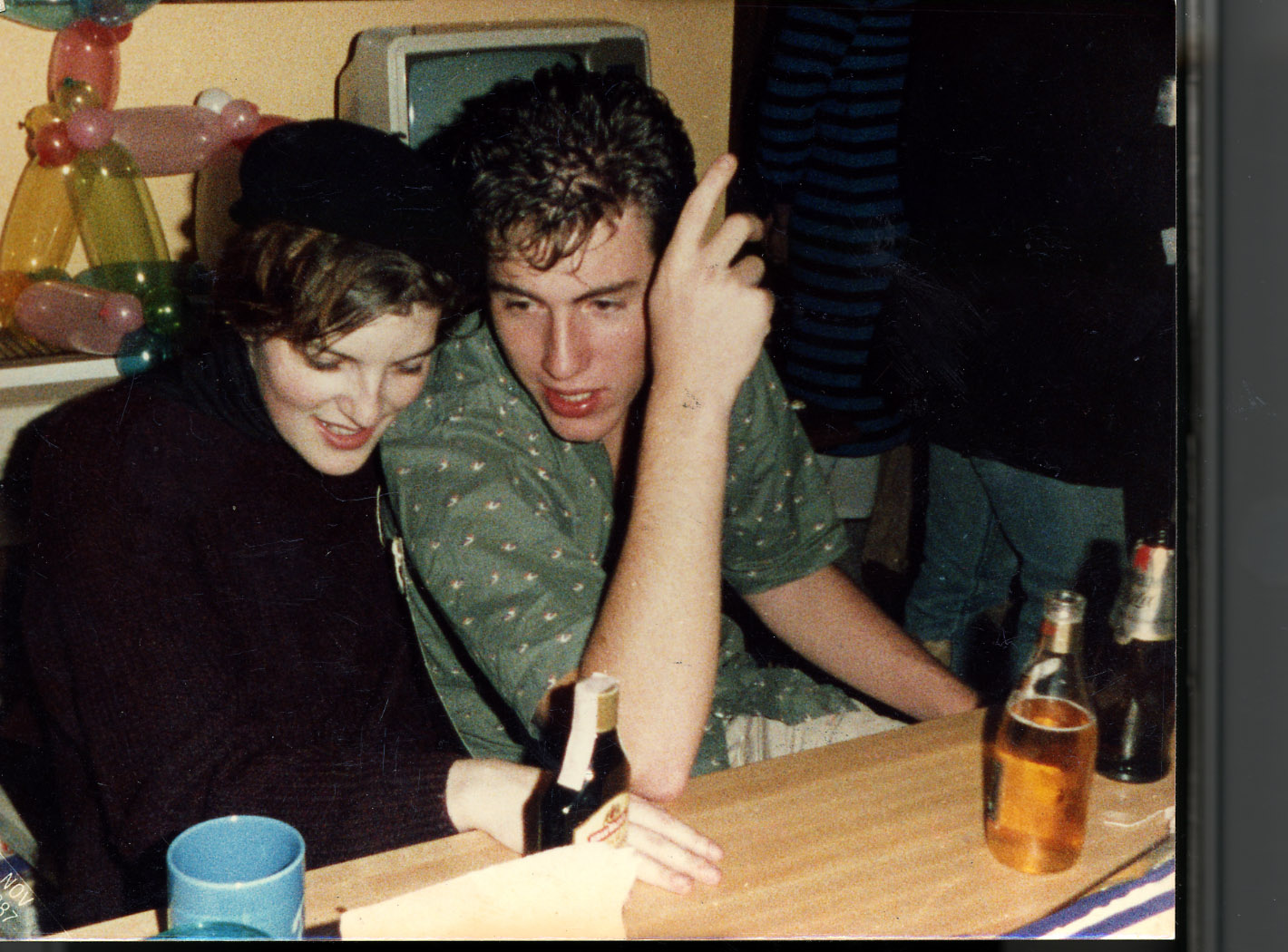
Costumes not so pristine now. I love that picture.
At that same party - my friends Jackie and Mitchell dressed up as Jackie's grandparents - who were FAMOUS to all of us. Chester and Millie. It was like one word. Chester and Millie, Chester and Millie. They died within days of one another. Truly devoted to each other. Anyway, as a tribute - Jackie and Mitchell dressed up (or should I say channeled) Millie and Chester. Here they are.
This is one of my favorite pictures of all time. Look at Mitchell's EYES! He is completely in character. I am also particularly amused by Jackie's mouth. Like: what is Millie saying to Chester? Is she calming him down? I hope so, cause he looks a little worried.

A year later, Mitchell and I joined forces and dressed up as Andy Warhol and Edie Sedgwick. Again, the expression on Mitchell's face in this photo KILLS me. He looks so bored, so arrogant, so OVER it.

A couple years after that - while we were living in Chicago - Mitchell and I got invited to a Halloween party. The whole Woody Allen-Soon Yi thing had just exploded, so we dressed up as Woody Allen and Mia Farrow. Please note that:
1. Mitchell is carrying Crime and Punishment
2. He is using photos of Geisha girls as a bookmark
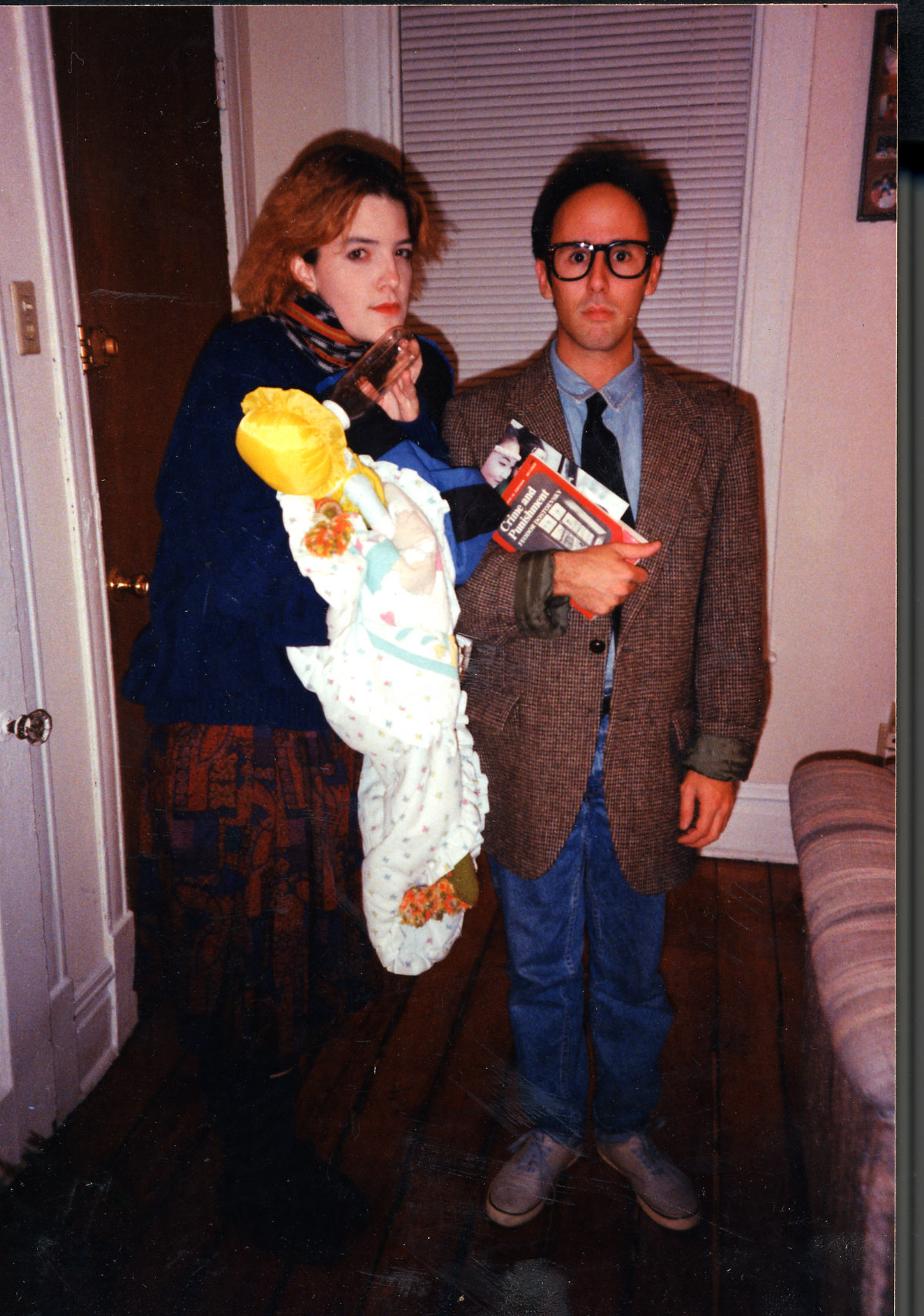
A couple years ago, I was invited to a Halloween party where we had to dress up as someone who was actually dead. A person from history, what have you.
I am going to hell. I have written "Helter Skelter" all over my arms and legs with red marker.

Here's the side view of my pregnant belly as I dance with Jackie Kennedy and Mrs. Al Capone. God forgive me. More hellatious fires licking at my heels.
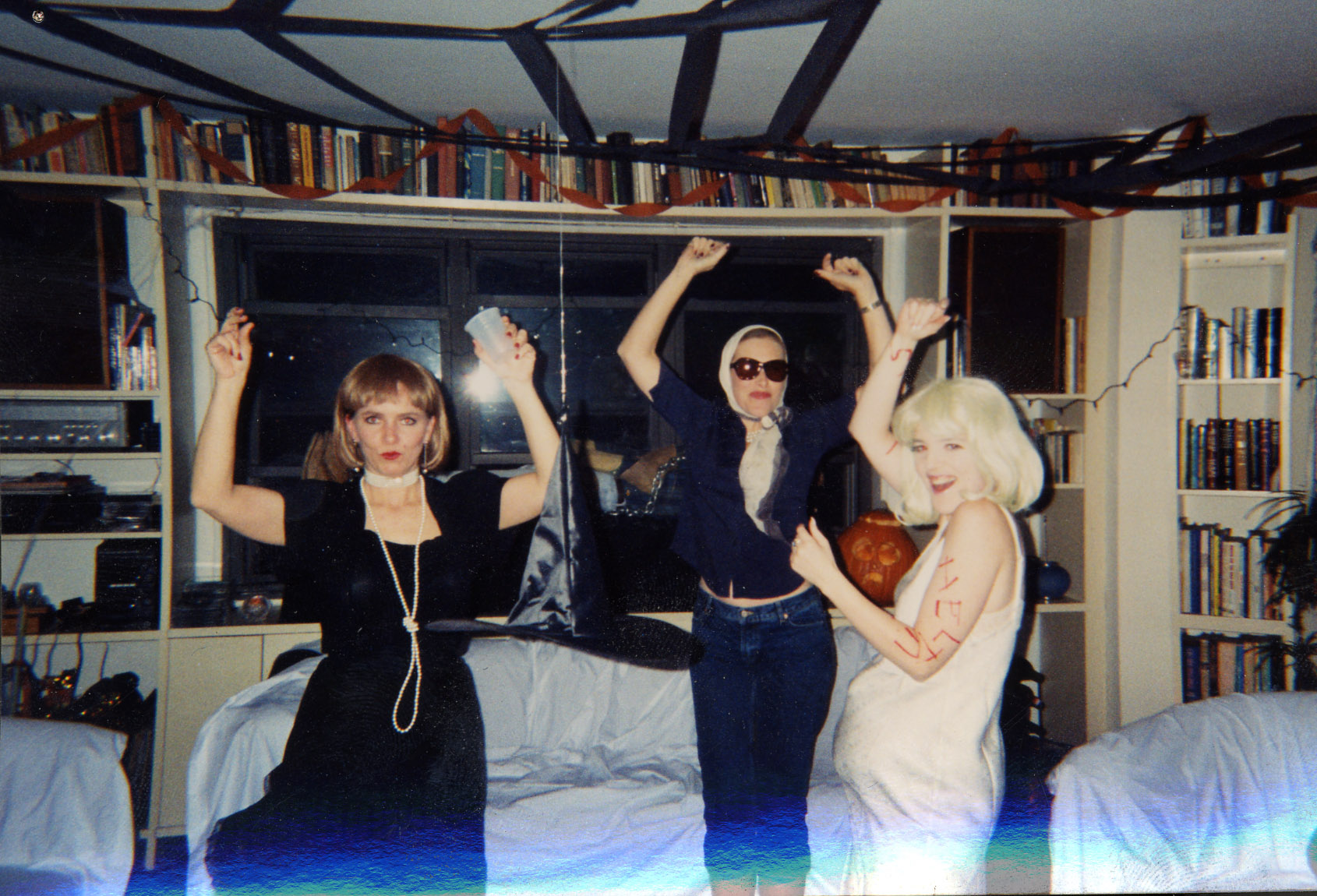
I think my favorite costume I ever came up with, though, was when I was Squeaky Fromme. I don't have any pictures of it. I was living in San Francisco at the time. But I thought that was my funnest costume ever.
Happy birthday, John Keats!
Keats was born on this day in London, 1795. "Ode to Autumn" is perhaps my favorite of his - but today, for his birthday, I will post: "Ode on Melancholy". And below the poem are a bunch of compiled quotes - from Keats and about Keats. He brings up strong reactions in people. Many adore, many think something is lacking ... but all give him the props. I particularly love the quote I found from Robert Graves.
Ode on Melancholy
1.
No, no, go not to Lethe, neither twist
Wolfs-bane, tight-rooted, for its poisonous wine;
Nor suffer thy pale forehead to be kiss'd
By nightshade, ruby grape of Proserpine;
Make not your rosary of yew-berries,
Nor let the beetle, nor the death-moth be
Your mournful Psyche, nor the downy owl
A partner in your sorrow's mysteries;
For shade to shade will come too drowsily,
And drown the wakeful anguish of the soul.
2.
But when the melancholy fit shall fall
Sudden from heaven like a weeping cloud,
That fosters the droop-headed flowers all,
And hides the green hill in an April shroud;
Then glut thy sorrow on a morning rose,
Or on the rainbow of the salt sand-wave,
Or on the wealth of globed peonies;
Or if thy mistress some rich anger shows,
Emprison her soft hand, and let her rave,
And feed deep, deep upon her peerless eyes.
3.
She dwells with Beauty - Beauty that must die;
And Joy, whose hand is ever at his lips
Bidding adieu; and aching Pleasure nigh,
Turning to poison while the bee-mouth sips:
Ay, in the very temple of Delight
Veil'd Melancholy has her sovran shrine,
Though seen of none save him whose strenuous tongue
Can burst Joy's grape against his palate fine;
His soul shall taste the sadness of her might,
And be among her cloudy trophies hung.

"One song of Burns is of more worth to you than all I could think of for a whole year in his native country. His Misery is a dead weight on the nimbleness of one's quill ... he talked with Bitches, he drank with blackguards, he was miserable. We can see horribly clear in the works of such a Man his whole life, as if we were God's spies." -- John Keats on Robert Burns
"Shelley was a volatile creature of air and fire: he seems never to have noticed what he ate or drank, except sometimes as a matter of vegetarian principle. Keats was earthy, with a sweet tooth and a relish for spices, cream and snuff, and in a letter mentions peppering his own tongue to bring out the delicious coolness of claret. When Shelley in Prometheus Unbound mentions: "The yellow bees in the ivy-bloom", he does not conjure up, as Keats would have done, the taste of the last hot days of the dying English year, with over-ripe blackberries, ditches full of water, and the hedges grey with old man's beard. He is not aware of the veteran bees whirring their frayed wings or sucking rank honey from the dusty yellow blossoms of the ivy." -- Robert Graves
"On the whole, I do not like Keats. His poems are, in reality, too full of beauty. One feels stifled in roses ... There is little in Keats' poems except luscious beauty -- so much of it that the reader is surfeited." -- L.M. Montgomery
"These are the pure Magic. These are the clear vision. The rest is only poetry." -- Rudyard Kipling on John Keats and Samuel Coleridge
"He'd planned to become a surgeon, but he realized his real vocation was poetry, and in the spring of 1818, he published his first major long poem Endymion. And then he set out on a hike through the countryside with his friend Charles Brown. Wordsworth was one of Keats's favorite poets, and he knew that Wordsworth had been inspired by walking around England, so Keats decided to do the same that summer.
Keats was a London boy. He had never seen the mountains. He had never seen a waterfall. He wrote letters back to his brother about the wonderful things that he saw, but gradually on his hike he realized he was no Wordsworth, that he did not want to write about scenery. He hated descriptions. He was more interested in the people whom he saw along the way. He was fascinated by the peasants who walked barefoot on the roads, carrying their shoes and stockings so they would look nice when they got to town. He saw an old woman being carried along the road in a kind of a cage like a dog kennel, smoking a pipe.
He came back to London and learned that the reviews of his last book of poetry, Endymion, were coming in and critics had written ferocious attacks on him. He was crushed. And his brother had come down with a serious case of tuberculosis. His brother died in December, and by the end of that year, John Keats had contracted tuberculosis himself. He would die three years later, in 1821. It was in those last three years of his life that he wrote most of his greatest poems." -- Garrison Keillor
"He ramped through [Spenser's[ Fairie Queen ... like a young horse turned into a Spring meadow." -- Cowden Clarke, a friend of Keats
"The imagery he chose was predominantly sexual. Poetry for him was not a philosophical theory, as it was for Shelley, but a moment of physical delirium." -- Robert Graves
"... miserable self-polluter of the human mind."-- Shelley
"I look upon fine phrases as a lover." -- John Keats
"Keats as a poet is abundantly and enchantingly sensuous, but the question with some people will be, whether he is anything else." -- Matthew Arnold
"The three great narratives, rich in detail, idealized characterization, and gothic elements, inspired poets, painters and musicians later in the century. The Pre-Raphaelites in particular drew sustenance from them. 'The Eve of St. Agnes' radically reconfigures resources of tone and characterization that Keats adapted from Chaucer to Shakespeare. Romeo and Juliet was not far from his hand when he wrote the poem. And his phrasing owes Shakespeare a debt. Cymbeline suggests the way Madeline's bedchamber is made solid before our eyes. Keats does not imitate his masters: he has assimilated them. The odes - 'To a Nightingale,' 'On a Grecian Urn', 'To Autumn', and the lesser 'To Psyche' and 'On Melancholy' -- are incomparable. The charge that he 'lacked experience' is fatuous; nor are they 'merely sensuous'. They are the step beyond moral romance to the romance of feeling itself, feeling as subject, the 'true voice'." -- Michael Schmidt, "Lives of the Poets"
"I have loved the principle of beauty in all things." -- John Keats
" ... a sensuous mystic." -- Louis MacNeice
"Keats was short-sighted. He did not see landscapes as such, so he treated them as painted cabinets filled with interesting objects ... His habit was to allow his eye to be seduced from entire vision by particular objects ... He saw little but what moved: the curving, the wreathing, the slanting, the waving - and even then, it seems, not the whole object is in motion but only its edge, or highlight." -- Robert Graves
"Keats's yearning passion for the Beautiful is not a passion of the sensuous or sentimental poet. It is an intellectual and spiritual passion." -- Matthew Arnold
"Milton had an exquisite passion for what is properly, in the sense of ease and pleasure, poetical luxury, and with that, it appears to me, he would fair have been content, if he could, so doing, preserve his self-respect and feeling of duty performed." -- John Keats
This Grave
contains all that was Mortal
of a
Young English Poet
Who
on his Death Bed
in the Bitterness of his Heart
at the Malicious Power of his Enemies
Desired
these words to be engraved on his Tomb Stone
"Here lies One Whose Name was writ in Water."
-- Keats' epitaph
"Poetry should strike the reader as a wording of his own highest thoughts, and appear almost a remembrance." -- John Keats
More on John Keats' short life here
The Books: "Because They Wanted to" - 'The Wrong Stuff' (Mary Gaitskill)
Next book on my my adult fiction shelves :
 Because They Wanted to - - by Mary Gaitskill. This excerpt is from the last four-part story in the book (I could read a novel about this character - she's so well-drawn and touching and weird): "The Wrong Stuff". For the most part, Gaitskill does third-person narration - there are definitely exceptions, but the majority of her stuff has that distant voice. This one is first-person narration - and so much of first-person narration depends on the VOICE. And man, is the voice in this story arresting. I can't stop reading. It's a sad sad story - but it's not a sad voice (as you will see in the excerpt). The sadness comes unexpectedly - I don't mean to say that the character is unaware of her own sadness, and we, the reader, feel sad when she doesn't. No. She has her moments, moments of total blankness - when a guy she just screwed has left the apartment - and she says something about how it took her an hour to calm down. Not because of the sex but because of the loneliness in his wake. That kind of stuff. I'm going to excerpt the beginning of the story, just so you can see how the voice launches itself at us. It's funny, it's startling - almost scary in its aggression ... I am in love with the voice.
EXCERPT FROM Because They Wanted to - - by Mary Gaitskill - 'The Wrong Stuff'
Today the clerk in the fancy deli next door asked me how I was and I said, "I have deep longings that will never be satisfied." I go in there all the time, so I thought it was okay. But she frowned slightly and said, "Is it the weather that does it to you?" "No," I said, "it's just my personality." She aughed.
It's the kind of thing that I enjoy saying at the moment but that has a nasty reverb. I want it to be a joke, but I'm afraid it's not.
Last week a woman I have not spoken to for years called to tell me that someone I used to have sex with had died of a drug overdose. I was shocked to hear it, but not especially sorry. He'd had a certain fey glamour and a knack for erotic chaos that was both entertaining and horrible, but he was essentially an absurdly cruel, absurdly unhappy person, and I thought that, in the end, he was probably quite relieved to go. I had not seen him in ten years, and our association had been pornographic, loveless, and stupid. We had had certain bright moments of camaraderie and high jinks, but none of it justified the feelings I'd had for him. Even now he occasionally appears in my dreams - loving and tender, smiling as he hands me, variously, a candy bar, a brightly striped glass ball, a strawberry-scented candle. In one dream he grew wings and flew to South America with me clinging to his back, ribbons flying from our hair and feet.
"I know he hurt you," my friend said. "But I think he hurt himself a lot more."
"Yeah," I said. "He did."
When I got off the phone, I sat still for some moments. Then I got up and dressed for the party I was about to attend. It was a birthday party for an acquaintance, a self-described pro-sex feminist who had created a public niche for herself as a pornographer and talk-show guest. I put on a see-through blouse, a black bra, a tiny black skirt, high-heeled boots, and a ratty black wig i had found in the bargain bin of a used-clothing store.
I took a taxi to the party, and the driver, whom I had engaged in conversation, commented on my clothes. "I just wondered," he said, "why you're dressed so, well, so ... I mean ..."
"You mean like a slut?"
"Uh, yeah." He glanced in his rearview. "Not that I'm saying anything."
"It's okay," I said. "It's because I think it's fun. It's not a big scary sex thing. It's an enthusiastic, participatory kind of thing. Besides, I'm thirty-nine, and pretty soon I won't be able to do it anymore, because I'll be an old bag."
He nodded thoughtfully. "Well, that's cool," he said. "It's just that you don't seem like the type who needs the attention."
His comment was so touching that it made me feel maudlin, and feeling maudlin made me feel belligerent. "A guy I used to be involved with used to criticize me for not dressing slutty enough," I said. "He said I wasn't much of a girl. He'd probably like what I've got on, but the little jerk is dead now." I dug around in my bag for the fare. The driver's eyes flashed urgently in his rearview.
October 30, 2007
Just in time for Halloween
Edie Sedgwick. (Photo - and rambling quote from Patti Smith. Smith was quoted extensively in the book Edie - her memories of that whole time are vivid and very, uhm, Patty Smithian - only way I can put it. VERY specific)
And yeah. My age-old Halloween costume is still #1 in Google images, which I continue to find brilliantly hysterical. People looking for information on Edie have to get through ME and my bullshit FIRST. Ah, the Internet. I adore its absurdity.
"People ask me who was Baba, and I answer – Baba is who I'd like to be"
Me too. Wonderful interview with Edna O'Brien.
Excerpt from interview:
"I wrote The Country Girls in three weeks having blown the 50 quid advance. I was young, married with two small children, and whenever I met people, I was spouting poetry. I had this thing that writing was real – I mean other people's writing – literature, great literature, not rubbish. There's so much rubbish written now, so much garbage, and it's extolled. But writing was to me animate; it was real; it was as real as the people I knew."I only thought of one thing – the country, the landscape, my mother, the people I had left. Now I was dying to leave, this is not nostalgia, and I feel permanently, in life, quite isolated. I both belong very intensely to that place where I come from and I'm running from it still. So when I sat down to write, I was extremely emotional and yet the language is not emotional; it just came out. I didn't have to call on memory. To use the cliché – it wrote itself. And that is sometimes true for a first book.
"I knew there'd be a storm. I was accused of betraying my country, my locality, my sex. The nuns in my convent went bonkers with rage. But the books survived. I suppose that's what counts."
Hepburn, stage actress
A collection of letters and journals and scrapbooks from the estate of Katharine Hepburn has been donated to the NY Public Library. Awesome stuff - it all appears to deal with her career as a stage actress. And check out the slideshow of wonderful images.
Happy birthday to our second President
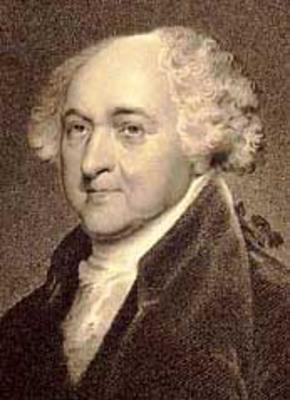
.. the often underappreciated (although never by the O'Malley family) John Adams.
Poor man. Anyone who came after George Washington would suffer by comparison. Gandhi could come after Washington and the collective historical record would respond with a "Eh." John Adams spent the rest of his life trying to reclaim some legacy for himself - but the Alien & Sedition Act kind of cast a shadow over everything (that lasts to this day - I have heard people bring it up NOW as a way to discount all the amazing things he did. HA.)
I love John Adams BECAUSE of his flaws. I love him for his brilliance, and his dedication - I love him for his relationship wtih Abigail - and I love the two of them for being so FREE in their correspondence with one another so that we, centuries later, can read their letters and get to know them both. I love him for defending the British soldiers in the aftermath of the Boston massacre in 1770. It gives me a chill - his ability to detach, his ability to see the larger picture. In later years, Adam said that that controversial act of his was one of the things he was most proud of. That, to me, says so much about who this man was. John Adams said that this new nation should be a government "of laws, not of men". Of course, he was a lawyer, so he WOULD say that ... but by defending the redcoats - and by WINNING - he took a stand on the side of law and order against the mob. Even though he agreed with the sentiments of the mob. Extraordinary. It was the same thing as Alexander Hamilton (Adams' sworn enemy later on) lambasting the mobbing people on the college lawns in New York, clamoring for the head of the President - known to be pro-British. Hamilton was a revolutionary by this point - and totally not pro-British - but mob violence was not the way to go, and he stood on the steps of the college and shouted at the mob to disperse. Amazing.
I love him for his fragile ego. I love him for his capacity to get his feelings hurt. Until the end of his life - he maintained that capacity. How many people get burnt by certain events along the way ... and close themselves off to future hurts? He never did. He remained juicy, alive ... read his letters back and forth to Jefferson at the very end. He is boisterous, fearless ... and then, at times, reflective, contemplative.
I love his nervousness about his own legacy and how he kind of had a sense that he would not get the props he felt he deserved (uhm ... quoting Eminem in a John Adams post, Sheila?)
I love him for his reliance on Abigail.
I love those damn LETTERS.
I love that the Constitution of Massachusetts - written by him (completed in 1779) is the oldest functioning written constitution in the world. Go, John.
Anyway. My affection for him knows no bounds. I suppose part of it has to do with the fact that he was a Bostonian - and that I have family who live in Quincy - so every time we would go to Thanksgiving dinner at their house, we would pass by the Adams homestead. He's not a historical figure. He's almost like a family member - that everyone passes on stories about. It seems like he is actually remembered. Growing up with a Boston family makes you feel like the Adams family is still alive, present, pulsing in the air around you, absorbed into the cobblestones where they walked ...
They are not dead. Not really. They are in the air we breathe, they are all around us still.
Happy birthday, John Adams. Thank you, thank you.
Here's a quote-fest from Adams ... The dude was so quotable. If you haven't read his letters (to his wife, and also the collection of letters between Adams and Jefferson) - I can't recommend them highly enough.
JOHN ADAMS QUOTE FEST ... Okay, I just threw these in hastily - these are my favorites - sorry about how the formatting is different - with some blockquotes, some not - whatever - I don't have time to iron that all out. It's the quotes that matter.
Enjoy!!!
-- "In my many years I have come to a conclusion that one useless man is a shame, two is a law firm, and three or more is a congress." (hahahahaha)
-- "If the way to do good to my country were to render myself popular, I could easily do it. But extravagant popularity is not the road to public advantage." -- John Adams, after becoming President by only three votes
-- "I never shall shine, 'til some animating occasion calls forth all my powers." -- John Adams, 1760
-- "The story of B. Bicknal's wife is a very clever one. She said, when she was married she was very anxious, she feared, she trembled, she could not go to bed. But she recollected she had put her hand to the plow and could not look back, so she mustered up her spirits, committed her soul to God and her body to B. Bicknal and into bed she leaped -- and in the morning she was amazed, she could not think for her life what it was that had so scared her." -- Journal entry of John Adams
-- Adams' description of the first meeting of the Continental Congress, in 1774 - in a letter to Abigail:
"This assembly is like no other that ever existed. Every man in it is a great man -- an orator, a critic, a statesman, and therefore every man upon every question must show his oratory, his criticism, his political abilities. The consequence of this is that business is drawn and spun out to immeasurable length. I believe if it was moved and seconded that we should come to a resolution that three and two make five, we should be entertained with logic and rhetoric, law, history, politics, and mathematics concerning the subject for two whole days, and then we should pass the resolution unanimously in the affirmative."
hahahahaha
-- "If we finally fail in this great and glorious contest, it will be by bewildering ourselves in groping for the middle way." -- John Adams
-- "It has been the will of Heaven that we should be thrown into existence at a period when the greatest philosophers and lawgivers of antiquity would have wished to live ... a period when a coincidence of circumstances without example has afforded to thirteen colonies at once an opportunity of beginning government anew from the foundation and building as they choose. How few of the human race have ever had an opportunity of choosing a system of government for themselves and their children? How few have ever had anything more of choice in government than in climate?" -- John Adams
-- "Is there no way for two friendly souls to converse together, although the bodies are 400 miles off. Yes, by letter. But I want a better communication. I want to hear you think, or to see your thoughts. The conclusion of your letter makes my heart throb more than a cannonade would. You bid me burn your letters. But I must forget you first." -- John Adams to Abigail - amazing. Romantic. Moving. "But I must forget you first."
-- "Thanks to God that he gave me stubbornness when I know I am right." -- John Adams
-- "In general, our generals were outgeneralled." -- John Adams' comment after the disastrous battle on Long Island
-- "He means well for his country, is always an honest man, often a wise man, but sometimes and in some things, absolutely out of his senses." -- Ben Franklin, 1783, about John Adams (in a letter to Robert Livingston)
-- "I must study politics and war that my sons may have liberty to study mathematics and philosophy. My sons ought to study mathematics and philosophy, geography, natural history, naval architecture, navigation, commerce, and agriculture in order to give their children a right to study paintings, poetry, music, artchitecture, statuary, tapestry, and porcelain." -- John Adams
-- "You are afraid of the one, I, the few. We agree perfectly that the many should have full, fair, and perfect representation [in the House]. You are apprehensive of monarchy; I, of aristocracy. I would therefore have given more power to the President and less to the Senate." -- John Adams to Thomas Jefferson
-- "Gentlemen, I feel a great difficulty how to act. I am Vice President. In this I am nothing, but I may be everything." -- John Adams
-- John Adams to Jonathan Sewall, July 1774:
"Swim or sink, live or die, survive or perish, [I am] with my country. You may depend upon it."
-- Thomas Jefferson, remembering John Adams' speeches at the Continental Congress:
"John Adams was our Colossus on the floor. He was not graceful nor elegant, nor remarkably fluent but he came out occasionally with a power of thought and expression, that moved us from our seats."-- John Adams, in a letter to Jefferson, 1812:
"Whether you or I were right posterity must judge. I never have approved and never can approve the repeal of taxes, the repeal of the judiciary system, or the neglect of the navy. Checks and balances, Jefferson, however you and your party may have ridiculed them, are our only security."
-- John Adams, in a July 3, 1776 letter to Abigail, after the signing of the Declaration of Independence on July 2:
The Delay of this Declaration to this Time, has many great Advantages attending it. ? The Hopes of Reconciliation, which were fondly entertained by Multitudes of honest and well meaning tho weak and mistaken People, have been gradually and at last totally extinguished. ? Time has been given for the whole People, maturely to consider the great Question of Independence and to ripen their Judgments, dissipate their Fears, and allure their Hopes, by discussing it in News Papers and Pamphletts, by debating it, in Assemblies, Conventions, Committees of Safety and Inspection, in town and County Meetings, as well as in private Conversations, so that the whole People in every Colony of the 13, have now adopted it, as their own Act. ? This will cement the Union, and avoid those Heats, and perhaps Convulsions which might have been occasioned, by such a Declaration Six Months ago.But the Day is past. The Second Day of July 1776, will be the most memorable Epocha, in the History of America. ? I am apt to believe that it will be celebrated, by succeeding Generations, as the great anniversary Festival. It ought to be commemorated, as the Day of Deliverance by solemn Acts of Devotion to God Almighty. It ought to be solemnized with Pomp and Parade, with Shews, Games, Sports, Guns, Bells, Bonfire and Illuminations from one End of this Continent to the other from this Time forward forever more.
You will think me transported with Enthusiasm, but I am not. I am well aware of the Toil, and Blood, and Treasure that it will cost Us to maintain this Declaration, and support and defend these States. Yet, through all the Gloom, I can see the Rays of ravishing Light and Glory. I can see that the End is more than worth all the Means, and that Posterity will triumph in that Day's Transaction, even though We should not rue it, which I trust in God We shall not.
-- John Adams, in a 1793 letter, responding to the revolution in France:
"Mankind will in time discover that unbridled majorities are as tyrannical and cruel as unlimited despots."
-- "I think instead of opposing systematically any administration, running down their characters and opposing all their measures, right or wrong, we ought to support every administration as far as we can in justice." -- John Adams
-- John to Abigail: Hartford May 2d 1775 - on his way down to Philadelphia. Adams is hoping that the disaster growing in Boston will bind the colonies together. That's eventually what happened, but at the time, he wasn't sure if it were a done deal.
"It is Arrogance and Presumption in human Sagacity to pretend to penetrate far into the Designs of Heaven. The most perfect Reverence and Resignation becomes us. But, I can't help depending upon this, that the present dreadfull Calamity of that beloved Town is intended to bind the Colonies together in more indissoluble Bands, and to animate their Exertions, at this great Crisis in the Affairs of Mankind. It has this Effect, in a most remarkable Degree, as far as I have yet seen or heard. It will plead, with all America, with more irresistible Perswasion, than Angells trumpet tongued.In a Cause which interests the whole Globe, at a Time, when my Friends and Country are in such keen Distress, I am scarecely ever interrupted, in the least Degree, by Apprehensions for my Personal Safety. I am often concerned for you and our dear Babes...
In case of real Danger, of which you cannot fail to have previous Intimations, fly to the Woods with our Children."
-- JOHN ADAMS, journal entry, 1770:
"Ambition is one of the more ungovernable passions of the human heart. The love of power is insatiable and uncontrollable.There is danger from all men. The only maxim of a free government ought to be to trust no man living with power to endanger the public liberty."
And lastly - one of my favorite Adams anecdotes. I love it because it came straight from his journal - so it's a first-person account - and it feels like I actually can hear Adams speaking, I can feel his humor, his emotions ... in a way that I never get with Jefferson or Washington - also great men, but just not personable writers. They had much more formality in their language. Adams had almost none, at least not in his journals and letters:
John Adams is sent as a delegate to France, to join Ben Franklin and Silas Deane (the stories of Silas Deane in France are hysterical - trying to be "undercover" - and yet barely speaking a word of French, etc.) Ben Franklin is living the high life (John Adams describes in his journal Franklin's leisurely schedule with haughty scorn). John Adams was more stern, more simple, more "republican", as he called it. He was talking as an anti-monarch.
Adams was overwhelmed by the politeness of the French, and by how eager they were to please the Americans. John Adams keeps all of his impressions of France, and the French people, in his journal, and in letters home to Abigail.
On his second or third night in France, he is at a dinner - and has the following exchange with a French woman, who asks him a particularly "brazen question". John Adams blushed his way through the conversation, not being used to women with open and free airs, but his ANSWER to her question - how he ANSWERS the French woman's question ... It kills me.
It's a perfect description of sexual chemistry.
John Adams' Journal, 1778 April 1 Wednesday
One of the most elegant Ladies at Table, young and handsome, tho married to a Gentleman in the Company, was pleased to Address her discourse to me. Mr. Bondfield must interpret the Speech which he did in these Words "Mr. Adams, by your Name I conclude you are descended from the first Man and Woman, and probably in your family may be preserved the tradition which may resolve a difficulty which I could never explain. I never could understand how the first Couple found out the Art of lying together?"
Whether her phrase was L'Art de se coucher ensemble, or any other more energetic, I know not, but Mr. Bondfield rendered it by that I have mentioned.
To me, whose Acquaintance with Women had been confined to America, where the manners of the Ladies were universally characterised at that time by Modesty, Delicacy and Dignity, this question was surprizing and shocking: but although I believe at first I blushed, I was determined not to be disconcerted. I thought it would be as well for once to set a brazen face against a brazen face and answer a fool according to her folly, and accordingly composing my countenance into an Ironical Gravity I answered her.
"Madame My Family resembles the First Couple both in the name and in their frailties so much that I have no doubt We are descended from that in Paradise. But the Subject was perfectly understood by Us, whether by tradition I could not tell: I rather thought it was by Instinct, for there was a Physical Quality in Us resembling the Power of Electricity or of the Magnet, by which when a Pair approached within a striking distance they flew together like the Needle to the Pole or like two Objects in Electrical Experiments."
When this Answer was explained to her, she replied, "Well I know not how it was, but this I know it is a very happy Shock."
I should have added "in a lawfull Way" after "a striking distance," but if I had her Ladyship and all the Company would only have thought it Pedantry and Bigottry.
Happy birthday, Mr. Adams, dear Mr. Adams. You are obnoxious and unpopular, it can't be denied ...
Or, another quote from 1776, a favorite musical (whoda guessed):
"SIT DOWN, JOHN
SIT DOWN, JOHN
FOR GOD'S SAKE JOHN, SIT DOWN!"
And for fun - here's the song lyrics to "But Mr. Adams" - where it is hashed out who will write the Declaration. Naturally, it is quite a self-serving story Adams told (he's the one who suggested Jefferson) - but still: SO funny. I love this song. I'm listening to it right now.
Franklin:
Mr. Adams, I say you should write it
To your legal mind and brilliance we defer
Adams:
Is that so? Well, if I'm the one to do it
They'll run their quill pens through it
I'm obnoxious and disliked, you know that, sir
Franklin:
Yes, I know
Adams:
So I say you should write it Franklin, yes you
Franklin:
Hell, no!
Adams:
Yes, you, Dr. Franklin, you
but, you, but, you, but
Franklin:
Mr. Adams, but, Mr. Adams
The things I write are only light extemporania
I won't put politics on paper; it's a mania
So I refuse to use the pen in Pennsylvania
Others:
Pennsylvania, Pennsylvania, refuse to use the pen
Adams:
Mr. Sherman, I say you should write it
You are never controversial as it were
Sherman:
That is true
Adams:
Whereas if I'm the one to do it
They'll run their quill pens through it
I'm obnoxious and disliked, you know that, sir
Sherman:
Yes, I do
Adams:
So I say you should write it, Sherman, yes you
Sherman:
Good heavens, no!
Adams:
Yes you, Roger Sherman, you
but, you, but, you, but
Sherman:
Mr. Adams, but, Mr. Adams
I cannot write with any style or proper etiquette
I don't know a participle from a predicate
I am just a simple cobbler from Connecticut
Others:
Connecticut, Connecticut, a simple cobbler he
Adams:
Mr. Livingston, maybe you should write it
You have many friends and you're a diplomat
Franklin:
Oh, that word!
Adams:
Whereas if I'm the one to do it
They'll run their quill pens through it
Others:
He's obnoxious and disliked; did you know that?
Livingston:
I hadn't heard
Adams:
So I say you should write it, Robert, yes you
Livingston:
Not me, Johnny!
Adams:
Yes you, Robert Livingston, you
but you but you but
Livingston:
Mr. Adams, dear Mr. Adams
I've been presented with a new son by the noble stork
So I am going home to celebrate and pop the cork
With all the Livingstons together back in old New York
Others:
New York, New York, Livingston's going to pop a cork
Jefferson:
Mr. Adams, leave me alone!
Adams:
Mr. Jefferson, dear Mr. Jefferson
I'm only 41; I still have my virility
And I can romp through Cupid's Grove with great agility
But life is more than sexual combustibility
Others:
Combustibility, combustibility, combustibili...
Jefferson:
Mr. Adams, damn you Mr. Adams
You're obnoxious and disliked; that cannot be denied
Once again you stand between me and my lovely bride
Oh, Mr. Adams, you are driving me to homicide!
Others:
Homicide, homicide, we may see murder yet!
BRILLIANT!
October 29, 2007
Culture Notes
-- Today is finally here. I thought it would never arrive. Britney's new album is now out. I am DYING to hear it. I am not even kidding.
-- Still working on Bleak House. I adore it, and actually shed tears over it a couple days ago. A touching reunion scene between Esther and her you-know-who. I have also laughed so loud in public while reading it that I scared passersby. Loving the book.
-- Thoughts on The Darjeeling Limited to come. I felt alone in my deep love for it - faced against the entire planet who did not like it - until I talked to Siobhan - she loved it, too.
-- Speaking of The Darjeeling Limited, I cannot get enough (literally) of the song that plays over the end credits: "Les Champs Elysees" - by Joe Dassin. A happier song you've never heard. It has the same effect on me that "Fields of Joy" by Lenny Kravitz has. I just feel little bursts of pure happiness throughout - why??? I don't know. I am now in the autistic phase of playing "Les Champs Elysees" over ... and over ... and over ... and over ...
-- Dear Simon Callow: when is volume 3 of your Orson Welles biography coming out?? Soon? I beg of you? You're a marvelous writer -volume 2 ends in 1948 - so we have quite a ways to go until "we will sell no wine before its time." GREAT accomplishment, Mr. Callow - it's stunning. More, please, more!!
-- Here's some photos of Dean Stockwell's collages and dice sculptures from his current show in Taos, New Mexico. He also has created (Stevie and I drooled over them) an entire Tarot card pack - original collages for each card - I think the whole set (arcana) was 1200 bucks - and they were fantastic!!!
-- Kate left me a message the other night. "So ... I am calling you from the ancien regime ..."
-- George Washington read the 101st Psalm? A series of awesome posts tracking down the source of the anecdote:
George Washington read the 101st Psalm
Another Version of Andrew Leavitt's Story
The Little Lady Who Started the Anecdote?
Meanwhile, Back in October 1775
Rev. Waldo and Gen. Washington
Another Washington's Psalm Legend
An unbelievable blog ... seriously!!
To quote Garrett Morris:
"Base-ah-ballz a-been veddy veddy good to me."
And very good to me, too!
Congrats, 2007 Red Sox. So exciting, and so well-deserved. (Beth's got the stats) It's been a helluva ride.

Uhm ... Youk? I get the sense you may be feeling a little ambivalent about the win. And I want to encourage you to come out of your shell, let your joy show a bit more openly. Thanks.
October 28, 2007
Henry James, Robert Louis Stevenson, Oscar Wilde ...
... and more in this wonderful post by Ms. Baroque, who may very well be my new favorite blogger. I love how she writes. I have heard a bit about the book she mentions (or one of them) - the Henry James, Oscar Wilde and Aesthetic Culture book and have been VERY curious to read it myself. I'm not a James fan, as I believe I have mentioned before - but i found the excerpt she posted from his journal after the famous failure ("failure" is putting it mildly) of his play - very very touching. Wow.
"There is a sucker ... born every minute!"
To Mitchell (whose birthday is tomorrow) - my circus-performer dear friend, heads up to you:
Wanted you to check out the following clip (it's about half an hour long, so settle in). Ernie Hilbert and Paul Fleming do a monthly show to accompany Ernie's incredibly popular poetry newsletter that he's been putting out since the dawn of time. It started out as an emailed newsletter (I've been receiving it for years) - and Ernie has recently segued into blogging and video (his newsletter - with a vibrant chatty brilliant audience - has morphed beautifully into these new forms - so cool). Once a month, Ernie and Paul sit down with a theme - say, baseball - or law - or vodka - and riff on that one theme. But to say "riff" is not completely correct, because the amount of research that goes into each one of these episodes is intense. For each theme, poems are compiled, trivia, movie clips, music clips ... Ernie's readership bombards him on a monthly basis with suggestions to go along with each upcoming theme. It's so much fun. Click around the website, you'll see how interesting it is, how much is there.
ANYWAY - preamble over. October's theme is "CIRCUS".
Ernie and Paul, seated at an ironing board with their sound equipment (because, you know, that's what you do), chat about Yeats, Monty Python, KISS, Chaplin ... the connecting thread in all of them being "circus". It's great stuff.
Mitchell (and others), you'll love it. Check it out!
Great night
-- Party up in Westchester at my friend and agent's house. It was her birthday.
-- I drove, yo!!
-- Picked up Jen - which meant I had to drive into Manhattan - my first trip (I mean, I've driven in New York before, but years ago) - and it was hysterical. LIke: UTTER. MADNESS. Of course I come out of the Lincoln Tunnel - and had to deal with the traffic swirl around Port Authority and then 8th Avenue ... The main thing to remember is that the lines painted on the avenues to delineate lanes are merely suggestions. There really ARE no lanes.
-- Off we went. Up the Saw Mill Parkway.
-- An hour out of the city - in the darkness and beauty of Westchester. The moon was so beautiful that I had to avoid looking at it because I thought I might drive off the road in ecstasy. Huge, glowing, golden - with mountains and valleys clearly seen from Planet Earth.
-- Jen and I haven't seen each other in a while (I haven't seen most of my friends in a while!! It's been a crazy month) - so we caught up on her trip to Dallas, her film, my trip to Taos, Dean Stockwell saying, "Hit the button eeasy ...", my new car, my writing, her teaching, the men in our lives, and basically life in general. All the while: LOOK AT ME DRIVING, YO.
-- You can't park in Barbara's driveway - because it's too short, and the road has no shoulder ... so she had arranged for us who were commuting up from the city to park our cars in an empty lot across from a church - and she had a huge limo/van service shuttle people back and forth the entire night. People were taking the Metro North up, too, from the city - so he also was engaged to go pick people up at the trains, etc. So Jen and I successfully find, in the middle of nowhere, the empty lot. It was a chilly autumn night. We had to just stand there and wait for the limo dude. It was night. Across the lot was a white picket fence and beyond it was an old country cemetery. It was so beautiful to be out in nature, especially with that spectacular moon soaring over everything! Jen and I spent our time waiting howling with laughter about our voice class, and our crazy wonderful teacher Nova - who has to be experienced to be believed. Snapping at a fellow student, in her operatic Southern accent: "Kara, you are gonna stop your whirlin' and you're gonna stop your twirlin'. That is not work, that is a nervous breakdown!"
-- A couple other cars pulled up - obviously Manhattanites who were also going to Barbara's party. Then finally: the huge van shows up. In we all get and off to the party.
-- Barbara and Dana (her husband) have a gorgeous house surrounded by woods. Jack-o-lanters glimmered on the front porch. The party was already raging - and we walked into the warmest most wonderful atmosphere possible. Barbara - her hair platinum, long, fantastic - was greeting everyone - we were all just laughing and hugging - so excited! There was so much booze that it looked like a high school kegger. Barbara had put up signs everywhere: COATS THIS WAY. BEER IN FRIDGE. On the table was a huge spread of food. Also with signs: CHOCOLATE IS TOXIC TO DOGS. Molly (the dog) with an adorable yellow kerchief around her neck strolled around the party, padding by on her big fat paws, on a mission to eat anything that dropped from anyone's plate ANYWHERE. But remember: chocolate is toxic to dogs!!
-- Barbara is the kind of person who has dear friends from every phase of her life. There were people there who knew her when she was 6. Her childhood piano teacher was there. Her friends from publishing were there. Her actor friends were there. Her friends from church were there. I love people who maintain connections like that. I am similar ... and I feel really grateful. It's the old old friends who really have your back, who you never have to explain things to ... They're just THERE.
-- Barbara said to me and Jen, "There's someone in the living room you're going to want to see."
-- We made our way over there - and were absolutely GOBSMACKED - to see Shelagh standing there. Shelagh: who lives in Canada, one of my dearest friends ... Shelagh, whom I have to accept that I am only going to see once a year, IF THAT. Shelagh: who was supposed to be teaching in Canada at this very moment!! And yet: here she is! She had flown in - and asked Barbara to keep it a secret. Jen and I were out of our minds. WHAT? What are you DOING HERE????? It was so freakin' exciting!!! What a treat. I last saw Shelagh in May, I think ... she came to New York for a couple of days ... Anyway, it was SUCH a surprise - I am amazed at how well the secret was kept, and it just made the night. I mean, it would have been awesome anyway - but to get to spend a couple of hours with Shelagh was just so awesome. We were chatterbox motormouths - we sat on the stairway with our plates of food and drinks - and caught up like maniacs. I love Shelagh. God. Great great to actually SEE her.
-- There was a couple there who had been in a 5 car "pileup" on the damn Saw Mill Parkway on their way to the party. Some little old man had entered the parkway going south on the north side of the parkway. Terrifying. No one was seriously hurt - although 5 cars were pretty much totalled. And they still were at the party. I loved this woman - she was Miss Party Trick - and kept showing everyone all these crazy things - "Put two corks in your hand like this ... then go like this ... the trick is to switch the corks without having to blah blah blah ..." So at times you'd look around and see 15 people, in the kitchen, maneuvering corks through their twisted-up hands. It was awesome.
-- We drove back to the city eventually - Shelagh was staying in a B&B in the heart of Times Square - so she caught a ride back with us, which again - was such a treat!! We careened down the Saw Mill Parkway (having visions of the 5 car pileup floating through our brains) - catching up, gossiping, telling stories, reminiscing. And along the side of the Parkway - the entire way down - we saw probably, all told, 30 deer. They were everywhere. Huge groups of them, some of them were by themselves, some were nearly on the road - which was scary - but it was quite amazing to see. We were "over" them after about 10 minutes - because there were so many of them.
-- Oh, and I gotta give the props to Jen: who was "navigator". As Allison and I discovered on our trip to Ireland, it is extremely important to have a driver and a navigator. The driver must focus on her job. The navigator must calmly and unemotionally tell the driver what to do next. The navigator must never panic. Jen - who grew up in Westchester - and knows all of those parkways like the back of her hand - just let me know, calmly, "Okay, you're gonna want to get in the right lane soon ..." etc. Much appreciated. But all told: I was proud of my mad driving skillz.
-- Dropped Jen off, then dropped Shelagh off - but of course we had to sit in the car for a while, really catching up. God, God, it was so good to see her!!!!
-- Then, of course, after dropping her off - I thought: "Okay, I'll just go to the end of the block, take a right ... and make my way back to the Lincoln Tunnel." It was 1:30 in the morning. This meant I found myself smack-dab in the middle of Times Square ... which I perhaps would have wanted to save for when I am more at ease with the mad driving skillz - but there I was - nothing to do now but figure it out. The mayhem is difficult to describe. The crowds - the double parked cabs and limos - the pedestrians ruling the roost, the horse and buggies, the bikes, the throngs - My GOD, what a sight!! (Photo below) I remained calm, and got out of there as quickly as I could. Back to the Lincoln Tunnel, and finally back home.
-- I love my car.
-- Awesome night.

October 27, 2007
And so I ask you.
No, seriously, I ask you.
In the immortal words of Madonna:
What are you looking at??

Happy birthday, er, Sylvia Plath
"Death opened, like a black tree, blackly."
Today is Sylvia Plath's birthday.

That's a sketch she did of her own hands. She found drawing very relaxing. She would lose herself in it, and spent most of her honeymoon in Spain (a place she found almost unbearably upsetting - Ted Hughes, her husband, wrote a poem many years later called "You Hated Spain") - anyway, she spent most of her honeymoon huddled over a sketch pad. She drew the streets, the fruit baskets, the fishing boats. Was there pleasure in it for her? I don't know. I think it was a way to unhinge her brain for a moment, lose herself in the moment - where all she could do, all she was able to do, was just copy what she saw. She didn't have to find the right word, or struggle with the poetry muse ... she just had to sit down and copy what she saw. Ted Hughes wrote a poem, too, about her drawing.
I haven't yet written a real piece on Sylvia Plath - because I know when I finaly get to it, it'll be a doozy. It'll take me hours of research, and compiling quotes, and snippets, and poems, and yadda yadda. I need to have the time to invest. That's just the deal with certain topics - and Sylvia Plath is one of them.
In honor of the birthday of this eventually astonishing poet (she didn't start out that way, although she was certainly precocious - but NONE of her early work could prepare you for what her work became in the last 2 years of her life - it's like another PERSON came out of her ....) - I have dug up some wonderful old photographs of her. She was a chameleon. She was an all-American girl. She was a bleached blonde beach-blanket-bingo girl. She was an intense prodigy. She was a depressive who had survived a suicide attempt her junior year in college. She was the woman who married the big brash English outdoorsman, and suddenly found herself fishing, and hunting, and tromping through the woods in galoshes. Who was she? I have no idea. But you can take a look at all the photographs and see how startling are the transformations. This is not just about the passage of time, and someone looking different as they grew older ... this really seems to be about a shedding of selves (like she writes in Lady Lazarus, in one of my favorite lines: "my selves dissolving, old whores petticoats") -
I look at the picture of the bodacious blonde at the beach:

This was from her summer of recovery from her suicide attempt in college. She spent months in an institution - and then went back to Smith to finish out her education. When summer came - she bleached her hair. Her mother - the controlling prudish Aurelia Plath - and yes, there's enough information out there on this woman for me to feel completely comfortable labeling her as that - was shocked. She pretended to be supportive - but deep down, she wanted a conventional daughter. Well, sorry, Aurelia, ain't never gonna happen. Sylvia tormented herself trying to be conventional (many of her problems arose from what she felt was expected from her - as a daughter, as a wife, as a woman, in general) - and bleaching her hair was part of a necessary rebellion. Also, she started having sex. Left and right. Willy nilly. No more good 1950s girl. That "be a good girl" thing had nearly killed her. Her doctor at the time encouraged this rebellion, and taught her about birth control, so she could at least have sex safely. This was a revelation to Sylvia. She was a very sexual person, passionate, kind of wild actually - even with all that "ooh, I'm a poetic prodigy" thing - and you know, the thing is - any type of artist will always be on the fringe of polite society. If an artist tries desperately to fit in to some mainstream - if an artist really worries about what an uptight person thinks of how he or she lives ... then that artist just won't survive. The strict rules on women at that time were fetters around Sylvia's wrists. NOT CARING what people thought of her - was one of the biggest breakthroughs in her life. NOT CARING if people whispered, "She's a slut." And they did. Especially when she got to England on her Fulbright. Tapping into her REBEL, into her "I just don't care" persona ... was really important - but ultimately, it didn't matter at all. Because once she got married and once she had kids - these old conventional "roles" started constricting her again (she writes about it extensively in her poems) ... It seemed that there was an incompatability: between the poetess and the woman. Could she be a wife and ALSO a poet? What were the expectations of her? It did not help matters (although she might have thought it would) that she married not just another poet - but one of the most important up-and-coming poets in England - a man who eventually (years later) would be Poet Laureate. Like - Ted Hughes was a big deal. And he was on his way to becoming a big deal when Sylvia met him. How can two poets tryiing to make their names - live together? Was Sylvia expected to be a good 1950s wife? Ted Hughes insists (and he has also written extensively about it) that he did not expect that at all. When he first met Sylvia at a party - they both were drunk - and they basically found themselves in an empty room - making out ferociously. Sylvia bit his cheek so hard she drew blood. They were married 4 months later. THIS was their beginning. There was no nice good-girl 1950s courtship. They didn't go out for sodas and a drive-in. No. They were bohemians, for God's sake. They were poets. People like that don't live by society's rules, nor should they. (Especially if the rules are stupid.) But Ted, in some of his later poems, has described how baffled and hurt he was - after their marriage - when Sylvia suddenly got writer's block. She had writer's block for an agonizing year, year and a half - directly after their wedding. Hmmmm, coincidence? I think not. It seems apparent that Sylvia was so terrified of doing BETTER than her husband that ... everything shut down. She then tried to be the perfect housewife - and ... Ted, again, was hurt and confused by this. Where is that wild poetess? Where is my crazy American girl who shouts out lines of Chaucer to the cows? Why is she in the kitchen, tears running down her face, trying to bake pies? I mean ... what has happened??
Then I look at the picture of her with her two kids (taken a month or so before she committed suicide) -

Actually, I believe her mother took that photograph during her fateful visit to her daughter. Sylvia was living in England - and her husband Ted Hughes had just left her for another woman. Comparing that photograph to the blonde bikini one - it;s hard to believe it's the same person. Perhaps there's something similar in the smile - there's something phony in both smiles, to my eye. Anyway, I find it fascinating - perusing the photos of Sylvia Plath.
Not nearly as fascinating as her poems themselves which have never lost their power - no matter how times I have read them.
I have gone through a bunch of Plath phases - and I am sure I will go through more. I continue to re-visit her work, every couple of years ... and re-read all those 1960-1963 poems again - sometimes in order - sometimes muddling it up - and every single time, even though I always have different responses, and sometimes one poem suddenly seems THE BEST when a couple years before it was another poem that was obviously HER BEST - but anyway, every single time I read those poems from her last 3 years, they take my breath away. They're no picnic - they are bleak bleak bleak - especially if you read them chronologically. If you read them chronologically - you can feel herself get manic - in October of 62 - and she starts cranking out 2, 3, sometimes 4 poems a day. These were not pot-boilers, folks. These poems are now taught in colleges. These are the poems that would make her name. She wasn't just scribbling out insane manic fantasies - these are highly intricate, passionate, unbeLIEVable poems. Obviously manic - when you see how many she was putting out a day ... and then there is a brief falling away for a month - December ... she was still writing, but obviously it was the calm before the storm. Then January and February 1963 came along - and I believe it was the coldest winter London had ever had - and her pipes froze - and she had no help, and two young babies - and things started getting worse and worse in her mind. And her art kicked in yet again - with ferocity and power. She would write these poems at 4 in the morning - her only time to herself. So you can feel the wheels start cranking again - in January, February - she wrote some of her best poems then. They are more frightening, however, than the October poems. She is staring at death, she is beginning to embrace the idea of death ... Death is always a factor in Plath's poems, but it takes on a new form in those last couple of poems. It is no longer just a fantasy, death is no longer a dream-lover in the night ... she is now making plans. The rage of October (which gave us such poems as Daddy, and Poppies in October, and the entire fanTASTIC bee-keeping sequence) is now gone. And you can feel a chilling resolve creep into her work. She is getting ready to go.
I have interspersed the photos of Plath I found with some of my favorite of her poems.
I still need to do a big old Plath fest one day - I have too much to say about her, and need to get my thoughts together better.
In honor of her birthday, here's one that she actually wrote about her upcoming birthday - in 1962. She wrote this poem, now one of her most well-known, on Sept. 30 1962 ... right before the blast of creativity and rage that would fuel her through that painful next month. Sylvia always had a fatalistic thing with birthdays:
A Birthday Present
What is this, behind this veil, is it ugly, is it beautiful?
It is shimmering, has it breasts, has it edges?
I am sure it is unique, I am sure it is what I want.
When I am quiet at my cooking I feel it looking, I feel it thinking
'Is this the one I am too appear for,
Is this the elect one, the one with black eye-pits and a scar?
Measuring the flour, cutting off the surplus,
Adhering to rules, to rules, to rules.
Is this the one for the annunciation?
My god, what a laugh!'
But it shimmers, it does not stop, and I think it wants me.
I would not mind if it were bones, or a pearl button.
I do not want much of a present, anyway, this year.
After all I am alive only by accident.
I would have killed myself gladly that time any possible way.
Now there are these veils, shimmering like curtains,
The diaphanous satins of a January window
White as babies' bedding and glittering with dead breath. O ivory!
It must be a tusk there, a ghost column.
Can you not see I do not mind what it is.
Can you not give it to me?
Do not be ashamed--I do not mind if it is small.
Do not be mean, I am ready for enormity.
Let us sit down to it, one on either side, admiring the gleam,
The glaze, the mirrory variety of it.
Let us eat our last supper at it, like a hospital plate.
I know why you will not give it to me,
You are terrified
The world will go up in a shriek, and your head with it,
Bossed, brazen, an antique shield,
A marvel to your great-grandchildren.
Do not be afraid, it is not so.
I will only take it and go aside quietly.
You will not even hear me opening it, no paper crackle,
No falling ribbons, no scream at the end.
I do not think you credit me with this discretion.
If you only knew how the veils were killing my days.
To you they are only transparencies, clear air.
But my god, the clouds are like cotton.
Armies of them. They are carbon monoxide.
Sweetly, sweetly I breathe in,
Filling my veins with invisibles, with the million
Probable motes that tick the years off my life.
You are silver-suited for the occasion. O adding machine-----
Is it impossible for you to let something go and have it go whole?
Must you stamp each piece purple,
Must you kill what you can?
There is one thing I want today, and only you can give it to me.
It stands at my window, big as the sky.
It breathes from my sheets, the cold dead center
Where split lives congeal and stiffen to history.
Let it not come by the mail, finger by finger.
Let it not come by word of mouth, I should be sixty
By the time the whole of it was delivered, and to numb to use it.
Only let down the veil, the veil, the veil.
If it were death
I would admire the deep gravity of it, its timeless eyes.
I would know you were serious.
There would be a nobility then, there would be a birthday.
And the knife not carve, but enter
Pure and clean as the cry of a baby,
And the universe slide from my side.

That's a picture of Sylvia from 1953 - right before her first suicide attempt. She was living with her mother - and her mother made her take shorthand classes and typing classes (again: there is something evil about that. That very same attitude is why Barbra Streisand has always had such long nails. People laugh at those nails, or make fun of Babs for them ... but I see them, and I love them. Because to her - those nails meant freedom. Her mother was pretty much totally negative about Barbra's actual goals - she wanted to have a normal daughter - so she signed her up for typing classes. In rebellion, Babs grew her nails to extraordinary length so that even if she wanted to learn how to type - she couldn't. The nails got in the way. So when I see those nails now - on a 60 something year old woman - I smile. It's a reminder.) There is a story here - of the mother who truly DOESN'T love her daughter. She doesn't. Otherwise - she would love her for who she actually IS, not who she wants her to be. Aurelia Plath never got that. Sylvia, at the end of her life, was starting to come to terms with that. She writes, quite blatantly, in her journal, "I can never live near my mother again." And her mother comes to visit in Oct. 1962 - right after Ted has moved out - to be with Assia Wevill - the woman he was having an affair with - and Sylvia was absolutely tormented by having her mother see her in such a weak moment. To her, it was unforgivable. She wrote her poem "Medusa" about that experience - which is, you know, shocking in its hatred, and anger. But again: poets who live by society's rules and play well with others are usually not poets to be reckoned with. Sylvia coming to terms with her rage was part of her finding her voice.
"The Moon and the Yew Tree" was written in 1961 - and is considered a breakthrough - by those who have studied Plath's work. In it - she finds some of that cold clear eerie imagery - that she will write about until the very end. She looks out her window and sees a moon, a church, and a black yew tree. It is a beautiful image - and yet ... in the poem ... it becomes a harbinger. Of death, doom.
And personally - I think the first line of this poem is one of her best lines ever.
The moon and the yew tree
This is the light of the mind, cold and planetary
The trees of the mind are black. The light is blue.
The grasses unload their griefs on my feet as if I were God
Prickling my ankles and murmuring of their humility
Fumy, spiritous mists inhabit this place.
Separated from my house by a row of headstones.
I simply cannot see where there is to get to.
The moon is no door. It is a face in its own right,
White as a knuckle and terribly upset.
It drags the sea after it like a dark crime; it is quiet
With the O-gape of complete despair. I live here.
Twice on Sunday, the bells startle the sky ----
Eight great tongues affirming the Resurrection
At the end, they soberly bong out their names.
The yew tree points up, it has a Gothic shape.
The eyes lift after it and find the moon.
The moon is my mother. She is not sweet like Mary.
Her blue garments unloose small bats and owls.
How I would like to believe in tenderness ----
The face of the effigy, gentled by candles,
Bending, on me in particular, its mild eyes.
I have fallen a long way. Clouds are flowering
Blue and mystical over the face of the stars
Inside the church, the saints will all be blue,
Floating on their delicate feet over the cold pews,
Their hands and faces stiff with holiness.
The moon sees nothing of this. She is bald and wild.
And the message of the yew tree is blackness -- blackness and silence
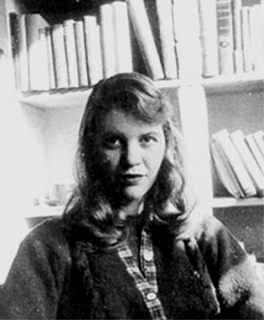
Little Fugue
The yew's black fingers wag:
Cold clouds go over.
So the deaf and dumb
Signal the blind, and are ignored.
I like black statements.
The featurelessness of that cloud, now!
White as an eye all over!
The eye of the blind pianist
At my table on the ship.
He felt for his food.
His fingers had the noses of weasels.
I couldn't stop looking.
He could hear Beethoven:
Black yew, white cloud,
The horrific complications.
Finger-traps--a tumult of keys.
Empty and silly as plates,
So the blind smile.
I envy big noises,
The yew hedge of the Grosse Fuge.
Deafness is something else.
Such a dark funnel, my father!
I see your voice
Black and leafy, as in my childhood.
A yew hedge of orders,
Gothic and barbarous, pure German.
Dead men cry from it.
I am guilty of nothing.
The yew my Christ, then.
Is it not as tortured?
And you, during the Great War
In the California delicatessen
Lopping off the sausages!
They colour my sleep,
Red, mottled, like cut necks.
There was a silence!
Great silence of another order.
I was seven, I knew nothing.
The world occurred.
You had one leg, and a Prussian mind.
Now similar clouds
Are spreading their vacuous sheets.
Do you say nothing?
I am lame in the memory.
I remember a blue eye,
A briefcase of tangerines.
This was a man, then!
Death opened, like a black tree, blackly.
I survive the while,
Arranging my morning.
These are my fingers, this my baby.
The clouds are a marriage of dress, of that pallor.
The Bee Meeting (this is one of the poems in her famous "bee sequence" - which she cranked out at 1 or 2 a day, during October of 1962.)
Who are these people at the bridge to meet me? They are the villagers ---
The rector, the midwife, the sexton, the agent for bees.
In my sleeveless summery dress I have no protection,
And they are all gloved and covered, why did nobody tell me?
They are smiling and taking out veils tacked to ancient hats.
I am nude as a chicken neck, does nobody love me?
Yes, here is the secretary of bees with her white shop smock,
Buttoning the cuffs at my wrists and the slit from my neck to my knees.
Now I am milkweed silk, the bees will not notice.
They will not smell my fear, my fear, my fear.
Which is the rector now, is it that man in black?
Which is the midwife, is that her blue coat?
Everybody is nodding a square black head, they are knights in visors,
Breastplates of cheesecloth knotted under the armpits.
Their smiles and their voces are changing. I am led through a beanfield.
Strips of tinfoil winking like people,
Feather dusters fanning their hands in a sea of bean flowers,
Creamy bean flowers with black eyes and leaves like bored hearts.
Is it blood clots the tendrils are dragging up that string?
No, no, it is scarlet flowers that will one day be edible.
Now they are giving me a fashionable white straw Italian hat
And a black veil that molds to my face, they are making me one of them.
They are leading me to the shorn grove, the circle of hives.
Is it the hawthorn that smells so sick?
The barren body of hawthon, etherizing its children.
Is it some operation that is taking place?
It is the surgeon my neighbors are waiting for,
This apparition in a green helmet,
Shining gloves and white suit.
Is it the butcher, the grocer, the postman, someone I know?
I cannot run, I am rooted, and the gorse hurts me
With its yellow purses, its spiky armory.
I could not run without having to run forever.
The white hive is snug as a virgin,
Sealing off her brood cells, her honey, and quietly humming.
Smoke rolls and scarves in the grove.
The mind of the hive thinks this is the end of everything.
Here they come, the outriders, on their hysterical elastics.
If I stand very still, they will think I am cow-parsley,
A gullible head untouched by their animosity,
Not even nodding, a personage in a hedgerow.
The villagers open the chambers, they are hunting the queen.
Is she hiding, is she eating honey? She is very clever.
She is old, old, old, she must live another year, and she knows it.
While in their fingerjoint cells the new virgins
Dream of a duel they will win inevitably,
A curtain of wax dividing them from the bride flight,
The upflight of the murderess into a heaven that loves her.
The villagers are moving the virgins, there will be no killing.
The old queen does not show herself, is she so ungrateful?
I am exhausted, I am exhausted ---
Pillar of white in a blackout of knives.
I am the magician's girl who does not flinch.
The villagers are untying their disguises, they are shaking hands.
Whose is that long white box in the grove, what have they accomplished, why am I cold.
Fever 103 (another Oct. 1962 poem)
Pure? What does it mean?
The tongues of hell
Are dull, dull as the triple
Tongues of dull, fat Cerebus
Who wheezes at the gate. Incapable
Of licking clean
The aguey tendon, the sin, the sin.
The tinder cries.
The indelible smell
Of a snuffed candle!
Love, love, the low smokes roll
From me like Isadora's scarves, I'm in a fright
One scarf will catch and anchor in the wheel.
Such yellow sullen smokes
Make their own element. They will not rise,
But trundle round the globe
Choking the aged and the meek,
The weak
Hothouse baby in its crib,
The ghastly orchid
Hanging its hanging garden in the air,
Devilish leopard!
Radiation turned it white
And killed it in an hour.
Greasing the bodies of adulterers
Like Hiroshima ash and eating in.
The sin. The sin.
Darling, all night
I have been flickering, off, on, off, on.
The sheets grow heavy as a lecher's kiss.
Three days. Three nights.
Lemon water, chicken
Water, water make me retch.
I am too pure for you or anyone.
Your body
Hurts me as the world hurts God. I am a lantern ---
My head a moon
Of Japanese paper, my gold beaten skin
Infinitely delicate and infinitely expensive.
Does not my heat astound you. And my light.
All by myself I am a huge camellia
Glowing and coming and going, flush on flush.
I think I am going up,
I think I may rise ---
The beads of hot metal fly, and I, love, I
Am a pure acetylene
Virgin
Attended by roses,
By kisses, by cherubim,
By whatever these pink things mean.
Not you, nor him.
Not him, nor him
(My selves dissolving, old whore petticoats) ---
To Paradise.

The Couriers (written in Nov. 1962)
The word of a snail on the plate of a leaf?
It is not mine. Do not accept it.
Acetic acid in a sealed tin?
Do not accept it. It is not genuine.
A ring of gold with the sun in it?
Lies. Lies and a grief.
Frost on a leaf, the immaculate
Cauldron, talking and crackling
All to itself on the top of each
Of nine black Alps.
A disturbance in mirrors,
The sea shattering its grey one -
Love, love, my season.

I think the following poem is the saddest she ever wrote. Now who can ever say what is in the mind of another - and it is always a dangerous thing to read too much into these poems (at least in a biographical way). They are, after all, art. But I believe that one of the reasons she killed herself is to spare her children a mother whose face was "a ceiling without a star". Not that that excuses her actions. But she wrote this poem in January of 1963, 2 weeks before she put her head in the oven. I find this poem nearly unreadable in its sadness. Yet - wonderful writing as well.
Child
Your clear eye is the one absolutely beautiful thing.
I want to fill it with color and ducks,
The zoo of the new
Whose names you meditate ---
April snowdrop, Indian pipe,
Little
Stalk without wrinkle,
Pool in which images
Should be grand and classical
Not this troublous
Wringing of hands, this dark
Ceiling without a star.
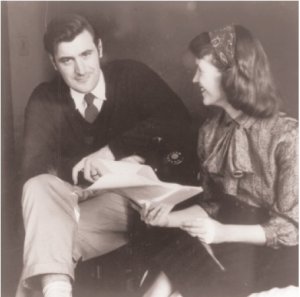
Sylvia Plath and Ted Hughes - newlyweds. Happier days. What a gorgeous couple they were.
And this is the last poem that Sylvia Plath completed. It's chilling, yes, but standing alone - as a poem - I think there's a lot to talk about here, a lot of stuff - not just biographical.
And I'm sorry - but the line "her blacks crackle and drag" is ... I mean, it's just fantastic genius-level imagery with major staying power, that's all. "Her blacks crackle and drag." (And yes ... let me just throw a shout-out to Paul Westerberg - who has also recognized the genius imagery in that line.) It's scary. "Crackle"? "Drag?" All kinds of very frightening images come to mind in those two simple words ... and the internal rhyme of "blacks" and "crackle" make it seem even more eerie. I'm not a literary critic but I will NEVER be done reading this last poem. She completed it on February 4, 1963. She killed herself on February 11.
Edge
The woman is perfected.
Her dead
Body wears the smile of accomplishment,
The illusion of a Greek necessity
Flows in the scrolls of her toga,
Her bare
Feet seem to be saying:
We have come so far, it is over.
Each dead child coiled, a white serpent,
One at each little
Pitcher of milk, now empty.
She has folded
Them back into her body as petals
Of a rose close when the garden
Stiffens and odors bleed
From the sweet, deep throats of the night flower.
The moon has nothing to be sad about,
Staring from her hood of bone.
She is used to this sort of thing.
Her blacks crackle and drag.
Let us not do a disservice to this great artist and see her only in terms of her self-inflicted end. Let us look at her art, please. Let us focus on that. If we can remove the context of her life from the poems; what is left? What do we see? What about those words, huh? What about her WORK?
Other posts I have written about Plath:
The so-called villainy of Ted Hughes
Plath's writer's block of 1959-1960
My good friend RTG took Plath obsession to a new level - Here's a post she wrote about it ... and another one ... We maintain a fantasy that one day we will meet up at the Lilly Library to go through Plath's papers together. It will happen!!
October 26, 2007
Today in History: October 26, 1776
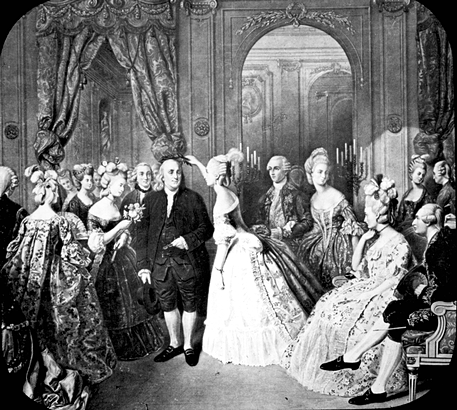
On October 26, 1776, Benjamin Franklin set off on a diplomatic mission across the Atlantic - to get the French governments financial backing for the Revolution. As is well-known, he was a huge HIT with the French (that's him in the royal court above) ... and he wore little fur caps which became all the rage - and there was a certain breath of freedom and independence in his attitude which really appealed to the French. This was not an easy mission for Franklin. France was still a monarchy. I mean, it only had a couple years to go before heads began to roll (ahem), but it was, in 1776, still a monarchy - and so wasn't too wacky about supporting this "experiment" in democracy across the water. However, wouldn't it be fun to stick it to the Brits??? Benjamin Franklin's success in France is now widely recognized as one of the main reasons that we were able to win the war at all. Not only did he win support for his cause - but he also won over the hearts and minds of the French people. He loved it - he loved the wining, the dining, the free and easy ways of the rich French ladies - he was a social animal. He became the darling of the artistocratic set.
A wonderful example of how he operated is here, in this perhaps apocryphal story (I love how many anecdotes about Franklin are 'perhaps apocryphal'):
During his sojourn in France - Franklin, always the ladies man, was playing chess with the Duchess of Bourbon, and she didn't really know what she was doing, or how to play. She placed her king in check. Franklin, not following the rules either (but he KNEW he wasn't following the rules) captured her king. She knew enough of chess to know that this was not right and scolded him. She said, "In France we do not take kings."
Franklin replied, "We do in America."
Ba dum CHING.
But today was the day that his ship sailed.
Here's an excerpt from The First American - something which, I think, gives great perspective on the enormity of what Franklin was attempting - just on a personal level:
For a man of seventy, suffering from gout and assorted lesser afflictions, to leave his home in the middle of a war, to cross a wintry sea patrolled by enemy warships where commanders could be counted on to know him even if they knew nary another American face, was no small undertaking. John Adams declined nomination in Franklin's commission; Thomas Jefferson rebuffed election. Yet Franklin had made his decision that America must be free, and he was determined to pay whatever cost his country required. "I have only a few years to live," he told Benjamin Rush, "and I am resolved to devote them to the work that my fellow citizens deem proper for me; or speaking as old-clothes dealers do of a remnant of goods, 'You shall have me for what you please.'"
And about the voyage itself:
The passage from America to France was "short but rough," in Franklin's contemporary account. His ship, the Reprisal, had been hastily pressed into the service of the fledgling United States navy, and though it was fast enough to capture two British merchantmen en route, it was hardly suited to the comfort of passengers. It pitched violently for nearly the whole of the thirty-day run, allowing Franklin hardly a night's - or day's - decent rest. The food was poor; he had to rely on salt beef because the chickens served were too tough for his teeth. His boils and rashes returned. In short, he told his daughter and son-in-law later, the voyage "almost demolished me".
Almost. But not quite. Thank God!
Diary Friday
The following entry is from my junior year in high school when I was TOTALLY in love with a guy named David. I was in love in an unrequited vaguely stalker-ish kind of way, and every single notebook I have from that year is filled with David details. It all ended tragically, as such things do.
I sound rather manic in this entry. I also refer to another person - another HUMAN BEING - as a "warthog". God forgive me.
FEB 7
I feel like I'm on an inevitable course. [What are you, an Olympic luger all of a sudden?] I hope of success - why do I want to have doubts? Of course you know who I'm talking about. I'm so muddled up inside. Everyone else had the worst days of their lives - because their days were so awful I began to think - "Okay - when is the axe going to fall on me?" Bad luck does happen in 3s, you know. [Okay, Sheila, I want you to try - just TRY - to not sound so insane. Thanks.]
It's so very hard to be happy when everyone around you is sobbing. [Good point]
Okay - with J. - Lisa - the warthog - came up to J. in band saying, "Guess who called me last night? .... Nick!" Oh, she just wants to dig that knife in. Why J.? J. deserves it so much. I can not stand this. Also - why Lisa?? Why the girl we all hate so much? [I have no idea who Lisa is now. I'm sorry, in retrospect, Lisa, that I referred to you as a 'warthog'. That was not very nice.] I don't understand this! It's all so unfair.
Then = this is so unbelievable - I can not believe this - the editor of The Rebellion, the school paper - N. (gag choke wheeze) - she's a tyrant. We fondly refer to her as the pirhana. [hahahahaha GOD!!!] She's a jerk as an editor and a jerk as a person. She likes ERIC! Why? And in French IV sent him a Valentine Gram calling him cupids and stuff - why? If they only knew what pain they were causing! [Sheila, what are you TALKING about??]
My day was really peachy.
We stayed after for rehearsal. J. was upstairs in the Rebellion meeting. That's how she found out about the Valentine Gram. I was in the Music Room. I noticed that Kate was gone - she had gone off to find J. I knew that something was wrong with J. from English on - she turned to me and said, flatout, "It's over. I have no hope left." But she didn't elaborate. After class, Kate was hugging J. consolingly - I just walked on - I'm not gonna force her to tell me.
Then we went to rehearsal and both disappeared. Mr. Crothers came late so I was sent off to find them./ I found them on the 3rd floor - Kate huddled against the wall. I knew something had just happened. I guess it was my pride that kept me from asking what was wrong. I just saw them, said, "The Crud's back!" and turned to go. If they want to tell me, they will. Well, they caught up to me and did tell me. We were about ten minutes late to rehearsal because we just stood in a doorway hugging each other. Kate just looked at me and said, "I really need a hug, Sheila." Those poor kids. Why of all people them? It does seem like fate is working against us. Why? I was just talking to Kate on the phone and I said, "I'm sick of having to handle things." Every day I go to school - I can't just live. Maybe this me growing up but it doesn't feel good. I don't want to have to go through life continually having to deal, cope - whatever! I used to make fun of J. cause she always says, "I cannot handle any more of this." But I know what she means. How much more are we supposed to take. [I love the dramatic language. Especially because all of this despair was brought about by a warthog and a Valentine Gram]
My day went good. I felt sort of obliged to be depressed because they were. Kate kept saying, "Sheila, don't try to convince yourself that your situation is like ours." But it is hard. I am so cautious sometimes. I'll be talking to him and I'll show a little bit of myself. Immediately afterwards, I can feel myself shying away. Maybe it's only me. Everyone's saying to me, "You've got nothing to worry about, Sheila." But I do. I have to! I've never felt this way before. It's the first time I've ever gotten anything back but I don't want to misinterpret it in my awe that a boy is actually talking to me. [sniff. That part kinda kills me.]
Diary, these are the facts: He does talk to me an awful lot. But so what? Am I denying to myself that he might care? Why would I do that? Anne was saying it's probably because I don't have much confidence in myself in that area. True true. I wonder why!
Anyways, today was a bowling day. [And ... what does that have to do with anything??] It was freezing out. We were all heading through the parking lot. I was walking with Kate, J., and April. David was right ahead of us. Just as we started over the little hill to the field, he turned to look at us and said something like, "So when's the next SK Pades meeting?" I said, "Tonight after school." As we cane over the hill, suddenly he was beside us, walking with us. My three friends sort of drifted ahead - as one - leaving the two of us alone. [hahahahahaha I love girlfriends!!] We walked together all the way there and we talked the whole way. When I'm talking to him, I really don't think about what I say. I just blabber on mindlessly. [And is this a good romantic tactic, Sheila?]
He was saying, "Today after school, I have to get to Smithfield by 3." He obviously wanted me to ask why he was going to Smithfield, so I inquired, "Why?" And he explained that there was a rehearsal for the All-State Band. Not thinking, I blurted, "Oh, when is that? Can I come and see you?" (Don't be too obvious now or anything.) He said, "Sure you can come, but I don't know when it is yet ... I'm looking forward to it. It'll be the first time when I get to play with a band that really amounts to anything." He grinned down at me. I glanced around to see if Nick, J., Justin or anyone else from band was around. I said, "Ssssh!" He shrugged. "I know a lot of kids feel that way. I mean, I've been playing ever since junior high but you really can't consider that anything of musical worth ..." I was laughing. The junior high band is the target of many jokes.
At this point April and Peter were running around and cracking all the ice in the frozen footprints. David grinned at me and said, "I always used to do that ..." [ahhhh, he speaks like a wise old sage, looking back on his boyhood days of frivolity! The dude was 17 years old! Ha!!] "I'd be 10 minutes late to everything cause I had to crush all the ice footprints." My heart pounded. He reveals parts of himself to me - I can't believe I'm walking along talking to him!
We were walking along the sidewalk. I had just asked Peter what his utopia was. We had to create our own Utopia for class. [hahahahaha We had just read the book, I remember that project now. I also remember how we all created "utopias" and the teacher repeatedly would point out the flaws in our utopias ... showing us that what we had really created was a sterile fascist totalitarian society. It was a great class project.] Peter explained his utopia to me. There was a population cap of 3,000 or something and if they went over that then people had to migrate. David interjected, "Yeah, mine was just like that. If the population exceeded 1,000 people were encouraged to jump off cliffs." I groaned. "My utopia is so stupid" I said. Then he said something like, "Do you really care what she thinks about you?" [Meaning: the teacher] I said, "I liked Mr. Crothers, though." He nodded, "Oh yeah, the Crud's great. Probably one of my best teachers. I really learned a lot in his class." I sat there nodding. I really did agree with him though.
It was so wicked. [haha. Not wicked cool or wicked awesome - just WICKED] We were walking together! I felt so weird - a weird feeling, but I liked it.
Occasionally Kate or J. would turn around just to see if we were still talking. They were far ahead of us - I don't know what they were talking about - but I felt weird anyway.
Then we started talking about Freshman Honors English and how dumb it was. MS. P. She just got married - she's keeping the MS. and always corrects you if you say "Mrs" or whatever. All sorts of rumors are going on about her - she had a kid out of wedlock or something. [Oh my God, listen to you gossip! And yes - the fact that she wants to be called 'Ms' is SO UNBELIEVABLY SUSPICIOUS that there HAS to be an illegitimate baby in the picture!!!] David was telling me about what he heard - something about a freshman student and the baby - I got a thrill out of this.
Don't ask me about these odd things I have. For instance: I would love to watch Davide tie his shoe, or button his shirt, or clean his glasses. I know they have to get dirty sometime! He got a haircut - he looks so spiffy and GORGEOUS! God, I imagine him as the scissors clip away! [holy crap!! How embarrassing!] Okay, I am obsessed!!
We got to the alleys - I walked in - he was right behind me so as I walked in I sort of held the door so he could take it. Our fingers brushed against each other. I wonder if he even noticed.
Well, bowling was positively heaven. HEAVEN! Fate was once again looking over me. The alleys are set up so that it goes in 2s - 2 lanes, one desk with 2 spaces for scoring - each one has a semicircle of seats around it - [Dude, that's the setup of every bowling alley from here to Outer Mongolia] So it's 2 pairs of kids in each section. Well. It was me and April - and - by some freak chance - David and Jeff. I was so excited. My heart was pounding. I was praying fervently, Thank you! Thank you! [God, up in heaven, dealing with issues like war and poverty and natural disaster, hears my prayer and is like: Wait ... what is she thanking me for? For placing David beside her at the bowling alley???]
It was GREAT! I got on my shoes - I was sitting right next to David as we both took off our normal shoes and put on the ugly bowling ones. I found myself glancing down inconspicuously at his socks - his white wonderful socks! Something is definitely wrong with me.
I did so awfully bowling-wise. I wonder why. I got a 45. Diary, a 45! That means that every other try I got a gutter ball. I didn't CARE though!!
Sometimes April would be taking her turn and so would Jeff so David and I would be sitting side by side, scoring - his pencil didn't work so we shared a pencil. Yes, we shared my pencil! [Why don't you guys just get married immediately??] I loved how he handed it to me. He showed me once again how to score spares and strikes. I wonder if he watched me while I was bowling. God, I hope not! I sure watched him.
OH GOD! [God, in heaven, dealing with tornadoes and explosions and famines, is distracted by my cry ... "who's that calling me? Oh ... HER again?"]
One time he had 3 pins left to knock over - he rolled the ball, it knocked over the 2 in front of the third and the last one remained standing. He looked really perplexed as he came to sit next to me. "I don't understand how that is possible. If the ball is rolling straight ... how can it ..." We were laughing about it. He looked at his score sheet. "I have 5 9s on my sheet." I said, "That's better than 9 5s."
I killed my wrist - David asked me how I was holding the ball so I showed him and he said, "No - use the middle finger and the fourth." It seemed like whenever he knocked down another nine pins, he'd turn around and look at me. I was having the blast of my life. The blast.
Diary, sometimes I think my spool is unwinding. [what???? There is no segue here - we go right into unwinding spools!] My mother says I am a strong person, but am I? I do not feel strong. I want to be but - if some great absolute tragedy came over me - like if I were paralyzed or went blind - how would I handle it? Sometimes I want to be tested fiercely - see what I'm made of. I feel so - sort of fragile sometimes - like one more incident and I'll go berserk. Every now and then I go berserk - I mean, like crying all night, lying in my room, crying more - but I know that my life will be a struggle. And in a way, that's good. I've said before: I don't want to drift through life. I won't drift. But will I be able to take it? I feel so helpless sometimes when I think of all the years of pain and suffering I might be facing. Greater pain than what I am feeling now. How will I deal with it? Can I grow? Who am I? Oh, it is an important question and I need to know.
Email from Allison
She writes:
"Okay, so I finished Kevin's Got Issues ..."
You mean ... We Need to Talk About Kevin, Allison??
Allison and I go WAY BACK with mutilated book titles ... I cannot stop laughing about Kevin's Got Issues. The entire time Allison was reading it, she would keep me posted on her progress - and she NEVER called it by its correct name. The titles she came up with were hilarious, but I have to say that Kevin's Got Issues is my absolute favorite.
October 25, 2007
Ceci, you'll love this
I was walking through the belly of the Port Authority bus terminal last week, I happened to have my camera on me ... and when I have my camera on me, it's like my actual VISION changes, and instead of not seeing things, because I see them every day ... I see EVERYthing, as a possibility, as something to be saved.
When you enter the subway terminal 1 floor down in Port Authority, you come thru the turnstiles - and over to the left, randomly, is a tiny store. A small glass box - surrounded by tile and concrete. You need to be buzzed in to even enter. It's a "portrait" store ... elaborate frames, cheeseball paintings - and the other day, as I walked by, it's like i saw, for the first time really, the absurdity of such a store. The lighting in there, as opposed to out in Port Authority where it is fluorescent and practical, is dramatic and elegiac. Almost religious in nature.
Check it out. I just love the two "portraits" they have chosen to represent their store.

A messenger from the ancien régime
It was about 10 pm my time last night when my phone rang. It was Kate. I immediately was confused: "Wait a sec ... doesn't she have a show?" It was 8 pm where she was ... so twas a huge mystery. If she calls me at 8 pm on a MONDAY, then I am not confused because that is actors day off. But last night? I answered.
"Don't you have a show tonight??"
"Oh. Yes. I'm backstage right now, in between scenes."
She's doing a Moliere production so the picture of her, backstage, in her costume, calling me, was deliciously funny to me.
"Please tell me what you are wearing right now."
"Well, I gotta admit that I am a little bit ancien régime."
I started guffawing. Say no more, Kate, say no more.
"I am wearing a corset and a wig."
"Is it blonde?"
"No. Brunette, with long side curls."
"Do you have a decadent beauty mark??"
"No, but you know what? I really should."
She was sitting in the small kitchen/lounge backstage - dressed like that - calling me in her free time. I want a photograph of that. Also the fact that she just casually referenced "ancien régime" ... For some reason, that's one of our jokes: Who can say "ancien régime" in the most casual over-it way, and work it into a sentence. It's quite a fun game. I highly recommend it.
Her husband is in the same show - so I asked, "Where is he??"
"Oh - he's stage left, waiting to make his entrance."
I don't know why this entire scenario pleased me so much, but it did. I was still laughing when we finally hung up the phone. We blabbed on, about our lives - a feverish catching up - and out of nowhere, she says, in an overtly calm yet totally panicked voice, "I have to go now."
"BYE." I shouted and hung up.
Had she misjudged how much time she had? Did she miss an entrance? Will we ever know?
I can't get the image out of my mind of my dear friend Kate dressed like this:

... talking to me on her cell phone backstage .
Beckett Boot Camp
How much do I want that to be a reality show?? (Read Beth's awesome post.) Beckett Boot Camp. Genius.
My parents were at the game last night! Very exciting. I lay in bed, with my stupid ear infection, drugged up on my penicillin horse pills ... and listened to the game on the radio.
I think one of my favorite quotes in the last couple of days was from Julio Lugo, in regards to Pedroia (or, in O'Malley parlance: "Little Buddy"): "That little midget is the man."
hahahahahahaha
Anyway, that little midget IS the man.
I also want to have an entire DVD of Josh Beckett's press conferences. High comedy.
No coherence here. My ear infection is kickin' my ass. Drugs are good.
October 24, 2007
Time doth transfix the flourish set on youth.
Max Beerbohm sets an editor straight. Just brilliant.
Oh - and here is a rejoinder!
And Beerbohm's reply! This just gets better and better.
A couple cool photos
... from the night Patrick Hughes came to town. The first one is from when we were all standing outside on the sidewalk after the reading. The second one is the interior of the performance space upstairs. Mo Pitkins (the venue, bar and performance space) closed its doors this week, for good, which really makes me sad. It was a great great joint. Glad I got some pics of it.


October 22, 2007


The Pawnbroker
Evocative frightening stills from a TERRIFIC movie. Wrenching. Makes me remember Rod Steiger's closeup at the end of the film and think I should have written about that for Matt's Close-up Blog-a-Thon. If you've seen the movie, you'll immediately know the closeup I mean. It's unmistakable. I almost had to look away. His face turned into a Greek mask of tragedy, an oblong "O" mouth, an Edvard Munch scream face ... brutal, a relentless shot, but one you feel glad to have seen nonetheless. The pain it brings up in the audience creates an unfurling bridge of connection to Sol Nazerman (Steiger) ... we cannot help but identify, even though our every impulse is screaming at us to turn away from such psychic agony. See it, if you haven't.
happy place
... cause I'm still sick. On meds now though. Not as many meds as the gentleman below, however (and mine are all legal).


For my new readers:
All "happy place" entries here
All Dean Stockwell posts here
The Books: "Because They Wanted to" - 'Comfort' (Mary Gaitskill)
Next book on my adult fiction shelves:
Because They Wanted to - - by Mary Gaitskill. This excerpt is from the story 'Comfort'.
A typically bitchy ironic title from Gaitskill - because the characters in the story are comfortless. There is no "comfort" to be found. They all want it - and it seems to Daniel (the main character) that some people (like his brother and his wife) might even have found it ... in the little things ... but he sure as hell doesn't have it. Comfort. What a word. Daniel gets a call that his mother is in the hospital. He flies home to be with her. He has a brother, a father. There are family issues. Ambivalence. Lots of things unsaid. But the main slamdunk of this story is the character of Jacquie - Daniel's girlfriend. What a character. I kind of despise her, although I know she (like all of us) has her reasons. She's analytical. She's abstract. Nothing GETS IN THERE with her. There's something beautiful and sweet about her, too - but in moments of crisis - she tries to say the "smart" thing, THE thing - as opposed to knowing that sometimes, it's best to just say SOMETHING - even if it's not the most original thing in the world. When something bad happens to someone you love - it is not necessary to come up with a treatise about the universe and its flaws and things happening for a reason - it is not necessary to be the savior who says the exact right thing that will get the person you love out of their funk. But it IS necessary that you at least say, "Oh my God, I'm so sorry - how are you doing?" Jacquie cannot do that. She's not malevolent or cruel. It's just that simple statements like that never occur to her. She doesn't "get" families. I forget her story - but she doesn't "get" that Daniel has a family - and that it's inappropriate for her to casually refer to his father as a "prick". She doesn't understand. Isn't his father just a person like any other person? What did she say wrong?? Anyway, all of this comes to a head because of Daniel's family emergency.
I'm just going to excerpt from the beginning of the story - where all of this is set up. I'm doing a lot of explaining and describing ... better to just read Gaitskill.
EXCERPT FROM Because They Wanted to - - by Mary Gaitskill - 'Comfort'.
Daniel sat in his San Francisco apartment on a big, mushy pillow with his black rubber drum pad on his lap. He stretched his legs and pushed the coffee table on which he and Jacquie had just eaten dinner into the middle of the room at a cockeyed angle. Jacquie sat on the bed, coiled in a blanket, holding an Edith Wharton novel in her small, stubby hands. As she read, her gold-brown eyes moved intently back and forth, giving off a spark of private frisson. Half hidden under her lowered lids, the movement of her eyes reminded him of an animal glimpsed as it slips quietly through the underbrush. With loose wristed strokes, Daniel cheerfully swatted his pad. The phone rang.
"Probably somebody we don't want to talk to," said Jacquie.
Daniel rolled his eyes. It was his brother, Albert, calling from Iowa.
"Dan," said Albert. "Something bad happened."
"What?"
"Mom had a car crash. She's alive, but she's really hurt. She's broken her neck and smashed her pelvis." He paused, breathing heavily. "And she also broke some ribs."
Daniel made an involuntary noise. Jacquie's quick glance was almost sharp. The drumsticks fell to the floor and rolled.
The evening became a terrible melding of misery and sensual tenderness. Jacquie held her head against her breast and stroked him as pain moved through him in slow, even waves. At moments, the pain seemed to blur with the contours of Jacquie's body, to align itself with her warmth and care, as if by soothing it, she actually made it greater. He stared at their dirty dinner plates, shocked by their brute ordinariness: tiny bones, hunks of torn-up lemon, mashed fish skin.
Late at night, they lay without sleeping on their narrow bed. Jacquie held him from behind, one strong arm firmly around his chest, her dry feet pressed against his. She spoke against his back, her voice muffled, her breath a warm puff against his skin. "Your family gets in a lot of car crashes, don't they?"
He opened his eyes. "Yes," he said. "So do a lot of people. There's car crashes all over America all the time."
"Well, there was the one with the whole family in it when you were a little kid, and then the one when your father drove into the fence, and then the one where your mother got hit in the parking lot, and now this. That seems like a lot for one family."
"What are you trying to say?"
"I'm not trying to say anything. I just noticed it."
"My mother's lying in the hospital with half her bones broken, and you just noticed that."
Jacquie took her arm from him and turned the other way.
There is something wrong with her, he thought. They had been together for two years; this was not the first time he had had this thought.
October 21, 2007
A montage
Some pictures I've taken that I like. Maybe I've posted some before. Can't remember.
The dawn's early light.

8th Avenue, 6 a.m.

Sunset light, Soho

A glimpse of light.

Violets

Sunrise over New York.

Skyline, summer solstice.

Cheesecake.

Spongebob

Mirror at a junk shop

Hello, Columbus Circle!

Statuary on Houston Street

Ice cream in Soho

Respectability!

A Life

Statue at beach

Steeple

The prehistoric-looking cranes of Newark

The tugs
The husband of a really good friend of mine used to work on the tugboats that can be seen chugging up and down the Hudson and East River. (You'll ask her a question about a certain time in her life and the answer will always be either pre-tug or post-tug. "Well, he was on the tugs then ... so let's see, that would put me in the first year of my job downtown ..." Or "Well, that was after he stopped driving the tugs ... ") He's now in construction, but for years - he was one of the dudes out there, pushing the barges around (check out this photo). Pretty incredible, when you think about it. Love tugs. The workhorses of the harbor.
Jackie Gleason ...
... and Brendan Behan. Man, I so want to know the entire background of this photo. Look at them!
Snapshots
-- did all my car organization stuff yesterday. Well, not all. I still need to get an E-Z pass and a resident permit which I will do on Monday when the town clerk office opens.
-- came home and puttered about. I'm still sick (yes, I know - it's this cough that will not go away. Calling the doctor on Monday, this is ridiculous - I've been sick since New Mexico) - so I was feeling kind of tired even though I still had a lot to do. I'm not a napper, but at around 2 pm I thought - let me just lie down for a minute. I woke up at 7 pm. I mean, come ON. A lost day. I've just not been well. Nothing is touching this cough - no matter what I take.
-- turned on the radio, getting ready for Game 6. But first I listened to Prairie Home Companion - just lay in bed, listening - I love Prairie Home Companion. It's so soothing.
-- Then the game. It would have been nice to SEE the game, but I still love listening to baseball games on the radio. It's strictly old-school. Cheering and clapping by myself in my apartment. Onto game 7.
October 20, 2007
I am a rock star
I just parallel parked between two frighteningly pristine Harleys on my street. I was pretty much drenched in sweat when I was done. I know the Harley guys ... they're hot tough dudes who live at the end of my street, and they occasionally have raucous parties where live bands play, and they spend hours working on their bikes. I could have fixed my makeup in the damn reflection of the metal, the bikes are so perfect. I do not want to jeopardize my relationship with the hot Harley dudes ... but I also wanted to park on my street. I struggled with the decision, as I imagined myself toppling one of the bikes into a crumpled metally mess. Way to go for positive thinking, sheilbabe. But I went at it carefully, methodically, and all went well.
Today I have driven on turnpikes, bumpy access roads, local streets, and frightening freeways.
I have befriended a mechanic.
I compulsively check EVERYTHING before I leave the car. Doors locked? Tires fine? Parking job okay? Let's check it again. Doors locked? Tires fine? Parking job okay? Cool. Uhm ... one more time. Doors locked? .... etc. ad nauseum. Exeunt.
I'm still scared of my car and I am also not used to having a car-owner identity (yet). It's not yet part of my world view. I feel like an imposter. Yeah, whatevs, I own a car, this is my car. I have a car. I check the rear view mirror. I roll down the window (MANUALLY), I put on my signal, I merge, I speed up, I brake. And all the while I'm like: whoo. HOO. Look at me. Drivin' a freakin' car.
There are memories involving cars I prefer not to dwell upon.
It's a new world, baby.
October 19, 2007
I mean, honestly.
Come ON. With the cuteness.

I mean, seriously. Just LOOK at that.
And I have to say ... meeting Dean Stockwell recently ... I had a couple of moments, eerie little ghost-like moments ... when he was dancing and whooping it up, when he put his arm around my waist as his friend tried to introduce us for the 20th time, the way he focused in on my face when I talked, almost like he was lip-reading ... that I saw that other little face peeping out. The face I've known since I was a little kid myself, watching his old movies on Channel 56. This double-vision didn't go on all the time ... I was obviously dealing with the man as he is now, 71 years old, major bolo tie, black jeans, cigar ... but sometimes ... I would take a moment and remember. That other little person. With the squeaky mouse voice, and the tears on his face, sobbing at Gene Kelly in Anchors Aweigh, "I thought you forgot about me!"
Kinda moving. To see the continuum.

Same dude. Same dude as the little dude in the first photo. With the mouse voice and the pudgy little-boy fingers. Wild!
Oh, and I will be getting back into the Quantum Leap swing of things. What with going to New Mexico - and getting sick (I'm still sick, gonna go to Ye Olde Doc this week because I'm a bit worried) - and buying a car - and some personal shit that's been going on ... I just haven't had the time. But Episode 3 calls to me. I can hear the drums, Fernando!
Diary Friday
Okay. Get ready for some sappy Americana, teenage-girl-diary style! Sheila, circa age 13 or something, going with her family to see Carl Yazstremski's second to last game with the Red Sox. It is a propos today, of all days. Just cause. Afraid to say more. Let's just put one foot in front of the other, people. And remember where we came from.

October 1 YAZ DAY
We got home so so so late last night. It was SO FUN. I love baseball. I always have. And Fenway Park! All of Boston. The people in Boston are so nice. So friendly. Very down to earth. Boston really comes alive on home games.
And now - Yaz Fever is in!
As we came down the little narrow street towards Fenway Park - it was packed with screaming people waving Yaz banners. And as we were driving up, we passed this schoolbus full of kids, they all had on Yaz hats - and were really rowdy. We started waving at them - I whipped off Jean's Yaz hat [Sheila: did you ask your sister if you could steal her hat?], and they all started applauding and cheering with us. The whole bus waved banners at us, and the whole street went nuts!!
Inside Fenway Park, it was a mad house. And coming out into the stands, with the lights, and the sizzling excitement, and the teams right there warming up ... Our seats were really good. Right along the third baseline.
We looked for Yaz but couldn't find him. I felt like I was waiting for the curtain to open on a big show or something. [What a penetratingly original analogy]
At 7:30, they announced the line-up. Yaz was fifth. We all went wild when they called his name. The crowd was screaming and screaming and screaming - we just would not stop. It was great.
I love Boston. I love the Red Sox. I love the people in Boston.
The game started. Cleveland was up first.
I wish we could have seen Yaz play first, but he was the designated hitter. When they announced Dennis Eckersley, Brendan went, "Oh, don't boo!" Everyone did, anyway.
And Jim Rice was right out there. I LOVE JIM RICE. It was so amazing to see all these stars and players I have idolized since I was 8 years old! They were all right there!!
When the Red Sox were up, you could just feel the anticipation. Just waiting for Yaz. He was up 5th. But everyone went hysterical whenever anyone made a hit. I got so worked up!
Then - oh God - when Yaz was on deck - all these camera flashes went off - everywhere across the Park - blinding! All I could do was just stare at Yaz warming up. He is such a hero to me. I swear that nobody was watching the actual game. They were just watching him.
Then - when he was up - and he started for the plate - I can't explain it.
Or - yes, I can. [Hahahahaha I knew you could]
All of Fenway Park immediately stood up and cheered and cheered and cheered - I was leaping, waving my arms, SCREAMING. This went on for about five minutes. Or longer. Really! No one got tired, no one could stop.
Yaz just stood there with his bat - and stood there - as the whole Park went NUTS - and after a while, he turned to us, and tipped his hat.
Oh my God, it was so beautiful the way he did it.
We all went bonkers!
Me and Brendan were screaming and waving, Jean was crying - then Yaz tipped his hat again - It was positively wonderful.
I almost cried. I wonder if Yaz almost cried.
Finally - FINALLY - we all sat down, still all revved up. Then - he took his stance - and on the first pitch - you could hear this CRACK - the crack of the bat - and everyone JUMPED UP again - yelling, screaming, going positively crazy - I almost had a coronary. It was a single, but we got to see Yaz hit. We got to see Yaz hit. This will be the last time we ever get to see Yaz hit.
I have always loved Yaz. He seems like a really nice guy - or something. Like he has kept his feet on the ground. And the way he tipped his hat to all of us - to all of Boston - I still feel like crying, when I think of it.
The other amazing thing about the night was when we all stood up for "The Star-Spangled Banner".
It is very hard NOT to feel patriotic - with the flag waving in the wind against the dark sky, and everyone around you, hands on their hearts, singing LOUD.
America really is beautiful.
Baseball games make me realize that all over again.
Today in history: October 19, 1781
The surrender at Yorktown, which ended the American Revolutionary War ...
Day before:
General Lord Charles Cornwallis to General George Washington, October 18, 1781
I agree to open a treaty of capitulation upon the basis of the garrisons of York and Gloucester, including seamen, being prisoners of war, without annexing the condition of their being sent to Europe; but I expect to receive a compensation in the articles of capitulation for the surrender of Gloucester in its present state of defence.I shall, in particular, desire, that the Bonetta sloop of war may be left entirely at my disposal, from the hour that the capitulation is signed, to receive an aid-de-camp to carry my dispatches to Sir Henry Clinton. Such soldiers as I may think proper to send as passengers in her, to be manned with fifty men of her own crew, and to be permitted to sail without examination, when my dispatches are ready: engaging, on my part, that the ship shall be brought back and delivered to you, if she escapes the dangers of the sea, that the crew and soldiers shall be accounted for in future exchanges, that she shall carry off no officer without your consent, nor public property of any kind; and I shall likewise desire, that the traders and inhabitants may preserve their property, and that no person may be punished or molested for having joined the British troops.
If you choose to proceed to negociation on these grounds, I shall appoint two field officers of my army to meet two officers from you, at any time and place that you think proper, to digest the articles of capitulation.
(Check out the full correspondence in the days leading up to the 19th)

Cornwallis had realized that aid would not come in time - and after two days of bombardment - he sent a drummer out into view, who apparently beat the rhythm of: "STOP! LET'S TALK!!!" A British officer high in rank came forward - was blindfolded and taken to George Washington (who was pretty much on his last legs himself).
The surrender document had already been drawn up, with Washington dictating the terms. Oh - here are the Articles of Capitulation.
Over 7,000 soldiers surrendered at Yorktown. The war was over.

Oh - and the story is that as the defeated army marched away, the song "The World Turned Upside Down" was played. I did a quick Google search and there are lots of defensive people out there who feel the need to shout out into the wilds of the Internet, "There is NO evidence that 'The World Turned Upside Down' was played at that moment ..." Ha. I love freaks who take sides in meaningless historical debates like this. I adore them. We are all geeks cut from the same cloth. But still. It's a good story, I think. Here are the lyrics to that song, which was popular at the time. (Eyewitness account here: "The Americans, though not all in uniform, nor their dress so neat, yet exhibited an erect, soldierly air, and every countenance beamed with satisfaction and joy. The concourse of spectators from the country was prodigious, in point of numbers was probably equal to the military, but universal silence and order prevailed.")
Check out this military map from 1781. (I put it below the fold so that I could make it as big as I wanted.) On it you can see the positions of the British Army commanded by Cornwallis - you can see the American and French forces commanded by Washington - and tada - check out the French fleet comin' down the pike - under Count de Grasse!! The last-minute cavalry charge!
And here is a story - (perhaps it's a rumor - but I love it nonetheless) of Benjamin Franklin's response to the news of the surrender. He was, of course, in Paris at the time, setting the world on fire with his homespun wisdom, bacchanalian propensities, chess-playing abilities - and the vision he presented to the world of what liberty, American-style, looked like. An international celebrity.
Word came to France of the decisive American victory, and the complete surrender to George Washington in Yorktown. Franklin attended a diplomatic dinner shortly thereafter - and, of course, everyone was discussing the British defeat.
The French foreign minister stood, and toasted Louis XVI: "To his Majesty, Louis the Sixteenth, who, like the moon, fills the earth with a soft, benevolent glow."
The British ambassador rose and said, "To George the Third, who, like the sun at noonday, spreads his light and illumines the world."
Franklin rose and countered, "I cannot give you the sun or the moon, but I give you George Washington, General of the armies of the United States, who, like Joshua of old, commanded both the sun and the moon to stand still, and both obeyed."
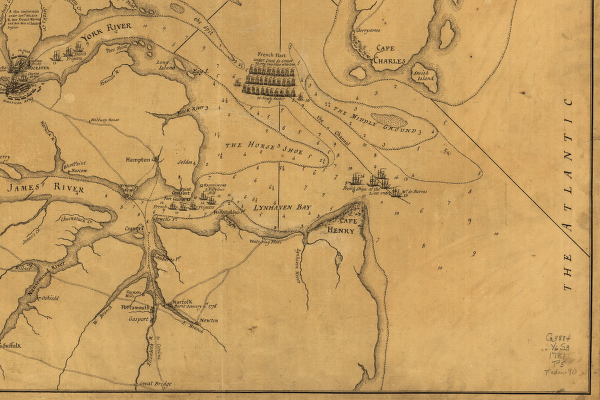
Map found here in this awesome collection - I could get lost in there forever.
The Books: "Because They Wanted to" - 'Blanket' (Mary Gaitskill)
Next book on my adult fiction shelves:
Because They Wanted to - - by Mary Gaitskill. This excerpt is from the story 'Blanket'.
Only Mary Gaitskill could write a story with a happy ending and have it FEEL like a sad ending. To some people in this life, happiness is not the easy choice. Happiness is as foreign as going to Mars for some people. It is easier to stay cautious, guarded, narrow ... because what the hell will happen if ... something actually works out?? Gaitskill does not write about the "winners" of the world. Other writers focus on them - and whether or not they are really "winners", blah blah blah. Gaitskill is all about those who try to fly under the radar ... who try to just get out of this life alive ... dodging emotional bullets ... behaving in what would seem to be incomprehensible ways to those who are more traditional or "normal" ... But again, to many many people - being "happy" is not all that great shakes. It's terrifying. Especially if you are the type of person who has made it to adulthood without ever experiencing it. It's like that searing moment at the end of Tess of the D'Urbevilles where Hardy says (and I'm paraphrasing): When happiness eventually arrives, life has already damaged her so much that she is unable to accept it. Bah. I'll find the exact quote. Perhaps the circumstances for contentment and happiness are present ... but there is such a thing as being made to wait too long. There is such a thing as having something come "too late".
'Blanket' is a story about a relationship that almost comes "too late". And to be honest, who knows what will happen with these two, long-term. It's too shaky to know.
But this is probably Gaitskill's only story with a "happy" ending. And because she doles out "happiness" so sparingly, it was 500 times more effective. I really get what the COST is to some people to accept contentment, intimacy, love. It is NOT easy. Maybe it is for some, but Gaitskill sure as hell ain't writing about them. Who knows. Valerie - the "lead" of this story - An overly serious damaged woman - 36 years old - finds herself in a relationship with Michael, 24. Because it's Gaitskill there are dark undertones to everything. Valerie has been alone for too long to have anything even CLOSE to a "normal" reaction to having a boyfriend. Loneliness marks a person. Loneliness impacts how a person behaves. Loneliness can make happiness feel stressful. Trust me. It can.
I'll excerpt from the beginning of the story. I find it intensely moving. I also like how it's told from both points of view. 'Blanket' is my favorite story in the whole collection.
EXCERPT FROM Because They Wanted to - - by Mary Gaitskill - 'Blanket'.
Valerie had been celibate for two years when she met Michael, and sex with Michael was like a solid left hook; she reeled and cartoon stars burst about her head. The second time he came to her San Francisco apartment, he walked in with two plastic bags of fruit, extending a fat red tomato in one outstretched hand, his smile leaping off his face. "I brought you things," he said. "I brought you fruit to put on your windowsill, and this." He handed her the tomato and said, "I'm a provider." His voice was full of ridiculous happiness. He was wearing shorts, and one of his graceful legs was scuffed at the knee. He was twenty-four years old.
Valerie was thirty-six. Michael couldn't actually provide for her, but she didn't need him to do that. She loved that he'd gone to the grocery store and roamed the aisles of abundant, slightly tatty and unripe fruit so that he could bring her bags of it. His impulse seemed both generous and slightly inept, which she found sweeter than generosity straight.
Michael himself was a little surprised by his beneficient urges, surprised and pleased by their novelty. It occurred to him that it had something to do with her physicality, although he didn't know quite what. Valerie was pretty, but she was not beautiful. Her arms and neck were fine-boned and elegant, while her hips and legs were curvy, fatty, almost crudely female. She embraced him confidently but her fingers sought his more delicate places - the base of his head, the knobs of his spine - with a tactile urgency that was needy and uncertain. After their first time together, on the floor of her living room, she'd put on her underpants and stood over him, posing with her hands on her hips, chin lifted, one hip tilted bossily - but she held her legs close together, and her one bent inturned knee had the tremulous look of a cowed animal. "Woman of the year," he'd said, and he'd meant it.
It was only their second time together when she suggested that they "role play." "You know," she said. "Act out fantasies."
"Fantasies?" The idea was a little embarrassing, yet it also intrigued him; under the cheesy assurance of it, he felt her vulnerability, hidden and palpitant. Besides, the fantasies were fun. She would be a slutty teenager who's secretly hoping for love, and he would be the smug prick who exploits her. He would be the coarse little gym teacher trying to persuade the svelte English teacher to let him go down on her after the PTA cocktail party. She would be a rude girl with no panties flaunting herself before an anxious student in the library. Feverishly, they'd nose around in each situational nuance before giving in to dumb physicality. Then she'd make them a dinner of meat and salad and a pot of grains, and they'd eat it with their feet on the table.
When he left her apartment, Michael felt as if the entire world loved him. He walked down the street, experiencing everything - scraps of trash, traffic, trotting pets, complex, lumbering pedestrians - as a kind of visual embrace. Once, immediately after leaving her, he went into a bookstore and sat down on a little stepladder to peruse a book, and he was assailed with a carnal memory so pungent that he opened his mouth and dropped a wrinkled wad of gray chewing gum on the page. He stared at it, embarrassed and excited by his foolishness. Then he closed the book on the wad.
For the first week she wouldn't let him spend the night with her, because that was too intimate for her. But he would get in bed with her and hold her, cupping her head against his chest and stroking the invisible little hairs at the base of her spine. "My girlfriend," he would say. "My girlfriend." His chest was big and solid, but under her ear, his heart beat with naked, helpless enthusiasm.
When he held her that way, she felt so happy that it disturbed her. After he left, it would take her hours to fall asleep, and then when she woke up she would feel another onrush of agitated happiness, which was a lot like panic. She wished she could grab the happiness and mash it into a ball and hoard it and gloat over it, but she couldn't. It just ran around all the place, disrupting everything.
October 18, 2007
RIP Deborah Kerr
A marvelous actress, with the breath of reality about her. She never over-did, or under-did. She just seemed alive. Like a real person.
I gasped when I saw the news she had passed on. So many performances of hers have left such a mark on me ... starting with The King and I, which I first saw as a small child and it made such an impression that I used to act out her big angry "private moment" number when she tells the King off - alone in my room. She was so feisty. So ... palpably emotional, without being too much, too melodramatic.
For example: watch her face when the King approaches her, one arm outstretched - ready to waltz with her like a Westerner. They never even kiss. But it's one of the most erotic moments in movies. Because of his face, yes - stern and open and passionate (all at the same time) ... but also because of hers - it's so open it's like you can see her pulse beating in her throat.

Wonderful. Classic.
Here is an insanely obsessive piece I wrote about Affair to Remember, for those of you who are interested. The post is mainly focused on Cary Grant (and the "Method") ... but naturally, she pops in from time to time. With the aura of cheese and the semi-annoying Leo McCarey morality-tale floating about that movie ... she is wonderfully natural, and it appears, at times, that she is veering off from the script - along with Grant. They play off each other, they have non-verbal signals and conversations, it seems as though she is not speaking "lines" ... but talking naturally. They're great together, too. A great pairing.
More on her here. Wow.
So much more to talk about. From Here to Eternity (speaking of Clift) - but I'll stop here for now.
Rest in peace, beautiful woman.

Rumspringa
David and I got together last night. In the middle of this Red Sox week it was the only night we could manage it. I think we're going to get together tonight to see the game as well.
Intensely awesome conversation. I was SHOUTING at one point about Dickens. Literally: SHOUTING.
But David shouted too at some points. He shouted about physics and spirituality.
Then we spoke in normal voices.
Then we started SHOUTING again.
We talked about the Red Sox, and James Baldwin, and Paul Ekman, and education, and Dean Stockwell, and me and men, and Mitchell, and singing the blues, and Richard Powers (GOLDBUG VARIATIONS), and the South Beach Diet, and Bruce Springsteen, and being sensitive, and my car, and family, and we listed our 10 Favorite Books at that very moment, and we talked about God, and perception, and Flynn (who is now in Europe, DAMN HIM), and our friends, and Wade, and Taos, and marriage, and kids, and education ... It was great. Great great stuff.
Our rumspringa. Which we haven't done in a long while!
The gentleness of strangers
I was talking with Wade about fist fights. I asked him about fights he had been in, and how that dynamic works between men. It was a fascinating conversation. He told me some stories about fights and confrontations he had had - some violent, others just unpleasant - you know, your basic rams head-butting each other in the fields type of behavior. Here is my favorite:
He was at a bar and he stepped outside to have a cigarette. A dude was sitting there on a bench. He had a tweed jacket on, a young guy. Wade's hair is thinning on top, just so you know. And for whatever reason, the guy on the bench had some sort of reaction to Wade - a testosterone-fueled aggressive reaction. And he snarked, "Nice hair."
Wade was dumbstruck. What did you just say to me??? Like: a random mean comment like that is code for: PLEASE. I BEG OF YOU. KICK MY ASS FOR ME.
Rage came up in Wade. He said, "What??"
The guy repeated it. "Nice hair."
And instead of beating the guy to a pulp, instead of punching him in the nose - Wade, still in that state of rage, said to the guy, angry, "Dude! You need to be GENTLE with people!" It just came out of his mouth. He wasn't less angry. But he basically SCHOOLED the guy. Dude! You can't just say crap like that. You need to be GENTLE.
The best part of this whole story is that Wade's comment turned the whole thing around. It was as THOUGH Wade had punched the guy. He actually blinked a couple of times, startled ... as the comment landed within him.
"Wow, man, I'm sorry ... I'm really sorry ... just having a bad day ... I don't know why I said that ..."
Like, he was all discombobbled ... and Wade said, "It's cool, man, whatever ... you just need to be gentle with people."
The entire exchange ended with the tweed-jacket dude telling Wade his whole life story and showing him pictures of his art on his blackberry. "See ... these are my paintings ... " Wade looking on, nodding, talking with him about art.
I was howling as he told me the story.
I am totally going to remember that and use it myself.
Dude. You need to be GENTLE.
The Books: "Because They Wanted to" - 'Orchid' (Mary Gaitskill)
Next book on my adult fiction shelves:
Because They Wanted to - - by Mary Gaitskill. This excerpt is from the story 'Orchid'. Another killer of a story with what I see as a familiar Gaitskill "plot": running into an old friend, someone you knew years ago - and lost touch with, either because of a dust-up, or just moving on. And when you see that person, all kinds of stuff is stirred up. Memories of who you were back then, the gap between who you were then and who you are now ... or, conversely - the frightening realization that you haven't changed at ALL. That you have just gotten older.
Margot - a spinsterish lesbian - who had always had relationship problems, due to being kind of weird and intense - runs into Patrick - her roommate in college. Patrick had been a beautiful boy - strangely beautiful, so that people were drawn to him. A cloud of girls hovered over him. He wanted to be an actor. They lived together - with Patrick's sister - who had been in a mental institution - and for a couple of semesters, Margot was drawn into Patrick's intense circle. She would watch the girls come and go from his room - it was always a drama ... and Margot, although a young woman, was already on the way to having a quiet narrow little life ... and was amazed by how much drama one man could withstand. They were friends, though - he was a deep friend. They lost touch. Years pass. And Margot runs into him on the streets of Seattle. Gaitskill just so gets that feeling of disorientation in such situations ... the memory of the closeness, the awareness of the present-day desolation - and the worry: How does this person see me? What do I SEEM like to my old friend now? How is he judging me? You can walk around in your everyday life and never ask those questions. But run into an old friend, and suddenly you are confronted by all of these identity crises.
Here's a brief excerpt. Margot returns home from her run-in with Patrick.
I love how Gaitskill coldly tells us what she does. A list of details and objects. It isn't until we get halfway through the first paragraph that Gaitskill lets us in on the inner life of Margot.
EXCERPT FROM Because They Wanted to - - by Mary Gaitskill - 'Orchid'.
Margot's apartment was cold when she arrived. She turned on the heat and then went through all the rooms, turning on the lights. She put her pink flannel robe over her clothes and made herself a dinner of sliced carrots, a ham sandwich, and a Styrofoam cup of take-out vegetable soup. She put the sandwich and the carrots on a turquoise plate and the soup in a burgundy bowl. She put out a folded napkin and a spoon and vitamin capsules. She poured herself half a glass of red wine. She sat down, and suppressed pain oscillated through her in a slow, hard wave. When she had told Patrick that Roberta had left her, she had seen a faint look of satisfaction move in his eyes - satisfaction not at her loss but at seeing the Margot who was familiar to him, stalwart in a state of loss. His look almost made her bitter. But at the same time, she felt that something in her voice had invited it.
She poured lots of salt on her ham sandwich and allowed her little dinner to comfort her. It was one of the things she and Roberta were good at: small, comforting dinners. Roberta had been gone for six months, and it was still difficult for Margot to sit down to eat by herself. Still, she was determined to do it, and her determination felt good to her. It made her feel like a tenacious animal, burrowing a home in hard, dry soil. And that, of course, had been what Patrick had heard in her voice.
October 17, 2007
The Booker Prize ...
... has gone to Anne Enright, which is seen as quite an upset considering the competition - and although I have not read any of her stuff (YET) - she is next on my list after I finish Bleak House. I blithered about her here and how fabulous I think she is.
I love literary upsets, it's one of my favorite spectator sports ... and there's something about Enright's writing and her persona that I really DIG ... and that I also find a little bit frightening (most good writers frighten me a bit) - so I'm happy for her. I also really liked what she said about depression in that first link. Interesting.
Embellishing
Talking with Mitchell last night, telling him the story (again) of meeting Dean Stockwell. We were howling. Somehow the whole thing degenerated into us saying, in a sort of angry blunt way to an unbelieving imaginary listener, various quotes along the lines of:
"Listen. I did the meringue with Dean Stockwell, okay?"
"Listen. I did a traditional HULA with Dean Stockwell, okay?"
The joke somehow became, very quickly, specific, with specific parts to it: an angry opener ("Listen.") - and then a blunt statement involving me doing ever more specific dance steps with Dean Stockwell.
"Listen. I two-stepped with Dean Stockwell, mkay?"
"Listen. I did the Alvin Ailey flat-back series with Dean Stockwell, all right??"
The joke ended when Mitchell said (and we realized that we honestly couldn't go any further than this):
"Listen. I danced GISELE ... with Dean Stockwell, okay?"
In praise of Montgomery Clift!!
Here is my entry in the Montgomery Clift blog-a-thon. Naturally, I have gone overboard. Oh well. When I love, I love hard, what can I say. I am also vaguely OCD. So I've got that going for me as well.

A compilation of quotes from and about this extraordinary and complex and tormented actor. My favorite performance of his is in Red River.
I went a little insane with the quotes. I had to basically stop because ... you know ... I have a life to live and crap like that. This is one of the benefits of having a huge library.
I have attributed all sources below. The majority of the quotes come from Patricia Bosworth's indispensable (and bleak) biography of Clift. But there are other sources - you'll see below. Hope you enjoy. He was a complex man, multi-faceted - and even his friends said they didn't know who he was. He compartmentalized his life to an almost pathological level - so that whole GROUPS of people who were friends with him did not know about each other. This is a byproduct of being gay at a time when it was not accepted - and Clift had internalized homophobia to the point that he sneered at "fags" and begged film directors [Edward Dmytryk tells the story] to not hire "too many fags" for crowd scenes, etc. So there are no easy answers when it comes to Clift, and frankly: I don't care about easy answers, or trying to psychologize him. I care about his life in as much as it informs his work.
I love his work. I love watching him think, mainly. Nobody thinks like Montgomery Clift. I love him most in his youth - the Red River heyday - when he has that cocky independent spirit - matched up against John Wayne - another cocky independent spirit of a very different brand of masculinity ... but how interesting it is to see them play off of one another. Marvelous movie.
Montgomery Clift EXTRAVAGANZA below.

John Huston:
He was mysterious. He always held something back.
Montgomery Clift:
One must know a bad performance to know a good one. You can't be middle-of-the-road about it, just as you can't be middle-of-the-road about life. I mean, you can't say about Hitler, I can take him or leave him. Well, I can't be middle-of-the-road about a performance, especially my own. I feel that if I can vomit at seeing a bad performance, I'm ahead of the game.
Excerpt from Peter Bogdonavich's Who the Hell's In it:
Clift had been a kind of unacknowledged leader. His performances in Howard Hawks' Red River (his first movie, though Fred Zinneman's The Search was released earlier), in William Wyler's The Heiress, in George Stevens' A Place in the Sun, heralded a new acting style. It came to be known, inaccurately, as the Method. After Clift came Brando, and after Brando, James Dean. Clift was the purest, the least mannered of these actors, perhaps the most sensitive, certainly the most poetic. He was also remarkably beautiful. Over eight years he acted in eight films, became a teenage heartthrob as well as a popular star with older audiences. He was nominated for Best Actor Oscars three times in six years and should have won each time. He gave at least four performances - in Red River, in A Place in the Sun, in I Confess and in Zinnemann's From Here to Eternity - that remain among the finest anyone has given in the movies.
Howard Hawks:
He worked -- he really worked hard.
Excerpt from Peter Bogdonavich's Who the Hell's In it:
Here it was about eight years after Clift had acted in it, and I Confess was on the screen; I was standing in the back of the theater watching. About halfway through, I saw Clift come up the aisle, slumped over, weaving a little. At the back, he lit a cigarette and turned to look at the screen again. I came up and said I worked there. He was polite. I said I liked the picture and asked if he did.The huge image on the screen at that moment of his pre-accident beauty must have seemed to mock him. He turned away and looked at me sadly. "It's ... hard, you know." He said it slowly, hesitantly, a little slurred. "It's very ... hard," he said. I nodded. He looked back at the screen.
A few steps away was a "request book" [Dan] Talbot had set up for his patrons. It was a large lined ledger in which audiences were encouraged (by sign and trailer) to write down what movies they would like to see. I told Clift about the book and said I wanted to show him something. He followed me over, puffing his cigarette absently. I leafed through the book quickly and found the page on which I had noticed a couple days before that someone had scrawled in large red letters: "ANYTHING WITH MONTGOMERY CLIFT!"
The actor stared down at the page for several moments. 'That's very ... nice," he said, and continued to look down. "That's ... very nice," he said again, and I realized he was crying. He put his arm around me unsteadily and thanked me for showing it to him. Then he turned and walked back down the aisle to his seat.
When the picture was over, he and Mrs. [Walter] Huston came out of the theater. I was standing outside. He waved to me gently and they got back into the Rolls-Royce and it was driven away. He made only two films more before he died five years later at the age of forty-six - a lost poet from Omaha, Nebraska, the most romantic and touching actor of his generation.

Excerpt from Kazan: The Master Director Discusses His Films, by Jeff Young
Why did you cast Montgomery Clift [in "Wild River"]?He wasn't my choice. I wish I had been able to cast someone more masculine, someone stronger would have been better. It's hard to cast an intellectual. I would have preferred Brando, but then I always prefer Brando. He was unavailable, so I kept postponing the picture and postponing it, tryiing to find somebody I liked. I liked Montgomery Clift personally, but he was in very bad shape. He had had an auto accidnet going down the hill from Liz Taylor's house. He was banged up. His face was almost a different face. He was also very shaky and on liquor and drugs, just quivering with doubt. It was a tough, tough thing to deal with. He was also unmasculine, which hurt the love story. I think I could have done better, but I didn't know with whom. I still don't know.
Brooks Clift [Monty's brother]:
Psychologically we couldn't seem to take the memories [of our childhood] so we forgot. But at the same time we were obsessed with our childhood. We'd refer to it among ourselves, but only among ourselves. Part of each of us desperately wanted to remember our past and when we couldn't it was frustrating. It caused us to weep, when we were drunk enough, when some minor detail from our past was released. Monty once said the smell of boot polish reminded him of winter when he was a boy. He would get hysterical over the smell of boot polish.
Patricia Collinge, actress, starring in Dame Nature on Broadway with Clift in 1938:
He'd invent bits of business or character details that were sometimes offbeat or strange. I'm still reminded of Camus's phrase 'create dangerously' when I think of Monty's acting, because he was starting to make unorthodox acting choices even then.There is one long speech in the play when Monty as Andre tries to explain to his father how his loneliness and unhappiness had forced him to seek affection from an equally lonely girl.
Monty's performance was heart-rending. It was so quiet and sincere that it seemed almost untheatrical, except underneath the controlled tone was an absolutely compelling sense of torment.
Friend Bill Le Massena:
Monty had this glorious instinctive talent bursting out of him and Mr. Lunt recognized it and helped him focus and cultivate it. He kept asking Monty questions about his part - specific questions - he helped him develop an inner life for the character by using elements of himself. Like Lunt, Monty was a natural actor, a born mimic. He never needed or wanted to hide bhind a fake mustache or accent. He used his inner self.

Nancy Walker, on Monty's love of music and singing:
He could never carry a tune, but, my God, did he believe in the lyrics!
Montgomery Clift on Alfred Lunt, his mentor and acting inspiration:
Alfred taught me how to select. Acting is an accumulation of subtle details. And the details of Alfred Lunt's performances were like the observations of a great novelist - like Samuel Butler or Marcel Proust.
Ned Smith on seeing Clift in a revival of Our Town in 1944:
It was the first time I realized Monty was such a special actor. He had a moment at the end of the play where he jumps over a series of imaginary rain puddles - it was quite extraordinary the way he did it.
Herman Shumlin, directed Monty in Lillian Hellmann's The Searching Wind:
Monty belonged on the stage. There are certain actors who walk out in front of an audience and they belong there. You believed him the instant he spoke a line.
Tennessee Williams [who saw Monty onstage in Mexican Mural and said it was one of the most remarkable performances he had ever seen:
Monty loved being in awe of people. He seemed to look on all the arts - dance, music, and theater - as if they were great mysteries. I never knew him well because I wasn't sexually attracted to him but I know one thing - his major impulse was to be an artist. Monty disliked me because I was so open about being gay and he wasn't.

Montgomery Clift:
I watched myself in Red River and I knew I was going to be famous, so I decided I would get drunk anonymously one last time.
Excerpt from Patricia Bosworth's Montgomery Clift:
The essential Clift character tended to be a loner, outside the mainstream, isolated - intense but always struggling against conformity, and within that framework Monty's range was extraordinary; his characters were by turn extroverted, withdrawn, articulate, or monosyllabic, assertive, passive.He was a great believer in the psychological gesture, the physical manifestation of an emotion. It could be expressed in a look - how he stares into Shelley Winters' face before he kills her in A Place in the Sun, the sidelong glance of astonishment and desire when he sees Elizabeth Taylor for the first time in Place, the way he phones his mother in The Misfits, as if he's just been slugged; in his greatest performances Monty personified, rather than impersonated, character.

Photographer Richard Avedon on seeing him in The Search:
The minute Monty came on the screen I cried because he was so realistic and honest and I was deeply touched. He seems to be creating a new kind of acting - almost documentary in approach. It has the style of reportage.
Excerpt from Patricia Bosworth's Montgomery Clift:
When Kevin [McCarthy] was rehearsing Romeo for CBS' "Omnibus" and he was having trouble with the death scene, "I asked Monty to help me and we worked one entire night in our living room with Gussie playing the dead Juliet, Monty playing Romeo. He was agonizingly brilliant," Kevin says. "He seemed totally assured in his conception of the character. His Romeo was impetuous, romantic, fumbling with words as he expressed his love for Juliet. He also brought a physicality, an athleticism to the role. His entire body seemed part of the work. And then there was this power - this originality behind the concept. He played young love so intensely, so truthfully."They rehearsed till five in the morning: after Gussie staggered off to bed Monty went over the scene for the last time using a pillow as Juliet. "I remember he covered it with passionate kisses, then rocked it back and forth in his arms like a baby."
Note given to Monty by a handwriting analyst who had taken a look at a page in one of Monty's notebook and seen his writing:
"You're the most disturbed man I've ever seen - you'll die young."
Hollywood press agent who knew Clift in the late 40s:
Right off he was labeled an outsider. The minute you refuse to play the game in Hollywood exactly as they want it, and that means totally giving up your body and your soul and your guts to becoming a STAR, you become an outsider. The minute you have integrity - which is what Monty had - you are an outsider. The minute you refuse to sell yourself as a commodity, a product, the agent and producers and directors who literally feed off talent call you an outsider, and it is much harder to survive. Hollywood couldn't have cared less that Monty preferred to live in New York and disapproved of the pap about himself in fan magazines. To survive being a star in Hollywood like Humphrey Bogart or Gary Cooper, you have to be sensitive and ruthless, humble and arrogant. Monty was sensitive. Period.
Monty to Elizabeth Taylor after finishing a scene in Place in the Sun - he had gotten so into it that he was drenched in sweat:
That's the worst part about acting. Your body doesn't know you're acting. It sweats and makes adrenalin just as though your emotions were real.
Richard Burton:
Monty, like Garbo and Brando, had the extraordinary facility of giving you a sense of danger. You were never quite sure whether he would blow his lines or explode.

Monty's friend Ned Smith:
He talked about meeting Laurence Olivier, whom he was very impressed with - he thought he was absolutely wonderful. He talked about Marlene Dietrich, and he was very specific about her comeback in Las Begas, which he'd gone to, and the dress she had on - all the spangles which seemed stuck to her body - and he did an imitation, he mimed the dress. He talked about how Dietrich and Ernest Hemingway had come over to the brownstone and how Hemingway was a transcendent bore, he seemed so self-important. He talked about Vivien Leigh and how hard she was on Laurence Olivier: 'She is very neurotic and very nervous, and she holds her teacup like this,' and he imitated Vivien Leigh and the gesture was totally effeminate and it distressed me greatly. He talked no more about doing many things in his life - broadening his life - he talked only about 'I have my work to do and this and that.' He took singing lessons; he went to the gym; he had to go to the dentist's. He talked about the movie African Queen and he said, 'I can't stand the way Katharine Hepburn plays the part.' He said, 'When she pours gin overboard she doesn't do it right.' I said, 'What do you mean? I thought that was a terrific scene, one of the greatest scenes I've ever seen in a movie,' and he answered, 'Terrible job.' He spoke a lot about From Here to Eternity and Frank Sinatra, who he thought would be great for the part of Maggio ... I wanted to tell him about my experiences - I had been to Spain and lived there and learned the language and had been turned upside down by the experience. But, well, there were things about Monty now that I'd been sensing about him that made me uneasy ... Still it was so pleasant knowing him, and I felt I could help him ... That's not the right way to put it. I felt I was still very much part of his life ...
Francois Truffaut:
Monty was truly remarkable. Throughout the picture [I Confess], his attitude as well as his expression is consistent. He has an air of dignity at all times. It's only through his eyes that we see his bewilderment at all the things that are happening to him.

Clift on Prewitt, the character he played in From Here to Eternity:
Prew is a limited guy with an unlimited spirit, an inarticulate man, never a 'word' man ... Good dialogue simply isn't enough to explain all the infinite gradations of a character. It's behavior - it's what's going on behind the lines.

Fred Zinnemann, director of From Here to Eternity:
Monty was so intense about being Prewitt he raised the level of the other actors. He cared so much they started caring.
Burt Lancaster:
He approached the script like a scientist. I've never seen anyone so meticulous.
Jack Larson on how Clift would cut his lines, slashing his script up - so that he would have less and less to say in each scene (all the greats did that - Bogart, Wayne, Grant ... They didn't hoard their lines, they CUT them, knowing that it was better, in films, to say less - to let your face and your behavior tell the scene):
He worked out all sorts of broken speeches for himself. In that long scene with Donna Reed [in From Here to Eternity], where he explains why he can no longer box, he must have worked over a single speech for at least twenty-four hours straight Finally he came up with the sentence, 'And then I hit him - and he couldn't see any more.' He said that he couldn't use the word blind because it didn't mean anything to him, but the word 'see' did.
James Jones, author of From Here to Eternity and drinking buddy of Clift:
I told him [Clift] I felt cut off from a lot of experience being a writer, working by myself so much,a nd he said actors were cut off too. 'Except you writers don't need to hear the sond of applause,' he said. I said, 'What the hell are you talking?' and he stares at me with those funny blazing eyes of his and then he starts laughing that crazy-sounding laugh.Monty had a special kind of pain, a pain he could not release. He had a tragedy hanging over his head like a big black comic-strip cloud. It was so distinct you could almost see it. I never heard him talk about himself personally.
Fred Zinnemann:
His drinking was more deadly than Spencer Tracy's. Drunk or sober, Spencer knew who he was, but when Monty drank he seemed to lose his identity and melt before your eyes.
Excerpt from Patricia Bosworth's Montgomery Clift:
The day Monty played that death scene [in From Here to Eternity] a lot of people on the set cried. He played it as if he knew the murder of Fatso had been to no avail - that he had to die. It was inevitable. "How he evoked that feeling I don't know," said James Jones, who watched the scene being shot, "but he ran into his death like someone running into a gigantic tidal wave. His face was gaunt - tense, chalk white - he looked as if he'd had the guts pulled out of him, then he rolls over on the grass and Zinnemann calls cut! And someone says, "Prew's dead," in a hushed voice.
Karl Malden on why Monty's performances were often undervalued:
Because he always becomes part of the warp and woof of a script. So much so that his artistry wasn't always appreciated. If you watch him in From Here to Eternity, he completely immerses himself in the character and situation of Prewitt, so much so that he actually sinnks into the flesh of the story.
Andrew Sarris, film critic:
You could place Yul Brynner but you couldn't place Clift. On screen Montgomery Clift was a chameleon - furtive. In every movie he seemed to be looking for himself.
Friend Jack Larson:
It didn't matter what sex you were. If Monty really liked you - man or woman you ultimately went to bed with him. If he liked you, he couldn't keep his hands off you - touching - caressing - hugging - he was very physical and very, very affectionate. And of course he was always passing out with you and then you were undressing him and putting him to bed and finally you were ending up in bed with him too.
Bill Gunn:
I've never known anyone who liked being in front of a camera as much as Monty. He was the same way in front of a mirror - never ashamed; he enjoyed looking at his reflection. He was like a woman in this regard. He could stare for minutes on end at his image unselfconscious - totally relaxed.
Montgomery Clift:
James Dean's death had a profound effect on me. The instant I heard about it, I vomited. I don't know why.

Montgomery Clift called Elizabeth Taylor (his best friend, his soulmate) "Bessie Mae":
You know how it is when you love somebody terribly but you can't describe why? That's how I love Bessie Mae.
Excerpt from Patricia Bosworth's Montgomery Clift:
Monty was so concerned with the weaknesses in the Raintree script he harried [director Edward] Dmytryk with suggestions and changes he'd stayed up half the night thinking up. A burly man with cold eyes and an abrupt manner, Dmytryk had his own problems. He had made forty-seven movies, among them Crossfire and Caine Mutiny, but he was a former member of the Hollywood Ten who had gone to jail, then recanted to save his career."Monty and I met as often as possible for drinks or lunch. I agreed to listen to his suggestions. He was obviously a great actor - very inventive. But I sometimes felt he worried things to death, little things."
He recalled his preparation for a "flash" scene - a scene lasting no more than a second or two on the screen - the scene called for Monty to enter the room and see his baby for the first time. Monty practiced opening and closing the door countless times; he tried it abruptly, tentatively, fearfully, joyfully, excitedly, all to find the one entrance which would convey exactly the emotion he wanted.
Adele Morales Mailer:
At parties, most of the time he was drunk. Most of us were too. He was a good kisser--I can tell you that. Certainly, he was interested in women. He may have been bi. God, he was tortured. He was driven. You felt an underlying sadness. Even without knowing anything about him. Some people you know without knowing anything about them.
Donna Reed:
"I had never worked with any actor like him; to watch him was incredible and memorable. He had a talent and a side to our profession I had never seen before, just superb."

Excerpt from Patricia Bosworth's Montgomery Clift. Kevin McCarthy on the tragic car accident that ruined Clift's face and almost killed him. They had all been at a party at Liz Taylor's, up on a hill. Then it was time to go. Kevin got in his car, Monty got in his car - behind Kevin's - and they took off down the drive.
Suddenly I looked in my rearview mirror and I saw that Monty's car was coming much too close to my car. I got the idea he was going to play one of his practical jokes - he was going to give my car a little nudge. He never did bump my car, but I had the feeling he might, so I put my foot on the gas and went a little faster. Monty's car seemed to be almost on top of me. I wondered if he was having a blackout. I got frightened and spurted ahead so he wouldn't bump me. We both made the first turn but the next one was treacherous. We were careening now, swerving, and screeching through the darkness. Behind me I saw Monty's carlights weave from one side of the road to the other and then I heard a terrible crash.A cloud of dust appeared in my rearview mirror. I stopped and ran back. Monty's car was crumpled like an accordion against a telephone pole. The motor was running like hell. I could smell gas. I managed to reach in the window and turn off the ignition, but it was so dark I couldn't see inside the car. I didn't know where Monty was. He seemed to have disappeared.
I ran and drove my car back and shone the headlights into Monty's car. Then I saw him curled under the dahsboard. He'd been pushed there by the force of the crash. His face was torn away - a bloody pulp. I thought he was dead.
I drove back to Elizabeth's shaking like a leaf and pounded on the door. "There's been a terrible accident!" I yelled, "I don't know whether Monty's dead or alive - get an ambulance quick!" Mike Wilding and I both tried to keep Elizabeth from coming down to the car with us but she fought us off like a tiger. "No! No! I'm going to Monty!" she screamed, and she raced down the hill.
She was like Mother Courage. Monty's car was so crushed you couldn't open the front door, so Liz got through the back door and crawled over the seat. Then she crouched down and cradled Monty's head in her lap. He gave a little moan. Then he started to choke. He pantomimed weakly to his neck. Some of his teeth had been knocked out and his two front teeth were lodged in his throat. I'll never forget what Liz did. She stuck her fingers down his throat and she pulled those teeth. Otherwise he would have choked to death.
Jack Larson:
When I first saw him [after the accident], I almost went into shock but I think I hid it because he said, "I don't look too different, do I, mon vieux?" I think he was teasing me. He wanted the truth him and I assured him no, no you don't. Of course, he looked completely different. His mouth was twisted. A nerve had been severed in his left cheek so that the left side of his face was practically immobile - frozen. His nose, that perfect nose!, was bent - crooked - out of shape. He looked stuffed, that's the only way I can put it - the only feature that remained the same were his eyes - they were still brilliant and glittering and they stared right through you, but they were now brim full of pain.

Excerpt from Patricia Bosworth's Montgomery Clift - from 1956 - Clift has had his accident, and now barely leaves the house. Black drapes over the windows. He has gone into hiding for months.
Just before he left Hollywood to go back to New York in late November, a man drove up to the house and informed Monty that "Marlon Brando want to talk to you seriously and in private about something. Are you agreeable?" Monty said sure, tell him to come on over, and the man drove off.No more than ten minutes later another car drove up and out stepped Marlon Brando. Dressed in work clothes, he was scowling as he approached the house. He'd had his eyebrows shaved off for the role he was then filming: Sakini in Teahouse of the August Moon.
Monty came out to meet him; then the two men went into the house and conferred in the living room for about an hour.
[Jack] Larson, since he was going to drive Monty into the doctor's later that afternoon, waited by the pool. From his vantage point he could see the actors pacing about the living room, then sitting down opposite each other at a table in the foyer. An hour later Brando strode out, got into his car, and disappeared down the hill.
Larson didn't ask questions, but later, on the way to the doctor's, Monty told him what had been said. Apparently Brando had been hearing all sorts of stories about Monty destroying himself with pills and booze. Brando wanted to communicate something: Monty must stop this shit. He must take care of himself not only for himself but for Marlon Brando.
"Then he got into this rap about competition - the healthy competition that should exist between actorrs - that existed, say, between a Laurence Olivier and a John Gielgud, between a Richard Burton, then, and a Paul Scofield. These men challenge each other, he said. Now, didn't Monty know the only actor in America who interested Brando was Monty? Didn't he realize they had always challenged each other, maddened each other, intrigued each other, ever since they started their careers? Brando said the year he'd been nominated for Streetcar Monty had been nominated for Place in the Sun. 'I went to Place in the Sun hoping you wouldn't be as good as you were supposed to be, but you were even better, and I thought, hell, Monty should get that award.' And Monty answered, 'I thought the same thing! I saw you in Streetcar praying you'd be lousy - and at the end I thought Marlon deserves the Oscar.' Brando said, 'In a way, I hate you. I've always hated you because I want to be better than you, but you're better than me - you're my touchstone, my challenge, and I want you and I to go on challenging each other ... and I thought you would until you started this foolishness ...'"
Monty seemed surprised Brando would take the trouble to come over and talk. He seemed quite moved. 'I don't think either Marlon or I are imitators, which is why I guess we respect each other. Maybe because we both have delusions of grandeur."
Monty, on his role in The Young Lions:
With all the accoutrements and mannerisms I'm trying for the essence of something. Acting is an accumulation of subtleties - like shaking the ash from a cigarette when a character is supposed to be completely absorbed in a conversation.
Excerpt from Patricia Bosworth's Montgomery Clift
During filming [of The Young Lions], Monty became friendly with Dean Martin and did everything he could to help the singer in his first dramatic role, just as he had with Sinatra in Eternity. They would run lines together; when he saw Martin was nervous he would break him up. During a party sequence he hid under a pianno on the set and tickled Martin's leg until he had a laughing fit. Inn the evenings, they would go off and have drinking contests. Martin nicknamed him "Spider" because of the extravagant gestures he used when he talked.
Nancy Walker (one of his dearest and staunchest friends):
Monty and I never played roles with each other, or let's say, hardly ever - and we didnt' wear masks. Speaking of masks, I used to tell Monty if you hadn't been in the car crash you'd just be another aging pretty face. I liked his face better after the accident: his strength shone through ...People wouldn't let him be strong. He'd been raised to believe he was weak. I used to get so mad at his secretary. We'd be going out to dinner, and she'd say, 'Now you be sure Monty eats,' and I'd snap, 'Isn't that what you're supposed to do when you go out to dinner?' and she'd cluck, 'But poor Monty is so frail - cha-cha-cha,' and I'd say, 'You are crazy. Monty is as strong as an ox.' He had arms like iron - hands like a musician ... whenever I got bugged, I'd phone him and I'd say, 'I need you. I don't care whether you need me, I need you,' and he'd cry, 'Nanny, what is it? Tell me!; He needed to be needed.
Monty on Noah, the part he played in The Young Lions:
Noah was the best performance of my life. I couldn't have given more of myself. I'll never be able to do it again. Never.
Bill Kellin, actor:
But as anguished as Monty was, and I sometimes felt there was an actual physical presence hovering in the room that he was terrified of - when he acted a scene it was sculpted forever. There was a solidness about the work - a rocklike quality. There was nothing casual about his acting. If he had genius it was that he revealed himself so totally as an actor - he stripped himself naked. He hid his real life - nobody was as mysterious or remote as Monty except I guess to a few friends. But in his acting he revealed himself as powerfully as a scream.

Excerpt from Method Actors by Steve Vineberg:
The love scenes in A Place in the Sun are justly famous. When Angela wanders into the pool room and discovers George, retreating from a party where he knows no one and feels out of place, he relaxes his face and accepts the stronger force of her extraordinary beuaty like a happily defeated warrior. She's affected too - by his inability to keep his feelings concealed. (George makes immediate erotic contact with both the women characters in the film: the factory drudge, Alice, played by Shelley Winters, whom he has an affair with and gets pregnant, and the socialite, Angela, who enters his life after he's already become involved with Alice.) Love shatters George. He confesses hisl ove to Angela as if he were confessing murder, running on fast, feverishly, in a desperate, choked voice, his smile pulled in one direction by rapture and in another by agony ... For Clft, sexual conflict is always bound up with spiritual conflict. The realm of the spirit was the arena where the actors of Clift's generation fought their most feverish battles; following in John Garfield's footsteps but moving beyond him, they also deined themselves by a brooding, unresolvable sexuality. Clift inhabits both these areas simulatneously, heralding the arrival of a new breed of actor.

Excerpt from Patricia Bosworth's Montgomery Clift - on his small wrenching part in Judgment at Nuremberg:
He got two weeks at the Bel Air Hotel plus two first-class plane tickets for himself and Giles. Before leaving for the Coast that April he packed his little photograph of Kafka and he told Nancy Walker he was going to get a "very bad haircut". "Monty believed the poor slob he was playing would get a special haircut before testifying against war criminals."He spent the first day rehearsing with Spencer Tracy at Revue Studios in Hollywood. They rehearsed on a complete replica of the Nuremberg courtroom, built on rollers so the cameras could move in at any angle. Monty's scene, which ran seven minutes, was to be done mostly in close-up. He was worried about remembering his lines.
When time came to shoot the sequence he panicked - and he fluffed in take after take. Finally Tracy ambled over and said, "Fuck the lines - just play to me." Kramer recalled, "Spencer was the greatest reactor in the business. Monty did play to him, and the words poured out of his mouth - the results were shattering."
He spoke in a whisper, full of terror and unhealed suffering; his eyes were like those of a ten-year-old child. He recited his entire story to Tracy very simply, only rising to hysteria when he held out a photograph of his mother who'd been murdered in a concentration camp.
As soon as the highly charged scene was over, Tracy ran from the judges' bench, threw his arms around him, and praised him in glowing terms for his powerful, sensitive playing; he was nominated for an Academy Award for best supporting actor for his performance.

Alfred Hitchcock:
Montgomery Clift always looked as though he had the angel of death walking along beside him.

Frank Taylor:
Monty and Marilyn [Monroe] were psychic twins. They were on the same wavelength. They recognized disaster in each other's faces and giggled about it.

And after all of this, I think I will end with a quote from Mr. Clift himself.
Here is a snippet from an interview Montgomery Clift gave during the filming of The Misfits (more here) - this is an excerpt from The Making of the misfits by James Goode, a journalist who was there as they filmed the movie:
"I wish I were more thin-skinned. The problem is to remain sensitive to all kinds of things wihtout letting them pull you down. Now, take this - the fact that someone drops a book of matches at a time when he most wants not to seem ill at ease. To a normal person that is not a terribly moving talent, but to an actor in films, such a thing maybe perhaps changes the whole relationship to the girl that dropped the matches. The only line I know of that's wrong in Shakespeare is 'Holding a mirror up to nature.' You hold the magnifying glass up to nature. As an actor you just enlarge it enough so that your audience can identify with a situation. If it were a mirror we would have no art. Essence is a wonderful word. Miller has written the essence of Roslyn. You'd be bored to death if it were a mirror. Take the line in the script, 'Who did this to me? The ambulance did it.' Magnifying the essential things that liberate the imagination and enable one to identify - when one has those qualities, they are fabulous gifts. Take a pause, for example. That I call a magnification. I wouldn't call it a mirror. The magnifying glass has been misused totally, but in this picture it has been put to the use of capturing what possibly is flitting in and out of someone's mind and one person's relationship to another and another, and that's what's fascinating."
October 16, 2007
Underwater green.
Human connection. Brief.


The God Who Loves You by Carl Dennis
It must be troubling for the god who loves you
To ponder how much happier you'd be today
Had you been able to glimpse your many futures.
It must be painful for him to watch you on Friday evenings
Driving home from the office, content with your week—
Three fine houses sold to deserving families—
Knowing as he does exactly what would have happened
Had you gone to your second choice for college,
Knowing the roommate you'd have been allotted
Whose ardent opinions on painting and music
Would have kindled in you a lifelong passion.
A life thirty points above the life you're living
On any scale of satisfaction. And every point
A thorn in the side of the god who loves you.
You don't want that, a large-souled man like you
Who tries to withhold from your wife the day's disappointments
So she can save her empathy for the children.
And would you want this god to compare your wife
With the woman you were destined to meet on the other campus?
It hurts you to think of him ranking the conversation
You'd have enjoyed over there higher in insight
Than the conversation you're used to.
And think how this loving god would feel
Knowing that the man next in line for your wife
Would have pleased her more than you ever will
Even on your best days, when you really try.
Can you sleep at night believing a god like that
Is pacing his cloudy bedroom, harassed by alternatives
You're spared by ignorance? The difference between what is
And what could have been will remain alive for him
Even after you cease existing, after you catch a chill
Running out in the snow for the morning paper,
Losing eleven years that the god who loves you
Will feel compelled to imagine scene by scene
Unless you come to the rescue by imagining him
No wiser than you are, no god at all, only a friend
No closer than the actual friend you made at college,
The one you haven't written in months. Sit down tonight
And write him about the life you can talk about
With a claim to authority, the life you've witnessed,
Which for all you know is the life you've chosen.

Leslie Caron
A wonderful tribute post - great stuff.
Excerpt:
Too often, there had seemed to be a dark cloud hovering overhead when she took on ingénue roles – her lack of formal training as an actress may have left her feeling somewhat insecure, making the halting, abashed quality that had characterized her other star turns more pronounced than it would have been otherwise. It was nowhere in evidence with her work in Gigi, which revealed a lightness of touch worthy of a polished boulevard comedienne; working with Minnelli, perhaps her greatest champion, brought out her confidence, as well as a previously unsuspected streak of mischief. In the early scenes, she successfully conveyed the exuberance of youth and handled the comic aspects of the role with surprising dexterity; as the transformation took root, she became self-possessed, forthright, and for the first time, genuinely beautiful. As Lili, Gaby and Ella of the Cinders, she had had a tendency to seem pathetic and childlike when the material took a turn for the dramatic – finally, it was possible to see her as a mature actress of genuine spirit, capable of holding the screen without seeming apologetic or ill at ease.
New life
I've been loving reading City Wendy's posts about moving to New York from Chicago. Here is her latest.
The Books: "Because They Wanted to" - 'Because They Wanted to' (Mary Gaitskill)
Next book on my adult fiction shelves:
Because They Wanted to - - by Mary Gaitskill. The following excerpt is from the title story 'Because They Wanted to'. Elise is a runaway and a prostitute. She's probably about 17 years old. She drifts about from situation to situation, living in big drug houses for a while, crashing on the couch - "turning tricks" in the park to get by. The story is told with alternating flashbacks - there is a present-day narrative, where Elise sees a sign on a bulletin board saying "Babysitter needed". She goes to see about the job. It's a young single mom - who has 3 small children (they live in the ghetto) - and the mom has to go to a job interview and needs someone to watch her kids. The only problem is she doesn't have any money to pay Elise. But she WILL. If she gets this job!! And she's not sure WHEN she will be back ... because she may have to start her job right away ... but that would be even better, because then they would have to pay her ... and then she could pay Elise. The whole thing is very sketchy but Elise says sure, she'd watch the kids. So she does. And throughout the entire day - as she is confusedly trying to occupy the kids and feed them and diaper them (she has no experience with children, practically being one herself) - we get flashbacks to her past, and who she is, where she has come from. It's a meandering story - there are no "jump-cuts" - it's like the past and the present bleed together. We get both tales going on simultaneously. And Gaitskill, yet again, just NAILS the certain aimlessness of a certain class of people. The people you see hanging out on the streets with nowhere to go. Maybe they are mentally ill. Maybe they are drug addicts. Maybe they just can't deal with real life. Who knows. But TIME is different to such people. They have nowhere to go, no appointments, nowhere to be ... Elise, trapped in this apartment with these 3 kids, having no idea when the mother will return ... sinks into this endless march of time .... Like: it's only 2:30 now?? How on EARTH will I make it through the rest of the day with these kids? Disorienting. And you want to smack the mother who would just up and leave like that ... but again, Gaitskill is writing from the ground-level of people who would do such things. People who would think nothing of leaving their 3 kids with a runaway prostitute who needs a job. People who would think nothing of NOT paying said babysitter ... and not telling the babysitter, "Okay I'll be home by 6 pm." Time is open-ended in this story. It's kind of upsetting. You want everyone to get Outlook calendars and manage their lives better. Despite Elise's chaotic life, you really like her. And I really feel like she is doing her ultimate BEST with the kids. She has no idea how to cook, change diapers ... she is also so self-involved that "playing" with little kids seems beyond her at first. But then she gets into it ... because there is nothing more insistent than a bored child looking at you like: Entertain me, please.
I have hope for Elise. She is living the life that Gaitskill once lived. And Gaitskill turned out okay. But in the meantime - she meanders through a timeless world, enduring cruelty and neglect, trying not to mind.
EXCERPT FROM Because They Wanted to - - by Mary Gaitskill - 'Because They Wanted to'
After dinner, she heated the formula and fed Penny. The baby was sleepy and docile. She was very wet again, but she wasn't complaining, so Elise didn't change her. She had agreed to stay only until six anyway. Robin could change her when she got home. Penny release the nipple of her bottle with a guttural chirp; a sparkling thread of spit spanned nipple and lip, then broke and fell down Penny's chin. Elise patted it dry with a Kleenex. She put her hand on the baby's stomach and rocked her.
She thought Robin must sleep in this bed with Penny, curled round her protectively as you would sleep with a kitten. Eric and Andy must sleep with them too. The bed was big, but stil they would have to sleep close. She wondered if they wore pajamas. That would be uncomfortable in the heat, but it might be even more uncomfortable to touch sticky naked limbs. She pictured them all lying together, the children asleep and Robin awake and blinking in an oscillating band of street light. She wondered if Robin had a light, lacy gown to wear, or a nylon shortie.
Fleetingly, she thought of her mother in the short cotton gown she called "nighties". She wore them with a white rayon peignoir that she had bought when she was eighteen. Elise remembered her mother's short, thick calves, the little hood of fat covering each round knee. Her mother's legs were middle-aged and ugly, but there was something childish and sweet about them.
Every summer Elise went to stay with her mother. She lived with a man who had custody of two sons from a previous marriage because their mother spent so much time in mental hospitals. Elise liked the man and the sons okay. Robbie had turned into a strange, fat kid who read philosophy books that were beyond his age range, but she liked him too. She spent her summer days sleeping late, making blender drinks, and staying out late with her friends. She would come in after midnight and find her mother sitting in the warm dark, watching a late-night talk show in her peignoir and a nightie. Her mother would turn her head to greet Elise. It was too dark to see her expression, but Elise saw in her profile a mix of love and sadness, of gratitude to see her daughter arrive home safely and forlorn bewilderment at the way everything had turned out. The expression repelled Elise and then drew her in. She would go into the kitchen and make them both hot chocolate. They would sit at opposite ends of the couch, drinking cocoa and commenting about the people on the talk show. They showed off for each other, trying to be smart. Elise's repulsion would slowly dissolve into deep comfort, becoming part of and affecting the texture of the comfort.
When the talk show was over, her mother got up and turned on the light and came to kiss Elise good night. Her peignoir would open slightly as she bent into the kiss, showing her neck and sun-reddened upper chest. The diaphonous yoke of her gown was embroidered with small, plain flowers bearing four round petals apiece. Elise imagined how much her mother must've liked the peignoir when she bought it. She imagined her putting it on for the first time, her shy vanity at the way it looked with her skin and chestnut hair. Her mother had been beautiful, and her beauty still whispered in her eyes and skin. When she wore the peignoir, her whispered beauty aligned itself with the coarse redness of her middle age and made it better than beautiful.
October 15, 2007
Uh-oh.
At last.
Meeting Stevie, Dean Stockwell AND Patrick Hughes in a 2 week period? To quote Eddie Izzard: "No one can LIVE at that speed!"
The Books: "Because They Wanted to" - 'Tiny, Smiling Daddy' (Mary Gaitskill)
Next book on my adult fiction shelves:
Because They Wanted to - a book of short stories (her second) by Mary Gaitskill. Gaitskill (in my opinion) just gets better as she gets older. It's hard to find a better short story collection than Bad Behavior, but I would say Because They Wanted To is certainly up there. It has the same Gaitskill coldness-of-eye ... and also the searing potential for heat beneath. It's like sometimes in the last paragraph of a story she will let the lava burst out of the rock - and because of the contrast it's even MORE effective. I don't know ... girl can write is all I'm sayin'.
'Tiny Smiling Daddy' is the first story in the collection - and it's killer. I almost didn't want to finish it. Again, Gaitskill has that effect on me sometimes. I find her unblinking stare a bit hard to take - and I need to gear up, to gear up for her stuff. In this story, an older couple wonder what happened to their daughter Kitty. Kitty was a regular little kid, happy, and life was good. Then she became a lesbian, and all hell broke loose. She began to move away from them - in her lifestyle, her beliefs - she became fascinated with prostitution and the parents were worried that she might have taken up hooking, just to see what it was like. But they could no longer talk to her - because she seemed to have some kind of anger towards them, only neither of them knew why. The story is told from the father's point of view - and he asks himself at one point, "What exactly had he done?" She was angry because they didn't want her to be a sex worker? Who could blame them? Where had they gone wrong?? Eventually, she breaks contact with them altogether and years pass. 'Tiny Smiling Daddy' opens with the father going to a magazine store, by himself ... He had seen his daughter's face smiling from the cover of some artsy magazine. There is some interview with his long-lost daughter inside. He needs to go and stand, in public, and read the article. Who is she now? What will she say? What is she like?
By breaking it down like this, I'm taking away from the sheer power of the story. I can tell. It's only 7 or 8 pages long but when I finished it I felt like I had been punched in the gut and had the wind knocked out of me.
The father's pain and embarrassment and baffled helplessness brings tears to my eyes. He loves his daughter. What happened?
But then - typical Gaitskill - at the very very end - 2nd to last sentence - she jujitsus you with something else, a bit of context not shared before ... and it's truly awful.
You ache for everyone involved.
Here's an excerpt.
EXCERPT FROM Because They Wanted to - by Mary Gaitskill - 'Tiny Smiling Daddy'
He was horribly aware of being in public, so he paid for the thing and took it out to the car. He drove slowly to another spot in the lot, as far away from the drugstore as possible, picked up the magazine and began again. She described the "terrible difficulties" between him and her. She recounted, briefly and with hieroglyphic politeness, the fighting, the running away, the return, the tacit reconciliation.
"There is an emotional distance that we have both accepted and chosen to work around, hoping the occasional contact - love, anger, something -will get through."
He put the magazine down and looked out the window. It was near dusk; most of the stores in the little mall were closed. There were only two other cars in the parking lot, and a big, slow, frowning woman with two grocery bags was getting ready to drive one away. He was parked before a weedy piece of land at the edge of the lot. In it were rough, picky weeds spread out like big green tarantulas, young yellow dandelions, frail old dandelions, and bunches of tough blue chickweed. Even in his distress he vaguely appreciated the beauty of the blue weeds against the cool white-and-gray sky. For a moment the sound of insects comforted him. Images of Kitty passed through his memory with terrible speed: her nine-year-old forehead bent over her dish of ice cream, her tiny nightgowned form ran up the stairs, her ringed hand crushed her face, the keys on her belt jiggled as she walked her slow blue-jeaned walk away from the house. Gone, all gone.
The aritcle went on to describe how Kitty hung up the phone feeling frustrated and then listed all of the things she could've said to him to let him know how hurt she was, paving the way for "real communication"; it was all in ghastly talk-show language. He was unable to put these words together with the Kitty he had last seen lounging around the house. She was twenty-eight now, and she no longer dyed her hair or wore jewels in her nose. Her demeanor was serious, bookish, almost old maidish. Once, he'd overheard her saying to Marsha, "So then this Italian girl gives me the once over and says to Joanne, 'You 'ang around with too many Wasp.' And I said, 'I'm not a Wasp, I'm white trash.' "
"Speak for yourself," he'd said.
"If the worst occurred and my father was unable to respond to me in kind, I still would have done a good thing. I would have acknowledged my own needs and created the possibility to connect with what therapists call 'the good parent' in myself."
Well, if that was the kind of thing she was going to say to him, he was relieved she hadn't said it. But if she hadn't said it to him, why was she saying it to the rest of the country?
He turned on the radio. It sang, "Try to remember, and if you remember, then follow, follow." He turned it off. The interrupted dream echoed faintly. He closed his eyes. When he was nine or ten, an uncle of his had told him, "Everybody makes his own world. You see what you want to see and hear what you want to hear. You can do it right now. If you blink ten times and then close your eyes real tight, you can see anything you want to see in front of you." He'd tried it, rather halfheartedly, and hadn't seen anything but the vague suggestion of a yellowish-white ball moving creepily through the dark. At the time, he'd thought it was perhaps because he hadn't tried hard enough.
October 14, 2007
Like a true O'Malley:
this is how we found Cash when we went upstairs to tuck him in on our first night in the Cape:

Face down, fast asleep, in The Once and Future King.
My new BFF
(well, besides Dean Stockwell, I mean):
He just entered my life yesterday. He has an "accent". It's all so new.
It's my first time.


First time owning a car that is.
And so I say with glee in regards to certain situations like this infamous commute: NEVER AGAIN!
October 13, 2007
Close-up: Bud White in "LA Confidential"
[This is my entry in The House Next Door's Close-Up Blog-a-Thon. It's an edited version of something I wrote a while ago. I thought of it immediately when Matt announced the blog-a-thon - it's one of my favorite closeups. Some closeups illuminate the emotions of a scene. Some closeups make sure we are on one characters side over the other. Some closeups are abstract, meant to make us think of things in a non-literal way. Some are meant to objectify. And sometimes ... there is the "star closeup". The loving look at a star's face. What is interesting about the closeup below is that Russell Crowe wasn't a star yet. And one of my favorite categories of closeup is "star closeups of those who are not stars yet". See, again, The Shamus' great piece about John Wayne in Stagecoach.]

Russell Crowe has become such an enormous star in such a relatively short amount of time that it's hard to remember sometimes what an impact he made - with his performance of Bud White in LA Confidential. Romper Stomper and Proof had gotten him some international buzz, it is true, but nothing like the worldwide recognition factor that came to him with his portrayal of Bud White.
One of my favorite things about this performance is how non-verbal it is. The way he walks. The way he crushes the chair in his hands. How he pushes his head down in front, leading with it. How his shoulders are squared and blunt. But then the eloquence of his hand on Lynn Brackett's bare back, through the window. How he touches her like she is precious Like he relishes the softness of her, the GIVE of her. He doesn't touch her like a man accustomed to touching women. He's in awe. How can something be so soft?
Bud White is not a happy guy. He's not happy just being the muscle. Watch how excited he gets when he's lying in bed with Kim Basinger, talking about what he really wants to do is work homicide. His whole body language changes. He props himself up on one elbow on the pillow, and suddenly he's as enthusiastic and open as a little boy. But none of his colleagues will ever see that side of him. No male will ever see that side of him. Women are the only ones who will ever be allowed to see his vulnerability. This is a throw-back to old movie stars. Humphrey Bogart, for example. His characters are loners. He may have sidekicks, or worthy foes (like in Casablanca) - but you never really see the guy as having a close male friend. He's too much of an individual, a loner for that. His heart, his soul, is reserved for the female sex. She has to work for it, sure, and she better be worth his trust ... but she's the one who gets to see that side of him. But just like Humphrey Bogart: for Bud White it has to be the right woman. Not all women, no ... but the right woman? Fuggedaboutit. That's why when he realizes she has slept with Exley he is so devastated. Intimacy is not casual for Bud White. He is the opposite of a ladies man. He is a one-woman kinda guy. I would bet that Bud White has actually never had a relationship before Lynn Bracken. Maybe he slept with hookers from time to time, just to have the release, but I think being a "boyfriend" is a completely new sensation, not altogether pleasant.
In every other situation in life, Bud White is all brawn. I love him in the very first scene when he's doing the stakeout outside the house where the guy is beating up the woman. Bud White walks up onto the lawn - watch how he walks - the impulse, the objective is IN the way he walks. It's not Russell Crowe's walk. It's Bud White's walk. The bulldog, moving forward, on instinct - he WILL stop the beating. He has no idea how, but he WILL stop it. He sees the cord leading up to the Santa on the roof, and it's just a glance - a quick glance - he sees the cord leading up, he quickly assesses the situation - he reaches out, and gives the cord a huge YANK. The Santa comes crashing off the roof. Now: I just love that quick glance he gives before he pulls it down. This is the first scene of the film. This is when Bud White is established.
There's a lot going on in that first scene, a lot of information comes at us: we see that obviously something about domestic violence drives this guy nuts. He's FIXATED on it. Okay, so we've got that. That's important to know - that is Bud White's entire raison d'etre - it isn't just what he does, it is who he is. We also see that his partner kind of treats him with bemused tolerance. We see how Bud White beats the CRAP out of the violent husband. This is more information. Bud White will not play by the rules when it comes to people beating up on innocents. Nope. The jag-off deserves what he gets. And THEN - when the wife comes out onto the porch, trembling ... we see how gently Bud White treats her, with deference, and respect. He calls her "Ma'am." He lifts up the fallen cord so that she can pass beneath it - and his action in THAT moment, is full of grace. It's like a dance move - totally different from the violence he displayed 2 seconds earlier. I love that moment: how he gently lifts up the cord for her to pass underneath. He does it unconsciously. He does it instinctively. This is who Bud White is with women.
Member Chris Rock's jokes during the Oscars about Crowe? "If you want to see how someone walked and talked three weeks ago, you get Russell Crowe!"
Russell Crowe, as Bud White, seems to actually inhabit that time. It's a period piece. But it's not kitschy. Or - it shouldn't be. Bud White is a product of his time. And Russell Crowe - in those little moments - how he lifts up the cord for the beaten lady - isn't ACTING LIKE he is back 50 years in time. He actually seems to just live there. This is so much harder than maybe it would seem. You can do all the research in the world, and look at old fashion magazines, and immerse yourself in the newspapers of that day, whatever ... but then ... after all the research ... there's got to be that moment of magic. The magic of transformation. Some people can pull it off. Others can't. Russell Crowe obviously did a ton of research - the mores of the time, being a cop at that time, also - the American accent - but at the end of the day, he just had to get up and DO it. I never for one second lose trust in him. I suspend my disbelief. He is not an actor in the late 20th century. He's a bulldog cop with a buzzcut in the 1940s. And that's final.
It's a star-making performance. Strange. I remember the buzz in my little world of actors about this new guy - Russell Crowe - and how incredible he was in LA Confidential. People talked about him differently than they did about other new actors. It was almost like the second he arrived (at least in America, he had been doing great work in New Zealand for a while) we couldn't imagine what it was like before he got there.
He seemed INEVITABLE.
And the inevitability was the result of Russell Crowe's enormous talent, sure but also because of the ROLE of Bud White. It was Bud White that made him a star.
I would even say that it is the first moment we see him in that film, in close-up, that made him a star. All it took was one moment.
The movie has the prologue - narrated by Danny Devito - where we hear about the tabloids, and how it all works, and the dirtiness beneath the surface of LA ... The prologue is light, it's funny, it's flashy, the music swings, we go from person to person, we see the grainy photographs in the tabloids ... Then, that kind of fades away ... and the screen goes to black.
The next thing we see is an intense close-up of Bud White. It's not a slow fade-in to the close-up. The scene doesn't come up slowly out of the black - no. The screen goes to black, and then BOOM, we're in the close-up. This is rare, in the world of close-ups. To start a film with one. To start it with no context surrounding it. To just toss us in to the landscape of one particular face, with no warning.
We see a man. Staring at something. We don't know what yet.
But it doesn't matter.
How courageous to start the movie with that. Curtis Hanson is blunt, fearless, in this regard. We don't know what is going on, we don't know who this man is (and remember: Russell Crowe was unknown then - he didn't have "brand" recognition yet - he was a stranger to us, and I spent my first moment watching the film getting to know his remarkable face. A closeup of Clint Eastwood or Harrison Ford automatically carries a bunch of weight, past assocations, past roles, we know their faces - it's what they DO with the face that is interesting. But in this particular case, with LA Confidential, we were learning him, his contours, his look. Who was this man?)
He is totally still. He doesn't blink. He just stares. He seems like a snake, or some kind of predator. He's looking out the window, but there is a coiled violence in him, a potential for action that vibrates in his expression. He is waiting for his moment.
But the main reason why the close-up is so arresting, so startling ... is that beneath all of that ... somehow ... is sadness.
What this man is looking at makes him sad. It's subtle - the sadness is not overdone, in fact it's barely played - and you might even miss it. But it's there. Beneath the held-back brutality, beneath the still focus of his gaze, is a soft keen of sadness. The gaze does not have just one thing in it. It has an entire world in it, this man's entire life is in his eyes.
Now that is some great film acting.
October 12, 2007
Ready for your close-up?
And so today begins the long-awaited Close-up Blog-a-Thon! I have my piece written already - I just need to tweak it, and get some screenshots - but man, have I been having fun reading everybody else's pieces. Love it!!
Here's a compilation of links, bloggers who are participating and their close-up posts.
And I have to say one additional thing about the Shamus' beautiful post about John Wayne's star-making close-up in Stagecoach. Read his thoughts on it - and then watch the clip. It's wonderful how well he has described what it is that is so damn effective about that close-up. No wonder Wayne became a star.
The look on his face as the camera zooms in on him unevenly reminds me of the following quote from Peter Bogdonavich about Wayne:
To me, Duke had always seemed slightly out of breath, as though he hadn't yet caught up on the last twenty years, not to mention the last twenty minutes. Both [John] Ford and [Howard] Hawks truly loved him, of course, and even knowing him a little, as I did, it was pretty difficult not to like him. All this, and a lot more, obviously communicated itself to the public -- still the top American star more than seventy years since his beginning. His visual legacy has defined him as the archetypal man of the American West -- bold, innocent, profane, idealistic, wrongheaded, good-hearted, single-minded, quick to action, not given to pretension, essentially alone, ready for any adventure -- no matter how grand or daring; larger, finally, than life or death.
It's that "out of breath" observation that seems so right ON to me ... that is THERE, in that first stunning closeup.
The Books: "Two Girls Fat and Thin" (Mary Gaitskill)
Next book on my adult fiction shelves:
 Two Girls Fat and Thin - by Mary Gaitskill. This is her first novel. I first read it, I recall, in 1992 ... in the early days of my time in Chicago. I've written about that time, that vivid almost jagged time ... and I had loved Gaitskill's first collection - but for some reason Two Girls Fat and Thin was not what I needed at that moment. It's not that I couldn't get into the writing - I can always get into the writing. There was a cruelty and a brutality in the book which is, after all, not surprising, considering the rest of her work - but I don't think I was in the mood for it then. I remember one scene in particular where I winced my way through it. I had to force myself to finish the book. I was in the process of trying to "get healthy" myself - after a couple of years of depression - and maybe there was something in Two Girls Fat and Thin that seemed to threaten to pull me back under. That's the sensation I recall anyway. Like: hmmm. I need to stay away from this right now.
It's the story of two girls, one fat and one thin. (Duh) Here's what I remember: the fat one is a fanatical follower of an Ayn Rand-like writer named Anna Granite. Anna Granite's philosophy is defined as Definitism - and if I'm remembering correctly - there's something in the stark unblinkered philosophy that pierces through the fat girl's pain and misery and outsider status ... and then the other girl, the thin girl, is a journalist. With a penchant for masochism in her personal life. She is doing a story on Definitism - and encounters the fat girl (I can't remember her name). She wants to interview some Granite followers. So the lives of these two girls become intertwined ... do they become friends? I seriously can't remember. They have two totally separate journeys. The fat girl's part of the story is told in first person. Thin girl's is third person.
I should read it again - this is all I really remember. What I mostly remember when I think of this book is my first apartment, on Melrose, a block from Lake Michigan ... my cat Sammy ... the mattress on the floor ... no possessions ... temping in downtown Loop offices ... meeting crazy improv boys and having adventures ... feeling a giddy and dangerous sense of freedom. Anything could happen at any time. To me, it's the larger context of the book - and it might be a completely inappropriate connection - I'm not sure - but my life is linked to the book somehow. That happens sometimes!
Here's an excerpt. You'll see pretty early on the unforgiving tone, the unemotional quality of it. I've said it before - that I think the short story is Gaitskill's true milieu. I'm not sure what it is - and I've had interesting conversations with those (Jon!) who think otherwise. I'm not convinced I'm RIGHT - this is probably a taste issue more than anything else. To me, it seems that Gaitskill is best in small doses. Like cayenne pepper or something.
EXCERPT FROM Two Girls Fat and Thin - by Mary Gaitskill.
When Jutine was seven, she ordered the Catholic boy who lived down the street to tie her to his swing set and pretend to brand her, as she had seen Brutus do to Olive Oyl on TV. Sometimes she made him chase her around the yard with a slender branch, whipping her legs.
His name was Richie, and she remembers he was Catholic because his mother, faceless in memory, told her that if she lied there'd be a sin on her soul and she'd have to go to hell.
"Mrs. Slutsky is a good woman, but she is ignorant," said Justine's mother. "You must be kind and respectful to her, but don't listen to anything she says."
But Justine liked listening to Mrs. Slutsky talk about hell and encouraged her to do so every Saturday morning when she went to play with Richie. The Slutsky's apartment was close and ramshackle. Once Justine put her finger on the wall and dirt came off it; she felt like she was in a story about poor people. She loved the picture of the beautiful doe-eyed Jesus with a dimly flaming purple heart wrapped in thorns adorning the middle of his chest which hung in Mrs. Slutsky's bedroom. She loved the ornately written prayer to the saints in the den. She loved to stand in the kitchen, which smelled of old tea bags and carrot peels, and question Mrs. Slutsky about hell.
"What if you do something bad but you believe in God? What if you believe in God but you're always doing really bad things? What if you do something bad but you're sorry?"
Mrs. Slutsky would explain everything as she did the dishes or ironed or smoked, expansively delineating the various levels of hell and purgatory. Sometimes Justine and Richie would sit at the kitchen table and draw pictures of a smoking red hell with the victim's snarled-up arms writhing skyward. Justine liked to draw angels floating at the top of the page, looking down in sorrow and raining pink tears of pity into hell.
She and Richie spent hours watching Saturday morning cartoons on the Slutsky's sagging, loamy-smelling green couch. She wanted to be tied up and whipped after watching cartoon characters being beaten and tortured by other characters for the viewer's amusement. She watched the animated violence with queasy fascination, feeling frightened and exposed. It was the same feeling she had had when Dr. Norris touched her, and she felt a bond with docile, daydreaming Richie, simply because he was near her while she was having this feeling.
When she began making him tie her up, she couldn't tell if he wanted to do it or if he were passively following her lead. She recalls his face as furtive and vaguely ashamed, as though he were picking her nose in public.
One day she saw a cartoon about hell. In it, a wily dog with paw pads like flower petals plotted against a kitten he was jealous of. He locked the kitty out of the house in a snowstorm, then settled down to rest before the fireplace. He fell asleep before the fire and suddenly, through a series of hallucinatory sequences, he went to hell. Hell was very hot and populated by demon ice cream vendors who sold blazing Popsicles on which the desperate dog burned himself while seeking relief; it was overseen by pitchfork-wielding devils who chased the hound, breathing fire and stabbing his bottom. He was tormented, howling and weeping, from one end of hell to the other until a coal leapt out from the fireplace and awakened him from the nightmare. He raced to rescue the kitten, but the happy ending did not mitigate Justine's dismay at seeing an eternity of torture and punishment presented as an amazing possibility. She sat with the now familiar sensation of ciolation coursing through her body as if it could split her apart.
She was at home when she saw this, and she ran to her mother crying.
"And they stuck him with pitchforks," she wept. "He tried to buy a POpsicle and it burned him and they laughed."
"That is very bad. They shouldn't put things like that on television."
Her mother consoled her with statements that cruelty and violence are wrong, and then helped her to write a letter to the TV station on the widely lined manila paper she used in school, in which she told them how much the cartoon upset her.
It had upset her, but she thought of it again and again. At night she would lie in bed and imagine being tormented forever because you had envious thoughts or were angry at someone. She didn't have the vocabulary to express, even to herself, the feeling these images evoked in her; it was too overpowering for her even to see clearly waht it was. It seemed to occupy the place that all her daily activities and expressions came from, the same place Dr. Norris had touched. It felt like the foundation that all the other events of her life played upon.
Of course, she didn't think of it like this until much later, when she could only look at the ancient, entrenched feeling as an animal looks at a trap on its leg. At the time she soothed the demanding feeling by tying herself to her bedpost, gagging herself, and forcing morose but compliant Richie to beat her, or to pretend to.
Some time after she wrote the letter to the station, she received a reply from them apologizing for the cartoon and thanking her for writing. Her mother read it aloud to her when it came and then again at the dinner table.
"This is very good," said her father. "It is a civics lesson. She can see how she can affect her environment, make her views known. Isn't that right, Sugar?"
Justine nodded even though to her the letter was a surprising but irrelevant development that had nothing to do with affecting her environment.
The Chrysler Building
"....a metaphor for our aspirations, dreams and hopes with its gleaming stainless steel spire reaching upwards, and a reliable NYC icon - letting me know at a glance, without any doubt, of where I am ...
Yup.
It's my favorite in all the city.
Happy Place
Yo. I took this one. It's even more of a happy place because I took it. And I captured a pretty nice moment, if I do say so myself.

Dean Stockwell chatting with the head musician in the awesome marimba band at the party in Taos. Note the cigar. And the kind inclusive look towards her on his face. The band had been playing nonstop for about an hour, and people would come and go ... meander outside ... dance, carouse ... go back inside ... I danced, I chatted, I mingled, I browsed ... it was a great time ... Stockwell danced too, he stood back and listened to the music, he chatted with people ... It was a great vibe, as the sun went down in blazing glory over Taos.
Look at ALL of the faces, not just his. Aren't they happy?? The chick over to the right, laughing with her eyes closed, was also in the great marimba band. Stevie and I were amazed by her.
All happy places here. Sometimes, on blue days, I scroll through them. It helps - it really does!
October 11, 2007
The following post ...
Funny how I can become so involved and invested in the life of a woman I have never met.
Your post gave me hope. Funny how that happens. Thank you, thank you.
The Books: "Bad Behavior" - 'Heaven' (Mary Gaitskill)
Next book on my adult fiction shelves:
 Bad Behavior - by Mary Gaitskill - a short story collection - Today's excerpt is from the final story 'Heaven'. This is more of a novella than a short story - and, to my mind, shows Gaitskill's truly phenomenon wisdom and talent - It's hard to believe that someone so young wrote this story. Unlike the other stories in the book, this one is from the point of view of a middle-aged woman, a wife and mother. Without 'Heaven', I don't think the collection would be as startling as it is. I mean, the stories are all great ... but then with 'Heaven' - it's like Gaitskill is saying to the reader, "Okay. So after reading all that, you probably think you know me, right? You probably think you can predict my subject matter and what I will write about, right? Well, get a load of THIS." It tells the story of one family - Virginia and Jarold are married, they have 4 kids - and 'Heaven' basically takes us through their whole life. I find it a supremely disorienting read. It's like I don't want to face certain things. Things like getting older, or loss, or things falling apart. I know that feeling of looking back at a certain time of my life - a time when I felt: wow, things are really coming together for me now!! - and looking back on it in wonder, and hurt - knowing the tough tough road that was ahead of me. Gaitskill, a young woman of 23, also gets into the head of a wife and mother, totally convincing. 'Heaven' spans decades. To have a young writer capable of expressing such a long view ... that's very rare.
I find 'Heaven' really painful. It makes me think of my parents. And family stuff. It makes me think of things I try not to look at. Stuff I find it easier to just ignore, in order to get through the day. gaitskill just strolls right in to those dangerous areas.
She knows life is all about loss, and grieving. You must keep going ... and keep doing your best ... but if you think anyone escapes this life unscathed, you're an idiot. It's not an easy story. With all of the other stuff in the book - the degradation, the rough sex, the S&M, the humiliation, the drugs - with all of that, I think 'Heaven' is the cruellest story. The one I find toughest to take.
And her writing is beyond compare.
Bravo, Gaitskill.
EXCERPT FROM Bad Behavior - by Mary Gaitskill - 'Heaven'.
"I want to marry Brian in a gypsy wedding," said Magdalen. "I want to have it on the ridge behind the house. Our friends will make a circle around us and chant. I'll be wearing a gown of raw silk and a light veil. And we'll have a feast."
"Does Brian want to marry you?" asked Virginia dryly.
Magdalen was seventeen. She had just returned home after a year's absence. She carried a fat green knapsack on her back. Her feet were filthy. "I'm coming home to clear my head out," she said.
She ate huge breakfasts with eggs and bacon, baked a lot of banana bread and lay around the den playing with tarot cards. Family life went on around her brooding, cross-legged frame. Her long blond hair hung in her face. She flitted around with annoying grace, her jeans swishing the floor, humming songs about ladies on islands.
After six months she "decided" to marry Brian, and went to Vancouver to tell him about it.
Virginia was glad to see her go. But, even when she was gone, insistent ghosts of Magdalen were everywhere: Magdalen at thirteen, sharp elbows on the breakfast table, slouching in an overlong cashmere sweater, her sulky lips ghoulish with thick white lipstick - "Mom, don't be stupid, everybody wears it"; twelve-year-old Magdalen, radiant and triumphant, clutching an English paper graded triple A; Magdalen in the principal's office, her bony white legs locked at the ankle, her head primly cocked -- "You've got a bright little girl, Mrs. Heathrow. She should be moved at least one year ahead, possibly two"; Magdalen lazily pushing the cart at the A&P, wearing yellow terrycloth shorts and rubber sandals, her chin tilted and her green cat eyes cool as she noticed the stock boys staring at her; fifteen-year-old Magdalen, caught on the coach, her long limbs knotted up with those of a long-haired college freshman; Magdalen, silent at the dinner table, picking at her food, her fragile nostrils palpitating disdainfully; Magdalen acting like an idiot on drugs, clutching her mother's legs and moaning, "Oh, David, David, please make love to me"; Magdalen in the psychiatrist's office, her slow white fingers dropping cigarette ashes on the floor; Jarold, his mouth like a piece of barbed wire, dragging a howling Magdalen up the stairs by her hair while Charles and Daniel watched, embarrassed and stricken.
For years Magdalen had overshadowed two splendid boys and her sister, Camille. Camille sat still for years, quietly watching the gaudy spectacle of her older sister. Then Magdalen ran away and Camille emerged, a gracefully narrow-shouldered, long-legged girl who wore her light-brown hair in a high, dancing ponytail. She was full of energy. She liked to wear tailored blouses and skirts, but in home economics she made herself a green-and-yellow snakeskin jumpsuit, and paraded around the house in it. She delighted her mother with her comments: "When boys tell me I'm a prude, I say, 'You're absolutely right. I cultivate it.' " She was not particularly pretty, but her alert, candid gaze and visible intelligence made her more attractive than most pretty girls. When Virginia began to pay attention to Camille, she could not understand how she had allowed Magdalen to absorb her so completely. Still, there were ghosts.
October 10, 2007
20 Questions!!!
Got this from the ever-fantastic Elegant Variations (even though I wasn't asked to play. ha!)
1. What's the first thing(s) you read in the morning? Either aldaily.com or my email.
2. What's your favorite guilty pleasure website? I have very few "guilty" pleasures - meaning: I like a lot of things and don't waste time feeling bad about it. I don't have a highbrow attitude or a lowbrow. But I guess perezhilton counts. I also read a couple of X-rated sex bloggers, so I suppose that counts, too.
3. What job do you fantasize about having?
Olympic figure skater. Not pairs. Solo.
4. Last movie you saw?
Wrong is Right, 1982- directed by Richard Brooks - starring Sean Connery, George Grizzard (RIP) and, yes, Dean Stockwell. It's a ton of fun!! And HIGHLY prophetic, in terms of the world events today; oil, the west vs. Islam, suicide bombers, New York City and DC threatened by terrorism, etc. It's also very prophetic about reality television and what it would become. It's a parody - quite silly, really - but it makes many serious points - and Connery is great. Stockwell - 2 years away from his big comeback - plays the White House chief of staff - an uptight nervy yes-man ... one of Stockwell's wonderful turns as the ultimate bureaucrat.
5. Last book you read? What a question - since I usually read multiple books at the same time. I've been reading Bleak House for a couple months now - I am halfway thru. I am also reading Orianna Fallaci's The Force of Reason - it's a quick read - I'll finish it tomorrow. I think the last book I finished was Twinkle Twinkle Little Star by Dickie Moore - his book about being a child star in the golden age of movies. Cameo by Dean Stockwell.
6. Best show legendary biz/movie star encounter. Well, I just met Dean Stockwell as is now well known. Favorite moment of the night: Israel (his art dealer and dear friend, who took me under his wing) said to Stockwell, "Have you met Sheila O'Malley, Dean?" and Stockwell said, chomping on his cigar, "About 4 times now, Israel." Stockwell was over me!!! Beautiful moment, having Stockwell tiredly tell his friend that he had already introduced us a bazillion times, and he was OVER the Sheila O'Malley thing.
I've met a lot of celebrities - huge stars - and in many ways all the encounters are awesome. Maybe the one that totally rattled me was when I met Elia Kazan. It took me a couple of days to recover from that one.
But my "meeting" with Liza Minelli is the most notorious of my stories.
But I think my favorite is the one I've told here before. I love it because it's so normal.
I ran into Drew Barrymore on an empty street in Soho at 8 a.m. one morning. I was on my way home, it was a semi walk-of-shame, I mean let's be honest. I had on my clothes from the night before, and stockings and heels. It was a beautiful morning, and NOBODY was out - I was on a cobblestone street, and there was a girl standing in front of a cafe - talking to a guy through the window - I think she was asking when they would be open - and it's hard to explian, something funny happened - there was an optical illusion that she and I both saw at the same time - of the "Specials" chalkboard literally flying through the air ... We looked thru the window, both happening to glance at the same time, and we saw a flying chalkboard - and I started to laugh at the same moment that this girl did - we both guffawed at the same time. She hadn't realized I was there, and turned to look at me, and it was Drew Barrymore. She had long red hair, no makeup on, and looked fresh-faced and so pretty ... we both shared a laugh, like: "did you see that floating chalkboard ... that looked so hysterical ..." and then I was on my way. For some reason, I love that moment.
7. Proudest media moment?
I'm not sure what this means. Maybe when I went to the Montreal Film Festival to see a movie I had done - and got to sit in a huge packed theatre and watch myself up on that huge screen, as I ate popcorn. A great moment.
But also - last year - when I got my first piece published nationally. Very proud media moment.
8. Ever had a brush with the law? Describe.
My favorite brush with the law occurred during the 5 day extravaganza when I performed at the Milwaukee Summerfest many moons ago with the great Pat McCurdy. Before heading into Milwaukee - I went up to a farm with 2 of the other folks performing with us - Phil and Kenny - great friends of mine - and hung out with a raucous awesome group of people in a big old ranch house. They were all actors and artists. We spent the entire time cooking and swinging on the swing and setting off bottle rockets and playing Trivial Pursuit and volleyball - it was awesome. I was in a very healthy stage - not drinking at all - running 10 miles a day. I was a rock-hard piece of muscle at this stage, let me tell you! So there was much debauchery all around me, involving alcohol, but I did not partake. Therefore, I was designated driver. There was one day when we had basically eaten all of the food in the house. And everyone had been drinking pretty much all day. The food shortage was alarming. Desperate. In the town a couple of miles away, there was a fireman's picnic happening - so we decided to go. We all piled into cars and took off. I was driving Phil, Kenny, and Pepper (God, these names!) - all of them had open containers and were blatantly imbibing as I careened through the farmlands. I hit a school zone - unexpectedly - and I was going 55. A cop was parked right there - and of course - as we careened past him, Phil, Kenny and Pepper all glanced right at him, in alarm, paper cups full of beer going up to their mouths. We were SO BUSTED. The cop pulled us over. He pulled me over for speeding but since everyone in the car was not ony drunk but in the process of drinking - and drinking AT the cop as we shrieked by - we were in big trouble. I was in the biggest trouble. I was stone cold sober. I had not had a drink in months. But I had such a guilty conscience I FELT drunk. The cop made us all get out of the car and stand around while he went back to his squad car to figure out what to do with us. He was actually nice - knew Kenny and knew Kenny's family - but it was still scary. My drunk boyfriends hovered around me telling me everything was going to be okay. The cop made us go to the station with him - I guess he trusted that I wasn't drunk - and once in the station made me take a breathalizer test - the first and only time. I was terrified! The funniest thing is as I blew into the little thing - Phil and Kenny, drunk, stood on either side of me, rubbing my back, saying, "You're doing so good, Sheila ... good girl ..." Like, supporting me emotionally through my breathalizer test. It was a small town so Kenny made mention to the cops that there had been no food in the house, so we were headed to the fireman's picnic ... the cops gave us directions to the picnic and told us to make sure to stop by the fried dough tent because so and so's wife made the best fried dough. I mean, it was hysterical. I got a whopping speeding ticket, but other than that - we were set free. And for the rest of the night, we re-enacted the entire thing for the rest of our friends - who had been following us in THEIR clown car o'drunkenness and had watched us get pulled over and had been living in terror of what would be done to us. Phil and Kenny and I were all joking about how we would be thrown in jail and have to call Pat to come bail us out so we could perform the next night. We could not stop laughing about Phil, Kenny and Pepper - all taking swigs of beer - AT the cop as we drove by. Like: guys! You're adults! What are you doing??
I saved the speeding ticket. Still have it. Love it.
9. If you got a unicorn what would you name it?
Asswipe.
I don't like unicorns.
10. What does your TiVo think about you?
I do not have a television.
11. Character of fiction you most resemble?
Rosa in Adventures of Kavalier and Clay, We are startlingly similar. I rarely see myself in books - but she was so close to me, even down to her whole cutting and pasting into notebooks, that it was creepy.
12. Who plays you in your bio-pic?
Lauren Ambrose? She seems to have the same combination of prickly unlikeability when she feels threatened and sudden swooping vulnerability that knocks aside all resistance.
13. What's your ringtone?
It's "Somebody to Love" by Queen but it doesn't really work as a ringtone. I need to get it changed.
14. Favorite electronic device?
hahahahaha To quote Pat, "my electronic friend"
15. What do your friends say is your best quality?
How I listen. I don't know - that's what I think they'd say. But my friends can chime in here and make me feel good about myself if they want!! My boyfriends would all probably say my best quality was my skin, but again, I'd have to let them speak for themselves.
16. What do your enemies say is your worst?
I can be mean. I can be unforgiving when hurt. I can be too dogmatic and rigid. I can be retardedly un-selfaware, thick as fog.
17.What natural talent do you wish you had?
I'm not sure if "math" counts as a natural talent, but I'll say that.
18. What's your theme song?
I think the best thing is to go with the first thing that comes to my head in a questionnaire such as this - and so I'll go with "Love will come to you" by the Indigo Girls. Sad song, but it speaks to me in a way like no other song. I always always need to hear its message. Especially the last line.
Guess I wasn't the best one to ask
Me myself with my face pressed
Up against love's glass
To see the shiny toy I've been hoping for
The one I never could afford
The wide world spins and spits turmoil
And the nations toil for peace
But the paws of fear upon your chest
Only love can soothe that beast
And my words are paper tigers
No match for the predators of pain inside her
I say love will come to you
Hoping just because I spoke the words that they're true
As if I offered up a crystal ball to look through
Where there's now one there will be two
I was born under the sign of Cancer
(love will come to you)
Like brushing cloth I smooth the wrinkles for an answer
(love will come)
I'm always closing my eyes and wishing I'm fine
(I close my eyes and wish you fine)
Even though I know I'm not this time
(even though I know you're not this time)
I say love will come to you
Hoping just because I spoke the words that they're true
As if I offered up a crystal ball to look through
Where there's now one there will be two
Dodging your memories a field of knives
Always on the outside looking in on others' lives
I say love will come to you
Hoping just because I spoke the words that they're true
As if I offered up a crystal ball to look through
(I have offered up to you)
Where there's now one there will be two
And I wish her insight to battle loves blindness
Strength from the milk of human kindness
A safe place for all the pieces that scattered
Learn to pretend there's more than love that matters
19. Do you believe in love at first sight?
Yes. And I don't agree with it at all. It never did anybody any good.
20. When's the last time you volunteered? Where?
At a blood drive in my town about a year ago. Thanks for making me feel bad about myself.
In praise of Stevie
-- Stevie picked me up at the airport in his light-green VW Beetle. We were both screaming and laughing - to finally meet!!
-- Stevie made me a Scotch and soda within 2 seconds of me walking into his apartment.
-- Stevie's living room is a calm peaceful place with the most awesome couch known to man.
-- Stevie has a cat named Big Guy (or BG) who is so shy that he stayed under the bed for the entire time I was there. On my last night in New Mexico, Stevie and I were watching a movie in the living room when suddenly ... miracle ... BG made an appearance. He strolled around the room, slowly, never taking his eyes off of me. Then he skulked off into obscurity again. I love BG!
-- Stevie had stocked up on 3 Netflix movies - movies he knew I had never seen. Now how sweet and amazing is that?? So we had a wonderful time. We watched Dead Ringer with Bette Davis, Mildred Pierce and It Should Happen To You.
-- We sat out on his amazing balcony and talked about everything under the sun.
-- Oh, and back to the movies: I had never seen Mildred Pierce, something which is shocking and, on some level, (according to Mitchell and Alex) unforgivable. So we settle in excitedly. The movie starts - I see the Warner Bros. logo - and then had to say, "Wait wait wait - pause!!!" Stevie paused. I said, "I need the context behind the movie. What was going on with Joan at this point in her life ... what did this part mean to her ... what are the larger swirling issues of her career?" The beautiful thing was that Stevie immediately launched into a long detailed treatise about Crawford's trajectory, and what Mildred Pierce did for her. Genius. It helps to know the backstory.
-- We had a scary moment when we thought a tread had fallen off the tire. We were driving through mountains - with 100 mile vistas off on every side - with literally no street signs, no towns, no gas stations, nothing. We were afraid to even pull over. Eventually ... when we reached the first "town" - which was basically a cafe and a hot springs spa ... we pulled over, only to find that the tires were fine. But it was pretty hairy there for about half an hour, as we slowed down, looking at the nothingness around us and wondering: Okay. If our tire explodes ... what next??
-- Stevie can talk to anybody. He's open, he's friendly, he's intelligent - he meets people on their level, and people just open up to him. We met so many nice people along the way.
-- I have been corresponding with Stevie for 3 years now. His comments on my site have always been intelligent, passionate, interesting - I love his eye for things, his love of detail. It was a total pleasure meeting him. It was also, in a funny way, like no big deal. I have never "met" him ... but I had MET him, if you know what I mean - I have lots of Internet friends like that ... so when we were finally in each other's presence it was like: Hi you! I know you! How great it is to see you in person!!
-- See what I mean about his wonderful-ness?
"the troublesome word..."
Grant Richards writes to Joyce with his problems about The Dubliners manuscript. Damn.
The correspondence between Richards and Joyce is contentious. Joyce had signed a contract with Richards - but, as the letter above indicates, things went south pretty quick - and Joyce ended up refusing to make the changes suggested. You can see why Joyce would, too. He would not delete a "troublesome word" just to satisfy the prudes of Dublin. Upsetting the prudes of Dublin - shoving their faces up against the lookingglass as it were - was his whole point. (Quote about that from him here) Once Ezra Pound got on Joyce's side as a powerful ally - Richards eventually did publish The Dubliners, in 1914.
The Books: "Bad Behavior" - 'Other Factors' (Mary Gaitskill)
Next book on my adult fiction shelves:
Bad Behavior - by Mary Gaitskill - a short story collection - Today's excerpt is from the story 'Other Factors'.
This story depresses the hell out of me. I mean, if you've been following these Gaitskill excerpts then you know that she is not exactly a cheery writer - but this one, in particular, got under my skin. It's another story where the focus is a damaged female friendship ... and the neverending loss that that brings. Like Christine Lavin's song "the kind of love you never recover from". Who knows why certain things fall apart. Sometimes it cannot be analyzed. We move on from the loss. We try to forget. We make other friends. But something haunts us at the back of our consciousness. There is something MISSING. And you just have to learn to live with it. That's what 'Other Factors' is about. There is such longing in this story! It's killer.
Constance, a writer, runs into an old friend in the Village. A couple years back, he declared his love to her - she turned him down - and within a week he was engaged to someone else. It's an odd anxious memory for Constance - and it's all tied up with this time in her life when she was dear friends with a difficult yet mesmerizing woman named Alice. That friendship shattered (the details of why escapes me) - and running into Franklin brings it all back. Constance is now living with a woman who is her girlfriend. She never really identified as strictly gay ... but she fell in love with Deana, and they live in domestic snuggle-land, with cats and Chinese takeout, etc. Constance, an anxious vulnerable person, feels like she has settled down. And that has seemed like a GOOD thing ... until the run-in with the old friend. It stirs up shit. Constance starts to look around her apartment, look at Deana ... and wonder what Alice would think and say about all of it. Franklin tells her he's going to some party later that week and Alice will be there- and she should really come! "I know Alice would love to see you!" The wound is so deep - Constance doesn't know if she can handle it. The friendship with Alice had been, like many female friendships, intertwined, intimate, messed up, dysfunctional - and all-engrossing. To see her and have a polite, "Hi, how have you been" conversation is unthinkable to Constance.
Anyway, I find the whole thing incredibly depressing. Gaitskill, yet again, NAILS that feeling of loss, of missing someone ... It's a searing pain, when you let yourself feel it.
EXCERPT FROM Bad Behavior - by Mary Gaitskill - 'Other Factors'.
She woke up in the middle of the night, slumberously thinking of Franklin. "I love you," he said. "I love you in a way I've never loved anyone." "I don't know what you mean," she said. "He's just crazed," said his friends. "Frank's hyper, that's all." What would happen if she went to his party? Would he fall all over her and rave about how glad he was to see her, then disappear for the rest of the night? Would it hurt her feelings? She imagined Alice standing near a table of ravaged snacks, holding a plastic cup of alcohol, a little hat neatly sitting on her blow-dried head. It wasn't true that Alice had no unhappiness. She had a schizophrenic mother who lived in a state mental hospital (Alice's family wasn't wealthy) and who sometimes didn't know her. Alice felt that she wasn't accepted as an artist by her circle, and sometimes would get so upset about it that she'd scream and throw things. "I feel like a piece of shit," she once said to Connie.
Connie turned and put her stomach and breasts against Deana's warm back. She thought about the first woman she'd had a crush on, a beautiful stripper with black hair and bitter blue eyes. She had gone to see her strip and was irretrievably moved by the resigned but arrogant turn of her strong chin, the way she casually offered and rigidly withheld her body, as well as her tacky black lingerie.
"You don't love women. You're just trying to live out some kind of porno fantasy invented by men with the corniest props you can find," a gay woman had told her.
She turned again and placed her back in a matching curve against Deana's. When she was a child, her mother had said, "When boys get angry with each other, they just fight it out and it's all over. But girls are dirty. They pretend to be your friend and go behind your back." She remembered herself as the new girl in elementary school trying to belong with the bony-legged clusters of little girls snapping their gum and talking about things that she never discovered the significance of. She saw herself sitting alone in a high school cafeteria eating French fries and a Cap'n Crunch bar.
She opened her eyes and could barely see the big-eared outline of the tiny ceramic Siamese cat that her aunt had given her when she was twelve. At the time she had thought that itand its brood of ceramic kittens were the height of taste and elegance, and even though its face had been broken in half and Krazy-glued back together, it still seemed faintly regal and glamorous. It had been one of the items that Alice had in mind when she looked at Connie's dresser and said, "One of these days you're going to wake up and look at all this stuff and say, 'This doesn't have anything to do with me,' and throw it out."
But it does have something to do with me, thought Connie.
October 9, 2007
jack Lemmon
Billy Wilder on Jack Lemmon, one of his favorite actors - the perfect "everyman". While I was in New Mexico, Stevie showed me the delectable It Should Happen To You - with Judy Holliday and Jack Lemmon in his film debut. WONDERFUL movie - never seen it before! Here is Billy Wilder's anecdote:
His first day on a sound stage, with George Cukor directing, he's all revved up. He rattles down half a page of dialogue, rararaaumphrara, and then there's "Cut" and he looks at Cukor. Cukor comes up to him and says, "It was just wonderful, you're going to be a big big star. However ... when it comes to that big speech, please, please, a little less, a little bit less. You know, in the theater, we're back in a long shot, and you have to pour it on. But in film, you cut to a close-up and you cannot be that strong." So he does it again, less. And again Cukor says, "Wonderful! Absolutely marvelous, now let's do it again, a little bit less." Now after ten or eleven times, Mr. Cukor admonishing him "a little less", Mr. Lemmon says, "Mr. Cukor, for God's sake, you know pretty soon I won't be acting at all." Cukor says, "Now you're getting the idea."
Excerpted from Conversations with Wilder, by Cameron Crowe
Elmore Leonard's rules for writing
Gold. Sheer gold. I'm going to tack those up over my desk. #4 is particularly hard to do - but oh, how right he is!!!
More pictures from New Mexico
It is so hot and muggy here that it almost feels malevolent. I'm with Michele. Weird. I felt that way when I first woke up this morning. The city has a really bad vibe today and it STINKS. Garbage piled up early this morning, air totally not moving, everything stagnant ... something is OFF. It's also October so the mugginess and stickiness is throwing me out of equilibrium.
So. Blue skies. Desert.
Shadows. Sun.

Make Gloves! Not War! -- seen in Taos, where the "wool festival" was in full woolly bloom. Wool fanatics from all over the world flock to Taos for the festival. Spoke to one little old lady for a bit (this was her car, actually). She lived in Durango, and had come in for the festival. "If you ever come to Durango, look me up. I work in the yarn shop. There are only 2 in town so it should be easy enough to find me." I adore people like that. Who take their passions to the fullest extent.

Blue. White.

Party in Taos!!

Dappled light in Santa Fe

Old-school signage.

My first glimpse of Albuquerque, standing outside the airport.

All in one letter?
T.E. Lawrence, Robert Graves, and James Joyce? All together? I've read it 5 times now, and I am still in love with it. It's prosaic, basic information ... but worlds are within it. The letter is dated 1922 (so think about what Lawrence was up to then, and had been up to!!) and Joyce is described in the letter as "He's the yet-unfollowed master of what will be the next school" ...
anyway: fascinating.
Speaking of "sheila fashions":
Another amazing montage of photos on that wonderful site. Look at Joan in the saddle shoes! I want that outfit!! And Kay Francis: gorgeous.
Sheila Fashions
Dear "Sheila Fashions" (I hope you don't mind if I call you that?):
Almost every day, you search for "sheila fashions" on my blog multiple times. This has been going on for months. Sometimes you put "sheila fashions" into the Search box 10 times in one day! I am curious: what on earth are you looking for? Don't you realize after the first day of searching, that I do not write about fashion? I do not write about other people's fashion, and I also do not write about my own. Out of curiosity, I did a search for "sheila fashions" - just to see what comes up - and there's nothing there. Nothing that I think you want, I mean.
When I open up my "search terms log" and see you clogging up the waterways, it makes me think: Okay, so every day I post. (When I'm not traveling to Taos New Mexico to meet Dean Stockwell, that is.) I post on a variety of things. Movies. My family. Books. I link to sites I find interesting. I write about men I loved. It's kind of a vibrant site, dear Sheila Fashions. It has a lot going for it, and a lot of people seem to enjoy checking in with me every day - to see whatever it is I am writing about on that particular day. But you, with your increasingly anxious one-note-johnny search-term mania, seem unsatisfied. Nervous, even. Like you're writing a term paper on "Sheila Fashions" and you just keep hoping, against hope, that you will come to my site - and find a huge essay I have written on my "fashions" (hitherto un-noticed by you when you did a search only the day before) ... and then you will rest in peace. But if you do that search on a Monday, and then you do that same search the next day ... I begin to wonder: what the heck is going on?. If "sheila fashions" didn't yield up a wealth of posts on Monday, then it stands to reason that nothing will have changed by Tuesday.
I am more amused by your incessant "sheila fashioning" than anything. But in general, I'm irritated by those who read me every day and who seem vaguely dissatisfied with how I write, what I write about, and what my focus is. It's a strange phenomenon - and I've thought a lot about it. I read a lot of personal-diary type blogs - and for the most part, the audiences there are in total sync with the blogger. Like attracts like. But since I did my seismic shift on Ye Olde Blogge a couple years ago - I've had some hostile holdouts. Not really "personal trolls" - but people whose comments definitely are out of sync with the tone here, and what I'm trying to do. Many of the hostile ones drifted away when they realized I would not be dominated or bullied. But: I have no big mission here. I am not a "citizen journalist" (thank God for that), I don't think of myself as challenging the "MSM" (yawn) ... I'm not topical. This is nothing but a personal weblog. It's not meant to be "inclusive". It really isn't. It's not meant to be "exclusive" either ... but it's certainly not meant to be for "everyone". If you like me, then you show up. There's no reason otherwise to be here. I'm not inflammatory, I don't push the envelope, I don't read the New York Times and link to an article and make an outraged comment and then ask: "What do you all think?" (Nothing against people who like to blog like that. Seriously, to each his/her own. It's just not my thing - I don't read sites like that, and my site is not like that. It is a great mistake to persistently be confused about where you are. If you frequent Little Green Footballs and then come here and try to behave that way on my site - I will ban you. I have a one-strike-you're out policy with certain types of comments. But you'd have to be a moron to not realize that the environment here is different than the environment there. So adjust!) I sit here and write about my curtains, my iPod, and some dude I kissed in 1987. That's what's going on here - nothing more ... but some people can't seem to deal with that. It makes them feel too passive, I imagine. You know, they get to be big tough guys on other blogs, pontificating on politics and their opinions, and they don't get to do that here. Let's not even get started on the email exchange I had with the guy who could not believe that a woman - A WOMAN - would write so interestingly!! A WOMAN wrote posts like this - that made him think! He was amazed. A woman made him think??? WHAT WILL THE CRAZIES COME UP WITH NEXT???? He could not get over it. Every other sentence referenced my gender. I almost felt sorry for him because he had no idea what he was getting himself into when he wrote to me so openly about his amazement at a WOMAN writing something that gripped him. He seemed to think that the only book ever written by a woman was Fried Green Tomatoes and he judged all women writers by his blunted ignorant criteria. As far as this douchebag was concerned, Middlemarch, Jane Eyre, O Pioneers, Black Lamb and Grey Falcon, Wise Blood, Wuthering Heights, Frankenstein, The Shipping News, Pride and Prejudice, Cat's Eye, To Kill a Mockingbird, Wrinkle in Time, (shall I go on?) were all anomalies. All women writers should be judged from Fried Green Tomatoes. I should have posted that entire email exchange. It was hilarious. I gave him a reading list, like the one above. And I finished him off very quickly, as you can imagine (he said: "I imagine you think I'm a neanderthal" and I said, "Nope. Just a bigot.") - and, what a shock, never heard from him again. But you know, I get bozos like that on occasion. Now, let's be fair: MOST people are awesome here. I've got a great group who show up every day. But there are a few holdouts ... people who started reading me when I was in a perpetual stage of outrage in 2002 and 2003 ... and they can't adjust. It took me a while to realize that that is their issue, and I handle it on a case by case basis. Much easier than adjusting how I write for those holdouts, who don't seem to 'get it'.
It's funny - Emily emailed me recently about the Quantum Leap posts and said, "So have you gotten any complaints? You know ... that you're shallow AND elitist?" We laugh about this. One person bitches I'm shallow. Another bitches I'm elitist. It's funny that those two seemingly contradictory things are the complaints I get (not so much anymore, though.) Those who bitch to me about being elitist (a boo hoo when you write about James Joyce, I feel left out!) conviently forget that I adore Bring It On and saw Blue Crush 3 times in the movie theatre. I also love Loverboy and am addicted to Rock of Love on Vh1. Those who tut-tut at my shallow-ness forget my long essays about my life, my experiences, my thought processes, my grappling with issues, etc. I have come to realize, over my years of blogging, that you cannot please everybody. I would be blogging if nobody read me. Once I figured that out, I started to just write to please myself. Interestingly enough, the volume of comments went down once I started doing that (I can almost date it specifically, with a specific post) ... but my traffic itself went up. Veddy interesting.
All of this is just a tangent, dear "Sheila Fashions" person. Your search-term seems relatively benign. It's not like the search terms I see on occasion where it is apparent that the reader wants to know my political views, or who I voted for, or my views on Iraq, or whether or not I am a Christian. You know, trying to narrow me down, or pin me down is more like it. "Sheila Fashions" isn't THAT kind of search-term. For all I know, you may be a regular reader, and you may enjoy all of my output - the essays, the links, the book excerpts, the mee-mees ... You may stop by here every day and go with my flow ... because you like to. It's just that you are haunted by the fact that I have never written about fashion ... and you feel compelled to search for it every day. But it's interesting: you're not just searching for "fashion". You are searching for "Sheila Fashions". Which is SO interesting and bizarre to me - because that makes it seem like you are just dying to know - DYING - what I wear every day. What my philosophy of clothing design is. What bags I prefer, what shoes. I can only guess at your thought processes. Frankly, I question your mental clarity. If I go to a film site I love, and wonder if they have written about Hitchcock, and I put "Hitchcock" into the Search box on a Monday and nothing comes up ... then you can bet I'm not going back on Tuesday - to see if they have written anything about Hitchcock in the last 24 hours. This is your behavior right now.
So I figured I'd just give you a post ... entitled "Sheila Fashions" - which will come up next time you search (I imagine it'll be at about 3 pm later today) ... and you can know that I HEAR YOU. I hear your concern, I feel your worry, I know that you are looking for something that I am not giving - perpetually ... and while I don't plan on doing anything about it, I just needed to address it.
I will, however, throw you a bone, because there's something in me that does admire your (albeit misguided) persistence:
Today I will be wearing a long black skirt, my black scoopy-necked top, and a jean jacket.
When I was at the reception in Taos, I wore the same black scoopy-necked tank top - a long tight black skirt - and a brown pin-striped blazer - not a long blazer, but a short fitted one. I looked fabulous.
Hope that helps.

The Books: "Bad Behavior" - 'Secretary' (Mary Gaitskill)
Next book on my adult fiction shelves:
Bad Behavior - by Mary Gaitskill - a short story collection - I'll excerpt from the sixth story today: 'Secretary'.
'Secretary'. of course, was made into a film - it's hard to picture ANY of Gaitskill's stories being made into films - especially American films which can be so prudish and hypocritical about sex. By cramming everything into the PG-13 rating - to appeal to teenagers - it ensures that the views of sex will be prurient and dirty-minded. So the ratings system dooms any honestly sexual film from the start. If everything has to appeal to teenagers, then we're fucked. (So kudos to the studio who let 8 Mile, for example, get an R-rating. That was ballsy. Eminem is in it. The rating of that film sent a very clear message about who it was for. He has armies of tweens who adore him. But that rating left them out of the picture. Ballsy. It NEEDED that rating, though - it would have suffered under a PG-13 rating - it couldn't have been as honest as it needed to be. And it still made 40 million bucks in its opening weekend. So THERE MPAA!! And kudos to the studio execs at Focus Features who let Ang Lee's Lust, Caution go out with the dreaded NC-17 rating. Good. Good, to those willing to take a risk- in order to maintain the integrity of the film. KuDOS)
All of this is to say - that Secretary, the film, is based on a Gaitskill story - and I suppose it could be described as "out there" although I personally DON'T find it out there - I do know that most people will, and that sado-masochism is not mainstream. The movie was quite startling, because it didn't treat S&M as though it were a problem that needed to be solved ... or that she was a sicko who needed treatment. The movie didn't see a problem in it at all, as long as they are consenting adults, blah blah blah yawn yawn yawn - but anyway, as out there as that movie would seem to most people - it's still Hollywood-ized a bit, with the ending (although quite effective, in context of the film) and I am sure Gaitskill saw the final product and had a nice chuckle to herself about it. To my taste, the film works wonderfully - on its own. And where the movie veers off into its own entity - with her being a "cutter" - perfect for the story - and beautifully played - her in the wedding dress at the end, and also her being let out of an institution, etc. - all of that stuff really ADDS. It's not a literal adaptation, more of a spinning-off point and I think it works really well.
The original is, of course, much bleaker than the film ... almost psychotic. She does not get the release that the movie provides her. It ends up being this weird little episode between her and her boss that detaches her even more from reality ... but that's okay, because she prefers to be detached from reality. In the film, the sado-masochistic relationship with her boss is her way IN to a more integrated and full and grown-up life. It is her way out of being dominated by her parents. It is her ticket to healing, and growth, and ... well, love. Gaitskill "gets" S&M - make no mistake - she writes about it with convincing clarity and coldness ... She doesn't see it as weird or deviant ... just something that certain people are into ... who knows why ... so what that some chick likes to be humiliated? If it works for her, whatevs ... But as always, it's not that simple. Gaitskill also gets that there are lines ... people do have lines that should not be crossed, and the lines are different for each person. What is "too far"? How would you know?
Secretary is about a tentative unspoken exploration in that direction.
Our narrator is damaged. Passive, dominated by her parents, doesn't have much going on. And this nutjob of a lawyer (he's way more of a nutjob in the story, believe it or not!!) - SEES her. He SEES her in a way she has never been seen.
And, as we know from science, we are changed when we are observed. We can't help it.
EXCERPT FROM Bad Behavior - by Mary Gaitskill - 'Secretary'.
When he asked me to come into his office at the end of the day, I thought he was going to fire me. The idea was a relief, but a numbing one. I sat down and he fixed me with a look that was speculative but benign, for him. He leaned back in his chair in a comfortable way, one hand dangling sideways from his wrist. To my surprise, he began talking to me about my problems, as he saw them.
"I sense that you are a very nice but complex person, with wild mood swings that you keep hidden. You just shut up the house and act like there's nobody home."
"That's true," I said. "I do that."
"Well, why? Why don't you open up a little bit? It would probably help your typing."
It was really not any of his business, I thought.
"You should try to talk more. I know I'm your employer and we have a prescribed relationship, but you should feel free to discuss your problems with me."
The idea of discussing my problems with him was preposterous. "It's hard to think of having that kind of discussion with you," I said. I hesitated. "You have a strong personality and ... when I encounter a personality like that, I tend to step back because I don't know how to deal with it."
He was clearly pleased with this response, but he said, "You shouldn't be so shy."
When I thought about this conversation later, it seemed, on the one hand, that this lawyer was just an asshole. On the other, his comments were weirdly moving, and had the effect of making me feel horribly sensitive. No one had ever made such personal comments to me before.
The next day I made another mistake. The intimacy of the previous day seemed to make the mistake even more repulsive to him because he got madder than usual. I wanted him to fire me. I would have suggested it, but I was struck silent. I sat and stared at the letter while he yelled. "What's wrong with you?"
"I'm sorry," I said.
He stood quietly for a moment. Then he said, "Come into my office. And bring that letter."
I followed him into his office.
"Put that letter on my desk," he said.
I did.
"Now bend over so that you are looking directly at it. Put your elbows on the desk and your face very close to the letter."
Shaken and puzzled, I did what he said.
"Now read the letter to yourself. Keep reading it over and over again."
I read: "Dear Mr. Garvy: I am very grateful to you for referring ..." He began spanking me as I said "referring". The funny thing was, I wasn't even surprised. I actually kept reading the letter, although my understanding of it was not very clear. I began crying on it, which blurred the ink. The word "humiliation" came into my mind with such force that it effectively blocked out all other words. Further, I felt that the concept it stood for had actually been a major force in my life for quite a while.
He spanked me for about ten minutes, I think. I read the letter only about five times, partly because it rapidly became too wet to be legible. When he stopped he said, "Now straighten up and go type it again."
I went to my desk. He closed the office door behind him. I sat down, blew my nose and wiped my face. I stared into space for several minutes, every now and then dwelling on the tingling sensation in my buttocks. I typed the letter again and took it into his office. He didn't look up as I put it on his desk.
I went back out and sat, planning to sink into a stupor of some sort. But a client came in, so I couldn't. I had to buzz the lawyer and tell him the client had arrived. "Tell him to wait," he said curtly.
When I told the client to wait, he came up to my desk and began to talk to me. "I've been here twice before," he said. "Do you recognize me?"
"Yes," I said. "Of course." He was a small, tight-looking middle-aged man with agitated little hands and a pale scar running over his lip and down his chin. The scar didn't make him look tough; he was too anxious to look tough.
"I never thought anything like this wouold ever happen to me," he said. "I never thought I'd be in a lawyer's office even once, and I've been here three times now. And absolutely nothing's been accomplished. I've always hated lawyers." He looked as though he expected me to take offense.
"A lot of people do," I said.
"It was either that or I would've shot those miserable blankety-blanks next door and I'd have to get a lawyer to defend me anyway. You know the story!"
I did. He was suing his neighbors because they had a dog that "barked all goddamn day." I listened to him talk. It surprised me how this short conversation quickly restored my sensibility. Everything seemed perfectly normal by the time the lawyer came out of his office to greet the client. I noticed he had my letter in one hand. Just before he turned to lead the client away, he handed it to me, smiling. "Good letter," he said.
When I went home that night, everything was the same. My life had not been disarranged by the event except for a slight increase in the distance between me and my family. My behind was not even red when I looked at it in the bathroom mirror.
But when I got into bed and thought about the thing, I got excited. I was more excited, in fact, than I had ever been in my life. That didn't surprise me, either. I felt a numbness, I felt that I could never have a normal conversation with anyone again. I masturbated slowly, to put off the climax as long as I could. But there was no climax, even though I tried for a long time. Then I couldn't sleep.
It happened twice more in the next week and a half. The following week, when I made a typing mistake, he didn't spank me. Instead, he told me to bend over his desk, look at the typing mistake and repeat "I am stupid" for several minutes.
Our relationship didn't change otherwise. He was still brisk and friendly in the morning. And, because he seemed so sure of himself, I could not help but react to him as if he were still the same domineering but affable boss. He did not, however, ever invite me to discuss my problems with him again.
I began to have recurring dreams about him. In one, the most frequent, I walked with him in a field of big bright red poppies. The day was brilliant and wram. We were smiling at each other, and there was a tremendous sense of release and goodwill between us. He looked at me and said, "I understand you now, Debby." Then we held hands.
October 7, 2007
Over the past 4 days ...
I ...
crossed the Rio Grande.

Many times.

I also ...
drove past this whimsical compound built by people waiting for UFOs to land on their property.

I also ....
saw Mildred Pierce for the first time which convinces me, yet again, that although Joan Crawford is recognized as a great icon, she does not always gets the props she deserves for the meticulous-ness and power of her acting. She is so damn good.
I also ....
got to finally meet Stevie, after all these years of internet correspondence. What a pleasure.
I also ...
ate enchiladas from a joint that looks like this.

... and this was on the front window of the enchilada joint.

I also ...
got glimpses of rustic windy beauty....

... and Maxfield Parrish clouds like these....

.... and simple visions of joy and light such as this:

I ...
befriended Jackie and Lou, in a bar. They were celebrating their 23rd wedding anniversary and treated us to an anniversary dance. Great people. Stevie and I loved them.

I ...
saw vistas like this everywhere I looked.

I ...
had a great conversation over breakfast with a couple from Dallas - about Alexander Hamilton, the letters of John and Abigail Adams, John Quincy Adams, and Nathaniel Greene.
I saw ...
this from Stevie's balcony.

And lastly:
I met Dean Stockwell. You know, all in a day's work.
October 3, 2007
who's that lady?
I used to doodle in the margins of my notebooks endlessly. I always drew the same things: luscious women in profile - they always had beauty marks and sunglasses and lipstick and crazy hair ... I don't know why I drew them - but whenever I was bored in class, or had a bit of free time ... out would come the ladies. Over and over and over and over. So I've got notes on theatre history, and the burning of the Globe, and Moliere's career, and the theatrical theories of Antonin Artaud ... and all along the edges are ladies in profile. It was mostly unconscious - just something I liked to draw.
10 years ago. In class.
Wade asked, out of the blue, "So, darlin'. Who's that lady?"
"What lady?"
He looked at me like I was stupid. "Your lady."
"Huh?"
He gestured at my notebook where I saw 300 ladies in profile, crawling through the margins.
Even back then I loved that he didn't say "why do you draw that lady?" Or "Nice doodles". He asked, "Who's that lady?"
"She's nobody," I answered. "I like drawing ladies, I guess."
"Uh-huh." He rolled his eyes at my insistence on it having NO meaning.
I glanced at Wade's notebook and saw a drawing he had done. It looked like a medieval woodcut. A man's face, looking straight at us - with lines etched into his cheeks - over and over and over ... and deep dark circles under his eyes - the circles undulating outward, over his whole face. I had noticed that drawing in Wade's notebook before. It was his version of my "lady".
"So," I said, in a challenging voice. "Who's THAT?" Thinking I would catch him out, make him stumble in his certainty.
He said calmly, "I'm drawing myself."
Needless to say, Wade did not look like a medieval woodcut with etched-in circles and frown lines. But it was his doodle, his ruminative way to spend time when he was bored or distracted.
"Oh." I said, and I looked back at the proliferating ladies on my page. Some had curly hair. Some had blunt asymmetrical cuts. Most of them had barrettes. Some had shaved heads and cat-eye glasses. Some were blonde, others raven-black. All were in profile. Some had Roman noses, some had button noses ... some were obviously ready for the runway, others would be more at home in a lecture hall.
For the first time I asked myself, "Who the hell IS that?"
I had been drawing her since I was in high school. It seemed to me that they were all different people. But Wade seemed to think otherwise.
Class was about to start, and Wade said, in a tired "Okay, I'll give you the answer, Sheila" voice, "You're drawing yourself, Sheila. All the different sides of you."
"No. I don't think so."
"Sheila. Gimme a break."
"These girls are glamour girls."
A resounding silence greeted my comment. Wade looked at me. Shook his head at my stupidity.
"I'm not a glamour girl."
"Whatever, darlin'."
"You're not a medieval woodcut."
"But it's what I see, what I feel like."
I was in an anti-beauty period in my life. No makeup, I had short hair, I wore flannel, jeans, and clogs. I did not have a beauty mark, I did not wear lipstick, I did not have a flaming mane of curly hair. But it seemed to me that Wade might be onto something.
Who's that lady?
Two days ago, after years of no contact - he texts me. "I was just thinking about you the other day, weirdly. I was thinking about those lady doodles you did and how cool they were and what they represented."
I'm not sure what it is about being remembered ... about having specifics about me withstand a decade ... but all I know is it made me so happy he remembered.
I don't draw those ladies anymore. I wonder why. Maybe Wade will know.
Innocents abroad
A letter from Mark Twain, about to embark on his journey to the Holy Land, among other things (the trip that makes up his wonderful travelogue Innocents Abroad). He feels impatient to "move - move - move" - he wants to get GOING already! I like this bit:
I am resigned to Rev. Mr. Hutchinson's or anybody else's supervision. I don't mind it. I am fixed. I have got a splendid, immoral, tobacco- smoking, wine-drinking, godless room-mate who is as good and true and right-minded a man as ever lived--a man whose blameless conduct and example will always be an eloquent sermon to all who shall come within their influence.
hahahaha Amen!!
If you haven't read Innocents Abroad, I highly recommend it. Very interesting - but also laugh-out-loud funny.
The Books: "Bad Behavior" - 'Trying To Be' - (Mary Gaitskill)
Next book on my adult fiction shelves:
Bad Behavior - by Mary Gaitskill - a short story collection - I'll excerpt from the fifth story today: 'Trying To Be'.
Another one of Gaitskill's stories that take place in the underworld of sex workers. What always struck me about her tone in these stories is how casual she is about it ... almost dead and matter-of-fact ... it's chilling. It doesn't feel like an effect, as in: Let Me Show You This and SHOCK YOU! It's not self-conscious. It is a tone that is appropriate to the subject matter. Calm, factual ... but perhaps the calmness is there to mask the shrieking misery beneath. But who knows? When people are so damaged ... it's hard to know what is what. Is the facade the real thing? Or is there more? Gaitskill never has an easy answer for those questions - and, to be honest, those questions don't seem to interest her all that much.
Stephanie is a writer. She lives in New York City. She's an intellectual (you can tell from the friends she has - her college friends, all academic feminist sex-positive types) - and she's also a prostitute. She doesn't work off the street - she works out of a house - it's called Christine's. She kind of just fell into it. She doesn't mind it. She's able to keep herself distant from her clients, and she's doing it for the money. But at the start of the story - for some reason - she finds herself giving her number to a guy she just serviced - Bernard the Lawyer. She's not sure why. She liked him. She'd seen him a couple of times and there was something different about him. He seemed to treat her and the other sex workers as an anthropological oddity ... he was interested in it from a psychological standpoint ... To some degree, he romanticized them. Stephanie knows there is nothing romantic about being a prostitute - but she lets him have his fantasy. Meanwhile, she has pretty much kept her job a secret from her friends - she's tried to tell one or two of them - and they are all horrified. Horrified. Even though, for the most part, these women are the types who think women should be able to do what they want to do with their own bodies. Stephanie has now gone beyond the pale though. They think she is degrading herself. They wonder if she is writing anymore, how her book is coming along. Stephanie herself wonders that about herself. She can't seem to harness her creative energies anymore. Days pass in a blur. She sleeps til 3 pm. She is not writing. There's some sort of swan-dive into oblivion happening here ... and she can't seem to stop it.
Make no mistake, this story is freakin' depressing.
But Gaitskill makes it so without telegraphing her intent that this is depressing. She just methodically tells us what Stephanie does, and thinks. And you want to run screaming into the night.
Here's an excerpt. Stephanie goes out with her old friend Babette. Babette is trying to be an actress, and is really into the whole S&M scene in New York - so Stephanie had thought Babette might be supportive of the fact that she was hooking for money. She thought Babette might even be interested in it, and want to hear all the stories. Instead, Babette bursts into tears and says something like, "How could you?? How could you degrade yourself like that?" Meanwhile, Babette goes to clubs in the middle of the night and gets tied up to a hitching post and gets whipped. Degradation? Who knows what that even IS anymore. Everyone has their limits. The line over which they will not go.
There's humor in this excerpt, too. Dark humor ... but very human. It feels right, it feels like what those clubs are really like.
EXCERPT FROM Bad Behavior - by Mary Gaitskill - 'Trying To Be'.
Babette entered a period of energy and optimism and began asking her out to nightclubs again. Babette had a lot of friends in the club business, so they could unfailingly sail past the block-long lines of people vainly trying to catch some doorman's imperious eye. Babette, a tiny angular creature with long, slightly slanted eyes, looked annoyingly perfect in her silk Chinese jacket and black suede boots, her slim hip tilted one way, her little head the other. Stephanie always felt large and unraveled by comparison, as though her hat was wrong or her hem was falling out.
They could spend hours wandering through the dark rooms, holding their drinks and shouting comments at one another. Often they would meet friends of Babette's who would invite them into the bathroom for cocaine. Sometimes Babette would go off to dance and Stephanie would stand on the periphery of the dance floor, watching the dancers grinning and waving their arms in blind delight or staring severely at the floor as they thrashed their limbs. Lights flashed off and on, and the disc jockey spun one record after another in a pattern of controlled delirium. Stephanie would stroll through the club, watching the non-dancers blankly scrutinizing the dancers or standing in groups that were laughing with mysterious animation. After about fifteen minutes, she would be forced to face the fact that she was bored. Then she would remember what she was like before she came to New York and realize that this was what she had pictured: herself in a glamorous club full of laughing or morosely posing people. In frustration, she would decide that the reason it all seemed so dull was that she was seeing only the outermost layer of a complex society that spoke in ingenious an dimpenetrable signs to outsiders who, even if they were able to physically enter the club, were unable to enter the conversations that so amused everyone else. This was a discouraging idea, but it was better than thinking that the entire place was a nonsensical bore that people actually longed to belong in.
"Hi," said a man with a hideous hunk of hair. 'I like your hat."
"Thank you."
"Would you like to dance?"
"No, thank you." She looked right at him when she said this, meaning to convey that she didn't consider him repulsive, but that she was deep in thought and couldn't dance.
It didn't work; he stared away with a ruffled air and then said, "Do you want to go to the Palladium?"
"No, thank you."
He looked at her with theatrical scorn and she noticed that he was actually very handsome. "Are you French?" he asked.
"No. Why do you ask? Do I sound French?"
"I don't know. You just look like you might be. Are you a dancer?"
"No. Why?"
"I don't know. You have to be something." He looked as if he was about to spit.
"What do you do?" she asked.
"I'm an architect. Do you want some coke?"
"No, thank you."
He looked at her as though she were completely mad and walked away. She quickly moved off the spot of this encounter toward a roomful of people in groups, determined to hear at least part of an interesting conversation. She was stopped by a man who wanted to know if she was Italian. She said no and escaped him. She was continuing toward a courtly group of large, aging transvestites who were the most welcoming and companionable bunch she'd seen all night when a very handsome black man took her elbow and said, "Bonsoir. Are you French?"
"No."
"Italian?"
"No."
His face changed a shade. "What are you?"
"I'm from Illinois."
He dropped her elbow with unmistakable contempt and turned his back to her. That was the last straw. She walked out of the club and into the street, not even bothering to look for Babette.
She walked ten blocks in her high heels, and was almost home when she decided to stop at a neighborhood lesbian bar. It would be comfortable, she thought, to get drunk in the company of jovial women. And it was, until a pleasant conversation she thought she was having turned into a nasty argument, before she ever saw the turn, about whether or not bisexual women are lying cowards. Then she staggered home.
October 2, 2007
"Music makes the people come together!!"
Some questions about music from my Quantum Leap partner-in-crime Tommy. I will continue, by the way, with the re-caps (all Quantum Leap stuff HERE, for those of you looking for it) ... but this week is shot, in terms of time and also my geographical location. I will not be near a computer for a couple days to do the re-caps - but next week I will!! I've already taken copious notes on Episode 3. Stay tuned.
On to the music questions:
What music are you currently grooving to?
I have Hellogoodbye on almost constant rotation. Emily: you rock for introducing me to these guys!! Track 6 and 7 I listen to, on average, 5 or 6 times a day. It's feeding something in me right now, resonating ... it has something to do with happiness. And wanting to be happy. I feel happy when I listen to their music. It's wonderful.
I'm also listening to Pat McCurdy's latest album 15 Favorites (lyrics to all songs here). Monkey Paw? Awesome. Electronic Friend? Hysterical (especially because it has a soft soulful ballad-y feel). Tiny People with Enormous Heads?? SO STUPID. SO FUNNY. I also love Strange Things Happen To Me. But it's all good.
And let's just see what is on my "Top 25 Most Played" list on Ye Olde ipod. Yes. Geek. Mariah Carey's Christmas song is FAR AND AWAY the most frequently played song in my entire collection. Yup. That sounds about right.
"Top 25 Most Played Songs on iPod"
All I want for Christmas Is You - Mariah Carey
Kashmir - Led Zeppelin
A Little More Love - Olivia Newton John
Enter Sandman - Metallica
Mr. Blue Sky - ELO
Beale St. Blues - Eartha Kitt
Stars and Planets - Liz Phair
Cream - Prince
Ain't That a Kick in the Head - Dean Martin
21 Things I Want In a Lover - Alanis Morrissette
Christmas Is the Time to Say I love You - SR-71
I Don't Know What It Is - Rufus Wainwright
Too Much Love Will Kill You - Queen
A Woman Wouldn't Be a Woman - Eartha Kitt
Son of Sam - Elliot Smith
Rock Me - Liz Phair
The Great Pretender - Queen
Don't Bring Me Down - ELO
One Vision - Queen
Confusion - ELO
14th Street - Rufus Wainright
The End - My Chemical Romance
Sexy Back - Justin Timberlake
The One You Love - Rufus Wainright
Dead! - My Chemical Romance
What, if push comes to shove, is your all-time favourite album?
If you ask me this question tomorrow, i would answer differently. Just KNOW that and that the fun of such questions is to really search your brain for what you value and adore - not to get the answer "right". So off the top of my head, in this particular moment - I would say that my all-time favorite album - might be The Color and the Shape - Foo Fighters.

I think it's a perfect album. There was a good year and a half when I never took it out of the CD player - it was in constant rotation.
What was the first record you ever bought? And where did you buy it?
"Time" - by ELO - was the first record I ever bought.
Before that, it was all showtunes and Peter, Paul & Mary (speaking of which!!)
Here's a post I wrote about music from my childhood.
Which musician have you ever wanted to be?
When I was 11 years old, I wanted to be Andrea McArdle so badly that I literally could not sleep at night. My love for her ruined my ability to enjoy my own sorry-ass life.

What do you sing in the shower?
I usually sing "Bill" in the shower from Showboat. I rarely vary my repertoire of shower-songs.
What is your favourite Saturday night record?
I don't know what this means, O British-speller-person I don't delineate music for different nights - I barely notice it's a different day, actually You know how people all commiserate in elevators and out and about about "hump day" and "whoo hoo friday night" etc. etc.? I don't do that. If you ever catch me laughing with someone and rolling my eyes, saying, with NO irony or sarcasm, "Thank God today is hump day!" just shoot me in the face. Thanks. Friday is like Monday is like Sunday. And whatever day you catch me on at this particular moment in time, I'm listenin' to Hellogoodbye!!
And your Sunday morning record?
See answer above. Days are days, music is music. Rufus Wainright can be listened to on ANY day.
The dancer who could pause in mid-air ...

Joan Acocella writes:
Almost everyone who describes Nureyev eventually compares him to an animal. They bore you to death with this, but it was true.
New biography of Rudolf Nureyev is out - and I must read it. All 700 pages! (Here's a bit I wrote about Nureyev and his famous comment about pausing in mid-air)
Review of the new biography here by the wonderful dance critic for The New Yorker, Joan Acocella. I rarely go to the ballet, but for whatever reason; dancer biographies and writing about dancers (good writing) fascinates me.
Example from the book review:
But Ufa had an opera house, and, one New Year’s Eve, Nureyev’s mother bought a single ticket to the ballet and sneaked her whole family in, including the seven-year-old Rudolf. He later said that it was that night, as he watched “The Song of the Cranes,” a sort of Bashkirian “Swan Lake,” that he received the call. In dance biographies, one hears suspiciously often of these thunderclaps, but I think they should be credited if they are soon followed by intense study.
Great point.


Rudolf Nureyev and Margot Fonteyn
Excerpt from book review:
The other great influence on him during these early years was Margot Fonteyn. In 1961, Fonteyn was the lead ballerina of England’s Royal Ballet—actually, the lead ballerina of Western ballet. Like Bruhn, she was Nureyev’s opposite: seemly, understated. He longed to dance with her, but whereas he was twenty-three she was forty-two, and ready to retire. She did perform with him, however, and something happened between them. He regalvanized her, and for the next decade they enjoyed what was probably the most famous partnership in twentieth-century ballet. Teen-agers, celebrity hounds—indeed, the general public—suddenly began lining up to buy tickets to the ballet. At the end of the show, they would howl, and tear their programs into confetti to throw at their idols, whom they summoned back for twenty, twenty-five, curtain calls. The Fonteyn-Nureyev phenomenon was a major contributor to the “dance boom” of the nineteen-sixties and seventies. They made the art more popular than it had ever been.
Can't wait to read the biography.
Happy birthday, Wallace Stevens!
A fascinating man - a Pulitzer-Prize winning poet, along with a vice president of the Hartford Accident and Indemnity Company. He had a 9 to 5 job the entire time he was writing these amazing poems. He felt intellectually dead when he was at his job ... and yet once his fame had reached him, and he was offered professorships at Harvard - he turned them down. An interesting choice, not very common among poets. I love his stuff - I can't say I "get" it all the time, but I comfort myself that that was Stevens's point. He didn't write to be understood, not necessarily. He wrote to express, describe, contemplate ... There's a perfection in his descriptions (the following poem - his first big break as a poet - is a great example). It's not like you are looking at a picture that he is presenting to you. It's like somehow his language has brought you inside. It's unexpected - as most sensoral experiences are. Things aren't literal, when you get into the realm of experience. A scent of something may spark off a completely unrelated memory ... or a snatch of music heard makes you remember a golden slant of light from when you were four years old. The senses merge, blend, come apart, merge again. That's where Wallace Stevens seems to write from. The subjectivity of perception.
I love his stuff. (His "big-break" poem 'Sunday Morning' below - and then a bunch of quotes I compiled - by Wallace Stevens, or about Wallace Stevens. Enjoy!!)
Michael Schmidt (author of the wonderful Lives of the Poets) has this to say about 'Sunday Morning', Stevens' first published poem:
"It is hard to imagine a more astonishing debut in 'Poetry'. Each line and each sentence is transparently clear, each image alive, the voices that speak are heard to speak. The difficulty only arises if we seek to paraphrase, because the poem as a whole is a process that cannot be reduced to a single meaning or set of meanings. It has taken us from a lawn, a late breakfast, a woman beginning a languid Sunday out of doors, through meditations on meaning, to a known wilderness."
Sunday Morning
1
Complacencies of the peignoir, and late
Coffee and oranges in a sunny chair,
And the green freedom of a cockatoo
Upon a rug mingle to dissipate
The holy hush of ancient sacrifice.
She dreams a little, and she feels the dark
Encroachment of that old catastrophe,
As a calm darkens among water-lights.
The pungent oranges and bright, green wings
Seem things in some procession of the dead,
Winding across wide water, without sound.
The day is like wide water, without sound.
Stilled for the passing of her dreaming feet
Over the seas, to silent Palestine,
Dominion of the blood and sepulchre.
2
Why should she give her bounty to the dead?
What is divinity if it can come
Only in silent shadows and in dreams?
Shall she not find in comforts of the sun,
In pungent fruit and bright green wings, or else
In any balm or beauty of the earth,
Things to be cherished like the thought of heaven?
Divinity must live within herself:
Passions of rain, or moods in falling snow;
Grievings in loneliness, or unsubdued
Elations when the forest blooms; gusty
Emotions on wet roads on autumn nights;
All pleasures and all pains, remembering
The bough of summer and the winter branch.
These are the measure destined for her soul.
3
Jove in the clouds had his inhuman birth.
No mother suckled him, no sweet land gave
Large-mannered motions to his mythy mind.
He moved among us, as a muttering king,
Magnificent, would move among his hinds,
Until our blood, commingling, virginal,
With heaven, brought such requital to desire
The very hinds discerned it, in a star.
Shall our blood fail? Or shall it come to be
The blood of paradise? And shall the earth
Seem all of paradise that we shall know?
The sky will be much friendlier then than now,
A part of labor and a part of pain,
And next in glory to enduring love,
Not this dividing and indifferent blue.
4
She says, "I am content when wakened birds,
Before they fly, test the reality
Of misty fields, by their sweet questionings;
But when the birds are gone, and their warm fields
Return no more, where, then, is paradise?"
There is not any haunt of prophecy,
Nor any old chimera of the grave,
Neither the golden underground, nor isle
Melodious, where spirits gat them home,
Nor visionary south, nor cloudy palm
Remote on heaven's hill, that has endured
As April's green endures; or will endure
Like her remembrance of awakened birds,
Or her desire for June and evening, tipped
By the consummation of the swallow's wings.
5
She says, "But in contentment I still feel
The need of some imperishable bliss."
Death is the mother of beauty; hence from her,
Alone, shall come fulfillment to our dreams
And our desires. Although she strews the leaves
Of sure obliteration on our paths,
The path sick sorrow took, the many paths
Where triumph rang its brassy phrase, or love
Whispered a little out of tenderness,
She makes the willow shiver in the sun
For maidens who were wont to sit and gaze
Upon the grass, relinquished to their feet.
She causes boys to pile new plums and pears
On disregarded plate. The maidens taste
And stray impassioned in the littering leaves.
6
Is there no change of death in paradise?
Does ripe fruit never fall? Or do the boughs
Hang always heavy in that perfect sky,
Unchanging, yet so like our perishing earth,
With rivers like our own that seek for seas
They never find, the same receding shores
That never touch with inarticulate pang?
Why set pear upon those river-banks
Or spice the shores with odors of the plum?
Alas, that they should wear our colors there,
The silken weavings of our afternoons,
And pick the strings of our insipid lutes!
Death is the mother of beauty, mystical,
Within whose burning bosom we devise
Our earthly mothers waiting, sleeplessly.
7
Supple and turbulent, a ring of men
Shall chant in orgy on a summer morn
Their boisterous devotion to the sun,
Not as a god, but as a god might be,
Naked among them, like a savage source.
Their chant shall be a chant of paradise,
Out of their blood, returning to the sky;
And in their chant shall enter, voice by voice,
The windy lake wherein their lord delights,
The trees, like serafin, and echoing hills,
That choir among themselves long afterward.
They shall know well the heavenly fellowship
Of men that perish and of summer morn.
And whence they came and whither they shall go
The dew upon their feel shall manifest.
8
She hears, upon that water without sound,
A voice that cries, "The tomb in Palestine
Is not the porch of spirits lingering.
It is the grave of Jesus, where he lay."
We live in an old chaos of the sun,
Or old dependency of day and night,
Or island solitude, unsponsored, free,
Of that wide water, inescapable.
Deer walk upon our mountains, and the quail
Whistle about us their spontaneous cries;
Sweet berries ripen in the wilderness;
And, in the isolation of the sky,
At evening, casual flocks of pigeons make
Ambiguous undulations as they sink,
Downward to darkness, on extended wings.

"No. 7 of Sunday Morning is, as you suggest, of a different tone, but it does not seem to be too detached to conclude with. The words "On disregarded plate" in No. 5 are, apparently, obscure. Plate is used in the sense of so-called family plate. Disregarded refers to the disuse into which things fall that have been possessed for a long time. I mean, therefore, that death releases and renews. What the old have come to disregard, the young inherit and make use of." -- Wallace Stevens, letter to Harriet Monroe, 1915
"I didn't know him as anything but a lawyer and a business executive [in 1931, when Taylor, an experienced surety lawyer, began working in the Hartford Accident and Indemnity's Insurance Department in New York] ... To him [gallery going] was just part of life. And Stevens enjoyed life. I don't care what aspect of it, he enjoyed it. A few times we'd go over to some concert in the Times Square area: he used to like Stravinsky, and we'd go to some Stravinsky concerts over there. I don't think we ever went to a musical. I don't think we ever went to a play. He enjoyed things from Forty-second Street north to the Carlyle Hotel, and in between there were bistros and there were galleries; this, that and the other. This is mostly on the East Side, up and down Madison Avenue. Sometimes he'd come down and he'd just walk around by himself. He loved to walk. [Once] he was walking down Madison Avenue, looking at the antique stores. This particular one was closed. He called me Monday morning , said he'd been [to New York from Hartford] Saturday, and he saw this lamp. He recognized it as a choice piece of pottery, porcelain I guess it was, and some kind of fancy shade on it. He wanted to know if I could go up there that day and see if I could buy it for him. So I went up and the price on this little old table lamp was two hundred dollars. That was a lot of money in the thirties. 'Oh, good God!' he said, but he sent the two hundred dollars down. He said, 'Make them pack it well, and they'll have to pay the cost of the shipping.' And they did; they were probably darn glad to get two hundred dollars." -- Wilson Taylor
"It is easy to suppose that few people realize on that occasion, which comes to all of us, when we look at the blue sky for the first time, that is to say: not merely see it, but look at it and experience it and for the first time have a sense that we live in the center of a physical poetry, a geography that would be intolerable except for the non-geography that exists there - few people realize that they are looking at the world of their own thoughts and the world of their own feelings." -- Wallace Stevens, "The Figure of the Youth as Virile Poet"
"The imagination is the liberty of the mind ... It is intrpeid and eager and the extreme of its achievement lies in abstraction." -- Wallace Stevens
"... He said he enjoyed Havana very much, but the thing he enjoyed most was the climate, nature, the sky, the natural aspect. Not the city, the tropics. And the air. He said he thought the air in Cuba had something very special about it. And I said, "Are you saying about the air something similar to what is said in The Tempest? It's a wonderful description of the air in the Bahamas. There's something soft and sweet about the air." He said, "Yes, and how funny that you should talk about The Tempest," because obviously he was remembering that, too. He always talked with nostalgia about the South and south Florida. And the climate, too. Of course, this is typical of the people who live in the cold country, but to him it was not going to Florida or going to Havana to get away from the cold. It was something sensuous in his appreciation of being in Florida: what he felt in the skin. He said that [there] you live with your senses more than when you live in a cold place. This has to do with his poetry; it was part of his personality." -- Jose Rodriguez Feo
"I certainly do not exist from nine to six, when I am at the office." -- Wallace Stevens, in a letter to Elsie Moll before their marriage, Jan. 13, 1909
"I've read them of course, but I have to keep away from Eliot or I wouldn't have any individuality of my own." -- Wallace Stevens, when asked what he thought of Eliot's "4 Quartets"
"It is possible to read Stevens for years with intense pleasure and never to care what the poems mean because the sense of sense is so strong and the movement of emotion so assured." -- Michael Schmidt
"...a Keatsian allegiance is the clue ..." -- Donald Davie
"... an Edward Lear poetic, pushed toward all limits." -- Hugh Kenner
"From one end of the book to the other there is not an idea that can vitally affect the mind, there is not a word that can arouse emotion. The volume is a glittering edifice of icicles. Brilliant as the moon, the book is equally dead," -- Percy Hutchison in The New York Times (August 9, 1931) reviewing Stevens' first collection - now considered one of the greatest works of American poetry.
"I can well believe that [Whitman] remains highly vital for many people. The poems in which he collects large numbers of concrete things, particularly things each of which is poetic in itself or as part of the collection, have a validity which, for many people, must be enough and must seem to them all opulence and elan. For others, I imagine that what was once opulent begins to look a little threadbare and the collections seem substitutes for opulence even though they remain gatherings-together of precious Americana, certain to remain precious but not certain to remain poetry. The typical elan survives in many things. It seems to me, then, that Whitman is disintegrating as the world, of which he made himself a part, disintegrates. Crossing Brooklyn Ferry exhibits this disintegration. It is useless to treat everything in Whitman as of equal merit. A great deal of it exhibits little or none of his specific power. He seems often to have himself to write like himself. The good things, the superbly beautiful and moving things, are those that he wrote naturally, with an extemporaneous and irrepressible vehemence of emotion." -- Wallace Stevens, letter to Joseph Bennett, 1955
"I think I should select from my poems as my favorite the Emperor of Ice Cream. This wears a deliberately commonplace costume, and yet seems to me to contain something of the essential gaudiness of poetry; that is the reason why I like it." -- Wallace Stevens, letter to William Rose Benet, 1933
A letter from Father Arthur Hanley to Professor Janet McCann, dated July 24, 1977 - about Stevens' alleged deathbed coversion to Catholicism:
"Dear Janet:
I-The First time he came to the hospital, he expressed
a certain emptiness in his life.
His stay then was two weeks.
Two weeks later, he was in, and he asked the sister to send for me.
We sat and talked a long time.
During his visit this time, I saw him 9 or 10 times.
He was fascinated by the life of Pope Pius X,.
He spoke about a poem for this pope whose family name
was Sartori--- ( Meaning tailor)
At least 3 times, he talked about getting into the fold--
meaning the Catholic Church.
The doctrine of hell was an objection which we later
got thru that alright.
He often remarked about the peace and tranquility that
he experienced in going into a Catholic Church and
spending some time. He spoke about St. Patrick's Cathedral
in N.Y..
I can't give you the date of his baptism.
I think it might be recorded at the hospital.
He said he had never been baptized.
He was baptized absolutely.
Wallace and his wife had not been on speaking terms for
several years.
So we thought it better not to tell her.
She might cause a scene in the hospital.
Archbishop at the time told me not to make his (Wallace's)
conversion public, but the sister and the nurses on the
floor were all aware of it and were praying for him.
At the time--I did get a copy of his poems and also
a record that he did of some of his poems.
We talked about some of the poems.
I quoted some of the lines of one of them and he was
pleased.
He said if he got well, we would talk a lot more and
if not--he would see me in heaven.
That's about all I can give you now.
God's Blessing
Father Hanley"
"Reading one's friends' books is a good deal like kissing their wives, I suppose. The less said about it, the better." -- Wallace Stevens
More information on the wonderful Wallace Stevens here.
The Books: "Bad Behavior" - 'Connection' - (Mary Gaitskill)
Next book on my adult fiction shelves:
Bad Behavior - by Mary Gaitskill - a short story collection - I'll excerpt from the fifth story today: 'Connection'. This story is like a deep bruise in the heart of an apple. Like - a bruise that goes all the way through. It's painful, something I relate to deeply. It's the kind of loss that you really just need to forget about it in order to navigate the rest of your life. There's no "getting over" it, or "healing". Just move ON. Sometimes we lose people along the way of life, and you'll never stop missing them - so you might as well just keep going, and stop looking back. (Atwood's Cat's Eye is similar to this, about that type of loss - 'Connection' reminds me a lot of Cat's Eye)
Susan and Leisha were, once upon a time, dear friends. Perhaps dysfunctional friends - "sob sisters" as Leisha describes it. They were in college - Leisha wanted to be an actress, Susan a writer. The story begins long after the friendship has ended - Susan is visiting New York, and kind of having a walk-down-memory-lane. She sees a bag lady on the street, and is jolted out of complacency - she thinks it might be Leisha. Once we get to know Leisha (through flashbacks) - we realize it wouldn't be too far out to imagine her homeless. But thinking she sees Leisha starts the memories coming - things she hasn't thought about in years. An intense friendship ... that shattered, without any big fanfare - just a couple of nasty truthful things said. Leisha was always dramatic, and emotional, and (in Susan's first impression of her) "vulgar" - having emotional scenes with boyfriends in public, crying at parties, etc. Susan was (is) a cool customer. Outwardly demure - but with a whole kinky side - she attracted a wide cornucopia of horrible men, and had adventures she's pretty much lucky to have survived at all. (Leisha, even with all her mess and complications, was much more conventional - she had BOYFRIENDS - one after the other, but just one guy to one girl - not sado-masochistic anonymous encounters in sex bars at 3 am like Susan was into) But the power of Susan was that nobody would ever guess that she was like that, from her appearance. She deliberately dressed conservatively, as a cover. That was why Leisha's "out there" truthiness startled and disgusted Susan at first (and later). Leisha was always getting pregnant, having abortions, trying to commit suicide, etc. Her life was a mess. And slowly - over the years - the power started shifting. Leisha was a drain on Susan (the story is from Susan's point of view). Leisha would call her in the middle of the night, crying ... but then when Susan needed her - Leisha wouldn't return her calls.
I'm making this story sound rather matter-of-fact, and that's not quite right. It's HAUNTED. That "female friendship" thing that Margaret Atwood gets so deeply ... and what a loss it is, what an irrevocable loss ... when such a friendship ends.
Susan is now not so wild as she once was. She's given up on being a writer. She's calmed down sexually. She is monogamous.
But there's been a loss in the transformation. Something was lost in the transfer.
What was it? Leisha?
Was Leisha right about her all along? That she was just a lying phony? That at least Leisha was HONEST about who she was, even with all the mess? Susan, suddenly, overwhelmingly, is haunted by these questions.
But Leisha, the only one who could truly answer these questions, is long gone.
Beautiful story. Really painful. Oh, and lastly: I just love how Gaitskill writes about New York City. She nails it, as far as I'm concerned. It's hard to write about New York without being a cliche. She sticks to details - and a whole world is erected.
EXCERPT FROM Bad Behavior - by Mary Gaitskill - 'Connection'.
Her life in New York had been erratic and unconnected. She had lived hand to mouth most of the time, working a series of menial jobs that made her feel isolated and unseen, yet strangely safe. She ate dinners of rice and beans or boxes of Chinese takeout food on the floor. She stayed up until seven or eight in the morning working on her manuscripts, and then slept all day. She went to Harlem to interview voodoo practitioners. She went to nightclubs and after-hours bars, standing on the periphery of scene after scene with Leisha or some other, less central girlfriend. She took long walks late at night, especially in winter, loving the sound of her own muted footfalls, the slush-clogged city n oises, and the sight of the bundled, shuffling drunks staggering home, looking up in surprise to see a young woman walking alone at 4:00 a.m. The desolation and cruelty of the city winter horrified and fascinated her. She was astonished by the contrasting layers of existence sitting so closely atop one another, and the desperate survival of bag people and misfits wedged into the comfortless air pockets and crawl spaces between layers. During her first year in the city she gave spare change to anyone who asked her. Eventually she gave money only if she happened to have some in her hand when she was asked.
Her relationships with men at that time were disturbing; she had conversation after conversation with Leisha, agonizing over why she always wound up with these terrible people. She remembered them all in an embarrassing blur: the pretty, delicate drug addict, the masochistic Chinese boy, the pretentious Italian journalist, the married professor, the pompous law student, the half-crazy club owner who almost strangled her one night with his belt. The guy she met and screwed in the rest room of some tiny East Village bar, the one who later involved her in an exhausting menage a trois with his Italian girlfriend. Leisha had violently (and primly, Susan thought) disapproved of that one. Strangely enough, after fleeing what she contemptuously labeled "conventional" and "suburban" for anything "unconventional" she could safely lay her hands on, Leisha had performed an indignant and sudden about-face, calling the bohemia she'd adopted "pretentious" and "fake". When Susan didn't follow, Leisha had said things like "It's just horribly painful to even be around you when you're involved in this adolescent, self-destructive garbage."
It was too bad Leisha couldn't see her now, with her steady job, her matching housewares, her kind and gentle boyfriend. It was also annoying to know that Leisha would come to some happy conclusion about her based on the current trappings of her life ("How wonderful it is that Susan has become so stable") and then compare her favorably with the younger Susan. Susan examined her clearly lined face as she stood before the mirror. There had been changes in her during the last six years, and she thought most of them were good. But she was still, for better or worse, the same woman who had drunkenly screwed a strangeer in the reeking can of a tacky bar and then run out into a cab, smiling as she pressed her phone number into his hand.
She sighed and went into the "living area", leaning against an exposed brick wall to look out a curtainless window. It seemed as though her friendship with Leisha had never been what she would now call a friendship at all, but a complex system of reassurance and support for self-involved fantasies that they had propped up between them and reflected back and forth. Susan now identified her early fascination with Leisha as a vicarious erotic connection with the ex-lover they had both slept with. She did not fantasize about Leisha and this man together, but she had been oddly gratified to experience secondhand the dynamic between him and this throaty-voiced little bad girl, and to reflect this dynamic back to Leisha, making it more of a drama by becoming another character in the story. Leisha had done the same, clearly enjoying her two-way link with their lover and the mysterious, contrary, perverse woman he had described to her, this tackily glamorous icon of a dirty-magazine woman who was also her reliable friend Susan. During the first year of their friendship they discussed and described him, pro and con, right down to the blond pinkness, the raised, strangely exposed quality of his genitals, and they were both greatly amused to discover that the sight of them talking and giggling together unnerved him.
October 1, 2007
A gorgeous site:
It's new to me: Six Martinis and the Seventh Art.
This is the first post over there I read: shots of movies within movies.
But that's just the tip of the iceberg of what is going on over there. Like this other post - on layering. The site will certainly be a new daily pitstop for me. Beautiful.
Reconnection
Recently I wrote about my old friend Wade here - included in a Diary Friday post And I posted a "Wade montage" of photos too, in the wake of that Diary Friday. Wade and I were best buds. With benefits. I cannot imagine my grad school experience without him. We got TO it, man!! The intensity of that cloistered atmosphere certainly had something to do with the depth of our friendship - I saw him every day - and after school ended, I would see him here and there - he worked as a bartender at Puck Fair and I would stop by ... but, you know, it faded away. Sometimes people fade away and you don't realize how much you miss them until much later. We never had a falling out. It's just that stupid thing that happens sometimes. You lose touch. The last time I saw Wade was in 2003. That's too long. I still had a number for him - wondered if it was still valid - so yesterday I texted him. "Wade? It's your old friend Sheila! Can we get together and reconnect?" Within half an hour, he texted me back - and my heart leapt with joy - LEAPT! "Definitely!" We texted back and forth for a while - in the sort of blunt no-nonsense language that that medium demands - it was perfect. No social niceties (he and I never had them - it's like we became friends on sight - and it was one of those friendships where lying just never happened. Not even LITTLE lies. Like when he would ask, "How are you today?" he really wanted to know the real answer, not the socially acceptable, "I'm fine.") So within 2 seconds of texting - I said something self-deprecating about my texting skills - and he fires back: "Don't say you're terrible at texting. Get out of your way." Wade!! We have a date for a couple weeks from now and I cannot WAIT to see him. I took a walk to the deli after re-connecting with Wade, and the sky was high-flung and blue, with puffy clouds - the Hudson gleamed a deep dark blue - and you could feel the fall in the air. It's not quite chilly yet - but there's a crisp edge to the wind that tells you what is coming. Also the sidewalks are littered with fallen chestnuts. It's almost here. And as I walked, my heart just sang - because of Wade, and the feeling you get when you re-connect to someone who had once been so essential, except you forgot. You were ABLE to live without the person ... but what a space he left! I also was pierced with the poignancy of our conversation - and how, after so many years, he went right back into my bullshit with me - like he always used to do. "Get out of your way." Only truly good friends can do that. You have to EARN the right to talk to someone like that - but once you have earned the right, you have it forever. And it just made me so happy. It made me feel known. And remembered. I know that I am specific to Wade. Like he is specific to me. And sometimes in this life - which can get lonely and hard - things start to feel very general. You start to forget that you are a specific person, and not a type. This sensation of feeling specific comes with all of my good friends - who are in my life on a regular basis - but when I re-connect with someone from my past ... who remembers me ... and not just who I was to them, or my name ... but ME. The Sheila-ness. Like when Michael came and stayed with me and we had the whole crossing-the-street together behavior that we had so many years ago when we were dating. The fact that I always used to, in Wade's estimation, "get in my own way" with my self-deprecation. He always just wanted me to admit and deal with the fact that I was awesome, and beautiful. He never ever let me get away with casual self-deprecation. He called me on my shit. He didn't "go there" with me. There is the whole story of my teeth - which I think I have also shared here on the blog in some Diary Friday or other. I still have the note he wrote to me about my teeth pinned up on my bulletin board - spelling errors and all. It's one of my favorite possessions - and every time I look at it, I remember ... not just the event of him passing me that note in some class ... but I remember what it meant and still means. It is a reminder. It jolts me out of complacency. It is a gift.
Wade and I were laughing about something, and I kept covering my mouth when I laughed. Wade, of the Eagle Eyes, asked, "Why do you always cover your mouth when you laugh? You shouldn't. You have a great smile, great teeth." He was always jujitsuing me with observations like that. I had never thought about my teeth, and I had never noticed I habitually covered my mouth when I laughed. I said, "I don't know. Do I cover my mouth when I laugh?" "Yeah, you do."
So I kind of thought about it all afternoon. I suddenly noticed when I laughed - how my hand would fly up to cover my mouth. And I was like: WHY? Why do I do that?? Wade had such a good eye. He was detached, a true observer.
I saw Wade later in a history class. We always sat together. Which was probably a mistake because we found each other very distracting. I said to him, "I think I know why I cover my mouth. I had horrible teeth when I was a kid - going to junior high - and I got braces put on - and I wore them for 4 years!! I had braces for 4 years. Obviously I never felt pretty - I'm not sure I would have felt pretty anyway - but having a mouth full of metal made it worse. I'm not sure if that's what it is - but I think maybe it is."
He just listened. He hadn't asked me "why" because he felt he knew the answer. I wasn't presenting my "theory" to him, like: "what do you think?" Because, after all, he is not me. My life is not his. He wasn't judging. Just noticing, and calling a gesture to my attention - saying, in a sense, "Maybe you need to investigate?"
I told Wade about the braces - he didn't say anything - and then class started. Obviously his mind was tick-tick-ticking away, and he passed me a note. (Please picture him, too, wearing his Stetson and cowboy boots, writing me this note.) I still have it. It's on my bulletin board right now. In it is LOVE. And a message I need to remember over and over again. I never fully learn it - it's all a process.
He wrote:
That explains a whole lot. ie. About your mouth. You have beautiful teeth. It's muscle memory. You may have been an ugly duckling. You're now a swan. Swans are beautiful and mean.
I cannot explain how great this note is - especially the mean part. It's so unexpected. It's so RIGHT. To just say swans are beautiful is to miss his message. The message is that they are not NICE, they are MEAN.
I can honestly say that I probably look at that note, on average, once or twice a week. I don't ruminate on it, or ponder it ... it's just there ... a reminder of soul-growth, and also - to just own who I am. Because we only have one life.
Swans are beautiful and mean.
The Books: "Bad Behavior" - 'An Affair, Edited' (Mary Gaitskill)
Next book on my adult fiction shelves:
Bad Behavior - by Mary Gaitskill - a short story collection - I'll excerpt from the fourth story today: 'An Affair, Edited'. Joel lives in New York and works for a film distribution company. One day, on the street, he catches a glimpse of Sara - a woman he had had a "brief disturbing affair" with in Ann Arbor - where they had both gone to college. Nobody had really looked at it as a healthy thing - she was so dramatic and weird and serious - and he didn't really count Sara as a valid ex-girlfriend. But something about seeing her on the street sparks off all of these weird memories - some of them which he wishes he could bury. Memories of violence - how she would beg him to hit her when they had sex - stuff that he didn't understand at the time, and that he still doesn't understand. But something about Sara got to him, stayed with him ... and he can't get her out of his mind suddenly. He can't imagine her having a regular life - what does she do now? What is her job? She wanted to be a painter back then. But there was such a darkness around Sara - he can't picture her being happy or complete. Sometimes he had hit her when they had sex - because she asked him to. He doesn't understand these memories that come. They are strangely erotic to him - he starts to have insane sex dreams the week after seeing her on the street. He wants to find her ... he wants to get in touch with Sara ... he speaks with a college friend about it, Wilson - and Wilson has heard a bit about what Sara is up to - mentions that her work had been in a small gallery show - but that was a couple of years ago. He tries to dissuade Joel from contacting her. He had thought their relationship back then was bad, unhealthy - even though, of course, he wanted all the details.
What I like about this story is the distance with which we see Sara at all times. We see her only through the gauze of memory -and we see her only through Joel's eyes. I like stories like that - because it is hard to ever really KNOW someone ... there are so many barriers ... and also because it just GETS the intensity of relationships in college. When you're young enough to have not been ruined by dating for 15 years, or jaded, or cynical. The thing about Sara was, though - that even though she was in college like the rest of them ... she had something different about her. She was set apart.
As Joel obsesses on her, and the memories - his feelings for her grow. Not in a sentimental way ... but in an obsessive way. Like: what was going on back then?? Who WAS that person I let into my life??
The details Gaitskill chooses to give, the details she chooses to leave out ... it's all perfect.
EXCERPT FROM Bad Behavior - by Mary Gaitskill - : 'An Affair, Edited'.
Interrupted, static-ridden commercials for memories of Sara flitted mutely through his mind, chopped up and poorly edited - Sara before he knew her, a small slender person walking down State Street with her books, wearing jeans and fawn-colored boots. She had a very stiff walk despite her round hips, a tight sad mouth and wide abstracted eyes. She was always alone whenever he saw her, and always appeared vageuly surprised by everything around her. He saw her propped up in her bed, reading a book about South Africa. He saw her sitting across a table, a sauce-red shrimp in her fingers, chatting about her experience as a hooker, oblivious to stares from the next table. She appeared seated in the dark of the film auditorium, her hand at her jaw, her booted legs tossed over the next few chairs, her tongue snapping sarcastically.
"It's so dishonest, it's so middle-class. Who does he think he's shocking? It's such a reaction to convention. It's babyish."
"You don't understand the concept of subversion," he said.
"I know more about subversion than anybody else in this stupid town," she said.
The clips sped up and blurred into glimpses. Her melancholic paleness in the dark, the sheets rumbled to reveal her gray-tinged mattress. The stark lumpiness of her spine and shoulder blades as she reached across him to snatch a "snot rag" from its box. The dry toughness of her heels. The nervous stickiness of her fingers. "Hurt me," she said. "Hurt me."
He could feel his eyes become clouded with privacy as he slipped discreetly into a sheltering cave of sexual fantasy. His focus wobbled, he slipped out again. In Ann Arbor he had pierced his ear, he had worn a beret sometimes. He had written articles in the sstudent paper on labor unions. He had brought Andy Warhol to Cinema I. He saw himself drunk on the curb outside the Del Rio, talking with Wilson and vomiting. They were talking about politics and sex, Wilson mainly talking politics, since he rarely fucked anybody. Joel had just met Sara. "She's great. She's every man's dream. I can't tell you how, because she made me promise not to." He turned and barfed.
Everything was so important in Ann Arbor, so fraught with the tension held tight in the bud of fantasy before it bursts into gaily striped attempt. "I have this fantasy of becoming an anarchist on the Left Bank," he said to Sara. "Throwing bombs and creating a disturbance."
"I want to become a good painter," she said. "Or a great painter."
"Listen," he said, raising himself above her on his elbow. "I want you to be strong. You've come so far in spite of everything. I want you to be successful."
"I am strong," she said. Her eyes were serene. "I'm stronger than anyone else I know."
He cleared his eyes and looked once more at the querulous buildings sweating in the afternoon heat. Of course, she hadn't been strong at all. He remembered the tremulous whine coming out of the phone during their last conversation. "I'm scared," she'd wept. "I feel like I don't exist, I can't eat, I can't do anything, I want to kill myself."
"Look, I grew up in a normal, happy family," he'd said. "I'm well adjusted. I can't identify with this self-esteem crisis, or whatever it is you've got. Anyway, we've only known each other for a few months and I'm not obligated to listen to your problems. You should call a psychiatrist, and anyway I have to take a bath right now."
He couldn't stand weak women.