July 31, 2004
Bringing Up Baby
One of my favorite movies EVER. The same damn scenes make me laugh out loud, regardless of how many times I have seen it. It's so RIDICULOUS, so JOYFUL.
Howling with laughter over:
-- Hepburn driving away from the golf course with Cary Grant hanging onto her running board, and he's shouting at her to Stop - and Mr. Peabody, the millionaire, looks up and all he sees is Grant's head zipping by above the bushes. You can't see the car, just Grant's head.
-- Grant's pratfall in the bar. I am laughing out loud right now just typing about it. Hepburn drops an olive on the floor, he walks by in the next instance, and his feet fly out from under him. And down he goes. All in one take.
-- When she rips his coat. The way he freezes, his tailcoat torn straight up the back.
-- Then the whole bit when the back of her dress falls off, and she's unaware of it - strolling away from him with her bloomers seen to all. Cary Grant, who is the biggest bumbling fool in the movie, and who - I don't think - EVER gets out a complete sentence - keeps trying to tell her her dress has ripped, she keeps cutting him off - He tries to back her up against the wall, and she has NO IDEA why he is acting this way. He implores with her, "But something HORRIBLE has happened!" heh heh heh. Then ... she breaks away from this man who she thinks is a lunatic, and he, a desperate man, lunges after her, and smacks his top hat over her bum. She stops, stunned. Says flatly, "What on EARTH is the matter with you?" She turns to look at him, and he swoops his arm around behind her to smack her on the bum again. It's (obviously) a totally visual bit, physical comedy, but I HOWL with laughter every time I see it. Especially because of Cary Grant. He is in a tux, but he is a big GOOFball, completely put upon, terrified of Katherine Hepburn, he has these huge thick glasses ... and he TRIES to keep his dignity, but then suddenly there he is, smacking his top hat against Katherine Hepburn's ass.
-- One of my favorite movies ever is What's Up Doc - it's not exactly based on Bringing Up Baby, but it is inspired by Bringing Up Baby and has many almost identical moments. Including a very very confused scene in a jail, with 15 people all trying to tell the crazy story all at once ... just like the BRILLIANT courtroom scene in What's Up Doc.
Other similar elements:
There's the bumbling scientist. The bumbling scientist is engaged to a tight-wad woman who only loves his work. The fiance is addicted to her husband's success, she LIVES so that HE can be a success. Also, since he's such a bumbling idiot, he obviously needs her to make his schedule, remind him of appointments. And then into the picture comes this raging lunatic woman - with disaster following her at every step. Of course the raging lunatic is also incredibly charming and captivating. (Katherine Hepburn in Bringing up Baby and Barbra Streisand in What's Up Doc.) The poor bumbling scientist gets wrapped up in a huge drama involving the lunatic-woman ... and hi-jinks ensue ... and of course, the entire time that the bumbling scientist is screaming at Disaster-Girl: "GO AWAY. YOU MAKE EVERYTHING CRAZY" - he is also falling in love with her.
The bumbling scientist wears glasses in both movies. And at some point during the screwball plot, the glasses are lost (in the case of What's Up Doc he throws them out the car window in utter despair: "JUDY! I NEED MY GLASSES! I CAN'T SEE!" Judy (Streisand) puts the glasses on his nose. He takes one look, says, "Oh God, I can see" and tosses the glasses out the window.) And once the glasses are gone, you can see what a handsome fellow this geek scientist is ... It's quite purposeful. Ryan O'Neal in What's Up Doc gives one of the funniest performances I have ever seen in my life, as the bumbling musicologist. Once he's in the court room at the end, all disheveled, glasses lost ... you can see the sex appeal.
That's the whole thing with these movies. What is most obvious to the audience is completely invisible to the characters tangled up in the plot. That's the fun of it.
In What's Up Doc the perfect symbol of disaster-following-the-trail of the lead woman is Barbra Streisand strolling happily and obliviously across the street - causing a 5-car pile up. And she never even looks back. Or is even aware of what catastrophes she causes.
What's Up Doc and Bringing Up Baby have got to be two of the funniest movies ever made.
Madcap screwball comedies. Hollywood seems to have lost its touch for them. Or maybe the audience doesn't care for that kind of lunacy anymore. I don't know, though. The success of "Three's Company" was completely based on that madcap screwball stuff, with John Ritter's pratfalls, and mistaken identities ...
If a screwball comedy is done badly, or - if it's just TRYING to be a screwball comedy - then it is going to be dreadful.
But damn. There's nothing like a good one.
July 30, 2004
I was very much looking forward to seeing The Village...
.... Reviews like this have dashed my hopes somewhat.
Critics were enjoined after the screening to avoid revealing the plot secrets. That is not because we would spoil the movie for you. It's because if you knew them, you wouldn't want to go.
Ouch. Bummer.
And this classic Ebert-ian sentence:
The movie is so somber, it's afraid to raise its voice in its own presence.
Damn. No wonder why Ebert makes the big bucks.
Look out - Charlie Manson's in the Chimney
I have meant to tell this story for a while. It's a Halloween story. A Halloween story set in the roller-coaster landscape of San Francisco, where I lived for a brief 2 months. This was right before my brief 3 month sojourn in Los Angeles (which ended when a certain Westfalia broke down.) I was all about brief sojourns there for a while.
I lived in San Francisco with my boyfriend, who had gotten a job at a big corporate law firm. We had uprooted our entire lives in Philadelphia, drove across the country ... I had never even been to California. I'm an East Coaster. I'm a Rhode Islander, for God's sake. I missed my family. I was 22 years old, or something like that.
The boyfriend had been working in the public defender's office in Philadelphia, and while it was grueling, upsetting, and not-well-paid work, it was what he really wanted to be doing, what turned him on about law. But then came the massive school loans - and so he took the corporate job - and felt like he made some Faustian deal ... he worked 85 hour weeks, I had no job at the time ... he and I were also breaking up as quickly and as messily as we POSSIBLY could ...
All in all, the sojourn in San Francisco was a disaster.
In the middle of all of this came Halloween. Halloween in San Francisco is basically treated like a national holiday. I've never seen Halloween celebrated so ferociously, with such commitment. It's like the Gay Pride here in New York. EVERYONE is in costume, costumes which have been lovingly prepared for months in advance.
My boyfriend and I were invited to a Halloween party, hosted by one of the other lawyers. I would have rather just wandered the streets, staring at the spectacle, but whatever. I joined the boyfriend at the party.
Boyfriend went as Atlas. His costume consisted of tank top, sweat pants, and he carried a balloon globe on his shoulders.
I was in a bit of a, shall we say, dark mood. So I went as Squeaky Fromme (aka Lynette Fromme), one of Charles Manson's freak followers, who also attempted to assassinate President Ford, and is in prison to this day.
A sick costume? Yes. (Perhaps not as sick as the year I went as Sharon Tate.) I like sick costumes. I like to dress up as someone who actually existed. A person from history. Someone messed up, complicated, someone I can embody. So that's what I did.
I didn't shave my head, but I wore a beret - like she did in the earlier days - and drew an X on my forehead - and wore a long flowing black cape. She and her good buddy Sandra Good (what a wack-job SHE was) would hang around outside the courthouse, the two of them wearing capes, like messengers of death with sweet little-girl faces. Squeaky Fromme is obviously insane, but Sandra Good always struck me as the more dangerous one.
But the REALLY sick part of the costume was the sign I made.
I got a huge piece of cardboard, and enlarged that wild-eyed picture of Charles Manson - the famous one. I'm sure you know it. So I made it HUGE. And then wrote under it, in red marker: "CHARLIE'S CHRIST." (That was Squeaky's whole thing.) And then on the other side I wrote in huge jagged letters: "PRESIDENT FORD - WATCH YOUR BACK."
I'd probably be arrested for such a costume today.
The responses he and I got as we walked through the streets - I wish I had a photo of it. He staggered beside me, back bent, head down, with the globe on his shoulders. Every time I looked over at him, tears of laughter would stream down my face. But then there I was, stalking along beside him, carrying this insane and violent sign - with a big black X on my forehead ... I remember people pointing and laughing at Atlas, calling out to him from across the street, "Hang in there, man!" or "Thanks for holding the world up for us!" But I got responses of much wider variety. Some people stopped and stared. One guy (who happened to be dressed as Spock, which just added to the humor of it all) came running over to me, and pretended to bow to me. But it was SPOCK. And then there were people who were downright pissed off. Or scared of me.
We got to the lawyer Halloween party which was a big ol' yawn. Most of the women-lawyers just had on Playboy bunny ears, or were dressed vaguely as flappers, or something - You know, the kind of costume designed to point up your beauty, to show off your stuff.
But there was I. Little Miss Scary Freak Squeaky Fromme. Drinking wine like a lunatic, and watching all the hot young lawyer-esses hit on my soon-to-be-ex-boyfriend. I said to him later, "That one chick who told you she wanted to lend you a book she liked ... she's gonna be the first one to make a move on you when I'm out of the picture." He scoffed at this. "I am SO not interested in her. Stop it. No, she won't." But heh heh heh, I was right. Do not underestimate women's intuition about other women. I'm rarely wrong.
And she was the one, too, who kind of got pissed off at my costume.
"That's not funny," she scolded me. I already could smell the competition coming off of her ... she wanted my boyfriend ... she didn't like me already ...
"I never thought this was funny," I said. "This isn't a joke to me."
"You know that that whole Manson family actually started here in San Francisco." she informed me snottily.
"Yes. A freak show like that WOULD be started here in San Fran, wouldn't it." (She was originally FROM San Francisco, so she didn't like that at all.) Meanwhile, in my mind, all I'm thinking is: It's not the costume you don't like. It's ME. You want to get your paws on my man. Well, okay, babe - I'm gonna be in LA soon, and you'll have your chance...
She kept staring at my sign, as though it were hypnotic. "That's just ... SO not funny." she kept saying.
The party was, to put it mildly, very lame. My boyfriend and I both agreed. So we left. And wandered the streets. We had a blast, doing only that.
A couple of days later - Boyfriend was trying to get his fireplace to work, in his new apartment. But the flue wouldn't stay open, or something ... not sure what was the problem - but we ended up taking my CHARLIE'S CHRIST poster off the stick, and putting it up in the chimney. I can't remember WHY we did this, or even if it was a working fireplace ... Maybe he wanted to air it all out, I don't know - but the CHARLIE'S CHRIST poster fit perfectly up there, and held the flue open, and all was well.
We promptly forgot all about it.
I moved to Los Angeles. He stayed in San Fran. I moved to Chicago. He stayed on in San Fran. He lived in that apartment for another year, and finally met another woman (whom he is now married to) - and he moved in with her.
I never thought about the CHARLIE'S CHRIST poster. I was busy making a tear through Chicago, I couldn't even really remember that dark autumn when I was racing up and down the coast of California, trying to find my own life. But then one day - I remembered it. Wait a sec ... what ever happened to that poster? We put it up the chimney for whatever reason ... did we ever take it out again?
Or ... my God ... did we leave it there ... only to be found by the next tenants? Who would have had NO IDEA that this was part of a Halloween costume ... they might think it was ... real ... a relic of some kind ...
I pictured the scene. A nice young couple, moving their stuff in ... They've got their IKEA furniture, they've got pasta in glass jars, they have a cat, they have a nice stereo system ... You can see them, can't you? And he decides to open up the flue, but something's up there ... he's not sure what it is ... He reaches up, and slowly draws out my insane poster ... with the massive Charles Manson photo ... the feverish warning to Gerald Ford ...
If you found something like that in your chimney, wouldn't you be completely freaked out???
Many years later, I asked my ex-boyfriend: "Do you remember if you ever took that Charles Manson thing out of the chimney?"
Funny how memory works. He didn't know what I was talking about at all.
"Charles Manson? Chimney? What? I was Atlas for Halloween? What?"
No memory.
This tells me that that poster was left behind in that apartment when he moved out. Who knows ... maybe it's there still!
July 29, 2004
Geek-a-mo Frodo
Found this quiz "Test Your Knowledge of Middle Earth" over on Llama Butchers (along with many other fun Tolkien links) and thought I would post the questions here. Feel free to participate in the comments if you like. There is an element of whimsy to the questions, at least the beginning ones.
Beginning Questions
1. Just exactly what was the nature of the friendship between Gimli and Legolas?
2. If Aragorn had the option, would he have ditched the Fellowship for a date with Pamela Anderson?
3. Why didn't Gandalf just blow up the armies that got in his way, if he was so powerful?
4. How many times is the word "passed" used in LotR? (No peeking!)
5. What exactly was in lembas? (Hint: in Letters #210, JRRT says quite explicitly that lembas is not a "food concentrate".)
6. Why didn't the hobbits in the Shire rise against Sharkey and his men sooner? (Were Frodo, Sam and the lads a cut above hobbitdom and thus extraordinary?)
7. If Aragorn truly spent uncounted years as a lone Ranger, then where the hell is Tonto? And why doesn't he wear that mask?
8. If Frodo hung the Ring on a chain, why didn't the chain turn invisible?
9. When Isildur had control of the One Ring, why didn't he use it to command the Ringwraiths? Or the Elven-rings? Or the Dwarven-rings? He could have ruled the whole of Middle-earth with that Ring, yet he decided instead to just write a couple of letters and then go for an unfortunate swim. What's his problem, anyway? Was he stupid?
10. When Legolas introduces Gimli to Treebeard, Gimli bows low and his axe falls to the ground. Treebeard notices this, but merely comments "Hoom! A Dwarf and an axe-bearer!" rather than smash Gimli to Play-Doh™. Doubtless you've heard of the poem, "Woodsman, Spare That Tree!"; did Tolkien have plans to write another version, titled "Tree, Spare That Woodsman!"?
11. Why is the tale of Beren and Luthien subtitled "Release from Bondage", when we never even once get to see her tied up? (And I was really hoping, too.)
12. And if, as is likely, a bacterium had landed on the inner surface of the Ring, would the Ring corrupt it into an evil bacterium? Would it be invisible to other bacteria? Would its' life stretch out and become an unending weariness? Would it use its' increased strength and stature to rule over other bacteria? Would it fight to keep other bacteria from adhering to the Ring? Would it still evolve genetically, or would it instead become a Bacteria-wraith?
Advanced Questions
13. When the Dwarves of beautiful Khazad-Dum built their Western door, why did they allow it to be inscribed with the insulting name of "Moria" ("Black Pit"), a name that would only be earned long years afterwards?
14. Reconcile Tom Bombadil's statement that he is "Eldest" with Gandalf's statement that Fangorn is "the oldest of all living things". Extra Credit: suggest a valid date of birth for each of them. Document your answers.
15. Aragorn states (Two Towers, p. 18 hardback) that Sauron never uses the name "Sauron", nor does he "permit it to be spelt or spoken". Reconcile this text with the text of Return of the King, p. 164 hardback, where the Lieutenant of Barad-Dur clearly states, "I am the Mouth of Sauron".
16. Though Moria is, by rightful ownership, Dain's, Balin nonetheless referred to himself as "Lord of Moria". Helm's Deep is clearly the property of the Rohirrim, being part of lands granted to them by Gondor long years ago, yet in Return of the King p. 360 hardback Gimli declares himself "Lord of the Glittering Caves". Explain the laws and history pertaining to Dwarven property rights, and how those differed from the customs of Elves and Men. For full credit your answer must also reconcile Dwarven property laws with the generous nature of Aule, the Dwarves' creator.
17. How would the history of Middle-earth have differed if Sauron had returned to Aman and received the judgement of Manwe at the end of the First Age, rather than remaining in Middle-Earth (Silmarillion p. 285 hardback)? Describe resultant cultural differences which would have taken place in the Second, Third and Fourth Ages. Special emphasis should be given to the cultures of the Grey Havens, Numenor (including the Dunedain and the Black Numenoreans), the Rohirrim, the Dunlendings and others descending from the peoples of the White Mountains, the Ents, the peoples of Khand, the Orcs (particularly those tribes living in the Grey, Misty and Ash Mountains and the Mountains of Shadow), the Elven peoples of Gil-Galad (include Elrond and the likelihood of Rivendell's being constructed), the Hobbits (beginning from when they were living in the Vales of Anduin), and the Haradrim (both Near and Far Harad must be covered for full credit). Also speculate on the differences in culture which would take place in Aman as Sauron describes his experience with evil to the Valar, Maiar, and Eldar living there. On Silmarillion p. 65, it states that "Manwe was free from evil and could not comprehend it"; would he gain an understanding of evil from the experiences of Sauron? Be prepared to defend your answer.
Great photo
Love it.
Stuff like this is my equivalent of comfort food.
It's weird
but sometimes I feel hesitant about posting certain things here on my blog. Even though it's my blog, my space, etc. etc. I think it may be partly because in the last year or so, I have more readers than I had in the beginning ... I get tons of emails ... and people seem to come to me for all different reasons. This is all great, and I'm very grateful. But having a larger readership has also, in a weird way, made me a little bit self-conscious, at times.
Anyway, here's what I want to write about right now, and it's personal, and a little bit sad, so consider yourself warned. I'm not looking for advice, or tips, or anyone to fix this. It's just that I want to express myself, and try to figure out for myself what is going on with me right now. Writing has always helped me to do that.
I was on the train last night, coming home after having drinks with a dear friend. The train was packed, but I got a seat.
There were 2 guys standing up by the door, and - strange - this rarely happens to me - I became immediately so overwhelmed by the appearance/look/vibe of one of the guys that I ended up crying myself to sleep. My eyes are still practically puffed-shut right now. I have no idea where this outburst came from - although I think it has something to do with loneliness. I rarely let myself feel it at all, because life's too short to walk around with that kind of pain, and I've got a lot to do, and a lot going on, so you can't sit around yowling about your loneliness all the time, and so I choose to put those feelings into other things - sublimate, if you will.
But last night, there was no sublimating. I couldn't have stopped that flood if I tried.
I also think it has to do with the fact that ... my taste in men (and I'm just talking right now about physical stuff - the whole "chemistry" conundrum) is very specific. Not TOO specific, but let's just say I know my type when I see it. As I'm sure most of you all have a type. You may not end up being WITH those types, but everyone has certain things they are drawn to, in an automatic, or animal way. That's what this guy had on the train last night.
What it felt like to me was: my pheromones screamed approval at his pheromones.
YOU. YOU. YES. I LIKE YOU. I APPROVE.
He was big. Tall. And had, as my dear friend Ann Marie would call it, a "blurpy" body. I love blurpy bodies. His hands were big, his hair was kind of wild - he had a certain Calvin-esque charm. (As in: Calvin and Hobbes.) And he and his friend were having some huge conversation - reminiscing about something - and his way of listening, there was a visceral quality to it - I love a good listener - and he had this rowdy way of laughing ... and I don't know. Maybe I was just really tired, but I felt like he was a light source or something. He emanated light. His laugh, his nodding head, his hand gestures, his crazy hair ... This was not an intellectual moment for me. I sat down on the train, glanced up at him, and immediately melted at the sight of him. This NEVER happens to me. My "type" is not common in the Manhattan environs. They're everywhere in Chicago, but almost nonexistent here.
I almost wanted to say something to him. I yearned to speak to him.
Maybe I'm just having a nervous breakdown or something.
I have so effectively cut myself off from wanting anything, needing anything - I don't even allow myself to have crushes anymore - so when Nature rears its head again, and demands some time, some space, makes her existence KNOWN, I find it alarming, and upsetting.
I got off the train, and he stayed on, obviously going on to Journal Square ... and I felt this piercing sense of loss as I walked away from him. It hurt me to walk away from him. Does he have any idea that he is so full of light? That his blurpy body is so beautiful?
And I cried in the cab-ride home, quietly, staring out the window. Not having the slightest idea why I was crying.
So now you know. You know a little bit more about me. A part of me I am not really proud of, or psyched about ... and I wish I could crush it back forever ... but I can't. Obviously. You can't fight a tidal wave. The savage repression of my feelings of loneliness actually makes the whole thing WORSE.
No conclusions to be drawn. I'm just tired, and feel wrung dry today. And wondering why I feel shy about sharing this stuff on my own freakin' blog.
Small and cool fact about my home state
There is only one newspaper in the United States that comes out on Sunday afternoon, (as opposed to Sunday morning) and that is the local paper for Westerly, in Rhode Island, The Westerly Sun.
Because The Westerly Sun comes out at 3 pm it was the only newspaper in the entire country to report the bombing of Pearl Harbor, on Sunday, Dec. 7, 1941 - on the day it actually happened.
It is a teeny little local newspaper ... and it was the FIRST and ONLY on that day of days.
Name that quote
"I've always been afraid of women." [Long pause.] "But I get over it."
July 27, 2004
So I saw a really good movie last night -
It is called Mr. Lucky and it stars Cary Grant. (My God, imagine that.) What can I say. My obsessions are like a fever, and this one hasn't broken yet.
I had never heard of this movie before. And what a beautiful surprise!!
It is wonderful. Just wonderful. It's funny (seeing Cary Grant knitting is something I won't soon forget) and the ending is unbeLIEVably touching. I had goof-ball lonely tears in my eyes, as I sat in my apartment under the ceiling fan, drinking ice water.
If you ever see that it's on, you really should check it out.
Cary Grant plays a career-gambler. He is tough, unscrupulous, slick. He runs a gambling boat called The Fortuna, which he docks in Manhattan. In order to avoid the draft, he takes on the identity of one of his crew members who has just died. Unfortunately, this crew member has had 3 prior convictions (which Grant doesn't know) - but the good thing about this guy is that he was declared unfit to be drafted.
Through various twists and turns of the plot - Cary Grant and his gambling cronies decide to put together a scheme to cheat the female-run War Relief organization out of the money they are going to make at a huge charity function.
Of course, Cary Grant (who is impersonatintg somebody else) falls in reluctant Tough-Guy love with one of the women who works at War Relief. She has no idea that he is a gambler, and also no idea that his name is not actually his real name.
In order to help with war relief, Cary Grant is taught how to knit by a little old woman in the war relief offices. The tutorial scene made me laugh out loud. He has no patience with the process. He is also MORTIFIED to be knitting. He can't even BEAR to hold the knitting needles. His mortification makes him ANGRY.
But then ... as he starts to get good at it ... he gets obsessed. He knits in cabs, he knits on the street - it is so freakin' funny. His casually oblivious face, serious, intent, his fingers flying back and forth, suddenly exclaiming at one point, "I dropped a stitch!" as people do double-takes at him. heh heh
I don't know - Cary Grant just cracks me UP.
He doesn't want to get involved with any woman, especially a nice woman, because he knows he's a "heel". But a semi-relationship develops with the cutie from War Relief. I found their tentative romance quite touching. She gives him a tender good-bye kiss at one point, and he doesn't really respond. He's Mr. Tough Guy, Mr. Rat-a-tat-tat, Mr. No Strings. She pulls back and says, "Did you like that?"
He says flatly, "I haven't decided yet."
He turns, walks away, leaves her at her door, and gets in his car. We then see him driving across a bridge in the next shot, and you see the signs coming at him: NO LEFT TURN, NO LEFT TURN, NO LEFT TURN, NO LEFT TURN ... and then suddenly his lips tighten, his eyes get intense - and he whips the wheel around, makes a wheel-screeching left turn ... The next thing we see is him BURSTING into her house, where she is now standing on the staircase - and she looks at him - stunned. He races up the stairs, grabs her in his arms, and kisses her madly.
He pulls back, and then says in the same flat voice, "Yup. I liked it." Then he turns and dashes away.
He also has a moment of revelation which is wonderfully acted. There's no dialogue. It's just a look on his face, a very inward-looking expression, where he makes the decision: I don't want to be a heel anymore. I need to give this UP.
A long long long shot of Cary Grant's face, and all he is doing is thinking.
And it's as interesting as an entire scene of dialogue. Just watching him thinking.
Mr. Lucky. A happy surprise.
St.-Ex: "He is optimistic that man will come out on top of the machine"
August 5th, 1939 - from Anne Lindbergh's journal - continued from this excerpt
I go ahead with supper, talking about Russia and aviation ... He talks about desert flying, the variety it had, in the sands.And I quote TE Lawrence saying that he liked the "variety of taste" in water. Water, which seemed so much alike to most people, had more variety than the Alps.
"Oui," he says, "I felt just like him about the sands."
He goes on to speak of the beauty of the desert and how enhanced it was by danger. He tells of returning on a flight over the desert when it was safe. It seemed to him flat and uninteresting until he was shot at -- and then suddenly it was beautiful again.
...C. finally appears [This is Charles Lindbergh] ... I drop back in relief, I am so glad he is there....He takes his supper on a tray and over the tray carries on the torch of conversation, which immediately goes up a level, takes on a higher, less feminine tone. [Hm. Notice how she belittles herself here, and how she belittles the feminine tone. It is not as "high". This is just a guess, but I bet St.-Ex preferred his conversation with HER to the purely technical one he had with her husband. St.Ex blends the practical with the romantic. Anne was ALL romance. Charles was ALL practicality. St.-Ex had wanted to meet HER, first and foremost, not her famous flying husband.]
I sit back and translate. They compare notes, on that thrilling period in aviation which is past.
"But I never know," St.-Ex says, laughing, "whether it is not my own youth I am regretting."
They discuss the place of the machine in modern life. St.-Ex's theory is that it is not directly the fault of the machine that man has become more material, but that it is due to a combination of things which have so changed his world that he is like a foreigner in it -- more a foreigner than the early English transplanted to America. And it has taken them 300 years to begin to have a culture. He is optimistic that man will come out on top of the machine -- use it as a tool for greater spiritual ends.
The trend toward a spiritual revival is already here, St.-Ex says, witness the return to nature, camping, etc., witness even these movements like Communism and Fascism (which he dislikes but which he regards as a symptom). And what man seeks and wants he will find -- he always has.
C. is less hopeful, or rather, more practical, taking a nearer view of it and the suffering involved, and what road to choose.
And all this from French into English and vice versa, my mind panting in the traces.
Anne Lindbergh on St. Exupery
Here's my intro to this little series.
Part I, from Lindbergh's journal
A couple more to come. She wrote a ton about her one night meeting with this man.
Anne Lindbergh on meeting St.-Ex: "That strange childish desire to give it all"
August 5th, 1939 - from Anne Lindbergh's journal - continued from this excerpt
[St.-Ex and I talked] of translations -- the difficulties of: "There is a German poet I like very much, who excites me more than anyone I have read ina long time," I start to say.
"Rainer Maria Rilke," he finishes quietly for me.
"But how did you know?" I ask, astonished. He just waves his hands a little and smiles.
"Il a pris le chemin interieur," ("He has chosen the inner road.") I say.
"Oui," again smiling, with perfect understanding.
It is his life that interests me, I say, his inner struggle, and Van Gogh's too. What I don't like in Van Gogh, I say, is that he forces it on you, does it with the fist. It is German, whereas Cezanne simply holds it out in his hands, to take. (But he thinks Van Gogh has more). But still, I finish, perhaps it isn't fair to say that -- so much of one's judgment is the stage of life ... He finishes for me. "The stage one happens to be in oneself."
... I realize now, looking back, that I talked too much. It ran over like joy -- like a child, like Land [one of her sons] showing me his treasures. "Regarde! Regarde!" Like talking to Margot, the first time I met her ... -- the desire to throw out the rope and see how much they'll take. Is it slack? No, it's taut -- all taken!
"I feel as though I had been sleeping for years or had lain in the lowest hold of a ship that, loaded with heavy things, sailed through strange distances. Oh, to climb up on deck once more and feel the winds and the birds, and to see how the great, great nights come with their gleaming stars..." (Rilke)...
That strange childish desire to give it all -- "It is so vast an alleviation" as V. Woolf says.
Of Americans being closer to the French than to the English. Of the childlike quality of Americans I noticed everywhere on coming back from abroad. He agreed: "Yes, but that I find very refreshing."
Of living abroad and how it dislodges you for good. Of the French being closer to the soil, able to revive, come back. The separation in England between classes.
Of flying -- had I taken a license? I found I was saying, "Before I was married I had not lived in the world of action at all. Then I felt it was the only world and that my world must be thrown away -- it didn't count for anything; only action counted, and so I did all that ... but now ..."
He smiled. "Oui," and went on to ask had I gone into biology, too. [Charles had taken up a huge interest in biology.] No, I hadn't, I answered, adding that I thought there was a danger when husbands and wives were in the same profession. I quoted D.H. Lawrence saying of marriage that man and woman should be like the two poles which hold the world between them. "Oh -- pas si loin que tout ca!" ("Oh -- not as far off as all that!") He laughed, and then gave a definition of his own, an image of the bees, gathering honey from different sources, and each bringing it home to the hive.
At some point I talk to him about Whitehead and his Adventures of Ideas. I quote, "Adventure rarely reaches its predetermined end ..."
"It never reaches it," he interrupts, with a sigh.
But I go on trying to translate the place in Whitehead where he speaks of the waves of new ideas beating on civilization, adventure being always part of the new idea: "Without adventure a civilization is in full decay." But I find it hard to translate, from memory, too, and finally I say in discouragement:
"Mais, je dis les choses banales." ("I am just saying banalities.")
"Oh, non -- moi, j'avais toujours eu ces idees, mais je ne les ai jamais vues autre part," he reassures me. ("Oh no -- I, I have always had these ideas, but I have never seen them anywhere else.")
[Note from Sheila: Hm. No wonder Charles got jealous.]
By the time we got to Huntington, looking at each station hopefully, I was beginning to feel terrified that this pitch would break and worried about talking too much and boring him. I hoped against hope that C. would be at the station. But he wasn't.
We took a taxi.
It was cooler and the trees smelled fresh, of rain and honeysuckle.
When we got to the house (Thor barking and leaping, Jon calling from the window, "Did you find a turtle?") I was really dashed to find that not only was C. not there, but there was no word from him. I felt wiolted. Will we have the whole evening alone? If only C. were here.
[To be continued.]
"But man has always succeeded in rising again," St.-Ex said.
August 5th, 1939 - from Anne Lindbergh's journal
We call Saint-Exupery. He is there, he speaks "pas un mot" of English. I have to talk to him. Heavens! What a prospect! Yes, he would be delighted to come out for dinner and then ight. C. is going to pick him up in town...
At 3, in the middle of my nap, C. calls from upper New York, says he can't make it, and will I call for St.-Ex. And I had counted on that time to finish the book. [Ed: She was racing through Wind, Sand and Stars] Now what would I talk to him about?
The car is being fixed for flat tires. I tear into town, rather cross to be late -- "toujours un petit peu en retard!" [Ha. In this, she quotes St. Ex's preface to on eof her books, where he characterizes her as the little girl who is "slower" than everyone else, the little girl who is always late.]
M. St-Ex., they say, is in the bar. (Heavens, I think, he is one of those drunken aviators -- why did we do this?) He appears, tall and stooped and a little bald, beginning to be not as young as he once was; an inscrutable sort of face, not at all good looking, almost Slavic in its solidity and inscrutability, and his eyes turn up at the corners a little.
Oh -- it's that man, is it? I think, with a confused dream feeling that I have seen him often before -- met him before, even. I recognize him immediately. [Message to Anne from Sheila: RUN, ANNE, RUN FOR YOUR LIFE. The second you feel you have "met him before", warning bells should go off. Ah well, it's too late though. For you, and for me.]...
I apologize for C. and my lateness and we go across to the car and start out.
We hardly get around the block when the car stalls and will not start again. And all this time we are talking at top speed with a kind of intensity (at least on my part) that precludes my attention to practical details. He is talking about the book [her book, Listen! The Wind], how he had not read the first one, how he intended to write simply a polite page about flight or what the name stood for. How he read the book on the boat coming over, how it astonished him ("You know how rare it is to touch in a book..." he said), how he telegraphed the publisher that he must say something more. I was trying to talk back in French, always an effort, talk to a taxi driver who was pushing us, and explain what was wrong with the car in French and then in English, all at the same time.
"But perhaps you do not like the preface ...?"
"Ah oui -- mais vous avez si bien vu ... trop vu ..."
I tell him how I tried to translate it for C. But it was difficult and subtle and how C. did not understand my being always "un peu en retard." He laughs and says he would have said it slightly differently -- "a hesitancy..."
Finally we pull up to a repair shop where a group of taxi drivers decide that it is the pump and that it will take two hours to fix! ... We get into a taxi and start for Pennsylvania Station -- still talking furiously. He talks about the rhythm in writing, which he thinks is almost the most important thing in a book -- as I understand it. That only the conscious gets across in words, the unconscious in the rhythm.
I tell him how much we liked his books and wanted to meet him. How C. read his book and liked it, about his being a spectator and actor at the same time, and how the only other person I could remember having that combination was T.E. Lawrence. He says he felt the separation between action and vision was less than people supposed -- a theory I don't quite believe.
"But life is always pulling you away from the understanding of life," I said.
"Yes -- that is always the troulbe," he answers.
Then we were at Pennsylvania Station, I almost as much a stranger as he. We had an orangeade at a counter, still talking, like children on those high stools ...
"But how do you get on by yourself?"
"Tres bien..." on the theory that when one cannot speak at all one meets on a different level -- of human kindness and understanding -- which is true. I felt gay, freed and happy. I and this absolute stranger who understood so well everything I said and felt!
Then onto the train ...
And we go on talking all the way to Huntington, in French ... It was very exciting. Perhaps it was only because it was almost the first time anyone had talked to me purely on my craft. Not because I was a woman to be polite to, to charm with superficials, not because I was my father's daughter or C's wife; no, simply because of my book, my mind, my craft. I have a craft. And someone who is master of that craft, who writes beautifully, thinks I know enough about my craft to want to compare notes about it, to want to fence with my mind, steel against steel.
He pulls the preface out of his pocket and we go over the words I didn't understand. "Mais ca ... comme c'est beau!" I say.
"And here -- only, you know, it is not my husband, that. C'est moi, ce n'est pas mon mari. Il n'a pas peur. Il n'est pas timide. Il ne pense pas a ca ..." He smiles. "Je sais -- je sais." [Ed: She's cautioning him that the timidness she expresses in the book, her fear, is all her - Charles isn't timid, he has none of that. St.Ex says he knows.]
My heavens, what a joy it was to talk, to compare, to throw things out, to be understood like that without an effort. Summer lightning.
Of course, I was warmed by the praise and opened to it, as one does. He said there was something classical about the book, something fundamental, like a Greek play. And he was astonished to find it in America.
I said perhaps the reason it appealed to the layman was that aviation was not my world. I was a foreigner to it.
He said that had nothing to do with it whatsoever. That the writer, like the bee, gathers honey from whatever circumstances he happens to be in, and I had done that and it would not have mattered what I had written about.
And somewhere we were talking about aviation -- I telling him that C. thinks it is encouraging that the tools of war require more and more intelligence and in that there is hope. But he countered: "Mais je ne suis pas tout a fait de son avis." ("But I don't quite share his opinion.") And I said, desperately, "It seems that nature is always pushing us down onto all fours again. As soon as a nation is civilized."
"But man has always succeeded in rising again," St.-Ex said.
I talked about flying, too, how it did not separate you from the elements, but, rather, bathed you in them.
I said, looking up at him, astonished. "But you have said that."
"Yes, I have said that ..."
We talked of Americans and the Puritan backgrond. Perhaps it is that, I said, that gives us our sense of pressure, of hurry, of being late.
Talking in French about ideas that are so deeply rooted in me in English, ideas that are barely communicable in your own language, to say them in a foreign language you are not the master of, was really a kind of anguish. I beat my wings against it in vain. Never have I felt so frustrated by that wall of incommunicability. And yet it was amazing that we could communicate at all.
[To be continued.]
Anne Lindbergh on St. Exupery: "I am rather afraid to meet him."
Here's my introduction to all of this.
For those of you who are St.-Ex fans, or fans of flying, or fans of WRITING - the following excerpts from Anne Lindbergh's journals are for you.
August 4th 1939
C. [Ed: Charles Lindbergh - she always refers to him as "C" in her journals] hands me a letter and preface by Antoine de Saint-Exupery to my (French) edition of Listen! The Wind, just sent here. I start to read it through supper. The letter says that he had agreed to write a one-page preface before he had read the book but after reading it he had written nine pages, and here it was. I read it haltingly; the French is very subtle and full of meaning. I am much absorbed, not only with the importance he attaches to the book and his analysis of it -- which is intensely beautiful -- but I am startled by what he has seen of me."Il est ainsi une petite fille qui court moins vite que les autres. La-bas les autres jouent. 'Attendez-moi! Attendez-moi!' mais elle est un peu en retard, on va se lasser de l'attendre, on va la laisser en arriere, on va l'oublier seule au monde. Comment la rassurerait-on? Cette forme d'angoisse est inguerissable." ("There is a little girl who runs more slowly than the others. Over there the others are playing. 'Wait for me! Wait for me!' Already she is late, they will get tired of waiting for her, they will leave her behind, she will be forgotten and left alone in the world. How can she be reassured? This kind of anguish is incurable.")
Did I so strip myself in that book? I had no idea that was there -- or even in my life -- that "angoisse legere". But it is, of course, that feeling of pressure (that C. tries to cure), inner pressure, that I have not learned to harness. "Chariots at the breast." But it has colored the book. It has crept out. I am rather upset.
The note from the publisher says that St.-Exupery would like to meet me. C. is going to call the hotel tomorrow. I am rather afraid to meet him.
I get down Wind, Sand and Stars. It is incredibly beautiful and gripping. It is all I ever wanted to say and more of flying and time and human relationships.
The Meeting of St.-Exupery and the Lindberghs - an introduction
I have been wanting to post an entry from Anne Lindbergh's journal (actually a couple entries) for a long time (especially since the recent revelations regarding St.-Ex's plane.) The entry describes the first (and only) meeting between the Lindberghs and St.-Exupery.
I've read Anne Morrow Lindbergh's journals (5 volumes of them) more times than I can count. I've also read her beautiful book Gift from the Sea many times, usually in dark passages of my life. It's a great comfort. She has a couple of aviation books out, too, which she wrote early on in her marriage - when she and Charles were flying about the world, in their tiny plane. This was, obviously, in the infancy of commercial aviation. One of those books is North to the Orient, describing their trip (just after the birth of their doomed first son) flying north - up through Canada - up to the northern wilds of that vast country - across the Bering Sea - and then down the coast of Russia and China. Her writing is quite wonderful, although I always get the feeling that she struggles with the long shadow of her world-famous husband. In my opinion, it's not until she gets out from under HIS interests and HIS concerns, when her writing really blossoms - in Gift from the Sea. But still, it's a very interesting picture of the two of them, their challenges with the airplane, and Anne having to put herself through a rapid learning curve to keep up with Charles, in terms of flying ability. Her other book is called Listen! The Wind - this describes their travels over Europe and North Africa.
Now it is OBVIOUS from reading Anne Lindbergh's journals that this woman can write. She knows how to express herself with great beauty, sensitivity, and vulnerability. She has a gift. However - because she married one of the most famous men in the world, before she was even really a fully formed person (she led a very protected life) - her aviation books fall a bit flat. They certainly aren't classics of the genre, although they do have some merit.
There are 5 volumes of her journals. The first one, Bring Me a Unicorn is from her girlhood, her years at Smith college, and her time in Mexico City with her family. Her father, Dwight Morrow, was ambassador to Mexico. This was how Charles Lindbergh came into her life. He flew down to Mexico in ... 1928, I think?? Can't remember. Anyway, Anne was barely out of her teens, had never had a boyfriend, and was a shy bookish dreamy-eyed romantic girl. (And through her life, she remains rather dreamy-eyed and romantic.) Charles was definitely of the world, a man of action, not words or deep feelings. But sparks flew between this unlikely pair, and after a whirlwind romance they got married. I love her writing about their "dates" - which consist of the two of them flying around in his plane, basically to escape the hounding of the press. Of course, the engines were so loud that they couldn't even TALK to each other, but would pass notes back and forth. On the basis of this, she fell head over heels in love with him.
The second volume is called, appropriately, Hour of Gold, Hour of Lead. This is the volume of their early marriage, the excitement of it, for both of them. Their relationship is passionate, connected, thrilling. They have a son. They take a months-long trip to the Orient. This is the "hour of gold". They return home, and then comes the "hour of lead" - the kidnapping and murder of their son.
The third volume is called Locked Rooms and Open Doors. This is the stunned aftermath of the nightmare. They begin to have more children. They travel, extensively. Through Europe, Africa, Russia. The press will not let up - they get more death threats - they fear for the lives of their children - and so they move to Europe.
The fourth volume is called The Flower and the Nettle. Charles, Anne, and their growing family, move at first to England. But the press still won't let them alone. And so they rent a small stone castle on an isolated island off the coast of France, where they hope they will be left alone. During this volume, the forces of evil are growing in Germany. It is during this volume that Charles begins his love affair with German might which will make him, basically, Public Enemy #1 for years - actually, until the end of his life. You get the uneasy feeling, in this volume, that the Lindberghs are WAY out of their depth.
The final volume is calld War Within and War Without. The Lindberghs move back to America, at the outbreak of war. They live on Long Island. They now have 5 children. Anne is struggling to find her OWN way, her own life, separate from her husband. Charles gets involved with the America First movement, during WWII - trying to keep America out of the war. He becomes an enormously controversial figure. So does she. Her support of her husband causes a break to occur between her and her family. Her family, the Morrows, have contempt for Charles' views, etc. etc. The Lindberghs find themselves in the middle of a firestorm. And actually - Charles goes forward, and does what he likes, regardless of the consequences. Anne backs him up, because she doesn't want to abandon her husband - and yet her journals are filled with tormented questions. She reads the speeches he wants to make, and begs him to edit them, to soften them. He refuses. He's kind of an ass, to be honest. I won't take away from him his original accomplishment in flight - and from reading these journals so many times, there are many many qualities of this man (as a husband, I mean) that I find very attractive. Very sweet. But still. His position during WWII was idiotic.
It is during this final volume, in 1939, to be exact - that Antoine de Saint-Exupery comes into their lives.
St.-Ex wrote the preface to the French edition of Anne Lindbergh's book Listen! The Wind. She was beyond thrilled about this. It seemed to her a validation of her worth - not just as a woman married to this "great man", but on her own - a writer in her own right. Anne had also written a review of his book Wind, Sand and Stars - so even though it was through Charles that their paths crossed - it was on the level as WRITERS that the two connected.
Truth be told, Anne Lindbergh was completely swept away by her 2-day meeting with St.-Ex. Listen to how she writes about him in her journal. She falls in love with him, in an emotional "we are soulmates" kind of way. (The most dangerous kind of love. Ouch. I know this from experience.) She reveals, to her journal, how lonely it is, at times, in her marriage to Charles. She yearns for communion of this kind, she longs for validation as being separate from her husband, yadda yadda.
When St.-Ex disappears, in 1944, she goes into a tailspin. She hadn't seen him SINCE their meeting in 1939. But she obviously carried an invisible torch for him. Like: "as long as I know that there is a man like that out there, existing in the world, I will be all right..."
He is "the other man" in her life. She went into a deep depression. Charles basically knew all of this was going on, and would make joking comments: "I suppose I should be jealous of him ..."
I post this for my own pleasure, but I also post this because I know I have many aviation-nut readers, as well as actual pilots. I hope you enjoy this entry from Anne Lindbergh's journal.
I'll post it shortly.
July 26, 2004
"Tooooo many books"
First, a quick story. It is a brief moment between my sister Jean and I ... which has gone on to become O'Malley folklore. She and I were flying to Ireland to visit my sister Siobhan. Now - for whatever reason - I really can't remember - I hadn't packed any books (this is shocking) - or maybe I had forgotten the books I wanted to bring. Whatever the case was - I ended up buying 3 or 4 "airport books" at JFK Airport. Being "airport books" they were crap. One was The Notebook which was so bad that I ended up leaving it in a drawer in a Galway hostel with a note: "This book is really bad."
I had them in a plastic bag. Which I put under my seat on the plane. Or maybe I stuffed them in my backpack.
As we were preparing to land in Dublin, I reached down to re-arrange my bag - and suddenly was confronted with the lunacy of my own behavior. Buying 4 books in the airport BEFORE I LEFT? Also ... do other people bring bags of books when they go on a giddy trip with their sisters?
I murmured, into my knapsack, in a flat tired voice, "Toooo many books."
Well. That's it. That's the big story. But Jean lost it. We both did. It struck as insanely funny. We could not stop laughing about it. I was BURDENED by my own books. Also, my idiocy struck us as insanely funny. And now we ALL say it. All the time.
"What'cha reading now?"
"Oh, the usual. Toooo many books."
When we go on our yearly family trip: "I have to pack my toooooo many books."
Speaking of tooooo many books, here is what I am reading now.
I am almost done with Farenheit 451, by Ray Bradbury. A lightning-quick read. Very good. I love stories likethis one: Semi-futuristic, where humanity's human-ness is crushed by some overly mechanical society ... and one anti-hero bucks against the system. Sometimes to disastrous results, sometimes to happy results. 1984, The Handmaid's Tale, Brave New World. The writing is very good in this book too. I'll finish it today.
I continue to plow through Rebecca West's Black Lamb and Grey Falcon. It is one of the best books I have ever read. I read a chapter every morning. The prose is so rich, so layered, you want to savor every moment. I don't want it to end.
I am also reading Madame Bovary. I seem to recall I read it in high school, but I am giving it another go. So far .... zzzzzzzzz.
Oh, and Bill, I meant to blog about this: On my vacation, one of the "tooooo many books" I brought was the book you gave me for my birthday: a novel called Winner of the National Book Award by a Jincy Willett. I started it on the train-ride home. I had no idea what to expect. I had read a very good review of it in The New York Times. I knew it was a first novel, it took place in Rhode Island - and it had a funny premise. Twin sisters whose ancestor was the only person who went back to England with the Mayflower. He took one look around and said, "Nope. Not for me."
Anyway. I almost had to stop reading it on the train because I was laughing so loud. I COULD NOT STOP. There were certain images she put in my brain that I could not get out. One of the characters is this "local poet" - and if that conjures up any images for you - great - but they can't be as hilarious as this character study. He is a vile and despicable character, and I was laughing until the tears rolled down my face.
I love a funny book. A wonderful read!
What are you all into at this moment, in terms of tooooo many books?
Black smoke
I saw black smoke rising from 34th Street this morning (I'm a couple blocks away) - a mass of fire trucks and black smoke billowing out of Penn Station and Madison Square Garden.
As I have described before - we here in New York go on as usual. We go to work, we take the subway, we yell at cabbies who almost run us over ... but then when you see black smoke rising and fire trucks massing - it is like no time has passed at all.
At least that's my experience.
I've been feeling very jumpy anyway. I just want these damn conventions to be OVER with. It's making me extremely nervous. Of course, the Republican National Convention is going to held AT Madison Square Garden - and the Democratic National Convention began today - so to have one of the first things I saw this morning on my arrival into the city be enormous black clouds billowing out of one of our main transit systems was quite alarming.
I finally found a report of it. Apparently it was due to "an underground transformer fire" - which - I have no idea what that means.
Unconfirmed reports said the transformer fire started with an explosion in an underground vault about 9:15 a.m., sending heavy black smoke up through subway gratings.
I'm holding my breath until these damn conventions are over. I feel like a sitting duck here in Manhattan, with a big damn target on my back.
Reverberating bad-ness
Cat Woman is a bomb. Halle Berry may find it difficult to recover from this bomb, which is pretty much being characterized as a vanity project. I know the piece has been bouncing around Hollywood for years - but in the reviews, it makes it sound like they started with "costume sketches" - thinking that just putting Halle Berry in those sex-bomb outfits would be enough. Nothing further needed to be done.
Speaking of "bombs it might be difficult to recover from" - I saw a preview for the upcoming Jennifer Lopez movie, something about tango-ing, and Richard Gere's in it ... and perhaps I'm making it up, but I could feel the lack of interest in the theatre. No, that's not the right term. It wasn't lack of interest. It was a snickering interest, a hostile ghoulish interest ... a "ha ha - there's J-Lo - what a train wreck SHE is" kind of interest - which I am sure is not the vibe she is going for!!
You're not going to hit a home run every time you're at the plate, in terms of choosing movies - and there are some huge bombs which gain cult stature as time passes (like Ishtar) - and don't seem to really damage the reputations of the actors who acted in the bombs.
As bad as Battlefield Earth was, what's-his-name Pepper has been unharmed. In fact, his career has soared. Saving Private Ryan, 61*, etc. Mr. Pepper was not BLAMED for the failure of that movie.
But - and I have no proof to back this up - I think Jennifer Lopez's behavior in the last couple of years is crashing down around her. This probably wouldn't be the case if she had made some interesting movies during that time. But to be in the middle of that Bennifer NAUSEA and then to make the worst movie of all time??? Something is wrong with this girl's judgment. Even if there ISN'T, and she just happened to make a mistake in reading that script, or trusting the wrong person, or whatever ... I believe she has done lasting damage to her career.
I mean, here she is - coming out with this new sexy movie - where she plays a tango instructor - and the audience is snickering. Her manager, her agent must be scared. And if they aren't then they should be.
The specificity of imagined despair
Friday night was my monthly Girl Group. That's what we all call it. "Girl Group". We're going on almost 4 years now of once-a-month meetings - and if you think about how difficult it is to coodinate meeting up with ANYONE, EVER (or maybe that's just a New York thing...) it's quite an accomplishment. Here's a brief (and vague) description of what it's is all about. David, my co-blogger, is one of the "husbands" I describe, who desperately wants to know what goes on in the group. Heh heh. I'll never tell.
Friday was basically a MONSOON. We were meeting at one of the member's houses - out in the 'burbs of New Jersey. I stood in my lobby, waiting for my ride. Watching the buckets of rain pouring down, the street now a rushing river ... storm drains bubbling up backwards ... It was NUTS.
As Sheila (we refer to each other as "I'm the OTHER Sheila") and I drove through some of these office-park-ish suburban towns, we began to speak about how we could never live in places like this. We just couldn't. We didn't know why we had such an adverse reaction, but we did. It's visceral - our feelings that we couldn't live in places like that.
Also, our reactions to living in suburbia are very SPECIFIC, even though neither of us have ever experienced it. I said maybe it was a past-life thing.
I am convinced that if I lived in a suburban town surrounded by office parks, I would become a martini-swilling pill-popping housewife. I would lose my soul. I would bake cakes. BADLY. As tears ran down my face. Like Julianne Moore does in her last 7 roles. I feel a shiver through my soul at the thought of this imagined despair.
And the other Sheila said, point blank, "I would weigh 500 pounds and spend all my time at Houlihans."
We were HOWLING. We were staring out the windows, at this lush green wet world, street lamps, cute little houses with shutters, large green lawns ... a very pretty sight, actually - yet we could only picture utter MISERY. And obesity, apparently.
"I would weigh 500 pounds and spend all my time at Houlihans."
Heh heh.
That being said - it sure was gorgeous out there in suburbia. It felt so wonderful, so soothing, to see such unending green.
(I mean no offense to those of you who live in suburbs. I know people who literally cannot imagine living in an urban area, like I do. Without constant access to nature, they would wither up and die. I totally get that. I miss nature myself! But for me - neat trim little suburban towns, filled with SUVs, malls, and office parks - is the equivalent nightmare. I would wither up and die there.)
Cary Grant Appreciation Moment
I rented a movie yesterday which has the riDICulous title: "Every Girl Should Be Married" - but it's starring Cary Grant, so I thought: What the hell, I'll give it a shot. The guys at my video store openly laugh at me now. One guy pretends to snore as he checks out my movie. It is a running joke. I laughed at myself as I presented him with the tape of "Every Girl Should Be Married", like: "Come on - lemme have it! Tease away, I know this is goofy."
The photo on the tape was embarrassing. It is obviously a goof-ball movie. Cary Grant, looking his most kerflummoxed, staring straight out at the camera, clasping Betsy Drake in his arms, and she is gazing up at him with happy adoration - but then - in a rather disturbing twist - he has a stethoscope around his neck - which gives the whole thing a strange fetishistic look. Or ... odd. Like erotica from the 1950s or something.
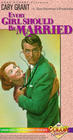
Heh. My video clerk guy glanced at it and snorted in derision. I started to laugh myself. "I know, I know. I'm insane."
However, I watched it yesterday, and - as usual - found much about it to like. There were a couple of laugh-out-loud funny Cary Grant moments as well, moments I had to rewind immediately to savor twice.
It's the story of a girl (Betsy Drake) who spends most of her time sitting at soda counters, and reading parenting magazines, and baby magazines, and decorating magazines, and dreaming about the day when she will get married. Because, don't you know, "every girl should be married". One day, as she looks for a magazine on the rack, she sees Cary Grant - and he is also looking through a baby magazine. She gets an Insta-Crush on him. And - well, there's no better way to put it - she begins to stalk him in an extremely insane way. The whole thing is treated comedically, but in modern times, he probably would have reported her to the police!!
She finds out that he is a confirmed bachelor, and also a pediatrician (who professes that he hates kids.)
This does not deter Anabel at all. She continues to stalk him. She interviews people behind his back - his haberdasher, his tailor - she sends away for his high school and college yearbooks - she memorizes EVERY SINGLE FACT about him.
Cary Grant is onto her from the beginning. He is kind to her, but also very firm. "I am not the marrying type. Please stop talking to my haberdasher." However, Grant has a nice little old lady nurse, who basically helps Anabel in her stalking quest, because she thinks Anabel is "kind of cute".
Cary Grant, at one point, does an imitation of Anabel - this was the moment I had to keep rewinding, because it kept getting funnier and funnier every time I saw it. Grant is complaining to his nurse that he can't go anywhere anymore, because whenever he turns around there is Anabel smiling up at him. Pretending it is a coincidence - "Oh, Doctor, fancy meeting you here!" Cary Grant does her goofy striding walk to a T, makes his smile huge and insane, and sashays around his office. It is hilarious.
I love Cary Grant because you know that underneath the urbane suits, the slicked hair, is this acrobat. So when he suddenly does something crazily physical, it's exhilarating, very very funny.
There is an extremely good "break-up scene" - which, actually, is not really a "breakup scene" because, as Grant continuously reminds her, THEY NEVER DATED IN THE FIRST PLACE. But she is relentless, creative, and determined to nail this man. She has him over for dinner, and of course she knows EXACTLY his favorite foods, and spends the whole day cooking them. He finally has to come clean, and be firm, and really let her down.
She keeps trying to interrupt - and Grant's acting in this scene is terrific. It's completely real, very touching, and would fit into any modern-day movie. Lovely. And her response - she finally gets the hint, and throws him out. She is devastated. She sits on her couch, her head sort of tilted back, with tears streaming down her face. Very effective work.
And then randomly, in the last 5 minutes of the movie, good old Eddie Albert shows up. Heh heh.
One last thing: Franchot Tone is the other big male lead in this sweet little movie. He's another one of those people (like Morris Carnovsky, like John Garfield) that I feel like I KNOW, because of my studying of the Group Theatre. Franchot Tone was involved in the Group Theatre for only its first couple of years - before the better money of Hollywood called. He became very successful - and yet a part of him was always yearning to be back with "the Group". There were a couple of tough seasons where his "donations" kept the Group afloat. He always looked back on his time with the Group as the best years of his life as an actor.
So. It was good to see him. His name - Franchot Tone - is like the name of an old friend.
July 25, 2004
The Book of Abigail and John - More
My first batch of posting these letters are from the time before John and Abigail Adams got married.
This second batch unfurling below you take us up to 1776 - through the tumultuous years of the Stamp Act, the Boston Tea Party, the Boston Port Act, the First and Second Continental Congress ... You'll want to start at the bottom and read up (chronological backwards posting...)
I know I have just WAY bumped David's post way off the page - sorry David!
Red Sox. Tonight. Cowboy Up, dammit.
Abigail to John: "I'll meet you at Philippi"
Abigail to John March 16 1776
By the accounts in the publick papers the plot thickens; and some very important Crisis seems near at hand. Perhaps providence sees it necessary in order to answer important ends and designs that the Seat of War should be changed from this to the Southern colonies that each may have a proper sympathy for the other, and unite in a separation. The Refuge of the Believer amidst all the afflictive dispensations of providence, is that the Lord Reigneth, and that he can restrain the Arm of Man.Orders are given to our Army to hold themselves in readiness to March at a moments warning. I'll meet you at Philippi said the Ghost of Caesar to Brutus.
John to Abigail: "Success"
John to Abigail, Feb. 18 1776 - I LOVE this quote
The Events of War are uncertain: We cannot insure Success, but We can deserve it.
Thomas Paine's Common Sense
John headed home to Abigail in early 1776. There was still (unbelievable as it may seem at this point) a hope that matters could be resolved, and that the 13 rebellious colonies would remain a part of the British Empire. This was the general feeling, the Congress was not looking towards Independence - but towards "resolutions" and self-rule laws that they would present to England.
But then - like a bomb going off in January - Thomas Paine's Common Sense was published. The impact of this document can't be over-estimated. Shock waves went out through the colonies. People began to look towards a complete break with England.
Abigail to John: "like the grave cries give, give"
Abigail to John November 27 1775: In this letter to John, Abigail states the case, the problems facing the Congress, the nation in general. Also, she poses the sides of the argument which years and years later would be the source of the debate between Jefferson and Adams: do we fear the "many" or do we fear the "few"??
I wish I knew what mighty things were fabricating. If a form of Government is to established here what one will be assumed? Will it be left to our assemblies to chuse one? and will not many men have many minds? and shall we not run into Dissentions among ourselves?I am more and more convinced that Man is a dangerous creature, and that power whether vested in many or a few is ever grasping, and like the grave cries give, give. The great fish swallow up the small, and he who is most strenuous for the Rights of the people, when vested with power, is as eager after the perogatives of Government. You tell me of degrees of perfection to which Humane Nature is capable of arriving, and I believe it, but at the same time lament that our admiration should arise from the scarcity of the instances. [I'm with you, Abigail.]
The Building up a Graet Enmpire, which was only hinted at by my correspondent may now I suppose be realized even by the unbelievers. Yet will not ten thousand Difficulties arise in the formation of it? The Reigns of Government have been so long slakned, that I fear the people will not quietly submit to those restrains which are necessary for the peace, and security of the community; if we separate from Brittain, what Code of Laws will be established. How shall we be governed so as to retain our Liberties? Can any government be free which is not administred by general stated Laws? Who shall frame these Laws? Who will give them force and energy? Tis true your Resolutions as a Body have heithertoo had the force of Laws. But will they continue to have?
When I consider these things and the prejudices of people in favour of Ancient customs and Regulations, I feel anxious for the fate of our Monarchy or Democracy or what ever is to take place. I soon get lost in a Labyrinth of perplexities, but whatever occurs, may justice and righteousness be the Stability of our times, and order arise out of confusion. Great difficulties may be surmounted by patience and perseverence.
I believe I have tired you with politicks. As to news we have not any at all.
John to Abigail: "that overweening prejudice in favor of New England"
John to Abigail October 29, 1775
There is, in the human Breast, a social Affection, which extends to our whole Species. Faintly indeed; but in some degree. The Nation, Kingdom, or Community to which We belong is embraced by it more vigorously. It is stronger still towards the Province to which we belong, and in which We had our birth. It is stronger and stronger, as We descend to the County, Town, Parish, Neighborhood, and Family, which We call our own. -- And here We find it often so powerfull as to become partial, to blind our Eyes, to darken our Understandings and pervert our Wills.It is to this Infirmity, in my own Heart, that I must perhaps attribute that local Attachment, that partial Fondness, that overweening prejudice in favor of New England, which I feel very often and which I fear sometimes leads me to expose myself to just Ridicule.
John to Abigail: " it is so difficult to do it right"
John to Abigail Oct. 19 1775
When I shall come home I know not. We have so much to do, and it is so difficult to do it right, that We must learn Patience. Upon my Word I think, if ever I were to come here again, I must bring you with me. I could live here pleasantly if I had you, with me... What if We should? Let me please myself with the Thought however.
Abigail to John: "O my bursting Heart"
Abigail to John October 1, 1775 - This grief-struck letter never fails to bring tears to my eyes.
Have pitty upon me, have pitty upon me o! thou my beloved for the Hand of God presseth me sour.Yet will I be dumb and silent and not open my mouth because thou o Lord hast done it.
How can I tell you (o my bursting Heart) that my Dear Mother has Left me, this day about 5 oclock she left this world for an infinitely better...
Blessed Spirit where art thou? At times I almost am ready to faint under this severe and heavy Stroke, separated from thee who used to be a comforter towards me in affliction, but blessed be God, his Ear is not heavy that he cannot hear, but he has bid us call upon him in time of Trouble...
You often Express'd your anxiety for me when you left me before, surrounded with Terrors, but my trouble then was as the small dust in the balance compaird to what I have since endured. I hope to be properly mindful of the correcting hand, that I may not be rebuked in anger. -- You will pardon and forgive all my wanderings of mind. I cannot be correct.
Tis a dreadful time with this whole province. Sickness and death are in almost every family. I have no more shocking and terible Idea of any Distemper except the Plague than this.
Almighty God restrain the pestilence which walketh in darkness and wasteth at noon day and which has laid in the dust one of the dearest of parents. May the Life of the other be lengthend out to his afflicted and Your distressed Portia.
John to Abigail: "a Disposition entirely American"
John to Abigail July 23 1775
Dr. Franklin has been very constant in his Attendance on Congress from the Beginning. His Conduct has been composed and grave and in the Opinion of many Gentlemen very reserved. He has not assumed any Thing, nor affected to take the lead; but has seemed to choose that the Congress should pursue their own Principles and sentiments and adopt their own Plans: Yet he has not been backward: has been very usefull, on many occasions, and discovered a Disposition entirely American. He does not hesitate at our boldest Measures, but rather seems to think us too irresolute, and backward. He thinks us at present in an odd State, neither in Peace nor War, neither dependent nor independent. But he thnks that We shall soon assume a Character more decisive.He thinks that We have the Power of preserving ourselves, and that even if We should be driven to the disagreeable Necessity of assuming a total Independency, and set up a separate state, we could maintain it. The People of England have thought that the Opposition in America was wholly owing to Dr. Franklin: and I suppose their scribblers will attribute the Temper, and Proceedings of this Congress to him: but there cannot be a greater Mistake. He has had but little share farther than to cooperate and assist. He is however a great and good Man.
Abigail to John: "I want some sentimental Effusions of the Heart"
Abigail to John July 16 1775
You have made often and frequent complaints that your Friends do not write to you. I have stired up some of them. Dr. Tufts, Col. Quincy, Mr. Tudor, Mr. Thaxter all have wrote you now, and a Lady whom I am willing you should value preferable to all others save one. May not I in my turn make complaints? All the Letters I receive from you seem to be wrote in so much haste, that they scarcely leave room for a social feeling. They let me know that you exist, but some of them contain scarcely six lines. I want some sentimental Effusions of the Heart. I am sure you are not destitute of them or are they all absorbed in the great publick? Much is due to that I know, but being part of the whole I lay claim to a Larger Share than I have had. You used to be more communicative a Sundays. I always loved a Sabbeth days letter, for then you had a greater command of your time -- but hush to all complaints.
John to Abigail: "Liberty once lost is lost forever"
John to Abigail July 7, 1775
Your Description of the Distresses of the worthy Inhabitants of Boston, and the other Sea Port Towns, is enough to melt an Heart of Stone. Our Consolation must be this, my dear, that Cities may be rebuilt, and a People reduced to Poverty, may acquire fresh Property: But a Constitution of Government once changed from Freedom, can never be restored. Liberty once lost is lost forever. When the People once surrender their share in the Legislature, and their Right of defending the Limitations upon the Government, and of resisting every Encroachment upon them, they can never regain it...I am forever yours ---
John to Abigail: "My Love"
John to Abigail June 23 1775 - This is the quick note he fired off after receiving her letter below.
This Moment received two Letters from you. Courage, my dear! We shall be supported in Life, or comforted in Death. I rejoice that my Countrymen behaved so bravely, tho not so skillfully conducted as I could wish. I hope this defect will be remedied by the new modelling of the Army.My Love every where.
Abigail to John: "Charlstown is laid in ashes"
Abigail to John June 18 1775 - She writes to him the day after the Battle of Bunker Hill begins. She and John lost a dear friend in the Battle.
The Day; perhaps the decisive Day is come on which the fate of America depends. My bursting Heart must find vent at my pen... Great is our Loss...The race is not to the swift, nor the battle to the strong, but the God of Israel is he that giveth strength and power unto his people. Trust in him at all times, ye people pour out your hearts before him. God is a refuge for us. -- Charlstown is laid in ashes. The Battle began upon our intrenchments upon Bunkers Hill, a Saturday morning about 3 o'clock and has not ceased yet and tis now 3 o'clock Sabbeth afternoon...
I cannot compose myself to write any further at present.
John to Abigail: "Designs of Independency -- an American Republic"
John to Abigail June 17 1775 -- Interesting. At this point, the hope still was that they could reconcile with England. "Independency" hadn't come into it yet.
I have found this Congress like the last. When We first came together, I found a strong Jealousy of Us, from New England, and the Massachusetts in particular. Suspicions were entertained of Designs of Independency -- an American Republic -- Presbyterian Principles -- and twenty other things. Our Sentiments were heard in Congress, with great Caution -- and seemed to make but little Impression: but the longer We sat, the more clearly they saw the Necessity of pursuing vigorous Measures. It has been so now. Every Day We sit, the more We are convinced that the Designs against Us, are hostile and sanguinary, and that nothing but Fortitude, Vigour, and Perseverance can save Us.But America is a great, unwieldy Body. Its Progress must be slow. [He is writing this on June 17, 1775 - the day of the Battle of Bunker Hill - which, of course, word hadn't reached him about yet. He has no idea how quickly, how spontaneously, this "great unwieldy Body" called America is about to start moving.] It is like a large Fleet sailing under Convoy. The fleetest Sailors must wait for the dullest and slowest. Like a Coach and six -- the swiftest Horses must be slackened and the slowest quickened, that all may keep an even Pace.
It is long since I heard from you. I fear you have been kept in continual Alarms.
Abigail to John: "but powder -- where shall we get a sufficient supply?"
Abigail to John June 16 1775
We now expect our Sea coasts ravaged. Perhaps, the very next Letter I write will inform you that I am driven away from our yet quiet cottage. Necessity will oblige Gage to take some desperate steps. We are told for Truth that he is now Eight thousand strong. We live in continual expectation of allarms.Courage I know we have in abundance, conduct I hope we shall not want, but powder -- where shall we get a sufficient supply? I wish we may not fail there.
John to Abigail: "a Cause which interests the whole Globe"
John Adams came home from the First Congress in late October. He was home for only 6 months before being summoned to the Second Continental Congress, which convened in May 1775. I am a geek. I know. But the words "Second Continental Congress" never fails to give me goosebumps.
Meanwhile, Massachusetts was erupting. Bloodshed, battles - General Gage's forces were under siege. British soldiers would shack themselves up in local people's homes (the Adams home was one of them) - the situation was reaching a breaking point. So John was in Philadelphia with the Congress, Abigail and her children were living in a war zone.
John to Abigail: Hartford May 2d 1775 - on his way down to Philadelphia. Adams is hoping that the disaster growing in Boston will bind the colonies together. That's eventually what happened, but at the time, he wasn't sure if it were a done deal.
It is Arrogance and Presumption in human Sagacity to pretend to penetrate far into the Designs of Heaven. The most perfect Reverence and Resignation becomes us. But, I can't help depending upon this, that the present dreadfull Calamity of that beloved Town is intended to bind the Colonies together in more indissoluble Bands, and to animate their Exertions, at this great Crisis in the Affairs of Mankind. It has this Effect, in a most remarkable Degree, as far as I have yet seen or heard. It will plead, with all America, with more irresistible Perswasion, than Angells trumpet tongued.In a Cause which interests the whole Globe, at a Time, when my Friends and Country are in such keen Distress, I am scarecely ever interrupted, in the least Degree, by Apprehensions for my Personal Safety. I am often concerned for you and our dear Babes...
In case of real Danger, of which you cannot fail to have previous Intimations, fly to the Woods with our Children.
Abigail to John: "anxious hours"
Abigail to John Braintree october 16 1774
I dare not express to you at 300 hundred miles distance how ardently I long for your return. I have some very miserly Wishes; and cannot consent to your spending one hour in Town till at least I have had you 12. The Idea plays about my Heart, unnerves my hand whilst I write, awakens all the tender sentiments that years have encreased and matured, and which when with me were every day dispensing to you. The whole collected stock of ten weeks absence knows not how to brook any longer restraint, but will break forth and flow thro my pen. May the like sensations enter thy breast, and (in spite of all the weighty cares of State) Mingle themselves with those I wish to communicate, for in giving them utterance I have felt more sincere pleasure than I have known since the 10 of August. --Many have been the anxious hours I have spent since that day -- the threatening aspect of our publick affairs, the complicated distress of this province, the Arduous and perplexed Business in which you are engaged, have all conspired to agitate my bosom, with fears and apprehensions to which I have heretofore been a stranger, and far from thinking the Scene close3d, it looks as tho the curtain was but just drawn and only the first Scene of the infernal plot disclosed [She was right - it was only the first] and whether the end will be tragical Heaven alone knows.
You cannot be, I know, nor do I wish to see you an inactive Spectator, but if the Sword be drawn I bid adieu to all domestick felicity, and look forward to that Country where there is neither wars nor rumors of War in a firm belief that thro the mercy of its King we shall both rejoice there together.
John to Abigail: "Every Man in it is a great Man"
Love this letter. It's pretty famous. I think I've posted it here before.
John to Abigail Phyladelphia Octr. 9 1774
I am wearied to Death with the Life I lead. The Business of the Congress is tedious, beyond Expression. This Assembly is like no other that ever existed. Every Man in it is a great Man -- an orator, a Critick, a statesman, and therefore every Man upon every Question must shew his oratory, his Criticism and his Political Abilities.The Consequence of this is, that Business is drawn and spun out to an immeasurable Length. I believe if it was moved and seconded that We should come to a Resolution that Three and two make five We should be entertained withi Logick and Rhetorick, Law, History, Politicks, and Mathematicks, concerning the Subject for two whole Days, and then We should pass the Resolution unanimously in the Affirmative.
John to Abigail: "the Thirty Fifth Psalm"
John describes to Abigail the first meeting of the Continental Congress, in this letter, dated September 16, 1774. It's exciting to read - because this is really the first time we casually hear the names of those who will one day be so famous, all the names on the Declaration of Independence, all those damn GUYS!! But here for the first time, we get a glimpse of them - and of course, what are they doing? Debating.
When the Congress first met, Mr. Cushing made a Motion, that it shouild be opened with Prayer. It was opposed by Mr. Jay of N. York and Mr. Rutledge of South Carolina, because we were so divided in religious Sentiments, some Episcopalians, some Quakers, some Aanabaptists, some Presbyterians and some Congregationalists, so that We could not join in the same Act of Worship. -- Mr. S. Adams arose and said he was no Bigot, and could hear a Prayer from a Gentleman of Piety and Virtue, who was at the same Time a Friend to his Country. He was a Stranger in Phyladelphia, but had heard that Mr. Duche (Dushay they pronounce it) deserved that Character, and therefore he moved that Mr. Duche, an episcopal Clergyman, might be desired, to read Prayers to the Congress, tomorrow Morning. The Motion was seconded and passed in the Affirmative. Mr. Randolph our President waited on Mr. Duche, and received for Answer that if his Health would permit, he certainly would. Accordingly next Morning he appeared with his Clerk and in his Pontificallibus, and read several Prayers, in the established Form; and then read the Collect for the seventh day of September, which was the Thirty Fifth Psalm. -- You must remember this was the next Morning after we heard the horrible Rumour, of the Cannonade of Boston. -- I never saw a greater Effect upon an Audience. It seemed as if Heaven had ordained that Psalm to be read on that Morning.After this Mr. Duche, unexpected to every Body struck out into an extemporary Prayer, which filled the Bosom of every Man present. I must confess I never heard a better Prayer, or one so well pronounced. Episcopalian as he is, Dr. Cooper himself never prayed with such fervour, such Ardor, such Earnestness and Pathos, and in Language so elegant and sublime -- for America, for the Congress, for the Province of Massachusetts Bay, and especially the Town of Boston. It has had an excellent Effect upon every Body here.
I must beg you to read that Psalm.
Here's the 35th Psalm, so you can see what John Adams is talking about, how relevant it must have seemed to all of those gentleman, thinking of the hostilities in Boston:
Oppose, LORD, those who oppose me; war upon those who make war upon me.Take up the shield and buckler; rise up in my defense.
Brandish lance and battle-ax against my pursuers. Say to my heart, "I am your salvation."
Let those who seek my life be put to shame and disgrace. Let those who plot evil against me be turned back and confounded.
Make them like chaff before the wind, with the angel of the LORD driving them on.
Make their way slippery and dark, with the angel of the LORD pursuing them.
Without cause they set their snare for me; without cause they dug a pit for me.
Let ruin overtake them unawares; let the snare they have set catch them; let them fall into the pit they have dug.
Then I will rejoice in the LORD, exult in God's salvation.
My very bones shall say, "O LORD, who is like you, Who rescue the afflicted from the powerful, the afflicted and needy from the despoiler?"
Malicious witnesses come forward, accuse me of things I do not know.
They repay me evil for good and I am all alone.
Yet I, when they were ill, put on sackcloth, afflicted myself with fasting, sobbed my prayers upon my bosom.
I went about in grief as for my brother, bent in mourning as for my mother.
Yet when I stumbled they gathered with glee, gathered against me like strangers. They slandered me without ceasing;
without respect they mocked me, gnashed their teeth against me.
Lord, how long will you look on? Save me from roaring beasts, my precious life from lions!
Then I will thank you in the great assembly; I will praise you before the mighty throng.
Do not let lying foes smirk at me, my undeserved enemies wink knowingly.
They speak no words of peace, but against the quiet in the land they fashion deceitful speech.
They open wide their mouths against me. They say, "Aha! Good! Our eyes relish the sight!"
You see this, LORD; do not be silent; Lord, do not withdraw from me.
23
Awake, be vigilant in my defense, in my cause, my God and my Lord.Defend me because you are just, LORD; my God, do not let them gloat over me.
Do not let them say in their hearts, "Aha! Just what we wanted!" Do not let them say, "We have devoured that one!"
Put to shame and confound all who relish my misfortune. Clothe with shame and disgrace those who lord it over me.
But let those who favor my just cause shout for joy and be glad. May they ever say, "Exalted be the LORD who delights in the peace of his loyal servant."
Then my tongue shall recount your justice, declare your praise, all the day long.
John to Abigail: "our perplexed, distressed Province"
Now here's where things start to get really exciting. John writes to her on his way down to Philadelphia for the First Continental Congress. This is really the start of their long long (sometimes years-long) separations.
John to Abigail Prince Town New Jersey Aug. 28th 1774
We Yeaterday visited Nassau Hall Colledge [Note from Sheila: This was a featured Trivia Question here on this blog some time back.], and were politely treated by the Schollars, Tutors, Professors and President, whom We are, this Day to hear preach. Tomorrow We reach the Theatre of Action. God Almighty grant us Wisdom and Virtue sufficient for the high Trust that is devolved upon Us. The Spirit of the People wherever we have been seems to be very favourable. They universally consider our Cause as their own, and express the firmest Resolution, to abide the Determination of the Congress.I am anxious for our perplexed, distressed Province [Boston] -- hope they will be directed into the right Path. Let me intreat you, my Dear, to make yourself as easy and quiet as possible. Resignation to the Will of Heaven is our only Resource in such Dangerous Times. Prudence and Caution should be our Guides. I have the strongest Hopes, that We shall yet see a clearer Sky, and better Times...
Your Account of the Rain refreshed me. [In his absence, Abigail took complete charge of the farm, the finances, the help, along with raising their growing brood of children. It is speculated as well that without this "help", John Adams might have run their finances into the ground. From his book allowance alone!! Heh. I relate. So her letters are filled with farm information, crop information, etc.] I hope our Husbandry is prudently and industriously managed. Frugality must be our Support...
The Education of our Children is never out of my Mind. Train them to Virtue, habituate them to industry, activity and Spirit. Make them consider every Vice, as shameful and unmanly: fire them Ambition to be usefull -- make them disdain to be destitute of any usefull, or ornamental Knowledge or Accomplishment. Fix their Ambition upon great and solid Objects, and their Contempt upon little, frivolous, and useless ones. It is Time, my dear, for you to begin to teach them French. Every Decency, Grace, and Honesty should be inculcated upon them.
One of my favorite quotes from all of their letters is in this one: Fire them Ambition to be usefull. What an assignment. This is the assignment I try to give myself on a daily basis - to be fired with ambition to be useful.
Abigail to John: "the Misfortunes of Sparta"
Abigail to John, August 19 1774 (John had left for Philadelphia with some of the other delegates on August 10.)
The great anxiety I feel for my Country, for you and for our family renders the day tedious, and the night unpleasant. The Rocks and quick Sands appear upon every Side. What course you can or will take is all wrapt in the Bosom of futurity. Uncertainty and expectation leave the mind great Scope. Did ever any Kingdom or State regain their Liberty, when once it was invaded without Blood shed? I cannot think of it without horror.Yet we are told that all the Misfortunes of Sparta were occasiond by their too great Sollicitude for present tranquility, and by an excessive love of peace they neglected the means of making it sure and lasting. They ought to have reflected, says Polibius, that as there is nothing more desirable, or advantages than peace, when founded in justice and honour, so there is nothing more shameful and at the same time more pernicious when attained by bad measures, and purchased at the price of liberty...
I want so much to hear from you. I long impatiently to have you upon the Stage of action. The first of September or the month of September may be of as much importance to Great Britan as the Ides of March were to Ceaser.
John to Abigail: "a weary Traveller"
In June, 1774 - John Adams was asked to be a delegate at the First Continental Congress, to be held in Philadelphia starting in September. He began to prepare for the journey, while still keeping up with his law practice. He wrote to Abigail from the court in Falmouth:
I believe I forgot to tell you one Anecdote: When I first came to this House it was late in the Afternoon, and I had ridden 35 miles at least. "Madam" said I to Mrs. Huston, "is it lawfull for a weary Traveller to refresh himself with a Dish of Tea provided it has been honestly smuggled, or paid no Duties?""No sir, said she, we have renounced all Tea in this Place. I can't make Tea, but I'll make you Coffee." Accordingly I have drank Coffee every Afternoon since, and have borne it very well. Tea must be universally renounced. I must be weaned, and the sooner, the better.
John to Abigail: "a continual Scene of Fatigue"
John to Abigail June 29 1774 (writing to her as he makes the rounds to the different courts) - In this letter, you hear the tone which will be so common throughout much of his writing: wondering: "Why does it seem so much HARDER for me than for others?"
My Life has been a continual Scaene of Fatigue, Vexation, Labour and Anxiety. I have four Children. I had a pretty Estate from my Father, I have been assisted by your Father. I have done the greatest Business in the Province: Yet I am Poor in Comparison of others.This I confess is grievous and discouraging. I ought however, to be candid enough to acknowledge that I have been imprudent. I have spent an Estate in Books. I have spent a Sum of Money indiscreetly in a Lighter, another in a Pew, and a much greater in an House in Boston. These would have been Indiscretions, if the Impeachment of the Judges, the Boston Port Bill, &c. &c. had never happened; but by the unfortunate Interruption of my Business from these Causes, these Indiscretions become almost fatal to me, to be sure much more detrimental.
John Lowell, at Newbury Port, has built him an House, like the Palace of a Nobleman and lives in great Splendor. His Business is very profitable. In short every Lawyer who has the least Appearance of Abilities makes it do in the Country. In Town, nobody dies, or ever can, who Either is not obstinately determined never to have any Connection with Politicks or does not engage on the Side of the Government, the Administration, and the Court.
Let us therefore my dear Partner, from that Affection which we feel for our lovely Babes, apply ourselves by every Way, we can, to the Cultivation of our Farm. Let Frugality, and Industry, be our Virtues, if they are not of any others. And above all Cares of the Life let our ardent Anxiety be, to mould the Minds and Manners of our Children. Let us teach them not only to do virtuously but to excell. To excell they must be taught to be steady, active, and industrious.
John to Abigail: "the Project of the Tea"
On December 17, 1773 came what would eventually be known as the Boston Tea Party. John Adams wrote about in his journal and said "This is the most magnificent Movement of all ... I can't but consider it as an Epocha in History."
Then, in March, 1774 came the Boston Port Act, which closed the port to trade. A punishment for those rabble-rousers. General Thomas Gage came to Boston harbor. This was already the beginning of the end, but nobody really knew it yet.
This is from a letter by John to Abigail, on May 12, 1774 - He was still one of the busiest lawyers in the area, so he traveled quite a bit.
We live my dear Soul, in an Age of Tryal. What will be the Consequence I know not. The Town of Boston, for ought I can see, must suffer Martyrdom: It must expire: And our principal Consolation is, that it dies in a noble Cause. The Cause of Truth, of Virtue, of Liberty and of Humanity: and that it will probably have a glorious Reformation, to greater Wealth, Splendor and Power than ever...Don't imagine from all this that I am in the Dumps. Far otherwise. I can truly say, that I have felt more Spirits and Activity, since the Arrival of this News, than I had done before for years. I look upon this, as the last Effort of Lord North's Despair. And he will as surely be defeated in it, as he was in the Project of the Tea.
More John and Abigail Adams
Read the rest of the excerpts starting here.
John Adams and Abigail Smith were married on October 25, 1764. In 1765, Adams published a bunch of essays in The Boston Gazette attacking the infamous Stamp Act. Even though he constantly said he had no interest in "politicks", it didn't matter - after those essays, "politicks" took an interest in him. The call would not be avoided.
Pathetic or Prophetic? (David)
This can either turn out to be prophetic or pathetic, but I believe this evening’s baseball game between the Red Sox and Yankees could prove to be the turning point so desperately needed by Boston. Led by their captain, Jason Varitek, the Sox finally put together a win they can build off of. Varitek knew his team needed some fire in their belly and he had plenty to spare. When he got in the face of pretty boy A-Rod while protecting his pitcher, he sent a message to his team, and to the Yankees, that they weren’t going to lie down, not yet. A-Rod, like Jeter, is quickly becoming a symbol of all the things gone right for The Yanks and all the things gone wrong for the Sox, so I felt the symbolic importance of “Tek” shoving him back like that. I also felt the other team leader, Francona, running out and getting himself ejected, was another positive step in the right direction. Someone’s got to get this team to stand up and fight. It doesn’t escape me that Kevin “Cowboy up” Millar has finally put on his spurs as well. And finally, when a team can defeat another team that was 56-0 this season when leading after the 8th inning, due to a legend in the making called Mariano Rivera, that says something. Especially when that legend steps on the mound with a 2-run lead.
I must admit that I was down and out. It has been a harrowing season already and I had reached my annual limit early of eating Yankee dust and swallowing Yankee crow. When Trot Nixon’s seemingly game tying homer in the bottom of the ninth was knocked down by the wind and caught by Sheffield, I let go some pretty choice and inappropriate expressions in front of my children. I’m not proud of this mind you, but I’m not ashamed either. I had felt all the defeats of the season and all the seasons past in that moment. “Why can’t things go right for the Red Sox,” I wailed pathetically. “Why can’t we catch one God damn, mother bleeping break!?” But when Bill Mueller hit that home run, I began to believe again. Seeing Varitek and Francona run out of the clubhouse to congratulate their team sent a surge of hope right through me.
The Yankees took a 9-4 lead after the bench-clearing melee. A 5 run lead! If the Red Sox lost after initiating that scuffle, I believe they would have been more demoralized than ever, possibly beyond repair. But instead they took a page out of last season and fought back to seize an improbable victory. Something they teased us with the night before. Things are definitely looking up.
Like I said, pathetic or prophetic? The odds are on pathetic, but I feel prophetic tonight.
July 24, 2004
The Book of Abigail and John
So okay, fine, I'm in the middle of a manic episode. Sue me. You people are the beneficiaries of it!! Unfurling below you are excerpts from the early letters of John and Abigail Adams. Actually, to be accurate - these are excerpts from the early letters of John Adams and Abigail Smith - these are all pre-marriage letters, when Adams was an up-and-coming lawyer, and courting Abigail Smith of Braintree.
This is the beginning story of their love affair. Their letters are passionate, inquiring, very funny ... They enjoy teasing one another, being "saucy", as Abigail puts it.
Because of an outbreak of smallpox in the spring of 1764, the two had to postpone their wedding.
And my pet theory is that the smallbox outbreak, when John went into Boston to be inoculated (a long drawn out process, which caused the two of them to be separated for two months) - was really when their relationship blossomed into maturity. Maybe it was because of the seriousness of inoculation, the risks they faced ... but their letters take a different tone during John's quarantined period. They ache for one another, John begins to ramble on about "monks and hermits", and they begin to talk about one another's "faults". To me, it reads like they are working out those personality kinks beforehand, getting to know "the dark side" BEFORE they get married. Trust growing, honesty growing ... during that time of separation.
I love both of them. As will be obvious by the manic amount of typing I have just done. But that's okay. Spending a morning with John Adams and Abigail Smith ain't too shabby.
I post these for all of you - but also, specifically, for my parents, who instilled in me at a very young age a fascination with the American Revolution, and also a love of these two revolutionary characters in particular.
Thanks, Mum and Dad.
You'll want to scroll to the bottom post here and read up - because they're chronological.
Abigail to John: "this is not said for to recriminate"
Abigail to John October 4 1764
I am much obliged to you for the care you have taken about help. [Finding servants.] I am very willing to submit to some inconveniences in order to lessen your expenses, which I am sensible have run very high for these 12 months past and tho you know I have no particular fancy for Judah yet considering allt hings, and that your Mamma and you seem to think it would be best to take her, I shall not at present look out any further.The cart you mentioned came yesterday, by which I sent as many things as the horse would draw the rest of my things will be ready the Monday after you return from Taunton. And -- then, Sir, if you please you may take me.
I hope by that time, that you will have recovered your Health, together with your formour tranquility of mind. Think you that the phylosopher who laught at the follies of mankind did not pass thro' life with more ease and pleasure, than he who weept at them, and perhaps did as much towards a reformation.
Tis true that I have had a good deal of fatigue in my own affair since I have been in town, but when I compare that with many other things that might have fallen to my Lot I am left without any Shadow of a complaint. A few things, indeed I could meet with that have really discomposed me, one was haveing a corosive applied when a Lenitive would have answerd the same good purpose. [Translation? Be gentle with your criticisms, not so harsh and "corosive" in the future, please.] But I hope I have drawn a lesson from that which will be useful to me in futurity, viz. never to say a severe thing because to a feeling heart they wound too deeply to be easily cured. -- Pardon me this is not said for to recriminate, and I have only mentiond it, that when ever there is occasion a different method may be taken.
I do not think of any thing further to add, nor any thing new to tell you, for tis an old Story tho I hope as pleasing as it is true, to tell you that I am unfeignedly Your Diana
Abigial Smith and John Adams were married on October 25, 1764. And, of course, with marriage, their letters stopped. (For a brief while, anyway.)
At this point, Adams' vehement response to the Stamp Act was still a year away. This, of course, was what would catapult him into prominence. While there were rumblings of things to come, Adams did not yet know the major role he would so soon play. And neither of them could know that the majority of their marriage would be spent far apart, writing letter after letter after letter to one another ... letters which would one day become so world-famous.
John to Abigail: "I see nothing but Faults"
John is finally released from quarantine. John and Abigail spend the summer getting their house ready, looking for servants, for when they will move in after their wedding. As a lawyer, John traveled a lot for his cases. He wrote diligently to Abigail during every separation. In this letter he expresses for the first time something that will be a continuing theme through their long long marriage, where they spent so much time apart. He relied on her perspective. He began to lose it during separations, he needed to run things by her, he needed to hear her thoughts ... She brought out a more forgiving person in him. Without it, at times he would descend into paranoia, or bitterness. When he was President, and she was still up in Quincy - the press would openly refer to her absence as something that needed to be rectified, because without her he clearly lost his mind. This was an exaggeration, but there was a grain of truth to it. She was like a compass for him.
John to Abigail Septr. 30th 1764
Oh my dear Girl, I thank Heaven that another Fortnight will restore you to me -- after so long a separation. My soul and Body have both been thrown into Disorder, by your Absence, and a Month of two more would make me the most insufferable Cynick in the World. I see nothing but Faults, Follies, Frailties and Defects in any Body, lately. People have lost all their good Properties or I my Justice or Discernment.But you have always softened and warmed my Heart, shall restore my Benevolence as well as my Health and Tranquility of mind. You shall polish and refine my sentiments of Life and Manners, banish all the unsocial and ill natured Particles in my Composition, and form me to that happy Temper, that can reconcile a quick Discernment with a perfect Candour.
Abigail to John: "And permit me to tell you Sir"
And here is Abigail's response to John's letter cataloguing her faults. Meanwhile: remember - John is STILL quarantined.
Abigail to John May 9 1764
Your Brother brought your Letter, tho he did not let me see him, deliverd it the Doctor from whom received it safe. I thank you for your Catalogue, but must confess I was so hardned as to read over most of my Faults with as much pleasure, as an other person would have read their perfections. And Lysander must excuse me if I still persist in some of them, at least till I am convinced that an alteration would contribute to his happiness. [Heh. Smart woman.] Especially may I avoid that Freedom of Behaviour which according to the plan given, consists in Violations of Decency, and which would render me unfit to Herd even with the Brutes. And permit me to tell you Sir, nor disdain to be a learner, that there is such a thing as Modesty without either Hypocrisy or Formality.As to a neglect of Singing, that I acknowledg to be a Fault which if posible shall not be compland of a second time, nor should you have had occasion for it now, if I had not a voice harsh as the screech of a peacock.
The Capotal fault shall be rectified, tho not with any hopes of being lookd upon as a Beauty, to appear agreeable in the Eyes of Lysander, has been for Years past, and still is the height of my ambition.
The 5th fault, will endeavor to amend of it, but you know I think that a gentleman has no business to concern himself about the Leggs of a Lady, for my part I do not apprehend any bad effects from the practise, yet since you desire it, and that you may not for the future trouble Yourself so much about it, will reform.
The sixth and last can be cured only by a Dancing School.
John to Abigail: "I proceed to recollect yourself"
John to Abigail May 7th 1764 - This letter (as indeed many of their letters) should be read in a teasing adoring tone. It could read harsh if you miss the fact that this exchange is mostly about teasing her. Fortunately, people in the 18th century didn't use :) and :-p to connote teasing, or "It's okay, let me soften the blow of that teasing remark with a 'smiley'." For example, when Adams laments that she "reads and writes and thinks" and this is "inexcusable", it would be a mistake to take that literally. His entire tone here is one of humor.
I promised you, Sometimes agone, a Catalogue of your Faults, Imperfections, Defects, or whatever you please to call them. I feel at present, pretty much at Leisure, and in a very suitable Frame of Mind to perform my Promise. But I must caution you, before I proceed to recollect yourself, and instead of being vexed or fretted or thrown into a Passion, to resolve upon a Reformation -- for this is my sincere Aim, in laying before you, this Picture of yourself.In the first Place, then, give me leave to say, you have been extreamly negligent, in attending so little to Cards. You have very little Inclination, to that noble and elegant Diversion, and whenever you have taken an Hand you have held it but aukwardly and played it, with a very uncourtly, and indifferent Air. Now I have Confidence enough in your good sense, to rely upon it, you will for the future endeavor to make a better Figure in this elegant and necessary Accomplishment.
Another Thing, which ought to be mentioned, and by all means amended, is, the Effect of a Country Life and Education. I mean, a certain Modesty, sensibility, Bashfulness, call it by which of these Names you will, that enkindles Blushes forsooth at every Violation of Decency, in Company, and lays a most insupportable Constraint on the freedom of Behaviour. [Translation? Loosen up, babe.] Thanks to the late Refinements of modern manners, Hypocrisy, superstition, and Formality have lost all Reputation in the World and the utmost sublimation of Politeness and Gentility lies, in Ease, and Freedom, or in other Words in a natural Air and Behaviour, and in expressing a satisfaction at whatever is suggested and prompted by Nature, which the aforesaid Violations of Decency, most certainly are.
In the Third Place, you could never be prevail'd on to learn to sing. This I take very soberly to be an Imperfection of the most moment of any...
In the Fourth Place you very often hang your Head like a Bulrush. You do not sit, erected as you ought, by which Means, it happens that you appear too short for a Beauty, and the Company looses the sweet smiles of that Countenance and the bright sparkles of those Eyes -- This Fault is the Effect and Consequence of another, still more inexcusable in a Lady. I mean an habit of Reading, Writing, and Thinking. But both the Cause and the Effect ought to be repented and amended as soon as possible.
Another Fault, which seems to have been obstinately persisted in, after frequent Remonstrances, Advices and Admonitions of your Friends, is that of sitting with the Leggs across. This ruins the figure and the Air, this injures the Health. And springs I fear from the former source vist. too much Thinking. -- These Things ought not to be!
A sixth imperfection is that of Walking, with the Toes bent inward. This Imperfection is commonly called Parrot-toed, I think, I know not for what Reason. But it gives an Idea, the reverse of a bold and noble Air, the Reverse of the stately strutt, and the sublime Deportement.
Thus have I given a faithful Portraiture of all the Spotts, I have hitherto discerned in this Luminary. Have not regarded Order, but have painted them as they arose in my Memory. Near Three Weeks have I conned and studied for more, but more are not to be discovered.
All the rest is bright and luminous.
Lysander.
Abigail to John: "for Saucyness no Mortal can match him"
John finally responds, telling her that the entire hospital had gotten so sick that it was deemed unsafe for letters to go out. He assures her that he is fine, and still able to view things with humor. Even in the midst of the illness, he sees the comedic nature of things, and writes her stories. She responds with a story of her own - She witnessed the reunion moment between a "Gentleman and his Lady", a goodnatured one, all "how do ye", and reflects on her own more passionate and tumultuous relationship.
Abigail to John April 30 1764
I was yesterday at the Meeting of a Gentleman and his Lady, Clothes all shifted -- no danger -- and no fear. A how do ye, and a how do ye, was exchanged between them, a Smile, and a good natured look. Upon my word I believe they were glad to see each other. A tender meeting. I was affected with it. And thought whether Lysander, under like circumstances could thus coldly meet his Diana, and whether Diana could with no more Emotion receive Lysander. What think you. I dare answer for a different meeting on her part were She under no restraint. When may that meeting be?
Later in the letter, Abigail gets back on her pet topic, which Adams keeps hinting at, but never follows through on: that he will tell her her "faults". She won't let the matter drop. And notice, she won't let him escape without knowing what she thinks are HIS faults. She wants an equal exchange, a quid pro quo
O by the way you have not told me that insinuation to my disadvantage which you promised me. Now methinks I see you criticizeing -- What upon Earth is the Girl after. Where is the connection between my standing the distemper likek an oak, and an insinuation to her disadvantage? -- Why i did not expect that a short-sighted mortal would comprehend it, it was a Complex Idea if I may so express myself. And in my mind there was a great connexion. I will show you how it came about."I did expect this purgation [the smallpox inoculation process] of Lysander would have set us on a level and have renderd him a Sociable Creature, but Ill Luck, he stands it like an oak, and is as haughty as ever." Now mentioning one part of this Sentence, brought to mind the accusation of haughtiness, and your faults naturally lead me to think of my own. But here look yee. I have more than insinuations against you. "An intolerable forbiding expecting Silence, which lays such a restraint upon but moderate Modesty that tis imposible for a Stranger to be tranquil in your presence." What say you to that chrage? Deny it not, for by experience I know it to be true. Yes to this day I feel a greater restraint in your Company, than in that of allmost any other person on Earth, but I thought I had reasons by myself to account for it, and know not that others were affected in the same manner till a late complaint was enterd against you. Is there anything austere in your countenance? Indeed I cannot recollect anything. Yet when I have been most pained I have thoroughly studied it, but never could discover one trace of the severe. Must it not then be something in Behaviour ... else why should not I feel as great restraint when I write... Unsociable Being, is an other charge. Bid a Lady hold her Tongue when she was tenderly inquireing after your wellfare, why that sounds like want of Breeding. It looks not like Lysander for it wears the face of ingratitude. -- I expect you to clear up these matters, without being in the least saucy.
As to the charge of Haughtiness I am certain that is a mistake, for if I know any thing of Lysander, he has as little of that in his disposition, as he has of Ill nature. But for Saucyness no Mortal can match him, no not even His Diana
Saucy, indeed!!
Abigail to John: "Gold and Silver have I none"
Still receiving no response from John, Abigail writes again.
Thou canst not prove a villain, imposible. I therefore still insist upon it, that I neither do, nor can fear thee. For my part I know not that there is any pleasure in being feard, but if there is, I hope you will be so generous as to fear your Diana, that she may at least be made sensible of the pleasure...Tomorrow makes the 14th Day. How many more are to come? I dare not trust my self with the thought. Adieu. Let me hear from you by Mr. Ayers, and excuse this very bad writing, if you had mended my pen it would have been better, once more adieu. Gold and Silver have I none, but such as I have, give I unto thee -- which is the affectionate Regard of Your
A Smith
Abigail to John: "I cannot make my self visible to you"
John doesn't write to Abigail for several days, basically because it is thought that it would be too dangerous to send letters out from the infected hospital. Even though Abigail had promised to "smoke" all his letters to purify them, John didn't want to take the risk of infecting her. However, Abigail doesn't know why he isn't responding to her letters, and she goes into a bit of a tailspin.
Can you tell how much I love this woman? I know it's an illusion that I feel like I know her - but I can certainly say this: I feel privileged to read her private letters. Privileged to be let into her world, her thought process.
Abigail to John April 20th 1764
What does it signify, why may not I visit you a Days as well as Nights? I no sooner close my Eyes than some invisible Being, swift as the Alborack of Mahomet, bears me to you. I see you, but cannot make my self visible to you. That tortures me, but it is still worse when I do not come for I am then haunted by half a dozen ugly Sprights. One will catch me and leep into the Sea, an other will carry me up a precipice (like that which Edgar describes to Lear), then toss me down, and were I not then light as the Gosemore I should shiver into atoms -- an other will be pouring down my throat stuff worse than the witches Broth in Macbeth. -- Where I shall be carried next I know not, but I had rather have the small pox by inoculation half a dozen times than be sprighted about as I am.
Abigail to John: "be to me a second conscience"
This is Abigail's teasing response to John's teasing letter below.
Abigail to John Thursday Eve April th 19 1764
Why my good Man, thou hast the curiosity of a Girl. Who could have believed that only a slight hint would have set thy imagination a gig in such a manner. And a fine encouragement I have to unravel the Mistery as thou callest it. Nothing less truly than to be told Something to my disadvantage. What an excellent reward that will be? In what Court of justice did'st thou learn that equity?... As to the insinuation, it doth not give me any uneasiness, for if it is any thing very bad, I know thou does not believe it ...But altho it is vastly disagreeable to be accused of faults, yet no person ought to be offended when such accusations are delivered in the Spirit of Friendship. -- I now call upon you to fulfill your promise, and tell me all my faults, both of omission and commision, and all the Evil you either know, or think of me, be to me a second conscience, nor put me off to a more convenient Season. There can be no time more proper than the present, it will be harder to erase them when habit has strengthened and confirmd them.
John to Abigail: "You are a wanton, malicious, what shall I call you..."
In one of the letters written to him while he was quarantined during the inoculation process, Abigail had hinted to him that she had to tell him Something, and she would do so in another letter. This sets John's brain spinning.
John to Abigail Tuesday 17th April 1764
I never receive a Line from you without a Revivification of Spirits, and a joyful Heart. I long to hear that -- something you promised to tell me, in your next. What can that Thing be? thought I. My busy fancy will be speculating and conjeturing about it, night and day, I suppose, till your next Letter shall unriddle the Mystery. You are a wanton, malicious, what shall I call you for putting me in this Puzzle and Teaze for a day or two, when you might have informed me in a Minute...Oh. Now I think on't I am determined very soon to write you, an Account in Minute Detail of the many Faults I have observed in you. You remember I gave you an Hint that I had observed some, in one of my former Letters. You'l be surprized, when you come to find the Number of them.
By the Way, I have heard since I came to Town an Insinuation to your Disadvantage, which I will inform you off, as soon as you have unravelled your Enigma.
Ha! He's so transparent. I love it!!
Abigail to John: "all I insist upon"
Abigail to John - still quarantined - Sunday Noon Weymouth April th 15 1764
I cannot consent you should omit writing, unless you find it prejudicial to your Health, if so I have not a word more to say. But, if amusement is all they require, why is not one amusement as good as an other, it may be those who forbid you cannot conceive that writing to a Lady is any amusement, perhaps they rank it under the Head of drudgery, and hard Labour.However all I insist upon is that you follow that amusement which is most agreeable to you whether it be Cards, Chequers, Musick, Writing, or Romping.
Abigail to John: "I have abundance to say to you"
Abigail to John Weymouth April 12 1764
I know you are a critical observer, and your judgment of people generally plases me. Sometimes you know, I think you too severe, and that you do not make quite so many allowances as Humane Nature requires, but perhaps this may be oweing to my unacquained-ness with the World. Your Business Naturaly leads you to a nearer inspection of Mankind, and to see the corruptions of the Heart, which I believe you often find desperately wicked and deceitful.Methinks I have abundance to say to you. What is next? O that I should have been extreemlky glad to have seen you to Day. Last Fast Day, if you remember, we spent together, and why might we not this? Why I can tell you, we might, if we had been together, have been led into temptqation. I don't mean to commit any Evil, unless setting up late, and thereby injuring our Health, may be called so. To that I could have submitted without much remorse of Conscience, that would have had but little weight with me, had you not bid me adieu, the last time I saw you. The reflexion of what I that forenoon endured, has been ever since sufficient to deter me from wishing to see you again, till you can come and go, as you formerly used to.
Abigail to John: "the dark side of your Diana"
Abigail to John April 12 1764 (Watch how Abigail picks up on the last sentence of John's last letter - posted below - about the "excellencies and defects" in her character.) The following letters from her are, possibly, why I admire her the most . She has a fearlessness in addressing the "defects" in her character, (but also a sense of humor about it all) and through it all, she persistently asks John for help with them. It's quite amazing. He resists at first her pleas, and she won't give up - She keeps bringing it up: "Now, about my faults ... when are you going to help me address them?" How many people are that courageous? That courageous in looking at themselves and admitting their imperfections? And, judging from John's eventual response to her please - he is worthy of her trust. I'm jealous. I'd like a "helpmate" in this regard. Of course it has to be a 2-way street. I'm not interested in a man who thinks he's "done", and who has no curiosity about his inner conflicts, or no interest in inquiring into things. For all of John Adams' faults - one of his many many virtues is his unending child-like curiosity. About everything. Long before there is such a thing as "therapy" - his letters are all about that kind of self-reflective and relentless curiosity. Nothing escapes his notice. He hashes stuff out, putting his thoughts into words, expressing feelings of rejection, loss, wounded vanity ... Abigail the recipient of all that storminess. This wasn't a one-way "let me correct the little wife's faults" thing. She gave as good as he did. Heh. Okay, so onward!)
Abigail to John April 12 1764
How kind is it in you, thus by frequent tokens of remembrance to alleviate the pangs of absence, by this I am convinced that I am often in your Thoughts, which is a satisfaction to me, notwithstanding you tell me that you sometimes view the dark side of your Diana, and there no doubt you discover many Spots -- which I rather wish were erased, than conceal'd from you. Do not judge by this, that your opinion is an indifferent thing to me, (were it so, I should look forward with a heavey Heart,) but it is far otherways, for I had rather stand fair there, and be thought well of by Lysander than by the greater part of the Worldb esides. I would fain hope that those faults which you discover, proceed more, from a wrong Heaad, than a bad Heaert. E'er long May I be connected with a Friend from whose Example I may form a more faultless conduct, and whose benevolent mind will lead him to pardon, what he cannot amend.
John to Abigail: "I doubt whether I understand human Nature"
John to Abigail Thursday 5 Oclock 12 April 1764 (still quarantined - He proposes that he will begin a journal - and yet it will be addressed to her. So that he can speak to her as though he is speaking to himself.)
Heaven forgive me for suffering my Imagination to straggle into a Region of Ideas so nauseous And abominable: and suffer me to return to my Project of writing you a Journal. You would have a great Variety of characters -- Lawyers, Physicians (no Divines I believe), a Number of Tradesmen, Country Colonells, Ladies, Girls, Nurses, Watchers, Children, Barbers &c. &c. &c. But among all These, there is but one whose Character I would give much to know better than I do at present. In a Word I am an old Fellow, and have seen so many Characters in my Day, that I am almost weary of Observing them. -- Yet I doubt whether I understand human Nature or the World very well or not?There is not much Satisfaction in the study of Mankind to a benevolent Mind. It is a new Moon, Nineteen Twentyeths of it opaque and unenlightened.
Intimacy with the most of People, will bring you acquainted with Vices and Follies enough to make you despize them. Nay Intimacy with the most celebrated will very much diminish our Revernce and Admiration.
What say you now my dear shall I go on with my Design of Writing Characters? -- Answer as you please, there is one Character, that whether I draw it on Paper or not, I cannot avoid thinking on every Hour, and considering sometimes together and sometimes asunder, the Excellencies and Defects in it.
John to Abigail: "the soft Ligaments of Matrimony"
John to Abigail Braintree Ap. 11th 1764
Abstinence from all, but the cool and the soft, has hitherto agreed with me very well; and I have not once transgressed in a single Iota. The Medicine we have taken is far from being loathsome or painful or troublesome, as I own I expected. And if I could but enjoy my Retreat in silence and solitude, there would be nothing Wanting but Obliviscence of your Ladyship, to make me as Happy as a Monk in a Cloyster or an Hermit in his Cell. You will wonder, perhaps at my calling in Monks and Hermits, on this Occasion, and may doubt about the Happiness of their situations: Yet give me leave to tell you freely, the former of these are so tottally absorbed in Devotion and the latter in Meditation, and such an Appetite, such a Passion for their Respective Employments and Pleasures grows habitually up in their Minds, that no Mortals (excepting him who hopes to be bound to your Ladyship in the soft Ligaments of Matrimony) has a better security for Happiness than they...I long to come once more to Weymouth before I go to Boston. I could, well enough. I am as well as ever, and better too. Why should I not come? Shall I come and keep fast with you? Or will you come and see me? I should be glad to see you in this House, but there is another very near it, where I should rejoice much more to see you, and to live with you till we shall have lived enough to ourselves, to Glory, Virtue and Mankind, and till both of us shall be desirous of Translation to a wiser, fairer, better World.
I am, and till then, and forever after will be your Admirer and Friend, and Lover,
John Adams
Abigail to John: "let her who tenderly cares for you"
Abigail to John Weymouth April 8 1764
Let me know whether you took your vomit, whether you have got your pills and whether you have begun Lent -- how it suits you? I am very fearful that you will not when left to your own management follow your directions -- but let her who tenderly cares for you both in Sickness and Health, intreet you to be careful of that Health upon which depends the happiness of Your A Smith
John to Abigail: "Ipichacuana'd"
John to Abigail Sunday Morning 1/2 After 10
Did you ever see two Persons in one Room Ipichacuana'd together? (I hope I have not Spelled that ineffable Word amiss!) I assure you they make merry Diversion. We took turns to be sick and to laugh. When my Companion was sick I laughed at him, and when I was sick he laughed at me. Once however and once only we were both sick together, and then all Laughter and good Humor deserted the Room.
John to Abigail: "a Six Weeks Separation from my Diana"
John to Abigail, Saturday Evening Eight O'Clock 7 April 1764
For, I assure you Sincerely, that, (as Nothing which I before expected from the Distemper gave me more Concern, than the Thought of a six Weeks Separation from my Diana) my Departure from your House this Morning made an Impression upon me that was severely painfull. I thought I left you, in Tears and Anxiety -- And was very glad to hear by your Letter, that your Fears were abated.
Smallpox
By the end of 1763, John Adams was formally recognized as Abigail Smith's husband-to-be. They began to plan a wedding - but then, in early 1764, there was a smallpox outbreak in Boston. The wedding was pushed off to the fall. In 1764, inoculation had grown in acceptance (although still quite controversial). In fact, there were areas which vehemently prohibited inoculation. Boston did not prohibit inoculation, and so in the spring of 1764, the entirety of the city began an inoculation process. John Adams himself went into quarantine with the other inoculees and wrote copious letters to Abigail from his confinement - These letters provide an invaluable picture of medical practices at that time. I love the "smallpox letters". They're fascinating.
Inoculation was still very risky. Many people became quite ill with it. John puts on a humorous pose as he goes into quarantine with many others, making jokes to Abigail, kidding about the bad food, the comical characters - but both of them knew the risks.
Anyway - just a bit of background for the "smallpox letters" above.
Abigail to John: "I have too much pride"
Abigail to John, Weymouth Sepbr. th12 1763
I have too much pride to be a clog to any body.
John to Abigail: "I saw a Lady"
John to Abigail, Saturday morning, Aug. 1763
I lay, in the well known Chamber, and dreamed, I saw a Lady, tripping it over the Hills, on Weymouth shore, and Spreading Light and Beauty and Glory, all around her. At first I thought it was Aurora, with her fair Complexion, her Crimson Blushes and her million Charms and Graces. But I soon found it was Diana, a Lady infinitely dearer to me and more charming. -- Should Diana make her Appearance every morning instead of Aurora, I should not sleep as I do, but should be all awake and admiring by four, at latest.
Abigail to John: "The Fabrick often wants repairing"
Abigail to John, August th11 1763
Humanity obliges us to be affected with the distresses and Miserys of our fellow creatures. Friendship is a band yet stronger, which causes us to [fee]l with greater tenderness the afflictions of our Friends.And there is a tye more binding than Humanity, and stronger than Friendship, which makes us anxious for the happiness and welfare of those to whom it binds us. It makes their Misfortunes, Sorrows and afflictions, our own. Unite these, and there is a threefold cord -- by this cord I am not ashamed to own myself bound, nor do I [believe] that you are wholly free from it. Judge you then for your Diana has she not this day [had sufficien]t cause for pain and anxiety of mind?
She bids me [tell] you that Seneca, for the sake of his Paulina was careful and tender of his health. The health and happiness of Seneca she says was not dearer to his Paulina, than that of Lysander to his Diana.
The Fabrick often wants repairing and if we neglect it the Deity will not long inhabit it, yet after all our care and solisitude to preserve it, it is a tottering Building, and often reminds us that it will finally fall.
John to Abigail: "blessed storm!"
John to Abigail, Feb. 14th 1763
I intended to have been at Weymouth Yesterday, but a storm pervented. -- Cruel. Yet perhaps blessed storm! -- Cruel for detaining me from so much friendly, social Company, and perhaps blessed to you, or me or both, for keeping me at my Distance. For every experimental Phylosopher knows, that the steel and the Magnet or the Glass and feather will not fly together with more Celerity, than somebody And somebody, when brought within the striking Distance -- and, Itches, Aches, Agues, and Repentance might be the Consequences of a Contact in present Circumstances. Even the Divines pronounce casuistically, I hear, "unfit to be touched these three Weeks.
The beginning
John Adams and Abigail Smith began exchanging letters in the early 1760s. What I love so much about these early letters is the passion burning through the words. They write to one another with abandon, using the names Diana and Lysander, instead of John and Abigail -- Perhaps using pseudonyms allowed them to express themselves with greater freedom than would have been possible. Who knows. Later on in life, Abigail began to sign her letters "Portia" - after the wonderful character in The Merchant of Venice, as well as the "Roman matron of history". John loved the name for her, and used it himself.
But more than anything else, as the years went by, they did not address one another in these remarkable letters as "Dear John" or "Dear Abigail" or "Dear Portia" or "Dear Lysander". They used, over and over and over again, like a chorus: "My dearest friend".
My dearest friend. Over and over. The most apt way to describe this remarkable relationship and partnership.
But in the beginning of their courtship, it was all drama and thwarted passion, and "Diana and Lysander". Or sometimes, when John was feeling particularly frisky, he would call her, "Miss Adorable".
These early letters are something else.
July 23, 2004
Keep going, Lance
What an ugly picture filled with ugly people. Savages, really. Next time some condescending European talks about Europe's greater understanding of "nuance" (Jesus, I've grown to hate that word) and "subtlety" - they should be reminded of this awful picture. Subtle, my ass.
An Expansion of the Guilty Pleasures Theme
Five Movies I Not Only Own, But Watch Regularly, Which I Shouldn't Admit To But I'm Braver Than You So I Will
Here are mine:
1. Blue Crush
2. G.I. Jane
3. Notting Hill
4. The Legend of Bagger Vance
5. Center Stage
Movie Moments
I took this from Big Stupid Tommy. Make sure you go check out his answers!
1) What moment from what movie still makes you laugh out loud - no matter how many times you see it?
The Stone Henge moment in Spinal Tap.
Madeline Kahn's entire performance in almost anything - but mostly in What's Up Doc.
Cary Grant falling down in Bringing Up Baby - falling flat on his ass, completely spontaneously, and his top hat stays in place. I howl. Every time.
The audition scene of Fred Willard and Catherine O'Hara in Waiting for Guffman. The 2 of them in their matching sweat suits doing "Midnight at the Oasis".
There's a very very brief moment in Philadelphia Story which I adore and it's hard to explain - but it's the "morning after", and a hung-over Katherine Hepburn talks with a hung-over Jimmy Stewart - and Stewart says something about how he doesn't know where his watch is (which confirms Hepburn's worst fears about her own behavior) - and her entire FACE changes, into this flat tragic mask, she looks straight forward and says, "You have no idea how sad that makes me." Hard to explain, but I howl every time I see it.
The "phone scene" in Swingers, when Jon Favreau has an entire imaginary relationship with a girl's answering machine. It's awful, it's hilarious.
2) What moment from what movie still makes you cry like a baby - no matter how many times you see it?
Stealing from Tommy again:
The last moment in Field of Dreams, when Kevin Costner asks his dad for a catch. I'm a goofball, I have tears in my eyes right now.
Emma Thompson's spontaneous teary breakdown at the end of Sense and Sensibility - it gets me every time.
In Apollo 13 - well, there's a couple of moments from that movie that kill me every time I see it - but the main one I can think of is the long sequence when everyone is waiting to hear from the astronauts - to see if they have made it back onto earth. Brilliant film-making. The suspense is huge - and then when you hear their voices come through, and everyone in Mission Control erupts into cheers - Tears.
3) What moment from what movie made you actually turn your head from the screen - either in fear, revulsion, or contempt for the fact that you actually paid money to see the film?
Turn away in fear: -- the horrible moment in The Ring when she comes out of the television at the ex-husband. I have never been so scared in my life.
Turn away in revulsion: -- the ear-cutting-off moment in Reservoir Dogs, the Russian Roulette scene in Deer Hunter
Turn away in contempt: -- the gobble-gobble sex scene in Gigli. I literally felt sick to my stomach.
BONUS) What is one single moment from a film that is indelibly etched in your brain? Not a scene or a sequence exactly, but three or four seconds from a movie that contain an image or phrase or concept that transcends normal movies?
I love this question.
A couple come to mind:
-- Humphrey Bogart and Ingrid Bergman saying goodbye at the airport in the fog
-- the close-up shot of Meryl Streep's face when she makes "the choice" in Sophie's Choice - actually, that could also be listed in the former question, under: I turn away from that moment, it is hard for me to look at that close-up, very very hard. It's the most awful moment I can think of in movie history. Unbearable.
-- the shot of Dennis Hopper, Peter Fonda, and Jack Nicholson (in his football helmet) on the bikes in Easy Rider
High School Dances
Ouch. Even typing that title gives me a wince of remembered wallflower agony.
However, my little post about Pump up the Volume yesterday, along with my watching last night my tape of VH1's "Greatest Rock Songs of the Last 25 Years", got me to thinking about music, and - more specifically - music listened to in high school.
Here are the main songs I remember being blasted at high school dances. To my high school friends who read this, please add what I might have left out.
High School Dance Music
Goody Two Shoes - Adam Ant
We Got the Beat - Go Gos
Rock the Casbah - The Clash
Rock Lobster - the B 52s
Freeze Frame - J Geils
Angel is a Centerfold - J Geils
Time-Warp - Rocky Horror Picture Show "It's just a jump to the left ..."
Purple Rain - Prince (this was always the last song - a slow one - for everyone to slow dance and suck face.)
I Love Rock and Roll - Joan Jett
Borderline - Madonna
Whip It - Devo (Devo was HUGE, it achieved cult status at our school)
Hard for me to say I'm sorry - Chicago (only the first part, the slow part - not the rocking second part, which I liked much better)
London Calling - The Clash
Thriller - Michael Jackson
There are more, I know there are more ....
Out of the Past
This week, for Roger Ebert's "Great Movies" column, he profiles Out of the Past, one of the all-time classic film noirs.
I saw it for the first time when I was rehearsing for The Darkling Plain, a black-and-white modern-day noir film. The director, Shelagh Carter, asked us to watch Out of the Past, to get the style, the mood, the idea she was going for. She wanted our acting to have that noir style, she wanted the lighting to be noir-ish, and since the film only had 2 of us in it, 2 women, she wanted us to have that female noir THING.
The Darkling Plain ended up making the festival route, and continues to do so today... it is the film that will never die. The other actress who starred in it with me jokes, "When it finally gets a huge premiere, we're going to be 75 years old and completely unrecognizable from who we were in the movie." We joke about she and I staggering down the aisle at the premiere, with canes and oxygen tanks. Here's the promo for it, when it played at the Montreal Film Festival.
I played a homeless rave-chick, who lives in a huge abandoned warehouse with her controlling best friend. They survive by stealing, shoplifting, begging. And there's something missing in my character, there's something bludgeoned in her soul, if that makes sense. She's got no compass within. At least that's what I was going for. She would be susceptible to joining a cult. That was the idea.
... Of course, the film was made on NO money, and everyone worked for free, but it is absolutely astonishing, to see the result, to see what we all were able to do, with no money. The crew were all professional guys, who did this as a favor for our DP, who was a pretty big deal and has a great career. So these crew guys really made our little film LOOK like a noir movie, stark lights slashing across our faces ... There was one long night-time sequence where I sit in front of a 3-way mirror, staring at myself, with long tracks of black mascara tears coursing down my cheeks. It is a CREEPY image, and of course, it took 6 hours to set up the light for that one shot, because everything had to be pasted together and clipped with clothespins (literally). The crew were heroes, truly.
And one of the legacies of that great experience for me was the love of film noir. I didn't really get into it before, I didn't really understand the sensibility. But Out of the Past, starring Kirk Douglas and Robert Mitchum in 2 performances that have to be seen to be believed, was a perfect entry-way into that dark world.
I love that movie. The 2 main characters basically smoke AT each other, throughout the movie, curls of smoke filling the screen. Kirk Douglas has never been better.
And Jane Greer, playing the archetypal film noir female, is beyond fantastic.
I love this anecdote, told by Roger Ebert:
The meeting between Mitchum and Douglas opens on a note of humor so quiet, it may pass unnoticed. "Cigarette?" offers Douglas. "Smoking," said Mitchum, holding up his hand with a cigarette in it. Something about that moment has always struck me as odd, as somehow outside the movie, and I asked Mitchum about it after a screening of "Out of the Past" at the Virginia Film Festival."Did you guys have any idea of doing a running gag involving cigarette smoking?" I asked him.
"No, no."
"Because there's more cigarette smoking in this movie than in any other movie I've ever seen."
"We never thought about it. We just smoked. And I'm not impressed by that because I don't, honest to God, know that I've ever actually seen the film."
"You've never seen it?"
"I'm sure I have, but it's been so long that I don't know."
That was Mitchum for you, a superb actor who affected a weary indifference to his work.
July 22, 2004
The continuing story
of what really might have happened to Antoine de Saint Exupery.
I don't know what I think about this new theory that it might have been a suicide. Couldn't it have been plain old technical failure? Will they be able to discern that from the wreckage?
You technical types: read the article and let me know what you think.
I keep meaning to post the long excerpt from Anne Lindbergh's journal of her one meeting with Exupery. I'll get to it someday - it is FASCINATING. She met him shortly before he disappeared.
(via Book Slut - who also wrote a lengthy piece called The Overlooked Works of Antoine de Saint Exupery. As someone who has read all of his stuff, not just Le Petit Prince I can second the recommendation that you really should also read Night Flight and Wind, Sand, and Stars.)
A remembrance
of Pump Up the Volume, a movie I remember LOVING when I first saw it. I can't quite pinpoint now what it was about it that touched me so much - the movie itself is a blur ... but I related to it, so deeply. I was just out of teenager-dom myself when I saw it, so maybe the issues were closer to home. Maybe it's because it's about media frenzies, and also about free speech, things I feel strongly about. It's about the fact that a lot of times emotions are UGLY, and DARK - and there is nothing more obnoxious to a person having dark emotions than a world that wants you to keep a lid on those emotions, and make everything pretty and neat. It's also about the fact that teenagers do not see their own problems as trivial, or in a "this, too, shall pass" way - everything is urgent, and dark, the loneliness can be intense ... That's what it is to be a self-aware adolescent. I'll have to see it again - because I really can't remember why I loved it so much, but I did and I was a bit obsessed with it for a brief time way back then.
One of the surest signs
that I need to get a life is when news like this bums me out.
One of my favorite annual "literary events"
is the Bulwer-Lytton Fiction Contest. Thanks to Mr. Z for forwarding the results of this year's contest to me.
So what is this contest? And who the hell is Bulwer-Lytton? I actually have a vast store of useless knowledge about this man, because he was the favorite writer of Lucy Maud Montgomery, when she was a kid. Because of my obsession with HER, I actually read some of Bulwer-Lytton's stuff.
His is the purplest of purple purple prose. LM Montgomery later looked back on his stuff and thought, "What was I THINKING?" and yet she always defended him, because in doing so, she honored how much she had loved him when she was young.
Now - onto the contest-description:
An international literary parody contest, the competition honors the memory (if not the reputation) of Victorian novelist Edward George Earl Bulwer-Lytton (1803-1873). The goal of the contest is childishly simple: entrants are challenged to submit bad opening sentences to imaginary novels. Although best known for "The Last Days of Pompeii" (1834), which has been made into a movie three times, originating the expression "the pen is mightier than the sword," and phrases like "the great unwashed" and "the almighty dollar," Bulwer-Lytton opened his novel Paul Clifford (1830) with the immortal words that the "Peanuts" beagle Snoopy plagiarized for years, "It was a dark and stormy night."
And here are the 2004 winners and runners-up. These are CLASSIC!!
The winner, Dave Zobel, came up with this bad opening sentence:
She resolved to end the love affair with Ramon tonight . . . summarily, like Martha Stewart ripping the sand vein out of a shrimp's tail . . . though the term "love affair" now struck her as a ridiculous euphemism . . . not unlike "sand vein," which is after all an intestine, not a vein . . . and that tarry substance inside certainly isn't sand . . . and that brought her back to Ramon.
But all the entries are hysterical.
This one, sent in by Siew-Fong Yiap of Hong Kong might be my favorite:
The legend about Padre Castillo's gold being buried deep in the Blackwolf Hills had lain untold for centuries and will continue to do so for this story is not about hidden treasure, nor is it set in any mountainous terrain whatsoever.
HA!!
This one, though, is pretty damn good, too - It's a parody of Bulwer-Lytton's "dark and stormy night" line:
It was a stark and dormy night--the kind of Friday night in the dorm where wistful women/girls without dates ovulated pointlessly and dreamed of steamy sex with bad boy/men in the backseat of a Corvette--like the one on Route 66, only a different color, though the color was hard to determine because the TV show was in black and white--if only Corvettes had back seats.
Jesus. "Ovulated pointlessly" ... ha ... sounds like my life!
Anyway, read them all, and laugh!!
July 21, 2004
2 more things about that Metallica movie
-- I know, intellectually, that these guys must be LOADED. (Oops - I mean "FINANCIALLY loaded") But only with this movie did I get a full sense of the scope of their massive wealth. Hilarious, too - they had pictures of Hetfield and Ulrich - as teenagers, basically - a black and white picture of the two of them, sitting by a stereo, and grinning like Satanic maniacs at the camera. They look like Wayne's World. And yet ... they are Wayne's World who became millionaires many times over. Astonishing.
-- In that vein - I was very moved by a concert they did at San Quentin. I didn't really get the story straight. I think they wanted to film one of their videos in the prison, and then ended up doing a concert in the prison yard for the ... prisoners. (I hate it when I word things awkwardly. Forgive.) Anyway, there's Metallica - up on a makeshift stage. Out in the yard, separated from the band by a fence with barbed wire, are all these CRIMINALS. These men make the members of Metallica look like pussy-boys. And yet - when Metallica started to play, you could see all of these convicts just start jamming, as though they were at a regular concert. There was one shot of this massive beefy guy, no shirt on, sunglasses - covered in raging tattooes. This guy was terrifying looking. Yet there he was - banging his head back and forth.
Hetfield made a little speech about anger - about how anger was so much a part of Metallica's music. Their latest CD was called St. Anger, after all. And Hetfield said, "I don't know, man - if I hadn't had music in my life, I might have been in here with you guys."
And that was all he said (at least in the film - they might have edited more out). He didn't go on and on, he didn't preach - that was all he said - and then they started to rock.
It was pretty cool, I have to say.
I still haven't talked about Cagney and the grapefruit
I meant to. Honest I did.
Oh well. Tomorrow's another day.
HA! (David)
I visited the site today and I'm laughing my ass off! How pathetic I was! I can't even find my posts from last week they're so far down the scroll. I struggled to get one post up a day and I couldn't even read all your posts in one day! HA! You're awesome. And if I ever feel like a loser, or rather, when I feel like a loser, I'm going to read your post about me. You go girl!
"The Metallica Movie"
So last night was the big night - I went with the Blind Cave Fish and a group of her friends to go see what I have been calling "the Metallica movie". Here is what she had to say ... we were both so excited that we could barely sit still through the previews.
Here are my random thoughts:
-- The guys who did this documentary also did the brilliant documentary My Brother's Keeper - one of the most upsetting and personal and well-done documentaries I have ever seen in my life. They did a great job with this one as well. I mean - Metallica lets these guys into their most intimate moments - moments when they don't come off looking all that great - so there had to be a lot of trust, at least initially. I was impressed.
-- I am kind of in lust with Lars Ulrich. I completely related to his frustration throughout the movie. His teeth are messed up, and he's chubby. I don't care. He's sexy.
-- I was shocked to find that Dave Mustaine of Megadeth is actually a tragic figure of Shakespearean proportions. There's an extremely personal scene between Mustaine, who was kicked out of Metallica - he sees it as the defining tragedy of his life, even though Megadeth was not exactly a failure. But still ... to see where Metallica ended up, and to know that he could have been a part of that ... was a bitter pill to swallow. But besides all of that - I just felt his pain. I appreciated his honesty.
-- I am totally with Blind Cave Fish on the amusing sight of Robert Trujillo (their new bassist) sitting at the band's round-table discussion. It's kind of a visual joke, but here's the set up:
Metallica finally admitted they needed to get a permanent bass player. They hold auditions. (All of this is filmed.) Robert Trujillo, of Suicidal Tendencies, comes in and plays. Like crazy. Like a DEMON. So then he is offered a spot in Metallica. Can you imagine?? Trujillo says at one point, during the job-offer conversation, "I can't even speak right now."
Then - their new album is finally finished (it had been recorded before they hired Trujillo), and they all sit around the table, having a post-mortem. Hetfield gets emotional (but I love it - these guys are all so macho, they don't cry easily - they are tough, man - tough) - So Hetfield is holding back, but you can see him about to cry, he says something like, "I just don't want this to end. I don't want to let any of you go home right now."
The discussion continues. The band is eating salmon. They talk about their "feelings", Hetfield says the words "abandonment issues" - etc etc. Then there is a brief shot of Trujillo, listening. And the entire audience BURST into laughter at the shot.
Basically - what it looked like was: Trujillo is now in METALLICA, man!! The baddest metal band ever. These dudes are BAD, they all have TERRIBLE reputations, they're BAD-ASSES!!! WHOO-HOO! And then at Trujillo's first band-meeting, the members of Metallica all sit around with tears in their eyes, eating salmon and talking about "abandonment issues".
It was hilarious, and awesome, and truthful.
-- Lars Ulrich's father has to be seen to be believed.
-- The therapist, hired to come in and help the band get along, was ... I know he is a charlatan to some degree, a racketeer ... but a part of me felt so SORRY for him. His shirts were atrocious. There was one TOE-CURLINGLY AWFUL MOMENT when the band is in the studio, and they are hashing out some lyrics. The producer is there, Hetfield, Ulrich, Hammet - and Mr. Therapist. All 3 members of Metallica are scribbling stuff down on loose-leaf, trying to come up with a bad-ass rhyme to complete a verse. Then - there is a shot (oh my God, it was awful) of the therapist writing down HIS suggestion on a post-it and handing it to Hetfield. Oh my GOD YOU. DID. NOT. JUST. DO. THAT. These guys have sold millions and millions of albums, sir. They can figure out their own rhyme-schemes.
Later, and this got one of the biggest laughs - the 3 band members are discussing privately when to cut Phil (the therapist) loose. And Hetfield says, "I think Phil is under the impression that he is actually in the band."
Really good movie, everyone. I highly recommend it. Very very interesting. Highly watchable. And dammit, I LOVE the concert shots - the masses of people all moving together, all jamming their heads back and forth - like members of some giant cult - a hypnotic scene.
Oh, and one last thing: -- I have often thought to myself, when listening to their stuff: Someone taught Hetfield how to save his voice. Even though he is screaming - he is also screaming on tune - and he never seems to strain. It doesn't hurt me to listen to him. In a weird way, it's a trained voice.
I was very gratified to see him working with a vocal tape, made for him by a vocal coach, after Hetfield blew his voice out in the middle of recording the black album. The vocal coach told him how to warm up his voice before singing so he wouldn't hurt himself.
I thought to myself: I knew it! I knew it!
I would add ...
to the list below the following titles:
Sheila's List of Contemporary Must-Read Fiction - with the understanding that I am a bit confused as to what they mean by 'contemporary' - when is the cut-off date? Slaughter-House Five was published in the 60s ...
1. Mating, by Norman Rush
This is # 1 on the list, forever.
2. Hopeful Monsters, by Nicholas Mosley
If anyone ever really wants to understand, on a cellular level, how I see the world, and humanity's place in it ... I wouldn't be able to describe it myself probably. This book is the closest expression of it yet.
3. The Goldbug Variations, by Richard Powers
I do not know how to describe this book without making it sound boring. It's NOT! Its theme is life itself - the search for DNA, mixed in with the Goldberg Variations ... the connections found between these two ... and the meeting-up of 3 very different people: a librarian, a crazy-boy nighttime computer programmer, and an ex-scientist - one of the guys who had been on the forefront of the search for the "code" of DNA in the 50s ... their paths meet in the 1980s. And how the Goldberg Variations fit into all of this is anybody's guess ... this book is HUGE. All about math, and music, and humanity. A great achievement.
4. Birds of America, by Lorrie Moore -
this woman is tremendous. One of my writing idols.
5. A Wrinkle in Time, by Madeleine L'Engle.
Enough said. One of the greatest books ever.
6. Cat's Eye, by Margaret Atwood.
An unbelievable achievement. This book haunts me. Here's a wee story I told about it.
I'll probably think of more - but these are the ones that came immediately to mind.
Here are a couple more:
The Bone People, by Keri Hulme.
Thanks, Fee. I don't know how I could have forgotten that one. The only novel this woman wrote. The story of a Maori woman who is a hermit and lives in a stone tower. Isolated. And then into her life comes the battering-ram of a man Joe and his little beaten-down son. The book is a 3-way dance. It's tragic - and Fee's right: it was a painful read, although completely unforgettable.
Geek Love, by Katherine Dunn
I finished this book, sitting on my porch when I lived in Philadelphia (Germantown, to be exact) - My boyfriend was going for a run, and when he returned home I was curled up on the wicker couch bawling my eyes out for poor "Olympia". Great book, people - about a family of circus freaks. Indescribable. Unforgettable.
Atonement, by Ian McEwan
Going After Cacciato, by Tim O'Brien
The great novel about Vietnam. National Book Award winner - writing beyond compare. The Things They Carried, a collection of short pieces by O'Brien, is also unbelievable - all stories about Vietnam.
50 essential reads by contemporary authors
Brought out by the Orange Prize for Fiction. This list was "compiled by public vote". Authors were also asked (later) to give their input.
I'm not big on contemporary fiction - my taste is mercurial, and rather improvisational.
But let's take a look at the list. I'll bold-type the ones I have read.
THE LIVING LIBRARY OF TOP 50 ESSENTIAL CONTEMPORARY READS are (in alphabetical order by title):
1. A Hundred Years of Solitude Gabriel Garcia Marquez
2. A Prayer for Owen Meany John Irving - one of my favorite books ever. I can count on one hand the books which made me dissolve into weeping at the very end. Owen Meany is one. The other two are: Geek Love by Katherine Dunn and Atonement by Ian McEwan.
3. A Suitable Boy Vikram Seth
4. American Pastoral Philip Roth
5. Atonement Ian McEwan Hello!! I've written about the impact this book had on me before here, here, here, and here. One of the saddest books I have ever read, and also one of the most masterful.
6. Being Dead Jim Crace
7. Birdsong Sebastian Faulks
8. Captain Corelli's Mandolin Louis de Bernieres
9. Cloudstreet Tim Winton - haven't read it - but my friend Ted gave it to me a while back for a birthday. It's on the "list".
10. Disgrace JM Coetzee
11. Enduring Love Ian McEwan
12. Faith Singer Rosie Scott
13. Fingersmith Sarah Waters
14. Fred and Edie Jill Dawson
15. Fugitive Pieces Anne Michaels
16. Girl with a Pearl Earring Tracy Chevalier
17. Grace Notes Bernard MacLaverty
18. High Fidelity Nick Hornby Love it.
19. His Dark Materials Trilogy Philip Pullman
20. Hotel World Ali Smith
21. Middlesex Jeffrey Eugenides
22. Midnight's Children Salman Rushdie
23. Misery Stephen King It's not my favorite Stephen King - but it's up there! My favorite of his, hands freakin' down, is It.
24. Miss Smilla's Feeling for Snow Peter Hoeg
25. Money Martin Amis
26. Music and Silence Rose Tremain
27. Oranges Are Not The Only Fruit Jeanette Winterson I've written about her before, too. (She's also included in my Commonplace Book, a couple of times over. Her writing is very quotable) I will read anything this crazy writer has ever written - even though her books over the last 10 years have descended into parody. But her early stuff: Sexing the Cherry, and The Passion are among my favorite books. Oranges are not the only fruit is her memoir - one of her first books. (It tells you something about this writer's massive EGO that her first book is a MEMOIR!!) Winterson is a lesbian, and she grew up in a cult of missionaries. It's a very interesting story.
28. Riders Jilly Cooper
29. Slaughterhouse-five Kurt Vonnegut
30. The Blind Assassin Margaret Atwood Two thumbs down. Hated this book. Love Margaret Atwood, hated this book.
31. The Corrections Jonathan Franzen - haven't read it, but it's on the "list".
32. The Golden Notebook Doris Lessing Oh gimme a BREAK
33. The Handmaid's Tale Margaret Atwood Now this is more like it. Margaret Atwood at her creepy best. Cat's Eye is still my favorite Atwood novel - but The Handmaid's Tale is a modern-day classic - I bet it will still be read long after her passing.
34. The House of Spirits Isabelle Allende
35. The Name of the Rose Umberto Eco
36. The Passion Jeanette Winterson One of my favorite books ever. I put it onto my list of "top historical fiction". Adore this book. It's Winterson at her virtuoso very best.
37. The Poisonwood Bible Barbara Kingsolver I read it. Couldn't get into it. The story of the 1959 war for independence in the Belgian Congo? Should be right up my alley. Couldn't get into it. Disappointment.
38. The Rabbit Books John Updike I am embarrassed. I have never read the Rabbit books.
39. The Regeneration Trilogy Pat Barker
40. The Secret History Donna Tartt
41. The Shipping News E Annie Proulx One of my favorite books ever written. (The last paragraph is here. It makes my heart ache.) This book is in my heart forever. For many many personal reasons. I didn't read this book. I LIVED it.
42. The Tin Drum Gunter Grass
43. The Wind Up Bird Chronicle Haruki Murakami
44. The Women's Room Marilyn French
45. Tracey Beaker Jacqueline Wilson
46. Trainspotting Irvine Welsh Heh heh. Lots of fun.
47. Unless Carol Shields
48. What a Carve-Up Jonathan Coe
49. What I Loved Siri Hustvedt
50. White Teeth Zadie Smith
(found this list via Book Slut)
July 20, 2004
A Cagney reminder
I'm off to lose myself in Metallica. I feel like Al Pacino in Dog Day Afternoon - only instead of "Attica" I will be screaming "Metallica"!
But just a reminder to myself - I want to talk about this moment from Public Enemy tomorrow - I probably don't have anything to add, but I want to talk about it anyway:
6 words
Thanks to CityIslandMichael - I came across this in the New York Post:
ERNEST Hemingway was once challenged to write a story in six words. The result: "For sale: baby shoes, never used." It's rumored that Hemingway thought it was his greatest work, and it's invariably offered as the standard to which micro-fiction should aspire.
So - other writers have taken up the challenge and have come up with their own 6 word stories.
Read them here (I can't stand Rick Moody - what an over-rated nitwit) - and see what you think. Hemingway, in my opinion, towers above them all. He evokes an entire WORLD of loss in his, don't you think?
Now, of course, I'm trying to think of my own.
Once Upon a Time. The End.
Oh - forgot to mention...
The premiere of Entourage (the new HBO show, on after 6 Feet Under) sucked. It sucked in a visceral way ... Badness like that has a scent, like ozone. Or maybe it's just a quality of the air - like the air on a flat windless sunny day. No life.
Did anyone else see it?
Now it is interesting sometimes to see the first episodes of what later become HIT shows. Because there is a palpable difference - perhaps not in quality, but in energy.
Like the first episode of Friends or 6 Feet Under, for example - two shows I love.
But the energy in those first episodes is still very different from what the shows eventually evolved into - because at that early point, the actors, the director, the crew, the producers, everyone is still HOPING that we will love them. Success is not a done deal. This gives the desperate-to-please energy that is so common of first episodes. The actors are still just crossing their fingers at night: Please let this get picked up, please let this get picked up ...
It wasn't until the second season in 6 Feet Under that the actors really could RELAX and truly show us what they could DO.
Because by that point, they knew they were in a hit. Nothing breeds success like success.
Still, though: all the elements were there in the premiere. You could feel the originality, you could feel the quality ... it was a palpable presence, even with the overly desperate acting jobs.
But I don't know. Entourage seemed pretty sucky, in general.
Dead air on a windless sunny day.
The only guy I liked was the kind of short reddish-haired guy - who had the confrontation with the jackass agent. I really liked him - he seemed actually trying to make SCENES happen, in the middle of all the other stuff going on (all the other stuff which, to me, felt like the deer-in-the-headlights "DO YOU LIKE THE SHOW??" school of acting). This reddish-haired guy is obviously a good actor - but he needs a hit to really show his talent. Or - for his talent to be appreciated.
The guy who played the ASSHOLE agent, by the way, is one of those hilarious high school losers in "Say Anything" who sit in the parking lot at the 7 11, acting all superior ... the ones that John Cusack goes to for advice.
Cusack finally says, "Let me ask you something. If you guys have all the answers, then why are you sitting in the parking lot of the 7 11 on a Saturday night?"
There's a brief embarrassed pause.
Then comes the reply, "By choice, dude. By choice."
Anyway. Entourage was a big ol' thumbs down. If I want to see celebs with their "entourages" - then I'll just watch The Newlyweds or something and see REAL celeb behind-the-scenes stuff - not fake.
You can't have it both ways
You can't shriek and bitch about celebs when they step forward and mouth off with views you might not like - and then applaud and cheer them on when they say something you DO like.
Or - you can. Of course you can. Just recognize that you're trying to have it both ways.
There's a lot of "SHUT UP SHUT UP" noise going on right now, not in any particular place, but just in general - towards mouthy opinionated celebs - and a lot of times, yes, I do wince when I hear a celeb say something I think is idiotic, or against what I believe. I hate hearing Johnny Depp's opinions - Ick. (But that doesn't mean I don't love his acting. I, unlike many, do not base my love of actors on their political beliefs.)
So even though it enraged me when I heard what Johnny Depp's opinion was of, basically, ME, an American, I would never want to shut ANYONE up. I don't give a shit WHAT they say. I live in America, and I'm proud of it, and I LOVE all the conflicting noise, because it says to me there's health and freedom in our society.
But in my opinion it's hypocritical to think celebs should "shut up" and know their place (which I don't agree with anyway - Last time I checked they were also citizens of this land - what gives me or you or Vodka Pundit, or ANYBODY - the blowhard on the street corner - etc. etc. MORE of a right to mouth off OUR opinions than people who also happen to be famous? Nope. Don't buy it, and I don't like it) - and then applaud loudly and triumphantly when a celeb says something you agree with, and you exclaim something along the lines of: "Not ALL celebs are brainwashed idiots!"
Er ... they're not idiots because they AGREE with you?
Uh ... okay ......
An additional note: I may close comments on this one. I feel passionately about it, obviously - perhaps too passionately to listen to opposing views - and I also realize that I am in the minority. So I recognize the contradiction: I say: "I never want to shut ANYONE up" right before I close comments. Yes. It is hypocritical.
Another note: READING COMPREHENSION IS YOUR FRIEND.
Nowhere in this post do I say that entertainers should not be criticized. Or boycotted. Nowhere in this post do I say that celebrities should be immune from criticism or financial hardship because people decide not to see their movies/buy their albums. That is not the point of my post AT ALL. This post is about the general idea that celebrities should know their place in society and keep their mouths shut.
I HATE that attitude, and this is what I am talking about here.
So please do not comment AS THOUGH I said that, when I did not. Thanks.
Torn between two loves
I really want to talk about James Cagney. I am dying to discuss this man. Watched Public Enemy last night. And I have so many thoughts.
And yet ... unfortunately, and inevitably, today is ALL ABOUT METALLICA - because I'm going to see this tonight. Finally.
I'm listening to their double album S&M right now. It's the recording of a concert Metallica did in combination with the San Francisco Symphony Orchestra. So it's Metallica - but with this major symphonic background, a massive orchestra jamming out behind them - and you can hear the crowd LOSING its collective mind. It is an exhilarating sound, an exhilarating album.
Also, I love, too, these symphony musicians being confronted, for literally the first time in their musical careers, with a ROARING crowd. A crowd on its feet for the entire concert, screaming, clapping along, roaring back at them ... Metallica of course is used to that, but the orchestra was blown away by that SOUND.
Quotes from the liner notes, written by Michael Kamen, conductor:
Combining one of America's most powerful orchestras, the San Francisco Symphony with the world's most powerful rock band, Metallica, was really about imagining music on top and alongside of their songs. Conducting a conversation between two different worlds that share the language of music. Creating a dialogue between two worlds that celebrate the power of music ...I began by listening to and absorbing Metallica tunes ... listening to the orchestra in my head and writing down what I heard ...
Rock bands invent their own parts to play. Orchestras rely on a composer and a conductor to tell them exactly when and how and what to play. They will read 'fly specks' on paper if necessary, and add their own expressive skill to each note ... making it come alive.
When the busses loaded with the symphony members arrived the first day of the show, they were met with cheering hordes of Metallica fans that had been camped out in the park across from the hall -- not the usual greeting for a Symphony Orchestra. Something different was going on.
The first contact with the audience was a frightening roar which terrified the orchestra, more accustomed as they usually are to polite applause. The crowd's reaction was like adrenaline on stage, and we all thrived on it. That kind of approval is inspiring!
The event was in a 'formalized' setting with orchestra members in ties and tails, ushers in uniforms, and band members and audience in stage and street wear.
To feel the audience give a standing ovation to me and the orchestra even before one note had been played was both reassuring and friendly, but I also got the feeling that the audience was applauding its own daring in being there. They were ready for anything!
The beauty of nearly 100 musicians -- each of whom has dedicated their entire life to perfecting their ability to speak and express themselves through the music and their instrument and playing together -- reacting to each other and the music is why the orchestra was originally formed...
As the evening unfolded there was a breaking down of barriers -- not only between audience and players, but players and players. The band wandered around the stage and into the sections of the orchestra; orchestra players leapt to their feet, excited to be making music on the edge of their seats. We were not simply supporting; and certainly not 'sweetening' ... instead the symphony actually became the 'fifth Beatle' -- a member of Metallica.
Example: 'Call of Ktulu' is a symphonic piece even without the orchestra. A story in music. Metallica's music is always a story. Adding an orchestra was like writing a film score to that story. Dancing around the sections of the tune. Every player in the orchestra working as hard as Metallica does, committed to the music.
After two evenings of sturm and drang -- I suppose the thing that sticks most in my mind was the sheer balance in power between electric and natural instruments. The massiveness of it all was fantastic! I keep returning to Metallica's 'Rolling Stone' quote: 'We don't expect easy listening ... the band will match the 100-piece ensemble with full-on amplification ...'
...It was a full-on musical experience with all players playing hard and soaking through their tuxes and black formals from the exercise. A bit like experiencing all nine of Beethoven's symphonies and 'The Rite of Spring' in one evening! I remember during the intermission hearing string players saying how they should have brought a dry change of clothes, and 'It's Mitchum deodorant time' from a perspiring horn player. I think the physicality of conducting and playing was the Symphony's answer to Metallica's 'full-on amplification' challenge...
Imagine taking a very stark black and white picture, tough and relentless, unpredictable yet hypnotic -- as black and white as a piece of music on paper ... as driving and powerfully honest as pumping guitars, bass, drums and voice can be ... and adding orchestral light and shade, bursts of color, and surprising blocks of sound from all the incredible expressive musical instruments that have been created over hundreds of years to speak and sing our passion, our lives.
Wish I had been there. S & M is, perhaps, my favorite of their albums.
Anyway. You can see what I'm dealing with here.
James Cagney is also pulling at my attention right now. But I have a hard time splitting focus. Always have. One passion at a time, please.
Metallica has taken over. For the moment.
I don't understand
This morning, I was woken up by my radio alarm clock - The story blasting through my room was that a knapsack had exploded in the Times Square subway station, shooting off firecrackers, or fireworks or something - The knapsack was unattended. Nobody was killed but an off-duty policeman was injured.
I felt this cold lump of dread in my stomach. Not just because I am in that subway station on a daily basis ... but ... just because. Just because. It sounded to me like a rehearsal of some kind.
But now - I cannot find reports of it ANYWHERE. Not in the New York Times, New York Post ... nowhere.
Has anyone else heard anything?
July 19, 2004
Randomness
1. Do you prefer to be out in the sun or in the shade?
Shade. Hands down. I must protect my lily-white skin, and keep the freckles to a minimum. (They're already a bit out of control.)
2. Regarding the walls in your house, do you prefer neutral colors or bright colors?
First of all: HOUSE?? Surely you jest.
The apartment I am in now does not have white walls - the walls are a pale pale pale yellow, which I really like, actually. White walls give me a headache.
My favorite paint-job though was in the first apartment I shared with Jen (my roommate of 8 years): We went NUTS. We painted our kitchen a flaming deep red. The kitchen faced the sunrise, so the sunrise light on those walls was one of the joys of my life. I can't remember what color Jen painted her walls ... something pale and pastel-y - but I decided to go NUTS and painted the walls of my room a deep dark forest-green. Almost a black-green. I cannot explain to you the difference it made in how I felt in there. I had a lot of plants, I had low golden lamplight, my antique dresser with the swivel mirror - and these jungle-green walls. I would lie in bed and just revel in the darkness.
Of course when we had to move out, painting over that black-green was a nightmare on earth.
3. When hanging pictures on your walls, do you like things symmetric or asymmetric?
Asymmetric, I guess.
4. How about where you'd like to live; country or city?
I need to live in a city. I romanticize the country, I love the country, I love the grass, the flowers ... but I NEED to live in a city. My goal (like everybody's goal) is to make enough money to be able to live in both places. I'd love a house on the shore, and an apartment in "the city" (which, to me, means New York - at least right now.)
5. Your blog; Blogger, Blogdrive, Blog-City, or another one altogether?
That last choice ....
6. Email; Yahoo, Hotmail, Gmail, or other?
Yahoooooo
7. Air conditioning or just a fan when it's hot at night?
Fan. I have still never had A/C. Even after this horrific experience.
8. Dinner; seafood or steak?
Seafood. Calamari, mussels, lobster .... salivate, salivate ...
9. Your all-time favorite music media; CD's, cassette tapes, or vinyl (or 8-tracks)?
Vinyl. Oh God, the memories. The vinyl! I only have CDs now, but still - when I go over to a friend's house who still has a "record collection" - and we listen to some "vinyl" - you just can't compare!
10. When learning a new software program, do you find it easier to follow a book or an online tutorial?
I don't speak that language.
via Llama Butchers
Question for Pink
Okay, so let's just say that I accept your hypothesis that God is a DJ. Okay. Fine.
But if what you say is true, does it necessarily follow that life will be a dance floor, love will be a rhythm, and I will be the music? Can it really be that simple?
Nov. 25 1783
On November 25, 1783, George Washington and his honor guard (1000 officers) "took back" Manhattan, after the long years of war (when New York City was basically a British garrison). The peace treaty had been signed a year before, France had pledged support and recognition of the new United States, but the redcoats remained in New York, waiting for their written orders from London. George Washington vowed that he would not go home, he would not break up his army, until every last redcoat had left. He didn't want any pockets of the enemy left anywhere, where they could still stir up trouble.
Nov. 25 was that momentous day - the day the American troops marched back into town, after the departure of the British.
The exhausted army marched the long way downtown, through what was now a war-ravaged New York City. People lined the streets, crowding in, throwing laurels in front of Washington's horse, screaming, crying ... a huge display of emotion and reverence that made the typically humble Washington feel uncomfortable. Washington had been in a state of constant war for YEARS by this point. He was handling mutinies, starving soldiers, naked soldiers, unpaid soldiers - on a daily basis ... he had endured unbelievable hardships, just trying to keep the army together. An amazing task, when you think about it in retrospect. Just amazing.
And his absolute certainty that the military had no place in politics. He believed in the separation of the army from the political maneuverings of the Continental Congress ... Amazing. His prescience in this regard. Way before the term "Bonapartism" would even enter the language (of course, because Bonaparte was in the future) - Washington completely understood the dangers of letting the military too close to the government.
Anyway, in the great biography of George Washington I have (by Willard Sterne Randall) I came across this very moving excerpt from a diary of a Manhattan woman, who was in the crowds, watching the parade, that November day.
Here is what she wrote:
We had been accustomed for a long time to military display in all the finish and finery of [British] garrison life. The troops just leaving us were as if equipped for a show and with their scarlet uniforms and burnished arms made a brilliant display. The troops that marched in, on the contrary, were ill-clad and weather-beaten and made a forlorn appearance. But then, they were our troops and as I looked at them and thought upon all they had done and suffered for us, my heart and my eyes were full.
I just find that so MOVING
Miscellania
-- I am dying to see Door in the Floor. Jeff Bridges is (and has been for a long time) my favorite actor working today. Can't get any better than Bridges at this silly job called acting. Can't wait.
-- Still haven't seen the Metallica movie. I think I'm going tomorrow with Blind Cave Fish, which is going to ROCK.
-- Finally reading Victor Davis Hanson's Carnage and Culture. Can't read too much of it once, because it all starts to blend together in my mind - but it's good stuff. I am in awe of how he can make battles in antiquity seem like they happened yesterday.
-- I've rented Indiscreet (directed by Stanley Donen, starring Cary Grant and Ingrid Bregman) and also Public Enemy to watch over the next couple of days. Seeing all of these old movies has (for the moment) ruined my taste for "modern" movies.
-- In a ghoulish craning-the-neck-at-a-traffic-accident kind of way, I absolutely LOVED the pictures of Courtney Love manacled to a stretcher, wearing a white slip, being dragged off to Bellevue on her 40th birthday. It seems like it should be a piece of performance art, only it's not. It's real. I wish the best for poor little Frances. I can't imagine what that little girl's life is (and has been) like.
-- Had a great night in Rhode Island out on "Beth's deck" with the high school crowd: Beth, Mere (Green Belt Mere) and Betsy. Beth and her family are now moving - so we had to say good-bye to that deck - the famous deck - where we all convene as often as we are able! We drank wine, we ate chips, we blabbed our heads off with the dark and cloudy night sky above us. A wonderful farewell.
David Anecdotes
A couple of things that immediately come to mind when I think about David, my blog-babysitter this past week:
-- I was in a Barnes & Noble in Chicago. I sat in the same position for 3 hours, reading, with my leg curled up under me. So when I stood up - I had completely lost the feeling in one of my legs - and my ankle snapped beneath me, and I pitched forward, crashing into a book case, throwing my hot coffee wildly into the air. All hell broke loose. People rushed around me, I was writhing about in pain on the floor, my ankle had puffed out like a blow-fish ... and why was an ambulance not called? I do not remember. I hopped on one foot to a public payphone and, of course, called David. He answered - and I wasn't crying or anything - just kind of manic, "I need help - I fell down - my ankle - I can't walk!!" And David immediately became Mr. Savior Man. Like: all business. Completely focused, and completely calm. The kind of energy you want in an emergency! He said, "Stay right where you are. I'll be right there." 10 minutes later, there was David, pulling up outside of the Barnes & Noble. He drove me home, and by this point I was in a shrieking amount of pain (it turned out it was just a strain - I didn't break it, nothing like that). David was calm, cool, collected. I lived on the 3rd floor. I stared at the steps, completely overwhelmed by them. David, unfazed, scooped me up in his arms and carried me up the stairs. The second he picked me up I started raving about how I needed to go on a diet, and I was sorry about my weight, and I needed to lose a couple pounds ... David let me rant and rave and just marched up the flights of stairs, like Rhett Butler.
-- He was my audition partner for grad school. That's a story in and of itself which I will tell someday when I have more time. He and I were both so nervous, so worked up, so INSANE that it was like we transcended the flesh. Hard to describe. We became buzzing bolts of energy and nerves, as opposed to human beings. The audition itself ended up being beyond our wildest dreams. It was spontaneous, it was messy, it was emotional - we were so out of control that we couldn't WAIT to go up on stage and get RID of all that energy. Sometimes when you're that nervous, you "choke". But he and I both knew, in the half an hour leading up to my audition slot, that we wouldn't choke. We knew (without speaking about it) that we needed to just get up there and put all of that shite, all of our TERROR, into the words Tennessee Williams wrote. It was out of control. One of the most memorable days ever. And of course, with an audition like that, I totally got in.
-- I stood on a deserted train platform in White Plains. There was a thunderstorm. I had just missed the train to Grand Central and had to wait an hour. I was already in the middle of one of the worst trips of my life. It took me 20 hours to get from Chicago to New York ... door to door. In a normal state of mind, that would have been an annoyance. But this was the summer of 2000, and I was not in a normal state of mind. Which is putting it mildly. For various reasons I won't go into, I was a mess. Not just a mess. But out of control, hysterical, pacing about talking to myself, praying out loud - IN PUBLIC - etc. And I felt like the universe was conspiring against me, in making my trip so arduous, so long. Nothing was easy. There was no comfort for me. Anywhere. I was all alone. I was out of control. I had no perspective. No one could save me. Or help me. I RACED up the train steps and watched the train pull away. I started losing it again. (I had hyperventilated at O'Hare - something that had never happened to me before. Terrifying. I felt like I was dying and actually called out randomly, at the airport "Is there a doctor anywhere? I think I need a doctor!" Heh. I'm a person who NEVER makes scenes. And that whole long terrible day was one long scene. A doctor did come over to me and took one look at me and told me I was having a panic attack. He gave me some water. Told me to breathe. BUT I COULD NOT. The panic kept building and building ... I could not get rid of it.) So hours and hours later - I stood on the empty platform, thunder crashing in the sky, and started getting frightened. Nobody knew where I was. No one. No one knew I had been traveling since 9 am that morning. I could die, and no one would know. At least not for a couple of days. That thought was actually kind of a relief, in the state I was in. To disappear ... ahhh ... to not exist anymore ... I yearned for non-existence - I just needed a REST. That's all!
I do not know what prompted me to pick up the phone - but I did. Some shred of self-preservation still existed, some sense that I didn't have to be alone, that I WASN'T alone. So I called David COLLECT. And he stayed with me on the damn phone until the next train came. I don't even know what I said to him. I was raving, I was incoherent, I was crying, I couldn't catch my breath, I was talking to God, I was yelling at God .... If you can get a picture of all that in your mind, then that was where I was at.
And David would not hang up until I told him the next train was pulling in.
I felt horrible about it after I hung up ... like: Jesus. He must be out of his mind with worry.
But he was there for me. Calm, sympathetic ... and comforting. Because what was lacking in my life on that platform was comfort. No end in sight. To the pain, the loss. Also no end in sight to my damn trip!! I still couldn't get home somehow, I still had hours to go before I got to my bed. The universe denying me comfort, the universe denying me the soothing hand across the forehead, the soft voice saying, "Sheila, everything is going to be all right."
Well that's what David said to me. "Sheila, everything is going to be all right. Eventually. Not now, but eventually. You. Are Going. To be all right."
He saved my life that night. Can you get that? In more ways than one.
6 Feet Under
-- My life is complete now that I have seen David Fisher squatting in an alley, experiencing crack-induced diarrhea.
-- I think that Brenda's mother is a comedic genius. That woman is so hilarious. Drinking wine, talking blithely about her "vaginal rejuvenation surgery", completely unaware of how inappropriate she is. She hadn't been in the first couple of episodes, and I missed her wacko evil-ness.
-- Nate is a self-righteous dipshit. Love him, still think he's hot, but he's such a TYPE, isn't he? That righteous "I am more enlightened than all of you" type. When he's at the grieving group and he says, "Oh, I'm trying to get through the day, I'm trying to grieve..." all I could think was: "Yeah, and you treat your family like CRAP, you USE them, you are an ASS to them..." For being such a Mr. Self Help guy, he sure is dense.
-- The whole scene in the kitchen, where Nate had his damn kid in his arms during a long conversation with his mother and Claire - and the kid (I am so sick of seeing Nate with that stupid KID) - the kid was just sitting there, placidly in his arms. The entire time. Er ... from what planet does THAT baby come? She never wriggles, she never squirms, she never freakin' MOVES. Also: the man has never heard of HIGH CHAIRS????? Buy a high chair, Nate, do it now. Buy a high chair, buy a stroller, please, I beg you.
-- The entire abduction scene was very unexpected - and kind of horrible. I couldn't help but put myself in David's shoes. One of my greatest fears in life is to have something like that happen to me. And that moment when you realize: Wow. The person calling all the shots right now is completely insane, and I am in grave danger. The actor playing that kid was unbelievable, I thought. He played a perfectly amoral person. A babyfaced kid, with no self, no conscience, and yet with a weird open-eyed charm which sucked David right in. That was a PLUM part for that kid. He did a great job. I thought the entire scene was, inadvertently, an advertisement for the 2nd Amendment. I was DYING to watch that kid get blown away. I was DYING to see him get hurt. What a psychopath. Great acting job.
-- I was SO happy to see Brooke Smith - the actress who played Claire's photography teacher. You may recognize her as the chick trapped at the bottom of the well, throughout Silence of the Lambs. If Brooke Smith never did anything else but that, I would remember her always. She is GOOD. So I'm always happy to see her working.
July 18, 2004
Vacation Snapshots
Well, I tore through Moneyball on my vacation. THANK YOU for the recommendation!! FanTAStic book. Everyone who is a baseball fan has got to read it. Good good stuff. Kind of a metaphysical book - which I love, because that's how I see baseball on a lot of levels. It's a sport, yes, but there's something abstract about it as well, something intellectual. One of my favorite parts is when they discuss the "Platonic ideal of a double".
You gotta read it!!
It rained pretty much every day. So ... a lot of reading was done.
My dad finished Volume 1 of Proust's Remembrance of Things Past (although the new translation is called In Search of Lost Time - which, while it may be a more accurate translation ... just doesn't have the same poetic ring!!) - So he finished Volume 1 and began Volume 2.
Jean was reading Salem's Lot which she finished our first night there - and scared herself so much that she went through all of these tricks to get herself to sleep - "Okay ... I'll close my eyes BEFORE I turn off the light ... because I don't want to be staring into darkness..." Etc. And then she proceeded to have nightmares about vampires anyway. After Salem's Lot she picked up Annie Proulx's latest.
Siobhan is reading David Sedaris' latest - and has just finished reading Owen Meany for the first time - so we had a great time talking about that book. I only read it once, and that was when it first came out - but I remember certain scenes with such vivid-ness and clarity it is like I just read it.
My mom was reading Empire Falls by Richard Russo - and Cashel was barreling his way through Goblet of Fire. The Harry Potter book which is as large as the Guttenberg Bible. Seeing him sitting in a huge rocking chair, with a solemn face, and this enormous book open on his knees - was BEYOND sweet.
Bren? Bren wasn't reading anything I don't think. He was panting to get his hands on Moneyball once I finished it.
I finished My Dark Places too, by James Ellroy. Damn. That guy can write. You just cannot put it down.
I started AS Byatt's new novel (I love AS Byatt) - and I feel disloyal, but dammit, her latest book sucks, and I finally put it down. It was such a relief to just admit: I DO NOT WANT TO READ THIS. I'm a loyal girl, a loyal fan ... but there is only so much shit I will take. Then I bought Moneyball at a local book store, and it made me very happy. Could not put the damn thing down.
I also read, on a regular basis, People magazine, US magazine, and In Touch magazine. I am very very concerned over the fate of the Olsen twins. I can't get enough salacious detail.
We swam. There were dart games. We played pictionary (riotously, I might add). Multiple newspapers were bought each morning, because each person needed to have the crossword puzzle. We swam in the lake. We drove into town. Jean, Siobhan, and I saw Anchorman (which SUCKED) - big disappointment. We went on a shopping spree. Which, I might add, paid off - I came back into New York this morning, and stood there, in my new digs, waiting for a taxi. A big cop flagged one down for me and said, "Girl, you look like a movie star." It's amazing what a nice pair of shoes and a pedicure will do. Oh yeah, and my sisters and I all got manicures and pedicures. (What can I say ... it rained every day).
A plethora of stars crowding the sky. Mist on the lake. Crazy bird calls.
Red Sox games. The agony of defeat, and a small moment of glory. David Ortiz' inglorious-ness. The bad ump who looked no older than 15 years of age. The Platonic ideal of a double. Erik Estrada (Don't even try, CHIPS!!) in the Angel's dugout. Much laughter at Estrada's expense. An announcer saying, point-blank, "Well, his career's in the tank." We were just HOWLING.
The camera KEPT going back to Erik Estrada until the announcer had finally had it, and he said (yes, indeed, he did): "Oh, gimme a break."
Smores. Burgers on the grill. Driving around town blasting Pink and Eminem. Jean, Siobhan and I joked that our little car had a black raincloud directly over it. We drove to a nearby town, to go shopping, to see a movie ... and we drove into sunshine. Sun!! Sun on the green mountain slopes! We pulled into a little town, to grab some dinner, and as our car came to a stop, raindrops started spotting the windshield. And we realized that WE had brought the rain. It was US.
And then yesterday ... back to Rhode Island. And a beautiful sunset romp in the ocean, with Brendan, Cashel and Siobhan. Big big waves, one after the other. There's nothing I love more than the ocean, than swimming in the waves, diving under the foam ... God. It just fills my soul! I had the experience of a lifetime swimming in those waves.
Cashel tried his hand at body surfing. Will wonders never cease?? He would plunge into the foam, and try to ride it along, as Siobhan and I looked on, laughing at him, with LOVE! His little teeny body!!
Later, at dinner, discussing body surfing, Cashel said seriously (again, with the drama), "Life just isn't worth living without body surfing."
The family struggled to not burst into laughter ... but oh. Oh. It is hard!
We said, all of us being from the Ocean State after all, "Yes, Cash, you're right. Life isn't worth living if you can't body surf."
Anyone who loves body surfing would have to agree!
From the wilds ...
... she has returned.
Judging from all the posts and comments, things have gone well in my absence. David: you rock. Smooch!! Thank you for your honesty, your humor - and your beautiful little tribute to me, and my roller-skating 16-year-old self!
I have one anecdote from my beautiful (and almost incessantly rainy) vacation that I want to share. I'll share more ... but this one is most definitely a keeper.
We bought a kite. And on one beautiful day, in between rainstorms, my sisters, brother and I, along with Pat, my sister Jean's boyfriend, Hudson (the dog), and Cashel, went to a huge athletic field to mess around, let the dog run free, and fly the kite.
The grass was thick and cushy. Mountains rose in the distance. The trees were wet, and dark. There was a big high wind.
We began to fly the kite. To glorious success. Taking turns. Running up and down the field. Laughing hysterically at the sight of one of us, getting smaller and smaller and smaller, with the kite billowing high above.
Cashel, who is pretty much uninterested in anything physical (unless it has to do with creating a pretend world and having pretend laser battles), wasn't into the kite at first. He was primarily into running about, on his own, in his own private idaho, and making loud explosion noises randomly. This was the soundtrack of our rainy house-bound week. Cashel's exploding Death Star noises.
But - through some miracle - where the planets aligned - and everything clicked into place - Cashel agreed to fly the kite.
Brendan and Pat gave him a quick tutorial, and then off Cashel went, running down the field, holding onto the kite string. We all were screaming and clapping and cheering him on. It was the cutest sight you have ever seen. This small blonde boy, running as fast as he could, occasionally glancing up at the kite - the kite that HE was in charge of. HE was responsible for it, billowing high up in the white sky.
And then, like all ecstatic moments, it had to end.
The kite dive-bombed into the grass, and we all were clapping at Cashel's tremendous success.
It was so funny, too, to see him RUN. And not run in order to escape from the imaginary jet fighters swooping around his head, but to run in an athletic way. There's a huge difference.
We all were very proud.
Cashel let Brendan take the kite string from him - I think he was still kind of flying high from the experience - and then Cashel announced, loudly, and emphatically:
"I just had the experience of a lifetime flying that thing!!"
Of course you can't burst into laughter when a 6 year old says something like that, when a 6 year old, a person who has been on the planet for only SIX YEARS, raves about the "experience of a lifetime".
But my heart cracked into just about a million pieces! The way he said it!! And he was completely serious, completely sincere.
What I love about Cashel is he says stuff like that OUT LOUD. Because otherwise you would never know what was really going on with him. He had the "experience of a lifetime flying that thing".
Of course, once you have the "experience of a lifetime", and you recognize it as such, you are bound to crash into heartache soon after. Which is just what happened. Within 10 minutes, Cashel got all tantrum-y, and weepy, and wanted to "be alone". I said to him, "Are you in a bad mood right now?" and he screamed at me, "I'LL RECOVER, Auntie Sheila, I'll RECOVER, I'm just in a bad mood RIGHT NOW." Assuring me that the storm would pass, and he just needed some time to come down from that ultimate high.
It was a big day. A very big day for the Cashel boy. An experience of a lifetime was had. You can't just take these things lightly. If you fly a kite and have some kind of revelation of transcendent joy, then I think you are entitled to have a little bit of a bad mood afterwards, because perhaps you realize that life may not ever be so sweet and pure again.
And yes. Cashel did "recover", in about 20 minutes, from his epochal experience.
We got pictures of him running along, looking back up at the kite, too. The cutest and most exhilarating pictures ever.
July 17, 2004
The Umps! (David)
Is it me, or are these umpires out of control this year? Don't get me wrong; I appreciate the awesome job that major league umps do. I appreciate their talent. But stay out of the game emotionally. Stay neutral. That's your job. I'm not even against ejecting players who vociferously argue balls and strikes. But don't incite them. Don't get in their face and scream back at them and then throw them out. You're basically poking a wild animal in a cage with a stick. That's just stupid. You're exercising your power in an immature way. Have you ever seen an NBA official, or an NFL referee screaming in the face of a player or a coach? Remember that hilarious commercial last Super Bowl with the man getting berated on the sideline by an NFL coach while he stared blankly ahead? Give me a break. You're very job is to keep things orderly, in control and calm. You're not supposed to get emotionally involved. In fact, neither are the players, but sometimes they do and it's the ump's job to keep things in check. How does going toe-to-toe with a player who is so charged up, keep things in control? And then you exercise your ultimate control and send him home.
I'm incited by the incident of David Ortiz, Mr. joviality, getting ejected and most likely suspended for his tirade last night. Never mind taking into account that Nomar Garciaparra who has said maybe 4 words total in his 8-year career to the umps had words for the man behind the plate because of his inconsistent strike zone. Never mind that Pedro, who was on, threw 50 balls and 116 pitches in 6 innings, and did I mention that he was on last night? So the home plate ump was clearly having a bad night and he let his ego get the best of him. That'll cost any player when it happens to them, but it's inexcusable when it happens to an ump whose very existence there is antithetical to that.
I'm disgusted. I'm throwing my bats out onto the field right now! Maybe Sheila will suspend me for a few games.
July 16, 2004
spiritus contra spiritum (David)
I’m continuing on yesterday’s topic because I think it’s fascinating.
Why do compulsions/addictions work? DBW said in his comments yesterday “most compulsions are the result of an effort to fill a vague, or not so vague, emptiness--a hole in the soul.” I agree. And although they seem to be temporary fixes, why do they fix at all? How do they “fix”?
In a letter to Bill W (one of the founders of AA) Carl Jung says this about a mutual acquaintance who had recently found the program, “His craving for alcohol was the equivalent on a low level of the spiritual thirst of our being for wholeness, expressed in medieval language: the union with God.”
The reason for AA’s success over the years is due to it’s understanding of alcoholism as being a spiritual problem in need of a spiritual solution.
Jung continues: “The only right and legitimate way to such an experience is, that it happens to you in reality and it can only happen to you when you walk on a path, which leads you to a higher understanding. You might be led to that goal by an act of grace or through a personal and honest contact with friends, or through a higher education of the mind beyond the confines of mere rationalism. I see from your letter that Roland H has chosen the second way, which was, under the circumstances, obviously the best one.”
This concurs with DBW’s comment that one must find something more meaningful to fill that hole. Not an easy task for many. Once again ladies and gentlemen, Carl Jung: “You see, Alcohol in Latin is "spiritus" and you use the same word for the highest religious experience as well as for the most depraving poison. The helpful formula therefore is: spiritus contra spiritum.”
My question remains the same. What value are these things on this planet that give us that feeling of wholeness in a quick fix sort of way. I agree that compulsions and addictions eventually overtake many lives and destroy them. They are like a deal with the Devil. The Devil says if you take this drug you will find wholeness and spiritual fulfillment. The Devil’s right, you do. But soon the only path to God is through this drug and you become wholly dependent on it, nothing else will do, thus the Devil owns your soul. I believe that moderation is the key, but in my own experience, even with AA, many answers that have been given to me were complete and total abstinence, just say no. Not an easy thing to do if your compulsion is food, or sex, or shopping. And let’s face it, some things just won’t take no for an answer.
So like I said in yesterday’s post, there seems to be an aspect of giving the Devil his due, or, since my spiritual beliefs tend to lean in a much more polytheistic manner, the Devil, or Devils, are all Gods and demand their reverence, their due. Moderation fits well here because with so many Gods demanding their piece of your soul one must be careful to moderate one’s reverences.
For me, this takes a lot of work. It’s difficult to figure out what each specific addiction/compulsion is asking of me; which God is demanding my allegiance through my gambling, my drinking, and my sexual desires? To me, at this point in my life, it’s all good.
I remember many years ago waking up out of a sound sleep with a thought that seemed to come out of nowhere, “God neither rewards nor punishes.” It was a spiritual revelation for me at the time and sent me on a different path in my life. I recently had a similar experience except the message this time was, “God and the Devil are one.”
Heavy stuff, controversial stuff, sorry to put it all out there, but Sheila told me to just write what’s going on with me. Enjoy your day!
July 15, 2004
Addictions (David)
Addiction. What is it? I’m sick of the word. It’s never really been defined for me anyway. Like the color blue. Define it. Why is it blue? Does calling it blue make it blue? I don’t know. I’m in a weird place and I have this forum of which to speak. But remember, this is David and it has nothing to do with Sheila. She’ll be back soon and I’ll be gone. Now, addiction; I’m addicted to almost everything. The things of which I am not addicted are the things of which I have not tried. I have not tried them out of my reverent fear of my addictions and for fear they would take over my life. To quote Shawn Mullins (whoever the hell that is right?) from a song called Pandora’s Box, “Boys I know why you are here. You’ve come to take me for a ride. But before you do there’s something you should know, that I’m awful hard to hide, yes I’m awful hard to hide,” says Pandora.
I remember asking a friend what his drug of choice is. His answer was more. I concur.
Here’s the thing, my addictions make me feel weak and vulnerable; like a failure, someone unable to control his own impulses and desires. Yet I know, deep down that these impulses and desires are the seat of my power. The only true power I have. At one point or other in my life I have given up everything I was addicted to; booze, sex, drugs, computer games, sugar, exercising, gambling. They just keep coming back. So I’m currently in a mode of indulging those addictions that I am unwilling to give up but keeping them contained. “How’s it going”, you ask? Not well. But I’m not willing to castrate myself from myself and make some ridiculous, hygienic choice to purify my soul and rid myself of my desires, which in turn almost always turn into my addictions. There’s got to be a way; a way to dance with the Devil; a way to give the Devil his due and still walk in the light for most of the time. I suppose there is and I suppose it’s different for every single one of us, finding that balance.
The dark is scary, isn’t it? My least favorite time of the day is after 6 before night. I used to believe it was because it was after work or after school and dinner had to be prepared etc. I know many people who dislike this time of the day, particularly if you have kids. But I think it has less to do with how tired we are and more because deep down, we’re afraid of the dark. The dark is coming no matter what we do. That’s why vampires scared me so much as a kid. No matter what you did, they always came out. You could not stop them, other than finding them during the day and driving a stake through their heart, and even as an adult I’m unsure I want to be doing that.
Anyway, just some thoughts on how one deals with the darker aspects of oneself. I’m in the dark with it all as you can tell. Enjoy your day.
July 14, 2004
The All-Star game and other stuff (David)
I tried this year. I really tried, but I just can’t seem to sit through an entire all-star game. I love baseball and I know that this year, like last year, it counts. But I couldn’t do it. It bores me. I pumped myself up with thoughts about watching the absolute best of the best do the hardest thing in sports, and I was in awe watching Manny and the rest smack Rocket around his home field (I only wish Piazza’s mask wasn’t hiding his huge grin as his nemesis was being humiliated). Nonetheless, I found myself spending more time at ESPN watching a man who just started playing poker 6 months ago win a bracelet that has eluded many professionals. Talk about a contrast. You get the best of the best together on both channels but the difference is a lot of absolute novices can play in the World Series of Poker while only the elite are invited to participate in the All Star game, and for good reason. Can you see some overweight RV driving hick from the Midwest standing up to face Carlos Zambrano? He may be suited to go all-in against John Juanda but I think he’d shit his pants at a fastball up and in from Zambrano.
It’s hard to believe that it’s the halfway point in baseball. I almost feel like I’ve been through a whole season already. I need to step back a bit and see how things unfold from a distance. I’m already having nightmares about a Yankee/Red Sox, Schilling vs. Johnson ESPN Wednesday night baseball special. The Evil Empire just can’t get Randy Johnson. Theo must do everything in his power; he must use the force, to stop Darth Steinbrenner. And if I were Randy Johnson I would want to join my old teammate and help him bring Boston their first World Series in over 80 years. Who wouldn’t want to be part of that historic footnote?
Does anyone know who “The Rick” is? He’s my new hero.
Well, my poor little four year old, who yesterday picked out the trashiest, hot pink, two-piece, glitteriest bathing suit you have ever seen tossed and turned all night again. It looks like another boring summer day with dad inside again. Oh well. Maybe we’ll go to the video store and get some great family movies. Any suggestions? I just rented The Apple Dumpling gang and they loved it. I had forgotten all about it. However, I can’t quite bring myself to foist Old Yeller on them yet. I’d love to hear some suggestions.
July 13, 2004
An ode to Sheila (David)
When I first met Sheila I was a freshman in college and she was a senior in High School. I had heard about her before I met her but the first time I saw her was when she was on stage. She was playing Millie in William Inge's Picnic. As then, as now she was, and is a burning light on stage and off. I felt we were destined to be great lovers as I went home to my dorm room saying over and over "Sheila O' mmmmmalley", with the emphasis on the "O' and the long drawn out "M'. I said it so many times my roommate finally told me to shut up and go to bed. You see, as an incoming freshmen I had landed a lead role in the first play that season in a Eugene O'Neill evening of one-acts. I played this ...oh; wait, sorry, this is about Sheila. So being the two "new stars" at the URI theater scene I felt we should be an item, and like I said she was a beautiful light to behold. Finally I had my chance at a roller-skating, cast party for Picnic. My obstacle was her epic crush on one of the actors in Picnic who remains our friend to this day. In fact two of the cast members are still in our lives 20 years later, along with three other URI theater graduates. I digress. Years later Sheila and I laughed and argued about how that roller skating party went but, being the insanely obsessive journal writer that she is, she had proof as to her recollection of the night and my recounting of it was destroyed. I felt, as I held her hand and tried to make her laugh by staging hilarious stage falls on my skates while acting supremely cool, basically doing my best John Ritter imitation pre John Ritter, that she barely even glanced at me keeping her attention wholly and completely on our friend Brett who was no friend of mine at the time. But when I saw her journal I could see my pratfalls did not go unnoticed and were indeed appreciated.
My next memory of Sheila that is seared into me was when I went to see her in Anne of Green Gables the Musical. It was the following season and I had just finished doing this play called...whoops, there I go again, sorry. I had joined a fraternity and had imbibed a few beers before going to the theater that night to see the play. I sat pretty close to front row center and found myself next to a young woman named Stacey P.. She was a trip. She had big blonde hair, big boobs, and big red lips. She had been in a play with me or may have even been rehearsing one with me at the time, I can't recall. But she wasn't your average theater major geek, in fact she wasn't a theater major at all, and I was desperate to show her nor was I. I told her about the frat party that was going on that I left and maybe we could head over there later, etc. The lights went down and within about ten minutes of the curtain Sheila comes on stage as Anne in a wagon on her way to her new home. She's singing this song and at one point stands up and slams out this verse with a piercing quality that only Sheila has. It was as if in that one moment she captured what it means to be young and full of light and love and hope and dreams, and it shot through me like a lightning bolt. I was weeping. Literally. Tears and snot were running down my face and I had no recourse but to ask Stacey for a Kleenex. Being only 18 or 19 years old, this was mortifying. I was exposed as the theater major geek I still am to this day.
I'll include one more memory of Sheila, sparing you the one where we pulled a rusty nail out of the wall one night to make a blood pact that was broken the very next morning by me. This one took place at a party somewhere; they all blend together 20 years later. At this party was some older guy from the town. He looks like an old salty fisherman in my memory, grizzled and wise. He was drunk and content to be among these young college students, watching us begin our awkward love affair with the bottle that he had long ago mastered. At one point, feeling that he and I could connect since I considered myself a wise old soul trapped in the body of a 19 year old, I sat down to talk to him. He was watching Sheila intently. At the time Sheila was somewhat of an awkward young lady and there were much flashier, dare I say even sexier (sorry Sheila) young women at this party. You would expect a lecherous old sea dog to fawn over one of them. But mid way through the conversation we were having, about God knows what, he nudged me and said, indicating Sheila, "That one...she's something, she's special, she's got a strong light about her." He was completely captivated. I nodded sagely and agreed. I had seen it. I still see it. The difference now is I get what he meant.
There's my ode to Sheila. There's so much more but my youngest is home sick and I am being beckoned to bring them both their breakfast. Then I must join a free roll tournament online at PokerRoom.com. I must I tell you. Enjoy your day all!
July 12, 2004
At a loss for words (David)
OK. This blog stuff ain’t easy. You have to come up with stuff to write everyday. I got nothing, and upon reading my hung over post from yesterday, I didn’t have much then either.
I did hear a funny story last week from a friend of the family that I could retell here. My grandfather of 93 passed away and I went to RI for the funeral. This woman, let’s call her Debby, because, well, that’s her name, was telling us a story about when her father died many years ago.
It seems her dad was a lover of gambling and the kids decided to take his ashes to Vegas and spread them around the town. They would take handfuls of their father’s remains and toss them in the street, down an alley, in a park etc. Walking through the casinos they would scatter small amounts at the slots, at the tables, in the bathrooms. I thought this to be a very creative way to honor their Dad. Apparently that weekend they were raffling off a brand new car in the Hotel/Casino that they were staying at. The woman that I am calling Debby, because that’s what her parents named her when she was born, decided to enter the raffle. So she filled out the ticket and placed it in the envelope along with a handful of her dad’s remains for good luck. While her family was eating breakfast the next morning, she heard over the loudspeaker that the raffle will be starting in 20 minutes. In order to win the car you had to be present at the raffle. She rushed her family through breakfast telling them she had entered this raffle and that she had a really good feeling that she would win. They all followed her to the lobby where the car stood with this huge ball with all the entries in it.
The man started to spin the ball vigorously when all of a sudden a huge cloud of dust and ashes began to escape from the ball. The family looked at Debby with open mouths.
“You didn’t,” her brother said.
“I did,” she told him.
Nobody knew what was going on as the man continued to spin the ball and the sound of tiny bone chips clattered around the inside like a giant morocca.
Unfortunately they didn’t win the car but they were left with a great story to tell at funerals.
I hope it brought a smile to you all as you checked in on Sheila’s blog while she’s away. I’ll try to keep things somewhat worth your while. Tomorrow I’ll write about why Sheila is my friend and has been now for almost 20 years.
July 11, 2004
My lucky buddy "J" (David)
Lesson #1 Do not blog while drunk at 4:30 in the morning. Lesson #2 Do not play poker while drunk at 3:00 in the morning. I was actually doing well last night but I have a friend, Let's call him J, who could be the luckiest card player on the face of the planet. He's also a very good card player which makes him very dangerous. I lost $3 for the evening after playing for 7 1/2 hours. Not very big stakes mind you but the winner went home with about $60 and the loser lost about the same. Here's an example of just how lucky this guy is. For you non-card players I apologize.
We were playing a silly game called Jacks or better to open and trips to win. It's a five card draw game. We antied up and were dealt 5 cards. Unless you had a pair of Jacks or better you could not open up the betting. If noone has Jacks or better we throw in our cards and ante up a quarter and start over. If somebody does have a pair of Jacks or better he bets and tries to either get trips or better on the draw or bluff people out of the pot convincing them he does. If you fold and the bettor does not have trips or better the game continues but only those who stayed in to challenge the bettor continue to play. Once you fold you become the official shuffler and are not allowed to play another hand. We had already been through several hands, a couple in which we got to bet. I had a pair of jacks the first hand but did not get trips (three of a kind) on the draw so I didn't win the hand. My buddy J opened up the betting on this hand I'm about to describe. So we all know he has Jacks or better. He discards 2 cards. 2 cards. What's he thinking? He did this on the previous hand of which he opened and when called he did not have trips. Why keep that extra card that isn't matched? Odds will tell you to discard all but your pair in hopes of getting trips. Was he trying to bluff us into thinking he already had trips? Yup. So I had a pair of sixes and I get my three cards and lo and behold I get my third 6. I'm pretty sure J didn't have trips to start so I bet him. It comes down to me and him and we raise each other for a while. The pot is quite big. there are unlimited raises head on head for the last bet. I notice he's being quite smug and so I stop the bleeding and call. He has a full house, Aces full of Jacks. I'm shocked. "Did you have trip aces and pick up a pair of Jack's" I ask? "Nope", he smiles. "I had a pair of jacks I held the ace and picked up a pair of aces." I hate him.
I'm very hungover right now and a little dejected. It's all I can write for now. The game was at my house so it's kind of a recipe for disaster for me. I don't have to drive so I drink too much and for too long. But, God it's fun.
Sorry to bore those of you who don't like cards or even those of you who do.
July 10, 2004
A Domestic Partnership (David)
I’m off this morning to participate in my lesbian neighbor’s {Let’s call them K & H} domestic partnership ceremony. My town in New Jersey is holding an official ceremony for all the same sex couples and then throwing a big celebration in a park across the street from town hall. There are many same sex couples in our town and it is one of the things that drew us to this particular suburb. It’s not quite as cookie cutter as some suburbs.
Last night H came over with one of her Vietnamese twins to pick up her oldest daughter who is friends with my youngest. We were drinking a glass of wine and discussing how our bodies have fallen apart and how hard it is to get them back at our age. She was once a professional body builder and I was once a non-beer drinker. An hour earlier I was sitting in the backyard drinking a beer with her partner K and I asked her how she felt about the ceremony.
“I don’t want to make a big deal about it and H wants me to wear a dress. I don’t own a dress and I’ve never worn a dress,” she told me.
K had just brought over corsages and a hat wrapped in flowers to store in our refrigerator. We sat in the backyard and discussed the trees that were growing around us. I love K. I can hang out with K for hours. At first we were quite wary around each other. H was much more forward and she burst into our lives without hesitation while K and I kept our distance. Then the moment came when my wife volunteered me and my truck to help K pick up her new grill at Home Depot. At one point during that day K turned to me and said, “You’re a good guy, I trust you.” I have loved her ever since. It was a moment of vulnerability for her and a moment of relief for me. She acts very tough but in that moment she let me know who she was and I was honored to gain her trust.
After H and I had finished our wine she went upstairs to get her oldest daughter. We have a monitor up there to keep an ear out for the kids because their playroom is on the third floor. Here’s something of what I heard:
“Come on Bea, time to go,” I heard H say through the monitor.
“Why?” B protested.
“We have to go home and get ready for tomorrow.”
“Yeah”, B said tauntingly in that 5-year-old way of which she is wont to do on many occasions. “I’m going to be the flower girl at my Mom’s wedding tomorrow!”
“Well it’s not a wedding, it’s a domestic partnership ceremony,” explained H.
“What’s that,” asked my oldest who is 8?
“It’s when two women or two men form a partnership, but they can’t get married yet.”
“Are you going to wear a wedding dress,” asked my youngest who is 4?
“No,” said H. “We’re only allowed 14 of the 800 rights that married people are allowed so until we get all 800 I won’t wear a wedding dress. But when we do get the 800 I’ll definitely wear a wedding dress.”
“Oh,” said my youngest.
I smiled to myself downstairs at how things do progress in our world. Perhaps not as quickly as we hope but they do progress.
July 9, 2004
Hi
I'm nervous. I'm not a writer. At least that's what I always begin with whenever I start writing something for others to read to diminish any expectations and then I pathetically proceed to try to write like John Irving, or Charles Dickens or whomever I may be reading at the time and loving (currently Barbara Kingsolver, The Poisonwood Bible). My psychology is such that I often vacillate between complete self-deprecation bordering on serious abuse to utter self-glorification bordering on megolamania. So when Sheila asked me to "babysit" her blog for 1 week I said, "Hell yes! A week to write out my thoughts, ideas, experiences and opinions with an already established, well-earned audience. OK! And just a week? Perfect. That will be just enough time before the demons take over informing me of the fact that I'm not a writer and that my thoughts, ideas, experiences and opinions are not only wrong, they're downright ugly."
This is me.
I just shot a commercial yesterday for Bank One/Chase (I guess they're merging) which is titled "I Want". The audition and the shoot basically consisted of me reiterating lines like, "I want free checking", "I want ATM's everywhere", etc. But at the call back the director stopped me and asked, "What do YOU want right now David?" Being trained as an actor to show up and tell the truth I answered thusly:
"I want this job. But more than that I want you to think I'm special. I want some validation. I want you to sit in stunned silence after I leave this room and then look at each other in awe saying, 'Who was that guy?' I want that woman {pointing to a lady in the audition panel} to be thinking, 'Wow what gorgeous blue eyes he has, I bet he's an amazing lover' and I want THAT guy to be wishing he was just like me. I want you to stop the demons in my head by picking me and proving to them that they're wrong and that I am special. That's what I want.
There was an uncomfortable pause and the director said, "That's great, now how about something a bit more superficial."
I said, "I want a yacht with 5 butlers." I got the job.
As for writing about the Red Sox, I'm not so sure. As you can probably already deduce (if anyone is even still reading this) my psychology and the journies of the Boston Red Sox are ideally and cruelly suited. In fact I think that who I am has more to do with the path of the Red Sox and less to do with my mother's mythic narcissism and my father's intense cruelty. So to write about them in an intelligent manner (the Red Sox, not my parents) is impossible for me. In fact had I wrote the essay Sheila was talking about it would've been filled with thoughts about trading Nomar and how he has become a complete failure in my eyes. Yet, if I were to write about him now I would be praising him. This is the third time I've sold Nomar down the river, the first being after the playoffs last year and the second during the A-Rod talks. I think I just heard the rooster crow. The second half of this season may just be titled, "The Passion of the Nomar"
I'm not so nervous anymore, I'm excited.
My reading list
Very very very important choices had to be made this morning: Which books should I take on vacation?
A week is a long time. Especially if your days are free, and more time can be given to reading. I can't just bring one book. I need many.
I thought about finishing off Reflections on the Revolution in France but then thought to myself: Sheila. It's a VACATION. LIGHTEN UP.
I decided to move back into the realm of fiction.
The books I have packed are thus:
Notes from the Underground - by Dostoevsky. (I know, I know, this contradicts my 'LIGHTEN UP' comment ... but what the hell. I have no consistency whatsoever. A foolish consistency is the hobgoblin of little minds.)
That'll be a quick read.
I also have brought AS Byatt's latest novel The Whistling Woman. Love AS Byatt, primarly because of Possession, and her short stories. We'll see how this latest one is.
I'm bringing Winner of the National Book Award, a novel (that takes place in Rhode Island and sounds HILARIOUS) - it was given to me for my birthday by Bill - and I am finally getting around to reading it!
And lastly, I am bringing My Dark Places - by James Ellroy. This one's a true crime book, not a novel. James Ellroy's mother was murdered when he was 10, the murderer was never found, the case remains open to this day - and in this book he teams up with a retired homicide detective to see if he can resolve the case.
Very excited for that one.
What are you all reading this summer?
Announcement
A couple things:
I am going to be away next week, on vacation. I am so stressed out at the moment that I am actually RESENTING the vacation. Like: I have so much to do, I have to go away NOW?? Basically I have no perspective, and I am sure within 3 hours of actually BEING on vacation, all of that will slip away and I will have a wonderful time.
In the meantime, I have asked one of my best friends in the entire world to "babysit" my blog for the week. His name is David. He's never blogged before, but he's got a hell of a lot to say, and I thought I would give him a venue. He said to me last week, in re: The Red Sox, "I wrote this whole essay in my head about them ... and I just wanted the entire world to read it!!" This began my little brain clicking away ... I wanted to read his essay about the Red Sox, and so I decided: I'm gonna put David in charge here for a week.
I am considering making him my regular "Red Sox Correspondent" as well. For while I love the team, and watch all the games - my discussions of it cannot hold a candle to his.
I told him to write about whatever he wants to write about, and to just be himself, and I assured him that my readers have widely varying interests, and are all cool people, who like discussions.
A couple points about David:
-- David's into poker to an almost obsessive level.
-- He's into the Red Sox (which is SUCH an understated way to describe David's feelings about that team).
-- He's an amazing actor. (You would probably recognize him from various Law & Order episodes. He played a fire chief once ... that was my favorite role he had on that show. David was born to play a fireman!)
-- He's got two absolutely insanely wonderful daughters
-- He's one of my dearest friends, the big brother I never had. I admitted to him once that sometimes, if I'm troubled about things, I have a pretend conversation in my head with him - and it helps me to figure out what to do, or how to think about certain things. "Okay ... so what would David say about this?"
A couple of stories about my dear friend, just so you can get acclimated to him:
If you read this long-ass post about some of my worst theatrical experiences ever, he has a featured role in what I call "Bomb # 3." Check it out. David and I have acted together, many times, he's one of my favorite acting partners - but in that bomb, we were filled with mutual despair and desperation.
And here is, in general, my acknowledgement of my friend David, who he is for me.
He'll probably post something today - just to get used to the whole thing.
I'll be back the weekend after this one.
Please give David a warm welcome, and wish me a glorious Bon Voyage.
July 8, 2004
The Marianne Problem
I just want to link to this while I have a moment free - I read it this morning and have been thinking about it, off and on, all day.
Anne talks about what she calls "The Marianne Problem" - based on Marianne Dashwood, in Sense and Sensibility - the sister who follows her heart, her soul, her spirit - to disastrous results, in the arms of Willoughby. Who is nerely ruined by passionate love. Is it better to take a steadier course? To choose something that is perhaps not so exciting, not so dangerous?
But isn't it also true that, perhaps, for people like Marianne - there is no other choice? How can you train your heart to not want what it wants?
Some people ARE able to make other choices, are able to counsel themselves out of grand passions, and pick what is best for them. I have seen it around me. They don't seem to be paying any great price of the soul.
But who says that this is the path everyone is even able to take?
I'm asking these as hypotheticals, and I've been asking myself these questions all day. I've got quite a bit of Marianne Dashwood in me, which is why the post hit such a nerve. I've also got quite a bit of Elinor in me as well - but in terms of love, romance, all that jazz - I'm Marianne all the way. And I've had equally disastrous results (although, granted, I haven't almost died from my disasters, and I haven't had to be "bled" in the sick room of a drafty manor, all because of my broken heart). But I have paid a huge price for my Marianne-ness.
And you could counsel me a smarter course, you could tell me why it isn't always best to follow one's passion ... blah blah blah ... but we are talking about something which is so intrinsic to my makeup that I literally would stop being myself if I chiseled that part of me out. I've tormented myself with these questions before, in my lonelier periods. Could I really change? In that way?
I think you're right, too, Anne, about the weakness in the novel. It was Austen's earlier book, and while the prose is, of course, magnificent - the plot is a bit more simplistic, the lines more clearly drawn.
I have a lot I want to say about this, but no time at the moment. I'll post my thoughts later, when I know what exactly they are.
Oh, one last thought: In terms of the whole Willoughby thing - who, while he is compelling and romantic, and says all the right things - he's a complete cad, and he has no character.
But the question the book poses (or - maybe it doesn't) is: Can you tame your heart to not want what it wants?
I don't think that this is just a matter of training yourself not to fall in love with heroin addicts (or "Notorious" addicts) or really bad men who beat you - or something so obviously self-destructive. I think it's deeper. Can you decide, after making some mistakes in love, after paying huge prices, to put aside your need for great chemistry, for sexual fizz, for passionate feelings ... and be with someone who may not shoot you over the moon, but who is a steady companion beside you?
I believe the answers are different for different people.
I don't believe that Marianne Dashwood, as she is written, could actually make that second choice. I think the film does show that her happiness will never again be what it was. However, she was punished so greatly for loving someone so deeply, that the happiness she will find with the Colonel, although it is a quieter kind, will be enough.
She has been frightened out of wanting more from life.
Just a couple of my thoughts.
UPDATE Anne responds to this. I've got a lot more to say on this topic. It touches on my problem with the self-help therapeutic culture which has so entwined itself into our society. The fallacy that we can be "fixed" - and also the fallacy that there is anything to fix in the first place.
Elia Kazan said a great thing about analysis. (And I have to just say this, to be clear: I had been in analysis for years. It did me a great deal of good. And I know that being in analysis has saved many people's lives. I am not discarding the idea of therapy - NO. The following is just my opinion, and my problem with the idea that everyone needs therapy and that every problem needs to be "fixed".)
Kazan said that too much of therapy wants to get rid of the "rebel" in us. It wants to "fix" the anti-social side of us (not the psychopathic guy-with-the-rifle-in-the-watchtower rebel - that's not what he meant by antisocial) - but the person who maybe sees things in this society he doesn't like, and doesn't WANT to conform.
I don't want to get into this too much - at least not in a cursory way - it deserves more thought.
But that's a little bit of what Anne's post made me think of.
I admit it.
I'm having a problem.
I could see Notorious every day. I can't get past it. I'm stuck. I'm stuck in a Notorious loop. Every time I see the film, the problem grows. The hunger will not cease, the thirst will not be slaked. More and more space is carving itself out from within me, leaving room for this movie and this movie alone.
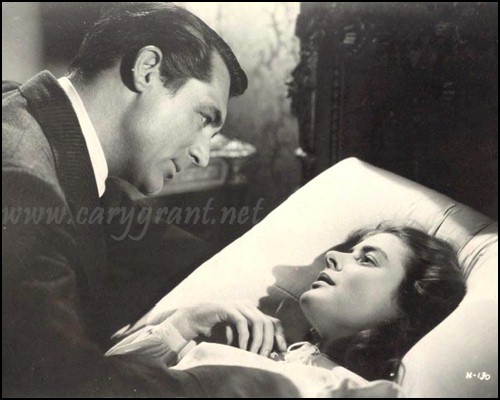
I'm obviously an addict and I'm trying to come clean. But I can't stop. I just can't stop.
Reviews like this one --
are why I absolutely love David Edelstein. He wrote one of my favorite terrible reviews for Battlefield Earth (compilation of quotes seen here) - where he wrote: "He zaps Jonnie with a knowledge ray and then, for some reason, lets him read the Declaration of Independence. I'm not sure what happens next because I went out for malted milk balls and then remembered I owed my mom a phone call."
When a movie is bad, I get excited to read Edelstein. Bad movie reviews (well written ones) are some of my greatest pleasures.
Anyway, the reviews for King Arthur are coming in - and they're not all that bad. Not raves, to be sure, but not bad.
Everyone is commenting, however, on the lack of magic (making Merlin just your basic old man), the lack of Holy Grail-ness, the lack of round table ... basically, the lack of anything even resembling the story of King Arthur.
Some of my favorite quotes from Edelstein's review are:
As a nonhistorian who hasn't kept up with the latest archeological finds but who still likes to go around singing, "I wonder what the king/ is doing tonight/ What merriment is the king/ pursuing tonight," I could hardly wait to meet the authentic once and future king. I wondered what the king was doing that night.
In the review, Arthur is described as "verisimilitudinous"
I would also describe him as "pulchritudinous" - but that's just me.
Now, I'm sorry to offend Bill, but Edelstein finds the perfect way (in my opinion) to describe Keira Knightley:
a hotcha Woad who looks like Winona Ryder stretched out
Edelstein goes on:
"He tortured me," she says. "With machines." Then she adds, "I'm Guinevere." That's some revision! At first too weak to talk, Guinevere is soon lecturing Arthur nonstop in perfect Oxbridge know-it-all diction about his habit of killing his own people, whereupon I thought about torturing her with machines myself. But it's hard to hate her too much when she wriggles into a fetching halter, paints herself green, and picks up a bow and arrow, determinedly setting that long fish jaw. You go, you saucy Woaden wench!
"long fish jaw"??
A typical Edelstein-ian sentence:
I did not know much about Saxons until now. Apparently, they were heavy-metal Road Warrior types with exceptional hearing.
Edelstein actually enjoyed the movie, even though he calls it "stupid", and also says (echoing a couple of the other reviews I have read) that the battle scenes are very confusingly staged. Not well done.
But I do like how he ends his review:
And then there's Clive Owen, rising above it all. Aloof yet watchful, the actor cultivates an inner stillness that is perfect for faintly ironic brooders. He neither distances himself from this risible material nor pulls out the stops and opens himself to ridicule. His King Arthur tells us little about Arthur, but much about protecting one's flank. The mark of a box-office king?
Quite a compliment. Clive Owen's been around for a long time, doing consistently good work. It's nice to see it acknowledged.
I actually said the following words to my brother just now
"It is not my fault that you are excited about my life."
Brendan basically laughed in my face.
I was completely serious, too. I need a long rest.
July 7, 2004
In Praise of Comedy
These lists of great movie moments here and here mostly comprise movies of a serious tone. Which is fine. Many of the scenes which have touched me the most (like Meryl Streep's face when she makes "Sophie's Choice", Bogie's expression on his face when he says goodbye to Bergman at the airport, Samantha Morton's near-miscarriage scene in In America - which stands alone, in my opinion - etc.) are serious, or tragic.
But comedy should not be discounted as one of the most important things on the entire PLANET.
So let's make up our own list here.
Let's make a list of the Top Comedy Films EVER. How 'bout that?
I nominate - (and these are just the first things that come to my head - I'm sure I'll think of more):
Bringing Up Baby
What's Up, Doc?
The Producers
Let us celebrate that which makes us howl with laughter.
I'm thinking Office Space needs to be on there, too.
Sheila's Cultural Choices
IF YOU HAD TO CHOOSE:
1. Fred Astaire or Gene Kelly? Fred Astaire
2. The Great Gatsby or The Sun Also Rises? Great Gatsby
3. Count Basie or Duke Ellington? Duke Ellington
4. Cats or dogs? Cats
5. Matisse or Picasso? Matisse
6. Yeats or Eliot? (Please. You even have to ask?) Yeats.
7. Buster Keaton or Charlie Chaplin? Must I choose?? I choose neither. Love them both.
8. Flannery O’Connor or John Updike? Flannery O'Connor
9. To Have and Have Not or Casablanca? Tough choice. I'm going with To Have and Have Not.
10. Jackson Pollock or Willem de Kooning? Jackson Pollock
11. The Who or the Stones? Neither
12. Philip Larkin or Sylvia Plath? Sylvia Plath. Although I love Larkin's stuff, too.
13. Trollope or Dickens? Dickens. Never got into Trollope. Which ... is awful. I know.
14. Billie Holiday or Ella Fitzgerald? Billie Holiday
15. Dostoyevsky or Tolstoy? Dostoevsky
16. The Moviegoer or The End of the Affair? Graham Greene, I presume? No idea.
17. George Balanchine or Martha Graham? Balanchine, all the way.
18. Hot dogs or hamburgers? Hamburgers. No contest
19. Letterman or Leno? Letterman. No contest
20. Wilco or Cat Power? Wilco.
21. Verdi or Wagner? Verdi
22. Grace Kelly or Marilyn Monroe? Marilyn Monroe, my all-time favorite
23. Bill Monroe or Johnny Cash? Johnny Cash
24. Kingsley or Martin Amis? I choose neither. Don't like either of them, and my feelings about Martin Amis border on irrational DISlike.
25. Robert Mitchum or Marlon Brando? Brando. Although Mitchum rocks
26. Mark Morris or Twyla Tharp? Mark Morris!! His version of "Nutcracker" is awesome! Rent it!
27. Vermeer or Rembrandt? Rembrandt
28. Tchaikovsky or Chopin? Chopin. It puts me to sleep. And I mean that in the BEST way. Listening to Chopin is like lying on perfumed satin sheets. Relaxing, soothing, healing.
29. Red wine or white? Red.
30. Noël Coward or Oscar Wilde? Tough one. Hmm. I think Noel Coward. Private Lives!!
31. Grosse Pointe Blank or High Fidelity? High Fidelity. I hated Grosse Pointe Blank. Sorry, Pat McCurdy.
32. Shostakovich or Prokofiev? Do not know either.
33. Mikhail Baryshnikov or Rudolf Nureyev? Nureyev. (Nureyev used to say, about his famous leaps, that when he jumps in the air, he just chose to "pause" a little bit. Ha!)
34. Constable or Turner? No clue.
35. The Searchers or Rio Bravo? Oh boy. My lack of Western knowledge is catching up to me. No clue
36. Comedy or tragedy? Comedy
37. Fall or spring? Fall. I love melancholy. (Which is a pretty funny thing to say, in light of my answer to # 36. But I will let the contradiction stand. To quote Whitman: Do I contradict myself? Very well then, I contradict myself. I am large. I contain multitudes.)
38. Manet or Monet? Monet. Manet, to me, seems too rich, like a big fat piece of cheesecake.
39. The Sopranos or The Simpsons? Simpsons.
40. Rodgers and Hart or Gershwin and Gershwin? Rodgers and Hart.
41. Joseph Conrad or Henry James? I gotta go with Conrad. Not wacky about James.
42. Sunset or sunrise? Sunrise. Because anything can happen at sunrise. At sunset, all possibilities end.
43. Johnny Mercer or Cole Porter? Oh shit. Do I have to choose? I'll go with Cole Porter. Reluctantly.
44. Mac or PC? PC
45. New York or Los Angeles? New York
46. Partisan Review or Horizon? No response
47. Stax or Motown? I have no idea. I love Motown. Don't know Stax.
48. Van Gogh or Gauguin? Van Gogh. Gauguin's a bit much.
49. Steely Dan or Elvis Costello? Elvis Costello
50. Reading a blog or reading a magazine? Magazine
51. John Gielgud or Laurence Olivier? Olivier.
52. Only the Lonely or Songs for Swingin’ Lovers? What?
53. Chinatown or Bonnie and Clyde? Chinatown
54. Ghost World or Election? Election. Yeah!!
55. Minimalism or conceptual art? Minimalism
56. Daffy Duck or Bugs Bunny? Bugs. He's more subversive. A smart-ass.
57. Modernism or postmodernism? Oh Jesus. Modernism, modernism, modernism. DIE, POSTMODERNISM, DIE.
58. Batman or Spider-Man? Batman. Can't stand "s"s.
59. Emmylou Harris or Lucinda Williams? Emmylou Harris.
60. Johnson or Boswell? Johnson. I should do a post on Johnson someday.
61. Jane Austen or Virginia Woolf? Emily, do you want to take this one??? HA! I love Jane Austen and Virginia Woolf leaves me flat.
62. The Honeymooners or The Dick Van Dyke Show? Oh no contest. The Honeymooners.
63. An Eames chair or a Noguchi table? No clue. Don't know nothin' 'bout furniture, Miz Scarlett.
64. Out of the Past or Double Indemnity? Another terrible choice. I'm going with Out of the Past - which if you haven't seen - you MUST. Mitchum and Kirk Douglas - smoking AT each other threateningly throughout the whole film.
65. The Marriage of Figaro or Don Giovanni? No clue
66. Blue or green? Green
67. A Midsummer Night’s Dream or As You Like It? As You Like It. Midsummer Night's Dream is a better play, but As You Like It has my heart.
68. Ballet or opera? Ballet
69. Film or live theater? I refuse to choose.
70. Acoustic or electric? Electric
71. North by Northwest or Vertigo? North by Northwest.
72. Sargent or Whistler? Sargent
73. V.S. Naipaul or Milan Kundera? Heh heh heh. Good one. I like Naipaul better. But Kundera is terrific.
74. The Music Man or Oklahoma? The Music Man. One of my favorite musicals of all time. "76 trombones led the big parade ... while 110 coronets came behind ... they were followed by rows and rows of the finest virtuosos ... the cream of every famous band!!!"
75. Sushi, yes or no? An emphatic YES. But I won't eat roe.
76. The New Yorker under Ross or Shawn? HA! Under Ross.
77. Tennessee Williams or Edward Albee? Tennessee Williams
78. The Portrait of a Lady or The Wings of the Dove? Didn't like either. I don't like Henry James
79. Paul Taylor or Merce Cunningham? No clue
80. Frank Lloyd Wright or Mies van der Rohe? I don't know the second dude. Can't choose.
81. Diana Krall or Norah Jones? Norah Jones
82. Watercolor or pastel? watercolor
83. Bus or subway? subway
84. Stravinsky or Schoenberg? no clue
85. Crunchy or smooth peanut butter? crunchy. I will not eat it smooth.
86. Willa Cather or Theodore Dreiser? Willa Cather.
87. Schubert or Mozart? Mozart
88. The Fifties or the Twenties? I am taking that to mean: Would you have rather lived in the 50s or the 20s? If that's the case, then I have gotta go with the 20s. I am convinced I would have committed suicide or been institutionalized in the Fifties. Or I would have been an alcoholic unhappy housewife, like every part Julianne Moore has ever played.
89. Huckleberry Finn or Moby-Dick? Oh God, how can you compare. I'm going with Huckleberry Finn - but this doesn't mean I didn't think Moby Dick was one of the best books I had ever read, albeit a big MESS.
90. Thomas Mann or James Joyce? Oh please. Joyce.
91. Lester Young or Coleman Hawkins? Huh?
92. Emily Dickinson or Walt Whitman? Whitman.
93. Abraham Lincoln or Winston Churchill? Abraham Lincoln.
94. Liz Phair or Aimee Mann? Liz Phair. Although I adore Aimee, too.
95. Italian or French cooking? Italian
96. Bach on piano or harpsichord? Piano
97. Anchovies, yes or no? Indifferent
98. Short novels or long ones? Long ones
99. Swing or bebop? Swing
100. "The Last Judgment" or "The Last Supper"? Paintings, I assume? No clue.
Oh, and there's some point system - go read Terry's piece to find out about it. I don't have time right now to do any tallying maneuver.
Hat Tip (BWAHAHAHAHA): Llama Butchers
July 6, 2004
Hypothetical: Summing up LOTR
This was suggested (kind of) by a reader.
If you knew someone who hadn't seen The Ring Trilogy (because, obviously, they lived in Chad or something) - and you had to choose one moment from the entire trilogy - that could sum up the whole - and catch the spirit, the feel of it - which moment would you choose?
Well, it doesn't have to be a moment. It could be a scene.
I'm inclined to go with Aragorn and the Hobbits, all clustered together, looking at the wraith-dudes coming up to them from out of the darkness below the mound - in the first movie. Dave J: what is the name of that ancient Stone Henge-y place? Wytherspoon or something? No, that's not right.
Anyway, that's the first scene that came to my mind. Why? The sense of being surrounded, of the forces of evil being too much to fight, of the Hobbits being "unprepared" for the battle ...
It's like putting the film into a sieve and shaking, shaking ... which gold nuggets inevitably remain?
Standing the Test of Time
In the comments section to this post (listing AFI's "100 most famous, unforgettable or memorable images, scenes, sequences or performances in films of the 20th century") - a couple of people (myself included) wondered why the 90s etc. are so underrepresented. My guess is is that AFI is looking for moments that will stand the test of time, and will be worthy of inclusion on such a list 50 years from now.
AFI's list stops with Schindler's List which is 1993.
So my question to everyone is this:
What, since then - 1993 - 2004, do you think would be worthy to be on such a list? Something iconic. Or ground-breaking. Or universally memorable, or perfectly well-done. Something that 50 years from now still would seem impressive.
My first guess would be the harrowing opening sequence of Saving Private Ryan.
How about you all?
In honor of this Int'l Kissing Day
Dad, you don't have to read this one.
I'll list my top 5 kisses. In order of greatness. Criteria is wide-ranging and I will leave it somewhat mysterious, with clues only discernible, at times, to me.
1. "Crazy Erik".
2. Holding down poor Keith M. behind the fort on the playground in 5th grade and giving him a kiss on the cheek. He was like a mini-Fonz. He wore a leather jacket. He put a comb in his back pocket. He was the epitome of cool.
3. Under the arches at college. He asked permission. Very cute.
4. Two disgruntled Renaissance cherubs.
5. How sad but I remember the date. Also sad is that it was so long ago. April 29, 1994. Best. Kiss. Ever.
Thanks, boys. Smooch.
Today is (apparently) International Kissing Day
Anne, in honor of this day o' smooches, tells a story of an illicit kiss. The title alone sets up the vibe: "The Unbearable Tension of Confirmation Class". I relate to her story. First of all, there is the overhang of Catholicism, there is also the loving of the bully-boy, and there is the priest hovering in an invisible miasma over the kiss-scene ...
Also, she's got one helluva sentence in her post. She describes Tom, a guy in her CCD class, who lived in Queens - as opposed to Manhattan. Listen to her prose, though:
Charlie and his friends all lived near the school, and could not conceive of Queens at all, let alone the idea of riding back and forth on the subway every day to get there. They teased Tom for being different, being poorer, and for having such geographical nerve.
No more "hat tip"
Andrea, in her own unmistakable way, puts into words something I have felt deeply - but have been unable to articulate.
There are a couple of other well-used blogger phrases which, for whatever reason, I just can't stand. I don't know why. I've never been fond of "blogosphere". I cannot explain why. It's rather like my unexplainable distaste for the words "plether" or "scone". You will never catch me saying "scone". EVER. I feel the same way about "Blogosphere". I do not judge others who use "blogosphere", because my distaste for it seems emotional and irrational. But ... I just can't use it myself.
I also have a problem with "money quote".
Again. I don't know why. I might have used it once or twice, but I felt like a big fat phony.
Atonement - bah, humbug!!
Last night, I finished watching Arsenic and Old Lace (YUM) - (I especially enjoyed Cary Grant's pratfall over the chair) - but anyway, idly, randomly, I picked a book off the shelf - Ian McEwan's Atonement - which I had already read (and was greatly affected by) last year - and I started flipping through it.
My first reading of the book was one of those addictive page-turning experiences. But as the book went on, I felt a growing sense of unease. Something bad was coming. Something very bad. I tried to comfort myself that the title actually might mean something GOOD - but this was basically whistling in the dark. The word "Atonement" takes on all kinds of implications, through the reading of the book. It's a complex word. Seen in different lights, it could mean different things.
Ian McEwan is an extraordinary writer - and I had read some of his other novels - but they seemed a bit cold and shallow to me, although filled with startling sentences. It is with Atonement that he really found his voice.
I read a lot of books, as is apparent. I also love a lot of books. But I can count on one hand (okay, maybe two) the books which moved me, surprisingly, to tears. And I'm not talking about desultory tears, streaking down my cheeks gently - I'm talking about bursting into SOBS.
It's a rare book, indeed, that can bring on THAT.
Atonement was one of them. The ending is such a ... well, it's not a shock ... there is something inevitable about it. But - it had this impact like a dull enormous thud in my stomach. It's one of those books where, until the very last page, literally, you can't see the whole picture. And then in one devastatingly simple sentence, you can see everything. So I sat with it for a second, stunned - and the implications just kept getting bigger and bigger and bigger ... and then I burst into STORMY tears. I cried myself to sleep. Like a little girl. I cried about all the lonely people in the world, I cried for my own loneliness, but I cried most of all - for those characters. The people I had come to love. And also despise, actually. But even the despised characters had their frailties - even they were doing their best - despite the fact that so much of their behavior was hateful and blind.
After my stormy-tear-fest - Atonement has seemed a bit radioactive to me. Although it's one of the best reading experiences I've ever had, I have shied away from picking it up again. Just because. Have you ever read a book like that? That had such a deep impact that either you don't feel the need to pick it up again, because you SO got the message - or you are AFRAID to pick it up again, because the implications are too huge and painful to live with in normal every day life ...
Atonement had the second kind of impact on me. The truths revealed are too painful to be dealt with in normal life. You would have to deny it all, push it back - in order to get through the day.
I forgot all of that last night, and picked it up again. I flipped through it, randomly, looking for scenes where I had liked the writing.
The making-love scene in the library ... an absolutely masterful piece of writing. One of the best descriptions of love-making (not sex) I have ever read in my life. I read that again.
I kept flipping. I had underlined certain sentences I liked. I re-visited them.
The descriptions of London in the days just before World War II - as the menace was growing - is so real, you feel like you can smell the fear and uneasiness in the streets.
Then I read the end. Felt the same dull thud inside of me - but it was more like an echo.
You can't ever re-create the first time.
I didn't cry or anything like that. Just re-read some of the sections of the book.
Then went to bed and had TORMENTED dreams all night long. I kept waking up, trying to stop the dreams, and then the same dream would start up again when I went back to sleep. It was an onslaught. Floods rising up 10 stories high - people snorkeling through the choppy grey flood - I was trying to swim fully clothed - I knew I was going to die - the waters rising, rising - above the roofs of the buildings - the current sweepingly strong - the entire world being destroyed ...
That was pretty much the dream I had all night. I woke up and I had kicked off all of my covers - including my contour sheets - which - must have taken some doing. I was probably thrashing about like a lunatic. I mean ... the contour sheets were in a crumpled heap on the floor.
I COMPLETELY blame Ian McEwan for this. I don't think Arsenic and Old Lace was to blame. I randomly flipped through McEwan's book, that was all I did, and then proceeded to have apocalyptic dreams for 6 hours straight. Thanks, dude.
That book is radioactive.
And, of course, because of that - I highly recommend it.
July 5, 2004
Happy 4th everyone
It's pouring rain here. And while I have a second free, I thought I'd point to two long-ish excerpts I posted last year - having to do with the writing of the Declaration of Independence.
Paul Johnson's book History of the American People (which I can't recommend highly enough!!) spends a lot of time not just on the events of 1776 - but on the philosophical legacy which was already in existence - and would end up being the foundation of the Declaration of Independence. Thomas Jefferson wasn't re-inventing the wheel. There is very little that is original in the Declaration of Independence. All of the concepts had already been articulated by others. He borrowed heavily - mixing it together - a bit from this source, a bit from that ... But it was his particular genius with the written word that lifted it up from a mere statement of revolutionary and political purpose into a treatise on the inherent dignity of mankind.
But I can't explain it as well as Paul Johnson does.
So here are the excerpts. Enjoy.
And happy birthday, America.
July 3, 2004
My favorite Brando story
Here's how it goes:
Throughout their careers as actors, Montgomery Clift and Marlon Brando were neck and neck. Montgomery Clift hit his stride a couple of years before Brando did - and Brando looked up to him. He wanted to act like Montgomery Clift, he wanted his acting to seem as real as Clift's did. Clift, of course, was a completely different personality than Brando - so the roles that came to them were almost polar opposites.
Montgomery Clift - with his almost unearthly beauty (at least before his car accident) ... The roles he got reflected the response he got for that beauty. People were deeply attracted to it and deeply alienated by it. It was like a Death in Venice kind of beauty. His part in Place in the Sun - the kind of very very secretly unscrupulous person, who fools everyone because of his beauty ... He made a career out of playing parts like that.
Brando was all brash masculinity. He was good-looking, but it was more about hot erotic sex appeal, than beauty.
But the two of them were linked together in the public's minds - as examples of this new kind of acting.
Montgomery Clift was very competitive. So was Brando. They didn't feel competitive with many other actors, but they felt competitive with one another. Clift came out in Place in the Sun - and Brando came out in Streetcar - and they sized up one another's performances warily, checking out the competition - but also - they never lost their admiration for what the other could do.
They were worthy foes, let's put it that way.
They weren't friends. They ran in completely different circles, but there was a mutual admiration/competition society between them.
All of that changed when Montgomery Clift got into his terrible car accident which smashed his face, changing his career forever. He was never the same again. His face lost the easy beauty, half of it was paralyzed, reconstructive surgery had done all it could do. After all of the surgery, etc., Montgomery Clift went into a deep depression. He could not climb out of it. He stayed locked up in his house, drew black curtains across the windows, and wouldn't let anyone come to see him. He was devastated by the change in his looks. Something in his heart and his soul had been crushed as well. He drank heavily. By himself. He became addicted to pain pills. He had his food delivered. He lived with an assistant, who took care of him, and answered the phone for him, and answered his mail, and kept everyone away. This went on for well over a year. He could not climb out of it. He could not go back to work. He did not how to be an actor without having a beautiful face. He didn't want to learn, either. Something precious had been taken from him.
One day - a car pulled up in front of the house. And Marlon Brando got out.
He was shooting a film, and he had an hour's break, so he drove over.
He walked up to the front door, and the assistant answered it - told him Clift didn't want to see him, or anybody.
But Clift called out from an inner room, "No, it's okay. Show him in."
Brando walked into that inner room, and shut the door. The two of them were in there alone for about 20 minutes. And then Brando walked out, left the house, got into his car, and drove away.
Montgomery Clift's assistant walked in to see if Clift was okay. What was going on? Brando wasn't a regular visitor, he wasn't Clift's friend, what had he said?
Clift was sitting on the couch, in tears. He said that Brando had put it to him straight. Brando stalked straight into the room and said something along the lines of this:
"Look. I am only where I am today because I have had you to compete with. If I'm good, it's because you've always been better. When I saw Places in the Sun, I thought - Damn. He'll get an Oscar for that. I need to be better. I need to work harder. Because if I'm good, you will always be better. And I need you. I need you. I need to know you're out there, beating me at my own game. So I want you to cut all this shit out. You have to stop drinking and taking pills, you have to get back to work again. Because I don't know what the hell I'm doing if you're not out there doing it, too. You get what I mean?"
Clift barely said a word in the exchange. Marlon talked on like that for about 15, 20 minutes. Basically opened up a can of whup-ass. And then, without another word, turned, walked out, and drove away.
Clift said to his assistant, "I had no idea. I had no idea he felt that way. I always felt the same way about him."
And although Clift (with the shining exception of The Misfits) never again found the ease in acting that he did before his accident - it was that conversation with Brando that was the catalyst. For that moment, anyway.
Clift went back to work again.
I love Marlon Brando for that. He wasn't generous to many other actors. He had a tendency to bulldoze right over them. But he needed competition. Without it, he got bored and apathetic. His motives for going to Clift's house that day were selfish, yes, indeed. He needed Clift to keep working so that his acting would continue to flourish. But isn't that true of any competitive sport? Playing against someone who is AS good as you are is a true test of your talent, your gift. It's no fun to play with amateurs. So his words that day also came from a spirit of generosity and acknowledgement of Clift's gift, with or without that damn pretty face, which catapulted Clift back into action.
Montgomery Clift never forgot Brando's surprising kindness on that day. And the two of them NEVER spoke of it again, even when they met in person. It was like it had never happened.
Marlon - 1924 - 2004
I've always wanted to be an actor. Since I was a little kid. Many members of my family are in this profession - and have been - so it always seemed like a valid way to make a living, as opposed to some wacked-out Bohemian dream. In a certain respect, the people who have the "normal" jobs in my family are the black sheep.
When I was little, I was the same way that I am now- the same person who throws herself into her passions with such abandon that all else fades away. My passions become PROJECTS. "Oh. Humphrey Bogart it is now? Fine, then. Let's go." I check things off the list, I must see this, this, and this. I must learn about him. I must envelop myself in him.
When I was 11 years old, maybe 12, I was babysitting. And I saw Dog Day Afternoon - clearly a movie which I should NOT have seen at that age. But that's irrelevant. Because sometimes it is the things that happen to us TOO SOON that have the greatest impact. For when are we ever truly ready for it? That movie, and Al Pacino's performance in general, changed my life.
He seemed different than anybody else I had ever seen before. He seemed to not be playing a character. He seemed to be on the EDGE of reality, as opposed to just mirroring reality. His performance moved me, a little girl, to such a degree that I remember wondering, idly, as the father of the child I babysat for drove my home later that evening, "I wonder if Sonny is still alive in prison somewhere ... I'd like to write to him." "Sonny" - the gay bankrobber Al Pacino portrayed - had made such an impression, and had filled my heart with such compassion - that I wanted to write to the real guy, and tell him how I felt about him. The whole sex-change operation plot of the film had gone right over my head - but that was all right. What I really got was a new and vibrant view of not only acting, but of human potential. Al Pacino seemed to me a miracle.
I saw that movie again recently, feeling like my little 11 year old self was sitting there right next to me, and I was in awe all over again.
And so the passion took over. In a very Sheila way, which will now be very familiar to all of you who read me. I was 12. I had never seen anything like Al Pacino's acting. It burned itself into my psyche as something new, something fabulous, something so exciting that I couldn't even BEAR it. All I wanted to do was know HOW he had learned how to DO that.
My research began. This is pre-Internet days. I don't remember the steps I took, perhaps micro-film was involved (my dad, after all, is a librarian) - but I do know that during this research-period was the first time I heard the words "Actors Studio". Al Pacino had come out of something called "The Actors Studio" - and so then I knew what my next steps would be. I needed to learn about the Actors Studio. What is it? What was it??
This discovery led me to Marlon Brando. His name was everywhere. He seemed synonymous with something. He and James Dean. They were it. They were "the ones".
This was also pre-VCR days (at least in my family) - and so began a weekly scanning of TV Guide, to see if any of "their" movies were on. I was relentless, and focused. For a couple of years.
And so that's how I saw Rebel without a Cause, East of Eden, Streetcar Named Desire and On the Waterfront. I watched these two men, I watched them hungrily, and also - with a bit of despair. Their acting made me feel lonely. Far away. How would I ever get to be like them? Would it be possible?
I started to read biographies of the people involved in the Actors Studio. No one was too peripheral. I read the autobiography of Carroll Baker, for example. I took every tangent. I discovered Marilyn Monroe, I discovered Natalie Wood, I discovered Nicholas Ray, Sal Mineo ...
Streetcar Named Desire seemed to me, at the time, to be something so exciting, so barely comprehensible, that I couldn't even get close to it. It contained a mystery. There was something in it that could not be pinned down. It held a secret, perhaps the secret. Marlon Brando's acting was not acting, frankly. It was life, yes. It looked like life. But it was BIGGER than real life. Which was the genius of the 3-way collaboration of Elia Kazan, Tennessee Williams, and Marlon Brando.
Here's how I see it.
Tennessee Williams: a fragile openly-gay man, a raucous party-hound, and on the run from his memories. He would have been institutionalized if he hadn't been a writer. His sister was lobotomized. He never got over it, and ran away, and never looked back. (The last moment of Glass Menagerie - with Tom's monologue about Laura - is Tennessee's expression of grief about it.) His plays are delicate, they are "memory plays" - he wrote them with the sensibility of one who needs to hang gauze over the lamps, of one who needs to fill his apartment with pretty delicate things ... He writes plays of facades, covering up the animal side.
But here's what I think: without the robust and theatrical and animal direction of Elia Kazan - his plays may have remained little frilly fey things. Now the words were on the page, the plays were fantastic - as is. But I have seen many of them ruined by too-precious direction, by directors who go for the gauze over the lamp effect - as opposed to delving into the churning lava below. Kazan took Tennessee's memory plays and cut straight to the jugular. He understood Tennessee - he understood the man's conflicts - and he set about to make them visible.
And without Marlon - in that groundbreaking role of Stanley - none of it would have happened at all. Marlon took the role of Stanley and so completely owned it that nobody knew what happened to them. Kazan just sat back and let it happen, and Tennessee (who, by all accounts sounds like a lovely man) would sit in the audience, just giggling with glee, watching Marlon tear up the room. Tennessee realized that his play was revealing something, and that only through the instrument of Marlon Brando could it fully come out.
It would be like a bad pianist playing a brilliant concerto.
Only a brilliant and gifted musician can truly "interpret" the great composers. The music itself is not enough.
Marlon Brando and Elia Kazan were the greatest interpreters to date of Tennessee Williams' very specific personality.
Brando, however, would never have spoken about it in that way. He was inarticulate, he was all instinct. He immersed himself in that part. He boxed. He slept in the theatre. He stopped bathing. He was completely emotionally exhausted by the part.
The funny thing is is that Brando was nothing like Stanley Kowalski, although there were some similarities.
Kowalski is a pig. He proclaims his pig-ness loudly. He eats with his mouth open. He drools. He guzzles stuff down his throat. He could fuck all night long. He has no shame. He is a man of voracious appetites, and a complete slob.
Brando was actually a rather delicate person (at least in his youth). Sensitive, and always trying to hide it. His girlfriends were either ballerinas, or ugly ducklings who hadn't yet blossomed. He was always seen with gawky little women wearing thick glasses and flat shoes. He loved girls like that. He loved to dance. He loved to play bongo drums. He loved art. He had done terribly in school, but he was obviously highly intelligent. Once he got to New York, he realized how goofing off in school had left him at a disadvantage, so he set about to educate himself. He read non-fiction, primarily - history books. He was playing catch-up. He went to museums every week.
All of this is just to point out that what Brando did with Stanley Kowalski is nothing less than miraculous.
People who saw the performance had a tendency to scoff it off, thinking he was just "playing himself". (Also, the fact that they would say that shows their ignorance. One of the hardest things to do is play yourself.) But he created a character. He saw things in the role that Tennessee Williams himself did not see. He was a revelation to all.
To me as well.
I learned all of this in my intense research-period in my early teens. I would read about crazy moments in Streetcar rehearsals - and then the next time I saw the movie - I would look for that moment like a detective.
I never lost my surprise in his ability.
One of the moments in that film that stands out for me (and I'm not the only one - people reference it often as an indication of how CREATIVELY Marlon Brando saw that part):
-- A lesser actor would make all kinds of intellectual decisions about Kowalski. What Stanely would or would not do. "Oh, Stanley wouldn't do that ..." "Stanley would never do that ..." Marlon never put restrictions on his impulses in that way, he never made any decisions about what Kowalski would or wouldn't do. Which is why that performance startles me even today.
He allows Stanley Kowalski to have moments of deep tenderness ... of vulnerability ... of humor ... The way he presses his face into Kim Hunter's abdomen after she finally comes down the stairs, answering his "STELLA" call. It's completely erotic, how he does that. It's also ... there's something infantile about it too. The little boy pressing against the womb. It's sexy, it's tragic, it's desperate ... and it is completely unexpected. NOW we can't see that moment played any other way, but it's only because he realized that moment so perfectly.
The other moment which I remember being so struck by when I was a kid ... He's talking with Stella about Blanche, and he's all brash and manly and tough ... I can't remember the scene ... but he's slouching around the room, he's touching things randomly ... it might be the "Napoleonic Code" scene. And then there's a moment where he faces off with Stella ... they have some back and forth lines ... In the middle of it, Kowalski/Brando notices that she has a little piece of fluff on her sweater. He reaches out, with the most delicacy in the world, like he's a pastry chef or something, and plucks it off her sweater.
It's one of those moments which could never be planned. It's also one of those moments which a more conventional actor would never allow himself to do while playing Stanley. "Stanley would never do that! He's a pig! He's a slob!"
Marlon Brando never concerned himself with those judgments. They seemed completely uninteresting to him.
The piece-of-fluff moment, to me, as a kid - was another "a-ha" moment. Akin to the Dog Day Afternoon moment. It brought tears to my eyes when I saw it for the first time. It seemed to me, then, that acting was one of the special-est and most important things that one can do. Because if it's good, it helps the audience ... It helps people see things about themselves.
He made acting seem like a grand and chaotic adventure. Filled with surprise, and revelation. He never did what was expected of him. I still can't see that "STELLA" scene without feeling my throat clench up. I still see that scene and think: "Okay. That's as far as he's gonna go. The scene will end now..." and yet - it doesn't. It keeps going. He keeps going further with it.
He shows to me, time and time again, my own failure of imagination.
He has helped me to ask the right questions, in my own work. To not concern myself with certain things that are unimportant, to try to find my OWN way into the part ... because, after all, I was the one who was cast. And so it needs to be MINE.
He never seems to play things right on the nose. He goes at things sideways. Perhaps that is because he was kind of a passive-aggressive personality in real life. Who knows why. But that very ambivalence and oblique-ness is what makes his acting still so exciting today.
I always think of the scene in the beginning of The Godfather, where he sits in the office, stroking that teeny kitten. The juxtoposition of that ... the huge shadowy Don, the obsequiousness of the people visiting him (letting the audience know how powerful and feared he is), his gruff weird voice, the way he is lit so that his eyes are always in shadow ... and yet ... almost as though the gesture is this man's subconscious-made-visible ... he strokes that teeny kitten with the utmost gentleness.
Stella Adler, the great acting teacher who had Marlon Brando in her class, and who was one of the first ones to stop trying to put reins on this wild talent, said, in regards to "talent" and what is talent: "Talent is in the choice."
I have thought about this quite a bit.
The talent is in the choice.
Untalented actors make uninteresting or obvious choices. You can probably think of a million examples. But if an actor has talent, it will be obvious - because of his choices.
To me - the fluff on the sweater moment, and the kitten moment - are just two examples of how Marlon Brando's talent was in his choice. These may not have even been conscious choices. That's irrelevant.
His talent guided him to make these choices and no other ... and those images were burned on my brain forever.
Years later - 15, 16 years later - I applied to grad school. I applied to the Actors Studio grad school at the New School. I got in.
Our first day of orientation was held in a circular room beneath Tisch Auditorium. This was the room where, years and years ago, Stella Adler had held her acting classes, which Marlon Brando attended. I sat in that circular room, now a grown woman, and literally felt the hairs rise up on my arms. The room was full of ghosts. Ghosts of people I had met years ago, in my research mania following Dog Day Afternoon. Maureen Stapleton, Walter Matthau, Eli Wallach, Ben Gazzara, Elaine Stritch ... all of them had been in Stella Adler's class, in this very room.
I had, quite consciously, throughout my life, followed in the footsteps of those who had held up the brightest torches. Elia Kazan - Eli Wallach - Montgomery Clift - Marilyn Monroe - Lee Strasberg - Stella Adler - John Garfield ... and Marlon Brando. These were the "Method" giants. The ones who turned a style of acting into something so mainstream that you can't even really talk about "Method actors" anymore.
I was there. I was joining them. There, in that circular room.
The dream of the 11 year old had been realized.
Marlon Brando: thank you for holding up that torch. Thank you for your mystery. You hated acting, to some degree. You never ever wanted to be caught taking it seriously. Which I love. Taking acting too seriously is one of the most boring things an actor can ever do.
I learned that from Marlon Brando - and a lot of other things besides.
And if and when you see Streetcar again - do me a favor. Look for the little plucking-the-fluff-off-the-sweater moment, won't you? It will make you smile.
July 2, 2004
Marlon Brando
I can't post anything articulate yet - Emails have been coming in, from all my actor-friends. "Have you heard, have you heard?"
I figured I would re-quote something I've posted here before: his realization that he had become famous after the opening of Streetcar on Broadway.
When "Streetcar Named Desire" opened on Broadway - the world did not know yet what had hit it. Marlon Brando had arrived. Marlon Brando had been living in cold-water walk-up flats, shacking up with ballerinas, and bongo players, and living a completely bohemian life ... and it took him a while to realize what had happened as well. What "Streetcar" was going to mean. I love how he describes his moment of realization.
"You can't always be a failure. Not and survive. Van Gogh! There's an example of what can happen when a person never receives any recognition. You stop relating: it puts you outside. But I guess success does that, too. You know, it took me a long time before I was aware that that's what I was - a big success. I was so absorbed in myself, my own problems, I never looked around, took account. I used to walk in New York, miles and miles, walk in the streets late at night, and never see anything. I was never sure about acting, whether that was what I really wanted to do; I'm still not. Then, when I was in "Streetcar", and it had been running a couple of months, one night -- dimly, dimly -- I began to hear this roar."
Another list of great moments
Perhaps a bit more reputable than the list put together by The Guardian, since it came from the American Film Institute. They describe their list as "the 100 most famous, unforgettable or memorable images, scenes, sequences or performances in films of the 20th century". I've taken the time to boil it all down because they write extensive essays about each moment which are sometimes interesting, but sometimes not.
This list is chronological.
1. Birth of a Nation, producer/director D. W. Griffith, 1915
Little Colonel's return to his ruined home after the Civil War
One of those landmark films, really THE landmark film. The fact that it ends with a triumphant Ku Klux Klan ride is intensely disturbing.
2. Way Down East (1920).
Lillian Gish escaping from the ice floe
I haven't seen this movie, but there is an extended "excerpt" of it in the great documentary about cinematography called Visions of Light. It is horrifying, and completely real. There is a freezing river plummeting over a waterfall - and there are huge chunks of moving ice, and Lillian Gish is jumping from ice floe to ice floe - trying to escape before she goes over the waterfall. I have NO IDEA how they did it. It's extraordinary.
3. Safety Last (1923)
I haven't seen this film - but all I need to do is post a picture from the moment in question, and I'm sure you will recognize it:
4. Greed, Erich von Stroheim (1924)
The tragic ending in the salt flats, the desert wastes of Death Valley
5. Battleship Potemkin (1925), Sergei Eisenstein
The baby carriage tumbling down the steps of the Odessa train station
Our first repeat from The Guardian list.
6. The Big Parade (1925)
The scene of the parting of the American troops from a French village
Er - just from the description of the scene given it sounds extraordinary:
American doughboy Jim (John Gilbert) calls out for French peasant girl Melisande (Renee Adoree) but cannot locate her. She too hears the bugle call and sees the dust of the trucks, the horse-drawn caissons, and the running men assembling for the pull-out. Her distress and desperation rises with the suddenness of their leaving. Suddenly, she decides that she is desperately in love with Jim. She pushes her way through the massed ranks of soldiers - looking and calling out for him in the ensuing chaos and rising dust. Her frenzied search becomes more frantic and emotional as she searches for a glimpse of him to bid him a lasting farewell. Two other passing soldiers grab at her - one touches her breast, the other tries to steal a kiss. Jim climbs into the back of a transport truck, one in a long line of battle trucks. When he finally catches sight of her, he jumps off the truck and races back - they wildly embrace and pepper each other with kisses - framed in close-up. Earnestly, he vows to return to her in the touching scene: "I'm coming back! - Remember - - - I'm coming back!" An officer pulls on Jim, and then rips them apart. The agonized, feisty French village girl hits back at anyone who would tear them from each other. As Jim is dragged into the tail end of a truck, Melisande holds on firmly to his left leg - refusing to let go. She runs along for a moment as the truck pulls away - she desperately hangs onto a chain dangling off the vehicle, trying to halt the inevitable and defy both time and fate. When she won't let go, she is dragged alongside the procession until she can't hold on any longer. He tosses her mementos to remember him by: his wristwatch, his dogtags, and one shoe, and then sprays her with two-handed kisses. She stands and watches the truck disappear - holding his shoe to her bosom. The passing vehicles and clouds of dust envelope her - and then subside. In the middle of the road, she sinks to her knees with her head bowed.
Jesus. Sounds pretty damn good, huh??
7. The Gold Rush (1925)
The Thanksgiving day celebration
Ha ha ha ha. Charlie Chaplin cooking is BOOT in a big pot.
8. The Phantom of the Opera (1925).
The unmasking of "the phantom of the opera". She rips off his mask and sees this:
I could recommend a wonderful orthodontist.
9. The General (1927), Buster Keaton
Buster Keaton sitting on the connecting driving bar between two railway cars - he is dejected, rejected by his girlfriend, he sits on the bar. The train starts to move - the driving bar starts to rise up and down - and there he is, dejected, going up and down and up and down and up and down ...
10. The Jazz Singer (1927).
Al Jolson's first speaking lines in films.
He's performing - the audience goes wild - he stops them and calls out: "Wait a minute! Wait a minute! You ain't heard nothin' yet. Wait a minute, I tell ya, you ain't heard nothin'! Do you wanna hear Toot, Toot, Tootsie!? All right, hold on, hold on. Lou, Listen. Play Toot, Toot, Tootsie! Three choruses, you understand. In the third chorus I whistle. Now give it to 'em hard and heavy. Go right ahead!"
11. Metropolis (1927), Fritz Lang
The entire creation of that future world - a precursor to 20th and 21st century sci-fi films.
12. Sunrise (1927), FW Marnau.
The erotic seduction scene between married farmer (George O'Brien) and the wicked city-girl (Margaret Livingston)
13. King Vidor's The Crowd (1928)
A. Tracking shot going up the skyscraper (described by AFI as "One of the most majestic, fluid shots in this silent film masterpiece - one of the greatest impressionistic tracking shots in all of cinematic history")
B. From that tracking shot, the camera somehow does a dissolve through one of the identical windows in the skyscraper into a large room filled with identical desks, identical people at the desks - panning over the room - everyone anonymous, the same - until it finally zeroes in on the hero (James Murray).
14. All Quiet On The Western Front (1930)
The final moments - just before the armistice
The German soldier, daydreaming, reaches out to grasp a butterfly - a French sniper zeroes in on the hand, and fires.
15. City Lights (1931), Charlie Chaplin
The ending of the film
This movie is genius. At the end, the blind flower girl who now has regained her sight recognizes that the Tramp is actually her benefactor.
Teary, sentimental, filled with pathos ... but a beautiful beautiful moment.
16. James Whale's Frankenstein (1931)
The "creation sequence" - during a storm
I'm only familiar with this movie because I have seen Gods and Monsters about 8 times, because of my lust for Brendan Fraser. Very good movie, though, if you haven't seen it. About James Whales' last days. A poetic rendition, indeed, but very compelling.
17. The Public Enemy (1931)
James Cagney smushes a grapefruit into the side of his girlfriend's face. What a fanTAStic moment. So MEAN, so UNPREDICTABLE - and yet what every single person in the audience is kind of hoping that he would do.
18. Footlight Parade (1933), Busby Berkeley
The elaborate geometric production numbers - where chorus girls basically act as bits and pieces in a kaleidoscope
19. 42nd Street (1933)
When the director pulls the understudy out of her dressing room - and gives her a speech, just before she has to go onstage to take the place of the star. She is terrified, frozen in terror. His speech goes thus:
Now Sawyer, you listen to me and you listen hard. Two hundred people, 200 jobs, $200,000, five weeks of grind and blood and sweat depend upon you. It's the lives of all these people who have worked with you. You've got to go on, and you have to give and give and give. They've got to like you, they've got to. Do you understand? You can't fall down. You can't, because your future's in it, my future and everything all of us have is staked on you. All right now, I'm through. But you keep your feet on the ground and your head on those shoulders of yours and go out - and Sawyer, you're going out a youngster, but you've got to come back a star.
20. King Kong (1933)
The final moments.
King Kong on top of the Empire State Building. Hard to think of a more universally known image!
21. Queen Christina (1933)
Queen Christina (Greta Garbo) renounces her throne - and then goes into exile, by ship. Famous famous sequence. Even if you haven't seen the whole film, you've probably seen snippets of that scene here and there. Greta Garbo basically stands at the head of the ship, like a figurehead, staring out. It's a bleak ending, with a huge close-up of that unforgettable face.

Michael Caine, in his fantastic book Acting in Film includes this piece of essential advice to film actors: "DO NOT BLINK. When you blink, you are weakened. You lose all your power. Whatever you do, DO NOT BLINK."
You never ever catch Greta Garbo blinking.
Other actors who you will never see blink (and I notice this stuff because I'm insane and I need to get a life NOW): Tom Cruise never blinks, Humphrey Bogart never blinks, Katherine Hepburn NEVER blinks, Jodie Foster is another non-blinker ... These people know how to do close-ups like NOBODY'S business. Watch the entirety of Silence of the Lambs - which is actually mostly done in close-up. Anthony Hopkins never blinks his eyes, and Jodie Foster never blinks hers. Which helps give the film that subterranean vibe of wide-eyed horror.
22. It Happened One Night (1934)
Clark Gable and Claudette Colbert hitchhike
How MUCH do I love this movie? If you want a treat - really, you should see it. A screwball comedy? Yes. Clark Gable at his saucy rakish best. But the real revelation is Claudette Colbert. I have no idea how the hell Gable could have kept a straight face doing scenes with this woman. Hilarious.
Anyway, the two of them are having no luck hitchhiking. He shows her all the different techniques with the thumb - getting really into it - he's an expert. "There's THIS way to hold out your thumb ... then there's THIS way to do it ..." All male bravado. She is lying across the top of a fence, completely unconvinced.
He then starts to hold out his thumb, and car after car after car pass him by. His ego begins to deflate. It is humiliating.
Then, ever so calmly, she uncurls herself from off the top of the fence, with this flat unimpressed face, walks over to the side of the road, hikes up her skirt over her knees and sticks her gartered leg out into the road. Of course a car pulls over immediately.
23. George Stevens' Alice Adams (1935)
The dinner party scene
I've actually never seen this film. Alex?? You Kate Hepburn afficianado - I'm sure you have. What's the dinner party scene like? George Stevens is a hell of a director.
24. A Night at the Opera (1935), The Marx Brothers'
The slapstick crowded stateroom scene
My high school boyfriend made me watch this movie on one of our first dates. Sweet. He needed a girl who would be into the Marx Brothers. This particular scene is absolutely ridiculous and gets funnier and funnier and funnier as it goes on, as more and more people crowd into the stateroom.
25. Top Hat (1935)
"Cheek to Cheek" - the dance number
Gives me chills just to think about it. I went through a huge Astaire/Rogers phase in high school, saw them all. This was their fourth film together.
26. Modern Times (1936), Charlie Chaplin
When Charlie Chaplin is swallowed up by, or becomes part of, the huge machine in the factory. Kind of a terrifying sequence, if you think about it. A man loses his mind.
27. Camille (1936).
The funeral death scene - called by many the greatest tragic death scene ever filmed
Greta Garbo succumbing to consumption.
28. Gone With the Wind, 1939 (two moments chosen)
A. The first meeting between Rhett Butler and Scarlett O'Hara. Rhett standing at the foot of that staircase, and the two of them exchange long glances. Scarlett comments on him: "He looks as if - as if he knows what I look like without my shimmy."
B. That unbelievable long wide shot of all the Civil War dead lying in the street, as Scarlett O'Hara steps through them, the torn Confederate flag in the foreground. Spectacular scene.

29 Gunga Din (1939), George Stevens (again)
The ending - with Gunga Din struggling to the top of the tower, to blow his bugle - and then is shot - and falls.
30. Mr. Smith Goes to Washington (1939), Frank Capra
The filibuster scene
Jimmy Stewart, after 24 hours of filibuster, his voice going, exhaustion ... He's a damn fine actor. A damn fine actor.
31. Stagecoach (1939), John Ford
John Wayne's first appearance (which was also his first appearance in a John Ford film, and the appearance basically made him a star.)
I haven't seen this movie. I am shamefully behind in my John Ford appreciation moments. Give me a break, people. I had a hard time getting into Westerns as a kid, because I'm a girl, and there are no women in those movies. Sue me. I have grown up now, and I can appreciate things even if my gender is not represented. John Ford is on the list.
32. The Wizard of Oz (1939)
AFI chooses, as the greatest scene from this film chock-full of great scenes, the one where Dorothy, the Tinman, the Scarecrow, and the Lion in the poppy fields, running, running, while the Wicked Witch weaves a spell over them.
That scene always upset me DEEPLY when I was, oh, 7 or 8 years old. I thought it was so scary that the witch could see them but they couldn't see her.
33. The Great Dictator (1940), Charlie Chaplin
Charlie Chaplin's dance/pantomime with the giant balloon-globe that he is planning to rule over. He has a Hitler moustache, and is wearing a Nazi-esque uniform. The balloon-globe is basically like one of those huge balloons that everyone bats around at baseball games, trying to keep it in the air. That is "the Great Dictator's" goal in this scene: to keep that globe in the air.
34. Citizen Kane (1941)
The "Rosebud revelation" at the end.
It explains everything, it explains absolutely nothing.
35. The Lady Eve (1941), Preston Sturges
The seduction of Henry Fonda scene
36. The Maltese Falcon (1941), John Huston
The final moment: The policeman picks up the "black bird" and says, "It's heavy. What is it?" Bogart touches it, says, "The, uh, stuff that dreams are made of." (Apparently, the line was his idea). The policeman says, "Huh?" Spade takes the Maltese Falcon and walks down the hall, and you can see Mary Astor's tearful face as she goes down in the cage-like elevator. The end.
37. Casablanca (1942), Michael Curtiz (two moments chosen)
A. The goodbye moment at the airport, his speech about "I'm no good at being noble ... doesn't amount to a hill of beans in this crazy world ... Here's lookin' at you, kid."
B. The final moment, the two men walking away in the fog. Bogart saying the line (which had to be dubbed in later): "Louis, I think this is the beginning of a beautiful friendship." And then begins the final strains of The Marseilleise. The. End.

38. Now, Voyager (1942)
Again with the "cigarette trick". This showed up in The Guardian list, too. Paul Henreid lights two cigarettes in his mouth and gives one to Bette Davis. I haven't seen it, so please forgive me - do not get what the big deal is. But I will subside.
39. Saboteur (1942), Alfred Hitchcock
The harrowing death-sequence.
Harrowing, indeed. That guy hangs off the side of a skyscraper, literally by his fingertips.
40. Yankee Doodle Dandy (1942)
The "title number"
Can't you just hear Jimmy Cagney's voice singing, "I'm a Yankee Doodle Dandy ... Yankee Doodle, do or die..." in that gruff cut-off-at-the-consanants kind of voice? Also, I love how he dances up the walls - like Donald O'Connor did in Singin in the Rain.
41. The More the Merrier (1943), George Stevens yet again
The famous courtship scene on the front steps.
I haven't seen this movie, but the scene sounds DELICIOUS.
42. To Have and Have Not (1944).
The kissing scene ("It's even better when you help", which ends in the "You know how to whistle" moment - which then leads to Bogart, alone in the room, bemused, kind of shocked, kind of turned on - a million things going on on his face at once - and then, slowly, he "puts his lips together" - and does a kind of catcall whistle. Beautiful. Hot.
43. The Best Years of Our Lives (1946)
The home-coming scene
A serviceman (the wonderful and later blacklisted Fredric March) returns home to his wife and kids after the war. I have not seen this film but the mere description of the scene brings tears to my eyes.
The touching, wordless homecoming scene commences when he rings his apartment's doorbell, and quickly cups his hand over the mouths of his two grown children to silence them. Son Rob and daughter Peggy stand in amazement - overjoyed to see him. From the distant kitchen, his wife's voice asks about the unexpected visitor: "Who's that at the door, Peggy? Peggy? Rob? Who is...?" Al's apron-clad wife suddenly stops placing dishes on the table and intuitively guesses her husband has finally come home. In a long-held shot with Al's back to the camera, she spatially appears at the end of the hallway corridor with arms half-outstretched. Both stand frozen to the ground - and then silently, slowly, move into each other's arms across the vast void. His children watch from afar as their parents share a long embrace.
44. Duel in the Sun (1946), David O. Selznick
The ending of the film
I have not seen this movie. But the ending - which is a shootout as well as a love/lust scene - gave the movie the nickname "Lust in the Dust". Love scene between the delicious Jennifer Jones and the delicious Gregory Peck.
45. Gilda (1946)
Rita Hayworth's torchy rendition of "Put the Blame on Mame, Boys."
It's torchy, use, but it's also tragic. She's desperate, she's embarrassing - and the dance is used to humiliate Johnny. Great.
46. It's A Wonderful Life (1946), Frank Capra
In my opinion, so many great moments to choose from in this movie. AFI chose one of my favorites:
That PHONE conversation. You have to know the one I mean. It has everything. The acting, the sensuality, the tears, the love, the closeness of their two faces ... unREAL.
47.Notorious (1946), Hitchcock
The "longest kiss in screen history"
Perhaps it is noteworthy that that was the "longest kiss" at the time - but I think the endless descent of the staircase that closes the film is a superior scene. The whole movie is great, though.
48. The Lady From Shanghai (1948).
The Hall of Mirrors scene
Don't know this one.
49. The Treasure of the Sierra Madre (1948), John Huston
When Walter Huston makes fun of the other two for wanting to turn back.
"My, my, my, what great prospectors, two shoe clerks readin' in a magazine about prospectin' for gold in the land of the midnight sun, south of the border, or west of the Rockies, ha, ha, ha...Go ahead, go ahead, throw it. If you did, you'd never leave this wilderness alive. Without me, you two would die here more miserable than rats..."
50. The Heiress (1949), William Wyler
The climactic scene
Montgomery Clift, the manipulative sneak, is finally crushed by the rejection of the once naive Olivia de Havilland (who won an Oscar for the role). He bangs on the door maniacally. She has closed all the blinds. She does embroidery, as we hear him go more and more crazy outside. Her face (which at the beginning of the film is soft and open and naive) gets harder and harder and harder. She takes a lamp, and walks up the stairs - still listening to his maniacal pounding on the door. She is proud, she is proud of rejecting him - but the rejection is obviously twisting her soul into something hard and unsympathetic. She says to her aunt, "He came back with the same lies, the same silly phrases...he has grown greedier with the years. The first time, he only wanted my money. Now, he wants my love too. Well, he came to the wrong house and he came twice - I shall see that he never comes a third time...Yes, I can be very cruel. I have been taught by masters."
It's a great performance. I highly recommend it.
51. The Third Man (1949) - two moments chosen
A. The entrance of Orson Welles
B. The final closing sequence
52. White Heat (1949)
The last scene. Of course. One of the great scenes of all time.
"Made it Ma! Top of the world!"
53. All About Eve (1950)
The "Fasten your seat belts, it's going to be a bumpy night."
Delivered by Bette Davis, after something like her third martini, in this black satin dress, as she stops at the bottom of the staircase ... It's such an imitated line, that I was shocked when I saw the film for the first time how NATURAL it comes out. It's not campy at all. It's quite real.
54. Sunset Boulevard (1950), Billy Wilder
The ending. Of course. Gloria Swanson is lured from her mansion, and descends the staircase. She is utterly mad. She thinks she's playing Salome, her great part earlier in her life. She doesn't know what is real. She is speaking - a long monologue which ends with the famous famous lines: "All right, Mr. De Mille, I'm ready for my close-up."
55. George Stevens' A Place in the Sun (1951)
The dance - when Elizabeth Taylor and Montgomery Clift fall in love
One of the greatest extended love scenes, ever, in my humble opinion. What's so great about it is - both of them are misinterpreting the other. Because of hormones, I suppose. And yet the electricity between them is also intense. But ... there's something OFF. It's a powerful scene - with a ton of intense closeups - which really get inside the heads of the two characters. Very very intimate scene.
56. Elia Kazan's A Streetcar Named Desire (1951)
"STELLLAAAAAAAAAAAAA"
57. High Noon (1952)
Gary Cooper alone in the streets at high noon. A classic scene.
58. Singin' In the Rain (1952)
The "Singin' in the Rain" dance sequence.
Did you know that the rain in that scene was made up of water AND milk - because the milk was what made it all shiny under the lights? Just plain water was soaking into his suit immediately and didn't give the desired effect.
59. Fritz Lang's The Big Heat (1953)
The scene you actually DON'T see in the film - when he (Lee Marvin) throws scalding hot coffee on her (Gloria Grahame's) face.
I haven't seen this film. The scene sounds brutal - it happens off-camera but you hear her screaming, "My face! My face!"
60. From Here to Eternity (1953)
The couple making out as the waves rush in. A classic scene.
61. Shane (1953).
The echoing finale.
"Come back, Shane!"
Come back, Shane....
62. Elia Kazan's On the Waterfront (1954)
"You was my brother, Charley. You should've looked out for me a little bit. You should've taken care of me - just a little bit - so I wouldn't have to take them dives for the short-end money...You don't understand! I could've had class. I could've been a contender. I could've been somebody, instead of a bum, which is what I am. Let's face it (pause) ...... It was you, Charley."
63. The Night of the Hunter (1955) - two moments chosen
Often called one of the greatest American movies ever made. I agree. Charles Laughton, the famous actor, chose this as his only directorial project. Which may be why the film is so hard to classify, so ... of its own kind. Is it a thriller? A horror film? A myth? Well, it's certainly terrifying, I know that.
A. Robert Mitchum's insane prayer at the beginning about HATE and LOVE which he has tattooed across his knuckles.
B. The insane duet of "Lean on Jesus" between Lillian Gish, sitting in her rocking chair with a rifle - as a sort of Whistler's Mother - with the psycho killer Mitchum in the garden. She standing guard against him. He is biding his time, waiting. But they sing together. If there is a scarier moment in films, I don't know what it is. I have goosebumps going up my arm right now.
64. Billy Wilder's The Seven Year Itch (1955).
Do the words "Marilyn Monroe with a skirt blowing up over a subway grate" bring up any images?
65. John Ford's The Searchers (1956)
Spd rdr, et al: I promise to see this film eventually. Okay???
AFI chose the beginning and the end of this film: the framed door looking out onto the wilderness
66. The Ten Commandments (1956), Cecil B. DeMille
The parting of the Red Sea moment
67. David Lean's The Bridge on the River Kwai (1957)
AFI acknowledges all the great scenes in this great movie - but chose as the best scene the one where Alec Guinness keeps his men standing all day long when they arrive at the POW camp, in the hot sun - and Guinness is then beaten and dragged into that stove-box thing, for him to be basically cooked in the sun. Heat torture. This power struggle lasts for days. An excruciating sequence.
68. Stanley Kramer's The Defiant Ones (1958).
The final sequence where the 2 shackled-together prisoners (one white - Tony Curtis, and one black - Sidney Poitier) run together to try to jump together onto the moving train. The whole film is about race relations - these two have to put aside their animosities and work together because they are handcuffed together. And this last death-defying moment - is the true symbol of race relations in America at that time.
69. Orson Welles' Touch of Evil (1958).
The opening sequence. Which is absolutely beyond belief. It's called by the AFI: "the most dazzling opening sequence in any film" - and if you've seen it you'll know that's no exaggeration.
70. Vertigo (1958), Hitchcock
AFI chose as the greatest scene the one where she finally transforms herself into his dream of the dead girl. Hitchcock was such a wack-job, wasn't he, but he certainly knew how to tap into our fears. Creepy creepy scene. Jimmy Stewart is so wonderful, too - trying to re-mould this new girl into the one he lost. It's a scene where you don't know if it's real or a fantasy, the camera going round and round and round ...
71. Ben-Hur (1959)
The chariot race. Beat me about the head and neck, everyone, once again, for I haven't seen this film. But dammit, there are only so many hours in the day.
72. Alfred Hitchcock's North by Northwest (1959)
The crop-dusting scene. (Sorry, Emily, and Emily's dad.) I am actually a bit more partial to the scene with all the characters climbing around the face of Mount Rushmore.
73. Some Like It Hot (1959), Billy Wilder
"Nobody's perfect."
Of course.
74. Hitchcock's Psycho (1960)
The shower-scene.
75. David Lean's Lawrence of Arabia (1962) - two moments chosen.
A. For whoever it was yesterday who thought THIS was a better choice than the mirage scene: AFI chose the moment of the lit match becoming the desert.
B. The mirage moment, discussed yesterday.
76. Stanley Kubrick's Lolita (1962)
The first image we get of Lolita.

77. Tom Jones (1963), Tony Richardson
Albert Finney as Tom Jones has a multi-course meal with a Mrs. Waters - but really what it is - is the whole meal is a metaphor for foreplay. It's all about sex - I mean ... er ... just look at Albert Finney's face.
78. The Sound of Music (1965)
The opening.
79. Bonnie and Clyde (1967), Arthur Penn
The two of them being shot, riddled with bullets
An iconic scene, one of the most controversial ever made - at the time. One of the first times slo-mo had been used when depicting violence.
80. The Graduate (1967), Mike Nichols
The ending: the wedding, the rescue scene, him at the back of the church, the two of them fleeing to a bus, and then bursting into laughter. They look out the back window ... and they suddenly look so small and worried and alone. It is most definitively NOT a happy ending. Very interesting.
81. Stanley Kubrick's 2001: A Space Odyssey (1968)
Bone into space-ship.
Emily, please inform "the fags" that I did not choose these moments. Also - please do more drunk-blogging. I so wanted to join whatever party it was you were having!
82. Butch Cassidy and the Sundance Kid (1969)
The ending. You kind of can't get any better than that ending.
83. Easy Rider (1969)
I LOVE that this moment was chosen: Jack Nicholson saying to the 2 bikers, "Have I got a helmet? Oh, I've got a helmet!!"
Cut to the next shot: which is the 2 motorcycles screaming down the road, the 2 cool biker-dudes, and Nicholson - the dissipated lawyer, wearing a gold football helmet, with an enormous happy smile on his face.
84. Sam Peckinpah's The Wild Bunch (1969)
AFI chose as the greatest moment in this film the entire opening sequence, with its freeze-frame credits, etc.
85. Patton (1970)
George C. Scott's 6 minute monologue at the beginning - standing in front of that enormous American flag.
Why did George C. Scott decline the Oscar he received for this role?
86. A Clockwork Orange (1971), Kubrick
The rape scene. Which makes me sick just to think of.
87. The French Connection (1971)
The car chase.
Probably one of the greatest chase scenes ever filmed.
88. Deliverance (1972)
I saw this movie in a Jon Voight MANIA I had some years ago (before I had a blog - so I didn't inflict that obsession on you). It got so bad that I was seeing films where he only had one or two lines.
However: Deliverance is a classic film. Terrifying. Burt Reynolds is amazing, Ned Beatty is pathetic ... it's haunting.
AFI chose from this film that first scene with banjo-playing hillbilly person. The whole scene sets up the entire movie - the world that these guys are, unknowingly, entering.
89. Francis Ford Coppola's The Godfather (1972)
The long opening scene. (The marriage, the private meetings going on in Brando's office, Brando petting the kitten during the meetings ...) It is masterful.
90. The Exorcist (1973)
The crucifix scene which makes me wince just to think about. Ouch. Ouch.
91. Chinatown (1974)
When Jack Nicholson's nose is cut after he comes out of the storm drain.
An AWFUL scene.
I would have picked the "mother sister mother sister" scene.
92. One Flew Over the Cuckoo's Nest (1975)
The scene where Nicholson wants to watch the World Series. Nurse Bitch-ed wants to stop him.
Jesus, Mary, and Joseph, that's a good scene.
93. Rocky (1976)
Rocky's triumphal run up the steps of Philadelphia Museum of Art. With swelling music, pumping his fists in the air, the skyline of Philadelphia ...
94. Martin Scorsese's Taxi Driver (1976)
"You talkin' to me?"
95. Saturday Night Fever (1977)
The disco era is so made fun of now, and we're all embarrassed by that cultural phenomena - that it's hard to remember what a good movie this is. My favorite moment is when he pushes the doors of the club open right at the moment in Beethoven's 9th symphony when the music blasts ...
AFI chooses his solo. In that damn white suit and black shirt. Easy to make fun of now - but in the context of that movie, a very very good scene.
96. Francis Ford Coppola's Apocalypse Now (1979)
So many unbelievable scenes to choose from. AFI also chooses the morning helicopter raid, with Robert Duvall's insanity, the swarm of helicopters over the water, and Wagner blasting.
97. Stanley Kubrick's The Shining (1980).
98. Raiders of the Lost Ark (1981)
The opening sequence.
What I SO LOVE about that opening sequence is that it has NOTHING to do with the rest of the plot - it is there to set up Indy's character, to show us who this man is, to tell us that basically "Raiders of the Lost Ark" is just ONE in a NUMBER of adventures had by this man ... and it also is hilarious how after THAT beginning, with the fedora and the bull whip, we next see him as a stuffy professor with glasses. I mean - perfect.
99. When Harry Met Sally... (1989)
Orgasm. Deli. "I'll have what she's having."
100. Stephen Spielberg's Schindler's List (1993)
AFI actually chose my favorite sequence in the film, which is NOT "the red coat" one - It is the composing of the list. The joint composing between Schindler and Stern ... Kingley at the typewriter, Neeson pacing and smoking, the list growing and growing and growing. It's my favorite scene in the movie.
Farewell. Farewell.
I'll be posting more on him later when I get my thoughts together. Can't really write about it yet.
Moments like this one made me yearn to be an actor when I was a kid, and yearn to be a good one - He set the bar for me, for so many of us:
His influence is beyond description. I am deeply mournful right now. His work has meant so much to me. To so many.
Rest in peace, Marlon.
Read the note below, please, before commenting:
Small note: I feel a bit weird about this, because I don't like to be all controlling over what goes on in the comments section: but please: if there are Marlon Brando haters out there: Keep it to yourself (on this blog anyway), or go find another blog to post about it. Or if you hated him, but can still see how others loved him, and you want to talk about THAT - then that's fine, you can post about that. But I don't need to give a platform to "the other side". Not right now. I loved that man, he's an idol - and I want to keep the comments in line with that.
July 1, 2004
Lists, lists, lists
Came across this list of the "100 Greatest Moments in Film History" - and really enjoyed reading them, remembering some of these moments, wondering why others weren't included, etc. It was compiled by the Guardian - which explains why many of the choices are COMPLETELY boneheaded. I cannot remember where I found the link, though - I printed it out a while back so forgive my shorthand.
Also: "You know how to whistle, don't you Steve?" is not on the list, which pretty much negates the whole thing right there.
But still. Feel free to bluster your annoyance or crow your approval about all of these in the comments.
I list them here and comment on them when I feel like it.
1: The Usual Suspects (Bryan Singer, US, 1995)
Kujan realises that he has been conned. The "revelation" scene.
2: Psycho (Alfred Hitchcock, US, 1960)
The shower scene.
Er - enough said?
The scene is 45 seconds long, it took 7 days to shoot, and they used 70 separate camera set-ups. Janet Leigh was in that shower for 7 days.
3: The Third Man (Carol Reed, UK, 1949)
The appearance of Harry Lime (Orson Welles, with star billing, didn't appear until over an hour into the film). Haven't seen this one though.
4: 2001: A Space Odyssey (Stanley Kubrick, UK, 1968)
Flying bone turns into space ship
5: Apocalypse Now (Francis Ford Coppola, US, 1979)
The dawn helicopter attack. Just thinking about that scene gives me chills. Robert Duvall, the swarm of helicopters appearing, the speakers blasting out Wagner's 'Ride Of The Valkyries' as they zoom over villages ... an insane scene. An onslaught.
6: Blade Runner (Ridley Scott, US, 1982)
Batty's dying speech in the rain
Poor Rutger Hauer. He can only play inhuman characters or evil soulless men. This might be one of his greatest moments - his final soliloquy in the rain. Apparently, when he finished it - the entire crew burst into applause. Everyone was crying. Pretty cool.
7: The Great Escape (John Sturges, US, 1963)
The Cooler King escapes on his motorbike
Do not kill me. I have not seen this movie.
8: Casablanca (Michael Curtiz, US, 1942)
The airport scene at the end.
9: Planet of the Apes (Franklin J Schaffner, US, 1967)
Taylor finds the Statue of Liberty
Anecdote about that unbelievable moment:
Charlton Heston screams, when he comes across the Statue in the sand: "You did it, didn't you...You maniacs! You blew it up! Damn you! God damn you all to hell!" The original script just had him say "My God" because at that point "God damn" was still not allowed. Charlton Heston re-wrote the speech, and argued that he wasn't using "God damn" as a curse, he was using it quite literally: he was calling on God to damn those who did this. The powers that be, thankfully, let him change the line.
10: Some Like It Hot (Billy Wilder, US, 1959)
The very last moment: "Nobody's perfect".
Perhaps the best ending of a film EVER. IAL Diamond, responsible for that great line, said he was always pestered by people forever after: "What happens to them after that??" He always responded, "I have absolutely no idea. You cannot top that. 'Nobody's perfect.' It says it all."
Great.
11: Singin' In The Rain (Gene Kelly and Stanley Donen, US, 1952)
Gene Kelly singing in the rain
Kelly had a fever of 103 while they filmed this scene.
12: The Deer Hunter (Michael Cimino, US, 1978)
The Russian roulette scene
That's one of those scenes which, in my opinion, you only need to see once.
13: Ben Hur (William Wyler, US, 1959)
The chariot race.
I know. I know. I haven't seen it yet. It's on the list, guys!!!
14: Don't Look Now (Nicolas Roeg, UK/It, 1973)
The hooded figure
Never seen it. Donald Sutherland? Julie Christie? Think I have to check this one out. LOVE those two!
15: Saving Private Ryan (Steven Spielberg, US, 1998)
The Normandy landings
Another scene I only think I can endure once, so horrific and so well done was it.
16: The Birds (Alfred Hitchcock, US, 1963)
The crows gather on the climbing frame
My blood runs cold just thinking about it.
17: Platoon (Oliver Stone, US, 1986)
Sergeant Elias staggers out of the jungle
That is, most definitely, an iconic scene. Willem Dafoe came to my school (you all must be sick of hearing me say "so and so came to my school) but he talked a lot about filming that scene.
18: Close Encounters Of The Third Kind (Steven Spielberg, US, 1977)
The mothership appears
19: Lawrence Of Arabia (David Lean, UK, 1962)
The entrance of Sherif Ali
Amazing. The mirage. Apparently, David Lean said to his cinematographer, "I want to do a mirage shot. I have no idea how the hell to pull it off. Give it some thought."
Unforgettable moment.
20: Taxi Driver (Martin Scorsese, US, 1975)
'You talkin' to me?'
I recently saw this movie again and forgot how scary this private moment is. I forgot because "You talkin' to me" has now entered our culture to such a degree that everyone imitates it, everywhere - it's hard to remember the original.
21: The Good, The Bad And The Ugly (Sergio Leone, It, 1966)
The cemetery gunfight
22: The Shawshank Redemption (Frank Darabont, US, 1994)
The escape hole is discovered
Yeah. I dig that scene. All those faces peering into that hole with dawning understanding and shock.
23: Alien (Ridley Scott, UK/US, 1970)
The birth of the alien
Disgusting.
24: Dirty Harry (Don Siegel, US, 1971)
'Do you feel lucky punk?'
Forgive me. I haven't seen it. (Ducking.)
25: One Flew Over The Cuckoo's Nest (Milos Forman, US, 1975)
Chief Bromden escapes
I remember watching that movie in high school and literally feeling like I was having a heart attack from too much emotionw hen Chief escaped. My heart literally HURT.
26: Raiders Of The Lost Ark (Steven Spielberg, US, 1981)
Indiana shoots the swordsman
Spielberg tells a funny story about how that scene came to be: The scene was written to be an extended duel - Indy with his whip, swordsman with his sword - and would take a day or 2 of shooting. Harrison Ford came up to Spielberg on that morning and said, "I ate something bad last night - I'm sick - and I only have about an hour of work in me. Can't I just shoot the guy?"
Spielberg said that when Harrison Ford said that, a couple of crew members overheard it - and a couple of them started laughing.
Speilberg knew, then, when he heard the crew guys laughing: "Okay. That's gonna be a good moment. Let's just have him shoot the guy."
27: The Full Monty (Peter Cattaneo, UK, 1997)
The dole queue dance
That is a hilarious scene. Donna Summer, all of them queueing up for the dole ... and slowly ... imperceptibly at first ... the lads start to move.
28: Butch Cassidy And The Sundance Kid (George Roy Hill, US, 1969)
The final, doomed shootout
Perfect. Perfect filmmaking.
29: North By Northwest (Alfred Hitchcock, US, 1959)
The crop-dusting plane scene.
Can't get enough of that scene. Love it.
30: Seven (David Fincher, US, 1995)
What's in the box?
The final scene. Pshaw. I hated that movie.
31: Brief Encounter (David Lean, UK, 1945)
Laura says goodbye to Alec
I don't know this movie.
32: Gone With The Wind (Victor Fleming, US, 1939)
'Frankly, my dear, I don't give a damn'
Yeah. It's a pretty great ending. I think when he carries her up the staircase, though, is almost better.
33: Kes (Ken Loach, UK, 1969)
Brian Glover's football lesson
I don't know this movie. Just read a description of it, though, and it sounds terrific.
34: On The Waterfront (Elia Kazan, US, 1954)
'I coulda been a contender'
Nothing else needs to be said. One of the greatest scenes of all time.
35: Pulp Fiction (Quentin Tarantino, US, 1994)
"Oh man, I shot Marvin in the face!"
Yes. An outrageously funny moment. But one of the greatest film moments of all time? No.
36: The Shining (Stanley Kubrick, UK, 1980)
'Heeeeeeeeeere's Johnny!'
37: True Romance (Tony Scott, US, 1994)
'You're Sicilian, ha?'
I was SO happy to see this stupendous scene included and acknowledged. It is a phenomenal piece of writing, and I think it's some of the best work that either Dennis Hopper or Christopher Walken ever did. Brilliant. Juicy.
38: E.T. The Extraterrestrial (Steven Spielberg, US, 1982)
E.T. and Elliot ride a bike against the moon
(as cops with ... er ... walkie-talkies chase them...)
39: Goodfellas (Martin Scorsese, US, 1990)
'What do you mean funny?'
I have seen this movie SO many times and this scene never ever fails to make me so uncomfortable I want to wet my pants or run screaming from the room. Joe Pesci's moments here make me feel TRAPPED. Very very good.
40: Spartacus (Stanley Kubrick, US, 1960)
'I'm Spartacus!'
I need to start keeping track of how many times certain directors works show up on this list. Kubrick's been here a number of times already.
41: The Italian Job (Peter Collinson, UK, 1969)
The final cliffhanger
I do not know this one.
42: The Wizard Of Oz (Victor Fleming, US, 1939)
The journey to Oz
The magic of that moment when she opens the door never palls for me.
43: Jaws (Steven Spielberg, US, 1975)
The opening
I found this film, while amazing, almost unwatchably scary at times. The opening is the WORST.
44: Now Voyager (Irving Rapper, US, 1942)
Two cigarettes, one light
Good old virtuous leading man Paul Henreid lights two cigarettes and passes one to the leading lady. Simple, yes, but it apparently was a gesture which took the nation by storm.
Doesn't seem like a worthy entry on this list. But who asked me ...
45: Star Wars (George Lucas, US, 1977)
Destruction of the Death Star
I think the opening of that film is far more impressive.
46: The Crying Game (Neil Jordan, UK, 1992)
Fergus discovers Dil's true gender
Yawn. (Sorry.)
47: The Producers (Mel Brooks, US, 1968)
The chorus sing 'Springtime For Hitler'
I truly cannot think of a funnier moment.
"Don't be stupid - be a smarty -
Come and join the Nazi Party"
48: When Harry Met Sally (Rob Reiner, US, 1989)
The fake orgasm
49: A Few Good Men (Rob Reiner, US, 1992)
'You can't handle the truth'
What?? Yes - it is one of those acting moments which literally leap off the screen and grab you by the throat ... but I don't think it should be on the list.
50: A Matter Of Life And Death (Michael Powell, UK, 1946)
'There's a catch...''
David Niven - who I love. Only I haven't seen this movie. That man makes me LAUGH.
51: Battleship Potemkin (Sergei Eisenstein, USSR, 1925)
A stroller bounces down the Odessa steps
Famously imitated by Brian DePalma in "The Untouchables". But the moment in Battleship Potemkin is better.
52: Bullitt (Peter Yates, US, 1968)
Car chase through San Francisco
53: Carrie (Brian DePalma, US, 1976)
The horror ending
Anyone remember that moment? The hand coming up through the earth? Freakin' TERRIFYING.
54: It's A Wonderful Life (Frank Capra, US, 1946)
George discovers he's still alive
Tears of joy just thinking about that beautiful scene.
55: LA Confidential (Curtis Hanson, US, 1997)
Dudley Smith shoots Jack Vincennes
God, so many other great scenes in that movie, though!! How to choose! I'd pick Ed Exley's interrogation scene when Bud White breaks the chair. I'd venture to say that it was that moment alone that made Russell Crowe a star and made women melt in their seats.
However, Vincennes' last moment is so fantastic as well, isn't it???
"Rollo ... Tomassi..."
56: Reservoir Dogs (Quentin Tarantino, US, 1991)
The ear amputation
I feel like I can never listen to the song "Stuck in the middle with you" and enjoy it - because of that scene.
57: Shane (George Stevens, US, 1953)
'Shane! Come back!'
Echoing ... "come back Shane, come back Shane!"
Yeah, it's a classic moment.
58: The Empire Strikes Back (Irvin Kershner, US, 1980)
'I am your father'
I particularly enjoyed the sequence in the asteroid belt, but that's okay - "I am your father" was a stunning revelation, if I can remember my own response way back when.
59: The Godfather (Francis Ford Coppola, US, 1971)
The horse's head
It's the LEAD UP to the horse's head that I find so scary. You watch how it occurs. You watch when the decision is made - only no words are said. You know what's coming, but that poor guy doesn't ... and the coldness and callousness of these people ... It's awful.
60: The Railway Children (Lionel Jeffries, UK, 1970)
Bobbie's father walks through the steam
I do not know this one.
61: Thelma And Louise (Ridley Scott, US, 1991)
Drive over the cliff edge
I love that ending. It's the only way it could go. HowEVER - I was disappointed that they then immediately faded the screen to white, and as the credits rolled showed up images of the women in happier times. It completely missed the point, I thought. Or maybe that WAS their point ... but I thought it could have been so much more. If they had just had a black-out. Dead-end. That's it. Let the audience decide how to feel. Don't enforce nostalgia on the audience, please. It's obnoxious.
62: Trainspotting (Danny Boyle, UK, 1996)
Renton quits heroin cold turkey - his parents lock him in his room
One of the scariest real-est most frightening depictions of drug withdrawal I have ever seen. The baby on the ceiling.
63: Witness (Peter Weir, US, 1985)
Dance in the barn
Oh Lord help me. How I love that scene.
64: Manhattan (Woody Allen, US, 1979)
The opening sequence
The New York montage and Woody Allen's voiceover. Pretty funny.
65: Manon Des Sources (Claude Berri, France, 1986)
César discovers he has a child
I do not know this one.
66: Once Upon A Time In The West (Sergio Leone, Italy, 1968)
The mystery man's flashback
I do not know this one.
67: Paris, Texas (Wim Wenders, WGer/Fr/UK, 1984)
The peepshow booth encounter
Jeez. Anyone remember this scene?? What a movie.
68: Play It Again Sam (Herbert Ross, US, 1972)
Woody and the Oscar Peterson album
Howlingly funny movie. And moment.
69: The Graduate (Mike Nichols, US, 1967)
Sitting at the back of the bus
Yeah, that was a good moment. I think the moment when all you see is Mrs. Robinson's leg (the "Are you trying to seduce me, Mrs. Robinson?") is much better.
70: The Princess Bride (Rob Reiner, US, 1987)
The clifftop duel
Perfection
71: The Searchers (John Ford, US 1956)
Ethan Edwards' final cut
I don't know this movie. More's the pity.
72: There's Something About Mary (Bobby and Peter Farrelly, US, 1998)
The unusual hair-gel
73: Titanic (James Cameron, US, 1997)
Lovers at the ship's bow
Quiet in the gallery, please.
74: Zulu (Cy Endfield, UK, 1964)
The final battle
Okay, I haven't seen this movie - but people reference it ALL THE TIME. I hear it all the time. So obviously it's great, and I'm just an idiot. I will put it on the list.
75: Delicatessen (Jean-Pierre Jeunet and Marc Caro, Fr, 1990)
The bedsprings scene
What an absolutely bizarre movie and moment.
76: William Shakespeare's Romeo And Juliet (Baz Luhrmann, US, 1996)
The young lovers gaze through an aquarium
Uh. No.
77: Scarface (Brian DePalma, US, 1983)
'Say hello to my leetle friend'
Another line like "You talkin' to me?" It's entered into the culture.
78: Dr Strangelove (Stanley Kubrick, UK, 1963)
Bomb descends to 'We'll Meet Again'
Brilliant. Kubrick again.
79: The Piano (Jane Campion, Aus, 1993)
Piano playing on the beach
One of the most gorgeously filmed sequences I've ever seen. Breathtaking - strange - unexplainable. Like something out of a dream.
80: Cinema Paradiso (Giuseppe Tornatore, It/Fr 1988)
Compilation of love scenes
I smiled just to think about this scene.
81: Edward Scissorhands (Tim Burton, US, 1991)
Ice sculptures
No. I don't accept that. With so many other great scenes out there.
82: Babette's Feast (Gabriel Axel, Denmark, 1987)
The old general tastes the food
I do love that scene.
83: The Jungle Book (Wolfgang Reitherman, US, 1967)
Mowgli meets Baloo
Mowgli Schmowgli.
84: Henry V (Kenneth Branagh, UK, 1989)
Henry carries away his dead page
Shit, man, wasn't that great? Kenneth Branagh on those fields of slaughter - carrying his page on his back?
85: La Dolce Vita (Federico Fellini, It/Fr 1960)
The frolic in the fountain
Glorious.
86: Cabaret (Bob Fosse, US, 1972)
Tomorrow belongs to them
This is one of my favorite movies of all time. And that scene ... of singing fervent Germans - joining the song and standing up one by one ... is one of the most terrifying things I've ever seen.
87: Un Chien Andalou (Luis Buñuel and Salvador Dali, Sp, 1928)
Eye-slicing
I have not seen this film and judging from the eye-slicing reference I don't think I could take it. I have a phobia about my eyes.
88: Four Weddings And A Funeral (Mike Newell, UK, 1994)
The W. H. Auden recital at the funeral
That was a lovely little scene, wasn't it? Not sure it deserves to be on the list - but I do remember liking that scene.
89: Great Expectations (David Lean, UK, 1946)
Pip meets Magwitch in the graveyard
Never seen it. Great book. Never seen the movie.
90: Happiness (Todd Solondz, US, 1998)
The masturbation moment at the dinner table
Just thinking about this movie makes me uncomfortable.
91: Braveheart (Mel Gibson, US, 1995)
The battle of Stirling Bridge
92: High Noon (Fred Zinnemann, US, 1952)
Will Kane realises he is alone
Wow. Forgot about that moment. Yes. It is truly something. Gary Cooper walking out into the empty street - it is high noon - glaring light - and he looks around him.
93: Ice Cold In Alex (J. Lee Thompson, UK, 1958)
'Four ice-cold lagers'
Never heard of it. Freakin' Guardian.
94: Les Diaboliques (Henri-Georges Clouzot, Fr, 1955)
He rises from the dead: 'Don't be devils. Don't ruin the interest your friends could take in this film. Don't tell them what you saw.'
95: Schindler's List (Steven Spielberg, US, 1993)
The girl's red coat
Yes. Yes. Yes.
96: Cool Hand Luke (Stuart Rosenberg, US, 1967)
The egg-eating contest
97: The Thomas Crown Affair (Norman Jewison, US, 1967)
The chess scene
I love that scene.
98: Bambi (David D. Hand, US, 1942)
The death of Bambi's mother
And children everywhere were traumatized for all time.
99: The Sound Of Music (Robert Wise, US, 1965)
'The hills are alive'
Okay. I'll give them that. Even though it's so well-known now that it's a cliche. But that first sweeping shot is pretty spectacular.
100: Heat (Michael Mann, US, 1995)
Neil McCauley and Vincent Hanna first meet
Oh, please. I hated that scene, actually. I was disappointed. It was two CLOSE-UPS acting with one another - you rarely saw the 2 of them on screen at the same moment - they might as well have filmed Al's close-up one day and Robert's close-up the other. It left me flat.
"I told him I had pleurosis. And he thought I said 'Blue Roses'."
Will news like this make that scene in Glass Menagerie obsolete??
7 guys, 6 episodes
I am reading a very good book right now which I wanted to recommend. Actually, I think one of you recommended it to me a while back - forgive me that I don't remember who!
It's called Founding Brothers: The Revolutionary Generation, by Joseph J. Ellis. Ellis has taken it upon himself to delve into some of the personalities of that "Revolutionary Generation" - but not in an obnoxious post-modern kind of way. I've read a lot about the Founding Fathers, and I guess you could say I'm kind of a traditionalist. I don't want to read a biography of George Washington that focuses mainly on his penchant to lick his wife's toes, or make some huge Freudian thing about Benjamin's Franklin childhood, or dwell on Alexander Hamilton's sexual weirdness. You get my drift.
I mean - I want to have all of that information, but I don't want to read books that make a fetish of such details. Big difference.
I prefer to just read about what they did, to read excerpts from their letters, to hear about their influences (in terms of historical events, books, philosophers) - and leave the modern interpretations out of it.
Founding Brothers looks at 7 of these men (Alexander Hamilton, Aaron Burr, Thomas Jefferson, Benjamin Franklin, George Washington, John Adams, and James Madison) and it looks at the issues facing the young nation in the context of the time. We know how it all turned out. We have the gift of perspective. These men knew they were making history, but there was no certainty that it would turn out the way it did. The stakes were high, and no one could see what tomorrow looks like. Which is why their fights are so famous, so wrought with tension - because at any moment this great "experiment" could crumble around them. Now some of their language may sound hyperbolic, but seen in the context of the 1780s and 1790s - it makes complete sense.
Ellis chooses six specific episodes as his filter to look at this generation and their challenges.
-- The duel between Hamilton and Burr
-- George Washington's Farewell Address
-- The relationship between John and Abigail Adams
-- The heated debate about where to place the capital
-- Benjamin Franklin trying to force Congress to deal with the issue of slavery and James Madison's resistance to that
-- The correspondence between John Adams and Thomas Jefferson
I love the format. These are all stories I know very well. I could sit around the campfire and tell some of these episodes myself. But the context Ellis provides is quite interesting at points, his interpretation of events is very compelling (especially Alexander Hamilton's personality and his fiscal plan - which, frankly, I find hard to grasp in any way other than in its BROADEST terms). I most like that Ellis is completely uninterested in putting a modern-day spin on events. He wants to see what it was like for them.
When he doesn't know something, he doesn't assume. He has what I would call an exciting and engaging writing style. He makes you feel, in a way, like you are there in that room, listening to the pro and con arguments about slavery ... etc.
Very good read.
Happy happy news
I have gotten my first "acceptance letter" as a writer. An essay I wrote is going to be published in an upcoming issue of The Sewanee Review (America's oldest literary quarterly, dontcha know).
The Sewanee Review is kind of a big deal - and I have waited quite a long time for this moment. I got the letter last night and stood in my kitchen and shed a couple of happy proud tears.
I know now I must think: Okay - NEXT - onto the next thing! But I do feel I am entitled to revel. At least for a moment or so.