June 30, 2004
Obsession Central: Cary Grant
The continuing saga from this post.
The moments from Affair to Remember that really stood out for me as examples of the special-ness and grace of Cary Grant's talent - moments that taste GOOD:
1. One of their last nights on the boat, when he comes to her room, saying they need to talk because "we have created quite a problem here"
Here's the set-up: The two of them spent a 5-hour lay-over going to visit Nicky's (Cary Grant's character) grandmother in her idyllic little villa. They have a magical afternoon. They realize (with no words passing between them) that they are in love, and that they are engaged to the wrong people. They return to the ship. She avoids him. He tracks her down, and finds her crying. They have a tortured conversation. What should they do? She says to him, "There are rough seas ahead of us." He says "I know. We changed course today, didn't we?" She asks for time to think about what they should do. A couple days go by, and they run into each other - but there's no more of that loving banter, nothing.
One night, it's raining. She sits in her cabin, and she is obviously distraught, just thinking over what she should do. A knock on the door. She answers, and it's him. She begs him to leave her alone, because to be seen together would be "disastrous".
He says, "I know, but we have created a problem here!"
She begs for a bit more time. She says she can think better while he's not around. She's in a dressing gown, and is holding him off at the door. He's leaning in the door.
She says something like, "So please. Go away for now. You can sit and think in your cabin - and I will sit and think in mine ... and we will think this through separately " -- as she says this, he finally starts to back away, nodding, and right before she shuts the door on him, she can't help but add, in a forceful and loving tone, "while we are missing each other."
She must add that. She must let him know that she loves him and misses him.
And his response to that - is so ... spontaneous and so real that I re-wound it 3 times. I feel like I have lived through that exact same moment with a guy or two in my life.
Anyway, you think at first that he is just going to accept her command and go away. He is about to. But then when she adds the "while we are missing each other" line - there is a brief pause - and he then comes back, leans his head in, and says with such simplicity, "Oh, that was very sweet." A brief pause. "What you just said."
Then he kisses her fingers, resting on the door jamb, and he's gone.
I can't really describe the moment better than that, and of course - seeing it is much better than reading a stupid description of it.
He seems so vulnerable in that moment, suddenly. He is so happy that she misses him, too. But it's the way he expresses it ... how he puts his head back in the door, and the "oh that was so sweet" seems to be improvisational. It seems like he just thought it up. And the brief pause, before he explains further, "What you just said."
I adore the moment.
Like I said - I feel like I have lived variations of that moment with guys I've been involved with. It doesn't look like a planned acting moment, it looks real.
2. When he returns to his grandmother's villa, after she has died, and walks through the empty living room
Cary Grant and Deborah Kerr both realized their growing feelings in this villa. The grandmother played piano with her wrinkled arthritic fingers, they had tea - something beautiful transpired. A dawning realization of the right-ness of the two of them together, as a couple.
Deborah Kerr fails to meet him on the day they had planned. Cary Grant thinks that she has blown him off.
He returns to the grandmother's villa - the grandmother is now dead.
All the scene consists of is this:
Cary Grant walks into the villa. He looks around. He stands by the piano, and puts his hand on the piano. An echo of the grandmother playing fills his mind. Then he walks over to the two chairs by the tea-table. He stands there. He looks around. Then he leaves.
It's an extended scene. No words. No other people. Just Cary Grant wandering around. It's all one take, too. No close-ups.
And what he does with this simple scene is so extraordinary. It seems so easy. It's as though we're peeking in through a window at him.
He stands at the piano. He puts his hand on the piano. You can start to hear the music start. He stands there for what feels like forever. There is no movement. All we see is Cary Grant - thinking, feeling things, remembering ... but it's all subtle. He's not weeping, or wailing. He is just standing there. But you pretty much get the entire story of his life from his stance and the myriad looks on his face.
Then - he walks over to the tea table - where his grandmother and Deborah Kerr had sat, having tea.
The following moments are so beautifully done, so simple, so "Method"-y - and he makes it look so easy that I didn't even notice it at first:
The 2 chairs are big Victorian-ish chairs with padded backs. Cary Grant goes to one of the chairs, leans on it, and places his hand on the fabric of the padding. Rests his hand there. As though he is feeling for a heartbeat or a pulse. He stands there for a while. Then he moves to the other chair. Does the same thing. Rests his hand on the padding-fabric. It's almost like you can feel the painful beats of his own heart - because he misses the two women who sat in those chairs so desperately.
It doesn't appear that Cary Grant is actually DOING anything - but oh, he is.
He is feeling for these two women - he is trying to pick up some of their body warmth - trying to feel his way into the past. But he can't. They're both gone.
Objects are very important in Method training. An object can trigger a whole emotional response. Lee Strasberg said, "There are times when you look at your shoes and you see your whole life." That's what I'm talking about here.
That's what Cary Grant is doing with those chairs.
It's heart-achingly beautiful. And simple. That's the best thing about it. Its simplicity.
3. The last scene - when he realizes that she is crippled
He comes to her apartment. She is lying on the couch. He doesn't know that she has lost the use of her legs. He is hard on her, he wants to know why she didn't "keep their appointment". He's angry. She doesn't ever let on that she can't walk.
There is a moment, right as he is about to leave, when he realizes what is going on. A woman came into the gallery that was showing his paintings and wanted to buy the painting he had done of Deborah Kerr and his grandmother. Cary Grant says something to Deborah Kerr like, "She loved the painting - but she didn't have any money apparently - and not only that - but ..." He's about to say "she was in a wheelchair" - and in that second, he realizes. He realizes.
But watch his moment of realization. How subtle it is. It's not a big moment, a big "a-HA" moment, or a teary-eyed moment. All it is is a slight adjustment in his eyes. He realizes. But along with that realization comes intense sorrow, of course. Intense sorrow. That she has been so badly hurt.
Without saying a word, he puts his coat and hat down, and rushes over to the bedroom door, flings it open, and sees the painting there. The painting he did of her.
The music of course swells to a climax, but it's unnecessary because it's all there on Cary Grant's face where 5,000 things happen at once.
He's stunned. There it is. His painting. My God, the look in his eyes!
In the next second, he is overcome. In a very Cary Grant way. His posture changes, straightens a bit, and he closes his eyes - for a deep long pained moment. He is getting himself together to go back to her. He is so so sad. But it's that moment of closing his eyes ...
I've said it before in my posts on acting: A general rule for actors is:
If YOU cry, more often than not the audience WON'T. It's when you hold BACK the tears, that you'll have to mop them up off the aisles.
Cary Grant closes his eyes. He is holding back his sadness for her. No tears. And yet there I was, with tears streaming down my face, even though I've seen the thing 15 times.
When he goes back to her side, his entire face is different. Open. Vulnerable. Concerned. Caring. Confused. In love with her. "Why? Why didn't you tell me?"
That whole sequence of moments: the coldness, the relentlessness, the shocked realization at the doorway, the stunned moment when he sees the painting, the pained closing of the eyes - is a masterful bit of acting. Just masterful.
Obsession Central: Cary Grant - with a long diversion into the history of acting as a craft
Here we go. I was thinking about this this morning, and I want to analyze a couple of moments of Cary Grant's acting.
And so I will do so.
This post also has to do with acting styles, and how they develop, and how they are embodied in different actors at different times.
I popped in An Affair to Remember last night, basically so I could have a good long crying jag. The movie worked like a charm. Doesn't it always?
But now here comes the obsession:
One of the recognizable elements of the "Method" (popularized and institutionalized in America by Lee Strasberg - and embodied by actors such as Marlon Brando, James Dean, Robert De Niro) is that the actor is not just projecting emotions. He doesn't wear a mask, a "sad" mask, a "happy" mask, etc. The "Method" actor seems to be responding to internal stimuli, stuff that is unpredictable (but not unpredictable just for the sake of unpredictability) - and there is more going on within the actor than just what the lines say.
To give an obvious example:
The line may say, "God, I feel like crying." But because of something that happens within the actor, while saying the line, the actor bursts into hysterical laughter.
I might say this: this is closer to how people behave in real life. We aren't programmed, emotionally. You can have a fight with someone and not scream your head off through the whole thing. You might be kneeling at the coffin of a dearly beloved, and suddenly begin to laugh. Or suddenly start to rip up the flowers.
The Method was not "invented" by America. It's not like: Oh, actors were ONE way before the 1950s, and ANOTHER way after. That's missing the point.
Stanislavsky, the great Russian director, had realized, in observing actors - that some of them were better than others at seeming like they were having real experiences on stage. (This goes back to Hamlet's advice to the players. "What's Hecuba to him or he to Hecuba, That he should weep for her?" Hamlet here is pondering the essential mystery of acting. It is a complete fiction - and yet - actors since theatre has began have been crying real tears on stage, etc. One of the best definitions for acting I have ever heard is: "to come to life truthfully under imaginary circumstances". I think "truthfully" may be the key there.) Stanislavsky wanted to come up with a "system" that would help perhaps lesser actors to achieve what others did naturally, or with greater ease.
Also: If you'll notice, the best actors are the ones who don't know how to describe what it is that they do.
Spencer Tracy's advice to other actors? "Learn your lines and don't bump into the furniture."
Robert DeNiro is incredibly inarticulate when it comes to the craft of acting. "Oh... you know ... I do my homework ... I want to be truthful ..." etc.
Meryl Streep never talks about "how". The closest I've ever heard her come to describing how she does what she does is when she did a seminar at my school and said, "Acting, for me, is like going to church. When I'm praying at church, it's a private thing - I could never describe to you how I pray, or why I pray. I just do. And acting's the same way." Also implicit in that statement is the sacredness of it for her.
This has probably been the case with actors since the dawn of time. The ones who were the greats - Garrick, Sarah Siddons, Eleanora Duse, etc. - are the ones who had genius. Who could "weep for" Hecuba naturally, because their natural gifts always led them in the right direction. Hence: genius.
Stanislavsky began to experiment, at the Moscow Art Theatre, with training actors in a "system". A system designed to help actors relax, concentrate, and get to emotional truth. And not just once - it's easy to create a miracle of truth ONCE! That's why so many film stars fail miserably when they try to do Broadway. They are not used to re-creating. In the days of Stanislavsky, the main work an actor would get would be on stage, where you would be required to cry real tears for Hecuba night after night after night. What does one do when the well runs dry?
Stanislavsky's "system" (which is known, in America, as "the Method") was an answer to that problem. Or - ONE answer. Not THE answer.
There are funny stories from Chekhov about how Stanislavsky, when directing his plays, "ruined" them, made them all into tragedies, etc. This is all probably true.
But Stanislavsky's genius was: in addressing, for the first time really, the "problem" of the actor. The problem of the actor in the beginning stages of rehearsal - when you are trying to awaken your imagination, and dream yourself into the role. A genius like Marlon Brando, by all accounts, never needed any direction. His natural instincts were usually spot on (when he was cast well, I mean.) Elia Kazan talks about rehearsing with Brando for Streetcar Named Desire - and he described it as an ever-expanding process of just getting the hell out of the WAY.
Stella Adler, who had Marlon in her acting class, said, "Sending Marlon Brando to acting class was like sending a tiger to jungle school."
But most actors don't have the natural gut-level genius of a Brando, or a Duse. They need help, they need training, they need "a way in". Stanislavsky was the first to devote his life to addressing this issue.
Stanislavsky also addressed the problem of what you do when you're in a long long run of a show. How do you keep it fresh? How do you make every night feel like it's the first time? There's a craft to it. If you leave it up to magic (and your name isn't Eleanora Duse) - then you're gonna be in trouble. You need to get yourself some CRAFT.
The "Method" is a version of Stanislavsky's "system". It's what I'm trained in. I devoted myself to the whole thing long ago, because my idols (James Dean, Marlon Brando, Al Pacino) were all "Method" actors. I saw Dog Day Afternoon when I was 11, and thought, "I need to learn how to do what he does."
I mean, in general - the "Method" so overhauled what people expected of actors that it's hard to remember how revolutionary it was at the time. It raised the bar. And pretty much ... it's the style of acting which everyone does now. When you see old movies, and certain performances seem stage-y, or "dated" - that's really what you're seeing. That the styles have changed.
Now - there are those actors who didn't "need no Method" - and who actually scorned it - but these people, in general, are those whom I would call geniuses. Their acting has nothing to do with a specific time and place - their work would seem timely and fresh no matter WHEN it is seen.
James Cagney. Spencer Tracy. Gents like that. Their talent was so fluid, so flexible, so real - their imaginations were so engaged - they had no trouble relaxing - or Listening (the most important thing an actor can do.) You watch pretty much anything Spencer Tracy does - and one of my impressions of it is: you almost cannot imagine that the words he is saying were actually ever on a printed page. They seem improvisational. As though he is making them up as he goes along. I love him.
But all the greats - all the ones who STILL seem great today - and whose acting "style" has weathered the test of time - are ones who have that capability. Naturally.
It's good to have training as an actor. On-the-job training is the best. You have to have a flexible voice. You have to be able to relax your body, and relax your throat - so your voice can do whatever you want it to. You have to be able to concentrate in the middle of chaos - and sometimes that takes training. But training to become a genius like Spencer Tracy? No. Not possible. All you can do with someone like Tracy is WATCH him and try to LEARN from watching.
Actors like Humphrey Bogart, Spencer Tracy, James Cagney, Deborah Kerr - they stand out in the films they are in. They seem to be emissaries from REALITY, as opposed to actors playing parts. Their acting transcends "style". They could fit in today. Their work isn't dated. It's in a continuum. But then - there are plenty of those old-school actors whose work just doesn't withstand the test of time.
Now. Onto Cary Grant.
I watched Affair to Remember last night, yes, to have a nice big cry. But also - cause I wanted to study him. Watch him like a hawk. Deborah Kerr is so marvelous, so funny, so beautiful - that it is very easy for me to only watch her face during their scenes. So I watched him instead.
(This kind of behavior is extremely fun for me. I love good actors. Gee, can you tell?)
All of this "Method" preface was just to say that one of the things that Cary Grant does - and what he does so well - almost better than anybody else - is listen. He is always listening. Bad actors do not listen. They are consumed with self, they are thinking about their own experience, and not listening to the other actor. Listening is the most important thing.
Cary Grant is, to my taste, one of the best examples of it.
Because what happens is - is if you are really listening to the other person in the scene with you - then they won't always say things the way you might expect them to say it - and you'll have to react. But you'll only be able to react if you notice them in the first place.
Humphrey Bogart. To me, he is most interesting when he's listening to someone else talk. Watch his face. Watch him take the other person in, have internal responses to things - you can see all the stuff he isn't saying. Great stuff.
The scenes in Affair to Remember are such a TREAT because the two of them are such good listeners. It's hard to even know who to look at - you could watch each scene twice - just to make sure you catch all the little moments.
Beautiful.
The film also addresses that thing that happens between two people who fall in love in that particular way: you can read each other's thoughts. You can hear the unspoken.
I love those moments. Deborah Kerr will be talking on about her life to him, then turn to him and say, "Hm?" Grant will say, "What?" Kerr will say, "Did you say something?" Grant says, "I didn't say anything." A smile crosses Kerr's face and she'll say, "Yes you did."
Grant is NEVER just playing the surface of the scene. There's always more going on. You know? He's always holding back, or he's thinking something he's afraid to say, or he's not sure how to find the words ... And the thing is - it all looks kind of improvisational. Like he didn't plan out his responses beforehand.
I've worked with very very "heady" actors. That's what I call them. No matter WHAT I do - their response will not vary. They have planned the whole scene out in their head beforehand. Sometimes it's fun to mess with that, especially if I'm annoyed. I'll change blocking. Just to mess up their little program in their head. I will randomly burst into laughter whereas the day before I hadn't laughed - just to see if they respond.
There is nothing better than acting with someone who is also listening to you - and who is also responding to internal cues - and so that means you do not know what they will do next. You start to feel like it's not acting - you are actually ALIVE. The two of you are "coming to life truthfully under imaginary circumstances".
Here are a couple of Cary Grant's moments I'll point out from Affair to Remember - but I'll do it in the next post. I think what I have babbled about here is WAY MORE THAN ENOUGH for now.
The moments:
1. One of their last nights on the boat, when he comes to her room, saying they need to talk because "we have created quite a problem here"
2. When he returns to his grandmother's villa, after she has died, and walks through the empty living room
3. The last scene - when he realizes that she is crippled
Thoughts on this breathlessly important topic to come shortly ...
A continuation of the "chick flick" discussion below:
Forgot that I had written this post a long time ago: I eavesdropped on 2 couples trying to agree on what movie to rent.
It's an extremely judgmental post. Some people don't like it when I get like that, they think no one should ever "judge" another person, but I judge those people for judging me.
Sometimes it's nice to not be so damn ... nice.
The whole "chick flick" thing
I watched An Affair to Remember last night. Now I, being a chick, have seen that movie countless times, and I own it. But it really shouldn't be relegated to the deadly "chick flick" category just because it deals with a love affair.
It's a better movie than that - and I have problems with the "chick flick" definition anyway. Er ... what ... it's a movie that deals with ... human relationships - and so only women are interested in that stuff?
Or ... is it the style that makes something a chick flick? A sentimental soundtrack, a gushy sensibility, a shallow-ness of character ...?
Like: plenty of films deal with human relationships, love, romance ... films like ... oh ... Casablanca??
So what is it that makes something a "chick flick"? I don't like the connotation that ... anything women might be into is somehow "less" than what men are into. "Oh, that's a chick flick" - said in a totally dismissive way.
That being said: My theory is that "chick flicks" are a relatively recent phenomenon - as a genre, or (maybe more accurately) a marketing tool.
You don't watch a movie like Philadelphia Story - which is all about romance - and think: "Chick flick." No. There was a commitment to story, to character, to comedy ... and the genres were blurred a bit. It's a romantic comedy, but it has deep and serious moments. There are dramatic moments. Everyone is complex. The men are complex, the women are complex.
You see that in a lot of movies back then.
Like Holiday. Or any of the Tracy/Hepburn films.
You can't label them. They're comedic. They're dramatic. They're star vehicles. They're interesting stories. There's romance. But there's usually some other element as well. The films support multiple focuses. There was definitely an assumption that both men AND women would be seeing these movies. They don't seem geared towards either sex.
A lot of the crap out today doesn't have that ambiguity, or that blending of genres.
Obviously, there are a ton of exceptions.
But, to my taste - I would say that something like Mona Lisa Smile is, most self-consciously, a "chick flick". But on another level, I wouldn't just label it as a chick flick, I would just say that it is a "bad" movie. Period.
Being a film geared towards women doesn't automatically make it bad or lesser. I don't like contempt towards human emotion, or contempt towards what are stereotyped as female concerns.
I love the movie When Harry Met Sally. It deals with romance, human relationships, women, men, etc. Typical chick flick territory. But ... that's a good movie.
What exactly is meant by "chick flick"? It's obviously not a compliment.
I'm convinced it has something to do with style, rather than content. But I could be wrong. Like StepMom - which, again, has OBVIOUS "chick flick" content, but again: I would say that it is NOT really a chick flick, it is actually just a BAD movie.
Pretty much any movie which gets the dismissive moniker of "chick flick" I either haven't seen because it looks like a load of malarkey, or I have seen and thought, "Damn. That's a pretty bad movie." I hate being pandered to. And I don't like shallow-ness. I like to be challenged when I go to a film - and something like Mona Lisa Smile isn't challenging. It's condescending.
I'm a woman but I also have a BRAIN and surging violin strings are only gonna work if there's other stuff going on - like PLOT, and CHARACTER, and SURPRISE. Know what I'm saying? The assumption that women are a lump of emotions just waiting to be played on is insulting.
So - does "chick flick" equal bad?
Or ... are there "good" chick flicks? But they get that label because they are about romance?
I'm sure there's not one right answer to these questions - it's all just conflicting opinions - but it should be an interesting discussion.
June 29, 2004
A challenge
Please try and work as many of these favorite words as possible into a paragraph. Let us HOPE that hilarity will ensue.
Update: Hilarity has most definitely ensued.
Do not miss the brilliance in the comments. They are precious!
Some excerpts:
To this day, dad swears (usually with a glass of scotch in hand, or some other elixir) that his fondest memory is the conflagration which resulted from the school’s not-so-solid decision to combine a fireworks display with their annual scrimshaw festival.
Another one:
It is still difficult at times for me to leave my bungalow, but through modern telephony (with a focus on judicious use of the octothorpe) my existence can be justified. Much like a schwa, I am unstressed.
Excuse me, but I just find that scary brilliant.
More:
"Level with me", Karen requested the next day "Was there any nookie between you too?" It being technically her bailiwick, I was obliged to admit it. But I wasn't the murderer. My finding the body was mere serendipity!"I know you didn't.", Karen informed me. "Her real name was Mary; she was from Oklahama. She's essentially one of Octothorpe's sluttish molls."
More:
She was into Hedonism and god bless her for that. It kept me warm on the coldest Vladivostok nights. We had a bungalow on the outskirts of the city. It was an abysmal place, one end sinking like that leaning tower. She taught math at the Progressive Institute; chisenbop for physics majors, while I stayed home laboring through my doctoral thesis on the phenomena of flux creep to speed scotch distillation. Barbarism, sure, but you try getting through the Vladivostok winter after the single malt elixir has run out.
Shaking with laughter.
Alexander listened to the crepuscular goings-on of the monastery while he mixed the grain. The prayers, in the distance, were a symmetrical nonsense, not distinct enough to make out. "Ah, it is done, an elixir fit for the King’s horse."
Oh. My. God.
The patient was a sluttish louche, overly fond of hedonism. He had sullied his reputation beyond repair, and gradually made his descent into madness. Nookie had ruined him. When he discussed the creature, he would start to gesticulate wildly, and the electroencephalograph readings showed dangerous excitations of the humours. He would also repeat the phrase: "Ph'nglui mglw'nafh Cthulhu R'lyeh wgah'nagl fhtan" which I mistakenly believed was nonsense.
And:
I'd spent the night in my bungalow attempting to coax some nookie out of a sluttish girl I'd met at the bar at Siro's who'd gone all flibbertigibbet when she noticed the scrimshaw around my neck sporting a horse head and deduced I was in racing.
You people are BEAUTIFUL.
Thoroughly Modern Molly
The Guardian asked readers to send in their own versions of Molly Bloom's run-on monologue that ends Ulysses - and here they are.
These strike me as supremely funny.
Yes because he never did a thing like that before to borrow my basque separatist I mean he seems alright now but a bit knackered and not as randy as he used to be either hes been snogging someone in Lillies Bordello or Sinergy or hes losing it I mean doing that newspaper stuff getting on to forty balding and all but if hes been with that Stephen little pain in the scrotum with his gorgonzola airs
The "basque separatist". Love it. And the "gorgonzola airs" - doesn't Leopold Bloom have a gorgonzola sandwich at some point during the day?
But my favorite one of all is the one where, through her rambling, Molly ends up getting pissed enough at mankind - to start to say "no" over and over in a refrain, as opposed to saying "Yes" the way she does in the book.
The ending of the actual book goes like this:
and the night we missed the boat at Algeciras the watchman going about serene with his lamp and O that awful deepdown torrent O and the sea the sea crimson sometimes like fire and the glorious sunsets and the figtrees in the Alameda gardens yes and all the queer little streets and pink and blue and yellow houses and the rosegardens and the jessamine and geraniums and cactuses and Gibraltar as a girl where I was a Flower of the mountain yes when I put the rose in my hair like the Andalusian girls used or shall I wear a red yes and how he kissed me under the Moorish wall and I thought well as well him as another and then I asked him with my eyes to ask again yes and then he asked me would I yes to say yes my mountain flower and first I put my arms around him yes and drew him down to me so he could feel my breasts all perfume yes and his heart was going like mad and yes I said yes I will Yes.
If you read it out loud - you start to realize what is actually going on, what she is doing. It's impossible to read it out loud and not get the connotation.
But here's the "No" version:
so when comes again for me he can use his favourite self inflicted right hand girlfriend again as he has used today and he can watch the football and the like and the next time he comes at me and looks at me with those eyes he will see in my eyes no and he will ask me again and i will say no i will say no he will not have my mountain flower and no i will not put my arms around him again and i wont draw him down to me again and he will never feel my breasts again and he will never smell my perfume again and i dont care how much he gets excited and pants or how mad he goes i will say no and will say no i will No.
I love that. I love the image of the person who sent that one in coming up with the idea, and then sitting down at their desk to type it out, and send it into the Guardian. There's hope for the human race.
A commitment to comedy is a hopeful thing, yes.
A couple of "Notorious" facts
These may be well-known, but what the hell - they're fun to re-count anyway.
-- At that time, "Notorious" had what was widely touted to be "the longest kiss in film history". It takes place in the scene where Grant and Bergman are first in Rio de Janeiro, at the hotel.
In order to get around the Hollywood morality codes, which stated that kisses could not last any longer than 3 seconds - Hitchcock broke the kiss up in short intervals - 3 second kiss, pause, 3 second kiss, pause, and on and on and on ...but the embrace itself goes on, continuously for that whole time. They are on the balcony, they move inside, the phone rings, they move to the phone, he picks up the phone, he answers it, then they move to the front door where he leaves. The embrace never stops really. The kisses themselves may only last 3 seconds a piece, but the rest of the time they're nibbling, nuzzling, hugging ... it's quite amazing.
-- Another fact is: The whole plot circulates around those wine bottles in Claude Rains' cellar, bottles filled with uranium ore, to be stored up for the making of bombs. Originally, the bottles were going to be filled with diamonds - but a couple of months before they began shooting, atomic bombs were dropped on Japan, and so Hitchcock changed to something more timely, more alarming.
-- During the endless staircase descent in the last shot of the film, there are (apparently) more steps going down than there are going up. Hitchcock added steps for that final scene, because he wanted to draw out the suspense.
Favorite words
Read this whole thread. People are posting their favorite words.
I mean, you just have to love a thread where the word "bumbershoot" comes up.
Now reminder - because this always happens when any "word" thing comes up: This is about favorite WORDS, not favorite CONCEPTS.
It always annoyed me at the Inside the Actors Studio seminars when people were asked in the questionnaire at the end "what is your favorite word" and their answer would be "love". Or "courage". Or whatever. Concepts. These are concepts. The word encompasses the concept, yes, of course. But word??
Your favorite word may be "muck", because you like the sound of it - but you may find that muck itself is kind of a gross thing. One person on the thread I link to says their favorite word is "syphilis" - and then hastens to add: "For the sound of it, not the meaning!"
It was refreshing when Holly Hunter came to do the seminar (on my birthday, as I recall) and she thought about it for a long long time, and then said, "Portentous. I just like saying it. Por-ten-tous."
My kind of chick.
My favorite words?
Elixir
Evensong
Nonsense
Symmetrical
Mash
Bailiwick
Bailiwick. Yum. I love that.
I also like crepescular.
(via Book Slut)
Disloyal post
from a rabid 6 Feet Under fan.
I feel bad about this, and almost like I have to whisper my criticisms ... because although I am a die-hard fan, and I will continue to watch (sort of like how I have read every crappy book Jeanette Winterson has written since The Passion, hoping for a miracle) - I am less than thrilled about the first 3 episodes of this new season.
If you're not a 6 Feet Under fan in the first place and wonder why anyone would like the show, then you won't get my disappointment obviously.
To me, it's one of the best shows on television.
In terms of depth of character development, in terms of the level of the quality of the acting, in terms of keeping me on the edge of my seat - not only through the season, but through their very long (HBO-long) off season - The show is a great accomplishment, and a great collaboration.
For the past 2 seasons, I haven't been able to predict how things would turn out. Which is such a joy. The characters, while I love them and recognize them, are in many ways incomprehensible - the same way people are in real life. Like - your friend goes out with someone completely inappropriate, and you think, "What is she thinking???" The characters on 6 Feet Under are like that. They feel real. They make mistakes. The plot doesn't seem overly orchestrated. It's not like ER ended up being - after its glory days: a never-ending soap opera of love affairs and high drama, pushing the characters into deeper and deeper shite. Yes, Nate had his brain problem thing, and the unexpected pregnancy, etc. But it didn't feel like overly-set-up plot points, it felt like the way life happens sometimes. Sometimes randomly terrible things just HAPPEN.
Anyway. Preface over.
I've watched the 3 episodes of this latest season. Every Sunday night, my friend Jen and I have a date to watch. We are both huge fans. We are ready to forgive MUCH. We are ready to go with them, wherever they take us.
But something's off. The characters are not behaving like themselves. Or something. I can feel the hand of the writers, moving them around like chess pieces. There's something that feels false, pushed, orchestrated.
Here is a random list criticisms and things which do not ring true, in terms of character:
-- While I do not find it unbelievable that someone as conservative as Rico would be completely undone by having a one-night stand with a stripper - I do not find it believable AT ALL that he would suddenly set himself up as the stripper's sugar-daddy. Not believable. No. What would be MORE interesting would be to watch what has happened in Rico's marriage because of that one secret indiscretion. He's not a slick guy - I would imagine he probably had never been with anyone else but his wife - he's strongly Catholic - What torment would he go through? But this whole stripper side-plot seems contrived, silly, and ... not realistic.
-- I have a message for Nate: BUY A STROLLER. God, I am so SICK of seeing Nate walking around with that kid in his arms. Nate, there are things called STROLLERS. Buy one.
-- The whole plot of Claire being fascinated by the Mena Suvari character is also not realistic. Claire, I think, is too cynical to fall for what is, essentially, a pose. Also: here's another thing: Mena Suvari plays a platinum-blonde performance-artist hottie, who wears leather, and says "irreverent" things that are supposed to be shocking - and at one point, Claire asks her friend, "So is she bi?" And her friend replies, "She's a hardcore radical lesbian feminist." I admit that I yelled at the television. "She is NOT." I actually KNOW some hardcore lesbian feminists, and count some of them as my friends - and only on the planet STUPID would Mena Suvari's character be a "lesbian feminist". Dumb. A male fantasy of a lesbian. Dumb. Also, I don't get why Claire thinks Mena is cool. Mena seems like a little girl playing dress-up, trying to shock "Daddy", and her performance art is stupid. Claire is a true subversive, a true artist - someone who smells artifice and phoniness from miles away. Doesn't make sense.
My guess is is that Mena Suvari, since American Beauty hasn't done diddly-squat. So Alan Ball (of American Beauty fame) created this character for her just to jump-start her career again.
It feels tacked on.
-- I hope Arthur hasn't left the house for good. He added that creepy American Gothic sensibility which seems to be the core of the show ... but I'm not feeling that creepy core in this season. Not at all.
-- I can't let it go: Nate: BUY A STROLLER.
-- I am bored with Brenda now that she has "gotten healthy". Sorry to say it but it's true. Her downward spiral added such tension to the show, such a disturbing quality - and I miss that. Nobody else was as messed up or as brilliant as she. Maybe the writers have something in store for her, but ... I miss the pot-smoking sex-addicted genius.
-- However: Justin Theroux is completely smokin', and I hope his plot line continues. I remember thinking, "Who is that smokin' hottie??" when I saw Mulholland Drive - and so I'm glad to see him again.
-- I don't think Nate should leave the funeral business. That's the whole point of the show. Two brothers - inherited this business - Nate is the more free-spirited one (and yet righteous - in that kind of "I ran an organic food co-op in Seattle" brand of righteousness), David the more conventional ... But seeing Nate in that environment was always so interesting, because you knew he was suppressing half of his impulses. Suppression of impulses is one of the KEY elements of drama. Somehow, this season is missing that.
-- Oh, and here's another message for Nate: GET YOUR OWN APARTMENT. Only on television do full adults linger about in their parents houses, with no questions asked, for seasons on end.
-- There's also something off about the production values. The colors are different, they are brighter, more garish. The "sets" don't have the same empty creepiness - like an Edward Hopper seen slightly askew. A glance through a wavery mirror into American life. That's what the production values always said to me before. All the lonely people ... The kitchen in the house is not filmed anymore with that same sense of isolation, and cleanliness. Perhaps it is because of the advent of George (the brilliant James Cromwell) - George is up to no good. I'm sure he's a serial killer, or maybe a secret agent for the United States government (his ominous comment about how "controversial" geology is because of the "oil" is a clue of things to come). Jen thinks that he might have 40 identities or something.
-- Speaking of George - since Mrs. Fisher (brilliant actress, love her) married George and has gone all domesticated - she has somehow disappeared from the radar. I miss being a part of her journey, which was always so weird and compelling and moving. The mother, trying to find her own way, after being widowed. Now she's married again ... but ... I have no idea how she feels anymore about things. I miss her context.
-- I think Nate is hot. Okay? I also think that Peter Krause is one of the best actors working in television today. He is so open. So open. I love his acting. I watch him in awe. Yet he's also hot. A very cool mixture. But now all he seems to do is walk the sidewalks endlessly, holding his daughter in his arms because he has never heard of strollers, and goes to play-dates, and ... I miss the angry Nate. I miss the rebel, the guy who would explode, who had a sense of humor too. I want a scene where that kid is not in his arms, too. God, so tiresome.
All of these criticisms aside, I will continue to watch each and every episode.
But I'm disappointed. I admit it.
June 28, 2004
A momentous moment
I feel like I've forgotten how to be hopeful. There's been a lot of white noise in my head over the past couple weeks. Fear, anxiety, despair ... it seems the world is falling apart.
But let's just take a moment and wish this newly sovereign nation all the best.
May they find their way through this dark tunnel. May they find a way to resolve differences through laws, and not war.
Again, I've forgotten how to be hopeful.
But I do wish this for them.
Tooo many books
Fun!! What kind of book reader are you? Kevin wants to know.
Here are my answers. (It's a multiple-choice thing.)
1) What is your favorite type of bookstore?
A. A large chain that is well lit, stuffed full of books, and has a café.
B. A dark, rather dusty, used bookstore full of mysterious and vaguely organized books.
C. A local independent bookstore that has books by local authors and coffee.
Well, I'm gonna have to go with A, as much as I don't want to. I like the atmosphere of the dark dusty places, but I like knowing that I can get what I need in the big chain.
2) What would excite you more?
A. A brand new book by your favorite author.
B. Finding a classic you've been wanting to read.
C. Receiving a free book from a friend in the mail.
A, most definitely. Jeanette Winterson hasn't written a good book in years, but I still buy them all because of how I felt about The Passion. I keep hoping! Any new book by A.S. Byatt is greeted by me with a shiver of excitement as well.
3) What's your favorite format?
A. Novel
B. Short story
C. Poetry
A. Strangely enough, I think a good short story is far more rare than a good novel. It's an incredibly challenging form - very few people are good at it. So I'm going with A.
4) Favorite format, part II.
A. Contemporary fiction.
B. Classic novels.
C. Genre (mystery, espionage, etc.)
I'm going with B.
5) Favorite format, part III (none of the above) Fiction or non?
A. Almost entirely fiction.
B. Almost entirely non-fiction.
C. A mix of both.
C.
6) Does the design and condition of the book matter?
A. Yes, I love a well designed book and keep mine in mint condition.
B. No, the words are what matter.
C. Yes and no, I appreciate good design and treat my books with respect but I am not obsessive about it.
I'm gonna go with C on this one.
I have had to buy different versions of the same damn book because I found the typeface grating, or too small, or whatever. Some books just feel good in your hands.
And, fortuitously, I bought what has ended up being one of my favorite books OF ALL TIME (Hopeful Monsters, by Nicholas Mosley) - without knowing a THING about it - because I liked the design of the book. Shallow? Perhaps. But in that particular case, SUCH good fortune. I should send the book designer a card.
7) On average how many books do you read a month?
A. I am lucky to read one.
B. I am dedicated. I read 4 or 5.
C. I am a fiend. I read 10 or more!
In between B and C.
8) Do you prefer to own or borrow?
A. There is a particular joy in owning a book. I have a large library.
B. Why spend money when you can read it for free? I use the public library.
C. Different tools for different job. I do both.
A. Sadly.
9) Where do you get (the majority) your book news?
A. Newspapers.
B. Magazines.
C. TV
D. Blogs.
A. I read the Sunday Book Review and the NY Times Review of Books religiously.
10) Are books a professional obsession?
A. Yes, I work in the field (writer, reviewer, publisher, teacher, etc.).
B. No, I do it for fun.
C. Kinda, I write the occasional review but have a regular job outside of books.
I guess I would say A. Not paid for writing as of yet, but I will be.
(via Dean)
Continuing on the Cary Grant theme:
Here are some quotes from the man himself - I love his wit, the dryness of it.
"My formula for living is quite simple. I get up in the morning and I go to bed at night. In between, I occupy myself as best I can."
"To succeed with the opposite sex, tell her you are impotent; she can't wait to disprove it."
"I improve on misquotation."
A reporter once asked him, "Who is Cary Grant? He replied: "When you find out, tell me."
Here is part of his 1970 Honorary Oscar speech: ""You know that I may never look at this without remembering the quiet patience of directors who were so kind to me, who were kind enough to put up with me more than once, some of them even three or four times. I trust they and all the other directors, writers and producers and my leading women have forgiven me for what I didn't know. You know that I've never been a joiner or a member of any particular social set, but I've been privileged to be a part of Hollywood's most glorious era."
And lastly, I love this one:
A reporter in search of information wired Grant's agent: "HOW OLD CARY GRANT?" Grant happened to read the message himself, and wired back "OLD CARY GRANT FINE. HOW YOU?"
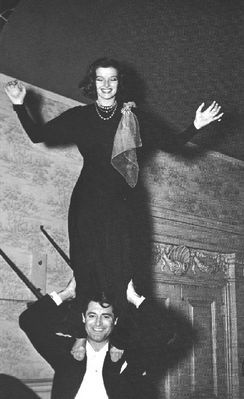
And speaking of that tumbling in Holiday:
More Kapuscinski
For those of you who are interested in this interesting writer, the student of revolutions, here are some more quotes (I'm just not up to writing anything original today. Burnt out.)
The following is from The Soccer War - one of his essays on Ghana:
In those days, the 1960s, the world was very interested in Africa. Africa was a puzzle, a mystery. Nobody knew what would happen when 300 million people stood up and demanded the right to be heard. States began to be established there, and the states bought armaments, and there was speculation in foreign newspapers that Africa might set out to conquer Europe. Today it is impossible to contemplate such a prospect, but that time, it was a concern, an anxiety. It was serious. People wanted to know what was happening on the continent: where was it headed, what were its intentions?The so-called exotic has never fascinated me, even though I came to spend more than a dozen years in a world that is exotic by definition. I did not write about hunting crocodiles or head-hunters, although I admit they are interesting subjects. I discovered instead a different reality, one that attracted me more than expeditions to the villages of witch doctors or wild animal reserves. A new Africa was being born -- and this was not a figure of speech or a platitude from an editorial. The hour of its birth was sometimes dramatic and painful, sometimes enjoyable and jubilant; it was always different (from our point of view) from anything we had known, and it was exactly this difference that struck me as new, as the previously undescribed, as exotic.
I thought the best way to write about this Africa was to write about the man who was its greatest figure, a politician, a visionary, a judge and a sorcerer - Kwame Nkrumah.
Favorite things
I stole this from Mrs. DuToit. I love the idea.
My favorite sculpture: (Small note: I thought I knew my favorite until I saw Mrs. DuToit's and now I feel I may have to reconsider. Look at her favorite statue!)
But regardless: here's mine, since I first saw it in my Humanities class in high school. Rodin's "The Kiss"
My favorite painting:
I literally wish that I could step into the world of - this one - always have. Van Gogh.
My favorite food:
Probably a semi-burnt hamburger from off a grill during a summer barbecue - cold beer to wash it down - Yum
My favorite beverage (hot):
Coffee. Coffee. Coffee.
My favorite beverage (cold):

My favorite play (modern):
Summer and Smoke, by Tennessee Williams. I've read it countless times, I have worked on it myself - I will never get to the bottom of it. Its very ambiguity is what makes it so beautiful, that haunts me.
My favorite play (not modern, not Shakespeare):
I cannot choose one. Do not make me.
Duchess of Malfi, by Christopher Marlowe
Saint Joan, by GB Shaw
The Seagull, by Chekhov
Uncle Vanya, by Chekhov
Hedda Gabler, by Ibsen
My favorite Shakespeare play:
I might have to go with The Tempest. I don't know why. There is something in the magic there, the fantasy, the magic island - Ariel and Caliban - the split between flesh and spirit - that just gets to me. And I love the title. I think it's one of his best.
Miranda says one of my favorite lines he ever wrote:
O, wonder!
How many goodly creatures are there here!
How beauteous mankind is! O brave new world,
That has such people in't!
My favorite sonnet:
I am partial to Sonnet 29:
When, in disgrace with fortune and men's eyes,
I all alone beweep my outcast state
And trouble deaf heaven with my bootless cries
And look upon myself and curse my fate,
Wishing me like to one more rich in hope,
Featured like him, like him with friends possess'd,
Desiring this man's art and that man's scope,
With what I most enjoy contented least;
Yet in these thoughts myself almost despising,
Haply I think on thee, and then my state,
Like to the lark at break of day arising
From sullen earth, sings hymns at heaven's gate;
For thy sweet love remember'd such wealth brings
That then I scorn to change my state with kings.
And I may be partial to the sonnet above, but I love Sonnet 116. Sonnet 116 HURTS.
Let me not to the marriage of true minds
Admit impediments. Love is not love
Which alters when it alteration finds,
Or bends with the remover to remove:
O no! it is an ever-fixed mark
That looks on tempests and is never shaken;
It is the star to every wandering bark,
Whose worth's unknown, although his height be taken.
Love's not Time's fool, though rosy lips and cheeks
Within his bending sickle's compass come:
Love alters not with his brief hours and weeks,
But bears it out even to the edge of doom.
If this be error and upon me proved,
I never writ, nor no man ever loved.
OUCH
My favorite book (non-fiction):
Probably The Book of Abigail and John (compiled letters of Abigail and John Adams. I've read it 10 times or more.)
My favorite book (fiction):
Oh, how to choose. Probably Catch-22, by Joseph Heller.
But Ulysses by Joyce needs to be on there too.
My favorite poem:
No question: "The More Loving One", by Auden
Looking up at the stars, I know quite well
That, for all they care, I can go to hell,
But on earth indifference is the least
We have to dread from man or beast.
How should we like it were stars to burn
With a passion for us we could not return?
If equal affection cannot be,
Let the more loving one be me.
Admirer as I am
Of stars that do not give a damn,
I cannot, now I see them, say
I missed one terribly all day.
Were all stars to disappear or die,
I should learn to look at an empty sky
And feel its total dark sublime,
Though this might take me a little time.
My favorite song:
"Oh Darling", by The Beatles. I have many other favorite tunes that come in and out of my life, but that one always makes the list. I just LOVE it when McCartney screams.
June 27, 2004
Speaking of Cary Grant...
Oh were we??
I couldn't sleep last night. So I watched, back to back, Notorious and Holiday. 2 Cary Grant films.
Seeing them back to back like that made me realize that he is a wee bit underestimated in terms of his range.
Yes, he always plays the same kind of guy. It looks like he wears the same costume in each of his films.
Cary Grant was not like today's actors who feel that they must play someone mentally ill, or physically misshapen in order to be taken seriously as a talent. That wasn't really the way it was back then.
It's not a good or a bad thing - just the truth.
But - Notorious, an Alfred Hitchcock film - with Ingrid Bergman and Claude Rains - is a truly frightening psychological thriller. Very very good. Cary Grant's character in that is a bit jaded - he falls for the girl - but at the back of his mind he always thinks of her as a whore. He can't get past it. So their banter back and forth has that charge - that charge of a man who deeply wants something, and actually feels quite vulnerable to this woman - but he has to put her down. And, above all, he is smooooth. By the end, when he goes to the house to save her (marvelous scene) - and finds out, at last, all of the horrible things done to her, he is meltingly tender with her, just a beautiful tenderness - You believe that he would take a bullet for her, he will do the right thing, he will make it right.
Then in Holiday (a very funny little movie, by the way) - he plays a kind of happy-go-lucky working guy who ends up falling in love with a millionairess. The millionairess has a kind of crazy sister, played by Katherine Hepburn. Cary Grant, in Holiday has the same Cary Grant voice, the same Cary Grant suit, the same slicked Cary Grant hair you see in ALL his movies - but the energy is different, the focus is different. The man truly had a gift for comedy. Member Bringing Up Baby? Member Philadelphia Story?
I think half the reason why he was so damn FUNNY in comedies is because of his striking good looks. You just do not expect a man with such good looks to behave like such a GOOFBALL.
Also - there are always seems to be this barely controlled sense of embarrassment in Cary Grant - which he tries to cover up with dignity - and when that is done in a comedic context - it provides MUCH humor.
In Holiday - the way his character relaxes, if he's feeling tense, is to do somersaults, or cartwheels, or do a lovely tumbling combination across the floor. So any time that he is left alone in the millionairess' mansion, he looks around surreptitiously, making sure the coast is clear, and then does a random tumbling routine. It is freakin' HYSTERICAL. And it's not a stunt man. It's actually Cary Grant taking a running lead and then doing a spectacularly messy round-off across the marble floor. I was howling.
So different from the subtle jaded bittersweet tone of his character in Notorious.
Different from the straightforward honest open character he played in North by Northwest.
Different from the bumbling goofy GEEK he plays in Bringing up Baby.
Different from the rakish semi-cruel (but hilarious) character he plays in Philadelphia Story.
His costumes may have always been the same, and he never changed his voice, or his look, or put on a limp, or an accent, or tried to play a sharecropper, or anything like that ... He knew his world, his gifts, where he could fit into a plot ... He didn't try to 'stretch' himself. He didn't need to.
Cool, man.
And I'd never seen Notorious. That's quite a damn fine movie.
June 26, 2004
Question: Random
Have any of my readers been to Split? In Dalmatia/Croatia?
If you have, could you tell me about it? What is it like? Diocletian's palace, with modern-day houses crammed into the crevices ... is it still like that?
Please take me on a virtual tour of it, if you have been there. I want to go someday.
I hate the word "someday" more and more.
Name that quote
"How does a girl like you get to be a girl like you?"
Kapuscinski
Ryszard Kapuscinski, one of my own personal idols, has spent his entire life reporting on revolutions across the world. His books include:
Another Day of LIfe - the story of the civil war in Angola. Kapuscinski was there.
The Emperor - the story of the overthrow of Haile Selassie, Emperor of Ethiopia
The Soccer War - considered a journalism classic. This is Kapuscinski's compiled writings on all of the revolutions he had witnessed: Central America, Africa, and more. Wherever a revolution broke out, Kapuscinski was there. Great book.
Imperium - maybe my favorite of his. Kapuscinski's sweeping book on the Soviet Union. As a Polish person, Kapuscinski had personally experienced the tyranny, and this is his book detailing it.
The Shadow of the Sun - Kapuscinski's latest book. All about Africa - of course focusing on the revolutions. "Revolution" is his theme.
Kapuscinski wrote many of these books while living under Soviet tyranny and oppressing and censorship. He couldn't write the book he wanted to write, criticizing the Soviet regime - and so he instead wrote books about other countries. But his books are obviously criticisms of totalitarian and fascistic regimes in general - it was his indirect way of telling the truth about what was going on in the Soviet Union.
The first book of his I read was Shah of Shahs - about the last Shah of Iran, and the revolution which toppled him.
Kapuscinski was there.
If you haven't picked up one of his books, I highly recommend it.
He's one of those writers who gets his head above the muck, the mire - and can take a long view, a large picture.
In these uncertain times, I think trying to look at a large picture is essential. Even if we have to squint. Robert Kaplan, another hero of mine, is immersing himself in classical history right now, the history of the ancients. There are lessons there for all of us. That's one of the reasons why I'm finally reading Black Lamb and Grey Falcon. I need the perspective of history. And long history. Ancient history. We ignore history at our peril.
That is the message of Rebecca West, and it's Kapuscinski's message as well.
I've compiled a bunch of quotes. It's the tip of the ice berg. But it gives you a feel for what he's about, if you haven't read him.
Kapuscinski: New Year's Eve in Teheran, 1979
From Ryszard Kapuscinski's book Shah of Shahs
Kapuscinski was in Iran when the American hostages were taken. He had a front-row seat for the entire revolution. On New Year's Eve, 1979, he takes a stroll at night through Teheran, and walks by the US Embassy.
I'd made up my mind to go to the US Embassy on New Year's Eve. I wanted to see what this place the whole world was talking about would look like that night.I left the hotel at eleven. I didn't have far to walk -- a mile and a half, perhaps ... The cold was penetrating, the wind dry and frigid; there must have been a snowstorm raging in the mountains. I walked through streets empty of pedestrians and patrols, empty of everyone but a peanut vendor sitting in his booth in Valiahd Square, all wrapped and muffled against the cold in warm scarves like the autumnal vendors on Polna Street in Warsaw. I bought a bag of peanuts and gave him a handful of rials -- too many; it was my Christmas present. He didn't understand. He counted out what I owed him and handed back the change with a serious, dignified expression.
Thus was rejected the gesture I'd hoped would bring me at least a momentary closeness with the only other person I'd encountered in the dead, frozen city.
I walked on, looking at the decaying shop windwos, turned into Takhte-Jamshid, passed a burned-out bank, a fire-scarred cinema, an empty hotel, an unlit airline office.
Finally I reached the Embassy. In the daytime, the place is like a big marketplace, a busy encampment, a noisy political amusement park where you come to scream and let off steam. You can come here, abuse the mighty of the world, and not face any consequences at all. There's no lack of volunteers; the place is thronged.
But just now, with midnight approaching, there was no one. I walked around what would have been a vast stage long abandoned by the last actors. There remained only pieces of unattended scenery and the disconcerting atmosphere of a ghost town. The wind fluttered the tatters of banners and rippled a big painting of a band of devils warming themselves over the inferno. Further along, Carter in a star-spangled top that was shaking a bag of gold while the inspired Imam Ali prepared for a martyr's death. A microphone and batteries of speakers still stood on the platform from which excited orators stirred the crowds to wrath and indignation. The sight of those unspeaking loudspeakers deepened the impression of lifelessness, the void.
I walked up to the main entrance. As usual, it was closed with a chain and padlock, since no one had repaired the lock in the gate that the crowd broke when it stormed the Embassy.
Near the gate, two young guards crouched in the cold as they leaned against the high brick wall, automatic rifles slung over their shoulders -- students of the Imam's line. I had the impression they were dozing.
In the background, among the trees, stood the lighted building where the hostages were held.
But much as I scrutinized the windows, I saw no one, neither figure nor shadow. I looked at my watch. It was midnight, at least in Teheran, and the New Year was beginning. Somewhere in the world clocks were striking, champagne was bubbling, elaborate fetes were going on amid joy and elation in glittering, colorful halls. That might have been happening on a different planet form this one where there wasn't even the faintest sound or glimmer of light. Standing there freezing, I suddenly began wondering why I had left that other world and come here to this supremely desolate, extremely depressing place. I didn't know. It simply crossed my mind this evening that I ought to be here. I didn't know any of them, those fifty-two Americans and those two Iranians, and I couldn't even communicate with them.
Perhaps I had thought something would happen here. But nothing happened.
Posted by sheila Permalink
Kapuscinski: On Revolution XI
From Ryszard Kapuscinski's book Shah of Shahs
Dissent soon broke out in the revolutionary camp. Everyone had opposed the Shah and wanted to remove him, but everyone had imagined the future differently. Some thought that the country would become the sort of democracy they knew from their stays in France and Switzerland. But these were exactly the people who lost first in the battle that began once the Shah was gone. They were intelligent people, even wise, but weak. They found themselves at once in a paradoxical situation: A democracy cannot be imposed by force, the majority must favor it, yet the majority wanted what Khomeini wanted -- an Islamic republic.When the liberals were gone, the proponents of the republic remained. But they began fighting among themselves as well. In this struggle the conservative hardliners gradually gained the upper hand over the enlightened and open ones. I knew people from both camps, and whenever I thought about the people I sympathized with, pessimism swept over me.
The leader of the enlightened ones was Bani Sadr. Slim, slightly stooping, always wearing a polo shirt, he would walk around, persuade, constantly enter into discussions. He had a thousand ideas, he talked a lot -- too much -- he dreamed incessantly of new solutions, he wrote books in a difficult, obscurre style. In these countries an intellectual in politics is always out of place. An intellectual has too much imagination, he tends to hesitate, he is liable to go off in all directions at once. What good is a leader who does not know himself what he ought to stand up for?
Beheshti, the hardliner, never behaved in this way. He would summon his staff and dictate instructions, and they were all grateful to him beause now they knew how to act and what to do. Beheshti held the reins of the Shiite leadership, Bani Sadr commanded his friends and followers. Bani Sadr's power base lay among the intelligentsia, the students, and the mujahedeen. Beheshti's base was a crowd waiting for the call of the mullahs. It was clear that Bani Sadr had to lose. But Beheshti too would fall before the hand of the Charitable and Merciful One [Khomeini].
Kapuscinski: On Revolution X
From Ryszard Kapuscinski's book Shah of Shahs
Revolution attaches great importance to symbols, destroying some monuments and setting up others to replace them in the hope that through metaphor it can survive. And what of the people? Once again they had become pedestrian citizens, going somewhere, standing around street fires warming their hands, part of the dull landscape of a grey town. once again each was alone, each for himself, closed and taciturn. Could they still have been waiting for something to happen, for some extraordinary event? I don't know, I can't say.Everything that makes up the outward, visible part of a revoltuion vanishes quickly. A person, an individual being, has a thousand ways of conveying his feeligs and thoughts. He is riches without end, he is a world in which we can always discover something new. A crowd, on the other hand, reduces the individuality of the person; a man in a crowd limits himself to a few forms of elementary behavior. The forms through which a crowd can express its yearnings are extraordinarily meager and continually repeat themselves: the demonstration, the strike, the rally, the barricades. That is why you can write a novel about a man, but about a crowd -- never. If the crowd disperses, goes home, does not reassemble, we say that the revolution is over.
Kapuscinski: On Revolution IX
From Ryszard Kapuscinski's book Shah of Shahs
[The Shah] also perished because he did not know his own country. He spent his whole life in the palace. When he would leave the palace, he would do it like someone sticking his head out the door of a warm room into the freezing cold. Look around a minute and duck back in! Yet the same structure of destructive and deforming laws operates in the life of all palaces. So it has been from time immemorial, so it is and shall be. You can build ten new palaces, but as soon as they are finished they become subject to the same laws that existed in the palaces built five thousand years ago. The only solution is to treat the palace as a temporary abode, the same way you treat a streetcar or a bus. You get on, ride a while, and then get off.And it's very good to remember to get off at the right stop and not ride too far.
Kapuscinski: On Revolution VIII
From Ryszard Kapuscinski's book Shah of Shahs
The Shah's vanity did him in. He thought of himself as the father of his country, but the country rose against him. He took it to heart and felt it keenly. At any price (unfortunately, even blood) he wanted to restore the former image, cherished for years, of a happy people prostate in gratitude before their benefactor. But he forgot that we are living in times when people demand rights, not grace.
Kapuscinski: On Revolution VII
From Ryszard Kapuscinski's book Shah of Shahs
A despot believes that man is an abject creature. Abject people fill his court and populate his environment. A terrorized society will behave like an unthinking, submissive mob for a long time. Feeding it is enough to make it obey. Provided with amusements, it's happy. The rather small arsenal of political tricks has not changed in millennia.Thus, we have all the amateurs in politics, all the ones convinced they would know how to govern if only they had the authority.
Yet surprising things can also happen. Here is a well-fed and well-entertained crowd that stops obeying. It begins to demand something more than entertainment. It wants freedom, it demands justice. The despot is stunned. He doesn't know how to see a man in all his fullness and glory. In the end such a man threatens dictatorship, he is its enemy,. So it gathers its strength to destroy him.
Although dictatorship despises the people, it takes pains to win their recognition. In spite of being lawless -- or rather, because it is lawless -- it strives for the appearance of legality. On this point it is exceedingly touchy, morbidly oversensitive. Morever, it suffers from a feeling (however deeply hidden) of inferiority. So it spares no pains to demonstrate to itself and others the popular approval it enjoys. Even if this support is a mere charade, it feels satisfying. So what if it's only an appearance? The world of dictatorship is full of appearances.
Kapuscinski: On Revolution VI
From Ryszard Kapuscinski's book Shah of Shahs
All books about all revolutions begin with a chapter that describes the decay of totterign authority or the misery and sufferings of the people. They should begin with a psychological chapter, one that shows how a harassed, terrified man suddenly breaks his terror, stops being afraid. This unusual process, sometimes accomplished in an instant like a shock or a lustration, demands illuminating. Man gets rid of fear and feels free. Without that there would be no revolution.
Kapuscinski: On Revolution V
From Ryszard Kapuscinski's book Shah of Shahs
It is authority that provokes revolution. Certainly, it does not do so consciously. Yet its style of life and way of ruling finally becomes a provocation. This occurs when a feeling of impunity takes root among the elite: We are allowed anything, we can do anything. This is a delusion but it rests on a certain rational foundation. For a while it does indeed look as if they can do whatever they want. Scandal after scandal and illegality after illegality go unpunished. The people remain silent, patient, wary. They are afraid and do not yet feel their own strength. At the same time, they keep a detailed account of the wrongs, which at one particular moment are to be added up.The choice of that moment is the greatest riddle known to history.
Why did it happen on that day, and not on another? Why did this event, and not some other, bring it about? After all, the government was indulging in even worse excesses only yesterday, and there was nor eaction at all.
"What have I done?" asks the ruler, at a loss. "What has possessed them all of a sudden?"
This is what he has done: He has abused the patience of the people.
But where is the limit of that patience? How can it be defined? If the answer can be determined at all, it will be different in each case. The only certain thing is that rulers who know that such a limit exists and know how to respect it can count on holding power for a long time. But there are few such rulers.
Kapuscinski: On Revolution IV
From Ryszard Kapuscinski's book Shah of Shahs
History knows two types of revolution. The first is revolution by assault, the second revolution by siege.All the future fortune, the success, of a revolution by assault is decided by the reach of the first blow. Strike and seize as much ground as possible! This is important because such a revolution, while the most violent, is also the most superficial. The adversary has been defeated, but in retreating he has preserved a part of his forces. He will counter-attack and force the victor to withdraw. Thus, the more far-reaching the first blow, the greater the area that can be saved in spite of later concessions. In a revolution by assault, the first phase is the most radical. The subsequent phases are a slow but incessant withdrawal to the point at which the two sides, the rebelling and the rebelled-against, reach the final compromise.
A revolution by siege is different; here the first strike is usually weak and we can hardly surmise that it forebodes a cataclysm. But events soon gather speed and become dramatic. More and more people take part. The walls behind which authority has been sheltering crack and then burst. The success of a revolution by siege depends on the determination of the rebels, on their will power and endurance. One more day! One more push! In the end, the gates yield, the crowd breaks in and celebrates its triumph.
I love that - this book was written in 1982 - and he was basically describing what would eventually happen in his home country (and had already begun happening in the early 80s) - with Lech Walesa and the Solidarity movement - a revolution by siege.
Kapuscinski: On Revolution III
From Ryszard Kapuscinski's book Shah of Shahs
Every revolution is preceded by a state of general exhaustion and takes place against a background of unleashed aggressiveness. Authority cannot put up with a nation that gets on its nerves; the nation cannot tolerate an authority it has come to hate. Authority has squandered all its credibility and has empty hands, the nation has lost the final scrap of patience and makes a fist. A climate of tension and increasing oppressiveness prevails. We start to fall into a psychosis of terror. The discharge is coming. We feel it.
Kapuscinski: On Revolution II
From Ryszard Kapuscinski's book Shah of Shahs
Revolution must be distinguished from revolt, coup d'etat, palace takeover. A coup or a palace takeover may be planned, but a revolution -- never. Its outbreak, the hour of that outbreak, takes everyone, even those who have been striving for it, unawares. They stand amazed at the spontanaeity that appears suddenly and destroys everything in its path. It demolishes so ruthlessly that in the end it may annihilate the ideals that called it into being.
Kapuscinski: On Revolution I
From Ryszard Kapuscinski's book Shah of Shahs
The indispensable catalyst is the word, the explanatory idea. More than petards or stilettoes, therefore, words -- uncontrolled words, circulating freely, underground, rebelliiously, not gotten up in dress uniforms, uncertified -- frighten tyrants.
Kapuscinski: "Kipling's formula"
From Ryszard Kapuscinski's book Shah of Shahs (about the last Shah of Iran): Transcript from another interview with an Iranian man:
He was reading a lot now and translating London and Kipling. When he remembered his English years, he thought about the differences between Europe and Asia and repeated Kipling's formula to himself: "East is east, and West is west, and never ... " Never, no, they will never meet, and they will never understand each other. Asia will reject every European transplant as a foreign body. The Europeans will be shocked and outraged, but they will be unable to change Asia. In Europe, epochs succeed each other, the new drives out the old, the earth periodically cleanses itself of its past so that people of our century have trouble understanding our ancestors. Here it is different, here the past is as alive as the present, the unpredictable cruel Stone Age coexists with the calculating, cool age of electronics -- the two eras live in the same man, who is as much the descendant of Genghis Khan as he is the student of Edison ... if, that is, he ever comes into contact with Edison's world.
Kapuscinski: "an army of foreigners"
From Ryszard Kapuscinski's book Shah of Shahs
When thinking about the fall of any dictatorship, one should have no illusions that the whole system comes to an end like a bad dream with that fall. The physical existence of the system does indeed cease. But its psychological and social results live on for years, and even survive in the form of subconsciously continued behavior.A dictatorship that destroys the intelligentsia and culture leaves behind itself an empty, sour field on which the tree of thought won't grow quickly. It is not always the best people who emerge from hiding, from the corners and cracks of that farmed-out field, but often those who have proven themselves strongest, not always those who will create new values but rather those whose thick skin and internal resilience have ensured their survival. In such circumstances history begins to turn in a tragic, vicious circle from which it can sometimes take a whole epoch to break free..
And yet how do we build [the Great Civilization] here, where there are no experts and the nation, even if it is eager to learn, has nowhere to study?
In order to fulfill his vision, the Shah needed at least 700,000 specialists immediately. Somebody hit upon the safest and best way out -- import them...Tens of thousands of foreigners thus began arriving. Airplane after airplane land at Teheran airport: domestic servants from the Philippines, hydraulic engineers from Greece, electricians from Norway, accountants from Pakistan, mechanics from Italy, military men from the United States...
This army of foreigners, byb the very strength of its technical expertise, its knowing which buttons to press, which levers to pull, which cables to connect, even if it behaves in the humbles way, begins to dominate and starts crowding the Iranians into an inferiority complex. The foreigner knows how and I don't. This is a proud people, extremely sensitive about its dignity. An Iranian will never admit he can't do something; to him, such an admission constitutes a great shame and a loss of face. He'll suffer, grow depressed, and finally begin to hate. He understood quickly the concept that was guiding his ruler: All of you just sit there in the shadow of the mosque and tend your sheep, because it will take a century for you to be of any use! I on the other hand have built a global empire in ten years with the help of foreigners.
This is why the Great Civilization struck Iranians as above all a great humiliation.
Kapuscinski: The Iranian students
From Ryszard Kapuscinski's book Shah of Shahs
This essay is on the Shah's frantic push towards modernization:
From a logical point of view, anyone who sets out to create a Great Civilization ought to begin with people, with training cadres of experts in order to form a native intelligentsia. But it was precisely that kind of thinking that was unacceptable. Open new universities and polytechnics, everyone a hornets' nest, every student a rebel, a good-for-nothing, a freethinker? Is it any wonder the Shah didn't want to braid the whip that would flay his own skin? The monarch had a better way -- he kept the majority of his students far from home. From this point of view the country was unique. More than a hundred thousand young Iranians were studying in Europe and America. This policy cost much more than it would have taken to create national universities. But it guaranteed the regime a degree of calm and security.The majority of these young people never returned. Today more Iranian doctors practice in San Francisco or Hamburg than in Tebriz or Meshed. They did not return even for the generous salaries the Shah offered. They feared Savak and didn't want to go back to kissing anyone's shoes. An Iranian at home could not read the books of the country's best writers (because they came out only abroad), could not see the films of its outstanding directors (because they were not allowed to be shown in Iran), could not listen to the voices of its intellectuals (because they were condemned to silence).
The Shah left people a choice between Savak and the mullahs. And they chose the mullahs.
Kapuscinski: The Bus Stop
From Ryszard Kapuscinski's book Shah of Shahs
The following is an essay on SAVAK, the Shah's brutal secret police force:
Savak had a good ear for all allusions. One scorching afternoon an old man with a bad heart turned up at the bus stop and gasped, "It's so oppressive you can't catch your breath." "So it is," the Savak agent replied immeditaely, edging closer to the winded stranger. "it's getting more and more oppressive and people are fighting for air." "Too true," replied the naive old man, clapping his hand over his heart, "such heavy air, so oppressive." Immediately the Savak agent barked, "Now you'll have a chance to regain your strength," and marched him off.The other people at the bus stop had been listening in dread, for they had sensed from the beginning that the feeble elderly man was committing an unpardonable error by saying "oppressive" to a stranger.
Experience had taught them to avoid uttering such terms as oppressiveness, darkness, burden, abyss, collapse, quagmire, putrefaction, cage, bars, chain, gag, truncheon, boot, claptrap, screw, pocket, paw, madness, and expressions like lie down, lie flat, spreadeagle, fall on your face, wither away, gotten flabby, go blind, go deaf, wallow in it, something's out of kilter, something's wrong, all screwed up, something's got to give -- because all of them, these nouns, verbs, adjectives, and pronouns, could hide allusions to the Shah's regime, and thus formed a connotative minefield where you could get blown to bits with one slip of the tongue.
For a moment, for just an instant, a new doubt flashed through the heads of the people standing at the bus stop: What if the sick old man was a Savak agent too? Because he had criticized the regime (by using "oppressive" in conversation), he must have been free to criticize. If he hadn't been, wouldn't he have kept his mouth shut or spoken about such agreeable topics as the fact that the sun was shining and the bus was sure to come along any minute? And who had the right to criticize? Only Savak agents, whose job it was to provoke reckless babblers, then cart them off to jail.
The ubiquitous terror drove people crazy, made them so paranoid they couldn't credit anyone with being honest, pure, or courageous...
Fear so debased people's thinking, they saw deceit in bravery, collaboration in courage. This time, however, seeing how roughly the Savak agent led his victim away, the people at the bus stop had to admit that the ailing old man could not have been connected with the police. In any case, the captor and his prey were soon out of sight, and the sole remaining question was: Where did they go?
Nobody actually knew where Savak was located. The organization had no headquarters. Dispersed all over the city (and all over the country), it was everywhere and nowhere. It occupied houses, villas, and apartments no one ever paid attention to...Only those who were in on the secret knew its telephone numbers...Whoever fell into the grip of that organization disappeared without a trace, sometimes forever. People would vanish suddenly and nobody would know what had happened to them, where to go, whom to ask, whom to appeal to. They might be locked up in a prison, but which one? There were six thousand. An invisible, adamant wall would rise up, before which you stood helpless, unable to take a step forward.
Iran belonged to Savak.
It was Savak that banned the plays of Shakespeare and Moliere because they criticized monarchical and aristocratic vices. Savak ruled in the universities, offices, and factories. A monstrously overgrown cephalopod, it entangled everything, crept into every crack and corner, glued its suckers everywhere, ferreted and sniffed in all directions, scratched and bored through every level of existence...
The people waiting at the bus stop knew all this and therefore remained silent once the Savak agent and the old man had gone. They watched each other out of the corners of their eyes, for all they knew the one standing next to them might have to inform...Without wanting to (even though some of them try to hide it so as not to provoke any aggressive outbursts), the people at the bus stop look at each other with loathing. They are inclined to neurotic, disproportionate reactions. Something gets on their nerves, something smells bad, and they move away from each other, waiting to see who goes after whom, who attacks someone first. This reciprocal distrust in the work of Savak...This one, this one, and that one. That one too? Sure, of course.
Everybody.
What I LOVE about this excerpt is that you can see how Kapuscinski - in focusing on life under Savak in Iran - he is criticizing the life he grew up in - life in Poland under the thumb of the Soviet Union. By writing about these other totalitarian regimes, he was able to freely criticize the USSR.
Kapuscinski: "Qom was rumbling"
From Ryszard Kapuscinski's book Shah of Shahs
Kapuscinski interviews an Iranian about the beginnings of the revolution:
Every pretext, he says, was good for rising up against the Shah. The people wanted to get rid of the dictator, and they flexed their muscles whenever they had the chance.Everybody looked toward Qom. [Ed: Qom is a religious center in Iran.] That's the way it had always been in our history: Whenever there was unhappiness and a crisis, people always started listening for the first signals from Qom.
And Qom was rumbling.
This was when the Shah extended diplomatic immunity to all US military personnel and their families. Our army was already full of American experts. And the mullahs came right out and said that the Shah's move offended the principle of sovereignty.
Now, for the first time, Iran would hear Ayatolla Khomeini. Before that, no one knew of him -- nobody but the people of Qom, that is. He was already over 60, old enough to be the Shah's father. later he would often call the ruler "son", but of course in an ironic and wrathful tone. Khomeini attacked him ruthlessly. My people, he would cry, don't trust him. He's not your man! He's not thinking of you -- he's only thinking of himself and of the ones who give him orders. He's selling out our country, selling us all out. The Shah must go!...
Now I wonder just what conditions created Khomeini. In those days, after all, there were plenty of more important, better-known ayatollahs as well as prominent political opponents of the Shah. We were all writing protests, manifestos, letters, statements. Only a small group of intellectuals read them because such materials could not be printed legally and, besides, most people didn't know how to read. We were criticizing the monarch, saying things were bad, demanding changes, reform, democratization, and justice.
It never entered anyone's head to come out the way Khomeini did -- to reject all that scribbling, all those petitions, resolutions, proposals. To stand before the people, and cry, The Shah must go!
That was the gist of what Khomeini said then, and he kept on saying it for fifteen years. It was the simplest thing, and everyone could remember it -- but it took them fifteen years to understand what it really meant. After all, people took the institution of the monarchy as much for gratned as the air. No one could imagine life without it.
The Shah must go!
Don't debate it, don't gab, don't reform or forgive. There's no sense in it, it won't change anything, it's a vain effort, it's a delusion. We can go forward only over the ruins of the monarchy. There's no other way.
The Shah must go!
Don't wait, don't stall, don't sleep.
The Shah must go!
The first time he said it, it sounded like a maniac's entreaties, like the keening of a madman. The monarchy had not yet exhausted the possibilities of endurance.
Kapuscinski: "our game of seeing whose I is superior"
From Ryszard Kapuscinski's book Shah of Shahs
Kapucinski interviews an Iranian - these are the notes from that interview:
Because the man has to be superior, the woman must be inferior. Outside the home I might be a nonentity, but under my own roof I make up for it -- here I am everything. Here my power admits of no division, and the more numerous the family, the wider and mightier my authority. The more children, the better: They give a man more to rule over. He becomes the monarch of a domestic state, commanding respect and admiration, deciding the fate of his subjects, settling disputes, imposing his will, ruling. (He stops to see what sort of an impression he is making on me. I protest energetically: I oppose such stereotypes. I know many of his fellow countrymen who are modest and polite, who have never made me feel inferior.) Quite true, he agrees, but only because you don't threaten us. You're not playing our game of seeing whose I is superior. This game made it impossible to create any solid parties because quarrels about leadership always broke out immediately and everyone would want to set up his own party.
Kapuscinski on Oil Societies
From Ryszard Kapuscinski's book Shah of Shahs
The following essay on Oil always struck me as particularly insightful:
Oil kindles extraordinary emotions and hopes, since oil is above all a great temptation. It is the temptation of ease, wealth, strength, fortune, power. It is a filthy, foul-smelling liquid that squirts obligingly up into the air and falls back to earth as a rustling shower of money. To discover and possess the source of oil is to feel as if, after wandering long underground, you have suddenly stumbled upon royal treasure. Not only do you become rich, but you are also visited by the mystical conviction that some higher power has looked upon you with the eye of grace and magnanimously elevated you above others, electing you its favorite.Many photographs preserve the moment when the first oil spurts from the well: people jumping for joy, falling into each other's arms, weeping.
Oil creates the illusion of a completely changed life, life without work, life for free. Oil is a resource that anesthetizes thought, blurs vision, corrupts. People from poor countries go around thinking: God, if only we had oil! The concept of oil expresses perfectly the eternal human dream of wealth achieved through lucky accident, through a kiss of fortune and not by sweat, anguish, hard work. In this sense oil is a fairy tale, and like every fairy tale, a bit of a lie. Oil fills us with such arrogance that we begin believing we can easily overcome such unyielding obstacles as time. With oil, the last Shah used to say, I will create a second America in a generation! He never created it.
Oil, though powerful, has its defects. It does not replace thinking or wisdom.
For rulers, one of its most alluring qualities is that it strengthens authority. Oil produces great profits without putting a lot of people to work. Oil causes few social problems because it creates neither a numerous proletariat nor a sizable bourgeoisie. Thus the government, freed from the need of splitting the profits with anyone, can dispose of them according to its own ideas and desires.
Look at the ministers from oil countries, how high they hold their heads, what a sense of power they have, they, the lords of energy, who decide whether we will be driving cars tomorrow or walking.
And oil's relation to the mosque? What vigor, glory, and significance this new wealth has given to its religion, Islam, which is enjoying a period of accelerated expansion and attracting new crowds of the faithful.
Kapuscinski: "Old Mossy"
From Ryszard Kapuscinski's book Shah of Shahs
2 excerpts here, having to do with Dr. Mossadegh (or Mossadeq) - the Prime Minister of Iran in the 50s. I have a couple of friends from Iran, and sometimes I enjoy getting them talking about Mossadegh, to watch their passion. In addition - the first time I said to my Iranian friend Fred (yes, his name is Fred - oh, and he insists on being called "Persian" - hates the word "Iran") - Anyway, I asked him, "So ... how do you feel about what Mossadegh did, and what was done to him?" Tears flooded his eyes and he put his arms around me. Basically, it was because - I knew who Mossadegh was, and it moved Fred so much to hear his name coming out of MY mouth. It would be, for me, like meeting an Uzbek in Tashkent who said to me, "So talk to me about John Adams. How do you feel about him?"
Mossadegh is a figure for the exiles - at least that's how I see it. A man who took risks, and promoted self-sufficiency - and ended up paying a huge price for it. Iranians in exile love Mossadegh.
First excerpt: (Kapuscinski looks at a photograph of Mossadegh - and writes the following observations):
This is undoubtedly the greatest day in the long life of Doctor Mossadegh. He is leaving parliament high on the shoulders of an elated crowd. He is smiling and holding up his right hand in greeting to the people. Three days earlier, on April 28, 1951, he became Prime Minister, and today parliament has passed his bill nationalizing the country's oil. Iran's greatest treasure has become the property of the nation. We have to enter into the spirit of that epoch, because the world has changed a great deal since. In those days, to dare the sort of act that Doctor Mossadegh just performed was tantamount to dropping a bomb suddenly and unexpectedly on Washington or London. The psychological effect was the same: shock, fear, anger, outrage. Somewhere in Iran, some old lawyer who must be a half-cocked demagogue has pillaged Anglo-Iranian -- the pillar of the Empire! Unheard of, unforgiveable! In those years, colonial property was a sacred value, the ultimate taboo. But that day, whose exalted atmosphere the faces in the photograph reflect, the Iranians do not yet know they have committed a crime for which they will have to suffer bitter painful punishment. Right now, all Teheran is living joyous hours of its great day of liberation from a foreign and hated past. Oil is our blood! the crowds chant enthusiastically. Oil is our freedom! The palace shares the mood of the city, and the Shah signs the act of nationalization. It is a moment when all feel like brothers, a rare instant that quickly turns into a memory because accord in the national family is not going to last long. Mossadegh never had good relations with the Pahlavis, father and son. Mossadegh's ideas had been formed by French culture: A liberal and a democrat, he believed in institutions like parliament and a free press and lamented the state of dependence in which his homeland found itself. The fall of Reza Khan presented a great opportunity for him and those like him.The monarch, meanwhile, takes more interest in good times and sports than in politics, so there is a chance for democracy in Iran, a chance for the country to win full independence. Mossadegh's power is so great and his slogans so popular that the Shah ends up on the sidelines. He plays soccer, flies his private airplane, organizes masked balls, divorces and remarries, and goes skiing in Switzerland.
The 2nd Excerpt about Mossadegh - Kapuscinski interviews someone about Mossadegh. Kapuscinski rightly felt that the story of Mossadegh was one of the keys to the tragedy of what happened in Iran. The revolution, which had begun as a revolution for more freedom, more democracy - had been hijacked by the mullahs. And it was all over from there. Anyway, this is a bit of the transcript from that interview:
Do you know that for twenty-five years it was forbidden to utter his name in public? That the name "Mossadegh" was purged from all books, all history texts? And just imagine: Today, young people, who, it was assumed, should know nothing about him, go to their deaths carrying his portrait. There you have the best proof of what such expunging and rewriting history leads to. But the Shah didn't understand that. He did not understand that even though you can destroy a man, destroying him does not make him cease to exist. On the contrary, if I can put it this way, he begins to exist all the more. These are paradoxes no tyrant can deal with. The scythe swings, and at once the grass starts to grow back...Mossadegh! The English nicknamed him "Old Mossy". He drove them crazy, and yet they respected him in a way. No Englishman ever took a shot at him. In the end it was necessary to summon our own uniformed goons. And it took them only a few days to establish that kind of order! Mossy went off to prison for three years. Five thousand people went up against the wall or died in the streets -- the price of rescuing the throne. A sad, bloody, dirty re-entry.
You ask if Mossy was fated to lose? He didn't lose. He won. Such a man can't be erased from the people's memories; so he can be thrown out of office but never out of history. The memory is a private possession to which no authority has access.
Mossy said the land we walk on belongs to us and everything we find in that land is ours. Nobody in this country had ever put it that way.
He also said, Let everybody speak out -- I want to hear their ideas. Do you understand this? After two and a half millennia of tyrannical degradation he pointed out to the Iranian that he is a thinking being. No ruler had ever done that! People remembered what Mossy said. It stayed in their minds and remains alive to this day. Words that open our eyes to the world are always the easiest to remember. And so it was with those words.
Could anyone say that Mossy was wrong in what he did and said? Today everyone says that he was right, but that the problem is he was right too early. You can't be right too early, because then you risk your own career and at times your own life. It takes a long time for a truth to mature, and in the meantime people suffer or blunder around in ignorance. But suddenly along comes a man who speaks that truth too soon, before it has become universal, and then the ruling powers strike out at the heretic and burn him at the stake or lock him up or hang him because he threatens their interests or disturbs their peace.
Mossy came out against the monarchical dictatoriship and against the country's subjugation. Today monarchies are falling one after the other and subjugation has to be masked with a thousand disguises because it arouses such opposition. But he came out against it thirty years ago, when nobody here dared say these obvious things.
"You can't be right too early." Truer words.
Kapuscinski: "obliterated all contrasts"
From Ryszard Kapuscinski's book Shah of Shahs
The Iranians resented the fact that, for security reasons, only foreigners were invited to certain celebrations in which the Shah took part. His compatriots also said bitingly that since he traveled almost exclusively by airplane and helicopter, he saw his country only from a lofty vantage point that obliterated all contrasts. I don't have any photographs of Khomeini in his early years. When he appears in my collection, he is already an old man, and so it is as if he had never been young or middle-aged. The local fanatics believe Khomeini is the Twelfth Imam, the Awaited One, who disappeared in the ninth century, and has now returned, more than a thousand years later, to deliver them from misery and persecution. That Khomeini almost always appears in photographs only as an aged man could be taken as confirmation of this belief.
Kapuscinski: "Uneasy Teheran nights"
From Ryszard Kapuscinski's book Shah of Shahs
Kapuscinski describes being in Teheran during the revolution:
I walk back upstairs, through the empty corridor, and lock myself in my cluttered room. As usual at this hour I can hear gunfire from the depths of an invisible city. The shooting starts regularly at nine as if custom or tradition had fixed the hour. Then the city falls silent. Then there are more shots and muffled explosions. No one's upset, no one pays attention or feels directly threatened (no one except those who are shot). Since the middle of February, when the uprising broke out in the city and the crowds seized the army muitions depots, Teheran has been armed, intensely charged, while in streets, houses, under cover of darkness, the drama of assassination is enacted. The underground keeps a low profile during the day, but at night it sends masked combat squads into the city.These uneasy nights force people to lock themselves in their own homes. There is no curfew, but getting anywhere between midnight and dawn is difficult and risky. The Islamic Militia or the independent combat squads rule the looming, motionless city between those hours. Both are groups of well-armed boys who point their guns at people, cross-examine them, confer among themselves, and occasionally, just to be on the safe side, take those they've stopped to jail -- from which it is difficult to get out. What's more, you are never sure who has locked you up, since no identifying marks differentiate the various representatives of violence whom you encounter, no uniforms or caps, no armbands or badges -- these are simply armed civilians whose authority must be accepted unquestioningly if you care about your life. After a few days, though, we grow used to them and learn to tell them apart. This distinguished-looking man, in his well-made white shirt and carefully matched tie, walking down the street shouldering a rifle is certainly a militiaman in one of the ministries or central offices. On the other hand, this masked boy (a woolen stocking pulled over his head and holes cut out at eyes and mouth) is a local fedayeen no one's supposed to know by sight or name. We can't be sure about these people dressed in green US Army fatigue jackets, rushing by in cars, barrels of guns pointed out the windows. They might be from the militia, but then again they might belong to one of the opposition combat groups (religious fanatics, anarchists, last remnants of Savak [Ed: Savak was the secret police of the Shah]) hurrying with suicidal determination to carry out an act of sabotage or revenge.
But finally it's no fun trying to predict just whose ambush is waiting for you, whose trap you'll fall into. People don't like surprises, so they barricade themselves in their homes at night. My hotel is also locked (at this hour the sound of gunfire mingles with the creaking of shutters rolling down and the slamming shut of gates and doors). No friends will drop by; nothing like that will happen. I have no one to talk to. I'm sitting alone looking through notes and pictures on the table, listening to taped conversations.
Kapuscinski: "In what language...?"
From Ryszard Kapuscinski's book Shah of Shahs
All over the world, at any hour, on a million screens an infinite number of people are saying something to us, trying to convince us of something, gesturing, making faces, getting excited, smiling, nodding their heads, pointing their fingers, and we don't know what it's about, what they want from us, what they are summoning us to. They might as well have come from a distance planet -- an enormous army of public relations experts from Venus or Mars -- yet they are our kin, with the same bones and blood as ours, with lips that move and audible voices, but we cannot understand a word. In what language will the universal dialogue of humanity be carried out? Several hundred languages are fighting for recognition and promotion; the language barriers are rising. Deafness and incomprehension are multiplying.
June 25, 2004
I have a question.
Is there any reason in this day and age for a gentleman to wear his hair parted in the middle and then feathered? With an obvious use of hair products?
Really. I'm just asking.
Obsession Central: Bogart, Bacall - Sheila's Daily Fix
Bogart hated doing publicity shots, and got out of them as often as he could - which, of course, was much easier once he was a huge star.
Martin Weiser - the studio photographer who had been personally assigned to Lauren Bacall (his job was to create the mystique, take the shots which would blanket the country on the release of To Have and Have Not) wanted to get some publicity shots for To Have and Have Not of just the two stars. Weiser was actually assigned to do just that, but Bogart refused. "No. I won't do it. I hate doing them, and I won't do it." He was immovable.
Bacall, knowing that these photos would be important for her career, sweet-talked Bogie into allowing it.
45 years later, Martin Weiser, in an interview, was still able to remember the "magic" of his photo shoot - which had to be squeezed in between a lunch break and the filming of the afternoon.
Of course, at this point, Bogie was married to someone else (very unhappily - the two of them were known as "the Battling Bogarts" - she stabbed him in the back with a knife - he blacked her eye - their battles were famous) - and Lauren Bacall was a teenager about to become a massive star.
But the growing connection between the two of them is obvious in the photo below, which is one of the shots from Weiser's photo shoot:

Some facts about Little Rhody
-- sent to me by a reader. Thank you!!
Here it is:
"6 Things You Don't Know About Rhode Island".
One thing I would add: We are the smallest state with the longest name.
Amusing moments in the piece above:
-- the status symbol of having a low number on your license plate. Heh heh heh.
Those who have the good social fortune to drive a car bearing a plate with both their initials and a low number are either very wealthy and/or involved in organized crime.
-- Buddy Cianci, our infamous mayor. A convicted felon. But responsible for dragging Providence out of the slums and into prosperity. The man has served 2 prison sentences. His last campaign he ran with this slogan: Buddy Cianci: A Man of Conviction Only in Rhode Island.
-- the whole quahog thing. Damn straight. We do not eat clams. We eat quahogs. Narragansett Bay is one of the most beautiful places in the world.
Speaking of feng shui
Bill's post here (in which he references Feng Shui and bottled water) reminded me of something my friend Beth, her daughter Ceileidh and I saw on the streets of New York.
We were walking cross-town to get the subway up to the Metropolitan Museum. We were on 34th Street, walking east.
And this is what we overheard, in a flash, as someone passed by us:
It was a big kind of flowzy-shaped guy, wearing a grey suit, very conservative-looking, with sunglasses on - and he was talking very loudly on his cell phone as he careened past us. And all we heard was:
"Man, your feng shui is all FUCKED UP."
I just don't think that that's what the ancient feng shui gurus really had in mind.
Oh, one more thing:
I have worked in a "feng shui'ed" office and my roommate of 8 years was very into feng shui and re-did our main rooms - and it certainly does make a huge difference. Hard to explain. The first thing I did in my new apartment, in my rather small kitchen, was place a small mirror in a strategic position - and it completely opens up the room and makes it seem bigger and lighter. I don't think it's all malarkey, but I do think the popularization and yuppification of it is kind of ridiculous.
And some guy who looks like he eats Wendy's 3 times a day screaming to his friend about how his "feng shui is all fucked up" is high comedy.
June 24, 2004
The Bionic Wedding
So have you heard about this? An Indian "tycoon" (I love that - journalism short-hand) paid 60 million dollars for his daughter's wedding.
I felt myself get a little light-headed when I imagined being a bride at such an expensive wedding. "Expensive" really isn't the word for it ... "expensive" doesn't even cover it!!
It reminded me of a wedding I went to, long long ago. And so now I will regale you randomly with the tale.
My first boyfriend had a very interesting background. He "came from" money - but his parents were hippies and alcoholics - with massive trust funds - and a lot of that money was squandered by the generation before him. Yet, he grew up surrounded by big money Newport people, with yachts, etc. However - he always had summer jobs, he bummed around with his skateboard, his parents were always living on the edge of complete and utter squalor.
I'm strictly middle-class. That's my background. I didn't grow up knowing rich people. Most of my friends growing up were middle-class, too. We would take field trips to Newport to gape at the mansions, so we knew, obviously, that there is massive wealth in Rhode Island - but it just wasn't my crowd.
Suddenly, with the first boyfriend - I was introduced into that world.
I wasn't always comfortable. It takes a bit of getting used to. At least it did for me.
People who knew about wines, and knew how to order them.
People who owned lots of toys. 6 mountain bikes in the garage - for one person. That kind of thing.
People who seriously discussed their decorating schemes, and were always suing their decorator.
This is another world for me. I don't mean to sound like a little country mouse, but that was kind of the situation.
I felt intimidated.
Luckily, the first boyfriend had a healthy contempt for all of it, and he also had a wonderful sense of humor. (Has.)
One of his best friends from childhood (who I had met many times, and this man - this man-boy, really - was OUT OF HIS MIND. Like Robert Downey Jr. With unlimited amounts of cash. He never had to work. He had a pretend job. He was absolutely insane, and a lot of fun - I really liked him - for about 5 minutes at a time) - Anyway, he was getting married.
My boyfriend was in the wedding.
So, by proxy, I was involved in the entire thing. The rehearsal dinner, the wedding brunch, the wedding ... It was 3 days out of my life. The whole thing happened in Newport. This is old old old money. The groom was old Newport money and the bride was old Texas money.
And so what ended up happening was: the two rich families ended up competing with one another, in terms of who paid the most for which event. There was no love lost between the 2 families. There was actually no love lost between the groom and the bride. I caught him, during one of the toasts made at the rehearsal dinner, give her a look of such contempt that it made me catch my breath. (They were divorced within 8 months.)
All of my outfits I had "borrowed" from the costume shop at the university where I went to school. I was terrified of what all those rich Newport and Texas girls woudl be wearing. So I "borrowed" a Jackie Onassis-inspired little black dress, and a black hat with a little veil - I "borrowed" a black alligator-skin purse. I felt like a little girl playing dress-up.
At the rehearsal dinner I was separated from my boyfriend, who sat at the bridal table. I cannot explain the WEALTH on display. It was out of control. But this is old classy money. Huge difference and (to my taste then) much more intimidating. And because I was separated from my rock, my anchor, I had no one to talk to - and I was sitting next to the sister of the groom - who apparently was an amazing artist but who had such intense shyness that she would literally begin to weep during conversations.
I am not exaggerating.
I tried to talk to her about her art. She sat there mutely. I wanted to put her out of her misery. In a good way. Let her know I was safe. But she was paralyzed with fear. I was a little girl playing dress-up, sitting at the New York Yacht Club. She was extraordinarily rich but couldn't speak. We both were outsiders.
But we could not break through.
She began to weep maybe 2 or 3 exchanges into the conversation.
I gave up and then proceeded to get VERY DRUNK ALL BY MYSELF.
It was awful. I guzzled 4 glasses of wine in a 45 minute period, and then suddenly - voom - I was extremely drunk. I was like the Irish maid guzzling the wine in the rich people's kitchen.
I sat in my chair. Afraid to move. I thought I would fall down if I tried to get up.
My boyfriend kept throwing me sympathetic glances across the room.
At one point, I mouthed, very very slowly, "I .... am .... waaaaaayyyyy ... too drunk ... right now..."
When you're drunk, sometimes the truth comes out. Or sometimes you see things that otherwise you might gloss over.
I witnessed a moment between the bride's mother and her 2 children which was so awful - so cold - that I felt frozen in my seat. I looked at her face and saw Satan. It was like East of Eden.
The bride and her brother had a big long gushy hug. They were siblings, and they were hugging. Whatever, it's a wedding - completely normal.
I was very moved by it. I sat there, drunk, watching the hug, in a daze of tears.
I glanced directly at the mother - hoping to bond with her - to be the little supportive Irish maid - and I saw this look of absolutely stiff-jawed mortification at the display of emotion. Bride's mother sat in her chair, she had her hand up against her chin, and .... Okay, here's what I saw.
Even though it was a private moment between brother and sister (the rehearsal dinner had broken up into a party) - the mother was a TOTAL narcissist - and believed at all moments that all eyes were on her. So she FELT like everyone was looking at her. Second of all, she is obviously tremendously embarrassed by emotion, and she could not wait for the hug to end.
I heard her murmur, with this frozen smile on her face, "Break it up ... break it up..."
You know who she looked like? That hilarious woman from Fish called Wanda who says, "Mr. Man-fran-gen-sen..."
That kind of emotional repression.
I was way too drunk, people. It was a wine-drunk, too. I couldn't speak. I clutched my stolen alligator-purse. I felt a breath of cold wind flow over my drunken soul.
BREAK IT UP? You want to BREAK UP a loving embrace between YOUR TWO CHILDREN???
I just ... my mind blanked.
My boyfriend, bless him, saw that something was happening with his girlfriend across the room. I must have looked a fright. He came over.
I tried to keep it together.
"Help. Me. Help. Me." I hissed. "I am too drunk to be in public right now."
"Okay. We'll leave soon."
"And I just saw something so horrible ... so horrible ... when I'm not so drunk, I have to do an imitation of it for you."
(Later, once I sobered it up, I did the "break it up" moment for him, and it very quickly passed into folklore. He would make me do it for EVERYONE. "Do 'Break it up' Do 'Break it up'!"
The wedding was a whole other nightmare.
The groom's sweet pathologically shy sister had a nervous breakdown and NOBODY WAS SYMPATHETIC to her, NOBODY helped her - except for my boyfriend and my boyfriend's beautiful brother. She was supposed to do a reading (which just goes to show you out of touch with reality this family was - you ask her to do a reading??? I'm a STRANGER and I know she would not be capable of that!!) So she did her best at the rehearsal, she walked up to the pulpit, but she literally was shaking so hard that you could hear the paper in her hand fluttering.
I felt ... I wanted to stand up and scream STOP! I felt like I was surrounded by a bunch of lunatics!
She stood there for an interminable amount of time - and then - completely cracked - in front of the entire crowd - sobbing, sobbing into her hands.
I began to cry myself.
The second she started to cry, I saw "Break it up" lady shake her head disapprovingly, and turn to her husband and murmur, "I told you she wasn't up for it."
She wasn't disapproving of the choice of the shy girl as a reader - she disapproved of the public-ness of the breakdown. She had contempt, as I said before, for emotion.
Shy girl's family abandoned her up there. Nobody moved to help her. My boyfriend and his brother both broke out of the groomsmen line and walked over to her, and helped her away, sobbing. Later, I saw my boyfriend's brother sitting with her - and he was such a sweetheart - so nice - he was one of the only people who get her talking about her art, about her life - she trusted him - and he even got her laughing about the breakdown.
The whole thing was a travesty.
And yet: because I am who I am: HIGHLY enjoyable.
People-watching!! It was rich rich stuff. (Rich, in terms of people-watching, and rich, in terms of the money poured into this wedding between 2 people who didn't even like each other all that much!)
When the 3 day event was finally over, my boyfriend and I shrieked out of Newport in our Honda Civic, blasting Elvis Costello, and howling with laughter about all the lunatics. Thanking God we had escaped.
I have nothing against wealth, by the way. I'd like a little bit myself.
These people would be nasty no matter what their income.
The Voynich Manuscript
CW - with another great post. There's something in his writing, or the way he takes us through the facts, that is so gripping.
The post I link to here is about The Voynich Manuscript - written in a code that has not yet been deciphered.
Since I just saw Contact last night it made me think of the cryptologists in that film, trying to "put together" all the pages of information they received from the unknown pulse from outer space. They couldn't get it right - the edges never quite matched up - And so the code remained gibberish. Until John Hurt reveals the secret: One must think on multiple dimensions. The pages of information did fit together - but not in a linear way. Once you "cubed" the pages, making them fit together in a 3-dimensional space - as opposed to laying flat side by side on the table - the primer was revealed.
Go read CW's post. Very cool stuff. As always.
Rewind, play, rewind, play
Last night I watched Contact - which is up there with one of my favorite movies. I own it, and I've seen it probably 10 times. Not sure what it is that I find so deeply satisfying and exciting about it - and this is a consistent response. The 10th time seeing it is as vivid as the 2nd time (not as vivid as the 1st time - you can't recreate THAT). There are very few movies which stand up to such repetition.
Here are a few with some windbag comments from yours truly. What are yours?
Apollo 13, for whatever reason, is another one for me. Every time I see it I have the same intense response. Repetition doesn't seem to dilute the intensity. The same powerful moments still resonate with the 6th or 7th time.
Another thing I watch repeatedly which never dulls is the HBO documentary called "Do You Believe in Miracles" - about the 1980 Olympic team. For those of you new to me, and who only know me as some kind of Bogart or Rebecca West fanatic, you missed THAT obsession. (Example of the mania here, here, and here.) Anyway - the HBO documentary is pretty much always at the forefront of my tapes, ready access. I don't know what it is exactly that gets me about it, and we're talking every single time - but I am grateful for it, and I don't question it.
The Big Sleep is a neverending source of fascination. I've seen it ... 6 times now? Once I saw it twice in a 2 day period. The same moments thrilled, surprised, etc. I leaned forward at the same moments, I enjoyed the same moments (I love how Bogart seems to have chosen, for Philip Marlowe, that when he is deep in thought, he tugs gently on his ear lobe. That gesture doesn't show up in any of his other movies - at least not with as much regularity as he shows in The Big Sleep. I love how he does it.)
Please SCORN ME NOT but the film Nixon also never .... I'm trying to find the right word. It remains just as juicy now as when I first saw it. I don't care about Oliver Stone's politics - I mean, I care - but not when it comes to that movie. I am talking about the juiciness of the acting in that film which really is top-notch, and no matter how many times I see it, I never get tired of watching. JT Walsh and James Wood - YUM. Madeline Kahn in her brief cameo - the last role she did. The guy from "Frasier" who I normally don't care for - but I LOVE him as Dean. I love Ed Harris, I love to watch Anthony Hopkins - but most of all, for some reason, I am MOST fascinated by the duo performances of JT Walsh and James Wood as Haldeman and Ehrlichman. It tastes GOOD. Perpetually.
Here's an embarrassing one. Bring It On. I will see that movie 5,000 times in my lifetime, I can feel it.
Same with Sense and Sensibility. I own it, I watch it probably once a month - the same moments get me, even though I am now totally familiar with them. Alan Rickman (god!!) leaning outside the sick room, saying to Emma Thompson, "Give me something to do ... or I shall go mad." And Emma's breakdown at the end. I'm such a sap. But when her veneer cracks, I crack. Regardless if it's the 20th time I've seen it.
Casablanca. Each time I see it it's like it's the first time.
Oh, and one more: Liar Liar. That movie absolutely KILLS me each and every time I saw it.
So tell me. What movies do you NEVER get tired of?
Daily Fix
From the last scene of The Big Sleep:
Last exchange of the film:
She: And what about me?
He: You? What's wrong with you?
She: Nothing you can't fix.
"You are obviously Irish, my darling."
This story has no point. It's just a funny encounter that I just had and I wanted to get it down while it's still fresh in my mind.
I got off the bus this morning at Port Authority, and hurried down the sidewalk to get to work. It was 9 a.m. I had nightmares last night for some reason - woke up literally drenched in sweat - so I was still dealing with the aftereffects of that, trying to shake it off. I feel a bit rumpled up, emotionally. So what I'm trying to say is is that my body may have been rushing down 8th Avenue, but my mind and soul was elsewhere.
I approached the deli where I always get my coffee.
For whatever reason, a man standing out in front of one of the little shops on the way, caught my eye. He was tall, strapping, and he was looking right at me.
As I passed by, I heard him say, in an accent, "Hello, darling."
Sometimes when you get random comments on the streets, it is annoying. Other times it is like a small acknowledgement of the pleasing nature of your very existence, and the "Hello darling" was like that. I smiled. "Hello."
I went into the deli to get my coffee. Self-serve. And as I poured myself a cup, suddenly there was tall, strapping "Hello, darling" man, beside me, pouring himself a cup of coffee. He had followed me into the deli - I began to laugh. He said, "What is so funny? I just want to talk to you for a minute. My name is John."
"Hello, John. I'm Sheila."
"Where are you from? Ireland?"
"Uh ... well ... originally, yes. But ... no..." (This is all as we are pouring coffee. I was not taking any of this seriously. He had followed me into the deli, on the ruse that he wanted a coffee, and I found it funny.)
"I see you every day," he said.
"Excuse me?"
"You walk by me every day and I always want to talk to you but you are always in a hurry."
"Well ... I'm going to work."
"You have to take 5 minutes right now and talk to me. Just 5 minutes."
"Uh ... okayyy..."
"Why is that so weird? I like you. I would like to talk to you."
"No, that's fine - I'm just laughing because ... I don't know ... you followed me in here and I think that's kind of comical."
"I wanted a coffee!!" But he said it in a jokey way, to let me know he knew that he was full of shite.
He said, "So. Where do you think I'm from?"
Now this is where it gets really funny, if you think about it.
I surveyed his face. Please remember that we are standing in a crowded deli, in the middle of a morning rush, standing in front of the coffee urns, holding up the line.
I saw olive skin, and dark black curly hair with a little grey on the sides. I saw very strong blunt features. I could not place his accent. I took the time to examine his face.
Now - that morning, of course, after waking up from the sweaty nightmares, I had read my daily chapter of Black Lamb and Grey Falcon by Rebecca West. So - I don't know - I got a very strong Balkan vibe from the guy.
So I guessed. Randomly. "Croatia?"
He put his coffee down with a look of utter shock. Obviously, I had hit the jackpot.
I started to laugh again. "Wow, that's so weird. I don't know. You seem very Balkan-ish to me or something."
He was now, obviously, deeply in love with me. "I am from Croatia!! I am from Croatia!!" he exclaimed loudly, in joy, like a total lunatic. An onlooker, having no idea what was going on, would have thought that the gentleman in question was having a random outburst of nationalistic fervor.
"It was a wild guess."
"You are obviously Irish, my darling."
(He called me "my darling". It was 9 a.m., on 8th Avenue.)
I grabbed the reins of the encounter back and started to the cashier. He said, still fiddling with the cream cartons, "Wait - wait - don't leave yet - don't leave yet ..."
I paid. He was hovering beside me. He walked me to the door of the deli - as though - it was so funny - He let me go out first. He had this old-worldly manner, and he also behaved, for a second, like a prom date in the 1950s. Letting the lady go first, etc. But we're leaving a DELI on 8th Avenue. It was charming. For some reason. And not insane or psychotic. Usually when strangers talk to you in New York it's kind of an insane moment where you are confronted with someone's mental illness, or they need something from you, desperately. That's why you have to have your guard up. But Croatian man didn't seem like that.
We stood on the corner of 8th and 39th, talking for a moment. He asked me where I lived. I was appropriately vague. He told me all about his house that he owns. He told me his job. HE TOLD ME HIS SALARY. I found that highly amusing. And also kind of charming, actually. He was building a case for himself. "I make such-and-such an hour. I have been the super in that building for 15 years. I live in a house I own out in such-and-such a neighborhood. How old do you think I am?"
"Uh ... 40?"
He started to laugh. I was obviously way off. So I went in the other direction. "50?"
He was very offended. He was OBVIOUSLY not 50. But I could not guess his age as easily as I guessed his Croatian roots.
I said, "I have no idea. You're obviously not 50."
"I am 34."
The man does not look 34.
I said, "You are NOT 34."
Then he showed me his drivers license.
"Okay, then. You're 34. Please forgive me."
"How old are you?"
"I will not tell you that."
Then he launched into this: "I have lunch every day from 12 to one and I want to have lunch with you. Please give me your number."
"I don't give out my phone number."
"Then take my phone number."
Now I was late for work. "Don't you have a card or something?" I asked.
"It's back at my office. No - don't you have a pen? Write it down."
Believe it or not, I looked in my bag and I did not have a pen. This is such a rarity in my life that I could hardly believe it myself. He peered into my bag (who is this Croatian??) and saw my makeup case with an eyeliner. "Use that." I wasn't really wacky on the whole phone-number-exchange, to be honest. I mean, I certainly appreciated his forthright manner, and his pursual. You don't see much of that these days. At least not in the streets of New York City, as you get your coffee.
He took my eyeliner out of my bag, and wrote down his # on a scrap of paper.
"Okay, then - I have to go now." I said.
"Please call me. Any time. We can have lunch. I just want to talk with you. I see you every day. Okay? Okay?"
"Okay, John. Bye!"
And then I was off. Chuckling to myself as I headed towards my building.
So that's what just happened.
For me, the best part of the whole encounter (which chased away the nightmares, incidentally) was that I guessed Croatia. It looked like I had made his day with that one.
June 23, 2004
The world of blogging
I had lunch today with one of my readers - who was in Manhattan for the day. In my mind, I refer to John as my "national science adviser". Well, I've got lots of science buffs out there - but he is most definitely one of them! We've never met - and so we went out for sushi at a joint right off of Times Square.
It was so nice!
The conversation roamed about - and I learned, once again, why I love this blogging-thing so much.
The people you meet. The people with wide-ranging interests and jobs, such diversity - people I would probably never come into contact with otherwise, and that would be a shame.
Also, John knows a lot about Central Asia. I'm such a geek about Central Asia, so it was great to talk to someone who had actually been there!
Oh, and we also somehow got to talking JFK Jr's death, and how it happened - how JFK Jr. was trying to find the horizon, all while he was in a tailspin. He had no idea he was in a tailspin. I am unable to understand the physics of how this could be - how JFK Jr. could not FEEL that he was going down. I know he was looking for lights on the horizon as opposed to looking at his instruments - I know that. I know that if he looked at his instruments he would have seen the disaster ... Anyway. Very interesting. John explained it. If I squinted, I felt like I could understand.
All of this is just to say - we had a lovely lunch and it was great to meet him. The blogging thing is a never-ending pleasure, gotta say!
(Oh, and because I'm obsessive:
Our conversation about JFK Jr. and the tailspin made me think of a VERY interesting article I had read by Malcolm Gladwell (like his stuff a lot) - The premise of the article is fear. Why some people "choke", and others "panic". There is a distinction between the two - and Gladwell gives a couple of examples. He uses the JFK Jr. airplane crash as one of his examples. I found it kind of terrifying. And also very interesting. I found the article online, if any of you are interested in having a look.)
Very nice to meet you, John. :)
Day After the Younger-Dryas Event
I read this post when CW first wrote it and found it very interesting, mostly because I know nothing. I don' know nuthin' 'bout birthin' babies, Miz Scarlett ... and I also don' know nuthin' about The Younger-Dryas Event.
Read it!
The Day After Tomorrow - an absolute stream-of-conscious response
So I saw it last night. It's a load of malarkey. There were many many cringe-worthy moments, which I will list later. So cringe-worthy that I literally squirmed about in my seat, and a couple beside me burst into laughter at it. Needless to say, it was supposed to be a poignant moment.
I'll start with broad impressions, and then list specifics later:
Some of the effects were very cool - although some were not so cool and not so well-done. Shocking, in a film which really is all about the special effects. I thought a lot of it was pretty shoddy, actually.
It continuously amazes me how actors can still come up with shreds of their dignity intact when dealing with such heinous material as that god-awful script. Roland Emmerich should be barred from writing his own stuff. He CANNOT WRITE. But still - working with that really bad script - some of the actors managed to turn in some nice performances. Not GREAT, but nice.
And here's my broad thought about the film (I am all over the place right now):
It actually has nothing to do with global warming. Or science. It has no social message whatsoever. Roland Emmerich might THINK that that was what he was doing, but I can tell, through my psychic powers, that this is not the case at all.
What he was ACTUALLY doing in that film was working out the nagging anxieties we all feel about our prospects on this planet following September 11. It may have been subconscious on his part - maybe it was - and like I said: I'm just giving you my psychic reading on the whole thing.
We all deal with anxiety in different ways. The post-September-11 world has affected everybody - but not in a monolithic way. Everyone has to cope. Life must go on. So we cope in different ways.
Some began to drink heavily. Some became workaholics. Some sold all their belongings and proceeded to live on houseboats. Some began to have indiscriminate sex. Some threw themselves into arts and crafts.
And some ... decided to make movies about global disasters - featuring the ultimate destruction of New York City.
It's an acting-out. A fantasy. Or a nightmare. A true fear being expressed - however spectacularly, and however coldly (I find all the digital film-making really cold and alienating at times, I have to say.)
Film noir, with its feeling of menace, its elongated shadows, its overwhelming feeling of alienation - the lonely hard-bitten detective - alone at his desk - fighting the forces of evil - but he, too, the detective, is also, in his essence, an anti-social man... All of these stylistic elements came out of a specific time and place. And it's not like it was conscious - that a bunch of film-makers or studios had a round-table discussion: "Okay, we need to come up with a style now to express our anxiety". It was a natural progression - a trend - coming out of the tenor of the times.
I think that all of the epics and myths and legends that we now are seeing come to the screen - Troy and King Arthur - and Alexander (saw the preview for that last night) - are all subconscious expressions of the fear of what happened on September 11, 2001. There is a straining in the mind to go back - to look backwards - way way back - to the ancient times, to ancient apocalyptic moments when civilization hung in the balance.
That's how I interpret this trend, anyway.
Film-makers, writers, and also the audiences who flock to these epics - are all asking themselves - subconsciously: "How did we - the human race - get through THAT? We did ... we did get through it ... civilization survived ... and whatever lessons there are to be learned from the story of Troy, the story of Alexander the Great ... whatever lessons there are back then - perhaps we could use some of that wisdom NOW."
Again, this isn't a conscious thing. It's something going on in the subterranean level.
Myths - or old stories handed down - act as repositories for a community's hopes, desires, fears. It's like Grimm's Fairy Tales, for example. Life isn't pretty. Beneath the surface, there are things that always threaten, life is potentially very very dangerous. But we can't walk about KNOWING this at all times - and so we create stories, to let out some of that fear, to express some of it. These stories are like containers. We can pour into them our own fears, our own desires, our own questions ...
I didn't mean to write all of this - but that is exactly what I was thinking last night, as I watched the tidal wave destroy New York City in the film.
I mean, the effects were all right, I thought the best moment was the wave rising, rising, rising, around the Statue of Liberty ...
But what I was really thinking was: Wow. This film is really about September 11, and the horror of watching those towers fall - on television if you were far away - I also made a guess that Emmerich was probably nowhere NEAR New York City on that day. This isn't a criticism. I'm saying that: I know, at least from my friends who don't live here, that their fears and anxieties are very different from mine, because their experience of that day was watching it on television and desperately, desperately, desperately trying to get in touch with their loved ones (me) who lived here.
Very very different experience than watching it happen.
And so - this film was expressing some of that terror of that day.
And by making it all much WORSE - New York City completely BURIED, DESTROYED - it becomes like a myth. A story, a legend. It becomes the repository for that free-floating anxiety about our prospects, about the fragility of our world, of our civilization ... a giant wave could wipe us all out at any moment. Let's imagine what that would be like if that happened!!!
None of this is a criticism - I'm just telling you what I thought and felt as I watched the movie.
I felt a deep alienation, in myself - something in me stood way way back from it. I was almost angry, actually. Like: our fair city, our fair city. Also, because the film was made post-September 11 - the skyline is our new and truncated one. And - I'm JUST NOT FUCKING USED TO IT, okay?? I can't just look at the skyline calmly and think, "Huh. There's the skyline." No. There is always something missing, and something aches within me - It is NOT normal, I can NOT forget, I am NOT used to it (although, of course - life goes on) - but I am NOT accustomed to it. Long swooping shots of lower Manhattan, and ... I'm sorry, but it just looks weird to me. It looks like an amputated leg. It doesn't look RIGHT.
And so I guess I had some anger (really?? heh heh) - because the film glided over that - treated the skyline of New York as though it had always been that way - and then the film went ahead and destroyed the REST of it.
However: back to my original thesis: This whole film was like a little kid in the backyard playing a game in which he pretends to kill his father - the father who, in real life, has beaten him his whole life. The child is enacting a ritual, the child is playing a game where he can pretend to be powerful, where he can pretend that he is in charge, where he can lash out. He stamps on his father, he whips him with a stick, he jumps up and down, he feels no remorse. The child is letting out his rage, his fear, his sadness in his GAME. The GAME gets to be the container - the child gets to fill up this container with all of his conflicting emotions.
That's what "Day After Tomorrow" felt like to me.
Good thing I didn't go see the film on a date, huh?
Now for the cringe-worthy moments:
-- I love Dennis Quaid, but his performance stinks up the joint. It's overblown, it's obvious, it's badly executed. I felt bad for him.
-- This was the worst: when the young girlfriend says to her soaking freezing boyfriend, "I'll warm you with my body heat" - and then they embrace. The entire audience was snickering.
-- Why on EARTH were they burning books, when there was all that wooden FURNITURE around? Not logical. Rip up the tables, rip up the chairs - use the WOOD. Dumb. It was just an excuse to have a conversation about burning books. And while - I liked elements of it (the black geek kid calling to the others, "Hey, here's a whole shelf of Tax Law - let's burn this!") - it was dumb. Not logical.
-- I thought the Empire State Building freezing like a popsicle was very poorly done. It didn't look real, somehow, and (forgive the pun) left me cold.
-- The music was over-the-top. Corny. Sentimental.
-- The preachy statement at the end made by the Vice President was so dumb - and some man 2 rows in front of me actually groaned.
-- The two lovers making out by the roaring fire was stupid. They are waiting out an Ice Age, she has blood poisoning, it is freezing, there is no escape, the snow has covered the ENTIRE building. Now, I completely believe that if I were in that situation - I would find a way to snog with someone. Disaster sex is quite common - end-of-the-world sex - no problem with that. It was just the scenario - it was too romantic. A roaring fire, of all things. If I had been directing the film, I would have had them huddled up in the darkness between book stacks, freezing, dirty, desperate, clawing at each other's faces, trying to eat the life out of one another. True disaster sex. Nothing romantic about it. There's not enough time.
-- I thought at the very beginning when the ice cap crumbled and Dennis Quaid was dangling above the abyss ... Has anyone else seen it? I thought it was so badly done. It didn't look real. It looked like a B-movie effect. You could tell it was a blue screen with an abyss projected onto it.
-- The beginning - with the slow pan over the ice bergs - was quite beautiful - but there was something missing in it for me - because it was so obviously all fake, and all digitally recreated. Now a REAL helicopter ride over some REAL icebergs - that might have given me an actual sense of danger and death. But the camera "moves" were too smooth, too sure, too fake. Left me cold. Again.
-- At the very end - when Dennis Quaid and his partner - walk across the frozen Hudson to get into Manhattan. Member that part? They walk by the frozen Statue of Liberty - they see the frozen city - the emptiness, the snow drifts that go up 30 stories. Now, here's the problem, though: If they come in from that side, then they are walking EAST. Their first steps into Manhattan are on what is known as the "West Side". The West Side looks out over the Hudson to Jersey. Anyway. Here's how the scene goes. They trudge to the side of the city - which, by my calculation, means that they are right on the West Side Highway, the western edge of the city. Dennis Quaid says to his partner, "My son is hiding in the library - where is the library?" His partner looks at his little gyroscope thing-y (whatever) and looks at his friend, with dawning horror (so cheesy): "It's right here." Now, I'm sorry, but that's not right. The son is holed up in the New York Public Library - the massive one - with the lions in front - which is in midtown - it is smack-dab in the center of the city - on 42nd Street. It is not on the EDGE of the city. It is on 42nd and 5th - which means you have a good 6 or 7 block walk to get there from the West Side Highway. So I didn't like that. If you're gonna destroy New York City in your movie, then at least deal with the geography correctly.
Things I liked
-- Sela Ward as the ex-wife of Dennis Quaid. She's always good. There's just something so substantial about her acting. Good, good, good.
-- Ian Holm, as the scientist in Scotland, was also very good. He seemed to be the voice of true doom in the film (unlike Dennis Quaid's more frenetic posturing). He looked at incomprehensible charts, as the snow piled around his building, and you could see on his face that it was bad.
-- I did think it was funny to see Americans migrating into Mexico illegally.
-- The ravenous wolves who escaped from the zoo were, to my taste, the only truly scary thing in the movie. I thought that was actually a cool detail to include: animals. The animals in the zoo knowing that something is coming before the humans do. And then - wild wolves escaping. They were scary.
-- All of the birds filling the skies over Manhattan. Very nice effect.
And that's about all I have to say. Phew!!
June 22, 2004

Odets: "the superb old German actor"
Entry from Journal
April 25, 1940Every [movie] studio has its own style in writing. A Warner Brothers picture always has an interesting linear quality about it, but is always dead in parts. The picture I saw last night, Dr. Ehrlich's Magic Bullet, In some ways it is such an ordinary picture that one is apt to overlook the remarkable assembly and compression of the machinery, for it is a piece of machinery, dead all over, inhuman, but machinelike in its precision and use of parts. Characters never have any doubts which pull them two ways -- they are one thing, one color, good or bad, moving only in one direction, on one dimension. In a word, they are not dialectic -- they are without those contradictions which are in themselves the source of the deepest human drama.
But I most not forget the superb old German actor, [Albert] Basserman, who played Koch, the great German scientist, in this picture. He had only several small scenes in the picture, but he immediately made every American or English actor in the cast look like a boy. How he did this I am unable to say, perhaps with great repose, a WHOLE grasp of the character, really talking to the other characters instead of acting talking. He was well aware of the meaning of every situation in which he found himself and it was to that meaning he gave himself, never to something abstract, never to, for instance, nobility in general. In a word, he acted, he was active, he understood, he dealt with!
You can tell the actors who give themselves over to something "abstract". They are bad actors. Or maybe they are good actors who have been given bad direction, which happens to everyone.
Directors say stupid shit sometimes.
Like: "In this scene, I want you to be the pared-down essence of love and grace."
What?
But what am I DOING?
Anything abstract like that is usually a director's concept. And actors cannot act director's concepts. Stop. Don't tell me that shit. Tell me what you want me to DO and if you don't KNOW what you want me to do, then get out of my way - let me do MY job, which is to figure out what I should be DOING in every scene, and I'll let you do your job, which is to somehow get across the "pared-down essence of love and grace" through the production values.
If you have no idea what the hell I am talking about, please feel free to ask.
Odets on Chekhov and Ibsen
I always thought the following anecdote was hysterical. I suppose you'd have to give a shit about Chekhov and Ibsen and what they MEAN ... but if you do, then hopefully this will make you chuckle.
Entry from Journal
April 17, 1940In the early evening went to Lee Strasberg's house for dinner. Paula's mother was there [Ed: Paula was Lee Strasberg's wife - an INFAMOUS individual - Marilyn Monroe's controlling acting coach - the bane of John Huston's life - there's a whole story in there], preparing the dinner, and I understood a great deal about Paula from seeing her mother's weak face. For the first time in ten years the tensions are down between Lee and myself -- so we were both able to relax.
He spoke of what he called "the blight of Ibsen", saying that Ibsen had taught most writers after him how to think undramatically. He illustrated this by an example. A man has been used to living in luxury finds he is broke and unable to face life -- he goes home and puts a bullet in his head. That, Lee said, any fair theatre person can lay out into a play. But it is not essentially a dramatic view of life. Chekhov is dramatic, he said, for this is how he treats related material: a man earns a million rubles and goes home and lies down on them and puts a bullet in his head.
Ha!!
Odets on Beethoven, once again
Entry from Journal
April 12, 1940Perhaps the main activity of the romantic, often idealist, is that of giving, that of offering himself up, of throwing himself at the world. The trouble beings when the world coldly refuses him. Nothing daunted, again the leap, again the throwing of the self. Again repulsed, again and again! Finally, you have a tired, embittered, and frustrated man, or one of resignation, or one who has learned to modulate his behavior and values to those of the world.
In Beethoven we have the glorious exception to all the rules.
He never stopped the fierce activity of throwing himself at the world, of demanding attention for his values above all others, of insisting on the validity of what he was above all current social values.
This persistence created, finally, one of the greatest bodies of art the world has ever seen, but it cost the man dearly -- it cost him his life, his home, his friends, all ordinary comforts and amenities. It crippled him almost beyond recognition. But even on his deathbed he suddenly started up and threw himself at the world with a clenched fist.
Remember, Beethoven's last words were: "Friends, applaud! The comedy is finished."
I mean, come ON.
Odets on Mozart
Entry from Journal
April 9, 1940Mozart, in his best work, has the profound sadness of a man trying to break out of a form not his own personally: which is to say a man trying to break out of prison. Child and man of his age, he was above it by being underground in it. On the other hand, the personal tragedy of Beethoven, the man, is that HE DID BREAK THROUGH THE FORM! (In Mozart's case it is like the Negro who walks around, personal life in him, contained in a social form which he did not make and from which he can never escape!)
In certain periods where the forms of art are breaking down (because of social breakdowns and changes) it is a bondage, a sign of servility, to work within those forms when one's content is in advance of the times. It was between these two worlds that Mozart was beginning to be caught by the time he had reached the age of independent manhood. Against him was ranged the entire world of common usage of the artist, represented by his employers and his very own father, a perfect servant and minor diplomat. The overlords did not want to know or hear what he was feeling and sensing; they wanted only the shell of his genius, never the substance. Here, in the simple and natural protection of his genius, is where Mozart began a subtle change in his life.
He pretended a servility (as Haydn did not have to pretend) by retaining the old decaying forms. And this is how he went underground -- he moved around in these forms freely, saying exactly what he wanted to say, loading them with a rare precise vehemence (which Beethoven was later to bring up into daylight!), often expressing all sorts of censorable materials behind opera masks.
He is a man of great elegance in his art, not all of it natural to his nature. His technical equipment is excellent and enviable. His playing contains a contained feeling of which he is somewhat afraid; and he possesses, when you think of it, little quality of the spirit. His name is Heifetz, and you know all of this when you hear him fiddle Mozart.
Odets on Berlioz
Entry from Journal
April 8, 1940In the music of Berlioz you will find something petulant, like a man with a toothache. I write this because I am thinking of the "Roman Carnival" overture which I played this afternoon. There is something historical about this piece, some strange and new outburst -- the "peeve" has come into art, the sense of personal rejection, the man unwanted and unheeded. What a strange sad man Berlioz must have been. Aaron Copland says the music of Berlioz is strange too, in the sense that one never knows where it is going or what the artist's intention is (if I am reporting correctly) but I don't understand what Aaron means: the music is followable enough to me. One might almost say that the nerves and hysteria of the modern man have come into the art with Berlioz, too.
I know absolutely nothing about Berlioz. Does anyone have a comment on that one?
Odets on Dostoevsky and balance
Entry from Journal
March 29, 1940The man of genius walks, talks, sleeps, eats, loves, and works with a load of dynamite in him. If he carries this load carefully -- balance -- its power for good work and use is enormous -- it can landscape a whole mountainside. Abuse -- out of balance -- is suicide and a bitter grave.
It is in this sense that the artist, if he makes a proper amalgam, is beyond good and evil, for everything in him is for creation and life.
For example, let us say that Dostoevsky had impulses of rape in his heart.... See how a great artist held this part of himself within his recognition and acceptance of what he was. Its creative uses were enormous. It gave him work, tone, feeling, anguish, a wealth of feeling. Finally, it was just such "weaknesses" which gave Dostoevsky's novels their religious ecstatic fervor.
In other words ... inner contradictions are not solved by throwing out half of the personality, but by keeping both sides tearing and pulling, often torturing the self, until an AMALGAM ON A HIGH LEVEL OF LIFE AND EXPERIENCE IS ACHIEVED! For the artist there is not "bad". He must throw out nothing, exclude nothing, but always hold in balance. When he has made this balance he has made and found his form.
Odets on romanticism (Beethoven, Haydn, Stendahl)
Entry from Journal
March 25, 1940Life was mysterious and impressive to Beethoven, and like a true artist, he was gratified when it showed his face to him. The caprice of fortune he understood very well, the uncertainties of life were always with him. This is clearly in all of his music. What is the romantic temperament? It is amazed, impressed, delighted and enraged by the caprice of life. It is impulsive, swaggering, remonstrating, scolding, pleading, straining, sulking, appealing, denouncing the unfairness of life. It is the romantic who cries out that he is out of harmony with life -- by which he means that life is not in harmony with his vision of the way he saw it as a youth with moral and idealistic hunger to m ix his hands in it and live it fully and deeply. The classic art is to accept life, the romantic to reject it as it is and attempt to make it over as he wants it to be. The classic accepts the forms and conventions of life around it, the romantic breaks them down, rejects, and rebels against them -- they do not fit him -- they were made for the dead and let the dead clutch them in the graves! Yes, with the romantic it is all self-discovery and self-exploration. The injustice and coldness of life is constantly throwing him back on himself, and it is from this center of the expanding demanding growing ego that the romantic functions. The romantic's nature inwardly is one of chaos; this is because there are no accepted or standard values for him -- he will not and does not accept a code made by others. Everything must be tested and measured by his own experience -- anything else is rejected.
It is typical that Beethoven scorned the teachings of Haydn and only when much older was able to return to those lesson books and say that he should have paid attention in his youth to the lessons. But to have paid attention would have implied not a Beethoven but a Haydn! The roar of pain which comes from the romantic is real pain, albeit often a pain self-made.
Beethoven roars, Chopin complains, Brahms is resigned and sad. But in each case their pain comes from this real meeting: their ideal vision of life met the reality of life, and they are left with this utterance, "What, is that all it is? Is this all? Nothing else? Down with it!"
True, there is something vastly self-destructive in the essential nature of the romantic, but when he is a good artist he builds a form to gird him in, to prevent the scattering of his life -- his art teches him a way of life and he lives it! Simply that he insisted till the moment he died that his ideal vision of life, of the conduct of men and their interrelationships, was the correct and most valid way to live -- his world was better, and he was willing to fight and die for this belief: he did!
The romantic of the Stendahl type is rare. He understands what has happened to him and his aspirations -- HE DOES NOT ASPIRE IN HIS WORK -- and this detached sense of what has happened later forms the basis of his work, writing, in this case. But this is possible only when the man waits for a good ripe age before setting to work. Stendahl, if we chose, we could call a "romantic iconoclast", the romantic turned ironist, psychologist who looks underneath to reveal with contempt the pitifully paltry forms of life and convention around him.
Shit. I don't write like that in MY journal.
Odets: on "form"
Entry from Journal
March 24, 1940Form, form. I go crazy when I hear some of these goofs say I have no form! Debussy had no form? Certainly not -- he had none of Beethoven's form! And some of Beethoven's last piano sonatas had no form. Yes, none of Mozart's form. These idiots do not realize that there is no such thing as abstract form! Form is, like style, an intensely personal thing. The trust is that my plays have much more form and shape and pattern than thousands of well-made American plays which are simply a scaffolding holding up nothing. I am a talented individual, seeing and handling material in an individual and creative way. And these so-called critics do not understand that when they ask for a ready-made form from me they are simultaneously asking for the death of my talent.
Well, everything is your own fault -- you read what those stupid men write!
Reminds me of Joyce there.
Clifford Odets - playwright
Clifford Odets (playwright in the 30s and 40s - inspiration to Arthur Miller, Tennessee Williams, and more - immortalized a second time by the Coen Brothers in "Barton Fink") kept a journal throughout his tumultuous life.
One year of that journal has been published - 1940 - and the title of the book is "The Time is Ripe". It's a classic and unfortunately out of print now.
Unfurling below you are many quotes from this great little book. I'll post more when I have a bit more time.
A couple biographical notes:
Clifford Odets was catapulted into fame in the early 30s with his play Waiting for Lefty. He became a resident playwright with the influential Group Theatre - and they put on many of his plays - which are now considered classics: Awake and Sing, Paradise Lost, Golden Boy - just to name a few. His work is very much of a time and place - although the writing is good enough for ALL times. But his plays all have "the Great Depression" as an extra character. Without understanding that context, his plays may seem ... trite, or small, or naive.
The Group Theatre lasted almost a decade - from 1931 to 1940.
The Time is Ripe describes the year of the demise of the theatre. Night Music, Odets' latest play (which I absolutely ADORE - it is very difficult to find, and never produced anymore - my dad found it for me in the library and Xeroxed me a copy - Great play.) - was a huge flop. This was devastating for him - the critics were very cruel. They had come to expect a certain kind of play from him, and didn't know what to do with this light-hearted romantic comedy.
They crucified him, the play was a huge flop, and the theatre ensemble folded.
All members scattered to the 4 winds - John Garfield, Morris Carnovsky, Stella Adler, Lee Strasberg, Elia Kazan - and yet they were forever linked, they forever had a relationship with one another - because of their experiences in the 1930s.
One other thing:
Clifford Odets' idol was Beethoven. Odets felt that any aspiring artist, any artist at all, only needed to study Beethoven - in order to figure out how to do it. He felt that Beethoven had ALL the answers, and most of the entires in this journal have SOMETHING to do with Beethoven. I've posted a bunch of those. I love them.
Second of all:
I don't post all of these because I agree with each and every sentiment. I post them because they are interesting.
Odets: Beethoven vs. Brahms, old forms, new forms
Entry from Journal
March 24, 1940You cannot live in old forms, or work in them, when your life has brought you ahead to a new point. Try better to keep a child in last year's coat. It is simply an intolerable contradiction which must be resolved consciously in order to bring the life and/or work up for a higher level of creativity. Otherwise the spirit dies a death and sterility is the only outcome.
Beethoven is the only man or artist I can think of at the moment who never once faltered in this difficult task: he was a fanatic! He hacked and chopped, twisted and tortured, but he did not EXCLUDE a drop of his experience from his work; in each phase of his life he found the right form for an increasingly higher and deeper experience. That is Beethoven's final lesson, if an artist may teach a lesson. Life is a series of rebirths, year after year more difficult, never to be refused, but always to be worked with, coped with, understood, used and used by, never going back, but always moving ahead and higher. Which is what Beethoven did. Easy words to write, these!
Why is Brahms an inferior artist, all other things equal? Because his last period is given over to "resignation" and acceptance. he did not have that same passion of the HEART which was Beethoven's. That is why any last Brahm's work is child's play compared to any last Beethoven work.
Beethoven's work, it must be said, represents the deepest expression of man's faith in life which has ever been written by a man. No artist before or since has expressed so deeply the will to live and accept every fact of life, to be both figuratively and literally crucified for his belief that the way to conquer life is to live without ever once relenting or letting up in that living.
It was Beethoven who understood the passion of Christ, not Bach, for he lived it and experienced it while Bach heard about it in a sort of secondhand way. What some writer once said is true: Bach sacrificed the Church, Beethoven sacrificed himself. His last quartets, a record of his sacrifice (or crucifixion), are more moving to the modern man than any page in the Bible.
Odets: "an inner light"
Entry from Journal
March 17, 1940The bad reviews of Night Music [Odets' latest play] threw me back on myself, but that was good, that is very good, that is as it should always be! But the self independent, resolute! Let there be light, an inner light, a personal light, a light which touches unconscious negative plates of the plays to come with exactly the correct intensity. Keep away from those sensitive negative plates all light from the outside, but all! Later there will always be time to respond to the outside beams.
The constant struggle between listening to what the critics have to say and trying to learn something and shutting them out - because critics, frankly, don't give a fuck - and artists need to protect THEMSELVES from some criticisms. If you have any seriousness about being an artist of any kind, then you must know that there are people out there (and many of them are critics) who have contempt for artists, and have contempt for you even ATTEMPTING. Ignore these charlatans. Shut them out. They do not deserve to be listened to. They are every cautious voice from your childhood who tried to squelch you, who tried to make you quiet down, who forced you to stop running because you might fall down and scratch your knee. These are the critics who would prefer that you PLAY IT SAFE.
Fuck THEM.
But also - know in your heart when they are telling you something that you need to learn.
Very difficult.
Walter Huston's essay is a perfect example of this struggle.
Odets: "all of 20th century life"
Entry from Journal - In this entry he describes the out-of-town tryout of his new play "Night Music" - It would be the last play the Group Theatre did as a company. The failure of "Night Music" was the death knell for the ensemble - despite the fact that it is a LOVELY play. But Odets - radical revolutionary playwright of the early 1930s - wasn't supposed to write lovely comedic romances. The audience wouldn't forgive him for it.
February 22, 1940The performance of the play was tip-top -- the cast had never been better. The play suffered from what had always been wrong with it because of a certain lack in the direction -- a lack of clear outlining of situations, a lack of building up scenes, a certain missing in places of dramatic intensity. But none of these things was enough to do vital harm to a beautiful show, smooth, powerful and yet tender, fresh, moving, and touching, with real quality in all the parts. But I could see during the first act that the audience was taking it more seriously than it deserved; and I knew that the old thing was here again -- the critics had come expecting a King Lear, not a small delicate play. It all made me very tired, but at the end I thought to myself that it didn't matter, for the show was more or less what I intended; it was lovely and fresh, no matter what the critics said. And I knew, too, that if another and unknown writer's name had been on the script, there would have been critical raves that day.
People surged backstage after the curtain -- they all seemed to have had a good time. There were the usual foolish remarks from many of them -- "Enjoyable, but I don't know why," etc., etc. Also a good deal of insincere gushing from a lot of people who would like nothing better than to stick a knife in your ribs, God knows why!
I invited some people down to the house for a drink. Along came the Eislers, Kozlenkos, Bette, Julie [John] Garfield, Boris Aronson, Harry Carey and his wife, Morris [Carnovsky] and Phoebe [Brand] later, Harold [Clurman], Aaron Copland and Victor [Kraft], Bobby Lewis and his Mecican woman, etc., etc. We drank champagne, Scotch when the wine ran out, talked, smoked, filthied up the house, listened to some music. Then they went and I dropped into bed, dog-tired, unhappy, drunk, knowing what the reviews would be like in the morning. In and out I slept, in and out of a fever -- all of modern twentieth-century life in one day and a night.
Odets: "smoke-eyed and neurotic"
Entry from Journal
February 22, 1940Stella Adler was there withi a party, smoke-eyed and neurotic -- usually when you are dying she is more dramatic about the event than you are!
Odets: Moussorgsky
Entry from Journal
February 1, 1940In the Moussorgsky songs, if you do not have the emotion you do not have the song, not even the shadow of the song. Chekhov could hope to find and did find actors to play his plays; where can the talent of Moussorgsky find singers to sing his songs? For the point of each of M's songs is not in the notes, not in the words, but between them, a sort of suggested emotional line without which the song simply does not exist. Here is where the conventional songsinger is shown up for what he is, a tracer on glass, a sharper or duller instrument at his use, but not more. The trouble with the damn singers, unless they are fat and fifty, is that they do not give themselves a chance. They don't listen to the songs, they are not open to the music and what it emotionally suggests. Leaving aside the emotional significance, they can't even play with humor, with charm, deftness, alertness. Their backsides should be kicked off till they ache!
Odets: "Beethoven and Cezanne"
Entry from Journal
January 27, 1940Perhaps this constant uncovering of the self is one of the prime impulses in the creative mechanism, it and the constant effort to relate the self to persons, things -- a woman -- outside of the self. All of the characters in my plays have the common activity of "a search for reality". Well, it's my activity before it's theirs. And before it was mine it was the activity of almost any serious artist who ever lived, from the breakdown of feudalism till today. When you say an artist died still looking for his form, as, for instance, Beethovern and Cezanne did, you mean he died still looking for his reality.
A man named Turner wrote a book on Beethoven and was very smart -- he called the book "Beethoven -- the search for reality." Woe to the artist who is able someday to look at his life and say, "Yes, this is it. Here I rest."
Odets: "the cellar"
Entry from Journal
January 23, 1940But one must make sure to write from a firm core even though, in my opinion, an attempt to reach as broad an audience as possible should always be taken into consideration. I thought once that it would be enough to play in a small cellar, but I soon saw that those who would come to the cellar were not the ones in need of what I could say.
Odets: "the period of courtship"
Entry from Journal
January 23, 1940The period of courtship, in any matter, gets to be a shorter and shorter affair with me. This is because I am getting shorter and shorter on self-delusion. Let us get to the heart of the matter, I feel, and let us get there quickly and put things on a working basis. I am anxious for results and impatient, unfortunately, with the steps which lead up to the results. This is growth from one point of view; from another it is sheer backsliding.
Odets: "the 'demon' in Mozart"
Entry from Journal
January 21, 1940John Barbirolli conducting the Schubert Seventh this afternoon, on the radio. An English musician or conductor! -- the very words are contradictory! Although there are some good words to say for [Sir Thomas] Beecham, who seems to have lifted himself into the top ranks of conductors by sheer will. He plays everything with great muscularity, forcing the music. Particularly true is this of his Mozart. He has discovered the "demon" in Mozart and will have the demon out even if he breaks the orchestra apart! But he really has his points, Beecham.
But Barbirolli? We went over on the same ship when we went to London with Golden Boy...He scowled and strode darkly through the passageways of the ship, romantic and glamorous, or trying to be. It's easy to hear, in his conducting, that he is quite a mild fellow, so mild that I keep looking to see what is holding up the music from behind. The symphony board here, in the case of Toscanini -- since they claimed that people came to see and hear only T. -- erred on the side of distinction. Then they got Barbirolli, whose personality would not overshadow the aggregate personality of the orchestra ... and they erred on the side of extinction!
Odets: "the business of living alone"
Entry from Journal
January 21, 1940I am growing uneasy -- a new play is coming on. For me, this creative uneasiness excuses everything. Otherwise my inability to follow up assumed personal responsibilities would be another strong item to make my life unhappier than it is. Everything-for-the work is practically the only way I can feel and think -- notice that I put the word feel before think. Right now, these days and weeks, I am very clear in my relationships with the theatre, friends and intimates, almost the world. And that clarity of relationship is the prime necessity for doing good work.
Loneliness -- the business of living alone -- seems to have one of two results for a man. Either it makes him excessively romantic; or it makes him sour and bitter. Sometimes, however, there is a curious blending of both, a tart personality emerging, a sort of eccentric. In fact, all three results add up to an eccentric.
Odets: "I receive badly"
Entry from Journal
January 17, 1940Much of love for me is in giving. Unfortunately, I am not one of the receivers in life. I receive badly, restlessly, shamefully.
Obsession Central: Bacall
Another one of those photos. CW - this is for you!!
Apparently, Truman regretted this photo later - but nobody else did!
She's 20 years old. She married Bogie a month or so later. This was in her period of white-hot celebrity - which was soon to end. (Not for good - she would come back - but never with the intensity of that first flash.)
Look at her. No wonder Bogie always called her "Baby".
The Outer Limits
Patrick Belton has a post about space. Where does space begin?
I have a question for all you learned science types.
But of course - because it is ME asking the question, I have to reference a movie first.
Remember the scene (or the couple of scenes) in The Right Stuff - when Yeager is pushing the limits (the scene at the very end of the film comes to mind). And I don't know the technical terms, so I can only describe the scene:
Yeager is flying up up up, through the blue, higher and higher, he starts to have trouble breathing, etc., and then - for a flicker of a moment - it is as though the blue of our atmosphere dissolves - but just for a second - and then there is the vast blackness of space.
His plane can't take it - he plummets into a tailspin - he ejects - there is a fiery mesh - and Yeager emerges from the smoke like a renegade hero. The credits roll. The End.
Anyway. Here's my question about where space begins:
Is it like that? When does "the blue" stop? I'm sure it's not a definitive line - but there must be some transformation that occurs - some visible transformation when you leave our atmosphere.
Talk to me.
Talk to me about when the blue stops and the black begins. (Sounds like a Neil Young song.)
Obsession Central: Bogart
The picture kind of says it all, doesn't it?
Sheesh
Yet another example of people who seem to be under the misguided impression that bloggers are actually part of mainstream media ... and need to be excoriated for having personal responses [egads!!] to the news.
Michele writes (and I loved this):
This is a personal weblog. I write about my personal feelings. I have never interviewed an Iraqi woman about the death of an Iraqi because I am here. Home. In America. I am not a roving reporter and I am not required to seek out and publish all aspects of a story. This is a place where I note my reactions to what's happening in my small world. That does not make my reactions any more important than someone else's. It just makes them visible.
It's unbelievable that this even needs to be said.
I read shit like this, and I sift through my own emails from people who are bummed that I am not behaving like some kind of news conglomerate - ("Why didn't you talk about Abu Gharib more?" "What is your position on John Kerry? Why don't you talk about politics more?") - and my only conclusion is that most people on this planet are absolute nut-cases with no powers of introspection or self-reflection whatsoever.
Perhaps this isn't news to my more cynical readers but it still takes me aback when I come across it. I am consistently surprised when I run into this kind of ... WEIRDNESS. It's just plain WEIRD.
Why don't I talk about Abu Gharib more??
Er ... cause I don't feel like it ... and ... er ... THIS IS A BLOG.
June 21, 2004
Blockbusters
Okay, so I picked this up here - and I saw it over at Dean's.
There are two lists below. The first is The Top 100 Grossing Movies. The second is The Top 100 Grossing Movies adjusted for inflation.
I will bold the ones I've seen. In both lists. Just for the hell of it.
The Top 100 Grossing Movies (which - I mean, come on - you HAVE to adjust these lists for inflation. "Big Daddy"??? Don't get me wrong - I saw the movie, because ... basically I see almost everything ... but still - come on!)
1. Titanic
2. Star Wars
3. E.T. the Extra-Terrestrial
4. Star Wars: Episode I - The Phantom Menace
5. Spider-Man
6. Lord of the Rings: The Return of the King
7. Passion of the Christ
8. Jurassic Park
9. Shrek 2
10. Lord of the Rings: The Two Towers
11. Finding Nemo
12. Forrest Gump
13. Lion King, The
14. Harry Potter and the Sorcerer's Stone
15. Lord of the Rings: The Fellowship of the Ring
16. Star Wars: Episode II - Attack of the Clones
17. Star Wars: Episode VI - Return of the Jedi
18. Independence Day
19. Pirates of the Caribbean
20. Sixth Sense, The (1999)
21. Star Wars: Episode V - The Empire Strikes Back
22. Home Alone
23. Matrix Reloaded, The
24. Shrek
25. Harry Potter and the Chamber of Secrets
26. How the Grinch Stole Christmas
27. Jaws
28. Monsters, Inc.
29. Batman
30. Men in Black
31. Toy Story 2
32. Bruce Almighty
33. Raiders of the Lost Ark
34. Twister
35. My Big Fat Greek Wedding
36. Ghost Busters
37. Beverly Hills Cop
38. Cast Away
39. Lost World: Jurassic Park, The
40. Signs
41. Rush Hour 2
42. Mrs. Doubtfire
43. Ghost (1990)
44. Aladdin
45. Saving Private Ryan
46. Mission: Impossible II
47. X2
48. Austin Powers in Goldmember
49. Back to the Future
50. Austin Powers: The Spy Who Shagged Me
51. Terminator 2: Judgment Day
52. Exorcist, The
53. Mummy Returns, The
54. Armageddon
55. Gone with the Wind
56. Pearl Harbor
57. Indiana Jones and the Last Crusade
58. Toy Story (1995)
59. Men in Black II
60. Gladiator
61. Snow White and the Seven Dwarfs
62. Dances with Wolves
63. Batman Forever
64. Fugitive, The
65. Ocean's Eleven
66. What Women Want
67. Perfect Storm, The
68. Liar Liar
69. Grease
70. Jurassic Park III
71. Mission: Impossible
72. Planet of the Apes
73. Indiana Jones and the Temple of Doom
74. Pretty Woman
75. Tootsie
76. Top Gun
77. There's Something About Mary
78. Ice Age
79. Crocodile Dundee
80. Home Alone 2: Lost in New York
81. Elf
82. Air Force One
83. Rain Man
84. Apollo 13
85. Matrix, The
86. Beauty and the Beast
87. Tarzan (1999)
88. Beautiful Mind, A
89. Chicago
90. Three Men and a Baby
91. Meet the Parents
92. Robin Hood: Prince of Thieves
93. Hannibal
94. Catch Me If You Can
95. Big Daddy
96. Sound of Music, The
97. Batman Returns
98. Bug's Life, A
99. Harry Potter and the Prisoner of Azkaban
100. Waterboy, The
Top 100 Grossing Movies adjusted for inflation.
1 Gone With the Wind
2 Star Wars
3 The Sound of Music
4 E.T. the Extra-Terrestrial
5 The Ten Commandments
6 Titanic
7 Jaws
8 Doctor Zhivago
9 The Exorcist
10 Snow White and the Seven Dwarfs
11 101 Dalmatians
12 The Empire Strikes Back
13 Ben-Hur
14 Return of the Jedi
15 The Sting
16 Raiders of the Lost Ark
17 Jurassic Park
18 The Graduate
19 The Phantom Menace
20 Fantasia
21 The Godfather
22 Forrest Gump
23 Mary Poppins
24 The Lion King
25 Grease
26 Thunderball
27 The Jungle Book
28 Sleeping Beauty
29 Ghostbusters
30 Butch Cassidy & the Sundance Kid
31 Bambi
32 Independence Day
33 Love Story
34 Beverly Hills Cop
35 Spider-Man
36 Home Alone
37 Pinocchio
38 Cleopatra
39 Goldfinger
40 Airport
41 American Graffiti
42 The Robe
43 Around the World in 80 Days
44 Blazing Saddles
45 Batman
46 The Bells of St. Mary's
47 The Return of the King
48 The Towering Inferno
49 National Lampoon's Animal House
50 The Passion of the Christ
51 The Greatest Show on Earth
52 My Fair Lady
53 Let's Make Love
54 Back to the Future
55 The Two Towers
56 Superman
57 Smokey and the Bandit
58 The Sixth Sense
59 Finding Nemo
60 Tootsie
61 Harry Potter / Sorcerer's Stone
62 West Side Story
63 Lady and the Tramp
64 Close Encounters of the Third Kind
65 Twister
66 Rocky
67 The Best Years of Our Lives
68 The Fellowship of the Ring
69 The Poseidon Adventure
70 Men in Black
71 The Bridge on the River Kwai
72 Its' a Mad, Mad, Mad, Mad World
73 Swiss Family Robinson
74 One Flew Over the Cuckoo's Nest
75 M*A*S*H
76 Indiana Jones & the Temple of Doom
77 Attack of the Clones
78 Mrs. Doubtfire
79 Aladdin
80 Ghost
81 Duel in the Sun
82 Pirates of the Caribbean
83 House of Wax
84 Rear Window
85 The Lost World: Jurassic Park
86 Indiana Jones & the Last Crusade
87 Terminator 2: Judgment Day
88 How the Grinch Stole Christmas
89 Sergeant York
90 Toy Story 2
91 Top Gun
92 Shrek
93 Crocodile Dundee
94 The Matrix Reloaded
95 Saving Private Ryan
96 The Four Horsemen of the Apocalypse
97 Young Frankenstein
98 Peter Pan
99 Gremlins
100 Monsters, Inc.
Writer's block
Great article in The New Yorker about writer's block - the modern conception of it, the misconceptions about it, the developing understanding of the art of writing itself - the changing of styles.
I was especially struck by the part where Joyce Carol Oates (whom I love) - who is very prolific - she's written 38 novels, countless essays, short stories - the woman is non-STOP - Anyway, I was very struck by the fact that many critics view her very speed of output as indicative that her work and her thought must be shallow.
[Oates] has had to answer rude questions about her rate of production. “Is there a compulsive element in all this activity?” one interviewer asked her.
Very interesting.
I've never really had writer's block. I can always pick up a pen and just go. Whether or not the writing is GOOD is another story.
I've got other kinds of blocks, but not that one.
I remember reading Sylvia Plath's journals (long ago - before they were re-issued in the un-edited version after Ted Hughes' death) - She was one of those people in college who always has her eye on the ball, she kept obsessive reports on where she sent her poems out, how much magazines paid - She wrote gushing letters home to her mother (sometimes 3 or 4 letters a DAY) - telling her that this magazine published that poem, and on and on and on ...
Her work was ever-flowing. She was an unbelievably driven individual, perfectionistic, and ambitious. Her early poems are a bit stilted - she hasn't broken free into her own form yet - and you can FEEL, while reading her early stuff, that she composed them with a Thesaurus nearby.
Plath gets a Fulbright. Moves to England. Meets Ted Hughes. Bites him on the cheek at a raucous party of poets. They are married 4 months later. He was already considered a genius in many circles, his poems vibrant, mythical, filled with nature, and the smell of mud.
Hughes had a very craftsmanlike approach to his work. He sat down and he wrote everyday.
But from almost the moment Plath got married, her process shifted. She stopped being able to write. She tried. But it was a struggle. She looked up to Hughes, who was already on his way to becoming famous. Perhaps she looked up to him too much and that stifled her own voice. Who knows.
In 1959, the 2 of them left England - and both got teaching jobs at universities in Massachusetts.
And that's where her real writer's block began.
Ironically - it was being close to her mother (the very mother whom she used to write to obsessively about her writing - The ink was barely dry on the poem before she sent it off to her mother) that really stopped up Plath's voice.
She didn't write anything (besides her journal) for a year and a half. The journals of that time are agonizing to read.
Plath started to put it all together - over that terrible year and a half: She would offer up her poems to her mother, because she was desperate for approval. It was like getting an A on a pop quiz. Poetry wasn't really art yet, to her - at least not in anything but an abstract art-appreciation kind of way. Her process was facile, the results a bit shallow - and poetry was way too connected to getting her mother to approve of her life.
Once she moved back to England with Hughes - her work took a turn. I have read the collected work of Sylvia Plath from beginning to end, and you can almost feel when she uncorks the bottle. The voices are as different as night and day.
Poets who had only known her as Hughes' American wife, who knew her only from her stilted sonnets published in literary magazines, were shocked - that these rageful evocative funny MEAN (God, is she mean!) poems were written by the same woman.
Plath's descriptions of her writer's block - that time living in America - are painful, she felt like she was dying. Like her life had added up to nothing. Without her voice, she had nothing.
Maybe, though, it took that long dormant time of misery and living under some kind of self-imposed gag rule - to help her eventually bust out with such force.
Of course, she ended up committing suicide - so there is that element of her art to contend with as well - but I still find the entire topic very interesting.
Long tangent - didn't mean to go off like that. If you're interested in writers, here's the article. Lots of good quotes.
Oh. My. God.
I'm looking forward to it so much that I'm SCARED.
Cashel's short story - written for Father's Day
Cashel, my nephew, wrote a story for my brother - in honor of Father's Day. I am sure that you will find it compelling. It appears that there will be a sequel. The narrator has a certain film noir-esque charm. It could be Philip Marlowe speaking.
I particularly enjoy the aural complexity of the beginning - I am assuming that that is the wailing whistle of the Midnight Train. It's quite a Joycean device.
That's my boy.
The piece is called "The Midnight Train".
The Midnight Train
mmmmmmmmmmmmmmmmmmmmmmm
mmmmmmmmmmmmmmmmmm
hmmmhhmmmmmmhhmmmm
mmmmhmmmmhmmmhhhmmmmmmhhmm
hmmmmmmmhmmmmmmmhmmmmmm
mmmhmmmmmmmhmm
hmmmmmhmmmmmhmmmmmmm
hmmmmmhmmmmmmmmmm
hmhhmmhhhhmmmmmmmmmmmmmmm
Trailer 1
It was a long time ago. I never thought I would get it, cause I always wanted to see the moon. And, well, I thought when I was a grown up I could be taken away in a space craft, but I was so wrong.
I was, well, dreaming about when that happened and suddenly something woke me up. Instead of a space shuttle, it sounded like a, well, train.
So I opened the window, I climbed out, climbed down onto the fence and got off.
When I looked, there was a conductor and he said, "Well, you getting on board?"
"Why should I get on board?" I said.
"Well, to go to the moon of course," said the conductor.
"Okay," I said.
End of Trailer 1
June 19, 2004
Blinding sun
Hot hot day. I hate the heat. It makes me grumpy. I have to buy some flower pots and potting soil - my poor plants are busting out of their containers right now - their roots all jammed up in a tangled mess. Need to re-pot them.
Lots to do today.
Cooking, shopping, laundry, plants, domestic concerns.
Tonight? Kerry: if you're reading this: I rented "The Roaring Twenties" and I can't WAIT!
James Cagney AND Humphrey Bogart?
It may not be as sexy as a "Rump Parliament" (ahem) - but it'll do quite nicely!
Sarajevo
This morning I finished the chapter in Rebecca West's Black Lamb and Grey Falcon (other posts about that book here) about the assassination of Franz Ferdinand in the streets of Sarajevo in June, 1914.
Now, the book is amazing, in pretty much every way (content, writing-style, human interest, information) - but this chapter in particular is a masterpiece.
I know the story, but in a kind of bare-bones historical way. Princip, and what happened afterwards ... the importance of the assassination in a grand historical sense.
But Rebecca West doesn't write about history in a bare-bones way. She gets inside of it. She leaves things unanswered that cannot be answered (damn, if every historian and biographer on earth would take a hint from her!!) - and yet she asks all the questions. She ponders things, she digs in the dirt, she imagines motivations and imagines what people must be thinking: but she does not assume that she is right. It's such a rare quality in a writer of history or historical events or biography that ... it took me a second to realize: Wow. NOBODY writes like this. Only she does.
The chapter (entitled "Sarajevo V") is a masterpiece.
June 18, 2004
Elegy for the Aral Sea
Anyone who knows anything about environmental disasters knows about the drying up of Aral Sea and has known for a long time.
Quote from the article:
"You may say that the Aral Sea has already disappeared," said Bo Libert, a regional adviser for the U.N. Economic Commission for Europe and an author of a report on water use in central Asia.
Yes. The sea is not drying up, it is gone already.
Just caught this bit of nonsense in the article I posted:
Drought and excessive use of its main feeder rivers, the Amu Darya and Syr Darya, are mostly to blame.
Uhm - no. That's not right. That makes it sound like it was semi-natural, and had nothing to do with the ridiculous environmental policies of Communism - which is exactly why the Aral Sea has been destroyed.
What you SHOULD have said is that the Sea has dried up because of the ravages of Communism and because of the USSR's boneheaded plots to try to make cotton bloom across the deserts of Uzbekistan.
This is a man-made disaster. The Aral Sea has died because of human stupidity and the careless and rapacious way Communist regimes treated nature.
The UN is just picking up on this disaster now?
It's done. Let it go. Let the Aral Sea go. It's a disaster, nothing can stop the disappearance now, let it fade into a memory. Let those ships which now sit in the middle of the desert (photo below) stay there. As warnings and reminders.
Not of the dangers of drought but of the dangers of stupid people in power who end up engineering droughts through ridiculous use of state power.

Hated words
This is great - Jess and Curly and Sean Conrad (sorry!!)have begun a discussion of words that they hate.
Jess can't stand the word "dungarees". Do not mention that you need to change into a pair of "dungarees" while you are in her presence. Word to the wise.
Curly can't stand the use of the word "bucks" instead of "dollars". Curly also writes (and this made me laugh out loud): "For example, the term "slacks" makes me irate."
BWAHA
Anyway - go over and join the discussion at Blind Cave Fish of words that you hate.
I have to think up some more, because I know I have them.
Update:
I came up with two.
I cannot STAND hearing the word "bro". I don't know why but it makes my toes curl with revulsion. "Okay, we'll meet you there, bro." EUUUU
The other one I can't stand is hearing a married man say that he is "in the doghouse". It just ... makes my skin itch to hear it.
I'll think of more.
Where were you when...
1. Where were you when you heard that Ronald Reagan died?
Home, I think.
2. Where were you on September 11, 2001?
Trapped in Hoboken. Read this and this.
3. Where were you when you heard that Princess Diana died?
I was home in Rhode Island, actually. And I had woken myself up at some god-awful hour to go watch the sunrise on the beach. I had my camera. I took pictures of the sunrise, I took time-release pictures of myself on the beach, I soaked up the scenery - got back into my car - it was only 6:30 am or something - turned the radio on and heard the news.
4. Do you remember where you were when you heard Kurt Cobain had died?
I don't. I know I was living in Chicago, but I don't remember the moment.
5. Take one for The Gipper: What’s your favorite flavor of jelly bean?
I do not like jelly beans.
6. Where were you when Magic Johnson announced he was retiring from the NBA due to AIDS?
No idea.
7. Where were you when Reagan was shot?
I was in junior high - and in rehearsal for a musical revew (however you spell it) we were doing. Jan Grant was our fearless director. Friends Betsy and Beth were also in the show. I remember we were all arranged on the stage, for some musical number, and a janitor walked by and said something to Jan. Suddenly Jan was running for the door - calling out, "Is there a television here anywhere? Can we get a television here?"
8.Where were you when the Challenger exploded?
Freshman in college. Living in an all-girls dorm. Story here.
9. Where were you when the 0J verdict was announced?
I had just moved to New York to go to grad school - and I was living with my friends David and Maria until I could get my own place. Maria was massively pregnant - and they lived in a 5 floor walk-up - so she was NOT a happy woman. She got through the end months of her pregnancy by OBSESSING about OJ. I remember her lying on the couch, her belly sticking way up in the air, her feet up - and I guess David changed the channel to check out ESPN or something, and Maria barked, "All I want to hear about is OJ!!" We all still laugh about that moment. Maria is an intelligent, loving, warm-hearted woman - but in that moment she lost her grip.
David, Maria and I all sat on the couch, watching in horror. The verdict RUINED our day. David and Maria got into a random fight later that night, about ... whatever ... toothpaste caps being on or off ... and then they realized: "Oh, forget it...we're just upset about OJ..."
Here are Tommy's answers. He's the first person I've read who remembers where he was during the Magic Johnson retirement thing-y.
And here are Ocean Guy's answers.
And Mr. Lion.
And Scott's. Good GOD, man, what DO you care about?? (teasing...)
Here's Steve's.
Erudite commentary from the redhead
Putin says Russia warned the US about Saddam, Iraq, etc.
Well, for 75 years we warned your asses about how Communism wouldn't work and that it would eventually crumble around your ears. But did you listen to us???
Noooooooooooooo
June 17, 2004
So. Back to movies and stuff like that
I watched White Heat a couple nights ago.
The movie starts with no fanfare. A car shrieking along a curvy road. And there's James Cagney - close-up. What a FACE. Damn!
In movies now, they make suuuuuuch a big deal out of the star's entrance. Like - you see a foot getting out of a car ... and then the camera pulls up ... and woah, there's Ben Affleck. Like: these actors (or the directors, or whatever) can't handle a no-big-deal entrance. Where somebody just walks through a damn door and the movie starts. The stars have to sloooowly appear, to make their very appearance the hugest deal in the world. Like we should be grateful they showed up in the movie at all.
I like a movie that tosses us into the action, I like a movie that is centered on story, not stars.
There's definitely an artful way to show us the star of the film for the first time.
Think of our first glimpse of Bogie in Casablanca - which is one of my favorite "first time we see the star" moments in all cinematic history.
You see his hand. Writing "O.K. Rick" on the bill. Then you just see the side of his arm - gently, he taps the top of the chess piece - (brilliant - you can tell that the disembodied man is thinking about something, just in how he taps that chess piece) - then he picks up the burning cigarette in the ashtray - and brings it up to his lips for a drag. And then we see his face - the face we have been WAITING to see since the movie began.
It's a great example of putting off the appearance of the star of the film. To keep the audience hungry for him, and curious. Like: the first 20 minutes of the fillm, we hear about Rick, everyone talks about him, we know Bogie is in this film, we want to see Bogie - but they make us wait.
Great.
But then there's the trend NOW of loooong drawn-out star appearances - they emerge from a car, looking fabulous, the camera dwelling on their freakish beauty, maybe it's in slow-mo, sunglasses on ... I don't know. I'll have to think more about it, what it all means, what the trend actually is. It is HIGHLY objectifying film-making, if you know what I mean. In those moments, they aren't human beings in the middle of a story ... they are objectified celebrities, and the way the entrances are filmed tells us: Oooooh, here they are, they're here! Which has nothing to do with the story.
So boom - there's Jimmy Cagney - with no big star entrance - I loved it. It seemed so humble, so uninterested in all of the trappings.
It is such a good performance. He is such a good actor. He makes me want to cry. He's just so damn real. But it's not just about being real, and making good moments, and creating great characters - which of course, Cagney does.
In my opinion, Cagney has that thing. Everyone defines it in different ways, and we could talk about it til the cows come home. But it's that THING that happens between the camera and certain actors.
Not all actors. But certain actors.
He doesn't need to do one damn thing. And we are inside his brain, we feel his feelings, we see him thinking - he draws us in ... he doesn't speak all that much ... but he doesn't appear to be DOING anything.
There's one moment he has with his gun moll wife, late into the picture, where he goes to hug her goodnight, and she winces - afraid for a second that he's going to belt her.
Watch Cagney's response. Watch what he does in response to her flinch.
I rewound it a couple times. It's so real - you can't fake something like that.
You see him look ... a tiny bit baffled, and hurt ... like a little boy. It's so subtle. Then he says, "Hey ... hey ... I ain't gonna hurt you ..." But he's not defending himself in the way he says it. He's not angry. He is truly confused as to why she would be afraid of him.
This is why the character is psychotic.
Cagney gets inside of that brilliantly.
And then there's his freak-out in the prison, when he gets words that his mother is dead. Does anyone remember that scene? GOD.
To describe his reaction (Cagney plays a character who is ... to say the least ... completely connected to his mother ... there's one creepy great scene where he, a grown man, in his late 40s at that time, I think, sits on her lap ...) Anyway - to describe his reaction would be difficult. It is a complete and mentally deranged response to grief - the sounds he makes - the sounds he makes, people ... Spontaneous tears came to my eyes, listening to those SOUNDS.
It's beyond good. It's one of those moments that raises the bar for everybody else, for actors everywhere. You know? It just doesn't get any better than that.
And there's nothing planned about it.
His breakdown in the prison cafeteria doesn't look like a moment that he, the conscious actor, planned and worked on. It looks like the moment is actually HAPPENING to him. Huge difference.
Bravo!
I will now please everybody at once
This post will be continuously updated to reflect the requests of all of my readers. "Ewan McGregor" and "trumps moral authority" have now been added.
I watched Maltese Falcon starring HUMPHREY BOGART (but not KATHERINE HEPBURN, more's the pity) for the 30th time, thinking to myself: "Jeez, I'm sure glad that asshole GEORGE LUCAS wasn't at the helm of this one!!" After the movie ended, I thought to myself, confused, "Hm. BREWSTER BUFFALO. I wonder what that means. I should ask Bill." Then I peered randomly at MY EYEBALL for a good 5 minutes, wondering what the BACK OF MY EYEBALL would look like. Bored with that, I then proceeded to contemplate my BOOBS, wishing I had some PORN featuring REBECCA WEST AS A DOMINATRIX or at least some HOT GAY ELF SEX. In lieu of PORN, I fantasized about EWAN MCGREGOR, who, as we all know, TRUMPS MORAL AUTHORITY. In that amoral mode, I threw out my JANE AUSTEN books, I threw out my JAMES JOYCE books, I threw out THE COMPLETE WORKS OF VIRGINIA WOOLF and I started reading my KLEMPERER journals, copying down many quotes into MY COMMONPLACE BOOK. Then I got tired of that and tore through THE SILMARILLION BY JRR TOLKIEN. I felt satisfied at last. But I still wish I had some PORN. Also, I wish I had 342 PAIRS OF SHOES. To comfort myself, I looked at my BOOBS some more. My BOOBS are nice, but definitely not as big as the 444-POUND KING OF TONGA'S. I became so filled with despair about this that I shouted up at the sky, "DON'T EVEN TRY, CHIPS!"
(Boy. I am going to get some weird Google searches from that one.)
Reminder
This is a blog.
This is a BLOG.
I am under no obligation to present anything in a fair and balanced way. NONE. Absolutely NONE.
I do not need to present both sides of every argument, I do not need to give equal space to the opposing side, I do not have to present all aspects of every issue to make sure I am fair.
No.
If you are so upset about what I write about, and want me to give more time to your pet issues:
I have one message:
Well, at first I was just going to say that the message was: Get your own damn blog and stop bothering me.
But then I realized that the REAL message is:
What the hell is WRONG with you??
If I want to post about James Joyce non-stop for the next 3 years, I'll do it. Maybe I'll get no traffic - but that's my perogative. I post what I post here because it pleases me to do so, and it pleases me no end that people visit me and read whatever it is that I put here. Maybe you like my movie posts, maybe somebody else likes the politics stuff, maybe others only visit me on Fridays for the diary entries ... that's all good, man. I love and appreciate you all.
This is just a reminder for the pesky few who are bummed that I haven't been covering anything ELSE but James Joyce for the past 2 days and wrote me whiny emails about it.
I just don't get it. IT'S A BLOG. But whatever. I suppose this will get the message across.
Sheesh.
And so I wended my way
through the hazy afternoon down to the financial district and Hanover Square - almost at the very bottom of the island - where the streets are narrow and cobblestoned, and the buildings careen above, leaving you walking through windy concrete canyons ...
It is impossible to be down there and not remember. Especially after dark because the entire area clears out, not being a residential neighborhood. The streets are empty, and with the cobblestones there are certain blocks where it is impossible to tell which century you are in. It's lovely, but also sad.
There's a huge bar down there called Ulysses which was celebrating its one year anniversary yesterday. They opened on Bloomsday last year - and I was there. (Duh.)
My good friend Aedin, an Irish actress, had been hired by the bar (with a couple other incredible performers and writers and singers) to run the Bloomsday readings, to keep things going.
Aedin and I were in a new Irish play last year, which is how we became friends. She's Irish, and I had actually seen her before we met - in, oddly enough, the film Ewan McGregor produced and starred in about James Joyce, called "Nora".
Needless to say, I own that movie.
First of all: EWAN MCGREGOR. Egads.
Second of all: Ewan McGregor as JAMES JOYCE??? That I should be so lucky having such an event occur in my lifetime...
Aedin played Eva Joyce, James' sister - who ends up coming to stay with James and Nora (played by the miraculous Irish actress Susan Lynch) in Trieste. At first, Eva just comes to help out with Giorgio and Lucia, the two Joyce babies, but it becomes apparent that Eva has actually come to spy on them, and send home alarming reports to the family in Dublin. Eva is HIGHLY disapproving of James and Nora's un-married state, their non-church-going lifestyle, their general squalor. And there is my friend Aedin, sitting at the kitchen table, in a big wide-brimmed church hat, reading her Bible ostentatiously AT Ewan McGregor ... who is still in his long-johns, drinking tea, hair scruffy, etc. Completely disreputable and bohemian. Aedin's face is stiff, disapproving, silently condemning. So funny.
Anyway. The day of the first rehearsal of the play, I suddenly remembered who she was. And of course, I grilled her for information about Ewan. "What's he like?? Was his wife there? Is he fun? What was he like to work with? Is he as hot as he seems?"
Aedin answered, in her rough-and-tumble Dublin brogue, "Oh Jaysis, he's feckin' sexy, isn't he?"
Through the tormented run of that show (there were many issues), she and I became fast friends. We played Irish sisters. She was the loony-tunes sister - in a state of arrested development, I was the bitter single sister trying to get away from the family ... etc.
I've said it before and I'll say it again: Usually strong close friendships develop during difficult shows, shows with problems, with tension, with people quitting, walking out, with bad reviews, etc.
The play itself was wonderful - but everything else was a swirling pit of hell - and through that, Aedin and I got real close real fast.
Ulysses, the downtown pub, is huge - cavernous - dark - with exposed brick - candles - a couple separate rooms - and in the summer, they have picnic tables out on the cobblestone alley, and waitresses circulating. You sit outside, in the middle of a concrete canyon, and have a drink. You are a block away from the East River. It's a beautiful spot.
Happy Hour is INSANE at this pub. I talked with Danny, the owner - I know him from two other venues he also owns: Puck Fair and Swifts, both of them awesome Irish pubs. Danny was trying to organize when he would segue out of the Bloomsday readings, because Happy Hour was about to begin and everything goes insane.
He said, "Well, at 4:20 they'll all be here..."
4:20, huh? That's very specific.
Because it was Bloomsday, Ulysses had an open bar from 4:30 to 6:30 - which ... well. I just love it that the bar is in Wall Street, and every single person at that happy hour is making shitloads of money, they're the wealthy elite of this damn country, and there they are, jammed up at the bar to get a free Guinness. Heh heh. Everyone loves to get stuff for free. I won't begrudge them.
I got down there at around 3.
The Bloomsday celebration was being held outside. A trio of Irish musicians were playing, and the picnic tables were filled with hard-core Joyce fans. Everyone had their book of Ulysses. They had been there all day.
Aedin had been reading, sporadically throughout the day, from the Molly Bloom section at the end ...
It was a lot of fun, because everybody talks back. It's not a precious thing, a "Oooh, quiet down" thing. It's an Irish celebration, after all.
So Aedin read the whole section about how great it would be if women ruled the world, because this and this and this would follow ... and then Molly starts ruminating about Leopold (her husband) - how he goes to whores, and she's afraid he might have passed on an STD to her ... etc.
One guy next to me called out, in a thick brogue, "He's been a naughty boy!"
Aedin called back, "He has indeed..."
She would respond to all of it - it was great fun. Raucous, bawdy, comedic - just like Joyce meant it all to be taken.
I met Colum McCann - an Irish writer whose latest book (Dancer: A Novel - about Nuryev) has been garnering great praise. I have heard a lot about him, and recognized him immediately. Aedin and he were co-conspirators of Bloomsday. They picked the readings, they were ring-leaders ...
I loved it - because I was with people who knew and loved the book as I did.
There was no need to apologize, to feel the need to defend the book, to have to answer any criticism about it whatsoever ... It was a group of fans. A love-fest. And also - there wasn't a soul there who hadn't read the thing. People had certain favorite sections and would call it out as a request:
"Do the list of names then!!" (The 2 page list of names in the Cyclops section ... great rollicking fun ... Last year a woman read them out, and somehow she made the list of Irish names sound like HIGH comedy - they went on and on and on ...)
That kind of thing. "How about the song from Night Town?"
Shorthand. No explanation, no justification ... we're there because we're geeks, and we love Joyce, and we are happy and proud of it. Like a Star Trek convention or something, or the geeks who dressed up as Gandalf for movie premieres. It is a COMFORT to be with people who are also obsessed and who do not think you are insane.
Colum came running over to Aedin and murmured, "Do the Gibraltar section of the monologue..."
Aedin flipped through, trying to find the page ... I prompted her, "It's right after the part where she talks about her underwear..."
"Ah yes, thank you..."
Colum hired Aedin and myself to come back next year and to do the entire Molly Bloom monologue in tag-team fashion. Starting at around 11 in the morning - it'll take us about 3 hours to do it. Ha!!
There were lots of performers though. Great Irish singers - they would come up and sing stuff a capella - One guy led us all in a rousing rendition of the Night Town song. All of the voices around me, singing in unison, banging on the table at certain points, clapping. These people are my own kind.
Aedin sang a couple of songs, too. Traditional Irish songs, known by the entire crowd. Singing along ... There were some people in the group who were wearing eye patches, as a tribute to Joyce's blindness - I was singing along with everyone - and I would look around - at the eye patches, the cobblestone alley, all of the Ulysses copies scattered about, and the random Wall Street folks trying to stop by the bar for a nice drink, and coming upon this scene ... Like: What the hell is going on down here? Is it a convention for ... uh ... people with only one eye or something?
Afterwards, all of the performers gathered at a couple of picnic tables - and normal Happy Hour commenced. By that I mean - a non-Bloomsday thing. But for the Joyce freaks, Bloomsday was far from over. We piled all over these two picnic tables, and a sing-along began. We sang together as a group for ... uh ... no lie, an hour?? I have no idea who these people are, but I love them all. When I left later that night, we all embraced as though we were the dearest friends.
I hugged Colum McCann like he was my long-lost brother. He felt like my dear friend now, merely because he and I bonded about our love for the musical "Oliver".
We sang Irish songs, yes. And of course, all Irish songs have about 12 or 13 verses. I would only know the first two, but the Irish crazies around me (I was the only American) knew every goddamn verse ... It was hysterical. The songs that never ended.
And then - somehow - someone started us on singing songs from "Oliver" - which - well, I won't go TOO into it - but which was one of the biggest influences on me as a kid. I know every stinking word. Every orchestration. Every voice, every nuance. Engrained in my brain since the age of 9.
Clearly, these people had had similar childhood experiences.
We sang "Where is Love" of all things.
I began it, rousingly, and one scruffy Irish dude, a great singer, with Elvis Costello glasses, held out his hand to me for a high-five.
A high-five for "Where is Love".
I LOVE GEEKS.
Scruffy Elvis Costello dude took on the role of conductor, too - making us all sing quieter at certain points ... and then making us surge up in volume at the very end ... and we all obeyed his commands. Freakin' hysterical.
We sang "Consider Yourself".
We sang "Who Will Buy."
"Who will buy this wonderful morning
Such a sky you never did see
Who will tie it up with a ribbon
And put it in a box for me ..."
I took on the role of the soprano strawberry-seller. "Riiiiipe, strawberries, riiiipe ... riiipe strawberries riiiiiipe..."
We could not stop. I was introduced to almost NONE of these people. But they were my dear friends.
I'm not exaggerating when I say we sang the entire score of Oliver. Even the lesser songs like "So Long Fare Thee Well" and my personal favorite: "It's a Fine Life."
"Small pleasures, small treasures
Who would deny us these?
Gin toddies, large measures
No skimpin' if you please
I rough it, I love it
Life is a game of chance
I never tire of it
Lead in a merry dance...
If you don't mind havin' to go without things
It's a fine life (It's a fine life)
Though it aint all jolly or pleasure run-ins
It's a fine life (It's a fine life)
When you've got someone to love
You forget your care and strife
Let the prudes look down on us, let the wide world frown on us
It's a fine, FINE life"
It could have been the anthem for the Bloomsday revelers!
We sang "Oom-Pah-Pah" and one of the Irish women got up on the table, and did a little naughty dance ... just like Nancy does in the movie.
We cheered her like lusty chimps.
We were surrounded by the Wall Street Happy Hour crowd - and beautifully, some of the suits knew some of the songs, too - and joined in. I saw one gentleman, in a conservative grey suit, Ray-Banz, holding a glass of beer, singing lustily:
"WHO WILL BUY THIS WONDERFUL MORNING??"
I love people.
It was a total BLAST.
3 Corrections
To my Ulysses plot summary, sent to me by my dad:
1. Bloom does not share a carriage with Dedalus on their way to the cemetary. He is in the cab with Stephen Dedalus' father, who is kind of a Dublin legend - and quite disappointing as a father. Yet, in some tragic way, he is also very beloved. In this way, Bloom's and Dedalus' paths almost cross ... but not quite.
2. It's not a homeless shelter where they go and have a meal at 1 in the morning - it's a cabbie shelter - filled with off-duty cabbies. The cabbies represent the sailors in the Odyssey.
3. Leopold Bloom is at the newspaper office to sell advertisements. He is, perhaps, self-employed - goes around to businesses, etc., and tries to get advertisements placed in newspapers.
Just so there ain't no confusion when you pick up the book. Well ... there will, inevitably be confusion ... but I certainly don't want to ADD to it!
June 16, 2004
And so concludes...
my Joycean mania. I will go downtown later to a pub, where Joyce lovers are already far into their celebration - the readings, the songs, the limericks, have already begun. Meeting with old friends, all of us holding our copy of this great book.
Came across this article today (among many others here at A&L Daily) about the lasting length of this book's shadow.
BUT Ulysses transmutes the events of Homer's Odyssey into the common speech of the Dublin Joyce knew. It was English as the language had never been spoken before, and perhaps never will be again: an English of comedy, depth, pathos, and blarney. The reader feels an almost physical desire, a linguistic lust, to have heard the voices recorded in its pages. Joyce did not simply use language; he lived within language, and Ulysses is truly a poem in prose. There is no other body of fiction, in any language, fully comparable to James Joyce's.For the novel's use of language alone we should all celebrate the hundredth Bloomsday this June 16. Becoming a writer in the English-speaking world without knowing Ulysses now seems impossible, and the book's influences are found everywhere--even in politics, as when Stephen Dedalus makes his famous comment, "History is a nightmare from which I am trying to awake," which could apply to millions today.
Those who aim to be genuinely literate should at least understand the sense of language as a multidimensional fact that led Joyce to succeed Ulysses with the considerably more difficult Finnegans Wake, a book composed in "dream language." The contemporary Irish writer Roddy Doyle early this year declared in a moment of ill-advised bluster, from which he quickly retreated, "I only read three pages of Finnegans Wake and it was a tragic waste of time." That is a bit like hearing that an aspiring artist looked at one painting of Picasso, with the same result.
There was a time when such mockery was prevalent among cultural conservatives; but that era should, by now, have passed by. Even Joyce's subtle prescience--particularly about the causes of national prejudice and brutality in the century we have left--is enough to make Ulysses worth our attention. So, too, Joyce's wisdom about the intellectual, cultural, and literary traditions of Western civilization makes the book worth revisiting this year. And then there's the fact that Ulysses is such a comic story: bawdy, raucous, uncontrolled. A lot like real life, as it happens. Never was there a book like Ulysses. James Joyce took the modernist novel and forged it into the great story of human beings as they are: mockable and praiseworthy, pathetic and noble, foolish and wise, beastly and angelic--and very, very funny.
God bless, and thank you Joyce, and happy birthday Bloomsday.
Er ... the "plot"
Okay, so here is what happens in Ulysses. I think.
Joyce used, as the structure, the "Odyssey" - and each section of the book has its corresponding section in The Odyssey. Knowing the Odyssey is extremely useful to understanding Joyce's book. Because Joyce doesn't label any of his chapters, as clues. The episode known as the "Proteus episode" is not labeled as such in Ulysses, you have to put it together yourself. Or you have to ask your father. And he will tell you.
"Oh, that's the Cyclops episode." Etc.
The first three chapters make up Part I of the book, known to Joyce freaks as the "Telemachia". In The Odyssey, Telemachus is awakened to manhood by Athena. James Joyce believed that, on June 16, 1904 (the day the entirety of Ulysses takes place) he became a man. Introspection ended, or at least transformed - and he started to come out into the world. This is the entire driving force of the book.
Chapter I "Telemachus" episode ... it is early morning, 8 am.
We start off with the character of Stephen Dedalus - who was also the lead character in Portrait of the Artist as a Young Man. Ulysses doesn't quite pick up the strand from where that book left off - but it's close enough.
Stephen is rooming with a couple of friends in an old round square tower. He awakens. He has broken his glasses. It is June 16. He starts off for work.
Chapter II "Nestor" episode ... it is now 10 a.m.
Stephen teaches in a school. After class, he has a long conversation with Mr. Deasy, the headmaster - who is, basically, the wise Nestor in "The Odyssey". Their conversation is about history. Irish history. Deasy asks Dedalus if he could drop off a couple of things he had written at 2 Irish newspapers.
Deasy says to Dedalus at one point:
-- You think me an old fogey and an old tory, his thoughtful voice said. I saw three generations since O'Connell's time. I remember the famine. Do you know that the orange lodges agitated for repeal of the union twenty years before O'Connell did or before the prelates of your communion denounced him as a demagogue? You fenians forget some things....I have rebel blood in me too ... On the spindle side. But I am descended from sir John Blackwood who voted for the union. We are all Irish, all kings' sons.-- Alas, Stephen said.
The generational difference. A major propelling force in Dedalus, who must strike out on his own. Must fight against artifice.
Chapter III "Proteus" episode ... This is around 11 am, it takes place on the Strand - I've quoted from it already here and here .
Stephen goes for a walk on the beach. He is blind, his glasses have broken. And so all impressions come to him through sounds, all colors blur together ... which is a perfect reflection of his own state of mind. He has not yet broken free yet, he has not yet separated himself from his inspirations, his tradition, his world. It's very Hamlet-esque - which makes sense, because Stephen (and Joyce) were obsessed with Hamlet.
Quote from this section:
Jesus wept: and no wonder, by Christ.
And the Proteus episode ends the "Telemachia". After the "Telemachia", the actual "Odyssey" begins. And we now enter the world of Leopold Bloom.
In the Odyssey, Ulysses must leave Calypso - the female, the nymph. He travels, he visist with the Phaenicians - he tells them all the long tale of his travels, his misfortunes, etc. They transport him back to Ithaca. Back home. That's the arc of the book (so simplistic!!) But simplicity is good. It helped me out, in reading Ulysses to remember that fact: It's just a journey. It's the journey of two men through one day.
Their paths start out as separate. And eventually they converge.
Part II of Ulysses is the section of the actual Odyssey.
Chapter IV The "Calypso Episode" - This takes place in Leopold Bloom's house - at 8 a.m. - the very same moment that Stephen Dedalus is waking up across town in his Tower
Leopold Bloom has breakfast. Then he takes a dump. That is basically the "plot" of the section. However: you get a couple of clues. He's worried that Molly (his wife) is cheating on him. The thought torments him. He goes upstairs - and she's lying in bed. Bloom gets ready to go to a funeral of a friend. Molly is waiting for him to leave, basically, so that she can go meet up with her lover. This is a strange chapter - it's all about the innards of things. What people eat, what people excrete ... it's body without any redeeming soul.
Chapter V "The Lotuseater" episode
Leopold Bloom leaves his house ... it's around 10 am. He wanders the streets of Dublin, window-shopping. He goes to the post office. He turns left, he turns right, he walks a block, he stops, he turns left, he turns right ... This is one of those chapters where you could re-construct a map of Dublin from the prose.
I am sure there are people right now, in Dublin, walking around, holding Ulysses up in front of them - following the commands of this chapter. The chapter ends with Leopold Bloom visiting the baths, lying down in the water.
Enjoy a bath now: clean trough of water, cool enamel, the gentle tepid stream. This is my body.He foresaw his pale body reclined in it at full, naked, in a womb of warmth, oiled by scented melting soap, softly laved, buoyed lightly upward, lemonyellow: his navel, bud of flesh: and saw the dark tangled curls of his bush floating, floating hair of the stream around the limp father of thousands, a languid floating flower.
Obviously, Bloom is a troubled man.
Chapter VI "The Hades" episode
This is where Bloom attends the funeral - an obvious parallel to the journey through Hades. Stephen Dedalus is at the same funeral - but their paths do not cross yet. Not really. They share a carriage [Ed: Correction emailed to me from Dad: They do not share a carriage. Bloom is in a carriage with Dedalus' father], but ... formality does not break down, they do not yet see one another. It is 11 a.m. The mourners all crowd into carriages, and travel to the graveyard. They stare out the windows, and talk about what they see - another microscopic glimpse of the world of Dublin. It's a gossipy chapter, filled with different and conflicting voices.
They drove on past Brian Boroimhe house. Near it now.-- I wonder how is our friend Fogarty getting on, Mr Power said.
-- Better ask Tom Kernan, Mr Dedalus said.
-- How is that? Martin Cunningham said. Left him weeping I suppose.
-- Though lost to sight, Mr Dedalus said, to memory dear.
The carriage steered left for Finglas road.
The stonecutter's yard on the right. Last lap. Crowded on the spit of land silent shapes appeared, white, sorrowful, holding out calm hands, knelt in grief, pointing. Fragments of shapes, hewn. In white silence: appealing. The best obtainable. Thos. H. Dennany, monumental builder and sculptor.
Passed.
On the curbstone before Jimmy Geary the sexton's an old tramp sat, grumbling, emptying the dirt and stones out of his huge dustbrown yawning boot. After life's journey.
Gloomy gardens then went by, one by one: gloomy houses.
After the graveside service, they pile back into carriages again. They leave Hades.
The gates glimmered in front: still open. Back to the world again. Enough of this place. Brings you a bit nearer every time.
Chapter VII "The Eolus" episode
This is when Stephen Dedalus goes to the newspaper office to drop off Mr. Deasy's letters, and Leopold Bloom (if I can understand correctly) is an accountant, and there to do the books. [Ed: Correction emailed to me from Dad: No. Bloom is there to sell advertisements.], Their paths almost cross here ... but they just miss each other.
I was completely BAFFLED by this chapter until I got what Joyce was doing - and then had to go back and read it again. The entire episode, which Joyce wanted to be symbolic of lungs, air, rhetoric - a lot of "windbags", actually - is all talk talk talk talk - and because it takes place in a newspaper office, the text is interspersed with wacko headlines.
It was a lot of fun to read, once I got the structure. It made perfect sense.
Like Joyce said himself, "With me, the thought is always simple."
The form may be complex, convoluted - but the thought never is.
Everyone's full of a lot of hot air in this chapter. Yak yak yak yak
LOST CAUSES NOBLE MARQUESS MENTIONED-- We were always loyal to lost causes, the professor said. Success for us is the death of the intellect and of the imagination. We were never loyal to the successful. We serve them. I teach the blatant Latin language. I speak the tongue of a race the acme of whose mentality is the maxim: time is money. Material domination. Dominus! Lord! Where is the spirituality? Lord Jesus! Lord Salisbury. A sofa in a westend club. But the Greek!
See what I mean? Yak yak yak.
Chapter VIII "The Lestrygonians" episode
This has as its parallel the episode with Ulysses and the cannibals. In this episode, Leopold Bloom goes to get lunch. And again - we're back with the old disgust at the body, disgust at what it must do - how it must chew, how it must digest ... How can anyone ever rise above that and find anything spiritual or refined?
Leopold Bloom's anxiety increases ... as he gets closer and closer to the time he suspects Molly will be meeting with her lover. He becomes consumed by thoughts of her - as he sits and has his lunch. He imagines everyone talking about him, he is paranoid.
The chapter is a cornucopia of grossness. Images of childbirth splitting someone open, of a throat clogged, of the nastiness of food in general ...
Men, men, men.Perched on high stools by the bar, hats shoved back, at the tables calling for more bread no charge, swilling, wolfing gobfuls of sloppy food, their eyes bulging, wiping wetted moustaches. A pallid suetfaced young man polished his tumbler knife fork and spoon with his napkin. New set of microbes. A man with an infant's saucestained napkin tucked round him shovelled gurgling soup down his gullet. A man spitting back on his plate: halfmasticated gristle: no teeth to chewchewchew it. Chump chop from the grill. Bolting to get it over. Sad booser's eyes. Bitten off more than he can chew. Am I like that? See ourselves as others see us. Hungry man is an angry man. Working tooth and jaw. Don't! O! A bone! That last pagan king of Ireland Cormac in the schoolpoem choked himself at Sletty southward of the Boyne. Wonder what he was eating. Something galoptious. Saint Patrick converted him to Christianity. Couldn't swallow it all however.
Ha!
Chapter IX "The Scylla and Charybdis" episode
Okay. Love this chapter. This is the chapter where Joyce basically sounds off about all of the things he has been thinking about - putting them in the mouth of his alter-ego Stephen Dedalus.
It is 2 pm, and Leopold Bloom, after having his lunch, comes to the library. He basically hides behind a statue, and eavesdrops on a long conversation between Stephen Dedalus and his friends. In it, Dedalus talks about his theory of Hamlet, and his ideas about Shakespeare.
To me, this chapter is FOOD FOR MY BRAIN.
There's also the brilliance of the parallel: the rocks of Scylla and Charybdis - the whirlpool in between ... Dedalus caught - between traditions, geography, trying to navigate his way through.
The entire chapter is a vibrant literary discussion. Eventually, they see Leopold Bloom sneaking away from them ... and they gossip about him, about his wife's obvious infidelities. This chapter, too, is Dedalus (who eventually - we know - because he is Joyce - will get the hell OUT of Ireland) emerging from un-knowingness - and from the pre-language ramblings of the Proteus episode - into articulation. He speaks. And speaks, and speaks.
The birth of the writer.
It is in this chapter that Stephen says the famous line: "A man of genius makes no mistakes. His errors are volitional and are the portals of discovery."
Chapter X "The Wandering Rocks" episode
Joyce now takes us out of the interiors (the library, the pub, the baths, the carriages) - and out into the raucous streets of Dublin. It's a melee - a mish-mosh - a montage - We see everyone, snippets, bits, pieces, behavior, incomprehensible and comprehensible ... exactly as one does on city streets anywhere. You get glimpses of other passersby - you see things - you move on - everyone walking in their own direction, passing each other by.
Joyce saw this chapter as moving away from the obvious BRAIN of the chapter before, and into the blood-stream.
Everyone is circulating in this chapter, Dublin is on the move.
This section, actually, is missing from Homer's account of the Odyssey. But Joyce wasn't just copying the structure, he was transforming it, melding it, molding it ... and he couldn't leave out the Wandering Rocks.
Because it, to him, was the perfect opportunity to SHOW us Dublin, and Dubliners. When they don't know that anyone is watching them.
There's some kind of parade going on - or a motorcade or something. And that is the structure that Joyce uses, to take us through the blood-stream (or the "wandering rocks") of Dublin. The motorcade passes this, it passes that ... all of the citizens of Dublin are the rocks through which the motorcade passes.
In the last section, it's like the car speeds up - and we see everyone we have just met - in increasing speed - just glimpses - like you would get from out of the window of a car.
Leopold Bloom and Stephen Dedalus are not seen. And by this point, I wondered: Hm. Where the hell are those two?
Chapter XI "The Sirens" episode
It is 4 pm, by this point. 4 pm is the time of Molly's rendesvous with her lover. Leopold stops by a hotel bar/concert hall to have a drink, and to listen to the singers.
Two barmaids stand there, chattering.
Because the parallel of this is the Sirens episode in the Odyssey - which is all about SOUND - we get none of Leopold's inner thoughts. We just hear what he hears. And because of his increasing anxiety and paranoia - it all comes to him as meaningless jibber-jabber.
It's a brilliant device.
Again, once I knew what Joyce was up to - it became great fun. Here's an excerpt - it is going to read like gibberish, and it's supposed to. It's the way other people's jabbering conversations may sound to you - when your mind is elsewhere, when you are deep in thought.
Jingle. Bloo. Boomed crashing chords. When love absorbs. War! War! The tympanum. A sail! A veil awave upon the waves. Lost. Throstle fluted. All is lost now. Horn. Hawhorn. When first he saw. Alas! Full tup. Full throb. Warbling. Ah, lure! Alluring.
Of course they're alluring. They're the sirens.
Bloom through the bardoor saw a shell held at their ears. He heard more faintly that that they heard, each for herself alone, then each for other, hearing the plash of waves, loudly, a silent roar.Bronze by a weary gold, anear, afar, they listened.
Her ear too is a shell [Ed: He's thinking about Molly now], the peeping lobe there. Been to the seaside. Lovely seaside girls. Skin tanned raw. Should have put on coldcream first make it brown. Buttered toast. O and that lotion mustn't forget. Fever near her mouth. Your head it simply. Hair braided over: shell with seaweed. Why do they hide their ears with seaweed hair? And Turks their mouth, why? Her eyes over the sheet, a yashmak. Find the way in. A cave. No admittance except on business.
The sea they think they hear. Singing. A roar. The blood is it. Souse in the ear sometimes. Well, it's a sea. Corpuscle islands.
Chapter XII "The Cyclops" episode
The action moves now to a tavern - it's around 5 p.m. I found this entire chapter opaque, until - again - my dad came to the rescue.
Suddenly, we have a brand-new narrator - and he is speaking in the first-person - and he is not Leopold Bloom, and he is not Stephen Dedalus - and he appears to be regaling a group of his friends with a tale of what had happened in the Tavern earlier that day.
It is a run-in. A run-in by a windbag old Irish radical referred to as "the Citizen" - and Leopold Bloom, who has stopped by for a drink. Things get ugly. It's anti-Semitic. It's nasty. Bloom knows that everyone knows he is a cuckold.
However: the whole thing is told in the voice of someone else - saying to his friends at the pub later that night: "So let me told you what I saw today!!"
I didn't get it at ALL. Held the book out to my dad and said, "What the HELL is going on here?"
He took one look at the page and said, "It's the Cyclops episode."
Er ... my dad didn't even have a chance to READ any of it - I said, "How do you know that?"
Dad held the book out to me and said, "Look at how many times the word 'I' appears on every page."
And then ... it all unfolded. Sense came. I got the music, I got the sense of it.
The episode is the parallel to the monstrous CYCLOPS episode. And so - the episode in Joyce's book is filled with 'I'. hence - the first-person.
"says I, says I, says I..."
And it is true: once you know the sense, the reasoning - you can tell just by looking at the page which episode you are in.
The Citizen - old windbag - hostile - is the Cyclops. He's a broken old patriot, living on the glories from the past - No one can tell him anything, he brooks no opposition, he is always right. Out of this Irish patriotic vibe comes his sudden verbal attack on Leopold Bloom, sitting nearby. Bloom insists that although he is a Jew, his country is Ireland, because he was born here.
You can smell the hostility in the room, you can feel the contempt all have for Bloom - not just because he is Jewish, but because his wife is blatantly cheating on him, sleeping with her lover at that very moment.
Everyone laughs at Bloom. Poor guy.
Chapter XIII "The Nausikaa" episode
An extremely creepy and bizarre chapter. It takes place on the rocks, down by the beach, at about 8 pm. Leopold Bloom is avoiding going home to his adulterous wife. He sits on the rocks, brooding. He sees 2 young women, also on the beach. He hides behind the rocks and masturbates.
This all sounds very simple - but the weird thing is is that the entire chapter is written in the overblown overly romantic turgid prose of a bad romance novel.
Joyce chose this for ... well, I can guess why: Leopold Bloom, in that moment, in that moment of avoiding going home, and in the moment of sunset-time, looking at the fresh young women on the beach ... is filled with the yearning of a romance novel. He is almost adolescent in his praise of their purity, their beauty.
Ironically, their beauty is what makes him masturbate in a frenzy. Filled with shame and loathing. It's quite tragic, actually.
How moving the scene there in the gathering twilight, the last glimpse of Erin, the touching chime of those evening bells and at the same time a bat flew forth from the ivied belfry through the dusk, hither, thither, with a tiny lost cry. And she could see far away the lights of the lighthouses so picturesque she would have loved to do with a box of paints because it was easier than to make a man and soon the lamplighter would be going his rounds past the presbyterian church grounds and along by shady Tritonville avenue where the couples walked ...For Gerty had her dreams that no-one knew of.
The chapter ends with a bell chiming in the distance:
Cuckoo
Cuckoo
Cuckoo
An obvious and taunting reminder to Bloom of his marital condition. He is cuckoo, a cuckold.
Chapter XIV "The Oxen of Sun" episode
It's now 10 o'clock at night. It appears that none of the men in Dublin want to go home, and are wandering about. (Having been to Dublin many times, I can say that that is still the case.)
All the men converge on a maternity hospital - where a friend's wife has just had a baby.
And here - at last - Stephen Dedalus and Leopold Bloom meet.
It makes perfect sense. Childbirth, something transforming, something coming to life ... in a rather sterile and white atmosphere, actually. But what was once an embryo is now a full human life.
Paths converge.
The writing in this chapter is a precursor (I would say) of Finnegans Wake. A non-stop onslaught, a constant repeating of themes, a constant embellishment on the themes of the chapter (wombs, medicine, embryos, life)...The prose is like the development of a child inside a woman. Fingers developing, toes coming out, head forming itself, organs forming ... a constant process of transformation, repetition, and growth.
Once you know that that's what's going on - it becomes quite easy to get through, actually.
Also: that it takes place in the waiting room of a maternity ward. A bunch of men, sitting around, aimlessly, in the world of women.
Therefore, everyman, look to that last end that is thy death and the dust that gripeth on every man that is born of woman for as he came naked forth from his mother's womb so naked shall he wend him at the last for to go as he came.The man that was come into the house then spoke to the nursingwoman and he asked her how it fared with the woman that lay there in childbed. The nursingwoman answered him and said that that woman was in throes now full three days and that it would be a hard birth unneth to bear but that now in a little it would be. She said thereto that she had seen many births of women but never was none so hard as was that woman's birth. Then she set it forth all to him that time was had lived nigh that house. The man hearkened to her words for he felt with wonder women's woe in the travail that they have of motherhood and he wondered to look on her face that was a young face for ny man to see but yet was she left after long years a handmaid. Nine twelve bloodflows chiding her childless.
The men sit, in the waiting room, and talk about all of this. Dedalus and Bloom recognize one another. Not just "Oh hey, I know your face" - but as kindred souls.
Dedalus is looking for a father. A spiritual father, a real father. Bloom appears.
Chapter XV "The Circe" episode
Dedalus and Bloom visit the red-light district in Dublin, known as Night Town.
This chapter is a psychedelic ride, I'll tell ya. It's all written like a script, with stage directions. It is completely unrealistic. People change shapes, shift into horrible visions -
Bella (the Madame of Night Town) is "Circe" - and she indulges Bloom in what we have seen, thoughout the day, in his masochistic fantasies. He is reduced to a snivelling snorting little piglet, licking her boot-soles.
Dedalus is suddenly tormented by the ghost of his dead mother - etc. All females represented to him as the death of this one important female.
It's midnight. The whole thing takes on the feel of one mass hallucination.
There's so much in this chapter, it's immensely long - it's about death, sex, Ireland, women, the search for meaning, life, fear, love of pain, patriotism ...
Like I said, it's quite a ride.
And the Circe episode ends Part II of this book. The journey out has ended - now it's time to go back in.
Part III of Ulysses is the "Nostos" - the return.
Ulysses, in the Nostos, reveals himself to his son. They slaughter the suitors together, and he returns to his kingdom as a hero - to regain his country and also to regain Penelope.
In Part III of Joyce's book, Bloom has to go home again. He has to go and face his "Penelope" - lying in bed now, waiting for him.
Chapter XVI "The Eumeus" episode
It's now 1 a.m., and Dedalus and Bloom have escaped from the madhouse of the brothel, with their sanity barely intact. They still don't want to go home. So they stop off at a homeless shelter, to have a cup of soup - There they join the dregs of society. [Ed: Last correction emailed to me from Dad: It's not a homeless shelter - it's what was known at the time as "cabbie shelters" - where the carriage-drivers would hang out off-duty. A bleak setting. And makes a lot of sense, in terms of what Joyce was going for symbolically].
The Eumeus, in the Odyssey, is all about the navigation home, the sailors, the sea. Joyce's chapter does the same thing. The men in the cabbie shelter become the sailors, the ones bearing Dedalus and Bloom towards home.
The men are also referred to as "wrecks" - They also become the shipwrecks out on the sea, the danger facing Dedalus and Bloom on this journey home.
They're not out of the woods yet.
They all sit, it's 1 a.m., and they discuss many things. Of course, they all start to discuss Ireland.
Stephen is exhausted. Testy. He says:
-- We can't change the country. Let us change the subject.
Love that line.
Dedalus, Bloom, and the sailors - huddled over their midnight snack - discuss women and marriage, too. Bloom worries, tormentedly:
Can real love, supposing there happens to be another chap in the case, exist between married folk?
It is throughout this episode that intimacy grows, unspoken, between Stephen Dedalus and Bloom. They realize the parallels in their lives, they have both had identical June 16ths ...
Bloom thinks at one point:
Though they didn't see eye to eye in everything, a certain analogy there somehow was, as if both their minds were travelling, so to speak, in the one train of thought.
Chapter XVII "Ithaca" episode
Bloom and Dedalus leave the homeless shelter - it's now 2 a.m. They walk, exhausted, and yet also invigorated by discovering one another - they walk through the dark Dublin streets, talking. Endlessly. Bloom invites Dedalus into his house when they arrive - for a cup of tea.
Molly is asleep upstairs. Bloom approaching -- we have been hearing about this woman all day -- and now she is right up the stairs.
This chapter is written in extremely impersonal prose. Joyce saw this chapter or episode as a "skeleton". It was meant to be, literally, bare bones.
It is the kind of raw and open and absolutely honest conversation that one can only have at 2 o'clock in the morning. Do you know what I mean?
It is TRUTH.
But it's not messy or emotional - they're too tired for that. It's a cut to the chase thing, an intellectual and philosophical and "what is the meaning of life" conversation that, again, could only happen when half the planet is asleep.
It's done in a series of questions and answers.
To me, it is the most brilliant thing in the book. We get distance now. It is as though we are far far back, and studying Stephen Dedalus and Leopold Bloom from the perspective of centuries of distance.
It's like a lecture series on Bloom and Dedalus. And people in the class ask questions about these 2 characters, and the professor answers. It goes on and on and on - and I cannot tell you how riveting it is, and moving it is - once you have read the entire book.
There's scope. There's galaxies of distance. Human beings are so small, so unimportant ... and yet also so miraculous, and so beautiful. Connection is still possible. Even though usually galaxies separate us.
That's what the "Ithaca" section makes me think of.
Here's an example of how the entire chapter goes:
Was there one point on which their view were equal and negative?The influence of gaslight or electric light on the growth of adjoining paraheliotropic trees.
Had Bloom discussed similar subjects during nocturnal perambulations in the past?
In 1884 with Owen Goldberg and Cecil Turnbull at night on public thoroughfares between Longwood avenue and Leonard's corner and Leonard's corner and Synge street and Synge street and Bloomfield Avenue.
It's encyclopedic. We have been inside the story with Bloom and Dedalus, and now we are way out.
One other example (but truly, the chapter is cumulative ... it's so powerful when you read it all the way through):
What was Stephen's auditive sensation?He heard in a profound ancient male unfamiliar melody the accumulation of the past.
What was Bloom's visual sensation?
He saw in a quick young male familiar form the predestination of a future.
James Joyce, in the end, believes that it IS possible for human beings to connect. Even those as different from one another as Bloom and Dedalus.
The two of these nocturnal creatures sit in Bloom's kitchen, where the Odyssey began, and talk long into the night. Molly is upstairs, in bed. Bloom offers Stephen a bed for the night (still putting off going up the stairs) - Stephen declines, and leaves.
Now there's no more putting off.
By the end of the Ithaca chapter, we are ready to join Molly.
Chapter XVIII "Penelope" episode
In bed with Molly. Her interior monologue. A female. Inside the mind of the female. Her boredom, her horniness, her body betraying itself, her love for Leopold, her humor, her menstruation, her boredom with her lover, she re-lives an erotic moment with Leopold, she masturbates, but ... truly ... to try to sum it up is RIDICULOUS. It's a 40 page run-on sentence.
Joyce always said that he wanted to end his book on "the most positive word in the English language".
And so he did.
yes when I put the rose in my hair like the Andalusian girls used or shall I wear a red yes and how he kissed me under the Moorish wall and I thought well as well him as another and then I asked him with my eyes to ask again yes and then he asked me would I yes to say yes my mountain flower and first I put my arms around him yes and drew him down to me so he could feel my breasts all perfume yes and his heart was going like mad and yes I said yes I will Yes.
The end.
Ulysses: The famous breakfast
And now we meet Leopold Bloom, a Jew in Dublin, the star of the show, about to begin his Homeric odyssey ... which is why this whole thing is called "Bloomsday" in the first place. It is 8 a.m. Molly Bloom cooks him breakfast. Leopold eats.
Mr. Leopold Bloom ate with relish the inner organs of beasts and fowls. He liked thick giblet soup, nutty gizzards, a stuffed roast heart, liver slices fried with crustcrumbs, fried hencod's roes. Most of all he liked grilled mutton kidneys which gave to his palate a fine tang of faintly scented urine.Kidneys were in his mind as he moved about the kitchen softly, righting her breakfast things on the humpy tray. Gelid light and air were in the kitchen but out of doors gentle summer morning everywhere. Made him feel a bit peckish.
The coals were reddening.
This is from what is known to be the "Calypso" episode - following the Odyssey through and through. And as is obvious - the style of writing in each section is radically different. I found it very important to just go with it, to succumb, to let Joyce be the leader - as opposed to resisting it, to thinking: "Wait ... where's Stephen Dedalus now? Wait ... the last section was in first person ... so what's this??"
Ulysses "I am quiet here alone"
This is from the Proteus episode - the third chapter of the book. Stephen, without his glasses because they are broken, sits on the shore, blind as a bat, contemplating the world around him - seeing everything as a reflection of himself. I love the writing in this episode in particular.
His shadow lay over the rocks as he bent, ending. Why not endless till the farthest star? Darkly they are there behind this light, darkness shining in the brightness, delta of Cassiopeia, worlds. Me sits there with his augur's rod of ash, in borrowed sandals, by day beside a livid sea, unbeheld, in violet night walking beneath of reign of uncouth stars. I throw this ended shadow from me, manshape ineluctable, call it back. Endless, would it be mine, form of my form? Who watches me here? Who ever anywhere will read these written words? Signs on a white field. Somewhere to someone in your flutiest voice. The shovel hat: veil of space with coloured emblems hatched on its field. Hold hard. Coloured on a flat: yes, that's right. Flat I see, then think distance, near, far, flat I see, east, back. Ah, see now. Falls back suddenly, frozen in stereoscope. Click does the trick. You find my words dark. Darkness is in our souls, do you not think? Flutier. Our souls, shame-wounded by our sins, cling to us yet more, a woman to her lover clinging, the more the more.She trusts me, her hand gentle, the longlashed eyes. Now where the blue hell am I brining her beyond the veil? Into the ineluctable modality of the ineluctable visuality. She, she, she. What she? The virgin at Hodges Figgis' window on Monday looking in for one of the alphabet books you were going to write. Keen glance you gave her. Wrist through the braided jess of her sunshade. She lives in Leeson park, with a grief and kickshaws, a lady of letters. Talk that to someone else, Stevie: a pickmeup. Bet she wears those curse of God stays suspenders and yellow stockings, darned with lumpy wool. Talk about apple dumplings, piuttosto. Where are your wits?
Touch me. Soft eyes. Soft soft soft hand. I am lonely here. O, touch me soon, now. What is that word known to all men? I am quiet here alone. Sad too. Touch, touch me.
That section always brings me to tears, a bit.
Ulysses
-- History, Stephen said, is a nightmare from which I am trying to awake.
Ulysses, page 34
Ulysses
In Ulysses, Stephen Dedalus teaches at a school, and sits in front of the children, contemplating one in particular. This is in the second section, the "Nestor" episode
Like him was I, sloping shoulders, this gracelessness. My childhood bends beside me. Too far for me to lay a hand there once or lightly. Mine is far and his secret as our eyes. Secrets, silent, stony sit in the dark palaces of both our hearts: secrets weary of their tyranny: tyrants willing to be dethroned.
I know that feeling. My childhood bending beside me, but too far for me to touch.
Ulysses: "a witch on her toadstool"
From the first section of the book - it takes place in the Tower, where Stephen Dedalus lives with his friends outside of Dulbin. A milk-woman shows up at the door.
He watched her pour into the measure and thence into the jug rich white milk, not hers. Old shrunken paps. She poured again a measureful and a tilly. Old and secret she had entered from a morning world, maybe a messenger. She praised the goodness of the milk, pouring it out. Crouching by a patient cow at daybreak in the lush field, a witch on her toadstool, her wrinkled fingers quick at the squirting dugs. They lowed about her whom they knew, dewsilky cattle. Silk of the kine and poor old woman, names given her in old times. A wandering crone, lowly form of an immortal serving her conqueror and her gay betrayer, their common cuckquean, a messenger from the secret morning. To serve or to upbraid, whether he could not tell: but scorned to beg her favor.
Bloomsday: Joyce and Ibsen again
Here's the background of the Joyce-Ibsen connection. In 1901, James Joyce again wrote to Ibsen, to wish him a happy birthday. Joyce, who had been studying Dano-Norwegian, so that he could read Ibsen in the original, wrote the note in that language. And remember: Ibsen was enormously controversial at the time. People walked out of his plays, people could not face the revolution he suggested. They could not face the implications. Audiences rioted after Doll's House, etc. Joyce became a champion of Ibsen in a time when it was wildly unpopular to do so - and his friends and family were scandalized by his taste in literature. Interestingly enough: the first time I saw Doll's House was at the Abbey Theatre, in Dublin - a spectacular production.
Here's a translation of Joyce's letter to Ibsen:
Honoured Sir,I write to you to give you greeting on your seventy-third birthday and to join my voice to those of your well-wishers in all lands. You may remember that shortly after the publication of your latest play 'When We Dead Awaken', an appreciation of it appeared in one of the English reviews -- The Fortnightly Review -- over my name. I know that you have seen it because some short time afterwards Mr. William Archer wrote to me and told me that in a letter he had from you some days before, you had written, 'I have read or rather spelled out a review in the Fortnightly Review by Mr. James Joyce which is very benevolent and for which I should greatly like to thank the author if only I had sufficient knowledge of the language.' (My own knowledge of your language is not, as you see, great but I trust you will be able to decipher my meaning.) I can hardly tell you how moved I was by your message. I am a young, a very young man, and perhaps the telling of such tricks of the nerves will make you smile. But I am sure if you go back along your own life to the time when you were an undergraduate at the University as I am, and if you think what it would have meant to you to have earned a word from one who held so high a place in your esteem as you hold in mine, you will understand my feeling. One thing only I regret, namely, that an immature and hasty article should have met your eye, rather than something better and worthier of your praise. There may not have been any wilful stupidity in it, but truly I can say no more. It may annoy you to have your work at the mercy of striplings but I am sure you would prefer even hotheadedness to nerveless and 'cultured' paradoxes.
What shall I say more? I have sounded your name defiantly through a college where it was either unknown or known faintly and darkly. I have claimed for you your rightful place in the history of the drama. [Ed: Ha! What an ego! 18 years old!] I have shown what, as it seemed to me, was your highest excellence -- your lofty impersonal power. You rminor claims -- your satire, your technique and orchestral harmony -- these, too, I advanced. Do not think me a hero-worshipper. I am not so. And when I spoke of you, in debating-societies, and so forth, I enforced attention by no futile ranting.
But we always keep the dearest things to ourselves. I did not tell them what bound me closest to you. I did not say how what I could discern dimly of your life was my pride to see, how your battles inspired me -- not the obvious material battles but those that were fought and won behind your forehead -- how your wilful resolution to wrest the secret from life gave me heart, and how in your absolute indifference to public canons of art, friends and shibboleths you walked in the light of inward heroism. And this is what I write to you of now.
Your work on earth draws to a close and you are near the silence. It is growing drak for you. Many write of such things, but they do not know. You have only opened the way -- though you have gone as far as you could upon it -- to the end of 'John Gabriel Borkman' and its spiritual truth -- for your last play stands, I take it, apart. But I am sure that higher and holier enlighenment lies -- onward.
As one of the young generation for whom you have spoken I give you greeting -- not humbly, because I am obscure and you in the glare, not sadly because you are an old man and I a young man, not presumptuously, nor sentimentally -- but joyfully, with hope and with love, I give you greeting.
Faithfully yours,
James A. Joyce
Ibsen must have been like: Wow, what a nut-job. However: in the overwrought and over-worked prose - you can see a glimmer of the writer Joyce would become.
Bloomsday: Finnegans Wake
A short snippet from Finnegans Wake - which basically expresses what the post below describes:
He even ran away with hunself and became a farsoonerite, saying he would far sooner muddle through the hash of lentils in Europe than meddle with Irrland's split little pea.
Bloomsday: Joyce and Ibsen
James Joyce, as a young man, was an enormous fan of Henrik Ibsen - who, as everyone agrees, was doing something very radical and very new with his plays. Here's an excerpt from Richard Ellmann's biography in regards to Joyce and Ibsen:
To read Ibsen in the original, Joyce began to study Dano-Norwegian. He quoted Ibsen's lyric from Brand, "Agnes, my lovely butterfly", to his friends in that language. When they praised Ibsen's better-known works, he dismissed those by saying, "A postcard written by Ibsen will be regarded as important, and so will A Doll's House." When they evinced an interest in Ibsen's thought, he responded by discoursing instead on the technique, especially of lesser known plays like Love's Comedy. Yet the theme of that play, the artist's compulsion to renounce love and marriage for the sake of life on the mountain peaks, must have also been congenial.
When Joyce was 18 years old, in 1900, he wrote a review of Ibsen in a small literary magazine called The Fortnightly Review - and somehow - Ibsen got a copy of it. Ibsen did not know English, so he painstakingly spelled out for himself what Joyce had written, so that he could get a feel for it.
And then - and this was one of those moments which changes a person's life forever - Ibsen wrote a note to the editor of The Fortnightly Review. In his own language. The unexpected note was then passed on to the teenage prodigy, Jim Joyce.
Ibsen's note read:
Jeg har ogso laest -- eller stavet mig igennem en anmeldelse af Mr. James Joyce i 'Fortnightly Review' som er meget velvillig og som jeg vel skulde have lyst til at takke forfatteren for dersom jeg blot var sproget maegtig.
Joyce translated it as:
I have read or rather spelt out, a review by Mr. James Joyce in the Fortnightly Review which is very benevolent and for which I should greatly like to thank the author if only I had sufficient knowledge of the language.
Richard Ellmann, in his biography of Joyce, describes the impact as: "...He had entered the world of literature under the best auspices in that world."
Joyce wrote a short note back to Ibsen, his idol:
Dear SirI wish to thank you for your kindness in writing to me. I am a young Irishman, eighteen years old, and the words of Ibsen I shall keep in my heart all my life.
Faithfully yours,
Jas. A. Joyce
Richard Ellmann writes:
Before Ibsen's letter Joyce was an Irishman; after it he was a European.
Bloomsday: Joyce and Love
Joyce's brother Stanislaus repeats the following anecdote - dating from Joyce's time in college. Skeffington, a friend and intellectual jousting partner of Joyce, asked Joyce if he had ever been in love.
Joyce replied with an evasive shift of tense, "How would I write the most perfect love songs of our time if I were in love? A poet must always write about a past or a future emotion, never about a present one. If it is a regular, right-down, honest-to-God 'till-death-do-us-part' affair, it will get out of hand and spoil his verse. Poetry must have a safety valve properly adjusted. A poet's job is to write tragedies, not to be an actor in one.
Bloomsday: Beckett on Finnegans Wake
Samuel Beckett said, about the language of Finnegans Wake:
You cannot complain that this stuff is not written in English. It is not written at all. It is not to be read. It is to be looked at and listened to. His writing is not about something. It is that something itself.
Bloomsday: From Finnegans Wake
From Finnegans Wake:
You were bred, fed, fostered and fattened from holy childhood up in this two easter island ... and now, forsooth, a nogger among the blankards of this dastard century, you have become of twosome twiminds forenenst gods, hidden and discovered, nay, condemned fool, anarch, egoarch, hiresiarch, you have reared your disunited kingdom on the vacuum of your own most intensely doubtful soul.
Jesus. See why Nora felt the way she did?
Bloomsday: Ulysses
From Ulysses:
Cousin Stephen, you will never be a saint. Isle of saints. You were awfully holy, weren't you? You prayed to the Blessed Virgin that you might not have a red nose. You prayed to the devil in Serpentine avenue that the fubsy widow in front might lift her clothes still more from the wet street. O si, certo! Sell your soul for that, do, dyed rags pinned round a squaw. More tell me, more still! On the top of the Howth tram alone crying to the rain: naked women! What about that, eh?
June 15, 2004
Bloomsday Bash
Below is a cornucopia of Joyce stuff. You might want to start at the bottom and work your way up.
More to come.
Bloomsday: Proteus...
Below are a couple of excerpt from the Proteus episode in Ulysses.
The Proteus episode is an inner monologue, everything having to do with philology.
It is also very interesting because it is from the point of view of Stephen, who, Joyce tells us ONCE in the 800 page book, has broken his glasses .
So from inside Stephen's world, everything is blurry and introspective, because he cannot see clearly. God forbid that Joyce would ever remind us of this or give us clues, or just flat out say, "What with having a pair of broken glasses, Stephen squints down the shoreline". Of course, if he gave us bone-headed clues like that, it wouldn't be considered a great book.
And so -- You are left in this blurry subjective world. You don't know why it's blurry - or, if you miss the clue that Stephen's glasses are broken - you have no idea why the entire thing is written overwhelmingly using SOUND cues. There are no visibles. It's all about the SOUND. Of course. Because if you can't SEE, then the sense of hearing will take over.
The first paragraph of the Proteus section is rightfully famous. I will lead off with it below.
Ineluctable modality of the visible: at least that if no more, thought through my eyes. Signatures of all things I am here to read, seaspawn and seawrack, the nearing tide, that rusty boot, Snotgreen, bluesilver, rust: colored signs. Limits of the diaphane. But he adds: in bodies. Then he was aware of them bodies before of them coloured. How? By knocking his sconce against them, sure. Go easy. Bald he was and a millionaire, maestro di color che sanno. Limit of the diaphane in. Why in? Diaphane, adiaphane. If you can put your five fingers through it, it is a gate, if not a door. Shut your eyes and see.
Now I realize I am biased (OBVIOUSLY), but that writing takes my breath away.
Read the sentence below, and see what Joyce is doing here. He never states the obvious: "I have lost my glasses, I can't see". And yet - he tells you everything.
The dog's bark ran towards him, stopped, ran back.
I am blind as a bat myself, and that is a perfect description of the experience of sound, when I am without my glasses
And lastly, from Proteus:
His shadow lay over the rocks as he bent, ending. Why not endless till the fartheset star? darkly they are there behind this light, darkness shining in the brightness, delta of Cassiopeia, worlds. Me sitst there with his augur's rod of ash, in borrowed sandals, by day beside a livid sea, unbeheld, in violet night shadow from me, manshape ineluctable, call it back. Endless, would it be mine, form of my form? Who watches me here? Who ever anywhere will read these written words? Signs on a white field. Somewhere to someone in your flutiest voice. The good bishop of Cloyne took the veil of the temple out of his shovel hat: veil of space with coloured emblems hatched on its field. Hold hard. Coloured on a flat: yes, that's right. Flat I see, then think distance, near, far, flat I see, east, back. Ah, see now. Falls back suddenly, frozen in stereoscope. Click does the trick. You find my words dark. Darkness is in our souls, do you not think? Flutier. Our souls, shame-wounded by our sins, cling to us yet more, a woman to her lover clinging, the more the more.
Bloomsday: Ulysses
Ugly and futile: lean neck and tangled hair and a stain of ink, a snail's bed. Yet someone had loved him, borne him in her arms and in her heart. But for her the race of the world would have trampled him under foot, a squashed boneless snail. She had loved his weak watery blood drained from her own.
-- from the NESTOR episode of Ulysses
Bloomsday
Joyce hated monuments of any kind. Joyce and Valery Larbaud were driving in a taxi past the Arc de Triomphe, with its eternal burning flame.
Larbaud said: How long do you think it will burn?
Joyce replied: Until the Unknown Soldier gets up in disgust and blows it out.
Bloomsday
"I confess that it is an extremely tiresome book but it is the only book which I am able to write at present."
-- James Joyce on Finnegans Wake
Bloomsday: The German lady
James Joyce told the following anecdote:
"A German lady called to see me today. She is a writer and wanted me to give an opinion on her work, but she told me she had already shown it to the porter of the hotel where she stays. So I said to her, 'What did your hotel porter think of your work?' She said, 'He objected to a scene in my novel where my hero goes out into the forest, finds a locket of the girl he loves, picks it up and kisses it passionately.' 'But,' I said, 'that seems to me to be a very pleasing and touching incident. What did your hotel porter find wrong with it?' And then she tells me he said, 'It's all right for the hero to find the locket and to pick it up and kiss it, but before he kissed it you should have made him wipe the dirt off it with his coat sleeve.' And I told this [German lady], and I meant it too, to go back to that hotel porter and always to take his advice. 'That man,' I said, 'is a critical genius. There is nothing I can tell you that he can't tell you.' "
Bloomsday: "the odour of ashpits"
James Joyce had a hell of a time getting Dubliners published anywhere, but it was most difficult in Ireland. Here is his response to a potential publishers objections to material in The Dubliners:
"It is not my fault that the odour of ashpits and old weeds and offal hangs round my stories. I seriously believe that you will retard the course of civilization in Ireland by preventing the Irish people from having one good look at themselves in my nicely polished looking-glass."
Bloomsday: "the significance of trivial things"
Do you see that man who has just skipped out of the way of the tram? Consider, if he had been run over, how significant every act of his would at once become. I don't mean for the police inspector. I mean for anybody who knew him. And his thoughts, for anybody that could know them. It is my idea of the significance of trivial things that I want to give the two or three unfortunate wretches who may eventually read me.
-- James Joyce in a letter to his brother Stanislaus
Bloomsday: "converting the bread of everyday life"
Don't you think there is a certain resemblance betwen the mystery of the Mass and what I am trying to do? I mean that I am trying ... to give people some kind of intellectual pleasure or spiritual enjoyment by converting the bread of everyday life into something that has a permanent artistic life of its own ... for their mental, moral, and spiritual uplift.
-- James Joyce in a letter to his brother Stanislaus
Bloomsday: Ezra Pound on Joyce
"I respect Mr. Joyce's integrity as an author in that he has not taken the easy part. I never had any respect for his common sense or for his intelligence, apart from his gifts as a writer."
-- Ezra Pound
Bloomsday: Nabokov on Ulysses
"Ulysses towers over the rest of Joyce's writings, and in comparison to its noble originality and unique lucidity of thought and style the unfortunate Finnegans Wake is nothing but a formless and dull mass of phony folklore, a cold pudding of a book, a persistent snore in the next room, most aggravating to the insomniac! I am. Moreover, I always detested regional literature full of quaint old-timers and imitated pronunciation. Finnegans Wake's façade disguises a very conventional and drab tenement house, and only the infrequent snatches of heavenly intonations redeem it from utter insipidity. I know I am going to be excommunicated for this pronouncement."
-- Vladimir Nabokov
Bloomsday: Carlos Fuentes on Joyce
"That James Joyce is indeed a black Irishman, wreaking a vengeance, even wilder than the I.R.A.'s, on the English language from within, invading the territory of its sanitary ego-presumptions with a flood of impure, dark languages flowing from the damned up sources of collective speech, savagely drowning the ego of the traditional speaker and depositing the property of words in everybody, in the total human community of those who speak and have spoken and shall speak."
-- Carlos Fuentes
Bloomsday: Joseph Campbell on Finnegans Wake
"If our society should go to smash tomorrow (which, as Joyce implies, it may) one could find all the pieces, together with the forces that broke them, in Finnegans Wake."
-- Joseph Campbell
Bloomsday: "a miserable ritual, a magical procedure..."
"It's a miserable ritual, a magical procedure. . . a homunculus of the consciousness of the new world -- our world passed away and a new world has arisen."
-- Carl Jung on Ulysses
Bloomsday: Amen
"In respect to the recurrent emergence of the theme of sex in the minds of his characters, it must always be remembered that his locale was Celtic and his season Spring."
-- Judge M. Woolsey in his decision on the "obscenity" in Ulysses, 1933
Here's the NY Times article about the decision. I love Judge Woolsey.
Bloomsday: Hilarious quote.
"The first spectre of the new generation has appeared. His name is Joyce. I have suffered from him and I would like you to suffer."
-- George Russell in a letter to Yeats, 1902
Bloomsday: the "meteor" of Ulysses
Stefan Sweig on meeting Joyce:
"He was inclined to be testy, and I believe that just that irritation produced the power for his inner turmoil and productivity. His resentment against Dublin, against England, against particular persons became converted into dynamic energy and actually found release only in literary creation. But he seemed fond of his own asperity; I never saw him laugh or show high spirits. He always made the impression of a compact, somber force and when I saw him on the street, his thin lips pressed tightly together, always walking rapidly as if heading for a definite objective, I sensed the defensive, the inner isolation of his being even more positively than in our talks. It failed to astonish me when I later learned that just this man had written the most solitary, the least affined work -- meteor-like in its introduction to the world of our time."
Bloomsday: Ezra Pound on Joyce
Ezra Pound, who championied Joyce's work, relentlessly, before it was popular to do so:
"Joyce -- pleasing; after the first shell of cantankerous Irishman, I got the impression that the real man is the author of Chamber Music, the sensitive. The rest is the genius; the registration of realities on the temperament, the delicate temperament of the early poems. A concentration and absorption passing Yeats' -- Yeats has never taken on anything requiring the condensation of Ulysses."
Bloomsday: GB Shaw on Ulysses
"James Joyce in his Ulysses has described, with a fidelity so ruthless that the book is hardly bearable, the life that Dublin offers to its young men, or, if you prefer to put it in the other way, that its young men offer to Dublin. No doubt it is much like the life of young men everywhere in modern urban civilization. A certain flippant futile derision and belittlement that confuses the noble and serious wiht the base and ludicrous seems to me peculiar to Dublin."
-- George Bernard Shaw
Bloomsday: Shaw on Ulysses "at last somebody has felt deeply enough about it"
"I have read several fragments of Ulysses ... It is a revolting record of a disgusting phase of civilization; but it is a truthful one; and I should like to put a cordon round Dublin; round up every male person in it between the ages of 15 and 30; force them to read it; and ask them whether on reflection they could see anything amusing in all that foul mouthed foul minded derision and obscenity...It is, however, some consolation to find that at last somebody has felt deeply enough about it to face the horror of writing it all down and using his literary genius to force people to face it. In Ireland they try to make a cat cleanly by rubbing its nose in its own filth. Mr. Joyce has tried the same treatment on the human subject."
GB Shaw
Bloomsday: TS Eliot on Ulysses
"I wish, for my own sake, that I had not read it."
-- TS Eliot, on Ulysses
Bloomsday: T.S. Eliot on Joyce and Ulysses
"How could anyone write again after achieving the immense prodigy of the last chapter?"
-- TS Eliot
Bloomsday: Virginia Woolf on Joyce
"He's a queasy undergraduate scratching his pimples."
-- Virginia Woolf, who was unimpressed with Ulysses
Bloomsday: Gertrude Stein on Joyce
"Joyce is good. He is a good writer. People like him because he is incomprehensible and anybody can understand him. But who came first, Gertrude Stein or James Joyce? Do not forget that my first great book, Three Lives, was published in 1908. That was long before Ulysses. But Joyce has done something. His influence, however, is local. Like Synge, another Irish writer, he has had his day."-- Gertrude Stein
Joyce was told Stein's comment, and his response was: "I hate intellectual women."
HA.
Bloomsday: Ernest Hemingway on Ulysses
"Joyce has a most goddamn wonderful book. It'll probably reach you in time. Meantime the report is that he and all his family are starving but you can find the whole celtic crew of them every night in Michaud's where Binney and I can only afford to go about once a week...The damned Irish, they have to moan about something or other..."
-- Ernest Hemingway in a letter to Sherwood Anderson
Bloomsday: George Moore on Joyce
"Ulysses is hopeless; it is absurd to imagine that any good end can be served by trying to record every single thought and sensation of any human being. That's not art, it's like trying to copy the London Directory."
-- George Moore (another Irish writer)
Bloomsday: Yeats on Joyce
Here are two consecutive quotes from Yeats.
Yeats read a chapter or two of Ulysses, which had been serialized in the Little Review from Paris. His first comment was: "A mad book!"
But then later, not much later, he said, "I have made a terrible mistake. It is a work perhaps of genius. I now perceive its coherence ... It is an entirely new thing -- neither what the eye sees nor the ear hears, but what the rambling mind thinks and imagines from moment to moment. He has certainly surpassed in intensity any novelist of our time."
Bloomsday: Katherine Mansfield on Joyce
The following is a letter written by the writer Katherine Mansfield - who had spent the afternoon with Mansfield and her husband:
"Joyce was rather ... difficile. I had no idea until then of his view of Ulysses -- no idea how closely it was modelled on the Greek story, how absolutely necessary it was to know the one through and through to be able to discuss the other. I've read the Odyssey and am more or less familiar with it but Murry [Mansfield's husband] and Joyce simply sailed out of my depth. I felt almost stupefied. It's absolutely impossible that other people should understand Ulysses as Joyce understands it. It's almost revolting to hear him discuss its difficulties. It contains code words that must be picked up in each paragraph and so on. The Question and Answer part can be read astronomically or from the geologic standpoint or -- oh, I don't know!"-- Katherine Mansfield.
An amusing coda to Mansfield's vehement opinion: Joyce had a different take on his afternoon spent with the Mansfields, and told a friend: "Mrs. Murry understood the book better than her husband."
Bloomsday: Shaw on Ulysses
George Bernard Shaw on Ulysses:
"I was attracted to [Ulysses] by the fact that I was once a young man in Dublin, and also by Joyce's literary power, which is of classic quality. I do not see why there should be any limit to frankness in sex revelation; but Joyce does not raise that question. The question he does raise is whether there should be any limit to the use in literature of blackguardly language. It depends on what people will stand. If Dickens or Thackeray had been told that a respectable author like myself would use the expletive "bloody" in a play, and that an exceptionally fastidious actress of the first rank, associated exclusively with fine parts, would utter it on the stage without turning a hair, he could not have believed it. Yet I am so old-fashioned and squeamish that I was horrified when I first heard a lady describe a man as a rotter. I could not write the words Mr Joyce uses: my prudish hand would refuse to form the letters; and I can find no interest in his infantile clinical incontinences, or in the flatulations which he thinks worth mentioning...Ulysses is a document, the outcome of a passion for documentation that is as fundamental as the artistic passion -- more so, in fact; for the document is the root and stem of which the artistic fancy works are the flowers. Joyce is driven by his documentary demon to place on record the working of a young man's imagination for a single day in the environment of Dublin. The question is, is the document authentic. I, having read some scraps of it, reply that I am afraid it is, then you may rise up and demand that Dublin be razed to the ground, and its foundations sown with salt. And I may say do so, by all means. But that does not invalidate the document."
Bloomsday: "a mirror"
"If a man holds up a mirror to your nature and shows you that it needs washing -- not whitewashing -- it is no use breaking the mirror. Go for soap and water."
-- George Bernard Shaw, who was intensely disturbed by Ulysses - he was kind of tormented by it - but he recognized it as a masterpiece
Bloomsday: "an upsetting psychological problem"
This is a treasure. After struggling to make it through Ulysses - Carl Jung wrote Joyce the following letter:
Dear Sir,Your Ulysses has presented the world such an upsetting psychological problem, that repeatedly I have been called in as a supposed authority on psychological matters.
Ulysses proved to be an exceedingly hard nut and it has forced my mind not only to most unusual efforts, but also to rather extravagant peregrinations (speaking from the standpoint of a scientist). Your book as a whole has given me no end of trouble and I was brooding over it for about three years until I succeeded to put myself into it. But I must tell you that I'm profoundly grateful to yourself as well as to your gigantic opus, because I learned a great deal from it. I shall probably never be quite sure whether I did enjoy it, because it meant too much grinding of nerves and of grey matter. I also don't know whether you will enjoy what I have written about Ulysses because I couldn't help telling the world how much I was bored, how I grumbled, how I cursed and how I admired. The 40 pages of non stop run at the end is a string of veritable psychological peaches. I suppose the devil's grandmother knows so much about the real psychology of a woman, I didn't.
Well I just try to recommend my little essay to you, as an amusing attempt of a perfect stranger that went astray in the labyrinth of your Ulysses and happened to get out of it again by sheer good luck. At all events you may gather from my article what Ulysses has done to a supposedly balanced psychologist.
With the expression of my deepest appreciation, I remain, dear Sir,
Yours faithfully,
C.G. Jung
Joyce, naturally, was very proud of this letter, thrilled about it - and would take it out to read to guests.
Nora, invariably, would snort at the end of the reading and comment, "My husband knows nothing about women!"
Bloomsday: "yes I said yes I will Yes"
The ending of Ulysses. It never fails to bring me to tears. There's no punctuation - remember, it's Molly Bloom's inner monologue as she lies in bed, waiting for Leopold to return to her.
Just go with it ... it you just read it, the punctuation will become clear ... and you'll get into the rhythm.
Joyce had always been quite sure that he wanted to end the book in this manner - especially the last word. He said that after all the torment, after all the troubles of the day - he wanted to end Ulysses on "the most positive word in the English language".
This, to me, is the Joyce essence. Who he is.
And now - here's Molly:
the sun shines for you he said the day we were lying among the rhododendrons on Howth head in the grey tweed suit and his straw hat the day I got him to propose to me yes first I gave him the bit of seedcake out of my mouth and it was leapyear like now yes 16 years ago my God after that long kiss I near lost my breath yes he said I was a flower of the mountain yes so we are flowers all a womans body yes that was one true thing he said in his life and the sun shines for you today yes that was why I liked him because I saw he understood or felt what a woman is and I knew I could always get round him and I gave him all the pleasure I could leading him on till he asked me to say yes and I wouldnt answer first only looked out over the sea and the sky I was thinking of so many things he didnt know of Mulvey and Mr Stanhope and Hester and father and old captain Groves and the sailors playing all birds fly and I say stoop and washing up dishes they called it on the pier and the sentry in front of the governors house with the thing round his white helmet poor devil half roasted and the Spanish girls laughing in their shawls and their tall combs and the auctions in the morning the Greeks and the jews and the Arabs and the devil knows who else from all the ends of Europe and Duke street and the fowl market all clucking outside Larby Sharons and the poor donkeys slipping half asleep and the vague fellows in the cloaks asleep in the shade on the steps and the big wheels of the carts of the bulls and the old castle thousands of years old yes and those handsome Moors all in white and turbans like kings asking you to sit down in their little bit of a shop and Ronda with the old windows of the posadas glancing eyes a lattice hid for her lover to kiss the iron and the wineshops half open at night and the castanets and the night we missed the boat at Algeciras the watchman going about serene with his lamp and O that awful deepdown torrent O and the sea the sea crimson sometimes like fire and the glorious sunsets and the figtrees in the Alameda gardens yes and all the queer little streets and pink and blue and yellow houses and the rosegardens and the jessamine and geraniums and cactuses and Gibraltar as a girl where I was a Flower of the mountain yes when I put the rose in my hair like the Andalusian girls used or shall I wear a red yes and how he kissed me under the Moorish wall and I thought well as well him as another and then I asked him with my eyes to ask again yes and then he asked me would I yes to say yes my mountain flower and first I put my arms around him yes and drew him down to me so he could feel my breasts all perfume yes and his heart was going like mad and yes I said yes I will Yes.
Bloomsday: Yeah...
LOVE this quote. YEAH. It could be my philosophy of life:
"Why all this fuss and bother about the mystery of the unconscious? What about the mystery of the conscious? What do they know about that?"-- James Joyce
Bloomsday...
Below is a cornucopia of Joyce stuff. You might want to start at the bottom and work your way up.
More to come.
Bloomsday: "Ineluctable modality of the visible"
Here's what James Joyce looked like in the summer of 1904 - when he met Nora Barnacle.

Bloomsday: "Irresponsibility"
"Irresponsibility is part of the pleasure of all art; it is the part the schools cannot recognize."
-- James Joyce
Bloomsday: Heh heh heh
Interviewer to Joyce: Whom do you consider the greatest writers in English today?
Joyce: Aside from myself, I don't know.
Bloomsday: Eagles
"I want to work with the top people, because only they have the courage and the confidence and the risk-seeking profile that you need."
-- James Joyce
This reminds me of a line from William Blake: "The eagle never lost so much time when he submitted to learn from the crow."
Bloomsday: Nora and Finnegans Wake
Skipping ahead a bit - to the publication of Finnegans Wake - which, yes, I have read. Because I am insane. I have read it out loud to myself. Because I am insane. HOWEVER: It is meant to be read out loud, it makes much more sense that way. But ... "sense"?? It really makes no sense anyway - and whatever sense you can make of it appears to come from the SOUND, rather than the actual words.
Anyway, James Joyce worked on Finnegans Wake for ... help me out here ... 17 years or something like that.
Nora, looking at the gibberish pages, the ciphers, the codes, said, "Why don't you write books people can read?"
Ha!
However: Nora always thought that Finnegans Wake - which pretty much the entire world thought was incomprehensible - was his best book. She understood it. She understood the language.
Years after his death, she was still pestererd by reporters about James Joyce. And nobody ever asked about Finnegans Wake - which confused her. It was always Ulysses, Ulysses, Ulysses.
She commented once, "What's all this talk about Ulysses? Finnegans Wake is the important book."
For some reason, that gives me a chill. I think she might actually be onto something.
Bloomsday: Is Molly Bloom Nora?
Molly Bloom, the cuckolding wife of Leopold Bloom (the star of the book) appears only at the very beginning of the book, cooking breakfast, and then her stupendous inner monologue which ends the book. And yet - Leopold is so obsessed with her, so worried about her infidelities, as he journeys throughout Dublin - that you can feel her presence throughout the book. And you, as a reader, make judgments about her. At least I did. You spend the entire book with worried Mr. Bloom, who feels impotent, scared, intimidated by her sexuality ... and she starts to grow, in your mind, into this monster woman.
But then when she actually appears ... and you actually get to get into HER brain ... you must give up those judgments.
There is never only one side to things.
Joyce blatantly stole a lot of Nora's expressions, her salty no-nonsense humor, her passionate sexuality, her earthiness (Molly gets her period, during the 60 page monologue, etc. And the final 2 pages, with its interspersed "yes yes yes" - as she reminisces about a romantic and erotic moment with Leopold - in the rhododendrons - gives you the impression she's masturbating.) There's a lot of that going on in her monologue - after all of the intellectualizing, after all of the talk talk talk ... suddenly there we are, with the feared female, in the dark ... and all Joyce does is show us her humanity. He probably would scorn that tepid way of describing it ... He doesn't show us her humanity. That's not right.
I'm not sure how to describe it. Let's just say - from MY experience reading the book - when Molly Bloom finally shows up, she was NOTHING like I had imagined.
It would be like everyone warning you that "so and so is a bitch" - and when you meet her, and she's sweet and kind, and funny - you have to re-adjust yourself. You have to give up the expectations everyone has placed on you ...
Apparently, when Nora wrote James letters in the very few times they were ever separated, she didn't use punctuation. Everything was a run-on sentence.
And so, for 60 pages, while you are inside Molly's head, there are no commas, no periods, no nothing.
After Joyce died, Nora continued to be pestered about him, and a reporter once asked her if she was actually Molly Bloom from Ulysses.
Nora replied, "I'm not -- she was much fatter."
Love Nora. LOVE her. All common-sense, that one.
Bloomsday: "yum"
A beautiful and erotic passage from the "Lestrygonians" section of Ulysses. To me, it reads the way kissing feels.
Glowing wine on his palate lingered swallowed. Crushing in the winepress grapes of Burgundy. Sun's heat it is. Seems to a secret touch telling me memory. Touched his sense moistened remembered. Hidden under wild ferns on Howth. Below us bay sleeping sky. No sound. The sky. The bay purple by the Lion's head. Green by Drumleck. Yellowgreen towards Sutton. Fields of undersea, the lines faint brown in grass, buried cities. Pillowed on my coat she had her hair, earwigs in the heather scrub my hand under nape, you'll toss me all. O wonder! Coolsoft with ointments her hand touched me, caressed: her eyes upon me did not turn away. Ravished over her I lay, full lips full open, kissed her mouth. Yum. Softly she gave me in my mouth the seedcake warm and chewed. Mawkish pulp her mouth had mumbled sweet and sour with spittle. Joy: I ate it: joy. Young life, her lips that gave me pouting. Soft, warm, sticky gumjelly lips. Flowers her eyes were, take me, willing eyes. Pebbles fell. She lay still. A goat. No-one. High on Ben Howth rhododendrons a nannygoat walking surefooted, dropping currants. Screened under ferns she laughed warmfolded. Wildly I lay on her, kissed her; eyes, her lips, her stretched neck, beating, woman's breasts full in her blouse of nun's veiling, fat nipples upright. Hot I tongued her. She kissed me. I was kissed. All yielding she tossed my hair. Kissed, she kissed me.
Bloomsday: "We'll print it if it's the last effort of our lives"
From Richard Ellmann's biography James Joyce:
Joyce plunged back into work on Ulysses.The early chapters had been brought to the point where they could be published. He entered into correspondence with Miss Weaver and [Ezra] Pound about the possibility of printing the book first in serial form ... Miss Weaver was more than willing, and offered 50 pounds for the rights.
In December and January Joyce sent the three opening chapters to Pound, who was delighted with them. After reading the first, he complimented Joyce on December 18 with the dreary humor of his pseudo-American lingo, 'Wall, Mr Joice, I recon your a damn fine writer, that's what I recon'. An' I recon' this here work o' yourn is some concarn'd literature. you can take it from me, an' I'm a jedge.' Pound was then in the course of shifting his primary American allegiance from Harriet Monroe's Poetry to the Little Review of Margaret Anderson and Jane Heap, which was more avant-garde in its interests ...
The two women were interested in Joyce but were not allowed to communicate directly with him; Pound, acting as intermediary, discouraged such an approach and, as they later complained, treated Joyce like a private possession.
They were none the less delighted when Pound sent them the Telemachiad [a section in the book] in February. No sooner did Margaret Anderson read the opening words of the Proteus episode, "Ineluctable modality of the visible; at least that if no more, thought through my eyes. Signatures of all things I am here to read, seaspawn and seawrack, the nearing tide ...' than she cried, 'This is the most beautiful thing we'll ever have. We'll print it if it's the last effort of our lives.'
Bloomsday
"What is wrong with all these Irish writers -- what the blazes are they always snivelling about?"
-- James Joyce
Bloomsday: "an instinctive desire for stability"
"Dubliners, strictly speaking, are my fellow-countrymen, but I don't care to speak of our 'dear dirty Dublin' as they do. Dubliners are the most hopeless, useless and inconsistent race of charlatans I have ever come across, on the island or the continent. This is why the English Parliament is full of the greatest windbags in the world.
The Dubliner passes his time gabbing and making the rounds in bars or taverns or cathouses, without ever getting 'fed up' with the double doses of whiskey and Home Rule, and at night, when he can hold no more and is swollen up with poison like a toad, he staggers from the side-door and, guided by an instinctive desire for stability along the straight line of the houses, he goes slithering his backside against all walls and corners. He goes 'arsing along' as we say in English. There's the Dubliner for you."
-- James Joyce
Bloomsday: "compete for glory"
"Ireland remains the brain of the United Kingdom. The British, judiciously practical and ponderous, furnish the over-stuffed stomach of humanity with a perfect gadget -- the water closet. The Irish, condemned to express themselves in a language not their own, have stamped on it the mark of their own genius and compete for glory with the civilized nations. This is then called English literature."
-- James Joyce
Bloomsday: "enclosing myself in a tradition"
"I'd like a language which is above all languages, a language to which all will do service. I cannot express myself in English without enclosing myself in a tradition."
-- James Joyce
Bloomsday
"If I knew Ireland as well as R[udyard] K[ipling] seems to know India, I fancy I could write something good."
-- James Joyce, 1907. "Dubliners" was finally published in 1914.
Bloomsday
"To me, an Irish safety pin is more important than an English epic."
-- James Joyce
Bloomsday
"A writer should never write about the extraordinary. That is for the journalist."
-- James Joyce
Bloomsday: "the thought"
"With me, the thought is always simple." -- James Joyce
Bloomsday: Language
Joyce tutored two young women in English, while living in Zurich. He read to them from Ulysses. He did this to demonstrate to the girls that English was also inadequate at times.
The girls asked him: Aren't there enough words in English?
Joyce replied: "Yes, there are enough, but they aren't the right ones."
(It was this attitude which led him into the creation of a new language in Finnegans Wake.)
Bloomsday: "There is no life here - no naturalness or honesty"
Letter from James Joyce to Nora on Sept. 16, 1904 - shortly before the two of them fled Ireland together, without getting married:
"When I was waiting for you last night I was even more restless. It seemed to me that I was fighting a battle with every religious and social force in Ireland for you and that I had nothing to rely on but myself. There is no life here -- no naturalness or honesty. People live together in the same houses all their lives and at the end they are as far apart as ever ... The fact that you can choose to stand beside me in this way in my hazardous life fills me with great pride and joy ... Allow me, dearest Nora, to tell you how much I desire that you should share any happiness that may be mine and to assure you of my great respect for that love of yours which it is my wish to deserve and to answer."
Bloomsday: Nora
Nora Joyce: "You can't imagine what it was like for me to be thrown into the life of this man."
Bloomsday - Molly Bloom "yes yes yes..."
Quote from Nora Joyce (James' wife) on Molly Bloom's sexy 60-page monologue at the end of Ulysses:
"I guess the man's a genius, but what a dirty mind he has, hasn't he?"
Bloomsday: June 16, 1904
From Richard Ellmann's biography James Joyce:
Joyce had fixed upon June 16, 1904, as the date of Ulysses because it was the anniversary of his first walk with Nora Barnacle. He was able to obtain, perhaps on his last visit to Dublin, copies of the newspapers of that day.In his book, Bloom's fondest memory is of a moment of affection plighted among the rhododendrons on Howth, and so is Mrs. Bloom's; it is with her recollection of it that the book ends. In this sense Ulysses is an epithalamium; love is its cause of motion. The spirit is liberated from its bonds through a eucharistic occasion, an occasion characterized by the joy that, even as a young man, Joyce had praised as the emotion in comedy which makes it a higher form than tragedy. Though such occasions are as rare as miracles, they are permanently sustaining; and unlike miracles, they require no divine intercession. They arise in quintessential purity from the mottled life of everyday.
Bloomsday - Joyce on Ulysses
Below is a small compilation of things James Joyce himself had to say about Ulysses.
Bloomsday - "On the honour of a gentleman"
This one is one of my favorites - James Joyce is speaking about Ulysses:
"The pity is that the public will demand and find a moral in my book, or worse they may take it in some serious way, and on the honour of a gentleman, there is not one single serious word in it."-- Joyce on Ulysses
Ha!! When I first picked up Ulysses, I had already read that quote - so I rollicked my way through the book, keeping his words in mind. It was much more fun that way.
Bloomsday - Joyce's demand
"The demand that I make of my reader is that he should devote his whole life to reading my works."
-- James Joyce
Bloomsday - Joyce's conclusion
"I have come to the conclusion that I cannot write without offending people."
-- James Joyce
Bloomsday
"If Ulysses isn't fit to read, life isn't fit to live."
-- James Joyce
Bloomsday - "Dublin has been a capital for thousands of years"
"When you remember that Dublin has been a capital for thousands of years, that it is the 'second' city of the British Empire, that it is nearly three times as big as Venice it seems strange that no artist has given it to the world."
-- James Joyce on Ulysses
Bloomsday - "keep the professors busy"
"I've put in so many enigmas and puzzles that it will keep the professors busy for centuries arguing over what I meant, and that's the only way of insuring one's immortality."
-- James Joyce on Ulysses
Bloomsday - Who was Nora Barnacle?
From Richard Ellmann's biography James Joyce:
To any other writer of the time, Nora Barnacle would have seemed ordinary; Joyce, with his need to seek the remarkable in the commonplace, decided she was nothing of the sort. She had only a grammar school education; she had no understanding of literature, and no power of or interest in introspection. But she had considerable wit and spirit, a capacity for terse uteterance as good in its kind as Stephen Dedalus's. Along with a strain of coquetry she wore an air of insulated innocence, and, if her allegiance would always be a little mocking, it would nevertheless thoroughgoing. She could not be an intellectual companion, but Joyce was not inclined to care. Though his compatriots Yeats and Lady Gregory might prate of symbolic marriages of the artist and the peasantry, here was a living union. Purer than he, she could receive his litanies, and better still, his confidences.
Bloomsday - Joyce on Ireland
"I want to give a picture of Dublin so complete that if the city one day suddenly disappeared from the earth it could be reconstructed out of my book."
-- James Joyce on Ulysses
Bloomsday
Nora Joyce (Joyce's wife) - after Joyce's death - was asked about which new writers she read. Here is what she said:
"Sure, if you've been married to the greatest writer in the world, you don't remember all the little fellows."
Bloomsday
"A man of genius makes no mistakes; his errors are volitional and are the portals of discovery."
-- James Joyce
Bloomsday: The events of June 16, 1904
From Richard Ellmann's biography James Joyce:
The experience of love was almost new to him in fact, though he had often considered it in imagination. A transitory interest in his cousin Katsy Murray had been followed by the stronger, but unexpressed and unrequited, interest in Mary Sheehy. He shocked Stanlislaus [Joyce's brother] a little by quoting with approval a remark of a Dublin wit, 'Woman is an animal that micturates once a day, defecates once a week, menstruates once a month and parturiates once a year.' Yet tenderness was as natural to him as coarseness, and secretly he dreamed of falling in love with someone he did not know, a gentle lady, the flower of many generations, to whom he should speak in the ceremonious accents of Chamber Music.Instead, on June 10, 1904, Joyce was walking down Nassau Street in Dublin when he caught sight of a tall, good-looking young woman, auburn-haired, walking with a proud stride. When he spoke to her she answered pertly enough to allow the conversation to continue. She took him, with his yachting cap, for a sailor, and from his blue eyes thought for a moment he might be Swedish.
Joyce found she was employed at Finn's Hotel, a slightly exalted rooming house, and her lilting speech confessed that she was from Galway City. She had been born there, to parents who lived in Sullivan's Lane, on March 21, 1884. Her name was a little comic, Nora Barnacle, but this too might be an omen of felicitous adhesion. (As Joyce's father was to say when he heard much later her last name was Barnacle, 'She'll never leave him.') After some talk it was agreed they should meet in front of Sir William Wilde's house at the turning of Merrion Square on June 14. But Nora Barnacle failed to appear, and Joyce sent her a note in some dejection:
60 Shelbourne Road
I may be blind. I looked for a long time at a head of reddish-brown hair and decided it was not yours. I went home quite dejected. I would like to make an appointment but it might not suit you. I hope you will be kind enough to make one with me -- if you have not forgotten me!
James A. Joyce 15 June 1904
The appointment was made, and for the evening of June 16, when they went walking at Ringsend, and then arranged to meet again.
To set Ulysses on this date was Joyce's most eloquent if indirect tribute to Nora, a recognition of the determining effect upon his life of his attachment to her. On June 16, as he would afterwards realize, he entered into relation with the world around him and left behind him the loneliness he had felt since his mother's death. He would tell her later, "You made me a man." June 16 was the sacred day that divided Stephen Dedalus, the insurgent youth, from Leopold Bloom, the complaisant husband.
God, I just love his note to her. "I may be blind..."
Bloomsday - A dispute
T. S. Eliot said, after reading Ulysses:
"He single-handedly killed the 19th century."
(This way pissed Gertrude Stein off, because she was already convinced that SHE had killed the 19th century.)
Bloomsday - the "convergence" of June 16, 1904
From Richard Ellmann's masterpiece biography James Joyce:
Several aspects of Joyce's life converge upon June 16, 1904, the day he afterwards chose for the action of Ulysses. It was on that day, or at least during the month of June, that he began to work out his theory that Shakespeare was not prince Hamlet but Hamlet's father, betrayed by his queen with his brother as Shakespeare was -- Joyce thought -- betrayed by Anne Hathaway with his brother. Joyce was at his search for distinguished victims -- Parnell, Christ, himself. Instead of making the artist Shakespeare an avenging hero, he preferred to think of him as a cuckold. Joyce developed the theory with excitement ... He was not yet living at the famous Martello tower at Sandycove, as Ulysses would suggest. On June 15 the McKernans, with whom he had his room, encouraged him to leave until he could pay his rent, and he went to his friends James and Gretta Cousins and asked them to take him in. They hospitably turned over the spare room in their tiny house on the sea's edge at Ballsbridge. After dinner on June 15 the Espositos came to call. Michele Esposito was an accomplished teacher of music who had brought his family, including his two attractive daughters Vera and Bianca, to Ireland several years before. Vera noted in her diary later that Joyce was very quiet and scarcely opened his mouth except to sing, to his own piano accompaniment, Henry VIII's 'Pastime with good companee, I love, and shall until I dee,' and the ballad of 'Turpin Hero'. These he followed with two sentimental songs, 'Love, could I only tell thee' and 'It is not mine to sing the stately grace.' The Esposito girls also sang. They and their father were impressed by Joyce and suggested he call on them. But for two reasons this visit never took place. One was that he offended the Esposito girls, the other that he began to fall in love.
Bloomsday background
What is Bloomsday?
On June 16, 1904, James Joyce first went walking, in Dublin, with his future wife, Nora Barnacle.
Years later, Ulysses was published. Ulysses, of course, an 800 page book, takes place all in one day. And what day does it take place on? June 16. Clearly, Joyce saw meeting Nora as a seminal event and he said that on that day "she made a man of me". I'm not sure if it has been nailed down, without a shadow of a doubt, what happened on that day. But everyone (all biographers, I mean) agrees that something sexual happened on June 16, 1904. You can tell from how Joyce talked about that day later.
At that time, of course, there was nowhere to go in Dublin, for a "date". You didn't "date". It was a rigid Catholic country, with rigid separations of the sexes. James Joyce wanted freedom, yearned for a free and open life - where men and women could live together and actually "touch one another" - He meant more than sex.
He considered it one of the greatest blessings in his life that he ran into Nora one day on the streets of Dublin.
Nora was basically running away from her Galway past (and the boy she had loved who had died - Joyce used that as his plot for the exquisite The Dead). Nora was working as a waitress in Finn's Hotel.
Joyce met Nora on the street, on June 10, and asked if he could meet her.
Eventually, after a blow-off or two, Nora agreed. The two of them walked through the streets of Dublin, on June 16, 1904.
And 3 months later, in September of 1904, James Joyce and Nora Barnacle fled Ireland - He got a job teaching in a Berlitz school on the continent somewhere - and she decided to come with. They fled Ireland without getting married, leaving a wake of scandal (and debt) behind them.
And except for one or two visits, they never returned to Ireland.
They lived in Trieste, and had two children - Giorgio and Lucia.
They got hitched, officially, in 1931.
They remained steadfastly devoted (albeit in a stormy Irish-passion kind of way) to one another for the rest of their lives.
Ulysses - considered by many to be the greatest novel of the 20th century - is James Joyce's tribute to Nora Barnacle, the wild Galway girl who took a risk on this nearly-blind always-poor writer, the Galway girl who threw away respectability to take on a life with him.
In a way, she saved him. It is hard to imagine him writing Ulysses without Nora.
She was the catalyst, the inspiration. He said often that he only knew one woman, he could only write about one woman. Nora, to him, represented the mystery of ALL women - and through studying her character, and stealing the experiences from her own life, and how she would express them - he was able to delve into the relationship between the sexes in this grandly universal way.
I don't want to say that Nora is the REASON for Joyce's genius, because I don't believe that at all. Joyce was a genius, regardless.
But she ended up being the galvanizing force, the illuminating candle in the darkness - from which he would begin to write his best and his most personal work.
Without Nora confessing to him her old and painful love affair with the boy who had died (after standing beneath her window in the rain) - James Joyce never would have written The Dead - which I believe (and obviously I'm not alone) is the greatest short story ever written.
The Dubliners is a very interesting book - because in it, you can see Joyce's development as a writer. The Dubliners is a series of short stories, all taking place (duh) in Dublin. It was considered very scandalous at the time. The book told the truth about Ireland, about Dublin - about the kind of life it offered its people (its young men, in particular). I've read it tons of times, but the most interesting way to read the book is to read it from start to finish - first story to last story. Don't skip around.
The Dead is the last story.
And that's where Joyce's genius, in my opinion, suddenly floods out of him.
The rest of the book is filled with great snippets of writing, interesting images, Irish humor - but it's kind of bitchy, it's a book of gossip - it is a book meant to HURT. Joyce wanted to hurt Ireland - he wanted to force them to look in the mirror, and see themselves. This is his motivation with 95% of the stories in Dubliners. And that's cool, a lot of the best books in the world have been written out of rage, out of a desire for revenge, as an "I'll show them"...
Most of the book has that tone.
And then in The Dead ... suddenly ... like a magician ... in one motion - Joyce draws back the curtain, and there you see what is behind all the bitchiness. You see tenderness, ineffable tenderness, unbearable loss, and a sweet sweet (bittersweet) love. Oh, how he loves Dublin, oh how he loves Ireland, and Dubliners ... how he loves it all ... and yet ... he cannot live there, he cannot live in Ireland. He could not have lived there without experiencing a kind of soul-death.
However - he never could write about anything else. All of his books are about Ireland, and he wrote not one of them on his native soil.
So.
There's a bit of background for you.
Ulysses - an encyclopedic book which takes place on one day - June 16, 1904 - and takes place on the streets of Dublin (to a microscopic level ... you actually could construct a map, just from how Joyce writes about the city) - It's a book of redemption (it begins with a character shaving at his mirror, and intoning something in Latin - which is the beginning of the mass) - and it ends with the 60-page-long unpunctuated interior monologue of Molly Bloom, adulterous lonely wife of the lead character ...
Reading Ulysses - under my father's tutelage - was, hands down, the most exciting reading experience I have ever had in my life.
Truly life-changing.
And so ... Bloomsday approaches ...
James Joyce: this is my thanks to you.
Rejoyce, rejoyce
For the next 24 hours, it's gonna be all Joyce all the time around here.
Take note of the quote below my blog-title:
""This race and this country and this life produced me, he said. I shall express myself as I am." -- from Portrait of the Artist as a Young Man.
Getting my act together now for the bombardment. Whoo-hoo!
Up on the roof
My friend David came over last night, lugging a bucket of beer, which we took up to my roof - my beautiful roof, with its spectacular Manhattan panorama.
It was early evening when he arrived, the sun on its way down behind us, through a thick bank of grey clouds. Manhattan, across the river, looked soft, its edges blurred, everything grey and dim. Sometimes - when the sunset is clear and open, with no clouds obstructing the glow - the buildings in New York will catch the glare, and suddenly - for about 5 minutes - burst into a fiery reflection of the sunset. All windows, in all buildings, up and down the island - flaring out into golden fire.
But last night the sunset was dimmed. Everything was grey, soft, submerging into shadows, with lights slowly coming on.
David and I sat on my roof for hours. Talking, talking, talking, talking.
His eyes are so blue. Piercing blue.
We've been friends since we were teenagers. We live close to one another. We see each other often. And yet still - it is always like we have SO MUCH to catch up on.
Our emails to each other take on joking tones: "So ... any epiphanies lately? Any life-changing transformations?"
We've always got some huge life-changing transformation going on.
I have to admit that I've been a little bit blue. For about 5 days now. I didn't really talk with David about what was making me blue, at least not directly - but I ended up telling him this long-ass story from my past - one he had never heard before. It, to me, was a symbol. Indicative of all that I miss, I suppose. Even though the story itself was kind of upsetting, and WACKO. Involving a bar called The Gingerman Tavern. We were howling with laughter about it ...
Somehow, though, in telling him this long story ... my blue-ness disappeared.
It's not so much that I miss the past. Although, obviously, I do. It's one of my struggles. It's that ... I need to incorporate the past more. I need to not LIVE back there. I need to accept those things that are now gone, that are now just memories - and embrace them as such - not spend so much time missing them - and know that I will NEVER lose them. Take my eyes off of the rear-view mirror, so to speak.
David's listening always helps me to do that.
There was also MAD guffawing laughter, as we drank our beer. Ohhh, the dramas, the tragedies, the comedies ... the 432 epiphanies we both have had since the last time we were together.
Heh heh...
We also managed, somewhere in there, to have a very interesting conversation about the myth of Narcissus. And what we can learn from it. The rigidity of self - how dangerous it is, if it gets too hard, too unyielding. Like Scott Peck talks about so perfectly in his book on the psychology of evil: People of the Lie. Peck defines evil as a REFUSAL to grow. A conscious REFUSAL to change. People refuse to look inward, refuse to question themselves, refuse introspection, and instead spend all their time and energy justifying, and building a case for themselves, propping up their decaying edifice. Either because they have an inability to do so, or because ... their edifice has grown so hard, so rigid - that there is sheer terror at what will happen if that edifice breaks.
The beer was cold, the city glimmering and fluid with movement, the Hudson dark and grey, boats chugging by, leaving foamy white wakes, gleaming in the dark.
Haven't been sleeping well lately. But I slept like a baby last night.
Thanks, David.
June 14, 2004
The two days that came before
Yesterday - I had some moments free, after my houseguests had departed in a flurry of "Bye"s ... and I was writing. Which means - I let my mind off its leash. And it roams about, picking, choosing, peeking into doors, etc.
I was also burning a little white sage, I had the ceiling fan on, and I was drinking coffee.
And crystal-clear - one of the things that floated through my brain was the exact events of both September 9 and September 10, 2001.
They weren't quite ordinary days, strangely enough. A couple of kind of stand-out things happened on those two days, things I wanted to remember at the time, to savor. And so I wrote them down, in great detail. Scribbling late into the night of September 10 and the early morning of September 11 ... unaware.
I am obsessed with those two days. The two days that came before.
Already, the machinery of destruction was in motion. The plans were final, terrorists moving into position, while we were going about our business, innocently, enjoying the early autumn days, wrapped up with private concerns.
I only remember how warm those days were because on the early evening of September 9 I was rushing to meet my sister Siobhan for a drink. We were convening at Astor Bar, one of my favorite places in the city. It's in a central location, it was close to Siobhan's job - it was also right around the corner from where 2 of my cousins lived - so it was a great "let's meet there" spot. Especially if it was early in the evening. After 10:30, there would be a line down the block, so we avoided it then - but to start off a night? It was perfect. Astor Bar was the O'Malley-family jumping-off point.
I was dressed up, I remember. Long tight skirt, high heels - and I was hurrying, as quickly as I could, across 4th Street. I was late.
And I only remember how warm it was because - in my hurrying - I basically started sweating, and my powder dissolved off my face. Which bummed me out. I remember stopping in an empty doorway, popping out my compact, checking out the damage, and thinking: "Ah well. Tonight is too hot for powder then."
Strange. The things that remain.
Astor Bar has an upstairs bar with a big window, looking out on Bleecker Street. There's also a downstairs bar, shadowy, rather decrepit with peeling ceilings, and cavernous red leather booths, extremely atmospheric and dark - I love it down there. The upstairs bar, though, was the good meeting-spot because you had a view of all the comings and goings up and down Bleecker - with 2 tables in the window, high bar stools - and then room for about 6 or 7 stools at the small curved bar. As I hurried past this window, I saw Siobhan, in a sun dress with a pleated skirt, sitting at one of the tables in the window.
Then - in the next moment - as I entered, 5,000 things happened at once. Each thing clear, distinct, set apart, and remembered perfectly - like a flickering newsreel in my mind. Sometimes I yearn for vagueness, for the softening of edges ... Clarity of memory is great, but it can also be a torment.
I pulled the door open.
In a flash second, I saw a guy sitting at the bar with a couple of other people - My eyes just quickly glanced over him - and I saw that it was a guy I had met at a party the year before - and we had had so much fun together at said party that when this guy said good-bye to me, he said, "Where the hell have you been all my life?" New York quickly became unimaginable without one another in it. It was a true meeting of the minds, a recognition. We recognized one another. A strange and unmistakable feeling. Like: "Wow ... I know you ... you're just like me ... I know you ..." And he and I had such a riotous time together at that party (we all played charades, non-stop, for 4 straight hours...and then there was a trivia game invented - which we played for another 2 hours) - no one could beat the two of us at trivia. We were unbeatable together. It was a fever of connection. We took a walk through Soho together at 3 in the morning, talking, laughing, the world was our playground, we could have kept talking forever.
Anyway - it was one of THOSE kinds of nights. I woke up the next day, signed on, and he had already emailed me, obviously the second he returned home from the party - the time-stamp on his email was 5:45 in the morning - and he raved about how glad he was to have met me. And how he and I just "ruled" together.
And so began a rather intense epistolary friendship. Very 19th century (only with email.)
I probably don't need to even explain that I fell completely in love with this guy. Within 10 minutes of talking to him. And he with me. But, truth be told, our behavior that night of the charades was more along the lines of separate babies reaching out to each other from separate shopping carts in the aisles at grocery stores ... or the sudden intimacy between romping dogs at Washington Square Park ...
It wasn't a grown-up "oh, yes, I have feelings for this man" kind of thing.
It was more like we looked at each other, like babies reach out to each other - I looked at him and saw my own kind.
He said later the same was true for him. "She's like me. She's crazy, she's like me."
But alas. For various reasons, it was not meant to be.
However - we maintained this epistolary thing - writing, sharing quotes, sharing poems - and we continue to communicate about literature, poets, writers, etc. There are certain things I only want to share with him. I know he'll "get" it. It's that kind of thing.
So on September 9, 2001 - I had not seen him since the charades night a year and a half earlier - and then - there he was. Perched on a bar stool at Astor Bar.
So what do I do? I proceed to behave like a jackass.
Reminds me of this quote from Nancy Lemann, one of my favorite authors:
It is always remarkable when someone sees your soul to a better degree than you see it yourself. You could count the people who see your soul on one hand. Others might know you but they would forget; their knowledge of you was like a weak and undisciplined thing. But that wasn't so with him. He didn't forget. It stuck in his mind. He had seen a kindred soul. he had seen it long ago. She only saw it now. But she was stricken with it. Suddenly she had identified him. There was the man she loved. As a result, she proceeded dementedly to behave as if the opposite were true.
That's it exactly. I was so THRILLED to see this man again that I "proceeded dementedly to behave as if the opposite were true."
I COMPLETELY ignored him, pretending blithely that I hadn't seen him, I swept by his crowd - and went straight for Siobhan, made a bee-line, pretending to be oblivious - and yet inside I'm thinking, insanely: It's him, it's him ...
ALSO - I had a moment of being totally bummed out (in that small flash of time during my cross to Siobhan) that I had sweated off my face powder.
Siobhan and I greeted each other, big hug, "hi hi hi" - and I immediately hissed at her, like a criminal on the run, "So and so is here. That is so and so. But don't. Look. Now." You know. Typical girl stuff.
I was suddenly 14 years old.
As I had stalked by him, making a beeline to my sister, I felt him see me. His entire posture changed. He sat up straight, it was like he was ... It was like a Discovery Channel moment. Animals in the wild, alert, ready to pounce.
I knew he had seen me, and yet I made this elaborate pretense that I was oblivious to his presence. Until I could get myself together to say to him, casually, "Hi there! How are you!" I was acting like an ASS.
It continues to be strange to me that this entire dance of awareness and avoidance would be so technicolor-vivid to me - I remember the body language, pauses, how he tilted his head, I remember exchanges we had later word for word ... The entire night is preserved perfectly in my memory, a fly drowned in amber. Part of it is because of the fun we had - a night for the books - but the other part of it is the date.
The old world was about to sink away, forever. I look back on that night and it might as well have occurred in 1962, that's how far away it seems.
It would be the last time (for a long long loooong time) that I would be in a group of people and talk about normal things, everyday things, movies, archaeology, theatre, life, poetry. 2 days later, all other topics of conversation ceased to exist for a good year and a half. Even now - it is rare that a gathering will occur without "September 11" or "the towers" being mentioned. At least once.
And so the conversation we had on September 9 stands out for me.
Almost like a museum-piece.
I look at that night with longing, with sadness, and with fondness. Because we could not be faulted for not knowing what was coming our way. We were consumed with our own private pleasures, talking, innocently, joyously, laughing, drinking, interrupting each other ... as the murderers moved into position.
The sword of Damocles over our heads.
So all is preserved. Especially from that moment when I first walked in, saw him, ignored him, he saw me, and I walked by ... pretending to not see him. How he sat up straight and watched me pass - how I leant in to my sister and hissed at her "That's him, that's him..." - how I could feel him watching me like a hawk, waiting for an "in".
Finally, he could no longer stand the wait, and he yelled - yes, he YELLED, across the space at me - causing a dead silence to descend over the bar:
"WHY ARE YOU IGNORING ME?"
I still laugh when I think of that.
Why do I laugh? Because in that loud unafraid moment, he so called me on my BULLSHIT. He didn't let me get away with the charade of "Oh my God, I didn't see you when I first came in! You're here?? Wow, what a coincidence!!" He KNEW I was ignoring him, and he YELLED that at me across the bar.
I just find that so funny.
That's why I fell for the guy, I think. That kind of thing.
So I saw him and feigned surprise. Like a very very very bad actress.
"Hi there! Wow!"
He was staring at me with tremendous excitement and also scorn. "You walked right by me."
"Uh ... sorry ... I didn't see you ..." I said lamely, my cheeks warm and flushed.
I knew he had busted me, and I knew that he knew I knew ... and it all seemed hilarious and beautiful. I LOVED that he had busted me, actually. It made me feel safe, for some reason. Like: he knew I was acting like a jackass, and that the reason why I didn't say Hi to him right away was because I was having a "riot of feeling" - but judging from his posture change, and his behavior the rest of the night, he too had a "riot of feeling" at the sight of my face ... and so he saw that I was afraid, that I was protecting myself for a second ... and he busted me on it, with such humor - with no judgment - it seemed like everything was going to be okay.
That's another vibe that I got that night of September 9 - which ... almost makes me stop dead in my tracks when I think of it.
I walked away from the night - coming home at about 2 o'clock in the morning, thinking to myself, 'Wow. Everything's going to be okay, I think."
Nothing would be okay. Ever again. At least not in the same way. The world will never be the same again for me. I may have a night like that again, a night of innocent pleasures, and free laughter, and beautiful moments of connection ... but it will always, now, be in the context of the September 11 world. It makes a difference.
Siobhan and I merged our evening with charade-guy's night (he was with a group of friends) - and we sat, and talked, all of us - in that beautiful way that some conversations have - vigorous, up, down, people interjecting, fights breaking out, random bursts of laughter, blurting inappropriate statements, one person rising to the forefront with everyone else listening, someone else chiming in fluidly with their interpretation, either adding or detracting ... It went on and on and on and on and on. You know those kinds of conversations? They're very rare, actually. This one stood out.
When we said goodbye to each other, he and I, we had a repeat of our good-bye on the night we met, only it was deeper and a bit more tormented. It kind of sucks to be CONFIRMED in your fabulous first impression of someone. He hugged me like he never wanted to let me go. I pried him off of me.
But still - it didn't ruin the giddy tenor of the night.
Afterwards, Siobhan and I walked through the warm night to our respective subways, still laughing and laughing and laughing about certain moments. We had cried off our eye makeup with laughter.
I emailed "the guy" the next day. It was September 10. I said, "Just wanted you to know how great it was to see your face again. Makes me feel good to know that there are people like you on this planet."
I had never written him such a thing before. I had never acknowledged any of that. But the night had been so amazing that I needed to let him know. And so I did.
A part of me waited for a response, but another part of me thought: "It's really not about getting a response. He should know that I think he makes the world a better place just by being in it ... regardless."
September 10 was a Monday. I had gotten no sleep because of the romping the night before. But I felt wide awake, alert, my mind swirling with images and random bursts of laughter from the shenanigans of the night before. I felt so happy, I felt excited, too... And this isn't just me adding stuff on because of what day it ended up being. My journal entry for that day is barely controlled hysteria and joy. "I'm happy, God, I'm so happy right now!" Stuff like that.
In case you haven't guessed, I'm not normally a chipper cheery Pollyanna type. Darkness is easier for me. But the Astor Bar night made the pendulum swing in the other direction.
I had spent some time doubting myself, doubting my strong response to this guy on the charades night. I thought: "What the hell is my problem - that I would be so blown away by this guy - just because he played charades with me for four hours?" I felt a bit pathetic at times. Then - running into him again - I realized: Well. Obviously there's some huge connection between us. Huge. And a romance is not meant to be, clearly, but that doesn't mean that there isn't this understanding between he and I.
It was validating. Exhilarating.
That night, I went home to my brand-new apartment. On September 4, my roommate Jen and I had moved into a new place. We had not had our phone hooked up yet, we had not had our TV hooked up yet ... which ended up being an ENORMOUS issue, after the 11th. We saw the entire thing happen with our own eyes, and yet ... we had no TV coverage - we had no perspective except our first-hand experience - and we had no phone yet. It took us a month and a half to finally get a phone, because of the chaos. Our entire kitchen was still in boxes - we had barely unpacked.
I came home on the night of September 10 to our new abode. All windows opens. Cross-breeze. A beautiful night.
My heart was still singing from my hours-long evening with charades-man. (I'm pretty easy to please.)
Jen was there, arranging her room - getting accustomed to the new space. We both had bedrooms facing East. The gleaming of the World Trade Center visible above the Hoboken skyline.
Jen and I ended up lying down on her bed, our feet dangling off the sides, looking out at the Manhattan skyline. And I told her the entire story of the night before. "You're never gonna guess who I ran into last night and who I hung out with for 4 hours..."
Being a wonderful girlfriend, she asked me 598 questions, and we talked about it to our hearts content. "So then ... he turned ... and he looked at me like this ... and then he said THIS thing ... and when we hugged goodbye he said THIS..." You know, your basic girlie convo. Great great fun.
But it makes me uneasy to remember it now.
It was about 10 pm ... and Jen (she and I were not just roommates, but dear dear friends) said that she was afraid she was going to have trouble getting to sleep that night - because it was a new place and all. And would I mind reading out loud to her? Maybe that would help her go to sleep ...
She had never asked such a thing before. I love reading out loud, love it love it love it ... and she said, "Just pick out a book you like - I don't care ..."
I was excited. I went into my room - where, of course, the first thing I had organized had been all my books. My CLOTHES were still in boxes, but my books were on display. I thought: "Hmmm. Let me pick out something good ... what do I want to read to her ... what do I want to read to her..."
Out of nowhere, I picked out Paul Zindel's The Pigman - which is probably one of my favorite books ever. A book for teenagers, yes ... I read it in 8th grade ... but its charm and humor has never palled. That was one of those life-saving books I read at one of those all-important times - when everything seems dark and grim (re: junior high) - and that book, about 2 freakish outsider kids who befriend a weird little old man, made me realize I wasn't alone. That there were other freaks like me out there, that life could be beautiful, that you could have a possibility of joy in life ... even though everything around you basically sucks.
Again - this isn't an interpretation in hindsight, based on what happened the following day.
That is what The Pigman is about.
So we curled up on her bed, with the summery night wind blowing through the dark window, and I read a couple of chapters out loud to her.
Such a strange and intimate thing to do.
We never did it again. That was the only time.
And The Pigman ended up not being the best choice - because it is laugh-out-loud funny at times, and Jen kept guffawing like a mad woman, instead of falling asleep.
As I read it, with tears of laughter in my own eyes, I kept interrupting myself and saying, "God, I haven't read this in years ... this is so fun ... I remember reading this in Ireland at a B&B when I was 14 and laughing so loudly that my mother had to come down and tell me to be quiet ... I need to read this whole book again ..."
Interjecting my reading with these random little Pigman memories.
Jen finally murmured, "Okay. I think I can fall asleep now."
I tiptoed out of her room, turned the light off, and went into my new room. There was something heightened and tight in my heart. Sometimes I get too excited. Or ... let's just say - my experience of things can get pretty intense. I can't sleep. I lie in bed, going over and over and over things that excite me.
And that's what I did that night, after writing in my journal feverishly about the Astor Bar meeting.
I lay in bed, for hours, the darkness in front of my eyeballs, re-living that moment when I first walked into Astor Bar ... and he sat up straight in his chair ... and followed me with his eyes ... and his voice, "WHY ARE YOU IGNORING ME..." It appeared to just be on replay ... I didn't know why it pleased me so much, but it had some intense and perfect aesthetic which I found so satisfying.
And the other replay was the entirety of the book The Pigman and how much I had enjoyed sharing that book with Jen, in our new windy apartment.
Thinking to myself over and over in the darkness, I really must read that whole book again ... until finally I fell asleep.
More Banville, more Joyce
An article on the commercialization of Bloomsday. Which is so ridiculous.
John Banville is quoted:
'The version of Joyce that these people are peddling is reprehensible, pernicious even', argues Banville, who is so embarrassed by the 'Bloomsday shenanigans' that he is planning to leave the city for the day. 'It sets out to popularise a book that was a highly sophisticated, highly intellectualised undertaking. It is not mainstream, nor was it ever meant to be. When people claim Joyce had his eye on posterity, that is true, but it was intellectual posterity he was after, not mass approval.'
John Waters (columnist for the Irish Times, is also quoted, and he speaks to the hypocrisy in the huge Irish Bloomsday celebrations (after all, Joyce basically fled Ireland so that he could live a free and open life - and his books were banned there for years):
"'He left in disgust, for Christ's sake. Ulysses was about Ireland but it was not for Ireland. You could even say that it was against Ireland because Joyce was alienated from, and by, Ireland. That seems to have been conveniently overlooked in all the Bloomsday blather."
I like that: "It was about Ireland but it was not for Ireland." Not everybody agrees with this, and even Joyce said, before Dubliners came out, something to the effect of: "It'll be good for Irish people to get a good long look in the mirror." Something like that. But still - Waters makes an interesting point.
Ireland was the last place where Joyce's genius was fully acknowledged.
Joyce called Ireland the place of "betrayers". Yup.
Waters also says:
"The odd, and perhaps unique, aspect of the Bloomsday celebrations, 'is that so many people have no idea what they're celebrating. Apart from the academic aspect, which is very much marginalised now, the whole event has nothing whatsoever to do with the meaning of the work. It's a typical Irish thing, where we can all pat ourselves on the back and say, 'Yer man, Joyce, wasn't he a great Irishman' and that somehow absolves us from actually engaging with his work. It's a shallow response born of our continuing inability to understand ourselves."
Ah. I love it. I love literature that is taken so seriously that NOBODY can agree on the proper response. Yeah!
I suppose you could say I am on the side of the curmudgeons, and on the side of the party-poopers. I'm a Joycean snob, and proud of it.
Banville on Bloomsday
Great piece in the New York Times by John Banville (a favorite of my dad's) - on James Joyce and Bloomsday.
Jorge Luis Borges makes an unforgettable appearance as well.
Banville writes:
One must beware setting up Joyce as a founding father of the Irish tourist industry. Our minister for the arts, tourism and sport bids us ''rejoyce'' this June 16, the 100th anniversary of Bloomsday, but in Dublin, as elsewhere, ''Ulysses'' remains one of the most talked about and least read works of world literature. There is nothing wrong with a party -- a breakfast of bacon, sausage, black and white pudding and that quintessential Irish dish, hash browns, will be served to a crowd of 10,000 rejoycers on O'Connell Street -- but Roddy Doyle's public outburst against ''Ulysses'' earlier this year was probably less a literary judgment than an instance of the exasperation many of us feel at the pervasiveness and bathos of the Joyce myth.
There's a quote I read somewhere (can't remember where) that said that Shakespeare has almost turned the entire English language into something that is "radioactive". He so dominates and so controls the entire era from which he sprung - and his use of language was so groundbreaking - that it is impossible for anything else to grow in that atmosphere. There may have been other good writers in Shakespeare's time, but Shakespeare is the Chernobyl of the literary landscape. If you argue with this point, then you are in denial. You may dislike Shakespeare, but if you think that writers can free themselves from his shadow while working in that tradition, you're not dealing with reality.
Need to track the quote down, because I just summed it up very badly.
Seamus Heaney has said that Joyce has done the same thing for Irish literature. Every Irish writer has to contend with the ghost of that giant ... like it or not. You may hate it, you may despise the legacy, and wish that he wasn't so omnipresent ... but too bad. He's there, and you have to deal with it.
Great piece by Banville. He discusses his own history with the book - when it was impossible to even get in Ireland. The rest of the world read it (or DIDN'T read it) long before the Irish people did.
June 13, 2004
This weekend.
Had house guests - my friend Beth and her daughter Ceileidh.
We felt like we walked 60 miles yesterday. Last night, we all fell into bed, groaning in pain.
What did we do?
-- Pedicures. (Paraffin wax pedicures. HIGHLY recommend it)
-- Metropolitan Museum. Caravaggio and Leonardo da Vinci exhibit ... with other realist painters influenced by those 2 giants. Incredible. Caravaggio is one of my favorites. I want to crawl into those shadows. We also walked through Greek and Roman sculptures. We saw some Monets, some Renoirs, some Degas. Van Gogh.
The Museum was PACKED.
-- Window-shopping in the Village. I bought a bag of white sage. Little dried leaves. You burn them, and walk around the house, holding it up. The scent is so calming, so healing. It's hard to find, too. White sage is better than your basic incense sticks (in my opinion). My room actually FEELS different after I burn some.
-- Flea market in the Village. Talked to a lovely Turkish vendor for a while.
-- We had burgers, sitting outside at picnic tables, at the famed White Horse Tavern
-- Watched "Fellowship of the Ring" with Ceileidh. Ceileidh does a mean imitation of Gollum, whom she refers to as "a naked freaky dude". Indeed.
-- MUCH laughter.
-- We sat on my roof on Friday night and had pizza. The glittering skyline of Manhattan unfurling before our eyes. My roof kicks some serious ass. The Empire State Building was dark, for once. Reagan.
-- Walking. Walking. Walking. Aching legs. But damn - our toes looked good. Perfectly pedicured. And that is all that really matters.
100th anniversary of Bloomsday...
is Wednesday.
Crowds are already gathering in Dublin.
I'm glad I'm not there, frankly. Especially because, judging from the quotes in the article, many in attendance have not even read the book. Or they couldn't get past page 25.
Dilettantes.
You gotta be with true Joyce freaks on that day, and I will be. So I'm glad I'm not in that crowd in Dublin - although someday I'd love to spend Bloomsday there.
I've got other plans. Much cooler plans.
June 11, 2004
History List
Taking my cue from Critical Mass, here is my compilation of favorite history, biography, and historical fiction. Criteria for books chosen is thus:
The books chosen must be well written, and one does not need to have a lot of prior background in order to enjoy them --
History
The Soccer War by Ryszard Kapuscinski
This book is a journalism classic. Kapuscinski was a foreign correspondent from Poland during the 60s and 70s, their only foreign correspondent at the time, and he reported on 3rd world revolutions, which are all compiled in this book: Africa in the 60s, Latin America in the 70s. Ethiopia. Angola. Liberia. He used his stories about other totalitarian systems as indirect criticism of the Soviet Union, under which Poland suffered. A great book.
Real Life Drama: The Group Theatre and America, 1931-1940, by Wendy Smith
This is a well-researched, highly readable, and also pretty damn accurate (according to the various characters involved) story of the formation of the extremely influential (short-lived) Group Theatre, in New York City, during the Great Depression. It's a sweeping look at the history of New York theatre in the early years of the 20th century. One of my favorites.
Black Lamb and Grey Falcon, by Rebecca West.
Haven't even finished it yet - but I don't need to to put it on the list.
Rise And Fall Of The Third Reich, by William Shirer
I mean. Come on.
All the President's Men, by Woodward, Bernstein
I have no idea how many times I have read this book, but it's a lot.
Biography
James Joyce, by Richard Ellmann
I agree with Erin. Biographies don't get much better than this one.
John Adams, by David McCullough
Basically: believe the hype. The book really is that good.
Tom: The Unknown Tennessee Williams
by Lyle Leverich
Fantastic biography of HALF of Tennessee Williams' life. Sadly, Leverich (the author) died before he could complete the other volumes. This one ends with the opening of Glass Menagerie in New York - the beginning of Williams' fame. Beautifully written and researched book.
Lindbergh, by A. Scott Berg
My obsession with Charles Lindbergh came through my love of his wife's writing. I had read all of her journals, and I still read them. Berg's biography of Charles Lindbergh, which set a new high-water-mark for biographers everywhere, is a stunning accomplishment.
Historical Fiction
The Passion by Jeanette Winterson
A crazy story set in the time of Napoleon. The 2 main characters are a young innocent French peasant boy, who finds himself, out of nowhere, in the position of personal waiter to Napoleon - and Villanelle - a flaming red-headed Venetian woman, who cross-dresses as a man so that she can work in the casinos. French-boy and Villanell's paths cross. I love this book - it's poetic, it's funny, it's frightening - it is filled with arresting prose. Winterson has been imitating herself every since and her books are the worse for it.
Going after Cacciato, by Tim O'Brien
I know it's Vietnam ... but that counts as history now, doesn't it? How far back do you have to go to have it be considered "historical fiction"? Regardless. One of the best novels I have ever read.
Possession, by AS Byatt
I know, I know, half of the book takes place in modern times ... but the Victorian era sections are heart-rendingly well done. You are not looking in from the outside. It feels like you get into that world. LOVE. THIS. BOOK.
I'm sure I can think of more.
Diary Friday - Part II
(Part I here)
Below follows the continuation of what I referred to as my "epic" day.
Strangely enough: In it, I mention going to see a show (which an ex of mine was in) - which was starring Alexandra Billings, who was just beginning her rise to fame. She now is a regular commenter on this blog, a Kate Hepburn afficianado, and I consider her a friend. Weird!! So much time has passed ...
November - Part II
Ann, as it turns out, was sitting in her house having a parallel experience. Ann and I always end up having parallel experiences, even when our extenuating circumstances are very different. She is so great – she is immediately present. She jump-starts. I do that too. We never need catch-up time with one another.She was totally confused at why I was calling her when I was supposed to be "doing death masks" with John.
"What happened?" she demanded.
And then, of course, we talked it out feverishly. Analyzed, discussed, theorized, hypothesized – picked that shit APART!! I wasn't in a rage or anything. The whole thing actually seems kind of comedic – but still, I am a bit disturbed. So we had a good old talk about it. And she told me about her circumstances as well. Antivenom. Etc. Very long story.
I said, "Let's do something! Want to do something?"
In a millisecond she was along for the ride.
We have been wanting for a while to go dancing at Whiskey River, a country-western bar, so we decided to do that and I suggested going to see the late-night show of Hamlet at Improv Olympic. Mitchell saw it when it first opened and said it was one of the funniest things he had ever seen in his life.
A bit of background. It's Hamlet, the musical.
Jeff Richmond, the pianist for all those improv shows, wrote it – it's a campy musical – like No No Nanette, or something – goofy and campy. Gertrude has a vamp number like "My Heart Belongs to Daddy', only it's entitled, "Mama is a Boy's Best Friend". It's a runaway hit, and doing really well. It's in the late night spot at the new Improv Olympic on Belmont. Alexandra Billings is playing Gertrude, and Mitchell says she is positively amazing. Alexandra makes entrances, as Gertrude, as though she is Bea Arthur or Helen Hayes or some Grande Dame of the American Theatre – and she completely pulls it off. She's getting extraordinary reviews.
While I was in Ithaca, I talked on the phone with Mitchell once and he told me that he had run into Max at Higgins one night. [Ed: Sorry, have to keep giving biographical details here. Max was (and still is) a hugely important figure in my life. At this point, he had started dating another girl – so I hadn't seen him in some time. All names are changed. ]
Max. One of the people in my life who is filled with dark magic. As a matter of fact, there is nobody else that has the same brand of dark magic for me as Max. I do not know why this is true, because the man is utterly insane, but it most definitely is true.
So anyway, Mitchell told me about their exchange. Of course Max was, as Mitchell put it, "painfully awkward". Of course he was. I would be surprised if he were anything but – but also, there's that sweetness he has …
Other people see only his painful awkwardness. Many of them interpret it as contempt, or scorn. Like, he couldn't be bothered. Or he doesn't want to talk to them. These people could not be more wrong. They miss the sweetness underneath.
I honestly do not know if anyone else sees him quite the way I do.
Very strange. When people hear I was involved with him, they give me this look, this shocked look, like, "Really???" This baffles me, because … all I can see is his sweetness. I know he's weird and socially awkward and grumpy and crabby and bizarre … but what a joy he is, too!
Anyway.
Mitchell told me about his exchange with Max – (and now watch how I relate it as though I were there).
After the usual niceties were exchanged (and niceties with Max are always very painful, because he just seems to ENDURE them), Mitchell told Max that I was out of town doing a show. Max was awkwardly interested.
Anyway, as Mitchell relayed all of this to me, he said, "You know he's playing Claudius."
And no – I did not know that Max was now playing Claudius in Hamlet, the Musical. Max? singing and dancing? In a musical??? I could not stand the thought of it. it was positively too wonderful and too funny to contemplate.
"We have to see it," I said.
"I have to see Max do it," Mitchell said. "The other guy who played Claudis was this short fat troll-like guy – which was funny enough – having a troll be married to Alexandra Billings – but Max is so big and virile and handsome – it'll be interesting to see his take on it. also – to watch the dynamic between Max and Alexandra. I literally cannot imagine what that will be like."
Basically, I just want to see Max do a box step. I fear that I might laugh so hard I will split into a million pieces. Or that my heart will shatter onto the floor at the mere sight of Max, the painfully awkward grumpy weirdo, doing a BOX STEP. It just makes me happy to think of it.
So Mitchell apparently said to Max, "Hey, I hear you're in Hamlet! That is so great! I didn't know you could sing!"
This is my favorite part. In response to that, Max got kind of defensive and said, "I sing! … I sing … like Sheila sings."
He gave Mitchell a frame of reference. Using my name. Which I think is just so comedic.
It was Max's way of saying, "I'm not just Sheila's goof-ball friend … I have a good voice … like Sheila's…"
It was like when Max was trying to convince Mitchell that he was a valid member of his high school dance troupe.
[Ed: I cannot tell you how hard I laughed when I read that. I remember that night. It was a tequila-soaked night. Mitchell refused to believe that Max, big strapping jock boy, had been in a dance troupe in high school. Refused. "Max, you were not in a dance troupe. Come on!" So Max did a dance step, RIGHT AT Mitchell - very aggressively – we were in a crowded bar, too – Mitchell and I perched on bar stools, with Max suddenly doing this bad jazz combination right at us … See? I am crying with laughter right now. Later, Mitchell said to me, "I literally didn't know what to do. The man chassed right in my face." Shaking with laughter. Crying. I miss that boy!!]
So there are my background stories, and so Ann and I decided to go see Hamlet. It was an 11 pm show. I called for reservations. I was so DRIVEN to make something out of this evening which started out as a huge BUST.
And I had this very funny personal interlude with whoever was taking reservations. It was a guy – I didn't ask his name – I called, and told the voice I would like to reserve tickets.
He said, "Okay, hold on one sec. I've got the TV on too loud."
Er … was the box office in someone's house?
Anyway, it could have ended there, but he sounded friendly, so I said, "What're you watching?"
And what followed was this hilarious conversation – and for some reason – it just gave me so much joy. We should have exchanged phone numbers. He just cracked me UP.
I said, "What're you watching?"
"That movie with Madonna and Harvey Keitel?"
"Oh, I heard that was very bad. How is it?"
"Yeah – I know it got bad reviews – but it's really not that bad. A lot of it is very interesting, actually. Harvey Keitel plays a director, and it's cool to watch him, see what he might be like as a director – and through a lot of it, you can't tell what is real and what isn't."
"Oh, that's cool."
"Yeah, it is," he said.
"I love Harvey Keitel. Have you seen Pulp Fiction?" [Ed: It had just come out and, obviously, made a huge splash.]
This guy on the other end was so forthcoming and so friendly – we talked openly about the ups and downs of Harvey Keitel's career.
Total strangers.
It was so funny, too, because Mitchell was sitting right there, and as far as he was concerned, I had just been calling the box office, and then I end up blithering with some person as though I have known him all my life. Mitchell was giving me such a funny look, like 'Who the hell are you talking to, Sheila?'
My new best friend and I got back to the Madonna/Harvey Keitel movie – and he actually said, "No, its' not bad at all. I really think you'd like it."
That was the funniest moment of this conversation. Like – he knows my taste in movies now.
He said, "I think the people who had problems with it were …" and he hesitated. I could feel him trying to find the right words through the phone line.
I filled in the blank, taking a wild guess. "Shrill feminists?"
Apparently, that was the PERFECT term – I had put it for him perfectly – Also, he probably wanted to say something along the lines of "shrill feminists", but wouldn't – because he was talking to a woman, a female – He wouldn't just assume that I've got my own brand of political incorrectedness going on for myself. He was being polite, careful. Men and women can be too careful with one another, until we realize that we speak the same language. But there are all kinds of land mines that could explode, if you don't look out. And in that moment when he hesitated, he was looking out.
See how I analyze a phone conversation with a stranger?? But I know I'm right. That was EXACTLY what he went through in that pause.
But once I gave him the "all clear" sign, by saying "shrill feminists", he said, almost relieved, "Yes! Exactly. Exactly. Shrill feminists would definitely not dig this movie."
I don't know why this encounter gave me so much joy, but it did.
Finally I ordered my tickets. Then we hung up with cheery good-byes, happy our paths had crossed.
I don't know. If I had been in any danger of being in the doldrums before, because of the death-mask debacle, after talking to that box office guy I was out of danger. I love fortuitous out-of-the-blue moments like that, where you can randomly connect with another human being. They are gifts the day gives you.
I wish I could send him a card.
Ann and I went to Whiskey River and had a TOTAL BLAST.
Oh wait, I'm forgetting one absolutely insane thing. Before Ann arrived, I suddenly got the idea that I wanted to send Max a little good-luck gourd backstage. Some people send flowers. In this case, I preferred to send a gourd. As I mentioned before, our steps are covered in darling gourds, some all mottled and warty, some dark-green with orange bumps, some were smooth and orange, like little grenades.
I am insane.
So I went out and picked out a small orange grenade, I dried it all off – there was still a blustery rain storm going on – and wrote on it: "To Max – have a great show – From Sheila." I was pretty much laughing the entire time.
I put the gourd in a paper bag.
When Ann and I got out of the car to go into Whiskey River, I felt a tiny (insane) twinge of separation anxiety re: my sad little gourd in its bag, and what is so FUNNY and so WONDERFUL is that Ann could feel this without me even having to say anything (and how crazy am I to feel anxious about being away from a gourd) – but she looked at me for a second, felt my anxiety, and then said the craziest thing of the night, "Do you want me to crack the window?"
I know for certain that I will forget that she said that, and some day – years from now – I will re-read that, and burst into laughter.
[Ed: I'm psychic. That's just what I did this morning.]
We spent about 3 hours at Whiskey River. We sat at the bar, eating free food, wolfing down chicken wings – we were all about food – and consumption – guess we were hungry – that fucking roast beef sandwich hadn't filled me up – Once she and I started eating, all conversation stopped. It was pathetic. We both noticed it, and then of course had to exaggerate it for comic effect and do various goofy improvs. Like one of us would start to talk to the other, and the other would raise her hand imperiously and say something like, "Please. Not now." "Don't talk to me while I'm eating."
And then we danced. It was totally crowded, and we had a ball. It was so much fun, and just what I needed.
Who needs death masks.
We then left, and shrieked up towards Belmont. Parked. Walked. The place was already nearly full. I got all goofy and nervous about seeing Max. had a couple vertigoes. I gave my gourd in a bag to the girl in the box office.
"Please give this to Max," I said. What if she peeked inside??
"He's not here yet."
Then – I got completely paranoid. I imagined that she was looking at me in some kind of sinister perusal. I even leapt to the frightening possibility that this was his new girlfriend, helping out at the box office. I'm not chasing Max right now – of course I'm not – I love that he has a girlfriend, and I'm happy for him … but … she would probably be pissed if she knew his ex was sending him random gourds.
I should be committed. I told Ann that I was afraid that the girl at the box office was maybe his girlfriend. She said, "I think you're insane."
[Ed: Laughing!!]
Then I admitted to her that EVEN STILL – even after all that has gone down – I have now known this man for 2 years – even still, I had this fear that he would get the gourd, look at it, and it would take him a second to figure out who I was.
Ann said, "Oh, now that is really crazy."
No. You know what is really crazy? Sending a guy a GOURD in the first place.
At a couple of points, before the show began, Ann and I would suddenly burst into laughter at Max getting the gourd. Opening the paper bag in front of the rest of the cast.
"You gave him a gourd!!" Ann was hysterical.
And let me just say some things about the show: it was absolutely fantastic. An absolute blast. The script is unabashedly GOOFY, and it is exactly my sense of humor. Tom Lehrer-ish.
The lights go down after one scene. Lights come up. Hamlet comes onstage. Alone. The lights are dim. He comes down center stage. You know he is about to start the "To be or not to be" speech. He stands there for a second, looking out into the darkness contemplatively. He puts his arm up in a parody of Shakespearean acting, and begins, loudly: "To be … or not … to be …"
And then the doorbell rings, interrupting him.
And he keeps trying to get back to his soliloquy, and he keeps getting interrupted. It is goofy, and very funny.
Watching Max as Claudius, my boy filled with dark magic. I just have to say that it made me ridiculously happy to watch him dance around, singing and acting. I was goofily happy. He wore a colored cape. Which … I can't even describe how funny that is. He wore a crown. And he would do this completely obvious evil behavior, like winking at Gertrude over Hamlet's head, openly scheming, openly rolling his eyes.
He reminded me of Alan Rickman in Robin Hood. An over-the-top villain. Sneaking around like Bela Lugosi. The mere sight of his face makes me laugh. He also now has a sleazy little mustache and beard.
And yes, as he assured Mitchell, he "sings … like Sheila sings …" Hearing him harmonize, with that goofy campy music, was … sheer liquid delight.
The audience laughed from pretty much start to finish. Our stomachs hurt.
Alexandra Billings BLEW OUR MINDS. She is a force of nature.
We waited after the show to say Hello.
I mean, I couldn't just leave after sending him a gourd like that.
We stood at the top of the aisle, where he wouldn't miss us. he came out from backstage, long-haired, jeans, cigarette dangling. He came towards us, but he was looking past us. Maybe he was looking for us. If he got the gourd, he knew we were out there.
[Ed: See, it's casually crazy sentences like that which absolutely crack me up. "If he got the gourd, he knew we were out there." What??]
I stuck my hand out in his line of vision to get his attention. He stopped – saw me. And any stupid STUPID fears I might have had completely dissolved with the expression on his face when he saw me.
Sheer joy.
I said, "Hi!" And then – the joy was on hold –for just one second – he said, with a strange stopped feeling, "Hi – hold on one second … Stay put. Don't move. I want you to meet my girlfriend. Last time you came to an improv show, she bitched me out for not introducing you."
She did?
Then he disappeared. I could hear him calling into the theatre, "Angie! Angie!" – anyway, I had enough time to have a brief private pow-wow with Ann.
It went like this, rapid-fire dialogue, under the breath:
"Oh my God. He's getting Angie."
"Oh, God."
"How do I look? Be honest. Do I look okay?"
"Yes."
I was nervous to meet the girlfriend, and yet … my heart felt like it had little wings beating. Little joyous wings. I can't really explain it. Somehow – Max and I – two dysfunctional strange people – got through to each other. I don't know how we did it, but we did. I also don't know why I keep doubting it. but I do.
So there he was – summoning Angie to come meet me. I heard him say to her, "Sheila's here – come meet Sheila."
I felt a wee bit ridiculous. Does she know about the gourd?
[Ed: Again, funny funny. I write that as though that is a normal thing to say.]
And here's the kicker: I am NOT in love with him. He may have the world's dark magic, but I am not in love with him. These feelings have nothing to do with love or anything like that. They just are. It's a one-of-a-kind relationships, that could never ever be duplicated. It's about fondness. Pure and simple. Mutual fondness. Punctuated by painful awkwardness. Unembattled affection, friendly, occasionally weird – no big deal.
So suddenly, there was Angie. And Max fled. I think it was all too much for him, and he needed to regroup. He is the most awkward man alive. And this? Having Angie meet me? The only other important woman in his life? I think Max would have spontaneously combusted, and she and I would have spent all our time trying to take care of him. It was good that he fled.
He dumped Angie into our laps, and then dashed away, with nary a word.
We all introduced ourselves, shook hands, nice nice nice, smile smile smile. Angie didn't seem – well, she was not a bitch, she was not mean – but I didn't feel kindred-spirit potential in her.
However, I cut her all the slack in the world, knowing what it feels like to be a threatened girlfriend. She wasn't prepared for my being there. So what was going through her mind? Like – does she think I'm stalking him, or trying to make trouble? If I were her, I would think that.
So I cut her a tremendous amount of slack.
She is very petite, tiny bones. Very pretty, wears a lot of makeup. Her eyelashes were so long and so black that they cast a shadow across her cheekbones, in a very pretty way. Her face is perfect porcelain. Her hair is auburn ringlets.
I was doing my best to just be as polite and as un-threatening as it is possible to be. It took a lot of concentration.
I don't think it would be possible for her to like me. I didn't want her to like me, and if I were in her shoes, I wouldn't have liked me. But I did want her to know I posed no threat, and I respect their relationship. (Gourds notwithstanding.)
Max had told me, last time I ran into him, that she had finally said to him, "Look – if you need to still be friends with that girl – I'm okay with that. Just don't hide it from me." That was what his whole: "Sheila's here!" moment was about. So I can tell that she is actually kind of a cool chick. She knows that she can't expect a man to be a blank slate.
But she had to assert her territory, and I completely let her. I let her run the show.
We did not have a conversation. She talked at us. Which was fine. Completely understandable. She yanked the conversation into her control by commenting on our names. "Oh my God – Such Irish Catholic names! It makes me afraid! Like I shouldn't cuss in front of you guys or something!"
Ann and I laughed – but it was forced – I felt forced, anyway. But it was okay. I understand territories. I understood her need to stake her claim. Max is her territory now. She needed to subtly let me know that.
We laughed obligingly and I said, "Don’t' sweat it. We're fallen cherubs." Which perhaps was not the most appropriate thing to say, seeing as I was trying to be un-threatening and normal.
But it was okay, because she didn't really hear me.
"Is this your first time seeing the show?" she asked.
"Yes—" we both said, and she then told this very long story about Max's opening night, and his problems with his costume and Ann and I listened and laughed where we should laugh and neither of us said a word. I may sound like I'm being a bitch here but I'm not. I do not begrudge her this at all. I probably would have acted the same way.
During her entire story, what I was REALLY hearing was her silent subtext, which was: "He's mine. He's mine now. He's mine now." Of course. I would have done the same thing. She kept using the words "my boyfriend". She never ever said his name. It was "my boyfriend, my boyfriend, my boyfriend…" Again, a territorial thing.
She was very dramatic. Smoking a cigarette, very glamorous, the shadows of her eyelashes, the pale pale skin.
At the end of her story, Max came back and joined us (having regrouped his awkward emotions in the bathroom. I relate.)
I felt that my job in this entire awkward exchange was to cut EVERYBODY slack. Let them be weird, awkward, hostile, strange … while I remained cool and gracious and friendly. I think, all in all, it worked.
He was sweet with her. Very protective. Obviously proud of her. It was heartwarming to see. Love sits well on him. It really does.
I did tell him I hated his mustache though and told him he looked like a sleaze-ball.
[Ed: This to me is hilarious. I saw no contradiction, apparently, by saying that I was cutting everyone slack – and then turning around and telling him his facial hair made him look sleazy. I'm sure, though, Max took it in the playful spirit it was meant. He almost never misunderstood me. I never had to explain myself twice to him. Weird.]
Ann and I raved to him about the show. We told him our stomachs hurt from laughing. At one point, Angie walked away to talk to someone. And suddenly – spontaneously – wonderfully – Max put his arms around me and gave me this huge and (of course, what else) very awkward hug. We could never be anything but awkward in this situation, but it is the friendliest most okay awkwardness on the planet. We revel in the awkwardness.
I wasn't expecting him to hug me like that. We were never big huggers anyway. So I kind of awkwardly hugged him back, and I just could feel this gladness emanating off of him. Glad-ness to see me, and so happy to introduce me to his new girl. Closure. Or something.
Who would have ever thought …
He asked me questions about Ithaca and the show I did.
At one point I said, "Max. You wearing a crown. I mean, come on. It's so funny."
I said to Mitchell later, "It is so weird. Because – essentially – the role he has played in my life has been quite peripheral."
Mitchell said, "Yeah. But also, at the same time, somehow profound."
Perfectly put. Max has been peripheral and yet somehow profound.
I said to him, "Oh hey, my CD should be coming out next month!" (Oh, it's my CD now…)
[Ed: The CD to which I refer was a duet I did with Pat McCurdy on this album. Right, Mark?]
Max knew exactly what I was talking about – he lit up with interest.
"You're on it?"
"So I hear. So check your local Tower Records in December."
Max beamed at me with pride.
He then said, "Well. I should probably get going."
I reached out and touched his arm. "Great show, Max. It is so good to see you."
He said, at the same time, "Thanks for coming, Sheila. You too."
I said, "Please tell Angie we said good-bye, won't you?"
"I will, I will."
We were both strangely moved. I can't explain it. We were strangely moved.
We backed away, saying, "Bye!"
We are both the better for having had that exchange. For whatever reason. The whole thing. Meeting Angie. Maybe she can relax about me now. I hope so. I wish him the best. In all things.
But still. Sending him a gourd.
I certainly rescued my night from the death mask spiral. It was epic. I'm very happy. In a very goofy way.
Diary Friday - Part I
I came across this entry today - and decided to split it up into two parts. I did that in my journal, too: "Part I of this epic day... Part II of this epic day ..."
At one point, re-reading my lunatic prose this morning - I put the book down and just HOWLED with laughter.
I don't know why - it's just the whole vibe of the time.
It was autumn - I was living in Chicago. I had just come back from Ithaca, where I had done a show, and had a great romance. You may remember my description of it before - He and I on the cable-TV program in Ithaca, with him telling the wall-eyed talk-show host "You should see her knees", referring to my knees. The romance pretty much ended when we came back into Chicago. But the first part of this entry describes a ridiculous day where he and I tried to have a "date", and numerous tragedies ensued.
I was crying with laughter remembering some of this stuff.
November
Yesterday was a weird epic day. A day that has brought perspective. Oxygen.Last week, I would call John every half-hour, and he was never there. Even at 12:30 at night. So I was basically like the Bride of Frankenstein. I was all about getting in touch with him. I had no perspective.
The next phase would have involved haikus – except he has no answering machine to leave them on. Shucks.
[Ed: This made me laugh out loud when I read it. Very long story involved. Basically – I stalked a guy once by leaving haikus on his answering machine. They always involved rain and umbrellas, because I had left my umbrella in his car. I'm still friends with this gentleman – once we got past the haiku stage. He's one of the triumvirate, and he still laughs about getting daily haikus from me on his answering machine. I never said I was sane.]
I woke up early on Saturday. It was a miserable day. Pouring rain. Very windy. Leftovers of landlord's Halloween party still all over the front porch. Gourds and pumpkins and huge sheathes of corn husks. Melancholy. Autumn. Cozy. I made a pot of coffee, I was in long johns, slippers, flannel shirt. I burned incense, turned on my Xmas lights – had cereal, strawberries. Sat on my bed with purring Samuel, reading Obabakoak, drinking coffee. Total solitude. Morning. Blustery storm outside. Warmth and comfort inside.
John called at 10:30 or so. [Ed: I had forgotten this, but he and I had had a date to go see "Mexican death masks" at a museum. It became a short-hand. "So after the death-masks…" "Okay, so we do death masks, then we grab some lunch…"] He had just woken up. He and his roommate needed to go meet with their landlord at a place on Belmont and Lincoln – near me – so I told him to call me when they were done and come over. I gave him directions.
I highly doubted he would make it to my place without a hitch.
A couple hours go by. He calls again. Clearly from a pay phone. He told me they were done at the landlords and would head over. They were only a 5 minute drive away.
Half an hour goes by. Mitchell comes home. Every car that goes by, I'm peering out my window, like a stupid high schooler waiting for her stupid prom date. Is that him yet? Is that him yet? I kept talking to him, via the drenched grey landscape. "Dude, it should not take this long."
The phone rings. I knew it would be him.
"Hello?" I said.
He clearly was no longer at a pay phone, and now he was speaking in a subversive undertone, as though he were a spy in enemy territory.
"I'm almost there," he said, and I BURST into laughter.
What was he doing – stopping on every corner to call? Okay, I'm 4 blocks away. Hi, it's me again. Now I'm 3 blocks away. I'm almost there.
It cracked me up.
I said, "WHAT is going on? Where are you?"
Then – still in the subversive spy voice, "I'll explain later."
So he was in some intriguing situation. I said, "Okay." We hung up.
15 minutes later, the phone rings. I didn't even say "Hello" this time. I just laughed directly into the receiver.
I had already given up my dream o' death masks. I just wanted him to ARRIVE.
So he had to whisper to me why he wasn't able to get there yet. He was stranded. I told him to ditch Dan and get the hell over to my apartment. NOW.
He said, "Well, just read … relax … I'll get there eventually."
Read? Does the Bride of Frankenstein read??
Half an hour later, he shows up at the door. He had brought me a roast beef sandwich from Arby's. It charmed me. It was an obvious bribe, a "Don't be mad" bribe, but it charmed me nonetheless. We sat. We talked. He makes me laugh.
He said, "I have got to get my haircut. I look like Albert Brooks."
He told me his whole long involved story of the morning. It was kind of boring. I showed him around my apartment. He inspected everything. Like a spy. We went in my room. He perused every item. He saw something I have on my wall, and stopped. He didn't say anything, just stopped and stared at it. 20 minutes later he said to me, "I don't think I've ever met another girl who is a John Cassavetes and Gena Rowlands fan."
This amazed me. "Really??"
We lay on our backs on my bed, talking. Then he said, after a pause, "You're gonna be mad."
I knew immediately. Our death-masks trips was off. Our night at the movies was off. Our whole date was off. Turns out, he was going to see another play that night and he didn't invite me. This turned into an enormous argument.
Which then turned into a wrestling match. Literally. We were rolling around on my floor, wrestling - for REAL - I kept trying to pin him. He kept trying tp pin me. We knocked over a lamp. I screamed bloody murder. We had a blast. We took out all our aggressions. Mitchell must have been like, "Jesus, people, I'm trying to have a quiet morning…" Crashes - screams - emanating from my bedroom.
Finally, I got off him and said, "You're avoiding assimilating me into your life. And that's fine. Really it is. I just don't want you to PRETEND that you are not doing that. I want you to realize what you are doing."
He looked at me with this dawning realization on his face and said the stupidest thing I have ever heard in my life. "Have I hurt your feelings over this past week?" It suddenly dawned on him. Then he said to himself, in dismay, "I'm hurting your feelings."
It takes men a while to realize I actually have feelings. I'm used to it, so I try to be patient with them.
I said, "Yeah. You were avoiding me all week. And PRETENDING like you weren't. Don't do that. Just be straight."
John said, "I need time to assimilate you." There was a long long pause and then he said, "You're not buying that one, aren't you?"
I told him I thought something else was going on. I was eager to invite him to do stuff. Impulsively. Not like some big thing. But in an impulsive friendly way. I hate having everything be a big deal - I'm an essentially casual girl. It's how I run my life.
"Hi – we're going to a movie at the Esquire – the 1 pm show – meet us there…"
"We're meeting up tonight at blah blah blah - want to join?"
Stuff like that. I want to include him in those little outings. He doesn't want to include me in his. But he's pretending like it's just LIFE that is intervening - like the whole rigmarole of him even arriving at my apartment - how it took him 3 hours to go a distance of 4 blocks. Something in him is resisting this relationship - and that's OKAY - I just need him to ADMIT it.
Before I kill him.
So anyway, we ended up having a good talk about it, after beating the crap out of each other on my bedroom floor.
He told me he has the tendency to ignore people he really cares about.
My response? "Wow, lucky me."
He doted on me in Ithaca. He would say, "Don't mind me. I'm just doting." "If my doting becomes annoying, just slap me." "Can I dote on you for, like, 2 seconds, and then I'll leave you alone?"
The doting ended when we crossed the Chicago county-line.
He was sorry, he felt bad, he doesn't want to hurt me, he apologized … etc. I was uninterested in all of that. I said, "Just don't ignore me. If you don't want to see me, tell me you don't want to see me. But don't ignore my phone calls. Don't do that to me."
"I won't."
It's weird. Nothing was a big deal in Ithaca, and everything is a big deal here. I don't like big deals. I want to show up on his doorstep with coffee, and not have it be a big deal. I want to have brief over-it phone conversations – "Okay, meet you there … bye" – not all this cloak and dagger stuff.
Also, when I said to him, "Well, I'm disappointed that you're canceling our date today" he FREAKED OUT. "I can't stand it! I can't stand it! Disappointment is WAY worse than anger!!"
This is what happens when you date a boy of 20 years of age.
I said, "Well … Jesus, I'm just telling you I'm disappointed. It's not some huge tragedy. I'm just disappointed. You want me to pretend I'm not? We had a date today. You're blowing me off."
He scowled.
Oh, such a funny thing happened too. We were hanging out in my room, talking, whatever … I still laugh when I think of this.
"I have a question for you," John said, in an ominously calm voice.
I waited.
He spoke. "Who is L.M. Montgomery?"
[Ed: That is so freakin' funny. I have about 50 L.M. Montgomery books, all lined up on my bookshelves. It was so funny the way he said it. No preamble.]
He asked me a lot of questions about "the Baby Boomer" [This was his scornful name of the guy I had been into before I met him.]. I dodged answering. But he kept pesetering. "What would you do if he called you up today and said, 'I'm wrong. I love you. Marry me.' What would you do?"
"He will never do that," I responded flatly. "He's gonna marry that girl, and it's over."
"I know! Just pretend. What if he did?"
He got all ominous and threatening about him. "Does he call you? Do you ever see him? Do you go to his shows? Do you call him?"
I said, "No. No. No. No to all of that." He didn't believe me. But I was telling the truth.
Anyway, finally, he left. It was about 5 pm. I was pissed. I had made no plans for that night, because we had had a date, and now I was stuck. It was getting dark, rainy.
I walked him out to the porch, and as he walked down my street, I stood on my porch, calling after him, mocking, "WHOO-HOO! It's Saturday night!! It's Sheila's Saturday night – with roast beef sandwiches from Arby's! whoo-hoo! Look out! I don't know WHAT'S gonna happen!" I preyed on his guilt. He deserves it.
But I can never hold a grudge with him. This is what separates me from the Bride of Frankenstein.
Anyway, I came back into my apartment, stood alone in my apartment for about 10 seconds, I felt kind of rattly, echoey – with this infinitesimal night stretching out ahead of me – so I picked up the phone and called Ann.
Part I of my day ended. Part II beginning.
June 10, 2004
Music
1. Your favorite song with the name of a city in the title or text.
Duh. Cannot think of anything.
2. A song you've listened to repeatedly when you were depressed at some point in your life.
"Watershed", by the Indigo Girls. Think we covered that yesterday.
3. Ever bought an entire album just for one song and wound up disliking everything but that song? Gimme that song.
Mortifying admission, but whatever. I bought Britney Spears' first album because I LOVED that first hit single. I knew I wouldn't like the rest of the album, and I didn't. But I still jammed out to "Hit me, Baby One More Time."
4. A great song in a language other than English.
"Óró, Sé Do Bheatha 'Bhaile!" - Irish, Clancy Brothers do it on their Carnegie Hall album. Ohhh
5. Your least favorite song on one of your favorite albums of all time.
Sue me, but I can't get into "Territorial Pissings" on "Nevermind" by Nirvana. It's one of my favorite albums EVER but I always skip that nightmare.
And if Eminem had left "Drips" off of "The Eminem Show" it would be, in my estimation, a perfect album. But no. He had to go and include it.
I have listened to that CD so many times that I now need to buy a new one. But I only listened to "Drips" once.
6. A song you like by someone you find physically unattractive or otherwise repellent.
Ozzy.
7. Your favorite song that has expletives in it that's not by Liz Phair.
"Sing for the Moment", by Eminem. Might be my favorite one off that album.
8. A song that sounds as if it's by someone British but isn't.
Anything by Green Day.
9. A song you like (possibly from your past) that took you forever to finally locate a copy of.
"Those were the days, my friend".
Even writing that title gives me a chill. I literally would GO places in my imagination when I heard that song as a little kid. God. Huge fantasy life. Then lost track of it. Forgot it existed.
Until my friend Pat M. made me a mix tape. And there it was. My song from my childhood. I felt so ... I can't describe it.
The hairs rose up on the back of my neck, that's how I can describe it.
10. A song that reminds you of spring but doesn't mention spring at all.
"Vienna". Who the hell did that song? I LOVE that song.
11. A song that sounds to you like being happy feels.
"Fields of Joy" by Lenny Kravitz. Starting soft soft gentle gentle and ending fierce fierce fierce. That, to me, is happiness.
12. Your favorite song from a non-soundtrack compilation album.
Hmmm. I have a compilation of Irish music put out by a radio station - plenty of great stuff on that. I listen to it all the time.
13. A song that reminds you of high school.
"Freeze Frame". Actually anything by J Geils.
Also "Rock Lobster" by the B-52s.
"We got the Beat" - Go Gos
14. A song that reminds you of college.
"Man in the Mirror" Michael Jackson
"Pink Cadillac" - wait, who did that ... Natalie Cole?
Anything written by Prince. I lost something to a song by Prince, if you know what I'm sayin'.
15. A song you actually like by an artist you otherwise dislike.
Copying Dan on this one who says:
"Mmmbop" by Hanson. Laugh all you want - it's a catchy tune and a fine example of a pure pop song.
Totally!!
16. A song by a band that features three or more female members.
"Our lips are sealed" - the Go Gos
17. One of the earliest songs that you can remember listening to.
"Rocky Mountain High" - John Denver
Also the Clancy Brothers. And Bob Gibson
18. A song you've been mocked by friends for liking.
Well, there's the whole Britney Spears debacle.
I am mocked for liking Eminem. By those who do not understand his genius.
19. A really good cover version you think no one else has heard.
Whirling Dervishes cover of "You're a Mean One, Mr. Grinch". (Although Lippert - I know you know that one!!)
20. A song that has helped cheer you up (or empowered you somehow) after a breakup or otherwise difficult situation.
"21 Things I Want" by Alanis Morrissette - great song
"Til we Reach That Day" - from the Ragtime soundtrack
Here's my opinion - what's yours
Repeatedly, we are assured that the trial of OJ Simpson was "the trial of the century".
My opinion is that the only reason for this is because it happened NOW and it seemed tremendously important at the time.
In my humble opinion, the "trial of the century" was the trial of Bruno Hauptmann - accused of kidnapping and murdering the Lindbergh baby in 1935.
I don't think the media swarm of the OJ trial could TOUCH the frenzy of that trial - but of course I didn't live through the Lindbergh baby trial.
Just came across this piece by Dahlia Lathwick - and in it is something which struck me:
And it's said that more reporters covered the Bruno Hauptmann trial for the kidnapping and murder of the Lindbergh baby in 1935 than covered all of World War I.
Picture that.
I've read all of Anne Lindbergh's journals - they're one of my many obsessions - and I find it very hard to comprehend what exactly the two of them went through. They ended up having to move to Europe, when other children were born, for fear of what would happen to them. Also, apparently, so that Lindbergh could be closer to his beloved Fascists.
But that's neither here nor there.
So my question is to all of you smarty-pants out there (and I recognize that there is no right answer):
What do you think is the "trial of the century"?
Everyone's gonna have different criteria, obviously. So it will be a good discussion.
My vote is the trial of Bruno Hauptmann.
An Elia Kazan Bombardment
-- with more to come. (You might want to read this post, then scroll to the bottom, and come back up.)
Elia Kazan, great theatre and film director, great interpreter of plays, just ... all around incredible artist (he directed the films Streetcar Named Desire, On the Waterfront, East of Eden, Baby Doll, Splendor in the Grass, to name just a few - Very few directors have ever had such a streak of success as Elia Kazan) Anyway, Kazan has written one of my favorite books, at least in the genre of "let me tell my life story because I am a celebrity".
He has written his life story, and it's just called A Life.
The book is a touchstone for me. It is enormous. It is filled with characters whom I almost regard as old friends, weirdly, or at least people that I know:
-- John Garfield
-- Clifford Odets
-- Marlon Brando
-- James Dean
-- Marilyn Monroe
-- Kazan himself ...
and he can tell a yarn. He certainly can.
I have bombarded you with quotes below. And I will continue to do so.
On Elia Kazan
I met Elia Kazan once. It was at a production of the Actors Studio - an organization he had helped form in the late 1940s. It still exists.
I couldn't believe it when I saw him walk in. There had been a rumor that he would show, but by that point in his life, he was pretty much a shut-in. It was not expected that he would come. But he did.
He was quite old by then, and quite infirm. There were people hovering around him, helping him.
I looked at his craggy well-known face and thought of ... Jesus. Jesus Christ. There is Elia Kazan.
This man's work means ... more to me than I can even put into words.
It was like laying my eyes upon one of my idols.
No, it wasn't LIKE that. It WAS that. I saw this small old old man walk in, and I saw one of my true idols. One of my true inspirations in life. One of the people who is responsible for me making the choices I have made in my life.
It was an Odets production, too. A production of Awake and Sing, which Kazan had been involved in (not as a cast member) in its original incarnation, during the early 1930s.
To those of you who might not know: Clifford Odets is one of our great American playwrights - and his involvement with the Group Theatre was what catapulted him into fame. Fame which didn't really last the length of the Depression.
Anyone see the Coen brothers' film Barton Fink? That's based on Odets' self-imposed "exile" in Hollywood, trying to make a living as a screenwriter.
Odets and Kazan were great great friends, and great great collaborators.
Odets is long dead. And Kazan came out, on that cold winter night, to see the production of the show he had helped bring to life so many years ago. Kazan was almost completely deaf by this point. He sat in the front row.
I couldn't look at him without feeling all this emotion in my throat.
I knew everyone in the cast - Anne Jackson, Katherine Wallach and others, and had worked for the production. And so there was a party afterwards, with cheap wine in paper cups. And everyone standing around, trying to pretend they wanted to talk to each other, when really - all anyone was aware of was Mr. Kazan.
All I did was shake his hand and say, "So so nice to meet you, Mr. Kazan" - and he, very old, just shook my hand, and stared at my mouth, stared at the shapes my mouth made, trying to see what I said.
I was so wiped out from meeting him, and from his age, and from ... basically what he means to me ... and here I am, in my life, with an opportunity to MEET him ... I left, sat down on an empty stoop, and bawled like a wittle wittle baby.
Kazan - on knowing he could be a good director
Below, Kazan discusses his early days as an actor ... before he got the directing bug. He became convinced that he could solve the problems of plays way better than the directors he worked for. He ended up being right ... nobody was better at interpreting the plays of Tennessee Williams and Arthur Miller than Elia Kazan.
Also: in the following excerpt, Kazan makes the statement about acting which is repeated AD INFINITUM - by acting teachers, actors, directors, playwrights - It has become gospel. Any time you see any really riveting acting, you are seeing Kazan's definition of it.
And his definition is, of course, extremely simple: "Acting is turning psychological events into behavior."
It was all about BEHAVIOR. You can't just sit and have an interior intense moment. It has to be SEEN. This is harder than you think.
Sam, my great acting teacher, repeats that Kazan-ian phrase probably once a class.
"Remember. Whatever is going on with you psychologically, has to be turned into behavior..." Behavior, behavior, behavior - based on psychology.
You could probably come up with 5,000 examples from movies of this.
The way Bogie barks at Sam: "PLAY IT", with his head turning jerkily to the side a bit. Something is going on there, psychologically, with him. Bogie makes sure that we SEE it. His torment is not just torment - it is turned into physical behavior.
Again, this may sounds like it's simple and easy - but that's why so few actors are truly truly good. Also - since so many actors now expect to only do television and movies - where they can rely on closeups - this emphasis on "behavior" is not as pronounced. And is why so many TV actors completely SUCK when they decide to "try out" Broadway. They have relied on closeups for wayyyyy too long, and are not used to turning stuff into behavior that an audience, that someone in the back row, can SEE.
Etc. Anyway, here goes with the excerpt.
I believed that I could take the kind of art Osgood Perkins exemplified [Ed: A very successful actor of the day - not a Method actor - more old-school - but apprently quite wonderful] -- externally clear action, controlled every minute at every turn, with gestures spare yet eloquent -- and blend that with the kind of acting the Group was built on: intense and truly emotional, rooted in the subconscious, therefore often surprising and shocking in its revelations. I could bring these two opposite and often conflicting traditions together, as they should be brought together.Acting is more than a parade of emotionalism, and it's more than gesturing appropriately and manipulating the voice. It is also more than a series of deft and clever bits of stage 'business'. It is -- or should be -- a human life on stage, that is to say, behavior. Total, complex, and complete.
Nor is direction what the Group directors seemed to think it is, a matter of coaching actors. It is turning psychological events into behavior, inner events into visible, external patterns of life on stage...
A deaf man should be able to tell from what he sees before him on stage the human event in all its complexities and subtleties.
Kazan on Harold Clurman
Harold Clurman was one of the founders of the Group Theatre. I am posting these chronologically - which means that you're going to get them backwards. Perhaps start at the bottom and scroll up.
Anyway: Elia Kazan was a HUNGRY young man - he vaguely wanted to be an actor - but the Group didn't take him on as an actor. He basically invited himself along on their summers away - and made himself useful, and also made himself a nuisance. He was stage manager, he was a delivery boy, he ran around, he built sets, he listened to lectures ... He became so useful to the Group that they eventually gave him the nickname that would stick to him for the rest of his life: "Gadget", or "Gadg" for short. When Robert DeNiro or Marin Scorsese talk about him, they usually call him "Gadg".
Anyway, Harold Clurman, after watching "Gadg" work on some acting scene in a class, called him aside - and gave him advice which ended up being wonderfully prophetic, and which Kazan never forgot.
"You may have a talent for the theatre, but it's certainly not for acting". -- Harold Clurman. How right he was.
Kazan on scripts
"One must do one's best and at a certain point say, 'I've done all I can. I'm not going to make this better.'
I've noticed that the best pieces of writing for the theatre I've known are complete at birth. The first draft had it -- or didn't. In both Streetcar Named Desire and Death of a Salesman, I asked the author for no rewriting, and rehearsals didn't reveal the need for any. Those plays were born sound. The work, the struggle, the self-flaggelation -- had all taken place within the author before he touched the typewriter. usually when there is a lot of tampering and fussing over a manuscript, there's something basically wrong to begin with."
-- Kazan
Kazan on one of the reasons for the Group Theatre
The Group Theatre lasted for 10 years - the 1930s.
"Idealism was our only answer to the Great Depression. Comradeship buffered us in a society many of us, for one reason or another, considered hostile. The Group was possible because it came at a time of hardship, it offered dignity and faith to young actors, but also because there was no alternative - no soap operas, no TV films, no big budget commercials, no voice-over quick-bucks."
-- Kazan, member of the Group Theatre
Kazan on the forming of the Group Theatre, and its leader - Lee Strasberg
Again, for those of you who do not know: Lee Strasberg is primarily remembered as a great acting teacher - by those who studied with him. Many people think he was extremely damaging to actors. No one agrees. And that's okay, you don't need agreement in a matter as subjective as this.
Strasberg was the mentor of Al Pacino - He really nurtured Pacino's gift. Pacino looked upon him as a father. And then - Strasberg's first job as an actor came very late in his life, when he got to play that GREAT scene with Pacino in The Godfather Part II. He played Hyman Roth. Member the scene? It is very poignant to watch - because their real relationship completely spills over onto the screen. Strasberg and Pacino, a father and son relationship - unbelievably tender - unbelievably supportive with one another.
Strasberg. An extremely controversial figure. I should write about him someday.
I studied with his son - Johnny Strasberg. An experience I will NEVER FORGET. He looks exactly like his father, exactly. Maybe I'll tell about that someday too.
Okay - so here is Elia Kazan - describing one of the "summer workshops" the Group Theatre held. They would go out of town as an ensemble, to a farm in Connecticut or whatever - and work on the plays for the upcoming season. Lee Strasberg was in charge of directing.
"In the next few days, I was to discover that this unyielding remoteness was habitual with Lee. He carried with him the aura of a prophet, a magician, a witch doctor, a psychoanalyst, and a feared father of a Jewish home. He was the center of the camp's activities that summer, the core of the vortex.
Everything in camp revolved around him.
Preparing to direct the play that was to open the coming season, as he had the three plays of the season before, he would also give the basic instruction in acting, laying down the principles of the art by which the Group worked, the guides to their artistic training. [Ed: Strasberg was passionate about the teachings of the great Russian director Stanislavsky. He believed Stanislavsky wanted the truth to come from WITHIN the actor, as opposed to working just on the outside of the character. Apparently, by the end of his life, Stanislavsky gave all that up, and said to actors, in a tired voice, "Just be charming." Ha!!! But he is responsible for what is the Americanized version of his "system" - which we call the Method. Lee was a fanatic about the Method.]
He was the force that held the thirty-odd members of the theatre together, made them 'permanent'. He did this not only by his superior knowledge, but by the threat of his anger.
On the morning of December 7, 1941, when Pearl Harbor was sneak-bombed by the Japaneses, Admiral Ernest King was quoted: 'Well, they've got themselves into a war. Now they need a son of a bitch to fight it.' He was speaking of his government and meant himself. Sometimes only a tough, unyielding man can do a job that's for the good of all. Admiral King was necessary after Pearl Harbor, and Lee Strasberg was necessary that summer in 1932. He enjoyed his eminence just as the admiral world. Actors are as self-favoring as the rest of humanity, and perhaps they only way they could be held together to do their work propoerly was by the threat of an authority they respected. And feared.
Clearly Lee thought so. He had a gift for anger and a taste for the power it brought him. No one questioned his dominance -- he spoke holy writ -- his leading role in that summer's activities, and his right to all power. [Ed: It was this very quality in Lee - the power-hungry "my way or the highway" energy - this quality which had helped the Group to cohere in the early 30s - that eventually helped bring about its downfall.] To win his favor became everyone's goal. His explosions of temper maintained the discipline of this camp of high-strung people. I came to believe that without their fear of this man, the Group would fly apart, everyone going in different directions instead of to where he was pointing.
I was afraid of him too. Even as I admired him.
Lee was making an artistic revolution and knew it. An organization such as the Group -- then in its second year, which is to say still beginning, still being shaped -- lives only by the will of a fanatic and the drive with which he propels his vision. He has to be unswerving, uncompromising, and unadjustable. Lee knew this. He'd studied other revolutions, political and artistic. He knew what was needed, and he was fired up by his mission and its importance."
-- Elia Kazan
Kazan - a notorious womanizer - on falling in love with Molly - his wife
"I didn't know I was capable of that kind of feeling. The corniest love songs sounded to me like responsible reporting."
-- Kazan
Kazan
"I learned one technique of behaving that, in time, would help me. Observe a writer at a gathering of intellectuals. You will believe what everyone else does: that he is a perfectly friendly and agreeable fellow. Then read what he writes about the affair. You'll find that he saw things you didn't and had reactions you didn't suspect. I acquired this technicque from my waiter's job: to be a zealous listener, observe people sharply, form a private opinion -- at the time often hostile and envious -- but keep it all concealed."
-- Kazan
Kazan
"The only good basis for a film or a play is a central character who's split, where there is a conflict within him and within the author about him. 'Ambivalence' is the essential word."
-- Elia Kazan
Obsession Central: Bogart and Morris Carnovsky
Last night I saw Dead Reckoning, which should clue you in to the fact that I am now beginning to watch the relatively BAD movies that Bogart made. My video store doesn't have "High Sierra" or "The Petrified Forest" (the film that launched his career) - so I now have to submerge myself in melodrama.
Er ... have to, Sheila?
"Dead Reckoning" borders on camp, but it is not Bogart's fault. In the midst of the camp, and in the midst of the almost laughably silly last scene - he remains truthful. He gives an affecting performance. This is the movie where he has the famous monologue about how he wishes he could magically make women be about 4 inches small, "small enough to put away in my pocket" - and then you could go out to dinner - with the woman in your pocket - sit down at the table, "take her out, and let her run around among the coffee cups" - (that image made me laugh) - "And then - when you want her to be life-size and beautiful..." (for obvious purposes) "You just wave your hand, and there they are."
But Lizbeth Scott who plays the woman opposite him is ... she is FILLED with camp. She is FILLED with melodrama. How did he not burst out laughing at some of her moments? I wanted to wave my hand and make HER 4 inches small and put her away in my pocket for good.
I also didn't really care for the shape of her nostrils.
One treat for me, in watching the film, was that Morris Carnovsky played Martinelli - the casino-owner. If you had grown up in the 30s and 40s and had any awareness of theatre and good actors, you would have known the name Morris Carnovsky. I feel like I know Morris Carnovsky. He was a veteran of Broadway, a serious actor of the classics. He was married to Phoebe Brand, a petite boisterous actress who, I believe, died a couple years ago. Carnovsky and Brand were involved with the Group Theatre in the 1930s - that fabled organization which lasted only a decade but which had such an enormous impact on our culture.
We feel the impact now, and even if you don't even know about the Group Theatre, it is there.
Lee Strasberg was one of the founders. A bad director, and a brilliant teacher of actors - he went on to run the Actors Studio for many years. And he trained many of the people who defined American cinema in the 50s, 60s, and 70s. James Dean, Brando, Marilyn Monroe, Montgomery Clift, Jack Nicholson, Steve McQueen, Ellen Burstyn, Al Pacino, Christopher Walken, Harvey Keitel ... the list is endless. Eli Wallach, Anne Jackson...
Elia Kazan, brilliant director and limited actor, started as one of the acting ensemble in the Group Theatre. He was the toast of the town for about 4 or 5 years, before he realized that he was quite limited as an actor - and that he would better off being a director. He was right.
Harold Clurman, one of the greatest critics of our time, of ANY time, was one of the founders of the Group Theatre. A true zealot, a true intellect - an incredible writer. His books are in print to this day, and directors and playwrights alike would do well to study them. On Directing is considered a classic.
Jules (known as Julie) Garfield (who later became a huge Hollywood star in the late 30s and 40s - and changed his name to John so as not to offend the delicate sensibilities of the anti-Semitic times) came from the Group Theatre. The lead role in Clifford Odets' Golden Boy was written for Julie. However, the part was eventually given to Luther Adler. Julie played the great role of Siggie, the boisterous unintellectual cab driver who is always romping in bed with his wife Anna (played by Phoebe Brand). I was in a production of this show - I played Anna. Garfield never really got over being rejected for the lead role, however, and accepted a 2 picture movie contract with Warner Brothers. He, obviously, became massively successful - and is considered by many to be the first "Method movie star". Marlon Brando, Al Pacino, Jack Nicholson - all owe a huge debt to Julie Garfield. Garfield died of a heart attack at the age of 39.
Oops, one thing to add about Julie Garfield: While indeed he was quite dissipated in many of his habits - and he cultivated to perfection the role of the bitter outsider which he used to great effect in his parts - and yes, he did live hard, and drink hard - many believe that the unending harassment he received from the HUAC who went after him with a singlemindedness and ruthlessness that they showed to nobody else - many believe that it was that which led to his premature death. They were determined to "get" Julie Garfield. He was a big star, a heartthrob, etc. He was the "name" that the committee wanted the most. Anyone who testified for the HUAC - Miller, Kazan, Odets - all those people - they all mention that the name the HUAC wanted the most was "John Garfield". Some people believe that Garfield was hounded to death. 39 is quite young to have a heart attack, obviously. Anyway, it's a shame. It would have been very interesting to see how he would have grown, and what being an older man would have given to his acting.
Clifford Odets. Wrote about 6 great plays, and then a bunch of mediocre ones. But his great plays are so great that it makes you want to put down your pen forever. I've performed in many of them. They are as fun to act as they are to read. Odets became a star because the Group Theatre produced his plays.
Morris Carnovsky was one of the acting ensemble. Made a name for himself playing roles much older than himself. He was very much looked up to. Many of the Group actors were much younger, barely out of their teens. Some, like Julie Garfield, were completely uneducated, and had nothing but raw ambition, and a desire to be part of an ensemble - an ensemble that actually tried to produce plays about the time they were living in, plays that actually addressed The Great Depression, and the desperation they saw around them. At this time, Broadway was mostly producing Philip Barry comedies and Moss Hart comedies - all amazingly wonderful, but all about the upper-class, untouched by the Depression, floating through life, having romances, smoking cigarettes, witty repartee. The Group was interested in something different. Odets became their voice.
Carnovsky became a kind of father figure to the young and mostly Jewish actors, raised in the ghetto of the Lower East Side. They looked up to him, they learned from him. Carnovsky was experienced as an actor, had been on stage for many years, he was an educated man. He was someone to emulate - great work ethic, great respect for his craft.
Carnovsky's career was ruined by the blacklist. He didn't work again. At least not in films. He became a teacher.
I am still angry at what I have been denied, so many years later, because of this man not being allowed to act. What performances he might have given, what parts he might have played...
I have actually never SEEN Morris Carnovsky act until last night - and there he was, acting with Bogart. Carnovsky is the second male lead, and he is fantastic. I recognized his face as though it were the face of an old friend. I got tears in my eyes. "There he is," I thought. "There is Morris Carnovsky."
This film was done in 1947. His career ended in 1951. Staring at him, I felt this sadness, this: look out, my friend. The dark bat wings are already flapping above your community ... get ready ... get ready ... You will never work again.
June 9, 2004
Time Travel Songs, II
The song "Watershed" by The Indigo Girls is pretty much ruined for me forever. I loved it once, and it gave me great comfort in the tumultuous summer of 1994 when a major love affair ended. I grieved over that affair for years. Until I decided one day to just stop grieving. Because if I didn't make that decision, I would grieve forever.
Don't ever believe anyone when they tell you time heals.
Time heals, yes, but it heals imperfectly. It's one of my bones to pick with therapy - the belief that you can become whole again, that you can completely smooth over scars. Not fucking true.
Anyway. I realized: All righty then, time isn't doing diddly-squat, so I better just move on, and close the door, FORCE IT SHUT.
But during the first months of searing sadness - I listened to "Watershed" almost every day. The lyrics struck me as enormously comforting, and wise.
Finally - the Watershed passed.
Years later I whipped out that Indigo Girls tape, all in innocence. The rest of the album was fine, I had no flashbacks.
I was walking on 13th Street, in between 6th and 7th - right in front of Cafe Loup - a restaurant on the north side of the street - and the first chords of "Watershed" came - and literally - my knees gave out.
I've never known what "my knees went weak" really meant until that moment. I completely lost my balance, and sat down on a fire hydrant.
Feeling ... absolutely insane, truth be told.
And so I've never listened to the song since.
Thought I knew my mind like the back of my hand,
The gold and the rainbow, but nothing panned out as I planned.
And they say only milk and honey's gonna make your soul satisfied!
Well I better learn how to swim
Cause the crossing is chilly and wide.
Twisted guardrail on the highway, broken glass on the cement
A ghost of someone's tragedy
How recklessly my time has been spent.
And they say that it's never too late, but you don't get any younger!
Well I better learn how to starve the emptiness
And feed the hunger
Up on the watershed, standing at the fork in the road
You can stand there and agonize
Till your agony's your heaviest load.
You'll never fly as the crow flies, get used to a country mile.
When you're learning to face the path at your pace
Every choice is worth your while.
Well there's always retrospect to light a clearer path
Every five years or so I look back on my life
And I have a good laugh.
You start at the top, go full circle round
Catch a breeze, take a spill
But ending up where i started again makes me wanna stand still.
Stepping on a crack, breaking up and looking back
Every tree limb overhead just seems to sit and wait.
Until every step you take becomes a twist of fate.
And about that post with no point below...
Really what I wanted to do was ask you all:
What are the songs in your life that act as time travelers for you? The songs that make something spring back to life in your memory with the vivid-ness of reality? Any experiences of that you want to share?
A post with no point ... oh wait ... yes, it does have a point ... you just have to read the whole damn thing to get to the point ...
My music taste is extremely eclectic but I also - as evidenced by the all-Humphrey-Bogart-all-the-time energy in other aspects of my life - have a one-track mind when I'm into something. Like ... watching a movie right now that doesn't star Humphrey Bogart strikes as me JUST PLAIN WRONG.
It's a phase. It'll pass.
But I'm like that with music too. The same 5 CDs are in constant rotation.
It's like my passions are actually VIRUSES. Like: just sweat it out, it'll pass, the fever will pass.
This morning, I thought: Huh. Perhaps a constant diet of Foo Fighters and Eminem is getting a bit old. What else have I got going on...
Anyway, saw a random CD that I bought years ago while I was in Ireland. Robbie Williams - the bad boy of British pop - who is ... just ... the man cracks me up. Not wildly talented, no. But hot, in a very bad boy way. He is completely living it up, while his 15 minutes of fame last. And there is this campy ridiculous energy in his music - it just strikes me as hysterical. He plays stadium shows in Europe. He's HUGE over there.
When I was in Ireland, you literally could not get away from Robbie Williams. It was 24/7 Robbie Williams, Cher, and boy bands galore. That was IT. I remember my sister Jean murmuring to me, "Damn, I yearn for something acoustic!!"
But by the end of our trip, I had fallen deeply deeply in love with Robbie Williams. I couldn't get enough, frankly.
So I bought his first solo album (he had broken free of his boy band ... oooh, he's such a rebel). It's hysterical.
The best thing about Robbie Williams is he doesn't take himself seriously. AT ALL.
Two Robbie Williams anecdotes - He's always showing up at press junkets wasted and saying wildly inappropriate things. It's so refreshing.
1. Robbie Williams has an enormous shrieking female following. He's a classic bad boy. Er ... my type, exactly. A reporter asked Robbie, "So Robbie - what is the most interesting thing a female fan has ever given you?"
Robbie replied, "Herpes."
2. The second story is this: Robbie Williams told it himself in some interview I read. He was high on ecstasy (see? I just ... I think it's hilarious that he would blatantly admit that at some press junket.), and he went to a party. He was high as a kite. Completely out of it. He walked over and stared at an enormous and gorgeous painting on the wall - he was entranced. He stared and stared and stared and stared.
Bono finally walked over to him and said, "Hey there, Robbie, what are you lookin' at, mate?"
Robbie raved, "This painting! God, it's amazing, isn't it?"
And Bono replied, "That's a window."
Dysfunctional? Oh yes.
Devastatingly charming? Uhm ... YEAH.
At least for a girl like myself.
Anyway, where was I. Oh right. Robbie Williams.
I haven't listened to this CD in years.
So I had one of those weird time-travel moments when I heard the first chords of the first song. I was catapulted immediately back to the exact time and the exact place in my life when I regularly listened to this album. The entire picture unfolded before me, fully-formed, in 2 seconds.
Everything was there. What I saw, the smells, the sounds ... the FEEL of the time ...
You know how songs can do that? Uncanny, right?
In the fall of ... I don't even remember the year ... it was a couple of years ago ... I was involved with a semi-homeless alcoholic bipolar gorgeous WACKO man who also happened to capture my heart for a brief season. You may remember him as Rimbaud's Son.
He lived at the YMCA in Bayonne, New Jersey. He worked at the A&P. He had written a novel. He loved Rimbaud. He is now living on the streets in New York City.
I was living in Hoboken at the time in a great apartment, just the BEST - with Jen, my roommate of many years. And suddenly I started bringing this man around ... Oh, words cannot describe how ... insane and indiVIDual and ... unforgettable Rimbaud's son was.
At the time - the autumn that I dated this guy - I had a car. My sister was in Ireland, and gave it to me while she was over there. It was little Camry. Grey.
And I would drive down Kennedy Boulevard to get to Bayonne, to pick up my bipolar boyfriend. It was always like a prison-break for him. I was his savior.
And every single time I made this drive, I listened to Robbie Williams.
To me, Robbie Williams was as much a part of that drive down to Bayonne as my car keys, my key chain.
So I heard the first chords of the first song today and - like magic - that entire world manifested in front of me.
-- the sun on the windshield
-- the leaves turning red, purple, falling
-- the institutional white brick of the YMCA on a nice old street in Bayonne
-- my crazy green-eyed boyfriend sitting on the steps, waiting for me, smoking
-- the slightly uneven slant to the floor in my apartment's foyer - Jen and I used to place a ball at one end and watch it roll across the room on its own
-- the way Jen and I painted the walls of our kitchen a deep baroque red
-- the gleaming World Trade Center out our kitchen window, the sunrise on the red walls
-- our amazing fire escape, facing the Manhattan skyline - she and I would sit out there in our tank tops and boxer shorts, drinking beer at night
-- I would buy coffee at Dunkin Donuts - one for me and one for Rimbaud's son - A month later, after I broke up with him, he called me, randomly, all suffused with melancholy: "Member how you used to bring me coffee???" The smell of coffee on a sunny Saturday morning.
-- I also remembered Rimbaud's son sitting next to me in that little Camry, as we careened down the sun-blasted Kennedy Boulevard, drinking coffee - and he was as happy as a little kid to be with me ... and Robbie Williams blared ... there's one line in one song, "and that's a good line to take us to the bridge..." (Robbie is commenting on his own song-writing skills - or lack thereof) - and Rimbaud's Son always thought that was a very clever line. Every time we heard it, he would crack a smile. "I like that."
This entire time in my life began to run in my head. Like a movie. A newsreel.
Strange. How memories, how life, is contained in something like as simple as a song.
Obsession Central: Kate Hepburn
Kate Hepburn was a fearless tomboy child. Beloved by her parents.
This is a great story - and I think a wonderful lesson - for parents who may hover. Hover over every scraped knee, every possible risk, trying to shield child from every single danger.
There was an enormous hemlock tree in the front yard of the Hepburn home in Hartford. Kate loved to climb high up into the branches, and hang out up there. Peacefully. She loved it.
Apparently, a neighbor in the next yard saw Kate perched up high, and called over to Kate's mother: "Kate is up way too high!"
Kate Hepburn's mother replied, "Sh. Don't scare Kate. She doesn't know it's dangerous."
Assignment: Run Naked Through a Public Place
Fascinating post over on Critical Mass about a professor [Correction: he is not a professor] at the University of Oregon who appears to have confused the concept of "teaching" with "group therapy". Really interesting points brought up.
It's a bad idea to mix consciousness-raising and classroom teaching. It's a particularly bad idea for a teacher to tell students that they have to expose themselves emotionally in order to earn a good grade. Wieden may have had the best of intentions, but he crossed the line between teacher and therapist with this one, and the fallout was predictably ugly.
For example: they were supposed to confront their fears. One student was told to object at a wedding. (Or, there is some confusion as to whether or not she was actually told to do so - but that was the message she got, and she was agonized about it.)
Anyway - it's a very interesting post, so go check it out.
Long sort-of-relevant personal monologue below
There's a group-think aspect to all of this which is very familiar to me. People who put limits on themselves, or people who are hesitant to behave like a total raving bonehead are somehow seen as "repressed", and the "therapy" needs to get them to bring their fears out into the light.
But ... some things you SHOULD be afraid of!! Fear is sometimes a sign of rationality.
I had an acting teacher who compared acting to skydiving. "If you're not scared when you're on stage, you're an asshole. And if you're not terrified before you leap out of an airplane, you're a fool."
Another thing this University of Oregon brou-haha reminded me of is a certain vibe in acting classes which I have found to be almost universally ... universal.
At least in my brand of training, which is Method acting.
Method acting is based primarily on relaxation and concentration. 85% of the attention of the Method is devoted to relaxation - and rightly so. A tense throat can't produce sound, a tense body can't express itself. If you're all tensed up, your hand gestures will suck - you will do what Hamlet warned against, you will "saw the air" ... Your voice will be hard and flat, you will, in effect, be a terrible actor.
Of course, actors have ALWAYS known this, and it didn't take the very recent Method-training to create good actors. It's just a method - a training tool to help actors do what great actors have done naturally for centuries.
It is assumed that an actor will inevitably tense up, once an audience is present - and so relaxation can never be assumed. Amateur actors never get this. They want to immediately play King Lear. They don't realize that relaxation exercises are the same thing as doing scales for a concert pianist, or doing barre work for a ballet dancer. A concert pianist NEVER stops doing scales. You never get a point where you can say: "Okay. Never have to do THAT again." Actors have to WORK at relaxation, consciously, because once you're live, once you have 800 eyeballs on you ... tension and fear is inevitable. But if relaxation is a practice, you can work to combat that tension, you can give yourself reminders: "Okay ... relax the throat ... that's it ... that's it ... breathe ... breathe ... remember to breathe ..." But that takes practice. Especially when you're under the gun, and you're live, and an audience is there. It may sound simple, but trust me. Trust me. It isn't.
Anyway - most acting classes begin with a period of relaxation. Every teacher works differently, and every actor is different.
But here's an example of the acting-class vibe I am talking about - which I kind of despise:
There was one teacher I had whose method of relaxation was to have us all lie down on the floor on yoga mats - turn the lights down - turn on Pachelbel's Canon in D - and have us MENTALLY relax. You go through your entire body, mentally, giving commands. "Foot. Relax. Jaw. Relax." But you don't move anything. You don't flex your foot, you don't massage your jaw - it all has to be done mentally. It's amazing how effective this can be- actors need, at times, to be able to relax INVISIBLY. Let's say you're in the middle of a scene, and an audience is there, and you suddenly realize that you are totally tense in your shoulders ... You can't turn to the audience and say, "Hey there ... hang on a sec ... Let me do a little bit of stretching ... my shoulders are killing me! I'll be right with you." Mental commands, once you practice them, are enough.
Shoulders. Relax. Boom.
So I found that very effective.
Some people found it had a very soporific effect and you could hear snores begin to emanate from all corners of the room.
Like I said: every actor is different.
Now another effect of these relaxation exercises - which I have felt, and which most actors feel - is that once you begin to truly relax - once you begin to truly let go - emotions start popping up.
I mean - that's not just true for actors, obviously. I've seen people start to weep silently in yoga classes, for example. The mind-body connection. All that tension that you hold in your shoulders, or in your jaw - is actually EMOTION. Once the area is relaxed, a flood of stuff can come out.
Not always sadness. I have erupted into laughter during these relaxation exercises. It's just the sensation of letting go, of releasing - laughing, crying, some people go into rages - it's very intense. Love it.
However: actors do place a high (way too high) premium on tears.
I have fallen into the trap myself. I think that if I have a damn tear rolling down my cheek, then I am doing some good acting.
I've been an actress long enough now to know that that is BULL MALARKEY.
Tears have nothing to do with anything. Gena Rowlands, my favorite actress ever, says bluntly, "I don't cry. I just don't." She doesn't fucking need to.
This one acting class I was in (the one where we lay on yoga mats interminably) was filled with actors who were extremely competitive about tears. I would find myself getting sucked into that mentality and then have to FORCE myself out of it.
The problem, too, was that if you cried - you got attention from the teacher.
Your tears, however false, however phonily gotten, got you attention.
"Good work, good work."
I now believe that this teacher was a charlatan. I want to give credit where credit is due - and say that I do like a lot of her relaxation techniques - and I still use them - but there were times, in her class, when it felt like a lunatic asylum. Where the craziest of us, the LOUDest of us - got all of her attention.
Everyone weeping and wailing and carrying on. There was one chick in the class who was always the first to start crying. She would begin to SOB - from the first second of relaxation. Oh GOD, it was annoying.
I lay there, grimly concentrating on RELAXING - not CRYING - ignoring the Elektra moans from over in the corner.
Thinking to myself, "Is the purpose of this exercise - to bring forth tears? Or is to learn how to relax? This is bull shit." This crying actress chick, too, was not overwhelmingly talented and actually had some huge problems with relaxation. But she got all the attention, because every single day in class she had a nervous breakdown.
Perhaps it was her way of diverting the class' attention from her lack of talent. I've seen it happen before. Like I said: actors place too high a premium on tears. If I can cry - I'm good. So THERE.
But the teacher was an emotion addict. She LOVED crying. She thought that tears were the ultimate truth. The ultimate expression. This is only one of the reasons why I think she's a charlatan - but it's a good one. I saw pretty good actors RUINED by her teaching. They too became obsessed with tears - and their acting went down the toilet.
This woman directed The Glass Menagerie at the Actors Studio and I went to see it and I thought it was the biggest piece of lachrymose shit I had ever seen in my life. Every actor was filled with tears. But they weren't crying because of the PLOT, or because of the CIRCUMSTANCES ... They just thought that crying well was what actors were supposed to do. (This is just my interpretation, obviously. I didn't go up and interview any of them afterwards.)
These were all professional actors too ... some of whom I admire.
But they were all about the tears. It was the weepiest damn Glass Menagerie I had ever seen.
If there's ANYTHING Tennessee Williams does NOT write - it's self-pitying characters. I don't think he has ever written a self-pitying character. He has written tragic characters - but they are tragic because they strive to rise above, and they fail in that pursuit. Like Blanche DuBois. Like Miss Alma. They do not sit around and moan: "Oh woe is me..."
We may find Laura in Glass Menagerie as tragic - but the actress playing her must NEVER think to herself, "Oh my goodness, Laura is so tragic, her life is so sad". Acting 101, folks. Laura knows who she is. She tries to explain herself to her mother. She knows she can't go to typing school, she knows she probably won't ever get married - she knows herself WAY better than her mother does. It is her mother's imposition of her own dreams onto her daughter which brings Laura to tragedy. But Laura is the opposite of self-pitying. She actually could be heroic if her meddling mother would stop trying to turn her into something she is not!
However: in this charlatan teacher's version, EVERYONE sat around pitying themselves. Ick. Tom wept openly during his last "blow out the candles, Laura" monologue which I thought was comPLETEly inappropriate.
He was crying so much that he left ME out of it.
That's another Acting 101 rule:
If YOU cry, the audience won't. But if you FEEL like crying and you try to SUPRESS it (like you would in real life) - then the audience will weep.
The audience will experience that necessary catharsis - that community-building catharsis - which is the point of theatre.
But if an actor is so busy crying for HIMSELF, and so busy crying about how tragic the play is ... the audience will be distinctly un-moved.
Think about any of the scenes in films or plays which have moved you - and half the time it is because the character is holding back his emotions.
Think of Ben Kingsley saying to Liam Neeson in Schindler's List, with utter simplicity, and with this ... grin on his face ... and one solitary tear rolling down his cheek: "I think I'd better have that drink now."
Jesus - I just typed those words and felt my eyes fill with tears at the memory of the scene. Now THAT is some good acting.
Underplayed. His character is feeling SO MUCH - but he is holding it back ... and so we the audience get the gift of feeling it all. I've seen that movie probably 10 times - and it catches me at my throat every single time. It is not just the topic. It is the power and subtlety of the acting. It just works.
I have pretty much conquered the "oh my God, I don't cry easily" mindset. My great acting teacher (Sam - the one I've studied with for years) said to me pointedly:
"The job is called ACTor. Not FEELer."
Love that.
June 8, 2004
Quotes: The Big Sleep
Vivian Speaking of horses, I like to play them myself. But I like to see them work out a little first, see if they're front-runners or come from behind, find out what their whole card is, what makes them run.
Marlowe Find out mine?
Vivian I think so.
Marlowe Go ahead.
Vivian I'd say you don't like to be rated. You like to get out in front, open up a lead, take a little breather in the backstretch, and then come home free.
Marlowe You don't like to be rated yourself.
Vivian I haven't met anyone yet that can do it. Any suggestions?
Marlowe Well, I can't tell till I've seen you over a distance of ground. You've got a touch of class, but I don't know how, how far you can go.
Vivian A lot depends on who's in the saddle.
Quotes: The Big Sleep
Vivian: You go too far, Marlowe.
Marlowe: Those are harsh words to throw at a man, especially when he's walking out of your bedroom.
Quotes: The Big Sleep
Vivian (Bacall): I don't like your manners.
Marlowe (Bogart): I don't mind if you don't like my manners. I don't like 'em myself. They're pretty bad. I grieve over them long winter evenings.
Quotes: The Big Sleep
Sternwood: How do you like your brandy, sir?
Marlowe: In a glass.
Obsession Central: The Big Sleep
The Big Sleep, as incomprehensible as it is, is fast becoming one of my favorite movies. My Top 50 movies list is due for a HUGE overhaul.
There's so much juicy stuff to enjoy in The Big Sleep ...
-- The way Mr. Sternwood, dying, cooped up in his greenhouse, gets this overwhelmingly famished look on his face, as he watches Marlowe (Bogie) take a sip of brandy. It is like - the way he yearns for a taste - even though alcohol is now forbidden to him - the yearning is so loud he doesn't even need any lines to convey it. I watch Mr. Sternwood's reactions to Marlowe drinking and I can taste the brandy
-- During the filming of the entire first scene between Bogart and Bacall - where he is called to talk to her in her bedroom, and there she is, pouring a drink - Anyway, Bacall said that, as always, she was so nervous for that scene that she was literally trembling from head to foot. She calls it her "quake". So much so that she thought she would drop the glass onto the floor. Funny - you watch the scene, and you'd never know.
-- Does anyone remember the female cab driver? Marlowe gets into her cab, and basically tells her to follow Geiger's car. She has black hair, a little cap on, she's cute. At the end, they have some pretty outrageous sexual banter, which goes something like: He hands her a big tip and says, "Here. Buy yourself a cigar." She hands him a card and says, "Listen - if you ever need a ride again..." He grins at her, takes the card, and says, "Day or night?" Her reply is, "Night. I work during the day." And they both laugh - and she drives off.
Anyway - that actress' name was Joy Barlowe - and this was her first job. She also was quakingly nervous. She had this big scene with Humphrey Bogart, ya da ya da, she was terrified.
In addition to all of that - little kid gloves were part of her costume - and they made it very difficult for her to slide the card out of her wallet to hand over to him. She couldn't get it right. Her fingers would stumble, she couldn't get the card out, they'd have to do another take.
Barlowe describes being positively mortified. To make Humphrey Bogart do 10 takes, because she couldn't do this simple little action of handing him a card. She thought she was going to get fired.
Finally, after a fumbling take, Bogart said to her, "Try it this way, honey," - and he put one of the cards above the sun-visor. She could just reach up, grab it, hand it to him.
It worked.
She was always grateful to him for that. For his patience with this new and nervous actress, and for coming up with a smooth solution to her problem.
If you watch the moment, too - it's a great moment. Soooo smooth. She is this black-haired kind of fresh-mouthed cabbie, and he is grinning into the window at her, appreciating her.
Nice.
-- The amazing actress, Martha Vickers, who played Lauren Bacall's sister - remember her? The one who gets the family into the whole mess in the first place, getting messed up with pornographers, and drugs, etc. Marlowe describes her as "Pretty....And pretty wild." She did such an incredible job with her role (and she was just a teenager, pretty new to acting) - that Howard Hawks (the director) felt she upstaged Bacall, and so cut her scenes back considerably.
But anyway, here's a story about Martha Vickers, the teenage actress who so convincingly played a drugged-out thumb-sucking nymphomaniac.
Hawks had an idea for one of the scenes - where Marlowe comes in, and finds her sitting, all dressed up in the empty house - obviously some kind of lecherous photo shoot had been going on. And Marlowe comes upon her, and she is high on drugs, and completely out of it. Anyway, Hawks had an idea for this scene (which ended up not making it into the movie): He wanted Vickers to simulate an orgasm.
He asked her to do so. This is in front of Bogart, Regis Toomey (who plays the DA), and a couple of other people.
"Sweetheart, what we want here is for you to simulate that you're having an orgasm."
Martha Vickers asked, "What's an orgasm?"
Nobody spoke. Nobody knew what to do. Literally. These three men, Hawks, Bogart, and Toomey - standing there with a teenage actress - asking them what an orgasm was. Dead silence. Hawks called a 10 minute break, and called Toomey aside. He asked Toomey to please go and explain to "Miss Vickers" what an orgasm was.
Toomey, who apparently was a good-natured fellow, but also the product of a strict Irish Catholic upbringing (so funny to imagine!!), went over to Martha and explained it to her. (Wish I could have been a fly on the wall for that one.)
Toomey said later to Bogart, "The girl didn't know anything. I asked, 'Are you a virgin?' 'Uh yes.' 'Do you know what an orgasm is? Mr. Hawks wants you to be having an orgasm here.' 'No, I don't know what it is.' 'You don't know what an orgasm is?' 'No.' And so, dammit, I explained to her what an orgasm was. And she got the idea all right. Howard liked the scene very much."
After that, it became a huge joke. Hawks would say to Toomey, "If I ever have to explain an orgasm again, I am calling on you." And Bogie would laugh and laugh like a madman.
For some reason I just love that story.
Rebecca West
An excerpt about Croatian history - and its legacy:
Well, what did all this story mean to the people in Croatia, the people I was looking at, the people who had been selling me things? I had come to Yugoslavia because I knew that the past has made the present, and I wanted to see how the process works. Let me start now. It is plain that it means an amount of human pain, arranged in an unbroken continuity appalling to any person cradled in the security of the English or American past. Were I to go down into the market place, armed with the powers of witchcraft, and take a peasant by the shoulders and whisper to him, 'In your lifetime, have you known peace?' -- wait for his answer, shake his shoulders and transform him into his father, and ask him the same question, and transform him in his turn to his father, -- I should never hear the word 'Yes,' if I carried my questioning back for a thousand years, if by my magic I raised four thousand from the dead. I should always hear, 'No, there was fear; there were our enemies without, our rulers within; there was prison, there was torture, there was violent death.'
And they had no compensation in their history, for that never once formed a historic legend of any splendid magnitude. It was a record of individual heroism that no nation could surpass, but it never shaped itself into an indestructible image of triumph that could be turned to as an escape from present failure. The Croats have always been superb soldiers; but their greatest achievements have been merged in the general triumphs of the armies of the Hapsburgs, who were at pains that they should never be extricated and distinguished, and their courage and endurance were shown most prodigious in engagements with the Turks which were too numerous and too indecisive to be named in history or even preserved with any vividness in local tradition. The only outstanding military victory to their credit was the rout of the Hungarians commemorated by Jellachich's statue, and this might as well have been a defeat.
Again we must go for an analogy to the sexual affairs of individuals. As we grow older and see the ends of stories as well as their beginnings, we realize that to the people who take part in them it is almost of greater importance that they should be stories, that they should form a recognizable pattern, than that they should be happy or tragic. The men and women who are withered by their fates, who go down to death reluctantly but without noticeable regrets for life, are not those who have lost their mates prematurely or by perfidy, or who have lost battles or fallen from early promise in circumstances of public shame, but those who have been jilted or the victims of impotent lovers, who have never been summoned to command or been given an opportunity for success or failure. Art is not a plaything, but a necessity; and its essence, form, is not a decorative adjustment, but a cup into which life can be poured and lifted to the lips and be tasted. If one's own existence has no form, if its events do not come handily to mind and disclose their significance, we feel about ourselves as if we were reading a bad book. We can all of us judge the truth of this, for hardly any of us manage to avoid some periods when the main theme of our lives is obscured by details, when we involve ourselves with persons who are insufficiently characterized; and it is possibly true not only of individuals, but of nations.
What would England be like if it had not its immense Valhalla of kings and heroes, if it had not its Elizabethan and Victorian ages, its thousands of incidents which come up in the mind, simple as icons and as miraculous in their suggestion that what England has been it can be again, now and forever? What would the United States be like if it had not those reservoirs of triumphant will power, the historical facts of the War of Independence, of the giant American statesmen, and of the pioneering progress into the West, which every American citizen has at his mental command and into which he can plunge for revivification at any minute? To have a difficult history makes, perhaps, a people who are bound to be difficult in any conditions. 'But perhaps,' said my husband, 'it does not matter very much.'
Rebecca West: on the Germans in the train
Rebecca West and her husband travel by train to Zagreb. It is 1937. Europe teeters, teeters. The train is full of primarily Germans, on their way to vacation on the Adriatic coast. This is what I mean when I say this is not just a book about politics. She observes human behavior, she watches closely, she picks up on every signal - and then makes huge assumptions based on her observations. Like many of us do, only she happens to be a brilliant writer, and also - pretty much all of her predictions made ended up coming true, the woman was amazingly prescient. It was during this traveling-with-the-Germans-on-the-train section that the book really kicked in for me.
I got up and went out into the corridor. It was disconcerting to be rushing through the night with this carriageful of unhappy muddlers, who were so nice and so incomprehensible, and apparently doomed to disaster of a kind so special that it was impossible for anybody not of their blood to imagine how it could be averted. Their helplessness was the greater because they had plainly a special talent for obedience. In the routine level of commerce and industry they must have known a success which must have made their failure in all other phases of their being embittering and strange. Now that capitalism was passing into a decadent phase, and many of the grooves along which they had rolled so happily were worn down to nothing, they were broken and beaten, and their ability to choose the broad outlines of their daily lives, to make political decisions, was now less than it had been originally. It was inevitable that the children of such muddlers, who would themselves be muddlers, would support any system which offered them new opportunities for profitable obedience, which would pattern society with new grooves in place of the old, and would never be warned by any instinct of competence and self-preservation if that system was leading to universal disaster. I tried to tell myself that these people in the carriage were not of importance, and were not typical, but I knew that I lied. These were exactly like all Aryan Germans I had ever known; and there were sixty millions of them in the middle of Europe.
To be in the midst of an oncoming disaster - and to be able to SEE it ... now that is a rare gift.
Rebecca West: "But now Luckeni is Mussolini"
More on the killing of the King of Yugoslavia:
I knew, of course, how and why the murder [of the King of Yugoslavia] had happened. Lucheni [the Italian assassin who killed Express Elizabeth of Austria] has got on well in the world. When he killed Elizabeth over forty years ago, he had to do his own work in the world; he had to travel humbly about Switzerland in search of his victims; he had but one little two-edged dagger as tool for his crime, and he had to pay the penalty.But now Lucheni is Mussolini, and the improvement in his circumstances can be measured by the increase in the magnitude of his crime. In Elizabeth the insecure and traditionless town dweller struck down the symbol of power, but the modern representative has struck down power itself and degraded its essence. His offense is not that he has virtually deposed his king, for kings and presidents who cannot hold their office lose thereby the title to their kingdoms and republics. His offense is that he made himself dictator without binding himself by any of the contractual obligations which civilized man has imposed on his rulers in all creditable phases of history and which give power a soul to be saved. This cancellation of process in government leaves it an empty violence that must perpetually and at any cost outdo itself, for it has no alternative idea and hence no alternative activity. This aggressiveness leads obviously to the establishment of immense armed forces, and furtively to incessant experimentation with methods of injuring the outer world other than the traditional procedure of warfare.
Rebecca West on the assassination of the King of Yugoslavia
Another long excerpt from Black Lamb and Grey Falcon - The assassination of the King of Yugoslavia in Marseille, which Rebecca West hears about from her sick-bed in the hospital, is what triggers her second visit to the Balkans. She knows she MUST go back. Before it is too late. She requests to watch the existing film of the assassination. Here is what I mean when I say she sees EVERYTHING. There's a reason why other journalists bow down before this woman. She's got the context, it's all about context.
A few days later my husband told me that he had seen a news film which had shown with extraordinary detail the actual death of the King of Yugoslavia, and as soon as I could leave the nursing home I went and saw it. I had to go to a private projection room, for by that time it had been withdrawn from the ordinary cinemas, and I took the opportunity to have it run over several times, while I peered at it like an old woman reading the tea leaves in her cup. First there was the Yugoslavian warship sliding into the harbor of Marseille, which I know very well. Behind it was that vast suspension bridge which always troubles me because it reminds me that in this mechanized age I am as little unable to understand my environment as any primitive woman who thinks that a waterfall is inhabited by a spirit, and indeed less so, for her opinion might, from a poetical point of view, be correct. I know enough to be aware that this bridge cannot have been spun by a vast steel spider out of its entrails, but no other explanation seems to me as plausible, and I have not the faintest notion of its use. But the man who comes down the gangway of the ship and travels on the tender to the quay, him I can understand, for he is something that is not new. Always the people have had the idea of the leader, and sometimes a man is born who embodies this idea.His face is sucked too close to the bone by sickness to be tranquil or even handsome, and it would at any time have suggested a dry pedantry, unnatural in a man not far advanced in the forties. But he looks like a great man, which is not to say that he is a good man or a wise man, but that he has that historic quality which comes from intense concentration on an important subject. What he is thinking of is noble, to judge from the homage he pays it with his eyes, and it governs him entirely. He does not relapse into it when the other world fails to interest him; rather does he relapse into noticing what is about him when for a moment his interior communion fails him. But he is not abstracted; he is paying due respect to the meeting between France and Yugoslavia. Indeed he is bringing to the official occasion a naive earnestness. When Monsieur Barthou, the French Foreign Minister, comes and greets him, it is as if a jolly priest, fully at ease in his orders, stood before the altar beside a tortured mystical layman. Sometimes, too, he shows by a turn of the head, by a dilation of the pinched nostrils, that some delightful aspect of the scene has pleased him.
About all his reactions there is that jerky quickness which comes of long vigilance. It was natural. He had been a soldier from boyhood, and since the Great War he had perpetually been threatened with death from within, by tuberculosis, and with death from without, by assassination at the hand of Croats or Macedonians who wanted independence instead of union with Serbia. But it is not fear that is his preoccupation. That, certainly, is Yugoslavia.
Now King Alexander is driving down the familiar streets, curiously unguarded, in a curiously antique car. It can be seen from his attempt to make his stiff hand supple, from a careless flash of his careful black eyes, that he is taking the cheers of the crowd with a childish seriousness; it is touching, like a girl's putting full faith in the compliments that are paid to her at a ball. Then his preoccupation veils his brows. He is thinking of Yugoslavia again. Then the camera leaves him. It recedes. The sound track records a change, a swelling astonishment, in the voice of the crowd. We see a man jumping on the footboard of the car, a gendarme swinging a sword, a revolver in the hand of another, a straw hat lying on the ground, a crowd that jumps up and down, up and down, smashing something flat with its arms, kicking something flat with its feet, till there is seen on the pavement a pulp covered with garments. A lad in a sweater dodges before his captors, his defiant face unmarked by fear, although his body expresses the very last extreme of fear by a creeping, writhing motion. A view of the whole street shows people dashed about as by a tangible wind of death.
The camera returns to the car and we see the King. He is lying almost flat on his back on the seat, and he is as I was after the anaesthetic. He does not know that anything has happened; he is still half-rooted in the pleasure of his own nostalgia. He might be asking, 'Et en quelle saison Revoiray-je le clos de ma pauvre maison, Qui m'est une province et beaucoup d'avantage?' It is certain that he is dying, because he is the centre of a miraculous manifestation which would not happen unless the living had been shocked out of their reserve by the presence of death. Innumerable hands are caressing him. Hands are coming from everywhere, over the back of the car, over the sides, through the windows, to caress the dying King, and they are supremely kind. They are far kinder than faces can be, for faces are Marthas burdened with many cares because of their close connection with the mind, but these hands express the mindless sympathy of living flesh for flesh that is about to die, the pure physical basis for pity. They are men's hands, but they move tenderly as the hands of women fondling their babies; they stroke his cheek as if they were washing it with kindness. Suddenly his nostalgia goes from him. His pedantry relaxes. He is at peace; he need not guard against death any more.
Rebecca West
A longer excerpt from her great book:
Proust has pointed out that if one goes on performing any action, however banal, long enough, it automatically becomes 'wonderful': a simple walk down a hundred yards of village street is 'wonderful' if it is made every Sunday by an old lady of ninety. Franz Josef had for so long risen from his camp bed at four o'clock in the morning and worked twelve or fourteen hours on his official papers that he was recognized as one of the most 'wonderful' of sovereigns, almost as 'wonderful' as Queen Victoria, though he had shown no signs of losing in age the obstinacy and lack of imagination that made him see it as his duty to preserve his court as a morgue of etiquette and his Empire as a top-heavy anachronism. He was certain of universal acclamation not only during his life but after his death, for it is the habit of the people, whenever an old man mismanages his business so that it falls to pieces as soon as he dies, to say, 'Ah, So-and-so was wonderful! He kept things together so long as he was alive, and look what happens now he has gone!'It was true that there was already shaping in his court a disaster that was to consume us all; but this did not appear to English eyes, largely because Austria was visited before the war only by our upper classes, who in no country noticed anything but horses, and Austrian horses were good.
Rebecca West VIII
"Before a war military science seems a real science, like astronomy; but after a war it seems more like astrology."
-- Rebecca West
Rebecca West VII
I adore this one. It makes me laugh.
"The main difference between men and women is that men are lunatics and women are idiots."-- Rebecca West
Rebecca West VI
"Just how difficult it is to write biography can be reckoned by anybody who sits down and considers just how many people know the real truth about his or her love affairs."
-- Rebecca West
Rebecca West V
"It is always one's virtues and not one's vices that precipitate one into disaster."
-- Rebecca West
HA!
Rebecca West IV
This one is pretty famous.
"I only know that people call me a feminist whenever I express sentiments that differentiate me from a doormat or a prostitute."-- Rebecca West
Rebecca West III
"God forbid that any book should be banned. The practice is as indefensible as infanticide."
-- Rebecca West
Rebecca West II
I've already posted this one - but it's too good to ignore. Here it is again.
"A strong hatred is the best lamp to bear in our hands as we go over the dark places of life, cutting away the dead things men tell us to revere."-- Rebecca West
Rebecca West I
"If the whole human race lay in one grave, the epitaph on its headstone might well be: 'It seemed a good idea at the time.' "
-- Rebecca West
A bit of Rebecca West
Now: Another one of the books I am FINALLY reading is Rebecca West's masterpiece Black Lamb and Grey Falcon - about her travels through Yugoslavia in 1937.
It is massive. The book weighs 5 pounds. I am almost embarrassed when I read it on the bus. It is conspicuously enormous.
The length of the book was what originally kept me from launching into it, even though so many people who I admire love Rebecca West, and reference THAT book as WHY they got into journalism, or WHY they became a writer, etc.
Now that I've begun the book, I can completely see why.
Holy mackerel. Can she write.
Anyone who writes anything about the Balkans must contend with Rebecca West. You will not be doing anything new, you will just be adding onto the work already been done by this extraordinary woman. It is 1937. You can completely see the cataclysm to come - she prophesied it all.
There doesn't seem to me to be one boring paragraph. In a book 1700 pages long or whatever, that is some feat.
There's history, yes. But there are also long descriptions of vigorous conversations before the fire - Croat arguing with Serb arguing with Yugoslav patriot ... everyone drinking plum brandy. She goes to church, describes the native dress, the faces. She picks up on EVERYTHING. You read about the scenery, you get the smells, the sights, the sounds. She does not just focus on politics.
We meet dancers. We meet playwrights. We meet doctors.
I can't believe the scope of the book.
It certainly took some doing to get me to actually pick up and BEGIN this book, but now - I assure you - I will read it through to the end.
Rebecca West deserves a longer post than this one - but here are a couple of quotes I have pulled out - short and sweet. Later, when I have more time, I'll post some excerpts. Damn, this dame could write.
God, I love underdogs
Avenue Q winning the Tony for Best Musical is quite a coup - perhaps only interesting to those of us in the New York theatre scene - but it's fascinating stuff. I couldn't believe it when I heard Avenue Q won. All I had heard for weeks was Wicked, Wicked, Wicked. Wicked is a new hit musical, and the favorite to win.
The Tony campaign over the last couple of weeks for Wicked reminded me of the press Michelle Kwan got in the weeks before the last Winter Olympics. She was clearly EXPECTED to win.
Heh heh. I was so happy when she didn't. Nothing against Michelle Kwan - it's just that I love it when the unexpected happens.
My sister saw Avenue Q and just absolutely LOVED it. In the deeply felt way that you love Kermit the Frog, or Ernie. Like: it brought back all these assocations - and yet at the same time, it messes with those associations - because these are, after all, Muppets - but they are Muppets with adult concerns.
Hard to describe.
This is the part of the story I love the best, in an evil cackling kind of way:
When "Avenue Q" won the Tony Award for best musical on Sunday night, just how big a surprise was it? Well, even the technicians inside Radio City Music Hall apparently thought that another show, the popular hit "Wicked," was going to win.In the moments after the announcement that "Avenue Q" had won, two giant video screens inside the hall read, "Best Musical: Wicked."
Embarrassed Tony officials said the mistake was a result of a "technical glitch"...
God, those folks from Avenue Q must be on top of the world. Good for them. A show no one thought would succeed - one of those weird unclassifiable shows ... which people have completely embraced.
It's like when I saw Urinetown last year. It was unadulterated DELIGHT. Half of the cast still had day jobs by the time they opened on Broadway. These were not Broadway-factory people - but ... strange little underdogs who were attached to this special show.
Awe-inspiring
Venus in transit. Makes me want to cry. (Because it's beautiful, mind you, not because I'm filled with angst and hopelessness.)
Update: Interesting article on the history of "the transit of Venus".

Why I love my friend Kate
-- Because over dinner last night, she said, with utter seriousness and excitement, that the Soprano family was "like the House of Atrios."
June 7, 2004
Obsession Central: Kate Hepburn
Kate Hepburn's parents, before they were married, "dated" - in a kind of Victorian era way - for a long long time. Going on drives, moving at a desultory pace, nothing much happening, no declarations made, etc.
Kate's mother finally had had enough and decided to sting her beau into action. They were on a drive one afternoon, and she said to him happily, "You know what is so great about our relationship? When we finally get married to other people - neither of us will be upset at all!"
Kate's father was baffled, hurt, blustered - said, "But ... I want to marry you!"
And she said, "Then propose to me right now."
And he did.
They were married for something like 60 years.
June 6, 2004
Shameless
Just shameless. Jesus.
Couple of comments:
OJ is referred to, in the article, as a "one-time football and movie star".
"Movie star"???? Please. "Movie star." He WISHES.
I bet his lawyers (does he still have lawyers??) wish that they could legally tape his stupid mouth shut.
Listen:
"There are times I am angry at her. There are things that she could be doing with the kids better than I, you know? When, it's emotional stuff, especially with my daughter, I am angry with her."
Uh ... you're angry with her? How angry, OJ? You might want to keep that shit to yourself.
Full disclosure: I believe that this man is guilty as sin. I believe it the way I KNOW that my middle name is Kathleen. And so comments like the above one make me see red. He has no soul. He has sold it. He must lie in bed at night, and hear the whipping fiery winds of hell.
Are there any psychologists out there- who also believe that OJ is guilty?
To you psychologists: Does OJ actually believe his lies at this point? Is there a point where ... you have told the lie so often, and the lie is so ESSENTIAL to your freedom ... that you will defend that lie to your death?
He seems so indignant, so freakin' RIGHTEOUS.
And that, to me, is the clue - the final clue - that the man is guilty as sin. If you were TRULY innocent, you wouldn't need to act so obnoxiously self-righteous.
And lastly:
He'll be on The Today Show tomorrow morning - Here's a quote from the article, a highly revealing quote if you ask me (and I know you didn't):
Couric also asks Simpson how he is treated by the public after all these years. "They seem to embrace me," Simpson replies, "[because they feel] I defeated our system in some way, shape or form...Sometimes it's almost at a hero's level."
You "defeated our system".
What?? Yeah, that's about the size of it, OJ. You, and your shameless race-card lawyers, "defeated our system", all right - but I sure as hell wouldn't brag about it.
The man's brain is the size of a lentil bean. His ego is much bigger.
I don't know why OJ Simpson pisses me off SO MUCH. It's the ... hypocrisy, I suppose. The BLATANT lying. And the disgusting memory of that trial.
Anyone read Vincent Bugliosi's insanely rage-ful book Outrage? Bugliosi, prosecutor of the Manson murders, wrote a book analyzing the incompetence of the prosecution of the OJ case and ... as you read it ... or, at least as I read it, I felt like smashing some windows.
It's an outrage, indeed.
I just have to say...
-- in a fit of utter triviality on this serious day:
that this woman has a SERIOUS problem.
STOP. GETTING MARRIED.
What, sweetheart - you can't f*** someone without getting married to that person? Is that it?
Then either stop f***ing people or STOP. GETTING. MARRIED.
Serious psychological problems.
And her "unidentified friend" has a serious issue with double negatives.
Somehow I have managed to get as far as I am in life without getting married and divorced 5,000 times. How is that possible??? I don't know.
I repeat: there is something SERIOUSLY wrong with this woman. And when you add Gigli on top of it, you just want to weep.
Rodeo Bar Rockabilly Madness Mixed with Antibiotics
Friday night:
Hendrix was great. I have to say: music like that makes me want to be a bad bad girl.
No wonder terrified parents called it "the devil's music" way back when. Sheesh.
But I stayed put in my seat, and tapped my foot like a normal upstanding citizen. Mike (and since I'm a female, I can say this) f***in' ROCKS.
Great great fun. McCabe was there, and also Michael - one of my readers whom I had never met before. It was awesome, (wicked awesome) to put a face to the name. Before the show, it was a typical blogger kind of evening - and by that I mean: NONSTOP CONVERSATION. Ah. Manna.
And then: rockin' show. Which made me feel like raising hell.
I got home at 4 o'clock in the damn morning. I fell asleep in the cab on the way home, and the lovely Bangladeshi driver woke me up when I arrived at my door. Tentative: "Uh .... miss? We're home ..."
He could have driven me all the way to Cape May and I wouldn't have noticed. Thank goodness for honesty.
This is no way for a girl with whooping cough to behave, but I couldn't help it! Had to see Mike play.
Spent the following day in bed. Watched Desperate Hours - yet another Bogart film - must have been one of his last. Fredric March was actually the best thing in it - what a great performance!! Bogie played an unredeemed villain - odd, and not as interesting to watch. He was just plain BAD. Bogart is always dark, but he's most moving when you see the humanity underneath, the cracks in the armor. This dude had no redeeming qualities.
Fredric March, though, was fantastic.
And then I watched, for the sheer joy of it, His Girl Friday. That movie is like an enormous bowl of ice cream. Yum yum yum.
Rosalind Russell is a personal idol. What a DAME. They don't write parts like that for women anymore. Pity.
And excuse me, but ... Cary Grant? Come ON.
In memory of the "few, the happy few" - June 6, 1944
This day is called the feast of Crispian:
He that outlives this day, and comes safe home,
Will stand a tip-toe when the day is named,
And rouse him at the name of Crispian.
He that shall live this day, and see old age,
Will yearly on the vigil feast his neighbours,
And say 'To-morrow is Saint Crispian:'
Then will he strip his sleeve and show his scars.
And say 'These wounds I had on Crispin's day.'
Old men forget: yet all shall be forgot,
But he'll remember with advantages
What feats he did that day: then shall our names.
Familiar in his mouth as household words
Harry the king, Bedford and Exeter,
Warwick and Talbot, Salisbury and Gloucester,
Be in their flowing cups freshly remember'd.
This story shall the good man teach his son;
And Crispin Crispian shall ne'er go by,
From this day to the ending of the world,
But we in it shall be remember'd;
We few, we happy few, we band of brothers;
For he to-day that sheds his blood with me
Shall be my brother; be he ne'er so vile,
This day shall gentle his condition:
And gentlemen in England now a-bed
Shall think themselves accursed they were not here,
And hold their manhoods cheap whiles any speaks
That fought with us upon Saint Crispin's day.
-- Henry V, Act IV, sc. iii, by William Shakespeare
June 4, 2004
Obsession Central: Bogart
"He's the ugliest handsome man I've ever seen."
-- Lauren Bacall on Humphrey Bogart
Obsession Central: Bogart
I rented In a Lonely Place last night, a Humphrey Bogart film from 1950.
Nicholas Ray, who later went on to direct Rebel without a Cause, is the director.
There are a couple of interesting stories behind this very good film. If you like Bogart, and you haven't seen it, I highly recommend it. It's another side to him, something he rarely got to show: his intellect. Bogart was a well-read man. Most of his best friends were writers. He preferred writer-friends to actor-friends, and had the utmost respect for the printed word.
He wrote an essay defending the Hollywood Ten, during the HUAC hysteria, when his friends were being hounded to death and blacklisted, and his essay is something else, truly. He wrote every word.
In In a Lonely Place he plays Dixon Steele, a semi-washed-up screenwriter in Hollywood. There's something a little "off" about him. He obviously has talent, he had had some successes a while back - but he has a hair-trigger temper, and there's something else. Something else. It's a paranoia, yes - but there's this unbeLIEVable sadness too. The kind of sadness that Bogart can portray, without a word, without a gesture. All he has to do is just sit there, let the camera pick up what's going on his face and you feel all this grief.
This film has been called "one of the best pictures ever made about Hollywood" and I would agree.
Dixon Steele trusts no one. He has an agent, who hovers around him, trying to get him to get back to work. There's an old drunk actor who hangs out at the same bar, a washed-up actor who obviously was once great - and Steele treats him very gently, and with respect, in the face of everyone else's derision.
There is gentleness in the Steele character. Bogart makes that completely believable. You kind of fall in love with him, actually. Which is why the movie works on such a deep level - because when he falls, and he does fall, it is tragic. You find yourself rooting for this odd dark man - and yet - he's scary at times, as well.
Gloria Grahame, who was completely underestimated as a talent at the time, got the lead. She's great - Her performance would completely fit into a modern-day film. There's nothing dated about it. (Well, except for the shape of her eyebrows.)
I don't want to give the plot away, because you just have to watch it unfold ... and watch this man's life fall apart.
What is interesting about this part, in comparison to other roles - like in Casablanca or Maltese Falcon and others - is that ... the typical Bogart thing that we all recognize: the tough-guy act, the way he is with women, the straight-talking, the intensity - all of that is there, but because of the material, it is no longer idealized. It is seen through another filter - and suddenly it seems like this man is a tremendously damaged individual, that nothing will heal him. He is HARD. I'm not sure if I'm making the point correctly.
All of the qualities which make him so wonderful in Casablanca exist as well in In a Lonely Place - only now they seem like character flaws.
Brave. Brave for Bogart to do that with his image.
My favorite moment? Well, I have a couple.
Gloria Grahame as the neighbor - who eventually ends up falling in love with Bogart - says to him in their first scene together when they meet:
"I like your face. It's interesting."
Dixon Steele becomes a little bit obsessed with her in that moment. He latches onto her - she likes his face, she likes his face - maybe there's hope for him if someone like THAT is into HIM! It's sad. You worry for him.
The next time they meet, they stand in the foyer of his apartment. There is some great back-and-forth banter. She is obviously a woman with an edge. She doesn't play games. She keeps her distance from him. He calls her on it. "You're the I-don't-want-to-get-hurt type." She says, "Is there anything wrong with that?" He smiles and says, "I suppose you save yourself a lot of trouble."
In the middle of this banter, when he is pushing her to have dinner with him that night, and she is holding him off - all with humor though - she obviously likes him - she just thinks he's going too fast - Anyway, here's my favorite moment:
In the middle of this, he suddenly says, a propos of nothing: "You are out of your mind."
I had no idea what he was referring to. He breaks away from her, and goes to the hallway mirror, and peers at himself anxiously. He stands there, staring at his own reflection. He says, to himself, with no self-pity - it's just the facts - "Who could like this face?"
He turns back to her and then - as he moves in to kiss her - says, in this - "come on, let's be realistic" voice, "Look at it..."
She doesn't let him kiss her by the way.
But the way he says "Look at it..." It's sexy, it's sad, it's like he is a little boy actually. He can hardly believe his luck. And his hope for something, his eagerness for a relationship ... it's a little bit scary. He needs it too much.
And another favorite moment which - I mean, I don't want to be accused of hyperbole - (Me??) but I think it might be the "real"-est I've ever seen Bogart.
It's at the very end.
A huge fight has occurred between the two of them. Things get quite frightening. He is out of control. He is truly out of control with her. This is not an actor, doing polite fight choreography. She is frightened. He is in a rage - you can tell that his whole life is slipping out of his grasp. She was his chance at happiness ... and what makes his violence so scary is that ... he knows that he is breaking his own heart by turning his violence on her - There is such LOSS in his violence ... It's a scary scene. It feels real.
He comes out of her bedroom, and - he just leans on the back of the couch for a minute.
He leans on the back of the couch.
I can't describe why it is such a moving moment - but the way he leaned on the couch told me his entire life-story of disappointment and defeat.
Tears filled my eyes.
Now that's some fine acting.
When the film came out in 1950, it was hailed as Bogart's best work. Some critics still think that it is his best work.
If you ever see it on the shelf somewhere, I recommend you see it. It's yummy stuff.
Question for fun Part 2
Okay, so here's part 1.
The second part is the same question, but in a different genre:
What actor or actress was absolutely MAGNIFICENT in perhaps one role only? They never found that promise again, or they never found the right role again, or they were killed, or whatever ...
I have one thought:
I thought that Kelly McGillis in Witness gave a performance which is imprinted on my brain in indelible ink.
And ... after that?
I'm sure I'll think of more.
Sal Mineo in Rebel without a Cause.
Question for fun Part 1
There are many authors out there who just wrote one book. And sometimes that one book is an absolute knock-out. Like: a knock-out beyond belief.
And either that author did not follow up on the promise of the first book, and their other books are not as good - OR - they never wrote another book again.
Anyone have anything to say about that?
Harper Lee's To Kill a Mockingbird comes to mind. I mean, if you're only gonna write one damn book, then you might as well write To Kill a Mockingbird!!!
"I'm no climatologist, but..."
Very funny review of The Day After Tomorrow by Michael Totten.
He quotes Matt Welch as saying that the movie is "utter horseshit but damned entertaining."
Ha!! I LOVE movies like that.
But Totten's review is quite amusing.
So then everyone in the library gets a bright idea. Hey! We can walk out of here now that the ocean is frozen. The hotshot kid of a bad-ass climatologist says “Wait!” (This is only an approximate quote.) “We’ll freeze to death if we go out there.”A bespectacled man looks at the kid and asks, “Where did you get that information?”
And I’m thinking, dude. The ocean just froze solid in 20 minutes. It’s freakin’ cold outside.
Ha!
One of those questions:
-- this time suggested by a reader.
You are on a desert island. You can only have 5 books. What books would they be?
Mine would be - and these are not necessarily my favorite books - but more like the books I never get tired of:
-- Hopeful Monsters, by Nicholas Mosley
-- Jane Eyre, by Charlotte Bronte
-- Hamlet, by William Shakespeare
-- Helter Skelter, by Vincent Bugliosi
-- House of Leaves, by Mark Danielwski (or something like that - fascinating book.)
Can it really be 15 years?

I remember where I was, what I was doing, everything, when I heard what had happened on June 4, 15 years ago. What a time. What a crazy time. The crack-up of the Soviet Union, Gorbachev's visit to Beijing, the "Lady Liberty" statue in the middle of the packed square, I remember a shot of one Chinese student holding up a huge sign in English: "GIVE ME LIBERTY OR GIVE ME DEATH" - which moved me immensely. The words of Patrick Henry, resonating still, in another country, another culture ... and then the crackdown.
It was devastating.
A word on obsessions
No sign of the end of the Bogart Tunnel. I may very well never come out. But then again, I felt that way a couple years ago, after seeing LA Confidential, when I slipped off the rails into Russell Crowe mania. And I didn't have a blog then!! Imagine the entries!
Once a passion, always a passion.
The Eminem thing shows no signs of dying out. He and I are going on a couple years now. Of course, the intensity has faded a bit, and I am able, once again, to listen to other music. But he's still in pretty much constant rotation.
So obsessions do normalize, eventually. What can I say? When I love something, I go all out.
Yesterday, I finally got some antibiotics. Had a nice birthday-chat with my dad, while waiting for the bus. Went into my video store, knowing that the second I got home, I would take this codeine-cough-suppressant thing - and be dead to the world. So what did I need? A Bogart movie, n'est ce pas.
Unfortunately, my video joint doesn't have High Sierra or The Petrified Forest - the two films I really want to see now.
But - randomly - they DID have In a Lonely Place - which I have never seen. The Bogart biography I just finished made a couple of choice comments on Bogie's performance which made me think: Hm, sounds like that movie was something special.
So I pounced on it. Excited.
Took the bus home, through the cool blue twilight. Sick as a damn dog. Got home. Pajamas on. Curled up in my arm chair. Took the cough suppressant. Immediately began to feel it working, a warmth in my limbs, a softness in my throat and in my brain, and I watched In a Lonely Place.
More thoughts to come. It is a WONDERFUL movie. A true surprise. Not a bad scene in the whole thing.
And then - to bed.
Slept peacefully for the first time in 5 days.
Ohhh...
Isn't this just ... breathtaking?

I mean, it's fearsome and dangerous too - but also a bit awe-inspiring.
Diary Friday
The following entry is from my junior year of high school. It is intensely embarrassing for me to pass this on, but obviously I revel in self-mortification. It's ridiculous. Everything is SO DRAMATIC. I talk as though my crushes on guys were literally life and death. I fly up to the heavens when he asks to borrow my pencil, I plummet into the depths when he doesn't say Hi as he walks by my locker. From day one of my junior year, I was passionately in love (from afar - sort of) with a guy named David Worthen. I SAY HIS NAME PROUDLY. He was in my French class, and my gym class, he was a year ahead of me, he played the saxophone, I thought he was the sexiest person who had ever lived. We were friends - of a sort. The entire year was an AGONY of awareness of him.
I finally asked him to go to my Prom. He turned me down, saying, "I don't think we know each other well enough."
That was the worst blow.
Not know each other well enough??? How could he have missed our soulful and spiritual intimacy throughout the entire year? The unspoken novels of conversation going on between us??
I was 16, but my emotional life was like Emily Bronte's.
November 7
Got my school pictures. I look like Miss Valley Girl USA. The photo's not bad, though, even though I pretended I hated it. True, it looks as though not one thought has ever passed through my brain. But it's not bad, just the same. My beets are unusually beet-y! [<i>Ed: This is in reference to my red cheeks. I referred to them as "my beets".]Got some of my grades aujourdhui. B in Chemistry and History, C in Math. I was so relieved. I couldn't sleep for a while, thinking I was going to fail. Oh, to fail. [Ed: ha ha ha So Shakespearean. ] I have no idea what I'm getting in English. I hate that class - and French probably a B. Maybe an A. Hope hope hope!!!
Oooooh! Tomorrow's Tuesday. And Friday we have no school cause of Veteran's Day and there's a parade and the band will be playing!! YIPPEE!! [Ed: Someone we know, the sexiest person on the planet, was a saxophone player. Hence, my excitement for the parade. It's not like I was a simpleton or anything, randomly thrilled for parades and Oom-pah-pah. There was a method to my madness..]
Today in French - actually, today was a pretty bad day. Nothing happened. [Ed: Meaning I had no contact with David Worthen.] Nothing seemed to go my way. I just -- I feel down about everything. David -- school -- everything. I felt very blah, no energy. I sat in French, occasionally letting a huge sigh out. Ohhhhh. He sits behind me. I am dying ..... [Ed: Oh, for God's sake.]
J. keeps saying, "Okay, you're going to ask him to the dance tomorrow."
RIGHT. Why am I so afraid? I think of him, and I just - I feel all weird inside. Can I explain it? All shivery - sort of. You know? Oh. My. God. [Ed: If you saw a picture of this boy, you might wonder how I could have found him "the sexiest". He wore glasses, he was gangly, thin, a "band geek" - but to me he was beautiful. He actually was beautiful, in retrospect.]
After French, we were all slowly walking out, picking up our corrected quizzes on the way. I guess, unconsciously, I looked quite the glum. [Ed: Heh heh. I am sure it was QUITE conscious, actually!] Inside, I felt so blue. I was on my way to Math, and then English - gag choke wheeze -
And with my blessed peripheral vision, I saw Dave - who was sort of in back of me - and I saw him sort of watch me shuffle by. I saw him glance once at me, and then look closer. I guess it's all right that I looked glum. No, but he said, "Smile, Sheila!"
Then - oh, I am so suave - I grinned and said, "Believe me, man, I am trying!"
Now, Diary, here's the deal. He saw the look on my face and he said something. [Ed: Wow. He saw the look on your face and he said something. Must mean he's madly in love.] He was reaching out! Why would he do that?? [Ed: Er - cause he's nice??]
I don't know. Love is not fun. It hurts. It hurts!!! Why is this happening to me?
I remember all this summer I was thinking, "God, it feels so weird not to like anyone." But I was glad in a way. John really hurt me [Ed: HA! I had, no lie, 3 conversations with this "John" - and it was enough to make me have a crush on him for 6 months.]
I know all of this sounds very melodramatic, coming from a junior in high school - but it did take me a long time to get over him. Everything has been so topsy turvy lately. Occasionally I have John relapses - like during that day of the cast list. But now - I don't even care if JW ever falls in love wiht me. I am over him in that way. I still have a 'crush' but I completely don't care anymore.
I want Dave now. [Ed: Uh-oh. Look out.] I DO.
He always seems to choose to walk with me, talk with me. He's always hovering. And - that's not his normal personality. I hated him last year. I thought he was a f***ing snob. He never says Hi, he's not like that. It's not like him to reach out and say, "Smile, Sheila."
But still. I could never ask him to the dance.
Why are other girls so fearless about guys? I swear - honest to God - guys paralyze me. Well, that's not totally true. Not all guys. Just ones I like. They really do paralyze me. Not guys like Trav or Brian or Mike - or even Dave - cause so far, I am just Dave's friend. His pal.
I AM EVERY SINGLE GUY'S STUPID PAL.
The minute I think about romance with Dave, I just freeze. I couldn't just go up and risk everything and ask him to the dance. I couldn's just say, in a pal-like way, "Hey, would you like to go with me?" I want to ask him, but God, I just wish that he would ask me. [Ed: Story of my freakin' life!] I've never been asked by anyone. I've asked plenty. And I've had enough. [Ed: Uh oh.] For once, I want someone to like me first, and make the first move. Well, not just "like" me, of course, but like me enough to want to do something about it.
Oh, Dave!! Thinking about him makes me want to have an orgasm. [Ed: Holy moly. Lucky Dave.]
No. Forget about that. That's stupid.
Today in French, Mr. Hodge was saying, "That's one difference between the French and the Americans. The French aren't so afraid of touch - kissing on both cheeks, things like that. The Americans can be afraid of touching."
I murmured to J., "I'm not." And we both rolled off into GALES of laughter.
I like him more every time I see him. Isn't that just AWFUL?
June 3, 2004
Obsession Central: Bogart
Bogart, after doing film after film after film where he played a villain - this was in the early 30s - where he always seemed to get shot by Edward G. Robinson - finally got a chance to show another side to his character in Maltese Falcon. Yeah, that guy kind of was a bit shady, played both sides of the law, but he was tough, he was gritty, and in the end, he did the right thing, even though he did love the girl. He let her hang by her "sweet neck", regardless of his personal feelings for her.
But because he had only played bad guys, interminably, he was completely baffled and "phobic" (his words) about doing love scenes. He felt awkward, silly, had no idea what to do - and also embarrassed about the scar on his lip.
His first screen kiss was with the delicious Mary Astor in Maltese Falcon - and apparently he couldn't get it right, couldn't grab her right, couldn't get his act together, couldn't relax. They did take after take. He started to sweat profusely, and the makeup-guy had to keep running over to dab at Bogart's face.
John Huston finally exploded, "It's just a simple kiss, it's nothing! Grab her, kiss her, turn her loose! That's it!!"
7 takes later, Huston was finally satisfied.
Mary Astor later said about Bogart, "He didn't like love scenes. He's not really a kissing type. But Bogie didn't have to kiss the girl. He didn't have to touch her. You knew by the way he looked at her."
They worked together again in Across the Pacific (Just so you know: I am typing all of this THROUGH my embarrassment. I am embarrassed that I know all of this information. But there is nothing else to do but to share it.) Anyway: Astor and Bogart had to kiss again a year later, in Across the Pacific. Bogart still treated the whole thing awkwardly, embarrassed.
At one point, she pulled back and snapped at him, "Try not to knock my teeth out next time!"
Bogart was mortified and mumbled, "I'm sorry, kid."
Mary Astor then, of course, had to profusely apologize to him because she saw how embarrassed he was.
Bogart said later that, from his years of playing villains, he became used to treating leading ladies simply as colleagues, not romantic or sexual figures, or potential conquests - since he never had to play love scenes with them.
And even though eventually everyone figured out that this short balding scarred-lipped lisping man was DAMN sexy - he never really figured that out, and never was comfortable with all of that. Bette Davis was sure that that was why his love scenes are so effective.
"He holds parts of himself back. The way men do in real life. Women understand that, they recognize that. It's very attractive."
(Again: I am mortified at my autistic level of knowledge. Pressing through it, pressing through it)
Bogart said to an interviewer once, "I don't like love scenes, maybe because I don't do them very well. It isn't possible to shoot a love scene without having a hairy-chested group of grips standing four feet away from you, chewing tobacco. I'll handle that in the privacy of my bedroom, old boy."
To give you an idea of the vibe around Bogart at the time they were going into Casablanca -
Jack Warner, head of Warner Brothers, apparently said, to Ingrid Bergman, scoffingly, before the shooting began:
"Who'd want to kiss Bogart?"
Ingrid calmly said, "I would."
Women were ahead of the curve on that one.
Obsession Central: Maltese Falcon
Letter to Jack Warner, from George Raft, a big star, turning down the role in The Maltese Falcon:
"As you know, I strongly feel that The Maltese Falcon is not an important picture."
Obsession Central: Bogart
Humphrey Bogart started out as a stage manager, in the 1920s. Occasionally, along with the job of stage manager, he would understudy lead roles. He knew nothing about acting. He described the first night he had to go on, and hearing other actors talking to him, and sensing the audience out there - and he said he had never been so afraid in his life.
He started getting parts on his own, however. Usually second to the leading man. He wasn't a tough guy yet. He played young urbane lovesick kids, and apparently (this may just be a legend) said, as an improvisation one night, "Tennis, anyone?" That pretty much sums up the kinds of parts he played.
Usually he was never mentioned in the reviews.
One review, however, for the play Swifty was the first one that ever mentioned him, the first time his name was ever in the newspaper.
Here is what the review said:
"The young man who embodies the aforesaid sprig is what is usually and mercifully described as inadequate."
Bogart kept that clipped-out review for the rest of his days.
Jumpers
-- by Tom Stoppard.
It's an exhilarating and challenging and moving play. Hard to describe, a bit unclassifiable - at times, unbeLIEVably goofy - I was laughing out loud in the balcony (trying not to let the laughs turn into hacking whooping coughs, which was a struggle).
There is an insane beginning, with a live jazz band, and a female trapeze artist swinging back and forth across the stage ... and a full musical number, with a Marilyn Monroe-esque nightclub singer, and these RIDICULOUS acrobats - all men, dressed in yellow sweat suits, and yellow headbands. These guys were HILARIOUS. They were obviously good tumblers, but the routines they were given looked like 3rd grade tumbling class ... So funny. These guys came in and out of the play, at odd moments.
True comic relief.
But then there are the lead characters - a professor in "moral philosophy" and his ex-nightclub-singer wife who is depressive and bed-ridden and sex-pottish and has stopped sleeping with him - for mysterious reasons. (It's an awesome part - a part I could play beautifully. It made me sad. Made me feel very far away from anything even remotely resembling success.) But still: a GREAT female part. She's funny and bizarre and sexy and tragic and smart. She had been one of his philosophy students, and they had married.
The philosopher leads the play, dominates every scene, with a flood of words. He is preparing to give a talk at a symposium that evening, and he is preparing. The entire play is talk-talk-talk ... Not everything said has equal importance, and once I realized that, I relaxed a bit. I realized: "Oh, every single word is not the most important thing ... This is just how the man talks ... He's like that guy in love with his own thought processes at a dinner party ..."
He was FABULOUS. Just FABULOUS.
I am yearning to buy the actual script, so I can study it - and see that flood of words, flat on the page - It is amazing how he was able to lift it off the flat page, and make it live.
What was also so HEARTENING, so ENCOURAGING - is that Jumpers - like Arcadia - like most of Stoppard's work - appeals on multiple levels. And one level is the level of the intellect. It challenges you intellectually. Lots of plays leave that level out. They go for the gut, or they go to make a social statement in a broad-brushed way - or they just go for your funny bone. Which, damn, there's nothing wrong with that!!
But Stoppard always has this other level going on - the level of "ideas". Not too many people write "idea plays" anymore. Michael Frayn does, brilliantly. There are a couple of others. You come out of Stoppard's plays and talk about Heisenberg's Uncertainty Principle, or Descartes ... You decide: "Hm. I must Google Wittgenstein's theory on blah blah blah..."
And what was heartening about all of this is that - the play isn't done in an alienating or snobbish way. You must keep up with it, it has some difficult ideas, the man talks a mile a minute, leaping about, interrupting himself ...
But what I felt all around me was an entire Broadway audience, leaning forward in its seats.
What was also beautiful is that although it is a huge Broadway house, there were times when it felt like a small theatre, and it felt like we were a small audience. Everyone was listening to this man's words - and everyone was picking up on different things. The philosopher would say something, make some observation, and once I heard one random man up front GUFFAW - He clearly had gotten something. There was a black woman sitting in front of me, who was hunched forward in her chair, just BURSTING out laughing in recognition at random statements - random observations made. Everyone seemed to be having very personal experiences. The whole night was like that.
And there are elements of the play which are phenomenally goofy and reminded me of Cary Grant in Bringing up Baby - or any of those screwball comedies. There were a couple of extended gags involving philosophers as acrobats - which were so STUPID and so FUNNY. I loved the whimsy of it.
I loved the play for its big-ness, and also for its mystery. Its ambiguities. None of the ambiguity was there just to be cool or avant-garde. No. It was there because it fit.
Ted and I emerged into the night and walked down 8th Avenue talking a mile a minute. About the IDEAS in the play.
That, to me, is just a feast for the soul. The kind of theatre I love to see. Theatre that is not pedantic, or propaganda - theatre that is not trying to tell you how to feel - but something that wants to involve the audience, get the audience to participate, get the audience to have "A-ha" moments.
That's what Jumpers was like for me.
I remember a guy I was dating a couple years ago took me to see Brian Dennehy in Death of a Salesman. I know that play by heart and have seen it 5, 642 times. But not with Dennehy. But my date, while he had read the play, had never actually seen it done. So we were both excited.
Personally, I thought Dennehy sucked.
But that's not the point. The point is: after the show, my date and I went out and he started talking to me about his father. It happened quite naturally. Suddenly, there we were, at a cafe, and he was telling me about the sadness he saw come over his father's face from time to time, how he wondered what it was like sometimes in his father's head ...
And I remember thinking:
"Jesus. Conversations like this are why that play is so great. Are why any great play is great."
We didn't go out after the play and talk about the PLAY. We went out after the play and talked about OURSELVES.
Truly moving.
Bit of Trivia
-- that perhaps everybody else already know.
You know the scene in Treasure of the Sierra Madre where the little Hispanic kid runs up to Bogart, trying to sell him a lottery ticket? And he bugs him and bugs him until finally Bogart throws a glass of water in his face?
The little kid shows up a couple of scenes later, to tell Dobbs his ticket won - just in time to save the day, and give them the necessary cash to go prospecting...
Anyway - you know that kid?
That was Robert Blake. Mr. I-went-back-to-the-restaurant-to-get-my-gun-and-when-I-returned-to-the-car-my-crazy/skank wife-was-dead Blake.
I know he's in a lot of trouble right now, and sounds like he's guilty as sin, but he was some actor, when the part was right. In Cold Blood comes to mind, with that great shot of him looking out the window, as the rain falls, and the reflection of the raindrops makes it LOOK as though he's crying. Classic.
Yesterday I stayed home and read this biography of Bogart I have (help? Obsession?) - and there were many quotes from the young and intimidated "Bobby" Blake, who was 11 or 12 at the time, about what Bogart was like.
The main impression Blake had - or the main thing he remembered - which shocked him, as a little kid - was how Bogart would look at the script, and immediately start cutting his lines down. Crossing stuff out, mercilessly.
Smart man.
If you can convey something without words, all the better.
But Blake watched this process, thinking, "Wow! He doesn't want to talk!"
June 2, 2004
I am the only person who has read Hopeful Monsters
Dean Esmay has a great conversation going on:
Do you have books that you love which nobody else appears to have read?
As I said in his comments over there: the only other people I know who have read "Hopeful Monsters" by Nicholas Mosley, one of my favorite books of all time - are people who were forced to read it by me. They may have come to adore it - my friend Ted comes to mind - but I was the one who got there first.
Any books you LOVE - that nobody else seems to love or even have heard of?
June 1, 2004
Obsession Central: Walter Huston
Speaking of Treasure of the Sierra Madre - I thought some of you Walter Huston fans out there might enjoy the following essay, written by Mr. Huston himself, on the heels of his gigantic failure, playing "Othello" on Broadway, in 1937,
I posted it on this blog once before, because it is so meaningful for me, a true favorite. I pick it up, on occasion, and just read it - and I always see new layers, I always learn from it, and the last line ALWAYS gets me right in the gut!!
A bit of background on this essay:
Walter Huston began his career in 1905, and became a vaudeville trouper throughout the teens. He worked in a team with his wife, doing sketches on the vaudeville circuit for many years.
In 1924, Huston got his break - and appeared as Ephraim Cabot in Eugene O'Neill's Desire Under the Elms. This was a very controversial play at the time, many looked down their noses at it, but others recognized the greatness of the writing - and Huston became a star.
In 1937, Huston, who was by this time one of the biggest stars on Broadway, appeared as Othello, in New York. It is from that experience that Huston wrote this phenomenal essay about the importance of failure in any human being's life. He had thought he was a success in the role, he thought that their rendition of the show was incredible, but, he writes, after reading the reviews: "No matter how I deluded myself, I could not escape the clear cry against my performance."
We always learn more from what DOESN'T work in life, but not too many people are brave enough to discuss it, to delve into it, to delve into the hopes, the dreams ... and the disappointments, the terrible feeling of letting everyone down, of letting yourself down.
Walter Huston's essay is essential for that reason.
Read it. You won't be sorry. It's the ending where he really kicks into gear. Imagine if Ben Affleck or J. Lo had written such a humble essay, without pointing ANY fingers, after the Gigli disaster. It is incomprehensible that those two would do such a thing.
God bless Huston, for writing it all down, for having that courage.
The Success and Failure of a Role
by Walter Huston, essay in Stage Magazine, 1937
We were about to open Othello in New York. We knew we were fairly intelligent actors. But just so there would be no doubt about it we sailed in and played Othello with a relish and a zest, played it as we would have on a dare - with all the knowledge we had, with all the verve and understanding we could bring to it. Our performances were made better by the stimulation of a large New York first-night audience, which always brings a great excitement to bestow upon the play if the actors will absorb it.
For my own part, I never felt better on any stage than I did that night. My performance, it seemed to me, had never been so keen. Between acts I spoke of it, "I'm really enjoying this," I said. "I've never known it to go like this." And everyone else seemed to feel the same. There was no doubt in our minds that the audience felt it too, for we on stage could sense it. We felt we had it in the palms of our hands. That we could move it at will ... We were certain we were a success. We earnestly believed, as deep down as a man can, that we had given a hell of a performance, as fine a piece of work as our lives ever fashioned.
Certainly I had never had that warm feeling of successful achievement as I had it that night. It occurred to me during the broil and confusion of the aftermath that I had spent too many years of my life outside the magic circle of Shakespeare.
I awoke at seven o'clock and, having awakened, I could not resist the disturbing desire to see the morning papers. I decided to read the News first, for I knew that Burns Mantle's star system of rating could be seen at a glance. The two-and-a-half stars I found above Mr. Mantle's column gave me a shock. That meant he had found little in Othello to praise.
Hastily I picked up the Times. Tabloids might be all right for the movies and the modern drama, but for appreciation of the classics, I assured myself, one had to look at the Times. Imagine the shock to find that Mr. Atkinson's opinion was no more favorable than Mr. Mantle's! Quickly I snatched up the other papers, as a stunned prize fighter clutches his opponent, but as I read them one by one it slowly dawned on me that the show was a failure. I could hardly believe it. After all those months of work, after all that fond care, after all that had been said, after hundreds of changes and experiments - after we had patted down every minute detail, could it be that we had produced a poor thing?
The brunt of all the criticism fell on me. No matter how I deluded myself, I could not escape the clear cry against my performance. I tried to tell myself that the trouble with the critics was that they did not want me, whom they considered a homespun fellow, to try to put on airs. I refused to see any truth in the adverse criticism I read, but instead turned it around and used it to criticize the critics. Did they not know that I had studied the role longer, had given it more thought, than any role I had ever played? Couldn't they accept my conception rather than dictate to me from their own ignorance?
But then I knew this argument would not hold water, either. All they knew about my performance, I was slow to admit, was that it did not move them; that it did not grasp and hold their interest; that it did not entertain them, did not ring their approbative bells. On the contrary, their stomachs ached for me. But then I knew that even if I had encompassed the character of the Einstein Theory so that it made plain and good sense to me, it need not necessarily therefor appeal to the public. That was a hard and large lump to swallow.
What made it so hard, I guess, is the fact that Othello was my first failure in thirteen years - that and the fact that I had bent every effort toward making it as fine a production as the American theatre had evere known.
Here it appears, is my principal fault in playing the Moor: I was not ferocious enough; I did not rave and rant. I have no intention of defending myself here, of justifying my performance, my conception of the character of Othello. Either I was convincing in my performance or I was not; and evidently I was not. But after the abundant criticism, when it was obvious we were going to sink, I decided to play the role as my critics thought I should. I went forth with a mighty breath in my lungs and tore through the performance like a madman. I hammed the part within an inch of burlesque; I ate all the scenery I had time and digestion for; I frightened the other actors, none of whom knew I had changed my characterization. And upon my soul, the audience seemed to enjoy it. But please accept it from me - that performance was no good; on the contrary, it was terrible. Any 20 year old schoolboy could have played it that way. I was ten-twenty-thirty melodrama of the very lowest sort, so far as my actions were concerned, in beautiful costumes and against magnificent settings.
If that is acting then I have spent the last 35 years of my life in vain.
My subdued conception may not be the right one for Othello, I will grant, but it is so far superior to giving the role the works that there is no comparison, honestly. If I had the whole thing to do over again ... I think I would arrive at the same characterization I gave opening night.
It is good to have a failure every now and then, especially for someone like myself who has had so much good fortune. It balances the books, you might say: it draws you up sharp and makes you take stock. That is not always pleasant. You know, you forget about failures if you have a series of successes. It seems to you odd that men cannot get along in this world. In all probability you begin thinking you are composed of extraordinary ingredients, that you are not like other men. So you feel sorry for the beggars on the streets and give them dimes. Now I'm not trying to be sentimental, and I hope I'm not being too platitudinous when I say what any fool knows - that is, that success breeds success, just as money breeds money, and rabbits breed rabbits. It is true also that the rich man loses heavily. That is good. He should.
I'm glad I was a failure or I should have forgotten these simple things, things I learned many years ago when, wandering about the streets of New York looking for a job, I was penniless and hungry. It does you good to quit kidding yourself.
I don't think I'm through playing Shakespeare. There is no desire in me to show anybody, and least of all the dramatic critics of New York newspapers, that I can play it. The hell with such vanity. But the truth is that I have become ensnared by the magic of the guy's web. It is quite clear to me now why so many of the world's great actors (practically all of them) have grown up to play Shakespeare. His work is a challenge to any actor. His work holds a fascination for the actor such as nothing else in the literature of our theatre does. Having played Shakespeare, even in a production which flopped, was an experience by which my life is immensely enriched. I'm tickled pink to have done it. And I'm not picking up any crumbs when I say I am not in the least disheartened that it was not a success.
And yet, just the same, it would have been nice if it had been.
Obsession Central: Treasure of the Sierra Madre
So like I said: I've been very very sick for the past 3 days. Bed-ridden kind of sick. My rib-cage actually hurts.
One advantage of illness, is that you can watch 3 movies a day, while lolling about in your pajamas, and feel very little guilt. I mean, I do that normally, but when I'm sick, I feel even less guilt.
This weekend, I watched "Treasure of the Sierra Madre" - which, no doubt, is a great great favorite with many people out there.
What a fantastic movie - quite ahead of its time, I think. Ahead of its time because of the darkness of the story, its ambiguities, its lack of redemption at the end ... the pointlessness of it all - the nihilism ... and then the roaring laughter as they realize that all their gold has blown away ...
I loved it. The acting is so good, all around, that you want to eat it up with a big spoon. YUM.
Roger Ebert puts this film on the Best Movies Ever Made list. Most other reviewers do as well, and it is in the Top 100 Films Ever Made, chosen by the AFI.
I loved Roger Ebert's words on the movie. Here is the review in total, for those who are interested.
The excerpts I like, though:
It tells this story with gusto and Huston's love of male camaraderie, and it occasionally breaks into laughter -- some funny, some bitterly ironic. It happens on a sun-blasted high chaparral landscape, usually desolate, except for the three gold prospectors, although gangs of bandits and villages of Indians materialize when required. At the end, it has Bogart in a delirious mad scene that falls somewhere between "King Lear" and "Greed."Bogart plays Fred C. Dobbs, one of the movie characters everybody can name.
So true, huh?
The descent of his character into paranoia is, again, indicative of his greatness and also his lack of ego as an actor. He did not care about appearances. He cared about truth. Dobbs is a scary guy. A tragic guy.
And then - Ebert talks about Walter Huston - My God, who can ever forget Walter Huston's performance?? Wasn't he magnificent? It's deceptively simple, what he does. I watched his acting like a hawk, because the performance is now considered a classic performance, one of the great examples of movie-acting ... I feel like I could see the movie 20 times and still not get to the bottom of what makes Huston's acting so fantastic.
Ebert tries to analyze it too:
The performance is a masterpiece by Walter Huston, John's father, and won an Academy Award ... Listen to the way the senior Huston talks, rapid-fire, without pause, as if he's briefing them on an old tale and doesn't have time to waste on nuance. He does a famous dance when he finally finds gold, playing the stereotype of a grizzled prospector, but see how his eyes are sometimes quiet even when he's playing the fool; he reads every situation, knows his options, tries to slow Dobbs' meltdown.
That's part of it. He does "play the fool". It is like Huston is The Fool to Bogart's King Lear. And yet - of course - in this picture, as in Shakespeare, the Fool is always the wisest character of them all.
But Ebert ends his review with a discussion of the Dobbs character, as so fearlessly created by Humphrey Bogart:
I've seen "The Treasure of the Sierra Madre" many times, but watching it again today on a new DVD, I found myself gripped as always by Bogart's closing scenes. The movie has never really been about gold but about character, and Bogart fearlessly makes Fred C. Dobbs into a pathetic, frightened, selfish man -- so sick we would be tempted to pity him, if he were not so undeserving of pity. The other two characters get more or less what they deserve at the end of the film, but with less satisfaction for the audience. After Howard is taken in by an Indian tribe, there is a gratuitous shot, where a young maiden pats his whiskers and he all but winks directly at the camera; this shot, and the idyllic village life surrounding it, belong in a lesser movie.As the stories of Howard and Curtin evaporate into convention, however, Fred C. Dobbs somehow moves to a higher level of tragedy. Hearing things in the night, desperate for a drink of water, staggering under the desert sun with the gold he valued so much, Dobbs is the tragic hero brought down precisely by his flaws. There is a pitiless stark realism in these scenes that brings the movie to honesty and truth. Leading up to them is a down-market Shakespearean soliloquy when Dobbs thinks he is a murderer and says, "Conscience. What a thing! If you believe you got a conscience, it'll pester you to death. But if you don't believe you got one, what could it do to ya?" He finds out.
When Dobbs, after begging for money in the streets at the beginning of the film, uses the coins to get a shave and a haircut - there is a close-up of him, as he asks John Huston (the man in the white suit, also the director of the film - making a brief cameo) for money. He wants to go buy a whore, and so he has gotten himself gussied up.
But his hair is so thin, his face is so tragic and serious - he has his thin hair combed over to one side, sleeked, he is in his 50s, his face has all these lines, he has that weird almost buck-toothed mouth - and it is an unforgiving closeup, as he asks for money again.
He looks so pathetic. So ... old and unattractive.
Granted: Bogart wasn't your typical Good-looking Movie Star Guy. But still - this is the most unattractive and pathetic you will ever see him. Bogart rarely played pathetic guys, guys your heart aches for even though you would not want to spend one minute in their presence ...
It's a brave performance - completely successful - and yes, it is tragic in its scope.
Trivia about the film:
Humphrey Bogart and John Huston worked many times together - pretty much always to very very famous results.
Maltese Falcon - which has to be one of the most impressive directorial debuts in motion picture history. Bogart, already a star, agreed to do the film - after George Raft turned it down, not wanting to trust his career to an unknown director.
African Queen - Jesus. What a film!
Key Largo - another great and atmospheric movie. I'll post about it later. Watched it from my sick-bed this weekend.
So anyway - Lauren Bacall, in her autobiography, talked a lot about Bogarts and Huston's working relationship. John Huston was, as Bacall said, "a genius, and I don't use that term lightly". But his "genius" came with all of the baggage: not wanting to be pinned down, absolutely rootless - had no sense of place or home - didn't care if he went over on a film - because he had no one to come home to (or - if he did, wife, kids, whatever - he didn't care). Humphrey Bogart was just the opposite. He was a homebody, especially after he married Bacall and had kids. He didn't care about traveling, he didn't think Africa was "fascinating", he had no curiosity about it, nothing - he just wanted to do the damn movie, and then go home to his kids, and his yacht.
So Huston and Bogart often clashed - but they also kept each other on their toes.
Bogart said that Huston pushed actors to "go beyond themselves" - that he always found himself taking bigger risks, when Huston was at the helm. He loved working with a director who pushed him.
And Huston, a precursor to Coppola I suppose, and Michael Cimino, and other flamboyant extravagant directors, would never finish a movie, EVER, if someone didn't keep him on track. Bogart was usually that person. He would keep Huston on schedule. "Okay, let's finish up with this scene today - we've definitely gotten what we need ... Let's move on."
Bogart loved acting. But he loved hanging out at home, too. He wouldn't want to stay on location for 18 months. He was a professional, and loved his home-life.
Before filming began for Sierra Madre, Bogart had entered his beloved yacht "The Santana" into some kind of big yacht race, in Honolulu. "The Santana" was his greatest passion in life, besides his passion for Bacall and for acting. He got a professional crew, he was so excited, he blocked out the time ... it was something to look forward to, immediately following the filming.
Huston, though, showed no compunction for staying on schedule.
Bogart had made it perfectly clear: "I have a yacht race on such and such a date - You have to be finished with me by then."
Huston: "Oh, of course, of course."
Filming crept by, they were further and further behind schedule, and Bogart was getting more and more anxious.
"John - you promised. I have to be in Honolulu by such-and-such."
Huston kept putting him off: "You will be! You will be!"
Bogart finally exploded - when he realized that no way on EARTH would this film come in on schedule. "You BASTARD - YOU PROMISED - YOU'VE BEEN DICKING AROUND IN THIS DESERT LONG ENOUGH..."
Needless to say, Bogart missed his race.
But his friendship with Huston survived. Bacall asked Huston to give the eulogy at Bogart's funeral.
And under Huston's direction, Bogart gave some of his most memorable performances.
"Saucy goblet nothing foul"
My 6 year old nephew Cashel was in town this weekend with his mother. Cashel used to live in Park Slope. While Cashel lived there, he befriended a boy named "Jack". Jack has taken on mythical qualities to all of us O'Malleys, primarily because of Cashel's undying love for Jack. They are soul mates. They are six.
They met when they were 4, and now Cashel lives far away - and yet the friendship has flourished. They have long-winded telephone conversations once a week. I said to Cashel, "I bet you guys are gonna be friends when you're grown-ups." He gave me this unbelievable look - perplexed, kind of amused, but also very confused ... trying to picture the two of them as adults. He couldn't see it. I said, "And you'll go visit Jack where he works or something, and you'll play like you're Jedi knights all over his office." Cashel thought this was a supremely hilarious image, and shook with hysterical laughter.
I'm a big hit with the 6 year old set.
I met Jack at one of Cashel's birthday parties. Jack was dressed as a Jedi knight. The primary bond between Jack and Cashel is Star Wars.
Cashel stated to my parents once, bluntly, "The first time I met Jack, I could see the twinkle of Star Wars in his eyes."
How one does not laugh when a 5 year old says something like that to you ... I simply do not know.
I love Jack. I love Jack because Cashel loves Jack.
When my sister and I drove up to see Cashel this past fall, there was a huge snowstorm in New England. I mentioned it to Cashel: "It was snowing in New York when I left!"
Cashel gasped. And then said, under his breath, "I hope Jack's okay."
Bwahaha. I said, "Oh, I'm sure he's okay."
For Cashel, it is ALL ABOUT JACK.
This past weekend, Cashel spent with Jack. On Saturday and Sunday (while I was quite ill, by the way - still not better) I kept imagining the rapture going on in Park Slope, the Star Wars orgies, the game-playing ... It made me happy to think of.
Monday morning, Siobhan made brunch for us at her apartment. It was me, Cashel's mom, Cashel and Siobhan. Still sick, I woke up early, got my act together, and traveled through the cool grey morning out to Queens. Siobhan's neighborhood is quiet, homey, and overwhelmingly green. Flags at half-mast everywhere because of Memorial Day. I kept seeing little kids in band uniforms, and little majorette girls ... traipsing off for a parade somewhere. I heard snippets of bagpipe music.
I was so excited to see the Cash-Man. How I miss seeing that little boy all the time.
My mother told me that she and Cashel had taken a walk around the neighborhood on Friday night, it was dark, they had flashlights. Cashel, who is verbose, to say the least, talked the entire time, the chattery mouse-voice coming through the darkness.
At one point he said, a propos of nothing, "Bullies aren't really bullies. They're really just cowards."
Smarty pants! MY heart cracked in two. I knew he was mouthing something that either his mother or his father had said to him, to help him make sense of playground politics.
"Bullies aren't really bullies, Cash. They're really just cowards."
Anything you say to Cash, he is liable to latch onto, make his own, and then say it right back to you. He is a knowledge and philosophy hog.
Siobhan cooked pancakes, bacon, made coffee. Cash has a scruffy short haircut that looks great. It took him a bit to warm up.
"So what did you and Jack do?"
Long silence, as he concentrated on eating a strawberry, eyes averted.
"Cash?"
Chew, chew, chew, eyes roaming the walls.
"Hello? Cash? What did you and Jack do?"
But the truth eventually came out. They saw 3 movies: Samarai Jack, Return of the Jedi - and one other, can't remember.
"And what else did you guys do?"
The casual off-handed answer? "We played."
Ah, children. God bless them. They "played".
So we ate breakfast, we all chatted, it was great fun, I have to hold myself back from attacking Cashel every other second, hugging him, kissing him, etc. It is very difficult. The good thing about a 6 year old, though, is that he will not completely object if you just reach over to him, and pull him on your lap. Such closeness can still be tolerated.
But really - the entire morning was completely enlivened by the Drama of the Refrigerator Magnets. This is what gave our brunch its special and memorable flavor.
Siobhan has those Magnetic Poetry magnets - the "Shakespeare" version. They are spread out all over the side of her fridge. Random snippets of silly verse - One was "I Like My Lady Belch" - stuff like that. Cashel noticed all of the magnets and said, "Heyyy, what's this?"
Then stood there, in his little jeans and striped shirt, looking up, and reading as many words as he could.
Because it was Shakespeare, you can imagine what Cashel's little boy voice sounded like.
"Henceforth."
"Methinks." (He said it correctly, too - which just cracked me UP - emphasis on the second syllable)
He just thought the whole thing was so funny for some reason, so fascinating. Like all the O'Malleys, he loves language.
I loved his pronunciation of "Melancholy".
Again, I have a hard time not attacking Cashel every other second, squeezing him so tight he begs for mercy.
So Cashel began messing around with the magnets, putting together random phrases - before he finally composed what amounts to a messy sonnet - which makes absolutely no sense - and which Cashel is probably still laughing about.
Every nonsensical thing he composed gave him such merriment.
He particularly found this phrase HYSTERICAL:
"saucy goblet nothing foul".
Actually, I think that's pretty funny, too, and believe the phrase could be used in all kinds of circumstances.
"How are you doing today?"
"Oh, you know. Saucy goblet nothing foul."
"Goodness, I just stepped on your foot. I beg your pardon."
"Saucy goblet, nothing foul, no problem."
Cashel kept saying it, over and over, his voice disintegrating into giggles. "Saucy goblet nothing foul..."
Love his laugh. It's the best sound in the world. No contest.
But here is Cashel's masterpiece, which he declaimed, over and over and over again that morning:
"dream & ly said mischance
let winter above light
peasant merry tempt to speak
thus curse could like you
lazy warrant and ed almost
give me manner strike his
poison deceive wherefore 'st
every fair hither hast to
must"
Now one word: If you do not find that poem to be one of the funniest things you have ever read in your life, Cashel will have no use for you.
To Cashel, his creation was HIGH COMEDY.
Clearly, there are myriad interpretations one could glean from this work. Siobhan came up with a very good dramatic reading of the last line - put a comma or a dash in between "hast to" and "must". So that, like with Shakespeare, the thought, the intention of the line is in the punctuation. One doesn't "hast to" do something, one "MUST" do something.
Cashel, though, would read the thing aloud, barely able to get through it because of his laughter, and then would state - every single time he finished it - "It doesn't make any sense!!"
That, to him, was the funniest part of it!
Actually, that's not quite the case. To Cashel, the absolute pinnacle of comedy was contained in the two words "lazy warrant".
For whatever reason, he thought that was SO FUNNY and would start to laugh about it 5 words before it came, because he could feel the comedy approaching.
"Lazy warrant".
We made a joke about how Cashel could use that as an insult on the playground (to throw at the bullies, who are not really bullies, they are just cowards.) Then when Cashel is taken to the principal's office or someone tries to tell on him, nobody will even understand what the insult means.
"Cashel called me a Lazy Warrant!"
Cashel thought this was such a funny image. "Nobody would know what it meant if I called them that!! 'You lazy warrant'!" he cried, followed by a huge burst of laughter at the thought.
I know I wouldn't like to be called a Lazy Warrant.
We then made up a game. I would call him a "saucy goblet", and his cutting rejoinder would be "Lazy warrant!"
"You saucy goblet."
"You lazy warrant!"
"You saucy goblet!"
"You lazy warrant!"
Cashel sat in the back seat of the car, as they drove off, seat belt on, looking so LITTLE, completely engrossed in his Star Wars magazine, and unaware that his two emotional Aunties were having a hard time saying good-bye.
We called at him, "You saucy goblet!"
I could see him call back "Lazy Warrant" obediently, but his mind was already elsewhere, on his magazine, but I could see his mouth form the words, "Lazy Warrant" - Couldn't hear his voice because the window was up, but it was so cute just the same.
Always does my heart good to see that little saucy goblet.