August 31, 2004
At long last: light from the caves of Detroit
November 16 is the (tentative) date. The date I have been waiting for for 2 long years.
A couple other obsessive things I wanted to add - because I enjoy getting all serious and analytical about things like Eminem's career:
-- I love that it's called "Encore". I love the self-referential nature of his stuff. It's self-important, egotistical to some degree, but it's also very very goofy. Playground bravado, and the philosophy: "If I say it first, nobody else will beat me to the punch." That also goes for how he makes fun of himself. Encore is a great title for his long-awaited new album - because in 2002 you literally could not get away from Eminem. He was everywhere. 8 Mile, the neverending success of The Eminem Show, the Oscar-winning "Lose Yourself" etc. So of course - what do we all (at least his fans) need now? An encore. He's AWARE of us. He gives a shit about US. If you don't believe that's true, then you need to listen to the lyrics of "Sing for the Moment". It's my favorite Eminem song. He sings right to his fans in it, his hugely broad base ... It's fantastic. He knows what he means to us. Especially to "the kids". "Sing for the Moment" is directly to all those kids. There's something very performance-art-ish about Eminem's career. He crafts a persona, yes, he's a genius at it - but he pokes fun at it, too.
-- I also think his disappearing act over the last year and a half (except for a couple of producing jobs, and his work with D12) was very smart. Member our talk about over-exposed celebs, and how they seem to have forgotten the value of keeping a low profile at times? Some seem to instinctively get that, and some ... clearly ... do not. Eminem, since he hit the scene, has been pretty much doing a nonstop onslaught on us. Me me me, everywhere you looked, there he was. With every album he topped himself, seemingly - there were no heights he could not reach - his appeal just kept getting broader and broader, and nobody seemed to get sick of him. I'm sure the folks who can't stand Eminem were like: "Enough. Enough with that scrawny white boy, please." But I'm talking about it on another level - a kind of zeitgeist level. A career-management level. Eminem knew when he reached the saturation point with his audience. Sensing when you have hit the saturation point with such a massive worldwide audience must be extremely difficult, since so few people are able to do it. (Madonna, who was masterful at creating a career, and manipulating her persona endlessly, finally failed when she came out with that Sex Book. It was such a disaster for her, that - I was a huge Madonna fan, and I could feel her entire audience re-coil from her. I don't think she ever really recovered. The audience would only go so far with her, and she didn't know when to stop, ultimately. When to disappear, recede. She let the conversation about her go sour.) Eminem was at the peak: Grammys, hit movie, Oscar-winning song, an album that just would not stop selling ...
And then - boom. Where did he go? Home to Detroit to raise his daughter, and disappear for a year and a half.
I think the man's a genius, obviously - musically - but I also think he's a genius about that career-management stuff.
Now I am literally chomping at the bit to get his album. I feel like it has been 10 years since I heard from him. I listened to The Eminem Show so much in 2002 and 2003 that I had to buy a new copy, I wore out the first one.
But now ... I'm ready for more.
And so ... here he comes. And not a moment too soon.
Must-read
Christopher Hitchens on Czeslaw Milosz.
I posted a brief thing on poet Milosz when he died - and I've read a lot of obituaries, etc., but Hitchens' is the one to read.
Wow
I was outside, on my way to the juice shop. There are sawhorses all along 7th Avenue, it's rather eerily empty ... but then you look down the street, and you can see the madness 2 blocks away. Madison Square Garden, police sirens, throngs, crowds.
A random woman came up to me and said the following words:
"What's going on down at Madison Square Garden?"
She may as well have been speaking Farsi. I stood, stunned, and then I admit it - I laughed in her face. Not meanly, really, but surprised - I said, "Uh ... well - it's the Republican National Convention." Like: WHERE the hell have you BEEN? How on earth can you not know about that?
She didn't look like a tourist, but then again, she might have been. But ... tourists of all people would probably be aware of what was "going on down at Madison Square Garden".
She said, dimly, vaguely, "Oh, is that what's going on?"
"Yes. That is what is happening down there this week."
The mind boggles. How can one be that uninformed? I mean, I can understand not being up-to-the-minute informed on the Swift Boat thing (zzzzz), or other obsessive political topics - but ... to not know the RNC was in town?
Wow.
Irish Sketch 4: Beannacht
I'm going to post a series of short sketches I wrote a couple years ago. The theme is Ireland. Here's the first one. And here's another one. And another one.
This one I call "Beannacht".
Beannacht
It is my birthday and my sisters and I are crammed into one of the late-night clubs in Dublin, where everyone flocks when the regular pubs close. We can barely move. We clutch our beers, taking teeny sips, avoiding the spills as the crowd jostles us.
Jean bought a little Irish drum called a bodhran earlier in the day. We haven't yet gone back to Siobhan's dorm room, so Jean is forced to bring the bodhran into the club. She is very embarrassed and keeps talking about it.
"I can't believe I have a drum in a nightclub."
"I look like such a loser tourist with this drum."
She instructs Siobhan and I, "If anyone asks, tell them I bought it for my nephew." Of course no one asks. No one even notices.
Finally, Jean feels so persecuted by the imaginary judgmental Dublin night-clubbers she has created that she exclaims to them, "Yeah?? So WHAT? Yes. I have a drum. Okay? I have a drum. You got a problem with that?"
I feel melancholy. It is my birthday. Earlier that day, we had driven to see the spirals of Newgrange. They upset me. Made me feel small. Everything of any importance or resonance has happened millennia ago. An abyss between then and now. An abyss between the present moment and my ability to experience it. I love my sisters with an intensity that hurts my heart, but I do not know how to express it. I feel very alone.
An Irish guy approaches. In striking up random interesting conversations with strangers, the Irish have no equal. He has barely introduced himself before Jean brings her shame out into the light. She blurts at him, "Hey! Ya like my drum?" She doesn't want to give him a chance to silently think she's an idiot. She wants him to know that she already knows. He grins kindly at her and compliments her bodhran, unfazed. He speaks with us. We shout above the insistent house music. I have trouble listening, still surrounded by the ghostly spirals north of Dublin. He asks us our itinerary and tells us we must go to Clonmacnoise. Jean shrieks, "We went yesterday!!" He tells us about his years in Australia, his sister with Down's Syndrome.
"I moved back 'cause I'd like to be closer to my brothers and sisters, y'know?"
His words cut me, standing as I am, beside my dear sisters, feeling light years away from them.
He references the Spanish Armada. He is politically sophisticated, understands how the system of checks and balances work in the U.S. government. I listen to him, the rest of the thrumping gyrating pounding world dissolving into quiet stillness. A bright spotlight from overhead shines down, and I alone stand in its pool. The Irish guy comments on this, taking me in with his eyes. "It's a beautiful image, isn't it?" he says to my sisters.
Up until this point, it has been a four-way conversation. Full of witty banter, and interruptions. But after seeing me in the pool of light, he turns to me specifically, and says, "Sheila. Do you believe in fate?" He isn't asking because he already knows the answer, or wants to engage in an ideological debate. He is looking for something from me.
Suddenly I am very calm. I feel that I have something to say about fate to this man, this stranger. "Yes. I do believe in fate."
There is a sadness within him, reaching out towards the sadness within me. He recognizes me.
He says, desperately, "Do you believe? Really?"
Again, this wave of calm certainty rises in me. "Yes. I do. But I also believe that it is not immediately apparent, or obvious. Sometimes you have to wait. Only in retrospect does it become clear that something was meant to be.” I shriek this in his ear.
He hangs on my words. They seem to give him comfort. Something very private has happened between us. Later, looking back on it, I have a hard time believing that this exchange even took place. It seems like something out of a dream. The spotlight beaming down, bringing with it a deep cool pool of certainty. Why?
One of my sisters interrupts this tête-à-tête, and informs him, "It's her birthday today."
I am not surprised when he gasps, looks at me, his hand going over his heart, as though this information affects him personally, and on a very deep level. There is also a tinge of hurt in his expression, as though I have been holding back from him. Suddenly, I know with clarity that if he said to me in the next moment, "Will you marry me?" I would say, "Yes." He doesn't propose, but he does lean down, puts his mouth right next to my ear, which makes the hair on my arms rise up, and recites something to me in Gaelic.
Beannact an Eire
Go nueire an Bothar leat.
Go raibh an ghaoth go Brach ag bo chul.
Go lonrai an ghrian go te ar aghaidh
Go dtite an bhaistead go min ar do phairceanna.
Agus go mbuailimid le cheile aris
Go geoinni Dia i mbos A Laimhe Thu.
It's guttural and soft, grounded in the earth, yet also airy, hard to pin down. Gaelic is mostly consonants, yet when spoken all you seem to hear are vowels. Or, come to think of it, maybe it's the other way around. Jean comments, as we listen to the Gaelic radio station on the Aran Islands, "You can so tell that this is not a romance language." Sensations awaken in me, pushing up through the dirt. If I shifted my consciousness by one degree I would be fluent in the language of my ancestors. I am sure of it.
He finishes, and straightens himself back up. I feel that something important just happened. An exchange of energy. Power flowing back into me. My loneliness gone.
I say, "What was that?"
He grins. "The Irish blessing."
I think of that man now. I do not know his name. I barely remember his face. But he gave me a gift in that moment, one I will not forget. So I say to him in return, using my own admittedly inadequate language,
May the road rise to meet you.
May the wind be always at your back.
May the sun shine warm upon your face,
May the rain fall soft upon your fields.
And until we meet again
May God hold you in the hollow of His hand.
Irish Sketch 3: Hail Mary
Hail Mary
Ann Marie and I go to mass on Christmas Day. We take the bus to the church my sister recommends, in a suburb north of Dublin. The church is huge, grey. Drafty. A couple of grim bundled-up people sit in the pews. Their faces are pinched with cold. Wrinkled fingers working over rosaries. My own fingers itch.
Quietly, I walk to the bank of bravely flickering votive candles. The flames look stunted, trembling. No one else is there. Mary's face is placid, painted. She looks blank. Like nothing else can be done to her. My gloved hands are clasped; I try to control my shivering. I murmur the Hail Mary, as I tremble with the candle flames.
The Hail Mary is my fail-safe prayer. In the weeks after September 11, I said it ten times a day. I can barely get through "Holy Mary, Mother of God, pray for our sins, now and at the hour of our death" without weeping. I think what moves me about those words in particular is the distinction between "now" and the “hour of our death”. The possibility of redemption and absolution exists now. Not just in the afterlife. There is hope. Mary is watching. As my mother says, she is "in our corner".
I light a candle for the troubled brilliant bipolar guy I am seeing back home. I pray for his healing. This prayer feels like my last hope. Mary is the logical one to go to with such problems. Her pale blank face is "splendidly null". She judges not. She understands. She's been through it all.
I join Ann Marie in the pew. It is Christmas Day in Dublin. The mass begins.
I notice immediately that Catholicism in Ireland is different than Catholicism in America. It is grimmer. It is serious business. It doesn't cloak itself as anything else. It is Catholicism, dammit.
For example, confession in America is a dead issue. No one goes to confession, no one refers to it, it is treated like a semi-embarrassing phase the church went through once upon a time. But in Ireland, the priest begins to exhort the masses (of 25 people), "In this week, of all weeks, you must go to confession. Try to go a couple of times this week." I can't remember the last time the priest back home beseeched his congregation to go to confession. I've always preferred to go straight to God myself. Or Mary. When I pray to Mary, I feel intensely that someone is on the other end.
"And now we will take up the collection," the priest informs us.
The collection in church back home is orchestrated so that we don't have to realize what we are doing. It is performed under cover of music, so the event is blurred. Theatricalized. But in Ireland, the ritual is raw, graceless. Without any music, the only sound in the chilly church is coins clinking. Faith and finance hand in hand. The priest sits up front, waiting, observing.
Later, he says, "And again we will take the collection."
Two blatant collections! With no veil of song!
I feel embarrassed, and confused as to my embarrassment. Isn't the collection a valid part of Catholicism? But still. To be so naked about it.
Ann Marie and I fumble through our change purses twice for the thick coins of Eire, adorned with harps.
"My peace I leave unto you…" says the priest. "Grant each other peace."
She and I embrace, stiffly because of our huge winter coats, which we cannot take off. We turn to the solitary ancient woman behind us, who holds out her knotted blue-cold hands to us, saying with warmth, "God bless ye, girls, God bless ye."
Facing the pulpit again, Ann and I huddle beside one another, shivering so much our teeth rattle.
The echoes in this holy place are alarming. There's no hiding here. This is faith unbridled, undisguised. There's something embarrassing about it. Ann Marie and I are the only people in this church under 30 years old.
I wonder – "It's Christmas Day in Catholic Ireland. Where are all the people?"
Irish Sketch 2: Rugby
Rugby
The doors of the crazy Donnybrook pub burst open, letting in at least twenty ravaging youths, coming from the rugby game. I stand beside one of them at the bar, waiting for the harassed bartender to take notice of us. This guy's hand is bleeding, wrapped up in a handkerchief. He has an enormous devilish smile on his face, a cracked tooth. Others have black eyes. Cut lips. They pour liquor down their throats. They smash their mugs onto the bar. They make out with random girls, who laugh, and shove them away. They light each other's cigarettes, and laugh uproariously. Some of them have the colors of the Irish flag painted on their faces.
My sisters and I watch the spectacle of testosterone, huddled in our corner.
A manic conga line forms and cuts a path through the pub.
Jean turns to the little leprechaun named Brian who has become our new best friend. "So I guess Ireland won, huh?" she says as the conga line rages by.
Brian replies casually, "Oh no, we lost."
We gape at him, turning wordlessly to stare at the unmistakably nationalistic ecstasy, ricocheting down the whiskey-soaked conga line. We glance back at Brian, our questions clear on our faces.
He shrugs. "It was a moral victory."
Irish Sketch 1: The Bells of Dublin
The Bells of Dublin
"When the clock strikes midnight, we have to go outside and hear the bells of Dublin!"
This is shouted at me in the chaos of Sean O'Casey's, a smoke-filled pub off O'Connell Street, on the eve of the millennium.
By this point, I have danced a jig with a jolly toothless 70-year-old man. I have belted "Sweet Caroline" at the top of my lungs with the other crazies. I have flirted intensely and single-mindedly with a big meaty Irish bloke named Tom for the entire night. He tells me the story of Cuchaillain, touching my arm occasionally. I have no idea where Ann Marie has gone. She and Ciaran have disappeared. The snippy bartender insults me out of nowhere, due to some vaguely anti-American sentiment; insults me so sharply it is as though he has punched me in the stomach. An involuntary flood of tears. Tom offers to beat him up for me, in the same friendly tone he used when offering to buy me another Guinness. "Want me to take care of 'im for ya?"
Tom and I discuss the economic rejuvenation Ireland is experiencing and the problems such rejuvenation brings to Irish society. For the first time, people are not fleeing from Ireland, but flocking to Ireland.
He says to me, easy, familiar now after hours of craic, “Well, for so long, it’s only been about us. And our problems. Us alone.”
I’m tipsy, loving the flirting dance. I say, “Well, you guys are an island culture. Island cultures are always self-obsessed.” Teasing him.
Tom flashes me a look, briefly angered by this generalization. “Self-obsessed? What do ya’ mean by that?” he demands, as he lights a cigarette using a lighter printed with 10 Irish coats of arms.
I point at the lighter. Exhibit A. We then laugh hysterically for five minutes, staggering about, clutching at one another.
I have not paid for one drink.
When the countdown to 2000 is complete, ten men hug me at once. They all seem to be named Sean, Brian, or Liam. One hug is so violent that a Guinness splashes into my face. Tom kisses me anyway. Tasting the beer on my mouth.
And then, as one, we clamor out onto the dark side street to hear the church bells ring. I stand on the sidewalk, shivering, a satellite view in my head of people all over the world celebrating in different ways. Dancers on the beach in Papua, New Guinea. Brits obsessing about their Millennium Dome. New Yorkers clustered in Times Square losing their collective minds. Fireworks over Sydney harbor. In Ireland, we huddle in the alley, freezing, waiting for the bells of Dublin to start ringing.
Staggered up and down the cobblestones, like black paper cut-outs, are numerous tall Irish men, standing separately from one another, wearing long trench coats. They are all on their cell-phones. They begin dialing before the twelve chimes have struck. I then hear each one saying, in counterpoint with each other, in counterpoint with the bells, "Mum! Mum! It's Sean/Brian/Liam! Happy New Year, Mum! Is Da there? Put him on! Da! Happy New Year, Da!"
Calling their Mums and Das at the dawn of the new millennium, each and every one of them.
I needed a laugh today
To give you a taste:
You may be wondering why the Republicans decided to hold their convention in New York.According to an explanation issued by the GOP site-selection committee: ``We considered such factors as hotel space, meeting facilities, transportation and the financial incentives offered by the city. Then we smoked crack.''
Also:
Politically, New York is very liberal: 68 percent of the city's registered voters are Democratic, with the remaining 32 percent evenly divided between Ché Guevara and Mao.
heh heh heh
And:
But things are expected to be even more difficult than usual this week as the Republicans gather in Madison Square Garden (or, for you readers of The New York Post, Yankee Stadium) to nominate President George W. Bush and Vice President Cheney, whose inspirational new campaign slogan, revealed today, is: ``OK, they've made some mistakes, but at least they're not lying about what they did or did not do on a Swift boat in 1969.''This slogan is believed to be a subtle ''dig'' at Democratic nominee John Kerry, whose record during the Vietnam era, to judge from the amount of media scrutiny, pro and con, it has received in the past few weeks, is the most important single issue facing Americans today.
Call me a dreamer, but I'm hoping that at some point before we go to the polls, we can get this campaign past the Vietnam era to at least, say, the late '70s. For example, as a voter, I want to know whether Sen. Kerry or President Bush was in any way involved in disco; and, if so, was it a casual involvement, or did they actually wear shirts with giant collars and do the Hustle.
Go and read the whole thing. It's fun.
Film Noir

An extensive essay on the qualities of film noir, along with reviews of 10 noir classics:
The Big Heat
The Big Sleep
The Big Combo
Double Indemnity
Force of Evil
Gun Crazy
Lady from Shanghai
Pickup on South Street
Shadow of a Doubt
Sweet Smell of Success
I particularly liked this quote from the wack-job genius Paul Schrader, in an essay he wrote about noir: "No character can speak authoritatively from a space which is continually being cut into ribbons of light."
I also completely agree with Martin Scorsese's assessment of John Garfield in Force of Evil - that NOBODY portrayed guilt on the American screen better than Garfield. Great observation. Garfield palpitates with guilt (actually, that's something he brought to a lot of his work - like in Postman Always Rings Twice - the dude is tormented).
Noir fans, these are some great reviews. Check them out.
There's also shorter reviews on additional noirs. Very good to see Humphrey Bogart get props for his performance in In a Lonely Place which I personally think was his best work.
Huh?
This ravingly positive article on the perfection of Madame Bovary makes me wonder: What on earth does everyone see in that book? What the hell am I not seeing??
I read it in high school, but that doesn't really count. Tried to read it again this summer, and ... just couldn't make it through. Perhaps it was an awkward translation (and not the new one, described in the article linked to above). I understand the themes of the book, and why it was seen as so controversial, and what Flaubert was doing, what he was criticizing, etc. All of that is quite obvious. But ... I just don't care for it. It bored me. I don't see it as a novel of genius, not at all, and I certainly don't see it as superior to The Scarlet Letter - I guess I don't get what the fuss is all about.
The book is filled with sensory details. And yes, those are very very well drawn. You see the candlelight, the black beams of the ceilings, the lilac hedges, Emma's white forehead ...
But I don't get the depth. I don't feel that the book lets me IN. Like other books do.
Anyone read it and love it? Tell me what I'm missing, please. I've got to be missing SOMEthing.
August 30, 2004
East of Eden re-visited
Erin talks about East of Eden here in this wonderful post . She's re-reading it "with immense satisfaction".
The first time I read this magnificent book was when I was in high school, I think I was 15. I read it because I had seen the movie, and loved it so much I wanted to crawl into my television screen. Of course. I tried so hard to peek through that willow tree, which obscures Cal and Abra's kiss ... I wanted to sneak in the bushes to see it ... I wanted to be in that ferris wheel with him ... etc. etc. (Some things never change.) The movie only portrays the last section of Steinbeck's book, that describes the latest generation, the WWI generation, and the tormented relationship of the "Cain and Abel" sons. I forgave Steinbeck for not writing the movie, exactly, (heh) and forgave him for making Cal (ahem Jimmy Dean ahem) a relatively minor character in the book. It didn't really matter, because the book sucked me into its vastness, its majesty ... There's SO MUCH in it.
To me, the real revelation was Cathy, the mother, with the terrifying past, who became the whore-mistress. I mentioned her in this post on the Manson murders. Cathy is the vehicle for Steinbeck's musing on evil, and the nature of sheer pure evil. She's a terrifying construction, supremely evil yes, but still completely believable, not at all a cipher. That is why she scared me so much. She's not just a symbol. You can tell that Steinbeck is actually getting at something here, he's looking at a type, a type of person who really does walk the planet. There are some people who are un-redeemable. At least that's how I remember the Cathy sections.
The second time I read East of Eden was years later. My boyfriend and I read it together. The first time around, I was really just aching for the Cal scenes - because, after all, Jimmy Dean played Cal, and I was in love with Jimmy Dean.
But the second time around, I really got the scope of the book.
It's nothing less than encyclopedic. Reading Erin's post has made me think I should read it again.
Blackout
I was out in the wilds of New Jersey on Saturday to go to a cookout, hosted by my dear friend David (you will remember his guest-blogging moments here). It was sticky hot, David stood proudly at the grill, swathed in smoke, cooking up a storm - wayyyy too much food - all delicious. There were tons of kids running around. Swinging on the swings, racing about, falling down, screaming in pain, getting the boo-boo kissed, and then racing back into the fray. Then there would be occasional breaks in the chaos, when the kids would all sprawl about on the grass, sucking down juice-boxes. Silently contemplating what they wanted to do next. Once refreshed, all hell broke loose again. Only this time their tongues and lips were stained purple, or green, from the juice.
David's wife (an excellent friend of mine, from way back) made dee-lish mojitos for the grown-ups. She looked up the recipe on the Internet, and they were damn fine!!! She huddled over her concoctions like a mad scientist. Squeezing limes, scooping sugar, mint-leaves scattered about ...
I took 2 sips of my first beer, and then promptly spilled it. Which then became the huge joke - how WASTED I was. David kept saying, "I have never seen you so WASTED!!!" I kept protesting, "I am stone-cold sober, I'm just clumsy!"
We ate chicken, there was salad, we sat around in the backyard, David had lit Tiki torches around the edges, so the whole scene had a Survivor-esque feel. Someone was going to get voted off, that much was certain.
David and Chris smoked cigars. Children ran about, having so much fun that their entire personalities degenerated into shrieky sweaty hysteria. I remember summer evenings like that, when I was a kid. At one point, they all got it into their collective heads that they needed to have some vitamins. It was all about vitamins. It was an EMERGENCY. Their little voices calling out the kitchen windows at us, "Where are the vitamins? We need some!" Plaintive wails.
At one point, a thunder cloud rolled by - it was like a scene from Day After Tomorrow. We could see the front marching in. We welcomed it. Maybe the humidity would break. Thunder. Then a brief rainfall. Not too heavy, we all stayed sitting at the umbrella table ... waiting for the cool breeze to follow.
No cool breeze followed. We were disappointed.
And then - an hour or so later - when it was fully dark out - there was a blackout.
The Red Sox game was on inside, and we heard it fizzle out. The entire neighborhood plunged into darkness. We weren't sure the extent - if it was a repeat of last summer or what. Turns out it was just that area. The kids, all massed up in the house, gorging themselves on vitamins apparently - made a HUGE DEAL out of how scared they were. You know. Cause it's fun to be that scared, especially if there are EIGHT of you. And your parents are right outside.
So little weepy melodramatic children would come out to the table, sniffling, "Mommy, I'm so .... scared."
Mother would take child into her embrace, never letting go of her mojito, of course. "Ohhh, it's okay. The men are working on it now. It'll be fine." The power was out for a couple of hours. There were some issues with getting more mojitos made (the juicer was electric). Squeezing of lemons and limes were done by hand, in the back yard. We lit candles. We kept eating the food David had cooked. We all got kind of drunk. The ice melted in our drinks. The kids were all pig-piled in the hot living room, having the TIME OF THEIR LIVES being soooooooo scared.
Power went back on, finally.
Sleepy sweaty children were carried home. They were worn out. From all that fear, and from all those vitamins. Hair plastered across their sweet little foreheads.
The party wound down. David was going to give me a ride to the train (now back up and running) - but we had missed one of them, so I had an hour to wait for the next one. David and I sat in the darkness of the backyard, and had this unbelievably intense conversation. Hard to describe. We got "right to it", as we say. In 2 seconds flat. Great stuff.
He sees things in me that I have a hard time seeing in myself.
I suppose the same is true for him.
He gave me a lot to think about, actually. We sat at the deserted train station, waiting. The heat had not broken. The night was sticky, smudgy, and the moon took your breath away. Almost full, enormous, blurred out across the sky - like Edvard Munch would paint the moon. Put my head on David's shoulder, my old old friend, and we waited for the train to come in.
He sees my flaws, my faults, my vanities, my problems ... and doesn't judge. He doesn't get impatient. He doesn't scorn me, for not being perfect, or for being difficult.
We've been friends since we were teenagers. The night was a blessing.
Another thing that was a weird blessing this weekend - is a writing surge I've had. I slept for 4 hours on Saturday night, woke up early early, and wrote for a couple of hours until I had to go meet my friend at the Guggenheim. And I came home last night, and wrote for a couple hours more.
The John Wayne dream prevented me from writing this morning ... but I'll get to it.
Brain buzzing with ideas. Well, that's nothing new. The brain is ALWAYS buzzing. But it's when the fingers start itching to write it all down that the process gets going, and you can get out of your own way, and actually produce something.
Without itchy fingers, the ideas in the brain are worthless.
Dream work
I had such a vivid dream last night that I woke up completely disoriented and still am not quite sure where I am. I felt groggy, like someone had drugged me. Bits and pieces of the dream came back to me - as I made my incredibly annoying commute through the clogged-up Lincoln Tunnel. I thought the stopped-up traffic had to do with the convention, but apparently there was an accident in one of the tubes. Traffic re-routed, and so we were all stopped up. There were cops all over the place, and cars had been pulled over all along the route into the tunnel ... but I was unaware of the real reason for all the traffic.
My mood of doom (as we were trapped in bumper-to-bumper traffic in the tunnel, the Hudson River above us) was not helped by the woman sitting in front of me, who sat there doing her rosary beads, and murmuring the Hail Mary in Spanish. Lady ... come on now. Please. You're freaking me out. Especially because - on the morning of September 11 - after I saw the 2nd tower explode from the causeway - that was my response (only sans rosary beads).
Once I actually got into the city, everything was fine. Cops were everywhere. Guys with machine guns. The streets blocked off, cops directing traffic, orange cones telling us all where to go. It wasn't that big a deal.
I ran into the Protest Warriors, on 38th Street. I've heard of them, of course - but never met them. I was so excited, and ran over to them - "You guys are here?? I've read about you guys!" They were all hilarious, they hugged me, we talked for a bit. Laughing, sharing blog URLs, etc. Nice guys, all of them.
But I'm still shaking off that dream.
John Wayne was in it. (Uh-oh) I was in a sort of Private Benjamin situation, and John Wayne was playing the Eileen Brennan character. The intimidating drill sergeant. Or, he was like the part Viggo Mortensen played (so well!!) in GI Jane. John Wayne, with that voice, swaggering around in front of us recruits ... and he had this odd sexiness, but he was also terrifying. A true Alpha Male. Then ... somehow ... the whole shivering group of us had to go plunging into the ocean waves, fully clothed. It was some kind of drill.
I have no idea why this dream has held onto me so strongly. I'm not a big dream-rememberer. I used to be, but I haven't been for years. This one I could barely wake up from.
The humidity remains. Yuk. Sticky, sweaty, hazy.
Just looking forward to this week being over. But it sure was fun to laugh and chat up the Protest Warrior boys. Funny men. It's that kind of insta-connection thing, you know? It made the streets of New York seem less empty, and it made the whole thing seem rather comical. The Hail-Mary lady's anxious-ness receded in my time laughing with them.
August 29, 2004
I heart new york
Sun. Heat.
Long empty New York avenues.
Crosstown on the shuttle. Uptown on the 6.
Met my friend outside the Guggenheim. We went to brunch. Non-stop talk. Haven't seen her since Christmas. We were a couple of magpies. Tears were shed. We have been friends for so long.
Then. A long cool walk up the spirals of the Guggenheim.
The smooth white sculptures of Constantin Brancusi. Like a dream. Like polished moonstones. Abstract. And yet emotional.
Man Ray photographs.
Up and up and up the cool stone spirals.
Then a fast jaunt across town to catch the 3:30 show of We don't live here anymore.
Had a moment of surging happiness as she and I settled down in the darkness for the movie. I have missed her. She lives far away now. She is my comrade. We speak in shorthand. There's a lot of ESP going on.
Bleak movie. But enjoyable in its way. Naomi Watts is amazing. So alive that you can almost see her pulse throbbing in her throat.
Outside. Hot hazy dusk. New York City in all its soft and smudged beauty.
We parted. I walked down 5th Avenue, skirting Central Park. Its cool greenness, the deep dark ponds, people strolling on the paths, people sitting on the benches, cooling off.
Walked by the Plaza Hotel. Jesus feckin' Christ. That building!
Stopped and talked with an absolutely smokin' hot carriage-driver. He was hanging out, waiting for customers. I stopped and talked with him for a while. I met his horse. Pegasus. I felt that Pegasus and I had a very deep bond. We connected. I fed Pegasus carrots. That corner of Central Park is crowded with carriages, and reeks of horse-shit and pretzels. It was dusk by now. A hot smudgy dusk, where the greens turn black, and everything seems magic somehow. Shimmering, yet filled with darkness, if that makes sense. Central Park stretching north, covering itself in shadows. Like I said. Magic.
Also, carriage-man was an absolute BABE.
Pegasus wasn't so bad either.
A beautiful day. One for the books.
August 28, 2004
Finally -
thanks to one of my readers (readers? Ha! What a silly term - I now consider him a pretty cool friend, even though I have never met him) - I got to see Sylvia Scarlett - the movie directed by George Cukor, starring Katherine Hepburn and Cary Grant - This is the movie considered by the "industry" as Grant's breakthrough. Not only that, Cary Grant considered it his "breakthrough" role as well. In it, he removed himself from the pack - the pack of good-looking suave leading men, and declared to the world: "Now now now, I'm different, look at ME." It's gained quite a cult following, but it is rather difficult to acquire. A reader (heh heh) sent it to me - and I have seen it twice now in the past week.
No time now (thank the good Lord, you must be thinking) - but I'll post about it later when I have some leisure.
Cary Grant plays an amoral Cockney, living by his wits, focusing only on survival. Katherine Hepburn is in drag through most of the movie - unbeknowst to the Cary Grant character, who says stuff to her like, "You'll make a nice right hot water bottle ... get into your pajamas ... let's cuddle up ..." Very risque for the time.
He was able to free himself up in this film from the demands of what he had been doing up til then, which was, basically: just be gorgeous, look good in a tux, and let women come onto you.
Mae West, who claimed she "discovered" him (which was a lie - and until the end of his life, Grant kept saying, "She didn't discover me - I had done 8 movies already - Mae West was never known for telling the truth") declared that she saw a picture of Cary Grant, one of the studio photos, and said she wanted him for her next film, stating, "If he can talk, I'll have him."
Heh.
Anyway, in Sylvia Scarlett he broke free of his own pattern, and became ... well ... himself.
A Cockney man, a man who had no resources other than his own ingenuity, who had a severe understanding of class distinctions ... and who really didn't worry all that much about morality.
I'll write more about it when I have a second.
It's a very very odd film - an early Cary Grant incarnation, and Katherine Hepburn, at the time, was fighting to still HAVE a career (after the unenthusiastic release of Sylvia Scarlett, she was declared by cinema-owners as "box office poison")- so her performance is intense, and unbridled ... I've never seen anything quite like it. I adore it.
More later.
Have a great weekend everyone.
August 27, 2004
Field of the Blackbirds
In Black Lamb and Grey Falcon they have now reached the Kosovo Polye (or Polje), aka "Field of the Blackbirds" - the scene of the defeat of the Serbs against the Turks in 1389. Losing at Kosovo Polye meant centuries under Turkish rule for the Serbs. It wasn't just a defeat - it was the cessation of their civilization. It's no mistake that Slobodan Milosevic would choose Kosovo Polye as the place to launch his deadly plan for his country. He stood on the edge of the plain, surrounded by crowds, and said, "We as Serbs will never be defeated like that again." The memory of 1389 fresh and raw, still. And - of course - we all know what happened next. The revival of national pride under Milosevic became a genocide.
I've read a lot about Kosovo Polye, and I thought I'd share some of Rebecca West's thoughts about the place, and the history of it - as she stands on the edge of it, looking out, trying to picture all that had occurred there.
It is flattery of nature to say that it is indifferent to man. It grossly disfavors him in quantity and quality, providing more pain than pleasure, and making that more potent. The simplest and most dramatic example is found in our food: a good oyster cannot please the palate as acutely as a bad one can revolt it, and a good oyster cannot make him who eats it live forever though a bad one can make him dead forever.The agony of Kossovo could not be balanced by the joy that was to be derived from it. The transports of the women who built the church must dull themselves in continuance, and even if they generated the steady delight of founding a new nation that itself was dulled by the resistance offered to the will by material objects, and by the conflict between different wills working to the same end, which is often not less envenomed than the conflict between wills working to different ends. But the agony of Kossovy must have been purely itself, pain upon pain, newly born in acuteness for each generation, throughout five centuries. The night of evil had been supreme, it still was supreme on a quantitative basis.
Above the plain were the soft white castles of the clouds and a blank blue wall behind them.
Into this world I had been born, and I must resign myself to it; I could not move myself to a fortunate planet, where any rare tear was instantly dried by a benediction. This is my glass, I must drink out of it. In my anxiety to know what was in the glass, I wondered, "The world is tragic, but just how tragic? I wonder if it is finally so, if we can ever counter the catastrophes to which we are liable and give ourselves a workshop of serenity in which we can experiment with that other way of life which is not tragedy, but which is not comedy. Certainly not comedy, for that is merely life before tragedy has fallen upon it, ridiculous as a clown on the films who grins and capers without seeing that there is a policeman behind him just about to bring down a club on his head. That other way of life must transcend not only comedy but tragedy, must refuse to be impressed by its grandiose quality and frustrate it at every point."
But I found my mind wandering from the subject, which was surely the nature of tragedy and the points at which it attacked man, to indulge in some of that optimism which serves us in the West instead of fortitude. Life, I said to myself, was surely not as tragic as all that, and perhaps the defeat of Kossovo had not been a disaster of supreme magnitude. Perhaps the armies that had stood up before the Turks had been a huddle of barbarians, impressive only after the fashion of a pack of wolves, that in its dying presented the world with only the uninteresting difference between a live pack of wolves and a dead pack of wolves. That is a view held by some historians, notably the person so unfortunately selected by the editors of the Cambridge Medieval Hitory to write the chapter on the Serbian Empire; and it seems to receive some support when one drives, as we did after we left the church, along the fringes of the plain. The population of Old Serbia is sunk far deeper in misery than the Macedonians, and at a superficial glance they justify the poor opinion of the Christian rayahs held by 19th century travellers. Their houses turn a dilapidated blankness on the village street; their clothes are often dirty and unornamented by a single stitch of embroidery; and they gape at the stranger with eyes empty of anything but a lethargic fear which is quite unapposite to the present, which is the residue of a deposit left by a past age, never yet drained off by the intelligence.
Throw away the key
The conversation began over at Emily's. The topic?
Leslie Van Houten, Manson murderess, was just denied parole again for the 15th time. Good. Throw away the key on that one. She should never be let out. None of them should.
When Diane Sawyer interviewed Manson, Patricia Krenwinkel, and Leslie Van Houton in 1994 - Leslie Van Houten (to my mind) was the one who put on the best show of "rehabilitation".
Obviously, Manson is a lunatic, he jibbered at Diane about God and the DA and Satan, and "his girls" and how he "never told them to do nothing", he said something about how good Diane Sawyer smelled, he was sniffing her ... He's insane.
Susan Atkins (who is now a born-again Christian, and also says that she wants to be considered a "political prisoner" - what a freak) refused to be interviewed. The following anecdote from Helter Skelter: The True Story of the Manson Murders
Patricia Krenwinkel (who, you will remember, stabbed Abigail Folger something like 70 times?? Okay? Imagine doing that. Imagine. The cops who found Folger thought that she was wearing a red dress.) Judging from the interview with Sawyer, Krenwinkel, to my untrained eye, has realized the horror of what she has done. She is a woman whose soul writhes in torment. She has a look on her face of realization - she REALIZES what she did. I'm not saying she should be set free, or shown any mercy. I think she should be locked up forever, all I am saying is - in comparison to what I perceived in Leslie Van Houten - Krenwinkel is a woman who can FEEL the flames of hell licking at her heels. She will never be forgiven, she knows that. She can never forgive herself. As she shouldn't.
But Van Houten, who looked like a cheerleader at the time of the murders - and was quite gorgeous, actually - like a pin-up - was very calm in the interview, very sensitive, very understanding: "Of course the Tate family hate me ... I can completely understand that ..." she said all the right things, everything that we (and her next parole board) would want to hear. "I think about Mrs. LaBianca every day ... I think of Sharon Tate's baby ... I beg their forgiveness..." But she said all of this with absolutely dry eyes. It rang hollow for me. Not that tears mean anything. I wouldn't shed a tear of sympathy for Leslie Van Houten - that's not what I'm saying - and Krenwinkel's tears could be crocodile tears - I'm not really interested in debating that. I'm just giving you my impression. Leslie Van Houten SCARED me. Much more than Krenwinkel frightened me, although she scared me as well. There was something MISSING in Leslie Van Houten. A lack of ... something. Patricia Krenwinkel, while most definitely a monster, who did monstrous things, has woken up to what she did, and literally will not have a moment's rest until the day she dies. Good. It's just punishment for what she did. If you see a picture of Patricia Krenwinkle now, you can SEE the horror there. Etched in deep lines across her face. Van Houten is still cool, still beautiful ... she looks like an aging Julianne Moore. But I got the feeling, watching her interview with Diane Sawyer: This woman, although now elderly, is STILL a threat to society. If she got out of prison, and met some compelling Jim Jones-type who appealed to her on some level, who made her feel beautiful, special, she would follow him to the ends of the earth. She would do ANYTHING for him. There is something missing in this woman, there is no real understanding of what she did.
She said to Diane Sawyer at one point, "You weren't there. You don't know how magnetic Manson was. You can't say that you wouldn't have done just what I did." And Diane Sawyer said, "Yes, I can Leslie. I could not plunge a knife into someone. I could not do it." Van Houten shook her head knowingly, "You don't know - unless you were there, you don't know." Uh - that's not quite true, Miss Leslie. Some of us have what is known as a moral compass, which keeps us from crossing certain lines. You do NOT have that moral compass. I know it's hard for you to understand, then, those of us that do - but trust me: there ARE people on this planet who could resist Charles Manson's overwhelming charms. (First of all ... huh?? Charms?)
Van Houten reminded me of the monstrous Cathy from Steinbeck's East of Eden
I don't really believe that - that certain people are born BAD - I think it's a mix of nature and nurture - but I also think Steinbeck was really onto something when he created Cathy. She freaking terrified me when I read that book in high school - it scared me to think of a person who had no sense of good or bad, people who stood in her way had to be removed - even if they were her parents. She was evil. Steinbeck uses that term very specifically. I do believe in evil. But in people being born evil? Perhaps there are certain people who are born lacking certain things. Like humanity. Like compassion for others. Maybe it's more of a mixture of environment and body chemistry. As infants, we all have the possibility of adding light to the world, as opposed to adding darkness. I don't believe in bad seeds. Maybe some people have more of a predilection for violence than others, but it is only when that predilection is also paired with a terrible home life, or a violent upbringing - that a Leslie Van Houten can occur. But I just don't know.
In talking about all of this, and in trying to understand Leslie Van Houten, I am not forgetting what she did. I do not think she should ever be granted parole, whether she is "rehabilitated" or not. She gave up her chance to live in this society when she did what she did. Sorry. You blew it.
And a lot of people's knee-jerk reactions to questions like this is: WHO CARES? SHE'S EVIL - who cares WHY? Well, I think the "why" part is where the conversation begins. This is the side of me fascinated with human psychology, with aberrations in human development ... I will forever be interested in the question: what is it that makes a Leslie Van Houten?
Was she right when she said to Diane Sawyer: "You don't know. Unless you had been there, you don't know what you would do."
I'm with Diane, instinctively. I resist the interpretation that we ALL are capable of EVERYTHING. Unless you were THERE, you can't say what what you would and wouldn't do. I don't buy that. But I do question it, and wonder about it. I'm not CERTAIN about it. Examples like Patty Hearst ... how did that happen? Could I be turned into a Patty Hearst? Is my Sheila-ness up for debate? Or is it not? This goes back to that interesting conversation we had here a while back, when I was reading Under the Banner of Heaven: A Story of Violent Faith
Is it upbringing? Circumstance? Brain-wiring?
Standing in defiance of all of Leslie Van Houten's cool and reasonable explanations ("How do you know what you would do? You could have been me!") is hippie-girl Linda Kasabian, who became the primary witness for the prosecution. She was a member of the Manson family. She sat in the car during the murders in the Tate house. She was supposed to be a member of the murder-squad, but at the last minute she said, "No. I can't do it." When she was on the stand, she looked right at Charlie Manson and said, "I'm not like you, Charlie. I couldn't kill anybody."
Linda Kasabian, a messed-up kid no doubt, still had that moral compass operating. In the end, when push came to shove, she knew what she could and couldn't do. She was not swept away by the brainwashing (at least not to the point where she could savagely murder people). In the end, there was a core in her - an indelible line: Over this line, I must never cross.
Are some people just born without that line?
I know that Sharon Tate's family (her sister, primarily) show up at all these parole hearings, and hold up the gruesome murder photos throughout the entire proceeding. As reminders. Of what these now "sweet little old ladies" did.
Good. It should never be forgotten. These women are beyond the pale. It doesn't matter how long it has been since 1969, or how old they are now, or how repentant they seem.
Think of the victims. Think of all the victims - born and not-yet-born. What could they have been? What could they have accomplished? Who might they have become?
Throw away the key.
Please don't "hike up your skirt a little more"
If I was on a tour boat, and was randomly sprayed by liquid fecal matter from a passing bus (filled with rock stars) ... I literally do not know how I could go on with life. I know for sure that I would feel compelled to shave my head ... but after that? How would life continue??
August 26, 2004
Wide open spaces
Michael Totten's got some breathtaking pictures up right now. God, just go over there and keep scrolling. It's been years since I drove across the country ... it's been years since I've seen a sky that big.
When my boyfriend and I drove cross country (in our soon-to-be-doomed Westfalia) - I was particularly blown away by North Dakota. North Dakota filled me with an exhilaration that I can only describe as spiritual. It was a transcendent landscape. I'm a New England girl, a sea-level kind of girl. Only at the ocean can we see all the way to the horizon. Everywhere else you've got wooded hills, and forested streets, winding up and down ... It's beautiful, but you do not get the perspective. North Dakota was a blasted-open landscape, big land, big sky, and I felt very very small and also very very huge - all at the same time. I loved that state - I'd love to go back.
Shower fatigue
My friend Beth, my sister Jean and I were talking this weekend, sitting out on the deck of the bar - (a rickety bar perched on the beach, with a deck on stilts - the waves roll in under the deck at high tide). It's the kind of bar where everyone is wearing SOME sort of bathing suit, no matter what age. There are 60 year olds who hang out there, and there are 21 year olds - all of these people are in bathing suits. Women wear bikini tops, and shorts or skirts, guys wear bathing suits ... flip flops ... It's a bar for red-faced lobster fishermen, it's a biker-bar on certain nights - it's a local joint. I never ever go there without running into SOMEONE I know. It's the kind of bar where everyone is either tanned or sunburnt. It is the kind of bar that feels like it is going to slip off into the ocean at any moment.
Jean was bartending. Beth and I were sitting at the "Bombashack" (the bar outside on the deck), having some beer. The waves rolled in beneath us, the moon was a smoky-deep orange, a perfect half-circle, slipping down into the black ocean ... The beers were cold. 80s music was playing on the radio.
Life literally could not get better.
We all began to commiserate about our "shower fatigue".
In our early to late 20s, when everyone starts to get married and have kids - it's exciting to go to the showers of your friends and family. It's all so new, it's thrilling, you buy presents, grown-up presents, you feel like: Wow, we're all really grown up now! Yeah! How exciting! Joining the ranks of adulthood...
And then at some point - (this seems to be a universal experience) you hit a wall with the showers. You hit that damn wall HARD.
You get shower fatigue.
You feel if you go to another damn shower, your head will explode into a fiery mesh. And yet you grin and bear it. But all of the joy has gone out of the ritual. The ritual is now just a ritual, a shallow husk of an event. You roll your eyes as you RSVP "yes" to the invitation. You are pissed. You could do something so much better that day. Like scrub your bathtub. You have had it.
This is not just a bitter single childless woman speaking. My friend Beth is married, with 2 kids, and she was saying, "I swear to God, if I have to go to one more f***ing shower ..."
Heh heh.
I've got a couple coming up.
I LOVE the friends who are getting married and procreating. Love them to DEATH.
But I cannot fight the shower fatigue.
Ebert on Cary Grant (you know - the daily fix)
Here is Roger Ebert's wonderful essay on Cary Grant, published after Grant died in 1986. It has a lot of good analysis on Grant's acting, and what it was about him that was so ... odd, so singular ... He was a leading man, of course - he was THE leading man ... but he had this crankiness to him, an independence to him, there was always something in him that was set apart from women ... women had to work really hard to get in with this guy (except for maybe An Affair to Remember - but that was a different Cary Grant - a later Cary Grant, who had a different persona, more polished, more suave. His early films, though, are all about how unavailable and un-placeable this guy is - with the gorgeous face and the weird accent ... where the hell did he come from? Nobody knew, and he wasn't telling.) There's always something in him he won't give up, no matter how hard he falls for the girl, or how hard she falls for him.
The Secrets Behind the Charm by Roger EbertEveryone knows that Cary Grant was the most charming man in the history of the movies, but charm alone did not make him a star, and indeed he rarely offered only charm in a performance.
There was always something underneath, a quiet reserve, a certain coldness, a feeling that he was evaluating his leading ladies even as he romanced them, and that dual nature is what made him so important in so many different kinds of films.
He brought comedy to thrillers, danger to romance, and even a certain poignancy to slapstick farce. He always gave us more than we bargained for.
Look, for example, at his famous kissing scene with Ingrid Bergman in Hitchcock's "Notorious" (1946). In the movie, they are in love with each other, but Grant is a U.S. intelligence official trying to convince Bergman to marry Claude Rains, the leader of a postwar Nazi spy ring.
Hitchcock's shot begins on a balcony overlooking Rio. Grant begins to kiss Bergman, and as they stay in each other's arms, they move slowly inside, where Grant picks up the telephone and makes a call, still holding her and kissing her, and then he guides them toward the door while she breathlessly makes dinner plans and he smiles rather remotely at her and then leaves, saying "goodbye" with an ironic smile.
This is the kind of scene that perfectly captures what was unique about Grant as a movie actor. He had the kind of handsome charm and sex appeal that made him completely convincing as a romantic leading man, but mere seduction never seemed very high on his list of priorities in the movies. He and his characters often had hidden agendas, secrets they were more interested in than love itself.
In "Notorious," Grant cold-heartedly sends the woman he loves into a marriage with a Nazi and then cuts off communication with her because he thinks she has turned into a drunken slut (actually, she is dazed because the Nazis are slipping arsenic into her coffee).
Another leading man might have wanted to appear in a better light, would have protested against such cruel behavior.
But Grant seemed to welcome ambiguity; although he appeared in a lot of formula movies, he rarely played a formula character. Often he is effective in a movie just because he is playing against the other acting styles on the screen, keeping a poker face through a comedy and then dropping light-hearted wisecracks into a suspense picture.
Whatever and whoever he played, Grant was almost always recognizable as himself in a move; he didn't go in for disguises and prop noses. That led some critics to assume that he was always playing himself. In a way, they were right; but what Grant himself tried to explain was that even "Cary Grant" was a role he was playing.
"I first created an image for myself on a screen, and then played it off-screen as well," he once said.
In his 1983 book on Grant, Richard Schickel wrote: "The screen character he created started sometime in the mid-1930s drew on almost nothing from his autobiography, but was created almost entirely out of his fantasies of what he would like to have been from the start."
The start, for Grant, was a long way from what he became.
Born Archibald Leach in 1904 in Bristol, England, he was the only child of a possessive mother and a withdrawn father. His parents were unhappily married, and the key psychological event in his life occurred when he was 9, and came home from school one day to find that his mother was no longer there.
At first he was told she had gone on holiday, and then that she had gone somewhere on a long visit.
Only 20 years later did he learn that she had been committed to a mental institution, "by which time," he once said, "my name was changed and I was a full-grown man living in America, known to most people of the world by sight and by name, yet not to my mother."
Is it too much to assume that his childhood trauma, the unexplained departure of his mother, colored all of his thoughts toward women, and gave a deeper, even sinister dimension to his performances?
He played opposite many of the greatest actresses of his age, from Mae West, who gave him his first starring role in "She Done Him Wrong" (1932), to Katharine Hepburn, who was his favorite partner in the 1930s, to Audrey Hepburn in "Charade" (1964), when he was deciding to retire from the movies. One thread runs through many of his screen romances: He spent more time being pursued by women than pursuing them, and he sometimes used an aloof, teasing comic style to keep them at arm's length.
The character he played in those movies was often much the same, and could be called "Cary Grant," a name he made up himself, the first name from a role in a school play, the second from a list supplied by the studio.
He was born into an English society which was much more class-conscious than it is now, and he was not born a "gentleman."
His father was part Jewish, a pants-presser for a garment manufacturer, and his mother came from modest origins as well.
Grant was an ill-behaved schoolboy; he ran away at 13 to become an acrobat, and worked his way up through vaudeville in England and America before emerging, in the 1930s, as the quintessential mid-Atlantic gentleman.
It was a role he had learned to play, he sometimes suggested, by studying men he admired; eventually, the role became so comfortable that he began to inhabit it off-screen as well, until he and the role became the same.
Because Grant was a definitive movie star, his actual acting ability was often overlooked. Yet in David Thomson's respected "Biographical Dictionary of Film," there is a flat statement:: "He is the best most important actor in the history of the cinema."
Thomson justifies this praise by pointing to Grant's "unrivaled sense of timing, encouragement of fellow actors and the ability to cram words or expressions in gaps so small that most other actors would rest."
He had, Thomson adds, "a technical command that is so complete it is barely noticeable."
That technical command is best seen in Grant's comedies, where his timing was so perfect that other actors never seemed wittier than when they were in a scene with him.
Look at Grant opposite Rosalind Russell in Howard Hawks' "His Girl Friday" (1940), the remake of the classic Chicago newspaper comedy in which machine-gun dialog is rattled off nonstop for 90 minutes.
Then look at him opposite Katharine Hepburn in "Bringing Up Baby" (1938), in which her dog steals his priceless dinosaur bone and gives it to her pet leopard, which Grant chases until he catches Hepburn, instead.
Both movies fall into the genre of screwball comedy, and might play on the same double bill, but notice how Grant modulates his performances, especially in the crucial scenes where he realizes that he may be falling in love.
It is an actors' truism that comedy is harder to play than tragedy, and perhaps no one in movie history could have played those two roles, and many others, better than Grant.
He was also the perfect foil for Hitchcock in a movie like "North by Northwest" (1959), with its gloriously absurd plot. Here Grant's ability to play against the material was crucial to the success of the movie.
Hitchcock set out to place his hero in one fantastic location after another: Grant is almost shot in the UN, chased by an airplane in an open field, and ends up dangling from the faces of Mount Rushmore. A serious performance here would have been comical. A comic performance would have undermined the movie's genuine suspense.
Who but Grant could have found the just right note, halfway between drama and farce? The movie might not have worked at all, except in the way Hitchcock and Grant made it work, by marching straight ahead through the plot.
In real life, if such a term can be used about Grant's life, he was one of the few stars whose name could be shortened into one word, "carygrant," and used as a shorthand incantation to represent a whole attitude about life. There are only a few such words made out of names, "marilynmonroe," "johnwayne." For some moviegoers that represents a way of looking at things. "Who do you think you are," people ask. "Cary Grant?" By which everyone knows exactly what they mean.
50 Things you probably don't want to know about me
Here's one of those "things" that gets passed around. I got it from Llama Butchers. Let's see how quickly I can fill it out.
1. Your name spelled backwards. Aliehs Neelhtak Yellamo
2. Where were your parents born? None of your business.
3. What is the last thing you downloaded onto your computer? Oh probably some jpeg of Cary Grant's gorgeous mug
4. What’s your favorite restaurant? I'm broke.
5. Last time you swam in a pool? I have no recollection. It was probably at my friend Mere's.
6. Have you ever been in a school play? HA! More times than can be counted.
7. How many kids do you want? At this point, I'll be lucky to have one.
8. Type of music you dislike most? I don't know - there's great stuff in all types of music. I don't like anything that bores me. I hate Creed. I hate Jewel. I hate phonies. Period.
9. Are you registered to vote? Yes.
10. Do you have cable? No.
11. Have you ever ridden on a moped? Yes.
12. Ever prank call anybody? I'm sure I did with Jen and Katy, my partners in crime when I was a little kid.
13. Ever get a parking ticket? Sure.
14. Would you go bungee jumping or sky diving? I'd go sky diving before the bungee.
15. Farthest place you ever traveled. Ireland. Well, had a layover in Heathrow.
16. Do you have a garden? No. But I have a ton of plants in my apartment.
17. What’s your favorite comic strip? Bloom County. I love Calvin & Hobbes. Doonesbury.
18. Do you really know all the words to your national anthem? The first verse, sure.
19. Bath or Shower, morning or night? Shower in the morning. Bath at night. I am very very clean.
20. Best movie you’ve seen in the past month? Howard Hawks' Only Angels Have Wings, starring Cary Grant and Jean Arthur. Great stuff.
21. Favorite pizza topping? Pepperoni.
22. Chips or popcorn? Chips.
23. What color lipstick do you usually wear? I like deep dark colors. Plums, reds, browns. Very into lipstick.
24. Have you ever smoked peanut shells? Uh - no, what are you - a freak?
25. Have you ever been in a beauty pageant? No.
26. Orange Juice or apple? Orange.
27. Who was the last person you went out to dinner with and where did you dine? Went out with friend Jen to new restaurant in Hoboken - Trinity. GREAT ambience, boring food.
28. Favorite type chocolate bar? Can't do chocolate. It makes me nervous.
29. When was the last time you voted at the polls? 2002, I think. I remember setting my alarm to watch the returns coming in.
30. Last time you ate a homegrown tomato? Maybe at my friend Beth's house?
31. Have you ever won a trophy? I don't think so.
32. Are you a good cook? I'm all right. I have a limited repertoire, but it's good stuff.
33. Do you know how to pump your own gas? Is there anyone who would answer "no" to this question? Besides a woman from Riyadh?
34. Ever order an article from an infomercial? No
35. Sprite or 7-up? Neither. Ick.
36. Have you ever had to wear a uniform to work? I worked at Pit 'n Patio - a pizza joint on the beach and had to wear a tan shirt and a white visor.
37. Last thing you bought at a pharmacy? None of your business.
38. Ever throw up in public? Probably. But I think I blocked the experience out.
39. Would you prefer being a millionaire or find true love? Stupid question, I hate that. But I'd have to say true love.
40. Do you believe in love at first sight? Unfortunately, yes.
41. Ever call a 1-900 number? No
42. Can ex’s be friends? Friends? No - not best friends. But my ex is definitely in my life - can't be replaced. But I don't think I'd ever just hang out with him, like I hang out with my girlfriends.
43. Who was the last person you visited in a hospital? Jeez. Maybe when Maria had Cashel - me, my mom, my dad, Maria's parents were there - to watch my brother roll Cashel out of the delivery room, a small wrapped-up lima bean, with enormous staring eyeballs. We all were weeping, and hugging and freaking OUT.
44. Did you have a lot of hair when you were a baby? Sure. White hair, about 4 strands, all of it in a ponytail on the top of my head.
45. What message is on your answering machine? Nothing interesting. Your basic message.
46. What’s your all time favorite Saturday Night Live Character? I have a soft spot in my heart for the geek noogie couple, played by Gilda Radner and Bill Murray. You just don't see character-driven sketches like that on that show anymore.
47. What was the name of your first pet? Louisa May, otherwise known as Widdy. The family cat.
48. What is in your purse? Purse? Ha. It's a knapsack. And what's in it? Tooo many books.
49. Favorite thing to do before bedtime? None of your business.
50. What is one thing you are grateful for today? Just one? I'd say I'm grateful for my health, for my family, for Cashel, for the fact I have a roof over my head. I'm grateful for all of my friends, and for the fact that it's been a mild summer. I feel grateful to all of the people who read this blog. I feel grateful for Dunkin Donuts coffee. I feel grateful to our armed forces, for making sacrifices on my behalf, putting themselves in harm's way. I feel grateful that Maybelline has still not discontinued their "Berry Rich" shade, even after many years - it is my favorite lipstick-color. I feel grateful for my obsessions - Nirvana, Cary Grant, Bogart, James Joyce, Central Asia ... They have enriched my life. I'm grateful for my relationship to my parents. I'm grateful for my fabulous years in Chicago. Etc, etc., and so forth.
August 25, 2004
Black Lamb and Grey Falcon - an excerpt
This is part of the chapter I read this morning. I've got a ton of thoughts about it all, but I'm not sure how to put it into words. In this excerpt, Rebecca West and her husband stop at a market in Macedonia, and look at the home-made dresses the women are selling. Because West is who she is - she sees, somehow, the entire history of the Balkans in the embroidery stitches. She's one of those big-thinkers, people who can see things in a historical context (even when the world appears to be crumbling around them) - like Orwell, like Robert Kaplan ... These people are not ordinary thinkers. They don't see things the way the rest of us do. They teach us how to see properly.
Or - if not "properly" - then they teach us how to see things for ourselves, and how to see things in context. To see beneath the surface of things, to always inquire, to never accept things at face-value. Rebecca West's power of sight seems to me to also bring a feminine filter, or maybe I should say female filter, to the landscape. She's analyzing embroidery here, after all. Taking it seriously as an artform, and also as something that is indicative of something else. It's all a symbol, everything is to be interpreted. And not just architecture, or literature, or political structures tell us about society - but the stitches of peasant women, too. The great thing about her book is that it is not JUST the female filter, which would be a huge yawn. Rebecca West doesn't skimp on either side. You get the history, the political movements, the religious upheavals, the great sweeping hand of time - and then you also get the taste of the food, and the preponderance of paprika in all the recipes, etc., and you get descriptions of head scarves and skirts and shoes, and stockings. It's both. Robert Kaplan uses Black Lamb and Grey Falcon as his inspiration for his own travel books, and it is quite apparent. You can taste the brandy when you read his books, you can hear the rain on the window, you can see the colors of the buildings. Rebecca West is his constant reminder - LOOK. SEE. ASK.
If I ever go to Macedonia, and see peasant women in traditional dress, I will think of this excerpt, and I will be grateful.
Black Lamb and Grey Falcon
- excerpt from the chapter called "Bitolj II""They are selling dresses," I said with delight and so they were: new dresses for such peasant women as had come into the town to work and had neither the homespun cloth nor the leisure to make their own clothes and were still shy of Western attire, and old clothes that had such fine embroidery on them that they would be worn again. All these dresses were of the standard Slav pattern. They were made of white or cream homespun linen and were embroidered lavishly on the hems and sleeves and more sparingly around the neck. Nearly all of these were serious works of art. That will not be believed by those who know only the commercial peasant-art of Central Europe. The cross-stitched blouse of Austria and Hungary is tatty and ill-bred, rightly regarded by the aristocrat and the highbrow as vulgar and the proletarian as funny. It fails because the themes of peasant art are so profound and its technique so intricate that it requires a deliberation hardly to be found elsewhere than in peasant life or in the sphere of scholarly and dedicated people not in the least likely to make blouses. Women distracted by the incoherent interests of the modern town, or working at the rate necessary to make a living anywhere in the orbit of a modern town, will not have the experience to form the judgments about life which lie behind most of these embroideries, nor the time to practice the stitches and discover the principles of form and colour which make them strike the eye with the unity of flowers. A precisely similar process of degeneration can be seen in Tin Pan Alley, where the themes that are dealt with by folk-song and by the lyric poets are swallowed by shallow people in a hurry and immediately regurgitated in a repulsive condition.But these old women, who looked at once hearty and tragic, who were able to grin broadly because early and profuse weeping had made their faces unusually mobile, were dealing in uncorrupted merchandise. All the embroidery had a meaning. The first I picked up had a gay little border to its hem, a line of suns with rays, half an inch across, with trees in between them and stars dancing above them. The suns had black centres and rays, and their circumferences were alternately orange and green, and the trees were alternately green and blue, and the stars were green and blue and brown. The design stood on a black line of stitching, under which were two broken lines of stitches in all these colours, and then there was a corded edge oversewn with buttonhole stitches in black, deep blue, light blue, crimson, green, and purple, with the black predominating so that there was an effect of darkness stirring with the colours of creation.
But the little suns and trees and stars would not take creation too seriously, it was as if fun was being poked at it. This significance was no fance of our own, for the woman who sold it to me and her friends smiled as they spread it out for us, and looked grave as they showed us one that was my second choice. On this some woman with a different temperament had given up her mind to thought of the majestic persistence of nature and its untender character, and had fixed on the linen a number of dark upright trees breaking into aloof flowers, harbouring indifferent birds. The design was so highly stylized as never to tempt the eye to mere gaping by its representation of fact; it refused to let the trees be more than symbols of a mood.
I found yet another design that was purely abstract. Bars and squares of black with raised designs and touches of purple in the solid background depicted no natural object whatsoever, yet evoked certain exaltations. It appears doubtful whether Tolstoy ever saw a peasant. In the imbecile work What is Art? he asserts that peasants appreciate only pictures which inculcate a moral lesson, such as, for example, a picture of a woman giving food to a beggar boy, and that only a person perverted by luxury can care for art which was created without a specific didactic aim. If he had put his head out of his window and looked at his own village, he would have seen -- for embroidery of this kind is done, with varying degrees of merity, all the way up Eastern Europe from the Black Sea to the Baltic -- that peasants, more than any other class in the modern community, persistently produce and appreciate art which is simply the presentation of pleasing forms. It was not improbably because Tolstoy was a bad man that he wished art to do nothing but tell him how to be good, and perhaps these peasant women can permit themselves their free and undidafctic art because their moral lives are firmly rooted.
They had been trodden into the dust by the Turks, condemned to hunger for food and to thirst for blood, but they had never forgotten the idea of magnificence, which is a valuable moral idea, for it implies that the duty of man is to make a superfluity beyond that which satisfies his animal needs and turns it to splendid uses.
I bought here a wedding dress perhaps twenty or thirty years old. It was a composite of eight garments, a fine chemise, a linen dress embroidered round the hem and sleeves till it was almost too heavy to be worn, a purple velvet waistcoat braided with silver, a sequin plastron to be worn over the womb as a feminine equivalent to a cod-piece, and a gauze veil embroidered in purple and gold. It was a memory of Byzantium and the Serbian Empire; solemnly it put sequins where the emperors and empresses had worn precious stones, it made of its wool and its flax and what it could buy from the pedlar something that dazzled the eyes a little as the Byzantine brocades had dazzled them much. Even so in the folk-songs of these parts do they sing with nostalgia of gold and silver, not as wealth, not as mintable material, but as glory to be used for shining ornament.
That they should remember glory, after they had been condemned for so long to be inglorious, is not to be taken for granted, as an achievement within the power of any in their place. A tradition is not a material entity that can survive apart from any human agency. It can live only by a people's power to grasp its structure, and to answer to the warmth of its fires. The Churches of Asia became extinct not because Islam threatened them with its sword, but because they were not philosophers enough to be interested in its doctrine nor lovers enough to be infatuated with the lovable throughout long centuries and in isolation.
But these Macedonians had liked to love as they had been taught by the apostles who had come to them from Byzantium, they had liked the lesson taught by the emperors that to wear purple and fine linen encourages human beings to differentiate themselves in all ways from the beasts, they had liked, even inordinately, the habit taught them by Byzantine art of examining life as they lived it and inquiring into their destiny as it overtook them; and since they had still their needles they turned to and managed to compress these strong likings into these small reflective and hieratic designs.
The old women were pleased at our enthusiasms.
They are of course not fully conscious of the part their embroideries play in the preservation of their ancient culture: when an Englishwoman plays a sonata by Purcell she is not likely to feel that she is maintaining English musical tradition. Yet these women are certainly aware that they are about some special business when they sew. I am told by an Englishwoman who has collected such embroideries for 20 years and knows their makers well that it is an esoteric craft, those who are expert in it do not give away their mystery. Many of the themes which often reappear in the designs have names and symbolic meanings which are not confided to strangers, and a woman will sometimes refuse to discuss the embroidery she has worked on a garment made for her own use. When they marry they make caps for their bridegrooms and about these they are always resolutely reserved.
Here is, indeed, another proof of the impossibility of history. There cannot be taken an inventory of time's contents when some among the most precious are locked away in inaccessible parts and lose their essence when they are moved to any place where they are likely to be examined carefully, when their owners are ignorant of parts of their nature and keep secret such knowledge of them as they have.
Magnificent writing and observations.
who were able to grin broadly because early and profuse weeping had made their faces unusually mobile....
they had never forgotten the idea of magnificence, which is a valuable moral idea...
Reading Lists
Dan has posted his list of what he has read this summer. I'm such a snoop. I love to know what people are reading at all times.
My summer has gone this way and that, in terms of what I've read. I've been a big juggler this summer, keeping a bunch of books going at all times - which is rather unusual for me. But I've been moody these last couple of months - and not consistently in the headspace for the same book, day after day, or even hour after hour - Hence. I carry a huge backpack everywhere I go, filled with "toooo many books".
So let's see.
All along, I have been working on Black Lamb and Grey Falcon by Rebecca West. I read about a chapter or two every morning, although I did take a break from it for about a month. The book is not something I just want to barrel through, because it's so damn long! It's also the kind of read where it is okay to put it down, and then pick it up again. The story does not depend on momentum. I just picked it up again this morning. So that's been a constant for me, this summer.
Other books read:
Under the Banner of Heaven - by Jon Krakauer
In Cold Blood - Truman Capote
Carnage and Culture - by Victor Davis Hanson (not finished with that yet - It's another book which I don't feel the need to barrel through. I'm also DEFINITELY not always in the mood to read about war. So when I'm in the mood for some vigorous challenging reading - where I am in the headspace to learn about hoplite maneuvers and the invention of the stirrup and what it all means, then I'll pick that one up)
My Dark Places - by James Ellroy
Black Dahlia Avenger - by Steve Hodel
Notes from the Underground - Dostoevsky
Reflections on the Revolution in France 1790 - Edmund Burke
Winner of the National Book Award - Jincy Willett
Moneyball - Michael Lewis
Farenheit 451 - Ray Bradbury
The Book of Abigail and John - John & Abigail Adams
Founding Brothers - by Joseph Ellis
Evenings with Cary Grant - by Nancy Nelson
Cary Grant - by Graham McCann
Cary Grant - by Richard Schickel
(I tore through those last three books in a feverish 48-hour period.) I don't think I'm missing anything else there.
Books I began this summer but eventually put down because of sheer lethargy and crushing boredom:
Madame Bovary - uhm, yeah, I read it before, but ... well. WhatEVER!!
The Whistling Woman - AS Byatt (what a huge bore.)
Er - Edmund Burke and Evenings with Cary Grant?? Okay, Sheila, you're a freak.
Great and memorable fight scenes
Yesterday, I referenced the John Wayne film The Quiet Man which has, to my taste, one of the funniest and most memorable fight scenes I have ever seen in a movie.
It involves an entire group of townspeople, all fighting with one another, and the fight moves, the group moves as one - over the green hills of Ireland - They fight up and over a hill, they fight over the stone wall, they fight through the farmlands, they fight through fences, through fields of sheep, they dump each other into cisterns as they all fight by ... The first time I saw the film, I had the impression that the fight scene was literally half an hour long. It's probably much shorter - but it feels like it goes on forever (and that's a good thing - it's highly comedic - especially because it is a fight between 10 people. They all move as one, fighting with one another, together - a squabbling crowd fisticuffing their way through the pastures).
Anyway, it got me to thinking about great fight scenes in movies - ones that stand out from the pack as superior (either because of the stunts involved, or the context of the fight scene itself).
It's obviously quite easy to film a boring cookie-cutter fight scene, because we see them in every other movie.
What are your thoughts on this? Great fight scenes, anyone? Bring it on.
VC Andrews fans...
Here, at last, is the essay about Flowers in the Attic.
Great essay, filled with very funny quotes from people who had devoured the books as pre-teens. Heh heh. One of the quotes:
"These books really got me tingly, and they made me feel like my parents and teachers were oblivious fools," a novelist friend says. "I read the damn things in class and in carpool and at Christian summer camp and no one ever thought to ask what the basic premises were. Also, they addressed two troubling issues that all teens struggle with, namely, incest and arsenic poisoning, which really helped me to feel a little less alone in the world."
Ha! I know I struggled on a daily basis with arsenic poisoning when I was 13. Didn't we all?
Mead writes:
Even now, I am powerless to resist Andrews. I know that Grandma will sedate Cathy one night and tar her flowing, tempting tresses; that Momma will fail to tell her new, much-younger man-friend that she's got an anemic brood stashed away in the attic; and that Cory will die after eating one too many arsenic-powdered donuts. But she has me in her bony-fingered grip — again — anyway.
Jeez. What sick trashy addictive books. I should read them again. I bet there are entire passages I remember word for word. However, the tar-in-the-platinum-hair debacle had most definitely slipped my mind.
"Bony-fingered" grip indeed.
(via Book Slut)
Yes, we have no bannanas
This is going to be tough to describe without visual aids, but I will give it a go.
Cashel (my nephew) sent my mother a birthday card. A home-made birthday card, with an envelope he filled out himself. Cashel (who is 6) wrote my parents address (in thick blue magic-marker) on lines drawn on by Cashel's mother, obviously. To keep his crazily large handwriting in check. Most of the letters and numbers are backwards. And yet it still arrived!!! The return address, written on the back of the envelope, is also punctuated by backwards characters - and he has written his name thusly: CASH.
That's it. No last name. It's positively heart-crackingly hysterical.
But the card!!
Okay, so here's what it is:
On the front of it is a spectacular Cashel drawing. When I first saw it, all I could do was fall into silence, contemplating the image: It's obviously a banana, coming out of its peel. The 2 sides of the banana peel are curling down, as though they are arms - about to be placed on the banana's hips. This is all very apparent. The banana itself, emerging from the peel, is obviously in profile - The banana is looking to the side, and he is wearing purple sunglasses (seen in profile. Cashel's very good at perspective like that - you can see the side of the glasses hooked around the banana's "ear"). It's quite a pose. Yellow arms curling down to the sides, banana-head in profile, staring off at some indeterminate horizon, purple sunglasses cockily in place.
This is my mother's birthday card.
But then, you open it up - and there is Cashel's handwriting, sprawled across the inside. Does he say, "HAPPY BIRTHDAY, GRANDMA"? No. There is no mention of "birthday", there is no "happy", there is no "love, Cashel", there is no "dear Grandma".
All it says on the inside of the card is this:
THE BANNANA SRGT. IS SAYING HE'S TOUGH.
Heh heh heh heh
We could not stop saying this phrase over the weekend. "Hey, listen. Don't argue. The banana sergeant is saying he's tough, and that's final."
Of course, once you read the inside, you then have to flip back and stare at the drawing again. Only then do you realize that yes, indeed, THAT is what is happening with that banana. I would not have realized that the banana was a "sergeant", but I could tell quite clearly that he was a tough-guy. The banana arms coming down, the cocky profile, the sunglasses - of course! The banana srgt. (love the abbreviation) is "saying he's tough".
WHAT?
We are still laughing about this. That card is more precious than "the stolen Scream" in the world of the O'Malleys!
Apparently -
this has been the coolest summer since 1860-something. I'm in heaven. I wake up to a cool grey breeze blowing through my window, and I look out and see dew drops on the long green grass. Last summer was a nightmare of humidity. I considered going on a date with a guy I wasn't at all interested in because he had an air conditioner. None of that moral confusion this summer. All is cool and misty and grey. And every day, I step out my front door and look to the right at the Manhattan skyline. It's changeable, it never looks the same. I should take a series of photographs, to document its chameleon nature. The Hudson River changes color - sometimes it glimmers white, or silver - and the foam being churned up gleams so brightly you squint. Sometimes, like today, it's a dark slate grey, and the foam is starkly white in contrast. The city sometimes looks like a mirage - through the haze - you can dimly see the outline of the Empire State Building - but all is softened, the edges indistinct. And then on days like today, all is clearly outlined, everything is a dark steel grey, standing out against the cool grey sky.
It's spectacular, really. I'm lucky to live where I do.
However - even though it is the coolest summer since (cough - no idea what the date is, but it's eighteen-sixty-something) - the city streets still STINK of garbage. It's freakin' nasty.
August 24, 2004
The Stolen Scream
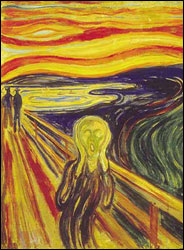
I keep meaning to post a bit on this - just because it's on my mind, and it kind of horrifies me, to tell you the truth. Edvard Munch's The Scream was stolen (along with one other Munch painting), in broad daylight, off of the walls of the Munch Museum, in Oslo. There were other museum-goers there, many witnesses. The thieves apparently, in their haste to grab the paintings, smashed the frames.
What on earth will these guys be able to do with such world-famous and now world-famously STOLEN paintings? They can't sell them, obviously. What- one of them will hang it in his crappy cold-water-flat bathroom, and enjoy it in private? What else could they do with it?
I'm just so disturbed by it. Maybe because I have an emotional connection with that painting, and always have ... I don't know. I want the damn thing to be found and returned. I feel like the painting is a living thing or something. Where the heck is it, and what will the thieves be able to do with it, anyway? I hope they keep it safe, for God's sake.
Happy Trails
As anyone who reads me regularly knows, I'm not all that "up" on Westerns. As in Western movies. As in John Wayne, Gary Cooper etc. My favorite John Wayne movie is The Quiet Man, co-starring Maureen O'Hara, so that should give you some idea. It takes place in Ireland, okay?
I'm not proud of this gap in my film knowledge - but it exists, and I will have to do a lot of catch-up in order to rectify this lack.
Came across this way-cool list called "30 Great Westerns" on my new favorite site which I thought I would share with you all, since I know I have a lot of Western fans out there, people who are as much into Westerns as I am into screwball comedies.
Here's a note from the editors about the list:
These are the Westerns that any fan of the genre should know. These are some of the most influential and important Westerns ever made. We don't necessarily claim these are the 30 "best" Westerns. The Covered Wagon (1923), for example, hasn't aged very well, but it helped change attitudes toward Westerns and allowed for serious, feature-length Westerns to follow in its wake.
Unfortunately, I can't figure out how to do a permalink with this one ... Duh. You can scroll around in that site until you find it (it's under "In Focus") - there are a bunch of articles about Westerns as well.
But in the meantime, here's the list.
The Covered Wagon (1923)
The Iron Horse (1924)
Tumbleweeds (1925)
Stagecoach (1939)
Ox-Bow Incident (1942)
My Darling Clementine (1946)
Pursued (1947)
Red River (1948)
The Gunfighter (1950)
High Noon (1952)
Rancho Notorious (1952)
Hondo (1953)
Shane (1953)
Johnny Guitar (1954)
Vera Cruz (1954)
The Man From Laramie (1955)
The Searchers (1956)
Forty Guns (1957)
The Tall T (1957)
Man of the West (1958)
Rio Bravo (1959)
Ride Lonesome (1959)
The Magnificent Seven (1960)
Ride the High Country (1962)
The Man Who Shot Liberty Valance (1962)
The Good, the Bad, and the Ugly (1966)
Once Upon a Time in the West (1968)
The Wild Bunch (1968)
High Plains Drifter (1972)
Unforgiven (1992)
Here are some of the articles about the Western, on this site, for those of you who are interested in film analysis.
The Silent Western as Mythmaker
Random thoughts
-- I swear. If I hear the words "swift boat" one more time, I will slip into a coma of von Bulow proportions.
-- Paul Hamm should share that gold medal. Who would want a gold medal under those circumstances? It's ikky. Sorry. Bad karma. Share the gold medal, and you'll feel like a big honkin' hero, Hamm. Hamm said something like, "I feel in my heart that I'm an Olympic hero." Yeah, well, I feel in my heart that I'm Greta Garbo, but unless this fantasy is somehow validated by my peers - then I have to accept the fact that I am a freckled redhead from Rhode Island. That's the BREAKS.
-- I watched the final 10 miles of the women's marathon on Saturday and I cried. It is for moments like that that I love the Olympics. When the "favorite" crumbles, when something unexpected happens - when you can see the overwhelming emotions of all the participants. Poor Paula Radcliffe. I FELT for her. She was obviously in agony, physically, by the time she dropped out. To have made it so far ... but her head was jerking up and down, her arm was moving awkwardly - her body obviously was screaming at her: I CAN'T DO THIS. So she had to give up - But what an "agony of defeat" moment. And Deena Kastor surging forward -- very very exciting. I have to admit I was annoyed by the Ethiopian runner's husband - who ran alongside her for what seemed like 10 freakin' miles, cheering her on. It was cute for maybe 2 seconds, and then I thought: Buddy. Your wife is an OLYMPIC ATHLETE. She can make it through the damn race without you. LET IT GO. Besides, Kastor surged past her anyway. I was concerned that the poor husband would impale himself on his own flagpole in despair. Like: his whole identity was obviously resting on his wife winning - what will he do NOW?? But still - very very exciting, I thought. I was just really moved - the people on the sidelines being so encouraging of poor Radcliffe - cheering her on - but she just could not run any longer.
-- There are more cops than civilians in NYC at this moment.
-- I'm reading Victor Davis Hanson's Carnage and Culture. He's a much better writer than he is a public speaker. (Have you ever seen him on Book Notes, or be interviewed on C-Span? Jeez, dude, please get some vocal variety before I literally die of psychological boredom. There was one of his interviews in re-play this weekend, and every time I tried to tune in, because I love the guy's writing, I ended up having to change the channel after about 20 seconds. Zzzzzzzzzzz. He needs some vocal training or something. He speaks in a persistent monotone.) Anyway - It's a very interesting book. I'm not big on military history, so it's all new to me. The battle of Salamis (I shuddered at Hanson's description of it) - the battle of Gaugemela - another horrific description. He certainly does paint a vivid picture, and for someone like myself - who doesn't know a hoplite from a hopscotch game, and wouldn't know a phalanx if it came up and bit me on the flank - I am following the stories quite well. There's a great Glossary at the end of the book, which has been very helpful.
Tunnel of green, silver in the air
I've been away. Had to get the hell out of this city.
I missed the salt air, the green, the mist, the smell of the turf farms near my house. Also, it was my mother's birthday. And I needed to see my sister. It had been too long. And the high school friends. Needed to see them. The touchstones. My forever-people. Rhode Island calling.
The street off of which my parents neighborhood lies is, at this time of year, literally a tunnel of green. No sky can peek through that lushness. It's a green twisting corridor, undulating forward, as far as you can see.
I got off the train on Saturday and was hit in the face with a big ol' wind, all of the trees bending, the leaves turned inside out. It was muggy, hot - and very grey. New York City had also been muggy, I had trudged to the train through the liquid haze, and was drenched in sweat by the time I arrived at Penn Station. So to be confronted by a huge sweeping ocean-wind in Rhode Island was fabulous. I felt like I could breathe again. A heavy milk-like fog over everything. And the sound of the leaves, being whipped about high up in the trees, filled the air with a roar. You could FEEL big weather approaching, in that ever-present whispery roar.
Finally, a couple of hours after I arrived, the weather came. Pouring thundering rain - but that only came after the air turned a strange silver, hard to explain - but it's the way the air looks when lightning is coming. You can feel the electric potential in the molecules - the trees suddenly get very still. The leaves settle down, and a tsunami of quiet motionless-ness washes over the land. It's waiting. The landscape is waiting. And then comes the silver feeling in the air. The hair on your arms rises up, obeying that invisible silver command.
Then - in a whoosh - the silver is snuffed out, the sky opens up, and a downpour beats on the grass, beats on the leaves - and everything gets very very dark. The clouds are overhead.
I stood out on the screened-in porch and watched all of this, in thrall. The coolness of the rain, the wet air ... the almost-offensive lushness of the green - the sunflowers bending under the weight of the rain .... Damn. That's why I come home! For moments like that.
There's more to tell, but that's it for now.
August 20, 2004
A Howard Hawks woman
So last night I watched a terrific movie called Only Angels Have Wings - starring Cary Grant, Jean Arthur - and directed by Howard Hawks.
And it got me to thinking.
Howard Hawks is one of my favorite film directors of all time is, and why the hell not? He's directed some of my favorite pictures ever:
Bringing Up Baby
The Big Sleep
His Girl Friday
To Have and Have Not
I mean, need I go on? If he'd only directed those 4 films, he would have earned his place in film history - but the list goes on and on and on.
His view of women is so damn interesting to me (and also very well documented - but what the hell, I'll blab about it here). There are certain recurring themes, who knows where it all came from - I don't know that much about Howard Hawks the man, I'm just talking about what I can pick up on from his films. Howard Hawks is THE director for portraying the delicious war between the sexes. (That's why his films resonate so deeply, I think, for me. Yes, there is a war between the sexes, but oh, isn't it a lovely war?? And who would EVER want to stop fighting??)
I read one analysis of the films Cary Grant and Katharine Hepburn appeared in together, and the writer said, "You get the feeling that any truce between these two people is always going to be temporary."
I love that. To me, that's what the love and sex relationships are all about in the films of Howard Hawks: filled with temporary truces, but the fight will always go on, long after the last roll of the credits. And hopefully, the 2 characters will have a great time, fighting and making up, for all eternity.
Howard Hawks was married to a woman at one point who was known as "Slim". Slim Hawks. (Remember that Bogart called the Bacall-character "Slim" throughout To Have and Have Not). From what I understand, the little I know about her, she was an extraordinary woman. She had everything that Howard Hawks idealized and wanted in a woman - and yet everything that he DIDN'T see being portrayed in films at that time.
Slim Hawks had impeccable taste, she was a style guru in some ways, she moved through different levels of society with total ease, she was able to hang out with the big boys, she smoked, she drank, but she never lost her soft lovely femininity. She swore like a sailor, but she looked like a million bucks.
Now I have no idea if the 2 of them had a good marriage, or what ... but she was his ideal.
And in film after film after film, he tried to get the leading ladies to embody whatever mysterious strength and sexiness it was that his own wife had.
And it was finally when he put Lauren Bacall, at age 19, under his own personal contract, that he found "the one" who could bring the special qualities of his wife to the screen. He even set up a meeting with Lauren and Slim, before Lauren Bacall's screen test for "To Have and Have Not". Slim leant Lauren clothes. Hawks blatantly told Lauren Bacall ("Betty") to imitate his wife.
Hawks' fantasy of women was this: He wanted to see a woman who gave as good as she got. Not a TOUGH woman. No, toughness and "bad girls" turned him off. His word for the quality he was looking for was "insolent". He wanted to put an "insolent" woman on the screen for the first time, truly insolent, as free a spirit as any of the men up there ... He wanted to put a woman on screen who could go head to head with Humphrey Bogart. Who wouldn't crumple into a little girlie ball when he shot a wisecrack her way ... someone who would give it right back to him - without sacrificing sexiness, womanliness.
You see this quality over and over again in his films - and I think that's one of the reasons why the films wear so well. Why they don't seem dated.
In his movies, men are men, and women are women ... but he was also intrigued by this role reversal idea: Like in Bringing Up Baby: David Huxley is quite passive, the female is the aggressor. Then - finally - she pushes him too far (in the scene where he is in that ridiculous negligee) - and he bellows, "QUIET" and then stamps on her foot to shut her up. The man becomes a true man in that moment, capable of behaving freely, strongly, spontaneously. (It's also hilarious). And what is Katharine Hepburn's response? Does she crumple into tears because he shouted at her, does she whimper, "Why did you stamp on my foot??" No, she most certainly does not. She crouches down in pain, holding onto her foot, and within 2 seconds, she starts to count out her toes: "He loves me, he loves me not, he loves me, he loves me not ..."
Heh heh. These two have met their match in one another.
That's what Hawks was intrigued by. Battling sexes, nobody at a disadvantage, love between "grown-ups".
Hawks was pretty macho. You can see it in how he directs, and in the topics he was interested in. And in his movies - I'm thinking here of His Girl Friday - and Only Angels Have Wings) - in order for the romance to succeed, in order for love to blossom - the woman basically has to join the boy's club. She has to earn her admittance, she has to prove herself to the boys. Now in His Girl Friday Hildy is already completely part of that club. But Bonnie, in Only Angels Have Wings has to learn the rules, and quickly - The regular girl-stuff will not fly with these guys. They're unmoved by tears, by typical feminine displays ... You gotta put a lid on all that shit if you want to get anywhere.
An interesting dynamic.
Howard Hawks decided to do a remake of The Front Page - but his big innovation was to change one of the main guys into a girl. Who would remember His Girl Friday today without Rosalind Russell, without the competing battle-of-the-sexes repartee between Russell and Grant? It was a brilliant gamble - nobody thought it would work - and of course it did, beautifully. Howard Hawks wanted to see what would happen if he put Grant with a woman who shouted as loud as he did or louder, talked even faster than he did, beat him to the punch with the pratfalls, competed for the attention of the crowd, who didn't let him WIN all the time ...
You can see the issues Cary Grant often had with other leading ladies. Grant was too strong, too funny, too charismatic, too fast. You only want to look at him.
The same was true with Humphrey Bogart, Spencer Tracy.
When they were paired with the right lady it was DYNAMITE. And since these 3 guys were so strong themselves, so dynamic, so on top of their games - and also - so MALE - putting them with a tear-soaked weepy sentimental leading lady with a backbone made of pudding would be horrible. No good.
So to watch Rosalind Russell, in her pinstripe suit, and Cary Grant, in HIS pinstripe suit, both shouting into adjacent phones - shouting at the tops of their lungs - talking so quickly you think they might faint - and they appear to be talking at the same time, and yet - somehow - you hear every line (it's genius - the hours of rehearsal it must have taken to get the timing right) - is sheer liquid JOY. It's a partnership. You think: There is nobody on earth who will put up with HER like he does. There is nobody on earth who will put up with HIM like she does.
It'll be a LOUD match made in heaven, but it is, indeed, a match made in heaven.
The other thing about the battle of the sexes in Howard Hawks films:
Very often, male actors (or male characters, however you want to put it) seem so taken up by their own concerns, their own scenes, whatever - that the woman seems to be just an appendage. She's there to make him seem tough, sexy. She's not as fleshed out, as complex.
Howard Hawks wasn't interested in that.
Men and women TALK to each other in his movies. Granted, half the time they do not know WHAT the other person is saying, but the scenes are long, well-written, the dialogue is filled with double-entendre - and there's this two-sided reality buzzing through all of them - a reality from which you can never escape.
I'd describe that reality (from the female side) this way: You are a man. I am a woman. Therefore, half the things you do seem completely incomprehensible to me. And yet ... strangely ... even though I do not know WHAT you are talking about ... I want you. I want to kiss you, hold you, fuck you, make you feel safe. And yet ... DAMN, you piss me off!
The same can be said for the subtext on the male side, in Hawks' movies.
Bogart, Grant ... they look at their female co-stars with the most interesting mix of desire, contempt, humor, and disinterest. Like - they just are NOT going to get caught up in her emotional roller coaster. No way, sister. Not me. You got the wrong fella. I'm free, no strings on me .... And yet, and yet ... I want you. I want to kiss you and fuck you and punch out any guy who comes near you.
A perfect example of this is the romance in Only Angels Have Wings. If you get a chance, you really should see this movie. It's so much fun! It takes place in a little airport down in South America somewhere, in the very early days of flying. Pilots convene there, and do regular mail runs over the Andes. It's very risky work, it's an extremely male environment ... these guys risk their lives every day. Their lives are flying. You fall in love with all of them - they are great characters.
Into this macho mix comes the lovely Jean Arthur (who I adore). She has a layover from a boat-trip, and somehow ends up in this outpost. Cary Grant is the boss, the head-guy at the airport - the toughest, best pilot there. It's a great performance - I've never seen him so unabashedly macho. also He is the crankiest lover I have ever seen. Women make this guy CRANKY. They cramp his style, they annoy him, they befuddle him. She basically falls apart trying to guess if he cares about her, if he's into her ... and he will have NONE of her little female games. They MUST be on equal footing - or it will not WORK.
I always talk about wanting to find a "worthy foe" or "worthy foil" - and that's what Hawks was going for here. Men and women have to SPAR.
For example, he comes back into his room, after a time away, and while he was gone, she has snuck in to take a bath. Her room has no bath. He is annoyed, cranky - and also shocked to find a naked woman in his tub. His response, though, is: "What are DOING here, you pest?" She's a pest to him. (But of course - the great part of it is ... you know he's growing fond of her ... and, as with all Hawks' male characters - he's the last to know! Hence - the major sexual tension.) She's put a pot of coffee on, and he is goes into a rage at this sign of infringing domestication - like the coffee pot is a wedding ring or something. "STOP TURNING MY ROOM INTO A LUNCH STAND."
Bonnie (the Jean Arthur character) can't help it - but she falls in love almost immediately with this tough gruff Cary Grant man ... even though he continuously brushes her off.
Her first night in the outpost, a plane crashes. The pilot was someone everyone knew and loved. She is horrified, upset ... much more so (seemingly) than all of the men who worked with him and knew him. She walks into the bar, and everyone is whooping it up as though nothing has happened. People are drinking, laughing ... She wanders through the jolly crowd, looking at everyone as though they are insane.
Cary Grant sits at an upright piano and plays. People are gathered around him, singing.
Bonnie stalks up to him, enraged at his un-feelingness, and smacks him on the arm, and then runs off, in tears. (Weepy girlie moment.) He jumps up, runs after her and shouts at her, "Go outside. Take a walk. Don't come back until you can handle yourself."
It's cold, it's independent - In Howard Hawks' world, women and men are expected to be independent of each other. Otherwise, this whole man-woman thing will NEVER WORK.
Bonnie sits outside for a while, in tears. One of the other pilots comes out, and talks to her, in a sweet way, explaining that ... people die so much down here, the job is so risky - the only way to deal with that reality is to drink away the sorrows, and not think about it too much.
She finally goes back inside, and makes her way back to the piano, where Grant is still playing (bumblingly).
He glances up at her, disinterested. Not like a lover. And his question is, "Grown up?"
Meaning: so - have you grown up yet?
Her emotions are not welcome in his world. Weepy displays of femininity aren't welcome. It's infantile (in his view) - so in order to "grow up", you've got to stuff all that stuff down.
She says, "Yeah."
He says, to test her, "What about Joe?" (the name of the dead pilot.)
She gives him a sideways grin and shoots back, "Who's Joe?"
Grant, pleased, turns and shouts at the bartender to bring them 2 drinks. She is allowed in with him now.
And then she makes him scoot over, and she starts to play the piano - much much better than he does - She completely shows him up. And he just sits back in awe, grinning - people are dancing, hooting, hollering - she completely RULES. He holds up a shot-glass to her mouth as she plays, she takes a sip, giving him a cocky insolent little grin, and she never stops playing. He looks at her like she's a new breed of woman - he thinks she's GREAT all of a sudden.
It's in that display of - cocksure arrogance - that he suddenly realizes she's "all right". She can hang out with the big boys now. She won't distract anyone with any girlie nonsense.
I don't know - These are just some of my ideas about Howard Hawks, his movies, and why he was able to create so many sexy fantastic male-female relationships on screen - stuff that still seems relevant, risque, powerful today.
The end.
Fairy on the prairie
Truman Capote freely referred to himself, throughout his life, as a "fairy".
If you remember his frequent appearances on Johnny Carson, then you will remember his flamboyant character, his high lispy voice, the drawling Southern accent ... He never tried to hide who he was.
Capote was hired in the 50s as a replacement screenwriter for the Bogart film Beat the Devil. It was being filmed in Italy - it starred Bogart, Gina Lollabrigida, Peter Lorre - and others. Capote arrived, and worked his ass off. Churning out pages on a daily basis. The movie is quite fun, if you've never seen it. You can hear the Breakfast at Tiffany's voice of Capote in much of the dialogue. Humphrey Bogart didn't know what to make of this self-proclaimed "fairy" at first. Bogie kept his distance. Capote finally broke through with Bogart when he challenged Bogie to arm-wrestle. Bogart laughed in his face, and then promptly lost the wrestling-match to Truman. Instead of being a bad loser, Bogart clapped Truman on the back, congratulating him. Truman had won his trust, by beating his ass. Bogart later wrote to Bacall, "Wait until you meet our screenwriter. You have never seen anything like him. At first, I didn't think he was for real - but he grows on you, and now I'd like to carry him around in my pocket, and take him out whenever I need a laugh."
Gerald Clarke wrote a biography of Truman Capote which is a classic in the genre. I read it years ago, but it is one of my cherished books, and I dip into it often.
A couple days ago, I picked it up again, to read the whole section on the writing of In Cold Blood. I had forgotten much of it.
Truman Capote said later that if he had known what he was getting into, when he traveled down to Kansas ("a fairy down on the prairie - who'd have thought?") to write a piece on the murder for The New Yorker, then he never would have gone. He went to Kansas only 2 weeks after the murders took place. The killers had still not been found, the community was in an uproar of suspicion and paranoia. Capote's main interest was to do a long profile of the townspeople, how regular church-going farmers handled such a disaster. Little did he know what the book would eventually be! The project took up years of his life. He had to wait for the executions of the 2 murderers, in order to complete his book. So he waited, and waited. Appeal after appeal ...He was unable to write anything else. Nothing else interested him. He was a man obsessed, in the grip of his obsession for years. His health was ruined. His friends were sick of hearing about the Clutter family. He tried to take vacations with his long-time partner, and would just drink, and try to sleep, and have fits of despair. He thought those boys would never be executed, he thought he would be in limbo forever. Yet - the morbidness of his entire life being on hold because of commuted death-sentences in Kansas - the morbidness of trying to go on, when really all you want is for those 2 boys to be killed - so that YOU can go back to YOUR life ... This paid a huge toll on him.
Finally - there were no more appeals and Capote traveled to Kansas, to watch the execution. Hickock and Smith had asked him to be there. In the intervening years, he had interviewed the 2 killers numerous times. Their first-person descriptions of their own sorry lives make up important parts of the book. Capote became their conduit to the outside world. Hickock would draw self-portraits of himself and send them to Capote. Capote was playing a double-edged game here. He became "the listener", the one who would sit and ask them questions, and nod understandingly. The 2 of them got addicted to his concern. Yet Capote was horrified by most of what he heard. He wasn't without pity for these men, who had pretty much been beaten like dogs from the second they were born - and yet Capote hadn't had an easy road either, and HE hadn't killed anyone in cold blood. He had grown up with alcoholics, he had been abandoned by his father, his parents were ashamed of having a "fairy" for a son, he was sent to military school - can you imagine how awful that must have been for him? Capote may have acted like a cream-puff but that man was cold and hard as steel inside. He had to be.
Capote needed quotes, he needed access, he needed to enter into the psychologies of these 2 men. He was able to paint the graphic picture of the Clutter family through interviews with people who knew and loved them. But the Clutters were no longer around to speak for themselves. Hickock and Smith were alive for a couple of years, so he visited them often. On his way out of Death Row, he would feel the urge to vomit. It would take him days to recover, emotionally, from these macabre "visits". And he said, later, that he never recovered from the "shattering" experience of watching the two men hang. The letters he wrote to friends afterwards are nearly incoherent. Watching how hard the hanging body clings to life, watching the kicking feet, the flailing, the letting-go of bodily functions ... Capote was really never the same man again.
And he then sat down and wrote the book like a bat out of hell.
Truman Capote always thought that he had a "great book" in him. This mythical "great book" haunted his dreams, he would lie awake at night aching with ambition, dreaming about this great book ... He never thought In Cold Blood was it. He looked back on the experience of researching that book and writing it as a grim one, an almost universally unpleasant and grueling experience. I've read all of Capote's books. I love that guy's writing style. I even read his unfinished work - the 2 chapters of the novel he was working on when he died. He claimed to have it almost finished, but the rest of it (if it even existed) was never found. The 2 chapters are okay - it's a gossipy bitchy look at high-class New York society. It's merciless. It's very funny. Nobody is spared. Human beings are seen in their worst lights. Everyone is selfish, cynical, out for themselves ... It is quite funny, but it's very very mean. He was nearing the end of his life, and he had been abandoned by most of his friends. His outlook was not good, he was addicted to drugs, filled with anxiety and loneliness ... The 2 chapter are his way of lashing out at all those people who left him, who tossed him out with the trash. Hence, the mean-ness.
The thing in the rest of Capote's writing that, for me, sets him apart is his undeniable love of humanity. His tenderness. His ability to SEE people, with all their flaws - and to see them as beautiful. Much of his best writing is all about nostalgia, wistfulness, yearning for childhood ... Yes, it is sentimental, but it also has a depth of sadness beneath it, a grief ... which elevates it from mawkishness.
In Cold Blood taps into something else. In Cold Blood doesn't fit into either of the Capote categories: the bitchy mean queen telling all the nasty secrets of his high-class friends, or the lonely sweet man filled with hurtful nostalgia for childhood.
It was something completely new. For him, and for us. I don't even know if I can describe it. All I can say is - he never accomplished such a thing again. His writing never seemed so effortless again. You read that book and you feel like if you cut ONE WORD, the entire thread will unravel. It is so tight.
The other thing I had forgotten from the biography is Capote's personal experience leaving his home-environment of ritzy New York City (where there were lots of "fairies"), and venturing into the Kansas prairies to investigate a murder. Capote was openly gay. He wasn't a macho gay, either. He didn't try to blend in, or act straight, or hide his gayness. He was a small rotund man, who wore wide white hats, spoke with a lisp, fluttered about like Blanche DuBois, and literally said things like, "I declare!"
He took one of his best friends, Harper Lee (yes - THAT Harper Lee) as a co-researcher. She was much more "normal"-acting, and was able to blend in a bit more. She could get people to talk to her, because she seemed like one of them.
But Truman Capote was so relentless, and not only so relentless, but so committed to justice, so committed to discovering what had happened in the Clutter household, that people started opening up. The people in the town started competing about who had had him over for dinner the most times. Alvin Dewey, the head of the investigation, a tough gruff 3 pack a day smoker, eventually counted Truman as a valued partner. Truman was there when Dewey got the call that the 2 murderers had been picked up in Las Vegas, AND that they were still wearing the boots with the distinctive soles (that had left footprints - If the 2 hadn't confessed, the boots alone would have convicted them). Truman was standing right there, with Dewey's wife, listening to Dewey hear the news.
The people of Kansas, who had never met a person like Capote in their lives, who were Bible-Belt ranchers and farmers, took him into their homes, their hearts, their families. Without them, the book would not be what it is.
It is a massive accomplishment. The power of his personality, the depth of how he listened, and sympathised - must have been extraordinary.
I know that Truman Capote always thought that his "great book" remained unwritten ... but I beg to differ.
Why Roger Ebert is so damn great ...
- is because of reviews like this one. I would never have thought to go see a documentary about surfers called "Riding Giants" - never. Not that I'm not interested, mind you. I'm pretty much interested in everything. But you gotta make me interested, if the topic isn't already on my radar . See what I'm saying? I don't need to be convinced to be interested in Central Asia, the American Revolution, or Humphrey Bogart. But if I don't know nothin' 'bout the topic already, then I need a translator. I need you to be able to tell me WHY this is interesting.
It was like when I read Into Thin Air. Mountain climbing and Everest are not one of my built-in passions. But damn - Krakauer made me give a crap about it. He was an excellent translator.
So now I must see "Riding Giants" - the story of those lone-wolf surfers who get towed by jet-skis onto the backs of monster waves, 60, 70 feet high ... Who are these people? What are they like?
Roger Ebert writes:
"Riding Giants" is about altogether another reality. The overarching fact about these surfers is the degree of their obsession. They live to ride, and grow depressed when there are no waves. They haunt the edge of the sea like the mariners Melville describes on the first pages of Moby Dick. They seek the rush of those moments when they balance on top of a wave's fury and feel themselves in precarious harmony with the ungovernable force of the ocean. They are cold and tired, battered by waves, thrown against rocks, visited by sharks, held under so long they believe they are drowning -- and over and over, year after year, they go back into the sea to do it again.
Gotta see it. Any surfers out there?
August 19, 2004
Speaking of celebs I once loved -
who now have "worn out their welcome" - check out this weirdness. But my main question is: what the hell is with the band-aids on all his fingers? The first thing I thought was - that he is systematically obliterating his own finger-prints.
Famous Reporter
Thanks to Ralph Wessman, editor of Famous Reporter (a literary magazine out of Australia) for publishing yet another one of my essays.
He's been a big supporter of mine, since my old blog - so it has been a pleasure to work with him on a couple of occasions over the years.
The most recent issue of Famous Reporter, which I just received, includes a re-worked version of an old post here - an essay I wrote about author Norman Rush, and his first novel Mating. The context of the essay is my discovery that Rush had come out with a long-delayed sequel.
Anyway - should you want to check it out, here is the blog-post . I re-named it "Waiting for Norman Rush" for the print version.
Only the first part of the two-part post is what is published in "Famous Reporter".
It's always nice to see one's name in print.
Halloween then and now
Ah yes, I remember some of the Halloween costumes I wore when I was a wee freckled child:
-- a yellow rabbit
-- the Artful dodger
-- a witch
-- Laura Ingalls
All pretty much home-made and thrown together.
But just imagine: if I were a child now, look at the costume I could wear!!
I'm making a joke - only because I am sick to my stomach.
And do me a favor: Please no world-weary "well, what did you expect with the way society's going?" comments.
The day people, as a whole, become incapable of outrage is the day that I will give up hope on society.
And not a moment before.
(via Dean)
A quiet crowd
My 2 friends and I walked through the West Village last night, talking, laughing, enjoying the night breeze. Stepping over the buckled sidewalks, on our way to the Path station.
On one block, we came upon a blitzkrieg of activity - news trucks, spotlights, people running around with microphones. At first I thought it was just a movie being filmed - you can't walk a block in Greenwich Village without tripping over 12 movie crews - but then I noticed that all of the vehicles had News Channel logos on the side. Everyone was staring up at one apartment. It was eerie. What was going on in there? I wondered if a celeb had just moved in (after all, it's the West Village) ... or ... had there been a murder?
Turns out it was the apartment of journalist Micah Garen, now in the hands of Islamic terrorists who are threatening to behead him in 48 hours. His fiance, who had just heard the news, was inside.
The block was strangely quiet. Nobody rushing about, no pushing or shoving - It was a crowd, yes, but it was a quiet crowd. Garen's fiance was nowhere to be seen. I am sure she was holed up in her apartment, avoiding the chaos outside, sitting by the telephone, watching TV, trying to get through the horror, minute by minute.
Odd. Eerie. The press was in stake-out mode, waiting to nab her the second she walked out to get a carton of milk or whatever. Poor woman.
The three of us all stared up at the lit windows of the brownstone - and I know I was thinking about her. Thinking about her, and what she must be going through. Strange - I didn't think of Micah Garen at all in that moment. He seemed very very far away. But her silent presence filled the dark street.
Sheila's daily fix
The fever has not yet passed.
This is a still from the last scene of Notorious.

Billy Wilder
A great interview with him about film noir.
One of my favorite books, at least in the realm of the art of film-making, is Cameron Crowe's wonderful book Conversations with Billy Wilder. Wilder was always famously honest, if even a little bit cranky in interviews - something that I find very charming and refreshing.
If it's a dumb question, he says, "That's kind of a dumb question."
Or like this excerpt from the interview: "So you see, it is not that I am tossing up and down in my bed like Goethe conceiving art, and wind is playing in my hair, and I plan it all out to the last detail. No."
Heh.
I love Wilder's words on the counter-intuitive casting of Fred MacMurray in Double Indemnity:
He has to be seduced and sucked in on that thing. He is the average man who suddenly becomes a murderer. That's the dark aspect of the middle-class, how ordinary guys can come to commit murder. But it was difficult to get a leading man. Everybody turned me down. I tried up and down the street, believe me, including George Raft. Nobody would do it, they didn't want to play this unsympathetic guy. Nor did Fred MacMurray see the possibilities at first. He said, "Look, I'm a saxophone player. I'm making my comedies with Claudette Colbert, what do you want?""Well, you've got to make that one step, and believe me it's going to be rewarding; and it's not that difficult to do." So he did it. But he didn't want to do it. He didn't want to be murdered, he didn't want to be a murderer.
Wilder made all kinds of films - famous comedies ("Some Like it Hot" being the most obvious example, but there are so many more) - but then, on the flipside he made these film-noir classics. Double Indemnity. Sunset Boulevard.
An incredible man, incredible director.
August 18, 2004
A companion post -
to the one below (about celebrity fatigue...)
The famous people I admire are, yes, talented - but they are also the ones that I know next to nothing about. All I can really talk about is their work.
Gene Hackman
Dustin Hoffman
Meryl Streep
Gena Rowlands
Jeff Bridges
Lily Taylor
There are a million more examples. These people would never wear out their welcome with me. Basically because I don't know enough about them - and I also don't really care to know all their little details. I don't need to.
Humphrey Bogart and Lauren Bacall were married in a swirl of publicity which would probably even seem daunting to such people as Madonna or Demi Moore. It was a white-hot glare - she was the hottest new thing, he was a huge movie star - To Have and Have Not had just come out - and the two of them lived in the glow of that spotlight.
Bacall was only 20 years old. She kind of got off on it a little bit, reveling in her new-found celebrity, as the following photo will attest:
Bogart was less enthralled. Bogart said to one pushy photographer who kept asking for an invite to the wedding: "Why don't you just take some pictures of us fucking? That's what you want, right?"
Later - when the heat died down - Bogart apparently said to Lauren Bacall (she told us this story when she came and did a seminar at my school):
"Listen, baby - these tabloid newspapers - these photographers - the press - these people do not care about us. They could care less what actually happens to us. So you and I have to take very good care of our life. On our own. We can't expect them to do it for us. We know our values - and we know who we are."
They didn't believe their own press. They cultivated their private life. They had outside interests. They went sailing. They stayed at home. They read out loud to each other. They were celebrities, but they weren't a "celebrity couple".
Oh yes. This is SUCH an important topic. SO IMPORTANT THAT I HAVE TO DO TWO POSTS ABOUT IT.
People I never ever want to hear about again
Paris Hilton
Jennifer Lopez
Mischa Barton
Ben Affleck
Ashlee Simpson
Hillary Duff
Jessica Cutler
I am sure there are more. I have hit a level of fatigue with these people. I walked by Macy's today, and there was a sign as large as a house: JENNIFER LOPEZ LINGERIE and I groaned out loud at the very sight of her name.
She has completely bungled (in my opinion) her career. She has squandered what she had going for her in the beginning, by letting her personal life take the front page - and by getting sucked into her own celebrity. I would be very surprised if her career bounced back from this nadir.
I just read a biography of Cary Grant. (Big shocker, right?)
Cary Grant retired in 1966, without any fanfare. He basically just withdrew from acting. He felt he would no longer "be believable" as a leading man (even though directors and other actors begged to differ), and he didn't want to embarrass himself. Better to withdraw voluntarily. People in the business, until the very end of his life (and he lived for 20 more years) pestered him constantly. Wrote parts for him, scripts were still sent to him - he was offered millions and millions of dollars to do movies where he would have had only one scene. The answer was always No.
He was done.
There's a lot to be said for that.
The author of the biography, in the epilogue, discusses this self-imposed retirement, in conjunction with his entire successful career, and said, "He never wore out his welcome."
That's quite a lot to say for a man who made almost 80 movies and had a career that spanned decades. He knew when to withdraw, he would do 3 movies one year, and then take a year off - to let interest in him grow again, to keep himself from getting bored, he always kept a low profile, he never (or rarely) did interviews, he was purposefully vague about his personal life in interviews ... After his death, people who tried to piece together the truth about his life had a hell of a time of it. Because he would lie. Or he would tell half-truths. He would set people off on the wrong track. He thought that his personal life was nobody's damn business but his own.
But his reticence had more to it than just a natural reserve about sharing such things with strangers. It had to do with his own gut-level understanding of what the job of a performer actually is.
He understood that MYSTERY is one of the primary factors that makes a great movie star. If the audience knows too much about you, then they might not find you believable in different kinds of parts. If you reveal too much, if you give too much away ... then the audience gets bored.
My point of all of this is:
The people in the list above are, supposedly, at either the very PINNACLE of their fame, or just beginning the skyrocket up - and they have ALREADY "worn out their welcome".
Oh and of course - feel free to add your own names.
Can anyone explain to me
the Riemann Hypothesis?
What is it? What's the big deal about it? Unsolv-able? Or ... unsolved as of yet? And what is it?
I know I could Google it, and I have ... but it's more fun this way. Also, I find some of the Google-d explanations a bit incomprehensible.
Lock-down approaching
-- for the RNC.
Barricades are already piled up outside Madison Square Garden.
Secret Service guys on the loose. You can recognize them by the blinding whiteness of their shirts. I stare at them, looking for the little microphones stuck in their ears.
There are these mobile police commando centers - on wheels - stationed about in Penn Station and in Madison Square Garden. Enormous. Like roving space ships. I have no idea where these things have come from, but they're everywhere.
33rd Street itself is like one big long police station/FBI office/Secret Service hangout ... It feels like there are literally no civilians on that street.
All trains going into Penn Station will be re-routed through Hoboken, for the days of the RNC. What this is going to mean is ... well, some pretty damn packed trains, that's all.
I know bus service will continue as usual ... nothing will change there ... but my office is in the middle of the lock-down area. So it will all be very interesting.
As well as highly annoying.
August 17, 2004
6 Feet Under
Last Sunday's episode was my favorite, so far, of this season.
The last moment left Jen and I stunned, staring at the television. I mean - what else could one say after that??
Some thoughts:
-- I wish Kathy Bates was my best friend. I love the character she plays. LOVE HER. She's ballsy, she speaks her mind, she helps Ruth to not be so precious and repressed, she makes fun of Ruth - she tells Ruth the truth. "I'm kind of getting sick of you staying here ..." But she does it in a way that you know the friendship still exists. Kathy Bates - great actress, man.
-- I had a feeling Edie would turn on Claire. There is nothing worse than a threesome of females. It almost never works. Two will, inevitably, gang up on the other. At least when they're as immature as the trio on 6 Feet Under. That Anita bitch still grates on my last nerve.
-- I felt as though I WAS Claire, when she found out that Edie had used Claire's non-orgasmic state into fodder for a performance-art piece. I felt as though I had been betrayed. Horrible. So embarrassing and painful.
-- The scene where George suddenly broke down while staring at Maia was unbelievably good. Not just because it was acted well ... but ... I guess what I found so stunning about that scene, and so powerful - is that it felt completely true to life. In that it was inherently mysterious. Why was he crying? Who knows why anyone does anything? He just suddenly broke down, the cold superior facade cracked - and out came ... what? It's up for discussion. I found it shocking. Jen and I both gasped. We had become so used to his condescending rock-hard attitude - so to see him burst into tears was amazing. And of course, he would do it in private. Where no one could hold it against him.
-- The whole "the veiny guy from La Habra" exchange was classic. Made me LAUGH. The shorthand of couples. "You know. The veiny guy from La Habra."
-- I loved the whole creepy sequence of Nate's bad dream. That's what I've missed so far, in this season. The ever-present awareness of the fact that there are DEAD BODIES in the cellar. I've missed the strolling irreverent ghost of Mr. Fisher as well. Nate's dream, to me, was what told him what we all already knew - that love is growing again with Brenda. He didn't want her to be "disappeared" - He begged, "Let her stay."
-- For me, the best scene was the quiet one, between Nate and Claire - when she was making her doll house. And they started talking about their father. Beautiful writing, beautiful acting. Those two have not been connecting at all lately - (who could connect with Nate right now?) - so to me, that scene felt very sibling-ish. A breakthrough of intimacy. And Nate's face started to soften, he actually seemed to be listening. For the first time in a long time.
-- Billy Chenoweth and Claire are soul mates. I don't mean that in its typical definition. I just mean that ... they GET each other. He GETS her. Yes, he is a freak. But so is she. When he isn't off his meds, he looks at her with respect and interest. He finds her funny. He finds her interesting. And she doesn't recoil in horror from his freakiness. Their spirits are very similar.
-- I love that boy who offered his services to Claire. Grinding the corn, and all that. I could have used his help when I was 20!
-- The last scene - with the dead horse on the beach - was a masterpiece. That is brilliant story-writing. It was played perfectly by those two actresses, too. Who knows what it all "means" ... That's why I felt that scene was so powerful. It didn't feel like a plot-point, I didn't feel the awkward hands of the writer manipulating the characters ... It felt like a real happening. Sometimes things just happen like that. And it is devastating. I felt deep love for those two women in that last moment.
Beautifully done.
Snippets
-- Last summer was so hot, so humid, that I was cranky for 2 months straight. By contrast, this summer has been rainy, misty, with grey skies, clouds rolling in every afternoon ... I'm in heaven. Lay in bed last night, listening to the rain. And then proceeded to sleep for 10 hours. UnHEARD of.
-- Inspired by my friend Allison, I am re-reading In Cold Blood. One of my favorite books ever written. I started it this morning, and once again, I am struck by the accomplishment. Now it is hard to fathom how original Capote was, how new his idea was: to take an actual crime, and to write it like fiction. Good God, "true crime" now has its own section in any bookstore. But that's mainly because of Truman Capote's book (Norman Mailer's yowls notwithstanding. Shut up, Norman. Accept that Capote got there first. Accept it.)
I think In Cold Blood is superior to Executioner's Song anyway. Granted, I think Capote is a much better writer. Much better. But also, in my opinion Gary Gilmore comes off as such an unlikable egotistical prick, and who wants to spend any time with that loser? Whether or not he's a murderer? The murderers in In Cold Blood, at least the way Capote portrays them, draw you into their web ... You start to see where they're coming from, which is even more terrifying, because where they are coming from is insane and delusional. You want to reach between the lines of the book and scream at the Clutter family: RUN! GET OUT! 2 conscience-less killers are coming your way ... they will have no remorse - they are lunatics - RUN!
It's a devastating book.
Allison mentioned it to me last night - she's never read it and it's going to be her next book. Which thrills me. As ever, I can't wait to talk with her about it.
-- It has already been waaayyyyyyy too long since Eminem came out with a CD. I'm jones-ing.
-- Watched Holiday last night. Again. Er ... is that a perfect movie, or what?
-- Sat on my roof last night with a glass of wine, and watched the heavy black clouds cross over the grey. Staring at the skyline across the water, which gleamed like a mirror. There was a cool wind, with random raindrops floating by. And for a brief 5 minutes, at sunset-time, the Manhattan skyline lights itself up in the reflection, burning, a-glow, all the windows flaming up spectacularly. Any time I'm home around that hour, the magic hour, I go up to the roof to watch the show.
Juvenilia
Emily talks about some of the early stories of Dylan Thomas.
The stories are experimental, not all that successful apparently ... but interesting nonetheless because of what it reveals about the author and his work.
Reminds me a bit of reading Seymour: An Introduction by JD Salinger. It was the last thing the man wrote. (Or, I should say, the last thing he published.) It is a rambling run-on sentence, filled with so many parentheticals that you get lost. It becomes apparent why he stopped writing: he could no longer make any statements with any authority. Parentheticals had to follow everything, exceptions, asides ... It is an arduous read, with moments of such brilliance, such clarity and insight, that it leaves me breathless. It also leaves me sad. Because his voice is no longer with us. And it also makes me sad because - you can FEEL as you read that piece: Wow ... this is like he is tearing out parts of his heart, his soul ... I suppose he was no longer willing to pay that price, no longer willing to share those pieces of himself, it was too high a price to pay.
August 16, 2004
Adaptation
Big Stupid Tommy has a cool discussion going on:
Movies that are adaptations of books have a rough time. Fans of the books will resist the adaptation. (That's why I didn't see "Wonder Boys" the first time around ... and what an IDIOT I was!! But I had loved the book so much I resisted.)
But, Tommy asks, are there instances where you like the movie better than the book?
In the case of Wonder Boys, I can't say either. Reading the book was a joy from beginning to end. And the film was fantastic. I won't choose.
I read the book Ordinary People, by Judith Guest. It's quite good. But - it can't hold a candle to the movie. Robert Redford invented scenes that far surpass anything that goes on in the book (the scene where Mary Tyler Moore doesn't want to get her picture taken with her son ... the scene where Tim Hutton randomly barks like a dog at his mother) - these are extraordinary scenes. And they're mostly behavioral, not about the WORDS. Pure cinema.
I'll have to think of more movies I liked better than the book ...
Just thought of another one.
I read Bridges of Madison County and could barely get through the sentimental clap-trap prose. I wasn't surprised when I heard that the author and his "soulmate" split up a couple of years after he became so famous. Serves ya right, bub, for falling for all that soulmate crap in the first place. Also - he is a terrible writer.
But I LOVED that movie. It was like an actor's paradise - watching the 2 of them spar back and forth, talking, behaving, laughing, arguing ... I watch it, I re-wind scenes, I lean in, I study the 2 of them ... they make that very conventional sob-story into something funny, complex, believable.
Loved the movie. Hated the book.
Anything to add?
The Cabbie's Creed
I took a cab home last night, after my weekly 6 Feet Under date with Jen. It was late. I had had to wrench myself away from Risky Business ("I want my egg back!") because I had to get home.
The cab shows up. My cabbie was blatantly smoking. I got in, and we started back to my place.
The radio was on, blaring Olympics commentary.
We drove through the rain in companionable smoky silence.
But suddenly - out of nowhere - he became irate. He shared his feelings with me. Gesturing irritatedly at the radio. "Listen to this! The radio! I hate the radio!"
I wasn't sure if it was a general comment, or if he was pissed at the Olympics for pre-empting his favorite show.
I took the safe route. "You do?"
He shouted, "Yes! You never hear good music on the radio anymore! It's all crap!"
I said, "I agree with you."
Then he said, in a different tone, "Well ... except for stations that play 70s music. That stuff is always good."
Suddenly I felt deep love for this angry man. "Oh yes. Music from the 70s will always be in style."
He looked at me through the rear view, excited to be in the presence of a soulmate. "Right?? Isn't it?? Why can't they play more of THAT? I can't even LISTEN to the radio anymore!" (meanwhile, he's shouting above the Olympic commentary ... on the radio ...)
I said, "I never listen to the radio. They just play the same songs over and over."
"So true! I mean - it's all CRAP on the radio. Every station is CRAP! I mean - listen to this."
He switched the station. Disco music filled the car. He softened a bit. "Well ... no ... now that's some good sound."
He switched the station again. Bob Marley filled the car. "Well ... reggae's great, actually. I love reggae." His plan to show me all the crap on the radio was failing.
He switched the station again. Creed came on. Now I personally hate Creed. But Creed apparently filled the cabbie's heart with happiness.
He raved, happily, "I mean, listen to that - listen to that song! They understand melody! Nobody understands MELODY anymore!"
He stopped his search for all of those terrible radio stations out there, and we careened up the hill to my house, blasting Creed. heh heh heh
When I got out, I said, "Maybe you should just stay on this station from now on. Since there's so much crap out there."
He laughed, all blissed out because of Creed. "I think I will!"
The human comedy. I love it. At all times.
August 14, 2004
Obsession Central: Cary Grant ("Notorious")
In the famous last scene of Notorious, Ingrid Bergman lies in bed, trapped in the house of her Nazi husband, she is being slowly poisoned by Nazi-man (Claude Rains) and by his terrifying evil Fraulein mother. Bergman lies in bed, coming in and out of consciousness due to the poison, the sleeping pills - Cary Grant has come to rescue her - finds her in this state - and he tries to keep her awake, he dresses her so that they can leave that terrible mansion - and he also, in his tortured way declares his love for her.
He has been cruel, distant, misogynistic, etc., throughout the rest of the film - but the genius of it is that Cary Grant (and Hitchcock, of course) lets us in on the secret: Devlin (the character) is actually not a cruel or distant man at all - he is only cruel and distant because underneath all of that, he is vulnerable, and he needs her too much. Cary Grant's performance is a show-and-tell masterpiece. WE can see the truth, but Devlin can't. WE can look at him and see the vulnerability, but Devlin thinks he's invulnerable, and that he can't be hurt.
What the character does is obvious: he throws her to the wolves, he refuses to believe that she can change her nympho-drunk ways. But clues are dropped, along the way, that this guy is tormented. Who knows why. He treats her like a whore, except when he is out of her presence, when he then is very very touchy about any slights on her honor. He defends her character to his fellow secret agents, and yet - refuses to do so when she begs him to, in person.
In the last scene, he helps her to sit up, her head is flopping back. The lighting is spectacular: the pillow behind her head is blazing white, and her face is completely in the glow of the light. But he - he is a dark silhouette, he remains in the shadow. The only time he is fully lit in that last scene, is when the 2 of them emerge from the bedroom, and begin the descent down the stairway. And LOOK at how different his face is when he steps out into the brightness with her. It's a genius acting job. He looks, for the first time, like a complete man - like he has joined the land of the living. For the entirety of the film, he's uptight, his eyes are cynical, he never smiles (except when he's pretending, at the party). But somehow, Cary Grant creates this character without completely alienating us in the audience. Notorious is obviously on "her" side - the film sympathizes with Ingrid Bergman - and yet he is not villainized. This is a guy who is dying for love, and the only reason he resists it is because he needs it too much. The brilliance, of course, of all of this - is that that is only implied, never ever said.
So I guess you could say that this is my interpretation of the character of Devlin.
He sits with her on the bed, her face ablaze in the light, and he is a shadow-man, a black-cut-out silhouette. He holds her - she says, "Why have you come ..." He whispers, "I had to see you one more time ... so I could tell you I love you ..." He has never said he loved her, and earlier on in the film, she makes reference to the fact that their love affair is very interesting, because he doesn't love her. He tries to weasle out of it, saying, "Actions speak louder than words..."
So the "I love you" is not like other "I love yous" in films. There's no swelling music, there's no feeling that this "I love you" is really a victory. It's more hard-won, more tragic.
She is, again, falling in and out of consciousness - but when she hears those words - there are tears in her eyes (Bergman is absolutely spectacular in this film, especially in the last scene) - she says, "You love me? Why didn't you say so before?"
He holds onto her, says into the side of her cheek, "I was a fat-headed guy ... full of pain."
The entire scene is done in surreptitious whispers, which adds to the insecure feeling of it, the secretive-ness, the neuroses - this isn't a normal love scene. She's in the light, he's in the dark - These two people are all fucked up, basically. I don't feel hopeful about their futures, really - even though they drive away together. Whatever happened, they'd have a difficult path.
If you want to know why Cary Grant is not just a great movie star, but a great actor - see what he does with that "fat-headed guy" line. It's really that he does nothing, that's why it's so incredible - he just says it - simply - with no self-pity, no self-importance, no ego - he just says it ... but the eyes ... the eyes ...

Jesus. Look at those eyes. "Full of pain", indeed.
RIP, Czeslaw Milosz
Nobel laureate Czeslaw Milosz has died, at the age of 93. Strange, but my eyes filled up with tears when I heard. His poetry has always meant a great deal to me - and I am thankful to my sister Siobhan for introducing his work to me.
Known for his poetry, yes, he also is known for his continuous and courageous denunciation of evil, and of telling the truth about communism, and dictatorships. His life is a tale of inspiration, and bravery. He grew up in Poland, and lived under first the Nazis, and then under communism - before finally fleeing to the United States. He had seen it all. After Poland wrenched itself free in 1989, he moved back to Krakow. God. To wait that long to go home. His poetry, then, is the poetry of persistent exile. Maybe that's why it has such sweet melancholy, such clarity. He was always known as an "intellectual", whatever that means. To me it means a certain kind of writer, usually of the Eastern European variety. Writers who write with a certain abstract distance, perhaps because they have seen so much tyranny, they feel an urgency to try to describe it - writers who contemplate the big questions, and try to find new forms with which to express themselves - writers like Milan Kundera, Vaclav Havel, Kafka, Czeslaw Milosz.
Yet somehow - these "intellectual" writers do not sacrifice the heart. Their writing does not come off as cold. Or clinical. On the contrary. It pulses with life, humanity, compassion.
For example, here is Milosz's poem "Encounter". I cannot read it without feeling a lump rise in my throat, and I have read it countless times. Notice the sparseness of the language (which may be due to it being a translation, not sure - he wrote in Polish, it was almost a political act for him to do so) - notice the cold clarity of the images ... and then notice how he bursts forth into warmth in the last lines.
Encounter
We were riding through frozen fields in a wagon at dawn.
A red wing rose in the darkness.
And suddenly a hare ran across the road.
One of us pointed to it with his hand.
That was long ago. Today neither of them is alive,
Not the hare, nor the man who made the gesture.
O my love, where are they, where are they going
The flash of a hand, streak of movement, rustle of pebbles.
I ask not out of sorrow, but in wonder.
Here's another extraordinary poem. I'm no literary scholar or anything, but the images in this poem terrify me - and I can guess why. There's a sense of human beings being ground up, chewed up - a monster from the deep rising to engulf us all ... We are all 'so little'.
The poem is called "So Little".
So Little
I said so little.
Days were short.
Short days.
Short nights.
Short years.
I said so little.
I couldn't keep up.
My heart grew weary
From joy,
Despair,
Ardor,
Hope.
The jaws of Leviathan
Were closing upon me.
Naked, I lay on the shores
Of desert islands.
The white whale of the world
Hauled me down to its pit.
And now I don't know
What in all that was real.
Maybe the writers trapped in Eastern European countries, or living in exile, felt too much, and yet they were determined, above all else, to describe the tyranny under which they lived, the double-tyranny actually: the tyranny of fascism or communism, and the tyranny of being an artist in such societies. Artists were usually the first ones attacked - most of all, the writers. Writers are dangerous, after all!! Most had to flee in order to continue writing. Others, like Havel, stayed put - and lived a life of persecution and constant imprisonment, refusing to shut up - and a life where his plays would never be produced in his own country, and yet were huge successes the world over. Like Havel said, "I decided to behave AS IF I were free."
So the poems, the plays, the books of these writers - are much more than what is on the printed page. They are affirmations of the human spirit. They are a testament to the difficulties inherent in even getting the damn thing published in their own country. They are EVIDENCE that you can NOT hold people down forever. You may control a person's movements, a person's ability to travel ... but you can NOT control what goes on in that person's head. No matter how hard you try.
I am grateful to Czeslaw Milosz, for his courage, his gift, and his persistence. He's an inspiration.
If you're interested - here is the speech he gave in 1981, accepting his Nobel Prize in Literature. It's a doozy - I highly recommend it. This is a man, a Polish man, in exile - it is 1981 - the Solidarity movement was just heating up, things were starting to shift, crack, break apart ... Milosz had lived long enough to see it. Freedom was still almost a decade away, but the spirit of that exhilarating time in history is in his speech.
In it, Milosz says, "In a room where people unanimously maintain a conspiracy of silence, one word of truth sounds like a pistol shot."
He was that pistol shot. It was his destiny to be so.
Rest in peace, sir.
Wow. Just wow.
Iraqi and American athletes together, yesterday at the Opening Ceremony.
I didn't watch the ceremony myself, but Michele has some great commentary.
August 13, 2004
Politics
I decided a while back that I really don't want to write about politics anymore here. It's too annoying, too all-encompassing, and I can't seem to do anything half way. Additionally, I do not WANT to live in a world where I am all-politics all-the-time. That's okay for some people. They can handle it. For them, it's an obsession, a hobby, a passion - like having a passion for football (or ... er ...Cary Grant). It's not for me. It never was. I get twisted up in a knot. I can't sleep. Etc.
I need to know what is going on in the world of politics, and be up-to-date on nearly everything ... but I can't spend my time writing about it. It's not fun for me. Not one bit. It's anxiety-provoking, and I also find it upsetting. I wish I didn't, but I do. My old blog on Blog-spot was much more political - I wrote about world events and national events every day. (I also didn't have comments on that old blog, which probably made a difference - it was like a little cloister - I felt like I was talking to myself.)
Anyway. Somewhere along the road I burned out on all of that.
I always need to know what everybody ELSE is saying, I need to know stuff as it happens, I still need to read all my political blogs, and all my Op-ed columnists, etc. etc. I am not deciding to be what Rebecca West would call an "idiot". ("Idiot" was her term for people - women mostly - who decided to turn their thoughts over completely to private concerns - even as the world was disintegrating around them). So no. I'm not choosing the idiot path. I couldn't bear that.
But I've needed to back off, and to start expressing myself in other ways - not just express stuff that pisses me off. (Because politics usually pisses me off!!) I wanted to also write about things I love, things that make me laugh, things that excite me, things that make me profoundly sad ... I wanted to use this space to start to do all of that. So I have.
Writing is a lot of fun for me. I could write all day long, without too much depletion of psychic energy. But when I write about politics, I need to lie down afterwards. Heh. It's not fun.
Maybe fun is over-rated, but for me, personally, I have UNDER-rated "fun", for most of my life.
I want to have fun here.
You all may be thinking: What the hell is she going on about? Then have fun, dammit!! Do whatever the hell you want to do!
I know, I know. This post isn't meant as an announcement, and it's not a response to anything that has actually gone on here. I'm really working this stuff out for myself, in my head, and I decided to let you in on it.
Recently I had to scan through that old Blog-spot blog, looking for an essay someone had asked for. And I was stunned at how different that old blog is, from this blog right now. I have no idea how I had the energy to write about politics all the time. Of course, that was 2002. I was pretty much jacked-up on adrenaline for a full year after September 11.
Anyway - all of that being said, I do have something to say about my gay American governor.
Living where I do, I am, of course, bombarded by McGreevey revelations on an almost minute-to-minute basis.
One of my thoughts is: This guy shouldn't be a hero to gay people for coming out. He came out because he HAD to, amidst a swirl of stinking corruption. This is not on the same level as Melissa Etheridge's decision to come out ... an act courageous, and admirable. She actually had something to lose, and while McGreevey also had a lot to lose, Etheridge was willing to risk it. She could no longer live a life where she was pretending. It wasn't right for her. McGreevey's "coming out" isn't like that. He's a creep.
And the rest of my thoughts are pretty much summed up by Jeff Jarvis here.
Bill has an excerpt on the special election question.
The key word in the following post
... is "guarded". Any time you put "optimistic" and "the Red Sox" into the same sentence, you must add the word "guarded".
But it's a great post. Thanks, Dan. I especially enjoy the analogy in the first paragraph - that the Red Sox are like "that girl".
Sports Movies by the Sports Guy
Bill Simmons (aka "Sports Guy") is doing a "Top Sports Movies" series. Here's the first installment, where he sings the praises of Varsity Blues, of all things. Bill Simmons is one of my favorite columnists writing today - mainly because I laugh out loud at least once during reading any one of his columns.
Like:
You have Dawson himself (the immortal James Van Der Beek) actually headlining a big-budget movie, which won't happen again unless he commits a double murder and someone makes a documentary about it.
Also:
Just to complicate things, Mox is dating Lance's sister, Jules (played by Smart), who's cute in an "I'm dating the backup QB" kinda way. In other words, she has small breasts.
Anyway - here is the latest installment: "Remember the Titans".
Notable quotables:
...Once forced integration passes, Coach Yoast gets demoted to assistant coach, for two reasons:1. The school board wants a black football coach.
2. Denzel Washington is the star of the movie, not Will Patton.
Also:
I'm telling you, if I have to sit through another movie where a mismatched group of characters sing "Ain't No Mountain High Enough" together, I'm bludgeoning an usher with my 128-ounce Mountain Dew on the way out of the theater.
HAHAHAHAHA
I actually really liked "Remember the Titans" - and I agree with Sports Guy that the sub-plot involving the white player and the black player was the best part of the movie, and I also agree that the kid playing the white player did, indeed, act Denzel Washington off the screen.
Do you all have any favorite sports movies?
Bill Simmons doesn't count "Bull Durham" - he says it's a chick flick. Well, I'm a chick, and I am unembarrassed about my love for that movie. I call it a sports movie, most definitely.
Other sports movies I adore?
-- Hoosiers
-- All the Right Moves (LOVE THAT MOVIE)
-- Breaking Away
-- Miracle (you knew that one was coming)
-- Bend it like Beckham
-- 61* - great flick
Er ... let me think of some more.
I couldn't agree more
"The willingness to appear weak — to represent, in other words, a familiar variety of real, contemporary American man — may be Mark Ruffalo's great distinction as an actor."
I don't know if I think that "weak" is the right word, though. I'd say "human", I'd say "flawed".
Mark Ruffalo is incredible. I've been watching him for a long time, in admiration. He plays his parts on the edge ... he's unpredictable, yet always truthful ... He's funny, fearless, and uninterested in traditional stardom, as is obvious in the kinds of parts he gets, and how he plays them.
He was fantastic in You Can Count On Me - far better than Laura Linney, who got nominated. The only reason she got nominated (in my opinion) is because she was acting with HIM, and HE made her better than she normally is. He made her seem real.
After that, Ruffalo disappeared. No more movies came out with him in it. Where the hell did he go???
Well, turns out he had a brain tumor- he almost died - he had surgery on his brain - etc. etc. He checked out of acting for a couple of years.
But now he's back. He was hysterical in Eternal Sunshine of the Spotless Mind (my favorite movie of this year) - dancing on the bed in his underwear, with the scruffy hair and thick glasses. It made me happy to see him working again.
Holy Mackerel
Look at this:

Hurricane Charley in action.
Floridian readers: How are you all doing?
August 12, 2004
Obsession Central: Cary Grant ("The Awful Truth")
Escapism is good for the soul. At least it's good for mine. Last night, I watched The Awful Truth, starring Cary Grant and Irene Dunne (again - they made a bunch of successful films together).

The Awful Truth has been described as a "tuning fork" for other comedies, and it's obvious why. The tone of this film is so light, so crazed, so assured - the laughs come like clockwork - you know you are in great hands. You can sit back, relax, and laugh your ass off.
You can see the set-ups for disaster and comedy a mile away, but instead of the plot feeling predictable, you just start to get excited, like: "Oh God, this is gonna be bad ... how are they gonna get out of this one??" You watch with ghoulish delight as other people's lives fall apart spectacularly.
Apparently, Cary Grant and Irene Dunne both wanted to walk off the picture. They had no script. Leo McCarey, the director, would walk onto the set every morning, and say stuff like, "Okay, so you come through that door, call the dog, and .... just stand over there ... and we'll see how it goes." They had no script. Cary Grant wrote an 8-page letter to the head of production at Columia, Harry Cohn, and he entitled it: "WHAT IS WRONG WITH THIS PICTURE".
Heh.
But eventually - Cary Grant saw that McCarey had a method to his madness, that his approach WASN'T random, and that he was asking the actors to trust the craziness of the situation, rather than trying to control it. Grant and Dunne, after commiserating with one another miserably about how insecure they felt, finally succumbed to the process - and thank God they did.
Half of the film is improvised. Which is so amazing, because it is so freakin' FUNNY. Like - laugh-out-loud funny. And it's subtle behavioral humor for the most part:
-- Irene Dunne playing piano as Ralph Bellamy sings "Home on the Range" very very very badly. Her FACE.
-- Cary Grant's little mannerisms, that go on throughout EVERY SCENE, in a private running commentary. His "tsk tsk tsk", and "Hmm", he always seems to be muttering to himself about the events around him. It's hilarious. Even when he's not the focus of the scene, he has 5,000 things going on with him.
-- When Irene Dunne breaks into laughter during a recital where she is singing - she sees Cary Grant fall off his chair in the back of the room - she's singing - and ... hard to explain ... but she laughs ... ON KEY ... and then somehow finishes the song. For me, it was the funniest moment in the movie - although Cary Grant's duet with his dog was also howlingly funny.
-- The woman who played Irene Dunne's Aunt Patsy ... This woman was a comedic genius. She hit a home-run with every one of her jokes. "Here's your diploma." Too. Funny.
The Awful Truth is about a married couple, who are obviously crazy about each other, but who fight all the time. He's suspicious that she's cheating on him, she's suspicious he's cheating on her. She seems to have more reason to be suspicious than he does. (After all, the first scene is Cary Grant lying underneath a sunlamp at his athletic club, trying to get a tan quickly, in order to convince his wife he had actually been in Florida for the past week like he told her - he says to his buddy, "Of course I lie to her - I don't want her to be embarrassed!").
He has a lot of "broad-minded" ideas about marriage - that the couples should keep having separate fun, not be so conventional, not get all caught up in having to be together all the time - (he has a big monologue about it: "The road to Reno is paved with suspicion...") However, he can't actually LIVE with a "broad-minded" marriage, and actually - HE just wants to have fun, but SHE can't start gallivanting about with other men - THAT isn't cool with him, and so when he thinks she's having an affair, due to some screwball misunderstanding, he flips OUT.
They decide to get divorced. They begin to fight for custody of their dog, Mr. Smith (the same dog Cary Grant chased around in Bringing up Baby). Both get involved with other people. And both start campaigns to mess up the new romances of the other.
Hilarity ensues.
Cary Grant has one pratfall which literally made me guffaw out loud. You KNOW it's coming, but knowledge doesn't hold a candle to first-hand experience. He falls once, and then the fall just keeps going and going and going ... and of course, he is in a situation where he is supposed to be very very quiet. It's riotous. You just LOVE him. I LOVE him for giving me joy like that.
And the last scene is rightly famous. They are (for various and sundry lunatic reasons, involving a crashed car, a busted-up dinner party, and rides on motorcycles) stuck out at her Aunt Patsy's house in the country, and their divorce is going to be final at midnight. She goes to bed in one room, he goes to bed in another room - both of them wearing borrowed pajamas. The sexual tension is huge. You are dying for them to make up, to kiss, something!!
A couple of screwball things happen - and he finally stands there in her doorway, staring at her - she's lying in bed, he looks ridiculous in his borrowed nightshirt - and they start to try to talk about their marriage, and where it went wrong, but basically what is REALLY going on, is that he is trying to figure out a way to say to her: "Can I get in that bed with you?"
It's even more amazing to look at the dialogue in this last scene, knowing that most of it is improvised. No wonder the two of them loved to work together so well. They're so in tune with one another. It's like a dance.
Here's a snippet of that exchange. The entire thing is done with desperate seriousness. That's why it's so funny:
Jerry: I told you we'd have trouble with this...In a half an hour, we'll no longer be 'Mr. and Mrs.' Funny, isn't it?
Lucy: Yes, it's funny that everything's the way it is on account of the way you feel.
Jerry: Huh?
Lucy: Well, I mean if you didn't feel the way you do, things wouldn't be the way they are, would they? Well, I mean things could be the same if things were different.
Jerry: But things are the way you made them.
Lucy: Oh no. No, things are the way you think I made them. I didn't make them that way at all. Things are just the same as they always were, only you're the same as you were, too, so I guess things will never be the same again...You're all confused, aren't you?
Jerry: Uh-huh. Aren't you?
Lucy: No.
Jerry: Well, you should be, because you're wrong about things being different because they're not the same. Things are different, except in a different way. You're still the same, only I've been a fool. Well, I'm not now. So, as long as I'm different, don't you think that, well, maybe things could be the same again? Only a little different, huh?
(I believe the spirit of this confusing conversation is also the inspiration for another one of the exchanges in What's Up Doc. She says glumly to him, "I know I'm different, I know. But from now on, I'm gonna try to be the same." He asks, "Same as what?" She says, "Same as people who aren't different.")
What started out as an annoyance to Cary Grant (the fact that there was no script, not really) ended up being the thing, the element, that shot him (and his career) off into the stratosphere. It was after The Awful Truth that Cary Grant became "important".
It's interesting: sometimes the things we resist most ferociously (in this case, improvisation) is EXACTLY what we need to do in order to succeed, fulfill our destinies, etc.
Other actors freeze up, or start to behave in highly conventional (read: BORING) ways when they don't know what they're doing, when they don't have a script. Their imaginations aren't fluid, they're too afraid that they're going to look foolish. Well, as we know, Cary Grant had no fear of looking foolish - that was part of his appeal. Improvisation is a gift and Cary Grant had it. He was, obviously, not just a funny man because the SCRIPTS he got were funny - he obviously was a funny man in real life, he had a relatively comedic outlook on things, and this was the first film where he really got to let that loose.
His fear at the beginning of the shootended up being a blessing: He just had to leap off that cliff, and stop trying to control everything.
Miracles of comedy followed. Zany, wacko, and STILL funny today. Still a reference point for other comedies.
Amazingly - everyone was nominated for Oscars except for Cary Grant. This is the price he paid for making it look so easy!!
Watch this movie and then watch Notorious and you'll realize: damn, this guy really is without peers.
My heart is THROBBING with excitement
Dan , Emily , Jess (and everyone else, of course...) - I came across this post on Book Slut, and immediately thought of one of our old discussions here.
The article in question is not live yet, but apparently it's going to cover Flowers in the Attic, by VC Andrews, and how that book 'introduced sexuality to a generation of youngsters'.
Unfortunately, I count myself among that generation. Sexuality was introduced to me through a sick story of incest, emaciated ballerinas, arsenic-laced sugar doughnuts, inappropriate attic lust, and years of Dickensian imprisonment.
And I loved every second of it.
"Jane, You Ignorant Slut"
So this story about naked anchorwomen reminded me of the following post by Mike Toole ... which you must read. It's from last year, but that doesn't matter. It still makes me laugh like a maniac.
August 11, 2004
Update
Because I posted about it last week, and a couple of you have emailed me:
I just came back from getting my stitches taken out - and everything is fine. The pesky little mole was benign.
Thanks for all the notes. You guys rock.
"She's a strip of celluloid, a beam of light..."
An interesting obituary for Fay Wray.
I especially like the exchange re-told here, of a meeting between Hugh Hefner and Ms. Wray. He said to her, "I loved your movie." She replied, "Which one?"
August 10, 2004
Obsession Central: Cary Grant ("Penny Serenade")
So I watched "Penny Serenade" last night, one of the films Cary Grant did with the wonderful Irene Dunne (they are so good together, so good.) I watched this film because it stars Cary Grant, and I also watched it because I am sad and I have no life.
"Penny Serenade" is so saccharine-sweet that I believe I actually developed diabetes during its 119 minute running time.
However, that aside - there is much in it to recommend. (However, I loved Titanic. Take that as you will. At this point, I'd watch Cary Grant read the telephone book.)

So here I go. With my obsessive commentary. For the other fanatics. Er ... there are others, aren't there?
George Stevens (a wonderful talent - he directed Place in the Sun, which I consider to be that rarity - a perfect film) directed this three-hanky picture. Cary Grant was nominated for his first Oscar because of this performance. Probably because of one scene in particular, where he cries (it's an interesting thing to watch. I've seen him get emotional, in other movies - but not to the point of tears). The scene is effective, actually, despite the treacly script, because of his work, and his talent guides him very very well through the manipulative mawkish material. The same goes for Irene Dunne who is a wonderful actress.
Because of who they are as actors - (their natural gifts, their sensibilities - as well as their connection to one another) - they don't let the film drown them in its syrup. They resist the melodrama. They inject comedy, everything looks real and believable, they under-play things, they don't squeeze out tears for our benefit ... even though the film is screaming: THIS IS SUPPOSED TO MAKE YOU CRY! It is a joy to watch Cary Grant and Irene Dunne work together.
Here's the plot, though. You will be able to hear the swooning violins, even in the barest bones of the story.
-- Man and woman meet. He is a newspaper man, she works in a record store. Immediate attraction develops.
-- He gets transferred to Tokyo. Before he leaves, he proposes marriage to her on New Year's Eve - she accepts. They quickly get married - and he then goes off to his assignment in Japan on their wedding night. He will send for her later.
-- 3 months later, she joins him in Japan. She tells him she is pregnant. In the next scene, there is a massive earthquake, during which she gets injured, loses the baby and ... somehow ... is also rendered unable to bear any more children.
-- He buys a small newspaper to run. He tries to cheer her up, but he is hurting too. Not much help.
-- They decide to adopt.
-- They get an infant girl for a year's probationary time, so that they can prove their fitness as parents. His newspaper is not doing well at all, but he is convinced it will become profitable.
-- Needless to say, a year goes by - and by the end of the year - the 2 of them have fallen in love with their adopted baby, and also - the newspaper has shut down. They are told that the baby will be taken away from them.
-- Cary Grant's character goes to plead his case before the judge. (This is the scene for which he was nominated.) The judge is moved ... and grants the couple the child.
-- 6 years go by. The child becomes disgustingly cute. You want to smack her. She plays an angel in the Christmas play. Cary Grant and Irene Dunne sit in the audience, filled with pride.
-- And then - BOOM - the child falls ill, and dies. In 3 weeks time. Basically, as a plot device. A plot device designed to heap tragedies upon this poor couple.
-- After the death of their disgustingly cute adopted little girl, the marriage falls apart. Very very quickly (because, after all, the movie is almost over.) Neither can recover from the loss, and they can't connect anymore.
-- She decides to leave him. He doesn't tell her not to. He is a ruined man.
-- Then they get a fateful call from the orphanage - opening up the opportunity of adopting another child. Cary Grant and Irene Dunne embrace, as the violins swell ... and we in the audience know that they now have a second chance.
The. End.
I mean, good LORD.
When their adopted child dies, I thought to myself, "My goodness, that's a bit much, and I really can't feel all that much about it." I resisted having emotions about the whole thing, mainly because the film needed me to be having emotions desperately. So I rebelled.
Also, the little actress was too much of a cutesy child actor type for me to really connect with her.
I know it's insane of me, to be talking about Penny Fucking Serenade as seriously as if it were a movie playing in the Cineplex right now ... but I can't help it.
Some wonderful things:
-- Cary Grant and Irene Dunne were a famous pair. They made many successful movies together, mostly light-hearted comedies which were pretty much smash hits. This is their only serious foray.
-- It's a very conventional serious drama. It doesn't have the dark neurotic elements of Hitchcock's stuff - it's your basic tearjerker. Think Beaches. Only in black and white. With Cary Grant.
-- Cary Grant wasn't attached to any one studio - and how that came to be is a story in and of itself. He bought his freedom from the studios, and yet paid no price in his career for it (so rare) - he continued to be a massive star. He could pick and choose his own projects, which was unheard of at that time. He had a great eye and ear for good scripts, and scripts that would suit him. He was rarely mis-cast, because he kept such a tight control over what he would appear in. And his business sense was incredibly acute. He was his own manager, his own agent. Astonishing. Nobody did that then. The part of Roger in Penny Serenade obviously appealed to him for a variety of reasons: for the first time, he played just your regular middle-class American guy, with middle-class aspirations. He moved into the mainstream of American life. He was a husband, a father ... not a rakish semi-Cockney buffoon, or a goofball in glasses. He got to play a regular American guy, which he had been eager to do. Penny Serenade was a very big hit at the time, and it cemented his appeal.
-- Watching their blossoming romance scenes in the beginning of the film, I realize why Marlon Brando said that he only watched 2 actors for the purposes of learning from them: Spencer Tracy and Cary Grant. He said that the only thing an actor should do, when watching the movies of those 2 guys, is STUDY THEM. Obviously, that's what I'm going through right now - and I understand where Marlon was coming from.
Cary Grant is completely natural on screen. He doesn't push, he doesn't emote, he doesn't demand that you like him ... (which is why half the movie stars today are so boring, in my opinion ... they need you to like them - and so they choose roles where they will always come off either looking good, or like a hero). Even when Grant is being slightly cruel (like in Notorious) ... you still somehow like him. But it's not because he demands your love. He's more cagey than that, more edgy.
Roger, the guy he plays in Penny Serenade, is a classic newspaper man (at least as they are portrayed in the movies). Passionate about his work, but kind of irresponsible when it comes to real life. He will drop anything to follow a story. And he loves being with this girl, loves it ... but the WAY he expresses it to her ... is kind of veiled. There's a shyness there. He holds back (like real men do in real life - that's why it's sexy) - he doesn't wear his heart on his sleeve - he'll make a joke in a serious moment to clear the air, etc. But he does all of this so naturally, it looks like life.
Because he's a bit cagey about actually SAYING that he is in love with her - while at the same time his behavior tells us and her that he is MAD about her - it seems like a very real romance. (At least, in my experience. Heh. I get the cagey jokey goofball guys, who pretend to walk into lamp-posts right after they tell me they love me. And BOTH energies are true. Neither one is a lie.) Cary Grant plays a guy like that.
So later in the film, when life hits him hard, and the violins start playing ... it is a true chastening. This is a man who didn't really want to settle down, who was like a big kid ... and so he goes through this punishing transformation. He becomes a man.
There are some very funny scenes when the 2 of them first take the adopted infant home. They have NO IDEA what they are doing. They are concerned, they both keep waking up and going to check on her, to make sure she is still breathing ... When she cries, the 2 of them look at each other, and admit, "I have no idea what to do."
Irene Dunne is a completely naturalistic actress. She has no "style" of acting. She would fit into any film today. She's also got a real face, not a movie-star face. She looks like a real woman.
She's obviously head over heels in love with her husband, but ... she also doesn't give it all away. She's one of those great dames who populated the movies so much back then: capable of great softness, great femininity - but without sacrificing a major backbone. She knows how to HANDLE herself with men. Handle her emotions, and not do a big ol' swan-dive into his arms.
There's a great scene in the beginning where she and her roommate throw a New Year's Eve party. Their small apartment is packed, the rugs are stacked against the wall, and messengers from bootleggers show up the door with booze ... it's a big bash. Roger (Cary Grant) hasn't shown up yet.
Irene Dunne is, of course, CRUSHED - but she puts on a rock-hard act for everyone that it doesn't matter to her. However, every time the doorbell rings, you can see her entire posture change. Damn, girl, I've been there.
But my favorite part is that when he finally walks in - and she sees him - you can feel the joy just surging through her - but does she run to him? No. Does she scold him, "Why didn't you call?" No. She walks over to a group of people singing, and joins in. So that when he looks around, she is already busy. It's a game, yes, a romantic game: Oh God, I have been having so much fun that I didn't even notice you were totally blowing me off ... Cary Grant sees her, grabs onto her hand, and she gives him this friendly yet casual look and says, "Hi! When did you get here?"
Anyway. The film, while extremely sentimental, is saved by small moments like that one - and by the insistent reality of the two lead performances. It looks like a real marriage.
And it is quite an interesting thing, somehow, to watch Cary Grant break down. He did it with no fanfare, no sense of "Look at me, having a big emotional moment" - the whole thing was done in long-shot - so it wasn't like there were loving closeups of tears down his face.
But the emotion was real. It's the kind of moment that reaches through the screen and touches you. (Very unlike the violin-surges of other moments in the film, where George Stevens was constantly reminding you that this was a sad story ...)
Cary Grant's plea to the judge is real. It's better than the movie itself.
A treasure trove of poems
has been discovered. Incredible.
Now if they could only find Sylvia Plath's missing journals too ...
Snippets
-- I finished Under the Banner of Heaven this morning. A chilling and very interesting book. Much bigger than just the investigation of a crime. It becomes an investigation of the nature of faith itself. No wonder the Mormon Church had a freak-out about it. Kraukauer interviews one Mormon man who had been a polygamist fundamentalist and eventually became an atheist because of one geology class he took. His story stunned me. He's a very likable man, very interested in finding the truth - not something handed down to him, but his own truth. Some people can reconcile easily their faith and the unhelpful facts of reality. I can do so. It's faith. I don't need proof. Proof seems like a stupid thing to ask for, anyway, in my humble opinion. I'm all about the mystery, and I don't have a literal faith. My faith has nothing to do with a literal interpretations of things. But I wasn't raised in a fundamentalist right-or-wrong black-and-white atmosphere. The Mormon man who had to leave his faith because he realized he had been lied to by his church about the age of the earth made an enormous impression on me.
-- Tonight, the Empire State Building will dim its lights for 15 minutes, in honor of the passing of Ms. Fay Wray. Pretty cool, huh?
-- I've been very busy. Crossing things off a To-Do list, things I have procrastinated. It's a good feeling.
-- Overheard on the street. A grumpy guy said to his girlfriend, "You can't even get a decent hangover with that girlie rosé." Ha! I couldn't agree more.
August 9, 2004
RIP, Fay Wray
Fay Wray , of everlasting "King Kong" fame, just died, at the age of 96.
"I would stand on the floor and they would bring this arm down and cinch it around my waist, then pull me up in the air. Every time I moved, one of the fingers would loosen, so it would look like I was trying to get away. Actually, I was trying not to slip through his hand."

Rest in peace, Ms. Wray.
Obsession Central: Cary Grant
A scene from Hitchcock's Suspicion. Hitchcock put a small light in the glass of milk, so it glowed as Cary Grant ascended the stairs - drawing the attention of the audience - making us wonder: "What the hell is in that glass??"

You know.
Just gettin' my daily fix.
This is a good movie. Not Hitchcock's best, but quite interesting. Joan Fontaine is absolutely lovely, I believe she won an Academy Award - and it's very jarring to see Cary Grant in the light Hitchcock films him in here. We don't know if we can trust him. He seems like a user. Maybe a liar? But then there are sweet moments, tender moments ... who is this guy? Can we trust him? Very strange - to see Cary Grant in that type of role. And you can't help but like him. Despite his odd-ness. Hitchcock kept an audience in a state of imbalance, unsurety ... he was, obviously, a master at it, even down to his casting choices.
Quotes from a movie Jen and I saw last night
... for the umpteenth time.
"And stop calling me Shirley."
"I picked the wrong week to stop sniffing glue."
"Stewardess? I speak jive."
Oh, and there are so so so much more.
Jen and I commented on the fact that we couldn't even LAUGH during the "jive-translation" scene, because it is too funny. We could only laugh once it was over.
Things I had forgotten:
-- Leslie Nielsen giving a random Pap smear in the middle of the airplane
-- How funny Lloyd Bridges' disintegration of personality is
-- the RIDICULOUS disco dancing scene in the bar "during the war" - Er - what war would that be? Jen and I were laughing so hard we were crying. I said at one point, "Look at the extras. It's a mixture of pirates and disco dancers."
-- the automatic pilot never fails to reduce me into a puddle of laughter
-- Leslie Nielsen is brilliant. How in the world did he not laugh. How????
-- the stewardess who knocks out the IV with her guitar. What struck me as so freakin' funny during THIS viewing was how HARD she sings that song. She is BELTING out those notes. Jen and I were howling.
-- the arguing announcers at the airport. Heh heh heh
-- the man in the turban who douses himself with gasoline rather than listen to his seatmate's long long LONG stories about the "war". What struck me was this: There he is, pouring gasoline over his body - Then: he lights a match. At that moment, the stewardess comes over, and a long conversation ensues, where she tries to convince him he has to take over as pilot. During that entire conversation, the turbaned-man sits, watching, holding up this lit match ... as it burns down to the end. He never turns to look at the match, or blow it out - He is frozen. Hilarious.
So much more.
This movie is sheer liquid joy.
Thank you, again, to Hitchens
He certainly can cut to the heart of an issue and I couldn't agree with him more, for the most part.
Finally - the sound of common fucking sense in the middle of all the hyped-up paranoia and politicized jargon.
I'm fatigued. I'm fatigued by my own need to stay informed. I'm fatigued by the emptiness of the rhetoric. I'm fatigued by listening to those who are out of touch with reality - and they obviously exist on both sides.
Christopher Hitchens' cranky commonsensical prose is like a breath of fresh air.
6 Feet Under
Sunday nights are my "Jen and 6 Feet Under date nights". Jen and I were roommates for many years - and we were addicted to 6 Feet Under, and we associate watching the show with one another, even though we now live apart. Also, I don't have HBO. So every Sunday night, I go over to her place, we drink wine, eat carrots and hummus, and watch the show in UTTER SILENCE, until the credits begin to roll, and then we start to talk about it FEVERISHLY.
As I've said before, I think there's something a little bit off about this season. It feels different. Maybe it's that it has more of a soap opera-ish vibe, but I even think that the production values are different. It's lost that stark in-the-presence-of-death color palate, and is much more ... er ... Dynasty.
Whatever. I'll keep watching. There are still moments of acting so beautiful that it takes my breath away.
The show is still capable of surprising me.
Examples:
-- (This one is from last week's episode) - When Ruth and George (WHAT A NUT-CASE) go on the hike, and end up stopping by Ruth's sister's house - played by the incomparable Patricia Clarkson. What was beautiful was - Ruth has gone through this weird transformation following marrying that lying son-of-a-bitch geologist. She is submissive, unhappy ... I can't get a line on what she's feeling anymore, what she's going through. The second she saw her sister (and her best friend, marvelously played by Kathy Bates) - they hugged, and Ruth spontaneously started to weep. I have sisters myself. I SO relate to that moment. You think you're fine, you go along, you're handling yourself out in the cold harsh world, you're having relationships with men that feel intimate, that are intimate - but none of that can hold a candle to the intimacy with family. She just started openly weeping as she hugged her sister - I found that so WONDERFUL, and I thought: "Ohhh, okay, so that's where Ruth is at right now." It's scenes like that that make the rest of the Dynasty plotline bearable.
So. Last night's episode.
-- The fight between Vanessa, her sister, and that hose-monster Infinity was ... fantastic. Frightening. Real. I thought: Holy crap. They are going to go GO for it. It was raw, it was messy, there was a hand-held camera - the fact that it was 2 sisters beating the crap out of another woman made it even more dangerous - violent. No holding back. It annoys me when fights between women are called "cat fights". As though there's something adorable about women being pissed off. Maybe if they called it a LIONESS fight I wouldn't be annoyed.
-- And yet I feel very sorry for Rico, even though: what the hell was he doing messing around with that ho anyway???? By the way, that actress is great. What a completely real character she has created. Waking up, lighting up a joint, completely un-warm, and completely manipulative ... Rico is in WAY over his head. He's not built for infidelity. He can't do it and get away with it. I love Rico.
-- When he slept over in the room with the cadavers, I thought: Damn. That is one bleak scene, man.
-- Speaking of those randomly wonderful scenes that 6 Feet Under still has: the scene when Ruth finds out Rico has been thrown out and they have this little 2-person scene together. First: hats off to the writers. It was a perfectly constructed exchange. It went up, down, sideways, forwards ... but it felt completely natural at the same time. That was my favorite scene last night.
-- I hate George. What is up with that guy?? Chopping down that tree?
-- In terms of Claire's most recent plotline: my main fear is that the writers of 6 Feet Under have somehow gotten hold of my private journals and have used what they found therein.
-- I loved when Edie said, "First off, could you please turn off that vagina music?"
-- I didn't like the Edie character at first but she has completely grown on me. I like how she treats Claire. She treats her with respect. So often, Claire's friends and boyfriends treat her like a doormat, like she's stupid, easily fooled ... Edie seems to be straight-up honest. And also seems to 'get' Claire. I care about the Claire character. I relate to her. (They stole my journals) I don't like to see her treated like she's an idiot.
-- WHY is Claire friends with that other bitch?? The one who sashays around in the slip and is unbelievably obnoxious? I know girls like that, and I hate her. The "c" word comes to mind. Whoever that actress is, she has completely succeeded in making me despise her. I yearn to see her trip, and fall, and be chastened somehow. In public. Wipe that smirk off her face.
-- Jen and I both screamed - out loud - when Joe (Mr. Wounded-Soul French Horn player) walked in on Nate and Brenda.
-- I do not think Brenda loves Joe. I think she is a completely messed-up and neurotic individual (I say that knowing that I am one myself) - and she saw a chance at having a "normal" life and a "normal" relationship with this guy. She is trying to be something else, she is trying to fit a square peg into a round hole. It won't work. And no matter how obnoxiously self-righteous Nate gets, he is also a messed-up and neurotic individual - and the 2 of them were like 2 peas in a pod. Love takes many many different forms. I relate to the Brenda character. I look around me at how other people do it, how the magazines tell us to have relationships, how my friends do it ... and I think: Damn, I just ... don't ... fit IN with that... I'll never be able to do it!! Well, who says I have to? Who the hell has proscribed all this stuff? Years of precedence, you might say? Centuries of moral development? WHATEVER. It's not for me. And it's not for Brenda and Nate either. They're drawn to each other, like magnets ... they recognize that different-ness in one another ... and ... maybe it's not "love" - at least not in the way the world might recognize it. But - who the hell cares what the world thinks??
Pardon the rant. This is mainly what Jen and I talked about last night - Does Nate really love Brenda?
I remember the look on his face in the episode before last when Lisa came to him at the very end of the show and said, "It's different this time with Brenda. You love her. It's real."
He got this look on his face as though - a continent had shifted inside of him. He said, "I've got a really bad feeling all of a sudden."
Ah yes. I know that sensation. To me - the realization of love is usually unpleasant. Like: uh-oh ... oh shit ... too late to turn back now ...
I don't care what Nate says, Mr. "I just want to have fun now, and go to Travel Town with my daughter, and continuously not buy a stroller because I actually want to feel the fruit of my loins in my arms at all times, so she never has a moment of separation anxiety or pain or sadness and goes on being the unrealistic little Buddha-baby that she is ... But hey, man, I just want to fuck Brenda and have fun ... That's what I'm about now " ...
Er - can you tell I'm annoyed with Nate?
-- I adored the gospel singing at the funeral. That was a great scene, just great. I had tears in my eyes. The joy in LIVING, not the sadness in death. Those people were celebrating a life, not mourning. BEAUTIFUL.
Oh, and I haven't even MENTIONED David's journey.
It's feeling a little bit soap opera-ish to me. I believe in his freak-outs. I personally think he's the best actor on the show. Why isn't anyone else but Claire really rallying around to support David? What is the PROBLEM with this family?? David is obviously messed up!!
I loved the conversation she had with David, confessing that she had a "humiliating homosexual experience". It's the tone of his responses, his entire vibe, the way he LISTENS - that convinces me he's the best one on the show. His acting is invisible - it's all in how he listens.
Oh, and I completely did not believe that Keith would sleep with Celeste. Did not believe it at all. It was a plot device. To get him fired. To mess up his life. I HATE it when you feel the clunky hand of the playwright in the plot. You shouldn't feel them moving the characters around like chess pieces. I did not believe at all that Keith would succumb. No. Bzzzt. Sorry. You lose.
And lastly: a message to the writers of 6 Feet Under: PLEASE RETURN MY PRIVATE JOURNALS. Thank you.
August 7, 2004
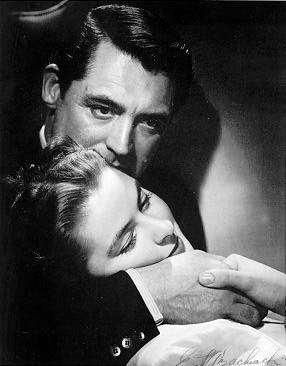

A Cashel moment from our vacation
I was sitting on the dock, reading one of my toooo many books.
Jean and Cashel were in the water, Cashel had on his goggles, and Jean was lying on "the floatie".
A game began, and here is how it went:
Jean was speaking in a hoity-toity English accent, about how lovely the day was, how much she adored the blue sky, how it was almost tea-time, and Cashel would sneak up and splash her, or try to upend the floatie, causing GREAT distress in hoity-toity land.
Jean would flail about in the water, spluttering, making random exclamations: "How has this happened ... oh my GOODness ... Dear ME" as Cashel writhed about in laughter.
The game evolved. Jean became the actual QUEEN of England, and the "floatie" was actually the QEII. Because Cashel is insane, he knows what that is. "You're on an ocean liner, Auntie Jean - that's an ocean liner, okay??"
So Jean lay on the deck of the ocean liner, as Queen Elizabeth, musing about the loveliness of her hoity-toity British day, until along came ramrod Cashel, to sink the QEII.
Queen Elizabeth flailed about in the 2-foot-deep water, in her bikini, making random shocked exclamations, and at one point, Queen Elizabeth, clinging to the edge of the floatie, trying to save her own life, stated, "I deCLARE. Where are your manners???"
6 year old Cashel, enormous goggles on his small blonde head, screamed - in utter glee:
"I'M AN AMERICAN! I don't HAVE any manners!!!!"
Obsession Central: Cary Grant ("Notorious")
I believe I have made clear my feelings about Hitchcock's Notorious. If there were re-hab centers for Notorious addicts, I would be incarcerated. For many moons.
Since there are no such re-hab centers, then I can just inflict my voracious addiction onto the blog readers who choose to read all this stuff.
Speaking of Notorious, here (for all youNotorious fans out there!) is what Richard Schickel, the man I keep quoting, has to say about Grant's acting in that masterpiece. It's quite a good analysis, I think, of what Grant did with his own persona in the film.
As Devlin the counterspy Grant is cool, brusque, competent -- with an almost sadistic edge of cruelty about him. At the start it is clear that his assignment is distasteful to him -- recruiting and running an amateur, and a woman at that. And what a woman she is. Ingrid Bergman's Alicia is not only the personally loyal, if politically disapproving, daughter of a convicted Nazi spy, she is also a nymphomaniac and an incipient alcoholic, unstable to the point of explosiveness. And emotionally needy, pathetically so. "Why won't you believe in me, Devlin -- just a little bit," she begs at one point. And our shock at seeing Bergman violate her previously pristine image, degrading herself in her need is, like Grant's charmless manipulativeness, one of the things that makes this movie so superbly unbalancing. [Ed: I love that. A perfect description. "Superbly unbalancing".] She is, in [Pauline] Kael's terms the pursuer, he the pursued, but in the movie's own terms that is less significant than the neurotic force-field it wants to set up between them.In effect, Devlin is forced to become her lover in order to calm her down enough to do her job, which is to insinuate herself into the home and circle (in Rio de Janeiro) of Alexander Sebastian, who is played by Claude Rains, in one of that impeccable actor's most delicious roles, as the only master spy in the history of the genre who is hag-ridden by his mother (yet another piece of pathology to reckon with)...
What Devlin does not count on is that he will fall genuinely in love with Alicia. Or that Sebastian will ask her to marry him. And that there is no way out of the match if she is to complete her mission.
What neither she nor the audience has counted on is Devlin's neurosis, which now comes to the fore.
He thinks she accepts the situation too easily; her attitude fits all too well with what he knows of her earlier promiscuity; and with all the fears and suspicions of women in general which she had almost made him forget.
He turns petulant as a jilted schoolboy, reaching levels of mean-spiritedness that from any leaading man would startle an audience, but which from Cary Grant are almost devastating. Hitchcock and Hecht (the writer) have now stripped him bare of his protective image as they previously did Bergman.
The resolution of Notorious requires not just the restoration of moral order, but the rebalancing of psychological equilibrium as well. And what dark intensity this brings to the normally routine process of sorting out a spy drama's strands. One feels that if one of the Brontes had attempted an espionage story it would have turned out something like this.
With Notorious we come closer to the heart of Grant's darkness -- as close as he would allow us to come. There were two decades left to his career, but only once -- and then again for Hitchcock -- would he risk anything like this exposure. Something assuredly was lost by the reticence. And yet one can scarecely blame him. Self-revelation is a terrible trial for anyone; it is especially so for an acotr, whose instrument is his person; most of all for an actor like Grant, who so carefully and deliberately created a screen character that was as much a fantasy to him as it was to his audience, in which he could comfortably hide himself, or whatever of himself -- that is to say, the Archie Leach who had been -- that still existed.
The Baltimore Boys
I had a terrible dream last night that something happened to the Empire State Building. Overnight, it was as though an earthquake had happened - only a very neat earthquake - which opened up an abyss down the side of the building, separating the parts from one another.
It was mysterious why this had happened. But New Yorkers woke up, and everybody noticed it.
And panic ensued immediately. New York woke up in panic mode.
I was clinging to something, very high up - staring at the opened crack down the side of the building - knowing it meant something very very bad. But it was mysterious. It was like the monoliths in 2001, or the lights suddenly appearing over Mexico City in Signs. Something's happening. Something already has happened.
As I said, I was very high up, above the streets - and I could hear everyone screaming below. The air filled with screams.
Just like on September 11. That's one of the things I remember about that day. The air filled with screams.
The first time I left New York City after September 11 was for a weekend in Baltimore at the end of September - I was going to visit 2 guys I had never met before in my life. But we had become friends in an online kind of way, in the summer before September 11. I felt no fear, NONE, as I went to meet these strangers. There was no danger. I was aware of no danger. My friends thought I was insane. "What do you know about these guys? Who are they? What are their phone numbers? Call me every day while you're down there..." Etc.
Well, suffice it to say - that they were 2 of the loveliest men I have ever met, and they treated me like a refugee from a war-torn country. Which, indeed, I was. At that time.
One of them is still a good friend of mine, and comments on this blog often. I will ALWAYS have a soft spot in my heart for these guys. I went down there on the train, and I was - to put it mildly - a mess. I didn't want to leave New York. I was still not sleeping. The city had not recovered. By the end of September, we were into the time of funerals. Every day there were funerals. The drones of bagpipes filled the air at all times - replacing the screams of September 11. I can't explain it. I had not recovered - nothing was normal.
I almost didn't go down to Baltimore, because I felt too much anxiety leaving my city. What if something else happened? I couldn't not be there! If an explosion was going to happen, then dammit - I wanted to be exploded too. It's MY city, Goddammit.
My 2 new online friends were voices of calm and reason. All of America was affected by what happened that day. But I was their friend from New York City, and they assured me that everything was going to be all right, and when I got down to Baltimore, they would show me around, they would take me out to dinner, they would take care of everything. No worries, no worries, no worries ...
I am still amazed that these guys came into my life. I called them "my Baltimore Boys".
On the day I was to leave, I had an extended anxiety attack. I was taking the Path to 33d Street and then walking over to Penn Station to take the train out of town. At every second, I thought I'd turn back. I could not leave the city yet. The whole damn island of Manhattan felt like an illusion. While I was in Baltimore, the entire thing could be liquidated. My home ... my home ... my family ... my sister ... my brother ... Cashel ... all of them there ... I could not be separated from them ...
I got off at 33rd Street and made my way to the stairs up to the street.
The station was packed with people. It was a Friday afternoon, your regular rush hour.
And suddenly - with no warning - NONE - everyone started to run. People were screaming. There was a mad RUSH for the stairs. I had no idea what had happened. What was happening? But I was part of that crowd - and the second the movement began, the crowd movement, I started to run too. Something was going to explode, something was in the subway station ... There must be a REASON why everyone is running, right??
People were pushing and shoving, frantically, to get out of the station up to the street. I had my bags for the weekend. I couldn't catch my breath.
It was completely catching. The panic.
And I emerged onto the nightmare of the street - it's a block away from the Empire State Building - you have to crane your neck way way back to see the spindle - and there had been some sort of bomb scare. Which is probably highly normal for the Empire State Building - but in those late September days of 2001 - nothing seemed more fragile, more courageous, more precious and easily destroyed - than the Empire State Building. I would stare at it from my kitchen window in Hoboken, the only building in Manhattan visible to me. At least now. I used to be able to see the twin towers, but now ... there was just one building left. The Empire State Building looked ENORMOUS. A huge target.
The streets were blocked off around the Empire State Building. Cops and National Guardsmen were literally everywhere. I am not exaggerating. It felt like we were under siege. The crowd (of which I was a part) was running this way - that way - panicked - trying to get away from the building, running towards the building - shouting at the cops, "WHAT'S GOING ON?" The cops were hollering at the crowd - "GET BACK. GET BACK."
You have to remember the context of those days.
I started running down 34th Street, holding my suitcase. People were running, all around me. Some were running, as they were talking on their cells. The sound of sirens filled the air. As I ran, I kept looking back over my shoulder at the Empire State Building's spindle ... it looked so fragile you could snap it. I was WILLING it to still exist.
This all probably sounds really crazy. But there was such a crowd dynamic in New York in those days. At any moment, the crowds on the sidewalk were liable to start running. For no reason.
Oh, and randomly - in the middle of this crowd panic - something very very strange happened.
A woman grabbed onto my hand. I was literally running towards Penn Station. I was completely convinced that the Empire State Building was going to explode behind me ... like in a movie. So a woman grabbed onto me. Stopped me. I looked at her with my crazy eyes.
And she said something so unbelievably incomprehensible to me - that I had to ask her to repeat it. She was speaking in English, do not get me wrong, but in that moment, what she said was so absurd, so out of place, that I could not, for the life of me, understand what she was saying.
Here is what she said:
"Do you have any idea where I could buy a Boggle game?"
I'm not kidding.
We're in the middle of a Midtown-wide Bomb Scare, and she's looking for Boggle.
It was only later that I was able to laugh about this. I did an imitation of the moment later for my friend Jen and we were crying with laughter. My insane running, looking over my shoulder, etc., and then this calm oblivious woman basically asking me to point her in the direction of Toys R Us.
I said, "Huh?"
She said, smiling, unaware somehow of the crowd running at her from the direction of Broadway, "Can you tell me where I might find a game of Boggle?"
I should have said, "Up your ass, lady. Why don't you try there?"
But I pointed wildly uptown, and screamed, as I ran away from her, "THERE'S A TOYS R US ON THE CORNER OF 45TH AND BROADWAY - TRY THERE..."
Absurd.
Those days were so absurd.
Penn Station in those days was one of the most moving and mournful places on earth. You walked down the huge corridor to get to the terminal, and the walls were, first of all, lined with National Guardsmen and women who all looked about 12 years old. Second of all, the walls were plastered with notes from all over the world. And commuters and passersby would stop to read the notes. People were always weeping in that corridor. I would weep in that corridor. I think I read every note, over those weeks. There were notes from entire classrooms of 2nd graders in Tulsa, there were notes from fire departments the world over ... clumsy English spelling from the fire department in Germany ... there were notes from individual people, "Hang in there..." "We love you" "We will not forget" - there were letters in every language imaginable. Some were written by little kids who obviously had just learned how to write. So their sentiments were blunt. "I am very sad about the dead people. My dad says it's okay to cry though." Stuff like that. It was a corridor of mourning. Lined with people in military dress, and filled with crying people.
My God.
So the panic was still going on, as I entered Penn Station. I felt like I was making a getaway from a war zone, being air-lifted out of Nigeria or something. Everything dissolving into chaos behind me.
Now mind you: This was just an anxiety attack I was having. New York was still there when I got back. The Empire State Building was still there when I got back. But everything was messed up in my head, I couldn't sleep - no one could - It felt like we were on the brink of utter destruction. It was only September 28.
I got on the train, my breathing high in my chest, and everything in me was saying: Don't go. Don't go. If the Empire State Building explodes, you will want to be here. You will want to be here for your city.
But ... the train pulled away from the station ... and I was off. I felt insane. Wild-eyed.
Boggle? What?
When we emerged into New Jersey, I could see the whole of the city spread out to my left, glimmering, and tragic. The gaping hole of lower Manhattan hurt me, like an actual wound. It doesn't really anymore, but it did then. And I stared at that spindle of the Empire State Building, the tallest building, in the center of the island ... teetering ... It looked so ... small. It looked like - wow, it would take absolutely nothing to get rid of that building! And I stared at it, craning my neck backwards, tears running down my face, until I couldn't see it anymore.
I arrived in Baltimore to meet these 2 strange men, in this state of mind.
We had never met. We knew what we all looked like, pictures had been exchanged ... but nothing else.
And these men were my heroes. They took care of me. They showed me the sights. They listened to me talk. They were sensitive. I couldn't talk about anything else. And I needed to have the TV on at all times, in case something happened. They were fine with that. They introduced me to their friends as "our refugee". They gave me (why?? I have no idea!! I was a stranger to them!!) 2 days away from the stench of death and the bomb scares. They were kind enough to take me in. I was, to put it mildly, NO FUN to be around. This was not a whoo-hoo kind of weekend. I was jumpy, and tearful, and needy, and a little bit insane. They expected nothing from me. They just wanted to take care of me, and give me some time away. They were thrilled to be able to do that for me.
Writing this down, I realize it doesn't make all that much sense.
But I'll alway be grateful to my Baltimore Boys for their kindness to me during that weekend. I will never ever forget it.
And one of them has remained a true friend. For which I am also very grateful.
They weren't really meeting "the real Sheila" that weekend. Who I was that weekend is not who I am normally, obviously. I couldn't stop shaking, all through our first dinner out - I sat at the Mexican restaurant, shivering, as though they had the AC on full blast. Then I said I wanted to go to a bar where they had a TV, because I had to make sure nothing had happened to the Empire State Building. They did whatever I wanted. "You need a TV, darlin'? Okay, then, we'll take you to a TV."
These men were miracles to me.
Nothing was normal. We all clung to one another, and for a couple of days at least, I was away from it. I needed to get away.
When I returned to New York a day and a half later, I came back into Penn Station at about 9 o'clock at night. It was rainy and dark.
And the sadness hit me like a wall. It wasn't MY sadness, per se. I didn't own any more sadness than anyone else. It was like there was a wall of grief around the city. And I was stepping back into that atmosphere. I am telling you: I could feel it the second I got off the train. It was in the air, between the molecules ... it WAS the air.
I have no idea why I just wrote all of this. Oh yeah. Because of my dream about the crack-up of the Empire State Building.
I can't wait for this fucking convention to be OVER.
August 6, 2004
Obsession Central: Cary Grant ("Suspicion")
The trend of screwball comedies pretty much came and went in a 5 or 6 year period - and Cary Grant was an enormous and influential part of the trend. In fact, he's kind of IT, in terms of that style, to this day. Once the trend waned - Grant was smart enough to recognize its waning - and adjust his skills, go deeper, take risks. Not just try to keep repeating himself.
If he hadn't grown past those screwball comedies, he would have been remembered still, for sure - but he might have been trapped in that brief decade. His career wouldn't have lasted into the 1960s.
It was at the very point when screwball comedies were on the wane that Alfred Hitchcock came along, and put Cary Grant in Suspicion - which, if you look at it in the context of everything else Grant had been doing up until that point, is not just a huge departure - but a shattering, as well as a deepening of the Grant persona.
All of the things which made Grant charming, sexy, desirable - were now used in a different context - to make him seem ... well ... suspicious.
Watch His Girl Friday and then watch Suspicion and you'll see what an astonishing feat it is - what a huge risk Grant took.
But Hitchcock saw something in Cary Grant - something attractive, and dark and fragile - and directed him again and again to great success. If Cary Grant hadn't hooked up with Hitchcock, I don't think his star would have shone for so long - although his screwball comedies in the 30s and early 40s would always be considered as classics. Hitchcock brought out another element in Grant's persona - that disturbing element, the hardness, the lack of trust - which would turn him into a bona fide movie star.
So here's Schickel on the surprise of Suspicion:
Alfred Hitchcock had also risen out of the English lower middle class, partly also by imagining a character for himself and then learning how to play it. He was as much a loner, and far more of an eccentric than Grant, and of course, saw in the actor precisely the qualities that reflected his own vision of life -- a romantic and humorous surface with dark undercurrents running beneath, always ready to burst forth. All of Hitchcock's anxiety -- and he was as much the poet of anxiety as he was the master of suspense -- was based on this unpleasant awareness that things were never what they seemed, that disorder always lurked below our treasured middle-class orderliness. All his movies were based on setting up a chain of circumstances that would bring his characters to an acknowledgement of that awareness.There was not a single leading male figure in any Hitchcock movie that Cary Grant could not have played.
He began with him as early as 1941, with Suspicion, in whicih he played an obvious fortune hunter and a famous womanizer who takes an improbable interest in country mousey Joan Fontaine, keeps failing his promise to reform and take a job, and then appears to be planning to murder her for her money.
Grant is wonderful in the role; he is not quite smooth, so his comical high spirits make the threat he poses to the woman more than a mere menace. It brings the film close to the grotesque. His heightened playing underscores the film's basic question, keeps forcing us to wonder if we are seeing him objectively or are we seeing him through her increasing paranoid eyes?
The film's suspense derives entirely from that ambiguity...
What is significant about Suspicion is that, for the first time, one really feels the dangerousness of a charm as seductive as Grant's. It was perhaps hinted at in Sylvia Scarlett, but the world of that film was so remote, and his character so exotic, that it did not menace as it does here, where Fontaine (who is very good and vulnerable) makes us feel its sexy lure, its ability, helplessly, to enthral.
Maybe I'm nuts, but I could read shit like this all day.
That, to me, is what is going on in that film. He is so charming, you feel you could not resist him. Why would you want to? He's wonderful!
"Have you ever been kissed in a car?"
"What?"
"Have you ever been kissed in a car?"
"Never."
He stops the car. Smiles at her. "Would you like to be?"
She's beside herself. She nods.
But ... something's OFF there. Something's not RIGHT, even though - he tells the truth doggedly throughout the scene. "I lay in bed one night, trying to count up the girls I've kissed ... I stopped after I reached 73..."
"Are you always this honest with women?" she says. (Something like that.)
He's chipper, straight-forward. "No. But there's something about you that makes me want to tell you the truth."
Alarm bells are ringing off all throughout the scene, alarm bells which she does not hear - first of all, because she's naive, and has no experience with men - and also - I mean, come on - it's CARY GRANT kissing you in the car! Her judgment flies out the window in the face of that ...
Very good casting choice - and the 2 of them are wonderful in this movie.
Well, Rick James is dead
A couple things:
-- First off: I really don't need to get a "breaking email" for the death of Rick James. I get scared when I see a "breaking email" notifications, what with Code Orange, and the general state of the world, etc etc - so I have to admit - I opened it up, and saw "Rick James, Dead at 56" and I laughed out loud. I am evil.
-- Say what you will about his insane life (er ... Rick? Untie that woman, and put. The crack pipe. DOWN) "Super Freak" still gets radio play and has the potential to turn any boring wedding into a wacked-out orgy
-- Super Freak came out when I was a child, 9, 10, playing Hopscotch, wearing Keds sneakers, and riding my bike at full-throttle through my neighborhood. I had Band-aids on my knees. I was a CHILD. But even still: "Super Freak" (with its extremely age-appropriate first line: "She's a very kinky girl") somehow filtered down into my consciousness. I knew OF the song. And it scared the CRAP out of me. I remember hearing it, and I felt very very uncomfortable. Something in me knew: This is about sex, and I'm not ready for any of that.
-- Additionally, I have a vivid memory of seeing him perform "Super Freak" on some show - maybe it was Solid Gold?? - and he had glitter all over his face - he looked slimy, or like he just came out of the pool - and that disturbed me (again, I was 10 years old) - and he also would take the microphone cord in his hands, and whip the microphone around wildly. This terrified me, for some reason. I didn't like it.
So all in all. These are my memories of Rick James.
However: "Super Freak" (now that I'm grown up) is a great song, and obviously hugely influential. MC Hammer recognized the greatness of the sound of "Super Freak", and Hammer's song is, I submit to you, even better than the original. And you can still hear that guitar-line sampled in every other rap song.
Obsession Central: Cary Grant ("Philadelphia Story")
Richard Schickel writes in praise of Grant's acting job in Philadelphia Story, as CK Dexter Haven:
It is a wonderful role for Grant. It would be too much to say that his position is to speak up for democracy at Tracy's society wedding. If that were all he was doing he would quickly have had to fall silent in the face of his rival's genuine pluck-and-luck credentials. No, what he is really saying is that lackluster birth is no more a guarantee of basic human decency than good birth is a sure sign of bad values...He is a sort of Ariel figure, a busy, devious arranger -- of his own happiness, of course, and, we do come to believe, of Tracy's as well. His touch is so light, and there is such bemusement in his eyes as he stands back to admire the effects of his schemes, that we can't help but like him. And this despite the fact that he is required to do some very serious speechmaking, not merely about democracy, but about her character.
Consider, for example, this response to her charge that his former heavy drinking was "disgusting": "You took on that problem when you took me on. You were no help there. You were a scold. And my drinks grew deeper and more frequent. She finds human imperfection unforgivable (the line is addressed to a watching Jimmy Stewart before he turns back to Tracy). You didn't want a husband and a good companion. You wanted a kind of high priest to a virgin goddess."
Let anyone who doubts Grant's qualities as an actor try to think of anyone else who could get away with a speech that floridly accusatory (and self-pitying) and still retain an audience's good regard. Indeed, one doubts even if Grant could have managed it had he not long since established his credentials as a man with (shall we say?) a very realistic view of the opposite sex and the tributes it can exact from the male. There is, always and forever, a war between the sexes -- but Grant is one of the rare actors in films who acknowledges it, even when he is distinctly the pursuer as he is here, even when the script makes no direct mention of this prevailing condition.
So the speech works. The whole film works -- thanks to him, thanks to the slick professionalism of everyone connected with it.
Victory is mine
I laughed out loud when I saw this: somebody got to this wee blog by Googling "the weight of the king of Tonga".
I literally can die a happy woman now.
Time Machine?
To take a break in the Cary Grant mania - but just a short break - the concept of a time machine came up, in one of the comments to the posts below.
If you had a time machine - and could visit 5 separate times/places - what would they be?
Off the top of my head, here are mine:
1. To be in the rowdy groundling pit, at a performance of Hamlet in the Old Globe Theatre in Elizabethan London
2. The 2nd Continental Congress
3. This one's more general - but to be a flapper-girl in New York City during prohibition, partying in the speakeasies with Zelda and F Scott Fitzgerald, etc.
4. To be in Paris in the 1920s - hang out at the cafes with Hemingway, Joyce, Gertrude Stein, etc.
5. To have been in the audience at the Ed Sullivan Show when the Beatles first came to America - to have seen them live - and at that particular moment
Oh, there are many more.
The Second Continental Congress should probably be # 1.
I also would have liked to been a witness to (or a participator in) the Boston Tea Party.
I would have liked to been in class at the Actors Studio in the 1950s. Watch the work of a young Paul Newman, Shelley Winters, Ben Gazzara, Steve McQueen ... and on and on ...
Obsession Central: Cary Grant
Richard Schickel on "David Huxley" - the absentminded paleontologist Cary Grant created in Bringing Up Baby:
There may be something sympathetic about a nebbish, but there is nothing funny about him. So they [Howard Hawks and Grant] added a certain crankiness to Grant's character -- a crabby, exasperated, put-upon quality. After all, the man was a scientist, a rationalist ... What, logically, would be his response to the sheer impracticality and heedlessness of Hepburn's character when the full import of their consequences to him dawned? Obviously, it would be a fuming fury, suppressed only by the demands of propriety (so many of her assaults on him occurred in public, a golf course, a nightclub, her aunt's dinner table, a police station) and politeness (she was, after all, a woman, and he could vaguely remember from childhood that you were supposed to be polite to them, even protect them, as they were the weaker sex.)Well, this was splendid. This was even historic.
Grant would use this comically-stated balefulness often in the future. It became part of his identity...
The primary importance of Bringing Up Baby is as the film in which he established that misogyny that was essential to so many of his best comic effects in the future, that sense that though women could be fun and all, they were -- with their strainge ways, and even stranger logic -- dangerous to one's pursuit of serious male business (work and adventure and, for that matter, just hanging out with the guys).
One of my favorite moments in Bringing Up Baby comes early in the film, when she drops him off at his apartment - after their disastrous meeting in the nightclub - where he falls onto the floor (crushing his top hat), and then she tears his tail-coat.
She drops him off. She keeps insisting that she will help him connect with the benefactor of the museum, she will help him with his work ... He continuously insists, "Please. No. You are a disaster. Stay away from me. DON'T HELP."
She refuses to listen.
Finally, he manages to get out a complete sentence, and he says to her, very very firmly, in that cranky put-upon way, "My fiance has always thought of me as a man with some dignity."
And Katherine Hepburn takes one look at him, with his thick glasses, his torn top-coat, and the crushed top hat on his head, and bursts into laughter. He endures her laughter, with this wounded proud expression on his face - but he looks so RIDICULOUS that you must laugh at him, too.
It's a perfect comic set-up: this distracted rationalist man, tossed into an absurd situation, where he is completely out of his element ...
Obsession Central: Cary Grant ("comic signature")
The Awful Truth - a movie starring Cary Grant and Irene Dunne - is considered one of those divining-rod screwball comedies - a bar was set for comedy by this 1937 film. I actually found a copy of it on Amazon for 3 bucks, and it is now shrieking my way. Very excited to see it. (Oh, boy. I'm feeling like such a freak at this moment. Believe me - I have other things going on in my life, I just don't feel like writing about them.)
The Awful Truth is described by Schickel here - and then he segues into Bringing Up Baby, everyone's favorite screwball comedy:
... no one overplays their underplaying and ... the pace is all of a piece. In the little world that the director, Leo McCarey, created for thisfilm -- and he won an Academy Award for his work -- everyone is at all times just slightly unbuttoned, so that the stage is always set for the logicallyimprobable. Which means that there is no need ever to descend to the impossible in desperate search for a laugh.It is hard to think of a film that has a steadier, more reliable comic pulse, or of one that more sweetly insinuates itself into memory.
And now onto Grant's acting in the film:
The secret of [Grant's] success here and later was well-defined by George Cukor: "You see, he didn't depend on his looks. He wasn't a narcissist; he acted as though he were just an ordinary young man. And that made it all the more appealing, that a handsome young man was funny; that he was unexpected and good because we think, 'Well, if he's a Beau Brummel, he can't be either funny or intelligent,' but he proved otherwise."The art was all based on his developing confidence in himself. He could throw it all away-- the humor and the intelligence as well as the looks. He had the art just to be, and no compulsion to prove anything to anybody. He could steal scenes if he wanted to, but he did not ... He was not afraid to pull back into a funny distractedness, a way of talking to other people as if he were talking to himself, and that quality was unique -- impossible to find in anyone else in the movies.
[Ed: Isn't that a perfect description of the Grant energy? That "distractedness", and his way of always seeming that he was carrying on a running dialogue with himself about the absurdity of the situations he finds himself in. In a comedic context, that quality is what makes him so damn funny. The little sounds he makes - "Tsk tsk tsk", "Oh dear", "Hm", "Er ..." It's a riot. Yet in a dramatic context - say in, like, Hitchcock's Suspicion - that very distractedness can seem ominous, and make him seem distinctly untrustworthy. Oh boy. I am struggling with embarrassment at how insane I am right now. But I will continue on. Life is beautiful.]
It was not disociative, a ploy akin to the slight holding back from full commitment to farce that often actors and actresses - especially the handsome ones - sometimes employed toindicate to their fans that they were not really as undignified or stupid as the role seemed to indicate they were. It was certainly not like the good sport air that sometimes developed around a normally more heroic or romantic performer when the indignities started to heap up.
No, Grant had a way of being bemused by the lunacies with which he was involved that did not set him apart from them butin the end allowed him to plead innocent on the grounds of temporary insanity. "Look at me," he seemed to say, "I'm too intelligent to be doing this. Oh well. Here goes." We can identify with that. It's what we are compelled to say to ourselves all the time when events get out of hand.
Distractedness. That was something he did better than anyone. In fact, it became a kind of comic signature for him. But it was only something that curled about the edges of his performance in The Awful Truth. It took Howard Hawks to bring it all the way out in him. The occasion, of course, was Bringing Up Baby. Who was a leopard. Who belonged to Katherine Hepburn. Who was a spoiled rich girl. Who decided that it would be fun to play around with a paleontologist as absentminded as Grant's David Huxley. Whose plans to marry a terrible stiff of a girl, and to obtain funding for his museum, and to finish reconstructing the brontosaurus of his dreams, are always getting derailed by Hepburn. [I am laughing just remembering this damn movie.] There is a terrier in this picture, too, and it is he who steals and buries the intercostal clavicle that gets everybody chasing around in the middle of the night in Connecticut looking for the fool thing, and the leopard, of course, which has escaped.
Well, it's preposterous. And, in a way, it is Hepburn's picture. As Ferguson said at the time, she is "breathless, sensitive, headstrong, triumphant in illogic and serene in the bounding brassy nerve possible only to the very, very well bred." The mess she makes must not seem to be a result of scheming or malevolence, but the natural outcome of her blithe imperviousness to the normal niceties.
Hawks liked to reverse things, to do the simple opposite of what the audience expected of actors, of a comic situation. Hepburn, for example, had previously done a certain amount of noble suffering and a certain amount of romantic dithering, too. He thought the business of making her not merely headstrong, but entirely thoughtless would be funny. "I think it's fun to have a woman dominant ..." Hawks would drawl in that off-hand way of his. Same way with Grant. "Such a receiver," the director was heard to murmur years later.
Why not take that air of not being all present and accounted for that he had shown here and there in his work and develop it into the core of a comic character.
[Remember: Howard Hawks was the director who discovered Lauren Bacall and put her in "To Have and Have Not" with Bogart. He wanted to put Bogart with a female co-star who gave as good as she got, who was equally as insolent as Bogart was. So far - in the movies Bogart had done - he hadn't really met his match. Hawks wanted to see what would happen to give the Bogart character his equal to spar with. Bogart was never effective with floozy women. Or, let's say, not AS effective. His sex appeal came out with Bacall, with Bergman - women who could give it right back to him, who talked back, who weren't submissive or easy. Strong, smart, etc. That was Hawks' fantasy woman.]
Good Lord. I have lost my mind. Why do I retain all this stuff??
Onward.
Obsession Central: Cary Grant ("I pretended to be somebody I wanted to be")
To continue with the Freaky-Freak Parade of obsessions: Here is Richard Schickel on the beginning of the creation of that whole Cary Grant persona-thing, following Sylvia Scarlett in 1936:
If Sylvia Scarlett liberated Cary Grant as an actor, if it suggested the possibilities inherent in taking some time off from good behavior, it represented only a beginning for him.He had yet to begin the process of self-creation (actually, self re-creation) by which he would make his permanent mark in the world. Even so, it is interesting how quickly he would proceed now that he could see what could be done with himself if he set his mind to it. This is especially so when one remembers how deeply Grant himself believed that he had a rather larger identity problem than most people had. He did not, he thought, have the slightest clue as to who he was. Or, if he did, he was not entirely certain that he liked what he saw, or that other people would either. He was, possibly, being over-sensitive on the point. But this being the case, it seems that he decided, quite consciously, to make up a character that he liked and felt easy with. He has been, over the years, quite insistent on this point. While he was still active as an actor, he told an interviewer, "I pretended to be a certain kind of man on screen, and I became that man in life. I became me." As recently as 1981, looking back on things, he expanded on that thought to another reporter, "I don't know that I've any style at all. I just patterned myself on a combination of Jack Buchanan, Noel Coward, and Rex Harrison. I pretended to be somebody I wanted to be and I finally became that person. Or he became me. Or we met at some point. It's a relationship."
Obsession Central: Cary Grant ("Sylvia Scarlett")
As promised - (I know, you've been waiting with bated breath) here are some quotes from Richard Schickel's analysis of Cary Grant's acting.
Let's start with the little-known film Sylvia Scarlett, from 1936, directed by the great George Cukor - and it was the first pairing of Katherine Hepburn and Cary Grant.
Schickel, after studying the earlier films of Grant, discerns a breakthrough in Cary Grant's acting that occurs in this movie. Grant somehow freed himself up within this material, he let the goofball out of the bag - Schickel describes the breakthrough as Grant finally "taking some time off from good behavior" - a marked contrast to Grant's earlier films, where he pretty much played your standard charming leading man.
So here goes:
One can see why Sylvia Scarlett so befuddled everyone at the time. What a strange little movie it is! There literally never has been, and quite likely never will be, a film quite like it. Not quite a romance, not quite a comedy, it might be described as a sort of brushed-off tragedy, in which nothing and no one is quite what they seem to be at first, and the characters' responses to the events of the story are often inappropriate, sometimes dislocatingly so. The oddities begin with Katherine Hepburn's title role, in which she appears for well over half the movie as a young man, a disguise she adopts to help her father ... escape from France before he is arrested for his crimes.They meet Jimmy Monkley (Cary Grant) on a boat crossing the English Channel, and having got the old man into trouble with Customs over some lace he is smuggling (in order to distract attention from his own activities in that line), Jimmy then casually inveigles the Scarletts into becoming his accomplices on some swindles in London ...
Needing to lay low for a while, they take up the life of strolling players, working the more picturesque coastal towns...
It is, perhaps, no more stylized that most movies of its time, but its stylization was entirely unlike anything anyone was familiar with: from its never-never vision of rural Englan, to its becharmed view of low-level theatrical life (the little company works in Pierrot-Pierrette costumes) to its presentation of the creative life...
Yet it seemed to liberate Grant.
He had never worked with a director of Cukor's quality, a man with a gift for creating a climate in which an actor or an actress could find things in themselves that they didn't know they had. Nor had he ever had a leading woman of Hepburn's spirit, either. And however loopy the story they were engaged in trying to tell, the contrast between it and the utterly routine things he had been doing at Paramount was not lost on him.
George Cukor remembered, "He was a successful young leading man who was nice looking but had no particular identity. In fact, if you see him with Mae West, he's rather awkward. But in Sylvia Scarlett he flowered. He felt the ground under his feet."
That ground was native ground, and one is speaking in more than the geographical sense. One imagines that the almost manic-depressive mood swings of the picture matched his sense, which experience had taught him, of how suddenly, shockingly, the taste and tone of life could change.
More importantly, Jimmy, the Cockney swindler, was formed, at least in part, by the forces, the society, that had shaped Grant. First glimpsed in a black coat and hat, a watcher in the shadows on that Channel boat, he later describes himself satirically as a "little friend to all the world, nobody's enemy but me own," more soberly as "a rolling stone, an adventurer", who is neither a "sparrow" nor an "'awk" -- the two principal categories into which the world's population falls, as he cynically sees it.
The analogy is obvious: both Jimmy and Grant have pasts they do not wish to discuss in any great detail, a sense that all alliances are shifting and temporary. Above all, both actor and character share a sense that a man is mainly responsible for his own survival -- no small difficulty -- and only after that for the formation of any fate he can manage that is of grander proportions, since no one is to help much, or for long, with either problem.
We don't know, of course, precisely what Jimmy's background was, probably even less elevated than Grant's -- but the actor had no trouble in understanding its dreariness and the kind of radical self-reliance it required to climb up out of it, the alienation and the incapacity to sustain love or intimacy for very long when those qualities are invisible in a cold, or merely economically hard-pressed, family...
Jimmy Monkley was, in effect, Cary Grant's dark side -- a cautionary figure. In him there is something of what Elias Leach [Grant's father] had been, something of what Archie Leach [Grant's real name] might have been had he not been blessed with looks and energy and the wit to imagine for himself a better self, living in a better place.
It is no wonder that suddenly in this role he forgot his manners, abandoned his passivity -- and attacked. Attacked as he never had before.
"Cary Grant's romantic elegance is wrapped around the resilient, tough core of a mutt," [Pauline] Kael says, "and Americans dream of thoroughbreds while identifying with mutts. So do moviegoers the world over."
But there is even more to it than that.
Some mutts touch us with their guts and their independence. But some scare us with their total unpredictability, their dangerous possibilities, as Jimmy Monkley did.
Now that he saw their possibilities, and his ability to control them -- no matter how dashing he was, no matter how romantic he was -- a little bit (and sometimes a lot) of those qualities would show in almost everything Cary Grant did for the next few years.
"Gobble Gobble"
So Bill saw Gigli last night, in order to satisfy his morbid curiosity. I love that he reviewed the movie AS it was occurring.
I actually saw that damn thing in a MOVIE THEATRE - with a bunch of other people there just to satisfy their morbid curiosity about the train wreck.
It was hilarious. It felt like an old Shakespeare play at the Globe, and we were the rowdy groundlings. We were shouting at the screen, muttering to one another, guffawing at inappropriate moments - It was an interactive experience.
The girl who took our tickets laughed in our faces. "There's nobody else up there, you know..."
You know when the ticket-taker laughs at you that you've got a real bomb on your hands!
August 5, 2004
Obsession Central: Cary Grant
Richard Schickel wrote an in-depth analysis of Cary Grant's acting called, simply, Cary Grant.
It's not a biography, per se - although you do get some biographical details, and hear a bit about Cary Grant's beginnings - (as Archie Leach, in Bristol, England). However - biography - or Freudian analysis of that biography - is not the main focus. You hear the bare bones of his bleak childhood, the main event of which appears to be his mother "disappearing" when he was 9 years old. She was actually incarcerated in a mental institution, but he was never told. He came home from school and was told his mother went to the seashore for a holiday. She never returned. It wasn't until years later that Archie Leach (now world-famous Cary Grant) learned what actually happened to his mother, and learned that she was still alive, and still in the mental institution. Kind of an extraordinary thing to happen to you when you are 9.
But Schickel isn't really interested in dwelling on this - because Cary Grant was so obviously not interested in dwelling on it. A very private man, he openly admitted that he created the Cary Grant "character" out of wholecloth, and said, "I knew the the kind of man who I wanted to be - and after years of pretending - I finally was that man." (Paraphrase.) So fascinating to me. Talk about the changeability of self!
An act of will. I will be THIS way. I will not accept my life to go THIS way. I want to be the KIND of person who does THIS ...
Fake it til you make it.
Schickel is right, I think, to not "interpret" this. To say too much about it. There are certain mysteries within all of us. And also - to read too much into an artist's work because of their biography is always perilous.
Just judge the WORK, as best you can. Who the hell cares that Cary Grant's mother was ripped away from him, and the secret of her destiny kept from him for 20 years? I mean, it's interesting and all ... but it still doesn't explain him.
Schickel's book (which is really just a long essay) is mainly a look at the development of Cary Grant's acting, based on the roles he got - where you can see certain characteristics emerge, things that would become trademarks ... and then when the breakthrough of his real talent came (Schickel thinks that it was in Sylvia Scarlett - the first film Grant did with Katherine Hepburn. The film was a huge bomb, but apparently Grant was great in it. Hepburn, in her book Me concurs.)
Because of Cary Grant's looks, he was getting a certain kind of role. At first. Mae West said to him, famously, "You can be had." With all that that double entendre means. He wasn't really a man's man, although he was very handsome. There was something pretty about his face (very early on, I'm talking about). He would almost take on the feminine role in films - he was always "the object" of desire. (I suppose ANY man who co-starred with Mae West would have to take on the "feminine" role next to her! Cary Grant understood that dynamic.) He wasn't really the pursuer. He was objectified. For obvious reasons. I mean, look at him.
But with Sylvia Scarlett (which I have yet to see - it's hard to find) - apparently, for the first time, this whole OTHER side came out, the goofball, the vaudevillian, the pratfaller, the Cockney kid who ran away from home to join an acrobat troupe ...
Katherine Hepburn said, about him at the time of filming Sylvia Scarlett, "He was plumper in those days, and full of beans. A true Cockney. When he laughed, it was full of delight and life."
"Plumper", "full of beans" ... He had found that thing, that thing that really set him apart.
It wasn't just his looks, although those were very fortunate.
There was something else going on with him. Something darker, more wary. He actually couldn't "be had". Not for any price.
Schickel writes at one point, "Cary Grant, when playing his most famous characters, isn't playing hard to get. He is hard to get." I think that that is very astute.
Pauline Kael wrote a kind of famous essay about Cary Grant and here is what she had to say on that point:
"That [Mae West's 'You can be had'] was what the women stars of his greatest hits were saying to him for thirty years, as he backed away -- but not too far. One after another, the great ladies courted him ... willing but not forward, Cary Grant must be the most publicly seduced male the world has known...The little bit of shyness and reserve is pure box-office gold, and being the pursued doesn't make him seem weak or passively soft. It makes him glamorous -- and since he is not as available as other men, far more desirable."
It's the wariness behind the charm - which is what Hitchcock noticed about Cary Grant. Not many other directors saw it - or if they did, they didn't use it in the way Hitchcock did. There's a darkness there, a lack of trust, a lack of softness - there's a selfishness ... But with those softly good looks, it's a fascinating combination. There's something unyielding in him. Watch the scene at the racetrack in Notorious. Of course that's a serious scene - but also watch how he handles Katherine Hepburn in Bringing Up Baby - with increasing frenzy, yes, because it's a comedy - but he is FIRM that she is the plague in his life - until the very last second. That's why it's so hilarious. He protests WAY too much.
But when that very same unyielding-ness is put to use in something like Notorious - you cannot get away from the darkness at the center of that film. It's Hitchcock's vision, yes - but Cary Grant is the perfect actor to inhabit that vision of darkness, wariness of women, cynicism ...
But if you think about it - that same cynicism and darkness was used in His Girl Friday (who's more cynical than that guy?? Screaming into the phone, "PUT HITLER ON THE FUNNY PAGES") - but it's a comedy, so it comes out differently.
I like a lot of Schickel's writing. I'll post some of it here for the other Cary Grant freaks, although I realize that I am the freakiest-freakster of all the freaks.
Under the Banner of Heaven
If you're looking for coherence here ... my apologies.
I am tearing my way through Jon Krakauer's Under the Banner of Heaven. For those of you who might not know, this book began as an investigation of the murder of Brenda Lafferty by her brothers-in-law Ron and Dan Lafferty in 1984. She was murdered for not being sufficiently submissive to her husband, for not being a good enough Mormon, she was also murdered because she resisted the demands of her husband and the demands of the rest of the Lafferty family to submit to polygamy and a fundamentalist interpretation of The Book of Mormon. Under the Banner of Heaven began as an investigation of the murder, but then morphed into a history of Mormonism in general. Hugely controversial book, obviously.
It fluctuates back and forth between the story of the Lafferty brothers' descent into fundamentalism, and story of the beginning of the Mormon Church. The Lafferty brothers were born and raised as Mormons, but in the early 1980s got wrapped up in the fundamental strain of the Mormon Church (after meeting a man who called himself a "prophet" - along the lines of the wack-job who abducted Elizabeth Smart) and the Lafferty boys became convinced that killing their sister-in-law was what God wanted them to do. Dan and Ron remain unremorseful, in prison. They are still convinced that they live in God's light; after all, they did what He asked. Oh, and not only did they kill Brenda Lafferty, but they also killed her infant daughter, stabbing her while she lay in her crib.
My thought, as I read this, is, overwhelmingly (and perhaps, way too simply): Jesus. I am so freakin' GLAD I wasn't raised in that atmosphere. I am so GLAD that I didn't grow up in a small village where everyone is also a Mormon, and the village is run by an elder, who marries me off when I'm 12 to a pockmarked 60 year old man who also happens to be my stepfather. I am glad I wasn't raised to be submissive and obedient. I was raised to use my brain, my critical faculties ... to judge for myself, to be able to make choices ... to be able to say No to things I didn't want, to stand up for myself.
The stories in this book ... some of these people ... it is just horrible. The modern Mormon church wants to distance itself from the fundamentalist sects breaking off left and right, and yet it is obvious (from this book) that they've got a real dilemma on their hands.
There's one moment in the book which, in particular, grips me - and this goes back to my fascination with cults, and brainwashing, and group-think.
Ron Lafferty was the oldest of the 6 Lafferty brothers (I think there are 6 of them). They were all raised to be good Mormons. Nothing too extreme, very mainstream, in a Mormon kind of way.
Ron was married to a woman named Dianne, also a Mormon (of course) and for 15 years they had what everyone describes as a wonderful and happy marriage. Ron was mild-mannered, he treated her well, she treated him well ... all was fine. Meanwhile, the rest of the Lafferty boys started down the slippery slope into fundamentalism, and they all became completely convinced that THEY were the true holders of the true Mormon creed, and that the Mormon Church signed a deal with Satan when it gave up polygamy. They were all ex-communicated from the church.
Ron remained distant from all of this firebrand stuff.
All of the Lafferty wives became increasingly disturbed at the transformation of their husbands. Their husbands started talking to them about polygamy, about how they wanted to take on more wives ... Their current wives went a bit rip-shit, in a submissive Mormon way.
Dianne (wife of Ron) became the leader of the wives and said to her husband, "Go talk some sense into your brothers. Please."
So Ron went to meet with his 5 brothers, and began to tell them to cut out this polygamous talk, and to stop talking in this fundamentalist literalist way ... His brothers spent a couple of hours talking to him about their ideas, and apparently Ron returned home to his wife Dianne a completely changed man.
He had had some kind of conversion experience. He had seen the light. He realized that he had completely strayed from the path of true Mormonism, the entire Mormon Church had strayed ... Polygamy needed to be brought back, and harshly ... The Church needed to be purified.
Everyone who knew him said that this dramatic personality change happened in the course of just one evening.
According to all of them: Ron Lafferty was one way on one day (mild, happy with his wife, reasonable), and the next day he was another way (a fundamentalist firebrand).
And less than a year later, he stabbed his sister-in-law and her infant daughter to death.
HOW does something like this happen?
Is our hold on our "selves", whatever that means, so tenuous? What I'm really asking is this - and it's something I've thought about often - (what with my continuous re-reading of Helter Skelter, etc.): What makes me different from Ron Lafferty? Or - is there no difference? Are we all equally susceptible to these kinds of personality changes? Have I just not been tested? Or ...
I mean, look at what happened to Patty Hearst. That story has always deeply impressed me, made me think about things - like SELF - and what is the self - I don't see all that much difference between Hearst and myself. But again, I don't really know the answers to these questions.
Are any of us exempt from that kind of suggestion? Why does this question trouble me so much?
Is there something in Ron Lafferty that was MORE vulnerable?
Classic cult literature talks about people being susceptible to this kind of change-over during times of stress: divorce, going to college, moving ... It is when you are perhaps a bit beaten down by the circumstances of life, that a cult can come right in and say, "If you follow us ... you will never have to feel this way again..."
I feel like you literally could not pay me enough money in the whole fucking planet to go and live on a commune under David Koresh. Or Jim Jones. Or to submit whole-heartedly to ANY organization, which made such demands. I like individuality too much, I like freedom too much ... I like Eminem too much. I like watching movies and immersing myself in pop culture too much. I like platform shoes and leather jackets.
There's something deeper going on, though, in my distaste for all of that. I find it deeply frightening. The thought that our brains are so fragile. So porous. They can be imprinted upon.
That there might not be such a thing as an essential self. All is mutable, changeable.
But - what the hell happened to Ron Lafferty that night? Dianne, his wife, later testified at the trial, that she did not recognize her own husband when he came home. He had gone somewhere else, in his psyche - and she would never get him back. Because fundamentalism is, of course, so rigid, so unyielding.
It fascinates me, and yet it also terrifies me, in some very personal way.
I'm obviously not very articulate about this yet. I'll keep thinking upon it.
Dysfunctional bureaucracy
CW gives his perspective. I had never really considered this point, that government agencies, with their Byzantine bureaucratic structures, are committed to
"creating new layers of bureaucracy in order to make promotions for themselves."
A self-sustaining in-grown ineffective bureaucracy ... committed to the furthering of its own existence.
I always look forward to reading No Such Blog - I get a different perspective on things over there.
August 4, 2004
A story of a WB, some stinky garbage, and a serendipitous moment
Well, really my day started last night when I came home to find an enormous water-bug (I shiver to even say it ... and will from now on refer to it as a WB. Please comply with this rule) running about in my apartment.
An hour and a freakin' half later, the thing was dead. But I had to kill it 4 times. Hardy bastard. By the end of the gladiatorial combat session in my studio apartment, I was drenched in sweat, and near tears. I also had existential moments of despair and aloneness.
But I killed it. Then I called my friend Jen up (It was 11:30 pm by this point) and had her stay on the phone with me while I disposed of the body.
A terrible evening. Terrible. Irredeemable. I'm not rational about bugs. I was an absolute mess.
Got up this morning. My apartment doesn't feel the same. I feel jumpy there. Terrified. I hate those fucking WBs. It was like killing an ANIMAL not an insect.
The day was hot, hazy, and still. It had a malevolent air, although I'm sure that was just a hangover from my awful WB murder-frenzy. I came to work. Garbage is piled high on the sidewalks. It stinks to high heaven, because it's so hot and still. The second I got off the bus, I walked by an absolutely raging fight between two semi-homeless people. It was getting out of control. He started beating her, pounding his fist into her head. This was at 9 am. They were surrounded by stinky garbage, nobody even really turned and looked at this fist fight, I was still haunted by the WB, and life seemed dirty and grim.
You go along in New York not noticing stuff like that, usually. But if you're in a certain mood - there are times when you look around and all you see is dirt, and insane people, and people with no homes, and hands outstretched to you...
Today was one of those days.
Oh, and here's another thing - which is the exposition for my later serendipitous moment: As I walked to the bus-stop, trying to shake off the horror of the WB, I thought randomly of my favorite ex-flame. My humor-boy, my crazy friend, my pool-playing wacko MAN ... I haven't heard from him since 2002. Which is fine, and proper, considering ... but he popped into my mind this morning, as I trudged along, away from the memory of the WB, through the hot haze. He saw it as his job in life to keep me laughing. He would do anything to reach that goal. Drop his trousers in the middle of a crowded sidewalk? No problem. Do a pratfall off the curb ... I always found him hilarious, I mean I would just look at his face and start laughing ... but he was determined that I should be happy, and not just happy, but writhing about with laughter. I rarely think about him, but suddenly - I wanted to see him SO BADLY this morning. I just wanted to see him stalking along beside me, pretending to walk into lamp-posts, or putting his hand over my ass and strolling along, as though that were the normal way we went for walks together. (To be clear: he wouldn't put his hand on my ass in a sexual or affectionate way. Er - of course, sometimes he would, but not in this context - In this context, he would do it as though he were being helpful - like: Here, let me help you with that ... It looks like you need help carrying this - He was a goofball. Plain and simple.)
I wanted him there yesterday, to make me laugh!
Also, he would have killed the WB in 5 seconds, no big deal to him, and then we would be out playing pool.
But no. I was trapped in mortal kombat.
This was just a passing floating thought. "Damn. I could use his energy today."
My day goes on.
I go to the dermatologist to get this weird thing on my back checked out - and he ends up deciding to cut it off and (scary words) "send it to the lab". I now have stitches in my back. I struggled to keep back the tears as I made my next appointment. I'm sure it's nothing, I'm sure it's nothing ... but I felt kind of alone.
I walked outside, and a big black cloud had descended over Manhattan - a Ghostbusters cloud - it was as though all light had been snuffed out of the air. Something big coming, a storm or something.
The numbness of the anesthetic had started to wear off, and I could feel the ache in my back, where the stitches are. Nothing huge, or anything, but ... everything kind of felt huge today.
I walked past the stinky piles of garbage to the subway, I got onto what looked to be an empty subway car, only to realize WHY it was empty - it had to be 120 degrees in there. I was soaking wet with sweat by the time I got to my stop. Grrrrrrrrrr. New York was dragging me down.
I emerged into the hell of the garment district, and walked up towards Port Authority. With the cool-looking Ghostbusters cloud all around.
A guy was walking ahead of me on the jam-packed filthy sidewalks. He was young. He had headphones on, and he was wearing a backpack. On the side of the backpack are these little net pouches, so you can see what he kept in there. In the left-pouch was a small paperback, and I recognized it immediately. It's a little book called Truth in Comedy: The Manual of Improvisation - and it's by Charna Halpern and Del Close (2 improv gurus.) Del Close was THE improv guru, but Charna is one of his many proteges.
Anyway - suffice it to say: Truth in Comedy is chock-full of photos of an improv team, demonstrating some of the concepts in the book. My Crazy Funny Man was on that improv team, so his picture is on almost every page of that book. I own it, I've had it for years ... mainly as a goof. But today - seeing it - it took on a deeper meaning.
I know it was a coincidence, but I had just thought about him this morning, this man I haven't talked to in 2 years, my humor man, my crazy boy ... and then, there was that random book in the backpack in front of me.
Suddenly, I felt his presence again. (Funny Man). I don't need to be in actual physical contact with him to be in communication with him, if that makes sense. All I needed was the reminder. I had been aching for a reminder this morning ... Granted, I mainly wanted him that morning because I knew he would kill a bug with no problem, so that we could go on with our lives ... but there was something deeper in that yearning. I wanted his energy again. That disruptive knock-over-the-chess-pieces hilarity - that non-judgmental calm bemused energy ... I could go wild with anxiety all around him, and he would remain perfectly (and irritatingly) calm.
So I felt better when I saw that little book.
I remembered that he IS still out there. I can call upon his energy any time I want to - It exists out in the world, it is still there, nothing is gone forever ... Matter can't be destroyed, and energy is matter, right??
Regardless. In the middle of the stinkpot of the garment district, with stitches on my back, and a part of my body going "off to the lab", I suddenly knew that energy was actually matter. Because I could feel Funny Man with me, as clearly as if he were manifest.
Serendipity. That I saw that book at that time.
August 3, 2004
Movie Quotes Below Not Yet Guessed
Here they are:- Alex??
1. "I never eat anything that begins with the letter 'F.' Like chicken, for instance."
2. "We're not married."
"Congratulations."
"But we will be soon."
"Condolences."
3. "All of a sudden, she's playing Hamlet's mother!"
4. "Oh Walter, you're wonderful - in a loathsome sort of way."
5. "It's my intercostal clavicle!!"
6. "Save some craziness for menopause!"
7. "When I despair, I remember that all through history the way of truth and love has always won. There have been tyrants and murderers and for a time they can seem invincible, but in the end they always fall. Think of it. Always."
8. "So this is where you live. Oh, Mother will love it up here."
9. "Father, you were right. It all works out. I guess God knows more about these things than we do. Somehow or other, Cora paid for Nick's life with hers. And now I'm going to. Father, would you send up a prayer for me and Cora, and if you could find it in your heart, make it that we're together, wherever it is?"
10. "Listen. There are reasons why I can't turn around and look ... but is there a little kid heading in here?" (If my friend Mitchell weren't on tour and out of communication, he would get this one. He loves this movie.)
Name that movie
"Get off the babysitter, put your pants on and come out with your hands up!"
Name that movie
"What am I gonna say? 'I killed the president of Paraguay with a fork. How've you been?'"
Name that movie
"In Italy for 30 years under the Borgias they had warfare, terror, murder, and bloodshed, but they produced Michelangelo, Leonardo da Vinci, and the Renaissance. In Switzerland they had brotherly love - they had 500 years of democracy and peace, and what did that produce? The cuckoo clock."
Name that movie
"I never eat anything that begins with the letter 'F.' Like chicken, for instance."
Name that Movie
- "Now this is the thought that wakes me up in the middle of the night: that when I get older, these kids are gonna' take care of me."
- "I wouldn't count on it."
Name that movie
"Do you love him?"
"Yeah, Ma, I love him something awful."
"Oh God, that's too bad."
Name that movie
"Now pretty please, with sugar on top, clean the fucking car."
Name that movie
- "I love you."
- "I know."
(Actually, this shows up in 2 movies ... both titles are correct.)
Name that movie
"Mr. Ambassador, you have nearly a hundred naval vessels operating in the North Atlantic right now! Your aircraft has dropped enough sonar buoys so that a man could walk from Greenland to Iceland to Scotland without getting his feet wet! Now, shall we dispense with the bull?"
Name that movie
"I know everything hasn't been quite right with me, but I can assure you now.....quite confidently.....that it's going to be alright again."
Name that movie
- "Don't you know the meaning of propriety?"
- "Propriety? 'Noun. Conformity to established standards of behavior or manners, suitability, rightness or justice. See Etiquette.'"
Name that movie
"We're not married."
"Congratulations."
"But we will be soon."
"Condolences."
Name that movie
"I admire you as a policeman, particularly your adherence to violence as a necessary adjunct to the job."
Name that movie
"You're the first woman I've seen in one of these things that dresses like a woman, not like a woman thinks a man would dress if he was a woman."
Okay people
I am getting ready for Round 2 of our Movie Quote game. I have a ton more to post - wanted to know if anyone wanted me to be sure to include certain quotes?
A bunch of you have already emailed me, asking me to include things, but wanted to open it up to all!
Email me - and make sure you tell me which film it's from.
I may have a freak memory for stuff, but I am fallible and flighty as well.
Name that movie
"Peel out. I just love it when guys peel out."
Name that movie
"There were complications ... to my ... complications."
Name that movie
"You are protected by the enormity of your stupidity - for a time."
Name that movie
- "What I mean is, the moment I meet an attractive woman, I have to start pretending I have no desire to make love to her."
- "What makes you think you have to conceal it?"
- "She might find the idea objectionable."
- "Then again, she might not."
- "Think how lucky I am to have been seated here."
- "Well, luck had nothing to do with it."
Name that movie
"Whoever you are, I have always depended on the kindness of strangers."
Name that movie
-"You're just going to have to trust me about this, this one thing. You need a lot of drinks."
- "To break the ice?"
- "To kill the bug that you have up your ass."
Name that movie
- "You want me to hold the chicken, huh?"
- "I want you to hold it between your knees."
Name that movie
I think I've posted this quote before, but it might be my favorite - ever:
"By the authority vested in me by Kaiser William II, I pronounce you man and wife. Proceed with the execution."
Name that movie
"This little girl has got to go winky-tinky."
Name that movie
"May I have ten thousand marbles, please?"
Name that movie
"It sounds like she's in trouble. I'd better play back the whole thing."
Name that movie
"Oh Walter, you're wonderful - in a loathsome sort of way."
Name that movie
"I don't know anything anymore!!"
"That sounds very hopeful, Red."
Name that movie
“Hey, Dad! You wanna have a catch?”
“I'd like that.”
Name that movie
"I absolve you! I absolve you! I absolve you! I absolve you! I absolve you all!"
(Unbelievably great moment.)
Name that movie
"When I despair, I remember that all through history the way of truth and love has always won. There have been tyrants and murderers and for a time they can seem invincible, but in the end they always fall. Think of it. Always."
Name that movie
“I used to hate the water.”
“I can’t imagine why.”
Name that movie
"So this is where you live. Oh, Mother will love it up here."
(heh heh. Funny moment - the last of this particular film.)
Name that movie
This one kills me. Great flick.
"Father, you were right. It all works out. I guess God knows more about these things than we do. Somehow or other, Cora paid for Nick's life with hers. And now I'm going to. Father, would you send up a prayer for me and Cora, and if you could find it in your heart, make it that we're together, wherever it is?"
Name that movie
"No sir, I'm afraid not. No sir. I yielded the floor once before, if you can remember, and I was practically never heard of again. No sir. And we might as well all get together on this yielding business right off the bat now. Now, I had some pretty good coaching last night, and I find that if I yield only for a question or a point of order or a personal privilege, that I can hold this floor almost until doomsday. In other words, I've got a piece to speak, and blow hot or cold, I'm gonna speak it."
Name that Movie
"Listen. There are reasons why I can't turn around and look ... but is there a little kid heading in here?"
Name that movie
"I've seen things you people wouldn't believe. Attack ships on fire off the shoulder of Orion. I watched C-beams glitter in the dark near the Tanhauser gate. All those moments will be lost in time like tears in rain. Time to die."
Name that movie
"Get busy livin' or get busy dyin'. That's goddamn right."
Name that movie
"Get busy livin' or get busy dyin'. (That's goddamn right.)"
August 2, 2004
Favorite Movie Quotes
So a lot of these quotes will probably be no-brainers and perhaps even insultingly easy - but I posted them anyway because I love them. They're like old friends. I also posted some more obscure ones, but I know I've got some movie buffs out there who would like a challenge ...
Below you are a bunch of movie quotes and speeches from films - can you guess them?
It's gonna be a race to the finish now ...
On your mark, get set ...
GO.
Name that movie
"Would you like me to tell you the little story of right hand, left hand? The story of good and evil? H-A-T-E. It was with this left hand that old brother Cain struck the blow that laid his brother low. L-O-V-E. You see these fingers, dear hearts? These fingers has veins that run straight to the soul of man - the right hand, friends, the hand of love."
(Gives me a chill up the spine just thinking about it.)
Name that movie
"I'm hysterical and I'm wet. I'm in pain and I'm wet, and I'm still hysterical."
Name that movie
"I don't mind if you don't like my manners. I don't like them myself. They're pretty bad. I grieve over them long winter evenings."
Name that movie
"Insanity runs in my family. It practically gallops."
Name that movie
"Ah, but the strawberries! That's, that's where I had them. They laughed at me and made jokes, but I proved beyond the shadow of a doubt, and with, with geometric logic, that, that a duplicate key to the wardroom icebox did exist."
(Perhaps one of his best acting moments in his career.)
Name that movie
"Well, I'll tell you the truth now. I ain't a real cowboy, but I am one helluva stud."
(God, I can just hear how he says it!!)
Name that movie
"Listen, I - I appreciate this whole seduction scene you got going, but let me give you a tip: I'm a sure thing."
Name that movie
- "You're not the man I knew ten years ago."
- "It's not the years, honey, it's the mileage."
Name that movie
- "You're not gonna stick around for your share?"
- "Naah, I'd only blow it."
Name that Movie
"It was my privilege to know him and to make him known to the world. He was a poet, a scholar, and a mighty warrior. He was also the most shameless exhibitionist since Barnum and Bailey."
Name that movie
"I was a better man with you, as a woman, than I ever was with a woman, as a man. Know what I mean? I just gotta learn to do it without the dress."
Name that movie
"Look at that! Look how she moves. That's just like Jell-O on springs. She must have some sort of built-in motors. I tell you, it's a whole different sex!"
Name that movie
- "I'm going to take a bath."
- "I'll alert the media."
Name that movie
"I was born when she kissed me. I died when she left me. I lived a few weeks while she loved me."
(This is an obscure movie - but here's a clue. I have already referenced it here on this blog today!)
Name that movie
"I've never been alone with a man before - even with my dress on. With my dress off, it's most unusual. I don't seem to mind. Do you?"
Name that movie
"He used to be a big shot."
(God. What a moment.)
Name that movie
"A fellow will remember a lot of things you wouldn't think he'd remember. You take me. One day, back in 1896, I was crossing over to Jersey on the ferry, and as we pulled out, there was another ferry pulling in, and on it there was a girl waiting to get off. A white dress she had on. She was carrying a white parasol. I only saw her for one second. She didn't see me at all, but I'll bet a month hasn't gone by since that I haven't thought of that girl."
Name that movie
"Sir, you have no call to get snippy with me."
Name that movie
"Oh, oh, I've got a helmet. I've got a beauty."
Name that movie
"Only one thing counts in this life: Get them to sign on the line which is dotted...A. Always. B. Be. C. Closing. Always Be Closing."
Name that movie
"If I were not mad, I could have helped you. Whatever you had done, I could have pitied and protected you. But because I am mad, I hate you. Because I am mad, I have betrayed you. And because I'm mad, I'm rejoicing in my heart, without a shred of pity, without a shred of regret, watching you go with glory in my heart!"
Name that movie
"Your mother was a hamster and your father smelt of elderberries!"
Name that movie
"Mama, face it. I was the slut of all time."
Name that movie
"Hitler was better looking than Churchill, he was a better dresser than Churchill, he had more hair, he told funnier jokes, and he could dance the pants off of Churchill."
Name that movie
- "I'm in love with you."
- "Snap out of it!"
Name that movie
"I never dreamed that any mere physical experience could be so stimulating."
Name that movie
"You should be kissed - and often, and by someone who knows how."
Name that movie
"That's mighty brave talk for a one-eyed fat man."
Name that movie
"Now I want you to remember that no bastard ever won a war by dying for his country. He won it by making the other poor dumb bastard die for his country."
Name that movie
"I do wish we could chat longer, but I'm having an old friend for dinner."
Name that movie
- "Surely you can't be serious."
- "I am serious, and don't call me Shirley."
Name that movie
"Sing out, men. We open at Leavenworth on Saturday night."
Name that movie
"You came in that thing? You're braver than I thought."
Name that movie
"Well, I believe in the soul, the cock, the pussy, the small of a woman's back, the hangin' curveball, high fiber, good Scotch, that the novels of Susan Sontag are self-indulgent crap...I believe in the sweet spot, soft-core pornography, opening your presents Christmas morning rather than Christmas Eve, and I believe in long, slow, deep, soft, wet kisses that last three days."
(I know, I know. It's an easy one. But still, I love it so.)
Name that movie
"I came here tonight because when you realize you want to spend the rest of your life with somebody, you want the rest of your life to start as soon as possible."
Name that movie
"Oh-oh-oh, sweet mystery of life - at last I found you!"
Name that movie
"I don't know nothin' 'bout birthin' babies."
Name that movie
"So I got that going for me, which is nice."
Name that movie
"They call me Mister Tibbs."
(God. What a MOMENT.)
Name that movie
"Can I borrow your underpants for ten minutes?"
Name that movie
"Gentlemen. You can't fight in here. This is the War Room!"
Name that movie
"Remember, you're fighting for this woman's honor, which is probably more than she ever did."
Name that movie
"Greed, for lack of a better word, is good. Greed is right. Greed works. Greed clarifies, cuts through, and captures the essence of the evolutionary spirit. Greed, in all of its forms."
Name that Movie
"I'd hate to take a bite out of you. You're a cookie full of arsenic."
Dark energy
Here is a great interview with Lawrence M. Krauss, physicist, author, and "dark energy proponent". I can't really understand what he means when he says "dark energy", so I suppose he can count me among the scientifically illiterate. Can any of my self-proclaimed "geek" readers enlighten me? I assume it has something to do with black holes, but other than that ...
I had terrible science teachers in high school: bumbling, inept, and in some cases, downright evil men. So my interest in physics came late, and my interest in it is almost philosophical - because I'm too dense to really understand the math.
HOWEVER: - great interview. Especially where Krauss discusses taking on creationists.
Top 50 Movies - Revised. At Last.
What does one do when one lives in a state of Code Orange? One escapes into fantasy-land.
For me, that means - re-doing my Top 50 Movie List - which I created very quickly a while back, and which I find exTREMELY unsatisfactory. I'll leave the first and imperfect version intact (for archival purposes) - but I want to take out a bunch of the films I originally included in the list, in order to make room for some real classics.
This is nothing against some of those films. For example: I'm taking The Conversation off the list. However - I still love that movie, in particular I love Gene Hackman's performance. You really have got to see it. Gene Hackman really gets to show what he can DO in that film, and it's a great performance. But I think it's the PERFORMANCE that is great, not the entire film, if that makes sense. I'm taking it off.
Only a frenzied and unclear mind could create a Top 50 Movie List and not include Casablanca.
So here it is. Revised.
Oh, and these are not in order of greatness. The order is completely random.
Top 50 Movies - Revised
1. Another Woman - my favorite Woody Allen film. It's one of his "serious" ones, which normally I find annoying. But this one haunts my dreams. It haunts my life. It stars Gena Rowlands. The woman is my idol. Too many great scenes to count. A brilliant story - like a poem, like a dream. Great acting by Sandy Dennis, Ian Holm, Gene Hackman - John Gielgud shows up for a couple of scenes and you think your heart might crack. Betty Buckley has one scene which is so painful I find it, frankly, unwatchable. And through it all, strolls Gena Rowlands - goddess of the independent film movement, one of the greatest American actresses ever. Thank God Woody Allen wrote this for her.
2. Running on Empty - This movie will always be in my Top 5 Films I Love. The scene between Christine Lahti and Steven Hill (now of Law & Order fame) is perhaps the best acting I have ever seen. Beautiful movie. Stays with you long long after it is over.
3. Fearless - I love Jeff Bridges. This film is one of the reasons why. A plane crashes into a corn field. There are only a couple of survivors. He is one of them. Because he escapes death - he begins to think he is immortal. If you haven't seen it - you really must.
4. Opening Night - A John Cassavetes film. Cassavetes created independent film-making, and did it before it was hip. Opening Night, while not his most famous (Woman under the Influence is his most famous - was nominated for Oscars) is his best. It stars his wife Gena Rowlands. It stars Ben Gazzara. I cannot tell you why this movie is so fantastic. I cannot defend my choice. All I know is - it grips my throat. Not a pleasant experience watching it. But DAMN. A film that is burned into my brain. It's about the fear of growing old, and it's also about choosing a life in the theatre.
5. Witness - Harrison Ford's best performance. I love this movie. It works on multiple levels. Also, if you see it now: look for a young Viggo Mortenson, as an Amish farmer (he has no lines in the film, but he is in the
barn-raising scene, and many others.) Witness is evidence that you do not need to have one single sex scene to make an erotic movie.
6. Empire Strikes Back -My favorite of the Star Wars extravaganza. I saw it for the first time at age 11 or something like that, in a drive-in. I thought I had died and gone to heaven. A magical film.
7. Schindler's List - Not a movie I want to watch a million times, too painful - but I believe it is a work of art. The scenes between Ben Kingsley and Liam Neeson take my breath away. Ben Kingsley, with one single tear rolling down his face, but his features not moving: "I think I'd better have that drink now."
8. What's Up Doc? - One of the funniest movies ever made. Do not argue. Peter Bogdonavich, screenplay by Buck Henry - Ryan O'Neal and Barbra Streisand - and Madeline Kahn, in her screen debut ... It is a modern-day Bringing Up Baby. I can recite the film. "So how much is it without the Bufferin?"
9. Sense & Sensibility - This movie kills me. Great acting, great story - great realization of a project. The Jane Austen book is great. The film is better.
10. On the Waterfront - Even just saying the name of this movie gives me the chills. I watch it now, and am still amazed at its relevance and at the power and timelessness of the acting.
11. Apollo 13 - This is what I call a "satisfying" movie. Every scene has its little arc, every scene accomplishes EXACTLY what Ron Howard wants it to ... and yet there is still a huge arc - the arc of the entire piece - and every scene fits into that arc. I have seen it, probably, 20 times. And it still gets me.
12. Some Like it Hot - the Billy Wilder classic. Another one of the funniest movies ever made. Jack Lemmon tangoing with the rose in his teeth, Marilyn Monroe's delicious-ness - I'll never get over being surprised by this film.
13. Fargo - In my opinion, this is one of the best movies ever made. Bravo. Bravo.
14. Bringing Up Baby - Again, probably one of the funniest movies ever made. A classic of the screwball genre.
15. Casablanca - One of the things that I think makes a movie great, and not only great but LAST, is that there is a mystery about it. It cannot be too easily explained, labeled, pinned down. The discussion about it, the debate it, will continue on. I guess you could say this about the great movie stars, too. They don't give it all away. They hold their cards close to their chest, in some way, and keep us guessing about them. Humphrey Bogart and Ingrid Bergman are perfect examples of this. We can never have all of them. In the same way, that we can never have all of ANYbody (at least anybody who is interesting.) There's an essential mystery about their screen presences. I will never get tired of this film.
16. To Have and Have Not - Sigh. This movie gets me hot. Makes me squirm about in my undies, if you know what I mean. But besides THAT, it has an absolutely electric pairing between Bogart and Bacall. You can make the mistake of taking them for granted, since the two of them as a couple are so engrained in our culture now (Bogie and Bacall, Bogie and Bacall, BogieandBacall...) - but when you're confronted with what they actually DID, and what that chemistry was actually LIKE - you'll never get over the freshness. I wish their scenes would go on forever.
17. Arizona Dream - You've probably never even heard of this film. It got no distribution here, and is out on video - but in a highly truncated version. I saw the director's cut (which is so much better than the edited version) at a little art film-house in Chicago with my friend Ted and we could not BELIEVE it. We still talk about this movie. Faye Dunaway, Lily Taylor, Johnny Depp ... it is an insane film. With flying machines, and wandering turtles, and a big house in the middle of the desert, and a crazy dinner party, and Lily Taylor plays an enraged depressed accordion-player (it is SUCH a funny performance. She strolls through the Arizona desert, playing her accordion like the Angel of Death)The title is a perfect description of how this movie worked on me - it's like a dream. One of those dreams that lingers, that persists in your subconscious, trying to tell you something.
18. The Sting - Words fail me. Great movie. Like a big box of candy corn or something.
19. Moulin Rouge - I don't know why this film GOT to me so much but it did. I bought it, hook line and sinker. I didn't find it too self-indulgent, or too garish, or too flashy - I thought that was the point. What kept it all going for me was the depth and power of Ewan McGregor's performance - In the midst of this operatic flourish, he played it all totally real. I also have fallen in love like that. To me, love has felt like what it looks like in Moulin Rouge. Tortured, passionate, hilarious, operatic ... To me, that movie felt real.
20. La Double vie de Veronique - another movie which I can't get out of my mind. A girl strolls through the streets of Krakow. Suddenly, a bus drives by, and through the windows of the bus, she sees a girl who looks EXACTLY like her. Is it a doppelganger? Who is it? This movie broke my heart. Great acting. Irene Jacob stars. A painful film. Makes you think. And the mystery is never really solved.
21. The Big Sleep - Er. I believe I have covered this one before. This is my favorite, actually, of the Bogart and Bacall pairings. Even more so than To Have and Have Not.
22. Postcards from the Edge - Dammit, this movie is FUNNY. Meryl Streep's best work. She is a comedic genius. This is another movie which is like a big box of candy. I cannot count how many times I have seen this one. I own it. I can recite it from beginning to end. Don't get me started.
23. The Producers - Uh. Do I need to say anything else? I didn't think so.
24. This is Spinal Tap - This has got to be one of the funniest movies ever made. I can't even STAND it. I love, too, the 2 second cameo by Anjelica Houston, who plays the person who designed the "Stone Henge" for their concert ... to tragic results.
25. East of Eden - I'm not sure I can even talk about why this movie is on the list. I loved James Dean so much in high school - he is one of the reasons why I decided that acting was an honorable profession, a craft. This movie is why.
26. Dogfight - I hate River Phoenix for being a drug addict and checking out of this planet, thus depriving us of his amazing gift for years to come. This film stars River and Lily Taylor. River Phoenix plays a cocky asshole Marine, just about to ship out to Vietnam, in the early 60s, before anyone really knew what they were getting themselves into. He tells Lily's character where he is off to, and she asks, "Where's that?" He and his cocky buddies are on leave for 4 days in San Francisco and they host something called a "Dogfight" - The contest is: who can invite the UGLIEST girl to a party they host? So they scour the streets for "dogs" - none of the women are in on the joke, of course - They are all excited to have been approached by hot young soldiers. Anyway, River Phoenix's character asks Lily Taylor's character to come - she has a big bouffant, she's plump, she's a goof-ball who wants to be a folk singer, a la Joan Baez. Needless to say - they spend an epic night together. Where he learns some important lessons about himself - and she learns some important lessons about herself. They are SO GOOD together. I never want this movie to end.
27. Raiders of the Lost Ark - I still have not fully recovered from the first time I saw this movie when I was in high school.
28. Contact - Science vs. God. Pure research vs. Applied science. Faith vs. Knowledge. All of this wrapped up in a gripping story - with Jodie Foster's best acting job yet. Even better than Silence of the Lambs. Let me tell you something, as an actress, having done some films: Silence of the Lambs was filmed almost entirely in close-up, with Jodie Foster looking directly into the camera. You don't have to do ANYTHING when the camera is that close to you. The camera picks up every thought you have, however fleeting. It sees things that you could never plan - it sees inside your brain. It does all the work for you. So everybody thought she was so great in that movie, and yeah, she was, but I thought to myself: Silence of the Lambs was probably the easiest job she ever had. Contact requires more subtlety, more pain, more feeling, more work. And she is awesome. I love the IDEAS in this movie, too.
29. Reds - This movie is still unmatched, in terms of storytelling. Nobody is brave enough anymore to do what Warren Beatty did, in this movie. Scenes start in the middle, and cut off abruptly. You are suddenly thrust into an argument, and have to catch up, figuring out what they are talking about. Nothing is spelled out. It feels like a documentary (not to mention the brilliant touch of interviewing all of the real people from that time). The scene between Diane Keaton (as Louise Bryant) and Jack Nicholson (as Eugene O'Neill) in the beach house is one of the sexiest love scenes I have EVER seen, and they never touch each other. Beatty knows what to keep in, what to leave out. He obviously loves actors. They trust him implicitly. Movies are not made like this one anymore. It is gritty. It is raw. Things look like they are really happening, nothing seems simulated. I love that. I love that reality.
30. Magnolia - A movie which takes enormous risks. (Tom Cruise as a misogynistic motivational speaker?) Some of the movie doesn't work, some of it does and brilliantly (John C. Reilly has never been better) - but I love every second of this flawed and moving movie, because it takes RISKS. It takes risks with its script, it asks the actors to take risks - and it expects much from its audience. I love that. A film that demands something of its audience.
31. Taxi Driver - still one of the scariest films I have ever seen. Watch the scene again where he talks to himself in the mirror. It has been parodied so many times, that it is easy to forget how terrifying the original rendition is. It is not a joke. It is fucking scary.
32. The Full Monty - Yeah, I know, ha ha ha, a bunch of steel-workers take off their clothes for money, ha ha ... But I think there is something deeper going on in this film, and that is why it works. It has something to say about men today, it has something to say about the "plight" of men. It has something to say about the emasculation of men and how we cannot allow that to occur. Men can't let that happen, but women need to be invested in that struggle too. We should not want our men to be emasculated and domesticated. That, to me, is what that movie is about, and why it brings me to tears every time.
33. Breaking Away - I LOVE THIS MOVIE. I need to see it again, actually, it's been years. I still can hear Paul Dooley's horrified voice, "REE-FUND?? REFUND? REFUND!!! REFUND!!" A coming-of-age story with a great twist. I fell in love with every single one of the characters. Dennis Quaid in his break-out part.
34. Philadelphia Story - Oh, for so many reasons. So many. Cary Grant putting his entire hand over Katherine Hepburn's face and pushing her down onto the ground. Jimmy Stewart's drunk hiccuping scene (one of the best drunk scenes ever). The theme of Hepburn's character: she must come down off the pedestal, and forgive other people's weaknesses. I find that very moving. And I love to see the 3 of them together. The repartee, the dialogue ... it's brilliant.
35. Notorious - I don't just think this is a great movie. I am actually personally addicted to this movie, and have a PROBLEM. Hitchcock was the only one who saw the dark underbelly to Cary Grant's charm and handsomeness (well, perhaps Grant saw it himself). And Hitchcock put him in this vehicle and showed us a Cary Grant we had never seen before. It's unsettling. He's a bit sadistic, he's cruel, he's also vulnerable, suspicious, tender ... it's a tour de force. And speaking of tour de forces: Ingrid Bergman gives one of the most tortured portrayals of her career (well, Gaslight might be the MOST tortured) - a drunken neurotic nymphomaniac ... who wishes Grant could trust her, but he doesn't trust women. And another tour de force is Claude Rain's performance. The whole movie is a masterpiece of tone, mood, writing, and suspense. But ultimately - it's the love story that grounds the thing - the tortured dark bitter love story. One of my favorite movies of all time.
36. Citizen Kane - All the special effects in the world cannot hold a candle to what Orson Welles was able to achieve manually. This film is a huge visual accomplishment, yes - but like with all the movies on my list - why it's a success in MY book is because you care about the characters. Or - perhaps that's too simple. Tommy Lee Jones said, when he did a seminar at my school, "I don't think I, as an actor, need to like the characters I play. But I do think that you should want to watch the character." The characters in Citizen Kane are all flawed, all interesting, all highly watch-able. And I can recite the monologue about the woman in white seen through the fog on the ferry from memory.
37. The Misfits - Clark Gable's last film. Directed by John Huston. Screenplay by Arthur Miller. He wrote it for his wife at the time, Marilyn Monroe. Montgomery Clift is in it. Eli Wallach. The stories about the nightmares of this shooting (Clark Gable died of a heart attack soon after wrap) are legendary. A book has been written about it. Regardless: this is the kind of movie I love. With complex characters, all in highly stressful situations ... We, as audience members, can see them better than they can see themselves. All of the acting is top-notch, particularly Clift.
38. The Fisher King - Jeff Bridges is one of my all-time faves. For whatever reason, I absolutely adore this operatic mess (at times) of a movie. In it, Bridges plays a shock-jock who makes a terrible mistake: one of his casual comments on the air ends up having tragic consequences. He loses everything. Directed by Terry Gilliam - this movie is more allegory, more myth and legend than reality. And Mercedes Ruehl as Jeff Bridges's girlfriend (she won the Oscar, I think, or at least was nominated, and rightly so) is fantastic. I loved their relationship, the two of them together. The kind of relationship that can only exist between ADULTS. Where you are scarred, you are damaged by life, you have lost much - but you don't particularly want to talk about your past ... you just want a warm body beside you in the night. I love this movie.
39. Three Kings - Woah, what a breakout film for David Russell. Highly prophetic, too, in the world we now live in. The world of the legacy of leaving Saddam Hussein in power. Great acting, but more than that: awesome film-making. There are scenes in this as powerful and as arresting as those in Apocalypse Now. The random insanity of war, the incongruities, flashing images you won't ever forget.
40. It Happened One Night - Clark Gable. Claudette Colbert. If you want to see what my friend Mitchell would call 'sheer liquid joy' - rent this movie. I laugh out loud every time I see it.
41. Lion in Winter - "Well, what family doesn't have its problems..." muses Katherine Hepburn, as Eleanor of Aquitaine. Classic.
42. Children of Heaven - absolute gem of a film from Iran. A lower-class family in Tehran, with 2 small children. The little boy inadvertently loses his little sister's shoes, her school shoes. They are afraid to tell their parents. So they set up an elaborate scheme - he goes to school in the mornings, then races home, gives her his shoes, and she galumphs to school wearing his sneakers (underneath her chador). She, of course, as any little 8 year old girl would be, is MORTIFIED at wearing her brother's sneakers. She is MAD. He sees that a running race is going to be held - and second prize is a pair of nice little shoes. So he decides: I am going to run in this race, and although I am a very good runner, the best runner in my school, I have to somehow come in second so that I can win the shoes. Oh shit, just rent it. It's absolutely exhilarating.
43. Titanic I will not apologize. This is not a guilty pleasure for me. I think that this is the most expensive art-house film ever made. Don't berate me. Make your own list. I loved this movie. Every stinking minute.
44. In a Lonely Place -One of Humphrey Bogart's lesser known films, but it might be my favorite Bogart performance. He plays a bitter screenwriter in Hollywood - I think it is some of his deepest and best acting. I can't count how many times I've seen it. I have some favorite moments. It's one of those movies that works on multiple levels, and which only gets better with repeated viewings. See it.
45. Nixon - Again, with the top-notched-ness of the acting. James Woods, JT Walsh, Joan Allen (God!), the guy from Frasier, not to mention Anthony Hopkins. It was not about doing an imitation of Nixon. It wasn't about that for Oliver Stone, and it wasn't about that for Anthony Hopkins. It was about getting at who this man might have been when he was alone. It is a guess at the answer to that. I love the cinematography of this movie, and the way the story is constructed. The first shot is a direct steal from the first shot of Citizen Kane - a rainy night, peering through the bars of the gate at the big gloomy-looking house ... a sense of grandiosity, but also a sense of imprisonment. Nixon is full of visual and plot references to Citizen Kane, and I think that is a very smart move. After all, Citizen Kane ends with a mystery. The mystery of Rosebud. At the end of the movie, you know who Rosebud is ... but it just leaves you with more questions. The answer answers NOTHING. Nixon is the same way. Oliver Stone uses the same documentary-newsreel setup for the film that Orson Welles used in Citizen Kane: people are trying to figure out who is this Nixon, what is the missing piece - what is Nixon's "Rosebud"? And - rightly so - by the end of the film, you have no answers. Just more questions. I don't take this movie as factual. I take it as a damn fine film, with some of Anthony Hopkins' best work.
46. Roman Holiday - I almost forgot to put this one on the list. Audrey Hepburn - Gregory Peck - an escaped princess, a journalist - in Rome - somehow they hook up - and ... of course ... magic happens. It is a love story but in the greatest sense. This movie is the forerunner to so many other great love stories, only it does it better, with more grace. I love Gregory Peck. And speaking of Gregory Peck...
47. To Kill a Mockingbird - No, it is not as good as the book. But dammit, it comes pretty close. Atticus Finch. A character who lives on in my imagination in the same way that Holden Caulfield does. Atticus Finch. God. What an amazing character - and Gregory Peck found exactly the right way to play him. Perhaps he just played himself, I do not know. But the second I saw the movie, I thought: Yes. He IS Atticus. He is exactly what I pictured.
48. Dead Man Walking - Tremendously courageous film, with astonishing performances by Susan Sarandon and Sean Penn.
49. His Girl Friday - It's a perfect movie in every way. You never stop to catch your breath, Rosalind Russell is a force of nature (it's one of my favorite performances by an actress, ever) - and Cary Grant is brilliantly comedic - never makes a false move, never looks false... A non-stop pleasure-ride, this one. And it's executed with such skill, such knowing certainty. Great movie. And funny as all hell.
50. Pulp Fiction - This movie is so enjoyable that I almost had an anxiety attack the first time I saw it. It was in the movie theatres and it was so GOOD, and the writing was so DELICIOUS - that I immediately wanted to start rewinding scenes to watch them again, study them ... and I couldn't!! I was in the movie theatre!! Great movie. Every actor, every scene ... but it's really the writing that is the star of this film. It doesn't get any better than that.
(I have a feeling I'm going to revise this every couple of months. Why isn't North by Northwest on there? Where is The Magnificent Ambersons??)
Let's lighten the Code Orange gloom
-- with a quote from a daily poetry newsletter I get:
"As an adolescent I aspired to lasting fame, I craved factual certainty, and I thirsted for a meaningful vision of human life -- so I became a scientist. This is like becoming an archbishop so you can meet girls."
- M. Cartmill
Code Orange Days
Well, the atmosphere in New York today is rather strained, in a very controlled way, if that makes any sense. It feels like the city is holding its breath. I don't know what the vibe is in DC - but I imagine it is much the same.
It's not a new sensation, living here, of course. But it's not any less strained, just because it's become familiar.
New York, ever since Guiliani anyway, has always had a visible police force. (Nothing as visible as CHiPs, perhaps, but visible.)
I know now, though, that the pre-September 11 visibility of the police force was NOTHING compared to what we live in now. Cops are everywhere. And I feel relieved by their presence, of course I do, but I also feel conscious of the closeness of disaster. They are a reminder of the threat.
Oh God. Just breathe, Sheila. Code Orange days suck.
August 1, 2004
Joy is ...
... sitting with my friend Allison last night, drinking margarita after margarita, huddled in a happening crowded bar in the West Village ... but talking as privately as if we were alone. How does that happen?? It just does. The manager noticed it, came over and said, "I just want to say that I have noticed you two sitting here, talking ... You two are so involved in one another, and it is so great to see you. Here are two spoons. The reason why you need the spoons will be forthcoming." (Something like that ... After all, I was on my 3rd margarita). 10 minutes later, a plate of gorgeous complementary sorbet was sent to our table. Merely in appreciation of our ... of our what? Disinterest in being part of the "scene"? Our involvement in one another? I don't know - but it was a lovely gesture.
Allison and I covered (in no particular order):
-- her reading of Under the Banner of Heaven - which she has now leant to me. She feverishly told me about the book, and what she has learned about the Mormon Church
-- our general admiration of Jon Krakauer's writing
-- which actors of today we think will last in the culture's consciousness ... in the same way that Bogart, Grant, Hepburn do ... I actually said the word "zeitgeist" in all seriousness during this part of the conversation. I'm a jackass, but I mean well. And at least I used the word correctly.
-- we discussed our mutual struggle, living as single people, in this concrete wilderness
-- our upcoming trip to Ireland and how excited we are
-- the DNC
-- Book recommendations flew back and forth. We are VERY big on passing books to one another. She is responsible for my reading the fantastic biography of Zelda Fitzgerald, which I wrote about here. She is also responsible for my reading Savage Beauty, the wonderful biography of Edna St. Vincent Millay. Now - she has leant me Under the Banner of Heaven, as well as a biography of Teddy and FDR called The Roosevelts. I am going to lend her David McCullough's phenomenal biography of John Adams, as well as the novel I just read, Winner of the National Book Award. We are huge readers, and love to share the wealth with one another.
-- We discussed boyfriends. Of the far and recent past. We analyzed, parsed apart, sympathized, and continued to order more margaritas.
-- we talked about movies out now that we can't wait to see. Napoleon Dynamite, and others. I, in particular, am looking forward to seeing Vincent Gallo's apocalyptic BOMB of a movie called Brown Bunny. I need to see just how bad it is.
-- We discussed our mutual admiration for Angelina Jolie. I love that woman's acting and am excited to see what she does next.
-- We discussed Passion of the Christ - which I saw and she did not. We covered the general hotness of Jim Cavaziel or whatever the hell his name is.
I am sure there was more. We were there for hours. Then we strolled home to her place, through the humid night, the crowded streets .... At one point I said, "Wow. My legs feel funny. I am suddenly aware of my legs." Margaritas, when artfully made and artfully drank, can conceal your obvious drunkenness. Perhaps it just brings out an overt loquaciousness ... it's not the same as doing tequila shots, which can have disastrous results.
We then lay in bed in her air-conditioned apartment (LUXURY) - and watched, for sheer amusement purposes, the tape of my appearance on a cable talk show, in 1994. With an awkward wall-eyed talk show host. It's a bit beyond description ... and makes you wince to see it. You wince for everyone involved. It's like "Waiting for Guffman". Only I'm involved in the embarrassing-ness. I was being interviewed because I was in Ithaca, doing a play ... and this was their local show. Imagine "Wayne's World", only with wall-eyes. And I was being interviewed in tandem with my 20 year old hottie young boyfriend, who was also in the show ... and who could barely conceal his contempt for the proceedings. It is howlingly funny and also unbelievably awful to watch the spectacle. Allison had been asking to see it, and so I obliged. The wall-eyed talk show host would ask a question, I would proceed to answer, trying to be gracious, and next to me is my squirming uncomfortable boyfriend ... taking his glasses off, putting them back on, sprawled out in his chair like a latter-day John Garfield ... making an inappropriate comment about how everyone should "see my knees" because I got bruised up during the show ...
Allison and I lay in her bed, stunned in the horror of it. Laughing but also wincing in mortification.
My moment of infamy.
And we woke up this morning to rumbles of thunder and rain on the window. Nothing like a rainy morning in Greenwich Village. Truly. The trees are bursting, and green, dripping raindrops, you can smell the fresh-baked odors from bakeries, there are dog-walkers, little kids being rolled by in shrink-wrapped rain-proof strollers, the rain comes down, and New Yorkers go about their peaceful Sunday morning business.