February 28, 2006
Shortsighted
You can't really BLAME people for being shortsighted. We're all shortsighted in one way or another. But you can LAUGH at the poor shortsighted sap who wrote: "Can't sing. Can't act. Slightly bald. Can dance a little" on the notes for Fred Astaire's first screen test in the 1920s. Like: whoops!!! Everyone wants to be the one who knows BEFOREHAND that something is going to be huge. Or to recognize at the very moment it's happening: This is going to be HUGE. NO ONE wants to be the one who has NO imagination or faith when faced with something new. Or ... you just don't want to be flat out WRONG about something.
Anyway, I came across this wonderfully entertaining collection of quotes all in this theme - I've really enjoyed reading thru them. I love the one about HAL the computer. hahahaha
I think a lot of this is just evidence of people who are afraid of change ... who don't want to believe that things are changing right before their eyes ... They feel threatened by the change, they can't get their minds around what their lives would be like if ... such and such happened ... It's hard to know right in the moment what will take off.
I remember when I was bummed out about the advent of CD!!! I did not embrace the new technology. I resisted. I was still a cassette-tape girl ... and I felt like: Oh God ... no ... what is this CD nonsense?? Why won't it just GO AWAY??
Etc. Shortsighted.
So: Enjoy:
"The information superhighway is a dirt road that won't be paved over until 2025." -- Sumner Redstone, CEO of Viacom/Blockbuster.
"Who the hell wants to hear actors talk?" --H.M. Warner, Warner Brothers, 1927
"This telephone has too many shortcomings to be seriously considered as a means of communication. The device is inherently of no value to us." -- An internal Western Union memo, 1876
"I think there is a world market for maybe five computers." -- IBM chairman Thomas Watson, 1943
"There is no reason anyone would want a computer in their home." -- Ken Olson, founder, chairman & president of DEC, 1977
"Computers in the future may weigh no more than 1.5 tons." --Popular Mechanics, forecasting the relentless march of science, 1949
"Computer games don't affect kids; I mean if Pac-Man affected us as kids, we'd all be running around in darkened rooms, munching magic pills and listening to repetitive electronic music." - Kristin Wilson, Nintendo, Inc., 1989.
"A rocket will never be able to leave the earth's atmosphere." --The New York Times, 1936
"The only thing I'd rather own than Windows is English. Then I'd be able to charge you an upgrade fee every time I add new letters like N and T." --Scott McNealy, chairman of Sun Microsystems, Inc.
"I have traveled the length and breadth of this country and talked with the best people, and I can assure you that data processing is a fad that won't last out the year." --The editor in charge of business books for Prentice Hall, 1957
"But what ... is it good for?" --Engineer at the Advanced Computing Systems Division of IBM, 1968, commenting on the microchip.
"The wireless music box has no imaginable commercial value. Who would pay for a message sent to nobody in particular?" --David Sarnoff's associates in response to his urgings for investment in the radio in the 1920s.
"There is no likelihood man can ever tap the power of the atom." --Nobel Prize-winning physicist Robert Milliken, 1923
"If I had thought about it, I wouldn't have done the experiment. The literature was full of examples that said you can't do this." --Spencer Silver on the work that led to the unique adhesives for 3-M "Post-It" Notepads.
"So we went to Atari and said, 'Hey, we've got this amazing thing, even built with some of your parts, and what do you think about funding us? Or we'll give it to you. We just want to do it. Pay our salary, we'll come work for you.' And they said, 'No.' So then we went to Hewlett-Packard, and they said, 'Hey, we don't need you. You haven't got through college yet.'" --Apple Computer Inc. founder Steve Jobs on attempts to get Atari and H-P interested in his and Steve Wozniak's personal computer.
"Television won't last because people will soon get tired of staring at a plywood box every night." --Producer Darryl Zanuck, 20th Century Fox, 1946
"Drill for oil? You mean drill into the ground to try and find oil? You're crazy!"
--Drillers who Edwin L. Drake tried to enlist to his project to drill for oil in 1859
"Well-informed people know it is impossible to transmit the voice over wires and that were it possible to do so, the thing would be of no practical value."
--Boston Post, 1865
"Stocks have reached what looks like a permanently high plateau." --Irving Fisher, Professor of Economics, Yale University, 1929.
"Louis Pasteur's theory of germs is ridiculous fiction." --Pierre Pachet, Professor of Physiology at Toulouse, 1872
"The abdomen, the chest, and the brain will forever be shut from the intrusion of the wise and humane surgeon." --Sir John Eric Ericksen, British surgeon, appointed Surgeon-Extraordinary to Queen Victoria 1873.
"By 2000, politics will simply fade away. We will not see any political parties." --Visionary and inventor R. Buckminster Fuller, 1966
"You ain't going nowhere, son. You ought to go back to driving a truck." --The Grand Ole Opry's Jim Denny to Elvis Presley, 1954
"Good morning, doctors. I have taken the liberty of removing Windows 95 from my hard drive." --The winning entry in a "What were HAL's first words" contest judged by 2001: A SPACE ODYSSEY creator Arthur C. Clarke
"The concept is interesting and well-formed, but in order to earn better than a 'C', the idea must be feasible." --A Yale University management professor in response to student Fred Smith's paper proposing reliable overnight delivery service (Smith went on to found Federal Express Corp.)
"That rainbow song's no good. Take it out." - MGM memo after first showing of The Wizard Of Oz
"You'd better learn secretarial skills or else get married." - Modeling agency, rejecting Marilyn Monroe in 1944
"Radio has no future." "X-rays are clearly a hoax". "The aeroplane is scientifically impossible." - Royal Society president Lord Kelvin, 1897-9.
"Forget it. No Civil War picture ever made a nickel." --MGM executive, advising against investing in Gone With The Wind
"Television won't matter in your lifetime or mine." - Radio Times editor Rex Lambert, 1936
"And for the tourist who really wants to get away from it all, safaris in Vietnam."
- Newsweek magazine, predicting popular holidays for the late 1960s
(found via The Freeman Institute)
Finally ...
I have started to read Ron Chernow's massive biography of Alexander Hamilton. Kind of amazing I haven't read it yet - seeing as I'm rather insane - but I had just read the Willard Sterne Randall biography of him when the Chernow one came out, so I decided to hold off.
Strangely - I picked it up a couple of nights ago, opened it up - and on the front page I had written my name, the date, and, in parentheses: "A gift from Daniel Champion". Which ... suddenly ... made me sad. Daniel Champion. I never met him, but I miss him. His widow Stephanie has continued on blogging on his blog - which is wonderful - but just seeing his name like that was odd. Thank you, Daniel Champion, for this beautiful big book. He gave it to me in hardcover as well. I, being not a rich person, normally wait for the paperbacks. Save a couple bucks. But here it is. This ginormous BEAUTIFULLY made book ... Anyway. Sad. Very sad.
Talk about sad.
The first chapter - about Hamilton's upbringing - is one of the most harrowing things I've ever read. I know about his upbringing. I am familiar with the particulars of what he was born into, and what happened to him.
But Chernow makes you feel like you are THERE. Great writing. It's the kind of thing where, at one point, I had to put the book down - just to sit and contemplate for a second ... contemplate the pictures Chernow had put in my mind. The picturesque surroundings ... and the sick and brutal society of those islands ... So so well written.
Willard Sterne Randall's book is also good - I very much like his writing - but for whatever reason - the truth of Hamilton's situation - what it must have been LIKE for him ... does not come wafting off the pages the way it does in Chernow's book. It becomes 100 times more amazing to realize how he became what he did ... how brilliant he was ... when you realize the horror he was born into. Truly astonishing. I'll never get over being amazed by Alexander Hamilton.
So Danny Champion - my very-much-missed blog friend - thank you. Thank you.
The Books: "Another Day of Life" (Ryszard Kapuscinski)
And here is my next excerpt of the day from my library.
My history bookshelf. Onward.
 Next book on this shelf is called Another Day of Life by Ryszard Kapuscinski.
Kapuscinski. He's one of my all-time favorite writers. And I'm reading him in translation - so I have no idea how good he must be in his native Polish. But the translations I have are pretty damn good. My only complaint about him is that he doesn't publish ENOUGH. hahahaha And I also eagerly await an official biography of this guy. I know a little bit about him - but I mainly know him through his books. Here's the deal: He's Polish. He's a journalist. He grew up under Communism - and remembers when the Communists arrived in his town, at age 8. He lived under that oppressive regime. He felt the oppression. He became a reporter - and eventually, he was sent out as the only foreign correspondent that Poland had. I think ... the details are blurry - this is why I need a biography. Anyway, of course the Communists were not wacky about letting people travel - but because Kapuscinski had the job he did, he went everywhere. This also happened to be in the 60s and 70s, when revolutions and civil wars were breaking out all over the world. He went everywhere. The really subtle thing about his books (at least the ones written before the 1980s) is that - he uses his writing as a way to criticize totalitarian regimes, and totalitarian mentalities - without ever criticizing the Communist powers-that-be. It was a kind of subterfuge. His book about Haile Selassie's fall was, yes, about Ethiopia - but if you read it in the context of what was going on in Poland, what they suffered back there - you can see that it was a sneaky way to critique the leaders in his own country, without ever naming them.
I love his books.
I mean ... I LOVE his books.
So. Another Day of Life which ... I think is his first book. In 1975, the fascist dictatorship in Portugal fell apart - and as a consequence, Angola - one of their long-held "colonies" was cut loose. Pandemonium ensued. The Portugese population fled for thier lives, civil war broke out between rivaling factions, trying to fill up the power vacuum - Who among the "natives" would now get to rule the country - now that the Portugese were gone? - Kapuscinski bribed an airline pilot to take him to Luanda from Lisbon. The pilot did not want to take him - too dangerous - all planes were LEAVING the country, no more planes going in ... but Kapuscinski arrived in 1975, as everything was breaking apart. This civil war was brutal and lasted almost 30 years - over 1.5 million people were killed, millions and millions of people were displaced ... Hell on earth.
Another Day of Life describes the last days before the real war breaks out - when the Portugese, who had lived in Angola for generations, realized what was coming ... and then had to get themselves together and get the hell OUT. I'll excerpt a bit from that section.
You know how sometimes, even if you really thought a book was good, only one or two images from the book will really STICK in your mind? Like ... if the title is said to you, then one of those images will immediately come up in your head? You don't keep the WHOLE book in your head. But one or two images stay behind, forever. What Kapuscinski describes in the following excerpt is the image that has been left behind forever in my brain, for whatever reason. It's kind of haunting.
From Another Day of Life by Ryszard Kapuscinski.
Various things happened before that, before the city was closed and sentenced to death. As a sick person suddenly revives and recovers his strength for a moment in the midst of his agony, so, at the end of September, life in Luanda took on a certain vigor and tempo. The sidewalks were crowded and traffic jams clogged the streets. People ran around nervously, in a hurry, wrapping up thousands of matters. Clear out as quickly as possible, escape in time, before the first wave of deadly air intrudes upon the city.
They didn't want Angola. They had had enough of the country, which was supposed to be the promised land but had brought them disenchantment and abasement. They said farewell to their African homes with mixed despair and rage, sorrow and impotence, with the feeling of leaving forever. All they wanted was to get out with their lives and to take their possessions with them.
Everybody was busy building crates. Mountains of boards and plywood were brought in. The price of hammers and nails soared. Crates were the main topic of conversation -- how to build them, what was the best thing to reinforce them with. Self-proclaimed experts, crate specialists, homegrown architects of cratery, masters of crate styles, crate schools, and crate fashions appeared. Inside the Luanda of concrete and bricks a new wooden city began to rise. The streets I walked through resembled a great building site. I stumbled over discarded planks; nails sticking out of beams ripped my shirt. Some crates were as big as vacation cottages, because a hierarchy of crate status had suddenly come into being. The richer the people, the bigger the crates they erected. Crates belonging to millionaires were impressive: beamed and lined with sailcloth, they had solid, elegant walls made of the most expensive grade of tropical wood, with the rings and knots cut and polished like antiques. Into these crates went whole salons and bedrooms, sofas, tables, wardrobes, kitchens and refrigerators, commodes and armchairs, pictures, carpets, chandeliers, porcelain, bedclothes and linene, clothing, tapestries and vases, even artificial flowers (I saw them with my own eyes), all the monstrous and inexhaustible junk that clutters every middle-class home. Into them went figurines, seashells, glass balls, flower bowls, stuffed lizards, a metal miniature of the cathedral of Milan brought back from Italy, letters! -- letters and photographs, wedding pictures in gilt frames (Why don't we leave that? the husband asks, and the enraged wife cries, You ought to be ashamed!) -- all the pictures of the children, and here's the first time he sat up, and here's the first time he said Give, Give, and here he is with a lollipop, and here with his grandma -- everything, and I mean everything, because this case of wine, this supply of macaroni that I laid in as soon as the shooting started, and then the fishing rod, the crochet needles -- my yarn! -- my rifle, Tutu's colored blocks, birds, peanuts, the vacuum and the nutcracker have to be squeezed in, too, that's all there is to it, they have to be, and they are, so that all we leave behind are the bare floors, the naked walls, en deshabille. The house's striptease goes all the way, right down to the curtain rods -- and all that remains is to lock the door and stop along the boulevard en route to the airport and throw the key in the ocean.
The crates of the poor are inferior on several counts. They are smaller, often downright diminutive, and unsightly.l They can't compete in quality; their workmanship leaves a great deal to be desired. While the wealthy can employ master cabinetmakers, the poor have to knock their crates together with their own hands. For materials they use odds and ends from the lumber yard, mill ends, warped beams, cracked plywood, all the leftovers you can pick up thirdhand. Many are made of hammered tin, taken from olive-oil cans, old signs, and rusty billboards; they look like the tumbledown slums of the African quarters. It's not worth looking inside -- not worth it, and not really the sort of thing one does.
The crates of the wealthy stand in the main downtown streets or in the shadowy byways of exclusive neighborhoods. You can look at them and admire. The crates of the poor, on the other hand, languish in entranceways, in backyards, in sheds. They are hidden for the time being, but in the end they will have to be transported the length of the city to the port, and the thought of that pitiful display is unappetizing.
Thanks to the abundance of wood that has collected here in Luanda, this dusty desert city nearly devoid of trees now smells like a flourishing forest. It's as if the forest had suddenly taken root in the streets, the squares, and the plazas. In the evenings I throw the window open to take a deep breath of it, and the war fades. I no longer hear the moans of Dona Esmerelda, I no longer see the ruined playboy with his two pistols, and I feel just as if I were sleeping it off in a forester's cottage in Bory Tucholski.
The building of the wooden city, the city of crates, goes on day after day, from dawn to twlight. Everyone works, soaked with rain, burned by the sun; even the millionaires, if they are physically fit, turn to the task. The enthusiasm of the adults infects the children. They too build crates, for their dolls and toys. Packing takes place under cover of night. It's better that way, when no one's sticking his nose into other people's business, nobody's keeping track of who puts in how much and what (and everyone knows there are a lot of that sort around, the ones who serve the MPLA and can't wait to inform).
So by night, in the thickest darkness, we transfer the contents of the stone city to the inside of the wooden city. It takes a lot of effort and sweat, lifting and struggling, shoulders sore from stowing it all, knees sore from squeezing it all in because it all has to fit and, after all, the stone city was big and the wooden city is small.
Gradually, from night to night, the stone city lost its value in favor of the wooden city. Gradually, too, it changed people's estimation. People stopped thinking in terms of houses and apartments and discussed only crates. Instead of saying, "I've got to go see what's at home," they said, "I've got to go check my crate." By now that was the only thing that interested them, the only thing they cared about. The Luanda they were leaving had become a stiff and alien stage set, empty, for the show was over.
Nowhere else in the world had I seen such a city, and I may never see anything like it again. It existed for months, and then it suddenly began disappearing. Or rather, quarter after quarter, it was taken on trucks to the port. Now it was spread out at the very edge of the sea, illuminated at night by harbor lanterns and the glare of lights on anchored ships. By day, people wound through its chaotic streets, painting their names and addresses on little plates, just as anyone does anywhere in the world when he builds himself a house. You could convince yourself, therefore, that this is a normal wooden town, except that it's been closed up by its residents who, for unknown reasons, have had to leave it in haste.
But afterward, when things had already turned very bad in the stone city and we, its handful of inhabitants, were waiting like desperadoes for the day of its destruction, the wooden city sailed away on the ocean. It was carried off by a great flotilla with which, after several hours, it disappeared below the horizon. This happened suddenly, as if a pirate fleet had sailed into the port, seized a priceless treasure, and escaped to sea with it.
Even so, I managed to see how the city sailed away. At dawn it was still rocking off the coast, piled up confusedly, uninhabited, lifeless, as if magically transformed into a museum exhibit of an ancient Eastern city and the last tour group had left. At that hour it was foggy and cold. I stood on the shore with some Angolan soldiers and a little crowd of ragtag freezing black children. "They've taken everything from us," one of the soldiers said without malice, and turned to cut a pineapple because that fruit, so overripe that,w hen it was cut, the juice ran out like water from a cup, was then our only food. "They've tatken everything from us," he repeated and buried his face in the golden bowl of the fruit. The homeless harbor children gazed at him with greedy, fascinated eyes. The soldier lifted his juice-smeared face, smiled, and added, "But anyway, we've got a home now. They left us what's ours." He stood and, rejoicing in the thought that Angola was his, shot off a whole round from his automatic rifle into the air. Sirens sounded, seagulls darted and wheeled over the water, and the city stirred and began to sail away.
I don't know if there had ever been an instance of a whole city sailing across the ocean, but that is exactly what happened. The city sailed out into the world, in search of its inhabitants. These were the former residents of Angola, the Portugese, who had scattered throughout Europe and America. A part of them reached South Africa. All fled Angola in haste, escaping before the conflagration of war, convinced that in this country there would be no more life and only the cemeteries would remain. But before they left they had still managed to build the wooden city in Luanda, into which they packed everything that had been in the stone city. On the streets now there were only thousands of cars, rusting and covered with dust. The walls also remained, the roofs, the asphalt on the roads, and the iron benches along the boulevards.
And now the wooden city was sailing on an Atlantic swept by violent, gale-driven waves. Somewhere on the ocean the partition of the city occurred and one section, the largest, sailed to Lisbon, the second to Rio de Janeiro, and the third to Cape Town. Each of these sections reached its haven safely. I know this from various sources. Maria wrote to tell me that her crate ended up in Brazil -- crates that had been part of the wooden city. Many newspapers wrote about the fact that one section made it to Cape Town. And here's what I saw with my own eyes. After leaving Luanda, I stopped in Lisbon. A friend drove me along a wide street at the mouth of the Tagus, near the port. And there I saw fantastic heaps of crates stacked to perilous heights, unmoved, abandoned, as if they belonged to no one. This was the largest section of the wooden Luanda, which had sailed to the coast of Europe.
February 27, 2006
Thoughts on Bachelor Paris
Now I have not watched this show consistently. How can I? I'm too busy keeping up with the Olympics, Project Runway and Skating With Celebrities (I think Kristy Swanson is a homewrecker - and I hope she loses). But I've seen maybe 2 or 3 episodes over the last season and I am now DEEPLY ENGROSSED in the 2-hour finale.
Travis. Who will he choose?? Sarah? Or Mouana? Or however the hell you spell her name.
Sarah: Nashville girl. Travis is from Nashville. She's a kindergarden teacher. She's BORN to be a wife. But ... sorry ... I don't feel a SPARK between the two of them. He touches her like a sister, or a good friend. He's not MOVED to touch her.
Mouana: An emotional headcase, although somehow appealing. Travis' parents interview her, and in the middle of it she breaks down into hysterical tears talking about how she has never met "another person on this planet" who she has reacted to in this way. Now if you feel like you would NEVER "lose it" like that - then you might roll your eyes at poor Mouana. But I would SO do that ... especially now, at this stage in my life. EVERYTHING is intense. I can't 'date'. I can't be casual. I'm not 25. I need someone who will be okay with intensity because it's too late for me to tone that shit down. It was too late when I was FIVE. You date me you're gonna deal with my intensity. That's the deal. However - to watch the emotional trainwreck of Mouana is ... frankly ... disturbing and yet ... VERY entertaining.
I think Travis and Mouana have a secret little world of chemistry together that nobody understands ... and ... er ... nobody CAN understand it because they cannot explain it.
I think Mouana has literally felt like she found her "soul" in this man - and sorry. But that's truly dangerous. Uhm, Mouana? Your soul is in YOU. Already. It's not in him. NOTHING that you want is IN HIM. Definitely not your soul!! Don't give THAT UP!! IT'S YOURS!
I fear that she may have to go on a serious psychotropic drug cocktail after this final rose ceremony if he does not choose her.
But ... but ... Sarah? Does he want to be with a buddy? Does he want to be with her just because she's from Nashville? I think she only likes him cause he's from Nashville and it would be so 'perfect' to "go back to Nashville" with him. (Let's count how many times she has said "go back to Nashville" in this one episode alone.)
WHO WILL HE CHOOSE????
I guess I'm thinking he will go with Sarah. That's my sense. But ... it's not quite "right", know what I mean?
But I don't think Travis is the brightest bulb on the tree. Doctor schmoctor, he's just not that sharp.
SO WHO KNOWS???
Okay. Gotta go. Rose ceremony coming up.
UPDATE:
Mouana's out. Okay, that's kind of devastating. She had this kind of frozen 'brave' look on her face that I know has been on my face. I know that feeling. The cold hard THUD within. The death of a dream.
She said to him, "You will always have a piece of me that I can never get back."
See?? Danger. I only say that because there's a man out there who has a piece of me that I can never get back.
Poor Mouana. I relate to the headcases of the world. I am one myself.
I, however, was lucky (or smart) enough to not go through MY experience on a stupid REALITY TV SHOW.
Thought: Is it possible for him to choose no one? Cause I don't think either of those chicks were prizes.
UPDATE: The "acceptance" scene of Sarah went really flat. God. They have no chemistry. He had to ask her for a kiss. Like ... there's no ease between them. Bah. Not doin' it for me. "I'm so happy," she says ... Ahh, that's just words. It's not real. Look at how they're hugging. There's no heat. I know heat EVENTUALLY dies and you can't have ONLY heat ... but Jeez, you should have at least SOME at the beginning. "How lucky am I?" he rhapsodizes falsely at the camera. Uhm ... I should give you some acting lessons, Travis, is my real response there.
They don't have any spark.
Am I missing something here? They smile at each other with big tight phony smiles.
I give it a month.
He just knew he needed to get rid of "I found my soul in you" Mouana - because no good could come from going down THAT road. So he chose the safe one ... and he'll blow her off once the show is over. There's nothing THERE. So what - you both come from Nashville? That'll last you thru 40 years of marriage?
Ah well.
I have no life.
Good luck to the couple. Watching them chastely kiss and say stuff at each other like, "I feel so lucky" and "I'm so happy" made me thank God that I'm not either one of them.
MORE THOUGHTS ON THIS:
From City Wendy. Very very funny post.
Will it be Sarah, the big bore from Nashville, or Moana, the emotionally unstable chick from LA?? And will Travis propose marriage, or just give one of those dorky promise rings or such and suggest "getting to know each other better"?
"the big bore from Nashville" - hahahahahaha
Feb. 25, 1956
On Feb. 25, 1956 Kruschev made his now famous "secret speech" to the 20th Congress of the Communist Party in the Soviet Union.
Robert Conquest - one of my own personal idols - writes about this major event of the 20th century. Long-denied by the Communist higher-ups: it was said there was no such speech, it didn't exist, Kruschev never made it ... all of this was nonsense. News of the "secret speech" leaked almost immediately.
Roy Medvedev also weighs in (although a ton of columnists and writers wrote about the "secret speech" on Feb. 25):
Medvedev leads off with:
In history, some events at first appear insignificant, or their significance is hidden, but they turn out to be earthshaking. Such a moment occurred 50 years ago, with Nikita Khrushchev’s so-called "Secret Speech" to the Twentieth Congress of the Communist Party of the Soviet Union.
Here's a copy of the speech itself.
Happy birthday, Longfellow!
"Believe me, every man has his secret sorrows,
which the world knows not; and oftimes
we call a man cold, when he is only sad."
-- Henry Wadsworth Longfellow
Henry Wadsworth Longfellow was born today in 1807. I have his collected works at home. But his "Paul Revere's Ride" is a favorite of mine - obviously. I have written about it quite a bit. That first stanza STILL gives me goosebumps. Shivers! Here it is - I never "get over" this poem. It's the story, of course - I love the story itself - but there's also something thrilling in the verse itself. It has a ring of inevitability to it. It's meant to be read out loud.
Paul Revere's Ride
Listen my children and you shall hear
Of the midnight ride of Paul Revere,
On the eighteenth of April, in Seventy-five;
Hardly a man is now alive
Who remembers that famous day and year.
He said to his friend, "If the British march
By land or sea from the town to-night,
Hang a lantern aloft in the belfry arch
Of the North Church tower as a signal light,--
One if by land, and two if by sea;
And I on the opposite shore will be,
Ready to ride and spread the alarm
Through every Middlesex village and farm,
For the country folk to be up and to arm."
Then he said "Good-night!" and with muffled oar
Silently rowed to the Charlestown shore,
Just as the moon rose over the bay,
Where swinging wide at her moorings lay
The Somerset, British man-of-war;
A phantom ship, with each mast and spar
Across the moon like a prison bar,
And a huge black hulk, that was magnified
By its own reflection in the tide.
Meanwhile, his friend through alley and street
Wanders and watches, with eager ears,
Till in the silence around him he hears
The muster of men at the barrack door,
The sound of arms, and the tramp of feet,
And the measured tread of the grenadiers,
Marching down to their boats on the shore.
Then he climbed the tower of the Old North Church,
By the wooden stairs, with stealthy tread,
To the belfry chamber overhead,
And startled the pigeons from their perch
On the sombre rafters, that round him made
Masses and moving shapes of shade,--
By the trembling ladder, steep and tall,
To the highest window in the wall,
Where he paused to listen and look down
A moment on the roofs of the town
And the moonlight flowing over all.
Beneath, in the churchyard, lay the dead,
In their night encampment on the hill,
Wrapped in silence so deep and still
That he could hear, like a sentinel's tread,
The watchful night-wind, as it went
Creeping along from tent to tent,
And seeming to whisper, "All is well!"
A moment only he feels the spell
Of the place and the hour, and the secret dread
Of the lonely belfry and the dead;
For suddenly all his thoughts are bent
On a shadowy something far away,
Where the river widens to meet the bay,--
A line of black that bends and floats
On the rising tide like a bridge of boats.
Meanwhile, impatient to mount and ride,
Booted and spurred, with a heavy stride
On the opposite shore walked Paul Revere.
Now he patted his horse's side,
Now he gazed at the landscape far and near,
Then, impetuous, stamped the earth,
And turned and tightened his saddle girth;
But mostly he watched with eager search
The belfry tower of the Old North Church,
As it rose above the graves on the hill,
Lonely and spectral and sombre and still.
And lo! as he looks, on the belfry's height
A glimmer, and then a gleam of light!
He springs to the saddle, the bridle he turns,
But lingers and gazes, till full on his sight
A second lamp in the belfry burns.
A hurry of hoofs in a village street,
A shape in the moonlight, a bulk in the dark,
And beneath, from the pebbles, in passing, a spark
Struck out by a steed flying fearless and fleet;
That was all! And yet, through the gloom and the light,
The fate of a nation was riding that night;
And the spark struck out by that steed, in his flight,
Kindled the land into flame with its heat.
He has left the village and mounted the steep,
And beneath him, tranquil and broad and deep,
Is the Mystic, meeting the ocean tides;
And under the alders that skirt its edge,
Now soft on the sand, now loud on the ledge,
Is heard the tramp of his steed as he rides.
It was twelve by the village clock
When he crossed the bridge into Medford town.
He heard the crowing of the cock,
And the barking of the farmer's dog,
And felt the damp of the river fog,
That rises after the sun goes down.
It was one by the village clock,
When he galloped into Lexington.
He saw the gilded weathercock
Swim in the moonlight as he passed,
And the meeting-house windows, black and bare,
Gaze at him with a spectral glare,
As if they already stood aghast
At the bloody work they would look upon.
It was two by the village clock,
When he came to the bridge in Concord town.
He heard the bleating of the flock,
And the twitter of birds among the trees,
And felt the breath of the morning breeze
Blowing over the meadow brown.
And one was safe and asleep in his bed
Who at the bridge would be first to fall,
Who that day would be lying dead,
Pierced by a British musket ball.
You know the rest. In the books you have read
How the British Regulars fired and fled,---
How the farmers gave them ball for ball,
From behind each fence and farmyard wall,
Chasing the redcoats down the lane,
Then crossing the fields to emerge again
Under the trees at the turn of the road,
And only pausing to fire and load.
So through the night rode Paul Revere;
And so through the night went his cry of alarm
To every Middlesex village and farm,---
A cry of defiance, and not of fear,
A voice in the darkness, a knock at the door,
And a word that shall echo for evermore!
For, borne on the night-wind of the Past,
Through all our history, to the last,
In the hour of darkness and peril and need,
The people will waken and listen to hear
The hurrying hoof-beats of that steed,
And the midnight message of Paul Revere.
SO SATISFYING. "It was one by the village clock ..." "It was two by the village clock ..." "For borne on the night-wind of the Past ..." Forgive me. I just find it all so ringingly satisfying.
The O'Malley family has passed on the love of that poem to the future generation. Here's something I wrote about Cashel, and Longfellow's poem that I read on a radio program here in New York a couple years ago. Cashel was 5 years old at the time. It seems to me it would be quite a fitting tribute to one of the most popular American poets we've ever had.
One If By Land
Cashel and I colored for a while as we waited for the pizza to arrive. Cashel commanded me to draw a house. So I did. Cashel was basically the architect and the interior designer. Telling me what he wanted to see.
"Put a playroom in the attic."
"But Auntie Sheila -- where are the stairs??"
I drew the bathroom, and the mere sight of the toilet caused Cashel to dissolve into mirth. Yes. Toilets are hilarious.
I drew a spiral staircase which blew Cashel away. "That's so COOL." Then I drew the living room. I said, "I think there needs to be a picture on the wall. Or a portrait. Whose picture should be on the wall, you think?"
Cashel said bluntly, "Einstein."
Okay, then. Einstein. So I drew this little cartoon of Einstein, with the crazy hair coming up, and Cashel said seriously, with all of his knowledge, "That really looks like Einstein."
We ate our pizza together, talking about stuff. Star Wars, Ben Franklin. Cashel informed me, "Ben Franklin discovered lightning."
Cashel is a wealth of information. Randomly, he told my parents that Vincent Van Gogh never sold a painting while he was alive, but that after he died, he became famous.
I read him a story. It was from the book of "Disney stories" which I had given him for his birthday. He loves it. He pulled it out of the bookshelf, and I said, "Oh! I gave that to you!" Cashel said, a little bit annoyed, "I know that."
He had me read the story of the little mouse who hung out with Ben Franklin, and basically (in the world of Disney) was the inspiration for all of Ben Franklin's famous moments. Cashel would shoot questions at me. "Why is Ben Franklin's hair white?" "Well ... he's old now. But also, in those days, men wore powdered wigs. I think." Cashel's little serious face, listening, sponging this all up. Probably the next day he informed his friends that men in the olden days wore powdered wigs. He's that kind of listener, that kind of learner.
Then he put on his Obi Wan Kenobi costume which Grandma Peggy made him for Christmas. A long hooded brown cloak ... and he hooked his light saber into his waist, and galloped off down the hall. Making me laugh. A mini Jedi knight.
I had him pick out three stories to read before bedtime. He sat beside me, curled up into me, looking at the pictures as I read to him. The last one we read was Longfellow's poem "Paul Revere's Ride". This poem was a favorite of ours, when we were kids. My dad would read it to us, and even now, when I read the words, I hear them in my father's voice. A magical poem. Really. The way my dad read it to us (along with Longfellow's help) made us SEE it. The clock tower, the moon, the darkness ... the sense of anticipation, of secrecy, of urgency. It was thrilling. So I love that this is being passed on to Cashel! I've never read the poem outloud before ... so I had one of those strange moments of the space-time continuum bending ... me stepping into my father's shoes, Cashel 5 years old beside me, feeling the ghost of my own 5 year old self listening.
I also remember how Brendan and I used to chime in gleefully: "ONE IF BY LAND, TWO IF BY SEA!" And Cashel did the same thing. I paused before that moment in the poem, glanced down at him, and he screamed it out.
There was also a subtlety of understanding in Cashel ... I read this section:
And lo! as he looks, on the belfry's height
A glimmer, and then a gleam of light!
He springs to the saddle, the bridle he turns,
But lingers and gazes, till full on his sight
A second lamp in the belfry burns.
And Cashel exclaimed, in a sort of "Uh-oh" tone, "They're comin' by sea!!" Now the words don't actually SAY that, but he remembered the "one if by land two if by sea" signal, and puts it all together. That's my boy!
I remembered the first lines from memory:
Listen my children and you shall hear
Of the midnight ride of Paul Revere,
On the eighteenth of April, in Seventy-five;
Hardly a man is now alive
Who remembers that famous day and year.
Again, those are just words on the page. But to me, they are filled with the echoes of my father's voice. I have tears in my eyes.
Cashel and I, as we went through the poem, had to stop many times for discussions.
There was one illustration of all the minute-men, hiding behind the stone walls, with a troop of Redcoats marching along, walking straight into the ambush. Cashel pointed at it, and stated firmly, "That's the civil war."
"Nope. Nope. That is actually a picture from the American Revolutionary War."
Cashel pondered this. Taking it in. Then: "The minute-men were in the civil war." But less certain.
"Nope. The minute-men were soldiers in the American Revolution. Do you know why they called them that?"
"Why?"
"Cause they were just farmers, and regular people ... but they could be ready to go into battle in a minute."
Again, a long silence. As Cashel filed this away for safekeeping. He forgets nothing.
"So ... Auntie Sheila ... what is the difference between the Revolutionary War and the Civil War?"
Woah. Okay. This will be a test. How to describe all of that in 5-year-old language. I mean, frankly, Cashel is not like a five-year-old at all. But still. Everything must be boiled down into its simplest components.
"Well. America used to be a part of England, and the American Revolutionary War was when America decided that it wanted to be free ... and Americans basically told the Brits to go home." Uh-oh. Brits? This is an inflammatory term. I corrected myself. "America told Great Britain that it wanted to be its own country. And the Civil War ... " Hmmm. How to begin ... what to say ... I know it was about more than slavery, but I decided to only focus on that one aspect. Economic theory would be too abstract. "In those days, Cashel, black people were slaves. And it was very very wrong. Can you understand that?"
He nodded. His little serious face.
"And the people in the South wanted to keep their slaves, and the people in the North said to the people in the South that they had to give up their slaves because it was wrong. And they ended up going to war. And eventually all the slaves were free."
Cashel accepted this explanation silently. Then he pointed back to the Paul Revere poem. "Read." he commanded.
Huge news
... for those of you out there who care about such things:
I don't care if he writes daily posts like: "Today I brushed my teeth. Then I pet my cat." He's on the blogroll! Every week I scan the cover of The New Yorker to see if he has an article ... I can't get The New Yorker - it's too overwhelming to get a weekly magazine - I would just fall behind, and then I would have STACKS of unread New Yorkers around my apartment ... but I buy it if he's in it.
Hahahaha Look at me ... with Malcolm Gladwell on my blog-roll!!
The grey suitcase
Alex has told me this story before ... but it doesn't matter, I just read it again, with a huge lump in my throat - and I'd love to pass it on. I got one word for you: Pete. Man, oh man. Pete. You just never know when some random person will come along and save your life. Anyway, go read the story of the old grey suitcase.
Snapshots
-- My sister Jean gave me a play by play account of the movie Angels in the Outfield. I literally never wanted it to end. While the account was going on here is what we did: we drove into town, went to Belmont's, went food shopping, went to the video store, went to the liquor store, and drove back to her house. Jean, occasionally, would break out, and say, "Oh my God, this is going on so long ..." "Please don't ever stop." At a couple of points during the re-cap, tears were shed. The second Jean started crying, I would start crying. So ... we were picking out mozzarella ... and CRYING over Angels in the Outfield. Jean told me every scene. "Then ... there was a press conference ... and the kids showed up ... and so did the evil broadcaster ... and then ..." There was a long unexplained pause. We continued to look at mozzarella. I glanced at Jean to see why she had stopped. She looked at me with something akin to panic. She confessed, "I don't think I'm going to be able to get through this next part." hahahahaha I was like, "Go! Cry! Talk and cry!! Do we need salad dressing? Okay, so what happened next."
-- Beth wanted to cook me dinner. She's very into Rachel Ray and wanted to try a recipe out on me. She emailed me, "Is there any food that you HATE, just so I know?" I fire back an email: "I only hate coconut and applesauce." Beth emails back: "HAHAHAHAHAHAHAHAHA Okay so I won't pick you up at the train then holding a coconut cake with applesauce dressing." We get to Beth's house, cozy, warm, inviting. Conor, her son, ambushed me from around a corner the second I walked in and I screamed at the top of my lungs. EXCELLENT. I was totally busted. Beth and I drank wine, she cooked her Rachel Ray masterpiece (which was really good) ... Tom came home, and I sat in the living room talking with him for a whilel about his new job, which sounds great. Then we ate. The meal was YUMMY!!!! Lots of good talk, laughter, etc. After the meal, Tom walked by, carrying a plastic bag full of something and went down into the basement. Beth's curiosity was peaked. "Tom? Where ya goin'? Whatcha doin'?" No response. This will be important and funny later. So Beth and I keep talking - and then - weirdly - we hear Tom SAWING something in the basement. "What the hell is he doing??" Beth said. When Tom emerged from the basement, he went into the kitchen. Beth and I kept talking in the dining room, oblivious. Then, finally - Tom walks into the dining room, carrying a tray, and announcing, "Dessert!!" And he puts down in front of me half a coconut filled with applesauce. hahahahaha And here's the best part: he cut up little apple slices and stuck them in the applesauce - so they were lovely little garnishes. The SAWING we had heard had been Tom sawing apart the damn coconuts in the basement. The funny thing about all of this is that Beth KNEW what he was planning - and of course forgot about it in the moment - and tormented him with questions as he went into the basement: "What are you doing?? Where are you going???" We were all just HOWLING. That damn coconut exuded EVIL. The image of Tom, in the kitchen, carefully slicing up an apple and placing each slice in the applesauce is just too feckin' funny. When Tom came into the dining room, holding that dessert tray, he looked like an absolute maniac. hahahahahahaha
-- My parents and I drove up to Quincy on a cold grey day - to see the Adams house. Sadly, although it had said: "Open Mon - Saturday" - it also had said: "Closed November to April." So that was kind of a bust - but it was a great day anyway. We met up with my uncle Terry in Quincy (he lives there) - and snowflakes were starting to flutter down. We sat in a toasty warm Starbucks for a while, having coffee ... hearing about Terry's retirement. "So what have you done so far? Are you volunteering anywhere?" Terry replies, "So far I have read a biography of Henry Ford, and a 2 volume biography of Napoleon." Sounds like my kind of retirement!!! We then walked up the street to go see the Adams house, unaware it was closed. But before we got there, there was a big brick building with a plaque outside of it - This is the Quincy Historical Museum - founded by Charles Francis Adams, Jr. - it had been a boy's academy before it was a museum (the academy was set up with an endowment from John Adams) and it's also the spot where John Hancock's birthplace was. A gorgeous building - but sadly, it was closed. But ... but ... John Hancock!! I just looked around, soaking it all up. The grey withered grass, the white sky, the snowflakes ... and John Hancock's birthplace.
-- Then we walked up the street to see the Adams house. Even though it was closed to the public, it didn't matter - it was great just to see it. I've seen it before - because we come to uncle Terry's every year for Thanksgiving, and we drive by it every year ... but this was my first up-close-and-personal view of it. It was AWESOME. There's a gate around the outskirts of the land so you can't get in there - but we walked around, looking in thru the gate. It's a beautiful house - painted a kind of interesting grey - with black shutters. The walls buckle out on the sides. One of the front doors looks like it has cut one of the windows in half - so you have one pane on one side, and one shutter, and one pane and one shutter on the other side. All the shades are down. And then - the best part - out in the back is the stone library which ... well. I can't even really think about that library without getting goose bumps. Built completely of stone, it contains over 14,000 volumes and that includes the entire book collection of John Quincy Adams. MAN. Books were so important to this family that they had to build a whole other building for them. I want a stone library like that!!! Terry was regaling us with amusing tales of other members of the Adams family. "Yeah - he moved from this house because he could see the immigrants outside his window." I can't remember which Adams family member that was - maybe Charles. Anyway, it was great to wander around with Terry because he's a wealth of information.
-- Then we walked a couple blocks - past the prep. school for girls - also set up with an endowment from the Adams family - to see the birthplace of the wife of John Hancock (Dorothy Quincy). The Dorothy Quincy House. It's a short walk away. Funny - as we approached - we walked by an apartment complex, a big old high school - and through all of this brick and mortar, we would get occasional glimpses of a big yellow house. My dad said, "Well, we can obviously see it from here ..." It stood out. There is nothing else that that COULD be than the birthplace of some famous person. They just don't really make houses like that anymore. Gorgeous. Again, it was closed - but we walked around the outskirts - it's a HUGE chunk of land - with a brook on one side. Just the feeling of being in the presence of a historical moment ... being in the presence of the PAST ... is wonderful. So so rich. Especially because I KNOW about these people. Not everything, but ... context is so important when you're sight-seeing - and these people, though long dead, are REAL to me.
-- It was just a great little visit. Cold, snowy, lots of conversation as we walked from place to place ... wonderful.
-- Then we went over to Terry's to visit with the family. It was Diane's birthday. Both Matt and Rachel are home now - so I got to hang out with them and see them. Rachel used to live in New York and I really miss seeing her more often. Always good to see her. I want to have an O'Malley cousin gathering at my wee apartment at some point in April. It was great. Snow falling outside the window, coffee brewing - a nice visit - before we set off to come back home.
-- Jean and I took Hudson for a walk on the beach. Cold dark sand - that was all packed down and kind of mushy - Hudson just running free - the waves were freezing and green - just crashing on the shore ... It was beautiful. It's got to be the most beautiful beach in the world. One of my most favorite places on earth.
-- Then - after the Angels in the Outfield re-cap - we came back to Jean and Pat's - Jean made a great dinner - we watched a little bit of Grizzly Man which appears now to be on a constant loop on the Discovery Channel. They've seen it, I've seen it ... we still can't get enough of it. Jean, cooking in the kitchen, calling out to us, "Her poop! This came from her butt! It came from inside her!" Jean's assessment of his psychosis, "He just wanted to be famous."
-- Oh, and Jean and Pat just saw the Hamlet at Trinity and were raving about it. That seems to be the general feeling. I wish I could see it!!! I told them one of my favorite anecdotes about Christopher Walken coming and talking to our school (he's done a ton of Shakespeare) - Lipton asked him what his favorite line in Shakespeare is. Walken said, almost immediately, "I think my favorite line is the first line in Hamlet - because - it's simple, it says it all, you really don't get any better than that first line." Lipton asked, "And that line is ..." Walken replied, " 'Who's there?' " hahahahahaha It's true, though! And the funny thing is Walken was dead serious. Much talk about Shakespeare. Jean has a comic-book version of Hamlet - with thunder-thighed Renaissance-fair drawings - Hamlet wearing tights, with Prince Valiant hair - It's for kids, so the language is all boiled down - and the "to be or not to be" speech has now become: "Life is hard. It might be better to sleep, or to die." hahahahahaha
-- We watched Wedding Crashers which was a total riot. Vince Vaughn was cracking us UP. "Did you motorboat them? Did ya? Motorboat? Did ya motorboat them????" Oh - and apparently Jean and Pat's DVD player is on the fritz - but they discovered that they can play DVDs using their Play Station ... so to see Pat using the little Play Station control-thingie as a remote - was hysterical. Rachel McAdams is adorable. That chick could be another future Oscar winner. I called it when I first saw her in Mean Girls. "That girl is going to be very very successful." I stand by that first assessment!!!
-- Then there was the big moment. I went over to Mere's, bearing coffee and bagels, in order to see her poor black foot. I have been hearing about it, she has been sending almost daily pictures ... but nothing could really have prepared me for the reality. The only thing I could keep saying was: "Jeeeeeeesus, Meredith ... Jesus!" OUCH, man. Poor woman. She starts a new job this week, and she is on crutches, and her foot looks like a movie-monster. But it could have been sooo much worse. And everyone is hopeful that she will make a full recovery. But damn. That foot. Today is her appointment at the Wound Care Clinic - so I'll be thinking about you, Mere!!! But we didn't just talk about the foot. We drank coffee and talked about the Olympics, and karate, and her new job ... very good catch-up.
-- Oh ... and for the LIFE of us - for a good 15 minutes - we could not remember Howie Mandell's name. We ... tormented ourselves ... I kept saying, "I think his name is Huey ..." We basically kept listing his resume to each other ... trying to remember ... And then there were long stretches of silence when we basically could not move on to other things, because our brains were SO occupied with trying to remember his damn name. Mere finally shouted it out triumphantly. Phew!
The Books: "Warrior Politics" (Robert Kaplan)
And here is my next excerpt of the day from my library.
My history bookshelf. Onward.
 Next book on this shelf is called Warrior Politics: Why Leadership Demands a Pagan Ethos by Robert Kaplan.
The main set-up of this book, while not original, is a really good read in Kaplan's hands. Kaplan's first book published after September 11 (but very soon after - so the bulk of it was probably written pre-Sept. 11) - Warrior Politics looks to ancient and not-so-ancient philosophers, thinkers, and leaders for ways to look at the challenges facing the world today. So we've got a chapter on Sun-Tzu, a chapter on Kant, a chapter on Machiavellie, Hobbes, Malthus - all those big guys.
I'll post a bit from the Machiavelli chapter. Mainly cause I dig Machiavelli. Also cause I just finished His Excellency (Ellis' superb biography of George Washington) - and there's quite a Machiavellian strain in Washington. Not because he sat around and studied Machiavelli, but because he LIVED it - in the early years of his life, fighting the French and Indian War, and with other aspects of his life (changing crops, land acquisition, becoming commander-in-chief, fighting the Revolutionary War). It was not just VIRTUE that got him through all this stuff, and he thought, actually, that "patriotism" was not a reason to do anything. Or it was all well and good, but it wouldn't SUSTAIN anything. Quote from George himself:
Men may speculate as they will, they may talk of patriotism; they may draw a few examples from current story � but whoever builds upon it as a sufficient basis for conducting a long and bloody war will find themselves deceived in the end � For a long time it may of itself push men to action, to bear much, to encounter difficulties, but it will not endure unassisted by Interest.
Over and over and over in his life, he faced this. He believed in INTEREST, that was the only way to establish relationships between human beings, and also between nations. He didn't believe in "trust" - at least not in any pure ideal way. He was suspicious of it. He knew that everyone acted through their own Interests - and if they didn't, or if they said they didn't, they were probably lying. Which is a very Machiavellian concept.
So - here's the excerpt.
From Warrior Politics: Why Leadership Demands a Pagan Ethos by Robert Kaplan.
The Prince, as well as Machiavelli's Discourses on Livy, are full of bracing insight. Machiavelli writes that foreign invaders will support local minorities over the majority in order "to weaken those who are powerful within the country itself" -- which is how European governments behaved in the Middle East in the nineteenth and early-twentieth centuries, when they armed ethnic minorities against the Ottoman rulers. He writes about the difficulty in toppling existing regimes because rulers, no matter how cruel, are surrounded by loyalists, who will suffer if the ruler is deposed; in this, he anticipated the difficulty of replacing dictators such as Saddam Hussein. "All armed prophets succeed whereas unarmed ones fail," he writes, anticipating the danger of a bin Laden. Savonarola was an unarmed prophet who failed, while the medieval popes, along with Moses and Mohammed, were armed prophets who triumphed. Hitler was an armed prophet, and it required an extraordinary effort to vanquish him. Only when Mikhail Gorbachev made it clear that he would not defend Communist regimes in Eastern Europe with force was it possible for the unarmed prophet Vaclav Havel to succeed.
Nevertheless, Machiavelli may go too far. Wasn't he himself an unarmed prophet who succeeded in influencing statesmen for centuries with only a book? Wasn't Jesus an unarmed prophet whose followers helped bring down the Roman empire? One must always keep in mind that ideas do matter, for better and worse, and to reduce the world merely to power struggles is to make cynical use of Machiavelli. But some academics and intellectuals go too far in the other direction: they try to reduce the world only to ideas, and to neglect power.
Values -- good or bad -- Machiavelli says, are useless without arms to back them up: even a civil society requires police and a credible judiciary to enforce its laws. Therefore, for policymakers, projecting power comes first; values come second. "The power to hurt is bargaining power. To exploit it is diplomacy," writes the political scientist Thomas Schelling. Abraham Lincoln, the ultimate prince, understood this when he said that American geography was suited for one nation, not two, and that his side would prevail, provided it was willing to pay the cost in blood. Machiavelli's prince, Cesare Borgia, failed to unite Italy against Pope Julius, but Lincoln was sufficiently ruthless to target the farms, homes, and factories of Southern civilization in the latter phase of the Civil War. Thus Lincoln reunited the temperate zone of North America, preventing it from falling prey to European powers and creating a mass society under uniform laws.
Virtue is more complex than it seems. Because human rights are a self-evident good, we believe that by promoting them we are being virtuous. But that is not always the case. If the United States had pressed too hard for human rights in Jordan, King Hussein might have been weakened during his struggles for survivial in the 1970s and 1980s. The same is true in Egype, where a US policy dominated completely by human rights concerns would weaken President Hosni Mubarak, whose successor would likely have even less regard for human rights. The same is true for Tunisia, Morocco, Turkey, Pakistan, the Republic of Georgia, and many other countries. Though regimes such as Azerbaijan, Uzbekistan, and China are oppressive, the power vacuum that would likely replace them would cause even more suffering.
For Machiavelli, virtue is the opposite of righteousness. With their incessant harping on values, today's Republicans and Democrats alike often sound less like Renaissance pragmatists than like medieval churchmen, dividing the world sanctimoniously between good and evil.
Isaiah Berlin's observation that Machiavelli's values are moral but not Christian raises the possibility of several just but incompatible value systems existing side by side. For example, had Lee Kuan Yew of Singapore subscribed to America's doctrine of individiual liberties, the meritocracy, public honesty, and economic success fostered by his mild authoritarianism might have been impossible. While Singapore ranks near the top of key indexes on economic freedom -- freedom from property confiscation, from capricious tax codes, from burdensome regulations, and so on -- the West African state of Benin, a parliamentary democracy, stands in the bottom quarter of such indexes.
Machiavelli's ideal is the "well-governed patria," not individual freedom. The "well-governed patria" may at times be incompatible with an aggressive media, whose search for the "truth" can yield little more than embarrassing facts untempered by context, so the risk of exposure may convince leaders to devise new methods of secrecy. The more the barons of punditry demand "morality" in complex situations overseas, where all the options are either bad or involve great risk, the more virtu our leaders may need in order to deceive them. Just as the priests of ancient Egypt, the rhetoricians of Greece and Rome, and the theologians of medieval Europe undermined political authority, so too do the media. While suspicion of power has been central to the American Creed, presidents and military commanders will have to regain breathing space from media assaults to deal with the challenges of split-second decision making in future warfare.
Machiavelli's ideals influenced the Founding Fathers of the United States. The Founders certainly had more faith in ordinary people than Machiavelli did. Nevertheless, their recollection of the debacle of Oliver Cromwell's parliamentary rule in mid-seventeenth-century England made them healthily suspicious of the masses. "Men are ambitious, vindictive, and rapacious," writes Alexander Hamilton, echoing Machiavelli's (and, unwittingly, the ancient Chinese). That is why James Madison preferred a "republic" (in which the whims of the masses are filtered through "their representatives and agents") over direct "democracy", in which the people "exercise the government in person ..."
The core of Machiavelli's wisdom is that primitive necessity and self-interest drive politics, and that this can be good in itself, because competing self-interests are the basis for compromise, while stiff moral arguments lead to war and civil conflict, rarely the better options.
Machiavelli exphasizes that "all the things of men are in motion and cannot remain fixed." Thus, primitive necessity is irresistible, because, as Harvard professor Harvey C. Mansfield explains, "A man or a country may be able to afford generosity today but what of tomorrow?" The United States may have the power to intervene in East Timor today, but then can we afford to fight in the Taiwan Strait and the Korean Peninsula tomorrow? The answer may well be yes. If we have the means to stop a large-scale human rights tragedy, it is a good in and of itself to do so -- provided that we confront our capabilities not only for this day, but for the next. In an age of constant crises, "anxious foresight" must be the centerpiece of any prudent policy.
February 26, 2006
"And in the end, the love you take is equal to the love you make"
Watch this clip of juggler Chris Bliss. (Click on the big word "WATCH" at the bottom).
Truly phenomenal juggling, and I have seen a lot of juggling.
Makes me happy to be alive, part of the human race.
BEAUTY.
(Thanks to cousin Kerry for sending it along! What joy!!!)
February 24, 2006
Not to miss news clip
DO NOT miss it. A news clip of an autistic kid who ... is obviously a huge baseketball fan and who ... well. Just go watch it.
I can't even type because of the tears streaming down my face. Happy tears. Exhilarated tears.
It's one of the happiest things I've ever seen in my life. Watch the whole thing (it requires sound as well). I don't know what moves me more - the actual event or the watching crowd's REACTION to the event. GO. SEE IT NOW!!
Thanks, Ken for linking to this. It's made my day.
Diary Friday
As promised - here is a summer-camp Diary Friday entry. My friends and I all went to a summer-camp in Rhode Island which was really special, still exists, and now my friends' KIDS go there. It's a tree-farm, it's a religious camp, and it has one week a summer called "Music Camp" - where the entire camp takes drama workshops, theatre workshops - etc. I always went to Music Camp - but there were other weeks during the summer that were just work-weeks. The kids who go to the camp work on the tree-farm. Yeah. I went to a religious work-camp during the summer. Good times, good times.
Actually, it was. It was always a blast. Cabins in the woods, getting up early to go to church - which was in a big drafty BARN ... then one night a week we'd have dances in the barn ... The whole thing was a blast.
And this week, actually, is "winter camp" - and my friends kids are there right now. So this is in honor of them, and of camp, and of all the beautiful memories I have from my time there!
I'm 15 years old here - the summer in between my sophomore and junior year. I'll post a couple of my entries.
JUNE 26
I'm here at camp now. It is 11:30 and we are all settling into our cabin. We have a really good cabin. I met this hysterical girl named Selina who, I'm sorry, she looks anorexic. She is a riot though. It's so cozy in here! It's raining, so it sounds all soft and stuff. [What a poetic description. "Soft and stuff."] Very campy.
I have a good workshop - Dramatics. Jane (the leader) is funny, and I think I'll get a lot out of it. Betsy and I are gonna enter the talent show with a tap dance to "Stray Cat Strut". [hahahahahaha] It's great here - hugging people, making new friends, singing -
Ted and Jay came up to visit. God, the guys here are exquisite! Lew and Josh and Brian - I swear Brian is better looking than James Dean. I'm sorry, Jimmy. [oh my God. I just apologized to James Dean. And I called him "Jimmy".] Already today I have had one experience - I don't know. You - as a diary - may have noticed that out of big situations I always seem to pick out minute details or little expressions. Well today after a gathering in the barn, it was dark out, and rainy, and our cabins had to go gather in certain places for chapel. Like discussion groups and stuff. [what's with the "and stuff" theme?] And our cabin was with Fiske and since it was raining instead of meeting on Robinette's porch, we went to Eric's haven. [I literally have no idea what I am talking about here. It sounds like a map of Middle Earth or something.]
We all squooshed into the back porch with no lights, and we all sat on mattresses on the floor in the dark. And for just a moment no one spoke. It was beautiful. Hushed with the drizzling rain, and just silent thinking kids. Josh is a God. God, is he gorgeous. He was perched on a windowsill in his white shirt, punk purple tie [BWAHAHAHAHAHAHAHA], tight jeans and checked sneakers. [Can't you just see this look? It's VERY Rick Springfield, and ... sorry, Sheila, not "punk" at all.] With his groomed hair - not slicked or anything - but nice - and his eyes - when he squints into the light, he's GORGEOUS. Anyway, just half of his face was lit up from a light bulb - so he looked - he was all serious, with squinting eyes - when he's serious, his lips are small - sort of puckered - When he smiles, it's this little grin. Anyway, just looking at him in the dark made me feel really peaceful. Looking at gorgeous guys is a religious experience. [hahahahahaha]
There are times when I look around and say, "God, is this camp-y." Like when it was 11:00 and we were all settling in, I looked around - and the radio was on softly, and all of these cleanly showered girls were sitting on beds in nightgowns, murmuring to each other, some were brushing their hair, and there were towels hung over the beams, and the counselors have bureaus with their prom pictures and perfume bottles on them. There's a brass-bound trunk overflowing with clothes, and three Jimmy Dean pictures up. I didn't put them up either - they were already here!
JUNE 28
It is pouring. It has been all day. What a day. First of all, NONE of the girls cabins heard the morning bell - so we were all snoring down here and we missed church and everything. Dawn came running in in her raincoat, laughing, saying, "Uh ... girls ... church is over." We couldn't even take showers. We went crazy - pulling on sweaters, jackets - The heat wave is broken at least. It's really cool now. All the girls in the camp came dashing, all wet, into church just as it was ending.Rainy days at camp are a blast. First of all - no work projects! Right now, in stead of chopping down trees and clipping briars under a boiling sun with sweat dripping down my back, I am curled up on my bottom bunk with you. Beth is sitting on the bunk over me, feet dangling down, playing her flute. Tiffany is sitting on her top bank with a gangster hat on, writing a letter. Julie is sweeping. Selina is daydreaming (she is so pretty) and Lisa (counselor) is bopping around to the radio.
Man, is it raining!
Today in Chorus, when all the guys were standing up and beling out "THERE IS NOTHING LIKE A DAME" and all these low voices, and I was just putting myself in the shoes of an observer. The picture is so warm and friendly. I love the feeling here. I wish things could be like this all the time.
JUNE 30
It is really hot today. Tonight is talent tnight. Beth and I signed up to do "Never Say No" - a song from Fantasticks - and a few days ago we were practicing it in the barn, and Greg stood there, staring at us, and he told us that he and Craig were going to do the exact same thing. So we decided to join forces, and now we're all in the show. In about 15 minutes, Beth and I are going up to rehearse with them.
Today for work projects we had garden with Joel's cabin. Pulling weeds with Joel, we got talking, and we talked the whole time! It was so great. I have always wanted to be friends with him. He's just -- Unlike so many others, he is exactly the same at school as he is at camp. Which is excellent. So us two SK people had a great time talking.
Oh and yesterday Lew told us this puzzle having to do with a missing dollar and where'd it go, etc., and I'd been thinking about it so today at lunch (we had it outside - a cookout set up) I went up to him and told him what I thought the answer was, and he sort of grinned at me, and said, "But ..." and proceeded to confuse me even more. I thought I had had it! And I just stood there blankly, like, "Help!" and he started to laugh and I was saying, "I bet you love the expression on my face now!" He is so funny. He is such a smooth dancer. [hahahahaha why does that crack me up??]
And after Tuesday's campfire, I sat next to him in Compline, and during the part where we all can say outloud who we want to pray for, like the dead, or our friends, he's kneeling there next to me, murmuring, "For Paul, George, John, and Ringo. For the Ramones ..." and everyone around him is trying to swallow their giggles.
And tomorrow is Music Camp Madness [on the Friday at the end of the week - when you put on the show you have been working on - and invite your parents - so exciting!] so we don't have work projects. I don't know if Mum and Dad are coming up. They might, they said.
10:58: The show was GREAT! Guess who showed up. Ted! I had sent him a picture of the two of us - really bad - but the only one I had. I look like a simpleton in it and he has a doofy smile, but I love it. Anyway, when I ran up to him he went, "Great picture! Great picture!" His hair's been cut shorter and it looks so cute.
Beth and my number went really well (Craig and Greg dropped out.) It went so fast! But when we were madly tangoing across the barn floor, everyone was laughing and stuff. ["And stuff."] I wish I were a professional actress so I could do the stuff I love over and over and over until I got sick of it. I WISH I WISH!
Jan S. wrote a song (music and lyrics) and everyone cried - it was something like "will you still love me a thousand miles away." It was gorgeous, but so sad - because one of the singers - Karen - is Ted's girlfriend, and Ted is leaving on Tuesday for Annapolis for college, and Ted was sitting in the audience. I glanced at Ted and he had his head crooked in his elbow and when he looked up his face was streaked with tears. [ohhhhh! He was such a nice person - wonder what ever happened to him. Betsy??] Debbie sat behind him squeezing his shoulder. After the song and a standing ovation, Karen came over to Ted and they just hugged and hugged and walked off together. Betsy didn't stop crying until the end of the show. Good-byes hurt so so bad. Missing people is the worst feeling.
Josh and Lew did the beginning of Mission Impossible with Josh mouthing it and Lew acting it out. It was hysterical. First of all, Josh - I can't explain his face - he looked like a gangster. He had on a fedora and amirrored sunglasses and a tie and a jacket, Oh - I just CAN'T put it into words. And his face was deadly serious. And Lew was so cute - his smile is so cute!
After the show, I went to the store and was served by Mike - a counselor who looks like James Dean. [Uhm ... does everyone look like James Dean at this dern camp?] No really. There is a resemblance. He's got blonde feathered hair, and beautiful liquidy eyes and it's his mouth that is Jimmy Dean's. Sort of pouting. He is really cute.
And guess what he said to me?? I said, "I'll have some M&Ms." and he said, "Do you want feminine ones or ones with nuts?" I almost died.
I know we go to church every day here, but this place is filled with dirty jokes. Kevin - I HATE EATING MEALS WITH HIM - he is always holding up his glass of red punch and saying, with a smile, "Hi. I'm Cathy Rigby ..." or saying to me, with a roll in his hand, "Want a bite of my bun?"
Today, he yelled down the table, "EXCUSE ME. I'D LIKE A MASCULINE NAPKIN, PLEASE?" He's so gross. But we can't stop laughing when we sit at his table.
Sasha, Shizuka, and Irina
(Sounds kind of like an international law firm. "Sasha, Shizuka and Irina, how can I direct your call?")
Anyway - about last night I couldn't say it better than Alex does.
What a night!! I actually was rooting for Irina Slutskaya - I've always liked her - but I think the best woman won. I also was so impressed with Sasha Cohen's lack of excuses afterwards: "I just couldn't get up over my feet in those jumps ... they weren't where I wanted them to be." She was happy with her medal because after those two falls she didn't think she would get any medal. I know she is notorious for being a harsh critic of herself, a rigid perfectionist - so I'm sure it's gotta hurt that she messed up - but I was so so impressed with how she rallied after those two major falls and came up with a great performance. Everything was perfect after those two debacles - and so often you see the opposite happen. A skater messes up early on, and then they get in a weird head-space, and everything disintegrates - they give up - you can almost see them give up. Not so Sasha. Good for her. She can be proud of that at least.

Only one person can win - yet I think all three of the skaters on the podium last night are winners - in terms of attitude, ability, and determination. It could have gone ANY way ... any three of those women could have gotten the gold. It was up for grabs - which made last night so exciting, so gripping. It wasn't like the male skaters where it was pretty much a done deal that the Russian would get it. This was a close fight - the two "favorites" needed to skate perfectly in order to win - and they did not. I literally GASPED when Sasha fell the first time - and gasped again when she fell again ... and then watched, in astonishment, as she skated perfectly through the rest of her program. With a huge smile on her face after her triples, with grace, with power ... Amazing.
My heart aches a bit for Irina. She is 27. No more Olympics for her, probably. She is an incredible skater, a true athlete - I love the speed she gets, I love her power, her fearlessness -

Dick Button said last night, "There's a wildness in her skating ..." and he meant it as a compliment. I agree. She just TOSSES herself into the air - no fear, no caution. I love to watch her just GO. So I'm sorry she got the bronze - her face on the podium said it all. She was not a sore loser, not at all, but this is a long-held personal dream that she now needs to let go of.
And I was thrilled for Shizuka Arakawa, gold medalist. First of all, Japan has been sucking in these Olympics - no medals yet. She is the first person from her country to win a medal in 2006. So there's THAT. Even if she got silver or bronze, it would have been meaningful. But she is also the first person from Japan to ever win a medal in figure skating. I mean- this is just huge. I was thrilled for her.

She skated perfectly - she did everything she needed to do. To my novice eyes, she doesn't have the power or the excitement of Cohen or Slutskaya - but Arakawa knew that she needed her program to be CLEAN with NO MISTAKES - She didn't set out to re-invent the sport, she set out to win. Or maybe she just set out to do her own personal best - knowing how close the race was, and knowing that she had a slim slim chance of an upset.
Her face when she found out she won brought tears to my eyes. What a lovely girl. Sitting there surrounded by her coaches, her people ... her mouth just dropped open in stunned disbelief. I won??? What????
This is one of the reasons I love the Olympics. When stuff like this happens. Especially now with this new scoring system which, I swear, I could recite in my sleep - they remind us of it so much. But there is no such thing as a "favorite" - well, not really. I mean, obviously, there are some skaters who seem set up to win - because of their talent, experience, etc. - but when you get right down to it - the medal is up for the best one to win. Sasha and Irina were the "emotional favorites". They got all the press coming into this event. Well - with Hughes and Kimmy as well. Arakawa wasn't on the radar at all - at least not like those girls were.
But she skated the best. You just never know what will happen - and last night, I think was the best example of that. (Actually, the free-style skiing - which scared the shit out of me - was the same thing. Han Xiopeng won - over the other guys everyone kept talking about - "Speedy" Peterson and his Hurricane, etc - I got a bit sick of the Hurricane Hype, gotta say it - I mean, it was phenomenal, don't get me wrong ... but the hype was a bit much. Just STOP. I know you guys want me to keep watching, so i see the Hurricane, and I WILL KEEP WATCHING TO SEE THE HURRICANE - STOP REMINDING ME ABOUT IT AD NAUSEUM. Ahem. But Xiopeng won - the first Olympic gold medal for China on snow - just so so cool - his FACE when he saw he won - and being carried around in the air afterwards - What an event!!! And what an upset there was there as well! Awesome!!)
May the best athlete win.
Congratulations to all three medalists in women's figure skating - you did your sport proud last night.
And to Sasha - you blew me away, yet again. Your mental toughness was a sight to behold. Congrats!!

The Books: "Eastward to Tartary : Travels in the Balkans, the Middle East, and the Caucasus" (Robert Kaplan)
And here is my next excerpt of the day from my library.
My history bookshelf. Onward.
 Next book on this shelf is called Eastward to Tartary : Travels in the Balkans, the Middle East, and the Caucasus by Robert Kaplan.
This book was published in 2000 - and in it, Kaplan goes back to the Balkans - to see what has happened in the 10 years since he went there and wrote Balkan Ghosts. He then travels down into Turkey and then further down into the Caucasus - and then goes through Syria, Lebanon, Israel ...
Another good one. And it's another kind of scary book where you read about some of these places, and you think: "Now ... how the hell will THIS sort itself out??" Kaplan, again, is not an optimist. He's not a bleak nihilistic pessimist either - he obviously has a lot of faith in human ingenuity (his chapters on the slums and shantytowns in Turkey are great examples of that) - but the future, according to Kaplan, is going to get worse - before it gets better.
I'll post from the section where he travels through Georgia, Stalin's homeland.
Eastward to Tartary : Travels in the Balkans, the Middle East, and the Caucasus by Robert Kaplan.
According to one noted writer, the difference between Aleksandr Kerensky, the enlightened social democrat who took power after Russia's 1917 revoltuion, Vladimir Ilyich Lenin, and Joseph Stalin was the difference between the West, the semi-West, and the East. Kerensky and the Menshevik social reformers were extreme westernizers; Lenin, a Great-Russian from the Middle Volga, was a "blend of Westernizer and Slavophile"; while Stalin was a Georgian from the Caucasus Mountains, where Russia ends and the Near East begins. In April 1941, when Stalin signed a nonaggression pact with Japan, freeing the Japanese to attack Pearl Harbor, foreign minister Yosuke Matsuoka raised his glass to the treaty's success, and, with the institution of hara-kiri in mind, declared that if the treaty were not kept, "I must give my life, for, you see, we are Asiatics."
"We are both Asiatics," Stalin replied.
Of course, Stalin's despotism had many roots and cannot be reduced simply to the culture and geography of his birthplace. (Upon the death of his first wife, Ekaterina Svanidze, Stalin told a friend at the funeral, "She is dead and with her have died my last warm feelings for all human beings.") But to say that the Oriental influence was merely incidental to his character is to ignore its essentials. The monumental use of terror, the very grandeur of his personality cult, and the use of prison labor for gigantic public works projects echo the ancient Assyrian and Mesopotamian tyrannies. The liturgical nature of Stalin's diatribes, which became the standard for official Communist discourse, bore the influence of the Eastern Orthodox Church, in one of whose Georgian seminaries Stalin studied as a youth.
Someone as evil as Stalin could have come from anywhere, but many of the methods he employed, such as playing one nationality against the other until all were devastated, bore the influence of his early life in the Caucasus. What ultimately differentiated Stalin from the others among Lenin's inner circle (Trotsky, Bukharin, Zinoviev, and Kamenev), and what allowed him to destroy them all, was that they -- all Jewish except for Bukharin; all from European Russia and the Ukraine -- were cosmopolitan idealists and westernizers, however savage and cynical their methods, whereas Stalin saw the world anthropologically: For him, a Jew was a Jew, a Turk, a Turk, a Chechen, a Chechen; and so on. Such thinking was far more common to the Near East than to the West, for in the Caucasus the tribe and clan -- not formal institutions -- have always been the key to politics. That was, in part, an expression of Stalin's early life in the Caucasus: a Toynbean laboratory of history and ethnic identity that makes the Balkans look transparent by comparison. Trotsky writes:
The frequent bloody raids into the Caucasus of Genghis Khan and Tamerlane left their traces upon the national epos of Georgia. If one can believe the unfortuante Bukharin, they left their traces likewise on the character of Stalin.
February 23, 2006
Corky! We love you! We Want you to live!!!!
Last night - or - er - this morning - 1:30 in the morning - WAY past my bedtime ... and there I was in my friend Brett's apartment in Manhattan - far across the river from my abode - and we COULD NOT STOP WATCHING all of the extras on Waiting for Guffman. Now he has seen them a gazillion times - I have never seen any of them - and ... now I just have to own the DVD. The additional musical numbers?? WHAT? The scene where Ron and Sheila are playing "baseball" in the backyard - and Ron is treating Sheila with something akin to emotional abuse - and Catherine O'Hara has this TERRIFYING moment where she stands, completely defeated and still, back to the camera, staring off into the distance. WHAT IS GOING ON IN HER MIND??? Then - despite the hour - we had to skip through the film and watch our favorite parts. Which is hard to choose from because there are so many. We had to pause and rewind for pretty much every single one of Bob Balaban's moments. I LOVE him in that - as the FURIOUS passive-aggressive musical director. "So ... this year ... I will be ... musical director ... which will be ... different ... for me ..." GENIUS. I also dearly love Larry Miller and so we had to rewind a couple of times for his moments - especially his "big speech" when he convinces Corky that Blaine needs him: "If there's no Blaine ... then there's no Missouri ..." I love when that chick who "is a Fabin" breaks down crying - Larry Miller sort of gently (and yet uncomfortably) reaches out and touches her knee. To COMFORT HER. It's HILARIOUS. Love Larry Miller.
Brett and I were like drug addicts. We could. not. stop.
As a matter of fact, as soon as possible I need to get together with Brett again, and watch that film SHOT BY SHOT.
We were laughing, crying, rewinding, shouting, staggering around guffawing ... I mean, even that one random scene when Corky has quit the show - and Parker Posey stands at that grill outside her house, grilling the saddest piece of chicken that has ever been seen on this planet. And she's fanning it. I mean - it's so BIZARRE and SO FUNNY.
I mean. I just love that movie.
"I hate your ASS FACE!!"
Catherine O'Hara's bangs from this film should be in the Smithsonian.
I got home at 3 a.m. Exhausted. Fell asleep on the bus ride, clutching my George Washington biography to my chest ... hahahaha But I was happy. It had been a great night.
Let's hear it for Bob Balaban!!

"Why are you whispering?? I'm right here!"
Action sequence
This is literally one of the best action sequences I have ever seen in my life.
It looks real. So real that I literally gasped out loud a couple of times. It has breathtaking stunts. But it seems like they are being done by real bodies in real time - only a couple of slo-mo moments - everything else seems gritty and as though it actually could happen - it also goes on forever. Phenomenal. CHECK IT OUT.
(via James Lileks who makes the great point that a lot of the success of this clip is in the editing. Absolutely true.)
The Books: "The Coming Anarchy : Shattering the Dreams of the Post Cold War " (Robert Kaplan)
And here is my next excerpt of the day from my library.
My history bookshelf. Onward.
 Next book on this shelf is called The Coming Anarchy : Shattering the Dreams of the Post Cold War by Robert Kaplan.
This is Kaplan at his most pessimistic. It's kind of a terrifying book. I mean, you read it and think: "You know what? Let's just blow ourselves up now. This is HOPELESS."
It came out in 2000, so the title is eerie.
Here's an excerpt from a section called "The Lies of Mapmakers".
From The Coming Anarchy : Shattering the Dreams of the Post Cold War by Robert Kaplan.
Whereas West Africa represents the least stable part of political reality outside Homer-Dixon's stretch limo, Turkey, an organic outgrowth of two Turkish empires that ruled Anatolia for 850 years, has been among the most stable. Turkey's borders were established not by colonial powers but in a war of independence in the early 1920s. Kemal Ataturk provided Turkey with a secular nation-building myth that most Arab and African states, burdened by artificially drawn borders, lack. That lack will leave many Arab states defenseless against a wave of Islam that will eat away at their legitimacy and frontiers in coming years. Yet even as regards Turkey, maps deceive.
It is not only African shantytowns that don't appear on urban maps. Many shantytowns in Turkey and elsewhere are also missing -- as are the considerable territories controlled by guerrilla armies and urban mafias. Traveling with Eritrean guerrillas in what, according to the map, was northern Ethiopia, traveling in "northern Iraq" with Kurdish guerrillas, and staying in a hotel in the Caucasus controlled by al ocal mafia -- to say nothing of my experiences in West Africa -- led me to develop a healthy skepticism toward maps, which, I began to realize, create a conceptual barrier that prevents us from comprehending the political crack-up just beginning to occur worldwide.
Consider the map of the world, with its 190 or so countries, each signified by a bold and uniform color: this map, with which all of us have grown up, is generally an invention of modernism, specifically of European colonialism. Modernism, in the sense of which I speak, began with the rise of nation-states in Europe and was confirmed by the death of feudalism, at the end of the Thirty Years' War -- an event that was interposed between the Renaissance and the Enlightenment, which together gave birth to modern science. People were suddenly flush with an enthusiasm to categorize, to define. The map, based on scientific techniques of measurement, offered a way to classify n ew national organisms, making a jigsaw puzzle of neat pieces without transition zones between them. "Frontier" is itself a modern concept that didn't exist in the feudal mind. And as European nations carved out far-flung domains at the same time that print technology was making the reproduction of maps cheapter, cartography came into its own as a way of creating facts by ordering the way we look at the world.
In his book Imagined Communities: Reflections on the Origin and Spread of Nationalism, Benedict Anderson, of Cornell University, demonstrates that the map enabled colonialists to think about their holdings in terms of a "totalizing classifcatory grid ... It was bounded, determinate, and therefore -- in principle -- countable." To the colonialist, country maps were the equivalent of an accountant's ledger books. Maps, Anderson explains, "shaped the grammar" that would make possible such questionable concepts as Iraq, Indonesia, Sierra Leone, and Nigeria. The state, recall, is a purely Western notion, one that until the twentieth century applied to countries covering only 3 percent of the earth's land area. Nor is the evidence compelling that the state, as a governing ideal, can be successfully transported to areas outside the industrialized world. Even the United States of America, in the words of one of our best living poets, Gary Snyder, consists of "arbitrary and inaccurate impositions on what is really here."
Yet this inflexible, artificial reality staggers on, not only in the United Nations but in various geographic and travel publications (themselves by-products of an age of elite touring which colonialims made possible) that still report on and photograph the world according to 'country'. Newspapers, this magazine,a dn this writer are not innocent of the tendency.
According to the map, the great hydropower complex emblemized by the Ataturk Dam is situated in Turkey. Forget the map. This southeastern region of Turkey is populated almost completely by Kurds. About half of the world's twenty million Kurds live in "Turkey". The Kurds are predominant in an ellipse of territory that overlaps not only with Turkey but also with Iraq, Iran, Syria, and the former Soviet Union. The Western-enforced Kurdish enclave in northern Iraq, a consequence of the 1991 Gulf War, has already exposed the fictitious nature of that supposed nation-state.
On a recent visit to the Turkish-Iranian border, it occurred to me what a risky idea the nation-state is. Here I was on the legal fault line between two clashing civilizations, Turkic and Iranian. Yet the reality was more subtle: as in West Africa, the border was porous and smuggling abounded, but here the people doing the smuggling, on both sides of the border, were Kurds. In such a moonscape, over which peoples have migrated and settled in patterns that obliterate borders, the end of the Cold War will bring on a cruel process of natural selection among existing states. No longer will these states be so firmly propped up by the West of the Soviet Union. Because the Kurds overlap with nearly everybody in the Middle East, on account of their being cheated out of a state in the post-First World War peace treaties, they are emerging, in effect, as the natural selector --the ultimate reality check. They have destabilized Iraq and may continue to disrupt states that do not offer them adequate breathing sapce, while strengthening states that do.
Because the Turks, owing to their water resources, their growing economy, and the social cohesion evinced by the most crime-free slums I have encountered, are on the verge of big-power status, and because the ten million Kurds within Turkey threaten taht status, the outcome of the Turkish-Kurdish dispute will be more critical to the future of the Middle East than the eventual outcome of the recent Israeli-Palestinian agreement.
February 22, 2006
Today in history
Thanks to the Llama Butchers for the reminder - such an appropriate moment (in terms of the Olympics, and also hockey in general) to do a re-post:
26 years ago today, the US Olympic hockey team beat the "unbeatable" Russian hockey team at Lake Placid.
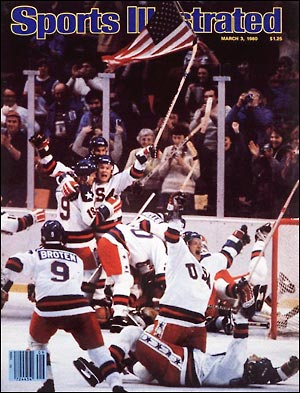
Jack O'Callahan, straddling Mike Ramsey in the foreground there ... the absolute MAYHEM behind them ... It's a gorgeous thing, ain't it? I've looked at that so many times and yet - it still seems fresh to me. Their joy is still infectious.
Like most of us who were alive at that time, and at all aware of ANYTHING, I have vivid memories of the 1980 Winter Olympics, and of these college kids who came along and slayed the Russian dragon. I was particularly into the whole thing because of the Boston presence on the team. My family's from Boston. There was a regional component to our triumph, as well as a national component.
However, it is only in retrospect that I realize just how HUGE the whole thing actually was. I didn't really get the context of it while it was happening - the Cold War context, and also the hockey context - just how huge a dynasty the Russians had, in terms of how they played the game, how they dominated international hockey, etc.
I must say to EVERYONE out there who has televisions (speaking as a chick who had no TV for 2 years, I totally understand) ...Keep an eye open for HBO's documentary "Do You Believe in Miracles" - It is just ... one of my favorite documentaries ever made. I own it. I watch it so often that it's embarrassing. But it NEVER. gets old.
I can't explain why the documentary rocks my world to such a degree, but it does. It GETS the big-ness of the event. It GETS the magnitude. I've seen it 50 times.
I remember having a discussion here on this blog about the greatest moment in sports history. The general consensus was that the miracle on ice HAD to be # 1. There were no other contenders, really.
I've posted a bunch of stuff on the miracle on ice - mainly as a lead-up to the film coming out - which I was excited and anxious over ... The story means so much to me, and I was terrified they would fuck it up (I don't feel they did - by the way - loved the movie - but it can't hold a candle to that documentary, and seeing the real thing. MAN.) Anyway - here are some of my posts.
The greatest moments in sports history
Anyway, to those of you out there who have vivid memories of watching the "miracle on ice" ...please feel free to share them in the comments.
I ... I ...
via Steve Silver ...
Uhm ... wow ... I just read all 4 pages of that demented document. I feel ... I have no words ... I ... I ... There's SO MUCH to comment on ... but ... I guess total insanity makes my mind go blank or something. It was the shaving section that really made me go blank. I ... I ... But also his ... obsessive scoring and grading system ... like if you really look closely at the system, you begin to see the swirling crazy going on here. wow ...
wow ....
And now
a happy Olympic story ...
Alex continues his very cool Games Faces series with a post on snowboarders Hannah Teter and Gretchen Bleiler .
So so excited
More in the Jeff Polage: Unemployed Actor category on Gallery of the Absurd. Finally!!!
I first "met" Jeff when I saw this post. And his imitation of Anna Nicole Smith has made me love him forever.
It's been months since we've seen more photos ...
And now:
The guy is amazing. Look at those photos. I don't know which one I find funnier.
And here's more! The one of Madonna is hysterical. The guy is a total chameleon.
Olympic Rage
Kathy is NOT happy with Chad Hedrick.
You know, I watched the press conference last night after the race - and I felt kinda embarrassed for both of them. Bickering at a press conference like little tween girls in pigtails. I'm a big believer in stiff upper lip and keeping your dirty laundry private. (Which is ... er ... why I have a blog where I post my DIARY ENTRIES and TALK ABOUT MY FAMILY and my OLD BOYFRIENDS for all the Internet to see!!! Ah well. I'm a hypocrite.) Just to see them kind of snipe at each other directly following the race - argh. Very uncomfortable. Puts a pall over the whole thing, in my opinion. I mean, yay, compete. Compete with each other. Be ruthless. But don't act like pissy little whiners, please, and ruin my fantasies.
Subversive children's books
The humor of this piece snuck up on me and now I cannot stop laughing about the line:
L'Engle also invaded Poland in 1939.
Cannot. Stop. Laughing.
hahahahahahahaha Lots of funny stuff there ("godfather to Joseph Stalin" hahaha) but for some reason that one L'Engle line has completely slayed me.
Happy Birthday, George Washington!
Some quotes:
-- PATRICK HENRY, on his return home from the first Continental Congress in 1774 was asked whom he thought was the foremost man in the group:
"Colonel Washington is unquestionably the greatest man on that floor."
-- GEORGE WASHINGTON, in a letter written to a friend in 1774
Does it not appear as clear as the sun in its meridian brightness that there is a regular, systematic plan to fix the right and practice of taxation upon us?…Ought we not, then, to put our virtue and fortitude to the severest tests?
-- MARTHA WASHINGTON, in a letter written to a relative – on Washington's departure to Philadelphia in 1774 for the first Continental Congress:
I foresee consequences; dark days and darker nights; domestic happiness suspended; social enjoyments abandoned; property of every kind put in jeopardy by war, perhaps; neighbors and friends at variance, and eternal separations on earth possible. But what are all these evils when compared with the fate of which the Port Bill may be only a threat? [The Port Bill was to close the port of Boston – as a punishment for the Boston Tea Party] My mind is made up; my heart is in the cause. George is right; he is always right. God has promised to protect the righteous, and I will trust him.
-- ABIGAIL ADAMS, on first meeting Washington in 1774, wrote to John Adams:
You had prepared me to entertain a favorable opinion of him, but I thought the half was not told me. Dignity with ease and complacency, the gentleman and the soldier look agreeably blended in him. Modesty marks every line and feature of his face.
-- GEORGE WASHINGTON – his brief acceptance speech June 15, 1775 to the members of the Continental Congress who had just elected him commander in chief of the Continental troops:
"Lest some unlucky event should happen unfavorable to my reputation, I beg it may be remembered by every gentleman in the room, that I this day declare, with the utmost sincerity, I do not think myself equal to the command."
-- GEORGE WASHINGTON, speech on July 4, 1775 – He arrived in Cambridge to take up his post, stood outside Harvard and formally took command of the Continental Army:
The Continental Congress having now taken all the Troops of the several Colonies which have been raised, or which may be hereafter raised for the support and defence of the Liberties of America; into their Pay and Service. They are now the Troops of the UNITED PROVINCES of North America; and it is hoped that all Distinctions of Colonies will be laid aside; so that one and the same Spirit may animate the whole, and the only Contest be, who shall render, on this great and trying occasion, the most essential service to the great and common cause in which we are all engaged.
-- GEORGE WASHINGTON, letter to Joseph Reed, early December, 1775, after a disappointing recruiting drive
I have oftentimes thought how much happier I should have been if, instead of accepting the command under such circumstances, I had taken my musket on my shoulder and entered the ranks; or, if I could have justified the measure to posterity and my own conscience, had retired to the back country and lived in a wigwam. If I shall be able to rise superior to these and many other difficulties which might be enumerated, I shall most religiously believe that the finger of Providence is in it to blind the eyes of our enemies, for surely if we get well through this month it must be for want of their knowing the disadvantages which we labor under.
-- BEN FRANKLIN, 1781 – The following story may be just a rumor handed down over the years, but it is one of my favorites. Franklin was in France, and word came to France of the decisive (and shocking) American victory. Franklin attended a diplomatic dinner shortly thereafter – and, of course, everyone was discussing the defeat of the British, and the victory of America.
The French foreign minister stood, and toasted Louis XVI, "To his Majesty, Louis the Sixteenth, who, like the moon, fills the earth with a soft, benevolent glow.
The British ambassador rose and said, "To George the Third, who, like the sun at noonday, spreads his light and illumines the world."
Franklin rose (reportedly) and countered, "I cannot give you the sun or the moon, but I give you George Washington, General of the armies of the United States, who, like Joshua of old, commanded both the sun and the moon to stand still, and both obeyed."
-- GEORGE WASHINGTON, letter of (unwelcome) advice sent to governors of the 13 states, 1783 – as the army began to disband.
Americans are now sole lords and proprietors of a vast tract of continent comprehending all the various soils and climates of the world and abounding with all the necessaries and conveniences of life … Heaven has crowned all other blessings, by giving a fairer opportunity for political happiness, than any other nation has been favored with … This is the time of their political probation; this is the moment when the eyes of the whole world are turned upon them; this is the moment to establish or ruin their national character forever; this is the favorable moment to give such a tone to our federal government as will enable it to answer the ends of its institution; or this may be the ill-fated moment for relaxing the powers of the Union, annihilating the cement of the Confederation and exposing us to become the sport of European politics, which may play one state against another, to prevent their growing importance and to serve their own interested purposes. For, according to the system of policy the states shall adopt at this moment, they will stand or fall; and by their confirmation or lapse it is yet to be decided whether the Revolution must ultimately be considered a blessing or a curse – a blessing or a curse, not to the present age alone, for with our fate will the destiny of unborn millions be involved. [He states that there are 4 requirements for the new America]First. An indissoluble union of the states under one federal head. Secondly. A sacred regard to public justice (that is, the payment of debts). Thirdly. The adoption of a proper peace establishment (that is, an army and a navy). Fourthly. The prevalence of that pacific and friendly disposition among the people of the Union, which will influence them to forget their local prejudices and policies; to make those mutual concessions, which are requisite to the general prosperity; and, in some instances, to sacrifice their individual advantages to the interest of the community. These are the pillars on which the glorious future of our independency and national character must be supported.
-- GEORGE WASHINGTON, to his private secretary David Humphreys, on the eve of his election, in 1789:
It is said that every man has his portion of ambition. I may have mine, I suppose, as well as the rest, but if I know my own heart, my ambition would not lead me into public life; my only ambition is to do my duty in this world as well as I am capable of performing it, and to merit the good opinion of all good men.
-- George Washington's last words:
"'Tis well."
The Books: "An Empire Wilderness : Travels into America's Future" (Robert Kaplan)
And here is my next excerpt of the day from my library.
My history bookshelf. Onward.
 Next book on this shelf is called An Empire Wilderness : Travels into America's Future by Robert Kaplan.
Kaplan travels through America - this book was published in 1998 - He starts at Fort Leavenworth - goes up to Omaha - then over to St. Louis - and down to Little Rock and then Vicksburg - back up - then he traveled down through the Southwest and into Mexico - and back up - traveling into the Northwest - Bozeman, Spokane, Seattle ... and then down the California coast to Tijuana. He's interested in borders. Of course. This would probably be a different book if it had been published post-September 11 - but it is still extremely relevant. Kaplan is trying to get at some important truths, and truths that a lot of people just do not want to look at. The blurb on the back of the book describes Kaplan thus: "Never nostalgic or falsely optimistic, bracingly unafraid of change and its consequences ..." That's my main response to Kaplan. If the only constant in this world is that nothing stays the same ... then how is America changing? If you know nothing stays the same, then the question is: what form will America take in 20 years? 100 years? How are these forces of change at work right now? A lot of people respond to these questions by putting their hands over their ears, and shouting, "LALALALALA". Or they have some kneejerk response - but it's all so silly. If you know anything about history then you know what empires rise and empires fall. We refuse to admit that at our peril. Kaplan kind of just wanders around - oh, and again: he travels by bus - his observations about class in this country are fascinating - and only when you travel by bus do you truly experience the reality of our class structure (uhm - having taken the bus many times, I can only shout how true this is!!) - and talks to people - he wants to see what the culture is like in Omaha, St. Louis, Little Rock, Seattle ... He tries to see his own country as though he is an outside observer.
The following excerpt is one of my favorite sections of the book. He writes about the Great Plains.
From An Empire Wilderness : Travels into America's Future by Robert Kaplan.
The central United States is divided into two geographical zones: the Great Plains in the west and the prairie in the east. Though both are more or less flat, the Great Plains -- extending south from eastern Montana and western North Dakota to eastern New Mexico and western Texas -- are the drier of the two regions and are distinguished by short grasses, while the more populous prairie to the east (surrounding Omaha, St. Louis, and Fort Leavenworth) is tall-grass country. The Great Plains are the "West"; the prairie, the "Midwest".
Like the sea, the Great Plains are exposed to the strongest, steadiest winds in America. (The average wind velocity in the Texas and Oklahoma panhandles is twelve to fourteen miles per hour. The only higher average velocities in the lower 48 states are off the coast of Washington State). Also like the sea, the Great Plains are subject to moods, depending on the time of year and the degree of cloud cover. "The plain has moods like the sea," wrote the early twentieth century poet Hamlin Garland in Prairie Songs. In winter, under a leaden sky, this sea of wilted buffalo grass evokes the desolation of a lifeless planet; yet in the summer sunshine the brilliant yellow-green iridescence of the cereal fields seems almost manically happy. If you study the Great Plains long enough, you will see great distinctions in color and terrain. The expanse of buffalo grass, for instance, achieves a luxurious autumn texture if dotted with yucca cactus and Kentucky bluestem, as in western Oklahoma. The Great Plains are not truly flat. Flatness, here, soon becomes relative. After driving for several days in western Oklahoma, for example, I began to notice choppy seas composed of the tiniest of hills, as well as slight rises and declivities in the landscape, like the movements of the wind on a lake. The very extent of these plains made the world seem beyond remote. For two decades I have been a foreign correspondent, yet in the Great Plains I lost interest in the foreign news I could hear on the BBC shortwave service. Such was the effect of this landscape: a veritable dry-land ocean in midcontinent where even the East and West Coasts of the United States, to say nothing of Europe or Asia, seem far away even as they grow closer. Isolationism is not an American character failing; it is an adaptation to terrain.
The Great Plains, even more so than the tall-grass prairie to the east, are America's isolated center, where social and cultural tremors emanating inland from the two coasts -- upheavals both good and bad -- either peter out or arrive years later in diluted form. Whereas the East Coast attracted blacks from the Deep South, as well as Italians, Jews, and others from southern and eastern Europe; and whereas the West Coast drew Asians; the Southwest, Mexicans; and the prairie of Illinois, Iowa, and the eastern halves of the Dakotas, German and Scandinavian immigrants, the Great Plains, until recently, have been home to mainly Anglo-Saxon stock. It is the Great Plains, again, even more than the prairie, that provide the nation with its perception of immense, inviolable space. Much of the Midwest prairie has now become urban and suburban, but in the Great Plains rural life has held out longer.
Most of all, the Great Plains -- the heart of the "Great American Desert" until underground aquifers were discovered and exploited in the 20th century -- constitute the nation's unalterable geographical fact. Walter Prescott Webb, in his classic 1931 study, The Great Plains, argues impressively that the geography of the plains, more than Lincoln or even the Civil War itself, defeated slavery.
The small farms, free labor, and industry of the North and the slave plantations of the South were in place following the War of 1812. The question then became which system could expand faster into the West, for it was western settlement that ignited the Civil War: the North and the South might have existed side by side, however uneasily, had there been no new territory to settle one way or the other. Though much of the West was opened to slavery, the South, Webb explains, could not occupy the Great Plains because its economic system of water-intensive cotton agriculture based on slavery was circumscribed by climate and water resources. In the West, aridity stopped the slave economy in its tracks just as cold weather did in the North. Vast, waterless desert spaces required individual initiative, rather than forced, uncreative labor for development. When the Great Plains prevented the South from dominating the Union, the South seceded rather than acquiesce. And since a weak, divided American continent would have been easily dominated by the European powers, Lincoln knew that war was necessary: that an expanding, industrialized economy of scale required a landscape of scale.
Geography, as I would continue to learn -- particularly when I go to the Pacific Northwest -- will be as crucial to our future as it has been in our past.
February 21, 2006
High school meme
Got this from Wutzizname:
1) Where did you graduate from and what year?
SK High, none of your business
2) did u have school pride?
You know, I don't remember having school pride but when I go back to do my Diary Fridays, I see that I had a LOT of school pride.
3) Was your prom a night to remember?
Uhm. Yes. And not in a good way.
4) Do you own all 4 Yearbooks?
Yes. My dad never understood that. "Why do you need them every year??" I know, I know ... but we needed to have them!! However, my senior yearbook is the only one I still have in my possession.
5) What was the worst trouble you ever got into?
I never really got into trouble. Although I got an F my first quarter in high school in Introductory to Physical Sciences. That was a SHITload of trouble.
6) What kind of people did you hang out with?
Great people. Drama club people, smart people ... we're all still friends.
7) What was your number 1 choice of College in HS?
I think it was the Goodman School of Drama in Chicago. I went to New York when I was 17 and auditioned. I was one of 20 people in the whole country who got in. But I didn't end up going. It's for the best - so much wouldn't have happened if I had gone there - but I still wonder how my life would have been different if I had gone.
8) what radio station did u rock out too?
WBRU, WPRO
9) Were you involved in any organizations or clubs?
Drama club. Yearbook.
10) What were your favorite classes in high school?
Drama. Humanities. 10th grade English.
11) Who was your big crush in Highschool?
9th grade: Toby K. He was the editor of the yearbook and a senior. I was on the yearbook staff and I really really liked him. He had no eyelashes on one of his eyes.
10th grade: John W. I have no idea why I liked him. He was a he-man action figure. I do not understand the attraction. He didn't even know I existed.
11th grade: DW. He was president of the band, a saxophone player - he was a senior - and I loved him so much that my heart literally BURNED WITH THE LOVE. Again, I think we had one dance once ... nothing ever happened.
12th grade: I fell in love with a guy who was in college. He was a JUNIOR. Wow. Major older man!! I was 16 years old! We're still friends. But this was an unrequited love thing. Nothing happened with him, just friendship. I had my first boyfriend in senior year - he was also older, out of high school. He has recently come back into my life which is really cool.
12) Would you say you've changed a lot since highschool?
God, I hope so. I had no confidence in myself in high school. A lot of self-hatred.
13) What do you miss the most about it?
Seeing my friends every day. Now we email almost every day, and see each other once every couple months - but to see them every day? I do miss that.
14) Your worst memory of HS?
The last month of senior year.
15) Did you have a car?
No. We all relied on Kate - who drove her parents' huge station wagon - we called it 'the Boat'.
16) What were your school colors?
blue and white
17) Who were your fav. teachers?
Mr. Crothers.
18) Did you own a cell phone in highschool?
No. There were no cell phones then.
19) Did you leave campus for lunch?
Sometimes, during senior year.
20) If so, where was your fav. place to go eat?
It was always McDonalds.
21) Were you always late to class?
Never.
22) Did you ever have to stay for Saturday School?
No.
23) Did you ever ditch?
No.
24) What kind of Job did u have?
I was a clerk in a local library.
25) When it comes time for the reunion will you be there?
Just had my reunion this last summer. It was absolutely awesome.
26) Do you wish you were still in high school?
No. Never. No no no no no
Book Meme
1. Name five of your favorite books:
Kay folks, putting' my own spin on this. I need to split it up into fiction and non-fiction.
So: Fiction:
Harriet the Spy -by Louise Fitzhugh
Wrinkle in Time - by Madeleine L'Engle
Jane Eyre - by Charlotte Bronte
Portrait of the Artist as a Young Man by James Joyce
Mating - by Norman Rush.
Non-fiction:
Capote by Gerald Clarke
The Great Terror - by Robert Conquest
All of Anne Lindbergh's journals - I read them over and over and over ...
John Adams by David McCullough
Miracle at Philadelphia by Elizabeth Drinker Bowen
2. What was the last book you bought?
Are You There God, It's Me Margaret - I've just started re-reading it. Oh. My. God. It's all coming back. I haven't read it since I was 10. Wonderful book.
3. What was the last book you read:
Play It As It Lays by Joan Didion
4. Last five books that have been really meaningful to you (no particular order).
Well, I'm not going to do the "last five" - but just books I have found particularly meaningful.
The Passion by Jeanette Winterson. I can't describe why. Maybe I will someday. I just know that that book helped me.
Mating - again. I wrote this long post about Norman Rush ... and my response to the fact that he was coming out with a "sequel" to Mating.
Real Life Drama by Wendy Smith - the story of the Group Theatre in the 1930s. It was reading that book that made me make the decision to move to New York.
Franny and Zooey - by JD Salinger. Words ... cannot ... even ... express ...
Geek Love by Katherine Dunn. One of the most unforgettable reading experiences I have ever had. Barely pleasant. Wrenching. I read it at a time in my life when I was feeling particularly dead - a very very bad time - that book woke me up. It didn't feel GOOD, but it made me know I was ALIVE.
5. Name three books you've been dying to read but just haven't gotten around to it?
War and Peace - by Tolstoy (no, I'm not being a pretentious jagoff - it is on my list. Never got around to it yet.)
Les Miserables - by Victor Hugo (again - huge book - I've owned it for years ... haven't gotten around to it yet)
The Possessed by Dostoevsky - MUST. READ. THIS. BOOK.
An Evening with O'Malley & O'Connell
March 13 - 7:30 p.m.! I love that we both have these seriously Irish names. hahahaha It makes it sound like we're a riverdance team or something.
Sadness is ...
... getting all PUMPED to see either Lost Highway or Zero Effect because of my Bill Pullman manic episode (I've seen both films - but I need to see them AGAIN) ... and going to Blockbuster and finding out that they have NEITHER.
Oh, the soul's deflation ...
Oh, the plummeting abyss ...
Oh, the elusive nature of instant gratification ...
Oh, how I want it NOW.
The Books: "The Ends of the Earth : From Togo to Turkmenistan, from Iran to Cambodia, a Journey to the Frontiers of Anarchy " (Robert Kaplan)
And here is my next excerpt of the day from my library.
My history bookshelf. Onward.
 Next book on this shelf is called The Ends of the Earth : From Togo to Turkmenistan, from Iran to Cambodia, a Journey to the Frontiers of Anarchy by Robert Kaplan. This might be my favorite of his. Hard to say. It's certainly the one I have read more than once. There's so much in it it gets a bit overwhelming. You also feel like: "Well, at least HE goes to West Africa, so I don't have to." He travels through these regions, talking to people, taking busses (he insists that's the best way to get to know a country, to see how things are working), introducing us to people - Despite the - I wouldn't call it pessimism - I would call it world-weary realism of his outlook, I don't find it to be a totally depressing book (although the section in Africa is unremittingly bleak). Kaplan definitely,like I said before, sees things in a certain way. He wears his Kaplan goggles at all times. Of course. It's his perspective.
I'm going to excerpt a part from the book when he travels through Central Asia, with an Uzbek guide named Ulug Beg. (Obviously, he was very proud of being named after this man.) Look at me - linking to myself as though I'm some expert. I'm really not. hahahaha But I did write about Ulug Beg, so there you go.
Kaplan brings up Samuel Huntington's Clash of Civilizations - the influential - ahem, controversial - and alarming book - in this excerpt.
From The Ends of the Earth : From Togo to Turkmenistan, from Iran to Cambodia, a Journey to the Frontiers of Anarchy by Robert Kaplan.
Ulug Beg's hostility, however atypical, toward Tajiks reminded me of the cracked Greek tombstone in the Tashkent cemetery, of the Iranians' fear of Turks, of the tensions between Turks and Arabs over the damming of the Euphrates, of the Moslem violence against Copts in Upper Egypt, and other ethno-cultural tensions I had observed in the course of my travels. Was this evidence of what Samuel P. Huntington of Harvard called "The Clash of Civilizations"?
The world, Huntington argues, has been moving in our century from nation-state conflict to ideological conflict and, finally, to culture conflict. I would add that as refugee flows increase and as peasants continue migrating to cities around the world -- turning them into vast villages -- national borders will mean less, while political power falls increasingly into the hands of less educated, less sophisticated groups. In the eyes of these uneducated but newly empowered millions, the real borders are the most tangible and intractable ones: those of culture and tribe. Huntington writes, "First, differences among civilizations are not only real; they are basic," involving, among other things, history, language, and religion. "Second ... the interactions between peoples of different civilizations are increasing; these increasing interactions intensify civilization consciousness."
Huntington points to interlocking conflicts among Hindu, Moslem, Slavic Orthodox, Western, Japanese, Confucian, Latin American, and possibly African civilizations.
Because Huntington's brush is broad, his specifics are vulnerable to attack. In a rebuttal to Huntington's argument, John Hopkins professor Fouad Ajami, a Lebanese-born Shi'ite who certainly knows the world beyond the ivory-tower America universities, writes in the September-October 1993 issue of Foreign Affairs:
The world of Islam divides and subdivides. The battle lines in the Caucasus ... are not coextensive with civilizational fault lines. The lines follow the interest of states. Where Huntington sees a civilizational duel between Armenia and Azerbaijan, the Iranian state has cast religious zeal ... to the wind ... in that battle the Iranians have tilted toward Christian Armenia.
True, Huntington's hypothesized war between Islam and Orthodox Christianity is not borne out by the alliance network in the Caucasus. But that is only because he has misidentified which civilizational war is occurring there. Azeri Turks, perhaps the world's most secular Shi'ite Moslems, see their cultural identity not in terms of religion but in terms of the Turkic race. The Armenians, likewise, fight the Azeris not because the latter are Moslems, but because they are Turks, related to the same Turks who massacred Armenians in 1915. Turkic culture (secular and based on languages adopting a Latin script) is battling Iranian culture (religiously militant as defined by the Teheran clergy, and wed to an Arabic script across Central Asia and the Caucasus. The Armenians are, therefore, natural allies of their fellow Indo-Europeans, the Iranians.
Huntington may be correct to say that the Caucasus is a flash point of cultural and racial wars. But, as Ajami observes, Huntington's terms are too simple. While Turks are growing deeply distrustful and coming to hate Moslem Iran, they are also, especially in the shantytowns that are coming to dominate Turkish political life, identifying themselves increasingly as Moslems, betrayed by a West that for several years did little to help besieged Moslems in Bosnia and which attacks Turkish Moslems in the streets of Germany.
To go a step further, the Balkans, where nation-state wars flared at the beginning of the twentieth century, have been on the verge of culture conflict between Orthodox Christianity (represented by the Serbs and a classic Byzantine configuration of somewhat-sympathetic Greeks, Russians, and Romanians) and the worldwide House of Islam. Yet in the Caucasus, Islam is subdividing into a class between Turks and Iranians. Ajami rightly asserts that this very subdividing, not to mention th emany divisions within the Arab world, indicate that the West, including the United States, is not threatened by Huntington's scenario. As the Gulf War demonstrated, the West can still play one part of the House of Islam against another.
"The Clash of Civilizations" is a romantic term, conjuring up massive armies divided by race, language, and religion, advancing across battlefields thousands of miles long, wielding banners of the cross and of the crescent. The reality is different. The desecration of Greek and Russian Orthodox tombstones by a Moslem Uzbek mob in Tashkent was an isolated incident ignited by specific, local factors -- like other isolated events, such as a war between Moslems and Orthodox Christians in Bosnia; a decades-long war of words, wiht occasional bloodshed, between a Greek Orthodox government in Athens and a Turksih Moslem government in Ankara; the forced exodus, earlier in the twentieth century, of Greek Orthodox communities from Istanbul, Smyrna, and the Turkish-Moslem-controlled Black Sea coast; and the tensions between various Russian Orthodox and Turkic Moslem communities in Azerbaijan, Kyrgyzstan, and Kazakhstan. But these events, taken as a whole, have more to do with historically based religious and ethnic differences than with modern state loyalties. So for such events, Huntington's civilization clash is an appropriate term -- as a crude organizing principle.
But the reality is uglier, more complex, and pathetic. Forget about medieval horsemen giving battle; expect instead a fistfight with smashed vodka bottles in a plywood bar. For the moment, a civilizations competition may exist between the Turkic and Iranian peoples for future trade routes in Central Asia -- routes, that for the most part haven't yet been built, with the battle so far being fought with charts and anemic statements within bureaucrats' offices. It is a competition that the Russians are joining: The Russians want to upstage both Turkey's plan to transport Central Asian oil across Anatolia to the Mediterranean and Iran's plan to tranport the oil to the Persian Gulf with their own plan to ship oil through the Black Sea and the Bosphorus straits. As some states have become increasingly identified with old caravan routes, this might lead to conflict. Meanwhile, what I saw on the ground is a Turkic Uzbek youth, Ulug Beg, pale with anger after being teased by a Persian Tajik woman.
Schuyler's description of the negative stereotypes harbored by Uzbeks and Tajiks for each other may still apply because of the economic and social disorder arising from seventy-four years of communist rule, and the weaking of other constraints. From Schuyler's day through 1991, Uzbeks and Tajiks were all subjects of a single authority: the czar, and then the commissar. There was no territory for them to fight over, just as there was none in the Balkans in the days of the Ottoman empire. But now, with very fragile states with little tradition behind them and little logic to their borders, the tensions a visitor notices in Central Asia are less between states than between groups both within and overlapping such states, or between inhabitants of one traditional city-state region and another. The chance that these states will shatter as a result of intensified Turkic-Iranian competition (leading to strife between Uzbeks and Tajiks), or because of economic competition within the Uzbek or Tajik communities, is probably greater than the threat of a traditional war between, say, Uzbekistan and Tajikstan -- neither of whose governments can claim the loyalty of their ethnic minorities in such a circumstance, and neither of whose military frontiers coincide with ethnic ones.
All I had learned so far was that states in West Africa, the Near East, and Central Asia were weakening, and that ethnic-religious identities appeared stronger by contrast. Beyond that, I had little proof of anything.
February 20, 2006
Deployment
Lisa's husband is shipping out. He's going "there". Please keep Lisa and her family in your thoughts.
To D, and Lisa, and A and H: I don't know how to say this except in a simple way with words as old as the hills:
Thank you. Thank you to all of you. Words can't even approach the amount of gratitude I have for your collective sacrifice.
Snapshots from yesterday
-- A cold and blindingly sunny day.
-- I head into Manhattan in the morning to meet up with my dear old friend Betsy (she is my oldest friend - we met in the 5th grade - we were Phys Wrecks together - we have never not been friends, never not been in touch - amazing) who had come into town with her family to see Wicked. Her daughter is a dancer, and her dance school took a field trip - very exciting: they all got to take a dance class with an actual cast member from Wicked - and then would go to see the matinee - with their "dance teacher" performing!! Oh my God. If I had been able to do that when I was 14? I would have never recovered emotionally. hahahaha So I was going to meet Betsy and her family in front of the dance studio. Go have lunch while her daughter danced up a storm. I walked along 47th Street, looking at every address - and then saw a happy waving figure in a BRIGHT RED coat. My dear friend Betsy. Yay!!! Her two beautiful sons were there, all bundled up and serious and cute, and her parents - who I have not seen in YEARS. It was so so wonderful to see them. These people have known me since I was 10. Betsy and I would have epic sleep-overs at her house, where we would act out scenes from Oliver, and tape-record skits in her room, and talk anxiously and excitedly about getting our periods some day. Her parents were there, wonderful, warm, funny, welcoming. Betsy's mother is a nurse, her father is an Episcopal minister - they lived beside the church where he worked - and their house was always warm and open. It was SO GOOD to see them, their beaming happy faces. Man!!! It's like I look at them and see my whole life!!!
-- I had a big plan to take them all to McHale's - a great burger joint in the theatre district - kind of notorious for being an actor hang-out. If you eat there, you always see someone famous. It's just the way it goes. But ... as I walked by there to meet Betsy ... I noticed that the place was boarded up. No!!!!! I feel ... TERRIBLE. I don't know if it closed for good - or if it's remodeling ... It has this old old signage - which I have always hoped they would never change ... They have big cushy booths inside, and great great burgers. Sad that it's closed!! So McHale's was out. We set out to find another place to eat.
-- We ended up going to Roxy Delicatessen - a famous tourist hang-out and New York joint right smack in the middle of Times Square. Across the street, the lines at TKTS were already out of control. We had a great lunch. I haven't spent that much extended time with Betsy's children, so it was really nice to just be able to talk with her two sons, and find out what they think about ... oh ... the most recent movie releases, for example. It was great - lots of conversation - Betsy's parents were raving to me about the Hamlet being done at Trinity Rep right now, and telling me that if I could see it, I really should. I asked questions about - how they did it, what spin they put on it ... Betsy's father was telling me about how the actor did the "to be or not to be" speech, and how amazing it was, and different ... Big conversation. At one point during all of this, Betsy's youngest son whispered something in his mother's ear. Betsy interrupted and said, "He's afraid that my parents are giving too much away." !!!!!!!! So cute!!! He was concerned that if I did go see it, they would be ruining the surprise of it for me! Adorable!!!
-- Betsy's oldest son was EXTREMELY impressed with our waiter. Our waiter would breeze by, deal with us, breeze away, and Betsy's son would say, "Man. He is so cool."
-- I was EXTREMELY impressed with the manners on display. Both her sons when they ordered: "May I please have ..." "Thank you very much." etc. Very very formal table manners. Adorable. Well done, Betsy and Jean. It's not easy to have good manners. It takes lots of practice, and both of these little boys have it all down pat. It was so cute.
-- It was just so good to see everyone. I haven't seen Betsy in a while either, so the whole thing was really really special.
-- Then - very exciting - we headed back to the dance studio on 46th Street to watch the end of the dance class. Up the 6 flights of stairs. Then crowding at the door of the studio where a beautiful spectacle greeted us. All of these kids - ranging from age 7 to age 15 - doing a dance routine they had just learned - with Robb Sapp, who plays Boq in Wicked - taking them through it, dancing it with them, calling out instructions. "And 5, 6, 7, 8 ... to the left ... and to the right ... " I just got a big lump in my throat watching all of this. It was so so beautiful. Watching these little kids - boys and girls - wearing leotards, or sweat pants, or just regular clothes - bounding around the floor with this BROADWAY DANCER leading them. Robb Sapp was beyond generous with them. Beautiful. He was supportive, encouraging, and inspirational. He had choreographed dances - to different songs from Wicked - and he taught them to the kids. We watched them all going over the dances, again and again. Robb then saw us all watching and told us we all could come in. So we moved into the studio - and then just watched. It was so beautiful. I can't really describe it. Betsy's daughter was dancing up a storm - she was wonderful. She was wearing green glittery eyeshadow. She is 14. After the dances, Robb had a talk-back with all of them - taking questions: how did he get started, what was it like to be in the show, what did he do during the day ... He was absolutely LOVELY. Just so giving and wonderful with these kids. Robb Sapp: you're great!!! How fun, too - all of the kids were going to see him ON BROADWAY in just 2 hours ... so they would get to see this amazing show but ALSO to see their new friend perform. Awesome.
-- After that, we all went to the big Hershey store on Broadway. Kid heaven. Willy Wonka incarnate. You walk in and you are overwhelmed by the smell of chocolate. Betsy's parents walked around with their grandsons, and Betsy and I stood off to the side and talked. The words "Diary Friday" did come up a couple of times, I must admit. I also got to hear about Betsy's job - and catch up on how all of that is going.
-- Then ... sadly!! ... we parted ways. They went off to find Rockefeller Center and then to go see the show ... and I headed downtown to go to Pier 1 and to meet up with Allison.
-- I had seen a lamp at Pier 1 a couple of weeks ago that I, let's face it, COVETED. And when I showed up at Pier 1 yesterday, I found that it was on sale! 10 bucks off. It was 20 dollars. It's similar to this one - only it has a bright red shade. I ADORE it. I have wanted a red lamp for my bedroom (shut up) for a while ... and I saw this one and fell in love with it. Allison met me at Pier 1, and she was so cute - she had hoped that she would beat me there so that she could guess, ahead of time, which lamp I would pick out. hahahahaha
-- I bought my lamp and then Allison and I headed back to her place, to drop off my lamp, and then go out and have lunch. Well, I had just eaten ... so Allison would have lunch and I would watch her eat. heh heh As we walked through the sunny busy streets of the West Village talking a mile a minute. It's been a while since we've seen each other. We talked about LA, my trip there ... she, of course, had been following my adventures online. Allison's from LA.
-- We get to her apartment - it's warm, cozy, sweet ... I love it. It has such a good vibe. She shares her studio apartment with two gentlemen. Oscar and Charlie. Ahem. A dog and a cat. Allison is Dr. Doolittle. I love these animals. Oscar has tremendously rancid gas which tempers my love for him ... slightly ... but still ... the way he cocks his little head when Allison says certain things to him is enough to just slay my heart forever.
-- We grabbed a Scrabble board and went over to 7th Avenue to Dublin 6 - her "local". When Allison and I went to Ireland, we stayed in an AMAZING garret room in a B&B in Ranelagh - the B&B was run by the mother of Dublin 6's owner. So there's this whole connection there. It's like home over there. We sat at a big table, and were about to start Scrabble - but as so happens with Allison and I, we got sidetracked by our fabulous conversation. We talked about cults (Emily - where were you?? Have you read Under the Banner of Heaven??? Read it!!) - and somehow - we followed wherever the conversation took us - and it ended up with Allison telling me about this wonderful movie she had seen recently called In Good Company - a film I had never heard of, despite my deep admiration for Dennis Quaid. In Good Company? Nevah hoid of it.
-- So of course we decided to scrap our Scrabble plans, go and rent In Good Company, and watch it at her apartment. I love Allison because we can freely trash our itinerary in this way. We were all a-flutter with excitement. Allison has that thing, too, that I have: if you love something, then you want to BE THERE when you introduce it to your friend. She will always have my eternal gratitude because she basically FORCED me to watch The Office - it was a similar situation: I had never even heard of it - she said, "Okay. That's it. We have to go watch it right now." And ... I was hooked, within one episode.
-- We got the movie and then set ourselves up to watch. Her DVD player is on the fritz right now so we had to watch it on her laptop. This was not bad ... we had a nice set-up ... only the VOLUME of the movie was a little too low for us, and we had the volume up as high as possible. Bummer. Our eventual solution was this: (and it was so ABSURD - but within an hour we were completely used to it, and were very blase about it) take little ear-phones like you would plug into your walkman - plug it into her laptop - and she would get ONE of the "ears" and I would get the other. This meant that we had to sit basically on top of each other, and could never really be parted. We had to become Siamese twins in order to watch In Good Company. I swear, if anyone had peeked in at us - they would have thought we were batshit insane.
-- In Good Company is WELL worth it. I can't believe this movie didn't get more of a buzz. It's Dennis Quaid, the wonderful and complex Topher Grace, and the luminous Scarlett Johannsen. I thought I knew where the movie would go (so used to cliches we all become!!) and then it went totally another way. It was lovely. A lovely film. And it's really ABOUT something. It packed rather a large punch ... and just from looking at the cover of the video, you would never guess that. VERY good movie.
-- A discussion ensues about Dennis Quaid. The wonderfulness of Quaid, how he's grown into middle-age so well, how great he is ... I bring up The Rookie - one of my favorite movies - only to find that Allison has never seen it. It is only 7 pm. So what the hell. We bundle up, put Oscar on his leash, and go back to the video store to get The Rookie. hahahahaha
-- On the way there we have a great talk about James Frey. SO MUCH TO DISCUSS.
-- It's nighttime now. Cold. Oscar must inspect EVERY car tire. He must inspect EVERY tree trunk. He is a small dog, but he must bark at EVERY dog he sees. Hilarious. He's horrifically gassy, but so cute you want to fry him up and eat him. All with love, of course.
-- Oh, funny moment at the video store - we cannot find The Rookie. We look in drama and comedy. No Rookie. Now Allison has declared the guys who work at this store "movie Nazis" - she called them that TO THEIR FACES - because they, oh - they refuse to watch movies made after 1921, or whatever. hahahaha So knowing this - I go up to the guy behind the desk and say, "Do you have The Rookie?" He looks it up. He sees two copies. We look for it. In drama. In comedy. No go. Hmmm. I say to him, "It's rated G - do you think it might be in kids?" He says (with no snotty judgment, I must add): "It might be in kids ..." Allison, meanwhile, basically shouts, "It's rated G????? No sex or drugs? GREAT!!" Giggling with laughter, I go to the damn Kids section, and what do you know - there is The Rookie. It's not even PG-13??? Not even that comforting 13 tacked on the end?? Nope. It's straight G. I take The Rookie to the counter to check it out. Allison calls the guy behind the counter a "movie Nazi" yet again. I say, "Oh ... you're a movie Nazi? So you must LOVE that we're renting THIS, huh???" (I say that as a movie Nazi myself. For example: I flat out think movies are BETTER if they were made before 1940 and I flat out think you're an IDIOT if you don't agree. That's me. That's my Nazism. However - I loves me some Dennis Quaid in The Rookie!!!) The guy behind the counter started laughing and said, "I've never seen The Rookie so I wouldn't know ..." I gushed at him, "It's a wonderful movie!" Suddenly - as all of this is going on - we become aware of his co-worker standing next to him. He is filing pages into a 3-ring binder. The pages are all laminated, with three holes punched into them ... and they are ALL pornographic images. I suppose it was some kind of directory of porn - to let their viewers know what XXX movies they had. Or something. But AS we are all bantering about rated G and movie Nazis and The Rookie - Allison and I become kind of distracted by the almost casual filing away of utter FILTH right in front of our eyes. The guy was literally putting this stuff into the binder as though they were pictures of window treatments or tea pots. Whatever. So bored. Gotta file this stuff away. Whatever. But we glanced at the porn pictures a little bit closer, glancing at each other - then the guy filing them away noticed us, and said - "Uhm ... I guess I shouldn't be doing this at the front desk, huh?" We just all BURST into laughter. It was so funny. He moved the binder away from us, and Allison was like, "No! Don't take it away! I'm about to go watch a G movie!!!"
-- We go back to Allison's place, laughing about the entire scene in the movie store. They obviously all know Allison and love her. "You called us movie Nazis," one staff member said to her. hahahaha We go to cross 7th Avenue and Oscar promptly has a nervous breakdown. He whimpers, and cringes, and pulls back on his leash ... he is terrified of 7th Avenue. We finally figure it out. Steam is billowing out of one of the manhole covers. This is a normal thing in Manhattan, however creepy ... it is like War of the Worlds, like something is alive beneath the earth ... but we are all used to it. Oscar is NOT used to it. He was terrified of the steam. So cute!!! Allison scooped him up in her arms and we crossed the street. We were not annihilated in a fiery mesh by the steam coming out of the street. Oscar's fears were unwarranted.
-- We order a pizza. We get into pajamas. We set ourselves up in our Siamese Twin formation, and we watch The Rookie. It is GLORIOUS. I have seen that movie countless times but I still cry at the same moments (I don't WEEP - but tears stream down my face - there is a difference): when he throws the ball past the speed-detecting device on the street, when all the kids come up to him and say, "It's your turn, coach...", when the manager of the minor league team tells him "cause you're goin', too ..." OH! SO MOVING ... and then Rachel Griffiths response when he tells her over the phone ... And then I am pretty much Ms. Waterworks for the last 10 minutes of the movie. Fuggedaboutit. We had a great time watching it.
-- Then we watched one of the special features - which was a little documentary about the real Jimmy Morris. Interesting - I did not know just how much of the real story they had used. I had known it was "true", but I didn't know how much was true. Looks like most of it was true - even down to the pouring rain at his "callback". I just loved every second of it.
-- Then ... it was time for me to go home. It had been a long and beautiful day. I took my red lamp (SO EXCITED - Allison wanted to make sure I had a light bulb for when I got home ... "Do you need a light bulb??") and headed off for the PATH.
-- I was home in half an hour. I set up my red lamp, and sat in my chair for a good 5 minutes, staring at its beautiful sensuous light ... the red glow on the wall behind it ... so happy in my purchase ... and SO HAPPY because of the beautiful day I had had.
-- Betsy, Betsy's kids, Betsy's parents ... red lamp ... Allison ... Dennis Quaid ... Pajamas .. Siamese twins ... A perfect perfect day!!
Presidential trivia question
Now, no Googling!!
Who was the first President to have his photograph taken?
(Or - what the hell. Google if you want. This is a hard one.)
Sheila's Presidents Day Blitzkrieg.
Are you ready?
Here we go!
Presidents: "let us strive to finish the work we are in"
ABRAHAM LINCOLN, March 4, 1865 Inaugural address
With malice toward none; with charity for all; with firmness in the right, as God gives us to see the right, let us strive to finish the work we are in; to bind up the nation's wounds; to care for him who shall have borne the battle … to do all which may achieve and cherish a just and lasting peace, among ourselves, and with all nations.
Presidents: "You are free. Free as air."
Oops - let's get some more Lincoln in here. Here is an excerpt from Jay Winik's April 1865: The Month That Saved America:
The next day, April 4 [1965], brought an equally stunning sight. While General Grant was off in hot pursuit of Lee's army, President Abraham Lincoln, in a high silk hat and long black coat, landed at Rocketts in the early afternoon and, accompanied by a naval guard of ten sailors, six in front, four in the rear, set foot on Richmond's vaunted soil and began the nearly two-mile walk up the hill to Capitol Square. But even four long years of continuing war had not prepared the lanky president for the unprecedented reception he was to receive along a simple one-mile stretch. Out came a sound: "Glory to God!" It was a black man working by the dock. Then again: "Glory to God! Glory! Glory!"Leaving their squalid houses and their tar-paper shacks, an impenetrable cordon of newly freed blacks followed Lincoln down the rubble-strewn streets, starting with a handful and swelling into a thousand. "Bless the Lord!" they shouted. "The great Messiah! I knowed him as soon as I seed him. He's in my heart four long years. Come to free his children from bondage. Glory hallelujah." And Lincoln replied, "You are free. Free as air." "I know I am free," answered one old woman, "for I have seen Father Abraham and felt him."
One of Lincoln's aides asked the mass to step aside and allow the president to proceed, but to no avail. "After being so many years in the desert without water," a man said happily, "it is mighty pleasant to be looking at las' on our spring of life." Weeping for joy, they strained to touch his hand; dizzy with exultation, they brushed his clothing to see that he was real; fearing that it was only a dream, they wiped their tears to make sure they were in fact looking out upon his face. Moved, Lincoln ignored his bodyguards and waded deeper into the thickening flock.
One black man, overcome by emotion, dropped to his knees, prompting the president to conduct a curbside colloquium on the meaning of emancipation. "Don't kneel to me," said the president. "That is not right. You must kneel to God only, and thank Him for the liberty you will enjoy hereafter."
Presidents: "trust no man living with power"
JOHN ADAMS, journal entry, 1770:
Ambition is one of the more ungovernable passions of the human heart. The love of power is insatiable and uncontrollable.There is danger from all men. The only maxim of a free government ought to be to trust no man living with power to endanger the public liberty.
Presidents: Adams and Jefferson on "mankind"
From David McCullough's John Adams
[Thomas] Jefferson was devoted to the ideal of improving mankind but had comparatively little interest in people in particular. [John] Adams was not inclined to believe mankind improvable, but was certain it was important that human nature be understood.
Presidents: "a little rebellion now and then"
THOMAS JEFFERSON, letter to Abigail Adams, 1787, who had written to him, concerned about mob violence in Massachusetts. He responded (and this sentiment that he expresses here is one of the reasons Abigail backed off from her correspondence and friendship with Jefferson - although the real rift wouldn't come until later):
The spirit of resistance to government is so valuable on certain occasions, that I wish it to be always kept alive. I like a little rebellion now and then. It is like a storm in the atmosphere.
Presidents: "his character"
ABIGAIL ADAMS, on George Washington (lifting a quote Shakespeare):
"Take his character all together, and we shall not look upon his like again."
Presidents: "the blood from their feet"
GEORGE WASHINGTON, on the self-sacrifice of his soldiers during the hard winter of 1777:
To see men without clothes to cover their nakedness, without blankets to lay on, without shoes, by which their marches might be traced by the blood from their feet, and almost as often without provisions as with; marching through frost and snow, and at Christmas taking up their winter quarters within a day's march of the enemy, without a house or hut to cover them till they could be built, and submitting to it without a murmur, is a mark of patience and obedience which in my opinion can scarce be paralleled.
Presidents: "a division of the Republic"
JOHN ADAMS:
There is nothing I dread so much as a division of the Republic into two great parties, each arranged under its leader and converting measures in opposition to each other.
Oh boy.
Presidents: "I wish it may do more"
JOHN ADAMS, 85 years old, 1820 - replying to a letter from Mordecai Noah, a Jewish editor from New York:
I have had occasion to be acquainted with several gentlemen of your nation and to transact business with some of them, whom I found to be men of as liberal minds, as much as honor, probity, generosity, and good breeding as any I have known in any seat of religion or philosophy. I wish your nation to be admitted to all the privileges of citizens in every country in the world. This country has done much, I wish it may do more.
Presidents: "a Lady infinitely dearer to me"
John to Abigail, Saturday morning, Aug. 1763 - this is from their courtship period (he referred to her as "Diana" in their letters, she addressed him as "Lysander") - I love this letter, it's so erotic:
I lay, in the well known Chamber, and dreamed, I saw a Lady, tripping it over the Hills, on Weymouth shore, and Spreading Light and Beauty and Glory, all around her. At first I thought it was Aurora, with her fair Complexion, her Crimson Blushes and her million Charms and Graces. But I soon found it was Diana, a Lady infinitely dearer to me and more charming. -- Should Diana make her Appearance every morning instead of Aurora, I should not sleep as I do, but should be all awake and admiring by four, at latest.
Presidents: "Methought I heard him think"
John Adams later wrote about the day of his inauguration as the second President of the United States:
A solemn scene it was indeed. Washington's face remained as serene and unclouded as the day. Methought I heard him think, 'Ay! I am fairly out and you are fairly in! See which of us will be the happiest!'
Presidents: "we are always working up hill"
GEORGE WASHINGTON, letter of May 31, 1780
Certain I am unless Congress speak in a more decisive tone, unless they are invested with powers by the several States competent to the great purposes of the war, or assume them as a matter of right, and they and the States respectively act with more energy than they hitherto have done, that our cause is lost. One State will comply with a requisition of Congress, another neglects to do it; a third executes it by halves; and all differ either in the manner, the matter, or so much in point of time, that we are always working up hill; and, while such a system as the present one or rather want of one prevails, we shall ever be unable to apply our strength or resources to any advantage.
Presidents: "How unpardonable"
Abigail Adams - wife of a President, and mother of a President, wrote the following letter to John Quincy Adams, during his first semester at Harvard:
If you are conscious to yourself that you possess more knowledge upon some subject than others of your standing, reflect that you have had greater opportunities of seeing the world, and obtaining a knowledge of mankind than any of your contemporaries. That you have never wanted a book but it has been supplied to you, that your whole time has been spent in the company of men of literature and science. How unpardonable would it have been in you to have been a blockhead.
Presidents: "He means well"
Benjamin Franklin wrote these famous words about John Adams in 1783:
He means well for his country, is always an honest man, often a wise man, but sometimes and in some things, absolutely out of his senses.
hahahahahaha
Presidents: "our generals"
After word of the disastrous battle at Long Island reached Congress, John Adams said in a letter, trying to sum it up:
In general, our generals were outgeneralled.
Presidents: "bewildering ourselves in groping"
Letter of John Adams to Abigail:
If we finally fail in this great and glorious contest, it will be by bewildering ourselves in groping for the middle way.
Presidents: "extravagant popularity"
John Adams became president by a margin of three votes, I believe. Here is what Adams had to say:
If the way to do good to my country were to render myself popular, I could easily do it. But extravagant popularity is not the road to public advantage.
Presidents: "Gimme a break."
Uhm ... had to include this: a quote from Dennis Miller - this was pretty soon after September 11:
People say, 'But what about the Founding Fathers? They were civil libertarians ... they would not have wanted to see the government take away people's civil rights!' The Founding Fathers?? Gimme a break. Do you think for one second that the Founding Fathers would have put up with ANY of this shit? I mean, come on! They were blowing people's heads off because there was a tax on their breakfast drink, okay?
Presidents: "shall I become a Don Quixote"
Thomas Jefferson in a letter to his grandson:
When I hear another express an opinion which is not mine, I say to myself, he has a right to his opinion, as I to mine. Why should I question it. His error does me no injury, and shall I become a Don Quixote, to bring all men by force of argument to one opinion? Be a listener only, keep within yourself, and endeavor to establish with yourself the habit of silence, especially in politics.
Presidents: "laws not of men"
My favorite John Adams quote. Ever.
I believe in a government of laws not of men.
Presidents: "This Destruction of the Tea"
Entry in John Adams' diary, December 17, 1773 - day after the Boston Tea Party
There is a Dignity, a Majesty, a Sublimity, in this last Effort of the Patriots, that I greatly admire. The People should never rise, without doing something to be remembered - something notable and striking. This Destruction of the Tea is so bold, so daring, so firm, intrepid, and inflexible, and it must have important Consequences, and so lasting, that I can't but consider it as an Epocha in History.
Presidents: "a kind of destiny"
George Washington, writing to Martha on June 18, 1775, following his nomination as commander in chief
My Dearest:I now sit down to write to you on a subject which fills me with inexpressible concern, and this concern is greatly aggravated and increased when I reflect upon the uneasiness I know it will give you. It has been determined in Congress that the whole army raised for the defence of the American cause shall be put under my care, and that it is necessary for me to proceed immediately to Boston to take upon me the command of it.
You may believe me, my dear Patsy, when I assure you, in the most solemn manner, that, so far from seeking this appointment, I have used every endeavour in my power to avoid it, not only from my unwillingness to part with you and the family, but from a consciousness of its being a trust too great for my capacity, and that I should enjoy more real happiness in one month with you at home than I have the most distant prospect of finding abroad, if my stay were to be seven times seven years.
But as it has been a kind of destiny that has thrown me upon this service, I shall hope that my undertaking is designed to answer some good purpose.
Presidents: "our Colossus on the floor"
THOMAS JEFFERSON, remembering John Adams' speeches at the Continental Congress:
John Adams was our Colossus on the floor. He was not graceful nor elegant, nor remarkably fluent but he came out occasionally with a power of thought and expression, that moved us from our seats.
Oh, for a time machine!!!!!!
Presidents: "an Angel rides in the Whirlwind"
John Page to Thomas Jefferson, July 20, 1776 - on the signing of the Declaration of Independence:
God preserve the United States. We know the Race is not to the Swift nor the Battle to the Strong. Do you not think an Angel rides in the Whirlwind and directs this Storm?
Goosebumps
Presidents: "it shall be a rebuke and a stumbling-block"
ABRAHAM LINCOLN, on Jefferson's writing of the Declaration of Independence:
All honor to Jefferson, to the man who had the coolness, forecast, and capacity to introduce into a merely revolutionary document an abstract truth, and so to embalm it there, that today, and in all coming days, it shall be a rebuke and a stumbling-block to the very harbingers of reappearing tyranny and oppression.
Presidents: "a single character"
THOMAS JEFFERSON, on George Washington:
The moderation and virtue of a single character probably prevented this Revolution from being closed, as most others have been, by a subversion of that liberty it was intended to establish.
Presidents: "it will not endure unassisted by Interest"
GEORGE WASHINGTON:
Men may speculate as they will, they may talk of patriotism; they may draw a few examples from current story - but whoever builds upon it as a sufficient basis for conducting a long and bloody war will find themselves deceived in the end - For a long time it may of itself push men to action, to bear much, to encounter difficulties, but it will not endure unassisted by Interest.
Presidents: "ill-clad and weather-beaten"
November 25, 1783: George Washington "took back" New York.
The peace treaty had been signed a year before, France had pledged support and recognition of the new United States, but the redcoats remained in New York, waiting for their written orders from London. George Washington vowed that he would not go home, he would not break up his army, until every last redcoat had left.
Nov. 25 was that momentous day - the day the American troops marched back into town, after the departure of the British.
The exhausted army marched the long way downtown, through what was now a war-ravaged New York City. People lined the streets, throwing laurels in front of Washington's horse, screaming, crying ... a huge display of emotion and reverence that made the typically humble Washington feel uncomfortable.
A woman in the crowd that day wrote the following in her diary:
We had been accustomed for a long time to military display in all the finish and finery of [British] garrison life. The troops just leaving us were as if equipped for a show and with their scarlet uniforms and burnished arms made a brilliant display. The troops that marched in, on the contrary, were ill-clad and weather-beaten and made a forlorn appearance. But then, they were our troops and as I looked at them and thought upon all they had done and suffered for us, my heart and my eyes were full.
My eyes are full, too.
Presidents: "a Labyrinth of perplexities"
Abigail Adams to John Adams November 27 1775:
I wish I knew what mighty things were fabricating. If a form of Government is to established here what one will be assumed? Will it be left to our assemblies to chuse one? and will not many men have many minds? and shall we not run into Dissentions among ourselves?I am more and more convinced that Man is a dangerous creature, and that power whether vested in many or a few is ever grasping, and like the grave cries give, give. The great fish swallow up the small, and he who is most strenuous for the Rights of the people, when vested with power, is as eager after the perogatives of Government. You tell me of degrees of perfection to which Humane Nature is capable of arriving, and I believe it, but at the same time lament that our admiration should arise from the scarcity of the instances.
The Building up a Great Empire, which was only hinted at by my correspondent may now I suppose be realized even by the unbelievers. Yet will not ten thousand Difficulties arise in the formation of it? The Reigns of Government have been so long slakned, that I fear the people will not quietly submit to those restrains which are necessary for the peace, and security of the community; if we separate from Brittain, what Code of Laws will be established. How shall we be governed so as to retain our Liberties? Can any government be free which is not administred by general stated Laws? Who shall frame these Laws? Who will give them force and energy? Tis true your Resolutions as a Body have heithertoo had the force of Laws. But will they continue to have?
When I consider these things and the prejudices of people in favour of Ancient customs and Regulations, I feel anxious for the fate of our Monarchy or Democracy or what ever is to take place. I soon get lost in a Labyrinth of perplexities, but whatever occurs, may justice and righteousness be the Stability of our times, and order arise out of confusion. Great difficulties may be surmounted by patience and perseverence.
I believe I have tired you with politicks. As to news we have not any at all.
Presidents: "Success"
John to Abigail, Feb. 18 1776 - I LOVE this quote
The Events of War are uncertain: We cannot insure Success, but We can deserve it.
Presidents: "Elections, my dear sir ..."
Thomas Jefferson to John Adams, Nov. 13 1787:
How do you like our new constitution? I confess there are things in it which stagger all my dispositions to subscribe to what such an assembly has proposed. The house of federal representatives will not be adequate to the management of affairs either foreign or federal. Their President seems a bad edition of a Polish king. He may be reelected from 4 years to 4 years for life. Reason and experience prove to us that a chief magistrate, so continuable, is an officer for life. When one or two generations shall have proved that this is an office for life, it becomes on every succession worthy of intrigue, of bribery, of force, and even of foreign interference. It will be of great consequence to France and England to have America governed by a Galloman or Angloman. Once in office, and possessing the military force of the union, without either the aid or check of a council, he would not be easily dethroned, even if the people could be induced to withdraw their votes from him. I wish that at the end of the 4 years they had made him for ever ineligible a second time.
John Adams replied (in what might be his most famous letter):
You are the afraid of the one -- I, of the few. We agree perfectly that the many should have a full fair and perfect Representation. -- You are Apprehensive of Monarchy; I, of Aristocracy. I would therefore have given more Power to the President and less to the Senate. The Nomination and Appointment to all offices I would have given to the President, assisted only by a Privy Council of his own Creation, but not a Vote or Voice would I have given to the Senate or any Senator, unless he were of the Privy Council. Faction and Distraction are the sure and certain Consequence of giving to a Senate a vote in the distribution of offices.You are apprehensive the President when once chosen, will be chosen again and again as long as he lives. So much the better as it appears to me.
You are apprehensive of foreign Interference, Intrigue, Influence. So am I. -- But, as often as Elections happen, the danger of foreign Influence recurs. The less frequently they happen the less danger. -- And if the Same Man may be chosen again, it is probable he will be, and the danger of foreign Influence will be less. Foreigners, seeing little Prospect will have less Courage for Enterprize.
Elections, my dear sir, Elections to offices which are great objects of Ambition, I look at with terror. Experiments of this kind have been so often tryed, and so universally found productive of Horrors, that there is great Reason to dread them.
Presidents: "Every man in it is a great man"
From a letter John Adams wrote to his wife Abigail in 1774 during the first Continental Congress:
This assembly is like no other that ever existed. Every man in it is a great man -- an orator, a critic, a statesman, and therefore every man upon every question must show his oratory, his criticism, his political abilities. The consequence of this is that business is drawn and spun out to immeasurable length. I believe if it was moved and seconded that we should come to a resolution that three and two make five, we should be entertained with logic and rhetoric, law, history, politics, and mathematics concerning the subject for two whole days, and then we should pass the resolution unanimously in the affirmative.
hahahahahaha
Presidents: "the crowds along his route were the largest ever seen"
David McCullough describes, in his book on John Adams, Washington's inauguration day:
On the day of his inauguration, Thursday, April 30 1789, Washington rode to Federal Hall in a canary-yellow carriage pulled by six white horses and followed by a long column of New York militia in full dress. The air was sharp, the sun shone brightly, and with all work stopped in the city, the crowds along his route were the largest ever seen. It was as if all New York had turned out and more besides. "Many persons in the crowd," reported the Gazette of the United States "were heard to say they should now die contented � nothing being wanted to complete their happiness � but the sight of the savior of his country."In the Senate Chamber were gathered the members of both houses of Congress, the Vice President, and sundry officials and diplomatic agents, all of whom rose when Washington made his entrance, looking solemn and stately. His hair powdered, he wore a dress sword, white silk stockings, shoes with silver buckles, and a suit of the same brown Hartford broadcloth that Adams, too, was wearing for the occasion. They might have been dressed as twins, except that Washington's metal buttons had eagles on them.
It was Adams who formally welcomed the General and escorted him to the dais. For an awkward moment Adams appeared to be in some difficulty, as though he had forgotten what he was supposed to say. then, addressing Washington, he declared that the Senate and House of Representatives were ready to attend him for the oath of office as required by the Constitution. Washington said he was ready. Adams bowed and led the way to the outer balcony, in full view of the throng in the streets. People were cheering and waving from below, and from windows and rooftops as far as the eye could see. Washington bowed once, then a second time.
Fourteen years earlier, it had been Adams who called on the Continental Congress to make the tall Virginian commander-in-chief of the army. Now he stood at Washington's side as Washington, his right hand on the Bible, repeated the oath of office as read by Chancellor Robert R. Livingston of New York, who had also been a member of the Continental Congress.
In a low voice Washington solemnly swore to execute the office of the President of the United States and, to the best of his ability, to "preserve, protect, and defend the Constitution of the United States." Then, as not specified in the Constitution, he added, "So help me God", and kissed the Bible, thereby establishing his own first presidential tradition.
"It is done," Livingston said, and, turning to the crowd, cried out, "Long live George Washington, President of the United States."
Presidents: "sacred and undeniable" became "self-evident"
From Paul Johnson's superb book A History of the American People (if you haven't read it, I highly recommend it - the excerpt below should show you why):- Oh, and this is a great analysis of the Declaration of Independence:
Jefferson produced a superb draft, for which his 1774 pamphlet was a useful preparation. All kinds of philosophical and political influences went into it. They were all well-read men and Jefferson, despite his comparative youth, was the best read of all, and he made full use of the countless hours he had spent pouring over books of history, political theory, and government.The Declaration is a powerful and wonderfully concise summary of the best Whig thought over several generations. Most of all, it has an electrifying beginning. It is hard to think of any way in which the first two paragraphs can be improved:
WHEN in the Course of human Events, it becomes necessary for one People to dissolve the Political Bands which have connected them with another, and to assume among the Powers of the Earth, the separate and equal Station to which the Laws of Nature and of Nature's God entitle them, a decent Respect to the Opinions of Mankind requires that they should declare the causes which impel them to the Separation.WE hold these Truths to be self-evident, that all Men are created equal, that they are endowed by their Creator with certain unalienable Rights, that among these are Life, Liberty and the Pursuit of Happiness -- That to secure these Rights, Governments are instituted among Men, deriving their just Powers from the Consent of the Governed, that whenever any Form of Government becomes destructive of these Ends, it is the Right of the People to alter or to abolish it, and to institute new Government, laying its Foundation on such Principles, and organizing its Powers in such Form, as to them shall seem most likely to effect their Safety and Happiness.
The first [paragraph], with its elegiac note of sadness at dissolving the union with Britain and its wish to show "a decent respect to the opinions of mankind" by giving its reasons; the second, with its riveting first sentence, the kernel of the whole: "We hold these truths to be self-evident, that all men are created equal, that they are endowed by their Creator with certain inalienable rights, that among these are life, liberty and the pursuit of happiness." After that sentence, the reader, any reader � even George III � is compelled to read on.The Committee found it necessary to make few changes in Jefferson's draft. Franklin, the practical man, toned down Jefferson's grandiloquence � thus truths, from being "sacred and undeniable" became "self-evident", a masterly improvement. But in general the four others were delighted with Jefferson's work, as well they might be.
Congress was a different matter because at the heart of America's claim to liberty there was a black hole. What of the slaves? How could Congress say that "all men are created equal" when there were 600,000 blacks scattered through the colonies, and concentrated in some of them in huge numbers, who were by law treated as chattels and enjoyed no rights at all? Jefferson and the other members of the Committee tried to up-end this argument � rather dishonestly, one is bound to say � by blaming American slavery on the British and King George.
The original draft charged that the King had "waged a cruel war against human nature" by attacking a "distant people" and "captivating and carrying them into slavery in another hemisphere". But when the draft went before the full Congress, on June 28, the Southern delegates were not having this. Those from South Carolina, in particular, were not prepared to accept any admission that slavery was wrong and especially the acknowledgment that it violated the "most sacred rights of life and liberty". If the Declaration said that, then the logical consequence was to free all the slaves forthwith. So the slavery passage was removed, the first of many compromises over the issue during the next eighty years, until it was finally resolved inn an ocean of tears and blood. However, the word "equality" remained in the text, and the fact that it did so was, as it were, a constitutional guarantee that, eventually, the glaring anomaly behind the Declaration would be rectified.
The Congress debated the draft for three days. Paradoxically, delegates spent little time going over the fundamental principles it enshrined, because the bulk of the Declaration presented the specific and detailed case against Britain, and more particularly against the King. The Revolutionaries were determined to scrap the pretense that they distinguished between evil ministers and a king who "could do no wrong", and renounce their allegiance to the crown once and for all. So they fussed over the indictment of the King, to them the core of the document, and left its constitutional and ideological framework, apart from the slavery point, largely intact.
This was just as well. If Congress had chosen to argue over Jefferson's sweeping assumptions and propositions, and resolve their differences with verbal compromises, the magic wrought by his pen would surely have been exorcized, and the world would have been poorer in consequence.
As it was the text was approved on July 2, and on July 4 all the colonies formally adopted what was called, to give it its correct title, "The Unanimous Declaration of the Thirteen United States of America". At the time, and often since, Tom Paine was credited with its authorship, which did not help to endear it to the British, where he was (and still is) regarded with abhorrence. In fact he had nothing to do with it directly, but the term "United States" is certainly his.
On July 8 it was read publicly in the State House Yard and the Liberty Bell rung. The royal coat of arms was torn down and burned. On August 2 it was engrossed on parchment and signed by all the delegates. Whereupon (according to John Hancock) Franklin remarked: "Well, Gentlemen, we must now hang together, or we shall most assuredly hang separately."
Presidents: "the eloquent lines of the second paragraph"
Excerpt from David McCullough's John Adams:
[Jefferson] worked rapidly [on writing the Declaration of Independence] and, to judge by surviving drafts, with a sure command of his material. He had none of his books with him, nor needed any, he later claimed. It was not his objective to be original, he would explain, only "to place before mankind the common sense of the subject.""Neither aiming at originality of principle or sentiment, nor yet copied from any particular and previous writing, it was intended to be an expression of the American mind, and to give to that expression the proper tone and spirit called for by the occasion."
He borrowed readily from his own previous writing, particularly from a recent draft for a new Virginia constitution, but also from a declaration of rights for Virginia, which appeared in the Pennsylvania Evening Post on June 12. it had been drawn up by George Mason, who wrote that "all men are born equally free and independent, and have certain inherent natural rights � among which are enjoyment of life and liberty." And there was a pamphlet written by the Pennsylvania delegate James Wilson, published in Philadelphia in 1774, that declared, "All men are, by nature equal and free: no one has a right to any authority over another without his consent: all lawful government is founded on the consent of those who are subject to it."
But then Mason, Wilson, and John Adams, no less than Jefferson, were, as they all appreciated, drawing on long familiarity with the seminal works of the English and Scottish writers John Locke, David Hume, Francis Hutcheson, and Henry St. John Bolinbroke, or such English poets as Defoe ("When kings the sword of justice first lay down,/They are no kings, though they possess the crown. / Titles are shadows, crowns are empty things, / The good of subjects is the end of kings"). Or, for that matter, Cicero ("The people's good is the highest law.")
Adams, in his earlier notes for an oration at Braintree, had written, "Nature throws us all into the world equal and alike � The only maxim of a free government ought to be to trust no man to endanger public liberty."�
What made Jefferson's work surpassing was the grace and eloquence of expression. Jefferson had done superbly and in minimum time.
"I was delighted with its high tone and flights of oratory with which it abounded [Adams would recall], especially that concerning Negro slavery, which, though I knew his southern brethren would never suffer to pass in Congress, I certainly would never oppose. There were other expressions which I would not have inserted, if I had drawn it up, particularly that which called the King tyrant � I thought the expression too passionate; and too much like scolding, for so grave and solemn a document; but as Franklin and Sherman were to inspect it afterwards, I thought it would not become me to strike it out. I consented to report it, and do not now remember that I made or suggested a single alteration."
A number of alterations were made, however, when Jefferson reviewed it with the committee, and several were by Adams. Possibly it was Franklin, or Jefferson himself, who made the small but inspired change in the second paragraph. Where, in the initial draft, certain "truths" were described as "sacred and undeniable", a simpler stronger "self-evident" was substituted.
We hold these truths to be self-evident, that all men are created equal�It was to be the eloquent lines of the second paragraph of the Declaration that would stand down the years, affecting the human spirit as neither Jefferson nor anyone could have foreseen. And however much was owed to the writing of others, as Jefferson acknowledged, or to such editorial refinements as those contributed by Franklin or Adams, they were, when all was said and done, his lines. It was Jefferson who had written them for all time:
We hold these truths to be self-evident, that all men are created equal, that they are endowed by their Creator with certain unalienable rights, that among these are life, liberty, and the pursuit of happiness. That to secure these rights, governments are instituted among men, deriving their just powers from the consent of the governed.
Presidents: "the Jeffersonian utopia"
From Joseph Ellis' book on Thomas Jefferson: American Sphinx:
The vision he projected in the natural rights section of the Declaration, then, represented yet another formulation of the Jeffersonian imagination. The specific form of the vision undoubtedly drew upon language Locke had used to describe the putative conditions of society before governments were established. But the urge to embrace such an ideal society came from deep inside Jefferson himself. It was the vision of a young man projecting his personal cravings for a world in which all behavior was voluntary and therefore all coercion unnecessary, where independence and equality never collided, where the sources of all authority were invisible because they had already been internalized. Efforts on the part of scholars to determine whether Jefferson's prescriptive society was fundamentally individualistic or communal can never reach closure, because within the Jeffersonian utopia such choices do not need to be made. They reconcile themselves naturally.Though indebted to Locke, Jefferson's political vision was more radical than liberal, driven as it was by a youthful romanticism unwilling to negotiate its high standards with an imperfect world. One of the reasons why European commentators on American politics have found American expectations so excessive and American political thinking in general so beguilingly innocent is that Jefferson provided a sanction for youthful hopes and illusions, planted squarely in what turned out to be the founding document of the American republic. The American dream, then, is just that, the Jeffersonian dream writ large.
The Books: "Balkan Ghosts: A Journey Through History" (Robert Kaplan)
And here is my next excerpt of the day from my library.
My history bookshelf. Onward.
 Next book on this shelf is called Balkan Ghosts by Robert Kaplan.
This was the book that launched Robert Kaplan's career- although he had been writing books and articles for Atlantic Monthly for years - this was the book that "hit". I didn't read it when it first came out in 1993 - I came to it later. I read it in 2000. Why do I know this? Because I always put my name and the date I bought the dern book on the first page. I have no idea what prompted me to pick it up ... Here is a theory: I discovered the work of Ryszard Kapuscinski (I love that guy so much that I list him over on the right hand side under my Stark Raving Mad Obsessions) in 1999. I blew through all of his existing books in a matter of 3 months. This was my moment of discovery. I hadn't really been a history buff - or the foreign-correspondent-in-my-own-head - before Kapuscinski. I was a fiction reader, primarily. I mean, I KNOW about history - because I had a pretty good education, and I also watch the news, and am aware of the different "issues" facing different regions - it's not like I'm totally isolated - but to dig deep into certain areas? To say to myself: "Okay. I need to learn about Armenia now. Let's go buy some books" was not how I spent my time. I am so so thankful that one day, in the bookstore, browsing - I picked up Imperium by Kapuscinski. It blew me AWAY. A whole world opened up to me - a world I only vaguely knew about - the world of countries with names like Uzbekistan ... Kazakhstan ... the old silk road ... Kapuscinski was the perfect guide. He is one of my favorite writers of all time. I would KILL to meet that guy some day. So Imperium was the beginning. I suddenly realized, in a little A-ha moment - Okay. I need to learn more about the world. And, frankly, my interest lay in central Asia, the Middle East, and the Caucasus. Not sure why. Maybe because of how he writes about those areas in Imperium - but it was like I suddenly was an addict. I needed more, more, MORE. This is STILL the case with me, in terms of those areas, and I will not be satisfied until I actually GO there. But for now? Books!!! I read all of those books in 1999 - and ... my theory is that I discovered Kaplan mainly because of his proximity to Kapuscinski on any bookshelf in Barnes and Noble. They are always in the same section - and their books are always side by side. I think I picked up Balkan Ghosts randomly - because Kapuscinski's stuff had turned me on so much, that now I was trolling the shelves, hungry, searching for more.
Balkan Ghosts was a revelation to me. He and Kapuscinski are very similar. Kaplan references Kapuscinski in his work all the time. Kapuscinski and Dame Rebecca West are his two idols. And rightly so. None of us create the wheel. We only build on the accomplishments of those who came before us. In Balkan Ghosts, Kaplan travels through the former Yugoslavia in 1991 - directly following the crack-up of the Soviet Imperium. "Dame Rebecca" traveled through Yugoslavia in 1938, I believe - as WWII approached - She wanted to see "what was going on" there. Her book (Black Lamb and Grey Falcon) is one of the most prescient books of all time. It predicts everything. Kaplan literally travels through all of these countries, carrying a copy of Black Lamb and Grey Falcon in his bag. He follows through her footsteps. He pulls out the book randomly, to read what she wrote about this or that monastery, this cathedral, this little village - because it's all in there. And she is STILL a better guide to that entire area than any contemporary writer could ever be. Kaplan uses her book not just as a launching-off point, but as an ongoing theme throughout the book.
Balkan Ghosts, wiht all of the information, with all of the historical context it provides - is also wonderfully written - and I can't forget some of the people I meet in its pages. Kaplan talks to people. He records the conversations. He goes to discos - talks to dancing kids - he tracks down professors - etc. Some of these people have insights into what is going on with their country (or - in this case, more usually - their ethnic group) - and the insights are stuff that someone like a prime minister or a President can only dream of. Kaplan now has access like that - he can get in to talk to Presidents and Princes and Prime Ministers - but sometimes you get better stuff if you talk to a taxi driver.
It was SO hard to pick an excerpt. There's so much good stuff in the book. I decided to excerpt a bit from his section on Macedonia and on the formation of IMRO.
From Balkan Ghosts by Robert Kaplan.
The first Macedonian guerrilla rising, as it is known, collapsed under Turkish whips and rifle butts in the suffocation cells of Bitolj prison in 1881. But while the Turks were still strong enough to crush an open insurgency, they could not prevent new insurgents and propagandists from filtering into the area.
That same year, Serbia grudgingly recognized Austria-Hungary's occupation of Bosnia, sanctioned by the Treaty of Berlin three years earlier. In return, Serbia received the blessing of the Habsburg court to pour men and equipment into Macedonia, as a wedge against both the Ottoman Turks and the pro-Russian Bulgarians. In 1885, continued Russian pressure on Turkey resulted in the union of the southern half of Bulgaria with the already independent northern half. Fearful that the Bulgarians might yet achieve their aim of a Greater Bulgaria, the Turks discovered that they could benefit by helping the Serbs against the Bulgarians in Macedonia.
In 1897, this situation broke all bounds of complexity. An uprising on the island of Crete sparked a war between Greece and the Ottoman Turks. To prevent Bulgaria from joining forces with Greece, the Turkish Sultan Abdul Hamid suddenly reversed his policy in Macedonia. Rather than continuing to help the Serbs in order to contain the Bulgarians there, the Sultan now gave Bulgaria's King Ferdinand carte blanche to help the Serbs contain the Greeks.
Meanwhile, in the town of Shtip, southeast of Skopje, six conspirators, including Gotse Delchev, a twenty-one-year-old schoolteacher, had founded "the Macedonian Revolutionary Organization" on the ruins of the original cheti guerrilla revolt. To distinguish this indigenous movement from another Macedonian underground group set up in the Bulgarian capital of Sofia, the Macedonian Revolutionary Organization soon became the Internal Macedonian Revolutionary Organization, or IMRO. IMRO spread rapidly in the 1890s, raising its money through bank robberies and kidnappings for ransom.
By the turn of the century, Macedonia was a power vacuum of sectarian violence. The absence of a viable central government or a defining concept of nationhood permitted various outside powers -- all soon to disappear as a result of what Macedonia would unleash -- to play out their rivalries against the backdrop of a magnificent, mountainous landscape. In Macedonia, Christian militias fought Muslim militias, and fought each other as well; bearded and bandoliered terrorists like Gotse Delchev planted bombs at cafes, open-air theatres, and railway stations; splinter groups murdered members of rival groups, conducted secret tribunals, executed civilians accused of collaboration with the "enemy", and took hostages, such as the American Protestant missionary Ellen Stone. "Two hundred and forty-five bands were in the mountains. Serbian and Bulgarian comitadjis, Greek andartes, Albanians and Vlachs ... all waging a terrorist war," writes Leon Sciaky in Farewell to Salonica: Portrait of an Era. Macedonia, on the day the twentieth century began, was a place of atrocities and refugee camps that people in the West were already bored by and cynical ab out; it represented a situation that would never be solved and to which the newspaper correspondents were paying far too much attention.
But by 1990, except as memorialized in a handful of old black-and-white photographs buckling inside dusty frames in the local museums of Skopje and other towns, all this was long past and forgotten -- in the West, that is.
Macedonia, the inspiration for the French word for "mixed salad" (macedoine), defines the principal illness of the Balkans: conflicting dreams of lost imperial glory. Each nation demands that its borders revert to where they were at the exact time when its own empire had reached its zenith of ancient medieval expansion. Because Philip of Macedon and his son, Alexander the Great, had established a great kingdom in Macedonia in the fourth century BC, the Greeks believed Macedonia to be theirs. Because the Bulgarians at the end of the tenth century under King Samuel and again in the thirteenth century under King Ivan Assen II had extended the frontiers of Bulgaria all the way west to the Adriatic Sea, the Bulgarians believed Macedonia to be theirs. Because King Stefan Dushan had overrun Macedonia in the fourteenth century and had made Skpje, in Dame Rebecca's words, "a great city, and there he had been crowned one Easter Sunday Emperor and Autocrat of the Serbs and Byzantines, the Bulgars and the Albanians," the Serbs believed Macedonia to be theirs. In the Balkans, history is not viewed as tracing a chronological progression as it is in the West. Instead, history jumps arounld and moves in circles; and where history is perceived in such a way, myths take root. Evangelos Kofos, Greece's preeminent scholar on Macedonia, has observed that these "historical legacies ... sustained nations in their uphill drive toward state-building, national unification, and, possibly, the reincarnation of lost extinct empires."
February 19, 2006
One last thing about Bill Pullman, and then I have to leave my house and go have a life:
I forgot for a second about Lost Highway - the not completely successful David Lynch film - in which he is the star. It's a messed up film noir - terrifying, self-indulgent, annoying, whatever ... I always liked it - mainly because of Patricia Arquette and how fascinating I have always found her. But Pullman is the star. The deep-down tormented deadpan husband of the temptress ... he plays the kind of role that Fred McMurray played in the best noir of all time Double Indemnity. There's a level of humiliation in men in film noirs ... the women have all the cards, and they play them ruthlessly, trading on their sexuality, and emasculating men in the process. It's all messed up. Lost Highway is a 1990s film noir.
In my post below about While you were sleeping I mentioned how appropriate I think it would be for Pullman to star in screwball comedies like they made in the 1930s. He has the requisite goofiness, sweetness, and clumsiness to pull it off.
But based on the evidence of Lost Highway (an imperfect film - I realize - just talking about his work, and the appropriateness of the casting) he is a fantastic noir anti-hero as well.
Need to see that film again.
Also, it's always nice to see Patricia Arquette's bodacious set of ta-tas.
Pullman: a man of tremendous range, actually - if you think about it. If you watched Lost Highway back to back with Sleepless in Seattle or While you were sleeping - it'd be a bit hard to believe he's the same actor.
And now - off into the cold, off to the glimmering city across the Hudson!!
More on Bill Pullman and Sandra Bullock:
to go along with this post. Or should I say epic??
Roger Ebert says in his review for While You Were Sleeping (a movie he really enjoyed in spite of himself):
There aren't many movie actors we simply like. Marilyn Monroe was one, and that quality, not sex appeal, is why she has remained such a durable memory. On the basis of "Speed" and "While You Were Sleeping," Sandra Bullock may be another. She plays Lucy in a low key, as a shy, unassertive young woman, and so of course late in the film when she has to stand up for herself, we're proud of her. She makes us feel protective. And Bill Pullman has real charisma, too: He's got the right chemistry for this love story in which sweetness is more important than passion.
Yes. I believe his words about Sandra Bullock are completely spot on. You like her. A very VERY rare quality - and also one that is highly under-rated. Actors are praised for being "intense", or "deep", or "courageous" - all things which are, of course, very important. Nothing worse than a shallow cautious actor afraid to 'go there'. But likable? How is that quantified? What is it?? It's rare is what it is. It also can't be "created" in a conscious way by the actor. You're either likable or you're not.
The Books: "Soldiers of God: With Islamic Warriors in Afghanistan and Pakistan" (Robert Kaplan)
And here is my next excerpt of the day from my library.
My history bookshelf. Onward.
 Next book on this shelf is called Soldiers of God: With Islamic Warriors in Afghanistan and Pakistan by Robert Kaplan.
This book was originally published in 1990 - which, I believe again, was prior to Balkan Ghosts. It was re-published after September 11 - because of the whole Afghanistan theme. Kaplan was one of those hardy journalists who traveled around the mujhadeen - and met all the warlord leaders - Massoud, in particular - but all of them. This is the book of his journeys in Afghanistan during the ongoing war with the Soviets. As always with Kaplan, you not only get a feel for the history of the region (the long long LONG history) - but you also meet the people he meets, you see the scenery, you taste the food, you learn about the culture ... A rich travelogue, as well as journalism. The whole Kaplan THING.
I couldn't decide originally what to excerpt - there's a whole long section about the famous Ahmed Shah Massoud - which is very good - but I decided instead to excerpt the section when he talks about the legendary Khyber Pass.
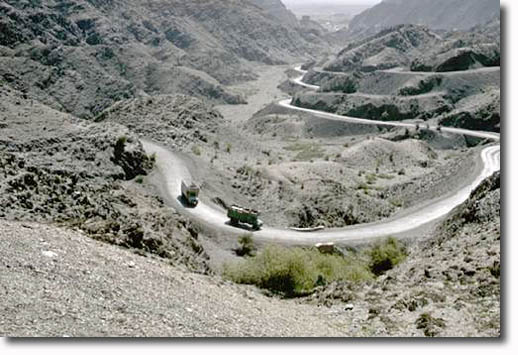
From Soldiers of God: With Islamic Warriors in Afghanistan and Pakistan by Robert Kaplan.
The bus rambled straight ahead on a flat table of increasingly dry earth that bred nothing, it seemed, except a rash of cinder block and mud brick shanties inhabited by refugees. The throngs of people and roadside stalls gradually thinned as the wall of mountains came closer. At the edge of the plain, just past the stone gate with the inscription from Kipling's "Arithmetic on the Frontier", stood the tan battlements of Jamrud Fort, built by the Sikh governor of Peshawar, Hari Singh, in 1836 to defend the entrance to the Pass. It was like a stage set for Gunga Din.
Then, quickly, the earth heaved upward, and what had minutes before seemed like a solitary sandstone wall disintegrated into a labyrinth of scooped-out riverbeds and folds reflecting the dull soldierly hues of gunmetal gray and plankton green. I had the sensation of being trapped ina tunnel. Topping each rise was a slash of red or ocher as the sun caught a higher steeper slope at a different angle. Lifts of cooler air penetrated the bus, momentarily drying my sweat -- my first frresh taste of the mountains after the gauzy heat film of Peshawar. The machine-gun rhythm of Pakistani popular music filled my ears as the winding bed of a Kabul River tributary led to a series of long, slowly rising switchbacks that constituted the heart of the twenty-five-mile-long Khyber Pass.
Disguised as a Pathan in this metal crate hurtling upward toward Afghanistan, I thought it was hard not to be a little impressed with myself. But I had just showered and eaten a hearty breakfast. I doubted that I would feel the same after two weeks of bad food and little sleep.
By themselves, the dimensions of the Khyber Pass are not impressive. The highest peak in the area is under seven thousand feet, and the rise is never steep. What makes the Pass spectacular is sheer scenery, historical association, and a present-day reality every bit as gripping and dangerous as in former epochs. Perhaps nowhere else on the planet are the cultural, climatic, and topographic changes quite so swift and theatrical. In a world of arbitrary boundaries, here is one border region that lives up to the definition.
In the space of forty minutes you are transported through a confined, volcanic nether world of crags and winding canyons, from the lush, tropical floor of India to the cool, tonsured wastes of middle Asia; from a world of black soil, bold fabrics, and rich spicy cuisine to one of sand, coarse wool, and goat meet. And some would add: from a land of subtle, slippery justifications to one of hard, upright decision.
Alexander the Great, accompanied by his teenage Bactrian bride, Roxanne, must have experienced this very sensation as he came down into India (Hindustan) near the Malakand Pass, sixty miles north of here, in the early winter of 327 BC. Some of Alexander's troops, under the command of his most trusted general, Hephaestion, trekked through these same Khyber defiles. So did Babur, the sixteenth-century Mongol king and descendant of Tamurlane, who had lost his father's central Asian kingdom as a young man, but before his death had conquered Kabul and Delhi and founded the great Moghul dynasty. Babur was a poet, whose fantastically detailed memoirs, the Babur-nama, exude a sensitive, lyric intensity that captures the awe and pain of travel in this part of the world. (On finding a cave in the middle of a blizzard in the first days of January 1507, he wrote: "People brought out their rations, cold meat, parched grain, whatever they had. From such cold and tumult to a place so warm, cozy, and quiet!")
Though he conquered India, Babur preferred Afghanistan; his conquest of Kabul in 1504 had marked the turning point in his fortunes. And it was to Kabul, his favorite city, that his body was taken. He lies now under a garden of mulberry trees on the outskirts of the Afghan capital, in a marble monument built in the following century by Shah Jahan, the Moghul emperor responsible for the Taj Mahal. For the handful of journalists and relief workers in Peshawar enamored of such stuff, Babur's marble tomb loomed as the longed-for summit of their Frontier odysseys, where, under the shade of that mulberry arbor, they would one day rest their dirty, fatigued bodies and read Babur's poetry after having witnessed -- they hoped -- the mujahidin conquest of Kabul. "O Babur! dream of your luck when your Feast is the meeting, your New-year the face; For better than that could not be with a hundred New-years and Bairams." Like Babur, some of us measured happiness by how close we were to going up Khyber for the last time.
The British first marched up the Khyber Pass in 1839, on their way to the first Afghan war, which was to end in disaster three years later with the massacre of every solider save one, a Dr. William Brydon, who lived to tell the story. The British came back up the Pass in 1878 and again were forced by the Afghans to withdraw. The graves of British soldiers killed in the second Afghan war lie near the Masjid Mosque by the top of the Pass. Each time, the British lost hundreds of men just fighting their way through the Khyber territory, controlled by the Afridis, a tribal branch of the Pathans who since antiquity have served the function of "guardians of the Pass".
In 1897, the British had to dispatch forty thousand troops to this area just to quell an Afridi uprising and regain control of the Pass. Alexander and Babur also fought pitched battles with the Afridis. It is these tribesmen, numbering over 300,000 in their mud brick redoubts that dot the hills of the Khyber Tribal Agency, who have given the Khyber Pass its allure of danger and epic drama throughout history -- and never more so than in the 1980s.
In The Pathans by Sir Olaf Caroe, the definitive work on the subject, the author provides evidence that the Aparutai, mentioned by the fifth century BC Greek historian Herodotus, are the ancestors of the Afridis of today. (As Caroe writes, the names sound similar when one recognizes that the Afridis, like other Pathans, "habitually change f into p.") The Afridis are also generally thought to have more ancient Greek blood than other Pathans who intermixed with Alexander's soldiers, evinced by their sharp features and fairer complexions. They dress differently too: you can always spot an Afridi by his turban, wrapped tightly with an ostentatious bow around a bulbous red hat, called a kullah.
But these are all minutiae.
What really sets the Afridis apart from other Pathans is their deliciously devious, amoral character -- a legacy of the physical landscape of the Northwest Frontier and the Khyber Pass in particular. Unlike other regions of the Frontier and eastern Afghanistan, the Khyber area has no arable land. Through these poor, barren defiles, conquerors from time immemorial have come to steal the wealth of the subcontinent. So the Afridis learned to play the only card they had: their power to murder, ambush, and in general make life hell for any invading army. What they have essentially said to everyone was: Rather than kill you, all we ask is that you share a certain portion of your wealth with us. And to their fellow Pathans in the Afghan resistance the Afridis' attitude was: You fight the Russians, so they go after you but kill us too. So you must give us something in return. There had been frequent, violent clashes between the mujahidin and the Afridis. The Afridis were bristling with arms. They controlled the weapons trade at Darra, and in addition were supplied with guns by KhAD as a reward for fighting the guerrillas. So it had become more dangerous than ever to trek through Afridi territory on the way into Afghanistan, as I planned to do.
Smuggling, as well as bribes and thievery, was a source of income for the Afridis. A quarter of a century ago the Afridis in the Khyber Agency were among the poorest tribes in Pakistan. They had little to eat and were forced to weave shoes from grass. Their situation improved when they got involved in running Russian consumer appliances from Soviet-occupied Afghanistan into Pakistan. (A smuggled Russian air conditioner cost $300 in Peshawar; an Italian or Japanese one was four to five times the price.) But real fortunes were made with heroin, which, following the Islamic revolution in Iran, became the Khyber Agency's main business. The Afridis set up laborartories in hillside caves, where they organized smuggling caravans to bring the heroin to Pakistani ports. They often bribed police at the various Khyber Pass checkpoints. Unlike other Pathans, the Afridis have managed to keep their fundamentalist beliefs and their livelihood in two separate, airtight mental compartments. A Pakistani government official explained: "To them, nothing is immoral when you are making money." Often an Afridi will interrupt a drug sale if it is prayer time. Afridi merchants always close drug deals with the words: "May God be with you."
The long, buff walls of the British-built Shagai Fort, now manned by the Khyber Rifles, came into view as our bus mounted the first of a series of plateaus. I was not impressed. These Pakistani troops, despite their drums, sashes, and breast-beating tradition earned during the time of the Raj, were not able to hold more than twenty yards on either side of the highway. Beyond that, permission was needed from the heavily armed Afridi tribesmen in order to pass. The real power here lay within the even higher, longer walls of the fortresses that appeared farther up the road: the homes of the wealthiest Afridi khans (large landowners), not a few of whom where implicated in the international drug trade.
Every few miles I saw a military checkpoint, where a Pakistani soldier would mount the bus, cast a quick glance at anyone or anything that looked suspicious, and then wave the bus on. I instinctively looked down and away: Never ever establish eye contact with a border guard. It was one of a reporter's more mundane nightmares out here that he would be pulled off a bus before even entering Afghanistan and be humiliated in the eyes of his colleagues and editors. This happened periodically to journalists in the course of the war, because the attitude of the Pakistani authorities was much more ambivalent than President Zia's open support of the mujahidin suggested. Many in the lower reaches of the Pakistani security services did not share Zia's enthusiasm for the resistance. Even Zia, though he was willing to help the mujahidin, did not want to be seen in the eyes of the Soviets as allowing Western journalists to cross an international border illegally in order to cover the war from the guerrilla side.
February 18, 2006
While you were sleeping ... or: why, in 10,000 words or more, I love Bill Pullman

I wanted to write a post about my love for Bill Pullman. I chose as a focus the film While You Were Sleeping. And ... er.... things got a little out of control. This is basically a moment-to-moment analysis of the film. I do a shot-by-shot breakdown of While You Were Feckin' Sleeping, for God's sake. Argh. I couldn't stop myself. Only true obsessives should read on. I realize it's long. I also had a blast writing it over the last 2 weeks. Reveling in Bill Pullman!! To the most obsessive degree possible! Whoo-hoo!!
Onward!
To the JOY that is the film While You Were Sleeping - one of my eternal favorites!!
-- For some reason, the soundtrack to this film strikes me as PERFECT. So often in romantic comedies, you get total over-kill with the soundtrack - they bash you over the head with their message (Hugh Grant strolling sadly thru the streets after breaking up with Julia Roberts in Notting Hill and what begins to play? "Ain't no sunshine when she's gone". Bad. BAD.) While You Were Sleeping is a romantic comedy, sure - but it has that ever-elusive quality that so few filsm have: it has WIT. The soundtrack is witty. Clever. Subtle. There's music playing beneath almost every single scene, and instead of being annoying, or too obvious, or ... too much - it just adds to the MOOD. The mood of the film is sincere, and also WITTY. You care about these people. The music doesn't insist that you care ... it just supports the general mood. Well done.
-- The opening, narrated wonderfully and very ... HUMANly ... by Sandra Bullock is sepia-toned, and yet it maintains that witty energy. Listen to how she says the word "Milwaukee". It sets it up ... her voiceover does not tell the end of the story ... and we can hear her insecurity in her voice, and also her ... well, frankly, her delusional nature. She goes off the deep end when talking about her "Prince" (played by Peter Gallagher) - a man she has never met. She works for the CTA in Chicago in a token booth - and every morning she watches him get on the train. Bullock's voiceover here is very funny. It's not a SILLY movie ... made for MORONS, like so many romantic comedies are. We can see that Bullock is living in a fantasy world ... because of all she has lost in her life. She's alone in the world. She has a fantasy that she will someday meet this "Prince". And here's a nice detail: Peter Gallagher is so bizarrely good-looking, kind of overblown, in the Billy Zane vein ... that you immediately don't like him. Handsomeness like that seems ... suspicious. This is perfect for the part. BUT ... there's a tiny detail in the first footage we see of him, running to get the train ... Bullock stares at him longingly from behind the toll booth window ... he runs to get the train, the doors are closing, and he jams his way in ... and then holds them open for a little old woman who is right behind him - he lets her go in first. Now - the moment is not a huge deal, it's not filmed like he's the reincarnation of Christ, but Bullock does mention it later ... as something she notices that he does, habitually: let old people go first. It's a character thing. She is looking for love - and so of course she is tuned in to the DETAILS of this guy. She notices EVERYTHING. And instead of the voiceover just telling us: "I love this guy ... he's perfect ..." we get to see a little subtle moment of his kindness which tells us WHY she thinks he's perfect. It's SPECIFIC. Good movies are ALWAYS specific. And romantic comedies have to work even HARDER to be good because there are such old cliches everywhere ... you can't just rely on the cliches ... you have to still be SPECIFIC.
-- The first real scene in the film we see Bullock hoisting a Christmas tree up to her apartment through the window. First of all - this is SUCH a Chicago movie, and that is SUCH a Chicago apartment. It just ... makes me homesick. The whole thing.
-- Joe Jr. is a big-talkin' buffoon who is the son of Lucy's landlord. He wears tight T-shirts, his ass-crack hangs out, and he is hot on Lucy's trail. He's actually a sweet guy, but Lucy is so not interested in him. I think he plays it as a caricature. Everyone else in the film is eccentric as well, quirky - but he seems like a caricature. Also, he doesn't really seem like a Chicago caricature ... although there is the whole "Da Bears" thing that he could fit into ... but it seems more like a New York City caricature. A Bronx caricature. Also, he doesn';t have the same accent as his father. Why does Joe Jr. talk like Tony Soprano while his father sounds like a Chicagoan? Don't get me wrong: there is sweetness in the Joe Jr. character - and I actually do like some of his scenes with Lucy - but to my mind, this is one of the few times that the film goes wrong. He's too over-the-top - it seems cartoonish.
-- Lucy's CTA boss Jerry (played by Jason Bernard - wonderful actor - died in 1996) is a great character. He has some very funny moments - all perfectly played. I'm telling you: everyone in this film has perfect pitch, when it comes to their characters, and the moments, and what needs to be happening in order to make this film work. It's quite impressive. Just think about how many "romantic comedies" absolutely SUCK. It's HARD to do well. This one is one of the best. So the first time we see Jerry is in the beginning of the film - Lucy and Jerry go and get hotdogs at a hotdog stand down in the freezing Loop - Jerry is obviously a nice guy, and they obviously are friends - this is established within 2 seconds of the scene - but he, as her boss, has to ask her to work on Christmas Day. She is the only one "without family". It's a lovely little scene that establishes Lucy not just as a sad sack who has "no family" but as a sweet woman who has good friends in her life, people who care about her.
-- Another detail that is great in this film: throughout the movie, Sandra Bullock, a big movie star, wears a billowing ugly black overcoat. She doesn't ever look chic. She barely looks presentable, actually. Later in the film it comes out that the jacket was her dad's. They don't make a big deal about it beforehand - it's just the coat that she wears - but I admit that the first time I saw her in it, I thought: "Damn ... her coat SUCKS ... " and then, later, when a "reason" was given for it - I suddenly filled up with tears. It was a CHARACTER thing. They don't make a fetish of the coat, they just let her walk around looking like crap for the first half of the film. I can't even explain how out of the ordinary this is for normal big-star Hollywood actresses. Sandra Bullock is not like that.
-- It's so contrived how the family ends up thinking she is Peter's fiance - but somehow it works - and that is all I ask of a good romantic comedy. That it WORKS. Think of Bringing Up Baby. It is completely contrived that the ONLY OUTFITS available in that house out in Connecticut is 1. a negligee 2. a goofy jodhpur ensemble. It is contrived. It is set up that way to up the comedy and to make Cary Grant look as RIDICULOUS as possible. It's delicious. The same is true in this film. Through that first scene when the family rushes into the hospital, and through a series of accidents, they all believe that she is his fiance - and they never let Lucy finish the sentence that would EXPLAIN IT ALL ... you are thinking to yourself: "Let her finish! Let her tell the truth!" But they are a chatty group ... and they are overwhelmed by the fact that she has saved his life ... and so they WANT to believe that she is "the fiance" and ... she no longer has the heart to disappoint them. For me, it works.
-- It also works because the family is immediately lovable. They are chaotic, annoyed with each other, they all talk at the same time, and they obviously love each other like crazy. Yet they never say the words "I love you" or anything like that. It is all just understood - because we all know families like that - and some of us (ahem) came from families like that. Families where you have to SHOUT to get a word in edgewise ... families where it is understood that if you are INSULTED it means we LIKE you ... I love them all. I especially love them because the wonderful Glynis Johns plays the grandmother with the heart murmur. She's wonderful - a brilliant little comedic portrait. She hits a home run with every one of her jokes. And Peter Boyle plays the father. And Jack Warden plays Saul, the next-door neighbor and dear family friend. Micole Mercurio plays the mother - and I have no idea who this actress is, or what her deal is - she has had a long career - but she is just comedic GENIUS in this role. If you just watch HER in the background of the group scenes ... just watch her. She is ALWAYS alive. She is the OPPOSITE of "waiting for her closeup". She is always present and something funny is ALWAYS going on. I love her performance. A young and gangly teenage Monica Keena plays Mary, the younger sister in the family - she plays the perfect baby sister. You just love her. The family immediately embraces her. "But you haven't met Jack yet!" they say. Hmmmm ... who's Jack??
-- I love the little moment where Lucy sits at home with her frozen dinner and she put the cat's food on the table - pours a bit of milk for the cat - calls out to the cat ... and then suddenly there she sits, deciding whether or not to go join the family's Christmas dinner ... It's all on her face. You can tell that she SO wants to go and spend time with them again ... and as she thinks, she takes an Oreo out of the package, dips it into the cat's milk and eats it. A beautiful (and sad) little character moment.
-- Jack Warden is terrific. Did you know he fought in the Battle of the Bulge??
-- Watch the details in the scene where Lucy goes to spend Christmas night with the family. There's too much to even list - you feel like you are looking at a slice of life. The jokes about Grandma's awful eggnog, but how everyone drinks it so as not to hurt her feelings ... the reaction shots when everyone opens their presents - and we see Lucy staring at them - and then we go back to a slow pan across the family - and we see them as SHE sees them. They, in all their argumentative chaotic loudness, are the epitome of beauty to her. Of love. Then a slow pan up behind Lucy's head to show that they have already hung a stocking on the mantel for her. It says it all. They are a family with elastic walls. Lucy lives in a stingy world, with few friends, a quiet life, and a rigid routine. She is "fixed". This family opened up to accept her. I don't know ... Believe it or not, this scene is NOT sentimental. It is SPECIFIC. I don't like sentimental, I don't like it - it's too easy a choice. It's not human enough. But this scene with the family, and with Lucy looking on works. And many of the lines themselves are so amusing - but everyone's talking at once so you can't catch them sometimes ... You hear them in snippets, overheard snippets - "Uncle Al ... you remember Uncle Al ..." "Who the hell is Uncle Al?" "Seven bowties!" "Oh ... the GOLD WATCH ... I love it!!"
-- Then we come to the big entrance of Bill Pullman - who plays Jack, the other son in the family. He, so far, is the big mystery - the guy everyone keeps talking about ... but hasn't been seen yet. The first glimpse we get of him in this film is a beat-up truck pulling up outside the family house - the door opening - and we see his feet, getting out of the truck. Big workboots. This sets him up perfectly: he's a MAN. He's certainly not like his brother who would never wear boots like that. It's a slightly ominous shot ... it's like we know that this brother is going to smell bullshit from a mile away. Which is kind of scary but also a bit sexy.
-- Now a couple of words on Bill Pullman:
Bill Pullman has gotten some cheesy jobs in his day ... he is not a HUGE star ... so he really does need to work for a living, he takes what he can gets - and for the most part it's not too bad. But in my opinion, what he does in While You Were Sleeping kind of stands alone, in terms of his career. He is a romantic leading man in this film. And ... despite his WASPy good looks, he's got an edge. A romantic leading man without some kind of edge is feckin' boring. He's got an EDGE. There's something about him where you feel like he COULD be unlikable, or he could lose his temper ... if you pushed him too hard. He's not a wuss. Pullman hasn't played that many romantic leads - he plays the boring clumsy boyfriend of the lead girl before she dumps his ass and goes and gets her REAL true love. He plays "nice guys". He plays guys who mean well, who sneeze at unfortunate times, who trip over their own feet ... and yet who you just don't feel romantic towards (Sleepless in Seattle being the prime example). He is very good at this stuff - this kind of comedic wry-faced stuff - the sort of guy who you might not THINK is sexy ... but then he takes off his glasses, and women swoon. This is why I say he would make a great "hero" in a screwball comedy - like Dr. Huxley in Bringing Up Baby. There's a part of him that couldn't smoulder with passion if he tried - he's too serious, and distracted - and yet - there's something there ... something that makes you feel like if he just took off his glasses, and - er - took off his clothes - he'd be an animal in the sack. If he could just FOCUS, if he could just let his "serious work" in the lab or in the classroom go for one second - he would be fully present, and it would be very very sexy. This kind of thing is what made Cary Grant so popular. The dichotomy: the bumbling professor with the dashing good looks ... It's a cliche now, but only because Cary Grant made it so. I think Bill Pullman could do a role like that. I think he could play the Howard Bannister-esque roles (which rarely come along - we don't make good screwball comedies anymore) to perfection. Has he been in a Woody Allen film? He'd be a fantastic Woody Allen hero as well. (Not in one of Allen's serious films - but like Manhattan Murder Mystery, one of my favorite movies of all time.) He has an air of kind of cranky distraction that is very very attractive, because it shows that he is a man who has a brain. He thinks. Most romantic leading men seem brainless or ... like they have no lives outside of the romance going on in the film. This is common of most leads in romantic comedies. Do these people read books? Have goals? Friends? Family? No. They are just there to have this love affair unfold. I love romantic comedies which let in the outside world, where the leads are rather complicated - with other stuff going on (Say Anything is a prime example - at least in my mind - We get to see what is going on in both their lives - which makes their sweet little romance that much more poignant - We can see that the love affair is a RESPITE, it is a BREAK from the sometimes harsh realities of their lives. This is something I can relate to. I like romantic comedies for adults. I'm an adult. I have romances, sometimes. But my other life goes on. I have issues from past relationships that I bring to the present one. I falter. I get insecure. I have competing interests. I have a romance AND I go home and read books. Or go to the gym. Or talk with my parents. This is all very real - and I love romantic comedies that ADMIT that.)
So Bill Pullman's Jack in While You Were Sleeping is a true leading man - in the true tradition of it. He's sexy, kind of cranky, he also has a strange strain of shyness with women - which makes the whole combination totally attractive. Pullman has never before had the opportunity to show that many sides. He's really GOOD at it, actually - and it's a bummer he doesn't get more parts like this.
-- When Jack enters the family house, the party is over and everyone is asleep. Well, everyone except the younger sister. Lucy is asleep on the couch. Jack peeks in at her. He is told that this is "Peter's fiance". He says, so simply, and with almost no inflection, "That's not Peter's fiance." He just knows. He's that kind of guy - he's got a nose for bullshit. He just knows the type of women his brother goes for - and the sleeping brunette on the couch is not that type. But look at how he looks in at her. There's so much going on in his face. It's not just suspicion. It's ... he's intrigued, too. Who is this girl? He's weirdly drawn to her. Pullman does all of this with NO LINES.
-- Oh and one of my favorite moments in the movie which goes a lot to describing its charm happens next: It's early the next morning. We see the snowy streets outside the family house. A paper boy on his bike pedals towards the camera, throwing newspapers at each house. We see him throw one paper, pedal pedal, another paper, pedal pedal ... then he goes to throw the next paper and suddenly he completely loses control of his bike on the ice and has a devastating crash. It's so RANDOM ... it means NOTHING ... but it's just a great little detail that is hilariously funny and makes the movie special, and more than just a stupid little romance. I laugh every time I see that kid crash.
-- Lucy is up early, trying to sneak out of the family house before everyone wakes up - specifically before Jack wakes up, because she was actually awake the night before, and heard him say, "That's not Peter's fiance ..." She is afraid of Jack. She tiptoes out into the foyer - and of course, Jack is sitting there, on the stairway, with his coffee, waiting for her.

They have an incredibly awkward meeting - well, SHE'S awkward, and he's cool as a cuke. He's got this kind of bemused smile as he watches her fumble around - he's picking up on all of her cues ... "I guess ... I don't remember meeting you ..." She goes to leave, and he stops her ... "Lucy ..." She thinks she's about to be busted, so she decides to come clean: "Look ... " and you know she's about to tell the truth, but of course - he cuts her off. And says, "Welcome to the family." There's a shyness on his face, a reticence - but beneath all of it is - warmth. You like this guy. He seems nice. Much nicer than his more slick brother. Lucy then hurries out of the house and we go back to Pullman's face for just a second. It's hard to describe what I see, but he's left alone there - thinking about her - it's a close-up. He still has that same bemused little smile, and then - it's a tiny moment - but it speaks volumes - a seriousness comes over his face. It's all in his eyes. It's a beautiful moment. You wonder what he's thinking. Now that's a good movie star. You can always see them thinking, but it's not always clear what they are thinking about. There's a certain amount of mystery maintained - and this is what keeps us hooked in to them. Does he like Lucy? Does he think she's pretty? Is he jealous of his brother? Or just worried that she's a scam artist? Not sure ... but you know that the guy is thinking some thing. And you want to know what it is.
-- Watch Peter Boyle during the next scene when the family is at mass. Jack keeps trying to talk to his father, in between "Lord hear our prayer"s - about Lucy, and Peter Boyle answers - never ever missing an 'Amen". It's hysTERical. He doesn't take a moment to say "Amen" in a prayerful way, it's completely rote - and it seems as though he's not even listening to the mass being said, yet he chimes in with his "Amen"s right on cue. Jack whispers, "If Peter were engaged, he would have announced it in the Sun Times." Peter Boyle murmurs back, "We read the Tribune Amen." hahahahaha
-- Then of course comes another misunderstanding. Jack goes to Lucy's apartment building and runs into Joe Jr. Joe Jr. repeats his delusion - that he and Lucy are "dating". So now Jack thinks that Lucy is double-timing his brother.
-- Lucy goes to Peter's palatial apartment to feed the cat. The hospital had given her his "personal effects" - which kind of doesn't make sense - but whatever - it works. She walks around, tiptoeing really, saying, "Here, kitty kitty ..." Meanwhile we see that Jack, who is obviously on some kind of warpath, is also coming to Peter's apartment ... He lets himself in ... and for a while the two of them are wandering around Peter's apartment without knowing the other is there. Lucy then pushes open a swinging door and smashes Bill Pullman in the face. A stupid gag - but whatever, I'm simple and easily pleased and it makes me laugh every time I see it. He totally gets SMASHED in the face - and you hear his big "OW" - and then Lucy, horrified, starts racing around the kitchen trying to get ice on his nose ... she hands him a couple ice cubes ... he fumbles with them for a second, and then you can see him say to himself, "Oh fuck it" and he tosses the ice cubes in the sink. It's a funny moment. He is on her trail. "Peter doesn't have a cat." The entire scene is a riot because they are both just LYING to each other and trying to COVER their asses throughout. They're both kind of bad liars - but they circle each other warily, trying to be "nice", but ... wondering what the hell is up with the other one. He doesn't want to let her out of his sight. Hmmmm.

-- The two of them go to the hospital together to give blood. Jack is still questioning Lucy ... "When did you start seeing Peter?" He won't let it die. He just knows something isn't right with this girl and now he "knows" that she is dating Joe Jr. But what's wonderful about Pullman is that ... even though HE might not be aware of it yet ... it's obvious that he has some other motives here ... HE'S not thinking: "Hm. This girl is kind of great. I'd like to have her for myself." But ... somehow ... Pullman lets us know that there is an element of that going on. For example - he says to her, as they give blood: "We'll need to get a picture of you and Peter for the mantel." She hems and haws and says, "I'm really not that photogenic." And he says, sort of to himself, "I doubt that." He kind of loses his cool for a second - it's a very funny moment - he's not in control for a minute, and he lets his attraction for her come out. I love that moment: "I doubt that."
-- Jack shows up at Lucy's apartment to give her an "engagement present". It's a couch from one of the estates that the family manages as their business. Lucy says, visibly uncomfortable for a variety of reasons - the first being that SHE IS NOT ENGAGED ... suggests that they bring the couch, together, to Peter's apartment.
-- So now follows the long scene where - they basically fall in love. It's so well done, I never get tired of watching it. It's humorous, there's more NOT said than stuff that IS said ... and the moments of affection and curiosity that bloom are handled really sensitively. It feels like a real night that two people would have. The kind of night when you suddenly look at someone and you realize: "Wow. I like you." This is all done with BEHAVIOR, too. Not WORDS. In the movies, you really should say less and do more. There's a reason why smart movie stars (Cary Grant, Bogart, Cooper - but they all did it) sit down with scripts and cut out half of their lines. Say LESS and you will be more effective. It's a visual medium. If you can do it with a look on your face, then do it with a look on your face - and don't describe WHY you have that look on your face. On stage, you need lines to do a lot of the work for you. Not so with films. It's the opposite.
-- The two of them open the back of the truck - and there is a love seat (garish) and a gorgeous Shaker-esque rocking chair. She oohs and ahhs over the rocking chair which, of course, he made. He has a dream of breaking away from the family business and being a furniture maker - but it's complicated - "rejecting" his father's business, etc. But I would ask you to watch Bill Pullman's face as Lucy goes ga-ga over the chair. The thing that makes him a good leading man is that he doesn't really seem to think that he is that big a deal. He doesn't have a puffed-up ego. He is unaware of how charming he is. He's diffident, and kind of humble. George Cukor said about Cary Grant, "One of the reasons he was so successful as an actor was that he truly just behaved like he was a normal guy and like he didn't look like that." Bill Pullman, obviously, doesn't have the glitter of Cary Grant, and his good looks are much more normal - like you could imagine knowing a guy like that in real life, whereas it's hard to imagine ever meeting someone who looks like Cary Grant ... Cary Grant HAD to be in the movies. But the essential quality: of a lack of ego, of a sort of shyness, of a "Oh, forget it, I'm not that great" energy - is the same. It's so attractive.
-- He ends up having to walk her home because his truck is blocked in. So then we get a shot of the two of them walking, at night, along the Chicago River (gorgeous - although it makes very little sense geographically ... she lives north, and I am imagining WAY north ... so ... why are they walking THAT way? And ... er ... why don't they take the L? Oh, never mind with these pesky questions. It's a lovely scene - my favorite in the movie - because of their conversation, and how they talk to each other.) Sigh. This scene is beautiful because it reminds me of those moments, those magical moments, BEFORE something happens with someone you are really interested in. And you KNOW they are interested in you. And somehow the conversation flows ... and there's that beautiful feeling, that shivery feeling ... that something's gonna happen here ... When you KNOW that a person is interested in you, and they are honing in on you ... it gives you such a confidence, it's like you can do no wrong. Insecurity dissolves, you don't second-guess yourself, or re-think your words ... You feel confident. Glowing. You start to see yourself as THEY see you. Sigh.
That's what this long walk home is about. He's not asking her questions anymore to interrogate her, or to try to find out who this suspicious fiance is ... He's asking her questions because he is interested in her.
Also, another great thing about this film: many romantic comedies actually are populated by people who have no senses of humor. I mean, what a bunch of humorless sad sacks!! Do these people laugh? One of the best things about falling in love is finding someone who shares your wacky sense of humor. Who can be goofy in the same way that you are. Who makes you laugh. So many films miss this important component - but the GOOD ones never do. I submit that Notting Hill is a great example of one of the GOOD ones, and for this very reason. These two characters have great chemistry and tenderness between them - but they also laugh at the same things. There are SCENES where the two of them are just being funny FOR each other. And, for me, more so than any other part of falling in love - that's the best part. Being funny FOR someone. I call it "pro-actively funny". I always fall in love with guys, first of all, who already are pro-actively funny - it's just my preference - humor is #1 in my book - but when someone goes out of their way to make you laugh ... when the two of you can people-watch together and giggle about the same things ... now THAT is a relationship that could have legs. This long scene of the two of them walking home through Chicago is that kind of scene. It has tenderness, too - quiet moments - they're getting to know each other, they're alone for really the first time ... but what gives the scene its charm, its goosebump-factor - is that the two of them actually crack each other up.
I LOVE THAT. It's so hard to get that across, it's so hard to write and perform witty dialogue - without being arch, or too clever ... This is about people who genuinely enjoy one another, and who are discovering that AS they talk. It's beautiful.
He's asking her questions like, "So ... if you could go to one place in the world ... where would you go?" She says immediately, "Florence." It's THAT kind of conversation. She, even though she's supposed to be in love with her "Prince", even though she's got this dream of a "perfect guy", starts responding, giggling ... they have a chemistry.
He asks her what her father was like. She says, making a joke (and also - maybe - saying it before he has a chance to say it or even THINK IT): "He was a lot like me ... dark hair ... flat chest ..." He bursts into laughter, surprised at her - enjoying her - but there's SO MUCH GOING ON IN THAT MOMENT. I admit it: I have rewound many times, so I can watch his reaction shot to her saying that. It's just so ... real. He laughs - just from the surprise ... but there's also a shyness there, like: "Uhm ... okay, now I am totally thinking about your breasts right now ..." He gets them off the topic as quickly as possible ... but it's beautiful - because you can see him getting ... er ... kinda hot for her. It's so subtle ... but you can see it.
Another nice subtle moment during this scene is ... they're strolling along the river, and they pass by a canoodling couple. (I love any chance I get to use the word "canoodling".) Lucy is chatting on about something, Jack is asking her questions - and as they pass by, he glances at the canoodlers, looks away, and then ... looks back for a closer look. Very subtle - but it sort of ups the possibility for romance. Like being in the presence of a make-out session makes him think: "Hm. I would like to kiss this woman beside me. This woman who is the fiance of my brother. I HATE MY BROTHER. I want to kiss her." Pullman doesn't telegraph any of this - like I said, it's a subtle moment - just two quick looks - but they say WORLDS about his state of mind.
-- Sweet intimate moment when Lucy takes her passport out of her bag to show him. She has never been anywhere, but she dreams of going to Florence ... and she keeps her passport up to date just in case. I love that character detail. Beautiful. Jack looks at her passport, makes a snarky remark about her photograph ("Wow. You were right. You're not photogenic.") but you can tell that he ... in that moment ... sees her. Maybe better than she sees herself. She has dreams. She wants to get out. Go. It's pretty amazing to carry your passport around with you. And in that moment - it's like he thinks to himself: "I want to give this woman her dreams. I want her to travel." Again - this is done with no dialogue. It's all in the subtlety of Pullman's acting. It's how he looks at the passport, how he feels he has to make a joke about it ... basically to fight this overwhelming urge to make a pass at his brother's fiance.
-- They make it back to Lucy's apartment (which, judging from the look of her neighborhood) is probably a 2 hour walk from the Loop - but again, who I am to judge their location choices ... and as they come into view, they are still talking. Oh man. Member having nights like that? Sigh ... They come up to the front of her building and there is a huge patch of ice there. Jack, ever the gentleman, says - "I'll walk you to your door ..." (Ahem. He doesn't want the evening to end.) So carefully they start across the ice ... (listen to how the soundtrack changes here, too ... Like I said in the beginning, I love the soundtrack ... it's very sensitive to the tiny changes going on in the film - the music here changes from a kind of melancholy nostalgic romantic tune - to the more witty tune, which punches up the absurd nature of the moment: the two of them tiptoeing across this blank sheet of ice). And of course, she goes DOWN - he grabs onto her - she struggles -
they both start to laugh - things are getting out of control - Bullock is great here. Her perfect kind of moment, as an actress. Not too many actresses are good at playing women who have senses of humor. Especially senses of humor about themselves. She's AWESOME at it and always has been. So she starts to laugh - he is heaving her up by her armpits - and she suddenly can't stop laughing - and then that starts him laughing - and then of course, they both wipe OUT on the ice.

Contrived? Yes. Does it work? Yes. The two of them play it to perfection. It seems like a real moment. They struggle to their feet ... he's still holding onto her, and suddenly, when they're both on their feet, holding onto each other, there's a moment of ... silence, where they're looking at each other. It's like the moment in Bringing Up Baby when she trips over the log and falls on her face. Cary Grant rushes to her side, to help her, she's crying, hysterical ... and for one brief second, Cary Grant leans in to kiss her. You can watch him go for it. Then he stops himself. Pulls himself together. But there's that moment ... it's the first moment you really see him want to make a move, because the rest of the movie he is running away from her at top speed, shouting, "LEAVE ME ALONE." But something about that moment, the proximity, the fact that she has fallen, that he is now "taking care of her" - you watch him move in to kiss her. And then abruptly pull back. Lucy and Jack have a moment like that. His face kind of gets serious, tender - but tentative still ... This woman is off-limits. She's taken.

Lucy then starts for her door, he follows - she is laughing, she says, "No really ... you don't have to follow me ..." He replies, "No, you block the wind ..." which is, actually, a really funny line. And Bullock - you can see her just double over in laughter. She CACKLES at his humor, his funny line. I LOVE that. I relate to it. If there's one thing my boyfriends have all had in common - it is that they are FUNNY. On PURPOSE. I also love, too, how it seems like a truly spontaneous moment ... when it's NOT. Those are LINES from a SCRIPT. But it seems like his "you block the wind" takes her by surprise. Lovely little acting moment there. They have a meaningful moment where they say goodbye ... Something has shifted during their walk, and they both feel it.
-- The next scene is between Lucy and her boss. She confesses, in a panic, "I'm having an affair. I like Jack!!" Her boss finally has had it, and says one of the funniest lines in the film, "Lucy, you are BORN into a family. You do not JOIN them like you do the Marines!"
-- Next scene: Bill Pullman sits with his brother, who is still in a coma - and plays cards with him. Of course playing both hands. And he talks. Talks to his brother. Something about the lighting in this scene makes Pullman look not just handsome ... but unbelievably handsome. I am sure that this is deliberate. Because now he is not just the suspicious brother - but the romantic lead. We are invested in HIS journey now. We care about whether or not HE gets what he wants. Another essential thing for a romantic comedy. We've been on board with what Lucy wants the whole time ... but now we need to give a shit about BOTH. And we do. Pullman plays cards - talking to his unresponsible brother: "He is staying in with a pair! Impressive!" etc. And then he has what could be a very contrived moment, but in Pullman's hands - it's effective, and moving. There's a long continuous shot of him - as he tells about one of his memories from childhood involving his brother - he's opening up - we are finally seeing what this man is THINKING - again, it's contrived: but it's perfect.

Jack is an enigma to everyone. It would make sense that he would share his deepest feelings only to a person who is IN A COMA. It's played so well - kudos to Bill Pullman. Ben Affleck has a similar moment over his baby's crib in Jersey Girl which was so embarrassing to watch that the audience started laughing the night I saw it. It's HARD to have a "private moment" on film - like these - and not have them come off as trite, obvious, or phony. Nothing against Affleck - who I actually like - but the lines he was given were so sappy, so bat-you-about-the-head-and-neck with the message - that it would be very difficult to make that real at ALL. It should have been re-written. Pullman has a similar challenge here ... during this one long take, he starts to talk: "Do you remember in 5th grade ..." which - you know - it's hard to make that real. It's hard to make that sound like normal conversation and not "Here Is the Beginning Of My Deep Monologue Where You Learn About My Tormented Issues". Pullman plays it casually, humorously, until the very end - when you see something ELSE go on on his face. Meanwhile, the camera is slowly, slowly, moving in for a close-up ... When it's right up against him, when Pullman's face fills the screen - a realization comes, we can see it all happen - he goes deep, he gets serious - 5 million things happen on his face at once - he is letting us INTO HIS BRAIN. He speaks:
"You are unlucky at cards ... but ... lucky in love. Member in, like, 5th or 6th grade - I was starting to get really good at poker and going home with lots of lunch money - I got to know the principal's office really well. He always used to say to me, 'How come you can't be more like your brother Peter?' And you know what? I was all right with that. I had no problems with that. Because I was proud of you. And I was never envious of anything that you had." Long pause. Now we're in the close-up. It's stunning - you can see those words reverberate in his head, you can see him make the realization - he doesn't overplay it. He is just THINKING. Then he says, admitting it - not just to his brother, but to himself, "Until now."
What he does in that long pan into the close-up is a phenomenal example of good film acting. That moment would never work like that on stage. It's completley interior. We are inside this guy's head. But for film? It's what needs to happen - and Pullman doesn't push, doesn't go overboard ... This guy Jack is not a guy who's comfortable with touchy-feely stuff, he's more liable to crack a joke, make some snarky remark ... This is like his own private journal entry to himself. So so well done.
-- Next comes my favorite scene in the film. It's a family dinner. The whole Callahan family and Lucy sit around at the dinner table. The whole family banters at once - about a million different things - and eventually, Lucy and Jack meet eyes across the table - and there's this shared moment of humorous eye contact - they both start to LOSE it across the table from one another. Everyone's talking in the background about Cesar Romero, the mashes potatoes, whether or not actors have to be tall - all at once - it's a cacophany - and Jack and Lucy, trying to keep up, both just start giggling to themselves, a beautiful moment of connection. Also, Jack's mother at one point asks Jack, "What's your type, Jack?" Meaning in women. Jack looks visibly uncomfortable and says bluntly, "Blondes. Chubby ones." The conversation goes on around the table, topics brought up, thrown away, argued ... suddenly the younger sister turns to Jack and says, "But you like brunettes!" HUGE silence. Jack is busted. He glances up briefly at Lucy, who is grinning at him ... It's that awkward goofy shyness that makes him so good as a male lead. He doesn't tell ALL. Because most people in life do not TELL ALL, especially not when they're falling in love. When you're falling in love, you tend to get nuts. You get over-protective of yourself, you diffuse moments when you want them to linger, you lie about your true intentions so you won't get hurt ... etc. It's a nice moment - the sister busting him in a lie - showing that dynamic. Here's a slight transcript of some of this dinner table conversation - it's funny dialogue already, it READS funny on the page ... but the way the actors play it makes it just come to life.
Mother: Have you and Peter decided where you want to go on your honeymoon?
Saul: I went to Cuba on my honeymoon.
Grandma: Ricky Ricardo was Cuban.
Mother: Didn't Peter look great today?
Saul: Oh, that kid. He should have been an actor.
Grandma: He's tall.
Father: All the great ones were tall.
Mother: Lucy, you think you could find me a nice girl for Jack?
Jack: Oh, Mom. Come on.
Lucy: Well, I really don't know Jack's type.
Jack: I like blondes. Chubby ones.
Long uncomfortable pause
Saul: Alan Ladd wasn't tall.
Father: Marshall Dillon was six foot five.
Mother: Well, we all know who Lucy's type is! These mashes potatoes are so creamy.
Sister: You like brunettes.
Long uncomfortable pause
Grandma: I could never make a good pot roast.
Saul: You need good beef. Argentina has great beef. Beef and Nazis.
Father: John Wayne was tall.
Saul: Dustin Hoffman was 5'6".
Father: Would you want to see Dustin Hoffman save the Alamo?
Mother: These mashed potatoes are so creamy.
Saul: Spain has good beef.
Mother: Mary mashed them.
Saul: Cesar Romero was tall.
Grandma: Cesar Romero was not Spanish!
Saul: I didn't say Cesar Romero was Spanish.
Grandma: Well, what did you say?
Saul: I said, Cesar Romero was tall.
Grandma: We all know he's tall.
Saul: Well, that's what I said. Cesar Romero was tall. That's all I said.
Genius. That's a greatly written scene.
-- When Lucy leaves the house that night after the party, Jack stands at the door and watches her go. You are starting to feel that things are really heating up for him. He's kind of in trouble, as far as Lucy goes. He's thinking about her too much. He's ... in trouble. Again: no lines needed. It's all on Pullman's face.
-- Through a silly contrived misunderstanding - the little sister believes that Lucy is pregnant and she blurts it out to the whole family. "Lucy's pregnant!!" The family starts to freak - "What? How do you know??" There's a brief shot of Jack that I really like - hard to describe - it's very short - uhm, here's the moment:

He takes the information in - and suddenly, turns and leaves the house abruptly.
-- Of course he comes to find Lucy and talk to her. He's had it. He's in trouble. He knows it. Meanwhile, Lucy is getting ready to go to her friend Celeste's New Year's Eve party. She carries a bottle of champagne, comes out of her house and starts off down the sidewalk - only to find that Jack is standing there, by his truck, kind of walking back and forth, and talking to himself. Obviously rehearsing what he wants to say to her. hahahaha It's such a Bill PUllman moment. The GOOFBALL coming out. He ends up following her to the party, trying to get her to talk about her pregnancy. Of course she - who is NOT pregnant - has no idea what is up with him and why he is acting so strangely. They arrive at the party - Pullman is mistaken for her "fiance" - he keeps trying to explain himself - and then he sees Lucy chugging spiked punch at the refreshment table. hahahaha He rushes over to her, a man on a mission, and informs her, urgently: "That's spiked." Lucy chugs down another gulp, and says, her mouth full, "Thank God." Jack, concerned, says explicitly, "You shouldn't have any!" Lucy says, "Why not?" Of course, at this very moment, the loud music dies out, so Jack shouts into the silence, "Because it's not good for the baby!!" You can see all of Lucy's co-works kind of freeze, and stare over at the "couple", like ... what???? For some reason, as silly as this little exchange is, it is completely satisfying to me because both of them are playing their moments so seriously. He TRULY believes she is pregnant. She should NOT be downing alcohol at such an alarming rate. She has NO idea why he is suddenly all over her, and acting all paternal and annoying ... she needs a DRINK, dammit - get off my back! It's very funny.

-- Then we see the two of them walking back to her place after the party. He has now realized it is a misunderstanding - he tries to apologize, explain - she is charging along the sidewalk like a maniac - he begs her to slow down ... He is literally running to keep up with her. They stand outside her apartment and have a conversation - that gets startlingly romantic for about 2 seconds - and then it turns into a fight. Ah yes. I know those kinds of nights, too.

The scene has so many ups and downs to it that - again, it feels real. This happens in life. Normal conversations turn on a dime. A small thing happens that cuts her to the core - and suddenly she has to walk away. Which puts him in the position of chasing after her. Now he's lost his cool completely. He's vulnerable. They have it OUT. Great scene. One of my favorite moments during their fight is when suddenly he is confronted, for the first time, with her insecurity about herself. She says to him, "Why did you think I was pregnant?" He says, "Well, Mary heard something ... I don't know ... I had no reason to not believe her ..." Her face gets kind of hard, bitter, and she says, "You mean, the only reason Peter would marry someone like me is if I were pregnant." You can see him be totally taken aback by this - he doesn't even know what she's TALKING about - "No!" There's a lot going on here: First, he hurt her without meaning to. Second, he thinks she's basically the catch of the century - he's fucking in love with her ... so he is baffled by her own self-destructive comment. "What? No!!" He can't even understand why she would say that - because he thinks she's so awesome, and he's jealous of his brother for scoring her. Those moments happen all the time in love - we see our beloved in the best light possible - and so to hear that they might not regard themselves so highly is just ... strange. Window-Boy and I had moments like that all the time. I always considered him to be literally THE SEXIEST MAN IN CHICAGO ... and there were times when I would be like: "Uhm ... why is he with me??" Did not get it. Eventually I got it - and stopped being insecure - but at the beginning, I was kind of a lunatic about all of it. So I would make some derogatory remark about myself, or about how my ass was fatter than that girl's over there ... I'd nudge him gleefully, and say, "See that girl's ass over there? Isn't it great??" hahaha Trying to say what he was thinking before he could even think it. He would look at the other girl's ass, look at mine, and just give me this silent look of either exhaustion, scorn, or confusion. hahahaha He didn't judge me for being insecure - he had enough experience with women to know that insecurity about one's ass size is pretty much a universal ... but at first I just couldn't see myself the way he saw me. (And that's probably a good thing - because if I saw myself the way he saw me then that would mean I had a GIANT EGO) But he would get confused when I would be insecure. That was his main response to my insecurity. Confusion. How can she think she's ugly when I think she's pretty? How does THAT work?? So Bill Pullman has that whole taken aback thing down pat. How can she think that she would be unworthy of marriage? Or unworthy of some guy choosing her? How can she think that??
-- Meanwhile - in the hospital - we see the staff celebrating Happy New Year ... then there is a long slow pan into Peter's room. We see him in a coma. Then ... suddenly ... his eyes open. So. Now we know things are about to get really nuts.
-- The entire family huddles around the bed. Peter stares around at each of them, smiling at the fact that he is alive ... happy to see his family again ... his eyes rest on Lucy. His face goes blank. He asks, "Who are you?" It is immediately decided that he has amnesia - of a very LOCALIZED variety. Saul pulls Lucy aside - who is, of course, freaking out. Saul tells her not to worry - that he will tell the family her story - he'll "take care of it". "I'm too old of a friend and too old of a person for them to kill." Peter, meanwhile, is freaking out because he apparently has amnesia. A nurse comes in to give him jello. Peter looks up at his mother in a panic: "Do I like jello?"
hahahahahaha I love this script.
-- Okay. So onward. Uhm ... I'M having fun doing this. I don't know about YOU all. I need to do this more often!!! Of course it's taken me two damn weeks to do this. I watch a scene a day and then write up my thoughts. Honestly. This is my life. But I guess if I'm happy, who should give a crap??
-- Next scene. Well. This scene brings a lump to my throat. I admit it. This is what I mean when I say I think this film WORKS on the level it needs to work. It sneaks up on you. Suddenly, I find myself giving a crap about these two people. I just want them to be together. Selfishly, I want to see them kiss each other. I want them to hook up. And ... in this scene - now that Peter has woken up ... they are sort of gently saying goodbye to each other, without really saying what they mean. And you get the sense of the real loneliness of these two ... that they are both odd people, essentially. They are not easy matches, they are not "for" everybody. She's not a girlie-girl, she's awkward, she's got a great sense of humor, and she's got an underlying sadness which could potentially frighten anyone off. He takes no bullshit, tolerates no dishonesty, and could actually be kind of a prick if you try to pull any gamey kind of shit with him. They're ODD. And yet - when they are with each other - they seem comfortable, they seem relaxed. He "gets" her. She finds him funny, and jokes him out of his seriousness. Jack drives Lucy back from the hospital and they sit outside for a while, in his truck, talking. Lucy says - knowing that eventually, in the next couple of days, she is going to have to come clean - and the entire family will soon realize that she has been LYING to them - and infiltrating their lives - all based on a LIE ... she knows that this will probably be unfogivable to Jack. He jumped all over her when she assumed to know something about his family - his family is everything to him - and she has just been, basically, scamming them ... He will not forgive that. So she knows this. She says to him, seriously - "Jack ... things are ... probably gonna be a little bit different from now on ..." She means that the truth will come out, but Jack of course thinks she means: Now that my FIANCE is awake, I'll have to spend all my time with HIM rather than with YOU ... He's practically wincing thru the whole scene. He can't stand this. But he's also too much of a proud man to wear his heart on his sleeve. He puts up a good front. He lets her go. He doesn't become a sniveling wimp, he doesn't declare his love ... He just eats it. He eats the pain of watching her walk away. Like I said - there's something about this scene that makes me want to cry. It's the softness and openness in her face when she tells him honestly what a good friend he has become to her. You know it's true. You know it's true because you know the loneliness of her life before she met him. There is so much emotion under her simple words. She holds it together though, too. She has too much pride to fall apart, or to blurt out the truth, or to say, "But I want you!!!" She goes to get out of the car - and he stops her and says the killer line: "Lucy ... I didn't mean what I said earlier. About you and Peter ... I think you're going to make a terrific couple ... and ... I'm really happy ... that you won't be alone anymore." Argh - putting it into cold type like that makes it sound really sappy, and maybe it is sappy, but Pullman doesnt' PLAY it sappy. He plays it like a real MAN. Despite the fact that he's in love with her, he - in that moment - lets her know that he wishes the best for her. And it's also proof that ... unlike everyone else in her life, who kind of accepts in a blase way, "Oh, yeah, whatever, Lucy doesn't have a family ... so of course she can work on Christmas Day ... of course she'll always be available to me ... whatever ..." Jack actually feels sad for her, and wishes to end her loneliness. He wants her to be happy. Now I know from my own experience in life and in love ... that when someone you are in love with who you can't be with wishes you well, and MEANS IT??? - it is one of the most important and wrenching and life-affirming moments that one can have. It's awful. But it's amazing. And it's also very very rare. This is what he does in that moment. And as much as it kills him, he MEANS it. It brings a lump to my throat every time. It's so sincere. And it's not easy for him. But he does it anyway. He's a true MAN. He's a grown-up. It's killer. It's so powerful. Good work there, dude. Good work.
-- The next scene is a quiet little scene in Jack's world - where the subplot of his own desire to leave the family business is resolved. The movie is smart. This subplot is not ANNOYING like so many subplots are in movies like this ... This goes towards establishing his character, and establishing as a man that we ROOT for. He's not just a "lover". He's not just the "love interest". He's a person with other goals, aspirations, dreams ... Yes, he wants Lucy ... but he also wants to start his own business. And he's kind of tormented about hurting his father by 'rejecting' the family business. Family is so important to this man. It's everything. But in terms of what he had gone through in the last week - meeting Lucy, having all of his neat little chess pieces overturned by her - this unexpected and kind of unwelcome and inconvenient love - has changed him. He, in his heart, wants her to USE HER PASSPORT. He is invested in HER dreams. Again - none of this is really done in dialogue - but you get it. He can't stand the thought of Lucy, this fabulous funny pretty sad woman, walking around with an unused passport in her bag. He can't stand the thought of her not being happy. And so maybe all of that has made him look at his OWN life ... and made him look at his OWN unrealized dreams ... and finally forces him to come to his father and say, "Look, dad ... I need to go out on my own now." There's a synergistic thing happening there. Jack comes to the family house early in the morning with a box of Dunkin Donuts. His father, Peter Boyle, sits at the table - they shoot the shit ... Jack obviously has something he wants to say and he finally comes out and says it. Pullman plays this all so WELL. He, in the scene with Lucy, is a MAN, a grown-up ... but of course it's different with your family. You're still a kid, sometimes, when you go home. It takes his father a while to realize what is actually happening, and finally Boyle says, "Wait a minute ... You don't want my business?" Now, perhaps the answer that would be EXPECTED ... would be something like: "It's not that I don't WANT your business, Dad ... it's not that I don't appreciate everything you have created ... It's that I need to do my own thing now!" Which would be a perfectly good answer. But for Jack ... that answer is not true. It's not the full truth. And now - he really has to make the break. And he has to tell his father the whole truth. And watch Bill Pullman's face during the pause after his father's question - watch what he goes through - the transitions - the hesitancy ... It's not that Pullman is telegraphing anything. He never panders to the audience, he never says: "HERE. This is what I'm thinking! See it??? Ya see it??" No. He is a movie actor. A good one. He just THINKS something ... and we see it. I LOVE this long moment where Pullman decides whether or not to tell his father the whole truth ... and finally he says, "No, Dad. I don't." He says it with kindness, but he says it truthfully. "No Dad. I don't want your business. I really don't." And in THAT moment - he truly becomes a fully grown-up person. He doesn't sugar coat it. He says, "No, Dad. I don't want it." He's not saying, "It's a worthless business, I want no part of it ..." He's saying, "It's not for me." Boyle does a great job in this scene, too. Yes, it's a subplot but for me it is not a distraction at all. Because by this point in the film, it's not just Lucy I care about. It's Jack as well. It makes a huge difference in the film - to give a shit about BOTH of them getting what they want. Lovely scene. Good work - both of them.
-- Next we're in the hospital again. The family (sans Jack, and sans Lucy) hover around Peter, trying to make him remember Lucy. His mother, handing him a cup with a straw in it: "You love her." I LOVE that actress. I wish I could write her a letter and let her know. There are so many unsung GOOD people working out there ... and she's one of them. Whoever you are, woman - you're a comedic master and a wonderfully warm actress, and I wish I saw you in every goldurn movie that was made ... I wish there was still a studio system, in a way, that kept these character actors working ALL THE TIME. If you watch the movies from the 30s and 40s - the SAME ACTORS are in all the bit parts. Great feckin' character actors - who worked and worked and worked and worked ... Audiences got to know them, expect their presence, recognize them - they felt a familiarity with these actors - Perhaps this actor only did one thing (crotchety old men parts, or uptight spinster parts, whatever) but they CORNERED the market in these types of parts, and ... that just doesn't exist anymore. Character actors have an easier time, sometimes, than stars - they work more often, they get better parts ... but actresses like this mother in While You Were Sleeping - a blowsy overweight WARM woman in her 50s ... there just aren't that many parts for people like her. And it's a shame. This actress is terrific. I applaud her from the sidelines.
-- Saul gets a moment alone with Peter. He's the Jewish godfather. He gives him a talking-to. "Peter, you're a putz." Poor Peter. He doesn't know what is going on. He has been told he has amnesia (but he DOESN'T) ... he has been told that he is engaged to this strange woman that he KNOWS he hasn't seen before ... he's out of it. Saul is supposed to tell Peter the truth - that Lucy has MADE UP the engagement ... but at the last minute Saul chickens out (this is a running gag. He tells Lucy, calmly, "Don't worry ... I'll take care of it ..." and then literally SNEAKS away during an opportune moment ... he's a chicken ...) Anyway - instead of telling Peter the truth, he goes another route and says, "Listen, here's the deal ... you're my godson and I love you ... but you're a putz, and I need to tell you something ... Lucy. Lucy. She's coming to see you today and I want you to look in her eyes - and I want you to realize that you are a man who is being given a second chance ...and when she comes here today - I want you to really look deeply in her eyes - and if after 2 minutes you are not as in love with her as the rest of us are ... then you're a putz. But if after 2 minutes you see what we all see - then you will propose to her a second time immediately. Don't let her get away."
Saul kind of caved in the pressure of the moment. He didn't say what he NEEDED to say and he also had no idea that JACK AND LUCY ARE IN LOVE. He was trying to save his godson!! He sees that Lucy is special, and that Peter is a putz, and the woman he's engaged to at the moment (a bitch named Ashley who keeps leaving perturbed messages on his answering machine, saying, "Well ... I've thought it over and ... yes. I will marry you." 2 days later, a message: "Uhm ... I'm kind of surprised you didn't call me back ..." 2 days later: "Wow. You are so not calling me back. I'm coming back into town and I want. to see. my cat." She sounds like a bitch, frankly, and the rest of the family talk about her like she's a bitch. Only they don't say "bitch", they say "high and mighty". Of COURSE Peter would be with a "high and mighty" woman because he's all about social STATUS. And of COURSE Peter would propose to a "high and mighty" woman because he's a putz!! So Saul gives Peter his advice: look closely at Lucy. Really look at her. Propose to her. Trust me. You won't be sorry. Saul says, as he leaves the room, "You know ... if I were 40 years younger, I'd marry her myself."
-- Next scene - we see Lucy entering Peter's hospital room. Lucy is completely unaware of what Saul has said. As a matter of fact, Lucy has been counting on Saul to "take care" of things and tell the truth. So she shows up ... and Peter takes Saul advice. Instead of treating Lucy like some freaky woman in a billowing black trenchcoat that he has NEVER SEEN ... he actually asks her questions, listens to her answers, tries to engage her. Of course, it's a relatively shallow conversation - because Peter is a self-centered putz ... but he is definitely TRYING. He asks her to sit down. She does. They talk. She's so damn sweet. It's a smart scene - because Sandra Bullock plays it just like her normal likable self, but we suddenly see her ... we see her beauty, her humor, her ... warmth ... her humanity ... because Peter the Putz is DECIDING to see all of that. At one point, she comes clean - "You give up your seat every day on the train." This MEANS something to her. Behavior like that means something about someone's character. The scene ends unresolved.
-- Now we see the high-and-mighty Ashley bitch (played by the actress who played the female lead in Happy Texas as well as the lead in the short-lived television series The Profiler) arrive at Peter's apartment and demand entry from the doorman. The poor confused doorman insists that someone ELSE is Peter's fiance ... Ashley is OUTRAGED.
-- Peter and Jack are in the hospital, and Jack is wheeling Peter around in a wheelchair. Pullman is visibly irritated. Not by anything in particular but by life in general, and by the fact that his brother is now awake and is going to be marrying Lucy. He has ZERO tolerance for any of his brother's waffling at the moment. Peter blurts out to his brother, "I have never been faithful to a woman." You can see Pullman holding himself back, not SAYING what he wants to say ... but you can see it just EATS at him. Everyone in the family loves Peter - of course - but they all know he's a putz. Jack does too. And this putz has won Lucy's heart and that just fucking SUCKS. It takes all of Pullman's energy to not say any of this. Peter is trying to see the good in Lucy ... and he starts to rhapsodize: "I don't know what it is about her ... but ... but ... but ... she's really special ... I don't know what it is ..." (Yeah. That's cause you're shallow, putz.) Jack then sort of loses his cool, yet again, and says, "Yeah. She gets under your skin, right? So much so that you don't know whether to hug her or arm-wrestle her." If that doesn't describe the charm and likability of Sandra Bullock herself - I don't know what does. And I love how Pullman just loses himself in that ... he doesn't know what he's going to say before he says it, he's lost in it ... suddenly he tries to describe Lucy ... and that's what comes out. The guy is in a serious sad-sack situation here!! He's losin' it!
-- Ashley has found out that Peter is now engaged and she shows up at the hospital in a Medean fury. She bursts in on him. "You're engaged???" Peter smiles a goopy putz-y smile. "Yes." She spits fire at him. "Might I remind you that you were engaged to me??" He says helplessly, "You said no!" She spits fire at him again: "I was confused! We took a step back!" He says, "You moved to Portugal!!!" (Again, with the wit of the script.)
-- Ashley storms out and moments later Lucy arrives. We're uppin' the slapstick potential here. Peter has now made up his mind. He must have Lucy since his family thinks so highly of her. He must have her. (The dude is a putz, what can you say.) "I have a lucrative stock portfolio ... but I have no one to trust, and ... well ... my family loves you ... so I might as well love you! ... Will you marry me?"
-- Cut to Lucy in her apartment trying on her wedding dress. Omigod, she's gonna do it!!! Knock on the door. She opens it ... and there's Jack. She invites him in. He comes in ... and you see his eyes glance around, taking in her place. Another good example of a good actor moment. It's details like that that so many actors miss. They forget the actual CIRCUMSTANCE of the scene - and only play the emotions of it. No, no, no, that's bad acting!! The circumstance of the scene is that Jack has never been in her apartment ...and that, of course, when you're in love with someone, it is FASCINATING to see where they live ... how they decorate, it says a lot about who people are ... Pullman just does a quick look around, but it's enough. It does the job. It doesn't just tell us who, and what, and why ... it tells us WHERE. He's not been here before. Details, details. Jack hands her a gift - "I wanted to give you this before all the craziness ...:" She hesitates - she takes it ... she opens it ... it's a snow-globe with the city of Florence in it. It's an incredible moment. Silent. I mean ... Jeez, if you were her, what would you do? This guy ... this guy ... this guy GIVES A SHIT. He LISTENS. She stares at the snow falling on Florence, and she says, "Thanks." Afterwards - hemming, hawing, not saying what they mean ... Jack finally says, "Peter is a very lucky guy." Lucy - knowing, in her heart, that the whole thing is kind of false - and doesn't hold a candle to what she felt for Jack, kind of laughs, and says, "Thank you." A potent moment of nothingness between them. Then Jack turns abruptly, saying, "I better go." And he basically FLEES THE SCENE before he jumps like an animal on the future wife of his brother - while she is in her wedding dress!!! She chases him out into the hallway, calling, "Jack??"
-- Closeup on Pullman, turning around. In this moment - he again loses his cool, loses his grown-up "hey, good luck to you" stance ... and suddenly - for a split second - there's this urgent hopefulness on his face. Gives you goosebumps to see it. I have had that look on my face before. A jolt of adrenaline, of hope, of lust ... He thinks she might be about to say ... something ... that might just change his life ... Beautiful moment. Really open and vulnerable. Bullock stands there in the stairwell, and says, "Can you give me any reason why I shouldn't marry your brother?" He is very taken aback by the question. And - even though every cell of body is screaming: "YES! YOU SHOULDN'T MARRY HIM BECAUSE ..." ... he restrains himself ... and says, "I can't." But it hurts. Another great moment played by Pullman. You like this Jack person. Even though for the plot's purpose - he has to be self-sacrificial, it works in the context of the character. He loves his family, he loves his brother, and he loves Lucy. He lets her go. It's all very Casablanca-ish - only without Nazis and tormented refugees.
-- Wedding day. The wedding is in the chapel at the hospital. Peter stands at the altar, in his pajamas, with a suit coat over it ... and a friggin' IV stand next to him. It's ludicrous. Everyone is tense because Lucy has not shown up yet. Jack is the best man - and he is now not just irritated with his brother, but in a rag at him. "What's the matter with you, Jack?" says Peter. Pullman looks at his brother, takes him in, and states flatly, "You suck." Finally, Lucy shows up. In her wedding dress with the trench coat on over it. The ceremony begins immediately. Uhm - surreal?? Glynis Johns beaming in the seats, Lucy's miserable face as she walks down the aisle, Peter's terrified expression watching the bride HE DOESN'T KNOW come towards him, Jack's glowering face, the mother's tremulous beaming expression from the front row ... the IV stand ... It's ludicrous. Lucy makes it all the way to the front ... and then - of course - at the last moment - she comes clean. In front of everybody. Makes a big speech telling all. Much shock. Grandma takes photos of everyone's shocked faces. hahahaha I love Glynis Johns. Bill Pullman has a couple of key reaction shots here - There's one of him kinda just stunned, staring at Lucy talking ... one where he's running his hands through his hair like a maniac ...
-- And one or two words about Sandra Bullock. I have always liked her. She kicks some serious ASS in this monologue. Watch her. If you think I'm kidding, rent this movie - watch it - and watch her do this monologue again. It's the kind of thing like this: when she gets tears in her eyes, I get tears in my eyes. When she gets choked up, I get choked up. With some other actresses, this doesn't happen, you know - because tears come cheap, and tears mean different things. Actresses can have some pretty self-serving tears. (And actors too, I suppose - only actors don't have to cry quite so much as actresses). But you know how you sometimes see a scene and some actress is crying - and it's real - for her, anyway - and tears are streaming down her face, and snot is running out of her nose ... and it's all very REAL - but you, the audience member, remain unmoved? Sandra Bullock NEVER has that. She's kind of a simple actress- and I mean that in absolutely the best way. She has very little ego, she has good technique, and she understands what the scene needs. She's not trying to show us: "oooh, look what a great actress I am - look at the tears on my face!" If I see tears like that, my response is that of a cold stone. Not with Ms. Bullock! Because it's real. When she takes a shivery breath in her throat, trying to hold back the tears - I feel it.
-- Great work, Sandra. So then Ashley busts in to object to the wedding. And all hell breaks loose. The whole family starts arguing, everyone's talking at once, shouting, accusing ... Lucy sneaks out quietly, grabbing her dad's coat from the seat in the back ... One thing that I just have to point out: Glynis Johns, as the grandmother, has a camera with one of those tall teetery flash columns attached to it - member that? You would have the camera, and then buy the flash thing and attach it to the top? She has one of those. So we get a long shot of the entire family gathering around Peter and Ashley up by the altar, and everyone is shouting and carrying on - and you see Grandma walk up, in her pink wool suit, and pink hat - and take out her camera and take a photo of the pandemonium. I laugh out loud every time I see that moment. Look for it next time you see it!! It just makes me laugh - everyone is so careful around Grandma, they're afraid that any emotional turmoil will make her have an instant heart attack - and there she is taking PICTURES of family brawls. Hysterical. I LOVE GLYNIS JOHNS.
-- A sad Lucy sits in her token booth. We learn it's her last day. Hmmm ... where is she going? What? Will she go to Florence finally?? Then ... suddenly ... instead of a token coming under the window, a small diamond ring comes. She sees it - and looks up - startled.
And there is the entire Callahan family staring at her.

-- I need you to take a close look at every one of those faces. How on earth could you resist them? LOOK at Glynis Johns!!! And look at the mother - in the middle of the glass. Look at her. Every single face in that shot is a great example of not waiting for your damn close-up to ACT. Everyone is so ALIVE. You get every character just by looking at them. Look at that mother. hahahaha Hell, I'd marry a total fuckin' jagoff if he was a member of THAT family!!
They love Lucy so much!
So of course ... Jack - who is now smouldering with passion - in ... that Cary Grant bumbling-professor way - comes into the token booth - and proposes marriage. Naturally, and simply, she says yes. FINALLY!!
It's one of those rare romances where the people getting together actually MEANS something to me. Like Say Anything MEANS something to me. Those two people. They're real to me, and I'm happy they're together. Philadelphia Story. Tracy and CK Dexter Haven. It makes me HAPPY to think of the two of those people together. They MATTER to me.
It's a romantic comedy that EARNS its happy ending - as opposed to assuming it is a foregone conclusion. It's like life. It's like real life.
Bill Pullman - one of the most appealing -and least used - leading men I have ever seen.
The Books: "Surrender or Starve : Travels in Ethiopia, Sudan, Somalia, and Eritrea" (Robert Kaplan)
And here is my next excerpt of the day from my library.
My history bookshelf. Onward.
 Next book on this shelf is called Surrender or Starve : Travels in Ethiopia, Sudan, Somalia, and Eritrea by Robert Kaplan.
Yet another one of Kaplan's earlier books which was re-released after his massive success with Balkan Ghosts. Here, unlike The Arabists, I can start to feel the Robert Kaplan STYLE emerging. He's finding his milieu. It's part travelogue - Robert Kaplan is not just a journalist - he is always IN these books as a character. His idol is Rebecca West, whose stupendous book about Yugoslavia in 1939 Black Lamb and Grey Falcon is still a high-water mark in the genre. He is quite open about his regard for her - and that he models his books after her accomplishments. He's also humble enough to say: "I can only ATTEMPT to do what she did ..." Rebecca West is a character in the book she wrote about Yugoslavia - we hear about the breakfasts they had, the people they met on the train ... her own thoughts and perceptions at Kosovo Polje, etc. etc. We learn a ton about the region - we get the history, etc., but it's also almost like a travel diary. Robert Kaplan is damn good at this kind of writing - and in Surrender or Starve he's moving into that territory.
The book is about famine - the causes thereof (which is, of course, never lack of food) - and power. Who's in power? Who controls the food supply? What's the government like? Where do things break down? He travels to the most desolate areas imaginable - horrific refugee camps in the Sudan, Ethiopia ... He looks at the inherent sickness in the whole emergency aid culture ... It's a good book. I recommend it. But then again: I recommend ALL of Kaplan's books.
Here's an excerpt from the beginning of the book. Things covered: the famine in the early 70s in Ethiopia - the fall of the Emperor - and the rise of Mengistu. (This stuff is also told in a BRILLIANT book by a writer I hold above all others - Ryszard Kapuscinski - he wrote a brilliant book about the last emperor of Ethiopia called The Emperor ... but we'll get to that!! Kaplan quotes Kapuscinski all the time, as you will see)
From Surrender or Starve : Travels in Ethiopia, Sudan, Somalia, and Eritrea by Robert Kaplan.
The story began with the 1973-74 famine in Tigre and Wollo. Except for its severity -- an estimated 200,000 peasants starved to death -- there was little that was unusual about this famine. Like the five previous ones that had devastated Ethiopia since Haile Selassie assumed power in 1916, this famine took place in the north; an area that the Amhara emperor had a strategic interest in keeping underdeveloped, on account of Amhara historical conflicts with the Eritreans and Tigreans. A feudal landowning system, an absence of investment, crippling taxation, and drought were the causes of the famine. As far as the palace was concerned, there was nothing to be alarmed about. According to Kapuscinski,
Death from hunger had existed in our Empire for hundreds of years, an everyday natural thing, and it never occurred to anyone to make any noise about it. Drought would come and the earth would dry up, the cattle would drop dead, the peasants would starve. Ordinary, in accordance with the laws of nature and the eternal order of th ings ... none of the dignitaries would dare to bother His Most Exalted Highness with the news that in such and such a province a given person had died of hunger.
In late 1973 there was one difference, however. Between the 1960s famine and the one in the 1970s, television coverage of overseas events finally had come into its own -- encouraged no doubt by the intervening Vietnam War. British reporter Jonathan Dimbleby's film of the famine, The Unknown Famine, of course was not broadcast in Ethiopia, but information about the film filtered back to radicals in Addis Ababa, thereby fostering a strong empathy on their part for the starving peasants up north. A similar bond had eluded Russian revolutionaries until the beginning of this century. In Poland, the convergence of workers and intellectuals into one movement was crucial to Solidarity's initial success. But in Africa, where radicals tend to come from an urban elite that knows, cares, and thinks little about the countryside and the peasants in it, such a development is unusual.
As news of the famine, conveyed by other journalists who followed Dimbleby's trail, reached the streets and campus in Addis Ababa, it had the same effect as the 1905 shooting of marching workers in front of the Winter Palace had on Czar Nicholas II -- the news broke the emperor's spell. The edifice of legitimacy, created by history and tradition, was smashed. What followed was a series of events as drawn out, bloody, and intellectually insane as the Russian and French revolutions, but even more complex. Scholar Bertram D. Wolfe's depiction of revolutionaries in Russia in Three Who Made a Revolution could easily apply to Ethiopia: "With fiercer passion than ever, they fell to engaging in controversies of a minuteness, stubbornness, sweep, and fury unheard of in all the history of politics."
The first phase of the uprising in Ethiopia was known as the "creeping coup". At the beginning of 1974, taxi drivers in Addis Ababa, protesting a rise in gasoline prices, went out on strike. A general strike of all workers followed in March. At the same time, an army mutiny, sparked by a government defeat in Eritrea, was taking place. In Negelle, in the far south of Ethiopia, junior officers arrested their superiors, forcing the generals to eat the same miserable food and dirty water as did the enlisted men. Out of this and other barracks' rebellions came the Dergue (Amharic for committee), a coordinating body of educated junior officers, with representatives from units throughout the country. The uprising began as a class struggle. But, as pointed out by marina and David Ottaway in Ethiopia: Empire in Revolution, the ethnic animosities basic to an empire of great diversity quickly became dominant. Almost as soon as it was formed, the Dergue began to fissure along ethnic lines. Because his ancestry was not wholly Amhara, Mengistu's rise to power was aided by his ability to be seen as a unifying figure.
It was a gradual process. The portrait of one ruler, as so often happens in the Third World, was not abruptly taken down one day from the wall and replaced with that of another. It was as if the picture imperceptibly changed, day by day, a line at a time, during a period of months, until the face of Emperor Haile Selassie was completely wiped out and the face of Mengistu Haile Mariam had emerged from out of the dim background, anonymous and impenetrable; the face of the masses at their most brutal. In the void opened by the absence of democratic institutions and the chaos of revolution, the worst national traits came to the surface.
Mengistu's origin is obscure. By one account, he is the son of a night watchman and a palace servant; by another, the illegitimate descendant of a nobleman and his mistress. Mengistu's complexion is extremely dark, and he is assumed to be part Oromo. During the first years of his rule, his official portrait was touched up to lighten his complexion, so he would appear like an Amhara.
In 1974, Mengistu was a thirty-two-year-old army captain, a graduate of the Holeta Military Academy, which was an institution of no prestige designed for prospective officers whose family backgrounds were neither wealthy nor aristocratic. Like Haile Selassie, Mengistu was short: five feet, five inches. But his reputation was always that of a roughneck; he was constantly getting into fist fights. For eight long years, until the outbreak of the "creeping coup", Mengistu sat behind a desk in a cramped, dusty office in Harar, while serving as an ordnance officer for the Third Army Division -- a typical dead-end job. From this vantage point, noted Rene Lefort in Ethiopia: Revolution Heretique, Mengistu learned how to master the system at its most vicious, petty, and bureaucratic level. Favors, payoffs, and other dirty business regularly crossed his desk. The future author of resettlement and villagization followed Stalin's dictum well: "Paper will put up with anything that is written on it."
The barracks disturbances in early 1974 were perfect opportunities for Mengistu's cunning and thuggishness. Only a true "desperado" could challenge an absolute monarch in a society as violent and secretive as Ethiopia's. At the Dergue's founding meeting in late June 1974, Mengistu was chosen immediately as one of its leaders.
The emperor tried to meet the mutineers' challenge by appointing a new prime minister, who was given a mandate for reform. Meanwhile, Mengistu and the other members of the Dergue worked behind the scenes to unite the faction-ridden armed forces. Haile Selassie was deposed on September 12, 1974; he was driven away from the palace in the back seat of a green Volkswagen and taken to the basement of the Fourth Division headquarters. Two months later, in November, a dispute about the conduct of the war in Eritrea led Mengistu to eliminate his chief rival, General Aman Michael Andom, who was gunned down in his home.
In December, students were dispatched to the countryside, ostensibly to revolutionize th emasses. But the relocation of the students, many of whom were members of the Ethiopian People's Revolutionary party (EPRP), allowed the Dergue to consolidate its power in the cities by forming its own left-wing party, the All-Ethiopian Socialist Movement, known by its Amharic acronym, MEISON. The Dergue then set MEISON agaginst the EPRP.
On August 28, 1975, the English-language Ethiopian Herald announced that Haile Selassie had died the day before of circulatory failure. However, Mengistu is said to have suffocated the eighty-three-year-old deposed emperor with a pillow.
A few weeks later, the Dergue shot contingents of EPRP marchers down in the street. This, as Mengistu no doubt expected, only whetted MEISON's appetite. By early 1976, MEISON cadres were conducting house-to-house searches, killing anyone suspected of belonging to the EPRP.
Within the Dergue, Mengistu continued apace to eliminate rivals. In July 1976, the members of a faction that supported a peaceful solution to the war in Eritrea all were executed. Undeterred, another group, led by General Teferi Banti -- this time calling for democratic reforms -- demanded that Mengistu's power be circumscribed. Mengistu, uncharacteristically, submitted. A few months went by. Then, on February 2, 1977, General Banti and his colleagues were murdered by Mengistu inside the palace. By now, having destroyed the EPRP with the help of MEISON, the Dergue was turning against MEISON itself.
The Russian were very impressed with Mengistu's performance thus far, and a group of East German security police were dispatched to Addis Ababa to advise the emergent Ethiopian leadaer on what to do next. What followed was the Red Terror, which began in May 1977. On May Day eve, soldiers that had been brought into town by convoy machine-gunned to death hundreds of demonstrating students, including many children. During the coming months, dozens of new bodies would turn up on the street every morning; most of them were teenagers who were vaguely connected with revolutionary politics at a time when there was no right side to be on. The victims' families had to pay a fee to the government in order to get the bodies back for burial.
The revolution ground to a halt the next year. The death toll was estimated to be thirty thousand, not including tens of thousands of battlefield deaths. (In Tigre, an insurgency had broken out against the new military rulers, and in Eritrea, Mengistu's uncompromising stance toward the guerrillas resulted in intensified fighting.) Of the 120 members of the original Dergue, only a small fraction were still alive. Compared to the hundreds of political prisoners in jail in Haile Selassie's day, tens of thousands were being held in 1978. Torture reportedly was widespread.
The Darwinian process of revolution had proved efficient and had elevated Mengistu in a very short time from the very bottom to the very top, where he both orchestrated and survived four years of the most violent internecine struggles imaginable. Constantly underestimated by his rivals, he never once miscalculated. The standard of treachery he was judged by, given the paranoia engendered by the revolution, was much higer than that ever applied to Haile Selassie. A Marxist revolution once again had brought an outdated despotism up to a modern standard, with a programmed killer installed in the emperor's palace.
Mengistu belonged to the most lethal class of dictator: the kind not distracted by greed. As with Hitler, Stalin, and Pol Pot, Mengistu was not personally corrupt, and corruption never has been a key element in his style of rule. Apologists for the Ethiopian regime -- and in Europe, especially, there are many - point out that it is more honest and efficient than the previous one. This is certainly true. Mengistu has none of the all-too-human foibles of other Third World rulers, Ferdinand and Imelda Marcos, for example, whose evil was of a lesser variety, one to which the US public could relate. (Is there a more tangible symbol of conspicuous, nouveau riche, middle-class consumption than Mrs. Marcos's fetish for shoes?) This is one reason why even during the height of the famine, the media never bothered much with Mengistu. As a personality he was too austere and his evil too remote for mass audience appeal.
February 17, 2006
Buster!!!
A wonderful article about the work of Buster Keaton. Thanks for sending it, peteb - You're right - it describes the whole Keaton thing marvelously.
If you're going to characterise your entire career in cinema by a single expression, the expression on Buster Keaton's face is a very good one to have. I remember recognising this when I first saw Steamboat Bill, Jr, made in 1928. There's a scene in it featuring a particularly fierce hurricane visiting destruction on a small town. Keaton is holding on to a tree to stop being blown away by the fierce gale. However, the force is so strong the wind breaks the tree from its roots in the ground and carries it, with Keaton still clinging on, up and across a river where it slowly sinks. Keaton's expression throughout all these stunning visuals is the best part of the joke: he consistently stares blankly at the camera, a man who can't believe his dignity is being robbed in this way. The hard stare remains, even as every last part of him disappears under the water.
hahahaha
I know it's stupid and sentimental of me ... but for some reason Buster Keaton makes me want to cry. I mean, he makes me laugh, too ... but the sheer inventiveness of him, and ... also the fact that he's NOT a forgotten genius ... that people, to this day, (including Cashel!!) truly LOVE Buster Keaton ... It just fills my heart. I'm a goof. Sue me.

Astonishing. To this day.
"the fish sensed a change in the sea's rhythm"

I really like this article about Peter Benchley, author of Jaws who just died. A funny analysis of the book itself - and the screenplay by Benchley which came to Steven Spielberg in its first draft - with NO JOKES in it. Spielberg said he read the humorless first draft and found himself rooting for the shark. A couple re-writes later ("We'll need a bigger boat" et al) and movie history was made.
But I was particularly interested in this part of the article:
Benchley might have had no time for humans—his puritanical views on sex are the stuff of pure pulp—but he loved sharks. He was a lifelong enthusiast of sea life; he got the idea for Jaws after writing a series of oceangoing magazine articles. Whether because of his amateur scientific interest, or just the dizzying amount of detail he inserted into the book, the appearance of the shark in Jaws allows Benchley to unplug his pulp impulses while remaining firmly in the realm of plausible horror. Benchley gives the shark no supernatural powers, nor a fierce native intelligence. Even at its most gruesome, the shark remains a simple fish—"a dumb garbage bucket," Quint calls it—and a sum of its biological impulses.A hundred yards offshore, the fish sensed a change in the sea's rhythm. It did not see the woman, nor yet did it smell her. Running within the length of its body were a series of thin canals, filled with mucus and dotted with nerve endings, and these nerves detected vibrations and signaled the brain. The fish turned toward shore.The fish turned toward shore. It may be a dull passage, but in the middle of an ocean of pulp, it's an arresting one. The shark—all leathery and dead-eyed—is such a bewildering creature that it can't be shoehorned into genre conventions, can't be reduced to stereotype. Benchley and Jaws established sharks as an all-too-ordinary menace. Benchley, a committed conservationist, later expressed his dismay for having created a worldwide shark-frenzy. It was his greatest literary achievement.
That, to me, is one of the most chilling aspects of that book. The non-anthropomorphization of the great white. It's not a "killing machine", or a "misunderstood" monster of the deep (cue Timothy Treadwell) - It does not have emotions the way we understand them. The shark experiences a need. Hunger. And so it goes out to feed itself. That's what is so frightening - the emotionless of it all. Anyway - good article. Go check it out.
Objects in mirror ...
are closer than they appear.
hahahahahahahaha
Thanks for the link, Cullen!
Diary Friday
It makes perfect sense on my blog to go from the State Department in the Cold War era to Diary Friday. Sure it does.
I came across this entry and ... I had completely forgotten about this incident until now. Weird. That's the good (and bad) thing about keeping a journal. These things don't disappear. I was a junior in high school. Madly in love with DW (of course). This is from February - and there's all this stuff about a religious retreat some of my friends and I had all gone on - that blew us AWAY. But then there's this other incident ... well, you'll see what I mean.
FEBRUARY
Kate's back. I can tell that the retreat really affected her. I remember how I was afterwards - so vulnerable - the big thing is - take off the masks! By the end of the weekend, I had no masks left - I've never (before that weekend, I mean) been able to cry easily. I want to but I wouldn't. But over that weekend all that was shed - all of it - I was totally exposed. But - there it's okay to be exposed. People love you, accept you - but at school - being that spread open is scary. I spent a lot of time just shying away frome veryone, like, "Oh, plase, if anybody talks to me, I'm going to burst out crying."I want to be on staff partly because of what it did for me and partly because I would love to be a part of helping someone see how much God loves them, help them discover it.
Kate was on such a spiritual high. She lifted me up!!!
We had bowling today. [hahahahaha Back to life ... back to reality ...]
DW wasn't in school. [which is really all that matters]
What an eventful morning. Life is, indeed, a study of contrasts. My God, I can't believe what happened to us this morning. First of all, it was pouring freezing biting rain. Kate and I walked down to the alleys. J. and April were taking this Math placement test and weren't in gym. It was really desolate and windy and we got soaked but we talked about our retreat the whole way - what affected us most, what was best - it was great. It's great to share it. But we got so cold and so wet - so when we got to the alleys, Mr. King asked some of the seniors who had driven down to drive us back. They said sure. Peachy. So we bowled.
Then it was time to go so we followed this group of seniors out to Helen's van. There was Helen, Lisa S., Latanya M., Richard B., one other girl, and Kate and I. Oh yeah, Mr. King also told them to give a ride to Peter and Jeff. So we all piled in the van. Kate and I sat in the back across from each other. Before we left, Richard turned around to us and said, "We trust that this will be kept a secret but we're all adult upperclassmen, and we are gonna smoke a senior joint if it's all right with you." All the seniors burst out laughing, and Lisa started digging through her purse. Kate and I just sat there, faces expressionless. What were we supposed to do? Lisa lit the joint and they all passed it around. Helen blasted the radio and we started off.
Soon the van really stunk. Diary - can you imagine what I felt like? Sort of alienated - just because of the circumstances - but it was more than that. It was the differences between the moment and the weekend. The music was so loud that Kate and I were quietly commenting on this to each other as we zoomed along.
First of all, we didn't go straight back to school. Helen drove around Wakefield for a while. Every time she took another long route, Kate and I would quickly glance at each other and then look away, because otherwise I would have burst out laughing. Kate's face! We made a pretense of studying French but shrieks of laughter were bubbling inside me - all because - it was just so bizarre that - that they feel they need to do that - and I have no interest in it. I had spent the weekend praying, crying, hugging my friends, and now? We were zooming around in the back of the van with kids we didn't know as everyone got high. Kate was saying later, "My life is so full right now ..." In the van, she would glance at me and say, "This is unbelievable - the contrast."
They asked if we wanted some. I just shook my head. Richard shrugged and turned back. Kate just licked her lips, closed her eyes - I snorted, trying to bite back my laugh. As we zoomed through town, farther and farther away from school, Kate reached up to touch the little cross pinned to her sweater. She whispered, "Sheila" to get my attention, and I saw her hold it - and it was so weird - it was like I could suddenly feel Him there - or something was there - holding my hand, guiding me - I could feel Him there in that crazy smelly van filled with pot smoke. I saw her cross and said, "I wish I had one" and she smiled and said, "You don't need one. You have one. Even here."
Helen drove crazily around at this breakneck speed and I just sat there, worried about missing my next class, quietly waiting for it to end. I started getting a headache.
The whole experience was funny, in a way. We finally got back to school. When we got out of the van, Kate and I were like, "Did that just happen?"
Diary, it wasn't just another experience. It was weird and confusing. I felt so much during the ride, and I felt as though we were in another time zone or time dimension or something. Maybe it felt even more strange because of the spiritual high - so the world looks different anyway. I also felt so close to Kate. We were bonded together. We were holding hands spiritually.
See, the thing is I'm not saying the experience was so upsetting, etc. That world is so removed from mine. I'd even forgotten it existed, and I have so little need for that - and for peer pressure - I'm removed from that too. When they asked me if I wanted some, I could have squirmed inside, felt stupid, and said, "Yes" because I was afraid they'd make fun of me. But it was like - No problem. I say No if I don't want to. If they give me shit about it then they deserve to be shot. [hahahahaha]
What a cheery way to start the day. Kate and I agreed not to tell anyone, but the whole day we both could not stop laughing at the image of the two of us bouncing around in the back of that van filled with pot-smoke - as we drove AWAY from school. It was hysterical. In French, Kate pointed out the 13th vocab word to me: "les drogues" (drugs) - and we both just laughed.
I wasn't scared or worried - I passively took it all in, didn't freak out - it was all just very weird. I can't put my finger on what I was feeling because it was all so jumbled up. Very weird character-building experience.
You know what I was honestly seriously wondering? If DW had been there, and they had offered him a ride - how would he have reacted? [This is, indeed, the most pertinent question that one needs to ask in such a situation. What Would DW Do? WWDWD.] God, am I curious! I don't think he would have smoked - but would he have? What would he have done? There are so many things about him I can't even guess. The whole thing was strange enough without having him sprawled in the back of the van too. Just ... what would he have been like? What would his thoughts have been?
This is going to keep me awake!!! [Oh, please don't sleep over this ...]
So that was the beginning to a very mixed-up day. I think it is odd that this all happened today of all days. I feel different somehow. It's subtle.
Oh wait - one more thing before I go to sleep [thought you said you would lie awake wondering WWDWD?] While I was after school for SK Pades, a boy called my house and asked for me. [It is impossible to show the four underlines that I have under that sentence] Siobhan answered it. She didn't know where I was so she said I was at work. And he said he'd call me there. Now who could it have been? It must have been for Mum. But what if it wasn't? The crucial phone call of my life. It's just a mystery. Why would he say he'd call me at work? What's happening? False alarm, probably.
Sometimes, when the phone rings for me, Mum'll call me and whisper significantly, "It's a male." Involuntarily, I will feel so giddy that I want to throw up, and so excited I want to run away, and I'll answer the phone: "Hello?" "Hey, Sheila - it's Bobby - can I get a ride to rehearsal?"
I fall in a faint on the floor.
The story of my life.
The Books: "The Arabists" (Robert Kaplan)
And here is my next excerpt of the day from my library.
My history bookshelf. Onward.
 Next book on this shelf is called Arabists : The Romance of an American Elite by Robert Kaplan.
Ah, Robert Kaplan. He's a guy who pretty much launched a thousand ships in my life. He and Ryzsard Kapuscinski were the ones who started it all. I read Balkan Ghosts and Kapscinski's marvelous Imperium in tandem and ... fuggedaboutit. I was HOOKED. Not only do I find Kaplan's world-weary pragmatism and sometimes rampant pessimism kind of invigorating (how can pessimism be invigorating? I have no idea. But read his books, if you haven't already to see what I mean) - but I also think he's one of the best writers out there, in terms of not only journalism, but human interest stories, travelogue pieces, book reviews. I just eat his stuff UP. He can't be pinned down, either - or, no, that's not accurate. You know where he stands on certain issues, but it sure as hell doesn't line up with any bullshit political party talking-points. He's an environmentalist. He thinks military action is often the only way to bring about peace of any kind. He's worried about overpopulation. He despises communism and totalitarianism. I am now making my way through his Imperial Grunts - his huge book about the American military - and I'm telling you, I wouldn't have any other person as a guide. In my mind, he's the best guide there is. He's got his own way of looking at the world - the Kaplan filter - and you can take it or leave it, but you might as well know what the guy is saying, because he's made correct predictions before. He's scarily prescient. His book The Coming Anarchy should be required reading ... I don't know WHO should be required to read it but I feel like everyone should read it. That book scared the shit out of me. Kaplan's books often scare the shit out of me. I've read them all, and he is one of the few authors where I literally wait with baited breath for his next book. He's pretty much been a one-book-a-year kind of guy since the late 90s, so it's been cool for me - I can get my Kaplan fix on a yearly basis. I like looking at the world through the Kaplan filter. I think my favorite of all of his books is The Ends of the Earth - a spectacular book about his journeys through West Africa, Iran, Pakistan, India, and Southeast Asia - places of "anarchy". Kaplan is one of those guys, one of those few few guys, who takes the long long view. This is one of the reasons why I find him invigorating. If you're a historian, if you study ancient empires rising and falling - as Kaplan does ... then you're going to look at the current struggle a little bit differently. Empires always end. His book Empire Wilderness is his fascinating book about America itself - he travels through America and treats it as though it is a foreign country - He's trying to figure out what is happening in America ... It's kind of a scary book - because - well - change scares me - but I feel comforted knowing that people like him are out there, thinking about this stuff, projecting into the future (good or bad) ...
Anyway, I could go on and on and on about Robert Kaplan. And believe me, I will.
His first book (I think) is Arabists - He became famous with Balkan Ghosts but there were a couple of books before that one. I think Arabists had gone out of print and when Balkan Ghosts hit it so huge, they re-released it. Anyway, it's the story of basically the American diplomat class in the Middle East - how it began with these Protestant missionary types - who wanted to save the heathens ... and then others came ... and more and more ... setting up universities, diplomatic missions from the US State Department blah blah blah ... How were the US "Arabists" different from the "sand-mad Britons"? Kaplan looks at the differences. It's an interesting book, a lot of the history I did not know - but having read every single one of Kaplan's books, and feeling, at times, completely turned ON by his prose - I can feel that he's new at this whole book-writing thing in this one. It feels like a first book. Or maybe a dissertation paper. VERY interesting, though.
Anyway, here's an excerpt from the book - it's about Loy Henderson, Mr. still-controversial Cold War Foreign Service Man.
From Arabists : The Romance of an American Elite by Robert Kaplan.
Unlike the missionaries, Henderson was no idealist. Nor did he, or anyone he was close to, have a vested interest -- as the missionaries certainly did -- in maintaining a personal relationship with the Arabs. Henderson was, however, both a gifted analyst and a quick study, one who was able immediately to place facts about a region previously unknown to him into a conceptual framework that interlocked with situations elsewhere in the world. And it didn't take him long to figure out that after the war with Germany and Japan was over, the Middle East was bent on a cataclysm. He was absolutely certain by 1943 that the intercommunal situation in Palestine was explosive and nearly impossible to solve, and that its shock effects would fissure throughout the Middle East, distorting the region's politics as it already was doing in Iraq. Because he was also certain that after Hitler was defeated, the Soviet Union would become America's worldwide enemy, he thought that the United States had to look at the Palestine problem through the filter of a global struggle against Communism. This necessitated that the US support the side in Palestine that would better strengthen its hand in dealing with the Soviets. For Henderson there was no contest: the Arabs had oil, strategic locations, and numbers. And how many oil wells do the Jews have? Henderson seemed to ask himself. In 1943 this was sheer clairvoyance (even if, as some might assume, Henderson was also motivated by a lack of sympathy for Jews.) By 1947 Henderson would realize that recognition of the State of Israel would buy the United States decades of constant trouble and expense, as well as lead to "the rise of fanatic Mohammedanism" of a kind "not experienced for hundres of years." Could anyone today argue with that?
Henderson would turn out to be wrong about one thing, however: the US could indeed have it both ways, friendship with the Arabs and with the Jews. But not for three decades, as a consequence of Henry Kissinger's shuttle diplomacy and reestablishment of relations with Egypt and Syria in the 1970s, would this become absolutely clear.
In the end, one's attitude towards Henderson is driven by one's perception of how cold-blooded American police needed to be back then. Because Henderson had personally experienced Stalinism to a degree that few of his countrymen had, he had no illusions about the enemy they faced and what he thought it would take to eventually defeat that enemy. Henderson was about as different from the missionaries as one could get. He had no special interest in the Arabs, their language, their culture, or their educational and national aspirations. But he did have strong opinions about where the US national interest in the Middle East lay, and these opinions happened to dovetail perfectly with those of the missionaries. This alignment of goals provided the template for the hybrid Arabist culture that would emerge in the 1950s.
Henderson's analytical skills, his determination and energy, and his willingness -- with the support of his wife, Elise -- to sacrifice much of his personal life on the altar of work and duty resulted in his promotion in 1945. He became the director of the State Department's Near Eastern Affairs office. Henderson's force was felt immediately. When the French government, now controlled by the Free French leader, Charles De Gaulle, began bombing Damascus and other Arab population centers in Syria as a means of retaining control over the Syrian mandate, Henderson went directly to Truman, advising him to force the French to withdraw. Not only, Henderson thought, did French actions mock the spirit of the new United Nations charter, but they threatened to derail the West's relations with Arabs and other Moslems. As Henderson explained to his superiors, Arab hatred of the French would eventually be directed at the entire West and would one day permit the Soviet Union to fill the Great Power void in Syria. This, of course, is exactly what happened.
In early 1946 Soviet troops advanced south to the outskirts of Tabriz in northwestern Iran and were poised to take the city. It was the first crisis in what was to be called the Cold War, and Loy Henderson was ready. It was Henderson who marched into the offices of Undersecretary of State Dean Acheson and Secretary of State James Byrnes, armed with maps to explain how the Soviet troop deployment threatened Turkey, Iraq, and the Iranian oil fields, and prevailed upon the Truman administration to issue a stiff warning to Stalin. Stalin soon pulled back his troops. It was Henderson who, responding to political chaos in Greece later that same year, agitated for a strong US response to prevent a Communist victory there. "The Truman doctrine, which more than any other document served as the blueprint of America's anticommunist empire, took shape in Henderson's office and under his careful direction" as a response to the Greek civil war.
It was in such an atmosphere, with Stalin banging down Greece's door and threatening the northern extremities of Iran, that Henderson confronted the Palestine issue in 1947 and 1948. Henderson, who by now ran NEA in autocratic style and was utterly consumed by the Soviet threat, did everything he could to thwart partition and afterward to thwart US recognition of the part of Palestine awarded to the Jews. Though Marshall and others outside the State Department supported Henderson in this policy, American Jews concentrated their wrath on Henderson alone. "Perhaps Palestine is a new subject for Mr. Marshall. Perhaps he is being briefed by Loy Henderson, the Arabphile [and] striped-trousered underling saboteur," declared Emanuel Celler, a Democratic congressman from a heavily Jewish area of New York City. By the middle of 1948, with Truman fighting for election, Henderson was a political liability that the Democratic presidential candidate could no longer afford. And so for the crime of challenging the conventional wisdom, Henderson was once again exiled, this time to India as US ambassador.
Henderson regretted nothing. He was willing to be publicly branded an anti-Semite if that was the price he had to pay for fulfilling his responsibilities as a Foreign Service officer. Without missing a beat, he immersed himself in India matters. As he had in the Middle East, Henderson arrived in New Delhi soon after India became a major issue. Again Henderson disrupted both conventional wisdom and political correctness by daring to criticize the new nation of India's celebrated leader, Jawaharlal Nehru. Henderson found Nehru "vain, sensitive, emotional and complicated," as well as ungrateful for America's friendship. Even worse, according to Henderson, Nehru's dislike of America had little to do with policy differences but was driven by his British schoolboy-like snobbery regarding America's commercialism and middle-class culture. Henderson also found Indian neutralism dangerous and intellectually dishonest. Such realizations later became commonplace, but Henderson was the first to point them out.
In 1951 Henderson left India to become Ambassador to Iran just as Mohammed Mosadeq was named prime minister, promising to kick the British and their oil interstes out of the country. For almost the next three years Henderson put on a stellar one-man performance in directing US policy toward greater engagement in Iranian affairs and eventually toward overthrowing Mosadeq when his flirtations with the Soviet Union became overt. The Shah's reassertions of power with a strong US presence was thus assured for the next quarter-century, thanks to Henderson, though he took no pleasure in the outcome. He predicted that one day the Iranian people would come to hate America as they did Britain.
The overthrow of Mosadeq led to the creation of the Baghdad Pact, an anticommunist alliance of Near Eastern states to which Henderson was named ambassador in 1955. Henderson was also involved in the Suez, Congo, and other crises. Henderson's last important task in the State Department, as deputy undersecretary of state, was to oversee the reorganization of the Foreign Service in the 1950s, a reorganization that made the service at once more professional and less elite, while laying the groundwork for the true middle-class democratization of the State Department that would occur in the 1980s.
By the end of his career, writes Brands, "peers judged" Henderson "the consummate career officer, a man who did not allow political considerations to color his advice, whose steady advancement owed to solid work and devotion to duty. Subordinates looked up to him as a model of what they might become," particularly because, as Henderson had no children, he adopted a fatherly attitude toward many young Foreign Service officers, seeing them as his heirs.
Loy Henderson, in a sense, invented the political culture of the Foreign Service in the first decades of the postwar era. He was affectionately called Mr. Foreign Service, a title that many of his former colleagues still use when talking about him. While the diplomatic reception rooms on the top floor of the State Department take the names of the Founding Fathers, a large public hall on the ground floor is named after Henderson. Dedicating the hall in 1976, Secretary of State Henry Kissinger lauded Henderon as "the quintessence of what makes our Foreign Service a great and dedicated instrument of national policy."
There could be no greater proof of the immeasurable distance between the State Department and the Jewish state than the fact that the very man who fought hardest to prevent its recognition was thought by his peers to represent the highest standards of their profession. While to Israelis and American Jews Henderson was a "bastard," to Foreign Service officers he was a martyr to public ignorance. Henderson was the classic elitist and insider, who knew popular domestic opinion deserved no place in computing the national interest because the public lacked the facts, the analytical skills, and the living experience overseas that he and his colleagues had in abundance. Wasn't he right -- and all those Jewish intellectuals wrong -- about the true nature of communism?
February 16, 2006
Gotta give the props ...
... to Scott Hamilton as a commentator. When he's not doing little skits, or prepared dialogue - and when he tells us what's happening out on the ice, he really is fantastic.
Also ... you see the earlier skaters in the night, and you think: "Wow ... everyone's so GOOD ..."
And then you come to the last four ... the major guys, the favorites ... and you realize: "Day-um. Those first guys have a loooooong way to go be as good as THESE guys...."
Cooper love
I watched some of High Noon last night. And thought I'd re-post something I wrote about Gary Cooper almost two years ago. I love this story. I mean, I love Gary Cooper anyway - but I just love this story SO MUCH. It's about TALENT. Inherent natural ability. It's thrilling. I know I did my big John Wayne Appreciation Day and my Marilyn Monroe Appreciation Day and my Jimmy Cagney Appreciation Day ... but I really have to do a Gary Cooper Appreciation Day. He's one of my favorites. That'll come AFTER I finish up the damn Bill Pullman piece.
So. Here's one of my favorite "actor" stories ever. Told by me. As though I were there. Because I'm insane.
Gary Cooper (I think his name was actually Frank) had grown up in Montana, on a ranch ... but had also spent 10 years as a child in England ... his formative years. Somehow, as a young man, he ended up in California. Perhaps looking for work? Not sure. If he had ambitions to be a great actor, he didn't behave in that way. He met up with two good friends who were strolling down the street in full Western garb. They told him that you could make good money as an extra in cowboy movies. If you could ride a horse, rope a cow, jump some fences, whatever ... you might make some cash, and you might get a shot at the big time!
This was in the early 1920s.
So Cooper started being an extra on Westerns. He was a faceless nobody. Just the same as the tons of other young hopeful cowboy-types in Hollywood at the time. However, what set him apart (or one of the things - at least in this early stage, when he was a complete unknown) was that women fell over for him like ninepins. And very early on - a couple of different actresses noticed this tall lean very very shy cowboy-extra - and tried to help him out, tried to push his career along. They became patronesses, almost. All women. I'm sure he slept with all of them - but once the affairs ended, these women did not drop him like a hot potato. That's another thing that you learn about Gary Cooper when you read about him: NONE of his ex-girlfriends EVER had bad things to say about him. Clara Bow, when she was, like 130 years old, said mistily, "He was the nicest man I ever knew ..." heh heh. So yeah, he had great sex appeal, but obviously - treated women well enough that they were loyal to his memory until they were in the geriatric ward.
So. Back to Hollywood in the 20s and Gary Cooper's patronesses. Gary Cooper was great as an extra, on time, knew how to ride, was reliable, etc. - but was often so shy he could barely get the words out, and he blushed like a schoolboy. (Of course, this made the women go even more nuts over him ... and a couple of them became DETERMINED that even if they couldn't get this guy into bed, they would try to advance his career.) One woman, in particular - who was a very successful actress at the time, had a huge crush on him - and basically forced directors to look at him, forced the publicity department of the studios to consider him ... etc.
But still - he wasn't an actor. He was a fill-in, a guy who looked good in chaps and a cowboy hat and could ride a horse.
In 1926, he was on location (as an extra) with The Winning of Barbara Worth - directed by Henry King. Again, he was an extra. He had no lines. He was one of the faceless ranch hands.
Meanwhile: some OTHER actor, a "real" actor, had been cast in a very small but very important part. He only had one scene. However, this actor (whoever he was) kept asking for more and more money, or something like that - maybe it was scheduling problems, not sure, but he was negotiating with the studio ... and the shoot kept having to be delayed because of whatever issues this guy was having.
Henry King (the director), on location, finally decided he couldn't wait any longer for this over-paid actor to show up, and offered the role to the untried inexperienced Gary Cooper.
Here was all his part entailed:
All Gary Cooper had to do was knock on the door of the cabin. The woman inside would open the door, and he would collapse inside, from exhaustion. That was the part. He was supposed to have been riding for 6 days straight or something like that - no sleep, no water - and he is half-dead when he shows up at civilization.
Long afterwards, when he was asked about Cooper, Henry King would describe the first day of shooting with this unknown kid who had never acted before. To make matters even more stressful, the Big Honcho Sam Goldwyn himself had come out on location that day, to "check up on how things were going", but really to oversee, and keep everyone in line. Stress!!!
Henry King said that, while the crew was setting up the lights, etc., he pulled Gary Cooper aside and kept saying to him: "Look, just remember that your character is tired ... you are so tired ... You have been riding for days ... Tired, tired, tired ... When that door opens, I need to see a man who is licked ... who can barely stand ... tired, tired, tired..."
King said that he OVER explained it to Gary Cooper (I mean, obviously, Gary Cooper knew what the word "tired" meant), because King didn't think Gary Cooper was an actor. Maybe Gary Cooper didn't yet think that Gary Cooper was an actor. Who knows. It's unknown.
King said that whenever he had a 5 minute break, a 10 minute break, he'd come back over to Gary Cooper's side, and whisper "Tired, tired, tired ..."
Sam Goldwyn saw how much attention the director was giving this glorified EXTRA, and grumbled about it - "Am I paying you so that you can give an extra acting lessons?"
King protested, "The kid isn't an actor at all - he's got to do this right ... I've got to explain to him what he has to do ..."
Anyway - finally the time came to shoot the scene. It was an interior shot - You would hear Gary Cooper's knock on the door ... the woman would open the door... and he would fall inside. A simple scene.
Action!
The scene began - a bit of dialogue - blah blah blah -
Then came, at the door, the TIREDEST most weary knock anyone had ever heard in their lives. King said that you could barely hear the knock. It was as though the person knocking did not even have the strength to lift his hand up high enough to knock properly.
The woman inside the cabin then opened the door ... and there was the kid - the young fresh-faced handsome extra - only now - in the 30 seconds he had had to "prepare" before coming on - he had become an absolute wreck of a man.
King said, "He showed up in that scene a completely different man." Gary Cooper took one step forward, and then collapsed onto the floor ... completely gracefully, completely naturally ... It looked as though his legs just could not hold him up anymore. The cameraman, realizing that some DAMN FINE ACTING was going on, had the presence of mind to zoom in on Cooper's face for a close-up.
King said that 2 seconds after he called "Cut", Sam Goldwyn called him over. Sam Goldwyn could be quite terrifying. Especially when he was really really calm. Which he was in this moment.
Goldwyn murmured, "You say that kid's not an actor?"
King said, "He was an extra until this morning."
Goldwyn replied, "Henry, that kid is the greatest goddamn actor I have ever seen in my life."
Moby Dick: the happy ending
This is FASCINATING.
One of the problems with reconstructing Melville's creative process and earlier drafts:
The paucity of primary sources derives in large part from the downward trajectory of Melville's career. When Typee came out in 1846, he was only 27 years old. A best seller in its day, the book "made him as famous as he would ever be when he was alive," says Samuel Otter, an associate professor of English at the University of California at Berkeley and the author of Melville's Anatomies (University of California Press, 1999)."The name died before the man," Mr. Olsen-Smith says. "Compare Melville to Mark Twain, for instance — a man who remained beloved throughout his life and after, up to the present. People saved every scrap. ... It's a different story with Melville."
Great article. I LOVE this stuff. I have a book called - argh - can't remember - Re-writing Ariel I believe is the name of it - only real Plath fans would EVER want to read this book - but I just tear it UP. It looks at all of the drafts of her final poems - and analyzes them - taking clues from them as to her thinking process, and how she worked as a writer. The book is also a bit of a restoration job on her image as the mad genius poet, burning herself up in the flames of her own madness and creative output. That's the legend that has lasted. This book wants to set the record straight. If you look at each of the drafts - you see that there was a HIGHLY conscious artist at work there. Each of those mad genius poems that made up her last book seemed to flow effortlessly from her pen - She wrote one poem a day for 3 months - poems that would make her name - Daddy, Lady Lazarus, Fever 103, Bee Meeting - I mean, the list goes on. These are major MAJOR poems. But the book I have shows all of her meticulous drafts - she labeled each one - You get images of them, you see what she took out, what she left in ... whole verses in the scrap heap - genius verses, jagged and startling language - but she decided not right for the poem, or what have you. AWESOME book - I still love Plath's poems, just flat out as good poems - but it is really interseting to get in really close to her process. I'm a writer, too. This stuff interests me.
It's exciting. To hover over Melville's scribbled marginilia - to try to understand which way he wanted to go with the book that would, years after his death, assure him of his immortality.. how cool!
Listen:
Melville's copy of Beale's The Natural History of the Sperm Whale is hardly a new find. It surfaced in the 1930s, by which time someone already had erased Melville's check marks, underlinings, and scribbles. The volume has been in the possession of Harvard University's Houghton Library since 1960.Its influence on the author of Moby-Dick has also long been recognized. Dennis C. Marnon is administrative officer of the Houghton Library and a Melville enthusiast who has assisted several scholars, including Mr. Olsen-Smith, in the hunt for Melville's missing library. The Beale, he says, "puts us pretty close to Melville composing Moby-Dick. He's reading it at the time, and some of the marginalia not only find their way into the actual text ... but all the passages that are incorporated freely or in a modified way ... are also marked in this copy."
Scholars had assumed those markings, once erased, were lost for good. "None of them realized that the marginalia was as recoverable as it is," Mr. Olsen-Smith says. "It's been quite common to write about Melville's use of Beale without consulting the book."
It was in 1998 that he realized that at least some of Melville's markings were recoverable.
And check this out, check out the kind of stuff they are recovering:
On page 182 of the Beale book, for instance, in a chapter called "Chase and Capture of the Sperm Whale," Melville jotted this simile alongside a detailed description of the death throes of a harpooned whale: "As when the water issuing ... off from a fountain ... [word unrecoverable] & slowly lowers ... so the dying spout of the whale." In Moby-Dick the image is reworked and amplified: "As when by unseen hands the water is gradually drawn off from some mighty fountain, and with half-stifled melancholy gurglings the spray-column lowers and lowers to the ground — so the last long dying spout of the whale."
Shivers!! Goosebumps!
Whole article about the restoration process and what it all might mean here. It's a long read, but worth it.
"As for the apricot scarf and the tilted hat, again, perfectly appropriate for a maritime soiree."
A retort to Carly Simon's accusation "You're so vain".
Secondly, yes, I went up to Saratoga for an important horserace. And yes, my horse won, thanks to years of training and the hard work of all the people involved. Is this a bad thing?
Go read the whole thing - hilarious.
Tom Cruise on Oprah - As It Should’ve Been
Please look at this video. Different interviews spliced together - I am howling with laughter.
Thanks, wutzizname!!
The Books: "Baghdad without a Map" (Tony Horwitz)
And here is my next excerpt of the day from my library. I'm on my history bookshelf.
 Next book on this shelf is called Baghdad without a Map and Other Misadventures in Arabia by Tony Horwitz.
Tony Horwitz is kind of the Dave Barry of "travelogues". He's married to Geraldine Brooks, serious foreign correspondent (I already excerpted her book about Iran) - and for some reason I just love the thought of them together. His books are laugh out loud funny, even if he's writing about a serious topic - and, like Dave Barry does, he often makes himself the unwitting star of his own books. Like: "look at what a goofball I am." If you haven't read his stuff, I highly highly recommend him. He doesn't publish ENOUGH as far as I'm concerned. So Baghdad without a map is the story of him basically tagging along through the Middle East and Africa behind his hot-shot wife - and the adventures and "misadventures" he has. He doesn't have the same access she does - she talks to Prime Ministers - he talks to car salesmen. But he's one of those people - like Dave Barry, or David Sedaris - whose antennae are always tuned in towards "the funny". He sees the absurdity of life. Some of the observations he makes in Baghdad without a map seem so spot ON - but he never sacrifices the humor. Like he describes being on a flight to Iran from London or something. Everyone gets on the plane, everyone is "Western". The pilot announces that they will soon begin the descent to Tehran. And all at once, as one, every woman on the plane starts to drape herself in her burkha. It's not a funny image all on its own, per se ... it's indicative of some of the issues in the Middle East - but it's specific, it's human, and it tells the story way better than some treatise on what Mohammed said about veiling women, or the history of the burkha. Tony Horwitz makes you see it. Women in hip track suits, or chic designer clothes, stiletto heels - suddenly draping themselves, and becoming indistinguishable from one another. The book is full of anecdotes like that. Oh, and he said that after a couple of weeks being in Arab countries, or any Muslim country - where his wife had to put on a veil - the sight of his wife's hair started to arouse him in the worst way. They would come home after a long day to the hotel, she would take off her veil, he would contemplate her hair, and then just attack her.
In the book, he goes to Yemen, Beirut, Cairo, Baghdad, Israel, Libya (now that's a hoot - Libya, in and of itself, is, of course, not funny at all - but read his chapter on Libya - hahahaha), Tehran (he is there during Khomeini's funeral) - and he takes a boat ride in the Persian Gulf.
It was so hard to choose because each chapter is so good - so just promise me you'll give the whole book a shot - I chose a great excerpt from his visit to the Sudan. He goes to Khartoum, piggy-backing with a group of aid workers. And then they all travel, as a group, to southern Sudan. Tony Horwitz is fascinated by the toweringly tall Dinka - Anyway, while in southern Sudan working at a refugee camp - there's an impromptu soccer game - It's one of my favorite incidents in the book.
From Baghdad without a Map and Other Misadventures in Arabia by Tony Horwitz.
We made it back to Muglad in time for a sunset soccer game at a field adjoining the refugee camp. Normally, Kevin and one other aid worker played in the weekly contest, but they had work to do and asked Bart and me to go as substitutes. I was weary from the long day in Babanoosa and wearier still at the sight of the field: a two-hundred-yard expanse of thorn and scrub, with crooked sticks forming a goal at either end. The field was almost as wide as it was long and edged with sand and brambles. An underfed goat grazed at the hundred-yard line.
The teams, twenty to a side, were as irregular as the field. One squad was mostly Dinka, the other included members of a clan called Nuer. Tribal markings were the only way to tell the two groups apart. Dinka men have their six bottom teeth yanked out at the age of eight, and four lines cut across their foreheads at adolescence. The Nuers' faces are marked with six lines and small raised dots. This distinction would no doubt be obvious to an anthropologist. But in fading sunlight, on a playing ground the size of an Iowa cornfield, the players were indistinguishable to me.
When I suggested with pantomime that one team identify itself by disrobing from the waist up, in the American tradition of "shirts and skins", half of the players politely obliged and half didn't, irrespective of which squad they were on. Then a self-appointed referee, who had evidently never played soccer before, tossed a lumpy brown ball in the air and announced that the match had begun.
Tents emptied out and the refugees crowded along the sidelines, shouting and banging on sticks. Adults gathered behind one goal and children behind the other, though neighter group seemed to be rooting for a particular team. The game, after all, was a complete novelty to most of them, as were Bart and I. No sooner had we lined up, on opposing sides, than a deafening roar begagn:
"Khawajja! Khawajja! Khawajja!"
Posted at left wing, the only player I could identify was a Dinka with red sneakers who appeared to be on my side. This was hard to confirm, as everyone crowded around the ball rather than playing in position. The referee stood passively by as the players delivered groin kicks and tackled each other in the thorns.
What the players lacked in finesse they made up for in stamina. After two or three springs down the endless field, I was clutching my stomach and gasping for breath. My teammates, many of whom had recently limped into Muglad with swollen feet and bellies, raced up and down as effortlessly as gazelles across the savannah.
Given the size and condition of the field, scoring should have been impossible. Perhaps to compensate for this, both teams passed over their seven-footers and chosen as goalies two youths who were, by Dinka standards, virtual dwarfs, no taller than I. As the goals were thirty yards wide and the posts lacked crossbeams, even wild kicks sailed past the goalies' arms or over their heads. After twenty minutes of play the score was 10 to 7.
The crowd showed no interest in the scoring, apparently unaware that this was the point of the game. Instead, they were riveted to the miscues, laughing loudly whenever players kicked and missed or let balls roll between their legs. After days spent waiting for rations of sorghum, the soccer game wasn't sport, it was comic relief. And it quickly became clear that Bart and I were the champion clowns, midget men with straight blond hair and pale skin, loping in slow motion behind the fleet, tall Dinka. Each time either of us touched the ball, the cry went up from the sidelines: "Khawajja! Khawajja! Khawajja!"
Deafened by the noise, I dribbled through the thorns until my wind gave out, then looked for the red-sneakered youth -- yelling, pointlessly, "Yo! Dinka in the red!" -- and kicked the ball as hard as I could.
"KHAWAJJA! KHAWAJJA! KHAWAJJA!"
After an hour, the sun sank into the scrub in a blaze of purple and orange, with the score tied at 21. The referee called the game. The other side didn't hear, or didn't care, and rushed down the field, kicking the ball through the posts after our goalie had fled. The referee threw up his hands. The Nuer had won, 22 to 21. And the refugees wandered off through the dark to pick up firewood and cook their sorghum porridge as another band of refugees wandered in.
February 15, 2006
You know you're in trouble when ...
... the Preface of a biography of George Washington makes you cry. Yup. Big big trouble. It's the PREFACE, Sheila.
All this just in time for Presidents Day.
As those of you have stuck around my little corner of the Net for more than a year, you know that I go insane on Presidents Day. Not AS insane as I go on Bloomsday ... but pretty insane.
Get ready for a Presidential onslaught on that day. I'm already compiling quotes!! (Sigh. And still workin' on Bill Pullman. I am very busy right now in my real life, but I am still working on the Bill Pullman post. George Washington and Bill Pullman. Welcome to my world.)
My new blog-obsession
I know this blog has been around for a while (in blog years, anyway) ... but I am now succumbing to it after discovering for myself how charming, and witty, and interesting it is:
The first entry on the page is terrific - but scroll through the archives and take a look at her other stuff. I love looking at vintage fashion magazines - there's just something about them!!
Lovin' it.
Joy
The more I look at it the more details I see:
-- the shoes
-- the strange jeans
-- the writing on the pen
-- the T shirt ...
Evil joy.
This is actually pretty awesome too.
The Books: "Dispatches" (Michael Herr)
And here is my next excerpt of the day from my library. I'm on my history bookshelf.
 Next book on this shelf is called Dipatches by Michael Herr. Michael Herr also wrote Apocalypse Now - or, he was one of the writers. Dispatches is his book about being a foreign correspondent over in Vietnam. But it's not your typical book, written in a typical journalistic style. It's raw-er. It's poetic. It has a kind of of stream-of-consciousness to it that - is very freaky. The sentences are long, they just keep going and going ... some of it sounds hallucinatory. Hunter Thompson went on record saying that the book blew him away, and that the book "put all the rest of us in the shade".
There's historical stuff in the book, background information, a sense of who, what, where, why, when - but the excerpt I've chosen doesn't have any of that. It's just plain creepy.
Here it is.
From Dipatches by Michael Herr.
There were times during the night when all the jungle sounds would stop at once. There was no dwindling down or fading away, it was all gone in a single instant as though some signal had been transmitted out to the life: bats, birds, snakes, monkeys, insects, picking up on a frequency that a thousand years in the jungle might condition you to receive, but leaving you as it was to wonder what you weren't hearing now, straining for any sound, one piece of information. I had heard it before in other jungles, the Amazon and the Philippines, but those jungles were "secure," there wasn't much chance that hundreds of Viet Cong were coming and going, moving and waiting, living out there just to do you harm. The thought of that one could turn any sudden silence into a space that you'd fill with everything you thought was quiet in you, it could even put you on the approach to clairaudience. You thought you heard impossible things: damp roots breathing, fruit sweating, fervid bug action, the heartbeat of tiny animals.
You could sustain that sensitivity for a long time, either until the babbling and chittering and shrieking of the jungle had started up again, or until something familiar brought you out of it, a helicopter flying around above your canopy or the strangely reassuring sound next to you of one going into the chamber. Once we heard a really frightening thing blaring down from a Psyops soundship broadcasting the sound of a baby crying. You wouldn't have wanted to hear that during daylight, let alone at night when the volume and distortion came down through two or three layers of cover and froze us all in place for a moment. And there wasn't much release in the pitched hysteria of the message that followed, hyper-Vietnamese like an icepick in the ear, something like, "Friendly Baby, GVN Baby, Don't Let This Happen To Your Baby, Resist the Viet Cong Today!"
Sometimes you'd get so tired that you'd forget where you were and sleep the way you hadn't slept since you were a child. I know that a lot of people there never got up from that kind of sleep; some called them lucky (Never knew what hit him), some called them fucked (If he'd been on the stick ...), but that was worse than academic, everyone's death got talked about, it was a way of constantly touching and turning the odds, and real sleep was at a premium. (I met a ranger-recondo who could go to sleep just like that, say, "Guess I'll get some," close his eyes and be there, day or night, sitting or lying down, sleeping through some things but not others; a loud radio or a 105 firing outside the tent wouldn't wake him, but a rustle in the bushes fifty feet away would, or a stopped generator.) Mostly what you had was on the agitated side of half-sleep, you thought you were sleeping but you were really just waiting. Night sweats, harsh functionings of consciousness, drifting in and out of your head, pinned to a canvas cot somewhere, looking up at a strange ceiling or out through a tent flap at the glimmering night sky of a combat zone. Or dozing and waking under mosquito netting in a mess of slick sweat, gagging for air that wasn't 99 percent moisture, one clean brath to dry-sluice your anxiety and the backwater smell of your own body. But all you got and all there was were misty clots of air that corroded your appetite and burned your eyes and made your cigarettes taste like swollen insects rolled up and smoked alive, crackling and wet. There were spots in the jungle where you had to have a cigarette going all the time, whether you smoked or not, just to keep the mosquitos from swarming into your mouth. War under water, swamp fever, and instant involuntary weight control, malarias that could burn you out and cave you in, put you into twenty-three hours of sleep a day without giving you a minute of rest, leaving you there to listen to the trance music that they said came in with terminal brain funk. ("Take your pills, baby," a medic in Can Tho told me. "Big orange ones every week, little white ones every day, and don't miss a day whatever you do. They got strains over here that could waste a heavy-set fella like you in a week.") Sometimes you couldn't live with the terms any longer and headed for air-conditioners in Danang and Saigon. And sometimes the only reason you didn't panic was that you didn't have the energy.
Every day people were dying because of some small detail that they couldn't be bothered to observe. Imagine being too tired to snap a flak jacket closed, too tired to clean your rifle, too tired to guard a light, too tired to deal with the half-inch margins of safety that moving through the war often demanded, just too tired to give a fuck and then dying behind that exhaustion. There were times when the whole war itself seemed tapped of its vitality: epic enervation, the machine running half-assed and depressed, fueled on the watery residue of last year's war-making energy. Entire divisions would function in a bad dream state, acting out a weird set of moves without any connection to their source. Once I talked for maybe five minutes with a sergeant who had just brought his squad in from a long patrol before I realized that the dopey-dummy film over his eyes and the fly abstraction of his words were coming from deep sleep. He was standing there at the bar of the NCO club with his eyes open and a beer in his hand, responding to some dream conversation far inside his head. It really gave me the creeps -- this was the second day of the Tet Offensive, our installation was more or less surrounded, the only secure road out of there was littered with dead Vietnamese, information was scarce and I was pretty touchy and tired myself -- and for a second I imagined that I was talking to a dead man. When I told him about it later he just laughted and said, "Shit, that's nothing. I do that all the time."
February 14, 2006
slalom thoughts
Ted Ligety - doin' his slalom thing. Commentator said a really interesting thing:
"He doesn't get nervous. He has ice water in his veins. Those gates are coming at him every 6/10ths of a second - and to him it looks like they're coming in slow motion."
Amazing. I've heard that about certain athletes, how their perception skews, and clears during competition - I've heard it in terms of hand-eye stuff as well. A fast ball to most of us would seem ... impossible to hit. A blur of white. But certain players ... can just see it coming ... as though that 98 mph fastball is moving in slo-mo.
4 for 3 - kids book special!!
So as a constant Amazon user I get offered special deals all the time. The latest special deal is 4 for 3. Buy 3 children's books - get one free. This was perfect timing - coming right after this post about kids' books!
I decided to buy some of the old classics - books I love, or whatever, that I just happen to not OWN. (I have a huge collection of children's books in my own personal library - which I will get to, in my Daily Book Excerpt feature, around the year 2009.)
I am so excited at what I just got. It was so so hard to choose (they had specific books you could choose from, that would be "included" in the special - But this was an awesome choice - 179 pages of choices!!) I scrolled through, seeing all these old titles come flying out at me ...
Should I get Tales of a Fourth Grade Nothing?? LOVE that book! Mmmm, From the mixed-up files ... oh no, wait, I already have that one. How about The Outsiders?? The feckin' Outsiders? I really should own a copy of that. And Tex, too. I actually liked Tex BETTER than The Outsiders. Blasphemous! How 'bout Deenie? Scoliosis girl? Nah - not wacky about Deenie. Never was. It made me feel ... ikky. I realize that people with bad spines probably felt validated by this book - Judy Blume was a master at stuff like that - Deenie is the kind of book that could literally save a lonely person's life ... because someone SEES, someone CARES ... etc. To not be invisible anymore. But when I was 11 I just felt grossed out by it, and didn't like the part when her boyfriend discovered her back-brace while trying to feel her up or something. I can't remember. I was young, and the whole thing seemed EXTREMELY disturbing. So I will skip that one. Anything else? Forever Uhm - no. Not that book either. Ahem.
I had a BLAST scrolling through. Heaven, actually.
And - well - I got my 4 for 3 and then couldn't help myself and bought three more. Grand total: 28 bucks. Not too shabby.
Here is what I got:
A Separate Peace by John Knowles Phineas. Sniff. Sniff. I love this book - or I did, anyway - and I am so thrilled to OWN it now
Otherwise Known as Sheila the Great by Judy Blume - SO EXCITED. Not just because the heroine has such a GORGEOUS first name. But I remember so much about this wonderful book - and the Tarrytown setting - the last time I read it I was, oh, 4 feet tall - I am so psyched to read it again.
Are You There God? It's Me, Margaret by Judy Blume The mere thought of it makes me get choked up. This book was so important to so many.
The Sword in the Stone by TH White - I already have Once and Future King in my collection, but Sword in the Stone was the first one I read as a kid, and I found it ... well ... just absolutely mind-boggling. That last scene never fails to make me cry. So now I will own it!!
After the First Death by Robert Cormier - one of the scariest books I ever read. We had to read it in 8th grade. A schoolbus is hijacked by two crazies with a gun. It is the story of the bus, sitting on a bridge, waiting for the hostage's demands to be met ... If you think there's a happy ending, you're wrong. You also haven't read Cormier's other amazing books. But this one is heeeeeavy. I remember reading it when I was 13 and being so upset and so hopeful that things would turn out that I felt almost sick to my stomach. However, I didn't take the clue from the TITLE that this was going to be rough ... Great book. He's an amazing writer. Chocolate War. I am the Cheese. Hea-VY! No redemption!
Starring Sally J. Freedman as Herself by Judy Blume - this actually might be favorite Judy Blume (although - hmmmm - Tiger Eyes might be her best book - I own that one, have had the same copy since I was 17 years old - LOVE Tiger Eyes - anyone else remember it??) - Sally J. Freedman is not as well known as her others, but I just love it. A young orphaned girl in the 1950s, shuffled around in foster homes, basically idolizes Marilyln Monroe and ... Esther Williams, I think ... and dreams of getting to Hollywood to be a star. Meanwhile - it is post WWII so if I recall correctly there is a lot of growing horror at what the Nazis wrought in Europe - Sally is 10 years old and she becomes obsessed that her next-door neighbor is an escaped Nazi. This is all very vague. I haven't read it since I was 11. Lovely book - very different from Blume's other books.
And now ... the creme de la creme - a book I have been looking for and keeping my eye open for for YEARS -
A Nice Girl Like You by Norma Johnston. No one has heard of this book. It is not in bookstores anymore. Johnston was the author of the very popular "Keeping Days" series - which I LOVED - and she ends up writing a couple of books in the next generation of that family - this is the first of those books. It takes place during WWI. A young girl of 16, Saranne - somehow befriends the "bad boy" of the town - who truly is just misunderstood (like Cal in East of Eden) - Nobody will give him a chance but she will - at the risk of her reputation. I LOVED this book when I was a young woman myself - it's marvelous - has anyone else read it??? Anyway - I have all of the "Keeping Days" series in my own personal library - except for Nice Girl Like YOu - and now - in a matter of 5 to 9 shipping days - I will own it!
SO EXCITING!!! There were others I wanted to get, but I forced myself to calm down and be frugal.
Others that called to me that I did NOT get:
Trumpet of the Swan by EB White
Flood Friday by Lois Lenski (a book which - I have to have read 50 times in one year when I was 9 years old I loved it so much)
Witch of Blackbird Pond - that BOOK!! Ann Marie leant it to me when we were adults - wonderful book!! Need to own it!
And the absolute CLASSIC:
How to eat fried worms - Uhm, never been a book like it. Before or since. It stands alone.
And many many more ...
But I stopped the frenzy before it got too nuts.
What is my problem?
Why am I so invested? Why don't I have more of a life?
Why does my heart leap when I see this? Especially when you consider the magazine that "reported" it?
Why do I care SO MUCH?
Why?*
*(Rhetorical questions. No need to answer. Answers kill the comedy of rhetorical questions. Always have. Always will.)
But still:
Why? I saw that and literally felt like jumping up and down for joy!
Believe it or not, I really don't give a crap about celeb romances. I find them interesting, because I love to watch famous people, but I don't lose all hope in life because, say, Brad and Jen split up. But for obvious reasons - this whole charade has gripped my imagination from Day One, and I am just so .... invested in her LEAVING THAT COUCH-JUMPER.
Sports Movies
Beth over at Cursed to First is running a movie quote guessing game - only all the films involved are sports movies.
Go!! There are still many left to be guessed!!
Oh. My. God.
This is absolutely hysterical. Not quite accurate - but I can't help it - I took the quiz and this was the result:
| You Are Animal |
 You thrive on uncontrolled energy, and you're downright scary. But you sure can beat a good drum. "Kill! Kill!" |
hahahahahahahahahahaha LOOK AT HIS EYES!!!
(via Amanda - or should I say - Miss Piggy?)
Ah, love
Now THIS is a great Valentine's Day article.
I particularly enjoyed this phrase: "giggling like a sometime seminarian from Syracuse" hahahahaha
Glad to see your big-time fierce publicist is really protecting you from bad press, Tom!
Olympic faces
Alex Nunez (have to differentiate from MY Alex) is doing a really cool series: Olympic Faces. I am really enjoying it.
Here are the Olympic Faces so far:
Shirley Jackson ...
Faustus has a great post about Shirley Jackson. His is one of my favorite sites on the Internet. You never know what you will find there. On Shirley Jackson:
Unfortunately, the biography also informs me that Jackson was one year younger than I am now when she published "The Lottery," so I will never be able to think of her again without a certain amount of bitterness and envy and gall.
hahahaha
Sept. 16, 2001
An absolutely riveting post by Dennis the Peasant. At times I felt tears well up in my eyes. I consider it a must-read.
The Books: "Carnage and Culture" (Victor Davis Hanson)
And here is my next excerpt of the day from my library. I'm on my history bookshelf.
 Next book on this shelf is called Carnage and Culture : Landmark Battles in the Rise to Western Power by Victor Davis Hanson.
I've been a fan of Hanson for quite some time, and am very excited he has his own site now, where all his articles are listed, because I won't read his regular stuff on you-know-what. Bummer. Hey, we all have principles, and I have mine - it's a meaningless little boycott, but if we don't act according to our principles then who are we??? Hanson is a good writer, and an even better thinker. He's an incredibly boring public speaker, however - I saw him on Book Notes once and was nearly put into a hypnotic state by the mellifluous MONOTONE of his voice - but his written prose doesn't come across as boring at ALL. He's a lively thinker, a lively writer - and he has the ability to make me understand what was going on, in these intricate battles - from the year 732 or whatever - and not just understand, but hear the crashing of the waves at Salamis, or hear the thundering horse hooves ... I'm not a military historian by any stretch of the imagination, so I, personally, NEED the writer to make me feel like I was there. So I can "get it". Hanson has that in spades.
If you like Victor Davis Hanson and if you like his columns - then I highly suggest you check out Carnage and Culture. The blurb on the back of the book says: "Looking beyond popular explanations such as geography or advanced technology, Hanson argues that it is in fact Western culture and values -- the tradition of dissent, the importance placed on inventiveness and adaptation, the concept of citizenship -- which have consistently produced superior arms and soldiers." And by "superior", Hanson means soldiers capable of the most "carnage". Hanson feels ambivalently about this, as he expresses many times throughout the book - but I think he makes a very compelling case. His book was very controversial when it came out. He makes some very uncomfortable points - along the lines that Bernard Lewis does in his fantastic and important book What Went Wrong?. Actually - the word "uncomfortable" in that last sentence should probably be qualified. It doesn't make ME uncomfortable. I'm just saying that it made SOME people uncomfortable, and there was a lot of weeping and wailing about it . It's only "uncomfortable" if you are unwilling to examine certain historical facts, if you think that politically correct attitudes should not only dominate the present, but also dominate the past, if the whole concept of "victory" makes you feel a little bit ikky and ambivalent ... then this book will make you very uncomfortable. This book also has a bit in common with the massively successful Guns, Germs, and Steel and it makes people "uncomfortable" in the same ways. Different cultures in different regions develop in different ways. DUH. Because of these differences - some cultures have been far more dominant in battle than others. DUH. Hanson theorizes that the West's dominance is not just about superior technology, and geography - but about the actual culture itself. This makes a lot of people nervous - they don't know what he's reeeaaaallly trying to say. Is he trying to say that we shouldn't respect other cultures?? Is he trying to say that it's ALL RIGHT that we massacred such and such and so and so? I don't hear him say ANY of that. But these folks are suspicious of his motives. I see it in a much simpler way. He's a classical historian, and a military historian - not to mention a farmer in California. He looks at 9 battles throughout human history (Salamis, Gaugamela, Cannae, Poitiers, Tenochtitlan, Lepanto, Rorke's Drift, Midway, Tet) and analyzes them. He has come to the conclusion that many Western traditions (like the ones listed above - ones that were not present in, say, ancient Persia) has helped Western armies to be the effective war machines they are today (and always have been). That's it.
I'm going to excerpt a bit from the first chapter where he breaks down the battle at Salamis, - September 28, 480 BC - Greeks against the Persians. 40,000 men drowned that day. It's really hard to contemplate that.
Anyway, here's the section on Persian society and culture at that time. It's long. I found this excerpt online.
From Carnage and Culture : Landmark Battles in the Rise to Western Power by Victor Davis Hanson.
The Persian Empire at the time of the battle of Salamis was huge -- 1 million square miles of territory, with nearly 70 million inhabitants -- at that point the largest single hegemony in the history of the civilized world. In contrast, Greek-speakers on the mainland numbered less than 2 million and occupied about 50,000 square miles. Persia was also a relatively young sovereignty, less than a hundred years old, robust in its period of greatest power -- and largely the product of the genius of its legendary king Cyrus the Great. In a period of not more than thirty years (cs. 560-530 BC), Cyrus had transformed the rather small and isolated Persian monarchy (Parsua in what is now Iran and Kurdistan) into a world government. He finally presided over the conquered peoples of most Asia -- ranging from the Aegean Sea to the Indus River, and covering most of the territory between the Persian Gulf and Red Sea in the south and the Caspian and Aral Seas to the north.
After the subsequent loss of the Ionian Greek states on the shores of the Aegean, the mainland Greeks grew familiar with this huge and sophisticated new empire now expanding near its eastern borders. What the Greeks learned of Persia -- as would be the later European experience with the Ottomans -- both fascinated and frightened them. Later an entire series of gifted politicians and renegade intriguers such as Demaratus, Themistocles, and Alcibiades would aid the Persians against their own Greek kin, and yet at the same time loathe their hosts for appealing nakedly to their personal greed. In a similar manner Italian admirals, ship designers, and tacticians would later seek lucrative employment with the Ottomans. Greek moralists, in relating culture and ethics, had long equated Hellenic poverty with liberty and excellence, Eastern alliance with slavery and decadence. So the poet Phocylides wrote, "The law-biding polis, though small and set on a high rock, outranks senseless Nineveh."
By the time of the reign of Darius I (521 - 486 BC) Persia was a relatively stable empire, governed by the so-called Achaemenid monarchy that oversaw a sophisticated provincial administration of some twenty satrapies. Persian governors collected taxes, provided musters for national campaigns, built and maintained national roads and an efficient royal postal service, and in general left local conquered peoples the freedom to worship their own gods and devise their own means for meeting targeted levels of imperial taxation. To the Greeks, who could never unify properly their own vastly smaller mainland, the Achaemenids' confederation of an entire continent raised the specter of a force of men and resources beyond their comprehension.
What mystified Westerners most -- we can pass over their prejudicial view of Easterners as soft, weak, and effeminate -- was the Persian Empire's almost total cultural antithesis to everything Hellenic, from politics and military practice to economic and social life. Only a few miles of sea separated Asia Minor from the Grreek islands in the Aegean, but despite a similar climate and centuries of interaction, the two cultures were a world apart. This foreign system had resulted not in weakness and decadence, as the Greeks sometimes proclaimed, but ostensibly in relatively efficient imperial administration and vast wealth: Xerxes was on the Athenian acropolis, the Greeks (not yet) in Persepolis. An awe-inspiring impression of Persian power was what Greeks gleaned from itinerant traders, their own imported Eastern chattel slaves, communication from their Ionian brethren, the thousands of Greek-speakers who found employment in the Persian bureaucracy, and random tales from returning mercenaries. The success of the Achaemenid dynasty suggested that there were peoples in the world -- and in increasing proximity to Greece -- who did things far differently, and in the process became far more wealthy and prosperous than the Greeks.
The absolute rule of millions was in the hands of a very few. The king and his small court of relatives and advisers (their Persian titles variously translate as "bow carrier," "spear bearer," "king's friends," "the king's benefactor", "the eyes and ears of the king," etc.) oversaw the bureaucracy and priesthood, which thrived from the collection of provincial taxes and ownership of vast estates, while a cadre of Persian elites and Achaemenid kin ran the huge multicultural army. There was apparently no abstract or legal concept of freedom in Achaemenid Persia. Even satraps were referred to as slaves in imperial correspondence: "The King of Kings, Darius son of Hystapes, says these things to his slave Gadatas: 'I learn that you are not obeying my commands in all respects ...'" (R. Meiggs and D. Lewis, eds., Greek Historical Inscriptions, #12, 1-5). The Achaemenid monarch was absolute and, though not divine himself, the regent of the god Ahura Mazda on earth. The practice of proskynesis -- kneeling before the Great King -- was required of all subjects and foreigners. Aristotle later saw this custom of worshiping men as gods as proof of the wide difference between Eastern and Hellenic notions of individualism, politics, and religion. Whereas the victorious Greek generals of the Persian Wars -- the regent Pausanias in Sparta, Miltiades and Themistocles at Athens -- were severely criticized for identifying their persons with the Greek triumph, Xerxes, when attempting to cross a choppy Hellespont, had the sea "whipped and branded" for "disobeying" his orders.
Legal codes exist in every civilization. Under the Persians, local judiciaries were left in place at Lydia, Egypt, Babylonia, and Ionia -- with the proviso that Achaemenid law superseded all statues, and was established and amended as the Great King himself saw fit. Every man bobbing in the water on September 28 had no legal entity other than as a bandaka, or "slave" of Xerxes -- a concept taken from the earlier Babylonian idea that the individual was an ardu, a "chattel" of the monarch.
Contrarily, in Greece by the fifth century almost all political leaders in the city-states were selected by lot, elected, or subject to annual review by an elected council. No archon claimed divine status; execution by fiat was tantamount to murder; and the greatest vigilance was devoted to preventing the resurgence of tyrants, who had plagued a number of the most prosperous and commercial Greek states in the immediate past. Even personal slaves and servants in Greek city-states were often protected from arbitrary torture and murder. These were not alternative approaches to state rule, but fundamental differences in the idea of personal freedom that would help determine who lived and died at Salamis.
The Persian imperial army was huge and commanded at the top by relatives and elites under oath to the king. At its core were professional Persian infantrymen -- the so-called Immortals were the most famous -- and various contingents of subsidiary heavy and light infantry, supported by vast forces of cavalry, charioteers, and missile troops. In battle the army depended on its speed and numbers. In place of a heavily armed shock force of pikemen that could shatter horsemen and ground troops, Persian infantrymen were often conscripted from hundreds of different regions, spoke dozens of languages, and were armed with swords, daggers, short spears, picks, war axes, and javelins, and protected by wicker shields, leather jerkins, and occasionally chain-mail shirts. Drill, strict adherence to rank and file, and coordinated group advance and retreat were largely unknown. The Greeks' dismissive view about the quality of Persian heavy infantry was largely accurate. Some years later, in the early fourth century, Antiochos, a Greek ambassador from Arcadia, said there was not a man fit in Persia for battle against Greeks. There was no need during the creation of the Persian Empire on the steppes of Asia to field phalanxes of citizen hoplites outfitted in seventy-pound panoplies.
The Achaemenid king was not always perched on a throne overlooking the killing ground -- like Xerxes at Thermopylae and Salamis -- but more regularly fought in a great chariot, surrounded by bodyguards, in the middle of the Persian battle line: both the safest and most logical position whence to issue orders. Greek historians made much of the obvious dissimilarity: Persian monarchs fled ahead of their armies in defeat, while there is not a single major Greek battle -- Thermopylae , Delium, Mantinea, Leuctra -- in which Hellenic generals survived the rout of their troops. Military catastrophe brought no reproach upon the Achaemenid king himself; subordinates like the Phoenicians at Salamis were scapegoated and executed. In contrast, there was also not one great Greek general in the entire history of the city-state -- Themistocles, Militiades, Pericles, Alcibiades, Vrasidas, Lysander, Pelopidas, Epaminondas -- who was not at some time either fined, exiled, or demoted, or killed alongside his troops. Some of the most successful and gifted commanders after their greatest victories -- the Athenian admirals who won at Arginusae (406 BC) or Epaminondas on his return from liberating the Messenian helots (369 BC) -- stood trial for their lives, not so much on charges of cowardice or incompetence as for inattention to the welfare of their men or the lack of communication with their civilian overseers.
In such a vast domain as Persia, there were in theory thousands of individual landholders and private businessmen, but the economic and cultural contrast with fifth-century Greece was again telling. In classical Athens we do not know of a single farm larger than one hundred acres, whereas in Asia -- both under the Achaemenids and later during the Hellenistic dynasties -- estates exceeded thousands of acres in size. One of Xerxes' relatives might own more property than every rower in the Persian fleet combined. Most of the best land in the empire was under direct control of priests, who sharecropped their domains to serfs, and absentee Persian lords, who often owned entire villages. The Persian king himself, in theory, had title to all the land in the empire and could either exercise rights of confiscation of any estate he wished or execute its owner by fiat.
Greece itself had plenty of its own hierarchies concerning property owning, but the difference lay in the posture of a consensual government toward the entire question of land tenure. Public or religiously held estates were of limited size and relatively rare -- comprising not more than 5 percent of the aggregate land surrounding a polis. Property was rather equitably held. Public auctions of repossessed farmland were standard, and prices at public sales low and uniform. Lands in new colonies were surveyed and distributed by lot or public sale, never handed over to a few elites. The so-called hoplite infantry class typically owned farms of about ten acres. In most city-states they made up about a third to half of the citizen population and controlled about two-thirds of all the existing arable land -- a pattern of landholding far more egalitarian than, say, in present-day California, where 5 percent of the landowners own 95 percent of all agricultural property.
No Greek citizen could be arbitrarily executed without a trial. His property was not liable to confiscation except by vote of a council, whether that be a landed boule in broadly based oligarchies or a popular ekklesia under democracy. In the Greek mind the ability to hold property freely -- have legal title to it, improve it, and pass it on -- was the foundation of freedom. While such classical agrarian traditions would erode during the later Roman Empire and the early Dark Ages, with the creation of vast absentee estates and ecclesiastical fiefdoms, the ideal would not be abandoned, but rather still provided the basis for revolution and rural reform in the West from the Renaissance to the present day.
While there were vast state mints in Persia, our sources for Achaemenid imperial administration -- borne out by the later arrival of the looters and plunderers in Alexander the Great's army -- suggest that tons of stored bullion remained uncoined and that there was a chronic stagnation in the Persian economy. With metals on deposit in imperial treasuries, provincial taxes were more often paid in kind as "gifts" -- food, livestock, metals, slaves, property -- rather than in specie, illustrative of high taxes and an undeveloped moneyed economy. One of the reasons for the initial rampant expansion and inflation of the later Hellenistic world (323-31 BC) was the sudden conversion of precious metals stored in the Achaemenid vaults into readily coined money by the Macedonian Successor kings, who, in transforming a command economy to a more capitalist one, hired out thousands of builders, shippers, and mercenaries.
Persian literature -- a corpus of drama, philosophy, or poetry apart from religious or political structure -- did not exist. True, Zoroastrianism was a fascinating metaphysical inquiry, but its reason to be was religious, and thus the parameters of its thought were one with all holy treatises, embedded as it was with a zeal that precluded unlimited speculation and true free expression. History -- the Greeks' idea of free inquiry, in which the records and sources of the past are continually subject to questioning and evaluation as part of an effort to provide a timeless narrative of explication -- was also unknown among the Persians, at least in any widely disseminated form. The nearest approximation was the public inscriptions of the Achaemenids themselves, in which a Darius I or Xerxes published his own res gestae:
The emperor Augustus issued similar proclamations in imperial Rome, but there were still a Suetonius, Plutarch and Tacitus eventually to set the record straight. Just as the Ottomans would later bar printing presses throughout their empire in fear of free expression, the idea of public criticism of the Achaemenids through written documents was literally unknown.
All Persian texts -- whether public inscriptions, palace inventories, or sacred tracts -- concern the king, his priests, and bureaucrats at large, and confine themselves to government and religion. Even if other avenues of public expression had existed, the Persian victory at Thermopylae could not have been portrayed onstage or remembered in poetry without the approval of Xerxes -- and not without Xerxes as chief protagonist in the triumph. The commemoration of the Persian victory in Bactria proves that well enough: "Says Xerxes the king: When I became king, there was within these lands which are written above one which was restless. Afterward Ahura Mazda brought me help. By the favor of Ahura Mazda I smote that land and put it in its place." (A. Olmstead, History of the Persian Empire, 231)
Persian religion was not as absolutist as that in Egypt, inasmuch as the Achaemenids were agents of Ahura Mazda, not divinities per se. Nevertheless, royal power was predicated on divine right, imperial edict was considered a holy act. So the constant refrain of all the Achaemenid kings: "Of me is Ahura Mazda, of Ahura Mazda am I." When Alexander the Great learned to say the same thing, even his most loyal Macedonian lords began to plot either an assassination, a coup, or a return to Greece. Conquered peoples of the Persian Empire like the Babylonians and Jews, however, at the local level were left to worship their own gods. Because no culture in the conquered East had any tradition of religion apart from politics, or even embraced the ideal of religious divinity, most Persian subjects considered the Achaemenid religious-political relationship not any different from their own -- and if anything more tolerant.
That being said, there were numerous castes of holy men who not only enjoyed political power as agents of the king but also sought vast acreages to support their work. The official white-robed magi were employed by the monarchy as religious auditors in public ceremony and to ensure the piety of the imperial subjects. Mathematics and astronomy were advanced, but ultimately they were subject to religious scrutiny and used to promote in a religious context the arts of divination and prophesy. A humanist such as Protagoras ("Man is the measure of all things") or an atheist rationalist like Anaxagoras ("Whatever has life, both the greater and smaller, Mind [nous] controls them all ... whatsoever things are now and will be, Mind arranged them all") could not have prospered under the Achaemenids. Such freethinking in Persia might arise only through imperial laxity; and if discovered, was subject to immediate imperial censure. The classical Greeks were as pious as the Persians, but when conservative citizens rallied to rid their cities of atheistic provocateurs, they first sought a majority decree of the people or at least the semblance of an open jury trial.
If in the past Western historians have relied on Greek authors such as Aeschylus, Herodotus, Xenophon, Euripides, Isocrates, and Plato to form stereotypes of the Persians as decadent, effete, corrupt, and under the spell of eunuchs and harems, the careful examination of imperial archives and inscriptions of the Achaemenids should warn us of going too far in the other direction. The Persian army at Salamis was not decadent or effeminate, but it did constitute a complete alternate universe to almost everything Greek. All things considered, there was no polis to the East. Achaemenid Persia -- like Ottoman Turkey or Montezuma's Aztecs -- was a vast two-tiered society in which millions were ruled by autocrats, audited by theocrats, and coerced by generals.
February 13, 2006
Again with the half-pipe love
-- I love the half-pipe girls. They FLY through the air. The commentators were getting on my nerves a bit - saying, "They are almost as good as the boys! They are almost in the class of the boys! Look at the height! It's almost what the boys got!" Guys? SHUT UP. No, I'm serious. SHUT. THE. FUCK. UP. Let them have their accomplishment on their own without your pissant little gender commentary. One guy said, watching Kelly Clark literally fly thru the air: "I'd like to do an air like that!" Yeah, well, you can't. She's an Olympian. What - cause she's a girl (ikky!!!) you think you should be able to do it? Or ... "Oooh, look at what that GIRL did ... now I want to do it!" How bout it's an incredible jump all on its own and you cut the shit? How 'bout that?
-- Hannah Teter - gold medalist. Again, the reporter comes up to her after she wins the gold: "How do you feel, Hannah?" Out comes the ski-bum accent, the truly American voice, "Oh my God, it's just awesome ... " "I know your family is so supportive..." "They are totally stoked ... and to have them here in the stands ... they've got a banner with them and everyone from my town signed it ... you know ... Belmont!! ... and ... it's all just totally cool." You know Belmont is watching back home and high-fiving everyone in sight. She said his name on the Olympics! I just love the energy of the half-pipers. They crack me up. AWESOME athletes. And the girls are incredible. ALL ON THEIR OWN. THANK YOU VERY MUCH, JAGOFFS.
-- The Chevrolet Olympic moments can be very annoying, and saccharine, and silly. Yes. But tonight - during the pairs competition (which is still going on) - they did an "Olympic moment" about Yao Bin, the coach for the Chinese team. They did a little retrospective on his journey - NONE of which I knew. He represented his country in ... help me ... 1984, I believe - it's in that link - A while back. At a world championship, people literally laughed as the two of them skated. There were many falls, they were clumsy, they didn't know what they were doing. Because of communism, and censorship - Chinese ice skating developed in a vacuum. There wasn't the interchange with other cultures - there wasn't the freedom of travel ... so people in China who wanted to be figure skaters were on their own - probably getting bootlegged copies of ice skating magazines and bootlegged video tapes of world championships, etc. They made their own costumes, trying to imitate what they had seen in the West. Etc. They had no idea where the sport actually WAS in its development - which is what Bin discovered when he and his partner made such a horrible showing. So he, obviously, put his nose to the grindstone - and has completely revolutionized Chinese ice skating. In a matter of 15, 20 years - they have caught up with the rest of the world. (Actually, I don't think that's quite true. They do a lot of tricky moves and complicated jumps - but there's just something about those Russians, man. They just look better on the ice ... it's grace, and ... technique that is so much a part of them that it's the air they breathe - the Chinese skaters don't have that yet. They do a lot of flashy huge jumps, etc. - but they're more like the young jumpy adolescents, overeager, and willing to try anything. The Russian skaters look like adults, confident of their power, their learning, and what they are going to do) But STILL: China is now a true competitor in this event. And it is mostly due to this one man. He is the coach of the three Chinese pairs competing tonight ... You see this man smiling, and whispering instructions and encouragement, and you just love him. I love stories like this. Journeys of ambition, lessons hard won ... He could have had his Olympic experience - horrible - and then skulked off into the shadows. He did not. He made it his MISSION to get Chinese skaters to a competitive level. And he has SO done that. I found that this "Chevrolet Olympic moment" was a great bit of background - gave me a necessary bit of context to understand what was going on here in the competition.
-- Dear Dick Button: Please reconcile yourself to the new scoring system so that Peggy Fleming doesn't have to keep correcting you. Mkay? Thanks.
Wow.
Just .... wow.
And this ... hahahahahahaha I had to read that one a couple of times to get it ... but it's hysterical!!
Valentine's day - the eyeball
A re-post - for anyone who's interested, or for any new readers I have, whatever. You know, I hate Valentine's Day - but I do have a sense of occasion - so here is what has turned out to be one of my most popular posts ever. People STILL reference the "eyeball". Here is why.
AN EYEBALL AND A DOZEN ROSES
I was living in Chicago, having a grand old time. There were a couple of men buzzing around me. One of them, who was so sweet, so nice, a guy I had seen perform numerous times, approached me at a party and, after chatting me up for a while in a very humorous and effortless way, asked me out to dinner. (He shall remain nameless, although I will say that he has a couple of national TV commercials running right now, and I feel a bolt of weird recognition every time I see his face yapping away on TV).
I said Sure, I would go out to dinner with him. I already knew he was very talented and very funny (having seen him on stage. Henry Kissinger was wrong. Power is not the ultimate aphrodisiac. Talent is. Or - I would say, more specifically, Comedy is the ultimate aphrodisiac.)
As I have said before, I'm not a real date-r, I haven't been on too many "let me pick you up and we'll go have dinner" kind of dates. But this guy was very traditional, and so - like a true gentleman - he set up this entire date (picked the spot, picked the after-dinner spot, etc.)
It turned out being one of the best dates I have ever been on before IN MY LIFE. Not because there were amazing sparks between us (there weren't) - but because of where he took me to dinner, and the people we met there, and what we ended up doing. To give you a small image, it involved a bunch of 70 year old Greek women, caked with makeup, dancing around in a circle, holding hands, holding their hands out to us to join their dance, as their 70 year old Greek husbands, or lovers, stood on the outskirts, throwing money up into the air. 78 year old Greek women picked up 20 dollar bills and plastered them onto their sweaty necks and sweaty 78 year old cleavage. Everyone was LAUGHING, and DANCING, and everyone except for us was over 70 years of age. It was 3 a.m., and he and I joined the geriatric Greek dance, as money swirled through the air. We scuffed through the bills on the floor.
But that's a tangent, and not the story I want to tell which is the story of the Eyeball and the Dozen Roses.
During the great date at the late-night Greek place - for some UNFATHOMABLE reason - I told him that my eye doctor had taken a picture of the back of my eyeball. (Great date banter, Sheila. Way to go.)
He: "Your grey eyes look so lovely. I could drown in their sparkley depths."
Me: "Oh yeah? I should show you a picture of the BACK of my eyeball, pal."
I have no idea how the subject came up - but anyway, he (bless him) seemed completely fascinated by the idea of having a picture taken of the back of his eyeball. (Or maybe he was just being polite. Politeness was in this man's veins. He did gentlemanly things instinctually. Holding out the chair, holding out my coat, holding open the door ...) The photo was very weird and I was kind of obsessed with it - a big red ball, basically - a circle of red. That was my eyeball, apparently.
Okay, so there's the eyeball setup.
During the date at the Greek place - he already set up the next date. "Okay, so Valentine's Day is next week. And I know we don't know each other at all or anything, but I think it would be fun to have a date on Valentine's Day. Whaddya say?"
I said, as I Zorba-the-Greek'ed my way through the carpet of money, "That sounds like fun!!"
So.
A date on Valentine's Day. I'm not big on Valentine's Day - not being a romantic type (as this story will OBVIOUSLY prove) - and also: it just seems like a hell of a lot of pressure. But he and I had such an unbelievably fabulous time on that first date, I thought: It's cool. It's cool. We'll have a good time again.
And then I came up with what I considered to be an inspired idea.
Instead of getting him a nice Hallmark-y little Valentine's Day card, I PUT THE PHOTO OF THE BACK OF MY EYEBALL into a little red envelope, with his name on it. On the margins of the photo I wrote, "Happy Valentine's Day."
I know it is insane.
I cannot defend it.
I am just reporting the facts of the case, which are: I put a photograph of the back of my eyeball into an envelope to give to a guy on Valentine's Day.
So I went over to his apartment. We were going out to dinner or something like that. He greeted me at the door, so nice, so sweet. He let me into the apartment - he got me a drink. We didn't really know each other at all, but we had had (hands down) the best date EVER. One for the books. We were kind of proud of ourselves for that.
He went into the kitchen, and came back out, holding a dozen red roses for me. For Valentine's Day.
He got me a dozen red roses.
I gave him a picture of my eyeball.
Let me say it again, just so we all are clear:
He got me a dozen red roses.
I gave him a picture of my eyeball.
The second I saw the roses (and I don't know why I didn't anticipate that he would do such a thing! He was such an old-fashioned gentlemanly kind of guy - I should have expected it - but I have never received a dozen red roses in my life - I never expect that kind of behavior) - Anyway, the second I saw the red roses coming at me, I remembered the little red envelope in my purse, and I could feel my face getting all hot with mortification.
Oh my God. I am such an asshole. I have given him a photograph of the back of my eyeball. What the hell was going through my mind at the time that made me think that was appropriate??? My head was literally burning with embarrassment and shame about my eyeball.
I could no longer bear the agony.
I said, "Okay, so this is completely embarrassing, seeing as you gave me a beautiful bouquet of roses ... but here's what I got you."
He opened it up - looked at the Polaroid - and then he BURST into laughter. (Thank God.)
Throughout the night he kept making jokes, pretending he was describing his Valentine's date to friends who didn't know me:
"Hey, man, did you go out on Valentine's Day?"
"Oh yeah, dude, I went out with this sweet girl I just met."
"Really? What does she look like?"
Long long pause.
"Oh .... she looks like a circle."
Or - when someone would ask him, "What did your date look like?", he would take out the photograph of the back of my eyeball and, smiling proudly, give it to them.
He ended up being very kind about the whole thing, turning it into a huge joke - which I needed.
But that is the mortifying story of a man who gave me a dozen roses, while I only gave him my eyeball.
A Coda:
He and I ended up going on something like 4 dates, stretched out over an 8 week period. Obviously there wasn't a sense of urgency to it all - Occasionally we would go to a movie, or out to dinner, whatever - but nothing ever really happened beyond that. There were no games, no weirdness, nothing like that. It just was what it was. I would forget for weeks at a time that he even existed, and then he would call and invite me to do something. I was dating other people, I'm sure he was too. Whatever. No biggie.
So the whole thing ended when I called him up, after another 3 week "break", and asked him to go to a movie, or something like that.
He sounded very hesitant. I could tell immediately something was up.
I said, "What's up?"
He said, "Well ... I guess I'm thinking that we should slow down."
I sat there, on the other end, filled with utter blankness. I thought nothing, I felt nothing - I was completely blank.
Finally, random phrases started floating through my brain.
Slow down? What? 4 dates in 8 weeks? Slow down?
And what came out of my mouth, finally, was: "I literally do not know how much slower I can go."
This was greeted with a deafening pause.
And then what came out of my mouth was: "If I go any slower, I think I will stop."
An even louder pause from the other end.
So the long and short of it was, we stopped. And to this day, amongst my group of friends, "If I go any slower, I think I'll stop" is a favorite phrase.
I ran into him a couple of years ago at another party in Chicago, and we had a hilarious conversation about it all. I said, "To this day, that date at the Greek place is the best date I've ever gone on." He said the same was true for him as well.
But I didn't ask him if he had kept the picture of my eyeball. That would have been too embarrassing.
Villette
A gorgeous post by Roo - one of my favorite bloggers - about the book Villette and how it came to her, and what it means to her. There's something about her writing that kind of ... I don't know ... it's an experience that she is able to express with perfect clarity, so that you, the reader, are right there with her. This post is an amazing story about a moment when a book literally grabs you - and SAVES you. I've had that experience before, but I don't think I've ever written it so clearly:
I settled into a corner table with my bagel, and took Villette out of my bag for company. The story lured me in almost immediately, and I realized with a strange clarity that nothing I was likely to do at work that day would be as important to me, as soul-saving to me, as finishing it then and there. I called in sick, then went back to my book.
Gorgeous. Now I'm trying to think, from my own life, when a book has grabbed me that hard ...
Snapshots
-- Shoveling snow with neighbors is a bonding community experience - especially in an urban environment. I've lived on this block for 3 years and have met only a handful of people. Really nice. Much fun was had by all. Everyone helping out. Chatting, laughing, shoveling, getting the job done.
-- Humorous moment: riding the stationary bike at the gym, next to a guy I see at the gym all the time, the two of us venting about Michelle Kwan (she was up on TV, of course). There we were, sweating it out in our local gym, regular old people trying to stay in shape, etc., and there we were being all self-righteous about an OLYMPIC-LEVEL athlete. hahahaha It was so fun. "She needs to just give it up," I stated with finality, checking my time on the display. "No shit," said the guy, swigging his water. "She needs to move out da way!!!" We both laughed, self-righteously, pedaling away, bitching about Kwan, halfway through our 30 minute bike ride ... I don't know why this image cracks me up - and it didn't seem funny at the time - we were totally in the moment - but afterwards the comedy of it struck me.
-- I'm reading At Swim-two-birds again, and laughing out loud again. I read somewhere that the whole One City One Book thing (I saw a link of it somewhere - UPDATE: Here's the link) ... you know: a whole city decides to read one book at the same time ... and Dublin chose At Swim-two-birds as their book. I think they're reading it from March to June - argh, whatever - It made me feel inspired to pick it up again. I haven't read it since college. Uhm - the book stands alone. I honestly can't think of an equivalent. It is so original. A mishmash of styles: part fairy-tale, part young-lads-bumming-around-town realism ... When it was first published in the late 1930s, James Joyce said, "This book is very funny" - which, to Irish writers, is like God himself giving you a stamp of approval. There's certain parts of it that reminds me of Catcher in the Rye - the disaffected lead character ... misunderstood by the adults in his life but ... well ... Finn McCool randomly shows up in At Swim-two-birds - like - what?? - There he is sitting around the fire with all the OTHER lead characters - and the story of the mad king Sweeny is told over 80 some-odd pages - It's a magical book, and completely difficult to describe. But the first sentence alone - I picked up the book again, read the first sentence, and just SNORTED with laughter:
Having placed in my mouth sufficient bread for three minutes' chewing, I withdrew my powers of sensual perception and retired into the privacy of my mind, my eyes and face assuming a vacant and preoccupied expression.
hahahahaha Loving it.
-- Yesterday - before I went out and shoveled - I was completely housebound. The snow piled up over my windowsill - the air outside was grey and chill - I had coffee - and then I had one of the funnest experiences I know of: I made a mix "tape" of music as gifts for all the women in my girl's group (We're a group of women - we meet once a month). Anyway, I had been wanting to make a "mix tape" for the group for a while - you know, music I love - but also with a theme running through it - a theme of inspiration, female friendship, happiness, etc. It takes TIME to make a good mix tape. So yesterday I pulled out all my CDs, and started going through them - making lists, notations, reshuffling the order, etc. Is there anything funner than creating a mix tape?? I just love it. I don't do it enough. I'm really pleased with what I came up with.
-- I then blasted the mix tape I just made and went on a cleaning jag. Good stuff. I am especially proud of the transition from track 9 to track 10. Randomly, it works very well for some reason.
-- Getting ready for my one-woman show. I'm kind of in denial about how much work I have to do.
To those of you who have asked:
(and you are so sweet to ask! hahahahaha) The Bill Pullman post IS coming. It's turned into something rather gigantic, involving a live-blog running commentary of While You Were Sleeping. It's ballooned into something much larger ... and will come whenever I'm ... well, DONE with it. But I haven't forgotten!
The Books: "We Wish to Inform You That Tomorrow We Will be Killed With Our Families" (Philip Gourevitch)
And here is my next excerpt of the day from my library. I'm on my history bookshelf.
 Next book on this shelf is called We Wish to Inform You That Tomorrow We Will be Killed With Our Families: Stories from Rwanda by Philip Gourevitch.
What a book. What an unbelievable book. If you haven't read it - all I can say is: please. Do yourself a favor: Go out and buy it NOW.
Gourevitch stood in line at the Holocaust Museum in DC in 1994, all the signs of "Never Again" all over the place. As he waited in line for his ticket, he read the New York Times. On the front page (and I'm sure we all remember this image) was a photo of a river clogged with dead bodies. He read, with growing horror, about what was going on. He could not believe his eyes. And in the setting he was in - with "Never Again" shouting at him from all sides - it took on even greater meeting. Oh, never again, huh?? He was a young young guy - 25 years old - but he had already had some stuff published in The New Yorker (he's a HELL of a writer) - so he basically had The New Yorker send him over to Rwanda. This book is the result. It is THE book of the Rwandan genocide. There are stories in here that you will never EVER forget. Hotel Rwanda is based on one of the many stories included in this book. Gourevitch opened the way for others. Now there are many books you can read in your local Barnes & Noble about the genocide - but his was the first.
A haunting book. An infuriating book. A tragic book. It is so good - can't say enough about it.
I'll post an excerpt that always struck me as ... particularly intense. And deep. It also shows you Gourevitch's style here, which isn't like other reporter's styles. He doesn't just report the facts. He goes deeper. You'll see what I mean. He interviews a doctor named Odettet Nyiramilimo - a Tutsi woman, born in 1956. She'd seen a lot of shit, and had somehow survived the 1994 slaughter. But of course - there had been many "dress rehearsals" for genocide - pogrom after pogrom through the years - she grew up with this shit.
But look at what Gourevitch does here.
He's a reporter who is not just about his STORY. He is after ... something else. I don't know why I know that - but it just seems that he notices EVERYthing. He doesn't only pay attention to that which will enhance the STORY he is after. The moment I am speaking of in the following excerpt is really startling - it cracks open the story - It's NOT just a story. It is a human LIFE. Which can never be narrowed down into just a plot-line. Gourevitch is after that something else ... maybe he's after meaning - not just facts - but MEANING - When we are faced with genocide, so often we just want to know WHY?? Or HOW could you do that?? These questions never really can be answered - it's at the heart of the mystery of man's inhumanity to man ... but that's what Gourevitch is after. His book is about Rwanda, yes, but it's also about, in a larger sense, the essential mystery of genocide - and his writing shows that. I love him.
From We Wish to Inform You That Tomorrow We Will be Killed With Our Families: Stories from Rwanda by Philip Gourevitch.
In 1973, after her brother-in-law rejected her, she kept walking, home to Kinunu. She found her father's house empty and one of his side houses burned. The family was hiding in the bush, camping among their banana trees, and Odette lived with them there for several months. Then, in July, the man in charge of the pogroms, Major General Habyarimana, ousted Kayibanda, declared himself president of the Second Republic, and called a moratorium on attacks against Tutsis. Rwandans, he said, should live in peace and work together for development. The message was clear: the violence had served its purpose, and Habyarimana was the fulfillment of the revoltuion.
"We really danced in the streets when Habyarimana took power," Odette told me. "At last, a President who said not to kill Tutsis. And after 'seventy-five, at least, we did live in security. But the exclusions were still there." In fact, Rwanda was more tightly regulated under Habyarimana than ever before. "Development" was his favorite political word and it also happened to be a favorite word of the European and American aid donors whom he milked with great skill. By law, every citizen became a member for life of the President's party, the National Revolutionary Movement for Development (MRND), which served as the all-pervasive instrument of his will. People were literally kept in their place by rules that forbade changing residence without government approval, and for Tutsis, of course, the old nine-percent quota rules remained. Members of the armed forces were forbidden to marry Tutsis, and it went without saying that they were not supposed to be Tutsis themselves. Two Tutsis were eventually given seats in Habyarimana's rubber-stamp parliament, and a token Tutsi was given a ministerial post. If Tutsis thought they deserved better, they hardly complained; Habyarimana and his MRND promised to let them live unmolested, and that was more than they had been able to count on in the past.
The Belgian director of Odette's old school in Cyangugu would not readmit her, but she found a place in a school that specialized in sciences, and began preparing for a career in medicine. Once again, the headmistress was a Belgian, but this Belgian took Odettet under her wing, keeping her name out of the enrollment books, and hiding her when government inspectors came looking for Tutsis. "It was all trickery," Odette said, "and the other girls resented it. One night, they came to my dormitory and beat me with sticks." Odette didn't dwell on the discomfort. "Those were the good years," she said. "The headmistress looked after me, I had become a good student -- first in my class -- and then I was admitted, with some more trickery, to the national medical school in Butare."
The only thing Odette said about her life as a medical student was: "In Butare once, a professor of internal medicine came up to me and said, 'What a pretty girl,' and he started patting my bottom and tried to set up a date even though he was married."
The memory just popped out of her like that, with no apparent connection to the thought that preceded it or the thought that followed. Then Odette sped along, skipping over the years to her graduation and her marriage. Yet, for a moment, the image of her as a young student in an awkward moment of sexual surprise and discomfort hung between us. It seemed to amuse Odette, and it reminded me of all that she wasn't telling me as she recited her life story. She was keeping everything that was not about Hutu and Tutsi to herself. Later, I met Odette several times at parties; she and her husband were gregarious and understandably popular. Together they run a private maternity and pediatrics practice called The Good Samaritan Clinic. They were known as excellent doctors and fun people -- warm, vivacious, good-humored. They had a charmingly affectionate ease with each other, and one saw right away that they were in the midst of full and engaging lives. But when we met in the garden of the Cercle Sportif, Odette spoke as a genocide survivor to a foreign correspondent. Her theme was the threat of annihilation, and the moments of reprieve in her story -- the fond memories, funny anecdotes, sparks of wit -- came, if at all, in quick beats, like punctuation marks.
This made sense to me. We are, each of us, functions of how we imagine ourselves and of how others imagine us, and, looking back, there are these discrete tracks of memory: the times when our lives are most sharply defined in relation to others' ideas of us, and the more private timse when we are free to imagine ourselves. My own parents and grandparents came to the United States as refugees from Nazism. They came with stories similar to Odette's, of being hunted from here to there because they were born a this and not a that, or because they had chosen to resist the hunters in the service of an opposing political idea. Near the end of their lives, both my paternal grandmother and my maternal grandmother wrote their memoirs, and although their stories and their sensibilities were markedly different, both ended their accounts of their lives right in the middle of those lives, with a full stop at the moment they arrived in America. I don't know why they stopped there. Perhaps nothing that came afterward ever made them feel so vividly, or terribly, aware and alive. But listening to Odette, it occurred to me that if others have so often made your life their business -- made your life into a question, really, and made that question their business -- then perhaps you will want to guard the memory of those times when you were freer to imagine yourself as the only times that are truly and inviolably your own.
It was the same with nearly all the Tutsi survivors I met in Rwanda. When I pressed for stories of how they had lived during the long periods between bouts of violence -- household stories, village stories, funny stories, or stories of annoyance, stories of school, work, church, a wedding, a funeral, a trip, a party, or a feud -- the answer was always opaque: in normal times we lived normally. After a while I stopped asking, because the question seemed pointless and cruel. On the other hand, I found that Hutus often volunteered their memories of life's engrossing daily drama before the genocide, and these stories were, just as the Tutsi survivors had said, normal: variations, in a Rwandan vein, of stories you might hear anywhere.
So remembering had its economy, like experience itself, and when Odette mentioned the hand of the professor of internal medicine on her bottom, and grinned, I saw that she had forgotten that economy and wandered into her memories, and I felt that we were both glad of it. A professor had imagined her susceptible and she had imagined that as a married man and her teacher he should know greater restraint. They had each other wrong. But people have the strangest notions as they navigate each other in this life -- and in the "good years", the "normal times," this isn't the end of the world.
February 12, 2006
A couple Olympic thoughts
-- I love the half-pipe boys. I love the half-pipe in general. Shaun White messed up on his first run. The commentators projected themselves into what they KNEW was his mind ... because they are psychic! They kept saying stuff like: "He must be FUMING right now ..." "He knows that he only has one more chance ..." "He must be so angry right now ..." Then - after his run was finished - a reporter finally pulled him aside, to hear all about his outrage, and all that fuming anger he had going on. Reporter says: "So ... how do you feel right now, Shaun?" Shaun says, throwing his arm around one of his teammates, speaking in SUCH a ski-bum drawl: "Oh, you know ... we're all just so glad to be here ... I mean, we're a strong team ... and hopefully I'll do better the next run ... but as long as we all just have fun, that's what's really important - it's so great to be here!" The commentators were NOTICEABLY silent, listening to all that "outrage", listening to him "fume". Good for you, Shaun. They were PROJECTING. You are your OWN PERSON. DON'T LET THEM IMPOSE EMOTIONS ON YOU!!
-- Apolo Ohno! Here he is again! I feel like he literally took over my damn life for two weeks during the last Olympics ... I ate, slept, breathed Apolo Ohno. I read all the interviews, I tuned in to the personal stories, I angsted throughout the controversy etc. etc. What? And now here he is again! Old friend!!!
-- I cried watching Chad Hedrick get his gold medal. The first gold for the USA. Just a damn close-up of his face through the entire Star Spangled Banner. Gulp!!! And Bob Costas, thankfully, SHUT THE FUCK UP FOR ONE SECOND SO THAT I COULD HAVE MY OWN RESPONSE ... jesus. He is pissing me OFF. Just shut UP and let me get swept away in the ceremony and ritual of it all! But amazingly, Costas shut his trap while the flag rose into the air - and I got to revel in Hedrick's face - the tears glimmering in his eyes, the adrenaline pumping through him, he was mouthing the lyrics to the Star Spangled Banner ... and he just looked ... completely PUMPED. Like ... what a MOMENT in his life! Tears!!! Tears in chez Sheila!
-- Update: (and sorry everyone in different time zones - skip this part):
Shaun has made the finals after having to do a second run. The commentators have been angsting and psychically projecting themselves into his brain for half an hour now. Leading up to the run, they set up the drama (as though it's not dramatic enough being in the Olympics): "He has never felt such pressure ..." "You know that he is thinking that he MUST do well ..." Yadda yadda. So then he makes it into the finals - whoo-hoo! - and the reporter comes up to him at the end, and asks him: "Have you ever felt such pressure?" He started laughing, his long red hair sweaty around his young young face, and he said, "I was trippin, man!" hahahahaha There's something about the half-pipe boys. They don't have the solemnity of more established Olympics sports and it's refreshing. "I was trippin', man!"
telegrams
A wonderful piece in the New York Times about telegrams.
Here's my favorite one, but there are lots of funny ones in that article (and some not-so-funny ones - the SOS from the Titanic being the most chilling example):
The humorist Robert Benchley, arriving in Venice for the first time, cabled Harold Ross, editor of The New Yorker.
STREETS FULL OF WATER. PLEASE ADVISE.
From Ann Althouse
Cashel's question
On Saturday, Cashel and Brendan and cousin Mike went to the Santa Barbara Film Festival to see the premiere of Believe in Me - a film starring Jeff Donovan, a good friend - who appears to be on the brink of major stardom. He's been on the brink for a couple years now, actually (uhm, Blair Witch 2, anyone? - but this might be the role that pushes him over the edge. It sounds like a crowd-pleasing film, with a juicy part for him. Very exciting. Cashel has known Jeff since he was born. I mean, Jeff has always been in Cashel's life. Believe in Me sounds like it's sort of A League of Their Own for basketball:
Set in the mid-60's, Believe in Me is the true story of a young man whose coaching dreams seem dashed when he's assigned to the girls' basketball team at a rural high-school, a dead-end at that time, pre "Title IX". Through the course of the movie, the girls and the coach find ways to earn each other's trust, and despite the opposition of the conservative town fathers, learn how to play to win.
Jeff plays the coach. Here's a shot of him in the role. And here's another still from the film. Looks like it could be pretty major!!


So Cashel, Mike, and Bren went to the premiere.
Cashel wore a white shirt with a collar, and a little sports jacket. The thought of this makes my heart crack. The sense of an EVENT. Cashel getting dressed UP.
They watched the film. It was all very exciting. Cashel had a ball - watching his friend JEFF up on the screen!!! Cashel is such a movie-lover anyway, so to be friends with people who are IN THE MOVIES ... is really really cool for him. (I can't get over the image of Cashel in a sports jacket, attending a premiere at the Santa Barbara Film Festival ... but I will move on.)
Afterwards, there was going to be a QA session with the director, producer, and Jeff. Mike and Bren were like, "Bah ... we don't need to go to that ... let's walk around ..." But Cashel said, "Can't we go to the question and answer session?" Mike was like, "Those things are always kinda boring, Cash." Cashel said seriously, "I have a question I'd like to ask."
Well. How can you say no to that??
Bren, as they filed into the big hall, made Cashel tell him the question ... just so he could give his stamp of approval on it. You know, you didn't want him to stand up and ... oh ... make some inflammatory statement about Iraq or something. Or shout, "What's the frequency, Kenneth" and then run out. No, just kidding. You know ... he just wanted to make sure the question was okay, and Cashel was okay with asking it.
They sat in the back of the hall. (Uhm ... Cashel was in a sports jacket. Help.) Of course the place is full of press, and actors, and directors, and studio people ... it's a madhouse. Cashel is 8. He was a part of the group.
Finally they opened it up to questions. Questions being asked and answered ... about the filming of the movie, the locations, the financing, the marketing, distribution questions ... You know. Insider-type questions.
Then the director, up on stage, saw Cashel's little hand way in the back of the hall and called on Cashel.
My heart is cracking in two.
"Yes - you? Do you have a question?"
Cashel shouted out his question, in his small mouse voice. "Was anybody injured during filming?"
hahahahahahahaha
I just love this boy so much. I wish I had been there. Obviously I wasn't - but I have now IMAGINED that I was ...
The director said, (and I want to hug him for being kind) "That's a really good question ... It's hard to make sure that actors aren't injured ... you're right about that ... and so that's why we blah blah blah blah ..." And he proceeded to answer Cashel's question, in detail. Did I mention that I want to HUG this man??
Cashel, wearing a sports jacket, asked a question at a press junket during the Santa Barbara Film Festival.
That's really all I wanted to say.
Sheila's wee household
I have mentioned before that I am a simple girl. I have appreciation for simple things, minute things, and get reaaaaaaally excited over things like buying a new coffee mug from Home Goods or whatever. Like my periwinkle dishes, for example. I've had them for three years now, and I'm still not "over" them. hahahaha My parents came down and hung curtains for me that my mom made and it took me weeks to get over the excitement. I still look at my curtains with pride - and awe at how nice they look. I truly feel like if I became a millionaire and was able to hire a damn decorator, and go all out and live in the lap of luxury - I would still have moments of utter thankfulness and appreciation of my physical surroundings. I enjoy my things. My furniture. My stuff. I am happy and grateful that I have a wee apartment to myself, and that it is cozy, and it's mine, and I still have moments where I sit, and look around, and think: "Yes. Tis good, tis good."
It's not perfect and I have a long list of things I eventually want to get - and have to spread out the purchases due to finances: another rug, a big plushy ridiculously huge armchair, an ottoman, one of those little desk things that you can put on your lap, with your feet up - so you can rest your laptop on it - Let's see, what else. Oh many more things. But you get the point. It's an ongoing list, and I do what I can, when I can. When all my ducks are in a row - and things are dusted, neat, and organized - and I have put away all my damn PILES (my main challenge: my apartment is so small, and I have so many books, and also so many MANUSCRIPTS lying around: scripts, my writing, my essays ... in PILES on the floor, on my desk ... There just is not enough damn room for all that stuff. There needs to be constant vigilance on my part to not let my PILES take over my LIFE.) But anyway ... when all my ducks are in a row, and I look around my little room - with the Oriental rug, the desk (that I PUT TOGETHER MYSELF - I rock) - and my little desklamp with the green-glass shade ... and my beautiful Out of Africa-esque lamp that my mom got me as a gift - and my dark green-stained wood bookshelf - and my plants - one here, one there, one up there, one over there ... I just feel happy.
A couple weeks ago came one of the items on my "to do or to get" list ... I have two things that I wanted framed - two things I bought in Ireland - same size, same style ... so they would make a nice pair on the wall if they were framed identically. One is this. It has a big black border around it. The other is an image from the Book of Kells - not one of the famous ones, like the Four Apostles - but a page like this one - of "type". The pictures are cool and all - but there's something about the writing ITSELF, and the look of it - that gives me chills. So. That also has a black border. Same size. Like I said. But they have been sitting in their little cardboard poster rolls since I came back from my last trip to Ireland. I don't want to tack stuff up on the wall anymore. I want to do it right.


So before I went to LA I brought the two of them to a framing joint - and told them what I wanted. I still can't get EXACTLY what I wanted, too much money - but I did find two nice sleek black frames that I thought would look really really nice.
Okay, fine ... frame 'em up!
I picked them up this week. They look so good that I feel almost beside myself with excitement. I can't stop looking at them!!! So now ... where to put them. Already running out of wall space, and I really wanted them to hang side by side. I finally decided on a spot ... and painstakingly measured out where to hang them so they would be level with one another. I am horrible at this stuff. But after a bit of to-ing and fro-ing - it all worked out, and now there they hang - side by side on my wall - and they look SO NICE. I can't stop looking at them.
Hard to believe that two framed images would have the power to transport me into ecstasies but they do.
Olympic coverage
You kind of don't want to miss Alex's ruminations on the opening ceremony. I actually saw only a little bit of it - I saw the giant ski dude being created by 500 little Italian Oompa-Loompa people, which was pretty amazing. But I was out at David and Maria's, and we were watching Only Angels Have Wings and - as always - Howard Hawks and Cary Grant pretty much take precedent over all else. But I loved Alex saying:
The lighting of the torch. I have no words. The fact that all those athletes were standing in the same place, some at war with each other, made me sob. Again. Their eyes. The fact of them. The sight of them all in one place. All the work they put into just getting to that place. It just made me weep thinking how hard they all worked, and when that torch was lit and the fireworks went off, their journey had really begun. For some of them it was the last time, and for some of them it was the first time. Amazing. The history was a bit overwhelming.
And then we have Tracey's brilliant analysis - comparing the coverage of the Olympics (as opposed to the events themselves - but the actual COVERAGE) to inexperienced actors over-acting and emoting - because they don't trust that the audience will "get it" if they don't over-act.
But my professor strode up the aisle — it seemed in one colossal step — and stood before both of us, eyes blazing: “When you cry and emote and ACT like that, you alienate the audience. You take their feelings away from them because they are too busy watching you SHOW yours. You rob them of something priceless — the right to decide how to feel. It’s not that you don’t emote,” he said, “but you don’t beat them about the head with it, for God’s sake!”
Brilliant.
Oh, and by the way, just so I am perfectly clear:
Yes, the coverage is annoying. Yes, the personal stories are annoying. Yes, the sepia-toned "ooh, I lost my grandma 20 years ago and I feel her looking down on me now" interviews are so sweet that they could give you diabetes just by watching them.
HOWEVER:
I love.
Every.
Stinkin'.
Second of it.
This just in from my reporter in the field: Allison
People are cross-country skiing down the middle of 7th Avenue in New York City.
Just so you know.
blizzard
I woke up this morning to see that snow is literally HIGHER THAN MY WINDOW. I can't see out my window. This is like a Laura Ingalls Wilder book, except that I have ... you know ... a radiator that is blasting heat. But I haven't seen snow that high in ... years. Kinda cool, actually. It's still coming down. They were not kidding when they said "blizzard". So what does one do during a blizzard?? Post excerpts from ... Edward Gibbons' masterpiece. Of course. Makes total sense.
Is there any other place on the Internet where one goes from Michelle Kwan to the Roman Empire? I didn't think so.
And look out. I'll be working on a piece on Bill Pullman today, and why I think he is one of our most wonderful and most UNSUNG actors. As a matter of fact, if they were going to "remake" Bringing Up Baby (and please: DON'T GET ANY IDEAS - DON'T EVER REMAKE THAT FILM ... I'm just saying IF they were ...) - I would cast Bill Pullman as Dr. Huxley. He's got that thing. He's got that Cary Grant thing. That kind of baffled sweetness, and the feeling that ... he's always thinking about something ELSE, which gives him an air of distraction and makes him, on occasion, clumsy. As we all know, men who have an air of distraction tend to drive women NUTS with desire ... because women want to break through the distraction ... and make the men FOCUS, and LOOK at them ... and so we turn ourselves inside out to get their attention. This is part of Cary Grant's charm in those roles. Women literally go INSANE trying to get Cary Grant to focus only on them. (Ahem - Only Angels Have Wings ... but also Bringing Up Baby.) Bill Pullman has that in SPADES. Along with an underlying sweetness. A devastating combo. He's also very very funny. So.
More on Pullman later.
The Books: "The Decline and Fall of the Roman Empire" (Edward Gibbon)
And here is my next excerpt of the day from my library. I'm on my history bookshelf.
 Next book on this shelf is called The Decline and Fall of the Roman Empire by Edward Gibbon.
It's one of those things where you say ... uh ... SOME DAY I'll get to that. I really SHOULD read that some day. I mean, it's this multi-volume dense famous book about the Roman Empire written in the 18th century. Yeah. I'll get to that some day.
I look at the front page where I always put my name and the date I bought the book - It says "Nov. 2001." I bought it in Nov. 2001 and promptly read the whole thing. It was hard going, and I read other things at the same time, but ... well. It makes total sense. It was Nov. 2001. It makes sense that I would suddenly decide, at that point in time, "Okay. Read this book. GO." Think about it.
I know I can't convince anyone who hasn't read it to read it - it's a huge undertaking and it takes a long long time to finish it. By the way - that Amazon link I provided is actually to an abridged edition - I didn't read an abridged edition. I bought the book at the great second-hand store right down the street from my parents house - a huge dusty hardcover book, with thin crinkly pages, and teeny print. I've gotta be nuts to read a book like that, right? I guess so.
But DAMN. WHAT A READ.
I read it like a bat out of hell. I was in a bad bad way that fall, because of September 11th, of course ... and have never read so many books in such a short time. I should go back and calculate the number of books I tore through in a matter of months. All about empires and Islam and totalitarian regimes and the Crusades ... I remember I had one moment when I went to the Strand to pick up some books on the history of the Muslim world. Because I'm a history buff, I had already read most of Bernard Lewis' stuff, long prior to September 11th, but you know ... there were some holes in my collection that I needed to rectify. So I went to the Strand and I went to the History section. I found the section on the "Middle East". And the shelves were empty. This was in October. The shelves were literally empty. Maybe there was one Koran, and one travelogue from some sand-mad Brit in the early 20th century. But other than that, they were cleaned OUT. I felt a burst of pride for my ... countrymen, my fellow Americans. To those jagoffs out there who think we're stupid, soft, uncurious, and indifferent: I present to you the 12 EMPTY SHELVES in the Strand. Yeah, so maybe a lot of people didn't know the history behind the attacks and what the hell was going on with those terrorists. But what did everyone in New York do? They went to the Strand and bought all the books in sight on the topic. I felt so PROUD of us. All right, so this attack took some of us by surprise. So let's go catch up then. Let's go figure it out. Let's accept the steep learning curve and CATCH UP.
But that's a sidenote.
I was so upset and so ... well, kind of constantly having a panic attack for about 2 months ... that Decline and Fall was a perfect antidote to that. A book about antiquity. A book written in rigorous formal 18th century language. A book still relevant to the events of today. But a HARD book. A CHALLENGING book. Not an "Islam for Dummies" book. It took up so much of my concentration that I found it very very calming to read. Even though it's basically page after page of atrocities.
LM Montgomery, author of Anne of Green Gables and many many others, loved this book and I think read it all the way through 4 or 5 times. She found it very comforting - especially in really bad times. She lived through two world wars, after all.
Here's one of my favorite quotes from her journal about Gibbon and his masterwork:
"I finished 'Decline and Fall' this evening. It is the third time I have read it...It is a monumental piece of work. I know of no historian so coldly impersonal as Gibbon. He seems more like a machine recording history ... This makes for the proper impartiality; but it is also largely accountable for what, after all, must be called the monotony of his style. Almost the only portions of his history in which we get a glimpse of Gibbon himself -- the intellect behind the machine -- are in his famous chapters on Christianity and his sprinkling of sly spicy smutty stories. Naturally these -- the chapters, I mean -- are therefore the most interesting part of the work ... Gibbon doesn't overdo but his smirk rather gives the effect of a Satyr leering suddenly around the columns of Karnak."
The book is stupendous and has the ability to make you feel small and insignificant - your problems amounting to "a hill of beans".
The chapter on Christianity is rightly famous - but I'm going to post an excerpt about the emperor Diocletian. Note: all the footnotes are written by Gibbon (except for one notable exception - you'll see it.) The footnotes are written in the same mildly snarky and very very formal tone of the rest of Gibbon's prose. For some reason, I really enjoy the prose. It flows, it sweeps me along with it (like LM Montgomery said) - and even though it's formal language, I can just sit back and let it take me.
Onward! Diocletian!!
From The Decline and Fall of the Roman Empire by Edward Gibbon.
From the time of Augustus to that of Diocletian, the Roman princes, conversing in a familiar manner among their fellow-citizens, were saluted only with the same respect that was usually paid to senators and magistrates. Their principal distinction was the Imperial or military robe of purple; whilst the senatorial garment was marked by a broad, and the equestrian by a narrow band or stripe of the same honorable color. The pride, or rather the policy of Diocletian, engaged that artful prince to introduce the stately magnificence of the court of Persia. He ventured to assume the diadem, an ornament detested by the Romans as the odious ensign of royalty, and the use of which had been considered as the most desperate act of the madness of Caligula. It was no more than a broad white fillet set with pearls, which encircled the emperor's head. The sumptuous robes of Diocletian and his successors were of silkl and gold; and it is remarked with indignation that even their shoes were studded with the most precious gems. The access to their sacred person was every day rendered more difficult by the institution of new forms and ceremonies. The avenues of the palace were strictly guarded by the various schools, as they began to be called, of domestic officers. The interior apartments were intrusted to the jealous vigilance of the eunuchs; the increase of whose numbers and influence was the most infallible symptom of the progress of despotism. When a subject was at length admitted to the Imperial presence, he was obliged, whatever might be his rank, to fall prostrate on the ground, and to adore, according to the eastern fashion, the divinity of his lord and master.102 Diocletian was a man of sense, who, in the course of private as well as public life, had formed a just estimate both of himself and of mankind: nor is it easy to conceive that in substituting the manners of Persia to those of Rome he was seriously actuated by so mean a principle as that of vanity. He flattered himself that an ostentation of splendour and luxury would subdue the imagination of the multitude; that the monarch would be less exposed to the rude licence of the people and the soldiers, as his person was secluded from the public view; and that habits of submission would insensibly be productive of sentiments of veneration. Like the modesty affected by Augustus, the state maintained by Diocletian was a theatrical representation; but it must be confessed that, of the two comedies, the former was of a much more liberal and manly character than the latter. It was the aim of the one to disguise, and the object of the other to display, the unbounded power which the emperors possessed over the Roman world.
Ostentation was the first principle of the new system instituted by Diocletian. The second was division. He divided the empire, the provinces, and every branch of the civil as well as military administration. He multiplied the wheels of the machine of government, and rendered its operations less rapid but more secure. Whatever advantages and whatever defects might attend these innovations, they must be ascribed in a very great degree to the first inventor; but as the new frame of policy was gradually improved and completed by succeeding princes, it will be more satisfactory to delay the consideration of it till the season of its full maturity and perfection.103 Reserving, therefore, for the reign of Constantine a more exact picture of the new empire, we shall content ourselves with describing the principal and decisive outline, as it was traced by the hand of Diocletian. He had associated three colleagues in the exercise of the supreme power; and as he was convinced that the abilities of a single man were inadequate to the public defence, he considered the joint administration of four princes not as a temporary expedient, but as a fundamental law of the constitution. It was his intention that the two elder princes should be distinguished by the use of the diadem and the title of Augusti; that, as affection or esteem might direct their choice, they should regularly call to their assistance two subordinate colleagues; and that the Caesars, rising in their turn to the first rank, should supply an uninterrupted succession of emperors. The empire was divided into four parts. The East and Italy were the most honourable, the Danube and the Rhine the most laborious stations. The former claimed the presence of the Augusti, the latter were intrusted to the administration of the Caesars. The strength of the legions was in the hands of the four partners of sovereignty, and the despair of successively vanquishing four formidable rivals might intimidate the ambition of an aspiring general. In their civil government the emperors were supposed to exercise the undivided power of the monarch, and their edicts, inscribed with their joint names, were received in all the provinces as promulgated by their mutual councils and authority. Notwithstanding these precautions, the political union of the Roman world was gradually dissolved, and a principle of division was introduced, which, in the course of a few years, occasioned the perpetual separation of the eastern and western empires.
The system of Diocletian was accdompanied with another very material disadvantage, which cannot even at present be totally overlooked: a more expensive establishment, and consequently an increase of taxes, and the oppression of the people. Instead of a modest family of slaves and freedmen, such as had contented the simple greatness of Augustan and Trajan, three or four magnificent courts were established in the various parts of the empire, and as many Roman kings contended with each other and with the Persian monarch for the vain superiority of pomp and luxury. The number of ministers, of magistrates, of officers, and of servants, who filled the different departments of the state, was multipled beyond the example of former times; and (if we may borrow the warm expression of a contemporary), "when the proportion of those who received exceeded the proportion of those who contributed, the provinces were oppressed by the weight of tributes."104 From this period to the extinction of the empire, it would be easy to deduce an uninterrupted series of clamors and complaints. According to his religion and situation, each writer chooses either Diocletian, or Constantine, or Valens, or Theodosius, for the object of his invectives; but they unanimously agree in representing the burden of the public impositions, and particularly the land-tax and capitation, as the intolerable and increasing grievance of their own times. From such a concurrence, an impartial historian, who is obliged to extract truth from satire, as well as from panegyric, will be inclined to divide the blame among the princes whom they accuse, and to ascribe their exactions much less to their personal vices than to the uniform system of their administration. The emperor Diocletian was indeed the author of that system; but during his reign the growing evil was confined within the bounds of modesty and discretion, and he deserves the reproach of establishing pernicious precedents, rather than of exercising actual oppression.105 It may be added, that his revenues were managed with prudent economy; and that, after all the current expenses were discharged, there still remained in the Imperial treasury an ample proision either for judicious liberality or for any emergency of the state.
It was in the twenty-first year of his reign that Diocletian exercised his memorable resolution of abdicating the empire; an action more naturally to have been expected from the elder or the younger Antoninus than from a prince who had never practiced the lessons of philosophy either in the attainment or in the use of supreme power. Diocletian acquired the glory of giving to the world the first example of a resignation106 which has not been very frequently imitated by succeeding monarchs. The parallel of Charles the Fifth, however, will naturally offer itself to our mind, not only since the eloquence of a modern historian has rendered that name so familiar to an English reader, but from the very striking resemblance between the characters of the two emperors, whose political abilities were superior to their military genius, and whose specious virtues were much less the effect of nature than of art. The abdication of Charles appears to have been hastened by the vicissitude of fortune; and the disappointment of his favorite schemes urged him to relinquish a power which he found inadequate to his ambition. But the reign of Diocletian had flowed with a tide of uninterrupted success; nor was it till after he had vanquished all his enemies, and accomplished all his designs, that he seems to have entertained any serious thoughts of resigning the empire. Neither Charles nor Diocletian were arrived at a very advanced period of life; since the one was only fifty-five, and the other was no more than fifty-nine years of age; but the active life of those princes, their wars and journeys, the cares of royalty, and their application to business, had already impaired their constitution, and brought on the infirmities of a premature old age.107
Notwithstanding the severity of a very cold and rainy winter, Diocletian left Italy soon after the ceremony of his triumph, and began his progress towards the East round the circuit of the Illyrian provinces. From the inclemency of the weather and the fatigue of the journey, he soon contracted a slow illness; and though he made easy marches, and was generally carried in a close litter, his disorder, before he arrived at Nicomedia, about the end of the summer, was become very serious and alarming. During the whole winter he was confined to his palace; his danger inspired a general and unaffected concern; but the people could only judge of the various alterations of his health from the joy or consternation which they discovered in the countenances and behavior of his attendants. The rumor of his death was for some time universally believed, and it was supposed to be concealed with a view to prevent the troubles that might have happened during the absence of the Caesar Galerius. At length, however, on the first of March, Diocletian once more appeared in public, but so pale and emaciated that he could scarcely have been recognized by those to whom his person was the most familiar. It was time to put an end to the painful struggle, which he had sustained during more than a year, between the care of his health and that of his dignity. The former required indulgence and relaxation, the latter compelled him to direct, from the bed of sickness, the administration of a great empire. He resolved to pass the remainder of his days in honorable repose, to place his glory beyond the reach of fortune, and to relinquish the theatre of the world to his younger and more active associates.108
The ceremony of his abdication was performed in a spacious plain, about three miles from Nicomedia. The emperor ascended a lofty throne, and, in a speech full of reason and dignity, declared his intention, both to the people and to the soldiers who were assembled on this extraordinary occasion. As soon as he had divested himself of the purple, he withdrew from the gazing multitude, and, traversing the city in a covered chariot, proceeded without delay to the favorite reitrement which he had chosen in his native country of Dalmatia. On the same day, which was the first of May,109 Maximian, as it had been previously concerted, made his resignation of the Imperial dignity at Milan. Even in the splendour of the Roman triumph, Diocletian had meditated his design of abdicating the government. As he wished to secure the obedience of Maximian, he exacted from him either a general assurance that he would submit his actions to the authority of his benefactor, or a particular promise that he would descend from the throne whenever he should receive the advice and the example. This engagement, though it was confirmed by the solemnity of an oath before the altar of the Capitoline Jupiter,110 would have proved a feeble restraint on the fierce temper of Maximian, whose passion was the love of power, and who neither desired present tranquility nor future reputation. But he yielded, however reluctantly, to the ascendant which his wiser colleague had acquired over him, and retired immediately after his abdication to a villa in Lucania, where it was almost impossible that such an impatient spirit could find any lasting tranquility.
102Aurelius Victor. Eutropius, ix. 26. It appears by the Panegyrists that the Romans were soon reconciled to the name and ceremony of adoration.
103The innovations introduced by Diocletian are chiefly deduced, 1st, from some very strong passages in Lactantius; and, secondly, from the new and various offices which, in the Theodosian code, appear already established in the beginning of the reign of Constantine.
104 Lactant, de M. P. c. 7.
105Indicta lex nova quae sane illorum temporum modestia tolerabilis, in perniciem processit. Aurel. Victor [de Caesar, c. 39]; who has treated the character of Diocletian with good sense, though in bad Latin.
[The most curious document which has come to light since the publication of Gibbon's History is the edict of Diocletian published from an incription found at Eskihissar (Stratoniceia), by Col. Leake. This edict, according to Milman, was issued in the name of the four Caesars, Diocletian, Maximian, Constantius, and Galerius. It fixed a maximum of prices throughout the empire for all the necessaries and commodities of life. The preamble insists with great vehemence on the extortion and inhumanity of the merchants and vendors. Among the articles of which the maximum value is assessed are oil, salt, honey, butcher's meat, poultry, game, fish, vegetables, fruit, the wages of laborers and artisans, schoolmasters and orators, clothes, skins, boots and shoes, harness, timber, corn, wine, and beer (zythus). The depreciation in the value of money or the rise in the price of commodities had been so great during the last century that butcher's meat, which in the second century was two denarii the pound, was now fixed at a maximum of eight. An excellent edition of the edict has been published with a commentary by Mommsen, who shows that it was issued in AD 301. Cf Finlay's Hist. of Greece, vol 1. Appendix I. - O.S.]
106Solus omnium, post conditum Romanum Imperium, qui ex tanto fastigio sponte ad privatae vitae statum civilitatemque remearet. Eutrop. ix. 28.
107The particulars of the journey and illness are taken from Lactantius (c. 17), who may sometimes be admitted as an evidence of public facts, though very seldom of private anecdotes.
108Aurelius Victor [de Caesar, c. 39] ascribes the abdication, which had been so variously accounted for, to two causes: first, Diocletian's contempt of ambition; and secondly, His apprehension of impending troubles. One of the panegyrists (vi. 9) mentions the age and infirmities of Diocletian as a very natural reason for his retirement.
109The difficulties as well as mistakes attending the dates both of the year and of the day of Diocletian's abdication are perfectly cleared up by Tillemont, Hist. des Empereurs, tom. iv. p. 525, note 19, and by Pagi ad annum.
110See Panegyr. Veter. vi. 9. The oration was pronounced after Maximian had reassumed the purple.
February 11, 2006
THRILLING
One young Chinese pair is skating to feckin' Led Zeppelin's "Kashmir". What a thrilling musical choice. I looooooove that song. Funny and interesting: the arrangement makes it sound like, oh, Shastakovich or something ... but it's LED ZEPPELIN.
AWESOME.
WHOO HOO
Olympic history: the first throw triple axle was just performed. Perfectly.
AHHHHHHHHHHHHHH
I get so caught UP in this stuff!!! They kept showing it on replay ... the perfection of it ... it's the first time it's ever been done - He launched her off into the air, and there she was, in slo-mo, turning one, two, three times ... landing perfectly ... and then they moved on - and you could see, in both of their faces, the exhilaration and the adrenaline of what they had just accomplished ...
LOVE.
THIS.
STUFF.
Scott Hamilton: the one-balled sketch comedian
I am cringing. Literally cringing watching Scott Hamilton's pre-"show" banter. Why does he think he's a master at improv? He's doing all this improv stuff with his co-commentator - she's pretending she doesn't know about skating, he's pretending to be all silently insulted ... and it is indescribably bad. Why does he think this is a chance to show that he's good at doing SKITS?? You're a SKATER. Not a comic. To quote Mitchell: "Leave the comedy to the professionals."
Sorry to be brutal, but his commentary (when it's not about skating, I mean) was just toe-curlingly awful. Don't "act" little moments ... don't "pretend" anything ... don't you DARE improv unless you know what you're doing. Those of us who are, you know, ACTORS ... know how to do that shit - just like you know how to skate. I don't go out onto the ice and pretend that I know how to do a triple sow-cow just because I can act. It goes both ways. You SKATE. Just because you SKATE doesn't mean that you can do witty little skit-like banter about "cappuchino double lutzes" ... not to mention his cutesy introduction to the horrific and mind-bogglingly stupid Moskvina Minute.
Leave the acting to the professionals, dude.
Just comment on the SKATING.
God, and ice skaters wonder why their sport gets such a cheesy bad rap. It's because of shite like I just witnessed. Ewwwww.
However: BRING ON TONIGHT'S EVENT! WHOO-HOO!!
The Haiku Winter 1993-94
This is an edited re-post of something I wrote a while back.
It is very appropriate.
I don't know why "haikus" were so in vogue for a while with my group of friends, but they were. It lasted from about November 1993 to March 1994. It was all about haikus. We wrote haikus for EVERYTHING. We would leave haikus lying about the house. Mitchell and I, roommates, would leave roommate instructions to one another in haikus.
We're out of TP
Don't forget to pay the bills
Improv show tonight?
We would speak in full haikus, right at each other. EVERYTHING could be boiled down into 5-7-5. It was hard to NOT turn every headline, every billboard, into a haiku.
Mitchell and I were Haiku Central, pretty much. Because ... well ... we're nuts. There were a good 3 months there when ... we were probably even DREAMING in haiku form.
One of our jokes was that there should be a 1-800 number for "haiku emergencies". We created an imaginary dispatcher, and we made up an entire personality for the woman who answered the Haiku Hotline. Like, she was beleaguered, bitter, and OVER it. Snapping gum, dealing with Haiku Emergencies left and right. The chick had seen it all. Nothing would rattle her. She'd answer the phone, snapping her gum, "1-800 Haiku, how can I help you?" The emergency would then be described to her, breathlessly ... and 1-800 # lady would turn around and shout into the dispatch microphone: "LISTEN UP GUYS. WE GOT A CHICK HAVIN' A TOTAL HAIKU FIT DOWN THE MERCH MART. ANYONE AVAILABLE TO HANDLE IT?"
Then came the Winter Olympics. In Lillyhammer (a wonderful word for use in any haiku you might want to write.)
Mitchell and I wrote a series of Haikus for all of our favorite Winter Olympic athletes. This was in the winter of 1994. The Olympics of Tanya Harding. We wrote haikus about Tanya. I wrote one about Nancy Kerrigan. I have them all written down somewhere. THEY. ARE. SO STUPID.
Here is MItchell's haiku about Tanya Harding:
Pink Spandex Falters
Guilty Skates Have No Rhythm
The World Is Unmoved
Now ... if you DON'T find this funny ... well. It's okay. I don't hold it against you. Humor is subjective. But ... in MY world ... this is feckin' FUNNY. We did dramatic readings for each other of our STUPID haikus about Tanya Harding and Nancy Kerrigan. We spent the days CRYING with laughter.
During the entire Winter Olympics that year (we were obsessed with them) ... we sat scribbling haikus on various memo pads in our house, as we discussed people's popped lutzes, and failed triples. WHY??? I DO NOT KNOW.
I have never questioned it.
Eventually, I let my own Haiku Fit impair my judgment. I let my own Haiku Fit spill forth and affect others. It's an insane story ... my own behavior STILL seems relatively incomprehensible to me (although, if I do say so myself, I get a total kick out of the whole thing.) I remember that time in my life so specifically ... my only goal was to live my life in as comedic a manner as possible. That was ALL that mattered. COMEDY was it. I wanted to have funny stories to tell my grandkids. That was IT. I took NOTHING seriously. I was young, what can I say. And so my main goal was to have a comedic life.
Naturally, this involved haikus.
The collective "haiku fit" was heating up in the winter of 1993. The fact that I remember these dates is mortifying, but I can't help it. The fall of 1993 was labeled as "the Magic Time" for - well, obvious reasons - and therefore I remember almost every second of it. During the Magic Time, haikus were the theme. Or one of the themes.
I was seeing M. at the time (when wasn't I seeing him??), a guy I was pretty much nuts about. We had a terrific thing going, something that defies description. So I won't try to describe it. We're still friends - in a kind of invisible "I know you're out there, and I wish you well" kind of way.
And one frosty freezing night in December of 1993 I was hanging out with him, his roommate, and my dear friend Ann Marie. The night was so damn COLD that as we all raced for the car, screaming in agony, and his roomate (who has since become kind of famous) started shouting about how he was now "Osteo-Density Man" because it was so cold it felt like his bones had thickened. hahahahahahaha SO MUCH laughter that night. "Oh my GOD, I am in agony!" shouted roommate, running in a stiff-legged freezing-night kind of way. "I feel like I am OSTEO-DENSITY MAN!!"
Anyway. Through various dramas and plot-devices (which I will not get into), M. and I had a fight. A ridiculous fight. I ended up walking back to my house from his house through the frigid Chicago night, a furious Osteo-Density Woman myself. We lived 3 blocks away from each other. But there was something about this guy - something relaxing, and kind - and there was something in our bond, very specific - something which we never lost. We had fights, we had disagreements, but somehow: there was always a comedic feel to the whole thing. (This, of course, suit me perfectly.) We never took anything too seriously. And we cut each other an ENORMOUS amount of slack. Grudges were not part of our dynamic at all, even though we never specifically said to each other: "Hey, let's not hold grudges." We just never did. It was the least bitchy least manipulative relationship I've ever had. (Well, except for when I would blatantly ignore him at Lounge Ax, but that's another story.)
Once I was home, and warmed up - I realized I had left my umbrella in his car. Now I have no idea why I latched onto the umbrella as important. Granted, it was a great umbrella. It had a wooden handle, it was large, it was pretty cool. I still have longing yearning dreams about that lost umbrella. So I wanted it back. I called and left a message the next day: "Hi. I think I left my umbrella in your car. Could you let me know if you have it, and I'll come by and pick it up?"
I was cool, I was chilled - I had no ulterior motives. I just wanted my cool umbrella.
NO RESPONSE. Oh. My. God. HE'S NOT RESPONDING!!! Like I said before, he and I were not a game-playing duo. Not at all. If he wanted to see me, and it was 10 at night, he'd give me a call and see if I was around. No big deal. If I was already in my pajamas, I'd say: "Hey man, I'm in my pajamas. Not tonight." He'd say, "Okay. Talk to you soon." So him not responding to my phone call seemed WEIRD. Especially because I had left a benign non-gamey message about my umbrella. I didn't call him up and bitch him out about our fight, nothing like that.
So it was him not responding that set loose the lunacy. That set loose the Haiku Fit.
I began to leave a daily haiku on his message machine. Yes, I said: a DAILY HAIKU. I wrote them myself. They all had as their topic: umbrellas. Or rain. And as the days went by, and he still didn't respond - a weird thing happened. I started totally enjoying my Haiku Fit. I succumbed to it, I embraced it. He wasn't calling me back, and there was OBVIOUSLY a reason - this was completely out of character for him - so I didn't worry about it too much, and just started getting a kick out of writing haikus every day and leaving them on his answering machine.
He must have thought I was absolutely batshit. I laugh to think of him dealing wtih that. He was such a laidback weird guy, so so funny.
When I told Alex this story, she asked casually, "So how long did this go on?"
I answered calmly, "For 40 days." and she spit out her mouthful of tea in a spray of guffawing laughter.
40 haikus in 40 days. Let me repeat that. I left him 40 HAIKUS IN 40 DAYS.
An example:
Rain rain go away
Where's my damn umbrella, dude?
Rain rain go away
I mean, that is the level of haiku-writing we are talking about. I couldn't stop. I maintained this game with myself for 40 days. I truly think I could have gone on forever, and could still be leaving him a daily haiku to this day. Sure. No problem. I was NOT GETTING tired of the Haiku Fit. I treated it like just another thing I had to get done on a daily basis:
-- Brush teeth
-- Pay electric bill
-- Wash hair
-- Leave haiku on his answering machine
-- Feed the cat
So. After 40 days of this (which is actually fitting, when you think of it in Biblical terms ... you know. Rain and all that.), I came to my senses and left him my last message, something along the lines of: "Look. I have no idea why you are not calling me back and so I am going to stop the Haiku Onslaught. I know you have my umbrella, and I still want it back, but this is it. You know where to find me if you want to contact me."
Maybe a week later, he sought me out to tell me what was going on with him. It was serious, it had started on Osteo-Density Night, it had nothing to do with me, but he had to back off from me for a bit and hadn't known how to tell me. I think he finally realized, by the 38th damn haiku, that I was not wearying of my silly game, and I would not take a hint!! I mean, this wasn't a guy I had only gone out with a couple of times or anything. We were in each other's lives! He climbed through my window at 3 o'clock in the morning "just to say hi". He couldn't just disappear without me giving him a HELL of a Haiku fit.
Later, when his life cleared up again, he did indeed know where to find me, and he sought me out. Shyly. Hoping I would still be around, and not scorn him, or hold a grudge. And there I was, coming towards him, laughing, welcoming, happy to see him. We all need to do what we have to do ... Sometimes you have to back off of someone you really like ... and sometimes you have to write 40 haikus and leave them on an answering machine. It's different for everyone.
I remember sitting with him at the bar at the Everleigh Club, after the whole thing blew over, and I said, "So ... uhm ... what did you think of the haikus?"
The expression on his face made me laugh OUT LOUD. It was this weary bludgeoned look, a beaten-down-by-an-anvil look. He said, with grim humor, "I honestly thought that they would never end." But then the funniest thing was he started critiquing some of them. He had listened to each and every one, and he thought some were better than others, he thought I "slacked off" on certain days ... He'd listen to the message, and ponder: "Huh ... that one wasn't really up to par." I was crying with laughter listening to him tell me all this.
"I really liked the one where you brought Noah's Ark into it ... that was cool."
I nodded seriously. "Yeah, I was pretty proud of that one, too."
Uhm - what??
Oh, and he insists TO THIS DAY that he never had my umbrella. Liar.
And so, in honor of the 2006 Winter Olympics I present to you:
Cracked ice through her heart
Swan-like spins flutter and fall
Kwan won't get no gold
The Books: "From Beirut to Jerusalem" (Thomas Friedman)
And here is my next excerpt of the day from my library.
My history bookshelf. Onward.
 Next book on this shelf is called From Beirut to Jerusalem by Thomas Friedman. This was an important book for me. I remember where and when I was in my life when I read it. I was never into non-fiction. (Can you believe it?? Now I have to FORCE myself to read novels ... for the most part, I am a non-fiction girl). But for whatever reason, I decided to pick up that book and read it. I was in grad school - for acting, of course - and I lived, breathed, ate, dreamt, acting - 24/7. Grad school is a cloister, sort of. So to be reading that in the middle of the cloister was incredible. I had assimilated a lot of the information in the book, of course, because - I remember the civil war in Beirut, just from the news, I know a lot of the events because - you know - they were on the damn news. But this book was the first - it led me to other books, it made me dig deeper, read as much as I could - it led me into other areas - because everything is interconnected when you really start to learn about it - it was the spark that lit the flame, the beginning of my non-fiction journey. I can tell how blown away by it I was because of all the writing in the margins, and all of the underlining. First off - I love his writing. The book is full of memorable anecdotes of a personal nature: the whole "check-point" thing - one of the funniest sections in the book, the golf course outside Beirut, the hostess of the dinner party in Beirut saying to her guests - as explosions rocked the apartment: "So should we wait until after the battle ends to have dessert?"
I'll post a bit from the Beirut section - where Friedman describes the whole Commodore Hotel phenomenon in Beirut. Now I was in grade school and junior high way back then - but even I remembered the name "Commodore Hotel". It had somehow filtered down into the consciousness of even a young girl.
From From Beirut to Jerusalem by Thomas Friedman.
The home of all good Beirut fixers -- not to mention all good Beirut reporters and crooked taxi drivers -- was the Commodore Hotel. Every war has its hotel, and the Lebanese wars had the Commodore. The Commodore was an island of insanity in a sea of madness. It wasn't just the parrot in the bar, which did a perfect imitation of the whistle of an incoming shell, that made the place so weird; it wasn't just the front desk clerk, who would ask registering guests whether they wanted a room on the "shelling side" of the hotel, which faced East Beirut, or the peaceful side of the hotel, which faced the sea; it wasn't the way they "laundered" your hotel bills by putting all your bar charges down as "dry cleaning"; it wasn't even the sign in the lobby during the summer of 82 which read: "In case of shooting around the hotel, the management insists that neither television cameramen nor photographers attemp to take pictures. This endangers not only their lives but those of the guests and the staff. Those who are not prepared to cooperate may check out of this hotel." It was the whole insane atmosphere, an atmosphere that was neatly captured by the cartoonist Garry Trudeau in a series of Doonesbury strips he did about the Commodore during the summer of 82. My favorite shows his character, television newsman Roland Burton Hedley, Jr., calling down to the front desk from his Commodore room.
"Any messages for me?" Hedley asks the desk clerk.
"Let's see ..." says the clerk. "Yes, a couple more death threats. Shall I put them in your box?"
"Yeah, look," says Hedley, "if they call again, tell them I only work for cable."
You did not stay in the Commodore for the quality of its room. The only thing that came with your room at the Commodore was a 16 percent service charge, and whatever you found in the blue-and-gold shag rugs. The lobby consisted of overstuffed couches, a bar, a would-be disco with a tin-sounding organ, and enough bimbos to stock a whorehouse. There was also a Chinese restaurant and an old dining room, where the service was always bad and the food even worse. When the Shiites took over West Beirut in 1984 and imposed a more fundamental regime, the Commodore management was forced to close the bar in the lobby and to open up what became known as the Ramadan Room on the seventh floor. (Ramadan is the Muslim holy month of fasting.) Hotel guests would knock on the Ramadan Room door with all the caution of entering a speakeasy during Prohibition. Yunis, the bartender, would peek out to make sure it wasn't some mullah come to break his bottles, and then let you in. Inside, guests would be sitting in the dark, sipping drinks on the couch, while Fuad, the hotel manager, would be shuffling back and forth uttering his favorite expression: "No problem, no problem."
If you got tired of visiting the battlefront, all you had to do was sit in the Commodore lobby and wait for the front to visit you. One quiet Saturday night in 1984, a large number of journalists were gathered around the bar, getting loose after a day in the field. Yunis was keeping the booze flowing, when suddenly shots rang out from the lobby. The journalists all ducked behind the bar while a band of Druse gunmen poured into the hotel from the front door and kitchen, chasing after a certain gentleman who was apparently cutting in on their drug business. They found him in the lobby and tried to drag him out, but he, knowing what was in store for him, wrapped his arms around the leg of a couch. In order to encourage him to let go, the Druse pistol-whipped him and then pumped some lead into his thigh. Just as this scene was unfolding, my friend David Zucchino happened to come out of the elevator.
"All you saw in the lobby was this poor guy holding on to the couch for dear life, while the gunmen were trying to drag him away; and over at the bar all these little eyes of journalists were peering out from behind the stools," Zucchino recalled. "At the front desk, two gunmen were beating the clerk, who was trying to call Amal for help. But what I remember most was that CBS correspondent Larry Pintak's Dalmatian, which he used to keep tied up to the AP machine in the lobby, got so excited by all the shooting that he broke his leash and started lapping up this guy's blood on the lobby floor. It was disgusting! The gunment finally left and this guy let go of the couch, got up, and sat on a bar stool in shock. Fuad immediately showed up and pronounced, 'No problem, no problem.'"
Why did any sane journalist stay at the Commodore? To begin with, most deluxe hotels in West Beirut had been destroyed during the early years of the Lebanese civil war. But more important, the Commodore's owner, a Palestinian Christian by the name of Yousef Nazzal, who bought this fleabag in 1970 from a pair of Lebanese brothers who needed some fast cash to pay off their gambling debts before their arms were broken, was a genius of catering to journalists. He understood that there is only one thing journalists appreciate more than luxury and that is functioning communications equipment with which to file their stories or television spots. By paying enormous bribes, Yousef managed to maintain live international telex and telephone lines into his hotel, no matter how bad the combat became. In the summer of 82, he once paid someone to slip into the central post office, unplug Prime Minister Shafik al-Wazzan's telex, and plug the Commodore's in its place. Yousef never took politics or life too seriously. He loved to sit on the stiff blue couch in the lobby right around deadline time and listen to the hum of all the telexes going at once -- at a rate of about $25 a minute. He would sneak up behind me and say, "Tom, my boy, some people make a living, other people make a killing."
The other important attribute of the Commodore was that it filled the void left by the defunct Lebanese Ministry of Information. For a "small consideration," also known as baksheesh, also known as a bribe, the Commodore would get you a visa at the airport, a work permit, a residence permit, a press card, a quickie divorce, or a marriage certificate. Hell, they would get you a bar mitzvah, if you wanted it. As long as you had money, you could buy anything at the Commodore. No money, see you later.
Pro-Israeli press critics used to complain that the Commodore was a "PLO hotel". There is no denying that many a Palestinian spokesman hung out there, but when the Israeli army invaded West Beirut, more than a few Israeli officers dined in the Commodore's restaurant and sued it to contact reporters -- the exact way the PLO had. The Commodore lived by the motto: The king is dead, long live the king. I would not be surprised if today a poster of Ayatollah Khomeini is hanging over the reception desk.
Hey.
Give it up, Kwan.
You're through.
Kaput.
You've outworn your welcome by about 10 years.
So please: No more photos of you staring pensively into your own dark future, mkay? (Look at the main page of ESPN right now. I literally groaned out loud when I opened up the page.)
Kwan: Get out of the dern way and let the younger skaters compete.
"Wahh wahhhh wahhh I was outside during the Opening Ceremony ... and I got a wittle sniffle in my nose ... and I am tired today ... waahhhhh wah wah wah wah ..."
Give it up, Kwan. Now.
February 10, 2006
Kids books
A fun little mini-meme. I am upping the choices to five as opposed to three. Why? Because I want to!
Name five favorite children’s series.
1. The Narnia series, by CS Lewis
2. The Time trilogy (but it's actually a quartet - you need to put Many Waters into the set ... one of my favorites of the entire series - the twins, who are kind of peripheral in Wrinkle in Time stumble over something in their parents chemistry lab - and suddenly find themselves tesseracting back to the time of Noah ... SO GOOD.) - all by Madeleine L'Engle
(Note - I just checked Amazon and sometimes it's called a Trilogy, sometimes it's called a Quartet - Many Waters is the in-between book - but it's one of her best. Just so ya know.)
3. The "Emily" series, by LM Montgomery (there are only 3 "Emily" books - but - blasphemer that I am - I think they're better books than the "Anne" books)
4. The All of a Kind Family series, by Sidney Talor
5. The Enid Blyton "Adventure" Series. Man, I loved thos books! Mountain of Adventure, Beach of Adventure, Volcano of Adventure, whatever ... 4 English kids, brothers and sisters, I believe - who kept getting mixed up in literally international conspiracies in various natural settings. LOVED. THESE. BOOKS.
Damn. Ran out of space for Trixie Belden. Oh dammit - and also Beezus and Ramona!!! The Ramona books really must be included. Drat.
Name five favorite non-series children’s books.
1. Harriet the Spy, by Louise Fitzhugh - well, there was The Long Secret and Sport - but somehow it doesn't feel like a SERIES, since Harriet isn't really the STAR of the next two books like she is in the first one. She becomes a supporting character. So - I'm gonna keep this one here, as ambivalent as I feel about it.
2. Charlotte's Web, by EB White - hands down. One of my favorite books ever written.
3. The Diamond in the Window, by Jane Langton - oh man. If you want a good book - or if you have a kid who's 10, 11 years old ... this book!!! Two kids, a brother and a sister, discover a secret room in their own house - it has a window with a big huge diamond stuck in it ... and ... well ... many many adventures ensue, as they try to discover the history of the secret room. Magic book.
4. Ballet Shoes by Noel Streatfield. There are a gazillion other "shoes" books - Circus Shoes, Tennis Shoes ... but I am not considering it a series, because the same people don't show up in each book. Sigh. Sorry. Making up rules as I go. A MAGICAL book about 3 little adopted girls who end up going to a school for Dramatic Arts in London. Transportive for a little aspiring 8 year old actress like myself.
5. From the Mixed-up Files of Mrs. Basil E. Frankweiler, by EL Konigsburg. Magic.
Damn ... now I'm thinking of other non-series books I loved.
Gone Away Lake was one of my favorite books of all time. There was one book following it - Return to Gone Away. MAGIC. Anyone else read them??
Name five favorite children’s book characters.
1. Harriet. First and foremost. She's my hero.
2. Charlotte the "s" - can't even really think about her without getting all choked up
3. Alice, from Alice in Wonderland
4. The Weasley twins from Harry Potter - Argh - there are so many other characters I love - but those two have a special place in my heart.
5. Willy Wonka
Dammit, there is so much else that should go on there. But I'll stop for now.
Go read Barbara's thoughts on this. Yeah, Ole Golly!!!
Well.
I can't say that this is a suprise. That movie has been giving off a horrible stench for a year now and it hadn't even been released! When something is advertised that far in advance ... and then you hear nothing about it ... and then they advertise again, and not only advertise - but EVERYWHERE YOU LOOK you see advertisements (uhm - The Life of David Gale or whatever that movie was?? Member that?) - you know the film is in trouble. There are many reasons why this film was in trouble - having nothing to do with the actual PRODUCT being made - (studio switches, financial mishaps, etc.) but now it appears that the actual film itself is a bad one.
What a shocker.
Who of us who grew up on the original Pink Panther movies can conceive of another Inspector Clouseau??

I mean, even just looking at that makes me laugh - because he looks ... like a mad hatter. Like - there is no sanity in those eyes. He is doing the best he can to negotiate with reality, but he is deep in the depths of chaos at all times. He needs Cato to keep him on track. He is a LUNATIC. Through and through.
I like the point that Ebert makes:
Even in purely physical scenes, something is missing. I think maybe the problem is that Steve Martin is sane, and cannot lose himself entirely to idiocy. Sellers, who liked to say he had no personality, threw himself into a role as if desperate to grab all the behavior he could and run away with it and hide it under the bed.
Granted - I have not seen the film, and I will NOT see the film - but I do appreciate Ebert's analysis there. Strangely enough, Steve Martin began his career with a darn ARROW through his head, roller skating around in Egyptian garb ... HOWEVER: Martin's humor, however zany (and I love Steve Martin - especially the really early stuff) - has a kind of intellectualism in it. It's all very calculated and intelligent. This is not a bad thing. It's what makes his early stuff sooooooo funny that you feel like you might DIE. But it's not particularly insane. It's not like Peter Sellers as Clouseau, I mean. Like ... the unearthly solemnity that Sellers has at times, the poker face, his bland acceptance that life is just INSANE (when really - it's HE that is insane) is not particularly Martin's milieu. He's more snarky than that, and way more cunning.
Like - Mere, Jayne and I used to rent those Pink Panther movies and watch them and no matter how many times we had seen them, we would be absolutely HELPLESS with laughter at the same old moments. Because the LEVEL of insanity expressed is ... you never get tired of it.
The classic: "That was a priceless Steinway!" "Not anymore."
When he jumps up onto the parallel bars, starts to swing - and starts to feel really good about himself (always a bad sign) - his legs go higher and higher - it is ALREADY FUNNY - you KNOW disaster is coming ... but the swinging ITSELF is funny, because ... there's something desperate and also unknowing in his behavior - it's soooooo funny ... Inspector Clouseau will never learn, he will never say: "Hmm. I am accident-prone. Probably should stay off the parallel bars." No. He blithely jumps up onto them. But ... it doesn't have the feeling of a GAG, it's not just a set up for a ba-dum-ching - it becomes a CHARACTER moment. I have no idea if any of this makes sense. But what I have seen so far (in the 5 gazillion previews I have seen for THIS Pink Panter) is very much a gag kind of film. With a set-up and a payoff, a set-up, a payoff - which - whatever - is all well and good (although you BETTER get the payoff!!) - but what was so BEAUTIFUL and FUNNY about the Sellers humor in those films is that we still get a set-up (Clouseau jumping up on the parallel bars) and you still get the pay-off (the disastrous dismount) but while you are in the moment it is all about Inspector Clouseau's unknowing-ness of what is coming - you lose yourself in it, just as he does. He rhapsodizes, as he swings his legs higher and higher: "Ah ... it's all coming back to me now ..." Then he goes to a dismount - leaps over the side of the bars - and of course - there is a stairway right there, and instead of landing on the floor, he crashes down the stairway.
It is as funny as it could possibly be.
Mere, Jayne and I NEVER got tired of it. I am STILL not tired of it. It's like Cary Grant's falling on the olive in Bringing up Baby. It is NEVER not funny - it is executed so perfectly - and his response - his kind of embarrassed expression as he gets up - Sheer perfection.
Sellers, in moment after moment as Inspector Clouseau, reaches that perfection.
It's one of the reasons why old Pink Panther "bloopers" are sometimes the funniest to watch - because for the most part, everyone in those films must be unbeLIEVably solemn - as though they are doing a real serious crime-fighting movie. They must maintain poker faces, everyone is ultra serious. And yet ... beneath all of it, is the unbeLIEVably funny character of Inspector Clouseau ... so the bloopers are awesome because there are these EXPLOSIVE moments when the entire CAST can no longer handle it - and everyone just EXPLODES with laughter. There are 25 takes, 30 takes ... because nobody can calm down. People are wheezing, snorting, wiping away tears ... and in the middle of the mayhem? Peter Sellers. Genius.
Maybe I need to rent me some old Pink Panther films. They never EVER get old.
Diary Friday
And now ... the continuing story ... of Sheila as a junior in high school.
I was madly in love, from afar, with "DW". I mean, we were friends but he had no idea the LEVEL of MANIA going on in my heart. My diary entries are ... highly embarrassing for me to read, because ... Well. When I'm into a guy to this day, I go nuts. I'm not an even-keel girl. When I love you? I feckin' LOVE you. I am as loyal as a damn dog. I'm not embarrassed by it anymore, because it seems to be engrained in me to love like that (when I do love - which isn't often) - but to see me behaving this way, or feeling this way, about a 17 year old boy who ... obviously had no idea ... is HIGHLY disturbing. I read some of this stuff, and just CRINGE!
Which is why, naturally, I want to share it all with the Internet.
What?
FEBRUARY
Sometimes I am amazed at my ability to commence living a normal life under such stress. [bwahahahahahahahaha] How do I do homework and just be normal?
Actually, today wasn't that bad. Confusing. I can't really decide. Kate said to me, "Boys are confusing. Boys are life. Therefore, life is confusing." You could substitue any word for "confusing"! [Uhm ... "teapot"? "nasal labial folds"? "electoral college"? ANY word, Sheila???]
Oh Diary, yes. I am in a good mood.
Bowling was pretty bad. I got a 49. I mean, DW and I talked a little bit, but just about stupid stuff - bowling, and how his techniques were somehow eluding me. [hahahaha like he's some professional bowler that I need to look up to.] AC was driving me crazy. I'm not mad because I love her, and I think I understand, but it still makes me mad. Whenever I would try to talk to him, or he would start talking to me, she would interrupt, or call me over. [In grown-up woman terms, young Sheila, we call that - and forgive the blunt language - a "cock-block" and it is absolutely UNACCEPTABLE behavior on the part of a friend. Be a bitch, be a flake, be a liar, be a cheat. Fine. I'll forgive you. But cock-block? Unacceptable. Don't be a moron.] After bowling, she was so slow - so I missed a chance to walk back with him. I was so frustrated. I felt like slapping her and saying, "Hurry up!" If I was with Mere, or Betsy, or J, or Beth - they would have immediately known the whole situation. Mere talked me out of it in Chemistry. [Obviously instead of us, you know, LISTENING TO OUR TEACHER. hahahaha We hated our Chemistry teacher.] Mere said AC is probably just jealous. Not of me and DW (she does it to J and Nick, too - and any of her friends with guys) - but that the kid she likes is way off in Michigan [hahaha Many underlines, as though what I am really saying is: "the kid is way off in Outer Mongolia"] -- she can't have a crush the way we do. Mere and I had a long talk. I think she's right. So I will be patient. I don't want to risk a great friendship.
Then in French. Mr. Hodge! He is a sly conniving devil. I can't believe he did this. We're reading a farce in French and there was one scene left with 2 characters. And he had to pick 2 people to read, so he immediately said "DW, Sheila O'Malley." Okay. Of course I was blase [uhm - were you? You sure about that?] but I was blushing. I hate myself for my blush. It gives everything away. [Still does.] Kate was desperately trying not to laugh - Mr. Hodge was gloating! [The Hodges - old family friends of the O'Malleys. He was my French teacher, but he had known me since I was 5 years old. I grew up across the street from the Hodges. So he was WELL aware of the fluttery teenage romance going on in his classroom.] He loved every minute of it. As for me, I almost couldn't talk and I was having trouble breathing. [Sounds really "blase", Sheila.] I had the most lines, too. It was a nervewracking experience! I think I did pretty well under the circumstances.
Before French -- Oh yeah! 3rd period about 20 kids walked out of school to protest the fact that we have no vacation. That is so dumb. 20 kids. What are they trying to be -- heroes or something? [hahaha Listen to my jaded "why bother" political consciousness...] Anyways, I came running up to French and I met DW on the way up. I turned to look at him and said, "I can't believe those kids walked out. How stupid. What are they trying to be - the voice of our generation?" [hahahaha Sheila - why so scornful!!] DW agreed with me. They were all - to quote him - "dumprats and jerkoffs." [Good Lord.] We talked all the way to French -- I can't even explain what it feels like to me - to be walking along so close to him. To be right next to him. Looking at him. Talking with him. I can't even tell you what that feels like. [And then I proceed to tell you ...] Pretty good!
After school there was once more an SK Pades meeting and a Drama Club rehearsal. As it was only Act II in which I have 2 lines, I wandered the halls. [Uhm. That's kind of inappropriate.] See, right before rehearsal started I was standing in the doorway just watching everyone go by, and my heart bounded when I saw him come along and go into the caf. In fact I screamed "YAY" right there and pirouetted into the Music Room. [More evidence of my essentially blase behavior.] So that's why I decided to roam around. [Some people would call it "stalking", Sheila.]
Luck was with me. As I came out of the Music Room, he was just coming out of the caf. I knew he was gonna come over when he saw me. I just knew it. And he did. He came over saying, "Ah, is that the SK Pades meeting?" And I said, "No - it's Man Who Came to Dinner." [Sorry, Mere] Then he said somethinig like, "Well - here you see the perfect technical advisor you need --" Who knows. [Observation: He hadn't listened to my answer to his question - didn't hear a word I said - and his bizarre response was to what he ASSUMED I would say - that SK Pades would need his "technical" advice. I love how I wrote "Who knows". I forgave him, because - well - I was 16 years old. He's lucky he didn't blatantly ignore what I said NOW because I would call him on it, and say, "Did you hear what I just said? Or are you just interested in hearing yourself talk?" It's only annoying because he asked me a question, and then didn't respond to what I actually said. But that "who knows" is pretty funny. I was aware of the situation, and I said "who knows" to his bizarre content.]
He is so gorgeous, Diary. I CAN'T STAND IT. I love love looking at him closely. Then I went back to rehearsal, left again, wandered around. I ran into him at least 4 times. It seemed like whenever I turned around he was there. Maybe it's the other way around. [hahaha At least I was being honest with myself!] I couldn't find the SK Pades meeting so I was on the first floor peeking into Room 109, DW was standing right there in the lobby with his friend Bob - he saw me peeking around - [I am shaking with laughter. Sheila - why are you PEEKING around corners??] I was aware of him - glancing at me - then he realized what I was looking for - he said, "Oh, Sheila --" I turned to look at him. "I heard that the meeting is going to be in the hall outside the caf." I nodded, said, "Merci" and ran off. But what struck me was the way he went "Sheila". I can still hear him saying it. My name. I love it when he says my name. [Ouch. How embarrassing.]
The best is yet to come.
I never did find the meeting. But I was standing by the mural with Beth on the first floor - we were both lost - I was also hoping that DW would come out of the band room. I knew he was in there because I peeked in [STOP PEEKING. JUST. STOP. IT.] and saw his coat. Well, I heard his voice around the corner. My heart throbbed. (Sure it did, Sheila.) [Ha. That was my own little editorial commentary that I made at the TIME - busting myself on my melodrama. Funny.] Anyways, he came over to us. Katy was there, she wanted to meet him as she always has to write letters to him from the JH Student Council, so when he came over I said to him, "This is Katy." Katy smiled her shy little smile - He was so nice. He was like, "So this is Katy! I'd know a Hodge anywhere!" Then she left and it was me, DW and Beth. We talked for a while about the walkout. [hahahaha Big news in high school!!]. He was kind of kicking the wall right next to me - [Uhm - violently] - He was standing so close to me, I mean really close. I had to arch my neck back all the way just to look at him. [That's fine. As long as you stop "peeking" at him, for God's sake.] I sound like a computer rattling off facts. I should tell you what it felt like to be so near him, but how do I word that? I tjust -- it feels very good. I said, "DW, do you know who the kids were that walked out?" He shook his head, still kicking the wall. "Nope - but I do know that some may not graduate." I stared at him - "Really? I didn't know they were seniors. God! They were so dumb!" He nodded, shruggling, glanced over his shoulder, "Well, if I were a dumprat, I would have joined them, but --" "They're really not gonna graduate?" "They probably wouldn't have graduated anyway!" Beth said. This was a winner. I was already laughing - something about the whole conversation was so funny - and DW stopped talking, looked down at Beth, and just burst out laughing. [Ah yes. To be 16 and to laugh at the misfortune of our fellow "dump rats". Those were the days!]
I loved DW's real llaughing smile on his face. Oh Diary. He's so sexy. [That is written in nearly microscopic lettering. Clearly I felt I was REALLY being bold and wanton here ... and so I needed to hide my lasciviousness with the teeni-ness of my lettering.]
Beth then sidled away so that he and I were all alone by the mural. Beth's not like AC who has no clue!!
I just stood there staring up at the mural, and he stood there kicking the wall. [Dude. Stop kicking the wall. What is your problem?] The silence got awful. My brain was screaming: "Say something DAMMIT!" So I turned around to look up at him, he was already looking at me - for one time I didn't look away, so - we just stood there looking at each other. He just looked serious. I know I was smiling sort of shyly. I'm sure it wasn't as long as it felt like, but - Oh I could kill myself. I blew it AGAIN! I was the one to break the silence. I can't believe I'm so dumb. And I said something stupid like, "French was fun today." And of course he said, "Oh yeah ..." blah blah - all normal stuff - nothing abnormal. I was hating myself inside. Right after that, DW started for the phone booth saying, "Well, I should be going to girls basketball but I have to go home so I can run before it gets too dark, and I have homework ..." [Why is he going to girls basketball? To be a "technical advisor"?] I smiled - "Wow, are you in demand!" Inside, my knees are melting, and I'm screeching, "YOU JERK!" Then right before he went into the booth, he turned to me smilng, "Well ... whatever you do ... take care of yourself." Then he disappeared and I RAN down the hall hearing "take care of yourself" blasting in my ears. Not just "Bye" or "See ya later" - TAKE CARE OF YOURSELF.
Why didn't he go to the dance? I'm so mad.
I've been thinking about that first dance (Homecoming) and it's strange. I'm very glad I asked him to dance, because a friendship really is growing here. There wasn't one at all last year. I think somehow - that me asking him to dance didn't ruin things. It made them better. I don't know how but it's different now. Although I am glad I asked him - I'm sort of glad he couldn't - (not wouldn't! hee hee!) because we had all this extra time to talk. I know him a little better every day. Practically every day we talk. I'm glad. I'm glad I asked him because I think he knows that I feel a little more (I hope I don't reveal all I feel) [Then stop pirouetting in public] and I can feel him getting closer to me, if you know what I mean. I'm perceptive enough to see that. In his own way, I feel like I'm getting to know him a little bit, and that excites me. He's a person. I want to know all his facets. I mean, just lately I've seen other sides of him. The gentle side, the nice side, maybe even the shy side. Before, I would have said: DW shy? Gentle? HA! Last year, I would have said - DW nice? But he is! And he's funny too. And -- I've thought about this a lot - I think he is shy. Or maybe just a little more inhibited than I am. He's not awkward really but he's so different from what I used to think of him!
I wonder what he thinks about.
Heaven to me is ...
.... turning on the computer in the morning, scrolling around the blog-roll, and finding that Patrick Hughes has done a photo-documentary of his time at a Renaissance "Faire".
Literally.
I am in heaven.
I'm a jackass, but I don't care.
Mitchell and I have had a long long LONG career of making fun of Renaissance Fairs and the people who think they are the pinnacle of all possible activities to partake in on any given weekend. I think, as actors, we are a little bit AFRAID of Renaissance Fairs, and we MUST make fun of them, because ... we fear that one day we might, out of necessity, have to be involved in one ... and that thought makes us very very frightened. Oh, lord, to have to dress up as a buxom red-cheeked rowdy Renaissance wench, frolicking with the anachronistic nerd guys wearing tights (and you know they don't trim their toenails, and you know they wear their B.O. like a badge of medieval pride! Or - their one concession to 21st century hygiene is to use that Uncle Tom's of Maine shit which I tried once, and please. Dear Uncle Tom's: When you make a deodorant that will keep me dry and help me not to stink, and when you create a bar of soap that actually LATHERS, THEN maybe I'll buy your sorry-ass product. I hate Uncle Tom's.) ... I think about having to perform in a Renaissance Fair, and all that that would entail, and to be honest, when I think about it, I feel bleak despondence creeping over my soul. To some people, the thought of wearing lace-up boots, and speaking in booming phony voices, and eating drumsticks with their fingers is heaven on earth. Good for you all. But man, Mitchell and I will snicker on the sidelines. The thought of 21st century women wearing pointy cone hats with flowing veils coming off the top makes Mitchell ANGRY. He doesn't just dislike it ... it makes him ANGRY. As a matter of fact, Mitchell said to me once, "When I think of Renaissance Fairs ..... my teeth itch."
And so ... I sign on.
I visit Patrick Hughes. Who posts once a month. Which is, obviously, his right. Yet I am so addicted that ... I check every day. I am kind of a loser.
But his posts are so funny and so well-written that ... well, whatever. I'm a loser and I can't help it.
So ... to sign on ... and see the series of photos of the Faire??? My heart LEAPT up in excitement!! Why? Because I'm a loser and I have no life!! No, but seriously. I scrolled through that whole thing ... once ... twice ... feeling this HUGE guffaw of laughter building up in my throat ... Seriously ... hahahaha
Here's one quote from it - but seriously - go read the whole thing:
When did all these little plays and shit they do get so creepy and misogynistic? Everything that happened involved some knightly dude choking or swording or spanking a hapless maiden. I saw as many dastardly rogues swat indignant maidens on the ass as I did robey dudes eating giant turkey legs, and you know I saw a lot of those motherfuckers. Anyway, the nerds need to learn a damn social skill or two or get some better clothes or something, because the lack of poontang is twisting their minds and as a result their skits bum me out.
Sheer. Liquid. Pleasure.
The Books: "Modern Ireland : 1600-1972" (R. F. Foster)
And here is my next excerpt of the day from my library.
My history bookshelf. Onward.
 Next book on this shelf is called Modern Ireland : 1600-1972 by R. F. Foster.
A massive book with a sweeping scope - it's kind of essential reading for anyone interested in Ireland. My dad told me to read it years ago - and there's so much in it, so much information that it's actually hard to absorb in one sitting. It's a very good book. I agonized over the excerpt to choose. I mean, not AGONIZED ... but you know ... it took some time. Should I go with the famine? Or Parnell? Or Cromwell? Or with Patrick Pearse et al?
I decided to go with the events in Ireland in the late 1700s - a time of great upheaval - well, there was great upheaval everywhere. There was the American revolution, the French revolution - these events reverberated throughout the world. Kind of like the time of revolutions in the 1960s, when every African country seemed to shrug off their colonial masters in the same decade ... a wave of revolutions that could not be stopped. The Irish were very much affected by the events in France - and the revolution-mania brought their own issues, shall we say, their own discontent to the surface. The Catholics must be completely emancipated - and there needed to be a strong government in Ireland - Parliament needed to be reformed - and out of all of this brou-haha a society was formed called the United Irishmen. They were a group of men who were well organized - and also dedicated and strong enough to try to bring about the necessary changes in Irish society. Foster writes: "their history reflects the inspiration, radicalization and disillusionment that the events of the 1790s brought to Irish society at much wider levels." The secretary of the United Irishmen was Theobald Wolfe Tone - his name is probably familiar to you. The United Irishmen wanted equality for Catholics (oh, and most of these guys were Protestants - so there goes the assumption that this whole thing is about religion - it's not - it's about land and power) - but they wanted to work within the existing system (at least originally) - a fact that made Edmund Burke (Mr. Don't Tear Stuff Down!!) approve of their ideas - which was very important. Getting Burke's stamp of approval was a big deal - and, hahahaha, I guess it still is, even though the dude is dead. People still wonder: "Will Edmund Burke approve???" In terms of the United Irishmen wanting reform and emancipation, Foster writes - Burke gave "the intelligent conservative rationate for such a step." I am so skimming the surface of this tumultuous time - but that's the gist of it.
I'm going to post an excerpt involving the United Irishmen and the extraordinary Theobald Wolfe Tone.
I highly recommend this book!!
From Modern Ireland : 1600-1972 by R. F. Foster.
This movement, the vital germ of Irish radicalism, cannot be separated from the general Irish reaction to the French Revolution. Fashionable Irish people had always tended to Francophilia; there was accordingly a wide circulation of literature to do with the early Revolution, and much favorable comment in the newspapers. Trinity College took its characteristic adversarial role, conferring an honorary degree on Burke a few weeks after the publication of his Reflections. As the Revolution gathered momentum, so did celbration of its great occasions. And so did political argument: vehement pamphlets came from the conservative side, to counter republican salvoes. The level of informed opinion was remarkably high on both sides: this discourse indicates a politically literate society, exasperated by the incompetence of a landlord government. Here we can discern some of the impetus behind the early United Irishmen Clubs.
The origin of the Belfast Club may lie in the 1791 celebrations of Bastille Day; the Club was formed the following October. Belfast was notably "French", Dublin less so. But there, too, was an educated middle-class element, and an initial desire to see the men of small property represented in politics -- which could, with the radicalization of events in France and the rise to influence of men like Thomas Addis Emmet,1 move on to ideas of universal male suffrage and complete Catholic emancipation, as well as the secret ballot, payment of MPs and a general range of radical nostrums.
But how and when did the United Irishmen movve from being parliamentary reformers to constitutional revolutionaries? Eventually, their oaths and catechisms would posit a linear historical development. "What have you got in your hand? A green bough. Where did it first grow? In America. Where did it bud? In France. Where are you going to plant it? In the crown of Great Britain." But what should be borne in mind is not only the percussion of events in Ireland from the early 1790s, but also the Presbyterian tradition of libertarian republicanism that long antedated 1775 or 1789. Dissenting ideology is there from the beginning: far more apparent, and far more galvanic, than the vague and shadowy Gaelic nationalism that was taken on board in the late 1790s. The traditions of Enlightenment debate were diffused through Belfast "society" (notably via education in Glasgow); this encouraged the fashion for Paine (seven Irish editions of the Rights of Man between 1791 and 1792) and the full newspaper reports of Convention debates. But deism was never popular, even among the most advanced Belfast United Irishmen. And northern radicals retained a basic dislike of Catholicism, not only because of its counter-revolutionary implications. Despite the belief that the age of religion was over, ancient identifications ran through radical Irish discourse; "the Catholics" were always referred to as a distinct group, if only a political one. Even when they were allies, they tended to be seen as irritatingly obsessive. Consciousness of Catholics qua Catholics remained evident in the discussions even of advanced United Irishmen like Drennan, Russell2, McCracken3 and Neilson4.
Neilson's paper, the Northern Star, appeared from January 1792 and reflects some of the attitudes of Belfast United Irishmen. It could always be relied upon to explain and rationalize the reverses and convulsions of events in Paris through the early nineties -- supporting th execution of the King, as did Tone and Drennan. On domestic issues it trod a more careful path, beginning by advancing political reform and criticizing the violent methods of "those infatuated people called Defenders". It was, inevitably, prosecuted all the same; but its ability to reappear made it a focus of radical energy until it went down for the last time in 1797.
The Star and Tone's enthusiastic views have colored the reputation of Ulster radicalism. But the old siege mentality was still much in evidence in most of the province. Antrim and Down, with very few Catholics and a strong New Light Presbyterian tradition, were radical, the rest of Ulster was not. And though 1792-3 saw a great revival of Volunteering in Ulster, and the summoning of reform conventions supported by many gentry, this should not be simplistically interpreted. Francis Hutcheson's ideas of armed militias to protect civil rights may have been returned to Ulster with interest. But many within the movement specifically declared against republicanism, and aired deeply held worries about Catholic emancipation. Pro-Catholic United Irishmen might argue that Catholics had been "educated to liberty" by association with Protestants, but this was not entirely convincing. Even Drennan, one of the most generously minded, was fatalistic rather than enthusiastic about the process of Catholic rapprochement. "It is churlish soil, but it is the soil of Ireland, and must be cultivated, or we must emigrate."
Belfast radicalism also tended to be cynical about the sister movement in Dublin, which got under way slightly later. By the end of 1792 a renewed and radicalized Volunteer movement seemed about to take off, using tactics and iconography borrowed from the French Revolution; but it was short-circuited after some near-confrontations with the government. Northern Volunteers tended to sneer at the outspoken radical paper sponsored by Emmet and Arthur O'Connor, the Press ("vulgar for the vulgar", according to Drennan). However, in Ulster also Volunteers backed off from confrontation over reform; the revival collapsed slowly from early 1793. Again, the vital development of war with France was instrumental. But even without such an issue, it is doubtful whether infiltration by United Irishmen could ever have succeeded in radicalizing gentry Volunteers to the point of open defiance. Subsequent developments would be accelerated by counter-revolutionary measures brought in by Pitt's wartime administration; frome arly 1794, no longer restrained by their Volunteer allies, clear-sighted United Irishmen saw that conspiracy and elitist organization were the only weapons open to them.
This was as true in Dublin as in Belfast. The Dublin United Irishmen, formed a month after the Belfast Society, began by capitalizing on the current of political feeling that worked to bring Catholics and radicals into a reforming coalition; their rapid polarization is well documented, an advantage to the government of the day as well as to historians of the future. From early on their membership included ex-Volunteers like the irrepressible Napper Tandy and Hamilton Rowan5, as well as members of the politically marginalized professional and business classes, including many textile manufacturers, who stressed the advantages of campaigning for protectionist measures. The working classes were conspicuously absent from the rolls of the Dublin United Irishmen. The aristocratic mavericks came later, though the movement as a whole is inevitably identified with their reputations.
After the United Irishmen's reconstruction in 1794 and the arrest of many of its members, the liberal Francophile middle class were much less prominent in the Society. Their place was taken by glamorous figures like Lord Edward Fitzgerald6, the epitome of radical chic, and Arthur O'Connor7, who translated the ideas of Swift and Molyneux into the rhetoric of the 1790s. Such men had links, personal as well as political, with English radical Whiggery -- Fox, and those to the left of him. They were also closely connected to the provincial network of United Irishmen in Ireland itself: as early as 1793 there were at least nine Clubs in towns like Armagh, Lisburn, Clonmel and Limerick. The influence of men like Fitzgerald stressed the French connection (he had romantically married a supposed daughter of Philippe Egalite) and "breaking the connection" with England -- though it was tacitly admitted that geographical and, by now, cultural propinquity would always necessitate some kind of association. Notions of federalism were being floated even in the late 1790s. Contradictions of this kind within the movement are best expressed by its most famous member, Wolfe Tone.
Tone was brilliantly articulate, and his cleverness, humor and personality have been passed down to posterity through his extraordinarily immediate and entertaining journals. The secret language, self-mockery and in-jokes apparently convey a jocular and lightweight character: "a flimsy man", remarked one contemporary. Certainly his inconsistency and self-advancement have been much stressed, as well as his inability to recognize the sectarian underpinning of all political activity in Ireland, outside the small Francophile intelligentsia. Even in his days as spokesman of the Catholic Committee, he held to the fundamental Irish-Protestant belief that Catholicism was a dying superstition -- though this did not prevent his Argument on Behalf of the Catholics (September 1791) from being a brilliant pamphlet that persuaded many Dissenters that it would be dangerous not to join the emancipation cause.
But Tone's really important quality was his ability to become a dedicated and ruthless revolutionary. From his early days at the Irish Bar, satirically nicknamed "Marat" and mocking his own radical pretensions, he actually came to live out the reality of international conspiracy. Like Irish radical politics as a whole, Tone must be seen as undergoing a fundamental change in 1793-4. The United Irishmen were suppressed in May 1794. While Tone had been quite capable in the early 1790s of casting a line towards the government, praising Grattan and cultivating Irish Whigs, by April 1794 he could produce memoranda for French agents that were radical in a reductionist way.
In Ireland, a conquered and oppressed and insulted country, the name of England and her power is universally odious, save with those who have no interest in maintaining it, such as the Government and its connexions, the Church and its dependents, the great landed property, etc.; but the power of these people, being founded on property, the first convulsion would level it with the dust. On the contrary, the great bulk of the people would probably throw off the yoke, if they saw any force in the country sufficiently strong to resort to for defence. It seems idle to suppose that the prejudices of England against France spring merely from the republicanism of the French; they proceed rather from a spirit of rivalship, encouraged by continued wars. In Ireland the Dissenters are enemies to the English power from reason and reflection; the Catholics, from hatred to the English name. In a word, the prejudices of the one country are directly favorable, and those of the other directly adverse, to an invasion. The Government of Ireland is to be looked upon as a Government of force; the moment a superior force appears it would tumble at once as being neither founded in the interests nor in the affections of the people.
This was the kind of activity that sent him into exile in June 1795, after the government had incriminated a number of United Irishmen in treasonable activity. By then, there was no turning back. Most importantly, in Ireland radical identifications had begun to fuse with nationalism, in the sense that the establishment was defined as English. All ills, in Tone's view, could be traced to the English connection. The idea of native oppressors was not much entertained; they were written off as an oligarchy of collaborators.
"Nationalism" as such had not been part of the original United Irish package. They were internationalist liberals, anti-government rather than anti-English. Even when anti-Englishness took over, they had little time for "ethnic" considerations; recent fashions for traditional music and poetry, and archaeological divinations of the "Celtic" past, seemed to middle-class radicals at best silly and at worst savage. The United Irishmen were modernizers: they appealed, as they themselves put it, to posterity, not ancestors. (Given the way that the ancestors of Belfast radaicals had treated the Gaelic Irish, this was just as well.) They looked to Hutcheson, to Locke, to America, and most of all to France.
1Thomas Addis Emmet (1764-1827): born in Cork; educated at Trinity College, Dublin, Edinburgh and the Continent; called to the Irish bar, 1790; leading counsel for the United Irishmen; took their oath in open court to prove its legality; Secretary to the Society's Supreme Council, 1795; arrested, 1798; attempted to interest Napoleon in an invasion of Ireland, 1802, but came to regret the connection of Irish and French politics; sailed for the USA, 1804; joined the New York Bar; built up a large practice, specializing in pleading for the liberty of escaped slaves. Characterized by Drennan as "possessing more eloquence than energy, more caution than action".
2Thomas Russell (1767 - 1803): born in County Cork; joined the British army, 1782; an original member of the United Irishmen, 1791; contributed to the Northern Star; imprisoned, 1796 - 1802; met Robert Emmet in Paris and given the task of raising Ulster, 1803; arrested in Dublin; tried and hanged at Downpatrick for high treason.
3Henry Joy McCracken (1767-98): born in Belfast of Huguenont descent and into a leading family in the linen trade; an early but not original member of the United Irishmen, 1791; arrested, 1796; took a leading part in planning the 1798 rebellion in the north, while on bail; commanded the County Antrim insurgents; captured on the eve of a projected escape to America, after some weeks in hiding; tried and hanged.
4Samuel Nelson (1761-1803): born in County Down, son of a Presbyterian minister; had made his fortune as a draper by 1790; abandoned business for politics; editor of the Northern Star, 1792; arrested, 1796; released on bail and played a part in preparing the 1798 rising; rearrested and gave "honorable information"; imprisoned and exiled, 1799; favored Union; died in the USA.
5Archibald Hamilton Rowan (1751-1834): born in London; settled in County Kildare, 1784; a founding member of the Northern Whig Club, 1790; joined the United Irishmen, 1791; tried and sentenced for sedition, 1794; escaped to France; the memory of atrocities witnessed during the Reign of Terror made it impossible for him to join any Irish revolutionary enterprise; pardoned, 1803; settled in County Down.
6Lord Edward Fitzgerald (1763-98): born in Carton House, County Kildare; son of the first Duke of Lenster and Emily, daughter of the Duke of Richmond; joined the Sussex militia and served in America, 1779; MP for Athy, 1781; rejoined the army in Canada, 1788; MP for County Kildare, 1790; attracted by revolutionary thought; visited Paris, staying with Tom Paine, 1792; cashiered from the army for toasting the abolition of all hereditary titles; associated with the United Irishmen from their early days but did not formally join the Society until 1796; led a military committtee of the United Irishmen, 1798; captured and mortally wounded in a skirmish in a house in Thomas Street, Dublin.
7Arthur O'Connor (1763-1852): born in Michelstown; educated at Trinity College, Dublin; called to the Irish Bar, 1788; MP for Philipstown, 1792; did not oppose government until 1795; determined to abandon Irish politics and seek an English parliamentary seat, 1796; persuaded to act otherwise by Lord Edward Fitzgerald; joined the United Irishmen; edited the Press; arrested in England, 1798; released, 1803; went to France; appointed a general by Napoleon and married the daughter of Condorcet; grew fiercely anti-clerical, to the extent of deriding the O'Connellite movement for Catholic relief as priest-ridden. Eccentric, churlish, megalomaniac.
February 9, 2006
Thanks for playing!
There are still a couple of unguessed quotes - If you scroll down, you should be able to find them - but the majority of them were guessed within 5 minutes of me launching them. You guys all AMAZE me.
Thank you so so much for showing up and for playing as hard as you did. You are all awesome!!! Truly: I appreciate each and every one of you.
Ready??
Set??
GO!
-- scroll down below the post beneath this one - sorry -
GO!!
Don't forget!!
3 pm today - EST - I will launch so many movie quotes for you all to guess that I am frightened at my own diligence. The quotes will completely take over the front page of my blog. I have no idea how many quotes I have compiled - but ... let's just say there are a TON.
90% of them were chosen by me - but many of you sent in wonderful quotes - which I have also included. Thank you!!!
There are so many quotes that I honestly am afraid to launch them.
But launch them I will!!
3 pm EST - be there!!
Movie quote
"'Course I'm respectable. I'm old. Politicians, public buildings, and whores all get respectable if they last long enough."
Movie quote
"I HATE Ralph Garcie! I must remember this feeling and use it in my acting!"
Movie quote
"What I remember most about my childhood is holding your hand. My wee hand in your big hand, and the smell of tobacco. I remember, I could smell the tobacco in the palm of your hand. When I want to feel happy, I try to remember the smell of tobacco."
"Oh, my heart."
Movie quote
"Hey, if there was gold in them mountains, how long would it have been there? Millions and millions of years, wouldn't it? What's our hurry? A couple of days, more or less, ain't gonna make a difference."
Movie quote
"Doc, the woman wears turtlenecks in the middle of summer: she's beyond uptight. Almost makes her fun to be around."
Movie quote
"I want you to faint. This is what you were meant for. None of the fools you've ever known have kissed you like this, have they?"
Movie quote
"Ehm, look. Sorry, sorry. I just, ehm, well, this is a very stupid question and... , particularly in view of our recent shopping excursion, but I just wondered, by any chance, ehm, eh, I mean obviously not because I guess I've only slept with 9 people, but-but I-I just wondered... ehh. I really feel, ehh, in short, to recap it slightly in a clearer version, eh, the words of David Cassidy in fact, eh, while he was still with the Partridge family, eh, 'I think I love you,' and eh, I-I just wondered by any chance you wouldn't like to... Eh... Eh... No, no, no of course not... I'm an idiot, he's not... Excellent, excellent, fantastic, eh, I was gonna say lovely to see you, sorry to disturb..."
Movie quote
"What do we drink to?"
"Well, let's drink to our future. Here's hoping you and Barbara will be very happy, which I doubt very much."
"No, let's drink to your happiness with Buffalo Bill, which doesn't even make sense."
Movie quote
"There was more than one lobster present at the birth of Jesus?"
Movie quote
"Who was the girl, Steve?"
"Who was what girl?"
"one who left you with such a high opinion of women."
Movie quote
"You're late."
"You're stunning."
"You're forgiven."
Movie quote
"I just didn't want you to think I was like one of your other girls."
"Not much chance of that unless you curtsy on my face real soon."
Movie quote
"Put an amen to it!"
"I ain't finished yet."
"There's no more time for praying! AMEN!"
Movie quote
"We're so damned lost. Where the hell is Innsbruck, Austria?"
Movie quote
"Who flies crates like these anymore?"
"No one. These planes were reported missing in 1945."
Movie quote
"If she was here I'd probably be just as crazy now as I was then in about 5 minutes. Ain't that ridiculous?... Naw, it ain't really. 'Cause being crazy about a woman like her is always the right thing to do. Being an old decrepit bag of bones, that's what's ridiculous."
Movie quote
"We did it, man. We did it, we did it. We're rich, man. We're retirin' in Florida now, mister."
"You know Billy, we blew it."
Movie quote
"Remember: They give extra points for alacrity and effulgence."
"Did we bring those?"
Movie quote
"You know what you done there? You told my story, you told my whole story right there, right there. One time, I told you I was gonna make you somebody. That's what you done for me. You made me somebody they're gonna remember."
Movie quote
"Yeah. And you're just a dirty crooked lawyer, providing the grease that makes this shitty little movie business work."
Movie quote
"You just seemed like kind of an indoor girl."
Movie quote
"There are two people in this barracks who know I didn't do it. Me and the guy that did do it."
Movie quote
"I'm telling you that thing upstairs is not my daughter!"
Movie quote
"You want to talk to God? Let's go see him together, I've got nothing better to do."
Movie quote
"If you can use me again sometime, call this number."
"Day and night?"
"Uh, night's better. I work during the day."
Movie quote
"Merry Christmas."
"Merry Christmas to you, officer."
"That obvious, huh?"
"It's practically stamped on your forehead."
Movie quote
"I only acted like any husband that didn't want his home broken up."
"What home?"
" 'What home'? Don't you remember the home I promised you?"
Movie quote
"Oh, but you can't expect to wield supreme executive power just because some watery tart threw a sword at you."
Movie quote
"It's a shame you never got to know Norman."
"What do you mean never to go know Norman? I knew Norman. I spent my whole life knowing him."
"You didn't know him at all. He was quite a guy."
Movie quote
"All right, Beulah, do you want to step outside?"
Movie quote
"Oh we're going to talk about me again are we? Oh goody."
Movie quote
"Fat, David, is a feminist issue."
"Well, what's that supposed to mean, when it's at home?"
"I don't bloody know, do I? But it is."
Movie quote
"Listen, lady, you take my picture and I'm going to rip off your brasierre and strangle you with it."
Movie quote
"I didn't know you were planning a comeback."
"I hate that word. It's a return, a return to the millions of people who have never forgiven me for deserting the screen."
Movie quote
"Ya smoke this shit so to escape from reality? Me, I don't need this shit. I am reality. There's the way it ought to be, and there's the way it is."
Movie quote
"Who'd you think I was anyway? The guy that's walks into a good looking dame's front parlor and says, 'Good afternoon, I sell accident insurance on husbands... you got one that's been around too long? One you'd like to turn into a little hard cash?' "
Movie quote
"This is a really volcanic ensemble you're wearing, it's really marvelous!"
Movie quote
"We have so much in common, we both love soup and snow peas, we love the outdoors, and talking and not talking. We could not talk or talk forever and still find things to not talk about."
Movie quote
"You British really don't have a sense of humor do you?"
"We do if something's funny."
Movie quote
"Lucy, you are BORN into a family. You do not JOIN them like the Marines."
Movie quote
"If my calculations are correct, you're about to see some serious shit."
Movie quote
"Okay. C'mon in. Try not to ruin everything by being you."
"Maybe we could do without the sarcasm."
Movie quote
"Yes! Yes it was an asylum! And it was Hell! 20 years of pure Hell!"
Movie quote
"I want my lamp back. I'm gonna need it to get out of this slimy mudhole."
Movie quote
"Before we let you leave, your commander must cross that field, present himself before this army, put his head between his legs, and kiss his own arse."
Movie quote
"I don't want to leave."
"So don't. Stay here with me. We'll start a jazz band."
Movie quote
"Are you always this forward?"
"Only with wet, married women."
Movie quote
"Get me on my feet."
They get him to his feet.
"How're you doing?"
"Am I on my feet?"
Movie quote
"My dear young lady, I'm not losing my temper. I'm merely trying to play some golf!"
Movie quote
"There are 108 beads in a Catholic rosary and there are 108 stitches in a baseball. When I heard that, I gave Jesus a chance."
Movie quote
"He likes to butt things... with his head."
"How proud you must be."
Movie quote
"A) All men are mortal. B) Socrates is a mortal. C) All men are Socrates. That means all men are homosexual." Pause. "I'm not homosexual!"
Movie quote
"If one of you were lying in the streets, I wouldn't stop to spit on you!"
Movie quote
"I was just thinking what an interesting concept it is to eliminate the writer from the artistic process. If we could just get rid of these actors and directors, maybe we've got something here."
Movie quote
"Who was the best pilot I ever saw? Well, uh, you're lookin' at 'im."
Movie quote
"Explain this to me again. I didn't know somebody could shoot themself with their own arrow."
Movie quote
"Come on, all the long distance lines are down? What about satellite? Is it snowing in space? Don't you keep open a line for emergencies or for celebrities? I'm both. I'm a celebrity in an emergency."
Movie quote
"Why do you think you're a dork? I don't think you're a dork. I don't think Mom thinks you're a dork."
"Mike thinks I'm a dork."
"Mike is a dork."
Movie quote
"There's nothing tragic about being fifty. Not unless you're trying to be twenty-five."
Movie quote
"Well, I proved once and for all that the limb is mightier than the thumb."
Movie quote
"Don't call me stupid."
"Right! That would be an insult to stupid people!!!"
Movie quote
"You know, we have to make sure these two wonderful kids stay together."
"I'd like some aspirin. You'll find it in the medicine cabinet on the top shelf behind the untouched shaving cream."
Movie quote
"It's her poop. It's hers. It just came out of her butt. I can't believe it. This was just inside of her. It's her poop."
Movie quote
"Look, I'm Picasso."
"I don't get it."
"You uncultured swine."
Movie quote
"Politics and crime.. they're the same thing."
Movie quote
"Can't keep me here, chief."
"Maybe I'm not going to keep you in here. Maybe I'm going to blow your brains out."
"Well, now, I'm no lawyer, but I do believe that's a violation of my rights."
Movie quote
"Well I'm as much agin killin' as ever sir. --- But it was this way Colonel. --- When I started out I felt just like you said, but when I hear them machine guns a goin' and all them fellas are droppin' around me --- I figured them guns was killin' hundreds maybe thousands and there wern't nothin' any body could do, but to stop them guns. And that's what I done."
Movie quote
"Sacked? Of course not, I am never sacked! Neither am I a may pole --
kindly stop spinning around me."
Movie quote
"Are you threatening me with legal action, Mr. Fabian?"
"Who am I to threaten? I'm a dying man."
"I don't hear you!"
"I said I'm a dying man!!"
"Not until the last drug store has sold its last pill."
Movie quote
"Oh please. I'm rich. I have all these oil wells, pumping, pumping,
pumping....."
Movie quote
"That's the difference between you and me. When Steven doesn't like
what I'm wearing, I take it off."
Movie quote
"How would you like to have Joan Crawford for a mother? Or Lana
Turner?"
"Oh please. These are the choices? Joan, Lana, or YOU?"
Movie quote
"This is not going to work."
"Why didn't you say so before?"
"I did say so before."
Movie quote
"Don't tell me you've forsaken your beloved whisky and whiskies."
"No, no, no, no. I've just changed their colour, that's all. I'm going for the pale pastel shades now. There're more becoming of me."
Movie quote
"Name a shrub after me - something prickly and hard to eradicate."
Movie quote
"What do you want?"
"A little more caution from you, that is no trinket you carry."
Movie quote
"He knocked over another ATM. This time at knife point. He needs your legal advice."
"STOP BREAKING THE LAW, ASSHOLE!"
Movie quote
"Yeah, I remember that girl, she was a ho ... for sho'."
Movie quote
"I love you, Pumpkin."
"I love you too, Honey Bunny."
Movie quote
"You're American."
"Oh God, how depressing! You're meant to think I'm an international woman of mystery. I'm working on it like mad."
Movie quote
"All we've got is that maybe you love me and maybe I love you."
"You know whether you love me or not."
"Maybe I do. I'll have some rotten nights after I've sent you over, but that'll pass."
Movie quote
"For twenty-three years I've been dying to tell you what I thought of you! And now... well, being a Christian woman, I can't say it!"
Movie quote
"No. No, Mother, I have not been drinking. No. No. These two men, they poured a whole bottle of bourbon into me. No, they didn't give me a chaser."
Movie quote
"Naked blonde walks into a bar with a poodle under one arm, and a two-foot salami under the other. The bartender says, I guess you won't be needing a drink. Naked lady says..."
Movie quote
"Now just remember what Huey Long said - that every man's a king - and I'm the King around here, and don't you forget it."
Movie quote
"Son, if you ever say another derogatory word about Elvis Aron Presley in my presence again, I will kick the living shit out of you."
Movie quote
"I don't like it when people yell at me for no reason at all."
Movie quote
"Oh, slowly, slowly! It's too nice a job to rush."
Movie quote
"You, you with the banjo, can you help me? I seem to have lost my sense of direction!"
"Have you tried Hare Krishna?"
Movie quote
"Can I ask you something personal?"
"You mean asking me who I have sex with isn't personal anymore? What do you want to know, if I smoke?"
Movie quote
"Loneliness has followed me my whole life, everywhere. In bars, in cars, sidewalks, stores, everywhere. There's no escape. I'm God's lonely man."
Movie quote
"Hey, these are real diamonds!"
"Of course they're real! What do you think? My fiance is a bum?"
Movie quote
"There is such a thing as due process."
"Out here, due process is a bullet."
Movie quote
"A copper, a copper, how do you like that boys? A copper and his name is Fallon. And we went for it, I went for it. Treated him like a kid brother. And I was gonna split fifty-fifty with a copper!"
Movie Quote
"Sorry about the 'surreal but nice' comment disaster."
"That's okay. I thought the whole apricot in honey thing was the real low point."
Movie Quote
"This tasteless cover is a good indication of the lack of musical invention within. The musical growth of this band cannot even be charted. They are treading water in a sea of retarded sexuality and bad poetry."
"That's just nitpicking, isn't it?"
Movie Quote
"You're my knight in shimmering armor. Did you know that?"
"I think you mean shining."
"No - shimmering. You shimmer, and you glow."
Movie Quote
"What does the speedometer say?"
"65."
"I want to make it 80 and wipe that grin off your face. I don't like people who grin at me."
Movie Quote
"Don't shove me Harv. I'm tired of being shoved."
Movie Quote
"Please pass the salt. "
"And what do we say? "
"NOW."
Movie Quote
"You said you wanted to be around when I made a mistake, well, this could be it, sweetheart."
"I take it back."
Movie Quote
Well I ain't sorry for you no more, ya crazy, psalm-singing, skinny old maid!
Movie Quote
I know I-tey food when I hear it! It's all them "eenie" foods... zucchini... and linguini... and fettuccine. I want some American food, dammit! I want French fries!
Movie Quote
Have you never wanted to do anything that was dangerous? Where should we be if no one tried to find out what lies beyond? Have your never wanted to look beyond the clouds and the stars, or to know what causes the trees to bud? And what changes the darkness into light? But if you talk like that, people call you crazy. Well, if I could discover just one of these things, what eternity is, for example, I wouldn't care if they did think I was crazy.
Movie Quote
"Kirby! How are you?"
"I'm obsessed thank you very much."
Movie Quote
With this money I can get away from you. From you and your chickens and your pies and your kitchens and everything that smells of grease. I can get away from this shack with its cheap furniture. And this town and its dollar days, and its women that wear uniforms and its men that wear overalls.
Movie Quote
Thank God for the model trains, you know? If they didn't have the model trains they wouldn't have gotten the idea for the big trains.
Movie Quote
No, Henry! Those people don't put one piece of equipment on my lawn. If they have a problem with that, they can take it up with my husband. He'll be HOME... on FRIDAY!
Movie Quote
Well, I guess you can't break out of prison and into society in the same week.
Movie Quote
I am not joking now. I do not like to act rashly, but you are the last straw that breaks my camel's back, you are the plague, you bring havoc and chaos to everyone, but why to me? Why me? Why?
Cashel's breakthrough
Two days ago, Cashel fell on the playground, and got some scrapes on his face.
This is huge. Cashel has, up until this last year, been a cautious boy, physically. He never ran. He would go up and down stairs slowly, as though he felt that at any moment he would go spinning off into a wormhole if he didn't pay attention. His physical activity came when he would go off into his imaginary world, and have rowdy Jedi fights throughout the apartment. But in terms of sports? It's not Cashel's thing. Because it's too REAL. He would rather catch an IMAGINARY ball than a REAL ball. And in terms of running and jumping and careening about? Never Cashel's thing.
But when I visited him out in Los Angeles - we ran around the track at his school - and I watched him just take OFF, freely running as fast as he could, his little legs whipping back and forth ... with no fear of wormholes sucking him out into the deepest reaches of space or anything like that.
He seems to have had some kind of a breakthrough, in terms of being PHYSICAL.
So he fell! On the playground! This is huge! Throw caution to the wind! Run! Jump! Fall!
Brendan, when he heard about the fall, asked Cashel, "Did you cry?"
Cashel gave Brendan a look like: "Are you insane?" and then said, scoffingly, as though the answer should be SO OBVIOUS: "Of course."
Welcome to "Center Stage"
Talking with my parents last night. I called, and my dad answered and I could hear music BLARING in the background.
"Hi, Dad .... you, uh, listenin' to some music over there?"
"We just popped in a movie. It's some ballet movie."
"What is it?"
"We just started it. I have no idea. There are dancers auditioning for a company ..."
Could it be Center Stage? One of my greatest and guiltiest pleasures in life?? Or was it the more respectable The Company, by Robert Altman, starring the luscious Neve Campbell? For some reason, I cannot picture my parents watching Center Stage.
I said, "Is it Center Stage? Or The Company?"
"Uhm - let me check ... ah ... Center Stage."
I started laughing. "I love that movie!!"
"I think we read about it on your blog."
"Dad, there are some really really cheesy moments."
"So this is your responsibility?"
"Yes. I take full responsibility for the fact that you are watching Center Stage right now."
"I will blame you, then."
"Yup. I take full blame. Some of the acting is SO BAD ... but they cast dancers, instead of actors - so the best ballet dancer in the world is in it ... the dancing itself is incredible - but I need to prepare you for some pretty cheesy acting."
"We're at the beginning now - when they're all auditioning. There was one guy who just ... leapt across the floor ... so good, you know?"
"Yup. Great. But ... well. I do call it a GUILTY pleasure. Like - within 5 minutes of meeting the characters you know how the entire movie will play out."
"So does the bitch end up being the best dancer in the school?"
I started HOWLING with laughter. "Yes!! Yes!! Exactly!"
Welcome to Center Stage - one of the greatest guiltiest pleasures of all time.
The Books: "The Arab World: Forty Years of Change" (Elizabeth Warnock Fernea and Robert A. Fernea)
And here is my next excerpt of the day from my library.
My history bookshelf. Onward.
 Next book on this shelf is called The Arab World: Forty Years of Change by Elizabeth Warnock Fernea & Robert A. Fernea.
Catchy title, huh? hahahaha Also the two of them have to have the most complicated names in the history of mankind. I can just HEAR the arguments in the publisher's office. Like - she MUST have her ... is it a maiden name? Is Warnock her maiden name? And knowing what I know of Robert A. Fernea, he probably gave her shit about putting her maiden name on there. hahahahaha (Read on, you'll see what I mean)
So Elizabeth Warlock Fernea .... Warlock? and then he goes for it too - he has to put a middle initial in there, which mucks up the waters - and they have the same last name ... but she is also a Warlock ... I can't keep it straight.
I like this book, sort of - there's a lot of good stuff in it, if you can meander your way around the emotional malarkey. It's huge - it's kind of annoying - there's a sort of mix of history and then personal - The two of them are married, and he's an anthropologist and she's a documentary filmmaker and ... not sure what else ... and they have lived in the Middle East, off and on, for forty years. Or - they spend protracted amounts of time there, and then come back to the States, and teach, or what have you. They describe their various times in the Middle East - using their own personal experiences to show how much things have changed (or not changed, as the case may be). The biggest change has to be Beirut - they lived there in 1956, and then they returned in 1981. A greater change could not even be imagined.
There's a weird dynamic in the book. They share the writing - he does the "serious" stuff, and she does the travelogue stuff ... and she reveals stuff about their relationship that - it's kind of like it belongs in another book. Like, half the time I feel like bitch-slapping Robert A. Fernea for being so condescending to his wife - SHE wrote those sections too. Like, their arguments - and how he will correct her, in public - he sounds like kind of a know-it-all. But ... do I want to be assaulted with an inside look at their RELATIONSHIP or do I want to learn about the goldurn Arab world? The parts where we get an insider's view at their relationship are strangely disturbing and seem like they should be part of another book. Just my opinion!! The two of them are very emotional, and they have a lot of dear friends through the Middle East - my favorite parts of the book are, actually, when we get descriptions of certain areas - Elizabeth Warlock Fernea (hahaha I can't help it) is a LOVELY writer, when she is not describing pissy little fights with her condescending husband ... and she makes me SEE and SMELL and HEAR what she does. She has a gift.
Make no mistake: it's a weird book. It's HUGE too. LIke - the book never ends.
Robert Fernea condescends to his wife across the Middle East. He condescends to her in Marrakesh, he condescends to her on the West Bank ... Nothing she does is ever good enough for him! They sit in a group conversation and she starts to talk, and he cuts her off rudely, telling her what she is missing ... He tells her impatiently to hurry up whenever they go on an outing ... And SHE is writing all of this. Is she proud of the fact that her husband treats her like this? Or is this unconscious? Or is she trying to get back at him? Because I did NOT like him, reading this book. I thought: Oh you pompous ass - and treat your wife better, moron!
Not exactly the look they were going for, I don't think.
Uhm ... oh yeah ... this book is about The Arab World, not the inner workings of the Fernea marriage psychodrama.
I have a whole theory about the two of them (again - a silly distraction from what I think is the real point of their book): They were married in the 50s. I think she was enlightened by the women's movement in the 70s. And so she suddenly wanted to be equal to her husband ... but he was already so condescending and so old-school in his thoughts about her that he couldn't change ... and she, instead, insisted on stuff like her maiden name ... which weakens her case.
Again: did I read this book to analyze the Fernea dynamic? (Sounds like a scientific term) No, I did not. But I find I cannot help myself. They invited me into their little world, and that is what I see!
I'll post a bit from the whole chapter on Beirut. I think Robert A. Fernea taught at the university there ...condescending to his students throughout the 50s. Anyway - they lived there in 1956, and then returned periodically throughout the 60s.
This is Elizabeth Warlock Fernea's voice. I picked it not because it's the most fascinating part of the book - (I would say that the whole section on building the dam on the Nile, and the whole Nubian situation is the most interesting part of the book) - but because I wanted to find an excerpt that showed off what I liked about the book the most: Elizabeth Warlock Fernea's descriptions of nature, and life, and her surroundings. Amazingly, Robert A. Fernea does NOT treat his wife like she is an intellectual moron in this excerpt!
From The Arab World: Forty Years of Change by Elizabeth Warnock Fernea & Robert A. Fernea.
BEIRUT, 1956
Bob Adams arrived, our visas were duly stamped, and before we set off in the University of Chicago Jeep across the desert to Baghdad, we were invited to dine at the summer home of M. Henri Seyrig, the director of the institute. "A simple dinner of native dishes," he said. His messenger offered to drive us to the mountain retreat about Aley.
Dusk was coming down over the sea as we climbed, the setting sun staining the rock ridges pink as we wound around them in the Jeep, shading the oleanders, pink and white, muting the red tiled roofs of the stone houses in the mountain villages. We braked and paused for bleating sheep, for a few cows being chased by a boy in a skullcap and an embroidered shirt, for a procession of women in red dresses, with diaphanous colored veils that spread out behind them in the evening breeze, like halos.
M. Seyrig greeted us on the terrace of his summer house, a man in late middle age, small and compact, dark, and with a gracious manner, an inquisitive eye. After aperitifs, dinner was served by a woman servant in bloomers and embroidered blouse, her hair tied up in one of those evanescent veils, this one purple. A simple meal of native foods, yes -- delicious shawarma, rice, salad.
We sat with M. Seyrig, looking out over the dark valley dotted with rows of tiny flickering lights marking the houses along the terraces we had just climbed. The sea, studded with flecks of foam glimmering white on the black water, seemed scarcely distinguishable from the land. Behind us hung modern canvases by an unfamiliar Parisian painter, great strokes of orange, green, black, and crimson in unexpected combinations, on the walls of the whitewashed summer house. To our right a Maronite cathedral loomed in the dusk, reflecting dim light among shrubs and trees.
The woman in the purple head scarf served dessert: fried bananas in rum. We had thick, strong coffee.
"Yes," murmured M. Seyrig. "This region is ageless in its beauty."
"It is very beautiful." I replied.
What else was there to be said? We were young and impressionable, full of ourselves and our new adventure, our new marriage, our new lives. The vista of hills stretched below us, darkly clotted with fig trees; some aromatic bush vied for sweetness with the fumes of rum from our dessert. The sea washed and foamed far below. The evening posed the possibilities of sensual delights that were almost overwhelming. M. Seyrig seemed part of this setting, so relaxed, so knowledgeable. Perhaps it was the conjunction of ancient splendor, natural beauty, and the modern wall-high swaths of bravura color in the paintings behind us that left us speechless. We were from America, a new world, and all this mixing of old and new seemed unreal, strange, something to experience but hard to feel part of. Yet wonderful. The hills. The fig trees. The cathedral and the modern paintings. The dark-haired woman and the bananas with rum.
BEIRUT 1960, 1964
During the years to come, when we had lived in Iraq and Egypt, Beirut continued to be the closest thing to a visit home. In some ways, we felt a bit ashamed of the fact that we should enjoy American pleasures in Beirut when we were supposed to be involved in the patterns of Arab culture. We admitted to each other that Uncle Sam's hamburger restaurant and its American-style ice cream seemed awfully good -- the first time around on each visit, at least.
But it was more than familiar sights and sounds. Beirut seemed to us a hopeful place, a sign of the future, where the church bells could ring on Sunday, the synagogues fill up on Saturdays, and the calls to prayer from the mosques sound throughout the week. Whenever doubt flickered like a shadow across our lantern-slide images of the great peaceful future of the Middle East, we thought about Lebaonj and Beirut, Switzerland of the Middle East, ancient Phoenician port, where all races and religions mixed, talked, enjoyed a free press and a constitutional government, and made a great deal of money from banking and trade. We saw some hope in all of this. East and West seemed to combine here without perceptible strain.
We said to ourselves that Lebanon felt like America because it shared many of our much vaunted freedoms. Was that true? There was freedom of speech, it seemed. College texts described the Lebanese constitution as a model of religious and ethnic accord. Political asylum was taken for granted. If we felt a sense of relief from just being in Beirut, so did hundreds of others with much better reasons, political exiles from throughout the region.
Beirut provided free trade and the appropriate political atmosphere for high-rolling international capitalism. The two were not unrelated, of course. Business was booming without hindrance; taxes and duties were low. Everyone seemed to carry on his or her affairs without bothering others. The focus was on living well and accumulating the means to do so. As the major trade center of the Middle East, home of international banking and of most foreign concerns who wanted a Middle East location free of government interference, Beirut was needed by all parties, friendly or otherwise.
And so life in this sea-blown oasis seemed assured through long sunny summers and long sunny winters. Foreign experts, exiles, businessmen, and educators came and went, and the future looked bright and full of promise, at least in downtown Beirut.
February 8, 2006
Forgive me, Lord
For I am about to sin.
I am about to commit what some people seem to feel is blasphemy.
But I can no longer help myself.
I can no longer keep quiet.
I have reached the end of my endurance, and I must speak out. Please forgive me. Please please forgive me for what I am about to say:
I AM SO SICK OF MICHELLE KWAN.
I AM SICK TO DEATH OF MICHELLE KWAN.
I NEVER WANT TO SEE MICHELLE KWAN'S FACE AGAIN.
I love the Winter Olympics, but I HATE MICHELLE KWAN.
Little Miss "Ooh, I have a cold, Oooh, I don't have an Olympic medal, Ooh, let me fire my coach, Oooh, let me do the SAME ROUTINE TWO OLYMPICS IN A ROW ... Oooh, let me swoop around with my leg in the air so the crowd goes wild ..."

I AM SICK OF SEEING MICHELLE KWAN DO HER BIG FIGURE EIGHT LOOPS WITH HER LEG IN THE AIR AND A HUGE SMILE ON HER STUPID FACE AS THOUGH THAT'S ALL SHE NEEDS TO DO TO WIN A GOLD MEDAL.
I AM SO SICK OF THE DRAMA OF MICHELLE KWAN
Sorry, Kwan. You lose. Back down. Give it up. Retire. I am sick of you dominating the airwaves. You think we don't all know it's deliberate? As though hemming and hawing about "oooh, I have a cold" will mean, somehow, that you will get a Gold medal? "Ooooh, will she compete? Will she not?"
I AM SICK OF IT.
I love ice skating, but I have one message for the Kwan-ster:
STEP AWAY FROM THE ICE.
Sasha Cohen blew you out of the water at the last Olympics, skating with more fire and more courage than you did - and you should be very very frightened of your competition, and stop trying to create some emotional melodrama so that you win as some kind of emotional favorite. I NEVER WANT TO SEE YOUR FACE AGAIN.
I AM SICK OF THE GOLDEN-LIT MELODRAMATIC PERSONAL-INTEREST PIECES ... I AM SICK OF THE SAPPY MUSIC ... I AM SICK OF SEEING YOU IN YOUR STUPID BLACK LEGGINGS STARING AT THE CAMERA WITH A PENSIVE FACE ...
I want someone ELSE to compete for the gold medal. It's not yours to win anymore.
I AM SICK OF YOU, MICHELLE KWAN.
I AM SICK TO DEATH OF YOUR PASSIVE-AGGRESSIVE BULL CRAP.
STEP AWAY FROM THE ICE.
Dear Lord in heaven: forgive me.
So come on now, God. Let me have it. Strike me down with lightningbolts. I know I deserve it. I know when I speak to mere mortals, down here on earth, and I say something like, "I am so SICK of Michelle Kwan" I am stared at with shock, and revulsion. I have spoken blasphemy.
Which is part of the problem.
Because - er - she's just Michelle Feckin' Kwan. She hasn't won a Gold Medal. Big whup. Neither have I. Her time is up. She has received every other Medal known to man, but waaah waah wah she wants the Gold Medal!!!
MICHELLE:
STEP AWAY FROM THE ICE.
Sasha Cohen is going to KICK YOUR ASS - at least this is my deepest prayer - and it's time for you to step back, join the cast of Skating with Celebrities and SET US FREE FROM YOUR WINTRY GRIP OF DOOM!
Happy birthday, Elizabeth Bishop!

I could do these birthday posts every day - but I try to keep it to a minimum - or only when I feel really strongly about the person involved. Like yesterday's post about Laura Ingalls Wilder.
Anyway - today is special too. Elizabeth Bishop is one of my favorite poets - and she actually didn't write all that many poems throughout her life (the same can NOT be said of her letters - she wrote voluminous letters!!) - but the poems she did produce ... God. She was so damn GOOD. She was independently wealthy - she traveled the world - she was best friends with Robert Lowell - they had a kinship that can only be described as intimate - She lived all over the place, and finally settled down in Key West.
Here's a great biographical sketch of her. Lots of personal tragedy there. But she didn't go the route of confessional poetry - a la her best friend Robert Lowell. Her artistry was something different. But damn. For a long time she was known as a "poet's poet" - but I think her appeal is much broader than that. I think she's up there with Robert Frost. True, people who know about poetry love Elizabeth Bishop - and rightly so - but her work is not inaccessible, you don't need Cliff Notes to "get" it ... And yet she is as deep as the ocean. I love her stuff so much.
It's a toss-up what is her best-known poem. There are two that make it into the anthologies:
At the Fishhouses and One Art. Read those poems one after the other and just be in awe of her versatility with language. Amazing. I do love both of those poems.
But in my opinion - it is "The Moose" that is her greatest poem. Somehow I had forgotten about it - and for whatever reason, recently my Dad brought it to my attention. "Have you read The Moose? You have to read it."
So I sat down and read it. My mind goes blank trying to describe why this poem is not just good, and linguistically pleasing, and interesting ... but GREAT. Truly great.
Argh. No more descriptive words. It's a goosebump-inducing poem, and that's all I really should say. Read it in the extended entry.
THE MOOSE
From narrow provinces
of fish and bread and tea,
home of the long tides
where the bay leaves the sea
twice a day and takes
the herrings long rides,
where if the river
enters or retreats
in a wall of brown foam
depends on if it meets
the bay coming in,
the bay not at home;
where, silted red,
sometimes the sun sets
facing a red sea,
and others, veins the flats'
lavender, rich mud
in burning rivulets;
on red, gravelly roads,
down rows of sugar maples,
past clapboard farmhouses
and neat, clapboard churches,
bleached, ridged as clamshells,
past twin silver birches,
through late afternoon
a bus journeys west,
the windshield flashing pink,
pink glancing off of metal,
brushing the dented flank
of blue, beat-up enamel;
down hollows, up rises,
and waits, patient, while
a lone traveller gives
kisses and embraces
to seven relatives
and a collie supervises.
Goodbye to the elms,
to the farm, to the dog.
The bus starts. The light
grows richer; the fog,
shifting, salty, thin,
comes closing in.
Its cold, round crystals
form and slide and settle
in the white hens' feathers,
in gray glazed cabbages,
on the cabbage roses
and lupins like apostles;
the sweet peas cling
to their wet white string
on the whitewashed fences;
bumblebees creep
inside the foxgloves,
and evening commences.
One stop at Bass River.
Then the Economies
Lower, Middle, Upper;
Five Islands, Five Houses,
where a woman shakes a tablecloth
out after supper.
A pale flickering. Gone.
The Tantramar marshes
and the smell of salt hay.
An iron bridge trembles
and a loose plank rattles
but doesn't give way.
On the left, a red light
swims through the dark:
a ship's port lantern.
Two rubber boots show,
illuminated, solemn.
A dog gives one bark.
A woman climbs in
with two market bags,
brisk, freckled, elderly.
"A grand night. Yes, sir,
all the way to Boston."
She regards us amicably.
Moonlight as we enter
the New Brunswick woods,
hairy, scratchy, splintery;
moonlight and mist
caught in them like lamb's wool
on bushes in a pasture.
The passengers lie back.
Snores. Some long sighs.
A dreamy divagation
begins in the night,
a gentle, auditory,
slow hallucination. . . .
In the creakings and noises,
an old conversation
--not concerning us,
but recognizable, somewhere,
back in the bus:
Grandparents' voices
uninterruptedly
talking, in Eternity:
names being mentioned,
things cleared up finally;
what he said, what she said,
who got pensioned;
deaths, deaths and sicknesses;
the year he remarried;
the year (something) happened.
She died in childbirth.
That was the son lost
when the schooner foundered.
He took to drink. Yes.
She went to the bad.
When Amos began to pray
even in the store and
finally the family had
to put him away.
"Yes . . ." that peculiar
affirmative. "Yes . . ."
A sharp, indrawn breath,
half groan, half acceptance,
that means "Life's like that.
We know it (also death)."
Talking the way they talked
in the old featherbed,
peacefully, on and on,
dim lamplight in the hall,
down in the kitchen, the dog
tucked in her shawl.
Now, it's all right now
even to fall asleep
just as on all those nights.
--Suddenly the bus driver
stops with a jolt,
turns off his lights.
A moose has come out of
the impenetrable wood
and stands there, looms, rather,
in the middle of the road.
It approaches; it sniffs at
the bus's hot hood.
Towering, antlerless,
high as a church,
homely as a house
(or, safe as houses).
A man's voice assures us
"Perfectly harmless. . . ."
Some of the passengers
exclaim in whispers,
childishly, softly,
"Sure are big creatures."
"It's awful plain."
"Look! It's a she!"
Taking her time,
she looks the bus over,
grand, otherworldly.
Why, why do we feel
(we all feel) this sweet
sensation of joy?
"Curious creatures,"
says our quiet driver,
rolling his r's.
"Look at that, would you."
Then he shifts gears.
For a moment longer,
by craning backward,
the moose can be seen
on the moonlit macadam;
then there's a dim
smell of moose, an acrid
smell of gasoline.
The missing 727
CW has more in his ongoing series.
If you scroll down his blog - you will see a whole section called The Missing 727s. Incredible reading - all of them. I have been following this invisible story primarily through CW's blog, and the other blogs he links to - there are only a couple of people out there really "covering" this story. It's frustrating - but CW is a good person to check in with in regards to the mystery of these missing airplanes.
A new blog on the block
Alex and I are pleased to announce (hahaha, it's like we're a big corporation or something - sending out a press release about a new product) that we have created a joint-blog called Organized Chaos. Here's what we want to do: post on our obsessions once a month. Each month either she or I will choose something that we are obsessed about - this month it happens to be I Love Lucy - and write posts (1 or 2) on that specific topic. We welcome you all who love us, and all of you out there who have your OWN obsessions - to check in with our blog on occasion to see what we might be chatting about. Join in the discussion. Alex and I take our obsessions to another level ANYway, and we thought we would create a shared space to do that, and just that.
Go read Alex's essay on I Love Lucy. Oh, and feel free to chime in - with your own thoughts, memories of Lucy, favorite episodes, what have you. That's what we want over there - a lot of discussion from fellow obsessives!!
A coda and a promo
So I figured I would re-post something I wrote a while back - a sort of coda to the story about the cup I stole - as well as a promo. I love to promote my friends. Read on, Macduff.
Michael Gilio, a guy I dated many moons ago (he is, as Jess would call it, my "favorite ex"), is an actor and independent film-maker. He scored a pretty big indie hit with his first film (that he directed, acted in, and wrote - boy is amazing!!) Kwik Stop. Roger Ebert took notice of it, reviewed it extremely favorably, and has been a huge supporter of Michael ever since. Ebert chose it for his Overlooked Film Festival, in 2002. Scroll through to see pictures of Gilio in action. There's a photo of Michael talking to the crowd - with Ebert beaming on him from the side like a benevolent patriarch. hahahaha
On June 14 of last year, the DVD of Kwik Stop was released. Order it now! A road movie ... where the two main characters never really get on the road ... If you Google around "Kwik Stop", you'll see the reviews in the indie press, and the affection that Ebert has for Michael - expressed in articles and reviews.
Michael is a man who has a permanent place of affection in my heart. He is a true gentleman, so sharp - (don't EVER lie to this guy), he's a pain in the ass, a kick-ass disco dancer, and just plain old awesome. He's also a babe. We met when we were both in a play in Ithaca - an insane out-of-town experience which we still laugh about to this day. One of our shared passions was the films of John Cassavetes. When we discovered that about one another, we felt like we were ancient-day Christians, members of a sacred and bizarre little sect that nobody else understood. We talked about Cassavetes and his muse, Gena Rowlands, for hours. We didn't date for long, only a couple of months, but that was it. We were friends for life. For example, we lost touch for a couple of years. I was in grad school, he was busy ... we lived in different cities ... but when September 11th happened, he called Mitchell to get my new phone number, and left me multiple messages on that first day of trauma ... which, of course I did not get. When I finally picked up all of my messages when my phone worked again, and I heard the 70+ messages I received on that one day (I'm not kidding ... it was a voice mail system I paid for, so there was unlimited space) ... I felt like my heart would burst. And there was Michael's voice, a couple of different calls over that day and the next. "I have no idea why you would be down in the financial center, because you're an actor ... but ... just call me ... okay? I'm sure you're fine, but just call me." Major phone problems for a couple of days, I could not get through to anyone, but he kept trying until I was able to call him back a couple days later. Friends for life, man.
One of the main things I recall, is my last night in Chicago, before taking off to New York to start my new life here. And he showed up at my house at midnight, to say good-bye. It was a soft quiet end-of-summer night. I lived a couple blocks from Wrigley Field with Mitchell. Although Wrigley Field is, of course, a hubbub of madness, we lived on a quiet side street, right behind the old Music Box Theatre on Southport. A beautiful tree-lined peaceful street. I visited it during my last trip to Chicago, and just walked up and down it, soaking up all my memories. I remember that tree ... Look at my old little stone porch where we used to sit and have coffee ... There's my old bedroom window in the alley where Window-Boy used to come and basically break into my room, because he was a lunatic, and he didn't know about doorbells. There was that lush garden I remember from next door. God, that street ... so much life lived on that street.
My last night before I left, before I ripped up my Chicago roots and moved back east, was full, and sad, and rich. I went out to dinner with my core group of friends. Michael had been invited but he couldn't show. He had been vague in his refusal: "Maybe I'll be able to make it ... I might be done in time ..." I knew that this probably meant I wouldn't see him before I left. But there was too much else to be glad about, to be thankful for, to have regrets. We all sat around outside, and had pizza, and beer, and talked. Everyone at the table told their favorite Sheila story from Chicago. (And there were many.) We laughed until we cried. Sometimes we just cried. A beautiful acknowledgment, and a perfect way to close. Close it up. It was achingly difficult for me to leave Chicago, but I had to. Saying goodbye to my community of friends was painful. But we did it the right way. We didn't rush it, or pretend it wasn't happening, or try to smooth over the moment with trite, "Oh, we'll all still be friends". Of COURSE we'll all still be friends, but it cannot be denied that the dynamic will change.
Our night ended, and we all parted ways. Mitchell and I came home to our quiet leafy-shaded side street. I think Ann Marie was with us, too. It was so quiet. There was a melancholy in the darkness, a piercing bittersweetness ... but there was also joy. The kind of joy that is unbearable. I sat on the front porch, drinking grape ginger ale ... why do I remember that? I don't know. I never drink grape ginger ale but for some reason that night I was ... and every time I see a big ol' bottle of it at Pathmark I think of my last night in Chicago. Ann and I sat on the front steps in the dark. We were quiet. We were going to see each other early early the next morning, since she was helping me pick up my rent-a-car at, oh, 5 oclock in the morning. There was just the darkness, and the quiet. I wanted to soak everything in, imprint every single physical sensation onto my brain. Forever. My wind chimes. God, those wind chimes. The thick grass of the front yard. The plaintive Meows of my insistent codependent cat Samuel who had legs like a supermodel's. He could not BELIEVE that I was sitting outside, RIGHT IN HIS PLAIN VIEW THROUGH THE WINDOW ... and he couldn't come out and join. He was out of his mind with jealousy and impotent rage. The night was cool. And you know what? I think I did a good job with "soaking everything in", because I remember every sensory detail. I can close my eyes and conjure up that street, that night, the feel of the soft night air on my skin, the taste of the grape ginger ale ...
The street was empty, but at some point, I became aware of a lone figure approaching. He was in shadow, dark, but I knew ... I knew it was Michael. He had come to see me off. At midnight. I was barefoot, I jumped up and ran down to meet him, my heart in my throat, my soul on the feckin' OUTSIDE of me ... We hugged and hugged and hugged, and Ann Marie quietly slipped away to leave us alone. We had stopped dating about a year prior to this point, but that was no matter. There was a powerful thing to say good-bye to here. We both knew it. I was so glad he showed. So glad. It just made everything perfect, complete, a closed circle. No ragged edges for my departure. And we sat on my front porch, and we drank ginger ale, and we talked about ... I can't even really remember. Not too many words were said, actually. What was said was brief and tender and poignant. I won't ever forget that last night. So special. I felt looked after, cared for, like ... things were okay. It was okay I was leaving. It was hard, but it was okay. And seeing him strolling towards me in the darkness, showing up after the crowd had dispersed ... showing up for his own private good-bye ... It was good and right. Maybe Michael knew that a group event, a group dinner, wouldn't have been appropriate for the two of us. We could never have said what we needed to say in that environment, we could never have completed our own little special circle.
I haven't seen him in a couple of years, and when I received the promotional email from him about the release of his film, I felt a burst of gladness. I am always glad to hear from him, and no matter how long it has been ... how many years has gone by ... when I hear from him, I get that same sensation of when I caught a glimpse of his shadowed figure coming towards me on that last night, and I leapt up and ran to him in my bare feet. Unafraid to show him my joy, unafraid to let him know how happy it made me that he had come ... I didn't have to hide my intensity with him, I never did. He was all about that intensity, he loved it.
Oh, and did I mention what an incredible disco dancer he is?
Anyway, I'm going on like this because I'm happy for him, and I want to spread the good word about his good film.
Here are what some of the reviewers had to say about Kwik Stop:
"Kwik Stop is one of the unsung treasures of recent independent filmmaking. On a weekend when $400 million in slick mainstream productions are opening, this is the movie to seek out."
Roger Ebert
Chicago Sun-Times
"Michael Gilio's marvelous Kwik Stop is a funny, evocative and constantly suprising low budget anti-road movie. One of the year's best American Indies; you won't forget it soon."
Michael Wilmington
Chicago Tribune
"Michael Gilio's Kwik Stop might not only be the best road movie in years, but also one of the best movies of the year, period."
St.Louis Post Dispatch
"A very funny black comedy."
New York Post
"A gently humorous tale. Kwik Stop is a showcase for talented writer-director and lead actor Michael Gilio."
Hollywood Reporter
"Frequently endearing picture's handful of indelible scenes, generally strong performances and uniquely arrhythmic pacing suggest some audiences may take to it as a cult event."
Variety
"There are so many curves and anomalies in this unpredictable and at times cryptic independent feature that I'm tempted to call it an experimental film masquerading as something more conventional. There's no way I can shake off the experience."
Jonathan Rosenbaum
Chicago Reader
"Kwik Stop is a highly entertaining and refreshing variant on the US indie."
Senses of Cinema
"By turns infuriating, charming, wistful and annoying. Kwik Stop winds up a touching, if frustrating film."
FilmThreat
"Kwik Stop differentiates itself from any acknowledged formats and brings forward many mysteries and more questions than answers."
Diario La Nacion
"Kwik Stop is one of those rare American films that allows itself to ask questions, argue with a reality assumed to be known and aim at a poetics where the false is indistinguishable from the true, thus collapsing the myth of identity on which the American cinema has been built."
El Alamante Cine
"Kwik Stop is shot with assurance, quirky without ever becoming whimsical, and engagingly acted. A confident, quietly stylish feature."
New City

Definitely check this flick out. Michael Gilio is the real deal. Then again - he always was.
The Books: "Down with Big Brother : The Fall of the Soviet Empire" (Michael Dobbs)
And here is my next excerpt of the day from my library.
My history bookshelf. Onward.
 Next book on this shelf is called Down with Big Brother : The Fall of the Soviet Empire by Michael Dobbs. This is a great book - even if you already know half of the stories in it. I love the set-up of the book, and I love his writing. He uses the totalitarian language from 1984 as the structure of his book - It has four parts: Revolt of the Proles, Revolt of the Machines, Revolt of the Nations, and Revolt of the Party. This is 1984 language. In this book, I discovered one of my favorite anecdotes - that I use all the time - the one about Boris Yeltsin walking into a supermarket in Houston, or something - I think it was somewhere in Texas - this was in 1989 or 90, I believe - and what he saw there - the convenience, the abundance, the cake-makers, the choices - not only blew his mind, but gave him an epiphany. A horrible soul-shaking epiphany. He had been taught that capitalism was evil. But he knew what supermarkets were like in the Soviet Union. And this? Being able to pick and choose, being able to have choices to feed your family? I guess on the plane ride home, he was totally silent, staring out the window. One of the people with him, an assistant or something, asked him if he was all right. He said, with tears on his face, "They had to fool the people ... They couldn't let people travel. They were afraid that people's eyes would open." He realized he had been fooled. That generations of people had been fooled by communist propaganda. Yeltsin never looked back from that Houston supermarket - it was the end of the road for him. He left the Party shortly thereafter. He was disillusioned. He had been lied to. No more Party loyalty. He would throw his hat into the ring and join the struggle for who would be the next leader of Russia.
There are idiots who still believe that communism was a good idea, in theory, only badly executed by evil leaders. People still cling to the idea that socialism is some happy lollipop land where poverty will be eradicated, and the world will all hold hands as one. People who believe in socialism do not understand human nature, pure and simple. It's not that the people running the show were bad - it's that the system ITSELF IS BAD.
Dear idiots: maybe you just prefer to live in a world where Utopia is possible, and the streams will run with bubbly champagne, and a unicorn will graze in your backyard, and there will be food and hope and sunshine and rainbows! Okay - fine - I get fantasies. Believe me, I understand fantasies. Sometimes I fantasize that Cary Grant has come back to life and takes me dancing at Coconut Grove. But just GET that you are choosing to live in a FANTASY WORLD and not the REAL world and do not be surprised when I, and many many others like me, refuse to take you seriously.
Obviously I feel strongly about this. Millions and millions died under the Soviet system - and certain people STILL hold onto the fact that socialism was a good idea, in theory. It makes my blood boil.
Even if you're a history buff and you know the story of the events of the late 1980s, early 1990s - pick this book up.
I'm going to excerpt a bit of the section on Chernobyl. Chernobyl is, of course, the biggest and most horrible example of a Revolt of the Machines in Soviet Union history. The cracks it revealed in the monolithic edifice of the Communist Party ... unprecedented. The damage control attempted by the Party made things worse. Something's rotten in the state of Denmark and now everybody knew.
Here's the excerpt.
From Down with Big Brother : The Fall of the Soviet Empire by Michael Dobbs
Nuclear accidents can occur anywhere, but Chernobyl was a uniquely Soviet catastrophe. It was the almost inevitable consequence of the rapacious attitude toward nature that was an inherent part of the Soviet system of economic development. In the revolutionary mind-set, nature was subordinate to man. "We cannot wait for favors from nature," Soviet propagandists liked to proclaim. "Our task is to take them from her." In the end nature was bound to take its revenge, one way or another.
"The Russian soil was able to support the Communists for fifty years. It can't put up with them much longer," said Adam Michnik, one of the intellectual forces behind the Polish Solidarity movement, referring to Chernobyl and a host of other man-made disasters. "In Poland, in August 1980, it was human beings who went on strike. In the Soviet Union we are witnessing a strike of inanimate objects."
In the immediate aftermath of Chernobyl, the government blamed the disaster on Bryukhanov, Dyatlov, and their subordinates. It was true that they had ignored safety rules and made serious errors of judgment. The investigation showed that the operators had switched off the emergency cooling system to Reactor No. 4 so that it would not interfere with the turbine experiment. They had failed to observe proper shutdown procedures. At a secret trial in July 1987 both Dyatlov and Bryukhanov were sentenced to ten years' imprisonment for "violations of discipline." Four other operators received prison sentences ranging from two to ten years. The prosecution described the defendants as "nuclear hooligans".
By producing a few scapegoats, the court neatly absolved everybody else of responsibility. The verdict deflected attention away from a series of major design flaws in the Chernobyl type of reactor, such as the lack of a containment structure to prevent leaks of radioactivitiy. It turned out that such reactors were chronically unstable at low levels of power, but no one had bothered to inform the operators about this defect. The operators were also unaware that under certain circumstances, the emergency shutdown mechanism could trigger a fatal surge of power. This is precisely what happened at Chernobyl. To have admitted all this at the time would have rarised questions about the whole future of the nuclear power industry. It was much easier to blame "operator error".
The real villain of Chernobyl was not the operators or even the designers of the flawed reactor, but the Soviet system itself. It was a system that valued conformity over individual responsibility, concerned with today rather than tomorrow, a system that treated both man and nautre as "factors of produciton" that could be mercilessly exploited. Eventually something had to break.
The violation of safety procedures was the norm, rather than the exception, in Soviet factories. So too was the obsession with secrecy that deprived the operators of the Chernobyl plant of basic information about the design of the reactor and previous nuclear accidents. But perhaps the gravest shortcoming of the system was the way it suppressed the notion of individual responsibility. The physical bravery displayed by many of the sic hundred thousand "liquidators" who took part in the Chernobyl cleanup efforts - beginning with the operators themselves and the firemen who fought the blaze on the roof of the turbine hall -- was remarkable. Equally remarkable was the moral cowardice that caused otherwise decent individuals to go along with senseless and reprehensible decisions, including a fatal delay in the evacuation of hundreds of thousands of people from heavily contaminated areas. When the Ukrainian Communist Party chief insisted that May Day parades go ahead in Kiev despite the fact that radioactive winds were blowing in the direction of the capital, hardly anyone stood up to protest.
The moral failing was eventually recognized by one of the leaders of the Soviet nuclear industry, academician Valery Legasov, who committed suicide on the second anniversary of the disaster. Shortly before his death he gave an interview in which he complained that technology had been permitted to outpace morality. He explained that the previous generation of Soviet scientists -- men like Sakharov, Kurchatov, and Kapitsa -- had stood "on the shoulders of Tolstoy and Dostoevsky". They had been educated in the spirit of beautiful literature, great art, and a "correct moral sense". But somewhere along the line the connection with Russia's prerevolutionary traditions had been broken. "Soviet man" was technically developed but morally stunted.
"We will not cope with anything if we do not renew our moral attitude to work," Legasov concluded.
The Soviet system made a catastrophe like Chernobyl unavoidable. It then compounded the tragedy by an insistence on secrecy so absurd that it was ultimately self-defeating. The attempted cover-up was all the more grotesque because it came when the rest of the world was in the throes of an information revolution that rapidly revealed the magnitude of the disaster.
February 7, 2006
BEST FIRST LINES - guessing game
I have run my own contest along these lines in the past - similar to what we will do with the Movie Guessing Game on Thursday - but just now I came across a thing on American Book Review which listed the 100 Best First Lines of Novels.
I have stripped out the authors in the list below - so why don't you all have a go at guessing these suckers? Some are obvious - some have the titles of the books IN the sentence - but here they all are. Some of the books I have never even HEARD of - but some of you may be familiar with them.
GO! GUESS! NOW!!!
1. Call me Ishmael.
2. It is a truth universally acknowledged, that a single man in possession of a good fortune, must be in want of a wife.
3. A screaming comes across the sky.
4. Many years later, as he faced the firing squad, Colonel Aureliano Buendía was to remember that distant afternoon when his father took him to discover ice.
5. Lolita, light of my life, fire of my loins.
6. Happy families are all alike; every unhappy family is unhappy in its own way.
7. riverrun, past Eve and Adam's, from swerve of shore to bend of bay, brings us by a commodius vicus of recirculation back to Howth Castle and Environs.
8. It was a bright cold day in April, and the clocks were striking thirteen.
9. It was the best of times, it was the worst of times, it was the age of wisdom, it was the age of foolishness, it was the epoch of belief, it was the epoch of incredulity, it was the season of Light, it was the season of Darkness, it was the spring of hope, it was the winter of despair.
10. I am an invisible man.
11. The Miss Lonelyhearts of the New York Post-Dispatch (Are you in trouble?—Do-you-need-advice?—Write-to-Miss-Lonelyhearts-and-she-will-help-you) sat at his desk and stared at a piece of white cardboard.
12. You don't know about me without you have read a book by the name of The Adventures of Tom Sawyer; but that ain't no matter.
13. Someone must have slandered Josef K., for one morning, without having done anything truly wrong, he was arrested.
14. You are about to begin reading Italo Calvino's new novel, If on a winter's night a traveler.
15. The sun shone, having no alternative, on the nothing new.
16. If you really want to hear about it, the first thing you'll probably want to know is where I was born, and what my lousy childhood was like, and how my parents were occupied and all before they had me, and all that David Copperfield kind of crap, but I don't feel like going into it, if you want to know the truth.
17. Once upon a time and a very good time it was there was a moocow coming down along the road and this moocow that was coming down along the road met a nicens little boy named baby tuckoo.
18. This is the saddest story I have ever heard.
19. I wish either my father or my mother, or indeed both of them, as they were in duty both equally bound to it, had minded what they were about when they begot me; had they duly considered how much depended upon what they were then doing;—that not only the production of a rational Being was concerned in it, but that possibly the happy formation and temperature of his body, perhaps his genius and the very cast of his mind;—and, for aught they knew to the contrary, even the fortunes of his whole house might take their turn from the humours and dispositions which were then uppermost:—Had they duly weighed and considered all this, and proceeded accordingly,—I am verily persuaded I should have made a quite different figure in the world, from that, in which the reader is likely to see me.
20. Whether I shall turn out to be the hero of my own life, or whether that station will be held by anybody else, these pages must show.
21. Stately, plump Buck Mulligan came from the stairhead, bearing a bowl of lather on which a mirror and a razor lay crossed.
22. It was a dark and stormy night; the rain fell in torrents, except at occasional intervals, when it was checked by a violent gust of wind which swept up the streets (for it is in London that our scene lies), rattling along the house-tops, and fiercely agitating the scanty flame of the lamps that struggled against the darkness.
23. One summer afternoon Mrs. Oedipa Maas came home from a Tupperware party whose hostess had put perhaps too much kirsch in the fondue to find that she, Oedipa, had been named executor, or she supposed executrix, of the estate of one Pierce Inverarity, a California real estate mogul who had once lost two million dollars in his spare time but still had assets numerous and tangled enough to make the job of sorting it all out more than honorary.
24. It was a wrong number that started it, the telephone ringing three times in the dead of night, and the voice on the other end asking for someone he was not.
25. Through the fence, between the curling flower spaces, I could see them hitting.
26. 124 was spiteful.
27. Somewhere in la Mancha, in a place whose name I do not care to remember, a gentleman lived not long ago, one of those who has a lance and ancient shield on a shelf and keeps a skinny nag and a greyhound for racing.
28. Mother died today.
29. Every summer Lin Kong returned to Goose Village to divorce his wife, Shuyu.
30. The sky above the port was the color of television, tuned to a dead channel.
31. I am a sick man . . . I am a spiteful man.
32. Where now? Who now? When now?
33. Once an angry man dragged his father along the ground through his own orchard. "Stop!" cried the groaning old man at last, "Stop! I did not drag my father beyond this tree."
34. In a sense, I am Jacob Horner.
35. It was like so, but wasn't.
36. —Money . . . in a voice that rustled.
37. Mrs. Dalloway said she would buy the flowers herself.
38. All this happened, more or less.
39. They shoot the white girl first.
40. For a long time, I went to bed early.
41. The moment one learns English, complications set in.
42. Dr. Weiss, at forty, knew that her life had been ruined by literature.
43. I was the shadow of the waxwing slain / By the false azure in the windowpane;
44. Ships at a distance have every man's wish on board.
45. I had the story, bit by bit, from various people, and, as generally happens in such cases, each time it was a different story.
46. Ages ago, Alex, Allen and Alva arrived at Antibes, and Alva allowing all, allowing anyone, against Alex's admonition, against Allen's angry assertion: another African amusement . . . anyhow, as all argued, an awesome African army assembled and arduously advanced against an African anthill, assiduously annihilating ant after ant, and afterward, Alex astonishingly accuses Albert as also accepting Africa's antipodal ant annexation.
47. There was a boy called Eustace Clarence Scrubb, and he almost deserved it.
48. He was an old man who fished alone in a skiff in the Gulf Stream and he had gone eighty-four days now without taking a fish.
49. It was the day my grandmother exploded.
50. I was born twice: first, as a baby girl, on a remarkably smogless Detroit day in January of 1960; and then again, as a teenage boy, in an emergency room near Petoskey, Michigan, in August of 1974.
51. Elmer Gantry was drunk.
52. We started dying before the snow, and like the snow, we continued to fall.
53. It was a pleasure to burn.
54. A story has no beginning or end; arbitrarily one chooses that moment of experience from which to look back or from which to look ahead.
55. Having placed in my mouth sufficient bread for three minutes' chewing, I withdrew my powers of sensual perception and retired into the privacy of my mind, my eyes and face assuming a vacant and preoccupied expression.
56. I was born in the Year 1632, in the City of York, of a good Family, tho' not of that Country, my Father being a Foreigner of Bremen, who settled first at Hull; He got a good Estate by Merchandise, and leaving off his Trade, lived afterward at York, from whence he had married my Mother, whose Relations were named Robinson, a very good Family in that Country, and from whom I was called Robinson Kreutznaer; but by the usual Corruption of Words in England, we are now called, nay we call our selves, and write our Name Crusoe, and so my Companions always call'd me.
57. In the beginning, sometimes I left messages in the street.
58. Miss Brooke had that kind of beauty which seems to be thrown into relief by poor dress.
59. It was love at first sight.
60. What if this young woman, who writes such bad poems, in competition with her husband, whose poems are equally bad, should stretch her remarkably long and well-made legs out before you, so that her skirt slips up to the tops of her stockings?
61. I have never begun a novel with more misgiving.
62. Once upon a time, there was a woman who discovered she had turned into the wrong person.
63. The human race, to which so many of my readers belong, has been playing at children's games from the beginning, and will probably do it till the end, which is a nuisance for the few people who grow up.
64. In my younger and more vulnerable years my father gave me some advice that I've been turning over in my mind ever since.
65. You better not never tell nobody but God.
66. "To be born again," sang Gibreel Farishta tumbling from the heavens, "first you have to die."
67. It was a queer, sultry summer, the summer they electrocuted the Rosenbergs, and I didn't know what I was doing in New York.
68. Most really pretty girls have pretty ugly feet, and so does Mindy Metalman, Lenore notices, all of a sudden.
69. If I am out of my mind, it's all right with me, thought Moses Herzog.
70. Francis Marion Tarwater's uncle had been dead for only half a day when the boy got too drunk to finish digging his grave and a Negro named Buford Munson, who had come to get a jug filled, had to finish it and drag the body from the breakfast table where it was still sitting and bury it in a decent and Christian way, with the sign of its Saviour at the head of the grave and enough dirt on top to keep the dogs from digging it up.
71. Granted: I am an inmate of a mental hospital; my keeper is watching me, he never lets me out of his sight; there's a peephole in the door, and my keeper's eye is the shade of brown that can never see through a blue-eyed type like me.
72. When Dick Gibson was a little boy he was not Dick Gibson.
73. Hiram Clegg, together with his wife Emma and four friends of the faith from Randolph Junction, were summoned by the Spirit and Mrs. Clara Collins, widow of the beloved Nazarene preacher Ely Collins, to West Condon on the weekend of the eighteenth and nineteenth of April, there to await the End of the World.
74. She waited, Kate Croy, for her father to come in, but he kept her unconscionably, and there were moments at which she showed herself, in the glass over the mantel, a face positively pale with the irritation that had brought her to the point of going away without sight of him.
75. In the late summer of that year we lived in a house in a village that looked across the river and the plain to the mountains.
76. "Take my camel, dear," said my Aunt Dot, as she climbed down from this animal on her return from High Mass.
77. He was an inch, perhaps two, under six feet, powerfully built, and he advanced straight at you with a slight stoop of the shoulders, head forward, and a fixed from-under stare which made you think of a charging bull.
78. The past is a foreign country; they do things differently there.
79. On my naming day when I come 12 I gone front spear and kilt a wyld boar he parbly ben the las wyld pig on the Bundel Downs any how there hadnt ben none for a long time befor him nor I aint looking to see none agen.
80. Justice?—You get justice in the next world, in this world you have the law.
81. Vaughan died yesterday in his last car-crash.
82. I write this sitting in the kitchen sink.
83. "When your mama was the geek, my dreamlets," Papa would say, "she made the nipping off of noggins such a crystal mystery that the hens themselves yearned toward her, waltzing around her, hypnotized with longing."
84. In the last years of the Seventeenth Century there was to be found among the fops and fools of the London coffee-houses one rangy, gangling flitch called Ebenezer Cooke, more ambitious than talented, and yet more talented than prudent, who, like his friends-in-folly, all of whom were supposed to be educating at Oxford or Cambridge, had found the sound of Mother English more fun to game with than her sense to labor over, and so rather than applying himself to the pains of scholarship, had learned the knack of versifying, and ground out quires of couplets after the fashion of the day, afroth with Joves and Jupiters, aclang with jarring rhymes, and string-taut with similes stretched to the snapping-point.
85. When I finally caught up with Abraham Trahearne, he was drinking beer with an alcoholic bulldog named Fireball Roberts in a ramshackle joint just outside of Sonoma, California, drinking the heart right out of a fine spring afternoon.
86. It was just noon that Sunday morning when the sheriff reached the jail with Lucas Beauchamp though the whole town (the whole county too for that matter) had known since the night before that Lucas had killed a white man.
87. I, Tiberius Claudius Drusus Nero Germanicus This-that-and-the-other (for I shall not trouble you yet with all my titles) who was once, and not so long ago either, known to my friends and relatives and associates as "Claudius the Idiot," or "That Claudius," or "Claudius the Stammerer," or "Clau-Clau-Claudius" or at best as "Poor Uncle Claudius," am now about to write this strange history of my life; starting from my earliest childhood and continuing year by year until I reach the fateful point of change where, some eight years ago, at the age of fifty-one, I suddenly found myself caught in what I may call the "golden predicament" from which I have never since become disentangled.
88. Of all the things that drive men to sea, the most common disaster, I've come to learn, is women.
89. I am an American, Chicago born—Chicago, that somber city—and go at things as I have taught myself, free-style, and will make the record in my own way: first to knock, first admitted; sometimes an innocent knock, sometimes a not so innocent.
90. The towers of Zenith aspired above the morning mist; austere towers of steel and cement and limestone, sturdy as cliffs and delicate as silver rods.
91. I will tell you in a few words who I am: lover of the hummingbird that darts to the flower beyond the rotted sill where my feet are propped; lover of bright needlepoint and the bright stitching fingers of humorless old ladies bent to their sweet and infamous designs; lover of parasols made from the same puffy stuff as a young girl's underdrawers; still lover of that small naval boat which somehow survived the distressing years of my life between her decks or in her pilothouse; and also lover of poor dear black Sonny, my mess boy, fellow victim and confidant, and of my wife and child. But most of all, lover of my harmless and sanguine self.
92. He was born with a gift of laughter and a sense that the world was mad.
93. Psychics can see the color of time it's blue.
94. In the town, there were two mutes and they were always together.
95. Once upon a time two or three weeks ago, a rather stubborn and determined middle-aged man decided to record for posterity, exactly as it happened, word by word and step by step, the story of another man for indeed what is great in man is that he is a bridge and not a goal, a somewhat paranoiac fellow unmarried, unattached, and quite irresponsible, who had decided to lock himself in a room a furnished room with a private bath, cooking facilities, a bed, a table, and at least one chair, in New York City, for a year 365 days to be precise, to write the story of another person—a shy young man about of 19 years old—who, after the war the Second World War, had come to America the land of opportunities from France under the sponsorship of his uncle—a journalist, fluent in five languages—who himself had come to America from Europe Poland it seems, though this was not clearly established sometime during the war after a series of rather gruesome adventures, and who, at the end of the war, wrote to the father his cousin by marriage of the young man whom he considered as a nephew, curious to know if he the father and his family had survived the German occupation, and indeed was deeply saddened to learn, in a letter from the young man—a long and touching letter written in English, not by the young man, however, who did not know a damn word of English, but by a good friend of his who had studied English in school—that his parents both his father and mother and his two sisters one older and the other younger than he had been deported they were Jewish to a German concentration camp Auschwitz probably and never returned, no doubt having been exterminated deliberately X * X * X * X, and that, therefore, the young man who was now an orphan, a displaced person, who, during the war, had managed to escape deportation by working very hard on a farm in Southern France, would be happy and grateful to be given the opportunity to come to America that great country he had heard so much about and yet knew so little about to start a new life, possibly go to school, learn a trade, and become a good, loyal citizen.
96. Time is not a line but a dimension, like the dimensions of space.
97. He—for there could be no doubt of his sex, though the fashion of the time did something to disguise it—was in the act of slicing at the head of a Moor which swung from the rafters.
98. High, high above the North Pole, on the first day of 1969, two professors of English Literature approached each other at a combined velocity of 1200 miles per hour.
99. They say when trouble comes close ranks, and so the white people did.
100. The cold passed reluctantly from the earth, and the retiring fogs revealed an army stretched out on the hills, resting.
The Books: "The Rape of Nanking" (Iris Chang)
And here is my next excerpt of the day from my library.
My history bookshelf. Onward.
 Next book on this shelf is called The Rape of Nanking by Iris Chang. An absolutely tormenting book - unforgettable - but truly AWFUL. I had a very very hard time getting through this book, but I really think it's so important for people to read it. Iris Chang, a young author (who sadly committed suicide last year), was determined to get this story, in all its fullness and awfulness, out. Her horror at what she learned, at the stories she heard, breathes through every word on the page.
Chang obviously suffered from clinical depression as well - but I wonder if that was exacerbated by the stories of human monstrosity that she uncovered in her research. I wonder if steeping herself in such evil, in such a blatant example of "man's inhumanity to man" - made her depression run even deeper? Made the sun go out forever, no chance of returning? The Rape of Nanking is so depressing that the so-called HERO of the book is a low-level Nazi, stationed in Nanking, who - with little to no bureaucratic support - walked through the war-torn streets, with a bullhorn, shouting at people to stop the rapes - he personally would break up gang-rapes - walking into the group and throwing people off the girl - He used his position to set up a "safety zone", etc. ...But at the same time he was a true Nazi believer. Like I said - it's a rough book. Humanity at its ugliest. I think it's important that people read this book, obviously.
From The Rape of Nanking by Iris Chang.
To prepare for the inevitable war with China, Japan had spent decades training its men for combat. The molding of young men to serve in the Japanese military began early in life, and in the 1930s the martial influence seeped into every aspect of Japanese boyhood. Toy shops becamse virtual shrines to war, selling arsenals of toy soldiers, tanks, helmets, uniforms, rifles, antiaircraft guns, bugles, and howitzers. Memoirs from that time describe preadolescent boys waging mock battles in the streets, using bamboo poles as imaginary rifles. Some even tied logs of wood on their backs and fantasized about dying as "human bomb", heroes in suicide missions.
Japanese schools operated like miniature military units. Indeed, some of the teachers were military officers, who lectured students on their duty to help Japan fulfill its divine destiny of conquering Asia and being able to stand up to the world's nations as a people second to none. They taught young boys how to handle wooden models of guns, and older boys how to handle real ones. Textbooks became vehicles for military propaganda; one geography book even used the shape of Japan as justification for expansion: "We appear to be standing in the vanguard of Asia, advancing bravely into the Pacific. At the same time we appear ready to defend the Asian continent from outside attack." Teachers also instilled in boys hatred and contempt for the Chinese people, preparing them psychologically for a future invasion of the Chinese mainland. One historian tells the story of a squeamish Japanese schoolboy in the 1930s who burst into tears when told to dissece a frog. His teachder slammed his knuckles against the boy's head and yelled, "Why are you crying about one lousy frog? When you grow up you'll have to kill one hundred, two hundred chinks!"
(And yet with all this psychological programming the story is much more complicated. "There was a deep ambivalence in Japanese society about China," Oxford historian Rana Mitter observes. "It was not all racist contempt, as it was for the Koreans: on the one hand, they recognized China as a source of culture that they had drawn on heavily; on the other, they were exasperated by the mess that China was in by the early twentieth century. Ishiwara Kanji, architect of the Manchurian Incident of 1931, was a big fan of the 1911 Revolution. Many Chinese, including Sun Yatsen and Yuan Shikai, drew on Japanese help and training in the years before and after the 1911 Revolution. The Japanese also sponsored Boxer Indemnity Scholarships and Dojinkai hospitals for the Chinese, and scholars like Tokio Hashimoto genuinely appreciated Chinese culture. Japan's Foreign Office and army experts on China were often very well trained and knowledgeable about the country." This knowledge and tempering, however, would rarely pass down to the ordinary soldier.)
The historical roots of militarism in Japanese schools stretched back to the Meiji Restoration. In the late nineteenth century the Japanese minister of education declared that schools were run not for the benefit of the students but for the good of the country. Elementary school teachers were trained like military recruits, with student-teachers housed in barracks and subjected to harsh discipline and indoctrination. In 1890 the Imperial Rescript on Education emerged; it laid down a code of ethics to govern not only students and teachers but every Japanese citizen. The Rescript was the civilian equivalent of Japanese military codes, which valued above all obedience to authority and unconditional loyalty to the emperor. In every Japanese school a copy of the Rescript was enshrined with a portrait of the emperor and taken out each morning to be read. It was reputed that more than one teacher who accidentally stumbled over the words committed suicide to atone for the insult to the sacred document.
By the 1930s the Japanese educational system had become regimented and robotic. A visitor to one of its elementary schools expressed pleasant surprise at seeing thousands of children waving flags and marching in unison in perfect lines; quite clearly the visitor had seen the discipline and order but not the abuse required to establish and maintain it. It was commonplace for teachers to behave like sadistic drill sergeants, slapping children across the cheeks, hitting them with their fists, or bludgeoning them with bamboo or wooden swords. Students were forced to hold heavy objects, sit on their knees, stand barefoot in the snow, or run around the playground until they collapsed from exhaustion. There were certainly few visits to the schools by indignant or even concerned parents.
The pressure to conform to authority intensified if the schoolboy decided to become a soldier. Vicious hazing and a relentless pecking order usually squelched any residual spirit of individualism in him. Obedience was touted as a supreme virtue, and a sense of the individual self-worth was replaced by a sense of value as a small cog in the larger scheme of things. To establish this sublimation of individuality to the common good, superior officers or older soldiers slapped recruits for almost no reason at all or beat them severely with heavy wooden rods. According to the author Iritani Toshio, officers often justified unauthorized punishment by saying, "I do not beat you because I hate you. I beat you because I care for you. Do you think I perform these acts with hands swollen and bloody in a state of madness?" Some youths died under such brutal physical conditions; others committed suicide; the majority became tempered vessels into which the military could pour a new set of life goals.
Training was no less grueling a process for aspiring officers. In the 1920s all army cadets had to pass through the Military Academy at Ichigaya. With its overcrowded barracks, unheated study rooms, and inadequate food, the place bore a greater resemblance to a prison than a school. The intensity of the training in Japan surpassed that of most Western military academies: in England an officer was commissioned after some 1,372 hours of classwork and 245 hours of private study, but in Japan the standards were 3,382 hours of classwork and 2,765 hours of private study. The cadets endured a punishing darily regimen of physical exercise and classes in history, geography, foreign languages, mathematics, science, logic, drawing, and penmanship. Everything in the curriculum was bent toward the goal of perfection and triumph. Above all the Japanese cadets were to adopt "a will which knows no defeat." So terrified were the cadets of any hint of failure that examination results were kept secret, to minimize the risk of suicide.
The academy was like an island to itself, sealed off from the rest of the world. The Japanese cadet enjoyed neither privacy nor any opportunity to exercise individual leadership skills. His reading material was carefully censored, and leisure time was nonexistent. History and science were distorted to project an image of the Japanese as a superrace. "During these impressionable years they have been walled off from all outside pleasures, interestes or influences," one Western writer observed of the Japanese officers. "The atmosphere of the narrow groove along which they have moved has been saturated with a special national and a special military propaganda. Already from a race psychologically far removed from us, they have been removed still further."
In the summer of 1937 Japan finally succeeded in provoking a full-scale war with China. In July a Japanese regiment, garrisoned by treaty in the Chinese city of Tientsin, had been conducting night maneuvers near the ancient Marco Polo Bridge. During a break several shots were fired at the Japanese in the darkness, and a Japanese soldier failed to appear during roll call. Using this incident as an excuse to exercise its power in the region, Japanese troops advanced upon the Chinese fort of Wanping near the bridge and demanded that its gates be opened so that they could search for the soldier. When the Chinese commander refused, the Japanese shelled the fort.
By the end of July, Japan had tightened its grasp on the entire Tientsin-Peking region, and by August the Japanese had invaded Shanghai. The second Sino-Japanese War was no longer reversible.
But conquering China proved to be a more difficult task than the Japanese anticipated. In Shanghai alone Chinese forces outnumbered the Japanese marines ten to one, and Chiang Kai-shek, leader of the Nationalist government, had reserved his best troops for the battle. That August, while attempting to land thirty-five thousand fresh troops on the docks of Shanghai, the Japanese encountered their first setback. A hidden Chinese artillery emplacement opened fire and killed several hundred men, including a cousin of the Empress Nagako. For months the Chinese defended the metropolis with extraordinary valor. To the chagrin of the Japanese, the battle of Shanghai proceeded slowly, street by street, barricade by barricade.
In the 1930s, Japanese military leaders had boasted -- and seriously believed -- that Japan could conquer all of mainland China within three months. But when a battle in a single Chinese city alone dragged from summer to fall, and then from fall to winter, it shattered Japanese fantasies of an easy victory. Here, this primitive people, illiterate in military science and poorly trained, had managed to fight the superior Japanese to a standstill. When Shanghai finally fell in November, the mood of the imperial troops had turned ugly, and many, it was said, lusted for revenge as they marched toward Nanking.
February 6, 2006
Announcement!!!
I'm working on a huge essay right now about this coffee cup I stole from a cafe in Ithaca ... it has turned out to be WAY larger than I could have ever imagined - I am just following the yellow brick road right now ... and then I need to try to wrench the damn piece into shape - that will take some doing.
In the meantime:
I have decided to do another GUESS THE MOVIE QUOTE extravaganza. (See past versions of this here)
It worked really well when I announced ahead of time when the guessing would begin - Well, actually, it worked so well that it crashed my server. But that's a risk I am willing to take.
Okay, so here are the deets:
WHAT: Movie Quote Guessing Game
DATE: Thursday, February 9
TIME: 3 p.m., EST
I will launch all of my chosen quotes at 3 pm sharp - and then the guessing (which usually ends up being a veritable FEEDING FRENZY OF FUN) will begin.
I will choose all of the quotes - although if you would like to email me any suggestions, that would be cool too.
Mark Twain's "Innocents Abroad"
I'm almost finished with this book. It's been so wonderful and so much fun I don't want it to end.
The group is now in the Holy Land.
Here's a typical excerpt:
We crossed a street, and came presently to the former residence of St. Veronica. When the Saviour passed there, she came out, full of womanly compassion, and spoke pitying words to him, undaunted by the hootings and the threatenings of the mob, and wiped the perspiration from his face with her handkerchief. We had heard so much of St. Veronica, and seen her picture by so many masters, that it was like meeting an old friend unexpectedly to come upon her ancient home in Jerusalem. The strangest thing about the incident that has made her name so famous, is, that when she wiped the perspiration away, the print of the Saviour's face reamined upon the handkerchief, a perfect portrait, and so remains to this day. We knew this, because we saw this handkerchief in a cathedral in Paris, in another in Spain, and in two others in Italy.
The Books: "Crowds and Power" (Elias Canetti)
And here is my next book in my Daily Book Excerpt:
My political philosophy bookshelf. Onward.
 Next book on this shelf is called Crowds and Power

I've posted excerpts of this book before - it holds a deep and lasting fascination to me (thanks, Robert Kaplan!!). It's dense, it's at times difficult, but it is one of the most thought-provoking books I have ever read.
I am going to post the first section of the book - it is called "The Fear of Being Touched".
From Crowds and Power
The Fear of Being Touched
There is nothing that man fears more than the touch of the unknown. He wants to see what is reaching towards him, and to be able to recognize or at least classify it. Man always tends to avoid physical contact with anything strange. In the dark, the fear of an unexpected touch can mount to panic. Even clothes give insufficient security: it is easy to tear them and pierce through to the naked, smooth, defenceless flesh of the victim.
All the distances which men create round themselves are dictated by this fear. They shut themselves in houses which noone may enter, and only there feel some measure of security. The fear of burglars is not only the fear of being robbed, but also the fear of a sudden and unexpected clutch out of the darkness.
The repugnance to being touched remains wiht us when we go out among people; the way we move in a busy street, in restaurants, trains or buses, is governed by it. Even when we are standing next to them and are able to watch and examine them closely, we avoid actual contact if we can. If we do not avoid it, it is because we feel attracted to someone; and then it is we who make the approach.
The promptness wiht which apology is offered for an unintentional contact, the tension with which it is awaited, our violent and sometimes even physical reaction when it is not forthcoming, the antipathy and hatred we feel for the offender, even when we cannot be certain who it is - the whole knot of shifting and intensely sensitive reactions to an alien touch - proves that we are dealing here with a human propensity as deep-seated as it is alert and insidious; something which never leaves a man when he has once established the boundaries of his personality. Even in sleep, when he is far more unguarded, he can all too easily be disturbed by a touch.
It is only in a crowd that man can become free of this fear of being touched. That is the only situation in which the fear changes into its opposite. The crowd he needs is the dense crowd, in which body is pressed to body; a crowd, too, whose physical constitution is also dense, or compact, so that he no longer notices who it is that presses against him. As soon as a man has surrendered himself to the crowd, he ceases to fear its touch. Ideally, all are equal there; no distinctions count, not even that of sex. The man pressed against him is the same as himself. He feels him as he feels himself. Suddenly it is as though everything were happening in one and the same body. This is perhaps one of the reasons why a crowd seeks to close in on itself: it wants to rid each individual as completely as possible of the fear of being touched. The more fiercely people press together, the more certain they feel that they do not fear each other. The reversal of the fear of being touched belongs to the nature of crowds. The feeling of relief is most striking where the density of the crowd is greatest.
February 5, 2006
He only had one fork
Here's another excerpt from my off-line writing. This kind of dovetails with what I was working on in the rocking chair section. It's a much larger piece - huge, actually.
Anyway. Here we go. He only had one fork.
HE ONLY HAD ONE FORK
The first time Zach took her to his sprawling railroad apartment, Erin explored the entire vicinity with the fascination of a little girl peeping into a doll house. Clues bombarded her from all sides. None of it really added up to anything, but every object was fraught with import.
Zach was in the kitchen, opening beers, muttering to himself, rummaging in the cupboards for food, while Erin stalked around, downloading everything into her brain without discrimination, things essential and trivial. This was where Zach lived. This was Zach's stuff. She sat down in front of one of his bookcases and ferociously scanned the titles. Zach's books. Zach had The Elements of Style? Zach had John Reed's 10 Days That Shook the World? Zach enjoyed Jonathan Swift obviously, since he had the complete works. Jack London's name was everywhere, too. Zach had three copies of To Build a Fire. Three copies? Why? All of the books were dog-eared to the point of utter disintegration. They were in no particular order, and had obviously been shoved haphazardly onto the shelves every which way. Erin could have sat in front of that bookcase for all of eternity.
Zach meandered back into the cluttered dingy living room, holding two beers, saying, "Here are some really really stale Triscuits --"
Erin wasn't done exploring.
Zach turned on the TV and drank his beer, while Erin skulked about like a wraith. He had no pictures on his walls, no posters, the walls were just empty expanses of off-white. Weird and kind of bleak. But in contrast, his refrigerator was so covered with children's drawings that when she opened the door for another beer, it was like handling a fragile papier-mache'd sculpture. Small magnets were not meant to clamp down an 18-page hand-drawn cartoon. Erin looked at the drawings, piled high on top of each other across the refrigerator. Who did these? Niece?
Zach called to her from the other room. "Hey -- when you're done snooping - you have to come in here. There's this show on about woolly mammoths."
"Okay."
Erin pulled open one of the drawers in the kitchen, and saw a battered plastic silverware tray, and in it there was a mountain of spoons, four knives, and one fork. One fork. She checked the sink for more forks lying about, she checked the drying rack. No more forks. The solitary fork glowed with beauty and pathos. It seemed so small, so courageous. The spoons looked like they were ganging up, massing their strength. The four knives would be no help against that army. Erin stroked the lonely fork, in awe of Zachary, and finally dragged herself away to go watch the show about woolly mammoths.
But every time she was at Zachary's place from then on, she had to go and "visit" the one fork. Zachary thought Erin was nuts. "How's my one fork doing?" he would shout from the next room. "Is he all right???"
What did they talk about
Another excerpt from my writing. Zachary, the lead character, a rowdy big-drinkin' crazy man, likes to do imitations of dinosaurs to make Erin - his brand-new girlfriend - laugh.
WHAT DID THEY TALK ABOUT
Erin never expressed any of this to Zach. She never turned to him in the middle of one of his jazz rages, and said, "Excuse me, but I have no idea who I am." She did not tell the brontosaurus slugging back his shot and a beer on the barstool beside her, "I am standing on the edge of an abyss that goes to the center of the earth." Troubled introspection didn't seem to be in the rulebook of their particular game.
This actually was a bit of a relief.
She could have turned to her old boyfriend Charles in the middle of a crowded sidewalk and confessed, out of nowhere, "I am completely having an existential crisis right now", and he would not have blinked an eye. He would have sat her down on a bench and grilled her, pushing her to go deeper, asked her questions, listening carefully. He would have quoted The Little Prince, maybe, or Pablo Neruda.
Compare to the Erin/Big Z dynamic:
The two of them wrapped up in a fleece blanket. Naked. Eating Pringles. Watching "Nature Planet". "Nature Planet" was always on at 3 or 4 a.m., which was Zach and Erin's prime-time.
For the most part, even with Erin's ever-vigilant subtext antennae, there weren't too many swirling archaeological layers of worry and tortured insecurity between she and Z. What was going on was what was actually going on. Erin wasn't huddled up in the fleece, thinking frantically, "I wonder how long this will last. Does he like having sex with me? I wonder how he really feels about me." And she knew in her heart that Zach wasn't sitting beside her, stomach in knots, thinking, "Do I please her? Did she like that?" Or "Shit, this is getting too serious ... how can I let her down without hurting her feelings?"
No.
The surface of the pond was smooth, the water clear, you could see the sand at the bottom.
They did not speak, they did not analyze their relationship. They never said the words "I felt ..."
They had sex, and then they sat wrapped up together in a blanket, eating potato chips, and watching a show about sharks.
Zach turned to her after half an hour of silence and stated, "I don't like these barbecue-flavored Pringles."
Ten more minutes of silence passed. Eating. Watching the sharks slice through the blue deep.
Then, from Zach: "It's like: why screw with something that is already perfect? The original Pringles are perfect. You don't need to expand into sour cream and onion, or ranch, or barbecue. Stick with what you know."
Erin nodded silently and reached for one more of the scorned chips. Naked. Her glasses reflecting the flickering TV light in the dark room.
Fifteen more minutes of silence.
Then Erin said, chomping on a Pringle, eyes glued to the TV, "Would you be scared to go down in a shark cage?"
Zach replied, "I will never wear a scuba suit."
This seemed like an adequate answer. Erin nodded understandingly.
Twenty minutes later, they turned the TV off, curled up together under the covers like puppies in a basket, and slept for ten hours.
And that was it.
Who needs to know where someone grew up or what college he went to when the conversations you share have such vibrancy and intimacy as that?
An orgy of girlie-girl-ness
Last night, in the space of three hours I:
-- Woolite-d my delicate camisoles and my fishnets and then hung them up around my bathroom to dry. Just like you see in the movies.
-- As I did the Woolite thing, I blasted Kelly Clarkson.
Then I:
-- Gave myself a facial
-- Gave myself a pedicure
-- Poured a glass of Merlot and sipped it slowly and daintily
-- Sat down to watch Legally Blonde - my feet propped up with pieces of tissue in between the toes
-- Oh yeah, and earlier - before the facial - I also inaugurated my Swiffer, which I absolutely adore. The easiest dusting and mopping I have ever done.
And then two hours later, I got choked up at the end of Legally Blonde. I literally sat there, watching a movie I have already seen about five times, with tears in my eyes at the end.
What the hell happened to me last night? It makes me feel like I need to go out and ... build a carburetor or something.
The Books: "Nine Parts of Desire : The Hidden World of Islamic Women" (Geraldine Brooks)
And here is my next excerpt of the day from my library.
My history bookshelf. Onward.
 Next book on this shelf is called Nine Parts of Desire : The Hidden World of Islamic Women by Geraldine Brooks, a foreign correspondent for the WSJ (she's also married to Tony Horwitz - a guy whose books about travel literally make me laugh OUT LOUD ... He wrote a book called Baghdad without a map - which is a complete joy, and which I'll get to later). Nine Parts of Desire is just one of a TON of books I have in this line. A mix of history, political analysis, and anecdotal information - describing the lives in various Islamic regimes. This one focuses on female lives. Each chapter explores a different topic: marriage, war, divorce, sex, career ... Geraldine Brooks, having lived in many of these countries as a correspondent, befriended many women - who let her into their inner sanctum - something that is VERY difficult. It's easier for a female journalist to get behind the veil than a male journalist, obviously. Brooks was invited to private parties, where women took off their veils to reveal slinky designer clothes - where they would drink bootlegged liquor, and sit around and talk about sex. It's a fascinating book.
The title comes from a quote from Ali - the founder of the Shiite sect whose death (I think he died in the 4th century) is still commemorated to this day (you know those pictures we see on occasion of bloody Shiites, marching through streets with blood pouring down their faces? That's the commemoration march for Ali - their founder). Anyhoo - he apparently said something about God creating sexual desire in ten parts - women got nine of those parts and men got one. Which gives you some idea of the FEAR of women inherent in this culture. It's sort of the opposite of the idea that we have (at least, judging from movies in the 1950s - movies like Splendor in the Grass etc - anything to do with teenagers falling in love) - The attitude here is, apparently, that men's sexuality is out of control and it is up to the GIRLS to put a rein on it, and be responsible. Do not expect that the boys will be able to STOP when you say STOP. Because their sexuality is BIGGER than ours (the girls) and it is up to US to control the event. It is the opposite in the Islamic world. Women are seen as so much more sexual than men (they got NINE parts, men only got one!) that women need to be completely controlled, and men need to protect themselves from the wildly out of control lascivious sexual desire of the female - it will threaten to drown him if he does not rein it in.
I will excerpt a section from the chapter entitled: "Politics, With and Without a Vote". It describes a protest organized by 47 Saudi women against the rule that they are not allowed to drive. The last quote in this excerpt never fails to bring a huge lump (of sadness and outrage) to my throat.
From Nine Parts of Desire : The Hidden World of Islamic Women by Geraldine Brooks
Across the border in Saudi Arabia, even the notion of a debate is anathema. Saudi Arabia has virtually no political culture. "We don't need democracy, we have our own 'desert democracy," explained Nabila al-Bassam, a Saudi woman who ran her own clothing and gift store in Dhahran. What she was referring to was an ancient desert tradition known as the majlis, weekly gatherings hosted by members of the ruling family, where any of their subjects were free to present petitions or air grievances. In fact, the majlis was an intensely feudal scene, with respectful subjects waiting humbly for a fefw seconds' opportunity to whisper in their prince's ear.
Nabila told me of a friend who had recently petitioned King Fahd's wife to allow the legal import of hair-salon equipment. Technically, hairdressing salons were banned in Saudi Arabia, where the religious establishment frowned on anything that drew women from their houses. In fact, thriving salons owned by prominent Saudis and staffed by Filipina or Syrian beauticians did a roaring trade. "My friend is tired of having to run her business in secret," Nabila said. But so far she had received no response to her petition. "Petitions do work," said Nabila. "But in this society you have to do things on a friendly basis, like a family. You can ask for things, but you can't just reach out and take things as if it's your right." A rejected petitioner had no choice but to accept the al-Sauds' decision. With no free press and no way to mobilize public opinion, the al-Sauds ruled as they liked.
If there was one thing that Saudi women were prepared to criticize about their lot, it was the ban that prevented them from driving. During the Gulf War the sight of pony-tailed American servicewomen driving trucks and Humvees on Saudi Arabian roads invigorated a long-simmering debate on the issue. The Americans weren't the only women drivers the war had brought. Many Kuwaiti women, fleeing the Iraqi invasion, had arrived in Saudi Arabia unveiled, at the wheel of the family Mercedes.
By October 1990, articles about Saudi women seeking the right to drive had begun appearing in the heavily censored press. Women quoted in these articles said they'd been alarmed to realize that they wouldn't have been able to transport their children to safety as the Kuwaiti women had done. Some raised economic issues, calculating that twenty percent of average Saudi family income was spent on drivers, who had to be fed and housed as well as paid a salary. Saudi had 300,000 full-time private chauffeurs -- a staggering number, but still far short of providing a driver for every Saudi woman who needed mobility. Women without their own drivers could get around only at the whim of husbands and sons. Some proponents of allowing women to drive played the Islamic card, pointing out how undesirable it was for a woman to be forced to have a strange man as part of her household, and to drive around alone with him.
On a Tuesday afternoon in early November, forty-seven women, driven by their chauffeurs, converged on the parking lot of the Al Tamimi supermarket in downtown Riyadh. There, they dismissed their drivers. About a quarter then slid into the drivers' seats of their cars, the rest taking their places as passengers. They drove off in convoy down the busy thoroughfare. A few blocks later, the cane-wielding mutawain of the Committee for the Promotion of Virtue and the Prevention of Vice stopped the cars at intersections, ordering the women out of the drivers' seats. Soon, regular police arrived, and the women asked them to see that they weren't taken off to the mutawain headquarters. There was a scuffle between the mutawain, who yelled that the women had committed a religious crime, and the traffic police, who said the matter was their affair. In the end, the police drove the women's cars to police headquarters with a mutawa in the passenger seat and the women in the back.
The women who had taken part in the demonstration were all from what Saudis call 'good families' -- wealthy, prominent clans with close ties to the ruling al-Saud dynasty. All the women who actually drove were mature professionals who had international drivers' licenses they'd acquired overseas. Many of them were from the faculty of the women's branch of Riyadh university, such as Fatim al-Zamil, a professor of medicine. Others were women of achievement such as Aisha al-Mana, who had a doctorote in sociology from the University of Colorado and headed a consortium of women-owned businesses from fashion to computer-training centers. Even though some of these women didn't normally veil their faces, for the demonstration all wore the covering that leaves only eyes exposed.
Before the demonstration, the women had sent a petition to the governor of Riyadh, Prince Salman bin Abdul Aziz, who was thought to be a fairly progressive member of the ruling family. The petition begged King Fahd to open his "paternal heart" to what they termed their "humane demand" to drive. They argued that women of the prophet's era had ridden camels, the main mode of transportation of their day. The evidence, they wrote in their petition, was there in Islam, "such is the greatness of the teacher of humanity and the master of men in leaving lessons that are as clear as the sunlight to dispel the darkness of ignorance."
While the women were held at the police station, Prince Salman summoned a group of prominent religious and legal experts to discuss what they had done. The legal scholars concluded that no civil violations had occurred, since the women all had international drivers' licenses recognized by Saudi law. The religious representatives found that no moral issues were at stake, since the women were veiled and the Koran says nothing that could be construed as forbidding an act such as driving. The women were released.
In Jeddah and Dhahran, women gathered to plan parallel demonstrations, encouraged by the what they saw as tacit support from the ruling family. But then came the backlash.
Word of the demonstration spread quickly, despite a total blackout of coverage in the Saudi media. When the women who had taken part arrived for work the next day at the university, they expected to be greeted as heroines by their all-women students. Instead, some found their office doors daubed with graffiti, criticizing them as un-Islamic. Others found their classes boycotted by large numbers of conservative students. Soon denunciations spewed from the mosques. Leaflets flooded the streets. Under a heading "Names of the Promoters of Vice and Lasciviousness," the demonstration participants were listed, along with their phone numbers, and a designation of either 'American secularist" or 'communist' after each name. "These are the Roots of Calamity", the leaflets shrieked. "Uproot them! Uproot them! Uproot them! Purify the Land of Monotheism." Predictably, the women's phones began ringing off the hook with abusive calls. If their husbands answered, they were told to divorce their whorish wives, or berated for being unable to control them.
The royal family immediately caved in to the extremists' pressures. Prince Salman's committee's findings were quickly buried. Instead, the government suspended the women from their jobs and confiscated their passports. The security police also arrested a prominent, well-connected Saudi man accused of leaking word of the protest to a British film crew. He was given a grueling interrogation, including a beating, and thrown in jail for several weeks.
The ruling family could have stood by the women on Islamic grounds. What the extremists were doing was entirely contrary to the Koran, which excoriates anyone who impugns a woman's reputation and sentences them to eighty lashes.
But a week after the demonstration Prince Naif bin Abdul Aziz, the interior minister, joined the slanderers. At a meeting in Mecca he denounced the demonstrations as "a stupid act", and said some of the women involved were raised outside Saudi Arabia and "not brought up in an Islamic home." He then read out a new fatwa, or ruling with the force of law, from Saudi Arabia's leading sheik, Abdul Aziz bin Baz, stating that women driving contradicted "Islamic traditions followed by Saudi citizens." If driving hadn't been illegal before, it was now. Naif's remarks got front-page coverage, the first mention of the driving demonstration that had appeared in the Saudi press.
Although I had been in touch with some of the women drivers before the demonstration, none of them would take my calls afterward. They all had been warned that any contact with foreign media would lead to rearrest. All were sure that their phones were tapped and their homes watched. I did get a sad letter, signed simply, "A proud Saudi woman" detailing the "witch hunt" under way. "Fanatics," she wrote "are forcing students to sign petitions denouncing the women." They were "using this incident to demonstrate their strength and foment antiliberal antigovernment and anti-American feelings." Another woman sent me a simple message: "I did it because I want my granddaughters to be able to say I was there."
February 4, 2006
Addams Family moments of joy
There's a moment when their two children are performing in the school pageant - and they do a horrifying sword fight - with spurting blood packets - so that the audience is sprayed with blood from wounds in their necks, arms, legs, etc.
You keep getting shots of the horrified audience, sitting in stunned silence, as the two children on stage stab the crap out of one another, staggering around to their deaths.
Then they cut to Morticia and Gomez - the delicious Anjelica Huston and the even more delicious Raul Julia - and they are literally clutching one another's arms in absolutely beaming parental pride. Anjelica's eyes are all soft and loving, Raul's eyes are proud and fatherly ... It is such a fucking funny moment, and it's just BEHAVIORAL ... it's just in HOW they play it ... The movie is filled with moments with like that, and I love it. Five minutes earlier, when the rest of the school is performing "Getting to Know You" and they're all wearing little flower hats, and doing a cute little school-play dance ... and they cut to Morticia and Gomez, and the two of them are BARELY containing their contempt for the display. They sit there, with completely dead bored eyes, watching the happy little-kid choreography, Raul Julia squirms around in his seat once, like he just can't stand another minute of it - he's wearing a pinstripe suit - he looks fantastic ... and then they keep cutting back to what's going up on the stage - which, to anyone who is NOT an Addams family member - would look happy and joyful and innocent. But Morticia and Gomez find it absolutely disgusting.
Again: HILARIOUS.
A quick insider's note:
Anjelica Huston came and talked at my school. She was just as you would imagine: warm, funny, confident, and DEEP, man. She's a thoughtful woman. She really thought about her answers, she really spoke with us ... she was absolutely lovely.
She was asked about creating Morticia - how she did it, what she "used", etc.
I loved her answer. She said, "Actually, I based that entire character on one of my best friends Jerry Hall." Someone asked her to elaborate on this - and Anjelica started laughing, and she said, "Jerry is literally the happiest most self-satisfied woman I have ever met. It's not a pose, or an act, or bullshit. She's wonderful to be with, because she's always so positive. You call her, and you're like, 'How are you?' and Jerry says -'" Anjelica made her voice soft, mellifluous, floaty: " 'I'm so happy, I'm doing so well, the kids are beautiful, I love them, I just love being alive so much.'"
How inventive. I love that. Morticia does radiate self-satisfaction.

It's hysterical. Very very specific.
And I just can't say enough good stuff about Raul Julia. I still miss that guy.
Morticia and Gomez sit by the grave, re-living the first time they met. Passion BUBBLES between them. They are SMOULDERING WITH PASSION.
She says, nostalgically: "A boy ..."
He grasps her hand smoulderingly, and says, "A girl ..."
She says, awash with gentle memories, "An open grave ...."
Walk to Remember
I have no idea why i like the movie Walk to Remember so much - my rational mind screams: "CHEESY! CHEESE-BALL! STUPID!" And yet my heart and my emotions are engaged with it every time I see it. I have seen it many many many times. It's on TV all the time, and any time I come across it, I stop to watch. It's rather baffling and yet I have chosen not to question it. Whatever. I recognize the bad-ness of a lot of it, and yet I succumb anyway.
Here are my random observations of the film. I watched the whole damn thing AGAIN last night, after coming in late from hearing Irish music in a random venue:
-- Shane West is not a good actor. But ... but ... why do I like him in this movie? I cannot say. There is one scene where he drives back from going to his father for help - and he cries in the car as he drives. The STRAIN he puts into producing ONE MEASLY TEAR is almost painful to watch. He knows he must cry, but he has no idea how to - well - how to act, frankly. He has no technicque to rely on - so he sits there, scrunching up his face, trying to force tears to come. And yet ... there are moments when he moves me in this film. I can't explain it. I see his badness, and I forgive it. Apparently, he the actor has now gone off the deep end - and there are many funny and disturbing photos of him on this or that red carpet, looking scruffy, wasted, and corrupt. You can kind of see it coming in his acting in this film. He got the LEAD in a big romantic movie. And ... then what happened? Nothing, really. Nothing really happened in his career. And you know why? Cause he's not good enough. And so now he is bitter, doing drugs, and looking like HELL.
--Another bad-actor moment is the very last moment of the film. He stands on a pier, staring out at the sunset, remembering his lost glory with his now dead wife. There is a voiceover. The movie assumes that we are all RETARDED in the audience and we need a VOICEOVER to tell us that Jamie changed his life, and made him a better man. Sigh. Voiceovers should only be used extremely sparingly - or they should be used consistently throughout an entire film as a narrative device (think about Danny Devito's voiceover at the beginning of LA Confidential - it's perfect - or the kick-ass voiceover stuff in Good Fellas which is genius) - but they should NEVER be used to tell us something we already know - or should be able to figure out just from looking at an actor's face. Don't TELL me. SHOW me. So anyway, he stands there - the sunset light on his face - the voiceover says: "Jamie changed me forever ... she taught me to fly ... she taught me to love ... she taught me to pick my ass ... and she taught me to yodel ..." whatever. And as this oh-so-obvious voiceover happens - Shane West does a terrible thing. I am sure he was directed to do this terrible thing - it looks like a director's choice - and so it's somewhat forgivable - but anyway - he SMILES. It's just so bop-you-over-the-head obvious that it's nauseating. And it's too bad because the last 10 minutes of that film I think are intensely moving and effective. I mean that. They didn't need a voiceover, and they certainly didn't need him to SMILE as the voiceover happened. The director didn't trust his own story. He was probably like: "Hmmm ... we need to make it clear that he won't grieve forever ... that her presence in his life was a GIFT ... so Shane ... could you smile just a little bit as you look at the sunset?" But we already KNOW that her presence was a gift, we know that he will not only be fine - but his entire life will be a tribute to this amazing woman he knew for such a short time. Ah well. But they didn't trust it. So we have: 1. Sunset light 2. Sappy music 3. Voiceover telling us what we already know 4. Shane West SMILING, by himself, staring out at the sunset. It's way too much.
-- I just love the Mandy Moore character, Jamie. I just love how ... she constantly surprises me. You think she will be one way, and she is SO not that way. Mandy Moore went about creating this young girl with great compassion and intelligence. She has her own mind. But she lives by her faith as well. Many many people on the planet have that combination in them - and yet it's so rarely portrayed effectively in a film. I love Jamie.
-- I also think that the Peter Coyote role - of the stern-faced minister who is Jamie's father - is wonderfully played, and also wonderfully written. We have the stereotype of the prudish anti-art anti-fun anti-youth minister (ahem - Footloose????) and we've seen that and done that. It's based on reality - I've met people like that, and I'm sure you all have as well - but they do something different with this man. He loves his daughter, he wants to protect her, he also literally cannot face losing her. That one moment when he says, "When I lost your mother, I thought my heart would close forever ..." and his guilt at knowing that he took it out on his daughter for a while. He is a deeply human man. And she is the most precious thing in the world to him. But I love, too, how he is nobody's fool - and Shane West really has to step up to the plate and be courageous in order to court this man's daughter. He has to ask permission, he has to face the wrath of the minister if he gets her home late - all that stuff. Also, the film is interesting because it holds back the information about her leukemia ... and so we THINK the minister is just being strict because he thinks she's too young to date, yadda yadda - and that's true too. But there's something else going on. He scolds her at one point, when she tells him, "I love him, Dad ..." - and he says, "Then be fair to him, Jamie." At the point that he says that, we do not know that she is dying. So it seems like all he is saying is: "You can't have premarital sex - if you love him, let him go - be fair to him ..." which is also a valid point. But no - it's deeper. I think he does a wonderful job in this role. It's all very unexpected - and not a stereotype - and you just end up LOVING that father SO MUCH. At least I do. I love him.
-- What kind of Drama Club do they have at that school? It's unlike any Drama Club I'VE ever heard of. Landon, as part of his community service punishment, has to participate in the school play. Uhm - what? And then - based on a lackluster group read-through - he is given the lead. In a student written play. The student-written play has bound scripts - like little books, little Samuel French books. Again - what? Makes no sense. And, of course, once they do the production - the set literally looks like it's come from Broadway. It's not as unrealistic as the school play set in Jersey Girl but it's close. I remember the 'sets' we had in our public high school - and the paint jobs were slapdash - I mean, we got the job done, we painted the flats, put them up ... but you could tell they were hand-made. These sets were immaculate and looked like a dinner theatre's sets.
-- What kind of a name is Landon anyway?
-- More on the school play: during the "big scene" between Landon and Jamie - when he 'improvises' a line (oooh, he's such a daring actor) - they are speaking so softly that no one in the audience could realistically hear them. They are not PROJECTING. They sit and have their whole scene in close-up. I know that the scene isn't about the school play - it's about him admitting his love for her - but still. It's kind of silly to have two teenagers basically whispering their lines in a huge auditorium and expect us to believe that this is a school play.
-- This is just a random comment: and I don't know why this occurred to me last night, but it did - there are a couple of scenes in the cafeteria. And last night that set just looked SO FAKE to me. The person in charge of production design did not do a good job. It looks like the set from Saved by the Bell. There are no adults in the cafeteria. There is no random background noise. When a confrontation occurs, the entire room goes silent. There are venetian blinds on the windows. It's all just so obviously a set.
-- I love the scene when he shows up at her house and gives her the pink sweater. It's just ... so sweet. I love her response.
-- Darryl Hannah looks awful in this movie. Her acting is okay, but I am distracted by her brunette hair and her collagen lips.
-- I think my favorite scene is when Landon finds out his estranged father will pay for Jamie's home care and he drives to his father's house to thank him. The father opens the door - and ... I just love that actor. He probably has 3 lines in the film. He knows he messed up with his son ... he doesn't know how to make it better ... and there is his son on the doorstep, in tears (this time it looks real) - and suddenly he grabs his son, and holds him tight, and hugs him to death. There's a closeup of the father's face, and he is literally GRIPPING onto his son's back, holding him as close as he can. That scene just GETS me every time.
-- I also get tears in my eyes every single time I see her walk down the aisle. It's not so much her walking down the aisle - as the reaction shots of everyone in the congregation - Landon's friends, Landon's ex-girlfriend, Landon's parents ... all of these people who thought he was nuts ... but there they are, smiling up at her as she walks by. His tough little friend who got into the altercation with him in the fake cafeteria - there he is in his suit, smiling up as she walks by. IT KILLS ME. IT GETS ME RIGHT IN THE HEART EVERY TIME.
-- I love how Jamie, despite her strong faith, is not a prude. This is another stereotype that they do not utilize in this film and it is so refreshing. Yes, she's a Bible-reading good girl. But she also wants a tattoo, and scolds him, "Yes, I'll help you with your lines, but you have to promise me you won't fall in love with me." It's such an interesting moment when she says that. It's kind of funny and cute, at first - but once you know she's dying, it takes on a greater meaning. The girl is not an idiot. She is not naive to the ways of the world. I love too when he goes to kiss her for the first time - and she says, "I might be bad at it." It's such a sweet moment. You can see that they are actually falling in love - it's quite realistic, I thought.
-- I also love the moment when Landon is working on the telescope (watch how Shane West ACTS the SHIT out of that construction scene - you know he has NO IDEA what he is supposed to be writing down - uhm, calculations? What?? - but still: it's good enough, it's passable ... it's the thought that counts) ... anyway, for some reason he works on the telescope at a table set up in Jamie's yard - deep into the night - I never got that. I don't understand why he doesn't work on it at home?? But anyhoo. I love the moment when Peter Coyote comes outside with a lantern and a mug of hot tea. I just ... it's a quiet moment ... and unlike the last moment in the film when we are treated like MORONS - it's an interesting and kind of mysterious moment. We don't know WHEN Coyote decided to let this boy into his family, but ... it happened. I love that moment.
-- I also love the two quiet scenes when Landon's two best friends make up with him - after giving him grief about dating Jamie. They are simple scenes - with not a lot of words in them - which is very effective. Less is more. You just know that when the day is done - the friends decide that they are gonna stick by Landon, and that he needs them. They give up their own egos, and go to him to be his friend, to see what he needs, to be there for him. Good scenes, both of them.
-- I could go on and on. But this is all for now. A lovely movie - I recognize the cheesiness ... but the film still WORKS.
The Books: "When the War Was over: Cambodia and the Khmer Rouge Revolution" (Elizabeth Becker)
And here is my next excerpt of the day from my library.
My history bookshelf. Onward.
 Next book on this shelf is called When the War Was over: Cambodia and the Khmer Rouge Revolution by Elizabeth Becker. This is a massive book. It took me forever to finish it. But it's very good and gives you a HUGE history of that entire region and what happened in Cambodia, and how it came about. The countries in that region are so intertwined - you really get a good overview of the entire history of southeast Asia.
There is so much information in this book it was hard to find one excerpt - but I chose the part where Norodom Sihanouk, the Prince of Cambodia - returned from a world tour, getting support, and found that he was to be pushed aside. This was in 1976.
From When the War Was over: Cambodia and the Khmer Rouge Revolution by Elizabeth Becker.
The revolution did not wait for Sihanouk. Before he finally returned, the united front government he allegedly headed met in Phnom Penh for the last time and on December 14, 1975, adopted a new constitution that acknowledged what had in fact become the law of the land since April 17. It was the front's third (and last) national congress. Its new constitution for the land abolished the monarchy and "reactionary" religion. Sihanouk was now a commoner, and his faith, the faith of his ancestors and his nation, was forbidden. The prince was to play no role in the new government.
All property became "collectively owned"; farms, factories, homes, offices, small fishing craft, tools, and cars were the property of the state. Citizens were divided into three categories: workers, peasants, and soldiers. No others existed. According to the constitution, all they were to do was to work and to defend the country. The system of justice was given cursory treatment; there were to be "peoples courts," which were not defined, and there was a blunt warning that anyone "threatening the popular state" could look forward to the "severest form of punishment".
The government was described as a collective. A state presidium, headed by a chairman and including a first and second vice-chairman, matched the three-member leadership system used by cooperatives. The composition of the Cambodian revolutionary army merited an article of its own. Equality of the sexes was upheld in the constituion, polygamy and polyandry was banned. But above all else, this constitution spoke about work and production. The new national coat of arms was composed of irrigation terraces and factories. Culture was defined as "serving the tasks of defending and building Cambodia into a great and prosperous country." Every worker "has his subsistence fully secure", the constitution said, and unemployment was outlawed in the country renamed Democratic Kampuchea. (Kampuchea is the Khmer name for Cambodia).
There was also no mention of freedom. "The worker, laborer and peasant are the master of the factories, the hands and means of production," but their only right was the right to work.
The country's foreign policy was described as independent, peaceful, nonaligned and neutral. The constitution warned that Democratic Kampuchea was opposed "to all forms of subversion and aggression from outside, whether military, political, cultural, social, diplomatic, or so-called humanitarian" but stated that it was 'full of goodwill" and "firmly determined to maintain close and friendly relations with all countries having common borders with her and with all countries throughout the world, near and far, on the strict basis of mutual respect of sovereignty and territorial integrity."
The constitution did not describe the government as socialist, much less communist. It was extremely simple and, in that sense and most others, it was true to the system the Khmer Rouge adopted. The national anthem, entitled "Glorious April 17" came closer to describing the spirit of the new regime:
Bright red Blood which covers towns and plains
Of Kampuchea, our Motherland,
Sublime Blood of workers and peasants,
Sublime Blood of revolutionary men and women fighters!
The Blood changing into unrelenting hatred
And resolute struggle,
On April 17th, under the Flag of the Revolution,
Flees from Slavery!
Long live, long live Glorious April 17th!
Glorious Victory with greater signification
Than the times of Angkor!
We are uniting to edify
Splendid and democratic new Kampuchea and new society
With equality and justice,
Firmly applying the line of independence,
sovereignty and self-reliance.
Let us resolutely defend
Our Motherland, our sacred Soil
And our Glorious Revolution!
Long live, long live, long live,
Democratic and prosperous new Kampuchea!
Let us resolutely raise high
The Red Flag of the Revolution!
Let us edify our Motherland!
Let us make her advance with great leaps,
So that She will be more glorious and more marvelous than ever!
Sihanouk finally returned at the end of December and on January 3, 1976, promulgated the constitution. It called for an elected "people's assembly," and on March 20, an 'election' was duly held across the country for members of the assembly, who then met for several hours in April. The assembly members were photographed raising their hands to accept unanimously the resignation of the old front government and the request of Prince Sihanouk to retire. A new government was immediately formed. At its head was Pol Pot. Unknown to the outside world, this nomme de guerre was used to conceal the identity of Saloth Sar.
Sihanouk, no longer of use to the regime, was put away, under house arrest at the royal palace.
The days of the united front were over. There was no longer any pretense at including people from all strata of the old society in the new revolutionary regime. Angka no longer courted the monks, intellectuals, or members of the royal family whose names had added prestige and respect to their cause and whose labor had been so instrumental at crucial stages of their revolution. Diplomats from other communist countries, particularly in the Soviet bloc, were more shocked by Sihanouk's "retirement" and the end of the united front strategy than were non-communist nations. They knew how unorthodox and dangerous it was to spurn so early and with such extreme finality those people who had held the respect and admiration of the population. But the diplomats made no public criticisms.
The Khmer Rouge planned to make their mark by surpassing communist orthodoxy as well as more established political behavior. No other communist country had dared attempt such a complete confiscation of property, much less within a year after victory. In theory, socialist revolutions were planned in discrete phases, to prepare the population for gradually giving up their old way of life for a new communist order. The Khmer Rouge began their revolution at a stage most communist countries would consider extreme as a goal, much less a starting point.
The Khmer Rouge adapted the most radical economic examples from communist history -- the overnight industrial revolutions of Stalin and Mao -- as the normal pace for their revolution. And they directed these upheavals through the mysterious Angka. They were still hiding their communist party behind a wall of secrecy. Too impatient to try to win popular support and too cynical, they became tyrants and ruled through terror. Each new directive they issued was accompanied by a new wave of executions and purges to ensure obedience.
Ieng Thirith said the Center never felt it truly controlled the country and that the party felt threatened by scores of enemies trying to rob it of power. First the party blamed the elite of the old society and killed many of them. Then the party launched its version of the socialist revolution, and when the revolution went out of control, the Center began to suspect the men it had appointed as ministers in the government of March 1976. They were arrested and killed. In 1978 the Center went after the powerful zone secretaries and killed many of them. Feeling beseiged, the party initiated "class warfare" in a desperate search for "enemies" and purged peasants and party members alike for not coming from an extremely poor, hence proper, class background, or for associating with an ill-defined enemy class bent on sabotaging the revolution. The Center suspected that the United States, the Soviet Union, and Vietnam had agents within the Cambodian communist party. Purge followed purge, but the "enemy" grew ever more elusive, and ever more pervasive in the party's mind.
The Khmer Rouge were living proof that power does not grow out of a gun. The rifles of the Khmer Rouge destroyed the old power, but those same guns could not in the end create a new power base. That requires a degree of popular support and understanding of the new order that the Khmer Rouge never cultivated or won. They ruled, instead, through violence and terror.
Hannah Arendt, student of revolutions, made this observation years before the Khmer Rouge attempted their ultimate revolution: "To substitute violence for pwoer can bring victory, but the price is very high ... the end will be the destruction of all power."
She described how a complete rule by terror would operate and why it would bring about its own cataclysmic failure. The terrorist regime must first destroy all organized opposition. The people must become "atomized, an outrageously pale, academic word for the horror it implies." They must be separated from each other and forbidden normal ties and relationships, something the Khmer Rouge achieved with the evacuations and cooperative system. Then, she wrote, the people would have to be policed by spies, ubiquitous informers. The Khmer Rouge established a spy system through their national security police service and within the cooperatives. Children were made to inform on parents, comrades on comrades, neighbor on neighbor, to save themselves.
The result, Arendt said, would be a regime where no one could be trusted, a regime of sabotage and subterfuge. In such an environment, economic progress is doomed because terror produces paralysis in society. Waste, of human lives and human production, is the natural product of terror. Eventually the regime is consumed by the increasingly inward quest for the mysterious enemies robbing it of progress and power. It must finally turn on itself.
Arendt concluded: " ... terror turns not only against its enemies but against its friends and supporters as well, being afraid of all power, even the power of its friends. The climax of terror is reached when the police state begins to devour its own children, when yesterday's executioner becomes today's victims."
Arendt was writing in philosophical terms, summing up the experience of Hitler's Germany and Stalin's Soviet Union years before the Khmer Rouge captured Cambodia. She foresaw the consequences of a regime that took revolution by terror to its ultimate extreme -- economic upheaval, purges, failure, and death. And Arendt pinpointed how such a regime would have to enforce its terror -- through atomization.
The effect of the revolution on the people of Cambodia can best be seen through the prism of atomization. That process of breaking down and then isolating society both describes and defines the disease that had infected the Cambodian revolution long before the communist army won in 1975. In their years of obscurity, the Khmer Rouge developed a preoccupation with betrayal that came to be as intense as their appreciation of Cambodia's lost honor. Avenging both became nearly a divine mission. This shaped their choice of an extreme communist ideology and an obsessively secret form for their revolution.
Since they built their party and revolution without the active support or legitimacy of the communist world, much less the Cambodian population, they learned to trust no one. Everything was a secret. Isolation became an asset. It contained a sense of mystery and supported an overblown idea of their own power. Secrecy, distrust, and isolation became the modi operandi of the Khmer Rouge, and spawned their theories of battle and of the ideal society to follow. They believed the "enemy" was everywhere, and extreme measures were their only answers to thwarting and defeating that enemy. Hence their wartime cooperatives were prison fortresses and their soldiers were ordered to fight like kamikazes.
And with victory their vigilance was heightened, not relaxed. They followed Stalin's maxim that class struggle would intensify after victory. Despite their rhetoric, they never trusted "the people" so often extolled in their speeches. When faced with individuals the Khmer Rouge saw only enemies. They saw Cambodia's former society, the ancien regime, as a nest of enemies, and sought to destroy it. All human relationships were suspect. The notion of a personal life, of the rights and feelings of the individual, was denied. Individuals were not loyal to the revolution, only classes were: the peasantry, the soldiers, and the workers.
Family life had to be eliminated. The state had to usurp the authority of the family if it was to survive. The family was the most potent, hence the most feared, of all relationships of the former society. In the countryside the peasant families had had power over the basic decisions the revolution now wanted to make: what kind and how much food would be planted; when and how crops would be marketed; who would work in the fields; who would work at home.
The larger identities of the people were also suspect. The cultural and religious minorities had to abandon their distinctive ways and assimilate. They had to become new Cambodian worker-peasants, or face death. Everyone had to be the same; everyone had to be loyal to the state and to the state alone. Even the Khmer peasantry had to give up its traditions, to become like the proletariat. That meant giving up the peculiarities of village or province, and living the cooperative way of life which had to be uniform throughout the land. All relationships outside that of the individual to the state were discouraged if not outlawed -- from the personal, to the family, to the minotiry, to the traditional provincial life of the minority.
This attack on society was done in the name of purification of a worker-peasant revolution, to protect the communist cadre from the impure elements of the old society and its enemy classes. But the definition of enemy shifted constantly as the party failed to win power and failed to achieve the desired economic miracles. A swing in party politics or a change in revolutionary theory created new categories of enemies. Fear of enemy classes was replaced by fear of enemy elements who had infiltrated the party. Ultimately, no one could be protected, for the party found no one to trust. Angka was on a path of complete self-destruction, complete atomization of society.
February 3, 2006
Karloff Week
I love living in New York sometimes - it does have its perks - and one of the perks is a joint like the Film Forum. Why? Because they do week-long retrospectives on Boris Karloff.
I have to go see some of these films in the theatre! Peter Bogdonavich wrote a gorgeous essay about working with Karloff (his last film) - and it's SUCH a touching look at a man who took great pride in his work, had tremendous humility towards his work, and never once dissed the monster who made him famous. He felt lucky to have played that monster - even though it typecast him forever. He felt lucky to have the chance to work - whenever a job came along.
I'll post some excerpts from Bogdonavich's essay later. Beautiful stuff. Here's an excerpt I already posted. It just brings a lump to my throat!!
Listen to this excerpt from the piece in the NY TImes:
But roles like that didn't come frequently for Boris Karloff, and he managed somehow to avoid being consumed by bitterness himself. In one of his last pictures, Peter Bogdanovich's "Targets," he plays an old horror star named Byron Orlok, who is finally, after years of increasingly terrible movies, preparing to hang up his monster suit. That's something Karloff never did: he worked to the end — which came in 1969, when he was 81 — and remained, to the end, a dutiful and uncomplaining ambassador of horror. A strange fate, perhaps, for an ordinary human being, but Karloff was an actor, with an actor's peculiar wisdom. You can feel, in the scrupulous craftsmanship and moving correctness he brought to even his most thankless parts, a kind of humble gratitude, a knowledge that he had, at least, managed to dodge the worst horror of his profession.
I'm all teary-eyed right now. Because of Boris Karloff.
I'm nuts.
Anyway - THANK YOU FILM FORUM!
Romantic gifts
I love this post about Valentine's Day Gifts. She uses it as an opportunity to go OFF on John Gray (Men are from Mars, Women are from Venus dude) in the most delightful way possible.
Example:
I hate John Gray with a passion I normally reserve for pineapples and child molesters.
And
All men are from Mars, eh? All men are the same? You've got to be fucking kidding me. How about we just say "Some People Are From Mars, Some People Are From Venus, The Rest of Us Are From Earth, And John Gray Is From The Planet Stereotype, Somewhere in the Clueless Solar System, And Also He Needs To Be Kicked In The Kidney And Balls. withsteeltoedboots."
Beautiful!! Go read the whole thing!
Of course, when I think of Valentine's Day gifts I think of eyeballs. And also spitballs. But mostly eyeballs.
Step away from the keyboard ....
I don't know why this simple little animated image keeps seeming funnier and funnier to me - but I can't stop laughing!
Watch the whole thing - it's classic!

Favorite moment 1: - when he stops typing normally, and his hands start pounding thru the air
Favorite moment 2: when his mouth opens up into some kind of primal scream.
Favorite moment 3: His eyeball flinging about.
You know how you read certain blogs and you can visualize the blogger being like this AT ALL TIMES?? Like you read the blog and you want to say to the blogger: "Step away from the keyboard ... slowly ... slowly ... step away from the keyboard ..."
SO FUNNY. I can't stop watching it!
from El Capitan
Diary Friday
Mortification Central. More mortification here.
Here are a couple of entries from the summer between my sophomore and junior year in high school. I was ALL ABOUT Matthew Broderick and Sting at this point in my life. I basically had a prolonged summer-long manic episode surrounding those two people.
AUGUST 17
I'm SO happy! Diary, I'm TOO happy! The past few days have been perfect. I mean, before I fall asleep every night, I think - WOW. This has been a perfect day!
On Sunday we went up to Jimmy's [My uncle and godfather. I miss him every day.] "country club" as all call it. Gerald is getting married!!! Last week was freezing, Diary! It went all the way down to the 50s, and I was pulling out of my winter drawers turtlenecks and flannel nightgowns! But Sunday turned out to be really warm. It was, of course, another gorgeous relaxing day. Jimmy is such a good host, and we all feel calmed down when we leave. [That makes it sound like the entire O'Malley family is in a Tasmanian frenzy at all other times.]
Oh yeah, on Saturday I went shopping - got pants, 2 sweaters, sneakers, and a Police album. The Police are my new passion. Give me Sting.
So anyway, I brought my tape of it, and I lay out in the warm sun on the thick grass - I mean, the grass is like a blanket - and I wrote my story beside the pool. I didn't feel like going in, but after a while I went to practice my tennis. Jimmy has this machine that is great - it shoots balls at you - so it's really good for practice. Jimmy showed me the stance, and the grip (I think I'm the only person in the world who loves John McEnroe - I DO!) and I hit back the balls until my elbow hurt - my hands hurt too! They were shaking! I rested for a while, then went back to play tennis.
My dad is so funny. He likes to show off to little kids and get them to laugh. He always goes up on the diving board and demands the attention of all in and around the pool to watch his "Olympic Dive", or his "Triple Sow-Cow". Then he'll sort of fall off into the water with his legs all tangled up, or bow-legged. It's hilarious.
After a while, I got hot and I dove in the cool blue water and it felt SO good!
We were all in there for so long - doing "Fame" jumps off the board - and Peter Pan jumps - we had SO MUCH FUN!
Riding home, Jean and I sang camp songs. ("Have you seen Jesus, my Lord"?) [Jean - hahahahahahaha] And then the rest of the time me and Brendan - who have been reading All the President's Men - asked Mum and Dad all sorts of Watergate questions, and the sky -- The sun had just gone down, so behind us there were clouds with the sun right behind it - so the whole cloud glittered and was outlined in silver. The whole sky was clear -- sort of a soft lavendar color with long strips of clouds -- then there was this wicked vision: the sky had turned all shimmering gold and there were dark smoky grey clouds rising above the gold, and clouds below the gold too - so it honestly looked like a lake reflecting the golden sunset - and the clouds looked like the mountains and trees around the lake. Try to imagine it. It was gorgeous!!! [Funny: I still remember that "wicked vision". That's one of the great things about writing stuff like this down. I remember a sunset that happened 20 plus years ago. Pretty cool. Also, Brendan and I are 14 and 13. We were reading "All the President's Men". Just want to point that out.]
Yesterday was a nothing day, and today was a "teenager day". I went over to Mere's. We walked up to the mall, had lunch at (where else?) McDonalds - and shopped. We browsed through CWT - I LOVE their clothes - Mere got a shirt - we tried on wonderful Lady Di hats - we went to Weathervane - there's a pleated skirt there I'm in love with. Then we left and we walked down to Richie's House of Bargains [hahaha I literally cannot see those words without hearing them in a RI accent] and bought another Police album with a breathtaking profile of Sting on the front. I'm hooked. I have this thing for Sting. I cry. Really I do! I saw a pciture of him doing a concert with a broken arm in a sling. Oh, break my heart! Sting in a sling! I guess I have this thing for Sting in a sling.
Also, on Saturday I saw that James Dean documentary again. If anyone were to ask me, "Who is your ultimate idol?" it would be James Dean. No one comes close. Well, maybe Marlon Brando. But I like Jimmy better. [Ah yes. The nickname "Jimmy". We're close enough for me to call him "Jimmy".] When they started showing all the funeral shots, with the shiny coffin, and the gravestone - he was so young - he had so much going for him - I got so emotional. Tears streaked my face! I kept whispering, "Why, Jimmy? Why?" [This is absolutely mortifying - mainly because it's TRUE. I still wonder why, Jimmy, though ... I really do!!] When you think about it, it is heartbreaking.
AUGUST 18
I got another baby-sitting job today. 2 to 11 -- another 20 dollars!!! [Cheapskates. 20 bucks for 9 hours????] It's really raining out. I love Sting. [Oh, for God's sake.] He's just done a movie. I hope it's out soon. Really, though - he is different. He's mad. I don't know what - but some of his songs, you just whisper, "Wow. He is pissed." [You don't whisper, with streaking tears, "Why, Sting? Why?"] He's not just saying in his song, "I love you, I want you, I need you, go to bed with me" - I mean, of course, he does write some love songs ("Every Breath You Take" - I love the bass in that - Of COURSE Sting plays bass -- all gorgeous guys play the bass. Including Josh Bewlay.) [Uhm - what? anyhoo - this reminds me that this particular summer was the summer of "Every Breath You take". That song was, literally, EVERYWHERE, on every radio station, played every hour on the hour.] But some of the other songs on Synchronicity - broken dreams and failure and destructure - this line is what made me sit back and just look at Sting: "There's a little black spot on the sun today - That's my soul up there." That takes courage to write something like that for everyone to hear. It's like he's turning himself inside out for us. Also, he's intelligent. He used to be a teacher. I would have thought he was smart even before I knew that. First of all, because I can't understand half of his songs, and have to look some of the words up. He's always referring to mythology and other stuff - Listen to this line: this man blows me away - I wonder what he thinks about: "How can I turn the other cheek? It's black and bruised and torn". Also, there was one line in a song: "You consider me a young apprentice caught between the Scylla and Charibdes." I listened to that like: What?? What is Scylla and Charibdes? I liked it though because it was intelligent and mysterious. Anyway, I had to read The Odyssey this summer for school - and those two words suddenly popped out at me in the book! I almost had a heart attack! They are a mountain and a whirlpool - with a rough river going between them - and no one likes to travel there. You can get caught. It means being in a bad spot. So now I know what Sting was trying to say! [I love that. Those little A-ha moments.]
He's got 2 kids. I love his songs. [And those two things have to do with each other ... how?]
His voice is so good too. He can really belt out high notes - like in Walking In Your Footsteps) without straining. He is wicked. [hahahahaha] He is also an absolute god. I mean it. He looks like a cherub - but kind of a pissed-off cherub. I know his hair is dyed - but his eyes - the most magnificent part of him is his cheekbones. They are incredible!
I hope someday that I have a gorgeous guy as a boyfriend. [I have said it time and time again. My celeb crushes were then, and still are, ways for me to deal with yearnings in my real life. It's a safe place to put all that emotion.] I just want my chance! I can't wait until someone kisses me. When will it be???? I must sound like a sex maniac!!! Maybe I am. But it's not just about kisses and stuff. I want tenderness and understanding - like that dream I had about Matt Brown. [I have no idea what I'm talking about. This is hysterical. Matt Brown was a senior when I was a freshman - and was considered a MAJOR BABE.] I can't wait until I have a boyfriend and get to be kissed and stuff like that! You'll be the first to know.
Cheers was on. Wonderful as always.
The Books: "Black Dog of Fate: An American Son Uncovers His Armenian Past" (Peter Balakian)
And here is my next excerpt of the day from my library.
My history bookshelf. Onward.
 Next book on this shelf is a memoir called Black Dog of Fate: An American Son Uncovers His Armenian Past by Peter Balakian. FanTAStic book if you haven't read it. He came out with a new book last year - not a memoir - but still a history of the genocide of the Armenians in 1915 - but this was his first big book. Peter Balakian is a poet, actually. He grew up in the 50s and 60s in Tenafly, New Jersey, and his book is completely eloquent about America at that time - about the struggle to live up to his immigrant parents expectations of him - but also the unbelievable pull of the Beat Generation, and poetry readings, and folk music. But really the book is about the fact that Peter's family came to America, fleeing the Turks - and never spoke about their Armenian past again. (Until he started asking questions as an adult). He grew up knowing that they came from somewhere else, and that their family was a bit different than other families on the block (different because of the food they ate, that his mother didn't work - and rarely left the house, etc.) - but he never had even heard of Armenia - and nobody told him about the genoicide. There is a family tree in the front of the book, and it's a chilling display of what each family went through. 90% of the family members have a death date of 1915. It's just ... it blows your mind. Anyway, this is a book about Balakian's personal discovery of his past, and ... Well. It makes me want to cry. He's a poet. He believes, obviously, in the power of language. In sharing language. He thought, all along, that this was part of his American heritage - Walt Whitman, etc. - and it WAS - but literature and the written language is a huge part of Armenian culture, too - so this is a journey of self-discovery for him. This was his way of honoring his family members - dead and alive - and also his way of speaking the truth - of getting the story OUT.
It's also incredible that when he went to research the genocide - when he first learned about it - there was almost nothing out there about it. He had to send away for books, etc. NOW you can learn about the genocide - there is much more of a universal awareness that this HAPPENED - (there was Hitler's famous remark, when he was planning his own mass murder: "Who remembers the Armenians now?") Well, we remember now.
It's a marvelous book. I highly recommend this one to you. (There's also a wonderful story he tells about taking his Armenian mother to one of Allen Ginsberg's readings in the 50s. Genius.)
Here's an excerpt where Balakian first really discovers what had happened in 1915.
From Black Dog of Fate: An American Son Uncovers His Armenian Past by Peter Balakian.
A few days before I was to leave for my first year of graduate school at Brown, I decided to return to my old job to earn a few extra bucks. Over the weekend, I picked off the bookshelf in my parents' den a book whose spine I had stared at for years. Ambassador Morganthau's Story, published by Doubleday & Page, 1919. It seemed like a book that would get me through the workweek. On Monday, as I stood under the big, arching copper beeches on Knickerbocker Road waiting for the bus to take me to work, I stared at the photograph of Morgenthau used for the frontispiece. A look from the era of Woodrow Wilson: the bifocals, the high forehead, serious eyes, the stylish mustache and goatee. The dignified face of a German Jew who came to America at the age of nine in 1865; who graduated from Columbia Law School at twenty-three and started his own law firm; a Democrat with an old mugwump's idealism. In his youth, Morgenthau worked for the Jewish settlement houses and cofounded the Free Synogogue. Instrumental in the International Red Cross, a passionate supporter of the League of Nations, in 1912 he campaigned for Wilson and later for FDR. By 1913, when Wilson appointed him Ambassador for Turkey, he was a seasoned statesman. An ambassador to a strategic zone of international politics on the eve of the Great War.
It was an amazing fate that landed me in this great headquarters of intrigue at the very moment when the plans of the Kaiser for controlling Turkey, which he had carefully usurped for a quarter of a century, were about to achieve their final success.
By the time the bus came rattling over the potholes of Knickerbocker Road, I was lost in my father's birthplace. Ships moored along the Bosphorus. The water, green, tepid, caique-flecked, the glitter of silver. Terraced clumps of fig and olive trees. The dome of Hagia Sophia, golden, with minarets jutting up. Men in fezzes. Smells of shaslik and sewage in the streets.
The man first sent by the Kaiser to achieve the subjugation of Turkey to Germany was Baron Von Wangenheim, a Prussian autocrat whose ambition typified the new German Empire: "Pan-Germany filled all his waking hours and directed his every action. The deification of his emperor was the only religious instinct which impelled him." He believed Germany was destined to rule the world. Turkey was a strategic place to the European powers; influence in Turkey meant access to the Dardanelles and new commercial markets in the Middle East and central Asia. In the imperialist struggles for domination, a controlling alliance with Turkey also meant being able to check Russian access to the Mediterranean. Germany's Berlin to Baghdad Railway was one symbol of Germany's hope for hegemony in the Near East.
Morgenthau used the phrase of my eighth-grade social studies text -- "the sick man of Europe" -- to describe Turkey, a country that "was in a state of decrepitude that had left it an easy prey to German diplomacy". Abdul Hamid II, who was to be Turkey's last functional ruling sultan, was an unbenevolent despot. He watched his empire begin to crumble as Romania, Serbia, Montenegro, and Bulgaria became autonomous or independent and the empire sank into further financial ruin. Gladstone called Abdul Hamid II the "bloody assassin", because during the last decade of the nineteenth century, the sultan took out his frustration over the diminishment of his empire on his Christian minorities, especially the Armenians.
Following the Russo-Turkish War of 1877-78, which the Russians won, the peace drawn up at San Stefano gave the Russians control of the Armenian provinces of northeast Anatolia and hence the ability to protect the Armenians there from Turkish misrule. But at the behest of Disraeli the lines were redrawn, and the 1878 Treaty of Berlin gave the European powers only a theoretical obligation to protect the Armenians. The very sultan who had been abusing the Armenians again had direct responsibility for protecting them. The setback of the Treaty of Berlin left Armenians frustrated and demoralized but determined to improve their deplorable condition as "infidels" in Turkish society. As the sultan's policy toward Armenians became even harsher in the 1880s and early 1890s, Armenians organized reform movements, most importantly the Hunchak and the Dashnak parties. These groups sought cultural freedom; equality before the law; freedom of speech, press, and assembly; freedom from the unjust tax system imposed on Christians; and the right to bear arms. In the wake of these demands, the sultan became further enraged.
After Armenians were massacred at Sassoun in 1894 for protesting the unequal tax laws for Christians, and more massacres of Armenains occurred throughout the empire, a small group of Armenians seized the Ottoman Bank in Constantinope in August 1896, staging a protest and demanding civil rights. No money was taken or bank property damaged, and after a thirteen-hour bloodless drama, the Armenians exiled themselves on a ship bound for Marseilles. The protest not only failed but resulted in Abdul Hamid accelerating his program of massacring Armenians with secret military forces; by the end of 1896, more than 200,000 Armenians had been killed.
The intensified culture of massacre initiated by the sultan in the '90s went unchecked by the European powers and served as a prologue to what would happen to the Armenians in 1915. By 1908, Abdul Hamid's crumbling reign was brought to an end by a trio of upstarts, Talaat Pasha, Enver Pasha, and Djemel Pasha, who called themselves Ittihad ve Terakki (the Committee of Union and Progress) and were known as the Young Turks. The Young Turks overthrew the old theocracy and promised a new secular nationalism and reform for the empire and its Christian minorities. In 1908, Armenians, anticipating an era of liberty and justice, were celebrating the new regime.
Morgenthau's descriptions of Talaat, Enver, Djemel -- the men who engineered the Armenian Genocide -- fascinated me the way descriptions of Hitler did when I first read about the Holocaust. The leader of the triumvirate, Talaat Pasha, like Hitler, Napoleon, and Stalin, was an ethnic outsider -- a Bulgarian gypsy whose peasant upbringing had not included the "use of a knife and fork". A former telegraph clerk in Edirne, he was forty-one when he came to power.
[He] liked to sit at his desk, with his shoulders drawn up, his head thrown back, and his wrists, twice the size of an ordinary man's, planted firmly on the table ... his fierceness, his determination, his remorselessness -- the whole life and nature of the man [took] form in those wrists.
As Minister of the Interior he was head of the secret police and he also administered the six Armenian provinces in the eastern part of the country.
Jemal Pasha, once a colonel in the Turkish Third Army, at forty-one became Minister of the Marine. In a photo from the Illustrated London News of 1913, he is pictured in his decorated uniform looking bemused.
Enver Pasha, age thirty-two, had been a major in the Turkish Third Army, "a Europeanized dandy," with delusions of Napoleonic grandeur. He had "a clean-cut face, a slightly curled up mustache, a small but sturdy figure, with pleasing manners." He hung pictures of Napoleon and Frederick the Great in his parlor, and "his friends commonly referred to him as 'Napoleonik'." Enver spoke German fluently, worshipped Prussian militarism, and believed he was divinely chosen to reestablish the glory of Turkey. Having spent years as a military attache in Berlin, Enver was the bridge between Turkey and Germany and a tool for Baron Von Wangenheim and the Kaiser, who cultuivated him as a possible instrument for their plans in the Orient.
For more than a decade, Morgenthau noted, the Kaiser and Von Wangenheim had advocated the evacuation of all the Greeks of Smyrna and the surrounding region; the Turks referred to the city as giaour Ismir, or infidel Smyurna. Morgenthau wrote that Pan-Germanism of this period advocated the virtues of deportation, "the shifting of whole peoples as though they were so many herds of cattle." The Germans would practice this in Belgium, Poland, and Serbia during the Great War, but its "most hideous manifestation" would be inspired by Germany and practiced by Turkey on its Armenian population. How prophetic that Morgenthau, a Jew who emigrated from Germany to America in the middle of the nineteenth century, wrote this less than two decades before the next German empire would subject his own people to a 'deportation" that would claim more lives than any other in history.
In 1913, Talaat ordered boycotts against all Greek merchants, and demanded that all foreign establishments dismiss their Greek employees. Morgenthau wrote:
I did not have the slightest suspicions at that time that the Germans had instigated these deportations, but I looked upon them merely as an outburst of Turkish chauvinism ... By this time I knew Talaat well; I saw him nearly every day, and he used to discuss practically every phase of international relations with me. I objected vigorously to his treatment of the Greeks; I told him that it would make the worst possible impression abroad and that it would affect American interests ... Talaat explained his national policy ... if what was left of Turkey to survive, he must get rid of these alien peoples. "Turkey for the Turks" was now Talaat's controlling idea.
My hands were sweating on the faded brown cloth binding. I ran out of the empty bus, down the escalator, down two more flights of stairs, through the turnstile and onto the platform to see an A train sitting with its doors open and aisles packed with strap-hanging commuters. I read standing as the train cut through Manhattan.
The common term applied by the Turk to the Christian is "dog" and in his [the Turk's] estimation this is no mere rhetorical figure; he actually looks upon his European neighbors as far less worthy of consideration than his own domestic animals ... "My son," an old Turk once said, "do you see that herd of swine? Some are white, some are black, some are large, some are small -- they differ from each other in some respects, but they are all swine. So it is with Christians."
In Turkey,
[T]he mechanism of business and industry had always rested in the hands of the subject peoples, Greeks, Jews, Armenians and Arabs. The Turks have learned little of European art or science, they have established very few educational institutions, and illiteracy is the prevailing rule.
I sat sucking the air off the bottom of a Tropicana carton and thinking that the parallels in history are frightening; it was the same with the Third Reich and the Jews. The paradox of dependency and power that existed between the Armenians and Turks was a tinderbox.
Under Islamic Ottoman rule, the"infidel" Christians were excluded from military and civil service and government. They had no civil or legal rights; the Koran was the basis of justice. The Turks
erected the several peopls, such as the Greeks and the Armenians into separate "millets", or provinces. And, they did this not to promote their independence and welfare, but because they regarded them as vermin, and thus not fit for membership in the Ottoman state.
In such a culture, a Christian was forever vulnerable to the arbitrary violence of any Turk: "And for centuries the Turks simply lived like parasites upon these overburdened and industrious people. They taxed them to economic extinction, stole their most beautiful daughters and forced them into their harems."
In Armenia, Greece, and Albania, as well as the areas now comprising Bosnia and Herzegovina and the former Yugoslav province of Macedonia, Turkish officials came each year and took to Constantinople the brightest and strongest male children between the ages of eleven and thirteen, where in the cruelest of ironies they taught them to beat down the cross and die for the crescent as Janissaries of the sultan's personal army.
After my morning pickups at Peralta, Cunard, MOSK, and Norton-Lily, I took a coffee break. I bought a carton of Tropicana orange juice from the woman who wheeled the coffee cart around the eleventh floor at 10:30 and I went to the storage room, a dimly lit bowling alley of a place in which I often wrote poems. It was lined with brown boxes of Xerox paper, manila envelopes, stationery, Scotch tape, mimeograph paper, binders, and all the other things that made offices run in those days before computers. In the narrow space between the stacks of boxes, the silence settled on me.
And then Armenian church came back to me -- not what I learned from the lessons of the Gospels and the Nicene Creed -- but the theatre of it all. The haunting minor keys of the hymns I could still sing in Armenian. The echoes of the deacons and altar boys chanting. The ashy, resinous smell of incense spreading in clouds as the deacon walked into the aisle swinging the silver censer with its chains and bells, and the sound of acolytes shaking gold scepters ringed with tiny bells as the altar curtain opened and closed and we sat and kneeled and stood. When the priest in the high-collared, gold-and-red embroidered robe raised his jewel-studded cross to the congregation we crossed ourselves, and then he disappeared behind the curtain.
What I had learned in Sunday School was this. Armenia emerged from Urartian civilization sometime around the sixth century BC. For a short time Armenia held the status of a world power. (Our Sunday School teachers made sure we knew this.) Under King Dikran II, known as Dikran the Great, who ruled from 95 to 55 BC, Armenia reached the height of its empire, extending north to Transcaucausia, east to the Caspian Sea, west to central Anatolia, and south to Cilicia on the Mediterranean Sea. The Romans under Pompey feared Armenia's power, and Pompey sent the general Lucullus to conquer King Dikran and subjugate Armenia. We were told that the final battle between the Romans and the Armenians was a close one, decided by something like a blocked field goal. Dikran's son, Artavazd II, who wrote plays in Greek and founded a Greek theatre in his court, was kidnapped by the soldiers of Mark Antony, who put Artavazd and his family to death.
At the turn of the fourth century, about AD 301, the Armenian nation officially adopted Christianity, thus making Armenia the first nation to become Christian. Armenian Christianity developed independently from that of Rome and Byzantium. To consummate its cultural identity, in the early part of the fifth century, King Vramshapuh commissioned a monk, Mesrob Mashtots (later sainted) to invent an alphabet, enabling Armenians to read scripture in Armenian which, until then, had been a spoken language. The Armenians thus were freed from their dependence on Greek and Persian for written language.
When Persian King Yesdegrid tried to force Armenia to adopt Zoroastrianism in the fifth century, promising them gifts and honors in return, the Armenian leaders replied: "From this fatih none can shake us, neither angels, nor men, neither sword, fire, water, nor any bitter torturers." So the Persians invaded Armenia with an army of close to a quarter of a million men and teams of elephants, attacking an Armenian army of about 60,000 men, led by Vartan Mamikonian. Saint Vartan -- who I pictured then like Vince Lombardi but with a beard and a sword and a shield -- was killed, but after a long, exhausting war, the Persians, seeing that the beleaguered Armenians refused to give up, finally withdrew. This was 451, and Armenia remained Christian. Armenia's neighbors on the ancient map -- the Cappodocians, Chaldeans, Sumerians, Babyloninans, Scythians, Parthians, Hittites -- were gone, but the Armenians had survived, their religion and their alphabet keeping them unassimilated by their neighbors.
I pictured those wind-bitten stone churches built out of the Armenian highlands of Anatolia, with their wooden belfries prescribed by Ottoman law so that no bell could be heard. I could hear those wooden clappers making a thump like a muffled throat. Then I thought of St. Thomas' Armenian Church in Tenafly, where women in coifed hair and mink coats sat in mahogany pews, their perfume mingling with the incense, as the morning light came through the pale colors of the flat, modern images of Jesus, the Virgin, and the Apostles in the stained-glass windows. The store-bought carpet glowed with the colored light, and the large windows in the Sunday School rooms looked out to the split-level and ranch houses with swimming pools and tennis courts on Tenafly's east hill.
February 2, 2006
Notes on Project Runway
-- I loved how Kara's design was kind of held back until we saw it on the runway. Because of Kara's track record, I assumed it would not be good - but actually it was one of my favorites. She really came thru. I loved the combination of green and purple.
--Poor Nick. He seems beaten down by criticism. I love him. I loved how Daniel came over and basically, in a loving way, bitch-slapped him out of apathy. And I loved how Nick didn't get defensive and just took the critique and changed his attitude. I loved that.
-- Strange: all the judges seemed baffled by the fact that none of the designers used flowers. Or not as MANY flowers as they THOUGHT should be used. Uhm - the assignment was: Go to the plant store. Spend 100 bucks. Make a dress for a garden party. There was no word about: "PLEASE MAKE IT ALL ABOUT ROSEBUDS OR PEONIES!!" But judge after judge was like: "I am really shocked at how much green we see up there ..." Listen, judges, if you want them to use flowers - then put it in the requirements for the project. Otherwise: SHADDUP.
-- I love Santino's imitation of Tim and I think it is absolutely hysterical that ... his imitation kind of morphed into a small running gag about Tim and Andre eating at Red Lobster and having arguments. SO RANDOM. Just my kind of humor. Santino has greasy hair and he is obnoxious but I actually really like him.
-- Daniel's dress was absolutely stunning. I love the kind of harsh look of his model as well - the slashed cheekbones, the small eyes - she is very striking.

-- Andre's dress was heinous. It was a mossy doormat that didn't fit his model. It made her look like a box set.

But he took the critique well, he listened, he nodded, he was upset, but he didn't defend himself. He was extremely gracious in defeat - the way he hugged Nick back, and made a joke about only one person crying on the runway at a time. He's only 23 years old, but he handled his defeat in a very mature manner. He's got a long career ahead of him.
-- Tim Gunn is literally one of my favorite personalities on television right now. I want him in my life. I want him to periodically show up at my apartment from time to time and tell me what I need to work on. The tough-love speech was great!
-- I LOVED Chloe's dress.

I loved, too, how she said, "I went kind of out there and made my model wear a little skull cap of leaves ..." To me, that was what Tim Gunn was saying in the tough-love speech: Push the envelope. If you fail, you fail, whatever - but you have to be bold. Push the envelope. I thought her dress was gorgeous.
-- I love when Heidi gets all - specific and irritated in the pow-wow sections before the final choice. I just love it - you really see her fashion-brain working there. Also, she continues to illuminate the world with her pregnant German glow. Gorgeous.
-- Daniel now has immunity for the next project. I truly wonder if he will win. Nick appears to be growing bitter and "over it" which is affecting his work. Daniel continues to sail along, doing his own thing, and making it through challenge after challenge.
-- But for me - after Kara's disastrous "oooh, look how dangeorus New York is!!" stupid tube dress - her design was the real surprise. It was truly lovely.

(All photos lifted from here.)
The Books: "Dream Palace of the Arabs: A Generation's Odyssey" (Fouad Ajami)
And here is my next excerpt of the day from my library.
My history bookshelf. Onward.
 Next book on this shelf is a fabulous and heartbreaking book called Dream Palace of the Arabs: A Generation's Odyssey by Fouad Ajami. I can't really describe it ... I'll post what's on the back of the book to give you an idea of the topic. One of the things I loved about the book was how it introduced me to an entire world of Arabic poetry and literature that I never even knew existed.
Here's the blurb on the back of the book - there is such a SADNESS in this book - I mean, the sadness is in the title as well, if you think about it - but anyway, here's the blurb:
... a compelling account of how a generation of Arab intellectuals tried to introduce cultural renewals in their homelands through the forces of modernity and secularism. Ultimately, they came to face disappointment, exile, and, on occasion, death. Brilliantly weaving together the strands of a tumultuous century in Arab political thought, history, and poetry, Ajami takes us from the ruins of Beirut's once glittering metropolis to the land of Egypt, where struggle rages between a modernist impulse and an Islamist insurgency, from Nasser's pan-Arab nationalist ambitions to the emergence of an uneasy Pax Americana in Arab lands, from the triumphalism of the Gulf War to the continuing anguished debate over the Israeli-Palestinian peace accords.
Ajami was raised in Beirut. It was damn hard to find an excerpt - but I'll post a bit of his writings on Egypt. I highly recommend this book, sad as it is. The picture of the young "Gulfie" desperate to find a certain book while he is in Cairo - because he knows that when he goes back to his home country - there will be NO chance he coul find the book anywhere - is heartwrenching, and - one of those small human moments that is, at its heart, an indictment of the way things are.
From Dream Palace of the Arabs: A Generation's Odyssey by Fouad Ajami.
A small political-literary storm that broke out in early 1993 and a Syrian-born poet's "open letter" to the Egyptian General Assocation of the Book come close to capturing that unique Egyptian role in Arab cultural life. At the center of this controversy was the celebrated poet Nizar Qabbani. A furor broke out over a poem he had written, "When Will They Declare the Death of the Arabs?" and a campaign was launched to rescind an invitation that the General Association of the Book had issued him to visit Cairo. The literary and political elite stood their ground: The great poet was free to write what he wished, and Egypt's doors would always be open to him. As it turned out, Qabanni had not been able to come. He sent instead an "open letter" from his new home in London, an unabashed letter of gratitude and devotion to the country. It was published in a new, vibrant magazine, al-Qahira, sponsored by the assocation:
My dear friends in the land of Egypt:I can't write of Egypt with neutrality or love her with neutrality. Egypt is my mother: from her I was fed, I drank from her wellsprings, from her I learned how to walk, how to utter my first words. When I arrived in Cairo in the mid-1940s I was but a boy looking for a mother, for a cultural womb. I want to acknowledge that Egypt nursed me, sang over my bed, until I learned how to compose my verse, until I was able in 1948 to publish my first daring poetic collection ... I want to say that Egypt never made a distinction between me and its native sons. Often she took my side and the side of my poems paying no heed to my Damascan ancestry and my Syrian dialect. Egypt had embraced my ancestor, my grandfather, Abu Khalil Qabbani, welcomed him as a pioneer in theatre in the final years of the nineteenth century. And here it is embracing my poetry in the final years of this century. This is but a confirmation of its heritage as a defender of freedom, creativeity, and the creative spirit.
The invitation I received from the General Egyptian Assocation of the Book is not just an ordinary invitation. It is an invitation that carries the scent of Egypt, and the tenderness of Egypt and her eternal devotion to her progteny: I am one of Egypt's children who was not abandoned in the midst of a storm, left to face wind, rain, and the cold of exile. In the midst of the flood stirred up by my recent poem Egypt extended her hand to me from under the water ... Such is the destiny of Egypt since it has been Egypt. It has not been Egypt's way, at any time in its history, to be with the killer against his victim, with the oppressor against the oppressed, with the jailer against the prisoner, with the illiterate against the letters of the alphabet. My dear friends this annual celebration of the book held in Cairo is a victory for those who read over those who kill, for those who know over those who don't, for those who compose beautiful poems over those who make coffins.
The genius of Egypt lies in her artistic and cultural sensibility: the skill of its men and women of letters with narrative, a way with cultural creation in film, soap operas, theatre, political and philosophical argument, and the song. On a recent visit there, in the famed Cairo bookshop Madbuli, where a publishing firm displays and sells its recent titles, in Talaat Harb Square, I saw that indispensable Egyptian role in Arab and Muslim life. A young man from the Gulf was pleading for a book he wanted that was temporarily (so the publisher said) out of stock. It was the young man's last day in Cairo; he was desperate for the book; he had been told that new copies would be available on that day, but the books had not arrived. He offered endless deals for Madbuli's manager. He would pay to have it delivered to his hotel, he would pay in advance, and he would throw in a generous tip, if one of the boys at Madbuli would meet him at the airport with the book. The young Gulfie was from a place of wealth, but he was leaving a city where the gift of the writing and the culture of books had not yet died. (On that very day, there had been a run on every title that the embattled academic and philosopher Nasr Abu Zeid had written.)
There was a cultural seige (of sorts) in Egypt, but the life of letters has deep roots here. It was in Cairo, in the mid-1870s, that two brothers, Salim and Bishara Taqla, Christian emigres from Lebanon, established the daily paper al-Ahram. And it was Egypt that gave two great figures of Arab modernity, Faris Nimr and Yaqub Sarruf, a second chance in the 1880s, after the American missionaries at the Syrian Protestant College (the AUB) dismissed them for their enthusiasm for Darwin and the theory of evolution. The first of these two men rose to become one of the great, wealthy personages of Egypt, the powerful editor of a paper of his own. Faris Nimr lived a long, full, and productive life; he worked at the intersection of politics and journalism until his death in 1951, on the eve of the Free Officers revolt, at the age of ninety-five. He never bothered to hide his devotion to the ways of the West, and the virtues and disclipine of Anglo-Saxon culture, which he wanted to graft onto 'the east'. It was the Egyptian theatre, and the social rhythm that sustained the theatre, that gave the Syrian, Ahmad Abu Khalil Qabbani, the chance to pursue his craft and art in the latter years of the nineteenth century. When a remarkable pair, Farid al-Atrash and his sister Amal, children of the ruling princely family in Jabal Druze in Syria, yearned for a world beyond their confining ancestral land and for careers in music, film, and song, they left their home for Cairo in the 1930s. Farid al-Atrash became one of the most successful crooners and film stars. His sister Amal, using the single stage name of Asmahan and whose career was cut short by a premature death, was one of the great beauties of the age. Her talent with the song fused Arabic and European asthetics, and her films were huge hits. The public could never get enough of her or of the gossip about the men in her life, who included the head of the king's administrative council, a noted film director, and the ex-husband of her closest friend.
The (Western) novel came to Egypt in 1911; the first Egyptian film was made in 1926, and it was made by a woman filmmaker and actress, Aziza al-Amir, who had been raised fatherless and poor. Women's magazines made their appearance in the 1900s. By 1914, there were more than twenty women's periodicals. To come to a possession of a cultural sensibility in the Arab world was to assimilate the artifacts and products of Egyptian creativity. Arabs have not always known what to make of Egypt. The very same men and women from other Arab lands who have been known to be crushed and surprised by Egypt's poverty and squalor on their first encounter with a land that had come to them in film and fiction touched by glamour and magic have been known to recover their poise as they went out againt o savor the graces of that surprising place.
February 1, 2006
Answering machine messages
And here's more from the same piece. It's an old piece - I finished it in ... 2002? And it has been overhauled probably 3 complete times since then. Argh ... I am feeling the itch again. To pick it up and work on it. Anne occasionally posts bits and pieces of the Young Adult novel she is working on - and I love reading the excerpts. Fascinating. So here are some excerpts.
My brain, click, click clicking away
ANSWERING MACHINE MESSAGES
He left messages on her answering machine, which were so awkward and bumbling that she was shocked he hadn't gotten himself together before picking up the phone. He never once called her before 10:30 p.m. A typical message ran like this:
It began with no language at all, no greeting. Just the sound of a rowdy bar, loud music, bursts of speech. Zack's guffaw would be heard, clearly responding to a joke as he waited for her machine to pick up. Then suddenly he would remember the phone in his hand and toss himself into his message like a sky-diver.
"Yeah. Erin � Hi. Uh � Hm. Hmmm. How was your day?" Then, in a simpering tone, imitating his perception of himself, " 'How was your day, how was your day �' DORK! Uhm � whatever. Whatever. I'm down at Compton's and � where the fuck are you? Jesus CHRIST!" (Shrieked like a lunatic.) "You're playin' hard to get with me NOW?? Anyway. If you get this soon, come on down." Then, imitating himself, in a singsong voice, "Come on down, come on down!" Then, his growly sour tone again. "Dammit, I am such a jackass. Bye." There was a long pause as he went to put the receiver down, and then suddenly he was back, saying in a normal tone, "This is Zack, by the way." �Click�
Molly, after hearing one of these messages, commented: "I looked up the word �Weirdo McWeirdster' in the dictionary last night, and there was his picture." But Erin knew the man was physically incapable of leaving a message along the lines of: "Hi, there, Erin. It's Zack. Listen, I was wondering if you wanted to come down to Compton's and join me for a drink? The Cubs game is on. Hope you can make it." He would need to have a bone-marrow transplant in order to speak like that. But to Erin those messages were extravaganzas of vulnerability. She hated to delete them.
The rocking chair soliloquy
Here's something I wrote quite a while back
This is part of a much larger piece of work, so maybe it won't be effective without context, but whatever. I'm not looking for a critique or anything like that ... I'm not offering it up in an ambivalent way, like: "So ... yes or no?" No. I'm just trying to hash out my work, and am going through it all - slashing it up mercilessly - throwing stuff away, oh glory!! oh catharsis!! - but I came across this one passage. Thought I'd share it. I'll probably share more as I come across it. I'm tossing a lot of it - you know, once you get distance on something you see the flaws more clearly ... but I have had a fun time reacquainting myself with what I was attempting here. Basically this is a first meeting between the main characters, who have a summer of love together. I was working on something here ... introducing something very specific - which has to do with the theme of the whole piece.
THE ROCKING CHAIR SOLILOQUY
He talked to her for what seemed an interminable amount of time about the rocking chair his mother had given him for his apartment. Erin wasn't sure how the topic came up, but she knew she hadn't prompted him, id est "So ... how do you feel about rocking chairs?", but he talked on and on about the specific qualities of the chair, and why it had seemingly changed his whole life. "When you're in it ... and you put your feet up ... and you rock ... you feel totally weightless. Literally. Like you're floating. It's the best chair in the entire world. I don't know why it's different from other rocking chairs - and I have sat on many a rocking chair in my day - but this one ... something about the height of the seat, and the way it rocks ... it's more like it glides. It's a whole different thing. I come home, turn on the TV, sit in that chair, and I'm like.... Ohhhhhhh."
The ecstasy on display here for a piece of furniture was difficult for Erin to respond to. She couldn't match his level of euphoria, having never sat in the Holy Grail of rocking chairs yet. All she could manage was a rather lame, "It sounds very comfortable."
He shot her an odd look. Almost hurt. "Comfortable? That's not the right word at all. It's beyond comfortable."
"Uh. Okay."
Suddenly he freaked out, and exploded, "Whoever designed that chair is a fucking genius."
He was a big tall man, meaty, with big hands, a pale scowly face. He seemed always a second or two away from becoming irritated. But Erin sensed something else in him, and it dawned on her during the rocking-chair soliloquy what it was. He was an innocent. A true innocent. Erin had never met an innocent man.
Commonplace Book
Years ago - in high school - I started keeping a 'commonplace book' - although I had no idea at the time that there was a NAME for it. I just wanted to keep all the quotes I really liked in one place. I called it my quote book. Then much later, I realized that there's a long long tradition of people keeping these "commonplace books" - especially "those guys" that I love so much in the 18th century.
I've shared a ton of those quotes with you all here.
Here are some more. Most of them have to do with Chekhov.
Commonplace Book
An excerpt from an interview with Olympia Dukakis - I absolutely adore this story - I learned a great lesson about tireless script analysis after reading this story the first time - NEVER stop asking questions when you read a script - NEVER assume ANYthing - watch how she analyses her script here:
Something very interesting happened the first time I did Paulina in The Sea Gull. She comes to them in the third act, and says, "Here are the plums for the journey." And when I was researching it I thought, why is she giving him plums for the journey? It always seemed like she was a batty person! And then I began reading what it was like to go on a journey then. There was a long time on the train, it was very difficult, the food was very bad, people would get diarrhea, constipation. And when I read that I knew what it was! Bowel movements! So, I mean, I could play that! That's something that's a private thing, you don't announce it to everyone. I mean, if I came up to you and you were going on a trip and I said, "Here's some Ex-Lax," I wouldn't make a big announcement! I would try to be confidential about it. So that helped me with how the moment should be acted. But even then, I thought the audience doesn't know this, they don't know that that's what plums are about. The line should be prunes! An audience will know prunes.
Now the word in the text is plums, there's no getting around it, the specific literal translation was "plums". At least that's what I was told again and again by Kevin McCarthy. Because Kevin had been in that production with Mira Rostova, he considered himself the big Chekhov expert among us. He didn't think it should be changed. As usual I didn't go up to Nikos [Psacharopoulos] and say, "Listen, I think we should change this, blah blah blah." I just did it one day in rehearsal. Nikos fell over with laughter! … Kevin was apoplectic. But I felt – it's not the specific word, that's true, but this is the spirit of it, this is what's intended, this is what Chekhov wants the audience to know the woman is doing …
Nikos waited till Kevin had given me my scolding and left the room and then he came over and said, "Keep it in."
-- Olympia Dukakis
Commonplace Book
I'm a big fan of chaos. I operate off it in my life and in my acting. One has to have a kind of trust in chaos. I believe, you know, that chaos is a real fact at the center of many things that we think we control and that we think we have the strings on. One of my favorite feelings, before walking on stage, it's something that happens to me only in the theatre: I'll be in the wings, waiting to go on, and there's a sense of – "I have no idea what's going to happen now as I step into the light."
-- Christopher Walken
Commonplace Book
In a Greek play it's not that there is a peculiar kind of delivery, it is that somebody's pain is so great that they cry out: "Oooooooooooh!" rather than "Oh!" … The feeling should be exaggerated in order to meet the form. … Do not try to "show" what you think the play is all about by doing something with your acting that comments on the "form" of the material. Do not try to be poetic with Shakespeare, do not try to be lyrical with Williams, do not try to be expressionistic with Brecht and, please, do not try to be moody with Chekhov!
-- Nikos Psacharopoulos (director of the Williamstown Theatre Festival from 1956 until his death in 1989)
Commonplace Book
The demand is made that the hero and the heroine should be dramatically effective. But in life people do not shoot themselves, or hang themselves, or fall in love, or deliver themselves of clever sayings every minute. They spend most of their time eating, drinking, or running after woman or men, or talking nonsense. It is therefore necessary that this should be shown on the stage.
-- Anton Chekhov
Commonplace Book
Describe at least one rehearsal of Three Sisters for me. Isn't there anything which needs adding or subtracting? Are you acting well, my darling? But watch out now! Don't pull a sad face in the first act. Serious, yes, but not sad. People who had long carried a grief within themselves and have become accustomed to it only whistle and frequently withdraw into themselves. So you can often be thoughtfully withdrawn on stage during conversations. Do you see?
-- Chekhov, letter to Olga Knipper, Jan. 2, 1901
The Books: "The Penguin Book of 20th-Century Speeches"
And here is my next excerpt of the day from my library.
My history bookshelf. Onward.
 The second book on this shelf is another favorite of mine called The Penguin Book of 20th-Century Speeches . An AWESOME resource. It's not the "greatest" speeches - in that, there is not editorial control saying: "We approve of THIS person's views, and therefore we include it in the collection, we don't approve of THAT person's views and therefore we do not include his speech ..." For example, there are speeches of Stalin and Hitler included. Chilling. Absolultely chilling. It's good to have the "greatest" speeches as well - for inspiration and for all that feel-good shite - but in terms of learning the truth of history, it's GREAT to have an archive like this one. You can actually, if you read the book straight through, start to feel the march of historic events. Amazing. We've got Patrick Pearse, and Teddy Roosevelt's muckraker speech and Lenin and Lloyd George and Emmeline Pankhurst and Sacco and Vanzetti - Oswald Mosley, Oppenheimer, Kwame Nkrumah, Castro, Bertrand Russell, Neville Chamberlain, FDR, Patton ... etc. etc. Salman Rushdie, JFK, Krushchev, Martin Luther King, Alexander Solzhenitsyn ... You get the idea. It's a terrific book. Here is where you can see the full text of Vaclav Havel's INCREDIBLE speech that he made on January 1, 1990 - which I read to myself, on occasion, if I need an uplifting experience.
I highly recommend this book, obviously.
I will post William Faulkner's Nobel Prize acceptance speech. It's a doozy. An amazing triumphant statement of the role of the artist in the world. It makes me want to cry. I will also print out the excerpt preceding the speech, so you can get the context.
From The Penguin Book of 20th-Century Speeches .
WILLIAM FAULKNER
Stockholm, 10 December 1950
"The agony and the sweat"
When William Faulkner (1897 - 1962), the creator of Yoknapatawpha County and author of As I Lay Dying and The Sound and the Fury, won the Nobel Prize, he bought his first dress suit for the occasion and decided to go to Stockholm for the prize-giving.
At the state banquet, the quiet farmer from Oxford, Mississippi, appeared before a microphone and television camera for the first time and said that he declined to accept the end of man.
I feel that this award was not made to me as a man, but to my work -- a life's work in the agony and sweat of the human spirit, not for glory and least of all for profit, but to create out of the materials of the human spirit something which did not exist before. So this award is only mine in trust. It will not be difficult to find a dedication for the money part of it commensurate with the purpose and significance of its origin. But I would like to do the same with the acclaim too, by using this moment as a pinnacle from which I might be listened to by the young men and women already dedicated to the same anguish and travail, among whom is already that one who will someday stand here where I am standing.
Our tragedy today is a general and universal physical fear so long sustained by now that we can even bear it. There are no longer problems of the spirit. There is only the question: when will I be blown up? Because of this, the young man or woman writing today has forgotten the problems of the human heart in conflict with itself which alone can make good writing because only that is worth writing about, worth the agony and the sweat.
He must learn them again. He must teach himself that the basest of all things is to be afraid; and, teaching himself that, forget it forever, leaving no room in his workshop for anything but the old verities and truths of the heart, the old universal truths lacking which any story is ephemeral and doomed -- love and honour and pity and pride and compassion and sacrifice. Until he does so, he labours under a curse. He writes not of love but of lust, of defeats in which nobody loses anything of value, of victories without hope, and, worst of all, without pity or compassion. His griefs grive on no universal bones, leaving no scars. He writes not of the heart but of the glands.
Until he relearns these things, he will write as though he stood among and watched the end of man. I decline to accept the end of man. It is easy enough to say that man is immortal simplyl because he will endure; that when the last ding-dong of doom has clanged and faded from the last worthless rock hanging tideless in the last red and dying evening, that even then there will still be one more sound: that of his puny inexhaustible voice, still talking. I refuse to accept this. I believe that man will not merely endue: he will prevail. He is immortal, not because he alone among creatures has an inexhaustible voice, but because he has a soul, a spirit capable of compassion and sacrifice and endurance. The poet's the writer's, duty is to write about these things. It is his privilege to help man endure by lifting his heart, by reminding him of the courage and honour and hope and pride and compassion and pity and sacrifice which have been the glory of his past. The poet's voice need not merely be the record of man; it can be one of the props, the pillars, to help him endure and prevail.