June 30, 2008
Awesome photo
(Again, part of that project of mine ... it's done now!!)
I love how "Script" and "Dialogue" have their own chairs, along with all those giants.

"I am not the Yoda of the transgender community."
My dear friend Alex is interviewed by the wonderful Amy Matheny. The last time I stayed with Mitchell, Amy came up to Mitchell's apartment with her podcast equipment and interviewed Mitchell for her podcast (a hugely successful venture), and I lay on the floor silently while they chatted. It was great!
Alex, proud of you I am.
Natural beauty
An early photo of Marilyn Monroe. There's something about this one I really like. The light, the messiness of her hair.

Honeymoon Hotel: 1941
Awesome. On every level. Look at that photo. Bra-zill!! Romantic, right? Don't you want to put on some lacy wedding-night peignoir just by LOOKING at that photo?
The Books: "The Adventures of Huckleberry Finn" (Mark Twain)
 Next book on my adult fiction bookshelf for the Daily Book Excerpt:
Adventures of Huckleberry Finn
Published in 1884, Huckleberry Finn takes place (as the author states beneath the title of the book:) in the "early nineteenth century". More so than Tom Sawyer (excerpt here), Twain addresses the larger cultural and social issues of that time - the free states, slave states, trying to get to the free states, the Mississippi slicing up through the nation like some kind of divining rod, the issues of Jim's wife and kids and how he wanted to get some abolitionists to kidnap them out of slavery ... all of those everyday things that a slave would experience at that time - and Twain does so in a way that is not didactic, or preachy - which is one of the reasons the book is controversial. You can't point to it and say, "HERE is what Mark Twain was SAYING" definitively because you can always find that the opposite sentiment is also true in the book. It's not a pamphlet or a sermon, much to the dismay of the literalists in our midst. It's a BOOK, with flawed human beings as the lead characters - as opposed to neat symbols they can line up behind and approve of. (Damn these people and their fucking "approval".). The book is controversial now because, obviously, it's not politically correct enough (even though if it were as politically correct as the times dictate now - it wouldn't be historically accurate - it also would be a big fat bore). But it was controversial from the moment it appeared. Huck Finn has always been a troublemaker of a book, and I love him dearly for that. I love books that piss people off. I love books that certain types of people think that none of us should be allowed to read. I love them on principle. I love books that make people tremble about "the children" and what will happen if "the children (tm)" read it? You want to make me read a book? Have some self-righteous nitwad pontificate about why I "shouldn't" read it. Book sold. "This book is not for children(tm)!!" (Or, not to mention the morons who disapprove of Madeleine L'Engle because her books aren't Christian enough. Or ... they can tell it's Christian ... but they don't underestand all of it and people like that HATE not understanding something!!! Therefore, Madeleine L'Engle must be up to no good!) Now I know we should pity these people, it must be pretty awful to BE them, but I don't pity them because they have a vested interest in controlling what is available to be read, and no, I don't take that lightly. I remember I went off on "challenged books" once and some self-proclaimed member of the "religious right" said, "I am troubled by your intemperate response." Now. This guy had been reading me for a couple of years. Okay? And he's just figuring out NOW that I'm intemperate? Looks like you need to work on your reading comprehension, bub. Don't look for "temperance" here when we're talking about literature and unimaginative fearful morons who want to decide what the rest of us get to read. Damn straight I'm "intemperate". Strangely enough, he doesn't comment anymore. Huh. Wonder why.
Well, I was a kid, and I read Huckleberry Finn on my own (I later had to read it in high school, and believe me - I felt like the biggest expert in the world because I had already read it so many times) - and I loved it. I was not corrupted. I didn't suddenly start running around thinking it was okay to say "nigger" and dreaming of a return of the antebellum south, or whatever the hell it is that people are so worried about. I loved Jim. I wanted him to be free. It was obvious to me even as a child (tm) that everyone in the book - EVERYONE - speaks in their own dialect. It's kind of like Dickens' books - where you really can hear the conversation, because Dickens almost spells it out phonetically. This is just how those people talked back then. I don't know, I was a kid and I knew it was a story! Will wonders never cease! I was caught up completely in its plot (although, as Twain says in a note before the book begins that anyone attempting to find a plot in the book "will be shot" - ha!) - I was on that raft with Jim and Huck, I lived their adventures with them, I wanted Jim to be free, I knew he couldn't go back - he just couldn't! - and I loved all of the adventures they had along the way. It's a great book! You can read it as an adult and see a lot more in it - but it's great fun for a kid as well. It's a fantasy: Huck and Jim on their raft, free man and slave ... sailing on the Mississippi - and while they are on their raft, all is possible. They WILL make it. They are equals. To even say that is condescending. It is what it is. They are friends. It is when they are forced to pull the raft over to one side of the river or the other, and step out onto the land, that they get into trouble. That is when the larger forces at work in the society start to catch up with them. As long as they are in motion, out on the water, they have a chance. And to those who say, in an apologetic tone, that Huckleberry Finn reflects some of the racist attitudes of his day, I reply: OF COURSE HE DOES. Because he lived THEN and not NOW, you morons. Bah.
I read it because I had read Tom Sawyer as a kid and was totally intrigued by the glimpses I got of Huckleberry's character and so I needed to read on. From the first sentence of Huckleberry Finn I was hooked:
You don't know about me without you have read a book by the name of The Adventures of Tom Sawyer, but that ain't no matter.
Looking back, I would say that what hooked me in was the voice. The "voice" of Huckleberry Finn represents (in my view) a huge leap forward in American literature. It still feels contemporary now. Holden Caulfield sounds like Huckleberry Finn. The first-person narration means there is no distance between us, the reader, and Huckleberry, our guide. Where he goes, we go. Where he makes a mistake, we stroll right into the thick of it with him. We don't have anyone else to take us on the way - it's him. And I don't know: I just loved hanging out with him. I love him still. I love that character. One of the greatest characters in our pantheon.
I know I've mentioned before my fantasy as a kid of being an orphan, thrown upon the world with no support, and I would have to make my way on my own. Huckleberry Finn (although he does have a father - loser loser loser) is one of the best examples of how my fantasies operated as a kid. Adrift with no "adults"? Having to deal with conmen, dangerous barking dogs, being chased? Sleeping under the stars? Sign me up!
Huck Finn's famous statement at the end of the book ("All right then, I'll go to hell") speaks to his essential decency, his innate inability to NOT see his fellow man as ... human beings. It was that that captivated me, and really made me kind of swoon for Huck a little bit.
And that's what made his ridiculously funny stopover at the Grangerford house one of my favorite parts of the book. Unlike Tom Sawyer, who is kind of a grade school lothario, Huckleberry Finn doesn't really have any interest in girls. Girls do not factor into his life at all. Becky Thatcher is a big character in Tom Sawyer but there really are no "girls" in Huckleberry Finn, just grim humorless female authority figures - and who's going to feel romantically about them?? But here at the Grangerford house, on the run, flying by the seat of his pants, using another name (which causes a humorous moment) - he meets Emmeline Grangerford - or, he doesn't really, because she's dead - but the house is full of her unfinished paintings and bad poetry and Huck kind of becomes a bit obsessed with Emmeline. He wonders about her. He thinks about her. He even prays for her soul. It's kind of an extraordinary little section and really shows Huckleberry's compassion - and not just that - but his ability to SEE.
Now there are some things he can't see - like how bad Emmeline's poetry actually is, and how her paintings sound ATROCIOUS (that's one of the funny things in the scene - Twain just blatantly telling us what Emmeline painted, letting the awfulness speak for itself - only Huckleberry, who has no taste in art or literature, thinks everything he encounters is AMAZING) ... so no, he doesn't look at the paintings and poetry and think: "Man. This work sucks." NO. He looks at it and wonders about a person who would do such paintings, who was she, did anyone love her like she obviously loved people? Was she okay where she was now?
He really cares for her.
This quality will come up again and again in Huckleberry Finn - his intuitive ability to see people - and yes, sometimes it comes too late ... but it's quite a gift, and it was a gift to me as a kid reading it. Because ... it taught me how to see. I mean, I was always going to be a sensitive little thing - I am convinced I was born that way ... but Huckleberry's ability to see really struck me, and made me want to be more like him. He reads her AWFUL poem ("stomach troubles laid him low" ... In a poem?? hahaha) and feels sad that she obviously cared so much that she would write a poem, and he wondered who cared about her, and who would write a poem for her. So he tries. Poor illiterate Huck Finn tries to write her - a girl he had never met - a poem. I don't know, it really touched me as a kid - and it still does.
So while the Grangerford section and the paintings of Emmeline may not be the most famous part of the book, that's the excerpt I knew I wanted to post today - because they had such power for me as a youngun. And even though I first encountered Emmeline's horrible unfinished painting when I was 10 years old, years and years and years ago - yikes - I still, to this day, remember exactly what the painting was - and what parts were unfinished - and the multiple pairs of arms, etc. To me, the book has great staying power (obviously).
One of my all-time faves.
EXCERPT FROM Adventures of Huckleberry Finn
Cold corn-pone, cold corn-beef, butter and buttermilk -- that is what they had for me down there, and there ain't nothing better that ever I've come across yet. Buck and his ma and all of them smoked cob pipes, except the nigger woman, which was gone, and the two young women. They all smoked and talked, and I eat and talked. The young women had quilts around them, and their hair down their backs. They all asked me questions, and I told them how pap and me and all the family was living on a little farm down at the bottom of Arkansaw, and my sister Mary Ann run off and got married and never was heard of no more, and Bill went to hunt them and he warn't heard of no more, and Tom and Mort died, and then there warn't nobody but just me and pap left, and he was just trimmed down to nothing, on account of his troubles; so when he died I took what there was left, because the farm didn't belong to us, and started up the river, deck passage, and fell overboard; and that was how I come to be here. So they said I could have a home there as long as I wanted it. Then it was most daylight and everybody went to bed, and I went to bed with Buck, and when I waked up in the morning, drat it all, I had forgot what my name was. So I laid there about an hour trying to think, and when Buck waked up I says:
"Can you spell, Buck?"
"Yes," he says.
"I bet you can't spell my name," says I.
"I bet you what you dare I can," says he.
"All right," says I, "go ahead."
"G-e-o-r-g-e J-a-x-o-n -- there now," he says.
"Well," says I, "you done it, but I didn't think you could. It ain't no slouch of a name to spell -- right off without studying."
I set it down, private, because somebody might want ME to spell it next, and so I wanted to be handy with it and rattle it off like I was used to it.
It was a mighty nice family, and a mighty nice house, too. I hadn't seen no house out in the country before that was so nice and had so much style. It didn't have an iron latch on the front door, nor a wooden one with a buckskin string, but a brass knob to turn, the same as houses in town. There warn't no bed in the parlor, nor a sign of a bed; but heaps of parlors in towns has beds in them. There was a big fireplace that was bricked on the bottom, and the bricks was kept clean and red by pouring water on them and scrubbing them with another brick; sometimes they wash them over with red water-paint that they call Spanish-brown, same as they do in town. They had big brass dog-irons that could hold up a sawlog. There was a clock on the middle of the mantelpiece, with a picture of a town painted on the bottom half of the glass front, and a round place in the middle of it for the sun, and you could see the pendulum swinging behind it. It was beautiful to hear that clock tick; and sometimes when one of these peddlers had been along and scoured her up and got her in good shape, she would start in and strike a hundred and fifty before she got tuckered out. They wouldn't took any money for her.
Well, there was a big outlandish parrot on each side of the clock, made out of something like chalk, and painted up gaudy. By one of the parrots was a cat made of crockery, and a crockery dog by the other; and when you pressed down on them they squeaked, but didn't open their mouths nor look different nor interested. They squeaked through underneath. There was a couple of big wild-turkey-wing fans spread out behind those things. On the table in the middle of the room was a kind of a lovely crockery basket that bad apples and oranges and peaches and grapes piled up in it, which was much redder and yellower and prettier than real ones is, but they warn't real because you could see where pieces had got chipped off and showed the white chalk, or whatever it was, underneath.
This table had a cover made out of beautiful oilcloth, with a red and blue spread-eagle painted on it, and a painted border all around. It come all the way from Philadelphia, they said. There was some books, too, piled up perfectly exact, on each corner of the table. One was a big family Bible full of pictures. One was Pilgrim's Progress, about a man that left his family, it didn't say why. I read considerable in it now and then. The statements was interesting, but tough. Another was Friendship's Offering, full of beautiful stuff and poetry; but I didn't read the poetry. Another was Henry Clay's Speeches, and another was Dr. Gunn's Family Medicine, which told you all about what to do if a body was sick or dead. There was a hymn book, and a lot of other books. And there was nice split-bottom chairs, and perfectly sound, too -- not bagged down in the middle and busted, like an old basket.
They had pictures hung on the walls -- mainly Washingtons and Lafayettes, and battles, and Highland Marys, and one called "Signing the Declaration." There was some that they called crayons, which one of the daughters which was dead made her own self when she was only fifteen years old. They was different from any pictures I ever see before -- blacker, mostly, than is common. One was a woman in a slim black dress, belted small under the armpits, with bulges like a cabbage in the middle of the sleeves, and a large black scoop-shovel bonnet with a black veil, and white slim ankles crossed about with black tape, and very wee black slippers, like a chisel, and she was leaning pensive on a tombstone on her right elbow, under a weeping willow, and her other hand hanging down her side holding a white handkerchief and a reticule, and underneath the picture it said "Shall I Never See Thee More Alas." Another one was a young lady with her hair all combed up straight to the top of her head, and knotted there in front of a comb like a chair-back, and she was crying into a handkerchief and had a dead bird laying on its back in her other hand with its heels up, and underneath the picture it said "I Shall Never Hear Thy Sweet Chirrup More Alas." There was one where a young lady was at a window looking up at the moon, and tears running down her cheeks; and she had an open letter in one hand with black sealing wax showing on one edge of it, and she was mashing a locket with a chain to it against her mouth, and underneath the picture it said "And Art Thou Gone Yes Thou Art Gone Alas." These was all nice pictures, I reckon, but I didn't somehow seem to take to them, because if ever I was down a little they always give me the fan-tods. Everybody was sorry she died, because she had laid out a lot more of these pictures to do, and a body could see by what she had done what they had lost. But I reckoned that with her disposition she was having a better time in the graveyard. She was at work on what they said was her greatest picture when she took sick, and every day and every night it was her prayer to be allowed to live till she got it done, but she never got the chance. It was a picture of a young woman in a long white gown, standing on the rail of a bridge all ready to jump off, with her hair all down her back, and looking up to the moon, with the tears running down her face, and she had two arms folded across her breast, and two arms stretched out in front, and two more reaching up towards the moon -- and the idea was to see which pair would look best, and then scratch out all the other arms; but, as I was saying, she died before she got her mind made up, and now they kept this picture over the head of the bed in her room, and every time her birthday come they hung flowers on it. Other times it was hid with a little curtain. The young woman in the picture had a kind of a nice sweet face, but there was so many arms it made her look too spidery, seemed to me.
This young girl kept a scrap-book when she was alive, and used to paste obituaries and accidents and cases of patient suffering in it out of the Presbyterian Observer, and write poetry after them out of her own head. It was very good poetry. This is what she wrote about a boy by the name of Stephen Dowling Bots that fell down a well and was drownded:
ODE TO STEPHEN DOWLING BOTS, DEC'DAnd did young Stephen sicken,
And did young Stephen die?
And did the sad hearts thicken,
And did the mourners cry?No; such was not the fate of
Young Stephen Dowling Bots;
Though sad hearts round him thickened,
'Twas not from sickness' shots.No whooping-cough did rack his frame,
Nor measles drear with spots;
Not these impaired the sacred name
Of Stephen Dowling Bots.Despised love struck not with woe
That head of curly knots,
Nor stomach troubles laid him low,
Young Stephen Dowling Bots.O no. Then list with tearful eye,
Whilst I his fate do tell.
His soul did from this cold world fly
By falling down a well.They got him out and emptied him;
Alas it was too late;
His spirit was gone for to sport aloft
In the realms of the good and great.
If Emmeline Grangerford could make poetry like that before she was fourteen, there ain't no telling what she could a done by and by. Buck said she could rattle off poetry like nothing. She didn't ever have to stop to think. He said she would slap down a line, and if she couldn't find anything to rhyme with it would just scratch it out and slap down another one, and go ahead. She warn't particular; she could write about anything you choose to give her to write about just so it was sadful. Every time a man died, or a woman died, or a child died, she would be on hand with her "tribute" before he was cold. She called them tributes. The neighbors said it was the doctor first, then Emmeline, then the undertaker -- the undertaker never got in ahead of Emmeline but once, and then she hung fire on a rhyme for the dead person's name, which was Whistler. She warn't ever the same after that; she never complained, but she kinder pined away and did not live long. Poor thing, many's the time I made myself go up to the little room that used to be hers and get out her poor old scrap-book and read in it when her pictures had been aggravating me and I had soured on her a little. I liked all that family, dead ones and all, and warn't going to let anything come between us. Poor Emmeline made poetry about all the dead people when she was alive, and it didn't seem right that there warn't nobody to make some about her now she was gone; so I tried to sweat out a verse or two myself, but I couldn't seem to make it go somehow. They kept Emmeline's room trim and nice, and all the things fixed in it just the way she liked to have them when she was alive, and nobody ever slept there. The old lady took care of the room herself, though there was plenty of niggers, and she sewed there a good deal and read her Bible there mostly.
Well, as I was saying about the parlor, there was beautiful curtains on the windows: white, with pictures painted on them of castles with vines all down the walls, and cattle coming down to drink. There was a little old piano, too, that had tin pans in it, I reckon, and nothing was ever so lovely as to hear the young ladies sing "The Last Link is Broken" and play "The Battle of Prague" on it. The walls of all the rooms was plastered, and most had carpets on the floors, and the whole house was whitewashed on the outside.
It was a double house, and the big open place betwixt them was roofed and floored, and sometimes the table was set there in the middle of the day, and it was a cool, comfortable place. Nothing couldn't be better. And warn't the cooking good, and just bushels of it too!
June 29, 2008


The Books: "The Adventures of Tom Sawyer" - (Mark Twain)
 Next book on my adult fiction bookshelf for the Daily Book Excerpt:
The Adventures of Tom Sawyer 
When I was a kid, I was obsessed with this book and wanted to slip into its pages. Not as much as Huckleberry Finn which propelled me into a mania ... I kind of had a crush on Huck Finn ... It was Huck and Lance Kerwin who took up my 10 year old fantasy life. But Tom Sawyer wasn't too bad either. I preferred Huck because he had less going for him, in terms of advantages and social graces and I always liked the underdog. Tom Sawyer was a slippery one, a popular boy, with a certain amount of ease and social standing (you know, basically putting all the neighborhood boys to work whitewashing so HE didn't have to do it!) ... but the feeling in Tom Sawyer, of kids free (mostly) to live entirely outside, getting up to no good, creating entire melodramas where they can act out make-believe games (or, not so make believe) ... was heaven to me. To be honest, except for the whole electricity thing, and the whole horse and buggy thing ... I had no real concept that Tom Sawyer did NOT live in my era. His childhood was very much like mine. I didn't sit inside watching television because, you know, there were only 3 stations ... so I watched cartoons on Saturday, and ABC Afterschool Specials (Hello, Lance Kerwin!), and Sunday night Disney, and Masterpiece Theatre. But there really wasn't all that much on ... at least not all the damn day ... so the kids in our neighborhood spent the majority of our time outside, in the woods, having mud wars, building forts, stealing raspberries from someone's garden, basically up to NO GOOD. Oh, and pushing it as long as we could - hearing our mother's voices calling us in to dinner ... one more minutes, please, one more minute!! To me, the crap that Tom Sawyer got up to was familiar. Of course things get much more serious at the end of the book, but that was part of the fun of it: the fantasy that you, as a child, would get caught up in grown-up forces beyond your control, that you would have to figure out a way to survive - be wily, sneaky, resourceful ... I mean, this was my main fantasy. All of my favorite books as a kid had that as an element. Mixed-Up Files (excerpt here), Harriet the Spy (excerpt here), Diamond in the Window (excerpt here), and a ton of L'Engle's books - Arm of the Starfish comes immediately to mind (excerpt here), with its story of a young boy stranded in Portugal, caught up in forces (international criminal forces) way beyond his understanding. In Tom Sawyer, what starts out as a kid's game (a blood oath, pretending to be pirates in search of hidden gold) turns deadly. The kids have to find their own way out of the dangerous situation. Heaven!!
Tom Sawyer is probably Mark Twain's best-known book - although it was not his best-seller (not until after his death). Innocents Abroad (excerpt here) sold better than any of his books - which is so interesting, and just goes to show you that you cannot predict, via SALES, what will "last", and what will not. Like I mentioned, Huck Finn was a favorite of mine as a kid, and, in my opinion, it feels more important than Tom Sawyer ... more like a precursor to Gatsby (excerpt here) or Catcher in the Rye (excerpt here), with its distinctive narrator, and point of view.
Tom Sawyer is the kind of book, like Anne of Green Gables (excerpt here), that depends on the power of each funny/touching/scary episode adding up to a great whole. Tom Sawyer was published originally in serial fashion - I have great fondness for the episodic form, and wish more books now were written that way - as opposed to just a straight-line one-plot narrative. I love episodes! (doesn't surprise me at all that Mark Twain would have written to Lucy Maud Montgomery on the publication of Anne, praising her to the skies and referring to Anne Shirley as "the dearest and most lovable child in fiction since the immortal Alice" - a huge compliment. Montgomery's stuff is in the Twain vein, especially the Anne books).
I have my favorite episodes in Tom Sawyer - I like him and Huck hiding in the cemetery best - but I had to pick the excerpt below, because it makes me laugh out loud. Just the language!! So funny! How the priest "turns himself into a bulletin board" - and his comments on the badly behaved church choir: "There was once a church choir that was not ill-bred, but I have forgotten where it was, now. It was a great many years ago, and I can scarcely remember anything about it, but I think it was in some foreign country." hahahahahahaha And Twain's lampooning of the prayer:
A good, generous prayer it was, and went into details: it pleaded for the church, and the little children of the church; for the other churches of the village; for the village itself; for the county; for the State; for the State officers; for the United States; for the churches of the United States; for Congress; for the President; for the officers of the Government; for poor sailors, tossed by stormy seas; for the oppressed millions groaning under the heel of European monarchies and Oriental despotisms; for such as have the light and the good tidings, and yet have not eyes to see nor ears to hear withal; for the heathen in the far islands of the sea; and closed with a supplication that the words he was about to speak might find grace and favor, and be as seed sown in fertile ground, yielding in time a grateful harvest of good. Amen.
It hit my funny bone when I was 10, and it is STILL funny to me! Any time anything chaotic happened in church, it was always hysterical because you were supposed to be so good and quiet.
EXCERPT FROM The Adventures of Tom Sawyer
About half-past ten the cracked bell of the small church began to ring, and presently the people began to gather for the morning sermon. The Sunday-school children distributed themselves about the house and occupied pews with their parents, so as to be under supervision. Aunt Polly came, and Tom and Sid and Mary sat with her -- Tom being placed next the aisle, in order that he might be as far away from the open window and the seductive outside summer scenes as possible. The crowd filed up the aisles: the aged and needy postmaster, who had seen better days; the mayor and his wife -- for they had a mayor there, among other unnecessaries; the justice of the peace; the widow Douglass, fair, smart, and forty, a generous, good-hearted soul and well-to-do, her hill mansion the only palace in the town, and the most hospitable and much the most lavish in the matter of festivities that St. Petersburg could boast; the bent and venerable Major and Mrs. Ward; lawyer Riverson, the new notable from a distance; next the belle of the village, followed by a troop of lawn-clad and ribbon-decked young heart-breakers; then all the young clerks in town in a body -- for they had stood in the vestibule sucking their cane-heads, a circling wall of oiled and simpering admirers, till the last girl had run their gantlet; and last of all came the Model Boy, Willie Mufferson, taking as heedful care of his mother as if she were cut glass. He always brought his mother to church, and was the pride of all the matrons. The boys all hated him, he was so good. And besides, he had been "thrown up to them" so much. His white handkerchief was hanging out of his pocket behind, as usual on Sundays -- accidentally. Tom had no handkerchief, and he looked upon boys who had as snobs.
The congregation being fully assembled, now, the bell rang once more, to warn laggards and stragglers, and then a solemn hush fell upon the church which was only broken by the tittering and whispering of the choir in the gallery. The choir always tittered and whispered all through service. There was once a church choir that was not ill-bred, but I have forgotten where it was, now. It was a great many years ago, and I can scarcely remember anything about it, but I think it was in some foreign country.
The minister gave out the hymn, and read it through with a relish, in a peculiar style which was much admired in that part of the country. His voice began on a medium key and climbed steadily up till it reached a certain point, where it bore with strong emphasis upon the topmost word and then plunged down as if from a spring-board:
Shall I be car-ri-ed toe the skies, on flow'ry beds
of ease,
Whilst others fight to win the prize, and sail thro' bloody seas?
He was regarded as a wonderful reader. At church "sociables" he was always called upon to read poetry; and when he was through, the ladies would lift up their hands and let them fall helplessly in their laps, and "wall" their eyes, and shake their heads, as much as to say, "Words cannot express it; it is too beautiful, too beautiful for this mortal earth."
After the hymn had been sung, the Rev. Mr. Sprague turned himself into a bulletin-board, and read off "notices" of meetings and societies and things till it seemed that the list would stretch out to the crack of doom -- a queer custom which is still kept up in America, even in cities, away here in this age of abundant newspapers. Often, the less there is to justify a traditional custom, the harder it is to get rid of it.
And now the minister prayed. A good, generous prayer it was, and went into details: it pleaded for the church, and the little children of the church; for the other churches of the village; for the village itself; for the county; for the State; for the State officers; for the United States; for the churches of the United States; for Congress; for the President; for the officers of the Government; for poor sailors, tossed by stormy seas; for the oppressed millions groaning under the heel of European monarchies and Oriental despotisms; for such as have the light and the good tidings, and yet have not eyes to see nor ears to hear withal; for the heathen in the far islands of the sea; and closed with a supplication that the words he was about to speak might find grace and favor, and be as seed sown in fertile ground, yielding in time a grateful harvest of good. Amen.
There was a rustling of dresses, and the standing congregation sat down. The boy whose history this book relates did not enjoy the prayer, he only endured it -- if he even did that much. He was restive all through it; he kept tally of the details of the prayer, unconsciously -- for he was not listening, but he knew the ground of old, and the clergyman's regular route over it -- and when a little trifle of new matter was interlarded, his ear detected it and his whole nature resented it; he considered additions unfair, and scoundrelly. In the midst of the prayer a fly had lit on the back of the pew in front of him and tortured his spirit by calmly rubbing its hands together, embracing its head with its arms, and polishing it so vigorously that it seemed to almost part company with the body, and the slender thread of a neck was exposed to view; scraping its wings with its hind legs and smoothing them to its body as if they had been coat-tails; going through its whole toilet as tranquilly as if it knew it was perfectly safe. As indeed it was; for as sorely as Tom's hands itched to grab for it they did not dare -- he believed his soul would be instantly destroyed if he did such a thing while the prayer was going on. But with the closing sentence his hand began to curve and steal forward; and the instant the "Amen" was out the fly was a prisoner of war. His aunt detected the act and made him let it go.
The minister gave out his text and droned along monotonously through an argument that was so prosy that many a head by and by began to nod -- and yet it was an argument that dealt in limitless fire and brimstone and thinned the predestined elect down to a company so small as to be hardly worth the saving. Tom counted the pages of the sermon; after church he always knew how many pages there had been, but he seldom knew anything else about the discourse. However, this time he was really interested for a little while. The minister made a grand and moving picture of the assembling together of the world's hosts at the millennium when the lion and the lamb should lie down together and a little child should lead them. But the pathos, the lesson, the moral of the great spectacle were lost upon the boy; he only thought of the conspicuousness of the principal character before the on-looking nations; his face lit with the thought, and he said to himself that he wished he could be that child, if it was a tame lion.
Now he lapsed into suffering again, as the dry argument was resumed. Presently he bethought him of a treasure he had and got it out. It was a large black beetle with formidable jaws -- a "pinchbug," he called it. It was in a percussion-cap box. The first thing the beetle did was to take him by the finger. A natural fillip followed, the beetle went floundering into the aisle and lit on its back, and the hurt finger went into the boy's mouth. The beetle lay there working its helpless legs, unable to turn over. Tom eyed it, and longed for it; but it was safe out of his reach. Other people uninterested in the sermon found relief in the beetle, and they eyed it too. Presently a vagrant poodle dog came idling along, sad at heart, lazy with the summer softness and the quiet, weary of captivity, sighing for change. He spied the beetle; the drooping tail lifted and wagged. He surveyed the prize; walked around it; smelt at it from a safe distance; walked around it again; grew bolder, and took a closer smell; then lifted his lip and made a gingerly snatch at it, just missing it; made another, and another; began to enjoy the diversion; subsided to his stomach with the beetle between his paws, and continued his experiments; grew weary at last, and then indifferent and absent-minded. His head nodded, and little by little his chin descended and touched the enemy, who seized it. There was a sharp yelp, a flirt of the poodle's head, and the beetle fell a couple of yards away, and lit on its back once more. The neighboring spectators shook with a gentle inward joy, several faces went behind fans and handkerchiefs, and Tom was entirely happy. The dog looked foolish, and probably felt so; but there was resentment in his heart, too, and a craving for revenge. So he went to the beetle and began a wary attack on it again; jumping at it from every point of a circle, lighting with his fore-paws within an inch of the creature, making even closer snatches at it with his teeth, and jerking his head till his ears flapped again. But he grew tired once more, after a while; tried to amuse himself with a fly but found no relief; followed an ant around, with his nose close to the floor, and quickly wearied of that; yawned, sighed, forgot the beetle entirely, and sat down on it. Then there was a wild yelp of agony and the poodle went sailing up the aisle; the yelps continued, and so did the dog; he crossed the house in front of the altar; he flew down the other aisle; he crossed before the doors; he clamored up the home-stretch; his anguish grew with his progress, till presently he was but a woolly comet moving in its orbit with the gleam and the speed of light. At last the frantic sufferer sheered from its course, and sprang into its master's lap; he flung it out of the window, and the voice of distress quickly thinned away and died in the distance.
By this time the whole church was red-faced and suffocating with suppressed laughter, and the sermon had come to a dead standstill. The discourse was resumed presently, but it went lame and halting, all possibility of impressiveness being at an end; for even the gravest sentiments were constantly being received with a smothered burst of unholy mirth, under cover of some remote pew-back, as if the poor parson had said a rarely facetious thing. It was a genuine relief to the whole congregation when the ordeal was over and the benediction pronounced.
Tom Sawyer went home quite cheerful, thinking to himself that there was some satisfaction about divine service when there was a bit of variety in it. He had but one marring thought; he was willing that the dog should play with his pinchbug, but he did not think it was upright in him to carry it off.
June 28, 2008
Today in history: June 28, 1914

June 28, 1914: Archduke Franz Ferdinand and his wife Sophie - setting out in their motorcade in Sarajevo that fateful morning - as the assassins, unseen, move into position.
Here are two excerpts from the towering magnificent Black Lamb and Grey Falcon
This [June 28th] was a day of some personal significance to him [Franz Ferdinand]. On that date in 1900 he had gone to the Hofburg in the presence of the Emperor and the whole court, and all holders of office, and had, in choking tones, taken the oath to renounce the royal rights of his unborn children. But it was also a day of immense significance for the South Slav people. It is the feast-day of St. Vitus, who is one of those saints who are lucky to find a place in the Christian calendar, since they started life as pagan deities; he was originally a Vidd, a Finnish-Ugric deity. It is also the anniversary of the battle of Kossovo, where, five centuries before, the Serbs had lost their empire to the Turk. It had been a day of holy mourning for the Serbian people within the Serbian kingdom and the Austrian Empire, when they had confronted their disgrace and vowed to redeem it, until the year 1912, when Serbia's victory over the Turks at Kumanovo wiped it out. But, since 1913 had still been a time of war, the St. Vitus's Day of 1914 was the first anniversary which might have been celebrated by the Serbs in joy and pride. Franz Ferdinand must have been well aware that he was known as an enemy of Serbia. He must have known that if he went to Bosnia and conducted maneuvres on the Serbian frontier just before St. Vitus's Day and on the actual anniversary paid a state visit to Sarajevo, he would be understood to be mocking the South Slav world, to be telling them that though the Serbs might have freed themseves from the Turks there were still many Slavs under the Austrian's yoke.To pay that visit was an act so suicidal that one fumbles the pages of the history books to find if there is not some explanation of his going, if he was not subject to some compulsion. But if ever a man went anywhere of his own free will, Franz Ferdinand went to Sarajevo.
Another excerpt:
In January 1913 [Danilo Ilitch] had gone to Toulouse with a Moslem friend and had visited the wonderful Gachinovitch, the friend of Trotsky. He had received from the leader weapons and poison for the purpose of attempting the life of Genera Potiorek, the Military Governor of Bosnia, but on the way he and his friend had thought better of it and dropped them out of the carriage window. Ilitch had also enrolled two schoolboys called Chubrilovitch and Popovitch, and gave them revolvers. Neither had ever fired a shot in his life. The few days before the visit of the Archduke Ilitch spent in alternately exhorting this ill-assorted group to show their patriotism by association and imploring them to forget it and disperse. He was himself at one point so overcome by terror that he got into the train and travelled all the way to the town of Brod, a hundred miles away. But he came back, though to the very end he seems at times to have urged Princip, who was living with him, to abandon the attentat, and to have expressed grave distrust of Chabriovitch on the ground that his temperament was not suited to terrorism. It might have been supposed that Franz Ferdinand would never be more safe in his life than he would be on St. Vitus's Day at Sarajevo.This very nearly came to be true. On the great day Ilitch made up his mind that the assassination should take place after all, and he gave orders for the disposition of the conspirators in the street. They were so naive that it does not seem to have struck them as odd that he himself proposed to take no part in the attentat. They were told to take up their stations at various points on the embankment: first Mehmedbashitch, then Chabrinovitch, then Chubrilovitch, then Popovitch, and after that Princip, at the head of the bridge that now bears his name, with Grabezh facing him across the road. What happened might easily have been foretold. Mehmedbashitch never threw his bomb. Instead he watched the car go by and then ran to the railway station and jumped into a train that was leaving for Montenegro; there he sought the protection of one of the tribes which constituted that nation, with whom his familiy had friendly connexions, and the tribesmen kept him hidden in their mountain homes. Later he made his way to France, and that was not to be the end of his adventures. He was to be known to Balkan history as a figure hardly less enigmatic than the Man in the Iron Mask. The schoolboy Chubrilovitch had been told that if Mehmedbashitch threw his bomb he was to finish off the work with his revolver, but if Mehmedbashitch failed he was to throw his own bomb. He did nothing. Neither did the other schoolboy, Popovitch. It was impossible for him to use either his bomb or his revolver, for in his excitement he had taken his stand beside a policeman. Chabrinovitch threw his bomb, but high and wide. He then swallowed his dose of prussic acid and jumped off the parapet of the embankment. There, as the prussic acid had no effect on him, he suffered arrest by the police. Princip heard the noise of Chabrinovitch's bomb, and thought the word was done, so stood still. When the car went by and he saw that the royal party was still alive, he was dazed with astonishment and walked away to a cafe, where he sat down and had a cup of coffee and pulled himself together. Grabezh was also deceived by the explosion and let his opportunity go by. Franz Ferdinand would have gone from Sarajevo untouched had it not been for the actions of his staff, who by blunder after blunder contrived that his car should slow down and that he should be presented as a stationary target in front of Princip, the one conspirator of real and mature deliberation, who had finished his cup of coffee and was walking back through the streets, aghast at the failure of himself and his friends, which would expose the country to terrible punishment without having inflicted any loss on authority. At last the bullets had been coaxed out of the reluctant revolver to the bodies of the eager victims.
Musical Meme
I've been tagged by the lovely Ilyka ... and it's a hot day and I have already lived about 24 hours in the mere 6 hours I have been awake today (I've been to Target and back) ... so what the heck. I'll do the meme.
List seven songs you are into right now. No matter what the genre, whether they have words, or even if they’re not any good, but they must be songs you’re really enjoying now, shaping your spring summer. Post these instructions in your blog along with your seven songs. Then tag seven other people to see what they’re listening to.
SORRY MEME but I'm going to do 10 songs. Because that's how I roll.
"One of the Boys" - Katy Perry. I'm in a bit of an OCD stage with this song right now, pressing Play over and over again.
"I Want You To Want Me" - Cheap Trick. I'm just suddenly so into this song. Can't get enough.
"Jump Jack Jump" - Wynona Carr. She is sooo yummy.
"Get Up" - Bleu. An absolute goosebump-raising song. Meant to be BLASTED as you careen along River Road on a summer twilight. The volume cannot be high enough for this song.
"Paint It Black" - Rolling Stones. Come on. Give it up. Brilliant song. I've always loved it, but right now it's on eternal Replay. It reminds me of making out with Michael and knocking over furniture and all that crap.
"I Can't Believe I'm Not a Millionaire" - Puppini Sisters. Harmony, witty lyrics ("I had a Poptart instead ..."), great vocals ... As of this moment, this song is my favorite of theirs.
"Make You Feel My Love" - Bob Dylan. I have to be careful about when I listen to this song. I don't just pop it on ... I need to be in the right space, willing to be introspective, and willing to have a little crying jag, if necessary. It kills me. The song kills me. It goes into my heart like a laser beam.
"Portland Rain" - Everclear. Go find the lyrics. Read them. Live them, dammit. I know I am. I love Everclear anyway, but that song is just rocking my world right now.
"Soon" - Squirrel Nut Zippers. This song puts me in a good mood. It acts on me as a command: smile, life's not so bad!
"Heaven on Earth" - Britney Spears. Don't judge. It's an excellent song.
Consider yourself tagged.
Judy Holliday:
She's so damn brilliant it's almost daunting. I need to write more about her. David Thomson wrote:
The story goes that Adam's Rib was a conspiracy between Cukor, Katharine Hepburn, and Garson Kanin to convince Harry Cohn, the boss of Columbia, that Judy Holliday should play the dumb blonde in the film of Born Yesterday. It is a pleasant memoir from one of the most talented cliques within the movie world. And it is probably based on truth, even if we would be naive to put much trust in benign conspiracies.The film itself looks set up, especially in that early scene when attorney Hepburn interviews client Holliday. The scene is long, elaborately written, but filmed in one blatantly convenient setup - convenient, that is, for the virtuoso playing from Holliday. She does not simply steal the scene, but plays with it like a cat with a mouse. The effect is the more startling and contradictory in that such technical mastery is emanating from a character ostensibly stupid, impetuous, and imperceptive. Even granted Hepburn's complicity, the upstaging is lurid. There are moments at which Hepburn seems to say to herself, "My, my, what a clever girl you are." Holliday seldom looks at Hepburn. Like a child, she stares away into emptiness, the better to concentrate on herself. Yet, without looking, she dominates, so that Hepburn ends up as edgy and hesitant as the client should be.
Apparently, the "trick" worked and Cohn put Holliday in Born Yesterday (she had originated the role on Broadway). Holliday ended up winning the Best Actress Oscar for her portrayal of Billie Dawn in Born Yesterday.
Naturally, I recently re-watched Born Yesterday because of, uhm, that project I've been working on.
The famous gin scene below:
One of my favorite moments is when Holden shows up at the door after the gin game, and hands her a pile of books for her to read. She turns to go put them on the table, saying, "I'll tryyyy ..." in that crazy voice ... Please look at the expression on her face as she takes the books. Please notice how Judy Holliday somehow suggests the heaviness of the books - like: I'm supposed to read these??? A book??? What're you crazy?? But it's all done in just a look in her eye - a devastated look - and a slight gesture showing the weight of the books.
And a great spontaneous kiss between them, with no preamble. Don't miss the last moment with the light-switch.
Slam DUNK.
And ... scene!
The Books: "The Innocents Abroad: Or, The New Pilgrims' Progress" - (Mark Twain)
 Next book on my adult fiction bookshelf for the Daily Book Excerpt:
The Innocents Abroad: or, The New Pilgrims' Progress
Okay, so I know this isn't strictly fiction - it's more reportage/memoir - but it bothers me when I have to separate books by the same author just because they are in different genres. It haunts me at night. I thrash in bed worrying about it.
Interestingly enough, this book was Mark Twain's best-seller of all of his books. It remained so throughout his lifetime. I LOVE it. I read it a couple of years ago, and ate up every word. It made me laugh out loud (of course), but his insights, too - his sometimes jaundiced American eye about travel ... his observations about his fellow "pilgrims" (so funny!!) - but then, too, it's fascinating: The book was published in 1869 - it began as a series of articles Twain was writing for a newspaper, which were published separately and then put together as a book ... so when you read it now, you are getting an intimate look at the world of what is now Israel (and the surrounding lands) at that time in history. It could not be more fascinating. It's great, too, because there was no such thing as political correctness then - and so some of Twain's observations are scathing! He skewers entire countries based on a couple of people he met, he is vicious towards the Portugese, for example (vicious, and yet hilarious) . The book doesn't lack in seriousness - Twain doesn't make fun of everything. It's just that he can't help himself: human beings are funny to him, whether they are galloping Turks or pious Christians. Everyone is vaguely ridiculous. Especially because, in a trip such as this one, it's all about the group. And there is nothing funnier than a group dynamic. They cohere during the boat ride across the ocean. They are stuck on the ship together ... we get to know some of the characters, we hear about their activities, and the different quirks of his fellow pilgrims. It's a delight, this book. It's Twain at his very best.
The excerpt below is when, after a stormy crossing, they finally sight land - as they approach the Strait of Gibraltar. Much excitement. Much misinformation is flung around the ship - people who read guide books and think they are experts, people who repeat the same old legends time and time again until Mark Twain wants to pull his hair out ("don't inflict that most in-FERNAL old legend on me anymore today!") I love how the entire ship has given one of these boobs a nickname: The Oracle. He is SUCH a recognizable type. Tell me you haven't met someone like him before! He means well, he is not malevolent ... just ignorant and defensive when his ignorance is pointed out to him. He sets himself up as an expert, spouting out facts (incorrectly) from the guidebooks ... and then when Twain tries to tell him that no, it actually isn't like that ... The Oracle gets uppity. As though there is no way to REALLY know what is true. Actually, Oracle, yes, there is. It's called reading and understanding what you read and backing it up with your own experience and what you can see with your own eyes. Just admit you made a mistake!! Don't dig the hole further!! But folks like The Oracle always have to dig the hole further. They cannot help themselves.
I love the book. Highly recommended.
EXCERPT FROM The Innocents Abroad: or, The New Pilgrims' Progress
Within the hour we were fairly within the Straits of Gibraltar, the tall yellow-splotched hills of Africa on our right, with their bases veiled in a blue haze and their summits swathed in clouds -- the same being according to Scripture, which says that "clouds and darkness are over the land." The words were spoken of this particular portion of Africa, I believe. On our left were the granite-ribbed domes of old Spain. The strait is only thirteen miles wide in its narrowest part.
At short intervals along the Spanish shore were quaint-looking old stone towers -- Moorish, we thought -- but learned better afterwards. In former times the Morocco rascals used to coast along the Spanish Main in their boats till a safe opportunity seemed to present itself, and then dart in and capture a Spanish village and carry off all the pretty women they could find. It was a pleasant business, and was very popular. The Spaniards built these watchtowers on the hills to enable them to keep a sharper lookout on the Moroccan speculators.
The picture on the other hand was very beautiful to eyes weary of the changeless sea, and by and by the ship's company grew wonderfully cheerful. But while we stood admiring the cloud-capped peaks and the lowlands robed in misty gloom a finer picture burst upon us and chained every eye like a magnet -- a stately ship, with canvas piled on canvas till she was one towering mass of bellying sail! She came speeding over the sea like a great bird. Africa and Spain were forgotten. All homage was for the beautiful stranger. While everybody gazed she swept superbly by and flung the Stars and Stripes to the breeze! Quicker than thought, hats and handkerchiefs flashed in the air, and a cheer went up! She was beautiful before -- she was radiant now. Many a one on our decks knew then for the first time how tame a sight his country's flag is at home compared to what it is in a foreign land. To see it is to see a vision of home itself and all its idols, and feel a thrill that would stir a very river of sluggish blood!
We were approaching the famed Pillars of Hercules, and already the African one, "Ape's Hill," a grand old mountain with summit streaked with granite ledges, was in sight. The other, the great Rock of Gibraltar, was yet to come. The ancients considered the Pillars of Hercules the head of navigation and the end of the world. The information the ancients didn't have was very voluminous. Even the prophets wrote book after book and epistle after epistle, yet never once hinted at the existence of a great continent on our side of the water; yet they must have known it was there, I should think.
In a few moments a lonely and enormous mass of rock, standing seemingly in the center of the wide strait and apparently washed on all sides by the sea, swung magnificently into view, and we needed no tedious traveled parrot to tell us it was Gibraltar. There could not be two rocks like that in one kingdom.
The Rock of Gibraltar is about a mile and a half long, I should say, by 1,400 to 1,500 feet high, and a quarter of a mile wide at its base. One side and one end of it come about as straight up out of the sea as the side of a house, the other end is irregular and the other side is a steep slant which an army would find very difficult to climb. At the foot of this slant is the walled town of Gibraltar -- or rather the town occupies part of the slant. Everywhere -- on hillside, in the precipice, by the sea, on the heights -- everywhere you choose to look, Gibraltar is clad with masonry and bristling with guns. It makes a striking and lively picture from whatsoever point you contemplate it. It is pushed out into the sea on the end of a flat, narrow strip of land, and is suggestive of a "gob" of mud on the end of a shingle. A few hundred yards of this flat ground at its base belongs to the English, and then, extending across the strip from the Atlantic to the Mediterranean, a distance of a quarter of a mile, comes the "Neutral Ground," a space two or three hundred yards wide, which is free to both parties.
"Are you going through Spain to Paris?" That question was bandied about the ship day and night from Fayal to Gibraltar, and I thought I never could get so tired of hearing any one combination of words again or more tired of answering, "I don't know." At the last moment six or seven had sufficient decision of character to make up their minds to go, and did go, and I felt a sense of relief at once -- it was forever too late now and I could make up my mind at my leisure not to go. I must have a prodigious quantity of mind; it takes me as much as a week sometimes to make it up.
But behold how annoyances repeat themselves. We had no sooner gotten rid of the Spain distress than the Gibraltar guides started another -- a tiresome repetition of a legend that had nothing very astonishing about it, even in the first place: "That high hill yonder is called the Queen's Chair; it is because one of the queens of Spain placed her chair there when the French and Spanish troops were besieging Gibraltar, and said she would never move from the spot till the English flag was lowered from the fortresses. If the English hadn't been gallant enough to lower the flag for a few hours one day, she'd have had to break her oath or die up there."
We rode on asses and mules up the steep, narrow streets and entered the subterranean galleries the English have blasted out in the rock. These galleries are like spacious railway tunnels, and at short intervals in them great guns frown out upon sea and town through portholes five or six hundred feet above the ocean. There is a mile or so of this subterranean work, and it must have cost a vast deal of money and labor. The gallery guns command the peninsula and the harbors of both oceans, but they might as well not be there, I should think, for an army could hardly climb the perpendicular wall of the rock anyhow. Those lofty portholes afford superb views of the sea, though. At one place, where a jutting crag was hollowed out into a great chamber whose furniture was huge cannon and whose windows were portholes, a glimpse was caught of a hill not far away, and a soldier said:
"That high hill yonder is called the Queen's Chair; it is because a queen of Spain placed her chair there once when the French and Spanish troops were besieging Gibraltar, and said she would never move from the spot till the English flag was lowered from the fortresses. If the English hadn't been gallant enough to lower the flag for a few hours one day, she'd have had to break her oath or die up there."
On the topmost pinnacle of Gibraltar we halted a good while, and no doubt the mules were tired. They had a right to be. The military road was good, but rather steep, and there was a good deal of it. The view from the narrow ledge was magnificent; from it vessels seeming like the tiniest little toy boats were turned into noble ships by the telescopes, and other vessels that were fifty miles away and even sixty, they said, and invisible to the naked eye, could be clearly distinguished through those same telescopes. Below, on one side, we looked down upon an endless mass of batteries and on the other straight down to the sea.
While I was resting ever so comfortably on a rampart, and cooling my baking head in the delicious breeze, an officious guide belonging to another party came up and said:
"Señor, that high hill yonder is called the Queen's Chair -- "
"Sir, I am a helpless orphan in a foreign land. Have pity on me. Don't -- now don't inflict that most in-FERNAL old legend on me anymore today!"
There -- I had used strong language after promising I would never do so again; but the provocation was more than human nature could bear. If you had been bored so, when you had the noble panorama of Spain and Africa and the blue Mediterranean spread abroad at your feet, and wanted to gaze and enjoy and surfeit yourself in its beauty in silence, you might have even burst into stronger language than I did.
Gibraltar has stood several protracted sieges, one of them of nearly four years' duration (it failed), and the English only captured it by stratagem. The wonder is that anybody should ever dream of trying so impossible a project as the taking it by assault -- and yet it has been tried more than once.
The Moors held the place twelve hundred years ago, and a staunch old castle of theirs of that date still frowns from the middle of the town, with moss-grown battlements and sides well scarred by shots fired in battles and sieges that are forgotten now. A secret chamber in the rock behind it was discovered some time ago, which contained a sword of exquisite workmanship, and some quaint old armor of a fashion that antiquaries are not acquainted with, though it is supposed to be Roman. Roman armor and Roman relics of various kinds have been found in a cave in the sea extremity of Gibraltar; history says Rome held this part of the country about the Christian era, and these things seem to confirm the statement.
In that cave also are found human bones, crusted with a very thick, stony coating, and wise men have ventured to say that those men not only lived before the flood, but as much as ten thousand years before it. It may be true -- it looks reasonable enough -- but as long as those parties can't vote anymore, the matter can be of no great public interest. In this cave likewise are found skeletons and fossils of animals that exist in every part of Africa, yet within memory and tradition have never existed in any portion of Spain save this lone peak of Gibraltar! So the theory is that the channel between Gibraltar and Africa was once dry land, and that the low, neutral neck between Gibraltar and the Spanish hills behind it was once ocean, and of course that these African animals, being over at Gibraltar (after rock, perhaps -- there is plenty there), got closed out when the great change occurred. The hills in Africa, across the channel, are full of apes, and there are now and always have been apes on the rock of Gibraltar -- but not elsewhere in Spain! The subject is an interesting one.
There is an English garrison at Gibraltar of 6,000 or 7,000 men, and so uniforms of flaming red are plenty; and red and blue, and undress costumes of snowy white, and also the queer uniform of the bare-kneed Highlander; and one sees soft-eyed Spanish girls from San Roque, and veiled Moorish beauties (I suppose they are beauties) from Tarifa, and turbaned, sashed, and trousered Moorish merchants from Fez, and long-robed, bare-legged, ragged Muhammadan vagabonds from Tetuán and Tangier, some brown, some yellow and some as black as virgin ink -- and Jews from all around, in gabardine, skullcap, and slippers, just as they are in pictures and theaters, and just as they were three thousand years ago, no doubt. You can easily understand that a tribe (somehow our pilgrims suggest that expression, because they march in a straggling procession through these foreign places with such an Indian-like air of complacency and independence about them) like ours, made up from fifteen or sixteen states of the Union, found enough to stare at in this shifting panorama of fashion today.
Speaking of our pilgrims reminds me that we have one or two people among us who are sometimes an annoyance. However, I do not count the Oracle in that list. I will explain that the Oracle is an innocent old ass who eats for four and looks wiser than the whole Academy of France would have any right to look, and never uses a one-syllable word when he can think of a longer one, and never by any possible chance knows the meaning of any long word he uses or ever gets it in the right place; yet he will serenely venture an opinion on the most abstruse subject and back it up complacently with quotations from authors who never existed, and finally when cornered will slide to the other side of the question, say he has been there all the time, and come back at you with your own spoken arguments, only with the big words all tangled, and play them in your very teeth as original with himself. He reads a chapter in the guidebooks, mixes the facts all up, with his bad memory, and then goes off to inflict the whole mess on somebody as wisdom which has been festering in his brain for years and which he gathered in college from erudite authors who are dead now and out of print. This morning at breakfast he pointed out of the window and said:
"Do you see that there hill out there on that African coast? It's one of them Pillows of Herkewls, I should say -- and there's the ultimate one alongside of it."
"The ultimate one -- that is a good word -- but the pillars are not both on the same side of the strait." (I saw he had been deceived by a carelessly written sentence in the guidebook.)
"Well, it ain't for you to say, nor for me. Some authors states it that way, and some states it different. Old Gibbons don't say nothing about it -- just shirks it complete -- Gibbons always done that when he got stuck -- but there is Rolampton, what does he say? Why, be says that they was both on the same side, and Trinculian, and Sobaster, and Syraccus, and Langomarganbl -- -- "
"Oh, that will do -- that's enough. If you have got your hand in for inventing authors and testimony, I have nothing more to say -- let them be on the same side."
We don't mind the Oracle. We rather like him. We can tolerate the Oracle very easily, but we have a poet and a good-natured enterprising idiot on board, and they do distress the company. The one gives copies of his verses to consuls, commanders, hotel keepers, Arabs, Dutch -- to anybody, in fact, who will submit to a grievous infliction most kindly meant. His poetry is all very well on shipboard, notwithstanding when he wrote an "Ode to the Ocean in a Storm" in one half hour, and an "Apostrophe to the Rooster in the Waist of the Ship" in the next, the transition was considered to be rather abrupt; but when he sends an invoice of rhymes to the Governor of Fayal and another to the commander in chief and other dignitaries in Gibraltar with the compliments of the Laureate of the Ship, it is not popular with the passengers.
The other personage I have mentioned is young and green, and not bright, not learned, and not wise. He will be, though, someday if he recollects the answers to all his questions. He is known about the ship as the "Interrogation Point," and this by constant use has become shortened to "Interrogation." He has distinguished himself twice already. In Fayal they pointed out a hill and told him it was 800 feet high and 1,100 feet long. And they told him there was a tunnel 2,000 feet long and 1,000 feet high running through the hill, from end to end. He believed it. He repeated it to everybody, discussed it, and read it from his notes. Finally, he took a useful hint from this remark, which a thoughtful old pilgrim made:
"Well, yes, it is a little remarkable -- singular tunnel altogether -- stands up out of the top of the hill about two hundred feet, and one end of it sticks out of the hill about nine hundred!"
Here in Gibraltar he comers these educated British officers and badgers them with braggadocio about America and the wonders she can perform! He told one of them a couple of our gunboats could come here and knock Gibraltar into the Mediterranean Sea!
June 27, 2008
Sheila want.
I was never a Barbie fan as a kid. She was too grown-up, too overtly sexual. She had boobs, a boyfriend, and multiple jobs. Sometimes she had a car, as well as a plane. She had possessions, like purses and transistor radios. It was all too much for me. I enjoyed my squat sexless (except for random eyelashes and plastic hairdoes) Fisher Price "peeps". I didn't like playing grown-up games. I was more the kind of kid who fantasized about being an orphan in Dickensian times, and running around with a band of ragged thieves. My fantasies involved ONLY children and ZERO adults. So Barbie, with her frying pans and sunglasses, did nothing for me.
However. Gotta say. This is the Best Barbie ever.
Holden's death scene in Sunset Boulevard:
An edited re-post of something. Part of an ongoing project I'm working on, the topic of which - if you've been paying attention - should be clear.
Now.
The death scene in Sunset Boulevard: Holden has to be shot three times - stagger forward - turn back - turn the other way - be shot one last time and fall face first into the pool. One take. That takes not only acting chops - and make-believe chops but also athletic chops.
One long take of an actor being shot multiple times, twirling this way, that, before plunging himself into the pool is old-fashioned film-making. Great great stuff.
Billy Wilder said to Cameron Crowe, about Holden: "Holden was very good. Physically, he was first-class."
Holden comes out onto the lawn - followed by Norma with her gun - he is shot in the back the first time. It stops him in his tracks - his back kind of arches, his head goes back ...
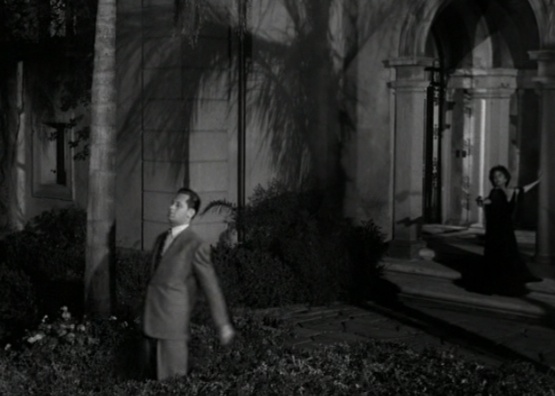
Then he plunges forward - wounded - dropping his suitcase ...
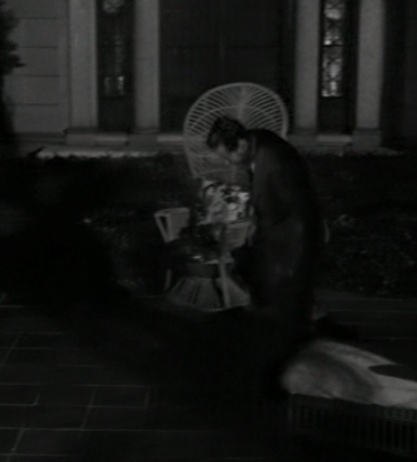
She shoots him again - from the side - he takes the hit ...
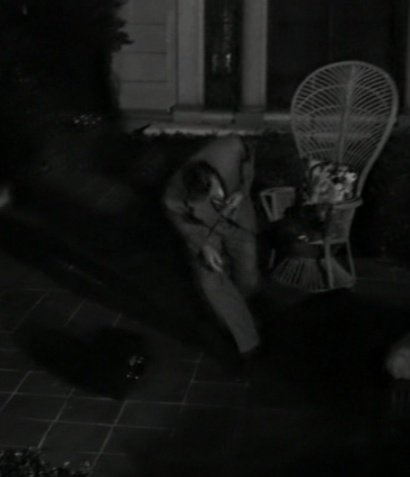
Out of control now, staggering away from her - turning back to see his attacker -
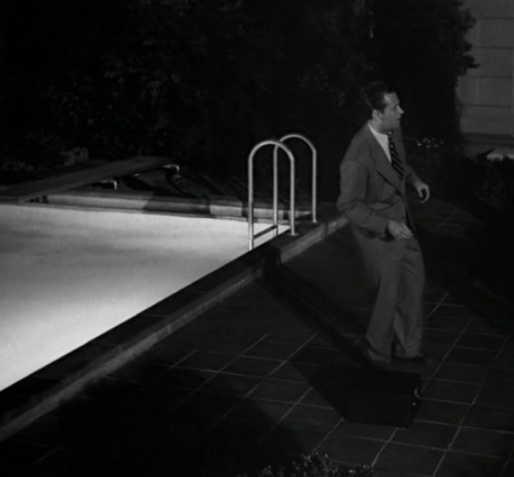
Disoriented, wounded - he flails about - flailing for the dropped suitcase ...
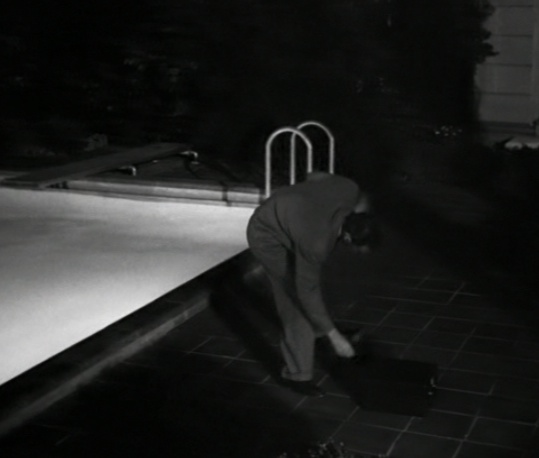
Which is when she shoots him for the final time. The death blow. His swoon is practically balletic. Fearless. Throwing himself off to the side and over the edge.
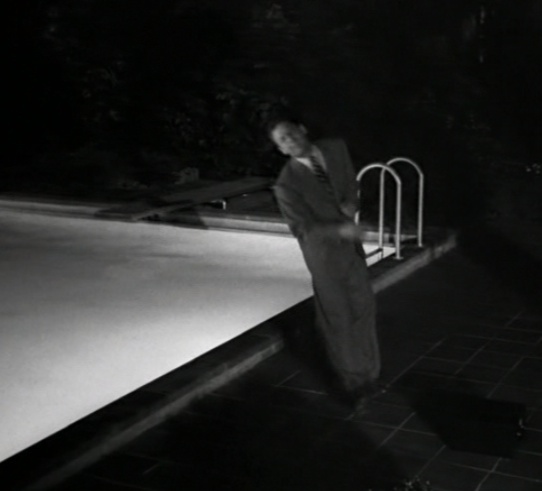
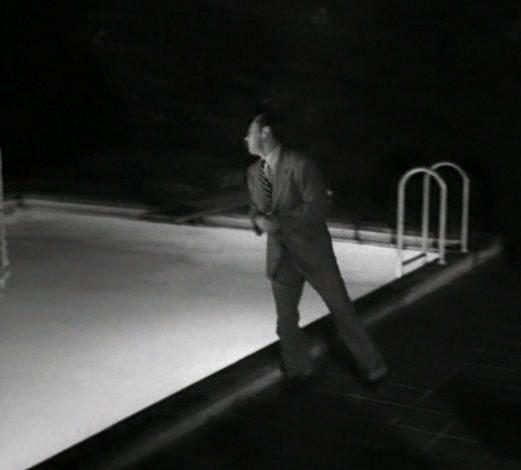
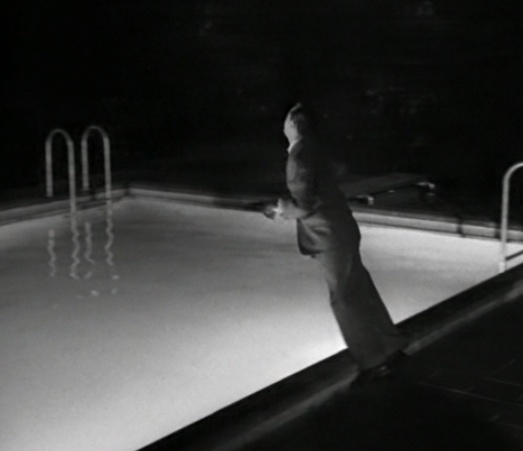
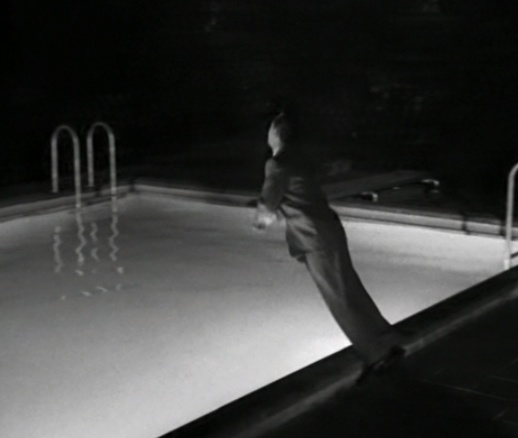
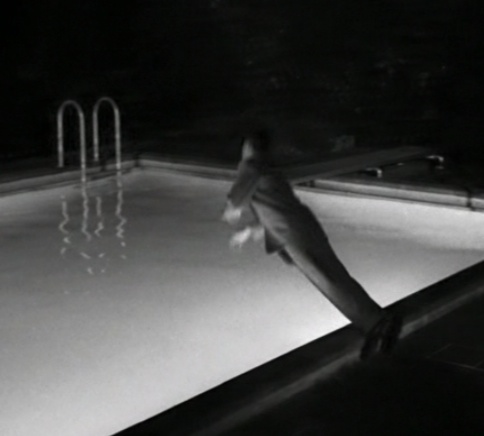





Here's the clip. Bravo.
The Books: "Anna Karenina" (Leo Tolstoy)
 Next book on my adult fiction bookshelf for the Daily Book Excerpt:
Anna Karenina
There was a time in Chicago when my entire group of friends read this book. It spread like a virus. One person started it, and began raving about it, so then another one picked it up, then another ... none of us were in the same parts of the novel as we read it, so secrets of the plot had to be preserved - "DON'T TELL ME WHAT HAPPENED!" we would shout at one another ... I think Maria was the first one to finish. She preserved her silence, but it was tragic for her ... because she knew the ending, she knew where we all were headed ... It was also tragic because she couldn't talk about it with anyone!! I had never read Anna Karenina before - and, to this day, it is the only Tolstoy I have read (although War and Peace WILL be read by me this year ... my cousin Liam is spurring me on!). I absolutely loved the book, and if you haven't read it, all I can say is: do yourself a favor ...
There is something for everyone in this book. It is a giant accomplishment. It's a snapshot (hugely detailed) of society in Russia at that time (at a certain class level, of course) - it's a social melodrama - a romance - It stands as a bridge between 19th century realism and 20th century modernism. You can feel George Eliot in the book, the masters of the 19th century - with their ability to look at an entire society and say, while they are in that society themselves: "Here. This is what I see. This is what is going on." It's completely three-dimensional, no matter which way you look at it. There are even 5 or 6 chapters (which felt ENDLESS to me at the time) where you hang out with Levin on his farm in the country, and you learn about his harvest, and his threshing, and how he farms, and WHATEVS with Levin and his wheatfields - let's get back to the city, please!!! But it's all a part of the book - and it wouldn't work without it. Levin is a hugely important character - I have great sympathy for that poor guy, and seeing him at work - to contrast the glitter of the city with all its corruption and intrigue - with the simplicity of life out in the country - hugely important to the success of the book.
Many of these people are, frankly, nasty. You don't want to hang out with them. It's a cutthroat world - the world of the court - and people's ideals are compromised. People's virtue cannot remain intact. It's just impossible. Anna Karenina, in many ways, is a woman beyond the pale. She is one of the greatest of characters ever created. She cannot "fit in", it just is not in her nature. So Kitty (as seen in the excerpt below) - who is a much more conventional type of woman, with regular old dreams that society approves of ... is baffled by and drawn to Anna. But Anna stands apart. Kitty could never be BFFs with someone like Anna, and I get the sense that Anna could never be friends with another female anyway. Not just because she would entrap any male in a 5 mile radius - but because her interests lie outside the typical female realm. But I guess that's part of the tragedy. Anna, in another time, another life, would make a great lawyer, CEO, or - perhaps - a fulfilled wife and mother. But not in her time. No way. She is beyond the pale. She is not a victim of circumstance - or, not totally - her own unconventional character and the choices she is willing to make put her into the realm of free will. And, I suppose, destiny. There is no other way that Anna Karenina could behave. She is being true to herself.
I won't go into the ins and outs of the terrifically complex plot - because watching it all unfold is part of the fun (yes, fun!) of this book. Every person you meet, even bit characters, are fully drawn. Watch how Tolstoy (in the excerpt below) makes the ball come alive. He's got that kind of eye. His descriptions of the gowns are almost feminine, in their eye for detail. And - of course - as women (and as observant men) we all know what fashion means, and the signals that women give out when they choose one outfit over another. That is all going on here.
I'm nervous to start War and Peace because I know it will take up months of my life (like Bleak House did last year) - but I'm excited as well.
The ball was only just beginning as Kitty and her mother walked up the great staircase, flooded with light, and lined with flowers and footmen in powder and red coats. From the rooms came a constant, steady noise, like that of a hive aswarm; and as they were giving the final little touches to hair and dresses before a mirror on the landing between potted trees, they heard, coming from the ballroom, the gently distinct notes of the fiddles of the orchestra, beginning the first waltz. A little ancient in civilian dress, arranging his gray curls before another mirror, and diffusing an odor of scent, stumbled against them on the stairs, and stood aside, evidently admiring Kitty, whom he did not know. A beardless youth, one of those society youths whom the old Prince Shcherbatsky called whelps, in an exceedingly open waistcoat, straightening his white tie as he went, bowed to them and after running by, came back to ask Kitty for a quadrille. As the first quadrille had already been given to Vronsky, she had to promise this youth the second. An officer, buttoning his glove, stood aside in the doorway, and, stroking his mustache, admired the rosy Kitty.
Although her dress, her coiffure, and all the preparations for the ball had cost Kitty much trouble and planning, at this moment she walked into the ballroom in the elaborate tulle dress over a pink slip as unconcernedly and simply as though all the rosettes and lace, all the minute details of her attire, had not cost her or her family a moment's attention, as though she had been born in this tulle and lace, with this towering coiffure, surmounted by a rose and two small leaves.
When, just before entering the ballroom, the old Princess tried to adjust a sash ribbon that had become twisted, Kitty had drawn back a little. She felt that everything must be right of itself, and graceful, and that nothing could need setting straight.
Kitty had one of her good days. Her dress was not uncomfortable anywhere; her lace bertha did not droop anywhere; her rosettes were neither crushed nor torn off; her pink slippers with high, curving heels did not pinch, but gladdened her tiny feet; and the thick bandeaux of fair hair kept up on her head. All the three buttons buttoned up without tearing on the long glove that covered her hand without concealing its lines. The black velvet ribbon of her locket nestled with special tenderness round her neck. This velvet ribbon was a darling; at home, regarding her neck in the looking glass, Kitty had felt that that velvet was speaking. About all the rest there might be a doubt, but the velvet ribbon was a darling. Kitty smiled here too, at the ball, when she glanced at it in the glass. Her bare shoulders and arms gave Kitty a sensation of chill marble - a sensation she particularly liked. Her eyes sparkled, and her rosy lips could not help but smile from the consciousness of their own attractiveness. She had scarcely entered the ballroom and reached the tulle-ribbon-lace-colored throng of ladies, waiting to be asked to dance - Kitty was never one of that throng - when she was asked for a waltz, and asked by the best partner, the first star in the hierarchy of the ballroom, a renowned conductor of the dances and master of ceremonies, married man, handsome and well built, Iegorushka Korsunsky. He had only just left the Countess Banina, with whom he had danced the first turn of the waltz, and, scanning his demesne - that is to say, a few couples who had started dancing - he caught sight of Kitty entering, and flew up to her with that peculiar, easy amble which is confined to conductors of the dances. Bowing and without even asking her if she cared to dance, he put out his arm to encircle her slender waist. She looked round for someone to give her fan to, and their hostess, smiling to her, took it.
"How good of you to come in good time," he said to her, embracing her waist; "such a bad habit to be late."
Bending her left arm, she laid it on his shoulder, and her little feet in their pink slippers began swiftly, lightly, and rhythmically moving over the slippery floor in time to the music.
"It's a rest to waltz with you," he said to her, as they fell into the first slow steps of the waltz. "It's charming - such lightness, precision." He said to her the same thing he said to almost all his partners whom he knew well.
She smiled at his praise, and continued to look about the room over his shoulder. She was not like a girl at her first ball, for whom all faces in the ballroom melt into one vision of fairyland. And she was not a girl who had gone the stale round of balls till every face in the ballroom was familiar and tiresome. But she was in the middle stage between these two; she was excited, and at the same time she had sufficient self-possession to be able to observe. In the left corner of the ballroom she saw the very flower of society grouped together. There - impossibly naked - was the beauty Liddy, Korsunsky's wife; there was the lady of the house; there shone the bald pate of Krivin, always to be found wherever the best people were; in that direction gazed the young men, not venturing to approach; there, too, she descried Stiva, and there she saw the charming figure and head of Anna in a black velvet gown. And he was there. Kitty had not seen him since the evening she refused Levin. With her farsighted eyes, knew him at once, and was even aware that he was looking at her.
"Another turn, eh? You're not tired?" said Korsunsky, a little out of breath.
"No, thank you!"
"Where shall I take you?"
"Madame Karenina's here, I think.... Take me to her."
"Wherever you command."
And Korsunsky began waltzing with measured steps straight toward the group in the left corner, continually saying, "Pardon, mesdames, pardon, pardon, mesdames," and steering his course through the sea of lace, tulle and ribbon, and not disarranging a feather, he turned his partner sharply round, so that her slim ankles, in light, transparent stockings, were exposed to view, and her train floated out in fan shape and covered Krivin's knees. Korsunsky bowed, set straight his open shirt front, and gave her his arm to conduct her to Anna Arkadyevna. Kitty, flushed, took her train from Krivin's knees, and, a little giddy, looked round, seeking Anna. Anna was not in lilac, as Kitty had so urgently wished, but in a black, low- cut, velvet gown, showing her full shoulders and bosom, that looked as though carved in old ivory, and her rounded arms, with tiny, slender hands. The whole gown was trimmed with Venetian guipure. On her head, among her black hair - her own, with no false additions - was a little wreath of pansies, and a similar one on the black ribbon of her sash, among white lace. Her coiffure was not striking. All that was noticeable was the little willful tendrils of her curly hair that persisted in escaping on the nape of her neck, and on her temples. Encircling her sculptured, strong neck was a thread of pearls.
Kitty had been seeing Anna every day; she adored her, and had pictured her invariably in lilac. But now, seeing her in black, she felt that she had not fully perceived her charm. She saw her now as someone quite new and surprising to her. Now she understood that Anna could not have been in lilac, and that her charm was precisely in that she always stood out against her attire, that her dress could never be noticeable on her. And her black dress, with its sumptuous lace, was not noticeable on her; it was only the frame and all that was seen was she - simple, natural, elegant, and at the same time gay and animated.
She was standing, as always, very erect, and when Kitty drew near the group she was speaking to the master of the house, her head slightly turned toward him.
"No, I won't cast a stone"' she was saying, in answer to something, "though I can't understand it," she went on, shrugging her shoulders, and she turned at once with a soft smile of protection toward Kitty. With a cursory feminine glance she scanned her attire, and made a movement of her head, hardly perceptible, but understood by Kitty, signifying approval of her dress and her looks. "You came into the room dancing," she added.
"This is one of my most faithful supporters," said Korsunsky, bowing to Anna Arkadyevna, whom he had not yet seen. "The Princess helps to make any ball festive and successful. Anna Arkadyevna, a waltz?" he said, bending down to her.
"Why, have you met?" inquired their host.
"Is there anyone we have not met? My wife and I are like white wolves - everyone knows us," answered Korsunsky. "A waltz, Anna Arkadyevna?"
"I don't dance whenever it's possible not to," she said.
"But tonight it's impossible," answered Korsunsky.
During the conversation Vronsky was approaching them.
"Well, since it's impossible tonight, let us start," she said, not noticing Vronsky's bow, and hastily put her hand on Korsunsky's shoulder.
"What is she vexed with him about?" thought Kitty, discerning that Anna had intentionally not responded to Vronsky's bow. Vronsky went up to Kitty, reminding her of the first quadrille, and expressing his regret at not having seen her all this time. Kitty gazed in admiration at Anna waltzing, as she listened to him. She expected him to ask her for a waltz, but he did not, and she glanced wonderingly at him. He flushed, and hurriedly asked her to waltz, but he had barely put his arm round her slender waist and taken the first step when the music suddenly stopped. Kitty looked into his face, which was so close to her own, and long afterward - for several years - this look, full of love, to which he made no response, cut her to the heart with an agony of shame.
"Pardon! Pardon! Waltz! Waltz!" shouted Korsunsky from the other side of the room, and, seizing the first young lady he came across he began dancing.
June 26, 2008

The Books: "The Hobbit" (J.R.R. Tolkien)
 Next book on my adult fiction bookshelf for the Daily Book Excerpt:
The Hobbit
As a child, I was never a Tolkien fanatic. I was a fanatic about other books - all of Madeleine L'Engle's "time" books, and I loved Lion, the Witch and the Wardrobe - and loved it so much that I didn't even get into the other books in that series (a situation that I do want to rectify some day). I read The Hobbit in 4th grade, and adored it - but it didn't propel me on to the level of fandom that some of my friends experienced - and I didn't read The Ring Trilogy until much later, high school maybe? I re-read all of them when Peter Jackson's movies came out, just to refresh - and I liked them better as an adult, but I feel like I missed that window - that tiny window that opens sometimes and creates a fanatic ... as opposed to just a fan. Not sure if that makes sense. I explain all of this mainly because I know how passionately people feel about these books, and I totally respect that. I respect passion about anything, pretty much (unless you say to me, "I am totally passionate about killing puppies with no remorse!" or "I am totally passionate about engineering some sort of genocide!" I am not supportive of THAT kind of passion!) So even though I don't share the passion for Tolkien's books, I totally get it, if that makes sense. I just somehow missed that moment. And, for me, I think The Hobbit is my favorite. There was something about it that captivated me as a small child (especially that kick-ass first chapter. You would be hard pressed to find a better opening to a book!) and I still feel it now as I flip through the pages.
There is something about how Tolkien sets up Bilbo Baggins in that first chapter which is just perfect. In not too many words, he paints a picture of the ultimate homebody. A cozy small creature who liked his fireplace and his meals and being cozy and warm inside. So to then picture him running and fleeing from monsters and such with huge scary wizards pushing him on is inconceivable. It's a classic tale - of someone called to a task who is not quite ready or prepared. But it was the picture of domestic warmth and comfort in that first chapter that sucked me in. I wasn't one of those little girls who really enjoyed "playing house" - but I DID like little small things ... I liked things in miniature. The people who lived behind the bookcase at Captain Kangaroo's house, for example. Or the entire "Borrowers" series - HEAVEN!! I loved Fisher Price ... because I loved the fact that they were so teeny ... I don't know why that caught my imagination so much, but it did. I wondered at the perspective of someone who was so small that he could use a human-sized thimble as a laundry basket. What would the world look like? I had a series of fairy books, where beautiful drawings of little fairies were shown lying around in buttercups or violets - flowers I knew well, I knew how small they were! So there was something about Bilbo's house, its perfect snugness, how he had everything he needed right there ... AND that he was small - not Fisher Price small - but small enough! I just loved that. I was sad when he had to leave his cozy house, and kept yearning and hoping for him to get back there again, where all was cozy and perfect. Which, of course, is Tolkien's point - not just in The Hobbit but in the Ring trilogy: the yearning for home ... Yearning for home makes up much of the world's great myths - it's probably the most human of all yearnings. Some hairy cave dude in 10,000 B.C. on a glacier killing a woolly mammoth is hoping that he will make it back to his hole in the rock by nightfall, where he will be safe for a time. You know ... we all have that. Tolkien was smart to make his heroes Hobbits, the most homebound of creatures - small, domestic, in love with comfort, not up for change ... and the simplest of pleasures are the best. To throw these creatures into the war between good and evil in their entire land ... Just perfect. Who else could save everything but a Hobbit??
And that's why the first chapter of The Hobbit is so perfect. Out of nowhere - seriously, out of a clear blue sky - dwarves show up at Bilbo Baggins' door, and breeze in, hanging up their many colored hats (I looooved as a kid that each dwarf had his own color hat ... It really appealed to my OCD side, and I memorized each dwarf's color, because it pleased me to do so. It gave order to the chaotic universe) and they all assume he is expecting them, but he not only has no idea what is going on, it takes Bilbo a while to really understand what is going to happen, and that he will not be able to say "no" to Gandalf.
I guess what I'm saying is I related to Bilbo. The picture Tolkien paints of the coziness of his house was so captivating to me that I never wanted to leave it myself. It was like the Beaver's house in Lion Witch Wardrobe (excerpt here) - a vision of coziness which is just made more poignant by the cold dangerous world just outside the warm yellow windows. Bilbo's house is like that. He has a moment in the first chapter when he gets sucked into the wizards' singing - and suddenly finds himself imagining unheard of things - dragons, jewels, being far far away from his home, caves, adventures - and it's terrifying to him.
Little does he know!
Here's an excerpt. I chose it because it has my favorite passage in the book, and maybe my second favorite thing Tolkien ever wrote (this has to be my first).
EXCERPT FROM The Hobbit
So they laughed and sang in the trees; and pretty fair nonsense I daresay you think it. Not that they would care; they would only laugh all the more if you told them so. They were elves of course. Soon Bilbo caught glimpses of them as the darkness deepened. He loved elves, though he seldom met them; but he was a little frightened of them too. Dwarves don't get on well with them. Even decent enough dwarves like Thorin and his friends think them foolish (which is a very foolish thing to think), or get annoyed with them. For some elves tease them and laugh at them, and most of all at their beards.
"Well, well!" said a voice. "Just look! Bilbo the hobbit on a pony, my dear! Isn't it delicious!"
Then off they went into another song as ridiculous as the one I have written down in full. At last one, a tall young fellow, came out from the trees and bowed to Gandalf and to Thorin.
"Welcome to the valley!" he said.
"Thank you!: said Thorin a bit gruffly; but Gandalf was already off his horse and among the elves, talking merrily with them.
"You are a little out of your way," said the elf: "that is, if you are making for the only path across the water and to the house beyond. We will set you right, but you had best get on foot, until you are over the bridge. Are you going to stay a bit and sing with us, or will you go straight on? Supper is preparing over there," he said. "I can smell the wood-fires for the cooking."
Tired as he was, Bilbo would have liked to stay a while. Elvish singing is not a thing to miss, in June under the stars, not if you care for such things. Also he would have liked to have a few private words with these people that seemed to know his names and all about him, although he had never seen them before. He thought their opinion of his adventure might be interesting. Elves know a lot and are wondrous folks for news, and know what is going on among the peoples of the land, as quick as water flows, or quicker.
But the dwarves were all for supper as soon as possible just then, and would not stay. On they all went, leading their ponies, till they were brought to a good path and so at last to the very brink of the river. It was flowing fast and noisily, as mountain-streams do of a summer evening, when sun has been all day on the snow far up above. There was only a narrow bridge of stone without a parapet, as narrow as a pony could well walk on; and over that they had to go, slow and careful, one by one, each leading his pony by the bridle. The elves had brought bright lanterns to the shore, and they sang a merry song as the party went across.
"Don't dip your beard in the foam, father!" they cried to Thorin, who was bent almost on to his hands and knees. "It is long enough without watering it."
"Mind Bilbo doesn't eat all the cakes!" they called. "He is too fat to get through key-holes yet!"
"Hush, hush! Good People! and good night!" said Gandalf, who came last. "Valleys have ears, and some elves have over merry tongues. Good night!"
And so at last they all came to the Last Homely House, and found its doors flung wide.
Now it is a strange thing, but things that are good to have and days that are good to spend are soon told about, and not much to listen to; while things that are uncomfortable, palpitating, and even gruesome, may make a good tale, and take a deal of telling anyway. They stayed long in that good house, fourteen days at least, and they found it hard to leave. Bilbo would gladly have stopped there for ever and ever - even supposing a wish would have taken him right back to his hobbit-hole without trouble. Yet there is little to tell about their stay.
The master of the house was an elf-friend - one of those people whose fathers came into the strange stories before the beginning of History, the wars of the evil goblins and the elves and the first men in the North. In those days of our tale there were still some people who had both elves and heroes of the North for ancestors, and Elrond the master of the house was their chief.
He was as noble and as fair in face as an elf-lord, as strong as a warrior, as wise as a wizard, as venerable as a king of dwarves, and as kind as summer. He comes into many tales, but his part in the story of Bilbo's great adventure is only a small one, though important, as you will see, if we ever get to the end of it. His house was perfect, whether you liked food, or sleep, or work, or story-telling, or singing, or just sitting and thinking best, or a pleasant mixture of them all. Evil things did not come into that valley.
I wish I had time to tell you even a few of the tales or one or two of the songs that they heard in that house. All of them, the ponies as well, grey refreshed and strong in a few days there. Their clothes were mended as well as their bruises, their tempers and their hopes. Their bags were filled with food and provisions light to carry but strong to bring them over the mountain passes. Their plans were improved with the best advice. So the time came to midsummer eve, and they were to go on again with the early sun on midsummer morning.
Elrond knew all about runes of every kind. That day he looked at the swords they had brought from the trolls' lair, and he said: "These are not troll-make. They are old swords, very old swords of the High Elves of the West, my kin. They were made in Gondolin for the Goblin-wars. They must have come from a dragon's hoard or goblin plunder, for dragons and goblins destroyed that city many years ago. This, Thorin, the runes name Orcrist, the Goblin-cleaver in the ancient tongue of Gondolin; it was a famous blade. This, Gandalf, was Glamdring, Foehammer that the king of Gondolin once wore. Keep them well!"
"Whence did the trolls get them, I wonder?" said Thorin looking at his sword with new interest.
"I could not say," said Elrond, "but one may guess that your trolls had plundered other plunderers, or come on the remnants of old robberies in some hold in the mountains. I have heard that there are still forgotten treasures of old to be found in the deserted caverns of the mines of Moria, since the dwarf and goblin war."
Thorin pondered these words. "I will keep this sword in honour," he said. "May it soon cleave goblins once again!"
"A wish that is likely to be granted soon enough in the mountains!" said Elrond. "But show me now your map!"
He took it and gazed long at it, and he shook his head; for if he did not altogether approve of dwarves and their love of gold, he hated dragons and their cruel wickedness, and he grieved to remember the ruin of the town of Dale and its merry bells, and the burned banks of the bright River Running. The moon was shining in a broad silver crescent. He held up the map and the white light shone through it. "What is this?" he said. "There are moon-letters here, beside the plain runes which say 'five feet high the door and three may walk abreast.'"
"What are moon-letters?" asked the hobbit full of excitement. He loved maps, as I have told you before; and he also liked runes and letters and cunning handwriting, though when he wrote himself it was a bit thin and spidery.
"Moon-letters are rune-letters, but you cannot see them," said Elrond, "not when you look straight at them. They can only be seen when the moon shines behind them, and what is more, with the more cunning sort it must be a moon of the same shape and season as the day when they were written. The dwarves invented them and wrote them with silver pens, as your friends could tell you. These must have been written on a midsummer's eve in a crescent moon, a long while ago."
"What do they say?" asked Gandalf and Thorin together, a bit vexed perhaps that even Elrond should have found this out first, though really there had not been a chance before, and there would not have been another until goodness knows when.
"Stand by the grey stone when the thrush knocks," read Elrond, "and the setting sun with the last light of Durin's Day will shine upon the key-hole."
"Durin, Durin!" said Thorin. "He was the father or the fathers of the eldest race of Dwarves, the Longbeards, and my first ancestor: I am his heir."
"Then what is Durin's Day?" asked Elrond.
"The first day of the dwarves' New Year," said Thorin, "is as all should know the first day of the last moon of Autumn on the threshold of Winter. We still call it Durin's Day when the last moon of Autumn and the sun are in the sky together. But this will not help us much, I fear, for it passes our skill in these days to guess when such a time will come again."
"That remains to be seen," said Gandalf. "Is there any more writing?"
"None to be seen by this moon," said Elrond, and he gave the map back to Thorin; and then they went down to the water to see the elves dance and sing upon the midsummer's eve.
June 25, 2008
Exile in Guyville turns 15 this month ...
... which means that I am a withered crone and did not even realize it.
Exile in Guyville is being re-released in honor of the upcoming anniversary (with extra tracks, a documentary, all that). Here's an in-depth interview with Liz Phair about the re-release.
That album means a lot to a lot of people, and I'm one of them. It's an awesome record, and was quite revolutionary at the time. I still remember the goosebumps I got when I heard some of the tracks for the first time. It's raw, the music is, if anything, under-produced, but it was her lyrics that got me. (I know I'm showing my age by calling it a "record" but whatevs - I actually did have it on vinyl. So there!) -She was a smarter bitchier sexier version of all the female musician images we see now - a little bit scary, maybe more damaged, but cold and distant - not wearing her heart on her sleeve. She was really saying something on that album, and saying crap that a lot of people didn't want to hear. I love her for it.
I have been listening to tracks from Exile in Guyville, without exaggeration, on an almost daily basis since that double album came out. And now with the whole new-fangled invention of the iPod I listen to it even more - because she comes up on Shuffle repeatedly. I am one of those fans of Liz Phair who did NOT feel betrayed by her later albums, although there's something raw and almost scary about Exile in Guyville (not to mention something scarily akin to my own experience at that time in my own life) that is not there in the later albums, but that's par for the course with an artist's journey. When you're young and desperate and NOT famous, you sometimes have way more courage and honesty - and fame brings its own rewards, but also lessens some of that desperation. Not to mention growing up and having kids and all that ... But Exile in Guyville was a singular event, one of those albums that came along and expressed a truth about a certain KIND of person, in a certain KIND of environment ... Not all women are going to relate to the images of womanhood that Liz Phair exposes in Exile in Guyville, but if you do? You're hooked for good - because there's not a lot of other women out there doing what Phair did at that time. It's a messy and complicated and beautiful woman - I don't know, I'm thinking of someone like Chrissie Hynde, who seems to embody the same type of woman ... except Liz Phair does it in a mid-90s context, as opposed to 70s and 80s. Liz Phair is strictly Generation X, and so am I - poster children for the cliches of our generation. We're about the same age. We were in Chicago at the same time. Hanging out (in some cases) in the same crowd. The album came out as I was going through it, so listening to it for the first time was one of those uncanny "Holy shit, did she read my diary??" moments.
Like "Mesmerizing", one of my favorite tracks:
You said things I wouldn't say
Straight to my face, boy
You tossed the egg up
And I found my hands in place, boy
After backing up as far as you could get
Don't you know nobody parts two rivers met?
Don't you know I'm very happy?
You know me well
I'm even happier
I like it
I like it
With all of the time in the world to spend it
Wild and unwise, I wanna be mesmerizing too
Mesmerizing too
Mesmerizing to you
That's so damn honest. I want to thank her for being honest, because it gave me the possibility of seeing what I was doing as well, and being honest. I wanna be mesmerizing too. I am wild and unwise. I wanna be mesmerizing too. To you. Yes!
I listen to Exile in Guyville and it still calls up that time in my life perfectly. My perception of it may be different now, I may be sadder, and have more regrets - but the experience of the album is the same.
She's a smart cookie. She has just grown as a songwriter in the years since. I'll be a fan forever. Even if she falls short of that original double album - it's just one of those things: I'll follow her wherever she goes.
Listening to it today, the album still holds up a dark mirror, it still delves into womanhood - a kind of Gen X brand of womanhood - that feels acutely and scarily right to me, and it still expresses the joy and loneliness and wildness of that time in my life in a way that is almost too intense.
I love Phair's comment in the article above about going to Oberlin:
So I came to Oberlin having a Lady Di haircut, wearing acid-wash jeans with flowers on them—like, “Hi! I’m Liz! And I wear really strong blue eyeliner!” And I got my ass kicked by all these New Yorkers. The zeitgeist on that campus changed my perspective completely on gender and bravery.
I'll say. Brave brave artist.

So happy birthday to Exile in Guyville - an album that still has the capacity to freak me out completely.
June 24, 2008
Carlin's last interview
I love the bit about Arthur Koestler.
And I love his idea for "files" - I want to look through his files!! - but I also want to take that idea on myself.
I loved this, too:
So, those qualities of being alone like that fostered in me a need for adult approval and attention. Now they say that it's kind of a common cliché that comedians just want attention. But it's an element that's very important. The job is called "look at me." That's the name of this job. “Look at me. Ain't I smart? Ain't I cute? Ain't I clever?I needed to be—not the center of attention—but I needed to be able to attract attention when I wanted it, through my stunts and my fooling around physically with faces or postures or voices I would do. Then it became funny the things I would say, and I became more of a wit than simply a mimic and a clown. And so, those things were all important in this. The fact that I didn’t finish school left me with a lifelong need to prove that I’m smart, prove it to myself, maybe to the world. “Ain't I smart, ain't I cute, ain't I clever.” “Listen to me, listen to what I got to say.” So, those things are important elements in the drive behind all of this.
It makes some people embarrassed to hear a person admit so openly that what he needs is attention. It seems to confirm everything they hated about the school show-off, now transferred to entertainers and performers who have the balls to admit that why they do it is they like to be looked at.
But Carlin's honesty there reminds me of a wonderful anecdote told by Dustin Hoffman:
At the end of filming Marathon Man, there was a party. Laurence Olivier was quite ill. The shooting had been intense, and everyone was relieved it was over. Hoffman never quite got over being in awe of Olivier, despite their polar opposite ways of working ("My dear boy, why don't you try just acting?") - and he was very moved by the thought of Olivier, this old ill man, turning in such a great performance. It is what he does. Hoffman was sitting with Olivier at the party, and Olivier said, out of the blue, "Do you know why I do this?" (Meaning: acting). Hoffman shook his head No. Olivier got up, which was a bit of a struggle for him, he was quite weak, and leaned over to Hoffman, putting his face right up against Hoffman's - and saying over and over and over, "Look at me look at me look at me look at me look at me look at me look at me look at me ..."
Hoffman was tremendously moved. Perhaps you might expect that Olivier would say that he "did it" because he believed in the grand tradition of theatre and storytelling, or that he was carrying on the torch from Richard Burbage and wanted to interpret the classics to a new audience, or that he believed in the craft itself, and the nobility of it. All valid reasons, too, to "do" something.
But no. For Olivier it all boiled down to: "Look at me look at me look at me look at me look at me look at me look at me ..."
Bless him (and bless Carlin) for being courageous enough to just say it.
Carlin's 7 words you cannot say
Stevie shares his memory of seeing Carlin in Vegas in the 70s, with his parents - a couple months after Carlin had been arrested for obscenity. Not to be missed.
The next day, after a lox-and-bagel buffet breakfast and a trip to Hoover Dam, we saw Sergio Franchi (lucious baritone in a dove gray Nehru suit) and Milt Kamens, one of the old guard Jewish comedians who perfected their routines thirty years before in the Catskills and were enjoying a time of great popularity. Funny accents, punch lines, and a lot of finesse - old fashioned comedy, about to be anhilated by the likes of George Carlin.
Thrilling.
The Books: "Gulliver's Travels" (Jonathan Swift)
 Next book on my adult fiction bookshelf for the Daily Book Excerpt:
Gulliver's Travels 
Edgell Rickword said, of Jonathan Swift:
"[He is] the most vigorous hater we've ever had in our literature."
He said those words in the 20th century and I would imagine that the judgment will still stand, long into the future. Haters are easy to come by. But vigorous articulate haters with a skewering pen - leaving his enemies no escape? Rare indeed. I've read self-important political bloggers (is there any other kind?) describe what they are trying to do as Swiftian, and sorry, boys, gotta tell you: Don't flatter yourself. Meanie tantrum insults thrown like poo at a wall is not Swiftian, mkay, boys? And satire is more difficult to write properly than a well-wrought 5 act tragedy. Satire is out of style these days - the audience is much more literal now, that's just the way it is - so people (in general) don't have an ear for it. People are confronted with satire and the response more often than not is, "But he's exaggerating!!" Uhm, yeah. It's called satire. There's a reason why, to this day, "A Modest Proposal" is taught as the primary example of satire in Western literature. Nothing else comes close. It was published in 1729. That's how powerful it is. Everyone else is still trying to match it. I get so annoyed by people comparing themselves to Swift, I'm sorry. SPOOF is not satire. PARODY is not satire. That just goes to show you how definitions have been so degraded that nobody even knows what satire is. Anyway, whatever, I sound like the snot that I am, and I am totally fine with that, more and more every day. It's a delight when you come across an honest-to-God satirical piece of work nowadays - that really has the courage of its convictions, and doesn't crap out at the end. The first thing that comes to mind is the movie Election which so could have been terrible, or just a "spoof" of the election process. But it's not. It's deeper than that and it has deeper things to say. It's angrier. Satire is always angry. And the film just works as satire - with all its humor and rage and specificity.
Back to Swift. And his hating.
In 1725, Jonathan Swift wrote in a letter to his great friend Alexander Pope:
I have ever hated all nations, professions, and communities, and all my love is toward individuals: for instance, I hate the tribe of lawyers, but I love Counsellor Such-a-one and Judge Such-a-one: so with physicians - I will not speak of my own trade - soldiers, English, Scotch, French, and the rest. But principally I hate and detest that animal called man, although I heartily love John, Peter, Thomas, and so forth. This is the system upon which I have governed myself many years, but do not tell, and so I shall go on till I have done with them. I have got materials toward a treatise, proving the falsity of that definition animal rationale, and to show it would be only rationis capax. Upon this great foundation of misanthropy, though not in Timon's manner, the whole building of my Travels is erected; and I never will have peace of mind till all honest men are of my opinion. By consequence you are to embrace it immediately, and procure that all who deserve my esteem may do so too. The matter is so clear that it will admit of no dispute; nay, I will hold a hundred pounds that you and I agree in the point.
You know, I really love that. Swift hated the "group". We see that so clearly in Gullivers Travels - a book broken up into 4 parts, with 4 different journeys of Lemuel Gulliver, to fantastical lands ruled by teeny people or giants or horse-like creatures, or whatever. These people are not individuals. They are groups. Gulliver is kind of a pompous ass, truth be told, he's always like, "As someone who has studied Sanskrit I understood what they were saying ..." "As a person with a deep background in calculus and fire-eating, I understood my role here ..." Like, the man has done everything, seen everything, and there's nothing you could tell him that he didn't know. He's a big fat bore. His wife and kids are probably psyched he goes away on such long journeys, just so they won't have to suffer through his pompous lectures anymore. But of course Gulliver would never see that about himself. He is an insufferable companion. That's one of the reasons why he is so funny.
My only complaint about my copy of the book is that the footnotes suck. I want more detail. Satire is necessarily very local, and so much of what Swift is satirizing is lost in the mists of time. I'm no history ignoramus, especially not when it comes to Ireland, and the British policies in Ireland - but still - the footnotes just aren't good enough. I would have liked more detail.
The book ends with Gulliver hanging out with the Houyhnhnms (benign horse-like creatures) and becoming so enraptured and used to their peaceful ways that he finds Yahoos (humans) absolutely disgusting. He returns home, and his wife and children run towards him, thrilled to see him, and he is so revolted by them he slams the door in their faces. This goes back to Swift's generalized hatred of the human race. He liked Tom, Dick and Harry - but mankind could suck it, as far as Swift was concerned. Not to mention the fact that he doesn't really see women as part of mankind - they are completely "other" and he is revolted by them. We see that in Gulliver when Gulliver is standing on the breast of the giant woman, and he sees her pores and the blackheads and the dirt on her bosom and it is totally disgusting. So fine. Women aren't included in "mankind". Tell me something I didn't already know!
There are many fantastical worlds here (I love the floating island) - and Swift describes the different ways and customs with great verve, so that you can really see the worlds - but my favorite parts of the books are when you can feel Swift's anger. Has there been a more angry writer? I'm hard-pressed to think of one. There's the scene where the Lilliputian palace catches on fire, and Gulliver, full of wine from the night before, realizes he has the perfect solution to put out the inferno - he urinates onto the palace, putting out the fire. I don't need a guide book to understand that. But there's a great plausible deniability about the whole enterprise, which makes Swift seem quite devilish. He's just telling a story, don't you know ... a fairy tale, with tiny people, and giants. Don't read too much into it! Come on now! You're being too serious!! It's brilliant.
I love anger. I love subversive literature. I love those who despise the status quo, those who are uppity trouble-makers. There's a lot of trouble to be made. There are a lot of things which are assumed to be true by the majority of people ... and anyone who comes out and says, "I HATE this" is held in suspicion. Swift was one of those people (even though in many ways he was part of the establishment). But he couldn't help but see, with his laser eye, how horrible politics were, how stupid everybody was (for the most part), and really how awful people were, especially those with any authority - just look at how we treat each other. It is indefensible. Swift does not defend that which is indefensible and I love that about him.
One of the centerpieces of the book is when Gulliver sits down with the King of the giants - and tries to answer all of the King's questions about law/politics/society of the rest of the world (excerpt below). Swift is brilliant here. His pen is a sword. Sometimes you can't even tell that he IS cutting something. His enemy might never have known he has mortally wounded until his arm fell off - the slicing is that smooth and perfect. Swift often uses terms of praise and approbation - but in a way where you can tell he means the exact opposite. It's brutal. Swift shows the absurdity of all of this by putting it all into the questions from the King. One can imagine contemporaries of Swift howling with laughter at the thought of trying to answer those questions in the affirmative ("Were those holy lords I spoke of were always promoted to that rank upon account of their knowledge in religious matters?" "HELL NO!" etc.) ... and through that now-you-see-it now-you-don't literary maneuver, Swift stabs his opponent in the heart. The thing is: you could hear some pompous blowhard (who had been pricked, naturally, by the implications of the satire) try to defend himself - and say, 'Well, but yes, it is always more complicated than you would think ..." and it is THAT kind of person that Swift finds most disgusting. The ones with pride. The ones who have something to lose, the ones who choose to defend the indefensible. The rot goes to the deepest levels of society. If you try to deny it or defend it, you are Swift's enemy.
Yeats wrote a poem in honor of Swift:
Swift's Epitaph
Swift has sailed into his rest;
Savage indignation there
Cannot lacerate his breast.
Imitate him if you dare,
World-besotted traveller; he
Served human liberty.
That "imitate him if you dare" challenge still stands. Incredible.
Here's an excerpt.
EXCERPT FROM Gulliver's Travels
The King, who, as I before observed, was a Prince of excellent Understanding, would frequently order that I should be brought in my Box, and set upon the Table in his Closet: He would then command me to bring one of my Chairs out of the Box, and sit down within three Yards Distance upon the Top of the Cabinet, which brought me almost to a level with his Face. In this Manner I had several Conversations with him. I one Day took the Freedom to tell his Majesty, that the Contempt he discovered towards Europe, and the rest of the World, did not seem answerable to those excellent Qualities of the Mind he was Master of. That Reason did not extend it self with the Bulk of the Body: On the contrary, we observed in our Country, that the tallest Persons were usually least provided with it. That among other Animals, Bees and Ants had the Reputation of more Industry, Art and Sagacity, than many of the larger Kinds; and that, as inconsiderable as he took me to be, I hoped I might live to do his Majesty some signal Service. The King heard me with Attention, and began to conceive a much better Opinion of me than he had ever before. He desired I would give him as exact an Account of the Government of England, as I possibly could; because, as fond as Princes commonly are of their own Customs (for so he conjectured of other Monarchs, by my former Discourses), he should be glad to hear of any Thing that might deserve Imitation.
Imagine with thy self, courteous Reader, how often I then wished for the Tongue of Demosthenes or Cicero, that might have enabled me to celebrate the Praise of my own dear native Country in a Stile equal to its Merits and Felicity.
I began my Discourse by informing his Majesty that our Dominions consisted of two Islands, which composed three mighty Kingdoms under one Sovereign, beside our Plantations in America. I dwelt long upon the Fertility of our Soil, and the Temperature of our Climate. I then spoke at large upon the Constitution of an English Parliament, partly made up of an illustrious Body called the House of Peers, Persons of the noblest Blood, and of the most ancient and ample Patrimonies. I described that extraordinary Care always taken of their Education in Arts and Arms, to qualify them for being Counsellors born to the King and Kingdom; to have a share in the Legislature; to be Members of the highest Court of Judicature, from whence there could be no Appeal; and to be Champions always ready for the Defence of their Prince and Country, by their Valour, Conduct, and Fidelity. That these were the Ornament and Bulwark of the Kingdom, worthy Followers of their most renowned Ancestors, whose Honour had been the Reward of their Virtue, from which their Posterity were never once known to degenerate. To these we joined several holy Persons, as part of that Assembly, under the Title of Bishops, whose peculiar Business it is to take care of Religion, and of those who instruct the People therein. These were searched, and sought out, through the whole Nation, by the Prince and his wisest Counsellors, among such of the Priesthood as were most deservedly distinguished by the Sanctity of their Lives, and the depth of their Erudition; who were indeed the spiritual Fathers of the Clergy and the People.
That, the other Part of the Parliament consisted of an Assembly called the House of Commons, who were all principal Gentlemen, freely picked and culled out by the People themselves, for their great Abilities and Love of their Country, to represent the Wisdom of the whole Nation. And these two Bodies make up the most august Assembly in Europe, to whom, in Conjunction with the Prince, the whole Legislature is Committed.
I then descended to the Courts of Justice, over which the Judges, those venerable Sages and Interpreters of the Law presided, for determining the disputed Rights and Properties of Men, as well as for the Punishment of Vice, and Protection of Innocence. I mentioned the prudent Management of our Treasury; the Valour and Atchievements of our Forces by Sea and Land. I computed the Number of our People, by reckoning how many Millions there might be of each religious Sect, or political Party among us. I did not omit even our Sports and Pastimes, or any other Particular which I thought might redound to the Honour of my Country. And I finished all with a brief historical Account of Affairs and Events in England for about an hundred Years past.
This Conversation was not ended under five Audiences, each of several Hours, and the King heard the whole with great Attention, frequently taking Notes of what I spoke, as well as Memorandums of all Questions he intended to ask me.
When I had put an End to these long Discourses, his Majesty in a sixth Audience consulting his Notes, proposed many Doubts, Queries, and Objections, upon every Article. He asked what Methods were used to cultivate the Minds and Bodies of our young Nobility, and in what kind of Business they commonly spent the first and teachable Part of their Lives. What Course was taken to supply that Assembly when any Noble Family became extinct. What Qualifications were necessary in those who were to be created new Lords: Whether the Humour of the Prince, a Sum of Money to a Court Lady or a Prime Minister, or a Design of strengthening a Party opposite to the publick Interest, ever happened to be Motives in those Advancements. What Share of Knowledge these Lords had in the Laws of their Country, and how they came by it, so as to enable them to decide the Properties of their Fellow-Subjects in the last Resort. Whether they were always so free from Avarice, Partialities, or Want, that a Bribe, or some other sinister View, could have no Place among them. Whether those holy Lords I spoke of were always promoted to that Rank upon account of their Knowledge in religious Matters, and the Sanctity of their Lives, had never been Compliers with the Times while they were common Priests, or slavish prostitute Chaplains to some Nobleman, whose Opinions they continued servilely to follow after they were admitted into that Assembly.
He then desired to know what Arts were practiced in electing those whom I called Commoners: Whether a Stranger with a strong Purse might not influence the vulgar Voters to choose him before their own Landlord, or the most considerable Gentleman in the Neighbourhood. How it came to pass, that People were so violently bent upon getting into this Assembly, which I allowed to be a great Trouble and Expense, often to the Ruin of their Families, without any Salary or Pension: Because this appeared such an exalted Strain of Virtue and publick Spirit, that his Majesty seemed to doubt it might possibly not be always sincere: and he desired to know whether such zealous Gentlemen could have any Views of refunding themselves for the Charges and Trouble they were at, by sacrificing the publick Good to the Designs of a weak and vicious Prince in Conjunction with a corrupted Ministry. He multiplied his Questions, and sifted me thoroughly upon every Part of this Head, proposing numberless Enquiries and Objections, which I think it not prudent or convenient to repeat.
Upon what I said in relation to our Courts of Justice, his Majesty desired to be satisfied in several Points: And this I was the better able to do, having been formerly almost ruined by a long Suit in Chancery, which was decreed for me with Costs. He asked, what Time was usually spent in determining between Right and Wrong, and what Degree of Expence. Whether Advocates and Orators had Liberty to plead in Causes manifestly known to be unjust, vexatious, or oppressive. Whether Party in Religion or Politicks were observed to be of any Weight in the Scale of Justice. Whether those pleading Orators were Persons educated in the general Knowledge of Equity, or only in provincial, national, and other local Customs. Whether they or their Judges had any Part in penning those Laws which they assumed the Liberty of interpreting and glossing upon at their Pleasure. Whether they had ever at different Times pleaded for and against the same Cause, and cited Precedents to prove contrary Opinions. Whether they were a rich or a poor Corporation. Whether they received any pecuniary Reward for pleading or delivering their Opinions. And particularly whether they were ever admitted as Members in the lower Senate.
He fell next upon the Management of our Treasury; and said, he thought my Memory had failed me, because I computed our Taxes at about five or six Millions a Year, and when I came to mention the Issues, he found they sometimes amounted to more than double; for the Notes he had taken were very particular in this Point, because he hoped, as he told me, that the Knowledge of our Conduct might be useful to him, and he could not be deceived in his Calculations. But, if what I told him were true, he was still at a Loss how a Kingdom could run out of its Estate like a private Person. He asked me, who were our Creditors; and where we should find Money to pay them. He wonder'd to hear me talk of such chargeable and extensive Wars; that certainly we must be a quarrelsome People, or live among very bad Neighbours, and that our Generals must needs be richer than our Kings. He asked what Business we had out of our own Islands, unless upon the Score of Trade or Treaty, or to defend the Coasts with our Fleet. Above all, he was amazed to hear me talk of a mercenary standing Army in the midst of Peace, and among a free People. He said, if we were governed by our own Consent in the Persons of our Representatives, he could not imagine of whom we were afraid, or against whom we were to fight; and would hear my Opinion, whether a private Man's House might not better be defended by himself, his Children, and Family, than by half a dozen rascals picked up at a venture in the Streets, for small Wages, who might get a hundred times more by cutting their Throats.
He laughed at my odd Kind of Arithmetick (as he was pleased to call it) in reckoning the Numbers of our People by a Computation drawn from the several Sects among us in Religion and Politicks. He said, he knew no Reason, why those who entertain Opinions prejudicial to the Publick, should be obliged to change, or should not be obliged to conceal them. And as it was Tyranny in any Government to require the first, so it was Weakness not to enforce the second: For a Man may be allowed to keep poisons in his Closet, but not to vend them about for Cordials.
He observed, that among the Diversions of our Nobility and Gentry, I had mentioned Gaming. He desired to know at what Age this Entertainment was usually taken up, and when it was laid down; how much of their Time it employed; whether it ever went so high as to affect their Fortunes: Whether mean vicious People, by their Dexterity in that Art, might not arrive at great Riches, and sometimes keep our very Nobles in Dependance, as well as habituate them to vile Companions, wholly take them from the Improvement of their Minds, and force them, by the Losses they have received, to learn and practice that infamous Dexterity upon others.
He was perfectly astonished with the historical Account I gave him of our Affairs during the last Century, protesting it was only a Heap of Conspiracies, Rebellions, Murders, Massacres, Revolutions, Banishments, the very worst Effects that Avarice, Faction, Hypocrisy, Perfidiousness, Cruelty, Rage, Madness, Hatred, Envy, Lust, Malice, or Ambition could produce.
His Majesty in another Audience was at the Pains to recapitulate the Sum of all I had spoken, compared the Questions he made with the Answers I had given; then taking me into his Hands, and stroaking me gently, delivered himself in these Words, which I shall never forget nor the Manner he spoke them in: My little Friend Grildrig, you have made a most admirable Panegyric upon your Country: You have clearly proved that Ignorance, Idleness, and Vice may be sometimes the only Ingredients for qualifying a Legislator: That Laws are best explained, interpreted, and applied by those whose Interest and Abilities lie in perverting, confounding, and eluding them. I observe among you some Lines of an Institution, which in its Original might have been tolerable, but these half erazed, and the rest wholly blurred and blotted by Corruptions. It doth not appear from all you have said, how any one Virtue is required towards the Procurement of any one Station among you, much less that Men are ennobled on Account of their Virtue, that Priests are advanced for their Piety or Learning, Soldiers for their Conduct or Valour, Judges for their Integrity, Senators for the Love of their Country, or Counsellors for their Wisdom. As for yourself, (continued the King,) who have spent the greatest Part of your Life in Travelling, I am well disposed to hope you may hitherto have escaped many Vices of your Country. But by what I have gathered from your own Relation, and the Answers I have with much Pain wringed and extorted from you, I cannot but conclude the Bulk of your Natives to be the most pernicious Race of little odious Vermin that Nature ever suffered to crawl upon the Surface of the Earth.
June 23, 2008
"In baseball, you make an error! Whooops!"
Rest in peace, George Carlin. I loved his bit on the differences between football and baseball. See below. What a loss. An American classic.
Burn After Reading:
The new Coen brothers film, coming out this September.
After seeing the release of the poster and the trailer (domestic and international - two totally different trailers) I can now say I am officially excited. The poster calls up all of Saul Bass' iconic images - what a brilliant idea - no posters look like that anymore, and so it is completely eye-catching. And I love Brad Pitt when he's allowed to be a goofball. I guess my first impression of him - in first Thelma and Louise, and then True Romance - is the one that has really stuck - good-looking, sure, but doesn't take himself all that seriously. It's very endearing (when he's allowed to do it). I'm not gaga over his looks, he never really did it for me in that capacity - and I don't think he has all that much range - but range is over-rated. If you have too much range, you run the risk of being thought of as facile. Ooh, look at me with my different accents and haircuts and walks and gestures, aren't I clever? Pitt is just getting more interesting as he gets older. The parts he's getting are more interesting, too. I love it when he is allowed to be goofy and silly. It makes me so happy. I mean, his cameo as the pot-smoking loser roommate in True Romance is comedy gold as far as I'm concerned ("And get some .... cleaning products ... " "Dont' condissnd meeee .....". So funny!!) In the trailer, Brad Pitt gets punched in the face by John Malkovich and I've seen it 4 times now and it makes me laugh every time. And look at this still from the film:

I mean, I have no idea what's going on there, but it's hilarious.
So yeah. Sheila is STOKED. I actually am so excited I feel vaguely uncomfortable about it.
Poster, Saul Bass comparison - just for fun, and both trailers below. Can't WAIT!

Doesn't it remind you of ...


International teaser trailer:
Domestic trailer:
The Books: "East of Eden" (John Steinbeck)
 Next book on my adult fiction bookshelf for the Daily Book Excerpt:
East of Eden
I just love this book so much. There's one sentence in it about springtime coming to Salinas Valley in California (I looked for the sentence, and can't find it) - and the image is that the flowers become so gold that you could almost believe the color is molten, that you could dip a spoon into the flower and scoop out some liquid gold. To me, that's what the entire book feels like. Pure molten gold. So good you want to savor it, you want every word to last, you don't want it to end. It's just words on a page - in the same way that the flowers are just yellow .... but all together, it takes on a palpably fluid and tangible essence.
There is so much in it. It has minutia, conversation, details, and it has grandiosity to a Biblical level. It goes into family drama, the personalities of multiple people - fully drawn, complex ... and it also rhapsodizes about the development of the West, and all that that means. So much. There is the history of California, first of all. There is also the history of two families - the Hamiltons and the Trasks ... side by side ... and man, you couldn't get two families with more divergent energies than those two! The book goes through three generations. You get to know Samuel Hamilton as well as you know anyone in your own life. Same with Adam Trask. And Charles Trask (shivers). Not to mention Cathy - a demonic force who comes into their lives from the east (east of Eden?) - leaving a trail of destruction behind her, nothing that can be pinned on her, but she's a wrecker. You also get a parable of good vs. evil. I think Steinbeck truly believed that good prevails. Even if it takes many lifetimes. Even if it seems, at times, that evil wins out ... I think he felt that there was a morality at the heart of man, an essential goodness ... that could not be killed. His books can be quite dark, but there is an optimism there that cannot be destroyed, and that is never as clear as it is in East of Eden, which - with all its tragedy - has one of the most hopeful endings of all of Steinbeck's books (perhaps of any book!). People like Cathy are not malevolent because they're just born bad, and they like to stir up shit (although that is true with Cathy as well - but that's a symptom, not a cause). Someone like Cathy is malevolent because goodness actually disturbs her, she doesn't understand it, and so it cannot be allowed to stand. She is an alien from another planet. She would make a great dictator. She would understand Pol Pot, and Stalin. She is tone-deaf, when it comes to conventional morality and any kind of softness. She has learned to lie, and make the correct cooing noises that sound relatively human so that no one will pick up the scent ... but she looks around the world, sees everyone behaving in a way she finds incomprehensible (she only understands selfish motives), and will do whatever it takes to get whatever she wants. Steinbeck obviously sees that most of us are mixed bags - we all have good and evil, and if we are moderately healthy (meaning spiritually) - we can allow the two things to battle it out within us. If you are too good (like Adam Trask), you risk being naive, stupid, and forgiving towards those who do not deserve it. Look out. Don't be TOO good. Because then you'll have demons like Cathy and Charles walk all over you.
By the end of the book, we have another set of brothers - Cal and Aron ... again, with the good and evil, but by this time, perhaps it's been watered down - not so intensely stark as it was in earlier generations. Cal FEELS he is all bad, but that is only in comparison to his brother, Aron - the golden boy, who has his father's unconditional love. But Cal is obviously not all bad. It is his own psyche he must struggle with, his motherlessness state - his curiosity about who his mother is (it is Cathy, of course) - and how he feels that he must have some of Cathy in him. There's got to be a reason he has these bad thoughts, and wants to steal Aron's girlfriend, and all the other stuff.
Even to lay out the book like this does it a disservice, because reading it calls to mind the "feast of reason and flow of soul" from Alexander Pope. It is intellectually rigorous, yet it has a LAZY pace - and I mean that in the best way. We are not in a race to the finish. Life is long. There is time. There is time for long philosophical conversations - where the characters hash out things - not things that have anything to do with plot, or story - but with ideas. There is great passion in the book, and terror as well.
The character of Cathy scared the shit out of me from the first moment I met her, and she scares me still. She comes up often in my brain, as a marker, a reminder. I have many questions and thoughts about people who seem blatantly amoral - people who seem as though they are missing something. Where does that come from? Their environment? They weren't taught well? Or is it (as Steinbeck suggests) that monsters are possible? Psychological monsters. Cathy is "off" from the moment she is born. She looks at her parents and feels no attachment or familial feeling. Even as a tiny child, she looked at them and knew they would be obstacles. She is terrifying.
I suppose some people would find the themes of the book too black and white, too starkly oppositional - but I don't find it that way at all. Perhaps because it is NOT a condensed story, it has no urgency - so I never feel like Steinbeck is hammering me over the head. Yes, we have three generations of brothers - with the "good" brother having a name starting with A, and the "bad" brother having a name starting with C - Cain, Abel, yeah, we got it Steinbeck ... but again, because of the length and the unrushed pace of the book, I always felt more like I was just meeting people, not symbols or allegories.
I think a lot of what helps is that there is another family we also get to know - the Hamilton family, a huge sprawling Irish family who lives on the nearby farm. Steinbeck's actual mother's name was Olive Hamilton - and there's an Olive Hamilton in the book who marries a Steinbeck. So. Obviously, Steinbeck is blending fiction and autobiography here. The Hamiltons are just - God, I love those people. Many of their stories will stay in my brain forever. Olive Hamilton getting a ride from a barnstormer. The dressmaker daughter, fun-loving, awesome, and the heartbreak which changed her whole life. Liza, the matriarch - a tough humorless woman who does her best to keep her dreamy husband in line, with all his pipe dreams. She's an amazing character. The family: hard-working, faithful, loyal, tempestuous, impractical - the immigrant experience (the Irish immigrant experience) writ large.
And then, of course, there is Lee, the servant at the Trask house - a Chinese man - who befriends Samuel Hamilton. I can barely speak about Lee without getting a lump in my throat. He is one of my favorite characters in all of literature. He speaks pidgin English, and then one night - on a long buggy ride home with Samuel Hamilton - he finally breaks out of it, and speaks like normal, in perfect English. Yet he maintains the broken English for most people, because he finds it easier to get along with them ... He says that if he spoke properly other people wouldn't understand him. An amazing commentary on racism and how it colors how we see others. We can't even hear them. But Lee ... I don't even know where to start. He's in most of the book, since he comes to the Trask house early on and is there to the end - through generations. He is a philosopher, he's no dummy, but he's not a wise sage with all the answers - just a man who thinks deeply, and has ideas about the best way to live. I freakin' LOVE Lee. And I love Steinbeck for creating him, because sometimes I just pull down my copy of the book and read over some of the long conversational passages between Lee and Samuel - where they sit and discuss the Bible, and good and evil, and the words you should choose to live by if you want to live a good life.
Like I said, if you are anxious for plot or things to happen then East of Eden is not your book. But man, it has enriched my life immeasurably to read this book time and time again. It makes me think. It makes me proud of America, but in a really humble and sometimes complicated way. Because, like anything, it is a mixed bag. You must take the evil with the good. If you put your hands over your ears and shout LALALALA at the thought of evil ... then you are even more vulnerable to it. It is those who are slightly cynical, slightly distant (like Lee, like Abra, another great character who doesn't enter until the last third of the book) - who have the best fighting chance. They have not been totally corrupted, yet they are nobody's fools.
I guess what I'm really trying to say is that I just love all of these people. Not Cathy. No way. That bitch is on her own, she scares me ... but everyone else? It's just a pleasure to hang out with them. It's not always fun - they go through hell ... but don't we all.
It's a deeply human book, one of my all-time favorites.
Here's an excerpt. You can see here how Adam, with all his good intentions, is blind to reality and cannot sense that ... well. I suppose we are all blinded by love to some extent, so I do not judge him too harshly. But you can see Samuel Hamilton looking at Cathy, first time meeting her, and knowing that something is not quite right. It's a chilling scene, the most chilling part being Adam's utter oblivion - which seems almost willful. Like - he is CHOOSING to not see what is going on. He chose to be blind from the start. That is Steinbeck's complexity. Adam is not just an idiot, a moony-eyed moron who can't conceive of evil. No. He DECIDES to not believe in it, even when faced with it headon. It's a choice. Free will. His brother Charles, bad to the bone, looked at Cathy and knew exactly what kind of monster he was dealing with. But Adam? Adam fell in love. Nightmare.
EXCERPT FROM East of Eden
Because the day had been hot, Lee set a table outside under an oak tree, and as the sun neared the western mountains he padded back and forth from the kitchen, carrying the cold meats, pickles, potato salad, coconut cake, and peach pie which were supper. In the center of the table he placed a gigantic stoneware pitcher full of milk.
Adam and Samuel came from the wash house, their hair and faces shining with water, and Samuel's beard was fluffy after its soaping. They stood at the trestle table and waited until Cathy came out.
She walked slowly, picking her way as though she were afraid she would fall. Her full skirt and apron concealed to a certain extent her swelling abdomen. Her face was untroubled and childlike, and she clasped her hands in front of her. She had reached the table before she looked up and glanced from Samuel to Adam.
Adam held her chair for her. "You haven't met Mr. Hamilton, dear," he said.
She held out her hand. "How do you do," she said.
Samuel had been inspecting her. "It's a beautiful face," he said. "I'm glad to meet you. You are well, I hope?"
"Oh, yes. Yes, I'm well."
The men sat down. "She makes it formal whether she wants to or not. Every meal is a kind of occasion," Adam said.
"Don't talk like that," she said. "It isn't true."
"Doesn't it feel like a party to you, Samuel?" he asked.
"It does so, and I can tell you there's never been such a candidate for a party as I am. And my children - they're worse. My boy Tom wanted to come today. He's spoiling to get off the ranch."
Samuel suddenly realized that he was making his speech last to prevent silence from falling on the table. He paused, and the silence dropped. Cathy looked down at her plate while she ate a sliver of roast lamb. She looked up as she put it between her small sharp teeth. Her wide-set eyes communicated nothing. Samuel shivered.
"It isn't cold, is it?" Adam asked.
"Cold? No. A goose walked over my grave, I guess."
"Oh, yes, I know that feeling."
The silence fell again. Samuel waited for some speech to start up, knowing in advance that it would not.
"Do you like our valley, Mrs. Trask?"
"What? Oh, yes."
"If it isn't impertinent to ask, when is your baby due?"
"In about six weeks," Adam said. "My wife is one of those paragons - a woman who does not talk very much."
"Sometimes a silence tells the most," said Samuel, and he saw Cathy's eyes leap up and down again, and it seemed to him that the scar on her forehead grew darker. Something had flicked her the way you'd flick a horse with the braided string popper on a buggy whip. Samuel couldn't recall what he had said that had made her give a small inward start. He felt a tenseness coming over him that was somewhat like the feeling he had just before the water wand pulled down, an awareness of something strange and strained. He glanced at Adam and saw that he was looking raptly at his wife. Whatever was strange was not strange to Adam. His face had happiness on it.
Cathy was chewing a piece of meat, chewing with her front teeth. Samuel had never seen anyone chew that way before. And when she swallowed, her little tongue flicked around her lips. Samuel's mind repeated, "Something - something - can't find what it is. Something's wrong," and the silence hung on the table.
There was a shuffle behind him. He turned. Lee set a teapot on the table and shuffled away.
Samuel began to talk to push the silence away. He told how he had first come to the valley fresh from Ireland, but within a few words neither Cathy nor Adam was listening to him. To prove it, he used a trick he had devised to discover whether his children were listening when they begged him to read to them and would not let him stop. He threw in two sentences of nonsense. There was no response from either Adam or Cathy. He gave up.
He bolted his supper, drank his tea scalding hot, and folded his napkin. "Ma'am, if you'll excuse me, I'll ride off home. And I thank you for your hospitality."
"Good night," she said.
Adam jumped to his feet. He seemed torn out of a reverie. "Don't go now. I hoped to persuade you to stay the night."
"No, thank you, but that I can't. And it's not a long ride. I think - of course, I know - there'll be a moon."
"When will you start the wells?"
"I'll have to get my rig together, do a piece of sharpening, and put my house in order. In a few days I'll send the equipment with Tom."
The life was flowing back into Adam. "Make it soon," he said. "I want it soon. Cathy, we're going to make the most beautiful place in the world. There'll be nothing like it anywhere."
Samuel switched his gaze to Cathy's face. It did not change. The eyes were flat and the mouth with its small up-curve at the corners was carven.
"That will be nice," she said.
For just a moment Samuel had an impulse to do or say something to shock her out of her distance. He shivered again.
"Another goose?" Adam asked.
"Another goose." The dusk was falling and already the tree forms were dark against the sky. "Good night, then."
"I'll walk down with you."
"No, stay with your wife. You haven't finished your supper."
"But I --"
"Sit down, man. I can find my own horse, and if I can't I'll steal one of yours." Samuel pushed Adam gently down in his chair. "Good night. Good night. Good night, ma'am." He walked quickly toward the shed.
Old platter-foot Doxology was daintily nibbling hay from the manger with lips like two flounders. The halter chain clinked against wood. Samuel lifted down his saddle from the big nail where it hung by one wooden stirrup and swung it over the broad back. He was lacing the latigo through the cinch rings when there was a small stir behind him. He turned and saw the silhouette of Lee against the last light from the open shadows.
"When you come back?" the Chinese asked softly.
"I don't know. In a few days or a week. Lee, what is it?"
"What is what?"
"By God, I got creepy! Is there something wrong here?"
"What do you mean?"
"You know damn well what I mean."
"Chinee boy ju' workee - not hear, not talkee."
"Yes, I guess you're right. Sure, you're right. Sorry I asked you. It wasn't very good manners." He turned back, slipped the bit in Dox's mouth, and laced the big flop ears into the headstall. He slipped the halter and dropped it in the manger. "Good night, Lee," he said.
"Mr. Hamilton --"
"Yes?"
"Do you need a cook?"
"On my place I can't afford a cook."
"I'd work cheap."
"Liza would kill you. Why - you want to quit?"
"Just thought I'd ask," said Lee. "Good night."
June 22, 2008
My dear Stevie
It is an honor to know you, and an honor to watch your journey unfold. Thank you for your kind words and just know that that glow you felt, I felt, too. It was because we were together! You deserve all good things in life!! Thank you for your friendship. It's such a cool thing. People who say the Internet has increased our isolation from our fellow man frankly do not know what they are talking about. I still remember standing outside at the airport in Albuquerque, waiting for your little green VW bug to show up ... waiting for you - a man I had never met ... at least not in person, but please: once I saw your face, and we both started screaming and laughing in delight at finally meeting in person - I felt like I had known you forever.
"There are two people in this barracks who know I didn't do it. Me and the guy that did do it."
It's a hot night. I've had a long day.
So it's time for more work on my 8th ongoing project. Here's just a taste. I love this movie. And God, do I love his face.

And. What might be my favorite slap in all of movie history. Or, I should say, three slaps - in quick succession. Watch the clip (if you haven't seen the movie, there is a spoiler therein). The slaps are vicious, real, sudden - It's thrilling acting.
You can't take it with you.
Yeah, but if I could, here are some of the memories I would like to take with me when I die.
-- the moment Cashel was rolled out of the delivery room by my brother. He was a small wrapped-up amoeba creature with enormous staring eyeballs. That was Cashel. Brendan said, "It's a boy!" I was there with my parents, and Maria's parents, and when we saw Cashel in the flesh, and heard "It's a boy" we all just started hugging and crying and laughing. Such intense and piercing joy. The happiest moment of my life.
-- the night at Glendalough (and then Donnybrook and Dublin) with my sisters. Our laughing fit in the graveyard set the tone for the entire evening. One of those nights you will never ever forget.
-- running along Lake Michigan, every day, during my years in Chicago. Ahhh, that skyline. My walkman, the long sweep of shoreline ...
-- sitting around the table in Beth's backyard, drinking wine with my dear friends from high school. Mere, Betsy, Beth, Michele ... ramekins ... stars overhead ... utter joy.
-- the night M. played piano for me in the locked-up improv club in the middle of the night. Many people didn't understand why I loved that guy (although Mitchell always did) - but if they could have seen him on that night, they would never have asked any more questions. M. played the piano for hours in the empty dark club, and I danced, and sang along with him, for hours. Then we sat at the bar, and talked, and played cards, and messed around, rolling about on the floor. Of an improv club after-hours. We laughed, we didn't talk about anything deep, we just were being. Our time together was coming to an end and so we reveled in it. That's why I loved that guy.
-- walks on Narragansett Beach with my parents, talking, or not talking. Enjoying one another's company.
-- the afternoon in Ithaca that Pat, Laurie, Michael and I went wine-tasting (posts about it here). Magic. A magic convergence of our individual energies and time and place to create something that was perfect.
-- the night of "the fabric morgue" - which honestly, deserves its own post. I can't even begin to describe it.
-- Sundays over at David and Maria's apartment in Chicago. Our home away from home. Jackie, David, Maria, Me, Mitchell, Brian, Amy. We played vicious games of Pictionary. We still talk about that time in our lives with such fondness, such love. The simplicity of those days.
-- the afternoon that Guy, Kate and I went to go see Private Lives on Broadway with Alan Rickman and Lindsay Duncan and then went out to Film Center Cafe (before they re-designed it and totally ruined it) and had martinis and talked for hours. There was just something so perfect about that whole day.
-- sitting on the deck at the Ocean Mist, with my siblings and friends on a summer night. Waves crashing, moon rising, all of us there ... nowhere else to be, nothing urgent to do, an endless summer night ...
-- my long afternoons and weekends with Cashel in Brooklyn the first 4 years of his life. Precious time with him. Precious.
-- my 5-day stint with 3 dear friends - Kenny, Phil, and Ann Marie - in Milwaukee, performing at Summer Fest with Pat McCurdy. Never had so much fun in all my life. Ever. It was LIFE-CHANGINGLY fun. If I had had any more fun, I would have spontaneously combusted in a fiery mesh. The image I particularly would like to take with me is: the feeling of walking out from behind the thick green curtains onto the stage - the huge Miller Oasis stage - as the opening strains of my song began. I was wearing a bowler-hat, a black bustier, fishnet stockings, tight black shorts, and combat boots (I looked awesome, I'm not ashamed to say it)... and hearing/feeling, as I appeared, the cheers of thousands of people. 3,000 people were there, screaming. Glory. Fame. Yeah. I was a rock star for 5 days. What're you gonna do about it??
-- the sound of waves, the sound of rain, the sound of wind
-- the first weekend I met Alex for real when I was in Chicago for Kate and Tim's wedding. We watched movies, we sat on the porch laughing so loudly we got in trouble, we just jumped headfirst into friendship, and we've never looked back.
-- Oct. 27, 2004.
-- the feeling I got when I opened my first acceptance letter, and then the feeling immediately following: "Oh God, I have to call my parents right now to tell them." I am blessed.
-- sleeping over Allison's apartment - watching movies, documentaries, Forensic Files, talking, playing with Charlie the cat and Oscar the dog ... just time spent together. Nowhere to be, no stress, pajamas on ... safe and cozy inside with my dear friend. Movies piled up.
-- Lenny Kravitz's "Fields of Joy". The song changed my life. I heard it at the right time, I guess. A dark time. The song said to me, "It's okay ... let joy back in ... it's okay ... There is still happiness to be had on this earth ..."
-- the weekends spent at Brian Jones' apartment in Rhode Island with dear friends. Cooking spaghetti, jitterbugging, playing old records, swinging (it was an old warehouse, and he had a SWING in his kitchen), trying on old hats from his boxes of costumes, talking, napping, being together. Brian Jones sold that apartment 15 years ago and we all still talk about it. Time stretched out when we all would gather there. I swear, that a weekend would last 10 years.
-- making my dad laugh
-- playing with neighborhood kids during childhood, summer nights, fireflies, crickets, a feeling of complete safety, the sound of the mothers calling us in to dinner - from this house, that house ... as we scrambled through the grass, living fully in the land of our imaginations, ignoring the sounds of our mothers voices. The soft summer night on our skins. Such freedom. Such peace.
June 21, 2008
The Books: "The Grapes of Wrath" (John Steinbeck)
 Next book on my adult fiction bookshelf for the Daily Book Excerpt:
The Grapes of Wrath
I was always an East of Eden fan myself - and while some people find fault in East of Eden, find the allegory too obvious, the structure too sprawling and nonlinear - I LOVE it, every word, every page. However, Steinbeck will probably be most remembered for Grapes of Wrath - which was published in 1939, the memories of the decade of the 30s, its grim earlier years - still fresh to the people of America. The book was a smash hit (and not without controversy). Steinbeck takes a reportorial role. Yes, the book is the story of the Joad family on the road to California looking for work, escaping the Dust Bowl, but it's more about the conditions at the time, and the larger issues of the day. It's a book of social and political critique. East of Eden feels like a more personal book, to me, even with all the Biblical allegory stuff. Not that personal = better ... just different. Grapes of Wrath has a preachy aspect to some of it - much in tune with the times, perhaps, but the book is dated because of it. Like reading Odets' Waiting For Lefty (excerpt here) and Paradise Lost (excerpt here) - you could not "update" those, they belong in the 1930s. Nothing wrong with that, again ... but that's where the preachiness comes from. East of Eden, with its generational sweep of characters, and its ruminations on good and evil as embodied by Cal and Abra and Cathy and all the other characters with names beginning with C and A, somehow feels less dated to me, and more human.
Steinbeck was a really interesting guy - and I love it that his books are among the most "challenged" books to this day, by prudish school boards and ninnies who find his work dangerous. Well, sure his books are dangerous. That's called literature. I don't know - you might not be a fan, but you can't really ignore him. That would be stupid. He was a man of his time - a 20th century observational writer, a critic, a man who wanted to expose certain things, bring them out into the light, with his eye on the "forgotten man". The underclass, the ignored.
He lived a wide life, with many different phases - a kind of Mark Twain of his time. He didn't limit himself to one genre. His output was incredible. He wrote screenplays, he was a journalist - although his concerns were American and what was going on in America as a whole, he was also one of the most local of writers - which really comes to play in East of Eden, and its amazing evocation of the Salinas Valley in California. That was his home, his peeps, and he wrote of that area deeply and sensitively. If you've read East of Eden, doesn't it just come alive? There are certain writers who not only remember their roots, but need their roots - it is the wellspring of their talent, their vision. Steinbeck was definitely one of those writers.
Grapes of Wrath has, in my humble opinion, the one of the greatest openings of a book, AND one of the greatest closings. That last scene is shattering, just shattering ... and the opening, with his haunting eerie chapter about the dust rising into the air ... is just magnificent. Steinbeck starts big in Grapes of Wrath - with undifferentiated characters - just "people" - it's the landscape and the dust storms that are the "stars" - and he ends small - with Rose of Sharon nursing the old man in the barn.
Here's an excerpt. There's something cinematic in the writing here. You can see the sweep of the landscape, from far above ... lines on a map, highways, the endless caravan of people. And again it goes from the grand, the huge, to the very small and minute and then back out again to the telescopic view. Reminds me of James Agee's writing quite a bit.
EXCERPT FROM The Grapes of Wrath
Highway 66 is the main migrant road. 66 - the long concrete path across the country, waving gently up and down on the map, from the Mississippi to Bakersfield - over the red lands and the gray lands, twisting up into the mountains, crossing the Divide and down into the bright and terrible desert, and across the desert to the mountains again, and into the rich California valleys.
66 is the path of a people in flight, refugees from dust and shrinking land, from the thunder of tractors and shrinking ownership, from the desert's slow northward invasion, from the twisting winds that howl up out of Texas, from the floods that bring no richness to the land and steal what little richness is there. From all of these the people are in flight, and they come into 66 from the tributary side roads, from the wagon tracks and the rutted country roads. 66 is the mother road, the road of flight.
Clarksville and Ozark and Van Buren and Fort Smith on 64, and there's an end of Arkansas. And all the roads into Oklahoma City, 66 down from Tulsa, 270 up from McAlester. 81 from Wichita Falls south, from Enid north. Edmond, McLoud, Purcell. 66 out of Oklahoma City; El Reno and Clinton, going west on 66. Hydro, Elk City, and Texola; and there's an end to Oklahoma. 66 across the Panhandle of Texas. Shamrock and McLean, Conway and Amarillo, the yellow. Wildorado and Vega and Boise, and there's an end of Texas. Tucumcari and Santa Rosa and into the New Mexican mountains to Albuquerque, where the road comes down from Santa Fe. Then down the gorged Rio Grande to Las Lunas and west again on 66 to Gallup, and there's the border of New Mexico.
And now the high mountains. Holbrook and Winslow and Flagstaff in the high mountains of Arizona. Then the great plateau rolling like a ground swell. Ashfork and Kingman and stone mountains again, where water must be hauled and sold. Then out of the broken sun-rotted mountains o Arizona to the Colorado, with green reeds on its banks, and that's the end of Arizona. There's California just over the river, and a pretty town to start it. Needles, on the river. But the river is a stranger in this place. Up from Needles and over a burned range, and there's the desert. And 66 goes on over the terrible desert, where the distance shimmers and the black center mountains hang unbearably in the distance. At last there's Barstow, and more desert until at last the mountains rise up again, the good mountains, and 66 winds through them. Then suddenly a pass, and below the beautiful valley, below orchards and vineyards and little houses, and in the distance a city. And, oh, my God, it's over.
The people in flight streamed out on 66, sometimes a single car, sometimes a little caravan. All day they rolled slowly along the road, and at night they stopped near water. In the day ancient leaky radiators sent up columns of steam, loose connecting rods hammered and pounded. And the men driving the trucks and the overloaded cars listened apprehensively. How far between towns? It is a terror between towns. If something breaks - well, if something breaks we camp right here while Jim walks to town and gets a part and walks back and - how much food we go?
Listen to the motor. Listen to the wheels. Listen with your ears and with your hands on the steering wheel; listen with the palm of your hand on the gearshift lever; listen with your feet on the floor boards. Listen to the pounding old jalopy with all your senses, for a change of tone, a variation of rhythm may mean - a week here? That rattle - that's tappets. Don't hurt a bit. Tappets can rattle till Jesus comes again without no harm. But that thudding as the car moves along - can't hear that - just kind of feel it. Maybe oil isn't gettin' someplace. Maybe a bearin's startin' to go. Jesus, if it's a bearing, what'll we do? Money's goin' fast.
And why's the son-of-a-bitch heat up so hot today? This ain't no climb. Le's look. God Almighty, the fan belt's gone! Here, make a belt outa this little piece a rope. Le's see how long - there. I'll splice the ends. Now take her slow - slow, till we can get to a town. That rope belt won't last long.
'F we can on'y get to California where the oranges grow before this here ol' jug blows up. 'F we on'y can.
And the tires - two layers of fabric worn through. On'y a four-ply tire. Might get a hundred miles more outa her if we don't hit a rock an' blow her. Which'll we take - a hunderd, maybe, miles, or maybe spoil the tubes? Which? A hunderd miles. Well, that's somepin you got to think about. We got tube patches. Maybe when she goes she'll only spring a leak. How about makin' a boot? Might get five hunderd more miles. Le's go on till she blows.
We got to get a tire, but, Jesus, they want a lot for a ol' tire. They look a fella over. They know he got to go on. They know he can't wait. And the price goes up.
Take it or leave it. I ain't in business for my health. I'm here a-sellin' tires. I ain't givin' 'em away. I can't help what happens to you. I got to think what happens to me.
How far's the nex' town?
I seen forty-two cars a you fellas go by yesterday. Where you all come from? Where all of you goin'?
Well, California's a big State.
It ain't that big. The whole United States ain't that big. It ain't that big. It ain't big enough. There ain't room enough for you an' me, for your kind an' my kind, for rich and poor together all in one country, for thieves and honest men. For hunger and fat. Whyn't you go back where you come from?
This is a free country. Fella can go where he wants.
That's what you think! Ever hear of the border patrol on the California line? Police from Los Angeles - stopped you bastards, turned you back. Says, if you can't buy no real estate we don't want you. Says, got a driver's license? Le's see it. Tore it up. Says you can't come in without no driver's license.
It's a free country.
Well, try to get some freedom to do. Fella says you're jus' as free as you got jack to pay for it.
In California they got high wages. I got a han'bill here tells about it.
Baloney! I seen folks comin' back. Somebody's kiddin' you. You want that tire or don't ya?
Got to take it, but, Jesus, mister, it cuts into our money! We ain't got much left.
Well, I ain't no charity. Take her along.
Got to, I guess. Let's look her over. Open her up, look a' the casing - you son-of-a-bitch, you said the casing was good. She's broke damn near through.
The hell she is. Well - by George! How come I didn' see that?
You did see it, you son-of-a-bitch. You wanta charge us four bucks for a busted casing. I'd like to take a sock at you.
Now keep your shirt on! I didn' see it, I tell you. Here - tell ya what I'll do. I'll give ya this one for three-fifty.
You'll take a flying jump at the moon! We'll try to make the nex' town.
Think we can make it on that tire?
Got to. I'll go on the rim before I give that son-of-a-bitch a dime.
What do ya think a guy in business is? Like he says, he ain't in it for his health. That's what business is. What'd you think it was? Fella's got - See that sign 'longside the road there? Service Club. Luncheon Tuesday, Colmado Hotel? Welcome, brother. That's a Service Club. Fella had a story. Went to one of them meetings an' told the story to all them business men. Says, when I was a kid my ol' man give me a haltered heifer an' says take her down an' git her serviced. An' the fella says, I done it, an' ever' time since then when I hear a business man talkin' about service, I wonder who's gettin' screwed. Fella in business got to lie an' cheat, but he calls it somepin else. That's what's important. You go steal that tire an' you're a thief, but he tried to steal your four dollars for a busted tire. They call that sound business.
Danny in the back seat wants a cup a water.
Have to wait. Got no water here.
Listen - that the rear end?
Can't tell.
Sound telegraphs through the frame.
There goes a gasket. Got to go on. Listen to her whistle. Find a nice place to camp an' I'll jerk the head off. But, God Almighty, the food's gettin' low, the money's gettin' low. When we can't buy no more gas - what then?
Danny in the back seat wants a cup a water. Little fella's thirsty.
Listen to that gasket whistle.
Chee-rist! There she went. Blowed tube an' casing all to hell. Have to fix her. Save that casing to make boots; cut 'em out an' stick 'em inside a weak place.
Cars pulled up beside the road, engine heads off, tires mended. Cars limping along 66 like wounded things, panting and struggling. Too hot, loose connections, loose bearings, rattling bodies.
Danny wants a cup of water.
People in flight along 66. And the concrete road shone like a mirror under the sun, and in the distance the heat made it seem that there were pools of water in the road.
Danny wants a cup of water.
He'll have to wait, poor little fella. He's hot. Nex' service station. Service station, like the fella says.
Two hundred and fifty thousand people over the road. Fifty thousand old cars - wounded, steaming. Wrecks along the road, abandoned. Well, what happened to them? What happened to the folks in that car? Did they walk? Where are they? Where does the courage come from? Where does the terrible faith come from?
And here's a story you can hardly believe, but it's true, and it's funny and it's beautiful. There was a family of twelve and they were forced off the land. They had no car. They built a trailer out of junk and loaded it with their possessions. They pulled it to the side of 66 and waited. And pretty soon a sedan picked them up. Five of them rode in the sedan and seven on the trailer, and a dog on the trailer. They got to California in two jumps. The man who pulled them fed them. And that's true. But how can such courage be, and such faith in their own species? Very few things would teach such faith.
The people in flight from the terror behind - strange things happen to them, some bitterly cruel and some so beautiful that the faith is refired forever.
June 20, 2008
Amen, sister
Post in praise of Robert Mitchum's terrifying turn in Night of the Hunter.
And seriously. Charles Laughton deserves all the props he got for this magnificent film.
Uhm ....

Are you for real?
Amazing.
Diary Friday
This mortifying entry is from the summer in between my sophomore and junior year. Frankly, I sound bi-polar. The ending just cracks me up. It is 100% sincere.
August 17
I am SO happy! I'm TOO happy! The past few days have been perfect. Before I fell asleep every night, I would think: Wow - this has been a perfect day.On Sunday, we went up to Jimmy's "Country Club", as we all call it. [Ed: Jimmy was a beloved uncle - and also my godfather. Truly, one of the most memorable characters you would ever meet in your life. He had a house, and in the backyard was a pool and a tennis court. The O'Malleys would convene onto this 'country club' with regularity during the summer. God bless Uncle Jimmy. He was a true original.]
Gerald is getting married!!! [Ed: Gerald is a cousin. He's a big-wig in the US military with kids who are now adults. So basically what I'm trying to say is I am terribly old..]
Last week was freezing, Diary! [I must proclaim "Diary!" just to affirm how cold it was!] It went all the way down to the 50s, and I was pulling out of my winter drawers turtlenecks and flannel nightgowns! But Sunday turned out to be really warm. It was, of course, another gorgeous relaxing day. Jimmy is such a good host, and we all feel calmed down when we leave. [Ed: Tears. I miss him.]
Oh yeah, on Saturday I went shopping - got pants, 2 sweaters, sneakers, and a Police album. The Police are my new passion. Give me Sting. [I demand it. Give me Sting.] So anyway, I brought my tape of it, and I lay out in the warm sun on the thick grass - I mean, the grass is like a blanket - and I wrote my story beside the pool. I didn't feel like going in, but after a while I went to practice my tennis. Jimmy has this machine that is great - it shoots balls at you - so it's really good for practice. Jimmy showed me the stance, and the grip (I think I'm the only person in the world who loves John McEnroe - I DO!) and I hit back the balls until my elbow hurt - my hands hurt too! They were shaking! I rested for a while, then went back to play tennis.
My dad is so funny. He likes to show off to little kids and get them to laugh. He always goes up on the diving board and demands the attention of all in and around the pool to watch his "Olympic Dive", or his "Triple Sow-Cow". Then he'll sort of fall off into the water with his legs all tangled up, or bow-legged. It's hilarious. [I love my father.]
After a while, I got hot, and I dove in the cool blue water. It felt so good.
We were all in there for so long - doing "Fame" jumps off the board - and Peter Pan jumps - we had SO MUCH FUN!
Riding home, Jean and I sang camp songs ("Have you seen Jesus, My Lord?"), and then the rest of the time - me and Brendan - who have both been reading All the President's Men, asked Mum and Dad all sorts of Watergate questions. [Brendan was 13, I was 15, and we're asking questions about Howard Hunt and Deep Throat. Love it.]
The sky -- The sun had just gone down, so behind us there were clouds with the sun right behind it - so the whole cloud glittered and was outlined in silver. The whole sky was clear -- sort of a soft lavendar color with long strips of clouds -- then there was this wicked vision [Ed: The slang of the time! "Wicked" is still used, with regularity, in Rhode Island.] : the sky had turned all shimmering gold and there were dark smoky grey clouds rising above the gold, and clouds below the gold too - so it honestly looked like a lake reflecting the golden sunset - and the clouds looked like the mountains and trees around the lake. Try to imagine it. It was gorgeous!!!
Then on Monday - when I came riding back from my paper route, Karen hailed me from the B's yard, and I ran over to see her hair cut and after she left, Bobby and I sat on his lawn and talked from 5 to 8:30!!! He is SO wicked! [Ed: That is one of the funniest things I have ever read in my life. "He is SO wicked!!"] He is the nicest boy, and he is so honest. If you want to talk about a real teen-age boy [Ed: Uh ... who are you talking to, Sheila? Also - I'm not quite clear what you mean here. YOU are a teenager. Are you a good judge??] -- he is it. He's worried about how he has no muscles. He told me about that. He doesn't like his skinniness. Really, he doesn't look bad though. He is really slim. He tells me everything. He wants to be a doctor. He really wants to fit in and be accepted in high school. He feels shy, though. I can tell him anything too. It's really great!
Mere likes him (she has for 2 years) and I have kept her secret faithfully. But then - I was just lying there - and out of the blue, he asked, "Is it true that Mere liked me?"
I almost had a coronary.
I just went, "Uh ... uh ..." I was NOT going to say anything. He did all the talking.
I went nuts. I just lay there, heart throbbing, lips shut tight for fear that I might spill something out.
I kept her secret! I didn't say a word!
But we had a really good time. He is a very different kid, whether he knows it or not. A good person. Mere deserves that. She really does.
Yesterday was a nothing day, and today was a "teenager day". [Ed: I was always on the outside, looking in at my own life, saying: "Wow, I am so acting like a 16 year old right now...".]
I went over to Mere's, we walked up to the malls - we were like: Let's totally be teenyboppers today - we had lunch at (where else?) McDonalds - and shopped. We browsed through CWT - I LOVE their clothes. Mere got a shirt. We tried on wonderful Lady Di hats. We went to Weathervane [God, the nostalgia!!] -- there's a pleated skirt there that I am absolutely in love with. Then we left and walked down to Richie's House of Bargains [Ed: A record store. It must be said in the Rhode Island accent. "Bah-gnz.".]. I bought another Police album with a breathtaking profile of Sting on the front. . I am hooked. I have this thing for Sting. I cry. Really I do! I saw a picture of him doing a concert with a broken arm in a sling. Oh, break my heart! Sting in a sling! I guess I have this thing for Sting in a sling.
Also, on Saturday I saw that James Dean documentary again. [Ed: Okay - so add him onto the heap. Sting, John McEnroe, and Jimmy Dean.] If anyone were to ask me: "Who is your ultimate idol?" - it would be James Dean. No one comes close. Well, maybe Marlon Brando. But I like Jimmy better. When they started showing all the funeral shots, with the shiny coffin and gravestone -- he was so young, he had so much going for him. Tears streaked my face. I kept whispering, "Why, Jimmy? Why?"
When you think about it, it is heartbreaking.
The Books: "Prep" (Curtis Sittenfeld)
 Next book on my adult fiction bookshelf for the Daily Book Excerpt:
Prep
My sister Jean was the one who made me read this book. I had heard about it - I mean, you'd have to have been actively not paying attention to NOT have heard about it ... It was one of those first novels that gets a tremendous amount of buzz (causing much envy in people like ... oh ... MYSELF), sits on the NY TImes bestseller list for a while, and has much press devoted to it. Sometimes that kind of buzz is a turnoff for me, especially with a first novel. But Bookslut also loved it - which usually means I will love it - and then my sister's opinion clinched the deal. Apparently she was on vacation with her boyfriend (now fiance), and she stood in the shallow end of the pool, in her bathing suit, standing there reading the book. She couldn't put it down. I love that image. They're in some Caribbean island paradise, and she's standing in the pool reading. Uhm, is your last name O'Malley? I thought so. But Jean has great taste in books - so I finally picked it up.
Like Jean said to me when we talked about it - the best thing about this book is the "voice". It should be taught to young writers who are trying to learn "voice". It's as distinctive a voice as Holden Caulfield, as potentially exasperating. But you HAVE to keep reading. I was amazed by how well Sittenfeld calls up the anxiety-ridden perceptive paranoid world of the teenage girl - Sometimes I found myself just cringing reading the book, but also thinking to myself, "Bravo, Sittenfeld. You just NAILED that moment." There are sections in the book which are as perceptive about teenage life as anything I have ever read - and it makes the book a pretty uncomfortable read, I have to say - because teenagers are awkward, and "playing" at being adults ... and you want to save Lee from all the trouble you know she's going to go through, but you can't. Sittenfeld also has a gift - a GIFT, I tell you - for honing in on a small moment, and exposing it, dissecting it. Most of these moments are things that are totally familiar to me, I have had such moments ... but I never thought to put them into words. The book has so many scenes like that. This is not a "Young Adult" book, although it's about high school.
Lee, our narrator, as a kid, was obsessed with prep schools. She is from the mid-west, her family is not a privileged wealthy family, but she somehow gets a scholarship to a prestigious New England prep school called Ault. And so she goes. The book is broken down into the four years of high school, and so we go through the entire time of her education with Lee. The book is episodic - there is not one thruline - some characters come and go, others stay ... It feels the way high school feels. Prep school is a whole different thing, though - and Sittenfeld, who went to prep school, just nails it. The huge class differences between the elite kids - born to go to prep school - and, say, the minority kids - most of whom have huge scholarships. Lee is not in either group. She's a middle-class kid, not brilliant academically, not a genius athlete - just determined to be there. Lee is not a pleasant companion (I suppose very few high school girls are). She is riddled with self-consciousness. It is horrible to read. But God, I recognize myself in it. She is concerned over who to be friends with, because of what it will look like. She has crushes on gorgeous junior boys. She struggles. But there comes a time when you realize: you know what, Lee? You need to fucking grow up. Sittenfeld does not sugarcoat Lee's social problems. Lee is not an ingratiating person - and I guess that was one of the main complaints Sittenfeld got with early drafts of the novel. Couldn't Lee be a bit more likable? But Sittenfeld stuck to her guns, and I think the book is MUCH stronger for it. It's not, perhaps, a fun read - as a matter of fact, the entire book made me wretchedly uncomfortable - but that's why it's literature, and not just fluff. Like my sister said: It's the voice. What a VOICE this book has. Completely successful in creating this character.
Another interesting thing about the voice is that you can tell that Lee is writing it from the perspective of being an adult and looking back on her prep school years. It is not the actual voice of a high school girl ... it is an adult woman looking back on and trying to put together her adolescence. There is a questioning tone to the voice at times, a psychological contemplation ... "I think what was going on with me in that moment was ..." etc. It's very effective. It's rather exhausting, too - because, you know, it's high school. High school is exhausting. And to look back on it, and look back on how you behaved, your moments of cruelty, your moments of indifference or stupidity ... It's not fun!
Lee has friendships, but they are suffused with self-consciousness. She has a lot of anxiety about school because she is not a brilliant student. She also is kind of embarrassed by her parents when they come to visit (and her father, man - he is just so well portrayed!!) - it's like she imbibes a certain snobbery that exists mostly in her own mind. Most of the kids around her are NOT snobs - but Lee, like most high school girls, wants to fit in, not be different, not stick out ... so she keeps herself distant from almost everyone, because nobody is "good enough" for her in her own mind. And the "voice" I keep talking about - the adult Lee - has a sense of sadness in it - a longing to go back, to have a "do over" ... because my God, what a waste. And don't we all have feelings like that??
But mostly it is Sittenfeld's acutely accurate observations about what goes on in social moments - the shifts, and silent signals - that is so superb. She really nails it, and I was in awe of much of what she was able to see. Those moments of clarity that even high school kids have - where they come out of themselves a bit - and realize who they are, or what really matters. Or also: that sensation of actually being seen. Having someone look at you, when you're 15, and seeing you. It is the road to being an adult. Of coming outside your own self-consciousness and self-absorption, and joining the world. You get the sense (and this is another reason why this is a very good book) that Lee is not going to have an easy time of it as an adult, either. Her high school awkwardness is not just a phase - it is going to inform her life forever ... and her regrets will be intense. Because it is hard for Lee to be her best self. It is hard for Lee to see beyond her own small circle. It's hard for most teenagers - but Lee is worse than most. And she mis-reads people terribly, despite her good eye for behavior. She misses HUGE clues and makes giant errors - which have big consequences. You know those moments in life when you accidentally, through your own awkwardness, hurt someone else's feelings? And you don't even know how to apologize but there's a frantic-ness in the need to make things right? But you don't think you can? Prep is so full of such moments that it is near agony to read at times.
Here's an example:
I believed then that if you had a good encounter with a person, it was best not to see them again for as long as possible lest you taint the previous interaction. Say it was Wednesday and there was an after-dinner lecture and you and your roommate struck up some unexpectedly fun conversation with the boys sitting next to you. Say the lecture turned out to be boring and so throughout it you whispered and made faces at one another, and then it ended and you all left the schoolhouse. And then forty minutes later, you, alone now, without the buffer of a roommate, were by the card catalog in the library and passed one of these boys, also without his friend - then what were you to do? To simply acknowledge each other by n odding would be, probably, unfriendly, it would be confirmation of the anomaly of your having shared something during the lecture, and already you'd be receding into your usual roles. But it would probably be worse to stop and talk. You'd be compelled to try prolonging the earlier jollity, yet now there would be no lecturer to make fun of, it would just be the two of you, overly smiley, both wanting to provide the quip onw hich the conversation could satisfactorily conclude. And what if, in the stacks, you ran into each other again? It would be awful!This anxiety meant that I spent a lot of time hiding, usually in my room, after any pleasant exchange with another person. And there were rules to the anxiety, practically mathematical in their consistency: The less well you knew the person, the greater the pressure the second time around to be special or charming, if that's what you thought you'd been the first time; mostly it was about reinforcement. Also: The shorter the time that elapsed from your first encounter to your second, the greater the pressure; hence the lecture-to-library agony. And finally: The better the original interaction, the greater the pressure. Often, my anxiety would set in prior to the end of the interaction - I'd just want it to be over while we all still liked each other, before things turned.
And then this, about her friendship with Martha - this really struck a chord in me as well - I have great friends still from high school ... and something about this really resonates:
And as for Martha - I never understood when I was at Ault why she liked me as much as I liked her. Even now, I'm still not sure. I couldn't give back half of what she gave me, and that fact should have knocked off the balance between us, but it didn't, and I don't know why not. Later, after Ault, I reinvented myself - not overnight but little by little. Ault had taught me everything I needed to know about attracting and alienating people, what the exact measurements ought to be of confidence and self-deprecation, humor, disclosure, inquisitiveness; even, finally, of enthusiasm. Also, Ault had been the toughest audience I'd ever encounter, to the extent that sometimes afterward, I found winning people over disappointingly easy. If Martha and I had met when we were, say, twenty-two, it wouldn't have been hard for me to believe she'd like me. But she had liked me before I became likable; that was the confusing part.
"she had liked me before I became likable". Very astute.
And this might be my favorite passage in the book. I felt a chill reading it. I had a moment identical to this one. Identical.
"Where are you gonna go?" he said. "Harvard?""Yeah, right."
"I bet you're smart. Get all As."
"I'll probably go somewhere like --" I stopped. When Martha or I thought we'd done badly on a test, we'd say I might as well just apply right now to UMass, but invoking UMass as a last resort would, clearly, be a bad idea. "--to dog school," I said brightly.
"What?" Dave looked across the seat at me.
"Like obedience school," I said.
"You have a dog?"
"No, no, I'm the dog."
He looked at me again, and it was a look I always remembered, long after that night and after I'd left Ault. He was confused and was registering a new piece of information and this was what it was: that I was a girl who would, even in jest, utter the sentence, I'm the dog. It was a good lesson for me. It was a while before I stopped insulting myself so promiscuously, and I never stopped completely, but still -- it was a good lesson.
This is a first novel. It's extraordinary. Sittenfeld writes with a confidence and authority that many more established authors would be jealous of. I haven't read her second book, but I will. She's definitely someone to watch.
Here's an excerpt from Lee's freshman year. I just think it's so so accurate. I have LIVED these moments!! The impossible coolness of some kids in high school - the upperclassmen especially - who are dating, and probably having sex (we always speculated) ... the ones who seem to have zero self-consciousness - and how on earth is that possible (I would think as an awkward freshman) ... How could someone NOT care what other people thought? And it was always those people who were THE coolest (at least in my school). The ones who strolled around with some level of self-confidence - at least in appearance.
EXCERPT FROM Prep
All of this was still in the beginning of the year, the beginning of my time at Ault, when I was exhausted all the time by both my vigilance and my wish to be inconspicuous. At soccer practice, I worried that I would miss the ball, when we boarded the bus for games at other schools, I worried that I would take a seat by someone who didn't want to sit next to me, in class I worried I would say a wrong or foolish thing. I worried that I took too much food at meals, or that I did not disdain the food you were supposed to disdain - Tater Tots, key lime pie - and at night, I worried that Dede or Sin-Jun would hear me snore. I always worried someone would notice me, and then when no one did, I felt lonely.
Ault had been my idea. I'd researched boarding schools at the public library and written away for catalogs myself. Their glossy pages showed photographs of teenagers in wool sweaters singing hymns in the chapel, gripping lacrosse sticks, intently regarding a math equation written across the chalkboard. I had traded away my family for this glossiness. I'd pretended it was about academics, but it never had been. Marvin Thompson High School the school I would have attended in South Bend, had hallways of pale green linoleum and grimy lockers and stringy-haired boys who wrote the names of heavy metal bands across the backs of their denim jackets in black marker. But boarding school boys, at least the ones in the catalogs who held lacrosse sticks and grinned over their mouth guards, were so handsome. And they had to be smart, too, by virtue of the fact that they attended boarding school. I imagined that if I left South Bend, I would meet a melancholy, athletic boy who liked to read as much as I did and on overcast Sundays we would take walks together wearing wool sweaters.
During the application process, my parents were mystified. The only person my family knew who had gone to boarding school was the son of one of the insurance agents in the office where my mother was a bookkeeper, and this kid's boarding school had been a fenced-in mountaintop in Colorado, a place for screwups. My parents suspected, in a way that was only honest, not unsupportive, that I would never be accepted to the places I'd applied; besides, they saw my interest in boarding school as comparable to other short-lived hobbies, like knitting (in sixth grade, I'd completed one third of a hat). When I got in, they explained how proud they were, and how sorry that they wouldn't be able to pay for it. The day a letter arrived from Ault offering me the Eloise Fielding Foster scholarship, which would cover more than three quarters of my tuition, I cried because I knew for certain that I was leaving home, and abruptly, I did not know if it was such a good idea - I realized that I, like my parents, had never believed I'd actually go.
In mid-September, weeks after school had started in South Bend for my brothers and my former classmates, my father drove me from Indiana to Massachusetts. When we turned in the wrought-iron gates of the campus, I recognized the buildings from photographs - eight brick structures plus a Gothic chapel surrounding a circle of grass which I already knew was fifty yards in diameter and which I also knew you were not supposed to walk on. Everywhere there were cars with the trunks open, kids greeting each other, fathers carrying boxes. I was wearing a long dress with peach and lavender flowers and a lace collar, and I noticed immediately that most of the students had on faded T-shirts and loose khaki shorts and flip-flops. I realized then how much work Ault would be for me.
After we found my dorm, my father started talking to Dede's father, who said, "South Bend, eh? I take it you teach at Notre Dam?" and my father cheerfully said, "No, sir, I'm in the mattress business." I was embarrassed that my father called Dede's father sir, embarrassed by his job, embarrassed by our rusty white Datsun. I wanted my father gone from campus as soon as possible, so I could try to miss him.
In the mornings, when I stood under the shower, I would think, I have been at Ault for twenty-four hours. I have been at Ault for three days. I have been at Ault for a month. I talked to myself as I imagined my mother would talk to me if she actually thought boarding school was a good idea. You're doing great. I'm proud of you, LeeLee. Sometimes I would cry while I washed my hair, but this was the thing - this was always the thing about Ault - in some ways, my fantasies about it had not been wrong. The campus really was beautiful: the low, distant, fuzzy mountains that turned blue in the evenings, the perfectly rectangular fields, the Gothic cathedral (it was only Yankee modesty that made them call it a chapel) with its stained glass windows. This beauty gave a tinge of nobility and glamour to even the most pedestrian kind of homesickness.
Several times, I recognized a student from a photograph in the catalog. It was disorienting, the way I imagined it might be to see a celebrity on the streets of New York or Los Angeles. These people moved and breathed, they ate bagels in the dining hall, carried books through the hallways, wore clothes other than the ones I'd memorized. They belonged to the real, physical world; previously, it had seemed as if they belonged to me.
In big letters across the top, the signs said, Drag yourself out of the dorm!!! In smaller letters, they said, Where? The dining hall! When? This Saturday! Why? To dance! The paper was red and featured a copied photograph of Mr. Byden, the headmaster, wearing a dress.
"It's a drag dance," I heard Dede explain to Sin-Jun one night. "You go in drag."
"In drag," Sin-Jun said.
"Girls dress as boys, and boys dress as girls," I said.
"Ohhh," Sin-Jun said. "Very good!"
"I'm borrowing a tie from Devin," Dede said. "And a baseball cap."
Good for you, I thought.
"Dev is so funny," she said. Sometimes, just because I was there and because, unlike Sin-Jun, I was fluent in English, Dede told me things about her life. "Who are you borrowing clothes from?" she asked.
"I haven't decided." I wasn't borrowing clothes from anyone because I wasn't going. I could hardly talk to my classmates, and I definitely couldn't dance. I had tried it once at a cousin's wedding and I had not been able to stop thinking, Is this the part where I throw my arms in the air?
The day of the dance - roll call and classes occurred even on Saturday mornings, which was, I soon learned, a good detail to break out for people from home, to affirm their suspicion that boarding school was only slightly different from prison - neither Gates nor Henry Thorpe was at the desk when the bell went off announcing the start of roll call. Someone else, a senior girl whose name I didn't know, rang the bell, then stepped down from the platform. Music became audible and students stopped murmuring. It was disco. I didn't recongize the song, but a lot of other people seemed to, and there was a rise of collective laughter. Turning in my seat, I realized the source of the music was two stereo speakers, each being held in the air by a different senior guy - there weren't enough desks for everyone in roll call, so juniors and seniors stood in the back of the room. The seniors seemed to be looking out the rear doorway. A few seconds passed before Henry Thorpe made his entrance. He wore a short black satin nightgown, fishnet stockings, and black high heels, and he was dancing as he approached the desk where he and Gates usually stood. Many students, especially the seniors, cheered, cupping their hands around their mouths. Some sang and clapped in time to the music.
Henry pointed a finger out, then curled it back toward his chest. I looked to see where he'd pointed. From another door at the opposite end of the room, the doorway near which the faculty stood, Gates had appeared. She was dressed in a football uniform, shoulder pads beneath the jersey and eye-black across her cheekbones. But no one would have mistaken her for a guy: Her hair was down, and her calves - she wasn't wearing socks - looked smooth and slender. She, too, was dancing, holding her arms up and shaking her head. By the time she and Henry climbed on top of the prefects' desks, the room was in an uproar. They came together, gyrating. I glanced toward the faculty; most of them stood with their arms folded, looking impatient. Gates and Henry pulled apart and turned so they were facing opposite directions, Gates swiveling her hips and snapping her fingers. Her unself-consciousness astonished me. Here she was before a room of more than three hundred people, it was the bright light of day, it was morning, and she was dancing.
She gestured toward the back of the room, and the music stopped. She and Henry jumped down from the desk, and three seniors, two girls and a guy, climbed the three steps to the platform. "Tonight at eight o'clock in the dining hall ...." one of the girls said.
" ... it's the eleventh annual drag extravaganza," said the other.
"So get ready to party!" shouted the guy.
The room erupted again into wild cheers and applause. Someone turned on the music, and Gates grinned and shook her head. The music went off. "Sorry, but the show's over," she said, and students booed, but even the booing had an affectionate sound to it. Gates turned to the three seniors next to her. "Thanks, guys." She picked up the clipboard where the names of the people who'd signed up to make announcements were listed, and said, "Mr. Archibald?"
Mr. Archibald stepped onto the platform. Just before he spoke, a guy from the back of the room yelled, "Gates, will you dance with me?"
Gates smiled a closed-mouth smile. "Go ahead, Mr. Archibald," she said.
His announcement was about soda cans being left in the math wing.
Gates passed the clipboard to Henry.
"Dory Rogers," Henry called, and Dory said the Amnesty International meeting had been switched from Sunday to six to Sunday at seven. During the five or six other announcements, I found myself waiting for more theatrics - I wanted to see Gates dance again - but it appeared the show really was over.
After Henry had rung the bell, I approached the platform. "Gates," I said. She was putting a notebook in her bag and didn't look up. "Gates," I said again.
This time, she looked at me.
"Your dancing was really good," I said.
She rolled her eyes. "It's always fun to see people make fools of themselves."
"Oh, no, you weren't making a fool of yourself. Not at all. Everyone loved it."
She smiled, and I understood that she had already known everyone loved it. But she hadn't been asking for a compliment, as I myself was whenever I said something self-effacing. It was more like - this dawned on me as I looked at her - she was pretending to be regular. Even though she was special, she was pretending to be like the rest of us.
"Thanks," she said. "That's nice of you, Lee."
June 19, 2008
The Books: "We Need To Talk About Kevin" (Lionel Shriver)
 Next book on my adult fiction bookshelf for the Daily Book Excerpt:
We Need to Talk About Kevin
I read We Need To Talk About Kevin last year. I remember the brou-haha when the book was first published - a book like this was never going to be a quiet unassuming little book. I was haunted by it and I also read it like a bat out of hell. I was very busy at the time, and had no business spending 6 hours STRAIGHT finishing a book but I just couldn't put it down. It was horrifying. I remember overnighting a copy of it to my friend Beth - who is a teacher - I NEEDED her to read it so we could talk about it. I needed her input and response! It was great to talk about it with her.
All I can say is: read it. Read it.
It tells the story of a mother whose kid killed a bunch of people at his school. I won't go into too many more details because much of the book unfolds in a horrifying way - and I, for one, was surprised by much of it. I did not see the end coming. The true journey of the book is, yes, the journey of Kevin, the kid - but it is also the journey of his mother ... trying to figure out what she did to create such a horrible person capable of such evil. The book really takes an unblinking look at that primary relationship - mother-child - and it might make some people very uncomfortable. It messes with your assumptions. But it also taps into the anxiety that most mothers seem to feel - at least that's what I've heard from most of my girlfriends. Am I a good mother? If I don't/can't breastfeed - does that make me a failure? Will I be judged if I tell the La Leche nazis that I don't need the guilt trip? Life is hard enough without all that freakin' GUILT. There's a cookie-cutter version of pregnancy/motherhood that is foisted upon people - and make no mistake: it is indeed a controlled attack, there is nothing accidental about it ... and if, for whatever reason, you do not "fit in" to that norm - you are judged. People will stop you on the street to scold you. Mommy drive-bys. It is designed to make you lose confidence in your own decisions. Awful!!
What if motherhood doesn't come naturally to you? We Need to Talk About Kevin is not about a "bad" mother, meaning: abusive, or neglectful. But it is about a mother who doesn't really "take" to motherhood, shall we say - and since the entire book is told in first-person retrospective - she knows that her lack of attachment to her children - an attachment that never really formed for her - must have SOMETHING to do with who her son became. It is still disturbing to read some of this book and much of that has to do with my own assumptions and preconceived notions ... and that's exactly what Shriver is going after. Shriver is interested in looking at those assumptions - about parenthood, about children - staring at them relentlessly, being with them, not coming up with answers or reasons ... but just staring at the assumptions we have. And wondering what on earth went so wrong. This is not an easy book. It is not easy to take. If you need to "like" or be able to relate to the characters in a book, then We Need To Talk About Kevin will drive you up a wall. But I would say that you would be missing out on an unforgettable reading experience. Nobody is neutral about the book. People love it or hate it. Or they're freaked by it. Nobody is like, "Whatever, it was okay ..."
It was great to talk to Beth - because we had different responses to Franklin, the husband. The whole book is written in letters to Franklin - the wife, Eva, writes to him - it is obvious, from what she divulges, that they have separated in the aftermath of the tragedy - and that Kevin, their son, is in a juvenile detention center, or whatever the equivalent of jail is for a minor. Eva has moved out of their nice house and lives in a terrible apartment complex with very few amenities - but she has not moved out of the town, even though she is now Enemy #1 to the people there, because her son killed so many people. Anyway, Eva writes these letters almost to plead her case to her husband ... but she also doesn't defend herself too much. She knows she was no good at mothering. It bored her tremendously. But even before that - even when she was pregnant with Kevin ... there was a resentment in her towards the unborn baby ... and Franklin, her husband, tried to joke, jostle her out of it. Everything will be fine, you'll see .. you're just nervous ... everything will be fine ... Beth and I had a great conversation about the book and Beth had a VIOLENT response to Franklin. She hated him desperately. She sees parents like him in Parent-Teacher meetings all the time - parents who refuse to look at the fact that their child may be a bit "off" - "no no no, nothing's wrong with him, it's just a phase ... he's actually gifted..." That was why I wanted Beth to read the book - to hear her thoughts on these people! It made me look at my own assumptions and responses ... To me, at first reading, Franklin seemed like a man trapped in a life he didn't think he was choosing at the time - He thought he would have a good life, he assumed he would have a good life. He and Eva had a great marriage. They were a great pair. She was an independent person, he was a traditional kind of guy - she was surprised she would like someone like that, someone who would well up at "The Star Spangled Banner" and stuff like that, but she did. She loved him. It's just that maybe she should never have been a parent. Eva tries to tell Franklin this about herself, and he will not hear it.
What's interesting about the book is that so much of what is said in it is unspeakable. To talk about mothers who might have ambivalence about motherhood ... well, that's completely taboo. It causes much grief (at least I know this from my friends who are mothers. The expectation that everything is going to be wonderful and suffused with a maternal glow is so intense, and so imposed from above, that I think much of that contributes to the intensity of depression that can so often come after childbirth. It's the expectation that you should NEVER EVER COMPLAIN and also: that everything should be awesome and fun and glorious ... There's an assumed agreement about how you should feel ... and that is a recipe for disaster for some.)
And so the story of a horrible school killing - and the story of the development of Kevin, the son ... is told in tandem with Eva's story - and she's the one telling it, so she is inherently unreliable, and we know that. That's part of the horror of the story. How many times do kids shoot up schools and suddenly, in the aftermath, all sorts of people come forward saying, either: "I can't believe he would do something like that ... He was such a nice kid ..." or "He was always a weirdo ... it doesn't surprise me at all ..." People looking back into the past for clues ... how could this happen?? What confluence of events came together to allow this?? School officials torment themselves. Guidance counselors quit in despair. Other parents point fingers. It's a big deal. We come to recognize all the stages now - because, sadly, it happens so often. But when there is a school killing, it is never a cliche to the people involved, of course!! All those questions must be asked. And woe to those with kneejerk judgmental answers. There is a place for that, of course - but it should never be the stopping point. Because someone had better ask "Why?" Someone better!!
Lionel Shriver does not write a cookie-cutter book - this is the story of Kevin, specifically - not a "cliche" who kills people in his school. And Shriver dares to look at what might have been there in the parents to create such a monster. Someone capable of looking at his fellow human beings as targets. If you read the reviews to this book, and reader responses - you find very little consensus - it's that kind of book. It pushes people's buttons. It's still taboo - a mother without the "motherhood gene" - it still seems wrong, off. But let's talk about it, let's look at it! AND - let's look at Franklin, and his role in all of this. Not to let Kevin off the hook - and God, what a nasty little person Shriver has created in Kevin. He is just a terrific character - fully drawn, in all of his unforgiving contempt - and Shriver is somehow able to suggest that Kevin looks around, looks at his mother, and knows: She's just not into this. He can sense it from when he is first born.
But this isn't a book about placing blame fully on one person's head so I don't want to make it sound that way. It's a more difficult book than that. It's not about a "bad mother", it's not about A plus B equal C. There is something in Kevin, from the start, that seems to resent life. He was never a happy baby, never carefree or giggly. He always seemed pissed. (But again, we hear all of this from Eva - who is inherently unreliable when it comes to her own son). It's not an easy book and for those who want easy answers it will be a terrible book. The book should piss you off - Beth was basically screaming about Franklin on the phone with me - "I hate parents like that - I fucking HATE THEM!!" Ha ha - it's a great conversation-starter, this book.
The language of the book is not warm or welcoming. It's rather forbidding. Eva is not likable in the slightest. Your heart aches for her - you don't know where Franklin left to - why he couldn't "hack it" - what happened to their marriage ... but at the same time, hanging out with her is pretty awful. You need to keep going.
At the time that Eva writes the letters to her husband, she is beyond the pale, in terms of pretending. She spent her entire marriage "pretending" to be someone ... well, no, that's not true. Before the kids came, she wasn't "pretending" - she liked being married, she loved Franklin, their peripatetic life suited her ... it was the move to the house in the suburbs, the pregnancy, the sudden settling of traditional roles - that fucked her up. But now, in the aftermath of the tragedy, she is no longer interested in protecting herself. She doesn't feel she deserves it, first of all ... she deserves all the condemnation she gets. That's why she doesn't move out of the town where the "incident" happened. The hatred that she faces every day she leaves her house seems to be right to her, it seems to be just. They should hate her. Because she did create Kevin. And she knew from the start that he was evil.
But ... is he? Did he not understand, from even within the womb, that his mother was someone not to be trusted? Who would not love him? Did she create him? Or was he born that way?
Is he someone like Cathy, from East of Eden - a character who has haunted me from the first moment I met her, in 10th grade when we had to read the book. Here is Steinbeck on Cathy:
I believe there are monsters born in the world to human parents. Some you can see, misshapen and horrible, with huge heads or tiny bodies; some are born with no arms, no legs, some with three arms, some with tails or mouths in odd places. They are accidents and no one's fault, as used to be thought. Once they were considered the visible punishment for concealed sins.And just as there are physical monsters, can there not be mental or psychic monsters born? The face and body may be perfect, but if a twisted gene or a malformed egg can produce physical monsters, may not the same process produce a malformed soul?
Monsters are variations from the accepted normal to a greater or a less degree. As a child may be born without an arm, so one may be born without kindness or the potential of conscience. A man who loses his arms in an accident has a great struggle to adjust himself to the lack, but one born without arms suffers only from people who find him strange. Having never had arms, he cannot miss them. Sometimes when we are little we imagine how it would be to have wings, but there is no reason to suppose it is the same feeling birds have. No, to a monster the norm must seem monstrous, since everyone is normal to himself. To the inner monster it must be even more obscure, since he has no visible thing to compare with others. To a man born without conscience, a soul-stricken man must seem ridiculous. To a criminal, honesty is foolish. You must not forget that a monster is only a variation, and that to a monster the norm is monstrous.
It is my belief that Cathy Ames was born with the tendencies, or lack of them, which drove and forced her all of her life. Some balance wheel was misweighed, some gear out of ratio. She was not like other people, never was from birth. And just as a cripple may learn to utilize his lack so that he becomes more effective in a limited field than the uncrippled, so did Cathy, using her difference, make a painful and bewildering stir in her world.
There was a time when a girl like Cathy would have been called possessed by the devil. She would have been exorcised to cast out the evil spirit, and if after many trials that did not work, she would have been burned as a witch for the good of the community. The one thing that may not be forgiven a witch is her ability to distress people, to make them restless and uneasy and even envious.
As though nature concealed a trap, Cathy had from the first a face of innocence. Her hair was gold and lovely; wide-set hazel eyes with upper lids that drooped made her look mysteriously sleepy. Her nose was delicate and thin, and her cheekbones high and wide, sweeping down to a small chin so that her face was heart-shaped. Her mouth was well shaped and well lipped but abnormally small -- what used to be called a rosebud. Her ears were very little, without lobes, and they pressed so close to her head that even with her hair combed up they made no silhouette. They were thin flaps sealed against her head.
Cathy always had a child's figure even after she was grown, slender, delicate arms and hands -- tiny hands. Her breasts never developed much. Before her puberty the nipples turned inward. Her mother had to manipulate them out when they became painful in Cathy's tenth year. Her body was a boy's body, narrow-hipped, straight-legged, but her ankles were thin and straight without being slender. Her feet were small and round and stubby, with fat insteps almost like little hoofs. She was a pretty child and she became a pretty woman. Her voice was huskily soft, and it could be so sweet as to be irresistible. But there must have been some steel cord in her throat, for Cathy's voice could cut like a file when she wished.
Even as a child she had some quality that made people look at her, then look away, then look back at her, troubled at something foreign. Something looked out of her eyes, and was never there when one looked again. She moved quietly and talked little, but she could enter no room without causing everyone to turn toward her.
She made people uneasy but not so that they wanted to go away from her. Men and women wanted to inspect her, to be close to her, to try and find what caused the disturbance she distributed so subtly. And since this had always been so, Cathy did not find it strange.
Cathy was different from other children in many ways, but one thing in particular set her apart. Most children abhor difference. They want to look, talk, dress, and act exactly like all of the others. If the style of dress is an absurdity, it is pain and sorrow to a child not to wear that absurdity. If necklaces of pork chops were accepted, it would be a sad child who could not wear pork chops. And this slavishness to the group normally extends into every game, every practice, social or otherwise. It is a protective coloration children utilize for their safety.
Cathy had none of this. She never conformed in dress or conduct. She wore whatever she wanted to. The result was that quite often other children imitated her.
As she grew older the group, the herd, which is any collection of children, began to sense what adults felt, that there was something foreign about Cathy. After a while only one person at a time associated with her. Groups of boys and girls avoided her as though she carried a nameless danger.
Cathy was a liar, but she did not lie the way most children do. Hers was no daydream lying, when the thing imagined is told and, to make it seem more real, told as real. That is just ordinary deviation from external reality. I think the difference between a lie and a story is that a story utilizes the trappings and appearance of truth for the interest of the listener as well as of the teller. A story has in it neither gain nor loss. But a lie is a device for profit or escape. I suppose if that definition is strictly held to, then a writer of stories is a liar -- if he is financially fortunate.
Cathy's lies were never innocent. Their purpose was to escape punishment, or work, or responsibility, and they were used for profit. Most liars are tripped up either because they forget what they have told or because the lie is suddenly faced with an incontrovertible truth. But Cathy did not forget her lies, and she developed the most effective method of lying. She stayed close enough to the truth so that one could never be sure. She knew two other methods also -- either to interlard her lies with truth or to tell a truth as though it were a lie. If one is accused of a lie and it turns out to be the truth, there is a backlog that will last a long time and protect a number of untruths.
Since Cathy was an only child her mother had no close contrast in the family. She thought all children were like her own. And since all parents are worriers she was convinced that all her friends had the same problems.
Cathy's father was not so sure. He operated a small tannery in a town in Massachusetts, which made a comfortable, careful living if he worked very hard. Mr. Ames came in contact with other children away from his home and he felt that Cathy was not like other children. It was a matter more felt than known. He was uneasy about his daughter but he could not have said why.
Nearly everyone in the world has appetites and impulses, trigger emotions, islands of selfishness, lusts just beneath the surface. And most people either hold such things in check or indulge them secretly. Cathy knew not only these impulses in others but how to use them for her own gain.
It is quite possible that she did not believe in any other tendencies in humans, for while she was preternaturally alert in some directions she was completely blind in others.
Brilliant. Terrifying.
Is Kevin a Cathy? Is there something "missing" in these people? Or were they created by the circumstances surrounding their birth and their early years? It's a question that fascinates me to my core. Why else am I obsessed with serial killers and Stalin and cults? And I am highly suspect of those who come back with answers too quickly. To me, that means an inherent discomfort with the question itself. I've experienced that time and time again on my blog when I discuss Stalin, or the Columbine killers or the Manson murderers. People don't like to ask questions. They want answers. I'm not one of them. Not with a topic as big as evil.
Notice in the excerpt below how Eva (ie: Shriver) assigns knowing and malevolent meanings to her baby's behavior. It's a symbiotic relationship - and I don't know, I was truly disturbed by it. The book scared the shit out of me, frankly - and I'm in awe of Shriver's writing. It's a bit cold, a bit off-putting - but that seems to me to be absolutely right for this story.
EXCERPT FROM We Need to Talk About Kevin
In the end, mastitis put an end to my desperate search for whatever foodstuff was putting Kevin off my milk. Poor nutrition may have made me susceptible. That and fumbling to get Kevin to take the breast, which could have lacerated the nipples enough to transmit infection from his mouth. Inimical to my sustenance, he could still introduce me to corruption, as if already at year zero the more worldly party of our pair.
Since the first sign of mastitis is fatigue, it's little wonder that the early symptoms went unobserved. He'd worn me out for weeks. I bet you still don't believe me about his fits of pique, though a rage that lasts for six to eight hours seems less a fit than a natural state, from which the tranquil respites you witnessed were bizarre departures. Our son had fits of peace. And this may sound completely mad, but the consistency with which Kevin shrieked with precocious force of will the whole time he and I were alone, and then with the abruptness of switching off a heavy-metal radio station desisted the moment you came home - well, it seemed deliberate. The silence still ringing for me, you'd bend over our slumbering angel who unbeknownst to you was just beginning to sleep off his Olympian exertions of the day. Though I'd never have wished on you my own pulsing headaches, I couldn't bear the subtle distrust that was building between us when your experience of our son didn't square with mine. I have sometimes entertained the retroactive delusion that even in his crib Kevin was learning to divide and conquer, scheming to present such contrasting temperaments that we were bound to set at odds. Kevin's features were unusually sharp for a baby, while my own still displayed that Marlo Thomas credulity, as if he had leeched my very shrewdness in utero.
Childless, I'd perceived baby crying as a pretty undifferentiated affair. It was loud; it was not so loud. But in motherhood I developed an ear. There's the wail of inarticulate need, what is effectively a child's first groping after language, for sounds that mean wet or food or pin. There's the shriek of terror - that no one is here and that there may never be anyone here again. There's that lassitudinous wah-wah, not unlike the call to mosque in the Middle East or improvisational song; this is creative crying, fun crying, from babies who, while not especially unhappy, have failed to register that we like to constrain weeping to conditions of distress. Perhaps saddest of all is the muted, habitual mewl of a baby who may be perfectly miserable but who, whether through neglect or prescience, no longer anticipates reprieve - who in infancy has already become reconciled to the idea that to live is to suffer.
Oh, I imagine there are as many reasons that newborn babies cry as that grown ones do, but Kevin practiced none of these standard lachrymal modes. Sure, after you got home he'd sometimes fuss a little like a normal baby that he wanted feeding or changing, and you'd take care of it, and he'd stop; and then you'd look at me like, see? and I'd want to slug you.
With me, once you left, Kevin was not to be bought off with anything so petty and transitory as milk or dry diapers. If fear of abandonment contributed to a decibel level that rivaled an industrial buzz saw, his loneliness displayed an awesome existential purity; it wasn't about to be allayed by the hover of that haggard cow with her nauseating waft of white fluid. And I discerned no plaintive cry of appeal, no keen of despair, no gurgle of nameless dread. Rather, he hurled his voice like a weapon, howls smashing the walls of our loft like a baseball bat bashing a bus shelter. In concert. his fists sparred with the mobile over his crib, he kick-boxed his blanket, and there were times I stepped back after patting and stroking and changing and marveled at the sheer athleticism of the performance. It was unmistakable: Driving this remarkable combustion engine was the distilled and infinitely renewable fuel of outrage.
About what? you might well ask.
He was dry, he was fed, he had slept. I would have tried blanket on, blanket off; he was neither hot nor cold. He'd been burped, and I have a gut instinct that he didn't have colic; Kevin's was not a cry of pain but of wrath. He had toys dangling overhead, rubber blocks in his bed. His mother had taken six months off from work to spend every day by his side, and I picked him up so often that my arms ached; you could not say he lacked for attention. As the papers would be so fond of observing sixteen years later, Kevin had everything.
I have theorized that you can locate most people on a spectrum of the crudest sort and that it may be their position on this scale with which their every other attribute correlates: exactly how much they like being here, just being alive. I think Kevin hated it. I think Kevin was off the scale, he hated being here so much. He may even have retained some trace of spiritual memory from before conception, and glorious nullity was far more what he missed than my womb. Kevin seemed incensed that no one had ever consulted him about turning up in a crib with time going on and on, when nothing whatsoever interested him in that crib. He was the least curious little boy I've ever encountered, with a few exceptions to that rule that I shudder to contemplate.
June 18, 2008
Fun on a thundery night
Yes, it's part of a larger project I am working on, and to some degree, I have to watch it (or, I should say, re-watch it). But still. Fun.

Because it makes me so happy ...
... and so, well, horny, that I can barely contain myself:
Rest in peace, Cyd Charisse

Legendary dancer Cyd Charisse has died. She was 86.
Here is a not-to-be-missed tribute - it made me cry. In reference to her dance number in Singin' In the Rain (clip below), Dan Callahan writes:
First, we see her shapely foot in close-up. Then, the camera moves up her leg, and moves, and moves, and moves. This is a woman with legs for days, and after we finally get to her torso, the camera moves up, and we see that she has a face that seems to be hard and humid with insatiable sexual appetite. Charisse was only five foot seven, but the incredible length of her legs and arms made her seem like an Amazon, a creature from another world.
And here he is on a moment in The Band Wagon (clip below as well):
When the music speeds up, we’re in a kind of no man’s land: I really don’t know how Charisse does what she does here. Part of the magic is her technical skill, of course, but a huge part of it comes from her, and it has to do with a kind of taunting yet witty sexuality that actually makes the icy Astaire look randy in response. At the height of their pulsating, “are we being serious?” interplay, Charisse extends her epic legs out to Astaire on five horn blasts: one, two, three, four, five, and on the fifth beat she turns. Then, one, two, three, four, five, and on that crucial fifth beat, she flings her whole upper body backwards to the rhythm. That’s math, maybe, or dance. But the way that she throws her head back on that second beat of five is quite possibly the most thrilling single moment I’ve ever seen in a movie.
Please go read the whole thing.
Sniff.
Obit here. I loved this quote from the obit:
Looking back on her work with Kelly and Astaire during a 2002 interview in The New York Times, Ms. Charisse said that her husband, Mr. Martin, always knew whom she had been dancing with. “If I was black and blue,” she said, “it was Gene. And if it was Fred, I didn’t have a scratch.”
Singin' in the Rain
From The Band Wagon.
Nobody like her. Whatever is going on in this number with her - it is not just the steps - and she always said that herself, she knew dance was more than choreography. She's embodying something - an archetype, a mood, an energy ... and it is also about the relationship with her partner - whoever it was at the time. Watch how they relate there. How she crooks her body and stomps towards him, as he backs up ... perfectly in unison, a perfect picture. Brilliant! She is inhabiting something here ... she's acting, in that dream-space of the musical number. You wouldn't get goosebumps otherwise. And it sure doesn't hurt that she can dance like that as well. Holy crap.
David Thomson writes of Cyd Charisse in his Biographical Dictionary of Film:
Exceptionally tall, austere in features but elegant in the legs, she is perhaps the greatest female movie dancer. Her acting is like the songs in Marx Brothers films, though there were attempts to make the public accept her in straight parts ... But in the nightclub dance in Party Girl and all her dancing in Silk Stockings she is as sensual and moving as most actresses have managed to be with words. In Silk Stockings, her rapturous introduction to expensive lingerie conveys emotions denied to her as an actress; while in Party Girl her dancing discloses the scarlet woman invisible in the ostensibly dramatic moments.
Rest in peace.
The Books: "Rally Round the Flag, Boys!" (Max Shulman)
 Next book on my adult fiction bookshelf for the Daily Book Excerpt:
Rally Round the Flag, Boys!
Max Shulman was one of those writers who could parody his own time. Not too many can - it's rare, in general, that people can have a larger view of "what's going on" - in terms of the culture, to see trends, and to also have a perception, while you're in it, of what is absurd and specific about your own time. I suppose most of us, actually, have a sense of "what's going on" in our own time - but it is the rare person who can write about it and make it funny. Shulman's books are strictly Cold War-era books. 1950s books. He writes about the suburbs. He gets that something is going on with the suburbs. With the commuting fathers, and the stay at home moms. The need for security after the upheaval of World War II. The paranoia about Communists - which is basically the whole point of Rally Round the Flag, Boys but comes up again in his Barefoot Boy With Cheek, his spoof on higher education and college life. Shulman looked around, saw what was going on - and he was actually a part of it, too (much of what he wrote about in Rally Round the Flag, Boys came from his own experience - he was from St. Paul, Minnesota - but he lived in Westport, Connecticut, with his wife and kids - and saw that whole commuter culture - which he goes after in the book so hard ... and he never comes off as bitter. Or one of those sour cultural commentators. It's always funny. He saw the absurdity of patriotism becoming equivalent to paranoia. He saw the absurdity of suburban life. He saw the absurdity in everything, basically - and that's the main thing I love about him. He was a social critic, a muckraker, a spoofer - I'm trying to think of someone doing that today. I suppose Tom Wolfe has a lot of that, with his insights into "what's going on" - and a lot of times, it's stuff that people do not want to hear! Shulman always went at everything with humor, so he gets away with MURDER!! The things he's making fun of! God, America, apple pie! Marriage! Sexual repression! Absent fathers! He makes fun of it all. Everyone is absurd in his books. He doesn't have one normal narrator who looks around thinking, "My goodness, isn't everyone so absurd?" No. EVERYONE is crazy. Nobody has a leg up on anybody else, everyone is stuck in the muck of their own lives - and the overall impression of his books are people racing around behaving like lunatics, doing the best they can in life. But Shulman, with his outsider's eye, a bit jaundiced, seems to look at "his fellow Americans" (because he was such an American writer - local to the core, I love that about him too) as though he is an alien from outer space, trying to learn the ways of this new peculiar race, observing what they do, and thinking: "Why on earth would they do that??" And don't we all have moments like that? We participate in this culture - most of us don't opt out of it altogether ... and instead of hating ourselves for it, or having contempt for ourselves ... it's better just to laugh. Shulman makes you laugh.
Rally Round the Flag, Boys tells the story of a small commuter town in Connecticut. All the men get on the train every morning and go to work in New York City. The women stay home. The kids play in the streets. There are problems with privileged "juvenile delinquents" in the James Dean vein, but in general, life is normal. On the outside. Into the middle of this comes the United States Army, who are going to build a gigantic Nike missile, and put it in the middle of their town - in order to protect Bridgeport from the Communist menace.
Rally Round the Flag, Boys! is written in a mock serious tone - so serious that at some level it becomes hilarious. But hilarity undermined by deep despair. It's my favorite kind of humorous tone. You can relax when reading the book. You know that serious issues are being raised, but the point of view is a manic absurdist point of view. Shulman was better at that than anyone!
I wish his books were better known, and still in print. They're a wonderful bit of Americana first of all, and social and cultural commentary on a specific time and place - yet, of course, it's completely relevant to who we are now as well. They're dated - but only a bit. Comedy is comedy. Husbands still feel dominated by their wives. Children still ask embarrassing questions about sex in the middle of a grown-up dinner party. Politics still have a way of filtering down into our everyday dealings with one another. Oh, and - as in his book about college life - college life is still pretty absurd, with pretentious snots, and jocks who get away with murder, and political activism on campus, and professors who have lost dreams ... It's all the same shit going on! So let's bring back Max Shulman, shall we??
I'd love to see his books re-issued, in nice editions. I think the man really deserves the props - for describing America as he saw it at that time, and for doing so in such a humorous manner.
Here's an excerpt from early on in Rally Round the Flag, Boys! - before the Nike missile comes to town. Harry is a commuter. I just like, here, how Max Shulman is going for the jugular, as all good comics do.
EXCERPT FROM Rally Round the Flag, Boys!
Harry Bannerman stood at the bar in the club car of the 5:29. In his hand was a bourbon and water, his second since leaving Grand Central Station twenty minutes earlier. Harry was not ordinarily a bourbon drinker - scotch was his usual tipple - but he had discovered that bourbon made him more drunk more quickly. That, in recent months, had become an important consideration.
Harry was a typical commuter of Putnam's Landing, Connecticut, which is to say that he was between 35 and 40 in age, married, the father of three children, the owner of a house, a first mortgage, a second mortgage, a gray flannel suit, a bald spot, and a vague feeling of discontent.
Though he loved his wife and children, though he enjoyed his house and had hopes of reforesting his bald spot, though he was, all in all, not dissatisfied with his lot, just the same, from time to time, a sort of helpless feeling took hold of him - a feeling that he had no control over the forces that shaped his life - that he was merely a puppet in the hands of some dimly understood power. Namely, his wife.
Make no mistake: he loved her. Grace was handsome, fair, supple, and bright, and he had wanted to marry her the minute he had clapped eyes on her. It had been right after World War II. Harry had just been mustered out of the Navy and had returned to New York where he found a job on the "Talk of the Town" section of The New Yorker. Grace was an assistant in the same department. When she saw Harry walk in wearing his pre-war civvies, his wrists and ankles sticking out like Huck Finn's, she promptly burst into laughter. But it was warm, friendly laughter, and Harry did not mind a bit. He told her that if she really wanted some laughs, she should see him in his tuxedo. So they went to dinner that night, and then they had a lot more dinners and rode in hansom cabs and listened to jazz at Condon's and took trips on the Hudson River Day Line and pressed their noses against Cartier's window and got married.
Harry's idea of married life was simple: you rented an apartment in Greenwich Village and sat on a pouf and listened to Rodgers and Hart records and drank wine from wicker covered bottles and held each other very tight.
Which is just how it was for the better part of a year. They lived in a high-ceilinged two-room apartment on Bank Street with a mattress, a box spring, a corduroy throw, a red and blue pouf, an electric percolator, a hot plate, and a phonograph without a changer. That was the only thing Harry lacked to make his happiness complete - a changer for the phonograph.
Grace's ambitions were rather larger. "Darling," she said to Harry one night, "don't you think people ought to start their families when they're young so they can grow up with their children?"
"Yes, I suppose so," he replied casually, and the next thing he remembered, his son Dan was upon him.
(That was Grace's idea of a conference. She was always coming up to Harry and saying something like "Wouldn't it be nice to have panelling in the basement?" or "Don't you wish we had more closet space?" and he would answer absently "Yeah", or "Uh-huh", and the next time he came home from work, the house was teeming with carpenters.)
So now they had their son Dan. He did not do much for the first six months except cry and spill things, including a bottle of cod liver oil on Harry's bed, and if you have never slept on a mattress reeking of cod liver oil, you have never known anguish. But Harry got a new mattress and eventually the boy turned fat and pink and no trouble to anyone.
One night after this satisfactory child had been put to bed and Harry and Grace were curled up on the red and blue pouf, she said to him, "You know, it must be terribly lonely to be an only child. Don't you think so?"
"I guess it is," he replied absently, and before you could saw twilight sleep, he was the father of another boy.
After Bud (for that was his name) joined the family, there were no longer enough poufs to go around, so, of course, they had to move to a bigger place. "Why not buy a house in the country?" suggested Grace. "It's just as cheap as paying rent, and it'll be so wonderful for the children."
"Well --" said Harry, and while he was scratching his head, he became the owner of a house on a hill in Putnam's Landing, Connecticut.
For Grace and Putnam's Landing, it was love at first sight. Almost before she was unpacked, she had had another baby, bought a large brown dog, joined the PTA, the League of Women Voters, the Women's Club, the Red Cross, the Nurses Aids, the Mental Health Society, and the Town Planning Commission. "How wonderful," she would cry, slinging Dan on one hip and Bud on the other, tucking young Peter under her arm, putting the dog beneath on a leash, and rushing out on errands of mercy, "to live in a town with real community spirit!"
Harry's enthusiasm for Putnam's Landing was kept under somewhat tighter control. He liked the place, mind you. It did have, as Grace said, real community spirit, and the people were interesting - writers, artists, actors, ad men, TV executives, and other such animated types - and there was a pleasant patina of New England upon the winding lanes and rolling land. But living in Putnam's Landing was a blessing not entirely unmixed. For one thing, it cost more money than Harry was making. For another, it required more hours than there were in a day.
Once, on a dullish afternoon at the office, Harry set down a time-table of a typical day in his life. It looked like this:
6:30 a.m. Rise, shave, shower, breakfast.
7:00 Wake Grace to drive me to station.
7:10 Wake Grace again.
7:16 Grace starts driving me to station.
7:20 Grace scrapes fender on milk truck.
7:36 Arrive station.
7:37 Board train for New York.
8:45 Arrive Grand Central.
9:00 Arrive New Yorker Magazine.
5:18 P.M. Leave New Yorker Magazine.
5:29 Board train to Putnam's Landing.
6:32 Arrive Putnam's Landing. Grace waiting at station.
6:51 Traffic jam at station untangles. We start home.
6:52 Grace tells me sump pump broken.
6:56 I ask Grace what is sump pump.
6:57 Grace tells me sump pump is pump that pumps sump.
6:58 I say Oh.
7:00 Grace tells me Bud swallowed penny.
7:02 Grace tells me Dan called his teacher an "old poop".
7:04 Grace tells me Peter is allergic to the mailman.
7:06 Grace tells me she signed me up to work all day Saturday in Bingo tent at Womans Club Bazaar.
7:12 Arrive home.
7:13 Dan, aged 8, Bud, aged 6, and Peter, aged 4, looking at television. Dan and Bud want to look at Looney Tunes. Peter wants to look at John Cameron Swayze. (?) Grace rules in favor of Peter. Bud swallows another penny.
7:30 Grace puts children to bed. I go out on lawn to pick up toys.
7:38 Dinner.
8:01 Mrs. Epperson, baby sitter, rings doorbell. I ask Grace what we need with baby sitter. Grace says tonight is PTA meeting. I remind Grace we just went to PTA meeting three days ago. Grace says that was regular meeting, tonight is special emergency protest meeting. We go to special emergency protest meeting.
8:32 Arrive special emergency protest meeting. Special emergency protest seems to be about a hole in the school playground. Chairman of Board of Education, a conservative Yankee type, says no appropriation in budget for fixing hole. Grace rises and demands special appropriation. Chairman of Board calls this creeping socialism. I doze off.
9:51 Grace jams elbow in my ribs, wakes me to vote on motion to refer hole to Special Committee to Study Hole in Playground. Motion carried.
9:52 Meeting adjourned.
9:53 Grace and I go to Fatso's Diner with O'Sheels and Steinbergs, fellow PTA members. Women discuss hole further. Men yawn.
10:48 Leave Fatso's Diner.
11:25 Arrive home. Grace asks Mrs. Epperson, baby sitter, if everything all right. Mrs. Epperson says Bud woke up once and started crying but she gave him some pennies and he went back to sleep.
11:58 Grace and I go to bed.
12:04 Grace says she hears animals around garbage can. I go out.
12:05 Grace is right. There are animals around garbage can. I go back in.
12:53 Animals finish garbage.
1:10 I sleep.
And so passed the days of Harry Bannerman's years. If it wasn't a meeting, a caucus, a rally, or a lecture, then it was a quiet evening at home licking envelopes. Or else it was a party where you ate cubes of cheese on toothpicks and talked about plywood, mortgages, mulches, and children. Or it was amateur theatricals. Or ringing doorbells for worthy causes. Or umpiring Little League games. Or setting tulip bulbs. Or sticking decals on cribs. Or trimming hedges. Or reading Dr. Spock. Or barbecuing hamburgers. Or increasing your life insurance. Or doing anything in the whole wide world except sitting on a pouf with a soft and loving girl and listening to Rodgers and Hart.
It was more and more on Harry's mind - the pouf, the phonograph records, the long, languorous nights. He would look at Grace in a nubby tweed skirt and a cardigan with the sleeves pushed up, rushing about dispensing civic virtue, wisps of hair coming loose, her seams crooked - and he would remember another Grace in pink velvet lounging pajamas, curled up like a kitten next to him on the pouf, in one hand a cigarette lazily trailing smoke, the other hand doing talented things to the back of his neck.
He would look at his house - the leaks, the squeaks, the chips, the cracks, the things that had to be repaired, recovered, rewired, replaced, remodeled - and he would recall the days when all you did when something went wrong was phone the landlord.
He would look at his children. He would watch them devouring sides of beef and crates of eggs; poking toes through stockings and elbows through sweaters; littering the yard with balls, bats, bicycles, tricycles, scooters, blocks, crayons, paints, tops, hoops, marbles, bows, arrows, darts, guns, and key bits of jigsaw puzzles; trailing mud on the rugs; breaking off the corners of playing cards; eating watermelon in bed; nailing pictures of athletes to walls; leaving black rings in the tub; getting carsick - he would observe this arresting pageant and he would think, "Yes, they are fine children, they are normal, I love them very much, and I will guard and keep them always ... But, oh, how sweet and satisfactory those golden days on the pouf!"
June 17, 2008
Joyeux Noel
It's fantastic.
It's here that I met Noel. He was hard to miss. He was a rough six-foot-six and a not-fat 270 or so person-slash-barbarian, and he was my roommate at the strange, circular dormitory we shared on the BSU campus; he came into my portion of the dorm to greet me, displacing a tremendous amount of air as he did so. I gulped."Have you seen the chicks here?" he rumbled. He could have picked his teeth with my femur. I allowed that I had, and we compared notes.
"Have you met Margo?" I asked. She was this curvy redhead I had met and had also successfully avoided vomiting on out of purest flop-fear. I regarded this as a success. (I got nowhere with Margo nor anyone else.)
He consulted his memory, breathing like a bellows, and presently seemed to call up her image. "C cup?" he asked earnestly.
Oh, Lorrie Moore, I love you
I absolutely loved reading this recent interview with writer Lorrie Moore. There was so much I needed to hear, first of all ... and I admire and love her writing so much. And anyone who faces awkward stressful situations by asking herself, "What would Goldie Hawn do?" is pretty much my idol. Because that question can ONLY lead to social grace and humor ... and I am going to take it on myself, whenever I feel tense.
And the following quote has somehow set me free, I don't even know how else to say it:
"I was obsessive with writing, but I wasn't ever disciplined. Because if you're obsessive you don't need discipline. You just do it all the time. Why would you impose a regimen, when this is your love?"
Someday I'll explain what is going on in my life right now, but as I've said many times before, maybe 5% of my actual life is on my blog - I feel no need to upend my daily experience here, I'm not that kind of blogger - mostly everything is offline - but that one quote from Lorrie Moore, about discipline/obsessiveness rings SO true ... and will be something I keep in mind when I experience self-doubt, or when I take on the world's opinion about what work means, as opposed to my own experience of it. Brilliant. In such a culture that we live in, that places a high premium on visible achievement - writing every day can seem like a lazy thing to do. It's like the people who say, when they hear how much I read, "How do you find the time??" I've gone off on the "I don't have enough time" attitude before. If you want to read more, you make the time. It's that simple. Same as anything else. If you can't make the time, then it's not a priority - other things are priorities - and that's okay. If you want to exercise, you make the time. I will not take the "I don't have enough time" excuse - EVER. I say this as someone who feels tormented by not having enough time. But that's the thing: most pet peeves seem to come from people who have a bit of that behavior in themselves. (I mean, some people would never admit that, but those people are self-righteous jagoffs, and we don't need to pay attention to them!) Something is either a priority for you or it's not. I wish we could let ourselves off the hook more, when it comes to such questions. If you can say to yourself, "Okay, you know what? I really wish I was more in shape - but right now in my life, it's just not a priority. There are only so many hours in the day and I would rather do such and such ... and so I have to admit to myself that fitness is not a priority. Maybe that will change, but right now, it's not." As opposed to feeling harassed by the lack of time, and always behind or wrong. Being a bit more gentle with yourself, in terms of your time, and how you choose to spend it. Same thing with reading. To me, reading is always a priority. And I'm a busy woman. Sometimes I am only able to read a page or two a day, but I always have a book in my bag. I read in line at the movie theatre, I read on the bus, I read in the elevator - I sometimes even read while walking down the street. It's not something I choose to do - I just always make time. There are other activities that I want to take on - but I know it's not a priority right now - I have other things going on that take precedent, so I'm not going to torment myself with wondering why I can't do it all. I mean, I DO torment myself ... but I try to talk myself out of that clocktower when I find myself there. I have enough self-loathing to deal with. No need to pile it on.
Lorrie Moore's comment about not needing discipline to write really resonates with me. It is another thing I do every day ... I do not need to remind myself, I do not need to keep a schedule, I just do it. It is obsessive. It keeps me stable, first of all ... but it's also just part of the warp and weft of my life, and I've been doing it since I could first pick up a pencil.
Now. To take that obsession and turn it into something. That's the artist's job. That's when you become conscious. But the discipline thing, at least, I don't have to worry about.
Lorrie Moore is one of my favorite present-day writers, and I am looking forward to the new edition of her collected stories.
I also loved her comment about her ex-husband:
"It was easy to be a writer around him. Like, right now, I'm seeing somebody else and that's not easy, because he's scouring the work for signs of him. But my husband never really did that. It's good to have someone who is mildly interested and mildly proud, and also slightly uninterested. When I was in graduate school, I had a teacher who said to me, women writers should marry somebody who thinks writing is cute." She smiles. "Because if they really realised what writing was, they would run a mile."
Brill!
If you haven't encountered Lorrie Moore, I cannot recommend her strongly enough.
A couple posts I have written about Moore:
Birds of America - The story "Willing"
Birds of America - The story 'Terrific Mother'
One of my favorite writers
The moon
A haunting and very moving series of images ... I won't try to explain it, just click down the montage, and let it flow. Each image leading to the next - mysterious, parts of a whole, glimpses that we know so well from our 20th century lives ... but seen in fragments. Beautiful!! And don't miss the amazing quotes at the very end from early Apollo astronauts.
"Ziegler seems to be lying and telling the truth at the same time, and Kubrick has no interest in resolving this tension. "
A marvelous tribute to the late Sydney Pollack's performance in Kubrick's Eyes Wide Shut.
The Books: "I Was A Teenage Dwarf" (Max Shulman)
 Next book on my adult fiction bookshelf for the Daily Book Excerpt:
I Was a Teenage Dwarf
This is one of the reasons why I love my library, and why I love its alphabetical setup. Because you go from Frankenstein to I was a teenage dwarf, and it's all normal.
I first read this book when I was about 15 years old. I worked in the local library and somehow stumbled over a copy of it, and I'm not sure why but I picked it up. I sat in the school library during a study period, when everything was quiet and serious, and opened it up. The first two pages made me laugh so loud that Mrs. Wood, the librarian, came over and asked me to leave the premises. I couldn't stop. I staggered out of the library and stood in the hallway, guffawing like a maniac. I read it multiple times over my high school years. I never got sick of it. It is the story of Dobie Gillis (who, of course, would later be the star of another book by Shulman which would then become a popular television series) - a boy who is the shortest kid in his high school. This does not stop him, however, from being a ladies man to beat the band. The kid is a Lothario. Every chapter in the book details another romance he had - and some of them are so ridiculous (like when his parents take him to France, and he hooks up with a snarling snotty cliche of a French girl) - no, make that ALL of them are ridiculous. Dobie Gillis is not a discerning lover.
I have no idea why this book affected me so much - but it did.
The funny thing is: Max Shulman, nearly forgotten now, was one of the most popular writers of his day, the 1950s. He wrote Rally Round the Flag, Boys, another hilarious book, which was turned into a film. He wrote best-sellers. If you see photographs of him, he looks like all of the Mission Control guys in Apollo 13, buzz cut, glasses, conservative white shirt, tie ... but his books are absolute MANIA. And it seems that he loved nothing better than making fun of convention, and undermining all of the common assumptions of the day - using humor. He's like an anarchist, for God's sake - most comedians are - but you would never know it from looking at him. He looks like he would belong on Leave It to Beaver, or something like that, but his sensibility is truly subversive. I love that!
Also, any man who creates a character whose name is Loadstone O'Toole - LOADSTONE O'TOOLE??? - is okay by me.
Strangely enough, this book connected me to my parents - in the midst of high school when, you know, I wasn't really about connecting with my parents. But he was the big writer when they were growing up, so they both knew him, and loved that I was getting such a kick out of him. I remember my mother trying to tell me about Rally Round the Flag, Boys and starting to laugh so hard about the name Loadstone O'Toole that SHE would have been asked the high school library as well, if she had been there!
Here's a post I wrote about Max Shulman, and my whole journey with his books, and tracking them all down a couple of years ago (before I had become an Amazon maniac, and a genius at tracking down books online - I feel like I can find ANYTHING now) - but maybe 7 or 8 years ago, this was not the case. I had found The Many Loves of Dobie Gillis at The Strand - so that was cool - but I Was a Teenage Dwarf was like the Holy Grail. It had disappeared off the face of the earth.
I mentioned to my dad how I was trying to track down a copy, and he said he would keep an eye out for it. A couple months later, a box arrived at my apartment door - and I opened it up - and inside was 4 copies of Max Shulman's books - including I Was A Teenage Dwarf! Halleluia! I sat down immediately and read it again, almost nervous that I wouldn't find it so funny - but nope. I found myself snorting and guffawing yet again. It is such a funny book!!
My favorite chapter is the one that tells the story of his romance with the girl next door. Her name is Red Knees. That is not actually her name - her real name is Alice - but Dobie Gillis refers to her as Red Knees because she's a tomboy and is always running and falling down, so she always has red scabs on her knees. He calls her Red Knees. TO HER FACE.
So my excerpt is from the "Red Knees" chapter.
EXCERPT FROM I Was a Teenage Dwarf
I hate Red Knees like poison, but I'll tell you a funny thing: sometimes I kind of like her. I mean sometimes I can't help it, she's so cuckoo. She's got the biggest braces on her teeth of any girl I ever saw, and her hair is a million laughs because she keeps cutting it with a nail clippers. Sometimes when I look at that comical hair and the braces and the red knees which she keeps skinning because she is always running and falling down, I can't help myself, I just have to bust out laughing. This gets her pretty sore, which I let her do for a little while and then I grab her and hug her to calm her down. That's the only time Red Knees is really quiet - when I am hugging her.
Well, enough talk about Red Knees. What I started to tell you about was puberty, which is a subject that does not concern Red Knees because if she is having any puberty, it sure is not visible to the naked eye.
I was saying that I don't understand puberty. I understand all right about the changes that happen in the body. Some of them are pretty unlikely, but just the same, I understand them. What I don't understand is the changes that happen in the mind. I mean the mind of girls, not boys. What happens in the mind of boys is very simple: they start thinking about girls all the time. But what do girls think about? What strange, mysterious, evil thing happens that makes them so goofy? Why can you never tell what they're going to do next?
I'll give you a perfect example: Tuckie Webb. Last spring at John Marshall Junior High, after my reprieve from military academy, Tuckie and I had a romance that warmed the heart of the entire school. I mean Alma Gristede had been just a feeble flicker by comparison. Every time we walked down the hall holding hands everybody would smile and say, "Here comes Tuckie and Dobie walking down the hall holding hands." Even Mr. Knabe, the tin shop teacher, would say it, and he hated me like poison because I once used up fourteen feet of sheet brass trying to make a charm for Tuckie's charm bracelet.
Tuckie and I were together all the time. We came to school together every morning. We went to classes together. After school we got on our bikes and went to the Sweet Shoppe together for a lime Coke, Dutch treat. Every Wednesday night we went to the early show at the Bijou, Dutch treat, Saturday mornings I picked her up at ten and we played tennis, or went to the beach. Saturday night there was always a party at one of the kids' houses, and we ate little tiny sandwiches and looked at television and kissed each other. Tuckie only let me kiss her on Saturday night, which was all right with me because kissing really takes it out of a guy.
All this was last spring. On June 17 we graduated from John Marshall, which was the next-to-the-last time I kissed Tuckie. The last time was Saturday, our regular kissing night. I tried to kiss her Sunday morning at the station too but her father kept giving me hostile looks. Her whole family was down at the station where she was going to spend the summer as counselor at a girls' camp.
Myself, I don't go to camp. I hate greenery. I think trees are nowhere, and grass is about as dull as it can get. To tell you the honest truth, I wouldn't mind if the whole world was paved.
But Tuckie likes that kind of scam, so she went up to New Hampshire and spent the summer pulling little girls out of poison ivy, and I just stayed home and laid around all summer carving my initials in things. At night I would usually go next door and chew the fat with Red Knees Baker. Red Knees' parents leave her home alone nearly every night because they have to go out on business. They're interior decorators. They've got this spooky antique shop on the Post Road, all made out of cruddy old barn siding, and they get about four million dollars apiece for brass door knockers and wooden fire-screens and hobnail glasses and all kinds of Early American scam like that. At night they go over to people's houses to advise them on decoration. When they do, they come into your house and look over your furniture and keep giving you a kind of pitying smile and shaking their heads and clicking their tongues. Pretty soon they get you so shaky that you can hardly wait to run down to their store and stock up on brass door knockers.
While her mother and father go out sneering at people's furniture, Red Knees stays home alone, and I'll tell you something you won't believe: she's scared. Wouldn't that snow you? This girl who knows where the Orinoco River is, who's got more money than Fort Knox, who won't let man or nature stand in her way when she makes up her mind to go after something - this tiger is afraid to stay home alone at night. On the nights last summer when I couldn't go over and keep her company, she would barricade the doors and crouch all night behind the sofa.
Well, naturally, I came over as often as I could. I hate to think of any girl crouching behind a sofa all night. And, besides, I didn't have too bad a time. We played a lot of Scrabble, at which she would always beat me, but on the other hand, I was six times as good as she was at darts and smoking. Her folks would get home about ten, and we'd all go into the kitchen and take out some cottage cheese and Sally Lunn bread and have Early American sandwiches.
So it wasn't too bad - for a fill-in, that is. Naturally, I didn't intend to make this a steady thing. I mean spending my evenings with Red Knees. It was only a way to kill time till Tuckie got back from camp. Then, thought I, we would pick up right where we left off - the star-crossed lovers of John Marshall Junior High. Only we wouldn't be at John Marshall any more; in fall we were going up to Central High School. But that wouldn't make any difference, I felt sure, because our love, Tuckie's and mine, was deep and strong and abiding and would easily survive the journey from John Marshall to Central.
Hah! That's all I knew about it.
June 16, 2008
The empty chair
Photos from June 15, 2008:
Luke Russert, Tim Russert's son, on the set of Meet the Press yesterday morning, Father's Day, June 15, 2008.


Luke just graduated from BC a couple weeks ago. My dad went to BC. We have a big family connection with BC - my dad having donated tons of books to their library, his entire Francis Stuart collection, among other things.
Those are pretty intense photos, especially for Father's Day - which I already find almost unbearably intense - so intense that I block it out in my mind, forgetting that it's going on at all.
Rest in peace, Tim Russert. It sucks. I loved him, loved knowing he was there. I watched Meet the Press all the time, and the more I learn about the guy the more I admire him. My thoughts are with Luke (such an eloquent nice young man - very impressive!), and Big Russ (loved that book
This one's really hitting me hard.
There are normally about 200 flags up at Rockefeller Plaza. Today all the flagpoles are bare, except for one, and that flag is at half mast today.
Rest in peace.
Bloomsday: "modality of the visible"

Notes in my copy of Ulysses
On June 15, 1904, young James Joyce sent a note to Nora Barnacle, on June 15, 1904. She was a waitress at Finn's Hotel, a girl from Galway who had moved to Dublin. They had had a chance encounter on the street, where she had wondered aloud if he was Swedish, because of his eyes. When she told him her name, he said something about Ibsen (his inspiration and guiding star as an artist). Nora obviously did not know who this Ibsen was but she knew she liked this Jimmy with the blue eyes. He had asked her "out" - which, in Dublin, in those days, meant going for a walk. She had blown him off. He sat in the park waiting. She never showed up. So on June 15, 1904, he sent her this note:
60 Shelbourne Road
I may be blind. I looked for a long time at a head of reddish-brown hair and decided it was not yours. I went home quite dejected. I would like to make an appointment but it might not suit you. I hope you will be kind enough to make one with me -- if you have not forgotten me!
James A. Joyce 15 June 1904
And apparently - they went out the next night - June 16, 1904. They took a walk. It's not 100% certain what happened on that walk, although from various comments both of them made, it is clear that something sexual happened. James Joyce's main experience with women at that point was with prostitutes. In Nora, he met his match, his mate. He told Nora later that on that day, June 16, 1904, he became a man. He did not just mean because of the sexual encounter. He meant that he joined the world - the world of being connected, not isolated ... his own man. A couple of months later, he got a job in Europe through the Berlitz School, and she came with him. They fled Ireland together, an unmarried couple, leaving a wake of debt and scandal behind them. They had two kids together - Giorgio and Lucia - and were not officially married until 1930. They lived "abroad" their entire lives together, and were rarely parted from one another, maybe a couple months in that entire time was spent outside of one another's presence. She was the only woman for him. They were not a romantic pair, not at all (just read their "dirty letters" to one another! - the early 20th century version of phone sex) - but whatever it was that was between them ... was profound. They both clicked into place. Nora was an uneducated wild girl from Galway, with a tragic failed romance in her past (which James Joyce would use to spectacular effect in 'The Dead' - excerpt here). He was a struggling writer, frustrated and claustrophobic in Ireland, a country he found provincial, prudish, and stifling. Years later, Joyce would pay tribute to the walk he took through the streets of Dublin with Nora, and what it meant to him, by setting the entire book of Ulysses on that one day: June 16 1904.

The best part of the whole story is a comment from Nora in one of her letters to James Joyce, 1940:
Well, Jim I haven't read any of your books but I'll have to someday because they must be good considering how well they sell.
Nora exaggerated - she had read the books, although they were not her thing at all - and after his death, when every reporter was hounding her, asking her about Ulysses, she complained, with an insight that should be startling to anyone who underestimates her as some dumb silly woman (and believe me, there are those people out there):
"What's all this talk about Ulysses? Finnegans Wake is the important book."
Additionally, there is this comment from Nora - a most quotable woman. After her husband's death, she was asked what current writers she liked, and her reply was:
"Sure, if you've been married to the greatest writer in the world, you don't remember all the little fellows."
Ulysses came out in 1922. Nora Tully describes the reaction:
The response to Ulysses was immediate and extreme. Writer and literary critic Malcolm Cowley described it using the metaphor of a stone dropped into water: there was a moment of silence, the stone was dropped, "then all the frogs who inhabited the pool began to talk at once.
The wonderful John Banville, who has written a bit about Joyce, and how Irish writers get fed up with trying to struggle out from under his shadow:
Ulysses is not mainstream, nor was it ever meant to be. When people claim Joyce had his eye on posterity, that is true, but it was intellectual posterity he was after, not mass approval.
I mean, how many people have an opinion about the book without having even read it?? It was never for the masses - Joyce always felt that Finnegans Wake was far more accessible, he thought everyone could read that book - 5 year old kids, 80 year old women, doesn't matter - it had everything in it, it was about sound and myth and dreams ... humanity. Ulysses was far more specific, it had far more ambition.
Sylvia Beach, proprietor of the bookstore Shakespeare & Company in Paris, is the one really responsible for bringing Ulysses forth to the public - and because of all of the obscenity accusations and brou-haha about the content of the book - it was banned pretty much everywhere. You could be arrested if you were caught smuggling a copy into the United States. So because of that, there was a time where the only place you could get a copy of the book was at Shakespeare & Company - so frantic orders came in from people all over the world, famous, not-famous ... I've seen one of the orders - from Peggy Guggenheim - covered in exclamation points - begging to send her a copy as soon as possible. It was the literary event of the decade (and, eventually, the century - and pretty much everyone had that sense ... that Joyce, with one damn book, the Irish bastard, had changed everything. Like TS Eliot remarked, famously, "He has single-handedly killed the 19th century."). Here's a post I wrote in honor of Sylvia Beach.
Now. Enough about the background of the book.
The book itself.
I recently did long posts on each chapter in Ulysses - which were exhausting, actually - I had to gear myself up for it - and which were tremendously gratifying. I get wonderful emails from strangers telling me they used those posts as a guide when reading the book for the first time. I cannot explain how much that means to me - and how that is one of the main reasons I still maintain this blog.
One of the things that people don't get about Ulysses (by that I mean, the people who haven't read it, and yet still maintain some hostile opinion about it) - and one of the most important things to remember about the book is that it is not about anything. It is not "important", in any self-conscious way - although it is an extremely self-conscious book (Joyce was one of the most self-conscious of all writers - I don't mean shy or unsure, I mean acutely aware of himself) - it is not trying to make a point, it doesn't care about the world at large, it's not taking on "issues" of the day (at least not in any pamphleteering type way - although the book deals with Irish issues, and politics, and education, and sex and religion) - but Joyce didn't narrow anything down. It's not "important". It doesn't have anything to say about the world. It does not illuminate for us the subtext of a giant world war, or a Great Depression ... it is not political. It is a "day in the life" and that's pretty much it. Yes, the writing stuns ... the amount of information and references he gets in ... the style of each section is breathtaking ... but Joyce himself said (and this is key):
The pity is that the public will demand and find a moral in my book, or worse they may take it in some serious way, and on the honour of a gentleman, there is not one single serious word in it.
SO true and I think if the book is not read in that manner, if it is read in the way you would read any other socially conscious novel or novel that is attempting to shed light on a pressing issue, or an unforgotten people - we're all used to reading books like that ... If you try to read Ulysses in the same way, it will be absolutely impenetrable.
But if you give up your expectations of all of that, and surrender to the language - because that, after all, is what Joyce is all about - the sound (I am sure this is partly because of how blind he was - his books are so musical, not visual at all) - the book opens all of its secrets to you. It does not withhold. It does not stand like some snotty barrier written by a pretentious modernist. It is a rollick. A ridiculous romp through the streets of Dublin by human beings who worry, laugh, eat, fart, have fights, think about things, argue, chat ... It has NO point. It is not meant to have a point.
Another thing that Joyce said about his own work which I found really helpful to keep in mind was that: "With me, the thought is always simple." It should be a mantra for those wanting to read Ulysses for the first time. It is not a complex book, although the structure is highly intricate, and you could spend your entire life trying to unravel it, and understand it ... It's a hugely complicated and detailed web of references and styles and language clues - but the thought itself behind all of it is never ever complicated or opaque. The thought is always simple.
I want to belong.
I love my wife.
What does it mean to be a man?
What does it mean to be Irish?
What does it mean to be a Jew?
I wish I fit in.
I wish I was like everyone else.
I wish my wife loved me more.
I wish my husband loved me more.
Doesn't this beer taste good?
Why can't we all get along?
These are the thoughts that make up the book. Joyce makes you work for it, though - he sure as hell does ... but once it is revealed to you, once you open that magic door ... you are never the same again. There are sections of that book that will be with me forever.
So much of Ulysses is tied up, for me, in my father, who was my tutor and mentor when I first read the book. I have written extensively about that experience, and I won't go into it again. But one of the things I got from my dad was to just go easy with the book, don't work too hard, but make sure you try to get into his mindset (which changes from chapter to chapter) - because if you don't it will all seem to be gibberish. My favorite example of my father helping me do this is when I was struggling, desperately, over the first pages of what I now know is the Cyclops episode. Every "episode" in the book has a different style - dictated by an internal list of cues in Joyce's head which is what makes the book so fun - figuring out what the hell he is doing. And the chapters are not helpfully labeled "This is the Cyclops episode", "This is the Lestrygonians episode" - you have to figure it out yourself. It's helpful to have a copy of Homer's story nearby, it really is. So this new chapter starts, and it's a whole new voice - it's a first person narration but it is obvious that it is not Leopold Bloom speaking ... who the heck is this person? And this new narrator is regaling his friends with a story of what happened earlier - an altercation in a pub between a man known as The Citizen - a crotchety Irish patriot, a bigot - who eventually turns his sights on Leopold Bloom, also in the pub, with an anti-Semitic rage. Bloom is Jewish but he is also Irish. The Citizen is having NONE of that bullshit. But it's not The Citizen who narrates - it's some other guy. He tells his story, and one of the things he always says is: "says I" ... He's telling a story where he was a main player, so the refrain is "says I":
There he is, says I, in his gloryhole, with his cruiskeen lawn and his load of papers, working for the cause.
Just one example of many. I was completely LOST reading this. The writing itself is not unclear - but I needed to get into Joyce's motivations ... or I would never "get it". I said to my dad, "I have no idea what the hell is going on here." I handed him the book. He looked at the page. He didn't read any of it - just looked at it - and said, handing the book back to me, "Oh, that's the Cyclops episode."
What?? "How can you tell that just by looking at the page? You didn't even read it!"
Dad said, "Look at how many times the letter 'I' is on that page."
I glanced down again, and that was the key, that was the abracadabra: All I could see on the page suddenly was:
I I I I I I I I I I I I I I I I I I
The clue was right in front of my face, I just needed a bit of a push to "see" it. That's another thing: Ulysses is one of the few books that you can identify just by the LOOK of the words on the page. And once you know the book, you can tell the episode you're in - by how the words LOOK on the page. The Molly episode, with its 40 page runon sentence, and almost no paragraph breaks, doesn't look like anything else. The Sirens episode, with its choppy musical beats, its short phrasing, doesn't look like anything else. And the Cyclops episode is slashed with the letter "I". The Citizen IS the Cyclops - and the one eye of the Cyclops is IN the language. You can SEE it. It's right there.
That's the fun of James Joyce.
He never disappoints. He may have "killed the 19th century" but he is still, today, fun and relevant and new. He will always be ahead of his time. That's why the writers of the day - Hemingway and Yeats and Pound and all the others - were so freaked and excited (and, in some cases, envious and pissed) by Ulysses. There was no middle ground. And I suppose there still isn't. Neither should there be.
It's just that kind of book.
And so, to those Joyce fans out there - to those heading off to Bloomsday celebrations - to those who decided to read the book based on my posts and who loved it and had fun with it - to those who approach Joyce with openness and curiosity (or, like William Faulkner commented: "You should approach Joyce's Ulysses as the illiterate Baptist preacher approaches the Old Testament: with faith.") - I wish you the happiest of Bloomsdays!
I'll let Molly Bloom have the last word. I mean, she would anyway, so why not oblige her. Ulysses closes thus (and, in my opinion, it is meant to be read out loud - we are inside Molly Bloom's head in the last episode, there is no outside narration ... but we don't need it to understand what is going on ... especially here ... If you can't figure out what Molly Bloom is doing here, then there is no hope for you. But, as always with Joyce, there is another level ... or many other levels, I'm sure I am only aware of one or two ... Joyce said he wanted to end the book with "the most positive word in the English language" - and that is one of the things I think is so important to get about Joyce, whose reputation precedes him, and that is all well and good - but not if he is then suffused with a seriousness that he did not embody ... The man was fun, the man loved life - he loved his wife and kids - he even loved Ireland ... He was not nihilistic in his outlook at all. He is one of the great humanists of our age.) So, here's Molly, center stage now, closing out the book, in her declamation of positivity, of affirmation, of love and life:
the sun shines for you he said the day we were lying among the rhododendrons on Howth head in the grey tweed suit and his straw hat the day I got him to propose to me yes first I gave him the bit of seedcake out of my mouth and it was leapyear like now yes 16 years ago my God after that long kiss I near lost my breath yes he said I was a flower of the mountain yes so we are flowers all a womans body yes that was one true thing he said in his life and the sun shines for you today yes that was why I liked him because I saw he understood or felt what a woman is and I knew I could always get round him and I gave him all the pleasure I could leading him on till he asked me to say yes and I wouldnt answer first only looked out over the sea and the sky I was thinking of so many things he didnt know of Mulvey and Mr Stanhope and Hester and father and old captain Groves and the sailors playing all birds fly and I say stoop and washing up dishes they called it on the pier and the sentry in front of the governors house with the thing round his white helmet poor devil half roasted and the Spanish girls laughing in their shawls and their tall combs and the auctions in the morning the Greeks and the jews and the Arabs and the devil knows who else from all the ends of Europe and Duke street and the fowl market all clucking outside Larby Sharons and the poor donkeys slipping half asleep and the vague fellows in the cloaks asleep in the shade on the steps and the big wheels of the carts of the bulls and the old castle thousands of years old yes and those handsome Moors all in white and turbans like kings asking you to sit down in their little bit of a shop and Ronda with the old windows of the posadas glancing eyes a lattice hid for her lover to kiss the iron and the wineshops half open at night and the castanets and the night we missed the boat at Algeciras the watchman going about serene with his lamp and O that awful deepdown torrent O and the sea the sea crimson sometimes like fire and the glorious sunsets and the figtrees in the Alameda gardens yes and all the queer little streets and pink and blue and yellow houses and the rosegardens and the jessamine and geraniums and cactuses and Gibraltar as a girl where I was a Flower of the mountain yes when I put the rose in my hair like the Andalusian girls used or shall I wear a red yes and how he kissed me under the Moorish wall and I thought well as well him as another and then I asked him with my eyes to ask again yes and then he asked me would I yes to say yes my mountain flower and first I put my arms around him yes and drew him down to me so he could feel my breasts all perfume yes and his heart was going like mad and yes I said yes I will Yes.
yes, indeed.
Happy Bloomsday.

June 15, 2008
In honor of Fathers
In honor of my dad, in particular, who loved to play catch with us in the backyard as the twilight fell around the neighborhood. Precious memories, only more precious with time.
Orphan Train. The Novel. By me. Age 11. - Chapter 7
Chapter 1
Chapter 2
Chapter 3
Chapter 4
Chapter 5
Chapter 6
Again, my 11-year-old prose here cracks me up but (I adore the underlined "utterly"): even though I made none of this up (meaning: I was just writing out the television movie that I had loved) - the last scene kinda got to me when I reread it just now. Also, imagine Glenn Close in the part of Gloria (which she did play in the film - although the character's name in the film was "Jessica" - like I mentioned, I wrote this whole thing strictly from memory, so obviously I couldn't remember the character's actual name) - you can see how moving the scene was in the production! And I must point out that Miss Sims still "sighs" left and right. It is all she does.
CHAPTER 7
"Come along, Sara. We must hurry to the kitchen. There are a lot of clothes set out there. If you want some we had better hurry." Miss Sims rapidly turned a corner until they were on the soup kitchen street.
When they were in the kitchen Sara looked around. Instead of soup on all of the tables there were clothes. Children were gathered around each of the tables picking out clothes.
A small fight broke out at one of the tables.
"I want that dress!" cried a little girl.
"But it fits me better!" yelled another child.
The two of them started tugging at it. One was on each end.
Miss Sims rushed over and desperately tried to stop the fight. "Children, children, stop it. There's plenty of clothes here. Plenty for everyone."
"But I want that dress!" the girl glared at the other girl.
"Well, so do I!"
"Would any of you like this dress?" Miss Sims held up a dress from the other table. It was light blue checked and it looked almost new.
One of the girls grabbed it. "I'll have this one. You can have that other one."
The other girl looked at the ragged pink dress in her hand and sighed.
Miss Sims sat down and watched the children dismally.
All of a sudden the door opened and in walked Miss Sims' friend Gloria. She had two baskets under her arms and in each of them were 4 loaves of bread. They smelled scrumptious and they looked freshly baked.
"Thank you, Gloria. They look delicious." Miss Sims cried when she saw them.
"Good luck on your journey," Gloria planted a kiss on Miss Sims' cheek.
"Thank you, Gloria, but it looks like we won't be able to go." Miss Sims looked away to avoid Gloria's stare.
Gloria set the baskets down on the table with a "thump". "Why not?"
"I spent the money that was supposed to be for our coach," Miss Sims stated.
"You! Why, you never spend money! What did you spend it all on?" Gloria was utterly surprised.
Miss Sims sighed. "I spent it on a child. She was unhappy and she wanted to come West," and slowly she unfolded the whole story.
"Oh, dear. Well." Gloria raised her head high. She took off all of her rings, bracelets and necklaces and handed them over to Miss Sims.
"What? Gloria, what are you doing?"
"These are all pure gold. Very expensive."
Miss Sims looked questioningly at Gloria. "But they're all of your rings and jewelry!"
Gloria shook all of those kind of thoughts out of her mind with a shrug. "Rings and jewelry you can replace, a child's happiness you cannot."
Miss Sims stood up and hugged Gloria tight. "Well, it looks like we are going. Everything seems perfect, except somehow I have the feeling I forgot something, but that always happens before a journey."
Gloria nodded. "I know just how you feel. Well, I must go. Enjoy the bread!"
"We will! It smells heavenly!"
"Good bye. Good luck."
"Goodbye, Gloria and thank you so much."
The Books: "Frankenstein" (Mary Shelley)
 Next book on my adult fiction bookshelf for the Daily Book Excerpt:
Frankenstein
Mary Wollstonecraft Shelley, her husband Percy Shelley, Lord Byron, and Lord Byron's physician Dr. John Polidori sat around one rainy summer night in 1816- they were neighbors in Switzerland - and after a series of rainy days when they were housebound - Byron (who was working on Childe Harold at the time) came up with a suggestion for a way to amuse themselves as a group. Each person was to write a ghost story (there was an old volume of ghost stories in one of their vacation homes - and that was the inspiration for this little party game. Yeah, you know, a party game with two of the most influential poets of their day and a woman who was about to write a classic novel. At the age of nineteen years old. Mm-hm. That was some party game.)
Here is Mary Shelley describing this. It is a perfect and personal description of the artistic process. Anyone who has ever tried to create something ... or wanted to create something and just felt they needed to have an idea ... will recognize themselves in Mary Shelley's words.
Watch how she works it out. Lets her subconscious lead her. She doesn't ask too many questions. She gets her idea, and she GOES. (Rather akin to Dr. Frankenstein's own journey with his monster. There are so many levels here.)
But I just love that she has given us such a detailed essay about how she wrote this book. Goosebumps.
"We will each write a ghost story," said Lord Byron, and his proposition was acceded to. There were four of us. The noble author began a tale, a fragment of which he printed at the end of his poem of Mazeppa. Shelley, more apt to embody ideas and sentiments in the radiance of brilliant imagery and in the music of the most melodious verse that adorns our language than to invent the machinery of a story, commenced one founded on the experiences of his early life. Poor Polidori had some terrible idea about a skull-headed lady who was so punished for peeping through a key-hole - what to see I forget: something very shocking and wrong of course; but when she was reduced to a worse condition than the renowned Tom of Coventry, he did not know what to do with her and was obliged to dispatch her to the tomb of the Capulets, the only place for which she was fitted. The illustrious poets also, annoyed by the platitude of prose, speedily relinquished their uncongenial task.I busied myself to think of a story - a story to rival those which had excited us to this task. One which would speak to the mysterious fears of our nature and awaken thrilling horror - one to make the reader dread to look round, to curdle the blood, and quicken the beatings of the heart. If I did not accomplish these things, my ghost story would be unworthy of its name. I thought and pondered - vainly. I felt that blank incapability of invention which is the greatest misery of authorship, when dull. Nothing replies to our anxious invocations. "Have you thought of a story?" I was asked each morning, and each morning I was forced to reply with a mortifying negative.
Everything must have a beginning, to speak in Sanchean phrase; and that beginning must be linked to something that went before. The Hindus give the world an elephant to support it, but they make the elephant stand upon a tortoise. Invention, it must be humbly admitted, does not consist in creating out of void, but out of chaos; the materials must, in the first place, be afforded: it can give form to dark, shapeless substances but cannot bring into being the substance itself. In all matters of discovery and invention, even of those that appertain to the imagination, we are continually reminded of the story of Columbus and his egg. Invention consists in the capacity of seizing on the capabilities of a subject and in the power of moulding and fashioning ideas suggested to it.
Many and long were the conversations between Lord Byron and Shelley to which I was a devout but nearly silent listener. During one of these, various philosophical doctrines were discussed, and among others the nature of the principle of life, and whether there was any probability of its ever being discovered and communicated. They talked of the experiments of Dr. Darwin (I speak not of what the doctor really did or said that he did, but, as more to my purpose, of what was then spoken of as having been done by him), who preserved a piece of vermicelli in a glass case till by some extraordinary means it began to move with voluntary motion. Not thus, after all, would life be given. Perhaps a corpse would be reanimated; galvanism had given token of such things: perhaps the component parts of a creature might be manufactured, brought together, and endued with vital warmth.
Night waned upon this talk, and even the witching hour had gone by before we retired to rest. When I placed my head on my pillow I did not sleep, nor could I be said to think. My imagination, unbidden, possessed and guided me, gifting the successive images that arose in my mind with a vividness far beyond the usual bounds of reverie. I saw - with shut eyes, but acute mental vision - I saw the pale student of unhallowed arts kneeling beside the thing he had put together. I saw the hideous phantasm of a man stretched out, and then, on the working of some powerful engine, show signs of life and stir with an uneasy, half-vital motion. Frightful must it be, for supremely frightful would be the effect of any human endeavour to mock the stupendous mechanism of the Craetor of the world. His success would terrify the artist; he would rush away from his odious handiwork, horror-stricken. He would hope that, left to itself, the slight spark of life which he had communicated would fade, that this thing which had received such imperfect animation would subside into dead matter, and he might sleep in the belief that the silence of the grave would quench forever the transient existence of the hideous corpse which he had looked upon as the cradle of life. He sleeps; but he is awakened; he opens his eyes; behold, the horrid thing stands at his bedside, opening his curtains and looking on him with yellow, watery, but speculative eyes.
I opened mine in terror. The idea so possessed my mind that a thrill of fear ran through me, and I wished to exchange the ghastly image of my fancy for the realities around. I see them still: the very room, the dark parquet, the closed shutters with the moonlight struggling through, and the sense I had that the glassy lake and white high Alps were beyond. I could not so easily get rid of my hideous phantom; still it haunted me. I must try to think of something else. I recurred to my ghost story - my tiresome, unlucky ghost story! Oh! If I could only contrive one which would frighten my reader as I myself had been frighttened that night!
Swiftly as light and as cheering was the idea that broke in upon me. "I have found it! What terrified me will terrify others; and I need only describe the spectre which had haunted my midnight pillow." On the morrow I announced that I had thought of a story.
So exciting! And so now WE, the reader, have a "spectre" to "haunt our midnight pillow". I re-read Frankenstein a year or so ago, it had been a long time since I read it - maybe 20 years ... and so I was amazed to discover, yet again, the philosophy that is in the book (very prescient stuff, I think - in terms of technology and man vs. nature - eternal questions) - The writing, at times, is almost over-the-top romantic:
The abrupt sides of vast mountains were before me; the icy wall of the glaceir overhung me; a few shattered pines were scattered around; and the solemn silence of this glorious presence-chamber of imperial nature was broken only by the brawling waves or the fall of some vast fragment, the thunder sound of the avalanche or the cracking, reverberated along the mountains, of the accumulated ice, which, through the silence working of immutable laws, was ever and anon rent and torn, as if it had been but a plaything in their hands. these sublime and magnificent scenes afforded me the greatest consolation that I was capable of receiving. They elevated me from all littleness of feeling, and although they did not remove my grief, they subdued and tranquillized it. In some degree, also, they diverted my mind from the thoughts over which it had brooded for the last month. I retired to rest at night; my slumbers, as it were, waited on and ministered to by the assemblance of grand shapes which I had contemplated during the day. They congregated round me; the unstained snowy mountaintop, the glittering pinnacle, the pine woods, and ragged bare ravine, the eagle, soaring amidst the clouds - they all gathered round me and bade me be at peace.Where had they fled when the next morning I awoke? All of soul-inspiriting fled with sleep, and dark melancholy clouded every thought. the rain was pouring in torrents, and thick mists hid the summits of the mountains, so that I even saw not the faces of those mighty friends. Still I would penetrate their misty veil and seek in them their cloudy retreats. What were rain and storm to me? My mule was brought to the door, and I resolved to ascend to the summit of Montanvert. I remembered the effect that the view of the tremendous and ever-moving glacier had produced upon my mind when I first saw it. It had then filled me with a sublime ecstasy that gave wings to the soul and allowed it to soar from the obscure world to light and joy. The sight of the awful and the majestic in nature had indeed always the effect of solemnizing my mind and causing me to forget the passing cares of life.
To me, that calls to mind Maxfield Parrish's work. Those high-flung vistas, and mountains catching the light - beautiful yet daunting.
The torment of the creator is brought to the forefront with such accuracy in Mary Shelley's writing. She just gets it. Her imagination was such that she could follow her story to its logical conclusion - and yet it is not 'just' a horror story. It's a story about creation, and progress (pros and cons) - and the question which comes up so often today: Just because we CAN do such and such with the latest technology, doesn't mean we SHOULD. Frankenstein is all about that. But once Pandora's box is opened, as we know, you can't close it up again. It's out. The monster is created. He lives. He has a consciousness. The creator is not in charge. He is foolish to think he ever was.
I remember a night early on in my friendship with Allison - we were getting to know each other - and we sat at our favorite little French bistro called Les Deux Gamins - it had maybe 6 tables, was quiet, dark, romantic - and I remember somehow we started talking about Frankenstein. It is one of Allison's favorite books, and she started talking about it - and telling me about a paper she had written in college, one of those times when you get an idea and you can tell it sticks, you know how to back up your case, you know how to write it - and it was all about technology, and the frightening vision of the future that Mary Shelley had expressed. A future we live in right now. Allison was so eloquent on all of this, so obviously excited, that it made me want to go back in time and read her college paper! It was one of those moments, too, when I realized I needed to re-read something. I had read Frankenstein in college. I'm familiar with the story. Even people who haven't read it know the story! Because of all the movies out there! But to read the actual source ... I was totally amazed when I went back and read it again. I had forgotten much of it, including the writing - which still, to this day, amazes me. It's a style, sure - a kind of Gothic overwrought style, easily parodied ... but she manages to get all of her serious points made as well, the terror at what has been unleashed. It's really a work of philosophy, when you get right down to it.
Here's an excerpt.
EXCERPT FROM Frankenstein
One of the phenomena which had peculiarly attracted my attention was the structure of the human frame, and, indeed, any animal endued with life. Whence, I often asked myself, did the principle of life proceed? It was a bold question, and one which has ever been considered as a mystery; yet with how many things are we upon the brink of becoming acquainted, if cowardice or carelessness did not restrain our inquiries. I revolved these circumstances in my mind, and determined thenceforth to apply myself more particularly to those branches of natural philosophy which relate to physiology. Unless I had been animated by an almost supernatural enthusiasm, my application to this study would have been irksome, and almost intolerable. To examine the causes of life, we must first have recourse to death. I became acquainted with the science of anatomy: but this was not sufficient; I must also observe the natural decay and corruption of the human body. In my education my father had taken the greatest precautions that my mind should be impressed with no supernatural horrors. I do not ever remember to have trembled at a tale of superstition, or to have feared the apparition of a spirit. Darkness had no effect upon my fancy; and a churchyard was to me merely the receptacle of bodies deprived of life, which, from being the seat of beauty and strength, had become food for the worm. Now I was led to examine the cause and progress of this decay, and forced to spend days and nights in vaults and charnel-houses. My attention was fixed upon every object the most insupportable to the delicacy of the human feelings. I saw how the fine form of man was degraded and wasted; I beheld the corruption of death succeed to the blooming cheek of life; I saw how the worm inherited the wonders of the eye and brain. I paused, examining and analysing all the minutia of causation, as exemplified in the change from life to death, and death to life, until from the midst of this darkness a sudden light broke in upon me--a light so brilliant and wondrous, yet so simple, that while I became dizzy with the immensity of the prospect which it illustrated, I was surprised, that among so many men of genius who had directed their inquiries towards the same science, that I alone should be reserved to discover so astonishing a secret.
Remember, I am not recording the vision of a madman. The sun does not more certainly shine in the heavens, than that which I now affirm is true. Some miracle might have produced it, yet the stages of the discovery were distinct and probable. After days and nights of incredible labour and fatigue, I succeeded in discovering the cause of generation and life; nay, more, I became myself capable of bestowing animation upon lifeless matter.
The astonishment which I had at first experienced on this discovery soon gave place to delight and rapture. After so much time spent in painful labour, to arrive at once at the summit of my desires was the most gratifying consummation of my toils. But this discovery was so great and overwhelming that all the steps by which I had been progressively led to it were obliterated, and I beheld only the result. What had been the study and desires of the wisest men since the creation of the world was now within my grasp. Not that, like a magic scene, it all opened upon me at once: the information I had obtained was of a nature rather to direct my endeavours so soon as I should point them towards the object of my search, than to exhibit that object already accomplished. I was like the Arabian who had been buried with the dead, and found a passage to life, aided only by one glimmering, and seemingly ineffectual, light.
I see by your eagerness, and the wonder and hope which your eyes express, my friend, that you expect to be informed of the secret with which I am acquainted; that cannot be: listen patiently until the end of my story, and you will easily perceive why I am reserved upon that subject. I will not lead you on, unguarded and ardent as I then was, to your destruction and infallible misery. Learn from me, if not by my precepts, at least by my example, how dangerous is the acquirement of knowledge, and how much happier that man is who believes his native town to be the world, than he who aspires to become greater than his nature will allow.
When I found so astonishing a power placed within my hands, I hesitated a long time concerning the manner in which I should employ it. Although I possessed the capacity of bestowing animation, yet to prepare a frame for the reception of it, with all its intricacies of fibres, muscles, and veins, still remained a work of inconceivable difficulty and labour. I doubted at first whether I should attempt the creation of a being like myself, or one of simpler organisation; but my imagination was too much exalted by my first success to permit me to doubt of my ability to give life to an animal as complex and wonderful as man. The materials at present within my command hardly appeared adequate to so arduous an undertaking; but I doubted not that I should ultimately succeed. I prepared myself for a multitude of reverses; my operations might be incessantly baffled, and at last my work be imperfect: yet, when I considered the improvement which every day takes place in science and mechanics, I was encouraged to hope my present attempts would at least lay the foundations of future success. Nor could I consider the magnitude and complexity of my plan as any argument of its impracticability. It was with these feelings that I began the creation of a human being. As the minuteness of the parts formed a great hinderance to my speed, I resolved, contrary to my first intention, to make the being of a gigantic stature; that is to say, about eight feet in height, and proportionably large. After having formed this determination, and having spent some months in successfully collecting and arranging my materials, I began.
No one can conceive the variety of feelings which bore me onwards, like a hurricane, in the first enthusiasm of success. Life and death appeared to me ideal bounds, which I should first break through, and pour a torrent of light into our dark world. A new species would bless me as its creator and source; many happy and excellent natures would owe their being to me. No father could claim the gratitude of his child so completely as I should deserve theirs. Pursuing these reflections, I thought, that if I could bestow animation upon lifeless matter, I might in process of time (although I now found it impossible) renew life where death had apparently devoted the body to corruption.
June 14, 2008
A Death In The Family: restored
Fascinating article about the new edition of James Agee's Death in the Family - just released. When James Agee died in 1955, he left behind a mostly finished manuscript, something he had been working on for a couple of years. It was a novel about losing his father in a car crash at the age of 6 and what a formative event it was. If you haven't read the book, all I can do is beg you to pick it up. It is an American classic. His writing is so good it hurts. His insights into small moments, little teensy moments of revelation, epiphany ... how emotions actually work ... He was a psychologist of the highest order. And his prose!! I have a soft spot for Death in the Family for many reasons (I go into it here) - so I was VERY interested to read about this new edition. Basically, it is being touted as the "restored" edition - the TRUE reflection of James Agee's intentions (kind of like the re-release of Ariel recently, in the order that Sylvia Plath had said she wanted - not the chronological order imposed on it by Ted Hughes after her death) - Now I can't speak to whether or not the new editor is onto something or just full of it - but it sounds to me like he is a scholar, a dogged investigator, and truly passionate about the work of Agee. That's pretty damn cool. I will still keep my old dog-eared copy of the book, it is a book I treasure - I've had it for years, and it's all marked up in pencil from the time I played Hannah in a production in Chicago - with particular attention paid to the Hannah sequences. I put little marks next to her internal monologues, or tiny exclamation points which show me I thought that might be important - and not just important but play-able as an actress.... But I think I will pick up a copy of the new edition, which sounds like it has extensive changes, some restored text, some rearranging. I have my opinions about some of it (I happen to like the non-chronological set-up, and also the interspersing lyrical sections which have no plot, and an entirely different voice than the rest of the book) - but hey, they didn't ask me my opinion and I didn't spend years poring over James Agee's personal notes on the manuscript trying to put it together. I'm very interested to see what the new edition is like - and I am especially interested to read some of the new material that they have found and put back in. !!! I know each episode of the book very very well (the vigil, the visit to Grandma, the Charlie Chaplin movie, Mary laughing hysterically in the middle of her tragedy, the whiskey) - so it'll be very cool, I think, to read more of it.
And this excerpt from the article could be true of the old version as well:
“One by one, million by million, in the prescience of dawn, every leaf in that part of the world was moved.” Why don’t our novelists write in Agee’s tender high style these days? Either something has gone out of the world, or something has gone out of them. His book reads like a prayer, an attempt to breathe life into the dead through mighty exertions of language. Everything is consecrated. Trees move in their sleep, stars tremble like lanterns, and a butterfly — yes, a butterfly — alights on a coffin.In the end, all that a writer has to pass on is not myth and anecdote, but scene and character, evoked in memorable prose. The beauty of “A Death in the Family” is that the child’s point of view that begins the book eventually widens until readers may feel they are seeing into the very heart of existence — the utter strangeness of being alive in a particular family at a particular time and place. What more could James Agee leave behind?
"readers may feel they are seeing into the very heart of existence" ...
That's it, exactly.
Hero in stilettoes
My skirt was too short, my heels were too high, I was wearing fishnets for God's sake, and my lips were far too blacky-red for me to be riding on that particular L line that night. I was headed to a Christmas party in Rogers Park, in an iffy area, and the train had to go through even more iffy areas, and I realized, too late, what a risk I had taken. There was an edgy energy in the car, an on-the-make electric charge, too many people with nowhere to go, nowhere to be - you could sense it, the looking-for-something-to-happen expression on restless dead-eyed faces - it's an energy which is unmistakable to folks who live in urban environments, but was new to me at the time. Humans, like animals, have a Fight or Flight instinct. Danger has a scent. I smelled it the second we hit Wilson. I had ridden that train every day for months, but not past Addison. Wilson was another world. A rowdy element got onto the train, and I knew immediately I was in trouble. Or - let's just say - I knew I had "Target" or "Bait" written all over me. It was one group of guys who lasered their sights on me. They were on the make, man. I got a jolt of unmistakable adrenaline the second those guys got on the train, a turbo shot of the survival instinct. Nerve endings lit up with warning signs, breathing heightened in the chest, eyeballs dilated, everything focused to a laser point with one over-riding goal: survive. Survival depends on you being alert. There are more of them than you. They are jazzed on testosterone and restlessness/boredom, one of the worst combinations in the history of humanity. When there is something to do, somewhere to put all that energy, it does not threaten. But when there's a vacuum? And all you can do is scan the crowd lazily for someone to take it out on? I was the short-skirted girl with a nice little purse. I was in deep shit.
Tigh and Hubbell were my friends, and they were having a Christmas party at their apartment. I was in my chaotic mid-20s, where I maybe had one soup pot to my name, and a poster of Tori Amos taped to my kitchen cupboard. I had moved to Chicago with two suitcases, and I preferred to travel light at that time in my life. But Tigh and Hubbell, although also in their mid-20s, were a gay couple who had painted their apartment, a spacious falling-down four-bedroom on the top floor of what amounted to a slum, different colors - deep red walls in the living room, the bathroom a midnight blue with gold stars and crescent moons - there were plants and African statues and they had framed pictures on their walls. The kitchen was always stocked with food, and they had a big rackety back porch, where we would all convene on hot summer nights and have cocktails. Going to visit Tigh and Hubbell was like going to visit Grown-up Land for a bit. You felt taken care of. When you slept over, there was a guest room, and the bed had clean sheets and a lavender sachet in the pillow case. They had an extensive movie collection, and we would have movie marathons, and dress-up parties, and fashion shows. Tigh and Hubbell had been together for two years. "That's 10 years in gay time," Tigh cracked. They were an old established couple. I was cavorting left and right with inappropriate awesome men, staying out all night, blowing people off who didn't suit me, making out with M. (the main flame) in the corner of the bowling lanes, and staying resolutely unattached. It was all good. There was nothing wrong. I had just gotten out of a four year relationship where I had pretty much drowned in domesticity, a domesticity that didn't suit me. But it sure was nice to visit such a world.
I had known Tigh in college. He was a beautiful boy with high cheekbones, jet-black hair that he wore in a mane down his back, occasionally twirling it up into a pompadour stuck through with Japanese hairpins. Sometimes, after a couple of cocktails, he would put on stilettoes, and lip synch 'Just leave everything to me' from Hello Dollyas though his life depended on it . "If you want your roof inspected, eyebrows tweezed or bills collected - just leave everything to me!" He spoke in a high flamboyant voice, would say dogmatic things in a mixed crowd like, "Hollywood went to the DOGS after the studio system fell. I will not hear any other arguments about it. Hollywood needs to bring the studio system BACK!" Someone might say, tentatively, "But Tigh ... there was a lot of abuse and people being taken advantage of ..." His decibel level would skyrocket and he would bulldoze over you. "THE STUDIO SYSTEM WAS THE BEST THING THAT EVER HAPPENED TO ARTISTS IN THIS COUNTRY." And you know what, he could back up his opinion with facts, figures, box office returns, and how the gaffers and grips on Casablanca felt a part of the process. He was encyclopedic when it came to old Hollywood. I loved Tigh. His role in the relationship was hostess. He would greet us at the door, and swirl around, making sure we were taken care of. Sometimes he would be wearing a vintage cocktail dress, other times pajamas or crumpled sweats. His elegance did not have to do with his attire. It had to do with who he was.
Hubbell's real name was not actually Hubbell. But we all referred to him as Hubbell, because of The Way We Were. Tigh liked to live in a romance in his mind, and there was nothing more romantic than that movie. Also, Hubbell - with his ruddy clear face, his conservative haircut, twinkly blue eyes, and overall masculine handsomeness, was reminiscent of Robert Redford in that film. Hubbell was the responsible one. He kept the steaks going on the grill, he laughed at Tigh's antics, he made sure we all felt comfortable, and that we always had enough to eat. He was a lot of fun, too. He loved being able to have a nice home where his friends could feel comfortable. You always felt safe when Hubbell was around.
Which brings me back to my ride on the L.
It was just me and the group of guys on that one train. Me against them. They were talking at me, taunting, whistling - almost begging for a response from me. I'm not a paranoid person, and I can enjoy a nice catcall every once in a while, but this was different. This was threatening and reductive. I could feel it in the air. I knew I had been an idiot to blithely get on the L train dressed like that, but I was broke, wouldn't take a cab, and also I feel resentful of having my independence of movement impinged on like that, so I do take risks. I'll be damned if I let threatening men get in MY way of living my life.
I wanted to move into another car, but I felt that that would attract undue attention. It would be like blood to a vampire. The thing men like that love is weakness. It is what they look for, and what they thrive on. If you walk around with a "victim" sign on your back, they will get the message. We're in the Wild Kingdom now. These are animal rules. So I sat stony-faced and grim, as though I were deaf and blind, and could not sense their growing interest in me. But I was already thinking ahead, in a panic, to getting off the train. I knew what that L station was like. It was not a hubbub and more often than not, it was deserted. It was only a block to Tigh and Hubbell's apartment from there, but a block can be a long long way. I wasn't sure what to do. I just had a sense. I knew, like I know the color of my own eyes, that when I stood up to get off, the group of guys would stand, too. I just knew it.
I was right. I stood up to get off, they all stood up too. Inside I'm thinking, FUCK. This was before cell phones, so I was screwed. Now what I would do would be manufacture a reason to have a long pretend cell phone conversation during the train ride, which would give me a cloud of impenetrability - and perhaps call ahead to Tigh and Hubbell to let them know I would be arriving. I didn't want to NOT get off at my stop, because I knew the stops further north were even worse, not to mention being unfamiliar territory.
I wish I could be more specific about what the guys were saying. To be honest, I can't remember. I know it was focused directly at me, and it put fear into my heart. I am an independent person, and I've lived in cities for most of my adult life. I am used to having moments of fear when you realize: Oh. This is a block I need to get off of as quickly as possible. But the fear I felt on the L train was a horse of a different color. It was threatening, whatever it was - and in a direct and immediate way. I felt in danger.
So I stood up, all the guys stood up, and as we got off the train together, one of them turned and said, right to my face, with a leer, "We gonna rape you."
I stopped in my tracks, the train was already pulling away, and the guys all ran down the stairs to the lower level, laughing uproariously, calling back up to me in a taunting way, "We gonna rape you! Come on down here, girl, we'll be waiting!"
My instincts are almost never wrong. Like I said, I'm not a paranoid person or a fraidy-cat. I get annoyed by catcalls, especially if they are designed to make me feel uncomfortable - or to reduce me to my parts - that's what I don't like ... but whatever. Giving someone the finger who does that to you usually makes you feel better, even if they laugh in your face, and you can stroll on your merry way. But here I was in a situation that I sensed from Moment One was something else. They were stalking me like an animal on that train ride. Not with movement, obviously, but with undivided attention. Being looked at like that is a threat, in the same way that a wounded bird staring up at a cobra (thank you, Kipling) knows that just to be looked at in that moment means the end is near.
I was on the L platform on a freezing December night, and those guys who were "gonna rape me" were below, as far as I knew. Nobody else was on that platform, and I felt paralyzed. I knew I could not go down those stairs. I was not ready for some kind of Ninja-like fight with the rapists below. There were too many of them and I just didn't want to risk it.
Later, when I told M. this story, and it all had become funny to me, he yelled at me. It was my first inkling, despite all of our hilarious sexual shenanigans, that he actually, you know, liked me. I mean, I knew he liked me, but he was so pissed off at me for the L platform debacle that he wouldn't talk to me for about 20 minutes. He was mad at me for putting myself at risk, first of all. He was shouting at me at Southport Lanes, as we ate chicken wings, and listened to Stevie Ray Vaughn on the jukebox. "This is BULLshit, what the fuck were you doing traveling through those neighborhoods in fishnets? What is your problem?" I got quite meek. I was actually flattered that he was bitching me out. "I'm sorry ... I wasn't thinking." "No shit you weren't thinking. Why didn't you call me?" "I ... well ... I ... No idea. No idea whatsoever." It would never, in a million years, have occurred to me to call HIM in such a moment of need. We were both Don't Fence Me In types, and I respected that in him because I was the same way. But here was another level, which snuck up on us, and surprised me. He said, grumpy in an almost irrevocable way, I thought our whole night would be ruined, "If I ever find out that you're almost raped on some fucking L platform and you don't call me to come get you, I'll never speak to you again." "Okay, M. I got it. I'm sorry. I thought it was funny." "It's not funny." "Okay, okay."
I stood up on that platform, like a trapped animal, for about 15 minutes, trying to figure out what to do. No other trains came by, where I could maybe blend in with the other commuters as they all went downstairs. I stared down the stairs, and couldn't see anything. No leering rapists. I couldn't even hear them. So maybe they were just messing with me, liked freaking me out, and had already moved on with their bullshit night full of loser behavior. But I had no way of knowing. What if they were lying in wait for me down there? What if they were huddled at the other end of the stairway, out of sight from me, waiting to pounce on me? If they were hiding there, then they knew I hadn't come down. I was trapped. And pissed at myself!
There was a phone on the platform, and finally (finally!) I called Tigh and Hubbell to explain the situation. I had so wanted to try to get out of it myself, but I couldn't figure it out and I was so scared that I felt a little bit indecisive.
The funniest thing about the whole night is that you could actually see Tigh and Hubbell's apartment from the L platform. I had been staring over there longingly, seeing the figures in the window, moving this way, that, silhouetted, it was a party, there was a Christmas tree, we were doing a Yankee swap, and I could sense, from my frigid position on the L platform, the warmth and laughter and music emanating from those windows. So close and yet it might as well have been in Kathmandu for as reachable it was to me. If only I could levitate myself across the intervening block and knock on those windows!
I hate to make waves. I hated to be the girl calling the party, having a problem. But there was no way around it. I dug in my purse for change with my shaking little twig fingers (it was freezing) and dialed the number.
Tigh answered, in his swirly high feminine voice. "Merry Christmas!!" he said.
I launched right into it. "Tigh, it's Sheila!"
He started shrieking. "Sheila?? Where ARE you? Everyone's here!"
I said, mortified, "I'm stuck on the L platform near your house."
I didn't realize it would be possible for a gay man to yell louder or higher than he already was, but Tigh went up an octave. "You're whaaaat?????"
And then, I saw a silhouette in his window, with the familiar bouffant pompadour, as though a Geisha girl were working the party. But I knew it was Tigh. The sight of Tigh's silhouette, staring across the space for me, in my lonely solitude on the L platform, was tremendously comforting.
Tigh screamed at the top of his lungs, "OH MY GOD I CAN SEE YOU!"
I began to see other little black silhouette heads peering out the windows of the apartment, all of my friends, staring at me, and wondering what the hell I was doing all the way over there.
I said, like an assassin, "Okay, listen, here's the situation. There were some scary guys on the train and they got off this stop with me and one of them told me he would rape me. And I'm afraid they're waiting for me at the bottom of the stairs."
Tigh went ballistic. "DON'T MOVE. STAY WHERE YOU ARE." And he hung up on me.
I stood there, watching all the frantic scurrying about of the black silhouettes at the party, and I knew that my predicament was being declaimed to the throngs, and so although I was embarrassed, it certainly was awesome to know that someone knew where I was, and that help was on the way.
The L platforms are open to the elements in Chicago, so it was freezing cold, and eerily quiet. I was almost certain that the guys were not waiting for me, but my legs had turned to mush, and all I could picture was me walking down those stairs and then suddenly having to run as fast as I could, with all of them pursuing me, and it was too horrible to contemplate.
And then, through the eerily still winter night, I could hear Tigh approaching. It was too far, obviously, to hear his heels on the pavement. No, what I heard was - him roaring like a lion to the men he thought might be waiting for me, "MOTHERFUCKERS, ARE YOU READY FOR A FIGHT? I'LL FUCKING KILL YOU ... I AM COMING RIGHT NOW TO KILL YOU, I WILL FUCKING KILL YOU MOTHERFUCKERS HERE I COME HERE I COME ... YOU FUCKING MOTHERFUCKERS..." It was unbelievably terrifying. He hadn't even seen them on the street, he didn't even know what was awaiting him when he got to the L station - but he was announcing his arrival as someone NOT to be messed with.
I've always sensed that there is nobody on earth tougher than a flamboyantly feminine man. Because nobody is messed with as consistently and as viciously as people like that. You make fun of a drag queen at your peril, peeps. That girl will put her stiletto through your heart without thinking twice. They know what threat means, on an even more cellular level than women. They are even more other. They are the baddest motherfuckers on the planet.
Tigh and Hubbell had actually come together, but it was Tigh making all the noise. Through the quiet neighborhood came a roaring Geisha girl in stilettoes and a 1940s era cocktail dress. Screaming, "MOTHERFUCKERS HERE I COME FOR MY FRIEND SHEILA."
It turns out that the guys had already disappeared. Tigh and Hubbell burst into the L station below, to find it empty and silent. Nobody lying in wait. But I am 100% certain that if they had been there, Tigh would have ripped them to shreds. He was a tough Rhode Island boy at heart, he fought for his life every day - in little ways and big ways - and the testosterone raged in him as he burst into the station. Raged! Hubbell, in his camel trenchcoat, dress shoes, coat and tie, came running to the stairway leading up to the platform, calling out my name. I could hear Tigh downstairs, still screaming, "FUCK YOU MOTHERFUCKERS!" To ... no one. They were gone. But as we all know, the prospect of a fight leaves you trembling with anticipation. You can't let it go in a second. I ran to the top of the stairs, and saw Hubbell twinkling up at me, saying, "Nobody's down here, Sheila. It's safe now."
I ran down the stairs to them, and Tigh raced towards me ferociously and hugged me, screaming in my ear, "THAT MUST HAVE BEEN SO SCARY FOR YOU!"
Hubbell took my hand and put it through the crook of his arm, grinning at me quietly, like a staid and honest go-to guy, and said, "Let's get you in out of the cold, and get you a cocktail."
I walked in between them to their apartment, all of us linked arms, Tigh reliving his experience of seeing me out the window and how sad and tiny I looked and how there was a flurry of activity when everyone found out what was going on, and everyone wanted to come and save me. The entire party wanted to pour out into the night, trailing fuchsia boas and silken scarves, and kick some ass. But Hubbell was the voice of reason, and talked them all out of it. He and Tigh would go.
When I walked in the door, I was hailed like a long-lost goddess of ancient Troy, who had traveled millions of miles to get to my destination. Someone got me a cocktail. Tigh never left my side, clinking martini glasses with me, complimenting me on my outfit, my makeup, and telling me that he had a fake diamond pin he found in an antique store that he thought would look really good with my ensemble. He was back to his elegant chic self.
But the other Tigh. The one who shouted his apocalyptic warnings of violence through the night like a talkative Rambo, ready to do battle, eager to do battle ... cruisin' for a bruisin' as my father would say. As pumped up on testosterone as the guys on the train, but with a different object, a place to put it. I'll never forget that other Tigh. I only met him once, but man, that boy meant business.
The Books: "The Story Of An African Farm" (Olive Schreiner)
 Next book on my adult fiction bookshelf for the Daily Book Excerpt:
The Story of an African Farm
Published in 1883 to much acclaim and controversy, The Story of an African Farm has a bland title, but an absolutely radical outlook and structure. It's hard to describe this book - it was quite ahead of its time in many ways, yet it also fits in perfectly with the "novels of ideas" that were so in vogue at the time. It's a big book. It challenges your brain. Olive Schreiner was a South African, a feminist, a radical, influenced by Emerson, John Stuart Mill - their influences can be felt in the book. Her ideas on sexual equality, equal rights in general, religion, politics, economics - it's all in the book. Yet it's not a bore. It's a fascinating read. It doesn't have a typical format - we jump around in time. Years pass in between paragraphs. There are long sections of intellectual discussions (reminiscent of Joyce's devices in some of his books - like the religious retreat in chapter 3 of Portrait of the Artist - excerpt here, with the sermon that goes on for 20 pages) - where Olive Schreiner sets forth her main concerns. It is not a realistic book. It is a book of ideas. People embody types and new ideas - so much so that feminists at the time, and political thinkers, took up Lyndall (for example) as either an ideal of the New Woman, or a warning of the downfall of society. Olive Schreiner was a true radical. Her vision of equality included a new type of man as well - the modern man, the open-minded New Man. The book was published in 2 volumes, and was a smash hit. It made her name.
I'm perhaps making the book sound rather dry - but it's not that at all. It's a juicy thought-provoking book - and it's too bad it's not taught in high schools, because the main characters are kids - and much of the book has to do with seeing the world through the eyes of a kid - There are class issues here as well, issues of work and God and family and parental expectations. A man shows up on the farm one day, from seemingly out of nowhere. His name is Bonaparte Blenkins. He's Irish, if I am remembering correctly - and it's been years since I've read it, but Blenkins is your basic conman, only very few people see through him. He is allowed to insinuate himself into the life of the farm, and he brings about ruin whereever he goes. The main characters in the story are Waldo and Lyndall. They are not brother and sister, but they are kindred spirits, two halves of the same coin. He's the practical son of the hired man, she the intellectual young daughter of the main house, they complement one another, even as they argue out their differences. Lyndall is a young girl, but she already can sense what marriage will have in store for her, and she is totally not down with that. Marriage depends upon the submission of the woman, and she is not having any of that. Lyndall's experiences throughout the book are quite shocking, seen in the tenor of the time, but she struck a huge chord in readers. Olive Schreiner was bombarded with letters. Lyndall feels trapped, already, in the role set out for her by society (much of what she says and feels comes from John Stuart Mill's essay On the Subjection of Women - a huge influence on Schreiner's thoughts).
I first picked up The Story of an African Farm after reading Lucy Maud Montgomery's journals (quote here) - it was one of her favorite books. Not so much for its ideas, perhaps, but for its accurate and specific portrait of childhood. She, of course, went on to be a master at evoking childhood, through all of her books - and Olive Schreiner, in describing the games and conversations and concerns of Lyndall and Waldo, as young people, was showing Lucy Maud the way. To children, their questions about God or love or the future or death are not silly, or precocious ... they are completely serious. Lucy Maud often included in her books sections where kids go off the deep end in terms of their passion - like Marigold (excerpt here) deciding she wanted to be a missionary, and basically fasting, and praying on her knees for hours on end, until she finally makes herself ill. Like Anne playing "The Lady of the Lake" with such commitment that she is stranded in the middle of the river, with no way to get out, ruining the neighbor's boat. Or Anne (excerpt here) going on and on and on to Marilla about how she didn't like to memorize prayers, it seemed totally wrong to her ... she would prefer to walk out into the woods and just feel a prayer. Marilla is, of course, shocked - but Anne's point is made (or Lucy Maud's point is made, through the mouthpiece of her 11 year old heroine). Anne has a point. She actually has thought about God, and who he is, and what kind of relationship she wanted to have with him - not in any scholarly way, or intellectual - it's more of a feeling, an intuition, and she speaks from her own (albeit limited) experience. You can really feel the influence of Olive Schreiner in Lucy Maud Montgomery's books. Not so much the radical feminism, or the attempt at sexual equality (sex outside of marriage, all that) - but the view that childhood was a vast three-dimensional world, just as serious and interesting as the adult world. Perhaps even more so because children still question things, they ask "Why?", they don't blindly accept things - they have to find it out themselves.
Here's an excerpt - from the day Bonaparte Blenkins appears on the farm. It gives a sense of the early parts of the book - the later parts get much more philosophical, and intellectual ... but here, Lyndall and Waldo are young kids, maybe in their early teens. Waldo, if I am remembering correctly, is the son of the long-time hired man on the farm. These kids also have grown up in a world of intense (and stifling) faith. Questioning it is not an option. But Waldo does. He has a horrible moment one night when he realizes that he loves Jesus but he hates God. These thoughts are beyond the pale, in his world. He's tormented. There's something of the visionary in Waldo, even though his imaginings are usually pretty awful. The physical world and objects comes across to him as sentient beings - the whole book opens with Waldo listening to a clock tick through the night, and seeing visions of ranks of people, throughout all of time, strolling off to their death. You can see here, in the excerpt below, his fascinating with the real, and what it might be trying to tell him. The answers of the little Christian girl ("God made it God did it, don't ask why, He just did) are completely unsatisfactory.
Lyndall and Em sit outside at the farm, and Waldo approaches. He has the news that a man has arrived. On a rock behind them are paintings of the Bushmen.
Again, I feel like I'm making this book sound dry. As you can see from the prose below, it is not at all. I love the book.
More on Olive Schreiner, a fascinating woman (and a very good writer) here.
EXCERPT FROM The Story of an African Farm
'What have you been doing to-day?' asked Lyndal, lifting her eyes to his face.
'Looking after ewes and lambs below the dam. Here!' he said, holding out his hand awkwardly, 'I brought them for you.'
There were a few green blades of tender grass.
'Where did you get them?'
'On the dam wall.'
She fastened them beside the leaf on her blue pinafore.
'They look nice there,' said the boy, awkwardly rubbing his great hands and watching her.
'Yes, but the pinafore spoils it all; it is not pretty.'
He looked at it closely.
'Yes, the squares are ugly; but it looks nice upon you - beautiful.'
He now stood silent before them, his great hands hanging loosely at either side.
'Someone has come to-day,' he mumbled out suddenly, when the idea struck him.
'Who?' asked both girls.
'An Englishman on foot.'
'What does he look like?' asked Em.
'I did not notice; but he has a very large nose,' said the boy slowly. 'He asked the way to the house.'
'Didn't he tell you his name?'
'Yes - Bonaparte Blenkins.'
'Bonaparte!' said Em, 'why that is like the reel Hottentot Hans plays on the violin --
' "Bonaparte, Bonaparte, my wife is sick;
In the middle of the week, but Sundays not,
I give her rice and beans for soup" --
It is a funny name.'
'There was a living man called Bonaparte once,' said she of the great eyes.
'Ah, yes, I know,' said Em - 'the poor prophet whom the lions ate. I am always so sorry for him.'
Her companion cast a quiet glance upon her.
'He was the greatest man who ever lived,' she said, 'the man I like best.'
'And what did he do?' asked Em, conscious that she had made a mistake, and that her prophet was not the man.
'He was one man, only one,' said her little companion slowly, 'yet all the people in the world feared him. He was not born great, he was common as we are; yet he was master of the world at last. Once he was only a little child, then he was a lieutenant, then he was a general, then he was an emperor. When he said a thing to himself he never forgot it. He waited, and waited, and waited, and it came at last.'
'He must have been very happy,' said Em.
'I do not know,' said Lyndall; 'but he had what he said he would have, and that is better than being happy. He was their master, and all the people were white with fear of him. They joined together to fight him. He was one and they were many, and they got him down at last. They were like the wild cats when their teeth are fast in a great dog, like cowardly wild cats,' said the child, 'they would not let him go. They were many; he was only one. They sent him to an island in the sea, a lonely island, and kept him there fast. He was one man, and they were many, and they were terrified of him. It was glorious!' said the child.
'And what then?' said Em.
'Then he was alone there in that island, with men to watch him always,' said her companion, slowly and quietly, 'and in the long, lonely nights he used to lie awake and think of the things he had done in the old days, and the things he would do if they let him go again. In the day when he walked near the shore it seemed to him that the sea all around him was a cold chain about his body pressing him to death.'
'And then?' said Em, much interested.
'He died there in that island; he never got away.'
'It is rather a nice store,' said Em; 'but the end is sad.'
'It is a terrible, hateful ending,' said the little teller of the story, leaning forward on her folded arms; 'and the worst is, it is true. I have noticed,' added the child very deliberately, 'that it is only the made-up stories that end nicely; the true ones all end so.'
As she spoke the boy's dark, heavy eyes rested on her face.
'You have read it, have you not?'
He nodded. 'Yes; but the brown history tells only what he did, not what he thought.'
'It was in the brown history that I read of him,' said the girl; 'but I know what he thought. Books do not tell everything.'
'No,' said the boy, slowly drawing nearer to her and sitting down at her feet. 'What you want to know they never tell.'
Then the children fell into silence, till Doss, the dog, growing uneasy at its long continuance, sniffed at one and the other, and his master broke forth suddenly -
'If they could talk, if they could tell us now!' he said, moving his hand out over the surrounding objects - 'then we would know something. This "kopje", if it could tell us how it came here! The "Physical Geography" says,' he went on most rapidly and confusedly, 'that what are dry lands now were once lakes; and what I think is this - these low hills were once the shores of a lake; this "kopje" is some of the stones that were at the bottom, rolled together by the water. But there is this - how did the water come to make one heap here alone, in the centre of the plain?' It was a ponderous question; no one volunteered an answer. 'When I was little,' said the boy, 'I always looked at it and wondered, and I thought a great giant was buried under it. Now I know the water must have done it; but how? It is very wonderful. Did one little stone come first, and stopped the others as they rolled?' said the boy, with earnestness, in a low voice, more as speaking to himself than to them.
'Oh, Waldo, God put the little "kopje" here,' said Em with solemnity.
'But how did he put it here?'
'By wanting.'
'But how did the wanting bring it here?'
'Because it did.'
The last words were uttered with the air of one who produces a clinching argument. What effect it had on the questioner was not evident, for he made no reply, and turned away from her.
Drawing closer to Lyndall's feet, he said, after a while, in a low voice,
'Lyndall, has it never seemed to you that the stones were talking to you? Sometimes,' he added, in a yet lower tone, 'I lie under there with my sheep, and it seems that the stones are really speaking - speaking of the old things, of the time when the strange fishes and animals lived that are turned into stone now, and the lakes were here; and then of the time when the little Bushmen lived here, so small and so ugly, and used to sleep in the wild dog holes, and in the "sloots", and eat snakes, and shot the bucks with their poisoned arrows. It was one of them, one of these old wild Bushmen, that painted those,' said the boy, nodding towards the pictures - 'one who was different from the rest. He did not know why, but he wanted to make something, so he made these. He worked hard, very hard, to find the juice to make the paint; and then he fond this place where the rocks hang over, and he painted them. To us they are only strange things, that make us laugh, but to him they were very beautiful.'
The children had turned round and looked at the pictures.
'He used to kneel here naked, painting, painting, painting, and he wondered at the things he made himself,' said the boy, rising and moving his hand in deep excitement. 'Now the Boers have shot them all, so that we never see a little yellow face peeping out among the stones.' He paused, a dreamy look coming over his face. 'And the wild bucks have gone, and those days, and we are here. But we will be gone soon, and only the stones will lie on here, looking at everything like they look now. I know that it is I who am thinking,' the fellow added slowly, 'but it seems as though it were they who are talking. Has it never seemed so to you, Lyndall?'
'No, it never seems so to me,' she answered.
The sun had dipped now below the hills, and the boy suddenly remembering the ewes and lambs, started to his feet.
'Let us also go to the house and see who has come,' said Em, as the boy shuffled away to rejoin his flock, while Doss ran at his heels, snapping at the ends of the torn trousers as they fluttered in the wind.
June 13, 2008
Diary Friday
This one is almost too embarrassing for me to get through.
When I was a freshman in high school, my parents yanked us out of school - all 4 of us - ranging in age from 14 to 4 - and brought us over to Ireland. I was the oldest. I was a devoted diary-keeper. I read some of this stuff and tears of laughter stream down my face.
April 3
Logan Airport, 10:00 pm It is raining like crazy, and it was lightning and thundering. But Aunt Anne called Aer Lingus and everything is on schedule. I am psyched but I am pretending that I am cool as a cucumber. I'm going to be very adult on this trip. [And then immediately write a diary entry that could not be more adolescent if I tried! Ha!!]As of 10:00 pm I am sitting in a chair after going through that metal zapper machine (without a hitch, I might add) [I'm surprised your braces didn't set off the "metal zapper machine" - which is called a METAL DETECTOR, Sheila.] and watching all the punk white sneakers stroll by. I am crazy about white sneakers (Rick Springfield, Rod Stewart, Blackie Parrish and Darryl Hall all wear them), a contributing factor to my fondness for them. [WHAT???? What are you TALKING about? White sneakers are "punk", Sheila? "PUNK"? Uh ... Are you sure about that? Sid Vicious is punk, okay? Putting one safety pin through the lapel of the purple coat you bought at Weathervane does not make you punk. Also, "white sneakers" were never punk. Ever. Also, the Blackie Parrish reference is KILLING ME. I suppose the REAL appeal was that he 'wore white sneakers'. Jesus, Sheila, that is just so crazy.]
I'm pretty punk tonight with my jeans, purple coat and safety pins. [NO YOU'RE NOT. YOU'RE NOT "PRETTY PUNK". Just STOP.]
But why am I talking about this??? My family is going to Ireland!!! I am going to miss all of my friends incredibly. Mere and Betsy and Beth and Kate. I've never even been on a plane before and I am stocked up with gum.
I went to a Good Works play last night with Mere, Betsy, and Beth. Brian C. was there. OH GOD. I love those three kids so much! Mere, Betsy and Beth.
10:15 pm [ That time stamp kills me. I started the whole entry at "10:00 pm". I then wrote a couple of paragraphs - see above. Then I state "10:15 pm." It's not like a huge gap, like I wrote the first section at 10:00 am, and the next time I mention the time it's 3:00 pm. Like: a lot can happen in 6 hours that would warrant an update. But I clearly had only been writing for 15 minutes! What is the purpose of listing that "10:15 pm"? Obviously nothing earth-shattering had gone down since I had written "10:00 pm". It kills me!! ]
I am now on the plane all buckled in next to Brendan (thrrrills. he's gonna talk the whole way). I have a window seat, nanny nanny boo boo. (Oh, how adult I'm being.) [This whole paragraph is horrifying to me, on multiple levels.]
We have a really nice English stewardess. I like her accent. She's talking to us. Her best friend's name is Siobhan. Imaaaaaaagine that!
A grease bomb just walked by.
I have never been so frightened. We are going a trillion miles an hour. Don't let me die. We are up SO high! I'm really scared, folks. [Folks?? Who ya' talkin' to?]
1:00 am (6:00 Irish time)
We just had dinner.
Guess what movie they're showing ? FOUL PLAY. Is that a coincidence or what? (I am madly in love with Chevy Chase.)
April 4
County Clare
Watching the sunrise out of the plane windows was gorgeous. All the clouds were pink and orange and we couldn't even see the ocean. And flying in over Ireland -oh, it was so pretty! All of the fields divided by hedges - oh, it was so wild. But I forgot to chew gum on the way down and it felt as if someone was pounding on my head with a hammer. [I'm shaking with laughter. I went to the trouble to buy chewing gum to guard against ear-popping during the plane-landing. And then completely forgot about it.]
We had to stand in line at the Shannon airport and wait around. We got this tiny gold car that is so cute. We drove around those winding streets lined with tall hedges and after an hour or so we found a place to stay - McMahon's Bed and Breakfast Place. It is in Ennistymon. The beds are so comfortable (featherbeds) and Mrs. McMahon is so nice. So are all the people here. They all wave. We unwound for an hour or so and then we went down the street to the Falls Hotel. There we found a river and beautiful waterfalls. Dad took some pictures and then we took off in the car for the Cliffs of Moher. The roads were thin and high and we could look down over the hills and thatched roofs . It was great!
But the cliffs! They were SO incredible. I felt quite nauseous because they were so high. I only went up to this tiny stone castle but Jean, Brendan and Dad went all the way up to the top. It was SO FAR DOWN. I almost couldn't look.
We took a different ride home and on the way back we stopped in Kilfenora to watch an Irish football game. We stopped and we asked this girl if we had missed the whole thing. And she said in her Irish brogue, "No, we've got another half to go." I like listening to them talk.
We watched the game and it was not at all like our football. The ball was round and they dribbled and pushed and shoved. It was kind of neat.
But I was wiped out and slept the whole way home. I went upstairs and wrote letters to Betsy, Mere, and Beth until supper. We washed up and Mrs. McMahon served us soup and lamb and homemade French fries. It was delicious. Jean loved the soup but I didn't, so I drank some of my broth, then we secretly switched bowls.
After supper we went upstairs and we took care of Siobhan while Mum and Dad went for a walk.
I listened to my SK Pades tape and then got into my pjs. ["I listened to my SK Pades tape". Now, I am not even sure what I am referring to here. SK Pades is a variety show, put on by the junior class every year at my high school. It's meant to bond the class together so that they can then face the difficult last year. But it's for the JUNIOR class. I was only a freshman at the time of the trip to Ireland. So ... what I am gathering is that I had snuck a tape recorder into the SK Pades of that year, the class two years ahead of me, taped the whole thing, and then hauled the tape around Ireland with me, listening to it like a lunatic. Please remember, too, that this was pre-Walkman. Or, if there were Walkmans in existence, I sure didn't have one. So when I say "I listened to my SK Pades tape" what that means is that I had a little cassette recorder, and played the damn tape for all to hear, which also means that saying "I listened to the tape" is not quite correct. What it means is "I made everybody in my room at the B&B listen to the SK Pades tape with me." I was clearly insane, and probably should have been in an institution.]
I was the only one who got into my pajamas.
God, I am so tired. I'm going to bed.
All Diary Fridays here
The shallow part of "shallow elitism"
So after two elitist posts (if by "elitist" you mean "talking about books" and making declarations that some things are better than others. If that is your criteria, I am one HELL of an elitist and proud of it!) - I figured I'd throw a bone to the shallow crowd, of which I am also a proud member.
(New readers, a word of explanation: A couple years ago, in one week alone, I got two bitchy emails - one from some jagoff ranting about how "elitist" I was because - well, basically because I wrote about things that HE didn't care about ... and the second email was from some snot ranting about how "shallow" I was because I was obsessed with Project Runway. There was something so FREEING in that one week of emails because I realized, head on, that I cannot please everyone. How on earth can one be a shallow elitist?? I don't know - but I know that I am!! The Sheila Variations: Bringing you Shallow Elitist content since 2002).
Here are some observations I have made of late:
--  Sometimes I listen to songs by "My Chemical Romance" (and I like a lot of them), and my overriding feeling is: "Boys. Please. Calm the hell down. Take a deep breath, and CHILLAX."
-- I have a huge crush on Padma Lakshmi. Oh, and come to think of it, I have a crush on Tom Colicchio too. But Padma actually makes me nervous.
-- I am pretty bummed that Pacifica French Lilac Body Butter is so hard to find. My Whole Foods has their whole line of products - but not that one particular lotion. I am resisting buying it online because they charge 15 dollars shipping and handling or something like that.
-- I love Angelina Jolie and I wonder if we could be friends. I really hope so. I'm psyched to see Wanted. I love her as an actress but I am particularly in love with her in action films. Mr. and Mrs. Smith was a BLAST. She's one of the only actresses out there where I can pretty much believe that it is her doing all that crap - not a stunt woman. She's a lot of fun.

-- I want Kathy Griffin's Life on the D-List show to go on forever. If she ever becomes an A-list actress, I will be devastated because there goes that series, and I love every second of it.
-- I beg of you: follow the link and click through. What???
-- I will always, and I mean always, look back fondly on the first season of Rock of Love. Television just doesn't get any better than that. I mean, seriously. What I love best about the image below is that there is no irony in it. It is earnest. And deeply crazy. And I wish more people on the planet were deeply openly crazy, so I wouldn't feel so left out.

Gorgeous.
-- Recently re-watched Eyes of Laura Mars and reveled in the sight of Tommy Lee Jones in bell bottom jeans, a black turtleneck and long hair.

-- The Real Housewives of New York City cannot hold a candle to the GLORY of Real Housewives of Orange County. It just doesn't have the botox and fake boobs that made the Orange County version so awesome.
-- Speaking of Real Housewives of Orange County, I wonder how Lauri and George are doing. I actually have moments where the couple pops into my mind, and I think, "I hope they're happy together."

-- You know what movie I saw recently and loved? Dan In Real Life. I think that might have to go on my Under-rated Movies List because (along with the incorrect marketing theme today) it was marketed wrong - it was marketed like a wacky 40 Year Old Virgin sequel - which made me not want to see it (as much as I loved 40 Year Old Virgin) - but what a pleasant surprise: it's a sweet well-written funny and poignant family drama - and I LOVED it. I'll do a review of it when I get out from underneath the pile of the project I am working on. Dane Cook was great, too - he belongs in an ensemble piece at this point in his career - he's not confident enough (as an actor, I mean) to carry a movie (yet), but he was terrific here. Everyone was.

The Books: "The ABCs of Love" (Sarah Salway)
 Next book on my adult fiction bookshelf for the Daily Book Excerpt:
The ABCs of Love
I read this funny and clever novel in its entirety during one sleepless night. It's not even 200 pages long. I picked it up because of Ted's post on her 2nd novel Tell Me Everything - which sparked my interest (also notice the coolness of the fact that she showed up and posted a comment on Ted's blog about it!!) - I loved the writing he excerpted there - and Tell Me Everything is on my short stack of To Be Read books. Well, my To Be Read stack is actually HUGE, but I have a lifelong "To Be Read" list, which is so extensive I get frightened when I look at it ... and then I have a more shortterm one. Like all the Master & Commander books. And War & Peace this summer. And Lionel Shriver's latest. And Michael Chabon's Yiddish Policeman Union book. Those will be read in 2008, I am sure of it.
The ABCs of Love is written in snippets - and it's done alphabetically. We have "entries", like a dictionary or a thesaurus - multiple entries per letter of the alphabet - and over the entirety of the book, a story emerges. This might seem like a gimmick, and it is - to some degree - but her writing is so interesting and clear that I found myself swept away by it. I also laughed out loud at a couple of points - and that's always good. I'm eager to read her second novel now. You might think, by looking at the cover, and reading the plot description, that this might as well be called Bridget Jones' Diary Part Deux, but you would be wrong. That's the problem with the "chick lit" label. Eventually, it has come to mean any book that deals with romance, and that pisses me off. Because romance is not just a female concern. Men are involved too. Anna Karenina isn't a romance? But no one would dare put a "chick lit" label on THAT thing. I think it's dismissive of women's concerns - and yes, there is the Devil Wears Prada version of chick lit - where it's basically about urban single women who care about shoes and bags and labels and getting married. That's fine - it's a genre of writing - and there is obviously a huge audience for it. I don't happen to care for it, but that's immaterial. I don't really care for sci-fi either, or horror novels. Whatever, it's personal taste. What annoys ME is that books that are NOT that brand of chick lit - books that have a much wider appeal (see: Elinor Lipman) are lumped under some marketing umbrella, which then, of course, frightens away male readers, which is unfortunate.
One of the neat things about me doing my Book Excerpt thing, is that some people are turned on to books that they might never have picked up otherwise. I was so so pleased to see that the male blogger at Quiet Bubble had picked up The Pursuit of Alice Thrift by Elinor Lipman because of my post on it. I mean, even the title of that book screams "This is for girls" ... and the new cover design is typical: headless cartoon-y women, glass of wine, string of pearls, strappy heels ... You know. But it's not like that at all. It's a deep and insightful sociological portrait of working at a big city hospital ... all the different personalities ... and this kind of humorless Asperger's type lead character ... It's a wonderful book. NOT just for girls.
And come on, if I can read and love the Master & Commander series, where women sometimes don't show up for an entire book, then you boys can come over to our side as well, just to visit! There are good books out there! Marketing Departments be damned ... what's inside the book??
(A side issue is that I am not at all turned off by a book just because it is "meant for" men, or marketed to men, or seems like a boy-book. I am annoyed by men who, say, haven't read Jane Eyre, because it seems like a "girl book". You know what? Fuck you. Basically, that is my response.) Perhaps it is because, you know, I was educated in a time before politically correct canons were thrust upon students - where Native American chants were given as much time in class as the Magna Carta - where a housewife who wrote one poem in 1481 is put on par with William Blake - where literature was taught to redress grievances, as opposed to, you know, read the great books out there - so most of the books we read in high school were by men, and whatever, I dealt with it, because that's the way of the world. As a girl, you get used to reading books where you are not represented in the slightest. Harper Lee was read in high school. In any poetry units, we'd read Emily Dickinson, Sylvia Plath, others ... we read Wuthering Heights in 11th grade ... but you know, the exceptions only prove the rule. I feel protective of women authors I love, and angry when they get short shrift, because of their gender. Not all books dealing with romance are Sex and the City knock-offs. Yes, many books are - but not ALL books, and to lump Elinor Lipman in with that?? Without even reading her? No. You're an idiot if you do that.
What if I had decided to not read Moby Dick because it was written by a man and there are no girls in that book? Wouldn't that be a retarded reason to not read a book?
This reminds me of the poor gentleman who emailed me and tried to compliment me by going on and on and on about how surprised he was that he found my writing interesting, engaging, smart, thought-provoking ... he was surprised by it because I was a woman. He was quite open about his surprise. He said, "Most women are of the Fried Green Tomatoes type of writing..." Uh ... they are? Joyce Carol Oates? Joan Didion? Anne Fadiman? Annie Proulx? AS Byatt? AM Homes? Margaret Atwood? Mary Gaitskill? Elinor Lipman? Alice McDermott? Jhumpa Lahiri? Do you want me to go on? He wouldn't have picked up any of those books because the author had a vagina. That was basically what he was saying. He just could not get over that he liked my blog and I was a woman!! And he kept referencing Fried Green Tomatoes. The accomplishments of great women writers through the centuries were nothing to this guy. All women will be judged by Fried Green Tomatoes. It really was about his judgment of what he saw as female concerns, for which he had nothing but contempt. Men wrote about REAL things, women were just silly. He said, with SOME concession to manners, "I suppose you think I'm a Neanderthal." I had to really think about my response to him before I hit "Send". I obviously needed to slaughter him, because I am over trying to 'teach' unevolved people in how to appreciate my awesomeness without being total jagoffs. Some people just aren't jagoffs NATURALLY, and those are the people I want to hang with. So I wrote him back and just said, "I don't think you're a Neanderthal. Just a bigot. I cannot allow you to sideswipe my entire gender repeatedly and feel that that is somehow okay. Also, you seem to have a really limited reading list if you judge all women authors by Fried Green Tomatoes. So that is a lacking in your education, not a fault of women writers. It's not OUR fault that you aren't a more adventurous reader." I then provided him with a reading list including George Eliot, Charlotte Bronte, Jane Austen, Emily Dickinson, Emily Bronte, Mary Shelley, Flannery O'Connor, Willa Cather, AS Byatt, Madeleine L'Engle, Annie Proulx ... the list went on forever. Women who never, in a million years, would be put on the same level as Fried Green Tomatoes. Don't blame WOMEN for your bullshit reading list, bub. He apologized, but (strangely enough!!) I never heard from him again! Huh! Maybe he'll think twice before being such an open bigot again, but I doubt it.
To me, there's a big problem in book design, too - although I understand the rationale. They want to find the "niche" audience - and they want to make sure that it appeals. But, as someone who is turned OFF by the "clacking heels Manohlo Blahniks Prada bag" version of chick lit - I get annoyed when I see Lipman's books re-released with covers that suggest that THAT is what is inside. And here's the deal: It's like marketing of movies as well. I get that it's a business, so please don't lecture me about that. HOWEVER: I am a consumer, too - and when you ignore me, you ignore a vast swath of the audience that you might actually NEED. You market a movie as a wacky American Pie 2 and I probably won't see it. But if you lie about what a movie actually is ... like the way Weatherman was marketed.... What a mess. I thought that film was a brilliant and bleak portrait of a man at the end of his rope. The more I think about it, the more I love that film. It was marketed to the folks who like Nicholas Cage one way, over the top, whatever ... and so ... they made it seem like a movie it wasn't. And so it bombed. That's a shame. Because, like I mentioned: I dislike being ignored as a consumer. There are people in America who like serious films about serious subjects. Ignore us at your peril, basically. I am also a valid audience member who will shell out 12 bucks for a movie ... so if you skip over me, just because I like more serious fare, you're an idiot - it's not smart marketing.
Book Slut focuses quite a bit on the whole chick lit thing ... here's a really interesting recent piece about chick lit covers - and it's not to dis those books. But, for example - Jessa (the original Book Slut) has been writing quite a bit about Inglorious, a book she thought was fantastic. It has been released in the States in paperback - with a new non-chick-lit-ty cover - here is her post on it. I can only speak from my own experience - as someone who does not enjoy the typical urban-single-girl chick lit and will actually not pick up a book with a cover like that, because I'm not into it (Thank God I read Elinor Lipman before her books were all re-designed to look like chick lit) - so I remember seeing the first version of Inglorious in bookstores, and just passing right by it. In general, I'm not going to like a book that has, on its cover, strappy heels, a headless woman, a cute purse ... It's just not my thing. But apparently, the book is not that way at all - and the marketing team, of course, made some decisions to reach out to a wider audience ... but in doing so, ignored ME, someone who WOULD be interested (and very interested) in reading a book of that description.
What does all this have to do with The ABCs of Love?
Oh, nothing. hahahahaha No, but seriously: even with a title like ABCs of Love I can sense the limit of the appeal of the book - and perhaps there is something to that. It's not a big book, with big themes - but it's also not a silly piece of fluff. There is some middle ground.
The book is broken down into the alphabet - but as you go through, there is a chronology that emerges ... I really liked the structure. Like, there's a story being told here: of a woman and her romance, and her best friend being the mistress of a married man ... but because of the alphabetical structure of the book, there's a fragmented aspect to the whole thing, which I think really suits the story. It's very funny, too: after each entry she cross-references with other entries, like an index - and sometimes they are touching, other times hilarious. For example, in one "entry" when she rhapsodizes about the beginning of her relationship, one of the index cross-references is also the entry titled "Endings". You know, who can't relate to that? You look at the beginning of something, and you know the end of it, you know the whole story - so it's hard not to have that retrospective knowledge bleed into the entire thing.
So. Hope you enjoyed my rant! It's been on my mind a bit because I've been disgusted by the misogynistic tone of much of the Sex and the City reviews, a movie I don't plan on seeing - I loved the series, but I have no interest in seeing the movie - but the viciousness of the reviews have been such a turnoff. What women use as escapism is seen as silly and trivial, and men's escapes are given much more weight and gravitas. Or it's given a pass. Like the many MANY sit coms with big slobby guys married to skinny hot chicks. Yeah, fine, you want me to not question it, and just buy into it as reflective of reality ... I kinda don't, but whatevs. It's escapist fare, it's a fantasy ... and that's fine. Fantasy has its place. Just don't ask me to accept it as real, and then expect me to put up silently with your misogynistic ravings about how shallow women are based on THEIR fantasies. Please.
I say all of this, too, as someone who is not all that "girlie", who never fits in with generalizations about women. But again, that's okay - because I know who I am, and I can make my own way. Society may have a vested interest in saying, again and again, 'Men are like this" and "women are like this" but I'm old enough to know that, fine, that may be the norm for some, but I don't fit in with that, and thank God I have good friends and excellent boyfriends who love me for who I am, in all my weirdness and "deviations". I find the materialism of much of the chick lit genre actually anxiety-provoking ... But that's another post for another day. I don't discount that chick lit like that is akin to porn for many women - and that's fine - but it's not that for me. I like my porn to be, well, porn, frankly. Like I said. I'm actually a man. I'm okay with that.
Here's an excerpt from the "B" section of the book.
EXCERPT FROM The ABCs of Love
blackbirds, robins, and nightingales
Sometimes it is hard to distinguish between how you sound in your head and how other people seem to hear you.
For instance, I have noticed that I can make what I think is a perfectly pleasant comment but that it can still cause offense. I do not mean to have a sharp tongue, it is just the way the words come out.
Perhaps it is because I have such low self-esteem and do not think so much of myself as someone like Sally, for example.
Personally, though, I blame the nuns. At the convent school I went to, we were split into three groups for singing. There were the Nightingales, who could sing beautifully; the Blackbirds were all right; and the Robins were what Mother Superior called "orally challenged". I was one of only three Robins in the whole school, although I had a cold at the auditions, so it wasn't really fair.
The Robins were hardly ever allowed to sing in public and particularly not if the song had anything to do with God. We had to mouth along instead, which got very boring, and sometimes it was hard to keep in the words. Once, an unidentified Robin joined in on a particularly loud and lively hymn, one we all loved. In the middle of our Lord stamping out the harvest, Mother Superior held out her hand for silence.
"Hark!" she said, raising her other hand to her ear. "I can hear a Robin singing." Everyone looked at me.
That moment has always stayed with me. One of the things I hate most about myself is the way I blush in public even when I am not necessarily to blame. It is the same feeling that makes you itch every time anyone talks about fleas.
-- See also Captains; God; Outcast; Voices
blood
It used to be a craze at school to scratch the initials of your boyfriend into your arm with a compass and squeeze the skin until the blood came up. Then you'd rub ink over the graze so you'd be tattooed for life. Luckily, it rarely worked.
Once I was doing it with Sally, but as neither of us had a boyfriend at that time, we just dug the compass randomly into each other's arms. It made me think of the time I punctured my aunt's favorite leather sofa one Christmas with the screwdriver from the toy carpentry set I'd got from Santa. I did that again and again too.
It was Sally's idea to mix the blood drops together. She kept flicking her cigarette lighter, and we sang "Kumbaya" as we did it to make it seem more meaningful. Sally said that we were sisters now and that nothing could separate us, not even a boy.
-- See also Codes; Mars Bars; Vendetta; Yields; Zzzz
bosses
The only trouble with my job is the bosses. My current one is possibly the worst I have ever had. His name is Brian. He is from Yorkshire and has a short bristly beard, which he is always fondling, and if I don't manage to look away, I can sometimes see his little tongue hanging out, all red and glistening.
Brian won't leave me alone. He seems to think we have a special relationship. He's always telling me that I mustn't mind if he teases me, that he does it to everyone he's fond of. "It means you're one of the family, Ver," he says, putting his arm around me.
It's funny, though, that while Brian is always standing too close to me, when it comes to work, he likes to dictate his typing for me into a machine rather than face-to-face. He'll do it even when I'm in the room, and he'll leave little messages to me as he's dictating, which means I have to hear them twice. Once he said into the machine: "Good morning, Verity. You're looking very nice this morning," so I called across, "Thank you, Brian," and he told me off for spoiling his dictation. He said he'd have to start again now. I left the room, and when I eventually listened to his tape, I noticed that this time he didn't say I looked nice.
Another time he dictated a rude joke to me. A man in an office asked to borrow another man's Dictaphone. The other man said no, he couldn't. He should use his finger to dial like everyone else.
I listened to this through my headphones with a stony face because I knew Brian was watching me, hoping I would laugh.
-- See also Ambition; Zero
Happy birthday, William Butler Yeats
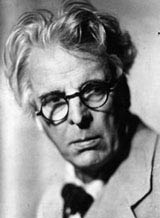
William Butler Yeats was born today, in 1865. Yeats is a great poet and all that, but I grew up pretty much "over" him because he was kind of omnipresent in our household. We were made to memorize his epitaph in order to receive 25 cents for our allowance. ("Cast a cold eye / On life on death / Horseman pass by"). We knew his "Host of the Air" by heart, because it was on the Clancy Brothers at Carnegie Hall album. He was everywhere. It's not that we had a reverence for him - just the opposite. I knew what he looked like, in the same way I knew what George Washington looked like, because he was on our currency. Yeats? Oh, HIM again? Cast a cold eye ... yeah, I know, I know.
Yeats makes me think of my father. My first published piece in The Sewanee Review was about the Yeats-dad continuum.
From memory now!
THE HOST OF THE AIR
O'Driscoll drove with a song
The wild duck and the drake
From the tall and the tufted reeds
Of the drear Heart Lake.
And he saw how the reeds grew dark
At the coming of night-tide,
And dreamed of the long dim hair
Of Bridget his bride.
He heard while he sang and dreamed
A piper piping away,
And never was piping so sad,
And never was piping so gay.
And he saw young men and young girls
Who danced on a level place,
And Bridget his bride among them,
With a sad and a gay face.
The dancers crowded about him
And many a sweet thing said,
And a young man brought him red wine
And a young girl white bread.
But Bridget drew him by the sleeve
Away from the merry bands,
To old men playing at cards
With a twinkling of ancient hands.
The bread and the wine had a doom,
For these were the host of the air;
He sat and played in a dream
Of her long dim hair.
He played with the merry old men
And thought not of evil chance,
Until one bore Bridget his bride
Away from the merry dance.
He bore her away in his arms,
The handsomest young man there,
And his neck and his breast and his arms
Were drowned in her long dim hair.
O'Driscoll scattered the cards
And out of his dream awoke:
Old men and young men and young girls
Were gone like a drifting smoke;
But he heard high up in the air
A piper piping away,
And never was piping so sad,
And never was piping so gay.
To those of you who know that Clancy Brothers album - you'll know the special-ness of that recording.
When we visited his grave in Ireland, as kids, we all felt kind of amazed that ... it was REAL. That the epitaph we had been rattling off since we were toddlers actually existed out in the world, and had some meaning beyond the 25 cents in our pockets.
A couple years ago, I read his complete works in chronological order. It was a fascinating experience - I know many of his big poems almost by heart, the famous ones - but it's nothing compared to reading his work - from beginning to end. You watch an artist burst forth at a certain point - almost fully formed. You've read his younger work, you've seen its beauty (but also its sentimentality - its Celtic twilight "twee" lament ... it's actually quite awful in a way... and so nothing - NOTHING - can prepare you for the poet who would eventually write "Sailing to Byzantium" and "Among Schoolchildren" Where the hell did THAT come from?)
Yeats, as a poet, has always been one of my favorites (even with the "cloud-pale eyelids" balderdash of his early stuff), but what really inspires me is his work in Irish theatre, and the creation of the Abbey. An amazing story. His Nobel lecture was on the Irish Dramatic Movement. I wrote a big long post about his nurturing of John Synge, author of Playboy of the Western World. Synge, as a young man, was a floundering artist bohemian type - until Yeats got a hold of him, and told him to go stay on the Aran Islands for a while, to discover the real Irish people. The result? A revolution in Irish theatre.
Gabriel Fallon, an actor at the Abbey, describes the dress rehearsal of Sean O'Casey's Juno and the Paycock in his book Sean O'Casey, The Man I Knew - a wonderful theatrical anecdote, I love how Lady Gregory talks to Yeats here:
We could make nothing of the reading of Juno and the Paycock as it was called. It seemed to be a strange baffling mixture of comedy and tragedy; and none of us could say, with any certainty, whether or not it would stand up on the stage.The dress rehearsal would be held at 5 p.m. on March 2, Sunday. I arrived at the theatre at 4:30 p.m., and found the author there before me looking rather glum and wondering if a rehearsal would take place ... Gradually the players filed in and went to their dressing-rooms. Lennox Robinson arrived shortly before 5 o'clock and was followed by Yeats and Lady Gregory. The curtain rose about 5:36 p.m. so far as I could see and hear while waiting for my cue in the wings the rehearsal seemed to be proceeding smoothly. As soon as I had finished my part of Bentham at the end of the second act I went down into the stalls and sat two seats behind the author. Here for the first time I had an opportunity of seeing something of the play from an objective point of view. I was stunned by the tragic quality of the third act which the magnificent playing of Sara Allgood made almost unbearable. But it was the blistering irony of the final scene which convinced me that this man sitting two seats in front of me was a dramatist of genius, one destined to be spoken of far beyond the confines of the Abbey Theatre ...
We watched the act move on, the furniture removers come and go, the ominous entry of the IRA men, the dragging of Johnny to summary execution, the stilted scene between Jerry Devine and Mary Boyle, and then as with the ensnaring slow impetus of a ninth great wave Allgood's tragic genius rose to an unforgettable climax and drowned the stage in sorrow. How surely was the very butt and sea-mark of tragedy! But suddenly the curtain rises again: are Fitzgerald and McCormick fooling, letting off steam after the strain of rehearsal? Nothing of the kind; for we in the stalls are suddenly made to freeze in our seats as a note beyond tragedy, a blistering flannel-mouthed irony sears its maudlin way across the stage and slowly drops an exhausted curtain on a world disintegrating in 'chassis'.
I sat there stunned. So, indeed, as far as I could see, did Robinson, Yeats, and Lady Gregory. Then Yeats ventured an opinion. He said that the play, particularly in the final scene, reminded him of a Dostoevsky novel. Lady Gregory turned to him and said, "You know, Willie, you never read a novel by Dostoevsky." And she promised to amend this deficiency by sending him a copy of The Idiot. I turned to O'Casey and found I could only say to him, "Magnificent, Sean, magnificent."
"The Second Coming" is quoted (and mis-appropriated, more often than not) and quoted again ... by people who want to use it for their own ends. It's a dark ominous crystal ball. The best "use" of it, to my mind, is in the deleted scene in Nixon, with Sam Waterston playing Dick Helms, director of the CIA. Written in 1919 - when the world had already become familiar with horror - a horror of a kind never before seen on earth - the poem predicts the chaos of the 20th century. Try to disentangle it from all of the movies (and Sopranos episodes) that has used it ... and just read it, clear and simple, as a poem. On its own. It's one of the greatest poems of the 20th century.
"The Second Coming"
Turning and turning in the widening gyre
The falcon cannot hear the falconer;
Things fall apart; the centre cannot hold;
Mere anarchy is loosed upon the world,
The blood-dimmed tide is loosed, and everywhere
The ceremony of innocence is drowned;
The best lack all conviction, while the worst
Are full of passionate intensity.
Surely some revelation is at hand;
Surely the Second Coming is at hand.
The Second Coming! Hardly are those words out
When a vast image out of Spiritus Mundi
Troubles my sight: somewhere in sands of the desert
A shape with lion body and the head of a man,
A gaze blank and pitiless as the sun,
Is moving its slow thighs, while all about it
Reel shadows of the indignant desert birds.
The darkness drops again; but now I know
That twenty centuries of stony sleep
Were vexed to nightmare by a rocking cradle,
And what rough beast, its hour come round at last,
Slouches towards Bethlehem to be born?
Seamus Heaney wrote a marvelous essay on Yeats a while back (the link no longer works, but I have the hard copy) - in which he wrote:
Conquest, difficulty, labour: these terms indicate the nature of Yeats's creative disposition. From the start, he was enamoured of Blake's conviction that energy is eternal delight, yet the development of his own thought brought him more and more to the conclusion that conflict was the inescapable condition of being human. So, as his art matured and the articulation of his beliefs became more clarified and forceful, Yeats's poems typically conveyed a sensation of certitude achieved by great effort and of contradictions quelled. Poems in which the defiant self is pitted against hostile or disabling conditions - "An Irish Airman Foresees his Death", "September 1913", "Meditations in Time of Civil War"- are complemented by poems that read like discharges of pure, self-possessed energy, poems from which the accidental circumstances have been excluded so that all that remains is the melody and stamina of resurgent spirit - "The Cold Heaven", "Byzantium", "Long-legged Fly".

Of course, there is also the Maud Gonne factor that must be considered. I read some funny quote somewhere (can't remember where) that said: "Any biography of Yeats would have to have in every chapter the following words: 'And he proposed marriage yet again to Maud Gonne'." What do you wanta bet that Maud Gonne had "cloud-pale eyelids"? Anne wrote a wonderful post about Maud Gonne MacBride. Fascinating woman. Poor Yeats. But at least she was his muse, and he got 100s of poems out of his unrequited love for her.
Never give all the heart
Never give all the heart, for love
Will hardly seem worth thinking of
To passionate women if it seem
Certain, and they never dream
That it fades out from kiss to kiss;
For everything that's lovely is
But a brief, dreamy. Kind delight.
O never give the heart outright,
For they, for all smooth lips can say,
Have given their hearts up to the play.
And who could play it well enough
If deaf and dumb and blind with love?
He that made this knows all the cost,
For he gave all his heart and lost.
Heaney writes, in that same essay:
And all the while, of course, there was Maud Gonne, "high and solitary and most stern" according to one of the poems about her, "foremost among those I would hear praised" according to another, and "the troubling of my life" according to a famous sentence in his Autobiographies. The passion she inspired - and as readers we experience it more as creative power than erotic need - made her a figure of primary poetic radiance, a Dublin Beatrice, an archetype as much as a daily presence. Nevertheless, Yeats's poetry, his politics and his involvement with the occult received an extra charge of intensity from her day to day reality in his life, and when she appeared in the title role of his subversive play Cathleen Ni Houlihan (1902), another kind of maturity was achieved.
Yeats is one of those poets who was not a solitary creature, writing in isolation. He wanted to start a "movement", and he did. He helped a young James Joyce in the beginning of HIS career. He advised Synge. He headed up the Abbey Theatre. He really looked at his own country - an insular priest-ridden culture at that time - and sensed a need, tried to create something different. It's hard to look with clear eyes on your own home, your own nation. Joyce did it, but that's only because he LEFT. Yeats, at first, went back into the Irish past in his work - and some of his early stuff is so quaint that it might as well be cross-stitched and hanging on the door of some Kountry Kraft Shoppe. I suppose it was his way of re-claiming the Irish past, its true inheritance. It was a phase, his beginning phase as a writer - how he found his "voice". And he was concerned about the rest of his countrymen, calling out to them:
"Irish poets, learn your trade, sing whatever is well made, scorn the sort now growing up all out of shape from toe to top."
Yeats was Anglo-Irish, but his feelings were that Irish-ness was a cultural thing, not a religious thing (forgive me for boiling it down so awkwardly) - and that the Irish could be united, regardless of religion - through writing, myths, poetry. He was a true nationalist.
I also love love LOVE his poem to fellow Irishman Jonathan Swift where he writes: "Imitate him if you dare."
Swift's Epitaph
Swift has sailed into his rest;
Savage indignation there
Cannot lacerate his breast.
Imitate him if you dare,
World-besotted traveller; he
Served human liberty.
WH Auden wrote, in his unbelievable poem to Yeats:
In the deserts of the heart
Let the healing fountain start,
In the prison of his days
Teach the free man how to praise.
And lastly, a poem that has great personal meaning for me:
The wild swans at Coole
The trees are in their autumn beauty,
The woodland paths are dry,
Under the October twilight the water
Mirrors a still sky;
Upon the brimming water among the stones
Are nine-and-fifty Swans.
The nineteenth autumn has come upon me
Since I first made my count;
I saw, before I had well finished,
All suddenly mount
And scatter wheeling in great broken rings
Upon their clamorous wings.
I have looked upon those brilliant creatures,
And now my heart is sore.
All's changed since I, hearing at twilight,
The first time on this shore,
The bell-beat of their wings above my head,
Trod with a lighter tread.
Unwearied still, lover by lover,
They paddle in the cold
Companionable streams or climb the air;
Their hearts have not grown old;
Passion or conquest, wander where they will,
Attend upon them still.
But now they drift on the still water,
Mysterious, beautiful;
Among what rushes will they build,
By what lake's edge or pool
Delight men's eyes when I awake some day
To find they have flown away?
SOME QUOTES
"My poetry is generally written out of despair. Like Balzac, I see increasing commonness everywhere, and like Balzac I know no one who shares the premises from which I work." -- Yeats
"On the third night Yeats addressed the audience before the curtain rose. If anyone had anything to say against the piece they would be welcomed at a debate which he would be glad to arrange in the theatre at some other time. He was interrupted several times. He asked the interrupters to at least listen to the play so that they would know what it was they were objecting to." -- Maire Nic Shiubhlaigh's description of Yeats trying to handle the riots that were happening in response to Synge's "Playboy of the Western World" - a play being put on at the Abbey Theatre
"In 1875 Yeats entered the Godolphin School in Hammersmith and visited Ireland during the longer school vacations, when he stayed with the Pollexfens in County Sligo. An early poetic impulse was to change the name of his toy yacht from Sunbeam to Moonbeam. It was a decisive act." -- Michael Schmidt, "Lives of the Poets
"I thought we might bring the halves together if we had a national literature that made Ireland beautiful in the memory, and yet had been freed of provincialism by an exacting criticism, a European pose." -- Yeats
"This is not the huge competence of Auden, at play in the toy shop of poetic form, but mastery, the possession of a unique rhetoric for use on a real but limited range of themes. It is a mastery so complete that it can occlude the genuinely problematic, ride over the potholes of nonsense without even sensing them. Late in life he recognizes the evasiveness of his symbols, the tendency of his verse to turn away or inward, and in the concentrated intensity of the late poems he tries to remedy this. But he has an imperfect sense of generality; he is willing to plump out a truism as truth. As his mastery increases, his art becomes less truthful. But his main concern is not - until the later poems, and even there in an attenuated spirit - truth, but the house of myth and legend, where he can become a principal tenant, where it is his voice we hear casting the spell, and where real men are reduced - or, in his mind, enlarged - to masks, figures and types useful to myth, regardless of the human reality they had." -- Michael Schmidt, "Lives of the Poets"
"All literature created out of a conscious political aim in the long run crates weakness by creating a habit of unthinking obedience. Literature created for its own sake, for some eternal spiritual need, can be used for politics. Dante is said to have unified Italy. The more unconscious the creation, the more powerful." -- Yeats
"Sex and death are the only things that can interest a serious mind." -- Yeats
"His mastery seems almost excessive." -- Richard Ellmann
"... a strained and unworkable allegory about a young man and a sphinx on a rock in the sea (how did they get there? what did they eat? and so on; people think such criticisms very prosaic, but common-sense is never out of place anywhere ...) but still containing fine lines and vivid imagery." - Gerard Manley Hopkins, after reading some of Yeats' first published verses
"Yeats's 'The Second Coming' has gained in prophetic power with each decade of the twentieth and now twenty-first century, from the rise of fascism and nuclear warfare to the proliferation of international terrorism. It expresses the melancholy realizatino that man, yearningly drawn to the divine, will never fully escape his bestial ancestry. The poem is modernistically unrhymed, though the first stanza plays with shadowy off-rhymes: 'gyre' / 'falconer' / 'everywhere'; 'hold' / 'world' / 'drowned'. It is structured instead by dramatic visuals and emblematic choreography. There are two main movements: a huge, expanding circle (the ascending falcon) and an arrowlike, linear track (the beast bound for Bethlehem). Then two smaller ones: a pendulum arc (the rocking cradle) and an exploding pinwheel (the reeling desert birds). Ideas have become design, starkly juxtaposed with the murky turbulence of elemental forces - storm, flood, drought. Hence the poem, with its horror movie finale, is as hybrid as the sphinx, who represents our buried impulses, vestiges of a past that keeps turning into the future." -- Camille Paglia, "Break, Blow, Burn"
"The heavy voluptuous splendour of much of his work has yet a ghostliness as of the palace made magically of leaves. Even his heroes and beautiful women are aware of this ... He never leaves us, any more than Crashaw, content with the glory alone. It calls our attention to a spirit behind and beyond, heaping high lovely, invisible things that it may show the greater beauty that can survive their crumbling into dust." -- Edward Thomas, 1909
"The worst thing about some men is that when they are not drunk they are sober." -- Yeats
"In London he was active in literature and politics. One particular event in 1889 proved crucial: he met and fell in love with the fiery Republican who haunted him for the rest of his days, Maud Gonne. His biography, from 1889 until Maud Gonne's marriage, is punctuated by the statement, 'Yeats proposed to Maud Gonne.'" -- Michael Schmidt, "Lives of the Poets"
"Words are always getting conventionalized to some secondary meaning. It is one of the works of poetry to take the truants in custody and bring them back to their right senses." -- Yeats
" 'The best lack all conviction, while the worst / Are full of passionate intensity': these famous lines are Yeats's anguished formulation of what seems to be an eternal principle of politics (7-8). When 'the center cannot hold,' neither consensus nor compromise is possible. Public debate shifts to the extremes or is overtaken by violence, which blocks incremental movement toward reciprocity and conciliation. Moderate views are 'drowned' out (as by the bloody tide) in strident partisanship or fanaticism. The phrase 'passionate intensity' suggests that, for the late Romantic Yeats, eros diverted from the personal to the political turns into a distorted lust for power. The second stanza opens in doubt and confusion: 'Surely some revelation is at hand; / Surely the Second Coming is at hand. / The Second Coming!'' (9-11). We are hearing either one voice echoing its own shocked phrases or many voices in public tumult. The book of Revelation lists the dreadful omens heralding doomsday, when Jesus will return and unlock the secrets of history. But in Yeats's poem, Christ's promised glory is overshadowed by a monstrous apparition from antiquity. The poet is seized by an electrifying vision: 'a vast image out of Spiritus Mundi / Troubles my sight'. It's a collective memory, crystallizing from the repository of world myths (12-13). ("Spiritus Mundi" is Yeats's mystical term for "soul of the universe".) We witness the resurrection of the pagan era, whose barbarism mirrors that of the war-torn twentieth century. Yeats sees no evidence of moral evolution over two millennia of Christianity." -- Camille Paglia, "Break, Blow, Burn"
"I once got Yeats down to bed-rock on these subjects and we talked for hours. He had been talking rather wildly about the after life. Finally I asked him: 'What do you believe happens to us immediately after death?' He replied, 'After a person dies, he does not realize that he is dead.' I: 'In what state is he?' W.B.Y.: 'In some half-conscious state.' I said: 'Like the period between waking and sleeping?' W.B.Y.: 'Yes.' I: 'How long does this state last?' W.B.Y.: 'Perhaps some twenty years.' 'And after that,' I asked, 'what happens next?' He replied, 'Again a period which is Purgaotry. The length of that period depends upon the sins of the man when he was upon this earth.' And then again I asked: 'And after that?' I do not remember his actual words, but he spoke of the return of the soul to God. I said, 'Well, it seems to me that you are hurrying us back into the great arms of the Roman Catholic Church.' He was of course an Irish Protestant. I was bold to ask him, but his only retort was his splendid laugh." -- Lady Dorothy Wellesley
"It is an entirely new thing -- neither what they eye sees nor the ear hears, but what the rambling mind thinks and imagines from moment to moment. He has certainly surpassed in intensity any novelist of our time." -- Yeats on James Joyce's "Ulysses"
"For Yeats, there was something both enviable and exemplary about the enlargement of vision and the consequent histrionic equanimity which Shakespeare's heroes and heroines attain at the moment of their death, 'carried beyond feeling into the aboriginal ice.' He wanted people in real life to emulate or at least to internalize the fortitude and defiance thus manifested in tragic art." -- Seamus Heaney, 1990
"Give up Paris, you will never create anything by reading Racine, and Arthur Symons will always be a better critic of French literature. Go to the Arran Islands. Live there as if you were one of the people themselves; express a life that has never found expression." -- Yeats's advice to John Synge
"The first spectre of the new generation has appeared. His name is Joyce. I have suffered from him and I would like you to suffer." -- George Russell in a letter to Yeats, 1902
Cast a cold eye
On life on death
Horseman pass by
-- Yeats's epitaph
Imitate him if you dare.
June 12, 2008
A necessary respite
Things have been a bit grim lately, and I have been much isolated (I've needed it, for my work - but it's been a bit much at times) - so last night I got together with Ted at Cafe Noir, one of my favorite spots in the city (especially on a hot summer night, when they have all the windows open). We got there before the rush (it gets nuts there after 9 pm) - and drank wine, ate yummy Moroccan-French food, chased it all with water poured out of a big clear glass bottle ... and talked our heads off. He's off to England and Italy in a couple of days, and it's been too long since I've seen him. Much to catch up on. What are we reading?? for example - and then of course, our studies, our work, our relationships, summer plans, movies, everything. Afterwards, we walked north for a bit to pick up the subway, through the hot hazy New York streets, a balmy night, not as horrifically hot as it was a couple days ago ... Manhattan now showing its summery side.
Last Saturday night, my great group of girlfriends from high school got together at Beth's (you know, the tattooed ladies) and we sat outside in the hot night, drinking, talking, laughing, eating ... whatever. I have SO needed to see them recently, I miss all of them so much ... so it was a real gift that we could all get together.
I've needed to socialize. Oh, and Friday night I have my girl's group ... and I'm long overdue to catch up with all of THOSE friends as well.
I still have a couple nights off in between - I need those down times, for mental regrouping, as well as to make time for the stuff I'm working on (which, I am finding, takes up so much brain space I have a hard time keeping on top of other obligations because of it - This is why successful people have personal assistants. I look forward to the day when I can afford one, because honestly, I need HELP) ... but it was really good to "have a night off" and hang out with Ted, under the whirling ceiling fans in the loud Moroccan atmosphere of Cafe Noir.
Today In History: June 12, 1942
JUNE 12, 1942I hope I will be able to confide everything to you, as I have never been able to confide in anyone, and I hope you will be a great source of comfort and support.
Anne Frank started her journal, on her 13th birthday. In early July, only a couple of weeks later, the Frank family went into hiding.

Anne and her sister Margot
Salter Salter everywhere:
... Synchronicity, indeed. Looks like I need to check out The Kenyon Review pronto! And, uhm, also get used to the notion that James Wolcott obviously reads me on a regular basis. I'm kinda freaked.
James Salter posts, for those interested:
Re-reading Sport and a Pastime
A Sport and a Pastime
Light Years
If you have not encountered James Salter, I can't recommend him strongly enough.
The Books: "Light Years" (James Salter)
 Next book on my adult fiction bookshelf for the Daily Book Excerpt:
Light Years
Unbelievable book so full of great writing that you want to shout, "Slow down a minute! Give me a second to ABSORB this prose!!" I found the book almost unbearably intense at times, and yet I couldn't exactly point to why. I read it when I was in my 20s, so I wonder if a small intimation of middle-age came to me through the book - and the loneliness I would experience ... I don't know. It's an eerie book. There's a deep sadness and loss being expressed - and yet a lot of the book is lengthy dinner parties, meetings with the tailor, playing games with the children ... You can't quite point to what is wrong, but ... isn't that the way life is a lot of the time? At least it is for me.
Light Years tells the story of a married couple - Nedra and Viri. They have two children. They seem to live a charmed life, a life of ease. They have a big house in Westchester. Nedra is the wife, a beautiful woman - the book starts in the late 1950s, and perhaps things are a bit simpler then, with assumptions not being questioned ... As the book unfolds, we start to see (or sense) the cracks beneath the flawless picture. We're not sure how it will go and if or when the cracks will be revealed but it is impossible to read the descriptions of their garden, the games they make up for their kids, their skating on the lake ... without wondering when it will all end. This is due to Salter's mastery of language. He is so so good. Again, like in Sport and a Pastime, much of the book is descriptive. The sky, the air, the trees, the river ... and it is spare language, not sumptuous or anything like that. But the overall impression is one of the fleetingness of life and beauty ... It's a deeply sad book. I was shattered by the end of it.
It's been years since I read it so much of the details of the plot are lost. I know that Nedra and Viri eventually split, and whatever silence was behind their union, whatever it was that was not being said, pours into the void, filling up their lives. If I remember correctly, Nedra has an easier time with the split, moving gracefully into single life as though she were born to it. I have to read it again.
Light Years seems, to me, to be a true middle-aged book. Sport and a Pastime (excerpt here) is a young man's book, with a young man's concerns ... but here in Light Years, things are not so much in flux, people have settled, life has taken on its solid form - it is what it is (seemingly). Change is supposed to be good, right? If we don't change, we die. But middle-aged people, with their bodies starting to go, their youth fading, having to make room for the next generation, all that ... change is something to be feared. It rarely means something good. Light Years is full of that anxiety. It's heartbreaking.
A great novel.
Here's an excerpt: About that indefinable sadness: notice how in the excerpt below, which is all about family life - a "compact that will never end" - and while there is much to envy here, the calm beauty of being part of a group, a family ... Salter at one point describes them all as "a group of devoted actors who know nothing beyond themselves, beyond the pile of roles from old ..." That's what I mean by sadness. It cannot be pointed to, nothing can be identified as "the thing that is wrong" - but it's Salter's gift as a writer, his eloquent and very specific choices of images - that gives to us the impression that all is not quite well.
EXCERPT FROM Light Years
Danny is less obedient; she has a stubborn quality. She is less beautiful. In the summer her leanness and tan skin conceal it. She goes out in the deep water in a rubber tube, daring, kicking like an insect. It is morning, the surf falling forward, its white teeth hissing on the shore. Viri watches, sitting on the sand. She waves at him, her shouts carried off by the wind. He understands suddenly what love of a child is. It overwhelms him like the line from a song.
Morning; the sea sound faint on the wind. His sunburned daughters walk on creaking floors. They pass their life together, in a compact that will never end. They go to the circus, to stores, the market shed in Amagansett with its laden shelves and fruits, to picnics, pageants, concerts in wooden churches among the trees. They enter Philharmonic Hall. The audience is hushed. They are seated, the program is in their laps. To listen to a symphony is to open the book of faces. The maestro arrives. He collects himself, stands poised. The great, exotic opening chords of Chabrier. They go to performances of Swan Lake, their faces pale in the darkness of the Grand Tier. The vast curve of seats is lighted like the Ritz. A huge orchestra pit, big as a ship, a ceiling of gold, hung with bursts of light, with pendants that glitter like ice. The great Nureyev comes out after, bowing like an angel, like a prince. They beg each other for the glasses; his neck, his chest are gleaming with sweat, even the ends of his hair. His hands, like those of a child, play with the cape tassels. The end of performances, the end of Mozart, of Bach. The solo violinist stands with her face raised, utterly drained, the last chords still sounding, as if from a great love. The conductor applauds her, the audience, the beautiful women, their hands held high.
They pass their life together, they pass boys fishing, walking to the end of the pier with a small eel tied, doubled up, on the hook. The mute eye of the eel calls out, a black dot in his plain, silver face. They sit at the table where their grandfather eats, Nedra's father, a salesman, a man from small towns, his cough yellow, the Camel cigarettes always near his hand. His voice is out of focus, his eyes are filmed, he hardly seems to notice them. He brings death with him into the kitchen; a long, wasted life, the chrysalis of Nedra's, its dry covering, its forgotten source. He has cheap shoes, a suitcase filled with samples of aluminum window frames.
Their life is formed together, woven together, they are like actors, a group of devoted actors who know nothing beyond themselves, beyond the pile of roles from old, from immortal plays.
The summer ends. There are misty, chilly days, the sea is quiet and white. The waves break far out with a slow, majestic sound. The beach is deserted. Occasional strollers along the water's edge. The children lie on Viri's back like possums; the sand is warm beneath him.
Peter and Catherine join them, together with their little boy. The families sit separated, in the solitude and mist. Peter has a folding chair and wears a yachting cap and a shirt. Beside him is a bucket filled with ice, bottles of Dubonnet and rum. An eerie and beautiful day. The fine points of mist drift over them. August has passed.
At a pause in the conversation, Peter rises and walks slowly, without a word, into the sea, a solitary bather, swimming far out in his blue shirt. His strokes are powerful and even. He swims with assurance, strong as an iceman. Finally Viri joins him. The water is cool. There is mist all about them, the swelling rhythm of the waves. No one is in sight except their families sitting on shore.
"It's like swimming in the Irish Sea," Peter says. "Never any sun."
Franca and Danny come out to them.
"It's deep here," Viri warns.
Each of the men holds a child. They huddle close.
"The Irish sailors," Peter tells them, "never learn to swim. Not even a stroke. The sea is too strong."
"But what if the boat sinks?"
"They cross their hands on their chests and say a prayer," Peter says. He performs it. Like the carved lid of a coffin he sinks from sight.
"Is it true?" they ask Viri later.
"Yes."
"They drown?"
"They deliver themselves to God."
"How does he know that?"
"He knows."
"Peter is very strange," Franca says.
And he reads to them, as he does every night, as if watering them, as if turning the earth at their feet. There are stories he has never heard of, and others he has known as a child, these stepping stones that are there for everyone. What is the real meaning of these stories, he wonders, of creatures that no longer exist even in the imagination princes, woodcutters, honest fishermen who live in hovels. He wants his children to have an old life and a new life, a life that is indivisible from all lives past, that grows from them, exceeds them, and another that is original, pure, free, that is beyond the prejudice which protects us, the habit which gives us shape. He wants them to know both degradation and sainthood, the one without humiliation, the other without ignorance. He is preparing them for this voyage. It is as if there is only a single hour, and in that hour all the provender must be gathered, all the advice offered. He longs for the one line to give them that they will always remember, that will embrace everything, that will point the way, but he cannot find the line, he cannot recognize it. It is more precious, he knows, than anything else they might own, but he does not have it. Instead, in his even, sensuous voice he laves them in the petty myths of Europe, of snowy Russia, the East. The best education comes from knowing only one book, he tells Nedra. Purity comes from that, and proportion, and the comfort of always having an example close at hand.
"Which book?" she says.
"There are a number of them."
"Viri," she says, "it's a charming idea."
June 11, 2008
A NY montage
Just because.
Tiffany's

8th Avenue

St. Paul's

Hershey Store

Apple Store, 5th and 59th

Window display, Garment district

8th Avenue

42nd Street

Junk shop, Houston Street

30 Rock Plaza

Ballet studio, 40th and 8th

Central Park, Great Lawn

Madison Square Garden

Tribeca storefront

Columbus Circle

Walker Street, Soho

Former CBGBs

Union Square, "Lifeguards Wanted"

Lincoln Center, NYC Ballet

Times Square, dawn

The Playpen (Smut City, now torn down, which is a bummer - I adore that building)

Sidewalk sale, Soho

The theatre district

Tiles For America, West Village

West Village

Treasures between the pages
A really cool article about objects found pressed into the pages of second-hand books. Some are valuable, others just interesting ... I have found some very cool things in the pages of old books. A tiny hand-sewn lace handkerchief. A greeting card. Newspaper clippings, yellowed with age. Very cool.
Excerpt from article:
“A Mickey Mantle rookie baseball card. It was the original 1952 Topps #311 baseball card and not a reprint. It is in good condition and I still have it. There were three other cards as well - Gus Zernial (Philadelphia Athletics), Jim Busby (Washington Senators) and Leo Durocher (Manager of the New York Giants). These cards are also originals and not reprints, and are from the Baseball Collector Series. I believe these are also 1952 vintage and are in very good condition.”
Cool!!
Licking ice
Sure would have liked to have something like this over the last couple of 90+ degree days here in Manhattan.
(The little girl over to the right with the crooked bowl cut bangs is killing me. She's too little to get into the midst of the action, yet she hovers on the sidelines ... waiting for her chance to lick the ice. I love her face, staring right at the camera.)
Aubrey/Maturin ...
A review of Master and Commander by the always insightful Joe Valdez.
I was unaware of the background story of the filming of this movie, and Weir's demands (what he would and would not do) ... Marvelous stuff. He didn't want to do the first in the series - because of too much exposition - he wanted to start in the middle, when Aubrey and Maturin were already friends. I think that was a terrific choice.
I am now 3/4 of the way through The Surgeon's Mate, the 7th book in the series. I cannot get enough. I am trying to slow myself down because I don't want the entire series to end. I will be so sad when I come to the end.
Interesting thing: I went home this weekend. My dad is now reading the series - he had only read Master & Commander but now he's on Desolation Island, and it's been so fun to talk with him about it. And my mother is reading Master & Commander now ("so that I can talk about it with your dad" ... sniff. She's such a good person.) ... But anyway, we visited with dad and he told us that Barry and Joanne (old family friends - there has never been a time in my life when I did not know Barry) had stopped by and Joanne is such a fan of the books that she refuses to read the last two in the series!! She cannot bear the thought that after that, there will be no more books ... so she is holding off on reading them ... just so she knows, in her heart, that there will always be another Aubrey/Maturin book to look forward to.
Bravo, Patrick O'Brian! Sheesh!!
The Books: "A Sport and a Pastime" (James Salter)
 Next book on my adult fiction bookshelf for the Daily Book Excerpt:
A Sport and a Pastime
James Salter sneaks up on you. His writing is deceptively simple. Kinda like Hemingway. He reminds me a bit of Fitzgerald as well. You may think that Salter just describes surfaces (and does so very well - he totally transports you) - but you would be wrong. He's unbelievably deep. I find his writing hypnotic ... and I can't really put my finger on what is so good about it ... I just know when I read his books (and I've only read two of them: Sport and a Pastime and Light Years), it's like I'm under a spell. Reynolds Price calls Salter's prose a "dense net" and I think that's perfect. The writer in me tends to stand back a little bit from James Salter, looking at this or that paragraph, thinking to myself, "How does he do it? What the hell is he actually doing here that makes it so effective?" For whatever reason, James Salter is not as well-known as some of his contemporaries (Sport and a Pastime came out in the 60s, it was his third novel) - and I'm not sure why that is. He's accessible, too - there's nothing opaque or intellectually distancing about his books. He seems to be interested in digging in to the sensory reality of any given moment. And so his books are full of colors and tastes and sounds ... nothing calling too much attention to itself. He is not at ALL a "clever" writer. And you might be lulled into the impression that not much happens in his books. People sit around in a cafe and have wine. They walk home over cobblestones. They wake up in the morning and see the frost on the trees. But Salter is getting at deep truths throughout, moments of insight that are piercing - those moments in life when people are truly alive. And it's not always a pleasant feeling - being that alive. Most people choose to dull things down a bit, to not walk around in such an aware state because it can be unbearable. James Salter, with no fanfare, no self-importance, navigates his characters through life and experience, showing us what they see, hear, touch, feel ... and by the end (more so in Light Years than in Sport and a Pastime), we are rocked to the core. And because of the "dense net" of his writing, it is difficult to point to what exactly it was that moved us so much. You come out of the maze (his books are short, they can be read in about 3 days) and wonder where you have been, how long you have been gone ... There is a piercing sense of awareness. He makes you see. I mean, how many writers can do that? The fact that James Salter is, in some crowds, considered a "minor" writer is ridiculous to me. This man is a major talent, a major American writer.
Sport and a Pastime is the story of a romance between an American boy and a French girl. She is 18, he is maybe 20. The way it is written, we are not sure if the narrator (who is first-person) is actually the boy - or just an observer. He goes into the bedroom with the two lovers, there's a lot of sex in this book - it's about the intoxication of - well, not first love - but first sex. These people have probably had sex before, but they haven't gotten lost in it. But anyway, the narrator - who may be looking on ... would have no way of knowing what goes on in the bedroom, unless his friend tells him what happened ... But there are clues in the book that the narrator is not, shall we say, reliable. He tells us that what we read is not true. We wonder what his investment in all of this is. Why is he so obsessed with his friend's sexual affair with the French girl? Is he living vicariously? The book takes place in a small rural town in France. Our narrator is living there, and Philip Dean - a guy who is kind of mysterious - it seems he was kicked out of Princeton and is now bumming around France - comes to visit him. They had met at a party in Paris. Philip Dean is the one who has the affair with Anne Marie, the French teenager. It is a summer of love. It was, perhaps, a more innocent time then - not as sexualized - so the discovery of the pleasures of sex for these two characters is an intense revelation. Sex IS love, in many respects - whether or not you ever say the words "I love you" and these two have a sexual combustability that rocks both of their worlds. She can barely speak English. He can barely speak French. None of that matters.
It's one of those books where woman is completely "Other". She is barely seen as human. She is an alien from outer space. She IS her parts. There is nothing there besides her body, which intoxicates Philip Dean. It is an intensely objectified portrait of a female - so if you're turned off by that (and I am) - just know that going in. It's not hostile objectification (although all objectification is, of course, to some degree, hostile - you're not seeing the other person as, you know, a person) - I didn't feel a disgust for femaleness or any of that other stuff that often comes with objectification. No ... it was just that Philip Dean does not see her as a whole ... and, I suppose, that's what first love and first sex really feels like ... You're not looking at the other person, appreciating them for who they are, their life experience, their quirks ... You're all about what they smell like, what their thighs feel like, what they taste like. So I have no idea who Anne-Marie is. She IS her body, in all its weirdness (meaning: not like men's) ... she IS what she tastes like, how she fucks, what she smells like. We never get inside her brain. We can surmise what she is going through, based on her behavior ... but Philip Dean doesn't even seem to realize that knowing who she is, in terms of her brain, her thoughts, her psychology, is part of being in love with someone. He does love her. But there is something in the love affair that is inherently temporary for him. SHE doesn't know that ... but he does, even if he doesn't admit it to himself. Is he slumming? Yeah, a little bit. He may have dropped out of Princeton (or been kicked out), and on the run from the American-dream expectations back home ... but he won't be on the run forever. He will eventually go home and join the rat race and stop borrowing money from everyone and make his own. (At least you get the sense from him that this all temporary ... He won't be an ex-patriate forever). And you just can't picture poor little Anne-Marie being transplanted to the fast-track United States. She lives in a small village, with a billiard hall, a cafe, a church, and green fields all around. Her life is small. She cannot speak English. But of course sex is not separated from love (not for men OR for women) - and so she is probably spinning fantasies of being taken back to America as his wife. But from the little we know about Philip Dean, we know that that will probably never happen. It's not like she is wildly inappropriate - he hasn't fallen in love with a hooker, or a homeless girl ... She is a perfectly respectable young French girl, but that's about it. Philip Dean is not callous. In many ways, he does not know what is in his own heart (although our observational narrator often guesses at it) ... and he's not cavalier, he's not a ladies' man - You totally get the sense that he has never experienced sex like this before either. And I'm not talking about different positions or anything technical - I'm talking about sex as true communication between two people. He is blown away by that aspect of it. In that way, she is NOT objectified: he could only have experienced such a thing with her. They "click", is basically the message of all of the sex scenes in the book.
But, like Fitzgerald, Salter has a way of suggesting that the end is coming, even in the midst of the summer blooming romance. There's a wistful nostalgia in his tone, a sense that we are all middle-aged now, looking back on the time when we were young ... and it's heartbreaking. You can't really point to where it is so heartbreaking, it is just an overall impression - from his writing.
To me, Light Years is a superior book - but Sport and a Pastime is what put him on the map - and I'm glad to see it's been re-released, in a nice new edition, with a preface by Reynolds Price - and it's given the props it deserves. Salter recently came out with a memoir that I am excited to read, I don't know much about the guy. But God, what insight, what ... EYES he has. I don't know how he does it. There are times when it seems he is just listing objects he sees ... but the cumulative effect of all of that is haunting. You begin to get the sense that you are looking at a world that is long gone. The summer he describes in Sport and a Pastime will never come again.
It's difficult to excerpt, I have found - but I did adore the following section (here you can see what a great psychologist Salter is as well: his observations about a young Lothario in a bar ... and what he SEES in such people. Seriously: so so good.) And also, just his powers of observation: sitting in the stands, watching a soccer practice ... and the stands are almost empty ... so there seem to be no sounds, no sounds from the players - just the thud of the ball ... and that seems to me to be just so right. Imagine the scene, and how James Salter gets that detail so so right: the lack of sound. And the bit about the lady's false teeth. In 18 words, 3 short sentences, he creates an entire life.
He's marvelous that way. I'm observant but he makes me realize just how much I miss. So good!
EXCERPT FROM A Sport and a Pastime
Four in the afternoon. The trees along the street, the upper branches, are catching the last, full light. The stadium is quiet, some bicycles leaning against the outer wall. I read the schedule once again and then go in, turning down towards the stands which are almost empty. Far away, the players are streaming across the soft grass. There seem to be no cries, no shouting, only the faint thud of kicks.
It is the emptiness which pleases me, the blue dimensions of this life. Beyond the game, as far as one can see, are the fields, the trees of the countryside. Above us, provincial sky, a little cloudy. Once in a while the sun breaks out, vague as a smile. I sit alone. There are the glances of some young boys, nothing more. There's no scoreboard. The game drifts back and forth. It seems to take a long, long time. Someone sends a little boy to the far side to chase the ball when it goes out of bounds. I watch him slowly circle the field. He passes behind the goal. He trots a while, then he walks. He seems lost in the journey. Finally he is over there, small and isolated on the sideline. After a while I can see him kicking at stones.
I am at the center of emptiness. Every act seems purer for it, easier to define. The sounds separate themselves. The details all appear. I stop at the Cafe St. Louis. It's like an old schoolroom. The varnish is worn from the curve of the chairs. The finish is gone from the floor. It's one large, yellowing room, huge mirrors on the wall, the same size and position as windows, generous, imperfect. Glass doors along the street. Wherever one looks, it seems possible to see out. They're playing billiards. I listen without watching. The soft click of the balls is like a concert. The players stand around, talking in hoarse voices. The rich odor of their cigarettes ... They're never there in the daytime. It's very different with the morning light upon it, this cafe. Stale. The billiard table seems less dark. The wood is drawing apart at the corners. It's quite old, at least a hundred years I should think, judging from the elaborate legs. Beneath the pale green cloth which is always thrown over it, the felt is worn, like the sleeves of an old suit.
"Monsieur?"
It's the old woman who runs the place. False teeth, white as buttons. Belonged to her husband probably. I can hear them clattering in her mouth.
"Monsieur?" she insists.
Later on, about nine, there's the hotel where there's music in the bar and somebody at least, a few couples, sitting around. The three or four gilded youths of the town, too, slouched on the divans. I know them by sight. One is an angel, at least for betrayal. Beautiful face. Soft, dark hair. A mouth like spoiled fruit. Nothing amuses them - they don't talk until somebody leaves, and then they begin little laughing cuts, sometimes calling over to the barman. The rest of the time they sit in boredom, polishing the gestures of contempt. The angel is taller than the rest. He has an expensive suit and a tie knotted loosely at the neck. Sometimes a sweater. Soft cuffs. I've seen him on the street. He's about seventeen, and he seems less dangerous in the daylight, merely a bad student or a boy already notorious for his vices. He's ready to start seductions. Perhaps he even says it's easy, and that women are simple to get. To believe is to make real, they say. A chill passes through me. I recognize in him a clear strain of assurance which has nothing to imitate, which springs forth intact. It feeds on its own reflection. He looks carefully at himself in the mirror, combing his hair. He inspects his teeth. The maid has let him undress her. She hates him, but she cannot make him go. I try to think of what he's said. He has an instinct for it. He is here to hunt them down, to discover the weaklings. I don't know what he feels - the assassin's joy.
I am modeling myself after him, just for the evening. As I walk home I see my image floating on the glass of darkened shopfronts. I stop and look at clothes. It's like coming out of a movie. I have discarded my identity. I am still at large, free of my old self until the first encounters, and now I imagine, very clearly, meeting Claude Picquet. For a moment I have the sure premonition I am about to, that I am really going to see her at the next corner and, made confident by the cognacs, begin quite naturally to talk. We walk along together. I watch her closely as she speaks. I can tell she is interested in me, I am circling her like a shark. Suddenly I realize: it will be her. Yes, I'm sure of it. I'm going to meet her. Of course, I'm a little drunk, a little reckless, and in an amiable condition that lets me see myself destined as her lover, cutting into her life with perfect ease. I've noticed you passing in the street many times, I tell her. Yes? She pretends that surprises her. Do you know the Wheatlands, I ask. The Wheatlands? Monsieur and Madame Wheatland, I say. Ah, oui. Well, I tell her, I'm staying in their house. What comes next? I don't know - it will be easy once I am actually talking to her. I want her to come and see it, of course. I want to hear the door close behind her. She stands over by the window. She's not afraid to turn her back to me, to let me move close. I am going to just touch her lightly on the arm ... Claude ... She looks at me and smiles.
Mornings with clouds. Windy mornings. Mornings with black wind rushing like water. The trees quiver, the windows are creaking like a ship. It's going to rain. After a while the first silent drops appear on the glass. Slowly they increase, cover it, begin to run. All of Autun beneath the cool, morning rain, the sculptures on the Roman gates streaking and then turning dark, the slate roofs gleaming now, the cemetery, the bridges across the Arroux. Every once in a while the wind returns, the rain moves sideways, beats against the windows like sand. Rain falling everywhere, on all the avenues and enterprises, the ancient glories of the town. Rain on the plate glass of the Librairie Lucotte, rain on les Arcades, on au Cygne de Montjeu. A long, even rain that makes me quite content.
June 10, 2008
Movies about Hollywood:
Kim Morgan counts 11 of her favorites. I love that she chose Mulholland Drive, a movie I absolutely love. So there are some surprises in her list, but also the usual suspects.
I'd include In a Lonely Place in my list - the Nicholas Ray directed film which features Humphrey Bogart as a screenwriter in what is his best performance. The performance has the Bogart cynicism without the enlivening draught of wit and self-knowledge. The performance has the torment of the drunk scene in Casablanca without the selfless last monologue on the runway. Bogart has never been better than in In a Lonely Place. I wrote about it here.
The Books: "Children of the Arbat" (Anatoli Rybakov)
 Next book on my adult fiction bookshelf for the Daily Book Excerpt:
The Children of the Arbat
To a Stalin addict like myself, this book was a pile of crack. A PILE!!
Written over the course of almost 20 years, and repressed in Russia, because of its honesty about the Stalin terror - it finally was published in 1988 in Russia - and quickly sold out (so much for the Marxist brand of economics). The book was such a hot commodity that people were paying exorbitant amounts for it on the black market. The entire country was coming out of a haze of state-sponsored information, and The Children of the Arbat, the story of a group of people who lived in the Arbat section of Moscow (an artistic neighborhood), tells the story of the early years of the Five Year Plan - as the noose begins to tighten around the country. There are various characters we follow - Sasha, Yuri - many of them enthusiastic members of the Komsomol, but as we now know - loyalty was not a simple thing. In a paranoid atmosphere, a paranoid top-down atmosphere - things like differences of opinion, or even humor - are misconstrued. Not just misconstrued, but seen as a direct threat to the State, as Sasha discovers to his chagrin. Sasha is sent into exile, he's in big trouble - so we follow his journey out into Siberia. The rest of the characters back in the Arbat struggle along, and the book really gives the sense of that time - the denial, the fanaticism of some, the struggle to still have personal relationships ... Because of course the State had a vested interest in making ITSELF the primary relationship in the country - it was quite conscious ... The child who denounced his parents as saboteurs became a hero in the country, statues erected to him (some still standing) ... It was the ultimate test of loyalty: to stand on the side of the State, and not your personal life. Obviously, this destroys people. It's a horror. I cannot even imagine being forced to make such a choice, and millions of people went through it. Alongside the detailed intricate plot lines of all of the "children of the Arbat", the book also has Stalin as a character. It's a BIG book. Stalin emerges as an anomaly, a weirdo, an outsider (he wasn't even Russian!) - but it is all of those things that made him so "successful" as a terrifying leader who died, basically, of old age. This was not a man who was in a hurry. Most dictators have a sense of urgency - and also a need for glory - both of which end up sinking them, 9 times out of 10. They get careless. They grab for too much too soon. Not Stalin. He had the patience of a tree sloth. He sat back, watching, waiting, sometimes for YEARS ... he never forgot a slight. Ever. But he had the ability to wait for a decade, at times, to get his revenge. This quality is so rare in a leader as to be almost freakish. The "Stalin sections" in the book are chilling.
Children of the Arbat tells the story on the ground-level of the "children of the Arbat" but it also tells the story of the insane Five Year Plan, and Stalin's insistence on modernization at any cost, and also his growing suspicion that Kirov, the CP leader in St. Petersburg was a threat to his power. Kirov and he were old friends (if Stalin could be said to have friends). Kirov was pretty much autonomous in his position and it began to gnaw at Stalin. That's Stalin's journey through the book. A growing obsession with Kirov ... and what should be done about Kirov. Well, as we all know (and if we don't, then we should), Kirov was murdered on December 1, 1934 (my post about it here) - and the question of who did it is still up for grabs to this day (a book called Who Killed Kirov?: The Kremlin's Greatest Mystery

This century has seen horrible crimes on a mass scale, culminating in the Jewish Holocaust. No comparison with these can be sustained. But as an individual murder, there is, for various reasons, none to match the Kirov murder. Single events - even accidental ones - have often turned the path of history. The assassination of the Archduke Franz Ferdinand, just over twenty years previously, brought on a perhaps otherwise avoidable Great War. At any rate, that is the only individual crime (or dual crime, since the Archduke's morganatic wife was also killed) with which the Kirov murder can remotely be compared. But even the assassination of the Archduke had no further intrinsic result beyond the crisis leading to war. There was no mystery about the responsibility. No long-lasting politicies were based on any theoretical view of it.The Kirov murder, however, was made the central justification for the whole theory of Stalinism and the necessity for endless terror.
Conquest referred to the Kirov murder "the crime of the [twentieth] century", because millions perished because of it. Stalin was at the funeral of Kirov, of course he was - and he vowed to find out who did this, who murdered this man - and so began the Terror.
I guess you could say I'm kind of obsessed with the Kirov murder and now is the time!! Robert Conquest was obsessed with it back in the 60s and 70s when Russia was behind an Iron Curtain, with no archives opened - and nobody even admitted that Stalin was involved at all, despite the evidence. Despite Kruschev's famous "secret speech" in 1956, when the sins of Stalin were finally admitted (at least amongst the Party), the murder of Kirov is still a grand mystery. But to be obsessed with the Kirov murder now, in the early 21st century, is NOT such a challenging thing - because now we have more information, now books are written about it, with theories put forth, etc. - you can dig into it, hear all the sides, the archives are opened - and while much was wiped out, it is generally agreed that the assassin was hired by Stalin. The whole thing was a huge piece of theatre, and Stalin was the director.
Anyway, back to Children of the Arbat. Kirov is also a character in the book - not just out in the world, but as a spectre, a threat, in Stalin's mind. Stalin understands from the beginning that he is playing a zero-sum game. Nobody else did. They all seemed to think that after the upheavals of the Five Year Plan, a necessary thing to go through in order to achieve their goals, the terror could be relaxed ... they could get back to the dialogue and conversation set forth by Lenin and Trotsky ... they could actually argue about what Marxism meant, and how the Communist Party should operate. Stalin had other things in mind. He was the only one who really understood. He actually understood "the secret black book" in 1984 (excerpt here) which reveals the true nature of the whole thing. It was never about bringing forth a glorious new Communist society. It was always about creating a situation where one man could rule supreme. And that's IT. Everything else was just chatter.
Fascinating. Awful.
Children of the Arbat takes place over 1932, 1933 - a time of great upheaval, and a famine in the Ukraine - Stalin gathering his forces, and realizing that one man stood in his way. To echo Lenin's question: What is to be done? Stalin knew what was to be done. But how? He had to make it seem like an opposition killed Kirov. He needed to create the illusion that a group of saboteurs killed Kirov - not him. He knew it was what he needed in order to completely terrorize and atomize the population.
If you want to know something about Stalin (and it's difficult - so much of what we know about him is lies, obfuscation - he was very gifted at erasing his past) I would suggest Children of the Arbat. Yes, there are biographies - many of which are really worthwhile (Edvard Radsinksy's Stalin is fantastic - excerpt here) - Children of the Arbat is a psychological portrait of a man whom nobody really knew. He stood over the grave of his first wife, at her funeral, and said the words, "With her dies any warmth I might feel for another human being." He meant what he said. It is difficult to imagine our way into such a person - but Rybakov comes the closest. It's chilling.
A grand sweeping book, one of the most important publishing events in the 20th century in Russia - The Children of the Arbat deserves to stand alongside Master and Margarita, although it doesn't have the transcendent genius of the latter (excerpt here). But Children of the Arbat, in its simple homespun language (at least the translation I have is simple and homespun), its evocation of Moscow in the early 1930s, its psychological portrait of what it was like back then - the pressures, the escapism, the social mores ... and, also, the spectacular glimpse into the psychology of Stalin, the architect of all of it ... is a vastly important book.
Here's an excerpt from one of the many "Stalin" sections of the book. What is so amazing here is that Stalin knows all of the grand "ideas" were naive and ridiculous. But he utilized them for his own end. A massively cynical man. Unbelievable.
The excerpt below really explains, in detail, why Robert Conquest - in all of his great books about Stalin - continuously says about Stalin's fellow revolutionaries and bureaucrats: "They did not understand Stalin yet."
And of course, once you understood Stalin, once you realized the true nature of the man you were dealing with - it would be far too late.
EXCERPT FROM The Children of the Arbat
Stalin put aside his book, got up, and paced around the room clutching his pipe. He stopped at the window and gazed out at the familiar sight of the yellow and white Arsenal building and the bronze cannons lined up along its facade.
The diplomat from Motovilikha! It wasn't an unarmed Germany that posed a threat, it was Japanese troops in Manchuria, in our rear in the Far East. Budyagin knew that perfectly well, however limited his outlook. He hadn't come to talk about Hitler.
He'd come to make it known that there were people in the Party who had their own point of view, and that they were defending their right to their point of view, and that at the proper time they would advance it against his point of view. Budyagin hadn't come on his own initiative, he was too unimportant. He'd come on instructions from the same people who had allegedly helped him, Stalin, to rout his enemies, the same people he was supposed to rely on, and was relying on, because he had to, otherwise they'd get rid of him the way they'd got rid of the others. They thought he was indebted to them for everything.
They were profoundly misguided. The true leader emerges by himself, he owes his power to himself alone. Otherwise he is not a leader, but a puppet. They hadn't chosen him, he had chosen them. They hadn't pushed him to the front, he had pulled them along behind him. It wasn't they who had helped him to consolidate himself, it was he who had raised them to the pinnacles of state power. They had become what they were solely because they had taken their places alongside him.
To whom had Lenin been indebted? Some emigres in London and Geneva? And Peter the Great? To Menshikov and Lefort? The fact that his power had been inherited didn't change the essence of the point. To reach the pinnacle of power, the monarch had to destroy the entourage that had become accustomed to seeing him as a puppet. That's how it had been with Peter, and the same was true of Ivan the Terrible.
Stalin hadn't become leader because he had managed to wipe out his opponents. He had wiped out his opponents because he was leader. It was he who had been destined to run the country. His enemies hadn't understood that and therefore they were defeated. They still didn't understand it, and so they had to be destroyed. The failed pretender is always a potential enemy.
History's choice had fallen on him because he was the only one who understood the secret of supreme power in this country, the only one who knew how to rule this nation, the only one who knew its every virtue and shortcoming. Especially its shortcomings.
The Russians were a nation of the collective. The commune had been their way of life since time immemorial; equality was at the root of their national character. This provided the right conditions for the sort of society the people were building now in Russia. Tactically, Lenin's NEP had been the right maneuver, but the idea that it should be applied "seriously and for a long time" had been mistaken. The move had been a temporary deal with the peasants in order to get more food. "Seriously and for a long time" implied a policy based on the wealthy land-owning farmer, the kulaks. Farmers implied the path of inequality, and that was contrary to the psychological makeup of the people.
Stalin went to the bookshelf and took down a volume of Lenin and reread the passage where Lenin had said: "To get every member of the population to take part in the cooperative venture by way of the NEP would take an entire historical epoch. Without universal literacy and adequate know-how, and without teaching the population how to use books, without the material basis and some measure of assurance against, say, crop failure or famine and so on, without all this we will not attain our goal." He closed the book and put it back.
This was the reasoning of an emigre who did not know Russia or the Russian village or the peasant. What had happened to the famous electric plow that Lenin had gazed on with such naive hope in 1922? Where was it now? It wasn't that Lenin didn't understand technology, just that he didn't understand the Russian village and the Russian peasant. In order to make the peasant literate and cultured and in order to safeguard the village from famine and so on, we needed not decades but centuries.
That approach, the approach that tried to inculcate the psychology of the farmer, was alien to the peasant. The farmer didn't need the dictatorship of the proletariat. The farmer, the private farmer and the individualist, has to be stifled at birth in the Russian peasant. As for cooperatives, by all means, but the kind in which the peasant will be a simple worker. That's what he had accomplished: the second Russian revolution, and it was no less important than the first one.
In the October Revolution we had the peasants on our side, and in the collectivization we had them against us. Yes, of course we need books and science and protection against crop failure, but we need all that, not as preliminaries of collectivization, but on the basis of it. Lenin had said: first culture, then collectivization. Stalin's way was: first collectivization, then culture.
What Lenin had called bureaucratic perversion was in fact the only possible way to run the country. It had its dangers: the bureaucracy tries to stand between the people and the leadership, it tries to supplant the leadership. That has to be stamped out without mercy. The apparatus must be the unquestioning executor of the supreme will, it has to be kept in a state of fear, which it will in turn pass on to the people.
Did he have such an apparatus? No, he did not! The present apparatus had been formed in the struggle for power and was not yet an instrument of the leader; it regarded itself as a partner in the victory. Budyagin's visit had been a reminder of this.
The apparatus of the true leader is the one he creates for himself after he has come to power. Such an apparatus must not be eternal or permanent, otherwise ties become cemented and the apparatus acquires a monolithic quality and strength of its own. One must keep shuffling it, renewing and replacing it.
The creation of such an apparatus is more complicated than just getting rid of rivals. The apparatus consists of hundreds of thousands of people who have been concentrated into a single organism, linked and welded together from top to bottom. The present members of the Politburo were no longer those who had returned with Lenin from abroad. The Politburo members now had their own connections within the apparatus, their own links, which stretched from the top to the bottom. You only had to touch one link for the whole chain to rattle.
Did he trust his own entourage?
In politics you trust nobody.
June 9, 2008
The Books: "Franny and Zooey" (J.D. Salinger)
 Next book on my adult fiction bookshelf for the Daily Book Excerpt:
Franny and Zooey
There's a reason why Salinger fans tend to annoy non-Salinger fans. Because we tend to get evangelical, passionate - and (to the non-Salinger eyes) "melodramatic". We say things like, "This book changed how I looked at life." I think the non-Salinger fans do us a great disservice by dismissing our comments out of hand. Not because we're right and they're wrong, but because I think it's always interesting to hear from someone else about a book that made a great impact on the person. Whether or not it had a great impact on me doesn't matter because, uhm, I have boundaries between me and my fellow man - so I know when they say a book that I didn't like changed their lives - I don't take it personally just because it didn't change MY life. Because I know that that person is speaking from his or her experience - not mine. I will never understand the defensiveness in response to difference of opinion about purely subjective things. I don't get pissy and defensive when I hear someone going on and on about something that didn't do it for me. If I'm interested in that person, and if that person is articulate, well then - please - go on forever about why a certain book changed your life. I find such conversations fascinating. But it's not often a two-way street, which is why I've gotten such pissy defensive responses to Bloomsday here on the blog because some people have no boundaries - and so they take it PERSONALLY that I am going "on and on" about something they do not care about. I get the pissiness to some degree, but the defensiveness I will NEVER get. What are you defending yourself against? One woman's personal opinion? So weird. I don't operate like that, so I just don't understand it. This is a different phenomenon, by the way, than the annoying people who act like you "should" like something, just because it's a classic, or Harold Bloom liked it, whatever. I certainly can make up my own mind about things, and I do.
So now, on to Salinger: Because I usually have to with Salinger and other authors tremendously important to me, I have to talk about my life first. The book is entwined inextricably with my life, and where and when I was at when I read it. I loved Catcher in the Rye from the moment I first read it in high school. I read Franny and Zooey some time later, and have to admit it didn't make much of an impression on me. I missed the PLOT in Catcher - Franny and Zooey was just all talk talk talk and I didn't quite know what they were going on about. I was 17 or 18 when I read it. Cue forward to my mid to late 20s. I was living in Chicago, and doing pretty well. I was independent, flagrantly single but with one main flame, and acting in shows all the time. Nothing was "missing" except for, possibly, that dream-mate I was looking for. Still am. I did find that dream-mate, by the way, but it didn't work out, which changed everything. It was the biggest possible bump in the road, wrench in the works, whatever. To say I was "stopped" by that heartache is to under-state it completely. For a good 4 or 5 months, I didn't even know which end was up. I always put the date in the front of books I buy - not the date I read it, but the date I buy it. It's a habit. I look at the date in the front of my copy of Franny and Zooey - March 95 - and while that won't mean anything to anyone else, to me it calls up an entire time, place, atmosphere, mindset ... a certain quick trip to snowy Ohio, a panicky call to Mitchell (his calm firm voice, "Come home. Don't sign anything. Just come home and sleep on it."), a crazy night at a ridiculous pub called The Gingerman with M., my main flame - which put us on hiatus for a good 4 months because I decided never to speak to him again (until, of course, I did speak to him again) ... a show I was doing, an audition I had that seemed like it would lead somewhere - and then the fucking nightmare I was still experiencing of the aftermath of the bust-up with dream-mate. That is what March 95 was to me. So in the middle of that, I bought Franny and Zooey, which, like I mentioned, I had read, but not really remembered - not like I remembered parts of Catcher word for word. I was sitting in a coffee shop I loved on Irving Park and Ravenswood. It was a freezing cold March Chicago day. And I read Franny and Zooey in one sitting. I didn't sit down to have some epiphany or moment of truth. I'm sure I wouldn't have sat down at all with the book if I had guessed what would come. Obviously I was ripe for some upheaval (or, I should say, MORE upheaval). I wasn't flat-lining until Franny and Zooey came along. Please. I'm not that shallow. I had a lot of struggles and thoughts and unrealized things percolating in me ... not sure what to do with all of it ... hoping it would "all work out" ... and as I read Franny and Zooey - a 200 page book - everything shifted. I guess what happened was: that everything got urgent, as opposed to me passively assuming that "things would work out". It was urgent. it didn't happen immediately - the book starts slowly, as you know if you've read it ... and it's talky, very philosophical and intellectual ... funny, too ... but then in the last 10 pages ... it's like the truth of life, in all its fear and longing and mess and being stuck-edness - is revealed ... in the words of Zooey to his sister ... and you are confronted with yourself, finally. That there is nothing to do but what you were born to do.
And let's not forget: all of the Glass children, of which Franny and Zooey are the youngest two, are extraordinary people, verging on freakiness. I mean, we're all special, kumbaya, but there are those who are destined for other things ... the stars, the prodigies, the ones who are beyond other people - the extraordinary ones. This is not a popular thing to talk about these days, when every kid gets a trophy, whether he comes in first or last ... but let's not quibble about that. The Glass children are freaks - Zooey says that himself, he has figured it out - Franny is still struggling, with being conventional, with trying to fit into some round hole set up for her by society ... Meanwhile, the other siblings - Seymour was a poet and a Buddhist who committed suicide. They have still not dismantled his room. Walt was killed in WWII. Buddy is the caretaker, the one who keeps them all together ... they keep wanting to call Buddy during Franny's nervous breakdown because he will know what to say ... and then there's Boo Boo ... (all of these folks show up in all of Salinger's other stories, they're like old friends) - who doesn't seem quite as "out there" as her siblings. In a funny way, she - in her normal wife and mother mode - is the black sheep of the family. BUT I DIGRESS. These are not normal people, who "fit in", and I speak from experience - we live in a society that puts a high premium on "fitting in" - and so either you wrestle with that openly, and try to find your own way of getting through life (while, of course, obeying the laws) - or you try to fit yourself into a round hole, and live a life of misery and frustration. When I read Franny and Zooey in that cafe on that cold day, I wasn't trying to fit into a round hole. I was already a weirdo, just in terms of what my life looked like - compared to the majority. I was in my late 20s. I was single. I was not on a marriage track. I was an actress. I was free of obligations. I didn't own much. I was poor. And that didn't worry me too terribly. But society is a strong thing, and expectations live IN you - they are not just external forces ... so it is (and still is) a constant struggle. To be true to myself ... and to always ask myself, "Am I living my best life right now? And if I'm not - what can I do to change?" Franny and Zooey didn't just make me ask that question - it caused the question to be screamed into my ear at top volume. Something needed to change. I needed to take the wheel. But how? What needed to be done? In March of 95, I was ensconced in Chicago. I was happier in Chicago than I had been in any other city I lived in, and I had lived in a bunch. I had great friends, a wonderful guy to hang out with (even though he wasn't my dream-mate), and projects I believed in. Chicago was my home. But things started shifting so drastically after reading Franny and Zooey that I moved to New York a mere 5 months later. I didn't even see it coming. I didn't WANT to leave, it killed me to leave ... but I felt I HAD to leave. Looking back on it, I have mixed feelings ... but at the time, it was imperative. Zooey was talking to ME, and to me alone, when he said:
"Somewhere along the line - in one damn incarnation or another, if you like - you not only had a hankering to be an actor or an actress but to be a good one. You're stuck with it now. You can't just walk out on the results of your own hankerings. Cause and effect, buddy, cause and effect. The only thing you can do now, the only religious thing you can do, is act. Act for God, if you want to - be God's actress, if you want to. What could be prettier? You can at least try to, if you want to - there's nothing wrong in trying." There was a slight pause. "You'd better get busy, though, buddy. The goddam sands run out on you every time you turn around."
That passage seared right through me, a blazing light. I didn't even want to deal with the implications because I just knew - in a flash - that it would mean great change and upheaval. I could feel it. I knew I would move. I didn't know when, but I knew it would be soon, because of those "goddam sands" running out on me. I could actually feel the goddam sands - and it seems to me that a part of the human condition is to rarely have a palpable sense of our own mortality. There's always time for that "later". When I retire, when the kids go to college, whatever ... But there is no guarantee about that kind of long-term plan. We could die at any moment. No time like the present.
William James wrote:
To change your life: Start immediately; do it flamboyantly; no exceptions.
Scary. That's the state that Franny and Zooey put me into. I actually haven't read it all the way through since ... Maybe I'm afraid that I'll have the same response?? Maybe I need to read it again.
Bare bones of story: Franny and Zooey are college-age kids, both of them are actors. Franny, after a date with her Yalie boyfriend Lane, has what can be termed as a nervous breakdown - she moves home and lies on the couch. She says a 'Jesus prayer' to herself, over and over - she can't stop ... And part of her crisis has to do with whether or not she will actually commit to being an actress. So much of acting and theatre life is CRAP. Yes, that's true. But a Salinger point of view is: yes. Most people are assholes, or phonies. But try to get along with them the best you can. There is such a thing as being too critical. Franny is judgmental and a snot about campus life and college students. She finds it all a sham. Zooey tries to talk to her about it. Salinger knows the danger of seeing all of life, or an entire group of people, as a sham. Zooey gets quite confrontational with her about it, eventually - but he lets her blow off steam, before weighing in with his opinion. You know those people who think everyone sucks but them? Whose main complaint of life seems to be: "Why on earth doesn't everyone on the planet have the common sense and good judgment that I have?" Now that's fine to blow off steam a bit, if you want ... but to have that be your default position? Seriously, you need to look at how judgmental you are, and what you are afraid of, and what you are resisting. If you are in a state where you relish your own rightness 9 times out of 10 - well, first of all, I need to tell you even if I haven't met you: You are a big fucking bore. Second of all, you need to look at your behavior and see where it might be coming from. Franny is coming close to being a terminal case - and Zooey senses that danger. Instead of having a passing annoyance at her fellow man and his pretensions and phoniness - it is becoming her default position. And Zooey loves her too much to let that happen. Franny is a rigid person, in her way - very much like myself, I might add ... passionate people are often extremely rigid as well, which confuses anyone who doesn't experience life that way. How can someone so passionate also be so rigid?? I should give seminars. Zooey, her brother, in lieu of Seymour, their absent brother, tries to talk her off the cliff. She lies on the couch, praying. She can't stop. It has become a compulsion. If she takes her concentration off the "Jesus prayer" for too long, she starts to unravel. Zooey, using all the philosophy he has as her brother, and also as a member of this weirdo family, tries to talk to her about the prayer - and doesn't tell her to stop doing it - but, like in the excerpt above - tries to make her put it to use. Be God's actress if you want to ... there's no reason you can't combine the two. Don't be so rigid. Life isn't either/or.
One more quote, and then I'll get to the excerpt:
Great acting teacher Stella Adler said once:
It isn't that important to know who you are. It is important to know what you do, and then do it like Hercules.
When the story opens, Franny is nervous, twitchy and self-conscious - because she is desperately trying to figure out who she is. Is she conventional girlfriend of Lane? Is she an actress? Artist? Who is she?? Zooey, in his 40 page long conversation with his sister, tries to get her to shift her thinking away from who she is towards what she does ... which is ACT, for God's sake. If you have a gift, then you must use it. Do it like Hercules.
Here's an excerpt.
This is Franny describing to Zooey how the plague of self-righteousness and loathing of everyone took over her entire mind and how awful it was.
Oh, and it's also important to keep in mind: Salinger has great compassion for Franny's position. After all, it is his position. This is not about Zooey being right, and Franny being annoying and childish and snotty. She's got valid points. It's just: do you want to live like that? How does one negotiate the world - when one is sensitive, rigid, passionate? How does one live??
And also let's not forget: Seymour committed suicide. The poet-philosopher, the leader of them all. They still look to him for help, advice, escape ... If he couldn't hack it - he who was greater and smarter than all of them - then what chance do they have? Seymour is really a character in this story, in his absence.
EXCERPT FROM Franny and Zooey
Franny at that moment was gazing at a sunlit faded spot in the carpet over near the piano, her lips very discernibly moving. "This is all so funny, you can't even imagine," she said, with the faintest tremor in her voice, and Zooey looked over at her. Her paleness was emphasized by the fact that she was wearing no lipstick at all. "Everything you're saying brings back everything I was trying to say to Lane on Saturday, when he started digging at me. Right in the middle of Martinis and snails and things. I mean we're not bothered by exactly the same things, but by the same kind of things, I think, and for the same reasons. At least, it sounds that way." Bloomberg just then stood up in her lap and, more like a dog than a cat, began to circle around to find a sleeping position he liked better. Franny absently, yet like a guide, placed her hands gently on his back, and went on speaking. "I actually reached a point where I said to myself, right out loud, like a lunatic, If I hear just one more picky, cavilling, unconstructing word out of you, Franny Glass, you and I are finished - but finished. And for a while I wasn't too bad. For about a whole month, at least, whenever anybody said anything that sounded campusy and phony, or that smelled to high heaven of ego or something like that, I at least kept quiet about it. I went to the movies or I stayed in the library all hours or I started writing papers like mad on Restoration Comedy and stuff like that - but at least I had the pleasure of not hearing my own voice for a while." She shook her head. "Then, one morning - bang, bang, I started up again. I didn't sleep all night, for some reason, and I had an eight-o'clock in French Lit, so finally I just got up and got dressed and made some coffee and then walked around the campus. What I wanted to do was just go for a terribly long ride on my bike, but I was afraid everybody'd hear me taking my bike out of the stand - something always falls - so I just went to the Lit building and sat. I sat and sat, and finally I got up and started writing things from Epictetus all over the blackboard. I filled the whole front blackboard - I didn't even know I'd remembered so much of him. I erased it - thank God! - before people started coming in. But it was a childish thing to do anyway - Epictetus would have absolutely hated me for doing it - but ..." Franny hesitated. "I don't know. I think I just wanted to see the name of somebody nice up on a blackboard. Anyway, that started me up again. I picked all day. I picked on Professor Fallon. I picked on Lane when I talked to him on the phone. I picked on Professor Tupper. It got worse and worse. I even started picking on my roommate. Oh, God, poor Bev! I started catching her looking at me as if she hoped I'd decide to move out of the room and let somebody halfway pleasant and normal move in and give her a little peace. It was just terrible! And the worst part was, I knew what a bore I was being, I knew how I was depressing people, or even hurting their feelings - but I just couldn't stop! I just could not stop picking." Looking more than a little distrait, she paused just long enough to push downward on Bloomberg's roving hindquarters. "It was the worst of all in class, though," she said with decision. "That was the worst. What happened was, I got the idea in my head - and I could not get it out - that college was just one more dopey, inane place in the world dedicated to piling up treasure on earth and everything. I mean treasure is treasure, for heaven's sake. What's the difference whether the treasure is money, or property, or even culture, or even just plain knowledge? It all seemed like exactly the same thing to me, if you take off the wrapping - and it still does! Sometimes I think that knowledge - when it's knowledge for knowledge's sake, anyway - is the worst of all. The least excusable, certainly." Nervously, and without any real need whatever, Franny pushed back her hair with one hand. "I don't think it would have all got me quite so down if just once in a while - just once in a while - there was at least some polite little perfunctory implication that knowledge should lead to wisdom, and that if it doesn't, it's just a disgusting waste of time! But there never is! You never even hear any hints dropped on a campus that wisdom is supposed to be the goal of knowledge. You hardly ever even hear the word 'wisdom' mentioned! Do you want to hear something funny? Do you want to hear something really funny? In almost four years of college - and this is the absolute truth - in almost four years of college, the only time I can remember ever even hearing the expression 'wise man' being used was in my freshman year, in Political Science! And you know how it was used? It was used in reference to some nice old poopy elder statesman who'd made a fortune in the stock market and then gone to Washington to be an adviser to President Roosevelt. Honestly, now! Four years of college, almost! I'm not saying that happens to everybody, but I just get so upset when I think about it I could die." She broke off, and apparently became rededicated to serving Bloomberg's interests. Her lips now had very little more color in them than her face. They were also, very faintly, chapped.
Zooey's eyes were on her, and had been. "I want to ask you something, Franny," he said abruptly. He turned back to the writing-table surface again, frowned, and gave the snowman a shake. "What do you think you're doing with the Jesus Prayer?" he asked. "This is what I was trying to get at last night. Before you told me to go chase myself. You talk about piling up treasure - money, property, culture, knowledge, and so on and so on. In going ahead with the Jesus Prayer - just let me finish, now, please - in going ahead with the Jesus Prayer, aren't you trying to lay up some kind of treasure? Something that's every goddam bit as negotiable as all those other, more material things? Or does the fact that it's a prayer make all the difference? I mean by that, is there all the difference in the world, for you, in which side somebody lays up his treasure - this side, or the other? The one where thieves can't break in, et cetera? Is that what makes the difference? Wait a second, now - just wait'll I'm finished, please." He sat for a few seconds watching the little blizzard in the glass sphere. Then: "There's something about the way you're going at this prayer that gives me the willies, if you want to know the truth. You think I'm out to stop you from saying it. I don't know whether I am or not - that's a goddam debatable point - but I would like you to clear up for me just what the hell your motives are for saying it." He hesitated, but not long enough to give Franny a chance to cut in on him. "As a matter of simple logic, there's no difference at all, that I can see, between the man who's greedy for material treasure - or even intellectual treasure - and the man who's greedy for spiritual treasure. As you say, treasure's treasure, God damn it, and it seems to me that ninety per cent of all the world-hating saints in history were just as acquisitive and unattractive, basically, as the rest of us are."
Franny said, as icily as she could with a faint tremor in her voice, "May I interrupt now, Zooey?"
Zooey let go the snowman and picked up a pencil to play with. "Yes. yes. Interrupt," he said.
"I know all you're saying. You're not telling me one thing I haven't thought of by myself. You're saying I want something from the Jesus Prayer - which makes me just as acquisitive, in your word, really, as somebody who wants a sable coat, or to be famous, or to be dripping with some kind of crazy prestige. I know all that! My gosh, what kind of imbecile do you think I am?" The tremor in her voice amounted now almost to an impediment.
"All right, take it easy, take it easy."
"I can't take it easy! You make me so mad! What do you think I'm doing here in this crazy room - losing weight like mad, worrying Bessie and Les absolutely silly, upsetting the house, and everything? Don't you think I have sense enough to worry about my motives for saying the prayer? That's exactly what's bothering me so. Just because I'm choosy about what I want - in this case, enlightenment, or peace, instead of money or prestige or fame or any of those things - doesn't mean I'm not as egotistical and self-seeking as everybody else. If anything, I'm more so! I don't need the famous Zachary Glass to tell me that!" Here there was a marked break in her voice, and she began to be very attentive to Bloomberg again. Tears, presumably, were imminent, if not already on the way.
Over at the writing table, Zooey, pressing down heavily with his pencil, was filling in the "o"s on the advertisement of a small blotter. He kept this up for a little interval, then flipped the pencil toward the inkwell. He picked up his cigar from the lip of the copper ashtray where he had placed it. It was now only about two inches in length but was still burning. He took a deep drag on it, as if it were a kind of respirator in an otherwise oxygenless world. Then, almost forcibly, he looked over at Franny again. "Do you want me to try to get Buddy on the phone for you tonight?" he asked. "I think you should talk to somebody - I'm no damn good for this." He waited, looking at her steadily. "Franny. What about it?"
Franny's head was bowed. She appeared to be searching for fleas in Bloomberg's coat, her fingers very busy indeed turning back tufts of fur. She was in fact crying now, but in a very local sort of way, as it were; there were tears but no sounds. Zooey watched her for a full minute or so, then said, not precisely kindly, but without importuning, "Franny. What about it? Shall I try to get Buddy on the phone?"
She shook her head, without raising it. She went on searching for fleas. Then, after an interval, she did reply to Zooey's question, but not very audibly.
"What?" Zooey asked.
Franny repeated her statement. "I want to talk to Seymour," she said.
June 8, 2008
'Tis true ...
that it is tremendously challenging to have so many different artistic gifts.... It makes me not know WHAT to focus on!!
June 7, 2008
Trains in cinema
Another breathtaking montage (it's part of a series). I get really excited when he posts a new installment. Just beautifully put together, I think.
I love the train sequence in Penny Serenade - right after Cary Grant and Irene Dunne get married he has to take a train to the West Coast to go on to his assignment in Japan - leaving her behind until he is ready to send for her - so there is no time for a honeymoon. She gets on the train with him just to say goodbye, and they sit in his cabin, not knowing how to speak to each other, sad that they must part. They embrace. Slowly, the train starts moving. She starts in alarm, "Roger! The train is moving!" He reaches out to close his cabin door, taking her in his arms, and he says what is perhaps the hottest line in the history of cinema, "We'll get you off."
It's a snowy night, and the next thing we see is the train slowly pulling into another station - we can see out the window how much snow has accumulated, and I think the sign says something like: New York: 150 Miles ... so as audience members we put it together. They got on the train in New York, they are now 150 miles away ... time enough to, uhm, "get her off", shall we say. I'm not dwelling on this to be prurient - it also becomes important later, because it is during that 150 mile journey on a train that she gets pregnant. So it's an important plot point as well. The platform is empty, snowy, it must be 2 or 3 in the morning. Cary Grant and Irene Dunne step off the train - she's going to wait to pick up another train back to New York - and he is going on on his journey. They don't speak. They are now man and wife for real, and all of that silent stuff coursing between them is palpable. SUCH a moving scene. They stand on the platform and embrace.

Look at their shadow on the side of the train.
There are no lines in this scene, but it's killer. Then, slowly, the train starts to pull away, and Cary Grant jumps back on - looking back at her ... She stands there, waving, and a snowflake alights on her eyelashes - it looks like an accident, but what a happy accident - because it gives such a sense of reality to the scene. She's devastated to watch that train pull away ... but now, after months of dating this guy, of trying to play it cool, of not trying to put the pressure on ... now she has him. He is her husband ... and he's on that train ... pulling away from her ... and who knows when she will see him again.
Lovely sequence - one of my favorite in cinema. Simple, effective, emotional.
June 6, 2008
Diary Friday
I am 15 years old here and I have a LOT going on.
1. Preparing for my confirmation
2. "Co-ed cast party" for a school play - co-ed!! What - had I just moved to Rhode Island from Saudi Arabia?
3. Spinning dreams in my head of learning to play the accordion
4. Obsessing about James Dean
It's amazing I had time to eat or bathe.
APRIL
Slept over Mere's. I was exhausted. Mere is teaching herself to juggle and balls were flying everywhere. We watched For Your Eyes Only and The Jerk. Oh, Steve Martin. We woke up - Mere's curls were all tousled, and my hair looked like a mohawk. We all shuffled into the kitchen and had an English breakfast - which was like an Irish breakfast - bacon, eggs, toast - except in Ireland we had sausages. We listened to the radio while we ate, and Jayne came in. She has a cold and had to work the night before. Anyway, we ate, and Mere juggled, and we all talked. [That image makes me SO HAPPY] Here's the plan: Mere is going to become a really good juggler and she'll get a job at the hospital as a clown, and her grandmother has a simple octave note accordian and I can teach myself to play it and we'll be a team. Wouldn't that be neat? [Only if your highest ambition is to be Patch Adams. Sheila, do you honestly want to play the ACCORDION at a hospital? Don't you have enough social problems in high school?]
I bought some clothes that make me look really thin!
And then Saturday at 5:00 there's gonna be a cast party for Scapino. Everyone's gonna be there. That'll be so neat! A co-ed party! [What is this - "Bye Bye Birdie"?] I mean, I've been to co-ed parties, but not real ones with cute neat guys. The only other co-ed party I went to was when I was 13, and we played spin the bottle. Hopefully this one will be different. [Uhm, what's better than spin the bottle?]
Then after the party!! AT 11:30 PM!!! JIMMY DEAN!!!! I can't wait! I have been waiting for this day all week. [The entire week of journal entries is interspersed with such outbursts - because I knew that Rebel without a cause being on TV on Saturday night. This is pre-VCR (at least in my home!). So I was dependent on the networks, I read TV Guide every week - I HAD to - because if I missed something, I would then have to wait another YEAR for it to come to television again!]
Friday
God, I have to do some catching up!
First - cast party. It was great. They had the video of Scapino [this was a play done by the Drama Club. And it was, I swear, amazing - I still remember a lot of it. There were SO many talented people in our Drama Club that year.] Everyone was there! Even Matt M! [He was gorgeous, aloof, and seemed like a grown man even though he was 17. Also: very talented. Still in Ye Olde biz, too, which doesn't surprise me at all.] Watching the video was great. I kept glancing at Matt when he was laughing. He is a breathtaking looking person. And T. is adorable. OK, maybe I do have a crush. Who cares? T. had on a black blazer with a Beatles pin and he just looked so cute. After that, we all had pizza, and then watched Stir Crazy. [HAHAHAHAHAHA OH. my. God. I love that movie!! Makes me laugh just thinking about it.] Gene Wilder and Richard Pryor. What a pair they are. I kept watching T. He was leaning forward, elbows on his knees, and his face was intent and curious. But then, of course, there had to be a nude scene. The nude woman was dancing all over the screen - and I can't even explain it - we all just sat there like zombies, and all the girls tried to look blase and cool about it, and I whispered to Beth, "Watch the boys." Oh God, it was a riot. T. kept fidgeting and moving around ... Beth and I almost lost it watching how uncomfortable all the boys looked. But it was fun.
Then I went home and sat around waiting around until 11:30 and then I watched Jimmy Dean. Diary, I think he is the best actor in the world. [Woah. But whatever. Dean appealed to me so much at that time in my life because he was rebellious, unconventional, and sensitive. High school felt cruel to me. Especially boys. So a sensitive guy, who could be gentle, and sweet ... It killed me. His work meant a great deal to me back then. Also: I was learning from him. I was already interested in acting, and ... I STUDIED him. I wasn't just a fan. Not much has changed in my life, actually] I am not saying that in a childish way. I mean it: He is the best actor in the world. [Uhm ... Laurette Taylor? Eleanora Duse? Lawrence Olivier? Brando??] I am not saying this in a passionate moment either. [Oh, I see. You are saying it in the cold clear light of LOGIC. hahahaha I love how vehement I am. I'm STILL like that!] I still can't get him out of my mind. His face is magnificent - this is the first whole movie I've seen with him. [Wow. No wonder I was flipping out.] I was even shocked by him. Like - he was unpredictable. I had no idea what he would do next. GOD HE CAN ACT. He blew me away. I mean, I found myself focusing on his every move, every mannerism, gesture, every expression, every fucking word [Ooh, a rare swear from my teenage self!] ... The man was a genius.
There was a scene where he was drunk and the policeman is searching him and he gets ticklish and starts to giggle like a little kid. And I read where he wasn't directed to do that. That was all instinct. All from within him. Man. That blows me away. And just his tenderness, his awkwardness - He portrayed what every damn person goes through so well. I don't know what else to say!
After, I went up to my room and sat like a blob, feeling inside so much but I could never put it into words. My feelings were so excessive. It was too much. I felt as if I was gonna explode! I still can't get over it.
On Monday, we went up to the Boston Marathon. I took Mere. I couldn't wait for her to meet Lisa. [My cousin] We had a great time. Here were the jokes of the day:
-- ... You are so beautiful ...
-- getting the water and cups
-- running across the street
-- Ken and the wheelchairs
-- Hey, she thinks you're cute
-- These people hate us
You see, I hate to let memories slip by. They're precious. I can't bear to let anything be forgotten. [I have no idea what most of those jokes I just listed are.] Memories are the most important thing to me. I never throw anything out. I can't throw out the memory. I need to have all the frayed stories, dried flowers, and folded drawings - they're what keeps me going.
I think Mere had fun. I'm glad. It was fun. [Mere, I wonder if you showed my cousin Lisa how you could juggle??]
This morning, I got up at 8 and it was POURING. That day I went to URI to spend the day with a drama student - you know, go to their classes, absorb stuff. I was really psyched. I was hoping to meet some gorgeous guys. Andrei Hartt for one. [I have not thought of that name since ... the early 1980s. But suddenly his face just popped back into my head. I loved him.] He was in Academania. He was SO talented. SO SO talented. [Was he as good as James Dean though?] Jessica knows him. He wants to be on Broadway but he's majoring in computer science. [HAHAHAHAHAHAHA]
It was a great day but tiring because I spend the whole day just sitting and watching. But I absorbed and learned more than I did in a whole half-year of Drama class. We watched students do really intense improvisations. Some were just -- I don't know what I was expecting, but God, those kids are great. I mean -- really, they are kids, and they were so ... I don't know. They had so much depth and their acting didn't look like acting.
Then on Wednesday - listen to this day:
10:00 - dentist appointment.
12:00 - 2:00 - shopping for my confirmation dress.
2:30 - haircut
3:30 - orthodontist
I did not stop moving the entire day. At least the shopping was successful. I got two dresses! My confirmation dress is sort of a rough off-white material with a white rounded collar and ruffles down the front. It looks really nice on me and makes my stomach look flat and my boobs look fuller. I mean, I look sophisticated. Then I got this GORGEOUS dress. When it's not on me it looks like a maternity dress, but not when it's on me. [Horrible sentence structure. Horrible dress.] I look like a model in it. It's just like Susan's - the one I told you about. [Then there is a small drawing of the dress] And I got beautiful marshmallow pink heel shoes with a purse to match. I look like a successful career woman. [Uhm ... do "successful career women" wear MARSHMALLOW PINK HEELS????]
On Thursday, I babysat from 8:30 to 3:00 and I GOT $15.00! And today I helped this neighboring woman supervise her daughter's birthday party. It was fun. She paid me 6 bucks. [Jesus. What a bunch of cheapskates.] So I made $21 in 2 days!!!! [Wow. I was excited about that. I think you were being taken advantage of, Sheil-babe.]
And tomorrow is my confirmation.
I'll reflect on what that means to my life tomorrow. I'm too exhausted right now.
[The Catholic Church can wait, basically, for my moment of contemplation. After all, I bought marshmallow-pink heels for the big day ... WHAT MORE DO THEY WANT FROM ME??]
Mongol; dir. Sergei Bodrov

My review of the Russian film Mongol (which opens today) is now up at House Next Door.
The Books: "Nine Stories"- 'Teddy' (J.D. Salinger)
 Next book on my adult fiction bookshelf for the Daily Book Excerpt:
Nine Stories
Not too wacky about the closer story. It just doesn't work for me. I can see what Salinger is going for - and I guess part of it is that I find the whole philosophy that Teddy spouts annoying and grating. I like logic, and I like thought. I know it's deeper than that, and Teddy isn't some new-age hippie-dip - he is a swami, a 10 year old swami prodigy - who knows that in a former life he was a holy man who got distracted by a "lady" which is why he did not reach enlightenment and had to come back as a small American boy. He's enough of a phenom that he is famous, and is brought to universities to be interviewed by professors of philosophy and theology - his parents are cranky and seem to have no idea what kind of person they have created. Teddy seems to be in a transcendent state at all times, oddly calm, uttering thoughts about reality and existence which baffle his parents ... He seems strangely unattached from everything. He knows the end of things. He is not afraid of death. I don't think that Salinger was trying to create a charming child prodigy. I don't think he cared one way or the other how we perceive Teddy. I'm just speaking for myself. Anyone who is that unattached to humanity has elements of either a sociopathic or psychopathic personality, as far as I'm concerned. Maybe the Dalai Lama would disagree, or some Hindu holy man, and that's fine - I'm just a logical thought-bound American woman. I'm cool with that. Salinger wasn't really counted as one of the "Beats" - but much of his experience and interest was in the same realm. Looking "east" for the answers, or letting go of the need to have answers at all. A true and deep rebellion against the materialism and conventionality of life in America (for a white person anyway) in the 1950s. Salinger put many of those interests into Seymour Glass -but here he has them embodied in Teddy, a little boy. The story doesn't work, I don't think. The ending does pack a punch - but it might have packed more of a punch if I didn't see it coming from 10 miles away, and it was hugely controversial at the time it was originally published, but Teddy seems like such a little demon-spawn to me that it doesn't really have any resonance. Salinger apparently agreed. He didn't think Teddy worked either - and in Seymour An Introduction (excerpt here), Buddy Glass (the narrator) says that HE wrote "Teddy' - one of those strange confluences of narrator, author, persona ... whatever. He did not think "Teddy" was successful. To me, it feels like Salinger is USING Teddy as a vehicle for self-expression: Here, let me explain to the world my thoughts about the Vedanta Karma Theory and reincarnation ... but I won't write a personal essay - I'll just make this little boy say it all .... And it doesn't feel right. It feels contrived, that's the word. I fully admit my bias here as well. Teddy doesn't seem wise to me. He seems mentally ill and possibly sociopathic. I feel sorry for him, being so emptied out like that. No wonder his little sister despises him. I don't blame him for detaching himself from his parents who are rather awful (although more interesting than anybody else in the story) - it's just the execution of it all that detaches ME from caring about Teddy's journey. Consider the difference between Teddy and a character like Owen Meany (excerpt here) - another little psychological prodigy, who has insights into not only the way things are, but the way things should be - he is one of the most selfless of characters, as complex as he is - but he never comes off as a drip. He always seems human (if bizarre) ... and if he has insights into the universe and God and destiny, the effect on me, the reader, is that I am dying to know more. HOW does he see it? He doesn't sit around meditating. Does he pray? Or does he just know? Teddy just seems creepy to me.
Salinger didn't think the story worked - but it was published anyway in 1953, and does seem all of a piece with the literature of America in that decade - but I prefer his other stuff. This one has zero sense of humor. The story opens in the cabin of the ship, with Teddy staring out the porthole, and his weirdo parents arguing and talking and trying to get Teddy to come down off the bag he is standing on. The first line of the story is awesome: "I'll exquisite day you, buddy, if you don't get off that bag this minute." We are in the middle of an ongoing argument, no prelude, no catchup ... launched into the middle of the action. It's real Michael Gazzo/Clifford Odets (excerpt here) stuff: let's start the story in the middle of an argument, almost mid-sentence even ... and not give you any backup information. Just toss you in. Neither of Teddy's parents are pleasant people - as a matter of fact they are both awful - but they are at least interesting. Because they are ATTACHED TO REALITY unlike their bad-seed son who strolls about like a wee Lama of Wisdom, freaking out all of the adults in his path.
I'll excerpt the opening of the story because hey, I'm biased. I'm attached to it, Teddy would say.
EXCERPT FROM Nine Stories
"I'll exquisite day you, buddy, if you don't get off that bag this minute. And I mean it," Mr. McArdle said. He was speaking from the inside twin bed - the bed farther away from the porthole. Viciously, with more of a whimper than a sigh, he foot-pushed his top sheet clear of his ankles, as though any kind of coverlet was suddenly too much for his sunburned, debilitated-looking body to bear. He was lying supine, in just the trousers of his pajamas, a lighted cigarette in his right hand. His head was propped up just enough to rest uncomfortably, almost masochistically, against the very base of the headboard. His pillow and ashtray were both on the floor, between his and Mrs. McArdle's bed. Without raising his body, he reached out a nude, inflamed-pink, right arm and flicked his ashes in the general direction of the night table. "October, for God's sake," he said. "If this is October weather, gimme August." He turned his head to the right again, toward Teddy, looking for trouble. "C'mon," he said. "What the hell do you think I'm talking for? My health? Get down off there, please."
Teddy was standing on the broadside of a new-looking cowhide Gladstone, the better to see out of his parents' open porthole. He was wearing extremely dirty, white ankle-sneakers, no socks, seersucker shorts that were both too long for him and at least a size too large in the seat, an overly laundered T shirt that had a hole the size of a dime in the right shoulder, and an incongruously handsome, black alligator belt. He needed a haircut - especially at the nape of the neck - the worst way, as only a small boy with an almost full-grown head and a reedlike neck can need one.
"Teddy, did you hear me?"
Teddy was not leaning out of the porthole quite so far or so precariously as small boys are apt to lean out of open portholes - both his feet, in fact, were flat on the surface of the Gladstone - but neither was he just conservatively well-tipped; his face was considerably more outside than inside the cabin. Nonetheless, he was well within hearing of his father's voice - his father's voice, that is, most singularly. Mr. McArdle played leading roles on no fewer than three daytime radio serials when he was in New York, and he had what might be called a third-class leading man's speaking voice: narcissistically deep and resonant, functionally prepared at a moment's notice to outmale anyone in the same room with it, if necessary even a small boy. When it was on vacation from its professional chores, it fell, as a rule, alternately in love with sheer volume and a theatrical brand of quietness-steadiness. Right now, volume was in order.
"Teddy. God damn it - did you hear me?"
Teddy turned around at the waist, without changing the vigilant position of his feet on the Gladstone, and gave his father a look of inquiry, whole and pure. His eyes, which were pale brown in color, and not at all large, were slightly crossed - the left eye more than the right. They were not crossed enough to be disfiguring, or even to be necessarily noticeable at first glance. They were crossed just enough to be mentioned, and only in context with the fact that one might have thought long and seriously before wishing them straighter, or deeper, or browner, or wider set. His face, just as it was, carried the impact, however oblique and slow-travelling, of real beauty.
"I want you to get down off that bag, now. How many times do you want me to tell you?" Mr. McArdle said.
"Stay exactly where you are, darling," said Mrs. McArdle, who evidently had a little trouble with her sinuses early in the morning. Her eyes were open, but only just. "Don't move the tiniest part of an inch." She was lying on her right side, her face, on the pillow, turned left, toward Teddy and the porthole, her back to her husband. Her second sheet was drawn tight over her very probably nude body, enclosing her, arms and all, up to the chin. "Jump up and down," she said, and closed her eyes. "Crush Daddy's bag."
"That's a Jesus-brilliant thing to say," Mr. McArdle said quietly-steadily, addressing the back of his wife's head. "I pay twenty-two pounds for a bag, and I ask the boy civilly not to stand on it, and you tell him to jump up and down on it. What's that supposed to be? Funny?"
"If that bag can't support a ten-year-old boy, who's thirteen pounds underweight for his age, I don't want it in my cabin," Mrs. McArdle said, without opening her eyes.
"You know what I'd like to do?" Mr. McArdle said. "I'd like to kick your goddam head open."
"Why don't you?"
Mr. McArdle abruptly propped himself up on one elbow and squashed out his cigarette stub on the glass top of the night table. "One of these days --" he began grimly.
"One of these days, you're going to have a tragic, tragic heart attack," Mrs. McArdle said, with a minimum of energy. Without bringing her arms into the open, she drew her top sheet more tightly around and under her body. "There'll be a small, tasteful funeral, and everybody's going to ask who that attractive woman in the red dress is, sitting there in the first row, flirting with the organist and making a holy--"
"You're so goddam funny it isn't even funny," Mr. McArdle said, lying inertly on his back again.
June 5, 2008
The changeability of Manhattan: Winter's Tale, by Mark Helprin
I'm reading Winter's Tale
I am so busy now with my own projects that I don't have much time for reading - I've got enough on my plate with family stuff, bridesmaid dresses, crying jags, writing marathons, Trinidadian caretaking involving frankincense, and emails/texts from my ex-boyfriends jostling for position in the Sheila Ex-Boyfriend Lexicon: "Is it ME that's the most important?" "Is it ME?" I am not even kidding. Important to remember that I love men with healthy egos. I have gotten these emails and texts independently of one another. These are not men in touch with one another. They don't even know each other. But I got two in the last week alone. I love those men. But honest to God. My plate is full, boys, without RANKING you in importance for my eventual autobiography, but I'll get to it. I promise.
But I started Winter's Tale and I'm not even going to begin to talk about it yet. I'm scared. Hold me. I'm only 3 chapters in. It is weaving a spell - there is some cloud wall around Manhattan - the marshes of Bayonne are populated with a strange kind of primitive man ... and there's a thief named Peter Lake - and a scene that blew my freakin' socks off that takes place in a huge reservoir tank - a den of thieves - I held my breath the entire time - BUT - I am not ready to talk about it yet - except to just mention that I'm reading it and ... and I'm really really excited. What is it ABOUT? No, wait, don't tell me. WHAT IS THAT WHIRLING CLOUD WALL? No, don't tell me!!!
I know a lot of what is reaching out to me in this book is the New York it depicts, and what it has to say about New York. This is my home. I am tied to my home. I love my home. Mark Helprin, in his majestic narrative, seems to capture some of the ... je ne sais quois ... of New York. Along with the fin de siecle. And the trompe l'oeil. And the aricoverts. As well as Leslie Caron.
Here is a brief paragraph. But it immediately made me think of something - my daily looking-right ritual - and if I have my camera on me, I capture it ... whatever it is that I see:
The next morning, Peter Lake saw the city through different eyes, as he would from then on whenever he awoke. It was never the same from one day to the next. Dark, close, smoky afternoons; oceans of rain; autumn days clearer than crystal paperweights; sunshine and shadow - no one city existed.
You got that right.


Happy Place
I love old sheet music. I love browsing through the online collection at the Library of Congress. I grew up in a Scott Joplin-loving household. We had all his sheet music (still do) and I can still play parts of "The Entertainer" by heart. I remember my parents allowing my brother and me to stay up past our bedtime as kids to see two movies: What's Up, Doc? and The Sting. Good taste, Mum and Dad!
Anyway, here are some images I pulled from the Library of Congress' ragtime collection. Not sure what it is I love about these ... perhaps it's the cameo appearances of Gibson girls, the glimpse into history, the fact I know some of these songs ... whatever it is. Beautiful, I think.


Collection of "happy place" posts here
"I seem to have lost all sense of style and yet I am haunted, mercilessly haunted by the necessity of style.
Wow: Amazing letter from Joseph Conrad to Edward Garnett.
I sit down religiously every morning, I sit down for eight hours every day--and the sitting down is all. In the course of that working day of 8 hours I write 3 sentences which I erase before leaving the table in despair. There's not a single word to send you. Not one! And time passes--and McClure waits--not to speak of Eternity for which I don't care a damn. Of McClure however I am afraid.
To me the phrase "the sitting down is all" REALLY hits home. That's what Madeleine L'Engle always used to say about writing. If you wait for the muse of inspiration to alight upon your head, you'll be disappointed. The point is to write every day. The majority of it may end up in the wastepaper basket. The quote from Pasteur about "the prepared mind" seems extremely relevant to me, and something I have experienced myself. How does one get to Carnegie Hall? You know how. But to read Conrad's agony about not being able to write, wrestling with those demons ... so openly ... also that his unwritten story literally takes up every bit of space in his brain. He can feel his own brain. Not a very comfortable sensation.
The letter from Conrad seems, in many ways, connected to this quote I posted yesterday from Tennessee Williams.
If you read what real writers say about their process, much of it has to do with the difficulty in actually producing - because you are always up against expectations (from yourself, from others) - or against your own ideals for your art - and how you can't measure up ... whatever it may be. But then comes the glory of breakthrough ... and what you write may not be the greatest thing since Canterbury Tales - but there's nothing like that feeling of actually starting. If you're a perfectionist, starting is often the most difficult part. So when you do start, it can be a profound moment ... because what you are actually doing, and saying to yourself, is: "It's okay if what I produce isn't perfect. It is the doing, it is the being in the moment that matters ... I can neaten it up and fix and edit later ... But for now, just start."
Having some kind of block does not in any way, shape, or form = lazy. Ridiculous. People who overuse the word "lazy" usually overuse the word "whining" as well, whenever they hear anyone complain about anything. Forget about legitimate complaints, forget about an honest and open struggle with faults and disappointments, forget about being face to face with your own failures and admitting it - all of it is apparently whining. Every time I've written one of my personal essays, someone shows up and tells me to stop whining. These people would tell Blanche Dubois to stop whining as she's dragged off in a straitjacket. These people would tell Macbeth to stop being such a whining pussy-boy. These people would tell Gatsby to put a cork in it and "man up, crybaby". No complaint is legitimate enough for these people to ever complain about. It's so predictable now that I just roll my whining eyes and keep writing what I want to write. Because most people seem to dig it, and they're the ones I write for.
UPDATE: Just thought of something else. I attended the Inside the Actors Studio seminar with Meryl Streep. She said, when discussing French Lieutenant's Woman, that there was something about the performance she didn't like - and she said she felt very "dislocated" when filming it. I think her exact words were, 'I couldn't locate myself in that part." Now. The sycophantic response to her honesty ("Well, I thought you were brilliant!") upset me - because what do young struggling actors want to hear from people like Meryl Streep? About her struggles!! I would have loved to hear Meryl Streep elaborate on what it was she felt she "missed" in that performance. Whether or not I agree with her about the RESULT is completely irrelevant. She told a very funny story about filming Dancing at Lughnasa and having such a tough time getting the accent right that she became convinced at, circa 11 pm at night, that she could no longer act. She had "lost it". She informed her husband, "I can't act anymore. I am through." Multiple Oscar winner. She knew her cast members were all down at the bar, so she left her husband in the hotel room, and went to join the cast. The cast hadn't "bonded" yet, Streep was the big glittery world-famous American movie star, she wasn't a big drinker, stuff like that ... so talk at the bar was stilted at first - until Meryl finally burst out, "I have forgotten how to act. I have no idea how to do this accent. I am a terrible actress." and all of her cast members EXPLODED: "We were just talking about that! We feel the same way!!! We are the worst actors ever born!" Of course it all turned out all right in the end, and they all mastered the accent, etc. but without Streep admitting the struggle, that she is still, even as a big major star, "in process" - she might not have gotten there. I loved that - and I felt that not dwelling on those human moments of doubt and struggle did all of us a disservice.
I suppose some folks would say that Meryl Streep was "whining".
So you can count me as a "whiner" too, if that means I am open about my struggles. I'm proud of it. I figure with folks like Joseph Conrad, Tennessee Williams and Madeleine L'Engle, I'm in good company.
I love, too, this part from Conrad's letter:
There! I've told you all and feel better. While I write this I am amazed to see that I can write. It looks as though the spell were broken but I hasten, I hasten lest it should in five minutes or in half an hour be laid again.
The magical spell! Even just writing a letter means that you haven't "lost it" entirely!
And more letters from Joseph Conrad here.
"That's what I mean by the moment."
Jimmy Stewart to a British Film Institute interviewer in 1972:
I'm beginning to believe that, in films, what everyone is striving for is to produce moments--not a performance, not a characterization, not something where you get into the part--you produce moments that create a feeling of believability to what you're doing....I was making a Western in British Columbia and we were on the Columbia Icefields. It was raining and there was heavy mist around, so we couldn't shoot, so we were all huddled around a fire. Suddenly, out of the mist, came a man, and he was not a young man. He had a beard--it wasn't exactly a beard, he just hadn't shaved for a while--and he was a miner type, he was dressed like a miner. He came closer to us and he said, "Which one of you is Stewart?"
"I am."
He came over and looked at me and said, "Oh, yeah. Yeah. I recognize ya. Well, I heard you was here, and I thought I'd come up and say hello. I've seen a lot of your picture shows, but I think the one I liked best--you were in this room and your girlfriend was in the next room and there were fireflies outside, and you recited a piece of poetry to her. I thought that was a nice thing for you to do."
And I remembered exactly the moment, exactly the film, who was in it, who directed it, and I also realized that that picture had been released twenty years before. That man made a tremendous impression on me. To think that I had been part of creating a moment that this man had liked and had remembered for twenty years. I'll never forget it. That's what I mean by the moment.
The Books: "Nine Stories"- 'De Daumier-Smith's Blue Period' (J.D. Salinger)
Next book on my adult fiction bookshelf for the Daily Book Excerpt:
Nine Stories
God, I love this story. The structure of it has now become a cliche: young person has a life-changing revelation brought about by the tiniest of moments ... But Salinger really shows you how it's done. It's hard to do. I've tried to do it in stories I've written, not because I want to participate in a cliche - but because often it IS the smallest of moments in life that give us the greatest vision ... and there ARE moments in life where you can point, and say, "Before that moment, I was one way ... and afterwards, I was another ..." At least I have experienced it. But to write it down, and to make it clear and not hokey to a reader ... that's another thing entirely. Salinger approaches it with the most moving mixture of unselfconsciousness and terrible self-consciousness - which is his trademark. The narrator is supremely unaware, on some level - he's a liar, he's living in a delusional world ... and yet at the same time, he IS aware ... that there is an emptiness at the heart of his experience, that there is a loneliness inside him that causes him to act the way he does ... and yet he can't stop himself. He lost his mother. He's totally lost. His only way to survive is to create a whole other personality and try to live inside THAT world, as opposed to his own. The "voice" of the narrator is key here - and there is nobody like Salinger who can get "voice". The narrator here is very witty (there are times I laughed out loud), dry and cynical - and writing from the perspective of years having past. He is a grown man looking back on his "blue period", so he is writing with a bit of distance - which gives the story much of its humor. He can be kind to his younger self, forgiving - but mainly this is the case because of the life-changing revelation he had, staring into the shop-window of an orthopedic supply store ... It was in that moment that he truly joined the human race. It's not Gabriel Conroy staring out at the falling snow but it's pretty damn close. Human beings are self-involved. We only see as far as our own egos allow. We can't get "out" of ourselves ... we are in relation to other people only insomuchas they reflect US. But there are moments, moments, when we transcend ... when we feel connected to all people ... and perhaps such a perspective cannot last, perhaps it is not meant to last ... but we cannot experience such a moment and go back to the way we were before. We will never again be quite so isolated. That's what happens in 'De Daumier-Smith's Blue Period' - and I love how Salinger writes about it too. He makes no bones about it - and yet there is also a bit of embarrassment and self-consciousness - which I totally relate to:
Something extremely out of the way happened to me some fifteen minutes later. A statement, I'm aware, that has all the unpleasant earmarks of a build-up, but quite the contrary is true. I'm about to touch on an extraordinary experience, one that still strikes me as having been quite transcendent, and I'd like, if possible, to avoid seeming to pass it off as a case, or even a borderline case, of genuine mysticism.
I feel like you could have shown me a blind copy of that excerpt and I would be able to guess it was by Salinger. It has all the defining characteristics of his stuff (much of which his detractors find totally annoying - but which I find deeply true and resonant. )
If you haven't read the story, then I certainly won't ruin the ending for you - all I can say is, it's a beautiful story, one that is comedic as well as human and serious. Sometimes we are lost souls. De Daumier-Smith (and that's not even his real name!) is a lost soul. He tries to find himself by making up stories about his background, he was a personal friend of Picasso's, he has homes all over the world, he has a mustache - guy is only 19, but he is trying, trying desperately, to not fit into the world - he doesn't WANT to fit in to such a world ... but trying to create some kind of persona that would be armor enough so that the world would no longer hurt him. The story begins with him moving back to New York after his childhood in France - and being completely disgusted with people's rude behavior on the subway, and other things - which grate. He yearns for solitude, aloneness. His mother has died. He lives with his stepfather who has started to date another woman. He feels that that other woman also wants to sleep with him. You know the guy's a virgin - he exudes it ... and he wants to devote himself to art, French, and quiet. But as the story goes along, you get the sense that he wants those things only because they will 'protect' him from ever being hurt again. It's a pose - but not because he's obnoxious and pretentious. Quite the contrary. It's a pose because he needs it, for survival.
The narrator reads in the paper that an art school in Montreal is looking for an instructor. The narrator, out of desperation, applies. But he makes up an entire life-story in his application - he is a man of the world, he knew Picasso, he is in demand in the art world, and his name is Jean De Daumier-Smith. That is not his name. We never learn his real name but that is NOT his name. It's all a lie. But he gets the job. He goes off to Montreal only to find that the art school is run by a Japanese couple, out of their apartment - and it is strictly a correspondence course. "Artists" send in their work for evaluation and they mark up the work with tracing paper comments and send them back. Mr. De Daumier-Smith is bored, angry, and feels useless. He continues to make up stories about Picasso, hoping to impress, but the Japanese couple don't seem to care. It is also apparent that they have sex every night - our narrator can hear the moans through the walls ... but, and this is key, he doesn't recognize the sounds, and thinks that they are actually bad sounds. He wonders what the problem is in the relationship. He looks at their faces at the dinner table, and wonders why they spend so much time moaning behind closed doors. So our narrator feels superior, like a true man of the world because he has lived in Paris ... but when it comes to basic reality, he is a babe in the woods. Salinger manages to suggest all of that in the writing.
De Daumier-Smith becomes obsessed with one of the correspondence students - a nun named Sister Irma. I don't know if she has talent, or what - but he becomes engrossed in her art and starts off on an extensive one-way correspondence with her. He is totally in the dream-space. He dreams of visiting her in the convent, talking to her about art. He wonders what her goals are. (But it's so hysterical - because you read her application for the art school ... and you can see that he has totally made her up as this fascinating person in his head ... It's all a fantasy for him!) He writes her 10 page letters ... it borders on stalking, although he certainly doesn't mean it that way.
And then, one night, staring through the window of an orthopedic supply store - he has his transcendent experience - which only lasts about 3 seconds.
It changes everything.
MARVELOUS story. One of my favorites in the collection.
Here's an excerpt. This is where he describes his students.
EXCERPT FROM Nine Stories
The first was a twenty-three-year-old Toronto housewife, who said her professional name was Bambi Kramer, and advised the school to address her mail accordingly. All new students at Les Amis Des Vieux Maitres were requested to fill out questionnaire forms and to enclose photographs of themselves. Miss Kramer had enclosed a glossy, eight by ten print of herself wearing an anklet, a strapless bathing suit, and a white-duck sailor's cap. On her questionnaire form she stated that her favorite artist were Rembrandt and Walt Disney. She said she only hoped that she could some day emulate them. Her sample drawings were clipped, rather subordinately, to her photograph. All of them were arresting. One of them was unforgettable. The unforgettable one was done in florid wash colors, with a caption that read: "Forgive Them Their Trespasses." It showed three small boys fishing in an odd-looking body of water, one of their jackets draped over a "No Fishing!" sign. The tallest boy, in the foreground of the picture, appeared to have rickets in one leg and elephantitasis in the other - an effect, it was clear, that Miss Kramer had deliberately used to show that the boy was standing with his feet slightly apart.
My second student was a fifty-six-year-old "society photographer" from Windsor, Ontario, named R. Howard Ridgefield, who said that his wife had been after him for years to branch over into the painting racket. His favorite artists were Rembrandt, Sargent, and "Titan", but he added, advisedly, that he himself didn't care to draw along those lines. He said he was mostly interested in the satiric rather than the arty side of painting. To support this credo, he submitted a goodly number of original drawings and oil paintings. One of his pictures - the one I think of as his major picture - has been as recallable to me, over the years, as, say, the lyrics of "Sweet Sue" or "Let Me Call You Sweetheart". It satirized the familiar, everyday tragedy of a chaste young girl, with below-shoulder-length blond hair and udder-size breasts, being criminally assaulted in church, in the very shadow of the altar, by her minister. Both subjects' clothes were graphically in disarray. Actually, I was much less struck by the satiric implications of the picture than I was by the quality of workmanship that had gone into it. If I hadn't known they were living hundreds of miles apart, I might have sworn Ridgefield had had some purely technical help from Bambi Kramer.
Except under pretty rare circumstances, in any crisis, when I was nineteen, my funny bone invariably had the distinction of being the very first part of my body to assume partial or complete paralysis. Ridgefield and Miss Kramer did many things to me, but they didn't come at all close to amusing me. Three or four times while I was going through their envelopes, I was tempted to get up and make a formal protest to M. Yoshoto. But I had no clear idea just what sort of form my protest might take. I think I was afraid I might get over to his desk only to report, shrilly: "My mother's dead, and I have to live with her charming husband, and nobody in New York speaks French, and there aren't any chairs in your son's room. How do you expect me to teach these two crazy people how to draw?" In the end, being long self-trained in taking despair sitting down, I managed very easily to keep my seat.
June 4, 2008
The Varga Girl
A lovely post about the Varga pin-up girls. Interesting:
An interesting bit of information I came across was that he was very adept at painting faces, especially the eyes. I read that most of the paintings of Varga Girls that have their backs to the admirer, were done because he was rushed on a deadline and didn't have time to paint the faces!
I'll have to check, but I believe I have a couple of Varga girls pinned up here and there in ye olde apartment. Instantly recognizable.
The joy of re-discovery

I guess I was such a black album girl for so many years ... and I have my ambivalence about Load, although it doesn't send me into a frothing angry wi-ku fit like some other fans ... and their live double album with the San Francisco orchestra remains one of my favorite albums ever, and not a week goes by that I don't listen to at least HALF of it ... so I guess I forgot about Master of Puppets for a while. Re-discovery time. I love it. What a great album. I have been listening to it on eternal repeat for about a week now. I've been writing in the park these days, slathered in SPF 800, listening to Master of Puppets, as I wrestle with the writing demons and struggle to put it all together. I find as I get more and more introspective, my music choices get more and more aggressive. When I'm weepy and morose, the last thing I want to do is pop on Joni or Tori, although I understand people who want their music to reflect their inner life. Not me. If I go on a crying jag of week-long proportions then there I am listening to Eminem, Queens of the Stone Age, Green Day (some of it - the loud hard stuff), and Metallica. It's not that it's invigorating or it "cheers me up" - it's just that it's a nice counterpoint to the interior storm somehow. How on earth could I have gone so long flat out FORGETTING about Master of Puppets? Lars, James, Kirk ... my deepest apologies. "Orion" is the one that it is really striking me lately. I can't get enough, and somehow I feel like I never really heard it before.
"blocked as a writer"
Excerpt from letter of Tennessee Williams to his agent Audrey Wood:
Hotel Rembrandt, Tangier
10/14/53...Just before I sailed for Europe this time, Bill Inge said to me, Tenn, don't you feel that you are blocked as a writer? I told him that I had always been blocked as a writer but that my desire to write had always been so strong that it broke through the block. But this summer I'm afraid the block has been stronger than I am and the break-through hasn't occured. The situation is much plainer than the solution. There is a mysterious weakness and fatigue in my work now, the morning energy expires in about half an hour, or an hour. I pick it up, artificially, with a stiff drink or two but this sort of "forced" energy is reflected in forced writing, which is often off-key and leaves me each day a little more depleted than the day before. I can't help thinking that there is something physiological at the root of this, some organize trouble that is sapping the physical vitality that I need for good work.
I am most struck by his reply to William Inge - that he had "always been blocked as a writer". But that his "desire to write had always been so strong that it broke through the block". Wow. Such self-knowledge, first of all. But also, quite a new thought, in terms of Tennessee Williams - whose output (in retrospect) was so phenomenal. Reading his letters and journals show me a man who had to face his demons every day, when he sat down at his desk - and it's also showing me that writing is a long-distance sport. You have to pace yourself. There will be brief spurts of energy, surging forward, but the rest of the time, you just need to have the fortitude to keep going, realizing that you will not be inspired at all times ... but to stop is to die. I guess I'm really inspired by the thought that someone like Tennessee Williams felt he was blocked as a writer. I have no desire to argue with him, or point to all of his great work, because - well, first of all, he's dead - but second of all: I choose to trust his own assessment of his process, rather than have some kneejerk response to it, like, "He may have THOUGHT he had writer's block - but look at this play, and that play, and how much he did ..." A boring response that would have more to do with me than any critical assessment of Williams' work. The whole blocked-as-a-writer conversation pushes a button in me, it sure does ... I recognize that, I take it personally ... and it's a gift to realize that he always felt that he was blocked. Always. Quite amazing.
Food for thought ... definitely food for thought.
Fred in Middlemarch
Zadie Smith's incredible analysis of and reflections on Middlemarch, by George Eliot - particularly Henry James' review of said book, where James repeatedly wondered: "Why so much Fred?? Let's stay with Dorothea ... why Fred?" It's a valid question - and reflects some of my experience reading the book as well. I identified so strongly with Dorothea (probably over-identified) - that I wanted the plot to keep its focus on her. Obviously that was not what Eliot was up to or interested in. Unlike Jane Austen, whose books are strictly interior books (I don't think the name Bonaparte is once mentioned, although don't fact-check me on that - the point is: the entire world is not in her books. This is not a criticism, just an observation) ... so while Austen focuses on one or two major thrulines, Eliot juggles, how many in Middlemarch? Maybe twenty different threads? Maybe more? It's breathtaking. Politics, class issues, the railroad, agriculture, art, the position of women, education of women, marriage ... There isn't one major issue of the day that isn't covered in Middlemarch. Not to mention, with the thruline of Lydgate, one of the most harrowing descriptions of what it feels like to be drowning in debt ever put on paper. But if you identify (over-identify) with a character (say: Dorothea) - you may feel like the book is "losing its way" at points, when actually the fault is in you, the reader, for not perceiving what the book is actually doing. Smith replies (in part) to James (and me):
In her intellectual and personal life, Eliot demanded continuous and varied food - and she conceived of many things. One of these things was Fred Vincy, a commonplace young man who would seem more suited to a penny-farthing romance. But it's worth looking again at the facts, which means, in the world of Middlemarch, the emotional facts. Fred is in love with a good girl; a girl who does not love him because he is not worthy; Fred agrees with her. Maybe the point is this: of all the people striving in Middlemarch, only Fred is striving for a thing worth striving for. Dorothea mistakes Casaubon terribly, as Lydgate mistakes Rosamund, but Fred thinks Mary is worth having, that she is probably a good in the world, or at least, good for him ("She is the best girl I know!") - and he's right. Of all of them Fred has neither chosen a chimerical good, nor radically mistaken his own nature. He's not as dim as he seems. He doesn't idealise his good as Dorothea does when she imagines Casaubon a second Milton, and he doesn't settle on a good a priori, like Lydgate, who has long believed that a doting, mindless girl is just what a man of science needs. What Fred surmises of the good he stumbles upon almost by accident, and only as a consequence of being fully in life and around life, by being open to its vagaries simply because he is in possession of no theory to impose upon it. In many ways bumbling Fred is Eliot's ideal Spinozian subject.
I'm blown away by Smith's observations and it makes me want to read the book again. I don't think once is at ALL enough for Middlemarch. (Book excerpt and some of my thoughts on it here)
June 3, 2008
The Books: "Nine Stories"- 'Pretty Mouth and Green My Eyes' (J.D. Salinger)
Next book on my adult fiction bookshelf for the Daily Book Excerpt:
Nine Stories
In Googling around for information on this story (there ain't much) I came across a couple of disagreements about what actually happens in this story. That's ridiculous.
It is perfectly clear what happens in this story. The other "interpretations" out there seem to come from reader incomprehension or reader boredom ("I'm bored, therefore I don't 'get' the story"), or just making shit up based on no evidence ("I think what happens is ...")- rather than, oh, you know, literary analysis. Thank you, Mr. Crothers, for teaching me not just how to write a paper - but how to actually analyze a story in 10th grade.
It starts with a grey-haired man in bed with a young woman. The phone rings. Grey-haired man answers phone. It is his friend and also co-worker - they had all been out that night - his friend is drunk, it's very late, and his wife Joanie has not come home. He is sure she is cheating on him. He's hysterical and he will not be calmed down.
The girl in the story is never given a name - but it is apparent that this is Joanie, the wife. The clues are in the small bits of behavior Salinger gives to the grey-haired man, as he sits on the phone, trying to talk his friend out of the clocktower. He never really gets a word in edgewise - the hysterical friend does all the talking, unloading all of his problems about his wife. The girl never speaks. She just lies in bed listening to the grey-haired man on the phone. Finally, grey-haired man tells his friend to get some sleep, Joanie is sure to return sooner or later - and hangs up. The conversation that follows between the grey-haired man and the girl involves the girl telling him how "wonderful" he was on the phone - and how she feels like a dog. "Look at me! I'm limp!" she says. Why on earth would she feel like a dog if she weren't the Joanie in question, cheating on her husband at that very moment?
The phone rings again - and it's the hysterical friend calling back to tell the grey-haired man that "Joanie just barged in" - she's home.
Now. Having read some of the disagreements out there - people seem to take the guy's word for it: that Joanie has returned. It seems totally clear to me that he is LYING, and calling back his friend because he feels embarrassed at how out of control he got - not to mention the fact that they are co-workers, and the grey-haired man is his senior at the firm. He calls back and babbles on about how his wife is now home, nothing to worry about, "I don't want you to think I called you back because I'm worried about my job!" (why on earth would he say that if it weren't actually true?) - He is embarrassed that he called so late, so he calls back - and lies ... to cover his ass.
Now - none of this is spelled out, and if you took it all at face-value then it would seem that the grey-haired man and the girl have no connection, not really, with the hysterical guy calling on the phone about his missing wife. So the missing wife returns. Great! But if you read it that way, then there is actually no meaning in the story, nothing deeper, no resonance - and Salinger was all about depth. But also not spelling things out (see The Laughing Man - excerpt here).
So picture this. The girl in bed with the grey-haired man is Joanie, the wife. We learn a lot about her from the rantings and ravings of her husband on the other end of the line. She thinks she's a "goddam intellectual", she makes him feel like shit, they're always going to parties and she ends up making out with someone in the kitchen ... she's wild. He's hoping that moving her out to Connecticut will calm her down a little bit. He tells the grey-haired man everything - upending his life - even though it may make their professional relationship a little bit wonky the next day ... completely unaware that his wife Joanie has gone home with his colleague! She's sitting in bed right next to him! The grey-haired man does the best he can with the situation, and I don't get the sense that he is in love with Joanie - the way he speaks to his friend is basically: Calm down, she'll come home eventually, don't worry so much. That seems to be a sincere position.
So then when the friend calls back to say that Joanie had come home - when obviously she couldn't have - because she's lying in bed right there ... it's not just pathetic, but it takes on aspects of tragedy. To know your friend has lied to save face, but you can never ever point it out to him ... it will drive a wedge in the relationship, certainly ... It's one of those moments when you truly see how vulnerable somebody else is, and it's a terrible thing - that knowledge - when you can't do anything about it.
The story packs a huge punch when you read it in the way I described, and packs no punch whatsoever if you believe that the girl in bed is NOT Joanie. I happen to think that some things are NOT up for interpretation, even if they were not spelled out for you in the story. There would be no reason whatsoever to tell the story if there weren't some connection between grey-haired man, girl, and guy on phone. The clues are there in the behavior, not in the language (which is how real life so often is) ... when someone chooses to light a cigarette, what someone chooses NOT to say, etc. etc. This is the roadmap to the truth that Salinger lays out for us.
I know when I read the story, and the guy calls back, all psyched that his wife has returned - I feel a dull thud of embarrassment for him, but also compassion - because I might do the same thing. A little lie to save face. You just hope you aren't caught, because it's embarrassing.
The man is unraveling. There are enough clues in the text, too, that he is in trouble at work - his colleagues are not pleased with him, for professional reasons ... I think Salinger has dropped those hints deliberately. Things are falling apart for this man. So perhaps Joanie has a point. Maybe she doesn't want to go down with the sinking ship. Or maybe she just is a stupid "goddam intellectual". Who knows. She remains a bit of a mystery, and in the end my heart goes out to the guy on the phone - the desperate lonely midnight-caller, trying to understand why everything is going so haywire.
Funny thing, too: If you read it in the way I just described, and not like: "Oh yay, his wife came back ... So ... what was the point in that story?" - then you realize that the guy calling on the phone has every right to be freaking out, because Joanie actually IS cheating on him, right at this moment, with his colleague - whom he is calling to rant to. His suspicions are confirmed - only NOT by him - by us.
Sad little story.
EXCERPT FROM Nine Stories
"All right, try to take it a little easy now, Arthur," the gray-haired man said. "In the first place, if I know the Ellenbogens, they probably all hopped in a cab and went down to the Village for a couple of hours. All three of 'em'll probably barge -"
"I have a feeling she went to work on some bastard in the kitchen. I just have a feeling. She always starts necking some bastard in the kitchen when she gets tanked up. I'm through. I swear to God I mean it this time. Five goddam--"
"Where are you now, Arthur?" the gray-haired man asked. "Home?"
"Yeah. Home. Home sweet home. Christ."
"Well, just try to take it a little - What are ya - drunk, or what?"
"I don't know. How the hell do I know?"
"All right, now, listen. Relax. Just relax," the gray-haired man said. "You know the Ellenbogens, for Chrissake. What probably happened, they probably missed their last train. All three of 'em'll probably barge in on you any minute, full of witty, night-club--"
"They drove in."
"How do you know?"
"Their baby-sitter. We've had some scintillating goddam conversations. We're close as hell. We're like two goddam peas in a pod."
"All right. All right. So what? Will ya sit tight and relax, now?" said the gray-haired man. "All three of 'em'll probably waltz in on you any minute. Take my word. You know Leona. I don't know what the hell it is -- They all get this god-awful Connecticut gaiety when they get in to New York. You know that."
"Yeah. I know. I know. I don't know, though."
"Certainly you do. Use your imagination. The two of 'em probably dragged Joanie bodily --"
"Listen. Nobody ever has to drag Joanie anywhere. Don't gimme any of that dragging stuff."
"Nobody's giving you any dragging stuff, Arthur," the gray-haired man said quietly.
"I know, I know! Excuse me. Christ, I'm losing my mind. Honest to God, you sure I didn't wake you?"
"I'd tell you if you had, Arthur," the gray-haired man said. Absently, he took his left hand out from between the girl's upper arm and chest wall. "Look, Arthur. You want my advice?" he said. He took the telephone cord between his fingers, just under the transmitter. "I mean this, now. You want some advice?"
"Yeah. I don't know. Christ, I'm keeping you up. Why don't I just go cut me --"
"Listen to me a minute," the gray-haired man said. "First - I mean this, now - get in bed and relax. Make yourself a nice, big nightcap, and get under the --"
"Nightcap! Are you kidding? Christ, I've killed about a quart in the last two goddam hours. Nightcap! I'm so plastered now I can hardly --"
"All right. All right. Get in bed, then," the gray-haired man said. "And relax - ya hear me? Tell the truth. Is it going to do any good to sit around and stew?"
"Yeah, I know. I wouldn't even worry, for Chrissake, but you can't trust her! I swear to God. I swear to God you can't. You can trust her about as far as you can throw a -- I don't know what. Aaah, what's the use? I'm losing my goddam mine."
"All right. Forget it, now. Forget it, now. Will ya do me a favor and try to put the whole thing out of your mind?" the gray-haired man said. "For all you know, you're making - I honestly think you're making a mountain --"
"You know what I do? You know what I do? I'm ashameda tell ya, but you know what I very nearly goddam do every night? When I get home? You want to know?"
"Arthur, listen, this isn't --"
"Wait a second -- I'll tell ya, God damn it. I practically have to keep myself from opening every goddam closet door in my apartment - I swear to God. Every night I come home, I half expect to find a bunch of bastards hiding all over the place. Elevator boys. Delivery boys. Cops--"
"All right. All right. Let's try to take it a little easy, Arthur," the gray-haired man said. He glanced abruptly to his right, where a cigarette, lighted some time earlier in the evening, was balanced on an ashtray. It obviously had gone out, though, and he didn't pick it up. "In the first place," he said into the phone. "I've told you many, many times, Arthur, that's exactly where you make your biggest mistake. You know what you do? Would you like me to tell you what you do? You go out of your way - I mean this, now - You actually go out of your way to torture yourself. As a matter of fact, you actually inspire Joanie --" He broke off. "You're bloody lucky she's a wonderful kid. I mean it. You give that kid absolutely no credit for having any good taste - or brains, for Chrissake, for that matter --"
"Brains! Are you kidding? She hasn't got any goddam brains! She's an animal!"
The gray-haired man, his nostrils dilating, appeared to take a fairly deep breath. "We're all animals," he said. "Basically, we're all animals."
"Like hell we are. I'm no goddam animal. I may be a stupid, fouled-up twentieth-century son of a bitch, but I'm no animal. Don't gimme that. I'm no animal."
June 2, 2008
"You're Billy Crystal."
So. My great friend Alex just had another red carpet event. I get excited when I hear about these things - not just because she's my friend and I'm proud of her - but because I know that whenever Alex is in the presence of a famous person she develops what is known as FPT. Famous People Tourette's. It's actually quite tragic.
A couple of examples. She saw Chita Rivera in a grocery store, and was gobsmacked and tried to say "Hello" to this legend of Broadway, but what came out of Alex's mouth was a blunt statement, said straight AT Ms. Rivera: "Ho." She called Chita Rivera, a woman who is 178 years old, one of her idols, a "ho". In the frozen food section. Then there was the other time when she met Stockard Channing on some red carpet somewhere in La-La Land and Ms. Channing was gracious and polite, and Alex KEPT saying Channing's whole name - no matter the comment: "So nice to meet you, Stockard Channing." "Well, it's nice to meet you too, Alex." "I love your work, Stockard Channing." "And I've seen your work too ... it's lovely." "Thank you very much, Stockard Channing." hahahahaha Finally, Stockard Channing realized she was dealing with a lunatic and dissolved herself away into the red carpet. I love Alex because she's such a powerhouse, but she also has FPT, and such people deserve our sympathy.
This latest red carpet event was no different.
All kidding aside: Kudos, my dear, I'm very very proud of you, your dress was absolutely stunning - and I NEED to see Chrisanne's outfit!!
June 1, 2008
Happy birthday, Marilyn Monroe
On June 1, 1926 Norma Jean Mortensen was born.
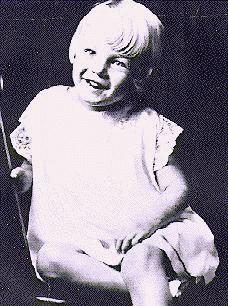
Objectified and misunderstood while alive, Marilyn Monroe has become the ultimate object in death. The image has become reality, canceling out the memory of the living-breathing woman ... leaving just the Object in its wake - the multitudinous images and icons and posters, her face and body standing in for the whole thing, standing in for the life force. It was what she fought against in her career, wanting to be seen as more than a joke, or tits and ass (although she had no problem with shimmying around a little bit either! She knew her assets, she didn't discount them). But her desire to be a good actress, to not just play bimbos or sex objects, is what still complicates our response to her, long after her death. Many people who are unaware of her gifts as an actress are frankly shocked by how natural she is, when they encounter her in films. It's like the Object has won the war, but Marilyn Monroe the person, the actress, continues to win battles. To see her in Some Like It Hot is to encounter true giggly effervescent movie MAGIC, and then to see her in Don't Bother to Knock(my review here) is to understand that this woman had talent as a dramatic actress as well. Not just talent, but a gift. I don't quite buy into the whole Marilyn Monroe as Ultimate Victim thing, although I do know that her demons were huge and loud, and caused her much grief in her life. She was a chronic insomniac. She was a loner. If you trust the reports of some of her confidantes and the private notes of her psychiatrist, she was frigid sexually. But nobody wanted to hear about any of that stuff from Marilyn ... that was not what we loved her for. She was famous and adored, but ultimately alone. She could not be saved. Arthur Miller tried. Many tried. She brought out a protective impulse in people. And, in my opinion, that is part of her movie magic. She was not a sassy sex symbol who "owned" her sexuality, and flaunted it (at least not overtly). There was always the wide-eyed innocence there, in spite of the body made for lovin' - and that somehow engendered a protective response in audiences ... male AND female - so she was one of those very rare movie creatures: a sex symbol whom men loved and desired, whom women respected and looked up to ... and I think it had something to do with that fragmented innocence peering out of her radiant face. She seemed unaware of the responses she brought up in men, and she never seemed out for sex - the Marilyn Monroe persona was all about finding love. Her gifts as an actress and comedienne are obvious - but her appeal is still rather complicated, which, I suppose, is why people still obsess over her, and talk about her, and pick her apart.
So while I can ache for Marilyn Monroe and what it had to be like, at times, to be her, with an abyss of sadness inside her that nobody - nobody - wanted to see ... what I am ultimately left with, in her case, is admiration for the act of WILL it took for her to put that persona together on a daily basis, and BE that fantasy. It had to have given her great joy. There's that great quote (included below) where someone asked her what it was like for her doing a photo shoot - and she said, "It's like being screwed by a thousand guys and you can't get pregnant." Marilyn Monroe was 100% aware of what she was doing when she was in front of the camera. That, I believe, is the greatest misperception about her - and also the problem when you become an Object - especially posthumously. Everything hardens, solidifies, and certain aspects of the narrative win out over others. So Marilyn the poor victimized starlet (or Marilyn the drugged-out diva) won the battle in the narrative wars for a couple of decades. That was the filter through which most people (not cinephiles anyway) saw Monroe. Thankfully, there's a bit more nuance out there now, in regards to how we talk about Monroe - and regular old popcorn-buying audiences, anyway, always knew the truth: Marilyn Monroe was magic, they loved her. They maybe felt protective of her, because of the wide-eyed innocence of her parts ... but there is obviously something about her that made her "stand out". When the nude calendar photos came out, and Marilyn Monroe was forced to apologize by the studio - as we all know now, her apology wasn't really an apology. Just a flat out, "I was behind in my rent, I needed the money." The studio was furious - but then they were bombarded by supportive fan mail, thousands and thousands of letters - from men, women, everyone, saying how much they loved her for her honesty. Not every young starlet has that kind of massive cross-gendered support. It is extraordinary and rare, to this day.
Marilyn Monroe did not have an accidental kind of career, where her beauty and maybe a couple of breaks made her. She was a starlet, like any other. Except that this starlet had ambition, and not just that: she had nowhere else to go, no other goals, no other dreams. There was no family, no one to either put the pressure on, to judge her harshly, or, conversely, to cheer her on. There was never any place for Marilyn to go home to. The ultimate orphan. Having to survive by her wits. Befriending powerful men who could help her, protect her. She thanked God for her beauty, even if it didn't make any difference to her, in terms of battling with her demons and all that. But her beauty was eye-catching, even in her early brunette days, and she submitted to the humiliations of the starlet-life, always keeping her eye on the ball, so that when the time came, and an actual part came her way, she'd be ready. I love her performance in All About Eve. She was cast to be the impossibly gorgeous young actress, and all she needed to do was stand next to Bette Davis, and you got the message. I mean, you might as well throw in the towel if you're a 40-something actress and THAT chick in the white dress is coming down the pike. But Marilyn has a couple of lines in the film, comedic lines, showing her gift at comedy - her absolutely perfect pitch (Watch how she delivers the line: "Well, I can't yell 'Oh butler!', can I? Maybe somebody's name is Butler." To which Addison DeWitt replies; "You have a point. An idiotic one, but a point." But it's HER delivery of that line that is funny. Here's the clip.) and again, I am struck by the act of WILL it had to have taken, to just keep going, through the sneers and catcalls, to make something of herself. She also was smart, and worked on her acting - with a series of coaches through her life ... wanting to go deeper into her craft, and improve herself. Watch her slam-dunk performance in Don't Bother to Knock to encounter a Marilyn Monroe you might never have seen before. She's fantastic.
One of my favorite off-screen stories involving Monroe is told by Billy Wilder, who, famously, had a very tempestuous relationship with her, because of her behavior on the set. Not coming out of her dressing room, showing up hours late, and bumbling her lines so badly that entire days of shooting were spent on Monroe trying to get the line, "Where's the bourbon?" right. But, as Billy Wilder joked: "As I've said before, I've got an old aunt in Vienna who would say every line perfectly. But who would see such a picture." Anyway, here's a bit from the book-length interview between Cameron Crowe and Billy Wilder
CC: One of the reasons you've said that Marilyn enjoyed the Hotel del Coronado sequences in Some Like It Hot is that she had an audience there on the beach watching her. Is that true? Were there, again, a lot of people lined up, watching the filming?BW: She had an audience. She always had thousands in New York, but at the beach there, hundreds. Yeah, she's a show-off.
CC: So they would be cheering and screaming and yelling?
BW: Screaming and yelling. But then when I wanted it quiet I had her say "Shhhh." They listened to her.
That's a movie star.
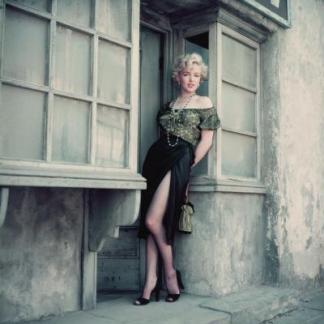
Kim Morgan has a great piece up about Monroe right now and I loved her comments on Monroe as a singer:
And though people love to discuss Marilyn Monroe the underrated actress (which is true -- she was a great comedienne), rarely do they argue about MM the underrated singer. As proven in Some Like it Hot, Gentlemen Prefer Blondes, River of No Return, Bus Stop (oh lord...her sexy, warbled, scared, ripped fishnet version of "That Old Black Magic"...so brilliant) and the less classic Let's Make Love (where her rendition of "My Heart Belongs to Daddy" is one of the best versions of that song ever recorded), the woman had distinct pipes.
My favorite musical number of hers is one that isn't often mentioned in the list of great Monroe songs, but I adore it. It's "File My Claim" from River of No Return - delicious clip below (along with a million quotes about Monroe and from Monroe).
Perfection!
Now, in honor of our lovely Norma Jean, let's get to the quotes:
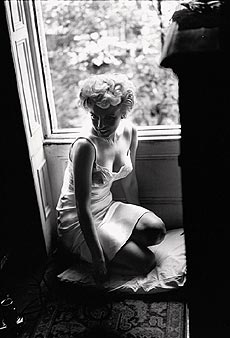
(That's a photo by Sam Shaw - his photos of her are my favorites. Natural light, an innocence to them ... candid-feeling ... just beautiful.)
Marilyn Monroe:
People had a habit of looking at me as if I were some kind of mirror instead of a person. They didn't see me, they saw their own lewd thoughts, then they white-masked themselves by calling me the lewd one.
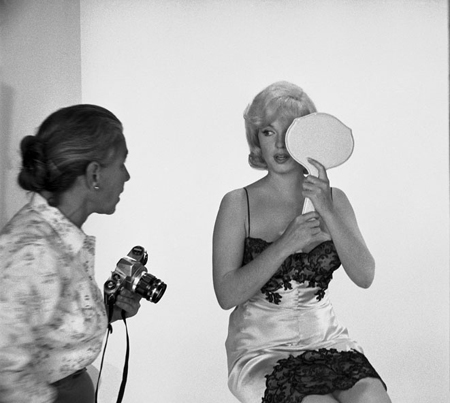
That's Monroe and photographer Eve Arnold
Billy Wilder:
She had a kind of elegant vulgarity about her. That, I think, was very important. And she automatically knew where the joke was. She did not discuss it. She came up for the first rehearsal, and she was absolutely perfect, when she remembered the line. She could do a 3-page dialogue scene perfectly, and then get stuck on a line like, "It's me, Sugar"... But if she showed up, she delivered, and if it took 80 takes, I lived with 80 takes, because the 81st was very good ...She had a feeling for and a fear of the camera. Fright. She was afraid of the camera, and that's why, I think, she muffed some lines. God knows how often. She also loved the camera. Whatever she did, wherever she stood, there was always that thing that comes through. She was not even aware of it.
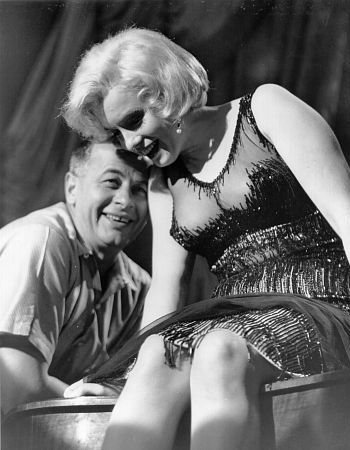
Eve Arnold:
If an editor wanted her, he had to agree to her terms. She knew how she wanted to be seen, and if her cooperation was sought, she reserved the right of veto.She knew she was superlative at creating still pictures and she loved doing it.
She had learned the trick of moving infinitesimally to stay in range, so that the photographer need not refocus but could easily follow movements that were endlessly changing.
At first I thought it was surface technique, but it went beyond technique. It didn't always work, and sometimes she would tire and it was as though her radar had failed; but when it did work, it was magic. With her it was never a formula; it was her will, her improvisation.
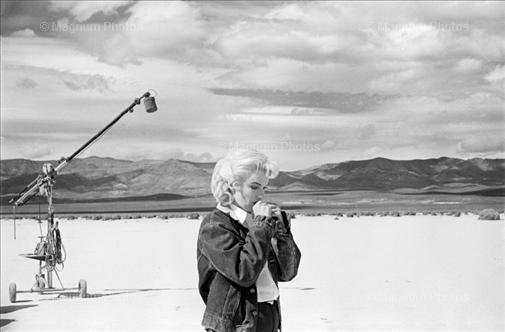
Peter Bogdonavich:
The fact is that Marilyn was in bad trouble from the day she was born as Norma Jean Mortenson on June 1, 1926, in the city of angels and movies, a poor bastard angel child who rose to be queen of a town and a way of life that nevertheless held her in contempt. That she died a martyr to pictures at the same time as the original studio star system -- through which she had risen -- finally collapsed and went also to its death seems too obviously symbolic not to note. Indeed, the coincidence of the two passing together is why I chose to end this long book about movie stars with Marilyn Monroe.What I saw so briefly in my glimpse of Marilyn at the very peak of her stardom (and the start of my career) -- that fervent, still remarkably naive look of all-consuming passion for learning about her craft and art -- haunts me still. She is the most touching, strangely innocent -- despite all the emphasis on sex -- sacrifice to the twentieth-century art of cinematic mythology, with real people as gods and goddesses. While Lillian Gish had been film's first hearth goddess, Marilyn was the last love goddess of the screen, the final Venus or Aphrodite. The minute she was gone, we started to miss her and that sense of loss has grown, never to be replaced. In death, of course, she triumphed at last, her spirit being imperishable, and keenly to be felt in the images she left behind to mark her brief visit among us.
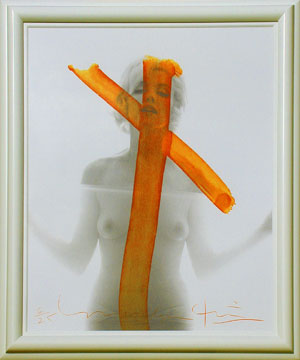
Elia Kazan:
Relieve your mind now of the images you have of this person. When I met her, she was a simple, eager young woman who rode a bike to the classes she was taking, a decent-hearted kid whom Hollywood brought down, legs parted. She had a thin skin and a soul that hungered for acceptance by people she might look up to ...The girl had little education and no knowledge except the knowledge of her own experience; of that she had a great deal, and for an actor, that is the important kind of knowledge. For her, I found, everything was either completely meaningless or completely personal. She had no interest in abstract, formal, or impersonal concepts but was passionately devoted to her own life's experiences. What she needed above all was to have her sense of worth confirmed. Born out of wedlock, abandoned by her parents, kicked around, scorned by the men she'd been with until Johnny, she wanted more than anything else approval from men she could respect. Comparing her with many of the wives I got to know in that community, I thought her the honest one, them the "chumps". But there was a fatal contradiction in Marilyn. She deeply wanted reassurance of her worth, yet she respected the men who scorned her, because their estimate of her was her own.
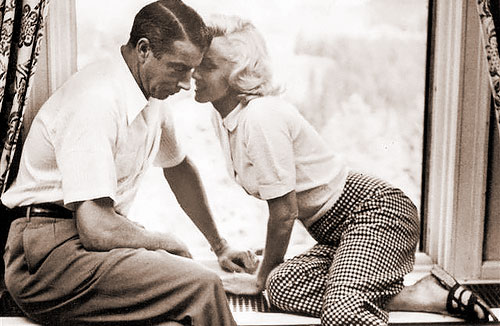
Marilyn Monroe:
Well-behaved women rarely make history.
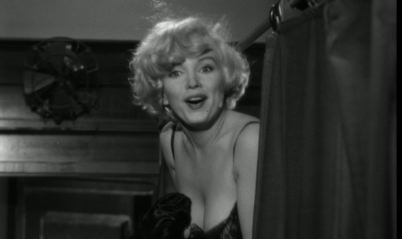
John Strasberg (son of Lee Strasberg, Marilyn's acting teacher):
I think I was talking about cars to Mother and Father. You know how I loved cars. I'd just come home and it was going to be my eighteenth birthday. I'd wanted to come for that.Mother and Father hadn't wanted me to come. "Why don't you wait till the end of the year?" Well, i'd already been kicked out of college. They didn't know yet.
When I'd gone off at the airport, I'd turned to Mother and said, "For two cents, I won't go." Nobody gave me the two cents, but I'd meant it. What I'd wanted to do was work. I'd wanted to work from the time I was fifteen, and they were always against any effort on my part to be strong or independent. I remember how much I resented it. "You don't have to work, we'll take care of everything," undermining me.
So I was talking about cars, no one was listening, and Marilyn was there and out of the blue said, "Why don't you take my car, Johnny?"
I thought I hadn't heard her right, and I said, "What?" She had remembered the summer before, in California, I'd had that Chevy I'd rented. God, I loved that car, a '57 Bel Air silver Chevy, and she had the Thunderbird.
She continued, "I've got the Ford Mustang the corporation gave me, and Arthur and I have a car. That one's just sitting in the garage, we don't use it."
I was stunned. I couldn't believe she meant it.
Mother and Father were horrified; they didn't like it at all. I don't know if it felt like too much to give me or if they were worried about my driving in my state of mind, but they objected strenuously. "He's too young. Maybe later, Marilyn. You don't have to. It's impossible, he can't afford it, it could be dangerous."
Marilyn just said, "Well, don't worry about any of that, it's in the corporation's name, so I'll take care of the insurance."
I'll never forget that ... There were so few, so very few people who were generous like that. Especially to me, who couldn't do anything for her.
I think that car saved my life.
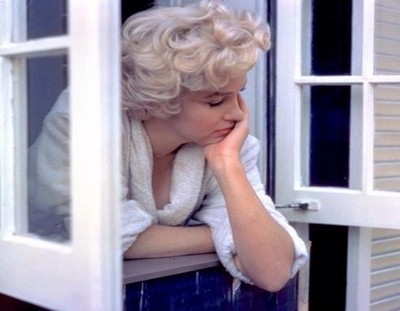
Billy Wilder:
I never knew what Marilyn was going to do, how she was going to play a scene. I had to talk her out of it, or I had to underline it and say, "That's very good" or "Do it this way." But I never knew anybody who ... except for a dress that blows up and she's standing there ... I don't know why she became so popular. I never knew. She was really kind of ... She was a star. Every time you saw her, she was something. Even when she was angry, it was just a remarkable person. A remarkable person, and in spades when she was on the screen. She was much better on the screen than not on the screen.
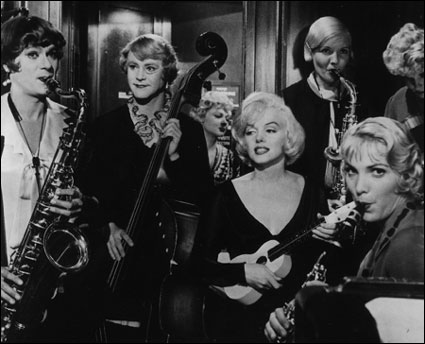
Marilyn Monroe:
Some people have been unkind. If I say I want to grow as an actress, they look at my figure. If I say I want to develop, to learn my craft, they laugh. Somehow they don't expect me to be serious about my work.
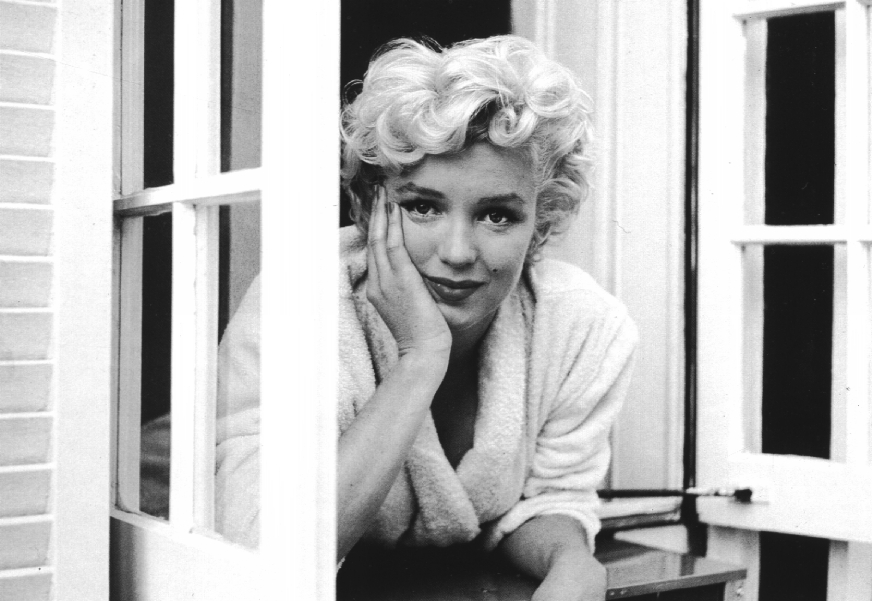
Billy Wilder:
It's very difficult to talk seriously about Monroe, because she was so glitzy, you know. She escaped the seriousness somehow; she changed the subject. Except that she was very tough to work with. But what you had, by hook or crook, once you saw it on the screen, it was just amazing. Amazing, the radiation that came out. And she was, believe it or not, an excellent dialogue actress. She knew where the laugh was. She knew.
Marilyn Monroe:
"For breakfast, I have two raw beaten eggs in a glass of hot milk. I never eat dessert. My nail polish is transparent. I never wear stockings or underclothes because I think it is important to breathe freely. I wash my hair everyday and I am always brushing it. Every morning I walk across my apartment rolling an empty soda bottle between my ankles, in order to preserve my balance."
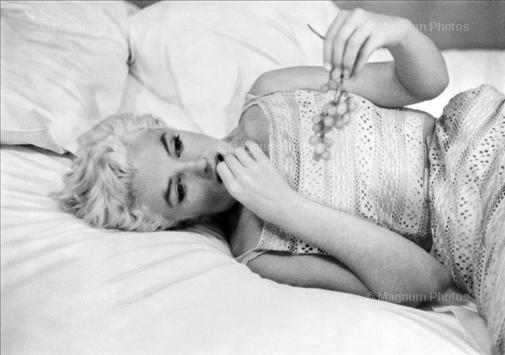
Eve Arnold:
I never knew anyone who even came close to Marilyn in natural ability to use both photographer and still camera. She was special in this, and for me there has been no one like her before or after. She has remained the measuring rod by which I have -- unconsciously -- judged other subjects.

Marilyn Monroe:
It's not true that I had nothing on. I had the radio on.

Ernest Cunningham (photographer):
I worked with Marilyn Monroe. A rather dull person. But when I said "Now!" she lit up. Suddenly, something unbelievable came across. The minute she heard the click of the camera, she was down again. It was over. I said, "What is it between you and the camera that doesn't show at any other time?" She said, "It's like being screwed by a thousand guys and you can't get pregnant."
Peter Bogdonavich:
More than forty years have passed since Marilyn's mysterious death, but her legend and persona have survived. This is all the more remarkable because she actually made very few films, and even fewer that were any good. But there was a reality to her artifice -- she believed in the characters she played, even if they were inherently unbelievable. "Everything she did," [Arthur] Miller said to me, "she played realistically. I don't think she knew any other way to play anything -- only to tell you the truth. She was always psychologically committed to that person as a person, no matter what the hell it was, rather than a stock figure. Because the parts she got could easily have been stock figures, which had no other dimension. But she wouldn't have known how to do that. In other words, she did not have the usual technique for doing something as a stock figure ... She was even that way when [director] John Huston used her the first time [in a memorable walk-on bit] in The Asphalt Jungle [1950]."This went for every picture she did in her surprisingly, painfully short career as a star, barely a decade, little more than a dozen pictures. Though she managed to work with quite a number of major directors, it was not necessarily always in their best efforts; but still they were Fritz Lang, Howard Hawks (twice), Otto Preminger, Billy Wilder (twice), George Cukor (twice, if you count her last unfinished one), John Huston (twice), Laurence Olivier, Joshua Logan, and Joseph L. Mankiewicz (bit part in 1950's classic All About Eve). In my conversation with Miller, he said, "I thought she had the potential for being a great performer if she were given the right stuff to do. And if you look at the stuff she did do, it's amazing that she created any impression at all because most of it was very primitive. And the fact that people remember these parts from these films is amazing ... She was comitted to these parts as though they were real people, not cardboard cutouts. Even though the director and author and the rest might have thought they were cutouts and would deal with them that way. The way the two men [Tony Curtis, Jack Lemmon] in Some Like It Hot felt with their parts, or George Raft with his part. She was real. And therefore she had the potential of being a great comedienne." (Norman Mailer, in his book on Monroe -- he never met her -- wrote that starting with 1953's Gentlemen Prefer Blondes, she was a great comedienne.)

Marilyn Monroe:
I'd prefer not to analyze it [acting] ... it's subjective; rather, I want to remain subjective while I'm doing it. Rather than do much talking I'd rather act. When it's on the screen, that's when you'll know who Roslyn [her character in The Misfits] is. I don't want to water down my own feeling ... Goethe says a career is developed in public but talent is developed in private, or silence. It's true for the actor. To really say what's in my heart, I'd rather show than to say. Even though I want people to understand, I'd much rather they understand on the screen. If I don't do that, I'm on the wrong track, or in the wrong profession.... Nobody would have heard of me if it hadn't been for John Huston. When we started Asphalt Jungle, my first picture, I was very nervous, but John said, 'Look at Calhern [the late Louis Calhern, a veteran actor], see how he's shaking. If you're not nervous, you might as well give up.' John has meant a great deal in my life. It's sort of a coincidence to be with him ten years later.
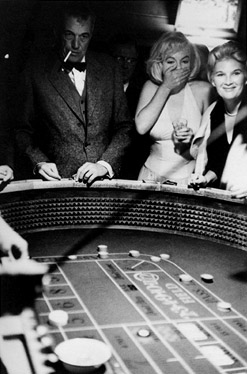
John Strasberg:
The first time I met her I remember she came out of the living room and Pop said, "This is my son," and my first impression of her was that she was different from most of the people who came to the house. I'd watch all these people trading their most human qualities, betraying themselves for success at all costs, to become rich and famous, and afterward, when it was too late, they'd realize they had lost the best part of themselves along the way, but she, she was like me. When I looked into her eyes, it was like looking into my own, they were like a child's eyes. I was still a child. You know how children just look at you. My feeling was she had less ego or was less narcissistic than most of the actors who never really bothered with me. She was just another person to me, another one from that world I felt cut off, excluded, from. She was nicer, real simple, no makeup, and she really looked at me as if she saw me. It wasn't that I wanted people to look at me, but I knew the difference when she did. I knew everyone said she was the sexiest, most sensual woman in the world. Not to me. I thought there was something wrong with me for not feeling that from her. I'd felt it from other women who came to the house. I was pretty sexually frustrated then. She was so open, so loose, and her sensuality as such was so totally innocent, nothing dirty in it at all, and the first time it was just like talking to an ordinary person, only realer than most who came into the house in those days. She was quiet, too, I remember, like an animal is quiet, and I was like that too, survival tactics. She seemed smart, but not in an educated way, instinctively smart, nobody's fool.
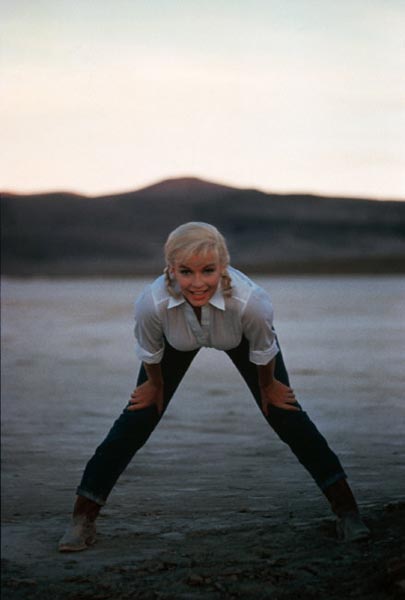
Couldn't resist:
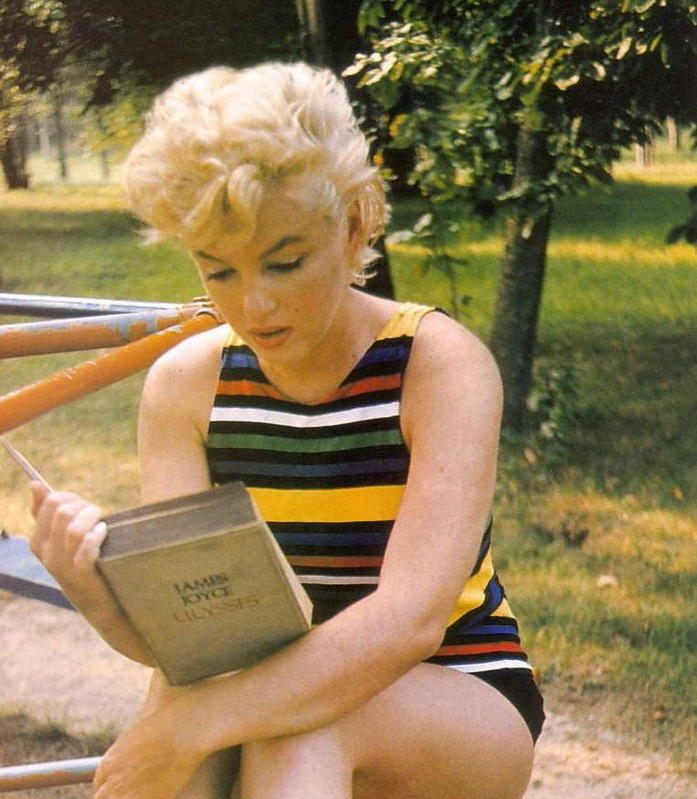
Marilyn Monroe:
"I am a failure as a woman. My men expect so much of me because of the image they have made of me and that I have made of myself, as a sex symbol. Men expect so much and I can't live up to it. They expect bells to ring and whistles to whistle, but my anatomy's the same as any other woman's. I can't live up to it."

Marilyn Monroe:
My illusions didn't have anything to do with being a fine actress. I knew how third rate I was. I could actually feel my lack of talent, as if it were cheap clothes I was wearing inside. But, my God, how I wanted to learn, to change, to improve!
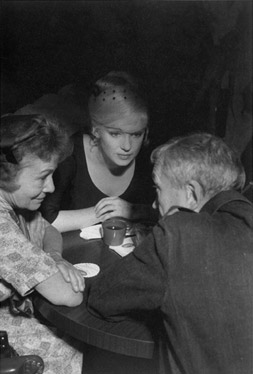
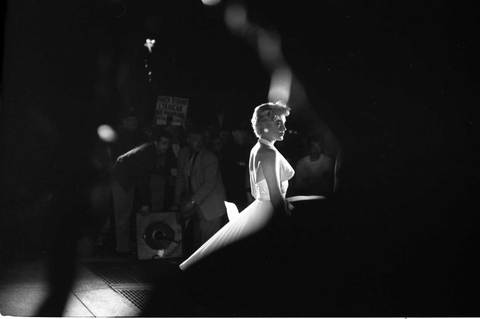
Arthur Miller:
She was a whirling light to me then, all paradox and enticing mystery, street-tough one moment, then lifted by a lyrical and poetic sensitivity that few retain past early adolescence. Sometimes she seemed to see all men as boys, children with immeidate needs that it was her place in nature to fulfill; meanwhile her adult self stood aside observingt he game. Men were their need, imperious and somehow sacred. She might tell about being held down at a party by two of the guests in a rape attempt from which she said she had escaped, but the truth of the account was far less important than its strange remoteness from her personally. And ultimately something nearly godlike would emerge from this depersonalization. She was at this point incapable of condemning or even of judging people who had damaged her, and to be with her was to be accepted, like moving out into a kind of sanctifying light from a life where suspicions was common sense. She had no common sense, but what she did have was something holier, a long-reaching vision of which she herself was only fitfully aware: humans were all need, all wound. What she wanted most was not to be judged but to win recognition from a sentimentally cruel profession, and from men blinded to her humanity by her perfect beauty. She was part queen, part waif, sometimes on her knees before her own body and sometimes despairing because of it -- "Oh, there's lots of beautiful girls," she would say to some expression of awed amazement, as though her beauty betrayed her quest for a more enduring acceptance.
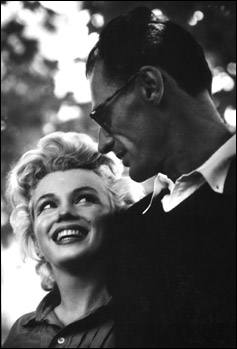
Peter Bogdonavich:
The year before her much-speculated-over death at thirty-six (rumors of presidential involvement, etc.), playwright Clifford Odets told me that she used to come over to his house and talk, but that the only times she seemed to him really comfortable were when she was with his two young children and their large poodle. She relaxed with them, felt no threat. With everyone else, Odets said, she seemed nervous, intimidated, frightened. When I repeated to Miller this remark about her with children and animals, he said, "Well, they didn't sneer at her."
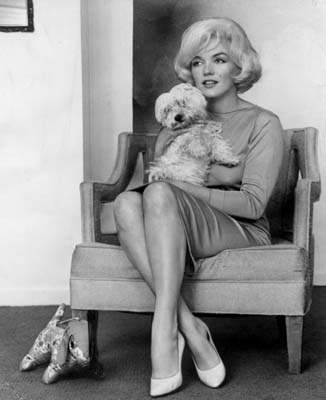
Burt Glinn (photographer):
She had no bone structure -- the face was a Polish flat plate. Not photogenic in the accepted sense, the features were not memorable or special; what she had was the ability to project.
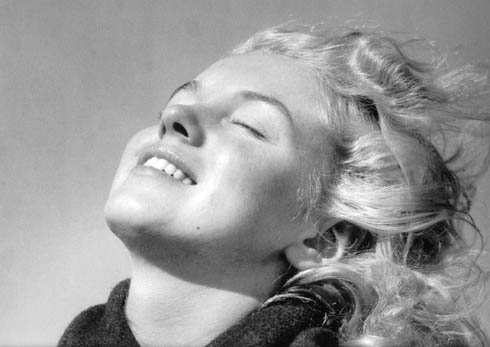
Billy Wilder:
Marilyn was not interested in costumes. She was not a clotheshose. You could put anything on her you wanted. If it showed something, then she accepted it. As long as it showed a little something.
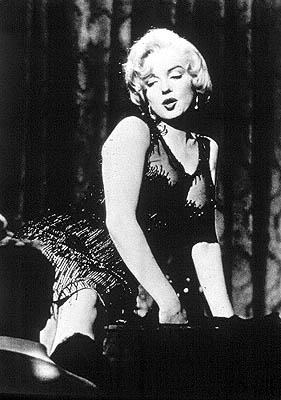
Henri Cartier Bresson (photographer):
She's American and it's very clear that she is - she's very good that way - one has to be very local to be universal.

Here's the mega-post I wrote about the making of The Misfits
Marilyn Monroe:
Hollywood is a place where they'll pay you a thousand dollars for a kiss and fifty cents for your soul.
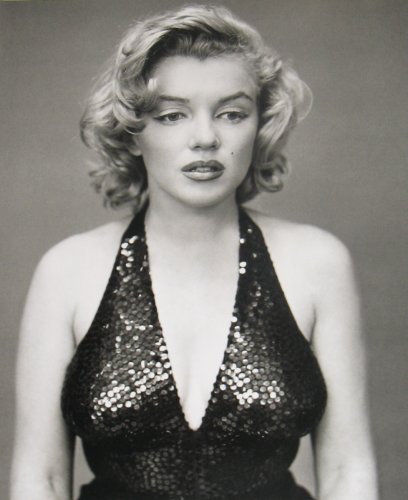
Marilyn Monroe:
Being a sex symbol is a heavy load to carry, especially when one is tired, hurt and bewildered.
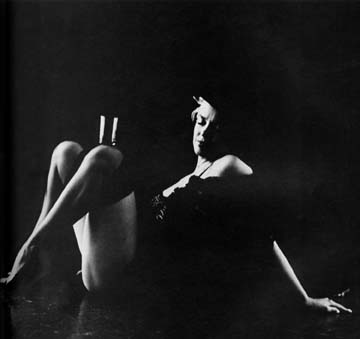
Marilyn Monroe:
Acting isn't something you do. Instead of doing it, it occurs. If you're going to start with logic, you might as well give up. You can have conscious preparation, but you have unconscious results.
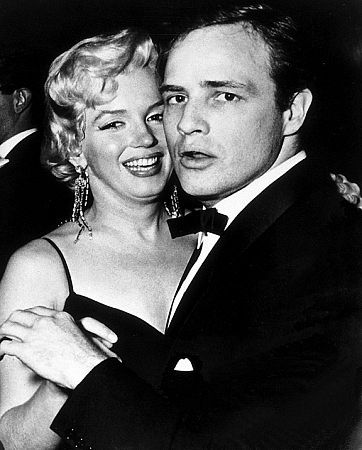
Arthur Miller:
To have survived, she would have had to be either more cynical or even further from reality than she was. Instead, she was a poet on a street corner trying to recite to a crowd pulling at her clothes.

Marilyn Monroe:
I'm not interested in money. I just want to be wonderful.
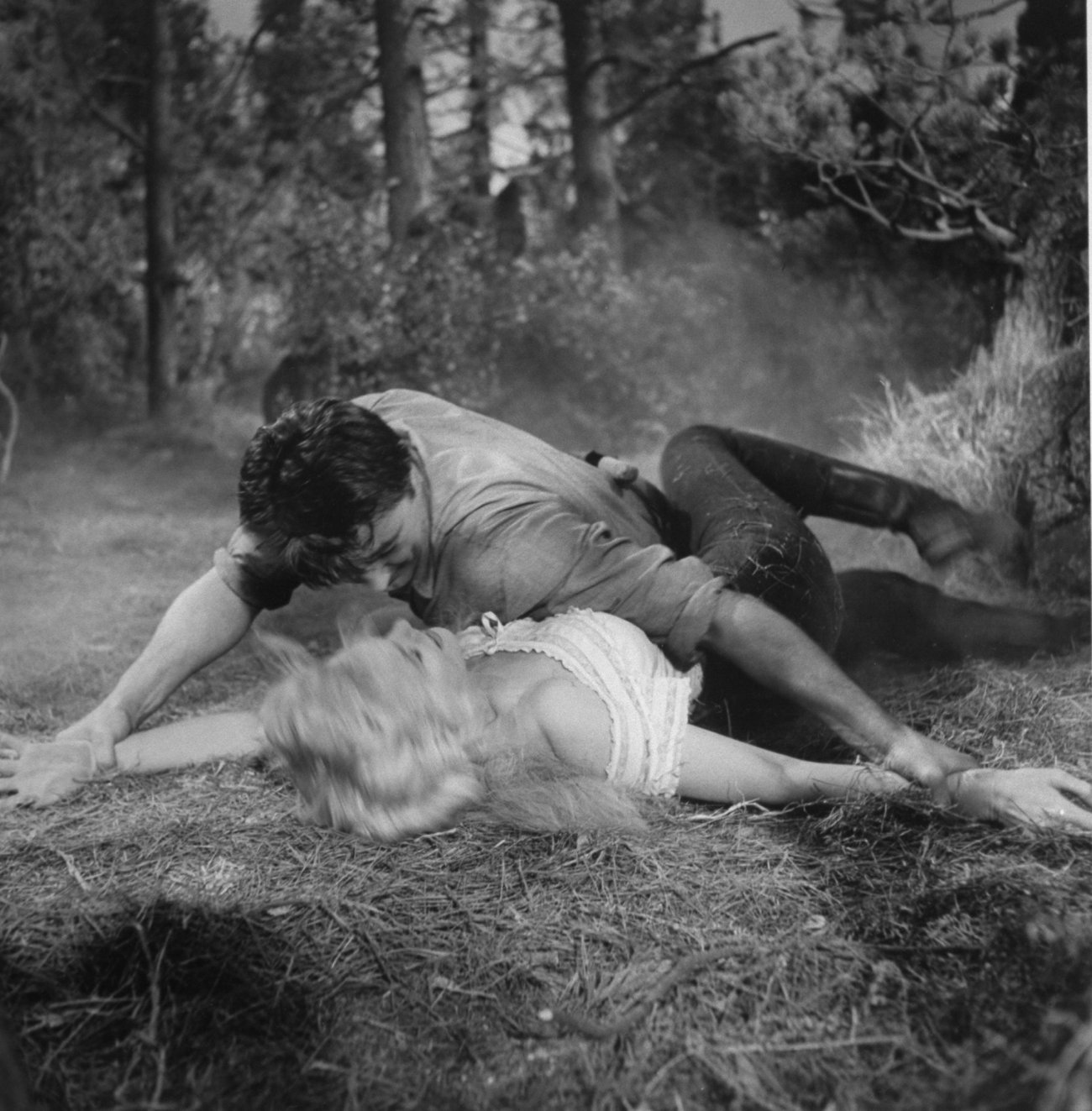
Marilyn Monroe (this is what she pleaded at the end of the last interview she gave):
What I really want to say: That what the world really needs is a real feeling of kinship. Everybody: stars, laborers, Negroes, Jews, Arabs. We are all brothers.Please don't make me a joke. End the interview with what I believe.