February 28, 2005
Overheard
Okay, so I overheard a brief exchange last night that I wanted to pass on. Two guys on the sidewalk, talking vigorously. From the bits and pieces I picked up, they were fashion designers - and they mainly did stuff with denim. I heard the word "denim" sprinkled throughout the exchange. They spoke a technical language that was like Swahili, I did not understand a WORD. They also were speaking about someone who obviously was in competition with them ...
And here's what I heard.
Guy # 1: They're techno-cad and we're American traditionalists.
Guy # 2: Yeah, man, we got the moral high ground.
Let me note: this was said with absolutely no irony. They were discussing DENIM and they used the words "moral high ground".
Life is beautiful.
The Oscars
As a prelude let me just say this about myself in relation to the Oscars (ha. Like anybody cares. Well, I assume if you read me, you do care, so here we go):
I'm in it for the emotion. I love the emotion. I NEED the emotion. I do not judge the jittery overwhelming joy expressed by those who win ... As a matter of fact, I revel in it. The more emotion, the better.
An actress makes some over-the-top weepy speech, basically having a nervous breakdown on national television? Bring it on. I love it. (Anyone remember Jennifer Connelly's pale-as-a-ghost monotone stiff speech when she won for Beautiful Mind? I was BUMMED. Where was her nervous breakdown? Where was her ecstasy? She let me down, man, she let me down.)
An actor is overcome with emotion, trying to thank the director who gave him this chance? I love it. Can't get enough. (And please ... MORE cut-away shots to the spouse of the winner in the audience, holding back her tears, smiling wide, proud, happy ... more of those, please.)
Some sound-mixing guy stands up there, clutching a piece of paper with all the names on it, and you can see that his hand is trembling? My God. I love humanity.
There are times when the emotion is SO huge that the person making the speech comes off looking like a raving lunatic who needs to be hospitalized immediately. (Can you say Halle Berry? I know you can.)
There are times when the joy is so enormous, and the wait for recognition has seemed so long, that the person jibbers like a maniac in a display of wounded ego vanquished. (Ehm ... Sally Field. 'Nuff said.)
But still. I DON'T CARE. I love it all. I love the "too-much-ness" of it all. I love to see people overcome with a too-much-ness of emotion, even if it's embarrassing. I think it's actually kind of beautiful to watch. One of my pet peeves is those who find emotion, in general, to be embarrassing and worthy of mockery. There were a couple of those types in the bar where I watched the Oscars last night ... The moment anyone started showing emotion, no matter how mild, the snickering began. Ick. I'm glad I'm not like that, because those people deprive themselves of so much. Do I sound like I feel superior? You're damn right. I do. I'm glad I'm me, and not them, and I'm glad that emotion doesn't embarrass me, even the most embarrassing displays of emotion. For example, I thought Gwyneth Paltrow's out-of-control-with-emotion Oscar speech, where she was struggling with tears the whole time, having moments of feeling unworthy (when she wept out in the general direction of Meryl Streep: "I don't feel worthy to be up here ...") - and crying about her sick grandfather, her sick cousin (I remember some comic saying afterwards: "Is anyone in Gwyneth Paltrow's family healthy right now??") her parents, all that ... I thought it was magnificent. I could not get enough. I could have watched her cry and clutch that trophy for an hour more.
All of this is also why I am often overcome when watching Olympics medal ceremonies - even if it's for a Latvian shotputter I have never heard of before in my life. I don't care. I LOVE to see people in moments of heightened emotion, and in moments when a long dream has come true, when a moment imagined in childhood has actually come to pass ... I mean, honestly. How awesome is that??
All right, so all of that being said ... let me go on to the specifics.
Oscar Night Analysis
-- Kathy Griffin needs to be SHOT. Her eyeshadow alone was enough to make me hate her for all time.
-- I thought Scarlett Johansen looked beautiful enough to eat. She's gorgeous, and I loved her look. I also just like her, in general.
-- Star Jones stopped Drew Barrymore on the red carpet to chat a bit. Drew was all glammed up, in a black dress. Wasn't wacky about her earrings or her dark eyeshadow, but it doesn't matter. I love Drew Barrymore, and I kind of wish that we were best friends. Anyway, Star Jones said to her, "Drew Barrymore! You're not a little girl anymore!" And Drew said, "I just turned 30 this week." She didn't say it in a bitchy way, she said it with a huge smile, but it was hilarious. No one will ever let her forget ET. When she's 80, some chick on the red carpet will say, "Drew! You're not a little girl anymore!"
-- Renee Zellweger makes me angry.
-- I love Mike Myers and his wife Robin. I've actually met both of them, and they're as normal and cool as they seem to be. What I particularly love, is that Robin is not just "the wife of the star". Mike Myers says that Robin is funnier than he is - and I believe it. Star Jones (she was driving me nuts) stopped them to talk on the red carpet, and of course - Star Jones was pretty much only talking to Mike Myers, asking him questions. Robin seemed completely oblivious to the fact that Star Jones wasn't addressing her, and would chime in with her own comments. I love the two of them. They seem like a real pair.
-- Uhm, what the heck was up with Spike Lee's hat?
-- Maggie Gylennhall (or however you spell her name): I love her acting, and I think we're going to be hearing from her for a very long time. You wait and see - I bet she'll win an Oscar one day. HOWEVER: you cannot dress that girl up. No matter what is put on her, she looks a bit dowdy. Maybe because she doesn't really have good posture? She slumps. I find this quality in her endearing, actually. She's not a clothes horse. She reminds me of Diane Keaton in that way.
-- Oprah looked incredible. Just incredible.
-- Hilary Swank's dress was atrocious. The sexy back did not make up for the horrific front. Sorry, babe. It don't work that way. However, let me just say this: I like Hillary Swank because she seems like an actress. Not a movie star. I mean, obviously, she IS a movie star, but she doesn't carry herself that way, she doesn't play that game, in the interviews on the red carpet she comes across as really real, and humble, and normal. So in a way, I found her atrocious dress endearing. One thing I noticed which made me like her even more: Star Jones (blah) stopped Hillary and her husband Chad Lowe to talk. Now, this red carpet stuff is so inane, and the "conversations" had barely deserve that name. So Star is asking Hillary questions like: "Are you excited?" (Uhm, nah. I already got an Oscar, whatever. I don't need another. OF COURSE SHE'S EXCITED). And again: Star barely acknowledged Chad Lowe standing beside Hillary, etc. As Star said some inane thing, and Hillary listened, with a polite open smile on her face, I saw her hand subtly reach out to grab her husband's. A quiet husband-wife moment in the middle of the insanity. I liked to see that. Isn't that so what you would do if you were in that insane environment? Cling to the person next to you who is REAL, who knows you, who has some connection to reality?
-- Oh and speaking of all of that: I thought Kate Winslet looked scrum-diddlyumptious. But then again, she always does. Here's what I liked about her: She's nominated for an Oscar, okay? She's in some fabulous dress. She's a big feckin' movie star. Star Jones says something like: "So are you so excited right now, and are you so excited about how fabulous you look?" Kate Winslet said, "Well, actually, I'm here with my parents, my husband, and my best friend from home ... so pretty much right now, I'm concerned about them, and I'm hoping that they're having a good time ..." And as she said it, she kind of looked around, searching for where her family went. I loved her for that. Again, isn't that so what you would do if you were in that nutso environment, and you were there with your parents and your best friend?
-- Gwyneth Paltrow (while I'm not a huge fan) looked positively gorgeous. I've never seen her look so lovely.
-- Wasn't wacky about Cate Blanchett's dress. Yellow is not a good color for her, and with the brown sash? She looked like a lemon-meringue pie with a slightly burnt crust. However: I LOVED her hair. I want to get my hair to look like that. Tousled, natural, curls ... Beautiful.
-- I watched the Oscars in a pub with a couple of friends. Both of these friends work in PR, and one of them has "worked the red carpet" many times, for her job. You know those people in the background, usually dressed in black, who usher the stars along, from post to post, making sure no one holds up the line? That's what my friend does. So their perspective on red-carpet behavior was extremely amusing. For example, suddenly there was a shot of Robin Williams, doing some wacky ridiculous thing, and one of my friends murmured, "Love Robin Williams, but he is a red carpet disaster."
-- I love Chris Rock, always have. And I thought he did a great job - snarky enough to get laughs (the thing about Jude Law, while it might be mean, I thought was hilarious) - but he kept the thing moving right along. And he kept it pretty non-explosive, which for a comic like Rock much have been quite a challenge. There's just something about his delivery which is funny in and of itself. Like his whole thing about waiting to get a STAR for your movie. "If you want Denzel, but you can only get me? WAIT." Also his thing about Russell Crowe being so good at historical drama, even if it's just "3 weeks ago". "If you want someone to show you what it was like 3 weeks ago ... if you want to know how they walked 3 weeks ago, how they talked 3 weeks ago ... then Russell Crowe is your man." I don't know, man, I thought it was hilarious. Also, his dig at Tim Robbins - YAY!!! "Now welcome to the stage a man who is a wonderful actor, great director, and who bores us to DEATH with his politics ... Tim Robbins!" Tim Robbins took it in stride, which I thought was nice, too. Oh, and how about the general humorlessness of Sean Penn when he came onstage, and basically ... out of nowhere ... defended Jude Law from the Chris Rock joke in the opening monologue?? Ha ha. I love Sean Penn, great damn actor, but the guy really needs to lighten up.
I have so much else to say. This is already the longest post ever.
-- Clive Owen should have won. Clive Owen should have won. Clive Owen should have won. Love Morgan Freeman, but Clive Owen should have won. Acting don't get much better than what he did in Closer.
-- Can we please discuss the general gorgeousness of Beyonce? I mean, please. It's almost like she is lit from within or something. Additionally, she's such a performer. She's a diva, in the grand tradition of musical divas. Like ... she can carry it off. I was very impressed. She's a superstar for good reason. However, the necklace she wore in the second number was TOO MUCH. We spent the entire song talking about the necklace, and how much it was probably worth (one of my friends commented, "What's with the bling?")... and somewhere along in there, we realized we missed her performance. The diva-accessories should accentuate the performance, not overwhelm it. But besides all of that - I think she's a grand and delicious diva, and I thought she did a wonderful job.
-- Pierce Brosnan walks out to give the award for Best Costume. He is then joined on stage by an animated creature from The Incredibles, and they engage in "witty banter". It was kind of toe-curlingly mortifying to watch, actually. Dumb. One of my friends murmured sadly, "Pierce Brosnan's career has gone down."
-- Although I wasn't completely sold on Cate Blanchett's performance as Katherine Hepburn (she did some good acting, I thought, but ... I don't know. I couldn't get the real Kate out of my mind, and hence - Cate seemed like a pale reflection) ... However. I very much appreciated Cate's speech. Which was pretty much all about Katherine Hepburn. How wonderful. How beautiful. I loved how Cate worded it, too: "When you play someone as terrifyingly well-known as Katherine Hepburn..." That's pretty much the size of it. "Terrifyingly well-known" indeed. But I thought her speech was quite classy - she turned it into a mini-tribute of the Great Kate herself. I also love that Cate Blanchett, the gorgeous lemon-meringue pie, is basically married to Bilbo Baggins.
-- The Johnny Carson montage brought tears to my eyes.
-- Ross Kaufman, the guy who won for Best Documentary (Born into Brothels) graduated from the same college as I did, in the same year. Makes me feel kind of like a loser. But congratulations anyway!
-- HOORAY for Sidney Lumet!! I sat there, listening to Al Pacino's awesome speech (so articulate, so cool), thinking of their history together. I mean, listening to Al, all I could think of was "Atti-CA! Atti-CA!" and it amazed me. These two have known one another for so long. So I loved that Lumet was acknowledged, and I also loved that it was Al who presented that award.
-- Penelope Cruz's English is incomprehensible. Gorgeous? Of course. Incomprehensible when she speaks? Absolutely.
-- Despite all of the celebrities, and all of the movie stars - in general, my favorite award speeches to watch are the unsung heroes. The invisible ones. The technical people - sound editing, sound mixing, etc. etc. I just love these people and I love the contribution they make (which, if it's done well, is nearly invisible. You don't sit watching The Aviator thinking: "Wow. The sound in this film is excellent. KuDOS to the sound mixer!" But without good sound, the movie wouldn't work as a whole.) So I love these people. And I love watching their moment in the sun, when they are acknowledged for their huge contribution. They're not used to the attention, to being in front of crowds. Their speeches are usually the ones that kill me the most.
-- Speaking of which, whoever it was who won for sound editing said a really cool thing, that I remember: "They're not technical awards. They're given for artistic decisions." I love that, and I completely agree.
-- Jamie Foxx's speech killed me. It KILLED me. The grandmother moment ... when he was almost afraid to even start talking about it, because he would lose it ... That's what I'm talking about. Talk about your dead grandmother up on that stage, and I am yours forever. I loved that the grandmother told him to stand up straight "and act like you got some sense." A beautiful speech, I thought. The guy is a phenomenal actor, I have always thought so - ever since I saw him in that silly movie Any Given Sunday - and thought: "My God. He is incredible. That guy is a movie star." He is, indeed. Congratulations to him. Well deserved.
-- One of my friends made a good comment about Hillary Swank's "I'm just a girl from the trailer park" speech. She said, "You should talk about the trailer park you came from in your FIRST Oscar speech. Not your SECOND Oscar speech." For some reason, that made a lot of sense to me. Probably because I'm a lunatic.
-- I can't even comment on the fact that Martin Scorsese didn't win. I'm still too upset. So before the man dies, they'll give him a Lifetime Achievement Award, basically to say "Hey dude, sorry we keep blowing you off, even though you've directed some of the most influential important films our country has ever produced. Sorry we blew you off for Raging Bull. Sorry we blew you off for Good Fellas. Sorry, buddy, that we keep blowing you off. Here's a lifetime achievement award to make up for what idiots we all are." You know, he works outside the studio system, and pretty much always has. Despite his phenomenal success, I don't know if the powers-that-be can really forgive him for that. I'm pissed. I could barely listen to Clint's speech.
I try to remind myself, right now, of the impassioned thing I wrote last year about Bill Murray not winning the Oscar for Lost in Translation.
But still. I really think Scorsese deserved that award. He's the type of director who wins Oscars for OTHERS ... and yet strangely, he continues to be ignored. His films win Oscar after Oscar after Oscar ... and hmmm, who's at the helm of these celebrated movies? Uhm ... Scorsese. It's like Cary Grant never winning. There's a downside to making stuff look so easy. Cary Grant made it look easy, and the people around him were nominated.
I don't want to end on a sad note. I'm an Awards-ceremony junkie. I wish there were awards shows every day of the week. I would never leave my house, and I would watch them in rotation.
A fun night was had by all!
And I reiterate my first point: Kathy Griffin needs to never show her ugly green-eye-shadowed face again. Who the hell chose her to be such a huge part of the show? Fire that person. Now.
Other commentary:
Lisa's post must be read. Bless her for bringing up Electric Company when discussing Morgan Freeman.
Ann Althouse's commentary in real-time is not to be missed. I particularly enjoy her wording: "Renee Zellweger comes out in a stiff red dress. She moves like an inchworm." Gloriously apt.
Steve Silver blogged about it as it was happening. Good observations ... many that I did not pick up on. So far, in pretty much every post I've read, Sean Penn is being lambasted for ... behaving like a humorless automaton.
Heh heh heh. More commentary on how humorless Sean Penn is. I love it!! Dude needs to chill. He looked as ridiculous as Eminem did when Eminem fought with the puppet. (I say all of this despite the fact that I love Sean Penn and I love Eminem.) Being able to take a joke, and having a sense of humor about things (even if you are the punchline) is the mark of intelligence. Remember this!! Sean: you're an awesome actor. But your perpetual dourness is proof of the fact that intellectually you are a dum-dum.
February 27, 2005
Geek Love
Emily is now in the process of reading the incredible novel Geek Love by Katherine Dunn. I had such a strong response to that book when I first read it (years ago) that I haven't picked it up since. But it has stayed with me. Emily's just written about it- and her words remind me of my own whirlwind of emotion when I first read that thing. Damn though ... it's such a damn painful weird awful book I don't know if I want to subject myself to it again! Like I said to Emily in the comments over there: yes, the ending is awful. But there's also a painful painful beauty to it. Redemption in the middle of a wasteland. Love - the kind of love that pierces you like an arrow. It's unforgettable.
If anyone who reads this decides they want to check out Katherine Dunn's amazing book, this incredible work of fiction - don't say I didn't warn you!! It's killer.
Let's hear it for grandiose nerds
The other day Alex referred to me as a "grandiose nerd". I think that about sums it up.
I will now give you a tiny glimpse of what I did for about an hour this morning:
I read Robert Conquest's The Great Terror. To cross-reference certain events, I took out Volume I of The Gulag Archipelago. I looked up the Bukharin trial, read about it THERE, then went back and read about it in Conquest's book. I also had, on hand, my copy of 1984, because I wanted to double-check again, for myself, what that "secret book" had to say about totalitarian regimes, "closed systems", if you will, and how they operate. This dovetailed in quite nicely with the other two books. And lastly, I had on hand my copy of The Prince. Conquest uses quotes from Machiavelli throughout his book, and Stalin was a big Prince fan (Little Red Corvette?), so I kept that nearby, just to cross-reference the sections Stalin took particular interest in.
This kind of behavior is, I must reiterate, FUN for me. I think it qualifies as GRANDIOSE NERDINESS to the extreme.
I should get paid for this shite.
February 26, 2005
Rigid Aromatherapy Tips from the Redhead
Little known fact: The Sheil-ster is into scented candles and incense and sachets and pot pourri and aromatherapy oils sprinkled on light bulbs and etc. and etc. and etc. I am into all of this stuff in a rather rigid way (which is rather amusing, if you think about it.) Like: you're rigid about aromatherapy? Uhm ... isn't that kind of defeating the purpose? It's like being stressed out about yoga class.
But here's the deal: do not, under any circumstances, mess with my aromatherapy setup in my teeny apartment. It may appear random to you. But it is extremely well thought out. There are no accidents here.
Here are my tips. Try this at home.
1. Citrusy-scented candles in the bathroom. This is good for the early mornings, when you're rushing to get ready. The citrus scent is energizing, and positive. It helps to get you going. You think I jest? Try it and see.
2. But - for the evenings when I want to take a long luxurious bath, I will be damned if there's a citrus-scented candle lit anywhere in a 3 foot radius. No no NO. Citrus-scents should never be used when you are trying to relax. I recommend the Midsummer Night's Eve Yankee candle scent for luxurious relaxing bath nights - that's a good one. I also like anything that has to do with lilac or lavendar. Both of these are very good for sleep.
3. Speaking of lavendar, I place a little lavendar sachet thingie in my pillow. It didn't help me the other night, during my restless 3 a.m. moment, but sometimes? After a hard day? Placing my head on my pillow, and getting the aura of lavendar suddenly ... It's beyond comforting.
4. For my mornings in the kitchen (as opposed to the showering brushing-teeth part of my morning in the bathroom), I have a big candle lit on the windowsill, with a this sugary cinnamon bunn-ish scent. This goes along very well with my coffee, and is especially cozy for dark winter mornings.
(Are you getting the idea of the rigidity here? I couldn't put the lemon candle in the kitchen. It would be just plain WRONG.)
5. In my bedroom/living area, I rotate scents. Sometimes I get sick of one, phase in another ... but there are themes: I like anything that has to do with roses. However, in an apartment as small as mine, it can get a tad overwhelming. You feel suffocated. You have to be very careful. In the summer, I like to burn candles with an oceanic scent. Anything to do with salt water, the bay, the sea.
6. However, all of this doesn't hold a candle (groan) to my incense rituals that occasionally reach such a Byzantine level I don't even know how to describe them. There's a shop where I buy my incense on a regular basis. They know me by name now. I am on their mailing list. I am a geek. I complained about how they discontinued my favorite incense scent, or at least stopped ordering it, and they brought it back. Just for me. I pretty much don't waver in what I buy. I am not adventurous when it comes to my incense scents. I balk at the thought!! The way I see it is ... if it ain't broke, don't fix it.
The incense scents I buy have the following names: (and please feel free to laugh in my face ... well, you probably already are doing that)
-- Yin Yang (my favorite)
-- Tibetan Orchid (a new scent. Delightful)
-- Champa (the old standby ... I get sick of it though)
-- Arabian Nights
-- Sensuality (bwahahaha. No, but seriously. It's a great scent. My new favorite)
-- If I'm feeling really wild, I'll get Opium or Night Queen. But WOAH, only if I'm feeling really wild. Slow down, Sheil-babe, with the Night Queen, slow down.
If I don't have incense in my house (and not even burning necessarily - I just mean, if I don't have a stash of it somewhere in my house) I feel nervous and incomplete. I guess you could say I am addicted.
And lastly?
Here's where things get really nuts. But I have to recommend this to you all as seriously as if it were a daily multivitamin:
Two words:
White Sage.
It comes in many forms, but in my rigidity I will tell you that the ONLY real form is the bunch-of-leaves format. Don't buy "white sage" incense sticks, or "white sage" oil. No. These are bastardizations. If you buy it as a bunch of dried leaves, you are getting the pure deal, the pure sage deal. The leaves are a silvery white, and dried - so that they're hard, and crumbly. You pluck a leaf off and light it with a match. The sage burns like incense - in that the flame itself dies almost immediately, but the leaf glows, burns, and clouds of sage-smoke come off of it. So then you walk around your house, holding the leaf up. The scent is beyond heavenly. It's not even heavenly. To me, the scent IS peace.
It's probably a Pavlovian thing to some degree. I don't know. All I know is if I'm feeling nervous, edgy, or really stressed out - I do a little white sage walk-through - and feel a wee bit better. The problems don't go away, but my mind has relaxed a bit.
White sage is VERY IMPORTANT. I cannot stress it enough.
I don't burn it all the time, though. I save it for dire emergencies, when I really need it.
These tips work for me, in a rigid obsessive kind of way (God forbid the cinnamon bun candle gets placed in the bathroom - because who knows WHAT would happen then???) - and I thought I would pass on the wealth, because that's just the generous kind of person that I am.
"Darkness at Noon" announcement
Ahem. For, uhm, two years now?? Various people on this blog have told me I must read Darkness at Noon. These people do not know one another. They are not in a conspiracy (not that I know of, anyway). Emily, David Foster, CW ... to name just a few. There are many more. It's become a theme. "Have you read Darkness at Noon?" "You have to read Darkness at Noon!" I wasn't trying to disobey these people - all of whom I trust - they're all smart, and they seem to know what I like and what I'm interested in ... It's just that there's always another book to read on the list. Darkness at Noon was on "the list", I assure you - it was even on my Amazon Wish List. Finally, a kind reader sent it to me, off the list - as a thank you for my posts on Laurette Taylor. That was a while ago. And it has sat on my bookshelf ever since. Unread.
Until now.
I read the entire damn book in one sitting last night. (And no, it wasn't 3 a.m. when I read it. ha! I have learned my lesson.) I kept saying to myself, "Okay, just a couple more pages, then I'll go to bed ..." "I'll just finish this chapter, then I'll go to bed..."
But I couldn't put it down. It was impossible for me to put it down.
This post from yesterday (about Stalin, and the Kirov murder - brought on by my reading of Conquest's The Great Terror - at long last) is what finally got me into action in regards to Darkness at Noon. David Foster (or Photon Courier - great blog!!) mentioned it yet again.
Thank you SO MUCH everyone ... for continuously reminding me about that book, for keeping it on my radar.
I could. NOT. put it down.
It was a perfect counterpoint to the nightmare described in Conquest's The Great Terror.
The book drew me into its terrible web, and into the circular logic of the Communist Party, the maniacal lack of reality with everyone playing a part self-consciously. Rubashov has that one moment during interrogation when he realizes, fully, just how much everyone is acting a role, and he gets dizzy from the "grokking" of it.
The book delves into, for me, what has always been very confusing, scary: The ritual of the forced confessions, the demand that you publicly admit to how "wrong" your political ideas were, how even if you DIDN'T do what they said you did, by your very thoughts you encouraged the counter-revolutionary attitudes. And you accept that they need to make an example out of you, for "the masses". Now here I sit, in a free country, blogging away, writing what I want to write, moving about freely, etc. No punishment. I have no sense of fear, in saying what I think, even if it's opposite what the government is saying, or what my Congressman says. It's okay to disagree with them. Whatever. It's not orthodoxy. I fully accept this reality. To a large degree, I take it for granted. It is difficult for me to picture what would have to happen to me in order for me to confess to something I did not do - and accept that I would be SHOT for my confession. The forced confessions, for whatever reason (maybe because of the psychological nature of what had to have gone on in those interrogation rooms) haunt me, intrigue me. Over the course of a couple of weeks of pressure, a human being can crack. There is a natural limit to all of us.
And an interrogation is really the plot of the entire book. The way it unfolds in the book makes a terrifying kind of sense. Even Rubashov's odd nauseous RELIEF when he decides to stop fighting and to just say "yes, I did it." makes a kind of sense. Awful. It's not that simple, though - he doesn't just give up, throw his hands up in defeat. He has justified his reason for confessing - with intricate logic. He understands the game. He finally understands and accepts the role that he is supposed to play. He accepts it because then - maybe he will be sent into exile, where he can have a bit of peace and quiet, where he can read at a desk with a green-shaded lamp again, and contemplate political theory and write a book.
This transformation in attitude (from defiance (and truth): "I didn't do it" to acquiescence (and lies): "Okay, I did it. Give me the paper to sign.") has always hooked me in. (Probably why the whole Patty Hearst thing fascinated me so much. If you locked me in a closet for 2 weeks, would I suddenly have a change of personality and viewpoint? It's hard for me to imagine ... I wonder about it.) I wonder what happens to the human personality under pressure, I wonder what would have to happen to me - to make me sign a confession to something I did not do.
Arthur Koestler was inside the belly of that beast, which makes his perspective even more important. It's always interesting to listen to someone who once was a full believer - who then sees the lie beneath the illusion. He is able to speak about the illusion itself far more eloquently than people who are on the outside. Because (and this is what is awful) there is a sick logic to the whole thing. It's the logic of terror, granted - it's nightmare logic - but it IS logical. To hear someone just come out and say it, to describe the logic in blunt no-nonsense terms - as though they're telling you their favorite recipe, is really frightening. "We are doing an experiment on mankind. If millions die, don't you think that is a small price to pay?"
I was particularly struck by how Koestler describes the difference between the older generation (the theorists of the revolution) and the younger generation - who are blunter, more brutal, less educated. The younger generation are true followers. They live in the logical consequences of the theories propounded by the generation before. Their personalities are dulled, there are no sharp edges - Here is how Koestler puts it: "They need not deny their past, because they had none. They were born without umbilical cord, without frivolity, without melancholy." Jesus, dude, write much? "Without frivolity, without melancholy." The things that make us most human.
And also - since "No. 1" (Stalin - whose name never appears in the book. Neither does Lenin's - I think he is referred to as "the Old Man") took over, there can be no more debates about political theories. No. 1 IS the Party. What he says is Party Gospel. End of discussion.
Koestler writes:
No, one cannot build Paradise with concrete. The bastion would be preserved, but it no longer had a message.
Also - here is Rubashov, on "No. 1" -
He had often looked at the colour-print of No. 1 hanging over his bed and tried to hate it. They had, between themselves, given him many names, but in the end it was No. 1 that stuck. The horror which No. 1 emanated, above all consisted in the possibility that he was in the right, and that all those whom he killed had to admit, even with the bullet in the back of their necks, that he conceivably might be in the right. There was no certainty; only the appeal to that mocking oracle they called History, who gave her sentence only when the jaws of the appealer had long since fallen to dust.
This is at the beginning of the book - obviously a foreshadow of the last line (thanks, Emily, for sending it to me for my next Last Line game).
The last line is: "It came from afar and traveled sedately on, a shrug of eternity."
The more I think about it, the more awful that line seems.
Eternity shrugs . It shrugs at suffering, it shrugs at horror, history will not rehabilitate you, posterity will not absolve you ... You are forgotten, and eternity shrugs.
It's a phenomenal book, y'all. Thanks for keeping at me until I read it. In one sitting.
February 25, 2005
I believe the children are our future
... but not if they have wussie parents like this father.
heh heh I laughed out loud when I read that - That is so ridiculous!! (First of all: pumpkins in February? Second of all: pumpkin picking is dangerous?) What - does he think pumpkins are at the tops of redwood trees or something, and you have to climb 8 stories in the air to get them, swinging over the abyss with an infant strapped to your back?
Now granted, I went on some TREACHEROUS pumpkin picking excursions as a child.
I lost an eye, but I sure had fun!!
Diary Friday
Yes. It's that time of week again. Diary Friday. (I always feel like Mr. Rogers right about now.)
More from our family trip in Ireland, when I was 14. There are many italics here, and many underlines and much punctuation!!!!!!
I like this one because it's about my first trip to Glendalough, which is now one of my favorite places on the face of the earth. I've been there 4 or 5 times now, and any time I go to Ireland, I will make sure to stop by. Words can't describe the magic of the place. Here are some pictures ... but you just have to GO to really get it.
My last time in Glendalough I had one of the most unforgettable experiences of my life.
Moments like that are a power-surge. You remember them, and you are filled with strength, gratitude. How lucky I am to have experienced that.
What I love about this diary entry is that I somehow knew, even then, what Glendalough would end up meaning to me. I fell in love with the place immediately.
So here I am in all my embarrassingly gushing 14 year old-ness. I will have to interject snarky comments from time to time, just to stave off the mortification.
GLENDALOUGH - IRELAND
I am writing here from Glendullough and it is so wild!!!! I love fresh air! [Wow, Sheila, that's funny, because most people love polluted dirty air. Hm.] But it is SO SO SO windy here!!!!!!
We got out of the car and walked down a path with green fields on both sides with trillions of cow doadies on it. [Oh boy. That's cow dung in O'Malley parlance. How embarrassing. As a matter of fact, I underlined the word "trillions" twice, just to make SURE I got my point across to posterity.]
We went towards this dark dark blue lake with white caps. [What? A lake with white caps at Glendalough? I know there's a lake ... but white caps? What am I talking about here, Dad?]
It is SOOOOOOO windy! [Uhm, we got it, Sheila. It's windy.] I almost couldn't walk! It's cold too. The lake is choppy. I went over this quaint rumbly stone bridge over a rocky stream. A girl was hopping from rock to rock and she fell in. She was laughing, though. We had to climb up one big step to come to this old church - Reefert Church. [Ehm, I don't think that's the right name.] It was stones with no roof, and not crumbling down, surrounded by graves. It was built in the 11th century and all of the O'Toole's are supposed to be there. It was really breezy there [Not windy???] and the inside had these arched doorways and windows.
We then went on, up and up and up this steep stairway through the woods. It was exhausting but the view was breathtaking. All the other mountains around, and everything down there looked like toys. We stopped at a sandy plateau to look at a waterfall - a typical mountain waterfall. [Okay, this makes me laugh. I had never seen a "mountain waterfall" in my life. I'm from Rhode Island. We don't have mountains there.] The waterfall splashed down from shiny rocks through moss and ferns.
Dad said that all St. Kevin's Cell was was two rocks!
We sat down to have lunch. I wasn't that hungry so I just had a sip of Coke.
[Why does that crack me up? Just one sip, Sheila?? Why not have two? Live a little!]
Some girls my age had climbed all the way up one of the mountains and they had reached the top and were screaming and capering around. Birds flew near -- strange ones, with blue heads, orange crests, and black and white feathers ... they wanted our crackers.
We got back into the car and a short way away we stopped at a round tower. We went through iron gates and through a graveyard with pretty new stones, and the tower was SO high! It was probably the highest one we've seen yet. It was used as a bell tower to summon monks to prayer. It was 100 feet high with 6 floors. The door is 12 feet off the ground and the monks used a rope ladder to get in.
Jean and I stood straight at the foot of it and arched our necks looking all the way up and the tower looked like it was going to fall on us! [Note: My sisters and I, as adults, came to Glendalough on what turned out to be an INFAMOUS night. We had such a shrieking laughing fit in the graveyard - it was a real "you had to be there" moment, that we basically are still laughing about it. We even have a picture of it. The three of us, teary-eyed with laughter, standing in the open crumbling courtyard of the "cathedral". The other tourists must have hated us because we were literally HOWLING with laughter. Anyway, it's funny to think of me and my sisters, as little girls, walking through Glendalough ... and then flash-forward 25 years ... and there we all are again.]
I ran down through the overgrown grass to the Cathedral, also surrounded by graves. These stones were grey and splotched with white like all church stones are. It is the largest church in Glendalough. It was built in sections, see, and the oldest part is the Nave from the 900s!!! In the 1100s they built a new arched doorway.
This place isn't spectacular or anything. [hahah That is so ridiculous! After going on and on about the place, I have to get "cool" again and say, "This place isn't all THAT."]
There was another church and it was St. Kevin's Church. These stones were dark gray and it had a small round tower attached to it that looks sort of like a chimney which earned the place the name "St. Kevin's Kitchen."
We came over a wooden bridge over the prettiest rushing stream with clear clear water. I was a little behind everyone and when I came up I saw this dirt road with a woody hill rising up. Mum and Dad were sitting on a rock and Brendan, Jean and Siobhan were up a dirt path in the woods on a mossy rock like a ledge. I went climbing up, it was so slippery.
I sat on the rock with the breeze on my cheeks [Oh, Jaysus, listen to me narrate my own life...] and the trees all around us and my feet dangling over the edge. Siobhan and Jean started to play some game of theirs.
It was really nice there. I think I could have sat there all day. It is a perfect place to write stories. If I lived in Ireland around here, this would be a perfect place to come to if I wanted some peace and quiet or if I wanted to be by myself.
I got a souvenir from Ireland at Glendalough too - a claddagh ring. The most famous symbol here. Mum said it's about the best thing I could get here.
[Then I drew a picture of the Claddagh ring.]
That's what it looks like. The hands symbolize love, the crown symbolizes prosperity. [Heh. I'm wearing a Claddagh ring right now!]
We didn't do much the rest of the afternoon.
Wednesday is a terrific day on t.v.
-- Falcon Island: kind of dumb but with lots of kids
-- Sullivan's: sentimental, but good acting, cute guys, and realistic plots [I mean, really, what more does one need?]
-- Greatest American Hero: one of my most favorite shows on t.v. I love Bill Maxwell. He's hilarious. I also adore Michael Pare. [Yes ... I wrote over and over the word "adore" until the pen went through the page. ]
-- Taxi: What can I say? It was hilarious. Oh, I love that show. I laughed so hard and so long.
-- Callan: spies, really exciting, funny. I would love to be a spy.
"Grokking" Stalin and the murder of Kirov
Update: I just realized that my description of 3 a.m. anxiety may obscure the rest of the post, which would be unfortunate. So if you want to skip over that part to get to the Stalin stuff, feel free. You know me ... I always have to set up everything in some sort of emotional context.
Okay, so onward:
Yesterday the term "grokking" was explained to me, in detail, here on this blog. Beautifully done. Here are some of the definitions provided for me by readers:
"Grok" basically means "to understand," although the term is intended to be somewhat more imprecise than "to understand." If you have a feeling for a concept, if it makes intuitive sense to you, even if you might not necessarily be able to articulate your understanding, then you grok it.
Another one:
To grok is to understand something beyond the strictures of language, to see that something truly and in its entirety.Astronomical distances might be a good example. We all understand that space is big, you might think it's a long way to the chemist, but that's just peanuts... (sorry)
As I was saying, we understand space is big. But when you really think about, truly comprehend those distances and it takes your breath away, you've grokked it.
Hmmm. Fascinating. And here's more:
Grok technically means the sharing of water. You'll want to remember that Mars, where it originates, is a desert planet; water-sharing is deep sharing, against odds. So to grok something is more or less to really, really get it. Like walking a mile in the same shoes.
I think I grok grokking now.
I had a terrible time getting to sleep last night. Tossing, turning, snow blowing against my window, I could hear it, and the wind ... and my mind was restless and uneasy. I hate that. No matter how tired I was, I couldn't slow my mind down, and I kept thinking of things I needed to get done, things I had left undone, and then finally ... at around 3 a.m., it got all existential and huge, like: I HAVE MADE NOTHING OF MY LIFE.
I don't know if any of you guys out there torture yourselves like this, and I really try not to, but sometimes, at 3 a.m. (the "wee smas" as the old Scottish saying goes) these thoughts come. Now I can recognize the signs. I start to toss, and turn, going over: "okay, I need to get that done ... I need to get THAT done ..." (usually trivial things, like pay bills, whatever). Then it starts to magnify: "Okay, I need to accomplish THIS by this time next year ... and I need to accomplish THAT by the time I'm 40..." which very quickly devolves into: "I have made nothing of my life. I suck."
So what does one do when these horrible thoughts come? You can do what I did last night. Get up, turn on the light, have a glass of water, wash your face, curl up in your chair, and read a couple chapters of Robert Conquest's The Great Terror. Sure. Makes total sense. You want to calm down, relax enough to get to sleep? Immerse yourself in the horror of the Soviet Union in the 1930s.
I have read two of Conquest's other books (on the famine in the Ukraine, and then his small biography of Stalin, can't remember the name) - and always held off on this one, even though I was drawn to it. It seemed like a huge commitment. This is not the first book I have read on this topic. As a matter of fact, it's been one of my raving interests since I first learned about the "Soviet Union". Maybe it all started from reading 1984 in high school. But also, I grew up in the 1970s, 1980s ... when the Soviet Union was still the bogeyman. Totalitarian regimes, state-sponsored horror, atomized societies, show trials, made-up "confessions" ... I have an entire bookcase in my apartment filled with book after book on these topics. It's not just the history that fascinates me, although that's a huge part of it. It's something else. Something deeper. The human element, I suppose. What happens to human beings when they live under such regimes ... and also ... how does it even happen in the first place? The beginnings of the horror in Cambodia, the beginnings of the horror in Russia, etc. Where are the seeds of this stuff? That's the hook, for me.
Remember in 1984 - when he gets a hold of the secret book? That explains how the regime works? And what terrified me to my core in high school when I first read it ... and what is reflected to me, again, in Robert Conquest's book ... is that underneath all of the nice this-will-make-society-better rhetoric (which people in the West were fooled by and still are fooled by) is a naked hunger for personal power. The secret book in 1984 says something like: "and this is the greatest secret of all. This is what no one will admit to. Everything else (all the theories and pontificating) is just a smokescreen for what is the real point of this whole thing: One human being who will be the will of the state. That is the point."
People continue to apologize for all of this, make excuses, they say that Stalin was a bad example of Communism, that true socialism still hasn't been seen on the earth yet, and that the one bad example of Stalin shouldn't spoil the theory. I think this is a disgusting attitude. I think that what we saw in the USSR was communism, in all its unbridled unmasked awfulness. Theory schmeory - what happened there is not to be written off as "a mistake" or "Stalin's fault, not the fault of communism." There is no excuse for it. What we saw was not the result of one man's excess. It was the natural result of the theory behind Communism. Orwell goes a bit farther in 1984 and says that the leaders, the proponents of communism and socialism, knew this all along. I find this a very compelling theory, and one that makes a lot of sense, historically. If you only want to look at this stuff abstractly, as theories, fine. Be my guest. Live in a utopia. But if you look at the record, I honestly do not know how you can maintain the fiction that communism is good, socialism is still possible, and Stalin just happened to be a bad seed.
Orwell says (in the secret book in 1984), and Conquest says: The theory of Communism is actually this: "Power needs to be in the hands of the very very few. Fool the people into thinking it will be about them, that this revolution is for them, and keep it a state secret what we really want ... but the point is to hold onto power." The secret was to never let on that that was what they were doing, to keep up the fiction, to maintain the pose that this was for "the workers", etc, when all along, it was NEVER for the workers.
All of this lying and self-deception is conscious, as well. That's the point of the secret book in 1984. What I just described above was a CONSCIOUS deception. To me, the 'secret book' section is one of the most frightening parts of 1984. Perhaps because it gets a little bit closer to describing the heart of that darkness. The darkness at the heart of man. The seeds of evil. You can believe the theorists if you want. You can believe that communism is great, and Stalin was just a bad example. I choose to not delude myself.
One of my favorite novels is called Hopeful Monsters, and it's by Nicholas Mosley. One of the lead characters is a little girl, half-German half-Jewish, growing up in Berlin following World War I. Her father is German, a scientist, but he sees what is happening and he does not like it. He watches the growth of the Nazis with disgust. At one point he says to his daughter, "The thing is - at this point, the Nazis are the only ones who are saying what they will do if they win. It's just that nobody believes them yet." His daughter says, "What will they do if they win?" Her father answers, "Kill everyone who isn't like them."
Conquest says over and over and over again, in his book, about the people around Stalin (the ones hoping that THIS purge will be the last, that NOW they can start to live a normal life, that NOW the repression can be relaxed): "They did not understand Stalin yet." That's the big word he uses: His comrades, in the early 30s, didn't yet "understand" Stalin. A chilling chilling word, in this context. (Maybe a better word is "grok". By the time you really "grokked" Stalin, it would be WAY too late.)
The blatant-ness of his message ... the lack of secretiveness about it ... the open feeling that one is entitled to kill the millions who get in your way, and the millions who MIGHT get in your way ... with no regard to public opinion ... It takes the breath away.
And so Conquest says over and over again, "They did not understand Stalin yet."
It's because the human mind balks at understanding a man capable of such horror. You CAN'T believe he means what he says. But Stalin was saying all along what he meant, and what he wanted. It's just that nobody believed him.
AS I am reading the thing, I am shaking my head in awe. It's kind of similar to my response when I first read Rise and Fall of the Third Reich. The book is so dense, so researched ... and all I can imagine is the literal MOUNDS of paper the author had to sift through. And somehow make sense of, somehow put it together: Okay, so THIS random memo was really sinister ... because it then led to THIS report ... It also is amazing to me that these regimes kept such immaculate records. Immaculate records of their evil.
What BALLS. Why? Was it such an insane looking-glass atmosphere that they were somehow PROUD of this horror and thought the rest of the world would look on it, in retrospect, with admiration? Or just that it takes enormous human organization to atomize and terrorize and crush an entire society, and therefore there will necessarily be a massive paper trail?
Conquest, in the first version of the book, had to deal with the fact that there were huge gaps in his knowledge, that a lot of it was guesswork - because the documents proving his conjectures were either destroyed or hidden. With glasnost, the archives opened up - and Conquest (whose last name is feckin' APT, if you ask me) was able to prove all of his theories, and he realized he had actually UNDER-estimated the numbers of those killed in The Great Terror in the original version of the book.
But still. The paper trail amazes me. The fact that these people left such evidence of their depravity behind ... How on earth did they justify that? Is it that in such a world, no air gets in, no breath of reality or morality for that matter can penetrate ... and down equals up, right equals left ... and anything even resembling normal or moderate cannot be heard?
Conquest talks a lot about people lacking certain "restraints" (or "ruth"), and that Stalin surrounded himself with those people. Ruth-less people. People who didn't have the normal human response, ("No, I won't do that") to being asked to do horrible things. Now - this again goes back to that Scott Peck conversation we had. You can blither at me until you're blue in the face about "we all have horrors within us, who knows what you would do in similar circumstances" and that STILL does not explain a horror like Stalin, and the monstrous excuses for human beings surrounding him. It also does NOT explain that there are countless examples of people who did not break, who COULD not break, actually, under the pressure of Stalin's regime. These were people who were, at one time, at least many of them, true believers in socialism, they were a part of the machinery of the state. And yet - there are those who, when push came to shove, had SOME smidgeon of human feeling left, SOME residue of compassion that could not be wiped out. These were the people who refused to confess, even after weeks of torture, people who even on the stand at their own show trial were saying, "This is all a lie...I didn't do anything" ... And then, there were others who had NO restraints, and NO morality - Stalin's henchmen. Were they unloved as itty-bitty babies? Did their mummy not wuv them enough? I don't care. In my mind, there is no logical explanation ... except that there are people who LACK certain things, like morality, like a sense of right and wrong.
Stalin didn't have the restraints that normal people have, the restraints which I would call our birthright, as human beings (animals, yet with consciousness), and so he didn't want the people around him to have restraints either. It would be a reminder.
But ... still ...
There's a mystery at the heart of all of this. I can't quite get to it, though. Perhaps the mystery is: that Stalin was, to some degree, CONSCIOUS of who he was. Maybe to a greater degree than anyone. He said, at the grave of his wife, "With her dies any warm feeling I could have for any other human." (Something like that.) He KNEW he had no feelings for humanity. Other people did not seem real to him. Nothing was real except his lust for power and total control. And he SAID this.
Also - in his choice of henchmen: he was quite careful, quite cunning. He knew the types he could not trust, he knew the types he could. And so, on some level, he had to KNOW that he was "missing" certain things (like a heart, like a moral compass) ... Right? He KNEW he didn't have these things, and so he chose his top men accordingly.
This, to me, is a mystery. I mean, I understand it intellectually, but there's something else going on there. Something we cannot know, because we don't know what was going on in Stalin's head. And maybe it's the MYSTERY that keeps me coming back to this topic. We can theorize, and guess, and psychoanalyze a monster like Stalin ... but still. Still. What terrifies me is how EASILY people succumbed to being controlled (this is the main reason why cults remain a huge fascination for me), and also ... how we never really can know. We can never really know what Stalin FELT. We can only look at what he DID. All we need to know about Stalin can be found in his actions.
But there's that child-like part of me, the voracious part of me that wants to KNOW. I want to get inside Stalin's head, for just an hour or so - so I can look out of his eyes - and see what it's like to have no human feelings. You know? Maybe many of you don't have that curiosity, but I sure as hell do. Always have. What is it LIKE to be Jeffrey Dahmer? What is it LIKE to be Hitler? What was it really like? There has been a part of me that is so fascinated by cults that I have considered joining one - just to see what it was like. But then I'm afraid that I'll get so sucked in that my parents will have to hire some thug to drag me out and lock me up in a Motel 6 for days on end to de-program me. But still. My curiosity about the brain, and how it works, and ... how it can (or cannot) be "programmed" is a never-ending source of fascination.
Robert Conquest's discussions of Stalin are chilling, mainly because of how deeply Conquest understands all of this - the unknowable-ness of many of my questions. Especially with someone as cagey and secretive and elusive as Stalin. Historians make the mistake, over and over again, of coming up with some psychological explanation for how tyrants are made ... ("his mother didn't love him enough", "he was rejected as a painter", "he was a closet homosexual" ... etc.) And while all of these may be interesting components of the personality, certainly not to be ignored ... they do not and can not explain everything. There are tons of people who were "rejected as painters" who didn't end up killing 6 million Jews. If you start with a psychological theory, and then go through the person's life, finding stuff that backs up YOUR theory ... it doesn't wash. At least not for me. I am not saying that it's not interesting or relevant - the background of monsters like Pol Pot or Stalin ... it's just that that's not all there is. That can't be all there is. Plenty of people grew up uneducated, or unloved, or short, or with a small penis. And they don't turn themselves into tyrants with iron fists, ruling over millions.
From where does evil like Stalin's spring?
What motivates a man like Stalin?
Again and again, Conquest reminds us that we ourselves must not under-estimate Stalin. There is no one explanation.
If you go with one theory (he was mediocre, lazy, and ambitious - this was a common view of him) - then that doesn't explain a host of other events, where he was not mediocre or lazy. He could be lazy. Yet he also could move with amazing dispatch, like a cobra striking, and nobody saw the attack coming.
Some Soviet official who knew Stalin said that Stalin had that rarest (and most dangerous) of combinations: patience and capriciousness.
*shivers* Scary stuff. Very scary.
The murder of Kirov was really when Stalin's gloves came off, or when he showed his fangs (to mix a metaphor) - although the signs had been there for some time. Conquest, in the chapter "The Kirov Murder", takes us through it, step by step. The chapter was re-written after glasnost because suddenly he could piece together what really had happened, with the opened archives, etc. archives opened up, etc. Conquest writes very well. There is a feeling of slow inevitability, like a glacier. It cannot be stopped. Stalin cannot be stopped. There is also the fear, reading it in retrospect, because I know the end. Kirov, murdered in 1934, touched off the "purges" - which, all told, killed millions and millions of people. All of them were supposed to be connected, somehow, to Kirov's murder - as though there was a vast country-wide conspiracy of assassins... but meanwhile (and this was the big secret), Stalin was the one who ordered Kirov killed. The murder of Kirov gave Stalin the excuse to bring the terror to another level. He had been waiting for that excuse all along. He NEVER believed in "the people", or the revolution. He believed in power, for himself.
George Orwell describes it perfectly in the secret book within 1984. Evil is not random, or thoughtless. It is cunning, very smart (way smarter than "good" is, sometimes, because good can be naive - Evil never is), and evil can afford to take its time. I find Stalin's patience most frightening. He never forgot or forgave an injury. It could be years before Stalin would get his revenge - but Stalin always got revenge. Always.
I began this long ramble of a post talking about "grokking".
I guess what I really want to say is at some point last night, as the snow piled up against my window, for about two seconds I "grokked" the Great Terror. It was 4 a.m., I couldn't sleep, and reading the chapter about Kirov's murder was a revelation. I know it all intellectually, but what I felt was on another level. I "got it". I had to put the book down. It was too horrendous.
This is only because of the power and clarity of Robert Conquest's writing. I've read 20 books about the Russian Revolution. And 50 books about the USSR. But I don't think I really "grokked" it - until last night - when I read about the planning and executing of the murder of Kirov.
Conquest writes:
This killing [the murder of Kirov] has every right to be called the crime of the century. Over the next four years, hundreds of Soviet citizens, including the most prominent political leaders of the Revolution, were shot for direct responsibility for the assassination, and literally millions of others went to their deaths for complicity in one or another part of the vast conspiracy which allegedly lay behind it. Kirov's death, in fact, was the keystone of the entire edifice of terror and suffering by which Stalin secured his grip on the Soviet peoples.
February 24, 2005
I thought I was in the clear
I thought I was safe.
I thought I was home-free.
And now I think I'm going to be sick.
"MENNIFER??????" That doesn't even make SENSE. I mean, anyone who has read me for any amount of time, knows my feelings about Bennifer (I'm having flashbacks of horror just writing that stupid word) - however, the pun at least was based on something. You know: Ben, Jen ... Meld the words together? Bennifer.
But Marc, Jen ... somehow equals MENNIFER?
grrrrr
I am so sick of that bitch. I'm sorry. I liked her in Out of Sight and she has SO out-stayed her welcome in my book.
I have a lot of thoughts about why I think she is, in actuality, legitimately insane with a host of psychological issues ... but I won't bore you with all of that.
Snow
Today was the kind of day where you could smell that snow was coming.
And now it's here. It is so damn beautiful. My favorite kind of snowfall. So far it's desultory, fluttering, soft, and yet thick. There isn't a high wind, so you don't feel assaulted by the snow. It's just a storm that softly fills the air.
I love New York City when it snows. The snow changes everything.
Owen.
I have taken up John Irving's Prayer for Owen Meany again. It has been years since I read it (I only read it once).
It packed a huge punch back then and I cried when it was over. Not little treacly girlie tears but a BURST of stormy sobs at the end... My response had to do with the book, yes, which is very moving, but it was also so tied up with what was going on in my life when I first read it. I couldn't re-read Owen Meany for years, because every time I even looked at the book all I saw was my porch in Germantown, Pennsylvania, and the greenery at the end of the street, and the waving tree branches out the window, and the black and white tile in the kitchen. That may sound like a nice image to you, but I assure you, it was bleak. And so it was in that context that I first read Irving's magical book. My surroundings somehow seeped into the book itself.
But now I'm reading it again. I remember a couple of the set-pieces of the book, and that's pretty much it. I remember the foul-ball, I remember Owen Meany's voice, I remember the Christmas pageant (probably one of the funniest things I have ever read in my life), I remember Hester the Molester ... and I KIND of remember the end. But not really. Anyway, I'm having a blast reading the book again. Laughing so hard I cry.
And whaddya know - time has done its work. As I read the book, I don't see that old quiet porch in Germantown anymore. I don't see the black and white tiles. The memory is gone, it can't haunt me anymore. It's over, in the past.
I can enjoy the book again. Pretty cool.
All about me, man, all about me
Well, seeing as you asked!!
1. What’s your favorite kind of cookie?
While I'm not a huge cookie fan, I have to say that my mom's sugar cookies are the best things ever made ON THIS PLANET. She doesn't make them anymore, but they were a big deal in my childhood. It was such a special day when my mom made sugar cookies - the little balls of dough, rolled in the sugar ... and eating them when they just came out of the oven, soft and gooey ... OH MY GOD. She would take the cookies out of the oven (the sugary smell filling our house) and put them all in this big Tupperware container, which then sat on the counter. Taunting us until after dinner.
2. Who is America’s most overrated actor?
I include women in the term "actor" and so I have to say Renee Zellweger wins, hands down. I YEARN for her downfall.
I need to think more about over-rated men. No one is coming to mind right now.
3. Name a guilty pleasure.
I have so many. First and foremost, the genius of the work of art that is called Bring It On. I literally cannot get enough of that movie. Blue Crush is a close second.
Also: The films of Rocco Siffredi [edited - Thanks, Linus.].
4. “Scrubs” or “Everybody Loves Raymond”? Scrubs. No contest. And now I will name-drop, but without dropping names - just to be totally obnoxious: I have a funny story about someone who is on Scrubs, someone who I knew quite well for a brief time ... but I'll never tell it. It has to do, in an oblique way, with my prolonged haiku fit. And so every time I see him on Scrubs, I think of haikus. Which ... you have to admit ... is completely bizarre and pretty damn funny.
5. Name two things you can’t live without.
Reading
The music of Nirvana
6. Your first pet’s name + your mother’s maiden name = your porn star name.
Widdy Sullivan. Doesn't really sound porn-ish.
7. What song are you listening to right now? "Holiday", Green Day. Can't get over the song. Haven't been able to get over it for a couple months now.
8. Name your celebrity crush.
I am assuming that dead guys do not count, so Cary Grant must be left in the dustbin of history.
I guess I'd have to say, then, Ewan McGregor. I'm having a bit of a Jeremy Northam fit these days as well. Love him. Oh, and Rocco Siffredi [ibid.]. (No, just kidding.)
9. Favorite punchline from a joke.
I'm horrible at telling jokes. I'm good at my own funny stories, but jokes are no good. Here is the only punchline that came into my mind, and I do not even remember the joke itself. "Silly Rabbi, kicks are for Trids!"
What?
10. Who do you want to pass this meme off to?
Uhm ... doesn't matter to me? Go forth, flourish ...
February 23, 2005
My (our) review of The Gates
As you all will recall, we had a group project here on my blog ... to come up with the most pretentious art-critic terms you could think of ... so I could write the most pretentious critique ever of Christo's The Gates, now up in Manhattan (which I actually did see, and thought was a lot of fun.)
The art-critic terminology suggestions were so awesome that tears literally streamed down my face as I read them all. You guys blow me away.
So now. At long last. I have put them all together ... some of your suggestions I have plopped into the review word for word. They're just too brilliant. Many of you just gave me WORDS to put into the review ... and so honestly, I did my best. Really I did. Even though I've never heard of many of these words. I may have left a couple out, but whatever. C'est la vie.
Thank you for all your help ... and now I present to you -
Our group project!!
REVIEW OF "THE GATES", WRITTEN BY A BUNCH OF PRETENTIOUS ASSWIPES
Christo, long-crowned the enfant terrible of the art world, has, through his latest ontological oeuvre, transformed our so-called familiar urban landscape of Central Park into something self-referential, stochastic, and yet at the same time mundane. One recalls the Dadaists and the soup cans of Andy Warhol, and one reflects on the normative paradigmatic shift of our hermeneutical age. There are those who will view The Gates as a didactic polemic, little more than a bete noire, still others who will see it as replete with a fertile esthetic, and others will want to burn themselves into a fiery crisp on national television, imitating (perhaps) the Buddhist monks of yesteryear, whose saffron-colored robes The Gates echo, in all their evanescent autarky.
The question remains:
The Gates: a simple recherche into the lost carts de jeunesse, a Dumbo's feather that lets the viewer soar back to the lost folly of youth? Or a sine qua non of postmodern folly?
The meaning of these 'Gates' might have been comprehensible had we discovered them rising against the warm backdrop of "avant-garde" Seattle, underwritten by Microsoft--but arising as they have, here, in the gritty cold heart of NYC, and funded by so-called 'artists' whose "creative" progeny are all indubitably strange, we find nonsense in the idea that meaning means anything 'sensible' and one rather suspects a joke being played and we, the viewers, don't yet quite "get" it.
I would equate the experience of walking through the exhibit with passing through the birth canal and suggest that those who hate The Gates do so because they despise their own existence. Christo's Gates are a physical representation of the artist's inner dialectic, juxtaposing saffron spirituality and utilitarian steel in a compromised landscape, and bring up the penultimate question: Ou les neiges de temps jadis sont?
If we know anything, we know this: Art is neither object nor subject, but the phenomenological intertwining of both so that 'appreciation' (in all its varied and multi- meanings) is born from the simple realization of perception. This recognition allows for art that is neither here nor there, but everywhere. And nowhere.
Christo's animism is at the heart of his challenge to the verity of truth, insofar as it rectifies the humanism of our spatial modality. 'Gates' purports to effect a nouveau realisme in which the actual is unrealized into a cathartic emanence of the whole.
The dialectic of Christo's "Gates" is a reflection of the post-9/11 zeitgeist, absent the schadenfreude qua nervousness that has gripped the American populace in this world of "now-more-than-ever." The semiotics of the saffron (en)robes serves an ontological function in re-animating and re-introducing the humanity of New New York to their perceptions of the orange joy of being - the being you felt as a child, vis a vis a pinata. The Gestalt bespeaks a Foucauldian Weltschmerz, a sumptuous feast of post-Derridian brio-cum-angst. It's in this context that "The Gates" covers, even metastasizes, over Central Park like a vast dollop of neo-maternalistic, neo-Marxian mayonnaise.
The panels, a touchstone of familiarity to the bourgeoisie (nursing at the paps of American Idol), emanate as immense labia beckoning, even taunting the onlooker to become, to be the phallus penetrating into Mother Nature - the maternal yin imprisoned in the mechanistic yang of the city and yet floating above the concept of restraint - the "Gates" welcome yet repel; they silently ululate like a shtetl of schmatte-clad yentas and yet remain silent with the deafening-yet-voiceless torment of the ur-mensch; metaphysical yet material (or rather neo-material), smug in its tangibility yet internally, silently, futilely screaming in horror at its immateriality. The "Gates" are, in short, of a piece with and yet utterly discontiguous from the fundamental leitmotifs of our age.
As for the sexualized nature-of-being within the context of the exposure: the gates cannot be phallic; by their very nature they must be Sapphic and labile, thus rendering the observer as a sort of unintended symbol of penetration qua probing. It mitigates the very phallocentric nature of our neo-culture where every wardrobe malfunction becomes a gesture of the feminine violent against a landscape of testicular domination. The flowing robes of the gates are by necessity, feminine; they recall the flowing garments of kindergarten teachers, of wash on the line, and the color - an ochre, rather than a true red - dimly recalls menstruation. What Christo has done here is nothing short of genius; the observer-as-penis concept writ large.
As rendered in 'Gates', the effect is homiletic rather than narrative--especially the goose shit on the sidewalks, which provides a whimsical counterpoint as well as a sobering reminder of our paternalistic dichotomy, where all true art is of necessity samizdat, and thus destined to languish in obscurity, ignored by the nekulturny hordes of bourgeois apparatchiks.
I gladly entered the Gates, feeling in them a life-affirming force, but couldn't help leaving with existential angst on my face, remembering Auschwitz.
In John Ashcroft's America, we are all diaspora.
Openings
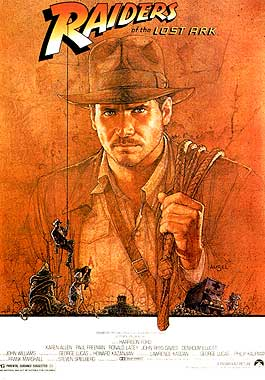
I watched Raiders of the Lost Ark last night. It is as fun, as exciting, as suspenseful as it was the first time I saw it in the theatre. (I think I saw it something like 5 times - during its original release.) In light of all my Cary Grant obsessing, the character of Indiana Jones took on a new and humorous context. I saw him in the context of all those brilliant Cary Grant goofball-til-he-takes-off-his-glasses parts. Indiana Jones - a bad-ass with a bullwhip - cavorting across the globe - going where no man has gone before - transformed into a stuttering geek in the classroom, struggling to carry his briefcase and all his rolled-up maps under his arms, unaware WHY his classroom is full of lovesick girls. He doesn't "get it". He doesn't "get" his own appeal. It's so funny.
In light of all of that - the opening of the film in the jungle sets up who Indiana is. (Or at least we THINK it does.) He wears a fedora which (inexplicably) NEVER COMES OFF. He swings over abysses like Tarzan. He is unconcerned when giant "s"s cover his back. (The snakes are another issue ...) He coldly grins when he sees the skeleton of his former rival. His eyes gleam with greed when he gets his first glimpse of the golden idol. He races through the poison darts. He leaps across the abyss. He rolls under the closing door, and, of course, remembers to reach under it to grab his bull-whip, right at the last second. He runs, he jumps, he leaps, he schemes ...
Cut to the next scene. Now suddenly, that same man is seen as a bumbling archaeology professor, with glasses, pointing out his own scratchings on the blackboard, oblivious to the fact that NO ONE in the class (except the sad-sap one guy, who leaves the apple on the desk when leaving the room, with an air of, "Maybe THIS will work...") is listening to him ...
It's a brilliant opening, all in all. Who the hell IS Indiana Jones?
We expect (and it is reasonable that we should expect this) that we KNOW him, after that genius opening. George Lucas and Steven Spielberg set it up that way. Wow, this guy is a hero, an adventurer ... But then, to see him back in civilization, geeky, in glasses, surrounded by artifacts, and socially inept ... brings the other side.
It's awesome.
And so. In my view, that opening sequence in Raiders of the Lost Ark is one of the best OPENINGS of a film. EVER. I can think of a couple of other genius openings (Star Wars is on that list, in my opinion) - but Raiders is definitely in the Top 5.
What are your votes - for best openings in a film?
February 22, 2005
The Russian side of the story
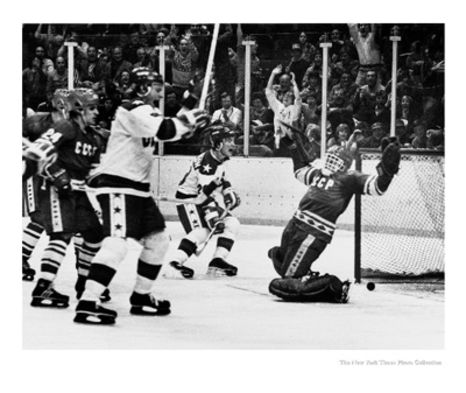
"[Benching Tretiak was] the biggest mistake of my career," Tikhonov told Coffey through an interpreter. "Tretiak always played better after he gave up a goal. The decision was a result of getting caught up in emotions. After Tretiak gave up the rebound and let in the soft goal by Johnson, my blood was boiling. It was my worst mistake, my biggest regret."
Also:
"We were already celebrating," defenseman Valery Vasiliev said. "Nobody can skate with us in the third period."
I mean, a lot went into the why we won, and why they lost, but I would say that that quote ("we were already celebrating") did more to contribute to the United States winning than anything else. I don't want to take away from the Americans accomplishments. Yes, the Russians were over-confident and so they made some terrible mental errors. They didn't respect the American team, thought they could breeze through the night. The Americans were so much of a team, and so hungry for success, that they jumped on those crucial errors and turned the situation around - (Mark Johnson's goal with one second to go is the perfect example).
So yeah. The Russians messed up. But only a true team could cohere enough to fully take advantage of the situation, and the US team, led by Herb Brooks, did.
More interesting quotes from a new book out - telling the Russian side of the miracle on ice.
"DO YOU BELIEVE IN MIRACLES???? YES!!!"
25 years ago today, the US Olympic hockey team beat the "unbeatable" Russian hockey team at Lake Placid. heh heh LOOK at this photo. Jack O'Callahan, straddling his team-mate (I forget which one - No wait. I remember. It was Mike Ramsey) ... the absolute MAYHEM behind them ... It's a gorgeous thing, ain't it?
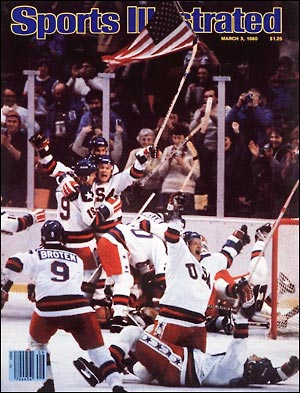
Here's the Sports Illustrated article about the "miracle on ice" (thanks to Ken for linking to it.)
Like most of us who were alive at that time, and at all aware of ANYTHING, I have vivid memories of the 1980 Winter Olympics, and of these college kids who came along and slayed the Russian dragon. I was particularly into the whole thing because of the whole Boston factor on the team. My family's from Boston. There was a regional component to our triumph, as well as a national component.
However, it is only in retrospect that I realize just how HUGE the whole thing actually was. I didn't really get the context of it while it was happening - the Cold War context, and also the hockey context - just how huge a dynasty the Russians had, in terms of how they played the game, how they dominated international hockey, etc.
I must say to EVERYONE out there who has televisions (speaking as a chick who has no TV) ... if HBO is playing their documentary "Do You Believe in Miracles" in commemoration of this anniversary - PLEASE see it.
I can't explain why the documentary rocks my world to such a degree, but it does. It GETS the big-ness of the event. It GETS the magnitude. I've seen it 50 times (since I taped it, when I DID have a television).
I remember having a discussion here on this blog about the greatest moment in sports history. The general consensus was that the miracle on ice HAD to be # 1. There were no other contenders, really.
I've posted a bunch of stuff on the miracle on ice, if you're interested.
The greatest moments in sports history
Anyway, to those of you out there who have vivid memories of that Olympics ... and what it meant ... please please share them in the comments.
February 21, 2005
1791 Jefferson and Adams - the break-up
And here, now, the relationship between Jefferson and Adams started to get prickly.
July 17, 1791: Jefferson to Adams (he writes - trying to explain the whole "political heresies" comment)
That you and I differ in our ideas of the best form of government is well known to us both: but we have differed as friends should do, respecting the purity of each other's motives, and confining our difference of opinion to private conversation. And I can declare with truth in the presence of the almighty that nothing was further from my intention or expectation than to have had either my own or your name brought before the public on this occasion. The friendship and confidence which has so long existed between us required this explanation from me, and I know you too well to fear any misconstruction of the motives of it. Some people here who would wish me to be, or to be thought, fuilty of impropieties have suggested that I was Agricola, that I was Brutus etc etc. [Anonymous op-ed columns, attacking John Adams, etc. - signed under these names] I never did in my life, either by myself or by any other, have a sentence of mine inserted in a newspaper without putting my name to it; and I believe I never shall.
John Adams did not accept the olive brance and fired back a letter on July 29, 1791:
You declare very explicitly that you never did, by yourself, or by any other, have a Sentence of yours, inserted in a Newspaper without your name to it. And I, with equal frankness declare that I never did, either by my self or by any other, have a Sentence of mine inserted in any Newspaper since I left Philadelphia. I neither wrote nor corrected Publicola. The Writer in the Composition of his Pieces [which turned out to be Adams' son, John Quincy Adams] followed his own Judgment, Information and discretion, without any assistance from me.You observe "that You and I differ in our Ideas of the best form of Government is well known to us both." But, my dear Sir, you will give me leave to say, that I do not know this. I know not what your Idea is of the best form of Government. You and I have never had a serious conversation together that I can recollect concerning the nature of Government. The very transient hints that have ever passed between Us have been jocular and superficial, without ever coming to any explanation. If You suppose that I have ever or ever had a design or desire, of attempting to introduce a Government of King, Lords, and Commons, or in other words an hereditary Executive, or an hereditary Senate, either into the Government of the United States or that of any Individual State, in this Country, you are wholly mistaken. There is not such a Thought expressed or intimated in any public writing or private Letter of mine, and I may safely challenge all Mankind to produce such a passage and quote the Chapter and Verse.
If you have ever put such a Construction on any Thing of mine, I beg you would mention it to me, and I will undertake to convince you, that it has no such meaning...
I thank you, Sir, very sincerely for writing to me upon this Occasion. It was high time that you and I should come to an explanation with each other. The friendship that has subsisted for fifteen Years between Us without the smallest interruption, and untill this occasion without the slightest Suspicion, ever has been and still is, very dear to my heart. There is no office which I would not resign, rather than give a just occasion to one friend to forsake me. Your motives for writing to me, I have not a doubt were the most pure and the most friendly; and I have no suspicion that you will not receive this explanation from me in the same candid light.
Ouch. It would be over 20 years before the wounds of this break healed, and the two could settle down to try to "explain" themselves to each other.
1789: John Adams: "a Junto of Grandees"
John Adams wrote the following letter to Jefferson on March 1, 1789. 2 months before the first inauguration, and the beginning of this new government. Jefferson was still in Paris. Adams wrote:
In four days, the new Government is to be erected. Washington appears to have an unanimous vote: and there is probably a Plurality if not a Majority in favour of your Friend. -- It may be found easier to give Authority, than to yield Obedience.Amendments to the Constitution, will be expected, and no doubt discusseed. Will you be so good as look over the Code and write me your Sentiments of Amendments which you think necessary or usefull? That greatest and most necessary of all Amendments, the Separation of the Executive Power, from the Legislative Seems to be better understood than it once was. Without this our Government is in danger of being a continual struggle between a Junto of Grandees, for the first Chair.
1787: John Adams: "You are the afraid of the one -- I, of the few"
John Adams responded to Thomas Jefferson's concerns about the "new constitution" (see post below) in this letter. Here, John Adams describes the essential political differences between these two people - differences which were never resolved - and indeed I don't believe ever should be resolved. It is a debate, a debate which must continue.
You are the afraid of the one -- I, of the few. We agree perfectly that the many should have a full fair and perfect Representation. -- You are Apprehensive of Monarchy; I, of Aristocracy. I would therefore have given more Power to the President and less to the Senate. The Nomination and Appointment to all offices I would have given to the President, assisted only by a Privy Council of his own Creation, but not a Vote or Voice would I have given to the Senate or any Senator, unless he were of the Privy Council. Faction and Distraction are the sure and certain Consequence of giving to a Senate a vote in the distribution of offices.You are apprehensive the President when once chosen, will be chosen again and again as long as he lives. So much the better as it appears to me.
You are apprehensive of foreign Interference, Intrigue, Influence. So am I. -- But, as often as Elections happen, the danger of foreign Influence recurs. The less frequently they happen the less danger. -- And if the Same Man may be chosen again, it is probable he will be, and the danger of foreign Influence will be less. Foreigners, seeing little Prospect will have less Courage for Enterprize.
Elections, my dear sir, Elections to offices which are great objects of Ambition, I look at with terror. Experiments of this kind have been so often tryed, and so universally found productive of Horrors, that there is great Reason to dread them.
Fascinating.
1787: Thomas Jefferson: "How do you like our new constitution?"
Thomas Jefferson to John Adams, Nov. 13 1787:
How do you like our new constitution? I confess there are things in it which stagger all my dispositions to subscribe to what such an assembly has proposed. The house of federal representatives will not be adequate to the management of affairs either foreign or federal. Their President seems a bad edition of a Polish king. He may be reelected from 4 years to 4 years for life. Reason and experience prove to us that a chief magistrate, so continuable, is an officer for life. When one or two generations shall have proved that this is an office for life, it becomes on every succession worthy of intrigue, of bribery, of force, and even of foreign interference. It will be of great consequence to France and England to have America governed by a Galloman or Angloman. Once in office, and possessing the military force of the union, without either the aid or check of a council, he would not be easily dethroned, even if the people could be induced to withdraw their votes from him. I wish that at the end of the 4 years they had made him for ever ineligible a second time.
1787: John Adams: "you and I have been indefatigable Labourers"
John Adams wrote this letter to Thomas Jefferson on Oct. 9, 1787 (Jefferson in Paris, Adams in London).
Disgrace is not easily washed out, even with blood. Lessons my dear Sir, are never wanting. Life and History are full. The Loss of Paradise, by eating a forbidden apple, has been many Thousand years a Lesson to Manking, but not much regarded. Moral Reflections, wise Maxims, religious Terrors, have little Effect upon Nations when they contradict a present Passion, Prejudice, Imagination, Enthusiasm or Caprice. Resolutions never to have an hereditary officer will be kept in America, as religiously as that of the Cincinnati was in the Case of General Greene's son. [Adams is being sarcastic here. After the death of General Nathaniel Greene in 1786, the Order of the Cincinnati met and agreed that his son should be admitted into the society, to take up his father's seat when he reached the age of 18.] Resolutions never to let a Citizen ally himself with things will be kept untill an Opportunity presents to violate it. If the Duke of Angoleme, or Burgundy, or especially the Dauphin should demand one of your beautiful and most amiable Daughters in Marriage, all America from Georgia to New Hampshire would find their Vanity and Pride, so agreeably flattered by it, that all their Sage Maxims would give way; and even our Sober New England Republicans would keep a day of Thanksgiving for it, in their hearts. If General Washington had a Daughter, I firmly believe, she would be demanded in Marriage by one of the Royal Families of France or England, perhaps by both, or if he had a Son he would be invited to come a courting to Europe. -- The Resolution not to call in foreign Nations to settle domestic differences will be kept untill a domestic difference of a serious nature shall break out.-- I have long been settled in my own opinion, that neither Philosophy, nor Religion, nor Morality, nor Wisdom, nor Interest, will ever govern nations or Parties, against their Vanity, their Pride, their Resentment or Revenge, or their Avarice or Ambition. Nothing but Force and Power and Strength can restrain them...
In short my dear Friend you and I have been indefatigable Labourers through our whole Lives for a Cause which will be thrown away in the next generation, upon the Vanity and Foppery of Person of whom we do not now know the Names perhaps...
Pardon this freedom. It is not Melancholly: but Experience and believe me without reserve your Friend, O tempora -- oh mores
1787: Thomas Jefferson: "their stupid king"
Thomas Jefferson to John Adams (while Jefferson was in Paris, Adams in London):
We I hope shall be left free to avail ourselves of the advantages of neutrality: and yet much I fear the English, or rather their stupid king, will force us out of it. For thus I reason. By forcing us into the war against them they will be engaged in an expensive land war as well as a sea war. Common sense dictates therefore that they should let us remain neuter: ergo they will not let us remain neuter. I never yet found any other general rule for foretelling what they will do but that of examining what they ought not to do.
1787: John Adams: "John Bull dont see it"
John Adams to Thomas Jefferson (while Jefferson was in Paris, and the Adams' were in London):
Opening a direct Communication between Paris and America will facilitate the Trade of the two Countries, very much, and the new Treaty between France and England, will promote it still more. John Bull dont see it, and if he dont see a Thing at first, you know it is a rule with him ever after wards to swear that it dont exist, even when he does both see it and feel it.
1786: John Adams: "I am so impressed and distressed with this affair"
John Adams to Thomas Jefferson (while Jefferson was in Paris, and the Adams' were in London):
There is here a Tripolitan Ambassador with whom I have had three Conferences. The Substance of what passed Colonel Smith will explain to you. Your Visit here will be imputed to Curiosity, to take a Look at England and pay your Respects at Court and to the Corps Diplomatick. There is nothing to be done in Europe, of half the Importance of this, and I dare not communicate to Congress what has passed without your Concurrence. What has already been done and expended will be absolutely thrown away and We shall be involved in a universal and horrible War with these Barbary States, which will continue for many Years, unless more is done immediately. I am so impressed and distressed with this affair that I will go to New York or to Algiers or first to one and then to the other, if you think it necessary, rather than it should not be brought to a Conclusion.
Prophetic. "universal and horrible War ... continue for many Years ..."
hmmm
In honor of Presidents Day ...
I have willingly surrendered my sanity. As you can see from the extravaganza unfurling below you.
I'm not done yet, either.
Enjoy. To all the freaks and geeks out there like me, ENJOY!
1776: John Adams - "we cannot insure Success"
John to Abigail, Feb. 18 1776 - I LOVE this quote
The Events of War are uncertain: We cannot insure Success, but We can deserve it.
1775: Abigail Adams: "I am more and more convinced that Man is a dangerous creature"
Abigail to John November 27 1775:
I wish I knew what mighty things were fabricating. If a form of Government is to established here what one will be assumed? Will it be left to our assemblies to chuse one? and will not many men have many minds? and shall we not run into Dissentions among ourselves?I am more and more convinced that Man is a dangerous creature, and that power whether vested in many or a few is ever grasping, and like the grave cries give, give. The great fish swallow up the small, and he who is most strenuous for the Rights of the people, when vested with power, is as eager after the perogatives of Government. You tell me of degrees of perfection to which Humane Nature is capable of arriving, and I believe it, but at the same time lament that our admiration should arise from the scarcity of the instances.
The Building up a Great Empire, which was only hinted at by my correspondent may now I suppose be realized even by the unbelievers. Yet will not ten thousand Difficulties arise in the formation of it? The Reigns of Government have been so long slakned, that I fear the people will not quietly submit to those restrains which are necessary for the peace, and security of the community; if we separate from Brittain, what Code of Laws will be established. How shall we be governed so as to retain our Liberties? Can any government be free which is not administred by general stated Laws? Who shall frame these Laws? Who will give them force and energy? Tis true your Resolutions as a Body have heithertoo had the force of Laws. But will they continue to have?
When I consider these things and the prejudices of people in favour of Ancient customs and Regulations, I feel anxious for the fate of our Monarchy or Democracy or what ever is to take place. I soon get lost in a Labyrinth of perplexities, but whatever occurs, may justice and righteousness be the Stability of our times, and order arise out of confusion. Great difficulties may be surmounted by patience and perseverence.
I believe I have tired you with politicks. As to news we have not any at all.
1775: John Adams: "Liberty once lost is lost forever"
John Adams to Abigail Adams - July 7, 1775
Your Description of the Distresses of the worthy Inhabitants of Boston, and the other Sea Port Towns, is enough to melt an Heart of Stone. Our Consolation must be this, my dear, that Cities may be rebuilt, and a People reduced to Poverty, may acquire fresh Property: But a Constitution of Government once changed from Freedom, can never be restored. Liberty once lost is lost forever. When the People once surrender their share in the Legislature, and their Right of defending the Limitations upon the Government, and of resisting every Encroachment upon them, they can never regain it...I am forever yours ---
1783: "thought upon all they had done and suffered for us"
November 25, 1783: George Washington "took back" New York.
The peace treaty had been signed a year before, France had pledged support and recognition of the new United States, but the redcoats remained in New York, waiting for their written orders from London. George Washington vowed that he would not go home, he would not break up his army, until every last redcoat had left.
Nov. 25 was that momentous day - the day the American troops marched back into town, after the departure of the British.
The exhausted army marched the long way downtown, through what was now a war-ravaged New York City. People lined the streets, throwing laurels in front of Washington's horse, screaming, crying ... a huge display of emotion and reverence that made the typically humble Washington feel uncomfortable.
A woman in the crowd that day wrote the following in her diary:
We had been accustomed for a long time to military display in all the finish and finery of [British] garrison life. The troops just leaving us were as if equipped for a show and with their scarlet uniforms and burnished arms made a brilliant display. The troops that marched in, on the contrary, were ill-clad and weather-beaten and made a forlorn appearance. But then, they were our troops and as I looked at them and thought upon all they had done and suffered for us, my heart and my eyes were full.
My eyes are full, too.
Ben Franklin - check MATE
This is a rather legendary tale about Franklin, oft told - it has showed up in most of the other books I have read about this time.
It comes from his long sojourn in France, when he was the darling of the world, the epitome of the new American, he WAS America. All the while trying to negotiate matters between France and the rebelling colonies. He was, at that time, one of the most well-known (if not the most well-known) faces in the world.
Franklin was playing chess with the Duchess of Bourbon, and she didn't really know what she was doing, or how to play. She placed her king in check. Franklin, not following the rules either (but he KNEW he wasn't following the rules) captured her king. She knew enough of chess to know that this was not right and scolded him. She said that in France "we do not take kings."
Franklin replied, "We do in America."
Washington: "Men ... may talk of patriotism"
GEORGE WASHINGTON
Men may speculate as they will, they may talk of patriotism; they may draw a few examples from current story … but whoever builds upon it as a sufficient basis for conducting a long and bloody war will find themselves deceived in the end … For a long time it may of itself push men to action, to bear much, to encounter difficulties, but it will not endure unassisted by Interest.
Jefferson: "a single character"
THOMAS JEFFERSON, on George Washington:
The moderation and virtue of a single character probably prevented this Revolution from being closed, as most others have been, by a subversion of that liberty it was intended to establish.
July 3, 1776: John Adams: "The Hopes of Reconciliation ... at last totally extinguished"
JOHN ADAMS, in a July 3, 1776 letter to Abigail, after the signing of the Declaration of Independence on July 2:
The Delay of this Declaration to this Time, has many great Advantages attending it. – The Hopes of Reconciliation, which were fondly entertained by Multitudes of honest and well meaning tho weak and mistaken People, have been gradually and at last totally extinguished. – Time has been given for the whole People, maturely to consider the great Question of Independence and to ripen their Judgments, dissipate their Fears, and allure their Hopes, by discussing it in News Papers and Pamphletts, by debating it, in Assemblies, Conventions, Committees of Safety and Inspection, in town and County Meetings, as well as in private Conversations, so that the whole People in every Colony of the 13, have now adopted it, as their own Act. – This will cement the Union, and avoid those Heats, and perhaps Convulsions which might have been occasioned, by such a Declaration Six Months ago.But the Day is past. The Second Day of July 1776, will be the most memorable Epocha, in the History of America. – I am apt to believe that it will be celebrated, by succeeding Generations, as the great anniversary Festival. It ought to be commemorated, as the Day of Deliverance by solemn Acts of Devotion to God Almighty. It ought to be solemnized with Pomp and Parade, with Shews, Games, Sports, Guns, Bells, Bonfire and Illuminations from one End of this Continent to the other from this Time forward forever more.
You will think me transported with Enthusiasm, but I am not. I am well aware of the Toil, and Blood, and Treasure that it will cost Us to maintain this Declaration, and support and defend these States. Yet, through all the Gloom, I can see the Rays of ravishing Light and Glory. I can see that the End is more than worth all the Means, and that Posterity will triumph in that Day's Transaction, even though We should not rue it, which I trust in God We shall not.
1812: John Adams: "posterity must judge"
JOHN ADAMS, in a letter to Jefferson, 1812:
Whether you or I were right posterity must judge. I never have approved and never can approve the repeal of taxes, the repeal of the judiciary system, or the neglect of the navy. Checks and balances, Jefferson, however you and your party may have ridiculed them, are our only security.
Abraham Lincoln: "All honor to Jefferson"
ABRAHAM LINCOLN, on Jefferson's writing of the Declaration of Independence:
All honor to Jefferson, to the man who had the coolness, forecast, and capacity to introduce into a merely revolutionary document an abstract truth, and so to embalm it there, that today, and in all coming days, it shall be a rebuke and a stumbling-block to the very harbingers of reappearing tyranny and oppression.
1776: John Page: "an Angel rides in the Whirlwind"
JOHN PAGE TO THOMAS JEFFERSON, July 20, 1776 – on the signing of the Declaration of Independence:
God preserve the United States. We know the Race is not to the Swift nor the Battle to the Strong. Do you not think an Angel rides in the Whirlwind and directs this Storm?
John Adams - "our Colossus"
THOMAS JEFFERSON, remembering John Adams' speeches at the Continental Congress:
John Adams was our Colossus on the floor. He was not graceful nor elegant, nor remarkably fluent but he came out occasionally with a power of thought and expression, that moved us from our seats.
1775: George Washington: "if I could have justified the measure to posterity"
GEORGE WASHINGTON, letter to Joseph Reed, early December, 1775, after a disappointing recruiting drive
I have oftentimes thought how much happier I should have been if, instead of accepting the command under such circumstances, I had taken my musket on my shoulder and entered the ranks; or, if I could have justified the measure to posterity and my own conscience, had retired to the back country and lived in a wigwam. If I shall be able to rise superior to these and many other difficulties which might be enumerated, I shall most religiously believe that the finger of Providence is in it to blind the eyes of our enemies, for surely if we get well through this month it must be for want of their knowing the disadvantages which we labor under.
1775: George Washington: "a kind of destiny"
GEORGE WASHINGTON, writing to Martha on June 18, 1775, following his nomination as commander in chief
My Dearest:
I now sit down to write to you on a subject which fills me with inexpressible concern, and this concern is greatly aggravated and increased when I reflect upon the uneasiness I know it will give you. It has been determined in Congress that the whole army raised for the defence of the American cause shall be put under my care, and that it is necessary for me to proceed immediately to Boston to take upon me the command of it.You may believe me, my dear Patsy, when I assure you, in the most solemn manner, that, so far from seeking this appointment, I have used every endeavour in my power to avoid it, not only from my unwillingness to part with you and the family, but from a consciousness of its being a trust too great for my capacity, and that I should enjoy more real happiness in one month with you at home than I have the most distant prospect of finding abroad, if my stay were to be seven times seven years.
But as it has been a kind of destiny that has thrown me upon this service, I shall hope that my undertaking is designed to answer some good purpose.
1775: George Washington: "I do not think myself equal to the command"
GEORGE WASHINGTON – his brief acceptance speech June 15, 1775 to the members of the Continental Congress who had just elected him commander in chief of the Continental troops:
"Lest some unlucky event should happen unfavorable to my reputation, I beg it may be remembered by every gentleman in the room, that I this day declare, with the utmost sincerity, I do not think myself equal to the command."
1774: Martha Washington: "my heart is in the cause"
MARTHA WASHINGTON, in a letter written to a relative – on Washington's departure to Philadelphia in 1774 for the first Continental Congress:
I foresee consequences; dark days and darker nights; domestic happiness suspended; social enjoyments abandoned; property of every kind put in jeopardy by war, perhaps; neighbors and friends at variance, and eternal separations on earth possible. But what are all these evils when compared with the fate of which the Port Bill may be only a threat? [The Port Bill was to close the port of Boston – as a punishment for the Boston Tea Party] My mind is made up; my heart is in the cause. George is right; he is always right. God has promised to protect the righteous, and I will trust him.
1773: John Adams: "an Epocha in History"
ENTRY IN JOHN ADAMS' DIARY, December 17, 1773 – day after the Boston Tea Party
There is a Dignity, a Majesty, a Sublimity, in this last Effort of the Patriots, that I greatly admire. The People should never rise, without doing something to be remembered – something notable and striking. This Destruction of the Tea is so bold, so daring, so firm, intrepid, and inflexible, and it must have important Consequences, and so lasting, that I can't but consider it as an Epocha in History.
John Adams: "laws not of men"
My favorite John Adams quote. Ever.
I believe in a government of laws not of men.
1785: Thomas Jefferson: "Indeed, I tremble for my country when I reflect that God is just"
THOMAS JEFFERSON, a denunciation of slavery, 1785
The whole commerce between master and slave is a perpetual exercise of the most boisterous passions, the most unremitting despotism on the one part, and degrading submissions on the other. Our children see this, and learn to imitate it…The parent storms, the child looks on, catches the lineaments of wrath, puts on the same airs in the circle of smaller slaves, gives a loose to his worst passions, and thus nursed, educated, and daily exercised in tyranny, cannot but be stamped by it with odious peculiarities. The man must be a prodigy who can retain his manners and morals undepraved by such circumstances … if a slave can have a country in this world, it must be any other in preference to that in which he is to be born to live and labor for another … or entail his own miserable condition on the endless generations proceeding from him … Indeed, I tremble for my country when I reflect that God is just: that his justice cannot sleep forever.
Thomas Jefferson: "Be a listener only"
THOMAS JEFFERSON, in a letter to his grandson:
When I hear another express an opinion which is not mine, I say to myself, he has a right to his opinion, as I to mine. Why should I question it. His error does me no injury, and shall I become a Don Quixote, to bring all men by force of argument to one opinion? Be a listener only, keep within yourself, and endeavor to establish with yourself the habit of silence, especially in politics.
1774: John Adams: "Swim or sink"
JOHN ADAMS to Jonathan Sewall, July 1774
Swim or sink, live or die, survive or perish, [I am] with my country. You may depend upon it.
And now ...
for something COMPLETELY different - a quote from Dennis Miller:
People say, 'But what about the Founding Fathers? They were civil libertarians ... they would not have wanted to see the government take away people's civil rights!' The Founding Fathers?? Gimme a break. Do you think for one second that the Founding Fathers would have put up with ANY of this shit? I mean, come on! They were blowing people's heads off because there was a tax on their breakfast drink, okay?
John Adams: 'extravagant popularity is not the road to public advantage"
John Adams became president by a margin of three votes, I believe. Ehm, a bit too close for comfort. Here is what Adams had to say:
If the way to do good to my country were to render myself popular, I could easily do it. But extravagant popularity is not the road to public advantage.
1770: John Adams: "trust no man living with power"
John Adams again, in one of his eternal themes - This is from a journal entry, in 1770:
Ambition is one of the more ungovernable passions of the human heart. The love of power is insatiable and uncontrollable ... There is danger from all men. The only maxim of a free government ought to be to trust no man living with power to endanger the public liberty.
1774: John Adams: "three and two make five"
The following excerpt is why John Adams' letters to his wife - and hers back to him - are among the most extraordinary historical documents ever preserved. We are lucky to have them. Adams is able to make events LIVE, in how he describes them. Not all people are able to do that. But he is. And so he gives us (through Abigail) the following glimpse (humorous, of course) of the first meeting of the Continental Congress, in 1774:
This assembly is like no other that ever existed. Every man in it is a great man -- an orator, a critic, a statesman, and therefore every man upon every question must show his oratory, his criticism, his political abilities. The consequence of this is that business is drawn and spun out to immeasurable length. I believe if it was moved and seconded that we should come to a resolution that three and two make five, we should be entertained with logic and rhetoric, law, history, politics, and mathematics concerning the subject for two whole days, and then we should pass the resolution unanimously in the affirmative.
John Adams: "bewildering ourselves in groping..."
Another excerpt from a letter of John Adams to Abigail:
If we finally fail in this great and glorious contest, it will be by bewildering ourselves in groping for the middle way.
That one is one of my favorites.
John Adams: "a coincidence of circumstances without example"
This is from a letter of John Adams, to his wife Abigail:
It has been the will of Heaven that we should be thrown into existence at a period when the greatest philosophers and lawgivers of antiquity would have wished to live ... a period when a coincidence of circumstances without example has afforded to thirteen colonies at once an opportunity of beginning government anew from the foundation and building as they choose. How few of the human race have ever had an opportunity of choosing a system of government for themselves and their children? How few have ever had anything more of choice in government than in climate?
Abigail Adams: "he is no longer a King"
Abigail Adams wrote the following to John - months before the Declaration of Independence was in existence:
A people may let a King fall, yet still remain a people, but if a King let his people slip from him, he is no longer a King. And as this is most certainly our case, why not proclaim to the world in decisive terms of our own importance.
John Adams: "In general ..."
After word of the disastrous battle at Long Island reached Congress, John Adams said in a letter, trying to sum it up:
In general, our generals were outgeneralled.
John Adams: "I must study politics and war"
John Adams wrote:
I must study politics and war that my sons may have liberty to study mathematics and philosophy. My sons ought to study mathematics and philosophy, geography, natural history, naval architecture, navigation, commerce, and agriculture in order to give their children a right to study paintings, poetry, music, artchitecture, statuary, tapestry, and porcelain.
1783: Ben Franklin: "But sometimes and in some things ..."
Benjamin Franklin wrote these famous words about John Adams in 1783:
He means well for his country, is always an honest man, often a wise man, but sometimes and in some things, absolutely out of his senses.
Abigail Adams: "How unpardonable"
Abigail Adams - wife of a President, and mother of a President, wrote the following letter to John Quincy Adams, during his first semester at Harvard:
If you are conscious to yourself that you possess more knowledge upon some subject than others of your standing, reflect that you have had greater opportunities of seeing the world, and obtaining a knowledge of mankind than any of your contemporaries. That you have never wanted a book but it has been supplied to you, that your whole time has been spent in the company of men of literature and science. How unpardonable would it have been in you to have been a blockhead.
John Adams: "I am nothing"
John Adams, again, on being VP:
Gentlemen, I feel a great difficulty how to act. I am Vice President. In this I am nothing, but I may be everything.
I love John Adams. He's my favorite. He makes me laugh.
1780: George Washington: "we are always working up hill"
GEORGE WASHINGTON, letter of May 31, 1780
Certain I am unless Congress speak in a more decisive tone, unless they are invested with powers by the several States competent to the great purposes of the war, or assume them as a matter of right, and they and the States respectively act with more energy than they hitherto have done, that our cause is lost. One State will comply with a requisition of Congress, another neglects to do it; a third executes it by halves; and all differ either in the manner, the matter, or so much in point of time, that we are always working up hill; and, while such a system as the present one or rather want of one prevails, we shall ever be unable to apply our strength or resources to any advantage.
Ben Franklin, 1781
BEN FRANKLIN, 1781:
The following story may be just a rumor handed down over the years, but it is one of my favorites. Franklin was in France, and word came to France of the decisive (and shocking) American victory. Franklin attended a diplomatic dinner shortly thereafter – and, of course, everyone was discussing the defeat of the British, and the victory of America.
The French foreign minister stood, and toasted Louis XVI, "To his Majesty, Louis the Sixteenth, who, like the moon, fills the earth with a soft, benevolent glow.
The British ambassador rose and said, "To George the Third, who, like the sun at noonday, spreads his light and illumines the world."
Franklin rose and said, "I cannot give you the sun or the moon, but I give you George Washington, General of the armies of the United States, who, like Joshua of old, commanded both the sun and the moon to stand still, and both obeyed."
1789: George Washington: "if I know my own heart"
George Washington wrote the following on the eve of his inauguration:
It is said that every man has his portion of ambition. I may have mine, I suppose, as well as the rest, but if I know my own heart, my ambition would not lead me into public life; my only ambition is to do my duty in this world as well as I am capable of performing it, and to merit the good opinion of all good men.
John Adams: "the most insignificant office"
JOHN ADAMS, on being Vice President, in a letter to Abigail:
My country in its wisdom contrived for me the most insignificant office that ever the invention of man contrived or his imagination conceived.
John Quincy Adams: "have not yet established any infallible criterion of orthodoxy, either in church or state"
JOHN QUINCY ADAMS, in a public letter addressed to Thomas Jefferson.
Jefferson had made mention of Edmund Burke's book Reflections on the Revolution in France , and had endorsed it as the answer to "the political heresies that have sprung up among us." -- (This was an obvious reference to John Adams.) Jefferson had never meant his private note to the publisher on "political heresies" to be published - and to his chagrin, the publisher added the note, in its entirety, as the foreword to the book.
This was the reason (or, one of many, shall we say) that John Adams and Thomas Jefferson did not speak for many many years - Adams knew that "political heresies" was directed at him.
John Quincy Adams went on the attack for his father, and published a letter anonymously in the newspaper:
I am somewhat at a loss to determine what this very respectable gentleman means by political heresies. Does he consider this pamphlet of Mr. Paine's as a canonical book of political scripture? As containing the true doctrine of popular infallibility, from which it would be heretical to depart in one single point? I have always understood, sir, that the citizens of these States were possessed of a full and entire freedom of opinion upon all subjects civil as well as religious; they have not yet established any infallible criterion of orthodoxy, either in church or state … and the only political tenet which they could stigmatize with the name of heresy would be that which should attempt to impose an opinion upon their understandings, upon the single principle of authority.
1793: "unbridled majorities"
John Adams wrote the following in 1793, expressing his fear of what would happen during the revolution in France:
Mankind will in time discover that unbridled majorities are as tyrannical and cruel as unlimited despots.
1797 - John Adams' inauguration
John Adams later wrote about the day of his inauguration as the second President of the United States:
A solemn scene it was indeed. Washington's face remained as serene and unclouded as the day. Methought I heard him think, 'Ay! I am fairly out and you are fairly in! See which of us will be the happiest!'
Adams: ""We ought to support every administration as far as we can..."
John Adams said
I think instead of opposing systematically any administration, running down their characters and opposing all their measures, right or wrong, we ought to support every administration as far as we can in justice.
1826: "the blessings and security of self-government"
THOMAS JEFFERSON, in a letter to the mayor of Washington, June 24, 1826, declining an invitation to the 4th of July celebration in Washington - (Jefferson died 10 days later):
May it be to the world, what I believe it will be (to some parts sooner, to others later, but finally to all) the signal of arousing men to burst the chains under which monkish ignorance and superstition had persuaded them to bind themselves, and to assume the blessings and security of self-government … All eyes are opened or opening to the rights of man. The general spread of the light of science has already laid open to every view the palpable truth, that the mass of mankind has not been born with saddles on their backs, nor a favored few, booted and spurred, ready to ride them legitimately by the grace of God. These are the grounds of hope for others; for ourselves, let the annual return to this day forever refresh our recollections of these rights, and an undiminished devotion to them.
1785: "Plentiful Rains"
John Adams to Thomas Jefferson:
Dessin's Calais May 23, 1785... From a motive of Humanity I wish that our Country may have plentiful Rains, and our Husbandmen Industry, that they may Supply the Wants of their Suffering Fellow Creatures in Europe. You see I have nothing so mean as a selfish or even a patriotic Wish in all this. But from the same regard to Europe and her worthy Colonists in the West Indies, I hope that these rainless, heatless Heavens will convince them that it is abundantly for their good that We should bring and carry freely, our Flour, Wheat, Corn, Rice, Flesh, and Fish for their Soulagement.
Last night ...
... I watched the movie The Station Agent.
I know it was out last year and all, but it was one of those movies I never got around to seeing. Even though on more than one occasion, last year, my phone would ring, and it would be this or that friend saying, "Have you seen The Station Agent yet?? Oh you HAVE to see it. You, of all people, HAVE to see it!"
Now I can see why.
Patricia Clarkson has always been a favorite of mine. She's always good. (My first impression of her was from High Art, where she played a leather-pants-clad German ex-actress heroin addict ... who speaks in a low drawly disaffected German accent, and continuosly blathers on and on about Wim Wenders - It's like she's a drugged-up Marlene Dietrich wannabe. It's hard to describe her performance. But I really thought she WAS that person. I was convinced she was German, and I was also convinced that she MUST be a performance artist or something.) No. It was just acting.
Just??? I truly thought they had seen this German performance artist in a smoky dingy club and asked her to be in the movie. She was that convincing.
When I saw her in something else, I could not believe my eyes. "That's that same woman from High Art ... Holy crap. How can that be the same person??"
She's hilarious in 6 Feet Under as the hippie-dippie aunt who lives in the canyon in the crazy house, who surrounds herself with artists, because she ISN'T one, and who is wonderful, in a really really inappropriate way. heh. I love her in that.
Anyway, she's in The Station Agent and she's terrific.
But the other two leads (Peter Dinklage and Paul Benjamin) are equally as marvelous. There is no "lead" - it's the three of them. And the three of them create a friendship, a three-sided relationship - which makes a bizarre kind of sense, an ultimate kind of sense, only you never ever would predict it.
Peter Dinklage plays Finbar, a dwarf who randomly inherits a small train station out in the wilds of New Jersey. He moves there. He lives a life of isolation. He has no friends, he speaks in a monotone, and he is also a train enthusiast. Only he never gets enthusiastic, really. He has a stopwatch in his pocket, and he is in a train-enthusiast club, and he knows all there is to know about trains. He moves out to nowheres-ville New Jersey. You can feel that there is a deep loneliness in him, a deep and despairing quiet ... he is resigned. All of this is made even more poignant because of his size. The movie gets you into the world of dwarves, what it must BE like to be them.
(You will remember Peter Dinklage from the VERY funny acerbic film Living in Oblivion - a look at the insanity of shooting a low-budget indie film with pretensions. A dwarf is hired for a "dream sequence". Dinklage is dressed up in a small ruffly tuxedo and he has to circle around the main female character, holding up a huge red apple enticingly. This is the scene. But Dinklage plays a kind of pissed-off diva-ish dwarf, who is SICK TO DEATH of the stupid characters he always has to play. He SIMMERS with rage, as they go through a couple of takes. He is SO PISSED that he has been hired to be in a dream sequence. Finally, he has had it, and he throws a huge hissy fit. Has anyone seen this movie? It's so freakin' funny. He throws his top hat down and explodes: "Oh, that's right, that's right, this is a DREAM SEQUENCE and of COURSE for a dream sequence YOU NEED A DWARF, right??? Because we're just so WEEEEEEIRD, right, we're just so ODD, that THE ONLY PLACE YOU CAN PUT US IS IN A DREAM SEQUENCE!" He storms off the set, shouting, "I have fucking HAD it. I have fucking HAD IT." heh heh.)
Well, in Station Agent, this same actor plays a quiet guy, with sad eyes, who seems to live his life in a way that makes him most invisible.
Paul Benjamin plays this gregarious friendly hotdog-stand owner. All I can say about this character (and this actor, I suppose) is that you fall in love with him immediately. He is one of those people who ... brings out the best in others. He's a big-talkin' jocky Jersey guy, maybe not the brightest bulb, but has a heart of gold. And he kind of REFUSES to let Finbar be invisible. He INSISTS on being friends.
Into this mix comes this wacky frenetic local woman (Patricia Clarkson), going through a terrible divorce, having an awful time.
These three characters become friends. And I can't even describe how. I just know that it makes perfect sense. It's not a steady smooth road, either ... Finbar (the dwarf) really does just want to be left alone. Joe (the hot-dog guy) cannot take a hint and refuses to let him alone. But somehow ... a friendship evolves.
And that's it. That's the movie.
It's just wonderful. I highly recommend it.
February 20, 2005
1781: the required end
The following quote is pretty much why people were terrified of Alexander Hamilton. To give you the proper context: he was answering criticism from his former Federalist Paper collaborator James Madison that this proposed Bank of America was un-constitutional. Hamilton had asked for a federal charter for the bank, Madison said there was nothing in the Constitution saying that the government should fund corporations. Hamilton pointed out that the last article of the Constitution - the one about Congress being able to make "all laws which shall be necessary and proper" - He said that that article was sufficient evidence that a charter would be constitutional.
BUT - the way Hamilton summed it all up was not calculated to assuage his enemies who feared his lust for power. He wrote:
Wherever the end is required, the means are authorized.
Okay, Machiavelli - whatever you say. Hamilton went on:
If the end be clearly comprehended within any of the specified powers, and if the measure have an obvious relation to that end, and is not forbidden by any particular provision of the Constitution, it may safely be deemed to come within the compass of the national authority.
One interpretation here, and it's my own: Hamilton ended up being right about a lot of things (although his autocratic STYLE didn't make him many friends) - and one of the things I think he was right about was that he was really the first one to challenge the Constitution that he helped create and defend. He was the first one to refuse to look at it as a rigid set-in-stone document, to be obeyed. No. It was to be USED, challenged. It was not dead. It was to be a LIVING document.
I suppose there are those out there who think I have just committed heresy myself. Strict constructionists, and all that. Whatever. Room for all of us in this big country here.
1790: "never trusting itself"
Alexander Hamilton, as Secretary of Treasury, put forth a monumental report to Congress calling for a national bank. He wanted it to be run by private citizens, and not the government. The bank had the power to issue paper money - not the federal government. Hamilton opposed the government running the printing presses to produce money. He wanted it to be separate, entirely. A quote from his report:
The wisdom of the government will be shown in never trusting itself with the use of so seducing and dangerous and expedient.
1789: "I dread the vehement character of your people"
Alexander Hamilton, of course, was appointed the first Secretary of the Treasury, under George Washington. In October, 1789, he wrote to his old friend and Revolutionary War colleague Lafayette - to tell him the news, but also to find out more news about what was happening in Paris. Paris was in complete chaos in 1789, of course. Lafayette, by that point, was trying to unite all the different factions. He failed, eventually. Hamilton and Lafayette exchanged many letters, Hamilton sharing with Lafayette the bad feeling he got about the French Revolution already. It was a psychic thing, really - he just had this feeling that it was all going to go bad. Lafayette, in the thick of it, couldn't understand that. He was certain that the revolution in his country was going to go the way of the revolution in America. Hamilton wrote to Lafayette:
You will ask why this foreboding of ill when all the appearances have been so much in your favor. I will tell you: I dread disagreements among those who are now united ... about the nature of your constitution. I dread the vehement character of your people, whom I fear you may find it easier to bring out than to keep within proper bounds after you have put them in motion. I dread the interested refractoriness of your nobles, who cannot be gratified and who may be unwilling to submit to the requisite sacrifices.
Prophetic, indeed.
1787: Federalist 1: "you are invited to deliberate upon a new Constitution for the United States of America"
Here is the ringing first paragraph of Federalist 1, written by Alexander Hamilton, published on October 27, 1787, in the "New York Independent Journal" - the first of 85 essays (written by Alexander Hamilton mostly, but James Madison wrote Federalst 10 - maybe the most famous of all of them, and John Jay contributed 5). The purpose of this onslaught was to put the case for the Constitution before the public for its review. Here is the first paragraph of the first essay:
After a full experience of the insufficiency of the existing federal government, you are invited to deliberate upon a new Constitution for the United States of America. The subject speaks its own importance, comprehending in its consequences nothing less than the existence of the UNION, the safety and welfare of the parts of which it is composed, the fate of an empire in many respects the most interesting in the world.
Yup.
That prose would have gotten MY attention - as I scanned the "For Sale" ads surrounding it.
1787: "Take mankind in general, they are vicious"
Another excerpt from a speech Alexander Hamilton made at the Constitutional Convention in 1787. Here he argues against allowing people to hold more than one public office at a time.
Take mankind in general, they are vicious -- their passions may be operated upon. Take mankind as they are, and what are they governed by? Their passions. There may be in every government a few choice spirits, who may act from more worthy motives but one great error is that we suppose mankind more honest than they are. Our prevailing passions are ambition and interest. Wise government should avail itself of those passions, to make them subservient to the public good.
1787: "a division ... into the few and the many"
Alexander Hamilton made a SIX HOUR speech at the Constitutional Convention ... People scrawled down notes of it, because he spoke without notes (except when he laid out his plan for the Government), so whatever we have of that speech is from those notes. How I wish I had been in that room. It was a rousing call to a strong central government, a rousing call for the states to give up their power and their identities - to submerge themselves into America. This obviously did not go over well in some quarters. Another delegate to the Congress described Hamilton as "praised by everybody but supported by none". Anyway, here are some excerpts from his 6-hour speech in Philadlelphia, 1787.
All the passion we see, of avarice, ambition, interest, which govern most individuals and all public bodies, fall into the current of the states and do not flow into the stream of the general national government ... How then are all these evils to be avoided? Only by such a complete sovereignty in the general government as will turn all the strong principles and passions to its side.
In the context of the time, it is not surprising at all that people hated Hamilton, and thought he spoke treasonously. They had just thrown OFF the yoke of a monarch who had "complete sovereignty" ... and now Hamilton wanted to put the yoke on again?? This was heresy to this brand new nation.
More:
In every community where industry is encouraged, there will be a division of it into the few and the many. Hence, separate interests will arise. There will be debtors and creditors. Give all power to the many, they will oppress the few. Give all power to the few, they will oppress the many. Both, therefore, ought to have power, that each may defend itself against the other.
Hamilton read aloud from his notes - what HE proposed as the set-up for the national government. It is basically what he have to this day (except for the "executive for life" thing.)
1782: "The sensations of a tender father"
Alexander Hamilton's first child - Philip - was born in 1782. He wrote the following to a friend. (Now remember, Hamilton was a "bastard brat". An orphan, essentially. He had never had a home-life. Ever. This whole fatherhood thing was new to him. He loved it.) When Philip was killed in a duel, years later, Hamilton never really recovered from the loss.
The sensations of a tender father can only be conceived by those who have experienced them. You cannot imagine how entirely domestic I am growing. I lose all taste for the pursuits of ambition. I sigh for nothing but the company of my wife and baby.
1780: "A national debt ... will be to us a national blessing."
This is from a letter Alexander Hamilton wrote in 1780.
No wise statesman will reject the good from an apprehension of the ill. The truth is, in human affairs, there is no good, pure and unmixed. Every advantage has two sides, and wisdom consists in availing ourselves of the good and guarding as much as possible against the bad...A national debt, if it is not excessive, will be to us a national blessing. It will be powerful cement of our union. It will also create a necessity for keeping up taxation to such a degree which, without being oppressive, will be a spur to industry.
1779: "a brilliant exit"
Another famous quote from Hamilton, eerie in light of how he died. This is from a letter to his good friend John Laurens:
I am disgusted with everything in this world but yourself and very few more honest fellows and I have no other wish than, as soon as possible, to make a brilliant exit.
1775: "every man ought to be supposed a knave"
A quote from Hamilton's 1775 pamphlet "The Farmer Refuted":
In contriving any system of government and fixing the several checks and contracts of the constitution, every man ought to be supposed a knave and to have no other end in all his actions but private interest. By this interest, we must govern him.
Once again I am struck by the cynical nature of our Founding Fathers. All of them (except for perhaps Jefferson, who believed in the perfectability of man) ... they knew men operated only out of self-interest. Checks and balances were then needed ... every power checked by another power on the opposite side. Men cannot be trusted with power. EVER. These guys KNEW that, instinctively. Amazing.
1781: "it's a dog's life when two dissonant tempers meet"
Five weeks after Alexander Hamilton married Betsy Schuyler, Betsy wrote to her younger sister Margarita telling her how wonderful marriage was, and told her she should get married right away so that she could be truly happy ... Alexander added the following note as a postscript:
Because your sister has the talent of growing more amiable every day, or because I am afanatic in love, or both -- or if you prefer another interpretation, because I have address enough to be a good dissembler, she fancies herself the happiest woman in the world, and would need persuade all her friends to embark with her in the matrimonial voyage. But I pray you do not let her advice have so much influence as to make you matrimony-mad. 'Tis a very good thing when their stars unite two people who are fit for each other, who have souls capable of relishing the fruits of friendship.But it's a dog's life when two dissonant tempers meet, and 'tis ten to one but this is the case. Be cautious in the choice. Get a man of sense, not ugly enough to be pointed at -- with some good nature -- a few grains of feeling -- a little taste -- a little imagination -- and above all a good deal of decision to keep you in order. If you can find one with all these qualities willing to marry you, marry him as soon as you please. I must tell you in confidence that I think I have been very fortunate.
Quote from Alexander Hamilton:
"A man of real merit is never seen in so favorable a light as through the medium of adversity."
1780: "For god's sake My Dear Betsy"
A letter from Hamilton to "Betsy", his fiance - soon to be wife. It was 1780, the war was still going on. Betsy never wrote to him often enough, in his worldview. He peppered her with letters, she was noticeably lackadaisacal in responding. It drove him nuts, as this excerpt will show:
For god's sake My Dear Betsy try to write me oftender and give me the picture of your heart in all its varieties of light and shade. Tell me whether it feels the same for me or did when we were together, or whether what seemed to be love was nothing more than a generous sympathy. The possibility of this frequently torments me.
Her non-responsive letter-writing-ness (or whatever) continued to be an issue for him His letters are often signed with such things as: "Impatiently, My Dearest", etc.
1779: "get me a wife in Carolina"
In the following letter to his good friend John Laurens in South Carolina, Hamilton describes what he wants in a wife. heh heh Amusing how men often make fun of women for having reaaaaallly specific lists of what they want in a mate ... and somehow they believe they don't have requirements?? None? You love to laugh, but you wouldn't mind having a humorless woman? Come on now. Admit it. You've got a couple of requirements too. Granted, Hamilton is kind of joking here, Laurens was a very good friend ... but still. Read this list!! I find it very amusing. He was picky. On the positive side: he found a woman who pretty much fit the bill exactly. So yee-haw for having some requirements!
Also - fascinating how Hamilton's son scratched out one line of this revealing letter. It wouldn't take a brain surgeon to figure out what Hamilton had originally written.
I empower and command you to get me a wife in Carolina ... Take her description: she must be young, handsome (I lay most stress upon a good shape); sensible (a little learning will do); well bred, chaste and tender (I am an enthusiast in my notions of fidelity and fondness); of some good nature; a great deal of generosity (she must neither love money nor scolding for I dislike equally a termagant and an economist.)In politics, I am indifferent what side she may be of: I think I have arguments that will safely convert her to mine. As to religion, a moderate stock will satisfy me. She must believe in god and hate a saint. But as to fortune, the larger stock of that, the better. You know my temper and circumstances and will therefore pay special attention to this article of the treaty. Though I run no risk of going to Purgatory for my avarice, yet as money is an essential ingredient of happiness in this world, as I have not much of my own and as I am very little calculated to get more, it must needs be that my wife bring at least a sufficiency to administer to her own extravagancies.
If you should not readily meet with a lady that you think answers my description, you can only advertise in the public papers and doubtless you will hear of many competitors for most of the qualifications required who will glad to become candidates for such a prize as I am. To excite them, it will be necessary for you to give an account of the lover -- his size, make, quality of mind and body, achievements, expectations, fortune, etc. In drawing my picture, you will no doubt be civil to your friend. Mind you do justice to the length of my nose and don't forget that I xxxxxxxxxxxxxx [That's the scratched-out part. "Don't forget that I ..." Fill in the blanks, people. Seems obvious to me!]
After reviewing what I have written, I am ready to ask myself what could have put it into my head to hazard this jeu de follie. Do I want a wife? No -- I have plagues enough without desiring to add to the number that greatest of all. And if I were silly enough to do it, I should care how I employ a proxy.
You will be pleased to recollect in your negotiations that I have no invincible antipathy to the maidenly beauties and that I am willing to take the trouble of them upon myself.
I'm sure Hamilton is right. Virgins ("maidenly beauties") can be a lot of "trouble". But it is nice to know that Hamilton didn't mind taking on that "trouble" himself.
I just love that letter. You get the sense of their open amusing intimate friendship. Hamilton was devastated when Laurens was killed a couple years later (I think he was crushed by his horse falling on him?? not sure.)
But I love Hamilton's "she must believe in god and hate a saint". I feel that way myself. I also love his openness about needing a rich woman. He was no dummy. He found her. Good for him.
1779: "give them their freedom with their muskets"
Hamilton was strongly in favor of arming the slaves against the British. As you probably know, Hamilton was very much against slavery, and many of his comments about prejudice are ahead of his time. For example, he was saying in the mid-1770s: Perhaps it is not that the black population is not as smart, or not able to handle freedom -- Perhaps that is just what happens to a man when you do not allow him freedom or education. If you free blacks and educate them, then there is no reason that they should not succeed. Etc. This is all self-evident to us now, obviously, but back then? Not so much. Anyway, here is an excerpt from a letter Hamilton wrote to John Jay in 1779, recommending that they arm the slaves against the British.
I have not the least doubt that the Negroes will make very excellent soldiers with proper management. I frequently hear it objected to the scheme of embodying Negroes that they are too stupid to make soldiers. This is so far from appearing to me a valid objection that I think their want of cultivation (for their natural facilities are probably as good as ours) joined to that habit of subordination which they acquire from a life of servitude, will make them sooner become soldiers than our white inhabitants. Let officers be men of sense and sentiment and the nearer the soldiers approach to machines, the better.The contempt we have been taught to entertain for the blacks makes us fancy many things that are founded neither in reason nor experience. An unwillingness to part with property of so valuable a kind will furnish a thousand arguments to show the impracticability or pernicious tendency of a scheme which requires such a sacrifice. But if we do not make use of the slaves in this way, the enemy probably will. The best way to counteract the temptations they will hold out will be to offer them ourselves. An essential part of the plan is to give them their freedom with their muskets. This will secure their fidelity, animate their courage, and, I believe, will have a good influence upon those who remain [enslaved] by opening a door to their emancipation. This cirucumstance, I confess, has no small weight in inducing me to wish the success of the project, for the dictates of humanity and true policy equally interest me in favor of this unfortunate class of men.
So much to discuss there. So much revealed. He feels bad for them. He recognizes their natural abilities. And yet - he will not give up his practical concerns - if we don't arm the slaves, the British certainly will. Kind of Schindler-esque, if you know what I mean. But his compassion for "this unfortunate class of men" was not just opportunistic, as his behavior later in his life shows.
1778 - "I abhor such Neroian maxims"
More on Hamilton's war on Congress. This is from yet another letter he fired off to Governor Clinton - who was a strong anti-Federalist. Funny. Hamilton took his arguments straight to the enemy. Again, he's only 23 years old here, but he's in the thick of the Revolutionary War, and aware that there are some huge problems with how Congress deals with things.
Whatever refined politicians may think, it is of great consequence to preserve a national character ... To violate its faith whenever it is the least inconvenient to keep it [will] unquestionably have an ill-effect upon foreign negotiations and tend to bring Government at home into contempt.I would ask whether, in a republican state and a republican army, such a cruel policy as that of exposing those men who [were] foremost in defense of their country to the miseries of hopeless captivity can succeed? For my own part, I have so much of the milk of humanity in me that I abhor such Neroian maxims, and I look up on the old proverb, that honesty is the best policy, to be so generally true that I can never expect any good from any systemative deviation from it.
1778 - "I know not how we shall keep the army together"
Hamilton's war against Congress lasted pretty much his entire life. It began during the Revolutionary War, and he fired off letter after letter to officials and politicians, criticizing Congress' mishandling of the Army. He wrote a letter (one of many) to George Clinton about Congress (excerpt quoted below - Hamilton is only 23 years old here) - This letter launched his war. It was always a war to him. A war of words.
Folly, caprice, a want of foresight, comprehension and dignity characterize the general tenor of their actions. Of this, I dare say, you are sensible, though you have not, perhaps, so many opportunities of knowing it as I have. Their conduct with respect to the army especially is feeble, indecisive and improvident. We are reduced to a more terrible situation than you can conceive ...At this very day there are complaints from the whole line of three or four days without provisions. Desertions have been immense and strong features of mutiny begin to show themselves ... If effectual measures are not speedily adopted, I know not how we shall keep the army together. I omit saying anything of the want of clothing.
American once had a representation [in Congress] that would do honor to any age or nation. The present falling off is very alarming and dangerous. What is the cause? How is it to be remedied? The great men who composed our first council -- are they dead, have they deserted the cause, or what has become of them? Very few are dead and still fewer have deserted the cause ... They are either in the field or in the offices of the respective states. The only remedy is to return them to the place where their presence is infinitely more important.
A strong chord struck here - a harbinger of things to come: The states needed to give back their power and submit to a strong central government. The states needed to stop thinking of themselves as Virginians, Rhode Islanders, what-have-you. They needed to start thinking of themselves as Americans.
"possess the Soul of the General"
George Washington here describes what a good general expects in his aides, and in his staff. Alexander Hamilton had an uncanny ability to anticipate Washington's needs, to get into his world so to speak, to know what was needed before Washington said it was needed ... and also, eventually, to BE Washington in terms of letter-writing. An amazing relationship. But anyway, here's how Washington describes it:
The variegated and important duties of the aids of a commander in chief or the commander of a separate army require experienced officers, men of judgment and men of business, ready pens to execute them properly and with dispatch. A great deal more is required of them than attending him at a parade or delivering verbal orders here and there, or copying a written one. They ought, if I may be allowed to use the expression, to possess the Soul of the General, and from a single idea given to them, to convey his meaning in the clearest and fullest manner.
Hamilton could do all of this to an almost frightening level.
1774 - "without the consent and approbation of the people"
Hamilton's pamphlet "The Farmer Refuted" - written when he was 20 years old - a student at King's College (a loyalist college) - and yet getting swept away by revolutionary politics. He was surrounded by redcoats, surrounded by pro-British students ... and yet slowly he became convinced that the rebellious colonies were in the right. He wrote pamphlets under pseudonyms - "The Farmer Refuted" made a sensation. In it, he borrows from Locke's 2nd Treatise (as all "those guys" did). He was far ahead of many of the other Founding Fathers, in terms of becoming radicalized. The guys in Massachusetts were obviously radical, and ready for war ... many of the other colonies were more reticent. Hamilton foresaw the tumultuous year of 1776, and his prose reflects that.
In the former state [freedom], a man is governed by the laws to which he has given his consent, either in person or by his representative: in the latter [slavery], he is governed by the will of another. In the one case, his life and property are his own; in the other, they depend upon the pleasure of a master ... The foundation of the English consitution rests upon this principle, that no laws have any validity or binding force without the consent and approbation of the people, given in the persons of their representatives, periodically elected by themselves.
1774 - Hamilton's sunbeam
The following is from Hamiton's 1774 pamphlet "The Farmer Refuted" - his first piece of Revolutionary writing. The most famous lines from that pamphlet are:
The sacred rights of mankind are not to be rummaged for among old parchments ... They are written, as with a sunbeam, in the whole volume of human nature by the hand of Divinity itself.
1771 - "Be fond, she'll kiss, et cetera --"
Hamilton, "stuck" in a clerking job in nowheresville-St. Croix, was 16 years old, and although he had a lot of responsibility as a shipping clerk, (a LOT of responsibility, he basically ran the joint) - he wanted to get things moving for himself. He wanted attention. He started to submit some of his poems to the "Gazette". He (as he did throughout his life) lied about his age, saying he was 17. When he was a kid he always said he was older, and when he was a man he always lopped a few years off his age (to make it seem like he was even MORE of a prodigy). Anyway, he sent these randy erotic poems to the newspaper, and they were published under the name "A.H." Both of the poems will show that the kid was wise beyond his years, on multiple levels. The poems made a sensation. Hamilton loved being "notorious".
Here's the first one:
In yonder mead my love I found
Beside a murm'ring brook reclin'd:
Her pretty lambkins dancing 'round
Secure in harmless bliss.
I bade the waters gently glide
And vainly hushed the heedless wind,
Then, softly kneeling by her side
I stole a silent kiss.
And here's the second one, even more explicit and sexy.
Coelia's an artful little slut;
Be fond, she'll kiss, et cetera -- but
She must have all her will;
For, do but rub her 'gainst the grain
Behold a storm, blow winds and rain,
Go bid the waves be still.
Very good erotic advice, AH, very good.
1770 - "I'm no philosopher, you see"
Letter from Alexander Hamilton to his best friend Edward Stevens - Hamilton was still back on St. Croix, and "Ned" had traveled to NYC to start a premed course at King's College (now Columbia). Hamilton was 14 years old when he wrote this letter to his friend.
I'm confident, Ned, that though my yough excludes me from any hopes of immediate preferment, nor do I desire it, but I mean to prepare the way for my futurity. I'm no philosopher, you see, and may be justly said to build castles in the air. My folly makes me ashamed and [I] beg you'll conceal it yet, Neddy, we have seen such schemes successful when the projector is constant. I shall conclude by saying, I wish there was a war.
"A total dissolution of nature"
This is a letter the 17-year-old Alexander Hamilton wrote to his father, describing the hurricane that hit St. Croix on August 31, 1772 - one of the worst in the recorded history of the island. A couple of days later, Hamilton showed a copy of this letter to Reverend Knox (a very very important person in the story of Alexander Hamilton - a real father figure to the boy.) Knox was so impressed with the prose that he arranged to have it published in the "Gazette". The letter was so well-received that Knox set the wheels in motion to send Hamilton to the colonies, so that he could get a college-level education. This move changed Hamilton's life. However, here's the letter itself:
It began at dusk, at North, and raged very violently 'till ten o'clock. Then ensued a sudden and unexpected interval, which lasted about an hour. Meanwhile the wind was shifting 'round to the southwest ... it returned with redoubled fury and continued so 'till near three o'clock in the morning. Good God! What horror and destruction. It's impossible for me to describe or you to form any idea of it. It seemed as if a total dissolution of nature was taking place. The roaring of the sea and wind, fiery meteors flying about it in the air, the prodigious glare of almost perpetual lightning, the crash of the falling houses, and the ear-piercing shrieks of the distressed were sufficient to strike astonishment into angels.
A great part of the buildings throughout the island are leveled to the ground, almost all the rest very much shattered, several persons killed and numbers utterly ruined, whole families running about the streets unknowing where to find a place of shelter; the sick exposed to the keenness of the water and air without a bed to lie upon or a dry covering to their bodies; and our harbors entirely bare. In a word, misery, in all its hideous shapes, spread over the whole face of the country ...
As to my reflections and feelings on this frightful and melancholy ocassion ...
Where now, oh! vile worm, is all thy boasted fortitude and resolution? What is become of thine arrogance and self-sufficiency? Why dost thou tremble and stand aghast? How humble, how helpless, how contemptible you now appear. And for why? The jarring of elements -- the discord of clouds? Oh! impotent presumptuous fool! Death comes rushing on in triumph, veiled in a mantle of tenfold darkness ... On his right hand sits destruction, hurling the winds and belching forth flames: calamity on his left threatening famine, disease and distress of all kinds. And oh! thou wretch, look still a little further. See the gulf of eternal misery open. There mayest thou shortly plunge -- the just reward of thy vileness. Alas! whither canst thou fly? Where hide thyself?
February 19, 2005
Reason # 1 why I love the Internet
Member this post? About the spitball Valentine? Go and read the second to last comment.
God, life is good sometimes. I'm just smiling ALL OVER.
I spent the afternoon with my boyfriend
Yeah, you know ... my boyfriend.

The guy I referred to, on this blog, as "my historical freebie". I should be put into Geek Jail for that comment.
But anyway!
He was hanging out ALL OVER the New York Historical Society.
I don't know what it is about Hamilton. He scares me at times - I can see why people hated and feared some of his ideas, at other times I am blown away by how far ahead he could see, at other times I honestly don't know what drove this man. Ambition? Hunger for power? What? If I might get a bit new-agey froo-froo here, it seems as though he knew he would die young. He crammed in enough living (and enough WRITING, Jesus) for three lifetimes. The speed and facility of his pen never ceases to amaze me.
Bill and I met on the front steps of the New York Historical Society (I was half an hour late due to NO UPTOWN TRAINS ... grrrrr). Across the street, we could see Christo's orange-flagged creation. Now I will not put the cart before the horse. My pretentious review will come later ... but still, let me just say this: It is really something to see them in person. To everyone all pissed off and grumpy about it, I have no idea what bug is up your ass. I laughed out loud when I saw the Gates. They seem so whimsical, and also - well, it's just that THERE ARE SO MANY of them. I guess I didn't really realize how enormous the project is until I SAW it. I took a cab from 59th Street to 77th Street - and the Gates covered the park for that entire time. Over hills and dales, up and down .. it's kind of extraordinary.
But I will get to them later.
NOW. I need to talk about my bad-boy Revolutionary boyfriend.
It was so terrific to go see the exhibit with Bill, another history buff (we laughed at one point about something, there was a pause, and then Bill murmured, "We are such geeks.") Heh. Exactly. I could not go to see that exhibit with someone who didn't "get it". It just wouldn't be satisfying. Bill and I walked around, in our geeky splendour, talking about Hamilton, discussing everything (the Navy, the various feuds, the battle of Yorktown, the Passaic Falls) ... We even answered a question a random elderly woman had, as she hovered over one of the exhibit pieces. I don't know why she asked us if he had ever gone to prison for financial crimes (basically insider trading) ... but there she was, asking us. We gave a detailed geeky answer.
The exhibit itself is beautifully done, I thought. The walls are painted a deep dark blue, and all of the lights are very low. Many of the glass cases contain scraps of writing - stuff which is already faded - so there is a very hushed feeling to the whole thing. Which I appreciate.
There are rounded-out niches in the walls - with gleaming marble busts - of Hamilton, one of Jefferson, a couple other founding gents. There are quotations (from Hamilton, from others about Hamilton) painted on the walls - they're everywhere. Some were long, verbose - some were short, like Hamilton writing, "I wish there was a war." There's one long corridor with the "Timeline". You wander along it, following his life - there are little artifacts and woodcuts and stuff on the wall - old maps of New York (Bill and I were amazed by that ... only Battery Park populated, the rest just farmland), Hamilton's Order of the Cincinnati medal, a small miniature of Hamilton when he must have been 12 or 13 ... the letter he wrote to his father describing the Hurricane that hit the islands - this letter pretty much launched him. Or at least got him to America. He wrote a descriptive letter describing the devastation of the hurricane, he was a teenager when he wrote it - 15 years old or something like that - (it is an incredible piece of writing - you feel like you experience the hurricane yourself when you read it) - and somehow someone else read it, and said, "This boy needs to go to college. You need to send him to the colonies to get an education." And that, of course, is what ended up happening.
There is a room filled with portraits. I was in HEAVEN. DO YOU HEAR ME SCREAMING AT YOU?? HEAVEN!
Trumbull, Peale, all the great portrait guys ... we've got Washington, and Martha, and John Jay, and that Duane guy, and Madison, and an incredible one of Thomas Jefferson that I don't think I had seen before. It's of Jefferson as an older man - and it has the breath of life in it. I don't know how else to describe it. It is obviously a painting, but it has the feel of flesh and blood. You can feel him thinking. There were also portraits that I recognized - the one on the cover of David McCullough's John Adams biography, for example. These portraits, lit very subtly, cover the dark blue walls, all the old faces, the familiar faces clamoring for our attention.
But my favorite room was a long quiet blue room (well, it was quiet for a while, then the MOBS showed up). One whole wall was glassed-in, and there were set-up exhibits in each one, from different sections of Hamilton's life. His time as the "bastard brat of a Scotch pedlar" - There were examples of his notekeeping when he worked as a clerk, there were models of ships ... Then on to America. We saw a REALLY COOL musket. I wanted to touch it. Bill, of course, explained to me the different parts of the gun, and how the bayonet-part had been put on the wrong way (only because the glassed-in area was not tall enough to fit the entire gun if the bayonet was attached). Cannon balls. Also, examples of the paper money. There was the printed version of the Declaration of Independence. And also a printed version of George Washington's Farewell Address (ghost-written by Hamilton, of course). There was a ton of other stuff. Bill and I moved along, reading all the little descriptions, stopping to discuss, peering in at things ...
They had the pages of the newspaper with Federalist # 1 printed. So - it's like your regular old op-ed column, surrounded by Want Ads, For Sale notices (some notices for slaves for sale, as well as horses and property) ... and there in the middle of all of that, a 2 column piece written by some mysterious personage named Publius.
I am so feckin' into the Federalist Papers that I felt like I might have a nervous breakdown seeing the actual newspaper where it first appeared. I have a problem at museums too. I want to TOUCH things. I wanted to feel that newspaper in my hands. Obviously they knew I was coming, because they hid it behind glass.
There were other things in free-standing glass cases throughout that long dark blue room ... Bill and I moved from one to the other to the other. There was a bound copy of the Federalist Papers. There were his hand-written notes to his blistering piece "on the character of John Adams", or whatever it was called. There were also his hand-written notes for his confession of adultery, right after the financial scandal (he was basically blackmailed by Maria Reynolds). There were his notes for the immediate confession when he came clean. There was a printed version of the Constitution. A lot of other things, too - literally SCRAPS of paper, with his familiar slanted flourish-y handwriting.
His handwriting was as bold and ostentatious as his personality.
I have left the best thing in that room for last.
It was the first thing you saw when you walked in.
His writing desk.
It was behind a rope, but there was no glass surrounding it, and my fingers literally itched. Bill and I both laughed at how much we wanted to reach out and touch that desk. The second I saw it, I was covered in goosebumps. I know that sounds goofy, but whatever, I'm a goof. It was a gleaming wooden desk, with all those little pigeon holes, and drawers, and it could be folded back up into itself. And there he sat, firing out pamphlet after pamphlet, article after article ... he wrote the Federalist Papers at that desk. It was Publius' desk. Oh God. It was a beautiful piece of furniture. I love to see the real thing. The actual thing. I read so much about these guys that they feel familiar to me, but to see their actual writing - in their actual books - and stuff like that - it's so satisfying, and exciting.
But the desire to reach out and touch the desk was too strong. Bill and I basically had to walk away. We didn't trust ourselves.
Oh, and there's a show done, at intervals, too, at the theatre in the Historical Society. The place was standing room only. I felt my heart puff up with pride, looking around at the crowds, everyone there, piling in ... Like: people still give a shit. Our history has not been forgotten.
After the show (a 2-person thing, using only the words of all the main characters involved), I admitted to Bill that I "feared that it would be cheesy" - but heaven and saints be praised the show wasn't cheesy at ALL. If I have any New Yorkers reading this, and are thinking of going in the next week, I highly recommend you attend the "show". It is well well worth it. Not a BIT of cheese to be found.
The play is performed by a man and a woman. There are screens behind them, where other images are projected, and other people ... but there are only two live performers. He plays Alexander Hamilton, and she plays three different roles (Hamilton's mother, Hamilton's wife, and the extortionist floozy Maria Reynolds). The actress playing the part wore the same gown and wig throughout - but when she played Hamilton's wife, she rolled the sleeves down - and when she played Reynolds, she had a fan. (The subtlety of these transformations was lost on a sweet little old man who sat in front of us. After the show, as Bill and I made our way out, we heard the woman he was with, a tiny old woman, say, "No, she changed roles." ha ha He didn't get the fan/sleeve thing ... So he must have been BAFFLED when the person who WAS Alexander Hamilton's mother suddenly was in a wild passionate embrace with her own son!!! But still, even with "she changed roles", he didn't get it. Bill and I were making our way out, and we KEPT hearing this little old-lady voice saying, repeating, "No ... no ... she changed roles!")
But Bill and I really liked the show - it's about 40 minutes long, and it's all taken from writing that is "out there", it exists, it's from the archive, a matter of public record, it's not some playwright's "interpretation" or anything like that. It's from Hamilton's letters, his writings, and also the writings of Jefferson, Madison, John Adams, George Washington ... I liked that.
The "bastard brat of a Scotch pedlar" quote made an appearance. Good old John Adams. Too bad he never said what he thought, huh? He was so shy with his opinions, so reticent.
I LOVED it. I loved the way they did it - it was subtle, it was humble, it wasn't bull-shit bad British accent posturing cheese-ball flunkie-actor acting that is 2 steps away from a Renaissance Fair. It was good substantial stuff. I was really into it.
And then it ended. On the Weehawken plain. Shooting up into the air, while Burr shot straight ahead.
I feel like I've just been feasting on a huge meal or something like that. It was most definitely a feast. Well worth it, well worth it indeed.
February 18, 2005
The bastard brat of a Scotch pedlar ...
Well, the "bastard brat" is only going to be at the New York Historical Society for a week longer, so McCabe and I are going tomorrow.
Let me preen my own feathers: I took the quiz on that website I linked to, and got EVERYTHING right. Not ONE question did I get wrong. And I didn't even have to ponder it, or muse over the answers ... I was in the "zone", man. I was in the quiz zone!
Not to brag or anything, but whatever, let me brag. I got 100 on my "bastard brat of a Scotch pedlar" quiz.
The exhibition may not be all that, I've heard mixed things, but I mean, come on - I've GOT to go!! I'm a lunatic about these people! Also, I live basically right down the road from where the duel took place - and you know me. I love "those guys".
So me and McCabe ... we will venture forth tomorrow. To check it out.
Fantasia
The following picture is up on my Yahoo home page at the moment. At first glance, I thought it was ... a stage-set of some kind, or a still from a Disney cartoon, like Anastasia or Mulan. It looks far too beautiful to exist in the real world. It looks far too fantastical to actually be real.
But it is real. It's a picture of Red Square, in Moscow ... you can see the Kremlin, and St. Basil's Cathedral, and other landmarks ... but to me, this is one of the most magical photos I've ever seen.
I wish I could slip between the cracks and enter that world.

Diary Friday
Yet another installment in the mortifying exercise known as Diary Friday. This is also from my Ireland journal. I am 14 years old, I think. 13, something like that. I'm posting this one, in particular, today, my parents wedding anniversary ... because it tells the story of an experience we had, as a family, in Ireland which none of us will ever forget. We all probably have different memories of it, different snippets remain - because of our ages - Siobhan was only four years old - but it made a HUGE impact. This was what our parents gave us, by taking us out of school, taking us out of America, and bringing us to Ireland. It was an extraordinary experience to have for small-town kids such as the O'Malley kids. And I love it, because this little journal entry, written by me - a self-absorbed adolescent - recognizes it - I recognize that this was an amazing experience, a glimpse into another world entirely, something that did change me forever. I lived in America, sure, but I never forgot my visit with Auntie Bridgie in Killarney. And I seem to know, even back then, that I would always see the world just a little bit differently, because of our experience that day.
Also, I LOVE the detail about my mother telling us to eat whatever Bridgie gave us ... that it was important for Bridgie to be able to feed us ... saying "No thank you" is not an option, when someone who has pretty much nothing offers you food. You say, "YES!"
APRIL - IRELAND
We left Dingle. It was a quaint little town. We are on our way to Killarney. Mum said we were going to do some visiting today in Cahirciveen - Grandpa's father's brother's wife -- Aunt Bridget (Bridgie) who is about 83 years old. Mum told me about her. She has no teeth, serves whiskey any time of day, does not have a toilet in the house, and once when Mama was there [that's my grandmother], a cow walked right in.
I was kind of nervous, but it was so funny. Auntie Bridgie [that's what we all called her. She was not an "Aunt" - she was definitely an "Auntie"] was so delighted to see us. She waited at her gate with her arms stretched out to us. She had no teeth, wore a black dress, red sweater, and black boots, and she talked so much. She was a riot.
Her house is 150 years old, very dim, with two chairs, green mirrors, and an extremely farmy smell. Cows live in the garage. On the wall is a picture of the Pope. And Bridgie's husband's Irish Army medal or whatever. He's dead.
For such an old lady, she is in great shape. She bustled around, making tea, and setting the table, and boy, did she talk. She laughs a lot, too.
Flies were everywhere. It was kind of disgusting, but I was very in awe of her.
She was born in that house and she has lived there her whole life.
Her son, Jackie, came in. He's about 38, and very good-looking. He was really nice and he went upstairs to get the whiskey to give to my parents. Mum and Dad were trying not to laugh. I can tell that Bridgie thinks that Jackie is just wonderful - the most wonderful man who has ever been born. She repeats everything he says, and beams at him, toothlessly.
I love her.
Jackie came up to me holding out a big glass of orange liquid - or golden liquid - and I thought it was whiskey and I was like: "Well ... uh ..." but it turned out to be orange soda.
Bridgie wanted all of us to eat eat eat and she sat us down at the table, and I did not want a thing at all. But she kept saying, "Have some tea/bread/meat/milk/mints" and I felt so stupid and rude saying, "No, thank you" "No, thank you" - But she really kept at me, so I had a ham sandwich, and had a sip of tea. The plates were really really dirty. But I ate off them anyway.
Mum said that it is very important for Bridgie to serve us, and also to have something to give us ... and so that we should eat whatever she offered. To be polite.
Then Jackie took us up to look at the new house he had built for them, that they would move into in June. It is new and modern. Jackie showed us how the toilet flushed. We all watched the water go down. A modern toilet is new for these people.
I really cannot picture little old Auntie Bridgie in that modern house. Mum said that she probably would walk down the hill every day, and just sit in the doorway of her old dim cottage, watching the cows.
We stayed there for a while. We petted the cows. We listened to Jackie and Bridgie talk. He drives a milk truck into Dublin, I think. Mum and Dad drank whiskey, even though it was only 11 o'clock in the morning. Bridgie has a huge TV in that dim room. HUGE. Bigger than ours. Cows walk by the door and moo in at us, and there's the huge TV. So funny.
Jackie and Bridgie. What a pair.
They are both so wonderful. I think it was so great for all of us to meet them.
The whole thing was a very learning, broadening experience and I am going to write about it for one of my English assignments.
February 17, 2005
By the way ...
I forgot to mention: the Barefoot Kitchen Witch is back blogging. It had been December 27 for 2 months on her blog. I kept checking in, thinking: wha' happened?? And now she's back.
I suggest you check in with her often. Her stories about her kids are wonderful, funny - I love this one in particular - hahaha.
The Barefoot Kitchen Witch and I go way, way back. We went to high school together. Our first bond was our shared love of the Trixie Belden series.
4 of us made a movie in high school - which, honestly, is to this day, one of the funniest things I have ever seen in my life. And I really don't think I'm biased. It is a 2-hour sprawling epic, and it is called The Troubled Days and Nights of Husbands, Wives, Lovers, and Children in Hope and Despair.
We were all 15, 16 years old at the time of filming. Barefoot Kitchen Witch was the master-mind - she came up with the Byzantine plot, she assigned the characters. The 4 of us would have summit meetings, where Kitchen Witch assigned us our roles, etc., and told us: "Okay, so YOU are in love with him ... but you are married to HIM ... and YOU love him so much that you want to kill HER ..." Then we would rent a camera, take a whole day, and film, film, film. I think we had 4 days of filming over a 2 year period. We had costumes. We had makeup. We were insane.
The plot is exquisitely complicated. We filmed it at the house of the Witch and her sister (one of my best friends - Meredith). We kicked their parents out for the day, so we could film EVERYWHERE.
The plot involves: multiple murders, swirling adultery, rampant alcoholism, people disguising themselves as Boy George, and an entire family being put into strait jackets at the same time. All of us are girls, obviously, and yet - in reverse Shakespearean style - we played both genders. We wear mustaches, we wear bowler hats, we talk in deep voices. It is ridiculous. The Barefoot Kitchen Witch with a mustache taped on her face, wearing one of her father's blazers, being patriarchal, macho, and out of touch with his emotions.
There are also random musical numbers, where we lip sync to songs we chose carefully to fit in with the plot (because it was the 80s too, the songs are HILARIOUS. Hall & Oates, Billy Joel, B 52s, Stray Cats), there are frightening scenes where we wield kitchen knives wildly and laugh like maniacs. Mere, playing the evil cold matriarch, got some bad news on the phone, and then crumpled into a faint on the floor. Wearing a GOWN and dangly earrings.
We, of course, were filming this whole thing onto a VHS TAPE - so there's no editing, nothing like that. All of our bloopers (and woah, there are many) are captured in all their glory. A desperately serious scene will be going on. There is Dolores, in a frilly pink GOWN, talking earnestly to Meredith, who (playing a guy) is dressed in a black blazer and silver sunglasses. They are serious. They play the scene. And then - of course - something happens - or they suddenly realize how RIDICULOUS the whole thing is - and they both start cracking up, and they laugh their way through the entire take.
Maybe someday I will delineate the entire plot of this masterpiece. I have it on tape somewhere still. It is a riot.
Anyway. Barefoot Kitchen Witch is back. Go check out her stuff. She's a dear dear friend of mine, and a terrific writer, too.
Super-Mom Mania
By now I'm sure many of you have read this. Everyone's talking about it, and a lot of the talk I find obnoxious, but a lot of it I find right on the money.
Many people seem to dismiss the entire piece, though - maybe because they don't like the writer's proposed solutions. I don't like her proposed solutions either: Okay, so we've got these perfectionist parents running amok. What's the solution? Of course! Throw some MONEY at the problem!!
But up until her conclusions I was thinking: Damn, she is describing perfectly the INSANE environment described to me by all my friends who are parents (my friends, by the way, who are NOT Super Moms). But the Super Moms are ubiquitous in their lives. It is obviously some kind of generational trend. I have been blown away by some of the stories my friends tell me about Super Moms and how they behave. Like - my jaw drops to the floor. What?? These people sound like lunatics.
Many people seem vindicated by the piece, in a kind of gleeful ikky way. It confirms for them their hostile views towards women today, and has a contemptuous "I told you so" vibe about it and so they cackle with righteousness over it. I'm not really interested in that line of thought. I can see their point, but I find the writing boring.
And a lot of people seem not to want to discuss WHY there is this Super Mom syndrome at all. It's a typical response, I have found, along the lines of: "Oh listen to the whining women again - yap yap yap yap." Hmmm. I actually think it's interesting to talk about why, because obviously - this syndrome is everywhere. Saying "stop your whining" does nothing.
My friends describe it to me - on the playground, in the classrooms, etc. It's OUT THERE. There's got to be a reason "why" and scoffing at the thought of even discussing it strikes me as hostile.
And so: I think Judith Warner makes a lot of good points in the piece about the WHYS of it. I think she's onto something when she looks at the WHYS of this Super Mommy thing, which comes from my generation. Read the piece.
Here's an example:
There was something new, too: the tendency many women had to feel threatened by other women and to judge them harshly—nowhere more evident than on Urbanbaby and other, similarly "supportive" web sites. Can I take my 17-month-old to the Winnie the Pooh movie?, one mom queried recently. "WAY tooooo young," came one response.
Love the scare quotes around "supportive". Have you ever been on any of those new-mommy websites? They sound like totalitarian dictators. Support, my ass!
Mixed in with all of this is something that Warner doesn't address, really. Or she does, but not in the way I want her to. (Why the heck didn't she call me??) What happens to the ADULT side of women (in this particular generation) when they become mothers? Where the hell does that go?? What happens to the MARRIAGE if this sort of perfectionist insane rat-race parenting takes over?
She writes:
Some of the mothers appeared to have lost nearly all sense of themselves as adult women. They dressed in kids' clothes—overall shorts and go-anywhere sandals. They ate kids' foods. They were so depleted by the affection and care they lavished upon their small children that they had no energy left, not just for sex, but for feeling like a sexual being. "That part of my life is completely dead," a working mother of two told me. "I don't even miss it. It feels like it belongs to another life. Like I was another person."
This reminds me the hilarious observation PJ O'Rourke made after attending some political rally: He looked around and saw that everyone, all adults, were in their "play date clothes". O'Rourke wrote: "They showed up to support their presidential candidate in play-date clothes." And it suddenly occurred to him: "What the hell is going on with this generation??" I love him.
Here's my memory of my parents:
My parents were adults. We were kids. There was a clear line between the generations. My parents did not turn themselves inside out to occupy us, or entertain us. I mean, they would read out loud to us, and stuff like that ... but we were on our own. I didn't feel like my parents EVER wanted to be kids. They were adults. They took care of us. They didn't want to join in our reindeer games.
My parents had bridge night at our house. We, the kids, would huddle at the top of our stairs listening to the grown-up talk. My parents would get a babysitter and go to a movie or a party. It seemed normal to us. It didn't happen all the time, my parents were usually home with us, but they had grown-up dates with regularity.
I met a woman at a party a while back - I was talking with her. She mentioned that she had a 5 year old daughter. And that this party was THE FIRST NIGHT SHE HAD A DATE WITH HER HUSBAND since the birth. Maybe I'm naive - I know, I know - I don't have kids - blah blah ... but still. That shocked me. 5 years? How did the marriage survive? I looked at the poor husband with sympathy. I was not surprised at all when he got sloshy drunk. Of course he did. The dude had been living in a grim bleak parenting-only atmosphere for 5 years!
My parents would leave us with a neighborhood girl, and go out once a month ... At least that's how I remember it. They had a relationship SEPARATE from their concern and love for US. We were certainly very important to my parents, but we weren't EVERYTHING. If we walked into the room, and interrupted their conversation, we were told to wait. I've been at parties where there are kids and parents and the kids are RUNNING the show. The parent is pushed around by a 2 foot tall tyrant. The parent cannot complete a sentence. The child is never told: "This is grown-up time. Go have kid-time now." heh heh
Warner, I think, also makes a really interesting point about the current trend in parenting (the competitive get-my-kid-into-ivy-league-preschool parenting) which sees EVERYTHING as having to do with the child's development.
Read to them so their language skills grow. Sing to them so they become musically inclined. Do puzzles with them to improve their reasoning ability. Go go go go learn learn learn learn ... It makes everything into a chore, into a way to keep up ... Everything must be FOR something. You know? Doing something just for FUN is obviously not valued - since the Super Mommy herself never does anything just for fun. So why should it be tolerated in the kid?
A child without a sense of fun? A child who doesn't know how to entertain themselves?
Er ... how 'bout reading to them cause it's fun? How about going and playing catch in the backyard because it's fun?
People have LOST THE PLOT. Where did it go? What has happened? Why??
Now - most of my friends who are mothers do not fit this Super-Mommy bill. My friends are from the early years of Generation X (CW? Any thoughts on this generational divide? You're my Gen-X analysis-dude.) - They use commonsense, they have a sense of humor about the whole thing, they know that they are the adults and the kids are the kids, and in general they do not sweat the small stuff (like the mothers in the article, literally losing sleep over color-coordinated napkins.) My friends are mothers like the mothers of my parents generation. The Jean Kerr mothers.
But man, you should hear some of the stories they tell about their encounters with these "super mommies and daddies". A lot of my friends are teachers, and the stories THEY tell, too ... Sometimes it seems like the entire world (starting with my generation) has gone insane. Who ARE these people??
These crazy competitive joyless perfectionist Super Parents? Who are they? I don't know any personally.
If this is a common syndrome (overly perfectionist mothers) - which indeed I would say it is - then let's talk about why this might be. Warner BEGINS that conversation, but I think her proposed solutions are insane.
I think some of these Super Mommy people do not need more help, do not need more aid, do not need subsidized child care ... I think they need to get some therapy. Or something. They need to RELAX. They need to get a SELF and realize that their child is not just an extension of their own ego. They need to do some serious work on themselves. Having "more time" in your schedule will not help you relax if you are a relentless perfectionist. These people are relentless joyless perfectionists. It's a psychological problem that can only be resolved by looking within, figuring out why you behave the way you do, etc. etc.
Here's a funny story.
A friend of mine (hilarious woman, love her) who is a wife and mother told me about how she stopped leading the local Brownie Troop. Or Girl Scout Troop. Or whatever it was. She had signed up to do it, was excited (she's a real artistic arts-and-crafts type - it would be a perfect thing for her to do) - and then within a couple months dropped it.
"I didn't want to do it anymore." she said.
"Why not?" I asked.
She gave me this exhausted annoyed look and said, "I could not take the Alpha Moms, man. I could not take it."
We roared with laughter. Her cut and dry approach to things, her humorous take on all of it, is so refreshing. Not only that - but how she admits that she is HUMAN. I love talking with my friends about parenting, because in all of them is a feeling like: I make mistakes. I'm human. But I'm doing the best that I can.
This competitive message-board-frenzy stuff is obviously a huge cultural trend - it's just that I don't know any of those people. I have seen them on playgrounds, I have HEARD of them ... but I do not know them.
If I became a parent right now, I would need all the support I could get- from my friends who had already come down that path - from my mother - so that I could learn to just find my own way, trust my instincts, discover how it works best for me and my husband - but ALSO - to not PANIC because I'm not perfect.
I want to read to my kid because it's fun. It's a fun thing to do with them. Not because if I don't then I'm behind in the rat-race.
This is a ramble. Just wanted to get some of my thoughts out there about this issue.
Also - it's my parents anniversary tomorrow, so I have been trying to think of how I want to write about them, what I want to say, how I want to thank them and acknowledge them ... so this parenting thing has been on my mind anyway.
Here is Lileks' amusing commentary. I like this part especially:
The article makes a point despite itself: the perfect is the enemy of the fun. Maybe I’m the wrong person to comment on this, since I am a guy in a rather unique position. But I’ve given up great acres of work time to be here with Gnat, and the amount of free time I used to have – time I spent recharging the daily batteries – has dwindled to zip. But it’s all a trade-off. So it’ll be a couple more years until I can wander downtown again; so it’ll be a while until she’s in school and my day is my own. So what. Nothing beats the time we spend together, the look on her face when she shows me a magic trick, the hug and kiss I get when I leave her at school. Today she beat me at UNO again and I explained how Barbie glitter cards are made and we looked at a website about the solar system and ooohed and ahhed at Saturn. And that matters more than anything because she is mine and I’m her Dad, and qualifying those definitions just seems petty.When it comes to expectations about gender and roles and accomplishments and the latest theories about childrearing, I have a secret mantra:
I don’t care.
I know, I know. Easy for me to say. But shout it out loud! I DON'T CARE! Feels good, no? Now meet my hero. Don’t miss the last line. They don’t get it. Even if they ordered it and put it on their platinum Amex, they wouldn’t know where to have it delivered.
You know, in retrospect, I wonder if some will think this is somehow anti-women. Can't help that. But the entire article seems anti-women, to me. I live in a world of moms, and their sense of ingenuity and amusement are a constant source of delight. I remember asking one mom how she dealt with all the tiny plastic pieces of Polly Pocket clothing that clutter the play room.
She rolled her eyes and grinned and made a back-and-forth motion with her hand. Hoover them up and move along.
Beautiful, huh? The slacker mom article he links to is classic! I highly recommend you read it. I so approve of her theory that "downtime" is really important in domestic life. Bring back the downtime! I also think it's GREAT that she just decided to lower her standards. Read the piece - it's very funny, and very human. I like her. (Thanks, Julia, for TRYING to put the link into the comments section ... not sure why my blog wouldn't let you.)
Dear Michele: I won't lose interest. Post it anyway! I can imagine you've got a TON to say to the super mommies of the world. Bring it on.
Out of the mouths of babes
I don't normally put forwarded email-stuff up on the blog, but these are just too good, and too heart-warming not to share. I have been laughing and crying openly, as I read them. Why? Because they are so moving. Why? Because I'm insanely emotional pretty much at all times.
Here's the deal: A group of 4 to 8 year olds were asked "What does love mean?" Of course, the answers range from hysterical to utterly profound. One of the things I notice, as a running theme here, is that love is not a FEELING. Love is what you DO. The children describe ACTIONS, not emotions. Profound indeed. And some of them border on transcendence. The one about Christmas, in particular. Woah.
So read, and enjoy.
"When my grandmother got arthritis, she couldn't bend over and paint her toenails anymore. So my grandfather does it for her all the time, even when his hands got arthritis too. That's love."
Rebecca- age 8
"When someone loves you, the way they say your name is different. You just know that your name is safe in their mouth."
Billy - age 4
"Love is when a girl puts on perfume and a boy puts on shaving cologne and they go out and smell each other."
Karl - age 5
"Love is when you go out to eat and give somebody most of your French fries without making them give you any of theirs."
Chrissy -age 6
"Love is what makes you smile when you're tired."
Terri - age 4
"Love is when my mommy makes coffee for my daddy and she takes a sip before giving it to him, to make sure the taste is OK."
Danny - age 7
"Love is when you kiss all the time. Then when you get tired of kissing, you still want to be together and you talk more. My Mommy and Daddy are like that. They look gross when they kiss"
Emily - age 8
"Love is what's in the room with you at Christmas if you stop opening presents and listen."
Bobby - age 7
"If you want to learn to love better, you should start with a friend who you hate."
Nikka - age 6
"Love is when you tell a guy you like his shirt, then he wears it everyday."
Noelle - age 7
"Love is like a little old woman and a little old man who are still friends even after they know each other so well."
Tommy - age 6
"During my piano recital, I was on a stage and I was scared. I looked at all the people watching me and saw my daddy waving and smiling. He was the only one doing that. I wasn't scared anymore."
Cindy - age 8
"My mommy loves me more than anybody. You don't see anyone else kissing me to sleep at night."
Clare - age 6
"Love is when Mommy gives Daddy the best piece of chicken."
Elaine-age 5
"Love is when Mommy sees Daddy smelly and sweaty and still says he is handsomer than Robert Redford.”
Chris - age 7
"Love is when your puppy licks your face even after you left him alone all day."
Mary Ann - age 4
"When you love somebody, your eyelashes go up and down and little stars come out of you."
Karen - age 7 (hahahaha!!)
"Love is when Mommy sees Daddy on the toilet and she doesn't think it's gross."
Mark - age 6
"You really shouldn't say 'I love you' unless you mean it. But if you mean it, you should say it a lot. People forget."
Jessica - age 8
And finally:
Author and lecturer Leo Buscaglia once talked about a four year old child whose next door neighbor was an elderly gentleman who had recently lost his wife. Upon seeing the man cry, the little boy went into the old gentleman's yard, climbed onto his lap, and just sat there. When his Mother asked what he had said to the neighbor, the little boy said, "Nothing, I just helped him cry."
February 16, 2005
You deserve a break today
You also deserve to be very very VERY scared of photos such as these.
My particular favorite? The one of her sitting on the beach, staring longingly at the sunset. It is truly psychotic.
Please click. And be prepared for the fear.
(Thanks, as always, to Wutzizname.)
Vis a vis The Gates
So Curly and I were discussing, via email, my post about The Gates and how some people seem truly ANGRY about these things. I am baffled by their response, and baffled by their rage. It seems to me these people need to LOOK WITHIN and stop PROJECTING!!
I said to Curly:
I may have to write some grandiose post about how I discovered the Meaning of Life through the Gates (even if I hate them) – just to chap people’s asses.
I said I would make it very pretentious, and use a lot of big words.
So now has begun a game. Please join in. And I promise - after I see The Gates, I will write a HIGHLY pretentious review of them, somehow incorporating ALL of your words.
Curly responded:
You should include some foreign-sounding words too and set them apart with italics. Ex: "Pedro whacked the pinata until the candy fell out." You don't need to use the word pinata necessarily but you know what I mean. Oh and use the word zeitgeist!!
I said:
I need to also use some Latin phrases: 'What I enjoyed most about The Gates, was the lack of quid pro quo.'
Curly said:
Other suggestions:
Schadenfreude
Vis a vis
Carte blanche
I wrote:
Dichotomy needs to be in there too.
Curly added:
And urban landscape. And some crap about "altering one's perception of reality." Be sure to cite Dadaism and Warhol's soup cans when suggesting that Christo's goal was to bring enlightenment to the unwashed masses by elevating their understanding of the seemingly mundane and banal.
I can't wait to be as pretentious as I can be. It'll get out some of my hostility towards all the cranks and cynics and whiners out there.
Please add bull-crap art criticism words and phrases for me to use. I will take note of them all.
My art-review post will then be along the lines of this former post - which was a response to a bunch of whiners writing to me saying: "Why don't you write about this??" "Why don't you write about that??" I decided to ask EVERYONE to tell me what THEY wanted me to write about, and I would put it all in one post. The result is ... if I might say so ... pretty damn funny. A lovely group effort.
February 15, 2005
Those orange gates in Central Park
I know you've heard of them. Everyone has heard of them. I'm going to see them on Sunday.
I always found Christo's stuff kind of amusing (even though I've never seen any of his things in person). Christo's wrapping and cloth projects never seemed earth-shattering or whatever, but I find them very entertaining, whimsical. I mean, he WRAPPED THE REICHSTAG. The photographs of that are inSANE. He's obviously a nut, but - duh - he's an artist. Only a nut would actually surround an entire island with flourescent pink cloth. But you know what? Those pink-wrapped islands looked really cool to me. I thought it was funny, and it also created what was, for me, a startlingly beautiful image. It turned the landscape into something strange. I like it. I like people who do wacky weird things - merely to please themselves. (I guess I don't care for people who kill kittens merely to please themselves - but I like that Christo, for whatever reason, likes to wrap things up, likes to do HUGE projects ... and he DOES it. I love nuts.)
I don't think Christo has found a cure for cancer. I don't think that Christo's gates are indicative of the socio-political dichotomies in our shifting cultural paradigm. I don't think that what he has created is on par with putting a man on the moon or discovering penicillin. No. I think it's an art project on a large scale. I think it's a cool thing to do in Central Park - it is something that makes New Yorkers look again at their familiar surroundings, seeing new things, I think it's a cool community project. On an enormous million-dollar scale. Maybe it won't add up, maybe it's NOT cool, maybe it won't look as cool as the PHOTOS do (that's the general consensus from my friends who have gone - I think the photographs are spectacular - but a lot of people say it's not as cool in person) ... but that's okay. I am not going there to look for the Meaning of Life, I am going to see what the heck that nut Christo is up to now!
What really strikes me is the ANGER that The Gates has generated. I've read some truly hostile posts about it. People seem to think that ... the Gates should be ignored? Dismissed? Not discussed at all?
I can't tell where the hostility is coming from. I mean, whatever - you think Christo shouldn't be taken seriously. Fine, then, don't take him seriously. Plenty of people don't. I barely do - I just think his stuff is fun to look at. There are plenty of "artists" who are taken seriously by the art establishment and I think these artists are full of shit and do not deserve the press they get. But I still think art, especially a project of The Gates' magnitude and scope, deserves to be taken seriously, to be CONSIDERED, shall we say, even if the end-opinion is along the lines of: "It doesn't work for me." And so the hostility seems unwarranted and weird to me. I don't know - why does the fact that some artist fills Central Park with orange gates AND that it becomes a huge event - piss people off so royally? I can only guess.
Perhaps they don't like the hoity-toity tone of a lot of art criticism. I myself don't like it. I never read art criticism, because I can barely figure out WHAT THE HELL THEY ARE TALKING ABOUT. Art critics are a boring lot.
But I still think that a project of this size, done by an artist of Christo's magnitude, deserves to be taken on its own terms and deserves to be taken seriously. Let's go and look at it, and ask questions about it. Let's see what it might mean. To us. Let's walk around, and stare at it. Let's ponder what it might have to say to us. Let's not snap our minds shut like a steel trap and assume that everyone who is into it or who wants to discuss it is a pretentious blowhard. I'm not defending The Gates - a lot of people I know and respect have gone and were disappointed by them. Somehow, what the photographs showed did not translate in real life.
But the rest of the commentary I've heard? It sounds jealous, and mean-spirited. Close-minded before the piece is even considered. "Ah, look at the pretentious 'artistes' being all pretentious ..."
I don't get the hostility. People sound downright pissed off at the fact that this project is considered news-worthy AT ALL.
If someone goes to see The Gates and has some kind of epiphany - why the fuck does that piss someone off? I don't get it. I may go, and be like: "Oh my God, I see the world in a whole new way ..." It might happen! I am not going to the thing with a closed angry mind. And if I do have an epiphany, does that mean I'm a fucking moron? People respond to art for their own reasons. I don't respond to modern dance at all. It does nothing for me. But I have friends for whom modern dance is not only their profession, but their calling. They leave dance recitals literally in tears. I don't get that. But I love the fact that they HAVE that response. I think if people love The Gates, that's awesome. I think if some people don't love The Gates that's cool, too.
What's up with the cranks?
Ah, whatever. Let them stew in their own cranky juices and grumble about this event to themselves. Have a nice life, folks.
I'm going to see The Gates on Sunday. It may not be the be-all end-all, it may not cure my broken heart, it may not show me the way, the truth, and the light, but - er - that's not what I'm looking for. It's an event and I want to participate. I've seen the photographs of Christo's projects before, as most of us have, but I've never seen one in person. I'm excited to check it out.
One more thing: Just to make myself clear: I am not saying that The Gates shouldn't be criticized. No. If the project doesn't work for the critic, then the project doesn't work and should be criticized - but AS ART. A lot of what I'm reading seems angry that the project exists at all. That's what I find annoying.
It looks like art:
Scribbles on the blackboard in a physics department ... look like art.
Whatever all those markings might mean, it just looks damn cool. Like a doorway into some other world. Messages scratched in the sand.
Lotka-Volterra? What the heck is that?? I have NO IDEA. But there it is! In pink and green chalk!
Carebear Beowulf??
I'm with Dan when he says:
I do not want to watch a movie about spiritual Vikings. I do not wish my Norse heroes to understand and sympathise with the trolls; I wish them to slay the trolls. Preferably in spectacular fashion.
The Lost City of Havana
I've always liked Andy Garcia's acting. I remember seeing The Untouchables way back when in the movie theatres - and he had a small part in it. Barely any lines, if I recall correctly. But while he was onscreen, you couldn't take your eyes off him, even when he was in the background. I was with my friend Mitchell, and we kept whispering, "Who IS that guy??" I am completely not surprised that that quietly intense glorified extra who made such an impression on us has gone on to become a big star.
And so I am really happy to read that he is nearing completion of his long-awaited, long-worked-for project called The Lost City - read the article here. Andy Garcia has wanted to make a movie about Cuba, his lost homeland, for years. Garcia's family left Cuba when he was 5 years old, and he has never been back. He refuses to go back until Castro has stepped down. Garcia has been persistent, fearless, and creative - he knew he had to make the story personal, not just a political rant because nobody wants to see that. You want a political rant? Read a book. Read an op-ed column. Movies that try to do that are big fat YAWNS, unless you have a story. You need a STORY, you need characters, all that stuff. For that, Garcia hired Guillermo Cabrera Infante, a Cuban novelist, living in exile, to write the screenplay. The movie tells the plot of 3 brothers, forced to take sides during the Cuban revolution.
It sounds like a very emotional piece of work, something he feels really strongly about, something he has dreamt of doing for years. I hope it finds distribution in this country - I would love to see it.
Anyway - here is the article about the making of this movie. Go, Andy!
I heard a rumor
... and now I can't remember where I heard it. But I heard that The Greatest American Hero (one of my all-time favorite shows as a kid) is going to be released, in its entirety, on DVD. I LOVED that show.
Robert Culp? Ex-squeeze me?? Was that guy awesome or what?
I would love to see the show again, and discover if I was amiss in my adoration for it as a youngster (my diary entries for my time in Ireland as a kid are filled with: "And then we watched Greatest American Hero..." "And I made everyone race home from the crumbling abbey so that we wouldn't miss Greatest American Hero..." "Who cares about Yeats' grave? Bring on Greatest American Hero!!")
I mean ... think about the plot for a second. Guy is given a superhero suit. Guy loses instructions to superhero suit. So guy is a clumsy awkward bumbling superhero ...
Think about that.
WHAT??
I MUST see it again.
Jefferson's Inaugural
I'm careening through Joseph Ellis' American Sphinx - (alongside my re-reading of East of Eden). Ellis' book is not really a traditional biography. He breaks up the chapters into separate and distinct time-spans in Thomas Jefferson's life. The chapter titles are:
1. Philadelphia: 1775-1776
2. Paris: 1784-1789
3. Monticello: 1794-1797
4. Washington DC: 1801-1804
5. Monticello: 1816-1826
See what I mean? Each chapter a discreet and individual time-span. Of course, the gaps in the timeline are filled in and fleshed out within each chapter - but Ellis is primarily interested in "the character of Thomas Jefferson", and he believes that these 5 time-spans are crucial to understanding the elusive contradictory character of Jefferson. Those are the times when Jefferson's political theories were formed, tried, tested, under fire, or in retreat - whatever. I like the structure of the book a lot.
I'm now in the 4th chapter, where Jefferson's presidency is discussed. As is probably obvious, if you read my site all the time, I know the story already. I know the characters, the villains, the plot points, the set pieces, the various arguments. But Ellis goes at all of this in a very different way, a way I find extremely refreshing. I don't quite know how to describe it - perhaps I would say that Ellis' book is an intellectual biography, or not a biography at all, even. It is more of a contemplation. An investigation. Not on the facts of Jefferson's life, although those come into it. But an investigation into how Jefferson's mind MIGHT have worked, what clues he left behind in this regard, what were his intellectual reference-points, who did he admire, who was he reading, what was the genesis of some of his ideas, what clues MADISON left behind about Jefferson's character (very important - nobody understood Jefferson better than Madison) ... The book is really fun to read.
Ellis busts up a lot of the Jeffersonian myths because ultimately he finds the truth more interesting. And if the truth can't be known, then Ellis is perfectly fine with admitting: I don't know what REALLY went on. There's a lot of surmising, a lot of conclusions drawn ... but only from what is down in the public record. What did Jefferson write? How can we analyze his letters? What did THIS sentence mean? What were Jefferson's hidden meanings (because there were always hidden meanings with this bloke - sometimes hidden even to himself!) Ellis, as much as is possible, uses primary sources.
I just completed Ellis' analysis of Thomas Jefferson's inaugural address (written by him - and, unlike the Declaration of Independence, untouched by the editorial pen of others) - and found it fascinating.
I'll post some excerpts. It's juicy stuff.
February 14, 2005
One last cool snapshot
... from my weekend at home:
The big maple-tapping "festival" was going on at the end of my street. I love it when I'm home to see it, and please don't ask me why. It's just a bunch of maple trees in a field, and they all have silver cans jutting off of the trunks, and you see bundled-up people walking around, carrying buckets to and fro. It just has such a jolly busy Santa's-elves feel to it. The "maple-tappers" are a tradition (and yes, in a kind of Puncsatawney way ... but I love that.) Local news trucks come out and do stories, stuff like that. I had forgotten it was going on, so when my mother and I drove by, I didn't know at first what the crowd was. Then we saw all the containers attached to all the trees ... and light dawned on us.
It was a grey day, a bit wintry, with drifts of old snow in the corners of the brown fields, the centuries-old stone walls everywhere you looked, bare tall trees with big silver bucket-things on the sides of them, bundled-up people ... the maple trees were being tapped. Life is beautiful!
Weekend snapshots
-- A Friday night gathering with dear friends Beth, Betsy, and Mere (you know ... my "clique" from high school.) We sat around Beth's dining room table, we drank wine, we talked, laughed, told stories, we ate so much food that we scared ourselves and finally had to just push the damn plates away. Beth's house is a haven for us. We convene there as often as we can.
-- A post-sunset walk on the beach with my sister and her dog. The sand was flat, hard, and the tide was very low, leaving the beach wide and long. The coastline curves around, and you can see the orange lamplights shining through the night, like a necklace. Jean's dog had a ball of a time - he's a black lab - so we couldn't really see him in the darkness, but we could hear his collar jingling, as he raced about.
-- Lots of conversations about Arthur Miller.
-- A clothes-shopping extravaganza with my mother. Excuse me, but Marshall's ROCKS. I got something like 7 pieces of clothing for 70 bucks. And we're talking really nice name-brand skirts, cool shirts ... I felt greedy and very excited. I love my new skirts. (Jean, they're the brand-name you recommended - member the chick you pointed out at D'Angelos? There's a ton of those skirts at Marshall's and I got two. I love them.)
-- My dad made a wood fire. I loved walking up the flagstone path to the front of the house, and you can smell the smoke from the chimney. Such a homey cozy smell.
-- Dinner at Giro's - a restaurant/bar that has always been there, it is a landmark ... I haven't been there in years. Funnily enough: it was just bought by a person I grew up with, his family lived across the street from mine. I remember him as a small freckled mischievous 5 year old boy. Jean remembers that he had a bike with an orange banana seat. And now - he is a tall married man, his wife is pregnant, and he owns Giro's. He came over to the table to say hello to all of us, and it was just awesome. He looks EXACTLY the same, except that he is 6 feet tall. And time keeps rolling on ... Nice to meet those people again, the ones who knew you when.
-- I walked down to the pond at the end of my street. It's now frozen, and someone has placed benches out on the ice. The trees surround the pond, bare ranks of grey and brown. There's much more snow up here than there is down in New York. I used to go skating on that pond when I was a teenager. I dragged Mere along once, as I recall.
-- I hung out at Jean and Pat's on Saturday night, after we came back from Giro's, and we watched Saturday Night Live, guest-hosted by the new love of my life: Jason Bateman. And Kelly Clarkson was the musical guest. Now - that girl has some pipes. I think she has an inCREDible instrument - member her singing "God Bless America" at, I think it was the first game of the World Series? She did a great job - she's got one of those God-given gifts in that voice. So I do not know WHAT she was thinking with the hard-rock songs she chose ... her voice is made for big power ballads. There was something weird about having an electric guitar jamming out ... her voice was drowned out. Strange. Not a good choice. Also - Kelly: did you really knock over that microphone stand? Why? Are you like a hard-rock chick now? I don't think so!
-- Tearing through East of Eden. I can't stop. I'll write more of my thoughts on it later.
-- Somehow, my parents and I got to talking about "Google" and how it has changed our lives. Oh, I know how it came up. It was because of the "bimulous night" thing. It's hard to imagine life without Google now, it has changed research, etc. My dad is a librarian, and he said, "I don't know what librarians will call themselves in the future ... and what their job will actually be anymore ... but it sure won't be what it was in the past." Later, he said, in regards to where the profession of "librarian" is going, in lieu of Google: "I feel like I'm a blacksmith in 1910."
My funniest Valentine's Day story ever
This story will be familiar to long-time readers. I re-post it here, for your enjoyment.
It is from years ago - and ... to be honest with you, makes me look completely ridiculous. (My favorite kind of story.) I call it An Eyeball and a Dozen Roses.
I was living in Chicago, having a grand old time. There were a couple of men buzzing around me. One of them, who was so sweet, so nice, a guy I had seen perform numerous times, approached me at a party and, after chatting me up for a while in a very humorous and effortless way, asked me out to dinner. (He shall remain nameless, although I will say that he has a couple of national TV commercials running right now, and I feel a bolt of weird recognition every time I see his face yapping away on TV).
I said Sure, I would go out to dinner with him. I already knew he was very talented and very funny (having seen him on stage. Henry Kissinger was wrong. Power is not the ultimate aphrodisiac. Talent is. Or - I would say, more specifically, Comedy is the ultimate aphrodisiac.)
As I have said before, I'm not a real date-r, I haven't been on too many "let me pick you up and we'll go have dinner" kind of dates. But this guy was very traditional, and so - like a true gentleman - he set up this entire date (picked the spot, picked the after-dinner spot, etc.)
It turned out being one of the best dates I have ever been on before IN MY LIFE. Not because there were amazing sparks between us (there weren't) - but because of where he took me to dinner, and the people we met there, and what we ended up doing. To give you a small image, it involved a bunch of 70 year old Greek women, caked with makeup, dancing around in a circle, holding hands, holding their hands out to us to join their dance, as their 70 year old Greek husbands, or lovers, stood on the outskirts, throwing money up into the air. 78 year old Greek women picked up 20 dollar bills and plastered them onto their sweaty necks and sweaty 78 year old cleavage. Everyone was LAUGHING, and DANCING, and everyone except for us was over 70 years of age. It was 3 am, and he and I joined the geriatric Greek dance, as money swirled through the air. We scuffed through the bills on the floor.
But that's a tangent, and not the story I want to tell which is the story of the Eyeball and the Dozen Roses.
During the great date at the late-night Greek place - for some UNFATHOMABLE reason - I told him that my eye doctor had taken a picture of the back of my eyeball. (Great date banter, Sheila. Way to go.)
He: "Your grey eyes look so lovely. I could drown in their sparkley depths."
Me: "Oh yeah? I should show you a picture of the BACK of my eyeball, pal."
I have no idea how the subject came up - but anyway, he (bless him) seemed completely fascinated by the idea of having a picture taken of the back of his eyeball. (Or maybe he was just being polite. Politeness was in this man's veins. He did gentlemanly things instinctually. Holding out the chair, holding out my coat, holding open the door ...)
Okay, so there's the eyeball setup.
During the date at the Greek place - he already set up the next date. "Okay, so Valentine's Day is next week. And I know we don't know each other at all or anything, but I think it would be fun to have a date on Valentine's Day. Whaddya say?"
I said, as I Zorba-the-Greek'ed my way through the carpet of money, "That sounds like fun!!"
So.
A date on Valentine's Day. I'm not big on Valentine's Day - not being a romantic type (as this story will OBVIOUSLY prove) - and also: it just seems like a hell of a lot of pressure. But he and I had such an unbelievably fabulous time on that first date, I thought: It's cool. It's cool. We'll have a good time again.
And then I came up with what I considered to be an inspired idea.
I know you all will laugh out loud at me. Feel free. Go ahead. (Ann Marie - I believe you laughed right in my face at the time it was happening. You said something like, "How in the world could you have thought that would be appropriate??")
Instead of getting him a nice Hallmark-y little Valentine's Day card, I PUT THE PHOTO OF THE BACK OF MY EYEBALL into a little red envelope, with his name on it. On the margins of the photo I wrote, "Happy Valentine's Day."
I know it is insane.
I cannot defend it.
I am just reporting the facts of the case, which are: I put a photograph of the back of my eyeball into an envelope to give to a guy on Valentine's Day.
So I went over to his apartment. We were going out to dinner or something like that. He greeted me at the door, so nice, so sweet. He let me into the apartment - he got me a drink. We didn't really know each other at all, but we had had (hands down) the best date EVER. One for the books. We were kind of proud of ourselves for that.
He went into the kitchen, and came back out, holding a dozen red roses for me. For Valentine's Day.
He got me a dozen red roses.
I gave him a picture of my eyeball.
Let me say it again, just so we all are clear:
He got me a dozen red roses.
I gave him a picture of my eyeball.
The second I saw the roses (and I don't know why I didn't anticipate that he would do such a thing! He was such an old-fashioned gentlemanly kind of guy - I should have expected it - but I have never received a dozen red roses in my life - I never expect that kind of behavior) - Anyway, the second I saw the red roses coming at me, I remembered the little red envelope in my purse, and I could feel my face getting all hot with mortification.
Oh my God. I am such an asshole. I have given him a photograph of the back of my eyeball. To echo my friend Ann: What the hell was going through my mind at the time that made me think that was appropriate???
My head was literally burning with embarrassment and shame about my eyeball.
I could no longer bear the agony.
I said, "Okay, so this is completely embarrassing, seeing as you gave me a beautiful bouquet of roses ... but here's what I got you."
He opened it up - and he BURST into laughter. (Thank God.) He thought it was hysterical.
Throughout the night he kept making jokes, pretending he was describing who his Valentine's date had been to friends who didn't know me:
"Hey, man, did you go out on Valentine's Day?"
"Oh yeah, dude, I went out with this sweet girl I just met."
"Really? What does she look like?"
Long long pause.
"Oh .... she's a circle."
Or - when someone would ask, "What did your date look like?", he would take out the photograph of the back of my eyeball and give it to them.
"Here she is. Isn't she beautiful?"
He ended up being very kind about the whole thing, turning it into a huge joke - which I needed.
But that is the mortifying story of a man who gave me a dozen roses, while I only gave him my eyeball.
A Coda:
And a brief coda to this tale -
He and I ended up going on something like 4 dates, stretched out over an 8 week period. Obviously there wasn't a sense of urgency to it all - Occasionally we would hook up and go to a movie, or out to dinner, whatever - but nothing ever really happened beyond that. There were no games, no weirdness, nothing like that. It just was what it was. I would forget for 4 weeks at a time that he even existed, and then he would call and invite me to do something.
So the whole thing ended when I called him up, after another 3 week break, and asked him to go to a movie, or something like that.
He sounded very hesitant. I could tell immediately something was up.
I said, "You don't want to? What's up?"
He said, "Well ... I guess I'm thinking that we should slow down."
I sat there, on the other end, filled with utter blankness. I thought nothing, I felt nothing - I was completely blank.
Finally, random phrases started floating through my brain.
Slow down? What? 4 dates in 8 weeks? Slow down?
And what came out of my mouth, finally, was: "I literally do not know how much slower I can go."
This was greeted with a deafening pause.
And then what came out of my mouth was: "If I go any slower, I think I will stop."
An even louder pause from the other end.
So the long and short of it was, we stopped. And to this day, amongst my group of friends, "If I go any slower, I think I'll stop" is a favorite phrase.
I ran into him a couple of years ago at another party in Chicago, and we had a hilarious conversation about it all. I said, "To this day, that date at the Greek place is the best date I've ever gone on." He said the same was true for him as well.
But I didn't ask him if he had kept the picture of my eyeball. That would have been too embarrassing.
February 12, 2005
Harold Bloom on "Salesman"
Harold Bloom had this to say about "Death of a Salesman:
I myself resist the drama each time I reread it, because it seems that its language does not hold me, and then I see it played onstage . . . and I yield to it.
The question: whether or not Death of a Salesman is an actual tragedy - whether or not tragedy can be a "middle-class" event - remains unanswered and debated. I remember we had to write a paper on this topic in high school - we had to choose a side: either it IS or it ISN'T - and we had to back up our opinion with quotes from the play, etc.
I always felt that the play WAS a tragedy, even though a middle-class man doesn't have as far to fall as a king ... But THAT was Miller's point. That was Miller's point.
The Washington Post obit says:
"Salesman," gave the American theater its most tortured antihero, Willy Loman, the misguided dreamer, the stand-in for the bottomless terror of American life, the fear of being branded a failure."I am not a leader of men, Willy, and neither are you," the son, Biff, declares soberly, in the final movement of the play. "You were never anything but a hardworking drummer who landed in the ash can like all the rest of them!" Miller's epitaph can be drawn from ideas such as this, the wrenching, simple truths that flow from the mouths of his everyday people.
This is why the impact of the play was so enormous when it first was produced (opening night described here) - it created a catharsis in the audience, along the lines of the great Greek tragedies - any tragedy ... The audience identified with Willy. The character of Willy Loman is, although very specific and real, is also an archetype. And because the audience identified with this person who had a great fall by the end of the play, the catharsis (pity and terror) was enormous. You PITY Willy Loman. And you are terrified of any similarities you may have with him. Willy Loman was not JUST a character in a play. He became ALL of us.
Billy Crystal remembers
Billy Crystal remembering Mr. Miller::
When I auditioned unsuccessfully, for "Death of a Salesman" with Dustin Hoffman, I met Arthur Miller and got him to autograph a copy of the play for me. He told me that he was fascinated by stand-up comedy and that his earliest writing, in fact, had been a pair of humorous monologues for himself. Miller said he learned quickly, however, that he was better at making people cry than laugh.And all I kept thinking, standing with this brilliant man, was: This guy slept with Marilyn Monroe.
heh heh
John Updike remembers
John Updike remembers his friend:
I went to the Soviet Union [in 1964] for a month as part of a cultural exchange program ...I came way from that month ... with a hardened antipathy to communism ...
There was something bullying egocentric about my admirable Soviet friends, a preoccupation with their own tortured situations that shut out all light from beyond. They were like residents of a planet so heavy that even their gazes were sucked back into its dark center. Arthur Miller, no reactionary, said it best when, a few years later, he and I and some other Americans riding the cultural-exchange bandwagon had entertained, in New York or Connecticut, several visiting Soviet colleagues. The encounter was handsomely catered, the dialogue loud and lively, the will toward friendship was earnest and in its way intoxicating, but upon our ebullient guests' departure Miller looked at me and said sighingly, "Jesus, don't they make you glad you're an American?"
Pinter on Miller
"I'm pretty convinced he was writing until the day of his death. He was born with the pen in his hand."
-- Harold Pinter on his good friend Arthur Miller
February 11, 2005
"Attention must be paid."
From "Death of a Salesman", by Arthur Miller:
Don't say he's a great man. Willy Loman never made a lot of money. His name was never in the paper. He's not the finest character that ever lived. But he's a human being, and a terrible thing is happening to him. So attention must be paid. He's not to be allowed to fall into his grave like an old dog. Attention, attention must finally be paid to such a person.
RIP Arthur Miller
A long obituary in The New York Times - it looks back over Miller's extraordinary career. His later plays are, indeed, didactic (he always had a bit of the autodidact about him) - and the plays at the end of his life were much more issue-oriented, rather than character-oriented. Every playwright has a progression. Tennessee Williams, while he has an enormous body of work, spanning decades, will primarily be known for the plays he wrote in the 1940s and 1950s - when he reached his peak. Miller reached the pinnacle of his creative energies at the same time.
I'm pretty broken up about this. In a way, my own interest in acting, in theatre, in being an actress, can be traced back to my first encounters with reading Arthur Miller's plays. It's very personal, I guess. Who he is for me. He's one of THOSE people. His life, his work, really means something to me. And it always will, I suppose. I guess I just need to grieve the passing of this man.
Here's a photo of Arthur Miller and John Huston, on the famously troubled set of The Misfits (see that movie - if you haven't already!)
And here is the original cast of Death of a Salesman - Lee J. Cobb is the one sitting. Arthur Kennedy stands beside him. More on that play here.
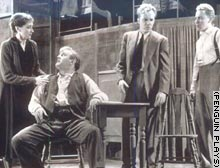
Arthur Miller's After the fall ...
In October of 2003, a mentor of mine died. His name was Jack Temchin. Jack Temchin was instrumental in helping me realize the potential in my thesis project for grad school - which was Arthur Miller's After the Fall. It's not a perfect play by any means, but the the extended scenes between the two main characters (Quentin and Maggie) are superb. I lobbied to have After the Fall as my thesis project. It was approved. And I immersed myself, for months, in Arthur Miller's world. In Marilyn Monroe's world (the play describes their marriage - although Miller always hemmed and hawed, in public, saying that it was "fiction".) I studied Arthur Miller's motivations behind the play, I studied what HE said about his own process, his thoughts about the tragic damaged character of Maggie (my part). It's one of the most frightening beautiful acting experiences I've ever had. It was a real challenge. But it was also great, because of my obvious love for the play. I could have worked on it for 24 hours a day - I resented having to sleep!
There were a LOT of problems, on the technical and administrative side of things ... and I got caught up in a couple of snafus. Jack Temchin went to bat for me. He stood up for me. A lot of people disliked Temchin ... and he could be very cruel, very manipulative. (But dare I say this: he was usually cruel to those he felt had huge entitlement issues, those who had no respect, those who thought stuff was OWED to them. As you can imagine, acting grad school is FILLED with actors who feel "entitled". They are the most obnoxious - and usually talent-less - people on earth. Jack Temchin was RUTHLESS with people like that.) But he was always good to me. He recognized my commitment, my passion ... and would NOT let me be victimized by the inefficiency of the administration.
Anyway. I'm still not feeling articulate yet about Arthur Miller ... and what his plays means to me ... and my long relationship to his work ... so I thought I'd re-post the story of my thesis project. The story of Jack Temchin, a small frail man, suddenly becoming a Gladiator, fighting for me to get what I wanted.
In a way, even though it's a tribute to Jack Temchin, it's also a tribute to Arthur Miller. Because I felt like that was MY play. It was MINE. When the Roundabout did a production of it last year, I felt ... so sad. Because I felt like Maggie was "mine". I couldn't even go see it. That play is INSIDE me. I OWN it. I will ALWAYS be grateful for having the experience of getting so close to that particular piece of writing, so close that it wasn't even a play anymore. It was REAL, I was in between the lines of the page.
So. Onward.
Jack Temchin, after a long career at the Manhattan Theatre Club, as well as publishing a best-selling series of monologue books for actors, was hired by my graduate program to produce the 11-week "thesis" season. This was done at the Circle in the Square Downtown Theatre, on Bleecker Street (an amazing space if ever there was one).
Temchin's job was to be part of the thesis-approval committee - and once all theses were approved and cast - it was Temchin's job to design the season.
This was an insane assignment - with actors, directors, and playwrights bombarding his small office with neurotic and not-so-neurotic requests: "I wish that my project was LAST in the night ... not in the middle..." "Could you PLEASE talk to so-and-so and tell her that I have no plans on casting her?" "Why did you place my project so late in the season? Nobody will come to see it!!"
The panic was understandable, because the stakes were very high. For all of us. This was what we had been working for, non-stop, for the past 3 years - we all wanted everything to be right for us PERSONALLY.
So Jack had 120 personalities to satisfy. I did not envy him his assignment.
He made quite a few enemies.
He was not always tactful. He would say things to people like, "End of discussion. Your project is going up 3rd and that's the end of the discussion. Grow up."
I always appreciated that about him - because it was very practical, it had a whiff of the actual professional world (which I really missed, at times, in the cloister of graduate school).
My thesis project was After the Fall, Arthur Miller's haunting (and flawed) play about his marriage to Marilyn Monroe. The play as a whole does not work, but we didn't do the whole play. We picked out two scenes - which are stunning, all on their own. I was very pleased - I got the director I wanted, I got the co-star I wanted - I was happy.
I was also cast in another project, a short play called Gertrude Down, an original work by a playwright in the program.
Gertrude Down was a take-off on Reservoir Dogs, except with all women - gun-toting women sitting in a big empty warehouse, smoking cigarettes, arguing - talking about nothing - and they are all waiting for ... something. You are not sure what. But it's ominous. I was the "boss". All the other women were dressed up in bimbo outfits, sparkley nail polish, stilettos - but I, as the boss, was dressed in a man's pinstripe suit, black shiny shoes, a tie, and a fedora.
I would take out a cigarette, and all the bimbo girls would fight over who got to light it for me. It was a great part, I loved it.
Anyway:
Temchin decided to launch the entire thesis season with "After the Fall" AND "Gertrude Down" - on the same night. There were 2 other projects on the docket for the first night - and Temchin made sure that my two pieces weren't back to back - so that I wouldn't have to have an impossibly quick change.
One of the incomprehensible things about most of the complaints of the student body was: They didn't want to be seen in two pieces in the same night, especially if one of them was their thesis project. They wanted to have ALL of their focus directed on their one main project, and not diffuse their concentration.
I literally could not understand that viewpoint. It seemed so ... I can't even find a word for it. It just baffled me.
Perhaps it is because I had been out in the theatrical world BEFORE I went into grad school and I knew in my heart how advantageous it would be to be seen in two completely different pieces in the same night.
I was THRILLED, to tell you the truth.
In "After the Fall" I was playing a tortured sex-bomb nightclub singer poured into a teeny little dress with high heels, used and thrown-out by men, a woman-child with terrible insomnia, and horrible insecurities, constantly drinking to take the edge off. A tour-de-force part.
In "Gertrude Down" I was all butch, and tough, wearing a fedora, bossing everyone around, an alpha-Female, chain-smoking cigarettes, and barking orders.
What a great thing for me! To show that I would be able to transform myself.
But my fellow students went into an uproar on my behalf, (I still don't know why they butted into my business - I think they were just using my situation as an example of what they DIDN'T want, assuming that I would feel the same way as they did). So I heard through the graduate-school grapevine that others in my class were complaining to Temchin, "standing up for me" was what they called it, saying to Temchin: "Sheila shouldn't be in 2 pieces in the same night! That's unfair!"
I hated that they assumed I had the same views as them. And I hated that they almost sabotaged my chance to show off my diversity as an actress. I was in a panic that Temchin would change the schedule. I had to make things right.
I stormed into Temchin's office (a man I didn't know very well yet), and didn't even say "Hi" - there was no prelude - I launched right into a diatribe, "Don't you DARE change the schedule just because the other boneheads in this program feel like THEY couldn't handle doing two different pieces in one night - Do NOT change the schedule. I didn't ask them to come to you, and I'm pissed that they did. They're idiots. As long as you don't put my two pieces back to back, and as long as you put 'After the Fall' BEFORE Gertrude Down on the program, I am perfectly fine with appearing in two pieces, and frankly, I am totally baffled at why everybody thinks it would be a bad idea."
That is not word for word what I said - but I do know that I barreled out an impassioned monologue - and I do know that the word "boneheads" was used.
Temchin looked up at me - took it all in - took ME in - then leaned back in his chair, threw back his head and ROARED with laughter. He just laughed and laughed and laughed.
I turned around and shut the door on all the nosy "boneheads" out in the hallway. I had been shouting. About all of them. With an open door. While they were sitting right there.
I was too upset to laugh yet - I said, "You're not gonna change the schedule are you? I have no idea why nobody else wants to appear in 2 pieces in the same night. Don't they realize how GOOD it would be to show the audience that you can do the contrast? What the fuck is the matter with them??"
Temchin, still laughing, said, "You're no dummy."
And that was all he said.
"You're no dummy."
So I got him to promise he wouldn't change the schedule. But in the middle of all of that, he noticed that I was carrying a Richard Ford novel under my arm, and he interrupted the entire conversation and said, "A great writer, isn't he?"
It was hard for me to segue. I was too hot under the collar. I said, "Ford? Yeah. He's good."
It was as though Temchin had seen me for the first time. He was staring up at me, just looking at me. Not at my surface, I could feel, but at ME. He made me sit down ... and then he got me to talking about literature. (We had never had a conversation before I barged into his office and demanded that he do what I ask.)
He loved that I was carrying a novel, and not "10 Things to Know If You Want To Be An Actor" or "How To Get the Casting Office To Love You" or "Helpful Tips to Actors Who Want To Be In Soap Operas" ... or whatever. He thought it was so refreshing and rare: An actor who had interests outside of acting.
Anyway - it was that one conversation that sealed the deal for the two of us. We were pretty much friends for life after that.
After he saw how much I gave a shit about my work, also how realistic I was (that I knew, in my heart, that being seen in two pieces was BETTER than only being seen in one), and also how unafraid I was of ruffling the feathers of my nosy fellow students, he could not do enough for me.
He satisfied my every demand. He kept checking in with me as the thesis season went on. "How's it going? Anything you need?"
He was amazing with me. A true mentor.
Another story about this man, who became one of my champions:
I had an idea for "After the Fall" - but I needed help executing it. The character, Maggie, becomes famous, as a singer. Her most famous number is "Little Girl Blue", a ballad. My idea was this:
Have a haunting echoey recording of me singing that song ... and play it over the scene changes, or at appropriate moments during the show ... My idea for it was NOT that it should be what the character actually sounded like when the song played on the radio, but that it should be a kind of photo-negative of the same song, to show how troubled she was, how doomed.
I wanted it to sound literally like singing this song was this character's last gasp for breath. No more energy, no more sexiness left ... all emotion drained ... she was giving up ... she was sinking ...
The lyrics fit with that idea:
"Sit there and count your fingers
What can you do?
Old girl, you're through
Sit there and count your little fingers
Unlucky little girl blue ...
No use, old girl - you may as well surrender
Your hopes are getting slender
Why won't somebody send a tender blue boy
To cheer up little girl blue"
Nina Simone does a great version of this.
You can jazz it up, but I didn't want that. My picture for it was of a woman, at 4 a.m., rain coming down, sliding off into perhaps an overdose ... all alone ... and this is her last expression of what's going on, her last words.
Great idea, huh?
Well, nobody would help me.
I was told there was no budget, there was nobody set up to record such a thing. (Interesting how LATER in the season when other actors wanted to do special sound-stuff - the school found a way. But they hadn't greased the wheels of the season yet, and so they gave me a hard time.) Rich G., the guy I chose to direct my piece (a really good friend, and a terrific director - I've worked with him a bunch), did his best to get me what I wanted, he was a total advocate for me - but the school just did not give a crap.
They didn't count on Jack Temchin.
My brother the musician stepped up - and we recorded me singing the song on his equipment - not very sophisticated - but hey, I was a woman with a mission. I now had the song on tape. I handed it over to the sound people, and Rich told them the cues - when to play it, etc.
Then, lo and behold, on the night of our Tech-Dress rehearsal, which was INSANE - after the run-through of After the Fall - there was a worried conference between all of these upper-level administrative people - about the quality of the recording. It wasn't good enough, clear enough, it sounded amateurish.
Rich and Temchin came over to me, leaving the upper-echelon conference, and Rich murmured to me, "There are some concerns about the quality of the recording--"
I had fucking had it. I exploded. In front of everyone.
"I HAVE BEEN SAYING THAT FOR WEEKS AND NOBODY WOULD HELP ME. I HAVE BEEN SAYING THAT FOR WEEKS AND NOBODY WOULD HELP ME."
Rich said, "I know, Sheila, I know, and now they understand that you were right --"
I burst into tears. "Rich! Nobody listened to me!"
"Sheila. They're listening now."
Temchin came over, and took me in his spindly little arms. "Okay, sweetheart, we're gonna fix it. Bill Riley has a state-of-the-art recording studio at home, and you are going to go over there right now, and record exactly what you want. He can make it sound just like what you want, exactly what you have been asking for for 3 weeks now."
It was midnight. I was exhausted.
"Record it now? We open tomorrow night, Jack!"
I was hysterical. I admit. My nerves were frayed, I felt like I completely had not been taken seriously, and now they were trying to cover their tracks...Also, I was exhausted. Probably hadn't had a good night's sleep in a couple weeks, because of all the rehearsal time.
Jack recognized I was hysterical, he didn't judge me for it, he thought I had been fucked over, and so Jack made it all better.
He got me into a cab, he gave me money to go up to Bill Riley's recording studio on the Upper West Side, he had told Bill Riley to give me whatever I wanted - and everything worked out in the end.
The recording that Bill Riley made, of me singing that song, was beyond my wildest dreams.
He created EXACTLY what I asked. He took me seriously as an artist. So did Jack Temchin. I wasn't just some whimsical idiot making an unreasonable demand. I'm never rude when I make requests. I'm not a diva. I'm all about collaboration. That's why theatre is so great. As a matter of fact, it's hard for me to make requests at all! But I had a good idea, it was MY thesis... and I needed some help bringing that idea into reality.
I knew how I wanted to perform the song ... soft and whispery ... as though throughout the process of the song, the life ran out of me, and the tide pulled back.
I told Riley this idea, and I told him I thought a slight echo would be best ... I wanted it to sound like I was at the bottom of a well. I gave him all my crazy images - and by this point it was 2 in the morning, and Riley DID it. He MADE IT HAPPEN.
I still have a copy of me singing that song, in the way that I wanted to.
I went into Temchin's office the next day, completely embarrassed that I had been screaming and crying in front of the Dean, in front of the organizing committees, in front of the full faculty. I said, "I'm sorry I threw such a fit."
Temchin gave me this look. This dead-on look. "Sweetheart, you don't have to apologize. They fucked up. They know it. And you let them know it. If this program doesn't invest in YOU, then we have no business being an acting program."
And we used the song in the production - Jack Temchin cleared all obstacles out of my way. He told the sound designer, "This actress knows what she wants. She is not a diva. She needs help. So GIVE her that help. Listen to her ideas, and help her."
And everybody did. The sound people were INCREDIBLE with me. Just incredible. They completely GOT the effect I had in my head, and they made it happen for me.
To me, Jack Temchin was a champion.
We used to call such people "spirit warriors" in college. Over the course of those weeks, with my thesis craziness, he went to battle for me. A spirit warrior, indeed.
I will never forget him for that. I didn't even really know him that well. But he will always have a special place in my heart because of how he went to bat for me, during that crazy time.
Jack Temchin: Rest in Peace.
And now ... Arthur Miller: Rest in Peace. I need to take out After the Fall and read it again. Especially now.
Lee J. Cobb: "Like a giant moving the Rocky Mountains into position..."
I read Arthur Miller's autobiography Timebends voraciously during my thesis acting project in graduate school.
My project was a couple of different scenes from Miller's play about his marriage to Marilyn Monroe: After the Fall. His passages about Marilyn in the book, who she was, what he remembered of her, are heartbreaking. And they were very helpful to me, in terms of creating that kind of character. You could go with the cliche - the sex-bomb, the woman constantly used by men - or you could get deeper into her world, her inconsistencies, her strengths. Marilyn Monroe, after all, was a real woman, a 3-dimensional real woman. That's what I wanted to try to portray.
One of the things Miller remembered about her was - that the famous jiggly walk of hers was completely natural. That was just how her body moved - naturally. Men (and women) happened to find it unbelievably attractive, and Monroe knew this, but it was not a "put-on". Miller remembers taking a walk with her on the beach, and at one point turning around to look back at their footprints in the sand. Miller's prints are slightly spread apart. Most of us walk that way, we do not place our feet exactly in front of each other when we move forward. But Monroe did. And the tracks she left in the sand made it look like she had actually been hopping along beside him ... a singular row of prints. He said that she walked "like a cat". If you walk, placing one foot directly in front of the other, wait till you see what it does to how your hips move. You cannot help it. I completely STOLE that, when creating this character - I tried to walk in a way that would make it look as though I would only leave one long line of footprints - It's how models walk on runways - and it feels very unnatural at first, but I practiced it, and it helped enormously. I put one foot directly in front of the other as I walked and suddenly, just by doing that, I became this teetery woman, with a sensuous walk, it was all about the natural movement of the hips.
Other things I love about this book are his memories about people I revere: Harold Clurman, Clifford Odets, Tennessee Williams. These were Miller's inspirations, the ones he looked to, the ones who galvanized him. He saw Kazan's famous production of Streetcar with Marlon Brando and Jessica Tandy, and it was that experience that made him sit down and write Death of a Salesman. Seeing such greatness, such perfection, was inspirational to him. He knew that he had to take his work to a new level, he knew that Tennessee Williams was doing something no American playwright had ever done before ... He knew that what he was seeing was going to change everything forever.
His chapter on the creation of Willy Loman, on the writing of that famous play, is my favorite in the book.
First of all - it goes into the writing process. The struggle with those demons in your head that tell you you can't do anything, you won't ever amount to anything ... We all have those demons. It also talks about the demon of the blank page .... how terrifying that can be for writers, how daunting. Miller had to go and basically build a cabin in the woods to write that play. He needed to be separate from his wife, from his entire life. He built a tiny one-room shack with his own hands, and sat there, sweating it out, until the play was done.
And second of all - I LOVE the chapter because it talks with such love, such respect, for the work of the actors. It's all well and good that you write a masterpiece, but without a Lee J. Cobb to make it come to life, who cares? The same was true for Streetcar. Without Marlon Brando, without the EVENT of Marlon Brando, Williams' play may have been recognized as a nice poetical piece of writing ... but it wouldn't have had the impact, the impact which still, to this day, influences any actor who moves us, who strikes us as real, and powerful. Actors like that are all Brando's children, as far as I'm concerned.
So here, in honor of Arthur Miller, this giant talent, this truly American talent, who has just died (I can't even deal with it yet) ... I will post my favorite excerpt from his book Time bends.
It describes Miller's initial response to Streetcar, and then - ends with describing the first weeks of rehearsal for this new play he had written ... this Death of a Salesman play ... and I won't say anymore than that. All I will say is that if I am in a low moment, if I am wondering why on earth I have chosen to get my heart broken over and over again in the business of acting (this business of rejection, disappointment, loneliness) ... I read this excerpt. No matter how many times I have read the section describing Lee J. Cobb's acting process in those first weeks of rehearsal for Salesman - it doesn't matter. Tears stream down my face anyway, and tears are streaming down my face right now.
That's all I'll say.
Now let's let Arthur Miller speak.
When Kazan invited me up to New Haven to see the new Williams play, A Streetcar Named Desire - it seemed to me a rather too garishly attention-getting title - I was already feeling a certain amount of envious curiosity since I was still unable to commit myself to the salesman play, around which I kept suspiciously circling and sniffing. But at the same time I hoped that Streetcar would be good; it was not that I was high-minded but simply that I shared the common assumption of the time that the greater the number of exciting plays there were on Broadway the better for each of us., At least in our minds there was still something approximating a theatre culture to which we more or less pridefully belonged, and the higher its achievement the greater the glory we all shared. The playwright was then king of the hill, not the star actor or director, and certainly not the producer or theatre owner, as would later by the case ...Streetcar - especially when it was still so fresh and the actors almost as amazed as the audience at the vitality of this theatrical experience - opened one specific door for me. Not the story or the characters or the direction, but the words and their liberation, the joy of the writer in writing them, the radiant eloquence of its composition, moved me more than all its pathos. It formed a bridge to Europe for me, to Jouvet's performance in Ondine, to the whole tradition of unashamed word-joy that, with the exception of Odets, we had either turned our backs on or, as with Maxwell Anderson, only used archaically, as though eloquence could only be justified by cloaking it in sentimental romanticism.
Returning to New York, I felt speeded up, in motion now. With Streetcar, Tennessee had printed a license to speak at full throat, and it helped strengthen me as I turned to Willy Loman, a salesman always full of words, and better yet, a man who could never cease trying, like Adam, to name himself and the world's wonders. I had known all along that this play could not be encompassed by conventional realism, and for one integral reason: in Willy the past was as alive as what was happening at the moment, sometimes even crashing in to completely overwhelm his mind. I wanted precisely the same fluidity in the form, and now it was clear to me that this must be primarily verbal. The language would of course have to be recognizably his to begin with, but it seemed possible now to infiltrate it with a kind of superconsciousness. The play, after all, involved the attempts of his son and his wife and Willy himself to understand what was killing him. And to understand meant to lift the experience into emergency speech of an unashamedly open kind rather than to proceed by the crabbed dramatic hints and pretexts of the "natural". If the structure had to mirror the psychology as directly as could be done, it was still a psychology hammered into its strange shape by society, the business life Willy had lived and believed in. The play could reflect what I had always sensed as the unbroken tissue that was man and society, a single unit rather than two.
God. Tennessee Williams giving other writers "a license to speak at full throat". Jesus. Did he ever.
Miller finished Death of a Salesman and sent it to Kazan.
I did not move far from the phone for two days after sending the script to Kazan. By the end of the second silent day I would have accepted his calling to tell me that it was a scrambled egg, an impenetrable, unstageable piece of wreckage. And his tone when he finally did call was alarmingly sober. "I've read your play." He sounded at a loss as to how to give me the bad news. "My God, it's so sad.""It's supposed to be."
"I just put it down. I don't know what to say. My father..." He broke off, the first of a great many men - and women - who would tell me that Willy was their father. I still thought he was letting me down easy. "It's a great play, Artie. I want to do it in the fall or winter. I'll start thinking about casting." He was talking as though someone we both knew had just died, and it filled me with happiness. Such is art.
Then came the business of casting the actor for Willy Loman, which was quite difficult.
Willy had to be small, I thought, but we soon realized that Roman Bohnen and Ernest Truex and a few other very good actors seemed to lack the size of the character even if they fit the body. The script had been sent to Lee Cobb, an actor I remembered mainly as a mountainous hulk covered with a towel in a Turkish bath in an Irwin Shaw play, with the hilarious oy vey delivery of a forever persecuted businessman. Having flown himself across the country in his own two-engine airplane, he sat facing me in Bloomgarden's office and announced, "This is my part. Nobody else can play this part. I know this man."And he did indeed seem to be the man when a bit later in a coffee shop downstairs he looked up at the young waitress and smiled winsomely as though he had to win her loving embrace before she could be seduced into bringing him his turkey sandwich and coffee - ahead of all the other men's orders, and only after bestowing on his unique slice of pickle her longing kiss.
But while I trusted his and Kazan's experience, I lacked any conviction of my own about him until one evening in our Grace Court living room Lee looked down at my son, Bob, on the floor and I heard him laugh at something funny the child had said. The sorrow in his laughter flew out at me, touched me; it was deeply depressed and at the same time joyous, all flowing through a baritone voice that was gorgeously reedy. So large and handsome a man pretending to be thoroughly at ease in a world where he obviously did not fit could be moving.
"You know - or do you? -," Lee said to me one day in Bloomgarden's office a week or so before rehearsals were about to begin, "that this play is a watershed. The American theatre will never be the same." I could only gulp and nod in silence at his portentousness - which I feared might augur a stately performance - and hope that he would make Willy come alive anyway.
That anecdote pierces me to the core. "The sorrow in his laughter flew out at me, touched me; it was deeply depressed and at the same time joyous" ... Let us just take a moment. A Lee J. Cobb appreciation moment. What a beautiful actor.
I'm all a mess right now. Onward.
So Death of a Salesman went into rehearsal with Elia Kazan directing. And - at first - it did not go well. Lee J. Cobb was not doing well, he suddenly seemed (as hard as this is to believe) like he wasn't a good actor. People started getting nervous. The following excerpt sends chills up my spine every single time I read it. Oh, how I wish I had been there to see it!!
But as rehearsals proceeded in the small, periodically abandoned theatre on the ratty roof of the New Amsterdam on Forty-second street, where Ziegfeld in the twenties had staged some intimate revues, Lee seemed to move about in a buffalo's stupefied trance, muttering his lines, plodding with deathly slowness from position to position, and behaving like a man who had been punched in the head."He's just learning it," Kazan shakily reassured me after three or four days.
I waited as a week went by, and then ten days, and all that was emerging from Lee Cobb's throat was a bumpy hum. The other actors were nearing performance levels, but when they had to get a response from Lee all their rhythms slowed to near collapse.
Kazan was no longer so sure and kept huddling with Lee, trying to pump him up. Nor did Lee offer any explanation, and I wondered whether he thought to actually play the part like a man with a foot in the grave. Between us, Kazan and I began referring to him as "the Walrus".
On about the twelfth day, in the afternoon, with Eddie Kook, our lighting supplier, and Jimmy Proctor, our pressman, and Kazan and myself in the seats, Lee stood up as usual from the bedroom chair and turned to Mildred Dunnock and bawled, "No, there's more people now ... There's more people!" and, gesturing toward the empty upstage where the window was supposed to be, caused a block of apartment houses to spring up in my brain, and the air became sour with the smell of kitchens where once there had been only the odors of earth, and he began to move frighteningly, with such ominous reality that my chest felt pressed down by an immense weight. After the scene had gone on for a few minutes, I glanced around to see if the others had my reaction. Jim Proctor had his head bent into his hands and was weeping, Eddie Kook was looking shocked, almost appalled, and tears were pouring over his cheeks, and Kazan behind me was grinning like a fiend, gripping his temples with both hands, and we knew we had it - there was an unmistakable wave of life moving across the air of the empty theatre, a wave of Willy's pain and protest.
I began to weep myself at some point that was not particularly sad, but it was as much, I think, out of pride in our art, in Lee's magical capacity to imagine, to collect within himself every mote of life since Genesis and to let it pour forth. He stood up there like a giant moving the Rocky Mountains into position.
At the end of the act, Del Hughes, our sweet but hardheaded, absolutely devoted, competent stage manager, came out from a wing and looked out at us. His stunned eyes started us all laughing. I ran up and kissed Lee, who pretended to be surprised. "But what did you expect, Arthur?" he said, his eyes full of his playful vanity. My God, I thought - he really is Willy!
On the subway going home to Brooklyn I felt once again the aching pain in my muscles that the performance had tensed up so tightly, just as in the writing time. And when I thought of it later, it seemed as though Lee's sniffing around the role for so long recapitulated what I had done in the months before daring to begin to write.
God. Just ... I don't have any words.
The play then opened in Philadelphia. It was the first time anyone on the planet, outside of the cast and crew, had ever seen this play.
Salesman had its first public performance at the Locust Street Theatre in Philadelphia. Across the street the Philadelphia Orchestra was playing Beethoven's Seventh Symphony that afternoon, and Kazan thought Cobb ought to hear some of it, wanting, I suppose, to prime the great hulk on whom all our hopes depended. The three of us were in a conspiracy to make absolutely every moment of every scene cohere to what preceded and followed it; we were now aware that Willy's part was among the longest in dramatic literature, and Lee was showing signs of wearying. We sat at either side of him in a box, inviting him, as it were, to drink of the heroism of that music, to fling himself into his role tonight without holding back. We thought of ourselves, still, as a kind of continuation of a long and undying past.As sometimes happened later on during the run, there was no applause at the final curtain of the first performance. Strange things began to go on in the audience. With the curtain down, some people stood to put their coats on and then sat again, some, especially men, were bent forward covering their faces, and others were openly weeping. People crossed the theatre to stand quietly talking with one another. It seemed forever before someone remembered to applaud, and then there was no end of it.
Oh, my heart.
Oh no. Oh no.
Arthur Miller has died. I feel this one - like I've been punched in my GUT. I just opened the Times and saw the news.
I'll write more later. But I can't right now. My feelings about this man's work - and what it has meant to me - runs too deep. I have to think about it for a while.
High School Days
I got this walk-down-memory-lane thing from Annika. Please feel free to talk about your own answers in the comments section.
HIGH SCHOOL QUIZ
What year was it?
Early to mid 1980s
What were your three favorite bands (performers)?
The Go Gos, Adam Ant, Devo, Cyndi Lauper
What was your favorite outfit?
I had this kind of 1950s-esque skirt I liked - and I would wear it with a maroon sweater (made by my mother - I still have it - I love it) - and pop pearls. Pop pearls were HUGE in my high school.
What was up with your hair?
My hair was short, always. I used MANY products to give myself spiky bangs.
Who were your best friends?
Beth, Betsy, Mere (you will recognize all the names ... these chicks are STILL my best friends)
What did you do after school?
Drama club, school yearbook, school newspaper
Where did you work?
I worked at a local public library for about 3 years.
Did you take the bus?
Yup.
Who did you have a crush on?
Well, of course, every year in high school had a DIFFERENT crush. I will delineate them all for you here:
Freshman and sophomore year: John Walsh. He literally spoke 3 words to me- and my love for him lasted 2 years.
Junior year: I was MADLY in love with a guy named David Worthen. My friends will remember that one very well. We didn't date or anything - but we were in French class and Gym class together, and ... I thought my heart would literally take wing and fly me up out of the school, I loved him so much. Sadly, it ended in tragedy. (If NOT going to my junior prom with him counts as tragedy. And it does.)
Senior year: I moved on to older men in my senior year. I had an enormous crush on a guy in college I was doing a play with (yes, by the time I was 17, I had already moved on from the high school theatre scene) ... he was 21 years old. I LOVED HIM. Nothing came of it, though. He's still a dear friend. Also, in my senior year, I had a boyfriend, kind of. He was also older ... 19? I don't know. That ended in tragedy, too.
Did you fight with your parents?
Not really, although it wasn't the best of times, in terms of our relationship. My grades weren't very good in the first year of high school - and I think they were disappointed in me. It was a bit sketchy there for a while - I had real problems with math and science, and could BARELY get Cs and Ds in those classes.
Who did you have a CELEBRITY crush on?
My favorite question EVER.
So here goes: High school "celebrity crushes":
Harrison Ford
Ralph Macchio
Blackie Parrish on General Hospital (ie: John Stamos)
John Taylor, from Duran Duran
Chevy Chase
James Dean (I didn't care that he was dead)
Did you smoke cigarettes?
No.
Did you lug all of your books around in your backpack all day because you were too nervous to find your locker?
Uhm ... no. Too nervous to find my locker? Huh?
Did you have a ‘clique’?
Not the way I see it. I had a good group of really cool friends - and they're still my dear friends today. As a matter of fact, the core group of us are all getting together tonight, to drink wine, catch up, support each other, discuss our lives, and in general have a great time. I've been friends with these women since I was an unformed pubescent. I cherish them. So no, I wouldn't call it a "clique" really.
Did you have “The Max” like Zach, Kelly, and Slater?
Oh I am showing my cultural ignorance here. Is this a Beverly Hills 90210 reference? Uhm ... sorry. What is "The Max"?
Admit it, were you popular?
Popular? No. Although I think people liked me. I wasn't part of the REALLY popular crowd ... (the girls who always looked fabulous, and had boyfriends, and the guys who were football stars, and stuff like that) - So I wasn't part of that clique - I was a drama geek. But I wasn't UNpopular. (I was, indeed, "unpopular" in JUNIOR high. UNpopular? That's putting it mildly. People put SIGNS ON MY BACK in the hallway, signs that proclaimed: "Hi! I'm really ugly." I was tormented in junor high.) But that all died out by the time we all got to high school.
Who did you want to be just like?
This is ridiculous, but I SO wanted to be like Natalie Wood in Rebel without a cause. heh heh You know, the really rebellious hot girl, who gets hauled into the police station, and doesn't CARE. I was WAY too cautious, in some respects, to EVER be like her (at least in high school) - but I just thought that character was too too cool.
What did you want to be when you grew up?
An actress. Also a wife.
Where did you think you’d be at the age you are now?
My least favorite question. Even thinking about it, opens up a black abyss of despair and uneasiness. So I won't answer it.
February 10, 2005
Monsters
So in case you missed it, we had a GREAT conversation here the other day about the psychology of evil. It's a huge comment-thread, with a ton of differing views - all well-articulated, beautiful personal stuff. One of the things I brought up in the comments thread was my response to the character of Cathy in East of Eden- when I read it in high school. She is evil. Steinbeck makes that very clear. The book is an allegory (I mean, look at the title) ... and there are three generations of male characters in the book who are TWINS - one twin has a name starting with C and one has a name starting with A. The twin with the "C" name is wild, a bad seed, has a dark side. The twin with the "A" name is ... depending how you look at it ... either good, or very naive. Maybe a bit of both.
Into this world comes Cathy. She terrified me, when I read the book as a teenager, and she terrifies me still.
This is an ongoing debate, and I truly do not pretend to have any answers. I only have my opinion. And it is my opinion that Steinbeck was describing something that is TRUE in the character of Cathy, despite the book's allegorical nature. She's a very very frightening character.
This morning, over my breakfast, I thought of Cathy again, and I thought of the conversation here about evil. So I went to the shelf, took down the book, and looked up the passage when we first meet this character. Funny. I had forgotten how strongly Steinbeck puts it, how he doesn't ease his way into it, he makes no bones about it. That's part of why it scared me so much when I was a kid.
It goes so hand in hand with what we were discussing in that "psychology of evil" thread that I want to post it here. It's uncanny.
Here is Steinbeck's opening discussion of this girl, this Cathy. It's long, but it's worth it:
I believe there are monsters born in the world to human parents. Some you can see, misshapen and horrible, with huge heads or tiny bodies; some are born with no arms, no legs, some with three arms, some with tails or mouths in odd places. They are accidents and no one's fault, as used to be thought. Once they were considered the visible punishment for concealed sins.And just as there are physical monsters, can there not be mental or psychic monsters born? The face and body may be perfect, but if a twisted gene or a malformed egg can produce physical monsters, may not the same process produce a malformed soul?
Monsters are variations from the accepted normal to a greater or a less degree. As a child may be born without an arm, so one may be born without kindness or the potential of conscience. A man who loses his arms in an accident has a great struggle to adjust himself to the lack, but one born without arms suffers only from people who find him strange. Having never had arms, he cannot miss them. Sometimes when we are little we imagine how it would be to have wings, but there is no reason to suppose it is the same feeling birds have. No, to a monster the norm must seem monstrous, since everyone is normal to himself. To the inner monster it must be even more obscure, since he has no visible thing to compare with others. To a man born without conscience, a soul-stricken man must seem ridiculous. To a criminal, honesty is foolish. You must not forget that a monster is only a variation, and that to a monster the norm is monstrous.
It is my belief that Cathy Ames was born with the tendencies, or lack of them, which drove and forced her all of her life. Some balance wheel was misweighed, some gear out of ratio. She was not like other people, never was from birth. And just as a cripple may learn to utilize his lack so that he becomes more effective in a limited field than the uncrippled, so did Cathy, using her difference, make a painful and bewildering stir in her world.
There was a time when a girl like Cathy would have been called possessed by the devil. She would have been exorcised to cast out the evil spirit, and if after many trials that did not work, she would have been burned as a witch for the good of the community. The one thing that may not be forgiven a witch is her ability to distress people, to make them restless and uneasy and even envious.
As though nature concealed a trap, Cathy had from the first a face of innocence. Her hair was gold and lovely; wide-set hazel eyes with upper lids that drooped made her look mysteriously sleepy. Her nose was delicate and thin, and her cheekbones high and wide, sweeping down to a small chin so that her face was heart-shaped. Her mouth was well shaped and well lipped but abnormally small -- what used to be called a rosebud. Her ears were very little, without lobes, and they pressed so close to her head that even with her hair combed up they made no silhouette. They were thin flaps sealed against her head.
Cathy always had a child's figure even after she was grown, slender, delicate arms and hands -- tiny hands. Her breasts never developed much. Before her puberty the nipples turned inward. Her mother had to manipulate them out when they became painful in Cathy's tenth year. Her body was a boy's body, narrow-hipped, straight-legged, but her ankles were thin and straight without being slender. Her feet were small and round and stubby, with fat insteps almost like little hoofs. She was a pretty child and she became a pretty woman. Her voice was huskily soft, and it could be so sweet as to be irresistible. But there must have been some steel cord in her throat, for Cathy's voice could cut like a file when she wished.
Even as a child she had some quality that made people look at her, then look away, then look back at her, troubled at something foreign. Something looked out of her eyes, and was never there when one looked again. She moved quietly and talked little, but she could enter no room without causing everyone to turn toward her.
She made people uneasy but not so that they wanted to go away from her. Men and women wanted to inspect her, to be close to her, to try and find what caused the disturbance she distributed so subtly. And since this had always been so, Cathy did not find it strange.
Cathy was different from other children in many ways, but one thing in particular set her apart. Most children abhor difference. They want to look, talk, dress, and act exactly like all of the others. If the style of dress is an absurdity, it is pain and sorrow to a child not to wear that absurdity. If necklaces of pork chops were accepted, it would be a sad child who could not wear pork chops. And this slavishness to the group normally extends into every game, every practice, social or otherwise. It is a protective coloration children utilize for their safety.
Cathy had none of this. She never conformed in dress or conduct. She wore whatever she wanted to. The result was that quite often other children imitated her.
As she grew older the group, the herd, which is any collection of children, began to sense what adults felt, that there was something foreign about Cathy. After a while only one person at a time associated with her. Groups of boys and girls avoided her as though she carried a nameless danger.
Cathy was a liar, but she did not lie the way most children do. Hers was no daydream lying, when the thing imagined is told and, to make it seem more real, told as real. That is just ordinary deviation from external reality. I think the difference between a lie and a story is that a story utilizes the trappings and appearance of truth for the interest of the listener as well as of the teller. A story has in it neither gain nor loss. But a lie is a device for profit or escape. I suppose if that definition is strictly held to, then a writer of stories is a liar -- if he is financially fortunate.
Cathy's lies were never innocent. Their purpose was to escape punishment, or work, or responsibility, and they were used for profit. Most liars are tripped up either because they forget what they have told or because the lie is suddenly faced with an incontrovertible truth. But Cathy did not forget her lies, and she developed the most effective method of lying. She stayed close enough to the truth so that one could never be sure. She knew two other methods also -- either to interlard her lies with truth or to tell a truth as though it were a lie. If one is accused of a lie and it turns out to be the truth, there is a backlog that will last a long time and protect a number of untruths.
Since Cathy was an only child her mother had no close contrast in the family. She thought all children were like her own. And since all parents are worriers she was convinced that all her friends had the same problems.
Cathy's father was not so sure. He operated a small tannery in a town in Massachusetts, which made a comfortable, careful living if he worked very hard. Mr. Ames came in contact with other children away from his home and he felt that Cathy was not like other children. It was a matter more felt than known. He was uneasy about his daughter but he could not have said why.
Nearly everyone in the world has appetites and impulses, trigger emotions, islands of selfishness, lusts just beneath the surface. And most people either hold such things in check or indulge them secretly. Cathy knew not only these impulses in others but how to use them for her own gain.
It is quite possible that she did not believe in any other tendencies in humans, for while she was preternaturally alert in some directions she was completely blind in others.
And that's just the first 3 pages. He goes on like this - dissecting her character - for 20 pages more. It scared the beJESUS out of me in high school.
Re-visiting that one chapter made me realize how I need to go back and read that book again. I've read it twice - but the last time was in 1993. I remember because ... well. It was a crazy time, and I remember reading East of Eden during that time, and thinking: "Did I really read this book in high school?? i don't remember ANY of it."
But I sure remembered Cathy, I'll tell you that.
Carly Fiorina, we hardly knew ye
Another random interest of mine is the activities, the lifestyles, the hype, the drama - of today's major CEOs. I won't go into the origin of this interest - but I would say that what attracts me to these CEOs is that so often their stories play out like a gripping novel, or movie. It's so DRAMATIC. And the personalities are so larger than life, and the downfalls so spectacular - it's hilarious - Watching them rise to the top and bask in their own glory - and then crumple into defeat is, to me, high entertainment.
When the whole thing was going down (and fast) with AOL and Time Warner, I read the long articles about it with voracious glee. The clash of personalities! The high (way too high) hopes! The grandiose language - "THE FUTURE BELONGS TO US. To-morr-ow belongs to meeeee!" And the secret deals behind closed doors ... the alliances made ... Clash of the Titans. Power. Money.
I've been to AOL Headquarters many times (don't ask) - and found the entire environment BEYOND fascinating - although in a kind of soul-deadening way. (Fascination + soul-deadening = AOL: to stroll around the "AOL Campus" wearing my biker's jacket and chunky buckled shoes, feeling like someone was going to arrest me for trespassing at any moment - or to arrest me just for wearing a biker's jacket and not dressing like anyone else in a 15 mile radius ... to take the squeaky-clean shuttle buses from building to building ... to use a security card to go through almost every door - you need a security card to do ANYthing there ... and to see, again, the grandiose statements on the wall: AOL MUST MARCH OVER ITS ENEMIES. THE WHOLE WORLD MUST BOW DOWN BEFORE US. AOL WILL BE MORE IMPORTANT THAN GOD. AOL. IS. LIFE. As interesting as all of this was, I always felt a relief when I got away. Like I could breathe again. Not to say anything against people who work there. But for me? I could not imagine anything more awful.)
There are reasons why I have this interest in the shenanigans of CEOs - and so when I saw this article about "Carly" stepping down, I leapt upon it.
I am not really up-to-date on the fortunes of HP and of Carly - unless something REALLY hits the major news outlets, I don't go seek it out.
You couldn't get away from the AOL/Time Warner disaster - it was everywhere. It was like Enron. Normal everyday citizens who don't read the WSJ were aware that something big was going down with Enron. So if you had never heard of Enron, then you were just WILLFULLY being oblivious to current events. Even Vanity Fair did a series of articles on AOL/Time Warner - and here in New York, I walked by their unfinished construction site at Columbus Circle on my way to dance class for years - it was in my face, every day: "Damn, when the hell are they gonna FINISH that monstrosity?" And at some point, the work stopped completely. All of this I noticed, as I trudged my way to Alvin Ailey. These are examples of how that debacle made it down into everyday consciousness - but I don't actively seek out new information or up-to-date stats or whatever.
So as far as I was concerned, with my limited knowledge, and with the brief flashes of news I would get IF an article or photo happened to catch my eye - "Carly" was still a golden-girl, the media darling, the woman standing against the big blue screen on the front page of the New York Times - introducing some new HP product at a convention. You know - she's a big star. Her name is everywhere. She's on all the lists. Carly!!!
But I suppose that that is one of the points of the article I just linked to up there: she may have been a "media darling", but her skills as a CEO were not as positive. She "spun" her image - or maybe the image was "spun" for her. I certainly bought the image. But that's only because ... I wasn't really paying attention.
(Speaking of snarking CEOs - I just tripped over this book review - AFTER putting this post up, and had to laugh. It's a perfect example of what I'm talking about! Corporate back-stabbing! Secret meetings! Betrayal between old friends! And don't even get me STARTED on Michael Ovitz. My fascination with that guy could become a full-time job!)
Speaking of kids being smart ...
(see the post below) ...
Here is the latest Cashel anecdote. (I miss him so much my heart actually aches.)
Cashel's latest passion is turning books into movies. In his head. He's very big on adapting stuff for the screen. He has a lot of ideas. And the movies he makes in his head are, I must inform you, completely real. He has a resume. He says stuff like, "In my next movie ..." What are you, Quentin Tarantino?? Books are being adapted into movies - all in Cashel's 7-year-old head. He even has cast lists planned out. I'm sure Marty Feldman would have been thrilled to know that he would have been asked to be in any one of Cashel's book-to-movie adaptations.
Recently, though, Cashel has been feeling a bit uninspired. None of the books he's been reading seem adaptation-appropriate. There's no spark. Cashel knows good material when he sees it ... and lately? In the 7-year-old reading world? The well has run dry.
He shared his concerns about this to his dad (my brother). They had a serious discussion about it. Cashel talked about wanting to adapt more books into movies (I'm sorry, I just have to interject this: I THINK THIS IS SO ADORABLE. Cashel ... "adapting" books into movies and feeling bad because he doesn't have a new project.)
So he asked my brother: did he have any ideas? Did he read any books when HE was a kid that would make a good movie?
My brother started brainstorming with Cashel, remembering his childhood books, telling him the plots, seeing if it would be a good movie. Finally he said: "I remember reading a book when I was little about a boy who could move stuff with his brain."
Cashel pondered this. Seriously. Silently. Then asked: "He could move stuff with his brain?"
Brendan said, "Yeah, like - he would think to himself: Let me move the pencil across the table. And just by thinking about it, the pencil would move."
Silence from Cashel. DEEP thinking going on.
Brendan went on, "And not only could this kid move stuff with his brain - but he could also read other people's minds. He could tell what you were thinking."
Long long silence. Cashel listening, pondering.
Then Cashel spoke. And this is what he said: "So ... he was telekinetic and telepathic?"
February 9, 2005
Speaking of Thomas Jefferson -
If you're interested in the guy, and in reading a WONDERFUL book about him ... pick up The American Sphinx, by Joseph Ellis.
It's not a typical biography. It's not really a biography at all. It's more of a contemplation, I would say ... a contemplation on "the character of Thomas Jefferson". Ellis doesn't start with: "Thomas Jefferson was born a poor black child ..." or whatever. Ellis is more interested in delving into the Sphinx-like nature of Jefferson, why he still has such a hold on the American imagination, even with all his contradictions, and Ellis is able to LIVE with those contradictions, rather than trying to explain them away, or take sides (like sooo many historians do. "I agree with THIS aspect of Jefferson's personality ... and so THAT is obviously the REAL Jefferson". Thomas Jefferson is a mystery wrapped in an enigma. While we do know quite a bit about him, anyone who claims to say they have found the real Thomas Jefferson, SHOULD NOT BE TRUSTED.)
Ellis has proven time and time again that even though he is a historian, he is quite capable of saying, flat-out, "You know, there is only so much we can actually know. I have no idea of what Thomas Jefferson was thinking at this point ... but let's take a look at the context of those turbulent months." He's all about context. And from there? You're just guessing.
Also, it doesn't hurt that Ellis is a lovely writer.
I highly recommend it to you all.
The election of 1800 ... and newspapers ... and media bias ...
This morning, I was reading Jefferson's Second Revolution - a book I started a while ago, lost interest in (not because of the topic ... but because of the writing ) - and have now picked up again.
It's about the election of 1800 - the "second Revolution", the "Jeffersonian" revolution, the "triumph of Republicanism" - the death of the Federalist party. It also is, in my opinion, one of the most incredible stories of the beginning of this nation - because it was, in the end, a peaceful transfer of power. It blows my mind ... when you look at, first of all historical precedent (peaceful transfer of power between two groups THAT HATE EACH OTHER??? When the hell does THAT ever happen?) and second of all how much the Federalists and Republicans demonized each other, each thought that the country would literally be destroyed by the other.
It was the birth of party politics in this country. And, like many births, it was painful, messy, long.
And yet when the Republicans won - the Federalists weren't lined up against the wall. The transfer happened peacefully. I mean, granted, the Federalists were destroyed, completely - they had been relics of the landed aristocracy anyway, and their time had come and gone ... it was time for them to go ... but still. The party was destroyed, but the people who had made up the party were not murdered and thrown in mass graves. They stayed involved in the system, they adjusted ... During the election of 1800 friendships fell apart, relationships shattered and never recovered ... but the NATION survived.
There's a new book out now - I've seen it - that also has the election of 1800 as its focus - and I think I need to pick up that book, since i'm not wild about this woman's writing. It almost sounds like a first draft. But whatever. I'm making my way through it, concentrating on the STORY.
It's awesome stuff. Stuff I know already, but still ... You think the election we just went through was nasty? The nastiest ever? If you think that, then I suggest you look into the election of 1800. It'll give a nice perspective, a little historical distance from our own present day. The rhetoric NOW is sooooo much more restrained than what was common-day vitriol back then. You can't even believe it. You think NOW we have a loud fringe on both sides? Go back and read about the election of 1800. History. Always good to realize that there is nothing really new under the sun, and that no generation invents the wheel. (Well. Except for the actual generation who actually DID invent the wheel, of course.)
I also thought it was really funny (in light of what's going on nowadays) to learn, again, how people expected newspapers to be biased back then. That was the whole DEAL with newspapers. An unbiased newspaper? A newspaper not connected to a political party? What? Why on earth would one read a newspaper like THAT? One paper presented one side, other papers presented the OTHER side.
The same thing is true today, obviously. You watch Fox for one "side", you listen to NPR for the other "side" - it's up to you. But you KNOW they're biased. I don't expect The New York Times to be unbiased. But I certainly don't ONLY read The New York Times. I surf around, checking multiple sources, for stories that interest me ... hoping I can piece together what I think that way. I guess what I'm saying is is that I try not to have fits of apoplexy if I run into bias. I try to get at the NEWS and if that takes a bit more work? If that means I read 3 newspapers? 4 or 5? Then okay. I'm fine with that.
When John Adams signed the Sedition Act (Oh, John ... John ... why ...) - Republican newspapers were shut down, editors jailed, etc. Jefferson, hanging out at Monticello, was instrumental in getting some of these papers started up again, so that he could have a place to put HIS views into the public realm. (Only, of course, he never signed his name. He let Madison be his front-man, while he pretended to only care about sweet peas, the constellations, and his grandkids. "Interested in politics? Me? Oh, never. I wouldn't have anything to do with the nasty business ... Let me count the flowers in my garden ... I need to harvest the hay tomorrow ..." Meanwhile, he was completely pulling the strings. Turns out, this guy was a ruthless party politician - he just didn't want to appear like he was in the fray.)
Regardless. I just thought it was so funny to remember again the long long history of bias in the media in this country ... and probably, if blogging had existed at the time of the election of 1800, a bunch of people on the sidelines would have had a FIELD DAY. Sure! I suppose the frenzied pamphleteers throughout the colonies (it seems, at times, like every private citizen in America was pumping out pamphlets on political issues) could be the equivalent of bloggers today.
But to hear actual newspaper editors, in the late 1700s, say stuff like, "A newspaper that is not biased towards one side is no good at all." hahahaha
Can you imagine?? An open acceptance of bias - from editors, writers, audience alike: if you read THIS paper, you'd get THIS side. If you wanted the other side, you'd read THIS paper (and pray to God that the editor hadn't been thrown in jail). It was a dirty fight, a battle of the newspapers, a war of words. And bias was ASSUMED.
The funnies
Last night, Siobhan and I went to go see our friend Nate perform with his improv group at Upright Citizens Brigade.
Now. In contrast to the un-funnies, described here, last night was one of those nights of improv (and believe me, I have had 1001 nights of improv) when you laugh from beginning to end. Sometimes improv comedy can be iffy, for obvious reasons. Er ... it's improv. And if the "team" is bad, then you're out of luck as an audience member. But that's kind of the fun, for me, in going to see improv on occasion. You just never know what's going to happen. You walk in having NO IDEA.
Siobhan and I sat there, and laughed like maniacs, from beginning to end. If anyone out there is a fan of improv comedy, then you will know how difficult it is to DESCRIBE it to someone who isn't there. Like ... how things happen, spontaneously, how the group suddenly all appears to have the same idea at the same time, how something randomly HILARIOUS will happen ... but it's impossible to describe. It is the definition of "you had to be there".
To give you just an example:
The evening ended with a guy playing a sinister Michael Eisner, tied up in a chair, laughing evilly, and saying to another guy, "EAT IT."
Now ... it all made COMPLETE sense in the moment ... but ... to explain how this particular improv group arrived at this? Much more difficult. I can assure you that the entire joint ERUPTED into laughter. heh heh heh
(Ann Marie: I am sure you STILL remember some of the funny lines from those improv shows we always used to go to YEARS ago. "What in carnation is he talking about?" "I'm saying this very badly ..." And ... something about hiding a moose?)
But it was a raucous and fun night. Something I truly needed. To sit back and laugh so hard I cried. It was awesome.
I made my way home afterwards, to my apartment, it was 11:15 pm or so ... so the Empire State Building still had its lights on. (The lights on top, I mean, the ones that change colors to reflect different holidays and stuff.) Those lights go off after midnight, so you can figure out what time it is (generally - and I mean REALLY generally - like: "Huh. So it's after midnight then!") by the top of the Empire State Building.
When I got home, I stood at the end of my street for a bit, staring across the river at the city - one of my favorite things to do. You just don't get perspective - like THAT - when you're actually in the city. You can look up, of course, but stuff gets foreshortened - you can't ever see the whole thing. You can't look up and down the length of the island, when you're actually on the island. My view is one of the best things about where I live. The quiet ain't too bad either.
The night was mild, dark, the Hudson moved by darkly below, and the Empire State Building was lit up - bright yellow and red. I have no idea what for. Sometimes the color choices are obvious (red white and blue on July 4, red and green on Christmas ... but there are many many more. They change almost every day!) - but I didn't know what the yellow and the red was for. It was beautiful - especially because the yellow and red were reflected, blackly, in the Hudson below.
Yeah. My view don't suck. I'm proud of it.
It was a beautiful night. Beautiful to just laugh and laugh and laugh ...
And I liked the yellow-and-red reflection in the Hudson, too. Simple pleasures, you know.
Today is Ash Wednesday
And so begins what has always been, for me, my favorite time of the church calendar: Lent. Even when I was a kid, my soul thrilled to the concept of Lent - the sacrifices, giving stuff up, etc. It seemed very dramatic, and I (surprise surprise) loved drama. Also I loved how the church during Lent was all about purple. Purple cloths over the altar, purple, purple ... It suited the more melancholy aspect of my personality, even when I was a kid. Something in me always really responded to Lent. (Especially because it had a discernible end. Easter was coming ... you only had to be somber and self-sacrificial for the time of Lent ... then it would be DONE. Heh heh.)
Anyway, last year I posted a very cute story from my friend Beth about Ash Wednesday, and I would like to post it again.
Beth took her two kids, Ceileidh and Conor, to an afternoon mass on Ash Wednesday. They got their ashes put on their forehead. Then they sat back down in the pew.
Father Creedon's sermon (Father Creedon is an amazing priest, a great speaker) was about faith and pride - that your faith should not be something you take pride in - that you should not want to SHOW your faith ... that you should not be PROUD of the ashes on your forehead ... You should approach your faith with humility, without the need to show it off.
Lovely long impassioned sermon. Beth and her kids listened in silence.
The sermon ended. The congregation, all ashed up, sat quietly, pondering the lesson.
And Conor then leaned over to Beth and whispered, "Mom, next year - can we go to the morning mass - so I can wear my ashes to school?"
February 8, 2005
A strange omission - where's Scott Peck??
There's a big article in The New York Times right now about defining evil, in terms of human psychology. The opening paragraphs state:
Predatory killers often do far more than commit murder. Some have lured their victims into homemade chambers for prolonged torture. Others have exotic tastes - for vivisection, sexual humiliation, burning. Many perform their grisly rituals as much for pleasure as for any other reason.Among themselves, a few forensic scientists have taken to thinking of these people as not merely disturbed but evil. Evil in that their deliberate, habitual savagery defies any psychological explanation or attempt at treatment.
The article goes on to talk about particularly heinous crimes - John Wayne Gacy, for example. Are there some people, on this planet, who are not just deranged, or cunning criminals, or off-the-charts violent ... but actually EVIL? Dare we even ask this question? Religious people ask it all the time, but psychiatrists?
The article pisses me off on a ton of levels - it's condescending, some of the quotes drip with moral relativity (you know: abu Gharib compared with the beheadings by terrorists - only they're called "insurgents" in the article) - you know. All that CRAP.
But what REALLY bugged me is that Scott Peck's name is not mentioned ONCE in this article about investigating the nature of evil. He wrote the book on this! People of the Lie, his follow-up to Road Less Traveled, is an investigation into evil. Peck is a psychiatrist, and so he had much trepidation about even "going there" - because a psychiatrist isn't supposed to judge, isn't supposed to have that kind of thinking going on. But through his many years of working with people (especially with kids) he came to believe that there are people on this earth, he calls them "people of the lie", who are evil. They are not outwardly villainous, or BAD. As a matter of fact, they are the opposite. They are smiling, VERY concerned with appearances, outwardly impeccable, and inwardly impervious to their own imperfections. Not only impervious, but unWILLING to believe that they are not perfect.
Peck came to this unorthodox belief in working with troubled teens. The teen would come into his office, sullen, obviously depressed, whatever. Peck would try to draw the teen out. The teen would be very teenager-ish and incommunicative. So Peck would ask to meet with the parents. And time and time and time again, Peck would realize that it was the PARENTS who were "sick", the PARENTS who were "wrong" - that the teen's depression was NOT a sickness, but a rational response to the inherent un-healthiness of his parents. It's subtle, too - Peck is usually not talking about open physical abuse. He's talking about those people on the earth who ACTIVELY cut off their children's growth. It's chilling to think about, but I've met a couple people like that ... I'm sure you all have, too. (And in movie terms, I would say that Mary Tyler Moore in Ordinary People is a perfect example of a "person of the lie". She cannot grow. She cannot admit that she even NEEDS to grow. Deep in her heart, she wishes that her older son had survived and her younger son died. And she punishes her younger son for living. And yet when she is confronted about this, she REFUSES to even consider that it might be true. HER behavior is above reproach. She cannot bear criticism, or examination of any kind. She is cunning, intelligent, and puts on a good act. Everything she does is a LIE. Peck calls this evil.) Anytime Peck would mention to the parents that maybe it was THEY who might need to change, the resistance that would come up was usually so rock-hard and so ferocious that they would pull their kid out of therapy and disappear forever. "No, no, it's not US - there is NOTHING wrong with us ... NO, it's HIM, it's our SON, what is wrong with our son???"
A fanatical resistance to change, introspection, and examination.
If you haven't read People of the Lie - it's fantastic. If anything, it will really get you thinking.
I don't know why Scott Peck's name isn't mentioned in that article I linked to - it seems quite strange. One of the themes of his "lie" book is that psychiatrists are afraid to even TALK about this stuff ... because labeling someone as "evil" is a grave grave responsiblity, and obviously one that should not be taken lightly. You must know what "evil" is, and in terms of PSYCHIATRY - there is no definition yet. See what I mean? Priests could tell you what evil is. They don't have a shyness when it comes to admitting that there IS evil. The therapeutic community, though, is necessarily cautious about admitting this.
Scott Peck was calling for his fellow therapists and psychiatrists to at least open the door to the possibility that real evil exists.
Anyway. I don't know why his name isn't mentioned as THE guy who broke this ground. Anyone who takes up this field of study would HAVE to acknowledge their debt to him.
Finally!!
After keeping us waiting for over a week, leaving tantalizing hints left and right, Steve Silver has finally posted his thoughts on the self-congratulatory hubris (yes, I love that word!!) of many bloggers at this point in time in regards to the mainstream media (no, I won't call it the MSM), something that has always kind of bugged me, and over the past couple of weeks has REALLY bugged me.
Steve's post is well worth the wait!
It's not that I don't see the value of blogging, in terms of political debate, and in terms of keeping journalists honest. Blogging is an enormous development. It really is. It has the possibility of tremendous power (and I think that power has gone to some people's heads, frankly.) But the Trent Lott thing is a perfect example of the power of this new medium. I don't want to discount that. But there are certain blogs I can't even read anymore because, frankly, they are starting to sound paranoid and insane. Also, like they are having an extended manic episode, mixed in with grandiose fantasies. Not to mention it's boring writing, too, because it's all the same. You know what these people are gonna say before they even say it. Lemme guess: the "MSM" is biased?
The dust-up over the last couple of weeks between Matt Margolis (grrrr) and his willing henchman going after the 13 year old boy is a perfect example of how the "power" of being a blogger can completely go to someone's head. I lost all respect for those guys in that episode. Zip. Nada. Buh-bye. You lose! There's a way to use blogging for good - I've seen it happen, we've all seen it happen. But perspective has been lost. And many of the bloggers who rail, non-stop, about the mainstream media, continuously LINK to the mainstream media ... because ... er... that's where they get their news. The hypocrisy of this remains unexamined by many of these bloggers.
Go read Steve's essay. Even if you don't agree with him in the particulars (and I happen to agree with him in all the particulars), hopefully it will spark a nice debate.
Madeleine L'Engle appreciation
One of my favorite writers of all time is Madeleine L'Engle.
I read Wrinkle in Time when I was a kid, and pretty much a lifelong obsession was born. I have read every one of her books that I can get my hands on. And this woman is PROLIFIC. Not only does she write "children's books" (a label she doesn't agree with, anyway - which I think is why she is considered such a wonderful writer for children - she just sees the books as BOOKS - she never talks down to kids, ever) ... but she writes young-adult books, and full-blown adult novels.
She has multiple series going on at the same time: the series of the Murry family (immortalized in Wrinkle in Time), the series of the Austin family (there are 6 or 7 of these, and Ring of Endless Light is one of my favorite books ever written), a couple of books starring a kind of boring chick named Camilla (who intersects with both the Murrys and the Austins), and many more. L'Engle enjoys creating characters for one series, and then have them show up, randomly, in the middle of another series. Like Zachary - one of the characters introduced in the Austin family series - a troubled self-destructive rich kid - who then takes a MAJOR role in House Like a Lotus - one of the Murry family stories (starring Polly, daughter of Meg Murry). Anyway, you could, if you were obsessed enough, do geneological trees of all of this.
But Madeleine L'Engle doesn't just write fiction. She also has published 4 books entitled "Crosswicks Journals" (named after her farmhouse in Connecticut). I adore each and every one of these books, for very different reasons. The titles and themes are: Circle of Quiet - her ruminations on family life, on art, on writing, on nature, on religion. Summer of the Great-Grandmother - a wrenching book, about Madeleine's mother, suffering from Alzheimer's, and coming to live at Crosswicks for the summer, her last summer on earth. An amazing read, and I highly recommend it, to anyone who has ever experienced the grief of watching someone you love succumb to Alzheimer's. A redemptive book. It is not just about the sadness of that summer, but it is L'Engle's tribute to the extraordinary woman her mother once was. The Irrational Season -this book has a theological theme, if I could put it that way. She talks about her life, her faith. Madeleine L'Engle is a very religious woman (although she would probably balk at that term) ... she doesn't like labels. Her faith is of the questioning kind, the child-like kind ... and she is unafraid to get mad at God, to ask "WHY", all that stuff. She doesn't believe in blind faith. She can't stand narrow-minded religious bigots, and is ruthless about them. Ruthless. And the last of the Crosswicks Journals - is an absolutely beautiful book called Two-Part Invention. It is the story of her long marriage to her husband. If you're a Madeleine L'Engle fan, I literally cannot recommend Two-Part Invention highly enough. It has an honored place on my bookshelf. I've read it many times, and every time I read it I grow, I learn more, I see different things. I should do a whole Two-Part Invention excerpt-day. It's a wonderful book.
So there's THAT section of L'Engle's creativity.
But then there's even more. She has a bunch of books out (mostly published in the last 10 years or so) about her views on God, and religion and faith - in conjunction with different aspects of her life. She's got one book on the value of storytelling. She's got one book on art. She's got one book on idols and icons. I like that one a lot. She wrote a small book on the incarnation. Because it's Madeleine L'Engle, you get a very specific voice for all of these things. It's not pompous, or pious ... it's questioning, it's full of wonder. She writes in a very personable way, full of anecdotes, full of humor, and you always get the sense of a questioning inquiring open intellect. I love her style.
And lastly, she has written what has come to be known as "the Genesis trilogy". These books are awesome. I've mentioned before how I think the Bible is a really good read, and I very much enjoy dipping into it, on a daily basis. Madeleine L'Engle's three books on different stories from Genesis reflects my own experience. There are those who read the Bible literally, that's fine for them. It's not fine for me. There are those who think that trying to imagine what it was REALLY like back then is heresy, blasphemy, whatever. The book is the Word of God. Fine. But if religion is going to be THAT, then you can count me out. Madeleine L'Engle approaches the Genesis stories as just that: stories. Now, she is not without faith. On the contrary!! But since she is a writer, she believes in the power of storytelling, that storytelling is one of the highest forms of human communication - existent in human societies since we grouped up into societies, basically. People have gathered around the campfires time immemorial to tell stories to one another. Stories to enlighten, to frighten, to warn off, to help others, to tell the younger generation about the struggles of the older ... whatever. Madeleine L'Engle goes at the stories of Genesis in THAT context, which I find exhilarating. It is a LIVING faith. Not a dead scared-to-grow-or-question faith. That's how I've always approached the Bible, and my relationship to God, etc. If it's not ALIVE, then ... it just doesn't have any meaning for me.
And so: she asks: What can the story of Joseph tell us? What does it MEAN? What's going on between the lines? How can we grow, when looking at this story?
If we don't think of the Bible as a static text (to be accepted at face-value and barely DISCUSSED for fear of tripping over heresies) then ... what can we learn? What was going on with Joseph? What is the STORY there?
That's how I read the Bible, anyway.
I love the Genesis books. Her book on Joseph (Sold into Egypt) got me through a very tough time in my life. I've read it countless times since. It always has something to tell me, to show me.
Madeleine L'Engle. One of my own personal idols, on so many levels: her writing itself, but also how she has chosen to live her life. Her WAY of being a writer. If I could be even a tiny bit like her, in my own creative process, I would be grateful. I dread her death. I dread the day when there will be "no more" Madeleine L'Engle books coming out. She is still writing, although she must be almost 90 years old by now. Most of her books now are very small, and theological in nature. Which I suppose makes sense. No more novels. I think her last novel was Troubling a Star, another one in the long Austin series. This one took place in Antarctica - which L'Engle traveled to, as a spry woman of ... 80? She's incredible.
Whatever she went through, whatever she experienced, whatever she saw - went into her books. She was enraptured by Portugal, and so she set an entire book there. She was totally fascinated by quantum mechanics, and many of her books deal with these concepts. After retreating to the country to raise her family, L'Engle and her husband moved back to New York City, so he could pick up his once-flourishing acting career. L'Engle put that jarring experience (country mouse to city mouse) into one of her books. She went to Antarctica, and needed to find a way to send the Austin family down there, so that she could talk about what she saw, what she sensed.
Her entire LIFE is use-ful. If you get my meaning. Nothing is not USED.
She is a tireless creator, she never stops. What I find especially admirable is that Madeleine L'Engle went for 10 years without publishing ONE THING. Not a short story, not a poem, NOTHING. This was in the early 60s to early 70s. She was having babies, running a general store with her husband in their small Connecticut town, and trying to write. The two of them had been successful actors, that's how they met, and after they married, and started considering having kids ... they decided to move out of the city, and give "civilian" life a go. They did so for 10 years. This was the 10 years when L'Engle was unable to get published. It was a dark time for her - and for her husband - who missed his acting career more than he let on at first. When she finally submitted Wrinkle in Time to different publishing houses, no one wanted to touch it. They thought it wasn't a children's book - they didn't think kids would "get" it. It was too scary, too emotional, blah blah blah. Publisher after publisher after publisher rejected it. L'Engle considered throwing in the towel completely. Finally, one brave publisher ignored the fact that Wrinkle in Time couldn't be easily classified or pegged and the book was published. All hell (and heaven) proceeded to break loose. The book became a massive hit. It is still a massive hit today. She won every literary award on the planet. Her entire life changed.
And she has been churning out interesting challenging beloved books ever since.
I don't just admire her writing. I LOVE her writing. There are many writers out there who garner my admiration for their skill. But there aren't too many writers that I flat out LOVE. She is one of them.
There's a book out there, a compilation of many of her different thoughts on writing, on balancing career and family, on what it means to write a "children's book", on how she writes, on writer's block ...
It's been a huge inspiration for me, over these last kind of rough couple of months, reading her words on her own career, her own way of handling success and rejection. I've needed her. She kept going when things got tough, she kept writing in the midst of rejection ... it's not that she didn't despair. SHE DID. But she kept writing. She kept writing.
February 7, 2005
George Washington: Thanks, man.
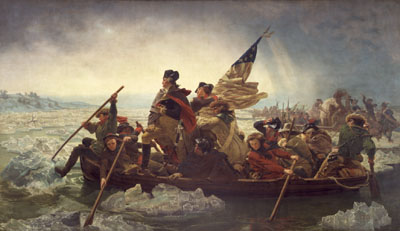
Now that I have finally bumped Don DeLillo's Underworld off the list, I've got more energy for other reading. And yesterday, on the trainride out to my Super Bowl party, I finished the biography of George Washington that I've been working on for a while.
I have read so many books about Adams and Jefferson, that I know their particular story by heart. I'm not as familiar with the actual WAR side of things, the strategies, the Valley Forge winter, a blow-by-blow of all the battles... It's great stuff. Really interesting. Baron von Steuben! Who wasn't a baron! But who knew his stuff, in terms of the military - so along he comes, and he whips the rag-tag army into shape, drilling them with military discipline, and battle field maneuvers - all of which ended up paying off quite nicely.
Also, so interesting: no one knew WHAT the President should "be" like in the beginning. Is he a king? What do they call him? Congress wrangled over this for days - so long that it became a joke, and the newspapers brutally pointed out that there were more pressing concerns for the infant nation than a 5-day long debate over whether the President should be called "Your Highness" or "Mr". John Adams, who thought the nomenclature of the President was of utmost importance, and spearheaded the long debate about it became a laughingstock (notes being passed back and forth in Congress, basically saying: "Jesus, John, this is not a big deal ... Please stop!"). Adams thought the President should be referred to as, "Your Highness, The President of the United States." (Later, when it was rumored that Adams was a secret monarchist, this innocent "Your Highness" suggestion of his would come back and bite him in the ass.) Somehow, the nonsensical debate ended, much to everyone's relief, and they just settled on the plainer more republican title "Mr. President".
Washington asked for lots of advice in terms of etiquette: should he not dine with private citizens? Should he hold dinners once a week and invite everyone, or just a select few? He got conflicting answers, of course - Hamilton thought he should act like a king, others thought he should behave like a regular citizen, etc. - and many of the precedents set by his administration remain traditions to this day. But it was all just trial and error in those beginning years.
Out of all of "those guys" (Jefferson, Adams, Franklin, etc etc) ... it seems to me that George Washington had the hardest time with the reality of living a public life. It seemed to have been an enormous sacrifice for him - more of a sacrifice than with the other founding father chaps. I get the sense that John Adams missed Abigail so much that it hurt, and he missed Braintree, and he romanticized wandering through his "turnip fields" at home during his long years away ... and yet I ALSO get the sense that John Adams NEEDED to be at the center of the debates, he NEEDED to be there. Any sacrifice was worth it. Abigail felt the same way, she talks about it all the time in her letters, sometimes with a positive outlook and sometimes a bit more melancholy. (There's one letter to her husband that always makes me feel like crying. She is having a rough time being apart from him, she misses him, the separation is too great, an ocean between them ... and she wonders if the generations to come will truly appreciate the sacrifices she has made in service of this country ... Whenever I read that mournful letter, I wish I could pop off a postcard to her in heaven, saying: "I APPRECIATE IT. THANK YOU!!")
But back to George: I get the sense that, for Washington, all of this was not as clear a choice. He was bitter from his long years of wrangling with Congress during the fighting of the actual war, he was worn out, exhausted from army life, his health broken down. The dude had dysentery like you wouldn't believe. He wanted to go HOME. Martha, by the second term, refused to leave Mount Vernon. She was getting old, and she had had it. Washington knew that the sacrifice he made was essential - and he knew this, somehow, without losing his humility. He knew he had become a symbol of the new nation, of its unity, as uncomfortable as that seemed to make him, and that as long as he was at the helm, the nation would remain united. The new nation would make it safely through the rough waters of the late 18th century.
Factions breaking out, political intrigues, Jefferson and Hamilton (2 cabinet members) refusing to cooperate with one another, Washington trying to maintain a middle course (even though he basically swung towards the Federalist side). But through all of this - after his long long years of service, of the long Revolutionary War - he just wanted to go HOME. He wanted to be on his farm, where he could go horse-riding every day, and oversee his land, and hang out with his grandkids (many of whom lived at Mount Vernon with him.) This was where his true heart resided.
And so, one of the overriding impressions I got from this biography was that -- Sorry to be all grandiose and stuff, but that this guy GAVE UP his private happiness for the public good. A public life did not suit him. He had too much homesickness, too much humility , not enough ambition for power ... and yet he spent the majority of his entire life away from Mount Vernon, dedicating himself to the liberty of the colonies.
And his letters, his private correspondence ... they are painful to read, at times. Especially as it became clear that he HAD to stay President for a second term. He HAD to. As much as his own concerns were calling, as much as his domestic happiness was threatened ... there was no way he could say no.
He basically gave his life to the cause.
And, of course, what that really means is: George Washington gave up his life for us .
Finally, I love this: what were Washington's last words?
"'Tis well."
I am pathetic
... and this weekend, my friend Alex completely busted me on my hidden pathetic-ness.
She calls me Saturday night. I am home. I've had a full day. You know. Laundry. Reading. Shopping. Cleaning. I took a long walk. I did a bit of cooking. Domestic concerns. By 8:30, 9 pm, I settle down in my chair, I burn some incense, I have a glass of wine, and I do what any NORMAL person would do under that circumstance.
I pop in Shallow Hal.
I love that movie. I was completely biased against it before I saw it, because I somehow thought the movie would be one big fat joke, and it's just not my cup of tea. No, thanks!!! Gwyneth feckin' Paltrow in a fat suit? Gimme a break. HOWEVER: when I finally saw it, I realized it's not about that at all. It's very funny, and actually kind of ... ehm ... emotional, by the end. (Please realize, though: I welled up with tears when I saw Blue Crush, mmkay? It don't take much with me.) I am also an enormous Jack Black fan. That guy'll win an Oscar someday. Watch him dealing with the little girl in the hospital near the end of the movie, and you'll see why! Also, come on. School of Rock. Love him. And I love Shallow Hal.
But I never really thought of what my behavior would look to an OUTSIDER. And so Alex calls in the middle of the movie. I'm getting a bit verklempt over some of the scenes (and also, let's not forget - laughing out loud at times) - I'm having a great old time. A perfect Saturday night, in my book. In my pathetic Loser book.
Alex calls. "Hey, how are you?" What's up, how are you, what's going on ... blah blah.
I say, "Hey! I'm just sitting here watching Shallow Hal."
Alex didn't respond immediately, and then she said, in a flat voice, "What?" She had refused to see the movie, too, thinking it would be one long ha-ha-look-at-the-fat-chick movie - and so I then launched into an impassioned (and, in retrospect, highly embarrassing) monologue, a vigorous defense of SHALLOW FECKIN' HAL, mmkay?, about how it WASN'T about that, and how Gwyneth Paltrow is GREAT in it, and how it has THIS deep level, and THAT deep level, and how it has THIS to say about THAT, and how Jack Black is AWESOME ...
Alex finally interrupts this and says bluntly, "What the hell are you doing home on a Saturday night watching SHALLOW HAL, FOR GOD'S SAKE???"
Yes. I am a loser.
But Alex and I roared with laughter about it. So that's cool.
We then proceeded to talk for hours (a re-cap of what we talked about is here) - we started laughing so loudly and so hard that my neighbors must be pissed off. (That's okay. I am paying them back for playing "We Don't Need No Education" on a continuous loop throughout the weekend)
By the way, speaking of Alex - she has a new series up - which you really do not want to miss.
She has just completed her latest series: The 100 Greatest Performances Ever Given. AWESOME. If you love movies, you NEED to read this series.
I might have to come up with a list of my own. Alex's Film Series are like candy or something - I can't get enough of them.
Great work, Alex!
Commercial thoughts
-- I hated the commercial with the frozen man. I DIDN'T GET IT, I didn't understand it - the plot, the product, the point - and whoah, nelly, I hate a commercial that makes me feel stupid.
-- I LOVED the one of the guy with the cat and the tomato sauce. Very funny.
-- The GoDaddy commercial was hilarious. "So what will you be doing, miss?" She stands up and gyrates around, all boobs, and says in a high voice, "I'd probably go like this ... and then like this ..." We laughed about it throughout the night.
-- I was sick of the P. Diddy commercial the FIRST time I saw it.
-- I very much liked the Thank You to our troops commercial - it was very well done. Soft, and very human, I thought. The slow-mo, the different faces ... it was underplayed, and I liked it a lot.
-- Uhm ... can someone please explain the stupid frozen man commercial to me?? DUMB.
-- Best commercial of the night? See below. No contest. See below.
Super Bowl Sunday
So first of all: Go, Pats! And yee-haw for the glory of being a fan of New England sports in the last couple of years! It's been quite a ride.
But ... the game last night (although yes, it ended in victory for us) somehow left me cold. They played very sloppily, choppily, I thought. It wasn't football on a grand scale ... it was Keystone Cops football. (At least for the first two quarters.) It didn't satisfy me. (And, of course, satisfying ME is what they should have been worried about!!)
One of the reasons why the broadcast didn't really work for me is basically HOW MUCH FOX SPORTS SUCKS. They should NOT be allowed to handle these massive events anymore. Who do I write a letter to? They drive me nuts. Uhm ... have you guys ever heard of instant replay? It's a little-known technology, true, but fans really seem to appreciate it.
There were times when you did do the REPLAY part of instant replay, but ... you didn't really master the INSTANT part of it.
You were too busy bragging about your stupid PYLON CAM to give us instant replays. All of us watching started BERATING the television when, in the 4th quarter, they started singing the praises of the stupid pylon cam, giving closeups of it, telling us how it works, showing us what the cam sees (basically, a glorious view of the players' ankles. Big whup.)
Dumb.
Just show us the game, mkay? When a play is made, give us INSTANT replay. And not just once. But a COUPLE times. This is standard operating procedure, guys. Also, in general, your camera angles suck. You're too concerned with being clever, and hi-tech, with swooping cameras up and down ... that there were times when we couldn't even tell where the ball was. SHOW US THE GAME. It's not about YOU. It's about the GAME.
I hate Fox Sports. They suck.
I watched the game last night at David and Maria's, with a bunch of friends. There was one lonely Eagles fan present. He could barely sit down for the entire game. He was pacing, and launching into random monologues about his team, standing right by the TV, pointing at this or that player. We tried to be sensitive, but ... well. You can't really be sensitive during the Super Bowl.
And I have to say, one of THE most thrilling things about the night - was that my friend David's Chase Bank commercial (not a national spot, mind you, but a local spot which is getting such intense play here that my friend David's face is EVERYWHERE) played at some point during the game. (Oh, and if I'm not mistaken - when David did a stint here blogging for me, he described his audition for the commercial. It's a nice story - and it's also cool, because they picked a bunch of actors to do different spots, and so far, HIS is the only one that's running.) In the commercial, David stands there, in a blue shirt, a yellow tie, on a sidewalk in New York, talking to the camera about how cool it is to have ATMs everywhere, and why Chase Bank is perfect. It's a great spot, and really highlights who David is. But anyway, there we all are, waiting out the commercial breaks - and boom - THERE IS DAVID. We all feckin' ERUPTED into cheers. David!! The biggest Patriots fan I know, besides my brother, having his commercial play DURING THE SUPER BOWL. The second the commercial ended, the phone started ringing. Friends in the area calling in: "Holy crap, I'm watching the Super Bowl and suddenly there is David!"
It was awesome. A perfect cap to an exciting night.
But what lingers in my mind? A couple things.
-- How the Patriots are a mind-blowing team.
-- How badly Fox sucks.
-- Oh, and how hot Tom Brady is. (But that's a given.)
The end.
Surviving Grady articulates what I wasn't able to here. Although the Patriots won, the game itself was very "very un-Patriot like. A lot of stupid (and costly) penalties. Poor tackling early on. A Brady fumble."
I have very exciting personal news
After long years of sweltering unhappily through single life, I have finally found a mate. He's awesome, he's everything I ever wanted, he's funny (read: HILARIOUS), and he also is DAMN handsome.
When you see the picture of him below, I know that you will congratulate me. Isn't he adorable??
Whoo-hoo for finding your soulmate!!
February 5, 2005
Snapshots
-- So I've got a big Super Bowl bash to go to tomorrow. Lots of fun. We're all Patriots fans.
-- Holy crapola: I FINISHED UNDERWORLD THIS MORNING. I DID IT. I started that novel in ... NOVEMBER? I have no idea. Let's just say: WAY TOO LONG AGO. And yes. The ending is quite moving, well-written, and actually kind of redemptive. However, I have this to say: The book does not add up. It just doesn't. The promise of the beginning is somehow diffused in the way over-written prose in the middle. I lost the plot. Oh well. But still. I was DETERMINED to finish it, and I did. Now. Onto another book.
-- I saw my sister Siobhan in a Eugene O'Neill festival last night. It was a festival of scenes from his plays, and she was in Touch of the Poet. A very very sad piece of writing. Siobhan was lovely, she had a soft brogue that sounded totally real ... and she had one moment when her husband says something cruel to her, and she flinched, her eyes filling with tears ... but then in the next second, she recovered, put on a brave smile. Lovely work.
-- It is spring here, all of a sudden. Balmy. Warm, soft air, warm wind. The snow melting. What?? Three days ago it was frigid. Schizo.
-- I watched some of Kate & Leopold early this morning. Just because it makes me feel good. I love that stupid sappy movie. I really do.
-- Off-line writing continuing on. I am hard at work. A busy bee.
-- Speaking of Eugene O'Neill, I am now going to be a "play-reader" for the Eugene O'Neill Theatre in Connecticut. What this means is: playwrights from all over submit new pieces of work to the O'Neill, in the hopes that the theatre will choose to do a production of it. The theatre is so well-renowned that they must get hundreds (if not thousands) of these submissions a year. A daunting task to read them all. So they need people to read the scripts for them, people who are, of course, qualified on SOME level to give educated feedback on whether or not these are good plays, what works, what doesn't work - and I start this week. 5 new plays are now shrieking towards my mailbox. I'm very excited to get to work.
"At first, I was deeply alarmed."
From "In Search of Schrodinger's Cat" -by John Gribbin - we're talking about atoms now. Other excerpts here and here and here and here. More on Heisenberg.
Now it starts to get really freaky - LOVE IT.
The story is often told of how Heisenberg was struck down by a severe bout of hayfever in May 1925, and went off to recuperate on the rocky island of Heligoland, where he painstakingly tackled the task of interpreting what was known about quantum behavior in these terms. With no distractions on the island, and his hayfever gone, Heisenberg was able to work intensively on the problem. In his autobiographical Physics and Beyond, he described his feelings as the numbers began to fall into place, and how at three o'clock one morning he "could no longer doubt the mathematical consistency and coherence of the kind of quantum mechanics to which my calculations pointed. At first, I was deeply alarmed. I had the feeling that, through the surface of atomic phenomena, I was looking at a strangely beautiful interior, and felt almost giddy at the thought that I now had to probe this wealth of mathematical structures nature had so generously spread out before me."
Note from me: That just gives me the chills, I tell ya!!
Returning to Gottingen, Heisenberg spent three weeks preparing his work in a form suitable for publication and sent a copy of the paper first to his old friend Pauli, asking if he thought it made sense. Pauli was enthusiastic, but Heisenberg was exhausted by his efforts and not yet sure that the work was ready for publication. He left the paper with Born to dispose of as he felt appropriate, and departed, in July 1925, to give a series of lectures in Leyden and Cambridge. Ironically, he did not choose to speak about his new work to the audiences there, who had to wait for news to reach them by other channels.
Born was happy enough to send Heisenberg's paper off to the Zeitschrift fur Physik, and almost immediately realized what it was that Heisenberg had stumbled upon. The mathematics involving two states of an atom couldn't be dealt with by ordinary numbers, but involved arrays of numbers, which Heisenberg had thought of as tables. The best analogy is with a chessboard. [There are a bunch of diagrams in the book right around here, showing what the HELL is going on - chessboards, basically, numbered, and lettered. We will carry on. Hopefully the diagrams will not be necessary.]
There are 64 squares on the board, and in this case you could identify each square by one number, in the range of 1 to 64. However, chess players prefer to use a notation that labels the "columns" of squares across the board by the letters a, b, c, d, e, f, g, and h, with the "rows" numbered up the board 1, 2, 3, 4, 5, 6, 7, 8. Now, each square on the board can be identified by a unique pair of identifying labels: a1 is the home square of a rook, g2 is the home square of a knight's pawn, and so on.
Heisenberg's tables, like a chess board, involved two-dimensional arrays of numbers, because he was doing calculations involving two states and their interactions. Those calculations involved, among other things, multiplying two such sets of numbers, or arrays, together, and Heisenberg had laboriously worked out the right mathematical tricks to do the job. But he had come up with a very curious result, so puzlling that it was one of the reasons for his diffidence about publishing his calculations. When two of these arrays are multiplied together, the "answer" you get depends on the order in which you do the multiplication.
This is strange indeed. It is as if 2 x 3 is not the same as 3 x 2, or in algebraic terms a x b does not equal b x a.
Born worried at this peculiarity day and night, convinced that something fundamental lay behind it. Suddenly, he saw the light. The mathematical arrays and tables of numbers, so laboriously constructed by Heisenberg, were already known in mathematics. A whole calculus of such numbers existed; they were called matrices, and Born had studied them in the early years of the 20th century, when he was a student in Breslau. It isn't really surprising that he should have remembered this obscure branch of mathematics more than 20 years later, for there is one fundamental property of matrices that always makes a deep impression on students when they first learn of it -- the answer you get when you multiply matrices depends on the order in which you do the multiplying, or in mathematical language, matrices do not commute.
Heisenberg's breakthrough
From "In Search of Schrodinger's Cat" -by John Gribbin - we're talking about atoms now. Other excerpts here and here and here. The following excerpt is about Werner Heisenberg, and honestly:
I barely know WHAT is going on here, really, but I can tell that it is FASCINATING. Actually, I'm exaggerating. I know what is going on here, it's just that I could never summarize it or try to talk about it without sounding like a blundering idiot. All I can do is just follow along, try to keep up. I love this stuff.
Werner Heisenberg was born in Wurzburg on 5 December 1901. In 1920 he entered the University of Munich, where he studied physics under Arnold Sommerfeld, one of the leading physicists of the time who had been closely involved with the development of the Bohr model of the atom. Heisenberg was plunged straight into research on quantum theory, and set the task of finding quantum numbers that could explain some of the splitting of spectral lines into pairs, or doublets. He found the answer in a couple of weeks -- the whole pattern could be explained in terms of half-integer quantum numbers. [Uhm ... okay. I THINK I get that.] The young, unprejudiced student had found the simplest solution to the problem, but his colleagues and his supervisor Sommerfeld were horrified. To Sommerfeld, steeped in the Bohr model, integral quantum numbers were established doctrine, and the young student's speculations were quickly quashed. The fear among the experts was that by introducing half integers into the equations they would open the door to quarter integers, then eighths and sixteenths, destroying the fundamental basis of quantum theory. But they were wrong.
Within a few months, the older and more senior physicist Alfred Lande came up with the same idea and published it; it later turned out that half-integer quantum numbers are crucially important in the full quantum theory, [Uhm, okay, if you say so ...], and play a key role in describing the property of electrons called spin. Objects that have integer or zero spin, like photons, obey the Bose-Einstein statistics, while those that have half-integer spin (1/2 or 3/2, and so on) obey the Fermi-Dirac statistics ... [Then follows a bunch of math, which I don't feel up to typing.]
So Heisenberg missed a chance for credit for a new idea in quantum theory; but the point of the story is that just as it took young men in the previous generation to develop the first quantum theory, so in the 1920s it was time again for young minds unencumbered by ideas that "everyone knows" must be right to take the next step forward. Heisenberg certainly made up for missing out on one minor scientific "first" with his work over the next few years.
After a team working in Gottingen under Born, where he had attended the famous "Bohr festival", Heisenberg returned to Munich and completed his PhD in 1923 -- still not quite 22 years old. At that time, Wolfgang Pauli, a close friend of Heisenberg's, equally precocious and another former student of Sommerfeld's, was just moving on from a spell as Born's assistant in Gottingen, and Heisenberg took over the post in 1924. It was a job that gave him the opportunity to work for several months with Bohr in Copenhagen, and by 1925 the precocious mathematical physicist was better equipped than anyone to find the logical quantum theory that every physicist expected to be found eventually, but no one expected to find so soon.
Heisenberg's breakthrough was founded on an idea he picked up from the Gottingen group -- nobody now is quite sure who suggested it first -- that a physical theory should only be concerned with things that can actually be observed by experiments. This sounds trite, but it is actually a very deep insight. An experiment that "observes" electrons in atoms, for example, doesn't show us a picture of little hard balls orbiting around the nucleus -- there is no way to observe the orbit, and the evidence from spectral lines tell sus what happens to electrons when they move from one energy state (or orbit, in Bohr's language) to another. All of the observable features of electrons and atoms deal with two states, and the concept of an orbit is something tacked on to the observations by analogy with the way things move in our everyday world ... Heisenberg stripped away the clutter of the everyday analogies, and worked intensively on the mathematics that described not one "state" of an atom or electron, but the associations between pairs of states.
This all seems very very cool. More on Heisenberg in the next excerpt.
a lone voice crying in the wilderness ...
From "In Search of Schrodinger's Cat" -by John Gribbin - we're talking about atoms now. Other excerpts here and here.
This excerpt is about 1905, and the groundbreaking papers Einstein published in that year.
This paper was just one of three published by Einstein in the same volume of the Annalen der Physik in 1905, any one of which would have assured him of a place in the annals of science. One of the papers introduced the special theory of relativity and is largely outside the scope of the present book; another concerned the interaction of light with electrons and was later recognized as the first scientific work dealing with what we now call quantum mechanics -- it was for this work that Einstein received the Nobel Prize in 1921. The third paper was a deceptively simple explanation of a puzzle that had baffled scientists since 1827 -- an explanation that established, as far as any theoretical paper ever could, the reality of atoms.
Einstein later said that his major aim at that time was "to find facts which would guarantee as much as possible the existence of atoms of finite size," an aim that perhaps indicates the importance of the work at the beginning of the present century. At the time these papers were published, Einstein was working as a patent examiner in Berne -- his unconventional approach to physics had not made him an obvious candidate for an academic post when he completed his formal education, and the patent office job suited him. His logical mind proved well able to sort out the wheat of new inventions from the chaff, and his skill at the job left him plenty of free time in which to think about physics, even during office hours. Some of his thoughts concerned the discoveries made by the British botanist Thomas Brown almost eighty years before. Brown noticed that when a pollen grain floating in a drop of water is examined using a microscope it is seen to bounce around in an irregular fashion, moving in a random pattern that is now called Brownian motion. Einstein showed that this motion, although random, obeys a definite statistical law, and that the pattern of behavior is exactly what should be expected if the pollen grain is being repeatedly "kicked" by unseen, submicroscopic particles that move in accordance with the statistics used by Boltzmann and Maxwell to desscribe the way atoms move in a gas or liquid. It looks so obvious today that it is hard to credit what a breakthrough this paper made. You or I, used to the idea of atoms, can see at once that if pollen grains are being jostled by unseen collisions then it must be moving atoms that push them around. But before Einstein made the point, respected scientists could still find room to doubt the reality of atoms; after his paper appeared, there was no longer room to doubt. Easy when explained, like the fall of an apple from a tree, but if it was so obvious why had it not been appreciated in the previous eight decades?
It's ironic that this scientific paper should have been published in German (in the journal Annalen der Physik), because it was the opposition of leading German-speaking scientists such as Ernst Mach and Wilhelm Ostwald that seems to have convinced [Ludwig] Boltzmann that his was a lone voice crying in the wildnerness. In fact, by the beginning of the 20th century there was a great deal of evidence for the reality of atoms, even if, strictly speaking, that evidence could only be described as circumstantial.
Heat is a form of motion ...
From "In Search of Schrodinger's Cat" -by John Gribbin - a continuation of the excerpt below
During the 1860s and 1870s these pioneers developed the idea that a gas is made up of very many atoms or molecules (the number derived from Avogadro's hypothesis gives you some idea how many), which can be thought of as tiny, hard spheres that bounce around, colliding with one another and with the walls of the container that holds the gas. This related directly to the idea that heat is a form of motion -- when a gas is heated, the molecules move faster, which increases the pressure on the walls of the container, and if the walls are not fixed in place, the gas will expand. The key feature of these new ideas was that the behavior of a gas could be explained by applying the laws of mechanics -- Newton's laws -- in a statistical sense to a very large number of atoms or molecules. Any one molecule might be moving in any direction in the gas at any time, but the combined effect of many molecules colliding with the walls of the container each second produces a steady pressure. This led to the development of a mathematical description of gas processes called statistical mechanics. But still there was no direct proof that atoms existed; some leading physicists of the time argued strongly against the atomic hypothesis, and even in the 1890s [Ludwig] Boltzmann felt himself (perhaps mistakenly) to be an individual struggling against the tide of scientific opinion. In 1898, he published his detailed calculations in the hope "that, when the theory of gases is again revived, not too much will have to be rediscovered"; in 1906, ill and depressed, unhappy about the continuing opposition of many leading scientists to this kinetic theory of gases, he killed himself, unaware that a few months before an obscure theorist called Albert Einstein had published a paper that established the reality of atoms beyond reasonable doubt.
Stay tuned!! More to come! God, I'm a geek. Oh well.
"The only existing things are atoms and empty space; all else is mere opinion."
From "In Search of Schrodinger's Cat" -by John Gribbin.
The book begins with a discussion of the atom theory of matter, and its development
Many popular accounts of the history of science say that the idea of atoms goes back to the ancient Greeks, a time of the birth of science, and go on to praise the ancients for their early perception of the true nature of matter. But this account is a bit of an exaggeration. It is true that Democritus of Abdera, who died sometime close to 370 BC, did propose that the complex nature of the world could be explained if all things were composed of different kinds of unchangeable atoms, each type with its own shape and size, in constant motion. "The only existing things are atoms and empty space; all else is mere opinion," he wrote, and later Epicurius of Samos and the Roman Lucretius-Carus adopted the idea. But it was not in those days the front-runner among theories to account for the nature of the world, and Aristotle's suggestion that everything in the universe is made up from the four "elements" fire, earth, air, and water proved much more popular and enduring. While the idea of atoms was largely forgotten by the time of Christ, Aristotle's four elements were accepted for two thousand years.
Although the Englishman Robert Boyle used the concept of atoms in his work on chemistry in the 17th century, and Newton had it in mind in his work on physics and optics, atoms only really became a part of scientific thought in the latter part of the 18th century when the French chemist Antoine Lavoisier investigated why things burn. Lavoisier identified many real elements, pure chemical substances that cannot be separated into other chemical substances, and he realized that burning is simply the process by which oxygen from the air combines with other elements. In the early years of the 19th century John Dalton put the role of atoms in chemistry on a secure footing. he stated that matter is made up of atoms, which are themselves indivisible; that all the atoms of one element are identical, but that different elements have different kinds of atoms (different sizes or shapes); that atoms cannot be created or destroyed, but are rearranged by chemical reactions; and that a chemical compound, made from two or more elements, is composed of molecules, each of which has a small, fixed number of atoms from each of the elements in the compound. So the atomic concept of the material world really came into being, in the form that is taught in textbooks today, less than two hundred years ago.
Schrodinger and stuff like that.
This morning, I picked up a book that I love: In Search of Schrodinger's Cat, by John Gribbin, and started flipping through it. It's one of those books I dip into, time and again, to either refresh my memory, or try to understand again ... It's a lovely book. I am not a scientist, and I do not have a scientific background AT ALL, but I have a lot of interest in it (maybe I should say childlike wonder and fascination ... that's where I'm at with it ... I'm still like a kid asking "why is the sky blue??") - and this book, In Search of Schrodinger's Cat was a JOY to read. I ADORED it. There were times when I felt like I actually understood, like I could get in there - between the cracks - (without squinting so hard my eyelids disappeared, I mean). Much of the math goes over my head. However the book is filled with diagrams and pictures - illustrating the theories, making the mathematical equations visible in really creative ways. I find this enormously useful, and am grateful to Gribbin for this book. I love it.
Einstein's been everywhere these days, due to the 100th anniversary of E=mc2 and all that ... so I thought I'd post some excerpts from the book, just for fun.
I've got a lot of science geeks out there, I know. So you guys can discuss the excerpts amongst yourselves ... I'm not posting them for any other reason than I find them really interesting and thought-provoking.
Onward! Into the netherword of Schrodinger's dead-but-not-dead cat!!
February 4, 2005
2nd letter - Jan. 11 1816
And here is Thomas Jefferson's reply to John Adams' letter below.
In these two letters, we can see the character of the entire correspondence. The letters illuminate the differences in philosophy between Adams and Jefferson. In some ways, they illuminate the irreconcilable differences. However - overriding all of this is mutal respect and cordiality. They were both in process. They were both trying to figure stuff out and they came to different conclusions. When they used to be active politically, these different conclusions caused much strife. But once retired they were free to discuss all of these issues at length, with no object but to illuminate and explain their point of view to the other. (In 1813 John Adams wrote a letter to Jefferson which is still rightly famous - and in it he said: "You and I ought not to die before We have explained ourselves to each other." Gulp. So moving.)
And so that's what they did. Over the next 13 years, they wrote letter after letter, trying to "explain" themselves "to each other". The letters only stopped when they died (er - on the same feckin' day, mkay? Also - ehm ... it was July 4. Mmkay? Also, it was the 50th anniversary of 1776. Mmkay? I mean, you just could not make this shit up!! No one would believe it!)
Enough preamble. Here is Jefferson's reply to John Adams' letter.
THOMAS JEFFERSON to JOHN ADAMS
Monticello Jan. 11 1816
...
I agree with you in all it's eulogies on the 18th century. It certainly witnessed the sciences and arts, manners and morals, advanced to a higher degree than the world had ever before seen. And might we not go back to the aera of the Borgias, by which time the barbarous ages had reduced national morality to it's lowest point of depravity, and observe that the arts and sciences, rising from that point, advanced gradually thro' all the 16th. 17th. and 18th. centuries, softening and correcting the manners and moral of man? I think too we may add, to the great honor of science and the arts, that their natural effect is, by illuminating public opinion, to erect it into a Censor, before which the most exalted tremble for their future, as well as present fame.
With some exceptions only, through the 17th. and 18th. centuries morality occupied an honorable chapter in the political code of nations. You must have observed while in Europe, as I thought I did, that those who administered the governments of the greater powers at least, had a respect to faith, and considered the dignity of their government as involved in it's integrity. A wound indeed was inflicted on this character of honor in the 18th. century by the partition of Poland. But this was the atrocity of a barbarous government chiefly, in conjunction with a smaller one still scrambling to become great, while one only of these already great, and having character to lose, descended to the baseness of an accomplice in the crime. [Note: Poland was partitioned by Austria, Russia, and Prussia in 1773, 1793, and 1795.]
France, England, Spain shared in it only inasmuch as they stood aloof and permitted it's perpetration. How then has it happened that these nations, France especially and England, so great, so dignified, so distinguished by science and the arts, plunged at once into all the depths of human enormity, threw off suddenly and openly all the restraints of morality, all sensation to character, and unblushingly avowed and acted on the principle that power was right? Can this sudden apostacy from national rectitude be accounted for?
The treaty of Pilnitz [Prussia agreed to take common action against any attack by the French ... this treaty in 1791 was the basis for the first coalition against France] seems to have begun it, suggested perhaps by the baneful precedent of Poland. Was it from the terror of monarchs, alarmed at the light returning on them from the West, and kindling a Volcano under their thrones? Was it a combination to extinguish that light, and to bring back, as their best auxiliaries, those enumerated by you, the Sorbonne, the Inquisition, the Index expurgatorius, and the knights of Loyola?
Whatever it was, the close of the century saw the moral world thrown back again to the age of the Borgias, to the point from which it had departed 300. years before. France, after crushing and punishing the conspiracy of Pilnitz, went herself deeper and deeper into the crimes she has been chastising. I say France, and not Bonaparte; for altho' he was the head and mouth, the nation furnished the hands which executed his enormities. England, altho' in opposition, kept full pace with France, not indeed by the manly force of her own arms, but by oppressing the weak, and bribing the strong. At length the whole choir joined and divided the weaker nations among them.
Your prophecies to Dr. Price proved truer than mine [This is a reference to Adams making dire predictions about which way the French revolution was going to go - not a popular view at the time. Adams sensed impending disaster and carnage, and Jefferson thought that "the blood of patriots and tyrants" were needed to water "the tree of liberty". Adams predicted to Dr. Price, in a letter, that a million people would eventually die.]; and yet fell short of the fact, for instead of a million, the destruction of 8 or 10 millions of human beings has probably been the effect of these convulsions. I did not, in 89. believe they would have lasted so long, nor have cost so much blood. But altho' your prophecy has proved true so far, I hope it does not preclude a better final result. That same light from our West seems to have spread and illuminated the very engines employed to extinguish it. It has given them a glimmering of their rights and their power. The idea of representative government has taken root and growth among them. Their masters feel it, and are saving themselves by timely offers of this modification of their own powers. Belgium, Prussia, Poland, Lombardy etc. are now offered a representative organization: illusive probably at first, but it will grow into power in the end. Opinion is power, and that opinion will come.
Even France will attain representative government. You observe it makes the basis of every constitution which has been demanded or offered: of that demanded by their Senate; of that offered by Bonaparte; and of that granted by Louis XVIII. The idea then is rooted, and will be established, altho' rivers of blood may yet flow between them and their object. The allied armies now couching upon them are first to be destroyed, and destroyed they will surely be. A nation united can never be conquered.
We have seen what the ignorant bigotted and unarmed Spaniards could do against the disciplined veterans of their invaders. What then may we not expect from the power and character of the French nation? The oppressors may cut off heads after heads, but like those of the Hydra, they multiply at every stroke. The recruits within a nation's own limits are prompt and without number; while those of their invaders from a distance are slow, limited, and must come to an end.
I think too we perceive that all these allies do not see the same interest in the annihilation of the power of France. There are certainly some symptoms of foresight in Alexander that France might produce a salutary diversion of force were Austria and Prussia to become her enemies. France too is the natural ally of the Turk, as having no interfering interests, and might be useful in neutralizing and perhaps turning that power on Austria. That a re-acting jealousy too exists with Austria and Prussia I think their late strict alliance indicates; and I should not wonder if Spain should discover a sympathy with them. Italy is so divided as to be nothing.
Here then we see new coalitions in embrio which after France shall in turn have suffered a just punishment for her crimes, will not only raise her from the earth on which she is prostrate, but give her an opportunity to establish a government of as much liberty as she can bear, enough to ensure her happiness and prosperity. When insurrection begins, be it where it will, all the partitioned countries will rush to arms, and Europe again become an Arena of gladiators. And what is the definite object they will propose? A restoration of the status quo prius, of the state of possession of 89.
I see no other principle on which Europe can ever again settle down in lasting peace. I hope your prophecies will go thus far, as my wishes do, and that they, like the former, will prove to have been the sober dictates of a superior understanding, and a sound calculation of effects from causes well understood.
There's so much I want to comment on. The writing itself (love "the Censor" image, and I particularly love this sentence/image: "the terror of monarchs, alarmed at the light returning on them from the West, and kindling a Volcano under their thrones?" ... The letter is a masterpiece of Jeffersonian abstraction: good vs. evil, light vs. dark ... all that stuff he loved. But anyway - I'll refrain from commenting too much. At least for now. I just love that letter.
1st letter - Nov. 13 1815
JOHN ADAMS to THOMAS JEFFERSON
Quincy Nov. 13 1815
Dear Sir
The fund[a]mental Article of my political Creed is, that Despotism, or unlimited Sovereignty, or absolute Power is the same in a Majority of a popular Assembly, an Aristocratical Counsel, an Oligarchical Junto and a single Emperor. Equally arbitrary cruel bloody and in every respect diabolical.
Accordingly arbitrary Power, wherever it has resided, has never failed to destroy all the records Memorials and Histories of former times which it did not like and to corrupt and interpolate such as it was cunning enough to preserve or to tolerate. We cannot therefore say with much confidence, what Knowledge or what Virtues may have prevailed in some former Ages in some quarters of the World.
Nevertheless, according to the few lights that remain to Us, We may say that the Eighteenth Century, notwithstanding all its Errors and Vices has been, of all that are past, the most honourable to human Nature. Knowledge and Virtues were increased and diffused, Arts, Sciences useful to Men, ameliorating their condition, were improved, more than in any former equal Period.
But, what are We to say now? Is the Nineteenth Century to be a contrast to the Eighteenth? Is it to extinguish all the Lights of its Predecessor? Are the Sorbonne, the Inquisition, the Index expurgatorius, and the Knights Errant of St Ignatius Loyola to be revived and restored to all their salutary Powers of supporting and propagating the mild Spirit of Christianity? The Proceedings of the Allies and their Congress at Vienna, the Accounts from Spain France etc the Chateaubriands and the Genlis, indicate which Way the Wind blows. The Priests are at their Old Work again. The Protestants are denounced and another St Bartholomew's day, threatened.
This however, will probably, 25 Years hence, be honoured with the Character of "the effusions of a splenetic mind, rather than as the sober reflections of an unbiassed Understanding."
[Note: John Adams is making a joke here. A book had just come out which included some of Adams' private letters - used without his permission. And after one of the letters, which had to do with the convulsions going on in Europe at the time, the author of the book characterized Adams' thought process as "the effusions of a splenetic mind, rather than as the sober reflections of an unbiassed Understanding". Adams continuously made jokes from there on out about his "splenetic mind" and its "effusions".]
Additional note from Sheila: I will be posting Thomas Jefferson's EXTRAORDINARY response to John Adams' letter shortly.
Some context for the Adams-Jefferson letters of 1815
Oops ... before I post the two letters ... just a bit of context. It's always important to get the context of the times.
The letters are from late 1815. So: a couple things swirling around in the world at that time
-- The aftermath of the war of 1812.
-- Adams and Jefferson watched the meteoric rise of Napoleon with horror. (Jefferson had been a big fan of the French revolution, Adams had been horrified by it ... but they both were horrified by the tyranny of Napoleon. Jefferson called him 'the Attila of the age')
-- March to June 1815: The Hundred Days. (the end of the Napoleonic regime, the last chapter, as it were)
-- But, let us add this in to the mix: Jefferson and Adams, now old men, wondered to one another: who was the greater tyrant, John Bull or this new tyrannical France? They hashed it out. Their anti-British feelings are still strong ... and yet the two of them know, somehow, that the fortunes of the United States will be forever tied with the fortunes of that original parent nation. (I read about this this morning and thought of Emily, Bill and myself toasting Tony Blair the first time we all met, clinking our beer glasses together. Ha!)
These events are, collectively, center stage for Adams and Jefferson at this time. They are their current-day concerns. On a more uber level, they wonder: have the advances from the 18th century in political/moral theory and man's enlightenment all been swept away? Is it so easy to regress, did all you and I worked for mean nothing?
Pertinent questions to them in their day, and, I believe, still pertinent to us in ours.
Dear Matt Margolis:
Wow. What a stupid apology. Thanks for sharing it so I can fully revel in your idiocy.
My favorite excerpt?
"I informed Jordan Golson, who offered to handle the situation. I was clearly wrong in asking him to take any action on my behalf."
Your little henchman, huh? Set him out to attack the 13 year old?
I am sure that, in your vanity, you have no idea how RIDICULOUS you sound. Vanity usually doesn't realize how stupid it looks to outsiders.
I have to copy your words again, just to revel in the absurdity.
"I informed Jordan Golson, who offered to handle the situation."
Dude: I wish I could be more articulate, but I can't. Your hubris and vanity is such that all I can say is: that is so LAME!!
I wish you were on my blogroll so I could take you off in a big display of sound and fury.
Funny, though ... I never saw fit to put you guys on my blogroll in the first place. Hm. Interesting.
Matt, in contrast to - uhm - YOU, I would like you to read Austin's most recent post on the situation. He's got more grace, more maturity, than you'll ever have.
RIP Ossie Davis
I just came across the very sad news that Ossie Davis was found dead in a hotel in Miami. He was down there, age 87, shooting a film.
His credits are too long to list. He has been working, pretty much non-stop, since the 1930s. Originally, he wanted to be a playwright, but once he hooked up with the famous Rose McClendon Players in Harlem, and did his first play with them in 1939 (they were a hugely influential group at the time) - he was hooked.
Also known as the long-time husband and acting partner (a la Jessica Tandy and Hume Cronyn) of Ruby Dee ... the two of them have written a book together about their long marriage, and celebrated their 50th wedding anniversary in 1998. It has been an amazing collaboration, in every sense of the word.
I remember them from Roots, actually ... but that's just a tiny portion of what Ossie Davis has done.
Spike Lee always cast both of them in his films (member Do the Right Thing?? What a feckin' film THAT was. I still remember my conversations with my mother about that movie, and what it meant ... great movie)...
But I think my favorite scene involving Ossie Davis is a very small one - from Jungle Fever - when his crack-head insane son (played by Samuel Jackson) comes home, and is acting nuts, and wanting money, and wanting help ... and Ossie Davis and Ruby Dee must, in order to save their son, reject him. It's an incredible scene. Anyone remember it? Sam Jackson, cracked-up out of his mind, starts doing this nutso dance, RIGHT AT HIS FATHER, he calls it "the Gator dance" (the character's name is Gator) ... but it's all about rage, and anger. The dance is a "fuck you". And Ossie Davis, as the father, stands strong. But watch Davis' face, as Sam Jackson gyrates towards him. Watch what he's doing. It's not just a stoic: "I cannot help my son. He needs to stand on his own." although that is PART of his expression. The other thing you see on his face is deep awful grief, GRIEF that burns his soul, that he must reject his own son. That he must, in essence, let Gator die. He can no longer protect his son. He will have to face losing him. A terrible terrible choice. Many parents will coddle their children, regardless of their drug addiction, they will want to save their kids ... Ossie Davis' character has gone that route for too long. He has propped up his son, which has only helped the crack addiction flourish. And so now ... he must cut the cord. A terrible choice - and it's all on Ossie Davis' face.
Ossie Davis doesn't even have many lines in this scene ... but it's the FACE ... that beautiful strong grief-struck angry face that kills me, as he watches his son dance towards him ...
A great actor. My thoughts go out to Ruby Dee.
Warning: The first person who makes some comment about how they hate his political views will have their comment deleted. This is not the time or the place, and I don't want to hear it.
This post is an acknowledgement of the man, the artist, the actor. His work will be long remembered.
Here is a photo of Ossie Davis and Ruby Dee at the 2004 Kennedy Center Honors - where they were among the list of artists being honored. Very very cool.

RIP, Mr. Davis, and thank you for your long long career.
Surly etiquette
Read this exchange on Overheard in New York. I have to hold myself back from linking to every single one of these "snippets" - they all strike me as so amusing.
But this one in particular is hilarious. "Who interprets the floor as a garbage can?" hahahaha
Anyway, this snippet made me think:
It is proof of a little theory that I have - one that I can't really prove, but that I see ALL AROUND ME here in New York City.
New Yorkers obviously have a reputation for being rude and surly. (I've met more rude and surly people out in "the provinces" but that's neither here nor there. The reputation of Manhattan-ites stands.) We have a reputation for being loud, obnoxious, surly, and downright frightening at times.
I think there's something deeper going on, though, beneath the surliness. And what that is is: an obsession with ORDER. An obsession with good manners. An obsession with COOPERATION. People are OBSESSED by these things here, and small breaches of etiquette can make people go off the deep end.
A tourist coming here will probably not perceive the subtext of the rudeness - they'll only think: "Holy God, why is that crazy person SCREAMING at me?"
People CONSTANTLY upbraid one another for breaches of etiquette here. It's like we're one enormous family in that: mom and dad are not the ONLY people who discipline you. If you misbehave at a family gathering, an aunt, or an uncle, or a grandparent also has FULL punishment rights. You are up for grabs. New Yorkers are like that. We are all aunts and uncles, punishing the nieces and nephews. We work together in this regard. Like: God help you if you cut in line at the bank. You will be openly reprimanded by 5 people at the same time. NO ONE puts up with that stuff.
So ... in a weird way ... we are more obsessed with politeness and etiquette here than in other places (places that don't have surly reputations), and we have no problem, as a population, correcting those who don't play by the rules.
I think it's because there are so many of us, we are constantly on top of each other, we are ALWAYS in a crowd ... and so "etiquette" becomes reeeeeeallly important.
You should NEVER "cut" in line.
Like that "overheard moment" - if you openly litter, chances are SOMEONE will say something to you.
If you grab a cab, cutting off a group of people who OBVIOUSLY were there first, you should expect to be abused.
Because it's New York, this abuse will probably be filled with profanity and rage. And yet the POINT of the abuse is actually on a Miss Manners level of society: Mind your manners. Respect the space of others. Be aware of the rights of others. Don't push yourself in where you are not wanted.
It may not seem like etiquette, because of the overlay of surliness, but I assure you: the underlying concern in all of the surly insulting is good manners, the golden rule, and basic etiquette. Which actually, when you think about it, is really quite amusing.
My quest is for truth
This is made even MORE difficult when the media has dueling headlines. It is enough to drive a quest-er like myself into despair.
For example, as I strolled through Port Authority this morning, my eye was caught by a magazine display. Two side by side magazines screamed their headlines at me.
They were:
Star Magazine: JEN FIGHTS TO GET BRAD BACK
and
Us Weekly: BRAD WANTS JEN BACK
Now I honestly do not know what to DO with that!!! How on earth can I find out the truth with conflicting side-by-side headlines? I lie awake at night ... agonizing ...
February 3, 2005
Hope for humanity
I keep forgetting to tell this story, and last Saturday, at my cousin Liam's karaoke EXTRAVAGANZA, he and I got into this enormous Queen discussion: how much we love Queen, why we love Queen, what is special about Queen, how we like "classic" Queen, as opposed to their newer stuff ... we are both passionate about Queen. I've been passionate about Queen since I was a kid. They are probably one of my all-time favorite bands ever.
Anyway, I have a story to tell about Queen which should provide a glimmer of hope for humanity. So shines a good Queen in a naughty world, and all of that.
Music lovers? Listen up. This is really cool.
Last year, I went into the big Barnes & Noble on 22nd and 6th. Why? To buy me some Queen. I am so behind in technology that a lot of my Queen is still on CASSETTES, and they are now garbled and messed-up, due to almost constant listening. Needed to go get me some brand new classic Queen!
So I go into the Barnes and Noble music section, and go to the "Rock" area, and ... ehm ... no Queen. Nothing. Not even an empty slot for them. Nothing. This is an enormous music store by the way. They have an extensive collection of Peruvian drum circle CDs. They have Charlotte Church up the wazoo. They also have every Christina Aguilera recording known to man. They have CDs of Polish music, Inuit music, Irish music, Russian music, Serbo-Croatian music, world music ... you name it - it has a section. "Inuit Top 40 - right this way!"
But no Queen.
This knowledge took a while to sink in. And it actually kind of hurt my heart. No Queen? So soon we forget the giants of "the past"? So soon we throw out the old to replace it with the new? Can't we at least ACKNOWLEDGE how important Queen was? Can't we still buy their CDs? Must we trash our own history?
I sat there, over the Q section, being all existential and meaningful. To myself. Being all sad that Queen is already forgotten.
I sadly go up to the cashier. I try not to be angry beforehand. It's not the cashier's fault that we tear down our music history!
I say to him, "Hi there ... am I insane ... or do you not have any Queen? It has to be in the Rock section ... but ... I just can't find it!"
Cashier boy says, "Oh, we keep all the Queen stuff behind the counter. You have to request it."
Uhm ... huh?
He says it so casually, so openly, that I say, "Why?"
Cashier boy says, "There are a couple of bands which we discovered were really high risks for shop-lifting, and we were constantly apprehending people trying to sneak out with them. So you have to request certain bands from us. We won't keep Queen on the shelves."
My existential sadness had turned to manic frenzied joy. Queen is a high risk for shoplifting? You have to request it????
I say, laughing, "What other bands?"
And heaven and saints be praised, cashier boy says, "U2 and the Beatles."
I don't know. I just found that so cool. U2, the Beatles, and Queen. Hidden behind the shelves at Barnes and Noble. Precious booty, always and forever!
Speaking of bad reviews:
I need to start compiling these deliciously worded insulting reviews.
One of the worst plays I have ever been in (described here in excruciating detail) was a musical version of Three Men in a Boat ... Never have had I had such shame onstage. My friend Jackie refers to such shame as "white-hot shame". Very different from your ordinary run-of-the-mill shame when you spill a drink in public, or trip in front of a group of people. Being in a bomb of a show has its SPECIAL brand of shame, which is "white-hot". I would openly laugh at the play and my fellow actors WHILE I WAS IN IT, WHILE I WAS UP THERE. I did not care. All I cared about was cooling off that white-hot shame. It was ba-a-a-a-ad.
And the first sentence of one of the reviews was: "Not since the Titanic has there been such a nautical disaster."
Now. It SUCKS to be in a bomb. But still. There's something weirdly cool about being in such a bomb, and having such a TERRIBLE review.
All of this was brought on by the following quote, sent to me by my dad. It's a doozy. Here's the setup:
British actor Ralph Richardson was performing in Graham Greene's play Carving a Statue. Graham Greene saw the performance. And then wrote Richardson a letter. In the letter was the following sentence:
Alas, you fancy yourself as a literary man, and as I have as little faith in your literary ability as in your capacity to judge a play, I have found you--not for the first time--incapable of understanding even your own part.
Bad review - with a bit of a redhead ramble preamble
A new Broadway show just opened. It is called Good Vibrations and it is made up entirely of Beach Boys songs. I believe that the curly-headed runner-up guy in the first American Idol was originally slotted to be in it, but, due to mysterious reasons, backed out.
So. Its a Beach Boys musical.
There is a precedent for this show being a success, by the way: the whopping cash cow that is Mamma Mia - but apparently Good Vibrations is not, ahem, going down that path. The reviews just coming in ...
Now Mamma Mia - I remember the buzz through New York about it before it opened. Like: what? A musical of Abba songs? That is so silly. So STUPID. No way will that fly.
Well, that show opened in 2001 and it is STILL running.
I haven't seen Mamma Mia, so I can't judge it - but I believe that when it opened (right after September 11) has a lot to do with its thundering success. I wrote a long heartfelt piece about it ... it's called The Man with the Dusty Gray Boots. The post goes all OVER the place - but I think it might be one of the most open tender pieces I've ever written. It's about Broadway shows ... but then it's NOT.
Not to mention the fact that I will never, as long as I live, forget the face of the man in the dusty gray boots. Ever. I still get random letters from firemen who stumble over that post.
Back to Mamma Mia: I saved Ben Brantley's review ... because it seemed almost historical, something written directly in the wake of this catastrophe ... a theatre reviewer going to see a play, and reviewing it ... during September 2001? What can be more surreal? And Brantley, as opposed to trying to pretend business is usual, and pretend that Mamma Mia was just another play on his list, put that whole Sept. 2001 experience that all New Yorkers went through into his review. It was extraordinary. I wept a couple TEARS reading the REVIEW TO "MAMMA MIA", mkay?
And he LOVED the show. Not as a theatre critic, really, but as a person who needed an escape. Desperately. A person who so appreciated the escape that was "Mamma Mia". (Critics so often forget that most audiences just want to forget their problems for a bit ... they want to laugh ... and escape into another world ... and so if a movie or a play accomplishes that for most people, then ... what the heck is there to criticize?) Brantley was blatantly saying: "I needed this. I needed that catchy music. I needed to forget my troubles. Mamma Mia works wonders."
His review makes me remember those dark weird days, wearing a surgeon's masks as I made my way to the PATH train on 14th Street, seeing National Guardsmen run by, lines outside the Salvation Army, the Missing Persons wall outside of Ray's Pizza, and being able to smell the acrid smoke rising from downtown when the wind changed ... In the midst of that, this cream-puff of a musical made up entirely of Abba songs, opened. The incongruity! The weirdness! New Yorkers having been dealt a near-fatal wound ... and this cheese-ball opens uptown? Well, not a huge surprise, it became a massive hit. A well-beloved hit. And Brantley, a reviewer who is famous for saying it like it is, RAVED about it, in one of the most heartfelt reviews I have ever read. (In that post of mine I link to above, I quote a couple of excerpts. If you're interested, they're really quite wonderful.)
Good Vibrations, however .... Well. You know how I delight in bad reviews. Brantley reviewed the show.
And let's just say this. His first sentence is:
Even those who believe everything on this planet is here for a purpose may at first have trouble justifying the existence of "Good Vibrations," the singing headache that opened last night at the Eugene O'Neill Theater.
Mmkay. Ouch. It gets worse.
[Good Vibrations] features a lot of washboard-stomached performers who give the impression of having spent far more time in the gym than in the rehearsal studio. As they smile, wriggle and squeak with the desperation of wet young things hung out to dry, you feel their pain. It is unlikely, however, to be more acute than yours.
Brantley, however, is kind enough to say, later on:
Since the performers really aren't to blame for the aimlessness of "Good Vibrations," I won't mention any of their names, though there are a few who make you feel that smiling should be outlawed for a while.
Brantley does mention the precedent of Mamma Mia, but then says:
But while "Good Vibrations" dutifully culls from its hot-ticket predecessors, the sum effect is of a lumbering, brainless Frankenstein's monster, stitched together from stolen body parts and stuffed into a wild bikini. From its cutely clichéd script (which begins, "Once upon a time there was a far-off land called California") to its haphazard choreography, the show feels as if it simply gave up on trying to figure out the balance of nostalgia and satire that can make this kind of show-biz exercise profitable.
Holy crap, Brantley, how do you really feel???
Here's the review, if you're interested. Theatre critics can be a nasty snobby lot ... who don't like ANYthing ... but with that Mamma Mia review, Brantley won my respect forever.
The message is:
Some bloggers out there just need to chill OUT.
I am sure a lot of you have heard, by now, the sad (and, to me, INFURIATING) tale of Austin - the 13 year old boy who had the TEMERITY to "steal" an Instalanche from Blogs for Bush. He took an animated image from that site, put it on his own, and Mr. Insta-Man linked to AUSTIN, not Blogs for Bush guys. So then, this poor kid was roundly reprimanded by some random blogger named Jordan. I know, I know, this Jordan person had the tsunami videos ... he's not some random blogger ... but none of that matters to me. He's a jackass.
Poor Austin. His mom made him take his blog down because of all of this.
Everyone and their mother is linking to it right now, but it illustrates one of my own pet peeves about some bloggers, and I say this realizing completely that I am a part of this community, I'm a blogger, blah blah blah.
But Jesus. Some people take themselves just a leeeeeetle bit too seriously, don't you think, mmmmm?
First of all: how can one steal an "Instalanche"? Steal? When ... basically we're all stealing from one another anyway? Linking to each other, pulling quotes from newspapers, pulling photos, photo-shopping them ... and ... Instalanche? I know it's real. I've had an Instalanche myself. Sure, it's nice. It's nice to have him link to you. But it's not REALLY real. If you say to your great-aunt, "Hey, I got an Instalanche today!" she will not know what the hell you are talking about. Neither will 98% of the population.
GET OVER YOURSELVES.
Who is this Jordan? Sorry. I don't give a crap, and I'm sure he's feeling really badly right now, but I think he has behaved appallingly, and I think people who take this blogging thing (and Instalanches, and all of it) sooooooo seriously need to take a Xanax. Take two. Get drunk. Get laid. Don't write to a 13 year old boy calling him a "little bastard". Jordan, you were "hot under the collar"? Uhm - yeah. I'll say.
Grow up.
I guess I shouldn't be shocked at how stupid and petty and awful people can be - but I guess I still am. It still takes me aback.
I'm with Michele on her assessment on the situation. Yup. That pretty much says it all.
Past Imperfect
I well remember the sudden epidemic of plagiarism and scandals amongst respected historians in late 2001 and early 2002. Giants seemed to fall, some of my favorites. Stephen Ambrose, for example. Joseph Ellis was caught up in a scandal as well. What was up? Lengthy articles were written about the tendency of these big-wig historians to use a team of research assistants to do the grunt work ... Hence, a lot of the times the writer will incorporate someone else's words into his book, without even knowing it. Since he did not do the grunt work himself. This was a revelation to the public, as I recall: that these favorite books, these best-sellers, were basically written by a team, with one author's name affixed. Etc.
I find this all very interesting. My teachers in high school put the fear of GOD into me, in terms of plagiarizing, and proper credit being given to every single quote. Plagiarism was seen as a big BIG deal. I wonder now if this is not so much the case? It must be way harder to even monitor plagiarism in the classroom, because of all the Internet research that goes on, etc. I remember huddling over little dog-eared card catalogs in the university library, painstakingly writing down author, publishing house, date, yadda yadda.
And so suddenly - all of these GIANTS of thet field were busted.
Anyway, a book has been written about all of this by Peter Hoffer, who is an adviser to the American Historical Association. His specialty is the plagiarism of historians. The book is called Past Imperfect: Facts, Fictions, Frauds - American History From Bancroft And Parkman To Ambrose, Bellisles, Ellis, And Goodwin. It sounds terrific and I have to read it.
Hoffer goes into in-depth the entire Michael Bellesiles debacle - anyone remember THAT one? Bellesiles wrote a book called Arming America - which was hailed by his fellow historians as ground-breaking, blah blah blah, it won prestigious prizes, etc. And then it was revealed that it was all a fiction. Completely made up. His conclusions were based on fantasy research, and madeup numbers. The buzz on that one has not died down yet.
If this topic interests you at all (historical accuracy, research techniques, and also the understandingly difficult task of separating YOUR work from another's) ... the Wilson Quarterly has an extensive article up right now, about this new book, and about plagiarism. Well worth reading.
I'm gonna have to pick up Past Imperfect. A fascinating topic.
No, I didn't see the SOTU address
I went to go see The Lion King on Broadway instead. You know, I think I have my priorities straight.
About The Lion King - all I can say is: I beg of you to PLEASE BELIEVE THE HYPE. It is JUST as mind-blowing as everyone says. It is JUST as fantastical, as amazing as the rumors have told me! You gasp out loud at some of the illusions they are able to create with lights, music, fabric. Suddenly you see a windy savannah ... but it's just a piece of cloth! It's extraordinary. Also, it feels effortless, despite the obvious top-heaviness of the show. You don't feel the wheels cranking, you don't feel the clunk of machinery moving. Things just seem to float, and manifest ... and transform ... and then float away. The puppets are so innovative you feel like killing yourself. But not innovative in a spanking new way. The puppets look like they are put together with FOUND objects. That's what I loved about them. There's one sort of bicycle contraption - all rigged up with about 6 different wheels on different levels - and connected to each of the wheels is a wooden antelope. And as the contraption is wheeled across the stage, all of these antelopes, connected to the many-leveled wheels, appear to leap and bound across the stage. It's so cool. But the bicycle is not spanking new, it's not top-of-the-line technology. It looks like someone just rigged up a bike, in an amazingly creative way. It's awesome.
And I am telling you: all of these puppets and masks and fluttering paper elephants LIVE. You look up on stage, and you see an elephant, you see running zebras, whatever.
The story itself is terrific (of course I've seen the movie a gazillion times) - so there's THAT. It's not just about the spectacle ... but I'm tellin' ya. I have never seen anything like what Julie Taymor (et al) have created.
Every number was a feast for all 5 senses. Because I'm a goofball, I had tears rolling down my face pretty much from beginning to end.
Bravo, I say. Bravo!!
February 2, 2005
I don't know nothin' about pickin' juries, Miz Scarlett
As everyone on the planet is probably aware (except if you're huddling in your yert on the Mongolian steppes, I mean) ... the trial of Michael Jackson is about to begin. Jury selection is happening as we speak. (I know that that is not a reputable news source ... I mean, look at the first sentence of the article!!! So stupid.)
But anyway.
I am about to ask a dumb question.
It is not hard to imagine that juries are probably DYING to get off of this assignment. You know it will drag out forever ... Here's one question: Do they know beforehand that they will sequester a jury? Is that a done-deal with cases such as this one? How is it decided that the jury should be sequestered? Is it decided now? Because then, of course, jury members who could not deal with that (the pregnant woman, for example, or the old people) would have a good way out of the nightmare.
Here's the second dumb question.
When you narrow it down, when you get rid of those who cannot conceivably take the time off for such a long-drawn-out trial ... who is left but the publicity hounds? The people who KNOW they will get a "book deal" out of their experience as a member of the jury - once it is over? How do you weed those people out? Are jurors asked questions about stuff like that in trials such as these? What questions are being asked?
I mean ... not: "Have you heard of Michael Jackson?" obviously. Because again, unless you are huddled on the wind-swept Mongolian steppe, everyone has heard of the guy.
The only POSSIBLE reason I could imagine that people would accept being on that jury is that they want to get close to the freak-show, and perhaps benefit from it when it is all over.
Or am I being too cynical? Vincent Bugliosi probably would think so.
February 1, 2005
Re-watching "Fearless"
Fearless, starring Jeff Bridges and Rosie Perez, is on my perpetual "top movies I love" list. It's not a perfect movie, I can see its flaws as I watch it, but the flaws don't seem to matter. Every time I watch it, I see something different. My experience with it has developed. I have grown in my life, my outlook, since the first time I saw it ... and so the movie itself seems to change. Even though it's really ME that changes. You know what I mean? That, to me, is the definition of a great film. I don't care about its flaws. There are only a couple other movies that NEVER leave that "top movies I love" list. Others come and go, but there are some that NEVER get bumped out. Fearless is one of them. Another one is Running on Empty. Same thing. I can't even count how many times I've seen that film - and each time, it seems to be a slightly different movie. And yet - the things that WORK in the film, NEVER stop working. The same things KILL me. The same scenes KILL me. Empire Strikes Back is also a movie that will never be bumped off that elite top list. It's been, what, quarter of a century since the damn thing came out? I have no idea. But my love for that movie, my excitement about it, my own "oh, yay, here comes this part!!!" response to it NEVER palls. No matter how many times I see it.
I watched Fearless again last night. And once again, reveled in Peter Weir's mastery of mood, of story, of visual filmmaking. There are images in the movie, brief glimpses, that are not explained. That will never be fully explained. Just like in life.
The movie does not leave my questions unanswered in order to be clever, or purposefully oblique. It's not trying to HIDE its meaning. It's just that there are certain things, in life, in being a human being, that can't be explained rationally. Sometimes, you just lie in the sand by your car, and you have a sort of out-of-body experience. You suddenly feel: Oh my God. I. Am. Alive.
Those moments are what that movie is about. Among other things.
I want to talk about Fearless more, but that's enough for now.
In the world of superheroes --
one can only assume (and demand) that there is ALWAYS room for one more.
There BETTER be, because my nephew Cashel recently had a dream where he was a superhero. A new and improved superhero. A superhero the world has never heard of before ... and in my opinion, the world is the lesser for it.
Cashel had a dream that he was a superhero with long limbs - limbs that could elongate and reach out ... stretching across the acres ...
What is the name of this new superhero? Brought to life in Cashel's subconscious mind?
Stretchy Colorado.
Yes, folks. There's a new superhero on the scene and his name is:
STRETCHY COLORADO.
I can think of MANY ways that good old "Stretchy Colorado" could be of use to our society. Thank goodness he has finally arrived.
A Total Haiku Fit - Part 1
Okay, I have a couple of really really stupid stories to tell about haikus.
I don't know why "haikus" were so in vogue for a while with my group of friends, but they were. We wrote haikus for EVERYTHING. We would leave haikus lying about the house. We would speak in full haikus, right at each other. EVERYTHING could be boiled down into 5-7-5. It was hard to NOT turn every headline, every billboard, into a haiku.
Mitchell and I were Haiku Central, pretty much. Because ... well ... we're nuts. There were a good 3 months there when ... we were probably even DREAMING in haiku form.
One of our jokes was that there should be a 1-800 number for "haiku emergencies". We created an imaginary dispatcher, and we made up an entire personality for the woman who answered the Haiku Hotline. Like, she was beleaguered, bitter, and OVER it. Snapping gum, dealing with Haiku Emergencies left and right. The chick had seen it all. Nothing would rattle her. She'd answer the phone, snapping her gum, "1-800 Haiku, how can I help you?" The emergency would then be described to her, breathlessly ... and 1-800 # lady would turn around and shout into the dispatch microphone: "LISTEN UP GUYS. WE GOT A CHICK HAVIN' A TOTAL HAIKU FIT DOWN THE MERCH MART. ANYONE AVAILABLE TO HANDLE IT?"
So stupid. We entertained ourselves for months on haikus. It appears now, in retrospect, that Mitchell and I were the ones having "a total haiku fit".
As described below, Mitchell and I wrote a series of Haikus for all of our favorite Winter Olympic athletes. This was in the winter of 1993. The Olympics of Tanya Harding. We wrote haikus about Tanya. I wrote one about Nancy Kerrigan. I have them all written down somewhere. THEY. ARE. SO STUPID.
Here is MItchell's haiku about Tanya Harding:
Pink Spandex Falters
Guilty Skates Have No Rhythm
The World Is Unmoved
Now ... if you DON'T find this funny ... well. It's okay. I don't hold it against you. Humor is subjective. But ... in MY world ... this is F***IN FUNNY. We did dramatic readings for each other of our STUPID haikus about Tanya Harding and Nancy Kerrigan. We spent the days CRYING with laughter.
During the entire Winter Olympics that year (we were obsessed with them) ... we sat scribbling haikus on various memo pads in our house. WHY??? I DO NOT KNOW.
I have never questioned it.
There is one other story I need to tell ... about my very own Haiku Fit ... Mitchell will know of what I speak, and so will Alex.
I need to work my way up to that one, though.
It's an insane story ... my own behavior STILL seems relatively incomprehensible to me (although, if I do say so myself, I get a total kick out of the whole thing.) I remember that time in my life so specifically ... my only goal was to live my life in as comedic a manner as possible. That was ALL that mattered. COMEDY was it. I wanted to have funny stories to tell my grandkids. That was IT. I took NOTHING seriously. I was young, what can I say. And so my main goal was to have a comedic life.
Naturally, this involved haikus.
Roger Ebert revisits
One of my favorite things that Ebert does as a reviewer is: he goes back and reviews films years after their release. He re-assesses them, and re-assesses his own original review. Really interesting. (He doesn't do it with bad movies. He only does it with movies he liked.)
And here ... is a GORGEOUS essay of his ... looking back on Groundhog Day. Certain films, while they got 3-star or 4-star reviews upon their original release, sometimes take on a larger cultural importance as the years go by. They become "beloved". (One infamous example is Bringing Up Baby which was a flop. Who knew??) Like - you can't tell which movie is going to be one of THOSE movies: cherished, re-watched again and again and again, etc. Groundhog Day is obviously one of those movies.
Ebert, knowing now what he couldn't know when the film was first released (that its success STILL hasn't died down, and it's now in "the canon"), takes a look at why this movie is so obviously special.
His observations are AWESOME, I think.
He really GETS the special-ness of Bill Murray. Or, I suppose, a lot of people "get" that special-ness, but Ebert knows how to express it:
Phil is played by Bill Murray, and Murray is indispensable; before he makes the film wonderful, he does a more difficult thing, which is to make it bearable. I can imagine a long list of actors, whose names I will charitably suppress, who could appear in this material and render it simpering, or inane. The screenplay by Danny Rubin and Harold Ramis is inspired, but inspired crucially because they saw Bill Murray in it. They understood how he would be able to transform it into something sublime, while another actor might reduce it to a cloying parable. Ramis and Murray had worked together from the dawn of their careers, at Second City in Chicago, and knew each other in the ways only improvisational actors can know each other, finding their limits and strengths in nightly risks before a volatile and boozy audience. I doubt if Ramis would have had the slightest interest in directing this material with anyone else but Murray. It wasn't the story that appealed to him, but the thought of Murray in it.The Murray persona has become familiar without becoming tiring: The world is too much with him, he is a little smarter than everyone else, he has a detached melancholy, he is deeply suspicious of joy, he sees sincerity as a weapon that can be used against him, and yet he conceals emotional needs. He is Hamlet in a sitcom world.
And then there's more.
In "Groundhog Day" (1993), notice how easily he reveals that Phil (the weatherman, not the groundhog) is a perfect bastard. He doesn't raise his voice or signal through energetic acting that he's an insufferable jerk. He just is.
THAT'S why Bill Murray is a good actor. Those couple of sentences right there. THAT'S why he was nominated for an Oscar. He never ever "signals". He just "is".
And here's THIS beautiful observation:
What amazes me about the movie is that Murray and Ramis get away with it. They never lose their nerve. Phil undergoes his transformation but never loses his edge. He becomes a better Phil, not a different Phil. The movie doesn't get all soppy at the end. There is the dark period when he tries to kill himself, the reckless period when he crashes his car because he knows it doesn't matter, the times of despair.We see that life is like that. Tomorrow will come, and whether or not it is always Feb. 2, all we can do about it is be the best person we know how to be. The good news is that we can learn to be better people. There is a moment when Phil tells Rita, "When you stand in the snow, you look like an angel." The point is not that he has come to love Rita. It is that he has learned to see the angel.
A lovely revisitation of one of my favorite movies. Here's the thing in its entirety. If you love that movie, don't miss Ebert's essay.
5-7-5
KISS fans? KISS groupies? KISS despisers? Haiku afficianodos? Annika is running a "KISS haiku contest".
Scrolling through some of the contest-entries in the comments section made me laugh out loud.