March 31, 2005
I want to be vicious too
And not just for revenge for being de-linked so PUBLICLY by that Eccentrica wench. But because I think it's time I played some hardball.
It cuts you to the bone, don't it - when someone TAKES YOU OFF THEIR BLOGROLL. It is the worst fate in the world. Look at how broken up Michele appears to be over it. My goal in life is to be on as many blogrolls as I possibly can. Maybe that's why Eccentrica calls me a "trollop".
So fine. I'm taking Eccentrica off, too. And now that I'm started, here's an announcement:
Not one blog on my blog-roll is safe. I am going to veerrrrry carefully go through each and every one of your blogs tonight, juuuuuust to make sure that every opinion on each blog is in line with mine. Because if not? I must de-link you. Publicly. I will not contaminate my own moral purity with the disturbing disagreement of others.
In all seriousness:
Good comments from Wizbang: on this whole blog brou-haha:
Unless your name is Glenn Reynolds, the world is not preoccupied with the content of your blogroll.
Exactly. People who are obsessed with blog-rolls, in general, get on my nerve. I get emails all the time: "Could you put me on your blog-roll?" "I have linked to you a couple of times - could you put me on your blog-roll?"
Uhm - No. The only reason a blog gets on the blog-roll is cause there's a slight possibility I might want to read that blog every day. I don't do it because it's good manners, or because someone asked nicely.
It's my blog-roll - what the hell do you care??
I still think the comment on Wizbang is an exaggeration, although I very much like the sentiment. The world? Uhm, really? The WORLD cares about Glenn Reynolds blog-roll? No. The "real world" would say "Glenn Reynolds who?" and "What's a blogroll?" So it's only a very small group of people who actually give a shit about Glenn Reynolds' blogroll.
On March 31, 1855 ...
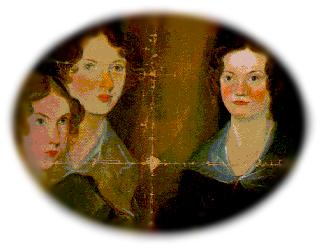
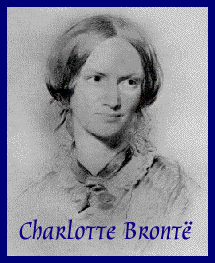
... Charlotte Bronte died. Today is the 150th anniversary of her death.
Here's perhaps the most famous image of the Bronte sisters - a portrait done by their dissipated (and, some say, more of a genius than all of them) brother Branwell:
In honor of Charlotte Bronte, a writer I have always adored, here are a couple of excerpts from her letters, and quotes about her work, etc:
I love this one. This is a letter Charlotte wrote to a good friend. The friend had written to her, asking her for a recommended reading list. Here is Charlotte's reply. For some reason, this letter completely delights me. I have it copied out and up on my bulletin board at home. I just love it:
"You ask me to recommend you some books for your perusal. I will do so in as few words as I can. If you like poetry, let it be first-rate; Milton, Shakespeare, Thomson, Goldsmith, Pope (if you will, though I don't admire him), Scott, Byron, Campbell, Wordsworth, and Southey. Now don't be startled at the names of Shakespeare and Byron. Both these were great men, and their works are like themselves. You will know how to choose the good, and to avoid the evil; the finest passages are always the purest, the bad are invariably revolting; you will never wish to read them over twice. Omit the comedies of Shakespeare and the Don Juan, perhaps the Cain, of Byron, though the latter is a magnificent poem, and read the rest fearlessly; that must indeed be a depraved mind which can gather evil from Henry VIII, from Richard III, from Macbeth, and Hamlet, and Julius Caesar. Scott's sweet, wild, romantic poetry can do you no harm. Nor can Wordsworth's, nor Campbell's, nor Southey's -- the greatest part at least of his; some is certainly objectionable. For history, read Hume, Rollin, and the Universal History, if you can; I never did. For fiction, read Scott alone; all novels after his are worthless. For biography, read Johnson's Lives of the Poets, Boswell's Life of Johnson, Southey's Life of Nelson, Lockhart's Life of Burns, Moore's Life of Sheridan, Moore's Life of Byron, Wolfe's Remains. For natural history, read Bewick and Audobon, and Goldsmith, and White's History of Selborne. For divinity, your brother will advise you there. I can only say, adhere to standard authors, and avoid novelty."
Absolutely marvelous.
Here is what one of my favorite authors, Lucy Maud Montgomery, wrote about Charlotte Bronte in her journal - I think this is an awesome analysis:
It is customary to regret Charlotte Bronte's death as premature. I doubt it. I doubt if she would have added to her literary fame. Resplendent as her genius was, it had a narrow range. I think she reached its limit. She could not have gone on forever writing 'Jane Eyres' and 'Villette's' and there was nothing in her life and experience to fit her for writing anything else...There was a marked masochistic strain in Charlotte Bronte -- revealing itself mentally, not physically. This accounts for Rochester. He was exactly the tyrant a woman with such a strain in her would have loved, delighting in the pain he inflicted in on her. And this same tendency was the cause of her cruelty to Lucy Snowe -- who was herself. She persecutes Lucy Snowe all through 'Villette' and drowns her lover rather than let the poor soul have a chance at happiness. I can't forgive Charlotte Bronte for killing off Paul Emmanuel. I don't know whether I like Lucy Snowe or not -- but I am always consumed with pity for and sympathy with her, whereas Charlotte delights in tormenting her -- a sort of spiritual vicarous self-flagellation.
Here is another excerpt from Lucy Maud Montgomery's journal. She loved the Bronte sisters' books, and wrote out her impressions through many re-readings over her lifetime.
Charlotte Bronte only made about 7,000 by her books ... It seems unfair and unjust. What I admire most in Charlotte Bronte is her absolute clear-sightedness regarding shams and sentimentalities. Nothing of the sort could impose on her. And she always hewed straight to the line. I have been asking myself, 'If I had known Charlotte Bronte in life - how would we have reacted upon each other? Would I have liked her? Would she have liked me?' I answer, 'No.' She was absolutely without a sense of humor. She would not have approved of me at all. I could have done her whole heaps of good. A few jokes would have leavened the gloom and tragedy of that Haworth Parsonage amazingly.People have spoken of Charlotte Bronte's 'creative genius'. Charlotte Bronte had no creative genius. Her genius was one of amazing ability to describe and interpret the people and surroundings she knew. All the people in her books who impress us with such a wonderful sense of reality were drawn from life. She herself is Jane Eyre, Lucy Snowe. Emily was Shirley. Rochester, whom she did create, was unnatural and unreal. Blanche Ingram was unreal. St. John was unreal. Most of her men are unreal. She knew nothing of men except her father and brother and the Belgian professor of her intense unhappy love. Emmanuel was drawn from him, and therefore is one of the few men in her books who is real.
Yet another entry in LM Montgomery's journal. In it, she writes about a biography of Charlotte Bronte she just finished, written by EF Benson. The issues of the "Bronte myth" were alive and well even back then.
I do not think Charlotte was in the least like the domineering little shrew he pictures her, anymore perhaps than she was like the rather too saintly heroine of Mrs. Gaskell's biography. I do not put any faith in Beson's theory that Branwell wrote parts of 'Wuthering Heights' and inspired the whole. There is no foundation in the world for it beyond the assertion of two of Branwell's cronies that he read the first few chapters of it to them and told them it was his own. They may have been telling the truth, but I would not put the least confidence in any statement of Branwell's. He was entirely capable of reading someone else's manuscript and trying to pass it off as his own. No doubt he was more in Emily's confidence than Charlotte ever knew and had got possession of her manuscript in some way. Benson blames Charlotte for her unsympathetic attitude to Branwell. I imagine that an angel would have found it rather difficult to be sympathetic. Benson cannot understand a proud sensitive woman's heart. I love Charlotte Bronte so much that I am angry when anyone tries to belittle her. But I will admit that she seemed to have an unenviable talent for disliking almost everyone she met ... And the things she says about the man she afterwards married!
And finally, some compiled quotes from Charlotte Bronte herself:
Conventionality is not morality. Self-righteousness is not religion. To attack the first is not to assail the last. To pluck the mask from the face of the Pharisee is not to lift an impious hand to the Crown of Thorns.
Good Lord, truer words.
And
It is in vain to say human beings ought to be satisfied with tranquility: they must have action; and they will make it if they cannot find it.
I like this one:
Look twice before you leap.
And:
There is only one difference between a madman and me. I am not mad.
And finally: the opening paragraphs of Jane Eyre:
There was no possibility of taking a walk that day. We had been wandering, indeed, in the leafless shrubbery an hour in the morning; but since dinner (Mrs. Reed, when there was no company, dined early) the cold winter wind had brought with it clouds so sombre, and a rain so penetrating, that further out-door exercise was now out of the question.I was glad of it: I never liked long walks, especially on chilly afternoons: dreadful to me was the coming home in the raw twilight, with nipped fingers and toes, and a heart saddened by the chidings of Bessie, the nurse, and humbled by the consciousness of my physical inferiority to Eliza, John, and Georgiana Reed.
Her books have always been a grand comfort to me, comforting in various stages of my development, because her insights are so wise, she seems to light the way ahead. But they are also exciting books, because so unexpected. You can't get any more unexpected than Jane Eyre. Nothing can prepare you for Mr. Rochester. And the plot that intertwines Jane Eyre's fortunes with his. No matter how many times I have read Jane Eyre, I am still startled by it. The final chapter, where Jane Eyre has that unexplained moment of what could be called astral travel, or ESP, or communication across many miles - she hears him cry out to her - remains one of the most moving chapters of a book I have ever read. And until that moment, it is not clear how things will go. You have given up, you have given up hope, as a reader ... It is quite quite sad. But then, this strange midnight miracle occurs ... The heart lifts up out of the chest in response.
Charlotte Bronte was a good writer. Of course she was. She didn't have the Jane Austen impeccability with language. No, Charlotte's writing is messier, more passionate, more urgent. People behave in incomprehensible ways in her books. Life is very very dark. People are cruel, they are vicious, they are barely civilized. (Her sister Emily went way further in this regard with Wuthering Heights. In Wuthering Heights it is not apparent that civilization or society has ANY bearing on people whatsoever. A terrifying vision of chaos. Charlotte had some overlay of civilization, but not too much. Not too much.) And so over and over again, my heart responds to her books. They do not become predictable, even at the 4th or 5th reading.
Cheers, Charlotte. Thanks for the books you managed to complete before you died. A good life indeed.
Rumspringa last night ...
... took the form of trivia night at Willie McBride's. Sadly, I did not listen to the rules AT ALL, and so when the first question was read into the microphone: "Who was the first black actress to win a Best Actress Oscar?" I shouted out "HALLE BERRY" much to the consternation of the entire bar. I was roundly scorned. The guy running the trivia night said, with a kind of weary patience, into the microphone, "Obviously somebody wasn't listening to the directions..." Uhm. No. I was not listening at all. My bad.
We pretty much could not compete with some of the other teams who had a freakish level of knowledge. We are freaks in some ways, but not in others.
I brought our team to glory with the memory of the name of the cloned sheep. Well, well, helloooooooo, DOLLY ... well hellooooo DOLLY
However, I brought our team into shame and misery when I insisted that Sally Quinn was the name of the first US female astronaut. I INSISTED on it. I was CERTAIN I was right. OH well. I was half-right, but half-right don't count in trivia. And the guy running the show found my answer amusing enough to read it to the entire bar. "And, uhm ... no. Sally Quinn is not the first US female astronaut ... but Sally Ride is." I heard all the trivia-geeks around me burst out laughing at the stupidity of whoever put down "Sally Quinn" as an answer.
We enlisted the help of my dad at one point, and put in a call to him, screaming the question above the noise of the bar. My parents, trying to have a nice quiet night at home, being interrupted by the trivia-rumspringa of their eldest.
We also enlisted the help of Mitchell. The question came: "Who wrote this song?" And then, blasting through the bar was: "If you like pina coladas ... and gettin' caught in the rain ..." etc. Who would know that? Mitchell. We BOTH called him, so he rightly thought that some disaster had occurred on the East Coast or something - why are they both calling me at the same time? The question was repeated: "Mitchell - who wrote Pina Colada?" (No, "Hey, how are ya, what's up, how are you?" No. Mitchell answers the phone. "Hello?" A screaming voice comes: "Mitchell - who wrote Pina Colada?") Mitchell answers without a moment's hesitation: "Rupert Holmes. He also wrote Edwin Drood." HAHAHA Just the immediacy of it ... too funny. Also that he had to give us yet another piece of biographical information about Mr. Holmes.
However. We did not win. We had a couple moments of team-glory and pride, but in general. We totally did not win.
Despite the help of our call-in friends and family - thanks, all!
March 30, 2005
Things I like but probably shouldn't
-- Anne Rice's Sleeping Beauty series
-- Avril Lavigne, Britney Spears, Christina Aguilera, Kelly Clarkson ... love 'em all.
-- the Red Shoe Diaries
-- Teen romance novels.
I need to think of more.
Things I hate that I'm supposed to like
-- Henry James
-- The term "blogosphere", also "hat tip", and any kind of subset of blogging. "Catblogging", "photoblogging", etc. Just stop.
-- Cake. (Not the band. I love the band. But the actual food.)
-- Herman Melville's Billy Budd
-- I hate girlie frothy frozen drinks.
Go against the grain
Mitch has two really funny pieces up right now:
Things I Hate But I'm Supposed To Like
Mitch: I am WITH you, man, on "bloggy" and "bloggy goodness" in general. I admit that I think less of a person if they say "bloggy goodness". It's not fair, but there you are. 90% of bloggers don't have a problem with it, so maybe I felt pressured early on to just "use the lingo" but now, no. I will not use lingo as stupid as "bloggy goodness". I also can't stand "blogosphere", "hat tip" and (as I think I have covered before) all of Glenn Reynolds "hospi-blogging", "photoblogging", "catblogging" and now his most recent ... "razor blogging". God. It makes me WINCE. Just STOP, Glenn, STOP.
Anyway, go read Mitch's list. Very funny stuff.
I need to come up with my own list when I have a second.
And the other piece is:
Things I Like But Probably Shouldn't.
It's such a RELIEF sometimes to just feckin' admit that you love Britney Spears' dance tunes and you don't CARE what anyone thinks.
It reminds me of one of the funnest conversations we've ever had on this blog, actually:
Things I'm not ashamed to admit... but probably should be . If you haven't encountered that piece, then please - I beg of you - read all the comments. You won't be sorry. They're amazing.
Friendship is...
... having a great girlfriend email you, urgently, and say: "Do you know the tune to the line 'all our sins and griefs to bear' from the song 'What a friend we have in Jesus'?" and not question why she needs to know. So you email her back instantly. "Yes. I know that line." Her email comes back immediately. "Could you please sing it into my answering machine? I have an audition in an hour and I need to know the tune to that particular line." So ... knowing that your friend is standing right by the phone, you pick up your cell phone, regardless of your surroundings, and you sing "What a Friend We Have In Jesus" directly into her answering machine. Of course, because of the absurdity of it, and because you cannot get the image out of your mind of your friend standing right there, you burst out laughing a couple of times during the song and have to start again. Finally, "all our sins and griefs to bear" is safely on her answering machine, without any guffawing interruptions of laughter, and you can stop singing hymns into your cell phone in a fluorescent-lit public space.
I have GOT to hear that message. My friend just emailed me quickly and said, "It was so hard not to pick up. That was one of the funniest things I've ever heard in my life."
"Shut up and deal!"
Shirley MacLaine, during the seminar she gave at my school, talked a lot (of course) about The Apartment, a great movie directed by Wilder, and starring Jack Lemmon (and Fred MacMurray, too - in another of his great roles!).

Anyway, a couple of things to note, if you remember that movie:
-- Remember the final scene, where Miss Kubelik shows up at his apartment, and he's packing ... she breaks out the cards but he resists playing with her ... and he finally blurts out: "I love you, Miss Kubelik!" She keeps shuffling. He repeats: "Did you hear what I said, Miss Kubelik? I said I absolutely adore you!" She slowly looks over at him, grins, and holds out the deck of cards to him, saying, "Shut up and deal." There's a moment between them - he smiles - she smiles, takes off her coat - the music swells, and he starts to deal the cards, and the movie is over. It's a long well-written juicy scene (of course - Wilder wrote it with IAL Diamond, his writing partner)-- one of those great movie scenes with a beginning, middle and end, like a mini-play ... where the characters start out ONE way (he's moving, he's leaving, he's getting out) and end up another way (they're going to be together.) Beautiful. If you ever see that movie again (and it's one of my favorites), watch that scene again. First of all: It's all done in one take, which just makes me BEMOAN the current use of dueling close-ups in scenes such as this one. No. Billy Wilder let the audience watch some of his scenes like a play. He lets the audience choose who to look at. It's very exciting. And second of all: what you see in the film was the FIRST take. The two of them did it perfectly on the first take. Billy Wilder watched the whole thing unfold through the camera (usually you're getting rid of excess nerves on the first take, you're tense, etc.) - but Jack Lemmon and Shirley MacLaine hit all the right notes, in perfect succession, with no cut-aways, in one extraordinary take. Wilder called: "CUT! PRINT!" And that was that.
-- Lastly, I loved this. Shirley MacLaine was trying to describe how Wilder directed. She said he was very strict in some ways, very flexible in other ways ... but here's where his genius was. She and Lemmon would run through a scene. Wilder would say when they were done, "Okay, that was very good. Now do it again, only take out 13 and a half seconds."
Heh heh. He was no dummy. The comedy was too slow. But he knew, down to the half-second, how much time needed to be taken out.
I love comic geniuses. They amaze me.
I love the Internet
Why? Because someone always comes along and makes a joke out of something that NEEDS to be made fun of. Member our conversation earlier this week about the too-hot-for-you marriage of Ayelet Waldman and Michael Chabon and her obnoxious "I have so much more sex than all the other mommies in my playgroup and because of that I am basically a better human being than all of them" essay in the New York Times? Well someone who was also obviously annoyed by Ayelet's piece has written down what is a "day in the life of Ayelet". You've got to read it.
One snippet to get the party started:
1:00 P.M. Drag the kids along to Toys in Babeland. The owners called last night to let me know that there's a whole new section of stuff my husband can stick into me. I'm so excited. Eldest daughter somewhat disturbed when I explain the purpose of the double-headed dildo to her.1:30 P.M. Compare prices on three-pronged rubber truncheon at Good Vibrations. It's slightly more expensive than at Babeland, but they split the difference since I'm in so often. Youngest boy goes crazy with spray-on lube while I'm at the counter. So embarrassing… I never thought I'd be one of those moms who has “difficult” children. Depression returns.
But oh, there's so much more. Funny funny. Mean-funny, which is sometimes the best kind of humor.
I especially like this detail:
2:45 P.M. Begin writing column for Salon.2:46 P.M. File column with Salon.
BWAHAHAHA
(via Book Slut)
"Dread-inspiring non-friends"
It's the simple details, the simple sensory details, that can make a story so compelling, so human. Read Anne's story about her first semester in college, and trying to make friends.
March 29, 2005
Influenza
Alongside of Middlemarch, I am also reading The Great Influenza (the story of the 1918 epidemic). It's strange, how the two books are ... dovetailing, quite by accident. I didn't design it that way! Middlemarch has, as one of its sub-plots, the controversies in the medical profession between new techniques and old received techniques ... and this, as is probably not a surprise, is one of the main themes of the Influenza book.
I'm only at the beginning of the Influenza book. (Ahem. I'll say I'm only at the beginning. We're still just discussing Hippocrates - so there's a long way to go until World War I!) No, I'm teasing. It's very interesting. A brief history of medical techniques, but more than that: medical philosophy, how diseases were viewed, and how certain techniques were passed on from generation to generation without question.
Good old Declaration-of-Independence-signer Dr. Benjamin Rush is mentioned quite a bit; also his "Let's bleed everyone in sight!!" philosophy comes under some scrutiny. Heh. "Everyone should be bled. Whether they are sick or not!! The paler and weaker they get, the BETTER!"
Anyway, it's interesting. Especially because so much of Lydgate's conflict (at least so far in Middlemarch is dealing with these older more establishment types who are resistant to change.)
Unless you're a theatre geek
... like I am - you probably have not been following the roller-coaster of the current production of Sweet Charity, scheduled to open on Broadway next week. However, I have. Every day there has been some new news about it, and the story changes almost hourly. It's a total Broadway cliffhanger, I tell ya!!
So. Here's the deal:
-- The revival Sweet Charity, starring Christina Applegate, has been previewing in other cities, preparing itself for a Broadway run. It has been getting so-so reviews. But they decided to continue on to Broadway regardless of the reviews.
-- On March 11, in Chicago, Christina Applegate broke her foot during one of the dance numbers.
-- A flurry of New York Times articles followed this event. What will happen? Will they cancel?
-- Then, on March 25, came this MASSIVE article in the Times about Charlotte d'Amboise, who was asked to step in to the lead role. She's a total Broadway pro - who is a star in the theatre world - but who doesn't have a big enough name to open a show. But since Applegate's injury happened during an out-of-town run and not rehearsal, they needed someone who could come in, learn the songs, dances, and lines in a matter of 2 days. In short, they needed someone extraordinary. So they called in Charlotte.
-- But the big question was: would they open the show with her in New York? Would Applegate be better in time? And if not ... then ... It amazes me, but Charlotte d'Amboise hasn't been in the original run of a show in New York. She's the woman who picks up when the star is done with her contract, d'Amboise is the one who picks up the role and does it for YEARS. She, I might add, is the REAL pro. But to "originate" a role on Broadway - that's what everyone really strives for. Even her, after having so much success!
-- Then - on March 26, the day after that article came out, came the next article: "Sweet Charity canceling its Broadway run". And after I had spent all that TIME reading about the ups and downs of Charlotte d'Amboise, I felt upset for her. However, I understood the decision. The show was getting lukewarm reviews ANYway with Christina Applegate. Why bring it all the way to Broadway to be a bomb?
-- And now, today, comes this article saying: "Sweet Charity is back on!" My response after reading that article is, bluntly, "Christina Applegate is one classy dame". The producers were afraid of opening with Charlotte d'Amboise (even though she's a feckin' VETERAN OF BROADWAY. grrr), and so were going to hold off the opening until Christina's foot healed. Apparently, Applegate refused to let that happen. She begged and pleaded with them to open as planned, AND to open with Charlotte d'Amboise - and she would pick up the part whenever her foot was better. If you're not picking up on the fact that this kind of behavior is so rare as to be almost unbelievable, then I have not done my job in telling this story. Most stars would say, "No, I have to open this show!" It's those who OPEN in the show who get the reviews, those who OPEN in the show who "own" it ... Christina Applegate has given that up, she has pretty much demanded that the show must go on with or without her.
Good for her. A classy act.
Now: the show STILL may bomb. And it might bomb even before Applegate's foot heals (which is highly possible, judging from advance word - so who knows, maybe Christina Applegate is dodging a big ol' bullet here.)
However it turns out in the end, I still think her behavior has been quite exemplary and professional. Impressive.
I need to register my protest
in a vocal way. I need to loudly protest THIS.
No.
THIS MUST NOT BE.
It's just not RIGHT. It's just. plain. old. NOT RIGHT. ANYONE should be able to see that. ANYONE. ("Anyone named Howard." Movie quote, anyone?)
I say here and now, so that my vote can be known: Clive Owen. Clive Owen. Clive Owen.
I stand with Bill McCabe on this issue. It is morally appalling.
Where the wind comes sweepin' (thanks JFH) down the plains
.. and the wavin' wheat
can sure smell sweet
When the wind comes right behind the rain!!
Anyway, Alex and Chrisanne are on their way to California from Chicago. Both are good friends of mine (after very little face contact ... We were friends within 10 minutes.)
Alex is blogging about the trip as they go. A couple of amusing excerpts:
Traveling with Chrisanne is kind of like traveling with Robinson Carusoe. She can make a Hilton out of a pack of matches.
Heh heh. At one point, this exchange occurs:
"If you wanted to just tool around, why did we map quest everything?"And I do mean everything. The bathrooms in the Hotels are map quested.
I found her entry about stopping in Oklahoma particularly moving.
Alex is a transgendered female, married to a woman (Chrisanne). You don't have to be a rocket scientist to realize that people like Alex and Chrisanne are not welcome everywhere. (Which is a goddamn shame. They're the warmest kindest people you'd ever be lucky enough to know.) But Alex, in her typical open warm-hearted way, writes about the two of them going to look at the Oklahoma City Bombing Monument ("To the the left stands a gi-normous Elm tree. The only living plant to survive the bombing. It looms over the site like a Father figure, stretching out it's magnificent arms protecting and giving life to everyone underneath it."), and her experience of the friendliness of the people of Oklahoma. Anyway, it can't be excerpted. Just go read it. It'll make you feel good, and like people are essentially good.
Alex: Beautiful post. I love your dispatches from the road.
I'm not ready ...
... but apparently the 2005 baseball season will begin whether I am ready for it or not.
I have re-joined my "club" (it's so specific - it's a Hoboken Red Sox fan club) ... Ehm, I don't even live in Hoboken, but close enough. Club members belong to various online chat groups, we get invites through email, we are told where to go for what game ... and then we all convene at various bars throughout Hoboken and Manhattan, we watch the games. I don't even know these people outside of this. At all. It's hilarious. I love it. When we won last year, some random guy in the club - I don't even know his name - only I had been seeing him off and on for the entire summer - Anyway, in the midst of the utter chaos, he staggered over to me - sweaty and emotional, and we hugged, jumping and screaming ... and he actually screamed: "I LOVE YOU!" hahaha
It's THAT kind of club. We have one goal. And one goal only. He loved me because I was part of that club. Hysterical. He had come completely undone.
Then again, so had I, because I screamed: "I LOVE YOU TOO" back.
Seriously, though: Is it starting up again? Where did the time go?
I'm not ready.
Emotionally.
But then I see this. And I think ... ahhhhhh, is it here yet?? Are we there yet?
I will now retreat to familiar and beloved ground
Ahem.
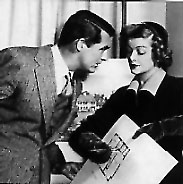
Last night I watched Mr. Blandings Builds His Dream House with Cary Grant and Myrna Loy. I had never seen it (one of the few I have not seen.) Despite its god-awful title, it's a lovely and funny little movie. The humor isn't madcap or frenzied, like in His Girl Friday or Bringing Up Baby - it's a subtler brand of humor. All Cary Grant needs to do is just stare at someone who has just said something he thinks is ridiculous - it's so so funny. Why the HELL is it so funny? I don't know. It's a kind of magic.
The movie tells the story (in a kind of trite way - the whole thing is trite - and yet somehow, it's still filled with charm and humor) of a married couple with 2 kids, who live in a cramped apartment in New York. He is an advertising executive. Their apartment is hilariously small. Mr. Blandings has (of course, because Cary Grant plays him) a rather cranky put-upon nature. (It's interesting - that is where so much of Grant's comedy comes from. The sense that the world around him is insane, and he is the only rational person in existence, and yet events move too quickly for him to control, and so he gets really cranky about it. heh heh)
His two children are girls, ages 12 and 10, and so he is pretty much hen-pecked. He can never EVER get into the bathroom to shave. He tries desperately to maintain his dignity as "the man of the house" but he is completely over-ruled, and also defeated by how many girlie-products fall out of the medicine cabinet every time he opens the door.
Myrna Loy (I love her) plays his wife, who secretly wants to make "improvements" in their apartment, knock down walls, etc. She has hired an interior decorator behind her husband's back. We never see the interior decorator, but his name is "Bunny", and Cary Grant refers to him witheringly as: "Oh, that gentleman who wears open-toed sandals??" Can't you just see Bunny in your mind right now?
Eventually, Mr. Blandings comes to the conclusion: Why should he spend money renovating what is, in essence, somebody else's property - when he could buy a nice property all his own out in Connecticut and fix it up?
And so there you have it. The "dream house" is born.
The movie is all about middle-class material aspirations, getting a slice of the American dream, etc. Cary Grant, in this phase of his career (the Bachelor and Bobby-Soxer phase, the POST Notorious phase), settled into playing these types of parts. He enjoyed them. As a Cockney runaway, with no real roots, he loved to embody middle-class Americans - it was very important to him. He loved America. He had escaped the strict class-conscious society of England, and he worked hard to change his voice, get rid of his accent, so that he could assimilate. But still, there was always something a little "off" about him. Always. He never assimilated completely. Which is part of his enduring appeal. Alfred Hitchcock was pretty much the only director who could challenge him yet again to leave that middle-class turf - in North by Northwest and To Catch a Thief. Hitchcock always saw Cary Grant as being appropriate for this more challenging material. He knew that the audiences had a great attraction to this man, and so he would set about making the audience uneasy, nervous, unsettled. Hitchcock never wanted to just accept Grant's handsomeness as a fact of nature, he always wanted to mess with it, comment on it, admit that beauty like that is unusual, and that we, as regular people, have feelings about people who are that beautiful, and the feelings are not always admiration. Sometimes we envy them, we want to see them suffer. Hitchcock made beautiful people suffer in his movies better than anybody.
But after Notorious, Cary Grant (perhaps realizing how much he had revealed in that film?) retreated to safer ground for a time. The Bishop's Wife, Mr. Blandings, Bachelor and Bobby-Soxer. I love all of these movies, but there is a lightness to Cary Grant in them, an ease - which Hitchcock never really allowed him. Or, if he did allow Cary Grant to move through the world with ease in the beginning of the films, he made Cary Grant PAY for that very ease by the end. (North by Northwest is the best example of that.)
But back to Blandings:
A very good script. Funny, smart, good repartee.
For example: Cary Grant is working his ass off so that his two daughters can go to a prestigious private school. The conversation he has during breakfast one morning with his daughters could be completely relevant in our society today: he learns that the teachers of the school are pretty close to Socialists, and decry capitalism, and decry advertising, in particular. The two girls parrot back the teachers pronouncements about the evils of advertising. Cary Grant, holding his knife and fork, sits frozen, listening to them. He finally says something like, "Well you tell Mrs. Sparrow that the evil money from advertising is paying her salary at the moment!"
Also, I loved this moment: They all sit down to breakfast, and one of the daughters starts to talk about one of her assignments. She goes on and on about the plight of the working man, and how she had to write an essay about it, etc. Cary Grant says, looking right at his wife, with that deadpan face I find so amusing, "Just once darling, I would like to have a breakfast without social significance."
It's that crankiness which is so funny - an odd thing. Think of how eternally cranky he is in Bringing Up Baby ... Yes, he is also a geek, but ... he has enough of a sense of self-entitlement to get indignant and cranky over how Katherine Hepburn treats him. For whatever reason, that combination is hysterical!!
So of course, the Blandings buy their "dream house" and start to renovate it, but it rapidly turns into an enormous money pit - they don't know what they're doing, the construction foremen pretty much take over the entire operation, and the Blandings cannot tell if they are being cheated, swindled, etc.. The Blandings try to gain control, but they don't even know the lingo.
"Hey, Mr. Blandings." shouts one of the workers. "Do you want me to rabbit these lintels?"
(I have no idea. Something like that.)
Cary Grant, knowing he should know the answers, stands there, frozen. Not saying anything. Deadpan. Very funny.
He splutters, "Uhm - no. No rabbits will be necessary. No."
The worker shouts up to his men: "TAKE ALL THE RABBITS OFF THE LINTELS!"
You begin to hear crashes up above as all the lintels are taken apart, and Cary Grant looks horrified, and frightened. He has no idea what is going on.
I can't get over his naturalness, his beauty. I mean, it's a ridiculous scene in the beginning - where the smallness of the urban apartment is established. You see Blandings and his wife fight for space in the bathroom, you see him open closet doors and have contents spill out immediately. In order to get from Point A to Point B, he has to step over two ottomans. The medicine cabinet is booby-trapped. All of this is cliched stuff, but - as always - Cary Grant underplays it. He is not acting as though he is in a comedy. And that's why it's so funny. I saw him open that medicine cabinet and deal with things falling out three times - and it's hysterical each time. Because he is truly dealing with it on a real level, not a yuk-yuk condescending level.
Maybe that's why he is so beloved. He never ever seems to condescend to the material. Even when he's playing just a regular middle-class guy. I think audiences really respond to that in a positive way. If you get the feeling that the actor is "slumming" by playing a regular person, it's insulting. You're insulting the audience who actually live lives like that.
You never catch Cary Grant slumming.
He opens the closet in his apartment, and things cascade out all over him. His response to this is one of stifled rage, frustration, and thin-lipped aggravation. And - somehow - when Cary Grant is filled with stifled rage, we laugh.
I love him for that!
And lastly: the movie is realistic, in its own way, and maybe that's why I found it so funny. I've lived in and around New York City for almost 10 years now. I laughed out loud in recognition at some of this stuff. I open closets and things fall out on my head, etc. I store items in completely counter-intuitive places, because there just isn't room for them in the normal spots (my sewing kit kept in my underwear drawer for example. That really makes no sense. But there's ROOM for it there. So that's where I keep it.)
So Mr. Blandings Builds His Feckin' Dream House confirms for me again what I have known all along. It confirms for me the TRUTH of the matter which is NON-NEGOTIABLE (at least on this blog): Cary Grant is the best film actor we have yet produced in this country. Nobody can touch the guy. He is absolute magic. I treasure him. I really do. In the same way I treasure the great works of literature, or the great works of art.
I report. You decide.
At 6:15 last night: I got my eyebrows waxed.
At 6:45 last night: I was carded when I tried to buy an alcoholic beverage.
I am sure there is a connection. A friend of mine always says that a subtle cleaning-up of the eyebrows is like having a mini-face lift. I've found that to be true with my own face ... I look, ehm, perkier, younger, etc. but anyway. These are the facts of the case. I was born during the JOHNSON ADMINISTRATION, mkay? And I was carded last night. Life could not get any better.
March 28, 2005
Thank God for fug
I see a picture like this and struggle to express my feelings about it. Fug Girls do not have that problem. Read their one-line post. Perfect.
Ah, for a Hot Amish Guy

I saw a fascinating documentary last night which you might have heard of called The Devil's Playground. It came out in 2002 - I think on HBO first - and got quite a bit of press which is how I heard about it. [Here's a shout out to Melody Garren as well. She and I both had read the piece in The New York Times about it ... and Melody actually bought a copy of the film through Amazon. We kept saying: "We have to see this movie together!" That was a year ago. Sadly, I have surged forward on my own path. Sorry, Melody!! ]
Somehow, and I have no idea how (I'd like to hear the story behind the story), the filmmakers got the trust of an Amish community, enough to document the teenage transitional time called "rumspringa" - which means, "running around". Rumspringa starts when an Amish kid is 16, and can last from anywhere to a couple months to a couple of years. The Amish teenagers are allowed to venture out into the world, and see what it is they are missing. Rumspringa is open-ended. The Amish community believes that a person needs to know what exactly it is they are giving up, they believe that being Amish needs to be a matter of making a choice. An educated choice. "Rumspringa" ends when the teenager decides that he or she has had enough wild partying, drinking, sex, and living like "the English", and will go back, renounce the world, and join the Amish church.
The film-makers follow a group of Amish teenagers through their "rumspringa".
The image of Amish parties is not one I will soon forget. Not that they're at all different from "the English's" parties. It's just the incongruity of some of the images: Amish girls wearing white bonnets chug-a-lugging Budweiser, for example. Amish boys wearing backwards baseball caps and gold chains and saying into the camera, "Yo, wassup." These are AMISH KIDS.

The boys, during their rumspringa, seem to all dress like ghetto rappers. The girls, generally, do not "dress English".
Through interviews, etc., you get to know these kids. Each one of them has their own journey, their own experience with "rumspringa". One kid pretty much falls off the deep end, and becomes a drug dealer ... although there is a tentative "happy ending" for him. He quits drugs, finds an Amish girlfriend (who is as gorgeous as a super-model, I might add), and starts to think about going back to join the Amish church. His is the scariest story. Other kids just experiment with drugs, they go out with "English" boys or girls, they have sex, your basic teenage rebellion.
The Amish community itself is not treated with disrespect, which is one of the reasons why the movie is so effective. After all, apparently 90% of the Amish teenagers choose to renounce the world after "rumspringa". Think of that. 90%. There's one scene of a kid sifting through all his CDs and tapes, before throwing them away - knowing that this is it, in terms of popular music.
There are a couple of beautiful interviews with Amish men and women who went through their own rumspringa, and then made the choice to renounce the world. You love these people. Their simple openness.
One Amish man, with the Abe Lincoln beard and little Ben Franklin glasses, sits on a picnic table with his wife. His barn looms in the background. He is asked by the interviewer, "What do you miss most of all?"
He says without hesitation, "Modern transportation" and then bursts into laughter. He was so open, so kind-looking ...
There was one other Amish guy who was working on something in his barn as he was being interviewed. He said something like, "Well ... you know, these teenagers go through rumspringa, and they're allowed to date, and see how they like it ... and, well, if you put two teenagers in a room and turn the lights off, you know what's going to happen. We're no different from other people in that respect." With this humorous smile as he did woodworking with handmade tools.
And some of the images ...
Like a prim and proper-looking Amish teenage girl, in her bonnet, saying to the camera, "I really miss going to concerts, man. Like Gobsmack and stuff ... are they still together? I love them."
Or an Amish boy in his parents' living room, showing us the 17 Bibles around the room, proudly - only he's dressed like he's from the ghetto.
In a funny way, because the teenage rebellion is condoned - because it's set up in the society that teenagers will have a time to "run around" - there was very little anger or bitterness in any of these people. There is an understanding that in order to fully renounce the world, you must taste it all first. Otherwise rebellion could pop up later in life, when you feel like you "missed out".
See it, if you haven't already. I was enraptured by it.
It reminded me, too, of my time living in Philadelphia, where you have everday contact with Amish people. They're everywhere. My boyfriend and I would drive out into Pennsylvania Dutch country and go to Amish auctions, which if you haven't done, and you ever get a chance to ... GO. They are unbelievable. And plan to spend the whole day. Even if you don't buy anything. We used to crash Amish auctions all the time.
The first time we went to one: I ventured into the "female auction", which was in an enormous barn. The "male auction" was outside, run by men, with all men in attendance. There they sold farm tools, horses, etc. But the "female auction' was where they sold the quilts. The famous quilts. I sat on the wooden bench, surrounded by Amish women, looking up at quilts so beautiful it took my breath away. There were also obviously people from boutiques around the country in attendance, because these quilts were going for mega-mega bucks.
A young Amish girl, maybe 10 years old, had made her first quilt - a small one, with a very simple stitch. Blue with black stripes, with big hearts stitched into it. It was going for forty dollars, so ... trembling ... (I've never been to an auction before, and I stuck out like a sore thumb ... everyone there was Amish, this was their world, not mine ... ) I bid on it. And got it! I still have it in my apartment. I love it - this was the first money that this young Amish girl had ever made with her own hands. I don't know, I thought that was pretty cool.
My boyfriend and I met up later - after he had hung out at the "male auction" and I came back from the "female auction", and we wandered around together, and finally came across a makeshift volleyball game, being played by a bunch of Amish boys. They were all, oh ... in their late teens, early 20s? They had made the ball from a bunch of leather strips, and were all playing like MANIACS. Girls sat along the sidelines watching, giggling. All the guys straw hats were lined up along the outskirts of the playing area. Many of them had that thick thick blonde hair, like a shock of straw ... and they all were leaping, jumping, high-fiving ... and in between plays, the girls on the sidelines would run out to give them lemonade.
Basically, what I am trying to convey here - is that those Amish boys were HOT. There wasn't one in the bunch who wasn't good-looking, and I'm not even talking about normal handsomeness, I'm talking about movie-star HOT. They all looked like Heath Ledger or something. And yet nicer-looking - because they seemed so human, their faces were open, manly. They were babes, let's face it.
I had come across a group of volleyball-playing Amish babes.
It was such a beautiful vivid scene. I still remember it. The field, the flying leather-strip ball, the calling laughing voices of the Amish guys, the giggles of the watching Amish girls, and the straw hats piled up on the side.
My boyfriend and I drove home with our Amish goods piled up in the back. I said at one point, "God, those Amish guys were hot."
Which is such an incongruous strange sentence ...
"What's your ideal type?"
"Oh, you know, your basic hot Amish guy."
This became a joke between us. He and I would get into a fight or whatever, and my boyfriend would mutter, "I know it, you're gonna leave me for a hot Amish guy, I just know it."
Boston 212
Thank you, Dan for sending me the following link. For all I know, this "Red Sox" bar in the middle of Pinstripe-Hell has been around forever - but I'm only aware of Riviera.
28th and Madison. Boston (212).
I will have to keep this in mind when I desperately need to be around my own kind.
I love Michael Chabon
but damn, his wife sounds smug. Ick. I read the whole thing, thinking: Ick. Not that I disagree with some of her thoughts, of course not! It's just her superior tone. Her marriage is hotter and better than other people's marriages.
Got this from Book Slut, who got this from I Love Books. A funny observation on I Love Books: Ayelet Waldman and Michael Chabon: The Angelina Jolie/Billy Bob Thornton of the literary world?
Heh heh. Angelina and Billy Bob ... so overwhelmingly eager to tell us how much they had sex, how intense their sex was, how better their sex was than ours ... sharing with random reporters on the red carpet how they had had sex in the limo on the way over ...
GUYS. Just STOP. People all over the world have sex. You are not inventing good sex. STOP. Just STOP.
Ayelet has the same tone, in my ears.
Like: great for you, you have 4 kids and you still have sex. Whoop-dee-do, let's give y'all a medal. But to brag about it in the New York Times seems, to me, kind of pathetic. No, wait. Really pathetic. Also hostile towards other women and other mothers who may not be so self-satisfied, and smug towards other people's experiences. That's what really got to me. The hostility of the piece. So some new mothers lose interest in sex temporarily. So the feck what? Is this reason to lord it over these women like:
"Is it MY fault my marriage is still hot? Is it MY fault I have so much more fun and am so much better than those other mothers in the playgroup?"
I love her husband dearly (he's one of my favorite writers ever) but I'm not wacky about her writing (or her general outlook on things). I've seen her columns on Salon, yadda yadda, and in general, I'm not impressed. She doesn't leave much room for me to be impressed, actually, since she is so impressed with herself.
George Eliot ...
and "the saddest letter ever written" - Posted by Anne.
To put yourself into a position where you would not only be satisfied with the scraps from someone's table - but you would be fully nourished on those meager scraps ... Oh, it is sad.
To me the saddest line in the letter is: "You curse the destiny which has made the feeling concentrate itself on you."
Without going into too much detail, I have said a similar thing in my life to a man I was wild about. A blessing and a curse. That was how he described it. It was a blessing to be loved the way I loved him. But a curse too, because he knew he would have to hurt me anyway.
March 27, 2005
Manhattan Madness
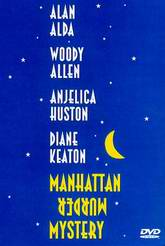
I rented one of my favorite Woody Allen movies last night. No, not Annie Hall ... but Manhattan Murder Mystery. I don't understand why this movie didn't get more acclaim. It's one of my absolute favorites of his films, and it makes me laugh OUT LOUD every time I see it.
My friend Mitchell and I went to see it when it was out in the theatres, and completely were enraptured by it. It's a rollicking ridiculous comedy, of the type they usually don't make anymore.
Here's Berardinelli's original review. He opens with:
What happens when a bored wife thinks her kindly old neighbor commits a murder? Woody Allen attempts to answer the question in his latest cinematic endeavor, Manhattan Murder Mystery.
Diane Keaton (married to Woody Allen) becomes convinced that her mild-mannered smiling next-door neighbor murdered his wife in cold blood. Woody Allen, needless to say, tries to talk her out of her wild theories. But soon she is like a woman obsessed. She peers through the peephole any time she hears any noise out in the hallway, she wanders through her own apartment, theorizing outloud as Woody Allen rolls his eyes. At one point he pleads with her: "Save some craziness for menopause!" Alan Alda plays a mutual friend of Diane and Woody who gets caught up in her excitement. He is a kind of bitter recently divorced guy who holds a reaaalllly passive-aggressive torch for Diane Keaton. Anyway, he gets all fired up by Diane Keaton's theories. Diane and Ted start to do stake-outs in front of random apartments that have to do with "the case". Woody Allen thinks they are both loonytunes. His Upper West Side wife is on a stake-out. Diane and Alan Alda discuss "running checks" on this or that lead ... but it's all so funny because ... uhm ... "run a check"? You're not a detective. How you gonna do that?
Other characters who join in the lunacy:
-- Anjelica Huston plays an author whose book Woody Allen is editing. It is such a funny performance, what my friend Mitchell would call "sheer liquid bullshit". She is self-absorbed, mildly hostile, aggressive, wears head-to-toe leather, and is kind of casually convinced that she is the sexiest woman in the world. Such an amusing performance. She must have had so much fun.
-- Joy Behar and Ron Rivkin play friends of Diane and Woody who somehow get caught up in "the case". I love both of them.
Has anyone else seen this movie? It's a comedy in the true Woody-Allen sense of the word. It's ludicrous, it seems improvisational, but you know it's not ... People race around, hide under beds, behave in ridiculous ways ...
But then at the very end, there's somehow a deeper meaning to all of it. Also at the end there is a kick-ass scene in an old movie theatre, with broken mirrors, a film being projected behind the actors, everything reflected many many times over through the cracked discarded mirrors ... Hard to describe, but it's Woody Allen at his best.
What I really like about the movie (or one of the things) is that Woody Allen makes NO BONES about the fact that Diane Keaton is kind of mildly bored in her marriage, and "the case" is a way for her to keep her life exciting. You never get the sense she's gonna cheat on Woody, nothing like that ... but she has lines that literally go like this: "Are you still attracted to me?" Woody will say, "What are you talking about? Of course I am?" Diane Keaton sits, thinking about this, and then says, in a more excited way, "I wonder if Mrs. Haus knew that her husband was cheating on her!" Or whatever. Like - so obvious. Leaping from: "Are you bored wiht me?" to her obsession.
Diane Keaton is so funny. I've gone on and on about her before, but one of the things I particularly love about her is that you never catch her acting. Never. Her work is so alive that you can't believe she's saying words that were once on a page.
Her performances in Woody Allen movies (actually, most people's performances in most Woody Allen movies) seem so spontaneous that people assume that most of it is improvised. Or that Woody will give a general idea of a scene (a la Christopher Guest in his movies) and then let the actors go to town making stuff up. But no - Woody Allen doesn't use improvisation. All of that dialogue is written down. Which makes the spontanaeity of those movies even more remarkable.
Anyway. Manhattan Murder Mystery. One of my favorites. If you haven't seen it, and want a ridiculously fun and funny movie, I highly recommend it.
Just to see Anjelica Huston sashay around self-importantly in a black-leather suit, smoking and bragging casually about how she "put herself through school playing blackjack" ... It's not comedy of the "hahaha" kind, not obvious perhaps. But it's the kind of comedy I love and respond to. Character-driven comedy. She is so hiLARious in this movie, even though she probably doesn't have one overtly "funny" line.
Middlemarch: "Advancing womanhood had tempered her plainness"
An amazing description of "plain" Mary Garth:
Mary Garth, on the contrary, had the aspect of an ordinary sinner: she was brown; her curly dark hair was rough and stubborn; her stature was low; and it would not be true to declare, in satisfactory antithesis, that she had all the virtues. Plainness has its peculiar temptations and vices quite as much as beauty; it apt either to feign amiability, or, not feigning it, to show all the repulsiveness of discontent: at any rate, to be called an ugly thing in contrast with that lovely creature your companion, is apt to produce some effect beyond a sense of fine veracity and fitness in the phrase. At the age of two-and-twenty Mary had certainly not attined that perfect good sense and good principle which are usually recommended to the less fortunate girl, as if they were to be obtained in quantities ready mixed, with a flavor of resignation as required. Her shrewdness had a streak of satiric bitterness continually renewed and never carried utterly out of sight, except by a strong current of gratitude towards those who, instead of telling her that she ought to be contented, did something to make her so. Advancing womanhood had tempered her plainness, which was of a good human sort, such as the mothers of our race have very commonly worn in all latitudes under a more or less becoming headgear. Rembrandt would have painted her with pleasure, and would have made her broad features look out of the canvas with intelligent honesty. For honesty, truth-telling fairness, was Mary's reigning virtue: she neither tried to create illusions, nor indulged in them for her own behoof, and when she was in a good mood she had humor enough in her to laugh at herself.
Genius character development. It's out of style now to "describe" a character like that. I think it might have been James Joyce himself who destroyed, in one fell-swoop, that kind of omniscent character development. I have no idea, just a guess. T.S. Eliot was the one who said, after reading Ulysses that Joyce had "killed the 19th century".
I'm not saying this is either good or bad, or that I prefer one style over the other. Everyone here should know how I feel about James Joyce!!
But I am still finding such intense pleasure in George Eliot's precise layered character descriptions, like the one above. They're delicious.
Middlemarch: priggishness
More from Middlemarch:
"A prig is a fellow who is always making you a present of his opinions."
Middlemarch: "severe facts of life"
More from Middlemarch - this one made me laugh:
Plain women he regarded as he did the other severe facts of life, to be faced with philosophy and investigated by science.
Middlemarch: "between breakfast and dinner-time"
More from Middlemarch:
We mortals, men and women, devour many a disappointment between breakfast and dinner-time; keep back the tears and look a little pale about the lips, and in answer to inquiries say, "Oh, nothing!" Pride helps; and pride is not a bad thing when it only urges us to hide our hurts -- not to hurt others.
Middlemarch: "From such contentment poor Dorothea was shut out."
Dorothea Brooke, in Middlemarch, is a well-bred young woman, with a nice inheritance ... and yet she chooses to live plainly, and involve herself in community projects, and renounce the things which give her pleasure. Her dream of marriage is to yoke herself to a worthy male - someone whom she loves for his IDEAS, and also for what he can teach her, and how he can involve her in his work. She wants to live an important life, a life of the mind and spirit, she wants to have a wide impact on people, like a saint. And so it is very very important that she choose the right husband. I'm oversimplifying here, sorry ... but this appears to be the main jist so far. (I haven't finished the book yet - I'm not even a quarter of the way through.)
Dorothea is quite naive. The other females around her are much more practical. And you get the sense (at least so far) that Dorothea is going to learn some really rough lessons. I don't think she is going to choose well for a husband either. Something's not quite right with this girl. Her mind is "theoretical".
Another excerpt about Dorothea:
It had now entered Dorothea's mind that Mr. Casaubon might wish to make her his wife, and the idea that he would do so touched her with a sort of reverential gratitude. How good of him -- nay, it would be almost as if a winged messenger had suddenly stood beside her path and held out his hand towards her! For a long whilte she had been oppressed by the indefiniteness which hung in her mind, like a thick summer haze, over all her desire to make her life greatly effective. What could she do, what ought she to do? -- she, hardly more than a budding woman, but yet with an active conscience and a great mental need, not to be satisfied by a girlish instruction comparable to the nibblings and judgments of a discursive mouse. With some endowment of stupidity and conceit, she might have thought that a Christian young lady of fortune should find her ideal of life in village charities, patronage of the humbler clergy, the perusal of "Female Scripture Characters," unfolding the private experience of Sara, under the Old Dispensation, and Dorcas under the New, and the care of her soul over her embroidery in her own boudoir -- with a background of prospective marriage to a man who, if less strict than herself, as being involved in affairs religiously inexplicable, might be prayed for and seasonably exhorted. From such contentment poor Dorothea was shut out. The intensity of her religious disposition, the coercion it exercised over her life, was but one aspect of a nature altogether ardent, theoretic, and intellectually consequent: and with such a nature, struggling in the bands of a narrow teaching, hemmed in by a social life which seemed nothing but a labyrinth of petty courses, a walled-in maze of small paths that led no whither, the outcome was sure to strike others as at once exaggeration and inconsistency. The thing which seemed to her best, she wanted to justify by the completest knowlege; and not to live in a pretended admission of rules which were never acted on. Into this soul-hunger as yet all her youthful passion was poured; the union which attracted her was one that would deliver her from her girlish subjection to her own ignorance, and give her the freedom of voluntary submission to a guide who would take her along the grandest path.
I wincingly recognize myself in those lines.
Dorothea Brooke: "she was enamoured of intensity and greatness"
Dorothea Brooke. So far, she is the lead character in Middlemarch, although others are now being introduced (Lydgate, Fred Vincy, Mary Garth) who are coming to the foreground. But the first part of the book is entitled "Miss Brooke". So obviously she is of great importance. I have said below that I see a lot of myself in Dorothea, and it is perhaps because of that deep identification that I find her so annoying. It's tough sometimes, to truly see yourself. To have your motives explained to you in cold clear language ... It makes you shiver and want to hide. The mark of a great novelist, in my opinion.
To boil it all down shamefully, Dorothea is a rich girl, inflamed with the desire to be useful. She wants to live the life of an ascetic, she enjoys sacrifice, she is full of religious passion, she dresses in an ostentatiously plain way, denying her own beauty ... and her main goal in getting married is to find an ideal husband, one whom she can look up to. Love has nothing to do with it. I'm over-simplifying, but that so far is what I know of Dorothea.
The following excerpt pretty much tells you all you need to know about Dorothea:
Most men thought her bewitching when she was on horseback. She loved the fresh air and the various aspects of the country, and when her eyes and cheeks glowed with mingled pleasure she looked very little like a devotee. Riding was an indulgence which she allowed herself in spite of conscientious qualms; she felt that she enjoyed it in a pagan sensuous way, and always looked forward to renouncing it.
Here are some of Eliot's descriptions of the "earnest" Dorothea, descriptions which open the book:
Her mind was theoretic, and yearned by its nature after some lofty conception of the world which might frankly include the parish of Tipton and her own rule of conduct there; she was enamoured of intensity and greatness, and rash in embracing whatever seemed to her to have those aspects; likelyl to seek martyrdom to make retractations, and then to incur martyrdom, after all in a quarter where she had not sought it. Certainly such elements in the character of a marriageable girl tended to interfere with her lot, and hinder it from being decided according to custom, by good looks, vanity, and merely canine affection.
Middlemarch ...
... by George Eliot ...
After, uhm, 20 feckin' years of saying, "I've got to read that one day" - I finally am. As with most of the "classics" (at least this has been my experience) - I have found that once I just start the thing, I usually can't put it down. Middlemarch is, I am discovering, a page-turner. It happens to be 800 pages long, but that's no matter. It's still a page-turner. The character development, the social commentary, the feeling that you are immersed into an entire world ... I can't put it down.
First of all, there is no "plot" as of yet - I'm still in the beginning stages where characters are being introduced. However, their struggles and inner-journeys, the conflicts which could arise in the future, are all becoming rather clear at this point. Nothing has happened YET, but you can sense the potential.
And the writing itself ... She's got flashes of such laser-beam intensity, moments of such psychological clarity, that I feel like everything I have ever written has been shallow and unworthy. Heh. Well, it's good to have something to strive for. Good to get to know the geniuses!
For those of you have read the book, here are random thoughts:
-- I absolutely LOVE Fred Vincy, the kind of dissipated cheerful brother of the vain and pretty Rosamond. I LOVE Fred, and I hope that he finds happiness. He seems to deserve it more than anybody else at this point, even though he does sleep until noon, and is ... well, frankly ... pissing his life away. Still, I love his disposition. He's my favorite character so far.
-- Mrs. Cadwallader is CRACKING ME UP.
-- Dorothea is, as my father used to say, "cruisin' for a bruisin'." By that I mean, nobody can be that idealistic (and priggish) without having a really difficult time facing reality. So far reality has not intruded into her pleasant little world, but it will, I am sure. I relate to Dorothea in many many ways. I see myself in her. Maybe that's why I'm, at this point, so impatient with her.
-- I love the Vicar who plays cards and billiards for money, and who studies insects and flowers in his spare time. I can't remember his name at the moment.
-- Oh, and I also love the plain girl Mary Garth. Fascinating character so far. I see quite a bit of myself in her, as well.
I'll post a couple excerpts momentarily. I am finding the entire reading experience of this book to be completely DEE-LISH.
The private mood of New York City
It's a chilly grey day here, with flags whipping in the wind, and the sidewalks quiet and sparsely populated. I love Manhattan on a Sunday morning. It's like a different city altogether. Wrapped in on itself, in a private mood, people going about their lives, quietly, sensibly, doing nice Sunday things.
Sometimes on Sunday mornings, I wake up early, take the bus into town, just so I can meander through the empty streets, the vendors setting out the flowers, or the fruit, random people jogging by, most storefronts locked up behind the grilles. I love the quiet. Meandering empty yellow cabs driving up 8th Avenue. In a weird way, it's peaceful.
Went to Easter Mass at my church on 36th Street. I love it there. It's one of those old cavernous urban Catholic churches squeezed in between storefronts. You walk through the wooden front doors and suddenly find yourself in a vast echoing space, you can't believe how large it is, judging from how cramped it appears from outside. I've been going to St. Mary's for about a year now, and I really like it.
Huh?
This post from Glenn is very honest, but also kind of made me chuckle. What - he's just catching onto this now??
On a side note: It just seems so crazy that people would write Glenn angry emails about not agreeing with Hugh Hewitt. What is the matter with these people? Glenn is an individual, he is not obligated to agree with some constituency ... People seem truly hysterical and dismayed at disagreement. Like Donald Sensing writes in his eloquent post that Glenn links to - people cast others "into the outer darkness" for disagreement, or non-lockstep thinking.
But the very thought that this kind of behavior originated on "the left" is ludicrous to me. Huh? If you have never ever doubted the righteousness of your own opinion, if you have never ever waffled on an issue, or changed your mind about something - then you are lucky. But for those like myself? Woah, nelly. Get ready for the righteous shrill outrage. From BOTH sides.
So no, this kind of demonization for not getting into lockstep with the party-line doesn't only happen on 'the left' - and the "right" isn't "imitating" the "left". I could tell you my own personal experience with the "right", the condescending emails I get (I've made the observation before: The conservatives send me condescending emails, and the liberals send me outraged emails. I prefer the outrage, to be honest). I can only speak from my own personal experience - so take it or leave it. I am under no obligation to look at all sides of an issue, or to consider your point of view, or to try to be balanced. I also am under no obligation to be consistent. I might change my mind about things. I might try to work out how I feel about things, or think about things, in writing - on this blog. Some of you whose opinions are already set find this DEEPLY unsettling and do your best to sway me this way or that. And whatever, that's fine - as long as you're civil about it. But Glenn is also just a GUY, who has a spectacularly popular website, where he links to stuff that he finds interesting. That is Glenn Reynolds. He is not an elected official.
Michele Catalano is one of those bloggers out there who has been really open about her struggles in this regard. Check out the emails people have just sent her. I'm sorry, folks - anyone who would send an email like that has LOST THE PLOT.
Glenn writes:
"We've seen what the you're-the-enemy-if-you-don't-agree-with-me-on-everything approach has done for the left. It's disappointing to see people on the right imitating it."
This almost makes me want to laugh. I like Instapundit, I read the guy every day, but my response to this is: DUH. (I know, I'm so eloquent.)
DUH.
The "right" isn't imitating the "left". The "right" has been that way all along from my albeit limited perspective. Especially if you decide that you want to, horrors, make up your own mind about something.
This is why I hate politics, I hate fundamentalist visions of life, I hate black-and-white versions of reality, and have run into a lot of trouble, from the left AND right because of this.
Screw 'em. I might end up deleting this post. But I had to get this off my chest.
March 26, 2005
Yikes
I just reprimanded someone else's child, sharply, in the Barnes & Noble. The mother was standing right there as her kid TOOK OVER THE FECKIN' STORE. All of the other patrons of the store (myself included) were sharing looks as he rampaged by us, like: "Jesus, what a brat." One woman murmured, as we hovered over the books in the K - L section, "Where the heck is his mother?"
This kid was of a type that I despise. Not all children are lovable. Some are downright despicable. Little self-entitled demon brats. Damians on the loose. And mommy thinks her obnoxious kid ruining everyone else's afternoon is God's gift to civilization.
The kid ran by me for the 18th time, and I said, "HEY. KID." He turned, looked up at me - he knew that that loud "KID" was for him, and I said - loudly - in what I have to say was a PERFECT imitation of my father, when we were misbehaving as kids: "KNOCK IT OFF." But it all came out as one word almost? You know what I mean? "KNOCKITOFF." A bullet out of a gun, piercing his stupid little behavior. He looked up at me as though I were a misty mirage coming to life. Because after all, that is what other people are to this child: unreal. Not to be bothered about. It's not this kid's fault. He's obviously just not been raised right. But I had had it with his bratty demon evil self.
He then disappeared in a flash. I considered stalking over to the mother and lecturing her on how much she sucks, but I figured I had done enough damage. Now I was the one who had ruined the atmosphere in the store. Everyone had heard me. I bet everyone was glad I had done it, though. I gladly took the fall for the group.
That kid needed a good ass-whupping.
Happy birthday to Tennessee Williams!

There are no 'good' or 'bad' people. Some are a little better or a little worse but all are activated more by misunderstanding than malice. A blindness to what is going on in each other's hearts. Stanley sees Blanche not as a desperate, driven creature backed into a last corner to make a last desperate stand - but as a calculating bitch with 'round heels'.... Nobody sees anybody truly but all through the flaws of their own egos. That is the way we all see each other in life."-- Tennessee Williams
I have been in his plays, I have worked on his plays in scene classes, I have written extensively about his plays, my bookshelves are lined with books filled with references to this most extraordinary man.
Tennessee Williams wrote the following elegiac essay about Laurette Taylor (who created the role of Amanda so memorably in Glass Menagerie and made him star) for The New York Times after news of her death in 1949:
I do not altogether trust the emotionalism that is commonly indulged in over the death of an artist, not because it is necessarily lacking in sincerity but because it may come too easily. In what I say now about Laurette Taylor I restrict myself to those things which I have felt continually about her as apart from any which this unhappy occasion produces.Of course the first is that I consider her the greatest artist of her profession that I have known. The second is that I loved her as a person. In a way the second is more remarkable. I have seldom encountered any argument about her preeminent stature as an actress. But for me to love her was remarkable because I have always been so awkward and diffident around actors that it has made a barrier between us almost all but insuperable.
In the case of Laurette Taylor, I cannot say that I ever got over the awkwardness and the awe which originally were present, but she would not allow it to stand between us. The great warmth of her heart burned through and we became close friends.
I am afraid it is the only close friendship I have ever had with a player...
It is our immeasurable loss that Laurette Taylor's performances were not preserved on the modern screen. The same is true of Duse and Bernhardt, with whom her name belongs. Their glory survives in the testimony and inspiration of those who saw them. Too many people have been too deeply moved by the gift of Laurette Taylor for that to disappear from us.
In this unfathomable experience of ours there are sometimes hints of something that lies outside the flesh and its mortality. I suppose these intuitions come to many people in their religious vocations, but I have sensed them more clearly in the work of artists and most clearly of all in the art of Laurette Taylor. There was a radiance about her art which I can compare only to the greatest lines of poetry, and which gave me the same shock of revelation as if the air about us had been momentarily broken through by light from some clear space beyond us.
The last word that I received from her was a telegram which reached me early this fall. It was immediately after the road company of our play had opened in Pittsburgh. The notices spoke warmly of Pauline Lord's performance in the part of Amanda. "I have just read the Pittsburgh notices," Laurette wired me. "What did I tell you, my boy? You don't need me."
I feel now - as I have always felt - that a whole career of writing for the theatre is rewarded enough by having created one good part for a great actress.
Having created a part for Laurette Taylor is a reward I find sufficient for all the effort that went before and any that may come after.
Beautiful. It was a two-sided deal there. Her performance launched him into stardom. And his creation of Amanda revitalized her career just in time for her to capitalize on it. She would be dead in a couple of years. She had had a great career early in her life, and went on a 10 year binge following the death of her husband. Laurette Taylor was "washed up". Until ... And now, she's a legend, her performance in Glass Menagerie is legendary. "What did I tell you, my boy, you don't need me..." Ha. That's what you think, Laurette! But in a way, she was completely right. The play is better than any one performance. The play didn't depend on Laurette Taylor's genius, although thank God she found the vehicle. The star of the play is actually the play itself, and Laurette Taylor knew that. And so no, Tennessee didn't "need" her. And Tennessee saying: "I consider her the greatest artist of her profession that I have known." Anyone who knows anything about theatre would be hard-pressed to disagree. I haven't even SEEN the woman act, obviously, but I don't need to. I will take the hundreds and hundreds of eyewitness' word for it. In the same way that I know, in my heart, that Eleanora Duse was one of the "greatest artists of her profession" as well. I don't need to have seen her live. That's irrelevant.
Here's a picture of Tennessee Williams out on his beloved Key West in 1980:

Make voyages. Attempt them. That's all there is.-- Tennessee Williams, "Camino Real"
I'm deeply attached to the works of Tennessee Williams. Too many stories to even tell. Realizing things about myself through working on Miss Alma in Summer and Smoke - I was pretty much forever changed by that experience. My journal entries from that time are ... hard to describe. Sheila and Alma have completely merged. It's one of the only times that's ever happened, but it sure did with Miss Alma. I have such an affinity for her. NOBODY can tell me that she is "just" a character in a play. She LIVES, she breathes. Anyway, I certainly felt possessed by her. I love that play. It is not his best, but I don't care. It's my favorite.
When people who knew him talk about Tennessee Williams, they always mention his laugh. Apparently, he had this wild high-pitched out-of-control giggle, completely infectious to anyone near him. His plays may have been tragic, but that was how he worked out his own tragic upbringing, his sister's lobotomy, etc. He put all of his grief and sadness into his plays. The man was deeply sensitive - like all of his female characters. But if this seems like he was a bleak or depressive personality, that's incorrect. (He always balked, too, when reviewers would characterize all of his female characters as "desperate". He didn't agree with that assessment at all. He saw each and every one of them as survivors. Trying to break through and live a happy and meaningful life. Other people assigned the meaning "desperate" to them, but Tennessee always hated that. He even wrote an essay for The New York Times about it, saying, "My characters are not desperate!" A great essay - I wish I had it on me right now. I have it at home.)
"Nothing's more determined than a cat on a tin roof - is there? Is there, baby?"-- from Cat on a Hot Tin Roof
Everyone talks about his "laugh". Actors and actresses who were in his plays talk about hearing his laugh from out in the audience. It was a generous laugh, a laugh full of joy. If an actor or actress was doing well, he had no problem with letting them know, with enjoying their performances openly. (Other playwrights are not so kind. It seems as though other playwrights have this thought process: "No actor could EVER live up to the perfection that resides in my mind. My play is perfect as is ... it's the ACTORS who are messing it up!!" Playwrights like that, usually, are big bores, and don't have a lot of talent. Like: okay, you want perfection? Build a feckin' statue, and don't hire live actors. Mkay? That way your precious words will be safe from contamination. Ahem. I have a ton of stories.)
Here, to me, is a quintessential Tennessee Williams statement.
An interviewer asked him: "What is your definition of happiness?"
He replied, "Insensitivity, I guess."
I could think about the implications of that forever. His experience of "happiness" as being, in its essence, "insensitive" came from his background. Those who were "sensitive" were crushed and shattered. His sister Rose was institutionalized and lobotomized. This was something Tennessee never really recovered from. (But he didn't really HAVE to recover from it, I guess. All of his feelings about it went into his work. If he had "recovered", or "worked it out" in his mind, then he might not have written Summer and Smoke, et al.)
Oh, you weak, beautiful people who give up with such grace. What you need is someone to take hold of you - gently, with love, and hand your life back to you.-- Tennessee Williams
His plays were about the "sensitives" of the world, always female characters (Tennessee's alter egos, of course). The Blache DuBois, the Laura Wingfield, the Miss Almas ... these are sensitive people, deeply wounded people, on the edge of shattering. Of course blatant open "happiness" would be seen as insensitive through their eyes.
All cruel people describe themselves as paragons of frankness.-- Tennessee Williams
I have gone on long enough. Tennessee Williams is one of my own personal heroes, for more reasons than one, and I am aware (on a pretty much daily basis) of how grateful I am to him for his plays. In the same way that I am pretty much always conscious of being grateful that there was a Shakespeare, and that we have his works with us today. I still read Tennessee Williams plays now, over and over, reading them countless times, never ever getting tired of them, never ever feeling like all my questions are answered.
Some mystery should be left in the revelation of character in a play, just as a great deal of mystery is always left in the revelation of character in life, even in one's own character to himself.-- Tennessee Williams
And I'll leave you with another really telling and beautiful anecdote, this one from Elia Kazan. I LOVE this, because it says to me, in no uncertain terms, why Tennessee Williams is a god among playwrights - and why he is so unusual. Nobody else can touch him, really. I love Arthur Miller's plays, but there's always a social conscience in them which can get preachy and tiresome, if it's not controlled. Death of a Salesman has a perfect balance, but his later plays have the feeling of pamphlets.
Tennessee Williams has none of that. There is no "social conscience" in his plays. There is no deeper social criticism going on. Perhaps the only "criticism" that Tennessee consistently levels at "society" is the way it treats the "sensitives".
I have found it easier to identify with the characters who verge upon hysteria, who were frightened of life, who were desperate to reach out to another person. But these seemingly fragile people are the strong people really.-- Tennessee Williams
But still ... You never ever get the feeling that Tennessee is preaching.
Here's the setup for the excerpt I want to post (which has to do with the rehearsals and also the opening of Streetcar Named Desire):
Jessica Tandy, who originated Blanche on Broadway, was already a celebrated actress. Marlon Brando was practically unknown. Kazan noticed which way the wind was blowing during rehearsals, and it concerned him on many levels.
Basically what was happening was that Marlon Brando was acting Jessica Tandy off the stage. Without breaking a sweat, Brando stole the show right out from under her. Jessica Tandy fought to keep her ground (which, actually, is perfect for the theme of the show and for the character of Blanche Dubois), but Kazan's main concern was that Blanche would turn into a laughable character and lose the sympathy of the audience. Kazan was worried that the audience, because of Brando's undeniable stage presence, and the electricity of his acting, would completely side with Stanley, and not have any sympathy for Blanche at all. This, Kazan felt, would be a disaster. Stanley rapes Blanche - this must be seen as horrifyingly wrong, not as Blanche getting what she deserves. But Brando's power took over the play, it was a runaway train, it wasn't a matter of him playing Stanley as sympathetic - he wasn't. It was just that he was a force to be reckoned with, a powerhouse, a sex-pot ... He was magnetic on stage, you couldn't take your eyes off him. Jessica Tandy barely registered, when she was beside him.
Here's a photo from that production: Brando, Kim Hunter, and Tandy:

And so Kazan feared, as rehearsals went on, that the balance of the play was off.
Here's what Kazan wrote about all of this. It is Tennessee Williams' "advice" to Kazan at the end that really packs a punch:
But what had been intimated in our final rehearsals in New York was happening. The audiences adored Brando. When he derided Blanche, they responded with approving laughter. Was the play becoming the Marlon Brando Show? I didn't bring up the problem, because I didn't know the solution. I especially didn't want the actors to know that I was concerned. What could I say to Brando? Be less good? Or to Jessie? Get better? ...Louis B. Mayer sought me out to congratulate me and assure me that we'd all make a fortune ... He urged me to make the author do one critically important bit of rewriting to make sure that once that "awful woman" who'd come to break up that "fine young couple's happy home" was packed off to an institution, the audience would believe that the young couple would live happily ever after. It never occurred to him that Tennessee's primary sympathy was with Blanche, nor did I enlighten him ... His misguided reaction added to my concern. I had to ask myself: Was I satisfied to have the performance belong to Marlon Brando? Was that what I'd intended? What did I intend? I looked to the author. He seemed satisfied. Only I -- and perhaps Hume [Cronyn, Tandy's husband] -- knew that something was going wrong ...
What astonished me was that the author wasn't concerned about the audience's favoring Marlon. That puzzled me because Tennessee was my final authority, the person I had to please. I still hadn't brought up the problem, I was waiting for him to do it. I got my answer ... because of something that happened in the Ritz-Carlton Hotel, across the hall from my suite, where Tennessee and Pancho [Tennessee's boyfriend - or maybe it was more of a f*** buddy situation - not sure - Anyway, Pancho was a huge presence in Tennessee's life. They had a really volatile relationship.] were staying. One night I heard a fearsome commotion from across the hall, curses in Spanish, threats to kill, the sound of breaking china ... and a crash ... As I rushed out into the corridor, Tennessee burst through his door, looking terrified, and dashed into my room. Pancho followed, but when I blocked my door, he turned to the elevator still cursing, and was gone. Tennessee slept on the twin bed in my room that night. The next morning, Pancho had not returned.
I noticed that Wiilliams wasn't angry at Pancho, not even disapproving -- in fact, when he spoke about the incident, he admired Pancho for his outburst. At breakfast, I brought up my worry about Jessie and Marlon. "She'll get better," Tennessee said, and then we had our only discussion about the direction of his play. "Blanche is not an angel without a flaw," he said, "and Stanley's not evil. I know you're used to clearly stated themes, but this play should not be loaded one way or the other. Don't try to simplify things." Then he added, "I was making fun of Pancho, and he blew up." He laughed. I remembered the letter he'd written me before we started rehearsals, remembered how, in that letter, he'd cautioned me against tipping the moral scales against Stanley, that in the interests of fidelity I must not present Stanley as a "black-dyed villain". "What should I do?" I asked. "Nothing," he said. "Don't take sides or try to present a moral. When you begin to arrange the action to make a thematic point, the fidelity to life will suffer. Go on working as you are. Marlon is a genius, but she's a worker and she will get better. And better."
So extraordinary. It brings tears to my eyes, and it's wonderful advice, advice that any artist would do well to follow. "Don't take sides ..." "fidelity to life ..."
We are lucky that we have produced such a playwright. We are lucky to have all of his plays in the canon. I can't imagine my life without them.
Happy birthday, Tom.

I'm very conscious of my decline in popularity, but I don't permit it to stop me because I have the example of so many playwrights before me. I know the dreadful notices Ibsen got. And O'Neill -- he had to die to make 'Moon' successful. And to me it has been providential to be an artist, a great act of providence that I was able to turn my borderline psychosis into creativity -- my sister Rose did not manage this. So I keep writing. I am sometimes pleased with what I do -- for me, that's enough."-- Tennessee Williams, in a 1981 interview
Ray
I watched Ray last night - which I had missed, when it was out in the theatres.
Jamie Foxx's performance knocked my socks off. The dude seems to be channeling something, not acting. His WALK. And the head movements, so familiar to all of us who know Ray Charles' gestures, way, energy. And the voice. That is not Jamie Foxx's real voice. Do you remember him in Any Given Sunday? I kind of wish I had watched Ray and Any Given Sunday back to back, just to revel in Jamie Foxx's genius. But alas, there are only so many hours in the day. I remember seeing Any Given Sunday, and thinking: "Damn. That guy is a feckin' great actor." Or maybe not that - I'm not sure. He had something. Now Jamie Foxx had already been around for a long time before that, but that, for me, was the first indication that he had real star power.
And now Ray?? Forget about it. I couldn't believe my eyes half the time. I wished I knew Jamie Foxx so I could hug him. It was that kind of performance. I wanted to thank him.
An amazing thing: one of the most important parts of the body for an actor are the eyes. Through the eyes alone, you can tell the entire story. Jamie Foxx is deprived of that in this film, we only see his eyes at the very end (in an unbelievably moving scene, where he meets his mother in a dream - and he's not blind in the dream - and God, to see Jamie Foxx's eyes suddenly in that moment, to have him take off his glasses, and open his eyes ... It was very effective.) But other than that, Jamie Foxx told the whole story with his voice, the way he walked (I can't get over it. You believed that this guy was feckin' blind. I never doubted it for a SECOND.), the way he moved his head back and forth, or up and down ... It was a full character. We could see into this man's soul, even though we couldn't see into his eyes. Amazing.
Bravo. It's a tour de force. It deserves every bit of praise it has received. Jamie Foxx is a fantastic actor, truly gifted.
Smaller moments noted:
-- I LOVED LOVED LOVED LOVED the following scene (I think, weirdly, it was my favorite scene in the entire film, even though it's relatively short, and not a big-schmacty scene. But I had to rewind and watch it about 5 times before I could move on. I LOVED LOVED IT).
Anyway, the scene is: A young Ray Charles, already a veteran of a couple different touring bands, has struck out on his own and moved to Harlem. He is visited by a short balding man named Ahmet, and Ahmet is a representative of Atlantic Records, they want to sign Ray Charles. Ahmet is played wonderfully by Curtis Armstrong. Just wonderful. Anyway, there are a couple of different scenes of Ray Charles in the recording studio, trying out different sounds for Ahmet and the engineers behind the glass. But nobody is happy. Ray Charles is imitating other people, is the problem. He's imitating Nat King Cole, etc. Ahmet doesn't want another Nat King Cole - so he starts to try to push Ray Charles into finding his own sound. But the scene I'm talking about is when Ahmet walks into the studio-area where Ray is sitting, and they start to talk this out. I don't know why this scene in particular was so AWESOME, but to me it was. Ray Charles keeps saying, "People want me to imitate others ... I need to make a living, so if I have to sound like Nat King Cole to make a living ... then I don't know any other way to do it." Ahmet understands, but refuses to back down. (I think maybe one of the reasons why I loved this scene is because you so get the sense that they have mutual respect for one another. It's not a "I'm the big bad producer and you're the lowly artist" scene. They're on the same side.) Ahmet says, "So there's a song I'm thinking of that I think might be good for you ..." Ray says, "Okay? Who wrote it?" Ahmet says, tentatively, "I wrote it." Ray stops, and says knowingly, "Oh, you wrote it, huh?" Ahmet says, "Yes." Ray says, "Okay, you wanna sing it for me?" Ahmet looks frightened, appalled: "Me? You ... you want me to sing it?" (Ahmet is a small rotund bald white guy with glasses. A total geek. You love him.) Ray laughs and says, "Well, you know I can't read your lyrics! You tell me what to play, and I'll do it ..." Ahmet, still feeling shy - like: I can't sing!! I can't sing in front of Ray Charles! - says, "Okay, key of G ..." Ray plays a G chord, smiling up at Ahmet encouragingly. Ahmet gives him a couple of musical cues - "You know the strider piano?" Ray plays a bit ... Ahmet says, "No, more like..." (and he names a name.) Ray nods, and says, "Okay." So he starts to play, and then Ahmet starts to sing. And he feckin' ROCKS THE HOUSE. Ahmet, screaming, "Mess Around" - which would end up being Ray Charles' first big hit - Ray playing like a maniac, this rotund small man singing (and he can't sing - he can't sing at all - but he's got great rhythm - and sings the CRAP out of the song, Ray Charles playing along, laughing out loud) ...
I have gone on and on. I don't know why this scene struck me so deep. Maybe because of the sense of joy and collaboration behind it. Also, because as Ahmet is singing - you can see behind the glass wall all of the recording engineers HOWLING with laughter - watching their little business-man friend rock out with Ray Charles.
A miraculous performance by Jamie Foxx. I still kind of can't get over it. Total transformation.
A swarm of bees
That's what it feels like I have in my mind at times. Especially during a yoga class. Or during church. Both of those places are when I am most conscious of a swarm-of-bees being let-loose in my mind.
I came from yoga class just now, and I went to church last night. So I'm overly aware of this THING that happens when I try to quiet myself down, on the inside.
I find the whole quieting-down-the-mind thing the most challenging part of yoga, although getting my body into the dern poses is rather difficult as well.
It's really just the struggle of being with myself. To not have to be doing anything, working on something, reading, writing, 'rithmetic, go go go ...
I find that so hard.
Note to self: work on this. I suppose the fact that I keep going to yoga is indicative that I am working on it.
I am willing to be with this struggle. I recognize the worthiness of what I am trying to achieve. And so now I am in the awkward transition stage - the stage that so many people (myself included) turn themselves inside out to avoid. The stage when you are uncomfortably aware of the dysfunctional workings of your own mind.
I am confronted with this all the time in my acting. The nature of the craft forces you to be up against yourself, to at all times be cultivating self-awareness.
The real challenge is to be able to tolerate uncertainty. To tolerate not knowing. To tolerate the sensation of not being free yet. It's a necessary phase of the process, but it can be so uncomfortable that many people turn away long before getting there.
That's what comes up for me when I go to yoga. Sometimes I cry. Which is normal. But really the tears are just coming from a realization, on a deep level (like a DNA-type level) - that relaxation is a struggle for me, that slowing my brain down is a struggle for me, and that all of it creates enormous anxiety. Hence, the swarm of bees. I am determined to get to the other side of this tunnel.
I can feel that there will be great rewards.
March 25, 2005
Free Charlotte Bronte!
A fantastic article about what Mrs. Gaskell's biography The Life of Charlotte Bronte (which I have read - many times) has done to the legacy of Charlotte Bronte.
Elizabeth Gaskell was a contemporary of Charlotte Bronte, and knew her personally. 2 years after Charlotte's death in 1855, Gaskell published the biography, and pretty much hijacked the entire discussion (and she STILL DOES.) She immediately created the myth of "Charlotte Bronte" - Nobody else can come in with a different view, or re-look at her - because Mrs. Gaskell so dominated the conversation. (In a similar way that A. Alvarez's essay on Sylvia Plath and his encounters with her during the fall before she committed suicide also dominated the discussion - and created the myth. Everyone after Alvarez needed to contend with the myth.)
Tanya Gold, author of the article I link to, starts off with:
Elizabeth Gaskell is a literary criminal, who, in 1857, perpetrated a heinous act of grave-robbing. Gaskell took Charlotte Brontë, the author of Jane Eyre, the dirtiest, darkest, most depraved fantasy of all time, and, like an angel murdering a succubus, trod on her. In a "biography" called The Life of Charlotte Brontë, published just two years after the author's death, Gaskell stripped Charlotte of her genius and transformed her into a sexless, death-stalked saint.
Now here's what's incredible, though: biographies go out of fashion very quickly. One generation has a "definitive" biography of, say, Abraham Lincoln. The next generation uncovers a treasure trove of his personal writing, and the biography that was once definitive is now sorely out of date. We see this happen all the time.
But what is incredible is that Mrs. Gaskell's book (and it's good, by the way, it's really interesting - but definitely a myth-making venture, you can sense it in the overwrought prose) has never gone out of print. This is extraordinary. And every biography of the Bronte sisters, to this day, has to contend with the myth-making story Mrs. Gaskell paints of Haworth Parsonage. That was Juliet Barker's main deal with her MASSIVE biography on the Bronte's, published in the 90s and hailed as a high-water-mark in the genre. Point by point, using documentation that makes the footnotes almost longer than the book, Barker refutes many of Mrs. Gaskell's claims (that Haworth was in the middle of nowhere, for example). But still - we gotta give Mrs. Gaskell some props. It is rare that a book stays in print for that long EVER, but it is almost unheard of when it comes to biography.
If someone says to you "Charlotte Bronte - what comes into your head?" - probably a lot of your first images (the lonely woman scribbling out in the middle of the moors, depressive, losing her teeth, surrounded by tragedy) come from Mrs. Gaskell's biography.
Charlotte Bronte sensed, in her personal meetings with Elizabeth Gaskell, that Gaskell was romanticizing her, or making her up, or trying to mythologize her while she was still alive. Bronte wrote a complaining letter to her publisher about Mrs. Gaskell: "She seems determined that I shall be a sort of invalid. Why may I not be well like other people?"
Fascinating. Bronte picked up on Mrs. Gaskell's myth-making propensities during her own life ... and the "Gaskell myth of Charlotte Bronte" has held on with astonishing tenacity.
Now this is not to say that I find it completely unbelievable that an unhappy toothless spinster could have written the swirlingly passionate melodrama that is Jane Eyre. No. We all have our escapes, writers too. It is just that Mrs. Gaskell could only see ONE side of Charlotte Bronte, and so her entire book uses that one thing as the starting-point, and everything that follows is used to support her thesis. (This is a common thing of biographies, obviously. Most biographies start with some point of view about their subject and I have to say I like the biographies that resist taking that common path. People's lives aren't NEAT, you know. We don't all live according to some NEAT THEME. I have done things in my life which would seem completely out of character to those of you who read this blog. I have done things which would blow your mind, because you only see one side of me, the side I choose to show. This is the same for most of us. I prefer the biographies that pretty much take as their theme: "Okay, this person is really interesting. Let's find out all about them.") Mrs. Gaskell's biography of Charlotte Bronte is very very subjective - obviously because she knew Charlotte, but also because she was invested, for whatever reason, in creating this myth.
I'll quote from the article now:
Gaskell portrays Charlotte as Victim Supreme. She begins to sew her shroud from her first chapter, when she copies out the Brontë grave tablet in Haworth church, voluptuously listing those who died of consumption: Charlotte's mother, Maria, her sisters Maria, Elizabeth, Anne and Emily, and her brother Branwell. Charlotte, Anne and Emily were "shy of meeting even familiar faces". They "never faced their kind voluntarily". The Brontës are shown, with understated relish, as lonely, half-mad spinsters, surrounded by insufferable yokels and the unmentionable stench of death. Under Gaskell's pen, they become the three witches of Haworth and she hurls on the Gothic gloom, ravaging the moorlands and the town for appropriate props. She has a particular fondness for the graveyard outside their front door: "It is," she notes, "terribly full of upright tombstones." She is bewildered by the Brontës. She could never accept they were, quite simply, talented. There had to be a magical mystery at work on those moors ...
Interesting. "She could never accept they were, quite simply, talented." Mrs. Gaskell was a popular novelist at the time herself. Her novels are still in print as well. But I found that observation really interesting. Mrs. Gaskell's Bronte biography is the first "victim/martyr as genius" book - the type of book that now GLUTS the marketplace. "Oooh, her mother didn't love her, and THAT'S why she wrote great books." Uhm ... how about her mother didn't love her AND she wrote great books? It doesn't necessarily follow that just because you're a victim of something that you're going to be amazingly talented.
Perhaps Mrs. Gaskell was trying to explain away her own lack of genius.
More along these lines:
Gaskell carefully fillets the letters to match her agenda. Any hint of Charlotte as a sexual being is tossed on to the historical furnace. Charlotte's correspondence with the (married) love of her life, Monsieur Heger of Brussels, is ignored, as is her thwarted romance with George Smith. Gaskell could hardly leave out Charlotte's marriage to Arthur Nicholls - but no doubt she would have liked to. Her biography is the ultimate piece of feminine passive-aggression, a mediocre writer's attempt to reduce the brilliant Miss Brontë to poor, pitiful Miss Brontë. Gaskell wrote the Life as a tragedy, not a triumph. But if Charlotte Brontë's life is a tragedy, what hope is there for the rest of us?
Jane Eyre isn't just a sexy book. It's an erotic book. It's disturbing. It surges with passion. And ... uhm ... can you say: brief cross-dressing incident?? It's a weird weird book, man.
Of course not looking into people's sex lives was par for the course in those days, but I think Tanya Gold is making a deeper point here, and one that I echo. It is somehow more attractive to the "we love victims/martyrs" crowd to see Charlotte Bronte as a tragedy-struck spinster-ish victim, strolling through the moors by herself, communing with her demons, ruining her eyesight by scribbling in the candlelight, and having ONLY unrequited love affairs. Even though this view is not based on reality. She did, after all, marry. And she did have quite a passionate love affair with someone else before she got married - which she based her book Villette on.
Tanya Gold rocks the HOUSE with her debunking of the long-standing Gaskell myth. I find it quite energizing. Listen to this. Listen to her interpretation of Charlotte Bronte as a writer (all of it based on actual letters written by Bronte, things that were available at the time to Mrs. Gaskell - only they didn't fit into Gaskell's neat little theme):
Let me introduce you to the real Charlotte Brontë. She was not a wallflower in mourning. She always wanted to be famous; she pined to be "forever known". Aged 20, she wrote boldly to the Poet Laureate Robert Southey, asking for his opinion of her talents. He replied: "You evidently possess and in no inconsiderable degree what Wordsworth calls 'the faculty of verse'." Then he chides her: "There is a danger of which I would ... warn you. The daydreams in which you habitually indulge are likely to induce a distempered state of mind. Literature cannot be the business of a woman's life and it ought not to be." Charlotte ignored Southey but Gaskell couldn't believe it. She concluded the correspondence "made her put aside, for a time, all idea of literary enterprise".
See how Gaskell spins this? Charlotte Bronte rejected the advice of Southey, realizing: Hm, I am going to be a writer ANYway. But that wasn't really victim-ish enough for Mrs. Gaskell. (I'm being hard on Mrs. Gaskell and I don't mean to be. Her book is filled with great stuff, most of which are lengthy excerpts from Charlotte Bronte's voluminous correspondence - I've posted a lot of that stuff on my blog. Here's one in particular. Charlotte Bronte sends a "reading list" to a friend who asked for recommendations.)
More on the erotic imagination of Charlotte Bronte, and how Mrs. Gaskell had to somehow view it as coming from a place of tragedy:
Charlotte did not only feel passionate hatred for small children; she felt passionate love for men. Unlike the female eunuch created by Gaskell, she was obsessed with her sensuality. She wrote to a friend: "If you knew my thoughts; the dreams that absorb me; and the fiery imagination that at times eats me up ... you would pity and I daresay despise me." The thwarted lust of a parson's daughter? Gaskell dismisses it as "traces of despondency".
Ha.
Anyway, the 150th anniversary of Charlotte Bronte's death is this March 31 ... and so, in honor of that great author (one of my favorites), I say to Charlotte Bronte: You can be whoever you want to be, Charlotte. I don't mind if you contradict my ideas of you. I don't mind if parts of you don't "fit in" with my image of you. There's a reason why people still read Jane Eyre. There's a reason why your legacy will last.
Here's the rest of the great article I keep excerpting from. Charlotte Bronte fans, you won't want to miss it.
Summer lovin'
Wonderful post by Faustus, MD, about being in a production of Grease in high school. Here's a snippet, but read the whole thing - I love how this guy writes:
Grease tells the story of Danny and Sandy, two high-school students in 1950s America. Though innumberable obstacles conspire to keep them apart, in the end love triumphs when Sandy (played in the 1978 movie by Olivia Newton-John) casts off the innocent persona she's cultivated in favor of that of a leather-wearing, high-heel-strutting, smoking-hot babe.I was horrified by the whole thing. Deeply moralistic and prim, I couldn't imagine a worse message to send to the student body.
"Are you honestly telling me," I homosexually asked the head of the Fine Arts Department, voice quivering with righteous indignation, "that we're supposed to get on stage and tell our classmates that they should just ignore their principles and pretend to be people they're not, just so they'll be accepted by the cool gang?"
"I've got you in mind for the Teen Angel," she said.
"I'll be there at 3:00," I replied.
hahahaha Go read the whole thing.
Again, it feels wrong
that I am so addicted to this feature. But I am.
For example, this kind of prose:
The prosecution calls Dr. Antonio Cantu, a Secret Service scientist specializing in fingerprint detection. Dr. Cantu proceeds to bore the crizzap out of the courtroom. I'm sure some people could make this stuff sound fascinating, but this dude is just droning on. Ultraviolet light. Water-soluble amino acids. Identifiable lipids. The only time the court perks up is when Cantu says, of a technique called superglue fuming: "It's a process you'll occasionally see on CSI."They should have just brought the cast of CSI into the courtroom to give demonstrations and explain the techniques. I'm pretty sure the jury would have paid them more attention than they're paying this actual scientist, and would have given the forensic testimony far more weight.
God. This is all just inSANE.
Please note that I have mixed feelings ... and yet I have succumbed to the circus.
Diary Friday
Oh boy. Roller skating. In high school. Going to the roller rink every Friday night. It was THE thing to do throughout high school. And the DRAMAS that occurred at the roller rink, the sense of FREEDOM (because - oh. my. God. kids from OTHER SCHOOLS went to the roller rink - so maybe you could meet a new boy and maybe life would be good) ... The following two entries describe two Friday nights at the roller rink in my sophomore year of high school. My friends and I would convene at "Ocean Skate".
JANUARY
Oh, I went skating tonight. I haven't been since October, and I had leant my punk glasses to the DJ. [EXCUSE ME?? I have no idea what this is about. Punk glasses? I think I know exactly which ones I mean - but ... why did I lend them to the DJ at Ocean Skate?] He is SO nice. I think his name is Dave. We (Mere, me, and Dolores) got our skates and the first thing I did was skate over to say Hi to Dave. I lumbered up the steps and yelled over the music, "Hi! Member me?" [Subtext: Give me back my "punk glasses".] And he nodded and went, "Oh yeah!" And see, I had on this pink and black garter on my arm as a joke [Oh. My. God.] and to torture Mere - she gave it to me for Christmas. So Dave plucked it and said, "What's this? Did you go and get married on me?" We asked him to play some Devo, and some of The Clash. [Ah, now I see why I was sucking up to the DJ. Then I could control his music choices.] We also asked him to play Stray Cats and Adam Ant.
Then we all zoomed out onto the rink. What a feeling! It's weird, but I feel pretty when I'm out there. There are all these crazy lights and people, and we go so fast. We skated, we talked to Dave, and when our songs came on, we screamed, and went crazy, and waved our thanks up to Dave as we zoomed by.
I pleaded with Dave to play 'Jerkin' Back and Forth' [Good God, how much did we all love Devo? We loved Devo so much that we lost our minds.] and when he put it on, he said into the mike: "And this is for South Kingstown..."
Take that, stupid Narragansett.
[Ehm, Narragansett was my high school's main rival. But ... what am I saying here? Narragansett kids DIDN'T like Devo? I'm sure they did. Maybe because asking him to play Devo in a venue where normally you were hearing Lover Boy gave us some level of cultural cache. ]
Katy and Jen were there, and - (drumroll) - so was my mystery skater! O.K. Long story, I'll tell it later. [I positively despise how much I use that stupid "drumroll" in my high school diaries. It's so dramatic. Uhm ... I'm dramatic, I guess is the message. Which will shock nobody.]
Anyway, I kept my eyes open for him all night and I saw two of his friends. They all look alike. Tall, dark, curly hair, good skaters, nice guys - but I didn't see him. Actually, they're all gorgeous. But I didn't see my favorite.
Then, at around 10:30, after we had taken off our skates and were sitting at a table, HE glided by. I looked up and saw his face - I've only seen it about 5 times. His face! [Weirdly, I remember the "mystery skater's" face. We never spoke.] He has big eyes, curly hair, a wide mouth, a blue shirt untucked. I squealed and went, "He's here!" and then I couldn't find him to point him out to Mere and Dolores. I went, "That's him!" and pointed at him. [Subtle, Sheila. Reeeeel subtle.] They both looked. I just stared and stared. [Like the lunatic high school stalker that I was!] He seems so nice! [God. That's the hook, ain't it. They can be gorgeous as all get-out, but if they don't "seem nice", who gives a crap?]
Anyway, he noticed that that I was gaping him, so I saw him duck behind his friends and he must have said something like, "Who's that?" because they both then turned around. Immediately, my eyes flew off elsewhere.
OH! And I skated up to ask Dave to play something [Sheila. Leave the DJ alone.] and this other kid was there. He had short "Men at Work" cropped hair [HA! Men at Work!], a blue Watershed shirt, and he went, "Play some J. Geils. But not 'I Do'." And I said, "Oh wait - no, please play 'I Do'!" And he gave me this weird look and I said to Dave, "Oh, and play some Clash!" And the guy went, "Yeah, play Clash. Anything but funk." I felt like screaming "A MAN AFTER MY OWN HEART!" [Thank God you didn't scream that, Sheila.]
FEBRUARY
Mere and I went roller-skating. It was great! The music was fabulous. When they played "Should I Stay or Should I Go?" I zoomed off, bouncing, singing, dancing - the whole place went nuts. I feel so great out there, my hair lifting up as I zoom around -- O.K. Listen. They have a new skating aide who skates around backwards looking for accidents and falls. They have about four of them (aides, not accidents) and they're all SUCH great skaters, weaving, jumping -- Anyway, this new guy -- [Uh oh.] He must be about 17 or 18 and he's a little taller than me and really thin (but muscular) and he has thick blond hair (sort of feathered [HAHAHA] but curly too). He has a really cute face and a wide mouth. He was wearing a tight black and white striped T shirt and tight faded jeans [In other words, devastatingly hot.], and also a pin that said "I'm the one your mother warned you about." [Oh, for God's sake. A high school bad boy. With feathered hair.] But he didn't seem egotistical. Really. He loved chasing people, and all the little kids there loved him. I loved watching him skate - legs flying, arms pumping ... he seems so -- I don't know -- nice. [Once again, it is clear. You can be the hottest thing ever in your tight T-shirt and feathered hair, but if you don't "seem nice" you are doomed.]
I watched him like a hawk all night. His face is now engrained in my mind. [Oh good Lord.] He teased one of his friends about something, so his friend started chasing him and when his friend caught up he grabbed (I'll call him Lance, cause he looked like Lance Kerwin) [That's one of the funniest things I've read in my life. He looked like Lance feckin' Kerwin.] Lance's wrists and they started playfully wrestling as they skated along, Lance was going backwards, with the other guy holding his wrists, and I just remember Lance's laughing face and lithe movements. [There is something strangely homoerotic in this scene.] His top lips were sort of flat and pointy and his grin was lopsided and cheerful. Anyway, he was adorable, and then at about 11:00 when we were waiting for Dad, my mystery man came in. [See former entry.] He was wearing a waist-length gray and blue coat. Oh God, he is so cute. The way he leaned on one elbow at the counter and sauntered around in his Pony sneakers. [HAHAHA] Just the way he looked around with his big eyes, and waved at his friends by flipping his fingers at them, and shaking hands with them. Like they were grown-up men. I notice the little things. [Uh, yeah, Sheila, we noticed.]
It was a really good night.
And today I worked at the soup kitchen again, ladling out soup for the poor, and Kevin was there. What a sweet kid. He is so nice. It was weird, washing dishes with him, etc. OH! And Beth invited me to a basketball game in Providence and am I glad I went! First of all, I adore basketball and I get very hyper about it and secondly, those college kids are so cute. [I am a one-trick pony.] Oh God, please bear with me. The team members seem like they're really nice to each other [Again. The importance of 'nice-ness'.], they slap each other on the back ... and the two teams (URI and West Virginia) were also so kind to each other. If a URI man fell over, a West Virginia guy would help him up. [Wow. Let's nominate them for a Nobel Peace Prize.]
And -- o.k. -- Rusty (Cordua??) - a great URI player -- and he's a freshman. He has curly hair. He seems very confident and nice. [Ibid.] At the next home game, I'm gonna wait and meet him when he comes out of the locker room. [Sheila, for the love of God, PLEASE DON'T DO THAT.]
March 24, 2005
Great minds think alike
The first sentence of Roger Ebert's review for The Ring 2 is:
I am not sure I entirely understand the deer.
heh heh heh
The Ring 2...
... and here is Jess' review in which she says:
Samara liked to hack off deer antlers? Her parents were deer killers? What? Don't show us a million deer antlers hanging in a basement and not tell us why.
That's pretty much the size of it.
That being said, we are all TOTALLY psyched to go see a movie we saw in the previews: Red Eye - which looks truly embarrassingly bad.
It's a new tradition: Bad Movie Night here in New York City.
To compare and contrast ...
... to my long post below about the current revival of Who's Afraid of Virginia Woolf, check out this doozy of a review of the other revival going on right now - of Glass Menagerie starring Jessica Lange and Christian Slater. This casting struck me from the moment it was announced a couple months ago as odd and not quite right.
If you're interested in why I think Ben Brantley is terrific, read both the reviews. You'll see what I mean.
Check out the first sentence of the review:
Memory, which is notorious for playing tricks on people, pulls off some doozies in the narcoticized production of Tennessee Williams's "Glass Menagerie," which opened last night at the Ethel Barrymore Theater. As staged by David Leveaux, this revival suggests that to recollect the past is to see life as if it had occurred underwater, in some viscous sea through which people swim slowly and blindly.
Ouch.
If they only had asked ME what I felt about Jessica Lange as Amanda and Christian Slater as Tom (all I can say is: what, are you people on crack??) - then they would never have had to hear Brantley say:
Unfortunately, that includes the show's luminous but misdirected and miscast stars: the two-time Oscar winner Jessica Lange, who brings a sleepy, neurotic sensuality to the role of the vital and domineering Amanda Wingfield, and Christian Slater, who plays her poetical son, Tom, as a red-hot roughneck. Within its first 15 minutes, you feel the entire production sinking into a watery grave.
Oh boy. Tom a "red-hot roughneck"? In what universe? The I'm-on-crack universe?
And this made me laugh out loud:
The ensemble is asked to compete with mood music (by Dan Moses Schreier) that suggests someone playing popular tunes (including Irving Berlin's "Always") on the rims of water-filled glasses through an amplifier. Worse, much of the action occurs behind lacy curtains, so the cast members are often seen only in silhouette. The overall visual effect is rather like that of an Italian Vogue, proclaiming that the 1940's are back in fashion.
Here's the thing: Elia Kazan, a notable rough-and-tough womanizing muscular Greek, became famous for directing Tennessee Williams' delicate and sensitive plays. There is much to be said for the idea that without Kazan's empowering influence, Williams' early works might have drowned in their own lacy-edged nostalgia. Kazan brought a pulsing sense of theatrical REALITY to Williams' "memory plays", and without that sense of reality, Williams' stuff can come off as way too precious. I applaud Kazan for pushing Williams' plays to that next level, for recognizing that beneath Williams' paper curtains, and romantic language, was a pulsing beating throbbing human heart.
Sounds like this current production makes all the mistakes in the book.
My acting teacher who cannot stand Jessica Lange (he talks about Jessica Lange the way I talk about Renee Zellweger) will feel quite vindicated to read the following:
Undulating by herself to the distant strains of dance hall music, or mistily recalling her glory days as the beau-besieged belle of her girlhood, Ms. Lange is less the image of Amanda than of another great Williams character. That's Blanche DuBois, the illusion-addled heroine of "A Streetcar Named Desire," a role Ms. Lange played in her last appearance on Broadway in 1992.
Amanda is not Blanche. You cannot interchange the Williams female characters, and Tennessee Williams always got annoyed and antsy when he saw actresses do that. He didn't want these characters to be seen as generalities, or as commentary on something else, or representations of something ... They were characters, plain and simple.
Amanda and Blanche are at opposite ends of the spectrum. And what about Miss Alma from Summer and Smoke? Yes, they're all women and they're all written by Tennessee Williams. But there the similarity ends.
Amanda is a fantasist, like Blanche is, but her motivations are completely different. Amanda longs for upward mobility, and so her fantasies go back into the past, when she had 17 gentlemen callers in one day, and life was good and she had hope. She hadn't married yet. She hadn't married the telephone repairman who "fell in love with long-distance". So she looks back on her girlish youth with fondness. She can't believe that her own daughter, Laura, is so socially inept. How could SHE, the belle of the ball, have created such a wallflower? To anyone with a brain, it would be obvious that Laura will NEVER be the belle of the ball. Not ever. Not in your wildest dreams. She is plain not cut out for it. Not only does she have a limp, but she also prefers to hang out with glass animals, she is unable to speak in the presence of others ... I mean, she's a sympathetic character, you feel for her, but let's be honest. The chick has some problems. Amanda refuses to see this.
All of this is specific and engrained in AMANDA. Blanche creates a fantasy because she's mad, because she is running FROM her past, not running TOWARDS her past (a la Amanda). Blanche was the town whore. Blanche was responsible for the suicide of her young gay lover. Blanche dresses up in her old gowns, and puts up paper lanterns so that no one can see how she has aged, but in reality, she is a woman filled with demons. She is a woman living in a nightmare. She was a whore once, but now she makes Mitch behave as though she is a virginal young belle. She wants to erase the past. She's a complete mess. She moons about in her old gowns, making up stories about who she used to be, lying and lying and lying ... until finally, the facade cracks, and she ends up in a mental institution.
This would never be Amanda's fate. Amanda is too much of a realist. She's got too much rage and self-pity. She's got a SELF, if you know what I mean. Blanche's self is completely artifical. She's tragic.
Misty self-absorption would be appropriate for Blanche DuBois, but is not appropriate at all for Amanda. That kind of secretly smiling self-absorption has served Jessica Lange beautifully well in movie after movie and yet has consistently tripped her up when she takes to the stage. She only knows how to work in close-up. I happen to disagree with my acting teacher's vicious assessment of her, although I can see why he feels the way he does. I thought she was great in Frances - I think that will probably be her best-remembered performance. But it doesn't translate.
A funny funny excerpt from Brantley:
It could be argued (by a deconstructionist in a really good mood) that since everyone in "The Glass Menagerie" is lonely, this medley of conflicting acting styles appropriately underscores the characters' isolation. But the sum effect is without emotional impact. The situation is hardly improved by Mr. Leveaux's having all the Wingfields caressing, kissing and clutching one another as much as they do. Incest is not what Williams had in mind here, even as a subtext.
"a deconstructionist in a really good mood" hahaha
"I swear to GOD George, if you even EXISTED I'd divorce you."
I MUST see this: the revival of Albee's Who's Afraid of Virginia Woolf, which just opened here in New York. I had heard about the production long before it arrived, and thought: Of course. Kathleen Turner is perfect for that part. Beyond perfect. She was born to play it. (For your added pleasure, here's a long article about her in the Times, and her preparation to play this part. I love this: She said "I've been getting ready ever since college. Back then I told myself, when I'm 50, this is my role. And guess what, the week I turned 50, last June, they gave it to me." The article gives me a deeper understanding of her, and what the past 10 or 15 years have been like for her.)
But stuff like this, big revivals, have a way of crashing and burning. Not so this one, according to the review.
First paragraph:
Everybody ultimately loses in Edward Albee's great marital wrestling match of a play from 1962. But theatergoers who attend this revealingly acted new production, directed by Anthony Page, are destined to leave the Longacre feeling like winners, shaken but stirred by the satisfaction that comes from witnessing one helluva fight.
That's it, isn't it ... that's how the play SHOULD leave you. I'm thrilled. I need to get my act together and get tickets.
I've always been a Kathleen Turner fan, too. I stick up for her when she is criticized. As though I know her. I have no idea why I feel protective towards her, but I do. Maybe because I think she's feckin' awesome, and over the last 15 years or so has not gotten the movie role to prove it. (That's what reaching a certain age'll get ya, if you're a woman.) I mean, I loved her in Romancing the Stone. Who can forget her in Body Heat? I loved her in War of the Roses too.
I'm so so glad, then, to read the reviews she is currently getting. Good. For. Her.
Here's a bit from the review about her performance:
And as the man-eating Martha, Ms. Turner, a movie star whose previous theater work has been variable, finally secures her berth as a first-rate, depth-probing stage actress.
Yay! I KNEW it, I knew she had it in her. She was in the terrible production of The Graduate on Broadway - I saw it - and her performance was criticized for being "over the top". I disagreed. It WAS over-the-top but I thought that she was doing what the part demanded and I felt like the rest of the cast phoned in their performances from down the street, and should have raised themselves up to HER level. The only reason she seemed "over the top" was because she was the only one who was really DOING the play. I thought she was terrific - although the play was quite terrible.
And once again, a review like this is why I am so grateful that Ben Brantley is reviewing for The New York Times. He even apologizes to the lead actors for thinking ahead of time that they would be bad. (This kind of open-ness is the very thing that makes people scoff and scorn Ben Brantley, but I think those people are pretentious snobs. I've written about the appeal of Brantley's reviews here before. I think he's a very important critic.)
Here's more:
Ms. Turner's Martha is a stunningly spontaneous creature, a wayward life force, while Mr. Irwin's George is a contained, angular study in self-consciousness. It's clear that she acts from instinct, while he never stops strategizing. But as they entertain (read: vivisect) themselves and their young guests, you sense their utter interdependence.Watch how their eyes keep brushing over each other, sometimes with brutal briskness, but sometimes warmly as well. They are always assessing with those gazes, both to anticipate possible attacks and to confirm a bond that is the only real security either knows. They are as deeply comfortable in their mutual discomfort as they are with their book-lined living room (designed with just the right hint of slovenliness by John Lee Beatty).
How beautiful. So many critics can't be bothered to ever discuss the ... er ... ACTING. Uhm ... who's up there actually doing the thing? And if they suck, then WHY do they suck? Bad reviews are often the most revealing, if it can actually take a gander at what ISN'T present. That is when a critic truly serves a purpose to the theatrical community. But when the review is only the critic blathering on about Artaud, and theatrical theory, and how "the definitive production of this play took a post-Orwellian view of modern-day suburbia..." blah blah blah ... and then at the very end of the review each actor is summed up with one adjective only - I get very very annoyed. "Joe Smith is appealing, Reginald Nigel is powerful, and Susie Schmoozy rounds out the cast with her sense of girlish wonder." Blah blah. I cannot stand reviews like that.
These people are theorists, and have no idea what actors do and why (on rare occasions) it can be so miraculous. And if it's not miraculous, then they have no idea why it's not, and can't begin to even think about it.
Brantley gets that. I always read his reviews to see how he talks about the acting itself. I always learn something. In his blistering review of the recent Little Women, he addresses what he saw to be Sutton Foster's problems as an actress (at least in this material). Sutton Foster is a huge Broadway star, a young woman who hit it huge with The Unsinkable Molly Brown. Sutton Foster has lived a charmed life since then, but Brantley discusses what he felt was missing in her work. It's rare to read a reviewer who is actually qualified to talk about acting in any knowledgeable way.
Here Brantley describes Bill Irwin's performance of "George" in the play:
Mr. Irwin boldly conceives George less as an emasculated bull à la Burton than as a man of defensive asexuality and carefully modulated whimsy. He lives beneath a shield of artfully contrived mannerisms. But you are always aware of the toll exacted by this posture, and every so often a crippled smile breaks through, chilling in its pain and hostility.
I have to see this.
And he ends the review with such a punch that in fact I am in tears right now.
Part of the gorgeousness, by the way, of Ms. Turner's performance is its lack of vanity. At 50, this actress can look ravishing and ravaged, by turns. In the second act, she is as predatorily sexy as she was in the movie "Body Heat." But in the third and last act she looks old, bereft, stripped of all erotic flourish.When she sits at the center of the stage quietly reciting a litany of the reasons she loves her dearly despised husband, you feel she has peeled back each layer of her skin to reveal what George describes as the marrow of a person. I was fortunate enough to have seen Uta Hagen, who created Martha, reprise the role in a staged reading in 1999, and I didn't think I would ever be able to see "Virginia Woolf" again without thinking of Ms. Hagen.
But watching Ms. Turner in that last act, fully clothed but more naked than she ever was in "The Graduate," I didn't see the specter of Ms. Hagen. All I saw was Ms. Turner. No, let's be fair. All I saw was Martha.
The ultimate compliment. I MUST see this production.
The Ring 2 -
Here is Curly's take on the movie. Her observations are priceless. They are way more specific than mine.
For example, here's one:
Naomi Watts works for The Daily Astorian, a rather rinky-dink publication catering to the community in which she now lives. Despite having a small circulation and not much news to report, that paper was surprisingly well staffed. It employed more reporters than a New York tabloid.
But there's more - go read the whole thing.
Wow. Just wow.
A rousingly angry (and funny) essay by AL Kennedy about "women writers". Damn. I'm gonna have to print this baby out.
Once and for all, writers are human beings - they are as different from each other as any other cross-section of humanity and the range of expression and interests between male and female writers is as variable and unpredictable as any sensible psychologist (or, indeed, human being) might expect. I've just finished reading Anna Karenina - I happened to know it was by a man, but I wouldn't have assumed it was by a woman, just because it dealt with affairs of the heart and the domestic lives of several interconnected families. I kept on reading it because it was good - quite frankly, I don't give a toss who wrote what I'm reading, as long as it's good. It gives me another one of my pains when somebody tells me that love stories, or domestic sto ries are somehow a women's speciality, when Raymond Carver and Richard Ford and Ernest Hemingway and lord knows how many men plunge into them on every side. As far as I am aware, human beings' homes are quite often domestic interiors and falling in love is something human beings do. Why would they not write about it ? Why make this sex-specific?
Amen. Her comments on the publishing industry are really interesting and disheartening. You're a woman and you want to write a book? Make sure it has a woman fleeing a divorce and going to live with "bee-keeping lesbians" where she learns the meaning of sisterhood.
Bah, humbug. Cookie-cutter books. Par for the course, publishing is after all a business, but that doesn't mean people can't complain about it. I love Kennedy's comments here:
There are still publishers with integrity and courage, but they are under massive pressure. You may not feel immediate sympathy for them, but if you care about short stories, or poems, or novels outwith the mass-produced mainstream that don't rely on lists of trivia or dissecting spelling mistakes, then you do need publishers to be there and free to do their job - which is to provide you with books you didn't know you wanted, books which are not clones of those you read last year, books which may be risky, or offensive, or unsuccessful, or shocking, or delightful, or the one thing that kept you going during the worst month of your life.
'to provide you with books you didn't know you wanted"
So true.
The Ring 2
Well, folks, it blows. Sure there are some scary 'BOO' moments, but those are par for the course. It just didn't have the overwhelming sense of menace that the first one had, and it was pretty DUMB, actually. It just doesn't work. The first scene is pretty bad - it's the same setup as the first scene in "The Ring" but it just doesn't ... work, man, it doesn't work. In "The Ring" that first scene is terrifying, but ... you don't know WHY. It just has this feeling of dread hanging over it. In "The Ring 2" I had a couple thoughts: First of all, you know what's coming. You know there's gonna be some freaky-ass video tape, and someone's gonna die, blah blah. But second of all: the actor in that scene (in my opinion) was awful. He could barely say his lines in any way that sounds convincing. Of course, he was given TERRIBLE lines that even John Gielgud might have struggled to make sound real: "Have you ever seen a movie that's so scary that all you want to do is show it to someone else?"
Oh gimme a break. But still. A better actor might have at least made it sound SOMEwhat real. This kid was not up to the task.
There was one scene which was supposed to be reaalllllllllllly scary ... like you were supposed to be glued to your seat, frozen in horror because of the implications ... and ... well, let's just say that it has to do with a herd of elk? Antelope? Moose-like creatures? Who the hell knows. If you see it, wait for the elk scene. And then have yourself a good laugh.
It was supposed to be terrifying. Curly laughed - out loud - throughout the entire scene. Probably not the reaction the filmmakers were going for. There was one particular moment during the elk scene which was obviously supposed to be devastatingly frightening ... and ... it just WASN'T. We LAUGHED. We all laughed.
heh heh
Now on the flipside, Curly and I pretty much watched the entire movie in what my friend Ann Marie calls "diamond vision". We sat hunched down in our seats, hands over our eyes, peering through the little spaces between our fingers. The SECOND the movie began, Curly got into diamond-vision mode. Nothing scary had even happened yet. hahaha
So sure, you had some scary effects. The chick-in-the-well is, indeed, horrifying, and I truly hope that I never meet her in person. I swear to God if I walked into my apartment and saw her in the corner scratching on my wall, I would have a nervous breakdown. There were some moments in bathtubs where she appeared which, you know, whatever, were scary. But all in all, it was du-huh-huh-umb.
A couple thoughts:
-- You are terrified that your son is possessed by some crazy chick from the bottom of the well. Nobody believes you. Your son is taken away from you. You are filled with terror about "her". You go out to where she used to live, to find clues. "She" is on the loose. So what do you do? Naturally you go down into a cobwebby terrifying-looking basement, BY YOURSELF, even though Gary Cole is just upstairs, looking for clues. BY YOURSELF. Sure. Makes perfect sense.
-- Additionally, your son has hypothermia. Nobody knows why. He has had encounters with terrifying-well-chick. He knows quite well the horror she can wreak. He is a little boy and he now has dark bags under his eyes. He has nightmares. It's all about water. So what do you do to help his body-temperature rise when he is really ill? Sure, you PUT HIM IN A BATHTUB, and then ... WHILE HE IS IN THE TUB ... you leave him in the custody of a friend, so that you can run home "to get some things". Of course, well-chick comes out of the damn drain, and possesses her son instantly. People in horror movies just don't got no sense.
-- I must return to the ridiculous humor of the "elk scene". Laughter rippled through the movie theatre. And afterwards, when we discussed it briefly, we still didn't know what it all meant. "So ... with the elks ... were they ... like later when she saw the antlers in the basement ... did that mean that ... were they looking for revenge? Oh fuck it, it made no sense."
-- Sissy Spacek has a great cameo. She rocks.
But all in all, the movie is pretty much terrifically bad.
Those inner voices
Anne has some thoughts after watching the DVD of Eternal Sunshine of the Spotless Mind. If you're not checking in with Anne a couple times a day, you're missing out!
March 23, 2005
So I've not heard good things about The Ring 2
But that won't stop us! There's going to be a bit of a blogger outing this rainy/snowy/cold evening to go see the sequel. Me, Jess, Curly, and Linus. Look for conflicting (or agreeing) reviews tomorrow!
A re-post - "Man in the Mirror"
This is a post I wrote when Michael Jackson was indicted by a grand jury. I decided to post it again because of the conversation going on here. It's a really unpopular thing to admit right now, but I cannot deny it. So here we go.
Once upon a time, I loved Michael Jackson. I owned Thriller. I owned Off the Wall. I thought his videos were the coolest things I had ever seen. I grew up in the 80s. He was IT at the time. IT.
However, I have not loved Michael Jackson for a long long time now. Not because he's on trial, or because he's such a FREAK, or weird, or whatever ... all of these things are true, but that's not what made the tide turn. I think the tide began to turn for me around the time when that video came out which was a fascist fantasy. Anyone remember that? The one with Michael in bright red military garb and mirrored Qaddafi-esque sunglasses, marching along the empty avenue in front of robotic troops, and then the unveiling of the 30-story high statue of Michael, with helicopters flying between the statue's legs. It was Stalinesque, the whole thing was really weird.
When I saw that (whenever that was) I remember thinking: "Huh. That's ... how you say in English ... a bit loony."
Huge egos are to be expected in that industry, but ... a fascistic fantasy of taking over the world? It's a bit much, dude. Tone it down.
And the face-shifting surgery (where was the cute black kid on the Off the Wall album cover? Where did he go? I LOVED him!), and then the first scandal with kids sleeping in his bed, and the huge settlement paid out, and then his utterly bizarre stunt against Tommy Mottola a couple years ago, parading through New York holding up signs of Mottola as a devil and suddenly accusing him of racism (huh? Michael. Please. First of all: YOU ARE WHITE NOW. Second of all, you have made millions and millions and millions and millions and millions of dollars for the record company. You have one bad album come out, which is your own fault, and suddenly they're racists? You're a lunatic.) Then came the baby-dangling fiasco, and the unbelievably revealing documentary that came out last year ...
I mean, the man is a lunatic.
And to top it all off ... his music sucks now, too. And it has for a long while. It's over.
I look now at his inhuman-looking face, the sculpted planes of his strange bones, and I remember the jolly kid with the Afro, wearing a tux, and I mourn it. I mourn the loss of that kid. I really do.
For those of you who always thought he was a freak, or for those of you who hate his music - you will not get this post at all.
But I have extremely fond and personal memories tied up with some of his songs. He was a huge part of my life in high school, and my first couple of years of college. Watching him self-destruct has been vaguely upsetting. And enraging, as well.
Spoke with my friend Mitchell today who told me about Chris Rock's comments on the issue - something along the lines of: "Dude, we gave you a pass on that first kid. You got a pass. And now you are GOIN' DOWN."
Looks that way.
But Mitchell and I did have a brief moment of nostalgia for one of our favorite memories in our friendship which has to do with a Michael Jackson song. For one semester in college, Mitchell and I were not speaking to one another, for various reasons. There was a Cold War going on between us, and we now refer to it as "the Bad Time". We were BEST friends, and yet we did not speak for 4 months. There was this frozen rage between us. (It's so funny to think of now, but at the time it was deadly serious.)
We were doing a show, and once, before rehearsal, he and I found ourselves alone in the men's dressing room, which was a long concrete room, with showers, lockers, and a line of makeup mirrors down the middle. Nobody else was around. Everyone left us alone at this point - the tension so huge you could smell it in the air, like ozone. We were FURIOUS with each other. But really what was going on was that we were so sad, we were so sad that we were in a fight, and that we couldn't apparently be friends. I cried myself to sleep every night. I MISSED him. But I couldn't give in. I just couldn't.
And so he and I sat there in the now-emptied gray dressing room, tensely, quietly, not knowing what to say. Mitchell, to break the mood, turned on the boom box. We were all very into Michael Jackson's album "Bad" at the time. It was all we listened to. You got that? IT WAS ALL WE LISTENED TO. I am unable to listen to that album now without immediately being transported back in time, specifically to that very time in my life, that one semester in college, when Bad was on constant rotation and I was in an awful silent fight with my best friend.
So Mitchell put on Bad and "Man in the Mirror" came on.
And without discussing it, without a word between us, without a noticeable thawing in the air or anything, Mitchell and I started dancing to that song, separately - not together - We were stridently separate - but we kept dancing, dancing until we were completely lost in it. It was one of those times when you become completely unself-conscious. You completely lose awareness of yourself as a body taking up space. It is like you become your spirit. That was what that 3 minutes was like for us, in the dressing room. We danced separately from one another, he on one side of the line of makeup mirrors, me on the other side. The music was transcendent, that chorus bursting forth at the end, the glimmering line of mirrors, his reflection dancing, mine ... I'll never forget it.
We were so separated. And yet so together.
When the song ended, we turned the tape deck off, realizing that we both had kind of "been" somewhere. We were no longer really in the same emotional place.
The frozen silence between us had broken. There would be no more "bad time". Somehow, through those weird separate dances, Mitchell and I forgave each other. Without saying a word. We found joy again. Joy in being together. Through the course of the song, all bitterness dissolved. Disappeared into thin air.
And so. I have a hard time imagining that Michael Jackson is not guilty, at this point. This is true. I also find the accusers to be very sketchy and suspect. I do not know the truth. One thing I do know, though, is that I'm sad. I'm sad that it has come to this, because he was once my favorite.
And regardless of the outcome of this trial: I am grateful to him for "Man in the Mirror". It may not be his greatest hit, but it's my heart's favorite. I am not blind to the sad irony that the person who really needs to listen to the message of the song is the man who sings it. But that's the tragedy of it. That's it.
I cherish that memory with my friend Mitchell, dancing like whirling dervishes, looking at our reflections in the line of mirrors, forgiving each other. Silently. Joyously.
Every time I hear that song, I think of that room, the grey walls, the reflections, the makeup lights, and Mitchell.
Is it wrong ...
... that I am looking forward so feverishly to the next installment of this feature? It feels wrong. But damn, it's interesting to read. And humorous too. For example:
Let me explain just how strung out and godawful Michael looks:One evening, several years ago, I swallowed two Vicodin in the midst of getting deeply drunk. Then I woke up in my bathtub. I'd passed out while trying to pee, and my fall had snapped the soapdish clean off the shower wall. After staggering to my feet, I caught a wobbly glimpse of myself in the bathroom mirror.
I looked better than Michael looks this morning.
I know. It feels wrong to find this humorous. But ... I ... I have no excuse. My moral compass has finally been bludgeoned by the media circus, and I succumb. Is it tomorrow yet? I need the next installment!
Michael Caine - "sitting in mud huts in Tanzania"
Excerpt from Michael Caine's awesome book "Acting in Film". Here he describes his attitude towards how he chooses projects - an attitude for which he is pretty famous. Hilarious - I love this one.
I choose a script because the part is good for me and because it's different from the last role I did. I look for an acting challenge.But as I get older, I'm also a lot more interested in the circumstances under which a film will be shot. Will it be a little shoestring picture that will have us sitting in mud huts in Tanzania? Or are we going to be put up in the George V in Paris? I never used to look at that side of making a film.
I once spent 26 weeks in a Philippine jungle which, looking back, could just as well have been the tropical garden at Kew, for all the difference it made to the picture. In the jungle, you can't see the sky, you can't see the scenery. All you can see is jungle. We lived for 26 weeks in an unfinished brothel. The rooms were expected to be used for 20 minutes at a time and were furnished accordingly. 26 weeks in rooms like that. And there wasn't a girl in any of them. After that experience, I did The Magus without ever reading the script because the weather in England is lousy in January and I'd get a few weeks in the South of France out of it. That choice was a bit of a mistake on some grounds, but in turns of climate, I had a winner.
I close a script quickly if it starts, "Alaska: our hero is stumbling through a blizzard ..."
hahaha
Michael Caine: John Huston's direction
Excerpt from Michael Caine's awesome book "Acting in Film". Great observation here from John Huston - from when he directed Caine in "The Man Who Would Be King"
John Huston managed to consolidate my character for me in just one sentece. I'd been shooting for about two days and Huston said, "Cut! Michael," he said, "speak faster; he's an honest man." Because I was speaking slowly, it seemed as though I was trying to figure out what effect I was making. Huston's observation was spot on. Honest men speak fast because they don't need time to calculate.
James Cagney's tip to Michael Caine
Excerpt from Michael Caine's awesome book "Acting in Film".
One important piece of technical advice about movement: don't rush it. Give the camera operator a chance. James Cagney gvae me this tip about running: "When the director tells you to run from over there right toward the camera and past it, run like hell when you're far away, and as you get near the camera, slow down. Otherwise you'll go by so fast, they won't know who the hell went by."
Who's bettah than Cagney?
Michael Caine: "We're all deaf in one ear."
Excerpt from Michael Caine's awesome book "Acting in Film".
Richard Widmark once gave me a piece of advice about large noises in film. He said:"Watch the special effects when you're working, especially in Westerns."
I said, "Why is that, Dick?"
"What?" he said. "Can you talk into my other ear?"
So I said, "Why is that, Dick?" into his other ear.
He says, "You know all those scenes in pictures where you see the cowboy and he ducks back, and the explosive goes off in the rocks? You talk to any one of us. We're all deaf in one ear."
Henry Fonda, who was also there, joined in then and asked, "What did he say?"
So I said, "You made a lot of Westerns, too, didn't you, Hank?"
"Yeah, I did," he said.
Another Henry Fonda anecdote from Michael Caine:
Some stars are very particular about what they want from lighting. One day I was doing the off-camera part for Hank Fonda during his close-ups. I was standing there and we're about to do the scene, and Fonda says, "Where's the inky-dink? Where's the tiny light?" The lighting guy says, "Oh, I forgot, Mr. Fonda. Sorry." And he goes and brings it in.You always wondered about the wonderful way Hank looks in close-ups? He had a gleam in his eyes and a slightly watery, sad look. Well, it was thanks to the inky-dink. Instead of looking at my face, he put this tiny light where my face was and stared straight into that light while I talked behind it.
Bring on the inky-dink.
Michael Caine: "a Cockney accent"
Excerpt from Michael Caine's awesome book "Acting in Film".
It has always annoyed me that people think a Cockney accent is the whole performance. I played three entirely different kinds of Cockney in Alfie, The Ipcress File, and Get Carter -- totally different characters -- but everyone said, "Here's his old Cockney performance again." No one says, "Here's Laurence Olivier's old Shakespearean king again."
Michael Caine - "Hot day, hard work."
Excerpt from Michael Caine's awesome book "Acting in Film".
Learn to produce your voice correctly. Breathe from your diaphragm. If you breathe properly, your voice will be comfortable to listen to because you will not have to strain to get your voice out ... Breathe from your diaphragm and your nerves won't have a chance to strangle your performance.On Zulu I was incredibly nervous from the start, as you can imagine -- my first big movie, my first big chance. The memory of the first day on location still makes me shudder. The uniform was uncomfortable in the boiling hot South African sun. I had to speak in this clipped upper-class accent -- an effort, to say the least. Then, to cap it all, my horse threw me into the river three times and I kept having to change my clothes. Finally the damned horse behaved well enough for me to get out my line: "Hot day, hard work." The director, Cy Endfield, shouted:
"CUT! Why is your voice so high?"
I said, "It's the character."
"No!" he said. "I heard you in rehearsal and it was different. It's higher now."
He had the sound technician play my line back. I was so nervous that my throat had tightened, my shoulders became tense, and my voice was about an octave higher than usual. I had to ride that bloody horse across the river again; but this time I forced myself to relax, and I got it right.
John Wayne's advice to Michael Caine
Excerpt from Michael Caine's awesome book "Acting in Film". I LOVE this story.
I noticed that American actors always try to cut down their dialogue. They say, "I'm not going to say all this. You say that line." At first I couldn't figure out why; I came from theatre, where you covetously count your lines. But it's a smart approach for an actor to give up lines in the movies because while you wind up talking about them, they wind up listening and reacting. It's no accident that Rambo hardly speaks. Sylvester Stallone is not a fool.I remember when I first went to America, right after I made Alfie. I met John Wayne in the lobby of the Beverly Hills Hotel. He'd just got out of a helicopter, he was dressed as Hondo and he came over and introduced himself to me.
I said: "I do know who you are, Mr. Wayne."
He said, "You just come over?"
"Yeah."
He said, "Let me give you a piece of advice: talk low, talk slow, and don't say much."
Michael Caine - "I haven't got anything to say."
Excerpt from Michael Caine's awesome book "Acting in Film".
When I was very young and in repertory theatre, I was given some advice by a clever director. He said:"What are you doing in that scene, Michael?"
"Nothing," I said. "I haven't got anything to say."
"That," said the director, "is a very big mistake. Of course, you have something to say. You've got wonderful things to say. But you sit there and listen, thinking of wonderful things to say, and then you decide not to say them. That's what you're doing in that scene."
hahaha Love that one.
Michael Caine: "they're wandering about with Polaroids"
Excerpt from Michael Caine's awesome book "Acting in Film". This is on the all-important job of the "continuity person". This is the person who keeps track of: when the actor unbuttons his coat, when the actor smokes, when the actor puts away the plates, whatever - so that none of those pesky little mistakes - which we all have noticed (HEY - HE WASN'T WEARING HIS JACKET IN THE MOMENT BEFORE THIS ONE?) make it into the film.
If there is a fight sequence and you do it brilliantly but rip your coat, continuity says, "We've got to do the fight again because you don't have a ripped coat in the scene we've already shot." You even worry about cutting your face shaving. For six weeks you can't sit in the sun on your day off because your skin color will change -- no sun for you because they're wandering about with Polaroids, comparing you with the previous scene. So you sit still and try not to change.
hahaha
Michael Caine: "I don't blink."
Excerpt from Michael Caine's awesome book "Acting in Film".
I don't blink. Blinking makes your character seem weak. Try it yourself: say the same line twice, first blinking and then not blinking. I practiced not blinking to excess when I first made this discovery, went around not blinking all the time and probably disconcerted a lot of people. But by not blinking you will appear strong on screen. Remember: on film that eye can be eight feet across.
Michael Caine - "No one's going to kill you"
Excerpt from Michael Caine's awesome book "Acting in Film". This is awesome advice, and in my own experience I have found it to be totally true.
But whether you're supposed to be tense or relaxed in a scene, hang on to the knowledge that everyone is there to get the greatest performance from you that you've ever given. Don't be intimidated by anyone. Everybody's on your side. They all want you to be great. I've produced movies and I can tell you that if I put you in a movie, I want you to be great, even more than you want to be great.The electrician will scramble up on the catwalks to set the light so that there's no glint in your eye; you've got seventy or eighty people concentrating on getting your best face on the screen and helping you say the line right. You may think, "I've got to do something, otherwise I'm not going to be interesting." But if you can attain that basic relaxation, that's all you need. Just block everybody out and relax. No one's going to kill you; no one's going to upset you. Everything is being done to help you do it right, because film acting is bloody difficult work, and everybody knows that.
Michael Caine: "This is your stand-in"
Excerpt from Michael Caine's awesome book "Acting in Film". This excerpt, on "stand-ins" is particularly funny.
Sometimes lighting a scene can take an hour and a half to two hours, and no one expects the actor who's in the scene to stand there that long. My stand-in is usually a big 6'2" blond guy whose face is the same height from the floor as mine to ensure that when I get back on the set my face won't be in the dark. Stand-ins will sometimes get you a cup of coffee; my stand-in is a particular friend of mine. But stand-ins can on occasion send you rushing out to look at yourself in the mirror.I've been in movies now for close to twenty-seven years, and when I first started, they'd say, "This is your stand-in," and there'd be this great-looking young guy standing there. Eventually, one morning you come in and they say, "This is your stand-in," and there's this old fellow standing there with a bald head, wearing a wig.
Michael Caine: " if you insist on being called Mister"
Excerpt from Michael Caine's awesome book "Acting in Film".
Always tell everyone your first name when you're at the studio or location, because if you insist on being called Mister, Miss, or Ms., you might find hammers and lamps falling off the catwalk perilously close to your head. The sooner you establish a friendly relationship with the techinical people, the sooner they'll go out of their way to help you.
Michael Caine: "...so unless you're related to Max Factor..."
Excerpt from Michael Caine's awesome book "Acting in Film".
The first port-of-call is makeup and hairdressing -- a department where everyone is trained to make you as happy and relaxed as possible. Obviously you have already thought about the way your character should look. If your part is large enough, you will have had prior discussion wtih the director and with makeup and hair artists. If your part doesn't measure up to that kind of attention, the director will have already given that department some indication of what he wants. These guys are experts, so unless you're related to Max Factor it's best to let them get on with it...If you're feeling particularly sensitive about the bags under your eyes or the pimple on your chin, go on, point that out. If you're fair and have blond eyelashes, as I have, you ask for mascara (because if you're in a movie and you have blond eyelashes, you might as well be in a radio play).
hahaha
Michael Caine - on being a "one-line actor"
Excerpt from Michael Caine's awesome book "Acting in Film".
It's no wonder I have sympathy for one-line actors. I've been there. The troops come down the hill, the beach explodes, and you say:"Quick! The Germans are crumming!" (One line!)
"Who got this guy?!"
The casting director comes in and says, "What's the matter?"
"This guy can't say one line!"
(You're standing there cursing yourself.)
"All those troops have to come over the hill again!" (Because of my crumming line!) "It'll take two hours to put the explosives back in ..."
Then the great star says his long speech absolutely perfectly, yet again; and you say:
"Quick! The Germans are crumming!"
Michael Caine: "It's terrifying to have to say just one line"
Excerpt from Michael Caine's awesome book "Acting in Film".
Discipline is necessary at any level of film acting, but in some ways, small parts are the hardest. It's terrifying to have to say just one line. I did it in about a hundred pictures. I played a police constable in The Day the Earth Caught Fire, for instance. I had to hold up the traffic, direct cars in one direction, trucks in another, and say my ONE BIG LINE. When finally I thought I knew what I was supposed to be doing, and the director obligingly said, "Action!" inevitably the police helmet came right down over my eyes! I couldn't see where to direct the trucks and I couldn't remember my line. The director said to me: "You will never work again." (By the way, there are some things you never say in the movie business: that's one of them. It usually turns out that the person who says it never works again.)
Heh heh.
I'll post my favorite anecdote from the book next - which is another case of Caine having only ONE BIG LINE.
Michael Caine: "Wait till you see the rushes."
Excerpt from Michael Caine's awesome book "Acting in Film". This one is along the lines of my "Three Similar Stories" post.
Remember, unless you are actually looking through the camera and seeing the shot, you can never know if all the performers are delivering the goods or not. Half the time, movie acting is so subtle that the actors on the set with me will say:"I don't know what you're doing."
And I say, "Wait till you see the rushes." (Sometimes I've even said that to the director.)
Once a director said to me: "I didn't see that, Michael. I didn't see that on the take."
And I said, "Where were you sitting?"
"Over there."
So I said, "How do you expect to have seen anything? The lens is over here by me."
And here's an interesting side anecdote: Alfred Hitchcock apparently never looked through the camera. Rare, rare, rare. So rare that he appears to be the only director to ever behave so. The camera was in his head. Incredible.
Michael Caine: "I stick to the naturalism I believe in"
Excerpt from Michael Caine's awesome book "Acting in Film".
I sometimes encounter actors who think they're going to steal a scene by being big and bombastic. Those actors are using their bodies and voices instead of their brains. They don't realize that in terms of voice and action, less is more. You see the great theatre actor who can't be bothered to come to terms with the movie medium. He probably needs a new Mercedes, so he's condescended to cope with a cinema gig between productions of Titus Andronicus. Now put the camera on him. Watch. Everyone goes into hysterics. The voice is too loud, the movements -- famous for causing whole theatre audiences to gasp -- now seem suddenly exaggerated and false. If I'm playing opposite somebody who goes into orbit like that, I just come in underneath him. I stick to the naturalism I believe in, and he is left up there looking pretty stupid.
Michael Caine: The close-up
Excerpt from Michael Caine's awesome book "Acting in Film". Here he talks about "the close-up":
The close-up camera won't mysteriously transform a drab moment into something spectacular unless the actor has found something spectacular in the moment. In fact it will do just the opposite: the close-up camera will seek out the tiniest uncertainty and magnify it ...If your concentration is total and your performance is truthful, you can lean back and the camera will catch you every time; it will never let you fall. It's watching you. It's your friend. Remember, it loves you. It listens to and records everything you do, no matter how minutely you do it. If theatre acting is an operation with a scalpel, movie acting is an operation with a laser.
Michael Caine: "Once audiences saw acting like Henry Fonda's..."
Excerpt from Michael Caine's awesome book "Acting in Film":
The modern film actor knows that real people in real life struggle not to show their feelings. It is more truthful, and more potent, to fight against the tears, only yielding after all those defense mechanisms are exhausted. If today's actor emulated film, he'd be better off watching a documentary. The same is true of drunkenness. A coarsely acted stage or film drunk reels all over the place to show you he's drunk. It's artificial. And eventually, that kind of acting puts up a barrier between the actor and the audience, so that nothing the character says or does will be believed...Audiences themselves have had a lot to do with the changes in film acting. They catch on very fast to what is truthful and what is not.
Once audiences saw acting like Henry Fonda's in The Grapes of Wrath, they tuned in to the difference between behavior that is based on carefully observed reality and the stagier, less convincing stuff.
Marlon Brando's work in On the Waterfront was so relaxed and underplayed, it became another milestone in the development of film acting. Over the years, the modern cinema audience has been educated to watch for and catch the minute signals that an actor conveys. By wielding the subtlest bit of body language, the actor can produce an enormously powerful gesture on the screen.
In The Caine Mutiny, the novel's author tells us that Captain Queeg plays nervously with two steel balls in his hand. In the film, Humphrey Bogart knew that most of the time, just the click of those balls on the sound track was all the audience would need -- he didn't even have to look neurotic.
What a scene. "But the strawberries ... ahhh, that's where I had them..." (click, click, click.)
Film acting
One of the best books on acting in film I have ever read is Michael Caine's book called - duh - Acting in Film. Not only is it filled with excellent and practical tips for how to act in film ("Don't blink" being one of them), but also great anecdotes from his long career - told in a manner which is, to me, laugh-out-loud funny.
It's a must-read for actors, and has gone through endless editions.
I'm gonna post some of my favorite excerpts, because I feel the need to suffuse my entire blog with comedy today. The over-seriousness of the "blogosphere" (God, I hate that word) is wearing me down. It really is. I MUST RESIST. BRING ON THE COMEDY!
March 22, 2005
A kind of deep meme
1. If you were to be stranded on a desert island and could only have one piece of music to listen to, what would it be?
Fields of Joy by Lenny Kravitz. I've listened to that song probably 5 or 6 times a week since I first heard it (YEARS AND YEARS AGO) and I still haven't gotten tired of it.
2. If you had to eat in only one restaurant for the rest of your life, which one would you pick?
Oh Mitchell ... what was the name of our favorite restaurant in Chicago, where we would go when we wanted to splurge?? THAT place. Ross Angelis? Is that it?
Also, the OLD Term's. Not Term's as it is now, but no - Term's as it used to be. My Rhode Island buds will get that one.
3. If you could eliminate one thing you do in the bathroom each day, what would it be?
Good Lord, "eliminate" is an unfortunate word in this context, isn't it? But I wouldn't "eliminate" "elimination", because that would not be healthy. I guess if I could get away with not flossing my teeth, I would like to eliminate that. But you MUST FLOSS. However, it's a drag.
4. If you could choose the way you will die, what would it be?
I have no idea. Something like: Having a heart attack at the age of 85 while on a roller coaster.
5. If you could have a secret camera in any one room in the world, what room would it be in?
Uhm ... Ewan McGregor's bedroom?
6. If you had to choose the single biggest mistake you've made in your life, what would it be?
I try not to look at certain things that way anymore. Stuff happens, things don't work out, suck it up. It feckin' sucks, no doubt, but that's life.
You can't always get what you wa-ant ...
7. If you had to pick the worst sexual experience of your life, what would it be?
I try not to gossip in a mean (and public) manner about my suitors from the past.
8. If you could solve one unsolved crime from history, which would it be?
Black Dahlia.
9. If you had to name the most important invention in history, what would it be?
The printing press comes to mind.
10. If you were given a racehorse, what would you name it?
Ineluctable Modality
11. If you were to become the sex slave of a person from history, who would you pick?
Alexander Hamilton!! No contest! bwahahahaha
12. If you could eliminate one of your pet peeves, which would it be?
People who talk loudly on their cell phones in public places - on busses, in stores, etc. I deal with this shite every single day, and am shocked at how much I know about total strangers. It makes me so mad that I want to rip the phone out of their hands and chuck it into traffic. It would be good to reach some kind of Zen peace with this annoying pet peeve.
13. If you could have the world's largest collection of one thing, what would it be?
100 dollar bills. Or ... thousand dollar bills? Am I thinking too small?
14. If you had to murder someone, how would you do it?
Circumstances definitely dictate this one. I don't think I could slit someone's throat, or do anything messy. Although I would do what I had to do if anyone tried to hurt my family. I would probably just shoot someone.
15. If you had to have been any dictator or tyrant in history, who would you have been?
Oliver Cromwell, so that I could kill myself immediately and rid the world of myself. Same with Stalin, Hitler, and Pol Pot - and many more! I would have loved to be them, so that I could arrange my own death very early on.
Got this from Beth.
Oh and everybody - please (as always) feel free to leave your own answers in the comments. :)
Uhm ...
What are close encounters of the first and second kind, may I ask? I love that the movie doesn't specify. The title is mysterious if you do not know the answer, and I think it's cool that it's mysterious.
So are encounters of the first and second kind like sightings of flying saucers and such? Only the third kind is a face-to-face meeting?
Please explain.
And just for fun: God, I remember this movie poster. Don't you? It was everywhere. To my nostalgic mind, it appears to capture an entire era (perhaps not as much as THIS poster, but pretty close!)

Close Encounters stories - Part 2
Part 1 is here.

Here's the second story:
At the Spielberg seminar, we spent (of course) quite a bit of time on Close Encounters. Spielberg told the story of the meteor shower (in Part 1), and also said that it had always been his dream, or fantasy, or deepest hope - whatever - that whenever there was some kind of "close encounter" between the human race and another race - that it would be a benign meeting. That was the entire point of the film, really - and why I think it works so well - it taps into something primal, something deeply felt and is "the substance of things wished for". I mean, sure Independence Day is fun and all (and hello, I cannot wait for War of the Worlds) - but there is a deeper and more childlike part of all of us, the part that stares up at the sky and wonders what is up there - that treats what is unknown as a curiosity, not as a threat. That's one of the main impressions I get from the wondrous faces of all the scientists (led by Truffaut!) in that last scene. What is coming out of that ship might kill them, might vaporize them - it is completely unknown. And yet they deal with their fear not by blowing the unknown aliens away, but standing there, watching, agog. It's very moving. This was what Spielberg set out to portray.
He talked about working with John Williams, the composer, and how he wanted the music in Close Encoutners to be another character. Equal to the lead actors. Not music that is added on, not mood music - but a CHARACTER. In only one other film (Jaws) does music in a Spielberg film take on such a life of its own.
Spielberg said that, for whatever reason, he wanted it to be 5 notes. (If you haven't seen Close Encounters, then there is absolutely no hope for you. See snob post .) He kept saying that to Williams: "It needs to be 5 notes. It needs to be 5 notes." (This is what I mean when I say that alongside the pragmatic moviemaking craftsman, is this childlike imagination. Why 5 notes? He didn't question it or second-guess it. It WAS 5 notes.)
Williams said, "Couldn't it be 7 notes? Something a bit longer?"
Spielberg said he just knew in his gut that it had to be 5 notes, and not 7. He said something like, "I just felt like 5 notes would be much more like a HELLO. And 7 notes would suddenly sound like a melody. I didn't want a melody. I wanted a greeting."
Beautiful, huh? So Williams came up with the 5 notes that we all can hum at any moment. Hum it right now! I know you can!!
Williams and Spielberg spent months in the recording studio (before they even started shooting - which is a reversal of the normal process) coming up with the musical communication between the mother-ship and the scientists. The growing complexity, the same underlying theme ... They both knew that it needed to progress: from the equivalent of toddler's blunt speech to a far more sophisticated level of language.
Spielberg's vision, dream - was that the people most equipped to deal with such a close encounter - were the scientists, the dreamers, the ones who could try to get on the wavelength of the aliens - as opposed to try to dominate them. It was the scientists who could do this.
In the beginning of the seminar at my school, Spielberg talked about his childhood, of course. His parents divorced when he was a kid, which was a wrenching change for him - but up until then, he had a very happy time. His mother was a concert pianist, and his father was a computer scientist.
During the conversation about Close Encounters, my cheese-ball Dean of the Program (Lipton) made an observation - something which took Spielberg completely by surprise. I still remember the goosebumps rising up on my arm. To see someone realize something about his work ... something that he didn't even know was there ...
Cheeseball said to him, "It occurred to me the last time I watched this film - as I was doing research for tonight - Your mother was a musician. Your father was a computer scientist. And how do the scientists communicate with the spaceship? Through music made on their computers."
I have this seminar on tape - so I can see in close-up what I was only able to sense in the room at the time. You can see this observation land. It lands - and then he recovers for a second, grinning, "You know, I would love to say that that was all conscious, and that I planned that - but honestly - I had no idea ... until this very moment ...!"
The subconscious at work. Amazing. Everyone started laughing, because Spielberg was laughing - but he said to Lipton afterwards: "Thank you so much for that observation. Thank you so much. I had no idea that that's what I was trying to get at. I had no idea. Thank you."
Close Encounters stories - Part 1
Steven Spielberg came to my school and gave a seminar. Many of you have probably seen the damn thing on television, and have probably seen a red-headed pale-faced chick among the faces in the crowd. That was me. No, just kidding. You can't see me at all. But I was there.
Spielberg was incredible with us, and amazing to meet. It's so true what they say about him - that he retains this child-like sense of things (at the same time being completely pragmatic, in terms of movie-making, and also a technician and craftsman) - but his imagination and his sense of: "What would it be like IF..." (the thing that all kids have when they play make-believe, and which so many adults lose) - is completely intact. He was amazing. He was funny, humble, really smart, he had on a baseball cap, he had come in from the Hamptons for the seminar, some of his kids were in the audience ... He is obviously STEVEN FECKIN' SPIELBERG, but he does not seem divorced from reality.
Jim Lipton (cheese-ball, I know) asked questions about Spielberg's early childhood, and about his parents.
One of Spielberg's earliest memories is of his father waking him up "in the middle of the night", hurriedly, saying, "Get up - put your clothes on - we're going out." Spielberg was 4 or 5 years old, very little. Sleepily, Steven put his clothes on, and followed his father out to the car. He kept asking his dad, "What time is it?" His dad never gave him an exact hour, just: "It's the middle of the night." They got in the car, drove a bit to this big open field. And there were all these people in the field (you will remember this exact scene from Close Encounters - Richard Dreyfuss hurriedly waking up his family and racing them out to the cliff, where a bunch of other people were waiting to see if the UFOs would reappear) - and Speilberg's dad put down a picnic blanket, and lay down on it with his son. They stared up at the sky, and a meteor shower began. Steven Spielberg remembers this as one of the most pivotal moments of his career, because it was in that moment that he first got the sense of awe in terms of what was beyond the earth, and also he just KNEW, inside, that "we were not alone". Of course these themes would be pivotal in Spielberg's art.
I've got one more story about that interview with Steven Spielberg, and what was revealed (not only to us - but to Spielberg himself!) - in regards to Close Encounters, and how the reverb of that movie just goes on and on and on ...
It was very cool.
Next story coming shortly ...
Guess this quote!
It comes from a movie I watched again last night. The following line is said probably 20 times throughout the film.
"This means something."
Over and over ... with emphasis on different words sometimes.
"This MEANS something."
or:
"This means SOMEthing."
or sometimes like this:
"This. Means. Something."
Once the movie is guessed, I'll tell you a cool story.
March 21, 2005
I guess I'm a snob
The snobbery I have isn't really of the hoity-toity type, and I'm not really an intellectual snob - although I do have moments of that, I admit it. But that's not really what I'm talking about here. I'm talking about open vehement snobbery.
And where am I OPENLY a snob? Only one place really. Comedy.
I am a comedy SNOB.
Humor is, of course, completely subjective, so the entire thing is rather ridiculous. I can't help it. My snobbery comes directly from how subjective humor is. Like: if I find something laugh-out-loud funny, I literally cannot understand how someone else doesn't find it funny. It literally boggles my mind. This is sheer snobbery. I feel that my taste is BETTER than others. I admit it freely. I cannot understand how someone doesn't find Best in Show hilarious. Not only can I not understand it, but I don't WANT to understand it. Most people (at least most SMART people) have snobberies such as this.
I know people who ... actually have a hard time being friends with people who don't "get" Monty Python.
One of my ex-boyfriends had to break up with a chick pretty much because she had never heard of Zero Mostel. I mean, he didn't break up with her immediately ... but ... eventually, he couldn't get past that one thing. And here's the thing, here's the snobbery: HE RESPECTED HER LESS for not knowing who Zero Mostel was. As he told me the story, he was still baffled over it. "I mean ..." shaking his head, worldlessly. "I mean ... how could she not know ... I just ..." shaking his head again. I thought that was so funny. "Why'd you break up with her? Was she possessive? Psycho? Did she do drugs?" "Nah. She had never heard of Zero Mostel." There was his snobbery at work.
So here are some of mine:
Sheila's Comedy Snobbery:
I cannot understand how a human being could watch This is Spinal Tap and not find it funny. I think there must be something WRONG with someone who watches that and does not laugh.
I cannot understand how somone could think that The Producers wasn't funny. I just ... I don't get it. And if someone told me WHY they didn't laugh once while watching that movie, it would be as though they were speaking a foreign language.
My friend Mitchell and I call them "litmus tests of personality", and for the most part they are subconscious. Again, who cares - I'm not the arbiter of taste. But when meeting new people, when negotiating through social circumstances, making new friends, dating new people ... to me, what someone finds FUNNY is of tremendous importance. I would even say, of the utmost importance. Because humor, more than any other quality, is how I gauge a person. Humor is how I discover who they are, what is important to them, where their humanity is most expressive. Do they love Charlie Chaplin movies? That says something about a person. Is their favorite comic actor Jackie Gleason? To me, that says a lot. Maybe it doesn't to you, and maybe you have no idea what I'm talking about. But to me, if someone starts raving about their love for Jackie Gleason, it is very illuminating about what really matters to this person. I LOVE that.
Maybe some of you don't have the same comedy-snobbery. Highly possible. I know a ton of people who are snobs, but not about comedy. There are sci-fi novel snobs, for example. People who feel the need to shout in your face, "HOW COULD YOU NOT HAVE READ EVERY SINGLE ONE OF URSULA LEGUIN'S BOOK? WHAT IS YOUR PROBLEM?" I don't know, I find it kind of charming. This stuff is so important to these people that they are literally insulted and shocked that you have not dipped into that same world.
Let's see, more snobbery.
If you didn't think What's Up Doc was funny, I would have serious doubts on whether or not we could be friends.
If you don't guffaw with laughter over Bringing Up Baby, or if you look at the shenanigans in that movie and think: "This is so stupid, what is so funny?" - I would have a hard time thinking that you and I could agree on ANYthing.
And why am I blithering about all of this? What brought this on? The following article in The New York Times. It is called "Life after 'The Office'."
The Office is on my "comedy snob" list. THAT SHOW! Ricky Gervais, the genius behind the show, used Spinal Tap as his inspiration. The format is the same - a faux documentary, which - if you have a good cast - can be riotously funny and revealing (like all of those Christopher Guest movies). And here's the deal: many people just don't like that kind of humor. It's not their thing. Fine. But to me? I ADORE it. It's like candy. It's hard to even talk about it, actually. It's hard to talk about comedy, why something is funny. But I think that show is feckin' HILARIOUS, and it feels like the American fans of that show are a little secret comedy club. If I'm at a party, and I hear someone say, "Do you ever watch 'The Office'?" - I feel a thrill of exhilaration. A sense of: Oh God, a kindred spirit!
Please feel free to add your own snobberies, if you have them.
"If someone doesn't like Tolkien books ... I honestly think we couldn't be friends."
Whatever. You catch my drift.
If you think I'm obnoxious for admitting that I'm a "comedy snob" (and the last time I posted on a similar topic I got a lot of sanctimonious "snobbery is not good" emails - what IS it with some people? Honestly.) - too bad. I think it's amusing. My friends who are passionate and snobby about certain things will "get it" and it is for them that I post this!
My friend Mitchell has said before that ... it is practically a REQUIREMENT with him that everyone in his life has seen and LOVED the movie Harold and Maude.
I completely get this kind of thinking. Which is why I thought it was amusing (and not awful) that my ex-boyfriend broke up with some poor girl merely because she had never heard of Zero Mostel. Now I would never break up with someone just because they had never heard of Zero Mostel ... Those are not my priorities, that is not where my own brand of snobbery lies.
But if that someone I was dating thought Bringing Up Baby was asinine and un-funny?
I'd really have to do some serious thinking there about our compatability.
If you're a snob about anything, admit it now. It feels good.
Lines 7 and 8
In honor of World Poetry Day, I give to you my favorite poem: "The More Loving One", by Auden. More thoughts on this poem are in the extended entry - you can just click on that.
I know my poem by heart, almost like a prayer.
The More Loving One
Looking up at the stars, I know quite well
That, for all they care, I can go to hell,
But on earth indifference is the least
We have to dread from man or beast.
How should we like it were stars to burn
With a passion for us we could not return?
If equal affection cannot be,
Let the more loving one be me.
Admirer as I am
Of stars that do not give a damn,
I cannot, now I see them, say
I missed one terribly all day.
Were all stars to disappear or die,
I should learn to look at an empty sky
And feel its total dark sublime,
Though this might take me a little time.
More thoughts below ... My relationship to this poem continues to grow, morph, transform. It's really quite extraordinary.
I've written about this poem extensively on my blog, in various contexts (Here's one of those posts. But there are a ton more. Here's one of my favorite blog discussions we've ever had here - Please list your favorite poem.)
The doppelganger and I talked about this poem on the night we met (too lazy to find links. Whatever. It was in the middle of the dreaded recount) We were talking about our love for Auden, in general. I got so excited talking about Auden that I stepped into the street without looking and almost got run over. Doppelganger said, "Lines 7 and 8 are certainly words to try to live by, anyway." We were walking through Soho, and it was 2 am, and he remembered the line numbers. You know, it was one of those cool moments. Heart-crackingly cool. Later, when things did not work out with doppelganger-man - I found myself in the position of needing to LIVE "lines 7 and 8", in terms of my dealings with him. And so lines 7 and 8 became a mantra: "If equal affection cannot be, let the more loving one be me. If equal affection cannot be, let the more loving one be me..." Over and over. Strangely enough, the mantra worked. Sort of. Love is a ragged business.
Nevertheless, I agree with doppelganger: Lines 7 and 8 are words to try to live by, anyway.
Wow.
A legend has passed on. I can't believe it. I wonder if future generations will create artists and musicians like Bobby Short - people committed to glorying in the music of days gone by, keeping the torch lit. Michael Feinstein is another one. Rest in peace, Mr. Short, and thanks for your lifelong commitment to the great American songbook. Great indeed!
March 20, 2005
Miss Dorothea Brooke ...
Anybody who reads me frequently will know that this news has been a looong time coming:
I started Middlemarch today.
Excitement doesn't even come CLOSE to what I feel right now. Anticipation? Sure, but what a tepid word.
I can't WAIT. I've read 3 pages, and I feel such a mixture of exhilaration and despair that it's nearly unbearable. The despair comes from the feeling: Jaysus, I will never ever be able to write like that. HOW DOES SHE DO THAT????
Still. It's all good.
Anne? It's funny: I bought the book today, and walked to the subway through the rain, running my hand over the smooth cover with the Monet painting, wanting to crack it open THEN AND THERE, even though it was raining. I wanted to step into a doorway, hide from the wet, and read a couple of pages. This is the type of anticipation I feel. And just wanted you to know, Anne, that I couldn't wait to tell you that. I've never met Anne. It's one of those blog friendships, one of the things that can happen in this medium. A miracle, a weird thing really: That I would buy that book today, and not be able to wait to tell YOU!
Moab Memories
Dooce is in Moab right now with a bunch of her girlfriends, having what appears to be a riotous time.
I saw the photograph on her site of that slick red rock and remembered my time in Moab, but it was long ago, on my trip cross-country (early 1990s). And so the memories came in flashes, like snapshots, flash-cards ... I don't have the connecting links, just the images.
-- I actually mountain-biked on that slick red rock. Moab is famous for the slick-rock (check out the photos here - that's the "Slick Rock Trail"), and mountain-bike freaks from 'round the world consider Moab a MUST on any of their "let me go ride my bike through crazy terrain" tours. My boyfriend at the time was one of those people, so he took off on his mountain-bike. I, to put it mildly, was not in his league. I was not in anyone's league in terms of bike-riding. I just like to, you know, ride my bike and stuff. Riding a mountain bike through that slick-rock red terrain, it's like a smoothed-out moonstone, like a Martian landscape ... is an experience and a half. It's scary. I couldn't even begin to do what I saw the other bikers do. I was the Special Olympics version. But once you get the hang of it, and "let go" (metaphorically, I mean) - it's a BLAST. Within half an hour, I got used to the dips and bumps and smoothness (that's a kind way of saying: slippery as hell. They don't call it slick rock for nothing). I wiped out a couple times. I lost control of the bike, and went flying. But I got up, and kept going. I was no longer embarrassed that I wasn't zipping about like the mountain-bike freaks surrounding me in a frenzied manic blur, pedaling up, down, zip, kerplam, zoom, whoosh ... I was self-conscious for about 5 minutes about how slow I was going, etc., but finally - I LET GO of all of that. And surrendered to the red-moonstone slick-rock, and truly. There is no better terrain for mountain bikes. It was exhilarating.
-- We splurged and stayed in a RATTY motel - as opposed to our camper van. I remember shivering in the air-conditioning, curled up under a worn-thin blanket on the bed. I did other "indoor" things, reveling in them because we had been on the road for two months: I took a shower with hot water, I ordered take-out food, we bought a six-pack, we watched television. Rapturously. We hadn't seen television in months. I watched an hour of Looney Tunes, drinking my beer, shivering in the air-conditioning. My muscles aching from my mountain-biking extravaganza of that afternoon.
-- We kept running into the SAME PEOPLE across the country, on the camping National Park circuit. We'd pull into some random campsite, get out of the van, stretch, look around, and immediately see someone we had met two states back. A funny community of people. We ran into a bunch of people we met in Moab, mountain-bike freaks all of them.
-- But mostly I remember the heat, and how the sun seemed to bake the landscape into a frozen smooth expanse of redness. I am from the East Coast, and so when it's hot in MY hometown, it's also sticky and humid. The heat in Moab was dry, pristine. As I careened over the slick-rock on my bike, bandana wrapped around my head, I could feel my own sweat - on my forehead, on my back. But without the humidity, the experience of sweating is COMPLETELY different. On the East Coast, when you're sweating and it's humid, you feel like a fat disgusting pig. You are hopeless. You are a sticky hopeless mess. But sweating in Moab? Ahhh. It's clean. It's healthy. The heat, the sun, the blinding red rocks ... it was like I had landed on another planet.
-- And beer tastes much better ... when you've spent the day pedaling your mountain bike through a weird red world in the blinding sun ... and you finally get to have a HOT SHOWER, and you turn on the TV, and your hair is wet and clean, you start to comb it, and you've been outside all day, and your muscles ache, but it's a clean ache, and you sit cross-legged on the thinned-out ratty blanket, sipping a cold beer, watching cartoons, laughing out loud at some of them, combing your clean clean hair ... In that circumstance? Beer is the BEST THING IN THE WORLD. Everything in that moment says: ahhhhhhh
That's what I think of when I think of Moab.
"To sail, gracefully and in tandem, across the abyss."
An excerpt from Charming Billy, a lovely novel I just finished this morning.
The excerpt below made me think, immediately, of one of Big Dan's most recent posts, which pretty much debunks the over-used phrase: "When you've got your health, you've got everything." The excerpt he posts is deeply moving, especially written under his circumstances at the moment. Good on ya, Dan!
The excerpt from Charming Billy posted below describes the marriage of the narrator's parents:
I suppose there's not much sense in trying to measure the breadth and depth of your own parents' romance, the course and tenacity of their love. Your parents' or anybody else's, for that matter. I know an older couple who have so convinced their grown children of the charm and enduracne of their passionate history -- married young and poor, separated by war, reunited to become dedicated and hardworking young parents, loving partners in the building of a business, patient guardians of teenagers, payers of tuition, and finally (looking proudly into each other's eyes) grateful, rich, and still passionate retirees and grandparents -- that their children have had nothing but disappointment and grief in their own love lives and now, in middle age, look at their aging and still smug progenitors with envy and despair.My parents, I have to believe, had a marriage that ran the typical course from early infatuation to serious love to affection occasionally diminished by impatience and disagreement, bolstered by interdependence, framed now and then by fondness, by humor. That they loved each other is a given, I suppose, although I suppose, too, that there were months, maybe years, when their love for one another might have disappeared altogether and their lives proceeded only out of habit or the failure to imagine any other alternative.
A good-enough, a typical kind of mid-twentieth-century marriage that suddenly blossomed into something else in the year she was dying. I hesitate to use the word about a time that was filled with so much pain, that was for me only awful, but I think it was during my mother's illness that my parents became passionate about one another. Their meeting, their courtship, their years raising children, every ordinary day they had spent together until then all became merely the running start they had taken to vault this moment. To sail, gracefully and in tandem, across the abyss.
It made it easier that they both believed in the simplest kind of afterlife -- that my father could say to her, even in those last days, joking but without irony, "You're going to get tired of hearing from me. I'll be asking you for this that and the other thing twenty-four hours a day. Jesus, you'll be saying, here comes another prayer from Dennis." And my mother would reply, her voice hoarse with pain, "Jesus might advise you to take in a movie once in a while. Give your poor wife a rest. She's in heaven after all."
It was a joke, but they believed it, and they believed, too, I think, that their love, their loyalty to one another, was no longer a matter of chance or happenstance but a condition of their existence no more voluntary or escapable than the pace of their blood, the influx of perception. There was, I thought, a perverse joy about their closeness in that year, as my father, for the first and only time in his life, turned his back on the scores of friends and relatives who had come to depend on him as they had once depended on his father and thought only of her. (Refusing even Billy's calls. Putting a pillow over the phone in our upstairs hallway before he went to bed and telling me to ignore the thing should I hear it ringing in the middle of the night.) There was, in their anticipation of what was to come, a queer self-satisfaction. It was clear now that they would love each other until the last moment of her life -- hadn't that been the goal from the beginning? They would love each other even beyond the days they had lived together; was there any greater triumph?
At eighteen, I was not so sure. At eighteen, I wanted only a mother who would be there in the flesh to see me graduate and get married and have children of my own. Who could keep my father from living the rest of his life alone, nagging his dead wife with a thousand daily prayers.
I love her writing. It's not showy, or complex. It is filled with heart, and truth. Yet it's not "kitchen-sink" real, there's a poetry to it.
Not to mention the fact that all of the characters in that book come to LIFE. They leap with life. Billy Lynch, Dan Lynch, Sheila Lynch ... "Bridie from the old neighborhood" - Mr. Holtzman - even the cameo characters. They LIVE. I will miss all of them.
A movie quiz ...
Presented by The Smarter Cop. Answers on Monday!! I can't wait that long!
Take a swipe at this ultra-hard quiz! Guess the movie from the clues provided:
1. genetically superior, but paralyzed
2. "Technically, it is brain damage."
3. bedridden black forensic scientist
4. trial manipulation vs. gun manufacturer
5. 1979 escape from East Germany in balloon
6. kick the Coca Cola can in Tibet
7. armored car heist in flooded town
8. pet vampire Pomeranian
9. Rabbit's friend Cheddar
10. removal of appendix with grapefruit spoon?
Answers to come on Monday.
Okay, so I have only a couple of answers. See below.
2. "Technically, it is brain damage." - This is a line from Eternal Sunshine of the Spotless Mind
3. bedridden black forensic scientist - The Bone Collector. Denzel Washington in bed.
9. Rabbit's friend Cheddar - OBVIOUSLY, this is from 8 Mile.
2 years
How it looks from Iraq. Written by a 26-year-old Iraqi.
He writes:
Our cities are smoking, our graveyards full, and terrorists in our midst. But we are not defeated. We are not down, we are not regretful. We are not going to surrender. For all that the two years have brought, the greatest thign they have given us is a future, and a view of the finish line.Iraqis see the finish line, the finish line of freedom and democracy and a functioning nation. We can smell it, taste it, and like a sprinter, one who has broken his legs, but who has a heart full of passion, we will crawl there no matter what the cost. No matter what we must endure, we have realized what we can become, and that is the biggest result of the last two years.
March 19, 2005
Elias Canetti - on Germany and Versailles
More Canetti below. I'm too lazy to link to all of them.
In the following section, Canetti (a German, born in 1905) writes more about Germany, and the Germans - in terms of their being a "crowd". It's a familiar story, told by William Shirer, by anyone who witnessed the rise of Nazism - but Canetti is coming at it from a different angle. He is interested in crowd-dynamics, the structures of crowds, and how they might work. He fills his books with many many examples from all throughout history. Here, he looks at the Treaty of Versailles, and how it transformed Germany from a "closed crowd" to an "open crowd". This was discussed earlier in the book, with much detail. Closed crowds (monasteries, disciplined armies, etc.) are a picnic compared to the destruction that can be wrought by an "open crowd". This is Canetti's theory.
Again - this should not be read as an aplogia for Germany. That is incorrect. There are many of you out there who are uninterested in the WHYs of things. To even ask "why" in terms of certain horrors - (terrorism, genocide, whatever) - it seems that one is seeking to excuse it. Well, sorry folks. If you think that, then you totally are missing the boat. My boat and the boat I choose to be on. There is no excuse for strapping a bomb to yourself and blowing up in a bus. But there had BETTER be those people out there (like Victor Davis Hanson, like Bernard Lewis) who give a shit about WHY. And frankly, I'd rather hang with those people. They're far more interesting.
So. This is not an apologia for Germany. Germany morphed and transformed and rose like a horrific angel of destruction following World War I. Why?
Back to the Treaty of Versailles ... and how Canetti sees that Germany morphed from a closed crowd into a much more dangerous open crowd.
Germany and VersaillesIn order to clarify as much as possible some of the concepts I have formulated, I propose to add here a few words about the crowd-structure of Germany, the Germany which, in the first third of this century, astonished the world with formations and tendencies of an entirely unprecedented kind, whose deadly seriousness went completely unrealized at the time and which are only now beginning slowly to be understood.
The crowd symbol of the united German nation which formed after the Franco-Prussian War of 1870-71 was, and remained, the army. Every German was proud of the army and it was only a few isolated individuals who were able to remain outside the influence of this symbol...
Apart from its influence as a symbol, the army did also exist in a concrete form; and this fact was of decisive importance. A symbol lives in the minds and feelings of men, as did that curious entity, the forest-army. The actual army, on the other hand, in which every German served, functioned as a closed crowd. [Note: Canetti discusses the differences between closed and open crowds in a former chapter. Closed crowds are things like: monasteries, armies, etc.] The belief in universal military service, the conviction of its profound significance and the veneration accorded it, had a wider reach than the traditional religions, for it embraced Catholics and Protestants alike. Anyone who excluded himself was no German. I said earlier that it was only in a very limited sense that armies could be called crowds. This, however, was not so with a German; the army was by far the most important closed crowd he experienced. It was closed because those belonging to it were either young men of certain age groups only, who served for a limited period, or professional soldiers. But every young man passed through it at some time and remained inwardly linked to it for the rest of his life...
On the outbreak of the First World War the whole German people became one open crowd. The enthusiasm of those days has often been described. Many people in other countries had been counting on the internationalism of the Social Democrats and were astounded at their failure to act. They forgot that the Social Democrats, too, bore within them this forest-army symbol of their nation; that they themselves had belonged to the closed crowd of the army and that, whilst in it, they had been under the command and influence of a highly disciplined and immensely effective crowd crystal, the Junker and officer caste. Their membership of a political party carried very little weight in comparison with this.
But those first August days of 1914 were also the days in which National Socialism was begotten. Hitler himself is our authority for this. He later described how, at the outbreak of war, he fell on his knees and thanked God. It was his decisive experience, the one moment at which he himself honestly became part of a crowd. He never forgot it and his whole subsequent career was devoted to the re-creation of this moment, but from outside. Germany was to be again as it was then, conscious of its military striking power and exulting and uniting in it.
But Hitler would never have achieved his purpose had not the Treaty of Versailles disbanded the Germany army. The prohibition on universal military service robbed the Germans of their most essential closed crowd. The activities they were denied, the exercises, the receiving and passing on of orders, became something which they had to procure for themselves again at all costs. The prohibition on universal military service was the birth of National Socialism. Every closed crowd which is dissolved by force transforms itself into an open crowd to which to which it imparts all its own characteristics. The party came to the rescue of the army, and the party had no limits set to its recruitment from within the nation. Every single German -- man, woman, or child, soldier or civilian - could become a National Socialist. He was probably even more anxious to become one if he had not been a soldier before, because, by doing so, he achieved participation in activities hitherto denied him.
Hitler used the slogan The Diktat of Versailles with unparalleled and unwearying monotony; and many have marvelled at its effectiveness. Repetition never weakened it; on the contrary, it grew stronger with the years. What was the actual content of this slogan? What was it that Hitler passed on to his audiences by it? To a German the word "Versailles" did not so much mean the defeat, which he never really acknowledged, as the prohibition of the army; the prohibition of specific and sacrosanct practices without which he could not really imagine life. The prohibition of the army was like the prohibition of a religion. The faith of his fathers had been proscribed, and it was every many's sacred duty to re-establish it. Every time it was used, the word "Versailles" probed this wound and kept it bleeding, so that it never closed. As long as the word "Versailles" was uttered with sufficient force at mass meetings it was impossible for healing to begin...
Anyone who heard or read the words "Diktat of Versailles" felt in his depths what had been taken away from him, which was the goal; once it was there again, everything would be as it had been before. The army's importance as a national crowd symbol had never been shaken; the forest, which was the older and deeper-rooted part of this symbol, still stood untouched...
It was at Versailles that Bismarck had founded the Second German Empire. The unity of Germany had been proclaimed there in the moment of elation and irresitible strength following a great victory... Thus the proclaimation of the German Empire at Versailles was a belated victory over both Louis XIV and Napoleon together; and it had been won alone, without the help of an ally. There is plenty of confirmation of the effect which the word "Versailles" had on Germans at this time, and it was inevitable that it should, for the name of Versailles was bound up with the greatest triumph of modern German history.
Every time Hitler spoke of the notorious Diktat, the memory of that triumph echoed in the word and was transmitted to his audience as a promise.
[Note from Sheila: It occurs to me that Milosevic's speech on the edge of the Field of Blackbirds is the same sort of thing. At the very spot of Serbia's greatest defeat - in 1389, if I recall correctly - Milosevic gathered his followers and made a speech, which basically said: "You will never feel powerless again." Now - in terms of Serbia's neighbors, this was a THREAT. But in terms of the Serbian people, it was a drug that they could not resist. Like Canetti said - it was a "promise".]
If the former enemies of Germany had had ears to hear, they would have known it for a threat of war and defeat. With the exception of those directed against the Jews, it can be maintained without exaggeration that all the important slogans of National Socialism -- "The Third Reich", the "Sieg-Heil", etc. -- derive directly from the words "The Diktat of Versailles". The whole content of the movement is concentrated in them: the defeat to be turned into victory; the prohibited army to be re-created for this purpose.
Perhaps one should also give a thought to the symbol of th emovement, the Swastika. Its effect is a twofold one; that of the sign and that of the word. And both have something cruel about them. The sign resembles two twisted gallows; it threatens the spectator insidiously, as though it said "You wait. You will be surprised at what will hang here." In as far as the swastika has a revolving movement, this too contains menace; it recalls the limbs of the criminals who used to be broken on the wheel.
The word has absorbed the cruel and bloodthirsty elements of the Christian cross, as though it were good to crucify. Haken, the first part of the German word, recalls hakenstellen, an expression commonly used by boys for "tripping up". Thus it forebodes the fall of many. For some it conjures up military visions of heels clicking; the German for "heels" being hacken. Thus, with the threat of cruel punishment, it combines an insidious viciousness and a hidden reminder of military discipline.
Ahem. Sorry for that rant up above. I get fed up with being treated like a silly little child who just hasn't thought things thru, I get fed up with the emails telling me how I should think, what I should say, the "right" way to look at things. I try not to let it get to me. But it's moments like these - when the emails haven't come yet, but I know that they will - that I get annoyed. I don't mind if people get angry at what I write, but I DO mind being condescended to. That I mind very very much.
Now I'm laughing at myself. I'm screaming at nobody! It hasn't happened yet!! Heh heh
Back to Canetti. I think that's a fascinating analysis of Germany's national crowd-structure.
Elias Canetti - Germany's "crowd symbol"
More Canetti excerpts below. I don't feel like linking to all of them. Scroll through if you are so inclined.
This is the explanation of what a "national crowd symbol" is.
In the book, Canetti discusses what he sees to be the "national crowd symbols" of 8 countries. Here is what he has to say about his own country, Germany. Now remember - this book was written through the 1950s, published in 1960. He knew the horror his country was capable of. In this book, though, he does not seek to condemn. Not exactly. He seeks to figure out WHY.
He looks at Spain, Italy, the Swiss, the Dutch, the English ... and a couple of other nations ... deciding on what their "crowd symbol" might be, how the Dutch use THIS symbol, subconsciously, to cohere into a crowd, etc.
Here is Canetti's discussion on Germany.
The GermansThe crowd symbol of the Germans was the army. But the army was more than just the army; it was the marching forest. In no other modern country has the forest-feeling remained as alive as it has in Germany. The parallel rigidity of the upright trees and their density and number fill the heart of the German with a deep and mysterious delight. To this day he lvoes to go deep into the forest where his forefathers lived; he feels at one with the trees.
Their orderly separation and the stress on the vertical distinguish this forest from the tropical kind where creepers grow in all directions. In tropical forests the eye loses itself in the foreground; there is a chaotic and unarticulated mass of growth, full of colour and life, which effectively precludes any sensation of order, or even of repetition. The forests of the temperate zone, on the other hand, have a conspicuous rhythm. The eye moves along lines of clearly visible trees into a uniform distance. Each individual tree is always taller than a man and goes on growing until it becomes a giant. Its steadfastness has much in common with the same virtue in a warrior. In a single tree the bark resembles a coat of mail; in a whole forest, where there are many trees of the same kind growing together, it suggests rather the uniforms of an army. For the German, without his being clearly aware of it, army and forest transfused each other in every possible way. What to others might seem the army's dreariness and barrenness kept for the German the life and glow of the forest. He was never afraid in it; he felt protected, one amongst many others. He took the rigidity and straightness of trees for his own law.
The boy who escaped into the forest from the confinement of home, thinking to be alone there and able to dream, actually anticipated his entry into the army. In the forest he found the others waiting for him, true, faithful, and upright as he himself wanted to be; each like every other, for each grows straight, and yet quite different in height and strength. The effect of this early forest romanticism on the German must never be underrated. He absorbed it from countless poems and songs and the forest which appears in these is often called "German".
The Englishman likes to imagine himself at sea, the German in a forest. It is impossible to express the difference of their national feeling more concisely.
Elias Canetti - on National Crowd Symbols
Now - for me - here is where Canetti's book gets really juicy. Up until this point in the book, he had been studying so-called primitive societies - to see if there were connections in crowd behavior between the Aborigines or the Bushmen and our modern-day crowd behavior. (Of course, the behaviors are identical.) But in Part IV, he brings up what he calls "national crowd symbols" - and discusses modern-day events, events of the 20th century - and yet he discusses it in the context of this whole crowd-behavior dynamic. I can't explain it. I know this sounds inarticulate. I'll just cut to the excerpt now, where Canetti describes his theory of "national crowd symbols":
Most attempts to find out what nations really are have suffered from an intrinsic defect: they have been attempts to define the general concept of nationality. People have said that a nation is this or that, apparently believing that all that mattered was to find the right definition; once found, this would be applicable to all nations equally. They have addressed language or territory, written literature, history, form of government or so-called national feeling; and in every case the exceptions have proved more important than the rule. It has been like clutching at some adventitious garment, in the belief that the living creature within could be thus grasped.Apart from this seemingly objective approach, there is another, more naive one, which consists in being interested in one nation only -- one's own -- and indifferent to all the rest. Its components are an unshakeable belief in the superiority of this one nation; prophetic visions of unique greatness, and a peculiar mixture of moral and feral pretensions. But it must not be assumed that all these national ideologies have the same content...
For it is idle to speak of nations as though there were not real differences between them. They wage long wars against one another and a considerable proportion of each nation takes an active part in these wars. What they are fighting for is proclaimed often enough, but what they fight as is unknown. It is true they have a name for it; they say they fight as Frenchmen or as Germans, English or Japanese. But what meaning is attached to any of these words by the person using it of himself? In what does he believe himself to be different when, as a Frenchman, or a German, a Japanese or an Englishman, he goes to war? The factual differences do not matter so much. An investigation of customes, traditions, politics and literature, could be thorough and still not touch the distinctive character of a nation, that which, when it goes to war, becomes its faith...
The history of his nation means even less to the man in the street. He does not know its true course, nor the fullness of its continuity. He does not know how his nation used to live, and only a few of the names of those who lived before him. The figures and moments of which he is aware are remote from anything the proper historian understands as history.
The larger unit to which he feels himself related is always a crowd or a crowd symbol. It always has some of the characteristics of crowds or their symbols: density, growth, and infinite openness; surprising or very striking cohesion; a common rhythm or a sudden discharge. Many of these symbols have already been treated at length, for example, sea, forest, and corn...They will recur in the discussion of the conceptions and feelings nations have about themselves.
Perhaps you have to have read the entire book to find the next idea thrilling, startling, unexpected - but Canetti writes:
A nation's consciousness of itself changes when, and only when, its symbol changes. It is less immutable than one supposes, a face which offers some hope for the continued existence of mankind.
Next up? Germany's Crowd Symbol.
Canetti: Fire as a "crowd symbol"
Elias Canetti wrote:
Crowd symbols is the name I give to collective units which do not consist of men, but which are still felt to be crowds.
Robert Kaplan, in his book Balkan Ghosts, comes back to Canetti's idea of "crowd symbols" over and over again.
Canetti lists 11 such "crowd symbols": Corn, rivers, forest, rain, wind, sand, fire, the sea, the heap, stone heaps, treasure. Each one has its own section in the book.
Canetti writes:
It may seem, at first sight, that they are not important enough to warrant detailed examination. But it will be seen that, through them, the crowd itself can be approached in a new and profitable way. They shed a natural light on it, which it would be foolish to exclude.
To give a brief example of what Canetti is up to here, here is a bit of what he has to say about Fire, in terms of how it is a "crowd symbol". To Canetti, studying fire is the BEST ways to study crowd behavior, because of the parallels.
FIRE The first thing to be said about fire is that it is always the same. Whether it is large or small, wherever it starts, and however long or short the time it lasts, there is in our imagination always a sameness about it, which is independent of the particular occasion. The image of fire is like a scar, strongly marked, irremovable and precise.Fire spreads. It is contagious and insatiable. The violence with which it seizes whole forests and steppes and cities is one of the most impressive things about it. Until its onset tree stood by tree, and house by house, each distinct and separate from the next. But fire joins what was separate, and in the shortest possible time. Isolated and diverse objects all go up in the same flames. They become so much the same that they disappear completely.
Canetti postulates that that is one of the main desires of a crowd: The crowd, more than anything else, wants to grow, wants to become larger. In such a large crowd, the point is to lose your individuality - and to not feel so alone.
More on Fire:
Man has learned to dominate fire. Not only can he always ally himself with water in the fight against it, but he has also succeeded in dividing it and in storing it thus. He keeps it captive in hearths and ovens, and feeds it as he feeds an animal; he can starve it, or he can choke it. This brings us to the last important characteristic of fire: it is treated as though it were alive.
And lastly - so that you can see how Canetti connects the image of Fire with the image of a Crowd:
If we consider the several attributes of fire together we get a surprising picture. Fire is the same wherever it breaks out; it spreads rapidly; it is contagious and insatiable; it can break out anywhere and with great suddenness; it is multiple; it is destructive; it has an enemy; it dies; it acts as though it were alive, and is so treated. All this is true of the crowd. Indeed it would be difficult to list its attributes more accurately. Let us go through them in turn. The crowd is the same everywhere, in all periods and cultures; it remains essentially the same among men of the most diverse origin, education and language. Once in being, it spreads with the utmost violence. Few can resist its contagion; it always wants to go on growing and there are no inherent limits to its growth. It can arise wherever people are together, and its spontaneity and suddenness are uncanny. It is multiple but cohesive. It is composed of large numbers of people, but one never knows exactly how many. It can be destructive; and it can be damped and tamed. It seeks an enemy. It dies away as quickly as it has arisen, and often as inexplicably; and it has, as goes without saying, its own restless and violent life. These likenesses between fire and the crowd have led to the close assimilation of their images; they enter into each other and can stand for each other. Fire is one of the most important and malleable of the crowd symbols which have always played a part in the history of mankind.
Now. This is all very interesting. Canetti goes on and on and on like this - for Fire, for the Sea, for Corn, for Forest ... all the different symbols. If you find this sort of writing tedious, then you would hate this book. I found it deep, challenging, and actually quite thrilling in a way. It is rare that you read a book that helps you to see things in a new way, in a deeper way.
All of these universal "crowd symbols" (listed above somewhere) have, as their distant more modern cousin, the "national crowd symbols". These are FASCINATING to me. Very thought-provoking.
For example, Canetti briefly posits that we can fully understand the nation of Great Britain if we fully understand that their "crowd symbol" is the "sea". It is a certain kind of nation that would have the "sea" as its symbol, an island nation perhaps, an adventuring nation. Canetti goes deeper into the collective metaphors for all of these concrete objects, metaphors which are common to all humanity.
Canetti talks about such "symbols" as indicative of the different stages of crowd behavior.
For example: Rivers are like crowds as the crowd is converging, from many streams into one current. Rivers are relatively static, they rarely jump their banks and flood over, the way is clear, everyone is one, and the crowd is moving together as one. They move in one direction. They lose their individuality and become one.
For those of you who are interested, here is a brief excerpt, where Canetti describes the attributes of every crowd.
The Attributes of the CrowdBefore I try to undertake a classification of crowds it may be useful to summarize briefly their main attributes. The following four traits are important.
1. The crowd always wants to grow. There are no natural boundaries to its growth. Where such boundaries have been artificially created - e.g. in all institutions which are used for the preservation of closed crowds - an eruption of the crowd is always possible and will, in fact, happen from time to time. There are no institutions which can be absolutely relied on to prevent the growth of the crowd once and for all.
2. Within the crowd there is equality. This is absolute and indisputable and never questioned by the crowd itself. It is of fundamental importance and one might even define a crowd as a state of absolute equality. A head is a head, an arm is an arm, and differences between individual heads and arms are irrelevant. It is for the sake of this equality that people become a crowd and they tend to overlook anything which might detract from it. All demands for justice and all theories of equality ultimately derive their energy from the actual experience of equality familiar to anyone who has been part of a crowd.
3. The crowd loves density. It can never feel too dense. Nothing must stand between its parts or divide them; everything must be the crowd itself. The feeling of density is strongest in the moment of discharge [Ed: This is the moment when, in Canetti's theory, a crowd actually coheres into a crowd. Once there was nothing, now there is a crowd. "Discharge" is the moment when that happens.] One day it may be possible to determine this density more accurately and even to measure it.
4. The crowd needs a direction. It is in movement and it moves towards a goal. The direction, which is common to all its members, strengthens the feeling of equality. A goal outside the individual members and common to all of them drives underground all the private differing goals which are fatal to the crowd as such. Direction is essential for the continuing existence of the crowd. It's constant fear of disintegration means that it will accept any goal. A crowd exists so long as it has an unattained goal.
There is, however, another tendency hidden in the crowd, which appears to lead to new and superior kinds of formation. The nature of these is often not predictable.
More from Elias Canetti
... whose book Crowds and Power (even though I finished it last week) continues to stay with me. It's a mysterious book, in many ways it's a frightening book. Published in 1960, I think, Canetti - a German - born in 1905 - had seen Europe destroyed. Twice. He had seen his own country rise up in horrible militarism - twice. He had seen the carnage. And by 1960 - World War II long over - there was another terror: the Cold War, and the bomb. Canetti comes back to that over and over. We can count on crowds to behave in certain ways. Throughout human history, the patterns have been the same. But now ... now that we, as the human race, have the potential to destroy ourselves - the question: Why do crowds behave the way they do? takes on an urgency. The question MUST be examined. The future of the human race depends upon it.
A couple excerpts about Germany coming up.
This is so exciting ...
... and this is why I love blogging. I linked to Jess' high school poetry feature (she posted one of her "rose poems") on Friday. Tim Blair then picked up on it, on the other damn side of the world, and posts some of his own "anguished teenage verse".
What was wrong with me that I did not write poetry in high school? I have never written a poem in my life. I wrote short stories, and kept journals that are so detailed they border on autistic - but I never wrote a poem.
Dear Bill McCabe:
The title of this post has got to be my all-time favorite. I feel quite triumphant about it, actually.
Ya shoulda listened to us, man, you shoulda listened!! We TOLD you!!
Charming Billy
By Alice McDermott. Here we get a glimpse of Billy Lynch as a young man - running into his cousin Dennis on the subway.
It would take an act of will to picture him now as he was then: to put aside every image that had come in between, including that dark, stiffly bloated remnant of his face that was Billy in death, and remember him clearly: thin and handsome in those days, the dipped brim of his fedora over the blue eyes and the rimless glasses, a nick of dried blood on his smooth cheek, a red blush from the cold. A lingering scent of the church he had just come from on his overcoat, and a taste of the Eucharist still on his breath as they stood together in the crowded subway car, hand over hand on the same white pole, exchanging shouted bits of news or falling into silence as the train rattled and screeched and tried to knock them off their feet. As glad for each other's company as if they'd long been deprived of it.
Saturday Snapshots
-- Up at the crack of dawn. Three loads of laundry. I do try to take time to revel in simple pleasures. And this morning, sitting in the laundromat, it wasn't even 9 a.m. yet ... staring at the white suds swirling around my clothes, my socks ... sudsing up the window ... I got this overwhelming feeling of well-being, and "god's in his heaven, all's right with the world" ... Clean laundry. One of life's simplest pleasures. Also: getting it all done before 10:15 a.m. on a sunny Saturday, when you have the rest of the day spread out before you ... Another one of life's simple pleasures.
-- Drinking coffee and reading Charming Billy. A lovely work of fiction. I am truly engaged with it, and the title is completely a propos. McDermott does not disappoint. Her title tells us that "Billy" is "charming", and he IS. She delivers. She does so, not ever by saying: "Billy was a charming man" - but in showing us how he engages strangers in conversation, how he made a sad-faced woman laugh, how children climbed all over him ... She describes these parts of his personality, and I caught myself thinking from time to time: "Man, I really would have liked to have known Billy." The novel is heartbreaking, too, but not in a dramatic way. It's the heartbreak of having dreams gone bust, of having love not worked out, of having chosen a second path. I love how the story is told in all different voices, a continuation of some oral tradition, sure - but also - because that's how it is in big families. The stories get passed around.
-- Going to the Diane Arbus show at the Met today. Diane Arbus - a lightning rod for controversy. Always has been. Her photographs disgust me on a kind of Geek Love level. It's a traffic accident, you cannot look away. I wonder what her POINT is, what she wants me to THINK about her photographs ... but Arbus never insists on a point-of-view from the viewer. I think that's why her work is unsettling to me. I want her to come to some kind of CONCLUSION, and she consistently refuses to do so. Anyway, I am excited to check it out.
-- Palm Sunday tomorrow.
March 18, 2005
Book Notes
I just started Alice McDermott's novel Charming Billy this morning. I've had it for years, since it won the National Book Award, and just now, on impulse I picked it up. Too much non-fiction recently, and the last novel I read was Underworld - a bit of a draining experience. McDermott's book is a NORMAL LENGTH novel.
I'm very much looking forward to it. The style is easy, and there are lots of different voices. The first scene is a gathering after a funeral (the funeral of the "Billy" of the title) - 49 people gather in a battered old pub in Queens, after the graveyard ceremony, and sit, and talk about the dear departed (raging alcoholic) Billy.
So far, that's it. But it's all dialogue. There isn't classic exposition - no background given in regular narrative. You are tossed right into the middle of this family, and you listen to them reminisce, and you have to put things together yourself.
Her eye for dialogue is wonderful. You know what I really feel like so far? I feel like: "Wow. Alice McDermott seems like she must be a really nice person." I don't know why that impression is coming to me, but it is. Perhaps it is how much she notices ... and someone who notices so much about her fellow human beings ... and doesn't notice just the underbelly, the ugly stuff, the cynical stuff ... but the good intentions, and how kind people can be ... someone who notices that stuff is probably pretty nice.
"Nice" is a highly under-rated quality.
This is an odd way to talk about a book, but so far, only 10 pages in that is my response.
I need to read more. And I have a warm feeling in my heart towards Alice McDermott. Her writing is very very human.
So yes.
2005 is the gazillionth anniversary of the publication of Don Quixote, and so go check out the "eye candy" on Big Dan's blog (make sure you scroll down a bit to see the artist.)
Very very cool.
Guess who's back!!
Freaky stalker well-chick, that's who.
Dan? Have you gotten caller ID yet, as we discussed here? I think you might have a well to house call ... will you accept the charges?
I can't WAIT. It's not getting good reviews, but I can't wait anyway. The first one was unPLEASantly scary.
Bring it on! Maybe I'll go see it tonight.
"Out of the desert emerged Dorothy Hamill..."
You gotta love any article that includes that sentence. And here it is - the story of the Rise and Fall of the Ice Capades. I had no idea that Pat Robertson owned the Ice Capades. Who knew??
Of course, I went to the Ice Capades as a child. It was a huge treat. I am sure it was the cheesiest thing ever. But we loved it. It was a big "birthday party" thing. "It's so and so's birthday - she's taking all of us to the Ice Capades at the Civic Center!" (Now called The Dunkin Donuts Center - a nomenclature I will NEVER accept. NO. It is "the Civic Center". Forever. Grrrr. I hate that corporate re-naming shite.)
In lieu of the Ice Capades, I feel compelled to link to this. Please please ... if you haven't scrolled through this gallery yet - I urge you to do so. And don't skip Lileks' commentary. It's laugh-out-loud funny.
There seems to be an ice capades theme today. Check this out.
Diary Friday
Most of my recent Diary Fridays have been from when our family was in Ireland. But now I am going to bring it back to the United States, into my public high school days, and post something which I can barely read, it is so embarrassing.
I think I'm a junior in high school here. I am 15. Here we go. This is so embarrassing. The last sentence in particular.
OCTOBER 18
The PSATs were so hard. [This is written in the teeniest lettering possible. I am trying to convey my emotions in my handwriting.] I can't believe it!!! The Pretest was so easy! I did so bad!!! But they were over in 2 hours. That was it.
I was in a classroom with Beth, Laura C., Crissy Judge, Andy Wright [ahem. Spitball.], and Chris W. Chris W. NEVER stops talking or moving. We sat next to each other. He was adorable! When we had to meticulously fill out those pain in the butt forms, he was always peeking over at my paper - every single time - even when they told us to fill in the little dot next to our race. He was like, whispering to me, "I'm white and Caucasian, right?" I just laughed. On the bottom of the page were these little computer things that said, "For ETS use only." Chris leaned all the way across the aisle, and grasped at my paper, murmuring, "That's for ET to use." Then we had to fill in whether or not we wanted colleges to send us stuff. I said Yes. Chris looked over at me. "What did you say?" "Yes." He grinned in that disheveled little-boy way. "Yeah, me too." [Uhm, Chris W. is cracking my heart right now. I remember him so clearly. He was a NUT. He was very cute, and he literally had blonde RINGLETS. Like Peter Frampton or something. But his curls were natural. And CRAZY. Any girl would wish for hair like that.] Then we had to check this long list and fill in what career and major we were thinking of. [God, I'm getting into a test-panic, just remembering all of this shite.] I checked Drama for major, Actor for career, and put the numbers in the spaces. I saw that Chris had filled in the dots but not written the numbers so I, the helpful Samaritan, leaned closer, straining my arm to show him. I must have looked rather odd. [I was very self-conscious, as a teenager - always aware of how I must appear to others. Ick.] But he saw and went, "Oh! Oh yeah!" He wrote the numbers and grinned at me. "Thanks."
[I have no idea why I am writing in such a minute way about Chris W. I have no idea. Maybe because he was kind of a bruiser, a crazy popular kid, not in my crowd at all ... and he was a GUY, and I was used to rejection from guys ... and so him suddenly needing help from me, and being nice to me, was memorable. I'm only guessing here. I'm guessing that's what's going on. But still ... look at the level of detail! "Then Chris smiled. Then he breathed. Then he moved his arm. Then he filled in the dot." I mean - what??]
You should see this guy's face. First of all, his hair. I swear, he has blond ringlets. But he looks masculine. All the curls are tousled, like he just woke up. When he grins, his mouth spreads out wide, his eyes squint up - very real smile. He must be hyper-active or something. Through the whole test, his right leg jiggling, enormous untied white leather sneakers tapping.
He asks questions, he doesn't really think things through. The lady would explain something, and he would then ask a question that she had just explained. She told us to read the directions - the front page of the test booklet - he just read the steps and missed the bottom part. Up went his hand. "Hey, uh ... are we supposed to take a guess if we don't know it, or ..." Suddenly everyone was just laughing. He looked around, that sort of puzzled smile on his face like, "Ha ha ha what is so funny ha ha". Everything he does is funny, actually.
I showed him the section at the bottom where his question was answered. He saw it, smiled, laughed, looked around and said to everyone, "Oh well ... you said to just read the directions, I mean..."
Then - we had just started the test, about 10 or 15 minutes into it, and all was silent. Suddenly Chris threw his head back in agony, crying out, "OH, MAN!" I swear the whole class leapt a foot in the air.
The teacher pounced on him furiously. "SHUT UP, YOUNG MAN. TO SOME PEOPLE THIS TEST MATTERS."
During the break between Verbal and Math, I said to him, "Chris, what was it that made you go ---"
He buried his face in his hands laughing. "Oh God, it was on that part when you had to find the opposite of a word and I was tryin' to find another word that means the same thing. I was like halfway through the whole thing and none of 'em were workin' out. I sat there goin' - 'What is happenin' here?' Then I went back and saw the stupid directions. Man!"
It was hysterical. He just could not read the directions. Couldn't do it.
After the tests, Mere, Betsy, Beth and I walked up to McDonalds where I revelled in McNugget Heaven. [I am so sorry for that phrase. I "revelled in McNugget Heaven"?? What?] Then we went to Waldens where I revelled in Sting heaven! I bought a magazine TOTALLY on The Police - some great pictures and - IN SOME OF THEM (sit down) Sting is smiling. Now really. This is a very rare phenomenon. [How unbelievably embarrassing. I told my own diary to "sit down" because STING WAS SMILING?] They've got good intelligent articles too.
Sting's really morbid, though. Some of the things he says are so depressing that it makes me feel like a raw wound doused in salt. [WHAT?? Put. The. Magazine. Down.]
This one quote - it's got swears in it. [I never swore. Uhm, I got over that one pretty quick once I got to college.] Sting said, "I felt very strongly about Roxanne." It is their best song! He said, "That was a serious song about a real relationship. There was no talk about fucking in it. It wasn't a smutty song just because it's about a prostitute. But write a silly song about fucking that hasn't got the word 'fucking' in it and you've got a hit. It gets a bit depressing."
I love the song Roxanne. It's about a hooker, but Sting gives her humanity, even sensitivity. And his high-pitched mournful voice: "a voice that might've kept the Titanic floating" (I read that somewhere) He just screams: "ROXANNE! You don't have to put on the red light. Those days are over. You don't have to sell your body to the night!! His voice belts out really high and loud there. I like when he says, "You don't care if it's wrong or if it's right." His voice sort of tapers away there. He suddenly sounds wistful. One writer said, "One dull night Sting strolled (as they say) through a red-light district and wrote Roxanne. I don't know what else he did, but that's the way the story goes."
And now just for kicks. I shall describe J's and my locker. It's great. It's ours. We aren't copying anyone else. [hahahaha People were actually copying the locker-decoration techniques of others? How lame.] It's who WE like.
Okay, at the tippity top is the best picture I have of Sting. He looks really vicious, in a black fishnet sleeveless T shirt, arms folded - Then below that, I have one of him all bundled up in a leather jacket, fur collar, and a big plaid scarf. His hair looks normal - dirty blonde - he's just looking at the camera blandly. His cheekbones look sharp, his expression clear. Then around that are little black and white photos - one of him playing the bass in these enormous baggy pants and a ripped T-shirt, and a tiny of him - hair wildly out - he's wearing a blue and white striped T shirt, arms folded. I don't really like that one, actually. [See? I was very discerning in terms of my Sting photographs. So this begs the question: why was it in my locker then? Was it one that my friend J chose?] We also have a great one that we cut out of People magazine - he's walking along with his wife, he's wearing a blazer and a tie, his hair is short and cropped. I love his face, he's looking at the camera with just a glimmer of a smile. His EYES are smiling too. I notice these things. [I just need to interject myself here and say that I realize how ridiculous I sound. I am describing the photos of Sting I have in my locker in minute detail.] Then we have this hysterical maniac shot of him in Dune. He's in this black armor, his hair straight up, all jagged - he looks like a nut. He's positively screeching!! [As opposed to negatively screeching?]
Below all that is my favorite one of him: at home in a sweater at his piano with a cat on his shoulder. Great serious profile of him. The profile is just serious - not positively vicious [As opposed to negatively vicious?] or cannibal-like, or scowling like so many of his pictures are. It's him just normal and peaceful.
Okay below that one is one of him in concert. Sting is known for his enormous leaps. [HAHAHAHA] In this picture he is leaping SO high in the air, knees bent, legs tucked up behind him, bass in his arms, head thrown back - he's wearing Adidas shoes, white sweats, and a sleeveless white T shirt.
Then we have a gorgeous shot of a silver-gray Mercedes - the car we both worship. It's riding along, shining in the morning sun. [Oh Jaysus.]
Then, just to be fair, beneath that, we taped up a pciture each of Stu and Andy. [This cracks me up. Throwing "Stu and Andy" a bone by putting up pictures of them in our locker.] Cause they are The Police, and I like them, too.
Then, for all of J's drooling pleasure, is an advertisement for Godiva chocolates.
The End.
I could go on like that for pages and pages!!! [Please don't, Sheila. Please don't.]
I cut out trillions more from the magazine I just bought. In one of them, Sting looks like a cherub - this very peaceful angelic face - but he's wearing a shirt that says, "I WISH I WAS DEEP INSTEAD OF JUST MACHO." Bestill my beating heart.
I want to be kissed. I've never been kissed! Come on! My lips are corroding away right now from lack of use.
I have no words
Which is rare, I realize. But in regards to the below, I have no words.

March 17, 2005
Speaking of disco ...
... Saturday Night Fever, and John Travolta, in general, reminds me of an old boyfriend. I've told this story here before, in a Diary Friday somewhere, but I will tell it again. It's one of my favorite stories. ("You should see her knees" still has the potential to make me howl with laughter, in remembrance.)
This old boyfriend of mine was obviously born in the wrong generation because he happened to be this kick-ASS disco dancer. He took it seriously, too. He loved it. He was passionate about it. He was a geek about it. He was very much like Tony, actually: he was Italian, kind of a tough-guy on the outside, but a pussy-cat inside. Very manly, very masculine. But capable of great tenderness. And ... uhm ... a major disco dancer.
I met him when I was doing a show in Ithaca- a great show, and we had a great success with it. We also started dating within about 5 days of arriving in Ithaca. We were far away from our "real" lives, doing this intense show, there were only 3 other people in the play, so all we did was hang out with each other. Romance blossomed.
There are MANY amusing stories about our time in Ithaca, one of them being he and I appearing on a small local-cable talk show. We were local celebrities, I guess. I still have that tape, I've only watched it a couple of times, but every time I do, TEARS of laughter stream down my face.
The cameraman literally looked like John Lithgow in World According to Garp. He was a big tall line-backer of a man, dressed completely as a woman, with clip-on costume jewelry, and a nice conservative blue skirt, and flats ... etc. Like, he didn't dress like a drag queen. He dressed like he was going to a bridge club meeting in the 1950s.
Then Michael and I were introduced to the talk-show host, who was completely and alarmingly wall-eyed. Nice nice man, but ... being on his show was shrieking agony for both of us. It went on forEVER. Wall-eye interviewed us, on TV, for HALF AN HOUR which meant he asked us the same questions 25 times. I tried to be gracious and succeeded. Michael did NOT try to be gracious and succeeded.
He and I were in the middle of our romance, so we ... I have to say ... look very disreputable. We look as though we have just rolled out of bed. We look like that because, oddly enough, we had just rolled out of bed. We probably had been up until 3 in the morning, talking, or arguing, or kissing or whatever ... and we barely look civilized. We are twin Mowglis. My hair was long and wild (it's like: Sheila ... have you heard of a comb??), Michael was wearing black jeans and a flannel shirt. It's hysterical.
At one point, Wall-eye asked us if we were enjoying our time in Ithaca, and what we did during the day, when we didn't have shows. I opened my mouth to extol the beauty of the waterfalls, to talk about walking up the hill to Cornell, to say how much we loved the churches in town - but Michael beat me to the punch and answered bluntly, "We sleep."
At one point, Wall-eye said to us, "The show is very violent. And you in particular --" (he looked at me. Or at least I think he did. It was hard to tell. What with the wall-eyes and all) "You get knocked around quite a bit. How do you avoid getting hurt?"
I opened my mouth to give some gracious answer, and Michael interjected caustically, before I could speak, "You should see her knees!"
Which ... was so inappropriate on so many levels. I am laughing right now. It was how he said it. The undercurrent being: And lemme tell you, gentlemen, I have seen this girl's knees.
I had breakfast with Michael last summer, when he came to New York, we guffawed about the "You should see her knees" moment. He said, "I was such an asshole. The entire time we were on that show, with the Wall-eyed host, and the cameraman-slash-woman - I was just making fun of it."
The Wall-eyed host. The cameraman-slash-woman.
The following entry is really about how he and I made up from some stupid argument by going out to a disco club and disco-dancing for 3 hours. And what song began the orgy of dancing? "Tragedy", by the Bee Gees. Of course.
Michael wasn't just into disco. He was a disco SNOB. So anyway, in honor of our collective-disco-memory, and in honor of one of my awesome ex-boyfriends, I give to you:
Our night of Disco in Ithaca!!
September/October
We sit in local cafes in our grunge flannel, jeans, and retro glasses, and read our books for hours. He is reading Brando's biography, I am reading Howards End. We walk and hold hands. I take care of him. I cook for him. I had an out-of-body experience staring into one of his eyeballs. I don't know how else to describe what happened. It was 2 a.m. and I fell into his eyeball and that is all that I have to say about THAT.
Leaves turning. Orange - gold - red - flame - purple - lit from within. Freezing nights. Warm blue-skied days.
I know how much I will miss this experience when it's gone. I will miss this situation, knowing these people in this way. It won't come again.
Ithaca: The Commons. Simeons. Rosebud Cafe. State St. diner. Sirens. So many disaster vehicles. There appears to be some inbreeding. Strange. Churches. Michael and I have fights on the sidewalk, then we go get Ben and Jerry's or go to church. We went in one today. Presbyterian. Golden light streaming through circular window. Arched ceiling. Deep blue cushions on pews. Huge organ pipes. I feel like we have been in Ithaca for months. We go to the park, and sit in the grass. I put my head in his lap and he reads outloud to me from the Village Voice. Then we go and get Ben and Jerry's. I am telling you, we get Ben and Jerry's every day.
Michael's parents came to the show. We have been spending every minute of every day together, so for two nights he hung out with his parents, and he missed me. He was obsessed with what I did during those two days. Mick and I went to go see Jurassic Park, and Michael was totally jealous. Ridiculous.
I take care of him. I'm good at it, surprisingly enough.
In a lot of ways, he and I do not speak the same language, but at the same time we're both really good listeners. So - weirdly, it all works out.
One night, we had a fight. He got very mean. He apologized, but by then I was so hurt I could barely process the fact that he was apologizing for being mean, and then THAT pissed him off. We were in a loop. We didn't make up.
But the next night was when he and I went to the "70s Dance Party" at Club Semesters. Just the two of us, and we had a fucking BALL.
That was when I realized our compatibility. We didn't even have a make-up conversation like: "Oh, I'm sorry I was mean..." or "I'm sorry I was a bitch." No. What did we do? We went out disco-dancing for 3 hours straight. And then we were FINE. If only all misunderstandings could be solved in such a fun way.
Club Semesters was a totally bizarre place. Unclassifiable, really. It was almost like an underage dance club. Everyone seemed about 14 years old. Maybe it was like a high school mixer. They actually had a big long table with bowls of party snacks. Yet they carded us heavily at the door. So there were probably a lot of fake IDs in the domain of Club Semesters. Michael himself got in with his fake ID. [Ed: Yes. I robbed the cradle. Scorn me not. I mean, he wasn't in high school or anything, but he couldn't drink yet.]
The lights were garish and elaborate, sweeping colored spotlights, flashing strobes, mirrored spinning reflecting balls - and smoke puffed out onto the dance floor. Totally disco, totally weird, and totally ridiculous.
It was enormous, too - like a massive Rec Room.
Michael and I had a ball, once we were danced out (and drenched), sitting over to the side and people-watching (doing a lot of people-trashing, I must admit.)
"God, let's try to find at least one person in this crowd who has managed to maintain their dignity," said Michael.
Michael has the potential to be the most scornful and the most contemptuous person alive. I guess I do too. We are misanthropes. Romantic misanthropes. Two peas in a pod.
Oh, I forgot to tell this part:
We were a little scared to go into Club Semesters, initially. We hadn't been before. Michael kept predicting that they wouldn't play real disco music, and they would just play 80s dance stuff, or confuse disco with funk (which was sacrilegious to him), or whatever: Michael loves disco, loves the Bee Gees, even pre-disco Bee Gees, and he is a total purist about the whole disco thing. So Michael suggested that we stand (this is so FUNNY now that I think about it) outside in the alley, where we could hear what kind of music they were playing inside, and make an executive decision on whether or not we wanted to go in, based on the songs.
Now, the first song we heard was "It's Raining Men" - which is rather 80s and definitely not pure disco. Despite this technicality, I shot through the roof (well, not really - we were outside) with excitement. I am, to put it mildly, NOT a disco music snob.
Michael scorned my excitement with such contempt. He SNEERED at me. His estimation of me significantly went down and I blatantly did not care. I found his contempt hilarious. And Michael got such a kick out of it - because I know every word - and every nuance to the song - all their little "Go girlfriend" comments underneath the music - I did them all.
"Humidity's rising..."
---Mm. Risin'.
"Barometer's getting' low"
---How low?
"According to all sources..."
---What sources now?
Insane. So with It's Raining Men I was immediately hip on going in, and Michael was NOT. I kept saying, "If they are playing the fucking Weather Girls, it's gotta be a cool club!"
Of course, Michael harbored the exact opposite view. Snot.
The next song met with Michael's approval (snot!), so we went in.
Long black entrance corridor, with black whites, so the whites of our eyes glowed, and Michael's tight white T glowed, and everything looked very spooky.
We went in, scoped it out, I bought a beer, he, my underage boyfriend, bought a coke. We held back. We were picked out by a gleaming blue spotlight, this long column of light. Big muscle men bouncer types strutting around, sad girls wearing tight slutty clothes, all kinds of sad desperate adolescent behavior, and NO ONE was dancing. NO ONE. And yet also - there was this major Broadway-level light show going on. On the empty dance floor.
I had taken about 3 sips of my beer when we knew we had to dance.
And what was the song that was our call to dance? "Tragedy".
This time it was Michael who shot through the roof.
He was a maniac with excitement. "I can't believe they're playing this! No one ever plays this! It is such a great song!"
He took my beer from me, put it down, and then dragged me out onto the dance floor. And he and I basically - well, we re-enacted Saturday Night Fever. NOBODY else was dancing. It was hilarious. Michael actually knows how to disco-dance -and he doesn't dance it with irony, he doesn't dance to make fun of the style of dance - he GOES for it. He does not make himself ABOVE that cultural moment - he LOVES that cultural moment. I'm not such a bad disco-dancer myself. We took up a lot of room (after all we could, because no one else was out there). Now this is embarrassing to report, but it is the truth: a clapping cheering circle formed around us.
Michael was in his glory. It was his fantasy. He has studied John Travolta, basically. He told me that when he was little, 9 or 10, he memorized the main dance number in Saturday Night Fever and he used to do it to entertain his parents. And then they'd have guests over, and they'd want him to do it for the guests, and it was too traumatic, and he would start to cry. Hysterical.
And - Dancing together erased the memory of the fight the night before. It was a huge release, for both of us. We danced until we were drenched in sweat. I would start to twirl away from him, and he would grab my belt buckle and yank me back, without missing a step. And let me reiterate: we were surrounded by a clapping crowd. We howled with laughter about that later.
It was the best thing we could have done, and it was so great - it being just us, and not the rest of the cast. We dig each other. We make each other laugh. He would imitate how I danced. I would laugh.
Also - we looked like nobody else there. The 2 of us in true Seattle grunge mode - in our battered jeans, flappy flannel shirts, and sneakers. Michael kept saying, "We look like grunge drug addicts compared to everybody else."
For the second act of the show, Michael would put this brown stuff below his eyes - so that he looked like shit, like a man losing his grip, getting no sleep. It looked good. Sometimes he wouldn't wash it off after the show: "I think it makes me look sexy, don't you?" I would say, patiently, "Yes, Michael. It looks very sexy." Yawning as I said it.
But the two of us looked like characters out of Drugstore Cowboy.
Everything is so vivid now. Everything is sensory. Nothing intellectual. It's all about the taste of coffee, and the golden light inside the church. I am filled with awareness of the colored leaves and the cold and the stars and the crickets - all kinds of sensory stuff - Michael is a sensory experience, too. It's not reflective. It's sensory. I fell into his eyeball, after all. French toast, ice cream, book stores, cafes, coffee drinks, sitting in the sun, people watching, lying in the grass, the fallen leaves, Michael's voice reading out loud, and he would keep checking to make sure my eyes were closed and that I wasn't peeking. All of these simple things now ARE my life. I am wholly in them all.
Friendly grungy black-shadows-under-eyes drug addicts, disco dancing in a club in Ithaca, New York.
A compilation of Irish posts:
Anne has a fascinating excerpt from Conor Cruise O'Brien's memoir. It has to do with Maud Gonne. Fascinating.
And speaking of Maud Gonne ... Emily has posted one of my favorite Yeats poems.
Limerick contest (and truly terrifying St. Patrick's Day image) over at Michele's.
Alex has photos!
On a more serious note - PLEASE go and read Broom of Anger. Powerful, man - I check in with her daily.
Dan has some photos. Of milky-skinned Irish bathing beauties ... and also a poem by the man of a million aliases - Flann O'Brien.
Mitch says: "Kiss me, I'm Norwegian and Scottish!"
Top 10 Irish journeys. No Aran Islands?? Nice to see Puckoon by Spike Milligan there. Irish-guy in the pub at Glendalough raved about this book, and recently sent it to me, because he could not stand that I had not read it yet. All of his emails included the sentence: "Have you read Puckoon yet?" Got this link from the indispensable Slugger O'Toole, who have been all over the McCartney sister thing, by the way.
This is another fun piece I found on Slugger: Wetting the shamrock. A very fun piece.
And of course ... once again ...
I must link to this.
I have some very important thoughts in regards to ...
I watched it last night for the first time in YEARS. I have many many important thoughts about it. But I can't seem to express them yet. Maybe Alex can help? In the meantime - let me ramble.
Okay, so here's the deal. I grew up in the 70s. I was a child, granted, not going out to disco clubs - but in grade school we all knew the disco steps, we did the pointy finger maneuver, I think there are even pictures of me out there in the universe, disco-dancing as an 11 year old. This is extremely mortifying.
Disco was a moment in our culture ... which for many years was like - the horrible skeleton in our shared closet. It was a HUGE trend, and the music is still played on the radio, left and right. But there's a bit of shame attached to the 1970s thing, how we dressed, how we danced ... I say, let's be kids from the 1970s with pride!!
But still. Saturday Night Fever's reputation, I think, has suffered a bit because it is so attached to the dance trend no one wants to admit to having loved, or done, or taken so seriously. (I told you this would be a ramble.)
Never mind the fact that John Travolta gives what can only be called a one-of-a-kind performance. NOBODY ELSE could do that part. And even if somebody else COULD, Travolta makes you believe that nobody else could, and it's a great performance because of that. Never mind the fact that John Travolta is an incredible dancer. Never mind the fact that the film captures a moment in time, a "tipping point" if you will - the "moment before" disco took over the world.
Never mind all of that. Because the clothes are silly, and his white suit is kind of silly, and because disco now seems a bit embarrassing ... the movie doesn't seem to get the props it deserves.
My brother called me in the middle of my viewing last night. I said, "Hi. I'm watching Saturday Night Fever right now."
Brendan said, "Oh my God. What a movie, man. What a movie."
"I know - right??"
And then Brendan put it perfectly, he said: "You know, yes, it's about the dance craze, and so there are all these dance numbers ... but in between all of that, it's like ... Mean Streets or something."
Exactly. It's gritty, it's painful, it's real. It's a psychological study of the Travolta character - his life, his low expectations for himself, his family's low expectations of him - and yet every Saturday night, he becomes King of the Disco.
The OPENING of the film. The "strut". I mean, good God. There just is not another movie star like him.
First of all: you've got the dance scenes. The dude is amazing. Watch the movie again, and try not to smirk at the silliness of the costumes, and the ridiculousness of the Dance-Fever-esque moves. John Travolta is a phenomenal dancer. And not just that, he's got that extra something: he's a star. You MUST look at him.
But then second of all: you have the family scenes, you have his narcissist scenes (I love those) - where he just stands in his room, staring at himself in the mirror. He's got the Rocky poster. He's got the Farrah poster. He's got an Al Pacino poster. And he goes into this narcissist world, where he stares at himself, but not always in a vain way - Travolta seems to stare at his own face, looking for something there. He's looking for something. Sometimes he preens, he does his hair, but there are other times when he just looks at his reflection. It is unclear what he sees. He is trying to get inside himself, he is trying to live with himself, to BE.
And it is that struggle that makes the film great. Roger Ebert has it on his list of Great Movies - and rightly so. His essay about it is wonderful. The film, apparently, was Gene Siskel's favorite movie - he saw it over and over and over again. Siskel loved the film so much that he bought the "white suit" at a charity auction - he HAD to have it.
In Ebert's essay, he ponders what it was that is so special about this film, and what it was that Gene Siskel responded to so strongly - on a gut level, not an intellectual "I am a film critic" level.
Here Ebert describes what is, for me, the energy of the movie, and its lasting impact:
The most lasting images are its joyous ones, of Tony strutting down a sidewalk, dressing for the evening and dominating the disco floor in a solo dance that audiences often applaud. There's a lot in the movie that's sad and painful, but after a few years what you remember is John Travolta on the dance floor in that classic white disco suit, and the Bee Gees on the soundtrack.
Yes. So true. Alex called Travolta's performance in this "iconic", and I think she's right. It goes beyond a character, it goes beyond acting. And ... it's partly because of Travolta's talent, of course. But it's more about that "tipping point" thing - a zeitgeist thing. That movie just HIT. It was the right place, the right time. It is iconic on many levels. It is a great American film.
More from Ebert, who often says things that I am unable to say:
The Travolta performance is a great cocky affirmation, and his performance is vulnerable and mostly lovable; playing a kid of 19, he looks touchingly young. The opening shots set the tone, focusing on his carefully shined shoes as he struts down the street. At home, he's still treated like a kid. When he gets a $4 raise at the hardware store, his father says, ``You know what $4 buys today? It don't even buy $3.'' But in his bedroom, with its posters of Al Pacino and ``Rocky,'' he strips to his bare chest, admires himself in the mirror, lovingly combs his hair, puts on his gold chains, and steps into his disco suit with a funny little undulation as he slides the zipper up.
One of the special things about this movie (and it's present in the script - but Travolta totally makes it come alive) - is that even though Tony is kind of an asshole at times, he can be insensitive, yadda yadda ... you really identify with the guy. And not only that, but you LIKE him. He yells at his mother at the dinner table, and she starts to cry. Within 2 seconds, he can't stand it, and you can see him nearly break down. In that moment, I realized: he's still just a kid. Yes, he's a big man, he struts down the street, he screws girls in the backseat, etc., but he still can't STAND IT when he has made his mother cry.
Travolta is astonishing in that scene, and in so many others.
The film's grittiness is akin to other great New York movies - Dog Day Afternoon, Midnight Cowboy. The subways are covered in grafitti - definitely not the long sleek silver tubes they are today. They rattle, and shake, the lights go off suddenly, and outside and inside are awash in psychedelic crowded grafitti. I remember when the subways were like that. Saturday Night Fever has a completely urban atmosphere. Traffic sounds, huge overpasses, trash cans lined up, bleak open basketball courts, no greenery ... A concrete jungle. But then, the doors to the club burst open (that classic scene) and you are in a different world - a world of flashing lights, and glittery belts, and flowers in the hair ... where you can be somebody, where you can clean up real good, you can stand out, you can be a star. The concrete jungle suddenly opens up into a fantasy world ... where it doesn't matter if you're poor, and you live at home with your parents. If you can dance?? Then you can BE somebody.
Disco - the great equalizer.
Don't laugh. That's what the film says. Tony is a star. Trapped in the body of a dumb thuggish kid. Can he break free? Can he break free of his goombah friends and make his own way? (I was particularly haunted by Barry Miller's performance this time, wearing the pathetic platform boots, and babbling to anyone who will listen about the girlfriend he knocked up)
Ebert closes his wonderful essay about this iconic film with these very very moving words:
So why, I wonder, did this movie mean so much to Gene Siskel? Because he saw it at a certain time, I imagine. Because Tony Manero's dreams touched him. Because while Tony was on the dance floor, his problems were forgotten and his limitations were transcended. The first time I saw ``La Dolce Vita,'' it represented everything I hoped to attain. Ten years later, it represented a version of what I was trapped in. Ten years after that, it represented what I had escaped from. And yet its appeal to me only grew. I had changed but the movie hadn't; some movies are like time machines, returning us to the past.We all have a powerful memory of the person we were at that moment when we formed a vision for our lives. Tony Manero stands poised precisely at that moment. He makes mistakes, he fumbles, he says the wrong things, but when he does what he loves he feels a special grace. How he feels, and what he does, transcend the weaknesses of the movie he is in; we are right to remember his strut, and the beauty of his dancing. ``Devote your life to something you love--not like, but love,'' Siskel liked to say. ``Saturday Night Fever'' is about how Tony Manero does that.
I think that pretty much sums it up.
More Irish stuff ...
I call this one The Bells of Dublin. I've posted it here before. It may be my favorite moment I've ever had in Ireland. (Well ... hard to choose. There's the American Pie night. And Glendalough-at-midnight .) But this ... this was one of those beautiful moments when poetry and prose, reality and myth blended - right before my eyes.
The Bells of Dublin
"When the clock strikes midnight, we have to go outside and hear the bells of Dublin!"
This is shouted at me in the chaos of Sean O'Casey's, a smoke-filled pub off O'Connell Street, on the eve of the millennium.
By this point, I have danced a jig with a jolly toothless 70-year-old man. I have belted "Sweet Caroline" at the top of my lungs with the other crazies. I have flirted intensely and single-mindedly with a big meaty Irish bloke named Tom for the entire night. He tells me the story of Cuchaillain, touching my arm occasionally. I have no idea where Ann Marie has gone. She and Ciaran have disappeared. The snippy bartender insults me out of nowhere, due to some vaguely anti-American sentiment; insults me so sharply it is as though he has punched me in the stomach. An involuntary flood of tears. Tom offers to beat him up for me, in the same friendly tone he used when offering to buy me another Guinness. "Want me to take care of 'im for ya?"
Tom and I discuss the economic rejuvenation Ireland is experiencing and the problems such rejuvenation brings to Irish society. For the first time, people are not fleeing from Ireland, but flocking to Ireland.
He says to me, easy, familiar now after hours of craic, “Well, for so long, it’s only been about us. And our problems. Us alone.”
I’m tipsy, loving the flirting dance. I say, in an extremely obnoxious know-it-all manner, “Well, you guys are an island culture. Island cultures are always self-obsessed.” Teasing him.
Tom flashes me a look, taken aback. “Self-obsessed? What do ya’ mean by that?” he demands, cigarette in mouth, whipping out a lighter which happens to be printed with 10 Irish coats of arms.
I point at the lighter. Silently. Exhibit A. He bursts into laughter, and we then laugh hysterically for five minutes, staggering about, clutching at one another.
I have not paid for one drink.
When the countdown to 2000 is complete, ten men hug me at once. They all seem to be named Sean, Brian, or Liam. One hug is so violent that a Guinness splashes into my face. Tom kisses me anyway. Tasting the beer on my mouth. Laughing down at me.
And then, as one, we clamor out onto the dark side street to hear the church bells ring. I stand on the sidewalk, shivering, a satellite view in my head of people all over the world celebrating in different ways. Dancers on the beach in Papua, New Guinea. Brits obsessing about their Millennium Dome. New Yorkers clustered in Times Square losing their collective minds. Fireworks over Sydney harbor. In Ireland, we huddle in the alley, freezing, waiting for the bells of Dublin to start ringing.
Staggered up and down the cobblestones, like black paper cut-outs, are numerous tall Irish men, standing separately from one another, wearing long trench coats. They are all on their cell-phones. They begin dialing before the twelve chimes have struck. I then hear each one saying, in counterpoint with each other, in counterpoint with the bells, "Mum! Mum! It's Sean/Brian/Liam! Happy New Year, Mum! Is Da there? Put him on! Da! Happy New Year, Da!"
Calling their Mums and Das at the dawn of the new millennium, each and every one of them.
And more from Joyce ...
... in honor of St. Patrick's Day. The following excerpt follows (more or less) the "tundish scene" below. Stephen Dedalus leaves class, and is asked to sign some socialist petition. He refuses. As I understand it, this is one part of Dedalus' 3 part liberation. He must liberate himself from ... family, religion, and country ... wait. That's not right. Dad?? What are the three things? Each section of the book has its own story of liberation. Dedalus unshackling himself from the dead hands around him - of the past, of history - because that is the only way to be an artist.
Dedalus refuses to sign the petition:
Stephen, moving away the bystanders, jerked his shoulder angrily in the direction of the Tsar's image, saying:-- Keep your icon. If we must have a Jesus let us have a legitimate Jesus.
This shocks his fellow students. Not because he mentions Jesus, but because nobody really knows what the feck he means. Cranly follows him outside, asking him to explain his comment. The two students take a long walk together, they are joined by another friend, and they talk. Oh, BOY, do they talk. They talk about language (a continuation of Stephen's revelation during "the tundish scene".)
The following excerpt provides the surrounding context for my masthead quote:
-- And how is my little tame goose? he asked. Did he sign, too?David nodded and said:
-- And you, Stevie?
Stephen shook his head.
-- You're a terrible man, Stevie, said Davin, taking the short pipe from his mouth, always alone.
-- Now that you have signed the petition for universal peace, said Stephen, I suppose you will burn that little copybook I saw in your room.
As Davin did not answer, Stephen began to quote:
-- Long pace, fianna! Right incline, fianna! Fianna, by numbers, salute, one, two!
-- That's a different question, said Davin. I'm an Irish nationalist, first and foremost. But that's you all out. You're a born sneerer, Stevie.
-- When you make the next rebellion with hurleysticks, said Stephen, and want the indispensable informer, tell me. I can find you a few in this college.
-- I can't understand you, said Davin. One time I hear you talk against English literature. Now you talk against the Irish informers. What with your name and your ideas - Are you Irish at all?
-- Come with me now to the office of arms and I will show you the tree of my family, said Stephen.
-- Then be one of us, said Davin. Why don't you learn Irish? Why did you drop out of the league class after the first lesson?
-- You know one reason why, answered Stephen. Davin toss his head and laughed.
-- Oh, come now, he said. Is it on account of that certain young lady and Father Moran? But that's all in your own mind, Stevie. They were only talking and laughing.
Stephen paused and laid a friendly hand upon Davin's shoulder.
-- Do you remember, he said, when we knew each other first? The first morning we met you asked me to show you the way to the matriculation class, putting a very strong stress on the first syllable. You remember? Then you used to address the jesuits as father, you remember? I ask myself about you: Is he a innocent as his speech?
-- I'm a simple person, said Davin. You know that. When you told me that night in Harcourt Street those things about your private life, honest to God, Stevie, I was not able to eat my dinner. I was quite bad. I was awake a long time that night. Why did you tell me those things?
-- Thanks, said Stephen. You mean I am a monster.
-- No, said Davin. But I wish you had not told me.
A tide began to surge beneath the calm surface of Stephen's friendliness.
-- This race and this country and this life produced me, he said. I shall express myself as I am.
-- Try to be one of us, repeated Davin. In heart you are an Irish man but your pride is too powerful.
-- My ancestors threw off their language and took another Stephen said. They allowed a handful of foreigners to subject them. Do you fancy I am going to pay in my own life and person debts they made? What for?
-- For our freedom, said Davin.
-- No honourable and sincere man, said Stephen, has given up to you his life and his youth and his affections from the days of Tone to those of Parnell, but you sold him to the enemy or failed him in need or reviled him and left him for another. And you invite me to be one of you. I'd see you damned first.
-- They died for their ideals, Stevie, said Davin. Our day will come yet, believe me.
Stephen, following his own thought, was silent for an instant.
-- The soul is born, he said vaguely, first in those moments I told you of. It has a slow and dark birth, more mysterious than the birth of the body. When the soul of a man is born in this country there are nets flung at it to hold it back from flight. You talk to me of nationality, language, religion. I shall try to fly by those nets.
Davin knocked the ashes from his pipe.
-- Too deep for me, Stevie, he said. But a man's country comes first. Ireland first, Stevie. You can be a poet or a mystic after.
-- Do you know what Ireland is? asked Stephen with cold violence. Ireland is the old sow that eats her farrow.
In honor of St. Patrick's day ...
... I thought I would put down here what is, arguably, the most famous (or at least the most discussed) scene from James Joyce's Portrait of the Artist as a Young Man - the "tundish" scene. I have read "the tundish" scene more times than I can count. It is clear, yes, you can tell the point that Joyce is making. And yet every time I come to it, I hear something new, the levels of it go deeper ... Each time I read it I realized that I have only scratched the surface of the "tundish scene". The "tundish scene" then leads into another scene, from where the quote at the top of my blog comes from. But that's another excerpt.
And so now, without further ado, I give to you: Joyce's Tundish!!
From Chapter 5 of Portrait of the Artist as a Young Man.
It was too late to go upstairs to the French class. He crossed the hall and took the corridor to the left which led to the physics theatre. The corridor was dark and silent but not unwatchful. Why did he feel that it was not unwatchful? Was it because he had heard that in Buck Whaley's time there was a secret staircase there? Or was the jesuit house extra-territorial and was he walking among aliens? The Ireland of Tone and of Parnell seemed to have receded in space.He opened the door of the theatre and halted in the chilly grey light that struggled through the dusty windows. A figure was crouching before the large grate and by its leanness and greyness he knew that it was the dean of studies lighting the fire. Stephen closed the door quietly and approached the fireplace.
-- Good morning, sir! Can I help you?
The priest looked up quickly and said:
-- One moment now, Mr Dedalus, and you will see. There is an art in lighting a fire. We have the liberal arts and we have the useful arts. This is one of the useful arts.
-- I will try to learn it, said Stephen.
-- Not too much coal, said the dean, working briskly at his task, that is one of the secrets.
He produced four candle-butts from the side-pockets of his soutane and placed them deftly among the coals and twisted papers. Stephen watched him in silence. Kneeling thus on the flagstone to kindle the fire and busied with the disposition of his wisps of paper and candle-butts he seemed more than ever a humble server making ready the place of sacrifice in an empty temple, a levite of the Lord. Like a levite's robe of plain linen the faded worn soutane draped the kneeling figure of one whom the canonicals or the bell-bordered ephod would irk and trouble. His very body had waxed old in lowly service of the Lord - in tending the fire upon the altar, in bearing tidings secretly, in waiting upon worldlings, in striking swiftly when bidden - and yet had remained ungraced by aught of saintly or of prelatic beauty. Nay, his very soul had waxed old in that service without growing towards light and beauty or spreading abroad a sweet odour of her sanctity - a mortified will no more responsive to the thrill of its obedience than was to the thrill of love or combat his ageing body, spare and sinewy, greyed with a silver-pointed down.
The dean rested back on his hunkers and watched the sticks catch. Stephen, to fill the silence, said:
-- I am sure I could not light a fire.
-- You are an artist, are you not, Mr Dedalus? said the dean, glancing up and blinking his pale eyes. The object of the artist is the creation of the beautiful. What the beautiful is is another question.
He rubbed his hands slowly and drily over the difficulty.
-- Can you solve that question now? he asked.
-- Aquinas, answered Stephen, says pulcra sunt quae visa placent.
-- This fire before us, said the dean, will be pleasing to the eye. Will it therefore be beautiful?
-- In so far as it is apprehended by the sight, which I suppose means here esthetic intellection, it will be beautiful. But Aquinas also says Bonum est in quod tendit appetitus. In so far as it satisfies the animal craving for warmth fire is a good. In hell, however, it is an evil.
-- Quite so, said the dean, you have certainly hit the nail on the head.
He rose nimbly and went towards the door, set it ajar and said:
-- A draught is said to be a help in these matters.
As he came back to the hearth, limping slightly but with a brisk step, Stephen saw the silent soul of a jesuit look out at him from the pale loveless eyes. Like Ignatius he was lame but in his eyes burned no spark of Ignatius's enthusiasm. Even the legendary craft of the company, a craft subtler and more secret than its fabled books of secret subtle wisdom, had not fired his soul with the energy of apostleship. It seemed as if he used the shifts and lore and cunning of the world, as bidden to do, for the greater glory of God, without joy in their handling or hatred of that in them which was evil but turning them, with a firm gesture of obedience back upon themselves and for all this silent service it seemed as if he loved not at all the master and little, if at all, the ends he served. Similiter atque senis baculus, he was, as the founder would have had him, like a staff in an old man's hand, to be leaned on in the road at nightfall or in stress of weather, to lie with a lady's nosegay on a garden seat, to be raised in menace.
The dean returned to the hearth and began to stroke his chin.
-- When may we expect to have something from you on the esthetic question? he asked.
-- From me! said Stephen in astonishment. I stumble on an idea once a fortnight if I am lucky.
-- These questions are very profound, Mr Dedalus, said the dean. It is like looking down from the cliffs of Moher into the depths. Many go down into the depths and never come up. Only the trained diver can go down into those depths and explore them and come to the surface again.
-- If you mean speculation, sir, said Stephen, I also am sure that there is no such thing as free thinking inasmuch as all thinking must be bound by its own laws.
-- Ha!
-- For my purpose I can work on at present by the light of one or two ideas of Aristotle and Aquinas.
-- I see. I quite see your point.
-- I need them only for my own use and guidance until I have done something for myself by their light. If the lamp smokes or smells I shall try to trim it. If it does not give light enough I shall sell it and buy another.
-- Epictetus also had a lamp, said the dean, which was sold for a fancy price after his death. It was the lamp he wrote his philosophical dissertations by. You know Epictetus?
-- An old gentleman, said Stephen coarsely, who said that the soul is very like a bucketful of water.
-- He tells us in his homely way, the dean went on, that he put an iron lamp before a statue of one of the gods and that a thief stole the lamp. What did the philosopher do? He reflected that it was in the character of a thief to steal and determined to buy an earthen lamp next day instead of the iron lamp.
A smell of molten tallow came up from the dean's candle butts and fused itself in Stephen's consciousness with the jingle of the words, bucket and lamp and lamp and bucket. The priest's voice, too, had a hard jingling tone. Stephen's mind halted by instinct, checked by the strange tone and the imagery and by the priest's face which seemed like an unlit lamp or a reflector hung in a false focus. What lay behind it or within it? A dull torpor of the soul or the dullness of the thundercloud, charged with intellection and capable of the gloom of God?
-- I meant a different kind of lamp, sir, said Stephen.
-- Undoubtedly, said the dean.
-- One difficulty, said Stephen, in esthetic discussion is to know whether words are being used according to the literary tradition or according to the tradition of the marketplace. I remember a sentence of Newman's in which he says of the Blessed Virgin that she was detained in the full company of the saints. The use of the word in the marketplace is quite different. I hope I am not detaining you.
-- Not in the least, said the dean politely.
-- No, no, said Stephen, smiling, I mean --
-- Yes, yes; I see, said the dean quickly, I quite catch the point: detain.
He thrust forward his under jaw and uttered a dry short cough.
-- To return to the lamp, he said, the feeding of it is also a nice problem. You must choose the pure oil and you must be careful when you pour it in not to overflow it, not to pour in more than the funnel can hold.
-- What funnel? asked Stephen.
-- The funnel through which you pour the oil into your lamp.
-- That? said Stephen. Is that called a funnel? Is it not a tundish?
-- What is a tundish?
-- That. Thefunnel.
-- Is that called a tundish in Ireland? asked the dean. I never heard the word in my life.
-- It is called a tundish in Lower Drumcondra, said Stephen, laughing, where they speak the best English.
-- A tundish, said the dean reflectively. That is a most interesting word. I must look that word up. Upon my word I must.
His courtesy of manner rang a little false and Stephen looked at the English convert with the same eyes as the elder brother in the parable may have turned on the prodigal. A humble follower in the wake of clamorous conversions, a poor Englishman in Ireland, he seemed to have entered on the stage of jesuit history when that strange play of intrigue and suffering and envy and struggle and indignity had been all but given through - a late-comer, a tardy spirit. From what had he set out? Perhaps he had been born and bred among serious dissenters, seeing salvation in Jesus only and abhorring the vain pomps of the establishment. Had he felt the need of an implicit faith amid the welter of sectarianism and the jargon of its turbulent schisms, six principle men, peculiar people, seed and snake baptists, supralapsarian dogmatists? Had he found the true church all of a sudden in winding up to the end like a reel of cotton some fine-spun line of reasoning upon insufflation on the imposition of hands or the procession of the Holy Ghost? Or had Lord Christ touched him and bidden him follow, like that disciple who had sat at the receipt of custom, as he sat by the door of some zinc-roofed chapel, yawning and telling over his church pence?
The dean repeated the word yet again.
-- Tundish! Well now, that is interesting!
-- The question you asked me a moment ago seems to me more interesting. What is that beauty which the artist struggles to express from lumps of earth, said Stephen coldly.
-- The little word seemed to have turned a rapier point of his sensitiveness against this courteous and vigilant foe. He felt with a smart of dejection that the man to whom he was speaking was a countryman of Ben Jonson. He thought:
-- The language in which we are speaking is his before it is mine. How different are the words home, Christ, ale, master, on his lips and on mine! I cannot speak or write these words without unrest of spirit. His language, so familiar and so foreign, will always be for me an acquired speech. I have not made or accepted its words. My voice holds them at bay. My soul frets in the shadow of his language.
-- And to distinguish between the beautiful and the sublime, the dean added, to distinguish between moral beauty and material beauty. And to inquire what kind of beauty is proper to each of the various arts. These are some interesting points we might take up.
Stephen, disheartened suddenly by the dean's firm, dry tone, was silent; and through the silence a distant noise of many boots and confused voices came up the staircase.
-- In pursuing these speculations, said the dean conclusively, there is, however, the danger of perishing of inanition. First you must take your degree. Set that before you as your first aim. Then, little by little, you will see your way. I mean in every sense, your way in life and in thinking. It may be uphill pedalling at first. Take Mr Moonan. He was a long time before he got to the top. But he got there.
-- I may not have his talent, said Stephen quietly.
-- You never know, said the dean brightly. We never can say what is in us. I most certainly should not be despondent. Per aspera ad astra.
He left the hearth quickly and went towards the landing to oversee the arrival of the first arts' class.
Leaning against the fireplace Stephen heard him greet briskly and impartially every Student of the class and could almost see the frank smiles of the coarser students. A desolating pity began to fall like dew upon his easily embittered heart for this faithful serving-man of the knightly Loyola, for this half-brother of the clergy, more venal than they in speech, more steadfast of soul than they, one whom he would never call his ghostly father; and he thought how this man and his companions had earned the name of worldlings at the hands not of the unworldly only but of the worldly also for having pleaded, during all their history, at the bar of God's justice for the souls of the lax and the lukewarm and the prudent.
March 16, 2005
Verdicts and such
The verdict of today has reminded me of Chris Rock's HBO comedy special Bring the Pain. It was done in 1996, I believe, and the OJ verdict had come down, so he did a lot of talking about OJ. He was booed by his own mostly black audience for saying, "Come on - we all know he did it!"
One of the things he said was: "This was not a case about race, this was a case about FAME, because I'll tell you, if OJ wasn't famous and he just drove a bus? There wouldn't even BE an OJ, okay? There would just be Orenthal, the bus-driving murderer."
And one last amusing comment from Rock about the OJ verdict:
"Black people too happy, white people too mad. Black people were screamin' on TV, shouting, 'WE WON! WE WON!'" There was a long long pause. Chris Rock then screamed at the audience: " What the f*** did we win??" Laughter ... but kind of nervous laughter. He kept shouting, "Cause I'm still waitin' for my prize!"
Chris Rock then went back to the OJ verdict.
"Black people too happy. White people too mad. I haven't seen white people that mad since they canceled M*A*S*H."
That line always stuck in my head as feckin' FUNNY.
Silhouette - 2nd part
He was 1st generation Irish, and made me laugh so hard I would cry. It was winter, freezing, a bitter bitter season - a winter so cold it is still discussed in New York. He and I would careen down Houston Street to get pizza, teeth chattering, shouting about our frostbite, bundled up against the wind.
He had to ask me out on a date three times before I actually realized that he was asking me out on a date. The signs of interest he was giving me would have been completely obvious to anyone who HAD A BRAIN IN HER HEAD, but I was coming out of the grad-school cloister, unused to picking up pheromonal firefly signals.
"I really want to see Shakespeare in Love." says he.
"Yeah, me too." says I. Oblivious. End of conversation.
3 days pass.
"Have you seen Shakespeare in Love yet?" says he.
"No. You?"
"No. I really want to."
"Yeah, me too." says I. Oblivious. End of conversation.
4 more days pass.
Finally, poor man asked once more. "I really REALLY want to go see Shakespeare in Love. Have you seen it yet?"
I laughed. "No. You've asked me that, like, 10 times."
He said, as though he were dealing with a retard (which, in fact, he was), "I know. Have you seen Shakespeare in Love?" Said with direct meaning and significance.
Then came the long-overdue "A-ha" moment.
"Ohhhhh!" I said. "You want to see Shakespeare in Love with me??"
He shouted at me, "YES." He had had it. During the Shakespeare in Love date, we started laughing about my cluelessness and how hard I had made him work (inadvertently) just to get me to go to the movies.
The situation beteween us seemed to self-perpetuate. It was beautiful. My overriding memory of it is how friendly we were together. A true warmth and humor enveloped our times together. We went to Ear Inn (a great Irish pub in New York), and drank Guinness, and played hangman, and talked and talked and talked. All of that seemed easy with him. Talk, I mean. We could just keep going. He had the Irish gift of the gab, and also that pro-active humor thing that I love. I still remember some of his stupid jokes. For whatever reason, the silliness of his humor really appealed to me. He "got" me and I "got" him.
He bought tickets for us to go see Brian Dennehy do Death of a Salesman on Broadway. He had never seen the play, and everyone was talking about Dennehy, and the production, so I was thrilled to go. He bought the tickets, set the whole thing up, it was our night out. He wore a suit, I wore a dress, heels. It was a frigidly cold night. We sat high up in the nosebleed seats, hunched forward, watching the play. We didn't speak much. Afterwards, he walked me to my subway stop and we stood there for a second talking.
All I remember is him saying, "It's weird. I'm thinking about my dad right now. I guess that play made me think about my dad."
We said good night, and I went down the subway steps into the drafty tiled station. I stood alone, my mind and heart full, thinking, contemplating, reliving the evening, the play. Dealing with the fact that I suddenly seemed to be dating someone. Here we were. Dating. And it didn't feel weird at all.
I glanced across the subway tracks to the station on the other side, the uptown station. And there he was, glimpsed between the pillars, standing alone, head down, thinking about ... was he thinking too about our night together?
I called across the tracks to him. He looked up, saw me, and we both started laughing. So close, and yet so far. I said, pretending I didn't know him, "So what did you do this evening?" He said, picking up on the game, "Oh, you know. Saw a play. I think it was a comedy." Death of a Salesman a comedy? I can't explain why he was funny, I can just say that he was.
My train aprroached. It roared and thundered down the tunnel, and you could see the beam of light coming out of the darkness. I waved across to him, and he raised his hand to me in farewell. And because he had turned his back to the light, he suddenly looked like a black-paper cut-out. With one hand raised.
I felt a sudden soul-chill. I didn't know where it came from. We had had a wonderful night. But suddenly I felt a sense of foreboding, of something being not quite right . I had no idea why the black-paper cut-out would make me uneasy, make me shiver. That's the worst feeling - when something is not quite right, only you can't locate the source of it.
I came home that night, and drew a picture of the black silhouette in my journal. I didn't know why I drew it. I didn't ask myself why. I just drew it.
About 5 days later, he broke up with me. Bringing on what I have referred to here as my "winter of discontent". We dated for six weeks. It took me forever to get over it. Part of the reason why it took me so long is because of how embarrassed I was to be so upset over it in the first place. I felt like I was going mad.
I didn't know the break-up was coming when I saw the silhouette. We had only had 5 or 6 dates, we were still getting to know each other, and we had a great time together. A matter of humor and chemistry. That night of Death of a Salesman was special, dressing up for each other, seeing this event. But a memory was jogged loose in my brain - brought on by the image of that arm-raised black-silhouette pose, and although I couldn't locate the memory - and couldn't for some time - I knew.
Somehow, on an unconscious level, I knew that I wouldn't see him again after that night. The silhouette was the clue. That's why I drew it in my journal, I think. The words I wrote in my journal were all: "We had a great time. I really like this guy. I can't even believe this is going on ... It's really cool, and we had a great time." But the illustration told another story. It was a message from 5 days in the future: This will be the last time you see him.
And it was.
Silhouette - 1st part
We were in the airport, rain against the windows, we sat next to each other, we were beyond speech. It was good-bye, we both knew that, but the words would not come. They were caught in our throats, not even to be acknowledged or admitted. Neither of us could speak of what was actually happening. A certain amount of denial was necessary. "Oh, absolutely we'll see each other again ... this isn't FOREVER ..." I was getting on the plane. He was seeing me off. I was settling in another city, starting up a new life.
We had sucked down two margaritas each at dinner, rain on the windows, on the city streets, and we got into the kind of sloppy hilarity that only margaritas can bring. We made each other laugh so hard that messy tears streamed down our cheeks. We staggered down the rain-wet sidewalk, guffawing over this or that private joke.
But now we were at the airport. It was time for me to board.
This was it. It was over.
We clutched each other. It was almost frightening, the power of the emotion. I didn't think I would be able to bear it. I am not exaggerating or using that language as a cliche. I know it IS a cliche, but cliches are based on truth. I honestly didn't think I would be able to bear my own emotions. I heard him and felt him start to cry, choking back tears, in my shoulder.
It was the worst sound in the world.
I wrenched myself away from him, my face covered in tears, tears rolling down my cheeks, off my chin, an Alice in Wonderland river, and walked to the stewardess to give her my ticket.
He stood back, in the waiting area, watching me go. I walked down the corridor towards the plane, holding onto my chest, feeling like it was going to burst out of my skin, and kill me. I turned around to look back at him only once. I had to. I had to see him one last time.
I knew. I knew in my heart, even though I maintained the facade that this was just a "break", we were going to "stay in touch", this was just for "a while" ... I knew it was over. This was it. The end. I knew it as well as I knew my own birthday, my address. It was over.
And it was that secret burning knowledge that made me turn around. To look at him one last time.
He stood there, at the doorway of that long corridor. The light was behind him, and he looked like a black-paper cut-out. His form in shadow, become two-dimensional, already receding, and his arm was lifted to me, in a frozen farewell.
I raised my hand to him, too. And then turned back to walk into my future without him.
He was married within the year. It turned out, too, that I had been right: it would be over ten years before we saw each other again. My last image of him a black-paper silhouette.
In honor of James Madison ...
... the fourth President of the United States ...
... who wrote: "What is government itself but the greatest of all reflections on human nature? If men were angels, no government would be necessary. If angels were to govern men, neither external nor internal controls on government would be necessary." ...
... whose birthday it is today ...
I present to you my rambling thoughts on Federalist 10, which I wrote on the windy-windy election morning of Nov. 3, 2004.
And below, is the full text of the fantastic Federalist 10.
FEDERALIST # 10
The Same Subject Continued
(The Union as a Safeguard Against Domestic Faction and Insurrection)
From the New York Packet.
Friday, November 23, 1787.
MADISON
To the People of the State of New York:
AMONG the numerous advantages promised by a wellconstructed Union, none deserves to be more accurately developed than its tendency to break and control the violence of faction. The friend of popular governments never finds himself so much alarmed for their character and fate, as when he contemplates their propensity to this dangerous vice. He will not fail, therefore, to set a due value on any plan which, without violating the principles to which he is attached, provides a proper cure for it. The instability, injustice, and confusion introduced into the public councils, have, in truth, been the mortal diseases under which popular governments have everywhere perished; as they continue to be the favorite and fruitful topics from which the adversaries to liberty derive their most specious declamations. The valuable improvements made by the American constitutions on the popular models, both ancient and modern, cannot certainly be too much admired; but it would be an unwarrantable partiality, to contend that they have as effectually obviated the danger on this side, as was wished and expected. Complaints are everywhere heard from our most considerate and virtuous citizens, equally the friends of public and private faith, and of public and personal liberty, that our governments are too unstable, that the public good is disregarded in the conflicts of rival parties, and that measures are too often decided, not according to the rules of justice and the rights of the minor party, but by the superior force of an interested and overbearing majority. However anxiously we may wish that these complaints had no foundation, the evidence, of known facts will not permit us to deny that they are in some degree true. It will be found, indeed, on a candid review of our situation, that some of the distresses under which we labor have been erroneously charged on the operation of our governments; but it will be found, at the same time, that other causes will not alone account for many of our heaviest misfortunes; and, particularly, for that prevailing and increasing distrust of public engagements, and alarm for private rights, which are echoed from one end of the continent to the other. These must be chiefly, if not wholly, effects of the unsteadiness and injustice with which a factious spirit has tainted our public administrations.
By a faction, I understand a number of citizens, whether amounting to a majority or a minority of the whole, who are united and actuated by some common impulse of passion, or of interest, adversed to the rights of other citizens, or to the permanent and aggregate interests of the community.
There are two methods of curing the mischiefs of faction: the one, by removing its causes; the other, by controlling its effects.
There are again two methods of removing the causes of faction: the one, by destroying the liberty which is essential to its existence; the other, by giving to every citizen the same opinions, the same passions, and the same interests.
It could never be more truly said than of the first remedy, that it was worse than the disease. Liberty is to faction what air is to fire, an aliment without which it instantly expires. But it could not be less folly to abolish liberty, which is essential to political life, because it nourishes faction, than it would be to wish the annihilation of air, which is essential to animal life, because it imparts to fire its destructive agency.
The second expedient is as impracticable as the first would be unwise. As long as the reason of man continues fallible, and he is at liberty to exercise it, different opinions will be formed. As long as the connection subsists between his reason and his self-love, his opinions and his passions will have a reciprocal influence on each other; and the former will be objects to which the latter will attach themselves. The diversity in the faculties of men, from which the rights of property originate, is not less an insuperable obstacle to a uniformity of interests. The protection of these faculties is the first object of government. From the protection of different and unequal faculties of acquiring property, the possession of different degrees and kinds of property immediately results; and from the influence of these on the sentiments and views of the respective proprietors, ensues a division of the society into different interests and parties. The latent causes of faction are thus sown in the nature of man; and we see them everywhere brought into different degrees of activity, according to the different circumstances of civil society. A zeal for different opinions concerning religion, concerning government, and many other points, as well of speculation as of practice; an attachment to different leaders ambitiously contending for pre-eminence and power; or to persons of other descriptions whose fortunes have been interesting to the human passions, have, in turn, divided mankind into parties, inflamed them with mutual animosity, and rendered them much more disposed to vex and oppress each other than to co-operate for their common good. So strong is this propensity of mankind to fall into mutual animosities, that where no substantial occasion presents itself, the most frivolous and fanciful distinctions have been sufficient to kindle their unfriendly passions and excite their most violent conflicts. But the most common and durable source of factions has been the various and unequal distribution of property. Those who hold and those who are without property have ever formed distinct interests in society. Those who are creditors, and those who are debtors, fall under a like discrimination. A landed interest, a manufacturing interest, a mercantile interest, a moneyed interest, with many lesser interests, grow up of necessity in civilized nations, and divide them into different classes, actuated by different sentiments and views. The regulation of these various and interfering interests forms the principal task of modern legislation, and involves the spirit of party and faction in the necessary and ordinary operations of the government.
No man is allowed to be a judge in his own cause, because his interest would certainly bias his judgment, and, not improbably, corrupt his integrity. With equal, nay with greater reason, a body of men are unfit to be both judges and parties at the same time; yet what are many of the most important acts of legislation, but so many judicial determinations, not indeed concerning the rights of single persons, but concerning the rights of large bodies of citizens? And what are the different classes of legislators but advocates and parties to the causes which they determine? Is a law proposed concerning private debts? It is a question to which the creditors are parties on one side and the debtors on the other. Justice ought to hold the balance between them. Yet the parties are, and must be, themselves the judges; and the most numerous party, or, in other words, the most powerful faction must be expected to prevail. Shall domestic manufactures be encouraged, and in what degree, by restrictions on foreign manufactures? are questions which would be differently decided by the landed and the manufacturing classes, and probably by neither with a sole regard to justice and the public good. The apportionment of taxes on the various descriptions of property is an act which seems to require the most exact impartiality; yet there is, perhaps, no legislative act in which greater opportunity and temptation are given to a predominant party to trample on the rules of justice. Every shilling with which they overburden the inferior number, is a shilling saved to their own pockets.
It is in vain to say that enlightened statesmen will be able to adjust these clashing interests, and render them all subservient to the public good. Enlightened statesmen will not always be at the helm. Nor, in many cases, can such an adjustment be made at all without taking into view indirect and remote considerations, which will rarely prevail over the immediate interest which one party may find in disregarding the rights of another or the good of the whole. The inference to which we are brought is, that the CAUSES of faction cannot be removed, and that relief is only to be sought in the means of controlling its EFFECTS.
If a faction consists of less than a majority, relief is supplied by the republican principle, which enables the majority to defeat its sinister views by regular vote. It may clog the administration, it may convulse the society; but it will be unable to execute and mask its violence under the forms of the Constitution. When a majority is included in a faction, the form of popular government, on the other hand, enables it to sacrifice to its ruling passion or interest both the public good and the rights of other citizens. To secure the public good and private rights against the danger of such a faction, and at the same time to preserve the spirit and the form of popular government, is then the great object to which our inquiries are directed. Let me add that it is the great desideratum by which this form of government can be rescued from the opprobrium under which it has so long labored, and be recommended to the esteem and adoption of mankind.
By what means is this object attainable? Evidently by one of two only. Either the existence of the same passion or interest in a majority at the same time must be prevented, or the majority, having such coexistent passion or interest, must be rendered, by their number and local situation, unable to concert and carry into effect schemes of oppression. If the impulse and the opportunity be suffered to coincide, we well know that neither moral nor religious motives can be relied on as an adequate control. They are not found to be such on the injustice and violence of individuals, and lose their efficacy in proportion to the number combined together, that is, in proportion as their efficacy becomes needful.
From this view of the subject it may be concluded that a pure democracy, by which I mean a society consisting of a small number of citizens, who assemble and administer the government in person, can admit of no cure for the mischiefs of faction. A common passion or interest will, in almost every case, be felt by a majority of the whole; a communication and concert result from the form of government itself; and there is nothing to check the inducements to sacrifice the weaker party or an obnoxious individual. Hence it is that such democracies have ever been spectacles of turbulence and contention; have ever been found incompatible with personal security or the rights of property; and have in general been as short in their lives as they have been violent in their deaths. Theoretic politicians, who have patronized this species of government, have erroneously supposed that by reducing mankind to a perfect equality in their political rights, they would, at the same time, be perfectly equalized and assimilated in their possessions, their opinions, and their passions.
A republic, by which I mean a government in which the scheme of representation takes place, opens a different prospect, and promises the cure for which we are seeking. Let us examine the points in which it varies from pure democracy, and we shall comprehend both the nature of the cure and the efficacy which it must derive from the Union.
The two great points of difference between a democracy and a republic are: first, the delegation of the government, in the latter, to a small number of citizens elected by the rest; secondly, the greater number of citizens, and greater sphere of country, over which the latter may be extended.
The effect of the first difference is, on the one hand, to refine and enlarge the public views, by passing them through the medium of a chosen body of citizens, whose wisdom may best discern the true interest of their country, and whose patriotism and love of justice will be least likely to sacrifice it to temporary or partial considerations. Under such a regulation, it may well happen that the public voice, pronounced by the representatives of the people, will be more consonant to the public good than if pronounced by the people themselves, convened for the purpose. On the other hand, the effect may be inverted. Men of factious tempers, of local prejudices, or of sinister designs, may, by intrigue, by corruption, or by other means, first obtain the suffrages, and then betray the interests, of the people. The question resulting is, whether small or extensive republics are more favorable to the election of proper guardians of the public weal; and it is clearly decided in favor of the latter by two obvious considerations:
In the first place, it is to be remarked that, however small the republic may be, the representatives must be raised to a certain number, in order to guard against the cabals of a few; and that, however large it may be, they must be limited to a certain number, in order to guard against the confusion of a multitude. Hence, the number of representatives in the two cases not being in proportion to that of the two constituents, and being proportionally greater in the small republic, it follows that, if the proportion of fit characters be not less in the large than in the small republic, the former will present a greater option, and consequently a greater probability of a fit choice.
In the next place, as each representative will be chosen by a greater number of citizens in the large than in the small republic, it will be more difficult for unworthy candidates to practice with success the vicious arts by which elections are too often carried; and the suffrages of the people being more free, will be more likely to centre in men who possess the most attractive merit and the most diffusive and established characters.
It must be confessed that in this, as in most other cases, there is a mean, on both sides of which inconveniences will be found to lie. By enlarging too much the number of electors, you render the representatives too little acquainted with all their local circumstances and lesser interests; as by reducing it too much, you render him unduly attached to these, and too little fit to comprehend and pursue great and national objects. The federal Constitution forms a happy combination in this respect; the great and aggregate interests being referred to the national, the local and particular to the State legislatures.
The other point of difference is, the greater number of citizens and extent of territory which may be brought within the compass of republican than of democratic government; and it is this circumstance principally which renders factious combinations less to be dreaded in the former than in the latter. The smaller the society, the fewer probably will be the distinct parties and interests composing it; the fewer the distinct parties and interests, the more frequently will a majority be found of the same party; and the smaller the number of individuals composing a majority, and the smaller the compass within which they are placed, the more easily will they concert and execute their plans of oppression. Extend the sphere, and you take in a greater variety of parties and interests; you make it less probable that a majority of the whole will have a common motive to invade the rights of other citizens; or if such a common motive exists, it will be more difficult for all who feel it to discover their own strength, and to act in unison with each other. Besides other impediments, it may be remarked that, where there is a consciousness of unjust or dishonorable purposes, communication is always checked by distrust in proportion to the number whose concurrence is necessary.
Hence, it clearly appears, that the same advantage which a republic has over a democracy, in controlling the effects of faction, is enjoyed by a large over a small republic,--is enjoyed by the Union over the States composing it. Does the advantage consist in the substitution of representatives whose enlightened views and virtuous sentiments render them superior to local prejudices and schemes of injustice? It will not be denied that the representation of the Union will be most likely to possess these requisite endowments. Does it consist in the greater security afforded by a greater variety of parties, against the event of any one party being able to outnumber and oppress the rest? In an equal degree does the increased variety of parties comprised within the Union, increase this security. Does it, in fine, consist in the greater obstacles opposed to the concert and accomplishment of the secret wishes of an unjust and interested majority? Here, again, the extent of the Union gives it the most palpable advantage.
The influence of factious leaders may kindle a flame within their particular States, but will be unable to spread a general conflagration through the other States. A religious sect may degenerate into a political faction in a part of the Confederacy; but the variety of sects dispersed over the entire face of it must secure the national councils against any danger from that source. A rage for paper money, for an abolition of debts, for an equal division of property, or for any other improper or wicked project, will be less apt to pervade the whole body of the Union than a particular member of it; in the same proportion as such a malady is more likely to taint a particular county or district, than an entire State.
In the extent and proper structure of the Union, therefore, we behold a republican remedy for the diseases most incident to republican government. And according to the degree of pleasure and pride we feel in being republicans, ought to be our zeal in cherishing the spirit and supporting the character of Federalists.
PUBLIUS.
"Scottie, do you believe that someone out of the past - someone dead - can enter and take possession of a living being?"
I watched Vertigo last night. Sometimes I make the mistake of writing Kim Novak off as just another typical blonde bombshell. That movie always reminds me not to underestimate her talent. She's fantastic.
And please. Jimmy Stewart. I particularly love the first scene. I suppose you might say it's the second scene because the first scene is where Jimmy Stewart watches the man fall off the roof:
But after that terrifying beginning, we get to the scene between Stewart and Barbara Bel Geddes, who plays Midge (I love that character. Great acting there.) She's designing a new brassiere (he asks: "What's this doohickey?" She says, "It's a brassiere! You know about those things, you're a big boy now."), he lies on the couch, talking with his old friend as she works. The scene is quite long, actually - in comparison to most movie scenes. It has a couple of purposes: exposition certainly. In the scene, we learn about his vertigo, and how he has had to quit his job because of it. But it's also a rather meandering scene, and I love it for that reason. It's really just to set up the two characters. We get to know Midge, and we get to know Scottie, and we get to see a glimpse of their relationship. The two actors couldn't be better. They're playing multiple levels at the same time. Midge has feelings for Scottie, but they're old friends, and so she acts the part of platonic girlfriend with good cheer. But you can sense something else going on. Scottie treats his upcoming retirement sort of matter-of-factly, but you can also sense the underlying terror of his vertigo. And also the baffled confusion: How has this happened to me? How have I come to this point? Great opening scene.
Hitchcock - master of suspense, indeed. You don't need shrieking violins to make something suspenseful. You don't even need to have the characters be in imminent danger. That first scene in Vertigo is a classic example. It's just two old friends sitting around talking, but by the end of it, all of the tensions have been set up. You feel that ... underneath the banter ... something is wrong. And yet, in a way, that wrong-ness is not apparent to the characters themselves yet. They're insistent that they're doing okay, and life is normal. Hence - suspense. You watch and you feel you have an insight into them that they do not have yet.
And I just want to say something about the set dressing. The first time he sees Kim Novak - at the restaurant Ernie's - and we see her in that incredible profile, with her white-blonde hair in a scarily compact bun - the background is this red velvet wallpaper. Cloying, claustrophobic, old-fashioned. The walls are like blankets, almost - that old-fashioned Victorian type of cluttered decoration.
Beautiful. A beautiful choice for that particular scene. Kim Novak's haunted cool-blonde exterior against the plushy crushing red-velvet wallpaper all around her.
Subliminal billboards
This is hysterical.
And along the same lines ... this is hysterical as well.
March 15, 2005
Literary Question...
from I Love Books.
Who's the best female literary character of all time?
My first choice is Harriet the Spy. With Jane Eyre and Molly Bloom following close behind.
Please discuss.
"Et tu, Brute! Then fall, Caesar."
Ah, it's The Ides of March. And so here's a Quotations from Julius Caesar Quiz.
Good luck! My score was only stumblingly okay ... got the famous ones right, basically.
And just for kicks ...
Here is "the moment before" in Julius Caesar.
Act II, scene iv, (the end of the act). I love the character of Portia. Here, her sense of foreboding grows. She knows something is going to happen.
PORTIA
Come hither, fellow: which way hast thou been?
Soothsayer
At mine own house, good lady.
PORTIA
What is't o'clock?
Soothsayer
About the ninth hour, lady.
PORTIA
Is Caesar yet gone to the Capitol?
Soothsayer
Madam, not yet: I go to take my stand,
To see him pass on to the Capitol.
PORTIA
Thou hast some suit to Caesar, hast thou not?
Soothsayer
That I have, lady: if it will please Caesar
To be so good to Caesar as to hear me,
I shall beseech him to befriend himself.
PORTIA
Why, know'st thou any harm's intended towards him?
Soothsayer
None that I know will be, much that I fear may chance.
Good morrow to you. Here the street is narrow:
The throng that follows Caesar at the heels,
Of senators, of praetors, common suitors,
Will crowd a feeble man almost to death:
I'll get me to a place more void, and there
Speak to great Caesar as he comes along.
Exit
PORTIA
I must go in. Ay me, how weak a thing
The heart of woman is! O Brutus,
The heavens speed thee in thine enterprise!
Sure, the boy heard me: Brutus hath a suit
That Caesar will not grant. O, I grow faint.
Run, Lucius, and commend me to my lord;
Say I am merry: come to me again,
And bring me word what he doth say to thee.
A cool quote
I'm in total agreement with the sentiment expressed:
"To the intelligent man or woman, life appears infinitely mysterious. But the stupid have an answer for every question." - Edward Abbey
A private moment ...
... between Brenda and Eddie, the popular steadies, and the king and the queen at the Prom. You know ... riding around with the car top down and the radio on. Nobody looked any finer or were more of a hit at the Parkway Diner ...
Did you ever think you could want more than that out of life?
I command you...
... to go read the latest at Veiled Conceit. I COMMAND YOU.
One of the things I think is so damn funny about Zach is his hatred and contempt for mankind. hahaha I have hatred and contempt for mankind too, on occasion, but I am rarely so FUNNY about it.
I am telling you now: I am ordering you: GO READ IT. I have so much to say about the two annoying bozos profiled by Zach (one of the quotes which stuck out for me in their ridiculous wedding announcement was this: "Midway through the yoga workship came the terrorist attacks of Sept. 11, after which Ms. Filley was moved to give a reading at a poetry slam at the Green Mill Lounge in Chicago." I mean ... WHAT?) ... but I just can't say it any better than he already does. He crucifies them in the most delightful way. Here's one quote, just to give you a brief glimpse:
Any wedding vow that has an "unless we go vegan" contingency clause is stupid on its face and should automatically nullify the marriage until they grow up.
HAHAHA
I beg you. Go read the whole thing.
I'm not sure what to say here
... because what I'm feeling in my heart is a bit beyond words. But I do want to say "thank you" to Big Dan (whose actual name, folks, is Daniel Champion) ... I don't know what else to say. Big Dan is sick, and going through chemo right now. But he keeps posting, he keeps posting ... he's definitely a daily visit for me. And today I learned what my blog means to him.
And this will be awkward and bumbling, Dan, because again - I don't really have the words - but I just want to say that I am so glad that in the middle of your struggle with cancer, my silly little blog could provide you with some joy, and nostalgia, and comfort. Sorry ... this goes beyond words.
March 14, 2005
Oh by the way ...
Seeing High Noon in a packed hushed movie theatre - up on the big-screen - was just friggin' awesome. There were a couple of yahoos who just came to scorn it - but they were the kind of jackasses who scorn any honest sentiment. You could tell.
Everybody else was there to have a BLAST.
It was awesome. So much fun. And so fun to "show" it to my friend Jen who had never seen it. I had said to her beforehand, "There's one shot in the movie which is on pretty much any 'top moments in cinema' list. It's when he comes out on the street, and it's high noon." Jen said, worried, "Could you nudge me when the shot comes?" I said, "You won't be able to miss it."
And of course - the second he walks outside, and it's high noon, and the camera pulls back and back and up and up, until he looks smaller and smaller, and more and more alone ... Jen looked at me, like: "Uh-huh. That is OBVIOUSLY the shot you were talking about."
If you ever see the movie again, watch Gary Cooper's body language as the camera pulls back. It's so subtle, and ... it would probably work on you subconsciously ... it's nothing noticeable, but I'm nuts and notice everything. He OPENLY lets his body language be like a trapped animal, insecure, vulnerable (but again - it's so subtle - he's not "acting"). He's looking around, he's a bit hunched over himself, he has this one tiny subtle gesture of flicking the sweat off his hand ...
It's the opposite of how you think a "hero" should face danger. He's scared and alone. He doesn't know what to do.
Funny - I know the movie's a Western and all, and it's got a plot, and yadda yadda, but to me it's pretty much primarily a character study. It's a psychological study of Marhsal Kane - and that's IT.
Gary Cooper, apparently, when he got the script, sat down and cut out 75% of his lines. He knew that this part did not reside at all in what he SAID. It was all going to have to happen in his eyes, and face.
I love the movie. It was exhilarating to watch it, eating popcorn, out in public ... on the big screen. It was exhilarating, too, to have to wait in LINE to get in to see it.
"Great spirits have always encountered ...
...violent opposition from mediocre minds."
So sayeth the gentleman whose birthday it is today.
Happy birthday, Albert Einstein!
Happy Birthday to Sylvia Beach
... who is responsible for publishing James Joyce's Ulysses when no one else would touch it.
A fascinating woman: born in New Jersey, I think? Dad? She served in World War I with the Red Cross in Serbia, and after the war settled in Paris, where she opened up a bookshop - the enormously influential Shakespeare & Co.. Because of the amount of expatriates of a literary stripe in Paris at that time (Hemingway, Fitzgerald, Gertrude Stein ... GOD for a time machine!!!) Shakespeare & Co. became the hub-bub, the vortex.
When she met James Joyce, he had already written Ulysses, and - hm. Trying to get my story straight here: It was a finished manuscript (or as finished as any Joycean manuscript ever would be) - and because it was thought of as "obscene", nobody would publish it.
But Sylvia Beach - who had never published a book before - took a risk and said that Shakespeare & Co. would put out this highly controversial work. Once it was published, the obscenity controversies heated up, and there were a couple of years there where the only place you could get a copy of Ulysses was through Beach's bookshop in Paris.
I wish I had my little book with me, called yes I said yes I will Yes, published last year in honor of the 100th anniversary of Bloomsday. It's a James Joyce "commonplace book" - filled with quotes and excerpts from reviews and anecdotes about the man, and his own sketches of himself, etc. It's a great little reference. In it, Sylvia Beach is, of course, a major character.
There's one photograph in it - of Peggy Guggenheim's letter to Sylvia Beach: "Please send me a copy of Ulysses!!!" The urgency people felt about this mysterious book, and its mysterious author - and the fact that having a copy was ILLEGAL - made people want to read it all the more.
Sylvia Beach - a courageous and interesting woman.
The luxury of Pan Am
Posts like this are one of the reasons why I treasure CW's blog.
Great great work. CW: The photos, the way you write, your insights ... As ever, I thank you for your "Pan Am geek" writings. They're really special.
Hahahaha
This is hilarious: Reductive Literary Equations.
As in:
Gravity's Rainbow - The Crying of Lot 49 = Infinite Jest
HA!!
Bukowski - Byron = Last Exit to Brooklyn
Great stuff. I need to think some up of my own. Don DeLillo comes up a lot. I guess he's "reductive". For example:
Stephen King - HP Lovecraft = Don Delillo
(via Book Slut)
March 13, 2005
Books and shite like that
I got this from Tommy as well.
A Book Meme
You’re stuck inside Fahrenheit 451, which book do you want to be?
I believe that all of the books are burned in Farenheit 451 so I guess I don't want to be any of them.
Have you ever had a crush on a fictional character?
Oh God, yeah.
Mr. Darcy. I argued my case here. A controversial post. I maintain my position. I love Mr. Darcy. I also maintain my position - sort of on a side note - that alpha male does NOT equal "bad boy". This comes from the comments section of that post ... this is not to say that Mr. Darcy is not an arrogant son-of-a-bitch. He is. I still would love to spar with him any day.
John, from The Pigman. I think I STILL have a crush on him.
Mercutio. From Romeo and Juliet. Don't laugh. I really did have kind of a swooning crush on Mercutio in high school. I liked him much better than the love-lorn Romeo.
The last book you bought is:
Bobby Fischer Goes to War - discussed ad nauseum below.
The last book you read:
Elias Canetti's Crowds and Power. An awesome accomplishment, it's still seeping in. I finished it a couple of days ago and it has very much stayed with me.
What are you currently reading?
JM Synge: The Aran Islands
Lincoln, by David Herbert Donald
Five books you would take to a deserted island.
Well, I could be practical and say: A book about First Aid, and a book about How To Build Your Own Boat.
But I'm not practical. I like to look at memes like this more in a what-does-this-reveal-about-your-personality way, as opposed to anything literal.
So. Let's see.
Crime and Punishment., by Dostoevsky
Wrinkle in Time, by Madeleine L'Engle
Mating, by Norman Rush
Hopeful Monsters, by Nicholas Mosley
Jane Eyre, by Charlotte Bronte
Hm. The first thing that came to mind is all fiction - even though I am primarily a non-fiction type of girl. Interesting. These are books I have read countless times, and will never get tired of them. Ever. I have read them literally into dog-eared states, each and every one of them.
Who are you going to pass this stick to (3 persons) and why
EVERYONE DO IT!! :)
The Bambino's contract
June 10 auction at Sotheby's of baseball memorabilia - including the 1920 contract, selling Babe Ruth to the Yankees - the beginning of the almost-century-long misery of Boston fans (I swiped the picture from Yahoo - see an image of it below. Love those old manual typewriters!)
I would love to be at Sotheby's on that day, just to watch. Does anyone know anything about that? Is there a "gallery" for us proletariat types? I'd love to be there.

Bobby Fischer: "his opponents assurance would begin to disintegrate"
Another excerpt from the book I just plowed through in one day: Bobby Fischer Goes to War. This excerpt has to do with what I mentioned in this post - and which is one of the recurring themes in the film Searching for Bobby Fischer: how Fischer disoriented his opponents completely, how people lost their grip, they felt like they could no longer trust their own brains, etc. Fischer hated his opponents.
The most interesting phenomenon about Fischer, however, is not the effect chess had on him, but the effect chess had on his opponents, destroying their morale, making them feel that they were in the grip of an alien hostile force to his powers there was no earthly answer ...Fischer appeared to his opponents to function like a micro-chip driven automaton. He analyzed positions with amazing rapidity; his opponent always lagged behind on the clock...Nor did Fischer appear to be governed by any psychologically predetermined system or technique. Take just one example, the twenty-second move of game seven against Tigran Petrosian in the 1971 Candidates match. Who else but Fischer would have exchanged his knight for the bishop? To give up an active knight for a weak bishop was inconceivable; it seemed to violate a basic axiom of the game, to defy all experience. Yet, as Fischer proved, it was absolutely the right decision, transforming an edge into another ultimately winning advantage.
Human chess players can often feel insecure in open, complex positions because a part of them dreads the unknown. Thus they avoid exposing their king because they worry that, like a general trapped in no-man's-land, this most vital of pieces will inevitably be caught in the crossfire. Common sense and knowledge born of history tells them that this is so. An innate pessimism harries them, nagging away, warning them off the potentially hazardous move. Not Fischer. If he believed his opponent could not capitalize on an unshielded king, if he could foresee no danger, then he would permit it to stand brazenly, provocatively unguarded.
Faced with Fischer's extraordinary coolness, his opponents assurance would begin to disintegrate. A Fischer move, which at first glance looked weak, would be reassessed. It must have a deep master plan behind it, undetectable by mere mortals (more often than not, they were right, it did). The US grandmaster Robert Byrne labeled the phenomenon "Fischer-fear". Grandmasters would wilt, their suits would crumple, sweat would glisten on their brows, panic would overwhelm their nervous systems. Errors would creep in. Calculations would go awry. There was talk among grandmasters that Fischer hypnotized his opponents, that he undermined their intellectual powers with a dark, mystic, insidious force. Time after time, in long matches, Fischer's opponents would suffer a psychosomatic collapse. Fischer managed to induce migraines, the common cold, flu, high blood pressure, and exhaustion, to which he himself was mostly resistant. He liked to joke that he had never beaten a healthy opponent...
In Reykjavik to cover the match, the novelist Arthur Koestler famously coined the neologism "mimophant" to describe Fischer. "A mimophant is a hybrid species: a cross between a mimosa and an elephant. A member of this species is sensitive like a mimosa where his own feelings are concerned and thick-skinned like an elephant trampling over the feelings of others."
There is no doubt that, like a psychopath, Fischer enjoyed that feeling of complete power over his opponent. Like a psychopath, he had no moral compunction about using his power.
Bobby Fischer and defeat
Since Fischer was such a moody uncommunicative weirdo, he never said much about who he was, how he felt, what chess meant to him, blah blah blah. His notorious behavior (showing up late for matches, making outrageous demands in regards to the lighting, his chairs, the board itself, the feel of the pieces) spoke volumes, but what, exactly, did it say? People are still analyzing him, still trying to figure him out.
Here's an excerpt I found interesting - about how this arrogant little wunderkind handled defeat. There is little agreement, to this day, on the inner workings of Bobby Fischer's mind. One of the most obnoxious (yet still entertaining) sections of the book is where Freudian psychiatrists analyze Bobby Fischer (his fears of women, his loathing of his father) through his chess moves. "His fondness for THIS particular move shows that he was emasculated by his mother ..."
And yadda yadda. Oh well, as long as people have fun! I have no problem with obsessives, even though they are a little nutty. If psychiatrists want to spend 30 years studying Bobby Fischer's every game, trying to piece together his Oedipus complex, more power to them.
I love nuts.
Okay, so here's more from the book:
How does a man who lives for chess take defeat? Among Fischer watchers there are, broadly, two schools of thought. One maintains that he was petrified of losing, that this was his deepest dread, and that his incessant demands about the playing conditions were conscious or subconscious strategies to avoid appearing. This view of Fischer was common in Soviet circles. Lev Abramov, the former head of the Sports Committee Chess Department, wrote an article called "The Tragedy of Bobby Fischer". Why "tragedy"?A tragedy in that Fischer was scared to sit next to the chessboard. The most paradoxical thing was that this outstanding, amazing chess player sometimes couldn't force himself to come to the game, and if he managed to overcome this "disease" he still lacked confidence until he got a good result. I think it was a disease.Soviet grandmaster and psychologist Nikolai Krogius agrees: "As a psychological type, Fischer resembles the French marshal, who was unable to pull himself together before a battle, but who was transformed when the battle began. Napoleon said that this marshal demonstrated his talent as a military leader only from the moment 'when the cannons began to fire'."
A linked but divergent interpretation is that Fischer was so utterly convinced of his superiority that failure became inconceivable. Thus even the occasional defeat tended to have a shattering impact on his self-esteem. Certainly there is empirical evidence to back up such a claim. The records show that on those rare occasions on which he lost in tournaments, he would perform below par in the following game, too, with his percentage of victories not as high as normal. Recovery from knocks was easier for players whose worldview included their own fallibility.
Bobby Fischer ... "Fischer would become the pawn if he could"
Another excerpt from Bobby Fischer Goes to War. This excerpt provides insight into Bobby Fischer's psychology:
Fischer was notoriously insensitive to other people, as was demonstrated constantly by his conduct in tournaments. Lateness might upset an opponent, as it did Reshevsky in Sousse, but it never produced an apology from the offender. The only objects Fischer appeared to feel an emotional affinity for were his chess pieces. His biographer, Frank Brady, put it well: "He empathizes with the position of the moment with such intensity that one feels that a defect in his game, such as a backward pawn or an ill-placed knight, causes him almost physical, and certainly psychical pain. Fischer would become the pawn if he could, or if it would help his position, marching himself rank-by-rank to the ultimate promotion square. In these moments at the board, Fischer is chess."
Bobby Fischer ... excerpt
Here is one of the things I learned while reading this book. This brief excerpt is, for me, a doorway into a world of mystery, the mystery of genius, and what it means. Is a genius born? Can you develop genius? Where does it come from?
Fischer was no instant prodigy. Clearly talented, with a deep intuitive grasp of the game, he performed well in club games and tournaments, though not spectacularly. It was not until 1954, at the age of eleven, that Fischer, in his own words, "just got good".
I find that incredible. "I just got good one day." I'll say.
What I'm reading ... Part Deux
My reading plan (of just yesterday) got derailed already. By a book that caught my eye in a second-hand bookstore yesterday. It is called Bobby Fischer Goes to War, and it is the story of "the most extraordinary chess match of all time", that being of course Fischer vs. Spassky in Reykjavik, 1972. It's a bright red book, and whatever - I picked it up, flipped through it for two seconds, decided: "I must have this" and bought it for 50 cents. And ... ehm ... I finished it this morning. It's not a very well-written book, not really, but it moves quickly, it's a great story, so that helps - and the prose is clear, concise, with a good sense of how to get across the excitement of that time in the chess world.
Bobby Fischer, for many reasons, is one of those guys I'm always on the lookout for. Those mad weird genius guys. Those "aberrations" whom I find so infinitely fascinating. Geniuses. I could not care less about how sane he is, or how insane he is, how rude he was, how boorish, how out of control, how arrogant, also his most recent lunatic anti-American shenanigans ... All of these things just make me want to learn MORE about him. What is it like to be Bobby Fischer? What does he SEE when he looks at a chess board? The book doesn't try to answer that question, but it does attempt to analyze his game, why he was so distinctive, so feared, so dreaded, and also - (this is what I find really fascinating) the effect that he had on his opponents. Men were shattered, psychologically, after playing against Fischer. Something, some essential energy, drained out of them. World champions, grand masters, whatever ... Fischer crushed something in them when he won. And that appears to have been his goal. He played the game with HATE. Which is why he probably was the great player that he was. He didn't just win, he destroyed his opponents confidence in themselves, in their intelligence, their deductive abilities ... what was it about Fischer's game that could do that to otherwise calm cool customers??
Boris Spassky said, in regards to Fischer: "When you play Bobby, it is not a question of whether you win or lose. It is a question of whether you survive."
Arthur Bisguier, an American player, who was a chess aide to Fischer in his earlier teenage years, said, "If [Bobby] wasn't a chess player, he might have been a dangerous psychopath."
Fascinating.
It's really not my business to discuss the ins and outs of chess - because honestly? I don't know how to play. My friend Allison, who loves chess, tried to teach me one afternoon (one rather wine-soaked afternoon, I might say: we sat in the lobby of the palatial W Hotel, off Union Square Park - where you can get chess boards, and drink wine, and play. People sit there all day, playing chess. It's a very cool atmosphere - I highly recommend it for any New York area chess fans). Anyway, I didn't learn to play chess when I was little, and now I feel it's too late. The intricacies elude me.
But that doesn't stop me from being thrilled to learn more about those who love this game. My friend Beth's husband Tom is one of those people. It's a realm of STUDY. Games are analyzed, picked apart ... I find it completely intriguing. In the same way that I find mathematical genius intriguing.
The book I just read is really fun. Some excerpts coming up.
Today?
I'm going to see Shane and High Noon at The Film Forum.
I may only have 4 forks in my house, but I'm damned happy to be seeing these films on the big screen. And so I am content.
Even better, my great friend (and former roommate for NINE FECKIN' YEARS) is joining me for High Noon which she has never seen. One of my greatest pleasures in life is to "show" a good friend a movie I love that that person has never seen. So I can't wait. She knows pretty much nothing about it, so it's going to be a blast! Gary Cooper! High friggin' Noon, yeah!!
Keep your fingers crossed that I get tickets. There's gonna be a line.
March 12, 2005
Other lessons learned from hosting a wee gathering ...
-- The curtains my mother made me (and that my father installed) are gorgeous. I can't describe how much I love them, and how they make my room feel warm and safe. I got many many compliments on the curtains. Kudos, Mum. And Kudos to Dad, the installer.
-- I have re-learned that my apartment is really cool. People like to be in it, they enjoy the atmosphere. I lucked out. I BEYOND lucked out.
-- I have learned that my postcard of Marilyn Monroe wearing blue jeans and lifting barbells, which I have on my bulletin board in the kitchen, is startling and exciting to all who see it.
-- I have learned that my "rigid aromatherapy" practice has a soothing and calming effect of all who enter my space. "Is that lavendar?" "Ooh, I love the scent of this one ... what is it?"
-- I have learned that the foyer to my building truly needs to have an overhead light in it, because without one? As I let people in, it felt like I should be holding a drippy flaming candleabra and a long monk's robe. "Welcome to my medieval darkened castle."
-- I have re-learned, yet again, that I have the greatest friends in the world. They dealt with the 4-forks having to be divided between 7-people with humor and aplomb.
Lessons learned from hosting a wee party last night
-- If you have 7 people over to your apartment, and you are going to serve food, it is best that you own more than 4 forks.
This has been a "life-lesson" tip, from your favorite redhead.
What I'm reading...
(generated by this post below):
In terms of what I just finished reading, in the last two days:
Elias Canetti's extraordinary work Crowds and Power. I'll post some more excerpts even though no one seems to give a shite. Ha. Incredible book -dissecting the dynamics of power structures and crowd structures, and how they work. I finished it yesterday and thought: "And that's how you win the Nobel Prize, folks. You write a book like THIS."
Finished Chechnya: To the heart of a conflict, by Andrew Meier this morning. It's a short book - 131 pages long. Hmm. Mr. Meier seems to think that getting "to the heart of" this conflict (which basically has gone on, in different forms, for centuries) will only take 131 pages and will consist mainly of telling about how HE PERSONALLY risked his life to go into Chechnya. Oh, so now we really know how dangerous it is there, because Mr. Meier feared for his life. Whatever. There are way better books about the Caucausus and the Russian/Chechen conflict and the Ossetians and the Ingush (I have many of them on the top 3 shelves of Bookshelf # 6) ... Meier's book was a piece of fluff - it's more travelogue than anything else, and there's nothing wrong with that - I guess my beef is with the title. Meier got to the heart of nothin'. Not wacky about the book, obviously.
Books I am now in the process of reading:
Lincoln - by David Herbert Donald. To those of you who recommended it to me, all I can say is: "thank you!!" I'm only in the second chapter of it, but I love it. I can see why it is so revered as a biography.
The Aran Islands, by JM Synge. This is one of my favorite books. I pick it up from time to time. I'm re-reading it now, and loving it. From the first sentence (which I know by heart): "I am in Aranmor, sitting over a turf fire, listening to a murmur of Gaelic rising from a little public-house under my room" you are transported into another world.
And that's it for now. I need to read a good sweeping novel next. Too much reality is not good. At least not for me. I'm nothing if I don't have escape-hatches available to me at all times.
Tooo many books
I love to hear what other people are reading.
So here's Broom of Anger's list. I need to check out Carol for the Dead myself. I am not familiar with Patrick Dunne's work, and I love Newgrange.
The book that Erin O'Connor is reading right now sounds fascinating, and I almost want to go out and buy it right this minute.
"Hoot" at Fish Fear Me talks about his response to Malcolm Gladwell's Blink - a book I still haven't read. It's on the dern list. I found his thoughts very interesting.
Book Slut talks about reading The Lobotomist - a book which fascinates, compels, and disgusts me. I've been drawn to the subject of lobotomies ever since I first learned (in high school) that Tennessee Williams' sister had been institutionalized, and was eventually lobotomized. His grief at "escaping" his childhood without going mad was expressed unforgettably in The Glass Menagerie, with Laura standing in for Rose (his real-life sister). The guilt he felt, just in being sane, and in having to leave Rose behind, tormented him until the end of his days. The letters he wrote, after hearing that some "operation" had been done on his sister - are terrifying. I have a primal fear of lobotomies, it's a dark shape that sits on the periphery of my mind, not connected to anything rational. Perhaps it is connected to my need to understand what is "the self" - where does it reside? What IS it? Can it be killed, cut out? Lobotomies strike at the very heart of that question. Then, there is my enduring fascinating with poor doomed Frances Farmer (I was into her before the movie came out, thank you very much!!) Lobotomies are not pleasant to ponder, of course, and I honestly don't know if I could make it through that book, as much as the topic draws me in. I wonder if I was lobotomized in a former life. There's something about the entire subject that is eerily (and unexplainably) familiar and terrifying to me.
If you feel like it - tell me what you're reading in the comments.
To be added to, if necessary
And here is Anne's list of reading material. Prep does, indeed, sound as though it were created just for you. :)
And here's Steve Silver's list! Which reminds me I have to pick up the latest Hitchens book. I'm dying to read Hard News, too.
The album meme
I got it from El Capitan.
Here's what you do: Copy the list on to your blog, put in bold the ones you have listened to (completely from begining to end) and then add three more albums that you think people should have heard
The albums you should have listened to before you die
Sgt. Peppers Lonely Hearts Club Band - The Beatles
London Calling - The Clash
Blood Sugar Sex Magik - Red Hot Chili Peppers
Think Tank - Blur
This is Hardcore - Pulp
Moon Safari - Air
Elastica - Elastica
Never Mind the Bollocks Here’s the Sex Pistols - Sex Pistols
OK Computer - Radiohead
The Kiss of Morning - Graham Coxon
Ziggy Stardust and The Spiders from Mars - David Bowie
The Wall - Pink Floyd
Setting Sons - The Jam
America Beauty - The Grateful Dead
Toxicity - System of a Down
Train a Comin’ - Steve Earle
Folksinger - Phranc
Come From the Shadows - Joan Baez
Bat out of Hell - Meatloaf
The River - Bruce Springsteen
The Very Best of Joan Armatrading - Joan Armatrading
Copperhead Road - Steve Earle
Dark Side of the Moon - Pink Floyd
Brothers In Arms - Dire Straits
Outside - David Bowie
Passionoia - Black Box Recorder
Version 2.0 - Garbage
Too Young To Die (Greatest Hits) - St. Etienne
The Complete Recordings - Robert Johnson
Absolution - Muse
Kind of Blue - Miles Davis
Gringo Honeymoon - Robert Earl Keen
Buena Vista Social Club - Ry Cooder, Buena Vista Social Club
Gipsy Kings - Cantos de Amor
Passion: Music from The Last Temptation of Christ - Peter Gabriel
Medusa - Annie Lennox
The Road To Ensenada - Lyle Lovett
And my three additions:
Nevermind - Nirvana
The Eminem Show - Eminem
Mermaid Avenue - Wilco and Billy Bragg
March 11, 2005
Please Tara: Don't ever change
Mean Humor. By Red.
Tara Reid's entire existence has struck me as supremely amusing for about ... 3 years now? Maybe 4? Since the Lizzie Grubman debacle? I know that my humor-meter went through the roof when she (and her apartment) was featured in In Style, and the whole apartment was beige and conservative and really subdued-looking, with photos of Tara, in a cashmere sweater and nice conservative slacks, smiling soberly at the camera. The whole thing was HILARIOUS - in contrast to her boozy reputation. And the QUOTES. It's an article about how she decorated her apartment, but all the quotes were like:
"Everyone thinks I'm always wasted. But I really like to stay home and read."
"I have a reputation of being such a party-girl. Sure, I partied a bit, but I really would rather stay home and cook with my Wok."
"I'm really not trashed all the time. I love chai tea."
I mean, every single quote had to do with: "I was once a huge party-whore. Now I'm actually a quiet shy homebody."
I found the entire thing hysterical. It sounded like her publicist, after seeing YET ANOTHER photo of a drunken way-too-fake-tanned Tara dancing on a table in the Hamptons, said, "Look. We need to redecorate your apartment in a conservative way, and have it featured in In Style ... I can't do damage control anymore."
I'm not saying that she's NOT a quiet shy homebody. Maybe she is! But her reputation has taken on a delightful life of its own. And no matter WHAT she does, it will follow her. Even when she wears slacks and cooks with her Wok.
Her latest catastrophe fills me with a deep and almost spiritual joy. Especially the QUOTES from her lawyers and herself. Delicious.
I swear, if this girl ever gets her act together I will be so bummed out.
Baseball cards ... OUCH!
Reading this post - and looking at the pictures - makes my heart HURT. I look at those baseball cards, and I remember being this girl (notice the shirt):
Diary Friday
Yet another Ireland entry. They're all so embarrassing and teenager-ish that it's hard to choose. But here's the latest.
IRELAND
We started off for Dublin and I am SO excited!!! I CAN'T WAIT!!!!! YIPPEE!!! [Ed: I do not believe there is a font large enough to imitate what that looks like in my journal. Continue.] The drive was long but FINALLY WE CAME INTO THE CITY!!!! [See previous note.] Oh, I love the city! It was exactly like New York but with no skyscrapers. The traffic was terrible, but it gave us plenty of time to look around. People - kids - everyone was out - trillions of college kids. [I believe my rapture here is due to the fact that we had spent so much time out in the Wild West, and I had so had it with seeing Abbeys and monasteries. I'm guessing here, but I think that's what's going on here.]
Dad pointed out Trinity College and St. Stephen's Green. We finally found a place to park, we paid the parking meter, and walked off for St. Stephen's. Mum said it was gorgeous. We walked down the sidewalk looking at everything.
I saw the most incredible punk couple [Ha. I was ALL ABOUT being "punk" - only it was such a watered-down American version as to have absolutely nothing to do with the "real thing". So I felt like, whenever I saw kids with mohawks and safety pins and stuff - IN IRELAND - I was confronted with the genesis of the movement.] She had safety pins through her hand, earrings in her nose, and a bleached mohawk.
When we went through the iron gates into the green, it was -- oh, it was so so beautiful. All shady with all the college kids lying around sleeping, and we came to a stream with mallards and Siobhan immediately sat down to watch. There was a gazebo beside the stream (not as nice as the one in Adare BY FAR.) [Ha ha. Listen to me. Judging the gazebos.] I passed around it, trying to find an opening in the wooden fence so I could get in, and I tripped on a MICROSCOPIC iron stake and fell on my face. [Damn, I hate those microscopic iron stakes.] A whole group of jerky girls started to roar with laughter but some college guy helped me up. OH, I was so so so embarrassed! [Ehm, I'm embarrassed right now, reading about my own embarrassment.] I still blush thinking about it. How dorky I must have looked. It's awful.
We walked along the stream and we came into another part of the park - a sunny stretch of grass with a big fountain and flower gardens. I wish I was a poet so I could put it into words! [And then I proceed to put it into words anyway.] Rows of yellow tulips with small violet flowers in front. Red and orange tulips arranged with velvety maroon flowers weaving in and out. They were just incredible. I have never seen so many perfect gorgeous flowers in my life. Some yellow ones, pink tulips - I could have looked at them all day.
We sat by the fountain. Siobhan wanted to take a swim.
We got up again and walked on the winding path past three roaring crying ladies and then went down a lane with trees overarching us and college kids lying on blankets with books. [I am shaking with laughter right now. Who were the "three roaring crying ladies"?? Were they roaring with laughter, I hope? I don't think they just staggered down the path in St. Stephen's Green, roaring with sobs in public. ]
When we neared the gate leading out into the big hustle-bustle city, Siobhan didn't want to go. But she was good about it. [Oh, little Siobhan! She was four!!] When we came out we decided to find a place to have lunch. We hadn't found a B&B yet, but we were all starving. We found a coffee shop that looked relatively normal on the outside. Well, I took my tray with two raisin scones on it, and stared down the stairs. When I came to the bottom I came out into a plush, dim, orange-tinted room with one of those silver balls of light twirling around and bar stools and mirrors on all the walls and low tables and couches and strange lights flashing!!! I went, "OH MY GOD." I was in shock. I was in a bar! [My innocence touches me, weirdly.]
We slowly sat down on a maroon velvet couch by a low table with three bar stools. It was so dim in there, it was hard to see. Siobhan kept saying, "I can't see my food!" [The image of Siobhan is killing me here!!] My scones were delicious although I picked out all the raisins. [HAHAHA]
It was all rather bizarre and I was glad to get out of there.
While Mum took Jean and Siobhan to the bathroom, me, Dad and Bren crossed the street to watch a cricket game. It was really strange and they wore white dickies [HA! Dickies! What a word from the past.], and vests, and everything! When Mum, Jean, and Siobhan came out, we walked around for a while and passed the college and Mum told me about the Book of Kells.
When we got back to our car, we got in and went off to find a B&B. It was the most maddening search. There just didn't seem to be one single B&B in all of Dublin. I swear, we drove around for an hour and a half, and Dad went to the outskirts of Dublin and I didn't want to stay there! No city!!! [I think what I mean by "no city" is exactly the opposite. I wanted to stay IN the city. Hmm. I am sure I was a huge brat during the search. I can feel it in the prose. Sorry, Mum and Dad. ] We still couldn't find one and we were all getting extremely bored and tired.
I was getting worried because the big Eurovision song contest was on tonight at 8:00 and I didn't want to miss it although it was only like 4:30. [This is so feckin' hilarious. Jean?? "Dah after dah"? My sister Jean and I were absolutely OBSESSED with the Eurovision song contest.]
Well. Heave a sigh! [Uhm - who ya' talkin' to, Sheila?] We finally found one!! The Oslo House, a big brick B&B on a nice residential street not far from Phoenix Park. And Dad said it's not a far bus ride into Dublin at all. [To appease his bratty teenage daughter who wanted to be among the "punk" people in the city.] And the B&B seems really nice and I have my own huge double bed all to myself! What luxury!
We hung around for a while. I read so much History that I got bags under my eyes. (Slight exaggeration). [Ha. Thanks for letting us know that, you 13 year old girl.]
After a while, we decided to walk down to Phoenix Park. Mum said that it was like Central Park, in that it was huge. It was huge and it was gorgeous - at least the tiny bit I saw of it. There was a playground that Siobhan adored [Again - the image of Siobhan on this trip is killing me!], and when she finished see-sawing, we went up these stone steps (shady) lined with vines, trees, and big bushes, and we came out to a hill with a house on it, surrounded by trees. We walked past that and came out to an ENORMOUS FIELD scattered with benches and amazing flower arrangements. [Uh oh. Here we go again.] Tulips of this lemon yellow color I have never seen before and pink and orange tulips, and yellow flowers that almost shined. It was so beautiful.
The sun was just going down and Mum and Dad got into a conversation with this weird guy. I went down to look at the swans. Oh, they were gorgeous. This proud father glided around the pond, and the mother sat on her eggs on this huge nest. We pet this cute black dog, and we went down to the zoo but it wasn't opened so we came back and Mum bought me some new batteries. Isn't she wonderful? [Mum. I apologize for how many times I needed you to "get batteries" for me. I was clearly a lunatic and should have been in an institution. I was fixated on batteries. I am crying with laughter right now. I am "roaring and crying" perhaps?]
When we got home, I did some more homework and then we watched the contest and I taped it. It was terrific!
[Now here's the deal with the Eurovision Song Contest. Countries from - duh - all over Europe are represented. Music groups from all over the feckin' place compete. Some of them speak English, but most do not. Hence - most of the songs that Jean and I loved were not sung in English, and yet we got to know the sound of the lyrics anyway, and would sing along, in our gibberish-sounding made-up version of Greek, or German, or whatever. So that should explain the bizarre next paragraph.]
My favorite songs are Mona ya Guppy from Cypress and Dah after Dah from Sweden. I also liked One Step Further (England) and En Beyshen Freeden (Germany). Germany won and I was thrilled. The girl was 17 and she was so happy!!! [And so began my life-long love of awards shows of any kind. Bring 'em on. Wish I could see award shows every day.] The song means "A Little Peace" and it was really touching. She sang it again in 7 languages, and everyone clapped whenever she switched languages. Shivers ran up and down my back!
I always feel like crying whenever someone has people cheering for them. [Again. This is why I love awards shows. And the Olympics. I still "feel like crying whenever someone has people cheering for them".] I cried at Charles and Di's wedding when they came out on the balcony. I couldn't help it! [Holy crap. That's tragic. ]
It was a terrific night and day.
March 10, 2005
"Short Fiction"
Here is an awesome essay by Michael Chabon (one of my favorite writers) on the "lost genre of short fiction." This essay was the intro to McSweeney's Issue # 10, edited by Chabon. Damn, it's good. I'm all hyped up right now.
Here's a snippet:
As late as about 1950, if I referred to "short fiction," I might have been talking about any one of the following kinds of stories: the ghost story; the horror story; the detective story; the story of suspense, terror, fantasy or the macabre; the sea, adventure, spy, war or historical story; the romance story. Stories, in other words, with plots. A glance at any dusty paperback anthology of classic tales proves the truth of this assertion, but more startling will be the names of the authors of these ripping yarns: Poe, Balzac, Wharton, James, Conrad, Graves, Maugham, Faulkner, Twain, Cheever, Coppard. Heavyweights all, some considered among the giants of Modernism, source of the moment-of-truth story that, like homo sapiens, appeared relatively late on the scene but has worked very quickly to wipe out all its rivals. Short fiction, in all its rich variety, was published not only by the pulps, which gave us Hammett, Chandler, and Lovecraft among a very few other writers now enshrined more or less safely in the canon, but also in the great slick magazines of the time: The Saturday Evening Post, Collier's, Liberty, and even The New Yorker, that proud bastion of the moment-of-truth story that has only recently, and not without controversy, made room in its august confines for the likes of the Last Master of the Plotted Short Story, Stephen King.
"Short fiction" is, indeed, a lost art - and I love his thoughts on it. I love his anecdotes about writers who sent in "genre" stories for this issue of McSweeneys - and told Chabon how they had forgotten how much fun it was to write a short story.
Anyone who is disenchanted with the current state of short story-writing (in this country, anyway), should read Chabon's essay.
I feel weirdly inspired right now! I really do!
(via Virginia Postrel)
Weather
It's been brutal here the last couple of days, just brutal. 3 days ago it was almost 60 degrees, and everyone flitted down the sidewalk in a state of cardigan-wearing sunglasses-adorned pheromonal-surging ecstasy. Then - the next day:
BLIZZARD HELL.
And not just your basic snowfall. But the kind of storm where you walk outside, and you are hit in the face by horizontally flying ice-sparks. The ice-sparks are flying horizontally, not vertically, because the wind is enormous and freezing. The wind nearly blew me into the highway. I struggled up the hill to my house, head down against the wind, thinking: "Jaysus, what the hell..." The next day, there were drifts of snow, of course, but also ice-encrusted sidewalks. Treacherous. Apparently, the main problem with the roads the next day were long ice patches. Cars were flipping over on the interstates, stuff like that. I finally made it home, with the burning snow driving itself into my face, and the wind was so hard that all the windows of my apartment rattled, and shook, and the storm sounded like a ravening beast trying to get in.
Literally, the day before? Sunglasses, leather jacket, sneakers. Sunshine streaming down the avenues, people skipping along, giddy with spring.
This has been a schizophrenic season, indeed.
I almost prefer the ice-storm to the sunshine, but I'm crazy like that. Today again, we have another bitter cold day. The sky is clear and blue, but the AIR is frozen with a bone-deep kind of chill. The city sparkles on days like this. Everything seems almost too clear. The clarity hurts the eyes.
Synchronicity: Wolfgang Pauli's vision of the "world clock"
Here is another excerpt from Synchronicity. In it, the author looks into the relationship between Wolfgang Pauli and Carl Jung.
The background of it is: Wolfgang Pauli had a lot of personal problems - he was a heavy drinker, I think - he married impulsively and the bride left him a couple weeks following the marriage - his mother poisoned herself - and there was a ton of other stuff going on, too. His life was chaos, and he felt like he was going to have some sort of breakdown. So he started visiting Carl Jung.
That is what this excerpt is about.
Jung found his patient to be:...a university man, a very one-sided intellectual. His unconscious had become troubled and activated; so it projected itself onto other men who appeared to be his enemies, and he felt terribly lonely, because everyone seemed to be against him.Again:
...he had lived in a very one-sided intellectual way, and naturally had certain desires and needs also. But he had no chance with women at all, because he had no differentiation of feeling whatsoever. So he made a fool of himself with women at once and of course they had no patience with him.Jung discovered that Pauli was "chock full of archaic material" and, not wishing to influence his dreams and images, handed him over to one of his (Jung's) students, who worked with the physicist over the next five months.
Editorial Ramblings from Sheila: Briefly - for any of you out there not familiar with Jung (and I am - good Lord am I!) - Jung felt that all human personalities have the same polarities, and psychic health depends upon some sort of balance between these polarities. He broke these into: Intuition being the polarity of Sensation. Thinking being the polarity of Feeling. If the balance is tipped only towards feeling, you can have psychic problems. If the balance is tipped only towards thinking (which is what Jung discovered was what was going on with Wolfgang Pauli), your psyche will be in trouble. While it may seem to you all out there that I am a random ball of emotion, I must remind you that you are only seeing a tiny sliver of my personality, a sliver that I control, and manipulate. I decide what I feel like sharing with you. And the truth of the matter is - that I am way more tipped towards the Thinking side of things, and this has caused problems from time to time. If I have bouts of depression, or rage, that's where it comes from. Feeling is not given its proper due - and so it morphs into something destructive, or out-of-proportion. This is very common with intelligent people. You think you can THINK your way out of things. When you cannot, there are crack-ups. It is here - on the blog - and in my other writing - in any of my creative pursuits - where I get to go directly into FEELING, and give it its due, bring it to the forefront, wallow in it, be creative with it. It's fun, it's enormously cathartic. But in my "real life", this is not the case. It's a complex thing, I should write about it more. I'm getting much better at tipping the scales back towards Feeling, but I need a lot of help and support in that, friends who love me and know what's going on with me, who can help me recognize when I'm out of whack.
The following excerpt describes perfectly well my own experience of the lack of equilibrium between Thought and Feeling:
...In Pauli's case, thought had dominated feeling so that the emotions were relegated to what Jung termed the Shadow side of the Ego. In other words, Pauli's emotional and Feeling nature had never fully developed but existed in a raw and highly energized form which tended to break through in the form of irrational behavior, dreams, and neuroses. Thought, sensing what it felt to be primitive forces at work, put the lid on even tighter so that Feeling found itself in the position of a red-hot pressure cooker with the valve jammed. The result was Pauli's absurd marriage, his increasingly sarcastic attacks on colleagues and his bouts of drunkenness.According to Jung, the cure lay in bringing Feeling out of the Shadow and into the light, where it could perform its proper function and restore harmony to Pauli's whole personality. The method for Pauli was to come to terms with the content of his unconscious thought through dreams and waking fantasies. Over the next months Pauli produced "over a thousand dreams and visual impressions," which were later analyzed by Jung and formed the basis of one of his major writings -- Individual Dream Symbolism in Relation to Alchemy. The psychologist had discovered that the symbolism within Pauli's dreams was remarkably similar to that of the medieval alchemists. The culmination of this series of dreams was Pauli's vision of the world clock, an image of "the most sublime harmony" which left a deep impression on him, and, in Jung's words, was "what we would call -- in the language of religion -- a conversion."
If you want to see a drawing of this "world clock", based on Pauli's accounts of his dream of it, I found one here. Just scroll down.
Now here is how Jung interpreted this dream, and in so doing, helped Pauli to be "reborn" as a more whole and complete man, his psyche in equilibrium.
...Jung identified the point of rotation of the disks with the mystical speculum, for it both partakes of the rhythmic movement yet stands outside it. [Sheila's note: Speaking as a woman, there ain't nothin' mystical 'bout a speculum. The very word gives me the heebie-jeebies. Onward.] The two disks belong to the two universes of the conscious and the unconscious, which intersect in this speculum. The whole figure together with its elaborate internal movement is therefore a mandala of the Self, which is at one and the same time the center and the periphery of the world clock. In addition, the dream could also stand as a model of the universe itself and the nature of space-time...But it should also be pointed out that Pauli, as a physicist, was also seeking to discover an innter unity between the elementary particles and their abstract symmetries. The vision of the world clock is therefore capable of many levels of interpretation, and it is indeed a particularly rich image in its resonances of meaning.
Pauli's rebirth as "a perfectly normal and reasonable person ... completely adapted" was therefore the result of sensing a deep inner symmetry to his own mind, a dynamic pattern that had been illustrated in symbolic times by the early Gnostics, the alchemists of the Middle Ages, and the Taoists of ancient China...
The notion of symmetries in nature and in the psyche continued to preoccupy the physicist for the rest of his life. The results confirmed Jung's findings on what he called the archetypes, dynamic forces and mosaics of energy within the collective unconscious which are revealed to us symbolically through dreams, fantasies, works of art, and myths.
Pretty cool, huh?
Synchronicity: Wolfgang Pauli's exclusion principle
If you want to know what I'm doing, start here. Then go here, here and here.
Here is another excerpt from Synchronicity - This one has to do with Wolfgang Pauli's exclusion principle. FASCINATING. And also pretty much completely incomprehensible to me, except on a reaaaaallly literal-image level. Then I get it. Kind of.
Wolfgang Pauli was born in 1900 into a well-to-do Viennese family...As a young child Pauli excelled at school but was frightened by fairy tales. At 18 he enrolled at the University of Munich, where, two years later, Werner Heisenberg was to meet him.I spotted a dark-haired student with a somewhat secretive face in the the third row. Sommerfeld had introduced us during my first visit and had then told me that he considered the boy to be one of his most talented students, one from whom I could learn a great deal. His name was Wolfgang Pauli and for the rest of his life he was to be a good friend, though often a severe critic.Pauli could indeed be ruthless in his scientific criticism for he had a profound insight into physics and his intuition was quick to spot false trials, shaky arguments, and errors of assumption ... Even Einstein himself was not immune from critical attacks. However, when the young man produced a book-length review of the theory of relativity, Einstein wrote:
No one studying this mature, grandly conceived work could believe that the author is a man of 21. One wonders what to admire most, the psychological understanding for the development of ideas, the sureness of mathematical deduction, the profound physical insight, the capacity for lucid systematic presentation, the complete treatment of the subject matter, or the sureness of critical appraisal.... Of all Pauli's contributions to physics the best known is his exclusion principle, an addition to Heisenberg's quantum mechanics which makes an interesting resonance to the general notion of synchronicity. Synchronicity, we will suggest in this book, arises out of the underlying patterns of the universe rather than through a causality of pushes and pulls that we normally associate with events in nature. For this reason synchronicity has been called by Jung an "acausal connection principle". But an acausal connection is exactly what was promposed by Pauli in his exclusion principle.
The Pauli principle may be clear enough to the physicist when expressed in mathematical terms but conceptually it is rather abstract. Possibly the best way to understand it is to rely on a simple image.
Pauli arged that, at the quantum level, all of nature engages in an abstract dance. Moreover all the elementary particles and quanta of energy can be divided into two groups depending on the type of dance they execute. Electrons, protons, neutrons, and neutrinos, along with other particles, form one group (and engage in an asymmetric dance) while the other group includes mesons and photons of light (and forms a symmetric dance.) [From Sheila: Huh?]
It turns out that, in the former case, the nature of this abstract movement or dance has the effect of keeping particles with the same energy always apart from each other. [Sheila's pondering: This alone would account for the whole "opposites attract" theory of human love relationships. At least it seems so to me.] However, this exclusion of particles from each other's energy space is not the result of any force which operates between them nor indeed is an act of causality in the normal sense, rather it arises out of the antigymmetry of abstract movement of the particles as a whole. Hence the underlying pattern of the whole dance has a profound effect on the behavior of each individual particle. [Okay. Now THAT I understand.]
For example, it is the exclusion principle which causes electrons in an atom to stack up in a series of energy levels and makes one atom chemically distinguishable from another. It is the Pauli principle which gives rise to the rich chemistry of nature, and without it, the whole universe would seem more or less featureless...
The antigymmetric dance of the Pauli principle is in constant battle against the force of gravity and the various stages of this battle result in the collapse of a star through the white dwarf, neutron star, and black hole stages.
So Wolfgang Pauli's most famous contribution to physics involved the discovery of an abstract pattern that lies hidden beneath the surface of atomic matter and determines its behavior in a noncausal way.
More coming up on the fascination relationship of Pauli and Jung.
Synchronicity: "Synchronicities are the jokers in nature's pack of cards"
Another excerpt from Synchronicity.
If you're interested:
Start here. Then go here and here
More to come. But here's the excerpt:
One of the "classic" examples of synchronicity, told by Carl Jung himself, concerns a crisis that occurred during therapy. Jung's patient was a woman whose highly rational approach to life made any form of treatment particularly difficult. On one occasion the woman related a dream in which a golden scarab appeared. Jung knew that such a beetle was of great significance to the ancient Egyptians for it was taken as a symbol of rebirth. As the woman was talking, the psychiatrist in his darkened office heard a tapping at the window behind him. He drew the curtain, opened the window, and in flew a gold-greenscarab -- called a rosechafer, or Cetonia Aureate. Jung showed the woman "her" scarab and from that moment the patient's excessive rationality was pierced and their sessions together became more profitable.Despite our appeal to a "scientific" view of nature, such events do occur, and while it is true that any one of them can be dismissed as "coincidence", such an explanation makes little sense to the person who has experienced such a synchronicity. Indeed the whole point of such happenings is that they are meaningful and play a significant role in a person's life. Synchronicities are the jokers in nature's pack of cards for they refuse to play by the rules and offer a hint that, in our quest for certainty about the universe, we may have ignored some vital clues.
Synchronicity: "the universe is a participatory universe"
Another excerpt from Synchronicity.
Quantum theory and relativity had a revolutionary effect upon [the] Newtonian approach, not only in transforming the formalism of physics but also in changing the worldview that was associated with it. Niels Bohr, for example, stressed that quantum theory had revealed the essential indivisibility of nature while Heisenberg's uncertainty principle indicated the extent to which an observer intervenes in the system he observes. A contemporary physicist, John Wheeler, has expressed this new approach in particularly graphic terms:We had this old idea, that there was a universe out there, and here is man, the observer, safely protected from the universe by a six-inch slab of plate glass. Now we learn from the quantum world that even to observe so miniscule an object as an electron we have to shatter that plate glass; we have to reach in there ... So the old word observer simply has to be crossed off the books, and we must put in the new word participator. In this way we've come to realize that the universe is a participatory universe.This participatory universe of Bohr and Heisenberg, this relativity of space and time, this interconnectedness of things, points to a very different worldview than that of Newtonian mechanism. Yet despite important revolutions that have taken place within physics, old ways of thinking continue to dominate our relationship to nature. Time, we believe, is external to our lives and carries us along its flow; causality rules the actions of nature with its iron hand and our "consensus reality" is restricted to the surface of things and seems closer to the rule-bound functioning of a machine than to the subtle adaptability of an organism. Even scientists themselves, who accept the formalism and mathematics of what has been called the "new physics", retain many of the attitudes of 19th century science. Most believe, for example, in some form of objective reality that is external and independent of themselves ... Paradoxically, scientists have not yet caught up with the deeper implications of their own subject.
Synchronicity: "a tiny flaw in the fabric of all that we have hitherto taken for reality"
An excerpt from the starting chapter of the book Synchronicity. In this chapter, author F. David Peat makes clear the focus of the book.
Science may have uncovered the internal structure of the atom, studied the genometry of the DNA molecule, and probed the mysteries of the black hole, but what can it make of T.E. Lawrence's experience on traveling one early morning in the desert?We started off one one of those clear dawns that wake up the senses with the sun. For an hour or so, on such a morning, the sounds, scents, and colors of the world struck man individually and directly, not filtered through or made typical by thought.And can it shed light on Wordsworth's recollections of his childhood?
There was a time when meadow, grove, and stream,
The earth, and every common sight,
To me did seem
Appareled in celestial light
The glory and the freshness of a dream?On the one hand we have the immediacy and flavor of our lives, of poetry, music, art, and mysticism, and the other the objective discoveries and explanations of science. On the one there is excitement, beauty, and wonder, and on the other the possibility that consciousness is an epiphenomenon of certain complex electrochemical reactions, that life is the product of random molecular processes, and the universe is an accident. There appears, therefore, to be an unbridgeable gap between the objective and the subjective approaches to the question of the universe and our role within it. There seems, at first sight, to be no way in which the theories of science can be spiced with the flavor of human experience or that a poetic insight can be transformed into the rigor of scientific objectivity. These two worlds appear to be simply too far apart.
It is, however, the argument of this book that a bridge can indeed be built between interior and exterior worlds and that synchronicity provides us with a starting point, for it represents a tiny flaw in the fabric of all that we have hitherto taken for reality. Synchronicities give us a glimpse beyond our conventional notions of time and causality into the immense patterns of nature, the underlying dance which connects all things and the mirror which is suspended between inner and outer universes. With synchronicity as our starting point, it becomes possible to begin the construction of a bridge that spans the worlds of mind and matter, physics and psyche.
Deep thoughts ...
Now ... not only is that a fascinating post, with a lot in it to ponder, but it reminded me of this weird little book I love called Synchronicity: The Bridge Between Matter and Mind. We discussed it a bit in the comments section over there. It's by F. David Peat, and it's one of my most treasured books because it is one of those science-lite books - ha ha - but it looks at the phenomenon of what he calls "synchronicity". Things like: coincidence, deja vu, dream symbols, random moments when some sort of pattern is discerned. You learn a new word, and suddenly you start seeing it everywhere. You have a dream about someone you haven't seen in 10 years. The next day, that person calls you. Kneejerk skeptics brush this off as "coincidence". That's fine, maybe it is. But - er - how can you be SURE? What's the harm in entertaining the possibility that there is some sort of pattern? Why does this piss people off so much? I like to ponder the possibility that these things are not JUST coincidences. I try not to make a religion out of it, however, as in: seeing "signs" everywhere, and reading meaning into EVERYTHING. In my opinion, that leads to paralysis (I've seen it in a really good of friend of mine. Everything to her is a sign. Everything. But the end result in her case means that she feels very little sense of agency in her own life. Whatever happens is supposed to happen. So it's very difficult for her to take ACTION. She has made a sort of religion out of coincidences and signs.)
I, for one, love it when these synchronicity moments happen (for the most part - sometimes they are awful) - and I love the book for taking this very common human experience seriously.
I picked up the book last night, and leafed through it, getting all excited all over again by it.
Get ready for a bombardment of excerpts.
March 9, 2005
Drawin' a blank here with this meme ...
Okay, so here's the deal:
I came across this meme over at Baboon Pirates:
If Cost Was No Object ... what 5 things would you buy?
And ... I feel like such a loser. I am drawing a blank. Is it that I just can't conceive of ever having money, so ... I don't dream about having a Lear Jet all to myself? Or ... what? I'm not big on 'gadgets' anyway (OBVIOUSLY! I still listen to CASSETTE TAPES!!) - I mean, I'm sure iPods are awesome, everyone loves them, it's just that I've never been feverish for the latest thing. But look at what El Capitan would buy:
A U-Boat.
The Astrodome
I mean, awesome, right?
I haven't had a car in so long, but when I did have a car, it was a Honda Civic, and I honestly feel like even if I were a millionaire, I would want to have a Honda Civic. I loved that car. Am I nuts? What is my problem? Should I get a Jaguar?
The first thing that comes to mind when I think about spending a chunk of money has to do with my family (vacations for all, buying houses for all siblings, setting up trust fund for Cashel) ... Not one OBJECT comes to mind. And then, vaguely, when "objects" do come into mind, what are they?
Books. Sigh. I can't help it.
I am now DETERMINED to complete this meme. And I have had to make my own rigid rules: Leave my family out of it. This is a fantasy world, you don't have to share. LET YOURSELF BE MATERIALISTIC. Don't just think about books.
My brain hurts. Okay. So let's give it a shot.
What 5 things would I like to have - if cost were no object?
1. A cozy castle in Ireland. Preferably on the West Coast, with a view of the Atlantic.
2. In the castle, I would like a full-blown movie-screening room. Like the one in The Aviator. And an awesome movie library to go with it. A HUGE movie library. (Does this count? Even though it's included WITHIN the castle?) Oh forget it - of course it counts. I'm having enough trouble with this meme as it is.
3. A private jet and my own pilot. "Take me to Chicago for the weekend!" "Fly me to Los Angeles!" Etc. (I think I'm getting the hang of this. I need to think in terms of POSSIBILITIES.)
Honestly - I feel like I can't think of anymore. Oh no wait, yes I can:
4. A Steinway Grand piano Now THAT would be great. I would love to play the piano every day.
5. The castle must have a reading room that looks like the bottom photo here. (Thanks, Emily, for the reminder.)
I am going to ask a dumb question
And before I go into it, I want to make it very clear:
I KNOW IT'S DUMB
So please. Do not scorn my dumbness. Do not scorn my ignorance. I will shrivel up into a shameful ball if you do. (No, that's not true. I'll just get pissed.)
So here it is. My question comes from ABSOLUTE IGNORANCE and I'm embarrassed even going forward. But whatever. You people who read me are all smarty-pants and you can probably help me out.
Is the story shown in the movie Amadeus true? Did a mysterious visitor show up at Amadeus' door and commission the "Requiem"? And if he did - has it been proven that it is Salieri? Did Salieri end up in an insane asylum, and if he did ... did he confess everything to a priest like it is shown in the movie? Was his confession believed? Or is all of this still a mystery?
OR: is that entire part of the film a fiction?
Please. I know it's dumb. Mozart fans who know everything will roll their eyes at my dumbness. I am thirsty for your knowledge.
Is there a book I can read? Anything anyone can recommend which tells the story of Mozart?
My entire base of knowledge about Mozart comes from:
1. His music. I've seen most of his operas. So. There's THAT evidence. First of all. What he left behind.
2. The movie.
That's it. Enlighten me??
Great quote...
"Here's the problem with Write what you know: What too many aspiring writers know, it turns out, is that a suburban American adolescence causes vague feelings of sadness -- especially when one's formative years include a dying grandparent or housepet. A way to avoid such tedium is to write what you don't know, to labor toward peculiarity. The risk there is that your well-researched make-believe might come off as exactly that: a fake. It's the lucky writer whose story is familiar to himself and exotic to his readers."
- Darin Strauss
"Come back, Shane" Part 2: Karmic Goodness
In this post below, I described the story told by Billy Crystal about going to see Shane with his babysitter. His babysitter was Billie Holiday. She called him "Mr. Billy", and he called her "Miss Billie". I mean ... WHAT?
But let's just take a moment to realize the karmic goodness of what ended up happening later:
Years and years and years later, Billy Crystal directed Jack Palance (of Shane fame) in what would be an Oscar-winning performance in City Slickers. Can you imagine that? How cool that must have felt for Billy Crystal? How it must have felt like: Okay. I can die now. Thanks, God!!
To not only work with someone who had such an enormous impact on you as a kid ... but to direct this person to a long-deserved Oscar ... I mean, Jeez, life doesn't get much better than that.
March 8, 2005
"Come back, Shane..."
This post which generated a wealth of fantastic comments made me remember a very funny story. It has to do with the movie Shane.
But first some background. Billy Crystal told this story when he came and did a seminar at my school. He had kind of an extraordinary childhood. His father managed a very famous, at the time, music store on 42nd Street, and his uncle was Milt Gabler, founder of the jazz label Commodore Records (I mean, I think it was the #1 jazz label - a huge deal.) So Billy Crystal's childhood was filled with memories of all of the jazz greats basically hanging out at his house. Billie Holiday was his baby-sitter. The image of Billie Holiday babysitting Billy Crystal is just too bizarre and funny to even imagine.
Anyway, here is one of the stories Crystal told the night he came to my school. And of course he's a wonderful mimic, so he could do all the voices ... you'll just have to fill that part in.
He was 4 or 5 years old, and Billie Holiday, his babysitter (uhm - WHAT??) took him to see Shane. It was a life-changing experience for Crystal. The movie went through him like a bullet. He watched the entire movie, sitting on Billie Holiday's lap, the two of them absolutely silent, enraptured, riveted. He didn't move. She didn't move. They didn't eat popcorn or candy, nothing. They just watched.
Silence.
Then comes that famous last scene.
The small child's voice echoing: "Come back, Shane..." (Crystal did the echo when he told the story) "come ba-ack sha-ane...shane... shane..."
Crystal, a small boy, perched on Holiday's lap, couldn't move, couldn't speak. He held out hope. He held out hope that Shane would, indeed, "come back". Then he heard Holiday say, from behind him, in a tone of blunt bitter to-herself resignation, "He ain't never comin' back."
RIP Teresa Wright
I just heard the sad news that Teresa Wright, wonderful Academy-award winning actress, has passed away at the age of 86. Here she is in Mrs. Miniver - the film for which she won her Oscar:

She, while along with being a very talented actress, represented a kind of anti-glamour (despite the fact that she is obviously very beautiful) - something that people really responded to. She always seemed like a real person. I mean, look at her face in that photo. She looks real, human, not made up to the point of garish oblivion. The frou-frou starlet thing held no interest for her. Not only did it hold no interest for her, but she really felt like she couldn't go that route. It wouldn't be right for her. Not that she judged those it WAS right for (the Marilyn Monroes of the world)... but she knew it wasn't right for her.
From that article, comes a quote from Miss Wright:
"I'm just not the glamour type. Glamour girls are born, not made. And the real ones can be glamorous even if they don't wear magnificent clothes. I'll bet Lana Turner would look glamorous in anything."
What I like about Teresa Wright is that she seemed to have one of the most necessary qualities for any long career: self-knowledge. And it shows up in her performances. She's a great example of that - other actresses (or actors) may get talked into doing things they feel isn't right for them, may get big heads from flattery ("Of course you're as beautiful as Lana Turner!!", etc.), and because of all this - make grave judgments in error, in terms of how their image is managed, or what projects they appear in. Teresa Wright was usually well cast, and a lot of that has to do with her self-knowledge. She knew what she could do, and what she shouldn't attempt.
She refused to do cheesecake publicity shots, and refused to be dressed up in bikinis or bathing suits, saying, "I argued that I didn't have any of the attributes to pose for cheesecake. I said I would have to make good on my acting ability, which was the only attribute I could offer."
Perhaps not the ONLY attribute. Her loveliness is pretty much indisputable. It was just that being beautiful didn't interest her. What did interest her was acting.
Here's an obituary, with lots of good information about Wright.
In Scott Berg's biography of Sam Goldwyn (which I have on, ahem, Bookcase # 4) - Teresa Wright is a major character. Not just because of her involvement with the mega-hit Best Years of Our Lives, but because Goldwyn fired her in 1948, for many reasons, but mainly because she was too independent-minded, and too recalcitrant for him. She had a mind of her own. Goldwyn hated women (especially actresses) with minds of their own. She left that contract with no regrets, and still went on acting. She was still acting way up into the late 1990s. Amazing.
Even though her name may not be that well known ... and in a way, sadly, she is one of the many many forgotten geniuses of the artform ... I know people who still count her as one of their favorite actresses ever. I know people who still cherish her work, who still look to her as one of the best.
Teresa Wright: rest in peace.
Maybe I should rent Best Years of Our Lives this weekend. Have a wee tribute.
The second I heard the news, I thought of Mitch. He's mentioned his admiration for her before here on this blog.. Go read his tribute to Teresa here.
Girls from my generation ...
... and you know who you are ...
Please raise your hands if you had these suspenders (in the first photo).
My hand's in the air. Why isn't yours?
Liz - I need to track down a photograph of myself wearing them. I know one exists.
Toooooo many books
This past weekend I acquired yet another small bookcase. This brings the grand total of bookshelves I have in my apartment up to eight. If you ever saw my apartment, you would laugh out loud at the thought. Slowly but surely, my apartment is starting to look like it is inhabited by a crazy monkish scholar-type lady (who occasionally branches off into bouts of wild Archie Leach madness). There's nothing I love better than to have my books in order. I can spend hours with them, rearranging them, trying to figure out a better system ... Should it be by author? By topic? By publication date? It can get quite Byzantine.
To me, peace of mind means having my books in order. Any time I move, I pretty much set up my books first. (Well ... maybe I put some pots and pans away, first). But in general: The books are the thing.
I spent a bit of time yesterday dealing with the book re-arrangement (made necessary by the new shelves) and for anyone who gives a shite, here's the system:
Bookcase # 1 near front door
This tall 5-shelved bookcase is for adult fiction. We've got all of Margaret Atwood. We've got all of Jane Austen. We've got all of AS Byatt, JD Salinger, EM Forster, and Michael Chabon. I am fans of their books - good or bad - and I must have them all. Oh yeah, and I have all of Jeanette Winterson too even though her books have been CRAP since she wrote The Passion. Other authors make brief appearances. George Orwell, Jack London, Hawthorne. Thomas Hardy. F Scott Fitzgerald. Stephen King. Oh and Nancy Lemann - my favorite whimsical Southern-esque writer. Love her stuff.
Bookcase# 2, also near front door
A 2-shelved bookcase. This is for children's literature. I could actually use another bookcase for these, since I've shoved them in every which way. I have books in here that I have owned since I was literally 4 years old. Peter Rabbit, for example. All the LM Montgomery books, all the Madeleine L'Engle books, all Paul Zindel's wonderful books, CS Lewis, and my favorite - Jane Langton. We've also got your Harriet the Spy here, your EL Konigsberg, and your Noel Streatfield series and your Enid Blyton series. Why just have Circus of Adventure when you can also have Mountain of Adventure, Valley of Adventure and Drag Queen Club of Adventure? I'm a collector at heart.
Bookcase # 3 in the kitchen
Yes. I have two book shelves in the kitchen. I can't help it. There is no other space for them.
Bookcase # 3 (with 5 shelves and all) is a hodgepodge - but some of my favorite and most-used books are here. Top shelf we've got all my science books. (Science for Dummies, obviously). I've got The Discoverers, I've got Fermat's Enigma, I've got Synchronicity, Longitude, Zero, Schrodinger's Cat - and others. Let's see. I've also got my religious books in bookcase # 3. I enjoy placing the religious books right next to the science books. I like to imagine that they fight it out in the night, while I sleep in peace. Then - on bookcase # 3, I've also got my rather extensive "true crime" collection. I'm a huge true crime fan, dating back from my first reading of Helter Skelter.
The true crime then segues into my "cultural commentary" section which basically means: "Any book that really doesn't fit in with any other of my categories". PJ O'Rourke is here. Camille Paglia's stuff is here. Also Malcolm Gladwell's books, and others. We then segue from "cultural commentary" into one of my most favorite sections: Philosophy/Political Science. Ahhhhh. Here we have The Prince, and John Locke, and Plato and Aristotle and John Stuart Mill. Very important things to have in any library. For reference. Right beside THIS section is the Holy Grail section: "Documents in US History". Here we've got The Federalist Papers, and the greatest speeches made by US Presidents, and the Constitution and the Declaration. We've got Thomas Paine, and Edmund Burke. Good stuff.
And then ... there are three shelves of scripts.
Like I said, Bookcase # 3 has a little bit of everything.
Bookcase # 4 in the kitchen
This bookcase continues the theme begun in Bookcase # 3 (with the scripts) - and carries it a step further. Here we have my vast collection of entertainment biographies. Please. We've got Lauren Bacall to Tennessee Williams here. We've got Bogart and Cary Grant ... I've got Charles Grodin's AWESOME autobiography It Would Be So Nice If you Weren't Here. You name it, I've got it. After the biographies of specific PEOPLE, we move into biographies of either certain theatrical MOVEMENTS or certain theatres. I've got the history of the Abbey theatre. I've got Real Life Drama (an awesome book, which is the history of the Group Theatre, in the 1930s). After the theatre section, we segue into the film section. Here are all my books on film-making. Michael Caine's book (probably the # 1 best book to own, if you want to act in films) - I've got the TERRIFIC book called The Devil's Candy (which describes the entire debacle of the Bonfire of the Vanities movie - from conception to box office flop). I've got Robert Evans' book, I've got Roger Ebert's movie reviews, and a ton of "Making Of" books. Making of Casablanca. Making of All About Eve. I LOVE this particular bookshelf, and obviously dip into it often.
Now we move into my bedroom/living room/study. And yes, it is all one room ... but I have it blocked out into different functions (with completely invisible lines).
This room has four bookcases in it. As well as a bed, a dresser, a chair, a desk, a couple plants, and my grandmother's chest at the foot of my bed. And strangely ... the room doesn't feel all that cluttered. Hm. Feng shui? Highly possible.
Bookcase # 5 in the bedroom
A teeny 2-shelver over by my desk. This holds all my poetry. And also 4 of my cherished self-help type books. heh. For some reason, this makes sense to me: Poetry also is a form of self-help. So it's not weird to put Yeats next to Road Less Traveled. I mean, it's a LITTLE weird, but not TOO weird.
Bookcase # 6 in the bedroom
An enormous beautiful bookcase, stained a deep dark green. It's got 6 shelves. Let me linger lovingly over all of these marvelous books.
Here, on display, for a total of 3 of the shelves - are all my books on totalitarian/fascist/communist/militant Islamic regimes. Some of them blend into plain old history - but in general, all of the history I am interested in basically has to do with totalitarianism. So we've got a little Pol Pot, we've got Nicholas and Alexandra, we've got a little Stalin, a little Castro, a little Saudi prince oily bastards, we've got some Nazis, we've got some Iranian mullahs. We've got Decline and Fall of the Roman Empire here as well. VS Naipaul's 2 books on the "lands of the converted" (countries who have converted to Islam - non Arab countries - Indonesia, Iran, Pakistan) are included. I love those two books. He's such a curmudgeon, I love it. Rebecca West, Robert Kaplan's stuff, Kapuscinski's stuff, Colin Thubron's stuff, Bernard Lewis, and yadda yadda yadda. I have them all.
After the totalitarian archive, we move into American history - which, as is probably obvious, takes up a huge amount of space. First we have the biographies. I primarily focus on "those guys", but I finally bought the Lincoln biography everyone recommended to me here - and am excited to start it. One of these days. After the biographies, I have a more vague shelf, which I call, in my head: "American Events". (I know. I'm insane. Please don't judge.) Here we have: Gilbraith's book on the stock market crash, we've got All the President's Men and The Final Days.
And then - we segue into the general Biography section, which takes us to the bottom of the bookcase. Truman Capote to JRR Tolkien. I put them all here (well - all of them EXCEPT for US Presidents and any person who is an actor - they have their OWN sections.) This is starting to sound as rigid as my aromatherapy rules. God FORBID that my biography of Benjamin Franklin ends up in this more "general biography" section. I think my entire worldview would collapse. But it's really broad - Lewis Carroll, Einstein, Katherine Graham, anything every written by Anne Morrow Lindbergh - Ernie O'Malley's books, all of Viktor Klemperer's journals - Primo Levi's harrowing memoir about surviving Auschwitz, and also his great memoir (which I think won the Pulitzer??) The Periodic Table ... I have every stupid trashy biography of Sylvia Plath ever written. I don't care how biased they are - I have to own them anyway. That collector's thing I am tormented by. I've got biographies of James and Nora Joyce. But I wouldn't stoop to buy the "she was REALLY his muse" biography of Lucia. Nope. My collector's instinct would not go that far. Don't try to convince me that that man wasn't a genius, and that all his inspiration came from his lunatic ballerina-wannabe daughter. DON'T DO IT. I warn you. Lucia was not the wellspring of his genius. Please.
Bookcase # 7 in the bedroom
A black 2-shelved bookcase, with quite a bit of space on each shelf, and so here I put my art and photography books which are, in general, kind of tall. Mapplethorpe, Kuniyoshi, my Book of Kells book, my Charles Dana Gibson book (see all the ladies floating around on my blog??) I love my art books. I don't have many, but I cherish them.
Bookcase # 8 in the bedroom
This is the one I just acquired. It has three shelves. At long last, I can have an entire bookcase devoted to WRITING. I have dreamt of it, I have held the fantasy up ... I have been unwavering in my goal ... and now I have it. So here - IN ONE PLACE (I'm very big on that. Being able to get things IN ONE PLACE) I have my Writer's Market 2005. I have all the literary journals I subscribe to. I have my compiled "Best Magazine Writing" books, that I buy every year. I've also got all of the New Yorker compilations (best profiles, best Talk of the Town, best humor writing, blah blah). I have books on writing TECHNIQUE - including Stephen King's wonderful book On Writing. Stephen King fans should definitely pick it up. EM Forster gave a series of lectures on what a novel is ... these were put into a book. I've got it. There are many others there - some really helpful (I think Stephen King's might be the best of the lot), some more artsy-fartsy than helpful - but I love them. Oh and of course: dictionary and Thesaurus.
And there you have it. I have already filled up the brand-new bookcase, with the spill-over from other shelves ... so far so good.
Peace of mind = orderly books. Even if there are tooooo many of them. And that's all there is to it.
Not finishing books
Here's a very funny piece on being a "serial book-unfinisher". It made me laugh. I share the writer's weird guilt over not finishing books - even if I have lost interest by a certain page (especially if it's a long dern book, and I've put a lot of time into it). I am almost horrified at the thought of "unfinished books". Horrified to the point of pathology.
And then ... at the very end ... came vindication in this sentence:
Don DeLillo's Underworld was my great reading project of 1997. It was still my great reading project four years later. I gave up at page 745, only 72 pages from the end. You win, Don. The first 60 pages of that book are so beautiful I didn't want to resent them by suffering through the last 72.
HA! Exactly, man, exactly!
"I ain't so tough"
So said by legendary tough-guy James Cagney as Tom Powers in The Public Enemy.
Lileks has a post up right now with a ton of great stills from The Public Enemy (including the improvised grapefruit-in-face scene) and here's some of his commentary:
Tough, hard, smart, with some amazing camera work - the opening has a long tracking shot that seems to belong to a film from 30 years later.
Yup. So true.
And about that grapefruit moment:
Cagney improvised the scene. You want to see ugly emotion? Ugly contempt unmasked, and raw? Watch that grapefruit scene - especially his face, as he jams it into her cheek. (Lileks has posted a still of that moment.) It's startling no matter how many times you see it. It's not an "actor-ish" moment. It's real. It's just a grapefruit, but in its way it is one of the most violent scenes I've ever seen in a movie. If you think I'm exaggerating, then you obviously haven't seen the film. The funny thing is: she is kind of whiny, and you think, in the scene preceding: "Damn, I wish she would stop her whining, she's so annoying." And then ... SMUSH. Cagney shuts her up.
And I agree with Lileks' assessment of Harlow in this picture (who randomly strolls around in white silky GOWNS in her dingy apartment ... it's hilarious, it makes no sense) - Lileks writes:
She’s horrible in this movie, incidentally. In the featurette the ubiquitous Scorcese comments on her very unusual line reading, as if he possibly can’t bring himself to say how bad she is. What I love about this screen grab is the way the world looks so new, so hard. The sidewalk has been remade with those paving stones that recede into the distance. The crowds all look black and white and grey. It’s a world in which the possibility of color has been considered, and rejected on aesthetic reasons.
Beautiful. Lileks helps me to see things in a new way, notice things I otherwise might have missed.
March 7, 2005
Crowds and Power - by Elias Canetti
The purpose of Canetti's book is to investigate the nature of crowds - how they form, how they behave, how they respond to panic, how they respond to a threat ...
I don't know much about Canetti's background. I know he was German, and I know he won the Nobel Prize for literature in 1981. He was also a successful novelist.
His book Crowds and Power, published in the early 60s, obviously, has a lot to say about the times we are living in now, the divisions, the pack mentalities, the fired-up nationalisms, the fierce groupings ...
Obviously, one of Canetti's points is that this crowd-behavior stuff is as old as mankind itself. Perhaps now, though, the questions of WHY taken on greater urgency. Why? Canetti wrote this book during the 1950s, as the Cold War heated up, and as the civilized world tried to deal with the repercussions of the Holocaust - what an industrialized group can do to another. You can feel the anxiety in Canetti's prose at times.
Canetti studies crowds of all kinds, and dissects how they behave. The crowds who gather in churches, how those crowds are different from the audience at a play, how the audience at a play differs from the audience at a cello concerto - and then he goes further, into a geo-political mode - describing revolutions, crowd mentalities ...
He has broken crowds down into recognizable types: Baiting Crowds, Flight Crowds, Reversal Crowds, Prohibition Crowds, Feast Crowds ... to name a few. He gives examples so that you can anchor your understanding in something concrete. (For example: The "reversal crowd": The best example of this type of crowd is the French Revolution, although most revolutions feature some sort of "reversal". As in: the jailer becomes the jailed. The powerful become the crushed. Etc.)
Like I said before, this is dense heady stuff. But dammit, it's fascinating.
Robert Kaplan used Canetti's work on "national crowd symbols" as one of his launching-off points in Balkan Ghosts. Canetti talks about different countries, and how they find their identity, their identity as a CROWD, in certain symbols. (For England, it is the sea, for example). Kaplan, traveling through the Balkans, trying to understand the interweaving relationships of these countries, found the question: "What is the crowd symbols of Romania" or "What is the crowd symbol of Croatia" very helpful, in trying to piece together the histories, the relationships.
Obviously, these are not FACTS. It's philosophy, stupid. It's helpful to contemplate giant human movements ... and to see how they can be predicted, or explained. Canetti is all about that.
Great book. I highly recommend it.
Excerpts coming up.
Another great reason to live in New York
The Film Forum is running a series from March 4 to 31 called Essential Westerns 1924-1962.
I certainly can't go to all of them ... but look at some of the titles! Many of them I've already seen - but not on the big screen. It might be a hell of a lot of fun to go see High Noon on the big screen. I will have to plan out my Film Forum moments verrrrry carefully over the next month. Sadly, I missed The Searchers - which played this past weekend. But there are a ton more goodies, and they're playing them as double-features.
Any of you Western fans out there - take a look at the schedule and let me know which ones I SHOULD go see. Please try not to come to blows over it. Ha!
"Lest We Forget" Part 2
Here is one of our jokes, written down in the Lest We Forget book described in Part 1. I cannot describe it without making us sound insane. I suppose we were insane. But dammit, we cracked each other UP.
We drove across the country together in a beat-up Westfalia. We took two months to do so. We went all over the place. BUT. The first leg of our journey was a night in Chicago, to hang out with friends ... and then we headed up north, into Wisconsin. Our plan was to camp our way through Wisconsin, Minnesota, the Dakotas, Montana, Wyoming ... and on and on ... which we eventually ended up doing.
But here is basically the ENERGY of the whole trip, encapsulated in one moment in Wisconsin.
It was our first day on the road, after leaving Chicago. The trip was still new to us. We had been saving up for a year in order to do this. And now ... it was here! Yippee! So we were giddy.
And we pulled off randomly, into a town called Beloit (please, if any of my readers are from Beloit - try not to take offense. We were in your town for all of 5 minutes and I'm sure it's a lovely place. But whatever, it sure gave us hours and hours of enjoyment.) We wanted to pee, get some water, get some groceries.
Beloit looked like the town in What's Eating Gilbert Grape (BEFORE the big supermarket came along). There was a gas station, a grocery store, some houses, and corn fields as far as the eye could see on the outskirts of town. So Tonio and I went into the grocery store to buy some fruit. Only to find that they had no fruit.
It was a grocery store, no doubt about it ... but unless you wanted to buy Oreos, Pampers, super-size Capn Crunch, or 6-packs of Pepsi ... there wasn't anything there for you. We went to the produce section, and all we saw were a couple of sickly looking shrink-wrapped peppers. That was it. Pretty funny, considering the endless corn fields stretching off to the horizon on all sides.
So okay. No fruit. No big deal. We'd find a better grocery store somewhere else.
But ... as we merged back onto the highway ... Tonio said, in a kind of flat voice, just giving the facts, as though it were a travelogue or something, "Beloit has no fruit."
There was a long pause, as I considered the truth of this statement. Yup. No fruit. In Beloit. Don't even stop there if you're lookin' for some fruit.
Long story even longer - our experience in Beloit was very very quickly (in about 15 minutes) turned into a full-blown song, which we sang with GUSTO as we careened north into the wild. I am telling you - we sang the SHIT out of this song. Over and over and over ....
I want you to realize that I realize how stupid this sounds. I know. But still. To us, it was "fucking funny".
Here is the song (and this is how crazy it is - I even remember the tune):
Beloit Has No Fruit
Well.......(long drawn-out note)
Tonio and Sheila - they were lookin' for some food
So they looked on the map
And they said "Beloit looks good!"
So they went to Beloit - lookin' for some fruit
But OH!
In Beloit, there is no fruit.
Chorus
Ohhhh Beloit is a place where they have no fruit
It's a place on the map where there isn't any fruit
So if you want an apple, a banana or a pear
Don't GO to Beloit
There's no fruit there.
Repeat Chorus ad nauseum
"Lest We Forget" Part 1
In general, I have an excellent memory. As any of my friends will attest. I can bring up conversations (and context of said conversations) that occurred years ago, and recite them word for word. I attribute most of this to the fact that I have kept a detailed journal for years. Most of this stuff I would never remember, if I hadn't written it all down. At least that's what I think.
So when something comes along from my own life that I don't remember - and I mean, DO NOT REMEMBER - I take note of it. It happens so rarely - but it makes me wonder: What else might be out there, in my memory banks, that still exists, obviously ... but I have no access to it whatsoever?
Obviously some things are better left unremembered, and it makes sense, in an intellectual way, that you would block out unpleasant memories ... but when it actually happens to you - it is an odd sensation, indeed. Where do these memories GO? Second of all, they don't really disappear ... because in one moment, they can all come flooding back ... so obviously they are stored SOMEwhere!
At the end of last week, I came home to my apartment, and opened my small mailbox to see that a package had been stuffed into the tiny space, and I pulled it out, curious. Even though it's been years since I exchanged letters with this particular human being, his handwriting was as familiar to me as my own face in the mirror. There it was. The handwriting of my first boyfriend. He's sent me a package? Huh? We're in contact, still, but in a reaaaallly peripheral way. We maybe exchange emails once a year, something like that. I've written about him a couple times here - the most obnoxious wedding ever, and the wild horses on the plains.
It was a major relationship, my first, and the break-up was a disaster for both of us. (At the time.) BUT. In the years since we broke up, what remains in my memory of this person? What is the nugget at the bottom of the sieve, so to speak? How hard we made each other laugh. It seems like, when I look back on it, all we did was laugh.
A very good friend of ours was driving down a road in our hometown, and she saw our familiar Honda Civic approaching - she knew it was us. She beeped, and waved, but we didn't notice - and what was the fleeting glimpse of the two of us, as our cars whizzed by each other? Antonio driving, convulsed in laughter, and me, sitting in the passenger seat, head thrown back, guffawing. A brief snapshot. Even though we had some rough times, etc., I think the odds are - if you had glimpses of us, chosen at random, over the three years we were together, you would probably have seen the two of us howling with laughter.
Our senses of humor were completely in sync, and on the absurd and STUPID side (as this post will eventually reveal).
I remember one evening when the two of us were discussing, in all seriousness, how heavy the human head was. Eventually, this led to a complicated maneuver - where we would "take turns" lying on our backs across a couple of chairs, and hanging our head over the side, trying to make it heavy as possible, while the other person tried to gauge the poundage of it. "Okay, my turn. My turn." "Is it heavy? Is it heavy?" "Wait ... make your head heavier, okay? I can't tell yet ..." "Okay. Is it heavy now? Is it heavy now?" Finally - one or the other of us, realized the ridiculousness of this - and also realized how insane we would look to someone who didn't know what the hell we were doing - and we started laughing, and then ... we could. NOT. STOP.
This is just one example of many.
And so there was a package from him in my mailbox. I was fascinated. What on earth???
I opened it. A letter fell out. All it said was: "This is so fucking funny."
The I pulled out the guts of the package: it was a teeny book, with a blue-leather cover, and a lock on it. On the cover, in gold engraving, were the words "LEST WE FORGET". I had a strange reaction looking at this small item. I had no idea what it was. I had no clue what it was. But ... it was almost like a deja vu moment ... or one of those moments when, in the middle of the afternoon, you suddenly remember the dream you had the night before. Or two nights before.
Like: is this real? What IS it that I am remembering?
There was something deeply familiar about this tiny locked-diary book, and yet I didn't know what it was.
I opened it up. It is a journal from 1929. On the inside cover is written:
"Sheila and Tonio's Book".
Still no real memories yet ... but ... something was stirring up, something was coming to the forefront ...
How on earth could I have so completely forgotten this "Lest We Forget" book??
Then I started flipping through the pages, and the entire experience surrounding this book came flooding back in a rush, in one moment. We kept a list of all of our private jokes in this book. I must have bought it at a flea market or something, and he and I would religiously write down new stuff that had happened that we found funny. It was one of our rituals as a couple - completely forgotten by me until I saw that book again.
(On a side note, too: I love that Tonio's note to me had no chit-chat, no "Dear Sheila" - just "This is so fucking funny". ha. Some things never change.)
So I sat down, and read through all of our old jokes. Many of them are completely forgotten by me - I have no idea why we wrote them some of them down. For example this one:
"Okay, let's do subliminal messages!" - Tonio
I am sure that "subliminal messages" was one of the games we played as a couple - but I have no idea what the rules are. Didn't matter. I still read through all the quotes and jokes, and laughed so hard I cried.
This is a goldmine of humor. I cannot BELIEVE I didn't remember this book. I also can't believe that he kept it all these years. I turned the pages, and something would hit me, some quote, and the entire context would come back, and I would guffaw so loud and so hard I thought I might die.
What sheer JOY.
Tonio apparently said to me once, "Be not coy in your remembrance." I have no idea why. But it must have been a hilarious moment. There it is in the book.
Page after page after page ...
It's a perfect symbol, in a weird way, for how memory works sometimes. The last moments of our relationship, our good-bye in the airport at San Francisco, were so painful and awful I felt like something was being amputated. It was terrible for both of us. It was over.
For a couple of years, that is how I remembered him. My last moment seeing him, the tearful good-bye, etc. I thought that that would ALWAYS be the first thing I thought of when I thought of him. (I was really young, too - so let's factor that in. And this was my first break-up. I was a late-bloomer. I was 23 or whatever. Something like that.)
For years, too, if I had seen that Lest We Forget book - I probably would not have been able to laugh. The jokes would have seemed tragic, because of how the whole thing ended. If you would have told me, during those years: "Some day, many years from now, you are going to remember all of the jokes you guys shared ... and laugh your ass off ... and feel NO bittersweet pain." I would not have believed you.
But there I was. Snorting, guffawing, wiping tears away.
It's awesome.
Ice cave? Gender barriers? "Kinetic" sculpture? EWWWWWW
Zach at Veiled Conceit does it again. Actually, this is a lie: all he does is point out the absurdity of what already exists. I read the Vows column he links to, and laughed out loud - imagining the gleeful cackling "eureka" moment Zach must have had when he first encountered it. These people, without even knowing it, are begging to be made fun of. I just have to DEMAND that you go read his latest. And MAKE SURE you open up the "Vows" column he refers to. And read it from beginning to end.
Lastly, I have to say this: Zach's chosen title for this particular bit of genius makes me laugh out loud.
I don't care if it sounds geeky ...
... but Stand and Deliver, starring the wonderful Edward James Olmos and the usually reprehensible -(to me anyway) - Lou Diamond Phillips, is one of my favorite feel-good films. I LOVE IT. I only saw it once, and then yesterday - while grocery shopping at the Pathmark, I saw this big bin of previously viewed videos. My eyes immediately rested on Stand and Deliver, and I remembered how much I dug that movie once upon a time. So I bought it, for 3.99, and watched it last night. Turns out my first impression of it had been right on.
What I think is so funny and so original about it is that it is basically a sports movie. It has that typical formula: a "coach" comes into a new situation, and is faced by not only a bunch of "slacker students", but also an apathetic bureacracy. These kids are doomed from the start. The "coach" becomes convinced that everyone is selling the "slacker students" short, and becomes driven by the desire to show everyone wrong. He also becomes driven by the desire to show these kids that they can make something of their lives. And of course, there's a forumalic outcome (no less satisfying, just because it's a formula): The students triumph over adversity. The bureaucracy is shamed into admitting they underestimated these kids. The "coach" is vindicated. The reason the formula is used so often is because - DUH - it WORKS.
But what is so funny about Stand and Deliver is that even though it has the traditional formula of a sports movie - it's not about sports at all. It's about calculus. CALCULUS. Calculus is as competitive and as rewarding and as challenging as any stupid basketball game ...
There are two prolonged scenes of kids taking the AP Test. And, of course, since it's a TEST - all is silent. We see them concentrating. We see them thinking. We see their calculus scribbles on the page. It goes on forever. And it's awesome because it is AS gripping as any of the "big game" or "big match" scenes in a formula sports movie.
Olmos is terrific as the Math teacher who refuses to believe that the Hispanic kids cannot (and should not) learn Calculus. Olmos, a sexy virile man, is so convincing, with the comb-over, and all the pens in his pocket. And his little pot belly. It's not a caricature or a cliche. It is real.
And it's so ridiculous - to get a lump in my throat - when Lou Diamond Phillips - the really tough kid, who refuses to carry books to class because his home-boy loser friends will make fun of him - gets a 5 on the AP Test. (A perfect score).
The film is based on a true story. I highly recommend it, if you haven't seen it.
A formula, yes, but one that works.
Oh, and here's a funny thing: Andy Garcia has a small part in it. It's at the beginning of his career. He plays one of the investigators with the testing service - called to the school to look into "irregularities" on some of the students' AP exams. It's an important part, but really - it's a nothing part. He's a functionary. His scenes serve a purpose, of course, but there's no need to do a bunch of acting. Just come in, be official, say your lines, and move on with it. (Like Spencer Tracy's immortal advice to young actors: "Learn your lines. Don't bump into the furniture.") Well. Andy Garcia SCHMACTS up a STORM. He is trying to let us know that THIS GUY (himself) is SOMETHING ELSE. (I like Andy Garcia - don't get me wrong. But his performance in this movie is so over-the-top, it's ridiculous. It's a common amateur's mistake. I've done it myself. You can't accept that your role should be played SIMPLY - because if you play it too simply, then no one will notice you!) It's ridiculous. He says some lines in reaaaaallly dramatic (inappropriately so) whispers. He suddenly EXPLODES in Al Pacino-esque schtick. He over-complicates moments. He gives random unexplained pauses. He looks away, contemplating things. Inappropriately. Like: Dude. You play a bureaucrat. JUST SAY THE LINES.
I laughed watching him. It was like he was Scarface, trapped in a bureaucrat costume. Glad to see he outgrew THAT phase in his acting - and actually became a star, so he doesn't have to work so hard now.
But back to my main theme: Wonderful heart-warming gripping movie. See it, if you haven't already.
March 6, 2005
Princess of Tides
I grew up in the Ocean State. The regularity of tides are part of my heritage. They're in the newspaper. You know when the waves will crash against the sea wall. And you know when the water will pull back, leaving a long hard stretch of sand. It's like clockwork.
Right?
Maybe not. Hmmmm.
Robert Conquest to Elias Canetti ...
Finished The Great Terror yesterday. Holy crap, what a book. Have they taken away Walter Duranty's Pulitzer yet? You know who struck me as even more ridiculous than Duranty? The "Webbs" - I forget their names. Beatrice Webb and somebody else - Stanley Webb? Can't remember. They sat at those trials, and saw justice being served, they saw legality. They saw what they wanted to see. Conquest talks again and again about how Stalin is beyond the imagination ... he consistently did the unthinkable, he consistently went beyond where normal people would say, "Okay, that would be ridiculous". And he COUNTED on the lack of imagination in others. He counted on "normal" people under-estimating him.
For me, you know what was one of the most disturbing stories told in that book? Some advisor to Stalin was protesting feebly about the trials, and what a charade they were, and how letting the foreign journalists observe was a huge mistake because they would be sure to see through the facade ... Stalin said, "Don't worry. They'll swallow it."
That just gives me the heebie-jeebies. On multiple levels.
And yes. They did "swallow it". As expected.
This morning, I started, again, Elias Canetti's book Crowds and Power. Robert Kaplan, in his book Balkan Ghosts references Canetti's work on crowd dynamics and crowd symbols again and again ... and I finally realized: Okay, gotta read Canetti.
It's dense stuff. Very dense. But every sentence is like a pearl of wisdom. It's no wonder Kaplan wandered through the Balkans carrying 2 books: Rebecca West's Black Lamb and Grey Falcon and Elias Canetti's Crowds and Power.
I'll post some excerpts tomorrow if I have a second.
Open Water ... a review with big-time spoilers
Oh, I watched Open Water last night, too.
It didn't really work, ultimately, for some reason, although the set-up was terrifying. You go scuba diving and the boat leaves you behind? What would you do? How would you get out of that situation? How would you survive?
Don't read this if you haven't seen it yet and want to - MAJOR spoilers:
They both die. First he dies - he gets bit on the leg by a shark, and eventually dies from loss of blood. She feels his pulse, realizes he's dead, and lets him go. His body drifts off, and then you see a tug on it from below. Then another tug. And then it is gone. Eaten by the sharks.
Meanwhile - at shore - it has been discovered they are missing. So you see helicopters starting, and a shitload of boats head out - to look for them. You get the sense: Okay, well he's a goner, but maybe they'll find her? Maybe there's some hope.
Cut back to her. She is now alone. You can see the shark fins pretty much circling her now. She gets glimpses of their massive bodies beneath the water, circling, circling. (It's a terrible terrible image. It taps into that whole primal fear thing that Spielberg expressed so perfectly in Jaws: being afraid of what is down there that we can't see).
Even though we the audience knows that there are helicopters looking for her now, she doesn't. So she takes off her scuba mask, the camera pulls back a bit, and she basically disappears from sight. She has not been pulled down by the sharks, no - she swims down to meet them.
A horrible image.
But ... hm. It just left me in a kind of ... blah state. Which obviously was not what they were going for. Two people I just spent an hour and a half with? Are eaten by sharks? And I feel nothing?
Is this my problem or a problem with the movie?
In my opinion, the film would have had a greater impact if she had actually been spotted by the helicopter and picked up. Not because that would mean it';s a happy ending - far from it. After all, if you go through something like that, you would never be the same again. And her boyfriend's dead - she watched him get eaten. Horrible! But I still think that THAT would have been a better ending. Would have let me feel, more, the tragedy and awfulness of it all. A sense that no way could you ever "go back to normal" after something like that.
On a side note, though:
The night-time scene, when there's a lightning storm, and you only see the two of them intermittently, clutching each other for dear life, and in the flashes of lightning you get brief glimpses of the shark fins all around them in the water - is truly horrifying.
Me and Salieri ...
Why would God give me such a capacity for love, and not just the capacity, but also the desire for it, and then deny it to me? Not just once, but time and time again ...
These are my Salieri thoughts. My baffled hurt Salieri thoughts.
How can one bear such loneliness for so many years? Especially when, for whatever reason, it has been implanted in the heart that one needs to find a mate? And not just needs, but wants ... yearns ... yearns to find what Robert Louis Stevenson called "solitude made perfect"?
I have wanted to get rid of this desire for good. Because it would be so much easier. Having that desire in my heart has done me no good. All it has meant for me has been heartache. This is how it feels in bleaker moments, 3 a.m. moments. At 3 a.m. I forget the laughter, the joy of my former connections with boyfriends. At 3 a.m., it's just loss. It has taken an enormous act of will, strength, and determination to focus on other things. It is a MUST for me to focus on other things. There are long stretches when I succeed, when I am not haunted, or bitter, or sad. I'm in one of those stretches now. I have brief relapses - coming from out of nowhere (ahem - blurpy man on train) - but for the most part, I'm not eaten alive anymore by this whole wanting a mate thing.
I see myself in Salieri. There have been times when the sight of happy couples makes me not only angry, but devastated. I feel cursed. In really dark moments, I'm a bitch when I'm around my married friends. I am very ashamed of this part of me. I struggle with her almost every day. The past year I have really moved beyond that pettiness, but it has taken a lot of focus, and self-evaluation. Also self-love, to be honest. It's no good to be hard taskmaster, and be unforgiving towards those ugly dark parts of yourself. At least it's not for me. I struggle enough with feeling worthless. The worst thing I can do is pile it on, pile heaps of coal on my own head. So I talk myself off the ledge. "Sheila, it's okay ... you're just sad ... you're sick of being alone ... it feels like you will always be alone ... so you're just sad ... It's not THEIR fault that this is the case ... so breathe ... breathe ..." That struggle is pretty nearly won, now. Which is nice. I can hang out with my married friends now and not feel like I'm poisoning the day with my own bitterness, my own Salieri-esque rage at how unfair life is.
I have "put myself out there" time and time again (and I swear, the next person who tells me I just have to "put myself out there" is going to get punched in the nose) and I have had a terribly rough time. Not universally, but definitely lately. As in the last 5 years. I won't go into it. A lot in the last 5 years has been terrific, major strides in other areas. But in that area, it's been a disaster.
I see people all around me in couples. In dark moments, in moments when I feel persecuted by the sheer NUMBER of couples I see around me, it seems like the one thing I really want in life is being denied me - out of SPITE or something ... but then I always believe that this is for some REASON. I yearn to understand God's plan for me. I want to know WHY. Because I do believe there is a reason WHY. There is a reason why it didn't work out with the couple guys in my past who really mattered to me. Of course there is. I yearn to know the reason that I would be given this great big feckin' HEART, and a great big LOVE of men ... and yet to have it remain unfulfilled. Steadfastly.
It's not a matter anymore of going out and dating, playing the field. There is something deeper going on. Nobody can ever convince me that something deeper isn't going on here.
I want to know, like Salieri, what my purpose on this planet is. And I want to know, like Salieri, what God's plan is for me. Am I missing his plan? Am I misinterpreting it? Am I wasting my time, being sad about this or that? Because from where I stand, a measly little human being, trapped in this one particular fold of the space-time continuum, it makes very little sense. And when it makes no sense, life is a howling wilderness, I feel alone, with echoes, with the past, with sadness, with this huge drive to express myself TO someone ... and no one on the other side. Ghosts around me, the men in my past, all great guys, every one ... where did they go? What happened back there? Could it have worked? Or was God gently guiding me along ... "No, no, that is not your path ... that is not your path ... solitude is your path ... you must accept it, stop fighting it ... It's only when you FIGHT it that it hurts you."
I have found that to be true.
When I rail against my "lot", when I'm angry, when I'm hurt, when I'm PISSED ... is when my solitude hurts the most.
Now that I have given over to it, and accepted it, it doesn't really hurt at all.
As long as I don't see any random blurpy men on trains I should be okay.
All of this was brought to the forefront by watching that movie last night. I probably sound sadder than I am. I'm not actually that sad. More contemplative, reflective. Salieri's relationship with God is what really impressed itself upon me this last time. I recognized some of my own thoughts, feelings, in Salieri. The movie, of course, is about talent, and genius. What is genius? What is it? It seems so random. Genius suddenly APPEARS. Ever since I was a tiny girl, I've been the kind of person who feels joy so intensely that it hurts. I would lie in bed, age 6, and press my hand down on my heart, when I was really really happy, because it felt like my heart would come out of my chest. When I've been in love with someone, that's what it feels like.
I wouldn't trade it for the world.
If I can't love someone like that, if I have to "tone it down" in order to get a mate, then obviously love is not for me. Because I can't. I can't tone it down. I have the presence of mind to know that that very intensity is really the best thing about me, and if I have a gift to give? It is THAT. And I can't compartmentalize it - although I have tried that too. I've tried to put that intensity into my "art" compartments - save the intensity for my creative life - and try to be a nice normal steady girlfriend in the OTHER compartment, and not frighten him away. Naturally, this does not work. It's all or nothing.
For the most part, though, (and this probably isn't surprising) - the men who are drawn to me, the ones who have pursued me, and who have fallen in love with me, are guys who DIG my intense quality, who want to be near it, part of it, who love it when it's focused on them. The type of guys who LOVE that I get so excited about a movie or a book that I gesticulate wildly, and my cheeks turn red, and I trip off the curb as I try to walk and talk at the same time. Stuff like that. I generally don't attract men who are looking for stable settled energy, or who would find my messy brand of enthusiasm embarrassing.
But like anything else in life, I have paid a price for loving people like that. The heart-break of letting someone go is fiery red-hot. Like a poker. It takes me forever to get over things. And, maybe ever since the doppelganger , I feel like there might be a little less of me to give now. Like something finally got killed back there, for good. I don't regret much, in terms of romantic entanglements - believe it or not, I haven't made that many mistakes or errors in judgment ... but man, I regret that one. Not because it turned out he was a jerk, but because the pain was searing and something, I feel, something precious was lost in the transfer. It was the proverbial straw. I'm not sure about that, though. I always say that after a disappointment. It's become a joke in my group of friends. Or, not a joke, but ... a predictable phase of my disappointments. I make wild proclamations. I am VERY firm. "Okay, that is IT. I have had it. NEVER AGAIN." Well, naturally there is usually "an again". And because of my makeup, and because of the rarity of such connections (I'm not attracted to many people) - it's intense. I can't not be intense. And I'm not talking about "ooh, I'm so deep, let me play 'Joe Lies' for you 20 times, and strum on my guitar..." I'm talking about intense joy, too, intense curiosity about things, an intense love of the art of conversation, intense passion, intense laughter, all that stuff. It's who I am.
My desire for an appropriate mate ... to share my solitude with someone ... to find "solitude made perfect" feels like it has come from outside of me. From God. Or maybe it feels like it is so deep within me that it is intertwined in my DNA. Nurture has nothing to do with it. It feels like it's all Nature, I was born with this, and it feels indestructible. Maybe it is. It hasn't been destroyed yet, which shocks me, on occasion. How on earth is it possible that I - who wants to love someone - JUST ONE PERSON - so badly - and who has had her heart broke a gazillion times ... how on earth is it possible that I have not become jaded and hard? WHY THE HELL am I not jaded?
In my more hopeful moments, I think to myself - if you become jaded, Sheila, if you become bitter and hard, and "over it" ... then the type of man that you love, and the type of man who has always loved you ... will no longer be drawn to you. Because you will have killed the very thing within you that would attract him. My friend Maria said this very thing to me once, in the wake of the doppelganger I think, "I'm really afraid that you're gonna get bitter, Sheila. I couldn't stand it if you got bitter. Bitterness would hide that light you have inside of you. And then the man out there who is looking for you would no longer be able to find his way."
I believe this to be true as well. But oh. What a struggle. And it's not a struggle with any discernible end in sight. It's really just the struggle of living a good and happy and meaningful life. Of not letting the goodness within you get killed, not being tempted by cynics, by those who only see the dark side, by those who treat openness and excitement with contempt and suspicion ... This struggle needs to go on whether or not I find a mate. Life is beautiful, life is a gift, life must be lived fully ... Regardless. There are worse things in life than being alone.
I absolve you
I watched Amadeus last night. I haven't seen that movie in years. It has lost none of its power, its sheer genius. If there is such a thing as a perfect movie, that one has got to be on the list. Every scene, the way the score is integrated ... it's another character in the film (which is appropriate). Mozart's music is not used as a set piece, or as background. The way it is utilized shows us that this stuff is IN HIS HEAD. The scene of Mozart dictating to Salieri is one of the best examples of this. Tom Hulce ... drenched in sweat ... trying to get that music OUT of his head, and F. Murray Abraham, trying desperately to keep up. It takes Salieri a bit longer to understand the structure of the music, to understand what Mozart was going for ... He can't "hear" it yet.
Tom Hulce. Jesus God. What a performance. When you saw Animal House, could you EVER have predicted that he could do THAT?
But it's really F. Murray Abraham's movie. Words cannot even describe how much his acting in this movie affects me. It made an indelible impression on me when I first saw it in high school. I felt so unbelievably sorry for Salieri ... it hurt me. Even though jealousy and envy and wanting to destroy someone else are all very ugly qualities ... the genius of that script, that movie, and Abraham's acting (encapsulated in the last scene - the "I absolve you" scene) is that you identify with Salieri, despite yourself. You identify with the "mediocrity". You want to hang out with Wolfgang, he looks like a blast. Also, he has the added-value of his genius. Of course you WANT to identify with him. Who wants to identify with the obsequious humorless no-talent Salieri? But the Mozarts on this earth are rare as diamonds. They are the freaks of nature, not us. They come from seemingly out of nowhere, they make it look easy - mainly because it IS easy for them ... while the rest of us struggle in mediocrity.
Salieri's rage at God for this iniquity (why would God choose a vulgar vain dirty-mouthed little man for his ultimate instrument? Why wouldn't He choose Salieri - a man who gave up so much, who sacrificed everything at the altar of music? Why was God so unjust?) - his rage at God is what really struck me this last time through. It flamed through me like an arrow. Salieri casts the crucifix he has on his wall into the flames. And he vows, to himself, that he will now devote his life to destroying God's instrument (Mozart). The look on F. Murray Abraham's face, as he watches the flames ...
God. It is chilling. I am in tears right now. It moved me so deeply.
F. Murray feckin' ABRAHAM, man. It's one of the best acting jobs I have ever seen. Rightly praised, and rightly remembered. To me, the level of detail he gets into that character - the voice, the way his eyes move, all the subtleties - how fawning he is to the emperor, how scheming he is when he's by himself, how phony he is with Mozart ... but then, but then ... and THIS is why the performance is GREAT, not just good: the unbelievable sadness mixed with awe when confronted by Mozart's music. The couple of moments when he allows himself to be honest, to actually be in the presence of God (the music), and to be HUMBLE before it, not proud. To do what one should do before God: get on your knees. Those moments are few and far between for Salieri. To experience the rapture of God through Mozart's music is obviously way too bitter a pill for him to swallow with any regularity. But then, there are those times ... when he cannot help it. The music DEMANDS his awe, his humility. To resist would be pointless.
These are the moments, in my opinion, where F. Murray Abraham shows his true greatness as an actor. It's like he draws the curtain back which hangs over his own soul - and he lets us see deep deep within him. He lets us see that part of ourselves that we may not be proud of: the part of us that is small, jealous, angry, petty. He lets us see that it is OKAY to feel those things, in the presence of God's instrument. It does not feel good - he is not saying that it should feel good - but that it is okay to have that response, in the face of freak-of-nature genius like Mozart's. He "absolves" us in the end. He absolves us of our mediocrity. He is the self-proclaimed "patron saint" of all of us.
Actors talk a lot about loving to show the darker side of humanity, of showing complexity, showing a man in turmoil, or flux, etc. These are, indeed, the things that make characters interesting and challenging. Actors must be challenged.
However, it is obviously very rare to find an actor who is actually able to do that. You know why? It's not just a matter of talent. It's a matter of the human condition. Human beings, in general, do not want to face their dark sides, do not want to accept their capacity for cruelty, pettiness ... It's a tough thing for ANYONE to do. Our egos go into overdrive. Self-protection is key. Keep that curtain DRAWN over your soul, and don't let anyone see inside. Only show the outside world the good stuff, the positive stuff, the stuff that will bring you admiration. Actors have made entire careers out of only showing that stuff. (And I'm not dissing them, by the way. Good on them! We need heroes, blah blah blah. But personally speaking, "heroes" don't interest me.) What interests me is the struggle. The struggle to be good, to be brave, to be kind. This is one of the reasons why the Lord of the Rings movies were so powerful. Frodo is the real hero of the thing. Aragorn Schmaragorn. Frodo, a small shy Hobbit, is suddenly thrust into a situation for which he is not prepared. He must overcome even more obstacles, because of his personality, size, temperament and so his triumph is that much more meaningful. His triumph also goes hand in hand with sadness, because he has paid such an enormous price.
This is the price we all must pay, if we want to be great, to make a difference, to strive to be good, to be better. There is always a price.
It is the actors who are able to show us the flaws, the darkness, the capacity for cruelty, the struggle - who really move me, who really insinuate themselves into my consciousness. They're the ones who can actually teach me things, who can reveal me to myself. It has happened time and time again with incredible performances. That's the power of this particular art-form. It can illuminate the dark corners of our own souls. It can bring about a necessary catharisis - pity, terror - it can help us things we may have been avoiding, things within us that need to be resolved - things we may not even be aware of ourselves.
Nobody embodies that better than F. Murray Abraham as Salieri. It's breathtaking. And he reveals a truth which is unpleasant, something most of us don't want to hear. And yet it's really that truth, that truth within all of us, that makes us most human. It's painful. It really is. And yet also - within it - is beauty. Redemption.
I listened to Mozart all morning. Cleaning my house. Watering my plants. I cried, and talked to God about what's going on with me right now. I felt like He was listening. As I watered my plants, and swept my kitchen. I don't know. I just felt like He was on the other side. Perfect thing to do on a Sunday morning.
Amadeus. One of the most perfect movies ever made. Life-changing, really. A work of art.
March 5, 2005
Additions to my commonplace book
What is a commonplace book? Explanation here.
A collection of quotes, excerpts, poems, etc ... copied out into your own notebook. Thomas Jefferson kept one for his entire life. Most of "those guys" did. I've kept one since I was in high school.
A lot of these quotes you may wonder: "Why on earth did she copy that down?" I have no interest in making an explanation. SOMEONE out there might get "why I copied it down". The quotes should stand alone. If you get something out of them, then that is AWESOME.
Most of these come from one of my favorite sources of quotes: Poems. And not just poems, but poets talking about other poets. All of that will become clear, as you read them.
Feel free to peruse through, comment, what have you. I love all of these commonplaces ... they have a place in my heart.
Commonplace
we are put on earth a little space
that we may learn to bear the beams of love.
-- William Blake ... who may very well be my favorite poet.
Commonplace
"Today, as in all previous times, any man who takes up the arts without other means of existence except the art itself will be forced to start off in the ways of Bohemia ... and for the anxious reader or the timorous bourgeois we must repeat the truth in the form of an axiom: Bohemia is a necessary stage of the artistic life, it is the prologue to the Academy, to the State Hospital, or to the public morgue."
-- Henry Murger, Preface to "Scenes de la vie de Boheme"
Commonplace
We measure heroes as we do ships, by their displacement. Colonel Lindbergh has displaced everything..
-- Charles Evans Hughes, Secretary of State, responding to Lindbergh's flight across the ocean
Commonplace
"And yet even as I thought the words, I was aware of a strange lack. I could have wished for a companion, to be near me in the starlight, silent and not moving if you like, but ever near and within touch. For there is, after all, a sort of fellowship more quiet even than solitude, and which, rightly understood, is solitude made perfect."
-- Robert Louis Stevenson. God. That is so what I am looking for, what I yearn for, what I pray for. Fellowship of the kind that is "solitude made perfect".
Commonplace
"Marriage is a sort of friendship recognized by the police."
-- Robert Louis Stevenson
Commonplace
It was Wordsworth's clear line I wanted,
nothing to do with mountains, only the quiet
sunshine and silence, but I hated being alone.
The lonely cannot love solitude.
I wanted a garden outside tall windows,
winter sun in leafless branches, a cold spring
with crocus in the grass, and the first blossom,
and you at work in the same apartment,
my dearest friend.
-- Elaine Feinstein "Companionship"
Commonplace
"He has passed an excellent examination just now in mathematics, exhibiting at times an illustration of that love of precise argument, which seems to him natural."
-- Lewis Carroll's report card, 14 years old
Commonplace
The strength of the genie comes of his being confined in a bottle.
-- Wordsworth. I believe here he is referring to the artist having to embrace limitations. It is only in the limitations that magic (genie) can occur.
Commonplace
A too-compassionate art is only half an art.
Only such proud restraining purity
Restores the else-betrayed too-human heart.
-- Adrienne Rich, "At a Bach Concert"
Commonplace
Peace to the bearded corpse.
His last book was his best. His wives loved him.
He saw in the forest something coming, grim,
but did not change his purpose.
-- John Berryman "121st Dream Song" - a poem to Randall Jarrell
Commonplace
"The questions which one asks oneself begin, at last, to illuminate the world, and becomes one's key to the experience of others. One can only face in others what one can face in oneself."
-- James Baldwin
Commonplace
A shrunken world
Stares from my pages.
What a pellet the authentic is!
-- Donald Davie
Commonplace
"[He is] the most vigorous hater we've ever had in our literature."
-- Edgell Rickword on Jonathan Swift
Commonplace
My whole life
has hung too long upon a partial victory.
-- William Carlos Williams. That one makes me cry.
Commonplace
"I think it is always the first literary crush that is the important one."
-- poet John Ashbery.
Commonplace
"He alters our way of reading for good, if we read him properly."
-- Michael Schmidt on TS Eliot
Commonplace
no soft "if", no "either-or",
Can keep my obdurate male mind
From loving true and flying blind.
-- Robert Graves "Loving True, Flying Blind"
Commonplace
Nightfall is no mere failure of sunlight:
Wait for the green flash, for the exact instant
That your sun plummets into sea;
And breathe no wish -- wishes are born of weakness --
When green, Love's own hilarious tincture
Welcomes the sacred mystagogues of Night:
Owls, planets, dark oracular dreams.
-- Robert Graves, "The Green Flash"
Commonplace
... corruption
Never has been compulsory.
-- Robinson Jeffers
Commonplace
"Too many poets delude themselves by thinking the mind is dangerous and must be left out. Well, the mind is dangerous, and must be left in."
-- Robert Frost
Commonplace
Now that my ladder's gone
I must lie down where all the ladders start
In the foul rag-and-bone shop of the heart.
-- WB Yeats, "The Circus Animals' Desertion"
Commonplace
We are what we are: when I was half a child I could not sit
Watching black shadows on green lawns and red carnations burning in the sun,
Without paying so heavily for it
That joy and pain, like any mother and her unborn child were almost one.
I could hardly bear
The dreams upon the eyes of white geraniums in the dusk,
The thick, close voice of musk,
The gessamine music on the thin night air,
Or, sometimes, my own hands about me anywhere.
-- Charlotte Mew "Madeleine in Church"
Commonplace
"Now there is clarity. There is the harvest of having written twenty novels first."
-- Ezra Pound on Thomas Hardy's poems.
Commonplace
"A certain provincialism is invaluable. It is the essence of individuality, and is largely made up on that crude enthusiams without which no great thoughts are thought, no great deeds done."
-- Thomas Hardy. Take THAT, Mr. Lars von Dipshit Trier!!
Commonplace
Here is what the WONDERFUL Robert Louis Stevenson had to say about meeting Thomas and Emma Hardy:
[He was] a pale, gentle, frightened little man, that one felt an instinctive tenderness for, with a wife -- ugly is no word for it! -- who said, "Whatever shall we do?" I had never heard a human being say it before.
Commonplace
"I like to think that eventually he will shame us into becoming Americans again."
-- Guy Davenport on Walt Whitman
Commonplace
"I am like one of those seeds taken out of the Egyptian pyramids, which, after being three thousand years a seed, and nothing but a seed, being planted in English soil it developed itself, grew to greenness, and then fell to mould."
-- Herman Melville
Commonplace
"On the bald street breaks the blank day."
-- Tennyson. That has to be one of the most depressing sentences ever written. It makes me FEEL depressed. But it's so perfectly put, so perfectly said. I am including it in the Commonplace book.
Commonplace
An excerpt from Michael Schmidt's great book "LIves of the Poets". I love this.
[William Cullen] Bryant became a big noise in American journalism, a champion of liberal causes, and a catalyst. When [Charles] Dickens arrived in New York, he is reported to have asked on coming down the gangplank, "Where's Bryant?"
Commonplace
"Tell me honestly, Cal. Am I as good a poet as Shelley?"
-- William Carlos Williams to his friend Robert Lowell. This was asked during Williams' last illness.
Commonplace
Shelley was a volatile creature of air and fire: he seems never to have noticed what he ate or drank, except sometimes as a matter of vegetarian principle. Keats was earthy, with a sweet tooth and a relish for spices, cream and snuff, and in a letter mentions peppering his own tongue to bring out the delicious coolness of claret. When Shelley in Prometheus Unbound mentions: "The yellow bees in the ivy-bloom", he does not conjure up, as Keats would have done, the taste of the last hot days of the dying English year, with over-ripe blackberries, ditches full of water, and the hedges grey with old man's beard. He is not aware of the veteran bees whirring their frayed wings or sucking rank honey from the dusty yellow blossoms of the ivy.
-- Robert Graves
Commonplace
"One song of Burns is of more worth to you than all I could think of for a whole year in his native country. His Misery is a dead weight on the nimbleness of one's quill ... he talked with Bitches, he drank with blackguards, he was miserable. We can see horribly clear in the works of such a Man his whole life, as if we were God's spies."
-- John Keats on Robert Burns
Commonplace
"Think of a white cloud as being holy, you cannot love it, but think of a holy man within the cloud, love springs up in your thoughts, for to think of holiness distinct from man is impossible to the affections. Thought alone can make monsters, but the affections cannot."
-- William Blake
Commonplace
"It is an honesty against which the whole world conspires, because it is unpleasant."
-- TS Eliot on William Blake
Commonplace
"I do not think he ought to be shut up. His infirmities were not noxious to society. He insisted on people praying with him; and I'd as lief pray with Kit Smart as anyone else. Another charge was that he did not love clean linen, and I have no passion for it."
-- Dr. Johnson on the amazing religiously mystical poet Christopher Smart who spent the majority of his life in a lunatic asylum. Michael Schmidt, author of "Lives of the Poets" says, in regards to Smart, "He has few heirs". I would agree with that. I love Christopher Smart - and yes, I would say that he pretty much stands alone.
Commonplace
From bard to bard the frigid caution crept,
Till declamation roar'd, while passion slept.
-- Ben Jonson
Commonplace
I saw Eternity the other night,
Like a ring of pure and endless light,
All calm as it was bright
And round beneath it, Time in hours, days, years
Driven by the spheres
Like a vast shadow moved.
-- Henry Vaughan - that particular excerpt of poetry always makes me feel like I'm having an out of body experience. I love it.
Commonplace
What makes you familiar is this dual obsession;
Lust is not what the rutting stag knows
It is to take Eve's apple and to lose
The stag's paradisal look:
The love of God comes readily
To those who have most need.
-- C.H. Sisson "A letter to John Donne"
Commonplace
"I admire him, but I love Shakespeare."
-- John Dryden on Ben Jonson
Commonplace
"All her poems have written underneath: I have seen it."
-- Randall Jarrell on Elizabeth Bishop.
Commonplace
An excerpt from Michael Schmidt's wonderful book "Lives of the Poets". This excerpt has to do with poet Robert Henryson - from way back when in the annals of English verse:
Being old, he died of diarrhea or flux. When the physician despaired of his cure, an old witch came to the bedside and asked Henryson if he would be made better. She indicated a 'whikey tree' in his orchard and instruced him to walk about it three times, repeating the words: "Whikey tree whikey tree, take away this flux from me." Henryson, too weak to go so far, pointed to an oak table in his room and asked, "Gude dame, I pray ye tell me, if it would not be as well if I repeated thrice these words: Oken burd oken burd garre me shit a hard turd."
Commonplace
"He is a perpetual fountain of good sense; learned in all sciences; and therefore speaks properly on all subjects. As he knew what to say, so he knows when to leave off; a continence which is practiced by few writers."
-- John Dryden on Chaucer
Commonplace
"We all know who our sublime superiors are."
-- poet Derek Walcott
Commonplace
"These are the pure Magic. These are the clear vision. The rest is only poetry."
-- Rudyard Kipling on Keats and Coleridge
Commonplace
"Coleridge has told me that he himself liked to compose in walking over uneven ground, or breaking through the straggling branches of a copse-wood; whereas Wordsworth always wrote (if he could) walking up and down a straight gravel-walk, or in some spot where the continuity of his voice met with no collateral interruption."
-- William Hazlitt
Commonplace
"You're always having to compete with yourself. They always say, 'It's not as good as Streetcar or Cat [on a Hot Tin Roof]. Of course it's not. At 69 you don't write the kind of play you write at 30. You haven't got the kind of energy you used to have."
-- Tennessee Williams
Commonplace
This is from a review of one of Mary Gaitskill's short story collection:
In "The Wrong Thing", the novella that concludes the collection, Ms. Gaitskill seems to be striving toward an uncertain goal, and (like her narrator, Susan) she isn't entirely successful. She's slightly out of her depth -- which is exactly where she needs to be; it's the only place she's going to make the discoveries that will take her up to the next level and the levels beyond. Once an artist of her command relinquishes enough control to let her brilliance lead her where it wants to, anything is possible.
Commonplace
This is from a letter of Joyce Johnson to Jack Kerouac, April 14, 1957
"I went to hear Miles Davis, who is playing at the Cafe Bohemia in the Village. He's really fine -- beautiful crazy lines floating on top of each other. He stood up very straight and looked stern. The place was packed, but silent as a cathedral -- everybody at the bar looked sad and a little apprehensive and there was a weeping girl with a cat's face wandering back and forth looking for jazz musicians. Then -- all of a sudden, a car smacked up across the street between a house and a lamppost. The people in the front seat were trapped but giggling. A man at the bar cried, "Crazy!", threw up his arms and ran out into the street, followed by everybody except Miles Davis who kept playing. He finished and said quietly, "Thank you for the applause," and walked off. It was like a dream."
My latest writing assigment - part 2
So this morning I had a loooooong teleconference with Cashel, about the book he has basically commissioned me to write. The book "on nature and storms". It started out with a heart-crack moment, because we sort of did the chit-chat thing (which I'm not good at, and neither is he). "Hi, how are you?" "Fine. Good." Dead-ends galore. Cashel's voice sounded tiny and almost monotone. There were MANY awkward pauses. Then Cashel said, in a completely different voice altogether, kind of alert and serious, "Auntie Sheila, I really hope that you will think about writing that book on nature and storms."
And with that, we were off and running. Cashel and I talked about nature and storms for 45 minutes. We planned out our book. We brainstormed. I wrote down everything he said.
Here, briefly, is what Cashel wants: There will be two distinct sections of the book. One on STORMS. And one on NATURE. These are not one and the same and must be separated out.
We took on the "storms" part first. We started listing all the different kinds of "storms". We include "natural disasters" under this category, by the way.
Here is the list - My contributions were "hurricane", "blizzard" and "volcano eruption". All else came from Cashel:
Hurricane
Drought
Lightning
Tsunami
Flood
Earthquake
Blizzard
Mud slide
Typhoon
Volcano
Then came the NATURE discussion. Now, to me ... where I was going with the whole "nature" thing was to get into all the different elements in nature: animals, mountains, ocean, stuff like that. I was very quickly made to realize that that was not what Cashel had in mind at all.
Here is where the conversation got really deep.
I said, "Okay. So now we move on to 'Nature'. I am thinking we should have different sections in the book for - like - the beach. Or flowers. Or redwood trees."
Cashel interrupted me, and his voice dripped with scorn and irritation. "Auntie Sheila, no, not trees and flowers. Not THAT. They're not DANGEROUS."
I slowly realized that the book was actually going to be a list of dangers, throughout the planet.
"Oh ... okay ... so just dangerous stuff in nature, then?"
I felt confused. Because to me, all the dangerous stuff in nature we had already covered (typhoon, earthquake, etc.) Oh, how narrow-minded and unimaginative I am. Cashel, in an extended monologue, set me straight.
He said, "Yes - like SICKNESSES."
"Sicknesses?"
"Sicknesses can be VERY dangerous!" (Again, the irritation in his voice. I was slow on the uptake.)
"Yes, Cash-man. You're right. They can be very dangerous."
"Like tuberculosis." Cashel rattled this one off.
I wrote down, under my "Nature" heading the word: "Tuberculosis."
"Yup. Tuberculosis." (Where the hell did he get that??)
Then came this monologue from Cashel: "And here's another one. You go to China, okay? And you pick up a virus in China. Then you come home, and you get a cold, and then BOOM." (He shouted "Boom") "You're dead. Your white blood cells can't fend the virus off."
I literally wanted Cashel to keep talking in this vein FOREVER.
I said, "Right. White blood cells are very important. So what other sicknesses?"
Cashel began to brainstorm. He said, "Heart attack." I wrote it down. He clarified for me, his stupid auntie, "Basically any kind of sickness caused by NATURE."
Then, out of nowhere, Cashel said in a serious voice, "I think the most dangerous thing in nature is ourselves."
I felt that go right through me. I felt his essence, his little serious essence. It was a deep moment.
I said, "Ourselves, Cashman?"
"Yes. Mankind. Mankind is the most dangerous thing in nature."
"I think you're onto something there."
"Wars. Look at all the wars."
"I know."
There really wasn't much else to say, along those lines ... I wanted so badly to be in his presence at that moment, his little sensitive blond-headed presence, and hang out with him, and read with him, and watch movies, and stuff. He's an incredible person, he really is.
Then, after the digression into the inherently dangerous nature of mankind, we got back to our list of sicknesses.
Cashel said, "Heart burn. Also humungous fungus." There was a long pause, and then Cashel said portentously, "There's a fungus among us."
I burst into laughter, and I heard Cashel laughing silently on the other end. I only knew he was laughing (in that shaking-like-a-bowlful-of-jelly way that he was) because of the occasional gasps for breath. Other than that? Silence.
We ended the list of "sicknesses caused by nature" with the deadliest of them all:
"Onion breath."
I certainly have my work cut out for me. A book including typhoons and onion breath. I can't wait to get started.
March 4, 2005
Mystery
Ahhh ... What is it that glows out of the briefcase in Pulp Fiction? What is it that glows? What an awesome thing, a beautiful thing ... for Tarantino to never give us that answer. Love John Travolta's face, lit up in that golden light from out of the briefcase, taking in the sight of ... whatever it is that is in there ...
(watched it last night, with a good friend, in case you're wondering ...)
Library nostalgia
Spurred on by this post, Lisa has a beautiful post up right now about her childhood local library. I have beautiful memories of my time in the library as a little kid, too - and my parents still live right down the street from the joint. It has certainly changed a bit since back then (computers, etc.). My first job was as a page at that library. Potent memories, indeed. I remember not being able to see over the counter, as I put my stack of books up for Phyllis (the children's librarian) to check out. I loved the sound of her stamping the date on the card in the back. And the children's book room was a haven of the imagination. It still hasn't changed all that much, actually - which makes me glad. I hate change.
Diary Friday
And now ... the continuing story ... of "Piiiiiigs iiiiiiin spaaaaaace" ....
No, just kidding. The continuing story of the O'Malley jaunt in Ireland. To add to the Diary Friday archive. Otherwise known as: archive of Sheila's shame.
IRELAND
We got up and after breakfast everyone else went to the zoo but I didn't feel like it. [Ah. Adolescence. Sheila: go to the damn zoo with your family.] I listened to my music tape and did the exercises that "Seventeen suggests for "my body type". [That literally has to be one of the most embarrassing sentences I have ever written in my life.]
When they came back, everyone was so excited and kept saying, "Oh, you should have come!" There were hippoes and elephants and tigers and polar bears and seals. [Sheila, of course there were. IT WAS A ZOO. ] Mum said I could go some other time. They also brought me back a delicious refreshing strawberry popsicle. [I have made the observation before - about these Ireland journal entries - that FOOD plays a huge part. It's in every entry, to some degree.]
A few hours after the zoo, Dad came in to me and Jean's room and asked if any of us wanted to go into Dublin with him. Of course, we said yes!!!!!! So did Bren. We went down the street to the busstop until a big yellow doubledecker came along. We sat in the first seats on the top. It was so neat. We leaned our elbows on the ledge and watched from so high.
We got off in the middle of the city and for one terrible panicky split-second, we thought that Jean hadn't got off the bus. But she was right behind us. Oh, it was so scary!!!!!
We walked around the block and Dad pointed out the huge Post Office to us, and we didn't really do anything - just hurrying around on the sidewalk, and looking at all the busses and people. That last one is the most fun: pink hair, leopard pants, crewcuts on the girls, etc. [Heh. Remember - this is the early 80s.]
We went to a fabulous cafe. [Here comes more food descriptions] I had a marvelous leg of chicken that I drenched with vinegar and a sweet scone, with a Coke. It was just so good!!!!!!!!!! [Yes. There are that many exclamation points.] I really liked that place. Everything was perfect.
After, we looked at the Abbey Theatre, with all the posters. I think we are going to see "The Doll's House". [Odd coincidence - "The Doll's House" will be playing at the Abbey this year in April and May as well.]
All these little kids in filly dresses and party shoes came by from Sunday School and we saw this doubledecker bus with smarties all over it!!! [I literally do not know what this means. Smarties, as in the candy? And if that's the case ... why would this engender SUCH AN EXCITED RESPONSE????]
We checked in a newsagent store, but there were no books, so we went back to catch a bus home.
We talked to Mum and I read Circus of Adventure to Jean for a while. [Ah yes. Enid Blyton. I STILL have that book.]
Mum came in with her new kilt on. It looked TERRIFIC on her!!! She and Dad were going to see Francis Stewart tonight!!! I am SO EXCITED for Dad!!!
Jean and I gave Mum some fashion advice and told her to change her green jersey for a white one and put on her black blazer. She looked so sophisticated.
Mum told us that a good movie was on tonight: A Whale for the Killing. And they left us with Sugar Smacks, Cokes, and chocolate. [BWAHAHAHAHAHA!!! Mum and Dad - this cracks me UP!! Leaving us in the B&B surrounded by chocolate and caffeine. ]
After they left, the four of us crowded around the TV to watch this quiz show. My God, the people on it were so smart. People in America couldn't have answered half of those questions!!! But it was stupid anyway. [Eh ... Sheila ... why the sudden judgment?]
After that, we watched Tom & Jerry. Big thrills.
I left immediately and brushed my teeth and put in my elastics and listened to a tape. [I am SO ANTISOCIAL. It's a wonder my siblings love me at all. Oh, and "put in my elastics" gave me a bit of a pause ... until I realized that that must have been to do with the braces on my teeth.] Jean came in to tell me it was on.
I settled down in a comfy arm chair with a bowl of Sugar Smacks. [HAHAHAHAHA]
Let me say something about that movie -- it was fabulous. It was incredible. It almost made me cry. [Has anyone else seen this movie? It made such an impression on me that I remember certain scenes from it almost word for word.] Peter Strouse is gorgeous - but even more than that, he is just so wonderful. OH I LOVED IT!!!!! The whale was like a person. It was like Peter Strouse fell in love with it almost. It really opened my eyes. And I am really proud that my name is on a petition to save the whales that is now in Washington somewhere. [The "in Washington somewhere" cracks my heart a bit. A trusting faith in my own wee voice and in my ability to make a difference. But the petition is "in Washington somewhere". Uh - where, Sheila? Do you know? On a random bureaucrat's desk gathering dust?]
It was just a marvelous movie. I have got to get the book - if there is one, I mean.
We had a great time tonight and we also had a few laughs during the commercials.
Good night. [Amazing we were able to get to sleep at all, after gorging ourselves on Sugar Smacks and Coke!]
March 3, 2005
As far as I'm concerned -
Dan has discovered heaven on earth and it is called the H.H. Richardson Reading Room in the Thomas Crane library in good old Quincy, Mass. Look at the bottom photograph. Omigod.
Bubba's sense of shame
Beth has a very very funny post about poor doomed Bubba the Lobster.
Lars von Trier: What a jackass
I've ALWAYS thought so, and I've always despised his films (and been highly suspicious of the smug "Well, if you don't like it, you don't get it" response to his films here in the States), but now it is confirmed. The man is a jackass.
Good for John C. Reilly for walking off the film. Good for him.
And Von Trier's statement sounds like it could have been taken from our collective review of "The Gates":
In my view the political and social content of the film is so important that it would be sad if it could be rejected or ignored merely by referring to the 'donkey problem', as it was called in the papers. You might say that this renders the death of the donkey in conjunction with the making of the film meaningless; however, you may still rejoice in the fact that it escaped slaughter.
Oh, put a cork in it, phony.
What the fuck are you talking about? Yeah, I do "rejoice" that the donkey "escaped slaughter". Forgive me, but I do. And you're an idiot.
Obviously, I have no objectivity when it comes to Lars von Trier. I have despised him ever since I saw Breaking the Waves, when everyone else on the planet appeared to fall before his feet, declaring how amazing that film was, what a wonderful message, how uplifting, how incredible, how "human" ... Huh? What movie did those people see? That movie made me see red. The loving response to it made me see red. It's a rare movie that can do that. I'm not really a see-red kind of girl, but Breaking the Waves FORCED me to break the pattern of a lifetime and actually see RED.
I hate his movies. I hate the sense of superiority that DRIPS off of him. I hate, too, that his sense of superiority (towards all of us and anyone else besides him who has the AUDACITY to make movies) is based on HIGHLY mediocre work. I hate his smug assumptions. It's rare that a movie makes me as angry as Breaking the Waves did. I'm sure Mr. von Trier would assume, smugly, that that meant the movie worked. That it "disturbed" me, the "ramifications" haunted me, the "dialectical juxtopisition of the blah blah blah bullshit" reverberated in my soul.
Uh - NO. I saw the film. I thought Emily Watson and whatshisname were incredible, in terms of their acting. I thought a lot of the handheld camera stuff was really cool. But by the end ... when I realized what Lars von Trier was actually saying ... I wanted to KILL HIM.
That movie said: "This is what love is. This is what true love is. Look at what this woman is willing to do to show her husband she loves him." And the more I thought about that, the angrier I got. And the more confused.
Everyone who loved it appeared to decide, for some unfathomable reason, that the film had a feminist message. Huh? Did the people who say that actually SEE the film?
Maybe it was a "feminist" message, but not MY kind of feminism. Lars von Trier must subscribe to the female-as-victim-martyr brand of feminism. I also thought, when I watched that movie, "Wow. He HATES women." I thought the critics who loved the movie (and praised it as feminist) were completely DUPED (sorry - I know that's insulting. But it's true.) I felt like anyone who said that this film was in ANY way positive towards women were duped.
Let me say one thing just so I'm clear: I am not saying that films should be "pro-woman". I don't care about that as long as it tells a damn good story. Women are as variable as men. They should be able to show all sides of the human character, just like men do. So if Breaking the Waves had just been a flat-out story of this couple and what happened to them, and how THEY worked out THEIR relationship - I would have NO problem with it. But that's not what it was, and that is NOT how it was greeted and heralded.
So yeah. I think the fawning press who called this a pro-woman movie were duped.
All I got from that film was von Trier's contempt for women. Contempt. The true glory for womankind? The true fulfillment of promise for females? Lies in being a victim. Well, I don't find glory in victimhood and I don't find inherent goodness in being a victim. Maybe some brainwashed dupes looked at the blood-stained sprawled-out once-innocent character of Emily Watson and thought: "Oh my gosh, she is a feminine icon" - but I saw the tragedy of an abusive codependent relationship. That movie lifted up the AGONY of the Emily Watson character into some kind of message - "This is what you do when you love someone." And therefore: she is a heroine.
Ah yes. The character is a heroine because intellectually she is a simpleton who ends up getting gang-raped to please her husband. Yes - praise God - this is feminism, Lars von Trier style! She's my idol. If my husband asked me to be gang-raped just so I could tell him sexy stories, sure I would do it ... because THAT IS LOVE.
Fuck. You.
I'm obviously having some sort of Pavlovian response. I see the name "Lars von Trier" and I feel like hurling axes at the wall or something.
Phony.
Are you secretly Spanish?
This post made me laugh out loud. It identifies a phenomenon which I have noticed at various times in my life: the propensity of certain Caucasians to be "secretly Spanish". You know the type??
getupgrrl says in the above-linked post:
If you're a descendant of Caucasian Europeans whose family members have lived in the United States for generations, I will giggle if you strain to pronounce Spanish words in a Latin American accent.
And:
I think it's wonderful that your apartment is decorated with tapestries woven by Ecuadoran women who started their own fair trade craft cooperative. I love your indigenous Mexican yarn art depicting the animal spirit guides of the Huichol shamans. You look great in that Mayan corte and Peruvian beaded necklace! But if you dot your New York twang with words spoken in a throaty South American purr, I will giggle. I can't help it. If you talk about going on vacation with your muhthuh and fathuh and olduh bruhthuh to Pwerrrto Vayarrrta in glorious Mehhikko, I will give you a nickname like "Secretly Spanish" and write about you on my blog, because you just sound silly.
Just go read the whole post. I was laughing out loud.
(Another funny thing in the comments section: "Alex Trebek has to be the poster boy for the Secretly Spanish." SO TRUE!)
Favorite fictional characters
What fun!! "The 100 favourite fictional characters... as chosen by 100 literary luminaries"
It was beautiful to see many of my old favorites on the list ... although I have to admit some I have never heard of.
So then I went to town, choosing my favorite fictional characters. I have no idea how many there are here on this list below ... I just kept going until the well ran dry.
My criteria? Characters who made an indelible impression on me, first of all. For whatever reason.
Like Madame Defarge in Tale of Two Cities. I read that book in high school and I remember some of the descriptions of her almost word for word. She is, to me, unforgettable.
The same with Queequeg in Moby Dick. The opening chapters of the book when Ishmael meets Queequeg - and then there's the strangely homoerotic moment when they lie in bed together and Ishmael wakes up, and Queequeg is hugging him in his sleep ... fascinating. I love Queequeg. He, to me, is a character who lives, between the lines of that book. He is alive.
I chose other characters because, in a direct way, they had an impact on how I lived my life, and who I have become. This is not an exaggeration. That's how Harriet the Spy is for me. That's how Jo March from Little Women is for me, and that is definitely how Scout Finch and Charlotte the spider are for me. You can NEVER convince me that these characters only live between the covers of their respective books.
I guess that, above all, was my criteria: a character who transcends his or her own genre, who steps up off the flat page, and lives. Lives on, long after you finish the book. Like Cathy in East of Eden. Or The Grand Inquisitor in Brothers Karamazov.
Anyway. PLEASE add your own in the comments.
And just a small note: There should be NO SHAME attached to your favorite fictional characters, and you should assume NO JUDGMENT from me or from anyone else when you put them down. If your favorite fictional character is a feisty brunette damsel in distress in your favorite bodice-ripping romance novel, put it the hell down in the comments here, and BE PROUD.
Okay. So here's my list.
Sheila's Favorite Fictional Characters.
Harriet, from Harriet the Spy, by Louise Fitzhugh. Hands down, my favorite fictional character EVER written.
Jane Eyre. from Jane Eyre, by Charlotte Bronte
Charlotte the spider. from Charlotte's Web, by EB White
Captain Ahab from Moby Dick, by Herman Melville
Queequeg from Moby Dick, by Herman Melville
Anne Shirley, from Anne of Green Gables, by LM Montgomery
Miss Havisham. from Great Expectations, by Charles Dickens
Ramona. from the Ramona series, by Beverly Cleary
Yossarian. From Catch-22, by Joseph Heller.
Milo. From Catch-22, by Joseph Heller.
The Grand Inquisitor. From Brothers Karamazov, by Dostoevsky.
Bud White. from LA Confidential, by James Ellroy
Blanche DuBois and Stanley Kowalski. From Streetcar Named Desire, by Tennessee Williams.
Elizabeth Bennett. From Pride and Prejudice, by Jane Austen.
Mr. Darcy. From Pride and Prejudice, by Jane Austen.
Phoebe Caulfield, Holden's sister. From Catcher in the Rye, by Salinger
Porfiry Petrovitch, the detective in Crime and Punishment, by Dostoevsky.
Olympia, from Geek Love, by Katherine Dunn
Huck Finn. The Adventures of Huckleberry Finn, by Mark Twain
Leopold Bloom. Ulysses, by James Joyce.
Alice. from Alice in Wonderland, by Lewis Carroll.
Frankenstein. from Frankenstein, by Mary Shelley
Stephen Dedalus. from Portrait of the Artist as a Young Man, by James Joyce
Hamlet. from Hamlet, by Shakespeare
Gandalf. from Lord of the Rings, by JRRRRRRR Tolkien
Fagin. from Oliver Twist, by Charles Dickens
Jo March. from Little Women, by Louisa May Alcott
Madame Defarge. from Tale of Two Cities, by Charles Dickens
Atticus Finch. from To Kill a Mockingbird, by Harper Lee
Scout Finch. from To Kill a Mockingbird, by Harper Lee
Boo Radley. from To Kill a Mockingbird, by Harper Lee
Rosalind. from As You Like It, by Shakespeare
Cathy. from East of Eden, by John Steinbeck (just the thought of her makes me shiver)
Villanelle. from The Passion, by Jeanette Winterson (she's a web-footed cross-dressing redheaded daughter of a Venetian boatmen, during the time of the Napoleonic wars. Unbelievably great character)
Chris, Cathy, and the twins, from Flowers in the Attic by VC Andrews .... JUST KIDDING
Update: The comments are AWESOME. Keep 'em coming!
Here are Dan's choices.
Here are Beth's. Beth gets extra points for choosing Oscar the Grouch and saying, in regards to that trashcan dweller:
Oscar taught me, as Ralph Waldo Emerson once put it, "to see the miraculous in the ordinary."
My latest writing assignment ...
... has just come in. It is from Cashel.
I opened my mailbox last night to find a three-page letter from Cashel. Of course, it is three pages because his writing is so HUGE. However, he has stayed within the lines very very well. Getting a letter from Cashel is, to me, like winning the Lottery. That is the only way to explain the excitement.
Here is the letter, in its entirety.
Dear Auntie Sheila, This morning (and last night) I saw a big thunderstorm. I thought it would inspire you to make a book about nature and storms. Now for the details: I was on the bus talking to a new friend about what would happen if lightning struck a termite mound. We thought lightning struck Whataburger! It turned out I was wrong. So then we started talking about what would happen if lightning struck the heating system. Love, Cashel.
That is one of the deepest most profound things I have ever read in my life.
Uhm ... "whataburger"? And ... what exactly was Cashel "wrong" about? I'm not clear on that. Obviously, these are eternal questions not really meant to be answered - only contemplated and reflected upon.
And don't even THINK that I'm not going to write a book about lightning striking a termite mound.
Serious note: This sentence made me cry. "I thought it would inspire you to make a book about nature and storms." I honestly don't know how I can bear it. The love, the essence of Cashel, the REALITY of Cashel ... it cuts me like a knife. Makes me cry.
Humorous note: I sense some Trotskyite attitudes in Cashel's fantasizing about lightning striking "the heating system".
March 2, 2005
Good Lord
It's a monster lobster. Look at the normal-sized lobsters next to this massive guy. I wonder if the other lobster kids made fun of him because of his general hugeness.
I wish I had a Trotsky
I wish I had a person out there I could blame everything on. I wish I believed in an omnipresent Trotsky force who worked on me in a subliminal way, making me do all the awful things I do. I wish I had a scapegoat. Wouldn't it be so much easier to justify your bullshit miserable existence if you had a scapegoat like Trotsky? Because then you never have to look within, you never have to ask: "Is what I am doing the right thing?", you never have to question your own motives, you never have to question your behavior.
Point the finger. Trotsky did it!
Trotsky ended up being almost like Stalin's imaginary friend. You know, that imaginary friend some of us had as kids, the ones you could blame stuff on. "I didn't spill my milk! My imaginary friend did it!" In Stalin's view (and who am I to speak - I'm not a Stalin expert - I'm just giving my impression here): Trotsky could be everywhere at the same time. Trotsky's tentacles reached far and wide. He was omnipotent, omnipresent ... he directed counter-revolutionary forces from afar. If he actually had been responsible for everything he was blamed for, he honestly would have to be the greatest most powerful Superhero ever invented. He could leap tall buildings in a single bound. He could turn manure into gold with a wave of his hand. He could THINK something, and someone thousands of miles away in the outer reaches of Siberia could FEEL it, could FEEL Trotsky's thoughts, and then proceed to blow up coal mines in a traitorous frenzy. Trotsky could orchestrate plots and sabotage from hiding places all over Europe, from exile. TROTSKY IS EVERYWHERE. He is the shared bogeyman.
Again, some of the stuff I'm reading would actually be funny (the "blame my invisible friend" theory came to me this morning) - if the consequences of it all hadn't been so evil.
The Purge of the artists
This morning I read the chapter in Conquest's book The Great Terror about the purge of the artists in Stalinist Russia. For obvious reasons, this chapter affected me deeply. The writers, actors, theatre directors, poets ... and of course, the ballerinas. Ah yes, because it is well known that there is only ONE way to dance a ballet and that is the Stalinist way ... and it is OBVIOUS when a ballerina, in the middle of a pas de deux, is expressing, through her movements, traitorous sentiments and the desire to blow up traintracks across Siberia. The whole thing would be laughable if the consequences hadn't been so dire. The sentences had no basis in reality. I mean, NONE of it had any basis in reality, obviously. People were accused of things they hadn't done. There's one anecdote of an actor being imprisoned for 15 years for saying, "Let's not give them Soviet straw. Let's do the classics!" Gorky's role in all of this is really interesting to me. I don't know much about him, and I believe in the end he was a victim of the Purge too (haven't gotten to that part yet) - but he championed the rights of writers, was a big mouth, he had the attention of international writers ... but it is amazing to me that he was allowed to survive for so long.
I was very interested to read the account of the imprisonment of theatre director V.E. Meyerhold (one of my cultural idols). I've spent years studying this guy's work since I first encountered it in college. His name comes up again and again, in my world. He is still referenced all the time and his writings on theatre and the art of it are considered classics in the genre. A brilliant man. I wish, again, that I had a dern time machine so that I could go back and see some of his productions. His speech denouncing what was going on in the Purge at the time of his arrest moved me to tears.
What interests me (in an awful kind of way) was the complete decimation of the country's intellectual life. The purge of historians, the purge of scientists and engineers, the purge of librarians, the purge of writers and artists ... all of them - GONE. Leaving what in its wake? Unimaginative brutal kow-towers, with no talent, no gifts, willing to parrot the party line handed down ... A wasteland. An intellectual wasteland. The triumph of Newspeak. Conquest describes the scientific academies in Byelorussia and Kiev, etc., sitting literally empty for years.
All of this reminded me of one of the passages I found most moving in Ryszard Kapuscinski's book Imperium (his great great book about the Soviet Union). It is about censorship, and the suppression of writing, and how certain talented writers wiggled their way around this problem. Listen:
Rim Ahmedov. He gave me his book A Word About Rivers, Lakes, and Grasses, published in 1990 in Ufa. People in the former Soviet Union had resolved the problem in "the system and I" in various ways. Some supported the authorities, others were in the opposition, and many simply sought some kind of sanctuary for themselves -- the further away from politics, the better (like the couple of married zoologists in the former Leningrad who chose as their subject of specialization the mimicry of monkeys).Seemingly, but only seemingly, nature was such a subject/sanctuary. During Stalin's lifetime, the master descriptive naturalist was Mikhail Prishvin. During this time, when there was still no television or color photography, Prishvin's prose had no equal and glistened with all the colors of an autumnal forest, of pebbles at the bottom of a stream, of the crowns of mushrooms and the feathers of birds. I have always thought that these descriptions of dewdrops and of the flower of bird cherry were a kind of escape, a peaceful retreat. I said as much to the Russian poet Gala Kornilova. "But not at all!" she protested. "This was opposition writing! The Kremlin wanted to destroy our language, and Prishvin's language was rich, magnificent. They wanted everything to be without character, without distinction, gray, and in his writing Russia is so colorful, gorgeous, unique! We read Prishvin during those years so as not to forget our real language, for it was being replaced by newspeak."
And there is something similar in the prose of Rim Ahmedov. Rim does not write about the achievements of the Russian government -- about the chemical industry, about plastic conductors, about faucets and tannins. Rim doesn't notice this at all. On the contrary, in opposition to the destroyers of his Bashkiria, he describes the natural beauty that still survives -- the bream in the Sutoloka River, the trees on the Nurtau Mountain, the country road lined with flowers leading to the Janta-Turmush farm. He travels by boat or wanders around his country with a tent and a dog.
Grasses are his favorite plant. Ahmedov is a herbalist; he collects grasses, dries them, mixes them, adds something or other to them, and makes medicines. He tells me that any single medicine meant to treat everyone is bad and cannot be efficacious. Each medicine must be prepared individually, after a conversation with the sick person. Such a conversation is necessary so that one can select the right type of grass to awaken in that particular individual the strength to combat the disease. Without this, healing is impossible.
The creature that Ahmedov best remembers from his childhood is a small golden-green beatle -- Cryptocephalus sericeus. Rim found it on the leaf of dead nettle -- dead meaning the kind that does not sting.
And although he is now sixty years old, he has never been able to find such a beetle again.
Obviously it would take a very very good eye to see that nature writing could be oppositional ... you have to be in tune with the entirety of that society, you have to be able to pick up the hidden signals, understand the total context of the DEATH of imagination, the DEATH of creative liveliness ... but that anecdote about Prishvin strikes me as intensely moving.
March 1, 2005
New York snapshots
-- Snow driving down the avenues, already accumulating, a wild night, a stormy night. This stuff wasn't dissolving when it hit the sidewalk. The wind was high. Beautiful. In an annoying kind of way. Everything looks different in the city during a big snowstorm.
-- Last night, I met up with two dear friends - Kate and Guy - who were in from Chicago for an audition. We convened at a random bar on 6th Avenue. We drank vodka gimlets, laughed until we cried, and watched the snow stream by outside. Haven't seen either of them since Kate got married ... and yet it was like no time at all had gone by. No catch-up stuff needed, we just launch right into the jokes, and the real stuff.
-- They had already had 2 vodka gimlets by the time I was able to arrive. I decided to try to "catch up", which is pretty much always an unwise policy.
-- We sat on high stools, and we soaked up each other's company. It's RARE that people will really understand the humor in the sombrero chronicles ... really rare ... but these two, who were not there when the sombrero moments occurred, get it completely, and make me tell the story pretty much every time I see them. They will prompt me: "Do 'Mexico - the flower of Europe.'" "Mexico ... the flower of Europe." That's really all one needs to say.
-- Gimlets. Gimlets sucked down as the blizzard raged.
-- We reminisced about our AWESOME day together, the three of us, a couple years ago - when we went to see Private Lives on Broadway with Alan Rickman and Lindsay Duncan (which, honestly, I have got to say - is some of the best stage acting I've ever seen in my life). It was beyond exhilarating - the production was a revelation. I had to go back and re-read the play, because it seemed to me I had never really HEARD the damn thing before. GREAT production. Alan Rickman is awesome on screen, but you have not lived until you've seen him live. Anyway, we reminisced about that day. How amazing it was, and then how - as the three of us left the matinee to go get a cocktail, we took about 2 steps, and then the heel on one of my platform sandals snapped, or crushed, or SOMEthing - Whatever it was, my heel spontaneously destroyed itself and I WIPED OUT on the sidewalk. Literally. This was a massive fall, my arms flying about, my legs splayed crookedly ... I had on a cute little skirt, and a cute little top ... I was all giddy from the production, and then BOOM. I went down in SUCH a big way. My knees were bloody, and I completely scraped all of the skin off of my hands trying to break my fall. This is what I remember. Then we went to the Film Center Cafe (I walked barefoot, through the theatre district), and drank many martinis, and talked about the show, and laughed our asses off.
-- About 2 gimlets into my evening last night, I regaled Kate with an embarrassingly passionate defense of the movie Annie (no, not the FIRST one, but the one done for TV - with Audra McDonnell and Victor Garber and Alan Cumming, etc.) I LOVE it. And Kate had never seen it, and I talked about it so passionately that at one point actual tears came to my eyes. Guy pretty much laughed in my face, HOWEVER he backed me up. "It is really good, Kate - you need to see it." At one point, I suddenly could hear the tone of my voice, and said, flatly, "Listen to me. I am talking about this so seriously."
-- When I showed up, they were pretty looped. Guy did a little scat-singing thing right on my face within 5 minutes of my arrival, so that should give you some idea.
-- Guy left, to go back to the hotel. Kate and I stayed. And then, in a flash, I realized that I had, indeed, "caught up". I had sucked down my gimlets, and all of a sudden - it felt like a switch being flipped - I realized I was LOOPED. I lost all my powers of articulation. There were to be no more passionate Annie monologues. All I could do was murmur stuff inarticulately to Kate, and then say, "Y'know what I'm sayin'??" Uhm ... no, Sheila. No one knows what you're saying. I managed to say, "I am so trashed! This is awful!" Kate said, "I know! We were too. We had two gimlets, and suddenly it hit us - woaahhhhhh...."
-- We then ordered burgers and quickly drank 5 glasses of water a piece. We ate the burgers. They were the most delicious things we had ever tasted in our lives. We became completely normal and 100% sober following. The gimlet crisis had been handled.
-- We talked. She's one of my dearest friends.
-- Meanwhile, by the time we left the bar, the snow had pretty much coated the sidewalks. Nobody was out. The cabs careened by, the snow kept coming down.
-- We headed to Times Square, and met up with a couple other friends, in a cozy little French place, where we had olives, bread, and this pot de creme stuff that was beyond good. It felt like human beings could NOT have made that pot de creme. It came directly from the gods.
-- When we left the French bistro place, it was 11:30 at night, and the storm was raging. The streets were a mess, slushy, slippery, empty, and drifts were already forming. The snow drove across the city, it was beautiful.
The whole night was beautiful.
Think fast
Sure, I'll play. Here's the game:
The First Five Movie/TV Quotes that come into your head (must be from different movies/shows).
1. "Anybody got a match?" - Lauren Bacall (Slim) in To Have and Have Not
2. "Spitting's a disgusting habit."
"I know a worse one." - Willy Wonka
3. "I LOST MY HAND! I LOST MY HAND!" - Nic Cage in Moonstruck
4. "You're my knight in shining armor, and don't you forget it." - Kate Hepburn in On Golden Pond
5. "I myself have a little announcement to make which may be of some interest!" -- Kenneth Mars in What's Up Doc?
The Mighty Jimbo's journey to the bottom of the world
Jimbo demonstrates, yet again, why his blog Digital Catharsis is one of my favorites. He just got back from a trip to Antarctica, and his posts (and photos) are beyond belief. Definitely go and check out his photographs, but DO NOT miss his writing, either.
Another post entitled "Sir Francis had some serious balls"
An excerpt from this post:
But sometimes when I’m out on deck or up on the observatory and the cold wind is stinging my face and my hands and I’m looking out on glacier enshrouded islands or onto the seemingly endless expanse of the water tossing us around I wonder just why in the hell I have brought myself to this most inhospitable and uncomfortable of places. But then there are the times when the sun is shining and the ocean is a deep, rich blue, and the only thing I can see on the horizon is my own sense of wonder.And then there are the times like this evening, when the wind had died down for at least a moment or two, and as I was standing on the bow and looking down as we knifed through the waves, a penguin leapt up and out from the water just a few meters below me and gracefully sailed over our bow wave. And then I remember just why I am here. I’m here because all of this is here. A kid from Arizona just saw a penguin. Not in a zoo. Not in a book. And not on the television. I saw a penguin, doing whatever penguins do, and I saw it just a few feet from my own face. It’s Antarctica. And really, that’s all the reason I need.
More on his trip. "In many ways it reminded me of life in the desert. A place where life seems abundant only because of its relative absence. The light. The rock. Everything seemed raw and severe. And yet simultaneously refined and sculpted and beautiful."'
Sigh. I wish I was there.
And finally - his latest post entitled "I haven't gone totally off the deep end and bought a whale song CD yet. YET."
Read the whole thing. It's startlingly beautiful prose, and gives you the sense that you are there.
The leopard seals were the most amazing animals I saw until we heard a whale blow nearby on that calm, cloudy afternoon and motored out to what we expected would be another group of minkes.What we found were two humpbacks. Two humpback whales, floating effortlessly on the surface, their crusted dorsal fins occasionally protruding from the water, their black, scarred backs creating black, rubbery islands among the white ice around them.
We killed the engine and floated up to them, listening to their massive lungs push incredible amounts of air from their blowholes. We were ecstatic, barely able to control our own lungs that went from stealing our breath to making us hyperventilate in excitement. We were twenty feet from two humpback whales, maybe fifty-feet long, their huge white flukes clearly visible under the water.
They floated undisturbed next to us, and I swear it was all I could do to keep from jumping up and down in the boat.
Thanks so much for these eloquent posts, Jimbo. I have followed you every step of the way, and the writing helps me see it all through your eyes.
Ahem.
This picture makes me so happy I want to cry. The entirety of my childhood emanates from it ...