April 30, 2006
Party snapshots
My party was fun. It meant so much to me to see everyone there - to look around the room and see all the family faces ... in my space!! Siobhan was there, Kerry and Adam, Liam and Lydia, Marianne.
Kerry immediately began to re-organize my closet.
"So." She said, staring at the controlled chaos. Long long pause. "What's happening with that pile of shoes there?"
"Uhm ... nothing's happening with it ... it's, uhm, it's a pile of shoes ..."
hahahahahahaha She should hire herself out. I am telling you. She's a genius of organization. So now I need to go get a tall hamper, some kind of shoe holder - either to hang from the clothing rack or a stand-alone piece - and a couple of other items. All of which can be obtained at an organization store nearest me.
Other party moments:
-- We IMDB'd no less than 15 people.
-- Red Sox talk.
-- We discussed junk drawers. Liam shouted, "It's a man's prerogative to have a junk drawer!!"
-- Lydia told us about her latest job, which sounds very exciting. Funny story. It also involves IMDB. I cannot imagine a universe without IMDB.
-- Red Sox talk.
-- I have no "N" on my laptop keyboard because the whole thing is falling apart. Kerry must have noticed this early on in the night, but said nothing about it. 2 hours later, the subject of laptops came up. I said, "Mine tends to overheat ..." Kerry interjected, calmly and kindly, "You also have no N."
-- Kerry told a tale of her afternoon with a certain ex Red Sox player and his wife. It involved playing Catchphrase in the breakfast nook. She played Catchphrase in the breakfast nook with ... a famous famous ex- Red Sox player. Marianne was SHOUTING across the room. "I HATE you. What - you can't text me? What am I, chopped liver? I can't BELIEVE I haven't heard this story." Kerry would continue on with her story ... and Marianne kept interjecting: "I HATE YOU. I CAN'T BELIEVE YOU DIDN'T TEXT ME DURING THIS WHOLE THING." Kerry kept telling the story. Marianne shouted, "YOU PLAYED CATCHPHRASE IN THE BREAKFAST NOOK. I CAN'T BELIEVE THIS." hahahahahahaha
-- I love my family because we all revere Freddie Mercury so much that it's almost a religious experience. Nobody tries to be logical, nobody tries to say, "Yes, but ..." Nobody ever says the worst phrase in the history of the English language: "Well, yes and no ..." (Ew. When anyone greets my wild enthusiasm about something with a tepid "well, yes and no" - I immediately want to yank the giant STICK out of that person's ASS.) So no, there is no "well yes and no" with us, in terms of Freddie. We LOVE the guy. We LOVE the guy. We all just had a HUGE Freddie Mercury and Queen love-fest last night. Something about Queen just gives me goosebumps - nobody like them. Nobody like them. I played them "Barcelona" - just because it's not very well-known - even though when Liam and Lydia and I went to see the Losers Lounge tribute, they did THAT SONG. He wrote it for the Barcelona Olympics - and it's this big sweeping opera-esque song ... a duet with an opera singer. So at the Losers Lounge tribute, they got an opera singer to come down to Bowery Ballroom ... oh, it was awesome! Anyway - we listened to "Barcelona" last night - just ... randomly RAVING about what a feckin' GENIUS the guy was. How BIG he was. How full of LOVE he was. You can tell. There's not one bit of him that holds back - or hides who he is. John Wayne always said, about acting, "If you're going to make a gesture, just make it." Good or bad - just MAKE it. The only way you can tell if it's the wrong gesture is if you do it 100%. MAKE the gesture. Don't sketch it in, don't do it halfway, don't hold back. Make it. Be willing to fail. Be willing to look foolish. Freddie Mercury didn't know how to NOT "make the gesture". You can hear it in his lyrics, and also in his voice - how he sings, how fully he is present. It also helps that he just has to have had one of the most amazing voices in rock and roll history. Just in terms of natural talent. Truly an extraordinary performer. Nobody like him. The O'Malleys love Queen.
Obviously.
-- Red Sox talk
-- The talk turned to a certain cult and a certain baby having just been born into said cult and I started to talk ... and then stopped. "Okay. Look out. I am now going to completely DOMINATE this conversation." And I did.
-- Hilarious, though. I made some WILD claim about the couch-jumper. Something that I believe, in my heart, is true. Liam said, "How do you know that?" He expected me to back it up with documentation at LEAST. In a fervent tone, I replied, "I've just got a feelin' in my gut about it." hahahahaha Sheila. That's not valid.
But oh, it is fun!
-- Red Sox talk.
-- I just loved looking around and seeing them all there.
-- As they left, I heard Liam (for some reason) say something about translating "Oh Canada" into Spanish. hahahahahaha I love my family.
Jean and Rachel and Regina and Ian and Emma and Tom and Betsy were all missed!! I'll have to plan another one.
Oh, and we didn't run out of food. I had plenty. Phew.
Today in history: April 30, 1789
On April 30, 1789, George Washington was sworn in as the first President of the United States.
George Washington wrote the following on the eve of his inauguration:
It is said that every man has his portion of ambition. I may have mine, I suppose, as well as the rest, but if I know my own heart, my ambition would not lead me into public life; my only ambition is to do my duty in this world as well as I am capable of performing it, and to merit the good opinion of all good men.
We are so lucky, so very lucky, to have had this man in our "canon". There's as always, so much to say. One of the thing that strikes me about him is that he never wanted to seem like he was jostling for power or position. George Washington had many wonderful qualities and abilities - but it was this distaste for public life that I believe made him truly great. He went out of his way to let everyone know how unworthy he felt, how he hoped their trust in him was warranted, that he was eager to finally go home and live the life of a private man... But on this day in history, April 30, there was to be no private man anymore. His people had chosen him, and while Mount Vernon continued to call to him, he knew he must accept.
David McCullough describes, in his book on John Adams, inauguration day:
On the day of his inauguration, Thursday, April 30 1789, Washington rode to Federal Hall in a canary-yellow carriage pulled by six white horses and followed by a long column of New York militia in full dress. The air was sharp, the sun shone brightly, and with all work stopped in the city, the crowds along his route were the largest ever seen. It was as if all New York had turned out and more besides. "Many persons in the crowd," reported the Gazette of the United States "were heard to say they should now die contented � nothing being wanted to complete their happiness � but the sight of the savior of his country."In the Senate Chamber were gathered the members of both houses of Congress, the Vice President, and sundry officials and diplomatic agents, all of whom rose when Washington made his entrance, looking solemn and stately. His hair powdered, he wore a dress sword, white silk stockings, shoes with silver buckles, and a suit of the same brown Hartford broadcloth that Adams, too, was wearing for the occasion. They might have been dressed as twins, except that Washington's metal buttons had eagles on them.
It was Adams who formally welcomed the General and escorted him to the dais. For an awkward moment Adams appeared to be in some difficulty, as though he had forgotten what he was supposed to say. then, addressing Washington, he declared that the Senate and House of Representatives were ready to attend him for the oath of office as required by the Constitution. Washington said he was ready. Adams bowed and led the way to the outer balcony, in full view of the throng in the streets. People were cheering and waving from below, and from windows and rooftops as far as the eye could see. Washington bowed once, then a second time.
Fourteen years earlier, it had been Adams who called on the Continental Congress to make the tall Virginian commander-in-chief of the army. Now he stood at Washington's side as Washington, his right hand on the Bible, repeated the oath of office as read by Chancellor Robert R. Livingston of New York, who had also been a member of the Continental Congress.
In a low voice Washington solemnly swore to execute the office of the President of the United States and, to the best of his ability, to "preserve, protect, and defend the Constitution of the United States." Then, as not specified in the Constitution, he added, "So help me God", and kissed the Bible, thereby establishing his own first presidential tradition.
"It is done," Livingston said, and, turning to the crowd, cried out, "Long live George Washington, President of the United States."
The following is George Washington's first inaugural address. What I sense in these words is what I sense in so many of the original documents of that time, written by the main players: they were embarking on a grand and hopeful experiment. They were entering uncharted waters. And they all seem determined (each in their different ways, with their different views) to make the most of the opportunity, to seize the day. No decision was unimportant, everything had meaning ... and what I also sense in this inaugural address is that Washington knew that he wasn't only talking to the people present, but he was also talking to us. The future generations. They all knew that they were being watched, carefully, by those who would come after.
The only thing required of a President on his inauguration day, in those early early days, was that he take the oath of Office. Washington, in composing an address, to the people who put their faith in him, set the precedent. Every president since then has followed his example.
George Washington's first inaugural address:
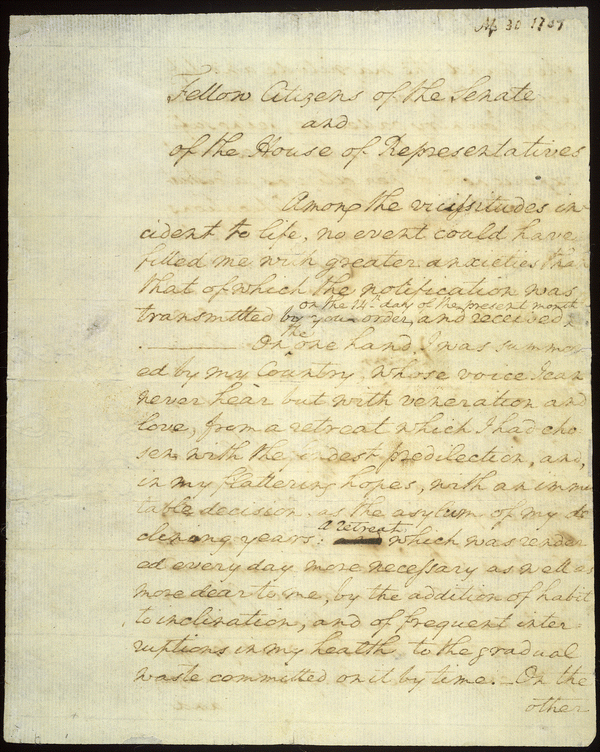
Fellow-Citizens of the Senate and of the House of Representatives:Among the vicissitudes incident to life no event could have filled me with greater anxieties than that of which the notification was transmitted by your order, and received on the 14th day of the present month. On the one hand, I was summoned by my Country, whose voice I can never hear but with veneration and love, from a retreat which I had chosen with the fondest predilection, and, in my flattering hopes, with an immutable decision, as the asylum of my declining years--a retreat which was rendered every day more necessary as well as more dear to me by the addition of habit to inclination, and of frequent interruptions in my health to the gradual waste committed on it by time. On the other hand, the magnitude and difficulty of the trust to which the voice of my country called me, being sufficient to awaken in the wisest and most experienced of her citizens a distrustful scrutiny into his qualifications, could not but overwhelm with despondence one who (inheriting inferior endowments from nature and unpracticed in the duties of civil administration) ought to be peculiarly conscious of his own deficiencies. In this conflict of emotions all I dare aver is that it has been my faithful study to collect my duty from a just appreciation of every circumstance by which it might be affected. All I dare hope is that if, in executing this task, I have been too much swayed by a grateful remembrance of former instances, or by an affectionate sensibility to this transcendent proof of the confidence of my fellow-citizens, and have thence too little consulted my incapacity as well as disinclination for the weighty and untried cares before me, my error will be palliated by the motives which mislead me, and its consequences be judged by my country with some share of the partiality in which they originated.
Such being the impressions under which I have, in obedience to the public summons, repaired to the present station, it would be peculiarly improper to omit in this first official act my fervent supplications to that Almighty Being who rules over the universe, who presides in the councils of nations, and whose providential aids can supply every human defect, that His benediction may consecrate to the liberties and happiness of the people of the United States a Government instituted by themselves for these essential purposes, and may enable every instrument employed in its administration to execute with success the functions allotted to his charge. In tendering this homage to the Great Author of every public and private good, I assure myself that it expresses your sentiments not less than my own, nor those of my fellow- citizens at large less than either. No people can be bound to acknowledge and adore the Invisible Hand which conducts the affairs of men more than those of the United States. Every step by which they have advanced to the character of an independent nation seems to have been distinguished by some token of providential agency; and in the important revolution just accomplished in the system of their united government the tranquil deliberations and voluntary consent of so many distinct communities from which the event has resulted can not be compared with the means by which most governments have been established without some return of pious gratitude, along with an humble anticipation of the future blessings which the past seem to presage. These reflections, arising out of the present crisis, have forced themselves too strongly on my mind to be suppressed. You will join with me, I trust, in thinking that there are none under the influence of which the proceedings of a new and free government can more auspiciously commence.
By the article establishing the executive department it is made the duty of the President "to recommend to your consideration such measures as he shall judge necessary and expedient." The circumstances under which I now meet you will acquit me from entering into that subject further than to refer to the great constitutional charter under which you are assembled, and which, in defining your powers, designates the objects to which your attention is to be given. It will be more consistent with those circumstances, and far more congenial with the feelings which actuate me, to substitute, in place of a recommendation of particular measures, the tribute that is due to the talents, the rectitude, and the patriotism which adorn the characters selected to devise and adopt them. In these honorable qualifications I behold the surest pledges that as on one side no local prejudices or attachments, no separate views nor party animosities, will misdirect the comprehensive and equal eye which ought to watch over this great assemblage of communities and interests, so, on another, that the foundation of our national policy will be laid in the pure and immutable principles of private morality, and the preeminence of free government be exemplified by all the attributes which can win the affections of its citizens and command the respect of the world. I dwell on this prospect with every satisfaction which an ardent love for my country can inspire, since there is no truth more thoroughly established than that there exists in the economy and course of nature an indissoluble union between virtue and happiness; between duty and advantage; between the genuine maxims of an honest and magnanimous policy and the solid rewards of public prosperity and felicity; since we ought to be no less persuaded that the propitious smiles of Heaven can never be expected on a nation that disregards the eternal rules of order and right which Heaven itself has ordained; and since the preservation of the sacred fire of liberty and the destiny of the republican model of government are justly considered, perhaps, as deeply, as finally, staked on the experiment entrusted to the hands of the American people.
Besides the ordinary objects submitted to your care, it will remain with your judgment to decide how far an exercise of the occasional power delegated by the fifth article of the Constitution is rendered expedient at the present juncture by the nature of objections which have been urged against the system, or by the degree of inquietude which has given birth to them. Instead of undertaking particular recommendations on this subject, in which I could be guided by no lights derived from official opportunities, I shall again give way to my entire confidence in your discernment and pursuit of the public good; for I assure myself that whilst you carefully avoid every alteration which might endanger the benefits of an united and effective government, or which ought to await the future lessons of experience, a reverence for the characteristic rights of freemen and a regard for the public harmony will sufficiently influence your deliberations on the question how far the former can be impregnably fortified or the latter be safely and advantageously promoted.
To the foregoing observations I have one to add, which will be most properly addressed to the House of Representatives. It concerns myself, and will therefore be as brief as possible. When I was first honored with a call into the service of my country, then on the eve of an arduous struggle for its liberties, the light in which I contemplated my duty required that I should renounce every pecuniary compensation. From this resolution I have in no instance departed; and being still under the impressions which produced it, I must decline as inapplicable to myself any share in the personal emoluments which may be indispensably included in a permanent provision for the executive department, and must accordingly pray that the pecuniary estimates for the station in which I am placed may during my continuance in it be limited to such actual expenditures as the public good may be thought to require.
Having thus imparted to you my sentiments as they have been awakened by the occasion which brings us together, I shall take my present leave; but not without resorting once more to the benign Parent of the Human Race in humble supplication that, since He has been pleased to favor the American people with opportunities for deliberating in perfect tranquillity, and dispositions for deciding with unparalleled unanimity on a form of government for the security of their union and the advancement of their happiness, so His divine blessing may be equally conspicuous in the enlarged views, the temperate consultations, and the wise measures on which the success of this Government must depend.
William Maclay, a senator from Pennsylvania, kept a daily journal - highly detailed, and rather cynical, about the Senate sessions of the first Congress. He describes the first inauguration in vivid detail:
30th April, Thursday.--This is a great, important day. Goddess of etiquette, assist me while I describe it. The Senate stood adjourned to half after eleven o'clock. About ten dressed in my best clothes; went for Mr. Morris' lodgings, but met his son, who told me that his father would not be in town until Saturday. Turned into the Hall. The crowd already great. The Senate met. The Vice-President rose in the most solemn manner. This son of Adam seemed impressed with deeper gravity, yet what shall I think of him? He often, in the midst of his most important airs--I believe when tie is at loss for expressions (and this he often is, wrapped up, I suppose, in the contemplation of his own importance)-- suffers an unmeaning kind of vacant laugh to escape him. This was the case to-day, and really to me bore the air of ridiculing the farce he was acting. "Gentlemen, I wish for the direction of the Senate. The President will, I suppose, addressthe Congress. How shall I behave? How shall we receive it? Shall it be standing or sitting?"Here followed a considerable deal of talk from him which I could make nothing of. Mr. Lee began with the House of Commons (as is usual with him), then the House of Lords, then the King, and then back again. The result of his information was, that the Lords sat and the Commons stood on the delivery of the King's speech. Mr. Izard got up and told how often he had been in the Houses of Parliament. He said a great deal of what he had seen there. [He] made, however, this sagacious discovery, that the Commons stood because they had no. seats to sit on, being arrived at the bar of the House of Lords. It was discovered after some time that the King sat, too, and had his robes and crown on.
Mr. Adams got up again and said he had been very often indeed at the Parliament on those occasions, but there always was such a crowd, and ladies along, that for his part he could not say how it was. Mr. Carrol got up to declare that he thought it of no consequence how it was in Great Britain; they were no rule to us, etc. But all at once the Secretary, who had been out, whispered to the Chair that the Clerk from the Representatives was at the door with a communication. Gentlemen of the Senate, how shall he be received? A silly kind of resolution of the committee on that business had been laid on the table some days ago. The amount of it was that each House should communicate to the other what and how they chose; it concluded, however, something in this way: That everything should be done with all the propriety that was proper. The question was, Shall this be adopted, that we may know how to receive the Clerk? It was objected [that] this will throw no light on the subject; it will leave you where you are. Mr. Lee brought the House of Commons before us again. He reprobated the rule; declared that the Clerk should not come within the bar of file House; that the proper mode was for the Sergeant-at-Arms, with the mace on his shoulder, to meet the Clerk at the door and receive his communication; we are not, however, provided for this ceremonious way of doing business, having neither mace nor sergeant nor Masters in Chancery, who carry down bills from the English Lords.
Mr. Izard got up and labored unintelligibly to show the great distinction between a communication and a delivery of a thing, but he was not minded. Mr. Elsworth showed plainly enough that if the Clerk was not permitted to deliver the communication, the Speaker might as well send it inclosed. Repeated accounts came [that] the Speaker and Representatives were at the door. Confusion ensued; the members left their seats. Mr. Read rose and called the attention of the Senate to the neglect that had been shown Mr. Thompson, late Secretary. Mr. Lee rose to answer him, but I could not hear one word he said. The Speaker was introduced, followed by the Representatives. Here we sat an hour and ten minutes before the President arrived--this delay was owing to Lee, Izard, and Dalton, who had stayed with us while the Speaker came in, instead of going to attend the President. The President advanced between the Senate and Representatives, bowing to each. He was placed in the chair by the Vice-President; the Senate with their president on the right, the Speaker and the Representatives on his left. The Vice-President rose and addressed a short sentence to him. The import of it was that he should now take the oath of office as President. He seemed to have forgot half what he was to say, for he made a dead pause and stood for some time, to appearance, in a vacant mood. He finished with a formal bow, and the President was conducted out of the middle window into the gallery, and the oath was administered by the Chancellor. Notice that the business done was communicated to the crowd by proclamation, etc., who gave three cheers, and repeated it on the President's bowing to them.
As the company returned into the Senate chamber, the President took the chair and the Senators and Representatives their seats. He rose, and all arose also and addressed them. This great man was agitated and embarrassed more than ever he was by the leveled cannon or pointed musket. He trembled, and several times could scarce make out to read, though it must be supposed he had often read it before. He put part of the fingers of his left hand into the side of what I think the tailors call the fall of the breeches, changing the paper into his left hand. After some time he then did the same with some of the fingers of his right hand. When he came to the words all the world, he made a flourish with his right hand, which left rather an ungainly impression. I sincerely, for my part, wished all set ceremony in the hands of the dancing-masters, and that this first of men had read off his address in the plainest manner, without ever taking his eyes from the paper, for I felt hurt that he was not first in everything. He was dressed in deep brown, with metal buttons, with an eagle on them, white stockings, a bag, and sword.
From the hall there was a grand procession to Saint Paul's Church, where prayers were said by the Bishop. The procession was well conducted and without accident, as far as I have heard. The militia were all under arms, lined the street near the church, made a good figure, and behaved well.
The Senate returned to their chamber after service, formed, and took up the address. Our Vice-President called it his most gracious speech. I can not approve of this. A committee was appointed on it--Johnson, Carrol, Patterson. Adjourned. In the evening there were grand fireworks. The Spanish Ambassador's house was adorned with transparent paintings; the French Minister's house was illuminated, and had some transparent pieces; the Hall was grandly illuminated, and after all this the people went to bed.
I have such a deep fondness for John Adams, with all his airs and self-importance and vanity. I just love the guy, what can I say. He's so feckin' human.
The description of Washington's awkwardness makes me want to cry:
He rose, and all arose also and addressed them. This great man was agitated and embarrassed more than ever he was by the leveled cannon or pointed musket. He trembled, and several times could scarce make out to read, though it must be supposed he had often read it before. He put part of the fingers of his left hand into the side of what I think the tailors call the fall of the breeches, changing the paper into his left hand. After some time he then did the same with some of the fingers of his right hand. When he came to the words all the world, he made a flourish with his right hand, which left rather an ungainly impression. I sincerely, for my part, wished all set ceremony in the hands of the dancing-masters, and that this first of men had read off his address in the plainest manner, without ever taking his eyes from the paper, for I felt hurt that he was not first in everything. He was dressed in deep brown, with metal buttons, with an eagle on them, white stockings, a bag, and sword.
God. Good God. But what really moves me is that after the address, they all walked in procession, led by George Washington, to St. Paul's Church, for a service.
St. Paul's Church. (Read that article ... it's a well-known story, of course, but it always bears repeating.) St. Paul's has always had meaning for us here in New York, because of its long history, but now ... it has more meaning than ever. I can't even think about St. Paul's without feeling tears come to my eyes. So to think ... that that special church, that church that became symbolic (not just to us here, but to people all over the country) of hope, or survival, of healing ... would be the place where George Washington prayed for guidance after being sworn in as the first President... I mean, honestly. I don't even know what else to say about it.
April 30, 1789 ... the day this new nation embarked on its unknown and exciting course, with George Washington at the helm.
Here is an image of the first page of this inaugural address, in Washington's own hand.
April 29, 2006
Phone calls
I'm having a party tonight for my cousins and any O'Malley in a 500 mile radius. My sisters are coming. Cousins and cousins spouses. Sadly, uncle won't be able to make it. I'm cooking. I went shopping. I am also ordering food in. It's a sun-blasted day. I'm sorta blue. Not sure why. This happened the last time I took Diary Friday into the realm of cherished memories - as opposed to just goofy high school stuff. Sometimes it's good to let stuff stay in the past. Also - because I know what comes next ... I read my ecstatic words and feel sort of eerie and sad about it. Existentially sad. Silly, but that's what's happened. I'm listening to Queen right now. "Too much love will kill you". That pretty much sums it up.
And the pain will make you crazy
You're the victim of your crime
Too much love will kill you every time
"The pain will make you crazy". Yes. It did. That ecstatic frenzied girl was headed for a crash that wiped everything out for a good long while. So that's what I sense in those diary friday words ... I sense the wave approaching. It's disturbing - even though, duh, I was there, and I lived it, and it's over now.
Also I threw a bunch of stuff out today ... I got rid of a bunch of cassette tapes (!!! Yes! I still have tapes!) - I have all these mix tapes given to me by people throughout my life. My sisters, my brother, etc ... but also ... digging thru them I saw handwriting I didn't recognize ... Some of them are mix tapes given to me by guys I don't even remember - a guy I went on one or two dates with - a guy I dated for 2 weeks - whatever ... but in that space of time they were able to make me a mix tape. Ghosts. Throw 'em out.
And then I also found a tape that I (believe it or not) totally forgot I had. It has my scribbling on the "liner notes" - and it says: Phone calls. The second i saw those words I remembered what this tape was. I kept this tape going during a really lonely time in my life - not even lonely - I was haunted. And I would keep a recording of answering-machine messages that I wanted to save. So ... I could listen to them later? So ... I could have evidence? I don't know. But I made the mistake of listening to that tape this morning. I still can't throw it out ... Recordings of long-ago messages left for me from ex-boyfriends ... you know. The triumvirate. What a horrible idea. To keep a record of those calls AND to listen to it years later. There's a marriage proposal there. A serious one. From a guy I've mentioned on this blog before, but I won't name him here - just respecting his privacy. The marriage proposal came from out of nowhere - we hadn't seen each other in years. But he meant it - and the whole thing made a strange sort of sense. I must have called him back a couple of times ... and got no response from him (can't remember) because the next message from him is: "Leave it to me to ask you to marry me and then promptly disappear." When I listened this morning, I burst out laughing at that part - his deep sexy voice saying that. I ended up flying out to meet him so we could talk about this marriage thing. Because I was considering it. For many reasons. Rainy morning, we had breakfast together, stacks of pancakes, and I remember I had on saddle shoes, like Lucy van Pelt. This whole scene just came flooding back to me when I listened to that message from years ago. We sat across from each other in a booth, and I put my feet up on the seat opposite. I told him I would marry him. He ate my leftover pancakes. We talked about marriage, and we were freaked out. Rain pounded against the windows of the diner. I hadn't seen him in years. We went back to Mitchell's apartment. Mitchell ended up yelling at us because we were waffling on this marriage thing. After the pancakes? Waffles, apparently. He and I were sitting on the couch together and Mitchell lectured us sternly. "I think the two of you should spend the rest of your lives together. What the hell do you want from me?" hahahaha Mitchell was tired of us. We were tired of us.
Funny memories. But not so funny this morning.
When I saved those messages I had no idea that they would act as such eerie time-travelers.
I laughed as I listened to the tape ... there are some very funny messages on there ... but afterwards, I felt very weird. I looked around and looked at my apartment and thought: Where am I?
I am looking forward to seeing my family. Having O'Malleys raging through my apartment will remind me of the present ... will make my NOW seem real. But for now?
Haunted.
April 28, 2006
Diary Friday - Part III
Last entry for today!! (The other two parts to this particular Diary Friday entry are below this one: Part I, Part II). I can't create anything original right now. Creative life is happening offline. So!! Diary Friday: the extended version.
NOVEMBER 3 SATURDAY
I still have to finish about the party.
Eventually I had to sit down. Everything looked like it was glowing. My head swam. I never knew what all that felt like before. But I stopped drinking then - and then everything became fun. Nobody really danced because the living room is small - but Marvin and me and Joanna and Brett all dance wildly - doing imitations of Kimber as we danced. Joanna looked so cute, bouncing up and down to the music with her wings. I just had fun.
I sat for a while and talked to Lewis. He was cute. He came as a Puerto Rican and it was killing me. [Wow. That is offensive. And also very very funny.] Then I talked for so long on the couch with this guy - I think his name was Kevin - we talked about acting, ambition, perseverence - deep things and we had just met. Theatre people are so genial. They thrive on such high emotion anyway, so I really felt at home. Especially with my husband, Marvin.
There must be more men out there like Marvin. Millions! [Uhm. Guess again.] I judge my entire social life from high school - that has a population of 800 (400 who are boys, and too many who are under 16 or immature or assholes.) I have found so many wonderful open people! Ohhhh!
[Then there is an ENORMOUS smiley face drawing. The mouth of the smiley face is open.]
[More huge letters across the page:]
DINA, BRETT, JOE, MARVIN, JOANNE
I love them! I really really adore them. I want to invite them all to come see me graduate.
Oh, very scary news: we were measured for our caps and gowns on Thursday. Caps and gowns. It really is a reality. A very SOON reality.
Picnic is also a reality and it's NOT far away. Oh, and on Wednesday I had a costume fitting. I could hardly believe it was me in the reflection! Seeing two people working to construct three costumes for me ... They were pinning material on me, marking, taking notes - I stood stationary, my heart pounding. [Wanna see the end results? Here are my 3 costumes in the show.]
I can't wait for everyone to see it!
Oh. And today I took the SATs. [hahahaha I love that "Oh"]
Dead silence.
I don't want to talk about them. They're over and done with. I did my best. So there.
NOVEMBER 4
I've been playing all sorts of psychological games this week. Last Sunday's rehearsal triggered it - and all this week all these other people have been coming up with interesting games. [I literally have no idea what I am talking about.]
Okay. Joanna drove me home from the party cause Brett passed out. [hahahahahahahahahahahahaha] And at one point during the night - I felt this sort of prickling worry - like, I didn't want him to drive drunk - but I didn't want to be stranded ... People started leaving and I was sitting on the couch alone, wondering how I was going to get home. Eric came over and sat right beside me, putting his arm around me.
So that's what it feels like to relax in someone's arms. I never knew.
He was saying, "If I had a car I'd drive you - don't worry. We'll find you a ride." [Thanks, Eric!!] Eric's brother came too and I met him. Not many people were left, so Eric and I just sat on the couch talking, his arm around me. His arm felt so strong, so supportive, so warm.
Oh - and that supernice girl who was talking to Brett before came over to me and said, "I know how exhausted you must be but I am trying to find you a ride ..." [Who WAS this guardian angel?] Finally, Joanna came over to me and said, "You should have asked me long ago! I'll give you a ride home!"
When Joanna drove home, she looked SO funny with her wings behind the wheel.
I can't believe I did this - but I got home at 3:00. My poor mother. Everyone in the car was afraid I'd get in trouble. [hahahahahaha I love all these college kids being so cool with me.] My mother was lying in bed, her eyes wide open. My dad was snoring. [hahahahahahahahahahaha]
I had to go to sleep. My head was pounding. And we had rehearsal on Sunday. Brett and Eric looked horrendous the next day. Tired, pale, unshaven, hair tousled ... [Actually, it sounds kind of hot.]
When Brett saw me, he said, "Sheila O'Malley. I am so sorry. I was supposed to give you a ride home. I'm sorry! I passed out!" [Please factor in the fact that he passed out in his MIME MAKEUP. Hilarious.] Of course I said, "Don't even think about it, Brett." I mean, he'd be a lot sorrier if he drove me home and drove us over a bridge or into a tree. "I hope you had a good time, anyway," he said to me, as he huddled in his chair. I said, "I did. Thank you for inviting me. Did you have fun?" He grinned tiredly. "Loads of fun last night. Not so much fun today." For some reason, Kimber was an hour late, so we all sprawled on the stage and did stretching exercises.
We were all out of it though. We pretty much fooled around. We spelled our names with our butts. [hahahaha Have you ever done that?? Lie on your back, raise your pelvis in the air, and spell your name with your butt.] We did it unison - we did everyone there - and we'd all scream: "Dot the i!" Cause that was a pelvic thrust. It was so hysterical. We were all breathless with laughter. Ss were fun too. Good thing Kimber didn't walk in in the middle of that.
Then Joanna told us about this game that we decided to play. If you have a group of people, one person leaves and the remaining people people choose somebody in the group to be "It". Then the person who left comes back and has to ask everyone in the group one question like, "If this person were a color, what color would they be?" or "If this person were a planet, what planet would the be" or whatever. So we played that. Brett was the first one to do the asking, and Liz was IT. Let's see. She was the color yellow, a sports car, a grape, a rushing stream, the cartoon character Pebbles, and the city Philadelphia. It was so interesting to watch people try to guess. When Eric did the guessing, I was IT. I just sat there holding my breath to hear what I was. It was freaky, watching people think about what animal I would be - what food I would be - Oh, it felt strange.
Let me tell you what I was.
If I were a type of novel, I would be a romantic novel. (from Joanna)
If I were an animal, I would be a sparrow. (From Michele)
If I were a type of wood, I would be teak (From Brett)
If I were a piece of clothing, I would be blue jeans (from Linda)
If I were a type of music, I would be New Wave (from me)
If I were a food, I would be a cracker (from Liz. It was so funny - she said "cracker" with NO hesitation. It came out immediately. "What food would this person --" "Cracker." Afterwards, she said to me, "My first impulse was cereal, but ..."
If I were a stone or a gem or whatever, I would be white gold (from Joan)
And then it came time for Eric to guess - and he said "Either Michelle or Sheila." Isn't that amazing?? Everyone yelled, "Which one?" and he said, "Okay -" and he pointed at Michelle and he was assaulted with boos and gong noises. Then he looked at me and said, "Well, when I heard sparrow ... that's what made me think of you."
On Monday's reherasal, Joanna had to leave early but I didn't know that - I guess she asked Brett if he could take me home. So when I came out into the house, Brett, who was in a seat, said, "You're coming with us." I said, "I am?" He said, "Yeah -- In my car, but Joe is driving." I asked him if it was really okay. He said No problem!
Joe and Brett sat in front - Joanne and I sat in back. I like her so much. I have crushes on all the girls too! She told me that I was "holding my own" as an actress. I was really flattered because she is a WONDERFUL actress. We dropped her off at her dorm. Then Joe, Brett and I drove off to my house, talking about Kimber. I said from the backseat, "He makes me nervous." Brett started roaring. They both told me to relax, not to get frustrated. Joe had no idea where I lived so Brett gave him directions. Brett remembered.
The whole way home we had been practicing our accents, so as I got out of the car I said, "Thank you very much" in my accent - and as I climbed out, Brett suddenly said to me, "We love you, you know." I said, "I love you guys, too." It just flew out. As I went up the walk, Brett was calling out the window, "I love you!" in a twang.
Today's rehearsal: Act II. My fun act. My first date, I dance [That's me dancing with Eric - recognize him??], I get drunk, I scream, I cry, I throw up. We blocked the dancing scene. It took a while so Eric and I just waltzed slowly together, for half an hour, while Kimber blocked the rest of it. It felt so casual, it was weird. He's so tall, his hands on my back - being touched. When he first sees me in the scene, he runs over to me and hugs me, lifting me off the ground. And Eric is gorgeous, not to mention incredibly nice.
I do not want to forget any of these people and what they have meant to me.
Liz -- who makes me laugh. "A cracker"
Joanne - who is warm and deep and kind
Joanna - who I love - I just think she's great
Joe - who is so funny - his expressions!
Eric - who treats me so gently, calls me "kid", tousles my hair, and is also hysterical
Jennifer - who is so CUTE and I love her
And Brett -- well, I already know I'll never forget him.
When I throw up in Act II, I have to run into the house - Then Mrs. Potts' line is "Alan held her head and let her be sick." So I went tearing off stage, and Brett was back there, sitting on a table - I barreled over to him, and sat next to him. He held my head tight against his shoulder, and I pretended to be sick. We were both laughing. He said, "I'm sorry. But I would never help you throw up. When I see someone barf, I barf myself." We were clutching at each other, laughing. I kept leaning over the table retching and he would grab my head and I'd hear him start giggling.
The next time I come onstage, Alan leads me on and he has his arm around me. Linda (who plays Mrs. Potts) kept taking me out herself, saying, "Here's Millie - good as new" - instead of letting the TRUE blocking occur. But Brett knew it was wrong too - because I could hear him start to mildly protest - like, "Wait a sec ..." Then Kimber read aloud the correct blocking so we backed through the door and came out again. I love Act II.
On Sunday, me, Liz and Joanna worked in the morning. Then those two had this long scene that couldn't get right and they worked on it for at least 45 minutes. I still felt like Millie after doing the fight scene when I pull Madge's hair. I really did. I came offstage and it took me about 10 minutes to calm down. I sat on the floor beside the stairs of the platform. It was my own little corner. I saw Brett walk by - he saw me and we were just whispering - he asked me what they were working on, how long they'd been working. I answered his questions but I didn't say anything else. I don't know why. I couldn't think of an interesting thing to say. So just as he turned to leave, I managed to whisper, "How are you doing?" He turned to smile at me.
If there's one thing I can't stand - it's a phony. I won't tolerate them and I tell you: I can see them RIGHT away. Brett is so genuine. Even the little things - like the smile there. I wouldn't have remembered it if there hadn't been something in it - real, kind, nice, friendly - that's what he is. Is he for real? Why do men like him exist? Even my happiness hurts now. Everything is so good it hurts.
Brett and I went out into the lounge to talk. We checked the schedule on the bulletin board - we stood there talking. We talked about being insecure. He was saying, "That's what I'm having trouble with with Alan. His insecurities. I've gotten over my personal insecurities - so that's where I have trouble." I laughed, "Oh, that's no problem for me! I haven't gotten over my personal insecurities so it's easy to play them!" We both laughed and he squeezed my shoulders. "Well - hopefully this play will get your confidence up where it belongs."
When I am with him, I don't become someone I'm not. I don't act like a flake. I don't feel like he's making me feel inferior, or trying to brag. He doesn't talk down to me. I really hate it when TS does that. I LET TS do it to me, and it makes me angry.
[Ooh. Look at that. A little distance and suddenly I can feel my anger!]
I have to talk to TS. I haven't seen him in so long. I feel like I'm shriveling up and dying. I am giving my all to everything. Everybody is squeezing as much out of me as they can get. I have rehearsals: Tuesday, Wednesday, Thursday, Friday, Saturday, Sunday. I am in every scene of this play. It's tiring. Yesterday, I was over at Anne's house for a while. As we drove into the driveway, a car pulled up - In it were Matt and TS. I haven't seen or talked to TS since the stupid Sadie Hawkins. So it felt awkward and awful. Anne and I went over to their car as they got out. TS said me and said, "Hey, Sheila. How's the play going?" [So cold!] I said, "Pretty good. How's your movie?" And he said, "I'm not gonna start until December."
Diary - that was it. Oh it was HORRENDOUS. It was like we were strangers. No one can imagine how confused I am. I see Brett every single day and months pass between the times I see TS. It's been so long since I saw him and I swear to God I don't have the time to do anything about it. Now all I want is to see him, be with him, talk with him - it's driving me nuts. I keep seeing the hug again in my mind - [which is so interesting - because now, what with Brett and Eric - hugging me left and right- a hug lost some of its power] I want to get back to that moment with TS in the darkness with the trees around, and SQUEEZE him to me forever. Standing in the driveway at Anne's house, being all polite and cold, it was hard to believe we had ever shared anything like that. His arms tight around me, the warmth.
I am NEVER home. I do NO homework. I get home at 11:30, my eyes dried up and bloodshot, and I get up at 6:00 am. I look like death. I mope like a drug addict through the halls of high school. Then, at 6:00 pm, I take a shower, run around, eat for the first time all day, change, go over my lines - Then 4 hours of reherasal totally wipes me out. I feel bad for neglecting my diary [Are you fucking KIDDING ME???????] but I don't have time. I am doing so much.
I am learning so much. And it doesn't help that I have TS to think about. Wouldn't you know - GOD - wouldn't you know - my luck - that I'd get in a play with someone like Brett.
Kate and I were talking about how our situations are similar. She's still doing the retreat, I'm doing Picnic - 2 different groups of people - and both groups are so much more open than what you get during the day in high school. It's so much harder to come back into high school after being with these people.
I have this sketch pad as a prop - and every time I open it someone has written in it something new. I never know who does it. Funny little cartoons, messages to Millie - one huge smiley face by Michelle that has "HI MILLIE, I LOVE YOU!" coming out of its mouth in a balloon.
It's just so open. I mean, lookat me. I felt like I was their friend the first day of rehearsal. High school is so stagnant, and relationships with the opposite sex are so stilted - and people can be so narrow-minded. Kate is going through exactly the same thing. How do you come back to high school after a night with the retreat people or the theatre people? I feel so dissatisfied and empty.
I am exhausted.
Perpetually.
I can almost feel my brain aching.
Diary Friday - part II
Part II of the entry below this one ...
I think I'm gonna have to do a Part III as well ... This is a long-ass entry. But it's great - especially for my friends who will remember this time, and who will know the people of which I speak. This is an entry of 1000 names. A big blast from the past!!
OCTOBER 29 MONDAY
What a weekend. Wow.
Wow.
I could sit here and write forever if I had time. I don't even know if I want to.
_____________________________________
Okay, it's after school now. In order to get a ride home I had to come to Brendan's JV game where Mum will be - but it's raining, so I'm sitting here alone in a deserted dugout. I am in the mood to write it down now so that I can forget this fucking bad day.
So for the rest of the breaks, we all just sat around on the platforms discussing Halloween costumes. Since it was so sudden, I didn't have time to think yet.
Okay the key word I think - is fondness. That's what I keep thinking. He'd look at me and grab the back of my neck. "What are you going as, Millie?" I hadn't even gotten used to the fact that I was actually going. I didn't even feel enthusiastic yet. More nervous than anything. I love everybody. They want me to feel welcome. I can feel it.
[Now HUGE letters:]
GOD I AM HAPPY NOW! [so much for that "fucking bad day", huh?]
Rehearsal went til 5:00. After rehearsal I was getting my stuff together and I said to Joanna (who usually drives me home) - "I am gonna go to the O'Neill's tonight." Because she wasn't sure if she was gonna. So she said, "Oh! Oh - okay - I still have to decide what I want to do." Brett bounded down the stairs looking at me. "Do you need a ride?" I glanced at Joanna and she looked at Brett - "Oh - could you? Cause I'm not going straight home --" So he shrugged - "Sure. Great!"
[Brett: I know you're reading this. hahahahahaha Again: look at how closely I record YOUR EVERY GESTURE!!]
Everything worked like clockwork. Brett and I headed out to his car together. It felt good. Friendly. I really think Brett is something special. It all goes back to how I see myself. I can't understand why people would be nice to me for no reason. I don't let it bug me too much because it doesn't ruin how I feel about them - but it's still in the back of my mind: "Why do they like me?" I do that to myself every minute of the day. Especially ESPECIALLY with guys. And Brett -- he's hardly a high school kid. Neither is Eric or Joe. But they're nice. They include me. I am one of them. It was just cool and grown-up - getting into Brett's car with him. Massive massive crush here! But I don't care! He's HIP!!!!! [hahahaha "Hip"? Brett - did you know that you are "hip"?] He's a new friend. I love it.
As Brett started the car he said, "Let us pray that it gets out of Park." It's an automatic. And it did! I said, "It's showing off for me, I think." Now here's the best part. We were driving along and discussing the party - I can't get over how at ease I feel with him. God, I just feel like praising him to all the world. Praising everyone in this cast to the whole world!
I am lucky. I know that.
Right as we got to my street - he said, "Are you expected home or anything?" And I shrugged. "No." And he said, "Cause I was gonna ask if you wanted to go for some dinner at McDonalds."
My heart stopped. Then flew. Then stopped again. Then soared.
It wasn't like I sat there thinking, "Oh my God, what does it mean??" I felt just plain terrific happiness - and this love for everybody. Happy. That's what I felt. So I looked at him and said, "Really?" And he nodded, smiling at me, "Yeah!" So I nodded and said, "If you want to stop by my house - I don't have any money." And he just - like TS does - said, "Oh, don't worry about it."
Shit. Is it possible to really like two people at the same time? [Yes. That's the answer.] Of course it's possible - because it's happening to me right now.
So we drove on - and as we passed by my street he said, "Well - finally Millie and Alan are on a date!" It was strange - but as we drove along talking, I practically felt in awe of myself, and my own life. It was neat. I felt tingley. Special. Like we were really friends. [I was right. We were. And still are.]
He told me about Kimber's class. It felt so funny to be cruising along with him! I mean, I felt hopelessly sophisticated. [If you could have seen what Brett's car looked like at that time - you would laugh out loud that I would have felt "sophisticated" in it.] I mean, I also felt very young and naive - but - I was talking, too. [When I got intimidated with guys, I would clam up. Literally have not a word in my head, nothing to say. I never ever felt that with Brett. I was a blabbermouth with him. We would just blabber together. Very different for me.]
Am I madly in love with him? I mean, it feels like it. I guess I could just brood about this for eternity. [Wow. That sounds like FUN!]
We got to McDonalds. Being there - on my own turf -- with him -- was weird. [It was the McDonalds near my high school. My friends and I would walk up there during open-campus periods and have lunch] I think of college as being its own little world but there we were in the McDonalds where I have eaten 1000 times! I was with a 20 year old college junior who is gorgeous, nice, funny - He's a combination of so many great things. As we ordered - I did feel like his buddy ... almost like we were actually Millie and Alan. [Our parts in the show] We were laughing, ordering, being normal people together. [I was dating "TS" at this time, and as much as I liked him there were times when I was so self-conscious with him that I could barely keep up my end of the conversation. That was what I was used to happening with boys. But I didn't feel any of that with Brett.]
It's strange when you see someone only in one atmosphere . It felt so different to be with him outside of the theatre. It was all so damn wonderful. We shared my McNuggets. He got 3 hamburgers. [hahahahaha] We sat in a corner booth. We were totally hysterical with laughter. I can't remember why exactly - but we started talking about auditions - and how psyched I must be to be in the show. Brett told me that Kimber and a few other people were sitting around talking about the cast choices, and Brett told me that Kimber said, "Well, Sheila O'Malley is Millie."
And I said something like, "Yeah, no wonder the whole thing comes so naturally to me. Listen to my lines. 'How do you talk to boys?' 'How do you go on a date?'" Brett stopped eating cause he started laughing, and he slid around the seat next to me, hugging me with one arm as he laughed. When he hugs me it's so genial, so friendly, so comfortable. It's nothing to worry about. I love it.
I can't believe we ate at McDonalds together!! [It truly was one of the most extraordinary events of the 20th century. I totally can see that now.]
I also started looking forward to the party, even though I was getting more nervous than I had ever been before a date with TS. My first party. I tend to be a recluse. I'm shy. So as we ate I asked him, "So what are your parties like?" And he shrugged. "Oh, music. Craziness." I said, "I am shakin' in my boots." He almost spit out his soda. We both were laughing but I had to tell him the truth! He was like, "No, no, they're fun. Nothing big. Just relaxed. You can meet a lot of other people who aren't in Picnic." We had a really cool conversation. He went to NYU for a year but he hated it cause everyone was so self-centered and next year he's spending the fall studying abroad in London. (Oh, isn't that HIP?) [Sheila. What's with the sudden overuse of the word "hip"?] He said, "But I'll be back in time for you to see me graduate."
He laughs at my jokes. Really laughs. It feels mutual. It's almost the first time that this has happened to me. I didn't feel unsure at all. I could have been sitting there talking with Kate or Mere. No discomfort. I didn't try to be anyone other than myself.
He's also good with kids. There was this little girl sitting at another table. She was about 2 with blonde curls. I couldn't see her because my back was to her, but all of a sudden Brett's face lit up in this grin, so I turned around and saw her, and for about a minute we sat there waving at her, making faces. It was so cute.
I got this weird sense of being able to step outside myself and see myself. This happens to me a lot with TS, too. I mean, as we sit together at the movies - I feel like I am really removed fromt he situation, and I can feel everyone looking at us and seeing us together - I get the sense of what we look like to other people. I get this even more so with Brett because I'm not used to being with him - he is somebody new and I could hardly believe I was there myself. I couldn't help it thought - I kept thinking: "What if TS walks in right now?" Or DW - or J or Kate - what would they think? I feel so far away from my friends now. I have this whole other life - and I tell them the stories - but none of them can put faces, yet, to the new people I talk about constantly. I can tell them about rehearsals - but it's weird to be experiencing something that they are not experiencing. It's so weird. Sometimes I feel like I belong more with the URI people than with the high school people - Not my friends - I belong with them - but just the whole school atmosphere. I am SO out of school now. If I thought I felt alienated before - now I'm just going to school to kill time before I go to college. It just feels strange and makes me feel far away from my friends. And school itself seems unreal. LIke - it is going on without me there, but I'm not even noticing. I don't even care.
On the way home, Brett told me the plot of Hooters. [A play that had happened the year before - with Brett, Liz, Eric, and Dina. Still fresh in everyone's minds. I hadn't seen it.] I wish I had seen it. As I got out of the car at my house, I leaned back in and said, "Thanks a lot, Brett." And he smiled at me. "You bet. See you tonight."
Then I ran inside and sat down.
I was trembling. I was so happy it scared me. It was unbelievably real. I couldn't stand how nice it all was. I just sat on the couch grinning. Then I turned on some music and danced. No one else was home. Then I went up to my room and threw together my costume. When I had come home for my break, I had told Dad about the party and he said "Sure" I could go. [Thanks, Dad!!] My parents are cool. Then Mum came home and I told her the whole thing about going to McDonalds. She was excited for me. [Thanks, Mum! Hahahahaha] Then the three of us went up to see the O'Neills. I had my costume in a paper bag.
[A word: The "O'Neills" was a night of one-acts by Eugene O'Neill - all taken from the collection "Seven Plays of the Sea". David (one of my best friends now) was in one of the plays - I talked about it here. But I hadn't met him yet. We've now been friends for 20 years. The things we've gone through. I mean, good Lord. Anyway. I will always look fondly on that night of O'Neills. Great night of theatre. First time I ever laid eyes on David.]
It was a beautiful night. Very clear and starry.
At the theatre, my parents went to look at some of the artwork [To my siblings: Some things never change!!] so I went down to the theatre. It was in a tiny little room that seats 100 behind the main theatre. So people had to walk through the main theatre and up on the stage where our platforms are set up. It was so strange - because I felt like an insider. That main stage felt like MINE. When I walked into the littler space, I felt even more like an insider - because Joanna waved to me across the room and Lenny called me over to sit with them. So I went and sat down - Lenny was sitting with this kid, I think his name was Lewis. He was cute. They are all so real.
Brett was sitting in front of us. The room was so small that it was really crowded so I didn't see my parents and Jean. [Oh! Jean came! Hi, Jean!] Lenny said something really crude and I said, "Please, Lenny. My parents are here." [hahaha Bitch-slapping rude people even at 16!] Brett immediately turned around amd said, "Your parents are here?" I nodded. "Where?" I scanned the audience - I couldn't find them. Turns out, they were sitting in the front row facing the stage - I guess they were watching me and they saw me looking around so they started to inconspicuously wave their fingers at me. [hahahaha They were trying to be invisible.] I waved back - Brett keps saying, "Where? Where?" I pointed. I was sitting right behind him - Then he saw my mother's little wave, and Jean's little smiling face. Brett waved back. We were all laughing.
When that finished, Brett turned around to me and said, "Introduce me after, okay?"
When Brett wasn't looking at my anymore, I glanced at Mum and she made a little "OK" circle with her fingers and then pretended she was casually fluffing out her hair with it. [BWAHAHAHAHAHAHAHA]
The shows were so so good. Joanne was in one - but the guy who was really good is named David. He cried real tears on stage. I saw them. He was incredible.
[I had no idea how close I would get to David. It's just amazing to look at these first encounters ... in my teenage diary. No one can see the future. No one can know. I wasn't even introduced to him that night. But there he is. My first impression of him. He cried real tears on stage! I saw the tears! And yes: he was incredible. An incredible actor.]
After the show we were all standing up trying to decide who was going with who, etc. I wanted to go over to my parents to tell them I was leaving right away, so as I started over, Brett detached himself from the group and said, "Oh! I have to go meet the O'Malleys!"
College men are different. I can't believe how different they are. It's a good different.
So I brought him over to my parents and said, "This is Brett." (Boy, did I feel different. Not me at all.) Introducing this guy who has become my friend. He's 20. But he's my friend. And he wanted to meet my parents and my sister. I want everyone to meet him. I want to introduce him to all my friends - to Betsy and Mere and Beth and Kate and J - So he shook hands with Mum, Dad and Jean - I stood there, glowing, like, "THIS is Brett!" My mother was saying, "You look familiar. What else have you been in here?" He said, "Uh - Moliere - the Threepenny Opera ..." -- But she couldn't place it. Then we all started out of the room. I was walking with Brett, and Mum, Dad and Jean were walking behind us. As Brett and I walked out, he said, "So what are you going as?" I said, "A blind beggar." He started laughing. "Hey, that's cool!" I asked him what he was going as and he said, "I have no imagination. I'm going as a mime." [More humor: He was a TALKING mime. Which defeats the whole purpose. But it was hysterical. He would stand there and say out loud, "So now I'm in a wind tunnel ---" and then clap his hand over his mouth in horror that he had spoken.]
And just then - Jean remembered seeing him in The Threepenny Opera - He turned around and leaned over to Jean, smiling at her, "I was the one in the long beard." I can tell they liked him. And he was nice to them, and respectful. And then I realized that it didn't just feel like we were becoming friends. We are becoming friends. I am letting him meet other people in my life.
Brett turned to me and said, "I'm gonna go change in G Studio ..." I said, "Okay. I'll change in the bathroom." He smiled at me. "Okay. Then I'll meet you out here in the lobby." I nodded and he went running off. My parents were still there.
It felt like that time when TS and I walked home and we arrived at the same time as my parents and we were all treating it as though it were the most normal thing in the world, me being on a date, and out late at night, and all grown-up and stuff. I mean - they were now leaving me in the hands of the guy they just met - to go to a party - that was starting at 11 pm - and I had no definite ride home - and it was this unspoken thing that we all knew that there would be drinking there. I have no idea if they were worried about all of this. [hahahaha My parents are kind of amazing me right now. They obviously trusted my judgment]
"Bye, Mum! Bye, Dad!"
"Call us if there's a problem."
Then Mum came over to me and said, "Be home by midnight." I just stared at her and said, "Don't do this to me, Mum." She said patiently, "I'm kidding, Sheila." Laughter. So I was carefree. I was tingly all over!
I went off into the bathroom and changed.
I had run out of Touch Control. [Which is obviously an enormous tragedy] I had had to blow dry my hair to convince it to stick up like it does when I have Touch Control.
Back at home when I found out I had run out of Touch Control, I was wailing, "Why tonight? Why did I have to run out of it tonight?" And Brendan sort of beckoned me to come over - and when I was next to him, he said, in a hushed voice, "Uh .... Sheila ... would a beggar really have Touch Control?"
[I am laughing out loud.]
I have such a funny brother.
I quickly changed into my costume. My hands were shaking. The lights in the bathroom are really harsh so I always look rather bad in my reflection. Grey shadows beneath my eyes, dark lips, chalky skin - I splashed water on my face to feel fresher. I did look pretty good in my costume. I love the gloves and the skirt. I went out into the lobby which by now was almost empty. Brett wasn't out yet but standing there was Paul Collins! [Wow! Forgot about this and how much I loved him. I knew him from the camp I went to - and also the religious retreat that I continuously talked about for all the other entries. I knew him from there. Great guy. At least in my memory he was.] I haven't seen him since the summer! They don't come to the 8:00 anymore. [The 8 pm Sunday mass that I went to every week.] I went running over to him - It was so good to see him. I started to explain why I looked the way I did and he went, "I wasn't gonna say a word!" So we talked for a while. He had known one of the guys in the show and was waiting for him so we just chatted. I asked him WHY they don't come to the 8:00 anymore - because that was the only time I got to see them! Paul gives wonderful hugs.
After a while, Brett came out. He was dressed in black but he had forgot his makeup at home. I went back into the bathroom (I had forgotten my tin cup). In the bathroom, I put on my dark glasses and I came blundering out, flailing my arms and holding out my cup. Brett was having fits. Every person that walked by, he'd grab and go, "Look at this." He said to me, "At the party we'll just stick you in a corner. I'm gonna be so into it. The blind beggar at my party." Every time he looked at me he started laughing.
There was this other girl named Carla that he was giving a ride too. She was so nice. I really liked her a lot. We had to stop off at her house first so she could find a costume. [Wow, Carla. No time like the present, huh?] I said goodbye to Paul and Brett, Carla and I started for his car. Everyone in the O'Neills would be at the party - everyone in Picnic - but the majority of people I would not know. I felt very very young.
But glad that I would be arriving with Brett. After all, it was his house - so I'd be arriving on firm ground. I wouldn't have to slip in and whisper hello to everyone. [Uhm. Why would you behave that way anyway?] Carla lives in the neighborhood opposite mine! That's strange. She has her own house. As we walked up her steps, I was still being blind, stretching my arms out in front of me searchingly. Brett took my elbow to help me up the stairs.
I'm sorry I mention it every time he touches me. But I remember it all so vividly.
Everything hurts me so much. Without even trying it hurts. The beauty of life, the loneliness, the alination, the happiness - God, it all hurts so much. I miss my friends. But right now my life is in that theatre. My life is Kimber, Brett, Joanna, Liz, Eric, Lenny, Linda, Joanne, Joe, Jennifer. My life is Millie Owens. But that just makes me feel very very alone. Everything's happening so quickly. My life is happening so fast. My senior year is zipping by and I don't even notice cause I'm not even there.
While Carla rummaged around for a costume, Brett and I sat on her stairs talking. He makes me LAUGH. He told me about some of his Halloween costumes as a kid. Once he made himself into a huge orange papier-mache pumpkin and he painted his face green - and he wore a green hat - and so many people crushed him by saying, "Oh! You're a basketball!" Brett was like, "Yeah. I'm a basketball with a green stem. Thanks a lot."
Carla took a while. [I don't even remember Carla, but I'm annoyed at her right now. Get your act together, woman.]
The talk I had with Brett on the stairs calmed me down. [Why was I nervous? Because I had seen after-school specials about people forced to drink alcohol, forced to do drugs, forced to have sex ... I had read "Go Ask Alice". I was frightened of being too young but also I knew what I was and was not ready for. Just scared of being confronted with all that stuff and to have the beautiful bubble of acceptance suddenly shattered. Like: "Wow. We thought Sheila was cool ... now we can see that she's just a kid!" That's what I feared the most. Being blown off because of my age.] Everyone I've met so far is so nice. They accept me without judgment. But being with Brett calmed me down. It made me feel so much more comfortable. If I had had to have my parents drop me off at the party - and if I had had to come to the door by myself - and knock - and have a total stranger answer - and enter alone not knowing a soul - no starting point -- Thank God that didn't happen. I would have shriveled.
On the way over I said, "Don't let me sit in a coner all night, okay?" Carla and Brett both started laughing and went, "Ohhhh Sheila!" But I really was nervous.
Once I got there though, I was fine. We were about the first people there. Brett lives with Joe and Lenny and two girls: P. and one other girl who wasn't at the party. [That girl is Brooke - we would become fast friends a year later. SO WEIRD to see the beginnings of all of this!!] Brett described P. as a bitch. He told me that she does drugs and everything. He said, "She really scared me one night. She started screaming and swaying and turning the thermostat up to 100 degrees. I was screeching Ah! Don't do that!'"
Brett's house is in a beautiful place - on a hill overlooking the sea. It was dark but all the lights of the houses were trembling in the water. In their house, there were cobwebs strugn up. They had jack o'lanterns in every window and a fire in the fireplace. Furry spiders dangled from doorways. All the lights were off and there were candles everywhere. The radio was blaring Thriller. Atmosphere!
Not many people were there yet. P. was dressed in rags, her face painted white, her hair haywire. Carla and I were just standing in the living room and P. stalked up to us and said to me, "Who are you?" My my. I don't think I saw her smile once the whole party. For about the first half-hour, I stood in the same position by the same armchair. I was too petrified to move. [David: did you come to this party??] Brett ran upstairs to put his mime makeup on and left me to fend for myself. People started coming. I knew none of them.
But then Joan came. Oh God, she's cool. She was a miniskirt with a scarf through her hair. Everyone had beers. Joan offered me one, but I guess I wasn't ready. I felt cold and lonely and alienated. I wished for Beth. Betsy. Mere. J. I wished they were all there with me.
Then this guy came. His name is Marvin. [I LOVE MARVIN!!] He's one of Brett's best friends. He graduated last year, and is now in the Looking Glass Theatre company - Marvin is 22/23. He's a man. [hahaha] I had this really wicked conversation with him. [This was a time when "wicked" could stand on its own as a descriptive term.] Nobody gave a shit that I was in high school. It wasn't even like they did a double-take. It was just - "Wow! You must be so psyched to have gotten the part of Millie!" I asked him how he liked Looking Glass, and he told me that (wonder of wonders) they're doing Antigone. I said, "Really! So is my school!" He got so excited. "Really? I'd love to see it! Who are you playing?" "Eurydice." "Hey! You're my wife!" So for the rest of the night I called him Creon, he called me Eurydice. He referred to me as his "wife." "That beggar is my wife."
He had the most hysterical costume. He slicked his hair straight up and taped a sign on his shirt: "I'M SCARED." He would stand in a corner, holding his beer, his eyes bugged out, his mouth wide open - with that sign and the hair - Everybody was ROLLING.
People I knew started coming. Liz came. She had been a candidate for Homecoming Queen, but she didn't get it. So she dressed in this skin-tight spangled dress, with a crown and a banner slung across her that said: Ms. Massengill. She said, "Okay, so I didn't get to be Homecoming Queen. Instead I get to be Ms. Dousche Bag." [hahahaha]
I'm learning not to judge people at face value - like Joan. When I first met her, I could feel my dislike for her - for no good reason! She's great! Now I love her. I love them all. They are all eccentric, funny - cool - They don't judge me!
Marvin offered me a beer. I don't know why, I still said No thanks. I mean, it's not like I look down on drinkers or that I'm a prude - but I guess I wasn't used to being in a situation where it was like, "No problem, have a beer." In high school it's this huge hush hush thing. [Well, except if you're Amish.] I have just never had the opportunity to drink. I've never been to a party like that one before. Never been invited to one. Never drank before. But Diary, when I said "No thanks" to Marvin - it wasn't a biggie. In high school, it is honestly a big deal: who does/ who doesn't. I mean, DW asked me twice if I was a "buveur' - WHO CARES?
At one rehearsal, we came to the part when I have to get drunk and throw up. Kimber asked me, "Have you ever been drunk?" Two unusual things happened. I said, "No." First of all, I didn't feel stupid saying that. The reason I'm not invited to parties isn't because people don't like me - It's because -- dammit -- I'm not a lush. Isn't that so stupid. "We don't like you cause you don't consume alcohol." And when I said "No" - instead of being confronted with stares of shock - Liz said, "You're lucky". And Brett said, "I wouldn't wish that on anyone." It was so cool. Nobody gives a fuck.
Anyways, when I said "No thanks" to Marvin - he said, "There are alternate drinks if you want - Pepsi, Ginger Ale." [Oh, Marvin. I love you.] So I said sure to that. He was so friendly - like a big huggable teddy bear.
Joanne came. She looked like the Ghost of Christmas Future -- [Tracey!!! Oh mygosh!! Sorry!] -- black cape, black dress, dark glasses.
Dina came as the Bride of Frankenstein. She painted her hair black and had somehow made it all stand straight up. She has really long hair, past her shoulders - It was STRAIGHT UP. She had on this silky black gown. I like her so much. Later on in the party, we talked for a long time, and it was fun.
Oh, and Dina would randomly start screaming to go with her hair and her costume.
I can talk to these people. I'm happy. I really am.
Then just as a lot of people started showing up, Brett came jumping down the stairs getting all tangled up in the cobwebs. His hair was all slicked back and his face was apinted white with red lips and black marks around his eyes. After he went around saying hi to people, he started back up the stairs, then leaned over the bannister and called my name. He beckoned to me. I walked through the crowds and he said, "Come on -- I'll show you around!"
I'm doing all of this on my own and I have no idea what I am doing. I CAN'T wing it. I am scared to death.
I ducked under the cobwebs and followed him up the stairs. It was really noisy and crowded downstairs, but upstairs it wasn't as bad. There are three small bedrooms with slanted roofs. One is Joe's, one is Brett's, one is Lenny's. I pretty much only saw Brett's room. (That sounds terrible).
BUT he has a stereo, and the slanted ceiling is entirely covered with a mammoth poster of the New York skyline at night. [Oh God, I had totally forgotten about that until just now!] It's right over his bed. When I'm in college, I'd really like to buy or rent a house with a few other people. [Buy??] It seems really fun.
Brett was saying to me in his room, "I don't know any of the people downstairs!" Carla, Dina, Marvin, Brett and I just sat in his room and talked and told funny stories. Right before they all came up, Brett said, "You want a beer?"
I remember Anne and Laura on that wild summer night last summer telling me that if I drank just to get a little buzz that it might relax me a little. So I said, "Sure." So off he went running. He looked so hysterical in his makeup. A mime that spoke. Then those other three came up, and perched on his bed - and Brett came back with a beer for me.
I was cool as a cuke. I drank the beer out of my beggar's tin cup.
Which seemed like a good idea, but the problem was that I couldn't keep track of how much I had that way. Later on in the night I couldn't even stand up. Yes, I have now been drunk. But -- it was fun! It always used to seem like this sinful gross degenerate thing -- but later on, downstairs - everyone started dancing - and I started dancing - and I felt free. I don't need alcohol to lose my inhibitions - but it was a lot easier. [Ain't it the truth!] But it was fun. In high school, it seems like people get drunk just to get wasted and throw up. That wasn't what this was like. I don't know the reason why I drank but I don't care so it felt good.
During the summer Brett works with Special Ed kids and he has their pictures on the wall, and all of the presents they made for him on his desk.
Isn't he perfect? Can you stand it? When I saw the photo of him with his arm around this little boy with glasses who was waving --
I love this guy. And I just met him but that doesn't matter. I came alive at that party. I loved it.
We all went downstairs later one. SO MANY people were there. Wall to wall.
Joanna was there in a hilarious fairy costume with pink glittery wings. She looked so funny. [Joanna had been stopped by the cops on her way over for some traffic violation. And there she was, at the wheel, with her pink glittery wings and her fairy crown. The cop said something to her like, "Why were you goin' so fast? Did a bunch of kids lose teeth tonight or somethin'?" Hahahahahaha]
Joanne was dancing by herself so I went over and danced with her. We have to dance together in Picnic too. She's a very warm person. Very comforting. God, is she talented too. She is such an intense actress.
Eric was there. All in black leather and spikes. I love him too. I swear, I am in love with 5 people right now. There are rumors going about that he is secretly engaged right now. He's so nice. When he saw me he gave me a hug and said, "Hey, Cutie-pie. I'm glad you're here."
I am being ASSAULTED by all of this GOODNESS. It's hard. It really is. It's so intense.
They have a screened-in porch overlooking the Bay. It was so beautiful and cool and fresh out there. I could see the water. I was standing out there just looking and enjoying, being happy. Brett was talking to someone in the doorway -- this girl -- I wish I could remember her name cause she was so so so supernice.
They were talking about makeup kits. I couldn't help it - but I stood there listening. I looked at Brett. I didn't mean to stare - as he was talking to her, occasionally he would glance at me and give me this -- oh, words fail me -- this smile -- just a warm real confidential FOND smile. For no reason. I can still see that smile now.
I was always afraid to make eye contact with DW - afraid that he would catch me looking at him. So he'd glance at me and I'd chicken out. But with Brett -- the kindess of his smiles made me ache. I couldn't stand it -- to be out on that porch at night - feeling like: This is where I belong.
The painful beauty of the world. The painful beauty of Saturday. That day was achingly painfully beautiful and marvelous.
Then - after that girl (who was so so supernice) meandered away, Brett and I were out on the porch. I was peeking out at the stars and the water, leaning against the wall. And then Brett was standing in front of me, miming for me - He slid along a wall, tried to push the wall out of the way - He looked so different with the makeup on. It made him look very young, very innocent.
Then -- you would have had to see him to feel the sweetness of it: He leaned over, and pantomimed that he had gathered something up. He held "it" up to his nose, sniffed, smiled - putting a hand over his heart. Then he handed the invisible flower to me.
I've never quite felt the way I did right then. I wanted to cry. It was pure. A pure moment. I wanted to hug him and never ever let go. So I stood there on the dark porch, with the sea-salt in the air, holding the flower - Brett, still playing the mime, smiled at my shyly. I put my hand over my heart, and then held it out to him. It was Me to Him. It was the right thing to do. After our day together. Our friend day. I give you my heart.
Then he came over to me and we HUGGED. He just squeezed my back - I hugged him - alone on the porch.
He got white face makeup all over my sweater's shoulder. It's still there. Tee hee!
I have more to tell about the party - and also rehearsals, but I have to go to sleep.
What a week.
Diary Friday
Next installment in the Picnic adventure - I'm breaking this one up into 2 parts - the second part will come later today.
Part 1. The audition
Part 2: The callbacks, getting into the play
Part 3: First meeting with the director
Part 4. The calm before the storm ... the time before rehearsals started ... memorizing lines, etc.
Part 5. Rehearsals start
Part 6. Rehearsals. Stress building.
Part 7. Crush with Brett intensifying. Finding my own way as an actress. Stress building.
Part 8. Dropping out of religious retreat with much sturm und drang.
Quick comment: I love how my friends and family now reference Diary Friday, casually, to each other, as though it is an actual brand name.
"So - did you catch Diary Friday last week?"
hahahaha
I adore that!!
Okay, onward.
When last we checked in with 16 year old Sheila she had had a tear-soaked day because she had had to drop out of the retreat she had been working on ... but there was hope because Brett was "having a Halloween party tonight".
OCTOBER 27
Quarter of 7:00 -- Actually I must go into detail later. [hahaha I love the frenzy with which I begin, coupled with the extremely exact time] But what a perfect day. Today was PERFECT!
I went to rehearsal dreading it cause I had to smoke. [See last entry for explanation] Well, the first scene we did didn't have that in it. After it, we were (Liz, Joanna, me, Brett, Michele) were sitting around talking. They were all talking about what costumes they were gonna wear to Brett's party and they were rolling around laughing about past Hallowwns and funny costumes (Brett was a Coke can once. He couldn't move. Liz, every Halloween, when she was little, managed to trip and spill all hler candy) I was just sitting and listening and laughing when suddenly Brett looked at me and said, "You're invited, you know." [SO NICE. Inviting a 16 year old to your big party!! So nice!] Everyone looked at me nodding. I said, "Who? What? Where?" So he said, "Oh, it's at my house. Yeah, right, I'm just gonna let you find it, huh? No - one of us can give you a ride." So I said yes.
So I'm going. I'm going to a real college party. I just decided what I'm gonna wear. Everyone else has all these off-the-wall costumes. Michele wants to go as a blind driveway. [BWHAHAHAHAHAHAHA] Eric wants to go as Michele's sex life. [hahahahahahaha] Brett wants to go as the following statement: "I have writer's block."
I have no imagination. I'm going as a blind beggar. Wear my fingerless gloves, dark glasses, hold a tin cup, my huge sweater ... Well, I was feeling pretty good about being invited. I could go home for about 2 1/2 hours so Joanna drove me and Liz home. As we drove, Liz turned to me and said, "Millie, you should go." We all call each other by our cast names. So I'm going.
When I came back up to rehearsal I was standing backstage. Kimber was blocking a part of the play I wasn't in. So I was standing there and Brett and Lenny were sprawled behind me. Brett asked me again if I had gotten a haircut - then he immediately said, "Oh, I already asked you that, didn't I? ... I like it." Then he came over to me and put one arm around me, it felt so cozy. He just squeezed me and said, "Seriously, Sheila -- I want you to come to this party." (Oh brother. I haven't talked to TS in a week. Oh boy.) I smiled up at him. "Serious?" He nodded. Everyone's so nice to me. Especially him and Liz and Eric and Joanna. I really feel comfortable with all of them. I've found a niche. I bleong with them. I really belong with them. So standing there with Brett's arm fondly around me - I felt so warm, so good, so wanted. In a friend way. And the thing is, in college - I'm finding that it's possible to have just as close friendships with the opposite sex as with kids your own sex. [Yes, darling, true, but ... Oh well. Time will teach you the complexities of all of this soon enough!] Brett could be my best friend with how close we are. I consider TS one of my closest friends. In high school, at least in the building of the high school - that just doesn't happen. [hahahaha As though there is a forcefield around the structure: No friendships with the opposite sex beyond this point!] But also, I feel like I am falling hard for Brett. Oh God. And what about TS? I really am very confused about this. [But what delightful confusion to have!!]
He was grinning at me. You can tell a lot about people from their smiles. I can tell immediately a fake smile-for-the-sake-of-smiling-smile. But Brett's - his is so real that it makes my heart feel full. [And this is still true.] It makes me feel like squeezing him forever. I love him. I just think he is so incredibly cool. People like him should NOT exist!
I can't tell you how strange my life feels now. It feels wonderful. I am having -- I can't even tell you -- such a wonderful time -- full of love and ambition and hard work and plain old terrific people.
As Brett and I stood there, he asked me what I was gonna go as. I didn't know yet - but I started to feel psyched. Especially feeling that people like me. Before when he first invited me, everyone was talking about going to the O'Neill One Acts [cue David!!] and then going to the party. I was planning on going already with my parents - so it would all work out. I told him this and he squeezed me even tighter, smiling at me. "Great!"
I love his face. It is such a great face. Brett said, "Okay, that's terrific. We'll all go to the O'Neills. Then we can change into costumes here, and I'll drive you back to my house. Okay?" "I bring my costume to the O'Neills?" He nodded. "Is that okay?" I nodded.
You know what? In spite of it all - the hugging, and my crush and stuff - it all feels just like a wonderfully close friendship. It's special. I love being with him, I guess.
So now I am off to the O'Neills. God, I still have so much more to tell about today. You won't believe it! [Uhm ... who ya talkin' to, Sheila?]
Part II to follow ...
April 27, 2006
"I had climbed onto the Moral Slip-n-Slide, and slippery it was indeed"
Amazing post (great writing!!) about plagiarism. I highly recommend you read it. (I mean, I highly recommend you read that blog, in general. I love it.)
But that's one damn fine post. Well done.
In memory of Tim
and in memory of all the others....
Thank you, Alex. You're a great great writer. I love that cat. Got me a little choked up, that cat did. Actually, the whole thing just wrecked me.
Much love to you and Chrisanne - I miss you both.
Hoagy carmichael in "To Have and Have Not"
As I mentioned, I've been making my way through David Thomson's massive The New Biographical Dictionary of Film. I read a couple of entries a day. I've been making my way through alphabetically. Naturally, I take notes on the films he's mentioned that I have not seen. I have my work cut out for me.
His entry on Hoagy Carmichael brought tears to my eyes.
His presence in To Have and Have Not somehow MAKES that movie. Bacall and Bogie are GREAT, the whole situation sizzles with chemistry ... and in the middle of it all ... is Hoagy Carmichael. It wouldn't be the same movie without him.
But listen to how David Thomson talks about it. David Thomson chose the photo below to be on the cover of his book. This entry explains why.

Hoagy Carmichael
(1899-1981) b. Bloomington, Indiana
He sits at a piano that manages to be set aslant everything else in the world. He has white pants (they might be cream or ivory) with a dark stripe in them, and it could be crimson or dark blue against the cream (this is Martinique light). And in the shirt there is the same pattern of vertical dark striping on a pale ground, except that the stripes are twice as regular. He has a tie too, a rather floppy, silly thing, with big diamond patterns on it. And I'll be damned if he hasn't got a decorated band above his right elbow, of the kind card players or saloon pianists sometimes wear to keep their hands free.
He is called Cricket, and he has the sharpest face in the whole sharp film. And more or less we are at the heart of the whole matter, in a place where perfection and the absurd slide together in a way that is unbearably cool. This is 1944, at Warner Bros., To Have and Have Not -- even the title knows what is happening, and appreciates that this is the mystery of cinema, the dream itself.
I don't know, but I suspect that Hoagland Carmichael dressed himself for the occasion, checking every now and then with the Howard Hawks he revered as both friend and style master. For Hawks was a dandy, and I suspect that both men could wax lyrical together as connoisseurs on what a hip piano player reckoned to look like in the 1920s if he had done Indiana U. (law) first and was knocking around with Bix and Trumbauer, and Eddie Condon was due in tonight.
That was how Carmichael had put his life in order, dropping the law for "Star Dust", which he wrote in 1927. And he had had songs in movies aplenty in the thirties, like Crosby doing "Moonburn" in Anything Goes (1936, Lewis Milestone). And somehow Hoagland had got to be acquainted with Slim and Howard Hawks and Howard had asked him to hang around the To Have and Have Not set and be atmospheric.
And it worked out that the new girl, Bacall, had this little song to sing, so why shouldn't it be something Cricket was working up? It won't be hard work, said Howard, you can do the whole thing sitting down. And if maybe Hoagland said, "Howard, I haven't been on camera before," Hawks could have said, "It doesn't show. You can do this stuff yourself, if you try."
So Carmichael and Bacall play around with "How Little We Know", and the whole film is this strange new tango Bogart and Bacall do, with three guys -- Marcel Dalio, Walter Brennan, and Carmichael -- riding point. And you realize the weird luck that could fall on an Ernest Hemingway having such magic fall on his not-the-worst-book-in-the-world novel.
The story goes that whenever Carmichael was working, William Faulkner came to the set to watch. To be so lucky.
Sure, Hoagy Carmichael is there again and very good in The Best Years of Our Lives (46, William Wyler), in Night Song (47, John Cromwell), and in Young Man With a Horn (50, Michael Curtiz). And he has his songs in and out of pictures -- he shared an Oscar for "In the Cool, Cool, Cool of the Evening" in Here Comes the Groom (51, Frank Capra). But the rest was relatively normal, and sensible, and what you might expect. Whereas Cricket was out of nowhere. Nowhere except the best and kindest mind that ever made an American picture. If you could get the clothes halfway decent.
MAY 1ST: Self-promotion, part deux
Come one, come all! It's gonna be a really fun night.

By Popular Demand . . . an Encore Performance – One Night Only!
Monday, May 1, 2006 – 7:30 PM
Theatre Three – 311 W. 43rd Street, 3rd Floor
Stand Up For Phoenix
With Sheila O'Malley & Jason O'Connell


• 50 ways to lose your lover?
• 101 great ideas to spice up your sex life?
• 21 things you should do to keep your man?
No, just 74 Facts and One Lie , a one-woman show written and performed by Sheila O'Malley. Actress/Writer Sheila O'Malley (Clairvoyant in Broken Journey) gives you the facts (and one blatant lie) about one girl's fantasy love affair gone horribly right or perfectly wrong. O'Malley has performed 74 Facts and One Lie at the 42nd Street Workshop, the Irish Arts Center, and other Manhattan venues .


Jason O'Connell ( Franz the Guard, The Chief Clerk, The Trial and Calne, Wolfpit ) has headlined at Carolines on Broadway, along with being a regular at Gotham and other New York Comedy clubs.
All advance Tickets $19 | $25 (cash at door)
or call 212-352-3101
Laugh, Enjoy, Have Fun and Support Phoenix Theatre Ensemble!!
The Books: "The Book of Abigail and John"
And here is my next excerpt of the day from my library.
 Next book in my American history section is the massive The Book of Abigail and John: Selected Letters of the Adams Family, 1762-1784 .
My grandmother (dad's mother) used to say that my grandfather was cheating on her. With Abigail Adams.
I grew up in that kind of environment as well. It was all about John Adams. Maybe it was something to do with the fact that my parents grew up around Boston ... so Adams was everywhere. Maybe it was something to do with the fact that my uncle lives in Quincy - so every time we went there for Thanksgiving we drove by the Adams family house. Or maybe it was because 1776 was a HUGE musical in our house. I don't know what it is - I just remember being aware of John and Abigail Adams from a very very young age. I feel like there was never not a time when I did not know about them. Same with George Washington, too. I don't remember the moment when I learned about Washington although there had to have been a first time I heard his name. He was just always there. The other founding fathers came later. I learned about them in the normal way, in classes at school, and during the Bicentennial Blitzkrieg which took over the entire nation during my childhood. It was all American History all the time.
My parents were both so into John and Abigail Adams that it rubbed off on me - and also - I saw a production of 1776 during (of course) that Bicentennial year which comPLETELY turned me on. I was the same girl then that I am now. Only I was 4 feet tall, with bug bites on my legs, and funny glasses that looked too big for my face. So I read the collected letters of John and Abigail - I think I took it out from the library.
Since that time - I've read this book countless times. I don't know - I probably read it once every other year, if I had to guess. It's also something I dip into, for inspiration, all the time. I should put together a daily calendar of quotes from those letters. They are just so so so extraordinary. I never quite get over the fact that we are so BLESSED to have such letters in our public record!!
So what to choose, what to choose.
I decided to go with one of Abigail's letters. And I decided to go with a really personal one. Because the volume is so rich - and because they were apart for the majority of their marriage - they discussed everything in their letters. Abigail ran the farm for the years he was gone. She was quite an astute manager and businesswoman - he might have been totally ruined when it came time for him to retire - if he hadn't had Abigail. So there are letters about seed and planting crops and animals and hired hands. There are AMAZING letters during 1775 - 1776 - I mean, you just read them in awe - the sense of urgency, and mission, and uplift, and fear ...
Then came the long long years when Adams was away in France and the Netherlands ... and it took weeks for letters to arrive - They continued to just write, regardless of lack of response ... Sometimes letters were lost at sea. Sometimes letters were intercepted.
The two of them never really got accustomed to the whole being-apart thing - although they were two strong people, and they managed. But their letters are filled with yearning. Or sometimes the whole letter will be businesslike, filled with surface updates about events ... and then the last paragraph will suddenly open wide, showing the loneliness, the aching for the other ...
They are so so romantic. "My dearest Friend ..."
So I decided to go with one of Abigail's sadder letters, when she let her loneliness be expressed. Both of them were strong people, they bore up well ... but they were intimate with one another. These were letters from one soul to another. You can sense that.
This letter always just tears at my heart. It's become quite famous now - one of her more well-known letters ... but in the moment she wrote it she could have no way of knowing that. She just was missing her "dearest friend".
It's from 1778. Oh, and "Portia" was what Adams called her - it dated from their courtship when they would write these steamy letters to each other, using the names Portia and Lysander. Taking on fake names from the "olden days" freed them up from their more restricted present ... those early letters are awesome.
But the nicknames stuck.
From The Book of Abigail and John: Selected Letters of the Adams Family, 1762-1784 .
ABIGAIL TO JOHN
Sunday Evening December 27 1778
How lonely are my days? How solitary are my Nights? Secluded from all Society but my two Little Boys, and my domesticks, by the Mountains of snow which surround me I could almost fancy myself in Greenland. We have had four of the coldest Days I ever knew, and they were followed by the severest snow storm I ever remember, the wind blowing like a Hurricane for 15 or 20 hours renderd it impossible for Man or Beast to live abroad, and has blocked up the roads so that they are impassible.
A week ago I parted with my Daughter at the request of our P[lymout]h Friends to spend a month with them, so that I am solitary indeed.
Can the best of Friends recollect that for 14 years past, I have not spent a whole winter alone. Some part of the Dismal Season has heretofore been Mitigated and Softned by the Social converse and participation of the Friend of my youth.
How insupportable the Idea that 3000 leigues, and the vast ocean now devide us -- but devide only our persons for the Heart of my Friend is in the Bosom of his partner. More than half a score years has so rivetted it there, that the Fabrick which contains it must crumble into Dust, e'er the particles can be seperated.
"For in one fate, our Hearts our fortunes
And our Beings blend."
I cannot discribe to you How much I was affected the other day with a Scotch song which was sung to me by a young Lady in order to divert a Melancholy hour, but it had quite a different Effect, and the Native Simplicity of it, had all the power of a well wrought Tragidy. When I could conquer my Sensibility I beg'd the song, and Master Charles has learnt it and consoles his Mamms by singing it to her. I will enclose it to you. It has Beauties in it to me, which an indifferent person would not feel perhaps --
His very foot has Musick in't,
As he comes up the stairs.
How oft has my Heart danced to the sound of that Musick?
And shall I see his face again?
And shall I hear him speak?
Gracious Heaven hear and answer my daily petition, "by banishing all my Grief."
I am sometimes quite discouraged from writing. So many vessels are taken, that there is Little chance of a Letters reaching your Hands. That I meet with so few returns is a circumstance that lies heavy on my Heart. If this finds its way to you, it will go by the Alliance. By her I have wrote before, she has not yet saild, and I love to amuse myself with my pen, and pour out some of the tender sentiments of a Heart over flowing with affection, not for the Eye of a cruel Enemy who no doubt would ridicule every Humane and Social Sentiment long ago grown Callous to the finer sensibilities -- but for the sympathetick Heart that beats in unison with
Portia
April 26, 2006
And then there are moments ...
rare moments .. when it still strikes me as ... miraculous ... that I was able to go on, and not just go on but to create something out of that mess. To write it down - but not just in a diary, or private scribbling - but in a way that made it almost immediately apparent that it needed to be shared.
And so I have.
And so the specific has become universal. People respond to that piece from out of their own lives. It's about my life. I wrote it. But people have very personal responses to it ... it brings up their own memories, thoughts, feelings ... That's not WHY I wrote it, but that's what has happened. And I created that. I'm still kind of ... amazed. Like ... I don't know, it's my life - most of you out there don't know me - I can only speak from what it's like inside my head, and ... there were times when I thought I would literally never ... Well. I still don't think about it too much - it's really not good to dwell on it. But ... that I have taken that experience - so searingly vivid, an experience that pretty much burned me up like a torch - something that I was sad about for YEARS - and turned it INTO something ... into art ... is truly amazing. To me. This is not something I take for granted. I'm not bragging, either. I am just kind of proud, and humble ... and still ... rather surprised that I have been able to do such a thing.
I didn't set out to do this, when I wrote that thing in one sitting at 3 am one awful white night of the soul. I set out to explain myself to myself and to put myself in order and to try to find some goddamn peace. I found the FACTS to be peaceful. I needed peace. I was in agony. So no - I didn't sit down, thinking: "Hm. I should create a show out of this horrible experience! Let me MAKE IT INTO SOMETHING." But here I am ... performing the damn thing. Left and right. Willy nilly. Arms akimbo. No, just kidding. I just like the word "akimbo".
He (the guy it's about) is the first one who read the piece. People who don't know me personally (but who have seen me do the piece, or who have read it) are surprised when I've told them that. I can see why if all you know about it is the piece itself, you'd be surprised. That there would be any contact and that he could actually READ THAT!! Like, literally: people's jaws have dropped when I have said casually, "Yeah, he was actually the first one I sent it too." People gape at me. "What did he say???"
Their context is limited. They know what I tell them. Which is just the piece itself. Which is purposefully ambiguous. It was hard to choose what to leave out - but I knew it needed to be really bare-bones. Anyway - there is a sweetness to people's (strangers who have seen the piece) concern for me ... and also the discombobbled looks on their faces when they hear that "he" has read it. hahaha
I know the piece ends on a sad note - and he has his own sad note - but the rest of the piece is so FUNNY and I wanted it to be such an acknoweldgement of him and how funny he is, and how lovable I find him - that I figured: You know what? This'll be weird. But I want him to read it. I don't feel right about sending this out to magazines and performing it if he hasn't read it. It's just not my game. That's not what this is about for me. 74 Facts is not about blame or anger or bitterness. When the tide rolls back, leaving a space of calm in its wake ... all that is left is love. Well, maybe a couple twinges of regret and sadness. But mainly: it's about love. And if someone I loved wrote a piece like that about me I know I'd sure as hell want to read it.
So I sent it to him. With a sort of cringingly gentle note: "Uhm ... I wrote this about you ... don't be scared ... it's not bad ... It's actually really funny ... uhm ... til the end ... but you know the end ... "
hahaha Something along those lines. I mean, I didn't want him to think I had written a piece with his NAME as the title - Like: SO AND SO, AND WHY HE'S AN ASSWIPE. I mean, no. I could see why that would be a fear, though - so I just cringingly wrote a letter and sent it off.
Five days later my phone rings. It is one o'clock in the morning. We never speak. We never call each other. I don't even know his number. I pick up the phone and I hear GUFFAWS of laughter. He is driving. It is late at night. And he is GUFFAWING. "I read it ... hahahahahahahahahahahahahahahahahahaha The midgets! Oh my God ... the fucking Titanic thing ... hahahahahahahahaha"
And then we spent the rest of the conversation just laughing about all of our goofy moments. I know it's hard to believe, but that's what happened.
He didn't IGNORE the ending. We spoke about that a little bit ... but for the main conversation, we just reminisced and howled with laughter about all of the silly memories I had brought up. The lack of midgets in the world "these days", his anger at backwards baseball caps, the Riverdance mania ... He was crying with laughter.
I couldn't sleep that night I was so exhilarated. I felt as though I were weightless. The love was intense. But it was without pain now. Because it was expressed - and we could SHARE it. We could laugh and laugh and laugh at what goofballs we had been, and how funny those old times were ... and I didn't hang up the phone and curl up into an agonized ball of regret. I hung up the phone, still laughing.
This astonishes me to this day.
I became my own healer. That's what happened. And it was through art, sure - it was through getting the shattered pieces in order so that I could write it all DOWN ... but it was also through sharing it. With him, and with everybody.
I've never known anything like it.
One of my great acting teachers had a really cool thing to say about "sublimation" that I've never forgotten. His name was Doug Moston [actually, side note: that's a pretty cool link - he died recently and his students somehow found that post and started posting their memories of him - I finally had to close the post because of F*&%ING SPAMMERS ... but still - it became a kind of gathering-place for people who missed him - I got a ton of email, it was just really really cool - SO glad I wrote that piece]
Anyway, he said that he thought "sublimation" was very under-rated. He was a big fan of it. Now this so goes against the grain of our "talk it out" culture - that everything should be talked about, nothing should be sublimated, sublimation is BAD ... it equals: repression.
So I was very curious as to his thoughts on this. He said, "Here's what I mean by sublimation. You take your pain - and you make it sublime."
I'm not sitting here and telling you my work is sublime. I certainly FEEL sublime when I'm doing the piece - it's an intensely joyful experience to do it - but that's not the same thing. Moston was hinting at something much much deeper, I think. The true meaning of the word "sublime".
I don't even want to name it. It should remain mysterious.
I will say this ... it has something to do with the fact that when "he" called me after reading it - a piece that basically explains his broken heart and mine - he was literally howling with laughter over the phone. What??? And it has something to do with the fact that we both just laughed our way through that conversation - going line by line through my piece ... reminiscing, snorting with laughter, guffawing, interrupting each other, gushing, moving on ... We had never spoken about ANY of that stuff. Everything had ended so sadly. But there I was - handing him back all of his COMEDY to him on a plate. It has something to do with that. It surprises people who only know the story as I told it in that piece. But this happened also. It is sublime.
It's love, really. Love without needs or demands. It sucks, on some level, of course. But I wouldn't have it any other way.
Every time I do the piece it's just another opportunity to express that guffawing laughter over the phone, to share that bright comical spirit with others. The last time I did it, a small hunched-over man who had to be almost 80 came up to me afterwards. He had a hearing aid in, he walked with a cane, and he had big bushy eyebrows. He touched my arm and said, in a thick New York accent, "I feel like I want to know that guy!" Tears filled my eyes as I thanked him.
My specifics. Become universal. How on earth has that happened?
Ahhhh. And that is why I do this. That is why I do this.
I was writhing in psychic agony as I wrote that piece. That's not an exaggeration. I was writhing at my desk. The fact that the piece came out so funny is just another example of ... the terrible complex beauty of sublimation.
I don't know how to end this. I just know I've been wanting to talk about that piece. I hesitate to say too much, for many reasons.
I guess I'm just proud of it. Proud of my creation and what I'm doing with it.
Book meme ... hard work ... sheila tired ...
Feck. My brain just shorted out trying to keep all of this straight.
I got it from Mental Multivitamin - and let me echo her title choice. Yeah, me too.
[This was a very amusing exercise, actually - mainly because I own so many books - and yet I appear to have them all catalogued perfectly in my head. I know exactly which ones I have read and owned, and which ones I have read and yet do NOT own. I didn't even have to it for more than half a second.]
Here's the meme:
Review the following list of books. Boldface the books you've read, italicize those you might read, cross out the ones you won’t, put an asterisk beside the ones on your bookshelves, and place brackets around the ones you’ve never even heard of.
The Da Vinci Code (Dan Brown)
*The Catcher in the Rye (J.D. Salinger)
*The Hitchhiker's Guide to the Galaxy (Douglas Adams)
*The Great Gatsby (F. Scott Fitzgerald)
*To Kill a Mockingbird (Harper Lee)
*The Time Traveler’s Wife (Audrey Niffenegger)
His Dark Materials (Philip Pullman) - it feels weird to just say flat out I won't read something, but whatever. I won't read it.
*Harry Potter and the Half-Blood Prince (J. K. Rowling)
*The Life of Pi (Yann Martel) - haven't read it yet but I own it - Jean gave it to me for Christmas, and it's on "the list" - I'm almost ready to start it
*Animal Farm: A Fairy Story (George Orwell)
*Catch 22 (Joseph Heller)
*The Hobbit (J.R.R. Tolkien)
[The Curious Incident of the Dog in the Night-time (Mark Haddon)]
*Lord of the Flies (William Golding)
* Pride and Prejudice (Jane Austen)
*1984 (George Orwell)
*Harry Potter and the Prisoner of Azkaban (J. K. Rowling)
One Hundred Years of Solitude (Gabriel Garcia Marquez)
Memoirs of a Geisha (Arthur Golden)
The Kite Runner (Khaled Hosseini)
The Lovely Bones (Alice Sebold)
*Slaughterhouse Five (Kurt Vonnegut)
The Secret History (Donna Tartt) - I have picked it up 1000 times at the book store, and thought: Hmm, should I get it? I read the back cover, flip thru ... and I never ever choose it. This tells me that I will never read this book. I'm okay with that.
*Wuthering Heights (Emily Bronte)
* The Lion, the Witch and the Wardrobe (C.S. Lewis)
Middlesex (Jeffrey Eugenides)
Cloud Atlas (David Mitchell)
*Jane Eyre (Charlotte Bronte)
*Atonement (Ian McEwan)
[The Shadow of the Wind (Carlos Ruiz Zafon)]
*The Old Man and the Sea (Ernest Hemingway)
*The Handmaid’s Tale (Margaret Atwood)
*The Bell Jar (Sylvia Plath)
Dune (Frank Herbert)
Sula (Toni Morrison) Argh - I like Toni Morrison but I don't want to read this one
Cold Mountain (Charles Frazier)
The Alchemist (Paulo Coehlo)
White Teeth (Zadie Smith)
*The House of Mirth (Edith Wharton)
10-minute Oscars
Posts like this THRILL me. I want to do my own but just don't have the time right now.
I love that Drew Barrymore is on there ... I couldn't agree more. But still: I love to read Alex's words on all of these different small moments of acting that she has chosen - moments which transcend, and become not just good - but great. Unforgettable.
April 25, 2006
Introducing: Kung Food Guy!
My nephew Cashel is 8 years old. Cashel just made his first movie. It is called Kung Food Guy.
I have watched it 500 times since I first received it.
It's one of the best movies I've ever seen, I think. Oh, and he gave me permission to put it up here. I asked first.
Introducing: Kung Food Guy!
I have many many comments about my favorite moments (I have two in particular that I'd like to talk about) but I'll leave those for later.
Self-promotion: Part 2
Mark your calendars, New Yorkers!
Here are all the details for my upcoming gig next Monday, May 1st. Please come out - Jason O'Connell's stand-up is gut-wrenchingly funny - I thought my sister Siobhan was going to have a heart attack at one point during his routine.
Monday, May 1, 2006 – 7:30 PM
Theatre Three – 311 W. 43rd Street, 3rd Floor
All advance Tickets $19 | $25 (cash at door) or call 212-352-3101 to reserve.
You can also purchase tickets online at that link I've provided.
BACK BY POPULAR DEMAND!!
Oh, those white turtlenecks of days gone by ...
"Basically my point is that white turtlenecks are like catnip to me."
I also have vivid memories of the Clancy brothers on the covers of their albums, Anne ... with the white Aran sweaters ...

Happy birthday, Ella Fitzgerald!
One of my favorite things to do is to get Mitchell talking about Ella Fitzgerald. He's one of those people who knows how to describe WHY she was able to do what she did ... what is special about her (although her special-ness is obvious to the unschooled listener like myself) ... and why she's one of the all-time greats.
I was not aware of this small factoid, which just gives me goosebumps:
Marilyn Monroe was one of Ella's biggest fans. Fitzgerald said, "I owe Marilyn a real debt. It was because of her that I played the Mocambo, a very popular nightclub in the '50s. She personally called the owner of the Mocambo, and told him she wanted me booked immediately, and if he would do it, she would take a front table every night. The owner said yes, and Marilyn was there, front table, every night. The press went overboard. After that, I never had to play a small jazz club again."
sniff ... sniff ...
Abbott and Costello
I have been reading one or two entries a day in David Thomson's incomparable The New Biographical Dictionary of Film : Expanded and Updated - It's referenced all the time (that book) and I only recently acquired it and now I honestly don't know how I got along without it. It's enormous. It's a treasure-trove. He's an inCREDIBLE writer - he makes me see things in a new way. Many times I don't agree with his assessments - but his assessments are so well-written and so well thought out that it's a JOY to read his differing opinion. He goes his own way. In his opinion, the three greatest film actors to ever practice the trade were Cary Grant, James Stewart and Robert Mitchum. They are the Mount Olympus of film actors in his mind. Therefore, his words on Humphrey Bogart and Marlon Brando and some other of my favorites are fascinating. Because in his opinion - they LACK something that the top three had. Whether or not you agree with his assessment is irrelevant. There are some people who write critics off who disagree with one of their precious opinions - I don't get that. If the critic is a good writer, his job is not to agree with me. His job is to explain why he thinks something is good or bad. Good critics are hard to come by, man! It's not just about "I liked this" "I didn't like that" - it requires a great deal of CONTEXT to be a good critic - a sense of the past, of who has done what before ... Thomson has that. All the great ones have that. I particularly adore his entry on Jeff Bridges - he thinks he's one of the greatest actors working today, and the most under-rated. He thinks he could rise to the level of a Mitchum if he were given the right part. Interesting that he would see Bridges in the MITCHUM continuum and not the Grant or Stewart continuum - but it really made me think, when I read that. I think he's onto something. There's a certain sense of menace in Bridges, a sense of isolation - which, with the right film and the right performance, can be devastating. He's not a "family guy". It just doesn't ... that's not his sensibility. I hadn't really picked up on that, though, til I read Thomson's piece on him.
Anyway, the whole book is really interesting.
It's alphabetically organized - the first entry in the book is for Abbott and Costello and I thought I'd post it here - I just love his LOVE for all this stuff. He is certainly not uncritical - he has a great eye - but when you just LOVE something, you might as well SAY it. So many critics forget that. If you love something, you give up your DISTANCE on it - and many critics are so unable to give up their distance that they seem to not have a LOVE bone left in their body. Everything is there to be criticized. I love the critic who can just say, "You know what? I loved this." Ebert does it a lot and he gets a lot of flak for it - but that's one of the reasons why I love him. Because I feel that way about certain movies and certain actors too. I just flat out love them and that's that!!
David Thomson, who appears to be an absolute BRAINIAC, hasn't forgotten his love of cinema.
Now - onto Abbott and Costello:
The marital chemistry (or the weird mix of blunt instrument and black hole) in coupling is one of the most persistent themes in tragedy and comedy. At their best, you can't have one without the other. More than fifty years after they first tried it, Abbott and Costello's "Who's On First?" sketch is about the best remedy I know for raising laughter in a mixed bag of nuts -- or for making the collection of forlorn individuals into a merry mob.Many people know the routine (written, like most of their stuff, by John Grant) by heart. Amateurs can get a good laugh out of it. But Bud and Lou achieve something lyrical, hysterical, and mythic. Watch them do the sketch and you feel the energy and hope of not just every comedian there ever was. You feel Beckett, Freud, and Wittgenstein (try it!) You see every marriage there ever was. You rejoice and despair at the impossibility of language. You wonder whether God believed in harmony, or in meetings that eternally proved our loneliness.
Lou is the one who has blood pressure, and Bud hasn't. So they are together in the world, yet together alone, doomed to explain things to each other. They are companions, halves of a whole, chums, lovers if you like. But they are a raw display of hatred, opposition, and implacable difference. They are also far better than all the amateurs. And if Lou is the performer, the valiant seeker of order, while Bud is the dumb square peg, the one who seems oblivious of audience, still, nobody did it better. If I were asked to assemble a collection of things to manifest America for the strager, "Who's On First?" would be there -- and it might be the first piece of film I'd use.
At the same time, they are not very good, rather silly, not really that far above the ocean of comedians. It isn't even that one can separate their good work from the poor. Nor is it that "Who's On First?" is simply and mysteriously superior to all the rest of their stuff. No, it's only that that routine feels an inner circle of dismay within all the others, the suffocating mantle next to Lou's heart. It isn't good, or superior; it's divine. Which is why no amount of repetition dulls it at all. I think I could watch it every day and feel the thrills and the dread as if for the first time.
It's lines like: "It isn't good, or superior; it's divine" that makes this book an awesome read. I read it and I get voracious. I want to see every film ever made.
The Books: "The Adams-Jefferson Letters"
And here is my next excerpt of the day from my library.
 Next book in my American history section is the massive The Adams-Jefferson Letters: The Complete Correspondence Between Thomas Jefferson and Abigail and John Adams .
The correspondence between those two has to be one of their greatest legacies they left behind for us. In the beginning - they were just sharing diplomatic information, they were colleagues, and - with Abigail - they were all friends. The rift finally came (it had been building for years) - but finally, they broke apart. And did not speak to one another for years. Benjamin Rush, a friend of both, was the one who "got them back together" - although Jefferson had reached out to Abigail in a letter - he truly missed her friendship. She wrote him back with the now-famous "faithfull are the wounds of a friend" letter which was her 18th century way of saying, "Talk to the hand!" It took Rush's pleading on both sides to open up the way to correspondence again - it's a great story - he told Adams that he had had a dream about it. That these two old gents were meant to correspond with one another ... it was in the stars! I think Rush knew what an amazing document the correspondence would be for future generations - but I don't think even he could anticipate how INCREDIBLE those letters really are.
They are a great great gift.
I love, too, that you can just hear their different personalities IN the letters. Adams is rambunctious, emotional, funny. Jefferson is more reserved - but that makes his little sparks of emotion even more moving. You really get the sense of how much intimacy cost this man. His feelings ran deep deep deep.
So - I picked out two letters to excerpt - which seems so unfair to all the rest of them, but oh well!
In these two letters, we can see the character of the entire correspondence. But you should read the whole thing, if you haven't already!!! The letters illuminate the differences in philosophy between Adams and Jefferson. In some ways, they illuminate the irreconcilable differences. However - overriding all of this is mutal respect and cordiality. They were both in process. Neither of them "gave up" on trying to figure all of this stuff out. When they used to be active politically, their different conclusions caused much strife. But once retired they were free to discuss all of these issues at length, with no object but to illuminate and explain their point of view to the other. (In 1813 John Adams wrote a letter to Jefferson which is still rightly famous - and in it he said: "You and I ought not to die before We have explained ourselves to each other." Gulp. So moving.)
And so that's what they did. Over the next 13 years, they wrote letter after letter, trying to "explain" themselves "to each other". The letters only stopped when they died (er - on the same feckin' day, mkay? Also - ehm ... it was July 4. Mmkay? Also, it was the 50th anniversary of 1776. Mmkay? I mean, you just could not make this shit up!! No one would believe it!)
These are two letters from 1815.
So: a couple things swirling around in the world at that time
-- The aftermath of the war of 1812.
-- Adams and Jefferson watched the meteoric rise of Napoleon with horror. (Jefferson had been a big fan of the French revolution, Adams had been horrified by it ... but they both were horrified by the tyranny of Napoleon. Jefferson called him 'the Attila of the age')
-- March to June 1815: The Hundred Days. (the end of the Napoleonic regime, the last chapter, as it were)
-- But, let us add this in to the mix: Jefferson and Adams, now old men, wondered to one another: who was the greater tyrant, John Bull or this new tyrannical France? They hashed it out. Their anti-British feelings were still strong ... and yet the two of them knew, somehow, that the fortunes of the United States would be forever tied with the fortunes of that original parent nation. (I think of Emily, Bill and myself toasting Tony Blair the first time we all met, clinking our beer glasses together. Ha!)
These events are, collectively, center stage for Adams and Jefferson at this time. They are their current-day concerns. On a more uber level, they wonder: have the advances from the 18th century in political/moral theory and man's enlightenment all been swept away? Is it so easy to regress, did all you and I worked for mean nothing?
Pertinent questions to them in their day, and, I believe, still pertinent to us in ours.
Note - at the end of the first letter: John Adams is making a joke here. A book had just come out which included some of Adams' private letters - used without his permission. And after one of the letters, which had to do with the convulsions going on in Europe at the time, the author of the book characterized Adams' thought process as "the effusions of a splenetic mind, rather than as the sober reflections of an unbiassed Understanding". Adams continuously made jokes from there on out about his "splenetic mind" and its "effusions".
And about Jefferson's reply: The letter is a masterpiece of Jeffersonian abstraction: good vs. evil, light vs. dark ... all that stuff he loved. Diametrical opposites balancing each other out, trembling across the abyss from one another... But anyway - I'll refrain from commenting too much. At least for now. I just love that letter.
JOHN ADAMS to THOMAS JEFFERSON
Quincy Nov. 13 1815
Dear Sir
The fund[a]mental Article of my political Creed is, that Despotism, or unlimited Sovereignty, or absolute Power is the same in a Majority of a popular Assembly, an Aristocratical Counsel, an Oligarchical Junto and a single Emperor. Equally arbitrary cruel bloody and in every respect diabolical.
Accordingly arbitrary Power, wherever it has resided, has never failed to destroy all the records Memorials and Histories of former times which it did not like and to corrupt and interpolate such as it was cunning enough to preserve or to tolerate. We cannot therefore say with much confidence, what Knowledge or what Virtues may have prevailed in some former Ages in some quarters of the World.
Nevertheless, according to the few lights that remain to Us, We may say that the Eighteenth Century, notwithstanding all its Errors and Vices has been, of all that are past, the most honourable to human Nature. Knowledge and Virtues were increased and diffused, Arts, Sciences useful to Men, ameliorating their condition, were improved, more than in any former equal Period.
But, what are We to say now? Is the Nineteenth Century to be a contrast to the Eighteenth? Is it to extinguish all the Lights of its Predecessor? Are the Sorbonne, the Inquisition, the Index expurgatorius, and the Knights Errant of St Ignatius Loyola to be revived and restored to all their salutary Powers of supporting and propagating the mild Spirit of Christianity? The Proceedings of the Allies and their Congress at Vienna, the Accounts from Spain France etc the Chateaubriands and the Genlis, indicate which Way the Wind blows. The Priests are at their Old Work again. The Protestants are denounced and another St Bartholomew's day, threatened.
This however, will probably, 25 Years hence, be honoured with the Character of "the effusions of a splenetic mind, rather than as the sober reflections of an unbiassed Understanding."
THOMAS JEFFERSON to JOHN ADAMS
Monticello Jan. 11 1816
...
I agree with you in all it's eulogies on the 18th century. It certainly witnessed the sciences and arts, manners and morals, advanced to a higher degree than the world had ever before seen. And might we not go back to the aera of the Borgias, by which time the barbarous ages had reduced national morality to it's lowest point of depravity, and observe that the arts and sciences, rising from that point, advanced gradually thro' all the 16th. 17th. and 18th. centuries, softening and correcting the manners and moral of man? I think too we may add, to the great honor of science and the arts, that their natural effect is, by illuminating public opinion, to erect it into a Censor, before which the most exalted tremble for their future, as well as present fame.
With some exceptions only, through the 17th. and 18th. centuries morality occupied an honorable chapter in the political code of nations. You must have observed while in Europe, as I thought I did, that those who administered the governments of the greater powers at least, had a respect to faith, and considered the dignity of their government as involved in it's integrity. A wound indeed was inflicted on this character of honor in the 18th. century by the partition of Poland. But this was the atrocity of a barbarous government chiefly, in conjunction with a smaller one still scrambling to become great, while one only of these already great, and having character to lose, descended to the baseness of an accomplice in the crime.
France, England, Spain shared in it only inasmuch as they stood aloof and permitted it's perpetration. How then has it happened that these nations, France especially and England, so great, so dignified, so distinguished by science and the arts, plunged at once into all the depths of human enormity, threw off suddenly and openly all the restraints of morality, all sensation to character, and unblushingly avowed and acted on the principle that power was right? Can this sudden apostacy from national rectitude be accounted for?
The treaty of Pilnitz seems to have begun it, suggested perhaps by the baneful precedent of Poland. Was it from the terror of monarchs, alarmed at the light returning on them from the West, and kindling a Volcano under their thrones? Was it a combination to extinguish that light, and to bring back, as their best auxiliaries, those enumerated by you, the Sorbonne, the Inquisition, the Index expurgatorius, and the knights of Loyola?
Whatever it was, the close of the century saw the moral world thrown back again to the age of the Borgias, to the point from which it had departed 300. years before. France, after crushing and punishing the conspiracy of Pilnitz, went herself deeper and deeper into the crimes she has been chastising. I say France, and not Bonaparte; for altho' he was the head and mouth, the nation furnished the hands which executed his enormities. England, altho' in opposition, kept full pace with France, not indeed by the manly force of her own arms, but by oppressing the weak, and bribing the strong. At length the whole choir joined and divided the weaker nations among them.
Your prophecies to Dr. Price proved truer than mine [This is a reference to Adams making dire predictions about which way the French revolution was going to go - not a popular view at the time. Adams sensed impending disaster and carnage, and Jefferson thought that "the blood of patriots and tyrants" were needed to water "the tree of liberty". Adams predicted to Dr. Price, in a letter, that a million people would eventually die.]; and yet fell short of the fact, for instead of a million, the destruction of 8 or 10 millions of human beings has probably been the effect of these convulsions. I did not, in 89. believe they would have lasted so long, nor have cost so much blood. But altho' your prophecy has proved true so far, I hope it does not preclude a better final result. That same light from our West seems to have spread and illuminated the very engines employed to extinguish it. It has given them a glimmering of their rights and their power. The idea of representative government has taken root and growth among them. Their masters feel it, and are saving themselves by timely offers of this modification of their own powers. Belgium, Prussia, Poland, Lombardy etc. are now offered a representative organization: illusive probably at first, but it will grow into power in the end. Opinion is power, and that opinion will come.
Even France will attain representative government. You observe it makes the basis of every constitution which has been demanded or offered: of that demanded by their Senate; of that offered by Bonaparte; and of that granted by Louis XVIII. The idea then is rooted, and will be established, altho' rivers of blood may yet flow between them and their object. The allied armies now couching upon them are first to be destroyed, and destroyed they will surely be. A nation united can never be conquered.
We have seen what the ignorant bigotted and unarmed Spaniards could do against the disciplined veterans of their invaders. What then may we not expect from the power and character of the French nation? The oppressors may cut off heads after heads, but like those of the Hydra, they multiply at every stroke. The recruits within a nation's own limits are prompt and without number; while those of their invaders from a distance are slow, limited, and must come to an end.
I think too we perceive that all these allies do not see the same interest in the annihilation of the power of France. There are certainly some symptoms of foresight in Alexander that France might produce a salutary diversion of force were Austria and Prussia to become her enemies. France too is the natural ally of the Turk, as having no interfering interests, and might be useful in neutralizing and perhaps turning that power on Austria. That a re-acting jealousy too exists with Austria and Prussia I think their late strict alliance indicates; and I should not wonder if Spain should discover a sympathy with them. Italy is so divided as to be nothing.
Here then we see new coalitions in embrio which after France shall in turn have suffered a just punishment for her crimes, will not only raise her from the earth on which she is prostrate, but give her an opportunity to establish a government of as much liberty as she can bear, enough to ensure her happiness and prosperity. When insurrection begins, be it where it will, all the partitioned countries will rush to arms, and Europe again become an Arena of gladiators. And what is the definite object they will propose? A restoration of the status quo prius, of the state of possession of 89.
I see no other principle on which Europe can ever again settle down in lasting peace. I hope your prophecies will go thus far, as my wishes do, and that they, like the former, will prove to have been the sober dictates of a superior understanding, and a sound calculation of effects from causes well understood.
April 24, 2006
One of my favorite writers ...
... is Lorrie Moore. And it's kind of tough to have Lorrie Moore be one of your favorite writers because she publishes so rarely. But when she does? Holy mackerel. Birds of America is breathtaking. And it's just a collection of short stories! Admittedly - I kinda went into this Lorrie Moore thing having a problem with short stories. Unless you're James Joyce, I'm not interested in reading your short stories, mkay? Why bother. He spoils other writers for me. And I'm happy to be spoiled. But after a friend I trust raved about Birds of America I picked it up, and good GOD. Those STORIES! There's almost no navel-gazing, there's none of that whiff of the writer's workshop about her stories. No. They are mini-novels. They are moments of devastating revelations ... a moment in time when a life changes ... or not ... They are sad sad stories, more often than not, but the way she writes is so comedic that often I found myself laughing out loud. THAT is my kind of writing. But so few books! She's a professor of English at the University of Wisconsin ... and every now and then she'll have a story in The New Yorker so I suppose if you're a fan of Lorrie Moore's writing, you just have to learn patience.
Anyway - she wrote a wonderful piece for the New York Times in honor of Shakespeare's birthday which was (circa) yesterday. I always feel a bolt of excitement when I see her name. I can count writers I feel that way about on one hand and she's one of THOSE writers for me.
I have been smoking crack for 20 years
That is the only explanation: For some unknown reason ... I have pooh-poohed Patrick Dempsey for all of my adult life.
I do not understand it. And not just pooh-poohed him but actively despised him. I tried to sway others to my side. I was PASSIONATE about it. He made me MAD. Not too many actors make me mad, but he made me MAD. The only explanation for this is that I have suffered, unknowingly (because I don't do drugs) from a prolonged crack-smoking delusion.
I recently caught the last hour of Can't Buy Me Love on TV and ... I saw it in the movie theatre when it first came out - and for whatever reason he rubbed me the wrong way. Maybe it was too close to home? I don't know. I decided then and there that I did not like him. But a month or so ago, I saw it again, and suddenly I realized he was fantastic. There's a REASON this guy still has a career so many years later. And he's just getting better with age. I watched that movie wondering: What on earth made me so ANGRY about it way back then? I mean, it's not like it was an episode of CHiPs, or something! Lay off the Dempsey, Sheil-babe.
For 20 years I have rolled my eyes when his name came up. I have actually gone off into impassioned angry monologues about how much I hate that guy, monologues that my friends endured. When I heard he was playing Raskolnikov ... I blew a gasket. I think Mitchell was there for that one. I started shouting about how mad that made me.
What?
I am now a die-hard Grey's Anatomy fan and not only do I think the guy is devastatingly handsome and sexy (like: it's UNFAIR) ... he's also a wonderful actor. Deep, true, funny, doesn't seem to take himself too seriously, he seems very REAL to me, like a real man, and in every moment he has multiple things going on ... he makes scenes SPARK. People who act with him obviously shine - because of the great stuff he is giving them.
I am a total convert.
I apologize, Mr. Dempsey, for the years of bad-mouthing you. I must have been absolutely out of my mind. I watched Grey's Anatomy last night and felt an actual obsession bloom in my heart for you and your work.
This would be like discovering, 20 years from now, that I actually love Renee Zellweger, and that I think she's a great actress, and I need to go back and reevaluate all her work. This would be like me suddenly thinking that that Renee is a GENIUS in Down with Love. 20 years from now, I would sit down, watch that movie, and think: "What a great performance!"
Like ... inconceivable.
But with the Dempsey Revelation, all bets are off now.
Plagiarism Memory Lane
Background here on the young plagiarist. I'm not a newspaper so no re-caps here. Go read the stories yourself if you're interested.
I will just say to the girl in question: Welcome to the Plagiarism Pantheon, Missie! You're getting an early start!
Comparison of passages in the two books here.
Her book should actually be called "How Opal Mehta Got Kissed, Got Wild, Got a Life, and Became a Raging Feckin' Plagiarist."
An observation:
Here are two of the passages (although if you read the whole list, you begin to realize that this chick seems to have copied the whole damn book, adding a word here and there and making all of the characters Indian instead of white - BAH) - the original is first, Ms. Teenage Plagiarist is second:
On page 213 of McCafferty's book: "He was invading my personal space, as I had learned in Psych. class, and I instinctively sunk back into the seat. That just made him move in closer. I was practically one with the leather at this point, and unless I hopped into the backseat, there was nowhere else for me to go."
On page 175 of Viswanathan's book: "He was definitely invading my personal space, as I had learned in Human Evolution class last summer, and I instinctively backed up till my legs hit the chair I had been sitting in. That just made him move in closer, until the grommets in the leather embossed the backs of my knees, and he finally tilted the book toward me."
Observation:
The first passage (the original) isn't even all that well-written. It's flat uninteresting prose, in my opinion - so she's plagiarizing bad obvious writing in the first place. Maybe she thought no one would notice? Cheater. CHEATER. And our Plagiarist just made the writing worse by adding general words like "definitely" - Ew. Bad. BAD. She also suddenly changes from first-person to omniscent viewing which is stupid and hackneyed and BAD. How would the narrator know that the grommets were embossed on the backs of her legs? You got eyes in the back of your head, Opal? You little unoriginal twit. Talk about how the leather FEELS on the back of the knees, not how it looks. Writing 101. grrrrrr
The original passage says "I was practically one with the leather at this point" ... which, whatever, it's cliched lazy writing - but it's first-person, and ... uhm ... SHE WROTE IT.
Now our little prodigy adds in "grommets" and "embossed" and thinks she's hoodwinked all of us.
Stories like this make me mad. So you have been over-praised, over-indulged, you are treated like a prodigy, you are only 17 ... and oh, woe is me, you can't wite your wittle book all by yo lonesome and have to copy someone else's wittle book?
Buh-bye, loser.
Something about plagiarism is like staring at a car-wreck. I don't get the psychology - or, no, that's not true: I DO get it ... and so anytime anyone plagiarizes anything (or, like Stephen Glass, made shit up) ... I just HAVE to watch it unfold. I want to know (broken record) what it is in some people that ... could allow them to do that. I just ... would never do it. Never!!
I've got a plagiarist story from 4th grade ... the first time I ever encountered someone copying someone else's work. I didn't even know that such a thing existed - it was just beyond my imagination. I'm not saying that like "Whoo-hoo yay for me" - I understood the concept of cheating on quizzes, I understood that you were not supposed to do that ... but at that early stage we were barely writing compositions yet - and so nobody had ever explained plagiarism - and therefore the concept didn't even exist to me. I was also good at writing, already, so I didn't have maybe the anxiety that other kids had - about doing well on writing assignments or whatever (Math was another story) - but if I had a writing assignment, I sat down and did it, and hashed it out in my own 9 year old brain.
We had to write a poem for homework.
We pass in our poems the next day and the following day after the teacher had read all of them, she made an announcement, "I just loved reading all of your poems - but ONE of them just really stood out for me and I'm going to read it to the class! So and so wrote wrote the most AMAZING poem!" The so-and-so was not me, and I don't remember being surprised about this. I wasn't really into writing poetry. You know, it wasn't my genre. You know. I knew my genre, at 9 years old. But the "so and so" who had written this amazing poem was, to put it mildly, kind of a mess. Even at 9. We actually were friends, of a sort - I always liked her - and now, looking back on her, she reminds me of a young Jodie Foster. She had that kind of tough worldly been-around-the-block air, even though she was a kid. But academically, she always had a hard time. She was a very smart girl, but she was a total trouble-maker. Always was.
So our teacher reads to the class So-and-so's poem in a ringing proud voice:
Speak roughly to your little boy,
And beat him when he sneezes:
He only does it to annoy,
Because he knows it teases.
I speak severely to my boy,
I beat him when he sneezes;
For he can thoroughly enjoy
The pepper when he pleases!
Why do I remember this so vividly?? The revelation of who actually wrote that poem wouldn't come until later - so - maybe I'm retrospectively making this scene up - but here is what I remember - Well, first of all: I REMEMBER that poem being read. Why would it stick with me for so many years? For whatever reason, it made an impression on me. I remember looking over at so-and-so while her poem was read - and she was looking down at her desk and - I just felt like something was wrong. This is not a vivid memory - all that stays with me is a vague sense of something being "off". In my extensive experience with literary analysis, at age 9, it didn't seem like those words had come from her. But there our teacher was, literally overwhelmed with happiness, bombarding So-and-so with praise. She made us all clap. "So-and-so - this is just terrific! Really - wonderful job!" (She was one of my favorite teachers by the way. Now that so many of my friends and family are teachers I can guess what was going on there: So-and-so was a troubled kid, a fidgety and sometimes mean tomboy, who was already smoking cigarettes at that point. Nice girl, but obviously a mess. Not good with the homework and the schoolwork. And here she had actually done the assignment and not only done it but written this brilliant and funny poem!! The teacher obviously didn't recognize it. So I can see that this was the teacher's way of just letting So-and-so know she had done a GREAT JOB. The teacher was excited to see So-and-so put some effort into her work.)
I know it was a couple months after that that I first read Alice in Wonderland. I know it was the same schoolyear. And as I tripped along thru the book for the first time, loving it, I came across the Duchess' song ... about beating the little boy when he sneezes ... and I felt a cold wave wash over me. I remember this vividly.
I just felt HORRIBLE. It was as though I had picked up a rock and seen slimy muddy worms wriggling around beneath. The whole experience was unclean.
We had all been DUPED. We had all been TRICKED. My favorite teacher was TRICKED.
And I sure as hell wasn't a tattle-tale ... but I still felt really really bad about the whole experience. I remembered so-and-so looking down at her desk. I felt this strange kind of RAGE in my heart towards her. I wanted to confront her. But then I also felt really really sorry for her. Like - I don't know - the way she had looked down at her desk when "her" poem was being read out - I just knew that that was not a triumphant moment for her. If she had GLOATED about it - then maybe I would have confronted her (you know, in my 9 year old way) - but as it was, I just felt really sad. Why had she copied?? Why had she done that?? And I went into school the next day and KEPT stealing glances across the room at so-and-so ... because I wanted to just see if I could see inside her brain. See what it was like to be a person who would do that.
Poor girl. She was lost. She had a rough life, and is no longer with us, which is terribly sad. I can feel the anxiety in her actions now, in looking back on it... she felt she couldn't write a poem ... she probably had no help at home, no one looking after her ... so she copied one and passed it off as her own.
I felt really sad. I was mad, too, because of the TRICKERY, but mainly I felt sad.
It's quite a different deal when you're a wunderkind prodigy with a huge book deal at the age of 17 - and you then pretty much copy someone else's entire mediocre book, adding in words like "definitely" to "make it your own", and pass yourself off as the author.
Ugly. UGLY. Loser.
"It's like she's this...alien creature...with this blazing talent that makes time stop."
A fantastic post about Liza Minelli.
The sopranos
I was a little bit bored last night (the first time this season - which, in general, I have found RIVETING) - although the cameos by Ben Kingsley and Lauren Bacall were a HOOT. Lauren Bacall getting punched in the face! What a dame. I'm always just psyched when I see her WORKING. She did a good job, too. And Ben Kingsley was great, trying to deal politely with these two HOODLUMS who keep following him around.
But the last scene - with Artie - with his burned hand ... cooking the rabbit alone in the kitchen ... his finger moving down the crinkly old pages of hand-written recipes - the legacy of his culture, his family tradition - and then the longer shot of him alone at the stove, cooking - with this melancholy music playing - was perfection. Scenes like that are what keep me hooked to the show. Why? Because so much of the show is plot-driven - this happens and then that happens and then that happens - and all of that is well and good, but it's those small private-moments where we get to see a character's inner life that create not just good television but something akin to poetry. It's a revelatory moment. It's why film is the perfect medium for such stuff because it's beyond words. Moments like that are so rarely is allowed on television because it seems like something should be HAPPENING all the time - and if the scene isn't driving the PLOT along, then is it necessary?? Actually, this is true of film as well. But in that one moment, we, the audience, were allowed to take a breath ... and watch this man, who had been having a helluva time throughout the episode ... remember why he loved cooking, have a private moment with the food, with his family recipes ... It is his calling. It was a truly beautiful and quiet moment. It's why I love this business: moments like that.
April 22, 2006
The best day: Ithaca, New York
You know those days that, for whatever, reason, take on a soft perfect glow in your memory? It may not even be a momentous day - like your wedding, or the birth of your child - it might be a day where nothing all that huge happened but it's a day where everything was in alignment, where joy seemed like the natural response to being alive, when all things felt RIGHT. I had one such day in Ithaca, and it's all there ... in photographs. Strangely, the photos seem to capture the sort of chaotic happiness and open-hearted freedom that was ours that day. So often photographs pale in comparison to the real thing - and indeed, the real thing in this case was far more vivid, and heart-throbbingly beautiful. We all just pulsed with life. I don't know what it was ... but the four of us just clicked into something that day. It was the best day. One of my best days ever.
So this will be a photo essay of that one day.
Michael and I were in a play in Ithaca and we were dating. Life was awesome.
The rest of the cast - Pat, Laurie, and Ken - were all fantastic and we became fast friends. In looking back on it - one of the fun things about this cast was that we were all kind of throwbacks. I can't really describe it any other way. We weren't "over" things, we weren't cynical. I mean, we're human beings, we had our bad days ... but we settled into this very Pleasantville-esque existence in Ithaca. We ate at diners and befriended waitresses. We drank black coffee. We didn't party like maniacs, but when we did go out, we drank whiskey and played trivia. Very old-school. Michael and I found a weekly 70s dance party that we attended with religious fervor. It was a non-alcoholic event and that was fine by us. We were there to put on our dancing shoes.
Laurie loved playing cards and continuously roped Michael and me into playing with her. The two of us just weren't into playing cards. It wasn't our thing as a couple. We were more into lying on a blanket in the park and reading books. But Laurie would beg and plead - "Come on! Play!!!"
So below are two photos.
One is a picture of Michael and me backstage. The second photo makes me laugh out loud. It is a photo of us - taken by Laurie - during one of our forced card games. We were SO unhappy to be playing cards. Michael's face makes me laugh out loud.
Notice my 'do. I worked HARD on that 'do. I played the trashiest slut to ever walk the earth. Sharla is bad BAD news. She gets her comeuppance in the end - but not before she wreaks havoc on every life she touches. I love that photo because, oh, I don't know ... I can SMELL backstage in that photo.
hahahahahahahahahahahaha
hahahaha
I also enjoy that he and I are dressed like twins. It was all about the flannel and the glasses. My glasses are on crooked. I have become undone by the fact that I DO NOT WANT TO BE PLAYING CARDS. My eyes are PISSED.
We had one day off a week - Mondays. Laurie ended up acting as our tour guide director. There would be no lethargy! One Monday we took a tour of all the Ithaca waterfalls. One Monday we hiked up to Cornell. We reveled in our days off. Laurie did a little research on the wine country surrounding Ithaca and suggested that we do a little wine-tasting tour. It was October, the leaves were aflame ... it would be great to see the countryside. Ken's girlfriend had come to visit (it's a hard life being in an out-of-town show when your girlfriend is back in Chicago and the rest of the cast has coupled up!!) so he didn't come with us.
But on that flaming red and orange October day, Laurie and Pat (who had started dating as well) and Michael and I got into Pat's beat-up car and set out to do some wine-tasting!
We were on a field trip! We were giddy!
Here we are starting out on our journey.
Please notice that I am wearing the same shirt I wore in the backstage photo, as well as in the card-playing photo, as well as in the seesaw photo earlier. I loved that shirt as much as I loved my soft blanket I had when I was a kid. The shirt was a soft plushy flannel, it was comfortable, and I pretty much never took it off. Oh, and Michael - who had never had a taste of alcohol before - dribbled wine down on his shirt during the subsequent tour and had to change his clothes. The sight of Michael getting tipsy for the first time was one of the funniest things I have ever seen in my life.
One of the reasons I loved Michael (and still love him) was that he didn't have a pretentious bone in his body. Whatever, we were wine tasting, that didn't mean he felt the need to act snooty or to rein in his particular brand of insanity. Our hysteria just mounted through the day, as we kept drinking wine. I eventually had to leave one of the wine-tasting events because I could not keep back the laughter, and I actually snorted into the solemnity of the moment.
But here we are ... arriving at our first winery.
I love how, in these photos - throughout the day - everyone is in motion. It's rare that any of us just stood and posed for a photo - we were always moving, walking, running, talking ...
For some reason, Michael in that first photo makes me laugh out loud (AGAIN). Something about his pose, his attitude ... He looks a bit adrift. He so is not about to adjust his personality, just because we're at a wine-tasting event with wine snobs!
Pat was an awesome guy. We became really good friends. He smoked like a chimney, he was mainly a comedian but he was playing Killer Joe in this play - the terrifying hired killer who infiltrates this family. He was amazing. Killer Joe is the one who discovers that Sharla has been betraying them all and he punishes her in the most brutal and humiliating way possible. Onstage. He and I didn't know each other at all when we started rehearsal so doing that scene was quite an odd thing. I remember the first time we really did it - in rehearsal. He stood over me, I was on my knees - it's a very violent scene ... I started weeping - but he kept going, as he should ... It's the part. Killer Joe has no conscience. Well, he probably has more of a conscience than Sharla does - but his is a rough frontier brand of justice. You fuck with me, bitch? I'll bring you to your knees. Tears didn't move him. Pleading for your life didn't move him. It was a tough scene and I never got used to doing it. Which was why it was good. Sharla thinks she has gotten away with it. And, like a cobra stalking its prey, Killer Joe waits, waits, waits ... and then, in one devastating moment, strikes. And Pat - who was a tough guy, the kind of guy I really relate to - he's like all the men in my family - tough but with a heart of gold - had to put aside his own sense of compassion and reticence in order to do the scene. You know the kind of guy who knows his own strength? And so he is even more responsible about using that strength? Pat was that guy. So the first time we really HIT the moment with the scene - the first time we really clicked into it in rehearsal - was inTENSE. I was crying, begging for mercy, he was choking me, and laughing evilly in my face, and I was fighting him, but he was holding me down ... Awful. To not be able to get away. You know, we went there. The director then called out from the dark, "Okay, stop ..." We both stopped. I wiped my tears off, but I was curled up on the floor - Pat, with the gentleness of a father, with the kindness of a good good man, reached his hand down to me, and helped me stand up. He had this strange ashamed look on his face, but we both knew we had nailed the moment. That was the moment. His hands, which had been around my neck, were suddenly soft and manly - firm and kind - He held his arm around my waist, and said, in a kind of shy amused way, "This is a very strange sensation ..." It was like he faced his own capacity for violence ... That's the beauty of acting in those moments. You get to act out the stuff you suppress as an upstanding citizen of society. We all have violence in us. Most of us do not act on it. Pat's a tough dude, man - you do not want to get in a fight with Pat - but like I said: he knows that, and so he holds back. He's responsible with himself. I loved Pat.
Pat was only a couple years older than Michael but he took on a kind of older brother thing with Michael. They're still friends. It doesn't surprise me at all. There was none of that posturing competitive shit between them (well, there was at one specific moment ... but that had to do with me, so it doesn't count) - They didn't beat their breasts like gorillas, or try to be alpha male. They just were buddies. They cracked each other up. They complemented each other.
I give you this background merely as a set-up for the following photo.

Michael, like I said, had never had a sip of alcohol before that day. This is Michael after one glass of wine. I laugh out loud looking at it today. And look at Pat, being patient with Michael, who apparently is reaching out - in order to say some deeply drunken and profound thing.
We moved on to the next winery. Another huge drafty barn. Pumpkins, gourds, sheafs of wheat, dusty bottles ... We stood around, sipping wine, pretending to "taste" it ... and savor it ... when really, let's be honest, we were just guzzling.
Which explains the quality of my next photo.
A sort of group hysteria was escalating. We were having so much fun, and we were all enjoying each other so much, that we found ourselves at this level where everything was funny. Everything was beautiful. We were one. The four of us were one. Nobody was being a drip. Nobody was wishing that the rest of us would stop giggling and snorting and BE SERIOUS. We all were just having a blast. The wine person would set out glasses for us. We all would slowly take sips. I would glance at Michael, and see him pretending to take it seriously ... He would have that "look at how serious I am being" face on that he wore during the card-playing extravaganzas ... He would nod seriously at the wine person, mutter something about "yes, the smoky aftertaste, right ..." and then throw back the entire glass in one gulp.
Because it was Halloween time - at one of the wineries we went to there was a ghost hanging from the ceiling. If you pulled on the ghost, it would make this swooning "Whoooo-hoooo-ooooo-ooooo" sound.
Michael loved Halloween. I think it was his favorite holiday. He loved ghosts and witches and goblins and all that. He was FASCINATED by this rigged ghost. He stood beneath the ghost and KEPT pulling on it so that the "Whoooo-hooo-hoooooo" sound KEPT swooning through the air of the winery. It was almost like he was an autistic child. He could not stop pulling on the ghost. There were other people in the winery, people who actually, you know, took wine seriously, and who were taking tiny sips with no irony, and musing over the bottles ... and over in the corner was Michael, pulling on the ghost insistently for, I am not kidding, about 15 minutes.
Laurie had HAD it. She finally said, "Michael ... yes ... the ghost is cool ... PLEASE STOP PULLING ON IT."
Michael's response was to call over his shoulder in the general direction of the winery employees (I am literally shaking with laughter as I type this), shouting, "How much for the ghost?"
I can't take it.
I still can't take it.
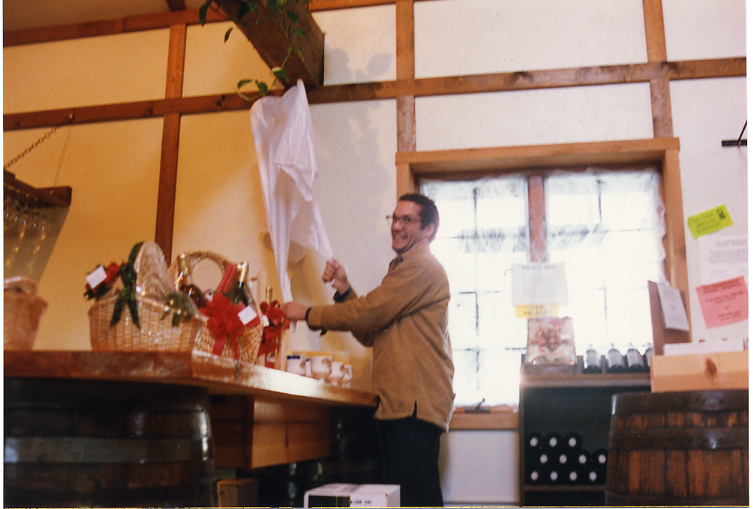
We moved on to our third and final winery. The sun was starting to go down. It was the time of day known in the movie business as "the magic hour" - the fleeting hour when the lowering light glows against the earth, when the rays are long, the shadows longer, and when everything, indeed, takes on a certain magic. The air was cool, crisp ... the leaves burning in the light of the sunset. We were sloshily tipsy ... not trashed ... just that soft mushy wine-drunk. It was perfect. One more glass and all of us might have been in deep trouble. As it was ... it was just perfection.
As a group, we bought a couple of bottles of wine.
Then we headed back out to the car ... we thought we would be heading back into town straightaway, not realizing that the fields across the road would literally CALL to us to come to play.
I adore the photo below - not sure why - it's rather random, but something about it is so suggestive.
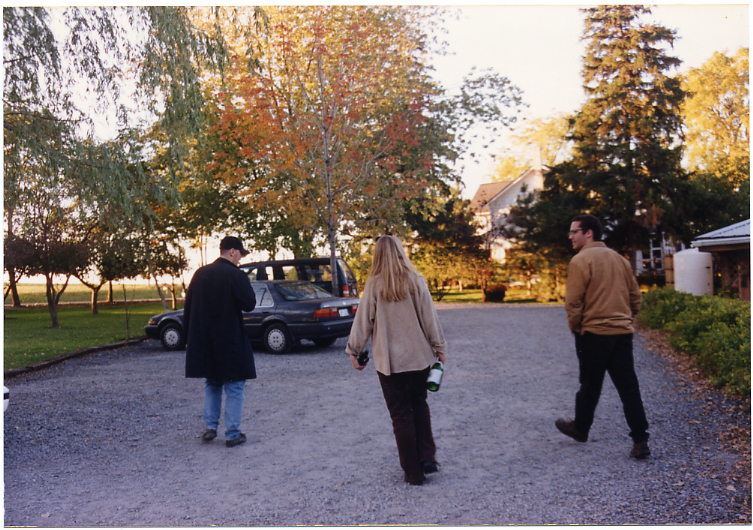
First of all, you can just see the magic of the magic hour light ... not as much as you can in the later photos when we really hit the perfect moment ... but it's begun. You can see how the shadows are cool and nighttime-ish where we are, but if you look over to the left, you can see how the sun is GLOWING on the field across the street.
I also love how Pat, Laurie and Michael are walking - they're all tilting different ways. The photo FEELS like they're wine-drunk. Like they're all just reeling drunkenly towards the car. But in such a friendly way. Not WASTED. No. We were not wasted. We were punch-drunk. We were tilt-a-whirls. That photo shows our meandering perambulatory ...
The winery walk.
Instead of getting in the car, we basically hung out BESIDE the car and that's when things got nuts.
Here's a photo of Pat and me.
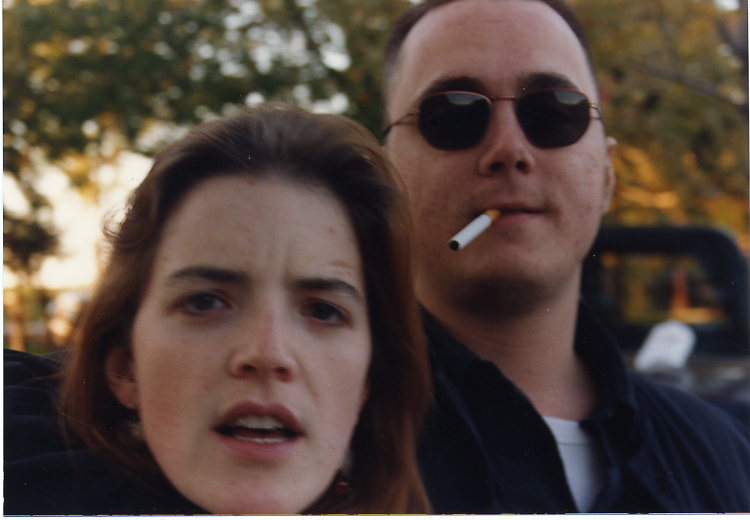
Words cannot even express how much I love this picture. It's so in the moment. It captures, first of all, our friendship - we were kindred spirits, the two of us ... we "got" each other ... we come from the same background ... and there we are. But also, it's one of those photos that truly captures a feeling, a fleeting second of time. I have no idea what was going on there, and what we were saying and doing ... but it's a photo that captures a specific moment. It makes me laugh.
You can see a scar above my left eyebrow. How did I get that? I got that from the curling iron while I was making my Farrah Fawcett curls one night before the show. I wasn't really good with a curling iron, obviously. I burned my damn head.
At the car, we all kind of just dissolved. I mean, our personalities dissolved. We lost it. We cracked up. Collectively. We all were taking pictures. We were shouting at each other. We were howling with laughter. The fields glowed across the street. But not yet ... not yet ... It wasn't time yet to run into the gold. There was too much to DO beside the car.
Like ... er ... this ...
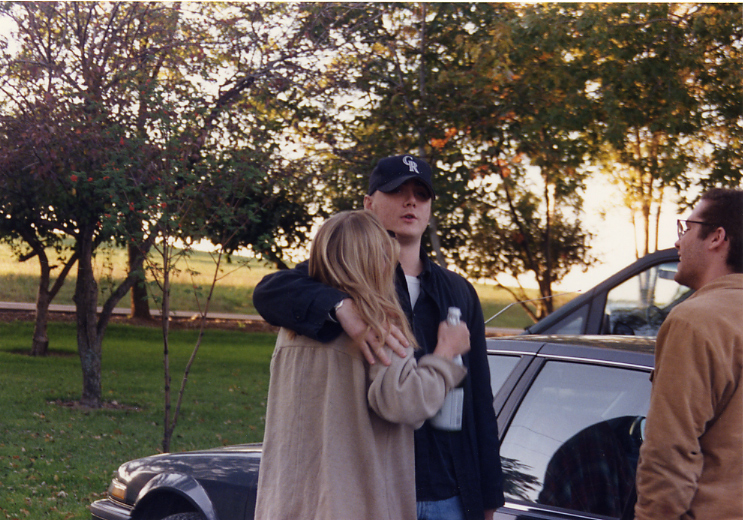
Or this ...
The paparazzi ... embodied by Pat ... who appears to be following Laurie around ... snapping pictures ... we are in the PARKING LOT of the WINERY.
Just so we're clear on that.
Again, notice the blurriness of everyone ... due to the non-posed nature of the photo ... and the general craziness that took over the 4 of us ...
The following four photos are a series. I mean, honestly, look at them. They go together, don't they? How could you separate one from the other?
The first one is so riotous that I still don't know what to do with myself. I just ... love those two guys so much. I can't stop laughing. And the one where Michael is obviously squatting and clutching Pat's leg ... what is going on there?? I have no idea but I know that it made PERFECT sense (in a drunken way) to us at the time. Chaos. We were out of control. The laughter was intense. I love these, too, because they capture the goofy relationship between Pat and Michael.
And I've gotta just say this. The last photo in the series? Michael? Rowr.
The next one kinda says it all.
I mean ... what else can I say. Uhm ... yeah.

That last photo is a perfect segue. We couldn't get into the car and go back into Ithaca after THAT!!! The fields across the street glowed in the magic hour so we wandered over there ... for a romp. As you can see, there is more blurriness.
It appears that Laurie and Michael are attacking Pat ... running at him with pummeling fists, as he's just trying, for God's SAKE, to light his 50th cigarette of the day. Would you guys just let me do this, please??
Just LOOK at that glow in the air - the shadows, the gold, the vista .... stunning.
God. I just want to swoon into that light. Just look at it.
Perfection. Transcendence. A cosmic moment, uplifting, all brought about by our mutual regard for one another, and an afternoon of red wine. God, how I loved those two men. LOOK AT THEM. LOOK AT THEIR BEAUTY.
Later, Pat said to me, "That was so cool when you just started running ..."
Magic hour also means crazy hour. It went to my head. It was too much. I had to somehow get it OUT. I had to EXPRESS it. I had to MOVE. The sun was going down. The shadows were violet and cool but the sun's rays were long and golden, and we could see for miles and miles. The woods were ablaze.
It was too much sensation ... I was going to EXPLODE! So I took off ... and just started RUNNING through the fields. By myself. I ran .... and ran ... and ran ... and Pat, Laurie, and Michael all started screaming ... an exhilarating moment for some reason ... shouting, screaming, bursts of adrenaline ... there she goes ...
Once I started running, an epidemic of random running spread, until all four of us were running like tasmanian banshees, circling the field, criss-crossing, jumping, ambushing each other, breaking free ...
Michael took off, running, trying to catch up with me. Pat took this picture.
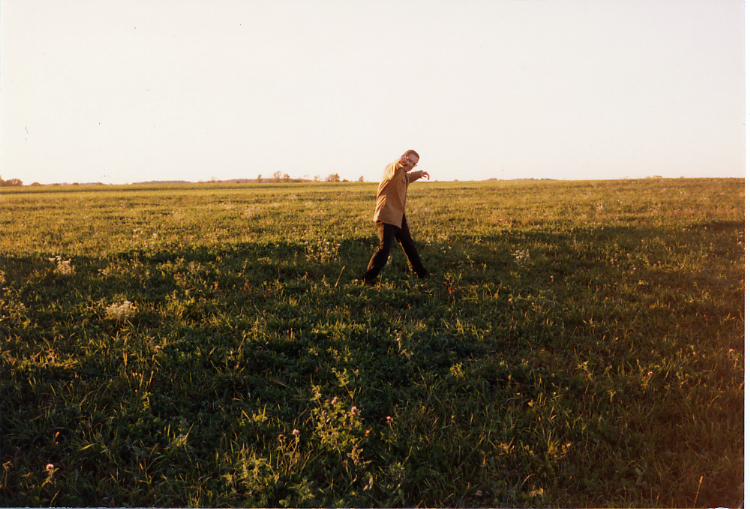
Look at the line of shadow in the field ... gold and then dark.
Takes my breath away still.
Pat and Laurie chased each other through the fields. We all were screaming. Michael was trying to catch up with me, to tackle me, basically. At some point, during this free-for-all, Michael got Pat's camera ... and took the last two photos of this series.
She's comin' at ya ...
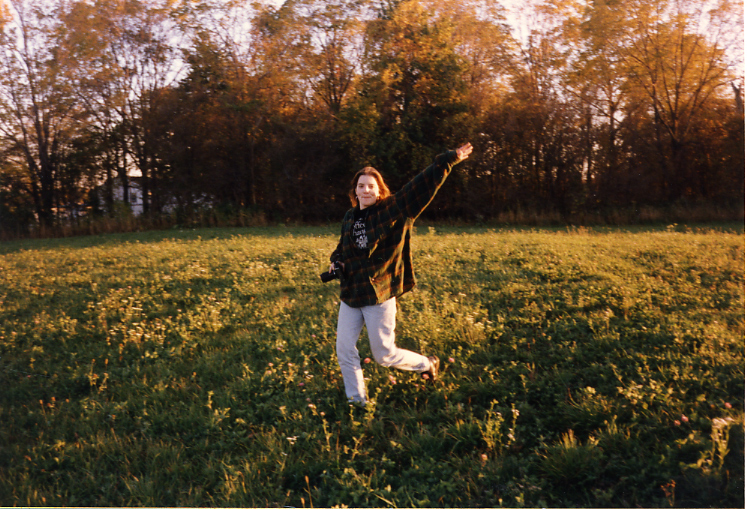
Closer ...

The light in that first photo slays my heart. It's like every blade of grass is distinct. Touched with gold.
And that last photo is my favorite. Not because I'm vain but just because the photo itself is perfect. It's perfect in composition, the light on my face and how it hits it, the flame of my hair and all that ... but it's perfect because it is the culmination of that perfect day, and it is the perfect expression of my feelings in that moment and my feelings for Michael. That's how I felt when I was with him so there, in that photo, I am just GIVIN' IT TO HIM. How often do we have photos like that? Also, it's perfect because it's spontaneous.
And the next moment? The moment that came after that last photo? It can probably be guessed. I had grass stains on my jeans the next day from rolling around in the magic-hour field with Michael, kissing him, pulling him on top of me, the two of us rolling around in the grass, laughing and devouring each other. If anyone had driven by that glowing golden field at that very moment, they would have seen 2 couples - dark against the gold - separated by a respectful distance - lying in the grass ... cameras discarded ... and deeply involved in their own private communion with one another ... which would have to end when the magic hour ended ... Of course.
Magic can't last.
But for now? For this fleeting moment in time? The couples are together. They roll around in the grass, hugging, kissing, laughing ... sometimes calling out to each other ... one couple reaching out to the next ... but more often than not, engrossed ... completely engrossed in the other.
The moment is eternal because the cameras captured it. Or at least that's how it feels. That best day is long gone and the 4 of us are scattered to the winds now. But there we are ...
It feels like, on some plane of existence, we'll be running thru that golden field forever.
The best day: part 1
Michael and I were in a play in Ithaca and we were dating. Life was awesome.
The rest of the cast - Pat, Laurie, and Ken - were all fantastic and we became fast friends. In looking back on it - one of the fun things about this cast was that we were all kind of throwbacks. I can't really describe it any other way. We weren't "over" things, we weren't cynical. I mean, we're human beings, we had our bad days ... but we settled into this very Pleasantville-esque existence in Ithaca. We ate at diners and befriended waitresses. We drank black coffee. We didn't party like maniacs, but when we did go out, we drank whiskey and played trivia. Very old-school. Michael and I found a weekly 70s dance party that we attended with religious fervor. It was a non-alcoholic event and that was fine by us. We were there to put on our dancing shoes.
Laurie loved playing cards and continuously roped Michael and me into playing with her. The two of us just weren't into playing cards. It wasn't our thing as a couple. We were more into lying on a blanket in the park and reading books. But Laurie would beg and plead - "Come on! Play!!!"
So below are two photos.
One is a picture of Michael and me backstage. The second photo makes me laugh out loud. It is a photo of us - taken by Laurie - during one of our forced card games. We were SO unhappy to be playing cards. Michael's face makes me laugh out loud.
Notice my 'do. I worked HARD on that 'do. I played the trashiest slut to ever walk the earth. Sharla is bad BAD news. She gets her comeuppance in the end - but not before she wreaks havoc on every life she touches. I love that photo because, oh, I don't know ... I can SMELL backstage in that photo.
hahahahahahahahahahahaha
hahahaha
I also enjoy that he and I are dressed like twins. It was all about the flannel and the glasses. My glasses are on crooked. I have become undone by the fact that I DO NOT WANT TO BE PLAYING CARDS. My eyes are PISSED.
The best day: part 2
We had one day off a week - Mondays. Laurie ended up acting as our tour guide director. There would be no lethargy! One Monday we took a tour of all the Ithaca waterfalls. One Monday we hiked up to Cornell. We reveled in our days off. Laurie did a little research on the wine country surrounding Ithaca and suggested that we do a little wine-tasting tour. It was October, the leaves were aflame ... it would be great to see the countryside. Ken's girlfriend had come to visit (it's a hard life being in an out-of-town show when your girlfriend is back in Chicago and the rest of the cast has coupled up!!) so he didn't come with us.
But on that flaming red and orange October day, Laurie and Pat (who had started dating as well) and Michael and I got into Pat's beat-up car and set out to do some wine-tasting!
We were on a field trip! We were giddy!
Here we are starting out on our journey.
Please notice that I am wearing the same shirt I wore in the backstage photo, as well as in the card-playing photo, as well as in the seesaw photo earlier. I loved that shirt as much as I loved my soft blanket I had when I was a kid. The shirt was a soft plushy flannel, it was comfortable, and I pretty much never took it off. Oh, and Michael - who had never had a taste of alcohol before - dribbled wine down on his shirt during the subsequent tour and had to change his clothes. The sight of Michael getting tipsy for the first time was one of the funniest things I have ever seen in my life.
The best day: part 3
We arrived at the first winery. The sun was a blinding blue. It was a massive drafty barn and there were only a couple of other people there.
One of the reasons I loved Michael (and still love him) was that he didn't have a pretentious bone in his body. Whatever, we were wine tasting, that didn't mean he felt the need to act snooty or to rein in his particular brand of insanity. Our hysteria just mounted through the day, as we kept drinking wine. I eventually had to leave one of the wine-tasting events because I could not keep back the laughter, and I actually snorted into the solemnity of the moment.
But here we are ... arriving at our first winery.
I love how, in these photos - throughout the day - everyone is in motion. It's rare that any of us just stood and posed for a photo - we were always moving, walking, running, talking ...
For some reason, Michael in that first photo makes me laugh out loud (AGAIN). Something about his pose, his attitude ... He looks a bit adrift. He so is not about to adjust his personality, just because we're at a wine-tasting event with wine snobs!
The best day: part 4
Pat was an awesome guy. We became really good friends. He smoked like a chimney, he was mainly a comedian but he was playing Killer Joe in this play - the terrifying hired killer who infiltrates this family. He was amazing. Killer Joe is the one who discovers that Sharla has been betraying them all and he punishes her in the most brutal and humiliating way possible. Onstage. He and I didn't know each other at all when we started rehearsal so doing that scene was quite an odd thing. I remember the first time we really did it - in rehearsal. He stood over me, I was on my knees - it's a very violent scene ... I started weeping - but he kept going, as he should ... It's the part. Killer Joe has no conscience. Well, he probably has more of a conscience than Sharla does - but his is a rough frontier brand of justice. You fuck with me, bitch? I'll bring you to your knees. Tears didn't move him. Pleading for your life didn't move him. It was a tough scene and I never got used to doing it. Which was why it was good. Sharla thinks she has gotten away with it. And, like a cobra stalking its prey, Killer Joe waits, waits, waits ... and then, in one devastating moment, strikes. And Pat - who was a tough guy, the kind of guy I really relate to - he's like all the men in my family - tough but with a heart of gold - had to put aside his own sense of compassion and reticence in order to do the scene. You know the kind of guy who knows his own strength? And so he is even more responsible about using that strength? Pat was that guy. So the first time we really HIT the moment with the scene - the first time we really clicked into it in rehearsal - was inTENSE. I was crying, begging for mercy, he was choking me, and laughing evilly in my face, and I was fighting him, but he was holding me down ... Awful. To not be able to get away. You know, we went there. The director then called out from the dark, "Okay, stop ..." We both stopped. I wiped my tears off, but I was curled up on the floor - Pat, with the gentleness of a father, with the kindness of a good good man, reached his hand down to me, and helped me stand up. He had this strange ashamed look on his face, but we both knew we had nailed the moment. That was the moment. His hands, which had been around my neck, were suddenly soft and manly - firm and kind - He held his arm around my waist, and said, in a kind of shy amused way, "This is a very strange sensation ..." It was like he faced his own capacity for violence ... That's the beauty of acting in those moments. You get to act out the stuff you suppress as an upstanding citizen of society. We all have violence in us. Most of us do not act on it. Pat's a tough dude, man - you do not want to get in a fight with Pat - but like I said: he knows that, and so he holds back. He's responsible with himself. I loved Pat.
Pat was only a couple years older than Michael but he took on a kind of older brother thing with Michael. They're still friends. It doesn't surprise me at all. There was none of that posturing competitive shit between them (well, there was at one specific moment ... but that had to do with me, so it doesn't count) - They didn't beat their breasts like gorillas, or try to be alpha male. They just were buddies. They cracked each other up. They complemented each other.
I give you this background merely as a set-up for the following photo.
Michael, like I said, had never had a sip of alcohol before that day. This is Michael after one glass of wine. I laugh out loud looking at it today. And look at Pat, being patient with Michael, who apparently is reaching out - in order to say some deeply drunken and profound thing.
The best day: part 5
We moved on to the next winery. Another huge drafty barn. Pumpkins, gourds, sheafs of wheat, dusty bottles ... We stood around, sipping wine, pretending to "taste" it ... and savor it ... when really, let's be honest, we were just guzzling.
Which explains the quality of my next photo.
The best day: part 6
A sort of group hysteria was escalating. We were having so much fun, and we were all enjoying each other so much, that we found ourselves at this level where everything was funny. Everything was beautiful. We were one. The four of us were one. Nobody was being a drip. Nobody was wishing that the rest of us would stop giggling and snorting and BE SERIOUS. We all were just having a blast. The wine person would set out glasses for us. We all would slowly take sips. I would glance at Michael, and see him pretending to take it seriously ... He would have that "look at how serious I am being" face on that he wore during the card-playing extravaganzas ... He would nod seriously at the wine person, mutter something about "yes, the smoky aftertaste, right ..." and then throw back the entire glass in one gulp.
Because it was Halloween time - at one of the wineries we went to there was a ghost hanging from the ceiling. If you pulled on the ghost, it would make this swooning "Whoooo-hoooo-ooooo-ooooo" sound.
Michael loved Halloween. I think it was his favorite holiday. He loved ghosts and witches and goblins and all that. He was FASCINATED by this rigged ghost. He stood beneath the ghost and KEPT pulling on it so that the "Whoooo-hooo-hoooooo" sound KEPT swooning through the air of the winery. It was almost like he was an autistic child. He could not stop pulling on the ghost. There were other people in the winery, people who actually, you know, took wine seriously, and who were taking tiny sips with no irony, and musing over the bottles ... and over in the corner was Michael, pulling on the ghost insistently for, I am not kidding, about 15 minutes.
Laurie had HAD it. She finally said, "Michael ... yes ... the ghost is cool ... PLEASE STOP PULLING ON IT."
Michael's response was to call over his shoulder in the general direction of the winery employees (I am literally shaking with laughter as I type this), shouting, "How much for the ghost?"
I can't take it.
I still can't take it.
The best day: part 7
We moved on to our third and final winery. The sun was starting to go down. It was the time of day known in the movie business as "the magic hour" - the fleeting hour when the lowering light glows against the earth, when the rays are long, the shadows longer, and when everything, indeed, takes on a certain magic. The air was cool, crisp ... the leaves burning in the light of the sunset. We were sloshily tipsy ... not trashed ... just that soft mushy wine-drunk. It was perfect. One more glass and all of us might have been in deep trouble. As it was ... it was just perfection.
As a group, we bought a couple of bottles of wine.
Then we headed back out to the car ... we thought we would be heading back into town straightaway, not realizing that the fields across the road would literally CALL to us to come to play.
I adore the photo below - not sure why - it's rather random, but something about it is so suggestive.
First of all, you can just see the magic of the magic hour light ... not as much as you can in the later photos when we really hit the perfect moment ... but it's begun. You can see how the shadows are cool and nighttime-ish where we are, but if you look over to the left, you can see how the sun is GLOWING on the field across the street.
I also love how Pat, Laurie and Michael are walking - they're all tilting different ways. The photo FEELS like they're wine-drunk. Like they're all just reeling drunkenly towards the car. But in such a friendly way. Not WASTED. No. We were not wasted. We were punch-drunk. We were tilt-a-whirls. That photo shows our meandering perambulatory ...
The winery walk.
The best day: part 8
Instead of getting in the car, we basically hung out BESIDE the car and that's when things got nuts.
Here's a photo of Pat and me.
Words cannot even express how much I love this picture. It's so in the moment. It captures, first of all, our friendship - we were kindred spirits, the two of us ... we "got" each other ... we come from the same background ... and there we are. But also, it's one of those photos that truly captures a feeling, a fleeting second of time. I have no idea what was going on there, and what we were saying and doing ... but it's a photo that captures a specific moment. It makes me laugh.
You can see a scar above my left eyebrow. How did I get that? I got that from the curling iron while I was making my Farrah Fawcett curls one night before the show. I wasn't really good with a curling iron, obviously. I burned my damn head.
The best day: part 9
At the car, we all kind of just dissolved. I mean, our personalities dissolved. We lost it. We cracked up. Collectively. We all were taking pictures. We were shouting at each other. We were howling with laughter. The fields glowed across the street. But not yet ... not yet ... It wasn't time yet to run into the gold. There was too much to DO beside the car.
Like ... er ... this ...
The best day: part 10
Or this ...
The paparazzi ... embodied by Pat ... who appears to be following Laurie around ... snapping pictures ... we are in the PARKING LOT of the WINERY.
Just so we're clear on that.
Again, notice the blurriness of everyone ... due to the non-posed nature of the photo ... and the general craziness that took over the 4 of us ...
The best day: part 11
The following four photos are a series. I mean, honestly, look at them. They go together, don't they? How could you separate one from the other?
The first one is so riotous that I still don't know what to do with myself. I just ... love those two guys so much. I can't stop laughing. And the one where Michael is obviously squatting and clutching Pat's leg ... what is going on there?? I have no idea but I know that it made PERFECT sense (in a drunken way) to us at the time. Chaos. We were out of control. The laughter was intense. I love these, too, because they capture the goofy relationship between Pat and Michael.
And I've gotta just say this. The last photo in the series? Michael? Rowr.
The best day: part 12
The next one kinda says it all.
I mean ... what else can I say. Uhm ... yeah.
The best day: part 13
That last photo is a perfect segue. We couldn't get into the car and go back into Ithaca after THAT!!! The fields across the street glowed in the magic hour so we wandered over there ... for a romp. As you can see, there is more blurriness.
It appears that Laurie and Michael are attacking Pat ... running at him with pummeling fists, as he's just trying, for God's SAKE, to light his 50th cigarette of the day. Would you guys just let me do this, please??
Just LOOK at that glow in the air - the shadows, the gold, the vista .... stunning.
The best day: part 14
God. I just want to swoon into that light. Just look at it.
Perfection. Transcendence. A cosmic moment, uplifting, all brought about by our mutual regard for one another, and an afternoon of red wine. God, how I loved those two men. LOOK AT THEM. LOOK AT THEIR BEAUTY.
The best day: part 15
Later, Pat said to me, "That was so cool when you just started running ..."
Magic hour also means crazy hour. It went to my head. It was too much. I had to somehow get it OUT. I had to EXPRESS it. I had to MOVE. The sun was going down. The shadows were violet and cool but the sun's rays were long and golden, and we could see for miles and miles. The woods were ablaze.
It was too much sensation ... I was going to EXPLODE! So I took off ... and just started RUNNING through the fields. By myself. I ran .... and ran ... and ran ... and Pat, Laurie, and Michael all started screaming ... an exhilarating moment for some reason ... shouting, screaming, bursts of adrenaline ... there she goes ...
The best day: part 16
Once I started running, an epidemic of random running spread, until all four of us were running like tasmanian banshees, circling the field, criss-crossing, jumping, ambushing each other, breaking free ...
Michael took off, running, trying to catch up with me. Pat took this picture.
Look at the line of shadow in the field ... gold and then dark.
Takes my breath away still.
The best day: part 17
Pat and Laurie chased each other through the fields. We all were screaming. Michael was trying to catch up with me, to tackle me, basically. At some point, during this free-for-all, Michael got Pat's camera ... and took the last two photos of this series.
She's comin' at ya ...
Closer ...
The light in that first photo slays my heart. It's like every blade of grass is distinct. Touched with gold.
And that last photo is my favorite. Not because I'm vain but just because the photo itself is perfect. It's perfect in composition, the light on my face and how it hits it, the flame of my hair and all that ... but it's perfect because it is the culmination of that perfect day, and it is the perfect expression of my feelings in that moment and my feelings for Michael. That's how I felt when I was with him so there, in that photo, I am just GIVIN' IT TO HIM. How often do we have photos like that? Also, it's perfect because it's spontaneous.
And the next moment? The moment that came after the photo? It can probably be guessed. I had grass stains on my jeans the next day from rolling around in the magic-hour field with Michael. If anyone had driven by that glowing golden field at that very moment, they would have seen 2 couples - dark against the gold - separated by a respectful distance - lying in the grass ... cameras discarded ... and deeply involved in their own private communion with one another ... which would have to end when the magic hour ended ... Of course.
Magic can't last.
But for now? For this fleeting moment in time? The couples are together. They roll around in the grass, hugging, kissing, laughing ... sometimes calling out to each other ... one couple reaching out to the next ... but more often than not, engrossed ... completely engrossed in the other.
The moment is eternal because the cameras captured it. Or at least that's how it feels. That best day is long gone and the 4 of us are scattered to the winds now. But there we are ...
It feels like, on some plane of existence, we'll be running thru that golden field forever.
The best part about the photo below ...
... is our complete and utter LACK of ironic distance. We were actually enjoying the seesaw. This was not a posed photo. Or, obviously we turned to the camera, but we had already been seesawing for a good 10 minutes before any witnesses showed up, and before that photo was taken.
I'll be posting more in this one particular photo series later.
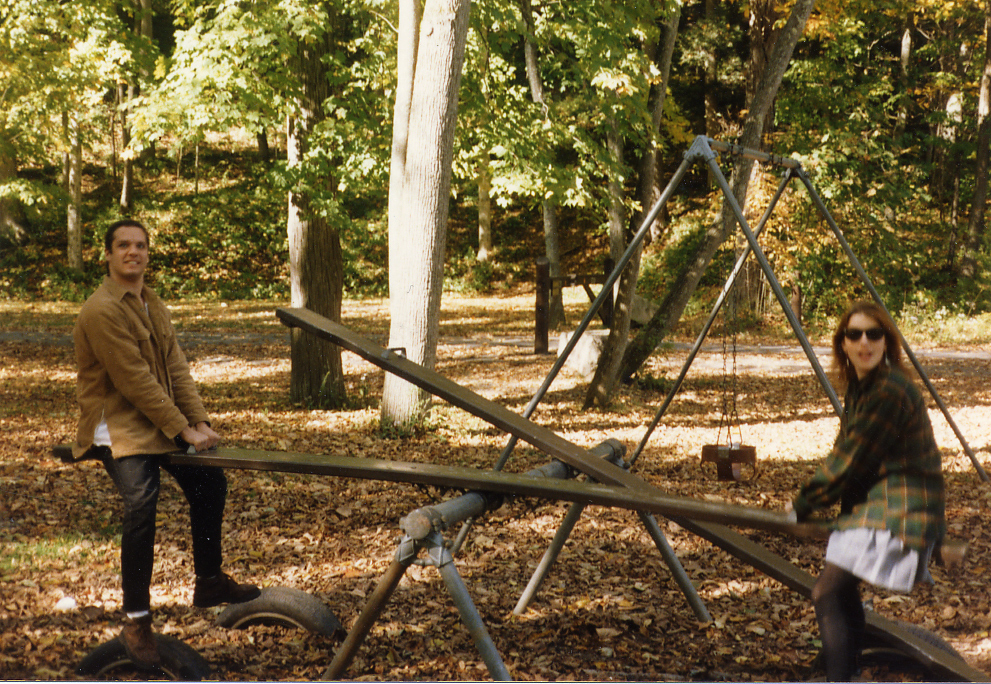
Upcoming Gig: May 1st
On the evening of May 1st, I'll be doing my one-woman show "74 Facts and One Lie" at Theatre Three - located at 311 W. 43rd Street, 3rd Floor (Between 8th and 9th Avenue).
It should be around a 7:30, 8 pm start time ... not sure of the details yet (tickets, ticket price) - but when I know I'll post the information for those of you who'd like to come see me in action.
Weird dates: Tadeusz and John Kennedy
I've certainly had some weird dates but nothing as weird as THIS. It's a whole movie. I love that he was a "vampire" from Iceland. So perfect.
Update: Mitchell went on a date or two with a guy from Poland whose name was Tadeusz and he had pale skin, delicate violet shadows beneath his eyes, and seemed extremely Eastern European ... as though he had just crawled out through the wreckage of the Berlin wall, with stories too horrible to tell. He told me I reminded him of his dead sister, and how "a shock went through me when I first met you" because of the resemblance. All of this said in a thick Polish accent. We referred to him as a "vampire" because he said something to us like, "I don't like the daylight." "Do you want to go throw a Frisbree around tomorrow afternoon, Tadeusz?" Long pause. Then, flatly, thick accent, "I don't like the daylight."
Mitchell and I eventually turned the whole thing into a joke, singing along to James Taylor's "Shed a little light" - only we would sing:
"Shed a little light, Tadeusz!"
Update again: I went on one date with this guy ... and the date itself was not weird ... but why he asked me out (and the mere fact that he asked me out) struck me as very weird at the time. Now I realize that he and I were just behaving like every 1940s movie cliche in the book (although 1940s movie heroines don't use words like "fucking asshole" - However most of them look like they COULD!). Mitchell and I were hanging out one night at a bar/improv club. Two guys came over to talk to us. One looked exactly like John Kennedy (the father, not the son). We began a conversation. John Kennedy was extremely obnoxious and seemed determined to just needle me, and tease me, and "wind me up". He must have felt that this was a good courtship technique. He was condescending, superior, and laughed in my face when I would be serious. He seemed incapable of believing that a woman could ever have anything valuable or funny or interesting to say. Ick. Mitchell turned away from the conversation at one point, talked to someone else for 15 seconds, turned back to OUR conversation only to see that I had started SHOUTING at John Kennedy. I don't remember exactly what it was - it had something to do with rape, and him saying he thought rape wasn't a big problem and that most girls "ask for it" - I know it was something like that - nice first topic of conversation, buddy - and he just wanted to see me go nuts ... and I had had it with his condescension, and his arrogance, and his utter lack of social skills, and I called him a "fucking asshole" to his face. This all happened in the 15 seconds that Mitchell was not involved in the conversation. hahahaha Mitchell immediately leapt in the middle of it and tried to smooth things out. I said something to the dude like, "You know you might have more success with the ladies if you toned down your goddamn arrogance and learned how to listen instead of just lecture. Jagoff." And I walked away. The second I was gone, he said to Mitchell, "Can you give me her phone number? I'm totally attracted to that lunatic." hahahaha 1940s cliche!! The guy actually was a nice guy. It was just that - his idea of flirting was to put girls down, laugh at them when they were serious, condescend their opinions, and in general be a dickhead. He WAS flirting, though. Mitchell gave him my phone number. (Our phone number, we lived together.) He called me the next day and we went out. The "sparks" that flew in our first conversation did not survive during a normal date - which is probably a good thing, because who wants to argue about RAPE on a date? He was now on his best behavior, and so was I ... so we sat awkwardly, and had a couple beers, and he tried to give me a backrub (uh oh - BACKRUB BOY ALERT!) and the whole time I was thinking: "I wonder if I can make it home by 11 when 30something is on."
The Books: "The True History of the United States of America" (Elbridge Streeter Brooks)
And here is my next excerpt of the day from my library.
Next book in my American history section is a book I found in the second-hand bookstore near my parents house - and I just treasure it, in all its outdated glory. Even the title shows it is from a different age. It is called: The True History of the United States of America. And even the author's NAME shows it is from a different age. It is by Elbridge S. Brooks. Elbridge Brooks? Now that's a 19th century moniker! It's a book for kids - and it was first published in 1891 - but I guess it was a big hit at the time, so they kept re-releasing it over the years. But my copy is the 1891 copy. It has that almost glossy type of pages where if you run your hands over it, you can feel the imprint of the type. I love that. And it's filled with awesome illustrations - woodcuts, and cartoons from the newspapers, and drawings of this or that great event in the "true history" of America -- I love the drawings. I just love the whole she-bang. I even love the tone ... the tone boils everything down to its essentials, so that high school kids could get the jist of it.
Here's an excerpt from Chapter III - called "The Naming of America".
The whole John Cabot flag story reminds me of Eddie Izzard's hysterical bit about Empire: "England took over other countries and then maintained a vast empire - They did this with the cunning use of flags." He imagines the first confrontation with India. Snooty English voice: "You're OUR country now." Indian person: "What are you talking about? There are billions of us ... we LIVE here, ya bastards." Snooty English person: "Yes, but ... do you have a flag?"
From i>The True History of the United States of America, by Elbridge S. Brooks.
Columbus, as you have heard, did not know that he had discovered a new world. He thought he had merely touched some of the great islands off the eastern coast of Asia. Even when, in the month of August, 1498, he first saw the mainland of America, at the mouth of the river Orinoco, he did not imagine that he had found a new continent, but believed that he had discovered the fabled river of the East into which, so men said, flowed the four great rivers of the world -- the Ganges, the Tigris, the Euphrates and the Nile.
But his success set other men to thinking, and after his wonderful voyage in 1492 many expeditions were sent westward for purpose of discovery and exploration. After he had found "Cathay" every man, he declared, wanted to become a discoverer. There is an old saying you may have heard that tells us "nothing succeeds like success." And the success of Columbus sent many adventurers sailing westward. They, too, wished to share in the great riches that were to be found in "the lands where the spices grow," and they believed they could do this quite as well as the great admiral. Once at a dinner given to Columbus a certain envious Spaniard declared that he was tired of hearing the admiral praised so highly for what any one else could have done. "Why," said he, "if the admiral had not discovered the Indies, do you think there are not other men in Spain who might have done this?" Columbus made no reply to the jealous Don, but took an egg from its dish. "Can any of you stand this egg on end?" he asked. One after another of the company tried it and failed, whereupon the admiral struck it smartly on the table and stood it upright on its broken part. "Any of you can do it now," he said, "and any of you can find the Indies, now that I have shown you the way."
So every great king in Europe desired to possess new principalities beyond the sea. Spain, Portugal, France, England alike sent out voyages of discovery westward -- "trying to set the egg on end."
Of all these discoverers two other Italians, following where Columbus had led, are worthy of special note -- John Cabot, sent out by King Henry the Seventh of England in 1497, and Amerigo or Alberigo Vespucci, who is said to have sailed westward with a Spanish expedition in the same year. Both of these men, it is asserted, saw the mainland of America before Columbus did, and England founded her claims to possession in South America and fought many bloody wars to maintain them because John Cabot in 1497 "first made the American continent" and set up the flag of England on a Canadian headland. In that same year of 1497 Cabot sailed along the North American coast from the St. Lawrence to the Hudson; and Vespucci, although this is doubted by many, sailed in the same year along the southern coast from Florida to North Carolina. In 1499 Vespucci really did touch the South American coast, and in 1503 he built the first fort on the mainland near the present city of Rio de Janiero.
Both these Italian navigators thought at first, as did Columbus, that they had found the direct way to the Indies, and each one earnestly declared himself to have been the first to discover the mainland. At any rate Vespucci could talk and write the best and he had many friends among the scholars of his day. When, therefore, it really dawned upon men that the land across the seas to which the genius of Columbus had led them was not India or "Cathay" but a new continent, then it was that the man who had the most to say about it obtained the greatest glory -- that of giving it a name.
Wise men who have studied the matter deeply are greatly puzzled just how to decide whether the continent of America took its name from Amerigo Vespucci or whether Vespucci took his name from America. Those who hold to the first quote from a very old book that says, "a fourth part of the world, since Amerigo found it, we may call Amerigo or America;" those who incline to the other opinion claim that America came from an old Indian word Maraca-pan or Amarca, a South American country and tribe; Vespucci, they say, used this native word to designate the new land, and upon its adoption by map-makers deliberately changed his former name of Alberigo or Albericus Vespucci to Amerigo or Americus.
But whichever of these two opinions is correct, the Italian astronomer and ship chandler Vespucci received the honor and glory that Columbus should have received or that Cabot might justly have claimed, and the great continent upon which we live has for nearly four hundred years borne the name that he or his admirers gave to it -- America.
April 21, 2006
"People are idiots. Lonely, lonely idiots"
Kyle's Guide to College Relationships.
The college relationship is a curious one, more involved than a high school relationship, more intense than an adult relationship, and less mature than either. It is a relationship founded upon ambivalence and, in retrospect, deep shame.
hahahahahaha
Or:
The first step is to find a girl. There is a temptation here to go out socializing until you find someone with whom you share many common interests and would like to ask out on a date, leading to a healthy, fruitful relationship. Don’t give in to this temptation. You should immediately fall madly in love with the first girl you see, ideally someone deeply entrenched in your limited first year social circle. The girl who likes your best friend, your roommate’s sister, your sister’s roommate, even your mate’s roomsister are all fair play here. The key is to alienate as many people as possible once you two start dating and to create as much fallout as possible upon the inevitable breakup. We learn from our mistakes, so if your whole relationship is a mistake, it’s like super-learning!
More humor to follow in the rest of the essay ... much of it sounds eerily familiar to me (ahem junioryearofcollege ahem)
The Books: "A History of the American People" (Paul Johnson)
And here is my next excerpt of the day from my library.
 Next book in my American history section is the massive A History of the American People , by Paul Johnson. Massive in scope and really well-written - I totally recommend this book. There are swaths of American history I'm not clear on ... and Paul Johnson attempts to cover it all: industries rising, the birth of American literature, the religious renaissance that swept the nation in the 1800s ... but then, of course, we go through each President ... and each administration, the events that shaped our nation, domestic and foreign. Johnson's English, an outsider, but I think that makes him even more qualified to write about some of this stuff, because he's not trying to stick it to a political party he despises, he's not trying to right a historical wrong, he doesn't write with a massive CHIP on his shoulder, which is unbelievably refreshing. He certainly has opinions - he's LOADED with opinions ... but it's still an outsider's analysis of how our nation morphed into what it is today. Johnson loves America. He is certainly not uncritical of a lot of it - but whatever, we're a huge nation - anyone who is completely uncritical of America in a kneejerk way is a moron.
Johnson writes at the end of his introduction: "I have not bowed to current academic nostrums about nomenclature or accepted the fly-blown philacteries of Political Correctness. So I do not acknowledge the existence of hyphenated Americans, or Native Americans, or any other qualified kind. They are all Americans to me: black, white, red, brown, yellow, thrown together by fate in that swirling maelstrom of history which has produced the most remarkable people the world has ever seen. I love them and salute them, and this is their story."
He's a marvelous writer. This book is enormous and rather daunting - but I can't recommend it highly enough.
It was hard to figure out what to choose as an excerpt - there's so much awesome information here - but I decided to go with an excerpt from his section called "Monster Cities: Chicago and New York". I loved this section especially because Chicago and New York are both so dear to me ... I loved reading about their development.
From A History of the American People , by Paul Johnson.
New York, by contrast, was circumferenced by water and chose to have its park, on a giant scale, in the middle. New York was still second in size to Philadelphia at the time of the 1810 census, with 91,874 to 96,373 people, and the plan for its development laid down the following year provided only minimum public spaces (its original Parade Ground between 23rd and 34th Streets had been long since greedily built over). But when the fashions for laying out big public parks within cities was brought from London and Paris soon after, New York still had plenty of undeveloped land in central Manhattan, and the city fathers were able to set aside an enormous area. The landscape architect F.L. Olmsted (1822-1903), from Hartford, Connecticut, that nursery of genius, together with the Londoner Calvert Vaux (1824-95), designed Central Park as an extraordinary multi-class complex of carriage drives, walks, lakes for fishing, boating, and skating, and boulder-strewn wilderness woods.
By the time the Park was in working order the City was fast growing up around it. Population was then 813,000. Forty years later, thanks largely to immigration, it was nearly 3,500,000 and still growing at breakneck speed. The rise of high buildings meant that the immense flat space of Central Park was increasingly surrounded by a periphery of stone and masonry achieving spectacular effects of precisely the rus in urbe appeal which had been the aim of the earliest town planners, like John Nash of London. No other city in the world can produce these skylines. First came four or five-story structures, developed out of British precedent for shops, factories, and warehouses, the leading spirits being two brilliant iron-founders of the 1850s, Daniel Badger and James Bogardus. From this emerged cage-constructions, whose interiors were self-supporting metal frameworks reinforced by independent masonry walls. Next was skeleton-type construction, in which even the external walls hung off the metal frame. The Equitable Building of 1868-70 is often regarded as the first New York skyscraper: it had a frontage only five bays wide but it rose to 142 feet in eight stories and was serviced by two elevators. (Its replacement, the Equitable Building of 1913-15, was an entire block, reached forty stories and 542 feet, and had forty-eight elevators making 50,000 trips a day, giving some idea of the leap from large to gigantic in New York City in these four decades.
Evidently the New York skyline was beginning to assume its characteristic form, and to promote deep thoughts in visitors, as early as 1876, when T.H. Huxley, the leading promoter of scientific ideas in Europe, made his first visit. His verdict was: "Ah, that is interesting. In the Old World, the first things you see as you approach a great city are steeples; here you see, first, centers of intelligence." Huxley was in a sense right: the skyscraper represented the application of science at its frontiers and imaginative intelligence in the art of building in precisely the way a great Renaissance architect like Michelangelo would have instantly appreciated. But the men who devoted huge creative intelligence and engineering and mathematical skills to making New York a "scientific city" did not share Huxley's atheism. Rather the contrary. A characteristic American religiosity tended to enter even the field of the high-rise and the structurally gigantic. John Roebling (1806-99), the German-trained immigrant who designed the Brooklyn Bridge (it was completed by his son Washington in 1883), then the longest suspension bridge in the world, said it was "proof positive that our mind is one with the Great Universal Mind."
New York differed from Chicago in key respects. Though less innovative, it was richer in the sense that it was the source of the capital for Chicago as well as itself, and most major firms with immortal longings, who wished to commemorate themselves with the tallest, largest, most expensive skyscraper, had their headquarters in New York. So ultimately New York skyscrapers were not only taller but more decorative. The ten-story Western Union headquarters was put up in 1873-5, followed quickly by the eleven-story Tribune building, then the sixteen-story World Building in 1889-90 and the twenty-story Manhattan Life Insurance giant of 1893. New York soon surpassed Chicago in height, with ten stories or more added every decade, and it indulged in fantastic and often beautiful accretions of domes, columns, and spires. Most New York skyscrapers were permanent advertisements for their companies. Thus the Singer Building of 1902 paid for its construction by one year's extra sales in Asia alone. Equally, New York's vast insurance industry dictated the construction, regardless of cost, of headquarters buildings which vaunted strength, size, and durability (rather like banks). In the first decade of the 20th century, the Metropolitan Life had insurance in force totaling over $2.2 billion, so it built and occupied, 1909-10, an immense temple in the sky which was 700 feet high, the world's tallest for a time. Another example was the spectacular Woolworth Building of 1911, which for long represented the skyscraper. Frank Winfield Woolworth (1852-1919), who established his first five-and-ten-cent store in 1879 and by 1911 had over 1,000 worldwide, told the contractor who put up his building that though it could never make a proper return on capital it had an enormous hidden profit as a gigantic signboard.
By 1903 office rents were four times higher in Manhattan than in central Chicago and that was one reason buildings were taller. High rents also determined the cluster of skyscrapers within easy reach of the Stock Exchange: by 1910 they could be as high as $24,750 a square foot in Wall Street but only $800 in South Street a few blocks away. Then in 1916 came the New York Set-Back ordinance: so long as your architect worked out the set-backs correctly, you could go to any height you liked. Grandeur and display raised the height well above the economic optimum and by 1930 it was averaging sixty-three stories in the best area around Grand Central, with the Chrysler Building (1929-30) pushing up to seventy-seven stories, the extra being the advertising element. The sensation of the 1920s, indeed, was the development of the Grand Central area as an alternative to Wall Street, and New York skyscrapers are still to this day grouped around these two foci.
But we are getting ahead of our story, and above it too, for beneath the towering New York high-rises were the clustering tenements, themselves also multistory, of the burgeoning metropolis of the 1870s, 1880s, and 1890s. New York had begun as a Dutch city, then had expanded as a mainly English city, then in the 19th century had broadened into a multiethnic city, much favored by Germans and, above all, by the Irish. Then came the turn of the Italians, the Greeks, and the Jews from Eastern Europe. The outbreak of savage state pogroms in Russia from 1881 had dramatic consequences for New York. In the following ten years Jews were arriving in the city at the rate of 9,000 a year. In the 1890s it jumped to an average of 37,000 a year and in the twelve years 1903-14 it averaged 76,000 a year. In 1886 the Grench people commemorated the centenary of American Independence by having their sculptor Frederic Auguste Bartholdi fashion a gigantic copper statue of Liberty, which was placed on a 154-foot pedestal on Bedloe's Island in New York Harbor, the whole rising to 305 feet, making it the highest statue in the world. A local Jewish relief worker, Emma Lazarus (1849-87), whose talent had been spotted by Emerson, grasped, perhaps better than anyone else in America at that time, the true significance of the open-door policy to the persecuted poor of Europe. So she wrote a noble sonnet, "The New Colossus," celebrating the erection of the statue, in which the Goddess of Liberty herself speaks to the Old World:
Give me your tired, your poor,
Your huddled masses yearning to breathe free,
The wretched refuse of your teeming shore.
Send these, the homeless, the tempest-toss'd to me.
I lift my lamp beside the golden door.
The refugees and the huddled masses crowded not just into Manhattan as a whole but in particular into the Lower East Side, one and a half square miles bounded by the Bowery, Third Avenue, Catherine Street, 14th Street, and the East River. In 1894 the density of Manhattan reached 142.2 people an acre, as opposed to 126.9 in Paris and 100.8 in Berlin. They were much higher than the Chicago tenements, perhaps safer -- fire escapes had been made obligatory in 1867 -- and far more crowded. The most infested were the Dumbell Tenements, which get their name from a shape determined by the 1879 regulartion which imposed airshafts. They were five to eight stories high, 25 feet wide, 100 feet deep, and with fourteen rooms, only one of which got natural light, on each floor. Over half a million Jews were crowded into the Lower Easy Side, and the heart of New York Jewry was the Tenth Ward, where, in 1893, 74,401 people lived in 1,196 tenements spread over six blocks. Five years later the population density in Tenth Ward was 747 persons per acre or 478,080 per square mile. By comparison, the modern density of Calcutta is only 101,010 per square mile (1961-3). The New York buildings had more stories of course; even so, the Tenth Ward was probably the most crowded habitation, in the 1890s, in the whole of human history. By 1900 there were 42,700 tenements in Manhattan, housing 1,585,000 people.
So here were luxury skyscrapers surrounded by slums, an image of rich-and-poor America. And the poor were, in a sense, sweated labor, most of them in the 'needle trades'. By 1888 no less than 234 out of 241 New York clothing firms were Jewish. By 1913 clothing was New York's biggest industry, with 16,552 factories, nearly all Jewish, employing 312,245 people. But the apparent rich-poor dichotomy concealed a huge engine of upward mobility. The whole engine of America was upwardly mobile, but New York, for the penniless immigrant, was the very cathedral of ascent.
Diary Friday
Next installment in the Picnic adventure! Although these entries include a lot more than just Picnic.
Part 1. The audition
Part 2: The callbacks, getting into the play
Part 3: First meeting with the director
Part 4. The calm before the storm ... the time before rehearsals started ... memorizing lines, etc.
Part 5. Rehearsals start
Part 6. Rehearsals. Stress building.
Part 7. Crush with Brett intensifying. Finding my own way as an actress. Stress building.
David and I had a long long talk the other night about all of this. Yes. We sat at a bar and drank beer and talked like crazy about Diary Friday. I love this man so much. God. Darkness and light ... faith and doubt ... innocence and cynicism ... the polar opposites of the world all running through my life at that time. In a matter of months, the girl who writes these innocent excited pages would be gone. A new girl emerged ... but she was so different, so chastened by the experience, so cautious. It took her years to recover. And that process is still going on, trying to make things right ... so wrong did everything eventually go back then. But I won't cover that in Diary Friday. I learned my lesson my first time with Diary Friday - before I took the year long hiatus with the whole thing. Keep the diary entries light. Don't summon the ghosts, you hear?? But I can't help it: those ghosts hover over these pages anyway. The girl who wrote these words didn't know what was coming, didn't know that her days are numbered.
But even saying that much is saying too much. For now: it's Picnic time ... when I was rising up ... into my own.
And it was HELL. But it was heaven, too.
One of the best things about doing this Diary Friday thing is that I realize, again and again, how lucky I am to have the friends I do. That, when I post these journal entries, the majority of the people I mention are STILL IN MY LIFE. Blessed. I am blessed.
OCTOBER 26
I'm not gonna get any sleep until this play is over. Every morning I swear to myself "I can NOT get out of bed." I can't sleep on weekends either cause I have rehearsal 10 to 5 each day. I am so tired. I am pale. I look like a zombie.
I have so much homework. I feel like everybody's mad at me. I don't know why. There is a possibility that over April vacation I may be going to Greece - Mere's going too, and Erica, and Chris -- I'm not even excited. If Picnic goes to Washington [the play was entered into the ACTF - a huge deal in college theatre programs. THE huge deal in college programs.] - we'd go in April so if it's during the same time I won't even sign up for Greece. But what if we don't even go to Washigton. Then I'd miss probably my only chance to go to a country that I have always wanted to see. [Uhm ... is Greece going anywhere?]
I'm angry at everyone lately. Mrs. M is being unbelievably bitchy. School is hell. I hate school. I hate going. Today is Friday and I praise the Lord. [hahahaha] It's pouring today. I'm tired and I wish I were -- I wish -- I don't know what's wrong.
Nothing excites me while I'm in school. It's all boring and pointless and the minute I get out I find out there's so much to discover. There's a LIFE outside of this prison. And that's just what it is. A prison.
Fuck, you have to ask if you can go to the bathroom. A bell rings and automatically everyone gets up to leave. Why? Why do we let a stupid bell tell us where to go -- Oh, it's so dumb! This is not life. A few rehearsals ago, Liz [she played my mother in Picnic - she was 21 years old ... and seemed completely mature and full-grown to me - we are still dear friends and I see her at least once a month] was saying, "While I was in high school, it seemed like forever, but now I'm 4 years out, and I can't believe I lived that way. In one building from 8 to 2 - 20 minutes to eat your damn lunch - you have to cover your books ..."
I hate it here. I love the people, but God. I really hate it here.
I'm exhausted. [Sorry, everyone. I know this is bleak. I was out of it, completely overwhelmed - which makes my later triumph that more poignant in retrospect - I don't remember having THIS hard a time getting thru life when I was 16 ... all I remember is the unbelievable glory of Picnic ... but this is what I was acting out of, this was my life ...] I need sleep but when will I ever get to sleep? I can't see any chance until Picnic is over.
Let me try to talk about Monday. I have to -- but I haven't had the time. [Monday was October 22 ... I couldn't write about it.]
For the past few weeks, although I have been blabbing happily about rehearsals and Brett, I have so much else - I can't believe how much I'm doing.
I kept thinking, "if only I could make out a schedule for myself for November ..." But I can't please everyone. I just can't. I mean - every day after school I have Hans Christian rehearsals until 3:30. I get a ride home, do my homework, have dinner, go to rehearsal from 6:30 to 11:00 - I usually get home at 11:30. I still have leftover homework. Then on days I work it's worse. I have to skip Hans Christian rehearsals, I work till 5. Walk home and get there at 5:30. I have a damn HOUR to do my pounds of homework, eat dinner. And I'm so tired. My homework is a lot, too - not just mindless exercises. I have to write in my French journal ...
Diary - then there's the retreat. [If you've been following, you know that I was chosen to be "on staff" for a religious retreat in November and was so so so excited about it.]
I was putting the retreat and Picnic at the top of my list and my life. Neither is more important to me. But from the start - I was worried. Rehearsals are mandatory. Retreat meetings are mandatory. When, on Saturday, I got the retreat schedule, there are only about 5 meetings, then the weekend of the retreat. My life was a blur. What I wanted to do was get all that time off from Picnic but that's a lot to ask of ayone, and it was so hard for me, Diary.
You can't believe how little I slept just constantly WORRYING about this. How was I supposed to decide? I wanted to be at both places but I just couldn't. The only reason I could go to the meeting on Saturday was cause the all-day Picnic rehearsal was canceled. Otherwise every single other meeting would be a conflict. [I can feel my torment in those underlines]
Do you realize how crazy it was making me?
I didn't know what to do.
When all this started I had this ideal that it would be somehow possible for me to do it all. But as it all really began, I started to feel helpless. I would say to myself, "Everything will somehow work out." But the Saturday retreat meeting did it for me. I wanted to be able to go to them all. I love everyone there so much. And then that monumental job of caritas ... You can't just rush that, or do it in your spare time. I prayed a lot when I got home. I prayed to God to HELP. How would I do everything?
But then I thought - I'll just talk to Kimber. But I didn't want to miss rehearsals either. I'm not going to try to describe what I was feeling, because I will never forget it. Anguish -- I don't know -- total despair.
I love Betsy so much. I want to be with her on the retreat.
So Monday morning, droopy Sheila comes into school. Diary, I mean it. The worries never let me alone. I felt sick all weekend. I was alone upstairs in the library before school. I was in deep deep despair. Deep. I kept trying to pray, but I wanted to settle it somehow right then, Monday morning. I realized that I would have to make a decision. I realized that I just couldn't do it all. And I would have to choose between the two. It hit me, Diary. It hit me hard. Betsy came up to the library then. I was slumped against the lockers - she came over to me and said, "What is it?" [Betsy, my dear dear friend to this day, was my peer ... but this retreat was set up so that the 'rector' of it was a high school student. It was a religious retreat for high school students, and Betsy was "rector" - lots of responsibility, it was her job to get the staff, make schedules, make it happen.]
I told her: "Every rehearsal coincides with every retreat meeting." There was this silence and Betsy said, "Really?" I love her so much that I started crying and she put her arms around me. "Come on, let's go into the library."
Diary, for so long I have been convinced that it would all work out, but it wouldn't. And once I started crying - I didn't know what else to do. Betsy finally took hold of me - I was a wreck - and she said, "Sheila - you are gonna have to make a decision. Look at yourself. Don't do this to yourself. Nobody will hate you if you drop it. How can you drop Picnic? You can't! Sheila - it's your life - it's a great part - you aren't letting anyone down. We have plenty of people on staff - Look at what this is doing to you! Just calm down - do your thinking later." [Bets. I am speechless. If I didn't thank you way back then for your words and your blessing ... then I thank you now.] We sat down. Her kind gentle way made me cry even more. Not sobbing but tears kept streaming out of my eyes. I hardly noticed it. I could not by the grace of God stop. Everything crashed in. That was the first time I realized I'd have to make a choice. How to make such a choice?
Oh Diary. I was crazy. I couldn't stop the tears. I have never been so helpless against crying.
The bell rang. [Fucking bell!!] Everyone being so gentle and loving with me made me feel even more full inside. That's it. I was so full of emotion and feelings. I was so full that some had to show.
When you reach the very end of the sky ... that is how much I love my friends.
I headed down for Math. Crying in school makes me feel so much more exposed than anywhere else. [Uhm ... YEAH.] It's so out of the ordinary - to be expressing a real deep honest feeling is unheard of there. So I went straight to the lav to calm dow. I splashed water on my face. My eyes were spouting hydrants. I had to cry. No other way to deal with it.
I came out - my eyes were bloodshot. These 2 girls were just glancing my way so I walked by, my head down. My, I was a mess. I still remember what it felt like to not be able to stop crying. Then I saw Kate coming down the hall towards me. The minute she saw my face, she stopped.
We stared at each other. She didn't even know what was wrong. I covered my face with my hands, and after a minute, I felt her arms go around me tight - Oh Lord, I needed that - I clutched her back - I was crying so hard - IN SCHOOL. It was incredibly scary to be crying in school.
Well fuck the damn school.
Kate, without even knowing, held me - and let me get her shoulder all wet. I've never felt like I needed someone that way before. I was just clutching to her and crying. I didn't even care what anyone thought. I wasn't even thinking "Oh God, stop crying." I didn't want to stop. I couldn't stop.
And I felt her love through that hug, squeezing me, letting me wrap my arms around her and hold on for dear life, in the middle of the hallway outside Math class.
The fucking bell that we blindly obey had just rung so Kate - who probably guessed - said, "Look, I'll talk to you later" - still holding my hands. I nodded, standing there, wiping my face. Our classes are beside each other, so just as we both went in to our rooms, she said, "Sheila." I looked down at her and she said one thing, "Trust."
I went into my room tingling. I don't know with what. Everyone immediately saw something was the matter. I just went to my desk and sat there, trying to keep back the tears that kept coming. During the moment of silence, I buried my head in my arms and prayed the hardest I've ever prayed. "Oh help me Lord, help me, help me ..." I started to really cry then in my arms, and I felt panic - suffocation - this awful paralyzing fear of having people see me cry. I couldn't have them see me.
But God was with me in that bland fucking mathroom. Oh boy could I feel Him. Oh Diary, He was RIGHT THERE - I kept pleading to the presence, "Help me, Jesus, please help me ..." and I could feel him.
In Math I was no good to anybody but for the rest of the day I took Betsy's advice. I ddin't think anything, I didn't confront anything - In fact, I acted happier than I have for a while. I had no idea what I was gonna do but I couldn't think about it right then. [Hello, Scarlett O'Hara]
Right after school, I had a Hans Christian rehearsal. There was a retreat meeting that night from 7 to 9 - I also missed the one on Sunday night. As I started off for rehearsal, Betsy said, "Sheila, are you going?"
Time to confront. I said, "I don't know, Betsy." Then Betsy said, "Okay, Sheila. What are you gonna do?" She pulled me into a corner. We had a long talk. All day I'd been thinking, "I'll be letting God down. I'm putting being in a PLAY over God. And I will disappoint Him."
I said to Betsy, "But won't God be disappointed?" And Betsy said, "Well, yes, He will - but Picnic is your chance. There will be other chances for you to be on staff. But there won't be another Picnic. Nobody will hate you for dropping out."
I still didn't know. I couldn't say yes -- no -- It was so hard. I love God, I love Jesus - How could I even think of putting a play over them? Betsy and I talked about all of this.
Finally, I said, "I'll still do caritas."
And Betsy looked at me and then we hugged for about 2 minutes. We talked with our arms around each other, and I told her how much I loved her. I started crying again.
Betsy is so wonderful. I feel sorry that I won't be there to see her be Rector. Those candidates are so lucky to be getting her. They will never forget that weekend, they will never forget her.
For the rest of the day - during both my rehearsals and at home - I was truly in a state of shock. It would hit me suddenly: "I'm not on staff anymore. I'm not on staff - that I've been looking forward to since last year. I won't be there with Kate and Betsy and Lisa. I won't be doing the Masks speech." All of these things made me feel very desolate, very empty.
But oh, what a load off me. I felt so much younger. Everything fell into place. I lost my hunched back. I could sleep again.
At home, I knelt and prayed to God - Actually, no. I didn't pray. I just knelt and I waited. I don't know what I was waiting for but I was waiting for Him to speak to me. Diary, I was waiting for myself to sense His letdown, His disappointment in me ... But I didn't sense that at all. All I felt was good. I knelt for so long letting Him flood me with goodness. Almost as though He were saying, "It's okay, it's okay, it's okay. Of course I'm not let down by you. I love you."
Meredith - who had been absent on Monday - called me the minute I got home. I guess Betsy had called to tell her what had happened. The first thing Mere said to me was, "How you doing, Sheila?" in a really tentative voice.
What a wonderful person she is to call me up. She probably called me right after she hung up with Betsy. She cares.
I said to Mere, "I don't want to feel like I'm letting down people ..." and she said, "No Sheila. Don't. Of course you haven't let anyone down."
How many ways can you say "I love you"? Well, it doesn't matter. I'm not trying to make this diary interesting or like a book. I love them. That's all. Those words are good enough.
And then on Tuesday it was testing day so I didn't go to school and I slept. Boy, did I need it.
Monday was one hell of a day.
I still feel shell-shocked. A yawning cavern inside me. But boy do I feel relieved. I feel so much better.
The retreat has to begin within you - one weekend doesn't make a difference - if it's in your heart, your soul. At the retreat meeting on Monday night, Kate told me they said about 3 prayers for me. Corrie - the spiritual director - said, "Let her know that there are other retreats, and that we all love her."
I hope someday - even if it isn't on a retreat - that I can be an instrument of God's peace, to have someone find Him through me - or in me.
I don't consider myself very lovable. [That slays my heart]
But I want to love, and I want to show people my love. With Jay [he was the rector on MY retreat] - he was almost not a human being. He was the Spirit. The Spirit was Him. He was the love of Jesus right there.
I found this wonderful quote that moved me so much I carry it with me everywhere. I read it to Kate in study and immediately both our heads went down on the table - I could barely get through reading it out loud:
"Even if I knew certainly the world would end tomorrow, I would still plant an apple tree today."
OCTOBER 27
I'm home for about 2 hours. I just had rehearsal from 10 - 11:30. I have to be back at 2:00.
This morning's rehearsal was just Millie, Madge, and Flo - the three of us are really working closely together. It's terrific. We're really getting into blocking too - we have platforms set up on the stage to represent the two houses with stairs - so it's a lot easier to see.
At 2:00, I'm gonna have to smoke a cigarette. [The play opens with 16 year old Millie hiding around the side of the house, sneaking a cigarette that she has stashed underneath the porch] I don't know why this is making me as nervous as it is. I suppose once I get the hang of it, it'll be a cinch - but I'm just worried about the first time. I don't want to make a fool out of myself, and barf all over the stage. [I think I was getting my information here from the ever-important historical document of the disastrous slumber party in "Grease"]
From 11:30 to 1:00 - Alan and Hal (Brett and Eric) are rehearsing, so at about 11:15 or so, I was perched backstage, watching Liz and Joanna go through a scene and Brett peeked his head in through a backstage door. I saw him and waved. He whispered, "Hi" and then disappeared.
At 11:30, Kimber called a break - where Brett and Eric started rehearsing. Michele gave us this week's scheulde, so Liz, Joanna and I sat on the edge of the stage looking it over. Eric and Brett were there - and Brett came to sit with us.
I guess he's having a Halloween party tonight.
April 20, 2006
Movie quiz
This took a lot of work and was a hell of a lot of fun. I've been expanding my blog-reading a bit ... clearing out some dead weight on the blog-roll to make room for sites I actually READ ... and I have found a ton of movie sites that I am now addicted to.
One is Sergio Leone and the Infield Fly Rule (go read his most recent post on Angie Dickinson and you'll see why I'm in love with this new blog).
Here is a quiz I found on that site - and my answers. (I will be updating it periodically with pictures. You know, cause I'm obsessive.)
1) What film made you angry, either while watching it or in thinking about it afterward?
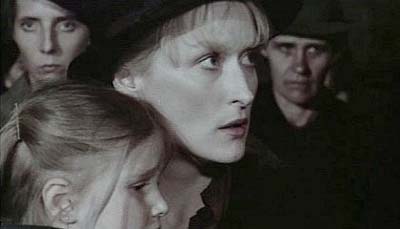
I remember being in a rage after seeing Sophie's Choice. I wanted to kill those who would force anyone to make such a choice. I hated mankind.
2) Favorite sidekick
I'm thinkin' I gotta go with R2D2 although there are so many other great ones to choose from.
3) One of your favorite movie lines
"I'm hard to get, Steve. All you have to do is ask me." -- Slim (Lauren Bacall) in To Have and Have Not -- love that line. Howard Hawks put it in a couple different films (also in Only Angels Have Wings) - so obviously it really resonated for him ... I think about that line a lot.
4) William Holden or Burt Lancaster?
William Holden. Love Burt ... but Holden's got something extra. For me.
5) Describe a perfect moment in a movie
There's a scene in Running On Empty (one of my favorite movies ever made) when Martha Plimpton comes over to the house for the mother's birthday party. Martha is River Phoenix's character's girlfriend. He's never had one before. His parents are fugitives. They are suspicious of outsiders. Judd Hirsch plays the protective father ... who ... is subtly won over by this unassuming young woman. Just watch his face when he sees the present Martha Plimpton brought for his wife. He takes it in ... So subtle, though. After dinner - they start to clear the table ... and someone puts on James Taylor "Fire and Rain" ... and just watch the following scene. It's all in one shot. There's no cutaways. If you've seen that scene, you will know the one I'm talking about. The clearing-away-of dishes and the singing-along-to-James-Taylor scene. The movies don't get more perfect than that. That's why people MAKE movies ... to capture moments like that one.
6) Favorite John Ford movie
I'm gonna go with Grapes of Wrath. Tough choice. Either that or Stagecoach.
7) The inverse of a question from the last quiz: What film artist (director, actor, screenwriter, whatever) has the least–deserved good reputation, artistically speaking. And who would you replace him/her with on that pedestal?
Well ... Guy Ritchie immediately came to mind ... but I think his "good reputation" has pretty much plummeted already without my help.
So I now must go with:
Renee Zellweger. How that woman has duped the American public and also everyone in Hollywood is something that I will never understand. It's an interesting case. I've been following her for years, merely because the whole thing confuses me. How a star has been MADE, not BORN. She had some charm in Jerry Maguire but other than that? She seems WAY over-praised to me. Especially in Chicago where I thought she was especially terrible. Don't even get me started on the travesty that was Down with Love. She simpered and flounced her way through it, I didn't believe a word, and yet ... she was in an untouchable phase at that point. Nobody called her on her bullshit. The industry was too pleased with itself for having anointed her. But mark my words, her time is coming. Her work is too self-conscious, too pleased with itself, and too NERVOUS-looking. It's like she understands that she's on thin ice as well. She doesn't have the rock-hard LOVEBOMB support of, say, a Julia Roberts ... which doesn't seem to ebb and flow, but just IS. Renee was "anointed from within" after Jerry Maguire and that kind of success just can't compare to the sort of success when an audience decides that they love you. Renee is supported by the industry - and her smirky sad-happy face on the red carpet shows that anxiety. When they decide she's "out", she'll be WAY "out". Nobody could decide Julia Roberts was out. Whatever you think of Roberts' work, in terms of acting or talent, is irrelevant. The woman is BELOVED by an enormous public. That gives her huge freedom. Renee's career seems extremely bureacratized to me, in a way that Julia's does not - Renee's career needs a lot of HELP to keep it going. Julia Roberts can take over 2 years off at the very HEIGHT of her popularity and all anyone can say is: "When is Julia Roberts coming back????" You cannot create that kind of momentum. It just happens, and Renee knows, somewhere, that this has NOT happened to her. Renee thanked her "image consultants" during her Oscar speech - which gives you some idea of how managed this woman is. That over-management of her career shows in her acting which is eager-to-please, and therefore somewhat empty.
I'm not sure about the replacing thing.
One thing I will say: I think Sandra Bullock is a fantastic actress and I wish she got better parts. I mean, hell, her career is fine ... but still. I wish she got to REALLY show her stuff. Anyone see Murder by Numbers? I LOVE her work in that. And it's the kind of acting that doesn't call attention to itself. But it's damn fine work. It's not flashy. And it also shows that Bullock is uninterested in being liked (unlike Renee - who begs us with her every simper to love her, love her). Bullock is more interested in the craft of acting than the other stuff ... and she's damn good at it.
More props to Bullock. I think she's one of the most solid actresses working today.
8) Barbara Stanwyck or Ida Lupino?
Stanwyck Stanwyck Stanwyck. She's just about the very best there is.
9) Showgirls-- yes or no?
Hell, yes. LOVE that unintentionally campy trainwreck. HYSTERICAL. I love it when Elizabeth Berkley "acts". Omigod. Glory.
10) Most exotic or otherwise unusual place in which you ever saw a movie
Nothing comes to mind, although I first saw Empire Strikes Back at a drive-in movie - piled in a huge station wagon with my cousins.
11) Favorite Robert Altman movie
Oh boy. I kinda love them all. Even Dr T and the Women, which everyone else in the entire galaxy despised. What can I say. I'm a diehard fan. But in terms of impact? And sheer loving EVERY STINKIN' SECOND on the screen? I'm gonna go with Gosfard Park. But ... Nashville too ... I love them all. But Gosfark Park has a real special place in my heart, so I'll stick with that one.
12) Best argument for allowing rock stars to participate in the making of movies
Hard Days Night.
Also: Jon Bon Jovi's ass. More of that, please.
13) Describe a transcendent moment in a film (a moment when you realized a film that just seemed routine or merely interesting before had become something much more)
Sean Penn's entire performance in the otherwise formulaic and rather boring Carlito's Way. I would love to hear the story behind what happened there - because I wonder if the power of what Sean Penn was doing kind of took everyone by surprise ... Penn was supposed to be the sidekick ... but he's pretty much all I can remember about the film. I watched the movie - whatever - I like Al Pacino - it's okay - nothing I haven't seen before ... and through the course of the movie, something kind of amazing happens: You suddenly start to realize that Sean Penn is giving the performance of a LIFETIME. It's a performance that deserves its own film. It's completely beyond anything he's ever done (in my opinion - and I'm a huge fan of his acting) and it makes it look like Al Pacino was phoning in his performance from down the block. It's not a good movie, I don't think ... not totally ... but every time it's on, I have to watch it ... just to watch how Sean Penn's work totally transcends the entire film. I'm tellin' ya - it's his best work. It sneaks up on you ... because he's not even in that many scenes ... but he's the only reason to see that movie. SEE it. The guy is a master, and roles like that are why.
14) Gina Gershon or Jennifer Tilly?
I kinda love them both. But on the power of my sheer undying LOVE for the movie Liar Liar - I'm going with Tilly.
15) Favorite Frank Capra movie
It Happened One Night. Hands down.
16) The scene you most wish you could have witnessed being filmed
Goosebump-territory now: Paul Henreid making the crowd sing La Marseillaise to drown out the Germans in the nightclub in Casablanca. It gives me goosebumps every time I see it. It's a cliche, it's a formula, but no matter how many times I've seen it - and no matter how much I think Viktor Lazslo is a big stick-in-the-mud bore, I am moved almost to tears by that scene. It just flat out WORKS, and I would have loved to have been there that day. Apparently, all of the extras (many of whom were real-life refugees from Europe) were in tears as they sang. And if you notice -- Hal Wallis (producer extraordinaire) knew that this scene needed one extra punch - and so he made the music director have the Rick's Cafe band suddenly SOUND like a full symphony orchestra. It's not realistic - no bar band would ever sound that huge ... but when you hear that orchestra kick in ... it hits you, the audience member, on a visceral level. You want to stand up and sing with all of those people. One of the most purely powerful scenes ever filmed. Manipulative? Sure. Whatever. It WORKS. I would love to have been there that day.
17) Robert Ryan or Richard Widmark?
hahahaha Tough choice. Going with Richard Widmark.
18) Name a movie that inspired you to walk out before it was finished
Only one. 36 Fillette. What a piece of crap. My boyfriend and I watched 20 minutes of it, looked at each other, and without a word stood up and left. Catherine Breillat has gone on to MUCH better things (I liked Romance a lot) after that horrible movie.
19) Favorite political movie
Election.
20) Your favorite movie poster/one-sheet, or the one you’d most like to own
Goosebumps.
21) Jeff Bridges or Jeff Goldblum?
BRIDGES. Best (and most under-rated) actor in America. Nobody can even come CLOSE to doing what he does.
22) Favorite Ken Russell movie
Tommy.
23) Accepting the conventional wisdom that 1970-1975 marked a golden age of American filmmaking in which artistic ambition and popular acceptance were not mutually exclusive, what for you was this golden age’s high point? (Could be a movie, a trend, the emergence of a star, whatever)
Oh, there's so much to say here. Argh. Names just float through my head ... because I do accept "the conventional wisdom that 1970-1975 marked a golden age of American filmmaking in which artistic ambition and popular acceptance were not mutually exclusive" ... Not only do I accept it, I REVEL in it.
So I'm gonna give my answer as this: the fact that Jack Nicholson made the following films in between 1970 and 1975, films which helped cement his reputation:
Five Easy Pieces
Carnal Knowledge
Last Detail
Chinatown
One Flew Over the Cuckoo's Nest ...
I mean, that is one HELL of a run. And the 70s boom in American film-making completely suited the emergence of a star like Nicholson ... It might not have happened at any other time. Thank God he got his chance and ran with it. He's one of my favorites.
24) Grace Kelly or Ava Gardner?
I must go with Grace Kelly even though I think she is a bit over-rated - although she is clearly the better actress. The only performance where I really forget that Grace is an actress, is in Rear Window. I love that movie, and I love her performance in it. She is sensuous, smart, loving, teasing ... It's a wonderful mix. Everything else is a bit STIFF and self-conscious for my choice. Cary Grant loved her, said that working with her was like working with Buddha (yes, those were his words) ... and I can see her appeal - but Ava just seems more comfortable in her own skin, and I prefer that kind of persona to the other. But I'll give the acting props to Grace.
25) With total disregard for whether it would ever actually be considered, even in this age of movie recycling, what film exists that you feel might actually warrant a sequel, or would produce a sequel you’d actually be interested in seeing?
First and foremost: The Breakfast Club. WHAT HAPPENED ON MONDAY????
Next choice: Lost in Translation. The ending was perfect as it was ... I loved its ambiguity ... its bittersweet taste ... but I have thought more than once: "I wonder if their paths ever crossed again ..." I try to imagine it out in my mind, what such a meeting would be like.
The Books: "April 1865: The Month That Saved America" (Jay Winik)
And here is my next excerpt of the day from my library.
 Next book in my American history section is April 1865: The Month That Saved America , by Jay Winik
I loved this book. Fun. I couldn't put it down. What a freakin' month it was.
Here's an excerpt about the aftermath of Lincoln's assassination. Some incredible images here. The image of the farmers kneeling in their fields just ... gets me right in the throat.
From April 1865: The Month That Saved America , by Jay Winik
In New York, on 550 Broadway, precisely at 7:22 a.m. on April 15, the clock at Tiffany % Co., held aloft by a huge wooden Atlas, had come to a halt. This was no doubt fitting, for, as was well known, Charles Lewis Tiffany greatly esteemed Lincoln.
Across town, in Brooklyn, Walt Whitman was at home when he heard the news. His mother prepared their breakfast, as usual, but it was left untouched and unnoticed, as were the rest of the day's meals. He sipped a half cup of coffee, and after pushing his plate of food away, he scoured every newspaper, silently passing them back and forth with his mother. Then he crossed over to Manhattan and, to darkening skies and driving rain, trudged up Broadway, past shuttered stores hung with black. "Lincoln's death," he wrote in his notebook, " -- black, black, black -- as you look toward the sky -- long broad black, like great serpents."
Four days later, farther north, in Concord, Massachusetts, all business and labor was suspended between eleven and two o'clock, as the townspeople moodily gathered in the local Unitarian church. Music was played and selections from the Scriptures and prayers were read. Then Ralph Waldo Emerson gave a somber address: "Rarely was [a] man so fitted to events," he said of Lincoln, about whom he had often had severe reservations. "Only Washington can compare with him in the future."
To the south, it would take a full seven days for Mary Chestnut to receive the news of the assassination, which arrived for her husband on April 22 in a sealed envelope, by secret dispatch. She opened it. "It is simply maddening, all this," she wrote. A friend of hers saw it differently: "See if they don't take vengeance on us," she warned, "now that we are ruined and cannot repel them any longer." Another friend quipped defiantly: "I call that a warning to tyrants!"
By then, though, Lincoln had been eulogized, his funeral had been held, and his remains had begun the long j ourney home to Springfield. On Wednesday, April 19, Lincoln's casket spent its final hours lying in state in the East Room of the White House. Outside, the sun beamed, and a gentle breeze caressed the sky. Inside, black was everywhere: on the chandeliers, on the ornate gilt frames of the mirrors, in the adjoining rooms, even on the steps. The East Room itself was hushed, dim, somber. Lincoln's coffin rested on a flower-covered catafalque, a bed of roses at his feet. Even in death, his gangly frame filled the open casket: his head rested on a white pillow, a queer smile fixed on his lips. At eleven that morning, the services began.
Six hundred people crowded into the room. All of official Washington was here: President Johnson and his cabinet, Senator Sumner and his congressional colleagues. Justice Chase and the Supreme Court, generals and the diplomatic corps, Lincoln's personal cavalry and bodyguards, his personal aides and his sons, Robert and Tad, standing at the foot of the coffin, grief-stricken. At the other end, General Grant sat, alone, his numbed gaze fixed on a cross of lilies, a black mourning crepe wound around his arm. In full view, he wept, later maintaining that this was the saddest day of his life. For his part, President Johnson stood erect and qujet, facing the middle, his hands crossed on his breast. Four ministers spoke and delivered their prayers. Then the casket was closed.
With machinelike efficiency, twelve veteran corps sergeants lifted the coffin, carrying it out into the funeral car, into the sunlit day, into the dirge of bells tolling and bands playing for the dead. In slow time, the funeral procession started up Pennsylvania Avenue. With a detachment of black troops in the lead, it moved, in careful, measured, rhythmic steps. Lincoln's empty boots sat eerily in the stirrups of his riderless horse, which followed behind, as though ready to join his master in the afterlife, while columns of mourners trudged to the steady, muffled roll of drums. Arms reversed, battalions and regiments were next. Soon the lines curved and swelled, like the great blue sky, with wounded soldiers, torn and bandaged men, marching along. Behind them came a cortege of black citizens, stretching from curb to curb in neatly ordered lines of forty -- 4,000 of them all told, in dark coats and shiny white gloves, clasping hands and quiet, as they strode along. In their wake, heavy artillery rumbled.
When the procession reached the Capitol, the sergeants gently lifted Lincoln into the rotunda, where he lay in state on another catafalque. All the oil paintings and bright white statues were covered, except for the figure of George Washington, on which a simple black sash was tied. During that day, and the next, thousands of people filed through, to get one last glimpse and pay their last respects. Noah Brooks recorded: "Like black atoms moving over a sheet of gray, the slow moving mourners ... crept silently in two dark lines across the pavement of the rotunda ..."
The next day, April 21, a nine-car funeral train bore Lincoln from the capital. It would make a journey of fourteen days and 1,662 miles, back to Illinois, retracing the route that a freshly elected United States president had taken to Washington four years earlier.
The train crept forward, to ringing bells and through the soft, spring landscape. All along the route, people gathered, watching in stunned silence as the train rolled by under the velvety sky. In Philadelphia, Lincoln's coffin was placed in Independence Hall, where a double line of mourners stretched three miles deep. Among them was former President Buchanan, just one day shy of his seventieth birthday; ignoring his advancing age, he had driven his buggy all the way from Lancaster, Pennsylvania, to see the fallen president. In New York City, the procession continued for four hours. Eighty-five thousand mourners accompanied the funeral hearse through the streets beneath a thicket of signs. "Mankind has lost a friend and we a President," one sign said. Another read: "In sorrowing tears the nation's grief is spent." A tearful Walt Whitman would never forget this moment: from that time on, every spring, with its lilacs blooming and the season blossoming, would remind him of the coffin passing in the street. Six-year-old Theodore Roosevelt was there, too, leaning out of the second-floor window, watching the spectacle from his grandfather's twon house on Broadway. In Albany, Lincoln rested in the statehouse, and people came all through the night to lay their eyes on his open coffin. Two presidents, one former and one future, would rush to Buffalo to join the long lines of mourners: Millard Fillmore and Grover Cleveland. Then the train steamed west, past farmers kneeling in their planting fields, to Cleveland, where a special outdoor pavilion was set up -- for no outdoor public building was large enough to accommodate the expected crowds -- through which 10,000 mourners passed each hour, braving a cold, steady rain. In all, 150,000 came. Indianapolis followed, on the night run. It was lit up by bonfires, with attentive crowds standing in the rain, mute and still, as the train slowly glided by like a ghost. In Chicago, the hearse was shepherded by thirty-six young women, dressed in white, representing each state in the restored Union. There, too, were Lincoln's fellow Illinoisians, silent columns of heartbroken colleagues and friends marching lockstep by his side in one subdued, final tribute.
April 19, 2006
That solves that
An impatient producer visited the set of a movie being directed by legendary film director John Ford.
The producer shouted at Ford: "You are two weeks behind schedule!! This is an outrage!"
John Ford picked up the script, ripped out 20 pages, and barked back, "Now we're two weeks ahead of schedule."
Comments on my Best Picture choices
So Edward asked for those of us who voted in his survey (of Best Best Pictures from the Academy) to send in our comments about our movie choices.
Here are mine:
1. 1943 - Casablanca
One of the things that I think makes a movie great, and not only great but long-lasting, is that there is a mystery about it. It cannot be too easily explained, labeled, pinned down. The discussion about it, the debate it, will continue on. I guess you could say this about the great movie stars, too. They don't give it all away. They hold their cards close to their chest, in some way, and keep us guessing about them. Humphrey Bogart and Ingrid Bergman are perfect examples of this. We can never have all of them. In the same way, that we can never have all of ANYbody (at least anybody who is interesting.) There's an essential mystery about their screen presences. I will never get tired of this film.
2. 1973 - The Sting
Words fail me. Great movie. Like a big box of candy corn or something. Every. Stinking. Moment. Works. I love it. It also has such a zest, such a joy to it ... the sheer joy of film-making. It's infectious. Fun acting, great music, terrific plot - where everyone gets stung, including the audience ... My parents let us stay up late to see this film when we were kids. They never let us stay up late, but for The Sting they made an exception.
3. 1984 - Amadeus
If there is such a thing as a perfect movie, that one has got to be on the list. Every scene, the way the score is integrated - Mozart's music is not used as a set piece, or as background. It appears to be happening INSIDE HIS HEAD. It is the actors who are able to show us the flaws, the darkness, the capacity for cruelty, the struggle - who really move me, who really insinuate themselves into my consciousness. They're the ones who can actually teach me things, who can reveal me to myself. That's the power of this particular art-form. It can illuminate the dark corners of our own souls. It can bring about a necessary catharisis - pity, terror - it can help us things we may have been avoiding, things within us that need to be resolved - things we may not even be aware of ourselves. Nobody embodies that better than F. Murray Abraham as Salieri. He reveals a truth which is unpleasant, something most of us don't want to hear. We all want to relate to MOZART, not to Salieri. We resist him. And yet ... in that last moment ... we see that he is our patron saint. And it's really that truth, that truth within all of us, that makes us most human. It's painful. It really is. And yet also - within it - is beauty. Redemption.
4. 1954 - On the Waterfront
Even just saying the name of this movie gives me the chills. I watch it now, and am still amazed at its relevance and at the power and timelessness of the acting.
5. 1993 - Schindler's List
Not a movie I want to watch a million times, too painful - but I believe it is a work of art. Even down to the faces of the extras. They don't look like "extras". They look like they come from that world. The scenes between Ben Kingsley and Liam Neeson take my breath away. Ben Kingsley, with one single tear rolling down his face, but his features not moving: "I think I'd better have that drink now." One of the most moving acting moments ever captured on film. I have tears in my eyes just writing about it.
6. 1934 - It Happened One Night
Clark Gable. Claudette Colbert. If you want to see what my friend Mitchell would call 'sheer liquid joy' - rent this movie. I laugh out loud every time I see it. Clark Gable took off his shirt, revealing a white T-shirt, and caused a brou-haha hard to imagine now. But it was sheer sex, or the possibility of sheer sex, right up there on the screen. Beautiful film. Laughoutloud funny.
7. 1950 - All About Eve
Second only to Sunset Boulevard: this is the best movie about the movies ever made. Bette Davis is fearless in her portrayal of an actress growing older, losing her power. Fearless. It's still thrilling to watch. The dialogue bites, crackles, fizzes ... and yet it never loses that deep sense of reality.
8. 1978 - The Deer Hunter
This movie is like a raw nerve. I've only seen it once. Once is enough. And yet I remember some of the scenes almost moment to moment to moment. It's that powerful.
9. 1974 - The Godfather Part II
Masterful performance by Robert DeNiro doing what must have seemed like a nearly impossible job. Play Vito Corleone as a young man - play the whole thing in Italian ... Amazing.
10. 1980 - Ordinary People
Robert Redford would watch Mary Tyler Moore walking alone on the beach in Malibu (they were neighbors) and he would wonder to himself, "There's got to be a dark side there. I wonder what her dark side is." Eventually, when Ordinary People came along, he got to let her utilize it, and show us her darkness within. And boy did she ever. A woman with ice in her veins. There are such women. I have met them. (The "Break it up" lady comes to mind) But very rarely are actresses capable of playing such women... it's too frightening. Actors, after all, want to be liked. Mary Tyler Moore gave that all up in this film. Hers is one of the greatest performances given by an actress ever.
The future of our planet ...
is in the balance ... (the last sentence of his post made me just LAUGH!!). Trent: you rock, in so many ways.
The Books: "1812 : The War That Forged a Nation" (Walter R. Borneman)
And here is my next excerpt of the day from my library.
 Next book in my American history section is 1812 : The War That Forged a Nation , by Walter R. Borneman.
It's just not a well-written book. Sorry, Borneman. It's just not. The author actually uses the word "Hey" a lot in the text. Like: "Hey, the British were impressing American soldiers ... what choice did the Americans have?" Hey? HEY???? But I have some bad books on my shelves - and this book excerpt thing isn't about me editorially choosing my "favorites" ... So here it is. 1812.
Here's an excerpt detailing the battle between the USS Constitution and the HMS Guerriere on August 19, 1812. Yawn.
From 1812 : The War That Forged a Nation , by Walter R. Borneman.
Leaving Boston harbor, Hull steered the Constitution northeast along the coasts of Nova Scotia and Newfoundland and took up station off Cape Race in the Gulf of St. Lawrence -- the route of Canada's lifeline to Great Britian. Constitution captured and sank two British merchantmen there and then turned south toward Bermuda. She soon chased down a brig that turned out to be the American privateer Decatur, of fourteen guns. Her captain reported to Hull that he had outrun a British frigate the day before. This was good news to Hull. Now he knew that there was a British warship in the vicinity and that he had just run down a vessel that had proven faster the day before.
About two o'clock on the afternoon of August 19, 1812, the Constitution's lookouts raised cries of "Sail ho" and pointed to a sail bearing east-southeast. Pulses quickened. Having the wind, the Constitution gave chase and quickly closed to within three miles. Both ships beat to general quarters, but Hull was still uncertain about the identity of his quarry. It soon proved to be the frigate Guerriere, and her captain was about to get his wish for a chance at revenge. Supposedly Captain Dacres was quoted as boasting, "There is the Yankee frigate: in forty-five minutes she is certainly ours: take her in fifteen and I promise you four months' pay!"
As Constitution closed with GFuerriere from its windward side, an overeager Dacres ordered his crew to fire broadside after broadside at the approaching vessel. By and large, Hull held his fire, much to the consternation of Lieutenant Morris, who asked three times for permission to do so. British cannonballs struck the Constitution, but did little damage. After one particularly well-aimed British broadside bounced harmlessly off Constitution's hull, a crew member is reported to have exclaimed, "Hurrah, her sides are made of iron," or words to that effect. No matter. A legend was born, and "Old Ironsides" she became.
Finally, with the two ships but twenty-five yards apart, Hull ordered his first broadside of double-shot -- both a canonball and a canister of grape -- from his starboard guns. The effect on the Guerriere at such close range was dreadful, and the cheers of the British seamen quickly quieted into moans of pain. Constitution fired again and again, and then crossed Guerriere's bow and brought her port guns to bear in equally devastating fashion. Hull, who was rather short and stocky, became so animated that he split the seat clean out of his breeches, an event that did as much for the morale of his crew as the obvious damage being inflicted on Guerriere. When another broadside raked Guerriere and toppled her mizzenmast, Hull ignored his breeches and shouted above the roar, "Huzza, my boys! We've made a brig of her."
The fallen mizzenmast acted as a huge rudder and had the effect of slowing Guerriere and swinging her to starboard despite the efforts of her helmsman. Constitution surged ahead and attempted to cross her bow again, but this time Hull cut the maneuver too close and the Guerriere's bowsprit became entangled in the rigging of the Constitution's mizzenmast. The Constitution poured yet another broadside into the starboard bow of the Guerriere while the Guerriere's own bow guns landed shots that set fire to Captain Hull's cabin. Trumpets sounded on both ships to summon boarding parties, while marine marksmen in the rigging of both ships added deadly small-arms fire to the melee. Aboard Constitution, Lieutenant Morris fell critically wounded as he prepared to lead a boarding party.
Then Guerriere's foremast fell with a splintering crash that took most of her mainmast with it. The ship shuddered and lost most of its forward momentum. Constitution continued under sail and broke loose from the grip of Guerriere's bowsprit. With Guerriere almost dead in the water, Constitution drew apart and prepared to rake her fore and aft with still more broadsides. Suddenly the British frigate fired a shot to leeward -- in the opposite direction of the Constitution. With no flags left to strike, Captain Dacres, who himself had been wounded, was signaling his surrender.
Captain Hull sent Lieutenant George C. Read aboard Guerriere to ascertain the situation. Stepping across decks slippery with blood, young Read confronted Dacres amid the carnage of his quarterdeck and inquired, "Captain Hull presents his compliments, sir, and wishes to know if you have struck your flag?" To this, Dacres is said to have replied, "Well, I don't know. Our mizzen mast is gone, our fore and main masts are gone -- I think on the whole you might say we have struck our flag."
Dacres was escorted aboard Constitution to confront Hull, who refused Dacres's tender of his sword, supposedly saying that he could not take the sword of one who had defended his ship so gallantly. Then Hull asked if there was anything on the Guerriere that Dacres wished to have brought aboard. "Yes," Dacres replied, "my mother's Bible." Hull ordered it retrieved.
Constitution had sustained losses of seven killed and seven wounded to British losses of fifteen killed and seventy-eight wounded -- the latter number due in no small measure to Captain Hull's use of grapeshot at close range. Hull hoped to tow the Guerriere into port as a prize, but by dawn the next morning there was four feet of water in her hold. By midafternoon Hull recalled his prize crew and ordered her blown up. In transferring the crew of Guerriere to the Constitution, Hull found that there were ten impressed Americans aboard -- a graphic example of one of the war's causes. Dacres clearly knew of it because he had graciously permitted the Americans to go belowdecks rather than fight against their countrymen.
April 18, 2006
Film survey: The Best Best Pictures
Go check it out. And email your answers to the email-address given in that post (eddiesworst@yahoo.com). The survey is: pick the Academy's BEST best picture winners. Edward provides a list of all of the "Best Picture" winners since the Oscars began - so all you have to do is choose 10, put them in order (1 being the best) and email them to Eddie.
Here are mine - and - this list could change at any moment in time, but for now?? I'm going with that. I feel like The Apartment needs to be on my list. Also Annie Hall ... But whatever. It's a survey. There can only be 10 on my list so I had to be brutal. I knew the films that HAD to be on there - the non-negotiables of my list - and those are my top 5. After that? I made some tough choices - going with the films that made the deepest impression, that I love the most.
1. 1943 - Casablanca
2. 1973 - The Sting
3. 1984 - Amadeus
4. 1954 - On the Waterfront
5. 1993 - Schindler's List
6. 1934 - It Happened One Night
7. 1950 - All About Eve
8. 1978 - The Deer Hunter
9. 1974 - The Godfather Part II
10. 1980 - Ordinary People
But go over there - and email Edward your choices. His commentary is great, too. I'll add some comments to each film on my list later - but I wanted to give you all the heads up about the survey.
Awake and sing
My eyes stung with tears reading the review of the revival of Awake and Sing that just opened here in New York at the Belasco. This was Odets' biggest hit - the story of the rambunctious bickering Berger family in Depression-era New York. If you want to get a small glimpse of the quality of the writing - here's an excerpt. Odets' work has always meant a great deal to me - not just because of its rightful place in American theatrical history, but because of how it has helped shape who I am - as a reader, an actress, whatever. The story of Clifford Odets is a truly American story (this is the year of his centennial - so he's everywhere right now), and his plays are truly great American plays - difficult to do now - the language can seem 'corny' to our more cynical or pessimistic ears ... but it's poetry. Odets was a poet.
The cast of this revival could not be better. The great Ben Gazzara is in it. Lauren Ambrose (from 6 Feet Under) and Mark Ruffalo (awesome) are making their Broadway debuts - and both have gotten great reviews. Ruffalo as the wise-cracking Moe Axelrod - a classic Odets character: He's bitter, cynical, he's been treated roughly by the world - so he treats the world roughly in turn. He has some of the best lines in the play. He's in love with Hennie (played by Ambrose) but for a guy like Moe, love doesn't come easy. He treats her like shit because he can't deal with his feelings. And when his emotions do come flooding out of him, you worry for him. You worry that he won't be able to pay such a price. Ruffalo should be perfect for this part and I am really glad to hear that he is just going for it, and doing it well.
It sounds like the play has been over-designed, from the review. Sigh. STOP doing that, directors. It happened with Rabbit Hole that I just saw too (with Mitchell). Wonderful well-made play, top-notch acting by all involved (the unbelievable Tyne Daly, Cynthia Nixon was fanTAStic, and seeing John Slattery onstage, as opposed to on television, gave me a great appreciation of just how good an actor he really is - KUDOS) - but the production had this revolving set, which - I don't know - it was gorgeous, and very well-done - but I thought it was too much. For the material. The material did not demand a massive revolving set. It's a kitchen-sink drama (yes, an upper-class kitchen sink drama - but still - it's a story about a couple trying to deal wtih the death of their child). No need for a swirling Les Miz set. It bothers me. It shows a lack of trust in the material.
But still, to read paragraphs like this just gives me a thrill of happiness:
All of Mr. Sher's skilled performers manage to locate the dreaming centers of their characters, buried beneath layers of political sloganeering, everyday gripes or street slang. And even when the focus blurs, Odets's zesty dialogue, in which jazzy period colloquialisms are slung around like punches at a prizefight, is a joy to hear.
Amen. Nobody writes dialogue like Clifford Odets. Nobody. He is so difficult to do. You gotta get into his context, you gotta give up your modern self, you gotta give up your shyness about language - and go for it.
Here's the end of the review - mentioning the set, as well as the difficulty of the language - but ending on a ringing note of blessing that brought tears to my eyes:
Nor do Mr. Sher and his actors always finesse the more effusively rhetorical passages in the play, which can strike the contemporary ear as corny in their lyricism or forthright idealism. Ralph's climactic peroration is a case in point. The now-barren stage and a flurry of snow do the work the actor might better be allowed to, infusing this exultant burst of feeling — "I swear to God, I'm one week old!" — with a sense of the provisional, adding a note of poignancy to temper the hokum.But small infelicities don't smudge the overall sharpness of this picture of life being lived for all it's worth, despite the grinding oppressions of subsisting on the knife edge of poverty. The sweep of American history ran roughshod over some of the ideals Odets and other artists championed in the 1930's.
But ideals are not old newspapers, withering into dust. Even tattered, they endure. And as this moving revival reminds us, the song of human aspiration is always sweet to hear.
I need to see this production.
Today in history: April 18-19, 1775
On the night of April 18, into April 19, in 1775, Paul Revere made his famous ride.
The spring of 1775 was a tense time. Prominent Bostonians were under constant threat of arrest from the British, and many of them - to avoid this - moved their families to outlying communities. However, two of the main patriotic leaders (Benjamin Church and Joseph Warren) stayed in Boston. Paul Revere did as well, and kept a close eye on British movements through that spring. Revere was trusted as a messenger, he knew everybody, he was just one of those guys.
In mid-April, Revere started to notice some ominous signs: mainly that the British ships were taken out of the water, to be worked on, repaired. He could sense that something was coming. He felt the British were preparing for some kind of attack.
Revere went to Concord on April 16 (most of the weaponry was stored there) and warned the leaders of that community that the British were preparing something, they were up to something, and if they were going to strike, they would most definitely try to seize the weapons stash in Concord. So the people of Concord went to work, hiding their store of weapons in barns, cellars, swamps, etc. (Like I mentioned: Paul Revere was trusted. He knew everybody. If you're interested, read the excerpt I posted of Malcolm Gladwell's fascinating analysis of Paul Revere - and Gladwell's comparison with the far less successful messenger on that very same night - William Dawes.)
So. April 16. Revere returned to Boston from Concord, and met with other revolutionary leaders, and that is when they came up with the "one if by land, two if by sea" warning system. Revere knew they needed a way to have some advance warning about which route the British were going to take when they finally did attack.
By land? Or by sea?
So, Revere set up the system: Signal lanterns would be placed in the belfry of Old North Church (the steeple can be seen across the Charles River). If two lanterns were hung, then the British would be crossing the Charles by boat. If one lantern was hung, then the British would choose to attack using a land route.
"One if by land, two if by sea."
This plan was put in place just in time. On April 18, in the early evening, a stable boy came to Paul Revere, telling him that he had overheard some British soldiers discussing the upcoming attack, and that it was planned for early the next morning. The stable boy knew who to bring this information to, and that was Paul Revere. (Again, check out Gladwell's analysis of Paul Revere's personality. Really interesting.)
Revere, on receiving this urgent piece of information, knew he had to get the warning out (and that he especially had to warn John Hancock and Samuel Adams who, at that time, were hiding out in Lexington).
The signal was given: two lanterns.
So off he went onto his now legendary ride. Revere took the water route out of Boston, rowed across the Charles, and galloped through the communities north of Boston sounding the alarm. (Medford, Charlestown, Lexington, Concord.) Because of Paul Revere, the British had completely lost the element of surprise. When they came to attack, they found the rebellious colonists waiting for them everywhere, ambushing them left and right, from behind stone walls, hiding behind trees ...
An interesting tidbit (this is why I love this time in American history - yeah, the events themselves are really cool ... but it's details like the following one that really have me hooked, like a crack addict):
In his hurry to depart, Revere forgot to bring along pieces of cloth to wrap the oars of his boat. The purpose of this was to muffle the sound of them cutting through the water. The Somerset (the British man-of-war) was at anchor, right there in the harbor. Paul Revere had to row right by them, and so any sound at all would have alerted the crew, and if Revere was busted, the whole jig would be up. Revere was in a bit of a pickle ... standing by his boat, trying to figure out how he could improvise ... could he take off his stockings? Tie them around the end of the oars?
One of the boatmen involved in helping Revere make this crossing came to the rescue. He ran to his girlfriend's house and asked her for her petticoat. hahaha One can only imagine her startled response to the nighttime demand at her door: "Please, dear. It's 10 pm, and I need you to take off your petticoat, give it to me, and don't ask me ANY questions about it!!" But apparently, this girl, whoever she was, complied - took off her petticoat, gave it up, and Revere used that to wrap up the ends of his oars.
I love that woman, whoever she is.
So. In honor of the great Paul Revere, I have a couple other things to post. One is, my conversation with Cashel about the American Revolution. I read that piece on the radio in 2003. I love it. It's one of my favorite conversations I've ever had with him.
And lastly, please find Henry Wadsworth Longfellow's celebrated poem "Paul Revere's Ride". I know large swaths of it by heart ... To me, it's a thrilling poem. Because of the story it tells, but also because of its rollicking rhythm, you can feel the suspense, you can feel the urgency. It's meant to be read out loud. Try it for yourself - it's so much funner that way. You can feel the beat of the horse hooves in the poem. The last stanza is beyond compare. "For borne on the night-wind of the Past ..." I mean, come ON!!
April 18, 1775. A great day in American history. One of my personal favorite "stories" of the American revolution.
Paul Revere's Ride
- by Henry Wadsworth LongfellowListen my children and you shall hear
Of the midnight ride of Paul Revere,
On the eighteenth of April, in Seventy-five;
Hardly a man is now alive
Who remembers that famous day and year.
He said to his friend, "If the British march
By land or sea from the town to-night,
Hang a lantern aloft in the belfry arch
Of the North Church tower as a signal light,--
One if by land, and two if by sea;
And I on the opposite shore will be,
Ready to ride and spread the alarm
Through every Middlesex village and farm,
For the country folk to be up and to arm."
Then he said "Good-night!" and with muffled oar
Silently rowed to the Charlestown shore,
Just as the moon rose over the bay,
Where swinging wide at her moorings lay
The Somerset, British man-of-war;
A phantom ship, with each mast and spar
Across the moon like a prison bar,
And a huge black hulk, that was magnified
By its own reflection in the tide.
Meanwhile, his friend through alley and street
Wanders and watches, with eager ears,
Till in the silence around him he hears
The muster of men at the barrack door,
The sound of arms, and the tramp of feet,
And the measured tread of the grenadiers,
Marching down to their boats on the shore.
Then he climbed the tower of the Old North Church,
By the wooden stairs, with stealthy tread,
To the belfry chamber overhead,
And startled the pigeons from their perch
On the sombre rafters, that round him made
Masses and moving shapes of shade,--
By the trembling ladder, steep and tall,
To the highest window in the wall,
Where he paused to listen and look down
A moment on the roofs of the town
And the moonlight flowing over all.
Beneath, in the churchyard, lay the dead,
In their night encampment on the hill,
Wrapped in silence so deep and still
That he could hear, like a sentinel's tread,
The watchful night-wind, as it went
Creeping along from tent to tent,
And seeming to whisper, "All is well!"
A moment only he feels the spell
Of the place and the hour, and the secret dread
Of the lonely belfry and the dead;
For suddenly all his thoughts are bent
On a shadowy something far away,
Where the river widens to meet the bay,--
A line of black that bends and floats
On the rising tide like a bridge of boats.
Meanwhile, impatient to mount and ride,
Booted and spurred, with a heavy stride
On the opposite shore walked Paul Revere.
Now he patted his horse's side,
Now he gazed at the landscape far and near,
Then, impetuous, stamped the earth,
And turned and tightened his saddle girth;
But mostly he watched with eager search
The belfry tower of the Old North Church,
As it rose above the graves on the hill,
Lonely and spectral and sombre and still.
And lo! as he looks, on the belfry's height
A glimmer, and then a gleam of light!
He springs to the saddle, the bridle he turns,
But lingers and gazes, till full on his sight
A second lamp in the belfry burns.
A hurry of hoofs in a village street,
A shape in the moonlight, a bulk in the dark,
And beneath, from the pebbles, in passing, a spark
Struck out by a steed flying fearless and fleet;
That was all! And yet, through the gloom and the light,
The fate of a nation was riding that night;
And the spark struck out by that steed, in his flight,
Kindled the land into flame with its heat.
He has left the village and mounted the steep,
And beneath him, tranquil and broad and deep,
Is the Mystic, meeting the ocean tides;
And under the alders that skirt its edge,
Now soft on the sand, now loud on the ledge,
Is heard the tramp of his steed as he rides.
It was twelve by the village clock
When he crossed the bridge into Medford town.
He heard the crowing of the cock,
And the barking of the farmer's dog,
And felt the damp of the river fog,
That rises after the sun goes down.
It was one by the village clock,
When he galloped into Lexington.
He saw the gilded weathercock
Swim in the moonlight as he passed,
And the meeting-house windows, black and bare,
Gaze at him with a spectral glare,
As if they already stood aghast
At the bloody work they would look upon.
It was two by the village clock,
When he came to the bridge in Concord town.
He heard the bleating of the flock,
And the twitter of birds among the trees,
And felt the breath of the morning breeze
Blowing over the meadow brown.
And one was safe and asleep in his bed
Who at the bridge would be first to fall,
Who that day would be lying dead,
Pierced by a British musket ball.
You know the rest. In the books you have read
How the British Regulars fired and fled,---
How the farmers gave them ball for ball,
>From behind each fence and farmyard wall,
Chasing the redcoats down the lane,
Then crossing the fields to emerge again
Under the trees at the turn of the road,
And only pausing to fire and load.
So through the night rode Paul Revere;
And so through the night went his cry of alarm
To every Middlesex village and farm,---
A cry of defiance, and not of fear,
A voice in the darkness, a knock at the door,
And a word that shall echo for evermore!
For, borne on the night-wind of the Past,
Through all our history, to the last,
In the hour of darkness and peril and need,
The people will waken and listen to hear
The hurrying hoof-beats of that steed,
And the midnight message of Paul Revere.
The Books: "Founding Brothers" (Joseph Ellis)
And here is my next excerpt of the day from my library.
 Next book in my American history section is the marvelous Founding Brothers: The Revolutionary Generation , by Joseph Ellis.
7 guys: Hamilton, Aaron Burr, Jefferson, Adams, Washington, Madison, Franklin
6 episodes:
-- The duel between Hamilton and Burr
-- George Washington's Farewell Address
-- The Adams administration
-- The heated debate about where to place the capital
-- Benjamin Franklin trying to force Congress to deal with the issue of slavery and James Madison's resistance to that
-- The correspondence between John Adams and Thomas Jefferson
Ellis is one of my favorite popular historians out there. I've read all of his stuff by now. Wonderful writer, but why I really like him is that I like how he THINKS. I like to hear what he thinks about things. He comes at things from a different angle. Unlike so many other historians or biographers, he seems quite comfortable with contradiction, mystery, and with saying, as an author: "We can't really know what Jefferson was thinking here ..." He tries to guess, but we KNOW he's guessing, and it's a pleasure to listen to his speculations.
His biography of Jefferson is not-to-be-missed as well, although I like all of his stuff.
With this book, Founding Brothers he hit the big leagues. As in NY Times bestseller list, etc. Small wonder.
I love it!! I've already read it twice. Here's an excerpt from the chapter on Washington's farewell address (props to Alexander Hamilton) - and why it continuees to be studied, picked apart, interpreted and re-interpreted.
From Founding Brothers: The Revolutionary Generation , by Joseph Ellis.
The disarming simplicity of the statement, combined with its quasi-Delphic character, has made the Farewell Address a perennial candidate for historical commentary. Throughout the nineteenth and most of the twentieth centuries, the bulk of attention focused on the foreign policy section, advocates of American isolationism citing it as the classic statement of their cause, others arguing that strict isolation was never Washington's intention, or that America's emergence as a world power has rendered Washington's wisdom irrelevant. More recently, the early section of the Farewell Address has been rediscovered, its plea for a politics of consensus serving as a warning against single-issue political movements, or against the separation of American into racial, ethnic, of gender-based constituencies. Like the classic it has become, the Farewell Address has demonstrated the capacity to assume different shapes in different eras, to change color, if you will, in varying shades of light.
Although Washington's own eyes never changed color and were set very much on the future, he had no way of knowing (much less influencing) the multiple meanings that future generations would discover in his words. The beginning of all true wisdom concerning the Farewell Address is that Washington's core insights were firmly grounded in the lessons he had learned as America's premier military and civilian leader during the revolutionary era. Unless one believes that ideas are like migratory birds that can fly unchanged from one century to the next, the only way to grasp the authentic meaning of his message is to recover the context out of which it emerged. Washington was not claiming to offer novel prescriptions based on his original reading of philosophical treatises or books; quite the opposite, he was reminding his countrymen of the venerable principles he had acquired from personal experience, principles so obvious and elemental that they were at risk of being overlooked by his contemporaries; and so thoroughly grounded in the American Revolution that they are virtually invisible to a more distant posterity.
First, it is crucial to recognize that Washington's extraordinary reputation rested less on his prudent exercise of power than on his dramatic flair at surrendering it. He was, in fact, a veritable virtuoso of exits. Almost everyone regarded his retirement of 1796 as a repeat performance of his resignation as commander of the Continental Army in 1783. Back then, faced with a restive and unpaid remnant of the victorious army quartered in Newburgh, New York, he had suddenly appeared at a meeting of officers who were contemplating insurrection; the murky plot involved marching on the Congress and then seizing a tract of land for themselves in the West, all presumably with Washington as their leader.
He summarily rejected their offer to become the American Caesar and denounced the entire scheme as treason to the cause for which they had fought. Then, in a melodramatic gesture that immediately became famous, he pulled a pair of glasses out of his pocket: "Gentlemen, you will permit me to put on my spectacles," he declared rhetorically, "for I have not only grown gray but almost blind in service to my country." Upon learning that Washington intended to reject the mantle of emperor, no less an authority than George III allegedly observed, "If he does that, he will be the greatest man in the world." True to his word, on December 22, 1783, Washington surrendered his commission to the Congress, then meeting in Annapolis: "Having now finished the work assigned me," he announced, "I now retire from the great theatre of action." In so doing, he became the supreme example of the leader who could be trusted with power because he was so ready to give it up.
April 17, 2006
Related
These are related in topic. They are also related in the fact that they give me GREAT joy. The perfection of the humor.
1. "I never killed a man, but I have read many obituaries with a lot of pleasure."
-- Clarence Darrow (it's his birthday today, by the way)
2. This was one of FDR's favorite anecdotes: Every day at a busy newsstand, the newsboy saw the same thing: A man, on his way to catch the trolley, would come to the stand, buy the paper, look quickly at the front page, throw the paper in the trashcan, and run on his way. Every single day the newsboy observed this behavior. This went on for months. Years, even. Finally, the newsboy's curiosity got the better of him. The next morning, the same man, on his way to catch the trolley, came to the newsstand, bought the paper, looked at the front page, threw the newspaper in the trashcan, and started to dash off to the trolley, but this time the newsboy stopped him. "Excuse me, Mister - can I ask you a question?" Harried, impatient, the man said, "Sure, kid, what?" The newsboy asked, "Every day you come here, buy the paper, look at the front page, throw the paper out, and walk away. Why?" The man said, "I'm lookin' for the obituaries, kid." Even more confused the kid asked, "But the obituaries are at the back of the paper." The man replied, "Kid, the son-of-a-bitch I'm lookin' for will be on Page One."
I post this every year:
Today was the Boston Marathon.
The Halfway Mark
My grandparents lived in Wellesley (actually, my grandmother still lives there, in the same house). Wellesley is just about the halfway mark in the Boston marathon, which is always in April; watching the Boston marathon was part of my childhood. A yearly thing, like Thanksgiving, or going to camp.
When we were kids, we made a whole day of the marathon. It was inSANEly exciting. Some of my "Boston marathon memories" go way back and become fuzzy and dream-like - so I must have been very small. These qualify as "first memories", because they all reside in the senses - not the intellect. I have a sensory-flash of going to someone's apartment before heading out to the marathon. I think it was my Uncle Jimmy's place, my godfather. I remember a really thick rug. Cool air-conditioned air. A beanbag chair. Cold ginger ale.
Later memories though: we would convene at my grandparents house. My cousins would also be there, because the Boston Marathon is a big deal. And we LOVED that we got to see all the runners at the halfway point. It was better than seeing them at the start, and way better than seeing them at the end ... we got to see them AT THE HALFWAY POINT!
My cousins and I would mix Kool-aid in big pitchers, or we would get Gatorade, or we would mix sugar-free Crystal Light-y stuff, and then take a couple packages of Dixie cups from out of my grandmother's cupboards, and traipse down the hill to join the crowds lining the street. No runners going by yet. Silent tense air. Everyone waited for the first runners to appear. You could sense them coming, even though they were still miles off by this point. The streets stretched back, empty, waiting for them.
Suffused with seriousness and purpose (you know how kids love to be taken seriously? Doing serious things?), we would pour out Dixie cups of liquid, line them up behind us, and wait, peering up the street, tense, serious, quiet.
Then - one by one - they would come.
The first runners who pounded by never stopped for a drink. They were about to finish a Marathon in less than 3 hours, and were usually from Ethiopia or Kenya. These people are barely human, in terms of their endurance, and they do not need Gatorade. They are definitely in the lonely realm of the long-distance runner. We watched them zip by, in awe. It looked like they were on the first mile of the race, as opposed to the 13th. No sign of strain, intense speed, calm, a blur going by.
After those front-runners? 10 minutes of silence would go by. No more runners.
Then - we could feel it. We just could feel the crowds approaching. The throngs of other runners, the ones way behind the leaders, the pack. We knew that these people were actually going to NEED us. We trembled with the responsibility, which felt awesome to us, as 8 and 9 year old kids.
Here they came. The cheers moving up the crowds like the Doppler effect ... we knew the runners were near by the cheers from half a mile away ... We got into position, holding our arms out. Ready.
Then came the action. I remember holding out a cup with my wee 9 year old arm, and a thundering sweaty giant would swoop by, snatch it out of my hand, and pour it over his head, his mouth open and gaping, without even stopping. Thrilling! I had "helped" him! We had worked together during the hand-off! I was important!
There was a skill to this hand-off. Definitely. I made a couple of mistakes at first. For example, a giant came barreling towards me, coming for my cup, and I freaked out and pulled it back from him. Not very nice. It scared me, though - I thought he could rip my arm off! But I learned quickly. I never made the same mistake twice.
My goal was to make life as EASY AS POSSIBLE for the runner. You had to keep a very gentle touch on your Dixie cup. No gripping. You didn't want the runner to have to struggle to take the cup away.
You had to be ready to let go.
Hold it very lightly with your fingertips. Lean your body back out of the road, only let your arm go into the road. The runners are looking for you. As they pound down the pavement, they are looking for you. Or no. Not you. They are looking for liquid. You are there to provide it for them. Even if you are only 4 feet tall. They need you. Make your arm stick out, stand out.
Your job, should you choose to accept it, is to make this drink-exchange as fluid as possible, with no energy exerted by the runner.
You must be invisible. You must merge with the Dixie cup. And then the second they grasp it, you must let go of it. Feather-light touch, let the cup go ... It's a triumph when the hand-off occurs with nary a drop spilled.
Oh, my cousins and I spent rapturous hours getting all of this down to a science. We loved this job. We loved being all important, like little Boston Marathon Florence Nightingales. We felt essential to the effort, we knew we were a part of the big day, not just spectators.
I remember the first time we went to the finish line. We had watched the first big batch of runners go by, holding out Dixie cups to them, and then one of our aunts - or maybe it was Uncle Jimmy - piled us all into the car to go watch the finish of the Marathon. Obviously, we would beat the runners there. Being at the finish line (I was about 9 or 10) was a whole other story, and not at all fun. The runners were past the need of liquids. We could not help them. A Dixie cup became meaningless. We saw grown adults (men and women) weeping, being held up by their parents or spouse, we saw people throwing up, we saw people leaned over spitting onto the ground - draped with these silver jackets - like foil around their shoulders, so they looked like dazed and confused Martians in running shorts. So the runners at the finish line, lying on the ground, covered in silver, falling against their friends, being unable to speak, all wearing silver tin-foil cloaks, was a surreal sight. We saw people lying on the ground surrounded by doctors, while others staggered around in a dazed way looking like disoriented refugees from another planet.
By that point, after 26 miles, people's personalities have broken down. I remember reading some quote somewhere: "A marathon is actually 2 races. The first 20 miles, and then the last 6." People are still themselves at mile 13. People are no longer themselves at mile 26. (Except for the speed-of-light Ethiopians who didn't need our Dixie cups.)
When I was a little kid at the finish line, I thought all of that vomiting and falling-over stuff was terrible. I felt so BAD for everyone. I felt helpless.
I much preferred standing at the halfway mark with my cousins, holding our little arms out, watching as the giants thundered down upon us.
Gloria Swanson: One of Hollywood's first superstars
Another great post on my new favorite site:
An essay of appreciation for Gloria Swanson's power in the silents, and a review of 1928's Sadie Thompson starring Gloria Swanson:
Watching Swanson in silence though really emphasizes the power she had in the silent era. You can see some of the flamboyant gestures she let Norma use 22 years later, but she has true power, spark and humor playing the good time girl who becomes the object of a preaching moralist out to save her soul and protect society from the likes of her. (Are we sure who the Beatles wrote "Sexy Sadie" about?)
Bettie Page on Easter? Hell, yes.
One of my dearest friends in the world was in town this past weekend with her husband, and I got to spend a bunch of time with them. The weather was heart-achingly spectacular. The skyline of New York - its glitter, its texture ... and ... I don't know ... I always see it as hopeful. It is no longer complete. But it shimmers with its own beauty, it still exists.
I met up with them yesterday afternoon after I went to church, and then spent the morning writing.
The sun was beautiful. There was a coolness to the air, a spring coolness. The entire city looked like it was putting on its best face ... showing its most charming side. Its friendliness, the ranks of brownhouses, black shiny shutters, massive windows ... the trees now in bloom. Bursting pink flowers, fluttering petals ... I look around and feel like I've stepped into a movie. But this is reality. This is what New York can be like sometimes.
We walked through Washington Square Park. No street performers?? I was shocked. But the park was filled with people having a leisurely day. Families picnicking, NYU students reading on benches ... and the beautiful arch, spectacular - now renovated. For years it was behind a fence of barbed wire ... you couldn't walk under it, or get close to it. But now it's out!!
Walking downtown. Three-way conversation. Just glorying in being together. Heading for Soho. Chanel, sadly, was closed. We did stare through the windows, though. Longingly. Like Little Orphan Anne, or something.
Great conversations. Just on and on and on ... I haven't seen her in a year or so ... it was so good to see her!! And her husband is just awesome.
We ended up going to Puck Fair for a late lunch, and a pint or two. Our good friend Wade used to work there ... if I ever wanted to see Wade, I just had to head to Puck Fair to get a fix ... Sadly, he has moved on. And now he has disappeared into the mist. Wade!!! Where are you??? One of my best friends in grad school. Our paths will cross again. They always do.
Once we emerged from Puck Fair - it was time to head up to Chelsea to see the film The Notorious Bettie Page - which I had been SO excited about. For many reasons. First of all, I loves me some Bettie. (Obviously.) But I've also wondered when Gretchen Mol would emerge again as a playah. The New York Times review of the film nails the Mol-thing perfectly:
Until now, Ms. Mol has been best known for her premature designation several years ago as Hollywood's newest It Girl. The label seemed to plague her, and she all but faded from view despite promising turns in little-seen films.
Exactly. "Premature designation". Vanity Fair put her on their cover in a rather titillating pose ... before anybody knew her name. This was 10 years ago. It was ... too much too soon. There was backlash - in the industry - because: it felt too much like an anointment from within. People wrote in to say they hated the photograph on the cover. "Who is this Gretchen Mol and why should we care about her?" In a way, I am very very glad that she did NOT go on to become an "It Girl" - at least not in that manufactured way ... because the reality is is that she is a lovely lovely actress, absolutely open ... and it seems that her "destiny" is to just be one of those hard-working actresses - not a big star - which will give her a bit more anonymity, and therefore a bit more freedom. I'm happy for her.
She is so wonderful in this movie - and realize, I'm talking as a person who loves Bettie Page the original. But Mol "gets it". She "gets" it. It's a hard thing to get. It would have been so easy to make a prurient dirty-minded film. Which, obviously, would completely miss the point.
From the Times review:
Ms. Mol takes to this tricky role with the carefree expressivity you tend to see only in young children who have learned the joys of nudity, usually when their parents are throwing a dinner party. When she strips, Bettie soars.
Photographers who worked with Page said that she didn't seem naked even when she was. There was something so natural about it for her. Bunny Yeager (an amazing woman in her own right) worked with Bettie quite a bit (if you've seen the picture of Bettie in the leopard-skin bikini hanging out with the leopards - that's Bunny Yeager) and she said that she felt that Bettie was a "born nudist". If you think nudity is dirty, or that there is something shameful about the human body, then you wouldn't "get" that - and it was Bettie's good fortune to work with photographers who didn't shame her for that freedom, that childlike "whoo-hoo, I love being naked" thing she had - and just let her BE.
Bettie Page said once: "I was never one who was squeamish about nudity. I don't believe in being promiscuous about it, but several times I thought of going to a nudist colony."
Gretchen Mol is amazing in this film. It's a performance I will remember.
The film hints at what was going on inside of Bettie Page ... but it doesn't psychoanalyze her. But it doesn't give a simplistic theory, like: "And because THIS happened ... she became THIS ..." It doesn't take that stance, and for that I was grateful. Bettie said she is still not ashamed of her work - and when God told her it was time to stop, she stopped.
Bettie Page comes across as a simple sweet girl, who didn't have a prurient bone in her body. She calls her bondage gear "costumes". She doesn't get what the big deal is. If it makes people happy to see those photos ... then why should she be ashamed of them?
Bettie Page had some horrible times ahead of her - but the film stops before that. The film is not a typical biopic. Again, the Times nails it:
Ms. Harron moves fluidly through Bettie's early years, which included brutal abuse that might have had something to do with why she entered a profession that allowed her to create and control a sexualized image of herself. Even so, while Ms. Harron and Ms. Turner don't shy away from these dark episodes — and, notably, end Bettie's story before age and the really bad times intrude — they are too smart to draw a direct line between the traumas and the person who survived them. A self-made woman, Bettie Page created an enduringly resonant persona out of an arsenal of smiles and sneers, and her impressively pliant figure. Depending on the costume, the photographer (two of the finest were women, Paula Klaw and Bunny Yeager) and her own ingenuity, she was a dark angel, a harem girl, a naturist or a very naughty miss, but she was also always her own woman.If the inner Bettie remains somewhat out of focus here, even to the beatific finale, it's largely because what made her a sensation — both in the 1950's and the 1980's revival that made her into a modern cult figure — wasn't her acting aspirations or the religious convictions that might have pushed her to leave modeling, but that she was a genius of the body.
Beautiful. The film really "gets" that. Here's a great piece about Bettie Page now.
Bettie Page emerges as even more of an enigma. And I love that. It doesn't try to explain her. Because most human beings cannot be explained so easily. A doesn't lead to B. There are mysteries in all of us. I loved that the film decided to keep some of her mystery intact.

Welcome back, Gretchen Mol. You deserve the accolades you are getting now. Marvelous performance.
Plagiarism
Wow. I remember this happened once to Jimbo - someone plagiarized pretty much his entire blog, and passed it off as his own. The weird thing about the Jimbo situation is that he writes about HIS LIFE - it's a JOURNAL - and someone plagiarized his posts about his girlfriends, his rock-climbing, his own personal life. Granted, he's a terrific writer - I'm sure a lot of people would read Jimbo's stuff and think "I wish I could write like that' - but still. To copy?? To pawn it off as something you wrote?? UnbeLIEVable. Sleazy.
To plagiarize Cursed to First and Surviving Grady? Two of the most popular Red Sox blogs out there? Popular not just because of the CONTENT but because of the great writers? Like ... did she think no one would pick up on it? I clicked through all of Beth's evidence, and it's really really gross. Word for word copying of her posts. Beth's a wonderful writer. It makes sense that her talent for writing would incite envy in someone less gifted - but still. It's disgusting. I hope this situation is rectified soon, Beth.
Heaney day!!
BBC Radio Ulster has declared today to be Seamus Heaney Day - get more information here at Slugger. Here's one of the posts I've written about Seamus Heaney, just to add to the pile. But go over to Slugger, if you love Seamus Heaney - and follow all peteb's links. Some great quotes. The guy is amazing.
The Books: "Miracle At Philadelphia" (Catherine Drinker Bowen)
And here is my next excerpt of the day from my library.
 Next book in my American history section is the classic, and one of my all-time favorites: Miracle At Philadelphia : The Story of the Constitutional Convention May - September 1787 , by Catherine Drinker Bowen. She's such a good writer that you feel like you were there. She paints brief vivid portraits of all of the participants - many of them have famous names, of course - but there's something about her writing that makes the thing pop off the page. The image of Ben Franklin, with his gout, being carried in a chair by 4 servants to Independence Hall, etc. I mean, obviously, this is one of my favorite times in history - and this book really captures the spirit of why. These guys were BRAINIACS, first of all ... but what really blows me away is how they were just human beings, they couldn't see into the future, but they TRIED ... they tried to set up the constitution in a way to leave enough vagueness, enough ambiguity - that it would continue to be relevant as time went on. It's, frankly, amazing what they were able to accomplish.
This book is fantastic. If you're an American history buff, and you haven't read it -then go out right now and buy it. If you're gonna write about the Constitutional Convention, then this is the book to beat.
Here is an excerpt, describing the arrival of the delegates for the start of the convention.
From Miracle At Philadelphia : The Story of the Constitutional Convention May - September 1787 , by Catherine Drinker Bowen.
On the twenty-fifth of May, when a quorum was obtained, Washington was unanimously elected president of the Convention and escorted to the chair. From his desk on the raised dais he made a little speech of acceptance, depreciating his ability to give satisfaction in a scene so novel. "When seated," wrote a member, "he declared that as he never had been in such a situation he felt himself embarrassed, that he hoped his errors, as they would be unintended, would be excused. He lamented his want of qualifications."...
In the front row near the desk, James Madison sat bowed over his tablet, writing steadily. His eyes were blue, his face ruddy; he did not have the scholar's pallor. His figure was well-knit and muscular and he carried his clothes with style. Though he usually wore black, he has also been described as handsomely dressed in blue and buff, with ruffles at breast and wrist. Already he was growing bald and brushed his hair down to hide it; he wore a queue and powder. He walked with the quick bouncing step that sometimes characterizes men of remarkable energy.
As a reporter Madison was indefatigable, his notes comprehensive, set down without comment or aside. One marvels that he was able at the same time to take so large a part in the debates. It is true that in old age Madison made some emendations in the record to accord with various disparate notes which later came to light; he has been severely criticized for it. Other members took notes at the Convention: Hamilton, Yates and Lansing of New York, McHenry of Maryland, Paterson of New Jersey, Rufus King of Massachusetts, William Pierce of Georgia, George Mason of Virginia. But most of these memoranda were brief, incomplete; had it not been for Madison we should possess very scanty records of the Convention. His labors, he said later, nearly killed him. "I chose a seat," he afterward wrote, "in front of the presiding member, with the other members on my right and left hand. In this favorable position for hearing all that passed, I noted in terms legible and in abbreviations and marks intelligble to myself what was read from the Chair or spoken by the members; and losing not a moment unnecessarily between the adjournment and reassembling of the Convention I was enabled to write out my daily notes during the session or within a few finishing days after its close in the extent and form preserved in my own hand on my files ... I was not absent a single day, nor more than a casual fraction of an hour in any day, so that I could not have lost a single speech, unless a very short one."
It was, actually, a tour de force, not to be published -- and scarcely seen -- until thirty years after the Convention. "Do you know," wrote Jefferson to John Adams from Monticello in 1815, "that there exists in manuscript the ablest work of this kind ever yet executed, of the debates of the constitutional convention of Philadelphia ...? The whole of everything said and done there was taken down by Mr. Madison, with a labor and exactness beyond comprehension." ...
"The State of Georgia, by the grace of God, free, Sovereign and Independent" ... On Friday morning, May twenty-fifth, as soon as Washington had finished his little speech of acceptance from the chair, Major Jackson rose to read aloud the credentials -- so carefully worked over at home -- of the nine states present. It was noticeable that the smallest states spoke out with the loudest voice. Georgia, referred to as "small and trifling" because of her sparse population, announced herself to the Convention with a proud resounding orchestration which left little doubt of her position ... "Sovereign and Independent."
Certain members of the Convention were already heartily sick of the word sovereign. The monster, sovereignty, Washington had called it. The General knew well from what sanction Georgia derived the word. "Each state," the Articles of Confederation had said, "retains its sovereignty, freedom and independence." Without such a clause the Confederacy never would have been achieved ...
Before the Declaration of Independence, no colony had pretensions to independent sovereignty, nor were the states mentioned by name in the body of that document. Yet from the moment peace had been signed, states flaunted their sovereignty as an excuse to do as they pleased. "Thirteen sovereignties," Washington had written, "pulling against each other, and all tugging at the foederal head, will soon bring ruin on the whole."
A General of the Army is not expected to possess so direct and merciless a political eye. Already on May 25, 1787, it looked as if the Federal Convention were to have its fill of sovereignty. The reading aloud of these state credentials was a matter for strict attention; here were signs portent of which way the states were leaning. Madison and Hamilton thought they already knew. Madison had canvassed exhaustively; both men were personally acquainted with many delegates, some of whom had themselves drafted these documents and no doubt would stand by what they had written. Delaware, for instance, whose credentials forbade her deputies to change Article V of the Confederation, giving to each state one vote in Congress and one vote only. Proportional representation was no part of Delaware's scheme. Should the old rule be altered to voting by population, the small states would be blanketed out. Delaware had come prepared to oppose it.
Small states against large, the planting interests of the South against the mercantile money of the North, the regulation of the Western Territory -- these were immediate problems. Not every delegate brought to Philadelphia a comprehension of how thirteen independent states could share a government of tripartite powers: legislative, judicial, executive. James Wilson of Philadelphia understood it and so did Wythe of Virginia. Wilson and Wythe were scholars like Madison. Not only had they acted a part in government bu tthey had thought, red, pondered on the subject; they knew the theory behind the practice. "I am both a citizen of Pennsylvania and of the United States," Wilson told the Convention.
Time would pass before members realized how far the plans of such men as Madison and Hamilton reached, and what the Constitution promised to be. It would be misleading to name thus early the Constitution's "enemies", or to set down this name or that as "against" the Constitution. Five delegates in the end would refuse to sign -- Elbridge Gerry of Massachusetts, Yates and Lansing of New York, George Mason and Edmund Randolph of Virginia -- all men of decided views and each with a different reason for his action. More vociferous than any of these would be Luther Martin of Maryland, who, though out of town on private business at the moment of signing, later declared that had he been present he would have given the document his "solemn negative," even had he "stood single and alone".
Martin did not arrive at the Convention until nearly a month after it met; for the moment, members were spared his boisterous and interminable harangues. On this first Saturday of a quorum the Convention faced a twofold problem: the theoretic question of what kind of government best suited America -- a democracy, a limited monarchy, a republic? -- and the practical problem of creating such a government with all its untried component parts. It was good to review, by way of the state credentials, the aims of the Convention as declared by twelve legislatures. Major Jackson's voice droned on:
"To take into consideration the state of the union ... as to trade and other important objects ... to render the Foederal Government entirely adeuqate to the actual situation ..." When Jackson ceased there was time only to name a committee to prepare standing rules and orders, and to appoint a doorkeeper and messenger. The meeting adjourned for the weekend.
April 16, 2006
Happy birthday, JM Synge

Today is Easter. It's also the birthday of Irish playwright John Millington Synge (1871–1909), author of Playboy of the Western World, Riders to the Sea, and many more - not to mention his wonderful book about his time on the Aran Islands, called, coincidentally, The Aran Islands. Playboy is now in the history books, not only for being a wonderful play, and part of the theatrical revolution going on in Ireland at the time (the creation of the Abbey Theatre, etc.) - but also because of the riots that broke out when it opened. Things got so out of hand that a police squad had to stand along the edge of the stage during the performance, so that the actors wouldn't get hurt or mobbed. If I had a time machine, I would LOVE to go back and be there on the opening night of that play.
Synge wrote (and this is a bit of a mission statement):
Ireland, for a few years more, we have a popular imagination that is fiery and magnificent, and tender; so that those of us who wish to write start with a chance that is not given to writers in places where the springtime of the local life has been forgotten, and the harvest is a memory only, and the straw has been turned into bricks.
Synge's time out on the Aran Islands, off the wild west coast of Ireland, gave him the nuggets of inspiration for many of his plays. Out there the "native language" was still spoken, out there he could encounter the real Ireland.
Synge had spent a lot of time in Europe, taking courses in French literature, immersing himself in different cultures, reading Baudelaire, writing poems, chasing girls ... You know, all La Boheme stuff. He remained interested in his own country, his own heritage - but there wasn't really a place for him there. (Interesting: NOW it's hard to imagine Ireland without Synge, but he had to TAKE that ground, he had to claim it - it didn't exist before he came along.) Yeats' whole nationalistic literary (and theatrical) movement drew Synge back to his home country - the Abbey Theatre was formed - things were HAPPENING in Ireland. In retrospect, it all seems inevitable. Of course Synge would not only come back to be part of that movement, but he would end up defining that movement. But at the time, Synge had some reservations about Yeats' "let's bring back the fairies and the Celtic twilight" romanticism. Was that Ireland? Fairies? Leprechauns? Shivering grey twilights? Was that Irish culture? Couldn't there be something more there? Something ELSE to be expressed? (That Synge did so, and so powerfully, is proof of his genius).
Yeats gave Synge a piece of now legendary advice (and this is a direct quote):
Give up Paris, you will never create anything by reading Racine, and Arthur Symons will always be a better critic of French literature. Go to the Arran Islands. Live there as if you were one of the people themselves; express a life that has never found expression.
In the middle of what was, essentially, an Irish cultural revival, Yeats (having been out to the Aran Islands) recognized that there was something untouched out there, a primitive life, Irish language still spoken, the culture not corrupted. Yet. It was a race against time.
The leaders of the cultural movement in Ireland at that time all had the same idea: Inspiration lay in the West of Ireland. Go west. Go west to find the real Ireland. (Interesting, to think of the final paragraphs of Joyce's The Dead in this context. I'm sure I'm not the first one to think of this- ha - but still, it's interesting.)
So Synge took Yeats' advice and went west.
The story of his four trips out to the Islands make up his book Aran Islands, a wonderful rich travelogue, a classic of the genre. He sits around turf fires with the various storytellers, and listens, and writes the folktales and anecdotes down later. These stories contain the germs of Playboy, the germs of Shadow of the Glen, the germs of Riders. Yeats was right. With all of Yeats' airy-fairy Celtic frippery, he understood that a powerful culture lay beneath the surface, a culture that had never been shown to the world, never been expressed.
Not surprising, then, that Playboy of the Western World would cause such an uproar.
Here is an excerpt from Maire Nic Shiubhlaigh's marvelous book The Splendid Years, which is the story of the Irish National Theatre. Maire was an actress, highly involved with the cultural revival of the time, and a member of the Abbey Theatre. Her memories of Synge (and also her memories of the "Playboy riots") are fascinating. Here she speaks of Synge:
It was early in June, 1903, that Lady Gregory called us to her rooms at the Nassau Hotel and read Synge's play [Shadow of the Glen] over to us. The piece was a one-act comedy based on an Irish folk-tale the author had heard from an old Aran Island seanachie -- the story of the aged husband feigning death to test his youthful wife's fidelity; denouncing her, but forgiving her lover. The plot, strictly speaking, was not original, but the treatment was. It was completely different to anything we had known before; the play itself was a masterpiece of dramatic construction. It was, in fact, the first of the Irish "realist" dramas, and the quiet young man who sat unobtrusively in the background while Lady Gregory read aloud his words, was to take his place amongst the greatest dramatists the Irish theatre produced.John M. Synge who came to us with his play direct from the Aran Islands, where the material for most of his later works was gathered, was born near Dublin in 1871, graduated at Trinity College, and shortly afterwards left Ireland for the Continent, living alternately in Germany and France, where he made a rather precarious livelihood as a violinist and contributor to literary magazines. Yeats had discovered him in Paris in about 1897 and, recognizing the quality of his writings, had brought him back to Ireland, where he introduced him to Aran, prophesying that in the beautiful lyrical prose of the western peasant he would find an original vehicle for dramatic composition. He was right. Synge went to Aran for a month, and stayed there, on and off, for a matter of years. He drew his inspiration from the hearths of the tiny whitewashed cabins and the harsh rocks of the western seaboard, gathering tales and expressions from the old and the young of the most picturesque portion of Ireland. In a short life -- he died at the early age of 38 -- he wove them into sombre dramatic tapestries, embroidered with the rhythmic language of the Irish peasant. His prose, highly musical and enriched with flashes of the most beautiful poetry, he devised simly by transcribing direct from the Gaelic of the islands. It is most difficult for an actor to master; most effective if delivered correctly.
Ahem. She's got that right. I did a scene from Playboy in a class in graduate school, and while my scene partner had a hell of a lot of fun working on it, it was DAMN difficult to get that language right. Not just the language, but the rhythm, the tone. It doesn't matter if you get the words all correct, and remember all your lines, if you say them in the wrong rhythm. Rhythm is everything.
Back to Synge.
He was a gentle fellow, shy, with that deep sense of humour that is sometimes found in the quietest people. His bulky figure and heavy black moustache gave him a rather austere appearance -- an impression quickly dispelled when he spoke. His voice was mellow, low; he seldom raised it. But for his quiet personality he might have passed unnoticed at any gathering. During rehearsals of his play, he would sit quietly in the background, endlessly rolling cigarettes. This was a typical gesture, born more of habit than of any desire for tobacco -- he gave away more cigarettes than he smoked. At the first opportunity, he would lever his huge frame out of a chair and come up on to the stage, a half-rolled cigarette in eaach hand. Then he would look enquiringly round and thrust the little paper cylinders forward towards whoever was going to smoke them. In later years he became the terror of fire-conscious Abbey stage-managers. He used to sit timidly in the wings during plays, rolling cigarettes and handing them to the players as they made their exits.
Here's more from Maire:
Synge was a genius, one of the great literary figures of his time, but brilliance often ripens under the most difficult conditions. In the Shadow of the Glen was sufficiently in advance of its time to arouse in Dublin audiences a completely unfounded indignation. Its production raised a storm of protest in some sections of the Press that was stupid and ridiculous, disconcerting its unfortunate author and amazing most of us, who had never looked upon the play as anything but an exceptionally well-written comedy.
And THAT'S why the guy is a genius. He didn't set out to revolutionize Irish theatre. He didn't set out to be a genius, or to write great plays. He just wrote down what he knew. That was the ONLY way this guy could write. And it turned everything upside down.
Here is Maire's description of some of the objections to Shadow, just to give you an idea of what was going on, and to also set the stage for the "Playboy riots". Synge was, indeed, ahead of his time. The world is rarely kind to those born ahead of their time.
The piece was "un-Irish" wrote some reviewers, an "insult" in fact to the peasant women of Ireland whom Nora Burke was taken to typify. There was an immense verbal furore about it. A number of writers claiming that Synge was slyly attacking the institution known as the "made marriage", and attributing it solely to Ireland, raised all sorts of objections. Others wrote of the character of Nora Burke: "Nora Burke is a lie". Of the play they said: "It is no more Irish than the Decameron. It is a staging of the old-world libel on womankind -- the Widow of Ephesus."Now, I do not propose to analyse the extraordinary attitude adopted towards the play. Indeed, the attacks were launched so suddenly that few of us were even able to gather what they were all about. Perhaps it was that the Irish play-going public of that time was so used to the "genteel" comedy of the established theatre which I mentioned earlier -- the entertaining but not very realistic stuff that was time and again put before it -- that it couldn't swallow a credible satire. In those days if an actress played an unpleasant part, then it followed that she was an unpleasant person. Similarly, if a dramatist wrote a nasty play he was a nasty fellow. Then, of course, there was the fact that Ireland was on the threshold of a renaissance. Everybody, writer, politician, artist, was at pains to eulogise over the beauty of the Irish character. The advent of a comparatively unknown writer who painted an unpleasant if realistic picture of the peasantry at such a time was, to say the least, unwelcome. The Dubliners who raised the loudest objections could not accept In the Shadow of the Glen as a play. They refused to be entertained.
In 1907, the Abbey Theatre produced Playboy of the Western World. Maire, who was there, writes:
The "Playboy Riots", as they came to be known, indicate very clearly some of the difficulties that the Abbey was called upon to face during its first years -- and they show how the theatre, under Yeats, managed to surmount them. When this play is produced in Dublin now it is recognised and enjoyed as a work of art. In 1907 it drove a number of people into such a frenzy that they nearly wrecked the Abbey. I am in rather a good position to describe the riots because I was in the audience during some of them. Curiosity had taken me into the theatre, as it had taken many another person that week.It was about the end of 1906 that Synge finished the Playboy ... Yeats later mentioned that Synge took considerable trouble over the piece and scrapped a number of earlier versions before he fixed on the one which was eventually produced...Yeats never tired of recounting the care which Synge lavished on the piece. This, indeed, may have been indirectly responsible for the reception accorded the play by some sections of the public, whose main argument against it was that it was "a slander on the peasantry of Ireland". As in the case of The Shadow of the Glen, its realism gave offence. The only differnce between it and any other play that did not take was that the public, instead of showing its lack of interest in the accepted way -- by its non-attendance -- displayed its disapproval by rioting in the theatre throughout the play's run. The most unusual feature of the affair was that although the players appeared on the stage and acted their parts for a whole week, the uproar caused by the audience was so great that the play was never really heard on any night but the first, and those who took part in the demonstrations on subsequent occasions were dependent on opinions of the firstnight audience and a few rather hysterical newspaper reports. As the week progressed, the trouble instead of lessening, increased, and before the run of the play was half over, the management felt compelled to call for the assistance of the police to preserve order.
The explanations put forward by the rioters during the week were many and varied and it is worth remarking that no two people appeared to base their objections on exactly the same thing. Some objected to the piece because "it made a hero out of a murderer" (the play deals in part with the welcome accorded by a West of Ireland village to a weak-willed boy who believes he has just killed his father); others claimed that the language used was too strong; more contented themselves by saying that the play was "vicious, untrue, and uncalled for" -- a "hideous caricature" in fact; while a considerable number based their objections on the assumption that the piece was a deliberate attack by Synge on Ireland in retaliation for the manner in which The Shadow of the Glen and The Well of the Saints had been received.
(All of this makes me think of what Joyce said, when it became apparent that no Irish publisher would go near The Dubliners and he would have to look outside his own country for a publisher: "It is not my fault that the odour of ashpits and old weeds and offal hangs round my stories. I seriously believe that you will retard the course of civilization in Ireland by preventing the Irish people from having one good look at themselves in my nicely polished looking-glass." Obviously Synge had approached the same territory - he had held up a "nicely polished looking-glass" to the Irish people, and the Irish people were having NONE of it. At the time.)
Maire describes what it was like in the theatre, on the opening night of Playboy of the Western World, January 26, 1907.
The first act went well. There was laughter at the right places and the correct degree of solemnity was maintained when it was demanded. But during the second act I began to feel a tenseness in the air around me -- I was sitting in the pit -- and there were murmurs from the stalls and parts of the gallery. Before the curtain fell it was obvious that there was going to be some sort of trouble. Faint calls and ejaculations like "Oh, no! Take it off!" came from various parts of the house and the atmosphere gradually grew taut. In the third act things really came to a head and those around began to stamp the floor and shout towards the stage, the noise gradually increasing until the voices of the players were drowned. People stood up in their seats and demanded the withdrawal of the play, and when it became clear that the cast was determined to see the thing out to the end, tempers began to fray. The auditorium became a mass of people pulling and pushing in all directions. By the time the curtain fell on the last act, the crowd was arguing and fighting with itself. People in front leaned over the back of seats and demanded quiet -- a lot of people seemed to be doing this -- and those at the back responded by shouting and hissing loudly. The crowd which eventually emerged into the street was in an ugly mood.
Despite vicious and hysterical reviews the play went on. One of the objections was that the word "shift" appeared in the play (meaning: "chemise", or "slip", whatever you want to call it). Christy - the lead character in the play - says - in what is now acknowledged to be a fine piece of dramatic literature, and one of the classic monologues of the stage: "It's Pegeen I'm seeking only, and what'd I care if you brought me a drift of chosen females, standing in their shifts itself, maybe, from this place to the eastern world?" People were shocked and outraged by this, it was seen as an insult to all Irish women.
The Press and the public called for the play to be closed, the hysteria mounted, but the Abbey refused to capitulate. Obviously, Synge had struck a nerve. But things were getting out of hand, it was a violent atmosphere in the audience ... and so Yeats tried to quell this fire. Maire describes:
On the third night Yeats addressed the audience before the curtain rose. If anyone had anything to say against the piece they would be welcomed at a debate which he would be glad to arrange in the theatre at some other time. He was interrupted several times. He asked the interrupters to at least listen to the play so that they would know what it was they were objecting to.
It is just like those idiots who protested Scorsese's Last Temptation without even seeing it. Ignorant idiots. I have no patience and no tolerance for people like that. To me, they are a scourge upon this planet. I'm pretty open-minded, you know "live and let live", but people like that put me into a rage and I have no problem with openly scorning their stupid fearful little lives. Especially if they try to BLOCK the general public from seeing something that THEY find offensive. Everyone has their limits, everyone has their thing that they cannot endure - and I cannot bear people like that. I don't want to listen, understand where they're coming from. No. I DO understand where they are coming from, and that is why I despise them. My contempt comes directly FROM understanding. Their "faith" and their sense of themselves is so fragile that it's a house of cards. Even the fact that Scorsese's movie EXISTED threatened their entire world view. Fine. Go home then and read only the Bible and close the blinds and don't let the big bad nasty world touch your precious house of cards, and let those of us who actually want to SEE the movie and decide for ourselves - live in peace.
Such people have always existed. Their complaints are always the same.
Back to the Playboy Riots:
As on the first night, the opening passages were listened to quietly, and even evoked a little laughter. Halfway through the second act, however, a murmur arose in the pit and a man a few rows away stood up and, without any apparent reason, hit the person beside him. A gasp ran around the whole house and the lights went up. All around him the crowd was breaking into disorder.Within minutes, the audience in the pit and stalls was completely disorganised, and the crowd in thte back and side galleries was almost as bad. Almost everyone was standing. The noise was deafening. Yeats appeared on the stage and pleaded with the sensible members of the audience to remain quiet. His voice was drowned by catcalls, cheers, much stamping of feet, and from somewhere at the back ,the notes of a toy trumpet which came from the centre of a group of young men who looked like university students. He continued to speak, but his words were apparently objected to by those in front, for a howl of protest went up from the stalls and parts of the side gallery, which increased in volume as those behind joined in or tried to cheer the protest down. On the stage the players stood in little knots, discussing the occurrences amongst themselves.
As the noise increased and several arguments broke out around the theatre, Yeats left his place on the stage. A few minutes later the doors into the auditorium opened and to the horror and surprise of most of those present, a body of police entered. At the same time the curtain came down and a semblance of order was restored -- partly due to the sight of the uniforms ...
After a brief speech by Yeats, and the ejection of the more truculent members of the audience, peace was partially restored, and everyone sat down again. At this stage it would have been impossible for anyone to get out. After everyone had been quietened and the greater part of the audience reseated, it would have been dangerous for anyone to stand up. Those who did so were immediately surrounded by hefty policement and shepherded, not too gently, in the direction of the vestibule.
Meanwhile, the orchestra, a recent addition to the theatre, began to play. The music seemed to help matters somewhat, and things almost returned to what they were before the play began. There was much discussion and gesticulation going on however. The affair was still far from settled.
After some time the orchestra retired, the lights were lowered and the curtain went up. Almost immediately the audience reverted to what it had been before the arrival of the police. Not a word of the play could be heard. The cast eventually gave up speaking altogether and went through the piece in pantomime. [Note from Sheila: God, I wish I had been there to see this. It must have been extraordinary.] As the play progressed the noise increased. Men and women stamped the floor, banged the backs of their seats with their fists, shouted and sang alternately. On the stairs from the stalls a man stood, dramatically addressing no one in particular.
The players courageously went through the whole piece. During this time several arrests were made and the police were kept busy operating between the doors and the hall. Just before the play ended I saw an opportunity to escape and took it. Almost everyone in the row where I had been sitting had vanished. I was able to make a dash for the door at the rear of the pit while the police were busy in the front of the house. My last impression of the scene was the sight of a figure standing on a seat somewhere about the centre of the stalls and the sound of a few bars of God Save the King, which were quickly stifled as someone pulled the singer down.
Amazing. The play continued to be performed, and continued to generate riots and protests, garnering the attention of the world. "What is going on over in Ireland right now? What exactly are they protesting??"
Synge died an early death, in 1909, but he left an indelible mark - not only on Ireland, but on theatre as a whole.
I'll end this post now, with a quote from Synge's beautiful book The Aran Islands (and I will post a photo, too, of Synge staring out into the Atlantic, from one of the Islands).
In the following excerpt, he describes leaving the Arans after a couple months' stay ... and returning to the bustle of Galway:
I have come out of an hotel full of tourists and commercial travellers, to stroll along the edge of Galway Bay, and look out in the direction of the islands. The sort of yearning I feel towards those lonely rocks is indescribably acute. This town, that is usually so full of wild human interest, seems in my present mood a tawdry medley of all that is crudest in modern life. The nullity of the rich and the squalor of the poor give me the same pang of wondering disgust; yet the islands are fading already and I can hardly realize that the smell of the seaweed and the drone of the Atlantic are still moving round them.
Happy birthday, JM Synge. We are in your debt.
-- this is a re-post
April 15, 2006
Easter
The Easter post you honestly do not want to miss. Still wiping tears of laughter from the ol' eyeballs ...
The preparation that went into that!! I'm just picturing the shopping, the gathering of supplies, and then the "photo shoot" itself. Planning each shot ...
Honestly. Life is beautiful.
My observations on Couch-chimpy
I called Meredith last night at 10 to 9. Machine picked up. I left a message. "Okay ... I don't know if you're already in bed, my stumpy-toed friend ... Uhm ... I mean that with love! ... but Couch-Chimpy is going to be interviewed in 10 minutes by Diane Sawyer ... and I think you need to see it. Bye!"
I settle down to watch.
At the first commercial break, my phone rings. I see it is Mere. hahahahahaha I pick it up - already laughing - and I hear her guffawing on the other end. She WAS in bed, and she had heard the phone ring. She was surfing through channels for something to watch, as she lay in bed, with her wounded foot ... and came across CSI. She was happy. CSI never lets her down. Then she decided to check who had called. She listened to my message. And immediately, and frenziedly changed the channel to Couch-Chimp On Display. hahahahaha She missed the first couple of minutes, and then, of course, had to call me at the commercial.
Our conversation went something like this:
"He is so nuts."
"Totally insane. His eyes are so crazy."
"Isn't it great??"
"Didn't he get a new publicist or something?"
"Yeah. But ... they can't stop him from looking nuts."
"No shit. It's like - his eyes are dead or something."
"Oh - 'If she wants an epidural, she'll have one ...' Gee, THANKS A LOT."
"Yeah, really. He just ... is so crazy. How about the Katie's father thing: 'It's wonderful. It's wonderful.'"
"Yeah, really. Oh, is it, Tom? Is it wonderful?? Really??"
"She's trapped in that house."
"Did you have a silent birth, Mere?"
"Oh, totally. Not a peep."
"Good for you. He's kind of interesting to watch though, isn't he?"
"He gets so serious. He's nuts."
"How about his freak laugh?"
"I hate him when he laughs."
"Okay, it's on again."
"Okaybye."
-- click
hahahahaha Love my friends.
So.
Diane did an amazing job, I thought. It never ever got to a Matt Lauer level. Maybe because she didn't confront him. She just asked questions.
-- The only time that he seems really REAL and unselfconscious is when he talks about making movies. I completely "buy" him then. He talked about the training he did for one long sprinting scene in MI III - they showed a clip of it - and it really was kind of amazing. But he started sprint-training for it months in advance. Again, when he talks about this stuff, he seems like just any other actor, and I like him quite a bit.
-- I know someone who has a scene with Chimpy in MI III - a big one-on-one scene, and I'm bummed - because I just can't see the film. I can't do it. Maybe I can see a bootlegged copy, just so I can see that one scene.
-- Okay. Now onto the crazy. The "Kate" crazy.
-- I am trying to diagnose him. He reminds me of someone I know - someone who used to be a very good friend of mine. My friend was already a little bit nuts when I knew him in college - but we were all nuts - and it was endearing back then. Then the dark side of it started coming out (whaddya know, as he became successful) until he became insufferable ... and ... shattered relationships left and right. I can't imagine what my former friend would be like if he became as successful as Chimpy. That level of success is disorienting even to people who have their acts together (I'm thinking of Harrison Ford - who may have issues, whatever, we all have issues - but he's kind of a regular guy - and he has talked extensively about how hard it was to deal with THAT kind of success. So few people ever get that successful - it's always interesting to me to hear tales from that rarified world. Ford doesn't whine - he knows how lucky he is - but he said it took him years to figure out how to negotiate the world normally with that kind of success.) So Chimpy is a TOTAL control freak. That was the main thing I felt in the interview: except for the parts when he talked about making movies - he thought about every word he said before he said it. He is CAREFUL. You can see him look through his brain for appropriate words, and it's a very odd sensation. Especially when he started to talk about "Kate".
-- When you're in love with someone, and you are asked, "What is it that you love about that person?" - don't you speak in specifics? I mean, isn't that what everyone does?? Maybe it's just me. But vague terms like "wonderful", "extraordinary", "incredible" to me just don't have the right ring. They don't sound REAL. Because ... I am a member of the human race, and based on my observations of my own behavior and the behavior of my fellow humans ... I have come to realize that when we fall in love - we are able to talk specifically about the other person. Maybe it's pheromones, or chemistry, or soul-connection - whatever ... But vagueness like "wonderful" is a red flag.
-- Watching him try to be specific about what it was that he loved about "Kate" was PAINFUL. "She ... is ... extraordinary." Yeah, we got it buddy, but why? Do you like how she loves animals? Do you like how she cooks?
Here's the deal, Chimp - normal people can come up with specifics.
"I love him because he totally gets my sense of humor. It's like we have a shorthand or something. We'll just glance at each other and burst into laughter. You so rarely find someone with the same sense of humor that way - I just love it."
There is an example of a BELIEVABLE answer.
"I really realized she was the one for me when her aunt died - the aunt who raised her - and I was at the funeral, and everyone was just bonding together as a family - and I was a part of it - and I guess I just realized that we are such a team. LIke - we work together - and I don't want to be apart from her ever again."
There's ANOTHER believable answer.
And I'm just makin' this shit up. So it's not even TRUE ... but it's believable.
To just list superlatives is NOT believable. "She is extraordinary. An amazing person. Just a wonderful woman. I am so excited for the rest of our life together."
Yawn. I give it a couple months. Superlatives never get you ANYwhere.
-- Here's what I see: He is doing his best imitation of what it must be like to be a human being. That's what it is. He doesn't know how to ... just BE. His freakin' cult has robbed him of that. He must give programmed answers. He is living under discipline - and he is now such a true believer that he doesn't even realize that he's ACTING like a person, rather than being one. He's been acting like a human being for years ... and now the jig is up, and a bunch of us are not buying it ... but he is so used to ACTING like a person that he doesn't know any other way to be. He HAS to act like a person. If he was just free and open ... then who knows what he might say? I got the feeling of a tight-fisted control over himself.
-- It's actually kind of sad.
-- Another thing: Diane asked what drove him crazy about Katie? He thought and said, "Nothing." Again: NOT BELIEVABLE. Nothing drives you crazy, Chimpy? I mean, it's an obnoxious question - and I myself wouldn't answer it in that circumstance - but Couchy put himself in that position by acting like such a crazy person just cause he "fell in love". You jump on couches, and don't expect people to say, 'So ... do you ever argue?" Of course they don't argue. She has been cowed into silence by the huge organization closing in around her. She is a conquest. She must not be allowed to get away. It's feckin' awful. But Chimp, here's a fact about being a human being that you might not know: NOBODY is perfect. SOMETHING has gotta drive you crazy. So he said, "I can tell you what drives me crazy in a good way ... she does this thing with her tongue when she's really laughing ... It's so cute." Yawn. EVERY relationship has problems, Chimp. By saying nothing drives you crazy you are, unwittingly, giving yourself away as a citizen of the galaxy Voltor. You are saying, "I am not human." I guess when you're OT VII you think you're "above" all of this human stuff. Okay. Whatever.
-- Speaking of OT VII - Diane said the words "OT VII" at him (sorry Mitchell) and he started to laugh. It was breathtakingly condescending. It's the kind of condescension I have encountered with certain born-agains - they have this snooty sense of ownership over Jesus which makes me want to punch them in their snotty heads. You cannot speak to them about the Bible. Because THEY know the Bible, because it is THEIRS. Snots. That's how he laughed at her. LIke: hahahaha, look at the little unknowing heathen, trying to speak our language ... I am just so far beyond her ... I'm an OT VII and she is just floundering in the darkness of her ignorance ... isn't it so cute that she's trying to 'get it'? She said, "Why are you laughing?" The Chimp is a canny Chimp and he backed off a bit - a slight adjustment - and gave the "right" answer: "It's just cute, hearing you say it." She said, "Why is it cute?" "It just is." Closed door. End of conversation.
-- I got a chill when he said "You can be Catholic and be a scientomhoohoo. You can be Jewish and be a scientomheehee. But we're just $cientomogists."
AND WHO MADE THAT DECISION, CHIMP? Did Katie (I won't call her Kate) have ANY say in that? Look, the girl obviously has some problems. She didn't know what she was dealing with, she might have been bedazzled by his interest in her, and ... not realize how the walls were closing in ... but just the snotty way he said it. God. I look forward to the day when she leaves his ass. Something big is coming, you mark my words. Alex and I have discussed it ad nauseum. Because we have no lives.
-- His whole thing about the silent birth just SHRIEKED to me of "spin". Kelly Preston has said, "I eventually did have to make sounds ..." But CHIMPY'S propaganda spin was that the mother can make as much sound as she wants ... it's that everyone around her has to be quiet. WhatEVER, people. But anyway, I thought that was very interesting. Again, he gave a lot of the "right" answers - but there was still something creepy about it. Like: it's HER pregnancy, Chimp. It's HERS. It's HER body. It's not yours. Like - he's talking about it like it's HIS. It makes me mad.
-- Katie text-messaged him during the interview. "No baby action yet. Good luck with the interview!!!!!!!" Yes, that many exclamation points. We got to see the text-message on his blackberry. It was completely orchestrated - "Okay, honey, text me at 3 pm ... I'll be in the interview by then ..." My cynicism knows no bounds.
-- Diane was relentless and yet she also chose to take a BAFFLED stance. Also, I loved it - she said she had read Dianetics twice, when he told her that people should "find out for themselves" what it's all about. "You should read Dianetics ..." She said, "I've read it twice!" That kind of fucked up his plan! She said, "I took notes - I turned down the pages ..." Then (sleaze-ball culty Chimp) he said, "The book you REALLY need to read is Why My Cult Rocks ..." (Only that wasn't the real title. It was some OTHER title ... so right there he revealed the endless amount of SHIT you need to BUY in order to really "get it" ...) She read Dainetics ... TWICE??? And she still wasn't swayed over to our culty powers? How can this be??? We've got a tough cookie here ...
But I did like how she foiled his plan by saying she had read it twice.
-- They showed the "you're glib" clip and I am shocked, yet again, at how TERRIBLE he looks. He has literal bags under his eyes as he lays into Lauer. He looks awful. Dude. You're in a cult. I know it sucks. But you really must hydrate yourself to get rid of the bags ... and you really MUST realize how LOONY you look.
-- He said that the Holmes family was totally supportive and that he loves them. Diane asked if Katie's mother would be there for the birth. Chimpy said no, she would come when the baby is born. Very suspicious. Mr. Chimp is going to be such a feckin' control freak in that room ... I hope that Katie screams her head off, I hope that she poops on the table, I hope she lets loose. She deserves it. IT'S HER LABOR. But he is doing his damndest to keep it all under control. Dude: it's BIRTH. Give it up. You can't control it, you freak. IT'S NOT HAPPENING TO YOU.
-- "How about the rumors that Katie's parents are upset? How are things between you and Katie's father?" Long eerie pause - Chimp seems to be puzzling over what she has said, as though he doesn't even UNDERSTAND it (this is one of his main defenses) ... and then says, quietly, but with NO believability: "It's wonderful. Things are wonderful with him."
-- Like I said: when he talked about sprint-training for that one long scene, I totally believe him. I believe that he is connected to what he is saying, and coming from a place of truth. But when he paused and said, "Things are wonderful" I could feel the untruth emanating off of him.
UPDATE: Alex appears to have written this at the exact same time I wrote my post. She focuses on his wardrobe. I love that the last sentence of her post is identical to what I said earlier: "because we have no lives". Synchronicity!!
Snapshots
-- Walking down over the viaduct into Hoboken. Hot shimmery morning. The skyline of New York like a mirage. Misty smudged buildings, pale pale blue.
-- Listening to S & M on the ol' iPod as I charged down the viaduct - the concert Metallica did with the San Francisco Symphony Orchestra. Geeky moment #1 of the day: Listening to "Call of Ktulu" and suddenly TEARING UP, yes - tears rolled down my face. Why? Because I suddenly became aware of these classical musicians, I could HEAR them - and ONLY them - it was like my ears honed in suddenly on only them - working their asses off in the background. The violins were just killing me. I guess in that moment I became aware of the collaboration in that entire event, and I found it intensely moving. So I wept on the viaduct. Geek.
-- Met up with my tax lady. I only had to wait for a little bit - my appointment was at a certain time. As I waited, I read Christopher Hitchens' essay on Lucky Jim by Kingsley Amis (it's part of Hitchens' collection Love, Poverty, and War - a truly astonishing work - you really get the breadth of Hitchens' scope - it's incredible. Politics, poetry, culture, Trotsky, Graham Greene, Evelyn Waugh - and Joyce!! Just wait til Bloomsday - I'll be posting his thoughts on Joyce. Amazing!!) Anyway, I've never read Lucky Jim - but obviously Hitchens is a huge fan - and his essay about that book is LAUGH OUT LOUD funny. I was SNORTING. I'm not kidding. Tears again, flowing down my face, in H & R Block. Tears of laughter. I am clearly volatile emotionally, and should go away to a rest home for a while. Now I need to read Lucky Jim.
-- While I waited for tax lady, I heard a skirmish happen. Some bitch who had her kid in a stroller started arguing with my tax lady. I couldn't really get the details, but emotionally I knew exactly what was going on. At the end of my appointment with my tax lady (hahaha I've been going to her for 3 years now) - she said something like, "I'm sorry about that argument earlier ... Did you hear any of it?" I said, "Yeah. From her voice it sounded like she was one of those people who have a serious sense of entitlement - even though she waited til the last minute to file her taxes. SHE was in the wrong, but she'll never admit it. Like - she has no respect for what you do, and she's just all entitled about her right to be a totally awful person if things don't go her way." Tax lady looked at me, kind of stunned, and said, "You picked up on all that? That's exactly right." This is what happens when you can list "people-watching" as one of your main hobbies.
-- Went immediately to Barnes & Noble following my appointment and bought Lucky Jim. No time like the present. Thanks, Hitchens!!
-- Watched Riding Giants last night. Holy motherfuckin' SHIT! Maverick's - the shots of the waves at Maverick's are just ... EVIL. Mother Nature as EVIL. I mean ....
Excuse me? You gotta be kiddin' me, right?
-- More iPod listening during my run this afternoon - my mix of Liz Phair stuff. Random geek thoughts: 2 Liz Phair songs completely describe 2 of my relationships - 2 members of the triumvirate .. They are relationships that even I have a hard time describing. But today! Running along the misty hot Hudson! Liz Phair: "Supernova" - perfect description of relationship with Window-Boy. That's IT. I've been trying to write about him for years, trying to ... describe it. I last saw him in 2003. I said, "I wrote a short novel based on you and me." Which is true. He glanced at me and said, deadpan, "Sheila, you could write a novel based on the last 5 minutes." hahahahahaha So true - at least where he is concerned. But "Supernova" by Liz Phair is a perfectly condensed description of ... THAT. It just hit me today. Then 3 songs later came "Rock Me" - realization that it's a perfect description of the relationship with Michael. Even the TUNE of it ... that happy free tune ... Yup. That's it. But mainly the lyrics ... She's so specific in her lyrics (think of Stratford-on-Guy - which is, to me, an entire MOVIE in my mind, which is her point - love that song) - but in her "love" songs (they're always describing situations where things are a little bit more messed up than you normally find in conventional love songs - hence, my love for them) - but because of those details, you can get the relationship, they seem very real and quirky - and I've heard those songs a gazillion times and never heard my own life in them. The only way I can talk about those guys is to write long-ass essays about them ... but she GOT it. Geek realization.
-- Lots of writing and research to do tonight.
The Books: "Angel in the Whirlwind : The Triumph of the American Revolution" (Benson Bobrick)
And here is my next excerpt of the day from my library.
Okay, now I'm all nervous and excited. I'm now ready to begin my American history section. I get nervous about this stuff because I am SO into it that I fear I won't be able to express myself properly. Or - I get so excited that all I want to do is scream. So I get nervous. I'm such a moron.
 First book in this section is Angel in the Whirlwind : The Triumph of the American Revolution, by Benson Bobrick. I really like this book. You know why? He comes right out in his introduction saying: "A great many books have been written on the American Revolution and quite a few of them are good. I have not written mine to try to supersede them, or out of some general dissatisfaction with the canon, but -- hearkening to the voice of my own ancestral heritage -- to retell the story in my own way." He had ancestors who died on both sides of the war. So - it's a story he likes, and he decided to write a book about it. There is nothing new here - but what I really like about it is his enthusiasm for the subject. He's not a scholar. He just loves the story, and that comes through in his writing. Fans of this period in history would really enjoy this book. He's no Catherine Drinker-Bowen, but then again - who is?
I also like (as always) how many primary documents he includes. That's the stuff that I really like - because no matter how good a present-day narrator is - the men (and women) who were actually THERE told the story best - in their letters, and speeches, and pamphlets, etc. Bobrick peppers his entire narrative with first-person descriptions of this or that event. The book moves at a breakneck pace, and it's a blast. Again - nothing new, but really enjoyable.
I'm going to post an excerpt about one of my favorite "characters" in this story: Friedrich Wilhelm von Steuben. In 1778, Steuben - a Prussian, a veteran of many wars, a guy who served under Frederick the Great - arrived at Valley Forge - he was there to help whip the ragtag Continentals into an army that could win. Steuben just fascinates me. He passed himself off as a baron. He wasn't a baron. He passed himself off as a "lieutenant general" - but he had never gotten that high up in the ranks. But hey - he was a "baron" who was also a "lieutenant general", and that's final! Washington was impressed with his abilities, and brought him onto the team. Ben Franklin - who had met Steuben in Paris, and who agreed with the French attitude that the American army needed an overhaul - needed organization - was the one who sent him to America, writing a letter of introduction to Washington for Steuben
Here's an excerpt: (the whole anecdote about the petticoats is hysterical)
EXCERPT FROM Angel in the Whirlwind : The Triumph of the American Revolution, by Benson Bobrick.
On September 26, Steuben set sail for America in a warship that masqueraded as a commercial transport belonging to Beaumarchais's Rodrique Hortalez & Co. with the pretended destination of Martinique. The crossing took two months, which allowed Steuben plenthy of time to occupy himself with mathematical calculations (according to his predilection), take target practice, and acquaint himself with the words of the Abbe Raynal. When his ship finally docked at Portsmouth, New Hampshire, on December 1, he was effusively welcomed by the local American commander, inspected the harbor fortifications, and dispatched a letter to Washington at Valley Forge. Briefed in advance about the political sensitivity of foreign appointments, he wrote, "My greatest ambition is to deserve the title of a citizen of America by fighting for the cause of liberty. But if the distinguished ranks in which I have served in Europe should be an obstacle, I had rather serve under your Excellecy as a volunteer than to be a student of discontent to such deserving officers as have already distinguished themselves amongst you."
From Portsmouth, he proceeded to Boston, where he was the guest of John Hancock, and then on to York, Pennsylvania, to see what Congress would do.
The journey was not without adventure. Near the Connecticut border, when his weary party sought refuge from a furious snowstorm, a Tory innkeeper refused to put him up. "I have no beds, bread, meat, drink, milk, nor eggs for you," he adamantly told them, which they could see was untrue. But repeated remonstrations did no good. "Bring me my pistols!" cried Steuben in German, and suddenly the innkeeper found a pistol at his chest. Accommodations were promptly furnished; their table lavishly spread. The following morning, after an abundant breakfast, the party resumed its journey, not forgetting to pay the innkeeper liberally with the Continental money he despised.
In Pennsylvania, where the Pennsylvania Dutch (Deutsch) community was large, he was everywhere received with both hospitality and pride. Many members of the community had portraits of Frederick the Great on their walls, and in one establishment at Manheim he almost collapsed from laughter at an engraving showing a Prussian knocking down a Frenchman, with the caption, "Ein Franzmann zum Preuszen wie eine Mucke" ("To a Prussian a Frenchman is like a goat.")
Steuben made a favorable impression at York. Congress accepted his services, and he set out for Valley Forge. Washington met him on the outskirts of his encampment, and the very next day the troops were mustered for his review. "Never before or since, have I had such an impression of the ancient fabled God of War," wrote a young private long afterward, "as when I looked on the baron: he seemed to me a perfect personification of Mars. The trappings of his horse, the enormous holster of his pistols, his large size, and his strikingly martial aspect, all seemed to favor the idea."
Steuben soon discovered that in the Continental Army as it existed there was little internal administration in the conventional sense. Although the number of men in a regiment or a company, for example, had been fixed by Congress, each was made up of men who had enlisted for different terms. Thus, with the uncharted comings and goings of personnel, at any given moment, a company might have more men in it than a regiment and a regiment than a brigade. "The words company, regiment, brigade and division were so vague," he wrote, "that they did not convey any idea upon which to form a calculation, either of the particular corps or of the army in general ... I have seen a regiment consisting of thirty men, and a company of one corporal ... No captain kept a book." Leaves of absence and even dismissals were not always recorded, and many still on the regimental books had long since ceased to be part of the army. Army property -- muskets, bayonets, clothing, and so on -- was scattered everywhere, and at the end of each campaign, five thousand to eight thousand new muskets were carried off by men whose terms of enlistment had expired. There was no uniform code or system of regulations, and as for drill, "each colonel had a system of his own."
Under Steuben, all that changed. Records were scrupulously kept, and at rigorous monthly inspections, every man not present had to be accounted for, as well as every piece of equipment -- every musket, flint, and cartridge box. Steuben's own methods of discipline were unfamiliar and at first met resistance: "My good republicans wanted everything in the English style; our great and good allies everything according to the French mode. When I presented a plate of sauerkraut dressed in the Prussian style, they all wanted to throw it out of the window. Nevertheless, by the force of proving by Goddams that my cookery was the best, I overcame their prejudices."
Americans were not accustomed to blind obedience, and Steuben recognized and respected this. The genius of the nation, he wrote, "is not in the least to be compared with that of the Prussians, Austrians or French. You say to your soldier, 'Do this,' and he doeth it, but here I am obliged to say, 'This is the reason why you ought to do that': and then he does it."
Steuben's genius was his ability to unite Prussian virtues to those of the American mind. He brought uniformity and order to Continental training, drilled the troops repeatedly in different formations, and taught them how to deploy quickly from column into line, fire scything voleys, and deliver and receive bayonet attacks. He also insisted that all Continental officers drill their own soldiers instead of assigning the task to a soldier of lesser rank, both to encourage greater professionalism and to promote a closer bond between the officers and men. Until his advent, troops had drilled from at least three separate manuals, so that when they brigaded together, disarray ensued.
Steuben's new military manual, or "The Blue Book", simplified and shrewdly adapted standard procedures to the particular requirements of training patriot troops. In European armies at the time, a man who had been drilled for three months was still considered a raw recruit; Steuben knew he could not always count on more than a couple of months in which to turn his American recruits into soldiers. He worked on the manual during the winter of 1779, and it was accepted by Congress on March 29, 1779, ad published as Regulations for the Order and Discipline of the Troops of the United States, Part I. It remained the official manual of the U.S. Army until the War of 1812.
Steuben's training brought together the best of traditional military thinking and American technique. He took into account the skirmishing style colonials had developed for themselves (in loose bodies rather than in close formations), organized sharpshooters into light infantry companies with their own special discipline and drill (an American innovation afterward adopted by all European armies), taught the Continentals how to use the bayonet, and had them aim their muskets like rifles, which improved their accuracy to a considerable degree. As occasion warranted, the light companies could also be detached from their "parent" regiments, brigaded together in a separate corps, and used as shock troops or advance guards for the main army.
As an example to the other officers, Steuben also created a model company which he drilled himself. "To see a gentleman dignified with a lieutenant general's commission from the great Prussian monarch," wrote one American colonel, "condescend with a grace peculiar to himself to take under his direction a squad of ten or twelve men in the capacity of a drill sergeant, commanded the admiration of both officers and men."
Steuben had begun his task with almost no knowledge of English, and his young secretary and translator, Pierre Duponceau, remembered that "when some movement or maneuver was not performed toi his mind he began to swear in German, then in French, and then in both languages together. When he had exhausted his artillery of foreign oaths, he would call to his aides, 'My dear [Captain Benjamin] Walker and my dear Duponceau, come and swear for me in English. These fellows won't do what I bid them.' A good-natured smile then went through the ranks and at last the maneuver or the movement was properly performed."
(Steuben's English steadily improved to the point where he was capable of a happy pun. Despite his parade-ground vituperations he had an elegant social manner, and on one occasion, on being presented to a beautiful Miss Sheaf, he said, "Ah, madam, I have always been cautioned to avoid mischief, but I never knew till today how dangerous she was.")
Not all his military exercises went as planned. One morning a mock battle was staged between two full divisions. Duponceau was sent to reconnoiter, with orders to return immediately when the enemy was in sight. About a quarter of a mile from camp, he saw a blur of red which he mistook for a body of British soldiers. He raced back with the news that the enemy really was marching on the camp. Steuben's division marched out smartly on the road Duponceau indicated and, drawing near to where the British had supposedly been seen, prepared to charge, when the red blur was discovered to be "some red petticoats hanging on a fence to dry." Duponceau's error naturally excited hilarity, to his own "utter confusion and dismay," and summoned into Washington's presence, he expected a reprimand. Instead, Washington passed aroud a bowl of punch to the officers present and invited Duponceau to share in the good cheer.
On March 24, Steuben put on a demonstration involving Washington's whole army. All the brigades turned out, "each regiment on its own parade," and after he took them through all the formations of their drill, he conducted maneuvers with ten and twelve battalions "with as much precision as the evolution of a single company." A new spirit had entered the army. Its encampment became more orderly, and parades, maneuvers, and reviews exhibited a harmony of movement that gave thousands of soldiers the appearance of acting as a single body under the control of a single will. On March 28, Washington officially appointed Steuben inspector general of the army "till the pleasure of Congress shall be known ... The Importance of establishing an uniform system of useful maneuvers, and regularity of discipline, must be obvious." On May 5, Congress ratified the appointment and gave Steuben the rank of major general in the American army.
April 14, 2006
Today in History: April 14, 1865
From Jay Winik's book April 1865: The Month That Saved America :
But in the chill, early morning of Good Friday, April 14, Lincoln wakes refreshed, around 7 a.m., and in a good mood. It is a rare occurrence, and he takes it as a good omen. Last night there were no nightmares, no haunting visages, no frantic worries about ending the war and negotiating the foundering shoals of Reconstruction. True, there has been a dream, but this time it is a heartening one, in fact, the one that has come to him before on the cusp of other major military battles. He had it on the verge of Antietam and Gettysburg, and also Vicksburg and Fort Fisher, all-important Union victories. In it, he is on a phantom ship, a "single, indescribable vessel" that moves with "great rapidity" through the water, racing toward a "vast" and "indefinite shore". To Lincoln, rising on this day, it signals good news. He feels that it augurs Joe Johnston's surrender in North Carolina, thereby removing the most powerful Confederate army remaining in the field, and making another large-scale rebel assault almost impossible. It speaks of peace to come. And it fills him with a visible blast of optimism.Before breakfast, he lights the fireplace in his office. By the time he has finished his morning meal -- dining cozily with Mary and then joined by his son Robert -- and makes his way to an 11 a.m. meeting with Grant and the cabinet, he is in "great spirits", appearing more "cheerful and happy" than many of his secretaries had ever seen him. It is infectious; Mary Lincoln will even note that these last few days have been "the happiest of her life". And Lincoln is determined that the mood will not abate.
Today, Good Friday, will certainly not be spent in morbid contemplation or prayer at the New York Avenue Presbyterian Church listening to Reverend Phineas D. Gurley, or simply more fussing and fretting over the war. Today, he wants something that will make him laugh. So this evening he plans to take Mary to see the eccentric English comedy Our American Cousin. It stars the famous English actress Miss Laura Keene, in her very last performance. He and Mary intend to go with General Grant and his wife, and the papers will officially announce their plans.
The comedy is playing at the Tenth Street theater, between E and F streets. At Ford's.

Abraham Lincoln was shot by John Wilkes Booth, while sitting in the presidential box at Ford's Theatre - at 10 pm on April 14, 1865. Lincoln died the next morning. A couple of days later, the War Department issued wanted posters for the arrest of Booth. There's an image of one of those posters below that I found online.
Here is a timeline of these events.

Diary Friday
Next installment in the Picnic adventure!
Part 1. The audition
Part 2: The callbacks, getting into the play
Part 3: First meeting with the director
Part 4. The calm before the storm ... the time before rehearsals started ... memorizing lines, etc.
Part 5. Rehearsals start
Part 6. Rehearsals. Stress building.
I have forgotten so much of this. Once I read it, it all comes back to me ... but man. These are old old memories here!
OCTOBER 22
There are some days that are just too unbelievable to even explain. This is one of those days. I feel like I must write it out. I have so much to say or want to say. I feel so much better.
I think. [Love that paragraph break there]
I'm not gonna tell about today now. I'm gonna put it out of my head. That's what Betsy said to do. [Betsy! hahahaha You were BORN to be a guidance counselor, you beautiful woman!!!] I don't want to talk about it. I've got a lot of thinking and praying to do.
So. I will start talking about something that I can put into words. Rehearsals. I still haven't finished about last night's - which was one of the funnest so far. That whole thing about: "with your sensitivity, my heart starts to grow wings" - it applies to me. It all does. When one person smiles at me, or says "Come with us" - I never forget it. And I start to feel safe. And my heart grows wings. I am really starting to LOVE all of them. They are such wonderful people. But I'm a part of it. I belong, and I feel like I belong. They make me feel like I belong. [Yes, but do you belong?? Can you please say "belong" one more time?]
Yesterday's reahearsal - Oh. I feel so disbelieving that I am in this play.
Listen to me: Millie is a lead. A LEAD. I have a lead in a play with Kimber and I am only 16.
I got to rehearsal early so I was sitting in the lobby going over my lines, and this guy walked by. His name is Frank. I remember him from that time our drama class came to the campus and sat in on Kimber's class. He came over to me, "Millie! Congratulations! I'm Frank!" He shook my hand. He knew my name too. He was nice, but it was sort of annoying in the way he touched me. Like - he touched me like we already knew each other. I didn't like that. Get your hands off me, Frank. [hahahaha] He asked me if I would cue him in his lines. He's in Tennessee Williams' 27 Wagons full of Cotton - Oh my God, that play!!
[Funny thing: It's a 3-person play. Frank was in it, a girl Jennifer was in it - who was also in Picnic - and a "new student" was in it and he played Vacarro - the rapist. The guy who played him wasn't a theatre major, he was a business major, but he did a bunch of plays just for the fun of it - This guy would end up being - YEARS later - my first real boyfriend. My 3 1/2 year boyfriend. My cross-country trek in a VW van boyfriend. Etc. It's just so weird - to look back on this time - and see all of the seeds of the future RIGHT THERE ... only I was 16, and way too young yet for any of it. WEIRD!!]
[So. Back to Frank being inappropriate with a 16 year old girl.]
So I read his lines with him - and the scene was the SEX scene - when both characters are immersed in orgasms [ha. Like it's a water tank] - and I had to CUE HIM. You shoulda heard me. "Mmmm. Oh baby ... Oh, hurt me ... hurt me ..."
Those were the type of "cues" I had to give him. My face was so red. I made sure I said all those words in a total montone.
After that, we talked for a while. And - I'm pretty much taking this whole thing in stride but there are times when I have to stop and think, "My God. I am in this play. I AM IN THIS PLAY." I'm not going around realizing that all the time. But he - he seemed really impressed with me. He asked me how old I was. [Pervert.] I said "16" and he flipped. Just the way he said, "You got a starring role before you're even in college?" I got shivers because it was like this sudden realization. When I got into the play, I was just ecstatically happy. I didn't think about what it meant. But - this is it. Is this happening? My name in a real program with glossy pages. People paying. Having my friends come to see me. I've never been in a play independent of all of my friends. So I am alone in this, but I've got a whole new set of friends at rehearsal that I can relate to and feel almost as comfortable with them as I do with my other friends. Especially Brett and Joanna. Joanna plays my sister. I feel really comfortable onstage and offstage with her. She's driven me home from the past 3 rehearsals and I can really talk to her. She's never been in a big mainstage show either. She just is really sweet to me. And Brett! Oh God, I just want all my friends to meet him so they can see what he's like! I used to think, "It's gonna be hard being in this show because I will fall in love with him!" But now I think - who cares if I fall for him. It's fun. Who gives a shit. It's fun to have a crush, and have that little extra thing to look forward to. [Sorry, TS!! hahahahaha]
After Sunday's readthrough we had a break, and everyone sort of scattered. I stayed onstage looking through my script. Brett had just stood up. I glanced up at him and we smiled at each other. He's a very smiley person. [Oh God. Brett - sorry about that.] Then he looked closely at me and said, "Hey - did you get your haircut?" Well, I hadn't. I had done it differently, pulled down the bangs in the front - so what the hey, I said, "Yeah" [You lied, basically] and he said, "It looks good." TS and I had that exact word for word conversation on the night we went to see The Letter. Word for word.
[Uhm - Sheila: "Did you get your haircut?" "Yeah" "It looks good" is not really the most original conversation EVER ... it's not THAT weird that you would have "word for word" identical conversations with 2 different people. It's not like the "word for word" conversations were: "I love bambinos and paper clips and cars that fly." "Well, I enjoy lime-green babushkas and speed-ball cocktails!" Now THAT would be weird if you had that exact exchange with two different people.]
But he noticed. We're not just all individuals in our own little glass boxes. The way Kimber runs rehearsals - we have to interact - we have to actually BE in each other's world. Act on impulse. React 0 don't just remember lines. I feel such a togetherness with all of them.
During these breaks, everyone usually goes backstage into the lounge. From in the house, you can hear the hysteria. I guess I'm still timid. I know they wouldn't think I was a little tag-along, but I still feel on my guard. Boy, did I feel like a social outcast sitting alone in the huge theatre, listening to the screeching and music coming out of the hall doors. I don't know what's the matter with me sometimes.
Brett wandered back into the house alone and came over to me. "Hey, Millie!" He sat down next to me smiling in that friendly way he has. With him, it's like we're already the best of friends. God, with college men it's much harder to tell the difference between friendship and FRIENDSHIP. [hahahaha So true.] I'm only 16, so what am I so worried about?
Another important factor: I can look Brett in the eye when I talk to him. I don't know why I can't with some other guys. I really don't.
Brett said, "How you doing?" I said, "Okay" Then he said, "How was your week?"
My week was awful. No matter how fun everything was, I was so racked with worries I couldn't sleep. Nothing could be real fun cause I was so worried about how I would do it all. So I told him that. I said, "I'm doing so much - I feel like I can't do it all." I even mentioned my other play, and how all my rehearsals coincide - blah blah - I didn't dump on him - I just said that everything was going nuts. He leaned over and patted my shoulder. I smiled at him. "But this is what I look forward to." He grinned, pleased. "It is? Good!"
[Brett. My dear friend. I know you are reading this. GOOD LORD look at how much I was watching you and observing you. SCARY!!! You were so good to me. Are. I love you!]
He told me about his senior year in high school. Diary, he was in 3 shows too! [OMIGOD YOU MUST BE SOUL MATES.] Also, he was part of a ballet company [Brett? Ballet? Why do I not remember this?] - It was so comfortable and friendly, sitting alone in the theatre just talking to him as though I'd known him forever. He was in Grease his senior year and he was Danny! I wish I could know what he looked like when he was 17. [This is hysterical. He was 19 years old then ... and I thought he was SO OLD!!!] I said to him, "I don't care what grade I get in Drama. Because this is where I want to be now. She can fail me, whatever, bitch. I'm learning more here than I ever learned from her."
Monday night's rehearsal - everyone was so cracy. Everybody was laughing so hard - I would try to be serious but too many hysterical things kept happening. Joe - my GOD. Is he a riot. I mean, some of my lines came right after his, and if I wanted to be able to get my line out I had to turn my ears off to Joe, because the way he says his lines is so uproariously funny that I would lose it if I listened to him.
And Brett and Liz - they were rolling with laughter. At first, Brett couldn't even look at Joe. Joe would say one of his lines, and Brett's chin would be bent into his chest and his shoulders were shaking - just watching him and Liz was making me laugh. They were out of control. Then it got worse. There is a dancing scene in the play - and during it, Alan isn't there - and he comes out on the porch, sees me dancing, and motions to Flo to come out and see Millie dancing. Alan has been helping Flo back a cake and he is wearing an apron.
Diary - Liz and Brett were totally helpless with laughter. "Oh Alan, he doesn't care for dancing - he'd rather bake a cake." So Brett started pretending that he was icing the cake, having the best time of his LIFE, with these crazed eyes, and this huge wide smile - his hands flailing about - and Liz couldn't even talk. Liz could not even talk. "Alan's helping me in the kitchen." I cannot tell you how hysterical this was - What kept flashing through my mind at unfortunate moments during the rest of the rehearsal was Brett crazily icing the imaginary cake.
OCTOBER 24
What an awful day. It poured all day. Everyone was affected. No one was in a good mood. April's getting a warning in English. J. lost her second-chair flute seat in band to April. Kate was spacy, and Miyako was upset. Also on Monday night, J. and Erica went to a movie - it was a rainy night - and on the way home they got in a head-on collision. Nobody was hurt but it shook them both up.
I couldn't do any work today. Nothing held my attention. I kept feeling myself dozing off. I think part of it was last night's rehearsal. It was so hard. Frustrating.
God, I just COULD NOT say this one line - Fuck, it was making me so frustrated:
"Cause I'm gonna dress and act the way I want to and if you don't like it, then you know what you can do."
[I SO remember now my struggle with this one line!!]
Every single time I came to that part - I'd start, stop, blunder - Oh, it was drinking me bonkers. Also, last night we tried it for the first time with the Midwestern accents - so much concentration - I've been working really hard on the accent, I have a tape - and that one line - Oh! I wanted to tear my hair out! Everyone was having some trouble though. Just because when you add the accent on, it makes it hard. Even now, when I try to say that - it sounds so simple, but - that's the point. I learned it a certain way - the way everyone would say: "Then you KNOW what you can do!" But Kimber said not to stress the know cause I swallowed the rest. I have to give every word the same importance - but I was so conditioned - it would fly out of my mouth the way I had always been doing it. I just couldn't get it.
Rehearsal started out well because the main people were rehearsing tonight and they're the ones I feel so close to cause I see them the most. Liz, Eric, Brett, Joanna, Joanne, and me. Diary, I'm in most every scene. Can you believe this??
I got to the Fine Arts Center, and Joanne had brought this jitterbug tape so she and Brett were dancing - it was a step that they both learned in class. I like Joanne - she plays Rosemary. I liked watching their jitterbugging feet - her boots, his sneakers. I was just standing there watching them. Then the song ended and the two of them were just hoarsing around - then they saw me - both said hi. Joanne gave me this kooky smile. [We would go on to become very good friends. Terrific actress. Still working.] Brett sauntered over to me, smiling suavely. "As I come towards you, you are expecting me to be really friendly and nice. Wnen in reality ..." As he said that last part, he grabbed me and - I can't really remember the moment it was so weird - but he locked me in his arms, and he was whirling me around - very violent! I was laughing in surprise from his sudden attack - He let me go, and went walking around, with his arm tight around my shoulder, shouting, "This woman is my buddy!"
Rehearsal almost dragged. I wanted to go home and start working on all the things Kimber was telling me.
I was sitting next to Brett and Kimber continually stopped Brett to tell him to talk slower, to not garble his words - Brett normally talks at breakneck speed. He started to get real serious during rehearsal. There was this one line: "You came to pay me back?" I could totally understand what he said, because I'm a fast talker too - but Kimber kept stopping him. It was sort of like me with my line. Every time Brett came to it, he'd stop, and swear, or groan, "Fuckin' A!" The next time we had a break, Brett went outside alone in the dark and just sat out there. We had a 20-minute break. When Brett came back inside, he looked so serious, deadly serious. He kept his head bent. As we settled back down, I heard him whisper something to me that I couldn't hear - so I leaned over to him and he whispered, "How ya doing?"
I whispered, "Okay. How about you?" He didn't answer. I felt like leaning over and hugging him but I couldn't. I'm so damn timid. Sheila O'Malley, he hugs you every other minute! But I'm so afraid of being rejected, or going too far, or being embarrassed. And to me - going too far seems really subtle. I always feel on my guard, so I won't say anything that will make me look stupid or say something that's a little much, a little bit too much. The thing is I don't know what's too much.
After a while, we came to my awful line. Again, we had to run through it about 5 times. I literally was tugging on my hair. It's so horrendous when I know what I'm feeling as I say the line - but it doesn't come out right. Well, finally I did it - and for once, Kimber didn't interrupt to tell me I didn't quite have it. The scene kept going, but I winced anyway, waiting for the frustration to hit again. Brett caught my flinch cause he nudged my ankle, I looked at him and he whispered, "No, that was good."
You know what is hard to believe? Is that -- inside every human being, that person is thinking of themselves as "me", "I".
Inside every person -- they are looking out at the world too - and they are looking at me through their own eyes.
I wonder what they see. I wonder how they see things different. What I seem like to the world.
October 25
I am so angry today.
I WANT TO POUND SOMEONE.
The Books: "The Clash of Civilizations and the Remaking of World Order" (Samuel P. Huntington)
And here is my next excerpt of the day from my library.
 Next book on the shelf is The Clash of Civilizations, by Samuel Huntington.
I felt I had to read it because every other book and every other article in the last 6 years references the damn thing. It started out as an article for Foreign Affairs - and then he expanded it into a book. It was published in 1996, and probably foreign policy wonks and scholars were the only ones who paid attention to it. It was mildly controversial - his thesis being that the nation-state's glory days are over. Conventional wars between nation-states are a thing of the past. The wave of the future is the clash of civilizations - which is pretty much what we are seeing now. It's a clash of ideologies. A clash of religions. Huntington's book became hugely important in the wake of September 11 - everyone read it. His name was everywhere. It's a prescient book. A lot of people disagree with his thesis - disagree so vehemently that they just write him off. I think we ignore him at our peril. I am not saying I think he's totally right, because who can ever say that? But I think he's onto something, and he should not be ignored entirely. Much of what he wrote in 1996 has since come true tenfold.
I've been thinking a lot about CW's post here - about misdefining problems. It's relevant to the issues Huntington brings up in his book. Huntington says that we will now start to see civilizational clashes break out across the globe - he breaks down the world into its major civilizations, and looks at the irreconcilable differences between them. The intensification of religious fanaticism in recent years (not just Muslims, but everywhere) - the downfall of the USSR - the replacing of political ideologies with religious ideologies - These are all civilizational issues (according to Huntington) and THAT is where we will see conflict in the 21st century. This is tough stuff for some people to hear - and Huntington has been written off as a nut in many circles. But - in my opinion - and going back to CW's post - he is pretty close to diagnosing the problem correctly. Now what do I know - I'm just a measly citizen, a member of Western civilization - but like I said earlier: I think Huntington is onto something. His book is far-seeing in many ways. He is not just REACTING to the issues of the day - like so many pundits and writers are, who do not know their ass from their elbow. He is trying to diagnose a problem, a world-wide problem ... and people like that are often ignored (until they have been proven right, that is.) Oh, and I agree with CW's thesis about the current mis-defining of our problem, and how once you mis-define a problem - no solution can ever be found. Yup. To me, that is EXACTLY what has happened. I've felt it from the beginning of this current conflict. Something was OFF in the diagnosis. And who the hell am I - I have no power - I'm just a citizen ... but still. To my taste, the diagnosis was OFF. And so only disaster can follow if you don't even diagnose the problem correctly.
Back to Huntington: All of this being said, I think he is a boring writer. You can still feel his outline for the book in the text. Everything is neatly organized like a college term paper. "In the next section, I will show that blah blah blah, and I will do so using the following examples." And then, whaddya know, he does it! I mean, this is good writing for a 10th grader, but one would hope that you could be a bit more graceful with your thesis statement if you're 180 years old like Huntington is.
Literally - he writes like that. I'm used to reading better writers - so it took a bit to just accept that that was how he wrote the book - and read it for the CONTENT, not the good-ness of the writing.
Here's an excerpt.
EXCERPT FROM The Clash of Civilizations, by Samuel Huntington.
While one-world expectations appear at the end of major conflicts, the tendency to think in two worlds recurs throughout human history. People are always tempted to divide people into us and them, the in-group and the other, our civilization and those barbarians. Scholars have analyzed the world in terms of the Orient and the Occident, North and South, center and periphery. Muslims have traditionally divided the world into Dar al-Islam and Dar al-Harb, the abode of peace and the abode of war. This distinction was reflected, and in a sense reversed, at the end of the Cold War by American scholars who divided the world into "zones of peace" and "zones of turmoil". The former included the West and Japan with about 15 percent of the world's population, the latter everyone else.
Depending upon how the parts are defined, a two-part world picture may in some measure correspond with reality. The most common division, which appears under various names, is between rich (modern, developed) countries and poor (traditional, underdeveloped or developing) countries. Historically correlating with this economic division is the cultural division between West and East, where the emphasis is less on differences in economic well-being and more on differences in underlying philosophy, values, and way of life. Each of these images reflects some elements of reality yet also suffers limitations. Rich modern countries share characteristics which differentiate them from poor traditional countries, which also share charactertistics. Differences in wealth may lead to conflicts between societies, but the evidence suggests that this happens primarily when rich and more powerful societies attempt to conquer and colonize poor and more traditional societies. The West did this for four hundred years, and then some of the colonies rebelled and waged wars of liberation against the colonial powers, who may well have lost the will to empire. In the current world, decolonization has occurred and colonial wars of liberation have been replaced by conflicts among the liberated peoples.
At a more general level, conflicts between rich and poor are unlikely because, except in special circumstances, the poor countries lack the political unity, economic power, and military capability to challenge the rich countries. Economic development in Asia and Latin America is blurring the simple dichotomy of haves and have-nots. Rich states may fight tradew wars with each other; poor states may fight violent wars with each other; but an international class war between the poor South and the wealthy orth is almost as far from reality as one happy harmonious world.
The cultural bifurcation of the world division is still less useful. At some level, the West is an entity. What, however, do non-Western societies have in common other than the fact that they are non-Western? Japanese, Chinese, Hindu, Muslim, and African civilizations share little in terms of religion, social structure, institutions, and prevailing values. The unity of the non-West and the East-West dichotomy are myths created by the West. These myths suffer the defects of the Orientalism which Edward Said appropriately criticized for promoting "the difference between the familiar (Europe, the West, "us"), and the strange (the Orient, the East, "them")" and for assuming the inherent superiority of the former to the latter. During the Cold War the world was, however, no single cultural spectrum. The polarization of "East" and "West" culturally is in part another consequence of the universal but unfortunate practice of calling European civilization Western civilization. Instead of "East and West", it is more appropriate to speak of "the West and the rest", which at least implies the existence of many non-Wests. The world is too complex to be usefully envisioned for most purposes as simply divided economically between North and South or culturally between East and West.
April 13, 2006
Blog-post title
Read this "post". And make SURE you read all the comments.
I can't stop laughing! Look at how LONG the entire group is able to sustain the joke!
Well played, well played!
One of my favorite comments is: "I disagree with comment #673." Like by that point - anyone will even GIVE a crap! Can't stop laughing!!
(via Jane Galt)
First!
Who was your first prom date?
I only had one prom date. Not for lack of trying. I asked the guy I was in love with to my junior prom and HE SAID NO. Horror. But I did end up going to my senior prom with the guy I had been dating, and it was kind of a disaster. Wish I could have a "do-over" on that one. Wish I had been able to enjoy the time at the table with all of my friends - too much else was going on, it was a crazy night. But the whole thing was gorgeous: it was at a Newport mansion, it was pouring rain, my contact lenses not only acted up but infected my eyes so I had to wear my glasses to the prom. This was bad enough. But even worse - my eyes were so irritated I could barely wear any eye makeup. If you don't understand why this cut through my soul like a dagger, then you have no heart. I felt cursed.
It was a terrible night. For many reasons.
Again: could I have a do-over on that one, please? So that I could just relax and enjoy myself with my friends?
Who were your first roommates?
First roommate was Krista in college. I got assigned to the only girl's dorm on campus - which, again, felt like a curse to me. I so did not want to be in the girls dorm. I wanted to be in a co-ed dorm. I suppose I could have requested to get it changed, but ... I don't know - the bureaucracy got me down.
And you know what? I was right to not want to be in that dorm. I was on a floor full of bitchy SLUTS who snickered at me because I liked to spend time writing. "Do you want to come have a drink in our room, Sheila, or do you --" (said in a sneering voice) "want to write in your diary?"
Bitches.
BUT. My roommate was a great girl. A total lunatic. She helped me come out of my shell. She had no fear. She accepted me. She came to see all my plays. She did my makeup for me. She was a LUNATIC. Someday I should write down all of our adventures. We didn't stay in touch after that year - our paths just never crossed - but I always look back on her fondly.
What alcoholic beverage did you drink the first time you got drunk?
Beer. Awful.
What was your first job?
Paper route.
What was your first car?
I never had my own car. First car I bought was with my first boyfriend. A Nissan 300 ZX. It was gold. It was ludicrous.
When did you go to your first funeral?
I was a small child. I think the first funeral I went to was for Pop. I was too young to really understand what was happening.
How old were you when you first moved away from your hometown?
21. I moved to Philadelphia.
Who was your first grade teacher?
Miss Molly. She was sweet, and soft-spoken (a lovely change from my terrifying kindergarden teacher) - and she looked like Julie Andrews. I thought she was beautiful.
Where did you go on your first ride on an airplane?
Ireland. And whaddya know, it was recorded in my journal.
When did you sneak out of the house for the first time, and who was it with?
I don't think I ever did sneak out of the house.
Who was your first best friend, and are you still friends?
My first best friend was J. And - no, we're not still friends. We hover on the edges of becoming friends again. We make shy little overtures and then run away again. I don't list her name because of her fame, and I'm just sensitive to stuff like that. Because of her fame, I hear OF her all the time. But it's not an impossibility that we would become friends again. There were DECADES when it would have been an impossibility - but now not so much.
But then my OTHER best friends - Betsy (met her when I was 10), and Beth and Mere (we all met when we were 12) ... we're all still thick as thieves. Mere sends us daily photos of her injured bloody toe - so we can see how the bruises change, how the wound morphs ... This should give you some idea of the level of contact we all share.
Where did you live the first time you moved out of your parent's house?
The aforesaid mentioned bitchy girls dorm.
Who is the first person you call after a bad day?
Uhm ... I don't really call anyone.
Whose wedding were you in the first time you were a bridesmaid?
Mere!!! We all were bridesmaids. I describe why it was such a good experience here. I'm lucky. I haven't had the bad experiences with being a bridesmaid that other people have had.
What is the first thing you do in the morning?
Brush teeth.
What was the first concert you went to?
Huey Lewis and the News!!! Went with Mere, Jayne, and Dolores. It was at the Civic Center in Providence, RI.
First tattoo or piercing?
Ears pierced when I was 15 or 16, I guess. I remember getting them done at a little place at the Midland Mall. I rarely wear earrings, to this day ... Just not a big jewelry gal, I guess.
First (and only tattoo) - on my upper back. I drew it myself. It was highly symbolic to me - and it's something that I will never be sorry for. I won't get another one. I also love the story of HOW I got the damn thing.
First Celebrity Crush?
Yay! I love this question. I believe it was Lance Kerwin when he was doing James at 15 - but my whole celeb-crush philosophy REALLY kicked in in junior high during Ralph Macchio's stint on Eight is Enough. I lost my mind about that guy.
Age of First Kiss?
17.
First crush?
First real one? Keith M. in 4th grade.
(via Roo)
In honor of Samuel Beckett ...
whose birthday it is today ...
I present to you the following post from Irish blogger Lucy:
Beckett! What hast thou done to my sister?!?
Peteb has more stuff on Beckett over at Slugger. (Great quote from Brendan Behan about Beckett in the comments.)
Dog Day afternoon
A marvelous post about the film. I couldn't agree more with his every word. Great great stuff - go read it!
I've written before about that movie - that was in my post about Marlon Brando when he died- Uhm, I just read it just now and it's acutally a fine piece of writing, if I do say so myself. Anyway, the post was about Marlon - but I can't write about Marlon without referencing Dog Day Afternoon ... so there I am, talking about that film, and what it means to me - as difficult as it is to put it into words (or - no. It's not difficult to put into words. It's very EASY to put it into words. It's just having the courage to SHARE those words.)
I saw On the Waterfront in junior high school, when I first started getting serious about being an actress.
My passion was the Actors Studio. The characters of that place were as real to me as my contemporaries. Elia Kazan was real to me. James Dean. Shelley Winters. Harold Clurman. Marlon Brando. I read everything I could get my hands on.
I was 15 years old and read Harold Clurman's great book The Fervent Years, about the Group Theater in the 1930s. I read both of Shelley Winters' hilarious autobiographies, which are basically one long name-drop. I read Carroll Baker's autobiography (merely because she had been in one notorious Kazan film: Babydoll, and I wanted to hear her anecdotes about him).
I watched all of those old movies, wishing I could seep my way into the screen, and be on those sets, live in that time. I watched Rebel without a Cause - literally checking TV Guide every week to see if it would be on. I watched Streetcar Named Desire. I was obsessed with East of Eden.I watched Place in the Sun .
Mike Nichols says that when he is getting ready to shoot a new film, one of the ways he prepares, is to watch Place in the Sun. It is obvious why. You must remind yourself constantly of the greatness of others, and learn from their greatness. Standing on the shoulders of giants, I suppose.
Place in the Sun is generally described as a "perfect film". Not too many films are. There might be a great movie, with one boring extraneous scene. Or some great performances with a so-so script. There might be a great story, with mostly great acting, but one actor who is not so good throws off the whole thing. Standards for perfection are set very high, as they should be. Mike Nichols wants to be in the company of those who did everything right. George Stevens did everything right in Place in the Sun. Nichols wants to look at Place in the Sun and remind himself of what WORKS on film. A film where every note is in tune, where every element also contains the super-structure of the whole, where every smaller part works together with the larger part, where nothing goes wrong. The music is right, the script is right, the acting is right, the telling of the story is right, the production value is right (and not just right, but part of the theme of the piece), and … above all of that, is the "magic" factor. Which you can never plan for or manufacture. Everything may be in place, everything may look right and perfect, but there is no magic. Everything, while very well done and appropriate, somehow does not add up to a magical whole. This is the Holy Grail for film directors, Mike Nichols included.
Anyone who wants to work in film (actors, directors, writers, cinematographers, costume designers) should study that movie. Obsessively. If you do not, then … I would say that you're not as serious about your work as you should be. Mike Nichols taught me that.
All of these anecdotes LIVED in my mind as a hungry ambitious adolescent actress. I didn't care as much about contemporary actors. My real gods were back in the 1940s and 1950s.
Then, when I was 13, I saw Dog Day Afternoon while I was babysitting. (I was probably way too young to have seen that movie! I didn't get a lot of it. The sex-change operation thing went completely over my head. But what I did get was the power of Al Pacino's performance.)
Now how can I talk about this … I don't need to fear hyperbole, because the impact Dog Day Afternoon had on me was so profound that I truly was a different person after seeing it. It was that big. That film changed my life forever. One indication of how the film affected me is: I actually considered writing a letter to the real guy - Sonny - the guy Al Pacino's character was based on, now in prison. I wanted to write to him. I don't know what I wanted to say, but I just knew I wanted to do something. That character LIVED for me. I was IN that story.
The soul does not grow in a linear step-by-step way. There are events in life that quantum-leap you forward, skipping steps, skipping phases, your soul suddenly expands to three times its former size. Watching Dog Day Afternoon was one of those moments for me. A soul-growth moment. It actually hurt. I walked around for days, aching. Now I look back on it and see that that was a growing pain. My soul had done a quantum-leap, in one evening, and it hurt. I would press down on my chest with my hand, trying to comfort my own heart.
Al Pacino was new to me at that point. I, of course, had not seen The Godfather films. I would have been 10 years old. So I watched his performance in growing … horror. And identification. I could not believe my own eyes. I immediately went out and did a little research on the guy, and learned that he was also from the Actors Studio. I felt myself nod like a wise sage, when I got this information: "Of course that's where he's from. Of course." His background was the same mythical background as my other idols: Marlon Brando, Elia Kazan, James Dean.
Dog Day Afternoon marks, for me, the moment when I got serious about acting. As a life-choice. As a life's work. As an art-form. As a craft to devote my entire life to. This was not just having fun in the high school play, and loving applause. This was what I wanted for my future. I wanted, someday, to be able to act like Al Pacino in Dog Day Afternoon. And for that, I needed to get my ass to the Actors Studio. I want to do THAT kind of work. It seemed of a piece with Brando in On the Waterfront, James Dean in Rebel, Montgomery Clift in Place in the Sun. It was the same kind of acting. It looked like life. But not in a boring every-day-life kind of way. It looked like life lived large. It was unpredictable . It was never just about the words being said. It was all about what was going on underneath. It was intensely theatrical. And so real it could clutch at your heart and make it difficult for you to breathe.
I wanted to be in the ranks of those people so badly that it ruined my appetite. I had never before experienced need like that, ambition, ruthless ambition.
Dog Day Afternoon was the spark.
ATTICA! ATTICA! ATTICA!
I get goosebumps just thinking about it. I didn't even know what the hell was going ON when I first saw it, that night babysitting ... Attica? Huh? All I knew was - it meant SOMETHING and ... it blew my damn socks off.
Go read Edward Copeland's wonderful post on this film.
The Books: "The Great Terror: A Reassessment" (Robert Conquest)
And here is my next excerpt of the day from my library.
 Next book on the shelf is The Great Terror: A Reassessment, by Robert Conquest
One of the most important non-fiction books of the 20th century. It was first published in 1968 - and then was re-written by Conquest, a generation later, in order to add back-up documentation, and archival information which was now available to him (crackup of the USSR, perestroika and all that). He found confirmation that he had actually UNDER-estimated the level of Stalin's terror. Conquest's work is highly regarded in some circles and completely ignored in other circles. Certain circles still cling to the utopian dream of socialism, and Robert Conquest does not play well with others, in this regard. The Great Terror is a relentless book - there is almost nothing pleasant about the reading experience - He explains the mindset so well, I think. Because that's another thing that is so frightening: the whole thing makes SENSE. It's a horrific sense, it's a looking-glass-world sense - but once you get down to brass tacks, you can see that Stalin never made a move for nothing. He always knew what he was doing, and every move he made had some logic to it.
I wrote about my response to the book here. And here too.
Essential reading. (Not my posts about the book, obviously - but the book itself). Here's an excerpt about the confessions. I always found the spectacle of the forced confessions one of the most hypnotic and awful parts about the whole thing. Like I've said time and time again, I can't help but put myself in those people's shoes ... and I try to imagine what the hell would have to happen to me, psychologically, to make me confess to something I didn't do, and to denounce my family and friends publicly. It's so incomprehensible - to me, on this side of the fence ... living as I do, never having to face those challenges ...
Conquest talks a lot about the confessions, and why they were SO important to Stalin's plan.
EXCERPT FROM The Great Terror: A Reassessment, by Robert Conquest
The question naturally arises, not only why the accused made the confessions, but also why the prosecution wanted them. In the public trials, as Radek pointed out in the dock, there was no other evidence. A case in which there was no evidence against the accused, who denied the charges, would clearly be rather a weak one by any standards.
In fact, confession is the logical thing to go for when the accused are not guilty and there is no genuine evidence. For in these circumstances, it is difficult to make people appear guilty unless they themselves admit it. And it is easier to stage-manage a trial of this sort if one can be sure that no awkward defendant is going to speak up at unpredictable intervals.
In general, moreover, in the public trials of Zinoviev and the others, the confession method can be easily accounted for. Stalin wanted not merely to kill his old opponents, but to destroy them morally and politically. It would have been difficult simply to announce the secret execution of Zinoviev. It would have been equally difficult to try him publicly, without any evidence, on charges which he could vigorously and effectively deny.
Even if confessions seem highly implausible, they may have some effect on skeptics, on the principles that there is no smoke without fire and that mud sticks. Even if the confession is disbelieved, a defendant who humbly confesses and admits that his opponents were right is to some extent discredited politically -- certainly more than if, publicly, he had put up a stout fight. Even if the confession is disbelieved, it is striking demonstration of the power of the State over its opponents. It is more in accordance with totalitarian ideologies that a defendant should confess, even under duress: it is better discipline and a good example to the ranks. (Those who would not confess properly in court were sometimes provided with posthumous confessions, to keep up the standards, as with the Bulgarian Kostov in 1949.)
These are rational considerations. But it is also clear that the principle of confession in all cases, even from ordinary victims tried in secret, was insisted on. In fact, the major effort of the whole vast police organization throughout the country went into obtaining such confessions. When we read, in cases of no particular importance, and ones never to be made public, of the use of the "conveyor" system tying down team after team of police investigators for days on end, the impression one gets is not simply of vicious cruelty, but of insane preoccupation with a pointless formality. The accused could perfectly well, it seems, have been shot or sentenced without this frightful rigamarole.
But the extraordinary, contorted legalism of the whole operation remained to the end. It would have been possible simply to have deported thousands or millions of people on suspicion. Yet perhaps 100,000 examiners and other officials spent months interrogating and guarding prisoners who did not, during that time, even provide the State with any labor. One explanation advanced in the prisons was that, apart from a hypocritical wish to preserve the facade, the absence of confessions would have made it much more difficult to find fresh inculpations.
It is also clear that the confession system, involving one single type of evidence, was easier to stereotype down the whole line of investigators than were more substantial methods of faking. When evidence of actual objects was involved, there was often trouble. In the Ukraine, a group of Socialist Revolutionaries confessed to having a secret arms cache, at the instance of an inexperienced interrogator. The first "conspirator" confessed to having put it in charge of another man. The second man, under torture, said that he had passed the weapons on to another member. They went through eleven hands until, after a discussion in his cell, the last consignee was urged to think of someone who had died whom he knew well. He could only remember his former geography master, a completely nonpolitical character who had just died, but maintained that the examiner would never believe him to have been a conspirator. He was finally persuaded that all the examiner wanted was to get rid of the arms somehow, so he made the confession as suggested, and the examiner was so delighted that he gave him a good meal and some tobacco.
We mayt also feel that with the establishment of the confession principle in the public trials, its abandonment with lesser accused might have been taken in NKVD usage as an implied criticism of the trials. The principle had become established that a confession was the best result obtainable. Those who could obtain it were to be considered successful operatives, and poor NKVD operative had a short life expectancy. Beyond all this, one forms the impression of a determination to break the idea of the truth, to impose on everyone the acceptance of official falsehood. In fact, over and above the rational motives for the extraction of confessions, one seems to sense an almost metaphysical preference for it.
As early as 1918, Dzerzhinsky had remarked, of enemies of the Soviet Government, "When confronted with evidence, criminals in almost every case confess; and what argument can have greater weight than a criminal's own confession?" Vyshinsky was the great theorist of confession. He regarded a confession, however obtained, as "in itself grounds for a conviction," and recommended prosecutors and investigators to make a practice of getting the defendant's testimony in his own handwriting, as looking more voluntary. He added, "I personally prefer a half confession in the defendant's own handwriting to a full confession in the investigator's writing," thereby, as a recent Soviet legal commentator remarks, "creating the appearance of the 'voluntary nature' of this testimony." (One prisoner reports that after several days of bullying and beating to make him sign a confession which he had not read, with the interrogator showing especial rage at his obstinacy, he found himself unable to speak or use his hand, whereupon the interrogator put a pen in his fingers and signed it thus.)
Vyshinsky's remark is interesting, as showing some awareness on the part of Stalin's entourage of the basic incredibility likely to attach to confessions. But as to their general desirability, we can note that Vyshinsky was not a man likely to intrude his own prejudices in a matter in which Stalin was deeply concerned. We can take it that basically the idea must have been Stalin's own. It involved endless thousands of men and women in days and months of mental and physical torment.
April 12, 2006
American Idol notes
I'll be blunt.
Bucky: Good job. Perfect song for him. He seemed relaxed. He seems a bit sunnier than the song - which is one of the most corrupt songs in recent history (hahahaha LOVE IT) ... but he had fun, he isn't crippled by self-consciousness like some of the others are. (cough - Katherine - cough) I don't like watching people who give a shit what I think of them. I like watching people who are being so much themselves that it doesn't MATTER what I think of them. Bucky has that. I enjoyed watching him. He seems comfortable in his own skin - and I'm telling you, after watching all the other yahoos up there try to be something they're not, or try to give off a certain impression - Bucky's natural-ness with himself is a breath of fresh air.
Ace: BWAHAHAHAHAHAHAHAHAHAHAHAHA That was so frickin' BAD!! And he thought it was good! He's delusional. I literally covered my eyes at one point, to spare myself the spears of embarrassment shooting through my soul. I felt harassed by Ace's performance, and I resent it. Also, Ace: please stop just standing at the mike, and holding both your arms out to the side as you sing - thinking that this is somehow powerful and exciting. It is not. What does it mean? That is not a "gesture". Gestures need to be specific and need to have some MEANING. Homework for you: watch Barbra Streisand sing. There is not a random gesture to be found. Everything is specific, and comes from a specific place. Watch Aretha Franklin sing. Does Aretha just stand at the mike, with her arms out to the side like a crucifix, and expect us to be mesmerized? No. Everything she does COMES FROM SOMEWHERE.
Amateur.
OmyGod, and how 'bout him telling Queen what he wanted and being SO DISSED by them? "No, I won't do that. Not on my song, anyway."
Awkward moment!!!!!!
Kellie: I thought she was awful. I just don't even think she has a good voice. I don't get it. She's also not a good performer. She's stiff, and self-indulgent, and ... way too pleased with herself. It's just not something I ever care to see again. Her vocal choices were not specific, I had no idea what she was talking about ... Blah.
Chris: Good job. I agree with Paula (I can't believe I'm saying this) - that his last note was pretty damn fantastic. He threw his heart into it, and it seemed like he knew what he was singing about (the main problem with this group of yahoos - almost NONE of them know how to frickin' sing a lyric and mean it, and know what they're talking about. grrr. It makes me cranky). I thought Chris did a good job. I love that song, too.
Katharine: I'm over her. I thought that was terrible. She plays it safe, and it shows. There's so much more power there, but she chooses not to use it - and that's the sign of a true amateur. Sorry, Katherine fans. I was not impressed. I didn't think she could hit those notes either - I winced as she did it. Not good. I would not pay to listen to that. And my same criticism of eveyrone else: I didn't get the feeling that she knew what the hell she was singing about.
I'm sick of this group of singers, frankly. They're pissing me off.
Elliot: He was awesome. Again: I think he could connect more to THE LYRICS - but unlike Katherine, all of his high notes he hit with ease, and grace. I didn't wince once. I knew he could hit them. That's a hard damn song too - and he made it seem easy.
Taylor: I loved the last part of his song. I thought the first half was boring and ... kind of spastic, in a very very GENERAL WAY. Taylor: stop being general. It makes you look stupid. Also, his eyes are dead. He's singing "crazy little thing called love" and his body is gyrating about but his eyes have no expression. Bizarre. I laughed out loud when he went to kick the mic stand over and MISSED! hahaha I hated his pseudo Fred Astaire bull crap up and down the stairs. Not good enough, dude. If you're gonna choose to do that, then do it right. Because you know why? People who are STARS do that stuff right. It all, again, comes down to gesture. To quote John Wayne: "If you're gonna make a gesture - just MAKE IT." Don't do the IDEA of the gesture and then expect us to buy it. That's what Taylor's jumpy uppy downy stairsy stuff was: it was an IDEA of a gesture, and he hoped we would mistake it for the real thing. But I did enjoy the last part of it. I liked his vocals then - the whole Taylor thing really kicked in - he went up an octave - and it was very cool.
Broken record comment: I still got the feeling, though, that he didn't know what he was saying.
Paris: Okay, honey. You're sweet and all but you're showing that you're an beginner and you have no idea what you're doing. Also, who the hell is dressing you? It's like they are searching for Paris' image - and they need to stop. Just let her be herself And if she doesn't know who that is - then that's a problem. But Paris, here's the deal: If you are going to make your hair long and straight, then you need to WORK THAT SHITE OUT before you go on camera ... You kept moving your hair out of your face as you sang, and ... Honey, that just doesn't fly with professional singers. No matter WHAT you wear, you have to seem comfortable, and unaware of it. But you looked horrible, like an action figure doll or something. And what was UP with your gestures? They were cliched, and ... unconnected. Strange. Like when you made a bicep curl on the word "hero". No. Please don't do that, Paris. That's a hard song, and I guess she did a good job - but because of her amateur-night fiddling with hair, and her amateur-night gestures - I would get distracted, and forget to even listen to the song. NOT GOOD. I loved Simon's comment and I wish they would have let him elaborate. I found it "weird" too.
In terms of vocals, I would say it's a toss-up between Chris and Elliot - although I think in terms of sheer ease and fun - Bucky was the winner last night.
Who will be in the bottom 3?
Ace, definitely. Probably Katherine. I think Paris should be, too. But for some reason, other people really LOVE this girl so I don't think she'll be in the bottom 3. Probably Bucky will be in the bottom 3, too, and that bums me out. There is no justice in this world.
UPDATE:
Mejack writes: "He clearly has the stapp-jesus-on-the-cross-arm-outstretched thing down." hahahaha Glad to know I'm not the only one who notices that random gesture that he does EVERY WEEK.
Jess writes: "It was nice knowing you, Ace, and by "nice" I mean it totally sucked."
Not-to-miss post
Alex's tribute to Karen Carpenter. Check out her personal memory of Carpenter at the end. I found it mesmerizing.
The Books: "Road Work: Among Tyrants Heroes, Rogues and Beasts" (Mark Bowden)
And here is my next excerpt of the day from my library.
 Next book on the shelf is Road Work: Among Tyrants, Beasts, Heroes, and Rogues , by Mark Bowden.
A book of essays by Mark Bowden - some from his years on Philadelphia Inquirer and some from post-Black Hawk Down days. He wrote a massive piece on Saddam Hussein for Atlantic Monthly - and there were times that I felt like Bowden was flirting with a Kapuscinski-esque style of writing - which didn't quite work for me. Kapuscinski has the melancholy intellectualism of Communist Eastern Europe. That sort of writing comes naturally to him because that was his background, his life. Bowden is an American, he grew up during the Cold War, obviously - but ... I don't know. I think sometimes Bowden's experiment with this OTHER style of writing works, and sometimes it doesn't. Black Hawk Down was a straight-up narrative, with very little sentiment. He didn't DWELL on moments ... they rushed right by you without you having a chance to deal with it ... just like the guys experienced on the ground there. When I read his piece on Saddam Hussein, I thought: "Huh. This is Mark Bowden trying something new with his writing." It's a bit self-conscious, stylistically - but I can see why he chose to go in that route. It is a personality piece on Saddam Hussein, after all. He's trying to get into the psychology of the tyrant. A straight-up Black Hawk Down-esque style would not work.
These are just my wee comments, take them for what they're worth! I don't begrudge him his experiment - he was stretching himself as a writer, and I think that's a good thing, even if it's only partly successful.
Here's an excerpt from his long in-depth piece on Saddam Hussein called "Tales of the Tyrant". I remember reading it when it first came out in The Atlantic Monthly in May 2002.
EXCERPT FROM Road Work: Among Tyrants, Beasts, Heroes, and Rogues , by Mark Bowden.
In what sense does Saddam see himself as a great man? Saad al-Bazzaz, who defected in 1992, has thought a lot about this question, during his time as a newspaper editor and TV producer in Baghdad, and in the years since, as the publisher of an Arabic newspaper in London.
"I need a piece of paper and a pen," he told me recently in the lobby of Claridge's Hotel. He flattened the paper out on a coffee table and tested the pen. Then he drew a line down the center. "You must understand, the daily behavior is just the result of the mentality," he explained. "Most people would say that the main conflict in Iraqi society is sectarian, between the Sunni and the Shia Muslims. But the big gap has nothing to do with religion. It is betweent he mentality of the villages and the mentality of the cities."
"Okay. Here is a village." On the right half of the page al-Bazzaz wrote a V and underneath it he drew a collection of separate small squares. "These are houses or tents," he said. "Notice there are spaces between them. This is because in the villages each family has its own house, and each house is sometimes several miles from the next one. They are self-contained. They grow their own food and make their own clothes. Those who grow up in the villages are frightened of everything. There is no real law enforcement or civil society. Each family is frightened of each other, and all of them are frightened of outsiders. This is the tribal mind. The only loyalty they know is to their own family, or to their own village. Each of the families is ruled by a patriarch, and the village is ruled by the strongest of them. This loyalty to tribe comes before everything. There are no values beyond power. You can lie, cheat, steal, even kill, and it is okay so long as you are a loyal son of the village or the tribe. Politics for these people is a bloody game, and it is all about getting or holding power."
Al-Bazzaz wrote the word "city" atop the left half of the page. Beneath it he drew a line of adjacent squares. Below that he drew another line, and another. "In the city the old tribal ties are left behind. Everyone lives close together. The state is a big part of everyone's life. They work at jobs and buy their food and clothing at markets and in stores. There are laws, police, courts, and schools. People in the city lose their fear of outsiders, and take an interest in foreign things. Life in the city depends on cooperation, on sophisticated social networks. Mutual self-interest defines public policy. You can't get anything done without cooperating with others, so politics in the city becomes the art of compromise and partnership. The highest goal in politics becomes cooperation, community, and keeping the peace. By definition, politics in the city becomes nonviolent. The backbone of urban politics isn't blood, it's law."
In al-Bazzaz's view, Saddam embodies the tribal mentality. "He is the ultimate Iraqi patriarch, the village leader who has seized a nation," he explained. "Because he has come so far, he feels anointed by destiny. Everything he does is, by definition, the right thing to do. He has been chosen by Heaven to lead. Often in his life he has been saved by God, and each escape makes him more certain of his destiny. In recent years, in his speeches, he has begun using passages and phrases from the Koran, speaking the words as if they are his own. In the Koran, Allah says, 'If you thank me, I will give you more.' In the early nineties Saddam was on TV, presenting awards to military officers, and he said, 'If you thank me, I will give you more.' He no longer believes he is a normal person. Dialogue with him is impossible because of this. He can't understand why journalists should be allowed to criticize him. How can they criticize the father of the tribe? This is something unacceptable in his mind. To him, strength is everything. To allow criticism or difference of opinion, to negotiate or compromise, to accede to the rule of law or to due process -- these are signs of weakness."
April 11, 2006
Following the pathway to Teahupoo

Here is how it went - the steps I took - Beth sometimes writes posts about her meaderings through the Internet, how one thing leads to another, how she discovers some blog through a random blog-roll, how a comment in a blog-post leads her to another blog - etc. It's hard to trace back how certain things happen, but anyway, here goes:
-- In the comments to this post, I reference one quote from a soldier (a surfer) who said that the firefight made him feel like he was in the "Green Hole" of a big wave.
-- I know nothing about surfing. I have never surfed. But ... I am strangely fascinated by them, dating (randomly) from Roger Ebert's review of Riding Giants. I still haven't seen that movie - but now I HAVE to. I have no desire to be jet-skied to the top of a towering 60 foot mountain of water, and then ski down the front of it - however, I have a huge fascination towards those who find this FUN.
-- So. Anyway. The whole "Green Hole" comment sparked my curiosity. I Googled the term. Naturally, this did not bring up much. I tried different variations.
-- Somehow (I'm missing a step) - I found myself here - the wikiepedia entry for Laird Hamilton. I've heard of him - but didn't really know much about him. Reading thru the entry, I came across this paragraph (again - now that I have surfed around the web - ahem - I realize what a huge deal this is and
serious surfers will roll their eyes at how little I know about what is probably common knowledge to them!! but it's news to me:)
However, it was Hamilton's death-defying drop into Tahiti's Teahupoo break on the morning of August 17, 2000 which undoubtedly became the benchmark in his career and his life, and cemented his status as a legendary big wave surfer, one of the greatest surfers that has ever lived. A wipeout in Teahupoo, a particularly hazardous shallow-water reefbreak southeast of Tahiti, means almost certain death yet on that August morning Laird defied all expectations and conquered what is widely considered to be the most dangerous wave ever ridden given the enormous height and volume of water which Laird succeeded in defeating. His ride there of is known by surfers worldwide simply as 'The Wave' with the shot of him riding The Wave making the cover of Surfer magazine, accompanied by the caption: "Oh My God...". Afterwards even Laird admitted that even he was pushing himself to the "max, max, max" as he was quoted on saying, knowing that his life had been on fine knife edge in undertaking such a truly magnificent endeavour.
-- To quote my father: "Nevah heard of it."
-- But it sparked my interest. I immediately needed to hear what EVERYONE had to say about what Laird Hamilton did that day. Why was the wave such a big deal? Why do people still talk about what he did that day? Click below the fold to see a picture of Laird doing his thing on that day, Aug. 17, 2000 - riding "the most dangerous wave ever". My curious brain splutters ... but ... but ... what made it so dangerous? What put it beyond the waves other guys' have surfed? I don't know!!
-- I went to Laird Hamilton's website, which sucks. Like: dude. Get a better web designer. But I did watch a couple of trailers of his surfing movies. Phenomenal footage. Truly terrifying. Good lord. Just monstrous waves. Walls of water with a teeny human screaming down the face of it. Beautiful. Insane. Good for you, Laird. Get a new website. Nothing really about "The Wave" (as I have learned it is called by surfers) - at least not as in-depth as I wanted. So I moved on.
-- So of course I Googled "Laird Hamilton Tahiti" and started getting somewhere. First link on the page: is this - a post showing famous photograph of Laird that was on the cover of Surfer magazine.
-- From that post, I found the photography of Tim McKenna - who captured the whole thing.
-- Back to Google. Found this article. Quote from Laird:
That wave in Tahiti was one of those moments that I questioned the success of that ride during it. Right in the apex of it I was seriously questioning whether I'd make it, and I had this voice telling me to jump off. I was having this internal battle as to what to do.
-- Why is this so INTERESTING to me? Again: probably because I do not understand his overwhelming passion (I don't mean that in a judgmental way - I just mean that I do not share his passion) - and I am always interested in hearing passionate people describe their interior thought processes. That's why Into Thin Air is such a good book. I have no desire to climb to Mount Everest - but I LOVE to listen to people who have THAT as their guiding passion. What can I say. I love freaks. I love people who are nutty, who are not like the majority of other people, who take risks - even if it means losing thier lives. I love people who, for whatever reason, NEED to ... oh ... surf down a wall of water. If they didn't surf down that wall of water?? They'd be sociopathic messes. And maybe they are anyway, but still: it doesn't matter. They MUST surf down that wall of water. Love it.
-- Next I clicked on this link. Quote from Laird:
I was in Hawaii in 1969 when Greg Noll caught the giant wave. I had heard about Jeff Clark surfing Maverick for years. But it's great to have this film capture the spirit of surfing, because that's so difficult to do. It's like trying to explain how to surf a 60-foot wave. It's hard to make people understand it. I've been trying to get this film made for six years. I knew a film existed, but I didn't know it was this film. We wanted to put a stop to this stereotypical view of surfers, like, "Hey, dude!" all that stuff.
Again: worlds of information in there that ... is news to me. Who is Greg Noll? What was the big deal about HIS wave? Fascinating!!! Also - all the controversies in the surfing world. Laird Hamilton's role in all of that. Yadda yadda. Veddy interesting. I love learning new stuff.
-- Finally, I clicked on this link from Men's Journal - which is very well-written and pretty much set me straight on the path to enlightenment. All questions answered. Check it out.
Relevant quotes, for me anyway:
Here is the explanation to my Greg Noll WTF?? question:
As a five-year-old beach rat, Laird also lived through big-wave surfing's foundational legend: the huge Swell of '69, when the legendary Greg Noll defined the upper limit of human possibility -- the beginning of the unridden realm. By paddling into, and barely surviving, a 35-foot wave, Noll threw down surfing's ultimate gauntlet.
And here's some background information for all of us surfing retards out there:
Catching any wave requires getting your board to move faster than the wave itself, so you can overcome surface friction and shoot down the front. The bigger the waves get, the faster they move, but there's a limit to how fast humans can paddle. Waves over 35 feet were the "unridden realm" until the early 1990s, when Laird, Doerner, and their friend Buzzy Kerbox began using powerboats, and then jet skis, to tow one another into 50-footers at a Maui break called Jaws. At first, traditionalists called the motor assist cheating, but soon they were buying their own jet skis and copying Laird's marquee act.
Okay. Got it. We're going into an "unbidden realm". A high-water mark had been set for 30 years ...
Now here is where I kinda flipped out - just because, for a split second - I really GOT it. In terms of what makes the waves at this spot in Tahiti different and more lethal from other waves (and please: surfers, or ocean experts - PLEASE weigh in ... this is all news to me) But anyway, here is a great paragraph - I can see exactly what the writer is talking about:
Sheer wave height counts for a lot, but surfing also has an alternate path to glory, based on a wave's power -- or "thickness." Nobody wants to fall on a very tall wave, but a very thick one is far more lethal.Think of it this way: big surf is generated in the chaos of a distant storm, and while rolling across the open ocean it consolidates into a stretched-out sine curve. Approaching California, the ever shallower continental shelf drags on those curves, slowing them down and pushing them into a peaklike shape until a thin lip spills over. And even on a towering wave, the face can still be a relatively gentle ramp.
But off the southern coast of Tahiti, near the village of Teahupoo (pronounced CHO-poo), the ocean depth goes from 2,000 feet to six feet in the space of a few hundred yards. Antarctic swell hits the sharp coral reef so hard and fast it has no time to push into a peak. Viewing an incoming Teahupoo wave from the side, you see just the flat ocean surface behind and a vertical wall of water in front. At the last moment, the whole top half of that cliff soars forward in a massively thick lip. The world's finest surfers have to struggle for balance here, screaming through a giant tube over sharp coral with no way out. If the pursuit of sheer wave height is a mountain-man game, easily appreciated, the pursuit of thickness is the connoisseur's dance with death.
Teahupoo is considered the world's thickest wave.
Never really considered this before. It's not just about towering height. Thickness can be far more dangerous.
And this sentence: see just the flat ocean surface behind and a vertical wall of water in front. ... And I can understand why this is the case, if the water gets so shallow so quickly. I can picture it in my mind, although I don't think I've ever seen waves that big in my life. I get it.
At the last moment, the whole top half of that cliff soars forward in a massively thick lip.
Okay. Okay. I got it. You've scared the crap out of me. I got it.
Then, in the article, we get to know Laird. And he kinda sounds like a dick. heh heh Kinda?? Ah well. I'm not interested in Laird Hamilton because he's "nice". Most daredevils have to have a bit of the dick about their personality - not just a cocky sense of their own immortality, but also a competitive spirit that will keep others from catching up to them. You must want to be the greatest to be in Laird's position. So ... he sounds like a nightmare. Whatever. I don't need my surfing geniuses to be polite and domesticated. I prefer the wildness. Like I said: give me fringe-dwellers, give me people too nuts for polite society, give me the kooks, the weirdos, those who follow their passions to a logical conclusion. Hang the consequences!
The article ends with a description of Laird riding that wave in Tahiti.
I need to see Riding Giants to see this footage. But for now, here's the passage:
Dropping into a Teahupoo wave is less like roaring down a mountain than slipping over the edge of a cliff into a fast-forming canyon. As Laird releases the tow rope that morning in Tahiti, the wave just falls away below him, until hundreds of horizontal feet of water have dropped into a 20-foot precipice. He sails down and left, escape already impossible, and then the hoots fade as the wave morphs into an outsize behemoth -- the movie star unaware that Godzilla looms behind him.Near the bottom, as he compresses into a tight crouch -- and this is where surfers watching the video shot that day freak out -- the whole top half of the wave launches into a single, solid lip, encasing him in a mineshaft with a 10-foot-thick wall in front and the ocean itself behind, all of it spinning. In waves of monstrous height Laird had survived horrendous wipeouts without a scratch; to fall on that Teahupoo wave would have been, as he put it, "like getting driven through a cheese grater by a steamroller."
Just staying on his feet required absolute technical mastery. Water was rushing up the face so fast that he had to surf almost straight down to avoid getting sucked up and over; he had to carve left to avoid running into a lethal waterfall. And Teahupoo's bizarre hydraulics meant that Laird was soaring through a curved wormhole, with no end in sight, his mind screaming at him, "Jump off! Jump off!" For a man who had never been able to find his own limits, he suddenly felt, as he put it, "max-max-max-max." Scarier still, a gigantic bolus of whitewater was filling the tube from behind, running him down like floodwater through the Holland Tunnel.
Laird is a powerful man, but every surfer who sees that footage has the same reaction: You start out thrilled, then your jaw drops, then you get worried, and then you get a guilty kind of nausea, watching a man flirt with on-camera suicide. Locked inside that blue hole Laird looks tiny and just barely in control, as if the slightest surface chop could topple him. You know that he's touching the edge of his abilities, and it makes you feel weak inside. You want to turn away and tell yourself your own inadequacy is okay. Then the whitewater explodes from the barrel's mouth like spray from a 30-foot-wide firehose, and Laird vanishes. The onlookers who could see what was happening were terrified.
Then he emerges, still standing.
And that's when the interesting part begins. As Laird climbs back into the boat he looks directly into the video camera and says, "Hi, Dad." He's talking to Billy, of course -- carrying on the dialogue they've been having since he was three years old. Seeming more stunned than triumphant, his next words are something Billy always told him: "Come home with your shield or on it, right?"
Trying to start a conversation in the boat, Laird finds the others too astonished to speak. They've just witnessed a defining moment in the sport's history, and they seem uncomfortably aware that Laird is not so much like them after all. He notices this and looks disturbed. His life's work has just come together; he's done something so extreme that all doubts are put to rest. Bradshaw, Doerner, Billy -- none of them could have ridden that wave, and, more importantly, none of them would have ridden that wave.
But what's it like to reach the end of your journey? To see at last your own glorious power, even as you face the truly suicidal nature of your hungers? Once you've brushed this close to death, are you really going to wake up tomorrow and try to get even closer?
Confusion sweeps his handsome features, and he searches the other faces. Perhaps to relieve tension, he loudly declares to a wiry blond man, "Hey, that was for you!"
The guy laughs. "For me?"
"Because you were towing before, you didn't get to see the first big one."
The blond man musters a hoot, honoring the gesture, but he has no illusion that Laird rode that wave for him. "Heaviest thing ever," he says, shaking his head. Everybody's trying to say what they think Laird wants to hear, but none of it comes out right. "You're a freak," one guy says. "I'm going to have nightmares tonight."
"You better check out a psychologist," says another.
Laird 's eyes soften to weep, his nose swells and his mouth loosens into a gentle smile, but then he shakes it off and waves to the second boat, where a half-dozen more surfers watch silently. He yells, "For you guys, man! For you!"
"Oh yeah?" comes a reply.
After a lifetime of setting himself apart from others, Laird suddenly aches to feel less alone. Speaking to the Tahitians in the crowd, he says, "Thank you for your love, your ohana." He gestures with a fist to his heart, but the others are simply too awed to respond. He looks one last time for what he wants but will never get from these companions, and then he puts his head between his knees and cries.
There's not a sentence in that entire article that I do not find interesting.
August 17, 2000, Laird Hamilton Tahiti's Teahupoo break "The Wave"

Happy birthday to Christopher Smart
Who is Christopher Smart? Also known as Kit Smart? A British poet - born in the early 1700s - He was educated at Cambridge, he got married, he was known for his fluency in Latin, he did very well for himself. Until the 1750s when he began to "suffer" from a form of religious hysteria. I put suffer in quotes, because I'm not really sure he DID suffer - it was just that the people around him found him intolerable, thought that his constant adoration of God made him insane. He began to pray incessantly. He would drop to his knees in the middle of the street, and pray. We know this because of what his good friend Samuel Johnson wrote about him. Johnson loved Christopher Smart. Smart eventually was put into a mental institution - which in the 1700s had to be horrific. He was in various mental institutions for over 10 years. While on the inside, he wrote the poems that we know him by today. Or - not everybody. He's barely even studied - English majors probably don't know who he is - I just think it's a shame. Because I find his stuff just ... marvelous. Contemporary, stream-of-conscious, eloquent - I don't even know what to compare it to. His religious hysteria did not manifest itself in gloom and doom, or evangelical ranting and raving. His hysteria manifested itself in an overwhelming joy of all of God's creations. He was in a constant state of awe and thankfulness ... every single thing he saw was evidence of God's love, which was why he had to keep going around falling to his knees, and praising God. I praise God for the bricks in the street! I praise God for the dust motes! Praise you God for the dewfall in the morning! He couldn't get through 2 seconds without a prayer. I have to admit - if he were my friend, I would find this behavior quite annoying - but I don't know that I would want someone locked up in a mental institution over it.
Dr. Johnson had the following wonderful thing to say about Christopher Smart:
"I do not think he ought to be shut up. His infirmities were not noxious to society. He insisted on people praying with him; and I'd as lief pray with Kit Smart as anyone else. Another charge was that he did not love clean linen, and I have no passion for it."
Michael Schmidt, author of "Lives of the Poets" says, in regards to Smart, "He has few heirs". I would agree with that. I love Christopher Smart - and yes, I would say that he pretty much stands alone.
He wrote quite a bit - but what he is probably most known for is his poem in praise to his cat Joffrey. It's part of a much longer piece, known as Jubilate Agno . The poem as a whole is almost like a long diary entry - filled with prayers, and praise, and philosophy, and observations. Again - I don't know who to compare him to. William Blake? Allen Ginsberg? Kinda. But not really. Ginsberg actually did reference Kit Smart as a huge influence on him - and it shows. I can hear the echoes of his stuff in Ginsberg.
I ADORE the praise to his cat Joffrey. Look at how Smart sees God in his cat. It's not that he mythologizes his cat. It's not that he sees everything abstractly - it's not that he is disconnected from a real earth-bound experience - like so many religious ya-hoos are. It's actually the opposite. He doesn't see in his cat a SYMBOL of God's glory. Joffrey literally IS God made manifest. Kit Smart was always overwhelmed by the GLORY of God. The LOVE of God. And you can see it in his poem about his cat. When I read it, it reminds me to pay attention to the simplicity of life, the small pleasures, the sensoral moments of grace. Breathing, stretching, laughing, eating. All of this should be celebrated. Kit Smart was not un-connected from the earth (again, like so many religious fanatics are) - he was tuned in to the sensory world: He observes his cat Joffrey behave as cats do. And he praises Joffrey for his cat-ness.
I love this poem. Here it is. And happy birthday, Kit Smart. I wish the world had treated you a bit better. But thanks for your writing.
Here is the poem for Joffrey. God. I just find it so inspiring to read. LOVE IT!! Cat-lovers - you will dig this poem. This cat from the 1700s just comes to life, with all his cat behavior. Cats never change. To quote Smart: "For he counteracts the powers of darkness by his electrical skin and glaring eyes". hahahaha
Enjoy! This is one of my favorite poems.
For I Will Consider My Cat Jeoffry
For I will consider my Cat Jeoffry.
For he is the servant of the Living God duly and daily serving him.
For at the first glance of the glory of God in the East he worships in his way.
For this is done by wreathing his body seven times round with elegant quickness.
For then he leaps up to catch the musk, which is the blessing of God upon his prayer.
For he rolls upon prank to work it in.
For having done duty and received blessing he begins to consider himself.
For this he performs in ten degrees.
For first he looks upon his forepaws to see if they are clean.
For secondly he kicks up behind to clear away there.
For thirdly he works it upon stretch with the forepaws extended.
For fourthly he sharpens his paws by wood.
For fifthly he washes himself.
For sixthly he rolls upon wash.
For seventhly he fleas himself, that he may not be interrupted upon the beat.
For eighthly he rubs himself against a post.
For ninthly he looks up for his instructions.
For tenthly he goes in quest of food.
For having consider'd God and himself he will consider his neighbour.
For if he meets another cat he will kiss her in kindness.
For when he takes his prey he plays with it to give it a chance.
For one mouse in seven escapes by his dallying.
For when his day's work is done his business more properly begins.
For he keeps the Lord's watch in the night against the adversary.
For he counteracts the powers of darkness by his electrical skin and glaring eyes.
For he counteracts the Devil, who is death, by brisking about the life.
For in his morning orisons he loves the sun and the sun loves him.
For he is of the tribe of Tiger.
For the Cherub Cat is a term of the Angel Tiger.
For he has the subtlety and hissing of a serpent, which in goodness he suppresses.
For he will not do destruction, if he is well-fed, neither will he spit without provocation.
For he purrs in thankfulness, when God tells him he's a good Cat.
For he is an instrument for the children to learn benevolence upon.
For every house is incomplete without him and a blessing is lacking in the spirit.
For the Lord commanded Moses concerning the cats at the departure of the Children of Israel from Egypt.
For every family had one cat at least in the bag.
For the English Cats are the best in Europe.
For he is the cleanest in the use of his forepaws of any quadruped.
For the dexterity of his defence is an instance of the love of God to him exceedingly.
For he is the quickest to his mark of any creature.
For he is tenacious of his point.
For he is a mixture of gravity and waggery.
For he knows that God is his Saviour.
For there is nothing sweeter than his peace when at rest.
For there is nothing brisker than his life when in motion.
For he is of the Lord's poor and so indeed is he called by benevolence perpetually--Poor Jeoffry! poor Jeoffry! the rat has bit thy throat.
For I bless the name of the Lord Jesus that Jeoffry is better.
For the divine spirit comes about his body to sustain it in complete cat.
For his tongue is exceeding pure so that it has in purity what it wants in music.
For he is docile and can learn certain things.
For he can set up with gravity which is patience upon approbation.
For he can fetch and carry, which is patience in employment.
For he can jump over a stick which is patience upon proof positive.
For he can spraggle upon waggle at the word of command.
For he can jump from an eminence into his master's bosom.
For he can catch the cork and toss it again.
For he is hated by the hypocrite and miser.
For the former is afraid of detection.
For the latter refuses the charge.
For he camels his back to bear the first notion of business.
For he is good to think on, if a man would express himself neatly.
For he made a great figure in Egypt for his signal services.
For he killed the Ichneumon-rat very pernicious by land.
For his ears are so acute that they sting again.
For from this proceeds the passing quickness of his attention.
For by stroking of him I have found out electricity.
For I perceived God's light about him both wax and fire.
For the Electrical fire is the spiritual substance, which God sends from heaven to sustain the bodies both of man and beast.
For God has blessed him in the variety of his movements.
For, tho he cannot fly, he is an excellent clamberer.
For his motions upon the face of the earth are more than any other quadruped.
For he can tread to all the measures upon the music.
For he can swim for life.
For he can creep.
The Books: "Black Hawk Down: A Story Of Modern War" (Mark Bowden)
And here is my next excerpt of the day from my library.
I'm finished alphabetically with all of the books on the "history" shelves - at least with the ones I've read. Next I have a shelf where I keep hard-covers, which don't fit on the smaller higher shelves.
 Next book on the shelf is Black Hawk Down, by Mark Bowden.
Hands down, one of the best nonfiction books I've ever read. From the first page to the last, I couldn't put it down. It's horrific - you are on the streets with those guys, you live their experience with them. It's not poetically written, it doesn't linger in any one place too long - and that's exactly right - because that's what those guys experienced. And yet - there's still enough time to get to know all of these people by name, just a couple of details here and there ... It's so vivid, so awful - I can't say enough good stuff about this book. I saw Mark Bowden on Book Notes, when the book first came out - and liked him so much. I loved his whole story - long-time reporter at The Philadelphia Inquirer - he wasn't an international dude, he wasn't a foreign correspondent - nothing like that. But the whole debacle in Somalia happened, and he thought: "That'll make a great book. I wonder what the ins and outs of that whole thing were." Then he waited for the book to come out. Because it HAD to be a book, right? Someone HAD to be on the story, right? Obviously it wouldn't be by HIM because - he didn't have that kind of journalistic experience - but it NEEDED to be a book, and he just assumed that "someone" out there would be "on it". Years went by and no book came out. Bowden then realized: All right. No one's writing the story of what happened in Somalia - for some bizarre reason - so ... I guess I'll do it. He had no access to the military - it was a challenge for him to get "in there" - but eventually, one connection led to another led to another - until he had the full cooperation of everyone involved. It's just an amazing accomplishment.
Fantastic book. A reading experience I'll never forget.
Here's an excerpt.
From Black Hawk Down, by Mark Bowden.
In short order, Howe and his Delta team were in front of the force. Howe saw bullets skipping off the dirt and skimming down the walls, chipping the concrete. He was way past worrying about staying in formation. The street was a kill zone. Survival meant moving like your hair was on fire. It was time to lead by example. The goal was to punch through to the downed helicopter, and every second mattered. If they failed to link up, then there would be two weak forces instead of a single strong one. Two perimeters to defend instead of one. So they moved quickly but also smartly. As Howe moved he thought about making every one of his shots count, and keeping his back to a wall at all times. There were in a 360-degree battlefield, so keeping a wall behind him meant one angle he couldn't be shot from. At each crossroads he and his team would pause, watch, and listen. Were bullets hitting walls? Bouncing off the streets? Were the shots going left to right or right to left? Every bit of experience and practical knowledge was useful now for staying alive. Were they machine-gun bullets or AKs? An AK only has twenty-five to thirty rounds in a magazine, so if you waited for the lull, Sammy would be reloading when you ran. The most important thing was to keep moving. One of the hardest things in the world to hit is a moving target.
He and his team had spent years training with each other, had fought together in Panama and other places, and moved with confidence and authority. Howe felt that they were the perfect soldiers for this situation. They'd learned to filter out the confusion, put up a mental curtain. The only information that came fully through was the most critical at that moment. Howe could ignore the pop of a rifle or the snap of a nearby round. It was usually just somebody shooting airballs. It would take chips flying from a wall near him to make him react. As they moved down the street it was one fluid process -- scan for threats, find a safe place to go next, shoot, move, scan for t hreats ... The key was to keep moving. With the volume of fire on these streets, to stop meant to die. The greatest danger was in getting pinned down.
The Rangers followed as well as they could, leapfrogging across the intersections. Stebbins and 60-gunner Private Brian Heard kept up with them, reassured just to be close to the D-boys. These guys knkew how to stay alive. Stebbins kept telling himself, This is dangerous, but we'll make it. It's okay. At the intersections he would take a knee and shoot while the man in front of him ran. Then the man behind him would tap his shoulder and he would take off, just closing his eyes and praying and running for all he was worth,
Sergeant Goodale, who had once bragged to his mother how eager he was for combat, felt terrified. He was waiting for his turn to sprint across a street when one of the D-boys tapped him on the shoulder. Goodale recognized him: it was the short stocky one, Earl, Sergeant First Class Earl Fillmore, a good guy. Fillmore must have seen how scared Goodale looked.
"You okay?" he asked.
"I'm okay."
Fillmore winked at him and said, "It's all right. We're coming out of this thing, man."
It calmed Goodale. He believed Fillmore.
By the time they were three blocks over, Howe's team was way out front. With them were Stebbins, Heard, Goodale, Perino, Corporal Jamie Smith, and a few other Rangers. They turned left onto Marehan Road, where the alley ended. The wide dirt road sloped uphill slightly and then downhill for several blocks, so when they made the turn they were just shy of the crest of a hill. Downhill to the south they could see Sammies running every which way. Over the crest of the hill to the north, Howe saw signal smoke from what must have been the crash. They were about two hundred yards away.
There was a blizzard of fire at that intersection. Automatic rifle fire and RPGs from all directions. Howe felt the force was in peril of getting stuck and cut to ribbons. He shouted back down the street to Captain Miller, "Follow me!" and plunged straight down the left side. Stebbins and several other Rangers followed. Perino, Goodale, Smith, and some others followed Hooten's Delta team across the street and started down the right wall. Immediately behind them was Sergeant First Class John Boswell's Delta team.
An RPG exploded on the wall near Howe and his men. Howe felt the wallop of pressure in his ears and chest and dropped to one knee. One of his men had been hit on the left side with a small piece of shrapnel. Howe abruptly kicked in the door to a one-room house on his left. He and his team had learned to move like they owned the world. Every house was their house. If they needed shelter, they kicked in a door. Anyone who threatened them would be killed. It was that simple. No one was inside. They caught their breath and reloaded their weapons. Running with all that gear was exhausting. The body armor was like wearing a wet suit. They were sweating profusely and breathing heavily. Howe drew his knife and cut away the back of his buddy's shirt to check the wound. There was a small hole in the man's back with about a two-inch swollen, bruised ring around it. There was almost no blood. The swelling had closed the hole.
"You're good to go," Howe told him, and they were out the door and moving again.
April 10, 2006
Jackie snapshots
In honor of her birthday, which was yesterday.
-- "Where is the delivery boy with that fabric morgue??"
-- "I had to wear 40 fuckin' corsets on that shoot. 40 fuckin' corsets."
-- "I was married to that Nazi bastid for 30 years and I got NOTHIN'."
-- Doing a production of My Cup Ranneth Over - one of my favorite college productions I ever did. And, like, 40 people saw it.
-- At an open mike with her in Chicago. A fuse blew - and the entire bar was plunged into darkness. We were there with Window-boy. There were all these musicians there, with guitars that needed to be plugged in, the microphones didn't work - no electricity - so the open mike came to a stop - Mayhem ensued. Window-Boy yelled thru the dark at the organizer, "Hey, there's an a capella group over here!!!" Meaning Jackie and I. So Jackie and I made our way to the stage - PITCH BLACK - the place was packed - people were still drinking - the cash register happened to be an old-fashionied manual one - so you could hear the pounding of the keys - and Jackie and I sang our entire repertoire, a capella, until the lights came back on. One of the most magical nights of my entire time in Chicago. You could have heard a pin drop in that place while we were singing.
-- Jackie and I worked in a factory after college. We had to be "on the line" at 6 am. Which meant Jackie had to come and pick me up every morning at 5:15. The headlights of her car pulling into the drive. Coffee in the darkness. Grim silence between us. We sat on the assembly line all day. We met up by the lunch truck on our breaks, to commiserate, share our misery. What on earth were we thinking?
-- Our Sunday night dates when I first moved to Chicago: We would walk down the street to My Pie (only the "pie" was spelled with the sign for Pi) - and we would have a mug of beer each, and share a pizza. My favorite pizza joint in Chicago. Then we would walk back to her place and pull the TV out of the closet (she kept it in there for the majority of the time) - to watch Life Goes On - a show we were completely addicted to.
-- "He ripped my brown wool leg-wraps."
-- Oh. The carnage we caused.
-- All the men we dated. The HOURS of conversation about them. Meeting up for coffee, or drinks .. to talk about this or that man. Supporting each other. Laughing. Crying. Whatever. Just there for each other. I was there on the day she kind of "discovered" that she loved the man who is now her husband. A magical freezing day. They weren't even dating yet ... but something shifted that day. Something shifted.
-- I sang at their wedding.
-- Jackie and Mitchell came to a Halloween party dressed as Jackie's grandparents, Chester and Millie. Chester and Millie were just FAMOUS to all of us. And there they are. That is one of my favorite photos of my friends EVER. TAKEN. There is so much that is delicious about it. Look at the anxiety in Mitchell's eyes. Like ... Chester doesn't know WHAT is going on, and he feels a little bit out of his comfort zone. He is frightened. And look at Jackie's face. Her mouth is open. Her hand pats Chester's arm comfortingly. WHAT IS SHE SAYING TO HIM? It's hilarious. She is so obviously soothing Chester. "It's all right, dear, it's all right ..."
-- There was one infamous day in Chicago when I had double-booked myself. I had a date in the afternoon with one guy, a date in the evening with another guy, and I was stressing out. I was talking with Jackie about it on the phone, and in the middle of the conversation, I got another call and it was a THIRD man calling me up to ask me out for the NEXT day. I am not bragging. It was actually not even a pleasant experience. I felt like: ARGH, all on one weekend? I don't even LIKE dates!! I hung up with Third Guy and clicked back over to Jackie, and filled her in. "That was Third-Guy. He wants to go out tomorrow." There was a short pause and Jackie said in a flat emotionless voice, "You are a burning icon in the Chicago sky."
-- One night Jackie and I decided to walk to the beach, in Rhode Island, to see the sunrise. It was a 7 mile walk. This is a story I NEED to write down. The adventures that Jackie and I have ... it's like ... WEIRD stuff happens when we're together. Crazy stuff.
-- We were the first to come upon a drunk driving accident once, on a lonely country road, at midnight. We saw a car on its side. It had obviously been coming from the opposite direction, came into our lane, went up on the field embankment, and flipped. It was freaky to be the first ones there. We clearly heard someone moaning in the car. Jackie went running up to one of the dark houses ... and banged on the door, shouting for them to call for an ambulance. Within minutes, the entire fire department, police department, and EMT staff came screaming out of the country dark. Jackie and I ended up standing up on a nearby grassy knoll, watching the entire thing. There was a wasted fat gentleman standing up in the car - which was on its side. So he was standing, with his feet on the passenger window, banging against the driver-window which was now above his head. His belly was protruding and hard - a serious beer gut. He looked like he was trapped in a fish tank. He could have not only fucking killed someone, but he could have killed US. If we had come around that corner 15 seconds earlier, he would have smashed right into us. So I have no sympathy for him. He's lucky he's alive. Another car came along, and decided to stop and watch - because the whole road was blocked off. Two really cute and friendly college guys stood and watched, and ended up joining Jackie and I on the grassy knoll. MUCH flirting then occurred. We were shamelessly flirting at the scene of a drunken car accident. Jackie and I roared about this later. The EMTs finally got the guy out of the car - and he put up a struggle - A policeman scolded him, saying, "You need to do what we say, sir." And fat-drunk man uttered these now-mythic words - "I hear ya, trooper!" He said it in a jolly tone, a cooperative tone, a buddy-buddy tone. Also, let's add on the Rhode Island accent. "I heah yah, troopah!" To this day, Jackie and I still use "I heah ya, troopah" in normal everyday conversation. "I mean, I'm just really upset right now ... do you hear what I'm saying?" "I heah yah, troopah."
-- We got to have an enormous stage fight that opened the show of Edwin Drood. I actually got to flip Jackie over a ledge, and she plummeted down through the air. (A mattress was placed at the bottom - out of sight of the audience - for her to land). Can I tell you how fun it was to have a raging FIGHT with Jackie? We rolled down stairs together. We stamped on each other's feet. We shouted obscenities - in thick Cockney accents. We chased each other up and down the aisles. It has to be the most fun I've ever had on stage. So RIDIDCULOUS. And the ending was always the best. When I just grabbed onto her (in a highly rehearsed way, of course) and flipped her over the ledge. hahahaha Also, we were dressed up in mid-19th century Music Hall get-ups - with huge feathers coming out of our heads, and flashy petticoats, and heaving bosoms, and sillks and taffetas - slutty-looking (those Music Hall girls were often prostitutes) and yet - with some of the charm of the era. Not showing EVERYthing. So the two of us - in our Music Hall outfits, and outlandish makeup - beating the crap up out of each other. GLORIOUS!!!
-- Morning after a wine-drenched debauched night. Jackie, Brooke and I lay in my bed. Aching with our hangovers. This was in college. We were HURTING. Jackie slowly opened her eyes, perceived her condition for a silent moment, and then stated, flatly, "You could tap my liver and feed communion to a small Catholic church."
-- "Jeremy, wipe your wicked ass." No way can I ever explain that story - and how it came about - but I can already hear the guffaws from David and Mitchell from here!!
Oh, there's so much more!!!
Odets!!
Wonderful in-depth piece about Clifford Odets in The New Yorker.
The article pretty much got it all right ... and I very much agree with John Lahr's statement that it was not that Odets lost his talent, it was that the audience had changed. If you read his later stuff (Flowering Peach for example - excerpt here) it is obvious that not a THING has happened to his voice. But the audience of 1935 who lost their MINDS over Waiting for Lefty (excerpt) and Awake and Sing (excerpt) was not the same as the audience of 1954 for Flowering Peach. Despite the fact that it did not have a successful run as a play, it almost won the Pulitzer (and well-deserved, at least as a nomination - Cat on a Hot Tin Roof won - and it's obviously the better play) - but it's not like Flowering Peach was a massive flop.
But I'm biased. I would read the damn DOODLES Odets made in the MARGINS of his drafts. His work means that much to me.
Night Music - the last play produced by The Group Theatre - the failure of which brought about the ultimate failure of the theatre company - is a wonderful play - it reminds me of some of Saroyan's greatest works. It also predates some of Lanford Wilson's bigger plays, like Balm in Gilead (only without the drug addiction and the bleak nihilism). Odets was always an optimist. Night Music probably wouldn't hold up well under scrutiny - and it is never performed now - but what a lovely lyrical piece of writing.
Anyway - here's the New Yorker piece in full.
It always makes me happy to see Odets get "the props". I think he's highly under-rated as a playwright. Cary Grant (one of his dearest friends - who helped him out financially during the end of his life, when he was really struggling) always thought so. As a matter of fact, Cary Grant got his second Oscar nomination for None but the Lonely Heart - Odets' first (and only, sadly) foray as a director. It's a socially conscious piece of work - and therefore rather tiresome - but the style? The mood? Superb - it's a fantastic moody noir. I love that he and Grant were friends. They came from the same poverty-struck background, and they both became massive stars - Grant's appeal was wider, obviously - but Odets' plays actually MEANT something to the general public during the 30s. He was in the fire WITH them. He became a symbol.
But the writing!! Everyone who came after him (Miller, Williams) all list him as a primary influence. Odets lists Chekhov as his main influence - and it shows.
In terms of those following in his footsteps, imitating him, trying to re-do what he did naturally ... it's tough to measure his influence. Odets kind of stands alone. He really does. Without Odets, there would be no Death of a Salesman. Without Odets, there would be no Angels in America (I think Kushner's writing is very good, but it's all Odets.) There's a lot of Odets in Shanley's stuff.
Odets' shadow is long long long.
Speaking of William Holden's death scene
(were we? Yes. We were.) ...
Here's a post of 5 death scenes (on my new addiction - Matt Zoller Seitz's blog)
I found myself nodding in agreement at the inclusion of Sean Connery's death in The Untouchables. I haven't seen that movie since it first came out a gazillion years ago, and I remember that scene almost frame by frame.
And do not even get me started on the final scene in The Vanishing. NOT the piece-of-crap remake done here in the US - but the original Danish film. I had nightmares after seeing that film. DON'T read the review linked to by Matt if you haven't seen the film yet and want to. The ending is so awful, and so unforeseen - that yes, indeed, it would have given Edgar Allen Poe nightmares. Worst. Scene. Ever. If you saw the piece-of-crap remake (with Jeff Bridges, my favorite actor) - forget it. See the original. Make sure you have someone to talk to afterwards. It's brutal.
Other great death scenes:
-- Bonnie and Clyde. NO questions. One of the greatest death scenes ever. It changed American cinema. It changed it so much that we don't even REALIZE it. Every slow-mo balletic gun-shot scene is imitating Bonnie and Clyde. Hard to comprehend how controversial that scene was at the time. It's devastating, in the context of the film, and beautifully shot.
-- Marlon Brando as Vito Corleone. Unforgettable scene. The orange-in-the-mouth clowning-with-grandkid thing was Brando's idea. Great death scene.
-- James Cagney's unbelievable death-scene at the end of Roaring Twenties. Kinda has to be seen to be believed - but it's physical acting at its best. I posted about it a bit here.
-- I actually really liked Kevin Spacey's death in LA Confidential. I remember the first time I saw the film - I had NO idea it was coming, and it just slapped me across the face. I gasped. And Spacey's look of surprise, the sudden washing away of all cockiness, a total psychological jolt. It seemed very real to me.
-- Willem Dafoe's crucifixion-esque death at the end of Platoon. Amazing imagery, amazing work done by him. He said he had these little blood-packets taped all over him, and they were timed to go off - tiny little explosions of blood - and he had to time all of his movements to that. Talk about artificial. You have to believe that he is being blown away by gunfire - but Dafoe is really just doing a well-choreographed dance. Beautiful work, though - you'd never guess how much intellectual preparation and basic TIMING went into that scene.
-- I cannot let this list go by without mentioning Shelley Winters' death in Poseidon Adventure. Laugh if you must, mock if you must, but that scene is classic. It's in the pantheon. She already WAS in the pantheon, but that performance (and that scene in particular) cemented her position. My lungs actually hurt after watching her underwater scene of heroism. It's that real.
-- Jack Nicholson's death at end of Cuckoo's Nest. Horrible. You just want to die. At least I did - first time I saw the movie, in high school.
-- Cagney has to go on here again, with his "Look, Ma, top of the world" scene at end of White Heat. The explosions behind him, his manic frenzy, the body like a trapped animal, and then suddenly - he opens himself up to death. He knows it's coming and he's going to go out screaming. Arms flung out wide, head back ... like Al Pacino's death in Scarface. That same kind of idea - a "villain" (although we've kinda come to understand him) realizing he's trapped and then charging right at death, welcoming it.
-- Thomas Mitchell's death scene at the end of Only Angels Have Wings. Cary Grant at his side. They share a few brief words of good-bye. These are not sentimental men, but there is love between them. I'm crushed by this scene. Mitchell asking Grant to have the doctor and all the other people hovering around leave. Grant obliges. Everyone leaves. Mitchell then confides to Grant, "It's not that I'm scared ..." Grant says, "Of course you're not." Mitchell says, "It's just that ... It's going to be something new. And I don't want people watching." WHY does that line just cut through me like a knife??? I SO get it. Mitchell says, "It's like when I did my first solo. I didn't want people watching me then either ... in case I made a mistake." Neither of them know what to say ... long long pause ... and then Mitchell says, getting ready to face it, "I don't know how good I'm going to be at this ..." God. We all must face that moment alone. And ... how "good" will we be at it? It's terrifying. That scene just kills me.
More 10 minute Oscars
... from Alex.
I love that you included William Holden's moment of being shot from Sunset Boulevard. You're so right - there's so much in that moment. Billy Wilder praised Holden for what an athlete he was - that he was able to do that moment, physically, in one take - He had grace, yes, he was able to throw his body into that moment - but he also was a marvelous actor, so he was able to act what being shot by her in that moment meant. Think of all the shoot-em-up scenes we see now, and how horribly actors do them. By "horrible" I mean "empty". They're just playing bang-bang you're-dead games. Empty. But watch Holden's body language in that scene. It's astonishing, first of all from an athletic physical point of view - it's all done in one take, there are no cutaways - it is clearly Holden doing all of this - so you think: "Wait ... did I just see him make his body do that??" Wilder was blown away by Holden, blown away by what he could command his body to do. But it's not just physically amazing that moment - it's also amazing from an acting point of view. It's devastating. I mean, we know from the beginning of the film that it's coming. Because the first shot is the dude face-down in the swimming pool. He is narrating. The film is narrated by a dead man. So it's not a surprise that it's coming. But the execution of the death scene? Actors EVERYWHERE should study that scene, to see how it should be done. Marvelous stuff.
The Books: "An Unexpected Light : Travels in Afghanistan" (Jason Elliot)
And here is my next excerpt of the day from my library.
I'm finished alphabetically with all of the books on the "history" shelves - at least with the ones I've read. Next I have a shelf where I keep hard-covers, which don't fit on the smaller higher shelves. These are also sort of history books.
 Next book on the shelf is An Unexpected Light : Travels in Afghanistan , by Jason Elliot.
A marvelous book - part travelogue, part memoir. It's not a proper book of journalism - there are no footnotes, no bibliography. Elliot is basically writing a book-length love-letter to Afghanistan, a place he had visited, off and on, for many years. For whatever reason, it tapped into his imagination, his soul - in the same way that Yugoslavia tapped right into Rebecca West's soul - and he had to keep going back. He had to write about it as well. This was his first book. Now it came out in 1999 and of course, hardly anyone read it. Whatever. Who cares about Afghanistan, right? After September 11 happened - suddenly they re-issued the book in mass quantities (it was on display everywhere) - and now it's out in a paperback edition, and the book is now having a really long life.
I absolutely loved reading this book. I like his style.
Here's one of my favorite anecdotes from the book. I don't know why - but it's stuck with me.
From An Unexpected Light : Travels in Afghanistan , by Jason Elliot.
Across the valley the shadows were deepening in the ochreous folds of the hills and the skyline had begun to resemble the crenellated walls of a hilltop castle punctuated by ruined watchtowers and lost to time. Dusk was falling and grey plumes had begun to rise from the tiny houses below us. WEe could hear the faint shouts of boys playing football in a square behind the village and then, with a mounrful timelessness, the cry of the muezzin. Suddenly I remembered Wordsworth:
that blessed moment In which the burden of the mystery In which the heavy and the weary weight Of all this unintelligible world Is lightened.
And when I turned the others were looking at me, as if expecting some pronouncement.
We walked down again past the ruins of homes destroyed by bombs and returned to Sayeed's house where I wrote up my diary. I had learned to excuse myself expertly for this ritual and although a courteous hush spread through the room for the duration of my scrawling, the more curious men would draw in at close range, kneeling, their faces locked in perplexed delight at the odd shapes flowing from my pen.
"And he reads and writes Persian too," said Sayeed, with a touch of pride. At this I was handed a children's schoolbook and invited to read; it was the story of Joseph.
"And what about your Prophet?" asked one of the men after I had read.
"That would be Jesus," muttered another.
"Yes, Jesus - is he alive or dead?" asked a third, and the room fell unexpectedly silent at the crucial question.
It is hard to imagine unlettered European villagers enquiring of a Moslem visitor as to the significance of the Prophet Mohammed's mission. Yet here in a tiny and remote Afghan village was evidence of a sincere concern for a guest's interpretation of what to Moslem minds is a vital event.
Few non-Moslems are aware of the profound reverence throughout the Islamic world for Jesus, or of the high esteem in which Maryam Mary, is held by practicing Moslems. There is no historical equivalent, in the reverse sense, to the centuries of derogation in the West of Islam as a system of faith, or the calumny heaped upon its Prophet. And whereas Christianity has distanced itself from Islam, there remains in the Islamic world a deep consciousness of the intertwining roots of both religions, which one flourished on the same soils.
Moslem admiration for Christianity founders on two crucial objections. These are doctrinal rather than historical: both are considered inimical to the vigorous monotheism of orthodox Islam. One is the putative confusion between jesus and God, which is seen as confusion between the Messenger for its Source. The other is the symbolism of the Trinity, which smacks heavily of polytheism -- to the Moslem mind perhaps the greatest of metaphysical heresies.
Inevitably the trouble trickles down to such problematic events as the Crucifixion. As any sensible Moslem knows, Jesus did not die on the cross: someone else must have, or else He did not die. The belief that a man could die and return to life strikes Moslems as bafflingly misguided.
They have a point. If removing the cornerstone of the resurrection from the Christian edifice is troublesome for Christianity, Islam does not find itself obliged to square metaphysical circles when a simple answer suffices. There is no humanization of the Absolute in Islam. No danger, either, of having the baby of religion itself thrown out with the bathwater of anthropomorphic symbolism. Consequently it suffers from none of the insecurities that arise from the headier mysteries built into Christianity; of the terrible dichotomies between God and Man, earthly and heavenly worlds, flesh and spirit.
In Islam there is no confusion as to which is really which and who is who: no sane reason why dead men should live and three should equal one and vice versa; no conflict between spiritual and worldly endeavour; no need, therefore, for an entire class of men (and now even women) to pretend at interceding between the Divine and his servants -- confusions that smack of polytheism, mystification, of a religion gone astray; metaphysical mouthfuls indeed, to Moslems weaned on a powerfully single-flavoured religion, but which Christians are conditioned to swallow whole without thinking.
Even the most modern and sophisticated of Moslems finds the Christian version of things unnecessarily complicated and, whether he admits it or not, misguided. At the heart of Islam, conversely, lies something which, to the Christian or at least Western mind, appears disturbingly -- disappointly, almost -- straightforward: something altogether too uncompromisingly, if not oppressively, inflexible. This is the shahada, or profession of faith, the proclamation of belief so potent as to be contained within a few syllables; the adamantine nexus around which orbits the religion of a billion souls:
La illaha ill 'allah
(There is no God but God himself)
The room was silent, and the shadows from the lantern rippled over the men's faces as they leaned forward to hear my reply. But the prospect of venturing into such problematic territory, equipped only with my crippled Persian, seemed overly ambitious.
I said: "Just as a man's spirit lives on in his children, so too is Jesus alive in his followers." For a few minutes they discussed the answer among themselves and seemed content. I was off the hook.
"And where is God then?" came a voice.
It was the same man who had begun this troublesome line of enquirty.
"Here," I said, and put my hand over my heart. He looked suddenly serious, fell silent, and a moment later left the room.
April 9, 2006
Peter Belov
Okay, so I owe this entire post to John. NONE of what I share here has ANYTHING to do with me, or my own research abilities (well, I do go off on a tangent about set design - and that's all me - but everything else is from John).
Thankfully, I have these blog-friends out there who just ... supply me with links and interesting factoids and jpegs and translated articles - stuff they think I would be interested in (whether it be Seamus Heaney, Elron Hubman's evil empire, Tara Reid's lushy boob-exposing exploits, or Stalin) - Uhm, how's THAT for a bizarre list of interests - but anyway, it's all very cool. One of my favorite by-products of blogging.
John sent me a couple of links to the work of the artist Peter Belov - a dude I'd never heard of. I opened up the first one and literally gasped when I saw the image (click below - it's the first painting below). I won't presume to even say why I think it is a good and powerful painting - let's just say I cannot stop looking at it. The subject matter itself, of course, endlessly fascinates me ... but to see it, uhm, poeticized, dramatized like that ... There's such horror in it. The horror of the 20th century. It's astonishing.
The second image John sent me is also below the fold - the context is very important to get what the hell is going on in that one, although any Russian would understand immediately. The box all the little people are walking into is a box of White Sea Canal cigarettes. The building of the White Sea Canal was one of Stalin's enormous "public works" projects - built entirely by forced labor from the massive prison system. 150,000 convicts worked on that canal and it is estimated that 100,000 of them died under the harsh working conditions. 100,000. It's hard to even comprehend. Belov, obviously, comprehends.
His work immediately moved me. I want to see more. I want a whole book of his work.
Who is this guy? I've Googled him but there's nothing there.
So then John sent me an article about Belov which he translated for me. Thanks, John!!
Check it out (I've put the translation below.). Personally, I love it that he was a set designer - I realize I am totally biased but when I found out this little fact that he was in the theatre it didn't surprise me at all. Based on the two pieces of art I've seen. There's something deeply theatrical (and by that I mean - mythic - archetypal - grandiose ) in those two images. He's dramatizing something - which obviously is what so much of theatre (and set designing, let's not forget) is about. Sets are rarely just literal representations. They are meant to enlarge the theme of the director, they are meant to show underlying emotions or struggles. Even the most literal of sets - a kitchen, a living room - are carefully planned so as to illuminate the underlying messages, themes, etc.
A director will say to a set designer in the first production meeting: "I really want to go for the feeling of being trapped. I want the audience to feel how suffocated these characters are."
That's what the set designer is told. The director will talk in emotions, will not say: "I want a sink here, a lamp there ..." That kind of detail usually comes later. The FIRST thing the director says is: "here is the FEELING I am going for" and it is up to the set designer to take that feeling and manifest it into some kind of a set.
Think of the transparent screens written into Glass Menagerie, where slides can show, but where you can also see through to the next rooms. The set is obviously supposed to be where the family LIVES - but it's more than that. It's supposed to also represent the poetic themes Tennesee Williams was going for.
Sorry to go on and on like that - but those two dramatized images of Belov's work show this sort of duality that you see in so many really good set designs. They are literal paintings, obviously - you can recognize things, objects are clear, the paintings are not impressionist, or abstract. But it's also showing a story, and Belov's feeling about the story.
And the feeling came right across to me. I feel the horror in those paintings. They are clear, cold images ... with a world of horror beneath them.
It also amazed me that these paintings were basically just stacked up in his studio for years - he obviously couldn't show them, or share them. But he HAD to paint them anyway.
Here's the article about this man:
The Time Through Which We've Come The Paintings and Sketches of Peter Belov.Evg. Vasilev
Thirty-five of the fifty eight years of his life, Peter Belov devoted to the theater. After graduating in 1953 from the school / studio MAAT, he was the chief artist for a series of Moscow and other theaters. His last 14 years he spent at the Central Soviet Army Theater, where he worked on over 150 shows. The exhibition of Peter Belov's paintings and sketches 'The Time Through Which We've Come', opening in the Literary Museum on Trubinkovsky street, is presenting pieces of his set decorations for the plays of Sophocles, Shakespeare, Gogol, Dostoevsky, Rasputin [no, not that one - John], Virty, Visnevsky, Zorin, Ginsburg...
But these works constitute only a small part, and likely not the main part, of the exposition. Peter Belov was a remarkable painter and artist overall, and judging from the exhibition, it is precisely his non-theatrical paintings and drawings that were his focus. It is obvious that his paintings and drawings were not a secondary pastime, some sort of exercise for his brush technique he undertook in his spare time. The fact that the products of his easel were the most soulful, agonizing, and moral of his works is immediately apparent.
It is precisely through these works that the artist wished to describe himself, his times, and his relationship to them - stern, honest, imbued with pain and bitterness. Of course his works were never entered into the portfolio of official art, which they sharply contradicted, and therefore it is most likely that these were seldom seen during the life of the artist. They were stored in his studio, and only recently have seen by the wider world.
The works of Peter Belov shock with his strength, internal tension, visual expression and totally modern syle. The themes? They are at the core sharply social, dramatic, tragic, even when he paints "The Shroud of Nerl", "Eternal Rest", "Candle", "Pasternak", "The Consecration of Mikhail Bulgakov", "Dandelions" , "Pleshcheev Lake", "My Entire Life: an Auto-portrait". Hard, confusing, and bitter was the life which he and his generation led. Even the autumn scenery seems sinister, dark, watchful.
Most particularly, this cruel, pitiless time is symbolized by several poster-like anti-Stalinist works - "Komendant of the Special Detail", "1941", "White Sea Canal", "The Crows Have Come, or the April Plenum". He did not paint Stalin -- remarks Anatoly Smelyansky -- but himself, his youth, all of us. The paintings of Peter Belov suddenly burst into the air of today's culture, dissolving into it. "White Sea Canal", or "1941"; have become divorced from the artist for many, as is befitting a beautiful poster or a folk song.
The exhibition is showing photographs, painting and printing materials -- items of Peter Belov's -- from his family's collection. They show the artist as a strong, deeply thinking, and shining personage, who, in the words of Sergei Yursky "was one of those phenomena whose existence made Perestroika and Glasnost inevitable."
Two paintings below ....

The Books: "The Last Great Revolution : Turmoil and Transformation in Iran" (Robin Wright)
And here is my next excerpt of the day from my library.
 Next book on the shelf is The Last Great Revolution : Turmoil and Transformation in Iran , by Robin Wright. Wright, a reporter who first started covering Iran in 1973 - writes this book about where Iran is now - the revolution launched them to one place, and it is now 20, 30 years later - what's going on there now? Her main focus is cultural. (Look at the cover of the book in that link - that's the kind of duality she is exploring). She refers to it as " great revolution" not like "whoo-hoo, isn't it awesome" - but "great" as in history-making. Like the Russian Revolution. The French Revolution. The American Revolution. These are revolutions that changed the world. On multiple levels. Good or bad, it doesn't matter - they are huge events. Robin Wright writes from a bias - she loves the Iranian people, and she hates the government. But she has lived and worked there for many years. Each chapter takes on a different topic: freedom of the press (a fascinating chapter - newspapers closing because of censorship and then opening the next day - same paper, different name), birth control (huge government-run campaign to educate the populace about birth control - couples about to be married have to take the course, it's mandatory), separation of church and state, Islam and democracy (it is through this book that I was introduced to Abdul Karim Soroush - she does a whole chapter on him). He's a theologian, a philosopher - he has been called "the Iranian Martin Luther". FASCINATING man.
Anyway, it's your typical book - I would say that it's not that well-written. If you want one of these "Let's look at the entire country in 300 pages" type of books about Iran, then I would recommend Persian Mirrors. Beautifully written.
Wright's prose is a little bit boring to me. BUT - she has an entire chapter on the film industry of Iran, which is interesting and active - and that's why I really appreciate this book. She interviews the main actors, the directors ... the challenges they have with the censors - which is why so many Iranian films are about kids, and kids facing challenges, etc ... They just stay away from portraying adults altogether. Has anyone out there seen Children of Heaven?? One of my favorite films - it's on my Top 50 list - It actualyl did quite a bit of business here in the US, and was nominated for a best foreign Film Oscar - so you will be able to find it, probably, at Blockbuster, or on Netflix. It's a good film to watch with your kids, too - if they're able to read - it'll take them about 10 minutes to get used to the subtitles. I saw it in the movie theatre in New York and while there were lots of adults in the audience, a lot of parents brought their kids - 9, 10 year olds ... who just LOVED it. There's a running-race at the end of the film which is so exciting that one of the kids sitting in front of Kate and I started cheering the "hero" (a 10 year old boy like himself) on. Wonderful film. I've been very interested in the Iranian film industry ever since.
So whatever, politics shmolitics, Islam Shmislam, I'm going to post an excerpt about the film industry in Iran. Specifically about one of its biggest stars Akbar Abdi. Robin Wright lists a quote from Ayatollah Khomeini at the top of this chapter: "There is no fun in Islam." Hey, Ayatollah, thanks for the sunshine, jagoff!!

Abdi's words on Buster Keaton bring a lump to my throat. The universality of art. The universal language of actors. It just moves me so much.
The Last Great Revolution : Turmoil and Transformation in Iran , by Robin Wright.
Akbar Abdi is Iran's greatest comedic actor. A playful, pudgy man with fat cheeks and a thick walrus mustache that turns down instead of up at the sides, Abdi is best known for his breakthrough role in a breakthrough film called The Snowman.
The movie broke so much ground, in fact, that it was pretty much banned indefinitely by the Ministry of Culture and Islamic Guidance in 1995. The black-comedy plotline involved an Iranian who went to Turkey in a desperate bid to get a visa to the United States. He repeatedly got scammed, leading him into ever deeper intrigues and compromising antics. But that wasn't the most controversial part of the film. What really offended censors was that Abdi played a woman.
"I was the Tootsie or Mrs. Doubtfire of Iran," he said with a mischievous smile when I visited him in 1998 on another movie set in Tehran.
As one of the character's ruses, Abdi did exactly what Dustin Hoffman did as Tootsie and Robin Williams did as Mrs. Doubtfire. He disguised himself as a woman to get what he couldn't as a man. The main scam in The Snowman had Abdi dressed as a woman paying money to a man he thinks is an American to marry him -- since marriage to an American is one of the few surefire ways for an Iranian to qualify for a visa.
But to conservative censors, the plot was also a surefire way to get slapped with an official ban for being "un-Islamic", even though The Snowman was supported by the official Islamic Propagation Organization and even though the character ended up falling in love with an Iranian woman and returning home.
"It was a wonderful part. A man trying to be a woman is one of three roles every actor wants to play. The other two are an addict and a crazy person," Abdi said, puffing on a Marlboro Light during a filming break. He'd just finished entertaining the cast and crew with a funny Turkish song and a little jig. They were all still chuckling in the background.
The Snowman did finally open in Iran, however. After President Khatami's 1997 election, one of the new culture minister's first acts was to lift the ban on the Abdi film. It instantly became a box-office hit. I saw the film several months after it was released; it was still playing in Tehran cinemas. For his role, Abdi told me proudly that he'd been nominated for a best actor Tandee, Iran's equivalent of the Oscar. The film also grossed more than any other movie that year -- by far.
Abdi claimed that he wasn't bitter about the delay.
"I wasn't worried, because the film probably was a little bit ahead of its time," he reflected. "Even three years later, it still had problems."
Big problems, in fact. On the day The Snowman was to premiere in Isfahan, militant Hizbollah thugs attacked the local theatre. They destroyed posters of the film. They threatened people lined up for the show, including females and children. And then they attacked anyone who didn't flee.
The cinema succumbed -- and shut down. The Snowman opened in November 1997 in twenty-two other Iranian cities, but not in Isfahan.
Just to make sure that the theatre didn't try again, militants returned for several days and held "God is Great" victory prayers on the street outside. No one even tried to stop them. Nor did police and city officials in Isfahan step in, despite the fact that Hizbollahis repeatedly broke several laws.
In a sign of the times, the showdown was defused only after the leading local ayatollah intervened -- on behalf of the movie. Ayatollah Jaleleddin Taheri used his Friday prayer sermon to scold Isfahan officials for their failure to act -- either to ensure law and order or to allow an unbanned movie to be shown.
"If the police and intelligence forces and the governor's office are unable to deal with them," the seventy-year-old cleric warned, "then let them tell me and I'll put them in their places."
Taheri's word was final. So The Snowman finally opened in Isfahan too, several weeks after its premiere elsewhere. Again, it was an instant hit.
I asked Abdi if humor was more sensitive in an Islamic theocracy -- or if there was even such a thing as Islamic humor.
"It's better not to use terms like that," he replied. "After all, what is human humor? It's the same for Christians too."
Then with a twinkle in his eye, he boomed, "Oh, I'm afraid the ceiling will collapse because I'm telling such lies!"
The film's producer and several crew members who'd gathered around to listen laughed again.
"What I mean is that a human should be a human and know God. But he shouldn't be afraid if he says this kind of thing is true. We're all humans with similar values," he added, in a more serious tone.
I asked Abdi if he was religious, and if being religious was important to an actor hoping to make it in the Islamic Republic.
"I can't say I'm very religious, but I believe in God. I believe in God very much," he said.
"At the beginning of my life, I believed because of my mother. Since I loved her very much. I wanted to follow her way. As a child, I prayed and fasted because I wanted her to love me. It's the same at the other end of life. Sometimes when people grow older they think they should get closer to God. They think if they no longer commit the sins they did when they were young, then they'll get closer to God," Abdi added. "I'm not like that. Now I really believe in God."
The thirty-eight-year old actor, however, hardly fit the outside world's image of a devout Iranian believer. He had shaken my hand when we were introduced. During the filming break, he sat across from me in a heavy military uniform for his part as a famous nineteenth-century shah. The bulky black jacket with gold trim and epaulets was wide open, fully exposing his white T-shirt underneath.
I asked Abdi whom he most admired as an actor or director.
"God," he said, pausing. Then he smiled. He clearly thought my questions were taking the religious stuff too far.
"No," he said, smiling and waving his hand sideways in the air as if to erase his words.
"It's probably Buster Keaton. For him, humanity is important. He cares about the other side of the coin. Sometimes when I've seen his films or biography I've actually broken into tears because I see a similarity between us. He was a very lonely person. And usually comedians know sadness better than others."
Before he resumed filming in the opulent Mirror Room of Golestan Palace -- golestan means "rose garden" and is so named because of the splendid flower beds alla round it -- I asked Abdi if there was any other daring role he wanted to play.
"I think playing a bisexual would be very interesting," he mused.
In light of my conversation with Mohajerani about the arts portraying homosexuality, I asked Abdi if he really thought that kind of role could ever be written into an Iranian movie script.
"Who would've thought a man could play the role of Tootsie in Iran?" he replied. "So maybe even that's possible here.
"Maybe ..." he repeated, for emphasis.
"Someday," he added. Then he turned and went back to the set, cracking jokes in Persian to amuse the crew.
A few actors do have star quality in Iran. Ihsan, the wiry little taxi driver who'd taken me to Golestan Palace, had lingered on the edge of the set during my interviews. He came up close when I talked with Abdi, almost hovering over me at the end, so I introduced him.
"It was like meeting Clint Eastwood or Charles Bronson," he gushed later. "We don't get opportunities like this."
Yet making a film in Iran is not a major production, at least compared with the way most American or European movies are made. Both the cast and crew of Abdi's movie were tiny -- six actors and actresses and a staff of thirty camera, sound, light and set technicians. As in most Iranian films, the director was also the lone screenwriter. The set had no trailers for the stars or caterers for lunch. The cast and crew had all taken public transportation, or driven themselves and parked in the small lot outside the palace. Lunch was strictly brown bag.
Equipment was also sparse. The lone camera was a German-made Arriflex BL4S.
"This kind of camera probably hasn't been used anywhere in the West for fifteen years or more," Habib Allahyari, the film's tall dapper producer told me as I inspected it.
"After eight years of war and two decades of sanctions, we make quality films good enough for the whole world with this old equipment. Give us your facilities and we'll give you ours -- and then we'll compare films," he added, though with envy rather than anger.
For all the pride Iranians have in their films, the industry gets few perks. The crew had to suspend shooting for a couple of hours until repairmen quit making banging, clanging noises as they worked on the old downtown palace, built just a few years after Tehran became the capital. The shahs were coronated in the ornate first-floor ballroom before the court aristocracy and diplomatic corps. Anyone can visit now, though few besides foreign tourists bothered a generation after the last shah's departure.
Iranian movies also tend to be low-budget, to say the least. Abdi's new movie involved a sixty-day shoot and was onen of the costlier recent productions, Allahyari said. The budget was about $185,000, and it was that high only because the producer counted on a big audience. The last movie Abdi starred in grossed a billion tomans, or about $1.2 million at the exchange rate of the time.
Yet Iran's vibrant and original cinema may be the richest cultural byproduct of the revolution -- often in spite of the revolutionaries themselves.
In the 1990s, Iranian films were good enough to become standards at the world's major film festivals. And they fared well, taking major prizes at Cannes and other festivals from Switzerland to Singapore, Canada to South Korea, Italy to India to Israel, Japan to Germany, Australia to Argentina, Belgium to Brazil, Spain to China. They won for best picture, best foreign film, best director, best script, best actor, best documentary, best short film, and best jury. The Taste of Cherries, the story of a man talked out of suicide by the taste of cherries, won the Cannes Palm d'Or in 1997.
Iranian films even did well in America. The New York Film Critics Circle named The White Balloon, a poignant tale of a little girl and her brother who lose their money on the Iranian New Year and their encounters with people who try to help them retrieve it, as the best foreign film in 1996. It also won the Cannes Camera d'Or for best feature film in 1995.
Of the seven-year-old girl who plays the lead role, the Hollywood Reporter raved, "She displays a range of emotions that would stymie Meryl Streep."
Life in the Mist won the Horizon award for short films at the Aspen Filmfest in 1999. It was a powerfully simply story of a young Kurdish boy who made the family's only cash income by carrying goods on his mule along the rough Iran-Iraq border. With the death of the mule, he was forced to carry the goods himself, in turn triggering other challenges and adventures.
In 1999, Lincoln Center in New York, the American Film Institute in Washington and the Chicago Art Institute all held retrospectives honoring director Dariush Mehrjui, arguably the father of modern Iranian film, who's been ranked by both domestic and foreign critics as the most important of Iran's new generation of directors.
In Hollywood, Children of Heaven was one of the five films nominated for a foreign Oscar in 1999. The heartrending tale centers on a nine-year old boy named Ali who accidentally lost his seven-year-old sister Zahra's only shoes, a tattered pair with pink bows. To hide the loss from their poor and occasionally employed father, Ali and Zahra swapped the only pair of shoes between them, racing to meet after her school shift ended and before his began. Sharing a single pair repeatedly got both children in trouble. To solve their problems, Ali entered a long distance race -- in which, of course, shoes were a prize. The catch was that it was third prize. The subtle ending did not include Ali's winning the shoes.
The competition for best foreign film taht year was arguably the toughest in Oscar history. Iran's Children of Heaven was up against Italy's Life is Beautiful and Brazil's Central Station -- both of which were so impressive that their foreign stars were also nominated for best-actor and best-actress Oscars. Children of Heaven lost to Life is Beautiful, which also took the best-actor Oscar.
Despite the rich variety of plots, Iranian films tend to share several striking features: Characters aren't crafted from superlatives -- the prettiest, the wealthiest, most powerful, bravest or strongest, nor the most evil, ugliest, dumbest, or most cowardly. They're instead quite ordinary folk: small shopkeepers, poor families, children or housewives. The settings are not sets but real homes and back alleys, villages and schoolytards, downtown shops and public streets.
The stories also don't center on earthbound asteroids, spy escapades, sinking ocean liners or historic epics. Little is glamorous.
The common thread in many Iranian films is instead a deceptively simple story line culled from small events, encounters or challenges that subtly offer the grist for bigger themes. The heroics involve getting rhough the calamities of daily life, rarely unscathed. Many amount to modern fables that leave viewers with hauntingly deep feelings.
April 8, 2006
Snapshots - and a random bitch-slap
-- Rain pouring down.
-- Finished my Stalin book last night. I'm gonna miss reading it. It's still percolating - but I'll probably post a bit more about it when I've processed it.
-- Starting Master and Margarita. The first chapter is terrifying. So goddamn good.
-- Up early. Dark rainy dawn. Coffee, incense burning, the Chieftains playing softly. Preparation for a business call I had at 10 am.
-- Going to the gym today. I would prefer to do my daily walk thingie, but it's too rainy. Ellipticals. iPod armband. I am all set.
-- Huge project happening right now - that was what my call was about. Really exciting. I'll write more about it when I know more. But my head is full of ideas and enthusiasm! Cool stuff - right up my alley.
-- I miss my family. I feel like it's been ages since I saw all of them.
-- Get well, Meredith. You're in my thoughts.
-- Got a random email from a gentleman who took offense at the fact that (now get this) I linked to this - without warning him that there was racy language involved. Apparently, the word "dick" in the first paragraph of Zach's post was too much for Boo-Hoo Pants, and he felt like I had tricked him into reading it - and so he felt ASSAULTED by FILTH - with no warning. Can you believe this guy? I see other bloggers warn their readers: "Offensive language coming ... be warned." "I'm linking to this - but just be warned: there are some curse words!" And that's fine if they want to do that - that's up to them, but I will never do that and I will not feel obligated to do that. You know why? Well, a couple reasons.
1. Because I'm not offended by cursing, or words like "dick". And I'm in this blogging game for me, not You (You as in a general large audience-type "you".) I mean, I love my audience, hell - I love that I even HAVE an audience - are you kidding me?? But I got this audience just from writing about what I like to write about. That's the best part of blogging, for me.
2. This blog is mine, and I link to what I find interesting or hilarious. If other people find the stuff I link to interesting or hilarious as well - then that's awesome!! But I'd link to that stuff ANYway. I don't have time to be warning people left and right that the word "dick" appears in something I link to. What the hell? The only time I would probably warn you guys about something - is if it was a movie review that contained spoilers. Because I personally can't stand when I am not warned and suddenly a blogger/reviewer/what-have-you gives something away. But cursing? Dick talk? Wow. There are barely enough hours in the day for me to write/pursue my interests/have a personal life/workout/eat/shower ... without having to take the time to add little warnings to my blog-posts. And so, Mr. Clean-Language-Complaining-Beeyotch-Man, here's a link. Just for you!! Enjoy!!
-- Mitchell has so turned me on to pickled tomatoes. I need to go get some more. There's a kosher section of the Pathmark and we just CHOWED on those damn things while he was here. Mmmmmmmmmmmmmmm.
The Books: "Black Lamb and Grey Falcon: A Journey Through Yugoslavia " (Rebecca West)
And here is my next excerpt of the day from my library.
My history bookshelf.
 Next book on the shelf is the great Black Lamb and Grey Falcon: A Journey Through Yugoslavia , by Rebecca West. A 1200 page masterpiece. Is it possible that every page contains interest, horror, great writing, insight? Yes, it is. Her accomplishment has never been matched. It's one of the most important books of the 20th century. I don't know how many people have even read this book - I know CW has!! It's just one of those massive TOMES that sit in Barnes and Noble, and ... people probably say, "I should read that some day ..." but LOOK at the LENGTH! That was my response to it for years. I read everything else about the Balkans I could get my hands on ... and avoided Black Lamb and Grey Falcon ... it's just so HUGE. But reading about the Balkans without reading her book is ridiculous - because every single writer references her work. (Every writer worth his or her salt, I mean.) If you don't give her the props for her accomplishment, and you think you can re-invent the wheel, then you're an idiot. Once you READ the thing, you realize just what the hell the big deal is about her book. And why people who HAVE read it talk about it in the way that they do. I am really grateful for CW's promptings to me: "Read it! You gotta read it!" I finally just picked the damn thing up, and started. And it's not a lie - once I started, I couldn't stop. It took me months to finish it - but there isn't one boring passage, there isn't one sentence of dry or boring writing. Guys, put this book on your radar. One cannot fully understand the former Yugoslavia, and that entire area, without reading this book. The book was such a project to me that I created a whole category on my blog here for it. The other thing that makes it not just a good and informative book but a great book - is how prophetic it turned out to be. Rebecca West took her journey in the late 30s, a terrible terrible time in Europe. But oh - even more terrible times were to come, especially for those in the Balkans. She predicts it all. She predicts it all.
A massive book. You can check out the category-archive above for a bunch of excerpts ... but here I'm going to excerpt one of the sections that truly blew me away. She and her husband are at a place called Sheep's Field, in Macedonia. They go out into this field where a fertility ritual is taking place - There's a specific rock where it happens - a sheep is slaughtered so that a barren woman can get pregnant. Sheeps are brought forth, their throats are cut, blood spurts out ... and Rebecca West goes OFF on this.
This is why her book is brilliant. There are more historical sections than this one - it's a history book, after all - and there's a hell of a lot of history in the Balkans - but here is where she gets UBER. Here is where she gets global, rises up above historical concerns, or timelines, and looks at humanity. The human race. She's PISSED.
Passages like this are why other writers like Robert Kaplan spend their lives trying to write a book even HALF as good as this one. (Rebecca West is Kaplan's idol).
The excerpt is long. She starts slowly, and then builds to an indictment of - well, you'll see. Pretty much everything. The world was going MAD then. And she SEES it. She sees the madness EVERYWHERE. And Rebecca West is the opposite of non-judgmental. She judges. If that makes you uncomfortable, and if you take a stance of "all cultures are equal, who am I to judge?" then this book would be difficult for you. She pulls no punches. (She LOVES Yugoslavia, though - obviously - it is a place that haunted her dreams ... this is the book she was meant to write, and she knew it.) Context is decisive here. Europe was being overrun by a savage madman. Loss of intelligent thought - mindless nationalism and zealotry ... It was coming. The apocalypse was coming. This is what she sees on the fertility rock in the field in Macedonia. And yet ... and yet ... she also writes: "It is not possible to kill goodness." A crazy time. She had a deep hatred for anything "mindless" ... because she saw what that mindlessness was doing to the great culture of Germany. She prized rationality in a time when no one was rational. Hence - her fury at all religions, at anything designed to take away man's sense of AGENCY in his own destiny. This was one of the ongoing things she kept coming back to - in her travels through the Balkans. A region where, so often, passion ruled the day, ancient gripes, ancient hatreds ... mindless, and seemingly inevitable. There are many people who probably couldn't even get through the following section without little trap doors in their brains closing left and right ... because they do not want to deal wtih the implications. People like that are part of the problem, in my opinion. I'm not even saying that Rebecca West is right here - it's her OPINION - but there are those who can't even bear to look at such opinions, because it feels like an attack on them personally. Again: people who respond to differences of opinion like that are not just part of the problem - they ARE the problem.
Rebecca West hates those who "hate reason".
Great great writing.
From Black Lamb and Grey Falcon: A Journey Through Yugoslavia , by Rebecca West.
The man with the knife and his friends gathered round us and told us of the virtue of the place. Many women had got children by giving cocks and lambs to the rock. One woman who had come all the way from Prilep had had a child after she had lived in a barren marriage for fifteen years. But it was foolish to doubt the efficacy of making sacrifices to the rock, for people would not go on doing it if it were not efficacious, and they had done it for a very long time, for hundreds of years. They should, of course, have said thousands. Their proof, which should have been valid if man were a reasonable animal, was therefore stronger than they supposed. The men who told us these things were good animals, with bright eyes and long limbs and good bones. They were also intelligent. Their remarks on the stone were based on insufficient information but were logical enough, and when they went on to talk of matters less mysterious than fertility, such as their experiences in the last war, they showed considerable good sense and powers of observation. One spoke a little English, another spoke fluent French, two or three seemed to follow skilled tradees. But what they were doing at the rock was abominable.
All I had seen the night before was not discerniable to humanity. I had not found anything being done which was likely to give children to women who were barren for physiological reasons; but I had seen ritual actions that were likely to evoke the power of love, which is not irrelevant to these matters. When the Moslem women in the Tekiya put out their arms to embrace the black stone and dropped their heads to kiss it, they made a gesture of the same nature, though not so absolute, as that which men and women make when they bend down to kiss the cloth which lies instead of Christ on the holy table at Easter. Such a gesture is an imitation by the body of the gesture made by the soul in loving. It says, "I will pour myself in devotion to you, I will empty myself without hoping for return, and I can do this serenely, for I know that as I empty myself I shall be filled again." Human beings cannot remind themselves too often that they are capable of performing this miracle, the existence of which cannot be proved by logic.
The women who lay in ritual sleep on the tomb of St. George were working as fitly as the women in the Tekiya for the health of their souls. We prune our minds to fit them into the garden of ordinary life. We exclude from our consciousness all sorts of knowledge that we have acquired because it might distract us from the problems we must solve if we are to go on living, and it might even make us doubt whether it is prudent to live. But sometimes it is necessary for us to know where we are in eternity as well as in time, and we must lift this ban. Then we must let our full knowledge invade our minds, and let our memories of birth crawl like serpents from their cave and our foreknowledge of death spread its wide shadow. There is nothing shameful for women whose senses have been sharpened by the grief of barrenness to lie down on the tomb of one whose life was visible marvel and explore the invisible marvels of their own nature. Their ritual sleep was wholesome as common sleep.
But the rite of the Sheep's Field was purely shameful. It was a huge and dirty lie. There is a possibility that barrenness due to the mind could be aided by a rite that evoked love and broke down peevish desires to be separate and alone, or that animated a fatigued nature by refreshment from its hidden sources. But this could do nothing that it promised. Women do not get children by adding to the normal act of copulation the slaughter of a lamb, the breaking of a jar, the decapitation of a cock, the stretching of wool through blood and grease. If there was a woman whose womb could be unsealed by witnessing a petty and pointless act of violence, by seeing a jet of blood fall from a lamb's throat on a rock wet with stale and stinking blood, her fertility would be the reverse of motherhood, she would have children for the purpose of hating them.
The rite made its false claims not out of delusion: it was a conscious cheat. Those who had invented it and maintained it through the ages were actuated by a beastly retrogression, they wanted again to enjoy the dawn of nastiness as it had first broken over their infant minds. They wanted to put their hands on something weaker than themselves and prod its mechanism to funny tricks by the use of pain, to smash what was whole, to puddle in the warm stickiness of their own secretions. Hence the slaughter of the lambs and the cocks, the breaking of the jars, the mess of blood and grease. But the intelligence of man is sound enough to have noticed that if the fully grown try to go back to the infantile they cannot succeed, but must go on to imbecility and mania. Therefore those who wish to indulge in this make the huge pretension for it that it is a secret way of achieving what is good, and that there is a mysterious process at work in the world which has no relation to causality. This process is a penny-in-the-slot machine of idiot character. If one drops in a piece of suffering, a blessing pops out at once. If one squares death by offering him a sacrifice, one will be allowed some share in life for which one has hungered. Thus those who had a letch for violence could gratify it and at the same time gain authority over those who loved peace and life. It could be seen that the slaughterer of the lamb was very well pleased with his importance, and some of the Moslems round the rock smugly hastened to tell us that they had performed his office some time during the night. It was disgusting to think that they enjoyed any prestige, for though they were performing an action that was thousands of years old and sanctified by custom, there was about them a horrid air of whimsicality, or caprice, of instability. For all their pretensions they were doing what was not necessary. They had achieved unsurpassably what Monsieur Andre Fide licks his lips over, l'acte gratuit. This is the very converse of goodness, which must be stable, since it is a response to the fundamental needs of mankind, which themselves are stable.
I knew this rock well. I had lived under the shadow of it all my life. All our Western thought is founded on this repulsive pretence that pain is the proper price of any good thing. Here it could be seen how the meaning of the Crucifixion had been hideen from us, though it was written clear. A supremely good man was born on earth, a man who was without cruelty, who could have taught mankind to live in perpetual happiness; and because we are infatuated with the idea of sacrifice, of shedding innocent blood to secure innocent advantages, we found nothing better to do with this passport to deliverance than destroy him. There is that in the universe, half inside and half outside our minds, which is wholly adorable; and this it was that men killed when they crucified Jesus Christ. Our shame would be absolute, were it not that the crime we intended cannot in fact be committed. It is not possible to kill goodness. There is always more of it, it does not take flight from our accursed earth, it perpetually asks us to take what we need from it.
Of that lesson we had profited hardly at all, because resourcefulness rises from the rock like the stench of its blood. The cruel spirit which informed it saved itself by a ruse, a theological ruse. So successful has this ruse been that the rock disgusted me with the added loathsomeness of familiarity, as the drunkenness of a man known to be a habitual alcoholic is more offensive than the accidental excess of a temperate man. Its rite, under various disguises, had been recommended to me since my infancy by various religious bodies, by Roman Catholocism, by Anglicanism, by Methodism, by the Salvation Army. Since its earliest days Christianity has been compelled to seem its opposite. This stone, the knife, the filth, the blood, is what many people desire beyond anything else, and they fight to obtain it. There was an enemy of love and Christ called Saul of Taurus who could not abide this demonistration by the cross that man was vile and cruelty the essence of his vileness, and for that reason persecuted Christians till his honesty could not tolerate his denial of the adorability of goodness and showed it to him under the seeming of a bright light. But the belief of his heart was in force and in pain, and his mind, which was very Jewish in its refusal to accept defeat, tinkered incessantly with the gospel till it found a way of making it appear as if cruelty was the way to salvation. He developed a theory of the Atonement which was pure nonsense yet had the power to convince, for it was spoken quickly in tones of genius to excited people who listened trustfully, knowing the innocence of Christ and assuming that everything said in his name was innocent also, and being tainted, as all human beings are, with the same love of blood as the speaker. This monstrous theory supposes that God was angry with man for his sins and that He wanted to punish him for these, not in any way that migh tlead to his reformation, but simply by inflicting pain on him; and that He allowed Christ to suffer this pain instead of man as if he had not committed these sins. This theory flouts reason at all points, for it is not possible that a just God should forgive people who are wicked because another person who was good endured agony by being nailed to a cross.
There was a gap in the theory which could never be bridged, but those who loved cruelty tried from then on to bridge it. There were many lesser ones of this sort, and one great one, Augustine, so curiously called a saint. Genius was his, and warm blood, but his heart was polluted like the rock. He loved love with the hopeless infatuation of one who, like King Lear, cannot love. His mother and he were like dam and cub in the strength of their natural relationship, but his appetite for nastiness made him sully it. Throughout their lives they achieved from time to time an extreme sweetness, but the putrescence gained, and at her death, he felt an exaltation as mean as anything recorded in literature, because she died in Italy, far from her African home, and therefore could not be buried, as she had desired, beside her beloved husband. His relationship with God covered as wide a range. He wanted a supreme being sterilized of all that his genius recognized as foul, but he did not want him to be positively good. He hated all the milder aspects of virtue, he despised the spirit that lets all things flower according to their being, for he liked too well to draw the knife across the lamb's throat. In his desire to establish cruelty in a part of holiness he tried to find a logical basis for the abominable doctrine of St. Paul, and he adopted a theory that the Devil had acquired a rightful power over men because of his sins, an dlost it because he forfeited all rights by crucifying Christ, who was sinless. This went far to proving the universe to be as nonsensical as the devotees of the rock wished it to be. It presents us with a Devil who was apparently to a certain degree, at least respectable enough to be allowed by God to exercise his legal rights in the universe, until he killed Christ. This robs the wickedness of man of its ultimate importance. His sins were evidently not so bad, just what you might expect from the subjects of a disorderly native prince. It was perhaps that which recommended the theory to Augustine, who knew he was wicked.
It was certainly that which recommended Augustine's theory to Martin Luther, who was not even like the rock, who was the rock, with the sullied grass, the cocks' heads, the grease, the stinking blood. He was the ugliest of the great, a hog magnified and with speech. His only virtue was the virtue of the wild boar; he was courageous. But all other merits he lacked, and strove to muddy life into a sty with his ill opinion of it. He howled against man's gift of reason, and in one of his sermons he cried out to his hearers to throw shit in her face, because she was the Devil's whore, rotten with itch and leprosy, who ought to be kept in the privy. He hated reason for a cause: because it exposed the idiocy of Augustine's theory of Atonement, which was dear to him in its bloody violence, which was dear to him because it substituted joy in murder for remorse at the murder of goodness. His honesty blurted out that there was no sense whatsoever in the idea of God's acceptance of Christ's death as a sacrifice for man, but all the same he smacked his lips over it, it was good, it was gorgeous, it was eternal life. Because of him Protestantism has bleated ever since of the blood of the lamb, though not more loudly than Roman Catholicism.
So there has been daily won a victory for evil, since so many of the pious give divine honours to the cruelty which Christ came to earth to expose. If God were angry with man and wanted to punish him, and then let him go scot-free because he derived such pleasure from the sufferings of Christ, then the men who inflicted these sufferings must be the instruments of our salvation, the procurers of God's pleasures; they are at least as high as the angels. The grinning and consequential man standing on the rock with a stained knife in his grubby hand is made a personage necessary to the spiritual world; and because cruelty was built into us in our mothers' wombs we are glad of this, while at the same time everything in us that approves of kindness and can love knows that it is an obscene lie. So it has happened that all people who have not been perverted by the West into caring for nothing but machine-made articles (among which a Church designed to be primarily a social organization can fairly be classed) have found Christianity a torturing irritation, since it offers both the good and the evil in us the most supreme satisfaction imaginable and threatens them with the most final frustration.
We are continually told to range ourselves with both the crucified and the crucifiers, with innocence and guilt, with kind love and cruel hate. Our breasts echo for ever with the cries, "In murdering goodness we sinned" and "By murdering goodness we were saved." "The lamb is innocent and must not be killed", "The dead lamb brings us to salvation," so we live in chaos. This state is the less likely to be relieved because those who defend the rock are too cunning to commit their case to terms that could be grasped and disputed. Though the doctrine of the Atonement profoundly affects most public and private devotions, it has never yet been defined in any creed or by any general Council of the Churches.
Nearly all writers dip their pens in inkwells tainted with this beastliness. Shakespeare was obsessed by it. He was fully aware of the horror of this rock, but he yielded to its authority. He believed that the rite was in accord with reality, which he thought to be perverse in character. He recognized the adorability of goodness, in its simplicity and in its finer shades, as in worsted kingliness or a magician's age. But there filters into his work from the depths of his nature a nostalgia for infantile nastiness, a love of groping for trout in the peculiar rivers of the body, a letch for cruelty which hardly took pleasure in it, but longed sickly for consummation with the disgusting and destructive but just moment, as martyrs long for their doom. He who perfectly understood the nature of love, who knew that "love is not love which alters when it alteration finds, or bends with the remover to remove," felt under an obligation to castrate it by smearing the sexual function which is the means of bringing together most lovers in the world, be they husbands and wives or parents and children. His respect for the rock forced him to write King Lear and take up all lambs of the herd one by one and draw his knife across their throats. All kinds of love are in that play presented as worthless: the love of parent for child, of child for parent, of married people and illicit lovers, all are impotent or bestial. But at the end the part of Shakespeare that was a grown man cries out that there is no health in the world save through love, that without it life is madness and death. It is not to the credit of mankind that the supreme work of art produced by Western civilization should do nothing more than embody obsession with this rock and revolt against it. Since we have travelled thus far from the speechless and thoughtless roots of our stock we should have travelled further. There must be something vile in us to make us linger, age after age, in this insanitary spot.
But some were not with us at the rock, but with the sunglight which the stench only so faintly disturbed, which shone inviolate above the mountains. That is the special value of Mozart. It is not that he was kind. When he wanted a lamb for food it had to die. But in all his music there is no phrase which consented to anything so lacking in precision at this ritual slaughter, so irrelevant to its professed purpose as this assault on infertility, nor does he ever concur in the belief that the disagreeable is somehow of magical efficacy. He believes that evil works nothing but mischief; otherwise it would not be evil. "Psst! Psst!" says Leporello, beckoning the masked strangers in the garden, and bidding them to a ball; but since wickness is the host it is not ball but an occasion for rape and bloodsheed. After Don Juan is dead the characters of the play who are good, be it in solemnity or in lightness, gather together in a nightingale burst of song, because the departure of cruelty allows their goodness to act as it must according to its own sweet process. The same precision, the same refusal to be humbugged by the hypocritical claims of cruelty, account for the value of Jane Austen's work, which is so much greater than can be accounted for by its apparent content. But suavity of style is not the secret, for William Blake is rough. His rejection of the rock took another form, he searched his mind for belief in its fraud like a terrified woman feeling her breast for a cancer, he gave himself up to prophetic fury that his mind might find its way back to the undefiled sources of its knowledge of goodness.
Here on the Sheep's Field it could be seen where the cleavage lies that can be apprehended to run through art and life: on one side are the people who are accomplices of the rock and on the other those who are its enemy. It appeared also where the cleavage lay in our human nature which makes us broken and futile. A part of us is enamored of the rock and tells us that we should not reject it, that it is solemn and mystical and only the shallow deny the value of sacrifice. Because here a perfect myth had been found for a fundamental but foul disposition of the mind, we were all on an equality with the haggard and grimy peasant, his neckerchief loose about a goitre, who now slouched to the rock, the very man to attend a nocturnal rite late the next morning, and held up a twitching lamb to the fezed executioner, who was scrambling consequentially to the squalid summit.
April 7, 2006
No matter how many times I watch this clip ...
I still laugh OUT LOUD. Happy Friday.
Happy birthday Billie Holiday

"Singing songs like the 'The Man I Love' or 'Porgy' is no more work than sitting down and eating Chinese roast duck, and I love roast duck. I've lived songs like that."
-- Billie Holiday
Please, Billie fans: leave your thoughts, reminsicences, revelations about this aMAZing woman here. I always get inarticulate about musicians who rock me to the core. I never know what to say, or how to say it. I can easily talk about actors, and explain WHAT IT IS, exactly, that I love about them ... but ... I can't do it with musicians.
My friend Mitchell is a genius at that. He can talk eloquently about what Roberta Flack's specific gift was, for example - in terms of context, and where she came from, and the ground from which she sprung, and how that informed her style of singing ... etc. He can SPEAK to the details.
So I would love to hear what she means to those who love her.
In the meantime, here is one of my favorite stories about Billie Holiday. And I feel kind of cool because this is first-hand information. Or - perhaps I should say second-hand. It was told to me by someone who was THERE.
Billy Crystal told this story when he came and did a seminar at my school. He had kind of an extraordinary childhood. His father managed a very famous, at the time, music store on 42nd Street (Commodore Music Shop), and his uncle was Milt Gabler, founder of the jazz label Commodore Records . So Billy Crystal's childhood was filled with memories of all of the jazz greats basically hanging out in his family living room.
Billie Holiday was Billy Crystal's babysitter.
Okay, can you get that? She BABYSAT for him.
The image of that is just too bizarre and funny to even imagine.
Anyway, here is one of the stories Crystal told to us. And of course he's a wonderful mimic, so he could do all the voices ... you'll just have to fill the mimicry part in in your head.
He was 4 or 5 years old, and Billie Holiday, his babysitter (uhm - WHAT??) took him to see Shane. It was a life-changing experience for Crystal. The movie went through him like a bullet. He watched the entire thing sitting on Billie Holiday's lap, the two of them absolutely silent, enraptured, riveted. He didn't move. She didn't move. They didn't eat popcorn or candy, nothing. They just STARED up at the REVELATION that was Shane.
Then came the famous last scene.
The small child's voice echoing: "Come back, Shane..." (Crystal did the echo when he told the story) "come ba-ack sha-ane...shane... shane..."
Crystal, a small boy, perched on Holiday's lap, couldn't move, couldn't speak. He held out hope. He held out hope that Shane would, indeed, "come back".
Then he heard Holiday say, from behind him, in a tone of blunt bitter to-herself resignation, "He ain't never comin' back."
Kinda says it all. Happy birthday, Lady Day.
The Books: "In Siberia" (Colin Thubron)
And here is my next excerpt of the day from my library.
 Next book on the shelf is the last of the "Russian trilogy" - and it's called In Siberia, by Colin Thubron.
Thubron took the train across Siberia in the mid-1990s - following the collapse of Communism. He writes:
I was trying to find a core to Siberia, where there seemed none; or at least for a moment to witness its passage through the wreckage of Communism -- to glimpse that old, unappeasable desire to believe, as it fractured into confused channels, flowed under other names.
It's a haunting book - I highly recommend it (as I recommend all of Thubron's stuff).
Here's an excerpt of his trip to Komsomolsk.
From In Siberia, by Colin Thubron.
It was almost November, and the Baikal-Amur Railway had carried me north along the river valley to within a hundred and fifty miles of the Pacific, to Komsomolsk-na-Amur. Hooded and quilted against the cold, I tramped down streets carved out for the heavy traffic of a future which never came. Komsomolsk was Stalin's "City of the Dawn", founded by young Communist pioneers in 1932 far from the Trans-Siberian and the eyes of foreigners: a galaxy of warplane factories, submarine yards and concentration camps, cradled in xenophobia.
I had expected a place of worn ugliness. Instead, austere streets lined by facades of dull gold radiated away in a faintly forbidding classicism. The replication of their stuccoed brick lent them a muted theatre. In their stately shabbiness, they looked older than they were. The snow was falling along their avenues in wet, heavy flakes so that little infidelities of style (gauche friezes, useless colonettes), the crumbling corbels and collapsing balconies, faded down long vistas of puritan uniformity, almost beautiful.
On the banks of the Amur, swollen a mile wide, a granite boulder marked the landfall of the first Komsomol volunteers. They had arrived on two steamers, the Columbus and the Comintern, in May 1932, and began to build their city in virgin taiga, spending the first winter in tents. The Soviet press turned them into a legend of young heroism, and the local museum was still reverent with their leftover mess-tins and paraffin-lamps, while diaries and letters recorded the hardships of dwindling supplies or an early scurvy victim ("the first grave in our future city").
The town's buildings are still blazoned with old pieties: cornsheafs and banners and Lenin heads, and with the city's motif of a Komsomol cadet rising from the sea. The First Builders Avenue runs for seeming miles towards a sheaf of defunct smokestacks, and a monument raised to these pioneers portrays them climbing ashore in a windblown vanguard beside the Amur. Yet they march out of another moral world, whose paeans to metallurgical plants and blast furnaces, always on the brink of overtaking America, evoke easy cynicism. It has so quickly, cruelly, gone. When I inspected the memorial I saw -- instead of the stock musclemen of Socialist Realism -- a rather incompetent-looking and naive gang of youths. Beyond them, for hundreds of yards, the start of the First Builders Avenue had disintegrated to a track of weed-sown concrete dribbling through scrubland.
For it went through an old concentration camp. In fact the whole city was haunted by these sites. The 'First Builders' had barely formed a bridgehead before 100,000 political and criminal prisoners were herded in to build, and were soon to be followed by thousands of Japanese prisoners-of-war. Unnmarked mass graves still scatter the city, with Japanese memorials to their dead. Komsomolsk's older inhabitants say their home town was not built by Komsomols at all, but by convict labour.
And now the city was emptying, its rationale faded. Its secretive distance from any industrial center turned it illogical. Some of its arms factories were closing down, or exporting their submarines to India, or flying-boats to China, or converting to the manufacture of gliders, trawlers, and yachts. All the same, I was not sure if I was permitted here. Nothing near Komsomolsk was on my visa. But the women managing my hotel, immured in one of the blocks built by Japanese prisoners, explored my passport in fascination, and did not register me. I settled in a room with a splintered door-lock, a communal basin and some stained blankets. But the stout radiators blazed with heat, and for three nights I slept in the silence of the deepening snow outside.
During the day I wandered the city in the anonymity of falling whiteness, hoping for something to happen. A waning populace of rough-faced men and boisterous women in vinyl coats and bobble hats made muffled processions over the pavements. I was back in Brezhnev's Russia. Every cafe I tried was closed or in desultory repair. The clerks, the shop-assistants, the restaurant waitresses seemed trapped in Soviet cliche: unsmiling, gross, bawling, dyed blonde or ginger. My arrival was always a hostile intrusion. Shops existed for those who worked in them: customers chanced along afterwards, like bad luck.
On my city map the once-secret industrial suburbs were whited out. I walked down alleys whose dinosaur factories were sloughing tiles and glass. Some had been abandoned in dereliction, their overhead railcars ground to a blackened sleep, their compounds splashed with murals glorifying work or a long-past anniversary. But most still panted smoke and steam, and the air stank of lead and coal tar. I stopped in the pouring snow to re-examine my airbrushed map. In this congested power-house it showed only a furniture factory and a center for "experimental mechanics".
Russia Russia Russia ...
(Uhm - wow. That sounds like Jan singing at the slumber party in Grease)
Anyway - it's been all about Russia for quite a while at chez Sheila - I am 5 pages away from finishing my Stalin biography (excerpts to come) - I recently just watched Russian Ark again - I HAD to - (my old review of it here) - and I am about to start Master and Margarita. Also - my most recent book excerpts have all been from the Russia trilogy by Colin Thubron - which has dovetailed quite nicely with my current reading list.
So I just ate up every word of John's great post here. Click on all the links - you won't want to miss some of those photos. He talks about a magazine he remembers from his time in the former USSR - a music magazine. It's nice to know that the atrocious fashions of the 70s were not an epidemic just in the Western world, and that the Iron Curtain could not keep out bright blue eyeshadow. Great stuff, John - thanks.
April 6, 2006
Diary ... er ... Friday
I'm posting this tonight by special request from one of the key players in the whole drama I've been describing. hahahaha My dearest friend Brett: get ready for more fawning love from your wee 16 year old new friend!!
Next installment in the Picnic adventure!
Part 1. The audition
Part 2: The callbacks, getting into the play
Part 3: First meeting with the director
Part 4. The calm before the storm ... the time before rehearsals started ... memorizing lines, etc.
Part 5. Rehearsals start
So now. Rehearsals move on. It will soon become apparent where all of this is going. Brett was one of the first "older" men in my life to take an interest in me. I don't mean sexually or romantically - I just mean as in: "God, you are COOL." I've had a couple of those in my life - older men who have recognized something in me, and maybe they've done a bit more work on themselves than men of my own age - and they're able to just support me, and lift me up, and have pushed me to another level in either my understanding of myself, or in my ability to just say to myself: "You know what? I'm okay." Brett's friendliness to me was HUGE to me at this point in my life. Not that i was a leper in high school ... or anything like that. I just had no confidence. I was crippled by shyness and fear of making a mistake. And Brett, with his open-faced friendliness and acceptance of me - just made a HUGE difference in my life. The repercussions were long-lasting. And not to treat my high-school journals like literature in any serious way: but I can certainly discern the difference in my writing. There's a new tone of confidence, toughness, self-reliance.
So! Next installment!! As always, I will include stuff in my life going on outside of the Picnic experience.
This one's a long sucker. Only true Diary Friday fans need go further.
OCTOBER 16
I'm sorry I have to catch up. My diary should be dateless cause lately I'm just picking it up occasionally to update it. Which I don't want to do cause so many exciting things are going on. I don't have another rehearsal until Sunday night. I'm disappointed. I look forward to them SO MUCH.
Last night Joanna, Liz and I were the only ones rehearsing - that is the hardest rehearsal I've ever been to. Well, I wanted feedback. And I'm getting it. But I love it. I've got so much to learn, it's monumental. But - learning is growing. I want to grow. I'm loving it.
I feel welcome. I like them all. Like, I come in -- I guess I expect people to just acknowledge that I'm there but -- I mean, I went in there not knowing a soul and already - I feel so at ease.
Brett. How can I explain? He just pays attention to me. I love them all. I don't even feel shy going up and starting to talk. They like me. [Sally Field?]
Brett and Eric together -- they obviously think the other one is the most hysterical thing on the planet. They love just sitting around making jokes, laughing at each other. They tell me all these funny stories about plays they'd been in together. Especially Hooters - Everyone is still talking about that play - laughing about rehearsals, private jokes - I wish I had seen it. Brett, Eric and Liz were in it.
Tuesday we were just starting rehearsal. Everyone was running around getting ready and setting up chairs. Brett was lining up chairs and he grinned at me. "Want to sit by me, buddy?" I smiled and he said, "Come on, sit by me, buddy!" I went over to him and he said, "You're my only pal." [hahahaha We always made fun of his character - the poor lovelorn rejected Alan, whose only real friend was the prickly 16 year old sister of his girlfriend. Oh, and that "prickly 16 year old" was obviously played by me. Alan literally became a creature we all collectively MOCKED throughout the rehearsal. hahaha Poor Alan.] Brett grinned and said, "I think there should be an Act IV in which Millie and Alan have lots of great sex." Then he saw my face and said, "Well -- maybe not."
Kate had a laughing fit when I told her that.
I'm sure Brett sounds like a real pervert [bwahahahaha I was so young!] but everyone talks about sex. Not constantly but what seems like unchartered scary territory to me isn't as alien to them. After that, I just sat in my chair, and Brett bounded down into the house to get his script. Then he came back up on the stage and as he sat down, he put his arm around my shoulder and just squeezed me so tightly I thought my shoulder bone might snap.
I don't know why he did that.
I think everything's less inflated in college. [Very astute observation, young woman.] I mean, if some guy casually did that to me at school I'd lose sleep about it! But that one hug - it was just SO NEAT. It was just nice, and buddy-buddy - a friendly squeeze. It took me by surprise. We both were just smiling at each other - then he let me go and we both opened our scripts to study our lines.
I like Eric too. He's so NICE.
They all are. I love feeling wanted, I guess. I like meeting new people and having them like me. Especially if they're as cute as Eric. But it goes for everyone.
Last night's rehearsal - Wow - so intense - But it was wonderful. [Funny: I hadn't remembered this reherasal until just now when I re-read it - and it all came back. I remember the very line I had all the problem with!!] Joanna and I had to do our scene so many times. At first just monotone [part of the Meisner technique - which is how Kimber worked], and then we tried it without monotone. The minute I got out of monotone, things got different. I mean, I've never thought of acting as REacting - when really REacting is all that acting is. That's hard to get used to. For my whole life I've just been memorizing my lines and memorizing the interpretation I was going to do. It was set how I was going to say my lines. I asked Kimber on Tuesday night, "When I get mad at Bomber - I don't know mad I should get." And Kimber said, "As mad as he makes you." So that keeps happening to me. Kimber says he's seen plays where the two characters are seemingly in two different worlds, coming from two different places. Millie isn't just a character. She is me. I am her. Oops - at rehearsal - we have to refer to our characters as me. If we don't Kimber says, "So you're giving the role to someone else?" So I'm starting to fantasize as Millie, imagining me in her life, seeing myself in school, in places outside the round of the play. Like I tell stories about going swimming and going out for Cokes. Kimber kept stopping me: "Don't let it sound like a grocery list." It has to seem real and like it really happened. So I do fantasies about the swimming hole, and going out for Cokes, so that when I say the line - it feels like it really happened.
We have to do moment to moment and repeat exercises. [This is the entire basis of the Meisner method, although I didn't know that at the time.] What that is is - Okay - here's one sequence from the script:
Madge: Beggars can't be choosers.
Millie. You shut up.
The repeat thing is: she says her line - I repeat it - then she says it again - then I go on to my line. Diary - it was incredible. You get to the heart of what the line means - how you're supposed to say it. With that little bit of repetition - it goes:
Madge: Beggars can't be choosers.
Millie: Beggars can't be choosers?
Madge: Beggars can't be choosers.
Millie. You shut up.
Madge. You shut up.
Millie: You shut up.
Right there - it became so spontaneous. So right. She said, "You shut up" and I snapped right back - "You shut up!" So she said, "SHUT UP!" and I finally yelled, "YOU SHUT UP."
I can't explain what it felt like but I suddenly knew that it was real - I hadn't had to work at it - and I just could feel in my heart that that was how the line should be said. It became so vital, so much more real with the repeating.
It's almost unreal that I'm sitting up on that huge stage with overhead spotlights glaring down on me and shadowy wings stretching above me and the huge velvet curtain -- and the house -- and being in a theatre -- a real theatre -- to ACT, not to watch.
But sometimes Kimber says 'act' in a way that makes me feel like it's something I don't want to do. The very first thing he said to all of us on the first rehearsal was: "Don't try to prove that I was right in casting you. Do that on opening night. I want you to read though the play aloud now, but don't act."
Last night the first time we tried the scene non-monotone, he said, "The problem is that when you drop the monotone, sometimes you lose all the underlying things that are so right and you begin TO ACT." (He did little quotation marks with his fingers around To ACT) I could never explain it but I understand what he means. Acting is becoming more real to me. Millie must become me - how else could I play her? I just lie in bed imagining her life - picturing me with my face - being Millie. I let myself go through things. It's weird how I can do that: put myself in Independence, Kansas and be Millie.
And Joanna - I love her. I love playing her sister. We work well, I think. She's so so nice. Once again, everyone is! Last night she offered me a ride home - so after rehearsal me, Michelle and Joan (our two wonderful stage managers) sat up on the stage just talking. Kimber had left. We just talked. They're so nice. Michelle said to Joanna and I after Kimber left, "I just want you to know that I think you two are really doing a wonderful job. During those fight scenes, I'm waiting for you to jump up and start pulling Madge's hair - I mean, Kimber does recognize the effort." It meant so much to hear someone say that. Cause it was a rough rehearsal. I mean, he doesn't get mad - but I got so frustrated with myself because I COULD NOT SAY some of my lines in a real way.
I had to say, "In Tulsa I could catch another train" at least 20 times. Those words lost any meaning they might have. I knew exactly what Kimber was saying, but my voice wouldn't do it. He said to Joanna and I that we were coming out of the monotone at the right pace, and that we were coming out of it the right way.
My whole outlook is different now.
Acting feels different. It feels so much more real.
OCTOBER 19
Oh Diary. Last night.
Yesterday. This whole week. I have to be in so many different places.
I am in 3 plays right now. Picnic, Hans Christian and Antigone (Drama Class plays). I didn't want to be in Antigone. I asked Mrs. M if I could be the stage manager. Granted, my part has only one line but even the smallest things now are bowling me over. I have so much homework, and I have to work. [I worked at the local library] Meetings for the retreat start on Saturday. [This religious retreat I was on staff for.] The meeting is from 10 to 1, I have to then work from 2 to 5 - and everything. When will I do my homework? I am doing so much that I have lost myself.
Last night was -
work was horrendous and hectic. I wanted to scream all day. Work was the limit. Then last night I had to do my journal entry for French, I had a huge Physiology test today - oh God, and these plays - Mrs. M is the root of it all. She is being such a bitch this year. And for me it's just since I got into Picnic. I play Eurydice in Antigone (one line). This play is going on the Sunday after Picnic closes. I'm gonna be so out of it and also - she's gonna want to have rehearsals that week, and I just can't do it. I will have Picnic shows every night that week ... You know what she said to me? "This has to be your first priority." First of all, I don't think she has the right to tell me where my priorities lie. She said to me, "This is what you're being graded in." I don't give a shit what grade I get in Drama. You got that, bitch? If I got an F, I'd still be a fucking actress.
I was crying so so hard last night. My mother talked to me for a long time. I guess I didn't realize how exhausted I was. All my defenses are DOWN. I'm getting an awful terrible cold. I'm doing so much. I've been feeling harassed, hectic, frustrated, angry. Today I went around wearing my dark glasses so no one could see my eyes. I got like a 400 on my practice Math SAT. That was the final thing. And now Drama has become my most dreaded class.
I've been praying so much lately. I need help from God and Jesus.
My mom said that she's gonna call Mrs. M - she said, "You always deal with everything all alone, Sheila. You never ask for help, and now I think you need some help." [I'm crying. Thanks, Mum!]
God will lighten the load - He will carry me if I let him. If I don't go crazy and not LET him help me. It's too late, and I'm going crazy. I feel like I'm going crazy.
I have never before in my life been this crazy. I have never been doing this much in my whole life. And it is all occurring during October and November. Picnic, Hans Christian, SATs, retreat, Antigone - Everything.
Oh I need help. God, I am asking you for help.
OCTOBER 20
Much has happened since yesterday.
Yesterday was Sadie Hawkins Day. [Oh for God's sake.] I dressed up and everything but I wasn't going to the dance. We were all gonna go out for dinner. Practically everyone dressed up. It was fun. But it didn't matter that I dressed up. I was still worn down and exhausted from crying so much the day before. I could NOT take that Physiology test. I couldn't concentrate on anything. I was still too close to crying all the time.
I want to scream at everyone [now in huge letters:]
Leave me the hell alone
7th period assembly. That was what perked me up. Our school is so cute. I mean, everybody really got into it. Every year all four classes compete in the same things:
Decorate a pumpkin as a teacher
Student with best costume
3-legged race
Wheelbarrow race
Pie eating contest
I can't believe how into it I got. I mean, once I get out of school I may feel so stupid about screaming over winning a 3-legged race - but it was all just wonderful and special because - we're so together now. We are a class. And it is our last year here and we WON EVERY EVENT. We all felt so classy - so together - and we finally won the pie-eating contest. We had never won it. I feel so above the institution of high school and yet I found myself standing on the bleechers jumping, screaming, waving my arms. And we kept winning! And not through cheating or mistakes from the other teams - we won because we have bonded together now. We didn't use to. Until SK Pades we were a blundering group of clicques. [SK Pades was a show that every junior class puts on - a team-building thing gearing up for senior year - it obviously worked.] Now we stand together - physically, mentally - we're a group of good kids. We all were going bonkers - all of the guys were hugging each other and carrying each other around.
So at some point - as I was just getting excited for the assembly - I started to get psyched to go to the dance. I can't remember when Betsy suggested it to me - but out of the blue she said, "Just call TS up and ask him if he's free and if he'd like to go." [TS was a guy I was dating. He wasn't in high school anymore - he was 19.]
So that put me in a whole new perspective. Something I hadn't even thought of. Asking TS. So for the rest of the day I went around all -- well -- how I get about these things. I felt sick, worried. I kept asking Anne, "But to ask the day of the dance -- " and Anne said, "It's better that way. More spontaneous, no fuss. It's very you."
So I decided to do it [Okay, girl, that's the third paragraph starting with the word "So". Just want to point that out.] I felt sick anyway. That's all I have to say about that. [hahahaha]
I had to work until 5:00. I told Pam [one of my bosses - a wonderful woman, who was just SO COOL to the high school girls who worked there] what I was planning so she told me to padlock myself in the office and call him. I almost couldnt' believe that I was doing it. [Obviously we weren't really "set" yet, he and I ... we had gone on like 8 dates or something. But I was still all in a tizzy about him.] It was so sudden. I had no time to prepare myself mentally. I was just getting used to the idea of going to the dance itself ... [hahaha As though it takes years of mental preparation to go to a Sadie Hawkins dance]
I sat down in the office and quite calmly called him. H answered and she went in the distance yelling for him. Then he came on "Hello?" I said, "Hi, it's Sheila." He hailed me. "Hey hey, Sheila!! Wait -- listen to this." And he let me hear some water boiling over the phone. It was very exciting. He asked me how I'd been. I said okay and asked him the same thing. He said, "Oh, all right, I guess. Guess who I saw today!" I said, "Who?" he said, "Your dad! Walking across the campus in his little Irish cap!" I can't remember what I said, or what he said next - blah blah - but I finally got to say, "Are you doing anything tonight?" And he said sort of choppily, "Well ... uh ... yes ... no ... well ... yes, I am actually. I'm delivering pizzas for Tonys. What were you planning?" And I said, "Well, you know, there's that dance at school tonight. I know it's hshort notice but only today I decided I even wanted to go." He said, "Yeah, that dance is a fun one. I was Marryin' Sam, you know." "Yeah, I remember!" I don't exactly remember what the lead-in was, but I said, "Well, I kept changing my mind about whether or not I wanted to go and then I kept chickening out about calling you -- " and TS exclaimed, "Chickened out? Sheila. This is me you're talking to. This is TS."
Isn't that wonderful?
Isn't that wonderful?
This is TS you're talking to. Don't be afraid of me. Don't be awkward with me. This is TS you're talking to.
God. I love him. Then he said, "Sheila -- you should have asked me!"
Well, and that was that. Even though he couldn't go I was feeling pretty good. It was a nice conversation. Finally I said, "Well, I guess I'll see you." And TS said, "You don't want to talk for a while?" I wish I had been at home! But I had to say, "Well -- see -- I'm calling you from work." So he said, "Oh. Well, I guess I better let you go then."
Oh, but I wanted to talk! My consolation is that he wanted to talk too. There will be other conversations. (Please?)
I still went to the dance. I had a really good time. One of the few dances I've ever had any fun at. April and Miyako came - and Erica came! Diary, I'm so glad. [Erika, in our class, was - and is - an incredible person. Brilliant. She was a senior but she had never been to a dance before that night.] The four of us spent about 15 minutes in the bathroom teaching Erica to dance. I am so so so happy that she came. I got this huge hair behind my contact lens so I had to go in the lav to get it out. Erica and Miyako helped me. I was being a bitch, I admit. Not to them - but I was so mad. I couldn't even open my eye - it was all bloodshot and irritated. I finally fixed it.
The entire senior class was bombed. [hahahaha] They had been on a hayride before. It hurt a little bit that I wasn't even invited. [So much for that whole "our class is so together" thing]
Betsy, Beth and I went together. [Mere, where were you??] There were hoards of people there, but no one dancing, so the three of us danced together. We all just bopped around - everyone was looking. All of those people sitting on the bleechers who were going out with people didn't look like they were having any fun at all.
It was a strange dance, though. Dan was there. He has become my shadow. It bugs me. At lunch, we sit at the same table - Diary, even if there were 10 chairs, he would sit in the one right next to me. So close to me. [Even back then I've got the fierce boundaries! ] On Friday, he said three times during lunch, "I'm so depressed. Nobody asked me to the Sadie Hawkins."
Three times, Diary.
I like him. We do our French homework in study, but I can't like him. I just can't. He doesn't do a thing for me. Anyways, whenever I was at that dance, he'd be nearby. He would watch me dance. And I'm not exactly a calm dancer. [hahaha As a matter of fact, Beth and I used to dance so hard that we would then run over to the side of the gym and press our sweaty red faces up against the cool tiles. Definitely not calm.] Finally I think he got the hint. I don't want to hurt his feelings. I like him. But it exasperates me when boys don't get the picture. It starts to make me mad, like "JUST GET AWAY FROM ME."
Every single senior except for us was drunk.
Kate came late from work. One blemish - Eric was there with Hillary. They slow danced to heavy metal. They slow danced to "Rock Lobster". Poor Kate. He was acting gross and stupid. His senior quote should be: "Duh".
[hahahaha]
Betsy threw her back out in the middle of the dance and had to stand up against the wall. She walked like she was in a body cast. We took turns massaging her back.
Two girls were thrown out for being drunk.
Actually, come to think of it, the dance is sounding more and more like a fiasco. I did have a good time though.
Then. [Can you hear the dramatic music??]
It was the very last song. I was just standing with Betsy and Kate and Beth. Suddenly Kate was digging her fingernails into my arm and she dragged me across the gym so roughly that my jacket almost came out. I was going, "Kate, Kate ..." And she cried, "TS is here!"
I stopped short and peered around. She pointed into the lobby, squealing, "I knew I saw him! I knew I saw him!"
And then I saw him in the lit-up lobby. The gym was dark. I didn't even think why he would be there. I was just so happy I was clutching Kate. I watched him go through the gym - Cris F. was with him. I was jumping around, I wasn't even thinking: "Why is TS here? What is going on?" He went through the gym and into the hall. Being quite the pubescent, I peeked down the hall after him. TS had just disappeared into the faculty room. Now I started thinking: "What??" I stood in the gym by the door, totally lost. Then H. came out the door, looking totally stricken. TS was behind her. Right then we saw each other. I don't remember my mind doing a thing. I just smiled and said, "Hello, TS." and he smiled this little tired smile and drawled, "Hi" in a very unenthusiastic way. Then they were gone.
I just stood there dying, thinking, "What have I done? Oh shit!"
Well I found out 2 minutes later from Betsy [who else??] that H was in trouble - no one knows why - and TS had been called down to pick her up. [H was his sister. She was in my class.]
So that explains why TS seemed so upset when he said hi. I wonder what happened to H.
I want to talk to TS to tell him that I didn't know about his sister when I said hi because I said hello in a very chipper happy way. [Oh Sheila. You break my heart. So so worried about yourself, that you will come off as less than perfect and compassionate at every minute.]
We had our first retreat meeting today.
I am psyched.
Betsy is Rector!! She said, "Being on staff is different. To just look up at everyone and seeing them find God, and being there with them - you have to be responsible." I felt tears in my eyes. How beautiful and monumental. I would love to have someone find God through me.
Here is the talk I am going to give at the retreat.
Don't be fooled by me. Don't be fooled by the face I wear. For I wear a mask, a thousand masks, masks that I'm afraid to take off, and none of them are me. Pretending is an art that's second nature with me, but don't be fooled. For God's sake, don't be fooled. I give you the impression that I'm secure, that all is sunny and unruffled with me, within as well as without, that confidence is my name and coolness my game. That the water's calm and I'm in command, and that I need no one. But don't believe me. Please. My surface may seem smooth, but my surface is my mask, my ever-varying and ever-concealing mask. Beneath lies no smugness, no complacence. Beneath dwells the real me in confusion, in fear, in aloneness. But I hide this. I don't want anybody to know it. I panic at the thought of my weakness and fear being exposed. That's why I frantically create a mask to hide behind, a nonchalant, sophisticated facade, to help me pretend, to shield me from the glance that knows. But such a glance is precisely my salvation. My only salvation and I know it. But you've got to help me. You've got to hold out your hand even when that's the last thing I seem to want or need. Only you can wipe away from my eyes the blank stare of the breathing dead. Only you can call me to aliveness. Each time you're kind, and gentle, and encouraging, each time you try to understand because you really care, my heart begins to grow wings, very small wings, very feeble wings, but wings. With your sensitivity and sympathy, and your power of understanding, you can breathe life into me. I want you to know that. I want you to know how important you are to me, how you can be a creator of the person that is me if you choose to. Please choose to. You alone can break down the wall behind which I tremble. You alone can remove my mask, you alone can release me from my shadow-world of panic and uncertainty, from my lovely prison. So don't pass me by. It will not be easy for you. A long conviction of worthlessness builds strong walls. The nearer you approach me, the blinder I may strike back. It's irrational, but despite what the books say about people, I am irrational. I fight against the very thing that I cry out for. Love is stronger than strong walls, and in this lies my hope. My only hope. Please try to beat down those walls with firm hands, but with gentle hands -- for a child is very sensitive. Who am I, you may wonder? I am someone you know very well. For I am every man you meet and I am every woman you meet.
[Holy God. I had forgotten that speech ... until now ... and as I typed it out I started crying. I still need to hear those words. I fight against the very thing I cry out for.]
Later:
If I only had my whole schedule worked out, I'd be happy. I want to be able to calm it down.
I feel wonderful wonderful now.
Just came from rehearsal.
My God, I can't wait. I've never had this much fun. I can NOT stand it.
Praise God that He is giving me this chance! The monumental part of the whole thing struck me tonight. Tonight was a blocking rehearsal. There were floor plans of the two houses taped out on stage - just where everything would be - so we went in and out of "doors" - up and down "steps" - so it started to feel like a play.
I love this play. I love my part. I love everybody who's in it.
So anyways, it was one of those times when I wasn't onstage, and I was sitting in a chair in the wings, just watching what was going on on stage. The spotlights were shining down and I could see the empty seats in the house - just waiting - and the two people on stage reciting lines - It looked just like one of those backstage movie shots -- but I was part of it - I was in this theatre to ACT not to watch. It is incredible that this is happening to me.
Finally.
Gibson madness
As you can tell from my blog design, I'm kind of nuts for Charles Dana Gibson. I have a huge old coffee table book of his work (sadly, I have no coffee table) ... and ... there's just something about his stuff that really speaks to me. I love "the ladies" - and that is an example of yet another post I feel I need to write someday. What those ladies represent to me. Why I love them so much. (Besides the fact that they are all my doppelgangers, I mean). Until I found the coffee-table Gibson-book at a second-hand bookstore - I only knew Gibson because of his famous "Gibson girls" - which decorate my blog. I've been into the Gibson Girls since I was a teenager and used to collect postcards of them. But the coffee-table book is full of all kinds of his drawings. He was an illustrator after all. He drew for magazines. He had wide appeal - to men and to women. He was topical, and humorous - sort of like Norman Rockwell was. And yet, like Rockwell, he also took on a lot of issues that were socially relevant at the time. Women's suffrage, child labor, poverty, etc. I was fascinated to see how diverse he was - . There is always something rather symbolic and idealized about his stuff. Not realistic - although much of his subject matter is quite realistic: sports, romance, leisure time ... He always adds another element which makes it into some kind of social or cultural commentary (perfect example below). I can recognize a Charles Dana Gibson drawing instantly.
Anyway, thought I'd post one of my favorites. It's called "The Weaker Sex". God, I just love those ladies. They're so formidable. So lovely, and yet so ... intimidating!! Love their haughtiness, love their eyebrows, love their mounds of hair, their creamy bare arms.
You do not want to mess with a Gibson Girl.
"He was a dermatologist who liked hard music and he didn't want to die."
GREAT post: A cabbie's sweet sweet vindication.
Loved every second of this story.
When was the last time ...
When was the last time you...
...laughed out loud at something you read on the Internet?
I believe it might have been this morning - when I read this.
Oh no wait - I laughed out loud more recently than that - when I read this on McSweeneys. I guffawed at my desk.
...said “I love you” to someone?
Yesterday. Many many times.
...sang along with a song?
Probably a couple days ago ... Mitchell and I sang along to the Dream Girls soundtrack before we got down to drunk-dialing my ex-boyfriends
...paid someone a compliment?
Yesterday.
...received a compliment?
Yesterday.
...saw a movie that was really moving?
Mitchell and I watched Junebug the other night. Amy Adams is a wonder. And Scott Wilson has a moment that ... well. It's simple, it's small, it's just a gesture - but Mitchell and I looked at each other after the scene ended, and we both had tears in our eyes.
...read a poem?
Yesterday.
...learned a new skill?
This one's hard. Actually - Mitchell informed me that you can actually Microwave corn on the cob. I was unaware of this. This isn't really a SKILL, unless turning the dial on the Microwave is a skill.
...saw a band play live?
I feel like I saw a band play recently ... Oh wait!! I remember: Marah. Went to see them in LA. They were awwwwesome.
...got in touch with someone you haven’t seen since high school?
A year ago. Within a 2 week period Keith and Andy both contacted me - Complete coincidence that they would reach out and find me at the same time. Unbelievable. Then I saw them last summer at our reunion - and we're back in touch now. God. So cool.
...danced?
I dance all the time.
...felt the sun on your face, and noticed it?
Yesterday morning, an hour before a random blizzard descended over our fair city and whited-out the sky.
(got this from Mental Multivitamin ... an awesome blog, by the way.)
The recycle king
Awesome blog-post by NY Press film critic Matt Zoller Seitz about Roger Corman, in honor of the guy's 80th birthday. (I never miss his columns anyway in the NY Press and I was really excited to discover - via Steve Silver, that he has a blog!)
One excerpt - but definitely go read the whole thing:
I mean, really, why mince words? Roger Corman is the film production equivalent of a high school cafeteria from hell, a place that might serve, say, sliced turkey breast on Monday, turkey casserole on Tuesday, turkey sandwiches on Wednesday and turkey soup on Thursday, then finish out the week with spaghetti and turkey meatballs, then tell anybody who complained, "What the hell's your problem? It's edible, ain't it?" That, boys and girls, is why he's survived a half-century in the movie business, and why people who have never seen most of his movies still treat his name as a synonym for the ability to look adversity in the face and say, "Hey, brother -- wanna buy some spaceship footage?"
My stomach still hurts ...
from the WAVES of laughter that consumed all of us last night. We could not stop laughing. Everyone was funny. We were in the big room at Panchito's - sprawled on couches around a table - and this poor couple, who thought they might have a quiet date in that big room (empty before we arrived) were basically chased out by our raucous NOISE. I can't even explain it. We came home afterwards, and I felt HIGH. Laughing like that is good for the soul, mind, body ... You just get it all OUT. I'm still laughing.
I woke up and the first thing I thought of was Rachel saying:
"So 'My soul is dying in this relationship' really means 'Can I have the car keys?'"
Yeah, you had to be there. But I'm still laughing.
Alex KEPT becoming Faye Dunaway as Joan Crawford. It was like she had Tourette's. "Barbara, PLEASE." She would shout it over her shoulder. She would mutter it to herself. She would say it at point-blank range. She shouted it, she crooned it, she moaned it.
Our waitress was awesome, by the way. Candace, if you ever read this: we love you. We lucked out in having you serve us! A Southern girl - she and Alex (brought up by her mother, a true Southern girl herself) bonded on pouring pounds of sugar into your tea. Candace dealt with us with grace, humor, aplomb. She didn't even mind when Alex shouted "BARBARA, PLEASE" right in her face.
Mitchell scat-singing the following words: "Make a full pot ... what we don't drink we'll ice ... MAKE A FULL POT ... put it on ice ... put it on ice ... Make a full pot, and what we don't drink we'll ice ..." He BECAME Louie Armstrong for a good 10 minutes. We all were literally SHRIEKING with laughter. Poor Jen. I thought she might die from it. Tears were streaming down her face.
"Make a full pot! What we don't drink we'll ice ..."
HOWLING.
Oh, and I love that in my group of friends saying "Go straight to hell" to someone or "You are such an asshole" is literally the highest praise you can give that person. I feel HONORED when Alex shouts at me, "Go straight to hell!" I literally blush with shy pleasure and pride when Mitchell looks at me and says, "You are such an ASS."
The Books: "The Lost Heart of Asia" (Colin Thubron)
And here is my next excerpt of the day from my library.
 Next book on the shelf is the second in the "Russian trilogy" - and it's called The Lost Heart of Asia , by Colin Thubron.
Uhm ... I love this book? Like ... totally? Like ... please read it? Like ... it's so awesome??
Don't even know what to say about it except that. It's my favorite of the trilogy. Thubron started his trilogy with his book about driving and camping through western Russia in 1980 - when Communism was still around, the monolith still existing - yet visibly cracking up. The second book in the trilogy is Thubron driving around through Central Asia in 1990, 1991 - after everything had fallen apart. It's just ... it's such a mysterious book, in a way - because those countries (or ... regions, really) are so impenetrable in many ways. Their histories are so long, so checkered ... In the deserts of Central Asia are ruins of civilizations that are barely remembered today. Or not remembered at all. So much there is lost history - because of how conquered or forgotten the entire region was ... for hundreds of years. Once the sea route to India was discovered and utilized, Central Asia - once the highway of the world - dropped off the map, and dropped out of history. I mean ... that entire period of history is so fascinating to me, so ... argh. I have no words. Poetic? Evocative? Tragic? What was it like? How suddenly did the Silk Road "dry up"? Did they realize what was happening as it was happening?
Thubron drives through all the 'stans - talks to people, gets local guides, sees things, he sets out to find the remaining Russians, too - the people whose grandparents had been deported there by Stalin - to see what THEIR plans are, now that Communism has ended. Where will they go? What will they do?
Great book. Love it to death.
I couldn't pick an excerpt ... there are so many great anecdotes - so I decided to go with one of the more historical sections. Even though you can get this information anywhere, there's just something about how Thubron writes that really draws you in.
From The Lost Heart of Asia , by Colin Thubron.
For two thousand years Central Asia was the womb of terror, where an implacable queue of barbarian races waited to impel one another into history. Whatever spurred their grim waves -- the deepening erosion of their pasturelands or their seasons of fleeting unity -- they bore the same stamp of phantom mobility and mercilessness.
Two and a half millenian ago the shadowy Scythians of Herodotus -- Aryan savages whose country was the horse -- simmered just beyond the reach of civilization, like a ghastly protoplasm of all that was to come. Then the Huns flooded over the shattered Roman Empire in a ravening swarm -- fetid men clothed in whatever they had slaughtered, even the sewn skins of fieldmice -- and they did not stop until they had reached Orleans, and their rude king Attila had died in unseasonable bridebed, and their kingdom flew to pieces. But the Avars followed them -- long-haired centaurs who rocked Constantinople and were eventually obliterated by Charlemagne at the dawn of the ninth century. Soon afterwards an enfeebled Byzantium let in the Magyars, and the fearsome Pechenegs rushed in after -- Turanian peoples, all of them, who evaporated at last in the gloomy European forests, or settled to become Christian on the Great Hungarian Plain.
Then, at the start of the thirteenth century, as Christian Europe ripened and Islamic Asia flourished, the dread steppeland unleashed its last holocaust in the Mongols. This was not the random flood of popular imagination, but the assault of a disciplined war-machine perfected by the genius of Genghiz Khan. Unpredictable as a dust-storm, its atrocious cavalry -- neckless warriors with dangling moustaches -- could advance at seventy miles a day, enduring any hardship. Only their stench, it was said, gave warning of their coming. In extremes, they drank from the jugulars of their horses and ate the flesh of wolves or humans. Yet they were armoured in habergeons of iron or laminiated leather scales, and they could fire their steel-tipped arrows with magic accuracy over more than two hundred yards at full gallop. Consummate tacticians and scouts, they soon carried in their wake siege-engines and flame-throwers, and around their nucleus of ethnic Mongols rode a formidable mass of Turkic auxiliaries.
By Genghiz Khan's death their empire unfurled from Poland to the China Sea. Within a few years his sons and grandsons came within sight of Vienna, laid waste Burma and Korea, and sailed, disastrously, for Japan. Meanwhile, in their Central Asian heartland, the Pax Mongolica was instilling administrative discipline, commercial recovery, and a frightened peace.
Tamerlane, the Earth-Shaker, was the last, and perhaps most awesome, of these world predators. Born in 1336 fifty miles south of Samarkand, he was the son of a petty chief in a settled Mongol clan. He acquired th ename "Timur-i-Leng" or "Timur the Lame" after arrows maimed his right leg and arm, and passed as Tamerlane into the fearful imagination of the Weset. By his early thirties, after years of fighting over the splintered heritage of Genghiz Khan, he had become lord of Mavarannah, the "land Beyond the River", with his capital at Samarkand, and had turned his cold eyes to the conquest of the world.
From the accounts that are left of him, he emerges not only as the culmination of his pitiless forerunners, but as the distant ancestor of the art-loving Moghals of India. Over the terrified servants and awed ambassadors at his court, his eyes seemed to burn without brilliance, and never winced with either humour or sadness. But a passion for practical truth fed his unlettered intelligence. He planned his campaigns in scrupulous detail, and unlike Genghiz Khan he led them in person. He clothed his every move with the sanctions of the Islamic faith, but astrology and omens, shamanism and public prayers, were all invoked to serve his needs. An angel, it was rumoured, told him men's hidden thoughts. Yet he assaulted Moslems as violently as he did Christians and Hindus. Perhaps he confused himself with God.
No flicker of compassion marred his progress. His butchery surpassed that of any before him. The towers and pyramids of skulls he left behind -- ninety thousand in the ruins of Baghdad alone -- were calculated warnings. After overrunning Persia and despoiling the Caucasus, he hacked back the remnants of the Golden Horde to Moscow, then launched a precipitate attack on India, winching his horses over the snowbound ravines of the Hindu Kush, where 20,000 Mongols froze to death. On the Ganges plain before Delhi, the Indian sultan's squadrons of mailed elephants, their tusks lashed with poisoned blades, sent a momentary tremor through the Mongol ranks; but the great beasts were routed, and the city and all its inhabitants levelled with the earth. A year later the Mongols were wending back over the mountains, leading 10,000 pack-mules sagging with gold and jewels. They left behind a land which would not recover for a century, and five million Indian dead.
Now Tamerland turned his attention west again. Baghdad, Aleppo, Damascus fell. In 1402, on the field of Ankara, at the summit of his pwoer, he decimated the army of the Ottoman sultan Beyazid, and inadvertently delayed the fall of Constantinople by another half century.
Between these monotonous acts of devastation, the conqueror returned to the Samarkand he cherished. At his direction a procession of captured scholars, theologians, musicans and craftsmen arrived in the capital with their books and tools and families -- so many that they were forced to inhabit caves and orchards in the suburbs. Under their hands the mud city bloomed into faience life. Architects, painters and calligraphers from Persia; Syrian silk-weavers, armourers and glass-blowers; Indian jewellers and workers in stucco and metal; gunsmiths and artillery engineers from asia Minor: all labored to raise titanic mosques and academies, arsenals, libraries, vaulted and fountained bazaars, even an observatory and a menagerie. The captured elephants lugged into place the marble of Tabriz and the Caucausus, while rival emirs -- sometimes Tamerlane himself -- drove on the work with the parvenu impatience of shepherd-princes. The whole city, it seems, was to be an act of imperial power. Villages were built around it named Cairo, Baghdad, Shiraz or Damascus (a ghostly Paris survives) in token of their insignificance. It was the "Mirror of the World," and the premier city of Asia.
Tamerlane himself confounds simple assessment. He kept a private art collection, whose exquisitely illuminated manuscripts he loved but could not read. His speech, it seems, was puritan in its decorum. He was an ingenious and addicted chess-player, who elaborated the game by doubling its pieces -- with two giraffes, two war-engines, a vizier and others -- over a board of 110 squares. A craving for knowledge plunged him into hard, questing debates with scholars and scientists, whom he took with him even on campaign, and his quick grasp and powerful memory gave him a working knowledge of history, medicine, mathematics, and astronomy.
Yet at heart he was a nomad. He moved between summer and winter pastures with his whole court and horde. Even at Samarkand he usually pavilioned in the outskirts, or in one of the sixteen gardens he spread round the city: watered parks with ringing names. Each garden was different. In one stood a porcelain Chinese palace; another glowed with the saga of his reign in lifelike frescoes, all long vanished; yet another was so vast that when a workman lost his horse there it grazed unfound for six months.
April 5, 2006
Postings on poetry ...
For any of you poetry lovers out there ... here (in honor of National Poetry Month) are some of the things I've written about poetry, poets, book excerpts, my own life as it relates to certain poems, whatever.
The Irish Blizzard ... a night in Dublin in which (as I wrote): "reality [was] magical. There was no more prose. Only poetry."
The ship in the air - Clonmacnoise and Seamus Heaney
The More Loving One ... Auden, and 9/11
On Wilfred Owen: "My subject is War, and the pity of War. The Poetry is in the pity"
On Ludwig Bemelmans: "In an old house in Paris that was covered with vines"
"Her blacks crackle and drag" ... Sylvia Plath's birthday
Omigod William Blake. William Blake? William Blake! One of my all-time favorite poets.
Jonathan Swift ... as Yeats wrote: "Imitate him if you dare"
Elizabeth Bishop ... For example:
One Art
by Elizabeth Bishop
The art of losing isn't hard to master;
so many things seem filled with the intent
to be lost that their loss is no disaster.
Lose something every day. Accept the fluster
of lost door keys, the hour badly spent.
The art of losing isn't hard to master.
Then practice losing farther, losing faster:
places, and names, and where it was you meant
to travel. None of these will bring disaster.
I lost my mother's watch. And look! my last, or
next-to-last, of three loved houses went.
The art of losing isn't hard to master.
I lost two cities, lovely ones. And, vaster,
some realms I owned, two rivers, a continent.
I miss them, but it wasn't a disaster.
--Even losing you (the joking voice, a gesture
I love) I shan't have lied. It's evident
the art of losing's not too hard to master
though it may look like (Write it!) like disaster.
Robert Frost ... "snowy woods"
Hope you enjoy!!
Like dolmens ...
In honor of National Poetry Month - and in honor of my father, who told me to read this poem, here is:
Like Dolmens Round My Childhood, The Old People
by John Montague
Like dolmens round my childhood, the old people.
Jamie MacCrystal sang to himself,
A broken song without tune, without words;
He tipped me a penny every pension day,
Fed kindly crusts to winter birds.
When he died his cottage was robbed,
Mattress and money box torn and searched.
Only the corpse they didn't disturb.
Maggie Owens was surrounded by animals,
A mongrel bitch and shivering pups,
Even in her bedroom a she-goat cried.
She was a well of gossip defiled,
Fanged chronicler of a whole countryside:
Reputed a witch, all I could find
Was her lonely need to deride.
The Nialls lived along a mountain lane
Where heather bells bloomed, clumps of foxglove.
All were blind, with Blind Pension and Wireless,
Dead eyes serpent-flicked as one entered
To shelter from a downpour of mountain rain.
Crickets chirped under the rocking hearthstone
Until the muddy sun shone out again.
Mary Moore lived in a crumbling gatehouse,
Famous as Pisa for its leaning gable.
Bag-apron and boots, she tramped the fields
Driving lean cattle from a miry stable.
A by-word for fierceness, she fell asleep
Over love stories, Red Star and Red Circle,
Dreamed of gypsy love rites, by firelight sealed.
Wild Billy Eagleson married a Catholic servant girl
When all his Loyal family passed on:
We danced round him shouting "To Hell with King Billy,"
And dodged from the arc of his flailing blackthorn.
Forsaken by both creeds, he showed little concern
Until the Orange drums banged past in the summer
And bowler and sash aggressively shone.
Curate and doctor trudged to attend them,
Through knee-deep snow, through summer heat,
From main road to lane to broken path,
Gulping the mountain air with painful breath.
Sometimes they were found by neighbours,
Silent keepers of a smokeless hearth,
Suddenly cast in the mould of death.
oh Lana Turner
This poem makes me laugh out loud. Mitchell used to read it to me, and do it as a serious monlogue - just to make me guffaw with laughter. Especially with the melodramatic ending. Love Frank O'Hara.
Poem
by Frank O'Hara
Lana Turner has collapsed!
I was trotting along and suddenly
it started raining and snowing
and you said it was hailing
but hailing hits you on the head
hard so it was really snowing and
raining and I was in such a hurry
to meet you but the traffic
was acting exactly like the sky
and suddenly I see a headline
LANA TURNER HAS COLLAPSED!
there is no snow in Hollywood
there is no rain in California
I have been to lots of parties
and acted perfectly disgraceful
but I never actually collapsed
oh Lana Turner we love you get up
"They also serve"
In honor of National Poetry Month:
I do not know how to preface this poem. Nothing I can say will describe or explain its impact. Any attempt on my part would just diminish it. This is one of the most powerful poems I have ever read.
John Milton was going blind. He wrote this sonnet "on his blindness".
On His Blindness
by John Milton
When I consider how my light is spent,
Ere half my days, in this dark world and wide,
And that one Talent which is death to hide,
Lodg'd with me useless, though my Soul more bent
To serve therewith my Maker, and present
My true account, least he returning chide,
Doth God exact day-labour, light deny'd,
I fondly ask; But patience to prevent
That murmur, soon replies, God doth not need
Either man's work or his own gifts, who best
Bar his milde yoak, they serve him best, his State
Is Kingly. Thousands at his bidding speed
And post o're Land and Ocean without rest:
They also serve who only stand and waite.
SLANT OF LIGHT
In honor of National Poetry Month
The following poem has always totally freaked me out. I know what she means and yet the putting of those moments of dread into words like this ... it just freaks me out.
There's a certain Slant of light (258)
by Emily Dickinson
There's a certain Slant of light,
Winter Afternoons--
That oppresses, like the Heft
Of Cathedral Tunes--
Heavenly Hurt, it gives us--
We can find no scar,
But internal difference,
Where the Meanings, are--
None may teach it--Any--
'Tis the Seal Despair--
An imperial affliction
Sent us of the air--
When it comes, the Landscape listens--
Shadows--hold their breath--
When it goes, 'tis like the Distance
On the look of Death--
Melville's tomb
My sister Jean turned me on to Hart Crane - who is absolutely phenomenal. Here's a poem from him in honor of National Poetry Month.
At Melville's Tomb
by Hart Crane
Often beneath the wave, wide from this ledge
The dice of drowned men's bones he saw bequeath
An embassy. Their numbers as he watched,
Beat on the dusty shore and were obscured.
And wrecks passed without sound of bells,
The calyx of death's bounty giving back
A scattered chapter, livid hieroglyph,
The portent wound in corridors of shells.
Then in the circuit calm of one vast coil,
Its lashings charmed and malice reconciled,
Frosted eyes there were that lifted altars;
And silent answers crept across the stars.
Compass, quadrant and sextant contrive
No farther tides . . . High in the azure steeps
Monody shall not wake the mariner.
This fabulous shadow only the sea keeps.
Auden on Yeats
Here's a poetic masterpiece (in honor of National Poetry Month) Don't even get me started on this one. And on the last stanza. Makes me cry just thinkin' about it.
In Memory of W.B. Yeats
by Auden
I
He disappeared in the dead of winter:
The brooks were frozen, the airports almost deserted,
And snow disfigured the public statues;
The mercury sank in the mouth of the dying day.
What instruments we have agree
The day of his death was a dark cold day.
Far from his illness
The wolves ran on through the evergreen forests,
The peasant river was untempted by the fashionable quays;
By mourning tongues
The death of the poet was kept from his poems.
But for him it was his last afternoon as himself,
An afternoon of nurses and rumours;
The provinces of his body revolted,
The squares of his mind were empty,
Silence invaded the suburbs,
The current of his feeling failed; he became his admirers.
Now he is scattered among a hundred cities
And wholly given over to unfamiliar affections,
To find his happiness in another kind of wood
And be punished under a foreign code of conscience.
The words of a dead man
Are modified in the guts of the living.
But in the importance and noise of to-morrow
When the brokers are roaring like beasts on the floor of the Bourse,
And the poor have the sufferings to which they are fairly accustomed,
And each in the cell of himself is almost convinced of his freedom,
A few thousand will think of this day
As one thinks of a day when one did something slightly unusual.
What instruments we have agree
The day of his death was a dark cold day.
II
You were silly like us; your gift survived it all:
The parish of rich women, physical decay,
Yourself. Mad Ireland hurt you into poetry.
Now Ireland has her madness and her weather still,
For poetry makes nothing happen: it survives
In the valley of its making where executives
Would never want to tamper, flows on south
From ranches of isolation and the busy griefs,
Raw towns that we believe and die in; it survives,
A way of happening, a mouth.
III
Earth, receive an honoured guest:
William Yeats is laid to rest.
Let the Irish vessel lie
Emptied of its poetry.
In the nightmare of the dark
All the dogs of Europe bark,
And the living nations wait,
Each sequestered in its hate;
Intellectual disgrace
Stares from every human face,
And the seas of pity lie
Locked and frozen in each eye.
Follow, poet, follow right
To the bottom of the night,
With your unconstraining voice
Still persuade us to rejoice;
With the farming of a verse
Make a vineyard of the curse,
Sing of human unsuccess
In a rapture of distress;
In the deserts of the heart
Let the healing fountain start,
In the prison of his days
Teach the free man how to praise.
Mary Oliver ...
Another favorite of mine - in honor of National Poetry Month. This one I can recite by heart. The ending really resonates with me.
In Blackwater Woods
by Mary Oliver
Look, the trees
are turning
their own bodies
into pillars
of light,
are giving off the rich
fragrance of cinnamon
and fulfillment,
the long tapers
of cattails
are bursting and floating away over
the blue shoulders
of the ponds,
and every pond,
no matter what its
name is, is
nameless now.
Every year
everything
I have ever learned
in my lifetime
leads back to this: the fires
and the black river of loss
whose other side
is salvation,
whose meaning
none of us will ever know.
To live in this world
you must be able
to do three things:
to love what is mortal;
to hold it
against your bones knowing
your own life depends on it;
and, when the time comes to let it go,
to let it go.
Suzanne Wise's subjunctive
In honor of National Poetry Month ...
Thought I'd post a poem by Suzanne Wise. I'll maybe post more of my favorite poems later today.
But this one poem - by Suzanne Wise - just left me completely gobsmacked, I remember, when I first read it. I can't even really imagine myself back into that mindset, or what it was that SO spoke to me here - but I know just where I was, and what I was doing, and what my life was like when I first read it. The doppelganger introduced me to Suzanne Wise.
I love this poem.
Lunchtime in the Kingdom of the Subjunctive
by Suzanne Wise
A spoon propels itself out of its soup
as a bone sprung free of skin
or a tuning fork
trembling into the background,
then arcing and returning
as a boomerang.
Meanwhile, the glass of milk glides up and out
of your hand, quietly streaking a gloss
of stars through your suddenly glowing hair.
Meanwhile, toast combusts in a golden dust.
Butter drops from clouds that release an ochre rain.
You grow misty-eyed, nostalgic.
This feeling is alleviated by a sense of dread
and instability as the tabletop turns metallic,
tips and revolves as a chain-saw blade
slicing the floor into windows
you slowly and gracefully crash through.
Splintered glass sequins your skin.
Your hands reaching for the doorknob
sharpen to cones. The door soars.
Your legs run too fast, lose their feet
to curls of smoke drifting up the stairs.
You spend hours, or possibly years, floating around like this—
light-headed, fuzzy-brained,
cotton-mouthed. You have fallen in love
with the way light refracts in impossible ways.
Later darkness barges in horizontally,
It is night without shadows
and everything is way too shallow.
You are too close to the picture
to see if you're included.
You fall headfirst down the drain
sucking the bright out of colors.
You become somber, colder, a kind of high-quality vinyl,
and, in some places, an old damp velvet.
Meanwhile your head continues to plummet,
has become a potholed highway
splitting into stalks, going to seed
as you talk yourself into the distance.
You are telling yourself: Do not be afraid.
You are begging: God help me.
You are whining: If only
If only I had some kind of anchor
in here. If only I could disappear.
You know you should be ashamed.
This is the kind of compulsive behavior
you are always being criticized for.
It's that soup bowl,
and singing, sparkling like a god and spitting
its empty refrain in the faces of all your best selves:
If only ______, then ______.
If only ______, then ______.
The Books: "Among the Russians: From the Baltic to the Caucasus" (Colin Thubron)
And here is my next excerpt of the day from my library.
 No more Paul Theroux! Say buh-bye, Mr. Theroux! Next book on the shelf is the first of what is known as the "Russian Trilogy" - and it's called Among the Russians , by Colin Thubron. Argh, just flipping through the book made me remember how much I absolutely ATE this book up ... and made it very hard to even decide upon an excerpt. Here's the deal with the whole trilogy, and honestly, I can't recommend it highly enough: Colin Thubron's a writer. He took three separate trips to Russia - (only one when it was the USSR) - and each book is the chronicle of one particular trip. I don't know WHY these books are so good - but I know that a lot of it has to do with his extraordinary skill as a writer. Second of all, he's quite good on the whole historical side of storytelling as well - similar to Robert Kaplan is. Like ... you travel to a town, and the town has a storied history, or a checkered past ... and through the gift of the writing, you get to see the entire scope of what this one tiny particular town MEANS. Thubron is fantastic at that. But he's also amazing at giving you the FEEL of each particular trip.
Among the Russians is the first of the trilogy (actually, there's a fourth book - about China ... Thubron meant the 4 books to go together - but the China book is now not lumped in with the 3 Russian books. If you go to your History bookshelf at Barnes & Noble, you'll probably see only three books, in a row.) Anyway, Among the Russians was published in the early 80s. The first sentence of the book is: "I had been afraid of Russia ever since I could remember." He decides to confront that fear, and drives a car through Western Russia - stopping at Moscow, not going further into the country. But he travels up to Leningrad (ahem) - goes to Estonia, Latvia ... drives down to Kiev, Rostov-on-Don ... etc. The book was recently re-released in paperback, and in his little introduction (setting up the whole trilogy), Thubron writes:
Later journeys took me deeper into these lands I had been brought up to fear, and a further three books charted them: Behind the Wall on China still shadowed by the Cultural Revolution; The Lost Heart of Asia on the Islamic republics emerging from the ruins of the Soviet Union; and In Siberia on Russia's eastern wilderness. Among the Russians is the first of this quartet, and perhaps the most innocent: a lone Westerner traveling into a Soviet world which still seemed impregnable.
Wonderful books. WONDERFUL. My favorite is The Lost Heart of Asia (of course - because it's a journey through all the 'stans!!) - but they're ALL good.
Among the Russians is interesting because Thubron is traveling through the country during the dying gasps of Communism. He gets a tour at some museum or something - and the guy giving the tour is still totally brainwashed by the Communist ideal ... Thubron searches, in vain, for any cynicism in the guy, he wonders: "How can he still actually believe that crap??" Thubron is also followed by the KGB throughout his trip. His notes are confiscated at the border. He is dogged by "guides" who want to travel with him ... The thought of this random British person just DRIVING HIS CAR??? THROUGH RUSSIA??? And ... camping?? Setting up his tent and camping? What? And forming his own opinion about stuff?? All of this was very threatening. Obviously, the authorities assumed this dude was up to no good. Thubron was wily, though ... cunning, and persistent. He had grown up being afraid of Russia. Once he got there, once he met people (some great scenes of him camping at campsites and the people he meets there - the vodka-soaked parties, the dancing ... but also the insights into where the country is at, how people outside of the bureaucracy feel about Communism, etc.) - anyway, once he started to meet people, and travel, he lost his fear. He refused to submit to the control. There was no reason why he couldn't drive wherever he wanted to. So off he went.
I love, too, how he meets someone - either an interpreter, or a guide, or someone like that - who starts to go on and on about his nostalgia for Stalin. The second there's a pause, Thubron states, "Stalin was a monster." And the guide stumbles a bit, and says, "We need that strength again ..."
Thubron, having grown up TERRIFIED of Russia, came to the country with his guard up. He, of course, was angry at having been terrified. He actively despises Communism, and makes no bones about how stupid he thinks the whole thing is when he talks to people. And beautifully: once he starts getting invited into people's private homes, once the vodka starts flowing at the campsites - 99% of the people, of course, have no belief in Communism - they just want to lead good lives, and have food on the table. The cynicism about it is incredible. But Thubron finds it so refreshing. After all of the bureaucratic zealotry, and talking-points, and posturing ... cynicism starts to seem like evidence of truly independent thinking. He loved it.
Marvelous book. I recommend them all.
I really waffled on this one - but I decided upon the following excerpt. Thubron reaches Rostov-on-Don.
From Among the Russians , by Colin Thubron.
So I came to Rostov-on-Don. This, too, might symbolize the march of industry over the steppes -- the triumph of the new Russia over the old Cossack anarchy. It is the gateway to the Caucasus and the eatern shores of the Black Sea. Its citizens are proud of it, and the campsite authorities alighted on me -- a rare, lone Westerner -- with a language student as a guide.
"This is Yury," they said. "He's a Cossack."
I looked into a near-featureless face, its gaze as grey and unfocused as his native wilderness. I remembered my experience at Minsk, but I had not the heart to send him away. I was his first "real Englishman," he said.
For two days he showed me round the official attractions of Rostov. He recited his facts dutifully -- good and bad -- in a throaty, smothered voice. He showed none of the hectic evangelism of Alexander Intourist. One skyscraper, he said, had already taken fifteen years to build -- he was a child when it had been started -- and nobody knew when it would be finished. It was a half-standing joke. And the huge Gorky Theatre, built in the shape of a tractor -- a last shout of Constructivism from the early thirties -- only faintly stirred him.
Yet Yury was touchy. And he understood nothing of the West at all; he could scarcely focus his imagination for a coherent question about it. Around him the Soviet Union was so vast and hermetic that it comprised all the conceivable world.
One thing I remember with peculiar clarity. This was when I told Yury that we in the West were afraid of Russia. For an instant he stared at me open-mouthed, then burst into disbelieving laughter. It was the only time I heard him laugh, so preposterous to him, so manifestly silly, was the idea of his country's dangerousness. This disbelief had already been echoed by other Russians along my route. Twice Yury asked me if I were not joking, then gazed at me for long moments, astonished at the depth of my delusion.
And I, in turn, became mesmerized by his enclosedness. Rostov to him was the measure of all things. He took me to the gates of the mammoth Rostelmash factory, the country's biggest producer of agricultural machinery, which had won the Order of Lenin, he said, and the Order of the Great October Socialist Revolution and the Order of the Red Banner of Labour. He chanted the orders like a liturgy. Then we went to a People's Palace of Culture. We peered into music and ballet rooms, filming and sculpture studios. They were heavy with control. Yury sensed my distaste, but he could not gauge its cause. He grew disconsolate, and redoubled his efforts. He took me to leisure compounds run by trade unions on the south bank of the Don. They were compounds of tin-roofed huts, decorated by plants set in rubber tyres. Everything was violently painted. People came here in summer to escape their apartments, Yury said; the best compound had been visited by Gagarin, and displayed a commemorative fountain, which was falling to bits. No breath of proletarian jollity fired these camps. They were almost deserted. In three different compounds I saw only one netball pitch, a split table-tennis board and a billiard table whose pockets had rotted to shreds. It was the nightmare of some Marxist Butlin.
But Yury felt none of this. He liked the trees, and the sense of the river nearby. Living in a city, he was yet a countryman. He took the steppeland into the streets with him. It lumbered in his walk and filled his inarticulate gaze and hands. He typified, perhaps, the Russian whom Westerners underestimate: decent, conscientious, enduring.
His ancestry was as remote and glamourous to him as it was to me. We spent a morning at Novocherkassk, the Cossack capital -- a town like any other now, he said. But two triumphal arches celebrated the entry of Platov's Cossacks into Napoleon's Paris, and the crypt of the forbidding cathedral was filled with the tombs of wild atamans. There were still a few old Cossack families living in the town, Yury said, but they kept to themselves and he did not know them. So we wandered around the Don Cossack museum, gazing at a booty of velvet, glass, carpets.
The Cossacks refuse any ideological mould. Refugees from serfdom or revolution, flamboyantly whiskered men and braided women, prodigal of life, roisterous, drunken, free -- this seemingly indestructible people, coalesced into unruly democracies on the frontiers of empire, pushing it forward but half independent of it, and became in turn the martyrs of peasant revolution and the brutal instruments of imperial repression. The later tsars elevated them to an elite military caste, until they formed the hardest and most reactionary regiments of the army.
All this -- royalist or revolutionary -- was splashed about the museum in a tempestuous duality. But their later history had been reconvened into ghostly, half-recognisable shapes. Their role in supporting the Whtie armies had tactfully dwindled; so had those who fought for Germany in the Second World War and who were betrayed by the Treaty of Yalta; and so had Stalin's collectivization of the kulaks, the richer farmers, which went ahead in a welter of violence and family feuds, to end in mass arrests and mass exile.
But the drift to the town was destroying Cossackdom more surely, and less painfully. "You can't be a Cossack and live in a city," Yury said, as we swallowed fish soup and beef pancakes in a self-consciously Cossack restaurant on the Don. "You have to stay in the village, the stanitsa. An urban Cossack's a contradiction."
We stared out at the river. Between its unequal banks -- the northern high and tree-crowned, the southern low and merging into steppe -- it flowed, rife with history, to the Sea of Azov. Over its surface a light, troubling ripple played all afternoon, but left its depths untouched, as if the great waters were scarcely moving. Upriver, said Yury, it no longer skirted the wattle-palisaded stanitsas of old, but emerged from a land of collectivized hamlets and forestation schemes.
"The whole society's dying," he said. "It's happening very fast. When I think of my grandfather, who rode with the Red cavalry in the Civil War!" And in a rare moment of evocation, he conjured this ancient warrior before my eyes: a lean, choleric, sickle-whiskered barbarian, whose hair exploded in hoary thickets from under his sheepskin cap and whose gorilla arms were laced with burns. He had died of drink.
"But what happened to him in the thirties?"
Yury kept his eyes on the grey river and announced without emotion: "My grandparents were considered kulak because they owned a horse, a plough, and a patch of land. They were deported to Siberia. Before they went they placed my mother -- she was a girl then -- with one of my aunts. Those were bad years: famine. My mother's still physically small. She came from deep Cossack country -- a hundred miles north of here." He gestured upriver. "But she doesn't want to go back. She says they're very bitter in those villages. They wouldn't offer a stranger so much as a glass of water. And of course they hate the memory of Stalin. Three-quarters of our people loathe Stalin."
Southward, a feeling of timelessness descends. In the west the Azov and Black Seas, where the great rivers spill, merge invisibly with the Mediterranean world. To the east stretch the cloudy steppes of the Caspian and Asia, ancient mother of half the earth's peoples, whom it has loosed in a staunchless flood since before record. Scythians, Huns, Avars, Tartars, Parthians, Magyars -- a myriad barbarians grew in this fearsome womb and flung themselves west and south and east, in spasm after spasm, towards the civilizing sea.
April 4, 2006
La Double vie de Veronique
It's one of my favorite films. Someday (sigh) I will write about it. I mean - it's in my Top 50 Movies list ... but I mean: a proper post.
I saw it with Barry (a dear family friend) at a great little movie theatre on the University of Chicago campus. He really wanted me to see it. He had loved it ... so I traveled down to the campus, met up with him, and sat in a tiny 40-seat movie theatre, watching this miraculous and strangely wrenching film unfold. It is hard to say what moved me so much about it. All I can say is - I felt NAMED by the film. I took it personally. This rarely happens. Doppelgangers ... soulmates ... kindred spirits ... feeling alone - not just lonely - but existentially ALONE ... feeling as though there might be a missing piece ... and that that missing piece might be - someone I've never met yet. But someone I know intimately. Someone who ... is me, only in the reverse. Or me in the past.
Once upon a time, I stood on a sidewalk, and a man came up to me, looked at me, smiled, and asked, casually, "Are you waiting for someone?" He was truly looking for an answer. He wasn't being clever, it wasn't an overt come-on. He wondered if I was waiting for someone. I looked up at him, and felt an odd rush of recognition. Not just familiarity - not like: "Oh, he reminds me of so-and-so... and therefore I feel comfortable with him ..." No. What I felt in that moment was weirder and deeper than that. It was actual recognition. A soul-rush. This stuff is not easy to talk about. I'm scornful of the whole concept of soulmates .. and yet, like the great Joan Armitrading has said: "I am open to persuasion". That moment with that man was eerily familiar. Deja vu. I've been here before. I looked at him and I knew him. This is not just retrospect talking since I know the end to that story, and I know where he and I ended up "going", in terms of relationship. This was my experience in that moment. I wrote it in my diary that night (evidence!): "He seems very familiar to me. But it's more like I recognize him." Such moments cannot be explained. I truly think he was a part of me somehow - not in a codependent way - but in a way that thwarts the space-time continuum - like: we are PARTS of each other ... and when we met, we just fit. Ah. There is that piece I have been looking for. Such closeness and kinship is perhaps unnatural, perhaps it cannot be sustained. I don't know. I don't feel the need to have an answer on this one. It can't be answered, first of all, and any answer would seem too easy or simplistic. All I can say is that I knew him. And once I had met him, and once we became friends, I realized the sensation - which was actually quite specific: I had been missing him all along.
La Double vie de Veronique is about these very difficult ... can't really call them emotions ... they're more like sensations.
Things come to us in a dream - images, sensoral details ... and they are filled with meaning. In the light of day perhaps they seem nonsensical ... but in the dream-world, it is as though a message is trying to get through.
That was what that movie felt like to me. I watched it, and I could feel my heart breaking. I'm not talking metaphor here. I'm saying that I sat in that movie theatre, and my heart actually hurt.
It was as though a message was trying to get through.
I write all of this because I have learned that Lincoln Center is doing a whole Krzysztof Kieślowski season this April ... and I just read this piece in The New Yorker about it - and about Veronique in particular. I read it, and all of my emotions about the movie came flooding back. I love Anthony Lane anyway, I always read his stuff - but I was particularly interested to read his thoughts about this film. He speaks of the power of his first viewing of the film back when it first came out (early 90s)- and he was really curious to see if it would hold up. Lane writes that the first time he saw the movie it held him in a "discomforting trance", and I can't even begin to say how much these words resonate with me, how much that was my experience of it. It was a trance. And yet ... it was kind of awful. I felt trapped by the film, and yet there was something so evocative and poetic about it that I couldn't look away.
I just LOVED Lane's writing about this film:
Fans of the director praise his metaphysical powers, but that claim, in any filmmaker, is to be approached with caution. The sole reason that Kieślowski, like Bergman, has earned the right to offer us glances into the beyond is that his grip on the here and now is so unerring; witness Veronika's scraping of dead leaves along the top of a wall, the splash of her shoes in a sun-flashing puddle, the trailing end of Veronique's scarf in a hospital corridor, and the closing shot of her palm on the bark -the reliable roughness-of a tree. As you watch the golden flutter of light that darts around Veronique's room, you might reasonably wonder if Kieślowski was schooled in metempsychosis, or spiritual transmigration, but you could also ask whether, as a boy, he had listened to tales of Tinkerbell. The film is filled to dazzling with the vitreous and the translucent; the flaw running down the window of a Polish train seems, in some mystifying way, as momentous as a rift in space-time. We see through a glass darkly, and often confusingly, but at least we see.
I own the film and yet it's not something I choose to watch. It's too much, in a way. My memory of watching it the first time also is a very sensoral one ... I remember the rain, I remember the strange odd images his camera lingers on, the unexplained moments ... but isn't life full of unexplained moments? Don't very very small things suddenly take on huge poetic meaning?
Lane goes on, beautifully:
So has this vision worn well? It seems more politically suffused; fifteen years ago, I was too dumbfounded, or too plain dumb, to realize that the very idea of the movie's transit between Western and Eastern Europe was a declaration of newly acquired liberty. There is a clue in a postmark on an envelope that Veronique inspects with a magnifying glass: "1990," it reads, the year in which the Communist Party of Poland was finally dissolved. The bodies of its citizens, as well as the souls of its singers, were henceforth free to travel where they desired. Could it be that our two, mirrored heroines were the product of a divided continent, and that, with the melting of borders, only one of them was now required?
Shattering. This film is shattering. The title of Lane's review is telling. There's something there I don't want to look at anymore, which is perhaps why I am so anti-soulmate. Once burned ...
That's what the film makes me think of. Lane's title is accurate.
And Lane ends his review (here's the link again) with a snippet of a poem by Czeslaw Milosz - and the perfection of it, in the context of not only the film, but the context of Milosz's own history - - took my breath away. Milosz is the perfect poet to be quoted in that review. In more ways that one.
Yet another film festival on my radar. I've gotta go see this one again. It's wrenching ... and the thoughts it brings up are barely pleasant. It's one of the loneliest movies ever made. An existential ache. I never believed in that stuff until it happened to me. There is nothing like the loneliness of missing someone who has revealed himself (or herself) to be essential. Essential to you not in an everyday sense, like they support you, or are there for you, or take care of you ... but literally: in a life or death sense. Can both live? Or must one die? What happens if one of the half dies? Can the other half go on? How? And is it possible that we can live our lives so that the chances of meeting these ghostly other halfs ... of encountering these doppelgangers, these essential missing pieces ... becomes not just possible, but inevitable?
Odetta
Coming home last night as the grey clouds hunkered down over the city, bringing back rain and cold. Coming home to Mitchell, who had called me earlier with these amazing words: "Let me know what time you plan on getting home so I can have dinner ready by then."
Uhm ... heaven??
But seriously. More than that. We've just had a great time. Pretty much doing NOTHING. Lying around, Mitchell does the crossword, sometimes we listen to music, we flip through books, we sit in the kitchen and talk ... we have covered MANY topics. For example: we talked about Kay Thompson for about 45 minutes.
I came home last night. Mitchell had gone for a run that day - came home, and - since it was chilly and rainy all day - had pretty much just stayed in my apartment, and watched old video clips online - stuff on YouTube. Stuff like Dinah Washington at the Newport Jazz festival. Ella performing live. Sarah Vaughan on some television show. All of Mitchell's ICONS. We saw an incredible clip of Johnny Cash and Odetta singing a duet. Sadly, there were no Lena Horne clips to be found. But Mitchell just ... went nuts with the You Tube. Tracking down clips of Barbra, Burt Bacharach ... all the classics.
We talked about how, as kids, we basically just listened to the records our parents had. These were the records I remembered. His parents' albums were all of those jazz, r & b, and soul classics - from the 40s, 50s, 60s.
I just think that's so cool.
Oh, and dinner was made. Ready for me. So sweet!!
There was corn on the cob, chicken and a salad.
We had the windows open in the other room, and we could hear the rain coming down softly, peacefully. There was a cool breeze coming in. The lights were low, homey ...
Oh, and we had been so blown away by the Odetta/Cash duet that Mitchell popped on some Odetta. I don't own any Odetta - so Mitchell had to go to his little CD collection that he has brought to my humble abode.
This didn't' even occur to me until later on, after dinner - how perfect it was to have a big random Odetta appreciation moment and then to be able to listen to an entire CD of hers immediately ...
I turned suddenly to Mitchell: "Uhm ... you just happen to have an Odetta CD on you?"
"Oh. It's always on me." Mitchell replied, matter-of-factly.
Beautiful.
My mom LOVES Odetta. I called my parents later and just had to tell her: "Guess who we are listening to right now ..."
hahahaha
Mitchell has a great story about seeing Odetta last year in Chicago. But I'll let him regale you with it in the comments, should he so choose. I have heard him tell the story, but I made him tell it to me again. The woman has gotta be 80 years old, she's got the bifocals on, and she is still touring. She's still LIVING it. How many people do that?? She's actually playing in NYC on Friday. But we looked up her tour dates and she is pretty much booked through the next 5 months. Amazing.
Odetta softly playing ... the rain coming down ... incense burning ... my Bohemian little apartment, with Oriental rugs, and red-shaded lamps, and mis-matched furniture ... Mitchell looked around at one moment and said, "Wow. I feel almost like ... we are back in time ... when Odetta first started singing - like the surroundings, the eclectic furniture, the low lights ... kind of bohemian energy ... we could so be kids back then, listening to her for the first time."
This is one of the many many reasons why I love Mitchell.
The Books: "Sunrise with Seamonsters" (Paul Theroux)
And here is my next excerpt of the day from my library.
 Next book on the shelf is my last Paul Theroux book - called Sunrise with Seamonsters .
This is a collection of Theroux's writings - on all different topics, but mainly snapshots of his travel experiences. Meeting a sultan in Malaysia, hanging out with nudists in Corsica, his essay on the New York subway (which sounds like it was the NY subway of the late 70s, early 80s - grafitti-covered and dangerous) ... A wide range of topics. I love his essay about driving through Dingle (that's where the title of the book comes from) - the coast of Dingle is truly one of those places on earth where ... if you don't find yourself in believing fairies and dragons and magical monsters of old ... or at least entertaining the possibility of them ... then there is no hope for you. It's IN the landscape.

Paul Theroux spent some time as a young man teaching school in Africa. I'll excerpt from his essay about that - which is called "The Edge of the Great Rift".
From Sunrise with Seamonsters by Paul Theroux.
There is a crack in the earth that extends from the Sea of Galilee to the coast of Mozambique, and I am living on the edge of it, in Nyasaland. This crack is the Great Rift Valley. It seems to be swallowing most of East Africa. In Nyasaland, it is replacing the fishing village, the flowers, and the anthills with a nearly bottomless lake, and it shows itself in rough escarpments and troughs up and down this huge continent. It is thought that this valley was born amid great volcanic activity. This period of vulcanism had not ended in Africa. It shows itself not only in the Great Rift Valley itself, but in the people, burning, the lava of masses, the turbulence of the humans themselves who live in the Great Rift.
My schoolroom is on the Great Rift, and in this schoolroom there is a line of children, heads shaved like prisoners, muscles showing through their rags. They are waiting to peer through the tiny lens of a cheap microscope so they can see the cells in a flower petal.
Later they will ask, "Is fire alive? Is water?"
The children appear in the morning out of the slowly drifting hoops of fog wisp. It is chilly, almost cold. There is no visibility at six in the morning; only a fierce white-out where earth is the patch of dirt under their bare feet, a platform, and the sky is everything else. It becomes Africa at noon when there are no clouds and the heat is like a blazing rug thrown over everything to suffocate and scorch.
In the afternoon there are clouds, big ones, like war declared in the stratosphere. It starts to get grey as the children leave the school and begin padding down the dirt road.
There is a hill near the school. The sun approaches it by sneaking behind the clouds until it emerges to crash into the hill and explode yellow and pink, to paint everything in its violent fire.
At night, if there is a moon, the school, the Great Rift becomes a seascape of luminescent trees and grass, whispering, silver. If there is no moon you walk from a lighted house to an infinity of space, packed with darkness.
Yesterday I ducked out of a heavy downpour and waited in a small shed for the rain to let up. The rain was far too heavy for my spidery umbrella. I waited in the shed; thunder and close bursts of lightning charged all around me; the rain spat through the palm-leaf walls of the shed.
Down the road I spotted a small African child. I could not tell whether it was a boy or a girl, since it was wearing a long shirt, a yellow one, which dropped sodden to the ground. The child was carrying nothing, so I assumed it was a boy.
He dashed in and out of the puddles, hopping from side to side of the forest path, his yellow shirt bulging as he twisted under it. When he came closer I could see the look of absolute fear on his face. His only defense against the thunder and the smacking of rain were his fingers stuck firmly in his ears. He held them there as he ran.
He ran into my shed, but when he saw me he shivered into a corner where he stood shuddering under his soaked shirt. We eyed each other. There were raindrops beaded on his face. I leaned on my umbrella and fumbled a Bantu greeting. He moved against a palm leaf. After a few moments he reinserted a finger in each ear, carefully, one at a time. Then he darted out into the rain and thunder. And his dancing yellow shirt disappeared.
I stand on the grassy edge of the Great Rift. I feel it under me and I expect soon a mighty heave to send us all sprawling. The Great Rift. And whom does this rift concern? Is it perhaps a rift with the stars? Is it between earth and man, or man and man? Is there something under this African ground seething still?
We like to believe that we are riding it and that it is nothing more than an imperfection in the crust of the earth. We do not want to be captive to this rift, as if we barely belong, as if we were scrawled on the landscape by a piece of chalk.
April 3, 2006
And the beat goes on
I think it's cool (and more than that, just really interesting) when something I wrote - in honor of a friend's birthday - causes another blogger to respond - in a way that I could never have predicted st - You know ... it's just really cool to see how people make connections, etc. - how they link stuff up to their own lives ... I do the same thing when I read, it's great - and then ... she goes even DEEPER with this fascinating post. That last one has given me a lot to think about. Truly. I've been pondering it all day.
Moma and baseball??
What a fabulous series!! To coincide with opening day and all that ... the start of baseball season. I just love people who think UP film festivals like this one. I love some of the observations:
Comedy, like baseball, is a whatever-works kind of activity: it doesn't matter much how you get the laugh or how you move the runner over, so long as you do it. And the game is in a sense inherently comic, just because there's so much failure in it.That's the dirty little secret of the best baseball picture of all, Ron Shelton's 1988 "Bull Durham," whose hero, one Crash Davis, is a 30-something catcher chasing the dubious record of most home runs by a minor leaguer. This movie is about success in failure, surviving your dreams rather than about fulfilling them, which gives it an appealing, and kind of sneaky, modesty: it's all bunts and hard slides and singles slapped through holes in the infield, and it winds up beating the swing-for-the-fences baseball epics of its era by a country mile.
I love Field of Dreams myself - in particular that WIFE - and I agree that that film (at least for me) is not so much about baseball, but about what baseball means to those of us who love it. It's history, it's family, it's memory, it's the 5 senses ... Etc.
Anyway - don't want to say too much - except that I do want to say that I LOVE the idea of this film festival, I love that it's being hosted at MOMA (what??) - and I am totally gonna try and catch some of these films on the big screen.
Quotes from Mitchell
Said to me with utter seriousness:
--"Patty Duke is not the avatar of angry.
I said to him, "Did you actually just say the word 'avatar' in my house? How dare you."
--"Tempest Bledsoe has all kinds of attitude."
I still can't stop laughing about that one. Like ... we're PISSED at Tempest Bledsoe for having "all kinds of attitude". We're PISSED that Tempest Bledsoe has not learned a little humility. Guys. It's Tempest Bledsoe. Calm down. Also: Tempest Bledsoe????
-- And then last night - after we turned out the light ... we had been talking a bit about The Surreal Life ... yadda yadda, no big deal ... Then there was a brief pause. And Mitchell said, totally seriously, and also ... he sounded a little bit pissed-off about it:
"What is Bronson Pinchot's problem?"
And - those words lay in the room for about 15 seconds ... nobody said a word ... and then we feckin' LOST IT. We could not stop laughing. We HOWLED into the night.
Random actors and actresses, has-beens, and never-wases ... inhabit our minds. We keep up with each other in this regard. Very very rarely do we have to say "Who?" Or ... if I have to say "who?" (and it is usually me) - then Mitchell will immediately start to list credits, and he'll say SOMEthing I recognize.
We watched Entourage ... An older actor shows up. Mitchell says, "Is that David Paymer?" Of course I know who Paymer is. "I don't think it is." "Didn't Paymer die this past year?" "Did he?" The next thing I know I glance over at Mitchell, sitting at my laptop, and all I see on the screen were the words: "BIOGRAPHY OF DAVID PAYMER". Why does that make me laugh so hard???? Turns out it WASN'T David Paymer, but another older character actor - who Mitchell remembered from Tales of the City, a gazillion years ago.
So if any of you are mistaken on any of these points, here's a re-cap:
Patty Duke is NOT, contrary to popular belief, the avatar of angry.
Tempest Bledsoe has all KINDS of attitude.
And what the hell is Bronson Pinchot's problem??
The Books: "Riding the Iron Rooster: By Train Through China" (Paul Theroux)
And here is my next excerpt of the day from my library.
 Next book on the shelf is yet another Paul Theroux book - called Riding the Iron Rooster: By Train Through China . Published in 1988, Riding the Iron Rooster is the story of Theroux's journey across China - from east to west.
I'll post an excerpt from his chapter on the terra cotta warriors.
From Riding the Iron Rooster: By Train Through China by Paul Theroux.
The terra-cotta warriors (which cannot be photographed) were not a disappointment to me. They are too bizarre for that. They are stiff, upright, life-sized men and horses, marching forward in their armor through an area as big as a football field -- hundreds of them, and each one has his own face and his own hairstyle. It is said that each clay figure had a counterpoint in the emperor's real army, which was scattered throughout the Qin empire. Another theory is that the individual portraiture was meant to emphasize the unity of China by exhibiting "all the physical features of the inhabitants of mainland east Asia". Whatever the reason, each head is unique, and a name is stamped on the back of every neck -- perhaps the name of the solider, perhaps that of the potter-sculptor.
It is this lifelike quality of the figures -- and the enormous number of them -- that makes the place wonderful, and even a little disturbing. As you watch, the figures seem to move forward. It is very hard to suggest the human form in armor, and yet even with these padded leggings and boots and heavy sleeves, the figures look agile and lithe, and the kneeling archers and crossbowmen look alert and fully human.
This buried army was very much a private thrill for the tyrant who decreed that it be created to guard his tomb. But the first emperor, Qin Shi Huangdi, was given to grand gestures. Until his time, China was fragmented into the Warring States, and bits of the Wall had been put up. As Prince Cheng, he took over from his father in 246 B.C. He was thirteen years old. Before he was forty he had subdued the whole of China. He called himself emperor. He introduced an entirely new set of standards, put one of his generals -- and many of his convicts and peasants -- to work building the Great Wall, abolished serfs (meaning that, for the first time, the Chinese could give themselves surnames), and burned every book that did not directly praise his achievements -- it was his way of making sure that history began with him. His grandiose schemes alienated his subjects and emptied his treasury. Three attempts were made to kill him. Eventually he died on a journey to east China, and to disguist his death, his ministers covered his stinking corpse with rotten fish and carted him back to be buried here. The second emperor was murdered, and so was his successor, in what the Chinese call "the first peasant insurrection in Chinese history".
The odd thing is not how much this ancient ruler accomplished but that he managed to do it in so short a time. And in an even shorter time, the achievements of his dynasty were eclipsed by chaos. Two thousand years later China's rulers had remarkably similar aims -- conquest, unity, and uniformity.
The rare quality of the terra-cotta warriors is that, unlike anything else on the tourist route in China, they are exactly as they were made. They were vandalized by the rebllious peasants in the year 200 B.C., when these people invaded the tomb to steal the weapons -- crossbows, spears, arrows, and pikestaffs (they were all real) -- that the clay warriors were holding. After that the figures lay buried until, in 1974, a man digging a well hit his shovel against a warrior's head and unearthed it and the disinterment was begun. The warriors are the one masterpiece in China that has not been repainted, faked, and further vandalized. If they had been found before the Culturual Revolution instead of after it, they would undoubtedly have been pulverized by Red Guards, along with all the other masterpieces they smashed, burned, or melted down.
April 2, 2006
The Books: "The Kingdom by the Sea" (Paul Theroux)
And here is my next excerpt of the day from my library.
 Next book on the shelf is yet another Paul Theroux book - called The Kingdom by the Sea: A Journey Around the Coast of Great Britain. This, to my taste, is one of Paul Theroux's funniest and best books. Maybe I feel that way because I've BEEN to a lot of the places that Theroux describes in his book, so I can nod in recognition, and go, "Man, he so described that perfectly!" He sticks to coastal areas - and he does Britain, Ireland, and Scotland. He stays in B&Bs, talks to people, he goes to visit transgendered travel author (and one of his idols) Jan Morris who lives in Wales - had never met her before - and so just had to knock on her door, and follow her around. Beautiful chapter. Her books are what inspire him, her observations about travel, and journeys ... They have a nice meeting. It's very cool. His chapter on Belfast is chilling - he doesn't mince words. He was there in the early 80s, and he felt the sickness of the place, he felt that the place was so sick that he "never wanted to leave". Belfast is having a resurgence now - as I just experienced - but his chapters on it describe the underbelly of all of that, what lies beneath the surface. Toxicity, hatred, rigidity, etc. He pulls no punches. Just because he's a visitor doesn't mean that he feels he has to be NICE.
I'm going to post an excerpt from his chapter on Cape Wrath in Scotland. I have never been there, but his words make me want to go. I also think it's some of his best writing, this little excerpt.
From The Kingdom by the Sea: A Journey Around the Coast of Great Britain.
Some fantasies prepare us for reality. The sharp steep Cuillins were like mountains in a storybook -- they had a dramatic, fairy-tale strangeness. But Cape Wrath on the northwest coast of Scotland was unimaginable. It was one of those places where, I guessed, every traveler felt like a discoverer who was seeing it for the first time. There are not many such places in the world. I felt I had penetrated a fastness of mountains and moors, after two months of searching, and I had found something new. So even the old, overscrutinized kingdom had a secret patch of coast! I even liked its ambiguous name. I did not want to leave.
There were other people in the area: a hard-pressed settlement of sheep farmers and fishermen, and a continuity of dropouts making pots and jewelry and quilts at the edge of Balnakell. There were anglers and campers, too, and every so often a brown plane flew overhead and dropped bombs on one of the Cape Wrath beaches, where the army had a firing range. But the size of the place easily absorbed these people. They were lost in it, and as with all people in a special place, they were secretive and a little suspicious of strangers.
Only the real natives were friendly. They were the toughest Highlanders and they did not match any Scottish stereotype I knew. They did not even have a recognizably Scottish accent. They were like white crows. They were courteous, hospitable, hard-working, and funny. They epitomized what was best in Scotland, the strong cultural pride that was separate from political nationalism. That took confidence. They were independent, too -- thrawn was the Lowlands word for their stubborn character. I admired their sense of equality, their disregard for class, and they gentle way they treated their children and animals. They were tolerant and reliable, and none of this was related to the flummery of bagpipes and sporrans and tribalistic blood-and-thunder that Sir Walter Scott had turned into the Highland cult. What I liked most about them was that they were self-sufficient. They were the only people I had seen on the whole coast who were looking after themselves.
It was a shire full of mountains, with spaces between -- some valleys and some moors -- and each mountain was separate. To describe the landscape it was necessary to describe each mountain, because each one was unique. But the soil was not very good, the sheep were small, the grass thin, and I never walked very far without finding a corpse -- loose wool blowing around bones, and the bared teeth of a skull.
"Look," a shepherd named Stephen said to me on one of those hillsides.
A buzzard-sized bird was circling.
"It's a hooded crow," Stephen said. "They're desperate creatures. In a place like this -- no shelter, no one around for miles -- they find a lamb and peck its eyes out. It's lost, it can't get to its mother, it gets weak. Then the hooded crows - so patient up there -- dive low and peck it to pieces. They're a terrible bird."
He said that it was the predatory crows, not the weather, that killed the lambs. It was a cold place, but not excessively so. In winter there was little snow, though the winds were strong and the easterlies were usually freezing gales. There were always birds in the wind -- crows and hawks and comic squawking oystercatchers with long orange bills and singing larks and long-necked shags and stuttering stonechats.
It could be an eerie landscape, especially on a wet day, with all the scattered bones gleaming against the dun-colored cliffs and the wind scraping against the heather. It surprised me that I was happy in a place where there were so few trees -- there were none at all here. It was not picturesque and it was practically unphotographable. It was stunningly empty. It looked like a corner of another planet, and at times it seemed diabolical. But I liked it for all these reasons. And more important than these, my chief reason for being happy was that I felt safe here. The landscape was like a fierce-looking monster that offered me protection; being in Cape Wrath was like having a pet dragon.
April 1, 2006
Tonight is an event
A long-awaited event.
Mitchell and I are going over to Alex's apartment ... and we are all going to watch Liza with a feckin' Z ... the TV event of the decade. It hasn't been seen in 34 years. I know about it because Mitchell used to blast the album in college. But now ... we get to see it.
Here's a nice article about the whole thing. The whole Liza with a Z thing.
We get to see it. The fact that I get to see it with Mitchell and Alex - two Liza Minelli FREAKS of the highest order - is so so perfect.
Can't wait. By then, the effect of the two martinis will have (hopefully) worn off.
It's gonna be unbelievable.
Liza with a Z. So so exciting. I love how much press it's getting. She deserves it. It's an EVENT. Bring it, Liza, bring it! I'm thrilled to see her at her prime ... when she had no fear, when she was a lunatic, yes - she always was ... but people don't really have careers like hers anymore. That kind of all-out big-singing ENTERTAINER.
Liza with a Z.
To be cynical about her, or to only snicker at her because of her public meltdowns ... is to miss the point. When the snickerers have won three Tonys, one Oscar, an Emmy, and a Grammy Legend Award - maybe then I'll listen to them. But until then? I'm givin' Liza the props she deserves (and if you want to see why - watch her interview on Inside the Actors Studio - it was absolutely extraordinary.) I realize that she was once a bloated tick in my presence, and that was highly unfortunate. Her meltdown a public event. I felt HARASSED by Liza Minelli. But to discount what she accomplished because of her private life, her drug problems, her tabloid meltdowns? I will not do that. That was why the bloated-tick experience was so upsetting. Because .... it was feckin' LIZA MINELLI. So far to fall.
You want to see her at her height? You want to see WHY the chick has won three Tonys (oh wait - she actually won a fourth Tony - basically just for being HER), an Oscar, an Emmy, and a Grammy? Tune in tonight to watch Liza with a Z. You don't win that many awards without having your shit TOGETHER.
Meryl Streep was in acting school - which can treat acting like a very self-conscious and precious thing... people being self-involved, precious with their gift, holding back, second-guessing. Meryl Streep, obviously a phenom in her own right, didn't really feel like this whole acting-school thing was for her. And then Meryl went to go see Liza Minelli in The Act (Liza won one of her Tonys for that). Meryl said that she got standing room tickets, in the back row - and that she will never forget how Liza Minelli just threw herself so into her part, into her singing - her energy was so enormous - that Meryl Streep, in the back row, felt it like a physical assault. Meryl realized that if you have a gift - for acting, for singing, whatever - the point is to SHARE it, with all you've got. GIVE IT. It was a revelation to her, being in acting school ... which can make actors timid. Meryl never looked back. Liza Minelli was who she aspired to be. No fear, no timidity: GIVE IT OUT.
I love that story.
So tonight? I'll be sitting in between Mitchell and Alex, reveling in the return of Liza. Nobody has seen this TV special since it was first on 34 years ago. If you have wanted to see it before now, you would have had to go to the Museum of Film and Television here in New York and request it ... which Alex did, so obsessed she was with ... Liza, and WHY everyone still references Liza with a Z as some kind of high-water mark of not only television, but music, dance, and Liza's career.
So tonight? We'll be watching. We'll be watching one of the biggest phenoms of our profession - and yes, she's crazy, and yes, she makes people uncomfortable, and yes, she has not aged well ... but Liza in her prime? Untouchable. We will revel in it tonight.
Martini snapshots
-- We listened to Dream Girls. "A-and I am teeellling you ... IIIIIIIII'm NOT gooo-in ... you're the best man I've eeeeeever known ...." Holy crap. We used to listen to Dream Girls constantly in college - we would put it on at parties ... and to listen to it again and again. Man. It's just as good as it ever was. Can't WAIT for the movie with Beyonce!!!
-- We listened to Al Green. We LOST OURSELVES in Al Green.
-- We watched (or tried to watch - my laptop kept stalling) Barbra's first Christmas special. Black and white. She was 22. She wore a sailor dress. Classic Barbra. A total phenom. Nobody like her - before or since. Because my laptop kept stop-starting the action, it made it look like Barbra was doing kabuki. But what a voice. What a presence. Goosebumps!
-- We drunk-dialed 5 people, 3 of them ex-boyfriends of mine. We left raucous messages on answering machines, and voice mails ... We only remembered some of this this morning. "Wait ... who did we call last night??" We called Luisa. We left her a long-ass message. "Luisa ... I am drunk, and I am calling you ... and this is my bear to cross. It's MY bear to cross ... not yours." Once we started calling people, we couldn't stop. Only one person was home ... and he just laughed and laughed at the image of Mitchell and I, wasted, calling him to say hi. "Hi!! How are you?? We are SO drunk-dialing you right now ... what's up?" Howls of laughter from the other end. It was only 10 pm by the way - it wasn't like we were calling people at 3 in the morning. Like that makes it BETTER.
-- At one moment ... the hilarity stopped. Quickly. The martinis hit. We only had two a piece but ... within a 20-second time period, we both became absolutely flattened. It was like we no longer had any bones. We flopped towards the bed, moaning: "Omigod, I am so wasted right now ..." "When did THAT happen?" We passed out. It wasn't even midnight yet.
-- This morning, Mitchell saying, "Who the hell do we think we are??"
-- Good times, good times.
-- To anyone I drunk-dialed last night, please know: it was all from love, nostalgia, and alcohol. Please take it in the spirit it was meant.
The Books: "The Old Patagonian Express" (Paul Theroux)
And here is my next excerpt of the day from my library.
 Next book on the shelf is The Old Patagonian Express : By Train Through the Americas by Paul Theroux. In this book, Paul Theroux travels from Boston to Patagonia - by train. It's about his journey through Central America and down into South America. Fascinating stuff - While he is in Argentina, he calls on writer Jorge Luis Borges - and they spend a couple of days together. Theroux interviewing Borges - but basically the two of them just sit around and talk about literature for 2 days - I LOVE that chapter. But I'll post a bit from his chapter on Guatemala. As always, I just love his writing, cranky as it is.
From The Old Patagonian Express : By Train Through the Americas by Paul Theroux.
Guatemala City, an extremely horizontal place, is like a city on its back. Its ugliness, which is a threatened look (the low, morose houses have earthquake cracks in their facades; the buildings wince at you with fright lines), is ugliest on those streets where, just past the last toppling house, a blue volcano's cone bulges. I could see the volcanoes from the window of mym hotel room. I was on the third floor, which was also the top floor. They were tall volcanoes and looked capable of spewing lava. Their beauty was undeniable; but it was the beauty of witches. The rumbles from their fires had heaved this city down.
The first capital had been destroyed by torrents of water. So the capital was moved three miles away to Antiguia in the middle of the sixteenth century. In 1773, Antigua was flattened by an earthquake, and a more stable site -- at least it was farther from the slopes of the great volcanoes -- was found here, in the Valley of the Hermitage, formerly an Indian village. Churches were built -- a dozen, of Spanish loveliness, with slender steeples and finely finished porches and domes. The earth shook -- not much, but enough to split them. Tremors left cracks between windows, and separated, in the stained glass of those windows, the shepherd from his brittle flock, the saint from his gold staff, the martyr from his persecutors. Christs were parted from their crosses and the anatomy of chapel Virgins violated, as their enameling, the porcelain white of faces and fingers, shattered, sometimes with a report that startled the faithful in their prayers. The windows, the statues, the masonry were mended; and gold leaf was applied thickly to the splintered altars. It seemed the churches had been made whole again. But the motion of earthquakes had never really ceased. In Guatemala they were inescapable. And in 1917 the whole city was thrown into its streets - every church and house and brothel. Thousands died; that unprecedented earthquake was seen as a judgment; and more fled to the Caribbean coast, where there were only savages to contend with.
The Guatemalans, sullen at the best of times, display a scolded resignation -- bordering at times on guiltiness -- when the subject of earthquakes is raised. Charles Darwin is wonderful in describing the sense of dislocation and spiritual panic that earthquakes produce in people. He experienced an earthquake when the Beagle was anchored off the Chilean coast. "A bad earthquake," he writes, "at once destroys our oldest associations: the earth, the very emblem of solidity, has moved beneath our feet like a thin crust over a fluid; -- one second of time has created in the mind a strange idea of insecurity, which hours of reflection would not have produced."